Creatures 35
-
1
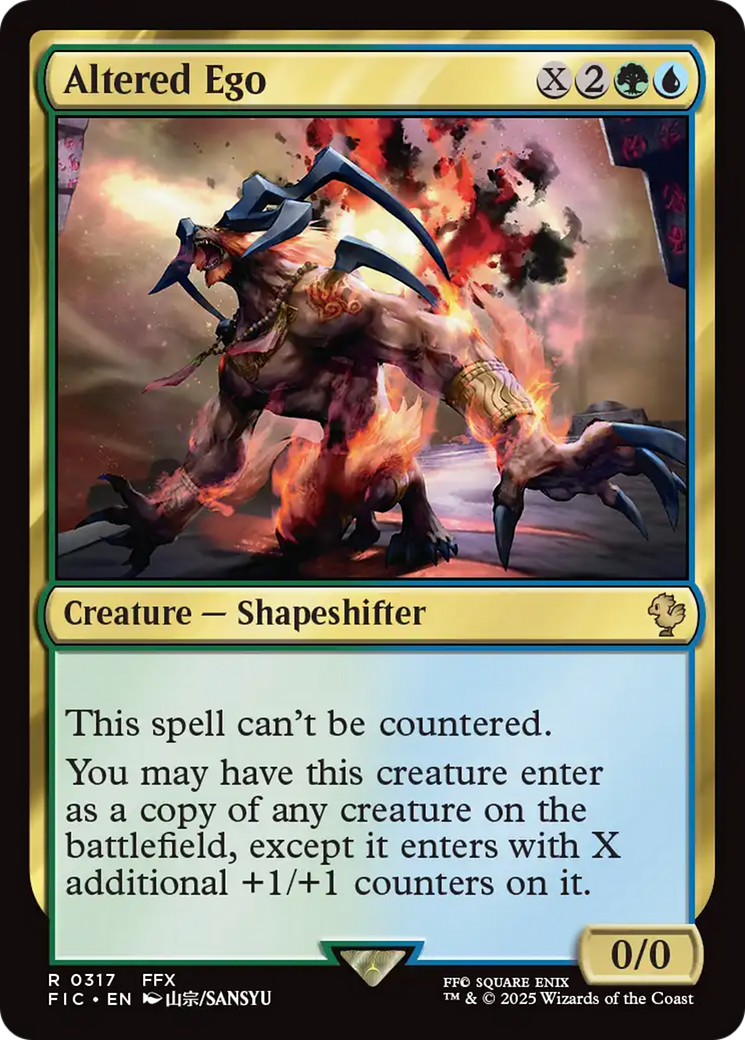
Altered Ego
Altered Ego
Creature — Shapeshifter
0/0
This spell can't be countered.
You may have this creature enter as a copy of any creature on the battlefield, except it enters with X additional +1/+1 counters on it.
- Altered Ego copies exactly what was printed on the original creature (unless that creature is copying something else or is a token; see below). It doesn't copy whether that creature is tapped or untapped, whether it has any counters on it or any Auras and Equipment attached to it, or any non-copy effects that have changed its power, toughness, types, color, or so on.
- Any "enters" abilities of the copied creature will trigger when Altered Ego enters the battlefield. Any "as [this creature] enters" or "[this creature] enters with" abilities of the chosen creature will also work.
- If the chosen creature is a token, Altered Ego copies the original characteristics of that token as stated by the effect that created that token. Altered Ego isn't a token.
- If you copy a double-faced creature, Altered Ego will be a copy of the face that's up when Altered Ego enters. Because Altered Ego is not a double-faced card, it won't be able to transform. If an effect instructs you to return it to the battlefield transformed when it leaves the battlefield, it won't return and will remain in its new zone.
- If Altered Ego somehow enters at the same time as another creature, Altered Ego can't become a copy of that creature. You may choose only a creature that's already on the battlefield.
- If the chosen creature has in its mana cost, that X is considered to be 0. The value of X in Altered Ego's last ability will be whatever value was chosen for X while casting Altered Ego.
- If the chosen creature is copying something else (for example, if the chosen creature is another Altered Ego), then your Altered Ego enters as whatever the chosen creature copied.
- You can choose not to copy anything. In that case, Altered Ego enters as a 0/0 creature and is probably put into the graveyard immediately. It won't have +1/+1 counters placed on it by its ability.
- X can be 0. Altered Ego won't enter with any additional +1/+1 counters, and it will just be a copy of the chosen creature.
-
1
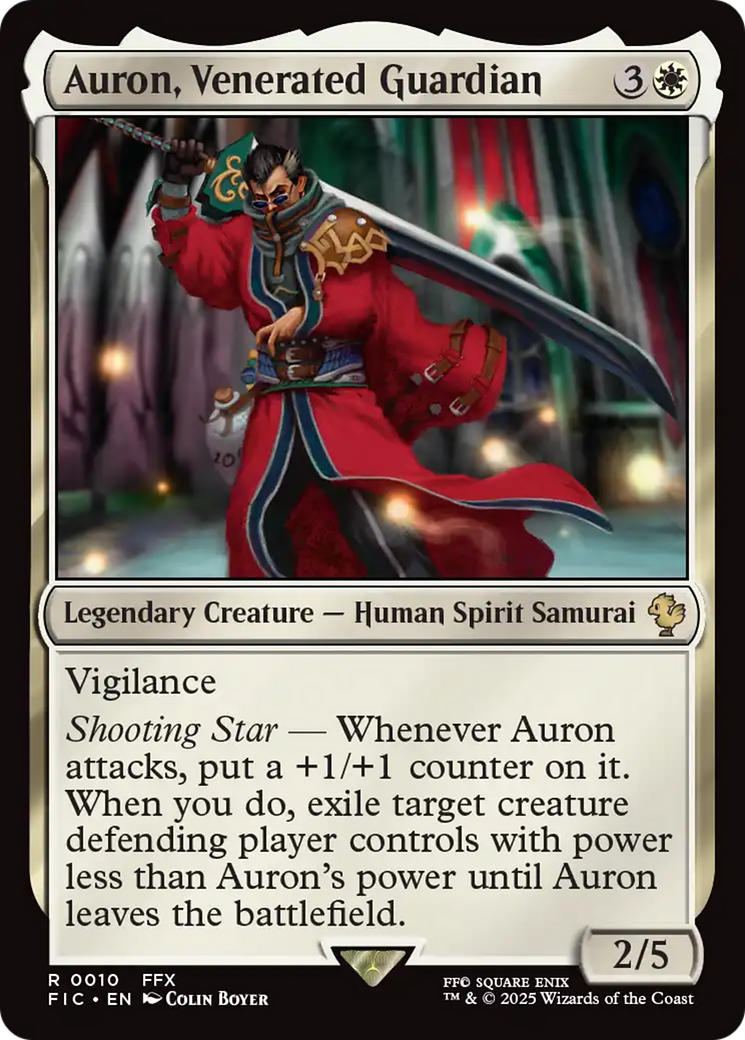
Auron, Venerated Guardian
Auron, Venerated Guardian
Legendary Creature — Human Spirit Samurai
2/5
Vigilance
Shooting Star — Whenever Auron attacks, put a +1/+1 counter on it. When you do, exile target creature defending player controls with power less than Auron's power until Auron leaves the battlefield.
- If a token is exiled this way, it will cease to exist and won't return to the battlefield.
- You don't choose a target for Auron's last ability at the time it triggers. Rather, a second "reflexive" ability triggers when you put a +1/+1 counter on it this way. You choose a target for that ability as it goes on the stack. Each player may respond to this triggered ability as normal.
- Once a creature is exiled by the reflexive triggered ability, it doesn't matter what happens to Auron's power. Reducing Auron's power below the exiled creature's power won't cause the exiled creature to return to the battlefield.
- Auras attached to the exiled creature will be put into their owners' graveyards. Any Equipment will become unattached and remain on the battlefield. Any counters on the exiled creature will cease to exist. When the card returns to the battlefield, it will be a new object with no connection to the card that was exiled.
-
1
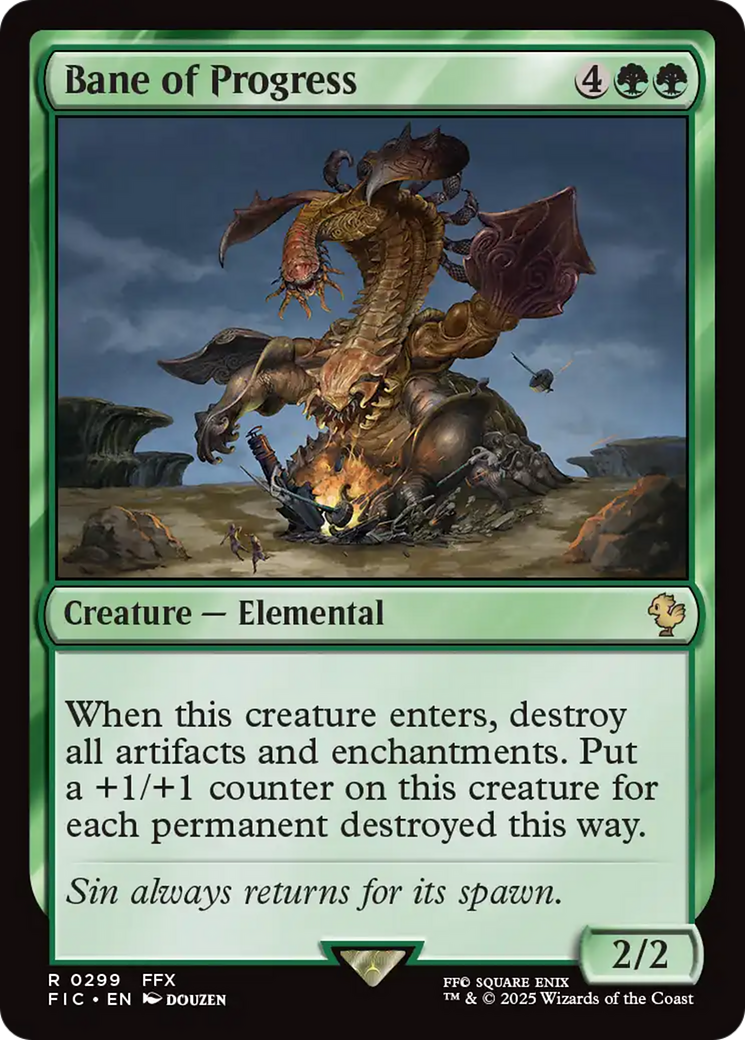
Bane of Progress
Bane of Progress
Creature — Elemental
2/2
When this creature enters, destroy all artifacts and enchantments. Put a +1/+1 counter on this creature for each permanent destroyed this way.
- If an artifact or enchantment isn't destroyed (perhaps because it has indestructible or it regenerated), it won't count toward the number of +1/+1 counters put on Bane of Progress. However, if an artifact or enchantment is destroyed but doesn't go to its owner's graveyard due to a replacement effect (like the one Rest in Peace creates), it will count.
- Bane of Progress's ability destroys all artifacts and enchantments, including those you control.
-
1
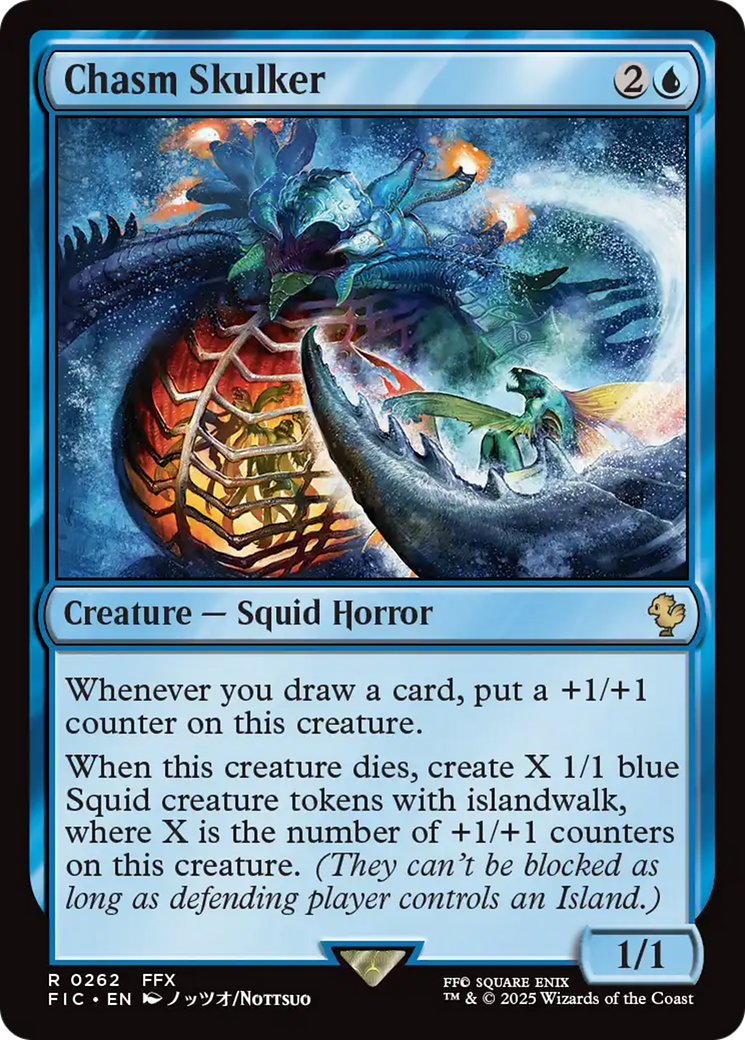
Chasm Skulker
Chasm Skulker
Creature — Squid Horror
1/1
Whenever you draw a card, put a +1/+1 counter on this creature.
When this creature dies, create X 1/1 blue Squid creature tokens with islandwalk, where X is the number of +1/+1 counters on this creature. (They can't be blocked as long as defending player controls an Island.)
- If enough -1/-1 counters are put on Chasm Skulker at the same time to make its toughness 0 or less, the number of +1/+1 counters on it before it got any -1/-1 counters will be used to determine how many Squid tokens you get. For example, if there are two +1/+1 counters on Chasm Skulker and it gets three -1/-1 counters, you'll get two Squid tokens.
- If you draw multiple cards, the first ability will trigger that many times. Each of these abilities will cause a +1/+1 counter to be put on Chasm Skulker.
-
1
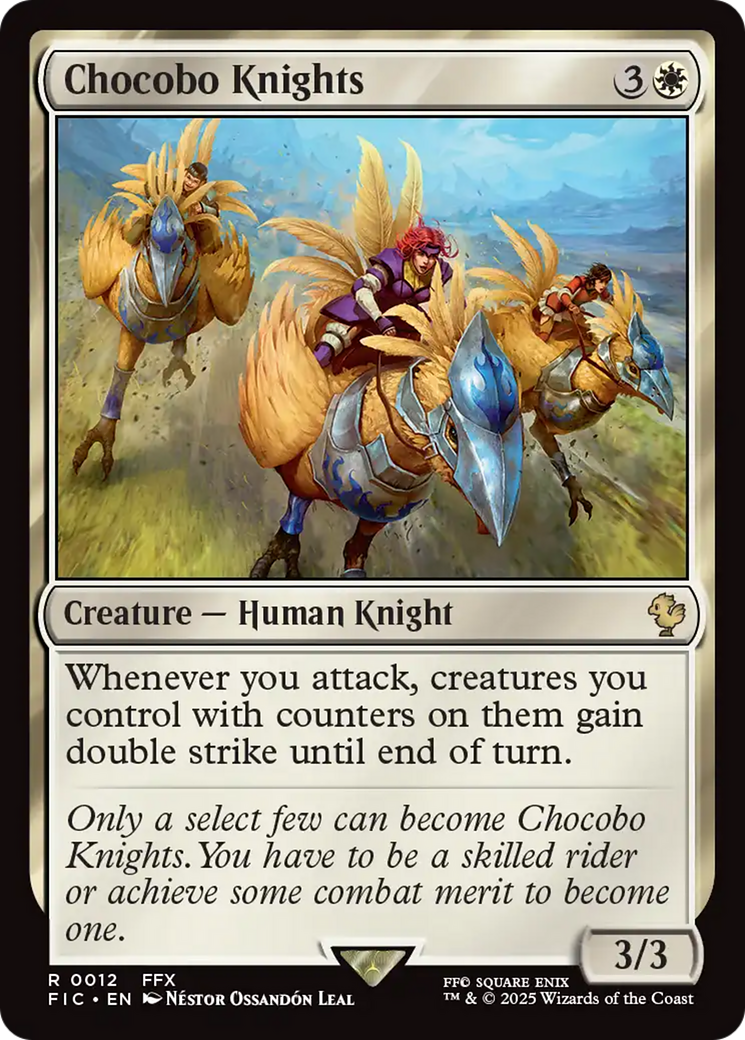
Chocobo Knights
Chocobo Knights
Creature — Human Knight
3/3
Whenever you attack, creatures you control with counters on them gain double strike until end of turn.
-
1
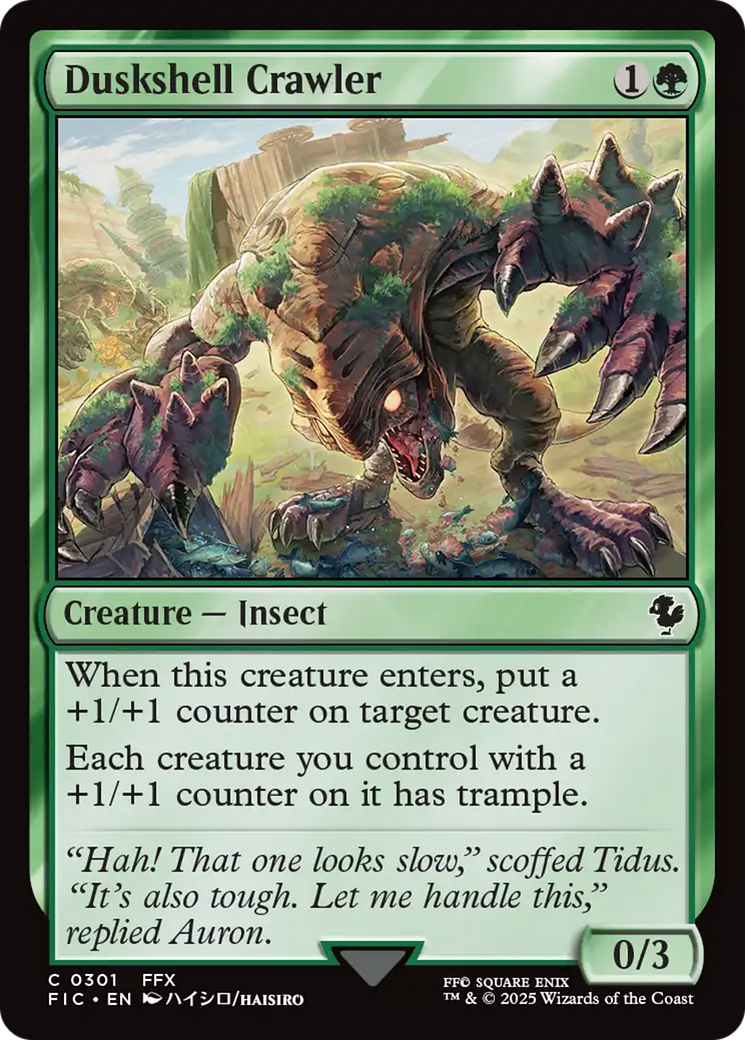
Duskshell Crawler
Duskshell Crawler
Creature — Insect
0/3
When this creature enters, put a +1/+1 counter on target creature.
Each creature you control with a +1/+1 counter on it has trample. (It can deal excess combat damage to the player or planeswalker it's attacking.)
-
1
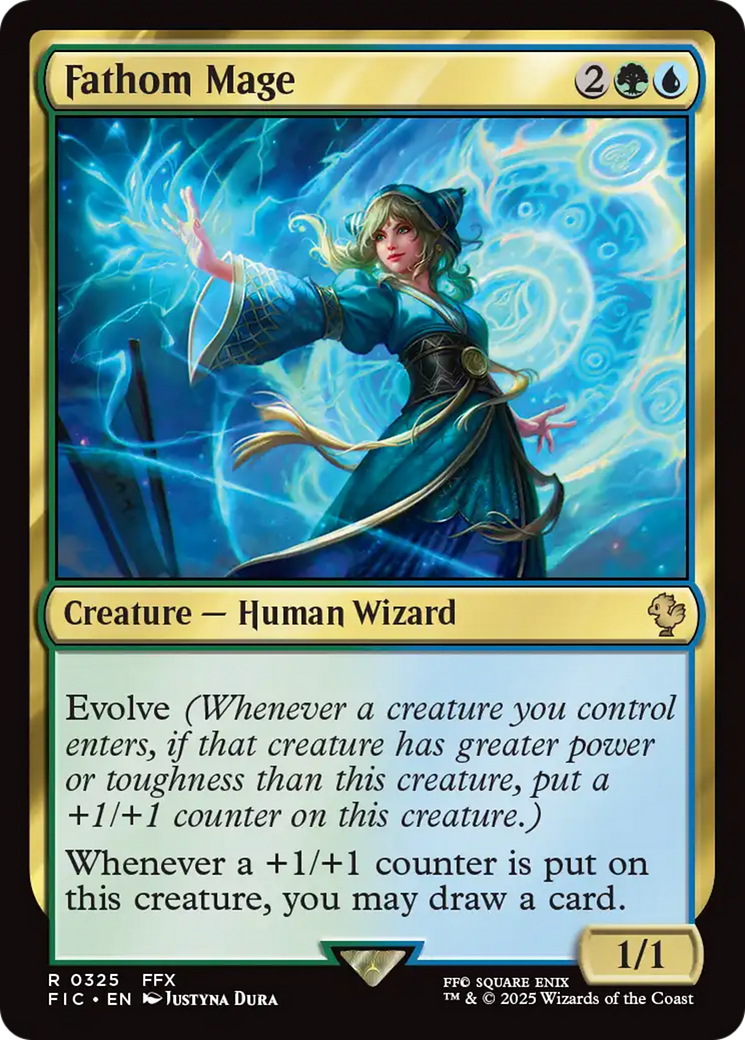
Fathom Mage
Fathom Mage
Creature — Human Wizard
1/1
Evolve (Whenever a creature you control enters, if that creature has greater power or toughness than this creature, put a +1/+1 counter on this creature.)
Whenever a +1/+1 counter is put on this creature, you may draw a card.
- If Fathom Mage enters with a +1/+1 counter on it (perhaps due to Master Biomancer), its last ability will trigger once for each +1/+1 counter it entered with.
- Fathom Mage's last ability will trigger whenever any +1/+1 counter is placed on it, not just ones due to the evolve ability.
- If multiple +1/+1 counters are placed on Fathom Mage simultaneously, its last ability will trigger once for each of those counters.
-
1
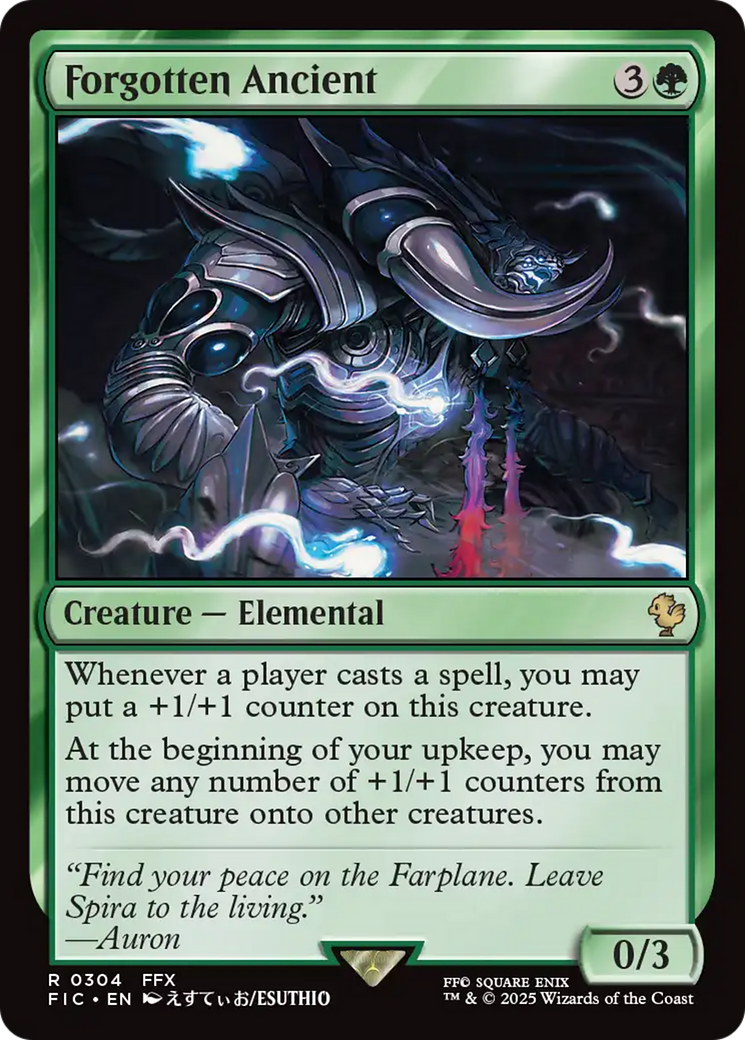
Forgotten Ancient
Forgotten Ancient
Creature — Elemental
0/3
Whenever a player casts a spell, you may put a +1/+1 counter on this creature.
At the beginning of your upkeep, you may move any number of +1/+1 counters from this creature onto other creatures.
- Forgotten Ancient's last ability doesn't target any creatures. You choose how many +1/+1 counters will be moved (and onto which creatures) as the ability resolves. Notably, once the ability starts resolving and you make these choices, no player may take actions until the ability has finished resolving.
- Forgotten Ancient's first ability will resolve before the spell that caused it to trigger. Putting a +1/+1 counter on Forgotten Ancient is optional.
-
1
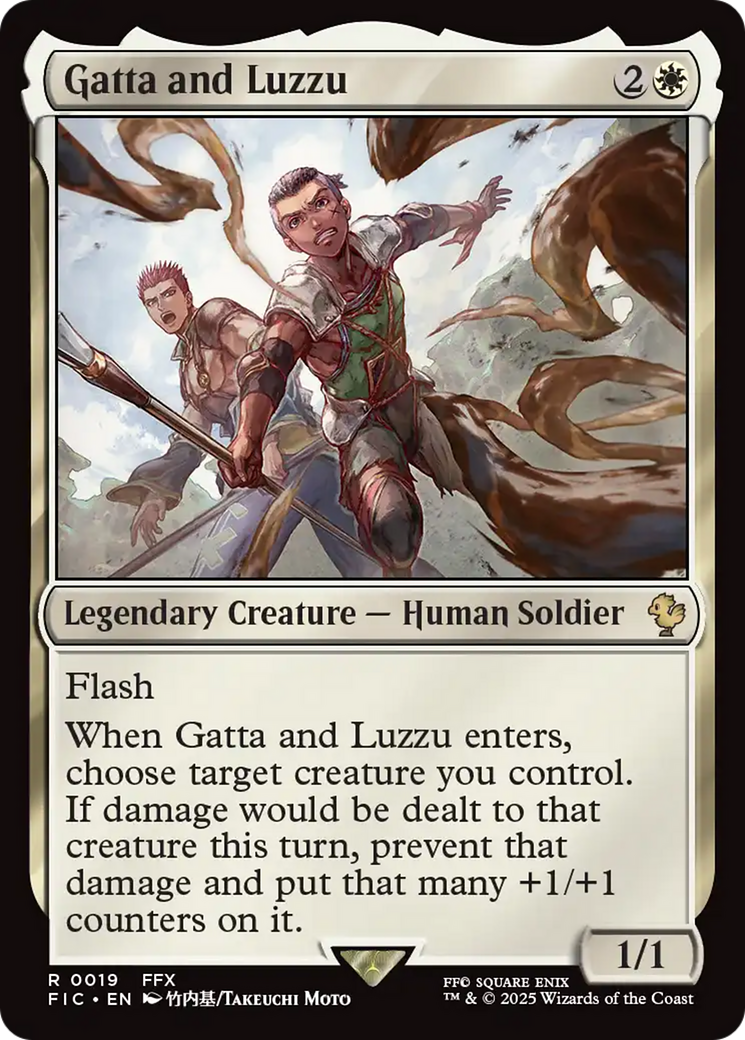
Gatta and Luzzu
Gatta and Luzzu
Legendary Creature — Human Soldier
1/1
Flash
When Gatta and Luzzu enters, choose target creature you control. If damage would be dealt to that creature this turn, prevent that damage and put that many +1/+1 counters on it.
- If damage that can't be prevented is dealt to the target creature after Gatta and Luzzu's last ability resolves, you still put that many +1/+1 counters on it.
-
1
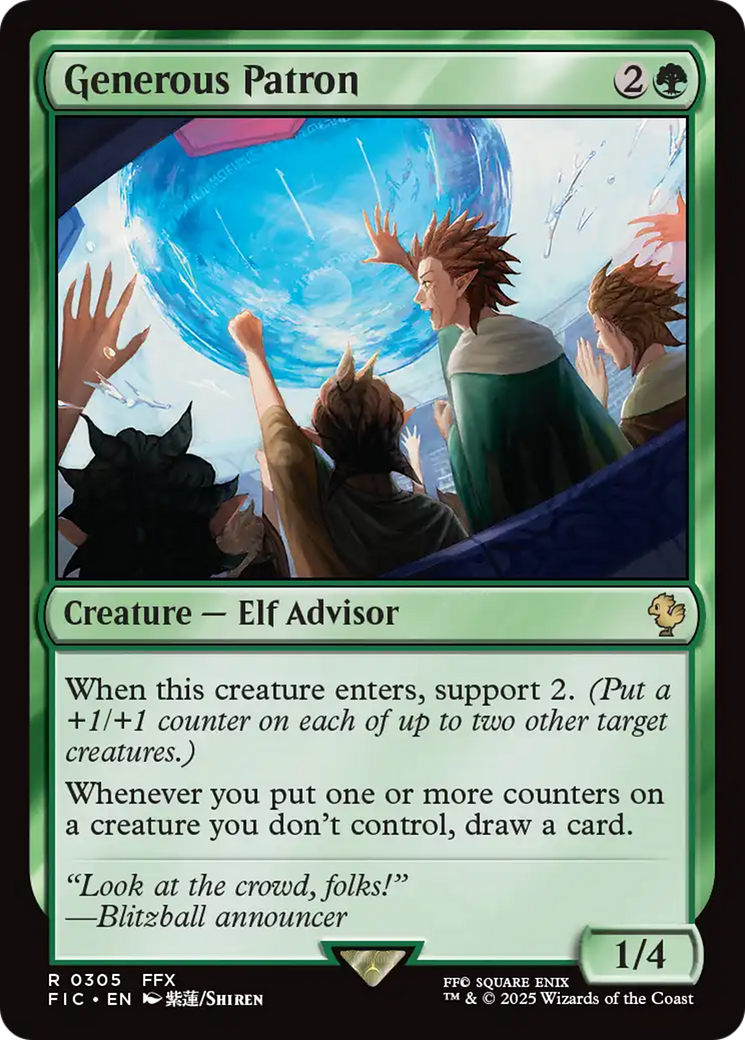
Generous Patron
Generous Patron
Creature — Elf Advisor
1/4
When this creature enters, support 2. (Put a +1/+1 counter on each of up to two other target creatures.)
Whenever you put one or more counters on a creature you don't control, draw a card.
- If you put one or more counters on multiple creatures you don't control at the same time, such as by supporting two different creatures you don't control, Generous Patron's last ability triggers for each of those creatures.
- If a spell with support has other abilities that target creatures, those abilities and the support ability can target the same creature.
- If a creature enters the battlefield with counters under another player's control, that player is the player who puts those counters on it, even if you control the spell or ability putting that creature onto the battlefield.
- Generous Patron's last ability triggers even if the counters you put on another player's creatures aren't +1/+1 counters.
- You can't put more than one +1/+1 counter on any one target using the support action.
- Support can target a creature another player controls.
- If some, but not all, targets for a spell become illegal, the remaining targets are affected as appropriate. If all of a spell's targets become illegal, that spell doesn't resolve.
-
1
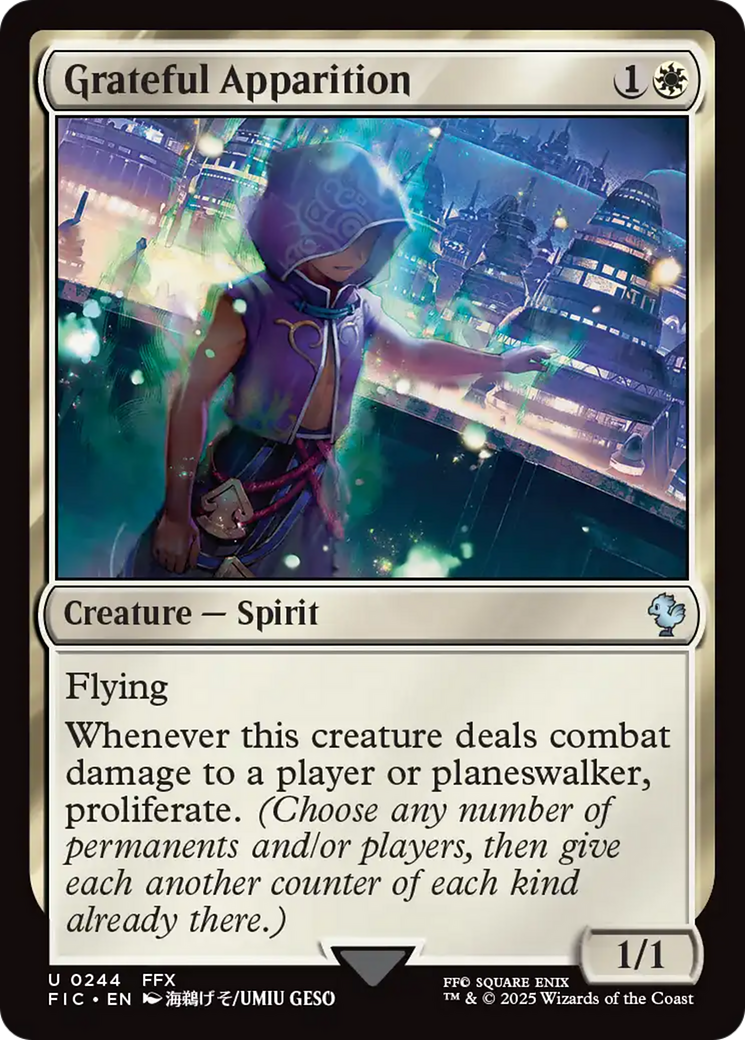
Grateful Apparition
Grateful Apparition
Creature — Spirit
1/1
Flying
Whenever this creature deals combat damage to a player or planeswalker, proliferate. (Choose any number of permanents and/or players, then give each another counter of each kind already there.)
- To proliferate, you can choose any permanent that has a counter, including ones controlled by opponents. You can choose any player who has a counter, including opponents. You can't choose cards in any zone other than the battlefield, even if they have counters on them.
- You don't have to choose every permanent or player that has a counter, only the ones you want to add another counter to. Since "any number" includes zero, you don't have to choose any permanents at all, and you don't have to choose any players at all.
- If a player or permanent has more than one kind of counter on it, and you choose for it to get additional counters, it must get one of each kind of counter it already has. You can't have it get just one kind of counter it already has and not the others.
- An ability that triggers "Whenever you proliferate" triggers even if you chose no permanents or players while doing so.
- Players can respond to a spell or ability whose effect includes proliferating. Once that spell or ability starts to resolve, however, and its controller chooses which permanents and players will get new counters, it's too late for anyone to respond.
- If a permanent ever has both +1/+1 counters and -1/-1 counters on it at the same time, they're removed in pairs as a state-based action so that the permanent has only one of those kinds of counters on it.
-
1
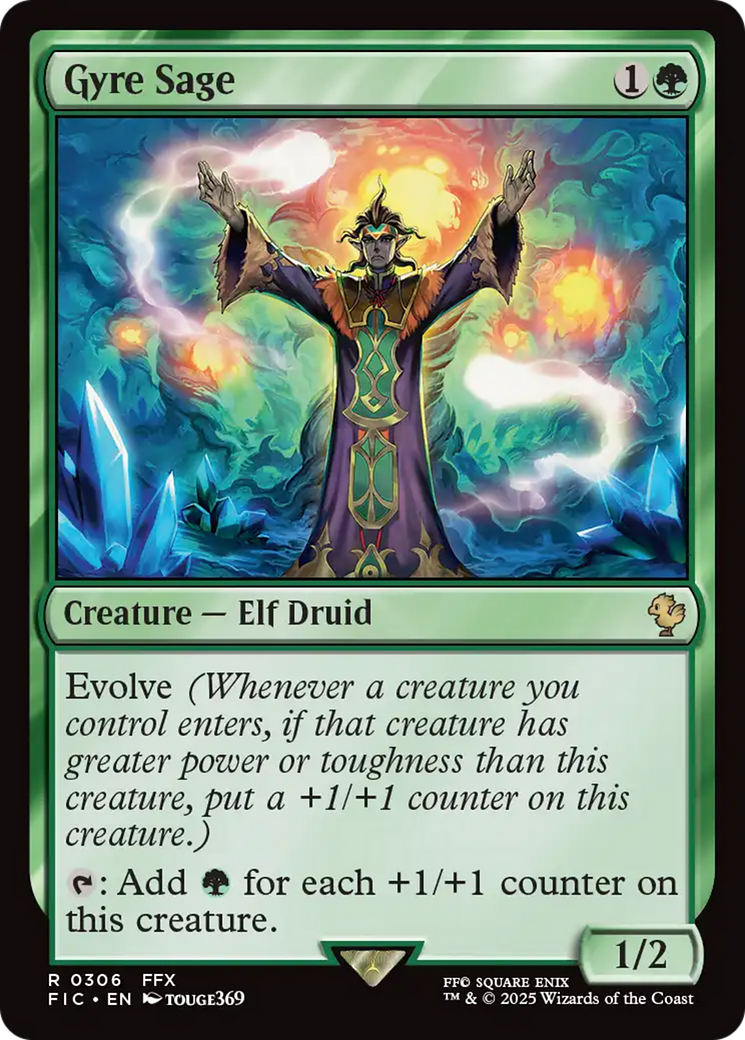
Gyre Sage
Gyre Sage
Creature — Elf Druid
1/2
Evolve (Whenever a creature you control enters, if that creature has greater power or toughness than this creature, put a +1/+1 counter on this creature.)
: Add for each +1/+1 counter on this creature.
- Gyre Sage's last ability is a mana ability. It doesn't use the stack and can't be responded to.
-
1
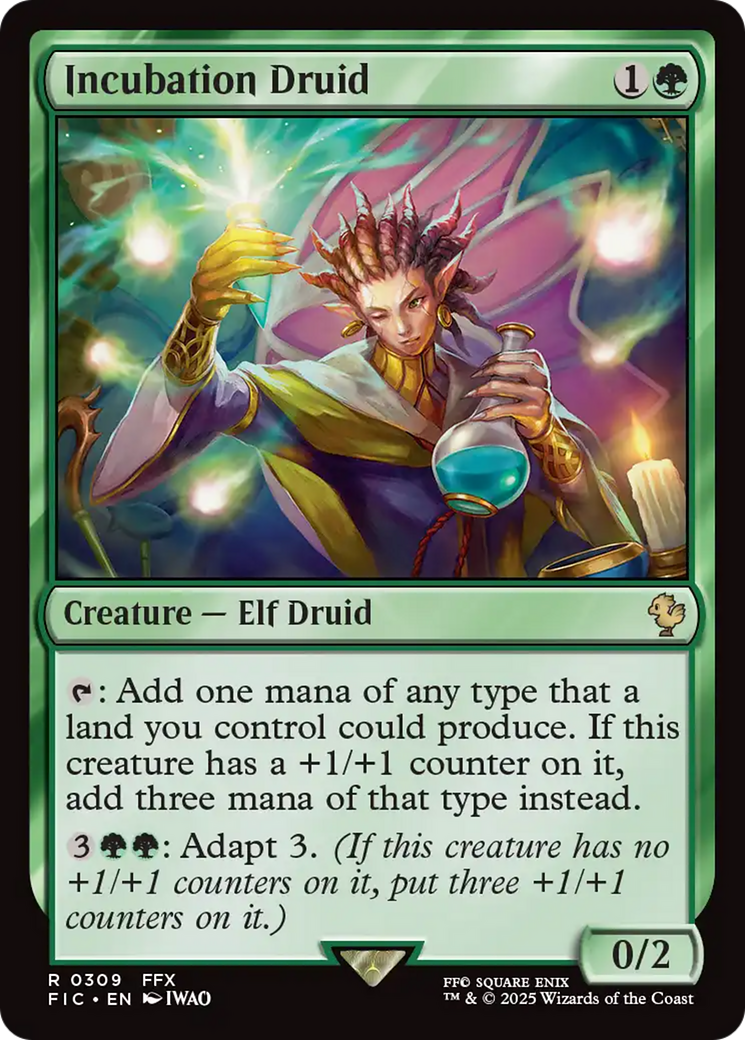
Incubation Druid
Incubation Druid
Creature — Elf Druid
0/2
: Add one mana of any type that a land you control could produce. If this creature has a +1/+1 counter on it, add three mana of that type instead.
: Adapt 3. (If this creature has no +1/+1 counters on it, put three +1/+1 counters on it.)
- The types of mana are white, blue, black, red, green, and colorless.
- Incubation Druid checks the effects of all mana-producing abilities of lands you control, but it doesn't check their costs or legality. For example, Spire of Industry says " , Pay 1 life: Add one mana of any color. Activate only if you control an artifact." If you control Spire of Industry and Incubation Druid, you can tap Incubation Druid for any color of mana. It doesn't matter whether you control an artifact, whether you can pay 1 life, or whether Spire of Industry is untapped.
- Any change to a land's type or abilities gained by a land can affect the types of mana a land can produce.
- Incubation Druid doesn't care about any restrictions or riders your lands put on the mana they produce, such as those of Unclaimed Territory and Guildmages' Forum. It just produces one mana of the appropriate type, with no restrictions or riders.
-
1
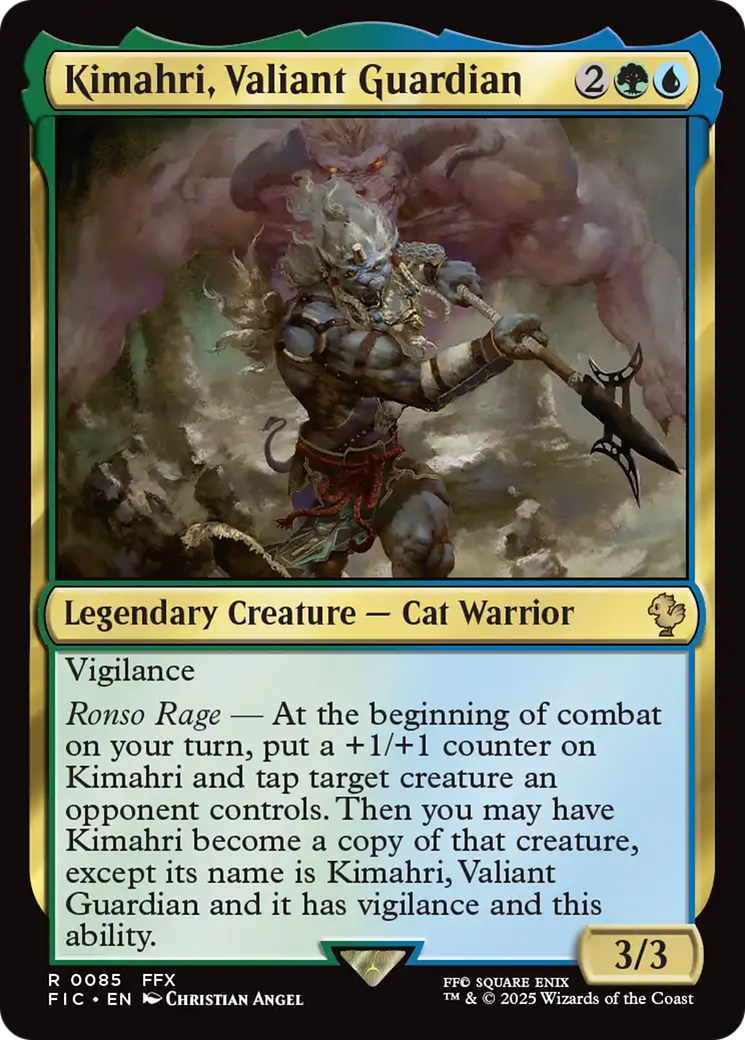
Kimahri, Valiant Guardian
Kimahri, Valiant Guardian
Legendary Creature — Cat Warrior
3/3
Vigilance
Ronso Rage — At the beginning of combat on your turn, put a +1/+1 counter on Kimahri and tap target creature an opponent controls. Then you may have Kimahri become a copy of that creature, except its name is Kimahri, Valiant Guardian and it has vigilance and this ability.
- If the target creature is an illegal target as Kimahri's last ability tries to resolve, it won't resolve and none of its effects will happen. You won't put a counter on Kimahri, and Kimahri won't become a copy of anything.
- If the copied creature has in its mana cost, X is 0.
- If the copied creature is a token, Kimahri copies the original characteristics of that token as stated by the effect that created the token, with the listed exceptions.
- Kimahri copies exactly what was printed on the original creature, with the listed exceptions (unless that creature is copying something else or is a token; see below). It doesn't copy whether that creature is tapped or untapped, whether it has any counters on it or any Auras or Equipment attached to it, or any non-copy effects that have changed its types, color, power and toughness, and so on.
- If the copied creature is copying something else, then Kimahri becomes a copy of whatever that creature is copying, with the listed exceptions.
-
1
Lord Jyscal Guado
Lord Jyscal Guado
Legendary Creature — Spirit Cleric
2/1
Flying
At the beginning of each end step, if you put a counter on a creature this turn, investigate. (Create a Clue token. It's an artifact with " , Sacrifice this token: Draw a card.")
- Lord Jyscal Guado's last ability checks at the moment it would trigger to see if you put a counter on a creature this turn. If you didn't, the ability won't trigger at all. Once your end step begins, it's too late to put a counter on a creature in order to cause this ability to trigger.
-
1
Lulu, Stern Guardian
Lulu, Stern Guardian
Legendary Creature — Human Wizard
2/3
Whenever an opponent attacks you, choose target creature attacking you. Put a stun counter on that creature.
: Proliferate. (Choose any number of permanents and/or players, then give each another counter of each kind already there.)
- When you proliferate, you can choose any permanent that has a counter, including ones controlled by opponents. You can choose any player who has a counter, including opponents. You can't choose cards in any zone other than the battlefield, even if they have counters on them.
- Lulu's first ability only cares about creatures attacking you, not planeswalkers you control or battles you protect.
- You don't have to choose every permanent or player that has a counter—only the ones you want to add counters to. Since "any number" includes zero, you don't have to choose any permanents at all, and you don't have to choose any players at all.
- If a player or permanent has more than one kind of counter on it, and you choose for it to get additional counters, it must get one of each kind of counter it already has. You can't have it get just one kind of counter it already has and not the others.
- Players can respond to a spell or ability whose effect includes proliferating. Once that spell or ability starts to resolve, however, and its controller chooses which permanents and players will get new counters, it's too late for anyone to respond.
-
1
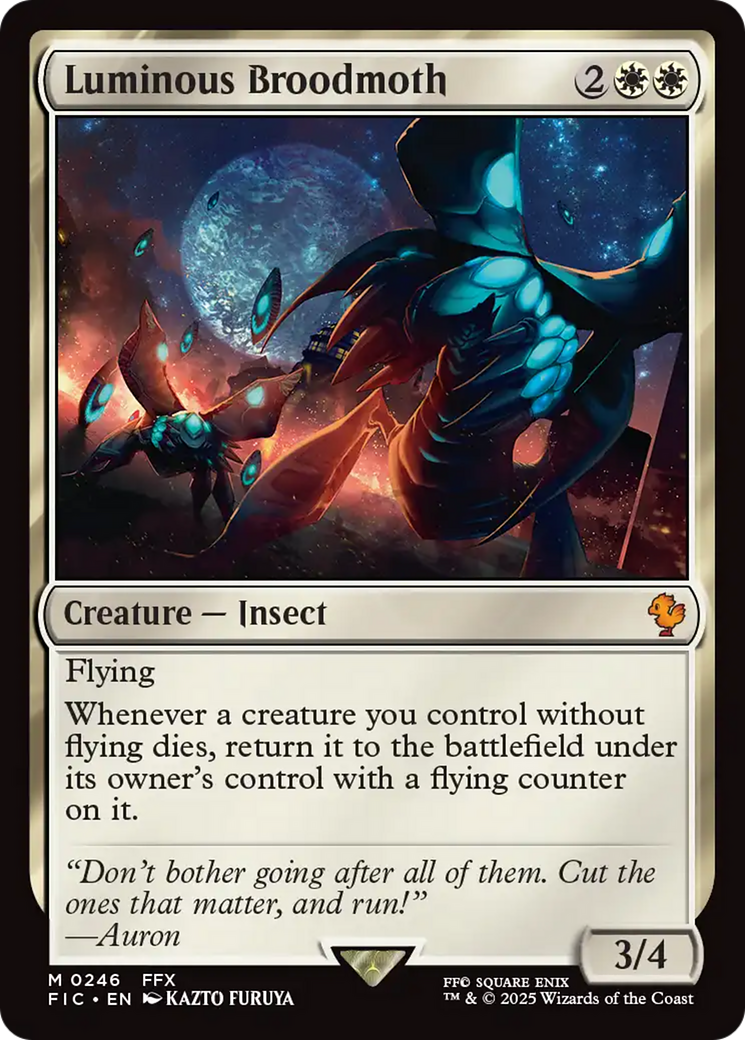
Luminous Broodmoth
Luminous Broodmoth
Creature — Insect
3/4
Flying
Whenever a creature you control without flying dies, return it to the battlefield under its owner's control with a flying counter on it.
- If Luminous Broodmoth dies at the same time as a creature without flying, its ability triggers for that creature.
- If a merged creature dies and that creature didn't have flying, each card that was part of that merged creature is returned to the battlefield. Each one has a flying counter on it.
- If Luminous Broodmoth dies after losing flying but not losing its triggered ability, its ability will trigger for itself.
- Luminous Broodmoth's ability triggers if a token creature without flying dies, but the token won't be returned to the battlefield. If that token was a merged creature, any cards that were part of it will be returned to the battlefield.
-
1
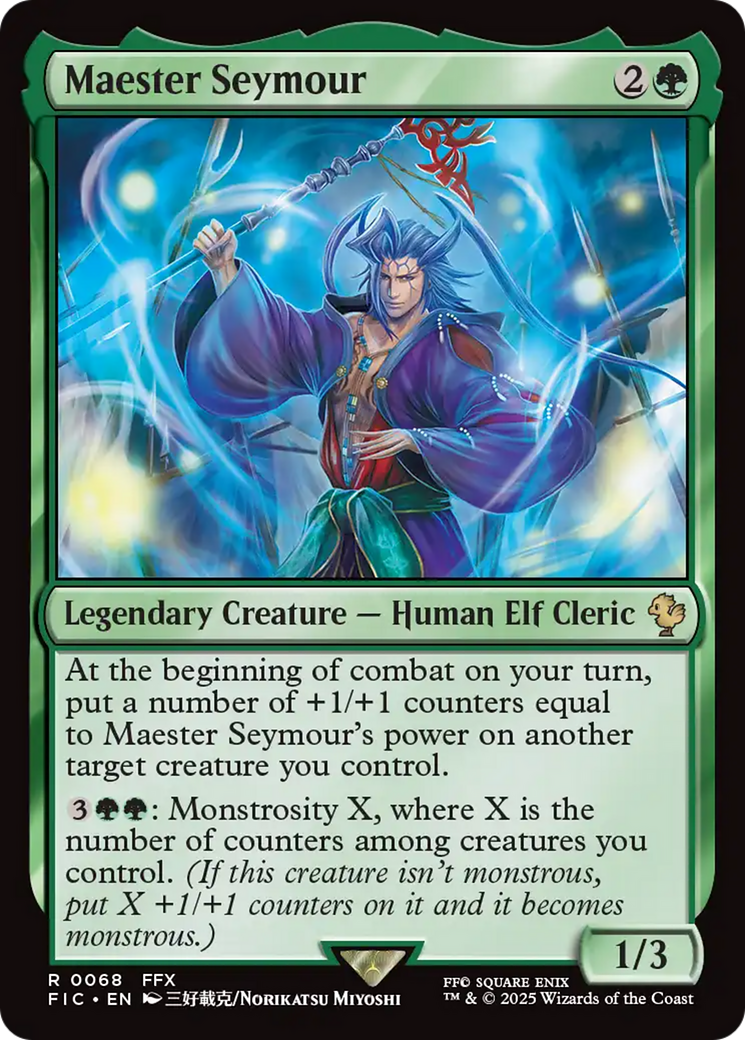
Maester Seymour
Maester Seymour
Legendary Creature — Human Elf Cleric
1/3
At the beginning of combat on your turn, put a number of +1/+1 counters equal to Maester Seymour's power on another target creature you control.
: Monstrosity X, where X is the number of counters among creatures you control. (If this creature isn't monstrous, put X +1/+1 counters on it and it becomes monstrous.)
- If Maester Seymour is no longer on the battlefield when its first ability resolves, use its power as it last existed on the battlefield to determine how many +1/+1 counters to put on the target creature.
- Once a creature becomes monstrous, it can't become monstrous again. If the creature is already monstrous when the monstrosity ability resolves, nothing happens.
- The value of X is determined only once, as Maester Seymour's last ability resolves.
- Monstrous isn't an ability that a creature has. It's just something true about that creature. If the creature stops being a creature or loses its abilities, it will continue to be monstrous.
-
1
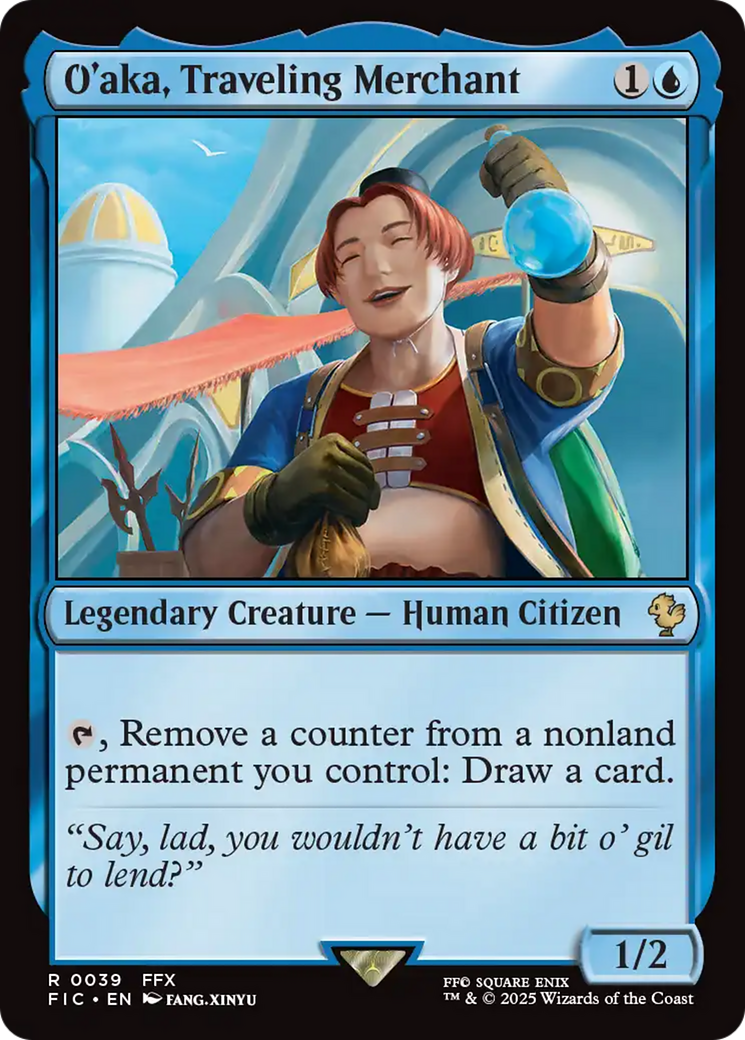
O'aka, Traveling Merchant
O'aka, Traveling Merchant
Legendary Creature — Human Citizen
1/2
, Remove a counter from a nonland permanent you control: Draw a card.
-
1
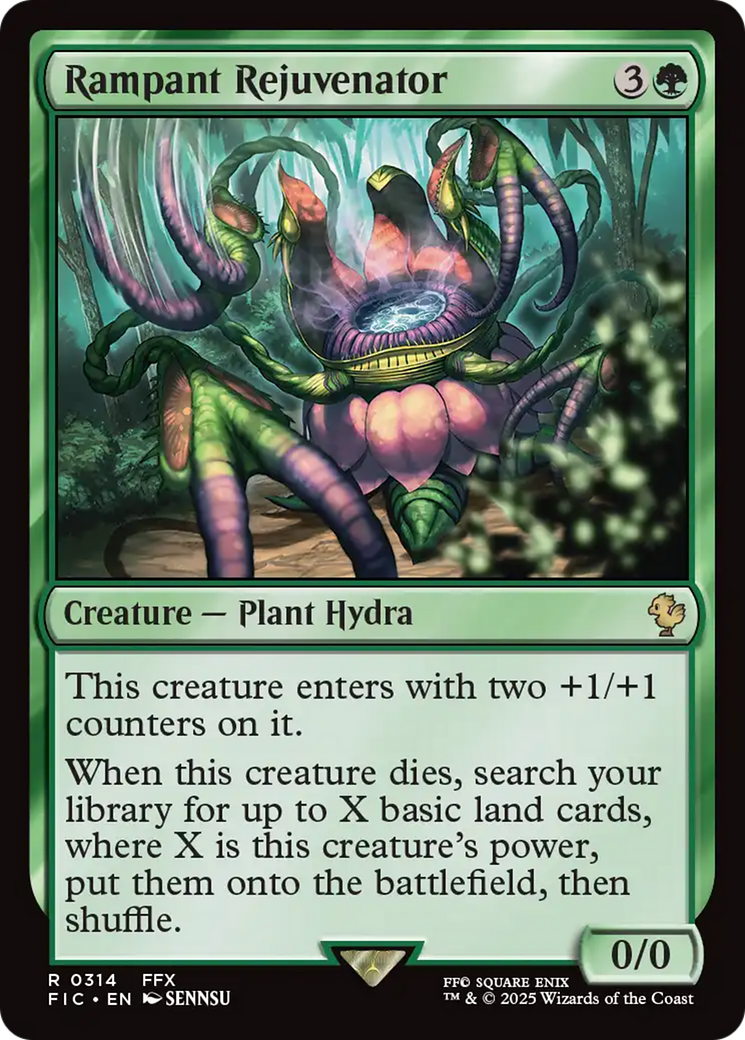
Rampant Rejuvenator
Rampant Rejuvenator
Creature — Plant Hydra
0/0
This creature enters with two +1/+1 counters on it.
When this creature dies, search your library for up to X basic land cards, where X is this creature's power, put them onto the battlefield, then shuffle.
- Use Rampant Rejuvenator's power as it last existed on the battlefield to determine the value of X for its last ability.
-
1
Rikku, Resourceful Guardian
Rikku, Resourceful Guardian
Legendary Creature — Human Artificer
2/3
Whenever you put one or more counters on a creature, until end of turn, that creature can't be blocked by creatures your opponents control.
Steal — , : Move a counter from target creature an opponent controls onto target creature you control. Activate only as a sorcery.
- Once a creature has been blocked, Rikku's first ability won't cause it to become unblocked.
- To move a counter from one permanent to another, the counter is removed from the first permanent and put on the second. Any abilities that care about a counter being removed from or put onto a permanent will apply.
-
1
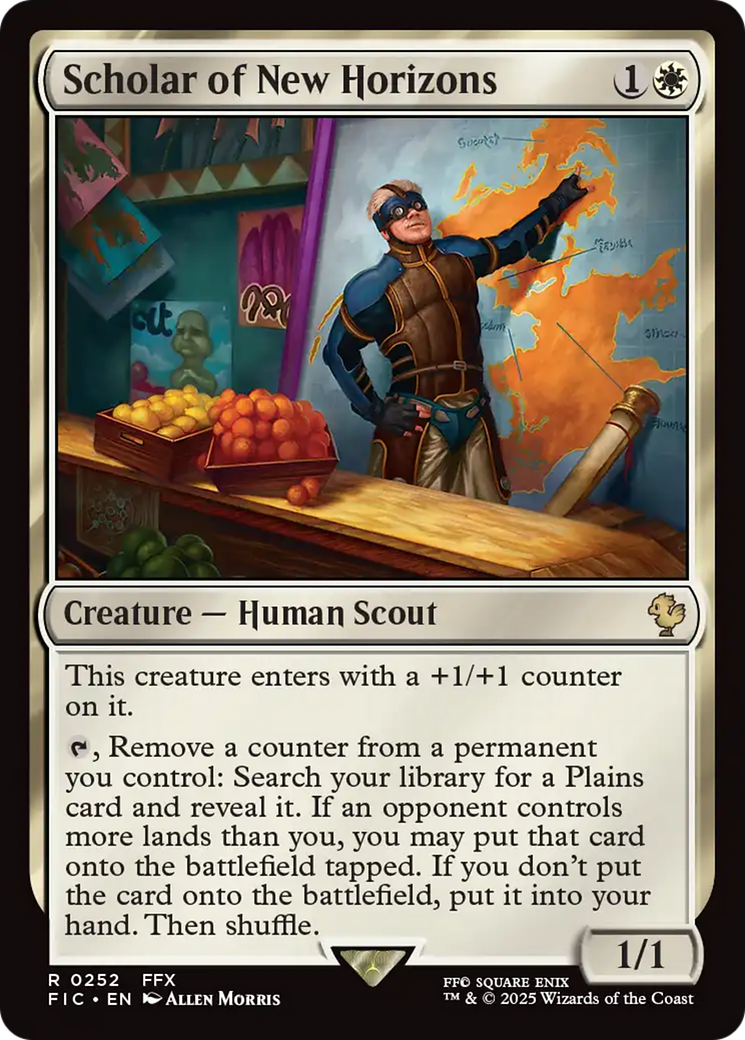
Scholar of New Horizons
Scholar of New Horizons
Creature — Human Scout
1/1
This creature enters with a +1/+1 counter on it.
, Remove a counter from a permanent you control: Search your library for a Plains card and reveal it. If an opponent controls more lands than you, you may put that card onto the battlefield tapped. If you don't put the card onto the battlefield, put it into your hand. Then shuffle.
- You may choose to put the card into your hand rather than onto the battlefield even if an opponent controls more lands than you.
-
1
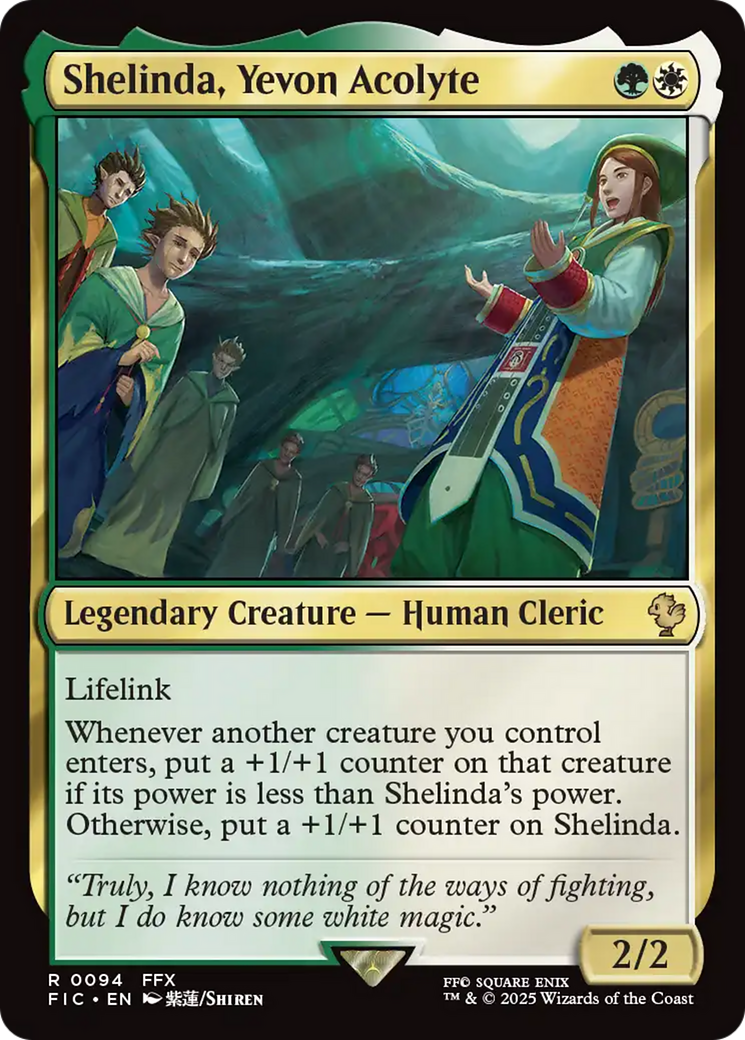
Shelinda, Yevon Acolyte
Shelinda, Yevon Acolyte
Legendary Creature — Human Cleric
2/2
Lifelink
Whenever another creature you control enters, put a +1/+1 counter on that creature if its power is less than Shelinda's power. Otherwise, put a +1/+1 counter on Shelinda.
-
1
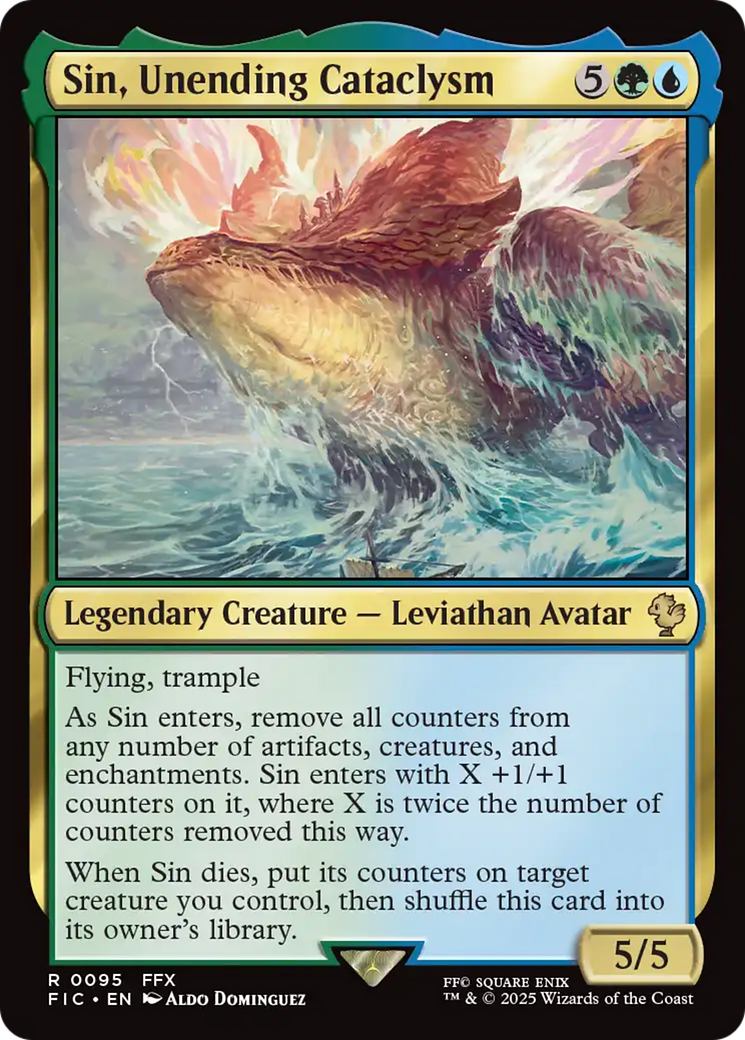
Sin, Unending Cataclysm
Sin, Unending Cataclysm
Legendary Creature — Leviathan Avatar
5/5
Flying, trample
As Sin enters, remove all counters from any number of artifacts, creatures, and enchantments. Sin enters with X +1/+1 counters on it, where X is twice the number of counters removed this way.
When Sin dies, put its counters on target creature you control, then shuffle this card into its owner's library.
- Sin's last ability doesn't cause you to move counters from Sin onto the target creature. Rather, you put the same number of each kind of counter Sin had when it died onto the target creature.
- If the target creature is an illegal target as Sin's last ability tries to resolve, it won't resolve and none of its effects will happen. Sin will remain in the zone it went to when it died (which is usually the graveyard).
- Sin's last ability puts all counters that were on Sin onto the target creature, not just its +1/+1 counters.
- In some unusual cases, you may end up putting the appropriate counters on more than one permanent. For example, if you control The Ozolith ("Whenever a creature you control leaves the battlefield, if it had counters on it, put those counters on The Ozolith.") when Sin's last ability resolves, you'll put the appropriate number of each kind of counter onto both The Ozolith and the target creature.
-
1
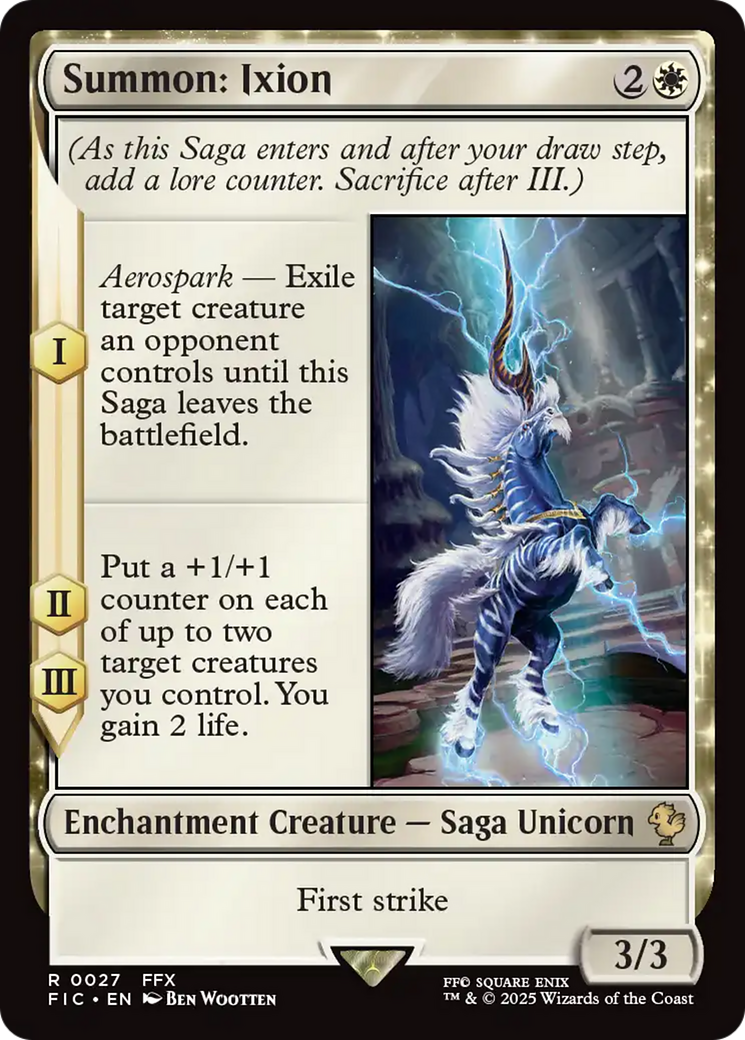
Summon: Ixion
Summon: Ixion
Enchantment Creature — Saga Unicorn
3/3
(As this Saga enters and after your draw step, add a lore counter. Sacrifice after III.)
I — Aerospark — Exile target creature an opponent controls until this Saga leaves the battlefield.
II, III — Put a +1/+1 counter on each of up to two target creatures you control. You gain 2 life.
First strike
- If Summon: Ixion leaves the battlefield before its first chapter ability resolves, the target permanent won't be exiled.
- If a token is exiled this way, it will cease to exist and won't return to the battlefield.
- You don't have to choose any targets for Summon: Ixion's second or third chapter ability. However, if you do and all of the targets are illegal when the ability tries to resolve, it won't resolve and none of its effects will happen. You won't gain life.
- Auras attached to the exiled permanent will be put into their owners' graveyards. Any Equipment will become unattached and remain on the battlefield. Any counters on the exiled permanent will cease to exist. When the card returns to the battlefield, it will be a new object with no connection to the card that was exiled.
- If an Aura is exiled this way, its owner chooses what it will enchant as it returns to the battlefield. An Aura put onto the battlefield this way doesn't target anything (so it could be attached to a permanent with shroud, for example), but the Aura's enchant ability restricts what it can be attached to. If the Aura can't legally be attached to anything, it remains in exile for the rest of the game.
-
1
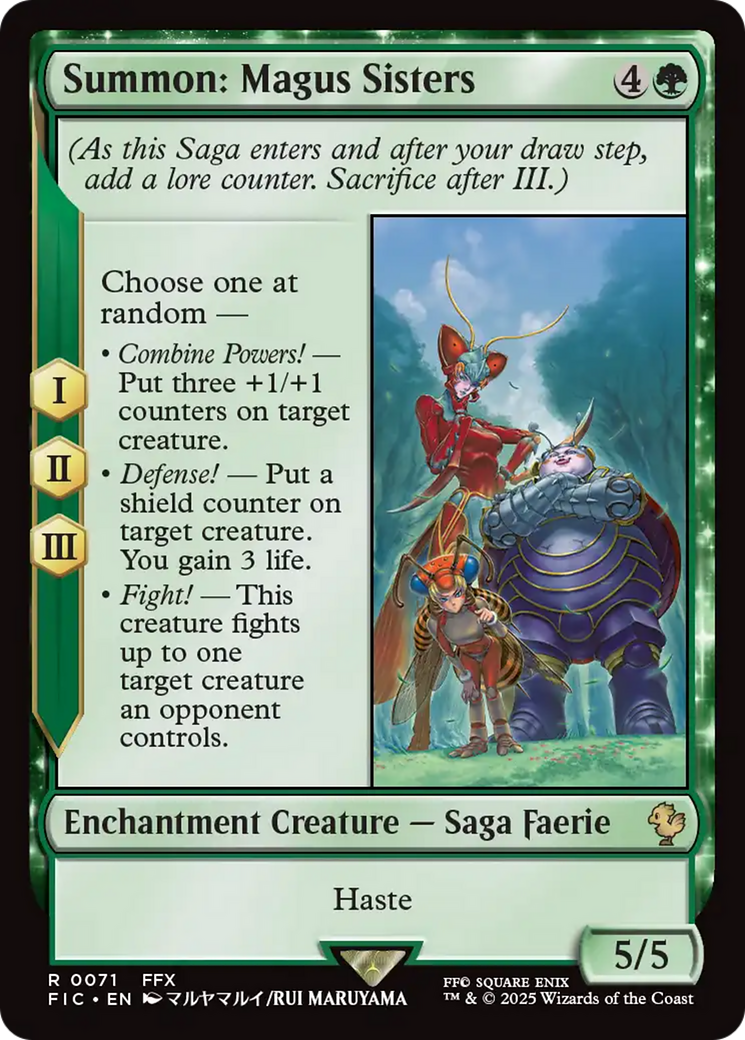
Summon: Magus Sisters
Summon: Magus Sisters
Enchantment Creature — Saga Faerie
5/5
(As this Saga enters and after your draw step, add a lore counter. Sacrifice after III.)
I, II, III — Choose one at random —
- Combine Powers! — Put three +1/+1 counters on target creature.
- Defense! — Put a shield counter on target creature. You gain 3 life.
- Fight! — This creature fights up to one target creature an opponent controls.
Haste
- As you put one of Summon: Magus Sisters's chapter abilities on the stack, you choose a mode at random. Players can respond to the ability knowing which mode was chosen.
- The random choice of mode for Summon: Magus Sisters's chapter abilities is made before targets are chosen.
- Shield counters don't prevent players from sacrificing creatures.
- If a permanent that would be dealt damage has more than one shield counter on it, that damage is prevented and only one shield counter is removed.
- A creature with a shield counter on it may still be destroyed by state-based actions if it has damage marked on it equal to its toughness or has been dealt unpreventable damage by a source with deathtouch.
- In the incredibly rare case where there is no legal target for the first or second mode, those modes can't be chosen at random. Since the third mode doesn't require a target, it is always eligible to be chosen.
- Removing a shield counter when a permanent would be dealt damage or destroyed isn't the same as regenerating that permanent.
- If a permanent with a shield counter is dealt unpreventable damage, that damage will be dealt and a shield counter will still be removed.
- "Shield" is not an ability that creatures have and shield counters are not keyword counters. If a creature with a shield counter loses its abilities, the shield counter will still protect it as normal.
-
1
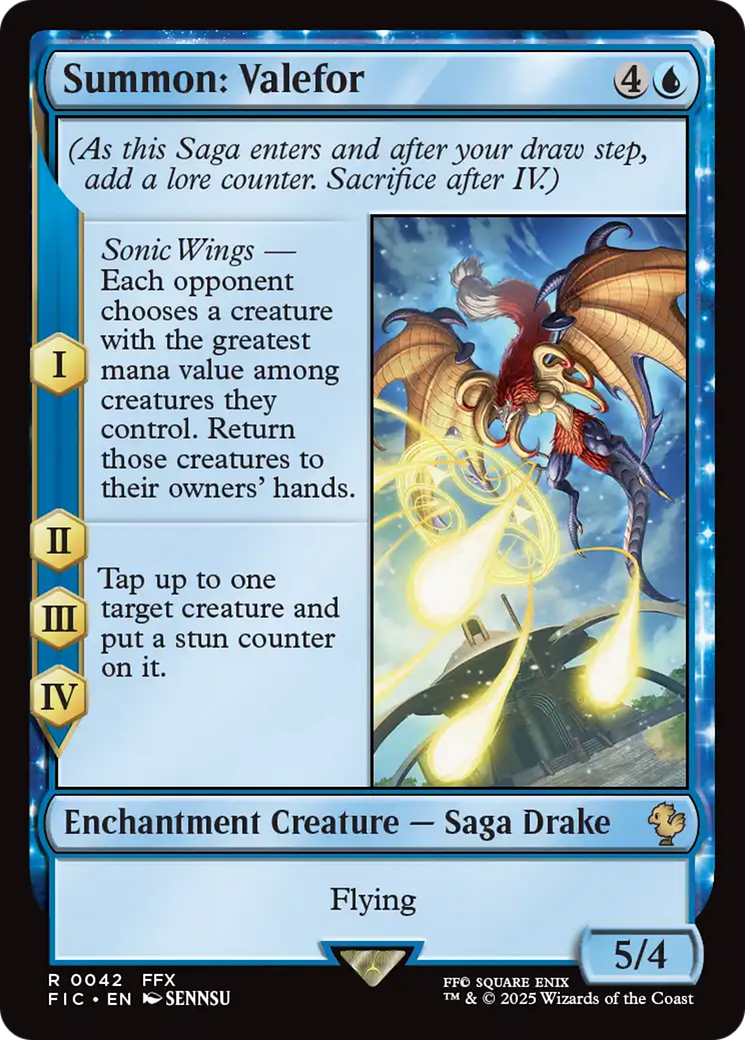
Summon: Valefor
Summon: Valefor
Enchantment Creature — Saga Drake
5/4
(As this Saga enters and after your draw step, add a lore counter. Sacrifice after IV.)
I — Sonic Wings — Each opponent chooses a creature with the greatest mana value among creatures they control. Return those creatures to their owners' hands.
II, III, IV — Tap up to one target creature and put a stun counter on it.
Flying
- While resolving Valefor's first chapter ability, the next opponent in turn order chooses a creature with the greatest mana value among creatures they control, then each other opponent in turn order does the same. Then the chosen creatures are returned to their owners' hands simultaneously.
- If a creature on the battlefield has in its mana cost, X is 0 for the purpose of determining its mana value.
-
1
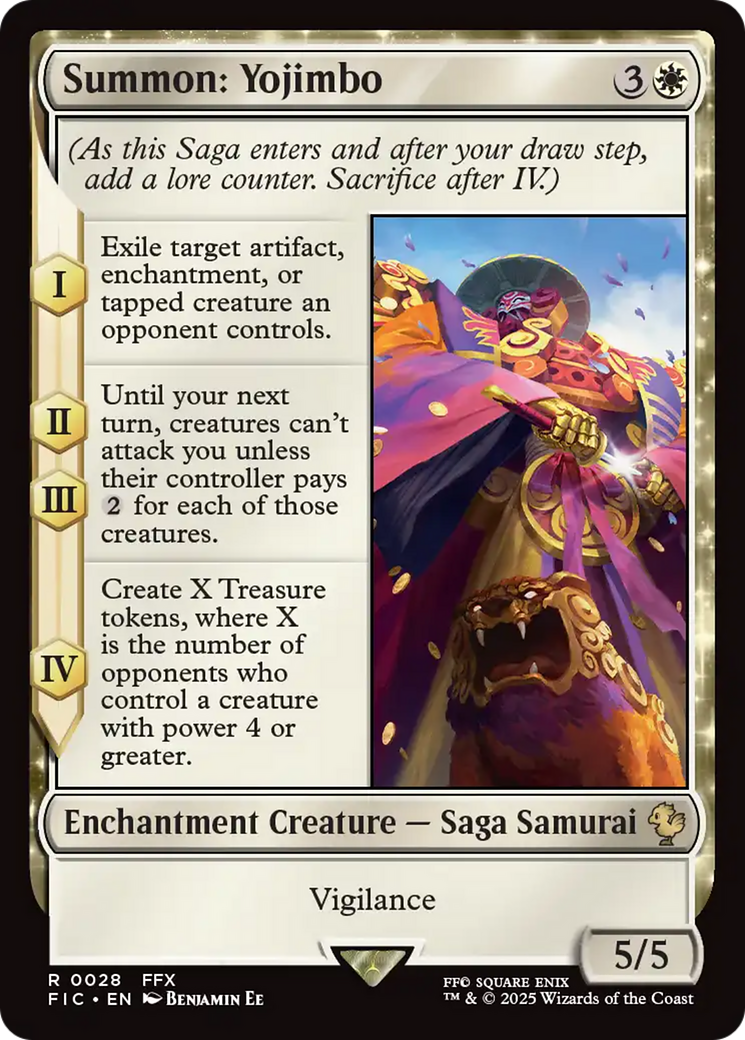
Summon: Yojimbo
Summon: Yojimbo
Enchantment Creature — Saga Samurai
5/5
(As this Saga enters and after your draw step, add a lore counter. Sacrifice after IV.)
I — Exile target artifact, enchantment, or tapped creature an opponent controls.
II, III — Until your next turn, creatures can't attack you unless their controller pays for each of those creatures.
IV — Create X Treasure tokens, where X is the number of opponents who control a creature with power 4 or greater.
Vigilance
- The value of X is determined only once, as Summon: Yojimbo's fourth chapter ability resolves.
- On turns where the effect of Summon: Yojimbo's second or third chapter ability is applying, your opponents can choose not to attack with a creature that must attack if able as long as there is no other player, planeswalker, or battle for that creature to attack that wouldn't require a cost.
-
1
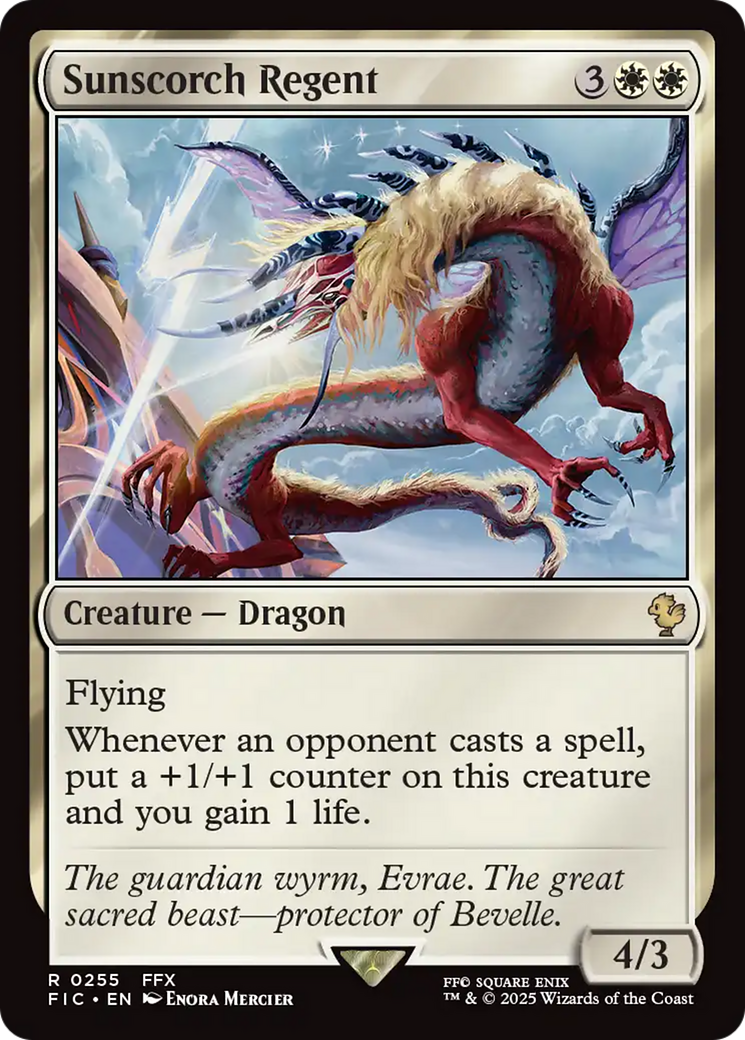
Sunscorch Regent
Sunscorch Regent
Creature — Dragon
4/3
Flying
Whenever an opponent casts a spell, put a +1/+1 counter on this creature and you gain 1 life.
-
1
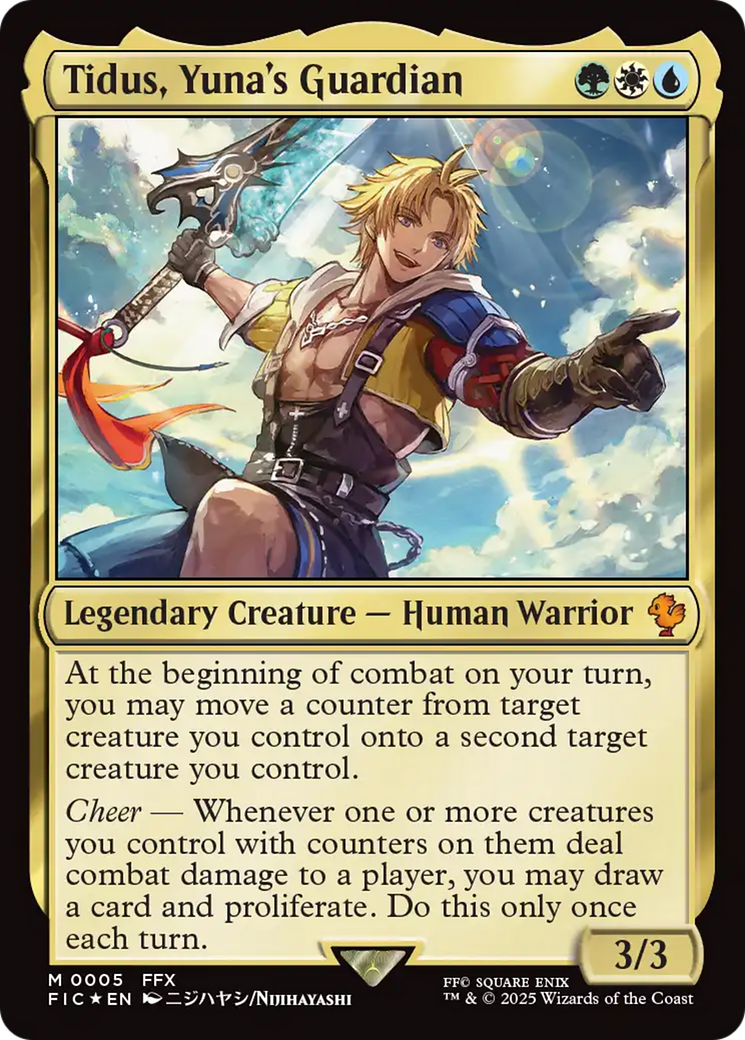
Tidus, Yuna's Guardian
Tidus, Yuna's Guardian
Legendary Creature — Human Warrior
3/3
At the beginning of combat on your turn, you may move a counter from target creature you control onto a second target creature you control.
Cheer — Whenever one or more creatures you control with counters on them deal combat damage to a player, you may draw a card and proliferate. Do this only once each turn.
- When you proliferate, you can choose any permanent that has a counter, including ones controlled by opponents. You can choose any player who has a counter, including opponents. You can't choose cards in any zone other than the battlefield, even if they have counters on them.
- If a player or permanent has more than one kind of counter on it, and you choose for it to get additional counters, it must get one of each kind of counter it already has. You can't have it get just one kind of counter it already has and not the others.
- To move a counter from one permanent to another, the counter is removed from the first permanent and put on the second. Any abilities that care about a counter being removed from or put onto a permanent will apply.
- You don't have to choose every permanent or player that has a counter—only the ones you want to add counters to. Since "any number" includes zero, you don't have to choose any permanents at all, and you don't have to choose any players at all.
- Players can respond to a spell or ability whose effect includes proliferating. Once that spell or ability starts to resolve, however, and its controller chooses which permanents and players will get new counters, it's too late for anyone to respond.
-
1
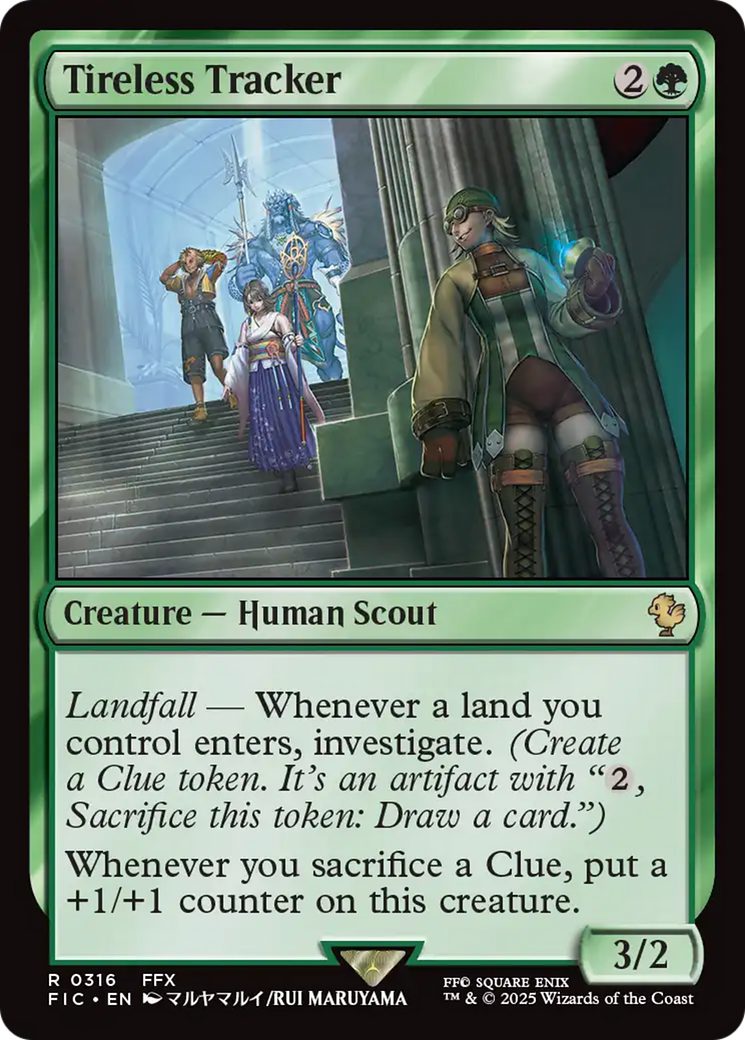
Tireless Tracker
Tireless Tracker
Creature — Human Scout
3/2
Landfall — Whenever a land you control enters, investigate. (Create a Clue token. It's an artifact with " , Sacrifice this token: Draw a card.")
Whenever you sacrifice a Clue, put a +1/+1 counter on this creature.
- A landfall ability triggers whenever a land you control enters for any reason. It triggers whenever you play a land, as well as whenever a spell or ability puts a land onto the battlefield under your control.
- Whenever a land you control enters, each landfall ability of the permanents you control will trigger. You can put them on the stack in any order. The last ability you put on the stack will be the first one to resolve (As a result, you can have those abilities resolve in the order of your choosing.).
- A landfall ability doesn't trigger if a permanent already on the battlefield becomes a land.
- Some spells and abilities that investigate may require targets. If each target chosen is an illegal target as that spell or ability tries to resolve, it won't resolve. You won't create any Clue tokens.
- Some abilities trigger "whenever you sacrifice a Clue". Those abilities trigger whenever you sacrifice a Clue for any reason, not just to activate a Clue's activated ability.
- You can't sacrifice a Clue to pay multiple costs. For example, you can't sacrifice a Clue token to activate its own ability and also to activate Alquist Proft, Master Sleuth's ability.
- Clue is an artifact type. Even though it appears on some cards with other permanent types, it's never a creature type, a land type, or anything but an artifact type.
- If an effect refers to a Clue, it means any Clue artifact, not just a Clue artifact token. For example, you can sacrifice Wrench to pay for Alquist Proft, Master Sleuth's activated ability.
- Clue is an artifact type. Even though it appears on some cards with other permanent types, it's never a creature type, a land type, or anything but an artifact type.
- You can't sacrifice a Clue to pay multiple costs. For example, you can't sacrifice a Clue token to activate its own ability and also to activate Alquist Proft, Master Sleuth's ability.
- If an effect refers to a Clue, it means any Clue artifact, not just a Clue artifact token. For example, you can sacrifice Wrench to pay for Alquist Proft, Master Sleuth's activated ability.
-
1
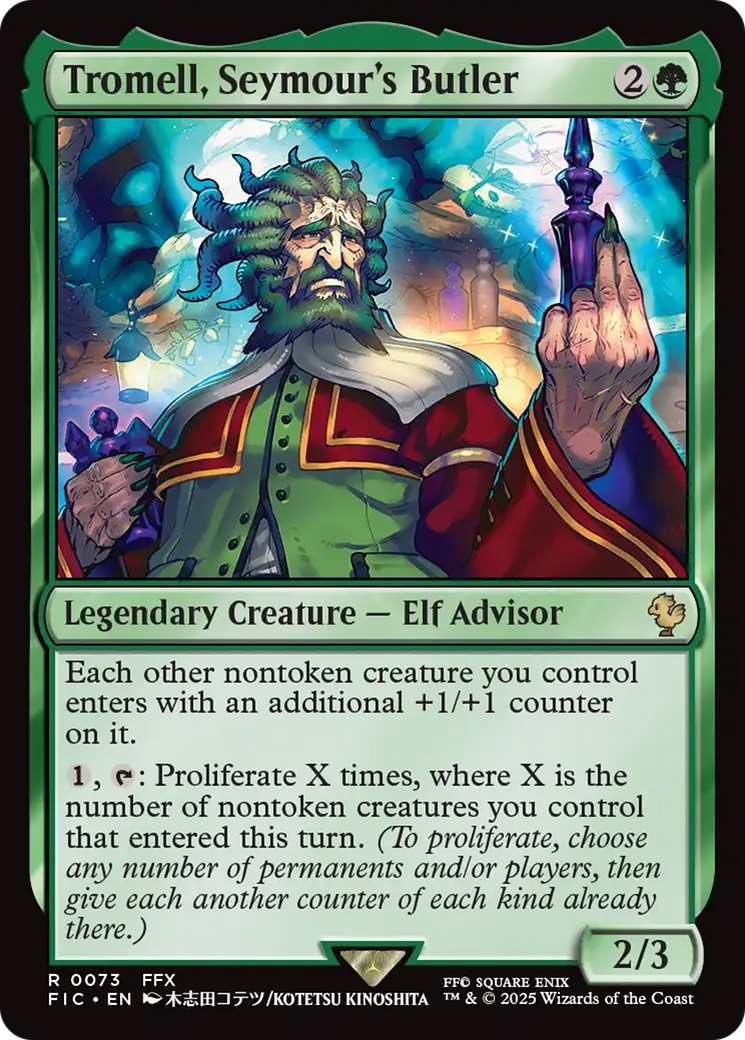
Tromell, Seymour's Butler
Tromell, Seymour's Butler
Legendary Creature — Elf Advisor
2/3
Each other nontoken creature you control enters with an additional +1/+1 counter on it.
, : Proliferate X times, where X is the number of nontoken creatures you control that entered this turn. (To proliferate, choose any number of permanents and/or players, then give each another counter of each kind already there.)
- The value of X is determined only once, as Tromell's last ability resolves. To determine that value, look at the nontoken creatures you control and count each one that entered this turn. It doesn't matter if they were creatures when they entered or who controlled them when they entered.
- You don't have to choose every permanent or player that has a counter—only the ones you want to add counters to. Since "any number" includes zero, you don't have to choose any permanents at all, and you don't have to choose any players at all.
- Players can respond to a spell or ability whose effect includes proliferating. Once that spell or ability starts to resolve, however, and its controller chooses which permanents and players will get new counters, it's too late for anyone to respond.
- While proliferating multiple times, players can't respond between proliferating the first time and proliferating the second time, and so on.
- If you proliferate multiple times, you don't have to choose the same set of players and/or permanents to get additional counters each time.
- When you proliferate, you can choose any permanent that has a counter, including ones controlled by opponents. You can choose any player who has a counter, including opponents. You can't choose cards in any zone other than the battlefield, even if they have counters on them.
- If a player or permanent has more than one kind of counter on it, and you choose for it to get additional counters, it must get one of each kind of counter it already has. You can't have it get just one kind of counter it already has and not the others.
-
1
Wakka, Devoted Guardian
Wakka, Devoted Guardian
Legendary Creature — Human Warrior
4/4
Reach, trample
Whenever Wakka deals combat damage to a player, destroy up to one target artifact that player controls and put a +1/+1 counter on Wakka.
Blitzball Captain — At the beginning of your end step, if a counter was put on Wakka this turn, put a +1/+1 counter on each other creature you control.
- You don't have to choose a target for Wakka's second ability. However, if you do and the target is illegal as the ability tries to resolve, it won't resolve and none of its effects will happen. You won't put a counter on Wakka.
- Wakka's last ability checks at the moment it would trigger to see if a counter was put on Wakka this turn. If none were, the ability won't trigger at all. Once your end step begins, it's too late to put a counter on Wakka in order to cause this ability to trigger.
-
1
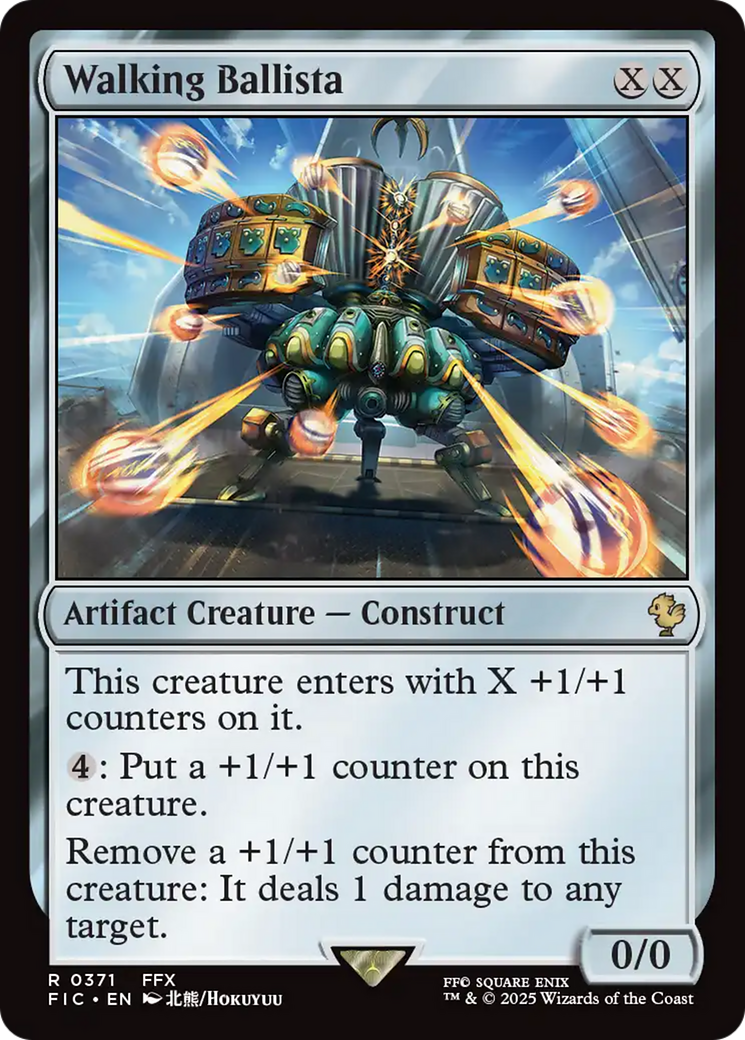
Walking Ballista
Walking Ballista
Artifact Creature — Construct
0/0
This creature enters with X +1/+1 counters on it.
: Put a +1/+1 counter on this creature.
Remove a +1/+1 counter from this creature: It deals 1 damage to any target.
- If Walking Ballista has been dealt damage or had its toughness reduced by an effect, this limits how many times you'll be able to remove +1/+1 counters from it in a single turn. For example, if it has three +1/+1 counters on it and has been dealt 1 damage this turn, it will be destroyed immediately after you activate the ability a second time and you won't be able to activate it a third time.
- A casting cost of means that you pay twice X. If you want X to be 3, you pay to cast Walking Ballista.
-
1
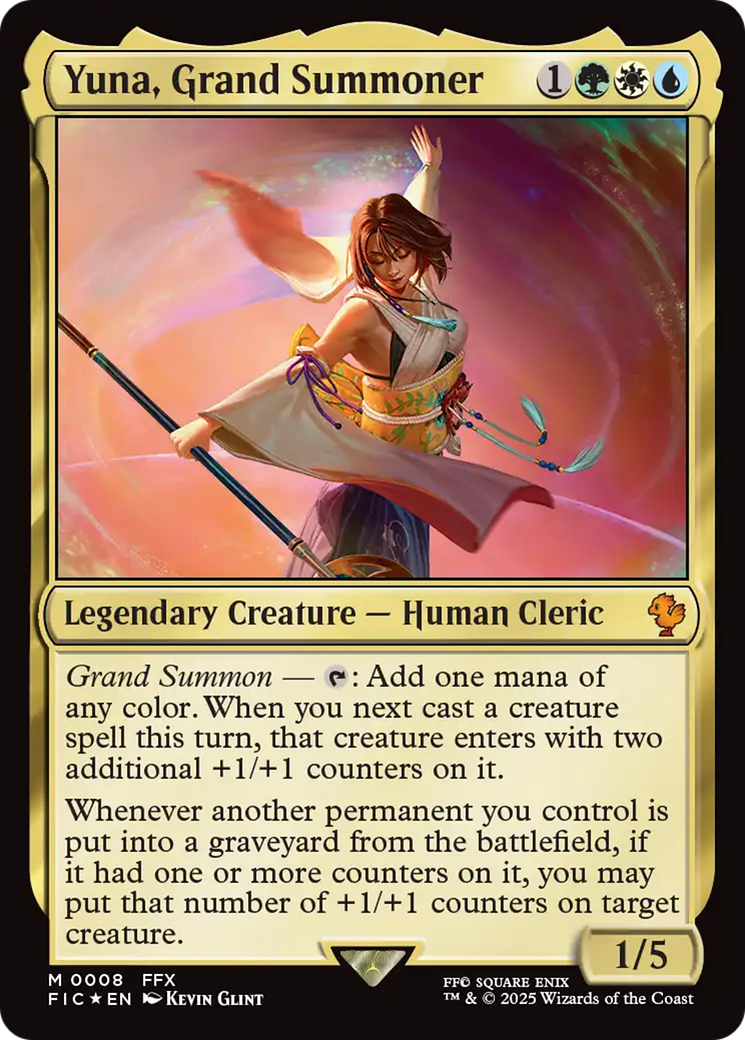
Yuna, Grand Summoner
Yuna, Grand Summoner
Legendary Creature — Human Cleric
1/5
Grand Summon — : Add one mana of any color. When you next cast a creature spell this turn, that creature enters with two additional +1/+1 counters on it.
Whenever another permanent you control is put into a graveyard from the battlefield, if it had one or more counters on it, you may put that number of +1/+1 counters on target creature.
- Yuna's last ability counts all counters that were on the permanent, not just +1/+1 counters.
Instants 8
-
1
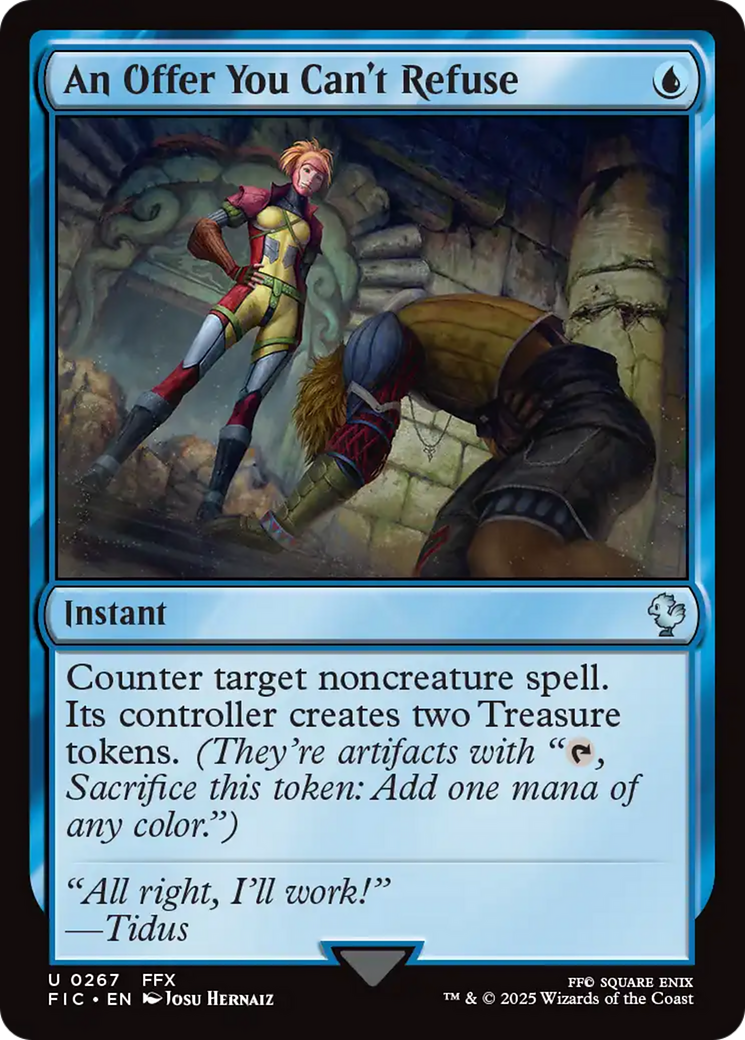
An Offer You Can't Refuse
An Offer You Can't Refuse
Instant
Counter target noncreature spell. Its controller creates two Treasure tokens. (They're artifacts with " , Sacrifice this token: Add one mana of any color.")
- If the target is still legal as it resolves but the spell can't be countered for some reason, its controller will still create two Treasure tokens.
- If the target is no longer legal as An Offer You Can't Refuse resolves, no Treasure tokens are created.
-
1
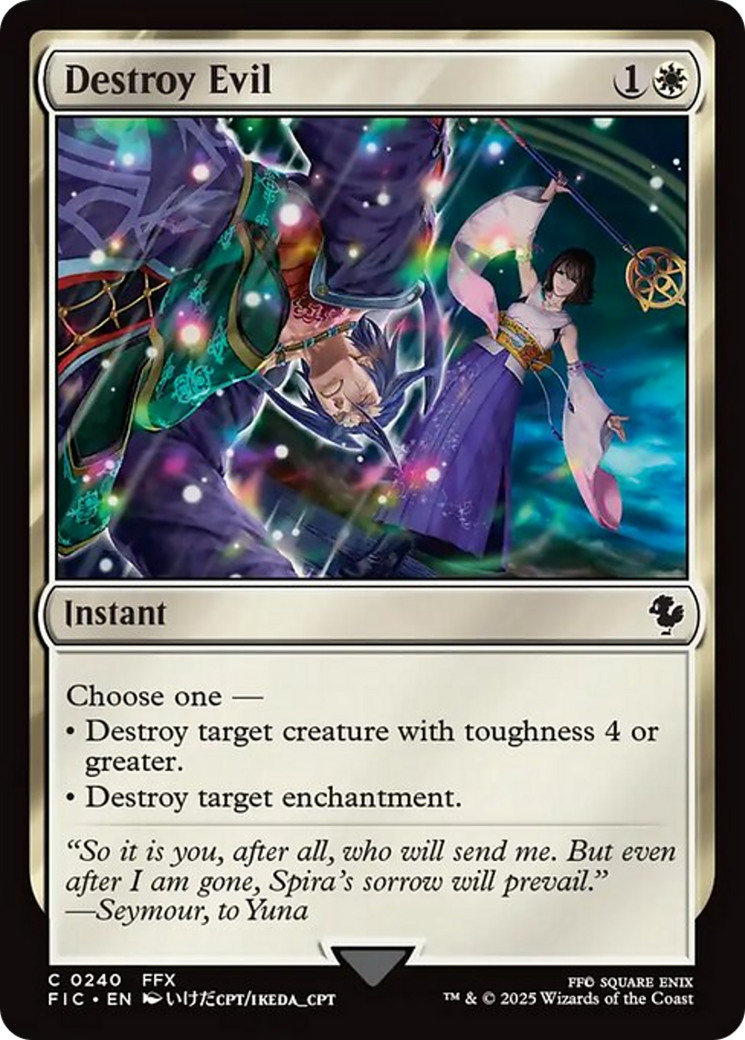
Destroy Evil
Destroy Evil
Instant
Choose one —
- Destroy target creature with toughness 4 or greater.
- Destroy target enchantment.
-
1
Endless Detour
Endless Detour
Instant
The owner of target spell, nonland permanent, or card in a graveyard puts it on their choice of the top or bottom of their library.
- The card's owner chooses whether to put it on the top or bottom of their library.
- If Endless Detour targets a token, that token is put into the library, then ceases to exist.
- If multiple cards are put into the library this way (such as when the spell targets a melded permanent), that permanent's owner puts all the cards on top or all the cards on the bottom. They put them in whatever order they wish, and do not need to reveal the order.
- Endless Detour doesn't counter spells. A spell that can't be countered can still be put on the top or bottom of its owner's library this way.
-
1
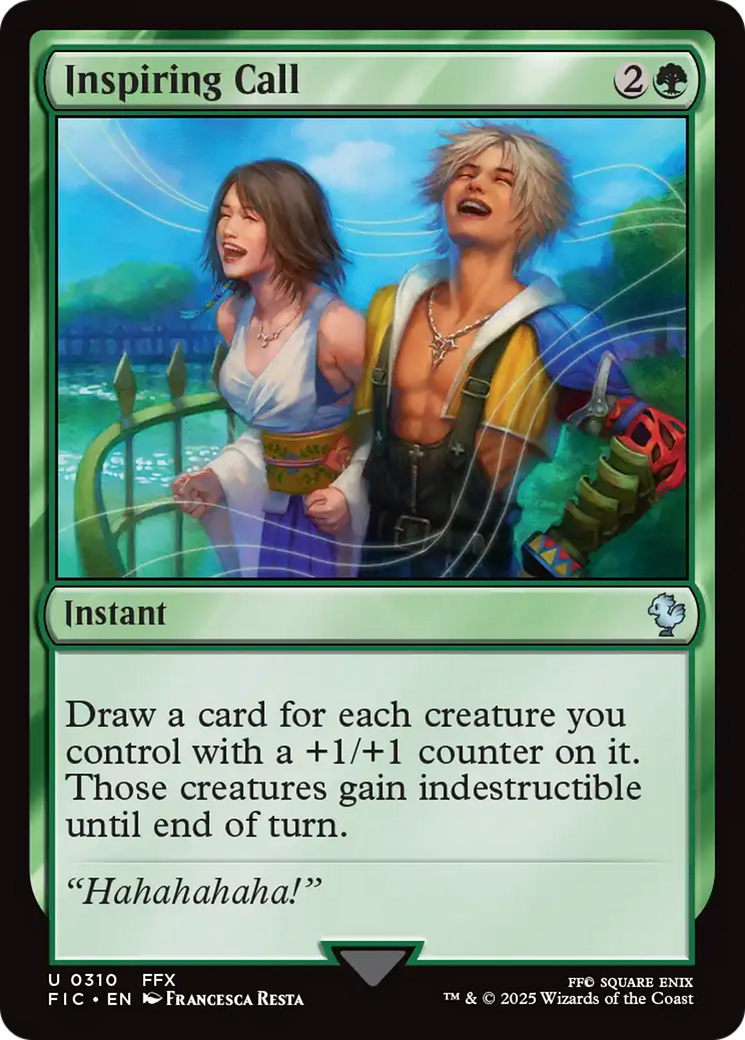
Inspiring Call
Inspiring Call
Instant
Draw a card for each creature you control with a +1/+1 counter on it. Those creatures gain indestructible until end of turn. (Damage and effects that say "destroy" don't destroy them.)
- Creatures you control that have +1/+1 counters put on them after Inspiring Call resolves won't gain indestructible.
- Once a creature gains indestructible, it will have it for the turn, even if it loses all its +1/+1 counters.
-
1
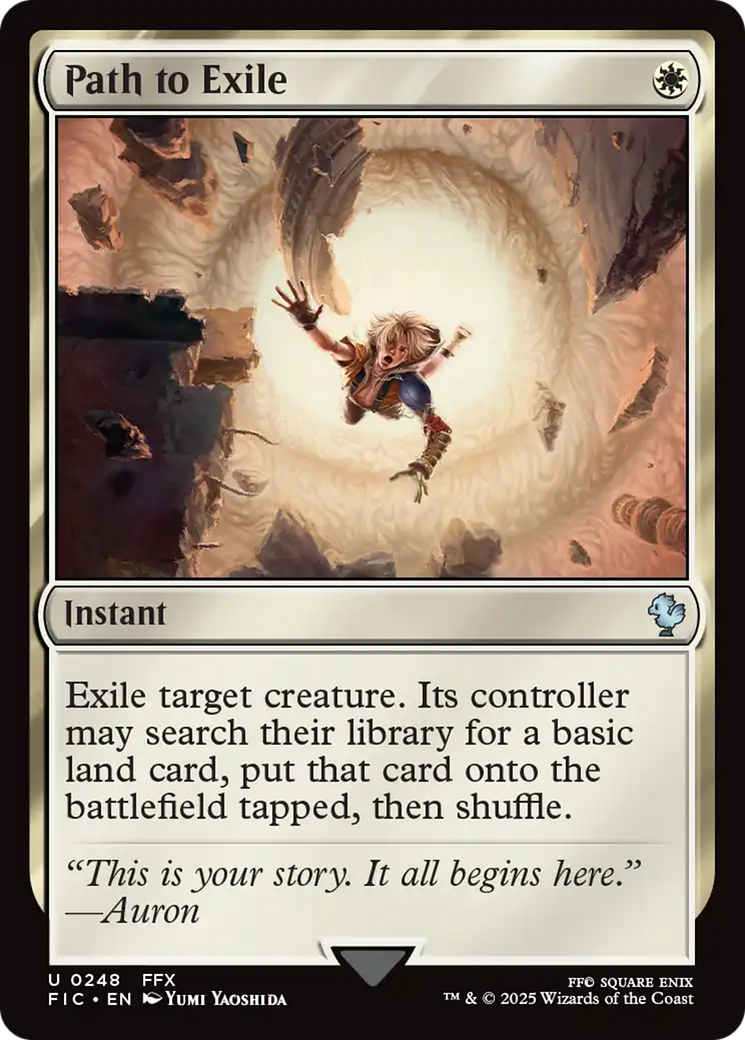
Path to Exile
Path to Exile
Instant
Exile target creature. Its controller may search their library for a basic land card, put that card onto the battlefield tapped, then shuffle.
- The controller of the exiled creature isn't required to search their library for a basic land. If that player doesn't, the player won't shuffle their library.
- If the target creature is an illegal target by the time Path to Exile tries to resolve, it won't resolve and none of its effects will happen. The creature's controller won't search for a basic land card.
-
1
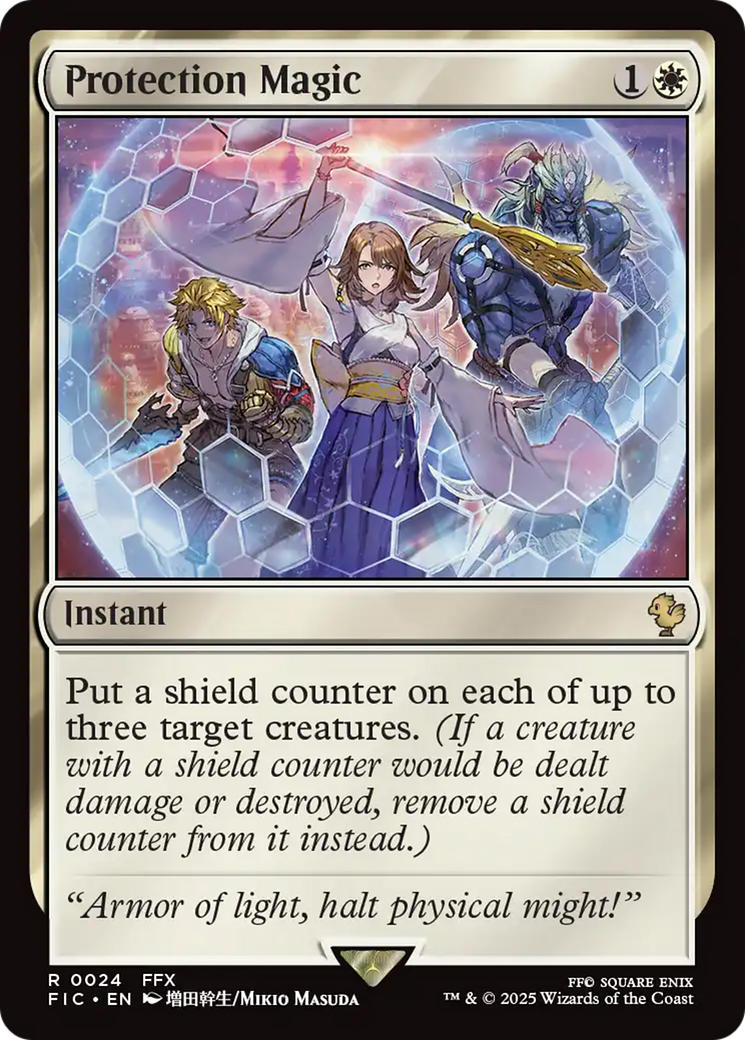
Protection Magic
Protection Magic
Instant
Put a shield counter on each of up to three target creatures. (If a creature with a shield counter would be dealt damage or destroyed, remove a shield counter from it instead.)
- Shield counters don't prevent players from sacrificing creatures.
- Removing a shield counter when a permanent would be dealt damage or destroyed isn't the same as regenerating that permanent.
- If a permanent that would be dealt damage has more than one shield counter on it, that damage is prevented and only one shield counter is removed.
- If a permanent with a shield counter is dealt unpreventable damage, that damage will be dealt and a shield counter will still be removed.
- A creature with a shield counter on it may still be destroyed by state-based actions if it has damage marked on it equal to its toughness or has been dealt unpreventable damage by a source with deathtouch.
- "Shield" is not an ability that creatures have and shield counters are not keyword counters. If a creature with a shield counter loses its abilities, the shield counter will still protect it as normal.
-
1
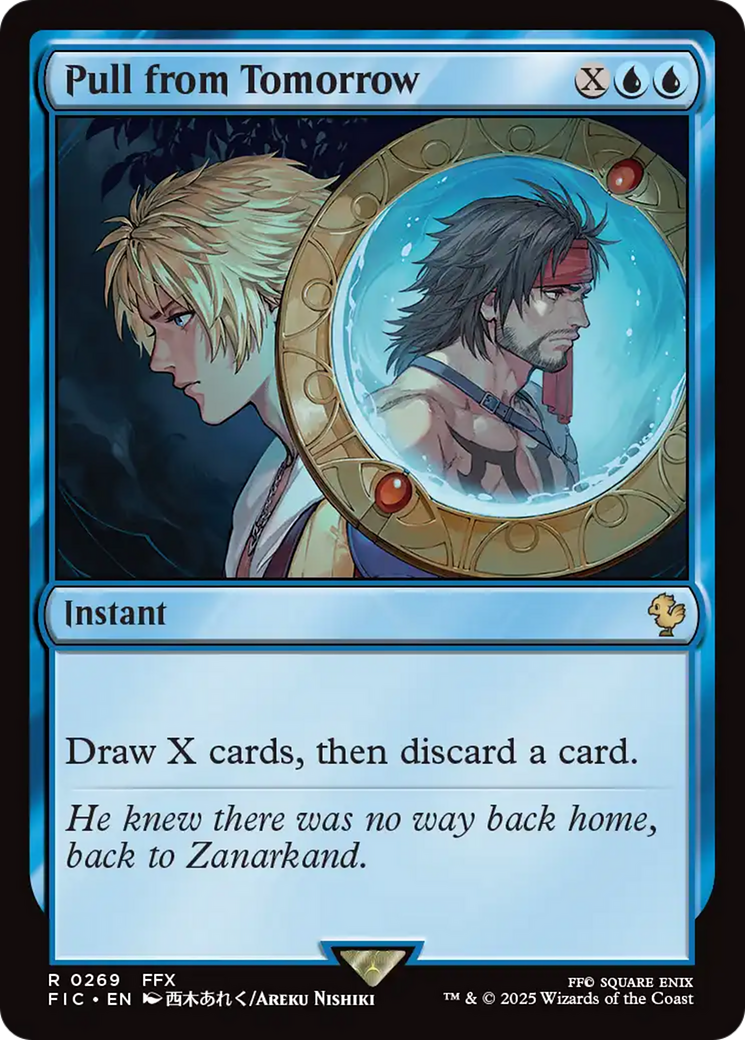
Pull from Tomorrow
Pull from Tomorrow
Instant
Draw X cards, then discard a card.
-
1
Yuna's Whistle
Yuna's Whistle
Instant
Reveal cards from the top of your library until you reveal a creature card. Put that card into your hand and the rest on the bottom of your library in a random order. When you reveal a creature card this way, put X +1/+1 counters on target creature you control, where X is the mana value of that card.
- If the revealed card has in its mana cost, X is 0 for the purpose of determining its mana value.
- You don't choose a target for Yuna's Whistle at the time you cast it. Rather, a second "reflexive" ability triggers when you reveal a creature card this way. You choose a target for that ability as it goes on the stack. Each player may respond to this triggered ability as normal.
Sorceries 7
-
1
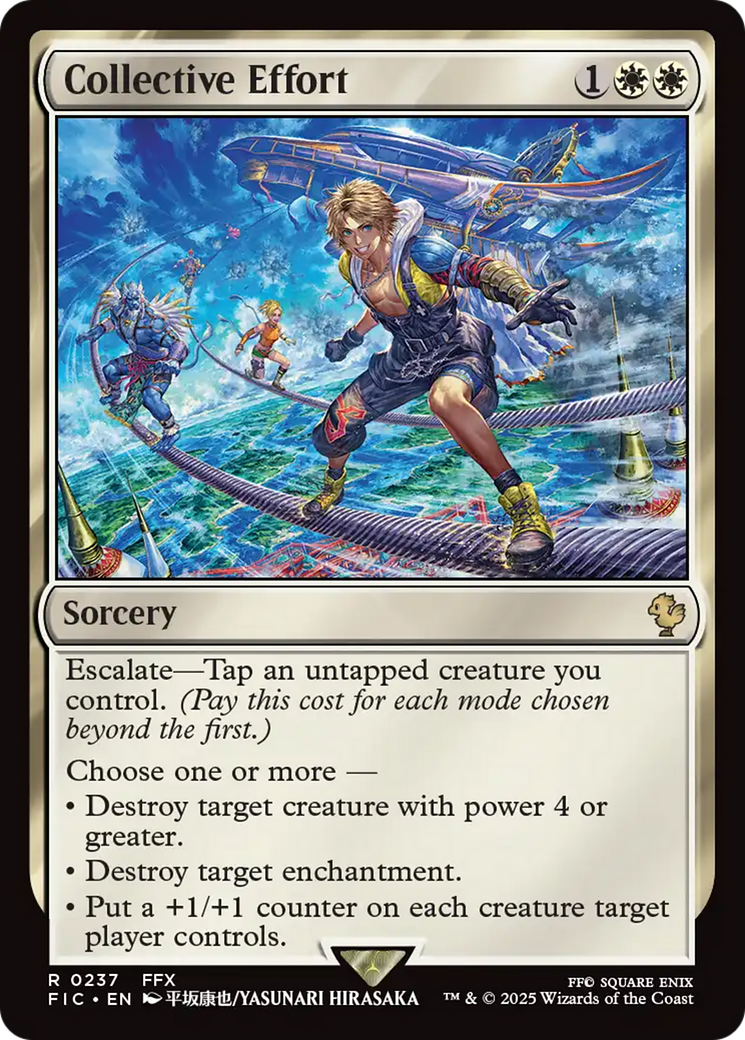
Collective Effort
Collective Effort
Sorcery
Escalate—Tap an untapped creature you control. (Pay this cost for each mode chosen beyond the first.)
Choose one or more —
- Destroy target creature with power 4 or greater.
- Destroy target enchantment.
- Put a +1/+1 counter on each creature target player controls.
- You can tap any untapped creature you control to pay the escalate cost, including one you haven't controlled continuously since the beginning of the turn.
- If you choose the first and third modes, and destroying the creature ends an "exile until" effect (such as that of Lunarch Inquisitors), the creature will return to the battlefield before you put +1/+1 counters on creatures. The same is true if you choose the second and third modes and destroying the enchantment ends such an effect.
-
1
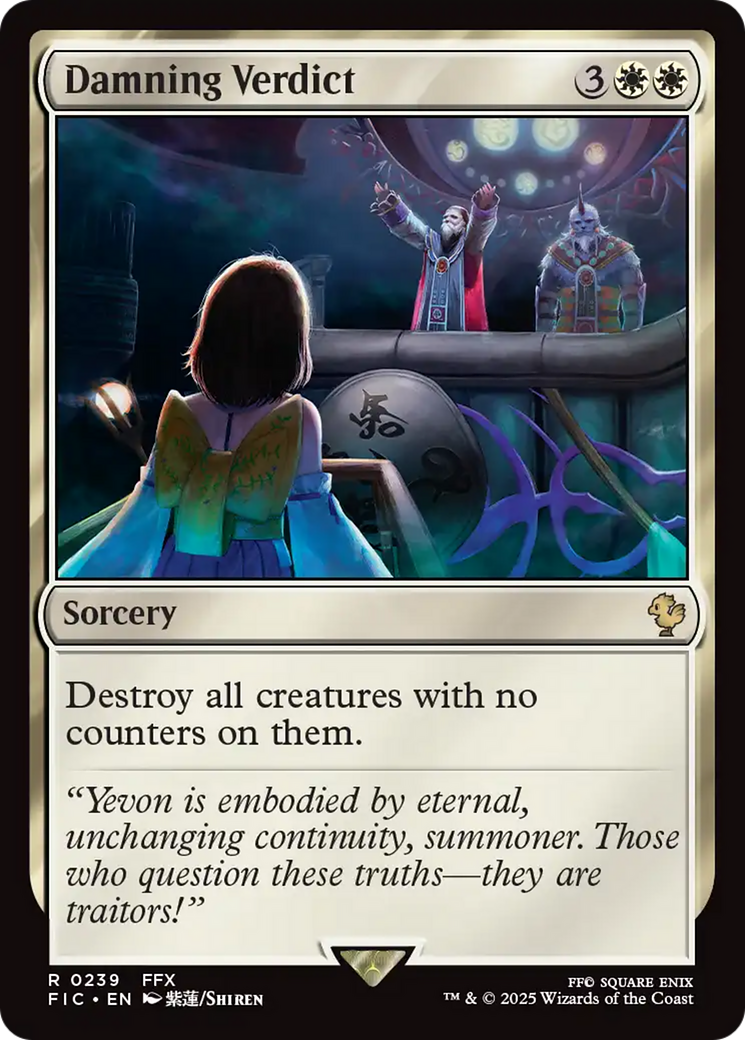
Damning Verdict
Damning Verdict
Sorcery
Destroy all creatures with no counters on them.
-
1
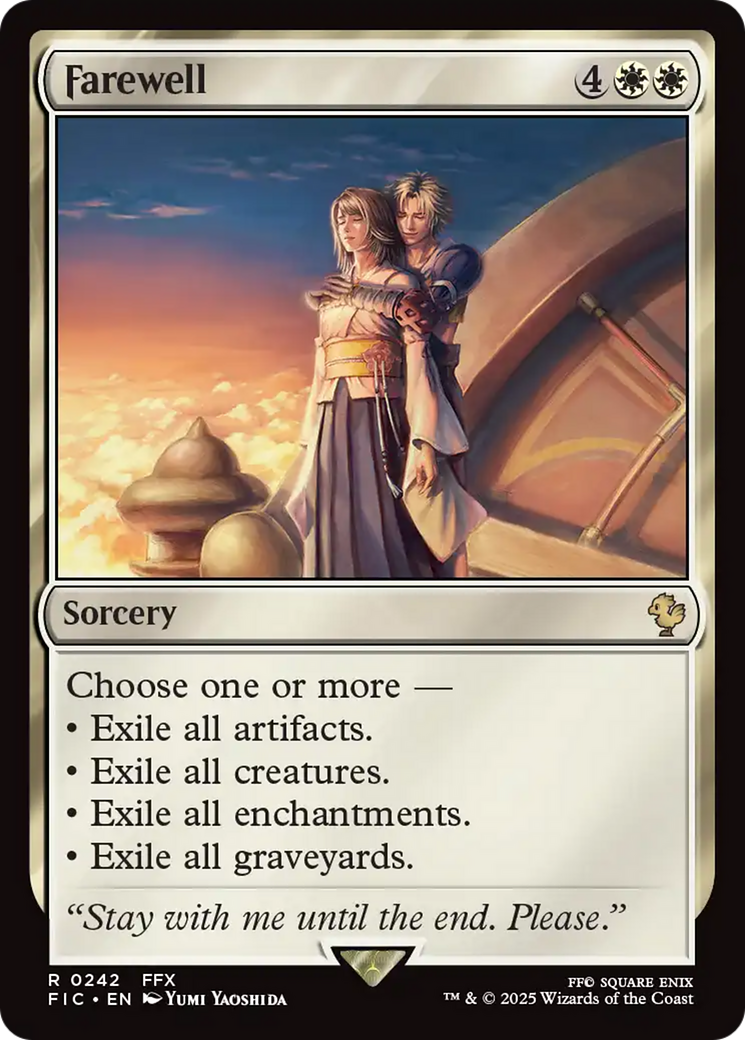
Farewell
Farewell
Sorcery
Choose one or more —
- Exile all artifacts.
- Exile all creatures.
- Exile all enchantments.
- Exile all graveyards.
- If you choose more than one mode for Farewell, you perform the actions in the order written.
-
1
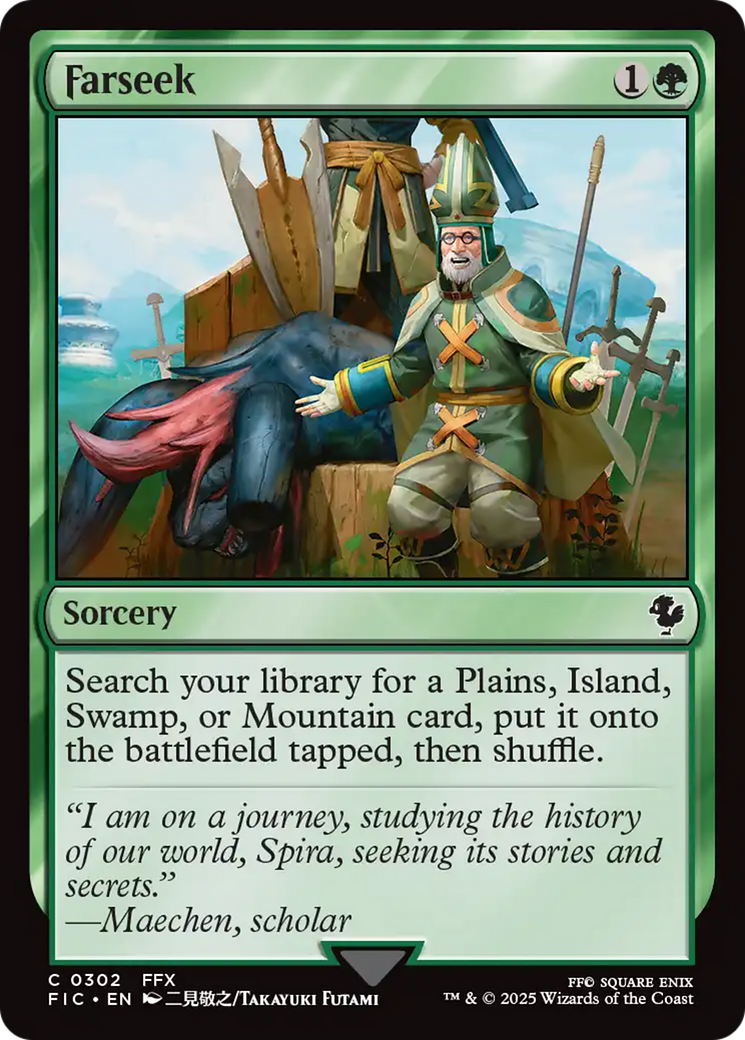
Farseek
Farseek
Sorcery
Search your library for a Plains, Island, Swamp, or Mountain card, put it onto the battlefield tapped, then shuffle.
- Farseek can find any land with any of the listed land types, including nonbasic ones, even if that land is a Forest in addition to one or more of those types.
-
1
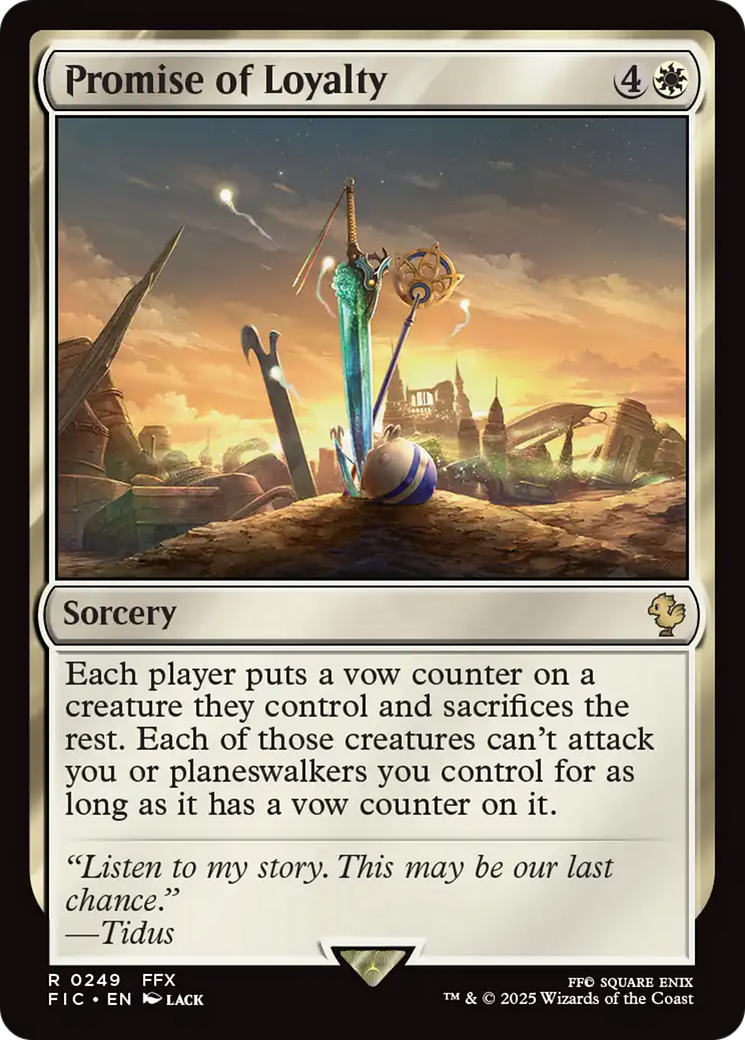
Promise of Loyalty
Promise of Loyalty
Sorcery
Each player puts a vow counter on a creature they control and sacrifices the rest. Each of those creatures can't attack you or planeswalkers you control for as long as it has a vow counter on it.
- If the vow counter is removed from the creature, it can attack as normal.
- Each player, including you, must put a vow counter on a creature they control if able. They can't choose to opt out and sacrifice all of their creatures. The creature you put a vow counter on will remember its promise if another player gains control of it.
- If the vow counter is moved to another creature, it won't prevent the second creature from attacking normally.
-
1
Three Visits
Three Visits
Sorcery
Search your library for a Forest card, put it onto the battlefield, then shuffle.
- Three Visits allows you to search your library for any card with the land type Forest, not just a card with the name Forest.
- Because the "search" requires you to find a card with certain characteristics, you don't have to find the card if you don't want to.
-
1
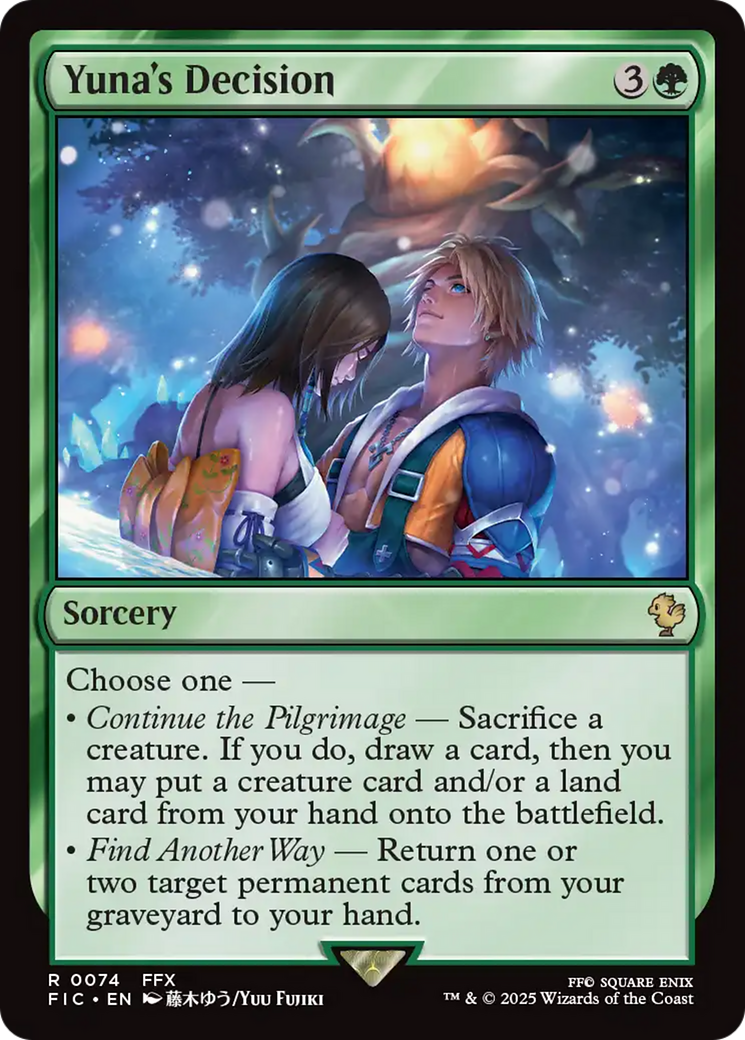
Yuna's Decision
Yuna's Decision
Sorcery
Choose one —
- Continue the Pilgrimage — Sacrifice a creature. If you do, draw a card, then you may put a creature card and/or a land card from your hand onto the battlefield.
- Find Another Way — Return one or two target permanent cards from your graveyard to your hand.
- Putting a land card onto the battlefield with the first mode of Yuna's Decision doesn't count as playing a land. You can put a land card onto the battlefield this way even if you've already played a land for the turn.
Artifacts 4
-
1
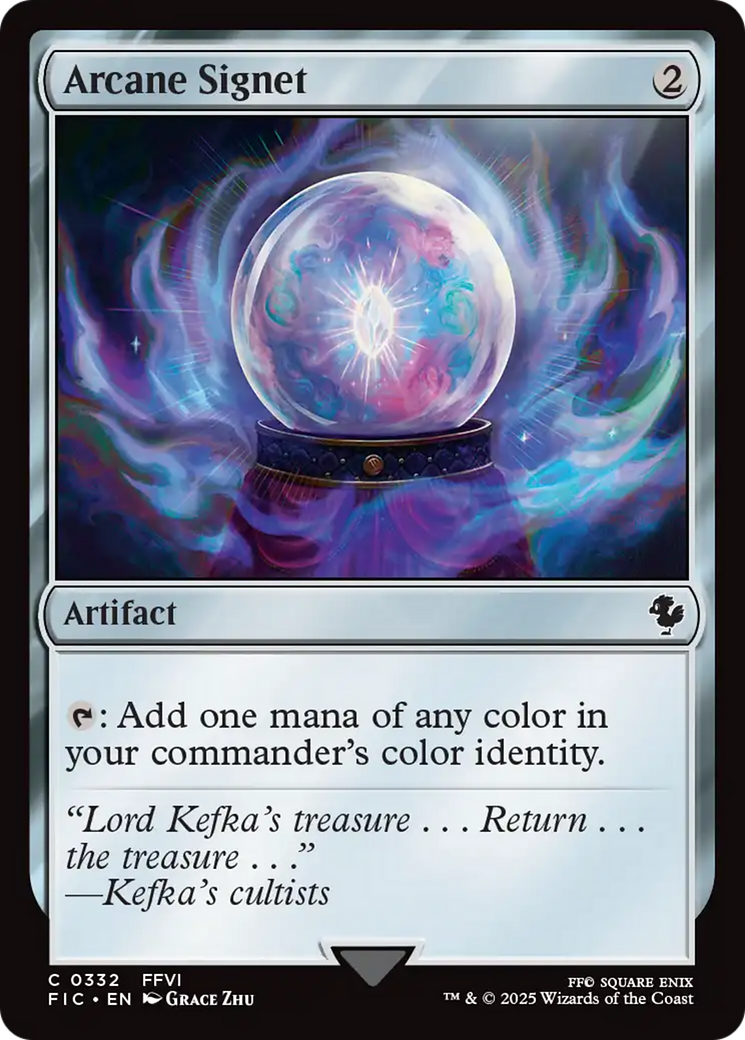
Arcane Signet
Arcane Signet
Artifact
: Add one mana of any color in your commander's color identity.
- If your commander is a card that has no colors in its color identity, Arcane Signet's ability produces no mana. It doesn't produce .
- If you have two commanders, the ability adds one mana of any color in their combined color identities.
- If you don't have a commander, Arcane Signet's ability produces no mana.
-
1
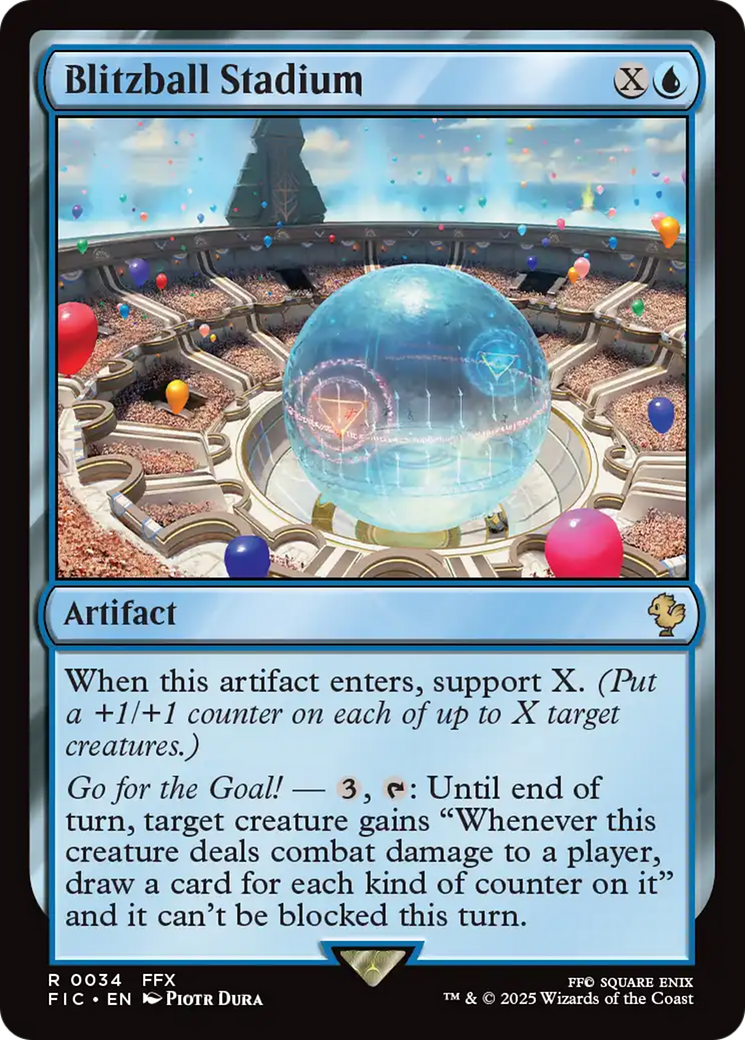
Blitzball Stadium
Blitzball Stadium
Artifact
When this artifact enters, support X. (Put a +1/+1 counter on each of up to X target creatures.)
Go for the Goal! — , : Until end of turn, target creature gains "Whenever this creature deals combat damage to a player, draw a card for each kind of counter on it" and it can't be blocked this turn.
-
1
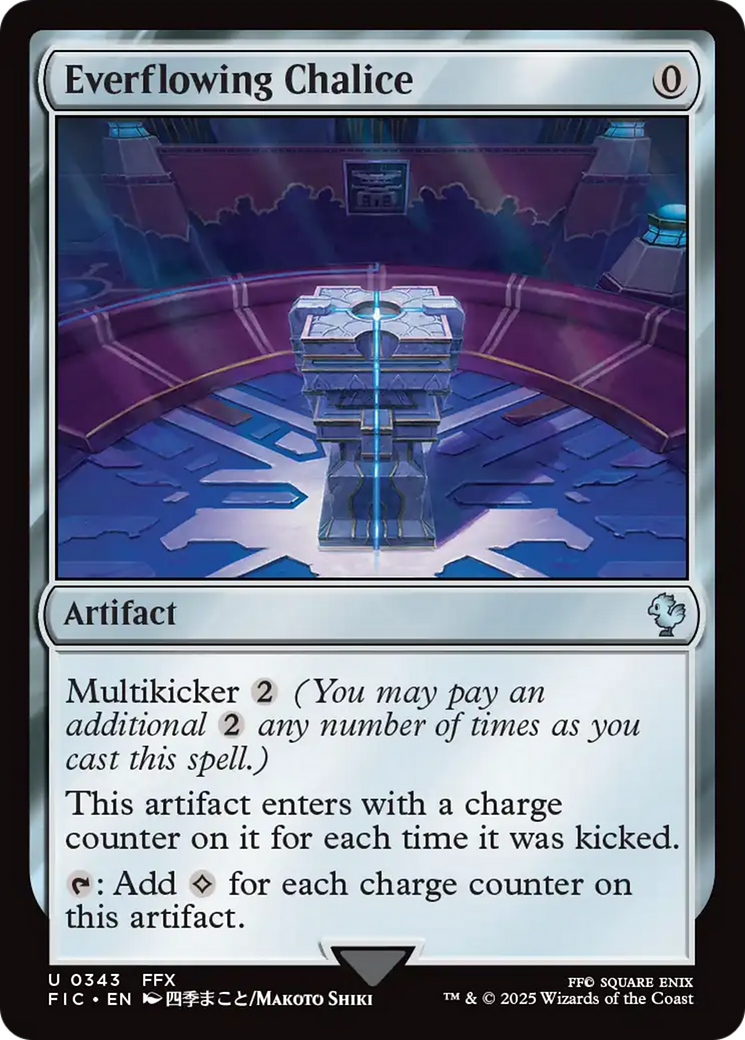
Everflowing Chalice
Everflowing Chalice
Artifact
Multikicker (You may pay an additional any number of times as you cast this spell.)
This artifact enters with a charge counter on it for each time it was kicked.
: Add for each charge counter on this artifact.
- You can cast Everflowing Chalice without kicking it at all if you wish. However, if Everflowing Chalice has no charge counters on it, activating its last ability won't produce any mana.
-
1
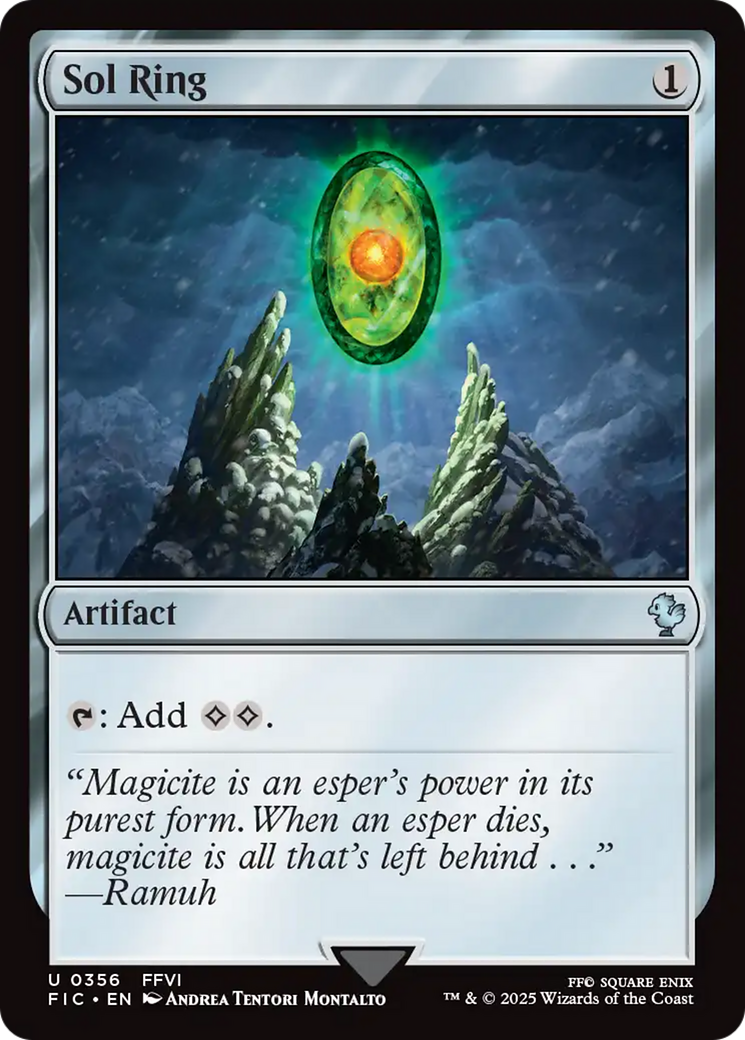
Sol Ring
Sol Ring
Artifact
: Add .
Enchantments 9
-
1
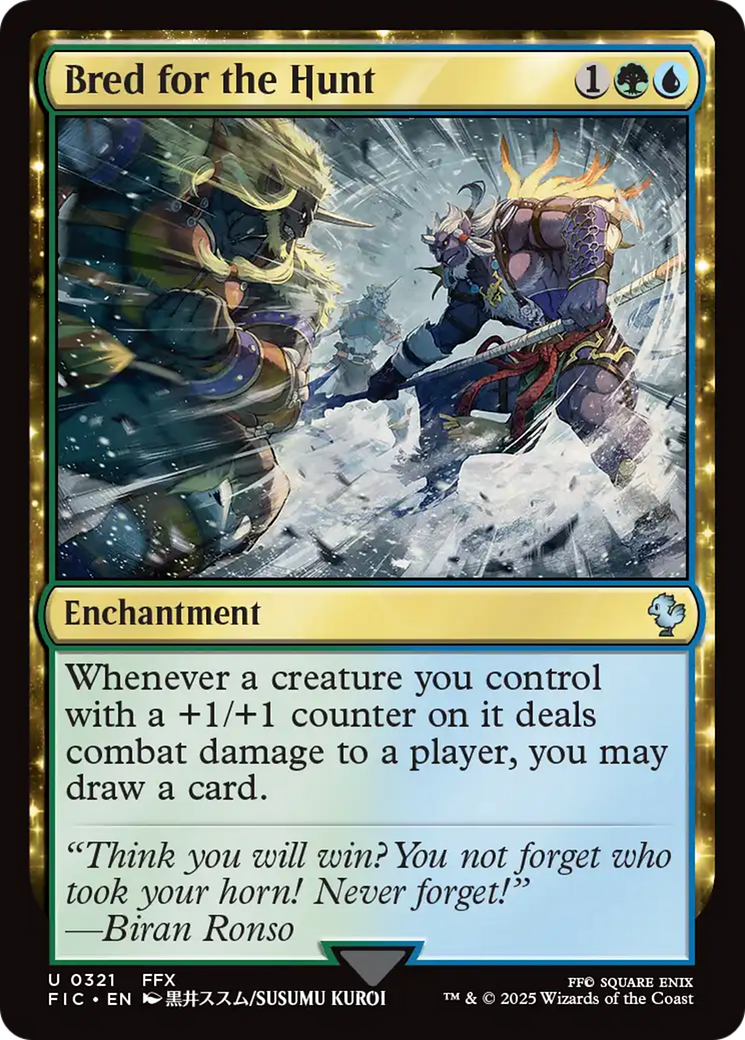
Bred for the Hunt
Bred for the Hunt
Enchantment
Whenever a creature you control with a +1/+1 counter on it deals combat damage to a player, you may draw a card.
- A creature that deals combat damage to a player must have a +1/+1 counter on it at the time damage is dealt in order for Bred for the Hunt's ability to trigger.
-
1
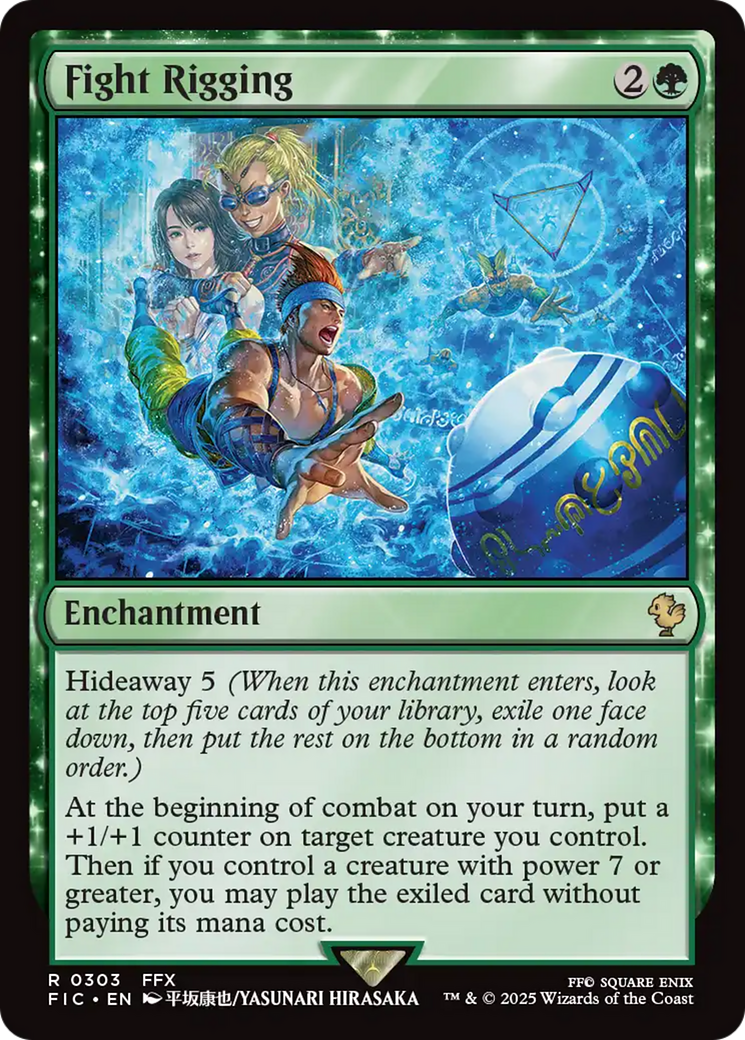
Fight Rigging
Fight Rigging
Enchantment
Hideaway 5 (When this enchantment enters, look at the top five cards of your library, exile one face down, then put the rest on the bottom in a random order.)
At the beginning of combat on your turn, put a +1/+1 counter on target creature you control. Then if you control a creature with power 7 or greater, you may play the exiled card without paying its mana cost.
- “Hideaway N” means “When this permanent enters the battlefield, look at the top N cards of your library. Exile one of them face down and put the rest on the bottom of your library in a random order. The exiled card gains ‘The player who controls the permanent that exiled this card may look at this card in the exile zone.'”
- Any player who has controlled a permanent with a hideaway ability since a card was exiled with it may look at that card.
- Previously, permanents with hideaway entered the battlefield tapped. This ability has been removed from the definition of hideaway. Older cards have received errata to have an additional paragraph that reads “[This permanent] enters the battlefield tapped,” and they now have hideaway 4.
- Hideaway now causes you to put the rest of the cards on the bottom of your library in a random order instead of any order.
-
1
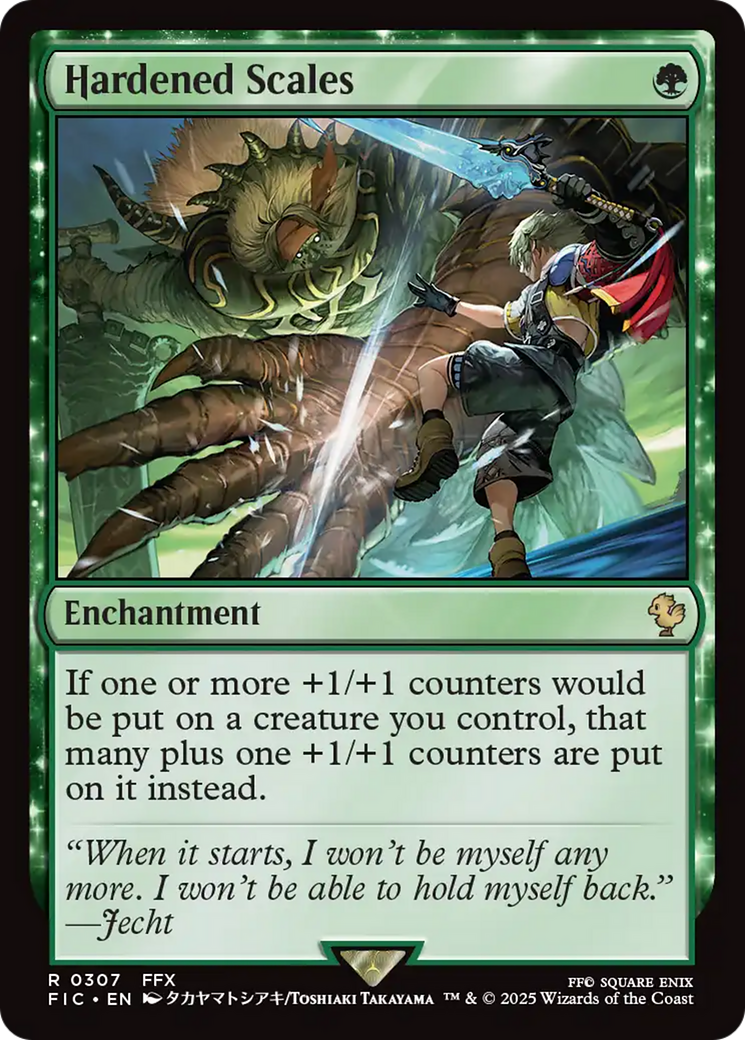
Hardened Scales
Hardened Scales
Enchantment
If one or more +1/+1 counters would be put on a creature you control, that many plus one +1/+1 counters are put on it instead.
- If a creature you control would enter the battlefield with a number of +1/+1 counters on it, it enters with that many plus one instead.
- If two or more effects attempt to modify how many counters would be put on a creature you control, you choose the order to apply those effects, no matter who controls the sources of those effects.
- Each additional Hardened Scales you control will increase the number of +1/+1 counters placed on a creature you control by one.
-
1
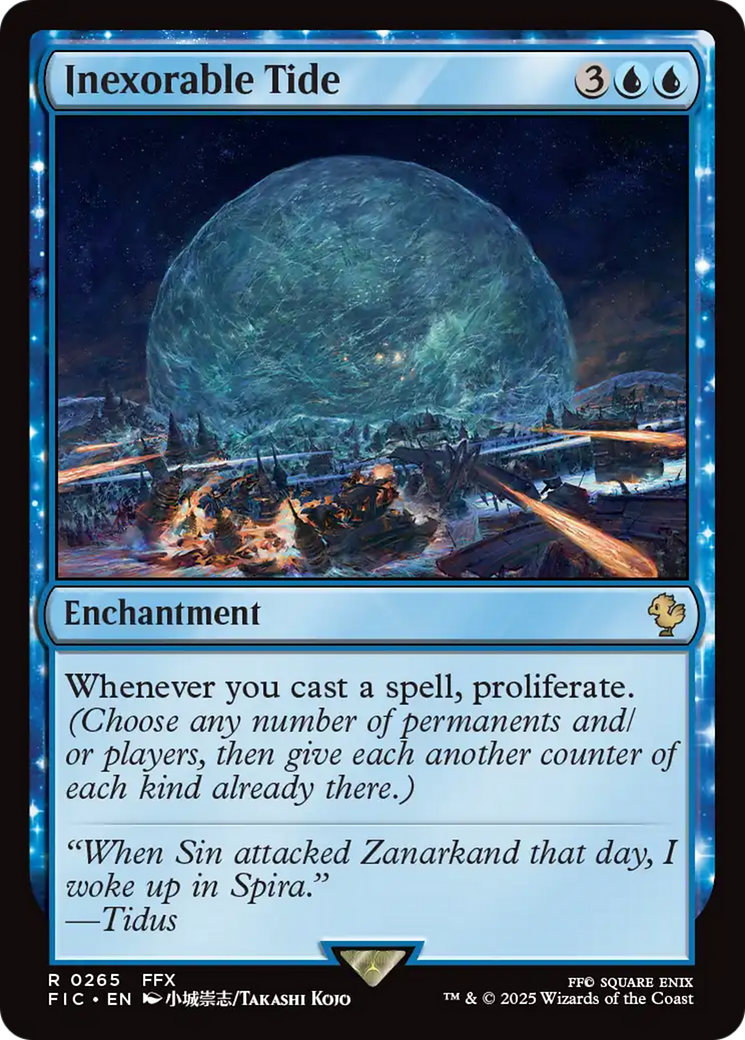
Inexorable Tide
Inexorable Tide
Enchantment
Whenever you cast a spell, proliferate. (Choose any number of permanents and/or players, then give each another counter of each kind already there.)
- Whenever you cast a spell, Inexorable Tide's ability triggers and goes on the stack on top of it. It will resolve (and you'll proliferate) before the spell resolves.
-
1
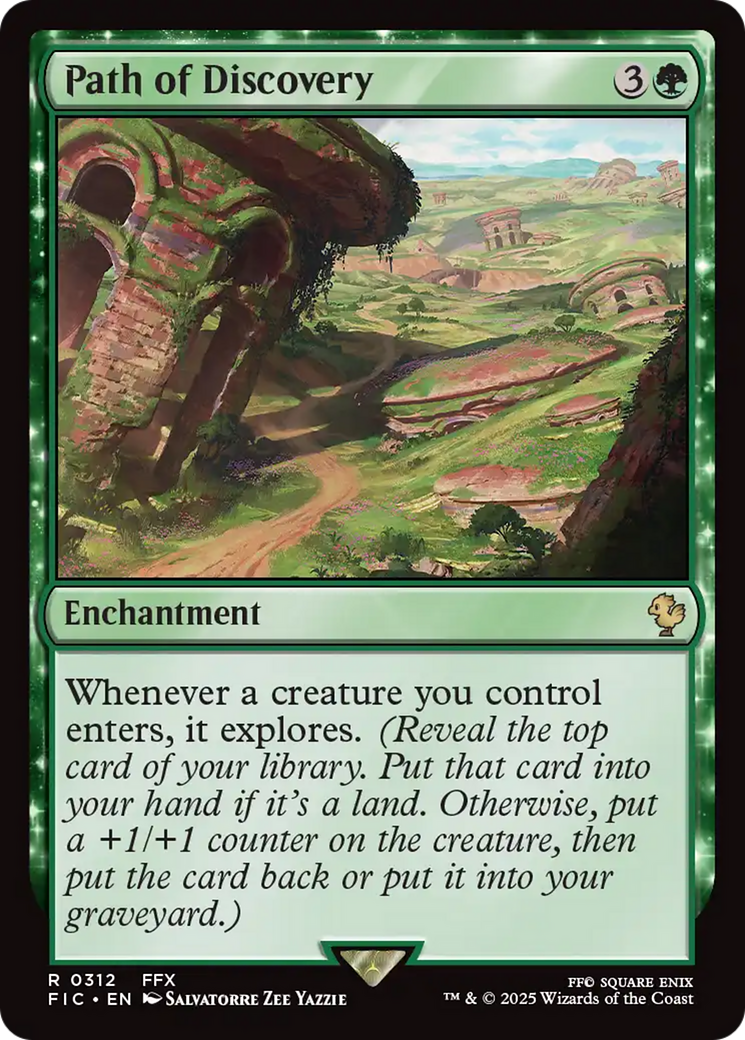
Path of Discovery
Path of Discovery
Enchantment
Whenever a creature you control enters, it explores. (Reveal the top card of your library. Put that card into your hand if it's a land. Otherwise, put a +1/+1 counter on the creature, then put the card back or put it into your graveyard.)
- Path of Discovery's triggered ability triggers along with any other abilities that say that the creature explores when it enters the battlefield, including abilities that come from the creature itself or from multiples of Path of Discovery. You may take actions between each resolving ability's exploration.
-
1
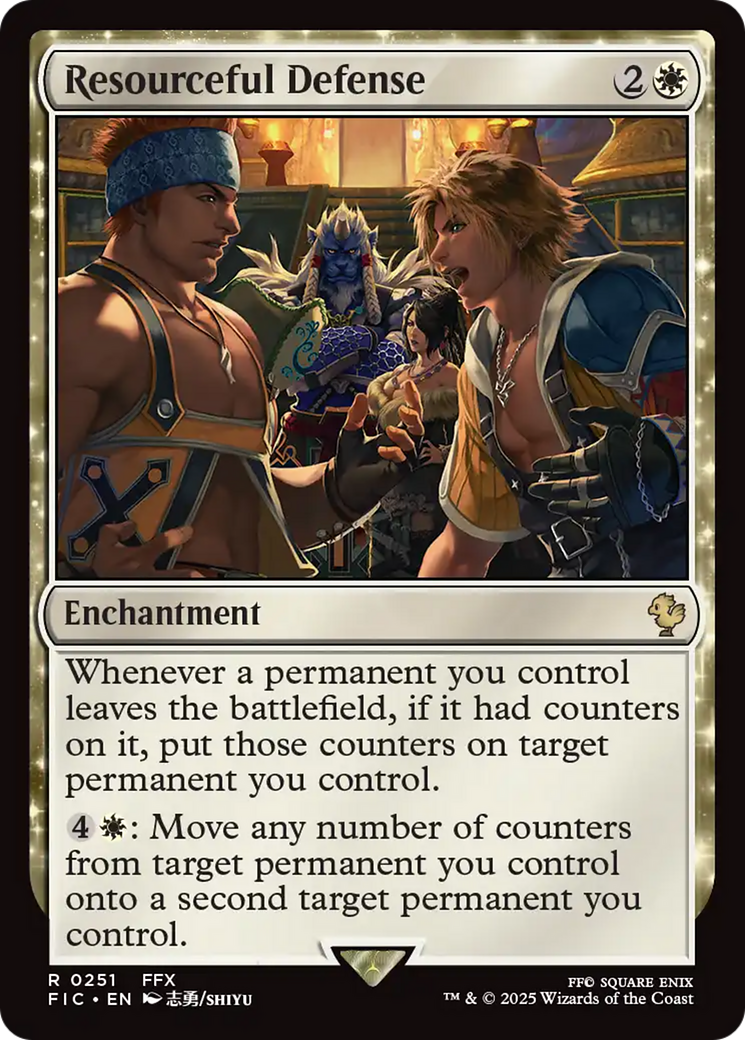
Resourceful Defense
Resourceful Defense
Enchantment
Whenever a permanent you control leaves the battlefield, if it had counters on it, put those counters on target permanent you control.
: Move any number of counters from target permanent you control onto a second target permanent you control.
-
1
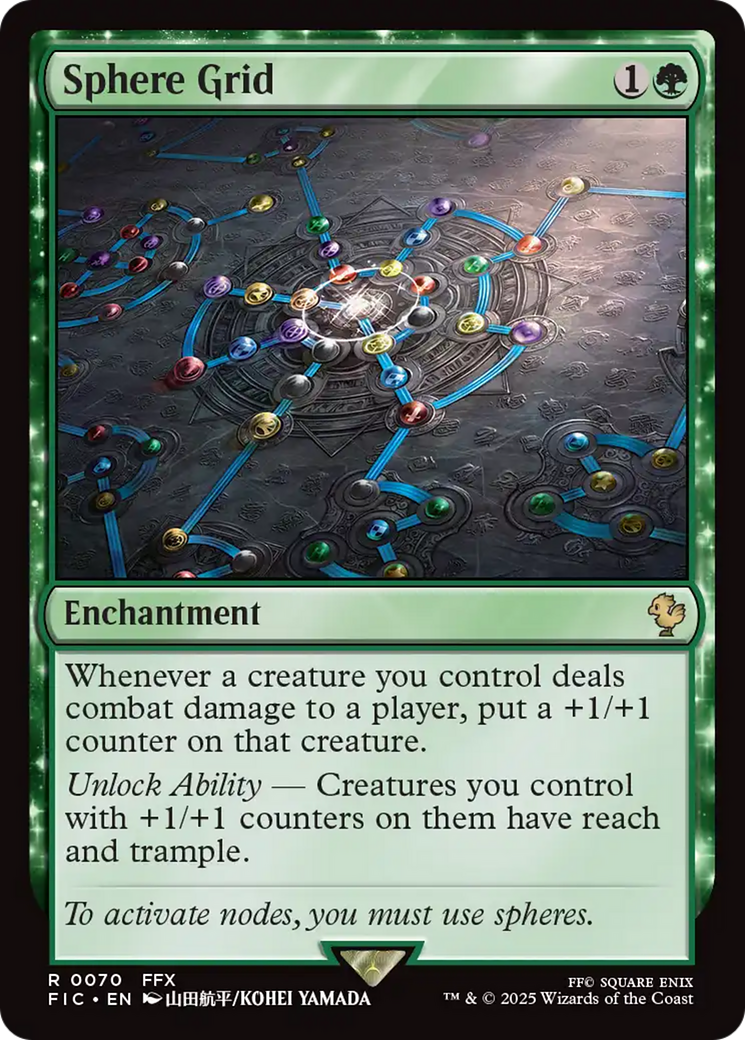
Sphere Grid
Sphere Grid
Enchantment
Whenever a creature you control deals combat damage to a player, put a +1/+1 counter on that creature.
Unlock Ability — Creatures you control with +1/+1 counters on them have reach and trample.
- Once a creature that has reach because of Sphere Grid's last ability has blocked a creature, removing all +1/+1 counters from that creature or causing Sphere Grid to leave the battlefield won't cause that creature to stop blocking.
-
1
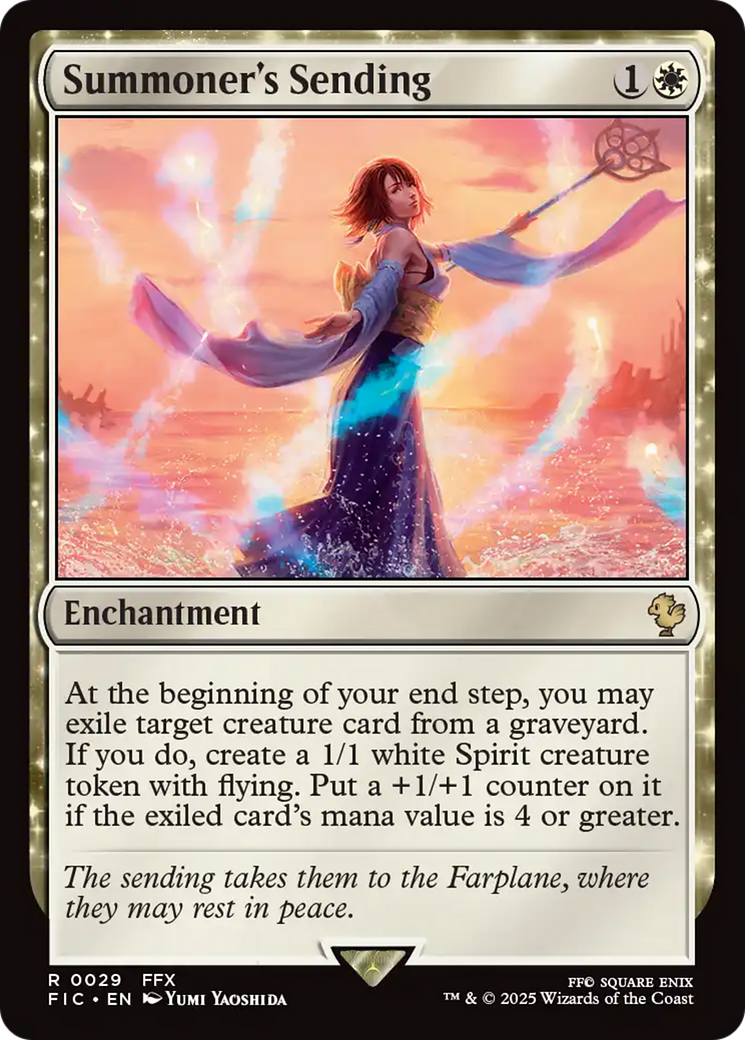
Summoner's Sending
Summoner's Sending
Enchantment
At the beginning of your end step, you may exile target creature card from a graveyard. If you do, create a 1/1 white Spirit creature token with flying. Put a +1/+1 counter on it if the exiled card's mana value is 4 or greater.
- If the exiled card has in its mana cost, X is 0 for the purpose of determining its mana value.
-
1
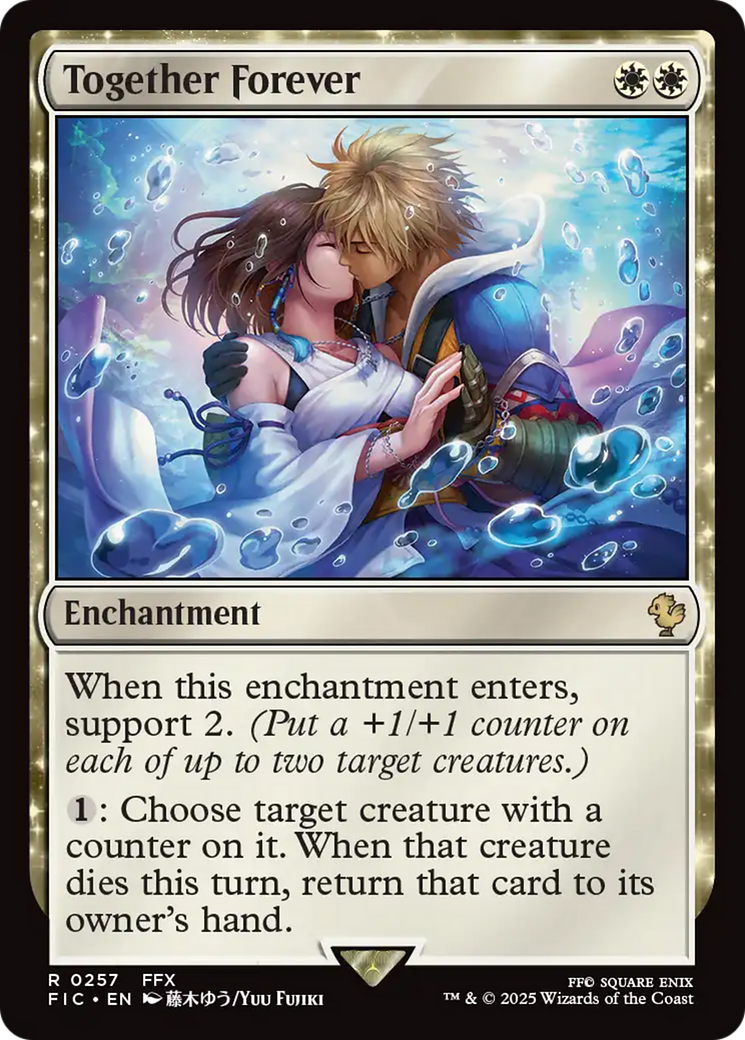
Together Forever
Together Forever
Enchantment
When this enchantment enters, support 2. (Put a +1/+1 counter on each of up to two target creatures.)
: Choose target creature with a counter on it. When that creature dies this turn, return that card to its owner's hand.
- If a creature without counters receives enough -1/-1 counters to reduce its toughness to 0 or less, Together Forever's ability can't be activated before state-based actions put that creature into its owner's graveyard.
- Together Forever's activated ability checks whether the target creature has a counter on it as the ability is activated and as the ability resolves. If the creature loses its counters later in the turn, the delayed triggered ability will still return it to its owner's hand when it dies.
- If some, but not all, targets for a spell become illegal, the remaining targets are affected as appropriate. If all of a spell's targets become illegal, that spell doesn't resolve.
- If a spell with support has other abilities that target creatures, those abilities and the support ability can target the same creature.
- You can't put more than one +1/+1 counter on any one target using the support action.
- Support can target a creature another player controls.
Lands 37
-
1
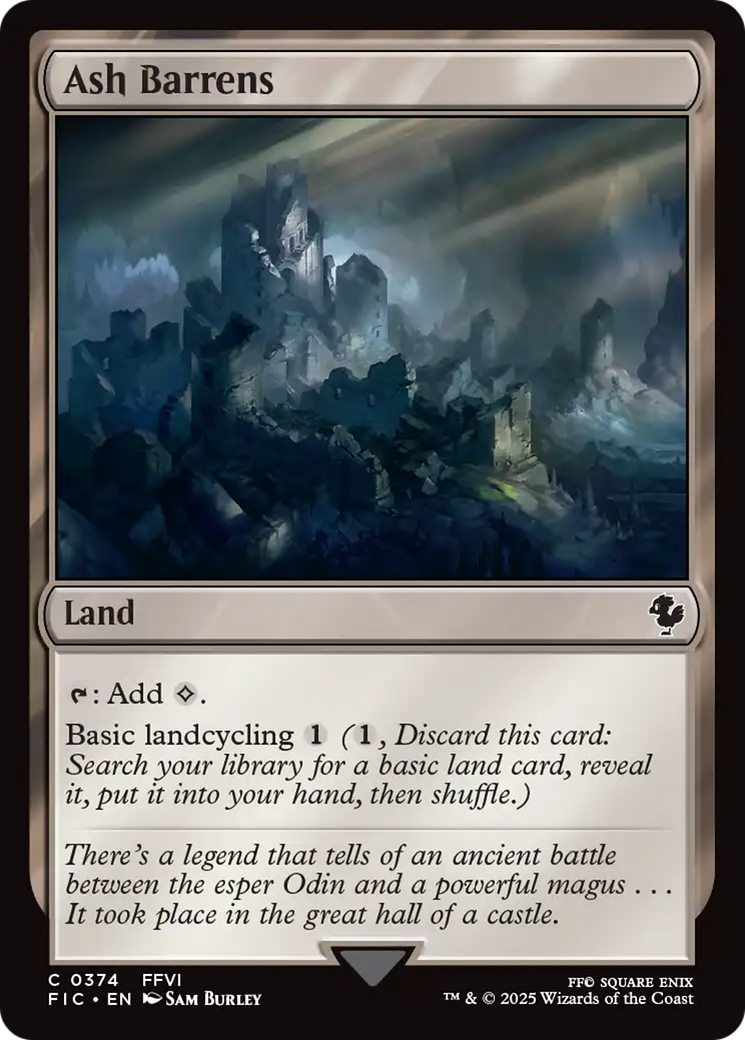
Ash Barrens
Ash Barrens
Land
: Add .
Basic landcycling ( , Discard this card: Search your library for a basic land card, reveal it, put it into your hand, then shuffle.)
-
1
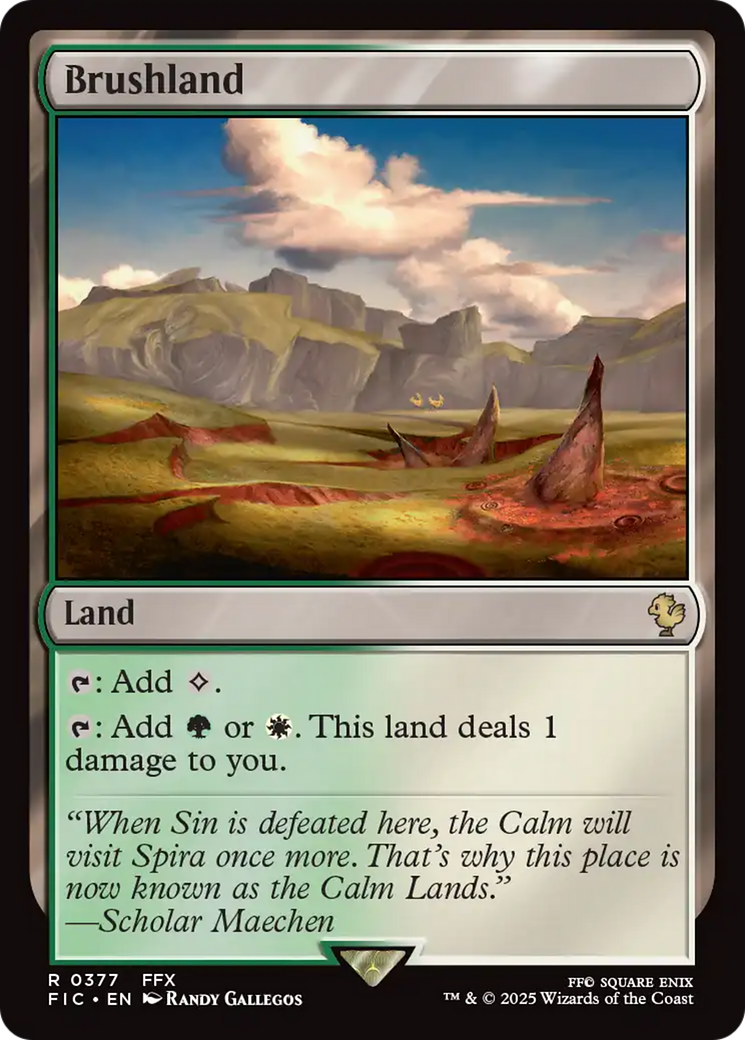
Brushland
Brushland
Land
: Add .
: Add or . This land deals 1 damage to you.
-
1
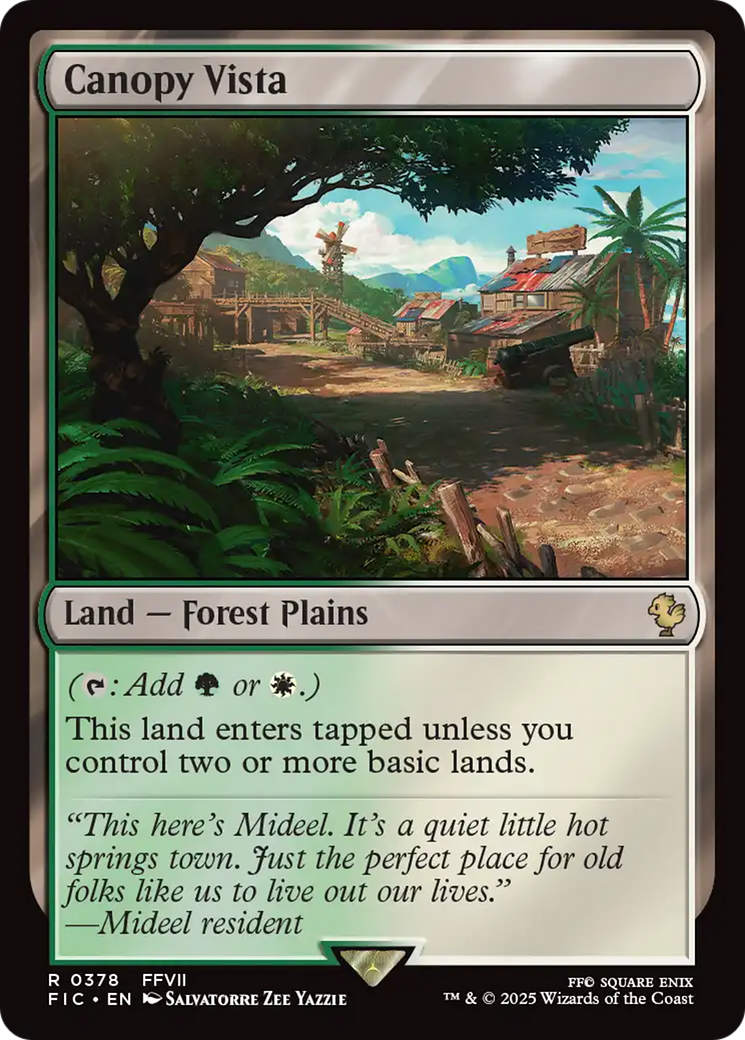
Canopy Vista
Canopy Vista
Land — Forest Plains
( : Add or .)
This land enters tapped unless you control two or more basic lands.
- Even though these lands have basic land types, they are not basic lands because "basic" doesn't appear on their type line. Notably, controlling two or more of them won't allow others to enter the battlefield untapped.
- If one of these lands enters the battlefield at the same time as any number of basic lands, those other lands are not counted when determining if this land enters the battlefield tapped or untapped.
- However, because these cards have basic land types, effects that specify a basic land type without also specifying that the land be basic can affect them. For example, a spell or ability that reads "Destroy target Forest" can target Canopy Vista, while one that reads "Destroy target basic Forest" cannot.
-
1
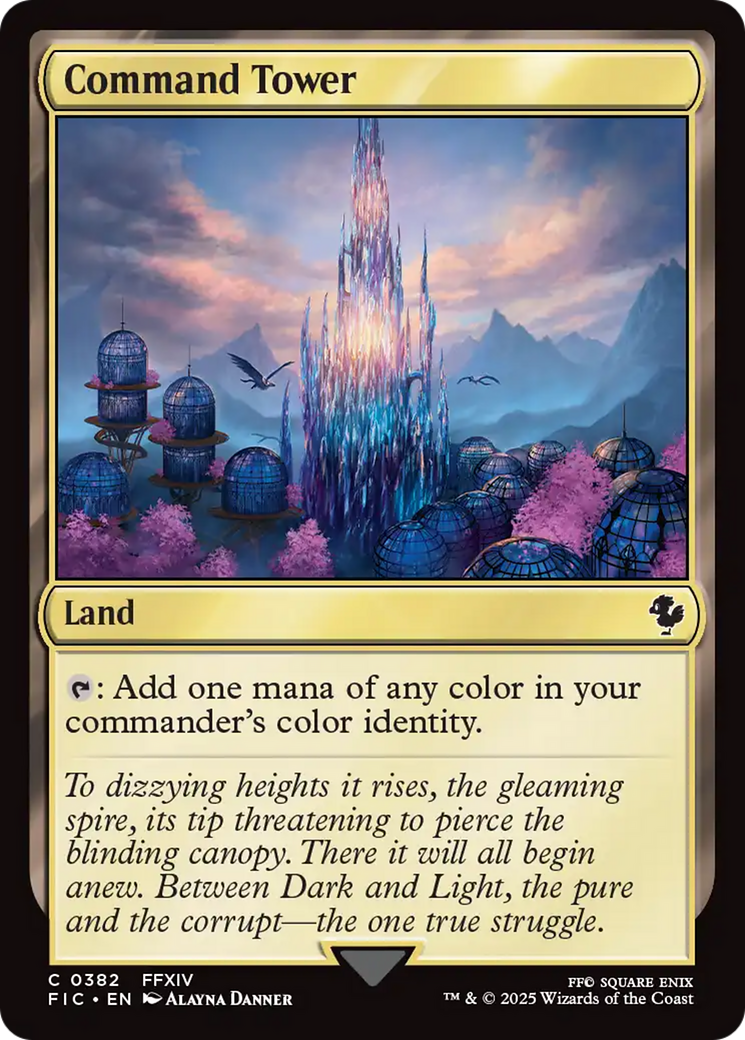
Command Tower
Command Tower
Land
: Add one mana of any color in your commander's color identity.
- If you don't have a commander, Command Tower's ability produces no mana.
- If your commander is a card that has no colors in its color identity, Command Tower's ability produces no mana. It doesn't produce .
- If you have two commanders, the ability adds one mana of any color in their combined color identities.
-
1
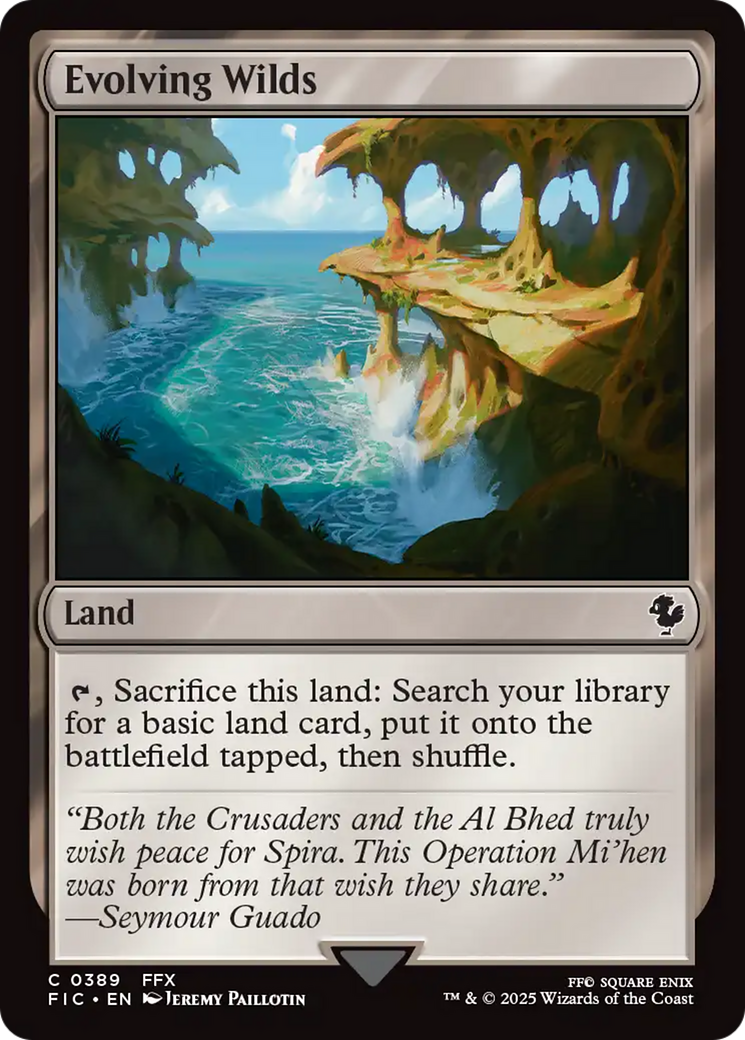
Evolving Wilds
Evolving Wilds
Land
, Sacrifice this land: Search your library for a basic land card, put it onto the battlefield tapped, then shuffle.
-
1
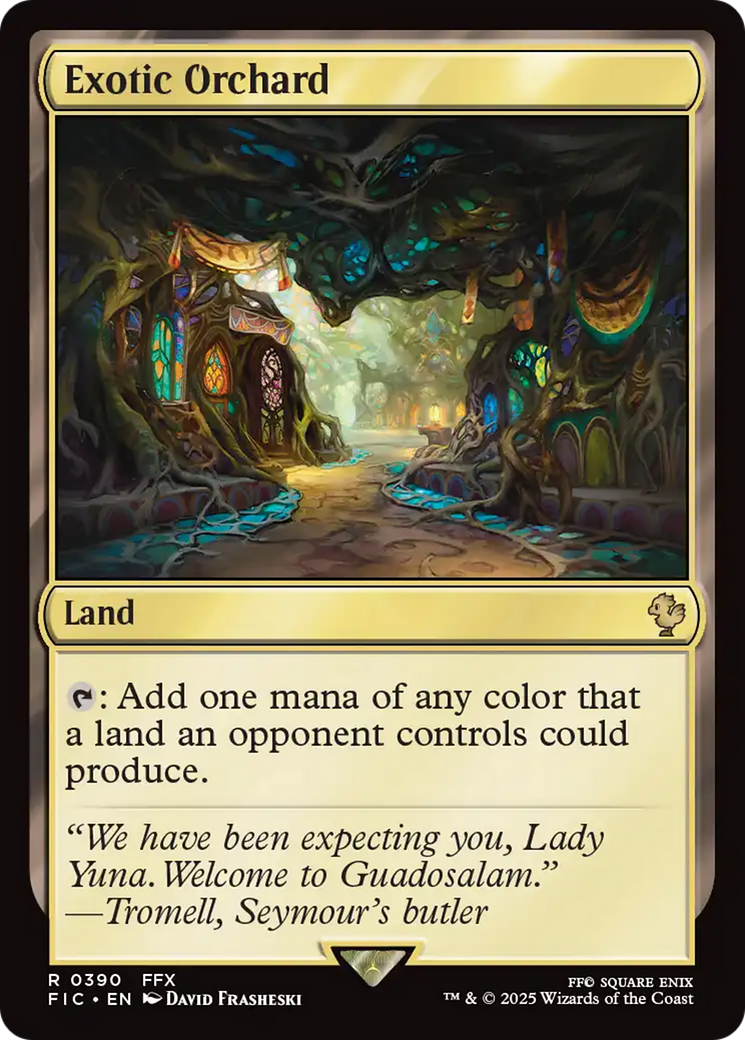
Exotic Orchard
Exotic Orchard
Land
: Add one mana of any color that a land an opponent controls could produce.
- Lands that produce mana based only on what other lands "could produce" won't help each other unless some other land allows one of them to actually produce some type of mana. For example, if you control an Exotic Orchard and your opponent controls an Exotic Orchard and a Reflecting Pool, none of those lands would produce mana if their mana abilities were activated. On the other hand, if you control a Forest and an Exotic Orchard, and your opponent controls an Exotic Orchard and a Reflecting Pool, then each of those lands can be tapped to produce . Your opponent's Exotic Orchard can produce because you control a Forest. Your Exotic Orchard and your opponent's Reflecting Pool can each produce because your opponent's Exotic Orchard can produce .
- When determining what colors of mana your opponents' lands could produce, Exotic Orchard takes into account any applicable replacement effects that would apply to those lands' mana abilities (such as Contamination's effect, for example). If there are more than one, consider them in any possible order.
- The colors of mana are white, blue, black, red, and green. Exotic Orchard can't be tapped for colorless mana, even if a land an opponent controls could produce colorless mana.
- Exotic Orchard doesn't care about any restrictions or riders your opponents' lands (such as Ancient Ziggurat or Hall of the Bandit Lord) put on the mana they produce. It just cares about colors of mana.
- Exotic Orchard checks the effects of all mana-producing abilities of lands your opponents control, but it doesn't check their costs. For example, Vivid Crag has the ability " , Remove a charge counter from Vivid Crag: Add one mana of any color." If an opponent controls Vivid Crag and you control Exotic Orchard, you can tap Exotic Orchard for any color of mana. It doesn't matter whether Vivid Crag has a charge counter on it, and it doesn't matter whether it's untapped.
-
1
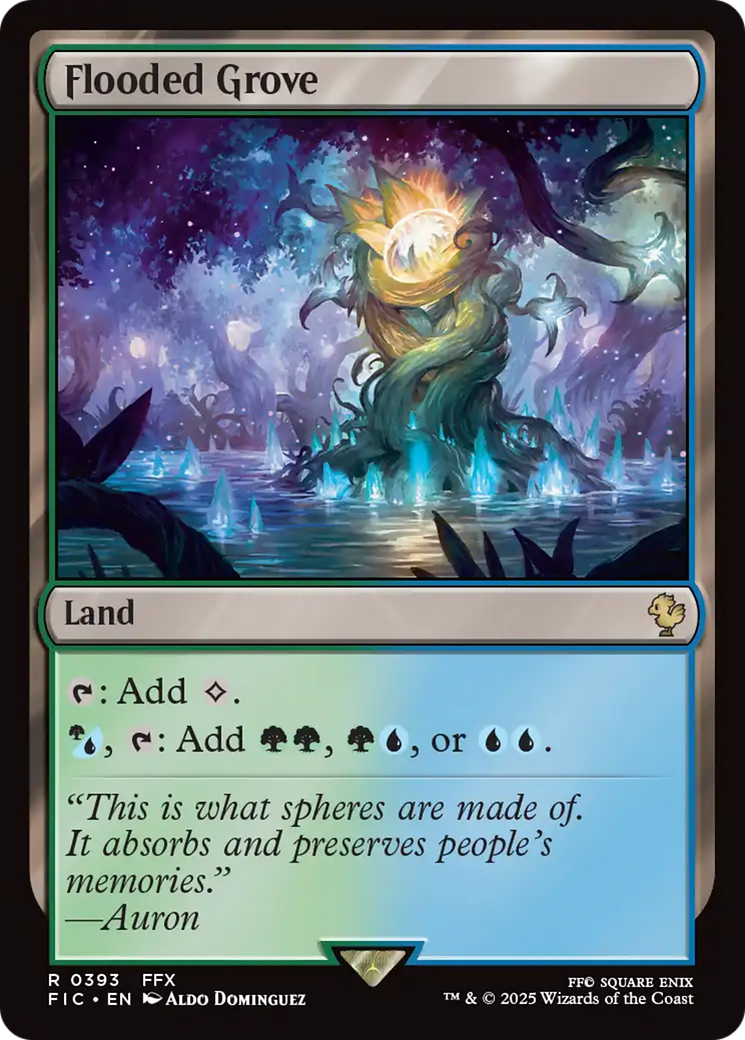
Flooded Grove
Flooded Grove
Land
: Add .
, : Add , , or .
-
3
Forest
Forest
Basic Land — Forest
( : Add .)
-
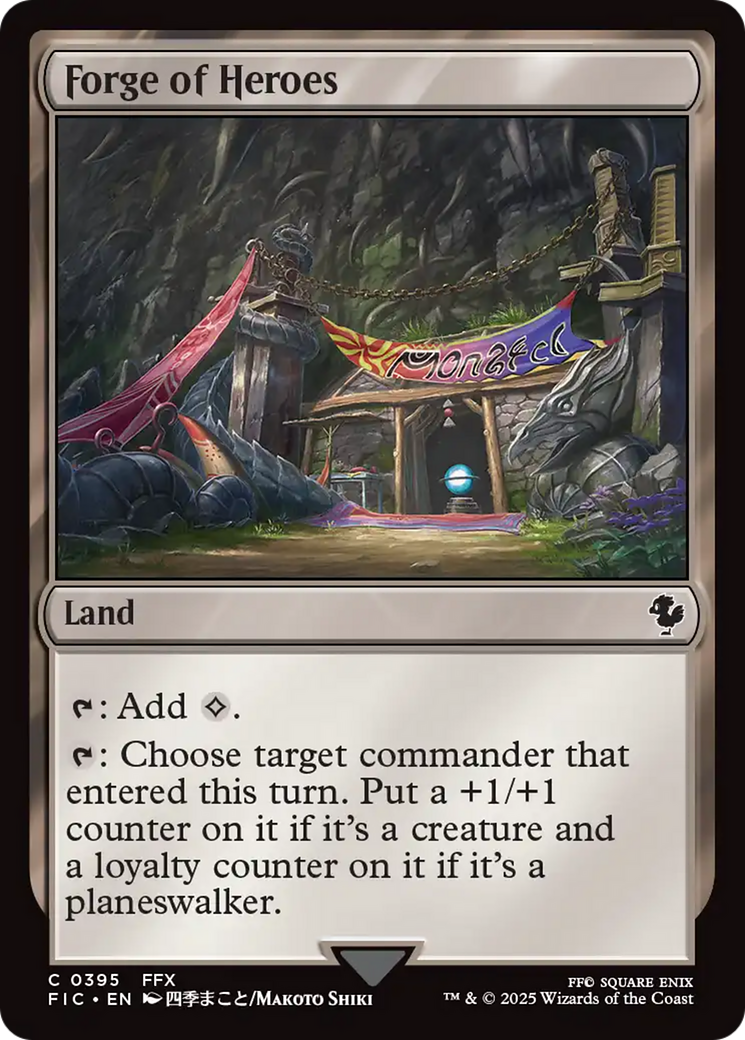
1
Forge of Heroes
Forge of Heroes
Land
: Add .
: Choose target commander that entered this turn. Put a +1/+1 counter on it if it's a creature and a loyalty counter on it if it's a planeswalker.
- If the target commander is somehow a creature and a planeswalker, most likely because it's Gideon, it receives both kinds of counters.
- If the target commander is somehow neither a creature nor a planeswalker (such as Arixmethes, Slumbering Isle may be), it receives no counters.
-
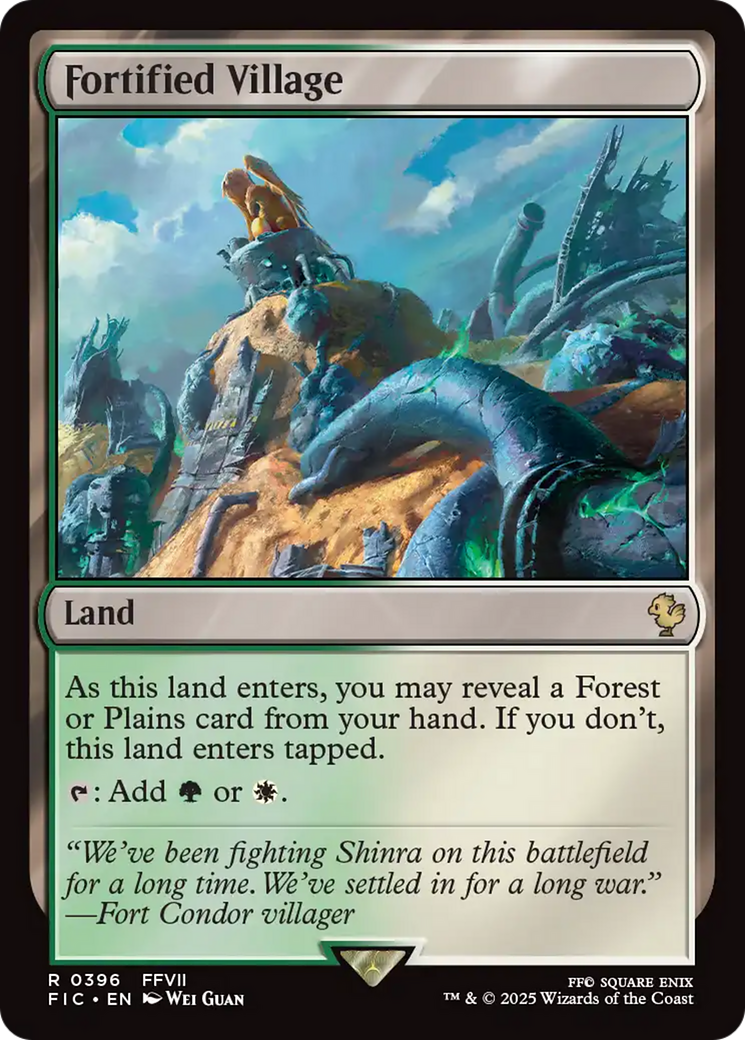
1
Fortified Village
Fortified Village
Land
As this land enters, you may reveal a Forest or Plains card from your hand. If you don't, this land enters tapped.
: Add or .
- If a Forest or Plains is entering the battlefield from your hand at the same time as Fortified Village, you may reveal the other land to have Fortified Village enter untapped.
- You may reveal any land card with either or both of the appropriate subtypes. It doesn't have to be a basic land. For example, you could reveal Prairie Stream from the Battle for Zendikar set to satisfy the ability of Fortified Village.
- Lands don't have a subtype just because they can produce mana of the corresponding color. Fortified Village itself is neither a Forest nor a Plains, even though it produces green and white mana, so you can't reveal one to satisfy the ability of another.
- If an effect instructs you to put Fortified Village onto the battlefield tapped, it will still enter the battlefield tapped even if you reveal a land card from your hand.
-
1
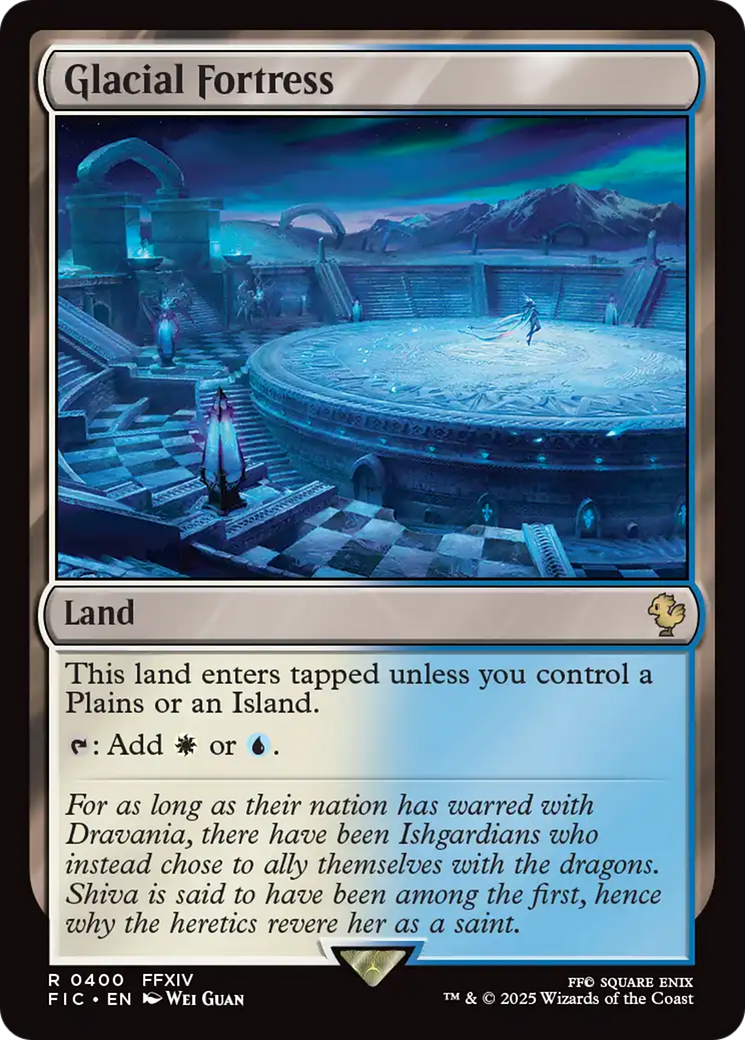
Glacial Fortress
Glacial Fortress
Land
This land enters tapped unless you control a Plains or an Island.
: Add or .
- This checks for lands you control with the land type Plains or Island, not for lands named Plains or Island. The lands it checks for don't have to be basic lands. For example, if you control Watery Grave (a nonbasic land with the land types Island and Swamp), Glacial Fortress will enter untapped.
- As this is entering, it checks for lands that are already on the battlefield. It won't see lands that are entering at the same time (due to Warp World, for example).
-
1
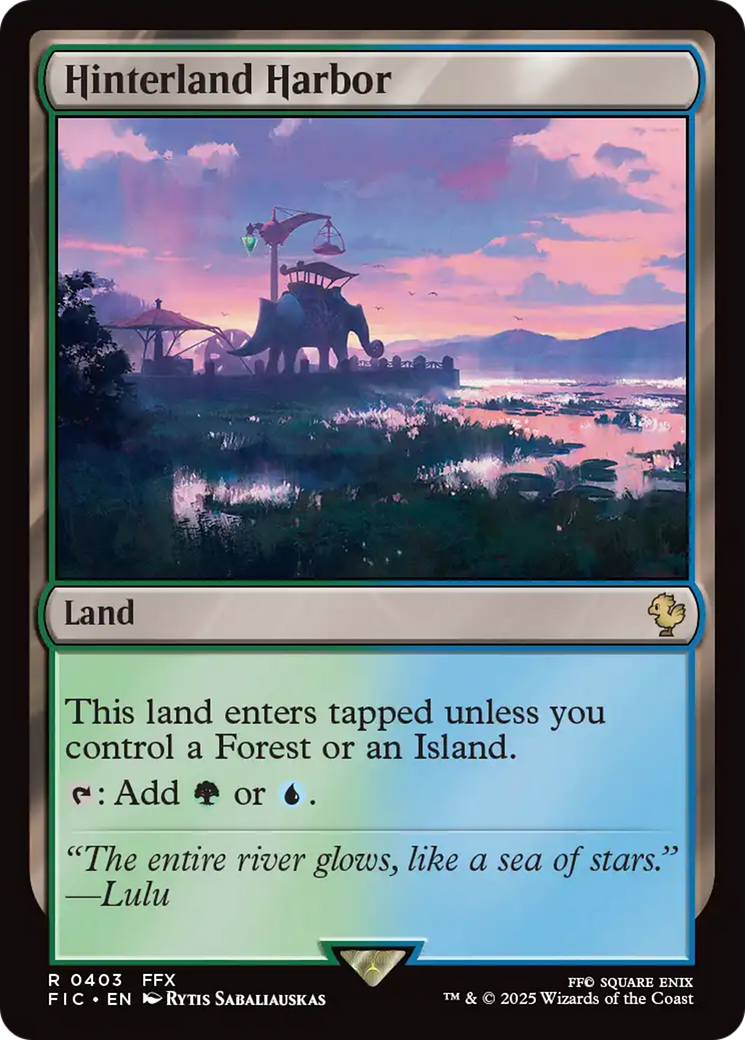
Hinterland Harbor
Hinterland Harbor
Land
This land enters tapped unless you control a Forest or an Island.
: Add or .
-
1
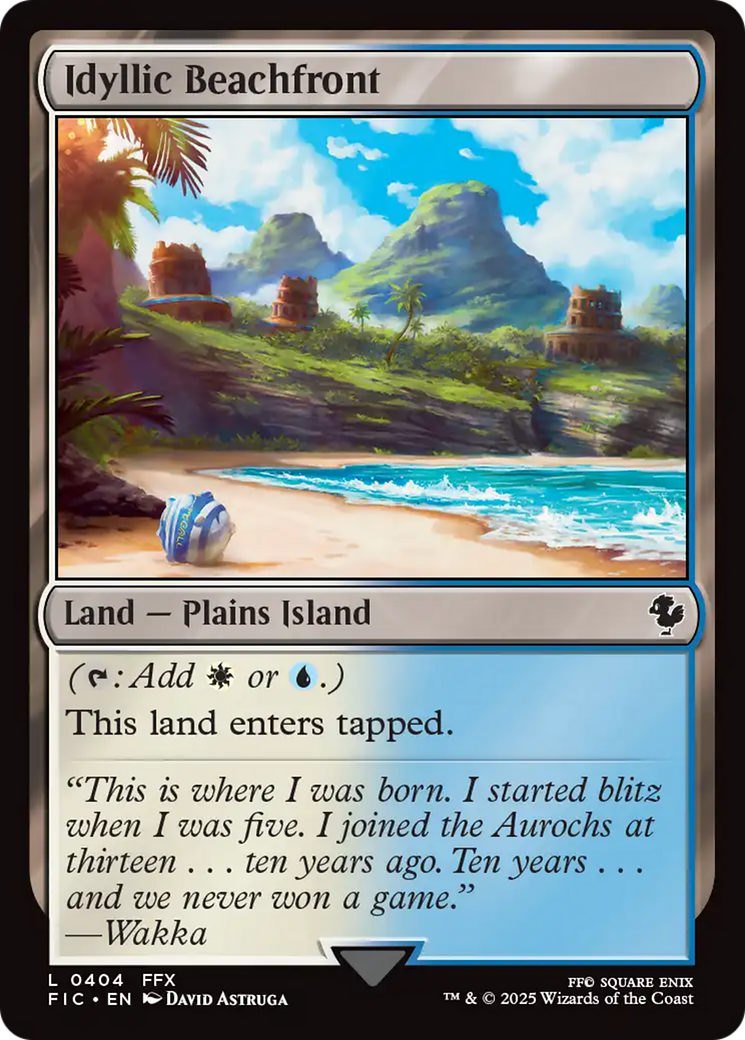
Idyllic Beachfront
Idyllic Beachfront
Land — Plains Island
( : Add or .)
This land enters tapped.
-
3
Island
Island
Basic Land — Island
( : Add .)
-
1
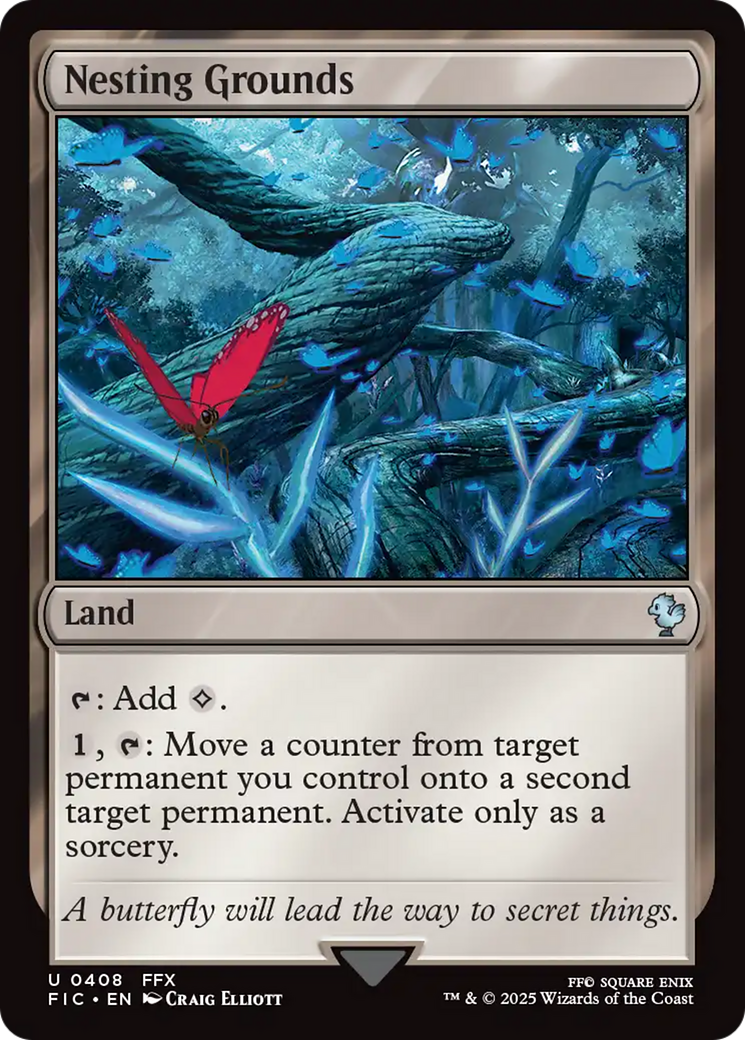
Nesting Grounds
Nesting Grounds
Land
: Add .
, : Move a counter from target permanent you control onto a second target permanent. Activate only as a sorcery.
- You choose the two target permanents as Nesting Grounds's second ability is put onto the stack. You choose which kind of counter to move as that ability resolves.
- If either permanent becomes an illegal target, no counter is removed or put.
- To move a counter from one creature to another, the counter is removed from the first permanent and put on the second. Any abilities that care about a counter being removed from or put onto a permanent will apply.
- The two target permanents don't have to share a type, which can result in some counters on permanents that would not occur normally, such as loyalty counters on creatures or +1/+1 counters on lands. Keyword counters will grant the permanent that keyword even if it's meaningless (such as trample on an enchantment); +1/+1 counters won't affect the permanent unless it's a creature; and many named counters (such as soul counters) won't have an effect unless the recipient permanent refers to them in some way.
-
1
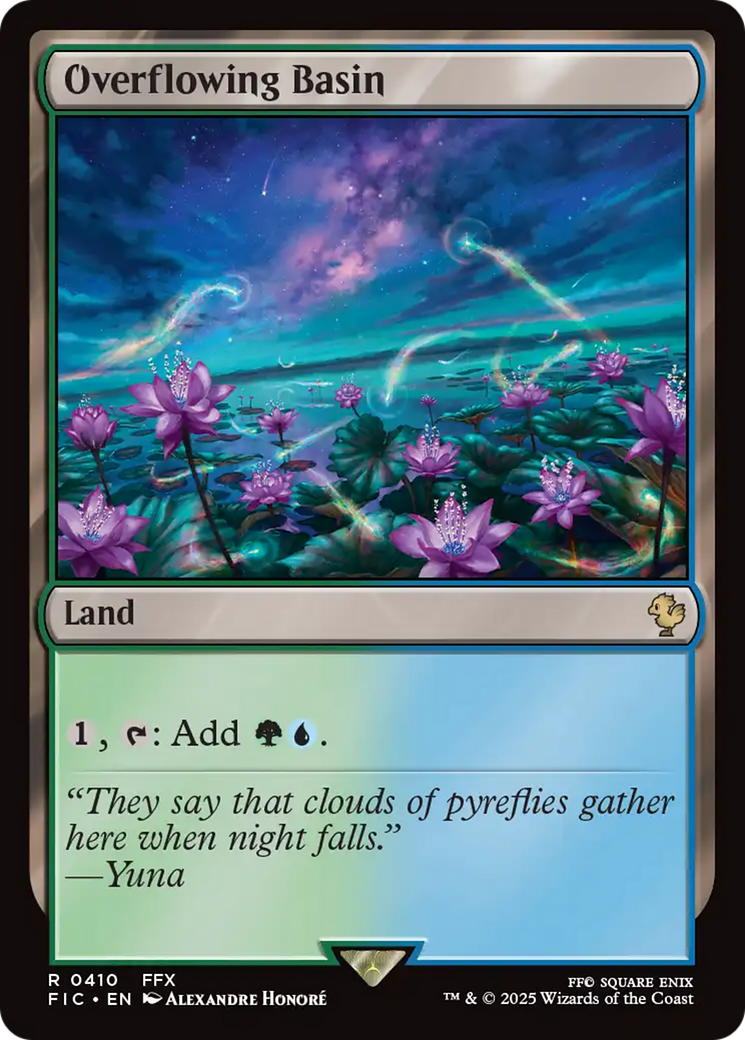
Overflowing Basin
Overflowing Basin
Land
, : Add .
-
1
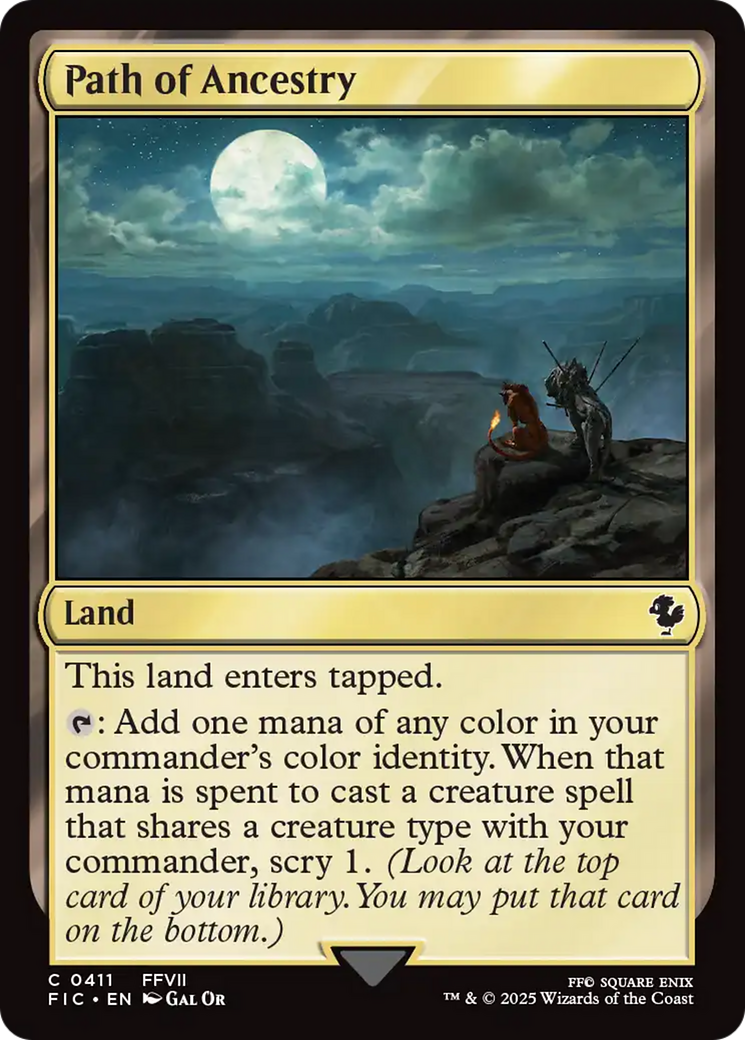
Path of Ancestry
Path of Ancestry
Land
This land enters tapped.
: Add one mana of any color in your commander's color identity. When that mana is spent to cast a creature spell that shares a creature type with your commander, scry 1. (Look at the top card of your library. You may put that card on the bottom.)
- Your commander's creature types are checked immediately after you cast a creature spell spending mana from Path of Ancestry's last ability. They aren't set before the game begins, and they may not be the same types your commander had when you activated that ability.
- If you have two commanders, the last ability adds one mana of any color in their combined color identities. When you spend that mana on a creature spell that shares a creature type with either of your commanders, you'll scry 1.
- If Path of Ancestry's last ability produces two mana (most likely due to Mana Reflection), spending those two mana to cast creature spells that share a creature type with your commander will cause two abilities to trigger. Each of those abilities will cause you to scry 1. You won't scry 2. This is true whether you spend the mana on one creature spell or two.
- If your commander has no creature types, it can't share a creature type with any spell that you cast.
- If you cast your commander with mana from Path of Ancestry, and your commander hasn't somehow lost all of its creature types while on the stack, you'll scry 1.
- If you don't have a commander, Path of Ancestry's ability produces no mana.
- If your commander is a card that has no colors in its color identity, Path of Ancestry's ability produces no mana. It doesn't produce .
-
3
Plains
Plains
Basic Land — Plains
( : Add .)
-
1
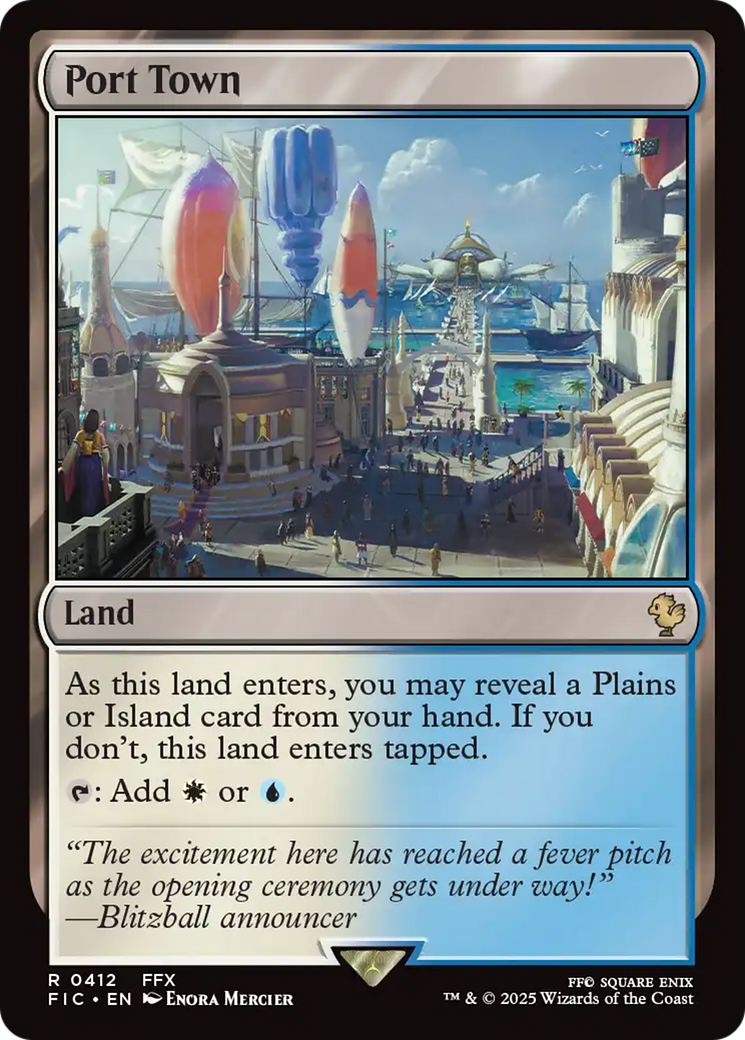
Port Town
Port Town
Land
As this land enters, you may reveal a Plains or Island card from your hand. If you don't, this land enters tapped.
: Add or .
- You may reveal any land card with either or both of the appropriate subtypes. It doesn't have to be a basic land. For example, you could reveal Canopy Vista from the Battle for Zendikar set to satisfy the ability of Port Town.
- Lands don't have a subtype just because they can produce mana of the corresponding color. Port Town itself is neither a Plains nor an Island, even though it produces white and blue mana, so you can't reveal one to satisfy the ability of another.
- If a Plains or Island is entering the battlefield from your hand at the same time as Port Town, you may reveal the other land to have Port Town enter untapped.
- If an effect instructs you to put Port Town onto the battlefield tapped, it will still enter the battlefield tapped even if you reveal a land card from your hand.
-
1
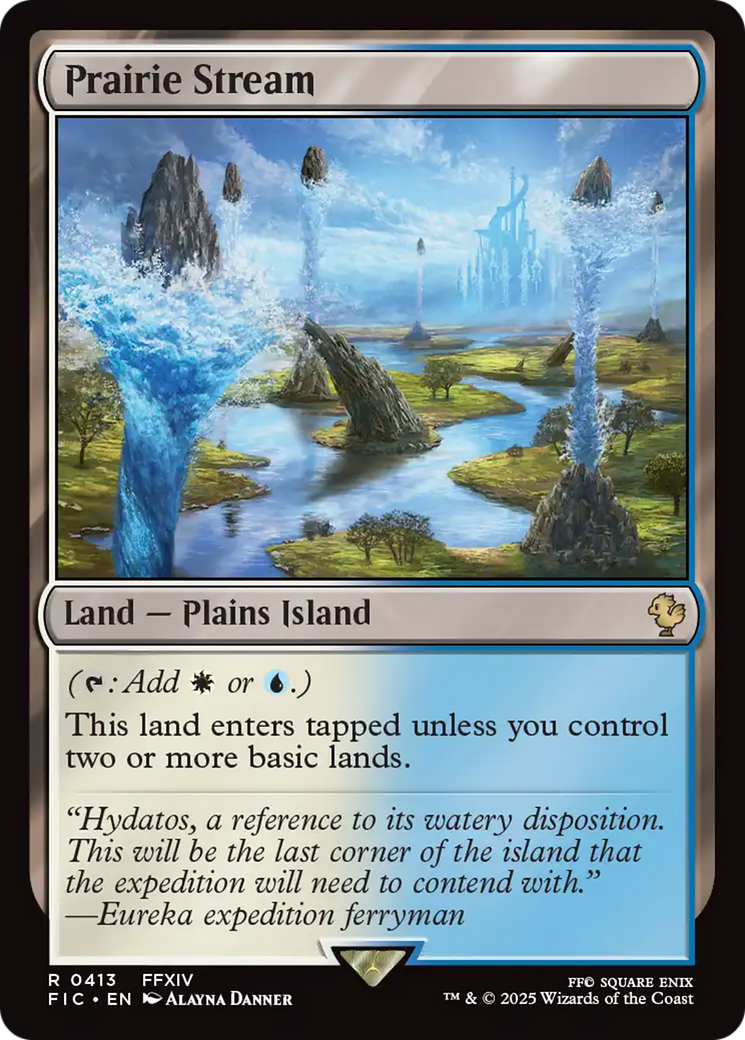
Prairie Stream
Prairie Stream
Land — Plains Island
( : Add or .)
This land enters tapped unless you control two or more basic lands.
- Even though these lands have basic land types, they are not basic lands because "basic" doesn't appear on their type line. Notably, controlling two or more of them won't allow others to enter the battlefield untapped.
- However, because these cards have basic land types, effects that specify a basic land type without also specifying that the land be basic can affect them. For example, a spell or ability that reads "Destroy target Forest" can target Canopy Vista, while one that reads "Destroy target basic Forest" cannot.
- If one of these lands enters the battlefield at the same time as any number of basic lands, those other lands are not counted when determining if this land enters the battlefield tapped or untapped.
-
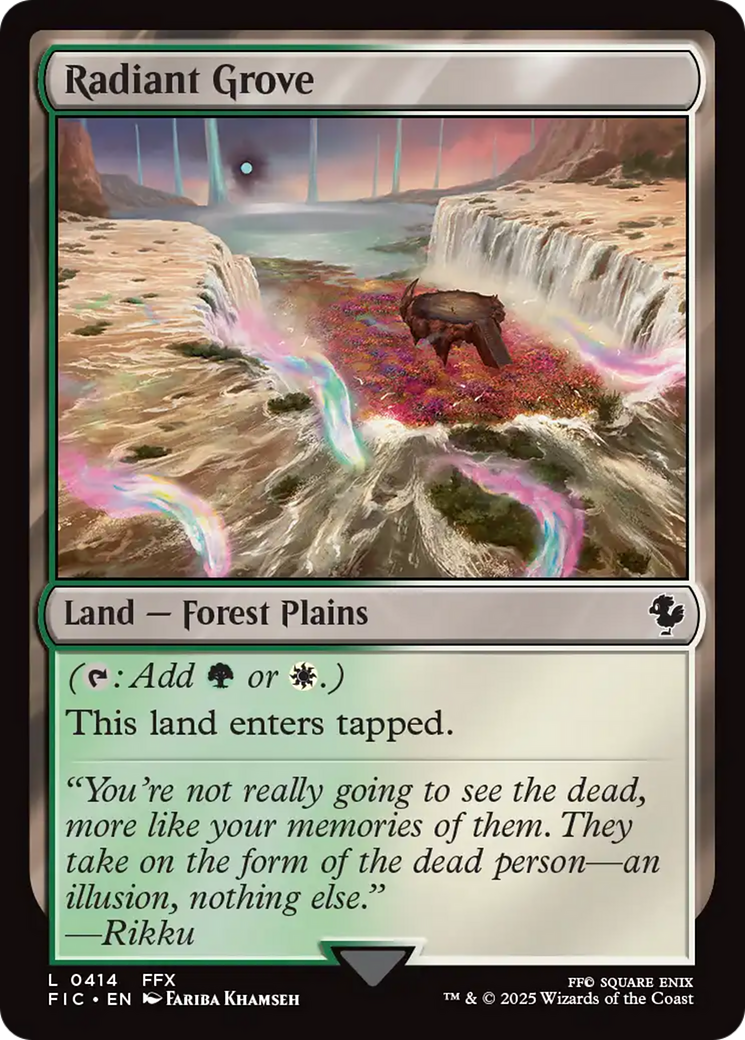
1
Radiant Grove
Radiant Grove
Land — Forest Plains
( : Add or .)
This land enters tapped.
-
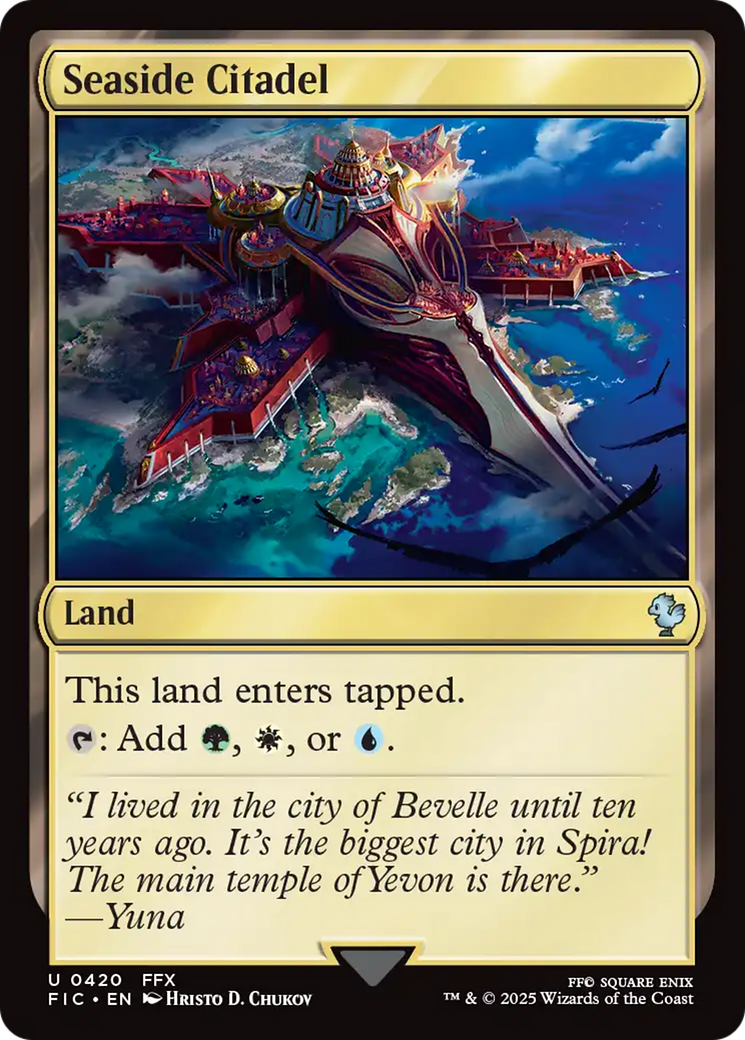
1
Seaside Citadel
Seaside Citadel
Land
This land enters tapped.
: Add , , or .
-
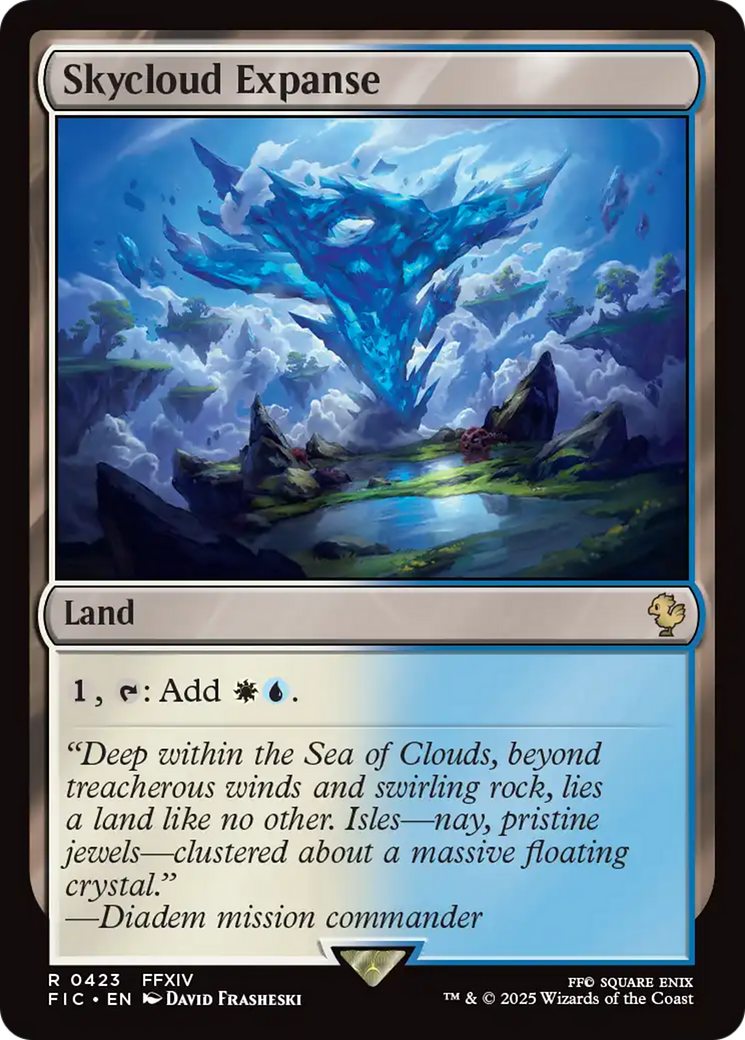
1
Skycloud Expanse
Skycloud Expanse
Land
, : Add .
-
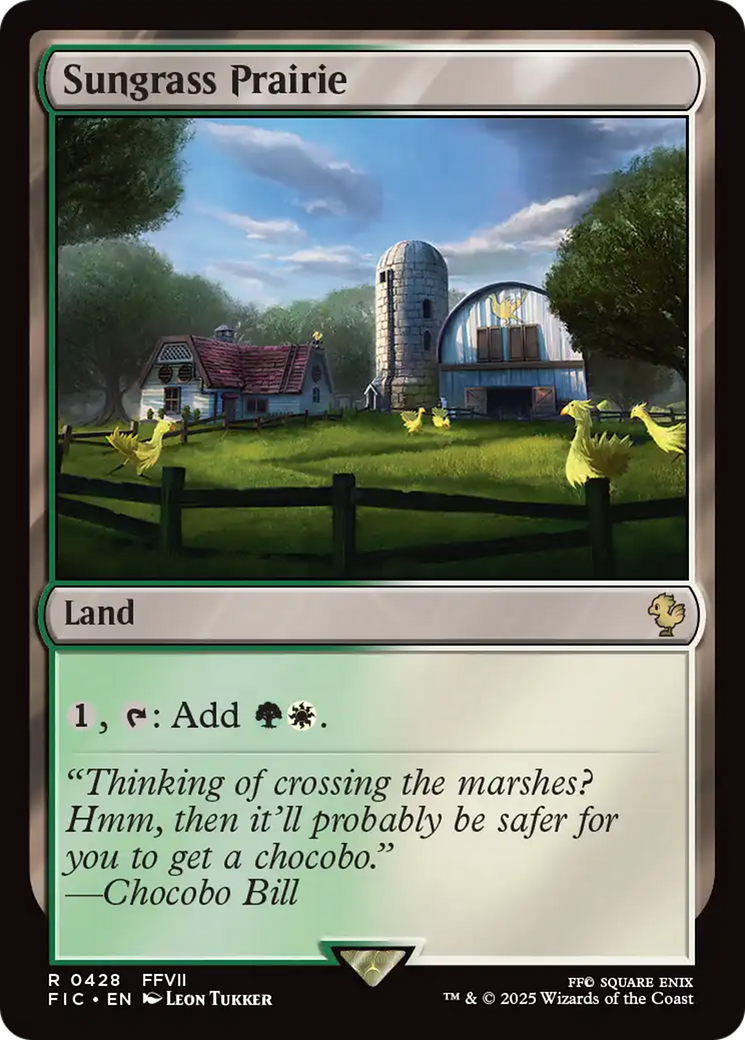
1
Sungrass Prairie
Sungrass Prairie
Land
, : Add .
-
1
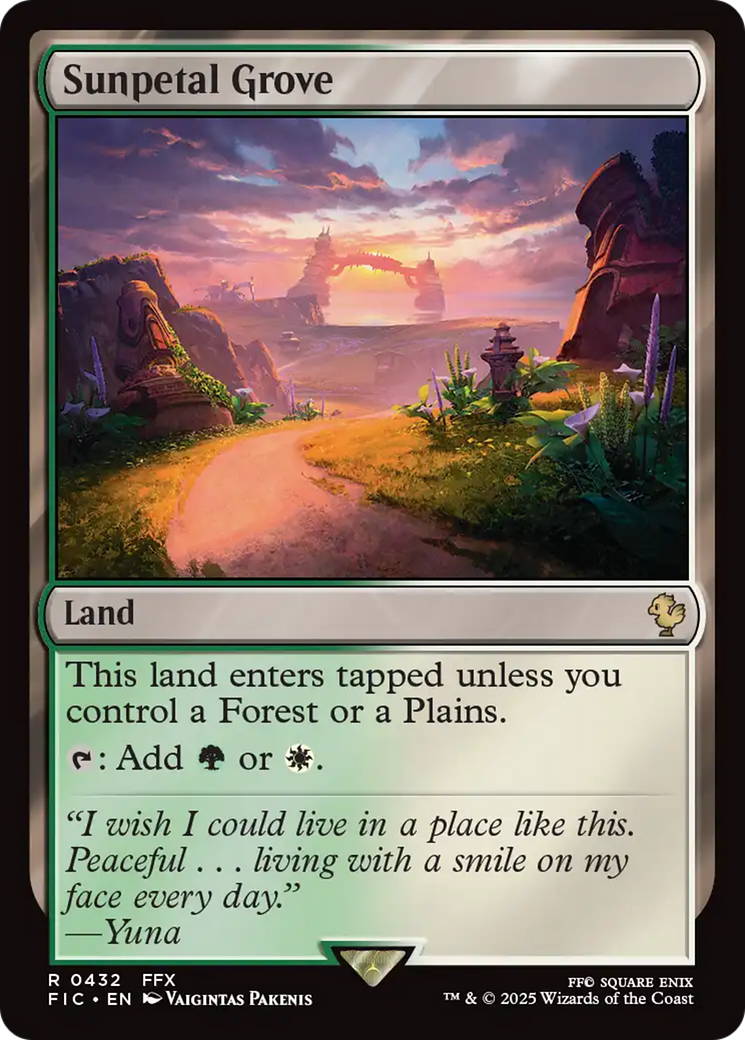
Sunpetal Grove
Sunpetal Grove
Land
This land enters tapped unless you control a Forest or a Plains.
: Add or .
- This checks for lands you control with the land type Forest or Plains, not for lands named Forest or Plains. The lands it checks for don't have to be basic lands. For example, if you control Hallowed Fountain (a nonbasic land with the land types Plains and Island), Sunpetal Grove will enter untapped.
- As this is entering, it checks for lands that are already on the battlefield. It won't see lands that are entering at the same time (due to Warp World, for example).
-
1
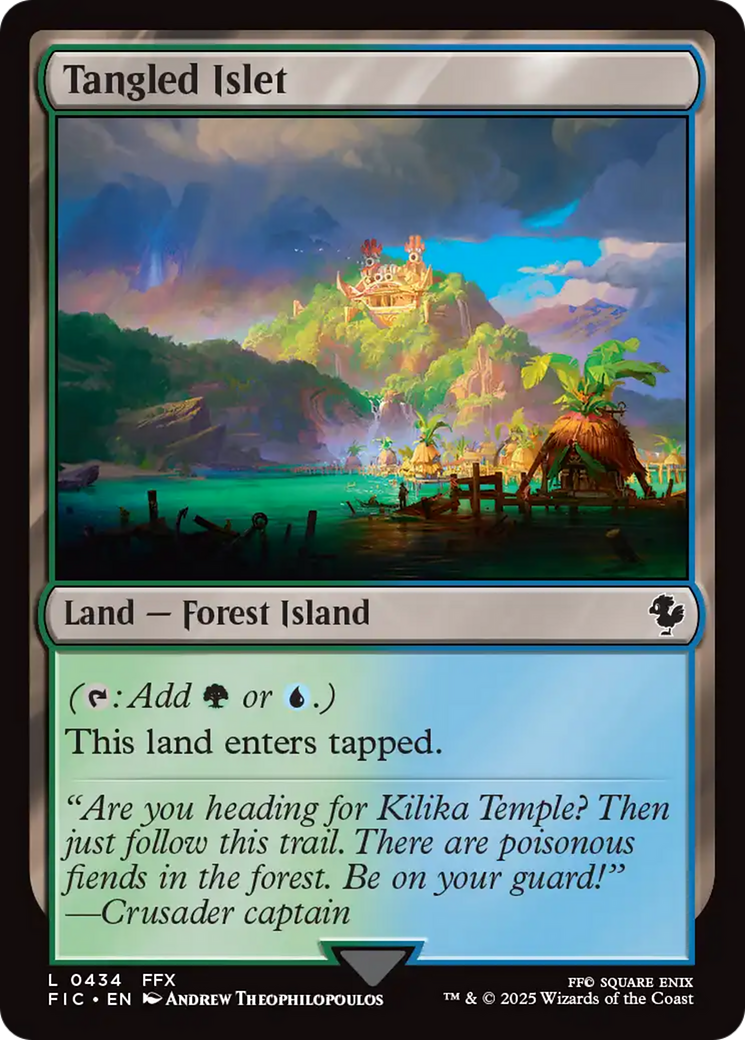
Tangled Islet
Tangled Islet
Land — Forest Island
( : Add or .)
This land enters tapped.
-
1
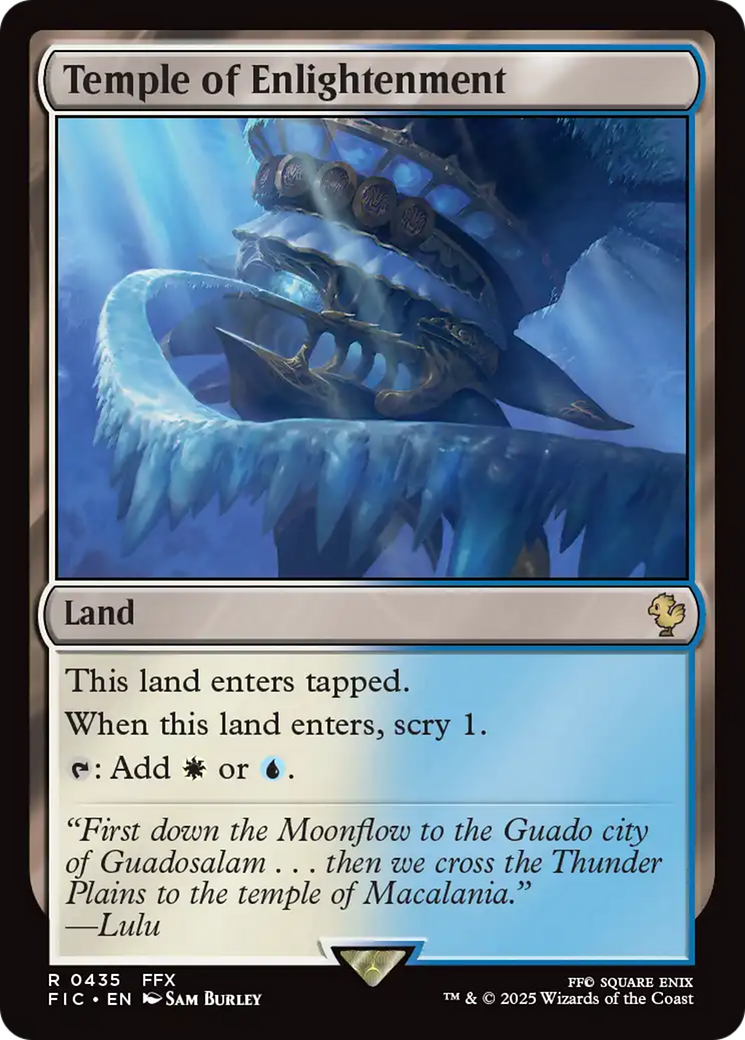
Temple of Enlightenment
Temple of Enlightenment
Land
This land enters tapped.
When this land enters, scry 1. (Look at the top card of your library. You may put that card on the bottom.)
: Add or .
- When you scry, you may put all the cards you look at back on top of your library, you may put all of those cards on the bottom of your library, or you may put some of those cards on top and the rest of them on the bottom.
- You choose how to order cards returned to your library after scrying no matter where you put them.
- You perform the actions stated on a card in sequence. For some spells and abilities, that means you'll scry last. For others, that means you'll scry and then perform other actions.
- Scry appears on some spells and abilities with one or more targets. If all of the spell or ability's targets are illegal when it tries to resolve, it won't resolve and none of its effects will happen. You won't scry.
-
1
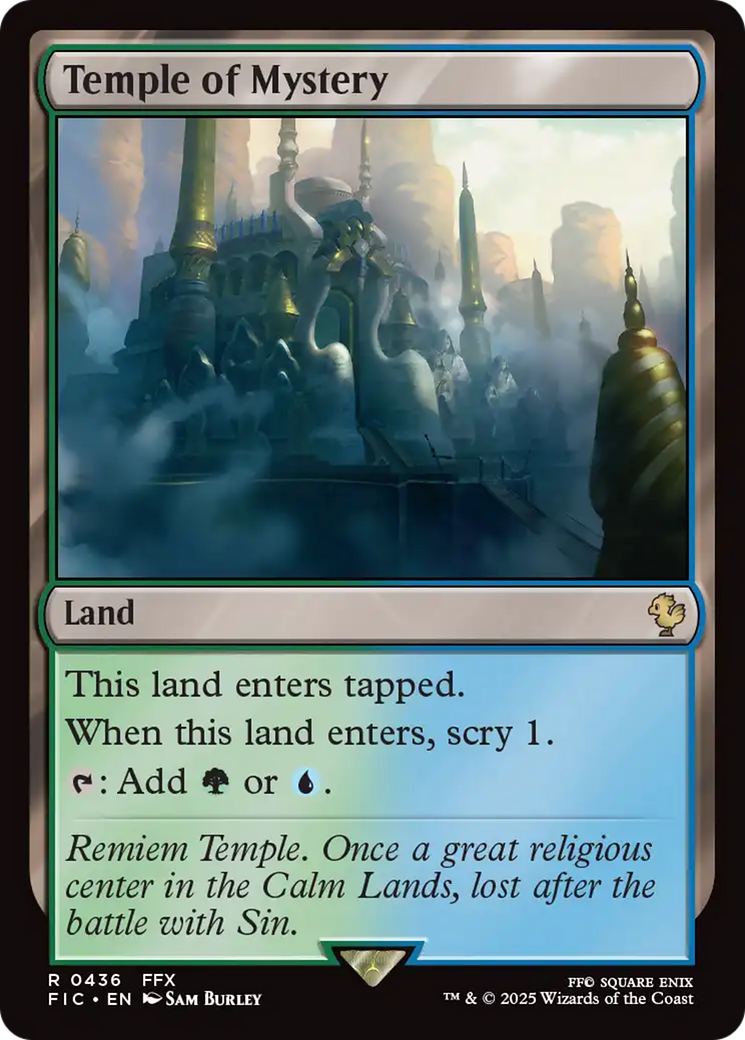
Temple of Mystery
Temple of Mystery
Land
This land enters tapped.
When this land enters, scry 1. (Look at the top card of your library. You may put that card on the bottom.)
: Add or .
- When you scry, you may put all the cards you look at back on top of your library, you may put all of those cards on the bottom of your library, or you may put some of those cards on top and the rest of them on the bottom.
- You choose how to order cards returned to your library after scrying no matter where you put them.
- You perform the actions stated on a card in sequence. For some spells and abilities, that means you'll scry last. For others, that means you'll scry and then perform other actions.
- Scry appears on some spells and abilities with one or more targets. If all of the spell or ability's targets are illegal when it tries to resolve, it won't resolve and none of its effects will happen. You won't scry.
-
1
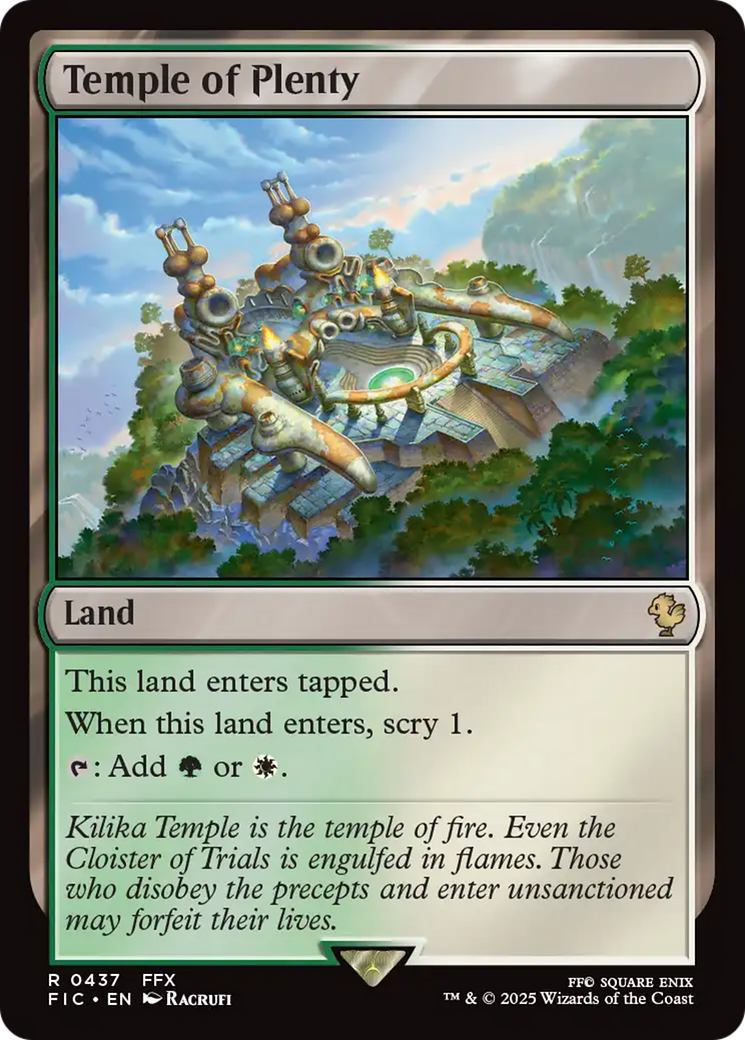
Temple of Plenty
Temple of Plenty
Land
This land enters tapped.
When this land enters, scry 1. (Look at the top card of your library. You may put that card on the bottom.)
: Add or .
- You perform the actions stated on a card in sequence. For some spells and abilities, that means you'll scry last. For others, that means you'll scry and then perform other actions.
- You choose how to order cards returned to your library after scrying no matter where you put them.
- When you scry, you may put all the cards you look at back on top of your library, you may put all of those cards on the bottom of your library, or you may put some of those cards on top and the rest of them on the bottom.
- Scry appears on some spells and abilities with one or more targets. If all of the spell or ability's targets are illegal when it tries to resolve, it won't resolve and none of its effects will happen. You won't scry.
-
1
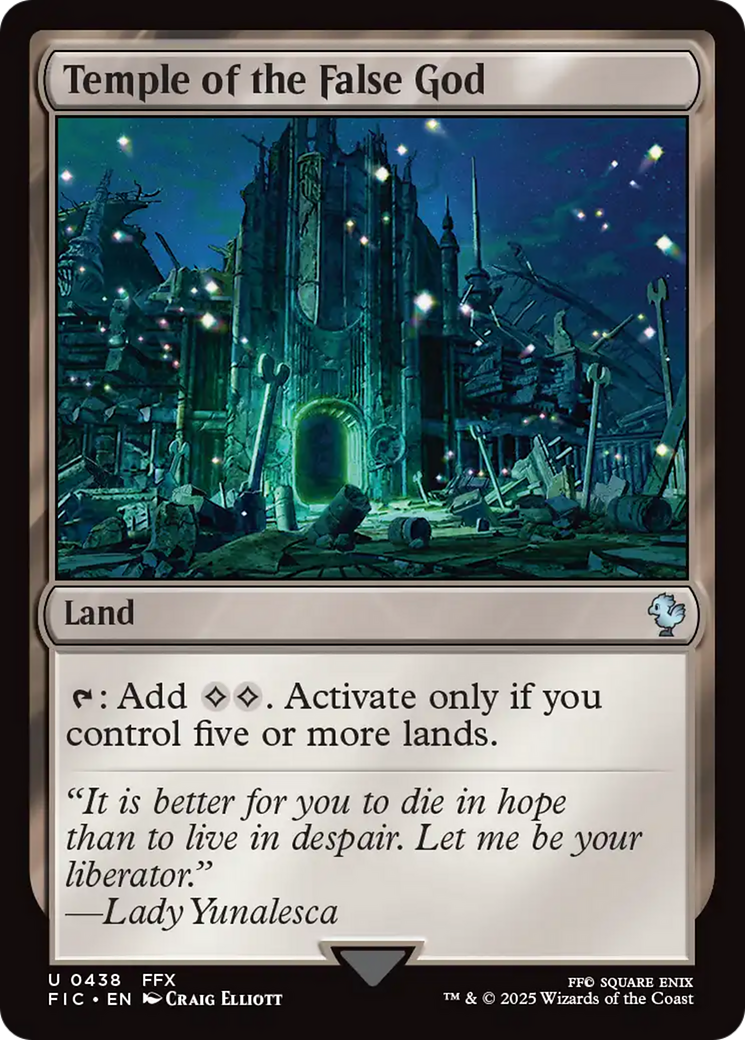
Temple of the False God
Temple of the False God
Land
: Add . Activate only if you control five or more lands.
-
1
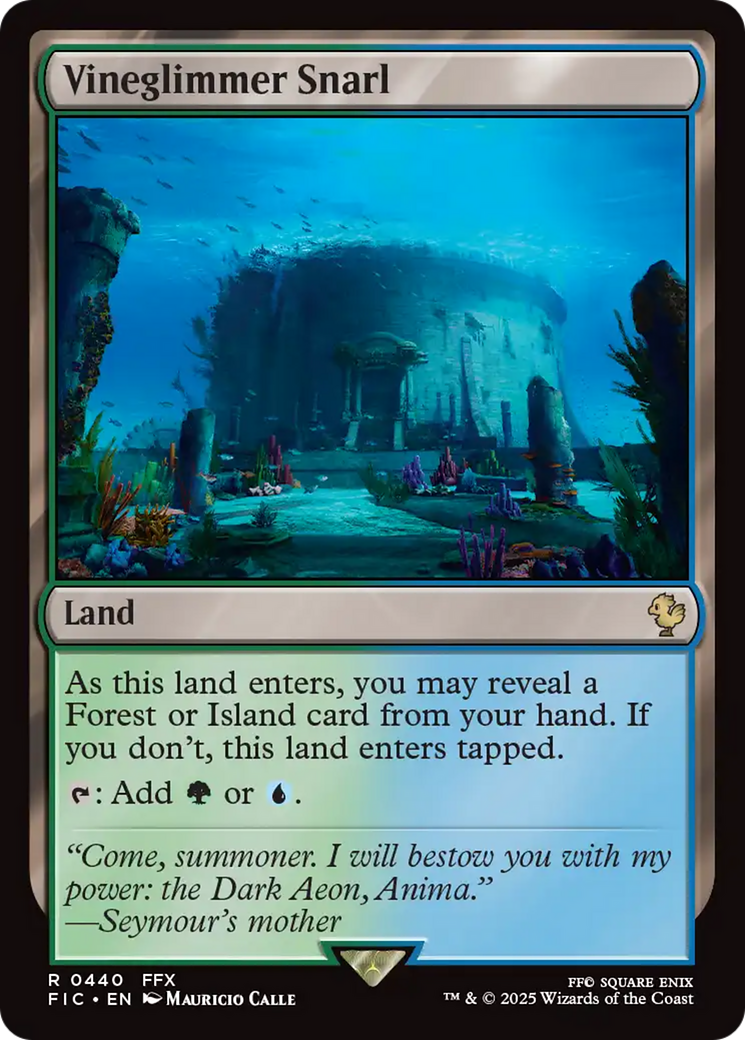
Vineglimmer Snarl
Vineglimmer Snarl
Land
As this land enters, you may reveal a Forest or Island card from your hand. If you don't, this land enters tapped.
: Add or .
- You may reveal any land card with either or both of the appropriate subtypes. It doesn't have to be a basic land card.
- The "Snarl" itself doesn't have any land subtypes. You can't reveal one to satisfy the ability of another.
- If a land card with an appropriate subtype is entering the battlefield from your hand at the same time as one of these lands, you may reveal the other land to have the "Snarl" enter untapped.
- If an effect instructs you to put one of these lands onto the battlefield tapped, it will still enter the battlefield tapped even if you reveal a land card from your hand.
White 20
-
1
Auron, Venerated Guardian
Auron, Venerated Guardian
Legendary Creature — Human Spirit Samurai
2/5
Vigilance
Shooting Star — Whenever Auron attacks, put a +1/+1 counter on it. When you do, exile target creature defending player controls with power less than Auron's power until Auron leaves the battlefield.
- If a token is exiled this way, it will cease to exist and won't return to the battlefield.
- You don't choose a target for Auron's last ability at the time it triggers. Rather, a second "reflexive" ability triggers when you put a +1/+1 counter on it this way. You choose a target for that ability as it goes on the stack. Each player may respond to this triggered ability as normal.
- Once a creature is exiled by the reflexive triggered ability, it doesn't matter what happens to Auron's power. Reducing Auron's power below the exiled creature's power won't cause the exiled creature to return to the battlefield.
- Auras attached to the exiled creature will be put into their owners' graveyards. Any Equipment will become unattached and remain on the battlefield. Any counters on the exiled creature will cease to exist. When the card returns to the battlefield, it will be a new object with no connection to the card that was exiled.
-
1
Chocobo Knights
Chocobo Knights
Creature — Human Knight
3/3
Whenever you attack, creatures you control with counters on them gain double strike until end of turn.
-
1
Collective Effort
Collective Effort
Sorcery
Escalate—Tap an untapped creature you control. (Pay this cost for each mode chosen beyond the first.)
Choose one or more —
- Destroy target creature with power 4 or greater.
- Destroy target enchantment.
- Put a +1/+1 counter on each creature target player controls.
- You can tap any untapped creature you control to pay the escalate cost, including one you haven't controlled continuously since the beginning of the turn.
- If you choose the first and third modes, and destroying the creature ends an "exile until" effect (such as that of Lunarch Inquisitors), the creature will return to the battlefield before you put +1/+1 counters on creatures. The same is true if you choose the second and third modes and destroying the enchantment ends such an effect.
-
1
Damning Verdict
Damning Verdict
Sorcery
Destroy all creatures with no counters on them.
-
1
Destroy Evil
Destroy Evil
Instant
Choose one —
- Destroy target creature with toughness 4 or greater.
- Destroy target enchantment.
-
1
Farewell
Farewell
Sorcery
Choose one or more —
- Exile all artifacts.
- Exile all creatures.
- Exile all enchantments.
- Exile all graveyards.
- If you choose more than one mode for Farewell, you perform the actions in the order written.
-
1
Gatta and Luzzu
Gatta and Luzzu
Legendary Creature — Human Soldier
1/1
Flash
When Gatta and Luzzu enters, choose target creature you control. If damage would be dealt to that creature this turn, prevent that damage and put that many +1/+1 counters on it.
- If damage that can't be prevented is dealt to the target creature after Gatta and Luzzu's last ability resolves, you still put that many +1/+1 counters on it.
-
1
Grateful Apparition
Grateful Apparition
Creature — Spirit
1/1
Flying
Whenever this creature deals combat damage to a player or planeswalker, proliferate. (Choose any number of permanents and/or players, then give each another counter of each kind already there.)
- To proliferate, you can choose any permanent that has a counter, including ones controlled by opponents. You can choose any player who has a counter, including opponents. You can't choose cards in any zone other than the battlefield, even if they have counters on them.
- You don't have to choose every permanent or player that has a counter, only the ones you want to add another counter to. Since "any number" includes zero, you don't have to choose any permanents at all, and you don't have to choose any players at all.
- If a player or permanent has more than one kind of counter on it, and you choose for it to get additional counters, it must get one of each kind of counter it already has. You can't have it get just one kind of counter it already has and not the others.
- An ability that triggers "Whenever you proliferate" triggers even if you chose no permanents or players while doing so.
- Players can respond to a spell or ability whose effect includes proliferating. Once that spell or ability starts to resolve, however, and its controller chooses which permanents and players will get new counters, it's too late for anyone to respond.
- If a permanent ever has both +1/+1 counters and -1/-1 counters on it at the same time, they're removed in pairs as a state-based action so that the permanent has only one of those kinds of counters on it.
-
1
Lord Jyscal Guado
Lord Jyscal Guado
Legendary Creature — Spirit Cleric
2/1
Flying
At the beginning of each end step, if you put a counter on a creature this turn, investigate. (Create a Clue token. It's an artifact with " , Sacrifice this token: Draw a card.")
- Lord Jyscal Guado's last ability checks at the moment it would trigger to see if you put a counter on a creature this turn. If you didn't, the ability won't trigger at all. Once your end step begins, it's too late to put a counter on a creature in order to cause this ability to trigger.
-
1
Luminous Broodmoth
Luminous Broodmoth
Creature — Insect
3/4
Flying
Whenever a creature you control without flying dies, return it to the battlefield under its owner's control with a flying counter on it.
- If Luminous Broodmoth dies at the same time as a creature without flying, its ability triggers for that creature.
- If a merged creature dies and that creature didn't have flying, each card that was part of that merged creature is returned to the battlefield. Each one has a flying counter on it.
- If Luminous Broodmoth dies after losing flying but not losing its triggered ability, its ability will trigger for itself.
- Luminous Broodmoth's ability triggers if a token creature without flying dies, but the token won't be returned to the battlefield. If that token was a merged creature, any cards that were part of it will be returned to the battlefield.
-
1
Path to Exile
Path to Exile
Instant
Exile target creature. Its controller may search their library for a basic land card, put that card onto the battlefield tapped, then shuffle.
- The controller of the exiled creature isn't required to search their library for a basic land. If that player doesn't, the player won't shuffle their library.
- If the target creature is an illegal target by the time Path to Exile tries to resolve, it won't resolve and none of its effects will happen. The creature's controller won't search for a basic land card.
-
1
Promise of Loyalty
Promise of Loyalty
Sorcery
Each player puts a vow counter on a creature they control and sacrifices the rest. Each of those creatures can't attack you or planeswalkers you control for as long as it has a vow counter on it.
- If the vow counter is removed from the creature, it can attack as normal.
- Each player, including you, must put a vow counter on a creature they control if able. They can't choose to opt out and sacrifice all of their creatures. The creature you put a vow counter on will remember its promise if another player gains control of it.
- If the vow counter is moved to another creature, it won't prevent the second creature from attacking normally.
-
1
Protection Magic
Protection Magic
Instant
Put a shield counter on each of up to three target creatures. (If a creature with a shield counter would be dealt damage or destroyed, remove a shield counter from it instead.)
- Shield counters don't prevent players from sacrificing creatures.
- Removing a shield counter when a permanent would be dealt damage or destroyed isn't the same as regenerating that permanent.
- If a permanent that would be dealt damage has more than one shield counter on it, that damage is prevented and only one shield counter is removed.
- If a permanent with a shield counter is dealt unpreventable damage, that damage will be dealt and a shield counter will still be removed.
- A creature with a shield counter on it may still be destroyed by state-based actions if it has damage marked on it equal to its toughness or has been dealt unpreventable damage by a source with deathtouch.
- "Shield" is not an ability that creatures have and shield counters are not keyword counters. If a creature with a shield counter loses its abilities, the shield counter will still protect it as normal.
-
1
Resourceful Defense
Resourceful Defense
Enchantment
Whenever a permanent you control leaves the battlefield, if it had counters on it, put those counters on target permanent you control.
: Move any number of counters from target permanent you control onto a second target permanent you control.
-
1
Scholar of New Horizons
Scholar of New Horizons
Creature — Human Scout
1/1
This creature enters with a +1/+1 counter on it.
, Remove a counter from a permanent you control: Search your library for a Plains card and reveal it. If an opponent controls more lands than you, you may put that card onto the battlefield tapped. If you don't put the card onto the battlefield, put it into your hand. Then shuffle.
- You may choose to put the card into your hand rather than onto the battlefield even if an opponent controls more lands than you.
-
1
Summon: Ixion
Summon: Ixion
Enchantment Creature — Saga Unicorn
3/3
(As this Saga enters and after your draw step, add a lore counter. Sacrifice after III.)
I — Aerospark — Exile target creature an opponent controls until this Saga leaves the battlefield.
II, III — Put a +1/+1 counter on each of up to two target creatures you control. You gain 2 life.
First strike
- If Summon: Ixion leaves the battlefield before its first chapter ability resolves, the target permanent won't be exiled.
- If a token is exiled this way, it will cease to exist and won't return to the battlefield.
- You don't have to choose any targets for Summon: Ixion's second or third chapter ability. However, if you do and all of the targets are illegal when the ability tries to resolve, it won't resolve and none of its effects will happen. You won't gain life.
- Auras attached to the exiled permanent will be put into their owners' graveyards. Any Equipment will become unattached and remain on the battlefield. Any counters on the exiled permanent will cease to exist. When the card returns to the battlefield, it will be a new object with no connection to the card that was exiled.
- If an Aura is exiled this way, its owner chooses what it will enchant as it returns to the battlefield. An Aura put onto the battlefield this way doesn't target anything (so it could be attached to a permanent with shroud, for example), but the Aura's enchant ability restricts what it can be attached to. If the Aura can't legally be attached to anything, it remains in exile for the rest of the game.
-
1
Summon: Yojimbo
Summon: Yojimbo
Enchantment Creature — Saga Samurai
5/5
(As this Saga enters and after your draw step, add a lore counter. Sacrifice after IV.)
I — Exile target artifact, enchantment, or tapped creature an opponent controls.
II, III — Until your next turn, creatures can't attack you unless their controller pays for each of those creatures.
IV — Create X Treasure tokens, where X is the number of opponents who control a creature with power 4 or greater.
Vigilance
- The value of X is determined only once, as Summon: Yojimbo's fourth chapter ability resolves.
- On turns where the effect of Summon: Yojimbo's second or third chapter ability is applying, your opponents can choose not to attack with a creature that must attack if able as long as there is no other player, planeswalker, or battle for that creature to attack that wouldn't require a cost.
-
1
Summoner's Sending
Summoner's Sending
Enchantment
At the beginning of your end step, you may exile target creature card from a graveyard. If you do, create a 1/1 white Spirit creature token with flying. Put a +1/+1 counter on it if the exiled card's mana value is 4 or greater.
- If the exiled card has in its mana cost, X is 0 for the purpose of determining its mana value.
-
1
Sunscorch Regent
Sunscorch Regent
Creature — Dragon
4/3
Flying
Whenever an opponent casts a spell, put a +1/+1 counter on this creature and you gain 1 life.
-
1
Together Forever
Together Forever
Enchantment
When this enchantment enters, support 2. (Put a +1/+1 counter on each of up to two target creatures.)
: Choose target creature with a counter on it. When that creature dies this turn, return that card to its owner's hand.
- If a creature without counters receives enough -1/-1 counters to reduce its toughness to 0 or less, Together Forever's ability can't be activated before state-based actions put that creature into its owner's graveyard.
- Together Forever's activated ability checks whether the target creature has a counter on it as the ability is activated and as the ability resolves. If the creature loses its counters later in the turn, the delayed triggered ability will still return it to its owner's hand when it dies.
- If some, but not all, targets for a spell become illegal, the remaining targets are affected as appropriate. If all of a spell's targets become illegal, that spell doesn't resolve.
- If a spell with support has other abilities that target creatures, those abilities and the support ability can target the same creature.
- You can't put more than one +1/+1 counter on any one target using the support action.
- Support can target a creature another player controls.
Blue 9
-
1
An Offer You Can't Refuse
An Offer You Can't Refuse
Instant
Counter target noncreature spell. Its controller creates two Treasure tokens. (They're artifacts with " , Sacrifice this token: Add one mana of any color.")
- If the target is still legal as it resolves but the spell can't be countered for some reason, its controller will still create two Treasure tokens.
- If the target is no longer legal as An Offer You Can't Refuse resolves, no Treasure tokens are created.
-
1
Blitzball Stadium
Blitzball Stadium
Artifact
When this artifact enters, support X. (Put a +1/+1 counter on each of up to X target creatures.)
Go for the Goal! — , : Until end of turn, target creature gains "Whenever this creature deals combat damage to a player, draw a card for each kind of counter on it" and it can't be blocked this turn.
-
1
Chasm Skulker
Chasm Skulker
Creature — Squid Horror
1/1
Whenever you draw a card, put a +1/+1 counter on this creature.
When this creature dies, create X 1/1 blue Squid creature tokens with islandwalk, where X is the number of +1/+1 counters on this creature. (They can't be blocked as long as defending player controls an Island.)
- If enough -1/-1 counters are put on Chasm Skulker at the same time to make its toughness 0 or less, the number of +1/+1 counters on it before it got any -1/-1 counters will be used to determine how many Squid tokens you get. For example, if there are two +1/+1 counters on Chasm Skulker and it gets three -1/-1 counters, you'll get two Squid tokens.
- If you draw multiple cards, the first ability will trigger that many times. Each of these abilities will cause a +1/+1 counter to be put on Chasm Skulker.
-
1
Inexorable Tide
Inexorable Tide
Enchantment
Whenever you cast a spell, proliferate. (Choose any number of permanents and/or players, then give each another counter of each kind already there.)
- Whenever you cast a spell, Inexorable Tide's ability triggers and goes on the stack on top of it. It will resolve (and you'll proliferate) before the spell resolves.
-
1
Lulu, Stern Guardian
Lulu, Stern Guardian
Legendary Creature — Human Wizard
2/3
Whenever an opponent attacks you, choose target creature attacking you. Put a stun counter on that creature.
: Proliferate. (Choose any number of permanents and/or players, then give each another counter of each kind already there.)
- When you proliferate, you can choose any permanent that has a counter, including ones controlled by opponents. You can choose any player who has a counter, including opponents. You can't choose cards in any zone other than the battlefield, even if they have counters on them.
- Lulu's first ability only cares about creatures attacking you, not planeswalkers you control or battles you protect.
- You don't have to choose every permanent or player that has a counter—only the ones you want to add counters to. Since "any number" includes zero, you don't have to choose any permanents at all, and you don't have to choose any players at all.
- If a player or permanent has more than one kind of counter on it, and you choose for it to get additional counters, it must get one of each kind of counter it already has. You can't have it get just one kind of counter it already has and not the others.
- Players can respond to a spell or ability whose effect includes proliferating. Once that spell or ability starts to resolve, however, and its controller chooses which permanents and players will get new counters, it's too late for anyone to respond.
-
1
O'aka, Traveling Merchant
O'aka, Traveling Merchant
Legendary Creature — Human Citizen
1/2
, Remove a counter from a nonland permanent you control: Draw a card.
-
1
Pull from Tomorrow
Pull from Tomorrow
Instant
Draw X cards, then discard a card.
-
1
Rikku, Resourceful Guardian
Rikku, Resourceful Guardian
Legendary Creature — Human Artificer
2/3
Whenever you put one or more counters on a creature, until end of turn, that creature can't be blocked by creatures your opponents control.
Steal — , : Move a counter from target creature an opponent controls onto target creature you control. Activate only as a sorcery.
- Once a creature has been blocked, Rikku's first ability won't cause it to become unblocked.
- To move a counter from one permanent to another, the counter is removed from the first permanent and put on the second. Any abilities that care about a counter being removed from or put onto a permanent will apply.
-
1
Summon: Valefor
Summon: Valefor
Enchantment Creature — Saga Drake
5/4
(As this Saga enters and after your draw step, add a lore counter. Sacrifice after IV.)
I — Sonic Wings — Each opponent chooses a creature with the greatest mana value among creatures they control. Return those creatures to their owners' hands.
II, III, IV — Tap up to one target creature and put a stun counter on it.
Flying
- While resolving Valefor's first chapter ability, the next opponent in turn order chooses a creature with the greatest mana value among creatures they control, then each other opponent in turn order does the same. Then the chosen creatures are returned to their owners' hands simultaneously.
- If a creature on the battlefield has in its mana cost, X is 0 for the purpose of determining its mana value.
Green 20
-
1
Bane of Progress
Bane of Progress
Creature — Elemental
2/2
When this creature enters, destroy all artifacts and enchantments. Put a +1/+1 counter on this creature for each permanent destroyed this way.
- If an artifact or enchantment isn't destroyed (perhaps because it has indestructible or it regenerated), it won't count toward the number of +1/+1 counters put on Bane of Progress. However, if an artifact or enchantment is destroyed but doesn't go to its owner's graveyard due to a replacement effect (like the one Rest in Peace creates), it will count.
- Bane of Progress's ability destroys all artifacts and enchantments, including those you control.
-
1
Duskshell Crawler
Duskshell Crawler
Creature — Insect
0/3
When this creature enters, put a +1/+1 counter on target creature.
Each creature you control with a +1/+1 counter on it has trample. (It can deal excess combat damage to the player or planeswalker it's attacking.)
-
1
Farseek
Farseek
Sorcery
Search your library for a Plains, Island, Swamp, or Mountain card, put it onto the battlefield tapped, then shuffle.
- Farseek can find any land with any of the listed land types, including nonbasic ones, even if that land is a Forest in addition to one or more of those types.
-
1
Fight Rigging
Fight Rigging
Enchantment
Hideaway 5 (When this enchantment enters, look at the top five cards of your library, exile one face down, then put the rest on the bottom in a random order.)
At the beginning of combat on your turn, put a +1/+1 counter on target creature you control. Then if you control a creature with power 7 or greater, you may play the exiled card without paying its mana cost.
- “Hideaway N” means “When this permanent enters the battlefield, look at the top N cards of your library. Exile one of them face down and put the rest on the bottom of your library in a random order. The exiled card gains ‘The player who controls the permanent that exiled this card may look at this card in the exile zone.'”
- Any player who has controlled a permanent with a hideaway ability since a card was exiled with it may look at that card.
- Previously, permanents with hideaway entered the battlefield tapped. This ability has been removed from the definition of hideaway. Older cards have received errata to have an additional paragraph that reads “[This permanent] enters the battlefield tapped,” and they now have hideaway 4.
- Hideaway now causes you to put the rest of the cards on the bottom of your library in a random order instead of any order.
-
1
Forgotten Ancient
Forgotten Ancient
Creature — Elemental
0/3
Whenever a player casts a spell, you may put a +1/+1 counter on this creature.
At the beginning of your upkeep, you may move any number of +1/+1 counters from this creature onto other creatures.
- Forgotten Ancient's last ability doesn't target any creatures. You choose how many +1/+1 counters will be moved (and onto which creatures) as the ability resolves. Notably, once the ability starts resolving and you make these choices, no player may take actions until the ability has finished resolving.
- Forgotten Ancient's first ability will resolve before the spell that caused it to trigger. Putting a +1/+1 counter on Forgotten Ancient is optional.
-
1
Generous Patron
Generous Patron
Creature — Elf Advisor
1/4
When this creature enters, support 2. (Put a +1/+1 counter on each of up to two other target creatures.)
Whenever you put one or more counters on a creature you don't control, draw a card.
- If you put one or more counters on multiple creatures you don't control at the same time, such as by supporting two different creatures you don't control, Generous Patron's last ability triggers for each of those creatures.
- If a spell with support has other abilities that target creatures, those abilities and the support ability can target the same creature.
- If a creature enters the battlefield with counters under another player's control, that player is the player who puts those counters on it, even if you control the spell or ability putting that creature onto the battlefield.
- Generous Patron's last ability triggers even if the counters you put on another player's creatures aren't +1/+1 counters.
- You can't put more than one +1/+1 counter on any one target using the support action.
- Support can target a creature another player controls.
- If some, but not all, targets for a spell become illegal, the remaining targets are affected as appropriate. If all of a spell's targets become illegal, that spell doesn't resolve.
-
1
Gyre Sage
Gyre Sage
Creature — Elf Druid
1/2
Evolve (Whenever a creature you control enters, if that creature has greater power or toughness than this creature, put a +1/+1 counter on this creature.)
: Add for each +1/+1 counter on this creature.
- Gyre Sage's last ability is a mana ability. It doesn't use the stack and can't be responded to.
-
1
Hardened Scales
Hardened Scales
Enchantment
If one or more +1/+1 counters would be put on a creature you control, that many plus one +1/+1 counters are put on it instead.
- If a creature you control would enter the battlefield with a number of +1/+1 counters on it, it enters with that many plus one instead.
- If two or more effects attempt to modify how many counters would be put on a creature you control, you choose the order to apply those effects, no matter who controls the sources of those effects.
- Each additional Hardened Scales you control will increase the number of +1/+1 counters placed on a creature you control by one.
-
1
Incubation Druid
Incubation Druid
Creature — Elf Druid
0/2
: Add one mana of any type that a land you control could produce. If this creature has a +1/+1 counter on it, add three mana of that type instead.
: Adapt 3. (If this creature has no +1/+1 counters on it, put three +1/+1 counters on it.)
- The types of mana are white, blue, black, red, green, and colorless.
- Incubation Druid checks the effects of all mana-producing abilities of lands you control, but it doesn't check their costs or legality. For example, Spire of Industry says " , Pay 1 life: Add one mana of any color. Activate only if you control an artifact." If you control Spire of Industry and Incubation Druid, you can tap Incubation Druid for any color of mana. It doesn't matter whether you control an artifact, whether you can pay 1 life, or whether Spire of Industry is untapped.
- Any change to a land's type or abilities gained by a land can affect the types of mana a land can produce.
- Incubation Druid doesn't care about any restrictions or riders your lands put on the mana they produce, such as those of Unclaimed Territory and Guildmages' Forum. It just produces one mana of the appropriate type, with no restrictions or riders.
-
1
Inspiring Call
Inspiring Call
Instant
Draw a card for each creature you control with a +1/+1 counter on it. Those creatures gain indestructible until end of turn. (Damage and effects that say "destroy" don't destroy them.)
- Creatures you control that have +1/+1 counters put on them after Inspiring Call resolves won't gain indestructible.
- Once a creature gains indestructible, it will have it for the turn, even if it loses all its +1/+1 counters.
-
1
Maester Seymour
Maester Seymour
Legendary Creature — Human Elf Cleric
1/3
At the beginning of combat on your turn, put a number of +1/+1 counters equal to Maester Seymour's power on another target creature you control.
: Monstrosity X, where X is the number of counters among creatures you control. (If this creature isn't monstrous, put X +1/+1 counters on it and it becomes monstrous.)
- If Maester Seymour is no longer on the battlefield when its first ability resolves, use its power as it last existed on the battlefield to determine how many +1/+1 counters to put on the target creature.
- Once a creature becomes monstrous, it can't become monstrous again. If the creature is already monstrous when the monstrosity ability resolves, nothing happens.
- The value of X is determined only once, as Maester Seymour's last ability resolves.
- Monstrous isn't an ability that a creature has. It's just something true about that creature. If the creature stops being a creature or loses its abilities, it will continue to be monstrous.
-
1
Path of Discovery
Path of Discovery
Enchantment
Whenever a creature you control enters, it explores. (Reveal the top card of your library. Put that card into your hand if it's a land. Otherwise, put a +1/+1 counter on the creature, then put the card back or put it into your graveyard.)
- Path of Discovery's triggered ability triggers along with any other abilities that say that the creature explores when it enters the battlefield, including abilities that come from the creature itself or from multiples of Path of Discovery. You may take actions between each resolving ability's exploration.
-
1
Rampant Rejuvenator
Rampant Rejuvenator
Creature — Plant Hydra
0/0
This creature enters with two +1/+1 counters on it.
When this creature dies, search your library for up to X basic land cards, where X is this creature's power, put them onto the battlefield, then shuffle.
- Use Rampant Rejuvenator's power as it last existed on the battlefield to determine the value of X for its last ability.
-
1
Sphere Grid
Sphere Grid
Enchantment
Whenever a creature you control deals combat damage to a player, put a +1/+1 counter on that creature.
Unlock Ability — Creatures you control with +1/+1 counters on them have reach and trample.
- Once a creature that has reach because of Sphere Grid's last ability has blocked a creature, removing all +1/+1 counters from that creature or causing Sphere Grid to leave the battlefield won't cause that creature to stop blocking.
-
1
Summon: Magus Sisters
Summon: Magus Sisters
Enchantment Creature — Saga Faerie
5/5
(As this Saga enters and after your draw step, add a lore counter. Sacrifice after III.)
I, II, III — Choose one at random —
- Combine Powers! — Put three +1/+1 counters on target creature.
- Defense! — Put a shield counter on target creature. You gain 3 life.
- Fight! — This creature fights up to one target creature an opponent controls.
Haste
- As you put one of Summon: Magus Sisters's chapter abilities on the stack, you choose a mode at random. Players can respond to the ability knowing which mode was chosen.
- The random choice of mode for Summon: Magus Sisters's chapter abilities is made before targets are chosen.
- Shield counters don't prevent players from sacrificing creatures.
- If a permanent that would be dealt damage has more than one shield counter on it, that damage is prevented and only one shield counter is removed.
- A creature with a shield counter on it may still be destroyed by state-based actions if it has damage marked on it equal to its toughness or has been dealt unpreventable damage by a source with deathtouch.
- In the incredibly rare case where there is no legal target for the first or second mode, those modes can't be chosen at random. Since the third mode doesn't require a target, it is always eligible to be chosen.
- Removing a shield counter when a permanent would be dealt damage or destroyed isn't the same as regenerating that permanent.
- If a permanent with a shield counter is dealt unpreventable damage, that damage will be dealt and a shield counter will still be removed.
- "Shield" is not an ability that creatures have and shield counters are not keyword counters. If a creature with a shield counter loses its abilities, the shield counter will still protect it as normal.
-
1
Three Visits
Three Visits
Sorcery
Search your library for a Forest card, put it onto the battlefield, then shuffle.
- Three Visits allows you to search your library for any card with the land type Forest, not just a card with the name Forest.
- Because the "search" requires you to find a card with certain characteristics, you don't have to find the card if you don't want to.
-
1
Tireless Tracker
Tireless Tracker
Creature — Human Scout
3/2
Landfall — Whenever a land you control enters, investigate. (Create a Clue token. It's an artifact with " , Sacrifice this token: Draw a card.")
Whenever you sacrifice a Clue, put a +1/+1 counter on this creature.
- A landfall ability triggers whenever a land you control enters for any reason. It triggers whenever you play a land, as well as whenever a spell or ability puts a land onto the battlefield under your control.
- Whenever a land you control enters, each landfall ability of the permanents you control will trigger. You can put them on the stack in any order. The last ability you put on the stack will be the first one to resolve (As a result, you can have those abilities resolve in the order of your choosing.).
- A landfall ability doesn't trigger if a permanent already on the battlefield becomes a land.
- Some spells and abilities that investigate may require targets. If each target chosen is an illegal target as that spell or ability tries to resolve, it won't resolve. You won't create any Clue tokens.
- Some abilities trigger "whenever you sacrifice a Clue". Those abilities trigger whenever you sacrifice a Clue for any reason, not just to activate a Clue's activated ability.
- You can't sacrifice a Clue to pay multiple costs. For example, you can't sacrifice a Clue token to activate its own ability and also to activate Alquist Proft, Master Sleuth's ability.
- Clue is an artifact type. Even though it appears on some cards with other permanent types, it's never a creature type, a land type, or anything but an artifact type.
- If an effect refers to a Clue, it means any Clue artifact, not just a Clue artifact token. For example, you can sacrifice Wrench to pay for Alquist Proft, Master Sleuth's activated ability.
- Clue is an artifact type. Even though it appears on some cards with other permanent types, it's never a creature type, a land type, or anything but an artifact type.
- You can't sacrifice a Clue to pay multiple costs. For example, you can't sacrifice a Clue token to activate its own ability and also to activate Alquist Proft, Master Sleuth's ability.
- If an effect refers to a Clue, it means any Clue artifact, not just a Clue artifact token. For example, you can sacrifice Wrench to pay for Alquist Proft, Master Sleuth's activated ability.
-
1
Tromell, Seymour's Butler
Tromell, Seymour's Butler
Legendary Creature — Elf Advisor
2/3
Each other nontoken creature you control enters with an additional +1/+1 counter on it.
, : Proliferate X times, where X is the number of nontoken creatures you control that entered this turn. (To proliferate, choose any number of permanents and/or players, then give each another counter of each kind already there.)
- The value of X is determined only once, as Tromell's last ability resolves. To determine that value, look at the nontoken creatures you control and count each one that entered this turn. It doesn't matter if they were creatures when they entered or who controlled them when they entered.
- You don't have to choose every permanent or player that has a counter—only the ones you want to add counters to. Since "any number" includes zero, you don't have to choose any permanents at all, and you don't have to choose any players at all.
- Players can respond to a spell or ability whose effect includes proliferating. Once that spell or ability starts to resolve, however, and its controller chooses which permanents and players will get new counters, it's too late for anyone to respond.
- While proliferating multiple times, players can't respond between proliferating the first time and proliferating the second time, and so on.
- If you proliferate multiple times, you don't have to choose the same set of players and/or permanents to get additional counters each time.
- When you proliferate, you can choose any permanent that has a counter, including ones controlled by opponents. You can choose any player who has a counter, including opponents. You can't choose cards in any zone other than the battlefield, even if they have counters on them.
- If a player or permanent has more than one kind of counter on it, and you choose for it to get additional counters, it must get one of each kind of counter it already has. You can't have it get just one kind of counter it already has and not the others.
-
1
Yuna's Decision
Yuna's Decision
Sorcery
Choose one —
- Continue the Pilgrimage — Sacrifice a creature. If you do, draw a card, then you may put a creature card and/or a land card from your hand onto the battlefield.
- Find Another Way — Return one or two target permanent cards from your graveyard to your hand.
- Putting a land card onto the battlefield with the first mode of Yuna's Decision doesn't count as playing a land. You can put a land card onto the battlefield this way even if you've already played a land for the turn.
-
1
Yuna's Whistle
Yuna's Whistle
Instant
Reveal cards from the top of your library until you reveal a creature card. Put that card into your hand and the rest on the bottom of your library in a random order. When you reveal a creature card this way, put X +1/+1 counters on target creature you control, where X is the mana value of that card.
- If the revealed card has in its mana cost, X is 0 for the purpose of determining its mana value.
- You don't choose a target for Yuna's Whistle at the time you cast it. Rather, a second "reflexive" ability triggers when you reveal a creature card this way. You choose a target for that ability as it goes on the stack. Each player may respond to this triggered ability as normal.
Multicolor 10
-
1
Altered Ego
Altered Ego
Creature — Shapeshifter
0/0
This spell can't be countered.
You may have this creature enter as a copy of any creature on the battlefield, except it enters with X additional +1/+1 counters on it.
- Altered Ego copies exactly what was printed on the original creature (unless that creature is copying something else or is a token; see below). It doesn't copy whether that creature is tapped or untapped, whether it has any counters on it or any Auras and Equipment attached to it, or any non-copy effects that have changed its power, toughness, types, color, or so on.
- Any "enters" abilities of the copied creature will trigger when Altered Ego enters the battlefield. Any "as [this creature] enters" or "[this creature] enters with" abilities of the chosen creature will also work.
- If the chosen creature is a token, Altered Ego copies the original characteristics of that token as stated by the effect that created that token. Altered Ego isn't a token.
- If you copy a double-faced creature, Altered Ego will be a copy of the face that's up when Altered Ego enters. Because Altered Ego is not a double-faced card, it won't be able to transform. If an effect instructs you to return it to the battlefield transformed when it leaves the battlefield, it won't return and will remain in its new zone.
- If Altered Ego somehow enters at the same time as another creature, Altered Ego can't become a copy of that creature. You may choose only a creature that's already on the battlefield.
- If the chosen creature has in its mana cost, that X is considered to be 0. The value of X in Altered Ego's last ability will be whatever value was chosen for X while casting Altered Ego.
- If the chosen creature is copying something else (for example, if the chosen creature is another Altered Ego), then your Altered Ego enters as whatever the chosen creature copied.
- You can choose not to copy anything. In that case, Altered Ego enters as a 0/0 creature and is probably put into the graveyard immediately. It won't have +1/+1 counters placed on it by its ability.
- X can be 0. Altered Ego won't enter with any additional +1/+1 counters, and it will just be a copy of the chosen creature.
-
1
Bred for the Hunt
Bred for the Hunt
Enchantment
Whenever a creature you control with a +1/+1 counter on it deals combat damage to a player, you may draw a card.
- A creature that deals combat damage to a player must have a +1/+1 counter on it at the time damage is dealt in order for Bred for the Hunt's ability to trigger.
-
1
Endless Detour
Endless Detour
Instant
The owner of target spell, nonland permanent, or card in a graveyard puts it on their choice of the top or bottom of their library.
- The card's owner chooses whether to put it on the top or bottom of their library.
- If Endless Detour targets a token, that token is put into the library, then ceases to exist.
- If multiple cards are put into the library this way (such as when the spell targets a melded permanent), that permanent's owner puts all the cards on top or all the cards on the bottom. They put them in whatever order they wish, and do not need to reveal the order.
- Endless Detour doesn't counter spells. A spell that can't be countered can still be put on the top or bottom of its owner's library this way.
-
1
Fathom Mage
Fathom Mage
Creature — Human Wizard
1/1
Evolve (Whenever a creature you control enters, if that creature has greater power or toughness than this creature, put a +1/+1 counter on this creature.)
Whenever a +1/+1 counter is put on this creature, you may draw a card.
- If Fathom Mage enters with a +1/+1 counter on it (perhaps due to Master Biomancer), its last ability will trigger once for each +1/+1 counter it entered with.
- Fathom Mage's last ability will trigger whenever any +1/+1 counter is placed on it, not just ones due to the evolve ability.
- If multiple +1/+1 counters are placed on Fathom Mage simultaneously, its last ability will trigger once for each of those counters.
-
1
Kimahri, Valiant Guardian
Kimahri, Valiant Guardian
Legendary Creature — Cat Warrior
3/3
Vigilance
Ronso Rage — At the beginning of combat on your turn, put a +1/+1 counter on Kimahri and tap target creature an opponent controls. Then you may have Kimahri become a copy of that creature, except its name is Kimahri, Valiant Guardian and it has vigilance and this ability.
- If the target creature is an illegal target as Kimahri's last ability tries to resolve, it won't resolve and none of its effects will happen. You won't put a counter on Kimahri, and Kimahri won't become a copy of anything.
- If the copied creature has in its mana cost, X is 0.
- If the copied creature is a token, Kimahri copies the original characteristics of that token as stated by the effect that created the token, with the listed exceptions.
- Kimahri copies exactly what was printed on the original creature, with the listed exceptions (unless that creature is copying something else or is a token; see below). It doesn't copy whether that creature is tapped or untapped, whether it has any counters on it or any Auras or Equipment attached to it, or any non-copy effects that have changed its types, color, power and toughness, and so on.
- If the copied creature is copying something else, then Kimahri becomes a copy of whatever that creature is copying, with the listed exceptions.
-
1
Shelinda, Yevon Acolyte
Shelinda, Yevon Acolyte
Legendary Creature — Human Cleric
2/2
Lifelink
Whenever another creature you control enters, put a +1/+1 counter on that creature if its power is less than Shelinda's power. Otherwise, put a +1/+1 counter on Shelinda.
-
1
Sin, Unending Cataclysm
Sin, Unending Cataclysm
Legendary Creature — Leviathan Avatar
5/5
Flying, trample
As Sin enters, remove all counters from any number of artifacts, creatures, and enchantments. Sin enters with X +1/+1 counters on it, where X is twice the number of counters removed this way.
When Sin dies, put its counters on target creature you control, then shuffle this card into its owner's library.
- Sin's last ability doesn't cause you to move counters from Sin onto the target creature. Rather, you put the same number of each kind of counter Sin had when it died onto the target creature.
- If the target creature is an illegal target as Sin's last ability tries to resolve, it won't resolve and none of its effects will happen. Sin will remain in the zone it went to when it died (which is usually the graveyard).
- Sin's last ability puts all counters that were on Sin onto the target creature, not just its +1/+1 counters.
- In some unusual cases, you may end up putting the appropriate counters on more than one permanent. For example, if you control The Ozolith ("Whenever a creature you control leaves the battlefield, if it had counters on it, put those counters on The Ozolith.") when Sin's last ability resolves, you'll put the appropriate number of each kind of counter onto both The Ozolith and the target creature.
-
1
Tidus, Yuna's Guardian
Tidus, Yuna's Guardian
Legendary Creature — Human Warrior
3/3
At the beginning of combat on your turn, you may move a counter from target creature you control onto a second target creature you control.
Cheer — Whenever one or more creatures you control with counters on them deal combat damage to a player, you may draw a card and proliferate. Do this only once each turn.
- When you proliferate, you can choose any permanent that has a counter, including ones controlled by opponents. You can choose any player who has a counter, including opponents. You can't choose cards in any zone other than the battlefield, even if they have counters on them.
- If a player or permanent has more than one kind of counter on it, and you choose for it to get additional counters, it must get one of each kind of counter it already has. You can't have it get just one kind of counter it already has and not the others.
- To move a counter from one permanent to another, the counter is removed from the first permanent and put on the second. Any abilities that care about a counter being removed from or put onto a permanent will apply.
- You don't have to choose every permanent or player that has a counter—only the ones you want to add counters to. Since "any number" includes zero, you don't have to choose any permanents at all, and you don't have to choose any players at all.
- Players can respond to a spell or ability whose effect includes proliferating. Once that spell or ability starts to resolve, however, and its controller chooses which permanents and players will get new counters, it's too late for anyone to respond.
-
1
Wakka, Devoted Guardian
Wakka, Devoted Guardian
Legendary Creature — Human Warrior
4/4
Reach, trample
Whenever Wakka deals combat damage to a player, destroy up to one target artifact that player controls and put a +1/+1 counter on Wakka.
Blitzball Captain — At the beginning of your end step, if a counter was put on Wakka this turn, put a +1/+1 counter on each other creature you control.
- You don't have to choose a target for Wakka's second ability. However, if you do and the target is illegal as the ability tries to resolve, it won't resolve and none of its effects will happen. You won't put a counter on Wakka.
- Wakka's last ability checks at the moment it would trigger to see if a counter was put on Wakka this turn. If none were, the ability won't trigger at all. Once your end step begins, it's too late to put a counter on Wakka in order to cause this ability to trigger.
-
1
Yuna, Grand Summoner
Yuna, Grand Summoner
Legendary Creature — Human Cleric
1/5
Grand Summon — : Add one mana of any color. When you next cast a creature spell this turn, that creature enters with two additional +1/+1 counters on it.
Whenever another permanent you control is put into a graveyard from the battlefield, if it had one or more counters on it, you may put that number of +1/+1 counters on target creature.
- Yuna's last ability counts all counters that were on the permanent, not just +1/+1 counters.
Colorless 4
-
1
Arcane Signet
Arcane Signet
Artifact
: Add one mana of any color in your commander's color identity.
- If your commander is a card that has no colors in its color identity, Arcane Signet's ability produces no mana. It doesn't produce .
- If you have two commanders, the ability adds one mana of any color in their combined color identities.
- If you don't have a commander, Arcane Signet's ability produces no mana.
-
1
Everflowing Chalice
Everflowing Chalice
Artifact
Multikicker (You may pay an additional any number of times as you cast this spell.)
This artifact enters with a charge counter on it for each time it was kicked.
: Add for each charge counter on this artifact.
- You can cast Everflowing Chalice without kicking it at all if you wish. However, if Everflowing Chalice has no charge counters on it, activating its last ability won't produce any mana.
-
1
Sol Ring
Sol Ring
Artifact
: Add .
-
1
Walking Ballista
Walking Ballista
Artifact Creature — Construct
0/0
This creature enters with X +1/+1 counters on it.
: Put a +1/+1 counter on this creature.
Remove a +1/+1 counter from this creature: It deals 1 damage to any target.
- If Walking Ballista has been dealt damage or had its toughness reduced by an effect, this limits how many times you'll be able to remove +1/+1 counters from it in a single turn. For example, if it has three +1/+1 counters on it and has been dealt 1 damage this turn, it will be destroyed immediately after you activate the ability a second time and you won't be able to activate it a third time.
- A casting cost of means that you pay twice X. If you want X to be 3, you pay to cast Walking Ballista.
Lands 37
-
1
Ash Barrens
Ash Barrens
Land
: Add .
Basic landcycling ( , Discard this card: Search your library for a basic land card, reveal it, put it into your hand, then shuffle.)
-
1
Brushland
Brushland
Land
: Add .
: Add or . This land deals 1 damage to you.
-
1
Canopy Vista
Canopy Vista
Land — Forest Plains
( : Add or .)
This land enters tapped unless you control two or more basic lands.
- Even though these lands have basic land types, they are not basic lands because "basic" doesn't appear on their type line. Notably, controlling two or more of them won't allow others to enter the battlefield untapped.
- If one of these lands enters the battlefield at the same time as any number of basic lands, those other lands are not counted when determining if this land enters the battlefield tapped or untapped.
- However, because these cards have basic land types, effects that specify a basic land type without also specifying that the land be basic can affect them. For example, a spell or ability that reads "Destroy target Forest" can target Canopy Vista, while one that reads "Destroy target basic Forest" cannot.
-
1
Command Tower
Command Tower
Land
: Add one mana of any color in your commander's color identity.
- If you don't have a commander, Command Tower's ability produces no mana.
- If your commander is a card that has no colors in its color identity, Command Tower's ability produces no mana. It doesn't produce .
- If you have two commanders, the ability adds one mana of any color in their combined color identities.
-
1
Evolving Wilds
Evolving Wilds
Land
, Sacrifice this land: Search your library for a basic land card, put it onto the battlefield tapped, then shuffle.
-
1
Exotic Orchard
Exotic Orchard
Land
: Add one mana of any color that a land an opponent controls could produce.
- Lands that produce mana based only on what other lands "could produce" won't help each other unless some other land allows one of them to actually produce some type of mana. For example, if you control an Exotic Orchard and your opponent controls an Exotic Orchard and a Reflecting Pool, none of those lands would produce mana if their mana abilities were activated. On the other hand, if you control a Forest and an Exotic Orchard, and your opponent controls an Exotic Orchard and a Reflecting Pool, then each of those lands can be tapped to produce . Your opponent's Exotic Orchard can produce because you control a Forest. Your Exotic Orchard and your opponent's Reflecting Pool can each produce because your opponent's Exotic Orchard can produce .
- When determining what colors of mana your opponents' lands could produce, Exotic Orchard takes into account any applicable replacement effects that would apply to those lands' mana abilities (such as Contamination's effect, for example). If there are more than one, consider them in any possible order.
- The colors of mana are white, blue, black, red, and green. Exotic Orchard can't be tapped for colorless mana, even if a land an opponent controls could produce colorless mana.
- Exotic Orchard doesn't care about any restrictions or riders your opponents' lands (such as Ancient Ziggurat or Hall of the Bandit Lord) put on the mana they produce. It just cares about colors of mana.
- Exotic Orchard checks the effects of all mana-producing abilities of lands your opponents control, but it doesn't check their costs. For example, Vivid Crag has the ability " , Remove a charge counter from Vivid Crag: Add one mana of any color." If an opponent controls Vivid Crag and you control Exotic Orchard, you can tap Exotic Orchard for any color of mana. It doesn't matter whether Vivid Crag has a charge counter on it, and it doesn't matter whether it's untapped.
-
1
Flooded Grove
Flooded Grove
Land
: Add .
, : Add , , or .
-
3
Forest
Forest
Basic Land — Forest
( : Add .)
-
1
Forge of Heroes
Forge of Heroes
Land
: Add .
: Choose target commander that entered this turn. Put a +1/+1 counter on it if it's a creature and a loyalty counter on it if it's a planeswalker.
- If the target commander is somehow a creature and a planeswalker, most likely because it's Gideon, it receives both kinds of counters.
- If the target commander is somehow neither a creature nor a planeswalker (such as Arixmethes, Slumbering Isle may be), it receives no counters.
-
1
Fortified Village
Fortified Village
Land
As this land enters, you may reveal a Forest or Plains card from your hand. If you don't, this land enters tapped.
: Add or .
- If a Forest or Plains is entering the battlefield from your hand at the same time as Fortified Village, you may reveal the other land to have Fortified Village enter untapped.
- You may reveal any land card with either or both of the appropriate subtypes. It doesn't have to be a basic land. For example, you could reveal Prairie Stream from the Battle for Zendikar set to satisfy the ability of Fortified Village.
- Lands don't have a subtype just because they can produce mana of the corresponding color. Fortified Village itself is neither a Forest nor a Plains, even though it produces green and white mana, so you can't reveal one to satisfy the ability of another.
- If an effect instructs you to put Fortified Village onto the battlefield tapped, it will still enter the battlefield tapped even if you reveal a land card from your hand.
-
1
Glacial Fortress
Glacial Fortress
Land
This land enters tapped unless you control a Plains or an Island.
: Add or .
- This checks for lands you control with the land type Plains or Island, not for lands named Plains or Island. The lands it checks for don't have to be basic lands. For example, if you control Watery Grave (a nonbasic land with the land types Island and Swamp), Glacial Fortress will enter untapped.
- As this is entering, it checks for lands that are already on the battlefield. It won't see lands that are entering at the same time (due to Warp World, for example).
-
1
Hinterland Harbor
Hinterland Harbor
Land
This land enters tapped unless you control a Forest or an Island.
: Add or .
-
1
Idyllic Beachfront
Idyllic Beachfront
Land — Plains Island
( : Add or .)
This land enters tapped.
-
3
Island
Island
Basic Land — Island
( : Add .)
-
1
Nesting Grounds
Nesting Grounds
Land
: Add .
, : Move a counter from target permanent you control onto a second target permanent. Activate only as a sorcery.
- You choose the two target permanents as Nesting Grounds's second ability is put onto the stack. You choose which kind of counter to move as that ability resolves.
- If either permanent becomes an illegal target, no counter is removed or put.
- To move a counter from one creature to another, the counter is removed from the first permanent and put on the second. Any abilities that care about a counter being removed from or put onto a permanent will apply.
- The two target permanents don't have to share a type, which can result in some counters on permanents that would not occur normally, such as loyalty counters on creatures or +1/+1 counters on lands. Keyword counters will grant the permanent that keyword even if it's meaningless (such as trample on an enchantment); +1/+1 counters won't affect the permanent unless it's a creature; and many named counters (such as soul counters) won't have an effect unless the recipient permanent refers to them in some way.
-
1
Overflowing Basin
Overflowing Basin
Land
, : Add .
-
1
Path of Ancestry
Path of Ancestry
Land
This land enters tapped.
: Add one mana of any color in your commander's color identity. When that mana is spent to cast a creature spell that shares a creature type with your commander, scry 1. (Look at the top card of your library. You may put that card on the bottom.)
- Your commander's creature types are checked immediately after you cast a creature spell spending mana from Path of Ancestry's last ability. They aren't set before the game begins, and they may not be the same types your commander had when you activated that ability.
- If you have two commanders, the last ability adds one mana of any color in their combined color identities. When you spend that mana on a creature spell that shares a creature type with either of your commanders, you'll scry 1.
- If Path of Ancestry's last ability produces two mana (most likely due to Mana Reflection), spending those two mana to cast creature spells that share a creature type with your commander will cause two abilities to trigger. Each of those abilities will cause you to scry 1. You won't scry 2. This is true whether you spend the mana on one creature spell or two.
- If your commander has no creature types, it can't share a creature type with any spell that you cast.
- If you cast your commander with mana from Path of Ancestry, and your commander hasn't somehow lost all of its creature types while on the stack, you'll scry 1.
- If you don't have a commander, Path of Ancestry's ability produces no mana.
- If your commander is a card that has no colors in its color identity, Path of Ancestry's ability produces no mana. It doesn't produce .
-
3
Plains
Plains
Basic Land — Plains
( : Add .)
-
1
Port Town
Port Town
Land
As this land enters, you may reveal a Plains or Island card from your hand. If you don't, this land enters tapped.
: Add or .
- You may reveal any land card with either or both of the appropriate subtypes. It doesn't have to be a basic land. For example, you could reveal Canopy Vista from the Battle for Zendikar set to satisfy the ability of Port Town.
- Lands don't have a subtype just because they can produce mana of the corresponding color. Port Town itself is neither a Plains nor an Island, even though it produces white and blue mana, so you can't reveal one to satisfy the ability of another.
- If a Plains or Island is entering the battlefield from your hand at the same time as Port Town, you may reveal the other land to have Port Town enter untapped.
- If an effect instructs you to put Port Town onto the battlefield tapped, it will still enter the battlefield tapped even if you reveal a land card from your hand.
-
1
Prairie Stream
Prairie Stream
Land — Plains Island
( : Add or .)
This land enters tapped unless you control two or more basic lands.
- Even though these lands have basic land types, they are not basic lands because "basic" doesn't appear on their type line. Notably, controlling two or more of them won't allow others to enter the battlefield untapped.
- However, because these cards have basic land types, effects that specify a basic land type without also specifying that the land be basic can affect them. For example, a spell or ability that reads "Destroy target Forest" can target Canopy Vista, while one that reads "Destroy target basic Forest" cannot.
- If one of these lands enters the battlefield at the same time as any number of basic lands, those other lands are not counted when determining if this land enters the battlefield tapped or untapped.
-
1
Radiant Grove
Radiant Grove
Land — Forest Plains
( : Add or .)
This land enters tapped.
-
1
Seaside Citadel
Seaside Citadel
Land
This land enters tapped.
: Add , , or .
-
1
Skycloud Expanse
Skycloud Expanse
Land
, : Add .
-
1
Sungrass Prairie
Sungrass Prairie
Land
, : Add .
-
1
Sunpetal Grove
Sunpetal Grove
Land
This land enters tapped unless you control a Forest or a Plains.
: Add or .
- This checks for lands you control with the land type Forest or Plains, not for lands named Forest or Plains. The lands it checks for don't have to be basic lands. For example, if you control Hallowed Fountain (a nonbasic land with the land types Plains and Island), Sunpetal Grove will enter untapped.
- As this is entering, it checks for lands that are already on the battlefield. It won't see lands that are entering at the same time (due to Warp World, for example).
-
1
Tangled Islet
Tangled Islet
Land — Forest Island
( : Add or .)
This land enters tapped.
-
1
Temple of Enlightenment
Temple of Enlightenment
Land
This land enters tapped.
When this land enters, scry 1. (Look at the top card of your library. You may put that card on the bottom.)
: Add or .
- When you scry, you may put all the cards you look at back on top of your library, you may put all of those cards on the bottom of your library, or you may put some of those cards on top and the rest of them on the bottom.
- You choose how to order cards returned to your library after scrying no matter where you put them.
- You perform the actions stated on a card in sequence. For some spells and abilities, that means you'll scry last. For others, that means you'll scry and then perform other actions.
- Scry appears on some spells and abilities with one or more targets. If all of the spell or ability's targets are illegal when it tries to resolve, it won't resolve and none of its effects will happen. You won't scry.
-
1
Temple of Mystery
Temple of Mystery
Land
This land enters tapped.
When this land enters, scry 1. (Look at the top card of your library. You may put that card on the bottom.)
: Add or .
- When you scry, you may put all the cards you look at back on top of your library, you may put all of those cards on the bottom of your library, or you may put some of those cards on top and the rest of them on the bottom.
- You choose how to order cards returned to your library after scrying no matter where you put them.
- You perform the actions stated on a card in sequence. For some spells and abilities, that means you'll scry last. For others, that means you'll scry and then perform other actions.
- Scry appears on some spells and abilities with one or more targets. If all of the spell or ability's targets are illegal when it tries to resolve, it won't resolve and none of its effects will happen. You won't scry.
-
1
Temple of Plenty
Temple of Plenty
Land
This land enters tapped.
When this land enters, scry 1. (Look at the top card of your library. You may put that card on the bottom.)
: Add or .
- You perform the actions stated on a card in sequence. For some spells and abilities, that means you'll scry last. For others, that means you'll scry and then perform other actions.
- You choose how to order cards returned to your library after scrying no matter where you put them.
- When you scry, you may put all the cards you look at back on top of your library, you may put all of those cards on the bottom of your library, or you may put some of those cards on top and the rest of them on the bottom.
- Scry appears on some spells and abilities with one or more targets. If all of the spell or ability's targets are illegal when it tries to resolve, it won't resolve and none of its effects will happen. You won't scry.
-
1
Temple of the False God
Temple of the False God
Land
: Add . Activate only if you control five or more lands.
-
1
Vineglimmer Snarl
Vineglimmer Snarl
Land
As this land enters, you may reveal a Forest or Island card from your hand. If you don't, this land enters tapped.
: Add or .
- You may reveal any land card with either or both of the appropriate subtypes. It doesn't have to be a basic land card.
- The "Snarl" itself doesn't have any land subtypes. You can't reveal one to satisfy the ability of another.
- If a land card with an appropriate subtype is entering the battlefield from your hand at the same time as one of these lands, you may reveal the other land to have the "Snarl" enter untapped.
- If an effect instructs you to put one of these lands onto the battlefield tapped, it will still enter the battlefield tapped even if you reveal a land card from your hand.
0 2
-
1
Everflowing Chalice
Everflowing Chalice
Artifact
Multikicker (You may pay an additional any number of times as you cast this spell.)
This artifact enters with a charge counter on it for each time it was kicked.
: Add for each charge counter on this artifact.
- You can cast Everflowing Chalice without kicking it at all if you wish. However, if Everflowing Chalice has no charge counters on it, activating its last ability won't produce any mana.
-
1
Walking Ballista
Walking Ballista
Artifact Creature — Construct
0/0
This creature enters with X +1/+1 counters on it.
: Put a +1/+1 counter on this creature.
Remove a +1/+1 counter from this creature: It deals 1 damage to any target.
- If Walking Ballista has been dealt damage or had its toughness reduced by an effect, this limits how many times you'll be able to remove +1/+1 counters from it in a single turn. For example, if it has three +1/+1 counters on it and has been dealt 1 damage this turn, it will be destroyed immediately after you activate the ability a second time and you won't be able to activate it a third time.
- A casting cost of means that you pay twice X. If you want X to be 3, you pay to cast Walking Ballista.
1 5
-
1
An Offer You Can't Refuse
An Offer You Can't Refuse
Instant
Counter target noncreature spell. Its controller creates two Treasure tokens. (They're artifacts with " , Sacrifice this token: Add one mana of any color.")
- If the target is still legal as it resolves but the spell can't be countered for some reason, its controller will still create two Treasure tokens.
- If the target is no longer legal as An Offer You Can't Refuse resolves, no Treasure tokens are created.
-
1
Blitzball Stadium
Blitzball Stadium
Artifact
When this artifact enters, support X. (Put a +1/+1 counter on each of up to X target creatures.)
Go for the Goal! — , : Until end of turn, target creature gains "Whenever this creature deals combat damage to a player, draw a card for each kind of counter on it" and it can't be blocked this turn.
-
1
Hardened Scales
Hardened Scales
Enchantment
If one or more +1/+1 counters would be put on a creature you control, that many plus one +1/+1 counters are put on it instead.
- If a creature you control would enter the battlefield with a number of +1/+1 counters on it, it enters with that many plus one instead.
- If two or more effects attempt to modify how many counters would be put on a creature you control, you choose the order to apply those effects, no matter who controls the sources of those effects.
- Each additional Hardened Scales you control will increase the number of +1/+1 counters placed on a creature you control by one.
-
1
Path to Exile
Path to Exile
Instant
Exile target creature. Its controller may search their library for a basic land card, put that card onto the battlefield tapped, then shuffle.
- The controller of the exiled creature isn't required to search their library for a basic land. If that player doesn't, the player won't shuffle their library.
- If the target creature is an illegal target by the time Path to Exile tries to resolve, it won't resolve and none of its effects will happen. The creature's controller won't search for a basic land card.
-
1
Sol Ring
Sol Ring
Artifact
: Add .
2 17
-
1
Arcane Signet
Arcane Signet
Artifact
: Add one mana of any color in your commander's color identity.
- If your commander is a card that has no colors in its color identity, Arcane Signet's ability produces no mana. It doesn't produce .
- If you have two commanders, the ability adds one mana of any color in their combined color identities.
- If you don't have a commander, Arcane Signet's ability produces no mana.
-
1
Destroy Evil
Destroy Evil
Instant
Choose one —
- Destroy target creature with toughness 4 or greater.
- Destroy target enchantment.
-
1
Duskshell Crawler
Duskshell Crawler
Creature — Insect
0/3
When this creature enters, put a +1/+1 counter on target creature.
Each creature you control with a +1/+1 counter on it has trample. (It can deal excess combat damage to the player or planeswalker it's attacking.)
-
1
Farseek
Farseek
Sorcery
Search your library for a Plains, Island, Swamp, or Mountain card, put it onto the battlefield tapped, then shuffle.
- Farseek can find any land with any of the listed land types, including nonbasic ones, even if that land is a Forest in addition to one or more of those types.
-
1
Grateful Apparition
Grateful Apparition
Creature — Spirit
1/1
Flying
Whenever this creature deals combat damage to a player or planeswalker, proliferate. (Choose any number of permanents and/or players, then give each another counter of each kind already there.)
- To proliferate, you can choose any permanent that has a counter, including ones controlled by opponents. You can choose any player who has a counter, including opponents. You can't choose cards in any zone other than the battlefield, even if they have counters on them.
- You don't have to choose every permanent or player that has a counter, only the ones you want to add another counter to. Since "any number" includes zero, you don't have to choose any permanents at all, and you don't have to choose any players at all.
- If a player or permanent has more than one kind of counter on it, and you choose for it to get additional counters, it must get one of each kind of counter it already has. You can't have it get just one kind of counter it already has and not the others.
- An ability that triggers "Whenever you proliferate" triggers even if you chose no permanents or players while doing so.
- Players can respond to a spell or ability whose effect includes proliferating. Once that spell or ability starts to resolve, however, and its controller chooses which permanents and players will get new counters, it's too late for anyone to respond.
- If a permanent ever has both +1/+1 counters and -1/-1 counters on it at the same time, they're removed in pairs as a state-based action so that the permanent has only one of those kinds of counters on it.
-
1
Gyre Sage
Gyre Sage
Creature — Elf Druid
1/2
Evolve (Whenever a creature you control enters, if that creature has greater power or toughness than this creature, put a +1/+1 counter on this creature.)
: Add for each +1/+1 counter on this creature.
- Gyre Sage's last ability is a mana ability. It doesn't use the stack and can't be responded to.
-
1
Incubation Druid
Incubation Druid
Creature — Elf Druid
0/2
: Add one mana of any type that a land you control could produce. If this creature has a +1/+1 counter on it, add three mana of that type instead.
: Adapt 3. (If this creature has no +1/+1 counters on it, put three +1/+1 counters on it.)
- The types of mana are white, blue, black, red, green, and colorless.
- Incubation Druid checks the effects of all mana-producing abilities of lands you control, but it doesn't check their costs or legality. For example, Spire of Industry says " , Pay 1 life: Add one mana of any color. Activate only if you control an artifact." If you control Spire of Industry and Incubation Druid, you can tap Incubation Druid for any color of mana. It doesn't matter whether you control an artifact, whether you can pay 1 life, or whether Spire of Industry is untapped.
- Any change to a land's type or abilities gained by a land can affect the types of mana a land can produce.
- Incubation Druid doesn't care about any restrictions or riders your lands put on the mana they produce, such as those of Unclaimed Territory and Guildmages' Forum. It just produces one mana of the appropriate type, with no restrictions or riders.
-
1
Lord Jyscal Guado
Lord Jyscal Guado
Legendary Creature — Spirit Cleric
2/1
Flying
At the beginning of each end step, if you put a counter on a creature this turn, investigate. (Create a Clue token. It's an artifact with " , Sacrifice this token: Draw a card.")
- Lord Jyscal Guado's last ability checks at the moment it would trigger to see if you put a counter on a creature this turn. If you didn't, the ability won't trigger at all. Once your end step begins, it's too late to put a counter on a creature in order to cause this ability to trigger.
-
1
O'aka, Traveling Merchant
O'aka, Traveling Merchant
Legendary Creature — Human Citizen
1/2
, Remove a counter from a nonland permanent you control: Draw a card.
-
1
Protection Magic
Protection Magic
Instant
Put a shield counter on each of up to three target creatures. (If a creature with a shield counter would be dealt damage or destroyed, remove a shield counter from it instead.)
- Shield counters don't prevent players from sacrificing creatures.
- Removing a shield counter when a permanent would be dealt damage or destroyed isn't the same as regenerating that permanent.
- If a permanent that would be dealt damage has more than one shield counter on it, that damage is prevented and only one shield counter is removed.
- If a permanent with a shield counter is dealt unpreventable damage, that damage will be dealt and a shield counter will still be removed.
- A creature with a shield counter on it may still be destroyed by state-based actions if it has damage marked on it equal to its toughness or has been dealt unpreventable damage by a source with deathtouch.
- "Shield" is not an ability that creatures have and shield counters are not keyword counters. If a creature with a shield counter loses its abilities, the shield counter will still protect it as normal.
-
1
Pull from Tomorrow
Pull from Tomorrow
Instant
Draw X cards, then discard a card.
-
1
Scholar of New Horizons
Scholar of New Horizons
Creature — Human Scout
1/1
This creature enters with a +1/+1 counter on it.
, Remove a counter from a permanent you control: Search your library for a Plains card and reveal it. If an opponent controls more lands than you, you may put that card onto the battlefield tapped. If you don't put the card onto the battlefield, put it into your hand. Then shuffle.
- You may choose to put the card into your hand rather than onto the battlefield even if an opponent controls more lands than you.
-
1
Shelinda, Yevon Acolyte
Shelinda, Yevon Acolyte
Legendary Creature — Human Cleric
2/2
Lifelink
Whenever another creature you control enters, put a +1/+1 counter on that creature if its power is less than Shelinda's power. Otherwise, put a +1/+1 counter on Shelinda.
-
1
Sphere Grid
Sphere Grid
Enchantment
Whenever a creature you control deals combat damage to a player, put a +1/+1 counter on that creature.
Unlock Ability — Creatures you control with +1/+1 counters on them have reach and trample.
- Once a creature that has reach because of Sphere Grid's last ability has blocked a creature, removing all +1/+1 counters from that creature or causing Sphere Grid to leave the battlefield won't cause that creature to stop blocking.
-
1
Summoner's Sending
Summoner's Sending
Enchantment
At the beginning of your end step, you may exile target creature card from a graveyard. If you do, create a 1/1 white Spirit creature token with flying. Put a +1/+1 counter on it if the exiled card's mana value is 4 or greater.
- If the exiled card has in its mana cost, X is 0 for the purpose of determining its mana value.
-
1
Three Visits
Three Visits
Sorcery
Search your library for a Forest card, put it onto the battlefield, then shuffle.
- Three Visits allows you to search your library for any card with the land type Forest, not just a card with the name Forest.
- Because the "search" requires you to find a card with certain characteristics, you don't have to find the card if you don't want to.
-
1
Together Forever
Together Forever
Enchantment
When this enchantment enters, support 2. (Put a +1/+1 counter on each of up to two target creatures.)
: Choose target creature with a counter on it. When that creature dies this turn, return that card to its owner's hand.
- If a creature without counters receives enough -1/-1 counters to reduce its toughness to 0 or less, Together Forever's ability can't be activated before state-based actions put that creature into its owner's graveyard.
- Together Forever's activated ability checks whether the target creature has a counter on it as the ability is activated and as the ability resolves. If the creature loses its counters later in the turn, the delayed triggered ability will still return it to its owner's hand when it dies.
- If some, but not all, targets for a spell become illegal, the remaining targets are affected as appropriate. If all of a spell's targets become illegal, that spell doesn't resolve.
- If a spell with support has other abilities that target creatures, those abilities and the support ability can target the same creature.
- You can't put more than one +1/+1 counter on any one target using the support action.
- Support can target a creature another player controls.
3 17
-
1
Bred for the Hunt
Bred for the Hunt
Enchantment
Whenever a creature you control with a +1/+1 counter on it deals combat damage to a player, you may draw a card.
- A creature that deals combat damage to a player must have a +1/+1 counter on it at the time damage is dealt in order for Bred for the Hunt's ability to trigger.
-
1
Chasm Skulker
Chasm Skulker
Creature — Squid Horror
1/1
Whenever you draw a card, put a +1/+1 counter on this creature.
When this creature dies, create X 1/1 blue Squid creature tokens with islandwalk, where X is the number of +1/+1 counters on this creature. (They can't be blocked as long as defending player controls an Island.)
- If enough -1/-1 counters are put on Chasm Skulker at the same time to make its toughness 0 or less, the number of +1/+1 counters on it before it got any -1/-1 counters will be used to determine how many Squid tokens you get. For example, if there are two +1/+1 counters on Chasm Skulker and it gets three -1/-1 counters, you'll get two Squid tokens.
- If you draw multiple cards, the first ability will trigger that many times. Each of these abilities will cause a +1/+1 counter to be put on Chasm Skulker.
-
1
Collective Effort
Collective Effort
Sorcery
Escalate—Tap an untapped creature you control. (Pay this cost for each mode chosen beyond the first.)
Choose one or more —
- Destroy target creature with power 4 or greater.
- Destroy target enchantment.
- Put a +1/+1 counter on each creature target player controls.
- You can tap any untapped creature you control to pay the escalate cost, including one you haven't controlled continuously since the beginning of the turn.
- If you choose the first and third modes, and destroying the creature ends an "exile until" effect (such as that of Lunarch Inquisitors), the creature will return to the battlefield before you put +1/+1 counters on creatures. The same is true if you choose the second and third modes and destroying the enchantment ends such an effect.
-
1
Endless Detour
Endless Detour
Instant
The owner of target spell, nonland permanent, or card in a graveyard puts it on their choice of the top or bottom of their library.
- The card's owner chooses whether to put it on the top or bottom of their library.
- If Endless Detour targets a token, that token is put into the library, then ceases to exist.
- If multiple cards are put into the library this way (such as when the spell targets a melded permanent), that permanent's owner puts all the cards on top or all the cards on the bottom. They put them in whatever order they wish, and do not need to reveal the order.
- Endless Detour doesn't counter spells. A spell that can't be countered can still be put on the top or bottom of its owner's library this way.
-
1
Fight Rigging
Fight Rigging
Enchantment
Hideaway 5 (When this enchantment enters, look at the top five cards of your library, exile one face down, then put the rest on the bottom in a random order.)
At the beginning of combat on your turn, put a +1/+1 counter on target creature you control. Then if you control a creature with power 7 or greater, you may play the exiled card without paying its mana cost.
- “Hideaway N” means “When this permanent enters the battlefield, look at the top N cards of your library. Exile one of them face down and put the rest on the bottom of your library in a random order. The exiled card gains ‘The player who controls the permanent that exiled this card may look at this card in the exile zone.'”
- Any player who has controlled a permanent with a hideaway ability since a card was exiled with it may look at that card.
- Previously, permanents with hideaway entered the battlefield tapped. This ability has been removed from the definition of hideaway. Older cards have received errata to have an additional paragraph that reads “[This permanent] enters the battlefield tapped,” and they now have hideaway 4.
- Hideaway now causes you to put the rest of the cards on the bottom of your library in a random order instead of any order.
-
1
Gatta and Luzzu
Gatta and Luzzu
Legendary Creature — Human Soldier
1/1
Flash
When Gatta and Luzzu enters, choose target creature you control. If damage would be dealt to that creature this turn, prevent that damage and put that many +1/+1 counters on it.
- If damage that can't be prevented is dealt to the target creature after Gatta and Luzzu's last ability resolves, you still put that many +1/+1 counters on it.
-
1
Generous Patron
Generous Patron
Creature — Elf Advisor
1/4
When this creature enters, support 2. (Put a +1/+1 counter on each of up to two other target creatures.)
Whenever you put one or more counters on a creature you don't control, draw a card.
- If you put one or more counters on multiple creatures you don't control at the same time, such as by supporting two different creatures you don't control, Generous Patron's last ability triggers for each of those creatures.
- If a spell with support has other abilities that target creatures, those abilities and the support ability can target the same creature.
- If a creature enters the battlefield with counters under another player's control, that player is the player who puts those counters on it, even if you control the spell or ability putting that creature onto the battlefield.
- Generous Patron's last ability triggers even if the counters you put on another player's creatures aren't +1/+1 counters.
- You can't put more than one +1/+1 counter on any one target using the support action.
- Support can target a creature another player controls.
- If some, but not all, targets for a spell become illegal, the remaining targets are affected as appropriate. If all of a spell's targets become illegal, that spell doesn't resolve.
-
1
Inspiring Call
Inspiring Call
Instant
Draw a card for each creature you control with a +1/+1 counter on it. Those creatures gain indestructible until end of turn. (Damage and effects that say "destroy" don't destroy them.)
- Creatures you control that have +1/+1 counters put on them after Inspiring Call resolves won't gain indestructible.
- Once a creature gains indestructible, it will have it for the turn, even if it loses all its +1/+1 counters.
-
1
Lulu, Stern Guardian
Lulu, Stern Guardian
Legendary Creature — Human Wizard
2/3
Whenever an opponent attacks you, choose target creature attacking you. Put a stun counter on that creature.
: Proliferate. (Choose any number of permanents and/or players, then give each another counter of each kind already there.)
- When you proliferate, you can choose any permanent that has a counter, including ones controlled by opponents. You can choose any player who has a counter, including opponents. You can't choose cards in any zone other than the battlefield, even if they have counters on them.
- Lulu's first ability only cares about creatures attacking you, not planeswalkers you control or battles you protect.
- You don't have to choose every permanent or player that has a counter—only the ones you want to add counters to. Since "any number" includes zero, you don't have to choose any permanents at all, and you don't have to choose any players at all.
- If a player or permanent has more than one kind of counter on it, and you choose for it to get additional counters, it must get one of each kind of counter it already has. You can't have it get just one kind of counter it already has and not the others.
- Players can respond to a spell or ability whose effect includes proliferating. Once that spell or ability starts to resolve, however, and its controller chooses which permanents and players will get new counters, it's too late for anyone to respond.
-
1
Maester Seymour
Maester Seymour
Legendary Creature — Human Elf Cleric
1/3
At the beginning of combat on your turn, put a number of +1/+1 counters equal to Maester Seymour's power on another target creature you control.
: Monstrosity X, where X is the number of counters among creatures you control. (If this creature isn't monstrous, put X +1/+1 counters on it and it becomes monstrous.)
- If Maester Seymour is no longer on the battlefield when its first ability resolves, use its power as it last existed on the battlefield to determine how many +1/+1 counters to put on the target creature.
- Once a creature becomes monstrous, it can't become monstrous again. If the creature is already monstrous when the monstrosity ability resolves, nothing happens.
- The value of X is determined only once, as Maester Seymour's last ability resolves.
- Monstrous isn't an ability that a creature has. It's just something true about that creature. If the creature stops being a creature or loses its abilities, it will continue to be monstrous.
-
1
Resourceful Defense
Resourceful Defense
Enchantment
Whenever a permanent you control leaves the battlefield, if it had counters on it, put those counters on target permanent you control.
: Move any number of counters from target permanent you control onto a second target permanent you control.
-
1
Rikku, Resourceful Guardian
Rikku, Resourceful Guardian
Legendary Creature — Human Artificer
2/3
Whenever you put one or more counters on a creature, until end of turn, that creature can't be blocked by creatures your opponents control.
Steal — , : Move a counter from target creature an opponent controls onto target creature you control. Activate only as a sorcery.
- Once a creature has been blocked, Rikku's first ability won't cause it to become unblocked.
- To move a counter from one permanent to another, the counter is removed from the first permanent and put on the second. Any abilities that care about a counter being removed from or put onto a permanent will apply.
-
1
Summon: Ixion
Summon: Ixion
Enchantment Creature — Saga Unicorn
3/3
(As this Saga enters and after your draw step, add a lore counter. Sacrifice after III.)
I — Aerospark — Exile target creature an opponent controls until this Saga leaves the battlefield.
II, III — Put a +1/+1 counter on each of up to two target creatures you control. You gain 2 life.
First strike
- If Summon: Ixion leaves the battlefield before its first chapter ability resolves, the target permanent won't be exiled.
- If a token is exiled this way, it will cease to exist and won't return to the battlefield.
- You don't have to choose any targets for Summon: Ixion's second or third chapter ability. However, if you do and all of the targets are illegal when the ability tries to resolve, it won't resolve and none of its effects will happen. You won't gain life.
- Auras attached to the exiled permanent will be put into their owners' graveyards. Any Equipment will become unattached and remain on the battlefield. Any counters on the exiled permanent will cease to exist. When the card returns to the battlefield, it will be a new object with no connection to the card that was exiled.
- If an Aura is exiled this way, its owner chooses what it will enchant as it returns to the battlefield. An Aura put onto the battlefield this way doesn't target anything (so it could be attached to a permanent with shroud, for example), but the Aura's enchant ability restricts what it can be attached to. If the Aura can't legally be attached to anything, it remains in exile for the rest of the game.
-
1
Tidus, Yuna's Guardian
Tidus, Yuna's Guardian
Legendary Creature — Human Warrior
3/3
At the beginning of combat on your turn, you may move a counter from target creature you control onto a second target creature you control.
Cheer — Whenever one or more creatures you control with counters on them deal combat damage to a player, you may draw a card and proliferate. Do this only once each turn.
- When you proliferate, you can choose any permanent that has a counter, including ones controlled by opponents. You can choose any player who has a counter, including opponents. You can't choose cards in any zone other than the battlefield, even if they have counters on them.
- If a player or permanent has more than one kind of counter on it, and you choose for it to get additional counters, it must get one of each kind of counter it already has. You can't have it get just one kind of counter it already has and not the others.
- To move a counter from one permanent to another, the counter is removed from the first permanent and put on the second. Any abilities that care about a counter being removed from or put onto a permanent will apply.
- You don't have to choose every permanent or player that has a counter—only the ones you want to add counters to. Since "any number" includes zero, you don't have to choose any permanents at all, and you don't have to choose any players at all.
- Players can respond to a spell or ability whose effect includes proliferating. Once that spell or ability starts to resolve, however, and its controller chooses which permanents and players will get new counters, it's too late for anyone to respond.
-
1
Tireless Tracker
Tireless Tracker
Creature — Human Scout
3/2
Landfall — Whenever a land you control enters, investigate. (Create a Clue token. It's an artifact with " , Sacrifice this token: Draw a card.")
Whenever you sacrifice a Clue, put a +1/+1 counter on this creature.
- A landfall ability triggers whenever a land you control enters for any reason. It triggers whenever you play a land, as well as whenever a spell or ability puts a land onto the battlefield under your control.
- Whenever a land you control enters, each landfall ability of the permanents you control will trigger. You can put them on the stack in any order. The last ability you put on the stack will be the first one to resolve (As a result, you can have those abilities resolve in the order of your choosing.).
- A landfall ability doesn't trigger if a permanent already on the battlefield becomes a land.
- Some spells and abilities that investigate may require targets. If each target chosen is an illegal target as that spell or ability tries to resolve, it won't resolve. You won't create any Clue tokens.
- Some abilities trigger "whenever you sacrifice a Clue". Those abilities trigger whenever you sacrifice a Clue for any reason, not just to activate a Clue's activated ability.
- You can't sacrifice a Clue to pay multiple costs. For example, you can't sacrifice a Clue token to activate its own ability and also to activate Alquist Proft, Master Sleuth's ability.
- Clue is an artifact type. Even though it appears on some cards with other permanent types, it's never a creature type, a land type, or anything but an artifact type.
- If an effect refers to a Clue, it means any Clue artifact, not just a Clue artifact token. For example, you can sacrifice Wrench to pay for Alquist Proft, Master Sleuth's activated ability.
- Clue is an artifact type. Even though it appears on some cards with other permanent types, it's never a creature type, a land type, or anything but an artifact type.
- You can't sacrifice a Clue to pay multiple costs. For example, you can't sacrifice a Clue token to activate its own ability and also to activate Alquist Proft, Master Sleuth's ability.
- If an effect refers to a Clue, it means any Clue artifact, not just a Clue artifact token. For example, you can sacrifice Wrench to pay for Alquist Proft, Master Sleuth's activated ability.
-
1
Tromell, Seymour's Butler
Tromell, Seymour's Butler
Legendary Creature — Elf Advisor
2/3
Each other nontoken creature you control enters with an additional +1/+1 counter on it.
, : Proliferate X times, where X is the number of nontoken creatures you control that entered this turn. (To proliferate, choose any number of permanents and/or players, then give each another counter of each kind already there.)
- The value of X is determined only once, as Tromell's last ability resolves. To determine that value, look at the nontoken creatures you control and count each one that entered this turn. It doesn't matter if they were creatures when they entered or who controlled them when they entered.
- You don't have to choose every permanent or player that has a counter—only the ones you want to add counters to. Since "any number" includes zero, you don't have to choose any permanents at all, and you don't have to choose any players at all.
- Players can respond to a spell or ability whose effect includes proliferating. Once that spell or ability starts to resolve, however, and its controller chooses which permanents and players will get new counters, it's too late for anyone to respond.
- While proliferating multiple times, players can't respond between proliferating the first time and proliferating the second time, and so on.
- If you proliferate multiple times, you don't have to choose the same set of players and/or permanents to get additional counters each time.
- When you proliferate, you can choose any permanent that has a counter, including ones controlled by opponents. You can choose any player who has a counter, including opponents. You can't choose cards in any zone other than the battlefield, even if they have counters on them.
- If a player or permanent has more than one kind of counter on it, and you choose for it to get additional counters, it must get one of each kind of counter it already has. You can't have it get just one kind of counter it already has and not the others.
-
1
Yuna's Whistle
Yuna's Whistle
Instant
Reveal cards from the top of your library until you reveal a creature card. Put that card into your hand and the rest on the bottom of your library in a random order. When you reveal a creature card this way, put X +1/+1 counters on target creature you control, where X is the mana value of that card.
- If the revealed card has in its mana cost, X is 0 for the purpose of determining its mana value.
- You don't choose a target for Yuna's Whistle at the time you cast it. Rather, a second "reflexive" ability triggers when you reveal a creature card this way. You choose a target for that ability as it goes on the stack. Each player may respond to this triggered ability as normal.
4 13
-
1
Altered Ego
Altered Ego
Creature — Shapeshifter
0/0
This spell can't be countered.
You may have this creature enter as a copy of any creature on the battlefield, except it enters with X additional +1/+1 counters on it.
- Altered Ego copies exactly what was printed on the original creature (unless that creature is copying something else or is a token; see below). It doesn't copy whether that creature is tapped or untapped, whether it has any counters on it or any Auras and Equipment attached to it, or any non-copy effects that have changed its power, toughness, types, color, or so on.
- Any "enters" abilities of the copied creature will trigger when Altered Ego enters the battlefield. Any "as [this creature] enters" or "[this creature] enters with" abilities of the chosen creature will also work.
- If the chosen creature is a token, Altered Ego copies the original characteristics of that token as stated by the effect that created that token. Altered Ego isn't a token.
- If you copy a double-faced creature, Altered Ego will be a copy of the face that's up when Altered Ego enters. Because Altered Ego is not a double-faced card, it won't be able to transform. If an effect instructs you to return it to the battlefield transformed when it leaves the battlefield, it won't return and will remain in its new zone.
- If Altered Ego somehow enters at the same time as another creature, Altered Ego can't become a copy of that creature. You may choose only a creature that's already on the battlefield.
- If the chosen creature has in its mana cost, that X is considered to be 0. The value of X in Altered Ego's last ability will be whatever value was chosen for X while casting Altered Ego.
- If the chosen creature is copying something else (for example, if the chosen creature is another Altered Ego), then your Altered Ego enters as whatever the chosen creature copied.
- You can choose not to copy anything. In that case, Altered Ego enters as a 0/0 creature and is probably put into the graveyard immediately. It won't have +1/+1 counters placed on it by its ability.
- X can be 0. Altered Ego won't enter with any additional +1/+1 counters, and it will just be a copy of the chosen creature.
-
1
Auron, Venerated Guardian
Auron, Venerated Guardian
Legendary Creature — Human Spirit Samurai
2/5
Vigilance
Shooting Star — Whenever Auron attacks, put a +1/+1 counter on it. When you do, exile target creature defending player controls with power less than Auron's power until Auron leaves the battlefield.
- If a token is exiled this way, it will cease to exist and won't return to the battlefield.
- You don't choose a target for Auron's last ability at the time it triggers. Rather, a second "reflexive" ability triggers when you put a +1/+1 counter on it this way. You choose a target for that ability as it goes on the stack. Each player may respond to this triggered ability as normal.
- Once a creature is exiled by the reflexive triggered ability, it doesn't matter what happens to Auron's power. Reducing Auron's power below the exiled creature's power won't cause the exiled creature to return to the battlefield.
- Auras attached to the exiled creature will be put into their owners' graveyards. Any Equipment will become unattached and remain on the battlefield. Any counters on the exiled creature will cease to exist. When the card returns to the battlefield, it will be a new object with no connection to the card that was exiled.
-
1
Chocobo Knights
Chocobo Knights
Creature — Human Knight
3/3
Whenever you attack, creatures you control with counters on them gain double strike until end of turn.
-
1
Fathom Mage
Fathom Mage
Creature — Human Wizard
1/1
Evolve (Whenever a creature you control enters, if that creature has greater power or toughness than this creature, put a +1/+1 counter on this creature.)
Whenever a +1/+1 counter is put on this creature, you may draw a card.
- If Fathom Mage enters with a +1/+1 counter on it (perhaps due to Master Biomancer), its last ability will trigger once for each +1/+1 counter it entered with.
- Fathom Mage's last ability will trigger whenever any +1/+1 counter is placed on it, not just ones due to the evolve ability.
- If multiple +1/+1 counters are placed on Fathom Mage simultaneously, its last ability will trigger once for each of those counters.
-
1
Forgotten Ancient
Forgotten Ancient
Creature — Elemental
0/3
Whenever a player casts a spell, you may put a +1/+1 counter on this creature.
At the beginning of your upkeep, you may move any number of +1/+1 counters from this creature onto other creatures.
- Forgotten Ancient's last ability doesn't target any creatures. You choose how many +1/+1 counters will be moved (and onto which creatures) as the ability resolves. Notably, once the ability starts resolving and you make these choices, no player may take actions until the ability has finished resolving.
- Forgotten Ancient's first ability will resolve before the spell that caused it to trigger. Putting a +1/+1 counter on Forgotten Ancient is optional.
-
1
Kimahri, Valiant Guardian
Kimahri, Valiant Guardian
Legendary Creature — Cat Warrior
3/3
Vigilance
Ronso Rage — At the beginning of combat on your turn, put a +1/+1 counter on Kimahri and tap target creature an opponent controls. Then you may have Kimahri become a copy of that creature, except its name is Kimahri, Valiant Guardian and it has vigilance and this ability.
- If the target creature is an illegal target as Kimahri's last ability tries to resolve, it won't resolve and none of its effects will happen. You won't put a counter on Kimahri, and Kimahri won't become a copy of anything.
- If the copied creature has in its mana cost, X is 0.
- If the copied creature is a token, Kimahri copies the original characteristics of that token as stated by the effect that created the token, with the listed exceptions.
- Kimahri copies exactly what was printed on the original creature, with the listed exceptions (unless that creature is copying something else or is a token; see below). It doesn't copy whether that creature is tapped or untapped, whether it has any counters on it or any Auras or Equipment attached to it, or any non-copy effects that have changed its types, color, power and toughness, and so on.
- If the copied creature is copying something else, then Kimahri becomes a copy of whatever that creature is copying, with the listed exceptions.
-
1
Luminous Broodmoth
Luminous Broodmoth
Creature — Insect
3/4
Flying
Whenever a creature you control without flying dies, return it to the battlefield under its owner's control with a flying counter on it.
- If Luminous Broodmoth dies at the same time as a creature without flying, its ability triggers for that creature.
- If a merged creature dies and that creature didn't have flying, each card that was part of that merged creature is returned to the battlefield. Each one has a flying counter on it.
- If Luminous Broodmoth dies after losing flying but not losing its triggered ability, its ability will trigger for itself.
- Luminous Broodmoth's ability triggers if a token creature without flying dies, but the token won't be returned to the battlefield. If that token was a merged creature, any cards that were part of it will be returned to the battlefield.
-
1
Path of Discovery
Path of Discovery
Enchantment
Whenever a creature you control enters, it explores. (Reveal the top card of your library. Put that card into your hand if it's a land. Otherwise, put a +1/+1 counter on the creature, then put the card back or put it into your graveyard.)
- Path of Discovery's triggered ability triggers along with any other abilities that say that the creature explores when it enters the battlefield, including abilities that come from the creature itself or from multiples of Path of Discovery. You may take actions between each resolving ability's exploration.
-
1
Rampant Rejuvenator
Rampant Rejuvenator
Creature — Plant Hydra
0/0
This creature enters with two +1/+1 counters on it.
When this creature dies, search your library for up to X basic land cards, where X is this creature's power, put them onto the battlefield, then shuffle.
- Use Rampant Rejuvenator's power as it last existed on the battlefield to determine the value of X for its last ability.
-
1
Summon: Yojimbo
Summon: Yojimbo
Enchantment Creature — Saga Samurai
5/5
(As this Saga enters and after your draw step, add a lore counter. Sacrifice after IV.)
I — Exile target artifact, enchantment, or tapped creature an opponent controls.
II, III — Until your next turn, creatures can't attack you unless their controller pays for each of those creatures.
IV — Create X Treasure tokens, where X is the number of opponents who control a creature with power 4 or greater.
Vigilance
- The value of X is determined only once, as Summon: Yojimbo's fourth chapter ability resolves.
- On turns where the effect of Summon: Yojimbo's second or third chapter ability is applying, your opponents can choose not to attack with a creature that must attack if able as long as there is no other player, planeswalker, or battle for that creature to attack that wouldn't require a cost.
-
1
Wakka, Devoted Guardian
Wakka, Devoted Guardian
Legendary Creature — Human Warrior
4/4
Reach, trample
Whenever Wakka deals combat damage to a player, destroy up to one target artifact that player controls and put a +1/+1 counter on Wakka.
Blitzball Captain — At the beginning of your end step, if a counter was put on Wakka this turn, put a +1/+1 counter on each other creature you control.
- You don't have to choose a target for Wakka's second ability. However, if you do and the target is illegal as the ability tries to resolve, it won't resolve and none of its effects will happen. You won't put a counter on Wakka.
- Wakka's last ability checks at the moment it would trigger to see if a counter was put on Wakka this turn. If none were, the ability won't trigger at all. Once your end step begins, it's too late to put a counter on Wakka in order to cause this ability to trigger.
-
1
Yuna's Decision
Yuna's Decision
Sorcery
Choose one —
- Continue the Pilgrimage — Sacrifice a creature. If you do, draw a card, then you may put a creature card and/or a land card from your hand onto the battlefield.
- Find Another Way — Return one or two target permanent cards from your graveyard to your hand.
- Putting a land card onto the battlefield with the first mode of Yuna's Decision doesn't count as playing a land. You can put a land card onto the battlefield this way even if you've already played a land for the turn.
-
1
Yuna, Grand Summoner
Yuna, Grand Summoner
Legendary Creature — Human Cleric
1/5
Grand Summon — : Add one mana of any color. When you next cast a creature spell this turn, that creature enters with two additional +1/+1 counters on it.
Whenever another permanent you control is put into a graveyard from the battlefield, if it had one or more counters on it, you may put that number of +1/+1 counters on target creature.
- Yuna's last ability counts all counters that were on the permanent, not just +1/+1 counters.
5 6
-
1
Damning Verdict
Damning Verdict
Sorcery
Destroy all creatures with no counters on them.
-
1
Inexorable Tide
Inexorable Tide
Enchantment
Whenever you cast a spell, proliferate. (Choose any number of permanents and/or players, then give each another counter of each kind already there.)
- Whenever you cast a spell, Inexorable Tide's ability triggers and goes on the stack on top of it. It will resolve (and you'll proliferate) before the spell resolves.
-
1
Promise of Loyalty
Promise of Loyalty
Sorcery
Each player puts a vow counter on a creature they control and sacrifices the rest. Each of those creatures can't attack you or planeswalkers you control for as long as it has a vow counter on it.
- If the vow counter is removed from the creature, it can attack as normal.
- Each player, including you, must put a vow counter on a creature they control if able. They can't choose to opt out and sacrifice all of their creatures. The creature you put a vow counter on will remember its promise if another player gains control of it.
- If the vow counter is moved to another creature, it won't prevent the second creature from attacking normally.
-
1
Summon: Magus Sisters
Summon: Magus Sisters
Enchantment Creature — Saga Faerie
5/5
(As this Saga enters and after your draw step, add a lore counter. Sacrifice after III.)
I, II, III — Choose one at random —
- Combine Powers! — Put three +1/+1 counters on target creature.
- Defense! — Put a shield counter on target creature. You gain 3 life.
- Fight! — This creature fights up to one target creature an opponent controls.
Haste
- As you put one of Summon: Magus Sisters's chapter abilities on the stack, you choose a mode at random. Players can respond to the ability knowing which mode was chosen.
- The random choice of mode for Summon: Magus Sisters's chapter abilities is made before targets are chosen.
- Shield counters don't prevent players from sacrificing creatures.
- If a permanent that would be dealt damage has more than one shield counter on it, that damage is prevented and only one shield counter is removed.
- A creature with a shield counter on it may still be destroyed by state-based actions if it has damage marked on it equal to its toughness or has been dealt unpreventable damage by a source with deathtouch.
- In the incredibly rare case where there is no legal target for the first or second mode, those modes can't be chosen at random. Since the third mode doesn't require a target, it is always eligible to be chosen.
- Removing a shield counter when a permanent would be dealt damage or destroyed isn't the same as regenerating that permanent.
- If a permanent with a shield counter is dealt unpreventable damage, that damage will be dealt and a shield counter will still be removed.
- "Shield" is not an ability that creatures have and shield counters are not keyword counters. If a creature with a shield counter loses its abilities, the shield counter will still protect it as normal.
-
1
Summon: Valefor
Summon: Valefor
Enchantment Creature — Saga Drake
5/4
(As this Saga enters and after your draw step, add a lore counter. Sacrifice after IV.)
I — Sonic Wings — Each opponent chooses a creature with the greatest mana value among creatures they control. Return those creatures to their owners' hands.
II, III, IV — Tap up to one target creature and put a stun counter on it.
Flying
- While resolving Valefor's first chapter ability, the next opponent in turn order chooses a creature with the greatest mana value among creatures they control, then each other opponent in turn order does the same. Then the chosen creatures are returned to their owners' hands simultaneously.
- If a creature on the battlefield has in its mana cost, X is 0 for the purpose of determining its mana value.
-
1
Sunscorch Regent
Sunscorch Regent
Creature — Dragon
4/3
Flying
Whenever an opponent casts a spell, put a +1/+1 counter on this creature and you gain 1 life.
6 2
-
1
Bane of Progress
Bane of Progress
Creature — Elemental
2/2
When this creature enters, destroy all artifacts and enchantments. Put a +1/+1 counter on this creature for each permanent destroyed this way.
- If an artifact or enchantment isn't destroyed (perhaps because it has indestructible or it regenerated), it won't count toward the number of +1/+1 counters put on Bane of Progress. However, if an artifact or enchantment is destroyed but doesn't go to its owner's graveyard due to a replacement effect (like the one Rest in Peace creates), it will count.
- Bane of Progress's ability destroys all artifacts and enchantments, including those you control.
-
1
Farewell
Farewell
Sorcery
Choose one or more —
- Exile all artifacts.
- Exile all creatures.
- Exile all enchantments.
- Exile all graveyards.
- If you choose more than one mode for Farewell, you perform the actions in the order written.
Lands 37
-
1
Ash Barrens
Ash Barrens
Land
: Add .
Basic landcycling ( , Discard this card: Search your library for a basic land card, reveal it, put it into your hand, then shuffle.)
-
1
Brushland
Brushland
Land
: Add .
: Add or . This land deals 1 damage to you.
-
1
Canopy Vista
Canopy Vista
Land — Forest Plains
( : Add or .)
This land enters tapped unless you control two or more basic lands.
- Even though these lands have basic land types, they are not basic lands because "basic" doesn't appear on their type line. Notably, controlling two or more of them won't allow others to enter the battlefield untapped.
- If one of these lands enters the battlefield at the same time as any number of basic lands, those other lands are not counted when determining if this land enters the battlefield tapped or untapped.
- However, because these cards have basic land types, effects that specify a basic land type without also specifying that the land be basic can affect them. For example, a spell or ability that reads "Destroy target Forest" can target Canopy Vista, while one that reads "Destroy target basic Forest" cannot.
-
1
Command Tower
Command Tower
Land
: Add one mana of any color in your commander's color identity.
- If you don't have a commander, Command Tower's ability produces no mana.
- If your commander is a card that has no colors in its color identity, Command Tower's ability produces no mana. It doesn't produce .
- If you have two commanders, the ability adds one mana of any color in their combined color identities.
-
1
Evolving Wilds
Evolving Wilds
Land
, Sacrifice this land: Search your library for a basic land card, put it onto the battlefield tapped, then shuffle.
-
1
Exotic Orchard
Exotic Orchard
Land
: Add one mana of any color that a land an opponent controls could produce.
- Lands that produce mana based only on what other lands "could produce" won't help each other unless some other land allows one of them to actually produce some type of mana. For example, if you control an Exotic Orchard and your opponent controls an Exotic Orchard and a Reflecting Pool, none of those lands would produce mana if their mana abilities were activated. On the other hand, if you control a Forest and an Exotic Orchard, and your opponent controls an Exotic Orchard and a Reflecting Pool, then each of those lands can be tapped to produce . Your opponent's Exotic Orchard can produce because you control a Forest. Your Exotic Orchard and your opponent's Reflecting Pool can each produce because your opponent's Exotic Orchard can produce .
- When determining what colors of mana your opponents' lands could produce, Exotic Orchard takes into account any applicable replacement effects that would apply to those lands' mana abilities (such as Contamination's effect, for example). If there are more than one, consider them in any possible order.
- The colors of mana are white, blue, black, red, and green. Exotic Orchard can't be tapped for colorless mana, even if a land an opponent controls could produce colorless mana.
- Exotic Orchard doesn't care about any restrictions or riders your opponents' lands (such as Ancient Ziggurat or Hall of the Bandit Lord) put on the mana they produce. It just cares about colors of mana.
- Exotic Orchard checks the effects of all mana-producing abilities of lands your opponents control, but it doesn't check their costs. For example, Vivid Crag has the ability " , Remove a charge counter from Vivid Crag: Add one mana of any color." If an opponent controls Vivid Crag and you control Exotic Orchard, you can tap Exotic Orchard for any color of mana. It doesn't matter whether Vivid Crag has a charge counter on it, and it doesn't matter whether it's untapped.
-
1
Flooded Grove
Flooded Grove
Land
: Add .
, : Add , , or .
-
3
Forest
Forest
Basic Land — Forest
( : Add .)
-
1
Forge of Heroes
Forge of Heroes
Land
: Add .
: Choose target commander that entered this turn. Put a +1/+1 counter on it if it's a creature and a loyalty counter on it if it's a planeswalker.
- If the target commander is somehow a creature and a planeswalker, most likely because it's Gideon, it receives both kinds of counters.
- If the target commander is somehow neither a creature nor a planeswalker (such as Arixmethes, Slumbering Isle may be), it receives no counters.
-
1
Fortified Village
Fortified Village
Land
As this land enters, you may reveal a Forest or Plains card from your hand. If you don't, this land enters tapped.
: Add or .
- If a Forest or Plains is entering the battlefield from your hand at the same time as Fortified Village, you may reveal the other land to have Fortified Village enter untapped.
- You may reveal any land card with either or both of the appropriate subtypes. It doesn't have to be a basic land. For example, you could reveal Prairie Stream from the Battle for Zendikar set to satisfy the ability of Fortified Village.
- Lands don't have a subtype just because they can produce mana of the corresponding color. Fortified Village itself is neither a Forest nor a Plains, even though it produces green and white mana, so you can't reveal one to satisfy the ability of another.
- If an effect instructs you to put Fortified Village onto the battlefield tapped, it will still enter the battlefield tapped even if you reveal a land card from your hand.
-
1
Glacial Fortress
Glacial Fortress
Land
This land enters tapped unless you control a Plains or an Island.
: Add or .
- This checks for lands you control with the land type Plains or Island, not for lands named Plains or Island. The lands it checks for don't have to be basic lands. For example, if you control Watery Grave (a nonbasic land with the land types Island and Swamp), Glacial Fortress will enter untapped.
- As this is entering, it checks for lands that are already on the battlefield. It won't see lands that are entering at the same time (due to Warp World, for example).
-
1
Hinterland Harbor
Hinterland Harbor
Land
This land enters tapped unless you control a Forest or an Island.
: Add or .
-
1
Idyllic Beachfront
Idyllic Beachfront
Land — Plains Island
( : Add or .)
This land enters tapped.
-
3
Island
Island
Basic Land — Island
( : Add .)
-
1
Nesting Grounds
Nesting Grounds
Land
: Add .
, : Move a counter from target permanent you control onto a second target permanent. Activate only as a sorcery.
- You choose the two target permanents as Nesting Grounds's second ability is put onto the stack. You choose which kind of counter to move as that ability resolves.
- If either permanent becomes an illegal target, no counter is removed or put.
- To move a counter from one creature to another, the counter is removed from the first permanent and put on the second. Any abilities that care about a counter being removed from or put onto a permanent will apply.
- The two target permanents don't have to share a type, which can result in some counters on permanents that would not occur normally, such as loyalty counters on creatures or +1/+1 counters on lands. Keyword counters will grant the permanent that keyword even if it's meaningless (such as trample on an enchantment); +1/+1 counters won't affect the permanent unless it's a creature; and many named counters (such as soul counters) won't have an effect unless the recipient permanent refers to them in some way.
-
1
Overflowing Basin
Overflowing Basin
Land
, : Add .
-
1
Path of Ancestry
Path of Ancestry
Land
This land enters tapped.
: Add one mana of any color in your commander's color identity. When that mana is spent to cast a creature spell that shares a creature type with your commander, scry 1. (Look at the top card of your library. You may put that card on the bottom.)
- Your commander's creature types are checked immediately after you cast a creature spell spending mana from Path of Ancestry's last ability. They aren't set before the game begins, and they may not be the same types your commander had when you activated that ability.
- If you have two commanders, the last ability adds one mana of any color in their combined color identities. When you spend that mana on a creature spell that shares a creature type with either of your commanders, you'll scry 1.
- If Path of Ancestry's last ability produces two mana (most likely due to Mana Reflection), spending those two mana to cast creature spells that share a creature type with your commander will cause two abilities to trigger. Each of those abilities will cause you to scry 1. You won't scry 2. This is true whether you spend the mana on one creature spell or two.
- If your commander has no creature types, it can't share a creature type with any spell that you cast.
- If you cast your commander with mana from Path of Ancestry, and your commander hasn't somehow lost all of its creature types while on the stack, you'll scry 1.
- If you don't have a commander, Path of Ancestry's ability produces no mana.
- If your commander is a card that has no colors in its color identity, Path of Ancestry's ability produces no mana. It doesn't produce .
-
3
Plains
Plains
Basic Land — Plains
( : Add .)
-
1
Port Town
Port Town
Land
As this land enters, you may reveal a Plains or Island card from your hand. If you don't, this land enters tapped.
: Add or .
- You may reveal any land card with either or both of the appropriate subtypes. It doesn't have to be a basic land. For example, you could reveal Canopy Vista from the Battle for Zendikar set to satisfy the ability of Port Town.
- Lands don't have a subtype just because they can produce mana of the corresponding color. Port Town itself is neither a Plains nor an Island, even though it produces white and blue mana, so you can't reveal one to satisfy the ability of another.
- If a Plains or Island is entering the battlefield from your hand at the same time as Port Town, you may reveal the other land to have Port Town enter untapped.
- If an effect instructs you to put Port Town onto the battlefield tapped, it will still enter the battlefield tapped even if you reveal a land card from your hand.
-
1
Prairie Stream
Prairie Stream
Land — Plains Island
( : Add or .)
This land enters tapped unless you control two or more basic lands.
- Even though these lands have basic land types, they are not basic lands because "basic" doesn't appear on their type line. Notably, controlling two or more of them won't allow others to enter the battlefield untapped.
- However, because these cards have basic land types, effects that specify a basic land type without also specifying that the land be basic can affect them. For example, a spell or ability that reads "Destroy target Forest" can target Canopy Vista, while one that reads "Destroy target basic Forest" cannot.
- If one of these lands enters the battlefield at the same time as any number of basic lands, those other lands are not counted when determining if this land enters the battlefield tapped or untapped.
-
1
Radiant Grove
Radiant Grove
Land — Forest Plains
( : Add or .)
This land enters tapped.
-
1
Seaside Citadel
Seaside Citadel
Land
This land enters tapped.
: Add , , or .
-
1
Skycloud Expanse
Skycloud Expanse
Land
, : Add .
-
1
Sungrass Prairie
Sungrass Prairie
Land
, : Add .
-
1
Sunpetal Grove
Sunpetal Grove
Land
This land enters tapped unless you control a Forest or a Plains.
: Add or .
- This checks for lands you control with the land type Forest or Plains, not for lands named Forest or Plains. The lands it checks for don't have to be basic lands. For example, if you control Hallowed Fountain (a nonbasic land with the land types Plains and Island), Sunpetal Grove will enter untapped.
- As this is entering, it checks for lands that are already on the battlefield. It won't see lands that are entering at the same time (due to Warp World, for example).
-
1
Tangled Islet
Tangled Islet
Land — Forest Island
( : Add or .)
This land enters tapped.
-
1
Temple of Enlightenment
Temple of Enlightenment
Land
This land enters tapped.
When this land enters, scry 1. (Look at the top card of your library. You may put that card on the bottom.)
: Add or .
- When you scry, you may put all the cards you look at back on top of your library, you may put all of those cards on the bottom of your library, or you may put some of those cards on top and the rest of them on the bottom.
- You choose how to order cards returned to your library after scrying no matter where you put them.
- You perform the actions stated on a card in sequence. For some spells and abilities, that means you'll scry last. For others, that means you'll scry and then perform other actions.
- Scry appears on some spells and abilities with one or more targets. If all of the spell or ability's targets are illegal when it tries to resolve, it won't resolve and none of its effects will happen. You won't scry.
-
1
Temple of Mystery
Temple of Mystery
Land
This land enters tapped.
When this land enters, scry 1. (Look at the top card of your library. You may put that card on the bottom.)
: Add or .
- When you scry, you may put all the cards you look at back on top of your library, you may put all of those cards on the bottom of your library, or you may put some of those cards on top and the rest of them on the bottom.
- You choose how to order cards returned to your library after scrying no matter where you put them.
- You perform the actions stated on a card in sequence. For some spells and abilities, that means you'll scry last. For others, that means you'll scry and then perform other actions.
- Scry appears on some spells and abilities with one or more targets. If all of the spell or ability's targets are illegal when it tries to resolve, it won't resolve and none of its effects will happen. You won't scry.
-
1
Temple of Plenty
Temple of Plenty
Land
This land enters tapped.
When this land enters, scry 1. (Look at the top card of your library. You may put that card on the bottom.)
: Add or .
- You perform the actions stated on a card in sequence. For some spells and abilities, that means you'll scry last. For others, that means you'll scry and then perform other actions.
- You choose how to order cards returned to your library after scrying no matter where you put them.
- When you scry, you may put all the cards you look at back on top of your library, you may put all of those cards on the bottom of your library, or you may put some of those cards on top and the rest of them on the bottom.
- Scry appears on some spells and abilities with one or more targets. If all of the spell or ability's targets are illegal when it tries to resolve, it won't resolve and none of its effects will happen. You won't scry.
-
1
Temple of the False God
Temple of the False God
Land
: Add . Activate only if you control five or more lands.
-
1
Vineglimmer Snarl
Vineglimmer Snarl
Land
As this land enters, you may reveal a Forest or Island card from your hand. If you don't, this land enters tapped.
: Add or .
- You may reveal any land card with either or both of the appropriate subtypes. It doesn't have to be a basic land card.
- The "Snarl" itself doesn't have any land subtypes. You can't reveal one to satisfy the ability of another.
- If a land card with an appropriate subtype is entering the battlefield from your hand at the same time as one of these lands, you may reveal the other land to have the "Snarl" enter untapped.
- If an effect instructs you to put one of these lands onto the battlefield tapped, it will still enter the battlefield tapped even if you reveal a land card from your hand.