Creatures 36
-
1
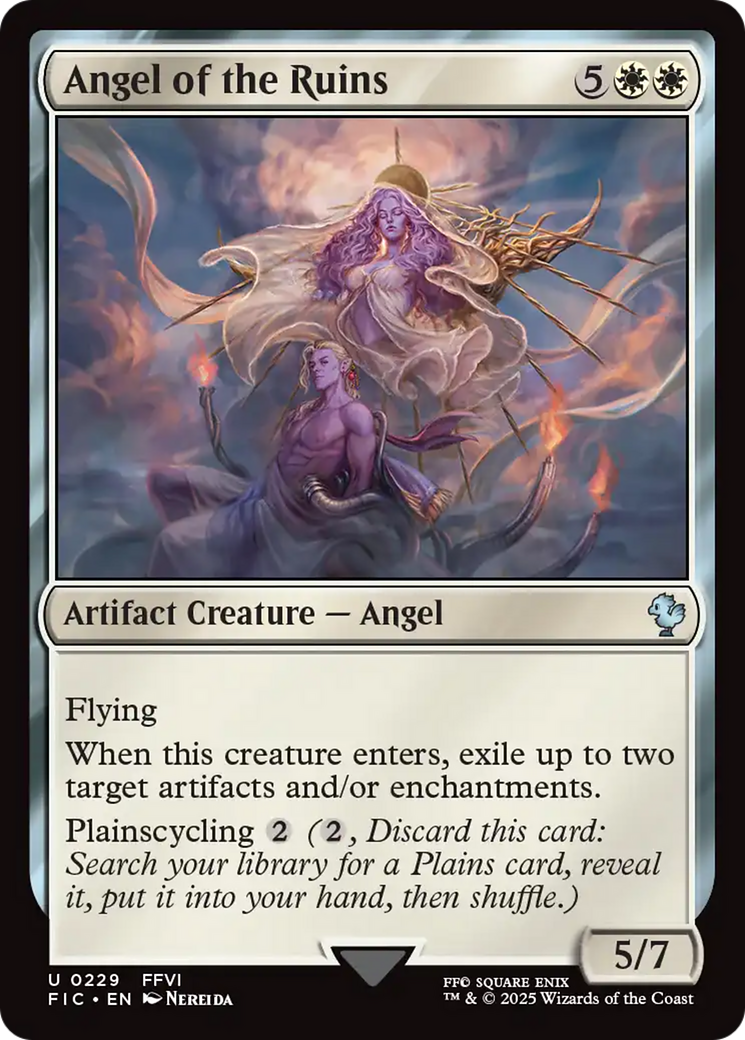
Angel of the Ruins
Angel of the Ruins
Artifact Creature — Angel
5/7
Flying
When this creature enters, exile up to two target artifacts and/or enchantments.
Plainscycling ( , Discard this card: Search your library for a Plains card, reveal it, put it into your hand, then shuffle.)
-
1
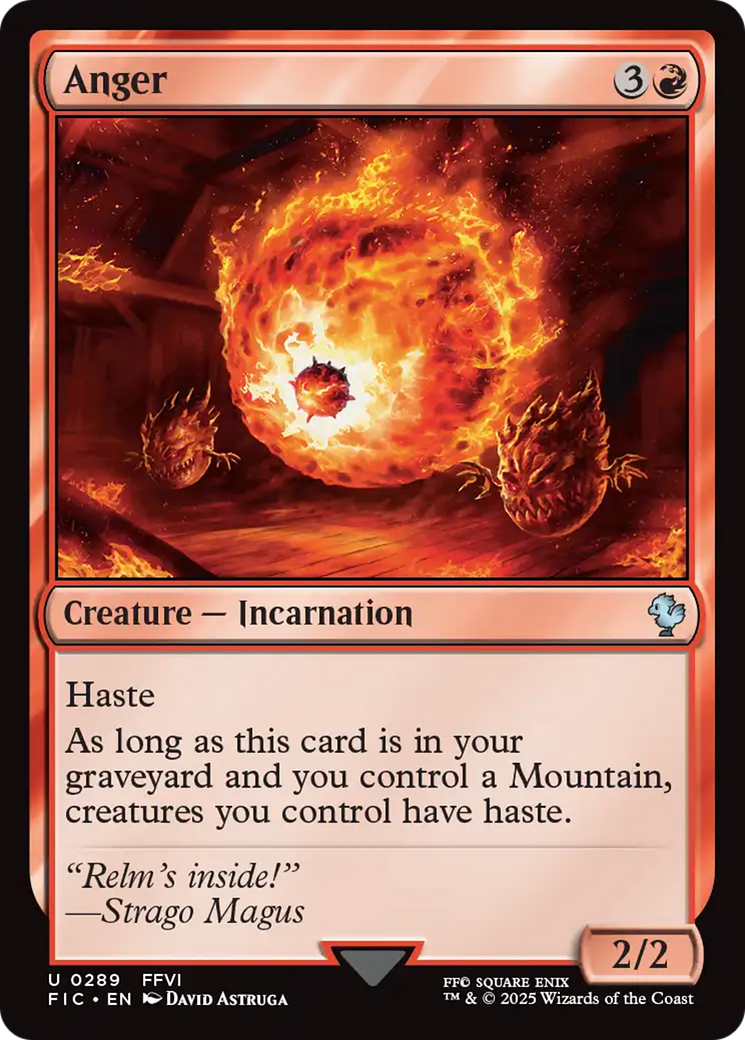
Anger
Anger
Creature — Incarnation
2/2
Haste
As long as this card is in your graveyard and you control a Mountain, creatures you control have haste.
- The timestamp for the "in your graveyard" ability is set at the time that this card goes to your graveyard, regardless of whether you control a Mountain at that time.
-
1
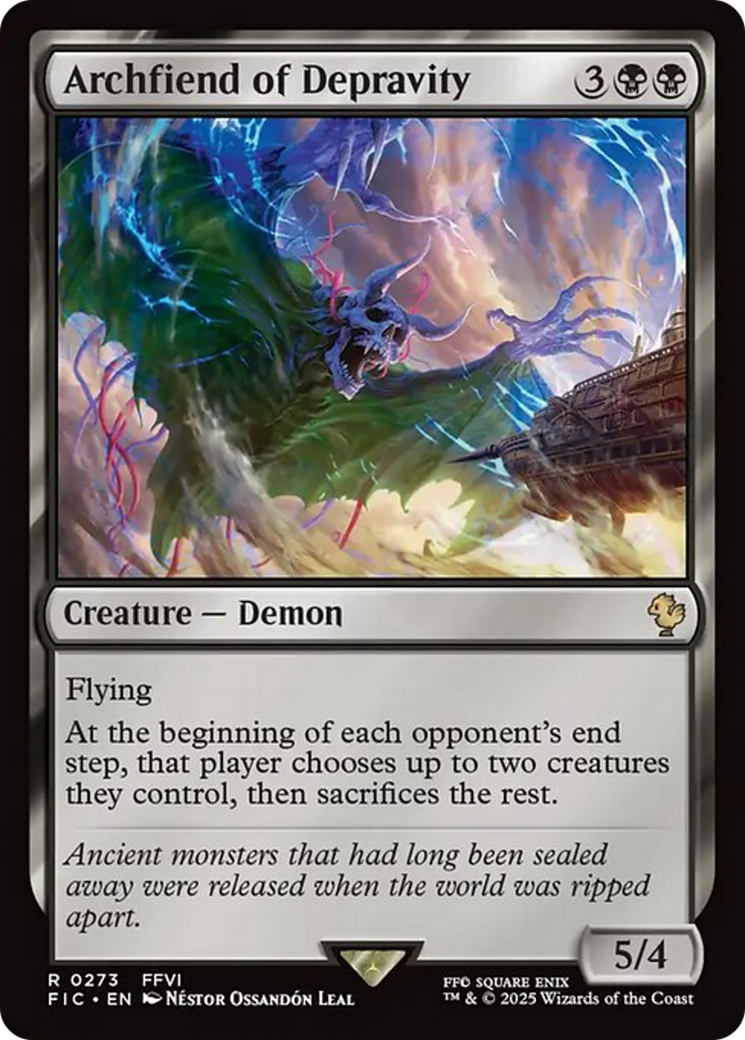
Archfiend of Depravity
Archfiend of Depravity
Creature — Demon
5/4
Flying
At the beginning of each opponent's end step, that player chooses up to two creatures they control, then sacrifices the rest.
- The opponent may choose to spare one or no creatures. If the player doesn't choose any creatures, they will sacrifice all creatures they control.
- The opponent chooses which creatures to spare, if any, as the ability resolves. This choice doesn't target the creatures.
-
1
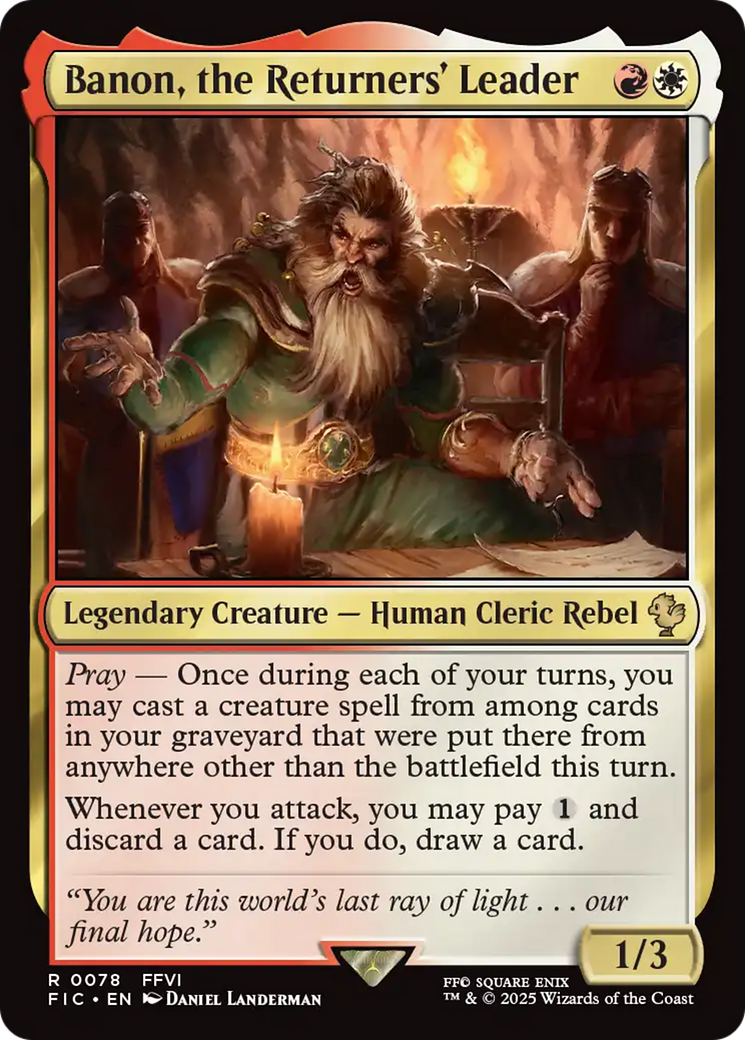
Banon, the Returners' Leader
Banon, the Returners' Leader
Legendary Creature — Human Cleric Rebel
1/3
Pray — Once during each of your turns, you may cast a creature spell from among cards in your graveyard that were put there from anywhere other than the battlefield this turn.
Whenever you attack, you may pay and discard a card. If you do, draw a card.
- You pay all costs and follow all timing rules for cards played with the permission granted by Banon's first ability.
-
1
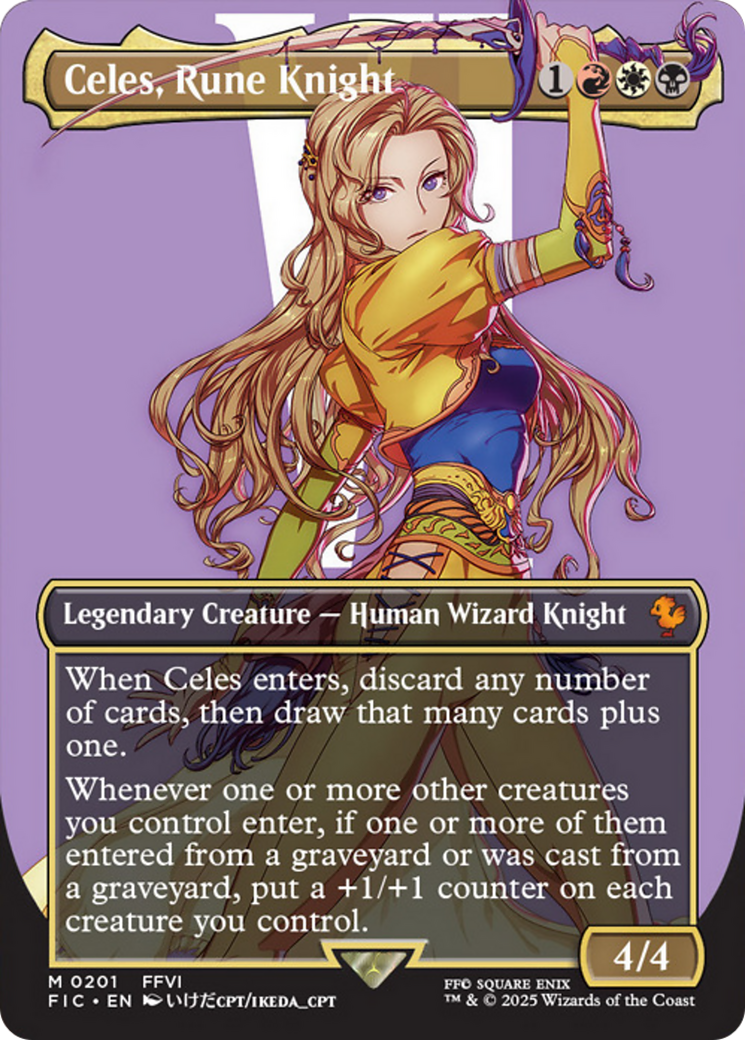
Celes, Rune Knight
Celes, Rune Knight
Legendary Creature — Human Wizard Knight
4/4
When Celes enters, discard any number of cards, then draw that many cards plus one.
Whenever one or more other creatures you control enter, if one or more of them entered from a graveyard or was cast from a graveyard, put a +1/+1 counter on each creature you control.
- You choose how many cards to discard as Celes's first ability resolves. You may choose to discard no cards and just draw a card.
-
1
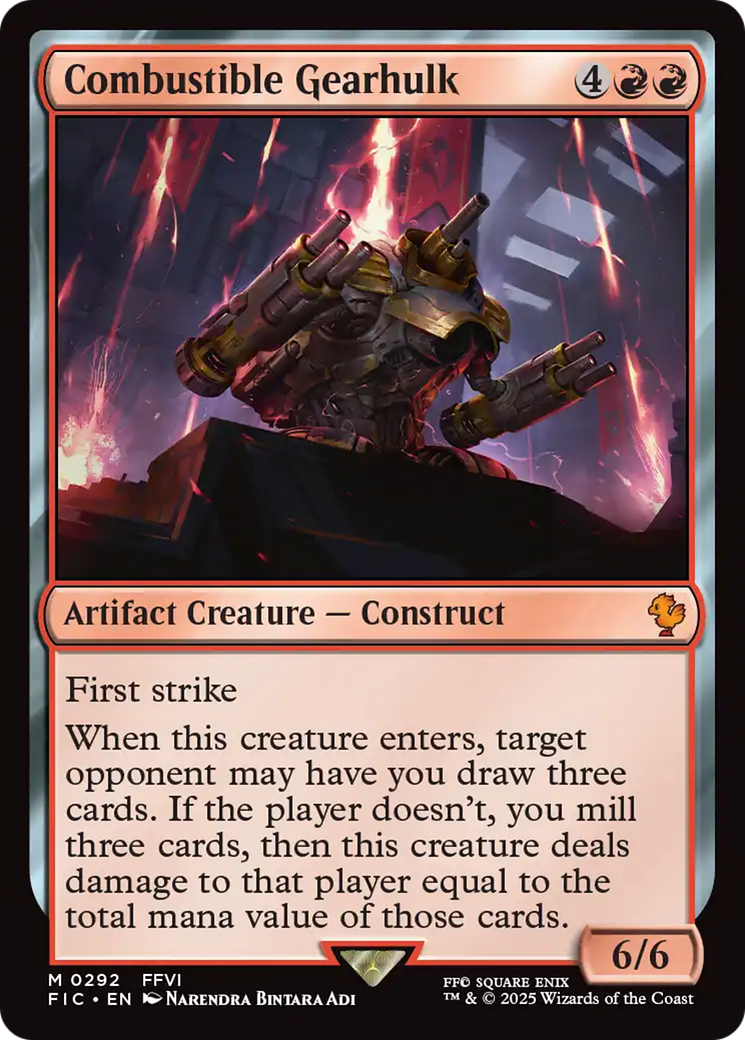
Combustible Gearhulk
Combustible Gearhulk
Artifact Creature — Construct
6/6
First strike
When this creature enters, target opponent may have you draw three cards. If the player doesn't, you mill three cards, then this creature deals damage to that player equal to the total mana value of those cards.
- If any of the cards put into your graveyard have in their mana cost, X is considered to be 0.
- If you have fewer than three cards in your library, the opponent may choose to have you draw three cards. If so, you'll lose the game as state-based actions are performed.
- While Combustible Gearhulk's triggered ability is resolving, no player may take any actions other than those specified by the Gearhulk. Once the opponent makes a choice, players can't cast spells or activate abilities until after the cards are drawn or put into the graveyard and damage has been dealt (if applicable).
-
1
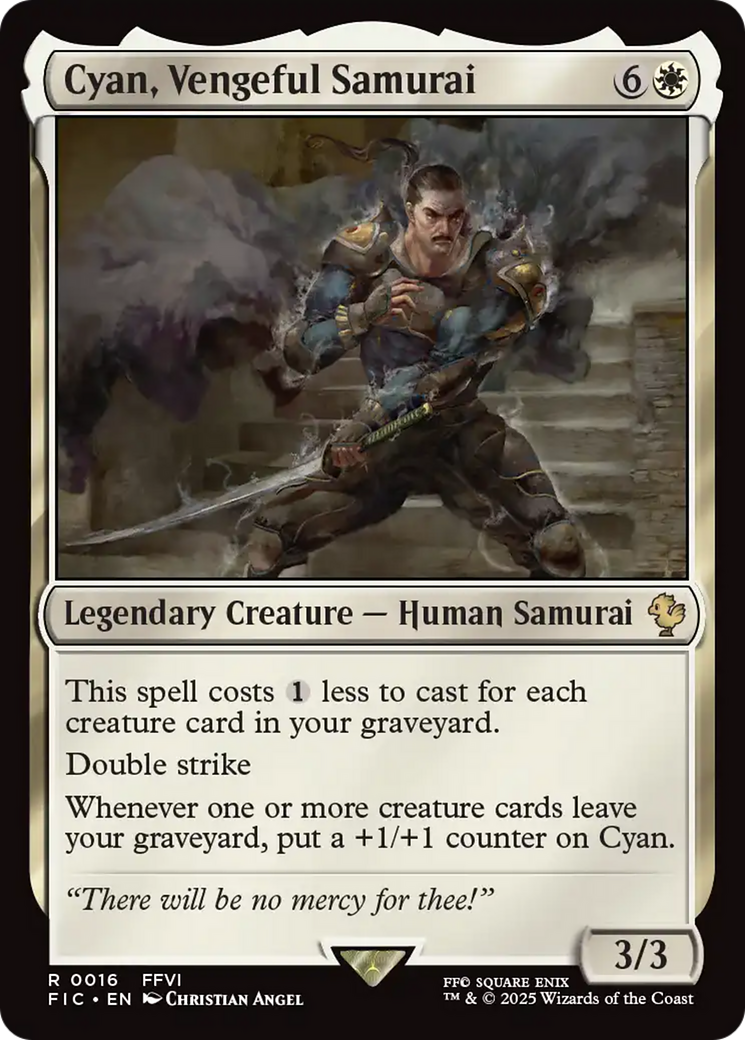
Cyan, Vengeful Samurai
Cyan, Vengeful Samurai
Legendary Creature — Human Samurai
3/3
This spell costs less to cast for each creature card in your graveyard.
Double strike
Whenever one or more creature cards leave your graveyard, put a +1/+1 counter on Cyan.
- If multiple creature cards leave your graveyard at the same time, Cyan's last ability will trigger only once.
-
1
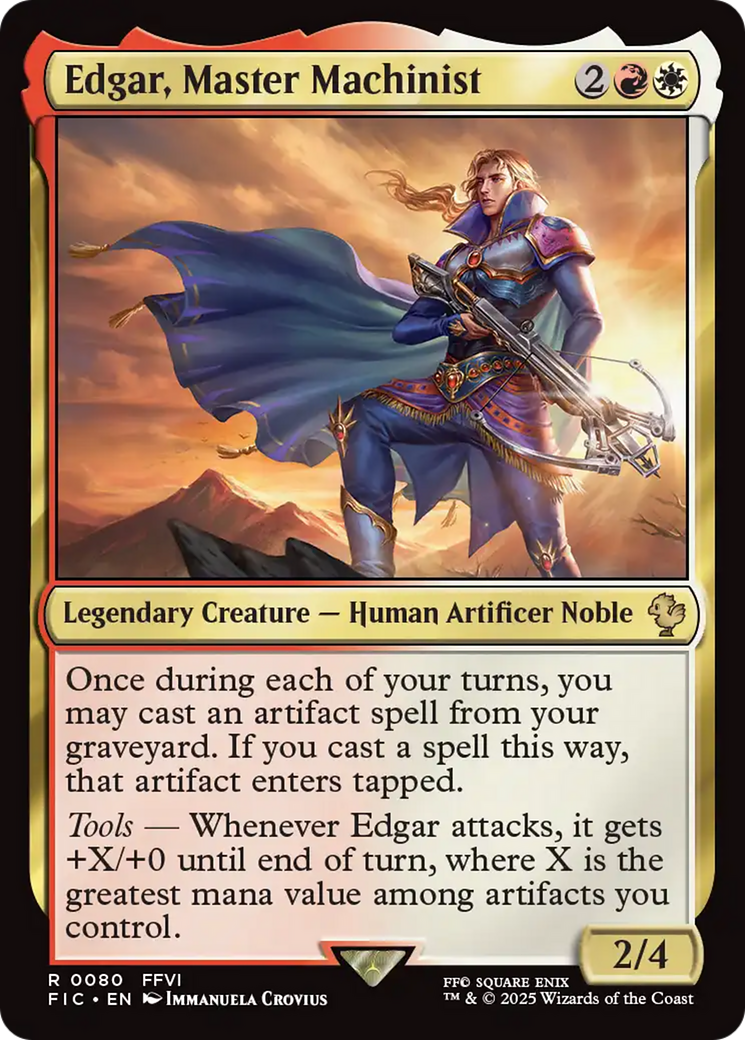
Edgar, Master Machinist
Edgar, Master Machinist
Legendary Creature — Human Artificer Noble
2/4
Once during each of your turns, you may cast an artifact spell from your graveyard. If you cast a spell this way, that artifact enters tapped.
Tools — Whenever Edgar attacks, it gets +X/+0 until end of turn, where X is the greatest mana value among artifacts you control.
- Edgar must be under your control in order to start casting an artifact spell using its first ability, but it doesn't need to stay under your control throughout that process or be under your control as the spell resolves. If, for example, you sacrifice Edgar to pay an additional cost of the spell or Edgar is destroyed in response, the spell will still resolve normally.
- If an artifact you control has in its mana cost, X is 0 for the purpose of calculating its mana value.
- You must still pay all costs and follow any timing restrictions and permissions for artifact spells you cast from your graveyard this way. Normally, you'll be able to cast them only during your main phase while the stack is empty.
- The value of X is calculated only once, as Edgar's last ability resolves.
-
1
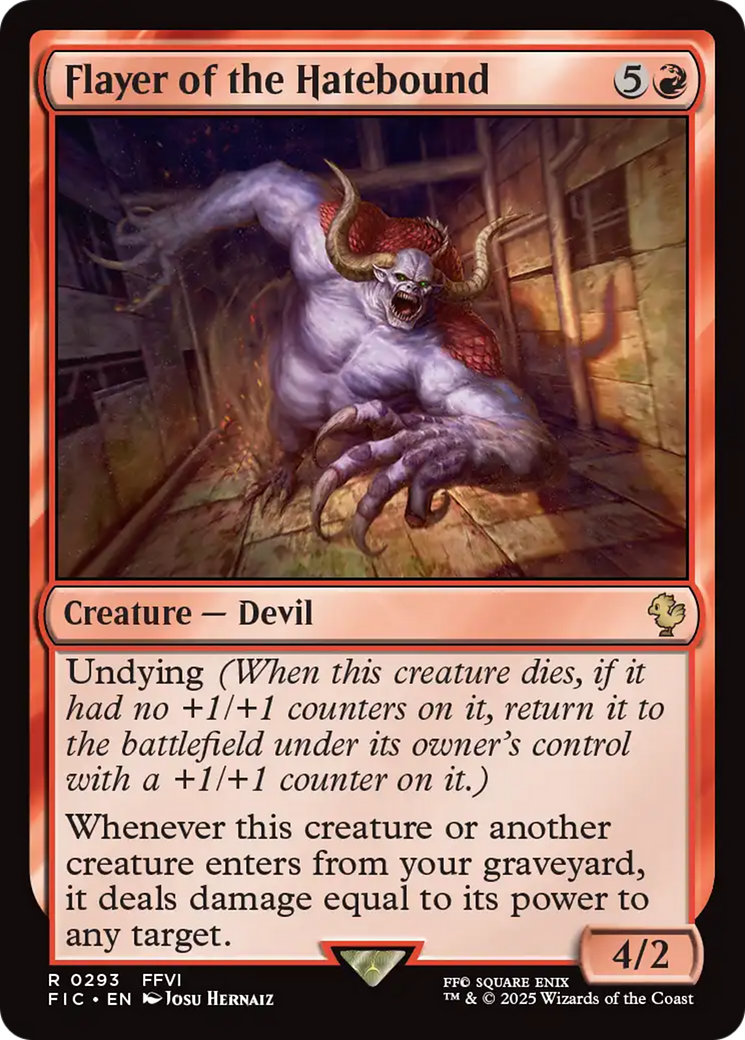
Flayer of the Hatebound
Flayer of the Hatebound
Creature — Devil
4/2
Undying (When this creature dies, if it had no +1/+1 counters on it, return it to the battlefield under its owner's control with a +1/+1 counter on it.)
Whenever this creature or another creature enters from your graveyard, that creature deals damage equal to its power to any target.
- Flayer of the Hatebound's last ability will trigger even if a creature enters from your graveyard under another player's control.
- The creature that entered from your graveyard deals damage equal to its current power (including any +1/+1 counters it entered with) to the target permanent or player. If it's no longer on the battlefield when the ability resolves, its last known existence on the battlefield is checked to determine its power.
- Flayer of the Hatebound is the source of the ability, but it may be another creature that is the source of the damage. If a black creature enters from your graveyard, the ability could target a creature with protection from black, although the damage will be prevented. It couldn't target a creature with protection from red.
- Since damage is dealt by the creature, abilities like lifelink and deathtouch are taken into account, even if the creature has left the battlefield by the time it deals damage.
- If you cast a creature card from your graveyard, that card will be put on the stack before entering. Flayer of the Hatebound won't trigger.
-
1
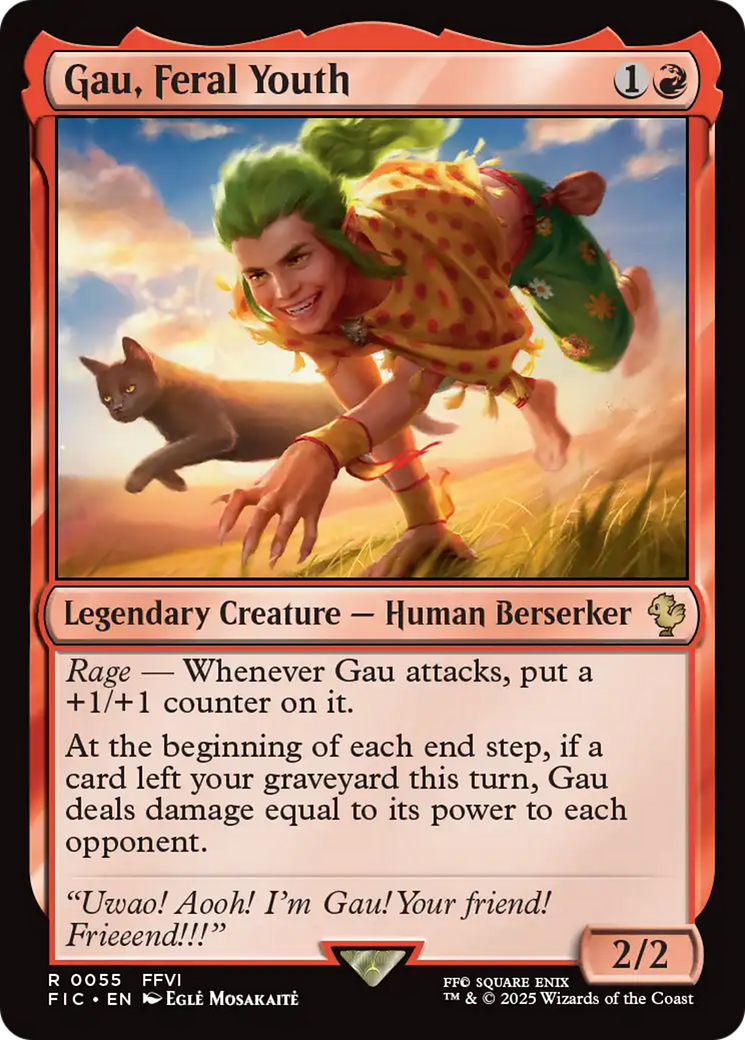
Gau, Feral Youth
Gau, Feral Youth
Legendary Creature — Human Berserker
2/2
Rage — Whenever Gau attacks, put a +1/+1 counter on it.
At the beginning of each end step, if a card left your graveyard this turn, Gau deals damage equal to its power to each opponent.
- If Gau is no longer on the battlefield when its last ability resolves, use its power as it last existed on the battlefield to determine how much damage the ability deals.
- Gau's last ability checks at the moment it would trigger to see if a card left your graveyard this turn. If none did, the ability won't trigger at all. Once your end step begins, it's too late to make a card leave your graveyard in order to cause this ability to trigger.
-
1
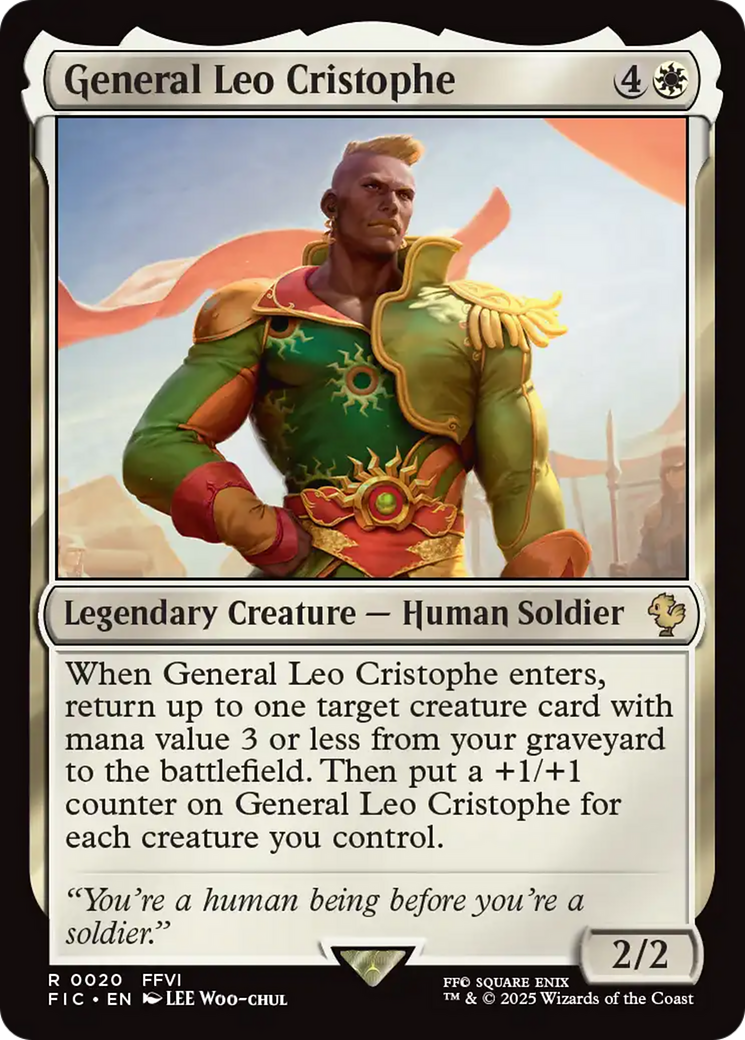
General Leo Cristophe
General Leo Cristophe
Legendary Creature — Human Soldier
2/2
When General Leo Cristophe enters, return up to one target creature card with mana value 3 or less from your graveyard to the battlefield. Then put a +1/+1 counter on General Leo Cristophe for each creature you control.
- If the target creature card is an illegal target as General Leo Cristophe's ability tries to resolve, it won't resolve and none of its effects will happen. You won't put +1/+1 counters on General Leo Cristophe.
- If a card in your graveyard has in its mana cost, X is 0 for the purpose of determining its mana value.
-
1
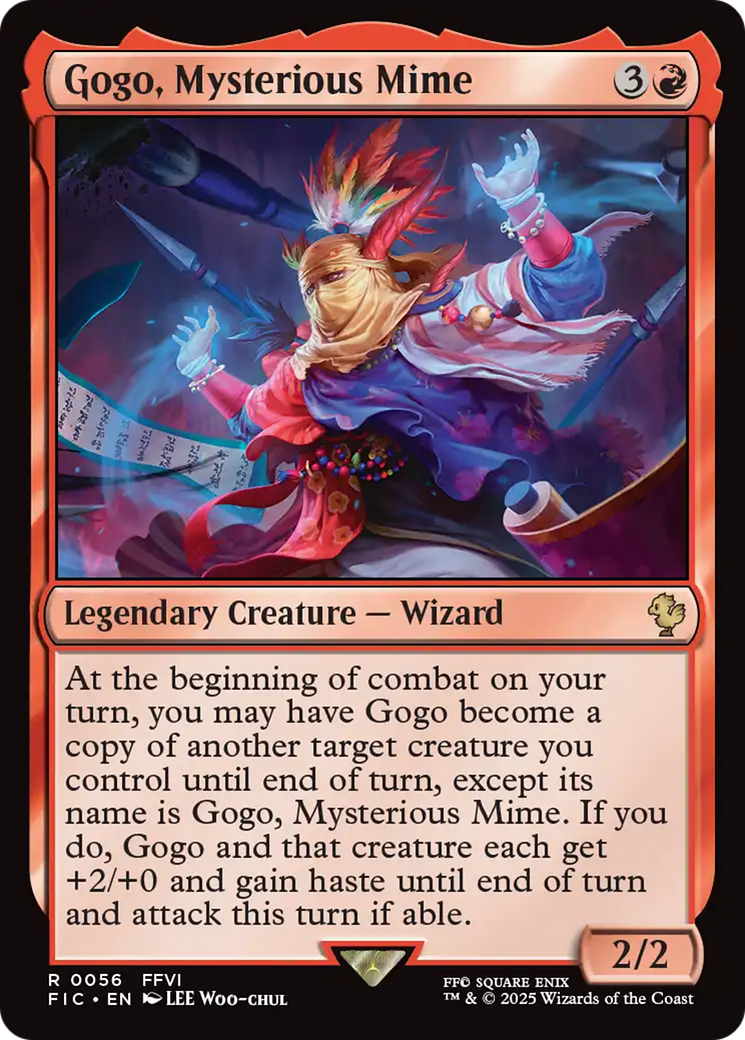
Gogo, Mysterious Mime
Gogo, Mysterious Mime
Legendary Creature — Wizard
2/2
At the beginning of combat on your turn, you may have Gogo become a copy of another target creature you control until end of turn, except its name is Gogo, Mysterious Mime. If you do, Gogo and that creature each get +2/+0 and gain haste until end of turn and attack this turn if able.
- Gogo copies exactly what was printed on the original creature, with the listed exception (unless that creature is copying something else or is a token; see below). It doesn't copy whether that creature is tapped or untapped, whether it has any counters on it or any Auras or Equipment attached to it, or any non-copy effects that have changed its types, color, power and toughness, and so on.
- If the copied creature has in its mana cost, X is 0.
- If the copied creature is a token, Gogo copies the original characteristics of that token as stated by the effect that created the token, with the listed exception.
- If Gogo copies a legendary creature, Gogo will also be legendary, but because its name remains Gogo, Mysterious Mime, the "legend rule" won't cause either of them to be put into the graveyard.
- If the copied creature is copying something else, then Gogo becomes a copy of whatever that creature is copying, with the listed exception.
-
1
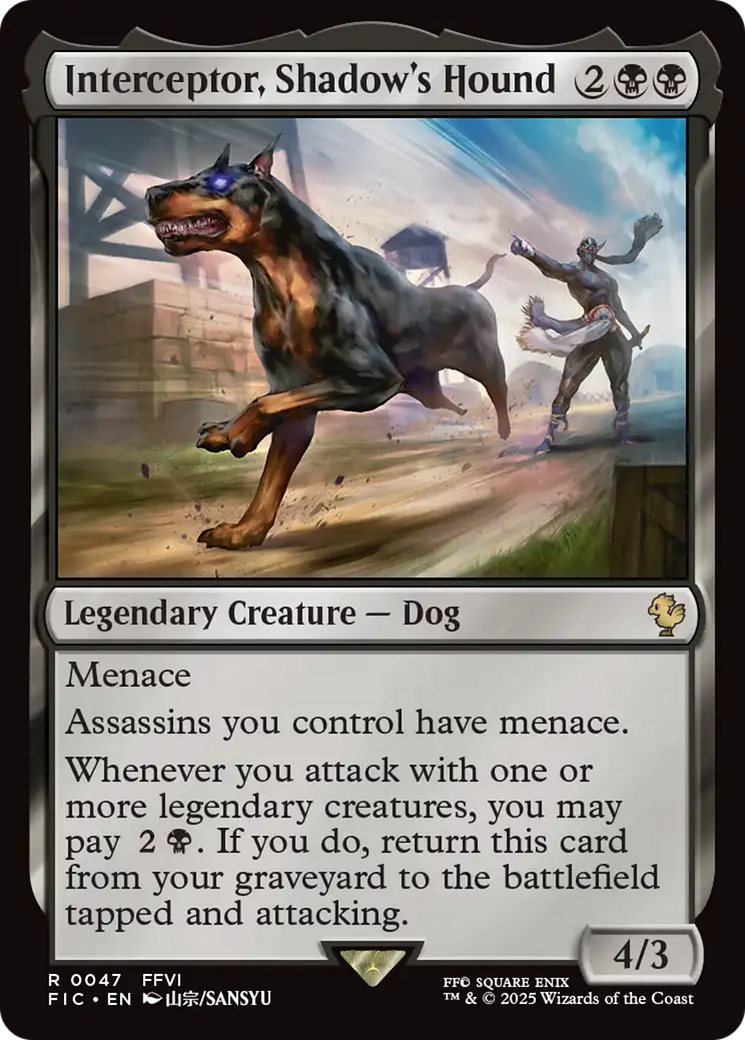
Interceptor, Shadow's Hound
Interceptor, Shadow's Hound
Legendary Creature — Dog
4/3
Menace
Assassins you control have menace.
Whenever you attack with one or more legendary creatures, you may pay . If you do, return this card from your graveyard to the battlefield tapped and attacking.
- Although Interceptor's last ability causes it to enter attacking, it was never declared as an attacking creature. Abilities that trigger whenever a creature attacks won't trigger when it enters attacking.
- As Interceptor returns to the battlefield because of its triggered ability, you choose which player, planeswalker, or battle it's attacking. It doesn't have to attack the same player, planeswalker, or battle as your legendary creatures.
-
1
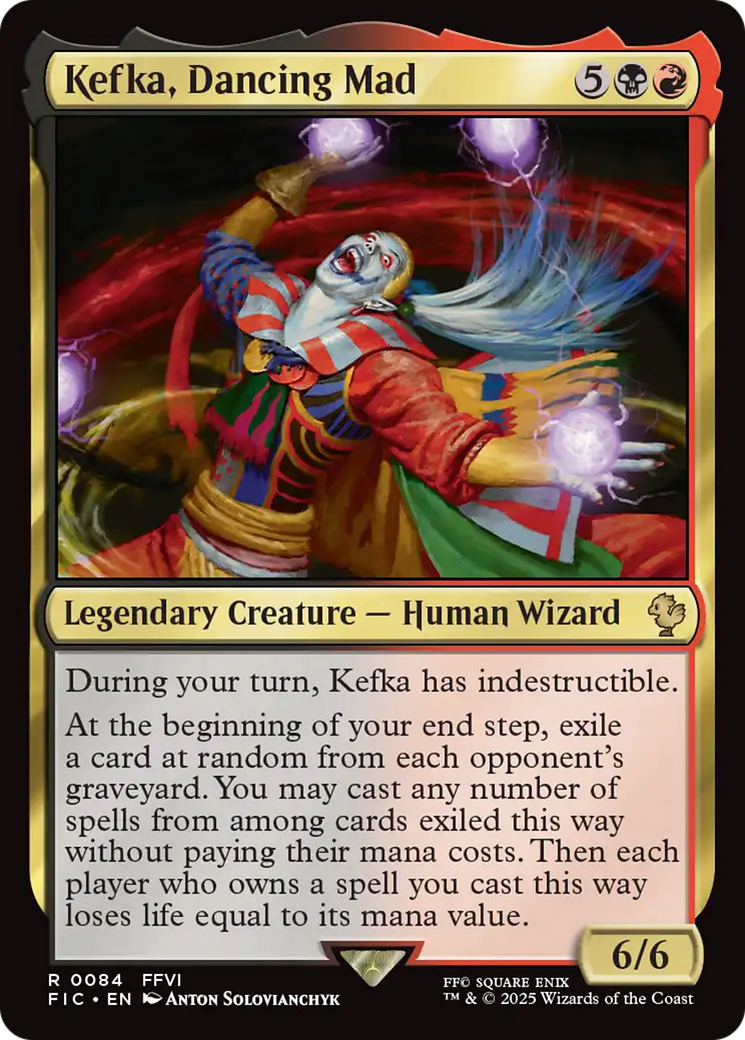
Kefka, Dancing Mad
Kefka, Dancing Mad
Legendary Creature — Human Wizard
6/6
During your turn, Kefka has indestructible.
At the beginning of your end step, exile a card at random from each opponent's graveyard. You may cast any number of spells from among cards exiled this way without paying their mana costs. Then each player who owns a spell you cast this way loses life equal to its mana value.
- You choose which spells to cast (if any) as Kefka's last ability resolves. You can't wait to cast them later in the turn. Timing restrictions based on their types are ignored.
- Cards you choose not to cast this way (or can't cast this way) remain in exile.
- You cast the spells one at a time, choosing modes, targets, and so on. The last spell you cast will be the first one to resolve.
- If you cast a spell "without paying its mana cost," you can't choose to cast it for any alternative costs. You can, however, pay additional costs, such as kicker costs. If the card has any mandatory additional costs, those must be paid to cast the spell.
- If a spell you cast has in its mana cost, you must choose 0 as the value of X when casting it without paying its mana cost.
-
1
Locke, Treasure Hunter
Locke, Treasure Hunter
Legendary Creature — Human Rogue
2/3
Locke can't be blocked by creatures with greater power.
Mug — Whenever Locke attacks, each player mills a card. If a land card was milled this way, create a Treasure token. Until end of turn, you may cast a spell from among those cards.
- As long as one or more lands were milled this way, you'll create a Treasure token. Additional land cards milled beyond the first won't cause you to create additional Treasures.
- You must pay the costs to cast that spell. If it has an alternative cost, you may cast it for that cost instead.
- Once Locke has been blocked, changing its power or the power of the blocking creature won't cause Locke to become unblocked.
- You must follow the normal timing permissions and restrictions of the spell you cast from among those cards.
- Losing control of Locke after the last ability has triggered won't affect your ability to cast a spell from among the milled cards.
- If you cast a spell from among the milled cards using another permission, Locke's effect doesn't apply. You can cast another spell from among the milled cards using the permission granted by Locke's last ability.
-
1
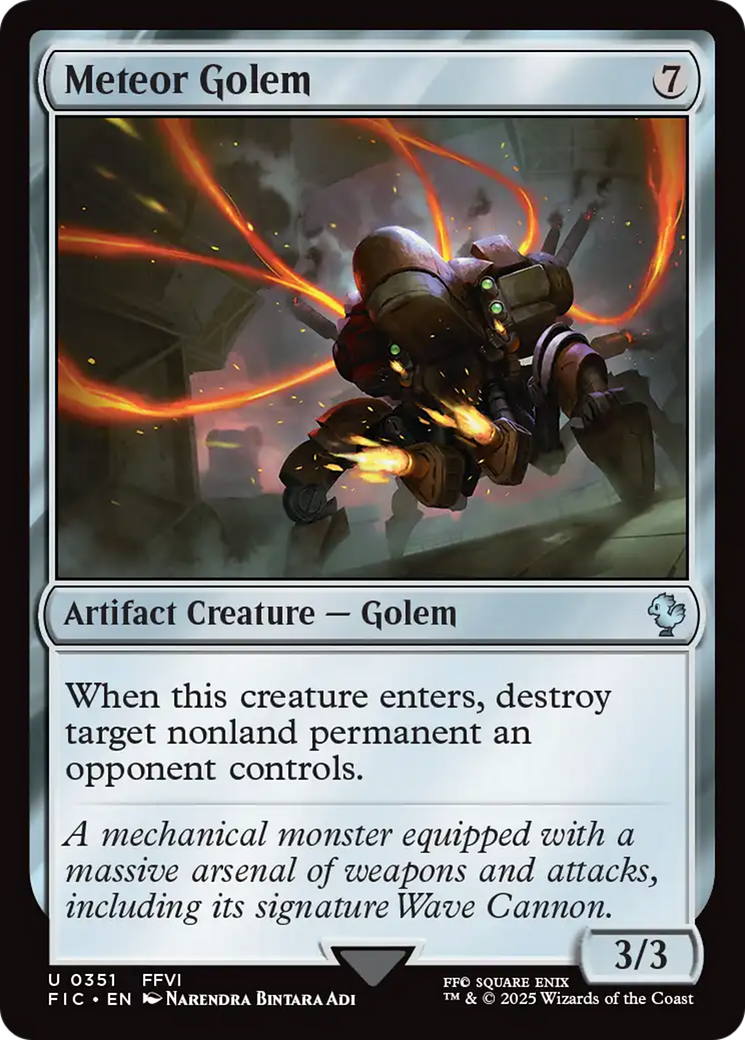
Meteor Golem
Meteor Golem
Artifact Creature — Golem
3/3
When this creature enters, destroy target nonland permanent an opponent controls.
-
1
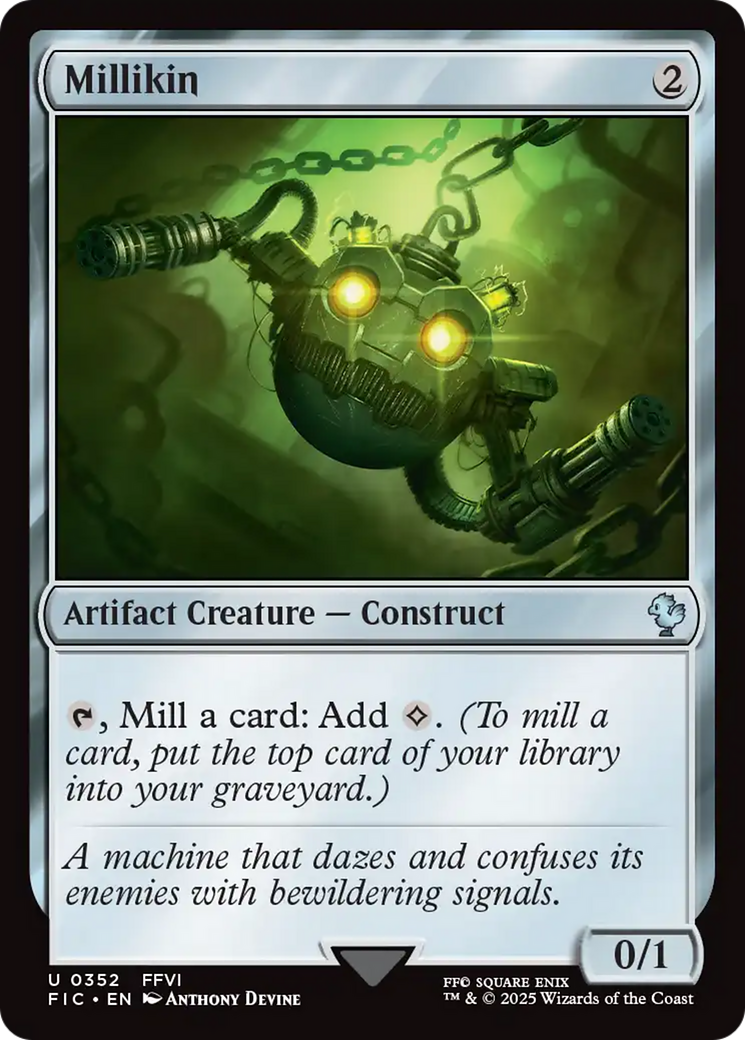
Millikin
Millikin
Artifact Creature — Construct
0/1
, Mill a card: Add . (To mill a card, put the top card of your library into your graveyard.)
- If an effect allows you to look at the top card of your library any time or to play with the top card of your library revealed, and you activate Millikin's mana ability while casting a spell, you can't look at the new top card of your library until you are done casting the spell. The same is true if you activate Millikin's ability while activating another ability.
-
1
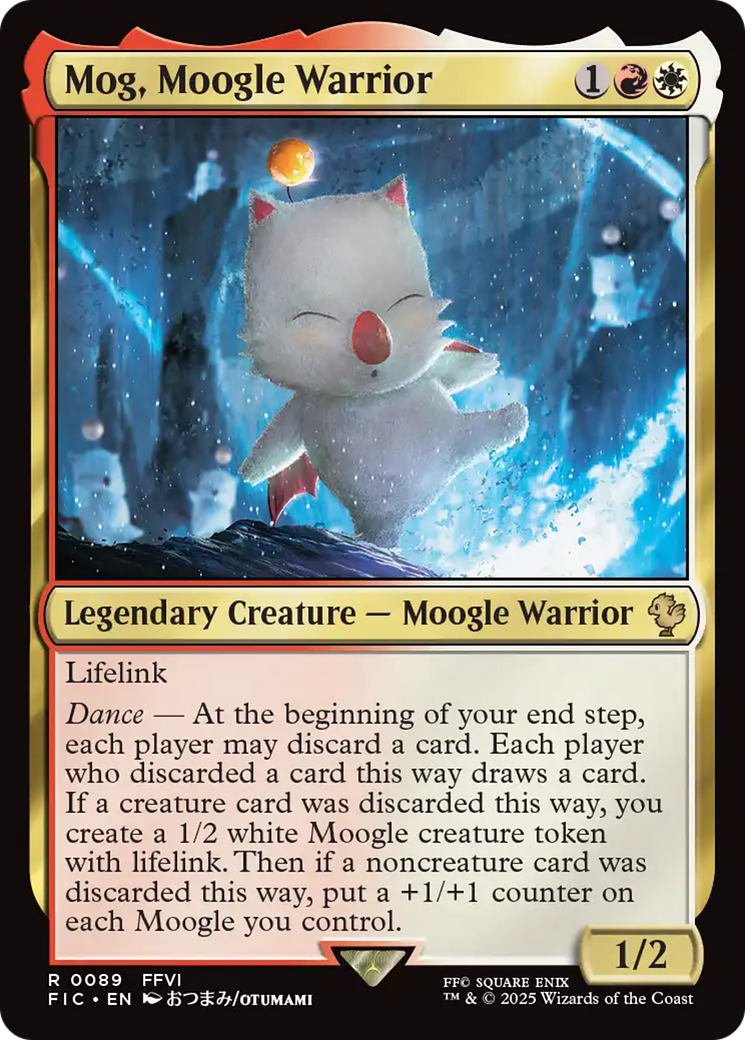
Mog, Moogle Warrior
Mog, Moogle Warrior
Legendary Creature — Moogle Warrior
1/2
Lifelink
Dance — At the beginning of your end step, each player may discard a card. Each player who discarded a card this way draws a card. If a creature card was discarded this way, you create a 1/2 white Moogle creature token with lifelink. Then if a noncreature card was discarded this way, put a +1/+1 counter on each Moogle you control.
- As long as at least one creature card was discarded this way, you'll create a Moogle token, and as long as at least one noncreature card was discarded this way, you'll put a +1/+1 counter on each Moogle you control. Additional creature cards discarded beyond the first won't result in additional Moogle tokens, and additional noncreature cards discarded beyond the first won't result in additional counters.
-
1
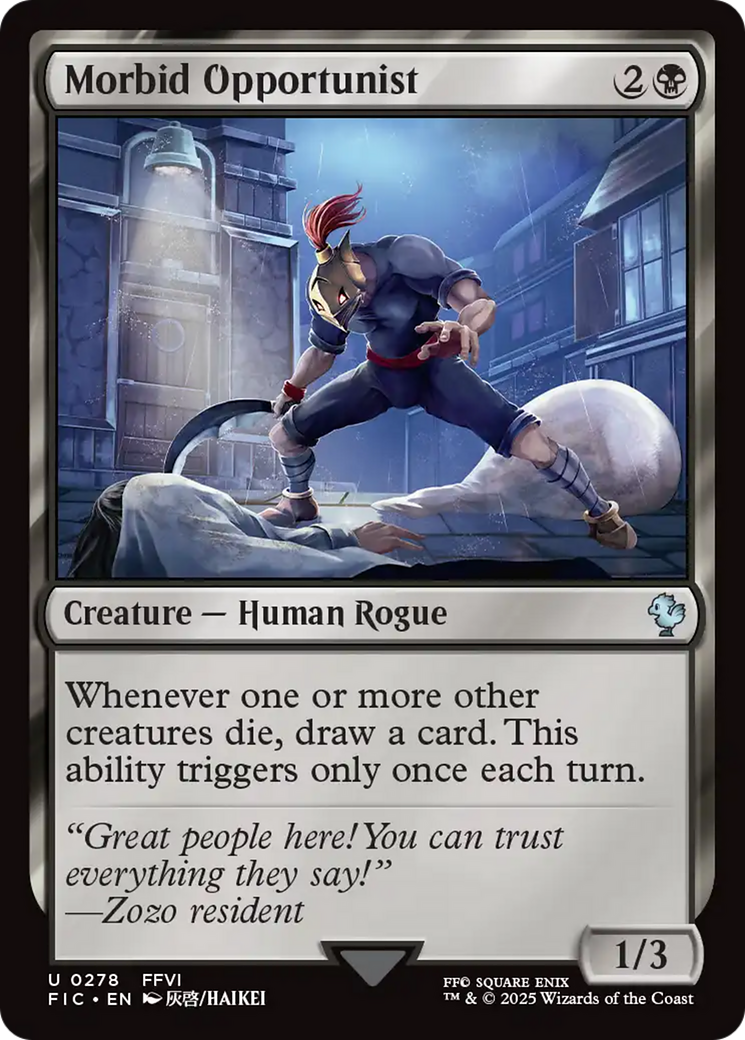
Morbid Opportunist
Morbid Opportunist
Creature — Human Rogue
1/3
Whenever one or more other creatures die, draw a card. This ability triggers only once each turn.
- If Morbid Opportunist dies at the same time as one or more other creatures, Morbid Opportunist's ability still triggers.
-
1
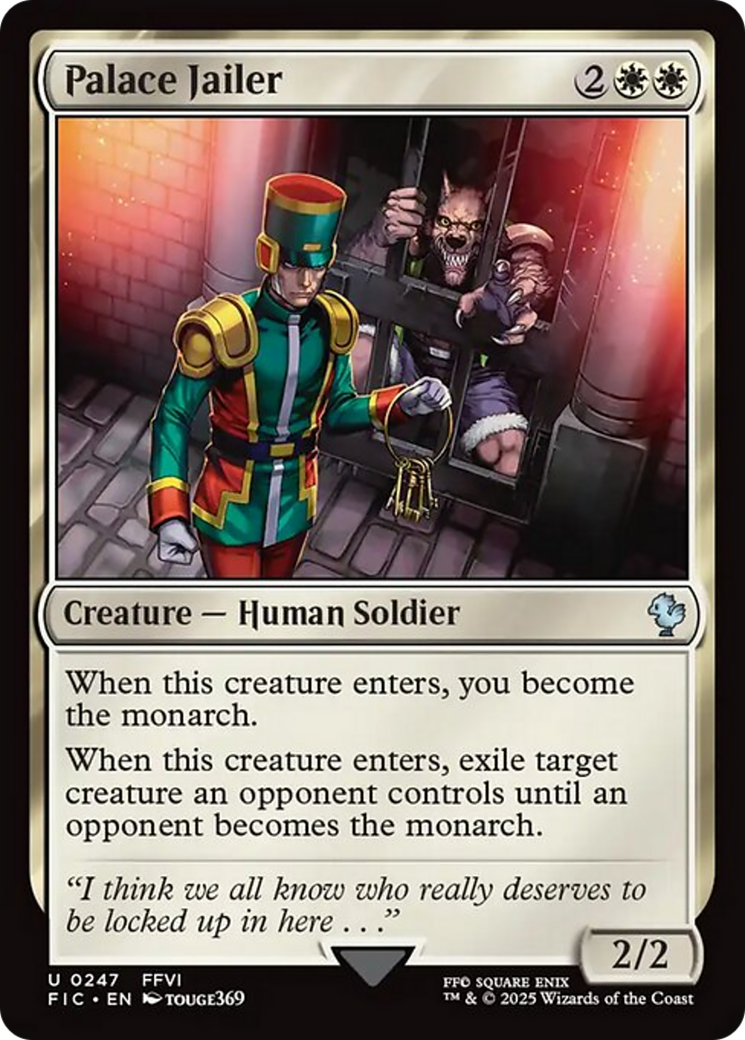
Palace Jailer
Palace Jailer
Creature — Human Soldier
2/2
When this creature enters, you become the monarch.
When this creature enters, exile target creature an opponent controls until an opponent becomes the monarch.
- If a creature token is exiled, it ceases to exist. It won't return to the battlefield.
- The opponent that controlled the exiled card doesn't have to be the same opponent that becomes the monarch in order to cause that card to return to the battlefield. Any opponent becoming the monarch will cause the card to return.
- The game starts with no monarch. Once an effect makes one player the monarch, the game will have exactly one monarch from that point forward.
- Being the monarch carries two inherent triggered abilities. "At the beginning of the monarch's end step, that player draws a card" and "Whenever a creature deals combat damage to the monarch, its controller becomes the monarch."
- If you're not the monarch as Palace Jailer's second ability resolves, the creature will be exiled until there's a new monarch and that player is one of your opponents. The creature won't immediately return just because an opponent is the monarch.
- Auras attached to the exiled creature will be put into their owners' graveyards. Equipment attached to the exiled creature will become unattached and remain on the battlefield. Counters on the exiled creature will cease to exist.
- Palace Jailer leaving the battlefield won't cause the exiled creature to return. The game will continue to watch for the next time an opponent becomes the monarch.
- In a multiplayer game, if the monarch leaves the game, the player whose turn it is immediately becomes the monarch. If the player whose turn it is has left the game, instead the next player in turn order becomes the monarch.
-
1
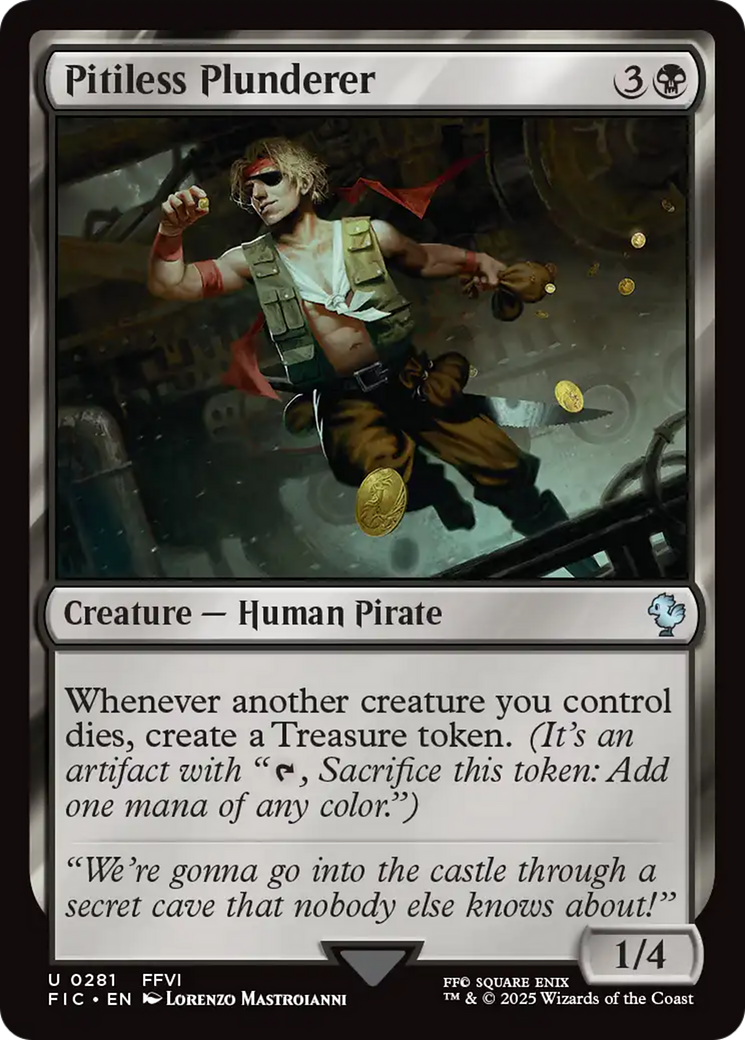
Pitiless Plunderer
Pitiless Plunderer
Creature — Human Pirate
1/4
Whenever another creature you control dies, create a Treasure token. (It's an artifact with " , Sacrifice this token: Add one mana of any color.")
- If Pitiless Plunderer dies at the same time as one or more other creatures you control, its ability will still trigger for each of those other creatures.
-
1
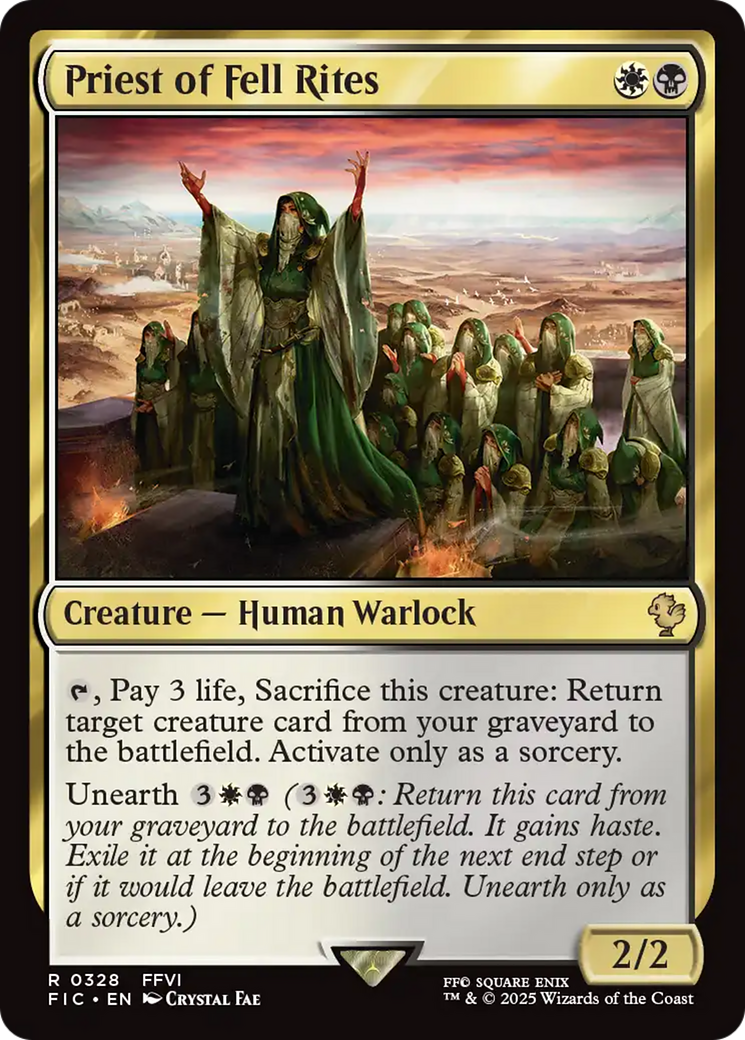
Priest of Fell Rites
Priest of Fell Rites
Creature — Human Warlock
2/2
, Pay 3 life, Sacrifice this creature: Return target creature card from your graveyard to the battlefield. Activate only as a sorcery.
Unearth ( : Return this card from your graveyard to the battlefield. It gains haste. Exile it at the beginning of the next end step or if it would leave the battlefield. Unearth only as a sorcery.)
- Activating a creature card's unearth ability isn't the same as casting the creature card. The unearth ability is put on the stack, but the creature card is not. Spells and abilities that interact with activated abilities (such as Stifle) will interact with unearth, but spells and abilities that interact with spells (such as Cancel) will not.
- You choose the target of the first ability before paying any of that ability's costs. In other words, you can't choose Priest of Fell Rites itself as the target to bring it back from the graveyard.
- If a creature returned to the battlefield by the unearth ability would leave it for any reason, it's exiled instead—unless the spell or ability that's causing the creature to leave the battlefield is actually trying to exile it. In that case, the spell or ability succeeds at exiling the creature. If the spell or ability later returns the creature card to the battlefield (as Ephemerate might, for example), the creature card will return as a new object with no relation to its previous existence. The unearth effect will no longer apply to it.
-
1
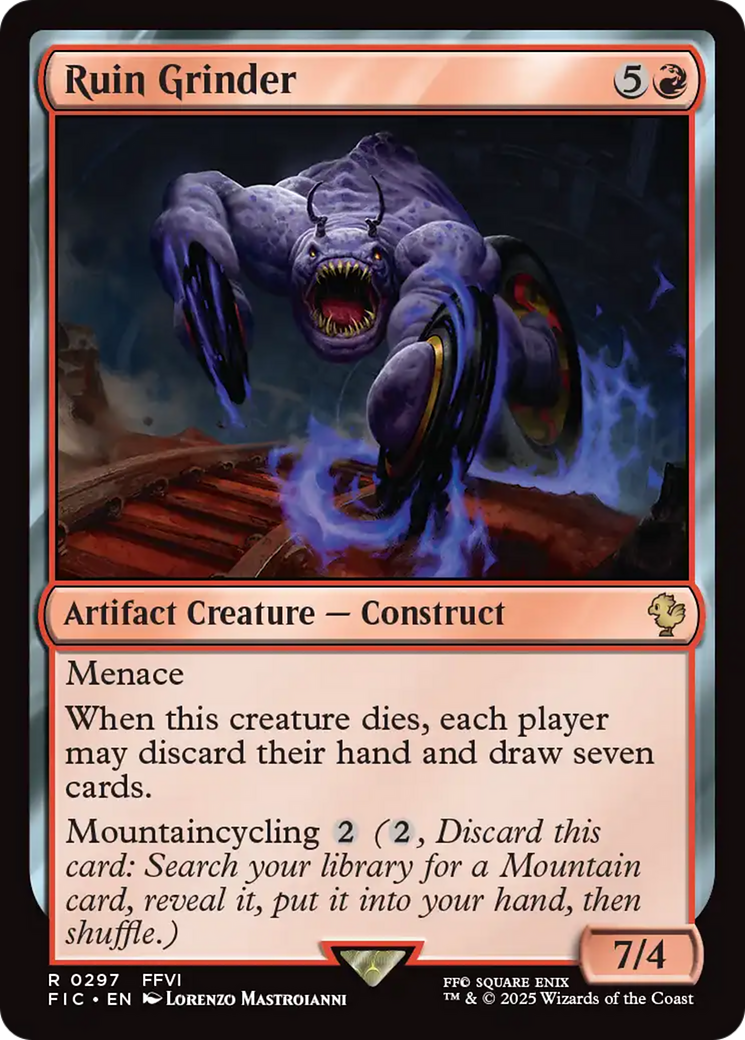
Ruin Grinder
Ruin Grinder
Artifact Creature — Construct
7/4
Menace
When this creature dies, each player may discard their hand and draw seven cards.
Mountaincycling ( , Discard this card: Search your library for a Mountain card, reveal it, put it into your hand, then shuffle.)
- Players decide and announce in turn order, starting with the active player, whether or not they want to discard their hand. Then, all players who chose to do so discard their hands and draw seven cards. Players later in the turn order will know if players before them are discarding, but they don't get to see what those players will discard to help them decide whether to discard themselves.
-
1
Sabin, Master Monk
Sabin, Master Monk
Legendary Creature — Human Noble Monk
4/3
Double strike
Blitz— , Discard a card. (If you cast this spell for its blitz cost, it gains haste and "When this creature dies, draw a card." Sacrifice it at the beginning of the next end step.)
You may cast this card from your graveyard using its blitz ability.
- If you pay the blitz cost to cast a creature spell, that permanent will be sacrificed only if it's still on the battlefield when that triggered ability resolves. If it dies or goes to another zone before then, it will stay where it is.
- If a creature enters the battlefield as a copy of or becomes a copy of a creature whose blitz cost was paid, the copy won't have haste, won't be sacrificed, and its controller won't draw a card when it dies.
- If you choose to pay the blitz cost rather than the mana cost, you're still casting the spell. It goes on the stack and can be responded to and countered. You can cast a creature spell for its blitz cost only if you could cast that creature spell. Most of the time, this means during your main phase when the stack is empty.
- You don't have to attack with the creature with blitz unless another ability says you do.
- The triggered ability that lets its controller draw a card triggers when it dies for any reason, not just when you sacrifice it during the end step.
-
1
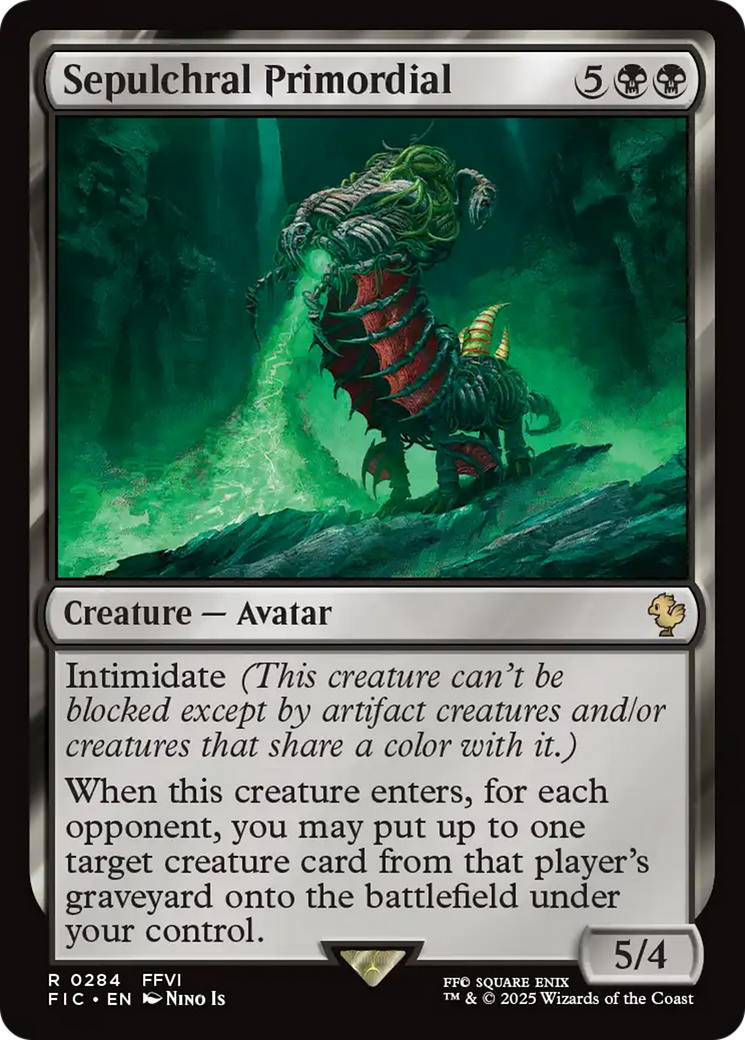
Sepulchral Primordial
Sepulchral Primordial
Creature — Avatar
5/4
Intimidate (This creature can't be blocked except by artifact creatures and/or creatures that share a color with it.)
When this creature enters, for each opponent, you may put up to one target creature card from that player's graveyard onto the battlefield under your control.
- You can choose a number of targets up to the number of opponents you have, one target per opponent.
- The creature cards enter simultaneously.
-
1
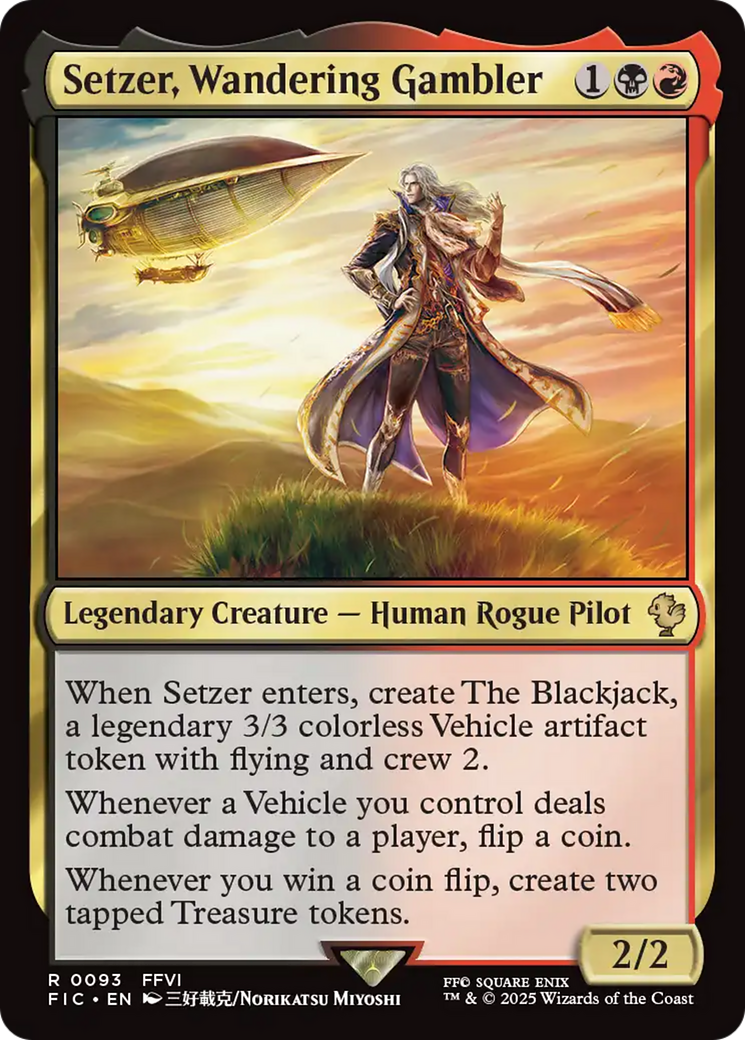
Setzer, Wandering Gambler
Setzer, Wandering Gambler
Legendary Creature — Human Rogue Pilot
2/2
When Setzer enters, create The Blackjack, a legendary 3/3 colorless Vehicle artifact token with flying and crew 2.
Whenever a Vehicle you control deals combat damage to a player, flip a coin.
Whenever you win a coin flip, create two tapped Treasure tokens.
- Some effects that instruct a player to flip a coin care only about whether the coin comes up heads or tails. These effects don't normally cause any player to win or lose that coin flip.
-
1
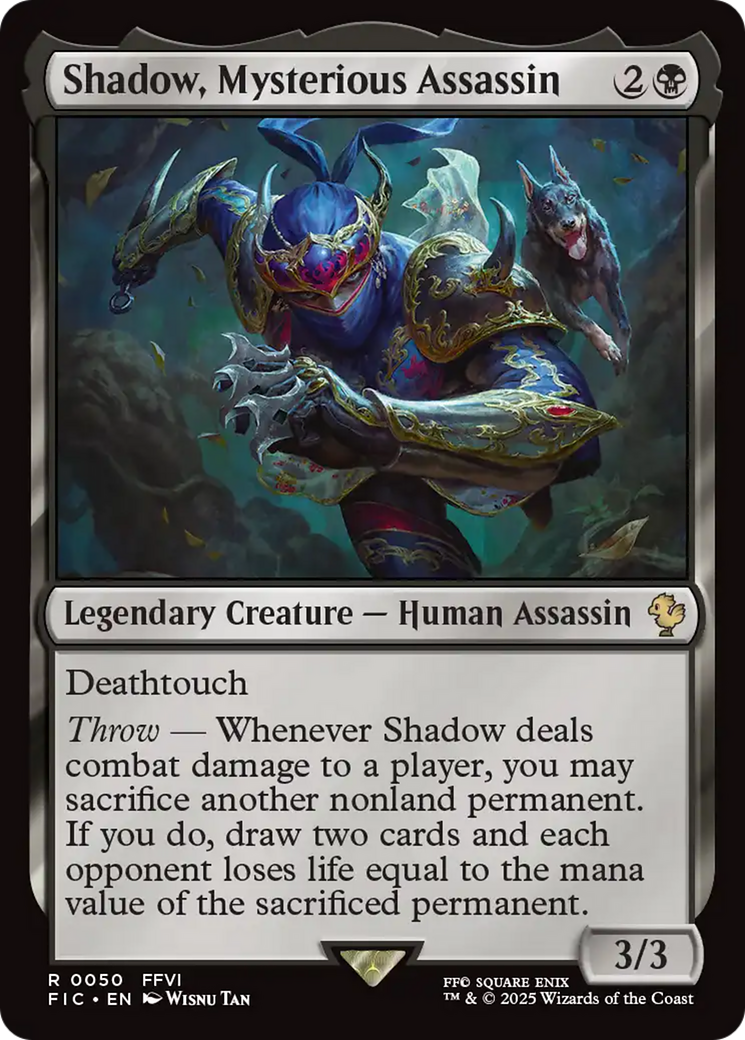
Shadow, Mysterious Assassin
Shadow, Mysterious Assassin
Legendary Creature — Human Assassin
3/3
Deathtouch
Throw — Whenever Shadow deals combat damage to a player, you may sacrifice another nonland permanent. If you do, draw two cards and each opponent loses life equal to the mana value of the sacrificed permanent.
- If a permanent has in its mana cost, X is 0 for the purpose of determining its mana value.
- Use the mana value of the sacrificed permanent as it last existed on the battlefield to determine how much life each opponent loses.
-
1
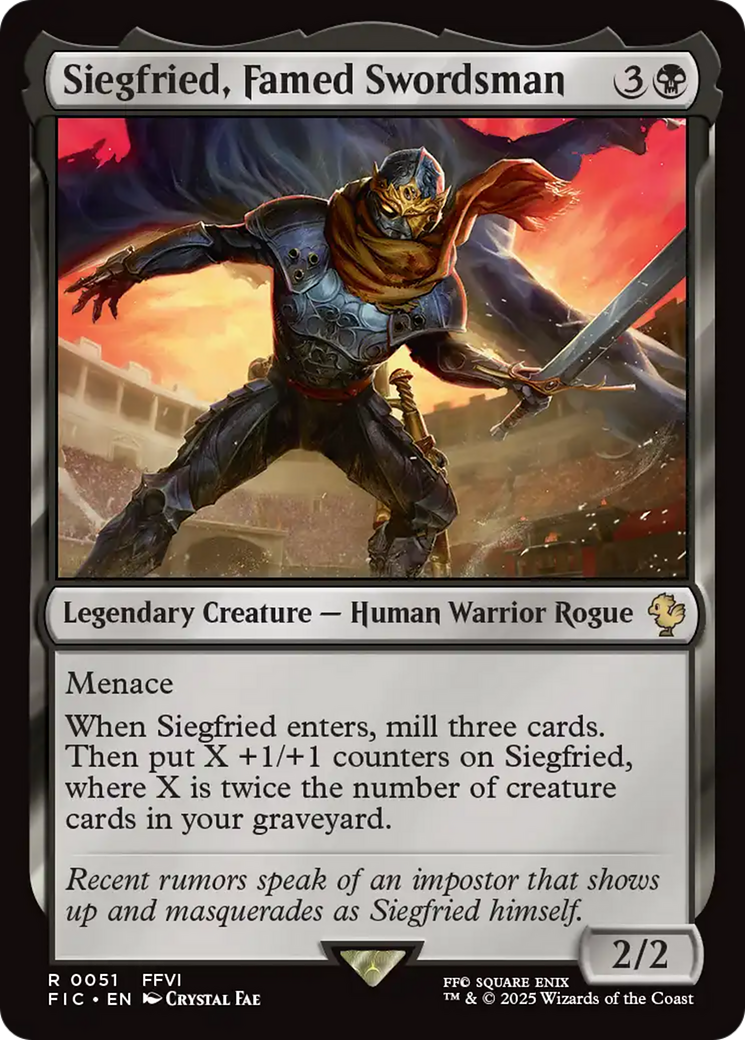
Siegfried, Famed Swordsman
Siegfried, Famed Swordsman
Legendary Creature — Human Warrior Rogue
2/2
Menace
When Siegfried enters, mill three cards. Then put X +1/+1 counters on Siegfried, where X is twice the number of creature cards in your graveyard.
- The value of X is calculated only once, as Siegfried's last ability resolves.
-
1
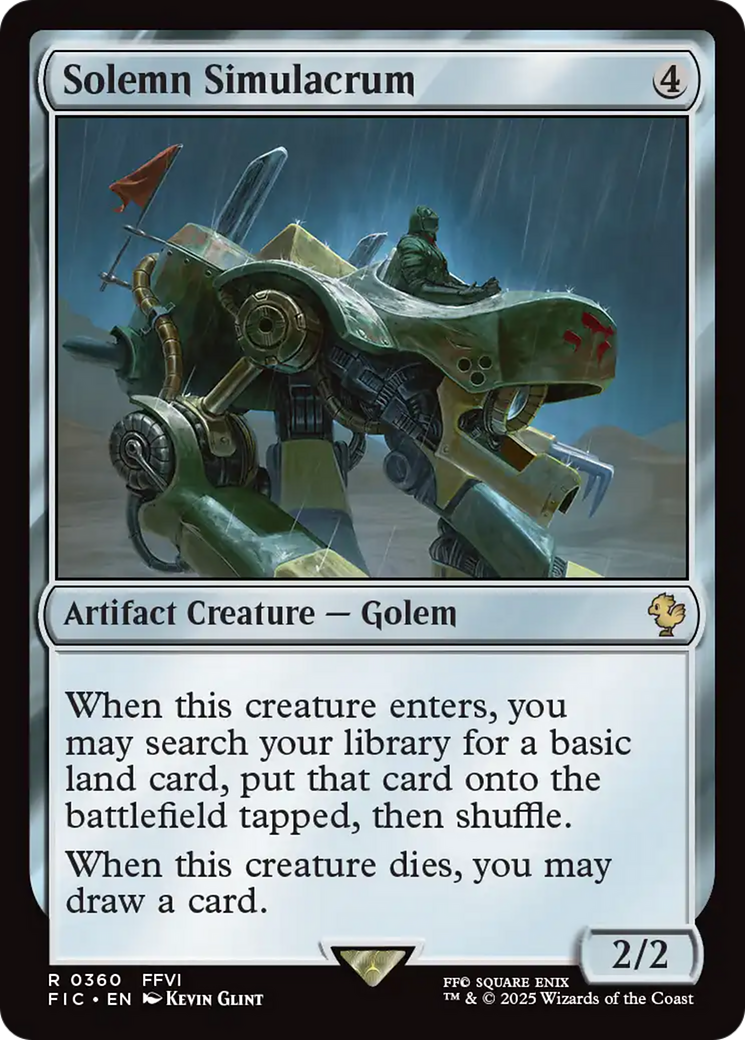
Solemn Simulacrum
Solemn Simulacrum
Artifact Creature — Golem
2/2
When this creature enters, you may search your library for a basic land card, put that card onto the battlefield tapped, then shuffle.
When this creature dies, you may draw a card.
-
1
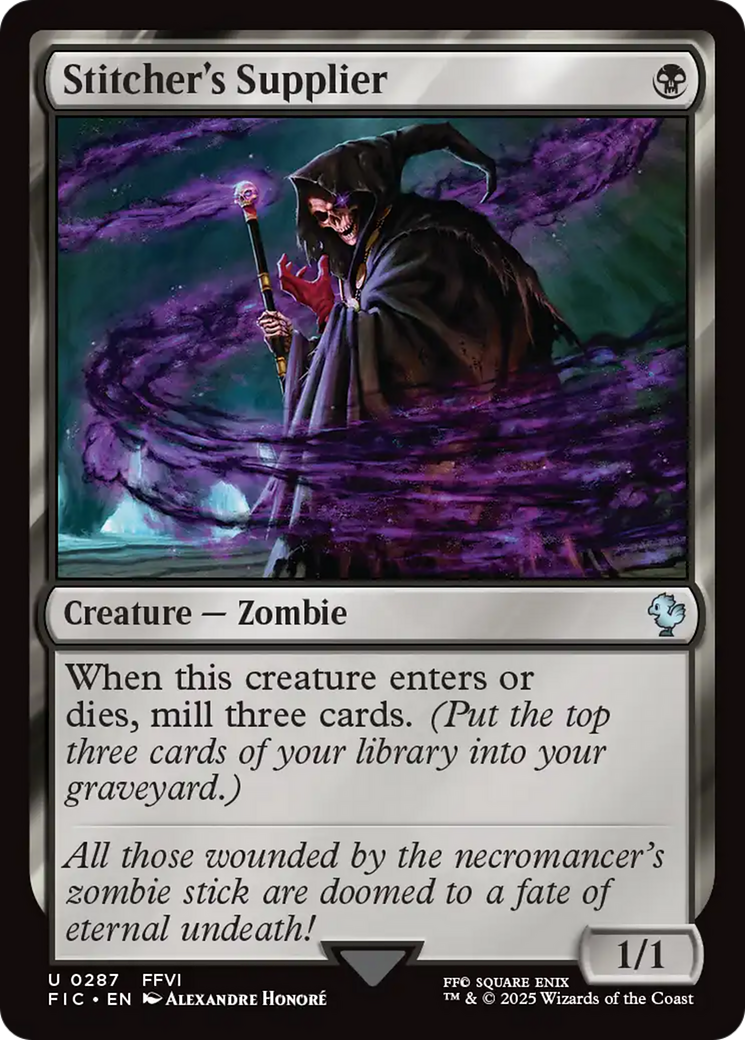
Stitcher's Supplier
Stitcher's Supplier
Creature — Zombie
1/1
When this creature enters or dies, mill three cards. (Put the top three cards of your library into your graveyard.)
-
1
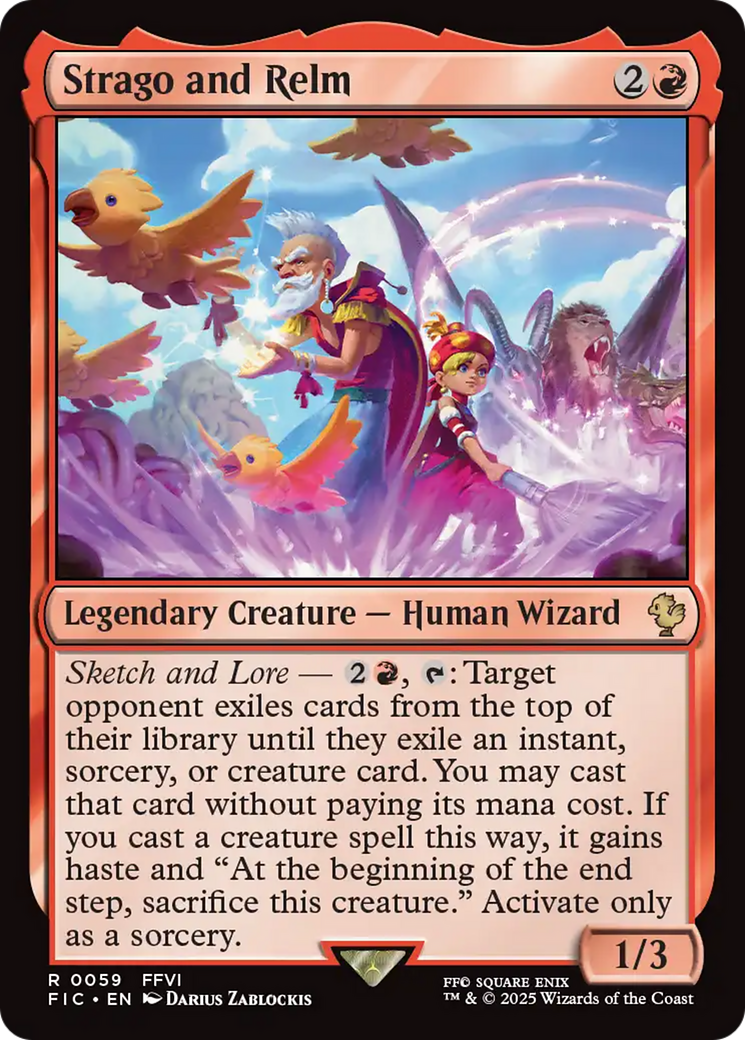
Strago and Relm
Strago and Relm
Legendary Creature — Human Wizard
1/3
Sketch and Lore — , : Target opponent exiles cards from the top of their library until they exile an instant, sorcery, or creature card. You may cast that card without paying its mana cost. If you cast a creature spell this way, it gains haste and "At the beginning of the end step, sacrifice this creature." Activate only as a sorcery.
- If a spell has in its mana cost, you must choose 0 as the value of X when playing it without paying its mana cost.
- You cast the card while Strago and Relm's ability is resolving and still on the stack. You can't wait to play it later in the turn. Timing restrictions based on its types are ignored.
- If you cast a spell "without paying its mana cost," you can't choose to cast it for any alternative costs. You can, however, pay additional costs. If the spell has any mandatory additional costs, those must be paid to cast the spell.
-
1
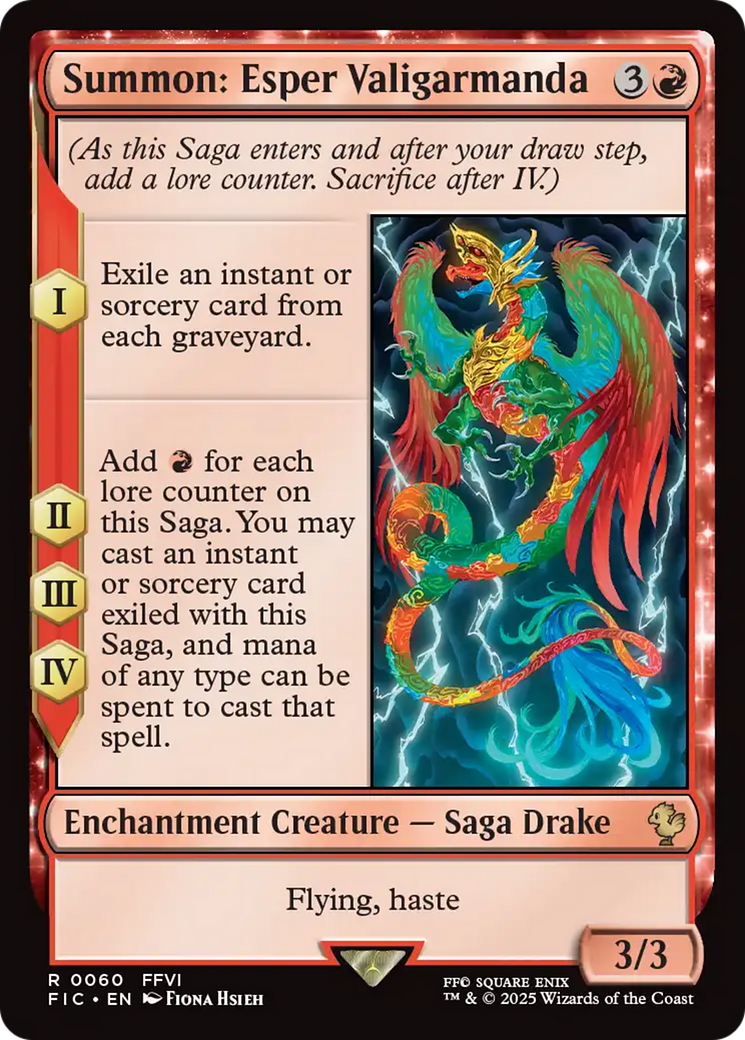
Summon: Esper Valigarmanda
Summon: Esper Valigarmanda
Enchantment Creature — Saga Drake
3/3
(As this Saga enters and after your draw step, add a lore counter. Sacrifice after IV.)
I — Exile an instant or sorcery card from each graveyard.
II, III, IV — Add for each lore counter on this Saga. You may cast an instant or sorcery card exiled with this Saga, and mana of any type can be spent to cast that spell.
Flying, haste
- You cast the spell while the ability is resolving and still on the stack. You can't wait to cast it later in the turn.
- Summon: Esper Valigarmanda's second, third, and fourth chapter abilities aren't mana abilities. They use the stack and can be responded to.
-
1
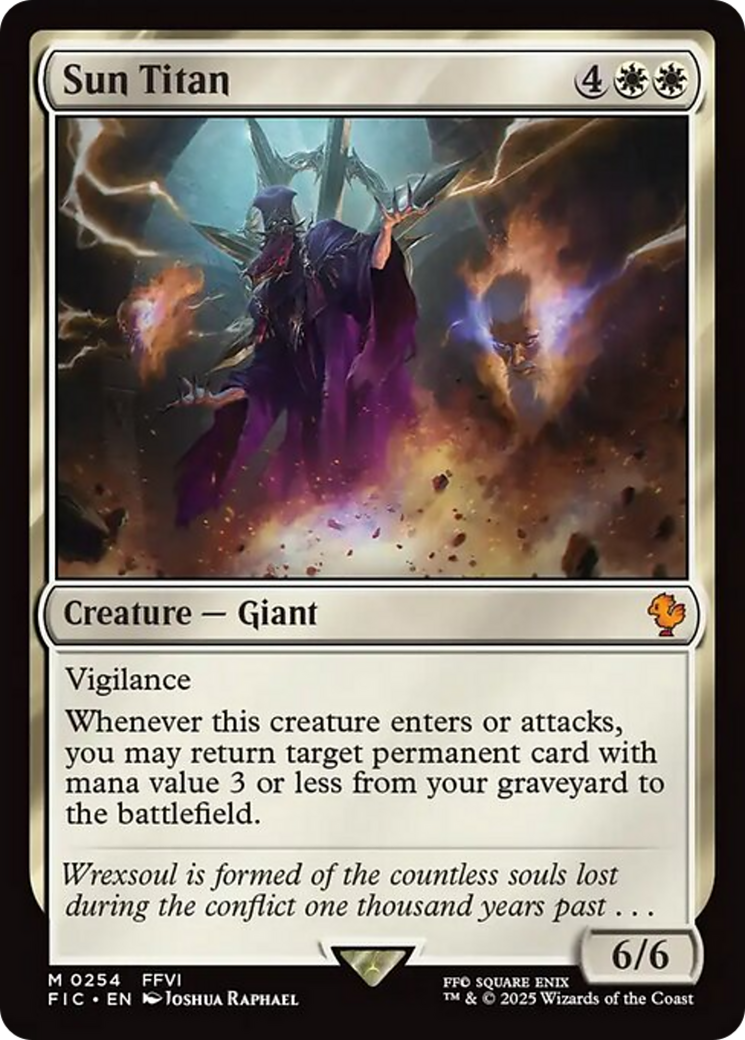
Sun Titan
Sun Titan
Creature — Giant
6/6
Vigilance
Whenever this creature enters or attacks, you may return target permanent card with mana value 3 or less from your graveyard to the battlefield.
- A permanent card is an artifact, creature, enchantment, land, or planeswalker card.
- If a card in your graveyard has no mana symbols in its upper right corner (because it's a land card, for example), its mana value is 0.
- The mana value of a card in your graveyard is determined solely by the mana symbols printed in its upper right corner. The mana value is the total amount of mana in that cost, regardless of color. For example, a card with mana cost has mana value 5.
- If the mana cost of a card in your graveyard includes , X is considered to be 0.
-
1
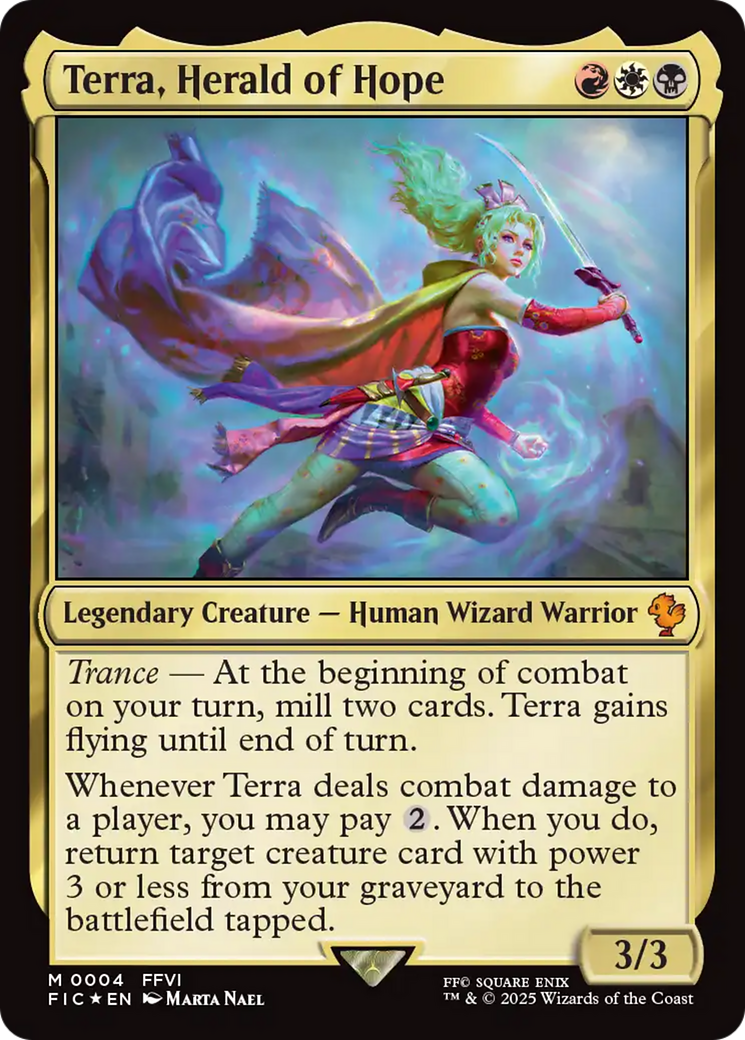
Terra, Herald of Hope
Terra, Herald of Hope
Legendary Creature — Human Wizard Warrior
3/3
Trance — At the beginning of combat on your turn, mill two cards. Terra gains flying until end of turn.
Whenever Terra deals combat damage to a player, you may pay . When you do, return target creature card with power 3 or less from your graveyard to the battlefield tapped.
- You don't choose a target for Terra's last ability at the time it triggers. Rather, a second "reflexive" ability triggers when you pay this way. You choose a target for that ability as it goes on the stack. Each player may respond to this triggered ability as normal.
-
1
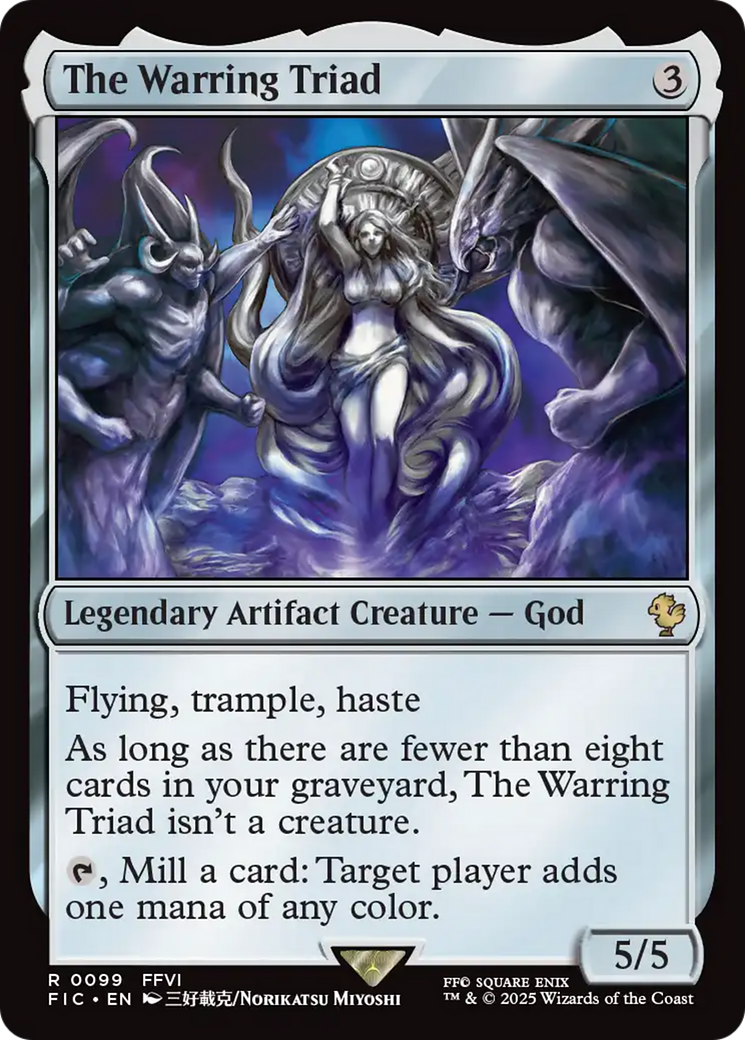
The Warring Triad
The Warring Triad
Legendary Artifact Creature — God
5/5
Flying, trample, haste
As long as there are fewer than eight cards in your graveyard, The Warring Triad isn't a creature.
, Mill a card: Target player adds one mana of any color.
- The Warring Triad's last ability isn't a mana ability. It uses the stack and can be responded to.
- As The Warring Triad enters the battlefield, the number of cards in your graveyard will determine whether any replacement effects that affect creatures entering the battlefield apply to The Warring Triad.
- The type-changing ability that can make The Warring Triad not be a creature functions only on the battlefield. It's always a creature card in other zones, regardless of how many cards are in your graveyard. It's always a creature spell while it's on the stack.
- When The Warring Triad enters the battlefield, the number of cards in your graveyard will determine if a creature entered the battlefield or not for abilities that trigger whenever a creature enters the battlefield.
- The Warring Triad's abilities function while it's on the battlefield, regardless of whether it's a creature.
- If The Warring Triad stops being a creature, it loses the type creature and the creature type God. It continues to be a legendary artifact.
- If The Warring Triad is attacking or blocking and it stops being a creature, it will be removed from combat. It won't rejoin combat if it resumes being a creature later during that combat.
- Counters put on The Warring Triad remain on it while it's not a creature, even if they have no effect.
- If an effect causes The Warring Triad to lose all abilities, its ability that causes it to stop being a creature still applies if appropriate.
-
1
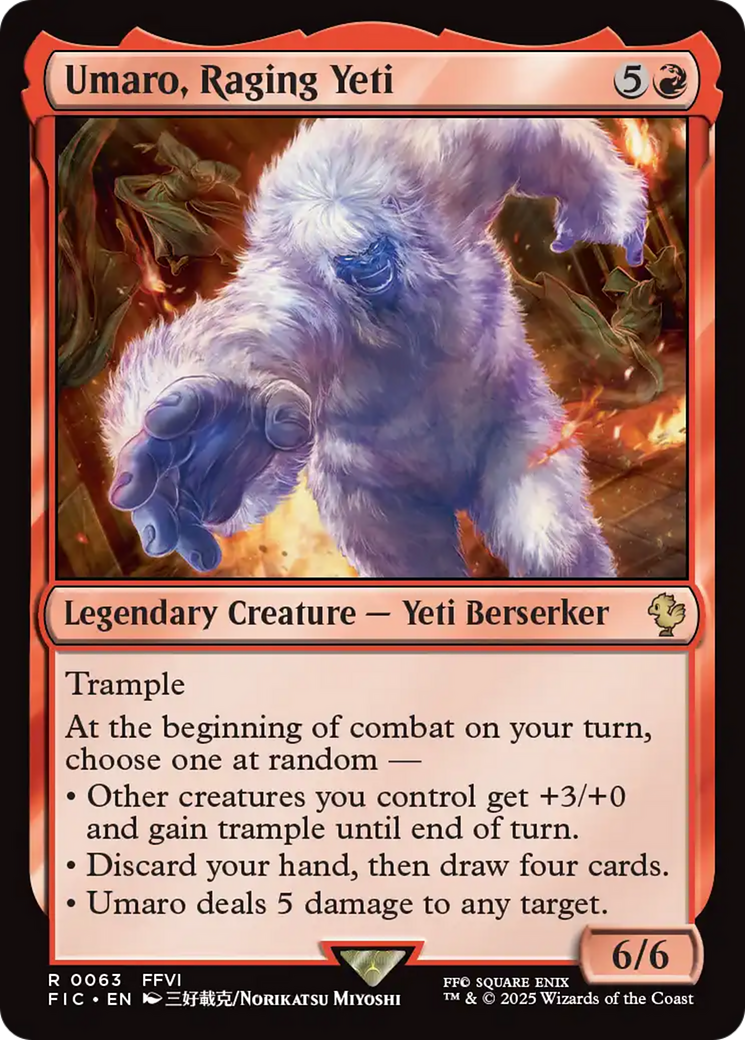
Umaro, Raging Yeti
Umaro, Raging Yeti
Legendary Creature — Yeti Berserker
6/6
Trample
At the beginning of combat on your turn, choose one at random —
- Other creatures you control get +3/+0 and gain trample until end of turn.
- Discard your hand, then draw four cards.
- Umaro deals 5 damage to any target.
- In the incredibly rare case where there is no legal target for the last mode, that mode can't be chosen. The first two modes are always eligible to be chosen.
- As you put Umaro's triggered ability on the stack, you choose a mode at random. Players can respond to the ability knowing which mode was chosen.
Instants 6
-
1
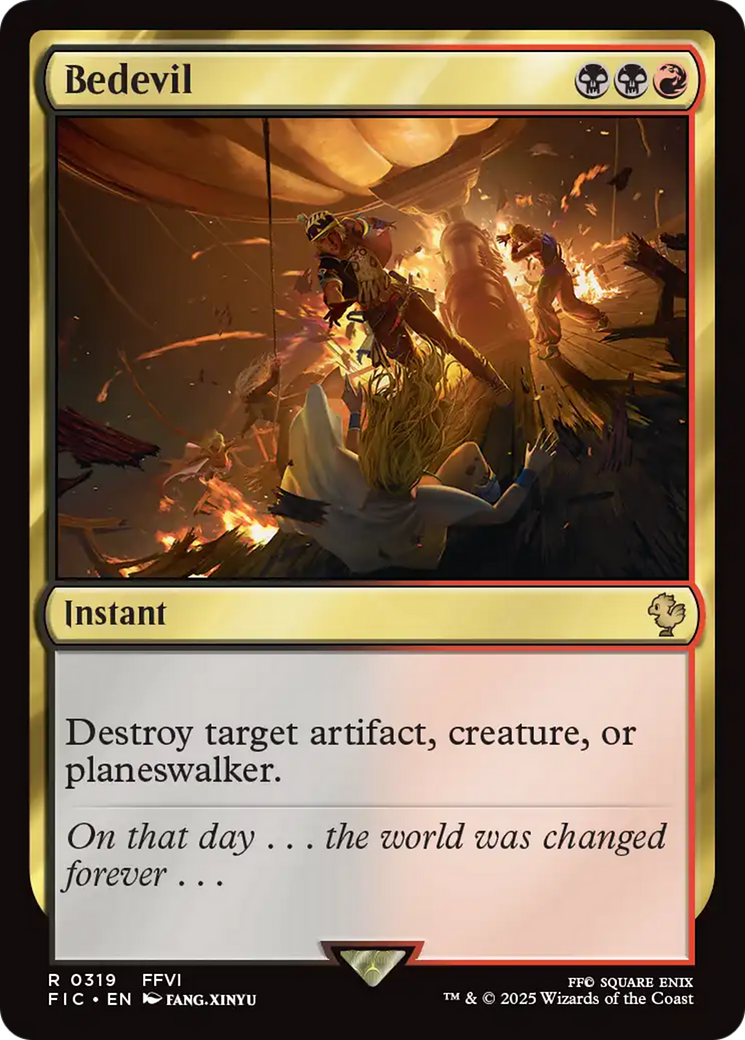
Bedevil
Bedevil
Instant
Destroy target artifact, creature, or planeswalker.
-
1
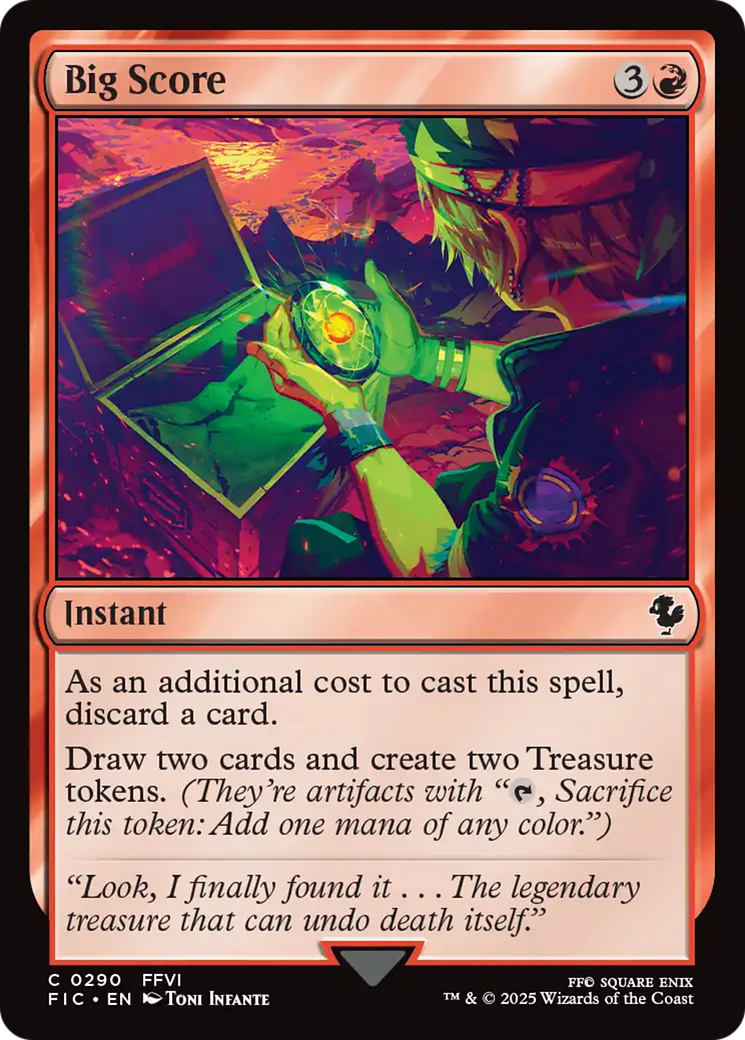
Big Score
Big Score
Instant
As an additional cost to cast this spell, discard a card.
Draw two cards and create two Treasure tokens. (They're artifacts with " , Sacrifice this token: Add one mana of any color.")
-
1
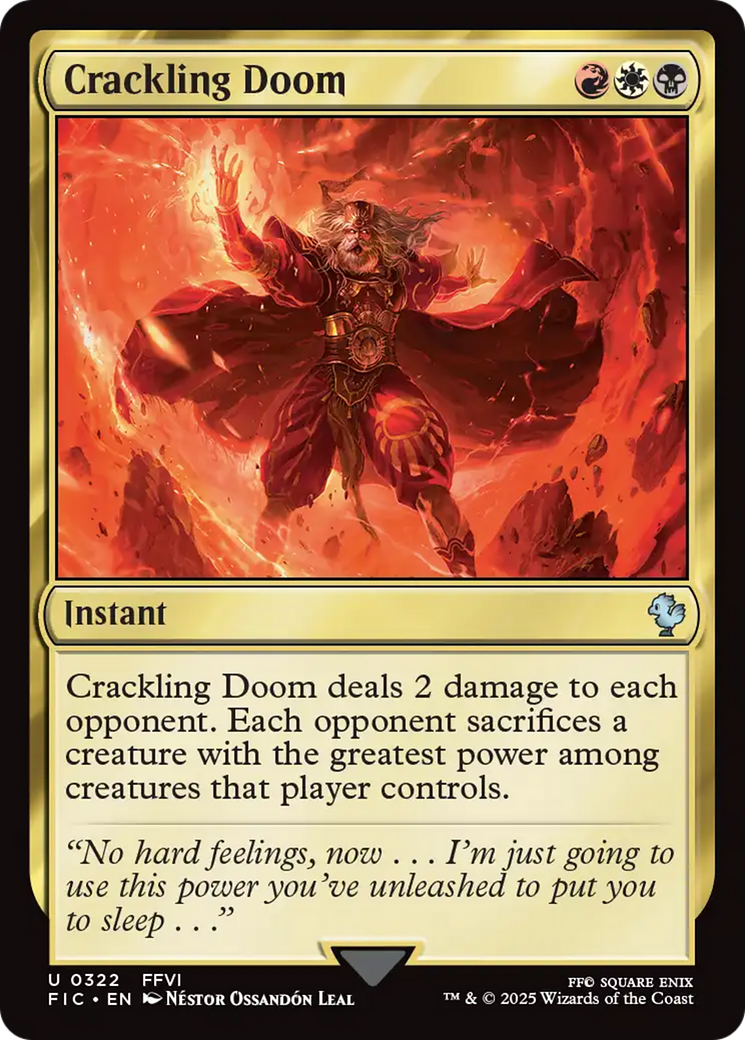
Crackling Doom
Crackling Doom
Instant
Crackling Doom deals 2 damage to each opponent. Each opponent sacrifices a creature with the greatest power among creatures that player controls.
- Crackling Doom doesn't target any player or creature. For example, a creature with protection from black could be sacrificed.
- If a player controls two or more creatures tied for the greatest power among creatures they control, that player chooses one of them to sacrifice.
- The sacrifice is not dependent on the damage being dealt. It doesn't matter if that damage is prevented or redirected.
- In a multiplayer game, each opponent, starting with the active player and proceeding in turn order, chooses which creature they will sacrifice and then all creatures are sacrificed at the same time. Each successive player will know what the players before them chose to sacrifice.
-
1
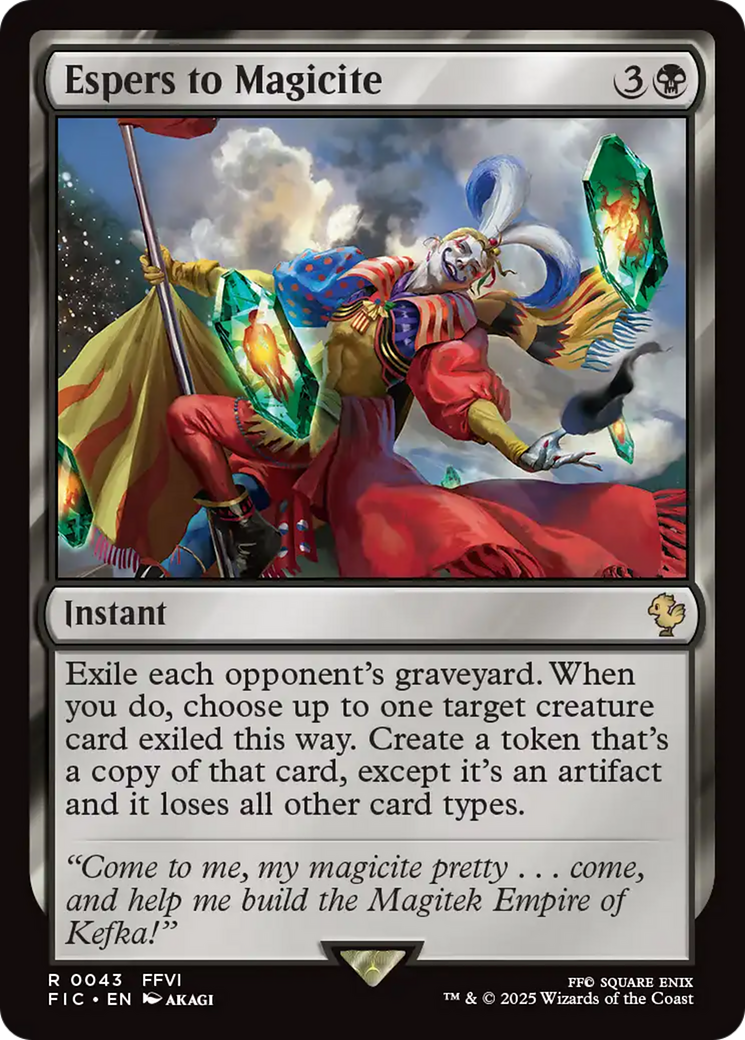
Espers to Magicite
Espers to Magicite
Instant
Exile each opponent's graveyard. When you do, choose up to one target creature card exiled this way. Create a token that's a copy of that card, except it's an artifact and it loses all other card types.
- You don't choose a target for Espers to Magicite at the time you cast it. Rather, a second "reflexive" ability triggers when you exile each opponent's graveyard this way. You choose a target for that ability as it goes on the stack. Each player may respond to this triggered ability as normal.
- The token is an artifact instead of its other types. This is a copiable value of the token that other effects may copy.
- If a card copied by the token had any "when [this permanent] enters" abilities, the token also has those abilities, and they'll trigger when it's created. Similarly, any "as [this permanent] enters" or "[this permanent] enters with" abilities that the token has copied will also work.
- Except for the listed exceptions, the token copies exactly what was printed on the original card and nothing else. It doesn't copy any information about the object the card may have been at any point before it was exiled.
- If the copied card has in its mana cost, X is 0.
-
1
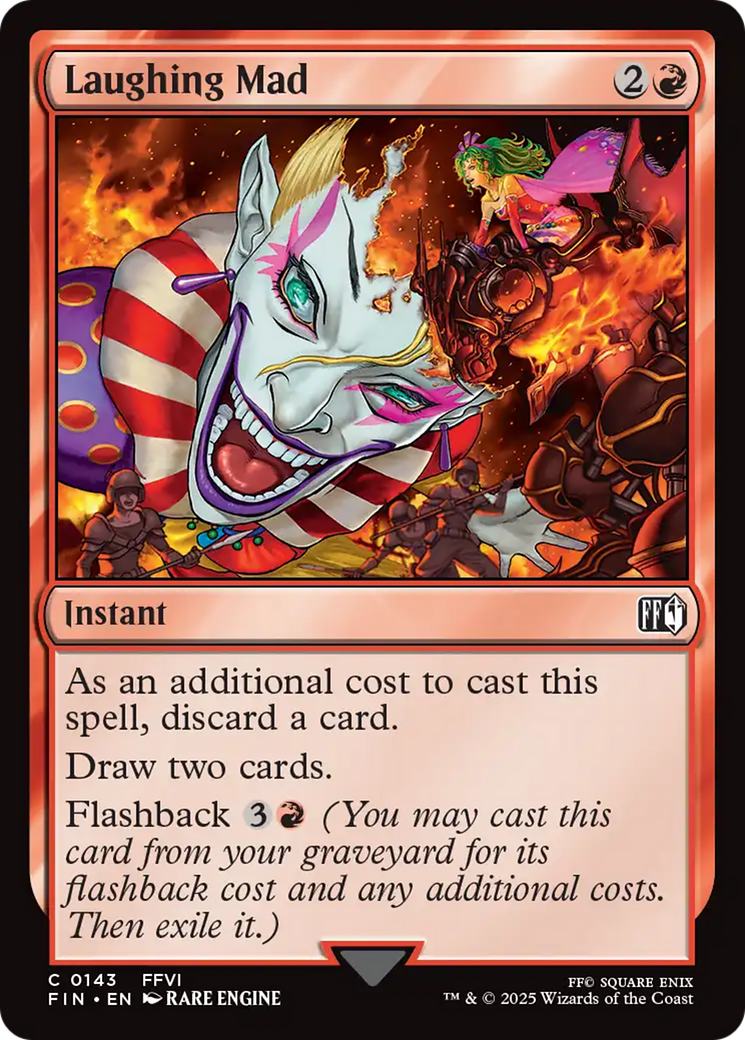
Laughing Mad
Laughing Mad
Instant
As an additional cost to cast this spell, discard a card.
Draw two cards.
Flashback (You may cast this card from your graveyard for its flashback cost and any additional costs. Then exile it.)
-
1
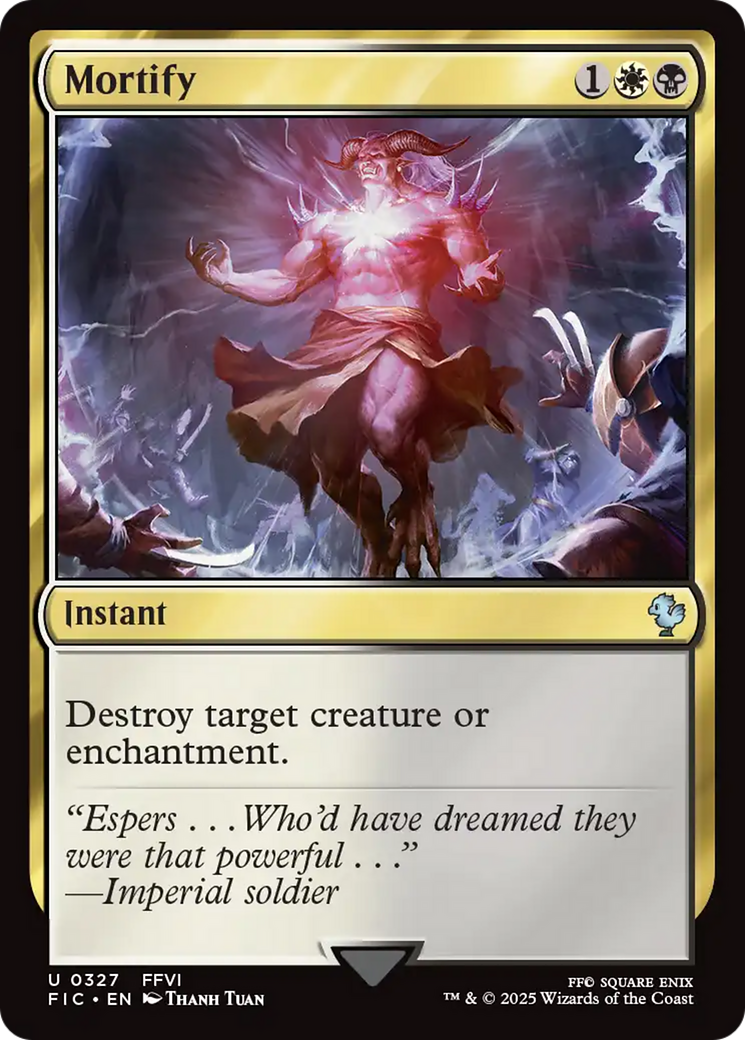
Mortify
Mortify
Instant
Destroy target creature or enchantment.
- This spell isn't modal. When it resolves, it will destroy the target if it's a creature or an enchantment, even if it changed from one to the other between targeting and resolution.
Sorceries 9
-
1
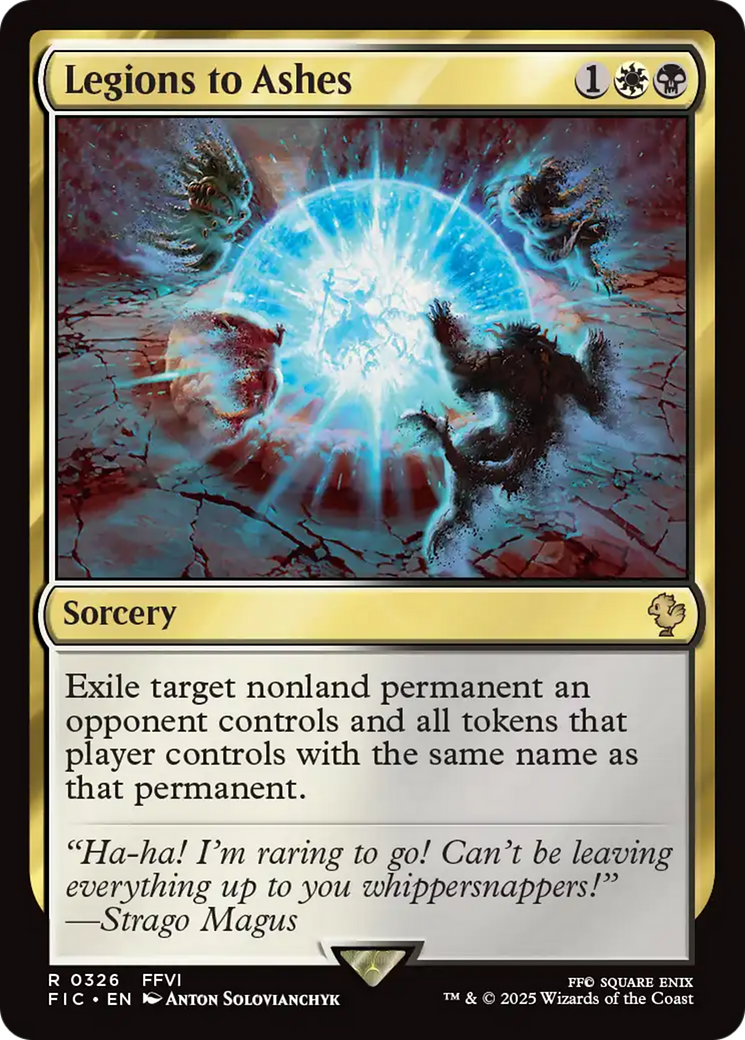
Legions to Ashes
Legions to Ashes
Sorcery
Exile target nonland permanent an opponent controls and all tokens that player controls with the same name as that permanent.
- The target permanent need not be a token. In that case, it will still be exiled.
- If the target is illegal as Legions to Ashes tries to resolve, it will be removed from the stack and do nothing, even if there are tokens with that name still on the battlefield.
-
1
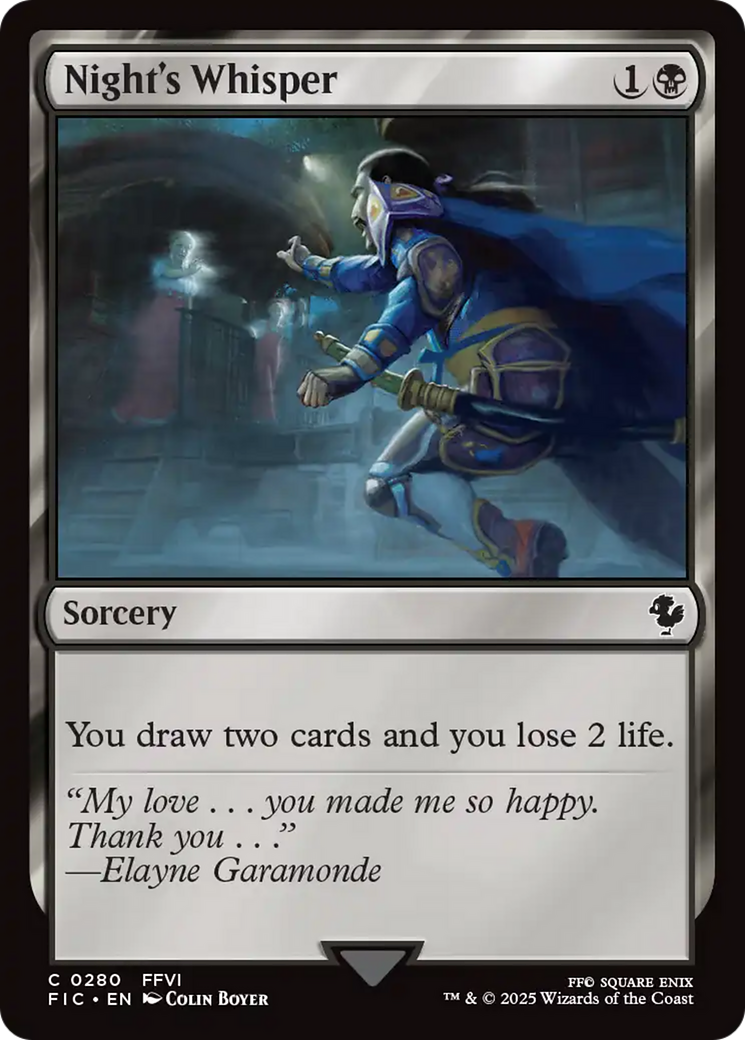
Night's Whisper
Night's Whisper
Sorcery
You draw two cards and lose 2 life.
-
1
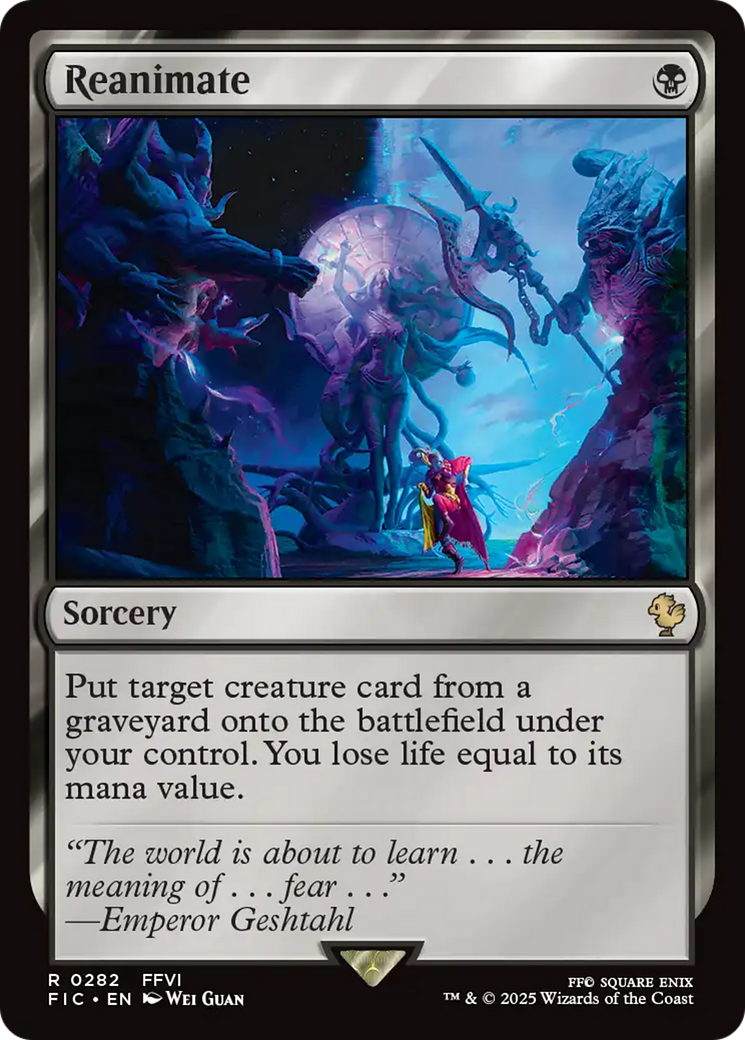
Reanimate
Reanimate
Sorcery
Put target creature card from a graveyard onto the battlefield under your control. You lose life equal to that card's mana value.
- If a card in a graveyard has in its mana cost, X is 0.
- The amount of life you lose is determined by the mana value of the card in your graveyard, not the creature once it's on the battlefield.
- You lose life after the creature is already on the battlefield. Any abilities it has that interact with loss of life, such as that of Platinum Emperion, apply to that loss of life.
- If any abilities trigger on the creature entering the battlefield, those abilities resolve after you lose life. If losing life results in you losing the game, those abilities won't resolve.
- In a multiplayer game, if a player leaves the game, all cards that player owns leave as well. If you leave the game, the creature you control from Reanimate is exiled.
-
1
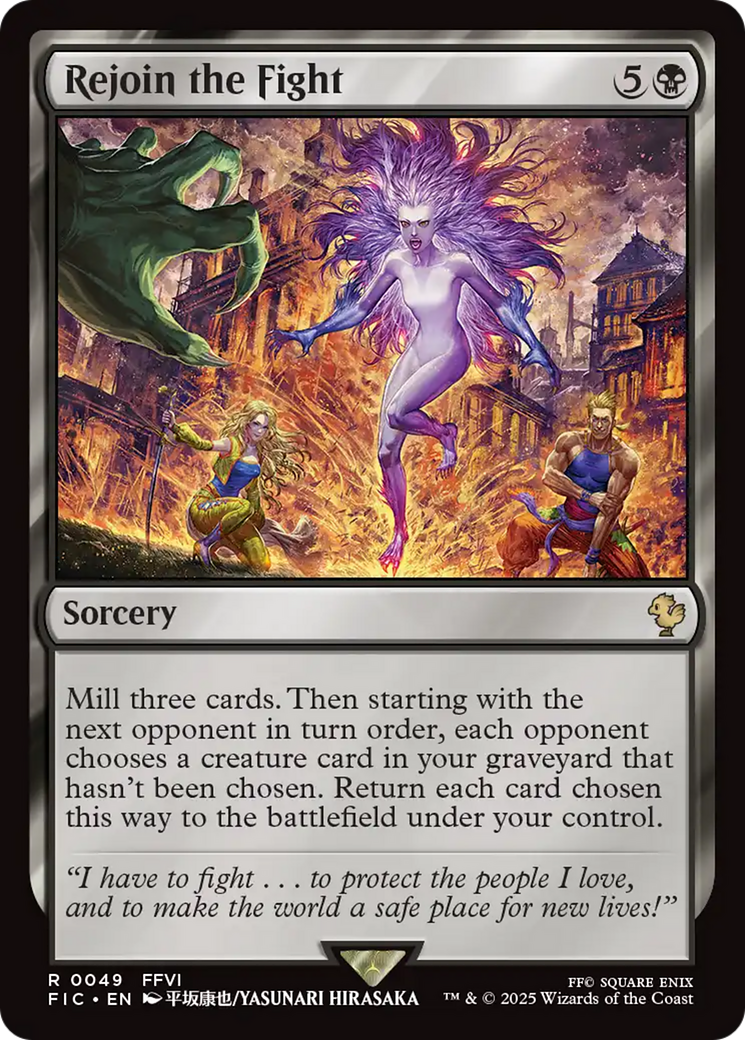
Rejoin the Fight
Rejoin the Fight
Sorcery
Mill three cards. Then starting with the next opponent in turn order, each opponent chooses a creature card in your graveyard that hasn't been chosen. Return each card chosen this way to the battlefield under your control.
-
1
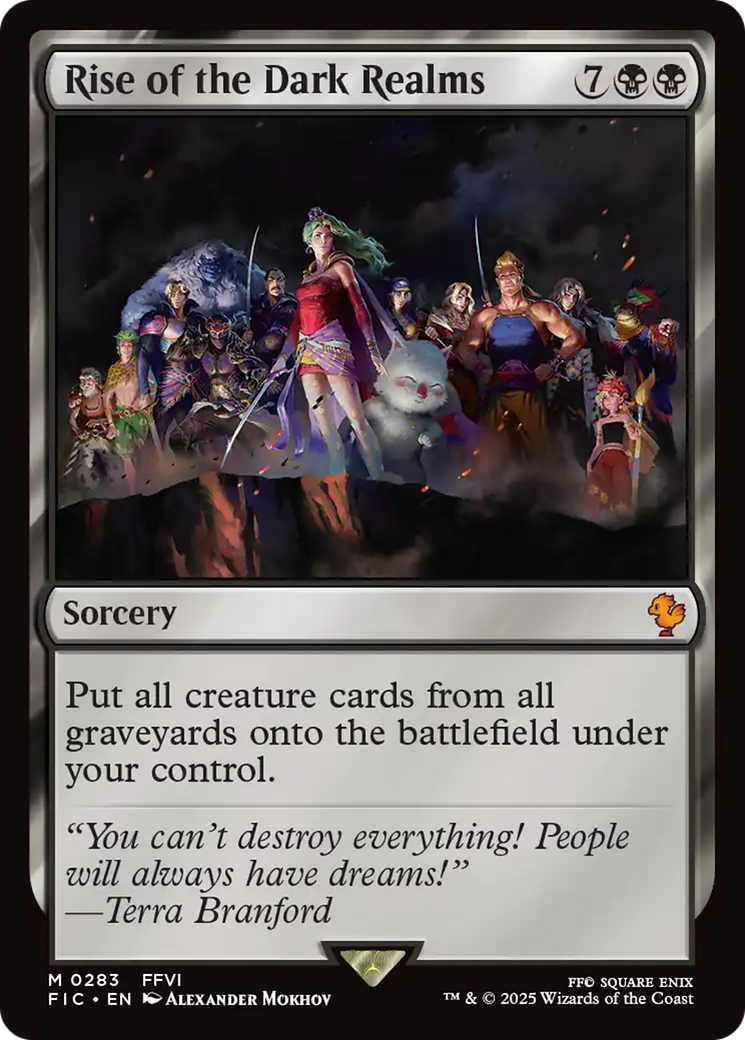
Rise of the Dark Realms
Rise of the Dark Realms
Sorcery
Put all creature cards from all graveyards onto the battlefield under your control.
-
1
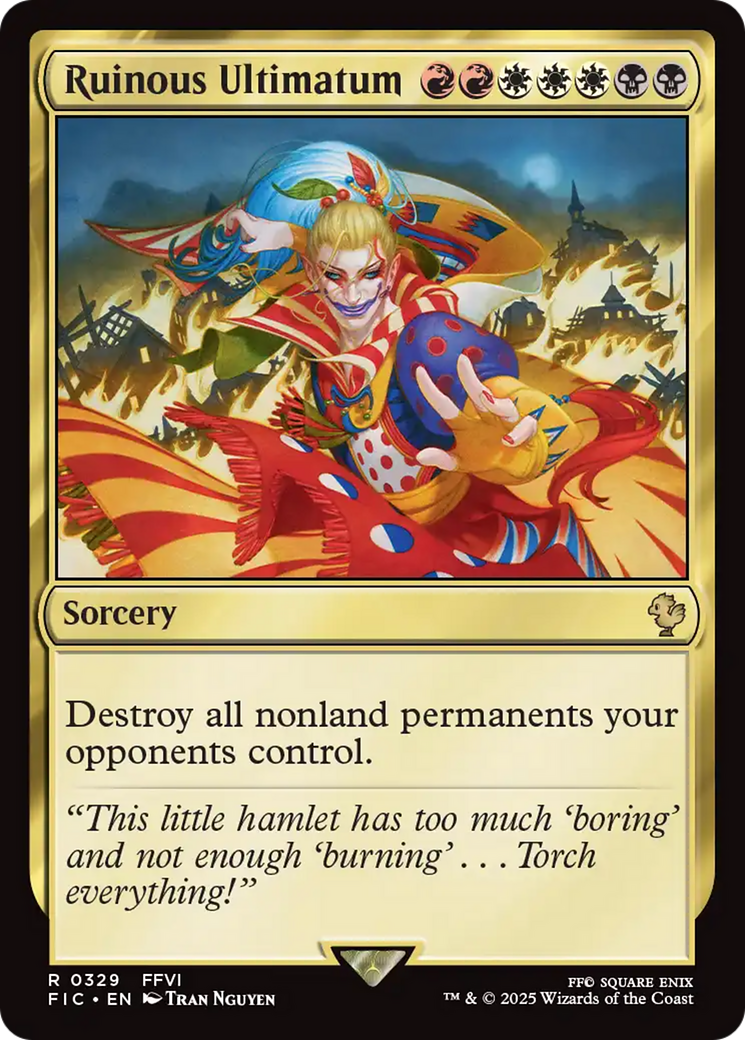
Ruinous Ultimatum
Ruinous Ultimatum
Sorcery
Destroy all nonland permanents your opponents control.
-
1
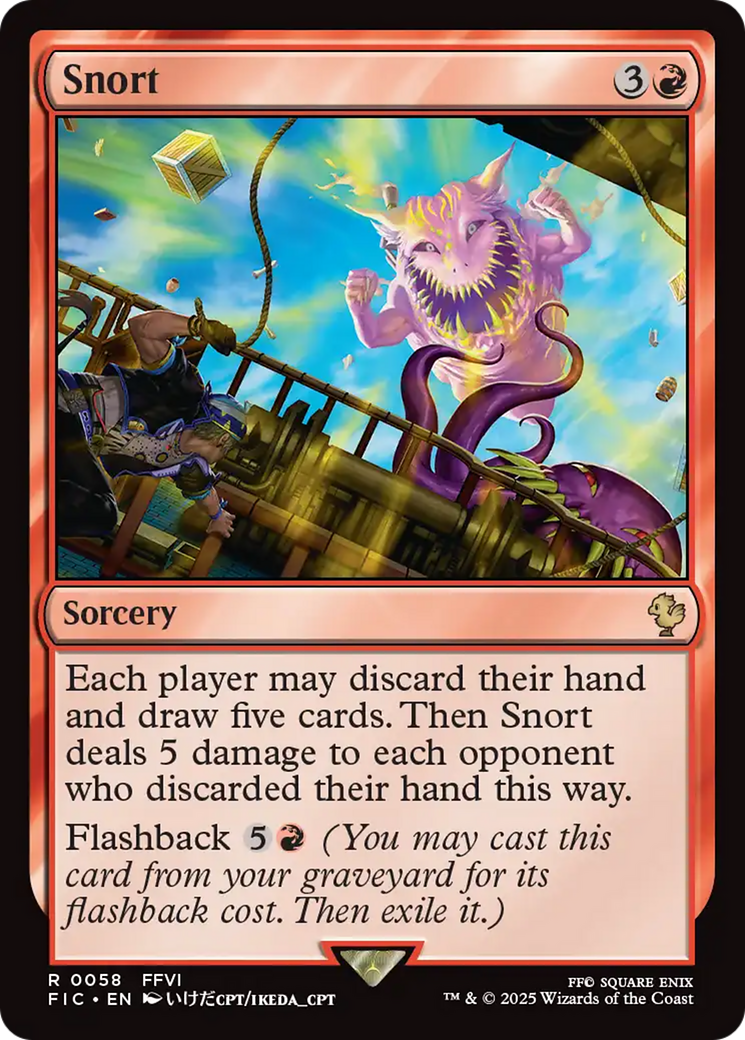
Snort
Snort
Sorcery
Each player may discard their hand and draw five cards. Then Snort deals 5 damage to each opponent who discarded their hand this way.
Flashback (You may cast this card from your graveyard for its flashback cost. Then exile it.)
- A player may choose to discard their hand even if their hand contains zero cards. Snort will still deal 5 damage to that player if they choose to discard their empty hand.
-
1
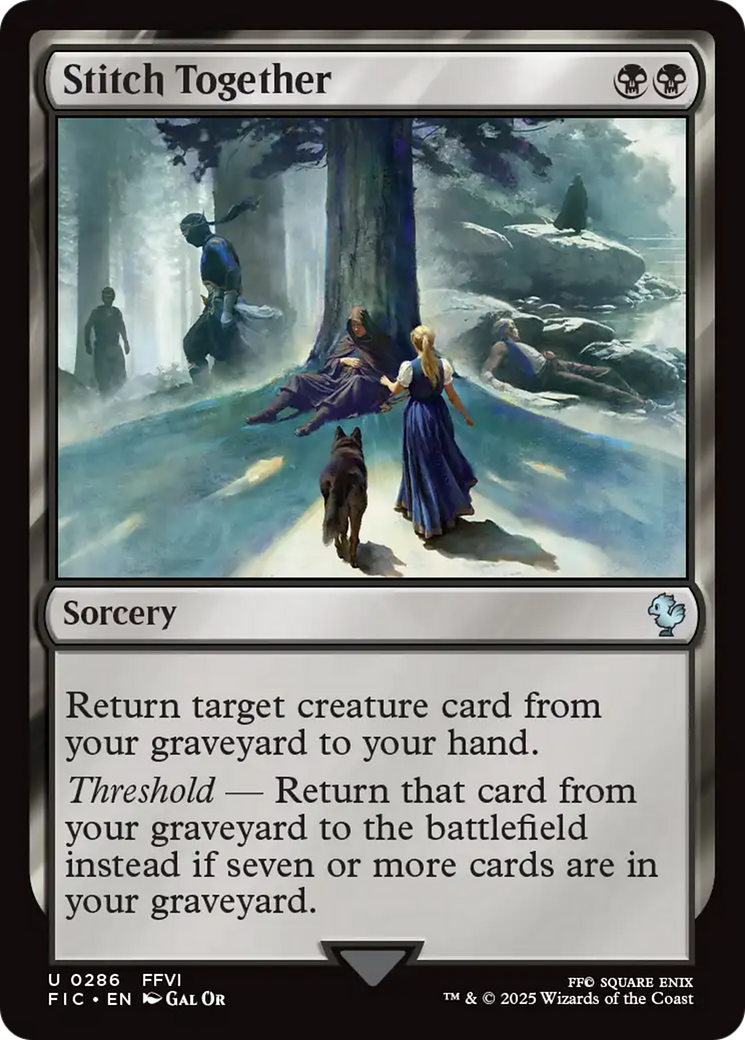
Stitch Together
Stitch Together
Sorcery
Return target creature card from your graveyard to your hand.
Threshold — Return that card from your graveyard to the battlefield instead if there are seven or more cards in your graveyard.
- Checks the number of cards in your graveyard when it starts resolving. You may drop below seven cards during resolution, but that won't stop it from resolving.
-
1
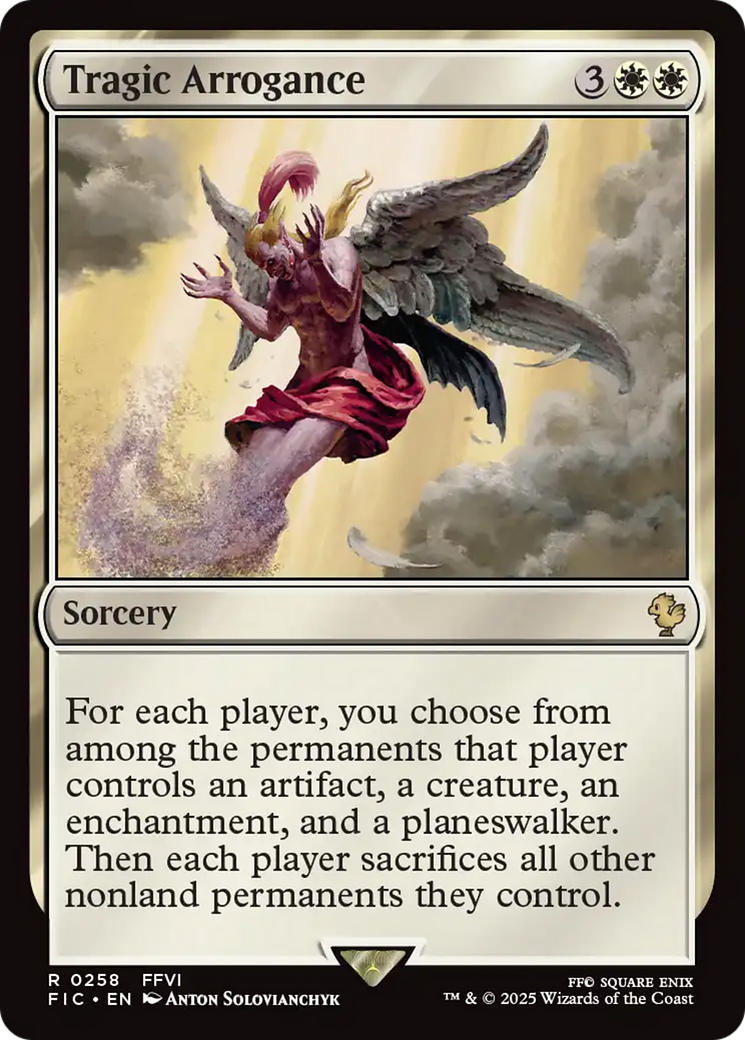
Tragic Arrogance
Tragic Arrogance
Sorcery
For each player, you choose from among the permanents that player controls an artifact, a creature, an enchantment, and a planeswalker. Then each player sacrifices all other nonland permanents they control.
- None of the chosen permanents are targets of Tragic Arrogance.
- If a permanent has more than one of the affected types, it can count for any of them. For example, you could choose an artifact creature as the artifact you're sparing, another creature as the creature, and an enchantment creature as the enchantment. Similarly, you could choose an enchantment creature as both the creature and the enchantment that you're sparing, even if the player controls another creature and/or another enchantment.
Artifacts 12
-
1
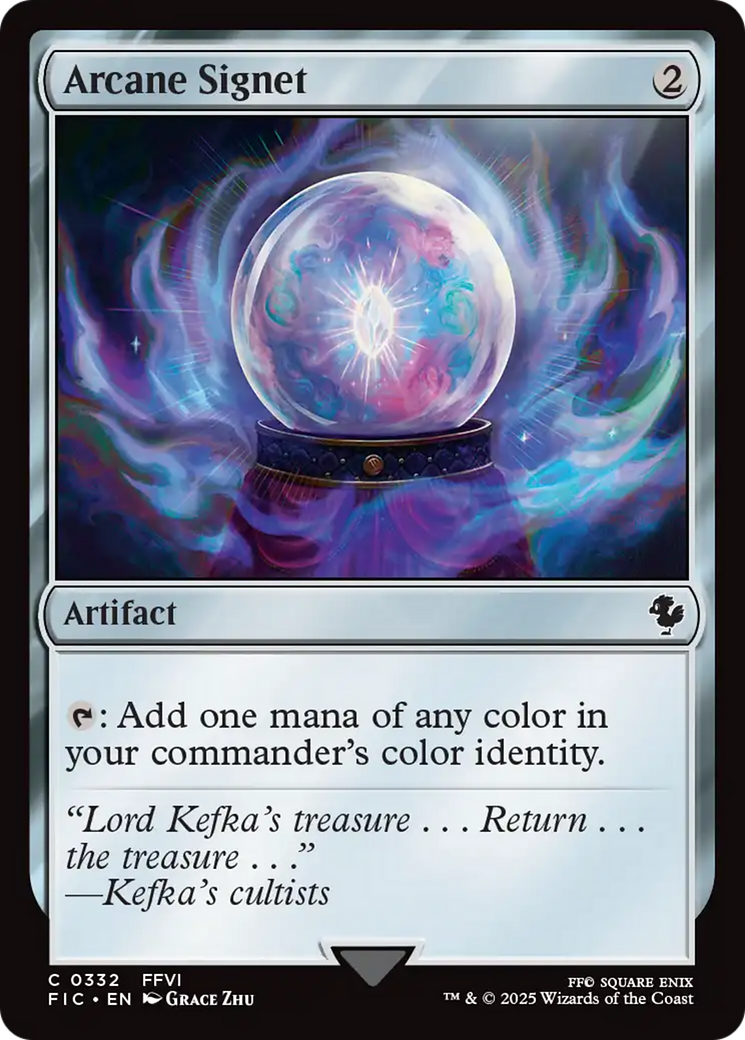
Arcane Signet
Arcane Signet
Artifact
: Add one mana of any color in your commander's color identity.
- If your commander is a card that has no colors in its color identity, Arcane Signet's ability produces no mana. It doesn't produce .
- If you have two commanders, the ability adds one mana of any color in their combined color identities.
- If you don't have a commander, Arcane Signet's ability produces no mana.
-
1
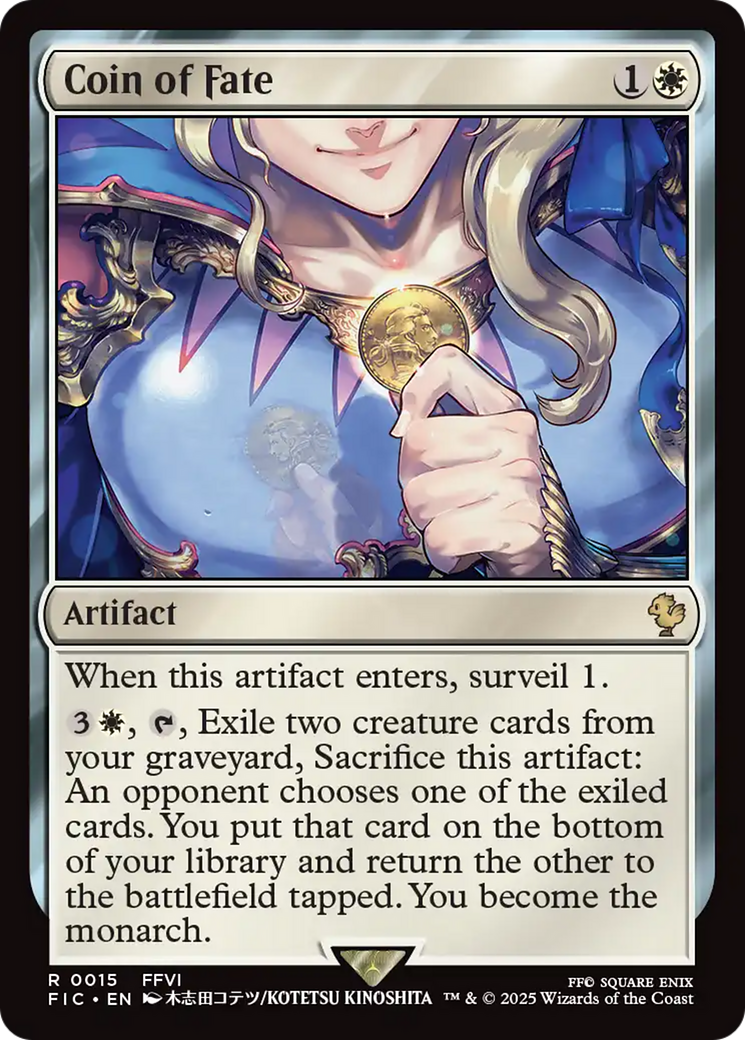
Coin of Fate
Coin of Fate
Artifact
When this artifact enters, surveil 1.
, , Exile two creature cards from your graveyard, Sacrifice this artifact: An opponent chooses one of the exiled cards. You put that card on the bottom of your library and return the other to the battlefield tapped. You become the monarch.
- If the triggered ability that causes the monarch to draw a card goes on the stack and a different player becomes the monarch before that ability resolves, the first player will still draw the card.
- The game starts with no monarch. As a player becomes the monarch, the current monarch (if any) ceases being the monarch. There is never more than one monarch at a time.
- There are two inherent triggered abilities associated with being the monarch. These triggered abilities have no source and are controlled by the player who was the monarch at the time the abilities triggered. The full texts of these abilities are "At the beginning of the monarch's end step, that player draws a card" and "Whenever a creature deals combat damage to the monarch, its controller becomes the monarch."
- If the monarch leaves the game during another player's turn, that player becomes the monarch. If the monarch leaves the game during their turn, the next player in turn order becomes the monarch.
- If combat damage dealt to the monarch causes that player to lose the game, the triggered ability that causes the controller of the attacking creature to become the monarch doesn't resolve. In most cases, the controller of the attacking creature will still become the monarch as it is likely their turn.
-
1
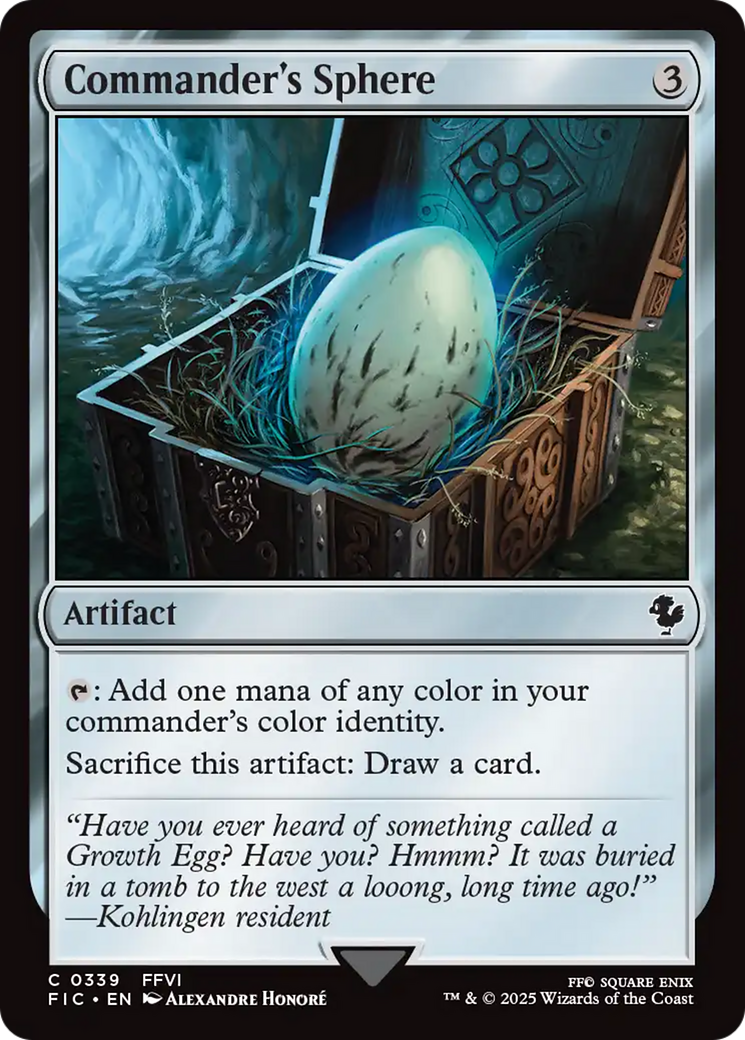
Commander's Sphere
Commander's Sphere
Artifact
: Add one mana of any color in your commander's color identity.
Sacrifice this artifact: Draw a card.
- If your commander is a card that has no colors in its color identity, Commander's Sphere's first ability produces no mana. It doesn't produce .
- If you don't have a commander, Commander's Sphere's first ability produces no mana.
- If you have two commanders, the ability adds one mana of any color in their combined color identities.
-
1
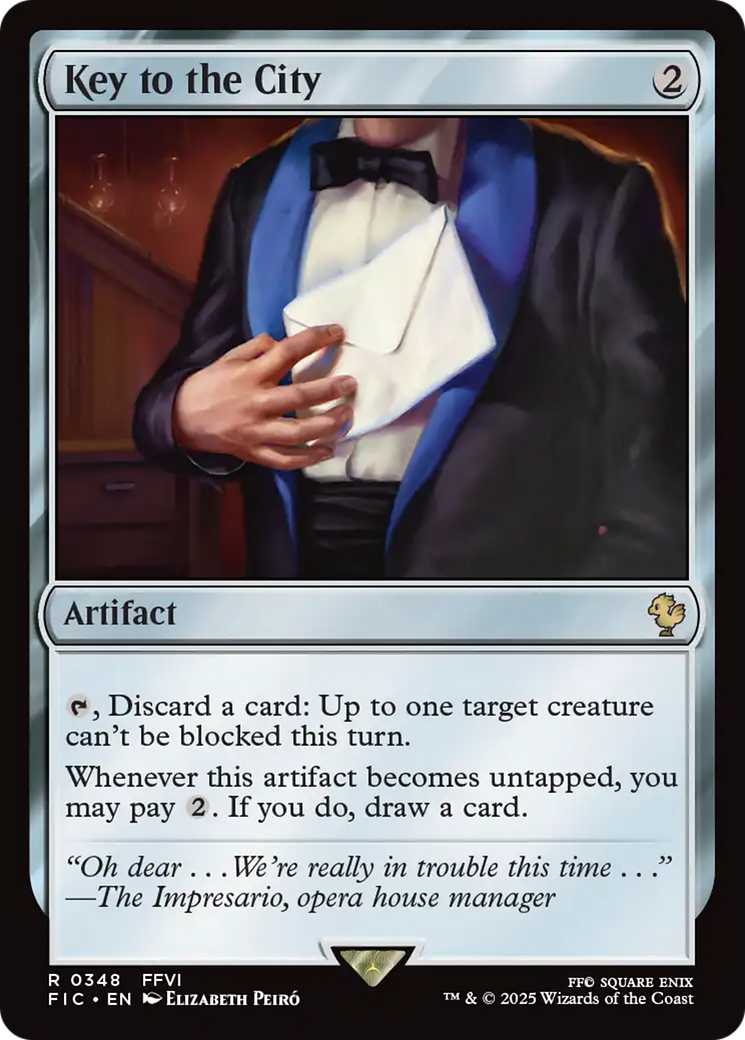
Key to the City
Key to the City
Artifact
, Discard a card: Up to one target creature can't be blocked this turn.
Whenever this artifact becomes untapped, you may pay . If you do, draw a card.
- You can activate Key to the City's first ability without targeting any creature.
- Activating Key to the City's ability targeting a creature that has already been blocked won't cause it to become unblocked.
- Key to the City's last ability triggers during your untap step, but it's put onto the stack at the same time as abilities that trigger at the beginning of your upkeep step. Even though Key to the City's ability triggered first, you may order it before or after other abilities you control that are put onto the stack at this time.
- You can pay only once each time Key to the City's triggered ability resolves. You can't pay more to draw additional cards.
-
1
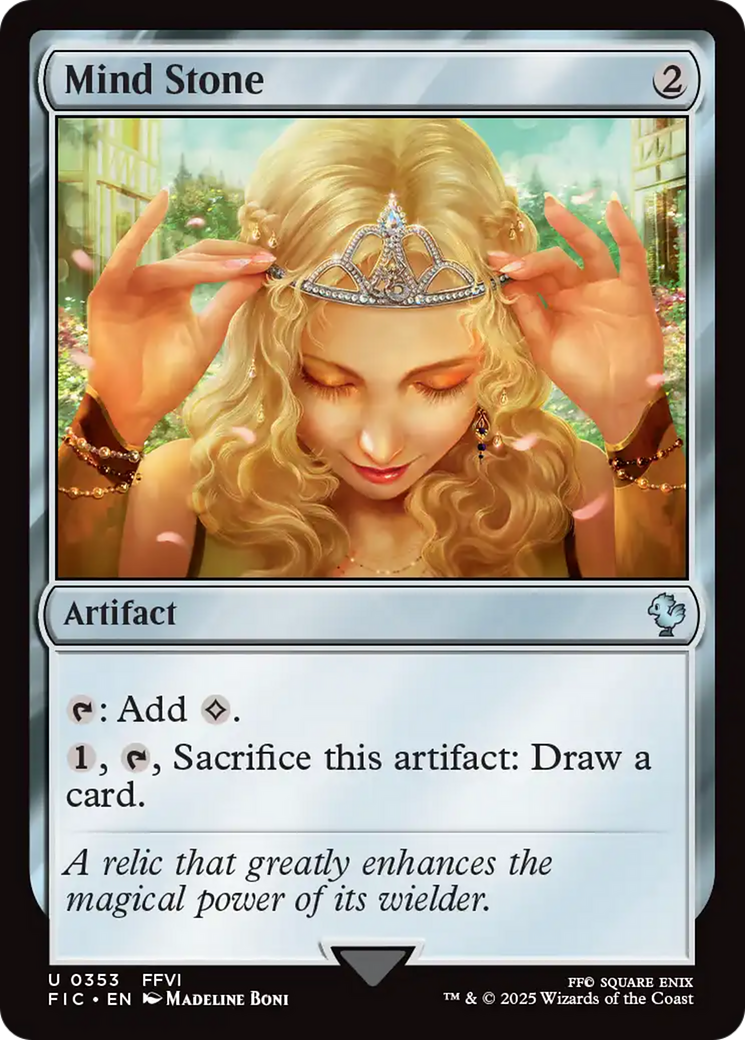
Mind Stone
Mind Stone
Artifact
: Add .
, , Sacrifice this artifact: Draw a card.
-
1
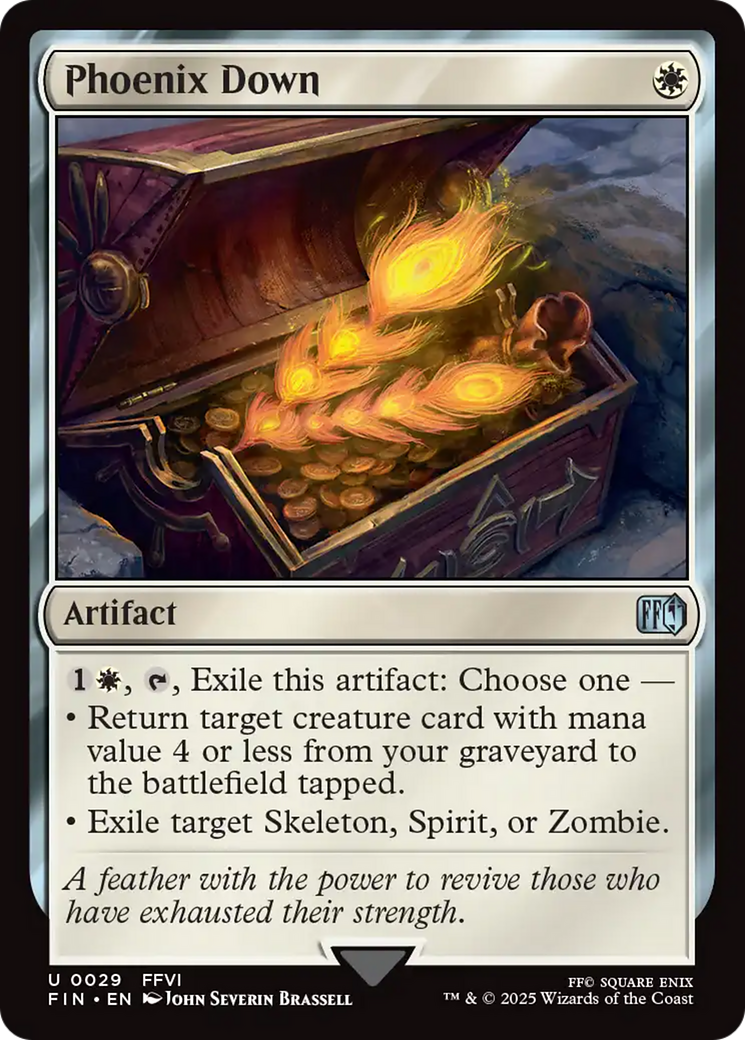
Phoenix Down
Phoenix Down
Artifact
, , Exile this artifact: Choose one —
- Return target creature card with mana value 4 or less from your graveyard to the battlefield tapped.
- Exile target Skeleton, Spirit, or Zombie.
-
1
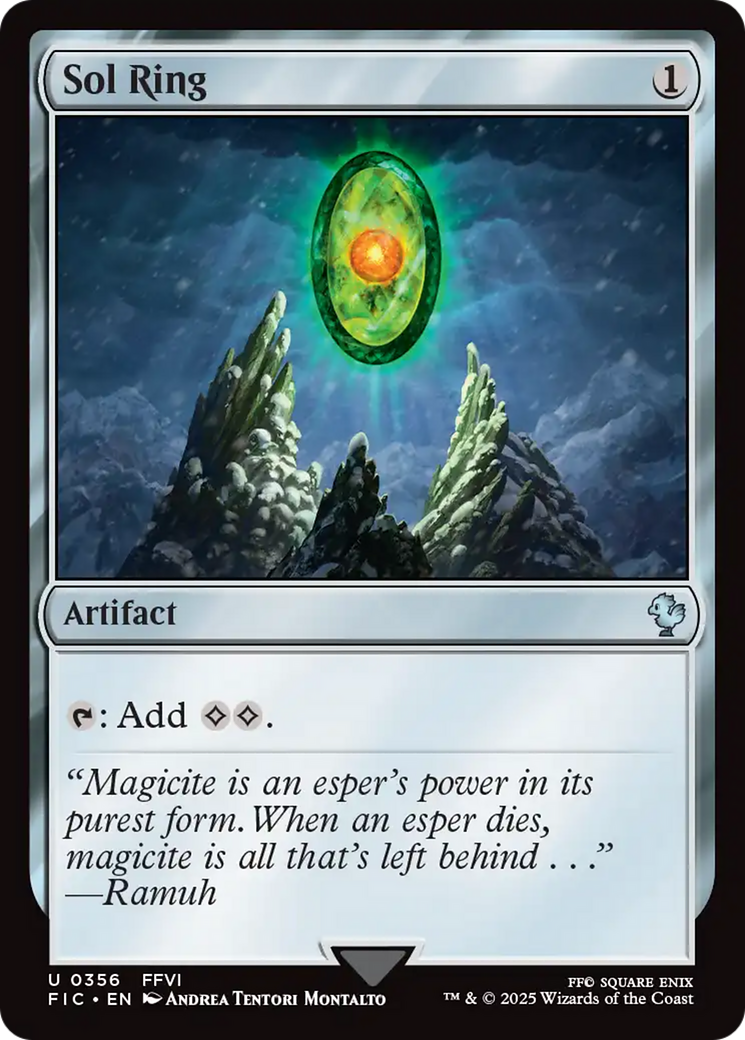
Sol Ring
Sol Ring
Artifact
: Add .
-
1
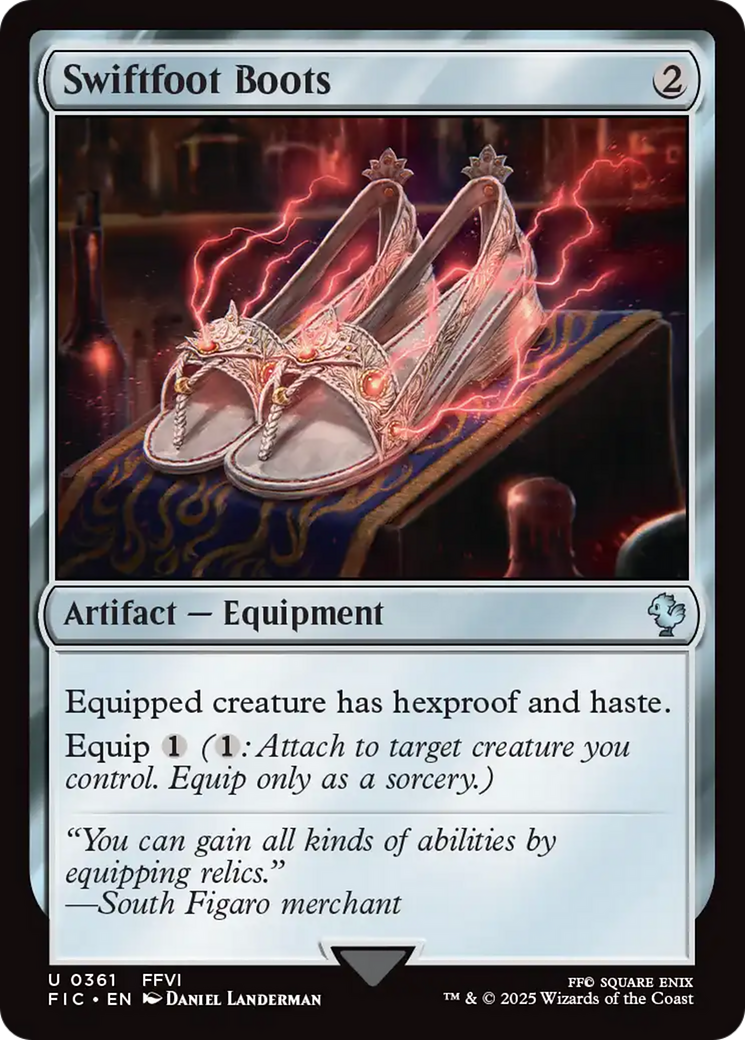
Swiftfoot Boots
Swiftfoot Boots
Artifact — Equipment
Equipped creature has hexproof and haste. (It can't be the target of spells or abilities your opponents control. It can attack and no matter when it came under your control.)
Equip ( : Attach to target creature you control. Equip only as a sorcery.)
- If a creature enters the battlefield under your control and gains haste, but then loses it before attacking, it won't be able to attack that turn. This means that you can't use one Swiftfoot Boots to allow two new creatures to attack in the same turn.
-
1
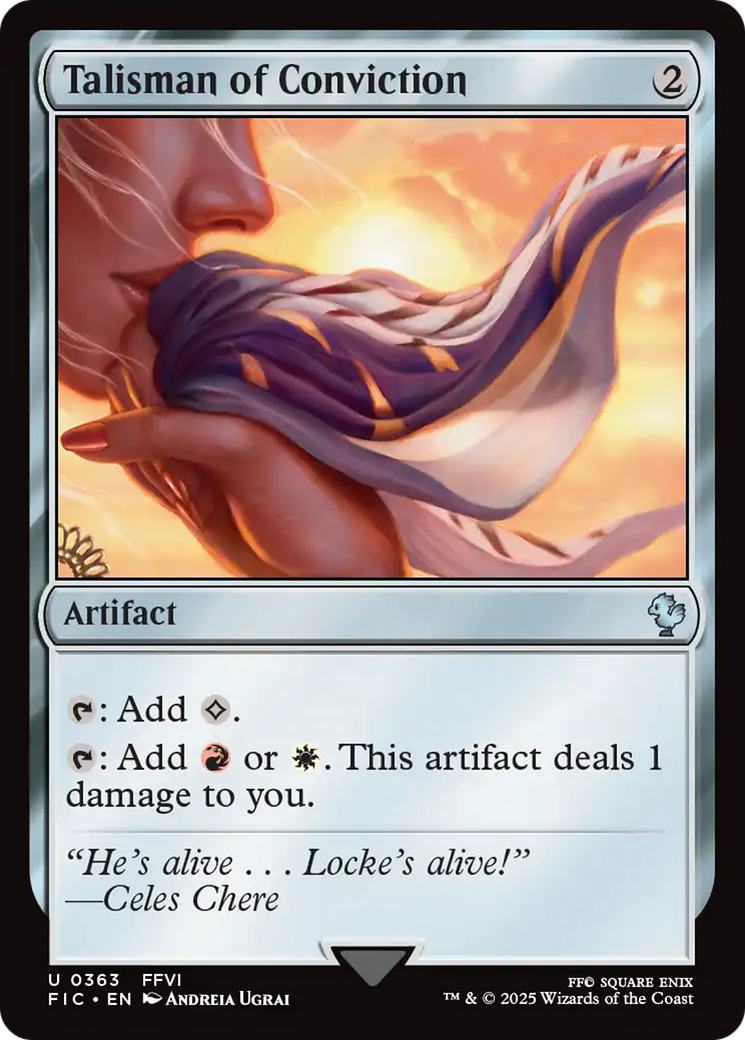
Talisman of Conviction
Talisman of Conviction
Artifact
: Add .
: Add or . This artifact deals 1 damage to you.
-
1
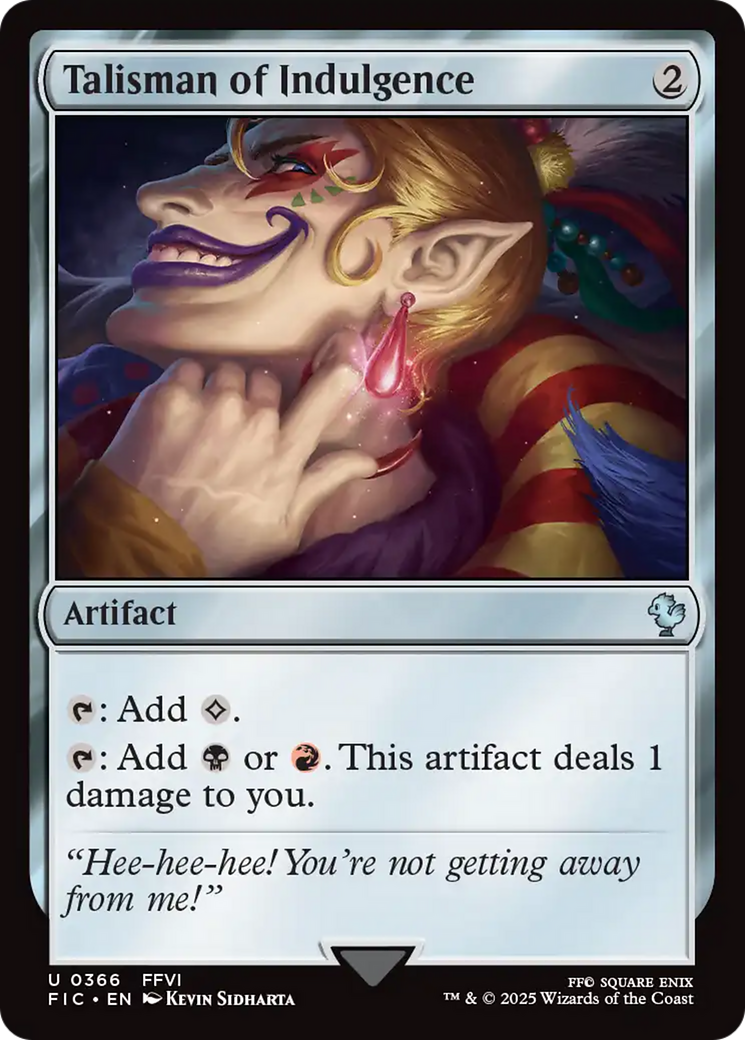
Talisman of Indulgence
Talisman of Indulgence
Artifact
: Add .
: Add or . This artifact deals 1 damage to you.
-
1
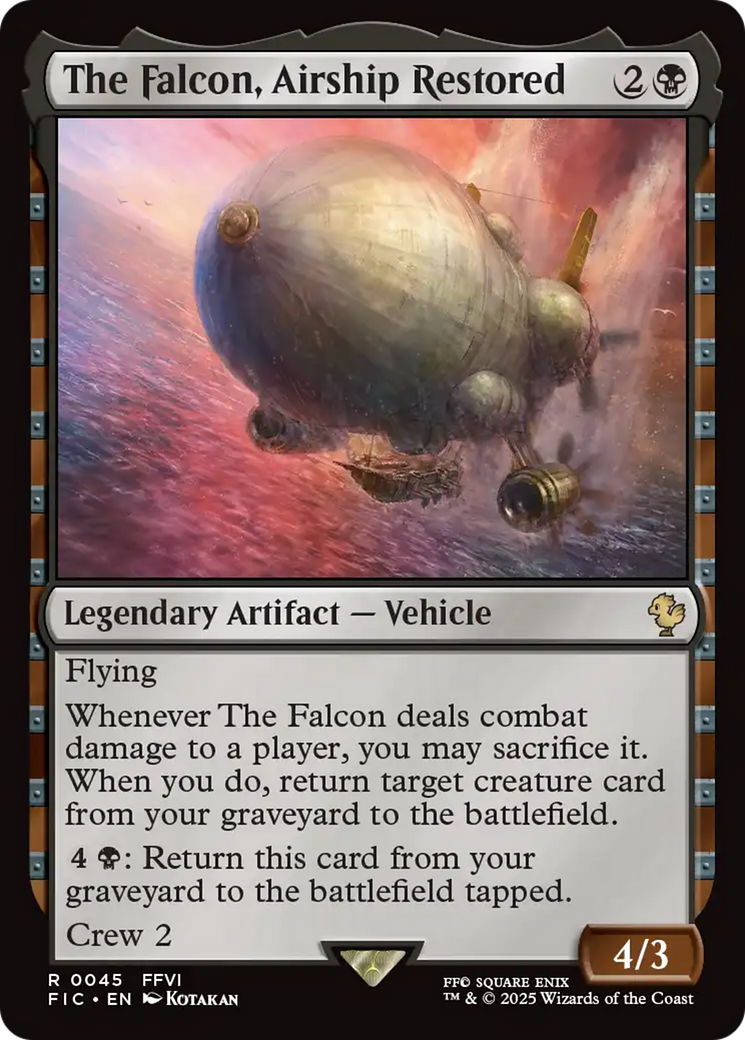
The Falcon, Airship Restored
The Falcon, Airship Restored
Legendary Artifact — Vehicle
4/3
Flying
Whenever The Falcon deals combat damage to a player, you may sacrifice it. When you do, return target creature card from your graveyard to the battlefield.
: Return this card from your graveyard to the battlefield tapped.
Crew 2
- You don't choose a target for The Falcon's second ability at the time it triggers. Rather, a second "reflexive" ability triggers when you sacrifice The Falcon this way. You choose a target for that ability as it goes on the stack. Each player may respond to this triggered ability as normal.
-
1
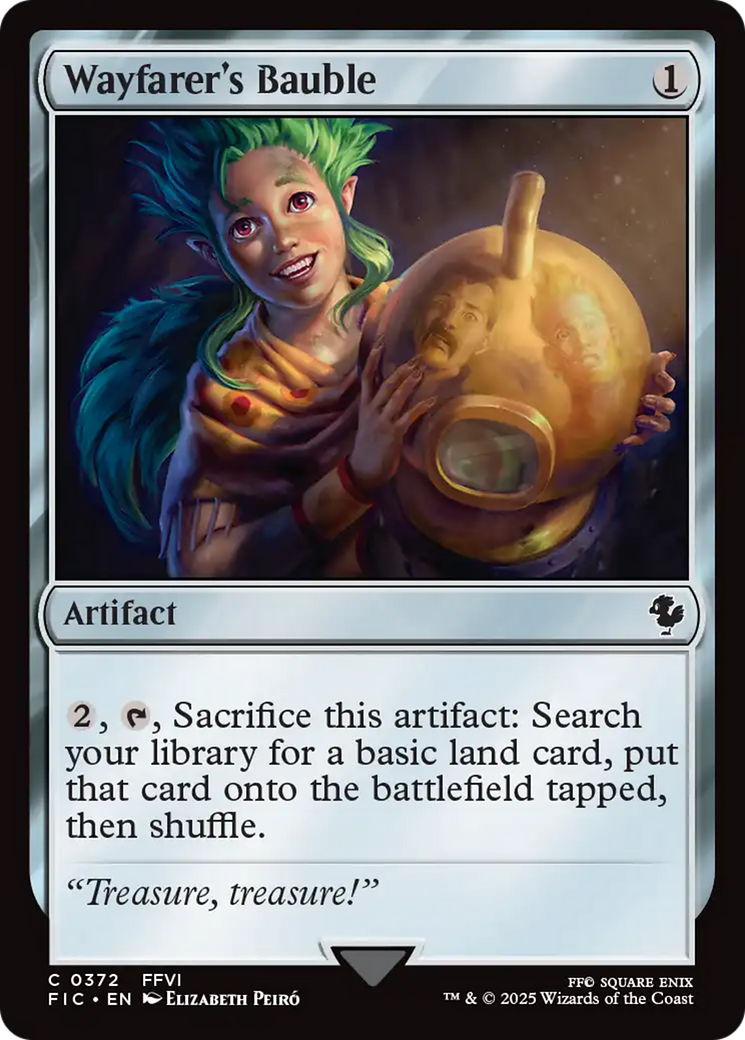
Wayfarer's Bauble
Wayfarer's Bauble
Artifact
, , Sacrifice this artifact: Search your library for a basic land card, put that card onto the battlefield tapped, then shuffle.
Lands 37
-
1
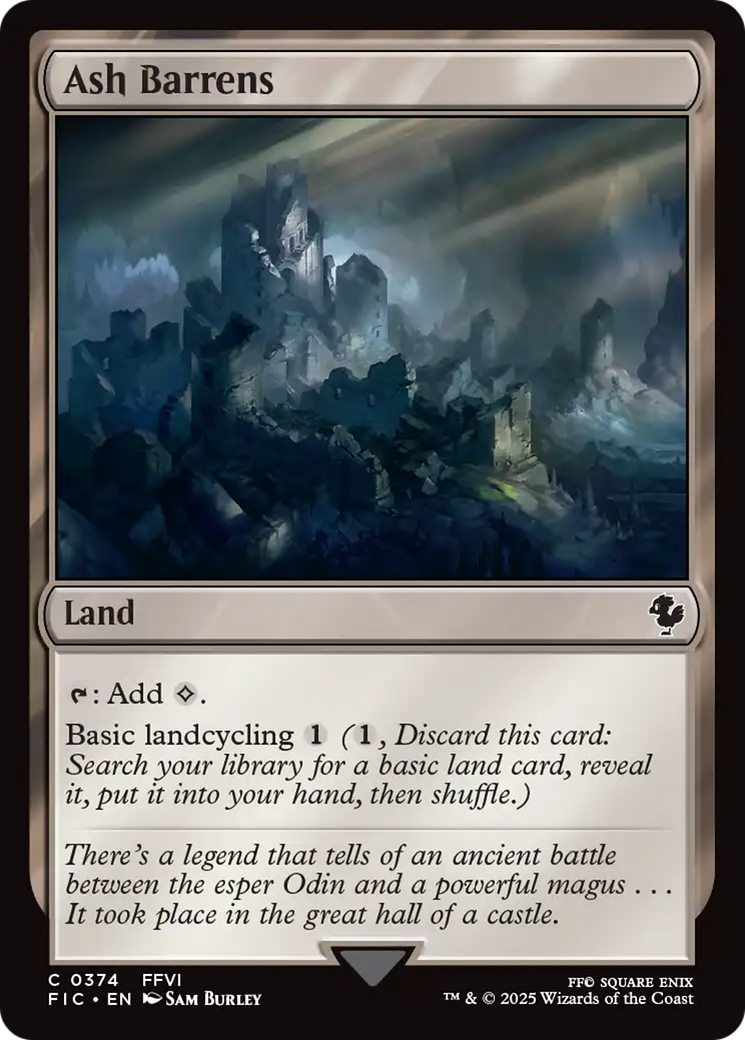
Ash Barrens
Ash Barrens
Land
: Add .
Basic landcycling ( , Discard this card: Search your library for a basic land card, reveal it, put it into your hand, then shuffle.)
-
1
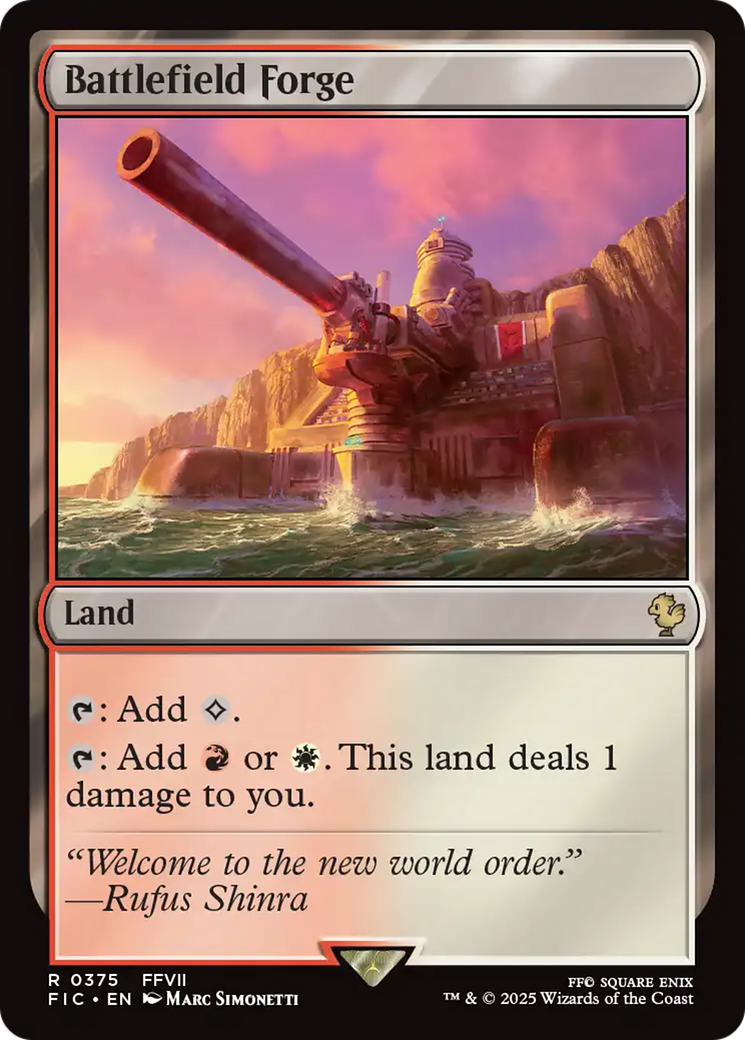
Battlefield Forge
Battlefield Forge
Land
: Add .
: Add or . This land deals 1 damage to you.
- Like most lands, each land in this cycle is colorless. The damage dealt to you is dealt by a colorless source.
- The damage dealt to you is part of the second mana ability. It doesn't use the stack and can't be responded to.
-
1
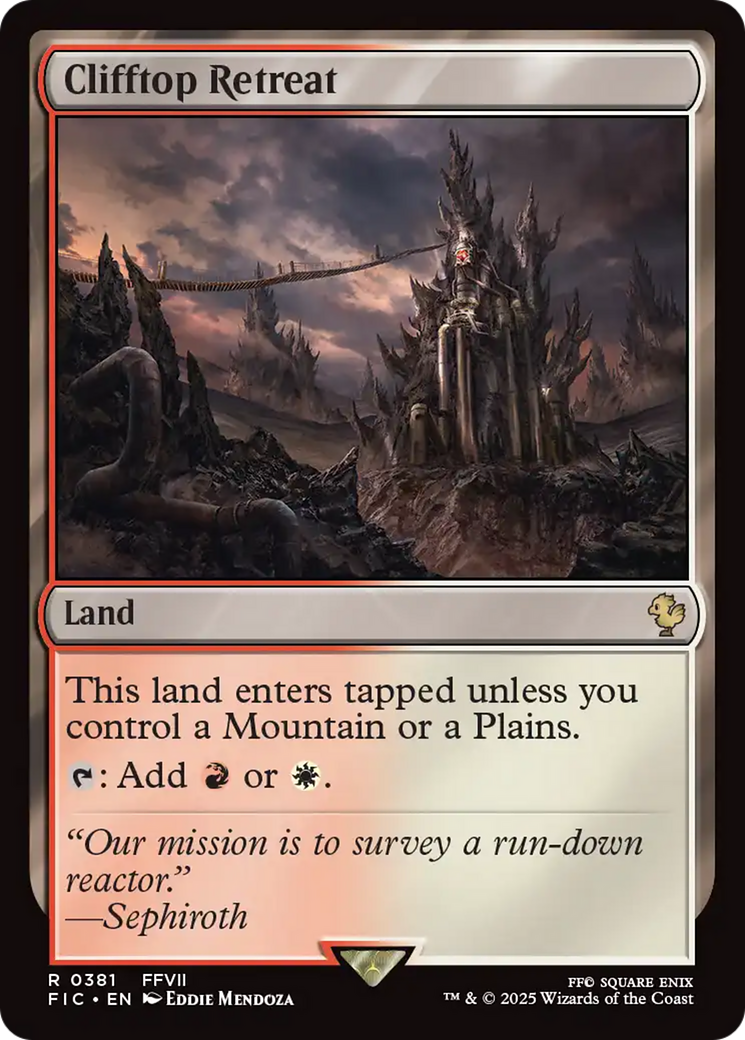
Clifftop Retreat
Clifftop Retreat
Land
This land enters tapped unless you control a Mountain or a Plains.
: Add or .
-
1
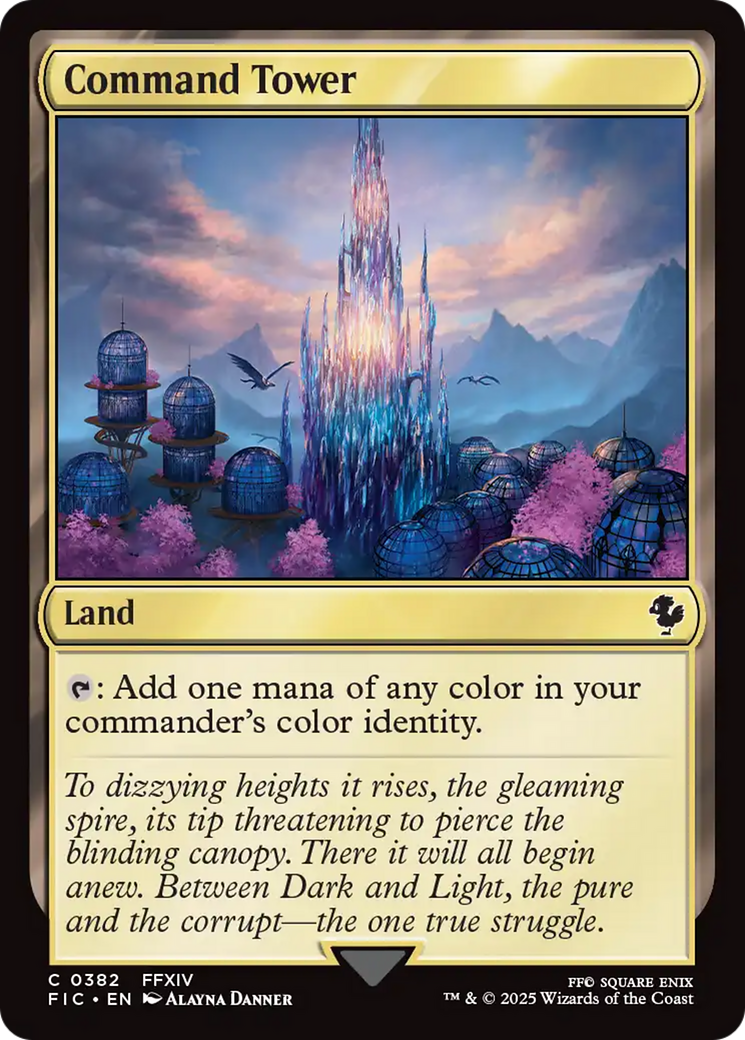
Command Tower
Command Tower
Land
: Add one mana of any color in your commander's color identity.
- If you don't have a commander, Command Tower's ability produces no mana.
- If your commander is a card that has no colors in its color identity, Command Tower's ability produces no mana. It doesn't produce .
- If you have two commanders, the ability adds one mana of any color in their combined color identities.
-
1
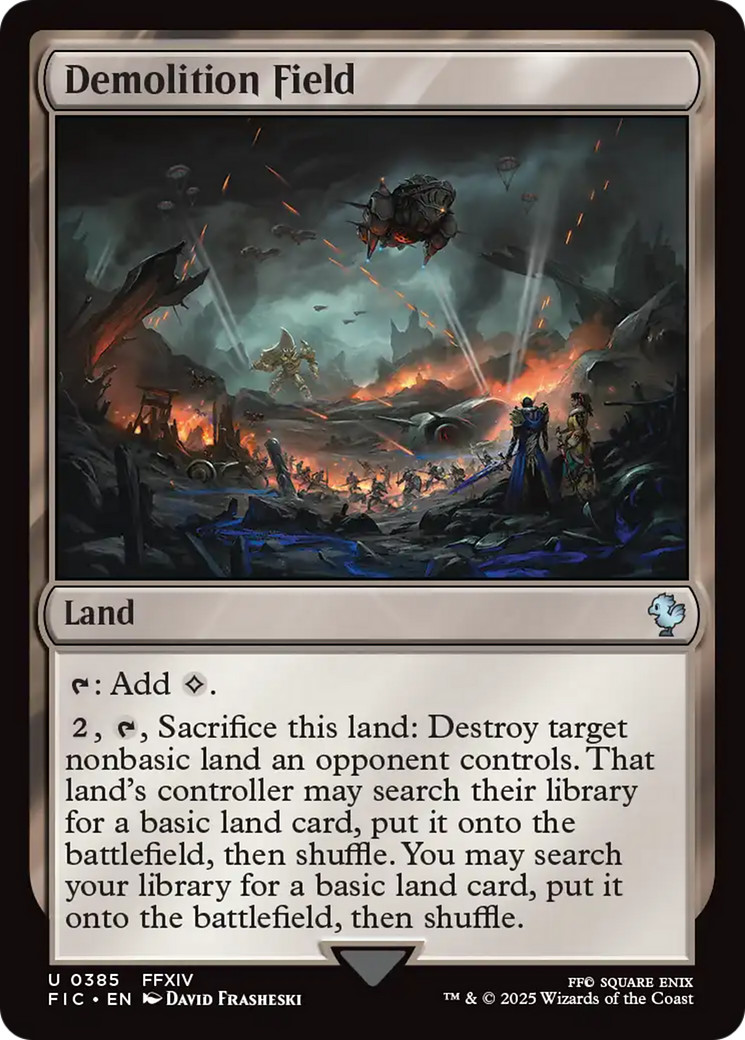
Demolition Field
Demolition Field
Land
: Add .
, , Sacrifice this land: Destroy target nonbasic land an opponent controls. That land's controller may search their library for a basic land card, put it onto the battlefield, then shuffle. You may search your library for a basic land card, put it onto the battlefield, then shuffle.
- The target land's controller gets to search for a basic land card even if that land wasn't destroyed by Demolition Field's ability. This may happen because the land has indestructible.
- If the targeted land is an illegal target by the time Demolition Field's ability resolves, it won't resolve and none of its effects will happen. Neither player will get to search for a basic land card.
-
1
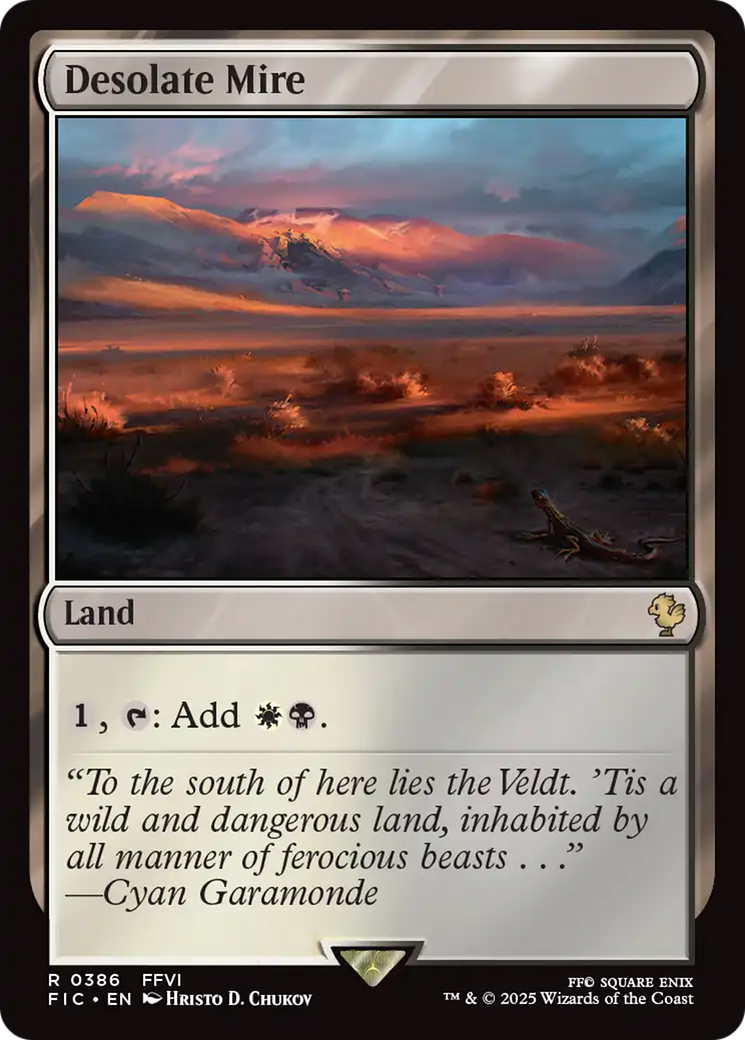
Desolate Mire
Desolate Mire
Land
, : Add .
-
1
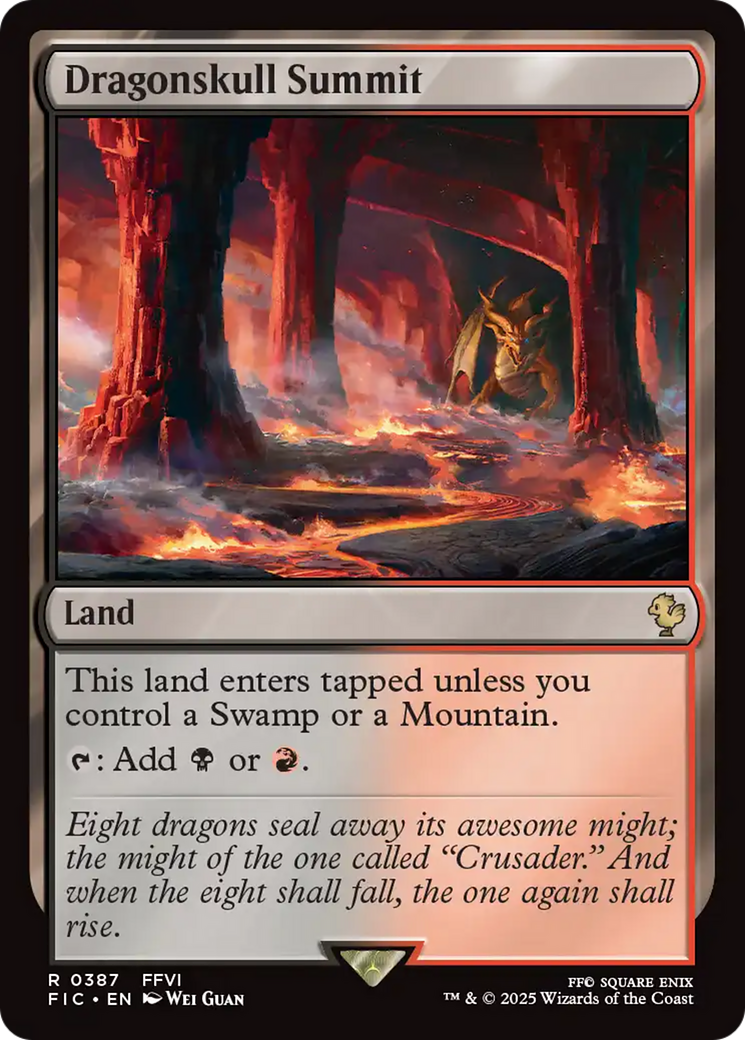
Dragonskull Summit
Dragonskull Summit
Land
This land enters tapped unless you control a Swamp or a Mountain.
: Add or .
- This checks for lands you control with the land type Swamp or Mountain, not for lands named Swamp or Mountain. The lands it checks for don't have to be basic lands. For example, if you control Stomping Ground (a nonbasic land with the land types Mountain and Forest), Dragonskull Summit will enter untapped.
- As this is entering, it checks for lands that are already on the battlefield. It won't see lands that are entering at the same time (due to Warp World, for example).
-
1
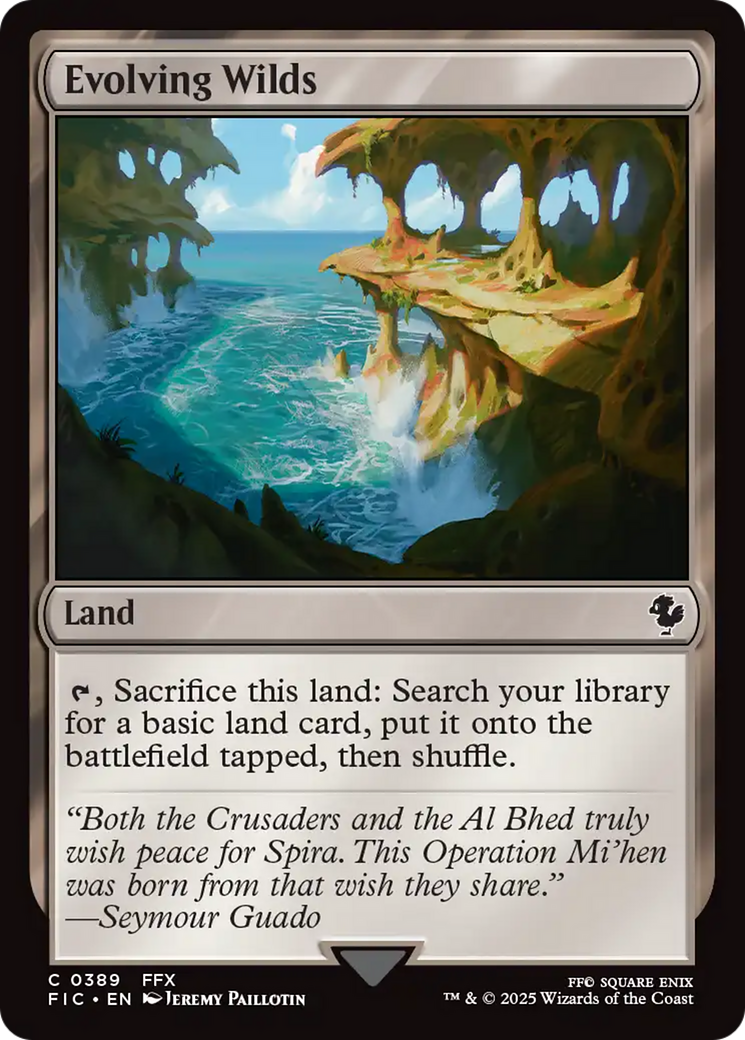
Evolving Wilds
Evolving Wilds
Land
, Sacrifice this land: Search your library for a basic land card, put it onto the battlefield tapped, then shuffle.
-
1
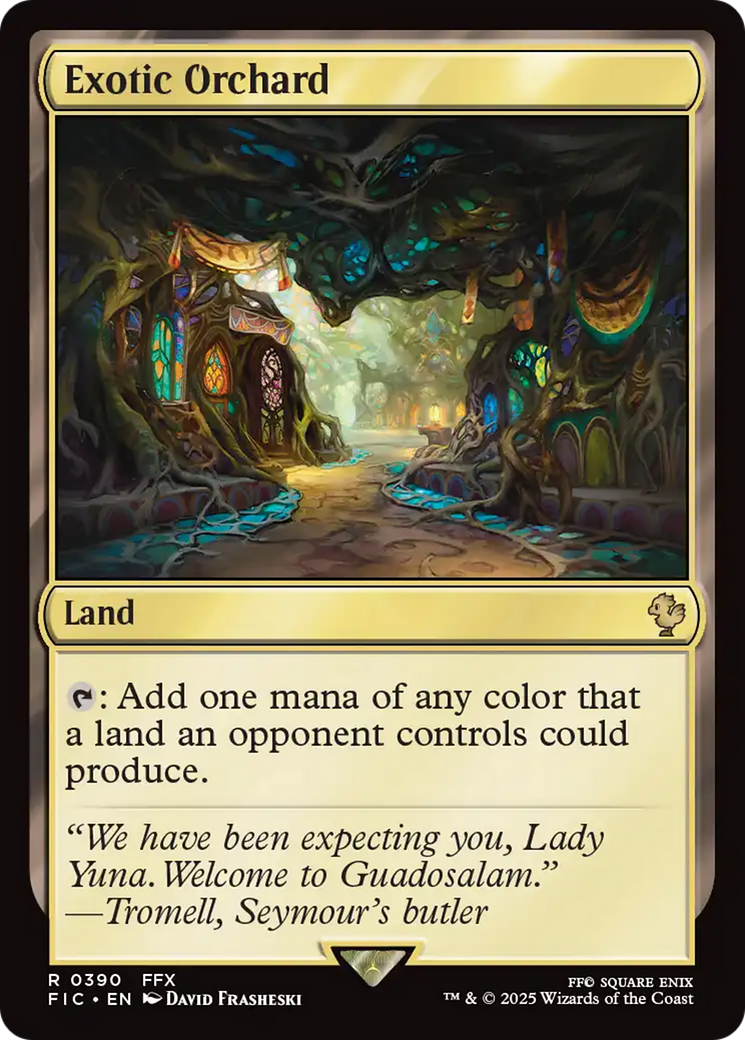
Exotic Orchard
Exotic Orchard
Land
: Add one mana of any color that a land an opponent controls could produce.
- Lands that produce mana based only on what other lands "could produce" won't help each other unless some other land allows one of them to actually produce some type of mana. For example, if you control an Exotic Orchard and your opponent controls an Exotic Orchard and a Reflecting Pool, none of those lands would produce mana if their mana abilities were activated. On the other hand, if you control a Forest and an Exotic Orchard, and your opponent controls an Exotic Orchard and a Reflecting Pool, then each of those lands can be tapped to produce . Your opponent's Exotic Orchard can produce because you control a Forest. Your Exotic Orchard and your opponent's Reflecting Pool can each produce because your opponent's Exotic Orchard can produce .
- When determining what colors of mana your opponents' lands could produce, Exotic Orchard takes into account any applicable replacement effects that would apply to those lands' mana abilities (such as Contamination's effect, for example). If there are more than one, consider them in any possible order.
- The colors of mana are white, blue, black, red, and green. Exotic Orchard can't be tapped for colorless mana, even if a land an opponent controls could produce colorless mana.
- Exotic Orchard doesn't care about any restrictions or riders your opponents' lands (such as Ancient Ziggurat or Hall of the Bandit Lord) put on the mana they produce. It just cares about colors of mana.
- Exotic Orchard checks the effects of all mana-producing abilities of lands your opponents control, but it doesn't check their costs. For example, Vivid Crag has the ability " , Remove a charge counter from Vivid Crag: Add one mana of any color." If an opponent controls Vivid Crag and you control Exotic Orchard, you can tap Exotic Orchard for any color of mana. It doesn't matter whether Vivid Crag has a charge counter on it, and it doesn't matter whether it's untapped.
-
1
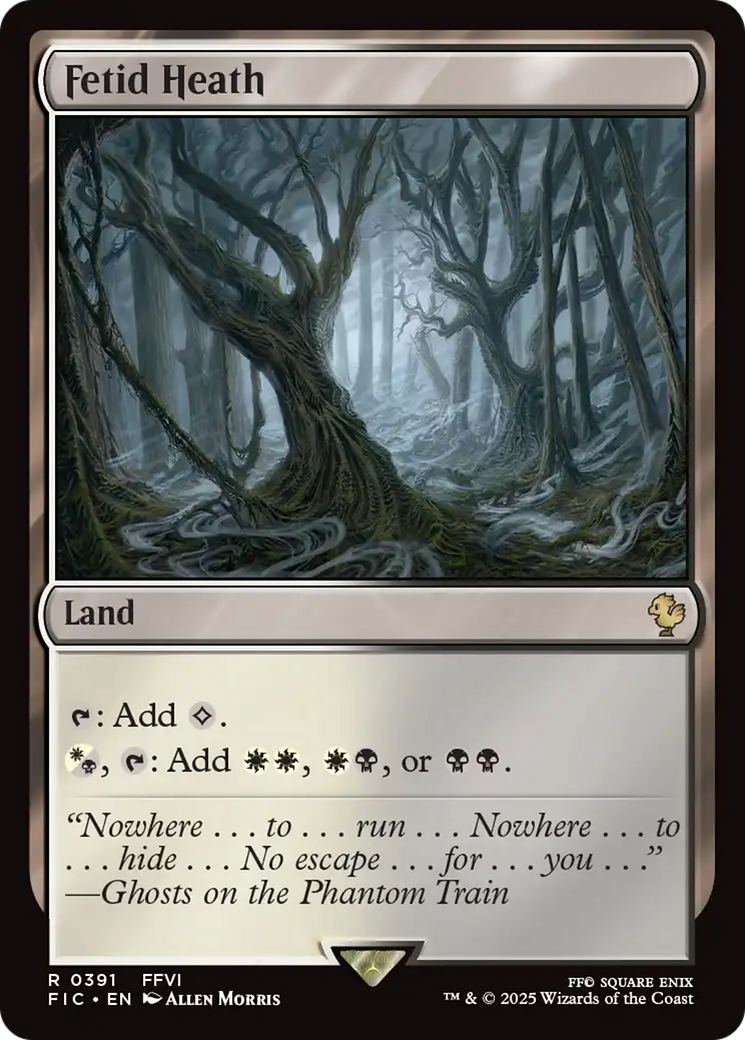
Fetid Heath
Fetid Heath
Land
: Add .
, : Add , , or .
-
1
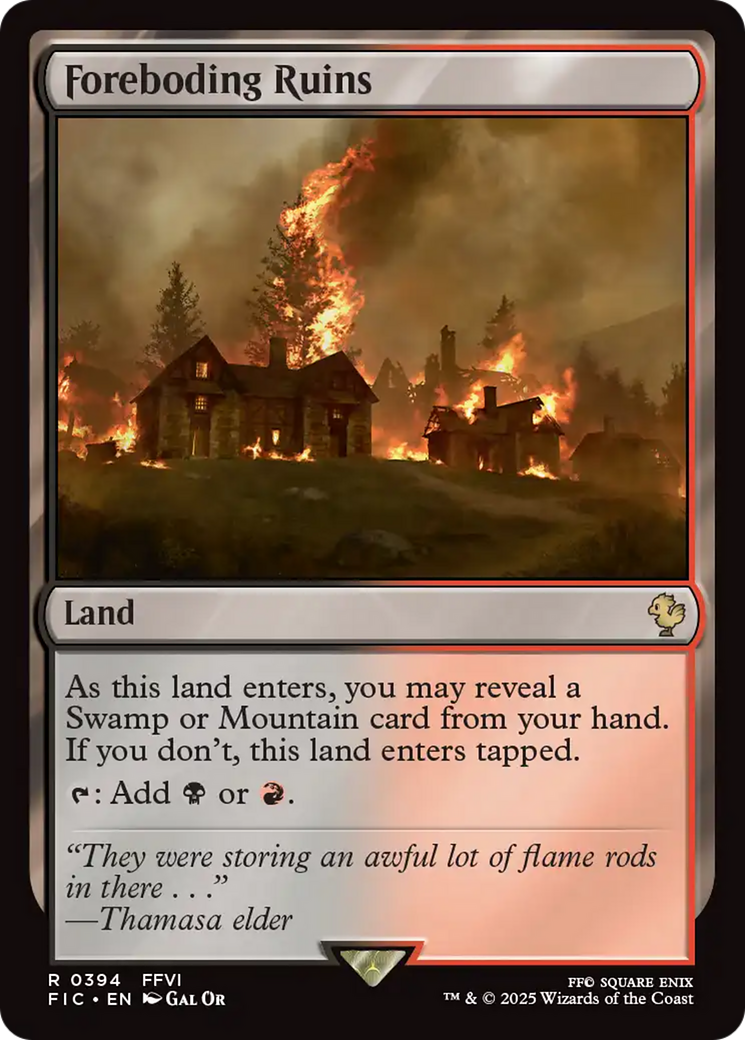
Foreboding Ruins
Foreboding Ruins
Land
As this land enters, you may reveal a Swamp or Mountain card from your hand. If you don't, this land enters tapped.
: Add or .
- You may reveal any land card with either or both of the appropriate subtypes. It doesn't have to be a basic land. For example, you could reveal Sunken Hollow from the Battle for Zendikar set to satisfy the ability of Foreboding Ruins.
- If a Swamp or Mountain is entering the battlefield from your hand at the same time as Foreboding Ruins, you may reveal the other land to have Foreboding Ruins enter untapped.
- Lands don't have a subtype just because they can produce mana of the corresponding color. Foreboding Ruins itself is neither a Swamp nor a Mountain, even though it produces black and red mana, so you can't reveal one to satisfy the ability of another.
- If an effect instructs you to put Foreboding Ruins onto the battlefield tapped, it will still enter the battlefield tapped even if you reveal a land card from your hand.
-
1
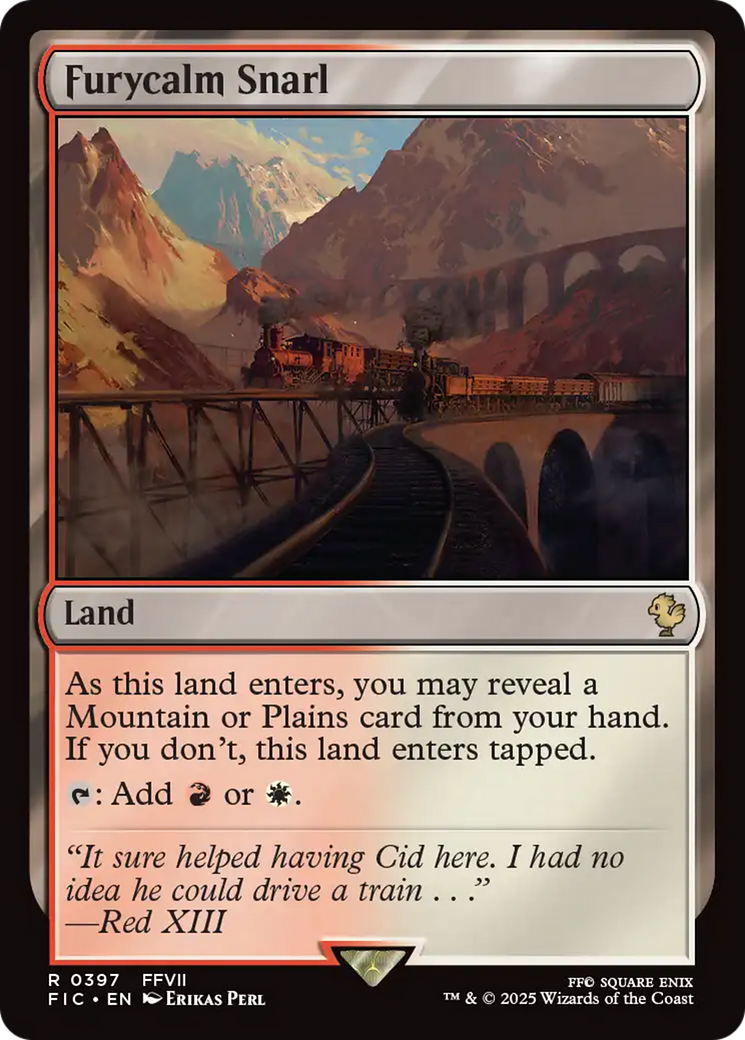
Furycalm Snarl
Furycalm Snarl
Land
As this land enters, you may reveal a Mountain or Plains card from your hand. If you don't, this land enters tapped.
: Add or .
- The "Snarl" itself doesn't have any land subtypes. You can't reveal one to satisfy the ability of another.
- If a land card with an appropriate subtype is entering the battlefield from your hand at the same time as one of these lands, you may reveal the other land to have the "Snarl" enter untapped.
- If an effect instructs you to put one of these lands onto the battlefield tapped, it will still enter the battlefield tapped even if you reveal a land card from your hand.
- You may reveal any land card with either or both of the appropriate subtypes. It doesn't have to be a basic land card.
-
1
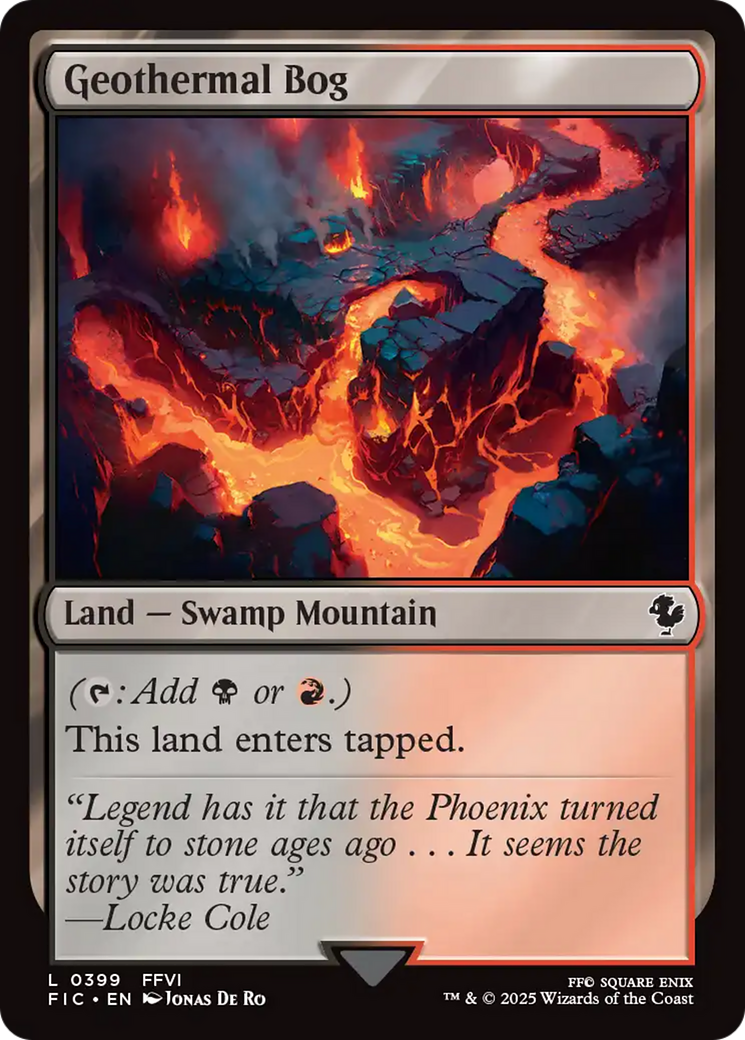
Geothermal Bog
Geothermal Bog
Land — Swamp Mountain
( : Add or .)
This land enters tapped.
-
1
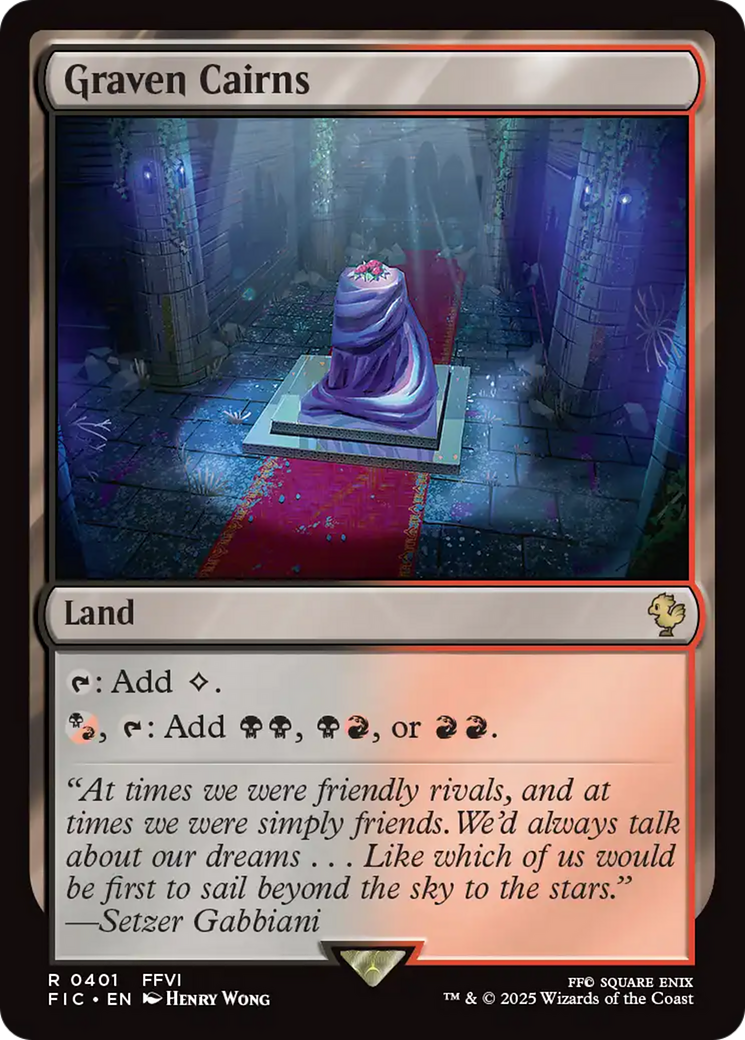
Graven Cairns
Graven Cairns
Land
: Add .
, : Add , , or .
- {(b/r)}, " is the same as saying " , or , .
-
1
High Market
High Market
Land
: Add .
, Sacrifice a creature: You gain 1 life.
-
1
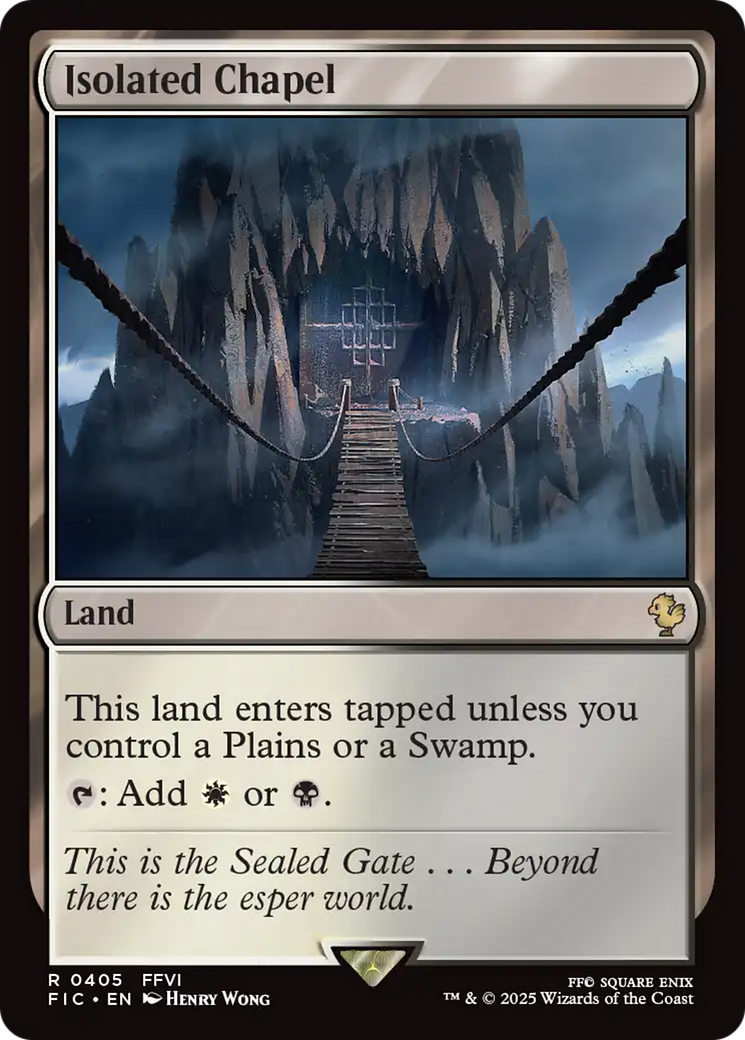
Isolated Chapel
Isolated Chapel
Land
This land enters tapped unless you control a Plains or a Swamp.
: Add or .
-
3
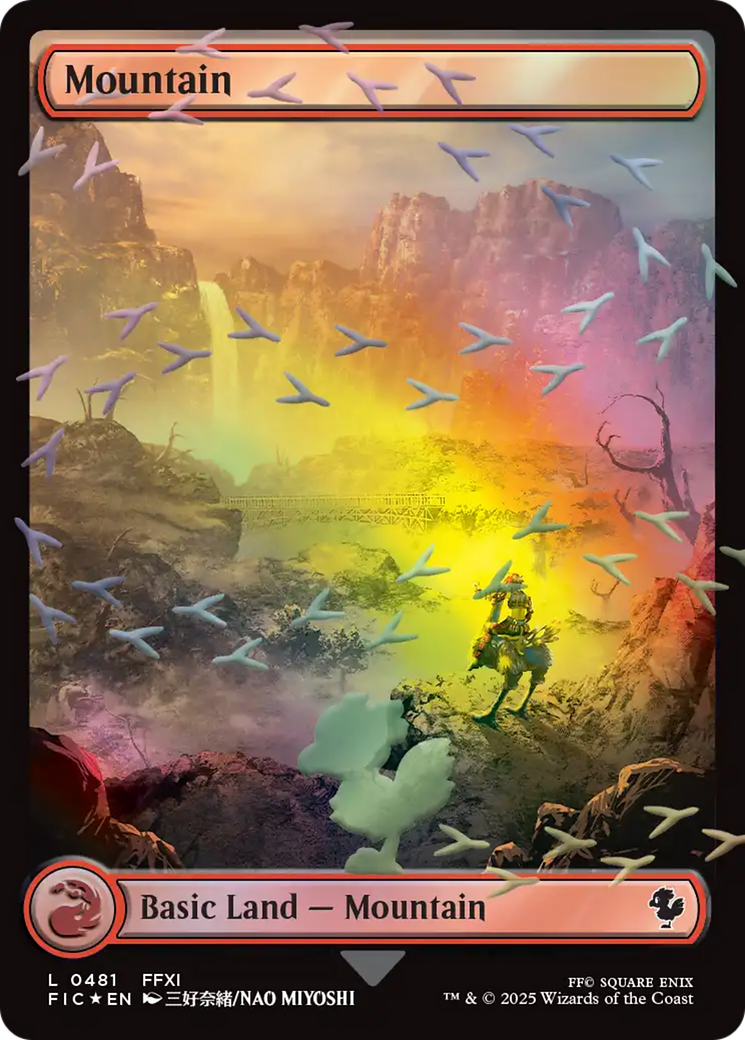
Mountain
Mountain
Basic Land — Mountain
( : Add .)
-
1
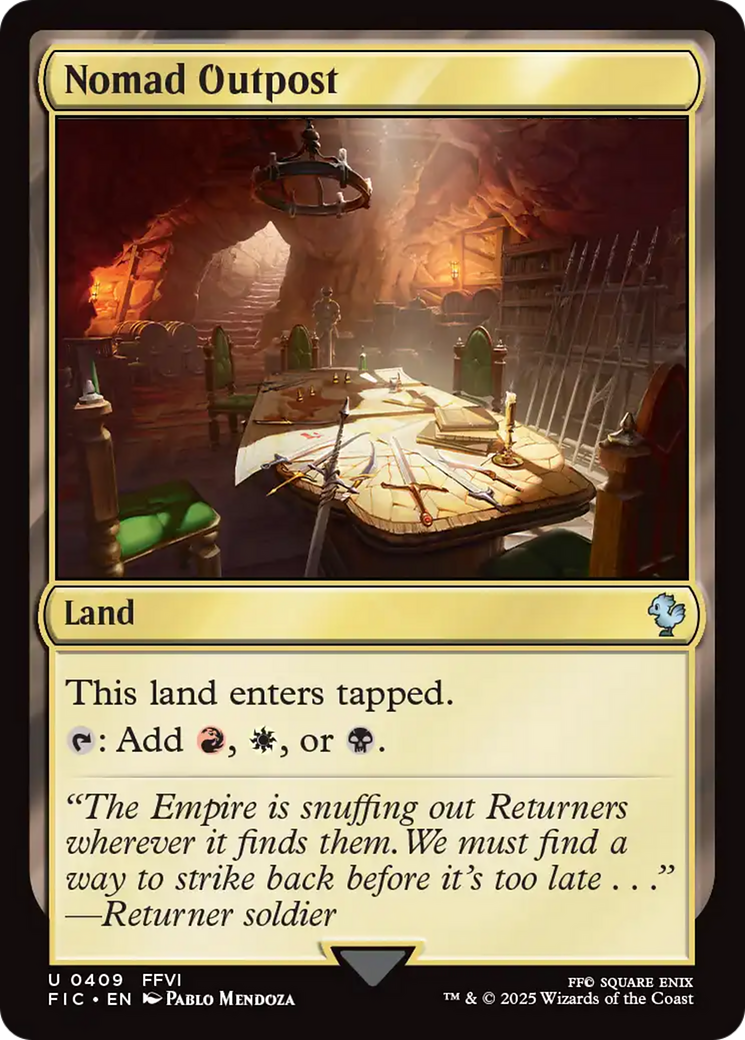
Nomad Outpost
Nomad Outpost
Land
This land enters tapped.
: Add , , or .
-
1
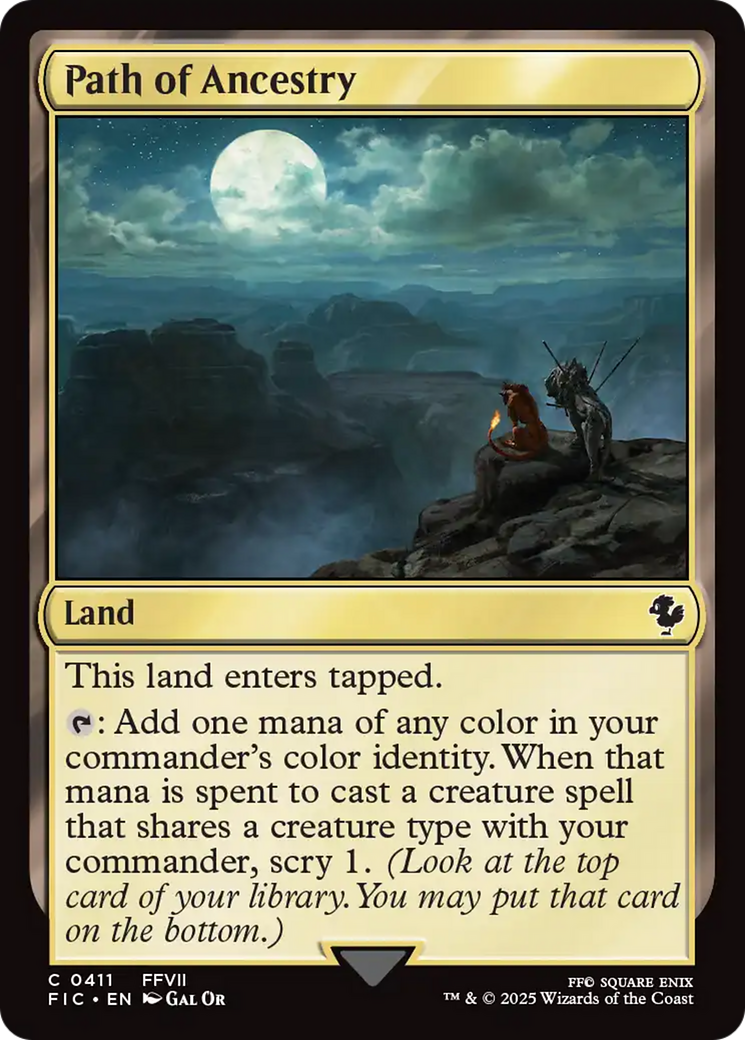
Path of Ancestry
Path of Ancestry
Land
This land enters tapped.
: Add one mana of any color in your commander's color identity. When that mana is spent to cast a creature spell that shares a creature type with your commander, scry 1. (Look at the top card of your library. You may put that card on the bottom.)
- Your commander's creature types are checked immediately after you cast a creature spell spending mana from Path of Ancestry's last ability. They aren't set before the game begins, and they may not be the same types your commander had when you activated that ability.
- If you have two commanders, the last ability adds one mana of any color in their combined color identities. When you spend that mana on a creature spell that shares a creature type with either of your commanders, you'll scry 1.
- If Path of Ancestry's last ability produces two mana (most likely due to Mana Reflection), spending those two mana to cast creature spells that share a creature type with your commander will cause two abilities to trigger. Each of those abilities will cause you to scry 1. You won't scry 2. This is true whether you spend the mana on one creature spell or two.
- If your commander has no creature types, it can't share a creature type with any spell that you cast.
- If you cast your commander with mana from Path of Ancestry, and your commander hasn't somehow lost all of its creature types while on the stack, you'll scry 1.
- If you don't have a commander, Path of Ancestry's ability produces no mana.
- If your commander is a card that has no colors in its color identity, Path of Ancestry's ability produces no mana. It doesn't produce .
-
4
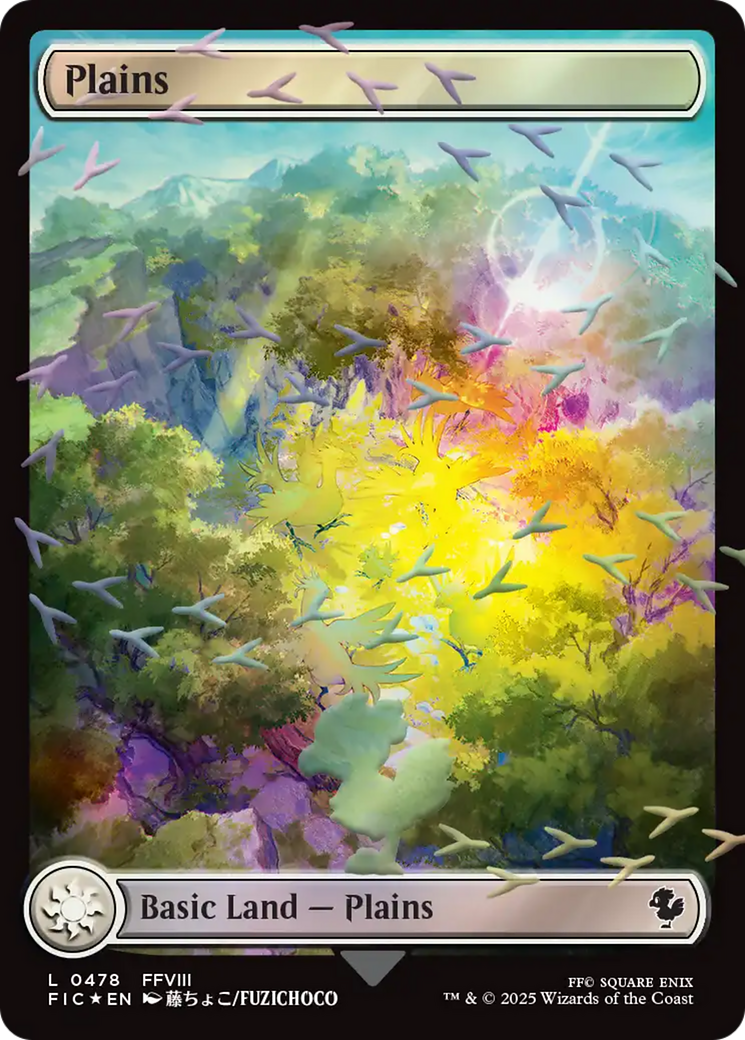
Plains
Plains
Basic Land — Plains
( : Add .)
-
1
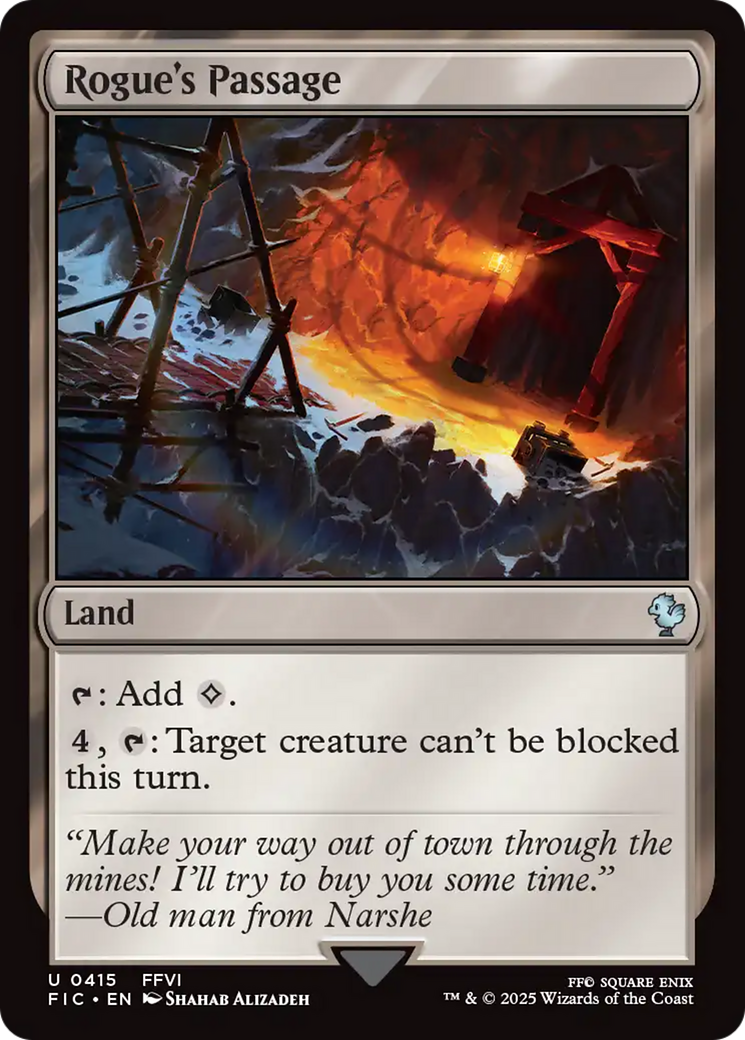
Rogue's Passage
Rogue's Passage
Land
: Add .
, : Target creature can't be blocked this turn.
- Activating the second ability of Rogue's Passage after a creature has become blocked won't cause that creature to become unblocked.
-
1
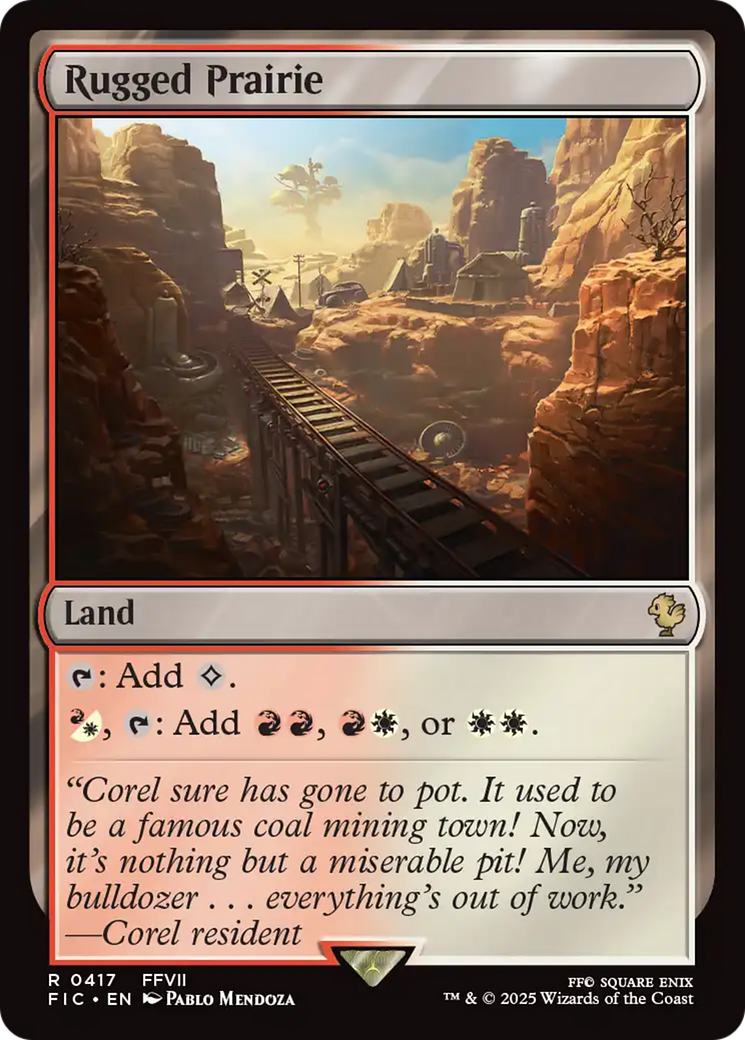
Rugged Prairie
Rugged Prairie
Land
: Add .
, : Add , , or .
-
1
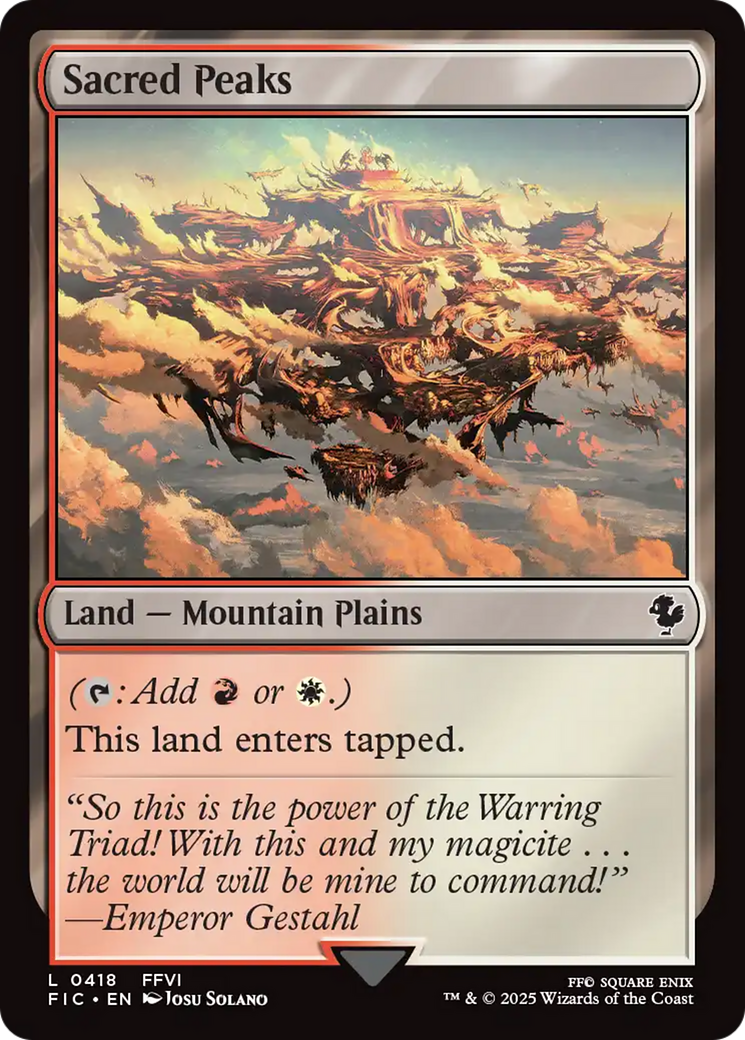
Sacred Peaks
Sacred Peaks
Land — Mountain Plains
( : Add or .)
This land enters tapped.
-
1
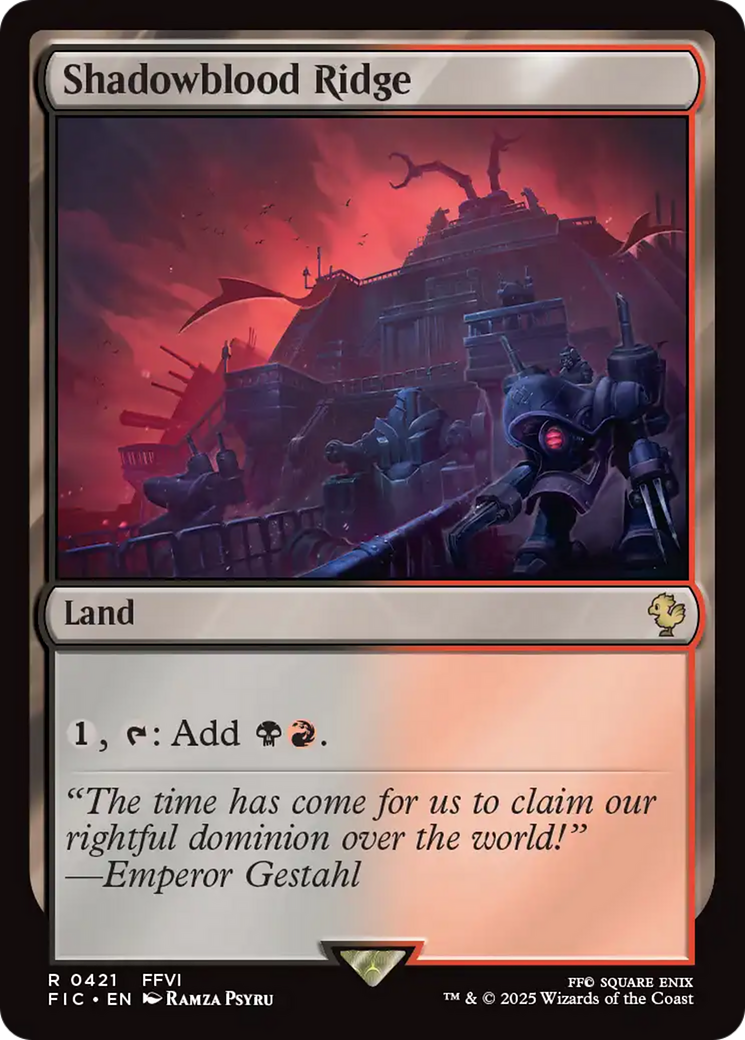
Shadowblood Ridge
Shadowblood Ridge
Land
, : Add .
-
1
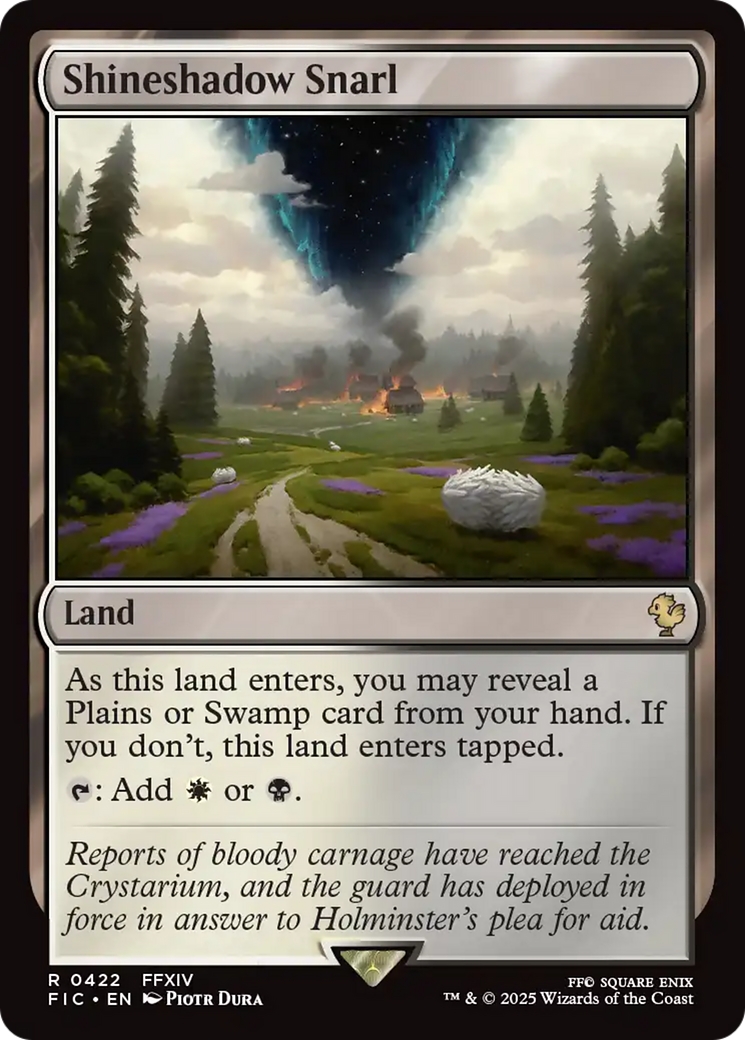
Shineshadow Snarl
Shineshadow Snarl
Land
As this land enters, you may reveal a Plains or Swamp card from your hand. If you don't, this land enters tapped.
: Add or .
- If a land card with an appropriate subtype is entering the battlefield from your hand at the same time as one of these lands, you may reveal the other land to have the "Snarl" enter untapped.
- If an effect instructs you to put one of these lands onto the battlefield tapped, it will still enter the battlefield tapped even if you reveal a land card from your hand.
- The "Snarl" itself doesn't have any land subtypes. You can't reveal one to satisfy the ability of another.
- You may reveal any land card with either or both of the appropriate subtypes. It doesn't have to be a basic land card.
-
1
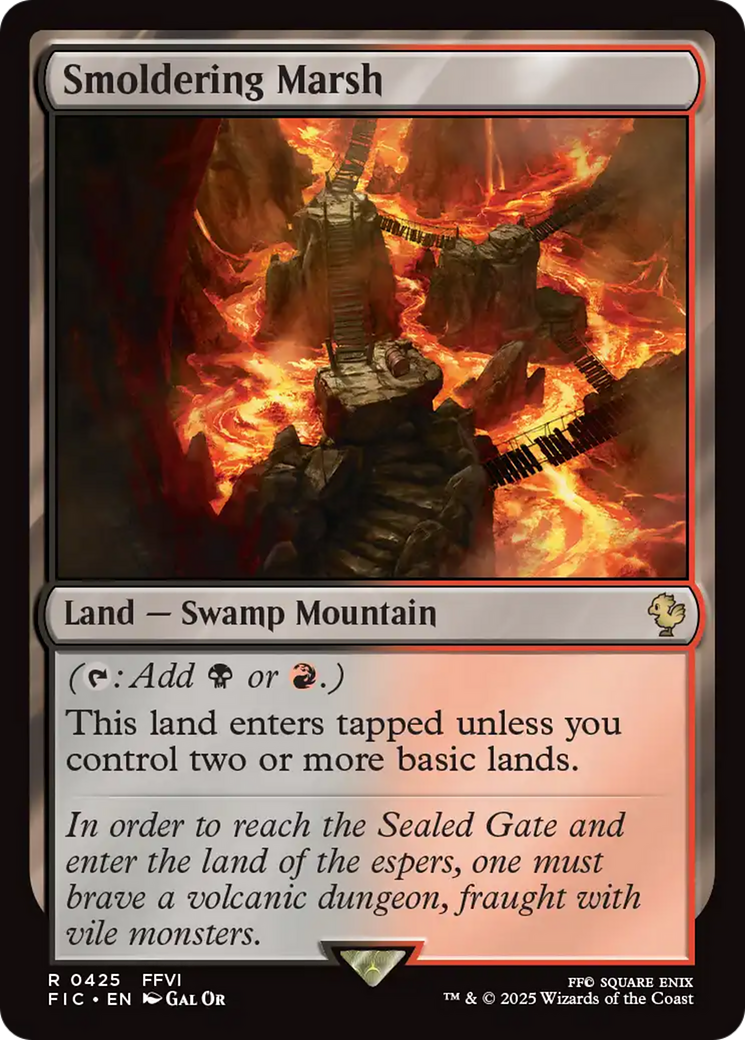
Smoldering Marsh
Smoldering Marsh
Land — Swamp Mountain
( : Add or .)
This land enters tapped unless you control two or more basic lands.
- However, because these cards have basic land types, effects that specify a basic land type without also specifying that the land be basic can affect them. For example, a spell or ability that reads "Destroy target Forest" can target Canopy Vista, while one that reads "Destroy target basic Forest" cannot.
- Even though these lands have basic land types, they are not basic lands because "basic" doesn't appear on their type line. Notably, controlling two or more of them won't allow others to enter the battlefield untapped.
- If one of these lands enters the battlefield at the same time as any number of basic lands, those other lands are not counted when determining if this land enters the battlefield tapped or untapped.
-
1
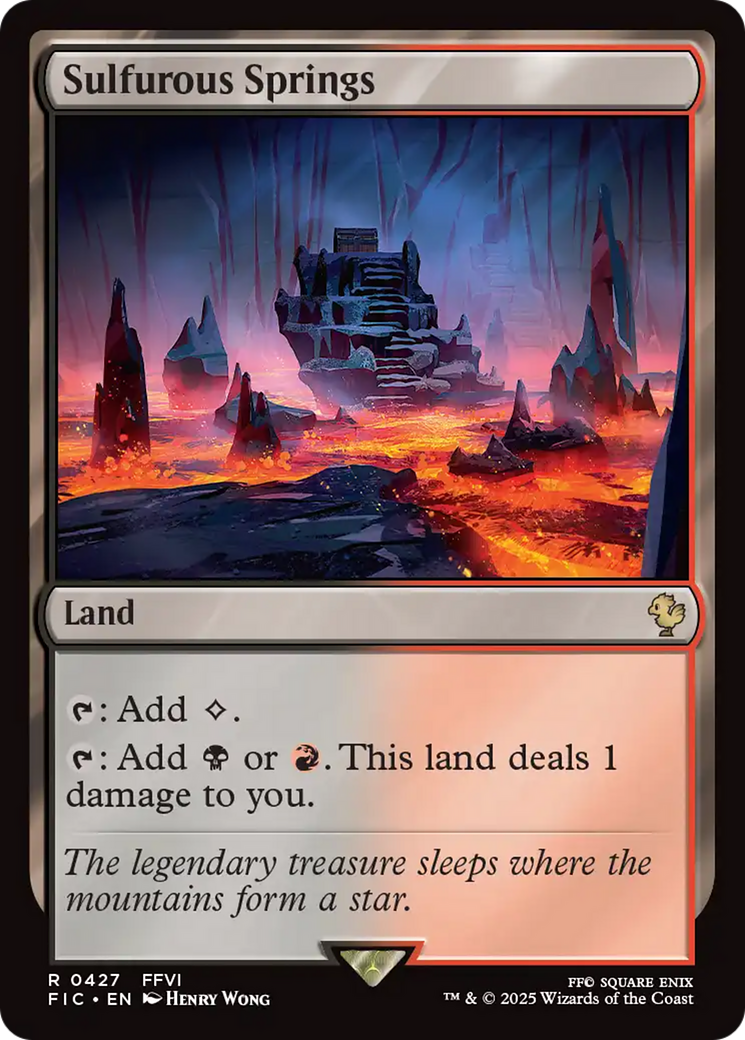
Sulfurous Springs
Sulfurous Springs
Land
: Add .
: Add or . This land deals 1 damage to you.
-
1
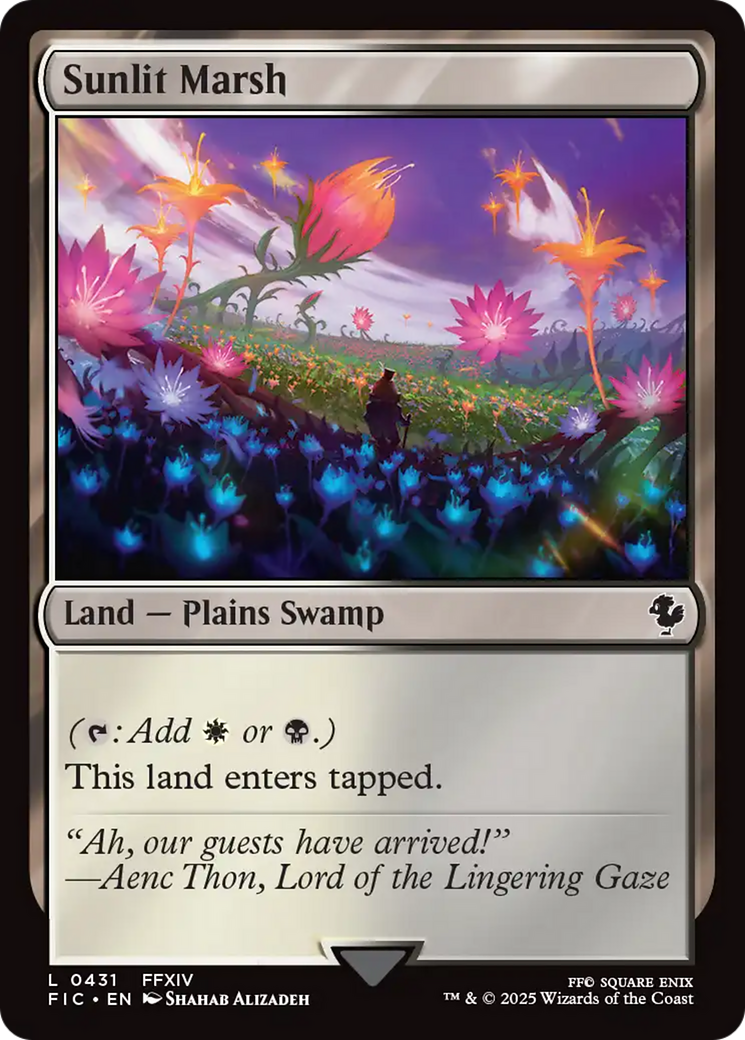
Sunlit Marsh
Sunlit Marsh
Land — Plains Swamp
( : Add or .)
This land enters tapped.
-
1
Sunscorched Divide
Sunscorched Divide
Land
, : Add .
-
3
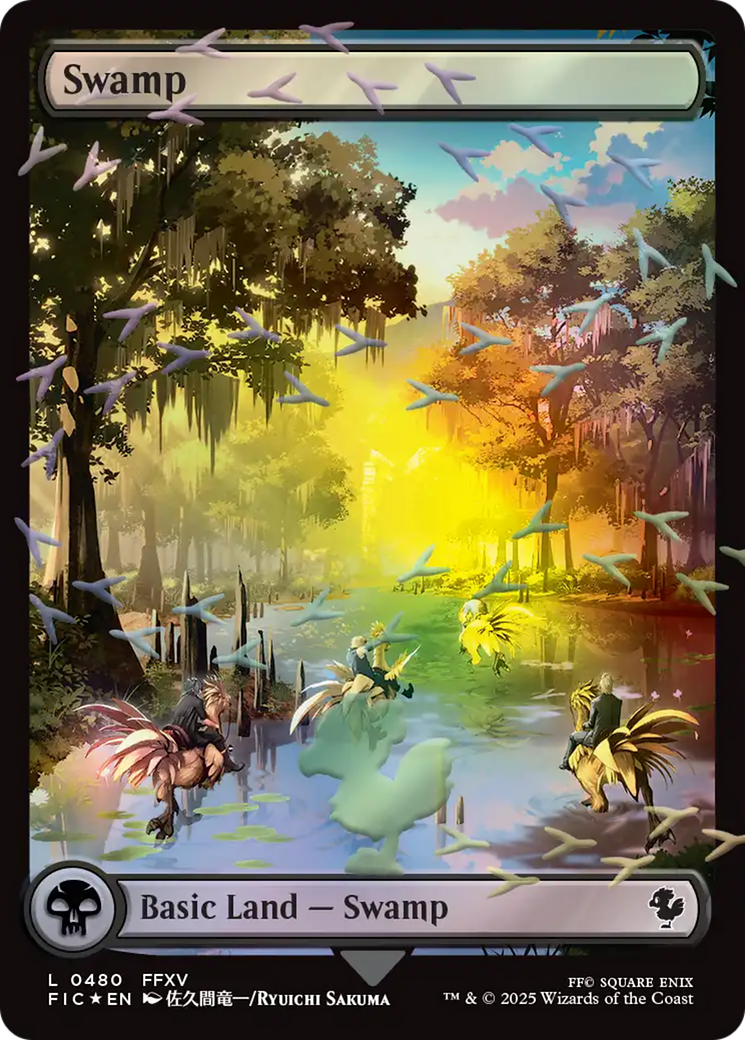
Swamp
Swamp
Basic Land — Swamp
( : Add .)
White 8
-
1
Angel of the Ruins
Angel of the Ruins
Artifact Creature — Angel
5/7
Flying
When this creature enters, exile up to two target artifacts and/or enchantments.
Plainscycling ( , Discard this card: Search your library for a Plains card, reveal it, put it into your hand, then shuffle.)
-
1
Coin of Fate
Coin of Fate
Artifact
When this artifact enters, surveil 1.
, , Exile two creature cards from your graveyard, Sacrifice this artifact: An opponent chooses one of the exiled cards. You put that card on the bottom of your library and return the other to the battlefield tapped. You become the monarch.
- If the triggered ability that causes the monarch to draw a card goes on the stack and a different player becomes the monarch before that ability resolves, the first player will still draw the card.
- The game starts with no monarch. As a player becomes the monarch, the current monarch (if any) ceases being the monarch. There is never more than one monarch at a time.
- There are two inherent triggered abilities associated with being the monarch. These triggered abilities have no source and are controlled by the player who was the monarch at the time the abilities triggered. The full texts of these abilities are "At the beginning of the monarch's end step, that player draws a card" and "Whenever a creature deals combat damage to the monarch, its controller becomes the monarch."
- If the monarch leaves the game during another player's turn, that player becomes the monarch. If the monarch leaves the game during their turn, the next player in turn order becomes the monarch.
- If combat damage dealt to the monarch causes that player to lose the game, the triggered ability that causes the controller of the attacking creature to become the monarch doesn't resolve. In most cases, the controller of the attacking creature will still become the monarch as it is likely their turn.
-
1
Cyan, Vengeful Samurai
Cyan, Vengeful Samurai
Legendary Creature — Human Samurai
3/3
This spell costs less to cast for each creature card in your graveyard.
Double strike
Whenever one or more creature cards leave your graveyard, put a +1/+1 counter on Cyan.
- If multiple creature cards leave your graveyard at the same time, Cyan's last ability will trigger only once.
-
1
General Leo Cristophe
General Leo Cristophe
Legendary Creature — Human Soldier
2/2
When General Leo Cristophe enters, return up to one target creature card with mana value 3 or less from your graveyard to the battlefield. Then put a +1/+1 counter on General Leo Cristophe for each creature you control.
- If the target creature card is an illegal target as General Leo Cristophe's ability tries to resolve, it won't resolve and none of its effects will happen. You won't put +1/+1 counters on General Leo Cristophe.
- If a card in your graveyard has in its mana cost, X is 0 for the purpose of determining its mana value.
-
1
Palace Jailer
Palace Jailer
Creature — Human Soldier
2/2
When this creature enters, you become the monarch.
When this creature enters, exile target creature an opponent controls until an opponent becomes the monarch.
- If a creature token is exiled, it ceases to exist. It won't return to the battlefield.
- The opponent that controlled the exiled card doesn't have to be the same opponent that becomes the monarch in order to cause that card to return to the battlefield. Any opponent becoming the monarch will cause the card to return.
- The game starts with no monarch. Once an effect makes one player the monarch, the game will have exactly one monarch from that point forward.
- Being the monarch carries two inherent triggered abilities. "At the beginning of the monarch's end step, that player draws a card" and "Whenever a creature deals combat damage to the monarch, its controller becomes the monarch."
- If you're not the monarch as Palace Jailer's second ability resolves, the creature will be exiled until there's a new monarch and that player is one of your opponents. The creature won't immediately return just because an opponent is the monarch.
- Auras attached to the exiled creature will be put into their owners' graveyards. Equipment attached to the exiled creature will become unattached and remain on the battlefield. Counters on the exiled creature will cease to exist.
- Palace Jailer leaving the battlefield won't cause the exiled creature to return. The game will continue to watch for the next time an opponent becomes the monarch.
- In a multiplayer game, if the monarch leaves the game, the player whose turn it is immediately becomes the monarch. If the player whose turn it is has left the game, instead the next player in turn order becomes the monarch.
-
1
Phoenix Down
Phoenix Down
Artifact
, , Exile this artifact: Choose one —
- Return target creature card with mana value 4 or less from your graveyard to the battlefield tapped.
- Exile target Skeleton, Spirit, or Zombie.
-
1
Sun Titan
Sun Titan
Creature — Giant
6/6
Vigilance
Whenever this creature enters or attacks, you may return target permanent card with mana value 3 or less from your graveyard to the battlefield.
- A permanent card is an artifact, creature, enchantment, land, or planeswalker card.
- If a card in your graveyard has no mana symbols in its upper right corner (because it's a land card, for example), its mana value is 0.
- The mana value of a card in your graveyard is determined solely by the mana symbols printed in its upper right corner. The mana value is the total amount of mana in that cost, regardless of color. For example, a card with mana cost has mana value 5.
- If the mana cost of a card in your graveyard includes , X is considered to be 0.
-
1
Tragic Arrogance
Tragic Arrogance
Sorcery
For each player, you choose from among the permanents that player controls an artifact, a creature, an enchantment, and a planeswalker. Then each player sacrifices all other nonland permanents they control.
- None of the chosen permanents are targets of Tragic Arrogance.
- If a permanent has more than one of the affected types, it can count for any of them. For example, you could choose an artifact creature as the artifact you're sparing, another creature as the creature, and an enchantment creature as the enchantment. Similarly, you could choose an enchantment creature as both the creature and the enchantment that you're sparing, even if the player controls another creature and/or another enchantment.
Black 15
-
1
Archfiend of Depravity
Archfiend of Depravity
Creature — Demon
5/4
Flying
At the beginning of each opponent's end step, that player chooses up to two creatures they control, then sacrifices the rest.
- The opponent may choose to spare one or no creatures. If the player doesn't choose any creatures, they will sacrifice all creatures they control.
- The opponent chooses which creatures to spare, if any, as the ability resolves. This choice doesn't target the creatures.
-
1
Espers to Magicite
Espers to Magicite
Instant
Exile each opponent's graveyard. When you do, choose up to one target creature card exiled this way. Create a token that's a copy of that card, except it's an artifact and it loses all other card types.
- You don't choose a target for Espers to Magicite at the time you cast it. Rather, a second "reflexive" ability triggers when you exile each opponent's graveyard this way. You choose a target for that ability as it goes on the stack. Each player may respond to this triggered ability as normal.
- The token is an artifact instead of its other types. This is a copiable value of the token that other effects may copy.
- If a card copied by the token had any "when [this permanent] enters" abilities, the token also has those abilities, and they'll trigger when it's created. Similarly, any "as [this permanent] enters" or "[this permanent] enters with" abilities that the token has copied will also work.
- Except for the listed exceptions, the token copies exactly what was printed on the original card and nothing else. It doesn't copy any information about the object the card may have been at any point before it was exiled.
- If the copied card has in its mana cost, X is 0.
-
1
Interceptor, Shadow's Hound
Interceptor, Shadow's Hound
Legendary Creature — Dog
4/3
Menace
Assassins you control have menace.
Whenever you attack with one or more legendary creatures, you may pay . If you do, return this card from your graveyard to the battlefield tapped and attacking.
- Although Interceptor's last ability causes it to enter attacking, it was never declared as an attacking creature. Abilities that trigger whenever a creature attacks won't trigger when it enters attacking.
- As Interceptor returns to the battlefield because of its triggered ability, you choose which player, planeswalker, or battle it's attacking. It doesn't have to attack the same player, planeswalker, or battle as your legendary creatures.
-
1
Morbid Opportunist
Morbid Opportunist
Creature — Human Rogue
1/3
Whenever one or more other creatures die, draw a card. This ability triggers only once each turn.
- If Morbid Opportunist dies at the same time as one or more other creatures, Morbid Opportunist's ability still triggers.
-
1
Night's Whisper
Night's Whisper
Sorcery
You draw two cards and lose 2 life.
-
1
Pitiless Plunderer
Pitiless Plunderer
Creature — Human Pirate
1/4
Whenever another creature you control dies, create a Treasure token. (It's an artifact with " , Sacrifice this token: Add one mana of any color.")
- If Pitiless Plunderer dies at the same time as one or more other creatures you control, its ability will still trigger for each of those other creatures.
-
1
Reanimate
Reanimate
Sorcery
Put target creature card from a graveyard onto the battlefield under your control. You lose life equal to that card's mana value.
- If a card in a graveyard has in its mana cost, X is 0.
- The amount of life you lose is determined by the mana value of the card in your graveyard, not the creature once it's on the battlefield.
- You lose life after the creature is already on the battlefield. Any abilities it has that interact with loss of life, such as that of Platinum Emperion, apply to that loss of life.
- If any abilities trigger on the creature entering the battlefield, those abilities resolve after you lose life. If losing life results in you losing the game, those abilities won't resolve.
- In a multiplayer game, if a player leaves the game, all cards that player owns leave as well. If you leave the game, the creature you control from Reanimate is exiled.
-
1
Rejoin the Fight
Rejoin the Fight
Sorcery
Mill three cards. Then starting with the next opponent in turn order, each opponent chooses a creature card in your graveyard that hasn't been chosen. Return each card chosen this way to the battlefield under your control.
-
1
Rise of the Dark Realms
Rise of the Dark Realms
Sorcery
Put all creature cards from all graveyards onto the battlefield under your control.
-
1
Sepulchral Primordial
Sepulchral Primordial
Creature — Avatar
5/4
Intimidate (This creature can't be blocked except by artifact creatures and/or creatures that share a color with it.)
When this creature enters, for each opponent, you may put up to one target creature card from that player's graveyard onto the battlefield under your control.
- You can choose a number of targets up to the number of opponents you have, one target per opponent.
- The creature cards enter simultaneously.
-
1
Shadow, Mysterious Assassin
Shadow, Mysterious Assassin
Legendary Creature — Human Assassin
3/3
Deathtouch
Throw — Whenever Shadow deals combat damage to a player, you may sacrifice another nonland permanent. If you do, draw two cards and each opponent loses life equal to the mana value of the sacrificed permanent.
- If a permanent has in its mana cost, X is 0 for the purpose of determining its mana value.
- Use the mana value of the sacrificed permanent as it last existed on the battlefield to determine how much life each opponent loses.
-
1
Siegfried, Famed Swordsman
Siegfried, Famed Swordsman
Legendary Creature — Human Warrior Rogue
2/2
Menace
When Siegfried enters, mill three cards. Then put X +1/+1 counters on Siegfried, where X is twice the number of creature cards in your graveyard.
- The value of X is calculated only once, as Siegfried's last ability resolves.
-
1
Stitch Together
Stitch Together
Sorcery
Return target creature card from your graveyard to your hand.
Threshold — Return that card from your graveyard to the battlefield instead if there are seven or more cards in your graveyard.
- Checks the number of cards in your graveyard when it starts resolving. You may drop below seven cards during resolution, but that won't stop it from resolving.
-
1
Stitcher's Supplier
Stitcher's Supplier
Creature — Zombie
1/1
When this creature enters or dies, mill three cards. (Put the top three cards of your library into your graveyard.)
-
1
The Falcon, Airship Restored
The Falcon, Airship Restored
Legendary Artifact — Vehicle
4/3
Flying
Whenever The Falcon deals combat damage to a player, you may sacrifice it. When you do, return target creature card from your graveyard to the battlefield.
: Return this card from your graveyard to the battlefield tapped.
Crew 2
- You don't choose a target for The Falcon's second ability at the time it triggers. Rather, a second "reflexive" ability triggers when you sacrifice The Falcon this way. You choose a target for that ability as it goes on the stack. Each player may respond to this triggered ability as normal.
Red 13
-
1
Anger
Anger
Creature — Incarnation
2/2
Haste
As long as this card is in your graveyard and you control a Mountain, creatures you control have haste.
- The timestamp for the "in your graveyard" ability is set at the time that this card goes to your graveyard, regardless of whether you control a Mountain at that time.
-
1
Big Score
Big Score
Instant
As an additional cost to cast this spell, discard a card.
Draw two cards and create two Treasure tokens. (They're artifacts with " , Sacrifice this token: Add one mana of any color.")
-
1
Combustible Gearhulk
Combustible Gearhulk
Artifact Creature — Construct
6/6
First strike
When this creature enters, target opponent may have you draw three cards. If the player doesn't, you mill three cards, then this creature deals damage to that player equal to the total mana value of those cards.
- If any of the cards put into your graveyard have in their mana cost, X is considered to be 0.
- If you have fewer than three cards in your library, the opponent may choose to have you draw three cards. If so, you'll lose the game as state-based actions are performed.
- While Combustible Gearhulk's triggered ability is resolving, no player may take any actions other than those specified by the Gearhulk. Once the opponent makes a choice, players can't cast spells or activate abilities until after the cards are drawn or put into the graveyard and damage has been dealt (if applicable).
-
1
Flayer of the Hatebound
Flayer of the Hatebound
Creature — Devil
4/2
Undying (When this creature dies, if it had no +1/+1 counters on it, return it to the battlefield under its owner's control with a +1/+1 counter on it.)
Whenever this creature or another creature enters from your graveyard, that creature deals damage equal to its power to any target.
- Flayer of the Hatebound's last ability will trigger even if a creature enters from your graveyard under another player's control.
- The creature that entered from your graveyard deals damage equal to its current power (including any +1/+1 counters it entered with) to the target permanent or player. If it's no longer on the battlefield when the ability resolves, its last known existence on the battlefield is checked to determine its power.
- Flayer of the Hatebound is the source of the ability, but it may be another creature that is the source of the damage. If a black creature enters from your graveyard, the ability could target a creature with protection from black, although the damage will be prevented. It couldn't target a creature with protection from red.
- Since damage is dealt by the creature, abilities like lifelink and deathtouch are taken into account, even if the creature has left the battlefield by the time it deals damage.
- If you cast a creature card from your graveyard, that card will be put on the stack before entering. Flayer of the Hatebound won't trigger.
-
1
Gau, Feral Youth
Gau, Feral Youth
Legendary Creature — Human Berserker
2/2
Rage — Whenever Gau attacks, put a +1/+1 counter on it.
At the beginning of each end step, if a card left your graveyard this turn, Gau deals damage equal to its power to each opponent.
- If Gau is no longer on the battlefield when its last ability resolves, use its power as it last existed on the battlefield to determine how much damage the ability deals.
- Gau's last ability checks at the moment it would trigger to see if a card left your graveyard this turn. If none did, the ability won't trigger at all. Once your end step begins, it's too late to make a card leave your graveyard in order to cause this ability to trigger.
-
1
Gogo, Mysterious Mime
Gogo, Mysterious Mime
Legendary Creature — Wizard
2/2
At the beginning of combat on your turn, you may have Gogo become a copy of another target creature you control until end of turn, except its name is Gogo, Mysterious Mime. If you do, Gogo and that creature each get +2/+0 and gain haste until end of turn and attack this turn if able.
- Gogo copies exactly what was printed on the original creature, with the listed exception (unless that creature is copying something else or is a token; see below). It doesn't copy whether that creature is tapped or untapped, whether it has any counters on it or any Auras or Equipment attached to it, or any non-copy effects that have changed its types, color, power and toughness, and so on.
- If the copied creature has in its mana cost, X is 0.
- If the copied creature is a token, Gogo copies the original characteristics of that token as stated by the effect that created the token, with the listed exception.
- If Gogo copies a legendary creature, Gogo will also be legendary, but because its name remains Gogo, Mysterious Mime, the "legend rule" won't cause either of them to be put into the graveyard.
- If the copied creature is copying something else, then Gogo becomes a copy of whatever that creature is copying, with the listed exception.
-
1
Laughing Mad
Laughing Mad
Instant
As an additional cost to cast this spell, discard a card.
Draw two cards.
Flashback (You may cast this card from your graveyard for its flashback cost and any additional costs. Then exile it.)
-
1
Ruin Grinder
Ruin Grinder
Artifact Creature — Construct
7/4
Menace
When this creature dies, each player may discard their hand and draw seven cards.
Mountaincycling ( , Discard this card: Search your library for a Mountain card, reveal it, put it into your hand, then shuffle.)
- Players decide and announce in turn order, starting with the active player, whether or not they want to discard their hand. Then, all players who chose to do so discard their hands and draw seven cards. Players later in the turn order will know if players before them are discarding, but they don't get to see what those players will discard to help them decide whether to discard themselves.
-
1
Sabin, Master Monk
Sabin, Master Monk
Legendary Creature — Human Noble Monk
4/3
Double strike
Blitz— , Discard a card. (If you cast this spell for its blitz cost, it gains haste and "When this creature dies, draw a card." Sacrifice it at the beginning of the next end step.)
You may cast this card from your graveyard using its blitz ability.
- If you pay the blitz cost to cast a creature spell, that permanent will be sacrificed only if it's still on the battlefield when that triggered ability resolves. If it dies or goes to another zone before then, it will stay where it is.
- If a creature enters the battlefield as a copy of or becomes a copy of a creature whose blitz cost was paid, the copy won't have haste, won't be sacrificed, and its controller won't draw a card when it dies.
- If you choose to pay the blitz cost rather than the mana cost, you're still casting the spell. It goes on the stack and can be responded to and countered. You can cast a creature spell for its blitz cost only if you could cast that creature spell. Most of the time, this means during your main phase when the stack is empty.
- You don't have to attack with the creature with blitz unless another ability says you do.
- The triggered ability that lets its controller draw a card triggers when it dies for any reason, not just when you sacrifice it during the end step.
-
1
Snort
Snort
Sorcery
Each player may discard their hand and draw five cards. Then Snort deals 5 damage to each opponent who discarded their hand this way.
Flashback (You may cast this card from your graveyard for its flashback cost. Then exile it.)
- A player may choose to discard their hand even if their hand contains zero cards. Snort will still deal 5 damage to that player if they choose to discard their empty hand.
-
1
Strago and Relm
Strago and Relm
Legendary Creature — Human Wizard
1/3
Sketch and Lore — , : Target opponent exiles cards from the top of their library until they exile an instant, sorcery, or creature card. You may cast that card without paying its mana cost. If you cast a creature spell this way, it gains haste and "At the beginning of the end step, sacrifice this creature." Activate only as a sorcery.
- If a spell has in its mana cost, you must choose 0 as the value of X when playing it without paying its mana cost.
- You cast the card while Strago and Relm's ability is resolving and still on the stack. You can't wait to play it later in the turn. Timing restrictions based on its types are ignored.
- If you cast a spell "without paying its mana cost," you can't choose to cast it for any alternative costs. You can, however, pay additional costs. If the spell has any mandatory additional costs, those must be paid to cast the spell.
-
1
Summon: Esper Valigarmanda
Summon: Esper Valigarmanda
Enchantment Creature — Saga Drake
3/3
(As this Saga enters and after your draw step, add a lore counter. Sacrifice after IV.)
I — Exile an instant or sorcery card from each graveyard.
II, III, IV — Add for each lore counter on this Saga. You may cast an instant or sorcery card exiled with this Saga, and mana of any type can be spent to cast that spell.
Flying, haste
- You cast the spell while the ability is resolving and still on the stack. You can't wait to cast it later in the turn.
- Summon: Esper Valigarmanda's second, third, and fourth chapter abilities aren't mana abilities. They use the stack and can be responded to.
-
1
Umaro, Raging Yeti
Umaro, Raging Yeti
Legendary Creature — Yeti Berserker
6/6
Trample
At the beginning of combat on your turn, choose one at random —
- Other creatures you control get +3/+0 and gain trample until end of turn.
- Discard your hand, then draw four cards.
- Umaro deals 5 damage to any target.
- In the incredibly rare case where there is no legal target for the last mode, that mode can't be chosen. The first two modes are always eligible to be chosen.
- As you put Umaro's triggered ability on the stack, you choose a mode at random. Players can respond to the ability knowing which mode was chosen.
Multicolor 14
-
1
Banon, the Returners' Leader
Banon, the Returners' Leader
Legendary Creature — Human Cleric Rebel
1/3
Pray — Once during each of your turns, you may cast a creature spell from among cards in your graveyard that were put there from anywhere other than the battlefield this turn.
Whenever you attack, you may pay and discard a card. If you do, draw a card.
- You pay all costs and follow all timing rules for cards played with the permission granted by Banon's first ability.
-
1
Bedevil
Bedevil
Instant
Destroy target artifact, creature, or planeswalker.
-
1
Celes, Rune Knight
Celes, Rune Knight
Legendary Creature — Human Wizard Knight
4/4
When Celes enters, discard any number of cards, then draw that many cards plus one.
Whenever one or more other creatures you control enter, if one or more of them entered from a graveyard or was cast from a graveyard, put a +1/+1 counter on each creature you control.
- You choose how many cards to discard as Celes's first ability resolves. You may choose to discard no cards and just draw a card.
-
1
Crackling Doom
Crackling Doom
Instant
Crackling Doom deals 2 damage to each opponent. Each opponent sacrifices a creature with the greatest power among creatures that player controls.
- Crackling Doom doesn't target any player or creature. For example, a creature with protection from black could be sacrificed.
- If a player controls two or more creatures tied for the greatest power among creatures they control, that player chooses one of them to sacrifice.
- The sacrifice is not dependent on the damage being dealt. It doesn't matter if that damage is prevented or redirected.
- In a multiplayer game, each opponent, starting with the active player and proceeding in turn order, chooses which creature they will sacrifice and then all creatures are sacrificed at the same time. Each successive player will know what the players before them chose to sacrifice.
-
1
Edgar, Master Machinist
Edgar, Master Machinist
Legendary Creature — Human Artificer Noble
2/4
Once during each of your turns, you may cast an artifact spell from your graveyard. If you cast a spell this way, that artifact enters tapped.
Tools — Whenever Edgar attacks, it gets +X/+0 until end of turn, where X is the greatest mana value among artifacts you control.
- Edgar must be under your control in order to start casting an artifact spell using its first ability, but it doesn't need to stay under your control throughout that process or be under your control as the spell resolves. If, for example, you sacrifice Edgar to pay an additional cost of the spell or Edgar is destroyed in response, the spell will still resolve normally.
- If an artifact you control has in its mana cost, X is 0 for the purpose of calculating its mana value.
- You must still pay all costs and follow any timing restrictions and permissions for artifact spells you cast from your graveyard this way. Normally, you'll be able to cast them only during your main phase while the stack is empty.
- The value of X is calculated only once, as Edgar's last ability resolves.
-
1
Kefka, Dancing Mad
Kefka, Dancing Mad
Legendary Creature — Human Wizard
6/6
During your turn, Kefka has indestructible.
At the beginning of your end step, exile a card at random from each opponent's graveyard. You may cast any number of spells from among cards exiled this way without paying their mana costs. Then each player who owns a spell you cast this way loses life equal to its mana value.
- You choose which spells to cast (if any) as Kefka's last ability resolves. You can't wait to cast them later in the turn. Timing restrictions based on their types are ignored.
- Cards you choose not to cast this way (or can't cast this way) remain in exile.
- You cast the spells one at a time, choosing modes, targets, and so on. The last spell you cast will be the first one to resolve.
- If you cast a spell "without paying its mana cost," you can't choose to cast it for any alternative costs. You can, however, pay additional costs, such as kicker costs. If the card has any mandatory additional costs, those must be paid to cast the spell.
- If a spell you cast has in its mana cost, you must choose 0 as the value of X when casting it without paying its mana cost.
-
1
Legions to Ashes
Legions to Ashes
Sorcery
Exile target nonland permanent an opponent controls and all tokens that player controls with the same name as that permanent.
- The target permanent need not be a token. In that case, it will still be exiled.
- If the target is illegal as Legions to Ashes tries to resolve, it will be removed from the stack and do nothing, even if there are tokens with that name still on the battlefield.
-
1
Locke, Treasure Hunter
Locke, Treasure Hunter
Legendary Creature — Human Rogue
2/3
Locke can't be blocked by creatures with greater power.
Mug — Whenever Locke attacks, each player mills a card. If a land card was milled this way, create a Treasure token. Until end of turn, you may cast a spell from among those cards.
- As long as one or more lands were milled this way, you'll create a Treasure token. Additional land cards milled beyond the first won't cause you to create additional Treasures.
- You must pay the costs to cast that spell. If it has an alternative cost, you may cast it for that cost instead.
- Once Locke has been blocked, changing its power or the power of the blocking creature won't cause Locke to become unblocked.
- You must follow the normal timing permissions and restrictions of the spell you cast from among those cards.
- Losing control of Locke after the last ability has triggered won't affect your ability to cast a spell from among the milled cards.
- If you cast a spell from among the milled cards using another permission, Locke's effect doesn't apply. You can cast another spell from among the milled cards using the permission granted by Locke's last ability.
-
1
Mog, Moogle Warrior
Mog, Moogle Warrior
Legendary Creature — Moogle Warrior
1/2
Lifelink
Dance — At the beginning of your end step, each player may discard a card. Each player who discarded a card this way draws a card. If a creature card was discarded this way, you create a 1/2 white Moogle creature token with lifelink. Then if a noncreature card was discarded this way, put a +1/+1 counter on each Moogle you control.
- As long as at least one creature card was discarded this way, you'll create a Moogle token, and as long as at least one noncreature card was discarded this way, you'll put a +1/+1 counter on each Moogle you control. Additional creature cards discarded beyond the first won't result in additional Moogle tokens, and additional noncreature cards discarded beyond the first won't result in additional counters.
-
1
Mortify
Mortify
Instant
Destroy target creature or enchantment.
- This spell isn't modal. When it resolves, it will destroy the target if it's a creature or an enchantment, even if it changed from one to the other between targeting and resolution.
-
1
Priest of Fell Rites
Priest of Fell Rites
Creature — Human Warlock
2/2
, Pay 3 life, Sacrifice this creature: Return target creature card from your graveyard to the battlefield. Activate only as a sorcery.
Unearth ( : Return this card from your graveyard to the battlefield. It gains haste. Exile it at the beginning of the next end step or if it would leave the battlefield. Unearth only as a sorcery.)
- Activating a creature card's unearth ability isn't the same as casting the creature card. The unearth ability is put on the stack, but the creature card is not. Spells and abilities that interact with activated abilities (such as Stifle) will interact with unearth, but spells and abilities that interact with spells (such as Cancel) will not.
- You choose the target of the first ability before paying any of that ability's costs. In other words, you can't choose Priest of Fell Rites itself as the target to bring it back from the graveyard.
- If a creature returned to the battlefield by the unearth ability would leave it for any reason, it's exiled instead—unless the spell or ability that's causing the creature to leave the battlefield is actually trying to exile it. In that case, the spell or ability succeeds at exiling the creature. If the spell or ability later returns the creature card to the battlefield (as Ephemerate might, for example), the creature card will return as a new object with no relation to its previous existence. The unearth effect will no longer apply to it.
-
1
Ruinous Ultimatum
Ruinous Ultimatum
Sorcery
Destroy all nonland permanents your opponents control.
-
1
Setzer, Wandering Gambler
Setzer, Wandering Gambler
Legendary Creature — Human Rogue Pilot
2/2
When Setzer enters, create The Blackjack, a legendary 3/3 colorless Vehicle artifact token with flying and crew 2.
Whenever a Vehicle you control deals combat damage to a player, flip a coin.
Whenever you win a coin flip, create two tapped Treasure tokens.
- Some effects that instruct a player to flip a coin care only about whether the coin comes up heads or tails. These effects don't normally cause any player to win or lose that coin flip.
-
1
Terra, Herald of Hope
Terra, Herald of Hope
Legendary Creature — Human Wizard Warrior
3/3
Trance — At the beginning of combat on your turn, mill two cards. Terra gains flying until end of turn.
Whenever Terra deals combat damage to a player, you may pay . When you do, return target creature card with power 3 or less from your graveyard to the battlefield tapped.
- You don't choose a target for Terra's last ability at the time it triggers. Rather, a second "reflexive" ability triggers when you pay this way. You choose a target for that ability as it goes on the stack. Each player may respond to this triggered ability as normal.
Colorless 13
-
1
Arcane Signet
Arcane Signet
Artifact
: Add one mana of any color in your commander's color identity.
- If your commander is a card that has no colors in its color identity, Arcane Signet's ability produces no mana. It doesn't produce .
- If you have two commanders, the ability adds one mana of any color in their combined color identities.
- If you don't have a commander, Arcane Signet's ability produces no mana.
-
1
Commander's Sphere
Commander's Sphere
Artifact
: Add one mana of any color in your commander's color identity.
Sacrifice this artifact: Draw a card.
- If your commander is a card that has no colors in its color identity, Commander's Sphere's first ability produces no mana. It doesn't produce .
- If you don't have a commander, Commander's Sphere's first ability produces no mana.
- If you have two commanders, the ability adds one mana of any color in their combined color identities.
-
1
Key to the City
Key to the City
Artifact
, Discard a card: Up to one target creature can't be blocked this turn.
Whenever this artifact becomes untapped, you may pay . If you do, draw a card.
- You can activate Key to the City's first ability without targeting any creature.
- Activating Key to the City's ability targeting a creature that has already been blocked won't cause it to become unblocked.
- Key to the City's last ability triggers during your untap step, but it's put onto the stack at the same time as abilities that trigger at the beginning of your upkeep step. Even though Key to the City's ability triggered first, you may order it before or after other abilities you control that are put onto the stack at this time.
- You can pay only once each time Key to the City's triggered ability resolves. You can't pay more to draw additional cards.
-
1
Meteor Golem
Meteor Golem
Artifact Creature — Golem
3/3
When this creature enters, destroy target nonland permanent an opponent controls.
-
1
Millikin
Millikin
Artifact Creature — Construct
0/1
, Mill a card: Add . (To mill a card, put the top card of your library into your graveyard.)
- If an effect allows you to look at the top card of your library any time or to play with the top card of your library revealed, and you activate Millikin's mana ability while casting a spell, you can't look at the new top card of your library until you are done casting the spell. The same is true if you activate Millikin's ability while activating another ability.
-
1
Mind Stone
Mind Stone
Artifact
: Add .
, , Sacrifice this artifact: Draw a card.
-
1
Sol Ring
Sol Ring
Artifact
: Add .
-
1
Solemn Simulacrum
Solemn Simulacrum
Artifact Creature — Golem
2/2
When this creature enters, you may search your library for a basic land card, put that card onto the battlefield tapped, then shuffle.
When this creature dies, you may draw a card.
-
1
Swiftfoot Boots
Swiftfoot Boots
Artifact — Equipment
Equipped creature has hexproof and haste. (It can't be the target of spells or abilities your opponents control. It can attack and no matter when it came under your control.)
Equip ( : Attach to target creature you control. Equip only as a sorcery.)
- If a creature enters the battlefield under your control and gains haste, but then loses it before attacking, it won't be able to attack that turn. This means that you can't use one Swiftfoot Boots to allow two new creatures to attack in the same turn.
-
1
Talisman of Conviction
Talisman of Conviction
Artifact
: Add .
: Add or . This artifact deals 1 damage to you.
-
1
Talisman of Indulgence
Talisman of Indulgence
Artifact
: Add .
: Add or . This artifact deals 1 damage to you.
-
1
The Warring Triad
The Warring Triad
Legendary Artifact Creature — God
5/5
Flying, trample, haste
As long as there are fewer than eight cards in your graveyard, The Warring Triad isn't a creature.
, Mill a card: Target player adds one mana of any color.
- The Warring Triad's last ability isn't a mana ability. It uses the stack and can be responded to.
- As The Warring Triad enters the battlefield, the number of cards in your graveyard will determine whether any replacement effects that affect creatures entering the battlefield apply to The Warring Triad.
- The type-changing ability that can make The Warring Triad not be a creature functions only on the battlefield. It's always a creature card in other zones, regardless of how many cards are in your graveyard. It's always a creature spell while it's on the stack.
- When The Warring Triad enters the battlefield, the number of cards in your graveyard will determine if a creature entered the battlefield or not for abilities that trigger whenever a creature enters the battlefield.
- The Warring Triad's abilities function while it's on the battlefield, regardless of whether it's a creature.
- If The Warring Triad stops being a creature, it loses the type creature and the creature type God. It continues to be a legendary artifact.
- If The Warring Triad is attacking or blocking and it stops being a creature, it will be removed from combat. It won't rejoin combat if it resumes being a creature later during that combat.
- Counters put on The Warring Triad remain on it while it's not a creature, even if they have no effect.
- If an effect causes The Warring Triad to lose all abilities, its ability that causes it to stop being a creature still applies if appropriate.
-
1
Wayfarer's Bauble
Wayfarer's Bauble
Artifact
, , Sacrifice this artifact: Search your library for a basic land card, put that card onto the battlefield tapped, then shuffle.
Lands 37
-
1
Ash Barrens
Ash Barrens
Land
: Add .
Basic landcycling ( , Discard this card: Search your library for a basic land card, reveal it, put it into your hand, then shuffle.)
-
1
Battlefield Forge
Battlefield Forge
Land
: Add .
: Add or . This land deals 1 damage to you.
- Like most lands, each land in this cycle is colorless. The damage dealt to you is dealt by a colorless source.
- The damage dealt to you is part of the second mana ability. It doesn't use the stack and can't be responded to.
-
1
Clifftop Retreat
Clifftop Retreat
Land
This land enters tapped unless you control a Mountain or a Plains.
: Add or .
-
1
Command Tower
Command Tower
Land
: Add one mana of any color in your commander's color identity.
- If you don't have a commander, Command Tower's ability produces no mana.
- If your commander is a card that has no colors in its color identity, Command Tower's ability produces no mana. It doesn't produce .
- If you have two commanders, the ability adds one mana of any color in their combined color identities.
-
1
Demolition Field
Demolition Field
Land
: Add .
, , Sacrifice this land: Destroy target nonbasic land an opponent controls. That land's controller may search their library for a basic land card, put it onto the battlefield, then shuffle. You may search your library for a basic land card, put it onto the battlefield, then shuffle.
- The target land's controller gets to search for a basic land card even if that land wasn't destroyed by Demolition Field's ability. This may happen because the land has indestructible.
- If the targeted land is an illegal target by the time Demolition Field's ability resolves, it won't resolve and none of its effects will happen. Neither player will get to search for a basic land card.
-
1
Desolate Mire
Desolate Mire
Land
, : Add .
-
1
Dragonskull Summit
Dragonskull Summit
Land
This land enters tapped unless you control a Swamp or a Mountain.
: Add or .
- This checks for lands you control with the land type Swamp or Mountain, not for lands named Swamp or Mountain. The lands it checks for don't have to be basic lands. For example, if you control Stomping Ground (a nonbasic land with the land types Mountain and Forest), Dragonskull Summit will enter untapped.
- As this is entering, it checks for lands that are already on the battlefield. It won't see lands that are entering at the same time (due to Warp World, for example).
-
1
Evolving Wilds
Evolving Wilds
Land
, Sacrifice this land: Search your library for a basic land card, put it onto the battlefield tapped, then shuffle.
-
1
Exotic Orchard
Exotic Orchard
Land
: Add one mana of any color that a land an opponent controls could produce.
- Lands that produce mana based only on what other lands "could produce" won't help each other unless some other land allows one of them to actually produce some type of mana. For example, if you control an Exotic Orchard and your opponent controls an Exotic Orchard and a Reflecting Pool, none of those lands would produce mana if their mana abilities were activated. On the other hand, if you control a Forest and an Exotic Orchard, and your opponent controls an Exotic Orchard and a Reflecting Pool, then each of those lands can be tapped to produce . Your opponent's Exotic Orchard can produce because you control a Forest. Your Exotic Orchard and your opponent's Reflecting Pool can each produce because your opponent's Exotic Orchard can produce .
- When determining what colors of mana your opponents' lands could produce, Exotic Orchard takes into account any applicable replacement effects that would apply to those lands' mana abilities (such as Contamination's effect, for example). If there are more than one, consider them in any possible order.
- The colors of mana are white, blue, black, red, and green. Exotic Orchard can't be tapped for colorless mana, even if a land an opponent controls could produce colorless mana.
- Exotic Orchard doesn't care about any restrictions or riders your opponents' lands (such as Ancient Ziggurat or Hall of the Bandit Lord) put on the mana they produce. It just cares about colors of mana.
- Exotic Orchard checks the effects of all mana-producing abilities of lands your opponents control, but it doesn't check their costs. For example, Vivid Crag has the ability " , Remove a charge counter from Vivid Crag: Add one mana of any color." If an opponent controls Vivid Crag and you control Exotic Orchard, you can tap Exotic Orchard for any color of mana. It doesn't matter whether Vivid Crag has a charge counter on it, and it doesn't matter whether it's untapped.
-
1
Fetid Heath
Fetid Heath
Land
: Add .
, : Add , , or .
-
1
Foreboding Ruins
Foreboding Ruins
Land
As this land enters, you may reveal a Swamp or Mountain card from your hand. If you don't, this land enters tapped.
: Add or .
- You may reveal any land card with either or both of the appropriate subtypes. It doesn't have to be a basic land. For example, you could reveal Sunken Hollow from the Battle for Zendikar set to satisfy the ability of Foreboding Ruins.
- If a Swamp or Mountain is entering the battlefield from your hand at the same time as Foreboding Ruins, you may reveal the other land to have Foreboding Ruins enter untapped.
- Lands don't have a subtype just because they can produce mana of the corresponding color. Foreboding Ruins itself is neither a Swamp nor a Mountain, even though it produces black and red mana, so you can't reveal one to satisfy the ability of another.
- If an effect instructs you to put Foreboding Ruins onto the battlefield tapped, it will still enter the battlefield tapped even if you reveal a land card from your hand.
-
1
Furycalm Snarl
Furycalm Snarl
Land
As this land enters, you may reveal a Mountain or Plains card from your hand. If you don't, this land enters tapped.
: Add or .
- The "Snarl" itself doesn't have any land subtypes. You can't reveal one to satisfy the ability of another.
- If a land card with an appropriate subtype is entering the battlefield from your hand at the same time as one of these lands, you may reveal the other land to have the "Snarl" enter untapped.
- If an effect instructs you to put one of these lands onto the battlefield tapped, it will still enter the battlefield tapped even if you reveal a land card from your hand.
- You may reveal any land card with either or both of the appropriate subtypes. It doesn't have to be a basic land card.
-
1
Geothermal Bog
Geothermal Bog
Land — Swamp Mountain
( : Add or .)
This land enters tapped.
-
1
Graven Cairns
Graven Cairns
Land
: Add .
, : Add , , or .
- {(b/r)}, " is the same as saying " , or , .
-
1
High Market
High Market
Land
: Add .
, Sacrifice a creature: You gain 1 life.
-
1
Isolated Chapel
Isolated Chapel
Land
This land enters tapped unless you control a Plains or a Swamp.
: Add or .
-
3
Mountain
Mountain
Basic Land — Mountain
( : Add .)
-
1
Nomad Outpost
Nomad Outpost
Land
This land enters tapped.
: Add , , or .
-
1
Path of Ancestry
Path of Ancestry
Land
This land enters tapped.
: Add one mana of any color in your commander's color identity. When that mana is spent to cast a creature spell that shares a creature type with your commander, scry 1. (Look at the top card of your library. You may put that card on the bottom.)
- Your commander's creature types are checked immediately after you cast a creature spell spending mana from Path of Ancestry's last ability. They aren't set before the game begins, and they may not be the same types your commander had when you activated that ability.
- If you have two commanders, the last ability adds one mana of any color in their combined color identities. When you spend that mana on a creature spell that shares a creature type with either of your commanders, you'll scry 1.
- If Path of Ancestry's last ability produces two mana (most likely due to Mana Reflection), spending those two mana to cast creature spells that share a creature type with your commander will cause two abilities to trigger. Each of those abilities will cause you to scry 1. You won't scry 2. This is true whether you spend the mana on one creature spell or two.
- If your commander has no creature types, it can't share a creature type with any spell that you cast.
- If you cast your commander with mana from Path of Ancestry, and your commander hasn't somehow lost all of its creature types while on the stack, you'll scry 1.
- If you don't have a commander, Path of Ancestry's ability produces no mana.
- If your commander is a card that has no colors in its color identity, Path of Ancestry's ability produces no mana. It doesn't produce .
-
4
Plains
Plains
Basic Land — Plains
( : Add .)
-
1
Rogue's Passage
Rogue's Passage
Land
: Add .
, : Target creature can't be blocked this turn.
- Activating the second ability of Rogue's Passage after a creature has become blocked won't cause that creature to become unblocked.
-
1
Rugged Prairie
Rugged Prairie
Land
: Add .
, : Add , , or .
-
1
Sacred Peaks
Sacred Peaks
Land — Mountain Plains
( : Add or .)
This land enters tapped.
-
1
Shadowblood Ridge
Shadowblood Ridge
Land
, : Add .
-
1
Shineshadow Snarl
Shineshadow Snarl
Land
As this land enters, you may reveal a Plains or Swamp card from your hand. If you don't, this land enters tapped.
: Add or .
- If a land card with an appropriate subtype is entering the battlefield from your hand at the same time as one of these lands, you may reveal the other land to have the "Snarl" enter untapped.
- If an effect instructs you to put one of these lands onto the battlefield tapped, it will still enter the battlefield tapped even if you reveal a land card from your hand.
- The "Snarl" itself doesn't have any land subtypes. You can't reveal one to satisfy the ability of another.
- You may reveal any land card with either or both of the appropriate subtypes. It doesn't have to be a basic land card.
-
1
Smoldering Marsh
Smoldering Marsh
Land — Swamp Mountain
( : Add or .)
This land enters tapped unless you control two or more basic lands.
- However, because these cards have basic land types, effects that specify a basic land type without also specifying that the land be basic can affect them. For example, a spell or ability that reads "Destroy target Forest" can target Canopy Vista, while one that reads "Destroy target basic Forest" cannot.
- Even though these lands have basic land types, they are not basic lands because "basic" doesn't appear on their type line. Notably, controlling two or more of them won't allow others to enter the battlefield untapped.
- If one of these lands enters the battlefield at the same time as any number of basic lands, those other lands are not counted when determining if this land enters the battlefield tapped or untapped.
-
1
Sulfurous Springs
Sulfurous Springs
Land
: Add .
: Add or . This land deals 1 damage to you.
-
1
Sunlit Marsh
Sunlit Marsh
Land — Plains Swamp
( : Add or .)
This land enters tapped.
-
1
Sunscorched Divide
Sunscorched Divide
Land
, : Add .
-
3
Swamp
Swamp
Basic Land — Swamp
( : Add .)
1 5
-
1
Phoenix Down
Phoenix Down
Artifact
, , Exile this artifact: Choose one —
- Return target creature card with mana value 4 or less from your graveyard to the battlefield tapped.
- Exile target Skeleton, Spirit, or Zombie.
-
1
Reanimate
Reanimate
Sorcery
Put target creature card from a graveyard onto the battlefield under your control. You lose life equal to that card's mana value.
- If a card in a graveyard has in its mana cost, X is 0.
- The amount of life you lose is determined by the mana value of the card in your graveyard, not the creature once it's on the battlefield.
- You lose life after the creature is already on the battlefield. Any abilities it has that interact with loss of life, such as that of Platinum Emperion, apply to that loss of life.
- If any abilities trigger on the creature entering the battlefield, those abilities resolve after you lose life. If losing life results in you losing the game, those abilities won't resolve.
- In a multiplayer game, if a player leaves the game, all cards that player owns leave as well. If you leave the game, the creature you control from Reanimate is exiled.
-
1
Sol Ring
Sol Ring
Artifact
: Add .
-
1
Stitcher's Supplier
Stitcher's Supplier
Creature — Zombie
1/1
When this creature enters or dies, mill three cards. (Put the top three cards of your library into your graveyard.)
-
1
Wayfarer's Bauble
Wayfarer's Bauble
Artifact
, , Sacrifice this artifact: Search your library for a basic land card, put that card onto the battlefield tapped, then shuffle.
2 13
-
1
Arcane Signet
Arcane Signet
Artifact
: Add one mana of any color in your commander's color identity.
- If your commander is a card that has no colors in its color identity, Arcane Signet's ability produces no mana. It doesn't produce .
- If you have two commanders, the ability adds one mana of any color in their combined color identities.
- If you don't have a commander, Arcane Signet's ability produces no mana.
-
1
Banon, the Returners' Leader
Banon, the Returners' Leader
Legendary Creature — Human Cleric Rebel
1/3
Pray — Once during each of your turns, you may cast a creature spell from among cards in your graveyard that were put there from anywhere other than the battlefield this turn.
Whenever you attack, you may pay and discard a card. If you do, draw a card.
- You pay all costs and follow all timing rules for cards played with the permission granted by Banon's first ability.
-
1
Coin of Fate
Coin of Fate
Artifact
When this artifact enters, surveil 1.
, , Exile two creature cards from your graveyard, Sacrifice this artifact: An opponent chooses one of the exiled cards. You put that card on the bottom of your library and return the other to the battlefield tapped. You become the monarch.
- If the triggered ability that causes the monarch to draw a card goes on the stack and a different player becomes the monarch before that ability resolves, the first player will still draw the card.
- The game starts with no monarch. As a player becomes the monarch, the current monarch (if any) ceases being the monarch. There is never more than one monarch at a time.
- There are two inherent triggered abilities associated with being the monarch. These triggered abilities have no source and are controlled by the player who was the monarch at the time the abilities triggered. The full texts of these abilities are "At the beginning of the monarch's end step, that player draws a card" and "Whenever a creature deals combat damage to the monarch, its controller becomes the monarch."
- If the monarch leaves the game during another player's turn, that player becomes the monarch. If the monarch leaves the game during their turn, the next player in turn order becomes the monarch.
- If combat damage dealt to the monarch causes that player to lose the game, the triggered ability that causes the controller of the attacking creature to become the monarch doesn't resolve. In most cases, the controller of the attacking creature will still become the monarch as it is likely their turn.
-
1
Gau, Feral Youth
Gau, Feral Youth
Legendary Creature — Human Berserker
2/2
Rage — Whenever Gau attacks, put a +1/+1 counter on it.
At the beginning of each end step, if a card left your graveyard this turn, Gau deals damage equal to its power to each opponent.
- If Gau is no longer on the battlefield when its last ability resolves, use its power as it last existed on the battlefield to determine how much damage the ability deals.
- Gau's last ability checks at the moment it would trigger to see if a card left your graveyard this turn. If none did, the ability won't trigger at all. Once your end step begins, it's too late to make a card leave your graveyard in order to cause this ability to trigger.
-
1
Key to the City
Key to the City
Artifact
, Discard a card: Up to one target creature can't be blocked this turn.
Whenever this artifact becomes untapped, you may pay . If you do, draw a card.
- You can activate Key to the City's first ability without targeting any creature.
- Activating Key to the City's ability targeting a creature that has already been blocked won't cause it to become unblocked.
- Key to the City's last ability triggers during your untap step, but it's put onto the stack at the same time as abilities that trigger at the beginning of your upkeep step. Even though Key to the City's ability triggered first, you may order it before or after other abilities you control that are put onto the stack at this time.
- You can pay only once each time Key to the City's triggered ability resolves. You can't pay more to draw additional cards.
-
1
Millikin
Millikin
Artifact Creature — Construct
0/1
, Mill a card: Add . (To mill a card, put the top card of your library into your graveyard.)
- If an effect allows you to look at the top card of your library any time or to play with the top card of your library revealed, and you activate Millikin's mana ability while casting a spell, you can't look at the new top card of your library until you are done casting the spell. The same is true if you activate Millikin's ability while activating another ability.
-
1
Mind Stone
Mind Stone
Artifact
: Add .
, , Sacrifice this artifact: Draw a card.
-
1
Night's Whisper
Night's Whisper
Sorcery
You draw two cards and lose 2 life.
-
1
Priest of Fell Rites
Priest of Fell Rites
Creature — Human Warlock
2/2
, Pay 3 life, Sacrifice this creature: Return target creature card from your graveyard to the battlefield. Activate only as a sorcery.
Unearth ( : Return this card from your graveyard to the battlefield. It gains haste. Exile it at the beginning of the next end step or if it would leave the battlefield. Unearth only as a sorcery.)
- Activating a creature card's unearth ability isn't the same as casting the creature card. The unearth ability is put on the stack, but the creature card is not. Spells and abilities that interact with activated abilities (such as Stifle) will interact with unearth, but spells and abilities that interact with spells (such as Cancel) will not.
- You choose the target of the first ability before paying any of that ability's costs. In other words, you can't choose Priest of Fell Rites itself as the target to bring it back from the graveyard.
- If a creature returned to the battlefield by the unearth ability would leave it for any reason, it's exiled instead—unless the spell or ability that's causing the creature to leave the battlefield is actually trying to exile it. In that case, the spell or ability succeeds at exiling the creature. If the spell or ability later returns the creature card to the battlefield (as Ephemerate might, for example), the creature card will return as a new object with no relation to its previous existence. The unearth effect will no longer apply to it.
-
1
Stitch Together
Stitch Together
Sorcery
Return target creature card from your graveyard to your hand.
Threshold — Return that card from your graveyard to the battlefield instead if there are seven or more cards in your graveyard.
- Checks the number of cards in your graveyard when it starts resolving. You may drop below seven cards during resolution, but that won't stop it from resolving.
-
1
Swiftfoot Boots
Swiftfoot Boots
Artifact — Equipment
Equipped creature has hexproof and haste. (It can't be the target of spells or abilities your opponents control. It can attack and no matter when it came under your control.)
Equip ( : Attach to target creature you control. Equip only as a sorcery.)
- If a creature enters the battlefield under your control and gains haste, but then loses it before attacking, it won't be able to attack that turn. This means that you can't use one Swiftfoot Boots to allow two new creatures to attack in the same turn.
-
1
Talisman of Conviction
Talisman of Conviction
Artifact
: Add .
: Add or . This artifact deals 1 damage to you.
-
1
Talisman of Indulgence
Talisman of Indulgence
Artifact
: Add .
: Add or . This artifact deals 1 damage to you.
3 15
-
1
Bedevil
Bedevil
Instant
Destroy target artifact, creature, or planeswalker.
-
1
Commander's Sphere
Commander's Sphere
Artifact
: Add one mana of any color in your commander's color identity.
Sacrifice this artifact: Draw a card.
- If your commander is a card that has no colors in its color identity, Commander's Sphere's first ability produces no mana. It doesn't produce .
- If you don't have a commander, Commander's Sphere's first ability produces no mana.
- If you have two commanders, the ability adds one mana of any color in their combined color identities.
-
1
Crackling Doom
Crackling Doom
Instant
Crackling Doom deals 2 damage to each opponent. Each opponent sacrifices a creature with the greatest power among creatures that player controls.
- Crackling Doom doesn't target any player or creature. For example, a creature with protection from black could be sacrificed.
- If a player controls two or more creatures tied for the greatest power among creatures they control, that player chooses one of them to sacrifice.
- The sacrifice is not dependent on the damage being dealt. It doesn't matter if that damage is prevented or redirected.
- In a multiplayer game, each opponent, starting with the active player and proceeding in turn order, chooses which creature they will sacrifice and then all creatures are sacrificed at the same time. Each successive player will know what the players before them chose to sacrifice.
-
1
Laughing Mad
Laughing Mad
Instant
As an additional cost to cast this spell, discard a card.
Draw two cards.
Flashback (You may cast this card from your graveyard for its flashback cost and any additional costs. Then exile it.)
-
1
Legions to Ashes
Legions to Ashes
Sorcery
Exile target nonland permanent an opponent controls and all tokens that player controls with the same name as that permanent.
- The target permanent need not be a token. In that case, it will still be exiled.
- If the target is illegal as Legions to Ashes tries to resolve, it will be removed from the stack and do nothing, even if there are tokens with that name still on the battlefield.
-
1
Locke, Treasure Hunter
Locke, Treasure Hunter
Legendary Creature — Human Rogue
2/3
Locke can't be blocked by creatures with greater power.
Mug — Whenever Locke attacks, each player mills a card. If a land card was milled this way, create a Treasure token. Until end of turn, you may cast a spell from among those cards.
- As long as one or more lands were milled this way, you'll create a Treasure token. Additional land cards milled beyond the first won't cause you to create additional Treasures.
- You must pay the costs to cast that spell. If it has an alternative cost, you may cast it for that cost instead.
- Once Locke has been blocked, changing its power or the power of the blocking creature won't cause Locke to become unblocked.
- You must follow the normal timing permissions and restrictions of the spell you cast from among those cards.
- Losing control of Locke after the last ability has triggered won't affect your ability to cast a spell from among the milled cards.
- If you cast a spell from among the milled cards using another permission, Locke's effect doesn't apply. You can cast another spell from among the milled cards using the permission granted by Locke's last ability.
-
1
Mog, Moogle Warrior
Mog, Moogle Warrior
Legendary Creature — Moogle Warrior
1/2
Lifelink
Dance — At the beginning of your end step, each player may discard a card. Each player who discarded a card this way draws a card. If a creature card was discarded this way, you create a 1/2 white Moogle creature token with lifelink. Then if a noncreature card was discarded this way, put a +1/+1 counter on each Moogle you control.
- As long as at least one creature card was discarded this way, you'll create a Moogle token, and as long as at least one noncreature card was discarded this way, you'll put a +1/+1 counter on each Moogle you control. Additional creature cards discarded beyond the first won't result in additional Moogle tokens, and additional noncreature cards discarded beyond the first won't result in additional counters.
-
1
Morbid Opportunist
Morbid Opportunist
Creature — Human Rogue
1/3
Whenever one or more other creatures die, draw a card. This ability triggers only once each turn.
- If Morbid Opportunist dies at the same time as one or more other creatures, Morbid Opportunist's ability still triggers.
-
1
Mortify
Mortify
Instant
Destroy target creature or enchantment.
- This spell isn't modal. When it resolves, it will destroy the target if it's a creature or an enchantment, even if it changed from one to the other between targeting and resolution.
-
1
Setzer, Wandering Gambler
Setzer, Wandering Gambler
Legendary Creature — Human Rogue Pilot
2/2
When Setzer enters, create The Blackjack, a legendary 3/3 colorless Vehicle artifact token with flying and crew 2.
Whenever a Vehicle you control deals combat damage to a player, flip a coin.
Whenever you win a coin flip, create two tapped Treasure tokens.
- Some effects that instruct a player to flip a coin care only about whether the coin comes up heads or tails. These effects don't normally cause any player to win or lose that coin flip.
-
1
Shadow, Mysterious Assassin
Shadow, Mysterious Assassin
Legendary Creature — Human Assassin
3/3
Deathtouch
Throw — Whenever Shadow deals combat damage to a player, you may sacrifice another nonland permanent. If you do, draw two cards and each opponent loses life equal to the mana value of the sacrificed permanent.
- If a permanent has in its mana cost, X is 0 for the purpose of determining its mana value.
- Use the mana value of the sacrificed permanent as it last existed on the battlefield to determine how much life each opponent loses.
-
1
Strago and Relm
Strago and Relm
Legendary Creature — Human Wizard
1/3
Sketch and Lore — , : Target opponent exiles cards from the top of their library until they exile an instant, sorcery, or creature card. You may cast that card without paying its mana cost. If you cast a creature spell this way, it gains haste and "At the beginning of the end step, sacrifice this creature." Activate only as a sorcery.
- If a spell has in its mana cost, you must choose 0 as the value of X when playing it without paying its mana cost.
- You cast the card while Strago and Relm's ability is resolving and still on the stack. You can't wait to play it later in the turn. Timing restrictions based on its types are ignored.
- If you cast a spell "without paying its mana cost," you can't choose to cast it for any alternative costs. You can, however, pay additional costs. If the spell has any mandatory additional costs, those must be paid to cast the spell.
-
1
Terra, Herald of Hope
Terra, Herald of Hope
Legendary Creature — Human Wizard Warrior
3/3
Trance — At the beginning of combat on your turn, mill two cards. Terra gains flying until end of turn.
Whenever Terra deals combat damage to a player, you may pay . When you do, return target creature card with power 3 or less from your graveyard to the battlefield tapped.
- You don't choose a target for Terra's last ability at the time it triggers. Rather, a second "reflexive" ability triggers when you pay this way. You choose a target for that ability as it goes on the stack. Each player may respond to this triggered ability as normal.
-
1
The Falcon, Airship Restored
The Falcon, Airship Restored
Legendary Artifact — Vehicle
4/3
Flying
Whenever The Falcon deals combat damage to a player, you may sacrifice it. When you do, return target creature card from your graveyard to the battlefield.
: Return this card from your graveyard to the battlefield tapped.
Crew 2
- You don't choose a target for The Falcon's second ability at the time it triggers. Rather, a second "reflexive" ability triggers when you sacrifice The Falcon this way. You choose a target for that ability as it goes on the stack. Each player may respond to this triggered ability as normal.
-
1
The Warring Triad
The Warring Triad
Legendary Artifact Creature — God
5/5
Flying, trample, haste
As long as there are fewer than eight cards in your graveyard, The Warring Triad isn't a creature.
, Mill a card: Target player adds one mana of any color.
- The Warring Triad's last ability isn't a mana ability. It uses the stack and can be responded to.
- As The Warring Triad enters the battlefield, the number of cards in your graveyard will determine whether any replacement effects that affect creatures entering the battlefield apply to The Warring Triad.
- The type-changing ability that can make The Warring Triad not be a creature functions only on the battlefield. It's always a creature card in other zones, regardless of how many cards are in your graveyard. It's always a creature spell while it's on the stack.
- When The Warring Triad enters the battlefield, the number of cards in your graveyard will determine if a creature entered the battlefield or not for abilities that trigger whenever a creature enters the battlefield.
- The Warring Triad's abilities function while it's on the battlefield, regardless of whether it's a creature.
- If The Warring Triad stops being a creature, it loses the type creature and the creature type God. It continues to be a legendary artifact.
- If The Warring Triad is attacking or blocking and it stops being a creature, it will be removed from combat. It won't rejoin combat if it resumes being a creature later during that combat.
- Counters put on The Warring Triad remain on it while it's not a creature, even if they have no effect.
- If an effect causes The Warring Triad to lose all abilities, its ability that causes it to stop being a creature still applies if appropriate.
4 13
-
1
Anger
Anger
Creature — Incarnation
2/2
Haste
As long as this card is in your graveyard and you control a Mountain, creatures you control have haste.
- The timestamp for the "in your graveyard" ability is set at the time that this card goes to your graveyard, regardless of whether you control a Mountain at that time.
-
1
Big Score
Big Score
Instant
As an additional cost to cast this spell, discard a card.
Draw two cards and create two Treasure tokens. (They're artifacts with " , Sacrifice this token: Add one mana of any color.")
-
1
Celes, Rune Knight
Celes, Rune Knight
Legendary Creature — Human Wizard Knight
4/4
When Celes enters, discard any number of cards, then draw that many cards plus one.
Whenever one or more other creatures you control enter, if one or more of them entered from a graveyard or was cast from a graveyard, put a +1/+1 counter on each creature you control.
- You choose how many cards to discard as Celes's first ability resolves. You may choose to discard no cards and just draw a card.
-
1
Edgar, Master Machinist
Edgar, Master Machinist
Legendary Creature — Human Artificer Noble
2/4
Once during each of your turns, you may cast an artifact spell from your graveyard. If you cast a spell this way, that artifact enters tapped.
Tools — Whenever Edgar attacks, it gets +X/+0 until end of turn, where X is the greatest mana value among artifacts you control.
- Edgar must be under your control in order to start casting an artifact spell using its first ability, but it doesn't need to stay under your control throughout that process or be under your control as the spell resolves. If, for example, you sacrifice Edgar to pay an additional cost of the spell or Edgar is destroyed in response, the spell will still resolve normally.
- If an artifact you control has in its mana cost, X is 0 for the purpose of calculating its mana value.
- You must still pay all costs and follow any timing restrictions and permissions for artifact spells you cast from your graveyard this way. Normally, you'll be able to cast them only during your main phase while the stack is empty.
- The value of X is calculated only once, as Edgar's last ability resolves.
-
1
Espers to Magicite
Espers to Magicite
Instant
Exile each opponent's graveyard. When you do, choose up to one target creature card exiled this way. Create a token that's a copy of that card, except it's an artifact and it loses all other card types.
- You don't choose a target for Espers to Magicite at the time you cast it. Rather, a second "reflexive" ability triggers when you exile each opponent's graveyard this way. You choose a target for that ability as it goes on the stack. Each player may respond to this triggered ability as normal.
- The token is an artifact instead of its other types. This is a copiable value of the token that other effects may copy.
- If a card copied by the token had any "when [this permanent] enters" abilities, the token also has those abilities, and they'll trigger when it's created. Similarly, any "as [this permanent] enters" or "[this permanent] enters with" abilities that the token has copied will also work.
- Except for the listed exceptions, the token copies exactly what was printed on the original card and nothing else. It doesn't copy any information about the object the card may have been at any point before it was exiled.
- If the copied card has in its mana cost, X is 0.
-
1
Gogo, Mysterious Mime
Gogo, Mysterious Mime
Legendary Creature — Wizard
2/2
At the beginning of combat on your turn, you may have Gogo become a copy of another target creature you control until end of turn, except its name is Gogo, Mysterious Mime. If you do, Gogo and that creature each get +2/+0 and gain haste until end of turn and attack this turn if able.
- Gogo copies exactly what was printed on the original creature, with the listed exception (unless that creature is copying something else or is a token; see below). It doesn't copy whether that creature is tapped or untapped, whether it has any counters on it or any Auras or Equipment attached to it, or any non-copy effects that have changed its types, color, power and toughness, and so on.
- If the copied creature has in its mana cost, X is 0.
- If the copied creature is a token, Gogo copies the original characteristics of that token as stated by the effect that created the token, with the listed exception.
- If Gogo copies a legendary creature, Gogo will also be legendary, but because its name remains Gogo, Mysterious Mime, the "legend rule" won't cause either of them to be put into the graveyard.
- If the copied creature is copying something else, then Gogo becomes a copy of whatever that creature is copying, with the listed exception.
-
1
Interceptor, Shadow's Hound
Interceptor, Shadow's Hound
Legendary Creature — Dog
4/3
Menace
Assassins you control have menace.
Whenever you attack with one or more legendary creatures, you may pay . If you do, return this card from your graveyard to the battlefield tapped and attacking.
- Although Interceptor's last ability causes it to enter attacking, it was never declared as an attacking creature. Abilities that trigger whenever a creature attacks won't trigger when it enters attacking.
- As Interceptor returns to the battlefield because of its triggered ability, you choose which player, planeswalker, or battle it's attacking. It doesn't have to attack the same player, planeswalker, or battle as your legendary creatures.
-
1
Palace Jailer
Palace Jailer
Creature — Human Soldier
2/2
When this creature enters, you become the monarch.
When this creature enters, exile target creature an opponent controls until an opponent becomes the monarch.
- If a creature token is exiled, it ceases to exist. It won't return to the battlefield.
- The opponent that controlled the exiled card doesn't have to be the same opponent that becomes the monarch in order to cause that card to return to the battlefield. Any opponent becoming the monarch will cause the card to return.
- The game starts with no monarch. Once an effect makes one player the monarch, the game will have exactly one monarch from that point forward.
- Being the monarch carries two inherent triggered abilities. "At the beginning of the monarch's end step, that player draws a card" and "Whenever a creature deals combat damage to the monarch, its controller becomes the monarch."
- If you're not the monarch as Palace Jailer's second ability resolves, the creature will be exiled until there's a new monarch and that player is one of your opponents. The creature won't immediately return just because an opponent is the monarch.
- Auras attached to the exiled creature will be put into their owners' graveyards. Equipment attached to the exiled creature will become unattached and remain on the battlefield. Counters on the exiled creature will cease to exist.
- Palace Jailer leaving the battlefield won't cause the exiled creature to return. The game will continue to watch for the next time an opponent becomes the monarch.
- In a multiplayer game, if the monarch leaves the game, the player whose turn it is immediately becomes the monarch. If the player whose turn it is has left the game, instead the next player in turn order becomes the monarch.
-
1
Pitiless Plunderer
Pitiless Plunderer
Creature — Human Pirate
1/4
Whenever another creature you control dies, create a Treasure token. (It's an artifact with " , Sacrifice this token: Add one mana of any color.")
- If Pitiless Plunderer dies at the same time as one or more other creatures you control, its ability will still trigger for each of those other creatures.
-
1
Siegfried, Famed Swordsman
Siegfried, Famed Swordsman
Legendary Creature — Human Warrior Rogue
2/2
Menace
When Siegfried enters, mill three cards. Then put X +1/+1 counters on Siegfried, where X is twice the number of creature cards in your graveyard.
- The value of X is calculated only once, as Siegfried's last ability resolves.
-
1
Snort
Snort
Sorcery
Each player may discard their hand and draw five cards. Then Snort deals 5 damage to each opponent who discarded their hand this way.
Flashback (You may cast this card from your graveyard for its flashback cost. Then exile it.)
- A player may choose to discard their hand even if their hand contains zero cards. Snort will still deal 5 damage to that player if they choose to discard their empty hand.
-
1
Solemn Simulacrum
Solemn Simulacrum
Artifact Creature — Golem
2/2
When this creature enters, you may search your library for a basic land card, put that card onto the battlefield tapped, then shuffle.
When this creature dies, you may draw a card.
-
1
Summon: Esper Valigarmanda
Summon: Esper Valigarmanda
Enchantment Creature — Saga Drake
3/3
(As this Saga enters and after your draw step, add a lore counter. Sacrifice after IV.)
I — Exile an instant or sorcery card from each graveyard.
II, III, IV — Add for each lore counter on this Saga. You may cast an instant or sorcery card exiled with this Saga, and mana of any type can be spent to cast that spell.
Flying, haste
- You cast the spell while the ability is resolving and still on the stack. You can't wait to cast it later in the turn.
- Summon: Esper Valigarmanda's second, third, and fourth chapter abilities aren't mana abilities. They use the stack and can be responded to.
5 4
-
1
Archfiend of Depravity
Archfiend of Depravity
Creature — Demon
5/4
Flying
At the beginning of each opponent's end step, that player chooses up to two creatures they control, then sacrifices the rest.
- The opponent may choose to spare one or no creatures. If the player doesn't choose any creatures, they will sacrifice all creatures they control.
- The opponent chooses which creatures to spare, if any, as the ability resolves. This choice doesn't target the creatures.
-
1
General Leo Cristophe
General Leo Cristophe
Legendary Creature — Human Soldier
2/2
When General Leo Cristophe enters, return up to one target creature card with mana value 3 or less from your graveyard to the battlefield. Then put a +1/+1 counter on General Leo Cristophe for each creature you control.
- If the target creature card is an illegal target as General Leo Cristophe's ability tries to resolve, it won't resolve and none of its effects will happen. You won't put +1/+1 counters on General Leo Cristophe.
- If a card in your graveyard has in its mana cost, X is 0 for the purpose of determining its mana value.
-
1
Sabin, Master Monk
Sabin, Master Monk
Legendary Creature — Human Noble Monk
4/3
Double strike
Blitz— , Discard a card. (If you cast this spell for its blitz cost, it gains haste and "When this creature dies, draw a card." Sacrifice it at the beginning of the next end step.)
You may cast this card from your graveyard using its blitz ability.
- If you pay the blitz cost to cast a creature spell, that permanent will be sacrificed only if it's still on the battlefield when that triggered ability resolves. If it dies or goes to another zone before then, it will stay where it is.
- If a creature enters the battlefield as a copy of or becomes a copy of a creature whose blitz cost was paid, the copy won't have haste, won't be sacrificed, and its controller won't draw a card when it dies.
- If you choose to pay the blitz cost rather than the mana cost, you're still casting the spell. It goes on the stack and can be responded to and countered. You can cast a creature spell for its blitz cost only if you could cast that creature spell. Most of the time, this means during your main phase when the stack is empty.
- You don't have to attack with the creature with blitz unless another ability says you do.
- The triggered ability that lets its controller draw a card triggers when it dies for any reason, not just when you sacrifice it during the end step.
-
1
Tragic Arrogance
Tragic Arrogance
Sorcery
For each player, you choose from among the permanents that player controls an artifact, a creature, an enchantment, and a planeswalker. Then each player sacrifices all other nonland permanents they control.
- None of the chosen permanents are targets of Tragic Arrogance.
- If a permanent has more than one of the affected types, it can count for any of them. For example, you could choose an artifact creature as the artifact you're sparing, another creature as the creature, and an enchantment creature as the enchantment. Similarly, you could choose an enchantment creature as both the creature and the enchantment that you're sparing, even if the player controls another creature and/or another enchantment.
6 6
-
1
Combustible Gearhulk
Combustible Gearhulk
Artifact Creature — Construct
6/6
First strike
When this creature enters, target opponent may have you draw three cards. If the player doesn't, you mill three cards, then this creature deals damage to that player equal to the total mana value of those cards.
- If any of the cards put into your graveyard have in their mana cost, X is considered to be 0.
- If you have fewer than three cards in your library, the opponent may choose to have you draw three cards. If so, you'll lose the game as state-based actions are performed.
- While Combustible Gearhulk's triggered ability is resolving, no player may take any actions other than those specified by the Gearhulk. Once the opponent makes a choice, players can't cast spells or activate abilities until after the cards are drawn or put into the graveyard and damage has been dealt (if applicable).
-
1
Flayer of the Hatebound
Flayer of the Hatebound
Creature — Devil
4/2
Undying (When this creature dies, if it had no +1/+1 counters on it, return it to the battlefield under its owner's control with a +1/+1 counter on it.)
Whenever this creature or another creature enters from your graveyard, that creature deals damage equal to its power to any target.
- Flayer of the Hatebound's last ability will trigger even if a creature enters from your graveyard under another player's control.
- The creature that entered from your graveyard deals damage equal to its current power (including any +1/+1 counters it entered with) to the target permanent or player. If it's no longer on the battlefield when the ability resolves, its last known existence on the battlefield is checked to determine its power.
- Flayer of the Hatebound is the source of the ability, but it may be another creature that is the source of the damage. If a black creature enters from your graveyard, the ability could target a creature with protection from black, although the damage will be prevented. It couldn't target a creature with protection from red.
- Since damage is dealt by the creature, abilities like lifelink and deathtouch are taken into account, even if the creature has left the battlefield by the time it deals damage.
- If you cast a creature card from your graveyard, that card will be put on the stack before entering. Flayer of the Hatebound won't trigger.
-
1
Rejoin the Fight
Rejoin the Fight
Sorcery
Mill three cards. Then starting with the next opponent in turn order, each opponent chooses a creature card in your graveyard that hasn't been chosen. Return each card chosen this way to the battlefield under your control.
-
1
Ruin Grinder
Ruin Grinder
Artifact Creature — Construct
7/4
Menace
When this creature dies, each player may discard their hand and draw seven cards.
Mountaincycling ( , Discard this card: Search your library for a Mountain card, reveal it, put it into your hand, then shuffle.)
- Players decide and announce in turn order, starting with the active player, whether or not they want to discard their hand. Then, all players who chose to do so discard their hands and draw seven cards. Players later in the turn order will know if players before them are discarding, but they don't get to see what those players will discard to help them decide whether to discard themselves.
-
1
Sun Titan
Sun Titan
Creature — Giant
6/6
Vigilance
Whenever this creature enters or attacks, you may return target permanent card with mana value 3 or less from your graveyard to the battlefield.
- A permanent card is an artifact, creature, enchantment, land, or planeswalker card.
- If a card in your graveyard has no mana symbols in its upper right corner (because it's a land card, for example), its mana value is 0.
- The mana value of a card in your graveyard is determined solely by the mana symbols printed in its upper right corner. The mana value is the total amount of mana in that cost, regardless of color. For example, a card with mana cost has mana value 5.
- If the mana cost of a card in your graveyard includes , X is considered to be 0.
-
1
Umaro, Raging Yeti
Umaro, Raging Yeti
Legendary Creature — Yeti Berserker
6/6
Trample
At the beginning of combat on your turn, choose one at random —
- Other creatures you control get +3/+0 and gain trample until end of turn.
- Discard your hand, then draw four cards.
- Umaro deals 5 damage to any target.
- In the incredibly rare case where there is no legal target for the last mode, that mode can't be chosen. The first two modes are always eligible to be chosen.
- As you put Umaro's triggered ability on the stack, you choose a mode at random. Players can respond to the ability knowing which mode was chosen.
7+ 7
-
1
Angel of the Ruins
Angel of the Ruins
Artifact Creature — Angel
5/7
Flying
When this creature enters, exile up to two target artifacts and/or enchantments.
Plainscycling ( , Discard this card: Search your library for a Plains card, reveal it, put it into your hand, then shuffle.)
-
1
Cyan, Vengeful Samurai
Cyan, Vengeful Samurai
Legendary Creature — Human Samurai
3/3
This spell costs less to cast for each creature card in your graveyard.
Double strike
Whenever one or more creature cards leave your graveyard, put a +1/+1 counter on Cyan.
- If multiple creature cards leave your graveyard at the same time, Cyan's last ability will trigger only once.
-
1
Kefka, Dancing Mad
Kefka, Dancing Mad
Legendary Creature — Human Wizard
6/6
During your turn, Kefka has indestructible.
At the beginning of your end step, exile a card at random from each opponent's graveyard. You may cast any number of spells from among cards exiled this way without paying their mana costs. Then each player who owns a spell you cast this way loses life equal to its mana value.
- You choose which spells to cast (if any) as Kefka's last ability resolves. You can't wait to cast them later in the turn. Timing restrictions based on their types are ignored.
- Cards you choose not to cast this way (or can't cast this way) remain in exile.
- You cast the spells one at a time, choosing modes, targets, and so on. The last spell you cast will be the first one to resolve.
- If you cast a spell "without paying its mana cost," you can't choose to cast it for any alternative costs. You can, however, pay additional costs, such as kicker costs. If the card has any mandatory additional costs, those must be paid to cast the spell.
- If a spell you cast has in its mana cost, you must choose 0 as the value of X when casting it without paying its mana cost.
-
1
Meteor Golem
Meteor Golem
Artifact Creature — Golem
3/3
When this creature enters, destroy target nonland permanent an opponent controls.
-
1
Rise of the Dark Realms
Rise of the Dark Realms
Sorcery
Put all creature cards from all graveyards onto the battlefield under your control.
-
1
Ruinous Ultimatum
Ruinous Ultimatum
Sorcery
Destroy all nonland permanents your opponents control.
-
1
Sepulchral Primordial
Sepulchral Primordial
Creature — Avatar
5/4
Intimidate (This creature can't be blocked except by artifact creatures and/or creatures that share a color with it.)
When this creature enters, for each opponent, you may put up to one target creature card from that player's graveyard onto the battlefield under your control.
- You can choose a number of targets up to the number of opponents you have, one target per opponent.
- The creature cards enter simultaneously.
Lands 37
-
1
Ash Barrens
Ash Barrens
Land
: Add .
Basic landcycling ( , Discard this card: Search your library for a basic land card, reveal it, put it into your hand, then shuffle.)
-
1
Battlefield Forge
Battlefield Forge
Land
: Add .
: Add or . This land deals 1 damage to you.
- Like most lands, each land in this cycle is colorless. The damage dealt to you is dealt by a colorless source.
- The damage dealt to you is part of the second mana ability. It doesn't use the stack and can't be responded to.
-
1
Clifftop Retreat
Clifftop Retreat
Land
This land enters tapped unless you control a Mountain or a Plains.
: Add or .
-
1
Command Tower
Command Tower
Land
: Add one mana of any color in your commander's color identity.
- If you don't have a commander, Command Tower's ability produces no mana.
- If your commander is a card that has no colors in its color identity, Command Tower's ability produces no mana. It doesn't produce .
- If you have two commanders, the ability adds one mana of any color in their combined color identities.
-
1
Demolition Field
Demolition Field
Land
: Add .
, , Sacrifice this land: Destroy target nonbasic land an opponent controls. That land's controller may search their library for a basic land card, put it onto the battlefield, then shuffle. You may search your library for a basic land card, put it onto the battlefield, then shuffle.
- The target land's controller gets to search for a basic land card even if that land wasn't destroyed by Demolition Field's ability. This may happen because the land has indestructible.
- If the targeted land is an illegal target by the time Demolition Field's ability resolves, it won't resolve and none of its effects will happen. Neither player will get to search for a basic land card.
-
1
Desolate Mire
Desolate Mire
Land
, : Add .
-
1
Dragonskull Summit
Dragonskull Summit
Land
This land enters tapped unless you control a Swamp or a Mountain.
: Add or .
- This checks for lands you control with the land type Swamp or Mountain, not for lands named Swamp or Mountain. The lands it checks for don't have to be basic lands. For example, if you control Stomping Ground (a nonbasic land with the land types Mountain and Forest), Dragonskull Summit will enter untapped.
- As this is entering, it checks for lands that are already on the battlefield. It won't see lands that are entering at the same time (due to Warp World, for example).
-
1
Evolving Wilds
Evolving Wilds
Land
, Sacrifice this land: Search your library for a basic land card, put it onto the battlefield tapped, then shuffle.
-
1
Exotic Orchard
Exotic Orchard
Land
: Add one mana of any color that a land an opponent controls could produce.
- Lands that produce mana based only on what other lands "could produce" won't help each other unless some other land allows one of them to actually produce some type of mana. For example, if you control an Exotic Orchard and your opponent controls an Exotic Orchard and a Reflecting Pool, none of those lands would produce mana if their mana abilities were activated. On the other hand, if you control a Forest and an Exotic Orchard, and your opponent controls an Exotic Orchard and a Reflecting Pool, then each of those lands can be tapped to produce . Your opponent's Exotic Orchard can produce because you control a Forest. Your Exotic Orchard and your opponent's Reflecting Pool can each produce because your opponent's Exotic Orchard can produce .
- When determining what colors of mana your opponents' lands could produce, Exotic Orchard takes into account any applicable replacement effects that would apply to those lands' mana abilities (such as Contamination's effect, for example). If there are more than one, consider them in any possible order.
- The colors of mana are white, blue, black, red, and green. Exotic Orchard can't be tapped for colorless mana, even if a land an opponent controls could produce colorless mana.
- Exotic Orchard doesn't care about any restrictions or riders your opponents' lands (such as Ancient Ziggurat or Hall of the Bandit Lord) put on the mana they produce. It just cares about colors of mana.
- Exotic Orchard checks the effects of all mana-producing abilities of lands your opponents control, but it doesn't check their costs. For example, Vivid Crag has the ability " , Remove a charge counter from Vivid Crag: Add one mana of any color." If an opponent controls Vivid Crag and you control Exotic Orchard, you can tap Exotic Orchard for any color of mana. It doesn't matter whether Vivid Crag has a charge counter on it, and it doesn't matter whether it's untapped.
-
1
Fetid Heath
Fetid Heath
Land
: Add .
, : Add , , or .
-
1
Foreboding Ruins
Foreboding Ruins
Land
As this land enters, you may reveal a Swamp or Mountain card from your hand. If you don't, this land enters tapped.
: Add or .
- You may reveal any land card with either or both of the appropriate subtypes. It doesn't have to be a basic land. For example, you could reveal Sunken Hollow from the Battle for Zendikar set to satisfy the ability of Foreboding Ruins.
- If a Swamp or Mountain is entering the battlefield from your hand at the same time as Foreboding Ruins, you may reveal the other land to have Foreboding Ruins enter untapped.
- Lands don't have a subtype just because they can produce mana of the corresponding color. Foreboding Ruins itself is neither a Swamp nor a Mountain, even though it produces black and red mana, so you can't reveal one to satisfy the ability of another.
- If an effect instructs you to put Foreboding Ruins onto the battlefield tapped, it will still enter the battlefield tapped even if you reveal a land card from your hand.
-
1
Furycalm Snarl
Furycalm Snarl
Land
As this land enters, you may reveal a Mountain or Plains card from your hand. If you don't, this land enters tapped.
: Add or .
- The "Snarl" itself doesn't have any land subtypes. You can't reveal one to satisfy the ability of another.
- If a land card with an appropriate subtype is entering the battlefield from your hand at the same time as one of these lands, you may reveal the other land to have the "Snarl" enter untapped.
- If an effect instructs you to put one of these lands onto the battlefield tapped, it will still enter the battlefield tapped even if you reveal a land card from your hand.
- You may reveal any land card with either or both of the appropriate subtypes. It doesn't have to be a basic land card.
-
1
Geothermal Bog
Geothermal Bog
Land — Swamp Mountain
( : Add or .)
This land enters tapped.
-
1
Graven Cairns
Graven Cairns
Land
: Add .
, : Add , , or .
- {(b/r)}, " is the same as saying " , or , .
-
1
High Market
High Market
Land
: Add .
, Sacrifice a creature: You gain 1 life.
-
1
Isolated Chapel
Isolated Chapel
Land
This land enters tapped unless you control a Plains or a Swamp.
: Add or .
-
3
Mountain
Mountain
Basic Land — Mountain
( : Add .)
-
1
Nomad Outpost
Nomad Outpost
Land
This land enters tapped.
: Add , , or .
-
1
Path of Ancestry
Path of Ancestry
Land
This land enters tapped.
: Add one mana of any color in your commander's color identity. When that mana is spent to cast a creature spell that shares a creature type with your commander, scry 1. (Look at the top card of your library. You may put that card on the bottom.)
- Your commander's creature types are checked immediately after you cast a creature spell spending mana from Path of Ancestry's last ability. They aren't set before the game begins, and they may not be the same types your commander had when you activated that ability.
- If you have two commanders, the last ability adds one mana of any color in their combined color identities. When you spend that mana on a creature spell that shares a creature type with either of your commanders, you'll scry 1.
- If Path of Ancestry's last ability produces two mana (most likely due to Mana Reflection), spending those two mana to cast creature spells that share a creature type with your commander will cause two abilities to trigger. Each of those abilities will cause you to scry 1. You won't scry 2. This is true whether you spend the mana on one creature spell or two.
- If your commander has no creature types, it can't share a creature type with any spell that you cast.
- If you cast your commander with mana from Path of Ancestry, and your commander hasn't somehow lost all of its creature types while on the stack, you'll scry 1.
- If you don't have a commander, Path of Ancestry's ability produces no mana.
- If your commander is a card that has no colors in its color identity, Path of Ancestry's ability produces no mana. It doesn't produce .
-
4
Plains
Plains
Basic Land — Plains
( : Add .)
-
1
Rogue's Passage
Rogue's Passage
Land
: Add .
, : Target creature can't be blocked this turn.
- Activating the second ability of Rogue's Passage after a creature has become blocked won't cause that creature to become unblocked.
-
1
Rugged Prairie
Rugged Prairie
Land
: Add .
, : Add , , or .
-
1
Sacred Peaks
Sacred Peaks
Land — Mountain Plains
( : Add or .)
This land enters tapped.
-
1
Shadowblood Ridge
Shadowblood Ridge
Land
, : Add .
-
1
Shineshadow Snarl
Shineshadow Snarl
Land
As this land enters, you may reveal a Plains or Swamp card from your hand. If you don't, this land enters tapped.
: Add or .
- If a land card with an appropriate subtype is entering the battlefield from your hand at the same time as one of these lands, you may reveal the other land to have the "Snarl" enter untapped.
- If an effect instructs you to put one of these lands onto the battlefield tapped, it will still enter the battlefield tapped even if you reveal a land card from your hand.
- The "Snarl" itself doesn't have any land subtypes. You can't reveal one to satisfy the ability of another.
- You may reveal any land card with either or both of the appropriate subtypes. It doesn't have to be a basic land card.
-
1
Smoldering Marsh
Smoldering Marsh
Land — Swamp Mountain
( : Add or .)
This land enters tapped unless you control two or more basic lands.
- However, because these cards have basic land types, effects that specify a basic land type without also specifying that the land be basic can affect them. For example, a spell or ability that reads "Destroy target Forest" can target Canopy Vista, while one that reads "Destroy target basic Forest" cannot.
- Even though these lands have basic land types, they are not basic lands because "basic" doesn't appear on their type line. Notably, controlling two or more of them won't allow others to enter the battlefield untapped.
- If one of these lands enters the battlefield at the same time as any number of basic lands, those other lands are not counted when determining if this land enters the battlefield tapped or untapped.
-
1
Sulfurous Springs
Sulfurous Springs
Land
: Add .
: Add or . This land deals 1 damage to you.
-
1
Sunlit Marsh
Sunlit Marsh
Land — Plains Swamp
( : Add or .)
This land enters tapped.
-
1
Sunscorched Divide
Sunscorched Divide
Land
, : Add .
-
3
Swamp
Swamp
Basic Land — Swamp
( : Add .)