Creatures 28
-
1
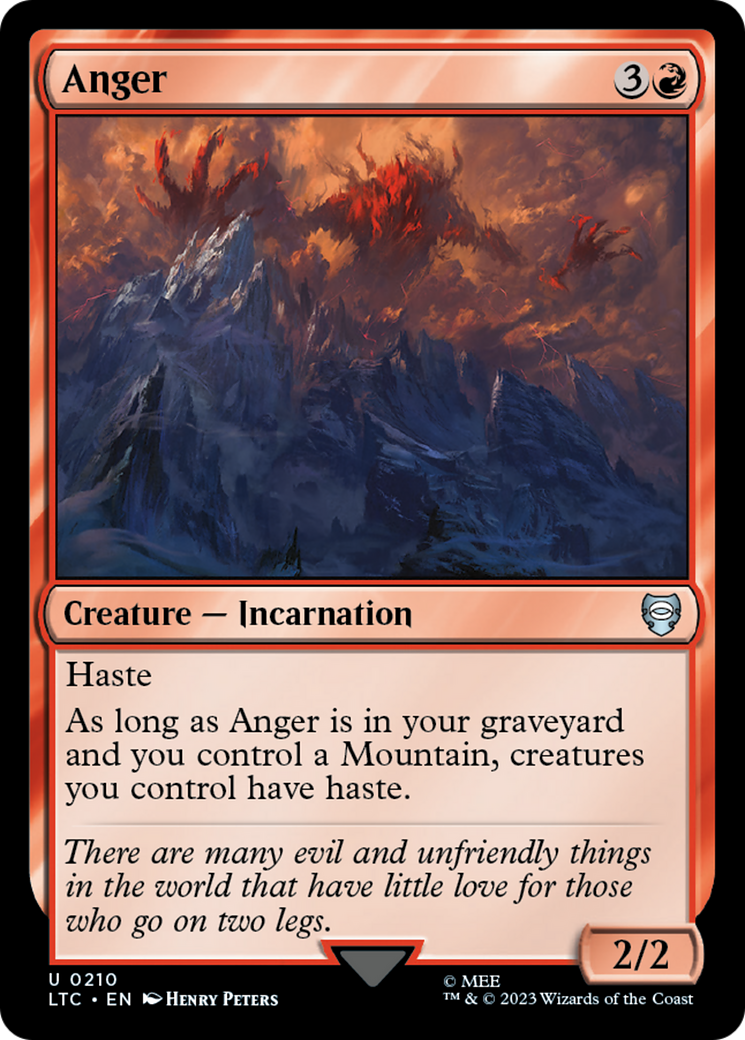
Anger
Anger
Creature — Incarnation
2/2
Haste
As long as this card is in your graveyard and you control a Mountain, creatures you control have haste.
- The timestamp for the "in your graveyard" ability is set at the time that this card goes to your graveyard, regardless of whether you control a Mountain at that time.
-
1
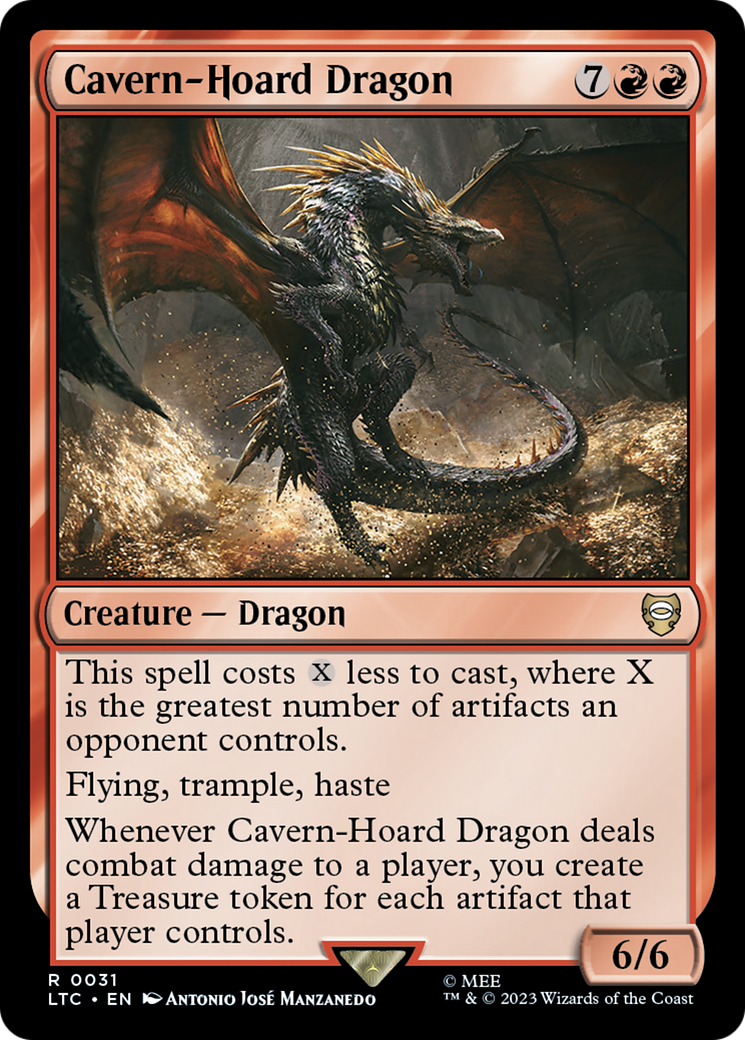
Cavern-Hoard Dragon
Cavern-Hoard Dragon
Creature — Dragon
6/6
This spell costs less to cast, where X is the greatest number of artifacts an opponent controls.
Flying, trample, haste
Whenever this creature deals combat damage to a player, you create a Treasure token for each artifact that player controls.
- Once a player has announced that they are casting Cavern-Hoard Dragon, no player may take actions to try and change the greatest number of artifacts an opponent controls before Cavern-Hoard Dragon's cost is locked in.
- Cavern-Hoard Dragon's first ability counts only the artifacts controlled by the opponent who controls the greatest number of artifacts among your opponents. If you have an opponent who controls two artifacts and another opponent who controls three artifacts, Cavern-Hoard Dragon's mana cost would be reduced by .
- If the greatest number of artifacts an opponent controls is seven or more, Cavern-Hoard Dragon costs to cast.
- Cavern-Hoard Dragon's last ability cares about the number of artifacts that player controls as the ability resolves.
-
1
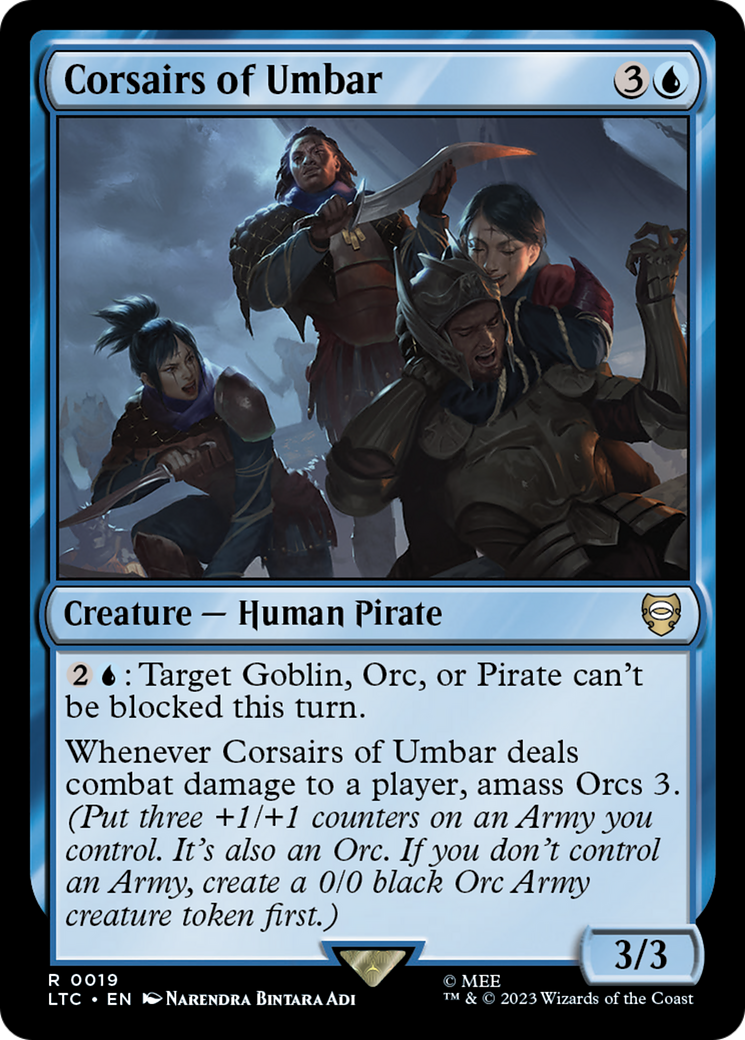
Corsairs of Umbar
Corsairs of Umbar
Creature — Human Pirate
3/3
: Target Goblin, Orc, or Pirate can't be blocked this turn.
Whenever this creature deals combat damage to a player, amass Orcs 3. (Put three +1/+1 counters on an Army you control. It's also an Orc. If you don't control an Army, create a 0/0 black Orc Army creature token first.)
- Activating Corsairs of Umbar's first ability after a Goblin, Orc, or Pirate has become blocked won't cause that creature to become unblocked.
- Amass abilities are now written as "amass [subtype] N." Previous cards with amass have received errata to say "amass Zombies N."
- To amass Orcs N, if you don't control an Army creature, create a 0/0 black Orc Army creature token. Then you choose an Army creature you control and put N +1/+1 counters on it. If that Army isn't already an Orc, it becomes an Orc in addition to its other types.
- Amass Zombies works the same way, except you create a 0/0 black Zombie Army creature token if you don't control an Army. If the Army creature you chose isn't already a Zombie, it becomes a Zombie in addition to its other types. By combining cards with amass Orcs and amass Zombies, you can end up with an Orc Zombie Army.
- In the rare case that you control multiple Army creatures (perhaps because you played a creature with changeling) while you amass Orcs, you choose which of your Army creatures to put the +1/+1 counters on. If that creature isn't an Orc, it becomes an Orc in addition to its other types.
- If you don't control an Army, the Orc Army token you create enters the battlefield as a 0/0 creature before receiving counters. Any abilities that trigger when a creature with a certain power enters the battlefield, such as that of Mentor of the Meek, will see the token enter as a 0/0 creature before it gets +1/+1 counters.
- Some spells and abilities that amass Orcs may require targets. If each target chosen is an illegal target as that spell or ability tries to resolve, it won't resolve. You won't amass Orcs.
- Some cards refer to the "amassed Army." That means the Army creature you chose to receive counters, even if no counters were placed on it for some reason.
-
1
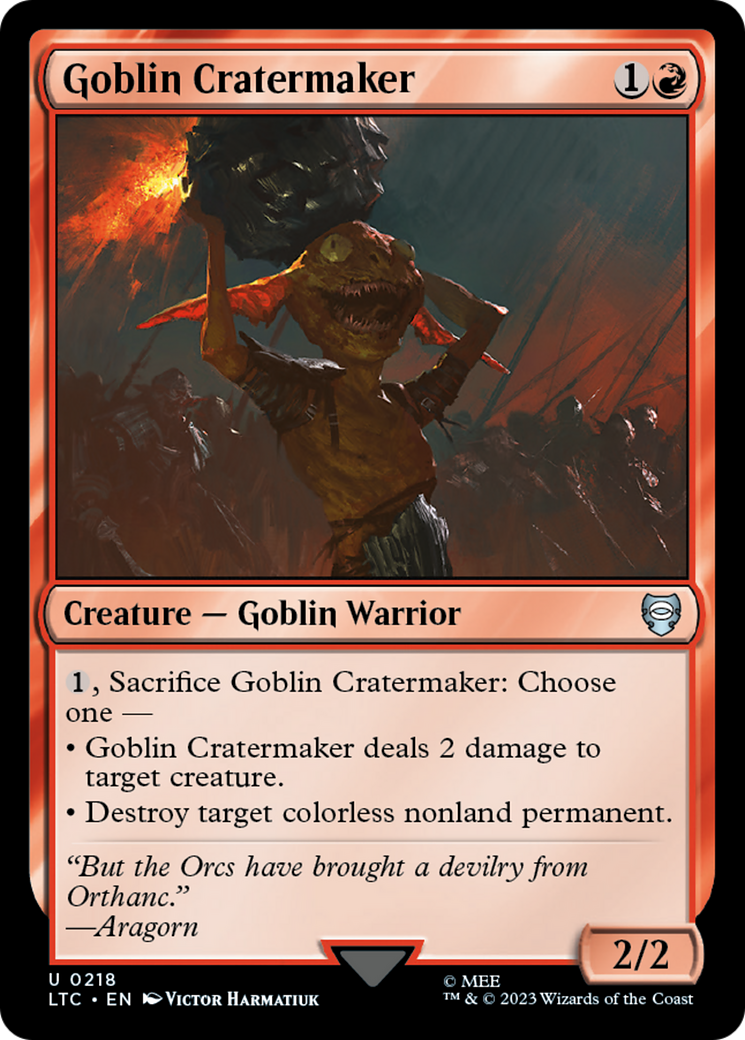
Goblin Cratermaker
Goblin Cratermaker
Creature — Goblin Warrior
2/2
, Sacrifice this creature: Choose one —
- This creature deals 2 damage to target creature.
- Destroy target colorless nonland permanent.
- This card preview was provided to Scryfall courtesy of Wizards of the Coast. Thank you!
-
1
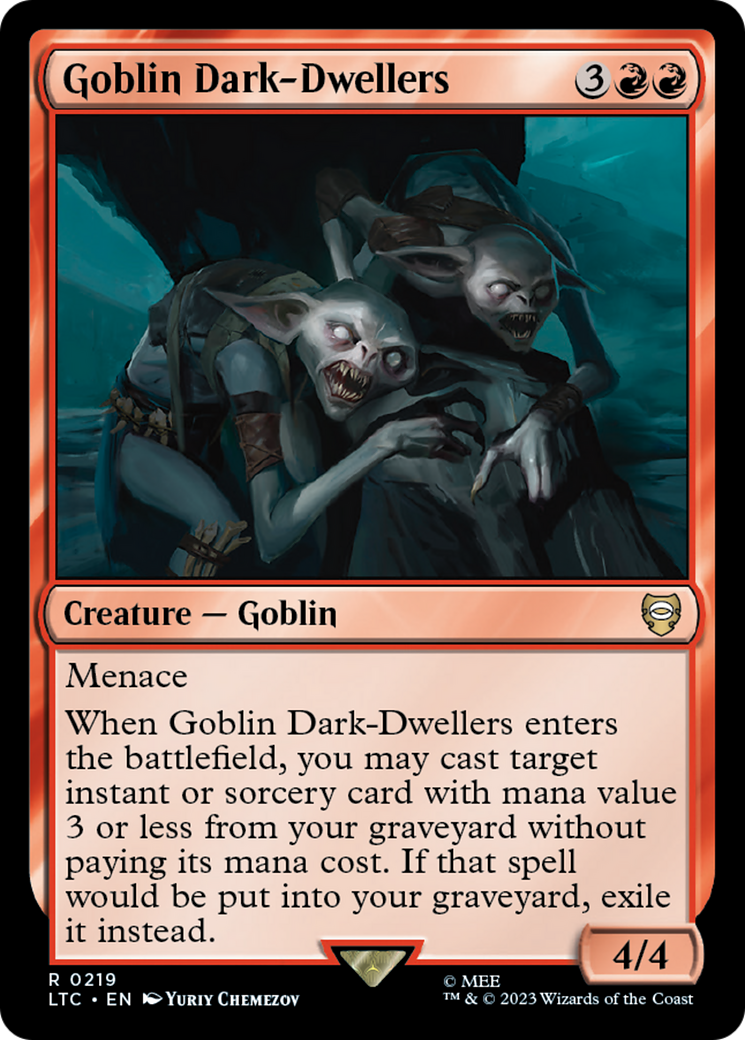
Goblin Dark-Dwellers
Goblin Dark-Dwellers
Creature — Goblin
4/4
Menace (This creature can't be blocked except by two or more creatures.)
When this creature enters, you may cast target instant or sorcery card with mana value 3 or less from your graveyard without paying its mana cost. If that spell would be put into your graveyard, exile it instead.
- You cast the card during the resolution of the enters-the-battlefield ability, not later in the turn. If it's a sorcery card, ignore the timing restrictions based on it being a sorcery card. Other timing restrictions, such as "Cast [this card] only during combat," must be followed.
- If you can't cast the target instant or sorcery card, perhaps because there are no legal targets available, or if you choose not to cast it, it will remain in your graveyard.
- If you cast a card "without paying its mana cost," you can't pay alternative costs such as surge costs. You can pay additional costs. If the card has mandatory additional costs, you must pay those.
- If the instant or sorcery card has in its mana cost, you must choose 0 as its value.
- If an instant or sorcery card you cast this way is countered, it will be exiled.
- If an instant or sorcery card you cast this way goes to a zone other than exile or a graveyard, perhaps because one of its abilities says to put it into its owner's hand, it won't be exiled. This is true even if the card would be put into a graveyard later that turn.
-
1
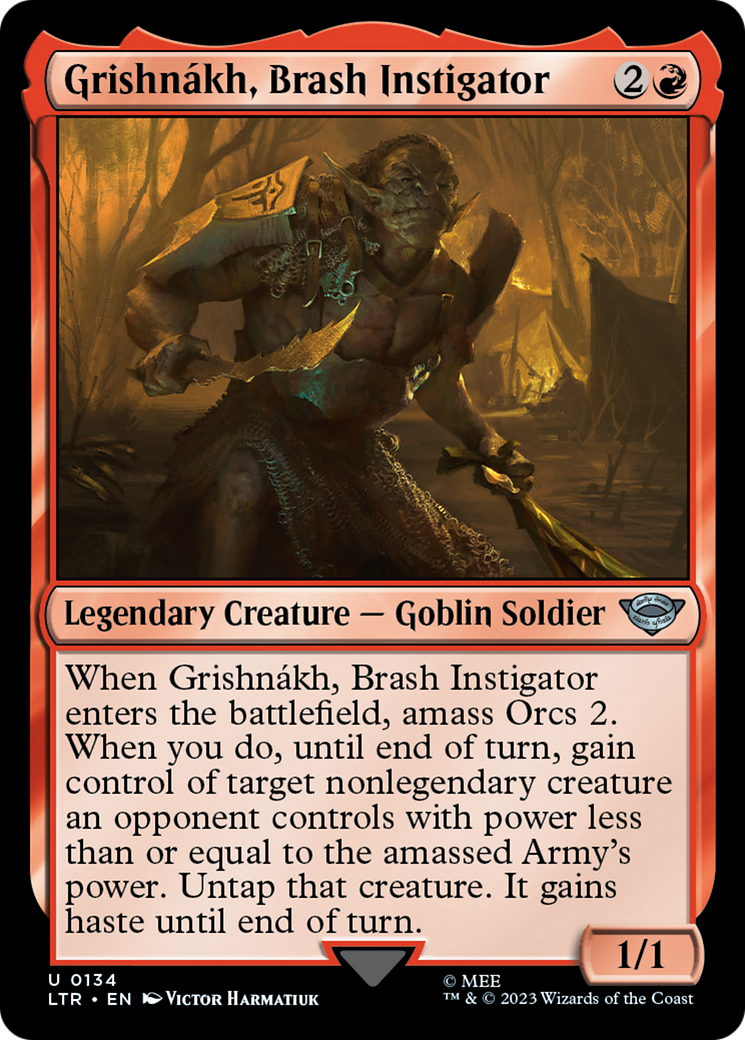
Grishnákh, Brash Instigator
Grishnákh, Brash Instigator
Legendary Creature — Goblin Soldier
1/1
When Grishnákh enters, amass Orcs 2. When you do, until end of turn, gain control of target nonlegendary creature an opponent controls with power less than or equal to the amassed Army's power. Untap that creature. It gains haste until end of turn.
- You don't choose a target for Grishnákh, Brash Instigator's ability at the time it triggers. Rather, a second "reflexive" ability triggers when you amass Orcs this way. You choose a target for that ability as it goes on the stack. Each player may respond to this triggered ability as normal.
- Amass abilities are now written as "amass [subtype] N." Previous cards with amass have received errata to say "amass Zombies N."
- To amass Orcs N, if you don't control an Army creature, create a 0/0 black Orc Army creature token. Then you choose an Army creature you control and put N +1/+1 counters on it. If that Army isn't already an Orc, it becomes an Orc in addition to its other types.
- Amass Zombies works the same way, except you create a 0/0 black Zombie Army creature token if you don't control an Army. If the Army creature you chose isn't already a Zombie, it becomes a Zombie in addition to its other types. By combining cards with amass Orcs and amass Zombies, you can end up with an Orc Zombie Army.
- In the rare case that you control multiple Army creatures (perhaps because you played a creature with changeling) while you amass Orcs, you choose which of your Army creatures to put the +1/+1 counters on. If that creature isn't an Orc, it becomes an Orc in addition to its other types.
- If you don't control an Army, the Orc Army token you create enters the battlefield as a 0/0 creature before receiving counters. Any abilities that trigger when a creature with a certain power enters the battlefield, such as that of Mentor of the Meek, will see the token enter as a 0/0 creature before it gets +1/+1 counters.
- Some spells and abilities that amass Orcs may require targets. If each target chosen is an illegal target as that spell or ability tries to resolve, it won't resolve. You won't amass Orcs.
- Some cards refer to the "amassed Army." That means the Army creature you chose to receive counters, even if no counters were placed on it for some reason.
-
1
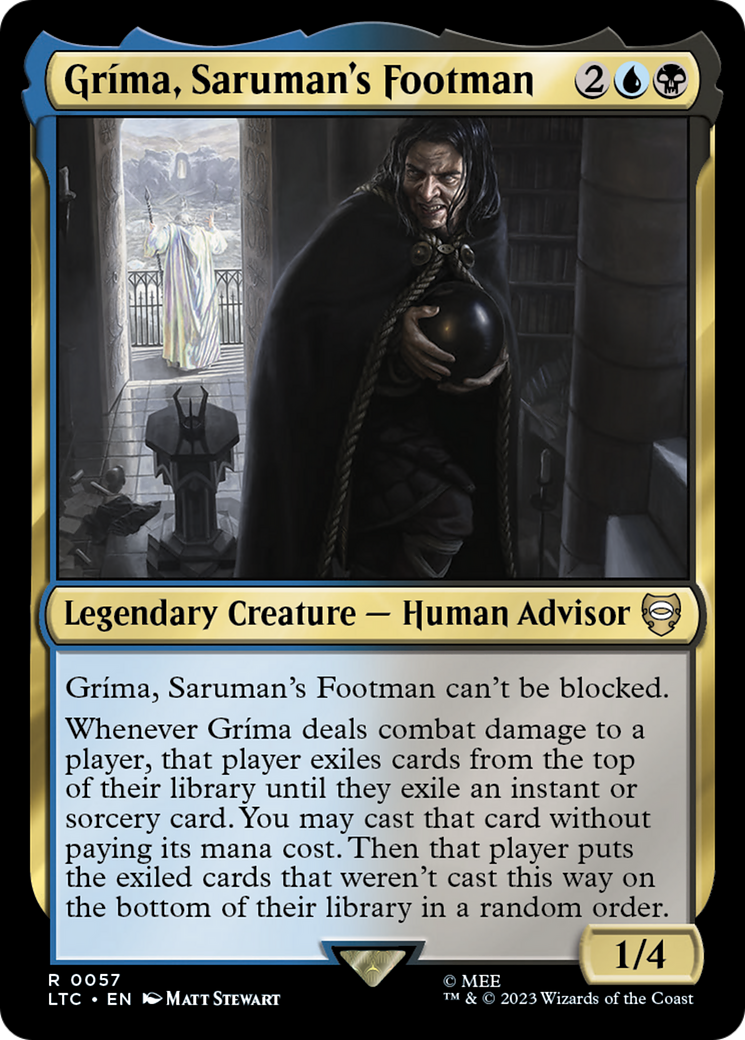
Gríma, Saruman's Footman
Gríma, Saruman's Footman
Legendary Creature — Human Advisor
1/4
Gríma can't be blocked.
Whenever Gríma deals combat damage to a player, that player exiles cards from the top of their library until they exile an instant or sorcery card. You may cast that card without paying its mana cost. Then that player puts the exiled cards that weren't cast this way on the bottom of their library in a random order.
- The cards are exiled face up. All players will be able to see them.
- You cast the card while the ability is resolving and still on the stack. You can't wait to cast it later in the turn.
- If you cast a spell "without paying its mana cost," you can't pay any alternative costs. You can, however, pay additional costs, such as kicker costs. If the card has any mandatory additional costs, you must pay those.
- If the spell you cast has in its mana cost, you must choose 0 as the value of X when casting it without paying its mana cost.
- If you choose not to cast the card, it is put on the bottom of its owner's library in a random order along with the other exiled cards.
- If that player exiles their entire library without exiling an instant or sorcery card, they will randomize the order of the exiled cards, and the cards then become that player's library, ending the effect. They will not continue to exile and randomize their library forever.
-
1
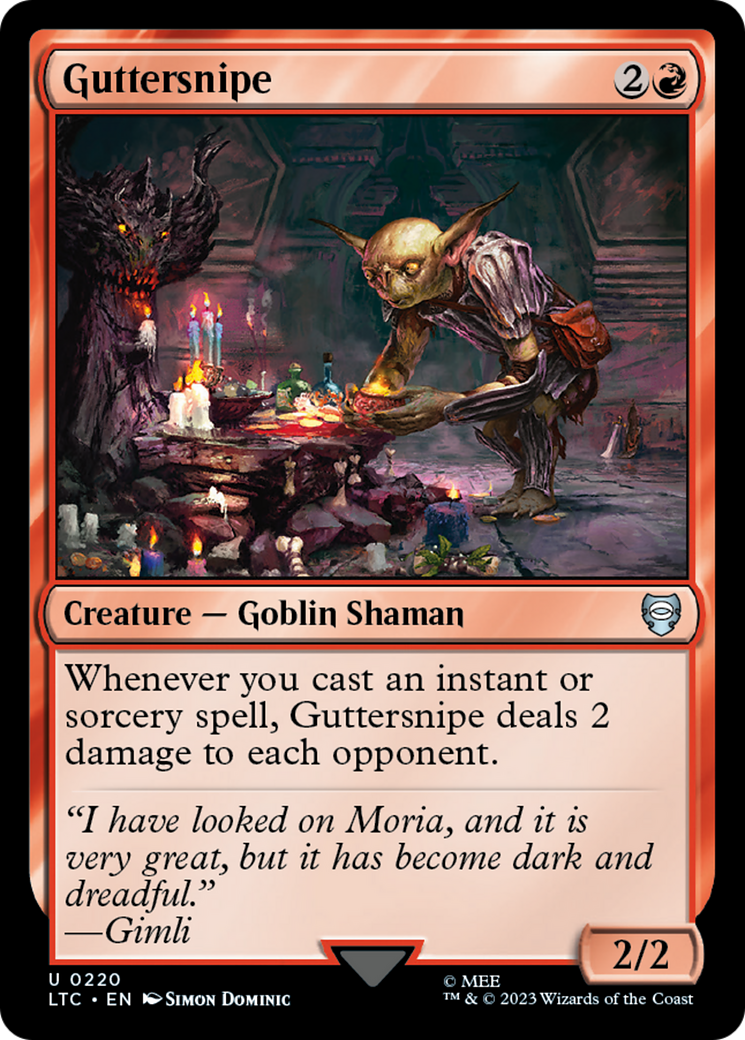
Guttersnipe
Guttersnipe
Creature — Goblin Shaman
2/2
Whenever you cast an instant or sorcery spell, this creature deals 2 damage to each opponent.
- Guttersnipe's triggered ability resolves before the spell that caused it to trigger. It resolves even if that spell is countered or otherwise leaves the stack without resolving.
- In a Two-Headed Giant game, Guttersnipe's ability causes the opposing team to lose 4 life.
-
1
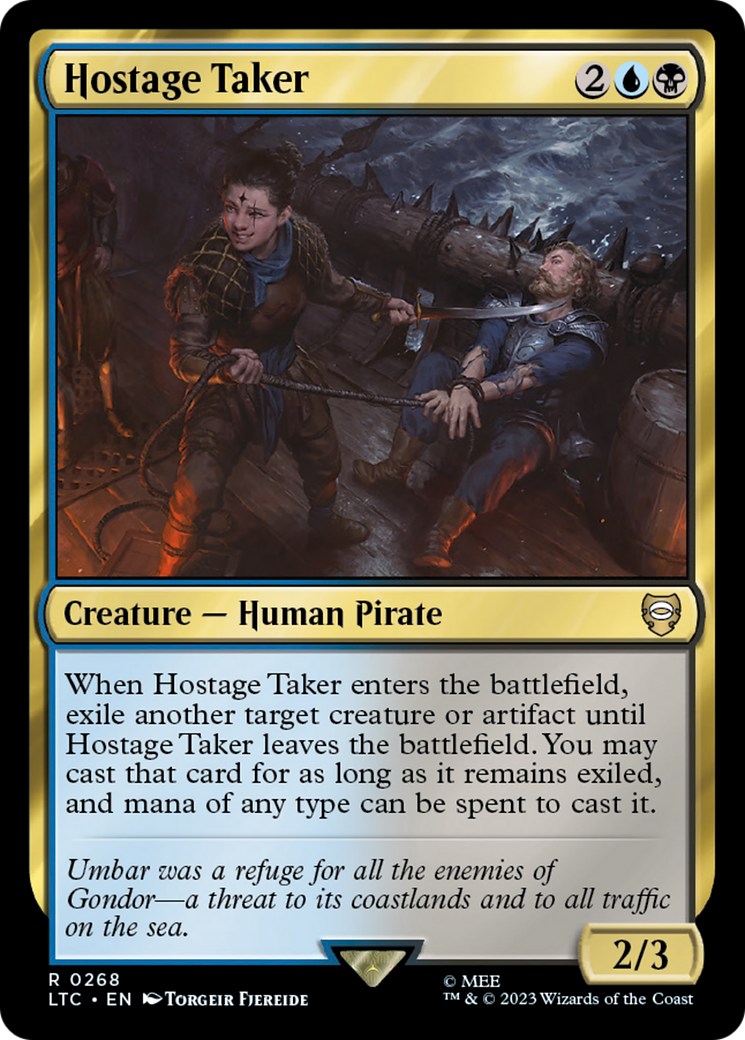
Hostage Taker
Hostage Taker
Creature — Human Pirate
2/3
When this creature enters, exile another target creature or artifact until this creature leaves the battlefield. You may cast that card for as long as it remains exiled, and mana of any type can be spent to cast that spell.
- Hostage Taker has received errata to prevent it from targeting itself. The correct Oracle wording appears above.
- If Hostage Taker leaves the battlefield before its triggered ability resolves, the target permanent won't be exiled.
- Auras attached to the exiled permanent will be put into their owners' graveyards. Any Equipment will become unattached and remain on the battlefield. Any counters on the exiled permanent will cease to exist.
- If a token is exiled this way, it will cease to exist and won't return to the battlefield. You can't cast it.
- Once you begin to cast the exiled card, it's considered a new object. You'll control that spell and the permanent that spell becomes even if Hostage Taker leaves the battlefield.
- If it's still in exile, the exiled card returns to the battlefield immediately after Hostage Taker leaves the battlefield. Nothing happens between the two events, including state-based actions.
- In a multiplayer game, if Hostage Taker's owner leaves the game while the card is still exiled and another player owns that card, the exiled card will return to the battlefield under its owner's control. Because the one-shot effect that returns the card isn't an ability that goes on the stack, it won't cease to exist along with the leaving player's spells and abilities on the stack.
- In a multiplayer game, if a player leaves the game, all cards that player owns leave as well. If you leave the game, any spell or permanent cards you control from Hostage Taker's ability are exiled.
-
1
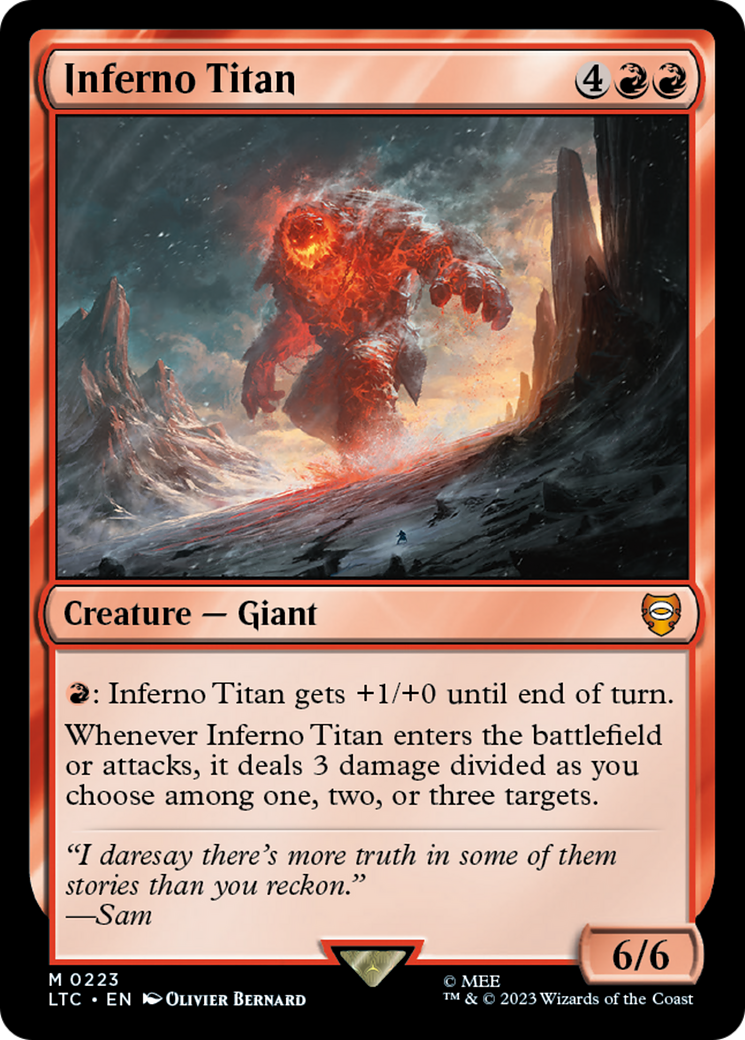
Inferno Titan
Inferno Titan
Creature — Giant
6/6
: This creature gets +1/+0 until end of turn.
Whenever this creature enters or attacks, it deals 3 damage divided as you choose among one, two, or three targets.
- You divide the damage as you put Inferno Titan's triggered ability on the stack, not as it resolves. Each target must be assigned at least 1 damage. (In other words, as you put the ability on the stack, you choose whether to have it deal 3 damage to a single target, 2 damage to one target and 1 damage to another target, or 1 damage to each of three targets.)
-
1
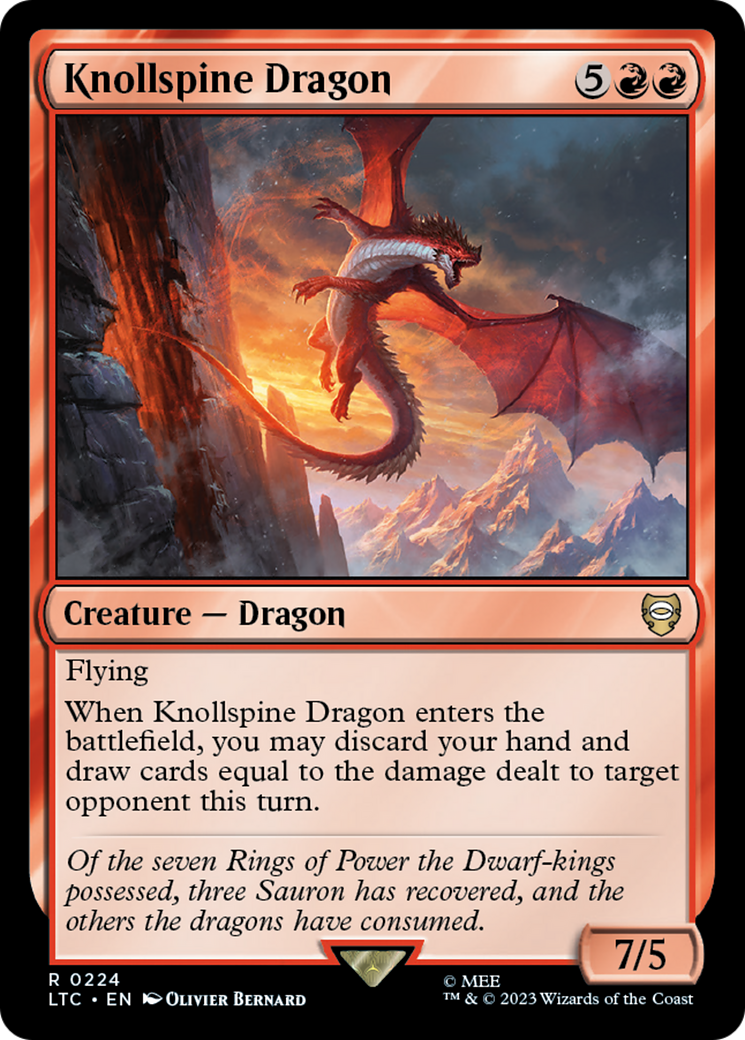
Knollspine Dragon
Knollspine Dragon
Creature — Dragon
7/5
Flying
When this creature enters, you may discard your hand and draw cards equal to the damage dealt to target opponent this turn.
- You target an opponent when the ability triggers. You don't decide whether you want to discard and draw until the ability resolves.
- This ability counts the total amount of damage (both combat and noncombat) dealt to the targeted opponent by all sources (including ones you controlled and ones you didn't) over the course of the turn. Damage that was prevented or replaced doesn't count. Damage that resolved but didn't cause loss of life (due to Worship, for example) will count.
- Knollspine Dragon's ability checks only whether damage was dealt. It doesn't care whether the player's life total also changed for other reasons (such as if the player paid life or gained life). For example, if an opponent was dealt 4 damage and gained 6 life during the turn, that player will have a higher life total than they started the turn with — but Knollspine Dragon's ability will let you discard your hand and draw four cards.
-
1
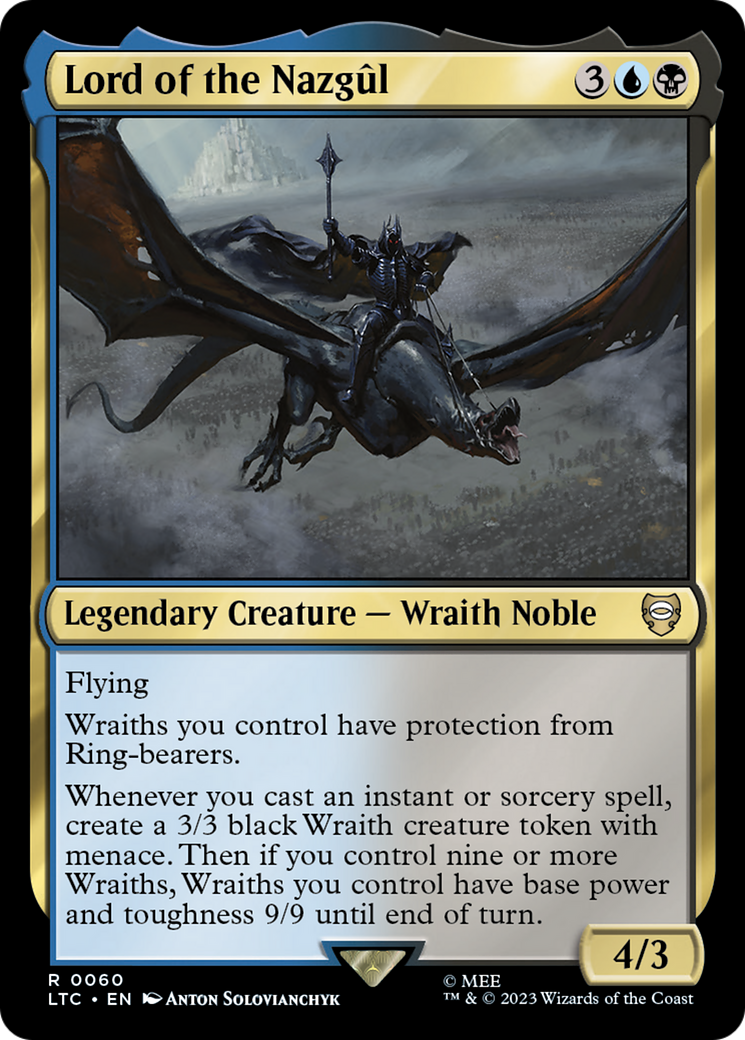
Lord of the Nazgûl
Lord of the Nazgûl
Legendary Creature — Wraith Noble
4/3
Flying
Wraiths you control have protection from Ring-bearers.
Whenever you cast an instant or sorcery spell, create a 3/3 black Wraith creature token with menace. Then if you control nine or more Wraiths, Wraiths you control have base power and toughness 9/9 until end of turn.
-
1
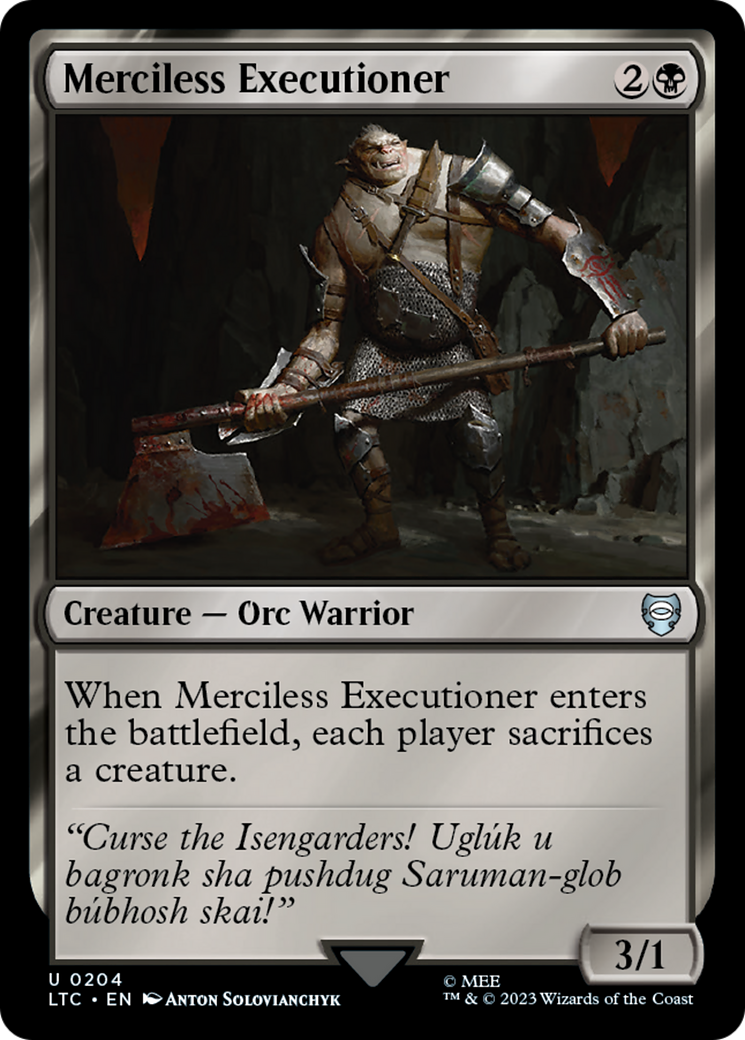
Merciless Executioner
Merciless Executioner
Creature — Orc Warrior
3/1
When this creature enters, each player sacrifices a creature of their choice.
- If you control no other creatures as Merciless Executioner's ability resolves, you'll have to sacrifice Merciless Executioner.
-
1
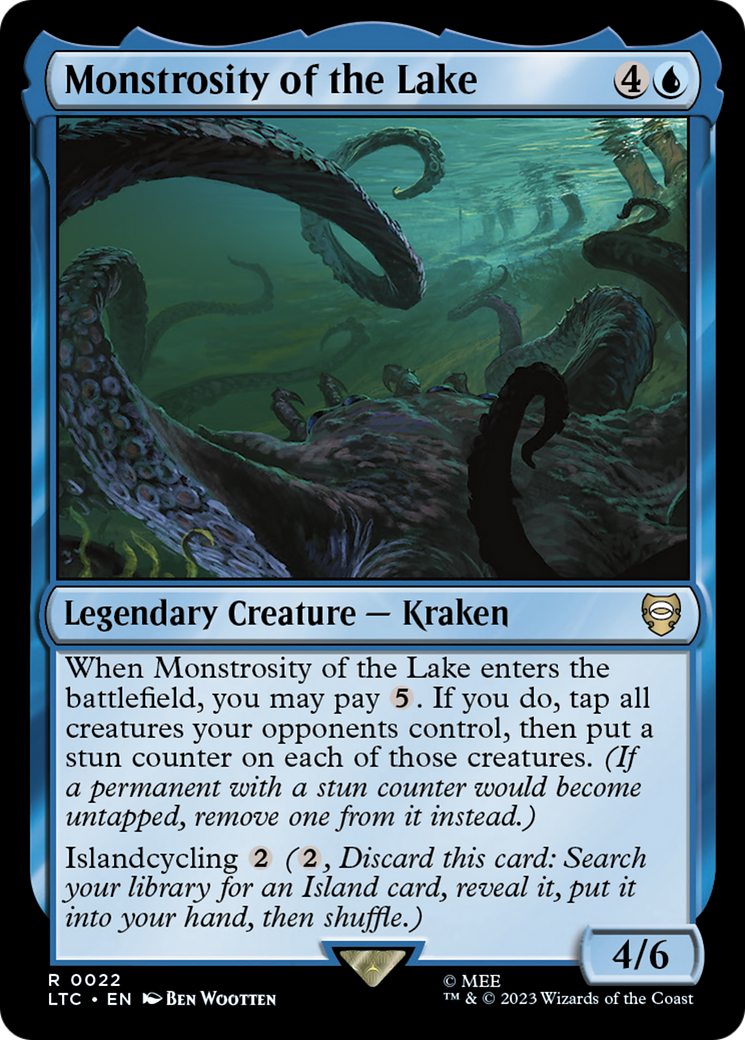
Monstrosity of the Lake
Monstrosity of the Lake
Legendary Creature — Kraken
4/6
When Monstrosity of the Lake enters, you may pay . If you do, tap all creatures your opponents control, then put a stun counter on each of those creatures. (If a permanent with a stun counter would become untapped, remove one from it instead.)
Islandcycling ( , Discard this card: Search your library for an Island card, reveal it, put it into your hand, then shuffle.)
- Unlike the normal cycling ability, typecycling doesn't allow you to draw a card. Rather, it lets you search your library for a card with the type or types indicated by the ability name. For example, a card with basic landcycling lets you search for a basic land card, and a card with Wizardcycling lets you search for a Wizard card.
- Typecycling is a form of cycling. Any ability that triggers on a card being cycled also triggers on a card being typecycled. Any ability that stops a cycling ability from being activated also stops a typecycling ability from being activated.
-
1
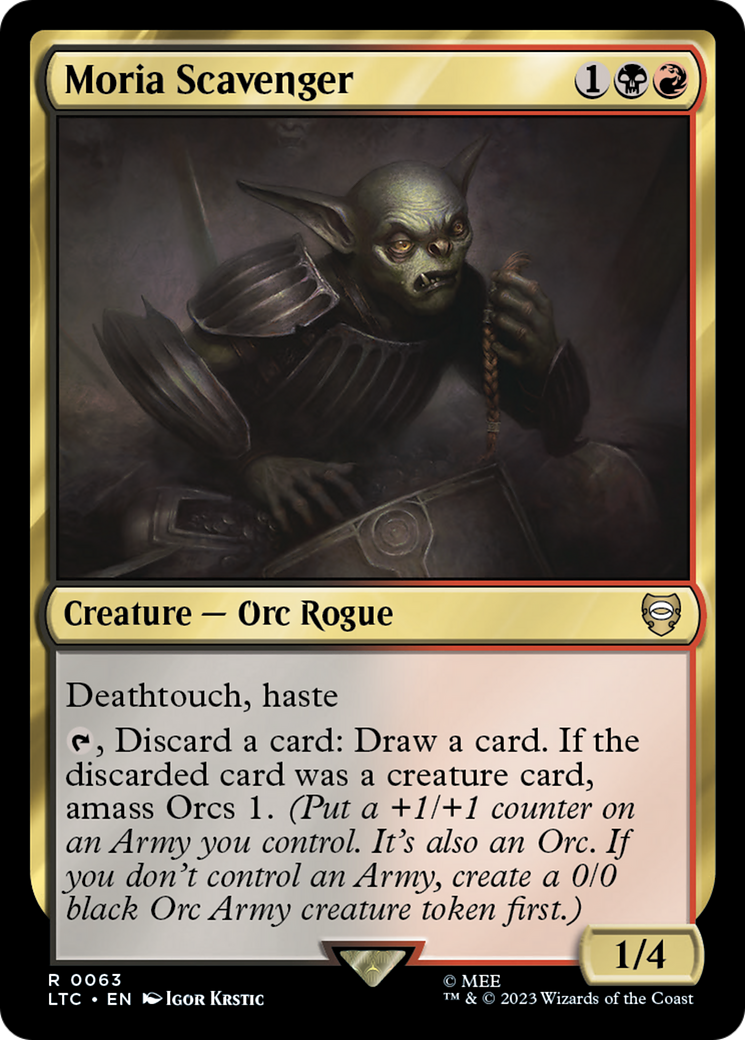
Moria Scavenger
Moria Scavenger
Creature — Orc Rogue
1/4
Deathtouch, haste
, Discard a card: Draw a card. If the discarded card was a creature card, amass Orcs 1. (Put a +1/+1 counter on an Army you control. It's also an Orc. If you don't control an Army, create a 0/0 black Orc Army creature token first.)
- Amass abilities are now written as "amass [subtype] N." Previous cards with amass have received errata to say "amass Zombies N."
- To amass Orcs N, if you don't control an Army creature, create a 0/0 black Orc Army creature token. Then you choose an Army creature you control and put N +1/+1 counters on it. If that Army isn't already an Orc, it becomes an Orc in addition to its other types.
- Amass Zombies works the same way, except you create a 0/0 black Zombie Army creature token if you don't control an Army. If the Army creature you chose isn't already a Zombie, it becomes a Zombie in addition to its other types. By combining cards with amass Orcs and amass Zombies, you can end up with an Orc Zombie Army.
- In the rare case that you control multiple Army creatures (perhaps because you played a creature with changeling) while you amass Orcs, you choose which of your Army creatures to put the +1/+1 counters on. If that creature isn't an Orc, it becomes an Orc in addition to its other types.
- If you don't control an Army, the Orc Army token you create enters the battlefield as a 0/0 creature before receiving counters. Any abilities that trigger when a creature with a certain power enters the battlefield, such as that of Mentor of the Meek, will see the token enter as a 0/0 creature before it gets +1/+1 counters.
- Some spells and abilities that amass Orcs may require targets. If each target chosen is an illegal target as that spell or ability tries to resolve, it won't resolve. You won't amass Orcs.
- Some cards refer to the "amassed Army." That means the Army creature you chose to receive counters, even if no counters were placed on it for some reason.
-
1
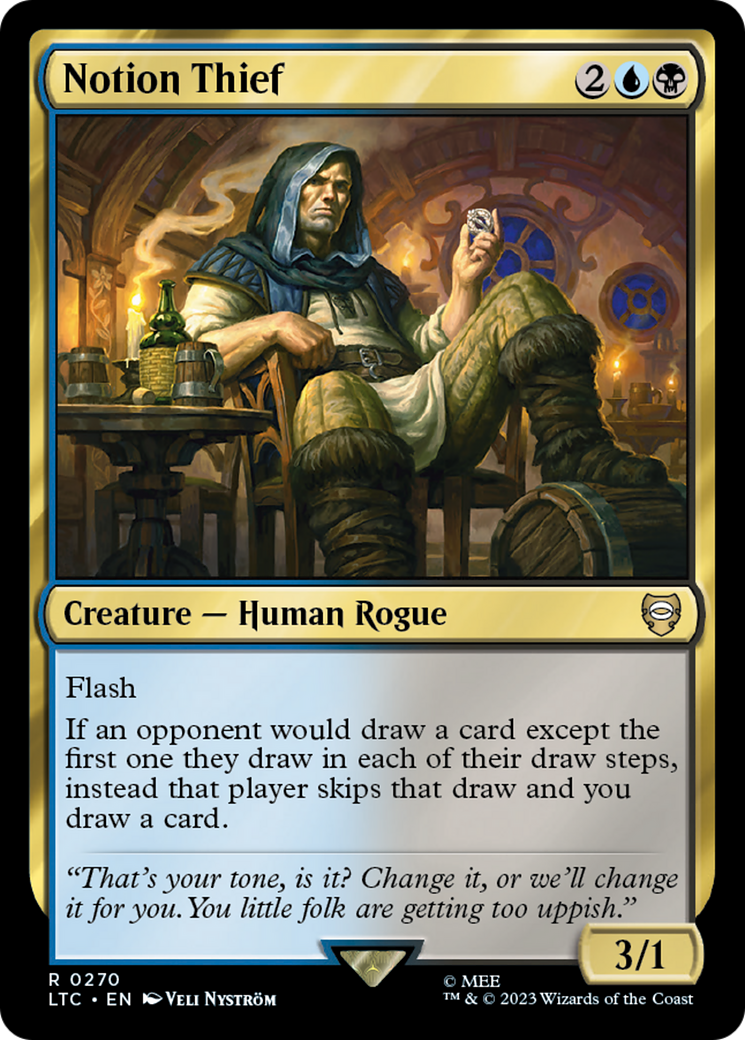
Notion Thief
Notion Thief
Creature — Human Rogue
3/1
Flash
If an opponent would draw a card except the first one they draw in each of their draw steps, instead that player skips that draw and you draw a card.
- If an opponent is instructed to draw a card then discard a card, and Notion Thief causes you to draw a card instead, that opponent still discards a card. The same is true of any other actions that opponent is instructed to do.
- If two or more players each control a Notion Thief and a player would draw a card other than the first one in their draw step, that player chooses one of the applicable Notion Thief effects to apply. Then the player whose Notion Thief's effect was chosen repeats this process among the remaining Notion Thief effects, and so on, until there are no more possible such effects to apply. Each effect can be applied to the card draw only once this way.
- The above procedure means that if each player in a two-player game controls a Notion Thief and one would draw a card, it really will be that player who draws a card.
-
1
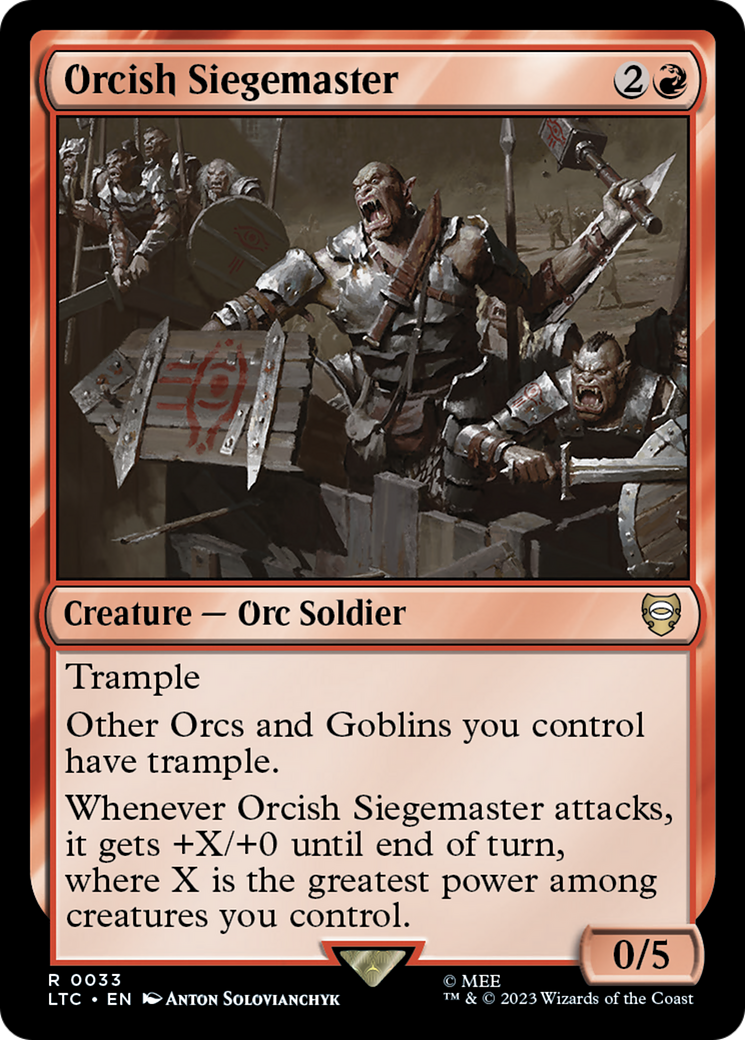
Orcish Siegemaster
Orcish Siegemaster
Creature — Orc Soldier
0/5
Trample
Other Orcs and Goblins you control have trample.
Whenever this creature attacks, it gets +X/+0 until end of turn, where X is the greatest power among creatures you control.
-
1
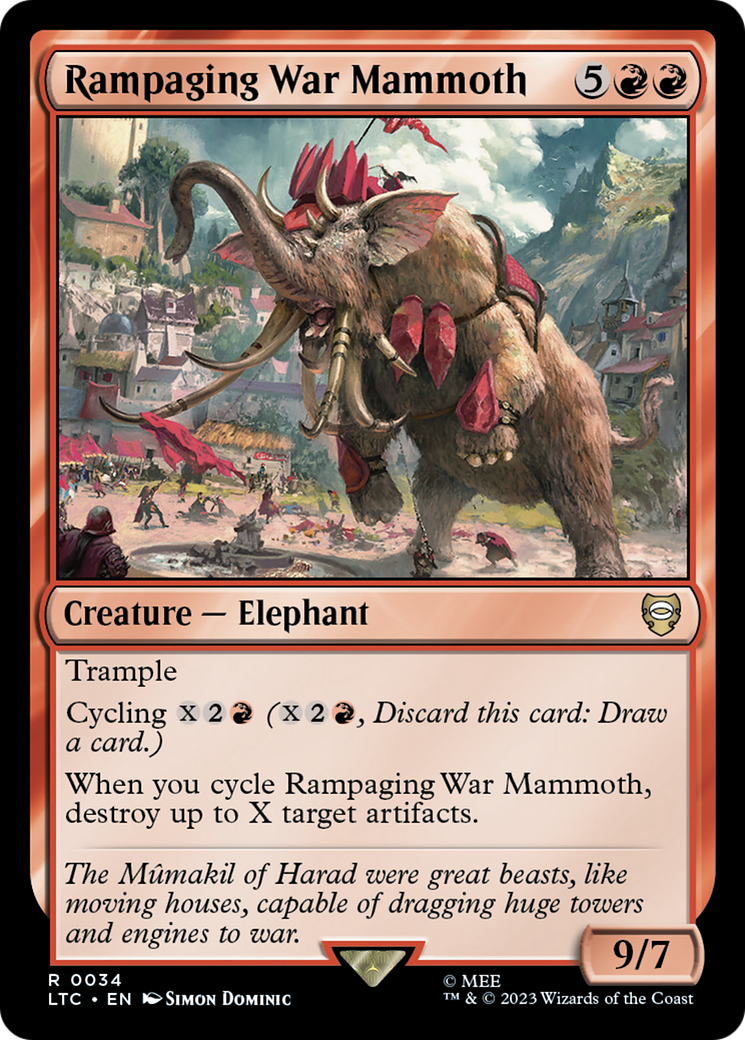
Rampaging War Mammoth
Rampaging War Mammoth
Creature — Elephant
9/7
Trample
Cycling ( , Discard this card: Draw a card.)
When you cycle this card, destroy up to X target artifacts.
- Some cards with cycling have an ability that triggers when you cycle them, and some cards have an ability that triggers whenever you cycle any card. These triggered abilities resolve before you draw from the cycling ability.
- Triggered abilities from cycling a card and the cycling ability itself aren't spells. Effects that interact with spells (such as Saruman's Trickery) won't affect them.
- You can choose 0 as the value of X in Rampaging War Mammoth's cycling cost. In that case, its triggered ability won't have any targets and won't destroy any artifacts.
- You can cycle a card even if it has a triggered ability from cycling that won't have a legal target. This is because the cycling ability and the triggered ability are separate. This also means that if either ability is countered, the other ability will still resolve.
-
1
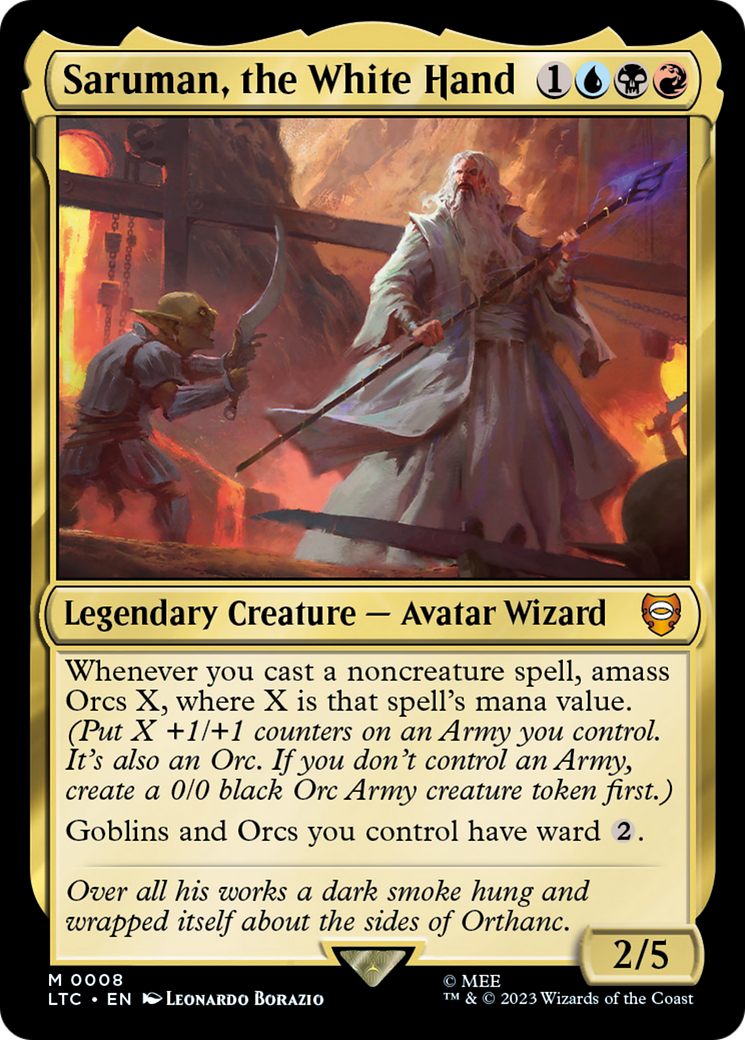
Saruman, the White Hand
Saruman, the White Hand
Legendary Creature — Avatar Wizard
2/5
Whenever you cast a noncreature spell, amass Orcs X, where X is that spell's mana value. (Put X +1/+1 counters on an Army you control. It's also an Orc. If you don't control an Army, create a 0/0 black Orc Army creature token first.)
Goblins and Orcs you control have ward .
- A creature that is both a Goblin and an Orc still only gets one instance of ward from Saruman, the White Hand's last ability.
- If Saruman, the White Hand is a Goblin or an Orc, it will have ward .
- Amass abilities are now written as "amass [subtype] N." Previous cards with amass have received errata to say "amass Zombies N."
- To amass Orcs N, if you don't control an Army creature, create a 0/0 black Orc Army creature token. Then you choose an Army creature you control and put N +1/+1 counters on it. If that Army isn't already an Orc, it becomes an Orc in addition to its other types.
- Amass Zombies works the same way, except you create a 0/0 black Zombie Army creature token if you don't control an Army. If the Army creature you chose isn't already a Zombie, it becomes a Zombie in addition to its other types. By combining cards with amass Orcs and amass Zombies, you can end up with an Orc Zombie Army.
- In the rare case that you control multiple Army creatures (perhaps because you played a creature with changeling) while you amass Orcs, you choose which of your Army creatures to put the +1/+1 counters on. If that creature isn't an Orc, it becomes an Orc in addition to its other types.
- If you don't control an Army, the Orc Army token you create enters the battlefield as a 0/0 creature before receiving counters. Any abilities that trigger when a creature with a certain power enters the battlefield, such as that of Mentor of the Meek, will see the token enter as a 0/0 creature before it gets +1/+1 counters.
- Some spells and abilities that amass Orcs may require targets. If each target chosen is an illegal target as that spell or ability tries to resolve, it won't resolve. You won't amass Orcs.
- Some cards refer to the "amassed Army." That means the Army creature you chose to receive counters, even if no counters were placed on it for some reason.
-
1
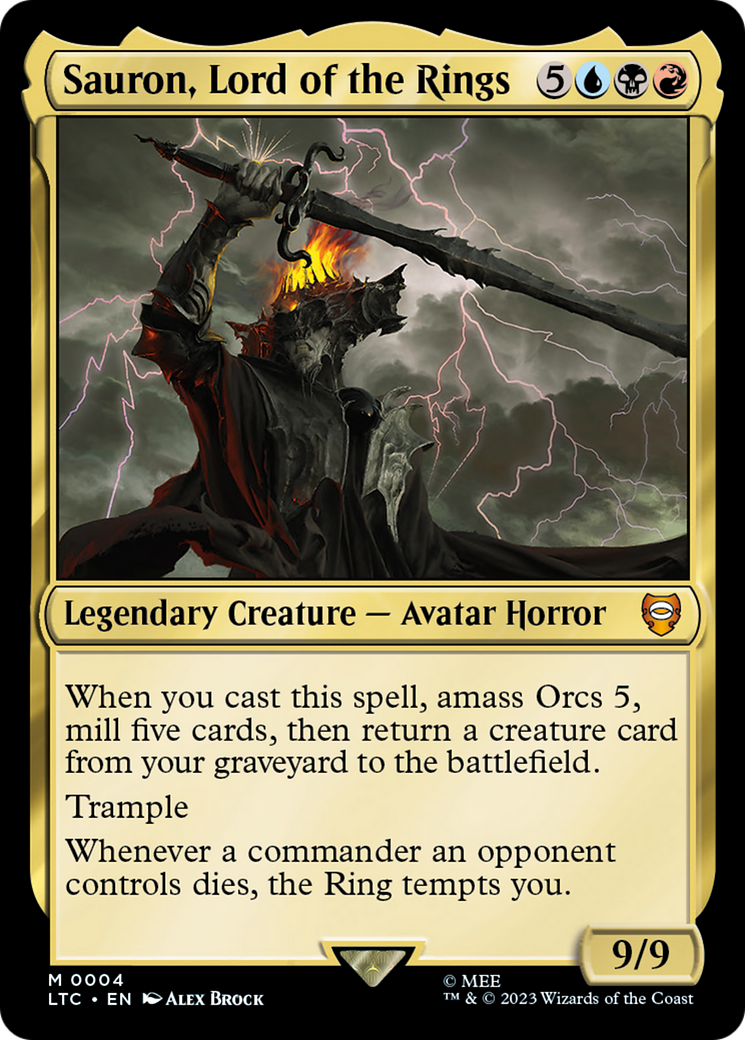
Sauron, Lord of the Rings
Sauron, Lord of the Rings
Legendary Creature — Avatar Horror
9/9
When you cast this spell, amass Orcs 5, mill five cards, then return a creature card from your graveyard to the battlefield.
Trample
Whenever a commander an opponent controls dies, the Ring tempts you.
- The creature card you choose doesn't need to be a card you milled. You may choose a creature card that was already in your graveyard before you milled.
- Sauron, Lord of the Rings's last ability will trigger even if the owner of the commander that died chooses to return it to the command zone after it dies.
- As the Ring tempts you, you get an emblem named The Ring if you don't have one. Then your emblem gains its next ability and you choose a creature you control to become (or remain) your Ring-bearer.
- The Ring can tempt you even if you don't control a creature. In this case, abilities that trigger "whenever the Ring tempts you" will still trigger.
- If the creature you choose as your Ring-bearer was already your Ring-bearer, that still counts as choosing that creature as your Ring-bearer for the purpose of abilities that trigger "whenever you choose a creature as your Ring-bearer" or abilities that care about which creature was chosen as your Ring-bearer.
- The Ring gains its abilities in order from top to bottom. Once it gains an ability, it has that ability for the rest of the game.
- Each time the Ring tempts you, you must choose a creature if you control one.
- Each player can have only one emblem named The Ring and only one Ring-bearer at a time.
- Some spells and abilities that cause the Ring to tempt you may require targets. If each target chosen is an illegal target as that spell or ability tries to resolve, it won't resolve. The Ring won't tempt you.
- Amass abilities are now written as "amass [subtype] N." Previous cards with amass have received errata to say "amass Zombies N."
- To amass Orcs N, if you don't control an Army creature, create a 0/0 black Orc Army creature token. Then you choose an Army creature you control and put N +1/+1 counters on it. If that Army isn't already an Orc, it becomes an Orc in addition to its other types.
- Amass Zombies works the same way, except you create a 0/0 black Zombie Army creature token if you don't control an Army. If the Army creature you chose isn't already a Zombie, it becomes a Zombie in addition to its other types. By combining cards with amass Orcs and amass Zombies, you can end up with an Orc Zombie Army.
- In the rare case that you control multiple Army creatures (perhaps because you played a creature with changeling) while you amass Orcs, you choose which of your Army creatures to put the +1/+1 counters on. If that creature isn't an Orc, it becomes an Orc in addition to its other types.
- If you don't control an Army, the Orc Army token you create enters the battlefield as a 0/0 creature before receiving counters. Any abilities that trigger when a creature with a certain power enters the battlefield, such as that of Mentor of the Meek, will see the token enter as a 0/0 creature before it gets +1/+1 counters.
- Some spells and abilities that amass Orcs may require targets. If each target chosen is an illegal target as that spell or ability tries to resolve, it won't resolve. You won't amass Orcs.
- Some cards refer to the "amassed Army." That means the Army creature you chose to receive counters, even if no counters were placed on it for some reason.
-
1
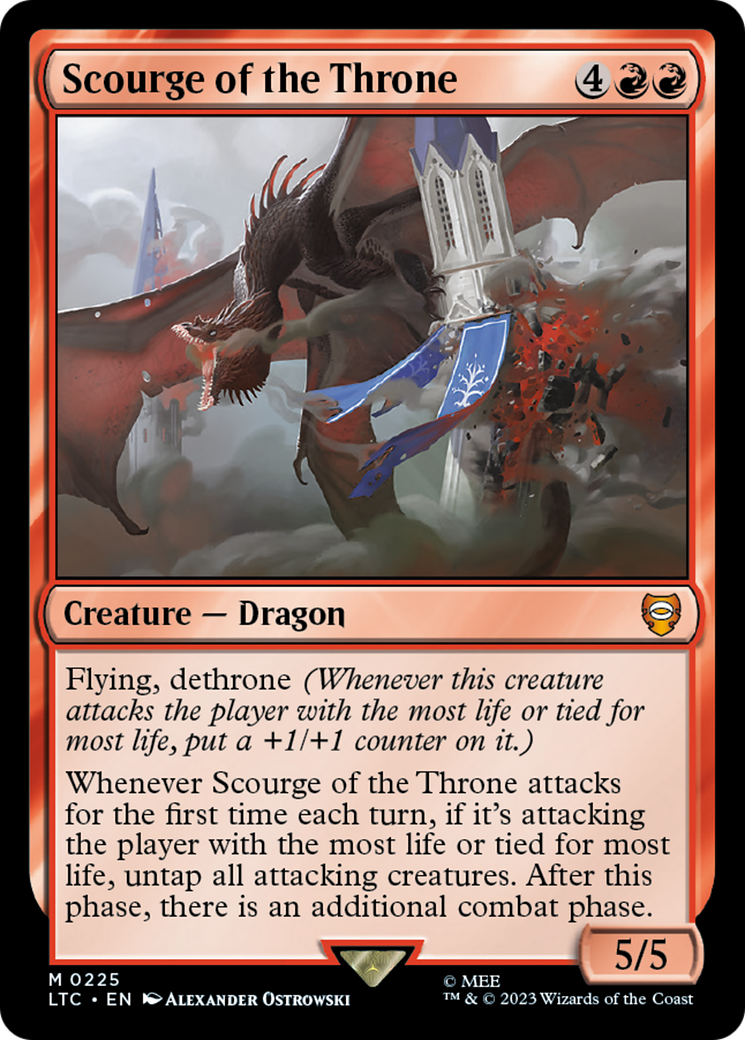
Scourge of the Throne
Scourge of the Throne
Creature — Dragon
5/5
Flying
Dethrone (Whenever this creature attacks the player with the most life or tied for most life, put a +1/+1 counter on it.)
Whenever this creature attacks for the first time each turn, if it's attacking the player with the most life or tied for most life, untap all attacking creatures. After this phase, there is an additional combat phase.
- Dethrone doesn't trigger if the creature attacks a planeswalker, even if its controller has the most life. The same is true if the creature attacks a battle, even if its protector has the most life.
- Scourge of the Throne's ability has an intervening "if" clause. It must be attacking the player with the most life or tied with the most life both when it's declared as an attacker and as it starts to resolve for it to have any effect. If, at either time, the player isn't the one with the most life or tied for the most life, the ability will have no effect. Notably, this is different than how dethrone works. (Dethrone checks only once to see if the ability triggers.)
- Once dethrone triggers, it doesn't matter what happens to the players' life totals before the ability resolves. You'll put a +1/+1 counter on the creature even if the defending player doesn't have the most life as the ability resolves.
- The +1/+1 counter is put on the creature before blockers are declared.
- In a Two-Headed Giant game, dethrone will trigger if the creature attacks either player on the team with the most life or tied for the most life.
-
1
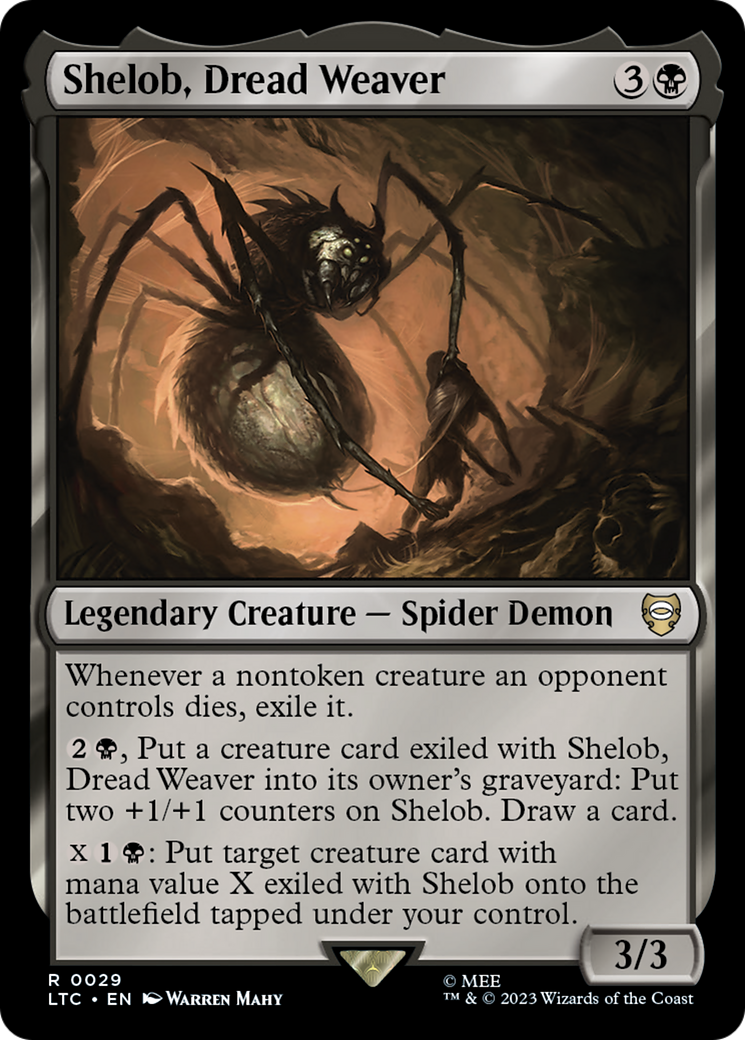
Shelob, Dread Weaver
Shelob, Dread Weaver
Legendary Creature — Spider Demon
3/3
Whenever a nontoken creature an opponent controls dies, exile it.
, Put a creature card exiled with Shelob into its owner's graveyard: Put two +1/+1 counters on Shelob. Draw a card.
: Put target creature card with mana value X exiled with Shelob onto the battlefield tapped under your control.
- If Shelob, Dread Weaver and a nontoken creature an opponent controls die at the same time, the opponent's creature will be exiled.
- Cards exiled with Shelob, Dread Weaver that would go to the graveyard but have that replaced by an effect such as Leyline of the Void are considered new objects. They are no longer considered to have been exiled with Shelob, Dread Weaver for the purposes of its activated abilities.
-
1
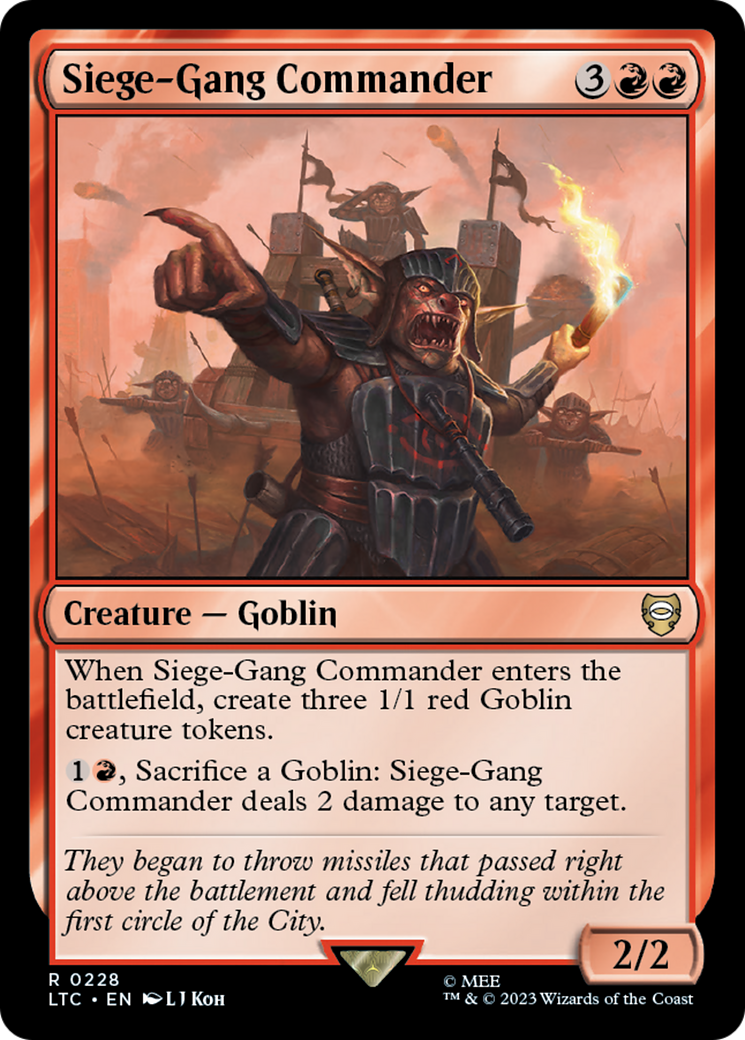
Siege-Gang Commander
Siege-Gang Commander
Creature — Goblin
2/2
When this creature enters, create three 1/1 red Goblin creature tokens.
, Sacrifice a Goblin: This creature deals 2 damage to any target.
- You can sacrifice any Goblin you control to activate Siege-Gang Commander's activated ability, including Siege-Gang Commander itself.
-
1
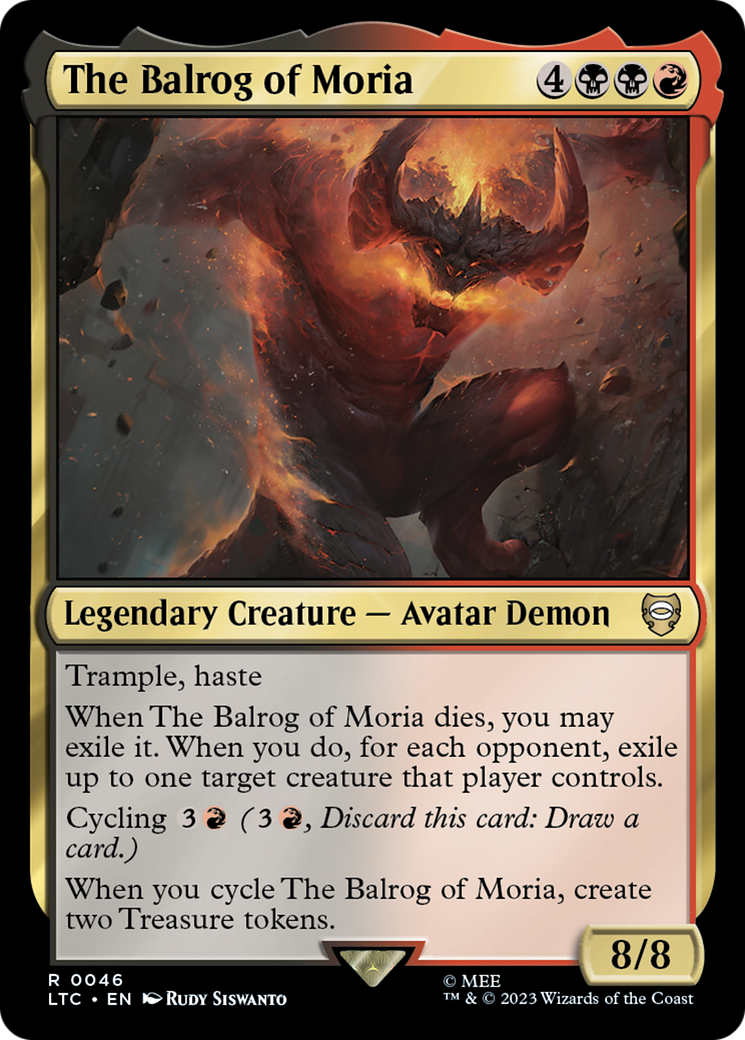
The Balrog of Moria
The Balrog of Moria
Legendary Creature — Avatar Demon
8/8
Trample, haste
When The Balrog of Moria dies, you may exile it. When you do, for each opponent, exile up to one target creature that player controls.
Cycling ( , Discard this card: Draw a card.)
When you cycle this card, create two Treasure tokens.
- Some cards with cycling have an ability that triggers when you cycle them, and some cards have an ability that triggers whenever you cycle any card. These triggered abilities resolve before you draw from the cycling ability.
- Triggered abilities from cycling a card and the cycling ability itself aren't spells. Effects that interact with spells (such as Saruman's Trickery) won't affect them.
-
1
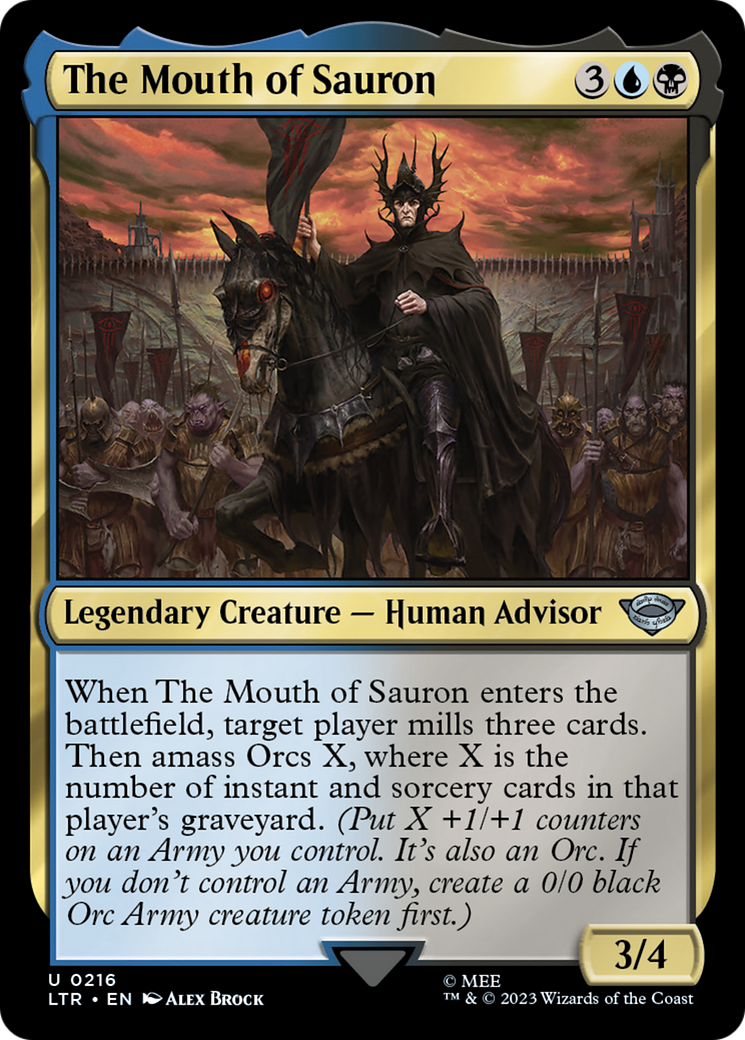
The Mouth of Sauron
The Mouth of Sauron
Legendary Creature — Human Advisor
3/4
When The Mouth of Sauron enters, target player mills three cards. Then amass Orcs X, where X is the number of instant and sorcery cards in that player's graveyard. (Put X +1/+1 counters on an Army you control. It's also an Orc. If you don't control an Army, create a 0/0 black Orc Army creature token first.)
- Amass abilities are now written as "amass [subtype] N." Previous cards with amass have received errata to say "amass Zombies N."
- To amass Orcs N, if you don't control an Army creature, create a 0/0 black Orc Army creature token. Then you choose an Army creature you control and put N +1/+1 counters on it. If that Army isn't already an Orc, it becomes an Orc in addition to its other types.
- Amass Zombies works the same way, except you create a 0/0 black Zombie Army creature token if you don't control an Army. If the Army creature you chose isn't already a Zombie, it becomes a Zombie in addition to its other types. By combining cards with amass Orcs and amass Zombies, you can end up with an Orc Zombie Army.
- In the rare case that you control multiple Army creatures (perhaps because you played a creature with changeling) while you amass Orcs, you choose which of your Army creatures to put the +1/+1 counters on. If that creature isn't an Orc, it becomes an Orc in addition to its other types.
- If you don't control an Army, the Orc Army token you create enters the battlefield as a 0/0 creature before receiving counters. Any abilities that trigger when a creature with a certain power enters the battlefield, such as that of Mentor of the Meek, will see the token enter as a 0/0 creature before it gets +1/+1 counters.
- Some spells and abilities that amass Orcs may require targets. If each target chosen is an illegal target as that spell or ability tries to resolve, it won't resolve. You won't amass Orcs.
- Some cards refer to the "amassed Army." That means the Army creature you chose to receive counters, even if no counters were placed on it for some reason.
-
1
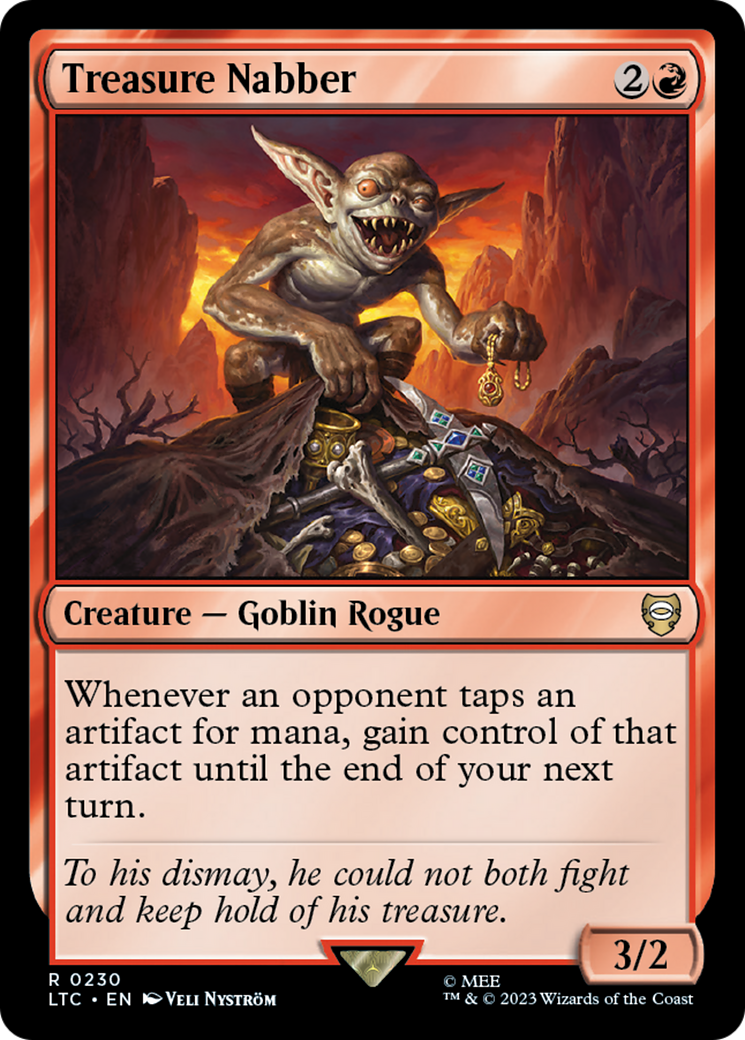
Treasure Nabber
Treasure Nabber
Creature — Goblin Rogue
3/2
Whenever an opponent taps an artifact for mana, gain control of that artifact until the end of your next turn.
- An artifact is "tapped for mana" when a player activates a mana ability of an artifact that includes (the tap symbol). Notably, tapping an artifact to pay for a spell with the improvise keyword is not tapping that artifact for mana.
- If the artifact leaves the battlefield, Treasure Nabber doesn't nab it from the zone it moved to.
- The artifact remains tapped when you gain control of it.
- If an opponent taps an artifact for mana during your turn, you'll gain control of it and keep control of it until the end of your next turn.
- If you control multiple Treasure Nabbers, their effects all expire at the same time. You won't keep an artifact for any longer.
- If multiple players each control Treasure Nabbers, an artifact tapped for mana will make quite a journey. For example, if player A taps an artifact for mana during their turn, and players B and C are the next players in turn order who control Treasure Nabbers, C's ability resolves before B and C gains control of the artifact. Then B gains control of the artifact. B keeps it during their turn, and then C regains control of the artifact once B's effect expires, then A will have it back after C's expires. However, if B or C taps the artifact for mana, one of them will take it from the other. You may need to pay very careful attention to which effects are still in effect, which have expired, and who owns what.
- In a multiplayer game, if a player leaves the game, all cards that player owns leave as well. If that player controls any nabbed treasures, the effect giving that player control of those artifacts ends.
-
1
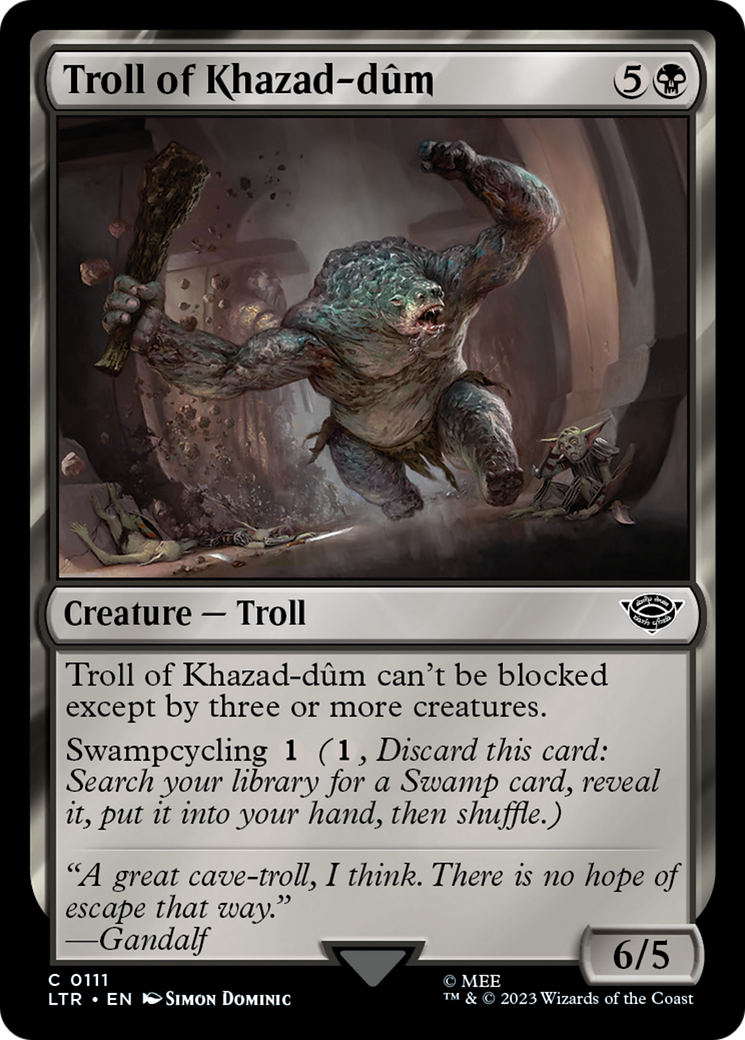
Troll of Khazad-dûm
Troll of Khazad-dûm
Creature — Troll
6/5
This creature can't be blocked except by three or more creatures.
Swampcycling ( , Discard this card: Search your library for a Swamp card, reveal it, put it into your hand, then shuffle.)
- Unlike the normal cycling ability, typecycling doesn't allow you to draw a card. Rather, it lets you search your library for a card with the type or types indicated by the ability name. For example, a card with basic landcycling lets you search for a basic land card, and a card with Wizardcycling lets you search for a Wizard card.
- Typecycling is a form of cycling. Any ability that triggers on a card being cycled also triggers on a card being typecycled. Any ability that stops a cycling ability from being activated also stops a typecycling ability from being activated.
-
1
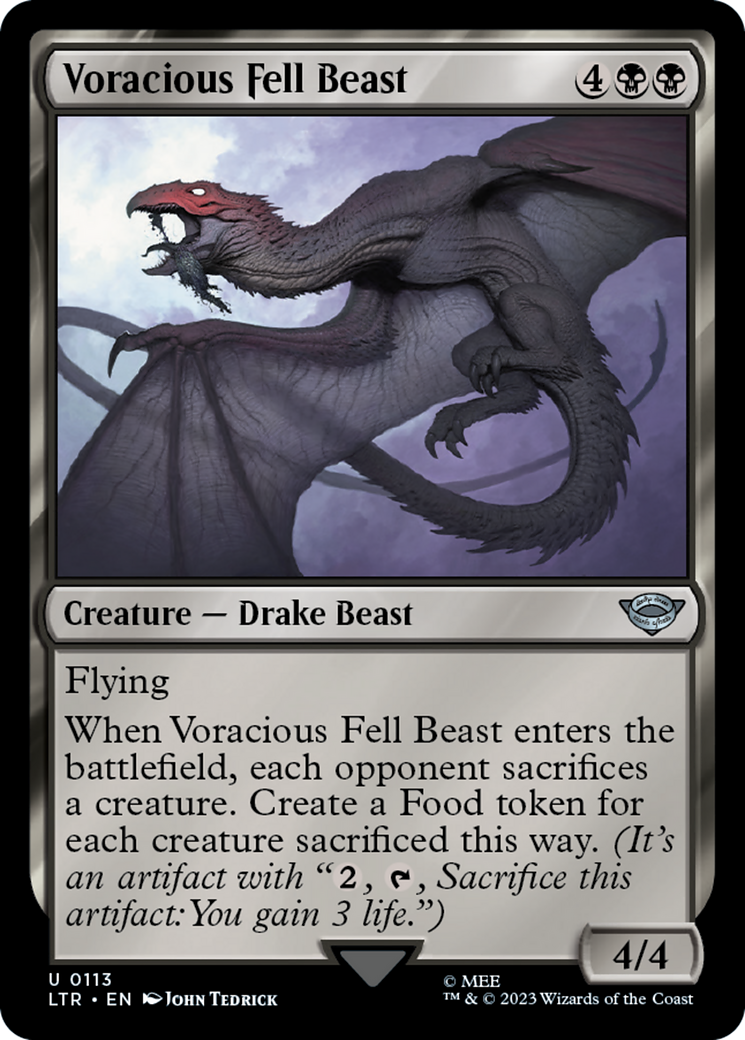
Voracious Fell Beast
Voracious Fell Beast
Creature — Drake Beast
4/4
Flying
When this creature enters, each opponent sacrifices a creature of their choice. Create a Food token for each creature sacrificed this way. (It's an artifact with " , , Sacrifice this token: You gain 3 life.")
- Food is an artifact type. Even though it appears on some creatures, it's never a creature type.
- You can't sacrifice a Food to pay multiple costs. For example, you can't sacrifice a Food token to activate its own ability and also to activate Maraleaf Rider's ability.
- Whatever you do, don't eat the delicious cards.
Instants 6
-
1
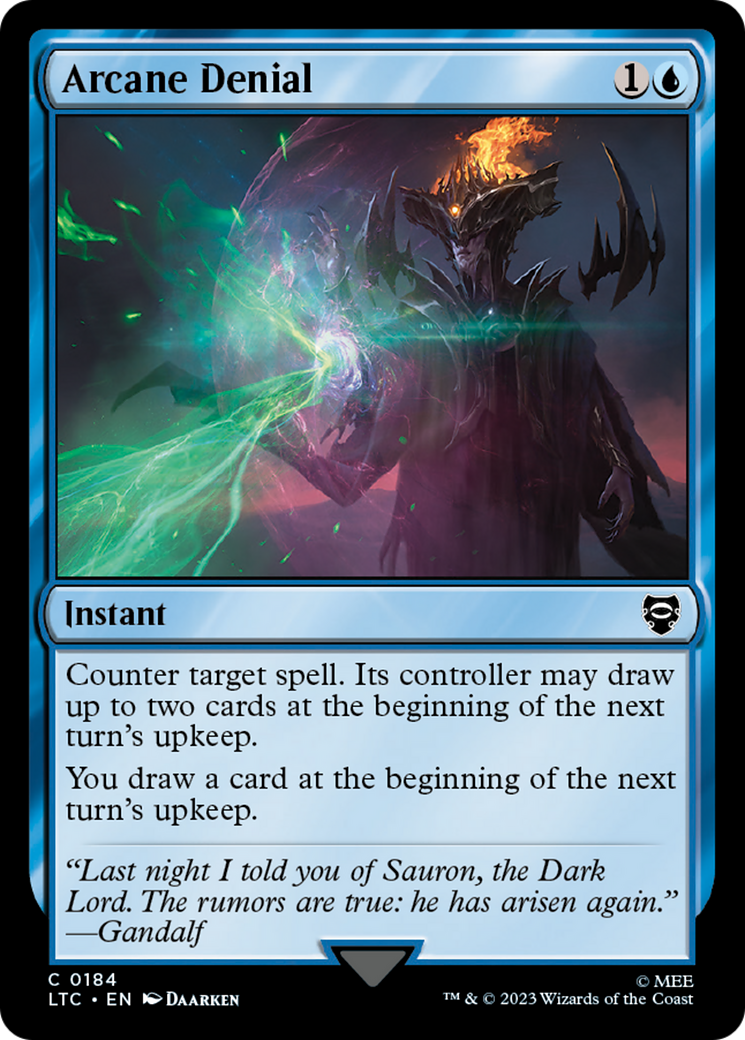
Arcane Denial
Arcane Denial
Instant
Counter target spell. Its controller may draw up to two cards at the beginning of the next turn's upkeep.
You draw a card at the beginning of the next turn's upkeep.
- The controller of the countered spell doesn't choose how many cards to draw until the relevant ability resolves. The player may draw 0, 1, or 2 cards. They choose the number before drawing any cards.
-
1
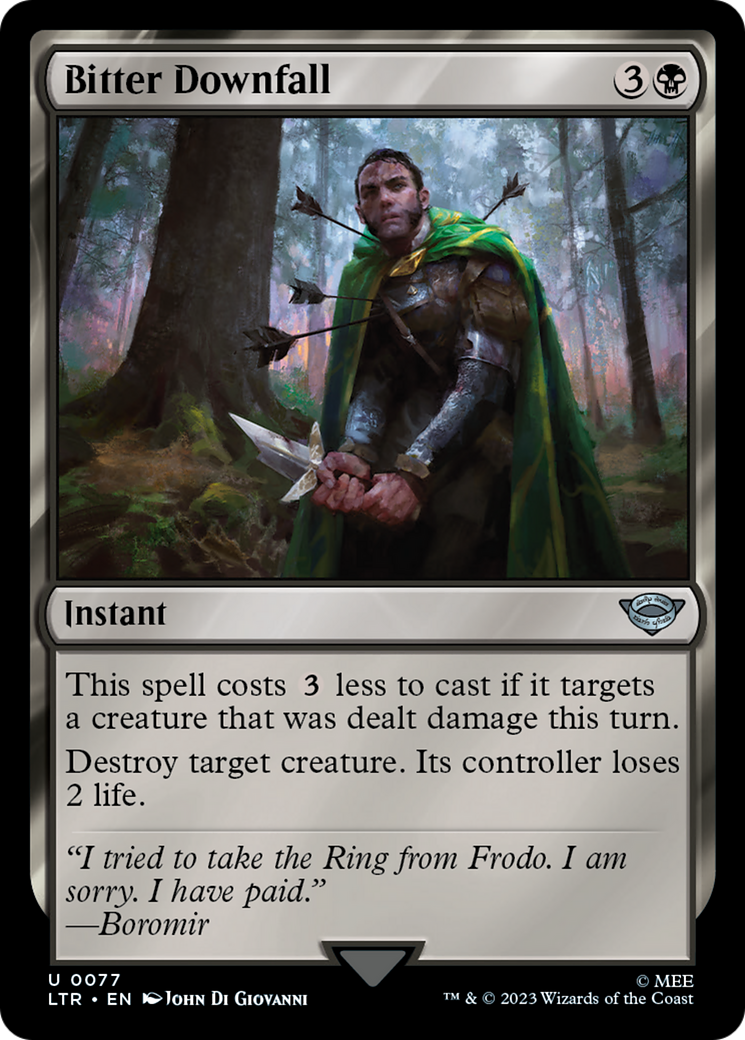
Bitter Downfall
Bitter Downfall
Instant
This spell costs less to cast if it targets a creature that was dealt damage this turn.
Destroy target creature. Its controller loses 2 life.
-
1
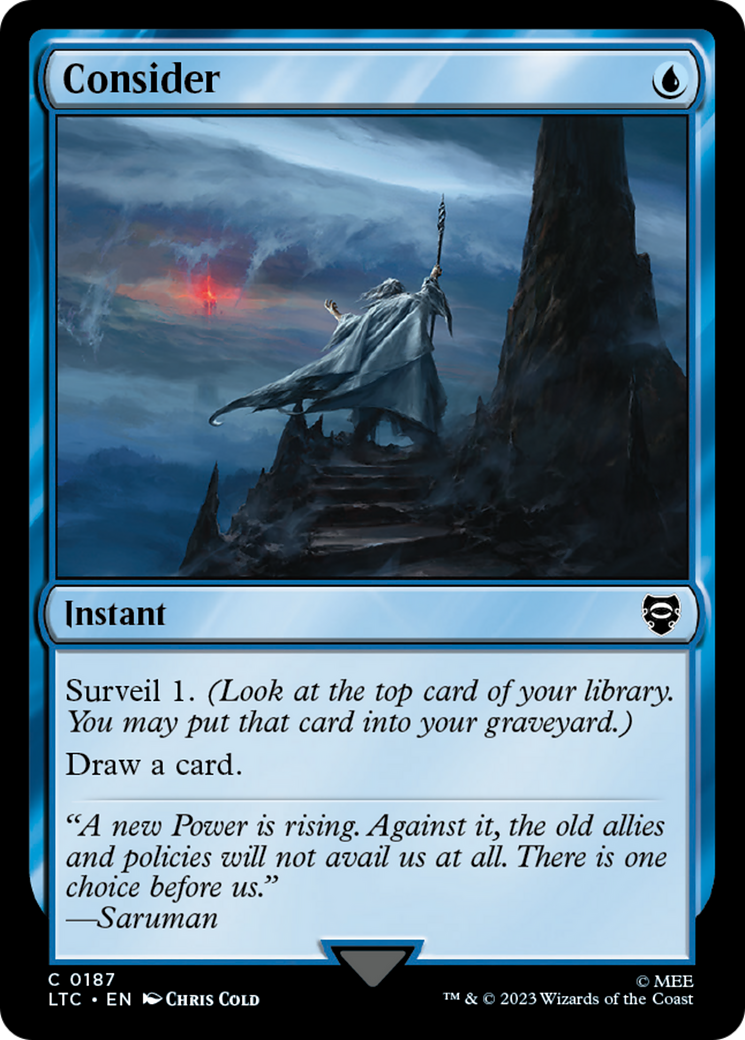
Consider
Consider
Instant
Surveil 1. (Look at the top card of your library. You may put it into your graveyard.)
Draw a card.
- You perform the actions stated on a card in sequence. For some spells and abilities, you'll surveil last. For others, you'll surveil and then perform other actions.
-
1
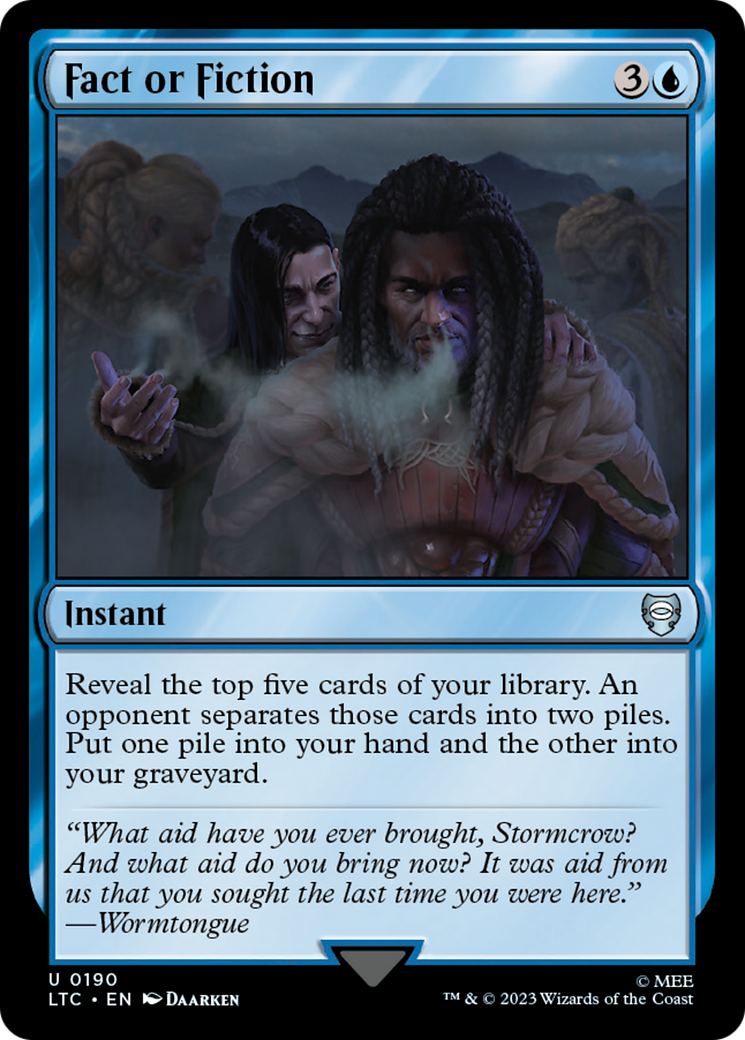
Fact or Fiction
Fact or Fiction
Instant
Reveal the top five cards of your library. An opponent separates those cards into two piles. Put one pile into your hand and the other into your graveyard.
- Piles may be empty.
-
1
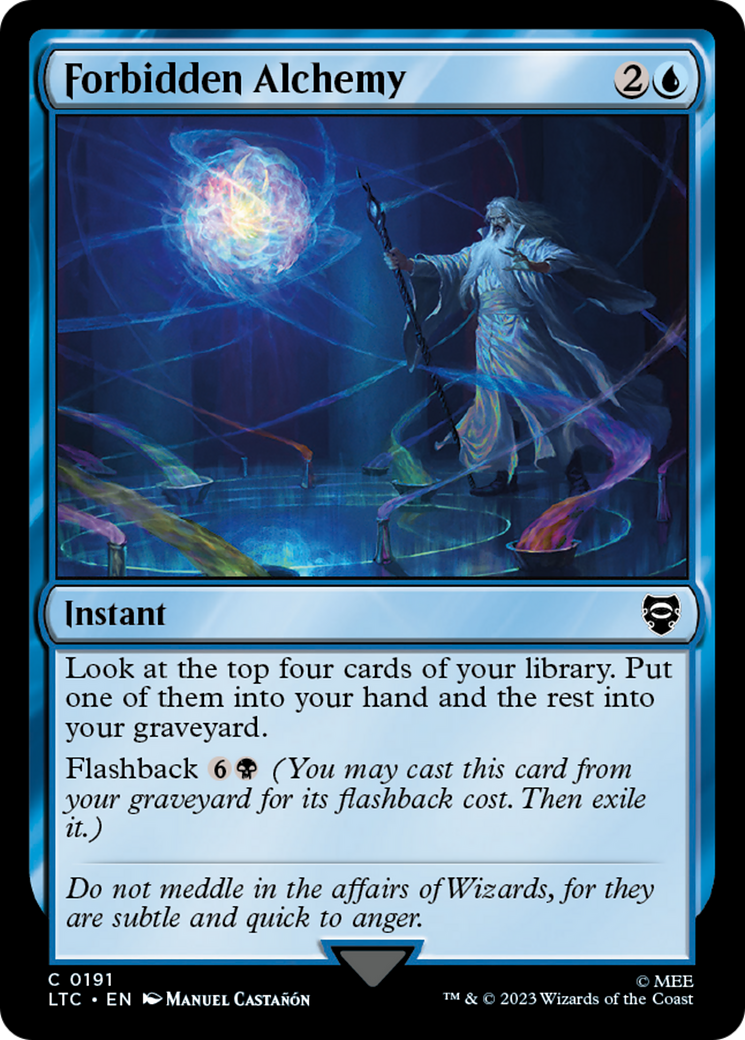
Forbidden Alchemy
Forbidden Alchemy
Instant
Look at the top four cards of your library. Put one of them into your hand and the rest into your graveyard.
Flashback (You may cast this card from your graveyard for its flashback cost. Then exile it.)
- To determine the total cost of a spell, start with the mana cost or alternative cost (such as a flashback cost) you're paying, add any cost increases, then apply any cost reductions. The mana value of the spell is determined only by its mana cost, no matter what the total cost to cast the spell was.
- "Flashback [cost]" means "You may cast this card from your graveyard by paying [cost] rather than paying its mana cost" and "If the flashback cost was paid, exile this card instead of putting it anywhere else any time it would leave the stack."
- You must still follow any timing restrictions and permissions, including those based on the card's type. For instance, you can cast a sorcery using flashback only when you could normally cast a sorcery.
- If a card with flashback is put into your graveyard during your turn, you can cast it if it's legal to do so before any other player can take any actions.
- A spell cast using flashback will always be exiled afterward, whether it resolves, is countered, or leaves the stack in some other way.
- You can cast a spell using flashback even if it was somehow put into your graveyard without having been cast.
- If you have fewer than four cards in your library, you'll look at all the cards there and put one into your hand and the rest into your graveyard.
-
1
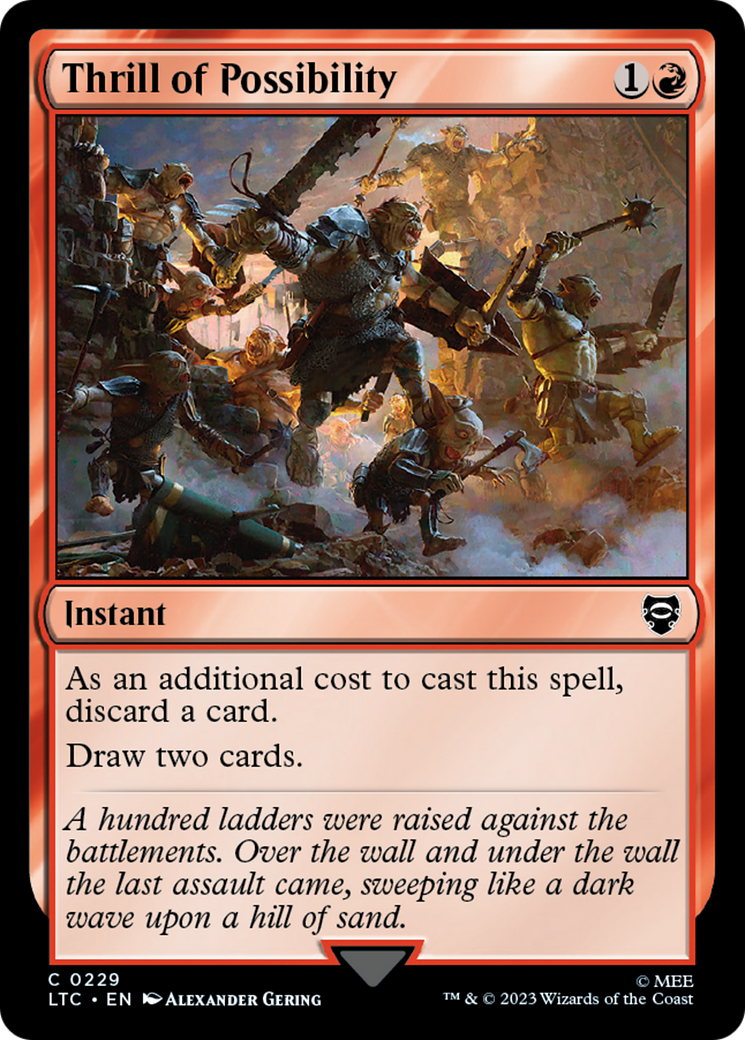
Thrill of Possibility
Thrill of Possibility
Instant
As an additional cost to cast this spell, discard a card.
Draw two cards.
- You must discard exactly one card to cast Thrill of Possibility; you can't cast it without discarding a card, and you can't discard additional cards.
Sorceries 16
-
1
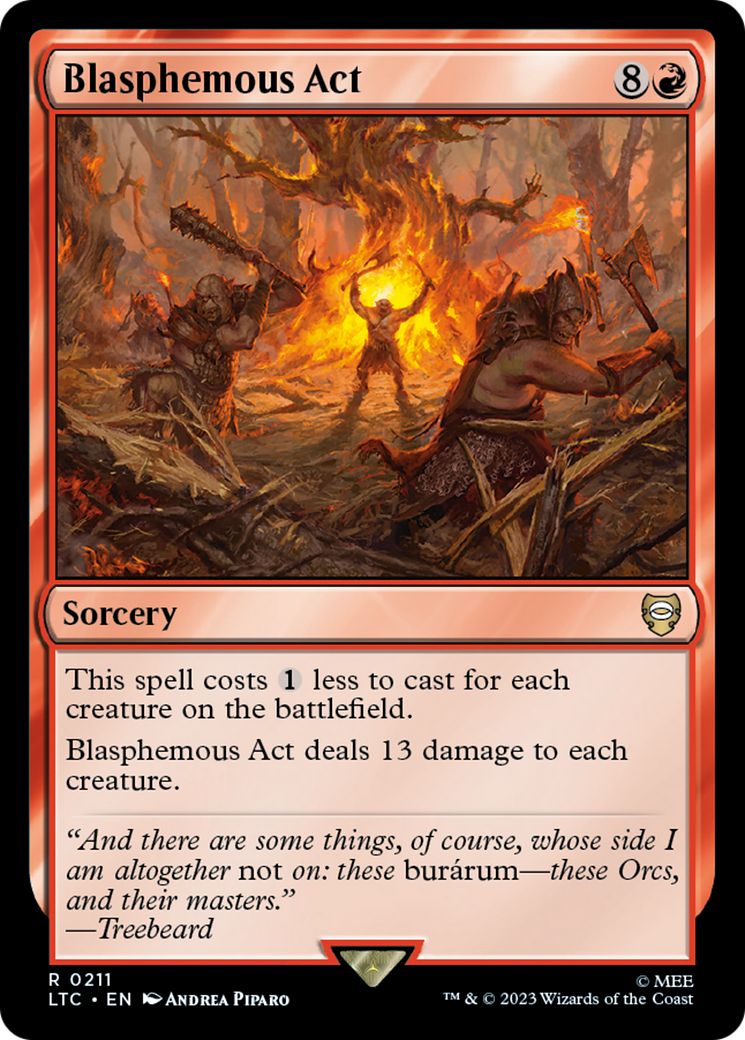
Blasphemous Act
Blasphemous Act
Sorcery
This spell costs less to cast for each creature on the battlefield.
Blasphemous Act deals 13 damage to each creature.
- To determine the total cost of a spell, start with the mana cost or alternative cost you're paying, add any cost increases, then apply any cost reductions (such as that of Blasphemous Act). The mana value of the spell is determined only by its mana cost, no matter what the total cost to cast the spell was.
- Blasphemous Act's ability can't reduce the total cost to cast the spell below .
- The total cost to cast Blasphemous Act is locked in before you pay that cost. For example, if there are three creatures on the battlefield, including one you can sacrifice to add , the total cost of Blasphemous Act is . Then you can sacrifice the creature when you activate mana abilities just before paying the cost.
- Although players may respond to Blasphemous Act once it's been cast, once it's announced, they can't respond before the cost is calculated and paid.
-
1
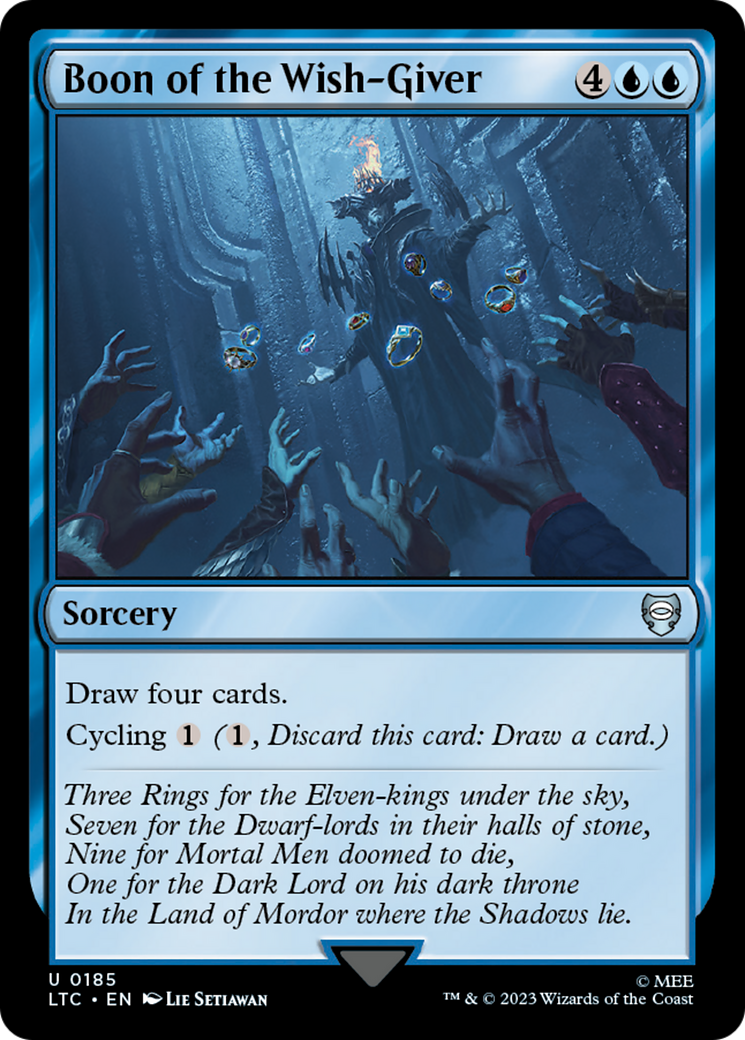
Boon of the Wish-Giver
Boon of the Wish-Giver
Sorcery
Draw four cards.
Cycling ( , Discard this card: Draw a card.)
-
1
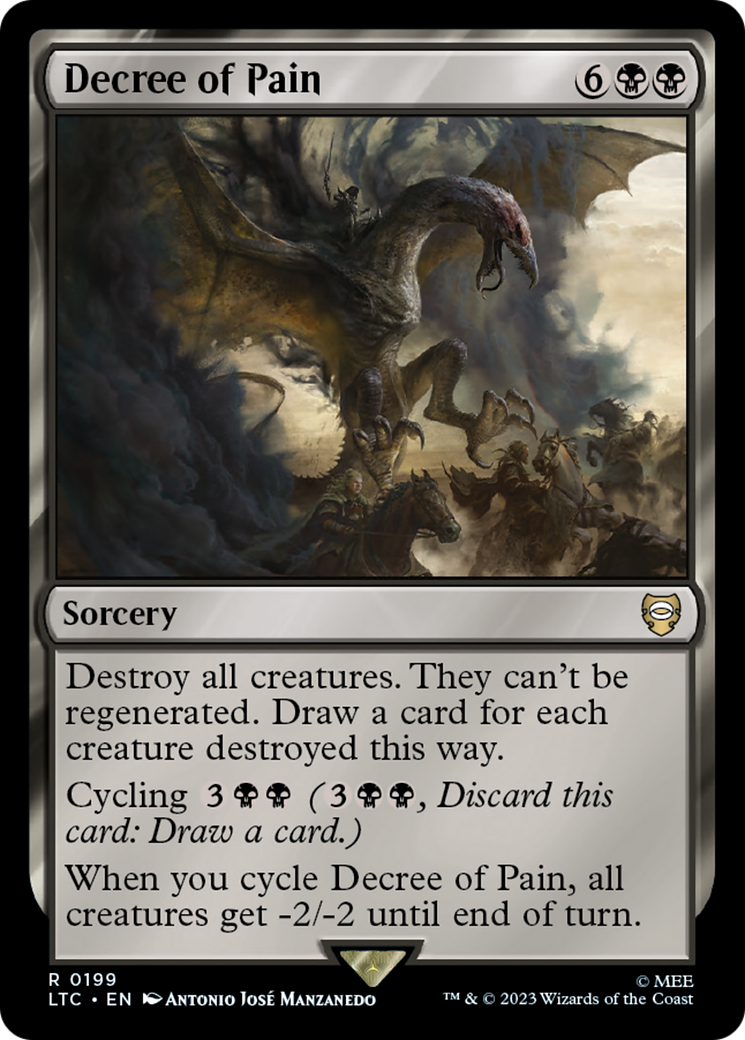
Decree of Pain
Decree of Pain
Sorcery
Destroy all creatures. They can't be regenerated. Draw a card for each creature destroyed this way.
Cycling ( , Discard this card: Draw a card.)
When you cycle this card, all creatures get -2/-2 until end of turn.
- When you cycle this card, first the cycling ability goes on the stack, then the triggered ability goes on the stack on top of it. The triggered ability will resolve before you draw a card from the cycling ability.
- The cycling ability and the triggered ability are separate. If the triggered ability doesn't resolve (because, for example, it has been countered, or all of its targets have become illegal), the cycling ability will still resolve, and you'll draw a card.
-
1
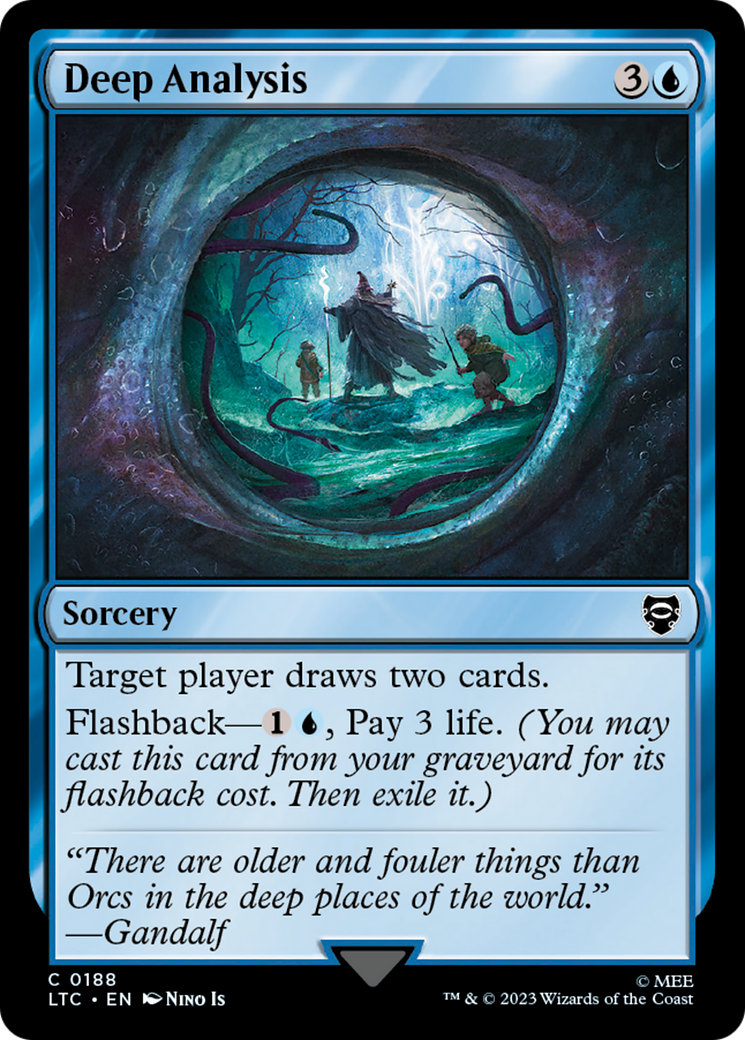
Deep Analysis
Deep Analysis
Sorcery
Target player draws two cards.
Flashback— , Pay 3 life. (You may cast this card from your graveyard for its flashback cost. Then exile it.)
- "Flashback [cost]" means "You may cast this card from your graveyard by paying [cost] rather than paying its mana cost" and "If the flashback cost was paid, exile this card instead of putting it anywhere else any time it would leave the stack."
- You must still follow any timing restrictions and permissions, including those based on the card's type. For instance, you can cast a sorcery using flashback only when you could normally cast a sorcery.
- To determine the total cost of a spell, start with the mana cost or alternative cost (such as a flashback cost) you're paying, add any cost increases, then apply any cost reductions. The mana value of the spell is determined only by its mana cost, no matter what the total cost to cast the spell was.
- A spell cast using flashback will always be exiled afterward, whether it resolves, is countered, or leaves the stack in some other way.
- You can cast a spell using flashback even if it was somehow put into your graveyard without having been cast.
- If a card with flashback is put into your graveyard during your turn, you can cast it if it's legal to do so before any other player can take any actions.
-
1
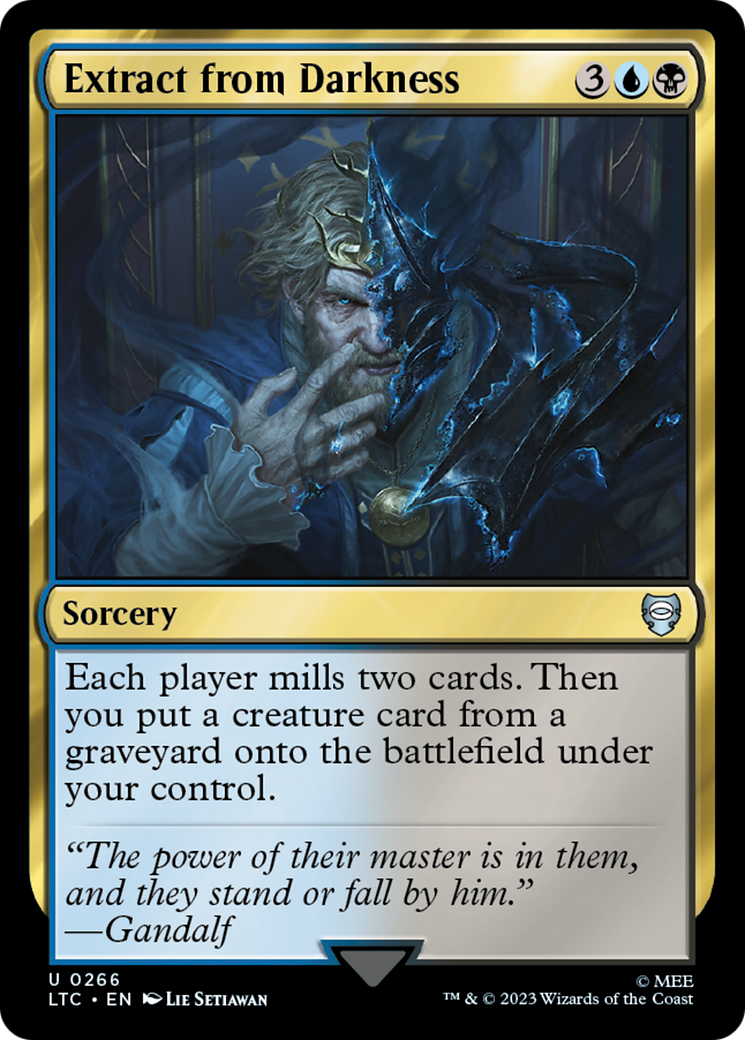
Extract from Darkness
Extract from Darkness
Sorcery
Each player mills two cards. Then you put a creature card from a graveyard onto the battlefield under your control.
- Extract from Darkness doesn't target a creature card. You choose which card you're putting onto the battlefield as it resolves. You can choose any creature card in a graveyard at that time, including one just put into a graveyard by Extract from Darkness. If there are no creature cards in graveyards at that time, Extract from Darkness simply finishes resolving.
-
1
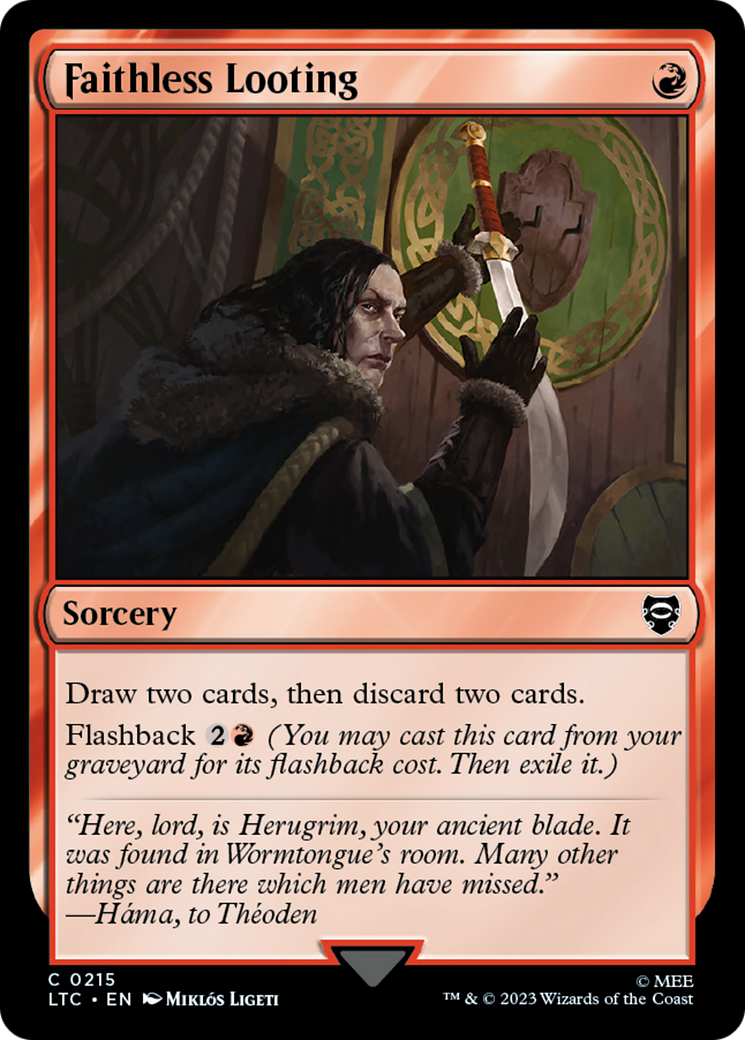
Faithless Looting
Faithless Looting
Sorcery
Draw two cards, then discard two cards.
Flashback (You may cast this card from your graveyard for its flashback cost. Then exile it.)
- To determine the total cost of a spell, start with the mana cost or alternative cost (such as a flashback cost) you're paying, add any cost increases, then apply any cost reductions. The mana value of the spell is determined only by its mana cost, no matter what the total cost to cast the spell was.
- "Flashback [cost]" means "You may cast this card from your graveyard by paying [cost] rather than paying its mana cost" and "If the flashback cost was paid, exile this card instead of putting it anywhere else any time it would leave the stack."
- You must still follow any timing restrictions and permissions, including those based on the card's type. For instance, you can cast a sorcery using flashback only when you could normally cast a sorcery.
- If a card with flashback is put into your graveyard during your turn, you can cast it if it's legal to do so before any other player can take any actions.
- A spell cast using flashback will always be exiled afterward, whether it resolves, is countered, or leaves the stack in some other way.
- You can cast a spell using flashback even if it was somehow put into your graveyard without having been cast.
- You draw two cards and discard two cards all while Faithless Looting is resolving. Nothing can happen between the two, and no player may choose to take actions.
-
1
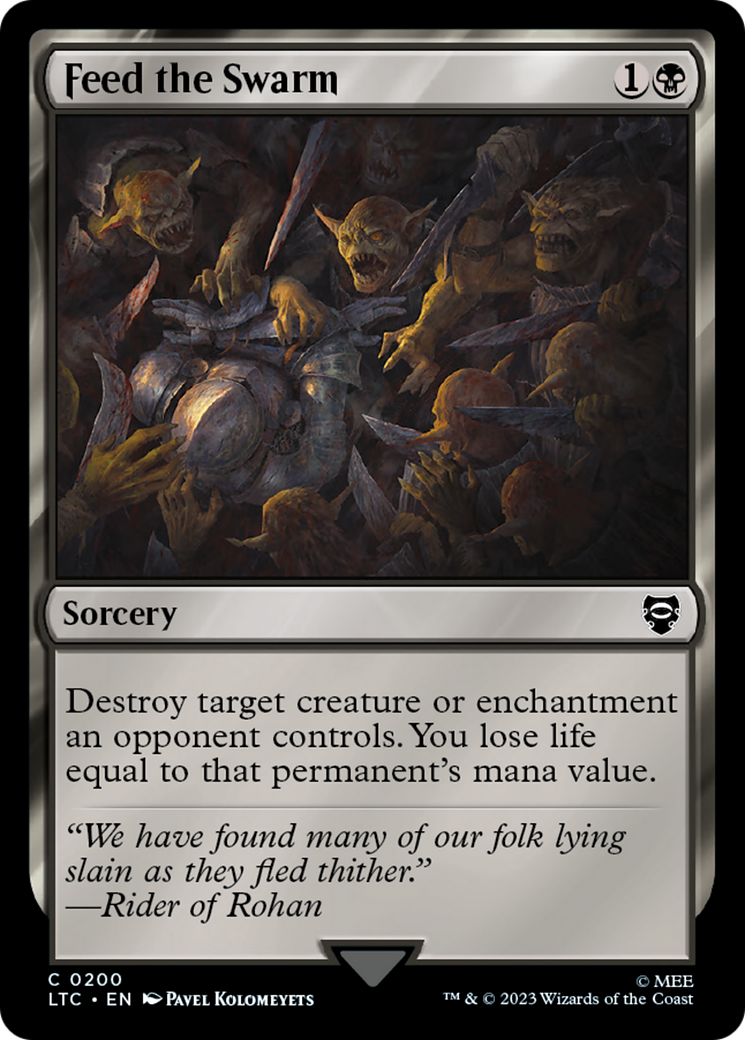
Feed the Swarm
Feed the Swarm
Sorcery
Destroy target creature or enchantment an opponent controls. You lose life equal to that permanent's mana value.
- The amount of life you lose is determined by the permanent's mana value as it last existed on the battlefield.
- If a permanent on the battlefield has in its mana cost, X is 0 for the purpose of determining its mana value.
- If the target permanent is an illegal target by the time Feed the Swarm tries to resolve, the spell doesn't resolve. You don't lose any life. If the target is legal but not destroyed (most likely because it has indestructible), you do lose life.
-
1
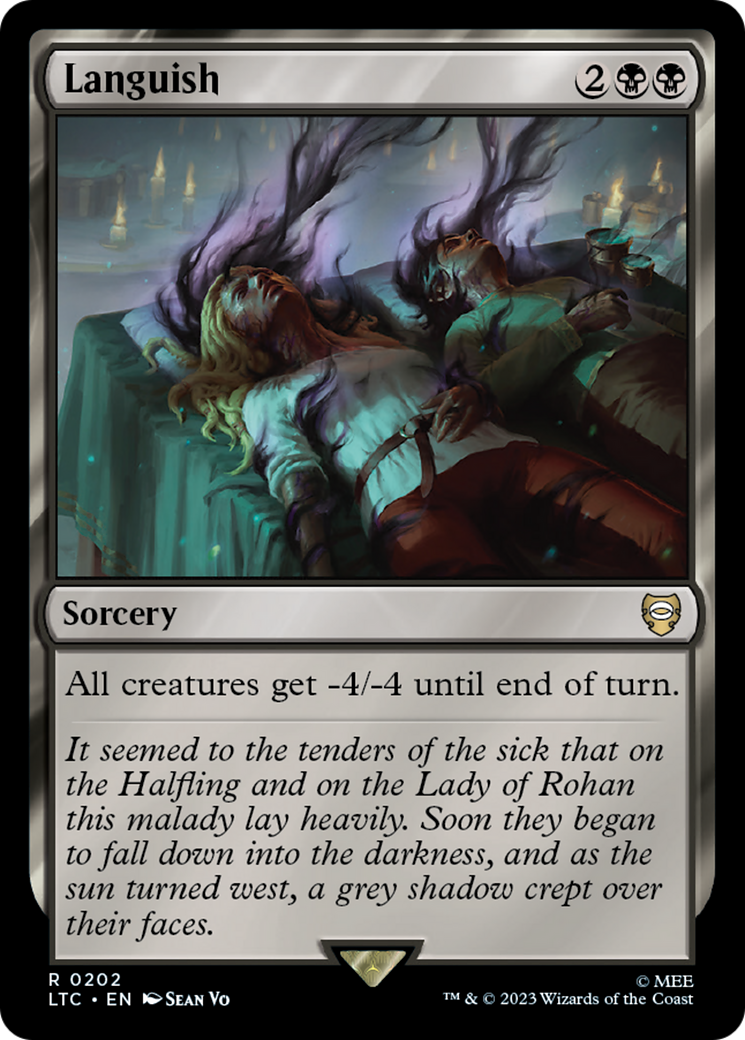
Languish
Languish
Sorcery
All creatures get -4/-4 until end of turn.
-
1
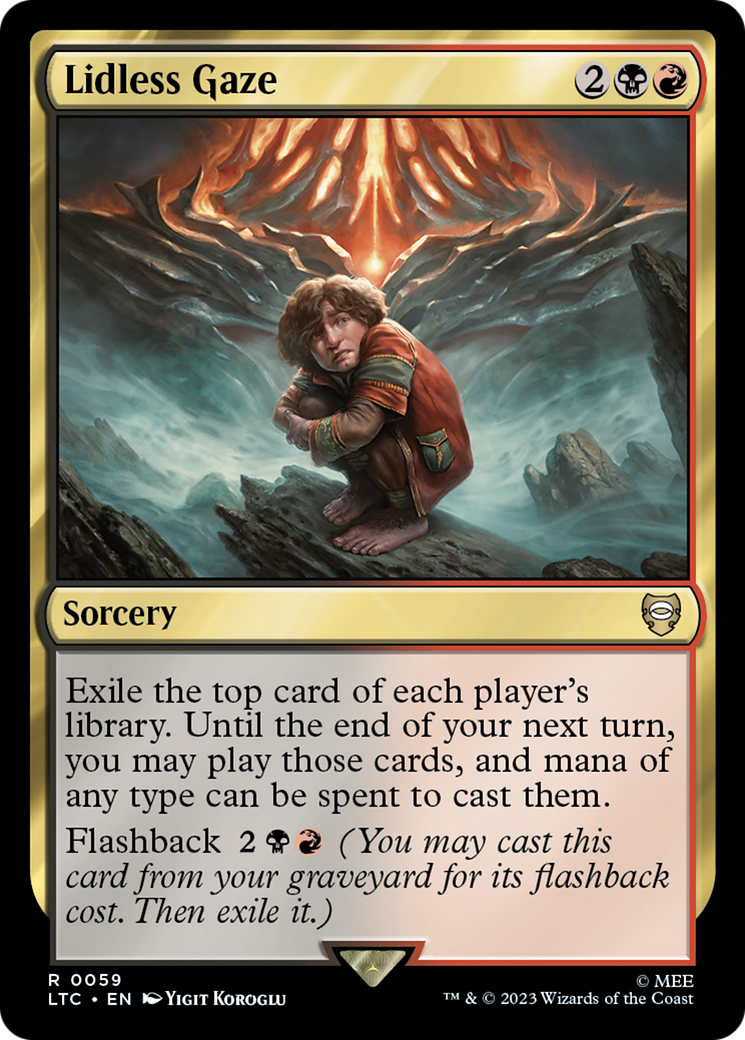
Lidless Gaze
Lidless Gaze
Sorcery
Exile the top card of each player's library. Until the end of your next turn, you may play those cards, and mana of any type can be spent to cast those spells.
Flashback (You may cast this card from your graveyard for its flashback cost. Then exile it.)
- Lidless Gaze uses a new template indicating that you may spend mana as though it were mana of any type to cast the exiled cards. The six types of mana are white, blue, black, red, green, and colorless.
- Snow mana is not a type of mana. Lidless Gaze won't let you pay a snow cost using mana produced by a nonsnow source.
-
1
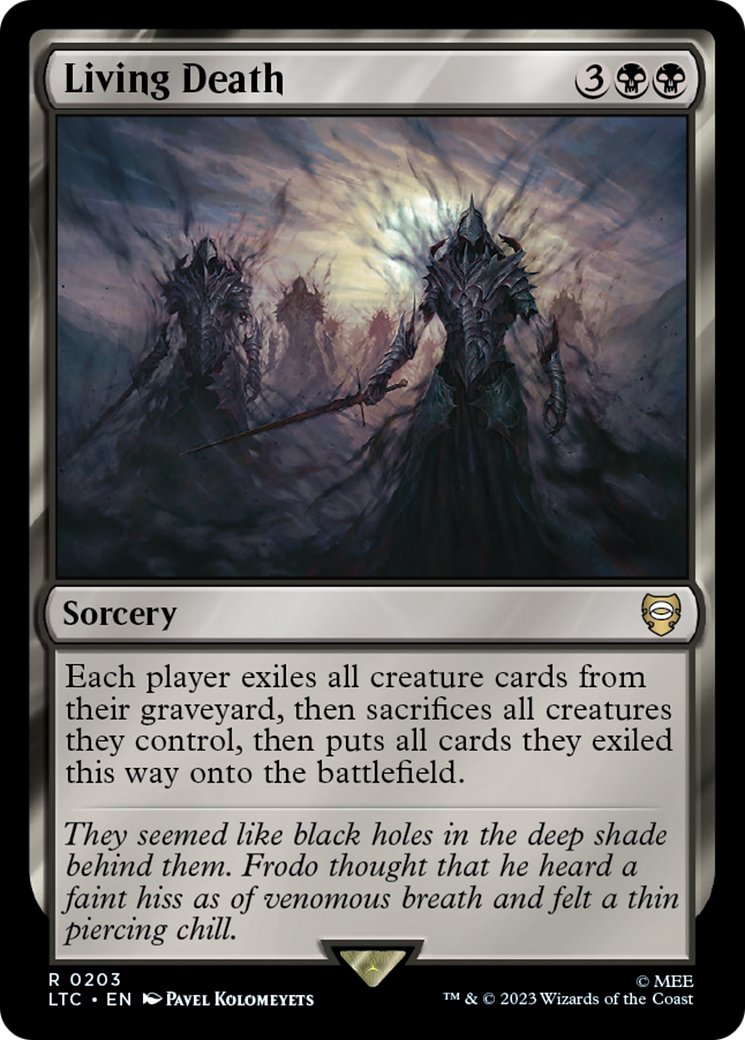
Living Death
Living Death
Sorcery
Each player exiles all creature cards from their graveyard, then sacrifices all creatures they control, then puts all cards they exiled this way onto the battlefield.
- As Living Death resolves, all players exile their creature cards from graveyards at the same time. Then all players sacrifice all creatures they control at the same time. Then all players put all creatures they exiled onto the battlefield at the same time.
- Only cards exiled by Living Death's first instruction are put onto the battlefield. If a replacement effect (such as that of Leyline of the Void) causes any of the sacrificed creatures to be exiled instead of put into a graveyard, those cards aren't returned to the battlefield.
-
1
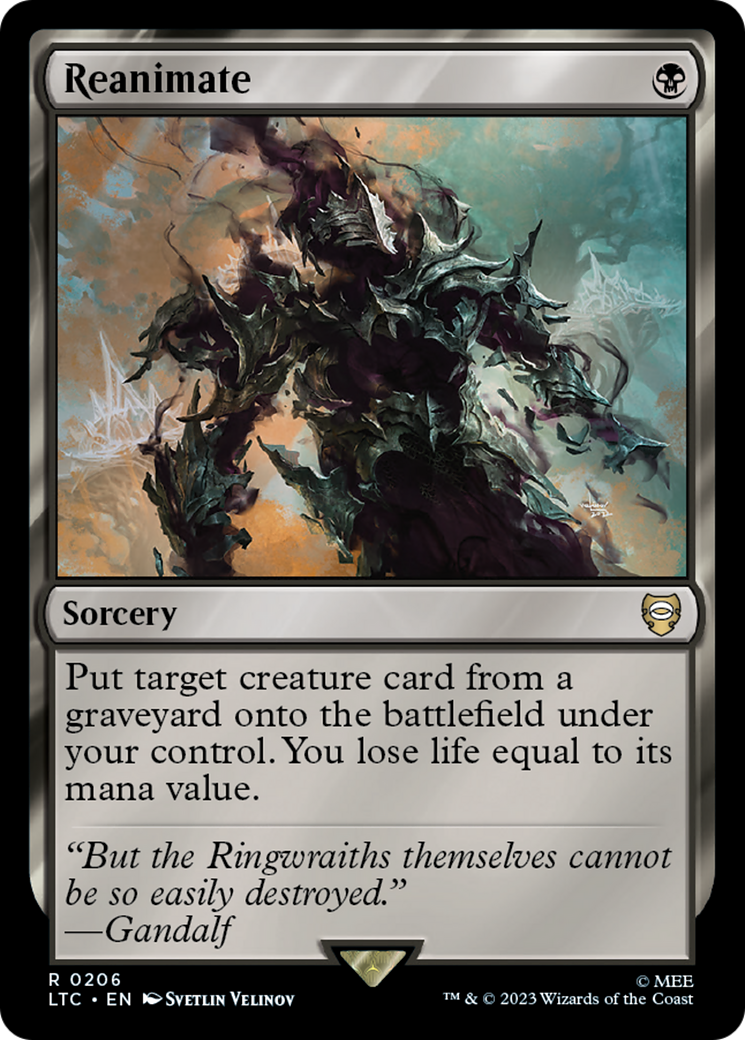
Reanimate
Reanimate
Sorcery
Put target creature card from a graveyard onto the battlefield under your control. You lose life equal to its mana value.
- If a card in a player's graveyard has in its mana cost, X is considered to be 0.
- The amount of life you lose is determined by the mana value of the card in your graveyard, not the creature once it's on the battlefield.
- You lose life after the creature is already on the battlefield. Any abilities it has that interact with loss of life, such as that of Platinum Emperion, apply to that loss of life.
- If any abilities trigger on the creature entering the battlefield, those abilities resolve after you lose life. If losing life results in you losing the game, those abilities won't resolve.
- In a multiplayer game, if a player leaves the game, all cards that player owns leave as well. If you leave the game, the creature you control from Reanimate is exiled.
-
1
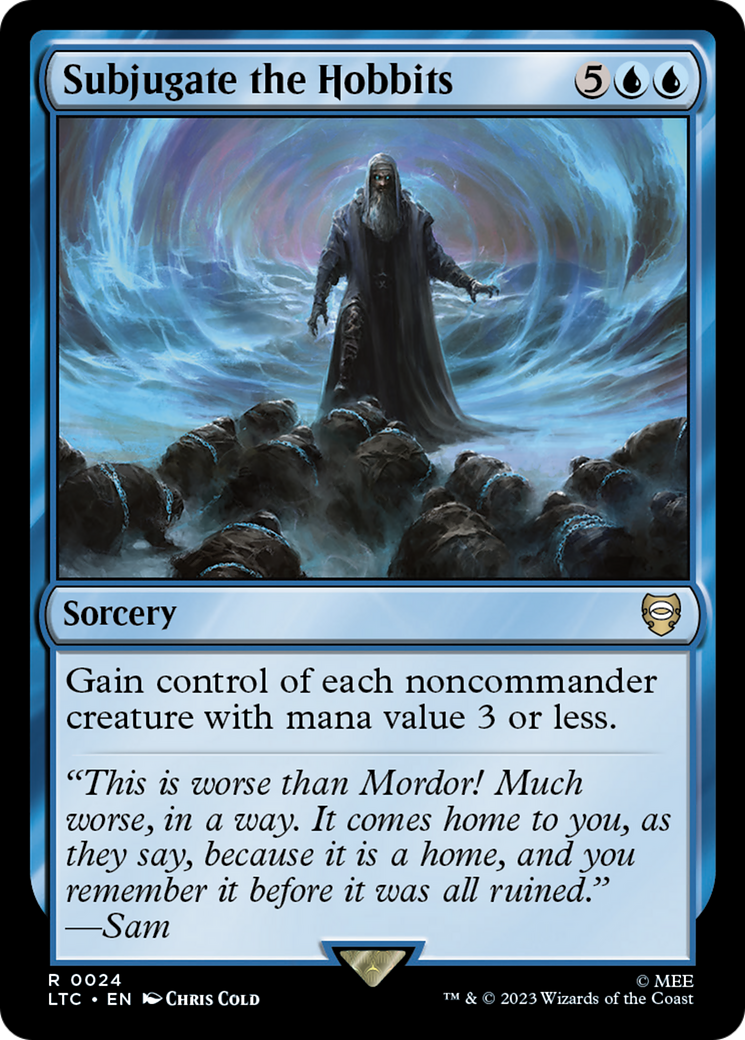
Subjugate the Hobbits
Subjugate the Hobbits
Sorcery
Gain control of each noncommander creature with mana value 3 or less.
-
1
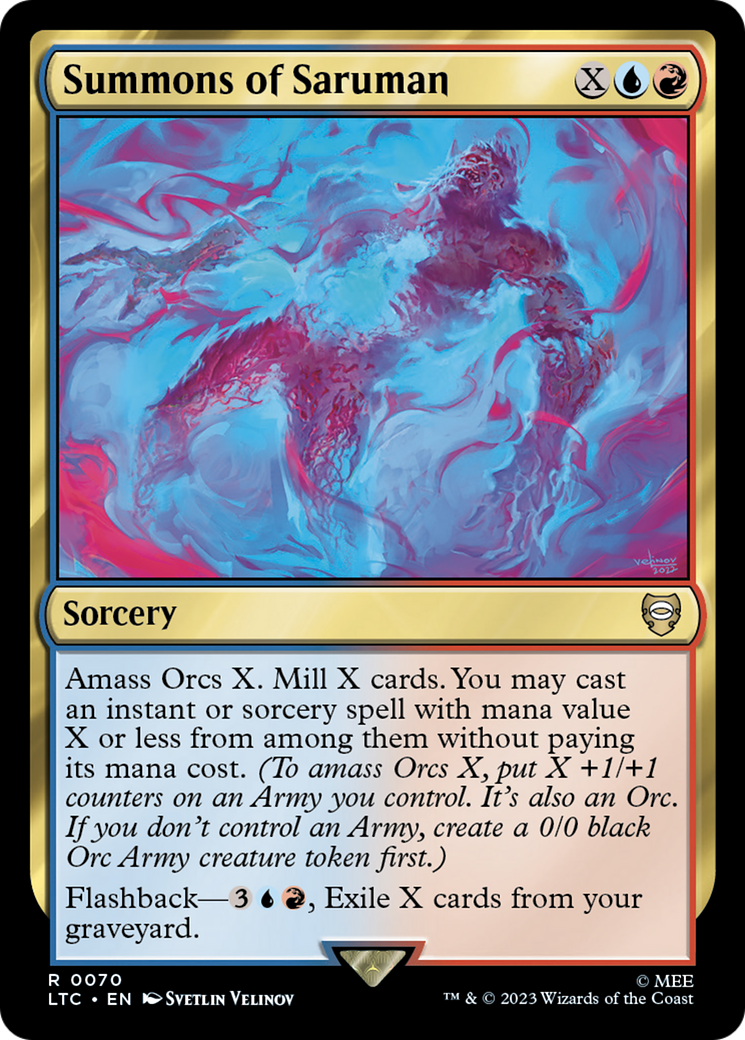
Summons of Saruman
Summons of Saruman
Sorcery
Amass Orcs X. Mill X cards. You may cast an instant or sorcery spell with mana value X or less from among them without paying its mana cost. (To amass Orcs X, put X +1/+1 counters on an Army you control. It's also an Orc. If you don't control an Army, create a 0/0 black Orc Army creature token first.)
Flashback— , Exile X cards from your graveyard.
- If you want to cast one of the milled cards, you cast it as part of the resolution of Summons of Saruman. You can't wait to cast the spell later in the turn. Timing permissions based on the card's type are ignored.
- If you cast a spell "without paying its mana cost", you can't choose to cast it for any alternative costs. You can, however, pay additional costs, such as kicker costs. If the card has any mandatory additional costs, those must be paid to cast the spell.
- If the spell has in its mana cost, you must choose 0 as the value of X.
- Amass abilities are now written as "amass [subtype] N." Previous cards with amass have received errata to say "amass Zombies N."
- To amass Orcs N, if you don't control an Army creature, create a 0/0 black Orc Army creature token. Then you choose an Army creature you control and put N +1/+1 counters on it. If that Army isn't already an Orc, it becomes an Orc in addition to its other types.
- Amass Zombies works the same way, except you create a 0/0 black Zombie Army creature token if you don't control an Army. If the Army creature you chose isn't already a Zombie, it becomes a Zombie in addition to its other types. By combining cards with amass Orcs and amass Zombies, you can end up with an Orc Zombie Army.
- In the rare case that you control multiple Army creatures (perhaps because you played a creature with changeling) while you amass Orcs, you choose which of your Army creatures to put the +1/+1 counters on. If that creature isn't an Orc, it becomes an Orc in addition to its other types.
- If you don't control an Army, the Orc Army token you create enters the battlefield as a 0/0 creature before receiving counters. Any abilities that trigger when a creature with a certain power enters the battlefield, such as that of Mentor of the Meek, will see the token enter as a 0/0 creature before it gets +1/+1 counters.
- Some spells and abilities that amass Orcs may require targets. If each target chosen is an illegal target as that spell or ability tries to resolve, it won't resolve. You won't amass Orcs.
- Some cards refer to the "amassed Army." That means the Army creature you chose to receive counters, even if no counters were placed on it for some reason.
-
1
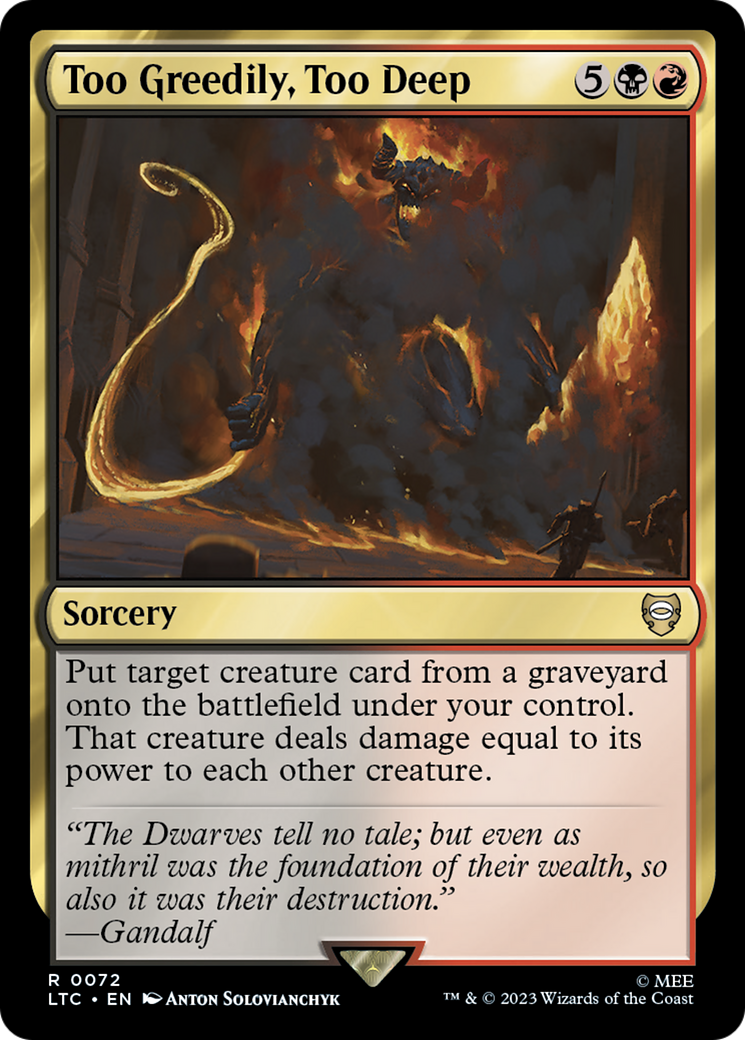
Too Greedily, Too Deep
Too Greedily, Too Deep
Sorcery
Put target creature card from a graveyard onto the battlefield under your control. That creature deals damage equal to its power to each other creature.
- If the card you return to the battlefield isn't a creature on the battlefield, it has no power and therefore deals no damage.
-
1
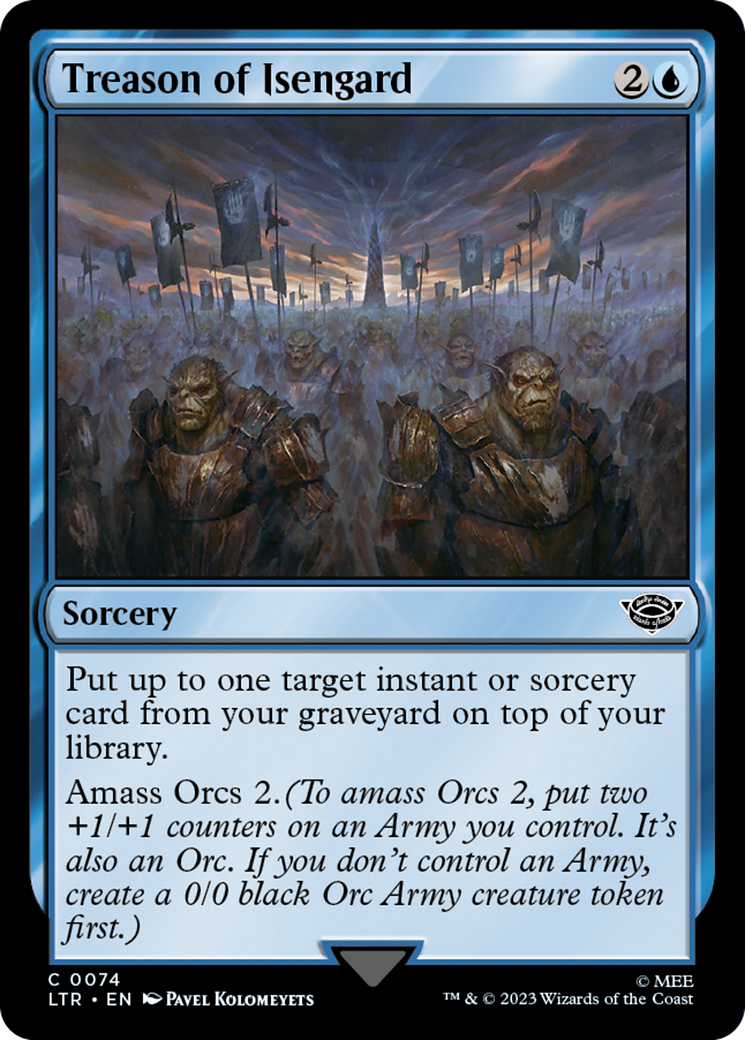
Treason of Isengard
Treason of Isengard
Sorcery
Put up to one target instant or sorcery card from your graveyard on top of your library.
Amass Orcs 2. (To amass Orcs 2, put two +1/+1 counters on an Army you control. It's also an Orc. If you don't control an Army, create a 0/0 black Orc Army creature token first.)
- You can cast Treason of Isengard without a target just to amass Orcs. However, if you do choose a target, and that target is illegal at the time Treason of Isengard tries to resolve, Treason of Isengard won't resolve and none of its effects will happen. You won't amass Orcs.
- Amass abilities are now written as "amass [subtype] N." Previous cards with amass have received errata to say "amass Zombies N."
- To amass Orcs N, if you don't control an Army creature, create a 0/0 black Orc Army creature token. Then you choose an Army creature you control and put N +1/+1 counters on it. If that Army isn't already an Orc, it becomes an Orc in addition to its other types.
- Amass Zombies works the same way, except you create a 0/0 black Zombie Army creature token if you don't control an Army. If the Army creature you chose isn't already a Zombie, it becomes a Zombie in addition to its other types. By combining cards with amass Orcs and amass Zombies, you can end up with an Orc Zombie Army.
- In the rare case that you control multiple Army creatures (perhaps because you played a creature with changeling) while you amass Orcs, you choose which of your Army creatures to put the +1/+1 counters on. If that creature isn't an Orc, it becomes an Orc in addition to its other types.
- If you don't control an Army, the Orc Army token you create enters the battlefield as a 0/0 creature before receiving counters. Any abilities that trigger when a creature with a certain power enters the battlefield, such as that of Mentor of the Meek, will see the token enter as a 0/0 creature before it gets +1/+1 counters.
- Some spells and abilities that amass Orcs may require targets. If each target chosen is an illegal target as that spell or ability tries to resolve, it won't resolve. You won't amass Orcs.
- Some cards refer to the "amassed Army." That means the Army creature you chose to receive counters, even if no counters were placed on it for some reason.
-
1
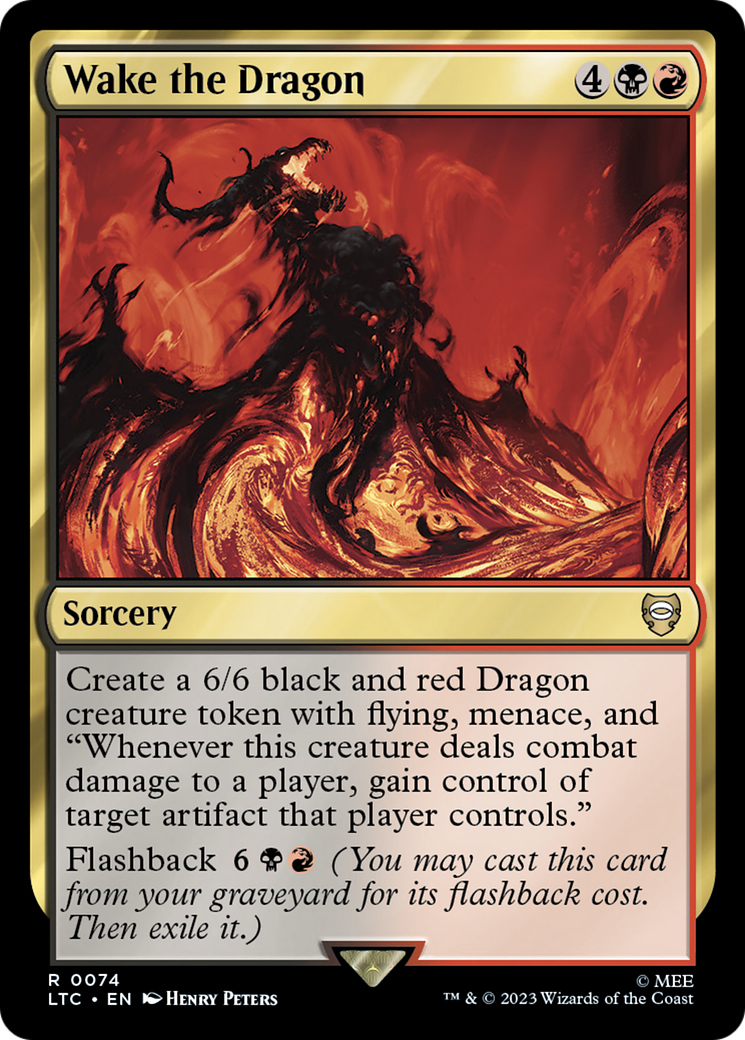
Wake the Dragon
Wake the Dragon
Sorcery
Create a 6/6 black and red Dragon creature token with flying, menace, and "Whenever this token deals combat damage to a player, gain control of target artifact that player controls."
Flashback (You may cast this card from your graveyard for its flashback cost. Then exile it.)
- "Flashback [cost]" means "You may cast this card from your graveyard by paying [cost] rather than paying its mana cost" and "If the flashback cost was paid, exile this card instead of putting it anywhere else any time it would leave the stack."
- You must still follow any timing restrictions and permissions, including those based on the card's type. For instance, you can cast a sorcery using flashback only when you could normally cast a sorcery.
- To determine the total cost of a spell, start with the mana cost or alternative cost (such as a flashback cost) you're paying, add any cost increases, then apply any cost reductions. The mana value of the spell is determined only by its mana cost, no matter what the total cost to cast the spell was.
- A spell cast using flashback will always be exiled afterward, whether it resolves, is countered, or leaves the stack in some other way.
- You can cast a spell using flashback even if it was somehow put into your graveyard without having been cast.
- If a card with flashback is put into your graveyard during your turn, you can cast it if it's legal to do so before any other player can take any actions.
Artifacts 8
-
1
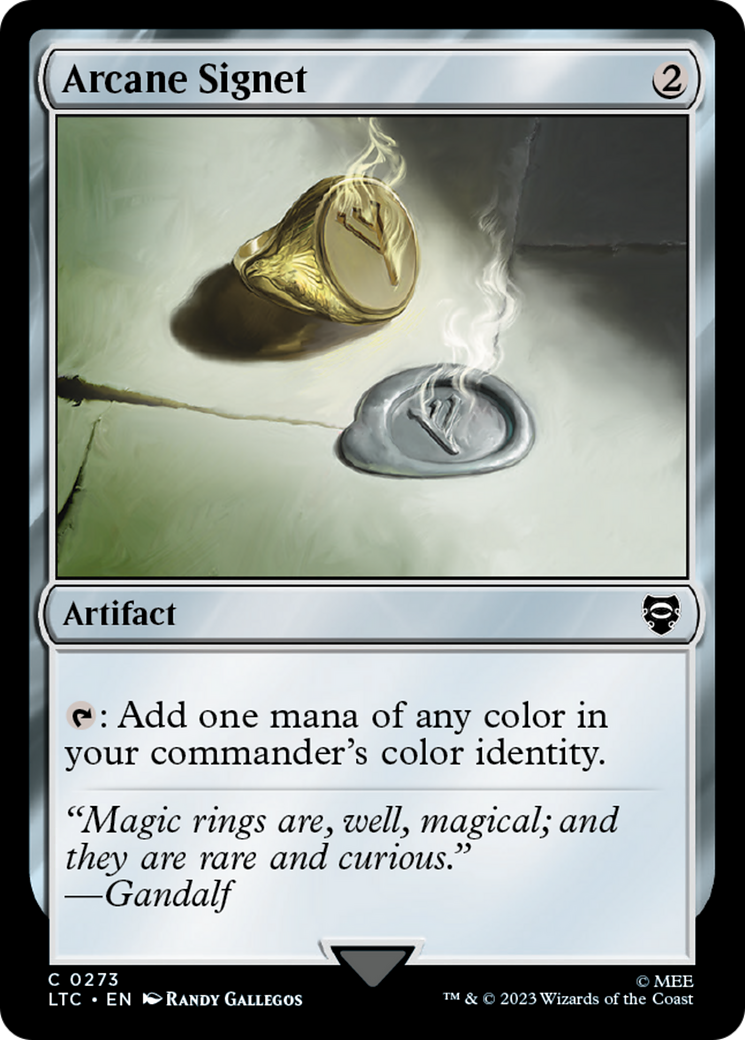
Arcane Signet
Arcane Signet
Artifact
: Add one mana of any color in your commander's color identity.
- If you have two commanders, the ability adds one mana of any color in their combined color identities.
- If your commander is a card that has no colors in its color identity, Arcane Signet's ability produces no mana. It doesn't produce .
- If you don't have a commander, Arcane Signet's ability produces no mana.
-
1
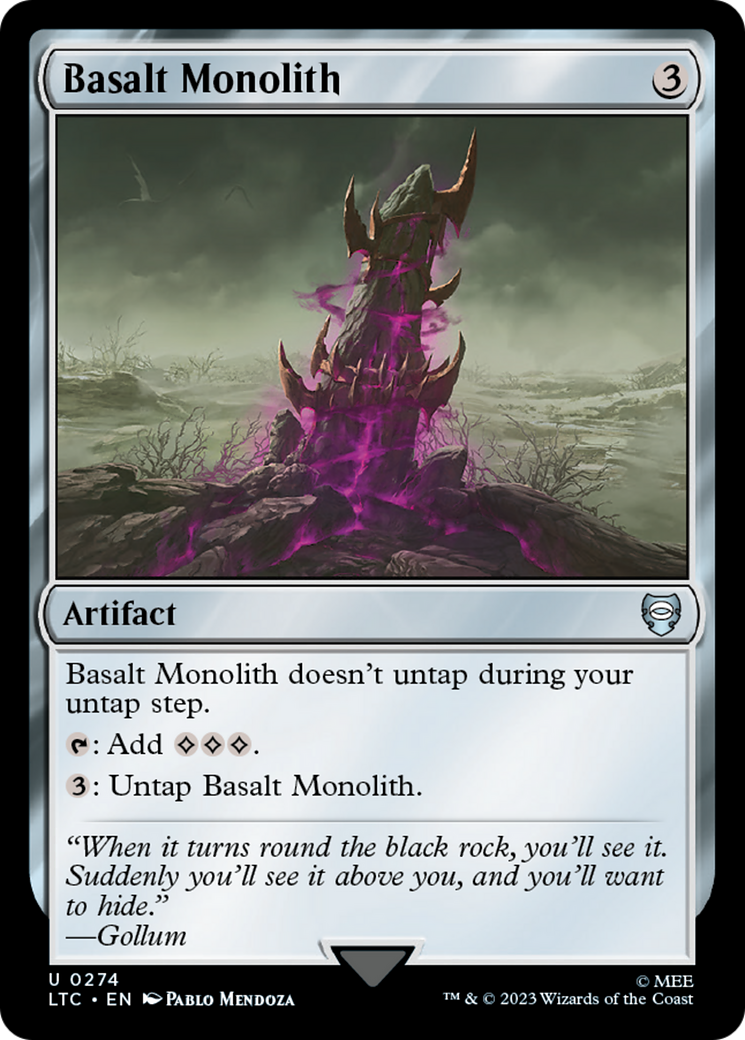
Basalt Monolith
Basalt Monolith
Artifact
This artifact doesn't untap during your untap step.
: Add .
: Untap this artifact.
- Basalt Monolith's last ability can untap it as often as you can pay for it. If you believe you've found a way to generate an unbounded amount of mana with it, you're probably right.
-
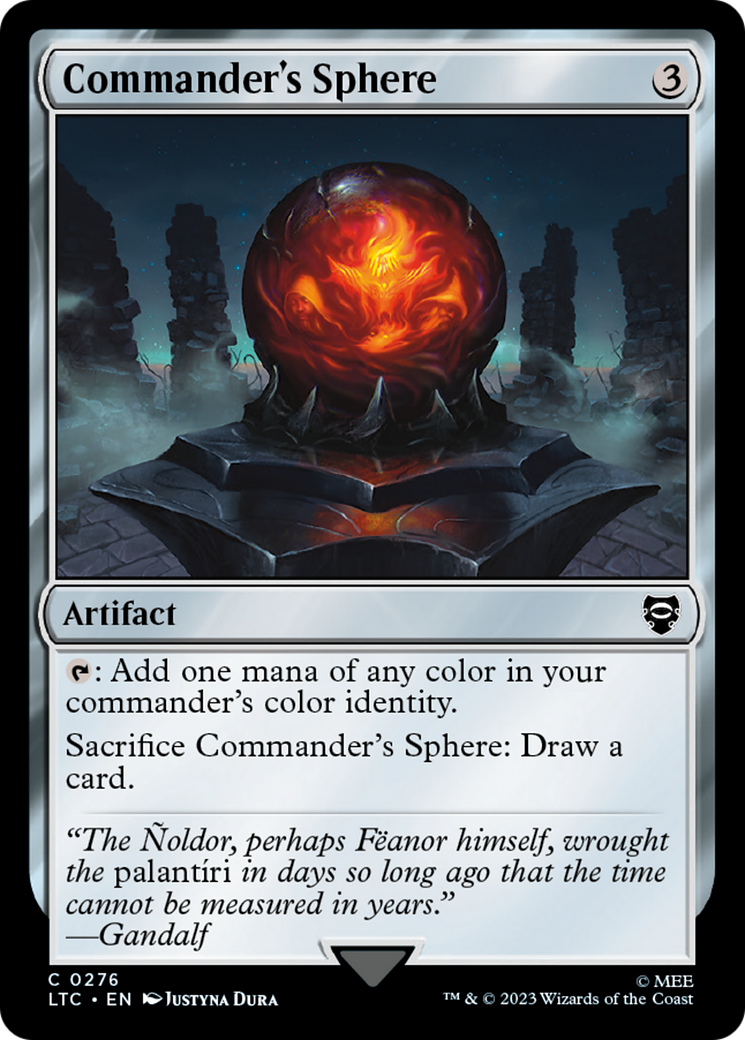
1
Commander's Sphere
Commander's Sphere
Artifact
: Add one mana of any color in your commander's color identity.
Sacrifice this artifact: Draw a card.
- If you have two commanders, the ability adds one mana of any color in their combined color identities.
- If your commander is a card that has no colors in its color identity, Commander's Sphere's first ability produces no mana. It doesn't produce .
- If you don't have a commander, Commander's Sphere's first ability produces no mana.
-
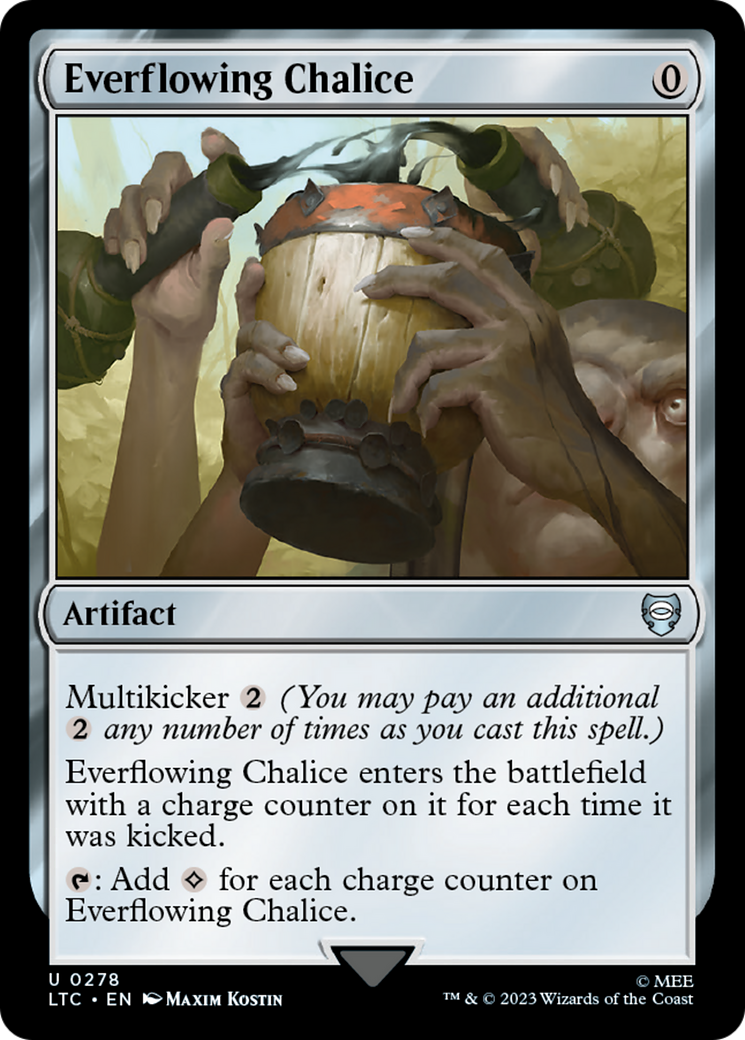
1
Everflowing Chalice
Everflowing Chalice
Artifact
Multikicker (You may pay an additional any number of times as you cast this spell.)
This artifact enters with a charge counter on it for each time it was kicked.
: Add for each charge counter on this artifact.
- If you put a permanent with a kicker ability onto the battlefield without casting it, you can't kick it.
- If a spell's kicker cost was paid, the spell is "kicked."
- The kicker ability doesn't let you pay a kicker cost more than once.
- To determine a spell's total cost, start with the mana cost (or an alternative cost if another card's effect allows you to pay one instead), add any cost increases (such as kicker), then apply any cost reductions. The spell's mana value remains unchanged, no matter what the total cost to cast it was.
- If you copy a kicked spell on the stack, the copy is also kicked. If the copied spell is a permanent spell, the token the copy of that spell becomes when it enters is also kicked.
- If a card or token enters as a copy of a permanent, the new permanent isn't kicked, even if the original was.
- You can cast Everflowing Chalice without kicking it at all if you wish. However, if Everflowing Chalice has no charge counters on it, activating its last ability won't produce any mana.
-
1
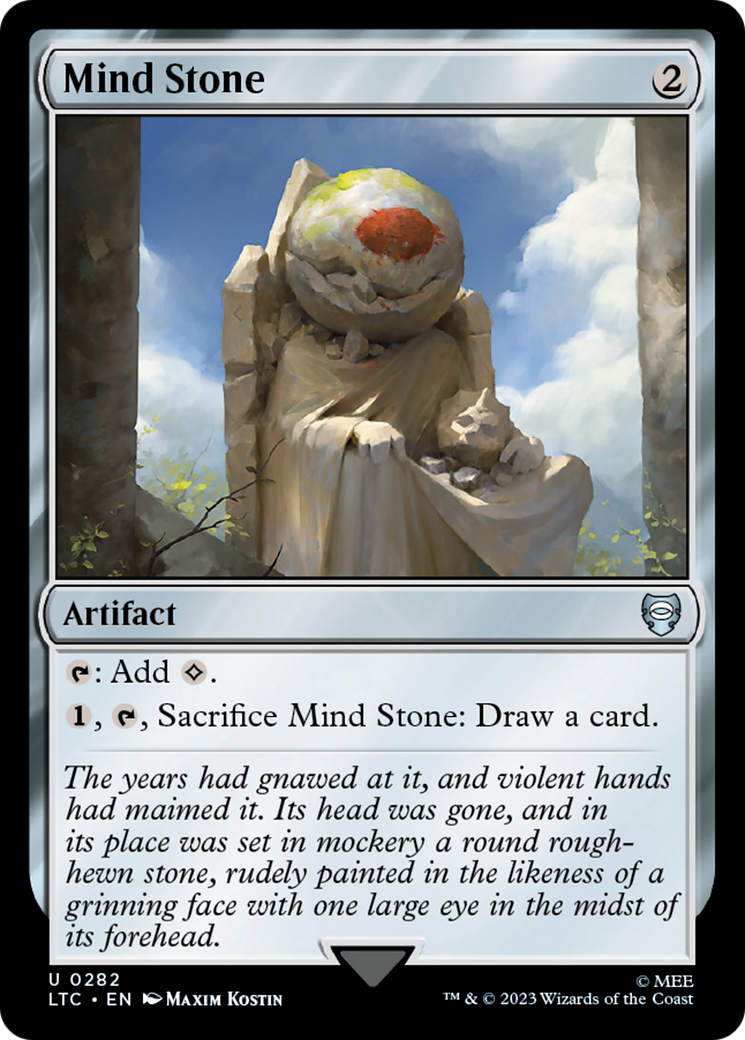
Mind Stone
Mind Stone
Artifact
: Add .
, , Sacrifice this artifact: Draw a card.
-
1
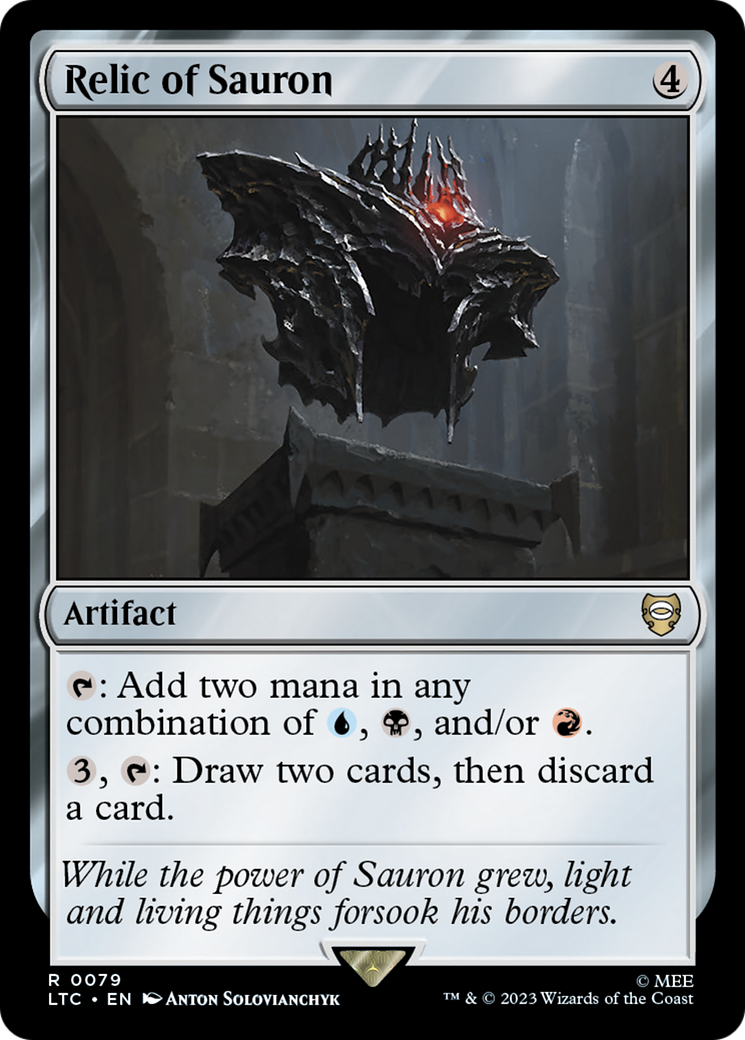
Relic of Sauron
Relic of Sauron
Artifact
: Add two mana in any combination of , , and/or .
, : Draw two cards, then discard a card.
-
1
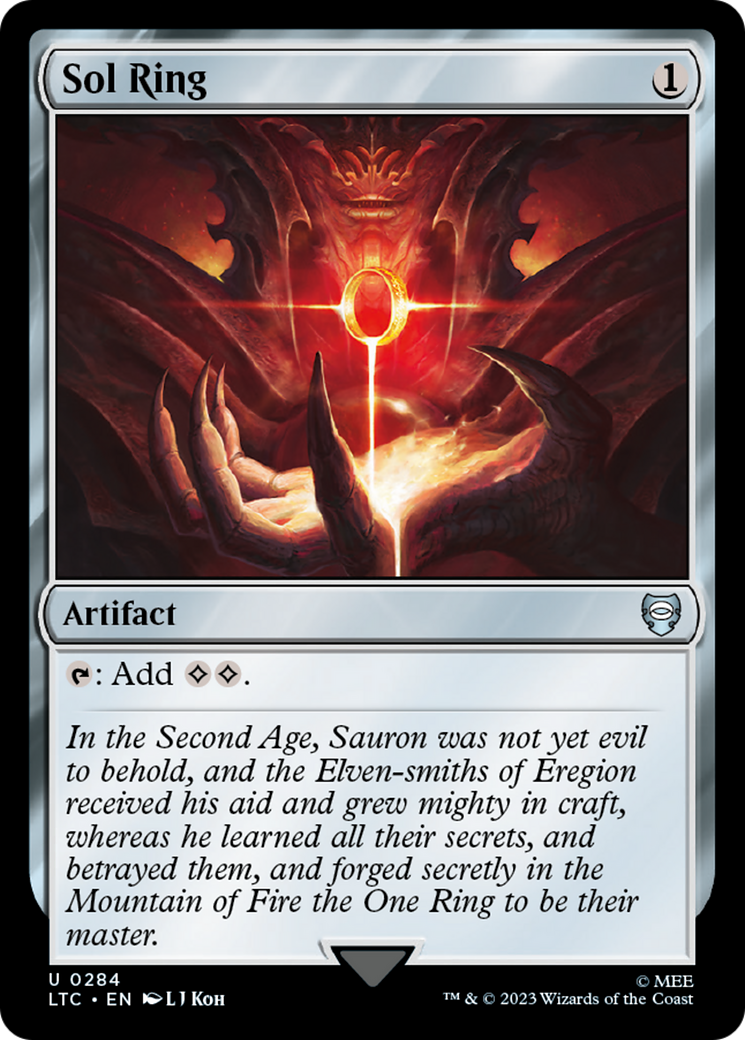
Sol Ring
Sol Ring
Artifact
: Add .
-
1
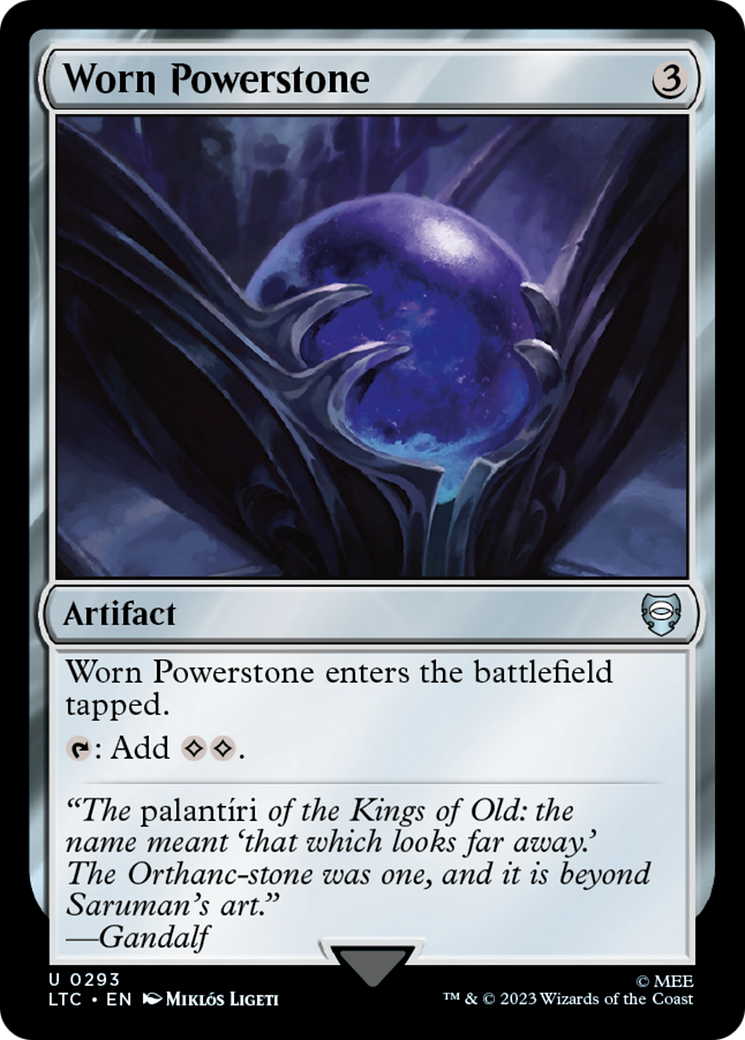
Worn Powerstone
Worn Powerstone
Artifact
This artifact enters tapped.
: Add .
Enchantments 4
-
1
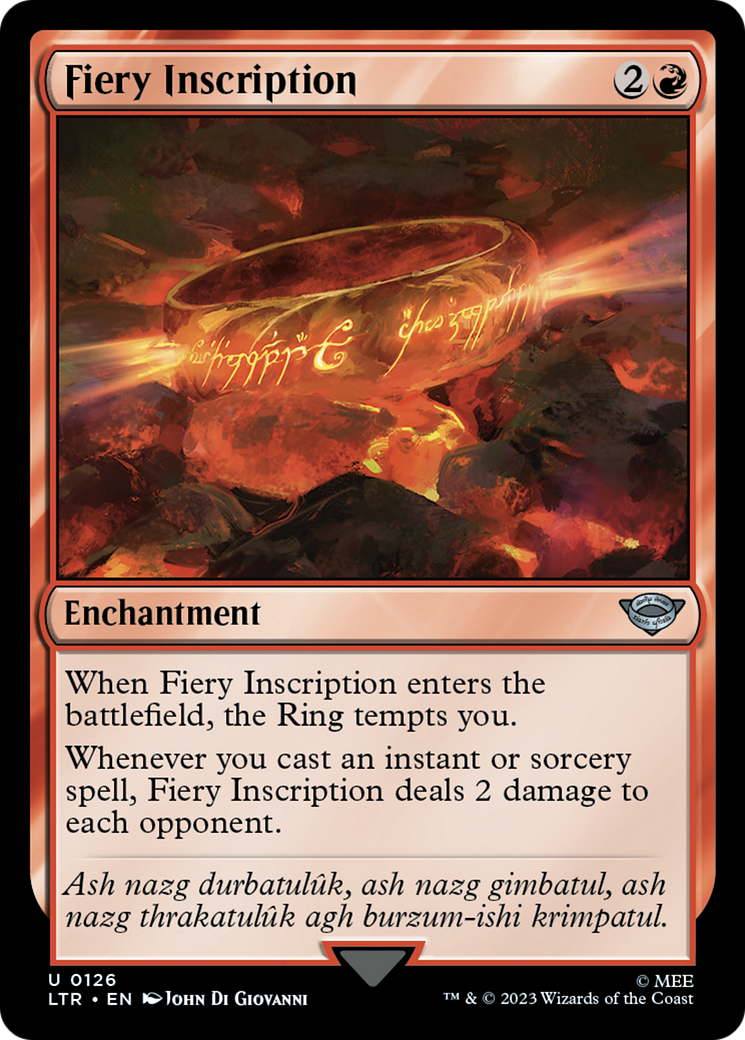
Fiery Inscription
Fiery Inscription
Enchantment
When this enchantment enters, the Ring tempts you.
Whenever you cast an instant or sorcery spell, this enchantment deals 2 damage to each opponent.
- Fiery Inscription's second triggered ability will resolve before the spell that caused the ability to trigger.
- As the Ring tempts you, you get an emblem named The Ring if you don't have one. Then your emblem gains its next ability and you choose a creature you control to become (or remain) your Ring-bearer.
- The Ring can tempt you even if you don't control a creature. In this case, abilities that trigger "whenever the Ring tempts you" will still trigger.
- If the creature you choose as your Ring-bearer was already your Ring-bearer, that still counts as choosing that creature as your Ring-bearer for the purpose of abilities that trigger "whenever you choose a creature as your Ring-bearer" or abilities that care about which creature was chosen as your Ring-bearer.
- The Ring gains its abilities in order from top to bottom. Once it gains an ability, it has that ability for the rest of the game.
- Each time the Ring tempts you, you must choose a creature if you control one.
- Each player can have only one emblem named The Ring and only one Ring-bearer at a time.
- Some spells and abilities that cause the Ring to tempt you may require targets. If each target chosen is an illegal target as that spell or ability tries to resolve, it won't resolve. The Ring won't tempt you.
-
1
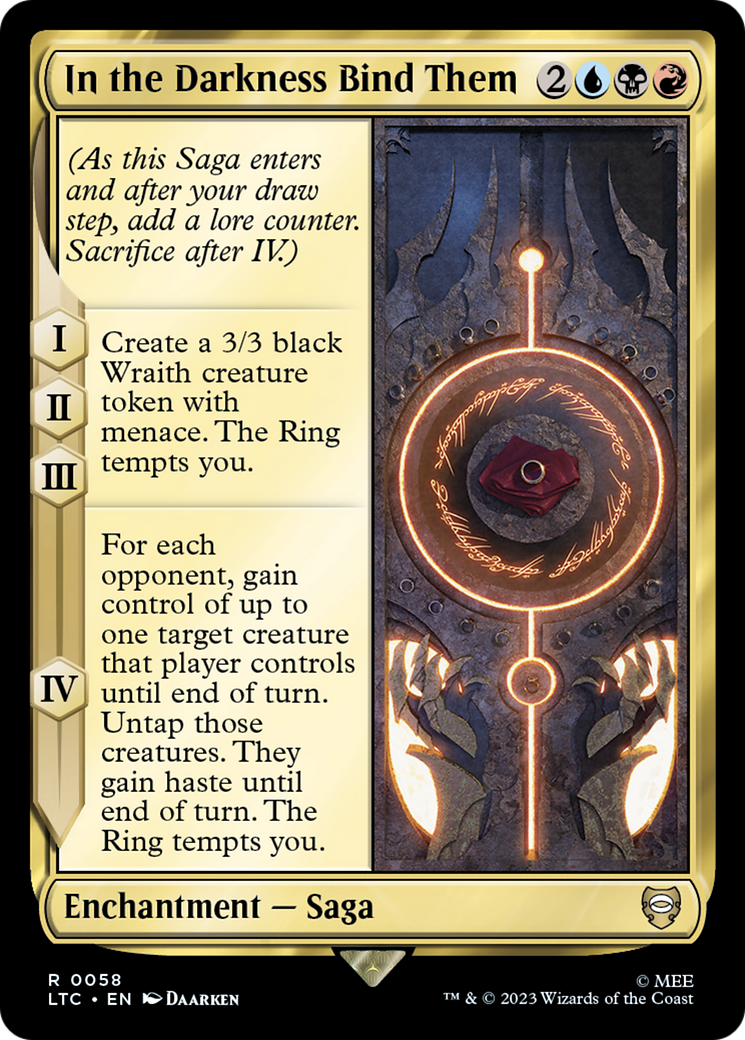
In the Darkness Bind Them
In the Darkness Bind Them
Enchantment — Saga
(As this Saga enters and after your draw step, add a lore counter. Sacrifice after IV.)
I, II, III — Create a 3/3 black Wraith creature token with menace. The Ring tempts you.
IV — For each opponent, gain control of up to one target creature that player controls until end of turn. Untap those creatures. They gain haste until end of turn. The Ring tempts you.
- While resolving In the Darkness Bind Them's first three chapter abilities, you can choose the Wraith token you just created to be your Ring-bearer as the Ring tempts you.
- If a creature targeted by In the Darkness Bind Them's final chapter ability changes controllers before the ability resolves, that creature is no longer a legal target.
- When In the Darkness Bind Them's final chapter ability triggers, you can choose to target no creatures just so that the Ring tempts you. However, if you do choose at least one target, and all of those targets are illegal at the time the ability tries to resolve, the ability won't resolve and none of its effects will happen. The Ring won't tempt you.
- As the Ring tempts you, you get an emblem named The Ring if you don't have one. Then your emblem gains its next ability and you choose a creature you control to become (or remain) your Ring-bearer.
- The Ring can tempt you even if you don't control a creature. In this case, abilities that trigger "whenever the Ring tempts you" will still trigger.
- If the creature you choose as your Ring-bearer was already your Ring-bearer, that still counts as choosing that creature as your Ring-bearer for the purpose of abilities that trigger "whenever you choose a creature as your Ring-bearer" or abilities that care about which creature was chosen as your Ring-bearer.
- The Ring gains its abilities in order from top to bottom. Once it gains an ability, it has that ability for the rest of the game.
- Each time the Ring tempts you, you must choose a creature if you control one.
- Each player can have only one emblem named The Ring and only one Ring-bearer at a time.
- Some spells and abilities that cause the Ring to tempt you may require targets. If each target chosen is an illegal target as that spell or ability tries to resolve, it won't resolve. The Ring won't tempt you.
-
1
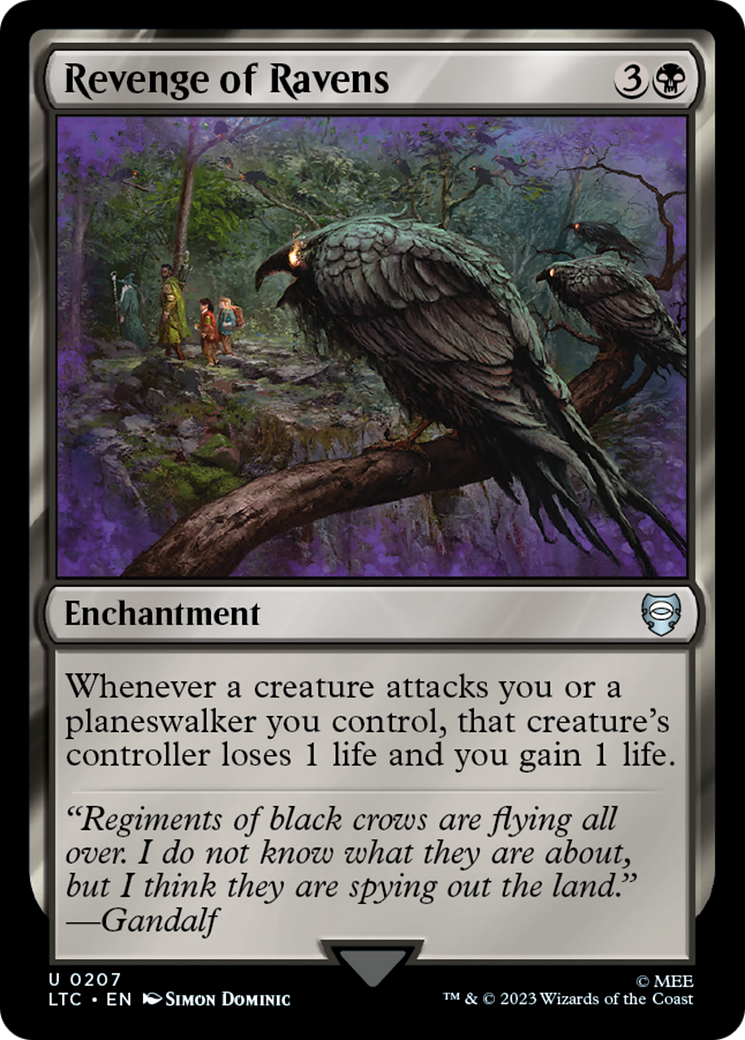
Revenge of Ravens
Revenge of Ravens
Enchantment
Whenever a creature attacks you or a planeswalker you control, that creature's controller loses 1 life and you gain 1 life.
- The triggered ability of Revenge of Ravens resolves before any abilities the attacking player controls. If this causes the attacking player to lose the game, that player's triggered abilities won't resolve and no combat damage will be dealt.
-
1
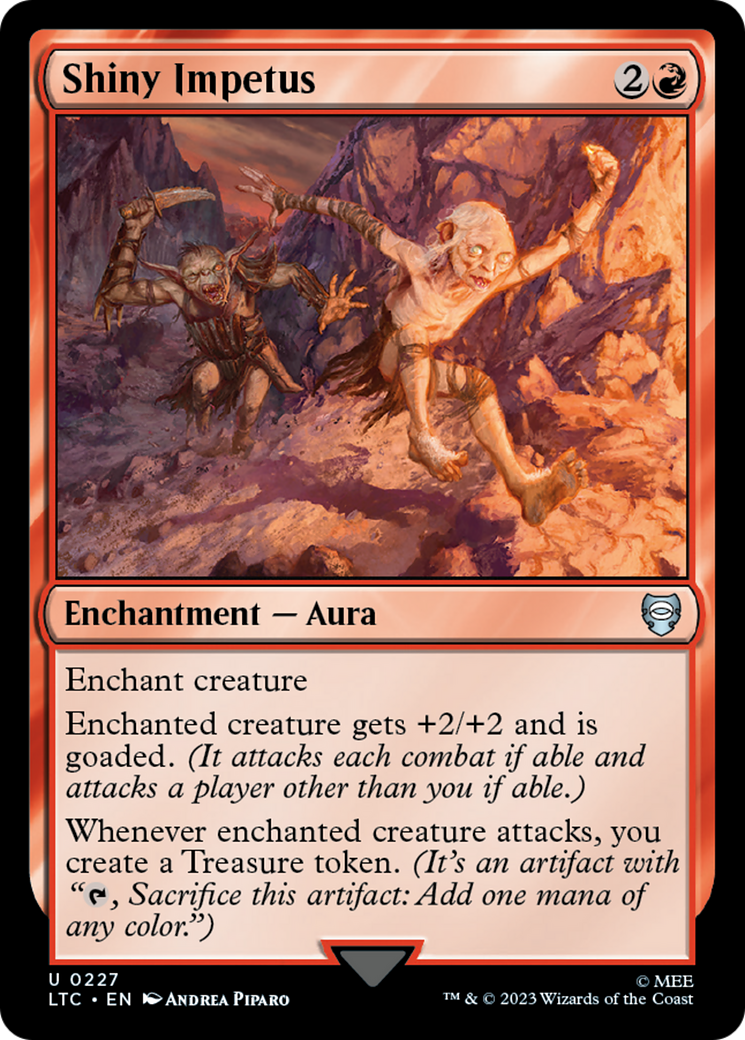
Shiny Impetus
Shiny Impetus
Enchantment — Aura
Enchant creature
Enchanted creature gets +2/+2 and is goaded. (It attacks each combat if able and attacks a player other than you if able.)
Whenever enchanted creature attacks, you create a Treasure token. (It's an artifact with " , Sacrifice this token: Add one mana of any color.")
- If, during a player's declare attackers step, a creature that player controls that's been goaded is tapped, is affected by a spell or ability that says it can't attack, or hasn't been under that player's control continuously since the turn began (and doesn't have haste), then it doesn't attack. If there's a cost associated with having a creature attack a player, its controller isn't forced to pay that cost, so it doesn't have to attack that player.
- If the creature doesn't meet any of the above exceptions and can attack, it must attack a player other than the controller of the spell or ability that goaded it if able. If the creature can't attack any of those players but could otherwise attack, it must attack a planeswalker an opponent controls, a battle an opponent controls, or a player who goaded it.
- Being goaded isn't an ability the creature has. Once it's been goaded, it must attack as detailed above even if it loses all abilities.
- Attacking with a goaded creature doesn't cause it to stop being goaded. If there is an additional combat phase that turn, or if another player gains control of it before it stops being goaded, it must attack again if able.
- If a creature you control has been goaded by multiple opponents, it must attack one of your opponents that hasn't goaded it, as that fulfills the maximum number of goad requirements. If a creature you control has been goaded by each of your opponents, the creature must attack an opponent (rather than a planeswalker or battle), but you choose which opponent it attacks.
- Shiny Impetus causes you to create a Treasure token, not the attacking creature's controller.
Lands 38
-
1
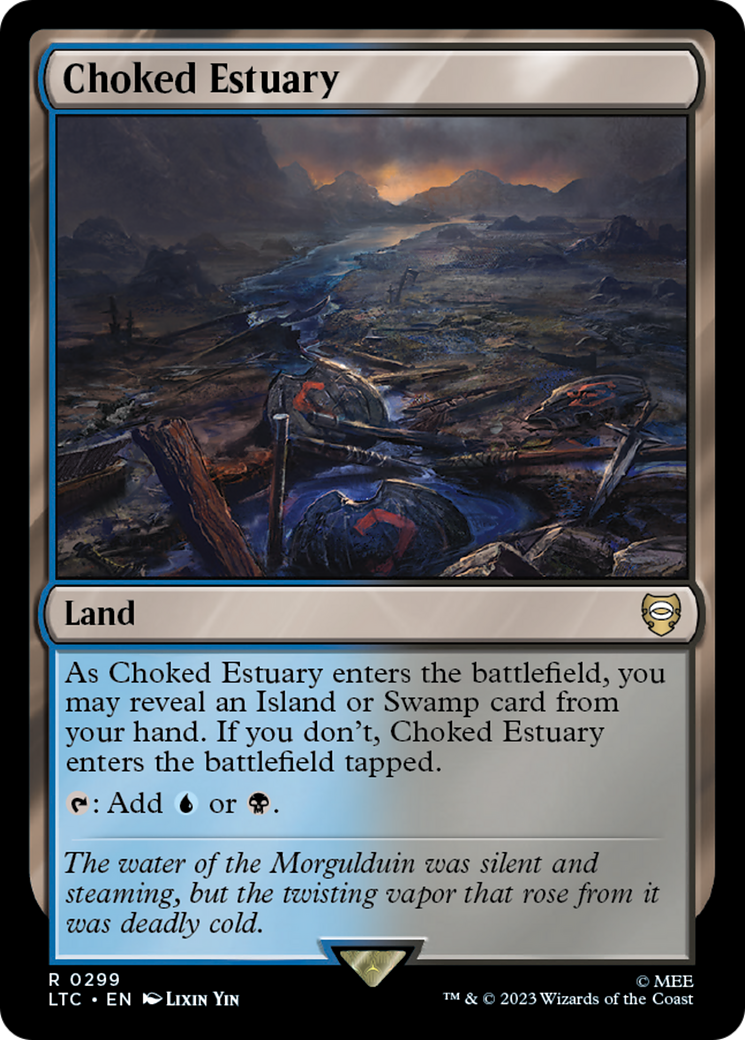
Choked Estuary
Choked Estuary
Land
As this land enters, you may reveal an Island or Swamp card from your hand. If you don't, this land enters tapped.
: Add or .
- You may reveal any land card with either or both of the appropriate subtypes. It doesn't have to be a basic land. For example, you could reveal Prairie Stream from the Battle for Zendikar set to satisfy the ability of Choked Estuary.
- Lands don't have a subtype just because they can produce mana of the corresponding color. Choked Estuary itself is neither an Island nor a Swamp, even though it produces blue and black mana, so you can't reveal one to satisfy the ability of another.
- If an Island or Swamp is entering the battlefield from your hand at the same time as Choked Estuary, you may reveal the other land to have Choked Estuary enter untapped.
- If an effect instructs you to put Choked Estuary onto the battlefield tapped, it will still enter the battlefield tapped even if you reveal a land card from your hand.
-
1
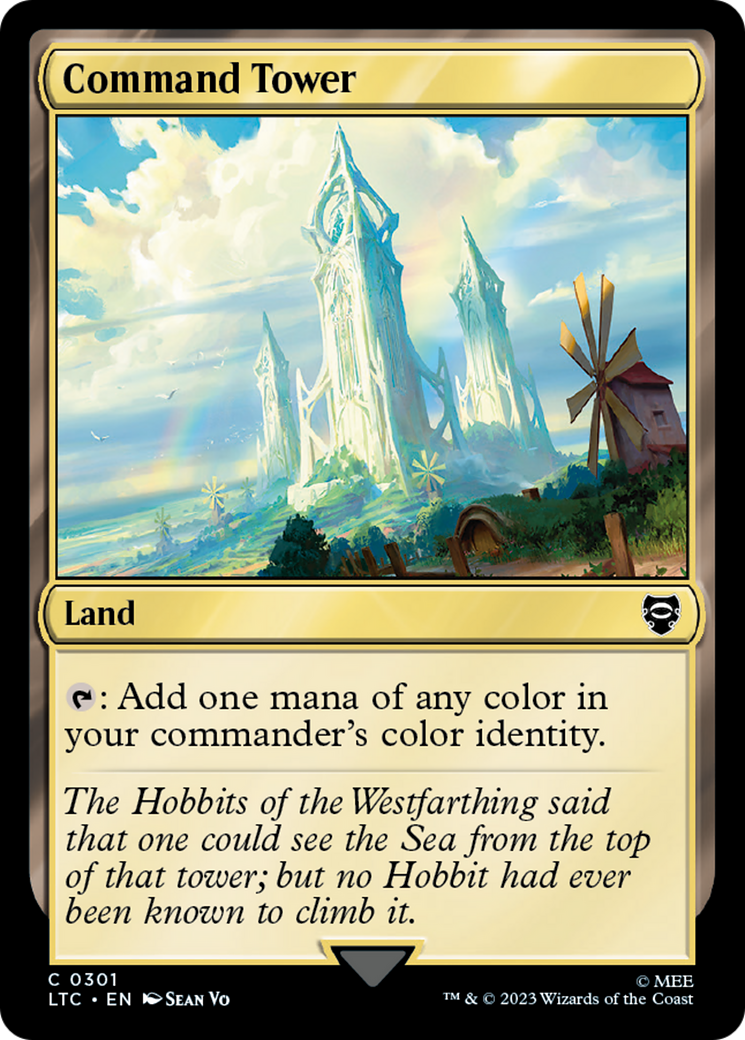
Command Tower
Command Tower
Land
: Add one mana of any color in your commander's color identity.
- If you have two commanders, the ability adds one mana of any color in their combined color identities.
- If your commander is a card that has no colors in its color identity, Command Tower's ability produces no mana. It doesn't produce .
- If you don't have a commander, Command Tower's ability produces no mana.
-
1
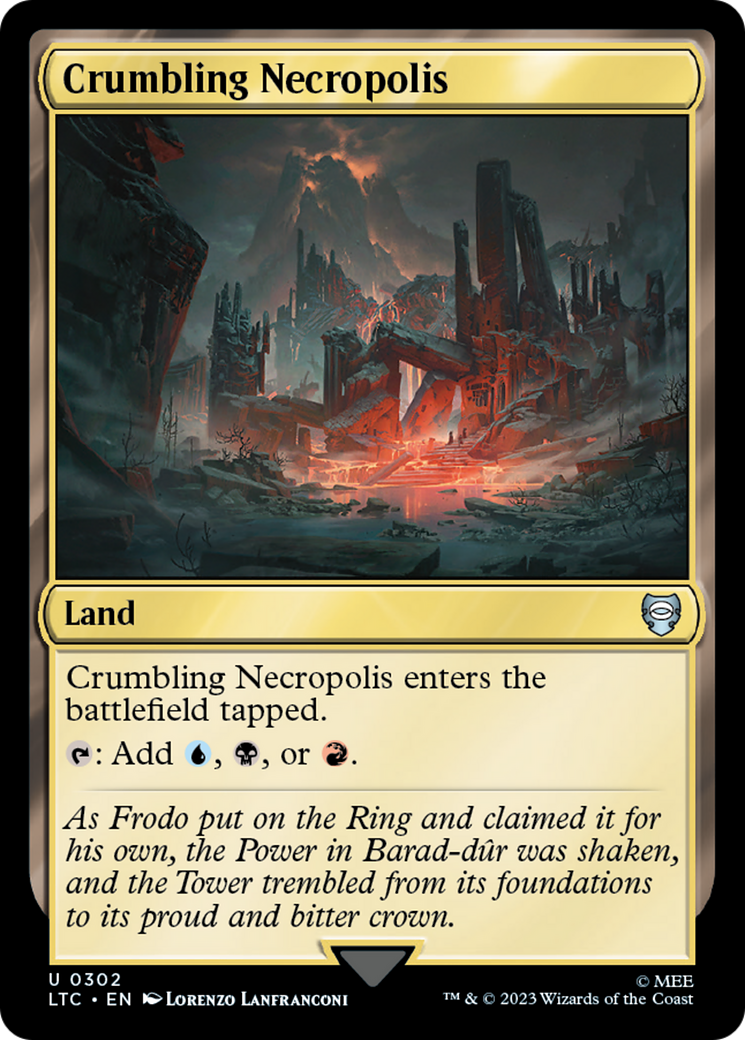
Crumbling Necropolis
Crumbling Necropolis
Land
This land enters tapped.
: Add , , or .
-
1
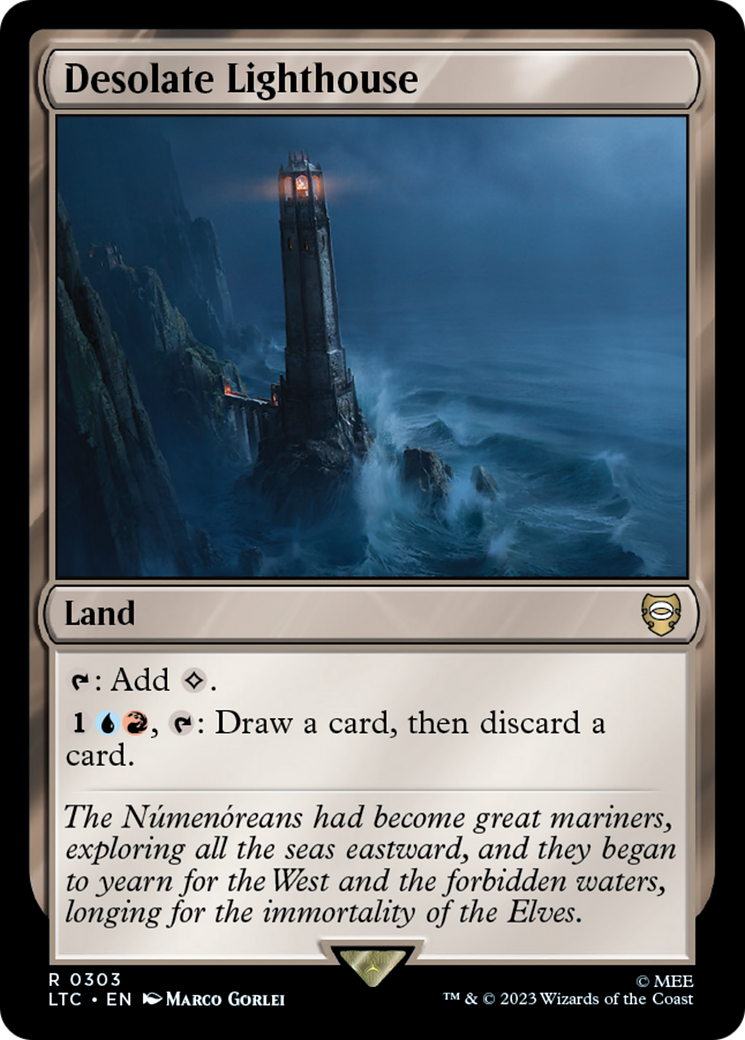
Desolate Lighthouse
Desolate Lighthouse
Land
: Add .
, : Draw a card, then discard a card.
-
1
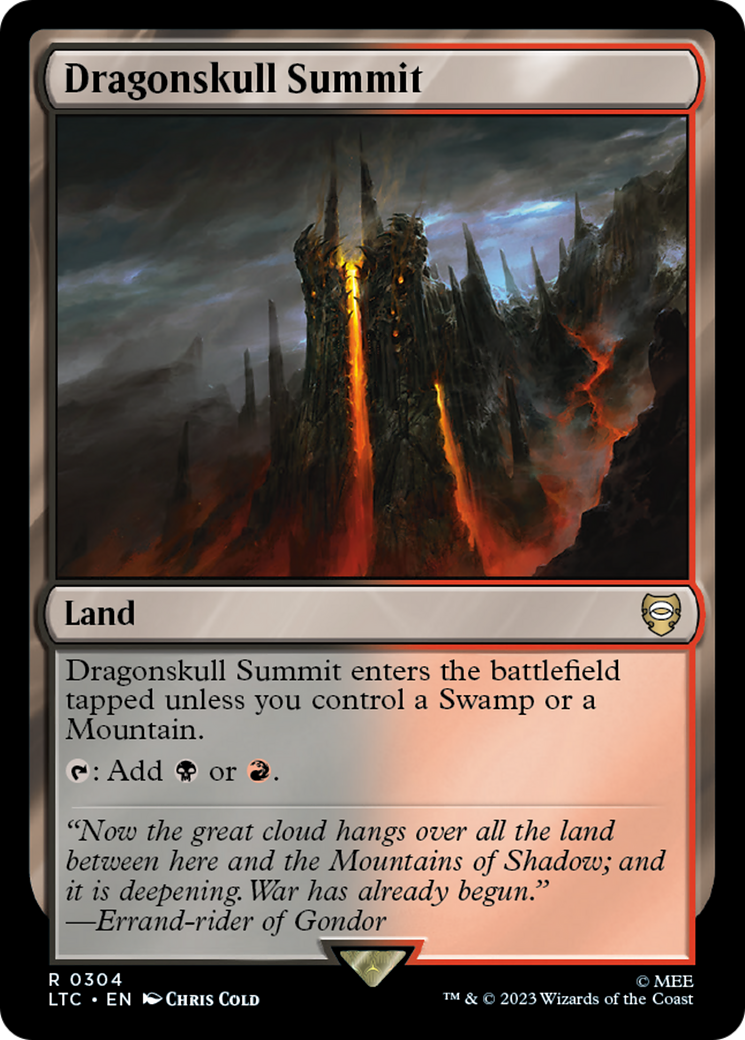
Dragonskull Summit
Dragonskull Summit
Land
This land enters tapped unless you control a Swamp or a Mountain.
: Add or .
- This checks for lands you control with the land type Swamp or Mountain, not for lands named Swamp or Mountain. The lands it checks for don't have to be basic lands. For example, if you control Stomping Ground (a nonbasic land with the land types Mountain and Forest), Dragonskull Summit will enter untapped.
- As this is entering, it checks for lands that are already on the battlefield. It won't see lands that are entering at the same time (due to Warp World, for example).
-
1
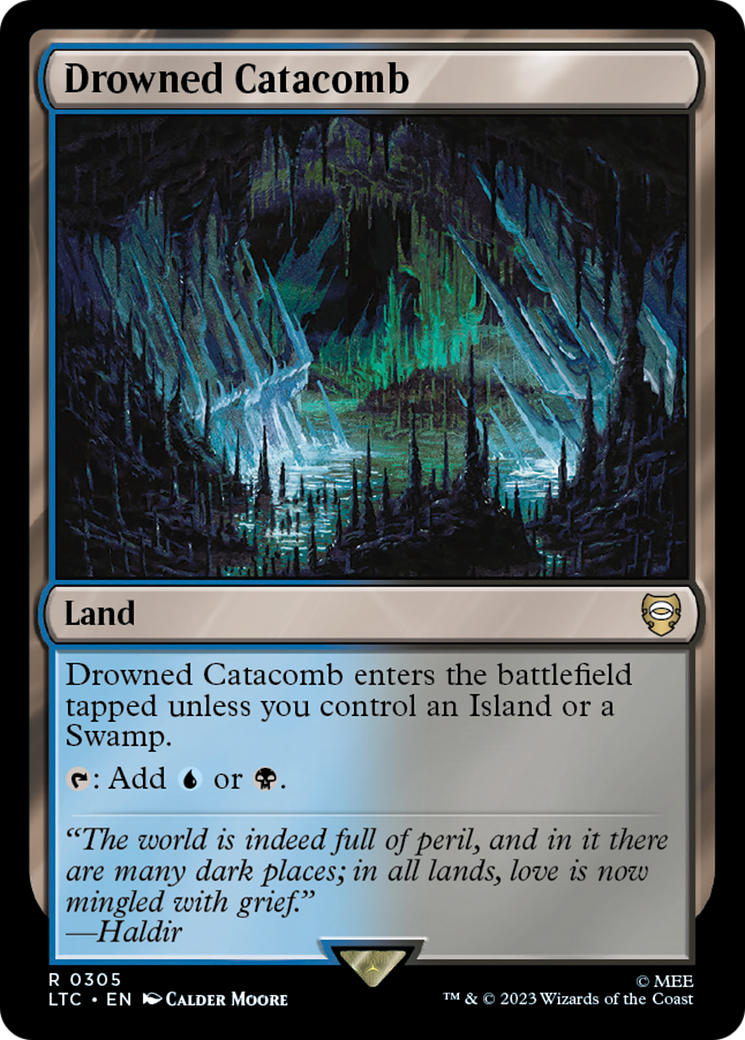
Drowned Catacomb
Drowned Catacomb
Land
This land enters tapped unless you control an Island or a Swamp.
: Add or .
- This checks for lands you control with the land type Island or Swamp, not for lands named Island or Swamp. The lands it checks for don't have to be basic lands. For example, if you control Blood Crypt (a nonbasic land with the land types Swamp and Mountain), Drowned Catacomb will enter untapped.
- As this is entering, it checks for lands that are already on the battlefield. It won't see lands that are entering at the same time (due to Warp World, for example).
-
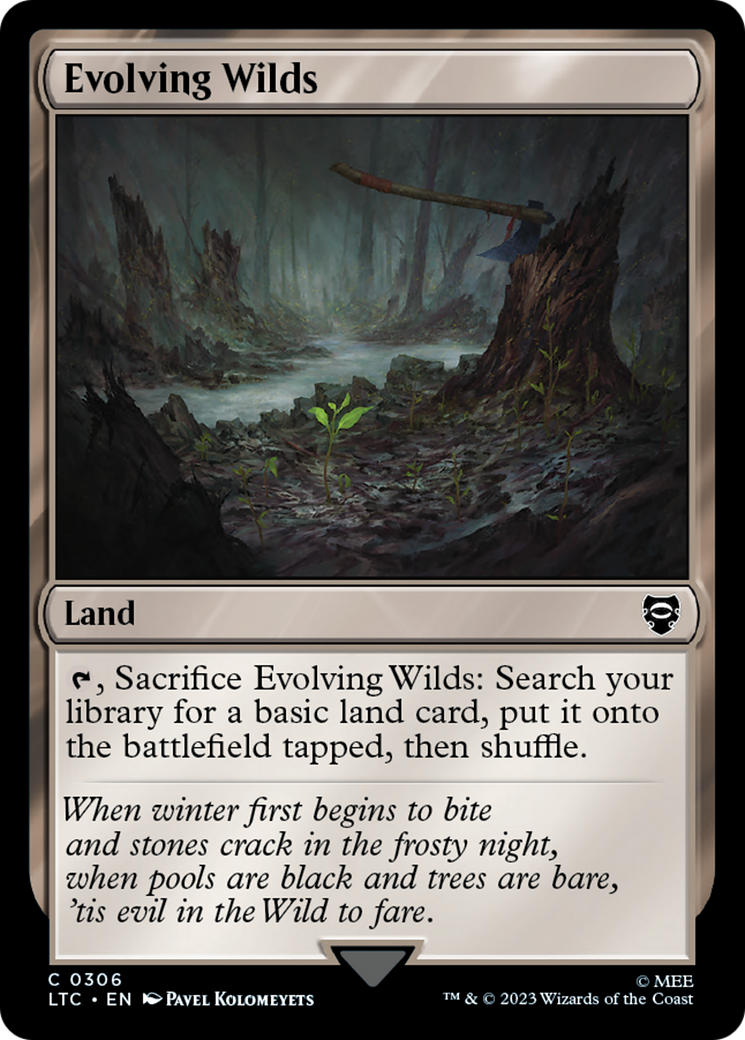
1
Evolving Wilds
Evolving Wilds
Land
, Sacrifice this land: Search your library for a basic land card, put it onto the battlefield tapped, then shuffle.
-
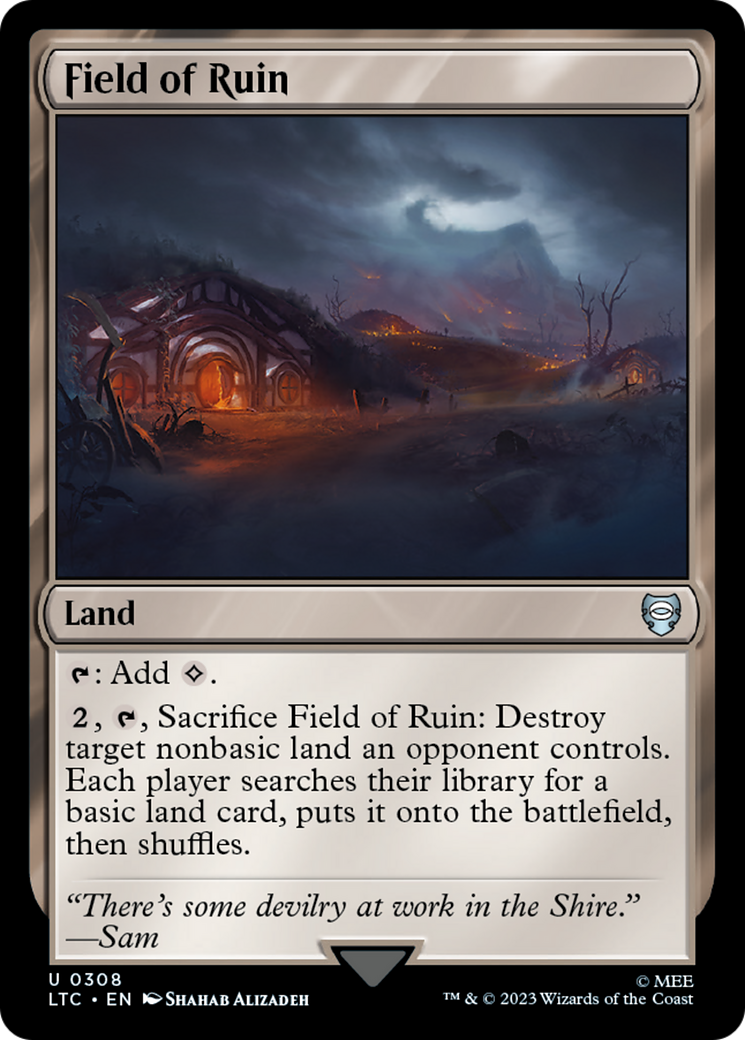
1
Field of Ruin
Field of Ruin
Land
: Add .
, , Sacrifice this land: Destroy target nonbasic land an opponent controls. Each player searches their library for a basic land card, puts it onto the battlefield, then shuffles.
- If the target land is an illegal target by the time Field of Ruin's ability tries to resolve, the ability doesn't resolve. No players search for a basic land card or shuffles. If the target is legal but not destroyed (most likely because it has indestructible), each player does search and shuffle.
-
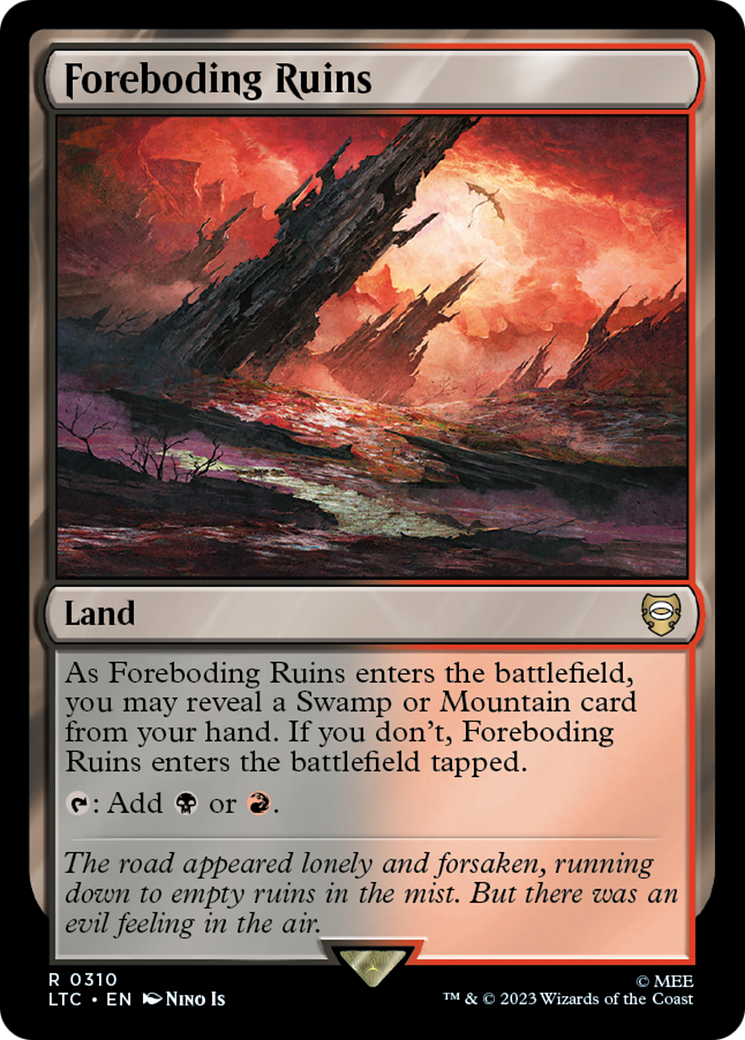
1
Foreboding Ruins
Foreboding Ruins
Land
As this land enters, you may reveal a Swamp or Mountain card from your hand. If you don't, this land enters tapped.
: Add or .
- You may reveal any land card with either or both of the appropriate subtypes. It doesn't have to be a basic land. For example, you could reveal Sunken Hollow from the Battle for Zendikar set to satisfy the ability of Foreboding Ruins.
- Lands don't have a subtype just because they can produce mana of the corresponding color. Foreboding Ruins itself is neither a Swamp nor a Mountain, even though it produces black and red mana, so you can't reveal one to satisfy the ability of another.
- If a Swamp or Mountain is entering the battlefield from your hand at the same time as Foreboding Ruins, you may reveal the other land to have Foreboding Ruins enter untapped.
- If an effect instructs you to put Foreboding Ruins onto the battlefield tapped, it will still enter the battlefield tapped even if you reveal a land card from your hand.
-
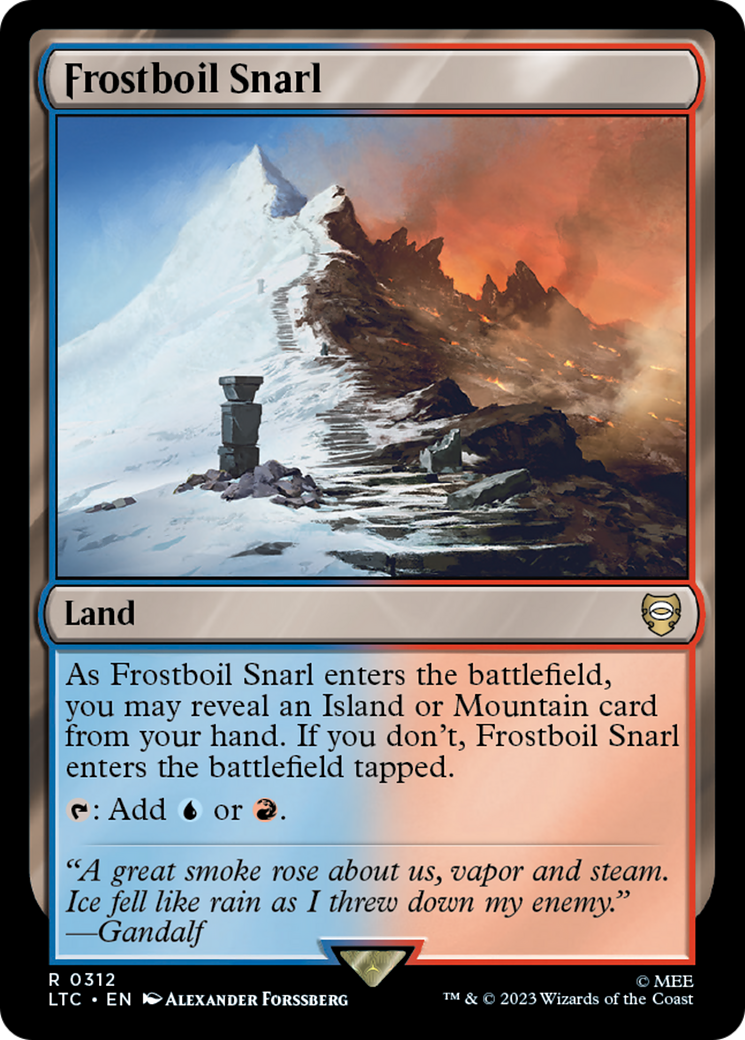
1
Frostboil Snarl
Frostboil Snarl
Land
As this land enters, you may reveal an Island or Mountain card from your hand. If you don't, this land enters tapped.
: Add or .
- You may reveal any land card with either or both of the appropriate subtypes. It doesn't have to be a basic land card.
- The "Snarl" itself doesn't have any land subtypes. You can't reveal one to satisfy the ability of another.
- If a land card with an appropriate subtype is entering the battlefield from your hand at the same time as one of these lands, you may reveal the other land to have the "Snarl" enter untapped.
- If an effect instructs you to put one of these lands onto the battlefield tapped, it will still enter the battlefield tapped even if you reveal a land card from your hand.
-
6
Island
Island
Basic Land — Island
( : Add .)
-
7
Mountain
Mountain
Basic Land — Mountain
( : Add .)
-
1
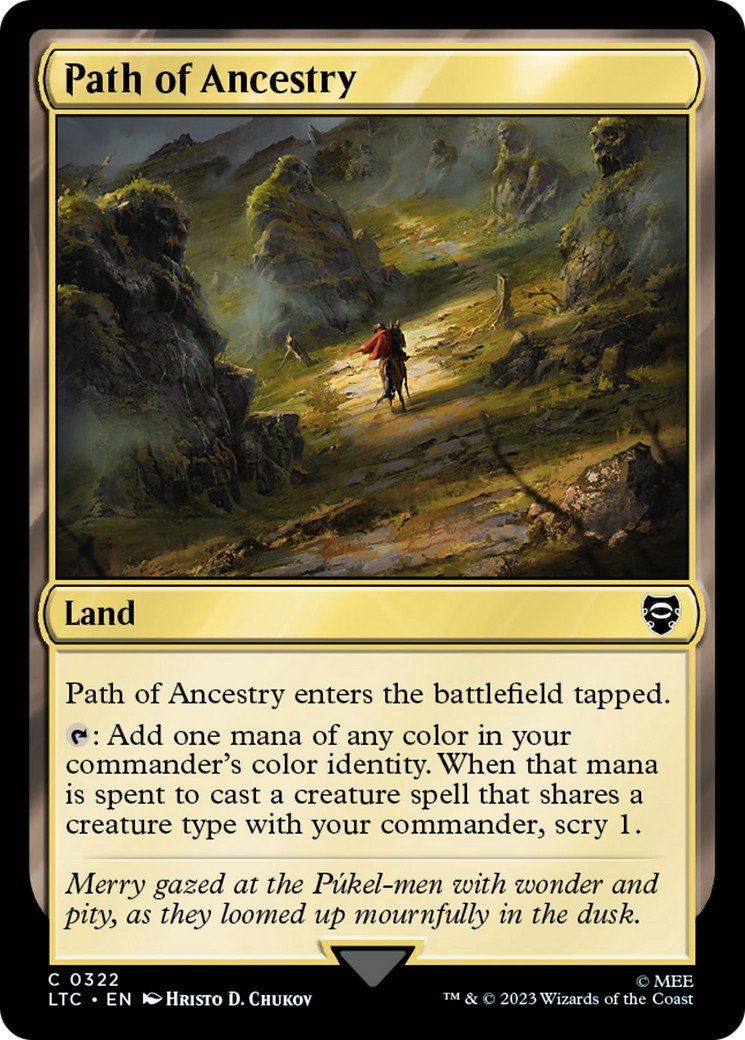
Path of Ancestry
Path of Ancestry
Land
This land enters tapped.
: Add one mana of any color in your commander's color identity. When that mana is spent to cast a creature spell that shares a creature type with your commander, scry 1. (Look at the top card of your library. You may put that card on the bottom.)
- If you have two commanders, the last ability adds one mana of any color in their combined color identities. When you spend that mana on a creature spell that shares a creature type with either of your commanders, you'll scry 1.
- Your commander's creature types are checked immediately after you cast a creature spell spending mana from Path of Ancestry's last ability. They aren't set before the game begins, and they may not be the same types your commander had when you activated that ability.
- If you cast your commander with mana from Path of Ancestry, and your commander hasn't somehow lost all of its creature types while on the stack, you'll scry 1.
- If your commander is a card that has no colors in its color identity, Path of Ancestry's ability produces no mana. It doesn't produce .
- If Path of Ancestry's last ability produces two mana (most likely due to Mana Reflection), spending those two mana to cast creature spells that share a creature type with your commander will cause two abilities to trigger. Each of those abilities will cause you to scry 1. You won't scry 2. This is true whether you spend the mana on one creature spell or two.
- If your commander has no creature types, it can't share a creature type with any spell that you cast.
- If you don't have a commander, Path of Ancestry's ability produces no mana.
-
1
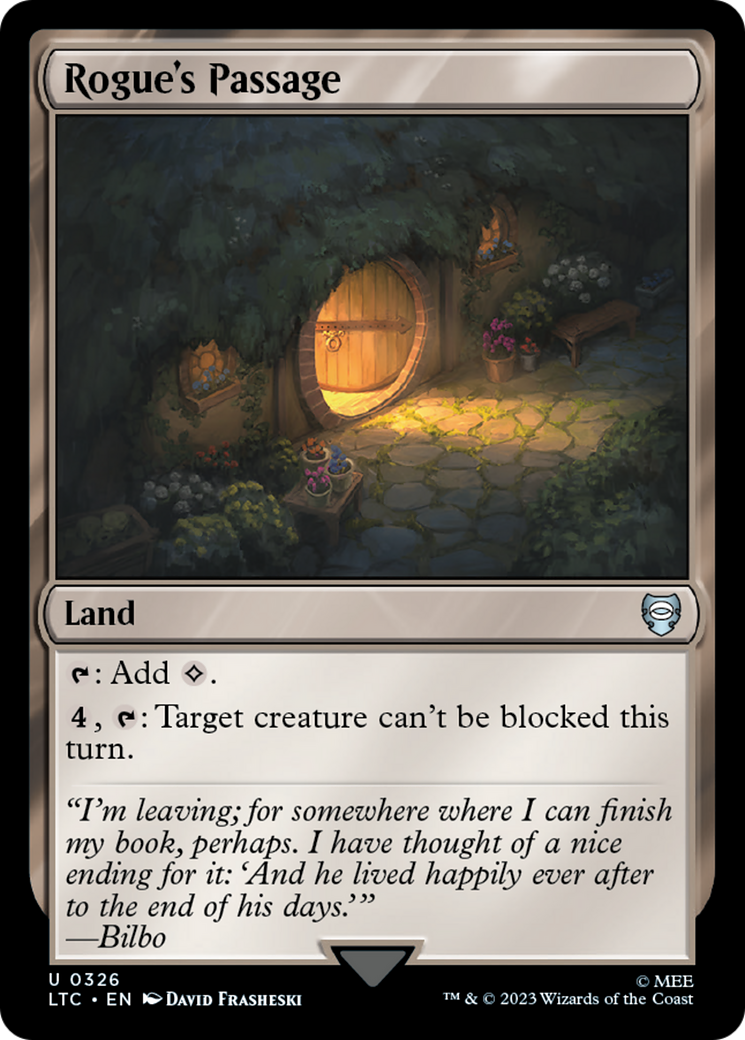
Rogue's Passage
Rogue's Passage
Land
: Add .
, : Target creature can't be blocked this turn.
- Activating the second ability of Rogue's Passage after a creature has become blocked won't cause that creature to become unblocked.
-
1
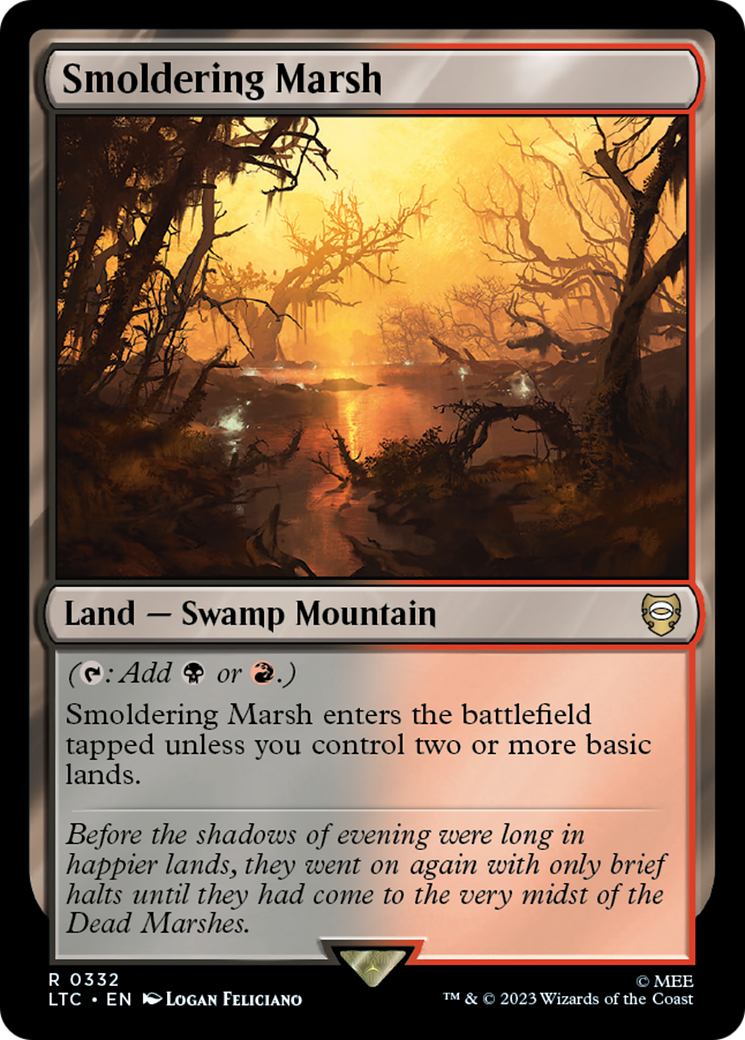
Smoldering Marsh
Smoldering Marsh
Land — Swamp Mountain
( : Add or .)
This land enters tapped unless you control two or more basic lands.
- Even though these lands have basic land types, they are not basic lands because "basic" doesn't appear on their type line. Notably, controlling two or more of them won't allow others to enter the battlefield untapped.
- However, because these cards have basic land types, effects that specify a basic land type without also specifying that the land be basic can affect them. For example, a spell or ability that reads "Destroy target Forest" can target Canopy Vista, while one that reads "Destroy target basic Forest" cannot.
- If one of these lands enters the battlefield at the same time as any number of basic lands, those other lands are not counted when determining if this land enters the battlefield tapped or untapped.
-
1
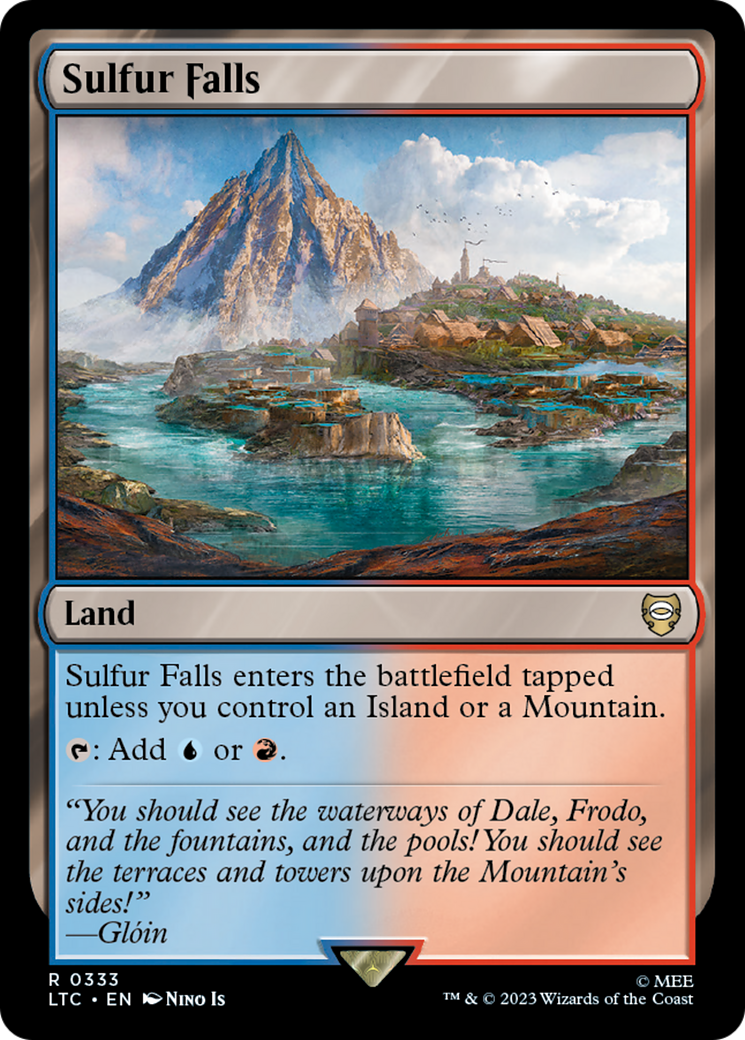
Sulfur Falls
Sulfur Falls
Land
This land enters tapped unless you control an Island or a Mountain.
: Add or .
-
1
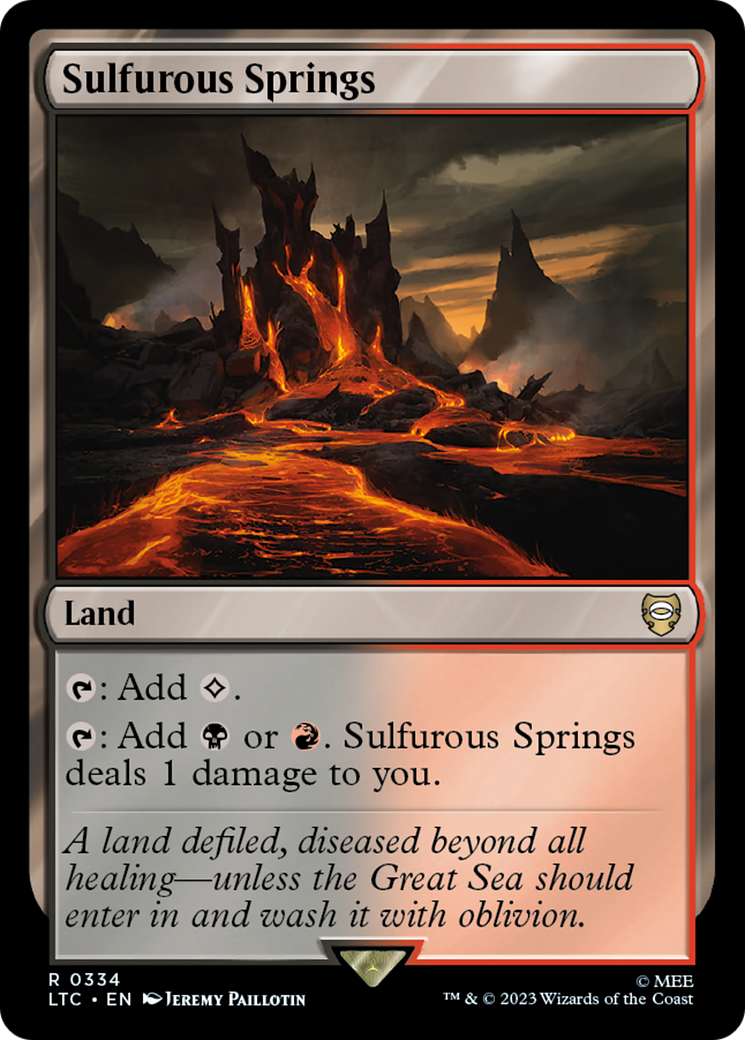
Sulfurous Springs
Sulfurous Springs
Land
: Add .
: Add or . This land deals 1 damage to you.
-
1
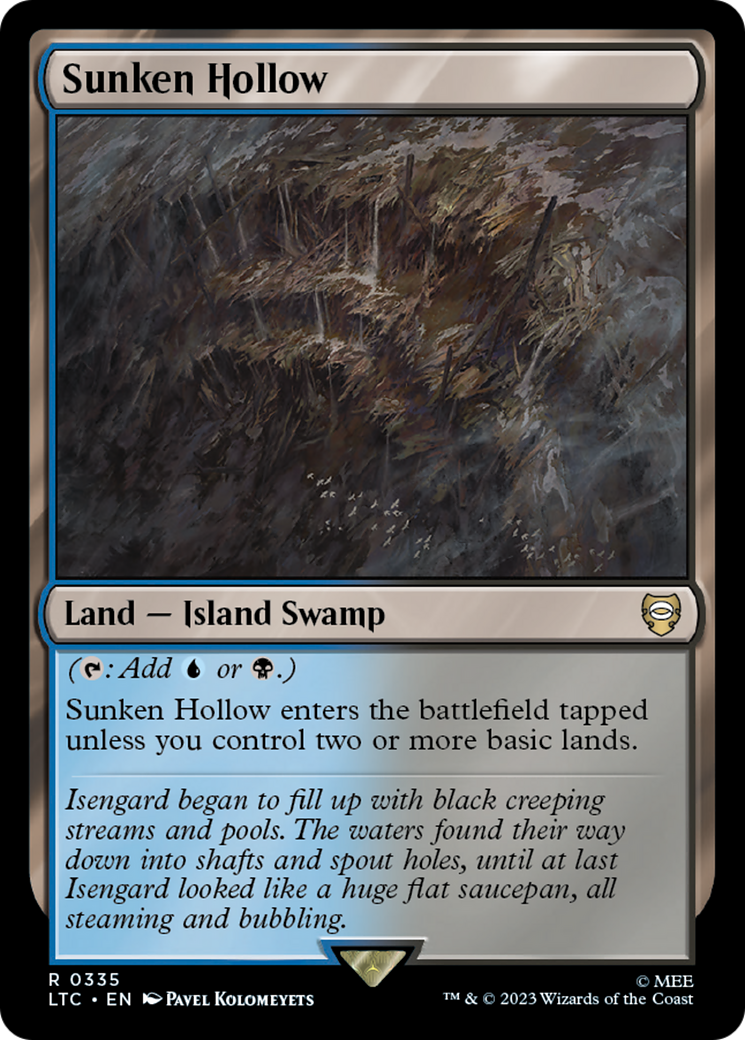
Sunken Hollow
Sunken Hollow
Land — Island Swamp
( : Add or .)
This land enters tapped unless you control two or more basic lands.
- Even though these lands have basic land types, they are not basic lands because "basic" doesn't appear on their type line. Notably, controlling two or more of them won't allow others to enter the battlefield untapped.
- However, because these cards have basic land types, effects that specify a basic land type without also specifying that the land be basic can affect them. For example, a spell or ability that reads "Destroy target Forest" can target Canopy Vista, while one that reads "Destroy target basic Forest" cannot.
- If one of these lands enters the battlefield at the same time as any number of basic lands, those other lands are not counted when determining if this land enters the battlefield tapped or untapped.
-
6
Swamp
Swamp
Basic Land — Swamp
( : Add .)
-
1
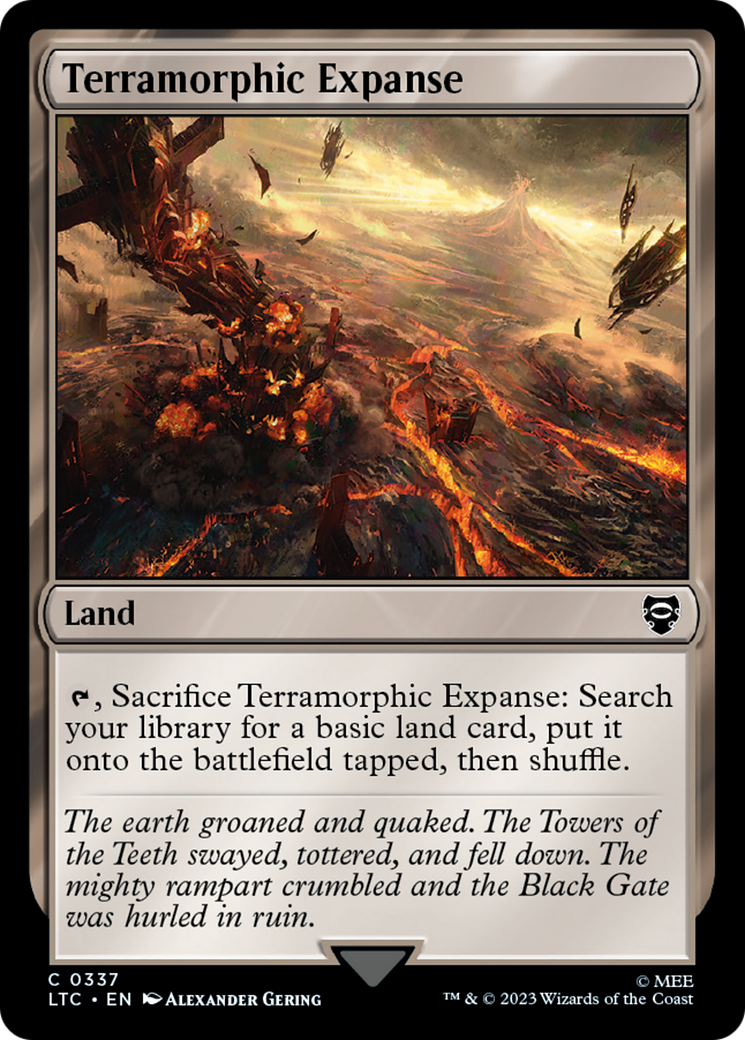
Terramorphic Expanse
Terramorphic Expanse
Land
, Sacrifice this land: Search your library for a basic land card, put it onto the battlefield tapped, then shuffle.
-
1
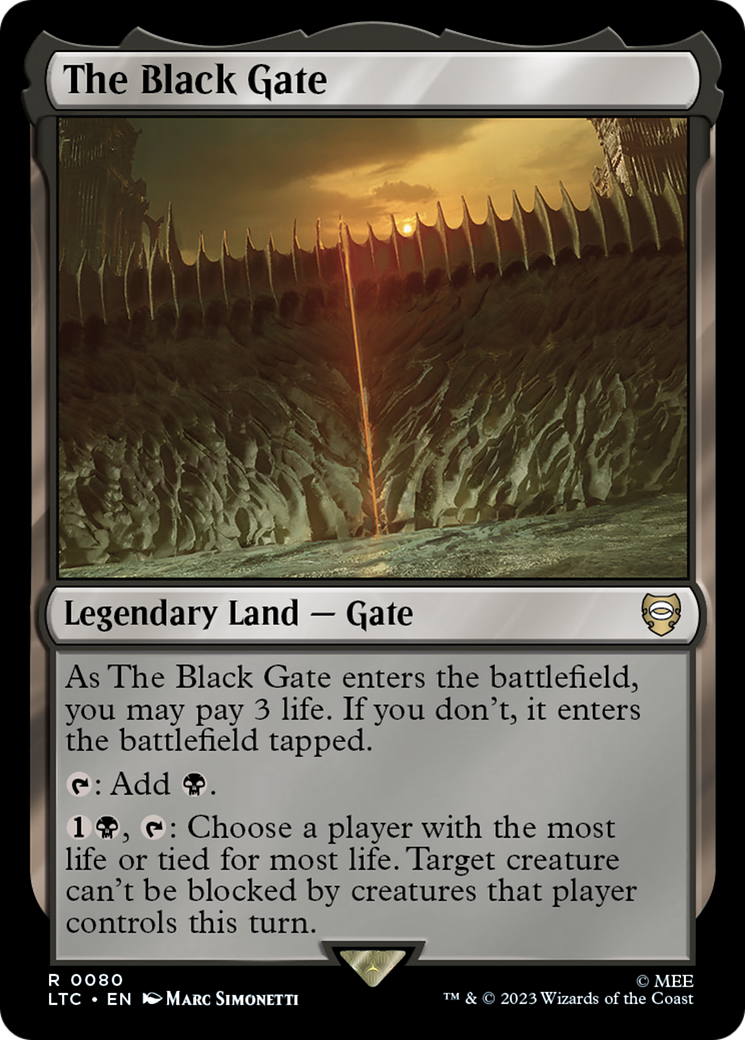
The Black Gate
The Black Gate
Legendary Land — Gate
As The Black Gate enters, you may pay 3 life. If you don't, it enters tapped.
: Add .
, : Choose a player with the most life or tied for most life. Target creature can't be blocked by creatures that player controls this turn.
- The chosen player needs only to have the most life or tied for most life as The Black Gate's last ability resolves. After the ability resolves, any changes in life total won't affect which creatures can block or be blocked that turn.
- The creature that was targeted by The Black Gate's last ability can't be blocked by any creature the chosen player controls, including creatures that weren't on the battlefield when The Black Gate's ability resolved.
-
1
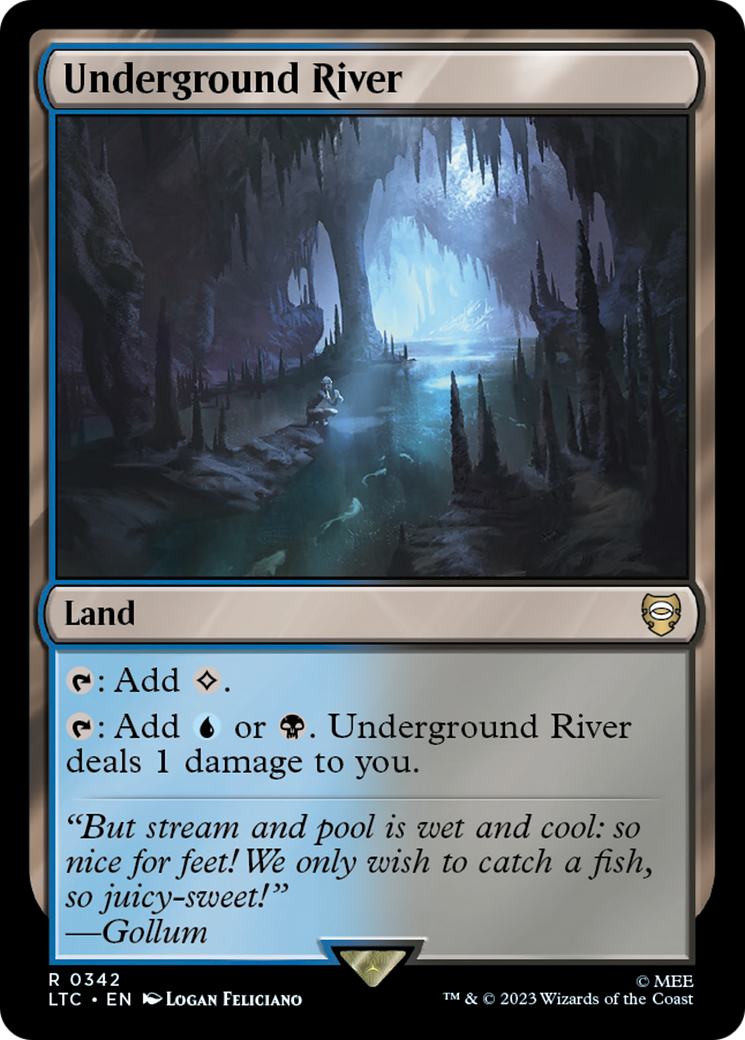
Underground River
Underground River
Land
: Add .
: Add or . This land deals 1 damage to you.
Blue 10
-
1
Arcane Denial
Arcane Denial
Instant
Counter target spell. Its controller may draw up to two cards at the beginning of the next turn's upkeep.
You draw a card at the beginning of the next turn's upkeep.
- The controller of the countered spell doesn't choose how many cards to draw until the relevant ability resolves. The player may draw 0, 1, or 2 cards. They choose the number before drawing any cards.
-
1
Boon of the Wish-Giver
Boon of the Wish-Giver
Sorcery
Draw four cards.
Cycling ( , Discard this card: Draw a card.)
-
1
Consider
Consider
Instant
Surveil 1. (Look at the top card of your library. You may put it into your graveyard.)
Draw a card.
- You perform the actions stated on a card in sequence. For some spells and abilities, you'll surveil last. For others, you'll surveil and then perform other actions.
-
1
Corsairs of Umbar
Corsairs of Umbar
Creature — Human Pirate
3/3
: Target Goblin, Orc, or Pirate can't be blocked this turn.
Whenever this creature deals combat damage to a player, amass Orcs 3. (Put three +1/+1 counters on an Army you control. It's also an Orc. If you don't control an Army, create a 0/0 black Orc Army creature token first.)
- Activating Corsairs of Umbar's first ability after a Goblin, Orc, or Pirate has become blocked won't cause that creature to become unblocked.
- Amass abilities are now written as "amass [subtype] N." Previous cards with amass have received errata to say "amass Zombies N."
- To amass Orcs N, if you don't control an Army creature, create a 0/0 black Orc Army creature token. Then you choose an Army creature you control and put N +1/+1 counters on it. If that Army isn't already an Orc, it becomes an Orc in addition to its other types.
- Amass Zombies works the same way, except you create a 0/0 black Zombie Army creature token if you don't control an Army. If the Army creature you chose isn't already a Zombie, it becomes a Zombie in addition to its other types. By combining cards with amass Orcs and amass Zombies, you can end up with an Orc Zombie Army.
- In the rare case that you control multiple Army creatures (perhaps because you played a creature with changeling) while you amass Orcs, you choose which of your Army creatures to put the +1/+1 counters on. If that creature isn't an Orc, it becomes an Orc in addition to its other types.
- If you don't control an Army, the Orc Army token you create enters the battlefield as a 0/0 creature before receiving counters. Any abilities that trigger when a creature with a certain power enters the battlefield, such as that of Mentor of the Meek, will see the token enter as a 0/0 creature before it gets +1/+1 counters.
- Some spells and abilities that amass Orcs may require targets. If each target chosen is an illegal target as that spell or ability tries to resolve, it won't resolve. You won't amass Orcs.
- Some cards refer to the "amassed Army." That means the Army creature you chose to receive counters, even if no counters were placed on it for some reason.
-
1
Deep Analysis
Deep Analysis
Sorcery
Target player draws two cards.
Flashback— , Pay 3 life. (You may cast this card from your graveyard for its flashback cost. Then exile it.)
- "Flashback [cost]" means "You may cast this card from your graveyard by paying [cost] rather than paying its mana cost" and "If the flashback cost was paid, exile this card instead of putting it anywhere else any time it would leave the stack."
- You must still follow any timing restrictions and permissions, including those based on the card's type. For instance, you can cast a sorcery using flashback only when you could normally cast a sorcery.
- To determine the total cost of a spell, start with the mana cost or alternative cost (such as a flashback cost) you're paying, add any cost increases, then apply any cost reductions. The mana value of the spell is determined only by its mana cost, no matter what the total cost to cast the spell was.
- A spell cast using flashback will always be exiled afterward, whether it resolves, is countered, or leaves the stack in some other way.
- You can cast a spell using flashback even if it was somehow put into your graveyard without having been cast.
- If a card with flashback is put into your graveyard during your turn, you can cast it if it's legal to do so before any other player can take any actions.
-
1
Fact or Fiction
Fact or Fiction
Instant
Reveal the top five cards of your library. An opponent separates those cards into two piles. Put one pile into your hand and the other into your graveyard.
- Piles may be empty.
-
1
Forbidden Alchemy
Forbidden Alchemy
Instant
Look at the top four cards of your library. Put one of them into your hand and the rest into your graveyard.
Flashback (You may cast this card from your graveyard for its flashback cost. Then exile it.)
- To determine the total cost of a spell, start with the mana cost or alternative cost (such as a flashback cost) you're paying, add any cost increases, then apply any cost reductions. The mana value of the spell is determined only by its mana cost, no matter what the total cost to cast the spell was.
- "Flashback [cost]" means "You may cast this card from your graveyard by paying [cost] rather than paying its mana cost" and "If the flashback cost was paid, exile this card instead of putting it anywhere else any time it would leave the stack."
- You must still follow any timing restrictions and permissions, including those based on the card's type. For instance, you can cast a sorcery using flashback only when you could normally cast a sorcery.
- If a card with flashback is put into your graveyard during your turn, you can cast it if it's legal to do so before any other player can take any actions.
- A spell cast using flashback will always be exiled afterward, whether it resolves, is countered, or leaves the stack in some other way.
- You can cast a spell using flashback even if it was somehow put into your graveyard without having been cast.
- If you have fewer than four cards in your library, you'll look at all the cards there and put one into your hand and the rest into your graveyard.
-
1
Monstrosity of the Lake
Monstrosity of the Lake
Legendary Creature — Kraken
4/6
When Monstrosity of the Lake enters, you may pay . If you do, tap all creatures your opponents control, then put a stun counter on each of those creatures. (If a permanent with a stun counter would become untapped, remove one from it instead.)
Islandcycling ( , Discard this card: Search your library for an Island card, reveal it, put it into your hand, then shuffle.)
- Unlike the normal cycling ability, typecycling doesn't allow you to draw a card. Rather, it lets you search your library for a card with the type or types indicated by the ability name. For example, a card with basic landcycling lets you search for a basic land card, and a card with Wizardcycling lets you search for a Wizard card.
- Typecycling is a form of cycling. Any ability that triggers on a card being cycled also triggers on a card being typecycled. Any ability that stops a cycling ability from being activated also stops a typecycling ability from being activated.
-
1
Subjugate the Hobbits
Subjugate the Hobbits
Sorcery
Gain control of each noncommander creature with mana value 3 or less.
-
1
Treason of Isengard
Treason of Isengard
Sorcery
Put up to one target instant or sorcery card from your graveyard on top of your library.
Amass Orcs 2. (To amass Orcs 2, put two +1/+1 counters on an Army you control. It's also an Orc. If you don't control an Army, create a 0/0 black Orc Army creature token first.)
- You can cast Treason of Isengard without a target just to amass Orcs. However, if you do choose a target, and that target is illegal at the time Treason of Isengard tries to resolve, Treason of Isengard won't resolve and none of its effects will happen. You won't amass Orcs.
- Amass abilities are now written as "amass [subtype] N." Previous cards with amass have received errata to say "amass Zombies N."
- To amass Orcs N, if you don't control an Army creature, create a 0/0 black Orc Army creature token. Then you choose an Army creature you control and put N +1/+1 counters on it. If that Army isn't already an Orc, it becomes an Orc in addition to its other types.
- Amass Zombies works the same way, except you create a 0/0 black Zombie Army creature token if you don't control an Army. If the Army creature you chose isn't already a Zombie, it becomes a Zombie in addition to its other types. By combining cards with amass Orcs and amass Zombies, you can end up with an Orc Zombie Army.
- In the rare case that you control multiple Army creatures (perhaps because you played a creature with changeling) while you amass Orcs, you choose which of your Army creatures to put the +1/+1 counters on. If that creature isn't an Orc, it becomes an Orc in addition to its other types.
- If you don't control an Army, the Orc Army token you create enters the battlefield as a 0/0 creature before receiving counters. Any abilities that trigger when a creature with a certain power enters the battlefield, such as that of Mentor of the Meek, will see the token enter as a 0/0 creature before it gets +1/+1 counters.
- Some spells and abilities that amass Orcs may require targets. If each target chosen is an illegal target as that spell or ability tries to resolve, it won't resolve. You won't amass Orcs.
- Some cards refer to the "amassed Army." That means the Army creature you chose to receive counters, even if no counters were placed on it for some reason.
Black 11
-
1
Bitter Downfall
Bitter Downfall
Instant
This spell costs less to cast if it targets a creature that was dealt damage this turn.
Destroy target creature. Its controller loses 2 life.
-
1
Decree of Pain
Decree of Pain
Sorcery
Destroy all creatures. They can't be regenerated. Draw a card for each creature destroyed this way.
Cycling ( , Discard this card: Draw a card.)
When you cycle this card, all creatures get -2/-2 until end of turn.
- When you cycle this card, first the cycling ability goes on the stack, then the triggered ability goes on the stack on top of it. The triggered ability will resolve before you draw a card from the cycling ability.
- The cycling ability and the triggered ability are separate. If the triggered ability doesn't resolve (because, for example, it has been countered, or all of its targets have become illegal), the cycling ability will still resolve, and you'll draw a card.
-
1
Feed the Swarm
Feed the Swarm
Sorcery
Destroy target creature or enchantment an opponent controls. You lose life equal to that permanent's mana value.
- The amount of life you lose is determined by the permanent's mana value as it last existed on the battlefield.
- If a permanent on the battlefield has in its mana cost, X is 0 for the purpose of determining its mana value.
- If the target permanent is an illegal target by the time Feed the Swarm tries to resolve, the spell doesn't resolve. You don't lose any life. If the target is legal but not destroyed (most likely because it has indestructible), you do lose life.
-
1
Languish
Languish
Sorcery
All creatures get -4/-4 until end of turn.
-
1
Living Death
Living Death
Sorcery
Each player exiles all creature cards from their graveyard, then sacrifices all creatures they control, then puts all cards they exiled this way onto the battlefield.
- As Living Death resolves, all players exile their creature cards from graveyards at the same time. Then all players sacrifice all creatures they control at the same time. Then all players put all creatures they exiled onto the battlefield at the same time.
- Only cards exiled by Living Death's first instruction are put onto the battlefield. If a replacement effect (such as that of Leyline of the Void) causes any of the sacrificed creatures to be exiled instead of put into a graveyard, those cards aren't returned to the battlefield.
-
1
Merciless Executioner
Merciless Executioner
Creature — Orc Warrior
3/1
When this creature enters, each player sacrifices a creature of their choice.
- If you control no other creatures as Merciless Executioner's ability resolves, you'll have to sacrifice Merciless Executioner.
-
1
Reanimate
Reanimate
Sorcery
Put target creature card from a graveyard onto the battlefield under your control. You lose life equal to its mana value.
- If a card in a player's graveyard has in its mana cost, X is considered to be 0.
- The amount of life you lose is determined by the mana value of the card in your graveyard, not the creature once it's on the battlefield.
- You lose life after the creature is already on the battlefield. Any abilities it has that interact with loss of life, such as that of Platinum Emperion, apply to that loss of life.
- If any abilities trigger on the creature entering the battlefield, those abilities resolve after you lose life. If losing life results in you losing the game, those abilities won't resolve.
- In a multiplayer game, if a player leaves the game, all cards that player owns leave as well. If you leave the game, the creature you control from Reanimate is exiled.
-
1
Revenge of Ravens
Revenge of Ravens
Enchantment
Whenever a creature attacks you or a planeswalker you control, that creature's controller loses 1 life and you gain 1 life.
- The triggered ability of Revenge of Ravens resolves before any abilities the attacking player controls. If this causes the attacking player to lose the game, that player's triggered abilities won't resolve and no combat damage will be dealt.
-
1
Shelob, Dread Weaver
Shelob, Dread Weaver
Legendary Creature — Spider Demon
3/3
Whenever a nontoken creature an opponent controls dies, exile it.
, Put a creature card exiled with Shelob into its owner's graveyard: Put two +1/+1 counters on Shelob. Draw a card.
: Put target creature card with mana value X exiled with Shelob onto the battlefield tapped under your control.
- If Shelob, Dread Weaver and a nontoken creature an opponent controls die at the same time, the opponent's creature will be exiled.
- Cards exiled with Shelob, Dread Weaver that would go to the graveyard but have that replaced by an effect such as Leyline of the Void are considered new objects. They are no longer considered to have been exiled with Shelob, Dread Weaver for the purposes of its activated abilities.
-
1
Troll of Khazad-dûm
Troll of Khazad-dûm
Creature — Troll
6/5
This creature can't be blocked except by three or more creatures.
Swampcycling ( , Discard this card: Search your library for a Swamp card, reveal it, put it into your hand, then shuffle.)
- Unlike the normal cycling ability, typecycling doesn't allow you to draw a card. Rather, it lets you search your library for a card with the type or types indicated by the ability name. For example, a card with basic landcycling lets you search for a basic land card, and a card with Wizardcycling lets you search for a Wizard card.
- Typecycling is a form of cycling. Any ability that triggers on a card being cycled also triggers on a card being typecycled. Any ability that stops a cycling ability from being activated also stops a typecycling ability from being activated.
-
1
Voracious Fell Beast
Voracious Fell Beast
Creature — Drake Beast
4/4
Flying
When this creature enters, each opponent sacrifices a creature of their choice. Create a Food token for each creature sacrificed this way. (It's an artifact with " , , Sacrifice this token: You gain 3 life.")
- Food is an artifact type. Even though it appears on some creatures, it's never a creature type.
- You can't sacrifice a Food to pay multiple costs. For example, you can't sacrifice a Food token to activate its own ability and also to activate Maraleaf Rider's ability.
- Whatever you do, don't eat the delicious cards.
Red 18
-
1
Anger
Anger
Creature — Incarnation
2/2
Haste
As long as this card is in your graveyard and you control a Mountain, creatures you control have haste.
- The timestamp for the "in your graveyard" ability is set at the time that this card goes to your graveyard, regardless of whether you control a Mountain at that time.
-
1
Blasphemous Act
Blasphemous Act
Sorcery
This spell costs less to cast for each creature on the battlefield.
Blasphemous Act deals 13 damage to each creature.
- To determine the total cost of a spell, start with the mana cost or alternative cost you're paying, add any cost increases, then apply any cost reductions (such as that of Blasphemous Act). The mana value of the spell is determined only by its mana cost, no matter what the total cost to cast the spell was.
- Blasphemous Act's ability can't reduce the total cost to cast the spell below .
- The total cost to cast Blasphemous Act is locked in before you pay that cost. For example, if there are three creatures on the battlefield, including one you can sacrifice to add , the total cost of Blasphemous Act is . Then you can sacrifice the creature when you activate mana abilities just before paying the cost.
- Although players may respond to Blasphemous Act once it's been cast, once it's announced, they can't respond before the cost is calculated and paid.
-
1
Cavern-Hoard Dragon
Cavern-Hoard Dragon
Creature — Dragon
6/6
This spell costs less to cast, where X is the greatest number of artifacts an opponent controls.
Flying, trample, haste
Whenever this creature deals combat damage to a player, you create a Treasure token for each artifact that player controls.
- Once a player has announced that they are casting Cavern-Hoard Dragon, no player may take actions to try and change the greatest number of artifacts an opponent controls before Cavern-Hoard Dragon's cost is locked in.
- Cavern-Hoard Dragon's first ability counts only the artifacts controlled by the opponent who controls the greatest number of artifacts among your opponents. If you have an opponent who controls two artifacts and another opponent who controls three artifacts, Cavern-Hoard Dragon's mana cost would be reduced by .
- If the greatest number of artifacts an opponent controls is seven or more, Cavern-Hoard Dragon costs to cast.
- Cavern-Hoard Dragon's last ability cares about the number of artifacts that player controls as the ability resolves.
-
1
Faithless Looting
Faithless Looting
Sorcery
Draw two cards, then discard two cards.
Flashback (You may cast this card from your graveyard for its flashback cost. Then exile it.)
- To determine the total cost of a spell, start with the mana cost or alternative cost (such as a flashback cost) you're paying, add any cost increases, then apply any cost reductions. The mana value of the spell is determined only by its mana cost, no matter what the total cost to cast the spell was.
- "Flashback [cost]" means "You may cast this card from your graveyard by paying [cost] rather than paying its mana cost" and "If the flashback cost was paid, exile this card instead of putting it anywhere else any time it would leave the stack."
- You must still follow any timing restrictions and permissions, including those based on the card's type. For instance, you can cast a sorcery using flashback only when you could normally cast a sorcery.
- If a card with flashback is put into your graveyard during your turn, you can cast it if it's legal to do so before any other player can take any actions.
- A spell cast using flashback will always be exiled afterward, whether it resolves, is countered, or leaves the stack in some other way.
- You can cast a spell using flashback even if it was somehow put into your graveyard without having been cast.
- You draw two cards and discard two cards all while Faithless Looting is resolving. Nothing can happen between the two, and no player may choose to take actions.
-
1
Fiery Inscription
Fiery Inscription
Enchantment
When this enchantment enters, the Ring tempts you.
Whenever you cast an instant or sorcery spell, this enchantment deals 2 damage to each opponent.
- Fiery Inscription's second triggered ability will resolve before the spell that caused the ability to trigger.
- As the Ring tempts you, you get an emblem named The Ring if you don't have one. Then your emblem gains its next ability and you choose a creature you control to become (or remain) your Ring-bearer.
- The Ring can tempt you even if you don't control a creature. In this case, abilities that trigger "whenever the Ring tempts you" will still trigger.
- If the creature you choose as your Ring-bearer was already your Ring-bearer, that still counts as choosing that creature as your Ring-bearer for the purpose of abilities that trigger "whenever you choose a creature as your Ring-bearer" or abilities that care about which creature was chosen as your Ring-bearer.
- The Ring gains its abilities in order from top to bottom. Once it gains an ability, it has that ability for the rest of the game.
- Each time the Ring tempts you, you must choose a creature if you control one.
- Each player can have only one emblem named The Ring and only one Ring-bearer at a time.
- Some spells and abilities that cause the Ring to tempt you may require targets. If each target chosen is an illegal target as that spell or ability tries to resolve, it won't resolve. The Ring won't tempt you.
-
1
Goblin Cratermaker
Goblin Cratermaker
Creature — Goblin Warrior
2/2
, Sacrifice this creature: Choose one —
- This creature deals 2 damage to target creature.
- Destroy target colorless nonland permanent.
- This card preview was provided to Scryfall courtesy of Wizards of the Coast. Thank you!
-
1
Goblin Dark-Dwellers
Goblin Dark-Dwellers
Creature — Goblin
4/4
Menace (This creature can't be blocked except by two or more creatures.)
When this creature enters, you may cast target instant or sorcery card with mana value 3 or less from your graveyard without paying its mana cost. If that spell would be put into your graveyard, exile it instead.
- You cast the card during the resolution of the enters-the-battlefield ability, not later in the turn. If it's a sorcery card, ignore the timing restrictions based on it being a sorcery card. Other timing restrictions, such as "Cast [this card] only during combat," must be followed.
- If you can't cast the target instant or sorcery card, perhaps because there are no legal targets available, or if you choose not to cast it, it will remain in your graveyard.
- If you cast a card "without paying its mana cost," you can't pay alternative costs such as surge costs. You can pay additional costs. If the card has mandatory additional costs, you must pay those.
- If the instant or sorcery card has in its mana cost, you must choose 0 as its value.
- If an instant or sorcery card you cast this way is countered, it will be exiled.
- If an instant or sorcery card you cast this way goes to a zone other than exile or a graveyard, perhaps because one of its abilities says to put it into its owner's hand, it won't be exiled. This is true even if the card would be put into a graveyard later that turn.
-
1
Grishnákh, Brash Instigator
Grishnákh, Brash Instigator
Legendary Creature — Goblin Soldier
1/1
When Grishnákh enters, amass Orcs 2. When you do, until end of turn, gain control of target nonlegendary creature an opponent controls with power less than or equal to the amassed Army's power. Untap that creature. It gains haste until end of turn.
- You don't choose a target for Grishnákh, Brash Instigator's ability at the time it triggers. Rather, a second "reflexive" ability triggers when you amass Orcs this way. You choose a target for that ability as it goes on the stack. Each player may respond to this triggered ability as normal.
- Amass abilities are now written as "amass [subtype] N." Previous cards with amass have received errata to say "amass Zombies N."
- To amass Orcs N, if you don't control an Army creature, create a 0/0 black Orc Army creature token. Then you choose an Army creature you control and put N +1/+1 counters on it. If that Army isn't already an Orc, it becomes an Orc in addition to its other types.
- Amass Zombies works the same way, except you create a 0/0 black Zombie Army creature token if you don't control an Army. If the Army creature you chose isn't already a Zombie, it becomes a Zombie in addition to its other types. By combining cards with amass Orcs and amass Zombies, you can end up with an Orc Zombie Army.
- In the rare case that you control multiple Army creatures (perhaps because you played a creature with changeling) while you amass Orcs, you choose which of your Army creatures to put the +1/+1 counters on. If that creature isn't an Orc, it becomes an Orc in addition to its other types.
- If you don't control an Army, the Orc Army token you create enters the battlefield as a 0/0 creature before receiving counters. Any abilities that trigger when a creature with a certain power enters the battlefield, such as that of Mentor of the Meek, will see the token enter as a 0/0 creature before it gets +1/+1 counters.
- Some spells and abilities that amass Orcs may require targets. If each target chosen is an illegal target as that spell or ability tries to resolve, it won't resolve. You won't amass Orcs.
- Some cards refer to the "amassed Army." That means the Army creature you chose to receive counters, even if no counters were placed on it for some reason.
-
1
Guttersnipe
Guttersnipe
Creature — Goblin Shaman
2/2
Whenever you cast an instant or sorcery spell, this creature deals 2 damage to each opponent.
- Guttersnipe's triggered ability resolves before the spell that caused it to trigger. It resolves even if that spell is countered or otherwise leaves the stack without resolving.
- In a Two-Headed Giant game, Guttersnipe's ability causes the opposing team to lose 4 life.
-
1
Inferno Titan
Inferno Titan
Creature — Giant
6/6
: This creature gets +1/+0 until end of turn.
Whenever this creature enters or attacks, it deals 3 damage divided as you choose among one, two, or three targets.
- You divide the damage as you put Inferno Titan's triggered ability on the stack, not as it resolves. Each target must be assigned at least 1 damage. (In other words, as you put the ability on the stack, you choose whether to have it deal 3 damage to a single target, 2 damage to one target and 1 damage to another target, or 1 damage to each of three targets.)
-
1
Knollspine Dragon
Knollspine Dragon
Creature — Dragon
7/5
Flying
When this creature enters, you may discard your hand and draw cards equal to the damage dealt to target opponent this turn.
- You target an opponent when the ability triggers. You don't decide whether you want to discard and draw until the ability resolves.
- This ability counts the total amount of damage (both combat and noncombat) dealt to the targeted opponent by all sources (including ones you controlled and ones you didn't) over the course of the turn. Damage that was prevented or replaced doesn't count. Damage that resolved but didn't cause loss of life (due to Worship, for example) will count.
- Knollspine Dragon's ability checks only whether damage was dealt. It doesn't care whether the player's life total also changed for other reasons (such as if the player paid life or gained life). For example, if an opponent was dealt 4 damage and gained 6 life during the turn, that player will have a higher life total than they started the turn with — but Knollspine Dragon's ability will let you discard your hand and draw four cards.
-
1
Orcish Siegemaster
Orcish Siegemaster
Creature — Orc Soldier
0/5
Trample
Other Orcs and Goblins you control have trample.
Whenever this creature attacks, it gets +X/+0 until end of turn, where X is the greatest power among creatures you control.
-
1
Rampaging War Mammoth
Rampaging War Mammoth
Creature — Elephant
9/7
Trample
Cycling ( , Discard this card: Draw a card.)
When you cycle this card, destroy up to X target artifacts.
- Some cards with cycling have an ability that triggers when you cycle them, and some cards have an ability that triggers whenever you cycle any card. These triggered abilities resolve before you draw from the cycling ability.
- Triggered abilities from cycling a card and the cycling ability itself aren't spells. Effects that interact with spells (such as Saruman's Trickery) won't affect them.
- You can choose 0 as the value of X in Rampaging War Mammoth's cycling cost. In that case, its triggered ability won't have any targets and won't destroy any artifacts.
- You can cycle a card even if it has a triggered ability from cycling that won't have a legal target. This is because the cycling ability and the triggered ability are separate. This also means that if either ability is countered, the other ability will still resolve.
-
1
Scourge of the Throne
Scourge of the Throne
Creature — Dragon
5/5
Flying
Dethrone (Whenever this creature attacks the player with the most life or tied for most life, put a +1/+1 counter on it.)
Whenever this creature attacks for the first time each turn, if it's attacking the player with the most life or tied for most life, untap all attacking creatures. After this phase, there is an additional combat phase.
- Dethrone doesn't trigger if the creature attacks a planeswalker, even if its controller has the most life. The same is true if the creature attacks a battle, even if its protector has the most life.
- Scourge of the Throne's ability has an intervening "if" clause. It must be attacking the player with the most life or tied with the most life both when it's declared as an attacker and as it starts to resolve for it to have any effect. If, at either time, the player isn't the one with the most life or tied for the most life, the ability will have no effect. Notably, this is different than how dethrone works. (Dethrone checks only once to see if the ability triggers.)
- Once dethrone triggers, it doesn't matter what happens to the players' life totals before the ability resolves. You'll put a +1/+1 counter on the creature even if the defending player doesn't have the most life as the ability resolves.
- The +1/+1 counter is put on the creature before blockers are declared.
- In a Two-Headed Giant game, dethrone will trigger if the creature attacks either player on the team with the most life or tied for the most life.
-
1
Shiny Impetus
Shiny Impetus
Enchantment — Aura
Enchant creature
Enchanted creature gets +2/+2 and is goaded. (It attacks each combat if able and attacks a player other than you if able.)
Whenever enchanted creature attacks, you create a Treasure token. (It's an artifact with " , Sacrifice this token: Add one mana of any color.")
- If, during a player's declare attackers step, a creature that player controls that's been goaded is tapped, is affected by a spell or ability that says it can't attack, or hasn't been under that player's control continuously since the turn began (and doesn't have haste), then it doesn't attack. If there's a cost associated with having a creature attack a player, its controller isn't forced to pay that cost, so it doesn't have to attack that player.
- If the creature doesn't meet any of the above exceptions and can attack, it must attack a player other than the controller of the spell or ability that goaded it if able. If the creature can't attack any of those players but could otherwise attack, it must attack a planeswalker an opponent controls, a battle an opponent controls, or a player who goaded it.
- Being goaded isn't an ability the creature has. Once it's been goaded, it must attack as detailed above even if it loses all abilities.
- Attacking with a goaded creature doesn't cause it to stop being goaded. If there is an additional combat phase that turn, or if another player gains control of it before it stops being goaded, it must attack again if able.
- If a creature you control has been goaded by multiple opponents, it must attack one of your opponents that hasn't goaded it, as that fulfills the maximum number of goad requirements. If a creature you control has been goaded by each of your opponents, the creature must attack an opponent (rather than a planeswalker or battle), but you choose which opponent it attacks.
- Shiny Impetus causes you to create a Treasure token, not the attacking creature's controller.
-
1
Siege-Gang Commander
Siege-Gang Commander
Creature — Goblin
2/2
When this creature enters, create three 1/1 red Goblin creature tokens.
, Sacrifice a Goblin: This creature deals 2 damage to any target.
- You can sacrifice any Goblin you control to activate Siege-Gang Commander's activated ability, including Siege-Gang Commander itself.
-
1
Thrill of Possibility
Thrill of Possibility
Instant
As an additional cost to cast this spell, discard a card.
Draw two cards.
- You must discard exactly one card to cast Thrill of Possibility; you can't cast it without discarding a card, and you can't discard additional cards.
-
1
Treasure Nabber
Treasure Nabber
Creature — Goblin Rogue
3/2
Whenever an opponent taps an artifact for mana, gain control of that artifact until the end of your next turn.
- An artifact is "tapped for mana" when a player activates a mana ability of an artifact that includes (the tap symbol). Notably, tapping an artifact to pay for a spell with the improvise keyword is not tapping that artifact for mana.
- If the artifact leaves the battlefield, Treasure Nabber doesn't nab it from the zone it moved to.
- The artifact remains tapped when you gain control of it.
- If an opponent taps an artifact for mana during your turn, you'll gain control of it and keep control of it until the end of your next turn.
- If you control multiple Treasure Nabbers, their effects all expire at the same time. You won't keep an artifact for any longer.
- If multiple players each control Treasure Nabbers, an artifact tapped for mana will make quite a journey. For example, if player A taps an artifact for mana during their turn, and players B and C are the next players in turn order who control Treasure Nabbers, C's ability resolves before B and C gains control of the artifact. Then B gains control of the artifact. B keeps it during their turn, and then C regains control of the artifact once B's effect expires, then A will have it back after C's expires. However, if B or C taps the artifact for mana, one of them will take it from the other. You may need to pay very careful attention to which effects are still in effect, which have expired, and who owns what.
- In a multiplayer game, if a player leaves the game, all cards that player owns leave as well. If that player controls any nabbed treasures, the effect giving that player control of those artifacts ends.
Multicolor 15
-
1
Extract from Darkness
Extract from Darkness
Sorcery
Each player mills two cards. Then you put a creature card from a graveyard onto the battlefield under your control.
- Extract from Darkness doesn't target a creature card. You choose which card you're putting onto the battlefield as it resolves. You can choose any creature card in a graveyard at that time, including one just put into a graveyard by Extract from Darkness. If there are no creature cards in graveyards at that time, Extract from Darkness simply finishes resolving.
-
1
Gríma, Saruman's Footman
Gríma, Saruman's Footman
Legendary Creature — Human Advisor
1/4
Gríma can't be blocked.
Whenever Gríma deals combat damage to a player, that player exiles cards from the top of their library until they exile an instant or sorcery card. You may cast that card without paying its mana cost. Then that player puts the exiled cards that weren't cast this way on the bottom of their library in a random order.
- The cards are exiled face up. All players will be able to see them.
- You cast the card while the ability is resolving and still on the stack. You can't wait to cast it later in the turn.
- If you cast a spell "without paying its mana cost," you can't pay any alternative costs. You can, however, pay additional costs, such as kicker costs. If the card has any mandatory additional costs, you must pay those.
- If the spell you cast has in its mana cost, you must choose 0 as the value of X when casting it without paying its mana cost.
- If you choose not to cast the card, it is put on the bottom of its owner's library in a random order along with the other exiled cards.
- If that player exiles their entire library without exiling an instant or sorcery card, they will randomize the order of the exiled cards, and the cards then become that player's library, ending the effect. They will not continue to exile and randomize their library forever.
-
1
Hostage Taker
Hostage Taker
Creature — Human Pirate
2/3
When this creature enters, exile another target creature or artifact until this creature leaves the battlefield. You may cast that card for as long as it remains exiled, and mana of any type can be spent to cast that spell.
- Hostage Taker has received errata to prevent it from targeting itself. The correct Oracle wording appears above.
- If Hostage Taker leaves the battlefield before its triggered ability resolves, the target permanent won't be exiled.
- Auras attached to the exiled permanent will be put into their owners' graveyards. Any Equipment will become unattached and remain on the battlefield. Any counters on the exiled permanent will cease to exist.
- If a token is exiled this way, it will cease to exist and won't return to the battlefield. You can't cast it.
- Once you begin to cast the exiled card, it's considered a new object. You'll control that spell and the permanent that spell becomes even if Hostage Taker leaves the battlefield.
- If it's still in exile, the exiled card returns to the battlefield immediately after Hostage Taker leaves the battlefield. Nothing happens between the two events, including state-based actions.
- In a multiplayer game, if Hostage Taker's owner leaves the game while the card is still exiled and another player owns that card, the exiled card will return to the battlefield under its owner's control. Because the one-shot effect that returns the card isn't an ability that goes on the stack, it won't cease to exist along with the leaving player's spells and abilities on the stack.
- In a multiplayer game, if a player leaves the game, all cards that player owns leave as well. If you leave the game, any spell or permanent cards you control from Hostage Taker's ability are exiled.
-
1
In the Darkness Bind Them
In the Darkness Bind Them
Enchantment — Saga
(As this Saga enters and after your draw step, add a lore counter. Sacrifice after IV.)
I, II, III — Create a 3/3 black Wraith creature token with menace. The Ring tempts you.
IV — For each opponent, gain control of up to one target creature that player controls until end of turn. Untap those creatures. They gain haste until end of turn. The Ring tempts you.
- While resolving In the Darkness Bind Them's first three chapter abilities, you can choose the Wraith token you just created to be your Ring-bearer as the Ring tempts you.
- If a creature targeted by In the Darkness Bind Them's final chapter ability changes controllers before the ability resolves, that creature is no longer a legal target.
- When In the Darkness Bind Them's final chapter ability triggers, you can choose to target no creatures just so that the Ring tempts you. However, if you do choose at least one target, and all of those targets are illegal at the time the ability tries to resolve, the ability won't resolve and none of its effects will happen. The Ring won't tempt you.
- As the Ring tempts you, you get an emblem named The Ring if you don't have one. Then your emblem gains its next ability and you choose a creature you control to become (or remain) your Ring-bearer.
- The Ring can tempt you even if you don't control a creature. In this case, abilities that trigger "whenever the Ring tempts you" will still trigger.
- If the creature you choose as your Ring-bearer was already your Ring-bearer, that still counts as choosing that creature as your Ring-bearer for the purpose of abilities that trigger "whenever you choose a creature as your Ring-bearer" or abilities that care about which creature was chosen as your Ring-bearer.
- The Ring gains its abilities in order from top to bottom. Once it gains an ability, it has that ability for the rest of the game.
- Each time the Ring tempts you, you must choose a creature if you control one.
- Each player can have only one emblem named The Ring and only one Ring-bearer at a time.
- Some spells and abilities that cause the Ring to tempt you may require targets. If each target chosen is an illegal target as that spell or ability tries to resolve, it won't resolve. The Ring won't tempt you.
-
1
Lidless Gaze
Lidless Gaze
Sorcery
Exile the top card of each player's library. Until the end of your next turn, you may play those cards, and mana of any type can be spent to cast those spells.
Flashback (You may cast this card from your graveyard for its flashback cost. Then exile it.)
- Lidless Gaze uses a new template indicating that you may spend mana as though it were mana of any type to cast the exiled cards. The six types of mana are white, blue, black, red, green, and colorless.
- Snow mana is not a type of mana. Lidless Gaze won't let you pay a snow cost using mana produced by a nonsnow source.
-
1
Lord of the Nazgûl
Lord of the Nazgûl
Legendary Creature — Wraith Noble
4/3
Flying
Wraiths you control have protection from Ring-bearers.
Whenever you cast an instant or sorcery spell, create a 3/3 black Wraith creature token with menace. Then if you control nine or more Wraiths, Wraiths you control have base power and toughness 9/9 until end of turn.
-
1
Moria Scavenger
Moria Scavenger
Creature — Orc Rogue
1/4
Deathtouch, haste
, Discard a card: Draw a card. If the discarded card was a creature card, amass Orcs 1. (Put a +1/+1 counter on an Army you control. It's also an Orc. If you don't control an Army, create a 0/0 black Orc Army creature token first.)
- Amass abilities are now written as "amass [subtype] N." Previous cards with amass have received errata to say "amass Zombies N."
- To amass Orcs N, if you don't control an Army creature, create a 0/0 black Orc Army creature token. Then you choose an Army creature you control and put N +1/+1 counters on it. If that Army isn't already an Orc, it becomes an Orc in addition to its other types.
- Amass Zombies works the same way, except you create a 0/0 black Zombie Army creature token if you don't control an Army. If the Army creature you chose isn't already a Zombie, it becomes a Zombie in addition to its other types. By combining cards with amass Orcs and amass Zombies, you can end up with an Orc Zombie Army.
- In the rare case that you control multiple Army creatures (perhaps because you played a creature with changeling) while you amass Orcs, you choose which of your Army creatures to put the +1/+1 counters on. If that creature isn't an Orc, it becomes an Orc in addition to its other types.
- If you don't control an Army, the Orc Army token you create enters the battlefield as a 0/0 creature before receiving counters. Any abilities that trigger when a creature with a certain power enters the battlefield, such as that of Mentor of the Meek, will see the token enter as a 0/0 creature before it gets +1/+1 counters.
- Some spells and abilities that amass Orcs may require targets. If each target chosen is an illegal target as that spell or ability tries to resolve, it won't resolve. You won't amass Orcs.
- Some cards refer to the "amassed Army." That means the Army creature you chose to receive counters, even if no counters were placed on it for some reason.
-
1
Notion Thief
Notion Thief
Creature — Human Rogue
3/1
Flash
If an opponent would draw a card except the first one they draw in each of their draw steps, instead that player skips that draw and you draw a card.
- If an opponent is instructed to draw a card then discard a card, and Notion Thief causes you to draw a card instead, that opponent still discards a card. The same is true of any other actions that opponent is instructed to do.
- If two or more players each control a Notion Thief and a player would draw a card other than the first one in their draw step, that player chooses one of the applicable Notion Thief effects to apply. Then the player whose Notion Thief's effect was chosen repeats this process among the remaining Notion Thief effects, and so on, until there are no more possible such effects to apply. Each effect can be applied to the card draw only once this way.
- The above procedure means that if each player in a two-player game controls a Notion Thief and one would draw a card, it really will be that player who draws a card.
-
1
Saruman, the White Hand
Saruman, the White Hand
Legendary Creature — Avatar Wizard
2/5
Whenever you cast a noncreature spell, amass Orcs X, where X is that spell's mana value. (Put X +1/+1 counters on an Army you control. It's also an Orc. If you don't control an Army, create a 0/0 black Orc Army creature token first.)
Goblins and Orcs you control have ward .
- A creature that is both a Goblin and an Orc still only gets one instance of ward from Saruman, the White Hand's last ability.
- If Saruman, the White Hand is a Goblin or an Orc, it will have ward .
- Amass abilities are now written as "amass [subtype] N." Previous cards with amass have received errata to say "amass Zombies N."
- To amass Orcs N, if you don't control an Army creature, create a 0/0 black Orc Army creature token. Then you choose an Army creature you control and put N +1/+1 counters on it. If that Army isn't already an Orc, it becomes an Orc in addition to its other types.
- Amass Zombies works the same way, except you create a 0/0 black Zombie Army creature token if you don't control an Army. If the Army creature you chose isn't already a Zombie, it becomes a Zombie in addition to its other types. By combining cards with amass Orcs and amass Zombies, you can end up with an Orc Zombie Army.
- In the rare case that you control multiple Army creatures (perhaps because you played a creature with changeling) while you amass Orcs, you choose which of your Army creatures to put the +1/+1 counters on. If that creature isn't an Orc, it becomes an Orc in addition to its other types.
- If you don't control an Army, the Orc Army token you create enters the battlefield as a 0/0 creature before receiving counters. Any abilities that trigger when a creature with a certain power enters the battlefield, such as that of Mentor of the Meek, will see the token enter as a 0/0 creature before it gets +1/+1 counters.
- Some spells and abilities that amass Orcs may require targets. If each target chosen is an illegal target as that spell or ability tries to resolve, it won't resolve. You won't amass Orcs.
- Some cards refer to the "amassed Army." That means the Army creature you chose to receive counters, even if no counters were placed on it for some reason.
-
1
Sauron, Lord of the Rings
Sauron, Lord of the Rings
Legendary Creature — Avatar Horror
9/9
When you cast this spell, amass Orcs 5, mill five cards, then return a creature card from your graveyard to the battlefield.
Trample
Whenever a commander an opponent controls dies, the Ring tempts you.
- The creature card you choose doesn't need to be a card you milled. You may choose a creature card that was already in your graveyard before you milled.
- Sauron, Lord of the Rings's last ability will trigger even if the owner of the commander that died chooses to return it to the command zone after it dies.
- As the Ring tempts you, you get an emblem named The Ring if you don't have one. Then your emblem gains its next ability and you choose a creature you control to become (or remain) your Ring-bearer.
- The Ring can tempt you even if you don't control a creature. In this case, abilities that trigger "whenever the Ring tempts you" will still trigger.
- If the creature you choose as your Ring-bearer was already your Ring-bearer, that still counts as choosing that creature as your Ring-bearer for the purpose of abilities that trigger "whenever you choose a creature as your Ring-bearer" or abilities that care about which creature was chosen as your Ring-bearer.
- The Ring gains its abilities in order from top to bottom. Once it gains an ability, it has that ability for the rest of the game.
- Each time the Ring tempts you, you must choose a creature if you control one.
- Each player can have only one emblem named The Ring and only one Ring-bearer at a time.
- Some spells and abilities that cause the Ring to tempt you may require targets. If each target chosen is an illegal target as that spell or ability tries to resolve, it won't resolve. The Ring won't tempt you.
- Amass abilities are now written as "amass [subtype] N." Previous cards with amass have received errata to say "amass Zombies N."
- To amass Orcs N, if you don't control an Army creature, create a 0/0 black Orc Army creature token. Then you choose an Army creature you control and put N +1/+1 counters on it. If that Army isn't already an Orc, it becomes an Orc in addition to its other types.
- Amass Zombies works the same way, except you create a 0/0 black Zombie Army creature token if you don't control an Army. If the Army creature you chose isn't already a Zombie, it becomes a Zombie in addition to its other types. By combining cards with amass Orcs and amass Zombies, you can end up with an Orc Zombie Army.
- In the rare case that you control multiple Army creatures (perhaps because you played a creature with changeling) while you amass Orcs, you choose which of your Army creatures to put the +1/+1 counters on. If that creature isn't an Orc, it becomes an Orc in addition to its other types.
- If you don't control an Army, the Orc Army token you create enters the battlefield as a 0/0 creature before receiving counters. Any abilities that trigger when a creature with a certain power enters the battlefield, such as that of Mentor of the Meek, will see the token enter as a 0/0 creature before it gets +1/+1 counters.
- Some spells and abilities that amass Orcs may require targets. If each target chosen is an illegal target as that spell or ability tries to resolve, it won't resolve. You won't amass Orcs.
- Some cards refer to the "amassed Army." That means the Army creature you chose to receive counters, even if no counters were placed on it for some reason.
-
1
Summons of Saruman
Summons of Saruman
Sorcery
Amass Orcs X. Mill X cards. You may cast an instant or sorcery spell with mana value X or less from among them without paying its mana cost. (To amass Orcs X, put X +1/+1 counters on an Army you control. It's also an Orc. If you don't control an Army, create a 0/0 black Orc Army creature token first.)
Flashback— , Exile X cards from your graveyard.
- If you want to cast one of the milled cards, you cast it as part of the resolution of Summons of Saruman. You can't wait to cast the spell later in the turn. Timing permissions based on the card's type are ignored.
- If you cast a spell "without paying its mana cost", you can't choose to cast it for any alternative costs. You can, however, pay additional costs, such as kicker costs. If the card has any mandatory additional costs, those must be paid to cast the spell.
- If the spell has in its mana cost, you must choose 0 as the value of X.
- Amass abilities are now written as "amass [subtype] N." Previous cards with amass have received errata to say "amass Zombies N."
- To amass Orcs N, if you don't control an Army creature, create a 0/0 black Orc Army creature token. Then you choose an Army creature you control and put N +1/+1 counters on it. If that Army isn't already an Orc, it becomes an Orc in addition to its other types.
- Amass Zombies works the same way, except you create a 0/0 black Zombie Army creature token if you don't control an Army. If the Army creature you chose isn't already a Zombie, it becomes a Zombie in addition to its other types. By combining cards with amass Orcs and amass Zombies, you can end up with an Orc Zombie Army.
- In the rare case that you control multiple Army creatures (perhaps because you played a creature with changeling) while you amass Orcs, you choose which of your Army creatures to put the +1/+1 counters on. If that creature isn't an Orc, it becomes an Orc in addition to its other types.
- If you don't control an Army, the Orc Army token you create enters the battlefield as a 0/0 creature before receiving counters. Any abilities that trigger when a creature with a certain power enters the battlefield, such as that of Mentor of the Meek, will see the token enter as a 0/0 creature before it gets +1/+1 counters.
- Some spells and abilities that amass Orcs may require targets. If each target chosen is an illegal target as that spell or ability tries to resolve, it won't resolve. You won't amass Orcs.
- Some cards refer to the "amassed Army." That means the Army creature you chose to receive counters, even if no counters were placed on it for some reason.
-
1
The Balrog of Moria
The Balrog of Moria
Legendary Creature — Avatar Demon
8/8
Trample, haste
When The Balrog of Moria dies, you may exile it. When you do, for each opponent, exile up to one target creature that player controls.
Cycling ( , Discard this card: Draw a card.)
When you cycle this card, create two Treasure tokens.
- Some cards with cycling have an ability that triggers when you cycle them, and some cards have an ability that triggers whenever you cycle any card. These triggered abilities resolve before you draw from the cycling ability.
- Triggered abilities from cycling a card and the cycling ability itself aren't spells. Effects that interact with spells (such as Saruman's Trickery) won't affect them.
-
1
The Mouth of Sauron
The Mouth of Sauron
Legendary Creature — Human Advisor
3/4
When The Mouth of Sauron enters, target player mills three cards. Then amass Orcs X, where X is the number of instant and sorcery cards in that player's graveyard. (Put X +1/+1 counters on an Army you control. It's also an Orc. If you don't control an Army, create a 0/0 black Orc Army creature token first.)
- Amass abilities are now written as "amass [subtype] N." Previous cards with amass have received errata to say "amass Zombies N."
- To amass Orcs N, if you don't control an Army creature, create a 0/0 black Orc Army creature token. Then you choose an Army creature you control and put N +1/+1 counters on it. If that Army isn't already an Orc, it becomes an Orc in addition to its other types.
- Amass Zombies works the same way, except you create a 0/0 black Zombie Army creature token if you don't control an Army. If the Army creature you chose isn't already a Zombie, it becomes a Zombie in addition to its other types. By combining cards with amass Orcs and amass Zombies, you can end up with an Orc Zombie Army.
- In the rare case that you control multiple Army creatures (perhaps because you played a creature with changeling) while you amass Orcs, you choose which of your Army creatures to put the +1/+1 counters on. If that creature isn't an Orc, it becomes an Orc in addition to its other types.
- If you don't control an Army, the Orc Army token you create enters the battlefield as a 0/0 creature before receiving counters. Any abilities that trigger when a creature with a certain power enters the battlefield, such as that of Mentor of the Meek, will see the token enter as a 0/0 creature before it gets +1/+1 counters.
- Some spells and abilities that amass Orcs may require targets. If each target chosen is an illegal target as that spell or ability tries to resolve, it won't resolve. You won't amass Orcs.
- Some cards refer to the "amassed Army." That means the Army creature you chose to receive counters, even if no counters were placed on it for some reason.
-
1
Too Greedily, Too Deep
Too Greedily, Too Deep
Sorcery
Put target creature card from a graveyard onto the battlefield under your control. That creature deals damage equal to its power to each other creature.
- If the card you return to the battlefield isn't a creature on the battlefield, it has no power and therefore deals no damage.
-
1
Wake the Dragon
Wake the Dragon
Sorcery
Create a 6/6 black and red Dragon creature token with flying, menace, and "Whenever this token deals combat damage to a player, gain control of target artifact that player controls."
Flashback (You may cast this card from your graveyard for its flashback cost. Then exile it.)
- "Flashback [cost]" means "You may cast this card from your graveyard by paying [cost] rather than paying its mana cost" and "If the flashback cost was paid, exile this card instead of putting it anywhere else any time it would leave the stack."
- You must still follow any timing restrictions and permissions, including those based on the card's type. For instance, you can cast a sorcery using flashback only when you could normally cast a sorcery.
- To determine the total cost of a spell, start with the mana cost or alternative cost (such as a flashback cost) you're paying, add any cost increases, then apply any cost reductions. The mana value of the spell is determined only by its mana cost, no matter what the total cost to cast the spell was.
- A spell cast using flashback will always be exiled afterward, whether it resolves, is countered, or leaves the stack in some other way.
- You can cast a spell using flashback even if it was somehow put into your graveyard without having been cast.
- If a card with flashback is put into your graveyard during your turn, you can cast it if it's legal to do so before any other player can take any actions.
Colorless 8
-
1
Arcane Signet
Arcane Signet
Artifact
: Add one mana of any color in your commander's color identity.
- If you have two commanders, the ability adds one mana of any color in their combined color identities.
- If your commander is a card that has no colors in its color identity, Arcane Signet's ability produces no mana. It doesn't produce .
- If you don't have a commander, Arcane Signet's ability produces no mana.
-
1
Basalt Monolith
Basalt Monolith
Artifact
This artifact doesn't untap during your untap step.
: Add .
: Untap this artifact.
- Basalt Monolith's last ability can untap it as often as you can pay for it. If you believe you've found a way to generate an unbounded amount of mana with it, you're probably right.
-
1
Commander's Sphere
Commander's Sphere
Artifact
: Add one mana of any color in your commander's color identity.
Sacrifice this artifact: Draw a card.
- If you have two commanders, the ability adds one mana of any color in their combined color identities.
- If your commander is a card that has no colors in its color identity, Commander's Sphere's first ability produces no mana. It doesn't produce .
- If you don't have a commander, Commander's Sphere's first ability produces no mana.
-
1
Everflowing Chalice
Everflowing Chalice
Artifact
Multikicker (You may pay an additional any number of times as you cast this spell.)
This artifact enters with a charge counter on it for each time it was kicked.
: Add for each charge counter on this artifact.
- If you put a permanent with a kicker ability onto the battlefield without casting it, you can't kick it.
- If a spell's kicker cost was paid, the spell is "kicked."
- The kicker ability doesn't let you pay a kicker cost more than once.
- To determine a spell's total cost, start with the mana cost (or an alternative cost if another card's effect allows you to pay one instead), add any cost increases (such as kicker), then apply any cost reductions. The spell's mana value remains unchanged, no matter what the total cost to cast it was.
- If you copy a kicked spell on the stack, the copy is also kicked. If the copied spell is a permanent spell, the token the copy of that spell becomes when it enters is also kicked.
- If a card or token enters as a copy of a permanent, the new permanent isn't kicked, even if the original was.
- You can cast Everflowing Chalice without kicking it at all if you wish. However, if Everflowing Chalice has no charge counters on it, activating its last ability won't produce any mana.
-
1
Mind Stone
Mind Stone
Artifact
: Add .
, , Sacrifice this artifact: Draw a card.
-
1
Relic of Sauron
Relic of Sauron
Artifact
: Add two mana in any combination of , , and/or .
, : Draw two cards, then discard a card.
-
1
Sol Ring
Sol Ring
Artifact
: Add .
-
1
Worn Powerstone
Worn Powerstone
Artifact
This artifact enters tapped.
: Add .
Lands 38
-
1
Choked Estuary
Choked Estuary
Land
As this land enters, you may reveal an Island or Swamp card from your hand. If you don't, this land enters tapped.
: Add or .
- You may reveal any land card with either or both of the appropriate subtypes. It doesn't have to be a basic land. For example, you could reveal Prairie Stream from the Battle for Zendikar set to satisfy the ability of Choked Estuary.
- Lands don't have a subtype just because they can produce mana of the corresponding color. Choked Estuary itself is neither an Island nor a Swamp, even though it produces blue and black mana, so you can't reveal one to satisfy the ability of another.
- If an Island or Swamp is entering the battlefield from your hand at the same time as Choked Estuary, you may reveal the other land to have Choked Estuary enter untapped.
- If an effect instructs you to put Choked Estuary onto the battlefield tapped, it will still enter the battlefield tapped even if you reveal a land card from your hand.
-
1
Command Tower
Command Tower
Land
: Add one mana of any color in your commander's color identity.
- If you have two commanders, the ability adds one mana of any color in their combined color identities.
- If your commander is a card that has no colors in its color identity, Command Tower's ability produces no mana. It doesn't produce .
- If you don't have a commander, Command Tower's ability produces no mana.
-
1
Crumbling Necropolis
Crumbling Necropolis
Land
This land enters tapped.
: Add , , or .
-
1
Desolate Lighthouse
Desolate Lighthouse
Land
: Add .
, : Draw a card, then discard a card.
-
1
Dragonskull Summit
Dragonskull Summit
Land
This land enters tapped unless you control a Swamp or a Mountain.
: Add or .
- This checks for lands you control with the land type Swamp or Mountain, not for lands named Swamp or Mountain. The lands it checks for don't have to be basic lands. For example, if you control Stomping Ground (a nonbasic land with the land types Mountain and Forest), Dragonskull Summit will enter untapped.
- As this is entering, it checks for lands that are already on the battlefield. It won't see lands that are entering at the same time (due to Warp World, for example).
-
1
Drowned Catacomb
Drowned Catacomb
Land
This land enters tapped unless you control an Island or a Swamp.
: Add or .
- This checks for lands you control with the land type Island or Swamp, not for lands named Island or Swamp. The lands it checks for don't have to be basic lands. For example, if you control Blood Crypt (a nonbasic land with the land types Swamp and Mountain), Drowned Catacomb will enter untapped.
- As this is entering, it checks for lands that are already on the battlefield. It won't see lands that are entering at the same time (due to Warp World, for example).
-
1
Evolving Wilds
Evolving Wilds
Land
, Sacrifice this land: Search your library for a basic land card, put it onto the battlefield tapped, then shuffle.
-
1
Field of Ruin
Field of Ruin
Land
: Add .
, , Sacrifice this land: Destroy target nonbasic land an opponent controls. Each player searches their library for a basic land card, puts it onto the battlefield, then shuffles.
- If the target land is an illegal target by the time Field of Ruin's ability tries to resolve, the ability doesn't resolve. No players search for a basic land card or shuffles. If the target is legal but not destroyed (most likely because it has indestructible), each player does search and shuffle.
-
1
Foreboding Ruins
Foreboding Ruins
Land
As this land enters, you may reveal a Swamp or Mountain card from your hand. If you don't, this land enters tapped.
: Add or .
- You may reveal any land card with either or both of the appropriate subtypes. It doesn't have to be a basic land. For example, you could reveal Sunken Hollow from the Battle for Zendikar set to satisfy the ability of Foreboding Ruins.
- Lands don't have a subtype just because they can produce mana of the corresponding color. Foreboding Ruins itself is neither a Swamp nor a Mountain, even though it produces black and red mana, so you can't reveal one to satisfy the ability of another.
- If a Swamp or Mountain is entering the battlefield from your hand at the same time as Foreboding Ruins, you may reveal the other land to have Foreboding Ruins enter untapped.
- If an effect instructs you to put Foreboding Ruins onto the battlefield tapped, it will still enter the battlefield tapped even if you reveal a land card from your hand.
-
1
Frostboil Snarl
Frostboil Snarl
Land
As this land enters, you may reveal an Island or Mountain card from your hand. If you don't, this land enters tapped.
: Add or .
- You may reveal any land card with either or both of the appropriate subtypes. It doesn't have to be a basic land card.
- The "Snarl" itself doesn't have any land subtypes. You can't reveal one to satisfy the ability of another.
- If a land card with an appropriate subtype is entering the battlefield from your hand at the same time as one of these lands, you may reveal the other land to have the "Snarl" enter untapped.
- If an effect instructs you to put one of these lands onto the battlefield tapped, it will still enter the battlefield tapped even if you reveal a land card from your hand.
-
6
Island
Island
Basic Land — Island
( : Add .)
-
7
Mountain
Mountain
Basic Land — Mountain
( : Add .)
-
1
Path of Ancestry
Path of Ancestry
Land
This land enters tapped.
: Add one mana of any color in your commander's color identity. When that mana is spent to cast a creature spell that shares a creature type with your commander, scry 1. (Look at the top card of your library. You may put that card on the bottom.)
- If you have two commanders, the last ability adds one mana of any color in their combined color identities. When you spend that mana on a creature spell that shares a creature type with either of your commanders, you'll scry 1.
- Your commander's creature types are checked immediately after you cast a creature spell spending mana from Path of Ancestry's last ability. They aren't set before the game begins, and they may not be the same types your commander had when you activated that ability.
- If you cast your commander with mana from Path of Ancestry, and your commander hasn't somehow lost all of its creature types while on the stack, you'll scry 1.
- If your commander is a card that has no colors in its color identity, Path of Ancestry's ability produces no mana. It doesn't produce .
- If Path of Ancestry's last ability produces two mana (most likely due to Mana Reflection), spending those two mana to cast creature spells that share a creature type with your commander will cause two abilities to trigger. Each of those abilities will cause you to scry 1. You won't scry 2. This is true whether you spend the mana on one creature spell or two.
- If your commander has no creature types, it can't share a creature type with any spell that you cast.
- If you don't have a commander, Path of Ancestry's ability produces no mana.
-
1
Rogue's Passage
Rogue's Passage
Land
: Add .
, : Target creature can't be blocked this turn.
- Activating the second ability of Rogue's Passage after a creature has become blocked won't cause that creature to become unblocked.
-
1
Smoldering Marsh
Smoldering Marsh
Land — Swamp Mountain
( : Add or .)
This land enters tapped unless you control two or more basic lands.
- Even though these lands have basic land types, they are not basic lands because "basic" doesn't appear on their type line. Notably, controlling two or more of them won't allow others to enter the battlefield untapped.
- However, because these cards have basic land types, effects that specify a basic land type without also specifying that the land be basic can affect them. For example, a spell or ability that reads "Destroy target Forest" can target Canopy Vista, while one that reads "Destroy target basic Forest" cannot.
- If one of these lands enters the battlefield at the same time as any number of basic lands, those other lands are not counted when determining if this land enters the battlefield tapped or untapped.
-
1
Sulfur Falls
Sulfur Falls
Land
This land enters tapped unless you control an Island or a Mountain.
: Add or .
-
1
Sulfurous Springs
Sulfurous Springs
Land
: Add .
: Add or . This land deals 1 damage to you.
-
1
Sunken Hollow
Sunken Hollow
Land — Island Swamp
( : Add or .)
This land enters tapped unless you control two or more basic lands.
- Even though these lands have basic land types, they are not basic lands because "basic" doesn't appear on their type line. Notably, controlling two or more of them won't allow others to enter the battlefield untapped.
- However, because these cards have basic land types, effects that specify a basic land type without also specifying that the land be basic can affect them. For example, a spell or ability that reads "Destroy target Forest" can target Canopy Vista, while one that reads "Destroy target basic Forest" cannot.
- If one of these lands enters the battlefield at the same time as any number of basic lands, those other lands are not counted when determining if this land enters the battlefield tapped or untapped.
-
6
Swamp
Swamp
Basic Land — Swamp
( : Add .)
-
1
Terramorphic Expanse
Terramorphic Expanse
Land
, Sacrifice this land: Search your library for a basic land card, put it onto the battlefield tapped, then shuffle.
-
1
The Black Gate
The Black Gate
Legendary Land — Gate
As The Black Gate enters, you may pay 3 life. If you don't, it enters tapped.
: Add .
, : Choose a player with the most life or tied for most life. Target creature can't be blocked by creatures that player controls this turn.
- The chosen player needs only to have the most life or tied for most life as The Black Gate's last ability resolves. After the ability resolves, any changes in life total won't affect which creatures can block or be blocked that turn.
- The creature that was targeted by The Black Gate's last ability can't be blocked by any creature the chosen player controls, including creatures that weren't on the battlefield when The Black Gate's ability resolved.
-
1
Underground River
Underground River
Land
: Add .
: Add or . This land deals 1 damage to you.
1 4
-
1
Consider
Consider
Instant
Surveil 1. (Look at the top card of your library. You may put it into your graveyard.)
Draw a card.
- You perform the actions stated on a card in sequence. For some spells and abilities, you'll surveil last. For others, you'll surveil and then perform other actions.
-
1
Faithless Looting
Faithless Looting
Sorcery
Draw two cards, then discard two cards.
Flashback (You may cast this card from your graveyard for its flashback cost. Then exile it.)
- To determine the total cost of a spell, start with the mana cost or alternative cost (such as a flashback cost) you're paying, add any cost increases, then apply any cost reductions. The mana value of the spell is determined only by its mana cost, no matter what the total cost to cast the spell was.
- "Flashback [cost]" means "You may cast this card from your graveyard by paying [cost] rather than paying its mana cost" and "If the flashback cost was paid, exile this card instead of putting it anywhere else any time it would leave the stack."
- You must still follow any timing restrictions and permissions, including those based on the card's type. For instance, you can cast a sorcery using flashback only when you could normally cast a sorcery.
- If a card with flashback is put into your graveyard during your turn, you can cast it if it's legal to do so before any other player can take any actions.
- A spell cast using flashback will always be exiled afterward, whether it resolves, is countered, or leaves the stack in some other way.
- You can cast a spell using flashback even if it was somehow put into your graveyard without having been cast.
- You draw two cards and discard two cards all while Faithless Looting is resolving. Nothing can happen between the two, and no player may choose to take actions.
-
1
Reanimate
Reanimate
Sorcery
Put target creature card from a graveyard onto the battlefield under your control. You lose life equal to its mana value.
- If a card in a player's graveyard has in its mana cost, X is considered to be 0.
- The amount of life you lose is determined by the mana value of the card in your graveyard, not the creature once it's on the battlefield.
- You lose life after the creature is already on the battlefield. Any abilities it has that interact with loss of life, such as that of Platinum Emperion, apply to that loss of life.
- If any abilities trigger on the creature entering the battlefield, those abilities resolve after you lose life. If losing life results in you losing the game, those abilities won't resolve.
- In a multiplayer game, if a player leaves the game, all cards that player owns leave as well. If you leave the game, the creature you control from Reanimate is exiled.
-
1
Sol Ring
Sol Ring
Artifact
: Add .
2 7
-
1
Arcane Denial
Arcane Denial
Instant
Counter target spell. Its controller may draw up to two cards at the beginning of the next turn's upkeep.
You draw a card at the beginning of the next turn's upkeep.
- The controller of the countered spell doesn't choose how many cards to draw until the relevant ability resolves. The player may draw 0, 1, or 2 cards. They choose the number before drawing any cards.
-
1
Arcane Signet
Arcane Signet
Artifact
: Add one mana of any color in your commander's color identity.
- If you have two commanders, the ability adds one mana of any color in their combined color identities.
- If your commander is a card that has no colors in its color identity, Arcane Signet's ability produces no mana. It doesn't produce .
- If you don't have a commander, Arcane Signet's ability produces no mana.
-
1
Feed the Swarm
Feed the Swarm
Sorcery
Destroy target creature or enchantment an opponent controls. You lose life equal to that permanent's mana value.
- The amount of life you lose is determined by the permanent's mana value as it last existed on the battlefield.
- If a permanent on the battlefield has in its mana cost, X is 0 for the purpose of determining its mana value.
- If the target permanent is an illegal target by the time Feed the Swarm tries to resolve, the spell doesn't resolve. You don't lose any life. If the target is legal but not destroyed (most likely because it has indestructible), you do lose life.
-
1
Goblin Cratermaker
Goblin Cratermaker
Creature — Goblin Warrior
2/2
, Sacrifice this creature: Choose one —
- This creature deals 2 damage to target creature.
- Destroy target colorless nonland permanent.
- This card preview was provided to Scryfall courtesy of Wizards of the Coast. Thank you!
-
1
Mind Stone
Mind Stone
Artifact
: Add .
, , Sacrifice this artifact: Draw a card.
-
1
Summons of Saruman
Summons of Saruman
Sorcery
Amass Orcs X. Mill X cards. You may cast an instant or sorcery spell with mana value X or less from among them without paying its mana cost. (To amass Orcs X, put X +1/+1 counters on an Army you control. It's also an Orc. If you don't control an Army, create a 0/0 black Orc Army creature token first.)
Flashback— , Exile X cards from your graveyard.
- If you want to cast one of the milled cards, you cast it as part of the resolution of Summons of Saruman. You can't wait to cast the spell later in the turn. Timing permissions based on the card's type are ignored.
- If you cast a spell "without paying its mana cost", you can't choose to cast it for any alternative costs. You can, however, pay additional costs, such as kicker costs. If the card has any mandatory additional costs, those must be paid to cast the spell.
- If the spell has in its mana cost, you must choose 0 as the value of X.
- Amass abilities are now written as "amass [subtype] N." Previous cards with amass have received errata to say "amass Zombies N."
- To amass Orcs N, if you don't control an Army creature, create a 0/0 black Orc Army creature token. Then you choose an Army creature you control and put N +1/+1 counters on it. If that Army isn't already an Orc, it becomes an Orc in addition to its other types.
- Amass Zombies works the same way, except you create a 0/0 black Zombie Army creature token if you don't control an Army. If the Army creature you chose isn't already a Zombie, it becomes a Zombie in addition to its other types. By combining cards with amass Orcs and amass Zombies, you can end up with an Orc Zombie Army.
- In the rare case that you control multiple Army creatures (perhaps because you played a creature with changeling) while you amass Orcs, you choose which of your Army creatures to put the +1/+1 counters on. If that creature isn't an Orc, it becomes an Orc in addition to its other types.
- If you don't control an Army, the Orc Army token you create enters the battlefield as a 0/0 creature before receiving counters. Any abilities that trigger when a creature with a certain power enters the battlefield, such as that of Mentor of the Meek, will see the token enter as a 0/0 creature before it gets +1/+1 counters.
- Some spells and abilities that amass Orcs may require targets. If each target chosen is an illegal target as that spell or ability tries to resolve, it won't resolve. You won't amass Orcs.
- Some cards refer to the "amassed Army." That means the Army creature you chose to receive counters, even if no counters were placed on it for some reason.
-
1
Thrill of Possibility
Thrill of Possibility
Instant
As an additional cost to cast this spell, discard a card.
Draw two cards.
- You must discard exactly one card to cast Thrill of Possibility; you can't cast it without discarding a card, and you can't discard additional cards.
3 13
-
1
Basalt Monolith
Basalt Monolith
Artifact
This artifact doesn't untap during your untap step.
: Add .
: Untap this artifact.
- Basalt Monolith's last ability can untap it as often as you can pay for it. If you believe you've found a way to generate an unbounded amount of mana with it, you're probably right.
-
1
Commander's Sphere
Commander's Sphere
Artifact
: Add one mana of any color in your commander's color identity.
Sacrifice this artifact: Draw a card.
- If you have two commanders, the ability adds one mana of any color in their combined color identities.
- If your commander is a card that has no colors in its color identity, Commander's Sphere's first ability produces no mana. It doesn't produce .
- If you don't have a commander, Commander's Sphere's first ability produces no mana.
-
1
Fiery Inscription
Fiery Inscription
Enchantment
When this enchantment enters, the Ring tempts you.
Whenever you cast an instant or sorcery spell, this enchantment deals 2 damage to each opponent.
- Fiery Inscription's second triggered ability will resolve before the spell that caused the ability to trigger.
- As the Ring tempts you, you get an emblem named The Ring if you don't have one. Then your emblem gains its next ability and you choose a creature you control to become (or remain) your Ring-bearer.
- The Ring can tempt you even if you don't control a creature. In this case, abilities that trigger "whenever the Ring tempts you" will still trigger.
- If the creature you choose as your Ring-bearer was already your Ring-bearer, that still counts as choosing that creature as your Ring-bearer for the purpose of abilities that trigger "whenever you choose a creature as your Ring-bearer" or abilities that care about which creature was chosen as your Ring-bearer.
- The Ring gains its abilities in order from top to bottom. Once it gains an ability, it has that ability for the rest of the game.
- Each time the Ring tempts you, you must choose a creature if you control one.
- Each player can have only one emblem named The Ring and only one Ring-bearer at a time.
- Some spells and abilities that cause the Ring to tempt you may require targets. If each target chosen is an illegal target as that spell or ability tries to resolve, it won't resolve. The Ring won't tempt you.
-
1
Forbidden Alchemy
Forbidden Alchemy
Instant
Look at the top four cards of your library. Put one of them into your hand and the rest into your graveyard.
Flashback (You may cast this card from your graveyard for its flashback cost. Then exile it.)
- To determine the total cost of a spell, start with the mana cost or alternative cost (such as a flashback cost) you're paying, add any cost increases, then apply any cost reductions. The mana value of the spell is determined only by its mana cost, no matter what the total cost to cast the spell was.
- "Flashback [cost]" means "You may cast this card from your graveyard by paying [cost] rather than paying its mana cost" and "If the flashback cost was paid, exile this card instead of putting it anywhere else any time it would leave the stack."
- You must still follow any timing restrictions and permissions, including those based on the card's type. For instance, you can cast a sorcery using flashback only when you could normally cast a sorcery.
- If a card with flashback is put into your graveyard during your turn, you can cast it if it's legal to do so before any other player can take any actions.
- A spell cast using flashback will always be exiled afterward, whether it resolves, is countered, or leaves the stack in some other way.
- You can cast a spell using flashback even if it was somehow put into your graveyard without having been cast.
- If you have fewer than four cards in your library, you'll look at all the cards there and put one into your hand and the rest into your graveyard.
-
1
Grishnákh, Brash Instigator
Grishnákh, Brash Instigator
Legendary Creature — Goblin Soldier
1/1
When Grishnákh enters, amass Orcs 2. When you do, until end of turn, gain control of target nonlegendary creature an opponent controls with power less than or equal to the amassed Army's power. Untap that creature. It gains haste until end of turn.
- You don't choose a target for Grishnákh, Brash Instigator's ability at the time it triggers. Rather, a second "reflexive" ability triggers when you amass Orcs this way. You choose a target for that ability as it goes on the stack. Each player may respond to this triggered ability as normal.
- Amass abilities are now written as "amass [subtype] N." Previous cards with amass have received errata to say "amass Zombies N."
- To amass Orcs N, if you don't control an Army creature, create a 0/0 black Orc Army creature token. Then you choose an Army creature you control and put N +1/+1 counters on it. If that Army isn't already an Orc, it becomes an Orc in addition to its other types.
- Amass Zombies works the same way, except you create a 0/0 black Zombie Army creature token if you don't control an Army. If the Army creature you chose isn't already a Zombie, it becomes a Zombie in addition to its other types. By combining cards with amass Orcs and amass Zombies, you can end up with an Orc Zombie Army.
- In the rare case that you control multiple Army creatures (perhaps because you played a creature with changeling) while you amass Orcs, you choose which of your Army creatures to put the +1/+1 counters on. If that creature isn't an Orc, it becomes an Orc in addition to its other types.
- If you don't control an Army, the Orc Army token you create enters the battlefield as a 0/0 creature before receiving counters. Any abilities that trigger when a creature with a certain power enters the battlefield, such as that of Mentor of the Meek, will see the token enter as a 0/0 creature before it gets +1/+1 counters.
- Some spells and abilities that amass Orcs may require targets. If each target chosen is an illegal target as that spell or ability tries to resolve, it won't resolve. You won't amass Orcs.
- Some cards refer to the "amassed Army." That means the Army creature you chose to receive counters, even if no counters were placed on it for some reason.
-
1
Guttersnipe
Guttersnipe
Creature — Goblin Shaman
2/2
Whenever you cast an instant or sorcery spell, this creature deals 2 damage to each opponent.
- Guttersnipe's triggered ability resolves before the spell that caused it to trigger. It resolves even if that spell is countered or otherwise leaves the stack without resolving.
- In a Two-Headed Giant game, Guttersnipe's ability causes the opposing team to lose 4 life.
-
1
Merciless Executioner
Merciless Executioner
Creature — Orc Warrior
3/1
When this creature enters, each player sacrifices a creature of their choice.
- If you control no other creatures as Merciless Executioner's ability resolves, you'll have to sacrifice Merciless Executioner.
-
1
Moria Scavenger
Moria Scavenger
Creature — Orc Rogue
1/4
Deathtouch, haste
, Discard a card: Draw a card. If the discarded card was a creature card, amass Orcs 1. (Put a +1/+1 counter on an Army you control. It's also an Orc. If you don't control an Army, create a 0/0 black Orc Army creature token first.)
- Amass abilities are now written as "amass [subtype] N." Previous cards with amass have received errata to say "amass Zombies N."
- To amass Orcs N, if you don't control an Army creature, create a 0/0 black Orc Army creature token. Then you choose an Army creature you control and put N +1/+1 counters on it. If that Army isn't already an Orc, it becomes an Orc in addition to its other types.
- Amass Zombies works the same way, except you create a 0/0 black Zombie Army creature token if you don't control an Army. If the Army creature you chose isn't already a Zombie, it becomes a Zombie in addition to its other types. By combining cards with amass Orcs and amass Zombies, you can end up with an Orc Zombie Army.
- In the rare case that you control multiple Army creatures (perhaps because you played a creature with changeling) while you amass Orcs, you choose which of your Army creatures to put the +1/+1 counters on. If that creature isn't an Orc, it becomes an Orc in addition to its other types.
- If you don't control an Army, the Orc Army token you create enters the battlefield as a 0/0 creature before receiving counters. Any abilities that trigger when a creature with a certain power enters the battlefield, such as that of Mentor of the Meek, will see the token enter as a 0/0 creature before it gets +1/+1 counters.
- Some spells and abilities that amass Orcs may require targets. If each target chosen is an illegal target as that spell or ability tries to resolve, it won't resolve. You won't amass Orcs.
- Some cards refer to the "amassed Army." That means the Army creature you chose to receive counters, even if no counters were placed on it for some reason.
-
1
Orcish Siegemaster
Orcish Siegemaster
Creature — Orc Soldier
0/5
Trample
Other Orcs and Goblins you control have trample.
Whenever this creature attacks, it gets +X/+0 until end of turn, where X is the greatest power among creatures you control.
-
1
Shiny Impetus
Shiny Impetus
Enchantment — Aura
Enchant creature
Enchanted creature gets +2/+2 and is goaded. (It attacks each combat if able and attacks a player other than you if able.)
Whenever enchanted creature attacks, you create a Treasure token. (It's an artifact with " , Sacrifice this token: Add one mana of any color.")
- If, during a player's declare attackers step, a creature that player controls that's been goaded is tapped, is affected by a spell or ability that says it can't attack, or hasn't been under that player's control continuously since the turn began (and doesn't have haste), then it doesn't attack. If there's a cost associated with having a creature attack a player, its controller isn't forced to pay that cost, so it doesn't have to attack that player.
- If the creature doesn't meet any of the above exceptions and can attack, it must attack a player other than the controller of the spell or ability that goaded it if able. If the creature can't attack any of those players but could otherwise attack, it must attack a planeswalker an opponent controls, a battle an opponent controls, or a player who goaded it.
- Being goaded isn't an ability the creature has. Once it's been goaded, it must attack as detailed above even if it loses all abilities.
- Attacking with a goaded creature doesn't cause it to stop being goaded. If there is an additional combat phase that turn, or if another player gains control of it before it stops being goaded, it must attack again if able.
- If a creature you control has been goaded by multiple opponents, it must attack one of your opponents that hasn't goaded it, as that fulfills the maximum number of goad requirements. If a creature you control has been goaded by each of your opponents, the creature must attack an opponent (rather than a planeswalker or battle), but you choose which opponent it attacks.
- Shiny Impetus causes you to create a Treasure token, not the attacking creature's controller.
-
1
Treason of Isengard
Treason of Isengard
Sorcery
Put up to one target instant or sorcery card from your graveyard on top of your library.
Amass Orcs 2. (To amass Orcs 2, put two +1/+1 counters on an Army you control. It's also an Orc. If you don't control an Army, create a 0/0 black Orc Army creature token first.)
- You can cast Treason of Isengard without a target just to amass Orcs. However, if you do choose a target, and that target is illegal at the time Treason of Isengard tries to resolve, Treason of Isengard won't resolve and none of its effects will happen. You won't amass Orcs.
- Amass abilities are now written as "amass [subtype] N." Previous cards with amass have received errata to say "amass Zombies N."
- To amass Orcs N, if you don't control an Army creature, create a 0/0 black Orc Army creature token. Then you choose an Army creature you control and put N +1/+1 counters on it. If that Army isn't already an Orc, it becomes an Orc in addition to its other types.
- Amass Zombies works the same way, except you create a 0/0 black Zombie Army creature token if you don't control an Army. If the Army creature you chose isn't already a Zombie, it becomes a Zombie in addition to its other types. By combining cards with amass Orcs and amass Zombies, you can end up with an Orc Zombie Army.
- In the rare case that you control multiple Army creatures (perhaps because you played a creature with changeling) while you amass Orcs, you choose which of your Army creatures to put the +1/+1 counters on. If that creature isn't an Orc, it becomes an Orc in addition to its other types.
- If you don't control an Army, the Orc Army token you create enters the battlefield as a 0/0 creature before receiving counters. Any abilities that trigger when a creature with a certain power enters the battlefield, such as that of Mentor of the Meek, will see the token enter as a 0/0 creature before it gets +1/+1 counters.
- Some spells and abilities that amass Orcs may require targets. If each target chosen is an illegal target as that spell or ability tries to resolve, it won't resolve. You won't amass Orcs.
- Some cards refer to the "amassed Army." That means the Army creature you chose to receive counters, even if no counters were placed on it for some reason.
-
1
Treasure Nabber
Treasure Nabber
Creature — Goblin Rogue
3/2
Whenever an opponent taps an artifact for mana, gain control of that artifact until the end of your next turn.
- An artifact is "tapped for mana" when a player activates a mana ability of an artifact that includes (the tap symbol). Notably, tapping an artifact to pay for a spell with the improvise keyword is not tapping that artifact for mana.
- If the artifact leaves the battlefield, Treasure Nabber doesn't nab it from the zone it moved to.
- The artifact remains tapped when you gain control of it.
- If an opponent taps an artifact for mana during your turn, you'll gain control of it and keep control of it until the end of your next turn.
- If you control multiple Treasure Nabbers, their effects all expire at the same time. You won't keep an artifact for any longer.
- If multiple players each control Treasure Nabbers, an artifact tapped for mana will make quite a journey. For example, if player A taps an artifact for mana during their turn, and players B and C are the next players in turn order who control Treasure Nabbers, C's ability resolves before B and C gains control of the artifact. Then B gains control of the artifact. B keeps it during their turn, and then C regains control of the artifact once B's effect expires, then A will have it back after C's expires. However, if B or C taps the artifact for mana, one of them will take it from the other. You may need to pay very careful attention to which effects are still in effect, which have expired, and who owns what.
- In a multiplayer game, if a player leaves the game, all cards that player owns leave as well. If that player controls any nabbed treasures, the effect giving that player control of those artifacts ends.
-
1
Worn Powerstone
Worn Powerstone
Artifact
This artifact enters tapped.
: Add .
4 14
-
1
Anger
Anger
Creature — Incarnation
2/2
Haste
As long as this card is in your graveyard and you control a Mountain, creatures you control have haste.
- The timestamp for the "in your graveyard" ability is set at the time that this card goes to your graveyard, regardless of whether you control a Mountain at that time.
-
1
Bitter Downfall
Bitter Downfall
Instant
This spell costs less to cast if it targets a creature that was dealt damage this turn.
Destroy target creature. Its controller loses 2 life.
-
1
Corsairs of Umbar
Corsairs of Umbar
Creature — Human Pirate
3/3
: Target Goblin, Orc, or Pirate can't be blocked this turn.
Whenever this creature deals combat damage to a player, amass Orcs 3. (Put three +1/+1 counters on an Army you control. It's also an Orc. If you don't control an Army, create a 0/0 black Orc Army creature token first.)
- Activating Corsairs of Umbar's first ability after a Goblin, Orc, or Pirate has become blocked won't cause that creature to become unblocked.
- Amass abilities are now written as "amass [subtype] N." Previous cards with amass have received errata to say "amass Zombies N."
- To amass Orcs N, if you don't control an Army creature, create a 0/0 black Orc Army creature token. Then you choose an Army creature you control and put N +1/+1 counters on it. If that Army isn't already an Orc, it becomes an Orc in addition to its other types.
- Amass Zombies works the same way, except you create a 0/0 black Zombie Army creature token if you don't control an Army. If the Army creature you chose isn't already a Zombie, it becomes a Zombie in addition to its other types. By combining cards with amass Orcs and amass Zombies, you can end up with an Orc Zombie Army.
- In the rare case that you control multiple Army creatures (perhaps because you played a creature with changeling) while you amass Orcs, you choose which of your Army creatures to put the +1/+1 counters on. If that creature isn't an Orc, it becomes an Orc in addition to its other types.
- If you don't control an Army, the Orc Army token you create enters the battlefield as a 0/0 creature before receiving counters. Any abilities that trigger when a creature with a certain power enters the battlefield, such as that of Mentor of the Meek, will see the token enter as a 0/0 creature before it gets +1/+1 counters.
- Some spells and abilities that amass Orcs may require targets. If each target chosen is an illegal target as that spell or ability tries to resolve, it won't resolve. You won't amass Orcs.
- Some cards refer to the "amassed Army." That means the Army creature you chose to receive counters, even if no counters were placed on it for some reason.
-
1
Deep Analysis
Deep Analysis
Sorcery
Target player draws two cards.
Flashback— , Pay 3 life. (You may cast this card from your graveyard for its flashback cost. Then exile it.)
- "Flashback [cost]" means "You may cast this card from your graveyard by paying [cost] rather than paying its mana cost" and "If the flashback cost was paid, exile this card instead of putting it anywhere else any time it would leave the stack."
- You must still follow any timing restrictions and permissions, including those based on the card's type. For instance, you can cast a sorcery using flashback only when you could normally cast a sorcery.
- To determine the total cost of a spell, start with the mana cost or alternative cost (such as a flashback cost) you're paying, add any cost increases, then apply any cost reductions. The mana value of the spell is determined only by its mana cost, no matter what the total cost to cast the spell was.
- A spell cast using flashback will always be exiled afterward, whether it resolves, is countered, or leaves the stack in some other way.
- You can cast a spell using flashback even if it was somehow put into your graveyard without having been cast.
- If a card with flashback is put into your graveyard during your turn, you can cast it if it's legal to do so before any other player can take any actions.
-
1
Fact or Fiction
Fact or Fiction
Instant
Reveal the top five cards of your library. An opponent separates those cards into two piles. Put one pile into your hand and the other into your graveyard.
- Piles may be empty.
-
1
Gríma, Saruman's Footman
Gríma, Saruman's Footman
Legendary Creature — Human Advisor
1/4
Gríma can't be blocked.
Whenever Gríma deals combat damage to a player, that player exiles cards from the top of their library until they exile an instant or sorcery card. You may cast that card without paying its mana cost. Then that player puts the exiled cards that weren't cast this way on the bottom of their library in a random order.
- The cards are exiled face up. All players will be able to see them.
- You cast the card while the ability is resolving and still on the stack. You can't wait to cast it later in the turn.
- If you cast a spell "without paying its mana cost," you can't pay any alternative costs. You can, however, pay additional costs, such as kicker costs. If the card has any mandatory additional costs, you must pay those.
- If the spell you cast has in its mana cost, you must choose 0 as the value of X when casting it without paying its mana cost.
- If you choose not to cast the card, it is put on the bottom of its owner's library in a random order along with the other exiled cards.
- If that player exiles their entire library without exiling an instant or sorcery card, they will randomize the order of the exiled cards, and the cards then become that player's library, ending the effect. They will not continue to exile and randomize their library forever.
-
1
Hostage Taker
Hostage Taker
Creature — Human Pirate
2/3
When this creature enters, exile another target creature or artifact until this creature leaves the battlefield. You may cast that card for as long as it remains exiled, and mana of any type can be spent to cast that spell.
- Hostage Taker has received errata to prevent it from targeting itself. The correct Oracle wording appears above.
- If Hostage Taker leaves the battlefield before its triggered ability resolves, the target permanent won't be exiled.
- Auras attached to the exiled permanent will be put into their owners' graveyards. Any Equipment will become unattached and remain on the battlefield. Any counters on the exiled permanent will cease to exist.
- If a token is exiled this way, it will cease to exist and won't return to the battlefield. You can't cast it.
- Once you begin to cast the exiled card, it's considered a new object. You'll control that spell and the permanent that spell becomes even if Hostage Taker leaves the battlefield.
- If it's still in exile, the exiled card returns to the battlefield immediately after Hostage Taker leaves the battlefield. Nothing happens between the two events, including state-based actions.
- In a multiplayer game, if Hostage Taker's owner leaves the game while the card is still exiled and another player owns that card, the exiled card will return to the battlefield under its owner's control. Because the one-shot effect that returns the card isn't an ability that goes on the stack, it won't cease to exist along with the leaving player's spells and abilities on the stack.
- In a multiplayer game, if a player leaves the game, all cards that player owns leave as well. If you leave the game, any spell or permanent cards you control from Hostage Taker's ability are exiled.
-
1
Languish
Languish
Sorcery
All creatures get -4/-4 until end of turn.
-
1
Lidless Gaze
Lidless Gaze
Sorcery
Exile the top card of each player's library. Until the end of your next turn, you may play those cards, and mana of any type can be spent to cast those spells.
Flashback (You may cast this card from your graveyard for its flashback cost. Then exile it.)
- Lidless Gaze uses a new template indicating that you may spend mana as though it were mana of any type to cast the exiled cards. The six types of mana are white, blue, black, red, green, and colorless.
- Snow mana is not a type of mana. Lidless Gaze won't let you pay a snow cost using mana produced by a nonsnow source.
-
1
Notion Thief
Notion Thief
Creature — Human Rogue
3/1
Flash
If an opponent would draw a card except the first one they draw in each of their draw steps, instead that player skips that draw and you draw a card.
- If an opponent is instructed to draw a card then discard a card, and Notion Thief causes you to draw a card instead, that opponent still discards a card. The same is true of any other actions that opponent is instructed to do.
- If two or more players each control a Notion Thief and a player would draw a card other than the first one in their draw step, that player chooses one of the applicable Notion Thief effects to apply. Then the player whose Notion Thief's effect was chosen repeats this process among the remaining Notion Thief effects, and so on, until there are no more possible such effects to apply. Each effect can be applied to the card draw only once this way.
- The above procedure means that if each player in a two-player game controls a Notion Thief and one would draw a card, it really will be that player who draws a card.
-
1
Relic of Sauron
Relic of Sauron
Artifact
: Add two mana in any combination of , , and/or .
, : Draw two cards, then discard a card.
-
1
Revenge of Ravens
Revenge of Ravens
Enchantment
Whenever a creature attacks you or a planeswalker you control, that creature's controller loses 1 life and you gain 1 life.
- The triggered ability of Revenge of Ravens resolves before any abilities the attacking player controls. If this causes the attacking player to lose the game, that player's triggered abilities won't resolve and no combat damage will be dealt.
-
1
Saruman, the White Hand
Saruman, the White Hand
Legendary Creature — Avatar Wizard
2/5
Whenever you cast a noncreature spell, amass Orcs X, where X is that spell's mana value. (Put X +1/+1 counters on an Army you control. It's also an Orc. If you don't control an Army, create a 0/0 black Orc Army creature token first.)
Goblins and Orcs you control have ward .
- A creature that is both a Goblin and an Orc still only gets one instance of ward from Saruman, the White Hand's last ability.
- If Saruman, the White Hand is a Goblin or an Orc, it will have ward .
- Amass abilities are now written as "amass [subtype] N." Previous cards with amass have received errata to say "amass Zombies N."
- To amass Orcs N, if you don't control an Army creature, create a 0/0 black Orc Army creature token. Then you choose an Army creature you control and put N +1/+1 counters on it. If that Army isn't already an Orc, it becomes an Orc in addition to its other types.
- Amass Zombies works the same way, except you create a 0/0 black Zombie Army creature token if you don't control an Army. If the Army creature you chose isn't already a Zombie, it becomes a Zombie in addition to its other types. By combining cards with amass Orcs and amass Zombies, you can end up with an Orc Zombie Army.
- In the rare case that you control multiple Army creatures (perhaps because you played a creature with changeling) while you amass Orcs, you choose which of your Army creatures to put the +1/+1 counters on. If that creature isn't an Orc, it becomes an Orc in addition to its other types.
- If you don't control an Army, the Orc Army token you create enters the battlefield as a 0/0 creature before receiving counters. Any abilities that trigger when a creature with a certain power enters the battlefield, such as that of Mentor of the Meek, will see the token enter as a 0/0 creature before it gets +1/+1 counters.
- Some spells and abilities that amass Orcs may require targets. If each target chosen is an illegal target as that spell or ability tries to resolve, it won't resolve. You won't amass Orcs.
- Some cards refer to the "amassed Army." That means the Army creature you chose to receive counters, even if no counters were placed on it for some reason.
-
1
Shelob, Dread Weaver
Shelob, Dread Weaver
Legendary Creature — Spider Demon
3/3
Whenever a nontoken creature an opponent controls dies, exile it.
, Put a creature card exiled with Shelob into its owner's graveyard: Put two +1/+1 counters on Shelob. Draw a card.
: Put target creature card with mana value X exiled with Shelob onto the battlefield tapped under your control.
- If Shelob, Dread Weaver and a nontoken creature an opponent controls die at the same time, the opponent's creature will be exiled.
- Cards exiled with Shelob, Dread Weaver that would go to the graveyard but have that replaced by an effect such as Leyline of the Void are considered new objects. They are no longer considered to have been exiled with Shelob, Dread Weaver for the purposes of its activated abilities.
5 8
-
1
Extract from Darkness
Extract from Darkness
Sorcery
Each player mills two cards. Then you put a creature card from a graveyard onto the battlefield under your control.
- Extract from Darkness doesn't target a creature card. You choose which card you're putting onto the battlefield as it resolves. You can choose any creature card in a graveyard at that time, including one just put into a graveyard by Extract from Darkness. If there are no creature cards in graveyards at that time, Extract from Darkness simply finishes resolving.
-
1
Goblin Dark-Dwellers
Goblin Dark-Dwellers
Creature — Goblin
4/4
Menace (This creature can't be blocked except by two or more creatures.)
When this creature enters, you may cast target instant or sorcery card with mana value 3 or less from your graveyard without paying its mana cost. If that spell would be put into your graveyard, exile it instead.
- You cast the card during the resolution of the enters-the-battlefield ability, not later in the turn. If it's a sorcery card, ignore the timing restrictions based on it being a sorcery card. Other timing restrictions, such as "Cast [this card] only during combat," must be followed.
- If you can't cast the target instant or sorcery card, perhaps because there are no legal targets available, or if you choose not to cast it, it will remain in your graveyard.
- If you cast a card "without paying its mana cost," you can't pay alternative costs such as surge costs. You can pay additional costs. If the card has mandatory additional costs, you must pay those.
- If the instant or sorcery card has in its mana cost, you must choose 0 as its value.
- If an instant or sorcery card you cast this way is countered, it will be exiled.
- If an instant or sorcery card you cast this way goes to a zone other than exile or a graveyard, perhaps because one of its abilities says to put it into its owner's hand, it won't be exiled. This is true even if the card would be put into a graveyard later that turn.
-
1
In the Darkness Bind Them
In the Darkness Bind Them
Enchantment — Saga
(As this Saga enters and after your draw step, add a lore counter. Sacrifice after IV.)
I, II, III — Create a 3/3 black Wraith creature token with menace. The Ring tempts you.
IV — For each opponent, gain control of up to one target creature that player controls until end of turn. Untap those creatures. They gain haste until end of turn. The Ring tempts you.
- While resolving In the Darkness Bind Them's first three chapter abilities, you can choose the Wraith token you just created to be your Ring-bearer as the Ring tempts you.
- If a creature targeted by In the Darkness Bind Them's final chapter ability changes controllers before the ability resolves, that creature is no longer a legal target.
- When In the Darkness Bind Them's final chapter ability triggers, you can choose to target no creatures just so that the Ring tempts you. However, if you do choose at least one target, and all of those targets are illegal at the time the ability tries to resolve, the ability won't resolve and none of its effects will happen. The Ring won't tempt you.
- As the Ring tempts you, you get an emblem named The Ring if you don't have one. Then your emblem gains its next ability and you choose a creature you control to become (or remain) your Ring-bearer.
- The Ring can tempt you even if you don't control a creature. In this case, abilities that trigger "whenever the Ring tempts you" will still trigger.
- If the creature you choose as your Ring-bearer was already your Ring-bearer, that still counts as choosing that creature as your Ring-bearer for the purpose of abilities that trigger "whenever you choose a creature as your Ring-bearer" or abilities that care about which creature was chosen as your Ring-bearer.
- The Ring gains its abilities in order from top to bottom. Once it gains an ability, it has that ability for the rest of the game.
- Each time the Ring tempts you, you must choose a creature if you control one.
- Each player can have only one emblem named The Ring and only one Ring-bearer at a time.
- Some spells and abilities that cause the Ring to tempt you may require targets. If each target chosen is an illegal target as that spell or ability tries to resolve, it won't resolve. The Ring won't tempt you.
-
1
Living Death
Living Death
Sorcery
Each player exiles all creature cards from their graveyard, then sacrifices all creatures they control, then puts all cards they exiled this way onto the battlefield.
- As Living Death resolves, all players exile their creature cards from graveyards at the same time. Then all players sacrifice all creatures they control at the same time. Then all players put all creatures they exiled onto the battlefield at the same time.
- Only cards exiled by Living Death's first instruction are put onto the battlefield. If a replacement effect (such as that of Leyline of the Void) causes any of the sacrificed creatures to be exiled instead of put into a graveyard, those cards aren't returned to the battlefield.
-
1
Lord of the Nazgûl
Lord of the Nazgûl
Legendary Creature — Wraith Noble
4/3
Flying
Wraiths you control have protection from Ring-bearers.
Whenever you cast an instant or sorcery spell, create a 3/3 black Wraith creature token with menace. Then if you control nine or more Wraiths, Wraiths you control have base power and toughness 9/9 until end of turn.
-
1
Monstrosity of the Lake
Monstrosity of the Lake
Legendary Creature — Kraken
4/6
When Monstrosity of the Lake enters, you may pay . If you do, tap all creatures your opponents control, then put a stun counter on each of those creatures. (If a permanent with a stun counter would become untapped, remove one from it instead.)
Islandcycling ( , Discard this card: Search your library for an Island card, reveal it, put it into your hand, then shuffle.)
- Unlike the normal cycling ability, typecycling doesn't allow you to draw a card. Rather, it lets you search your library for a card with the type or types indicated by the ability name. For example, a card with basic landcycling lets you search for a basic land card, and a card with Wizardcycling lets you search for a Wizard card.
- Typecycling is a form of cycling. Any ability that triggers on a card being cycled also triggers on a card being typecycled. Any ability that stops a cycling ability from being activated also stops a typecycling ability from being activated.
-
1
Siege-Gang Commander
Siege-Gang Commander
Creature — Goblin
2/2
When this creature enters, create three 1/1 red Goblin creature tokens.
, Sacrifice a Goblin: This creature deals 2 damage to any target.
- You can sacrifice any Goblin you control to activate Siege-Gang Commander's activated ability, including Siege-Gang Commander itself.
-
1
The Mouth of Sauron
The Mouth of Sauron
Legendary Creature — Human Advisor
3/4
When The Mouth of Sauron enters, target player mills three cards. Then amass Orcs X, where X is the number of instant and sorcery cards in that player's graveyard. (Put X +1/+1 counters on an Army you control. It's also an Orc. If you don't control an Army, create a 0/0 black Orc Army creature token first.)
- Amass abilities are now written as "amass [subtype] N." Previous cards with amass have received errata to say "amass Zombies N."
- To amass Orcs N, if you don't control an Army creature, create a 0/0 black Orc Army creature token. Then you choose an Army creature you control and put N +1/+1 counters on it. If that Army isn't already an Orc, it becomes an Orc in addition to its other types.
- Amass Zombies works the same way, except you create a 0/0 black Zombie Army creature token if you don't control an Army. If the Army creature you chose isn't already a Zombie, it becomes a Zombie in addition to its other types. By combining cards with amass Orcs and amass Zombies, you can end up with an Orc Zombie Army.
- In the rare case that you control multiple Army creatures (perhaps because you played a creature with changeling) while you amass Orcs, you choose which of your Army creatures to put the +1/+1 counters on. If that creature isn't an Orc, it becomes an Orc in addition to its other types.
- If you don't control an Army, the Orc Army token you create enters the battlefield as a 0/0 creature before receiving counters. Any abilities that trigger when a creature with a certain power enters the battlefield, such as that of Mentor of the Meek, will see the token enter as a 0/0 creature before it gets +1/+1 counters.
- Some spells and abilities that amass Orcs may require targets. If each target chosen is an illegal target as that spell or ability tries to resolve, it won't resolve. You won't amass Orcs.
- Some cards refer to the "amassed Army." That means the Army creature you chose to receive counters, even if no counters were placed on it for some reason.
6 6
-
1
Boon of the Wish-Giver
Boon of the Wish-Giver
Sorcery
Draw four cards.
Cycling ( , Discard this card: Draw a card.)
-
1
Inferno Titan
Inferno Titan
Creature — Giant
6/6
: This creature gets +1/+0 until end of turn.
Whenever this creature enters or attacks, it deals 3 damage divided as you choose among one, two, or three targets.
- You divide the damage as you put Inferno Titan's triggered ability on the stack, not as it resolves. Each target must be assigned at least 1 damage. (In other words, as you put the ability on the stack, you choose whether to have it deal 3 damage to a single target, 2 damage to one target and 1 damage to another target, or 1 damage to each of three targets.)
-
1
Scourge of the Throne
Scourge of the Throne
Creature — Dragon
5/5
Flying
Dethrone (Whenever this creature attacks the player with the most life or tied for most life, put a +1/+1 counter on it.)
Whenever this creature attacks for the first time each turn, if it's attacking the player with the most life or tied for most life, untap all attacking creatures. After this phase, there is an additional combat phase.
- Dethrone doesn't trigger if the creature attacks a planeswalker, even if its controller has the most life. The same is true if the creature attacks a battle, even if its protector has the most life.
- Scourge of the Throne's ability has an intervening "if" clause. It must be attacking the player with the most life or tied with the most life both when it's declared as an attacker and as it starts to resolve for it to have any effect. If, at either time, the player isn't the one with the most life or tied for the most life, the ability will have no effect. Notably, this is different than how dethrone works. (Dethrone checks only once to see if the ability triggers.)
- Once dethrone triggers, it doesn't matter what happens to the players' life totals before the ability resolves. You'll put a +1/+1 counter on the creature even if the defending player doesn't have the most life as the ability resolves.
- The +1/+1 counter is put on the creature before blockers are declared.
- In a Two-Headed Giant game, dethrone will trigger if the creature attacks either player on the team with the most life or tied for the most life.
-
1
Troll of Khazad-dûm
Troll of Khazad-dûm
Creature — Troll
6/5
This creature can't be blocked except by three or more creatures.
Swampcycling ( , Discard this card: Search your library for a Swamp card, reveal it, put it into your hand, then shuffle.)
- Unlike the normal cycling ability, typecycling doesn't allow you to draw a card. Rather, it lets you search your library for a card with the type or types indicated by the ability name. For example, a card with basic landcycling lets you search for a basic land card, and a card with Wizardcycling lets you search for a Wizard card.
- Typecycling is a form of cycling. Any ability that triggers on a card being cycled also triggers on a card being typecycled. Any ability that stops a cycling ability from being activated also stops a typecycling ability from being activated.
-
1
Voracious Fell Beast
Voracious Fell Beast
Creature — Drake Beast
4/4
Flying
When this creature enters, each opponent sacrifices a creature of their choice. Create a Food token for each creature sacrificed this way. (It's an artifact with " , , Sacrifice this token: You gain 3 life.")
- Food is an artifact type. Even though it appears on some creatures, it's never a creature type.
- You can't sacrifice a Food to pay multiple costs. For example, you can't sacrifice a Food token to activate its own ability and also to activate Maraleaf Rider's ability.
- Whatever you do, don't eat the delicious cards.
-
1
Wake the Dragon
Wake the Dragon
Sorcery
Create a 6/6 black and red Dragon creature token with flying, menace, and "Whenever this token deals combat damage to a player, gain control of target artifact that player controls."
Flashback (You may cast this card from your graveyard for its flashback cost. Then exile it.)
- "Flashback [cost]" means "You may cast this card from your graveyard by paying [cost] rather than paying its mana cost" and "If the flashback cost was paid, exile this card instead of putting it anywhere else any time it would leave the stack."
- You must still follow any timing restrictions and permissions, including those based on the card's type. For instance, you can cast a sorcery using flashback only when you could normally cast a sorcery.
- To determine the total cost of a spell, start with the mana cost or alternative cost (such as a flashback cost) you're paying, add any cost increases, then apply any cost reductions. The mana value of the spell is determined only by its mana cost, no matter what the total cost to cast the spell was.
- A spell cast using flashback will always be exiled afterward, whether it resolves, is countered, or leaves the stack in some other way.
- You can cast a spell using flashback even if it was somehow put into your graveyard without having been cast.
- If a card with flashback is put into your graveyard during your turn, you can cast it if it's legal to do so before any other player can take any actions.
7+ 9
-
1
Blasphemous Act
Blasphemous Act
Sorcery
This spell costs less to cast for each creature on the battlefield.
Blasphemous Act deals 13 damage to each creature.
- To determine the total cost of a spell, start with the mana cost or alternative cost you're paying, add any cost increases, then apply any cost reductions (such as that of Blasphemous Act). The mana value of the spell is determined only by its mana cost, no matter what the total cost to cast the spell was.
- Blasphemous Act's ability can't reduce the total cost to cast the spell below .
- The total cost to cast Blasphemous Act is locked in before you pay that cost. For example, if there are three creatures on the battlefield, including one you can sacrifice to add , the total cost of Blasphemous Act is . Then you can sacrifice the creature when you activate mana abilities just before paying the cost.
- Although players may respond to Blasphemous Act once it's been cast, once it's announced, they can't respond before the cost is calculated and paid.
-
1
Cavern-Hoard Dragon
Cavern-Hoard Dragon
Creature — Dragon
6/6
This spell costs less to cast, where X is the greatest number of artifacts an opponent controls.
Flying, trample, haste
Whenever this creature deals combat damage to a player, you create a Treasure token for each artifact that player controls.
- Once a player has announced that they are casting Cavern-Hoard Dragon, no player may take actions to try and change the greatest number of artifacts an opponent controls before Cavern-Hoard Dragon's cost is locked in.
- Cavern-Hoard Dragon's first ability counts only the artifacts controlled by the opponent who controls the greatest number of artifacts among your opponents. If you have an opponent who controls two artifacts and another opponent who controls three artifacts, Cavern-Hoard Dragon's mana cost would be reduced by .
- If the greatest number of artifacts an opponent controls is seven or more, Cavern-Hoard Dragon costs to cast.
- Cavern-Hoard Dragon's last ability cares about the number of artifacts that player controls as the ability resolves.
-
1
Decree of Pain
Decree of Pain
Sorcery
Destroy all creatures. They can't be regenerated. Draw a card for each creature destroyed this way.
Cycling ( , Discard this card: Draw a card.)
When you cycle this card, all creatures get -2/-2 until end of turn.
- When you cycle this card, first the cycling ability goes on the stack, then the triggered ability goes on the stack on top of it. The triggered ability will resolve before you draw a card from the cycling ability.
- The cycling ability and the triggered ability are separate. If the triggered ability doesn't resolve (because, for example, it has been countered, or all of its targets have become illegal), the cycling ability will still resolve, and you'll draw a card.
-
1
Knollspine Dragon
Knollspine Dragon
Creature — Dragon
7/5
Flying
When this creature enters, you may discard your hand and draw cards equal to the damage dealt to target opponent this turn.
- You target an opponent when the ability triggers. You don't decide whether you want to discard and draw until the ability resolves.
- This ability counts the total amount of damage (both combat and noncombat) dealt to the targeted opponent by all sources (including ones you controlled and ones you didn't) over the course of the turn. Damage that was prevented or replaced doesn't count. Damage that resolved but didn't cause loss of life (due to Worship, for example) will count.
- Knollspine Dragon's ability checks only whether damage was dealt. It doesn't care whether the player's life total also changed for other reasons (such as if the player paid life or gained life). For example, if an opponent was dealt 4 damage and gained 6 life during the turn, that player will have a higher life total than they started the turn with — but Knollspine Dragon's ability will let you discard your hand and draw four cards.
-
1
Rampaging War Mammoth
Rampaging War Mammoth
Creature — Elephant
9/7
Trample
Cycling ( , Discard this card: Draw a card.)
When you cycle this card, destroy up to X target artifacts.
- Some cards with cycling have an ability that triggers when you cycle them, and some cards have an ability that triggers whenever you cycle any card. These triggered abilities resolve before you draw from the cycling ability.
- Triggered abilities from cycling a card and the cycling ability itself aren't spells. Effects that interact with spells (such as Saruman's Trickery) won't affect them.
- You can choose 0 as the value of X in Rampaging War Mammoth's cycling cost. In that case, its triggered ability won't have any targets and won't destroy any artifacts.
- You can cycle a card even if it has a triggered ability from cycling that won't have a legal target. This is because the cycling ability and the triggered ability are separate. This also means that if either ability is countered, the other ability will still resolve.
-
1
Sauron, Lord of the Rings
Sauron, Lord of the Rings
Legendary Creature — Avatar Horror
9/9
When you cast this spell, amass Orcs 5, mill five cards, then return a creature card from your graveyard to the battlefield.
Trample
Whenever a commander an opponent controls dies, the Ring tempts you.
- The creature card you choose doesn't need to be a card you milled. You may choose a creature card that was already in your graveyard before you milled.
- Sauron, Lord of the Rings's last ability will trigger even if the owner of the commander that died chooses to return it to the command zone after it dies.
- As the Ring tempts you, you get an emblem named The Ring if you don't have one. Then your emblem gains its next ability and you choose a creature you control to become (or remain) your Ring-bearer.
- The Ring can tempt you even if you don't control a creature. In this case, abilities that trigger "whenever the Ring tempts you" will still trigger.
- If the creature you choose as your Ring-bearer was already your Ring-bearer, that still counts as choosing that creature as your Ring-bearer for the purpose of abilities that trigger "whenever you choose a creature as your Ring-bearer" or abilities that care about which creature was chosen as your Ring-bearer.
- The Ring gains its abilities in order from top to bottom. Once it gains an ability, it has that ability for the rest of the game.
- Each time the Ring tempts you, you must choose a creature if you control one.
- Each player can have only one emblem named The Ring and only one Ring-bearer at a time.
- Some spells and abilities that cause the Ring to tempt you may require targets. If each target chosen is an illegal target as that spell or ability tries to resolve, it won't resolve. The Ring won't tempt you.
- Amass abilities are now written as "amass [subtype] N." Previous cards with amass have received errata to say "amass Zombies N."
- To amass Orcs N, if you don't control an Army creature, create a 0/0 black Orc Army creature token. Then you choose an Army creature you control and put N +1/+1 counters on it. If that Army isn't already an Orc, it becomes an Orc in addition to its other types.
- Amass Zombies works the same way, except you create a 0/0 black Zombie Army creature token if you don't control an Army. If the Army creature you chose isn't already a Zombie, it becomes a Zombie in addition to its other types. By combining cards with amass Orcs and amass Zombies, you can end up with an Orc Zombie Army.
- In the rare case that you control multiple Army creatures (perhaps because you played a creature with changeling) while you amass Orcs, you choose which of your Army creatures to put the +1/+1 counters on. If that creature isn't an Orc, it becomes an Orc in addition to its other types.
- If you don't control an Army, the Orc Army token you create enters the battlefield as a 0/0 creature before receiving counters. Any abilities that trigger when a creature with a certain power enters the battlefield, such as that of Mentor of the Meek, will see the token enter as a 0/0 creature before it gets +1/+1 counters.
- Some spells and abilities that amass Orcs may require targets. If each target chosen is an illegal target as that spell or ability tries to resolve, it won't resolve. You won't amass Orcs.
- Some cards refer to the "amassed Army." That means the Army creature you chose to receive counters, even if no counters were placed on it for some reason.
-
1
Subjugate the Hobbits
Subjugate the Hobbits
Sorcery
Gain control of each noncommander creature with mana value 3 or less.
-
1
The Balrog of Moria
The Balrog of Moria
Legendary Creature — Avatar Demon
8/8
Trample, haste
When The Balrog of Moria dies, you may exile it. When you do, for each opponent, exile up to one target creature that player controls.
Cycling ( , Discard this card: Draw a card.)
When you cycle this card, create two Treasure tokens.
- Some cards with cycling have an ability that triggers when you cycle them, and some cards have an ability that triggers whenever you cycle any card. These triggered abilities resolve before you draw from the cycling ability.
- Triggered abilities from cycling a card and the cycling ability itself aren't spells. Effects that interact with spells (such as Saruman's Trickery) won't affect them.
-
1
Too Greedily, Too Deep
Too Greedily, Too Deep
Sorcery
Put target creature card from a graveyard onto the battlefield under your control. That creature deals damage equal to its power to each other creature.
- If the card you return to the battlefield isn't a creature on the battlefield, it has no power and therefore deals no damage.
Lands 38
-
1
Choked Estuary
Choked Estuary
Land
As this land enters, you may reveal an Island or Swamp card from your hand. If you don't, this land enters tapped.
: Add or .
- You may reveal any land card with either or both of the appropriate subtypes. It doesn't have to be a basic land. For example, you could reveal Prairie Stream from the Battle for Zendikar set to satisfy the ability of Choked Estuary.
- Lands don't have a subtype just because they can produce mana of the corresponding color. Choked Estuary itself is neither an Island nor a Swamp, even though it produces blue and black mana, so you can't reveal one to satisfy the ability of another.
- If an Island or Swamp is entering the battlefield from your hand at the same time as Choked Estuary, you may reveal the other land to have Choked Estuary enter untapped.
- If an effect instructs you to put Choked Estuary onto the battlefield tapped, it will still enter the battlefield tapped even if you reveal a land card from your hand.
-
1
Command Tower
Command Tower
Land
: Add one mana of any color in your commander's color identity.
- If you have two commanders, the ability adds one mana of any color in their combined color identities.
- If your commander is a card that has no colors in its color identity, Command Tower's ability produces no mana. It doesn't produce .
- If you don't have a commander, Command Tower's ability produces no mana.
-
1
Crumbling Necropolis
Crumbling Necropolis
Land
This land enters tapped.
: Add , , or .
-
1
Desolate Lighthouse
Desolate Lighthouse
Land
: Add .
, : Draw a card, then discard a card.
-
1
Dragonskull Summit
Dragonskull Summit
Land
This land enters tapped unless you control a Swamp or a Mountain.
: Add or .
- This checks for lands you control with the land type Swamp or Mountain, not for lands named Swamp or Mountain. The lands it checks for don't have to be basic lands. For example, if you control Stomping Ground (a nonbasic land with the land types Mountain and Forest), Dragonskull Summit will enter untapped.
- As this is entering, it checks for lands that are already on the battlefield. It won't see lands that are entering at the same time (due to Warp World, for example).
-
1
Drowned Catacomb
Drowned Catacomb
Land
This land enters tapped unless you control an Island or a Swamp.
: Add or .
- This checks for lands you control with the land type Island or Swamp, not for lands named Island or Swamp. The lands it checks for don't have to be basic lands. For example, if you control Blood Crypt (a nonbasic land with the land types Swamp and Mountain), Drowned Catacomb will enter untapped.
- As this is entering, it checks for lands that are already on the battlefield. It won't see lands that are entering at the same time (due to Warp World, for example).
-
1
Evolving Wilds
Evolving Wilds
Land
, Sacrifice this land: Search your library for a basic land card, put it onto the battlefield tapped, then shuffle.
-
1
Field of Ruin
Field of Ruin
Land
: Add .
, , Sacrifice this land: Destroy target nonbasic land an opponent controls. Each player searches their library for a basic land card, puts it onto the battlefield, then shuffles.
- If the target land is an illegal target by the time Field of Ruin's ability tries to resolve, the ability doesn't resolve. No players search for a basic land card or shuffles. If the target is legal but not destroyed (most likely because it has indestructible), each player does search and shuffle.
-
1
Foreboding Ruins
Foreboding Ruins
Land
As this land enters, you may reveal a Swamp or Mountain card from your hand. If you don't, this land enters tapped.
: Add or .
- You may reveal any land card with either or both of the appropriate subtypes. It doesn't have to be a basic land. For example, you could reveal Sunken Hollow from the Battle for Zendikar set to satisfy the ability of Foreboding Ruins.
- Lands don't have a subtype just because they can produce mana of the corresponding color. Foreboding Ruins itself is neither a Swamp nor a Mountain, even though it produces black and red mana, so you can't reveal one to satisfy the ability of another.
- If a Swamp or Mountain is entering the battlefield from your hand at the same time as Foreboding Ruins, you may reveal the other land to have Foreboding Ruins enter untapped.
- If an effect instructs you to put Foreboding Ruins onto the battlefield tapped, it will still enter the battlefield tapped even if you reveal a land card from your hand.
-
1
Frostboil Snarl
Frostboil Snarl
Land
As this land enters, you may reveal an Island or Mountain card from your hand. If you don't, this land enters tapped.
: Add or .
- You may reveal any land card with either or both of the appropriate subtypes. It doesn't have to be a basic land card.
- The "Snarl" itself doesn't have any land subtypes. You can't reveal one to satisfy the ability of another.
- If a land card with an appropriate subtype is entering the battlefield from your hand at the same time as one of these lands, you may reveal the other land to have the "Snarl" enter untapped.
- If an effect instructs you to put one of these lands onto the battlefield tapped, it will still enter the battlefield tapped even if you reveal a land card from your hand.
-
6
Island
Island
Basic Land — Island
( : Add .)
-
7
Mountain
Mountain
Basic Land — Mountain
( : Add .)
-
1
Path of Ancestry
Path of Ancestry
Land
This land enters tapped.
: Add one mana of any color in your commander's color identity. When that mana is spent to cast a creature spell that shares a creature type with your commander, scry 1. (Look at the top card of your library. You may put that card on the bottom.)
- If you have two commanders, the last ability adds one mana of any color in their combined color identities. When you spend that mana on a creature spell that shares a creature type with either of your commanders, you'll scry 1.
- Your commander's creature types are checked immediately after you cast a creature spell spending mana from Path of Ancestry's last ability. They aren't set before the game begins, and they may not be the same types your commander had when you activated that ability.
- If you cast your commander with mana from Path of Ancestry, and your commander hasn't somehow lost all of its creature types while on the stack, you'll scry 1.
- If your commander is a card that has no colors in its color identity, Path of Ancestry's ability produces no mana. It doesn't produce .
- If Path of Ancestry's last ability produces two mana (most likely due to Mana Reflection), spending those two mana to cast creature spells that share a creature type with your commander will cause two abilities to trigger. Each of those abilities will cause you to scry 1. You won't scry 2. This is true whether you spend the mana on one creature spell or two.
- If your commander has no creature types, it can't share a creature type with any spell that you cast.
- If you don't have a commander, Path of Ancestry's ability produces no mana.
-
1
Rogue's Passage
Rogue's Passage
Land
: Add .
, : Target creature can't be blocked this turn.
- Activating the second ability of Rogue's Passage after a creature has become blocked won't cause that creature to become unblocked.
-
1
Smoldering Marsh
Smoldering Marsh
Land — Swamp Mountain
( : Add or .)
This land enters tapped unless you control two or more basic lands.
- Even though these lands have basic land types, they are not basic lands because "basic" doesn't appear on their type line. Notably, controlling two or more of them won't allow others to enter the battlefield untapped.
- However, because these cards have basic land types, effects that specify a basic land type without also specifying that the land be basic can affect them. For example, a spell or ability that reads "Destroy target Forest" can target Canopy Vista, while one that reads "Destroy target basic Forest" cannot.
- If one of these lands enters the battlefield at the same time as any number of basic lands, those other lands are not counted when determining if this land enters the battlefield tapped or untapped.
-
1
Sulfur Falls
Sulfur Falls
Land
This land enters tapped unless you control an Island or a Mountain.
: Add or .
-
1
Sulfurous Springs
Sulfurous Springs
Land
: Add .
: Add or . This land deals 1 damage to you.
-
1
Sunken Hollow
Sunken Hollow
Land — Island Swamp
( : Add or .)
This land enters tapped unless you control two or more basic lands.
- Even though these lands have basic land types, they are not basic lands because "basic" doesn't appear on their type line. Notably, controlling two or more of them won't allow others to enter the battlefield untapped.
- However, because these cards have basic land types, effects that specify a basic land type without also specifying that the land be basic can affect them. For example, a spell or ability that reads "Destroy target Forest" can target Canopy Vista, while one that reads "Destroy target basic Forest" cannot.
- If one of these lands enters the battlefield at the same time as any number of basic lands, those other lands are not counted when determining if this land enters the battlefield tapped or untapped.
-
6
Swamp
Swamp
Basic Land — Swamp
( : Add .)
-
1
Terramorphic Expanse
Terramorphic Expanse
Land
, Sacrifice this land: Search your library for a basic land card, put it onto the battlefield tapped, then shuffle.
-
1
The Black Gate
The Black Gate
Legendary Land — Gate
As The Black Gate enters, you may pay 3 life. If you don't, it enters tapped.
: Add .
, : Choose a player with the most life or tied for most life. Target creature can't be blocked by creatures that player controls this turn.
- The chosen player needs only to have the most life or tied for most life as The Black Gate's last ability resolves. After the ability resolves, any changes in life total won't affect which creatures can block or be blocked that turn.
- The creature that was targeted by The Black Gate's last ability can't be blocked by any creature the chosen player controls, including creatures that weren't on the battlefield when The Black Gate's ability resolved.
-
1
Underground River
Underground River
Land
: Add .
: Add or . This land deals 1 damage to you.