Creatures 29
-
1
Aerial Extortionist
Aerial Extortionist
Creature — Bird Soldier
4/3
Flying
Whenever this creature enters or deals combat damage to a player, exile up to one target nonland permanent. For as long as that card remains exiled, its owner may cast it.
Whenever another player casts a spell from anywhere other than their hand, draw a card.
-
1
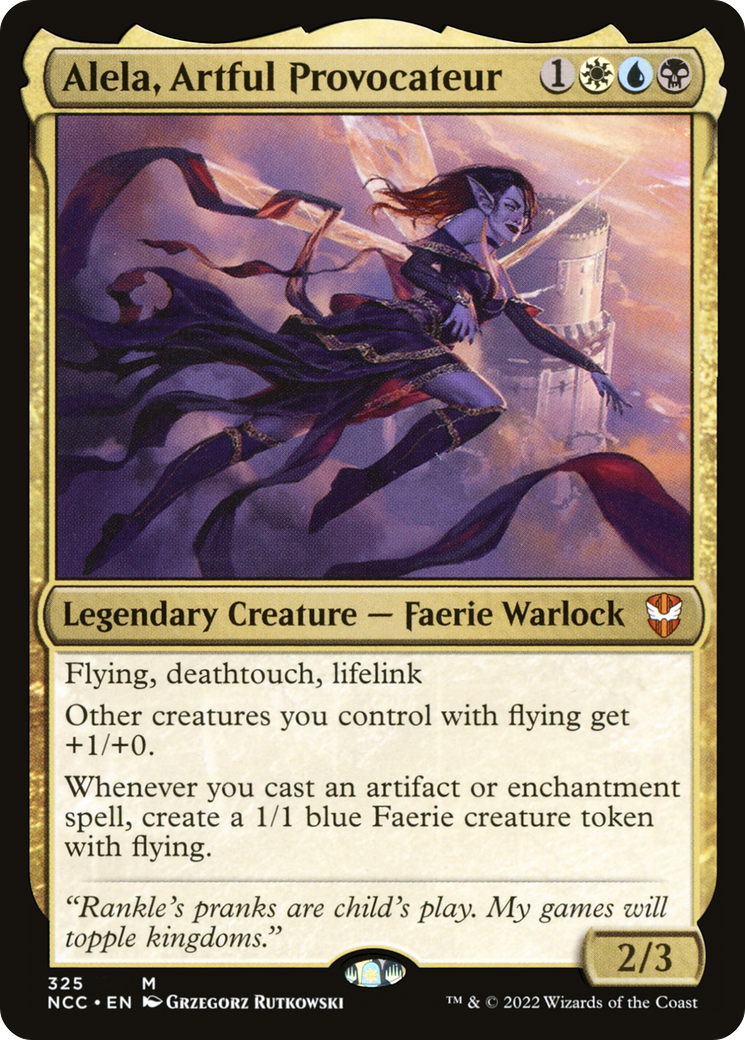
Alela, Artful Provocateur
Alela, Artful Provocateur
Legendary Creature — Faerie Warlock
2/3
Flying, deathtouch, lifelink
Other creatures you control with flying get +1/+0.
Whenever you cast an artifact or enchantment spell, create a 1/1 blue Faerie creature token with flying.
- Alela's last ability resolves before the spell that caused it to trigger. It resolves even if that spell is countered.
- A spell that's both an artifact and an enchantment spell causes Alela's last ability to trigger only once.
-
1
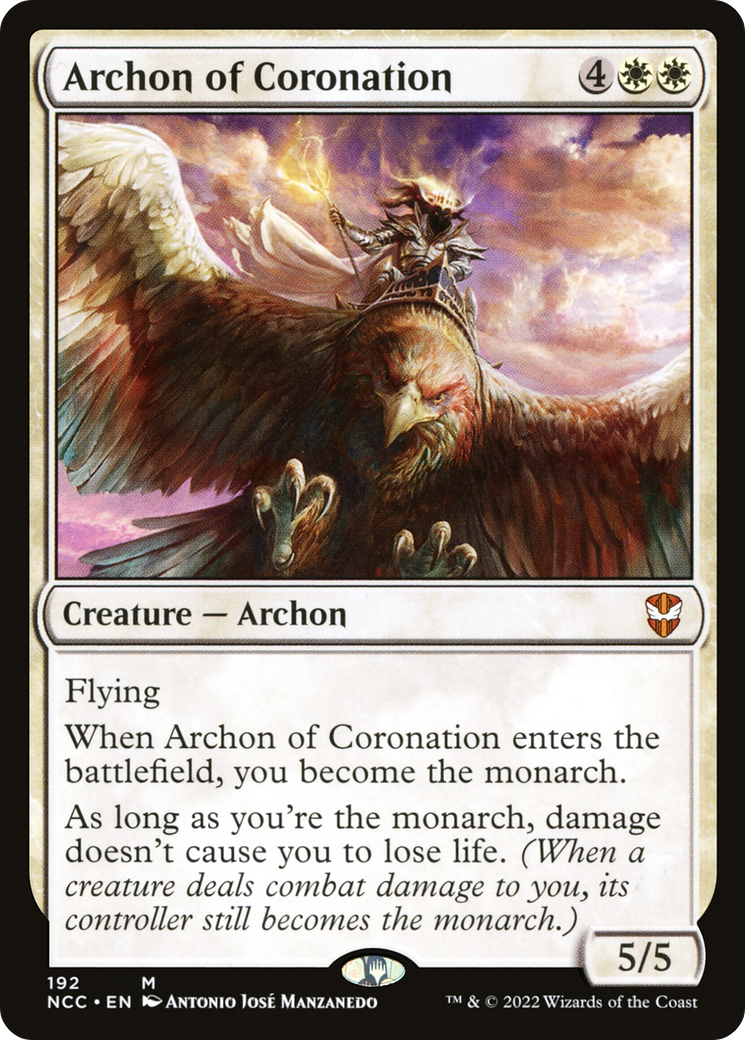
Archon of Coronation
Archon of Coronation
Creature — Archon
5/5
Flying
When this creature enters, you become the monarch.
As long as you're the monarch, damage doesn't cause you to lose life. (When a creature deals combat damage to you, its controller still becomes the monarch.)
- While Archon of Coronation's last ability applies, damage dealt to you still has all effects other than causing you to lose life. For example, abilities that trigger on that damage being dealt still trigger; if the source has lifelink, its controller still gains life; and so on.
- Combat damage dealt to you by a commander is still tracked, even if it didn't cause you to lose life.
- The game starts with no monarch. Once an effect makes one player the monarch, the game will have exactly one monarch from that point forward. As a player becomes the monarch, the current monarch (if any) ceases being the monarch.
- There are two inherent triggered abilities associated with being the monarch. These triggered abilities have no source and are controlled by the player who was the monarch at the time the abilities triggered. The full texts of these abilities are "At the beginning of the monarch's end step, that player draws a card" and "Whenever a creature deals combat damage to the monarch, its controller becomes the monarch."
- If the triggered ability that causes the monarch to draw a card goes on the stack and a different player becomes the monarch before that ability resolves, the first player will still draw the card.
- If the monarch leaves the game during another player's turn, that player becomes the monarch. If the monarch leaves the game during their turn, the next player in turn order becomes the monarch.
- If combat damage dealt to the monarch causes that player to lose the game, the triggered ability that causes the controller of the attacking creature to become the monarch doesn't resolve. In most cases, the controller of the attacking creature will still become the monarch as it is likely their turn.
-
1
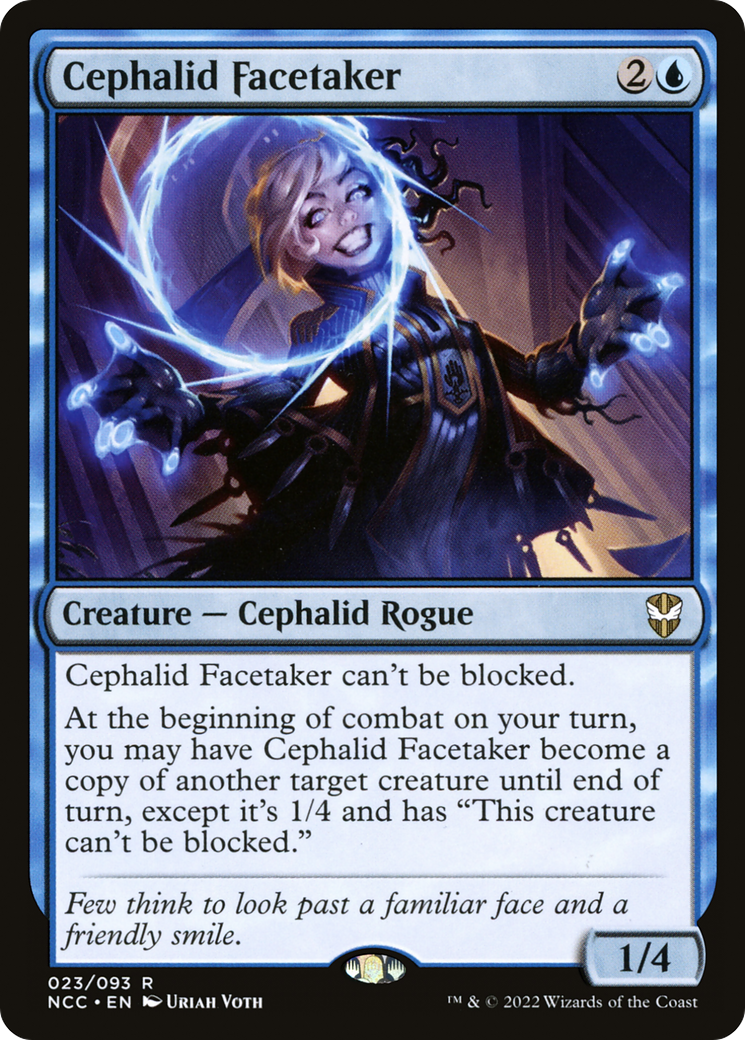
Cephalid Facetaker
Cephalid Facetaker
Creature — Octopus Rogue
1/4
This creature can't be blocked.
At the beginning of combat on your turn, you may have this creature become a copy of another target creature until end of turn, except it's 1/4 and has "This creature can't be blocked."
-
1
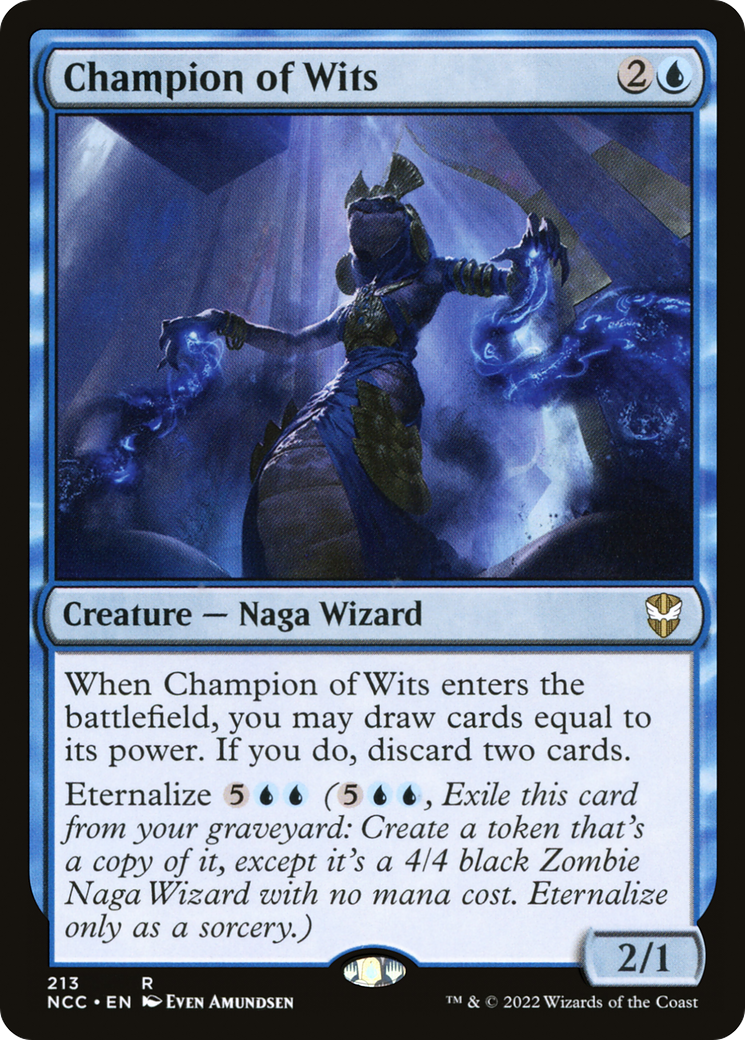
Champion of Wits
Champion of Wits
Creature — Snake Wizard
2/1
When this creature enters, you may draw cards equal to its power. If you do, discard two cards.
Eternalize ( , Exile this card from your graveyard: Create a token that's a copy of it, except it's a 4/4 black Zombie Snake Wizard with no mana cost. Eternalize only as a sorcery.)
- Use Champion of Wits's power as the first ability resolves to determine if you want to use the ability and how many cards you draw if you do. If you use the ability, you discard two cards regardless of how many cards you draw. If Champion of Wits leaves the battlefield before that ability resolves, use its last known power.
- For each card with eternalize, a corresponding game play supplement token can be found in some Hour of Devastation booster packs. These supplements are not required to play with cards with eternalize; you can use the same items to represent an eternalized token as you would any other token.
- If a creature card with eternalize is put into your graveyard during your main phase, you'll have priority immediately afterward. You can activate its eternalize ability before any player can try to exile it, such as with Crook of Condemnation, if it's legal for you to do so.
- Once you've activated an eternalize ability, the card is immediately exiled. Opponents can't try to stop the ability by exiling the card with an effect such as that of Crook of Condemnation.
- The token copies exactly what was printed on the original card and nothing else, except the characteristics specifically modified by eternalize. It doesn't copy any information about the object the card was before it was put into your graveyard.
- The token is a Zombie in addition to its other types and is black instead of its other colors. Its base power and toughness are 4/4. It has no mana cost, and thus its mana value is 0. These are copiable values of the token that other effects may copy.
- If the card copied by the token had any “when [this permanent] enters the battlefield” abilities, then the token also has those abilities and will trigger them when it's created. Similarly, any “as [this permanent] enters the battlefield” or “[this permanent] enters the battlefield with” abilities that the token has copied will also work.
-
1
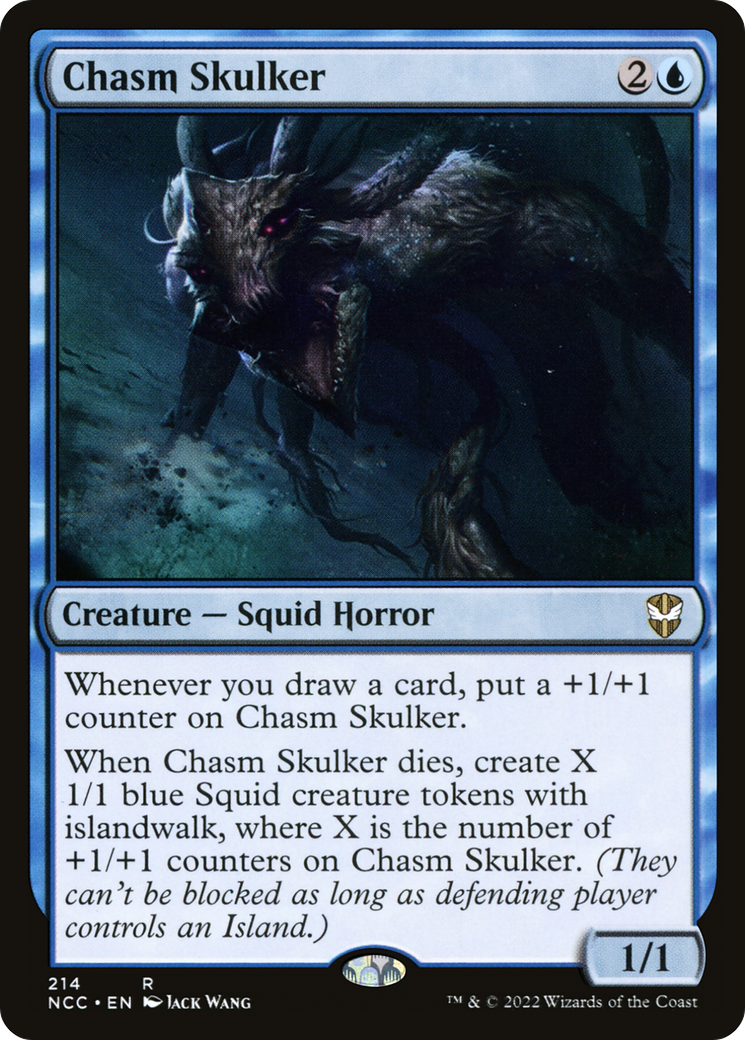
Chasm Skulker
Chasm Skulker
Creature — Squid Horror
1/1
Whenever you draw a card, put a +1/+1 counter on this creature.
When this creature dies, create X 1/1 blue Squid creature tokens with islandwalk, where X is the number of +1/+1 counters on this creature. (They can't be blocked as long as defending player controls an Island.)
- If enough -1/-1 counters are put on Chasm Skulker at the same time to make its toughness 0 or less, the number of +1/+1 counters on it before it got any -1/-1 counters will be used to determine how many Squid tokens you get. For example, if there are two +1/+1 counters on Chasm Skulker and it gets three -1/-1 counters, you'll get two Squid tokens.
- If you draw multiple cards, the first ability will trigger that many times. Each of these abilities will cause a +1/+1 counter to be put on Chasm Skulker.
-
1
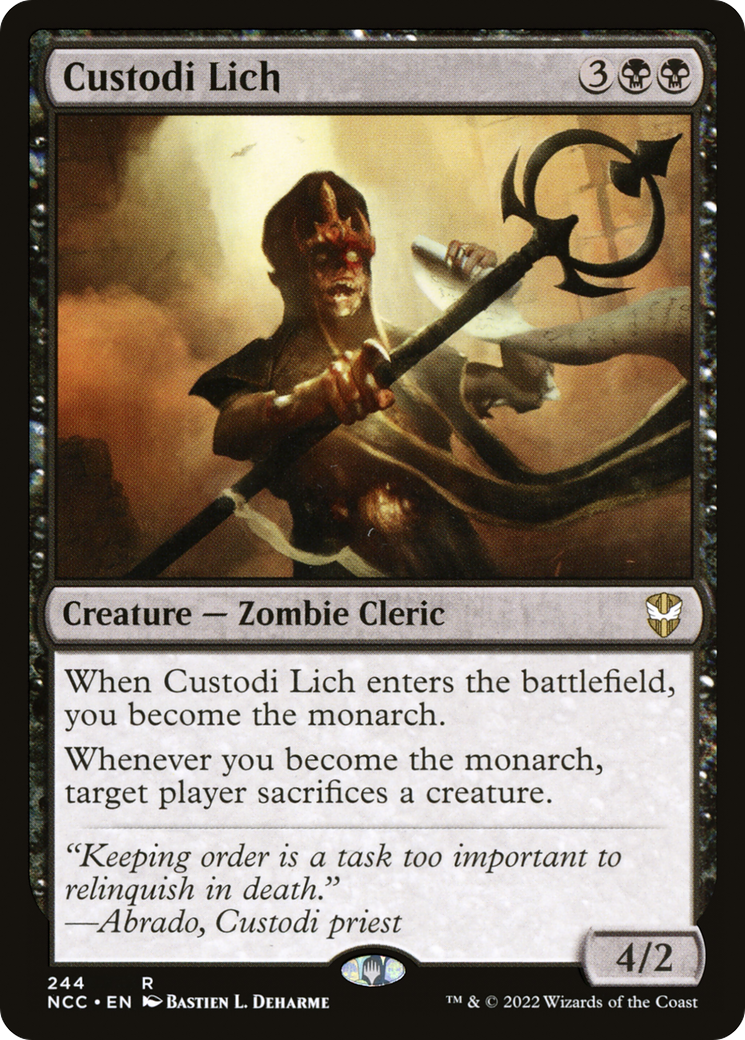
Custodi Lich
Custodi Lich
Creature — Zombie Cleric
4/2
When this creature enters, you become the monarch.
Whenever you become the monarch, target player sacrifices a creature of their choice.
- If the triggered ability that causes the monarch to draw a card goes on the stack, and a different player becomes the monarch before that ability resolves, the first player will still draw the card.
- The game starts with no monarch. Once an effect makes one player the monarch, the game will have exactly one monarch from that point forward.
- Being the monarch carries two inherent triggered abilities. “At the beginning of the monarch's end step, that player draws a card” and “Whenever a creature deals combat damage to the monarch, its controller becomes the monarch.”
- Abilities that trigger whenever you “become the monarch” trigger only if you aren't already the monarch. For example, if you are already the monarch as Custodi Lich enters the battlefield, its last ability won't trigger.
-
1
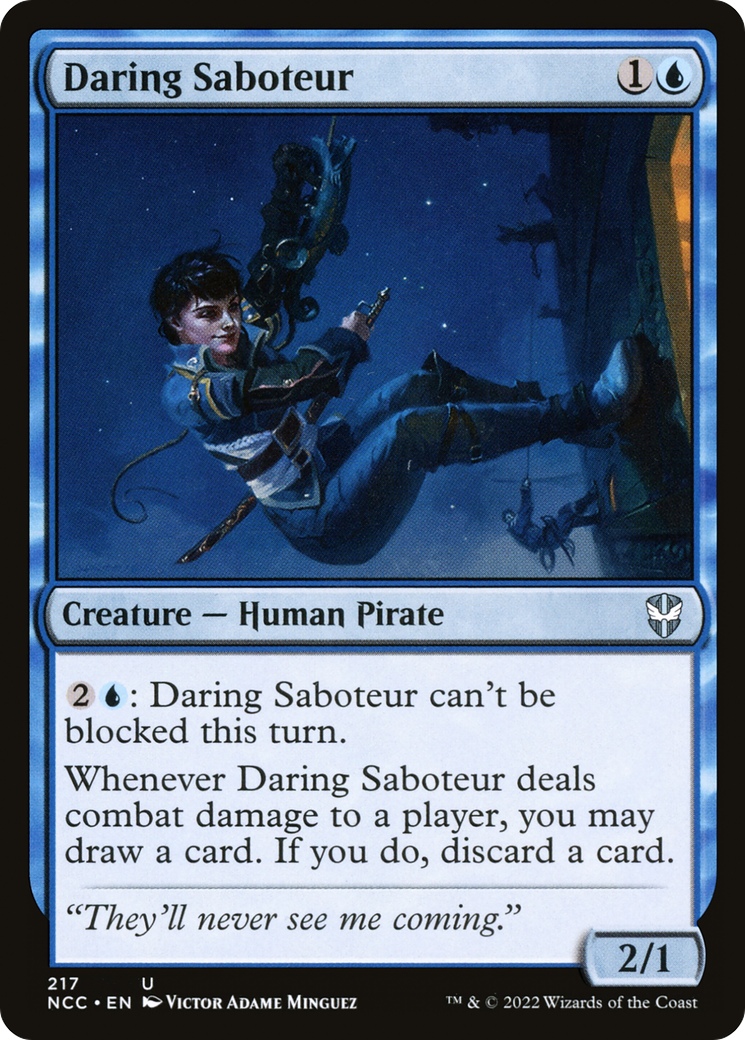
Daring Saboteur
Daring Saboteur
Creature — Human Pirate
2/1
: This creature can't be blocked this turn.
Whenever this creature deals combat damage to a player, you may draw a card. If you do, discard a card.
- Activating the first ability of Daring Saboteur after it has become blocked won't cause it to become unblocked.
-
1
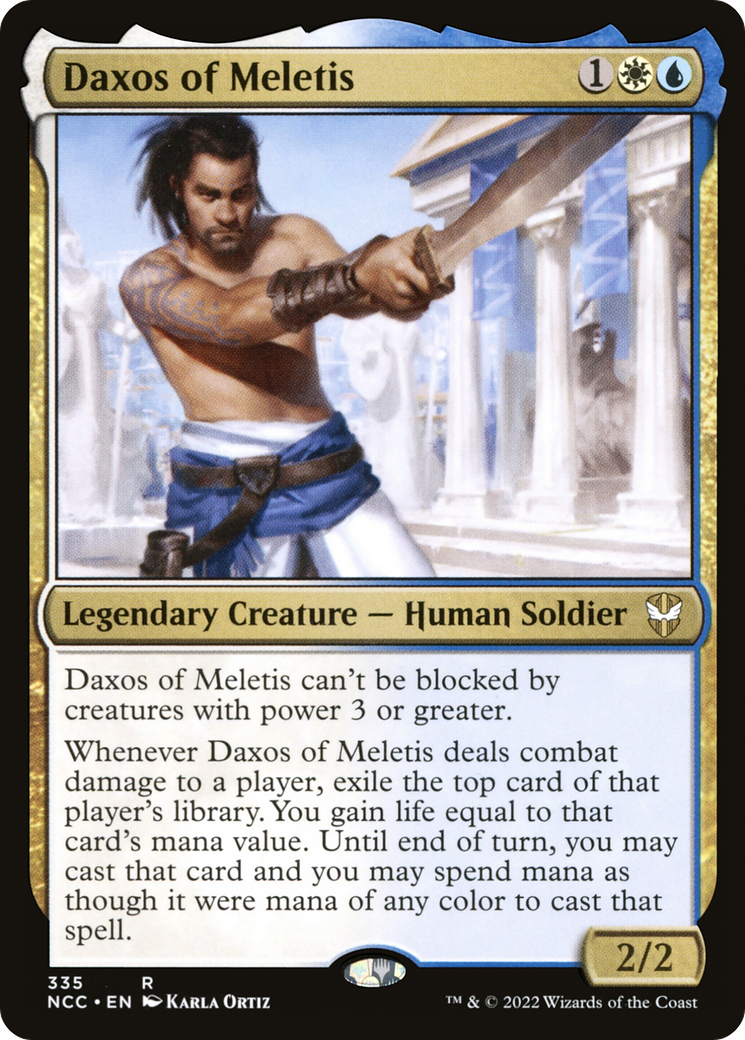
Daxos of Meletis
Daxos of Meletis
Legendary Creature — Human Soldier
2/2
Daxos can't be blocked by creatures with power 3 or greater.
Whenever Daxos deals combat damage to a player, exile the top card of that player's library. You gain life equal to that card's mana value. Until end of turn, you may cast that card and you may spend mana as though it were mana of any color to cast that spell.
- If Daxos is blocked by a creature, raising that creature's power to 3 or greater won't change or undo the block.
- If the exiled card is a land card, you won't gain any life and you won't be able to play the land.
- You must pay all costs to cast the exiled card. You may pay alternative or additional costs. If the card has any mandatory additional costs, you must pay those.
- Daxos doesn't change when you can cast the exiled card. For example, if you exile a creature card without flash, you can cast it only during your main phase when the stack is empty.
-
1
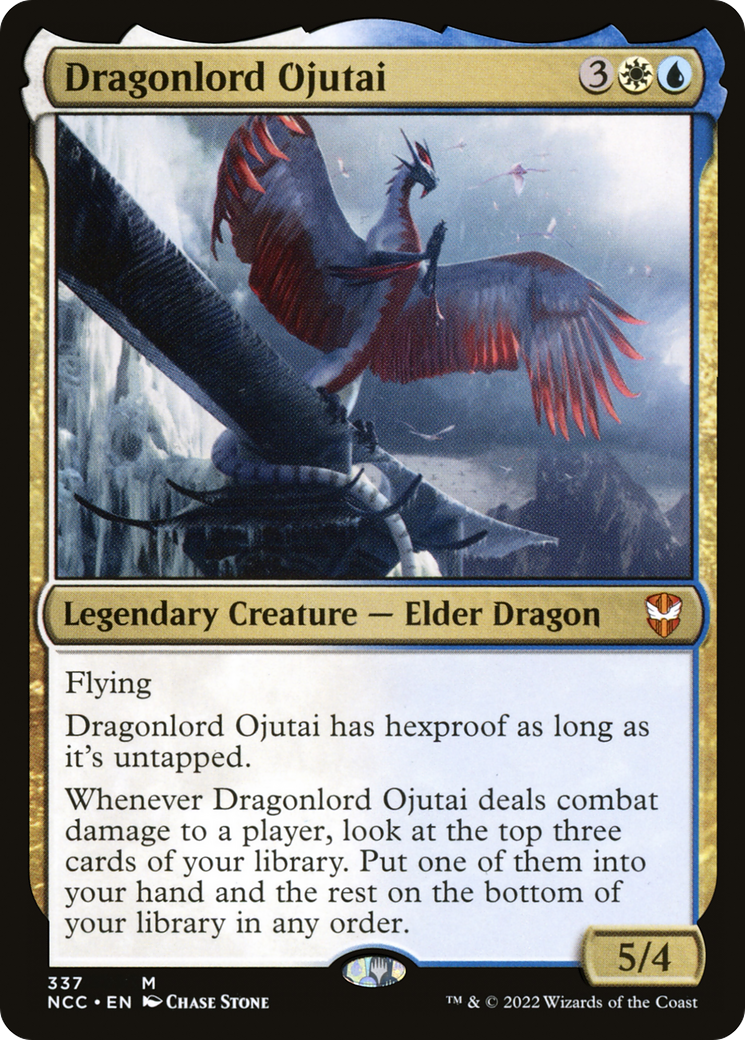
Dragonlord Ojutai
Dragonlord Ojutai
Legendary Creature — Elder Dragon
5/4
Flying
Dragonlord Ojutai has hexproof as long as it's untapped.
Whenever Dragonlord Ojutai deals combat damage to a player, look at the top three cards of your library. Put one of them into your hand and the rest on the bottom of your library in any order.
-
1
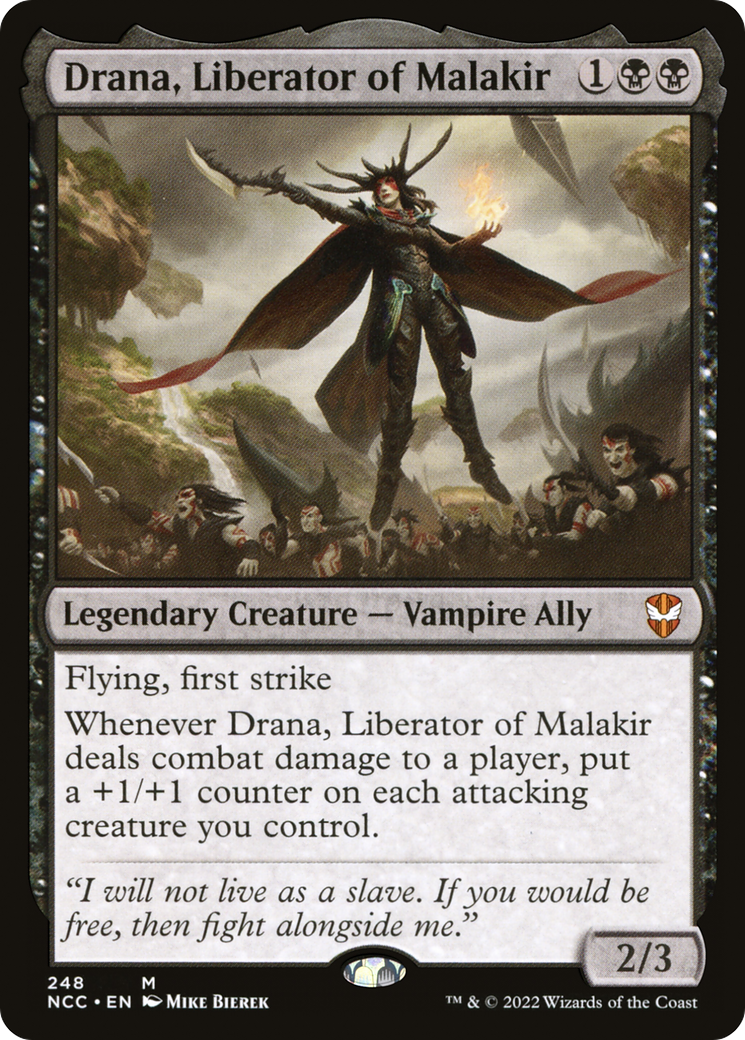
Drana, Liberator of Malakir
Drana, Liberator of Malakir
Legendary Creature — Vampire Ally
2/3
Flying, first strike
Whenever Drana deals combat damage to a player, put a +1/+1 counter on each attacking creature you control.
- Drana's last ability triggers after combat damage has been dealt, so only attacking creatures that survive the combat damage step in which Drana deals combat damage will have +1/+1 counters put on them.
- The +1/+1 counter won't change how much damage Drana or any other attacking creature with first strike or double strike deals during that combat damage step. However, the +1/+1 counters that are put on attacking creatures without first strike will affect the damage those creatures deal during the regular combat damage step.
-
1
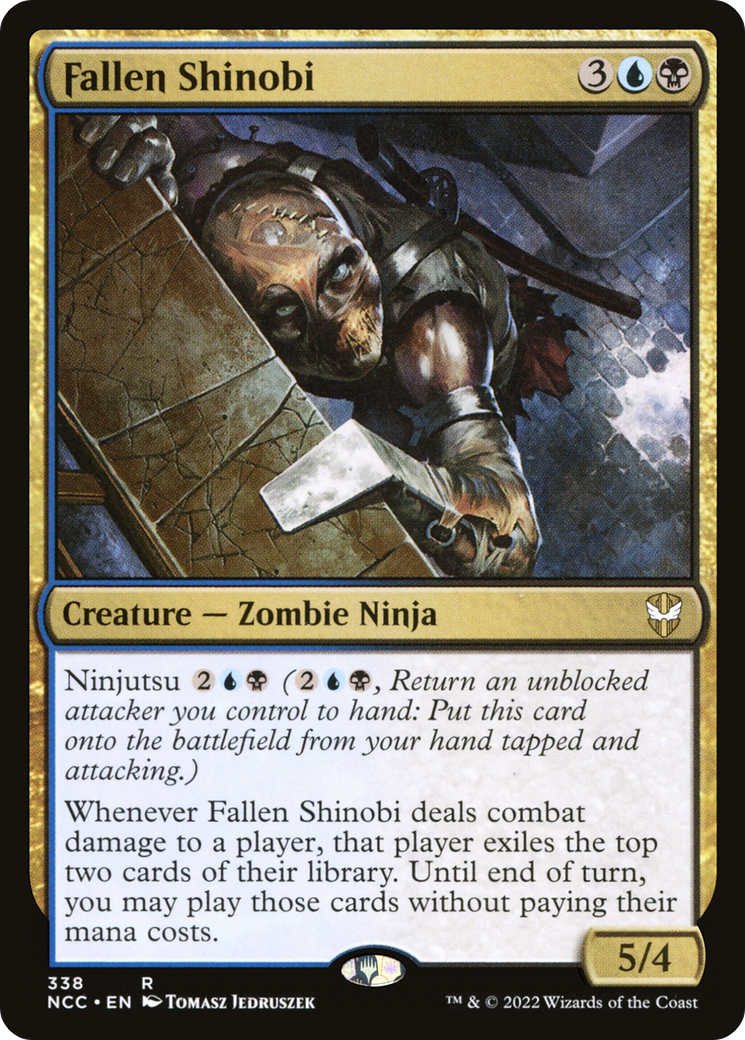
Fallen Shinobi
Fallen Shinobi
Creature — Zombie Ninja
5/4
Ninjutsu ( , Return an unblocked attacker you control to hand: Put this card onto the battlefield from your hand tapped and attacking.)
Whenever this creature deals combat damage to a player, that player exiles the top two cards of their library. Until end of turn, you may play those cards without paying their mana costs.
- Fallen Shinobi's triggered ability doesn't change when you can play the exiled cards. For example, if a sorcery card is exiled, you can cast it only during your main phase when the stack is empty. If a land card is exiled, you can play it only during your main phase and only if you have an available land play remaining.
- Casting an exiled card causes it to leave exile. You can't cast it multiple times.
- Any cards you don't cast will remain in exile.
- The ninjutsu ability can be activated only after blockers have been declared. Before then, attacking creatures are neither blocked nor unblocked.
- As you activate a ninjutsu ability, you reveal the Ninja card in your hand and return the attacking creature. The Ninja isn't put onto the battlefield until the ability resolves. If it leaves your hand before then, it won't enter the battlefield at all.
- The creature with ninjutsu enters the battlefield attacking the same player or planeswalker that the returned creature was attacking. This is a rule specific to ninjutsu; in other cases, when a creature is put onto the battlefield attacking, that creature's controller chooses which player or planeswalker it's attacking.
- Although the Ninja is attacking, it was never declared as an attacking creature (for purposes of abilities that trigger whenever a creature attacks, for example).
- The ninjutsu ability can be activated during the declare blockers step, combat damage step, or end of combat step. If you wait until after the declare blockers step, because all combat damage is dealt at once, the Ninja won't normally deal combat damage.
- If a creature in combat has first strike or double strike, you can activate the ninjutsu ability during the first-strike combat damage step. The Ninja will deal combat damage during the regular combat damage step, even if it has first strike.
-
1
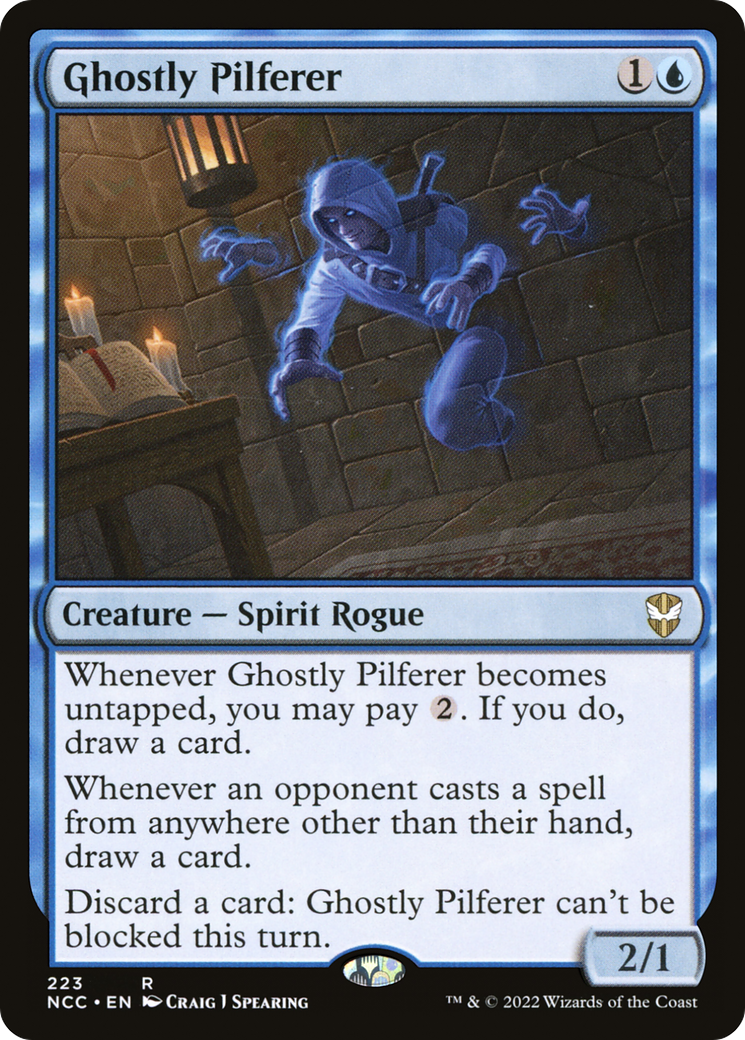
Ghostly Pilferer
Ghostly Pilferer
Creature — Spirit Rogue
2/1
Whenever this creature becomes untapped, you may pay . If you do, draw a card.
Whenever an opponent casts a spell from anywhere other than their hand, draw a card.
Discard a card: This creature can't be blocked this turn.
- Ghostly Pilferer's first ability triggers during your untap step, but it's put onto the stack at the same time as abilities that trigger at the beginning of your upkeep step. Even though the ability triggered first, you may order it before or after other abilities you control that are put onto the stack at this time.
- While resolving Ghostly Pilferer's first ability, you can't pay more than to draw more than one card.
- An ability that triggers when a player casts a spell resolves before the spell that caused it to trigger. It resolves even if that spell is countered.
- Players can cast spells and activate abilities after the second triggered ability resolves but before the spell that caused it to trigger does.
- Once Ghostly Pilferer has been blocked, activating its last ability doesn't cause it to become unblocked.
-
1
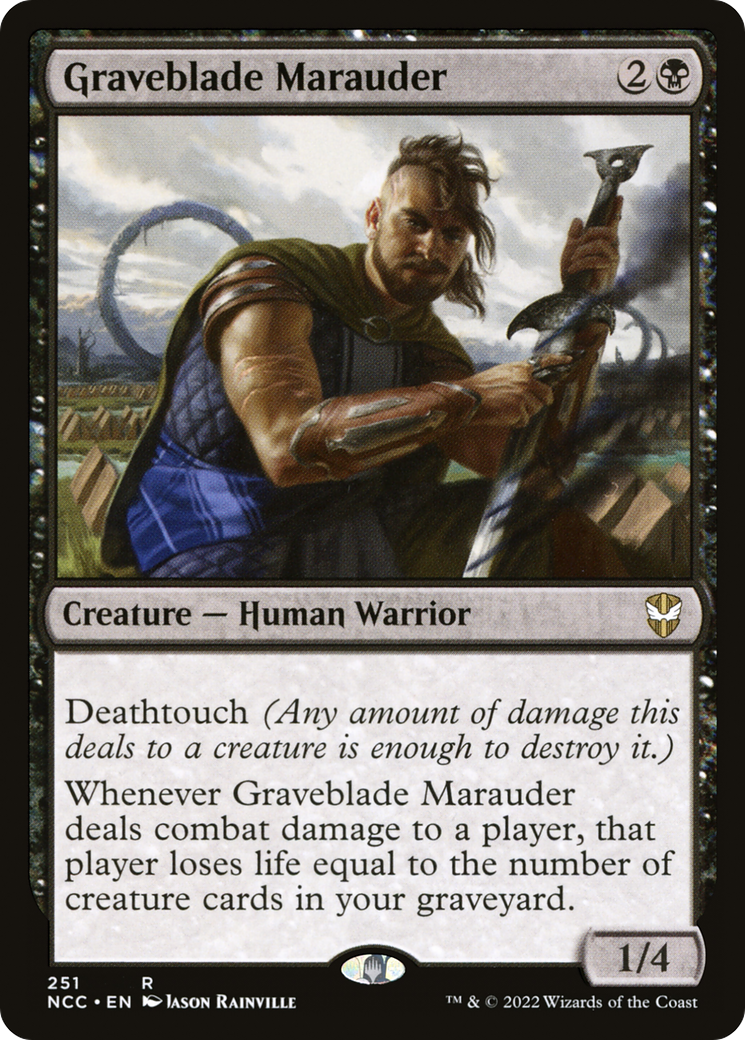
Graveblade Marauder
Graveblade Marauder
Creature — Human Warrior
1/4
Deathtouch (Any amount of damage this deals to a creature is enough to destroy it.)
Whenever this creature deals combat damage to a player, that player loses life equal to the number of creature cards in your graveyard.
- Count the number of creature cards in your graveyard as the ability resolves to determine how much life is lost. Notably, this could include any other creature you owned that died in combat, and perhaps even Graveblade Marauder itself.
-
1
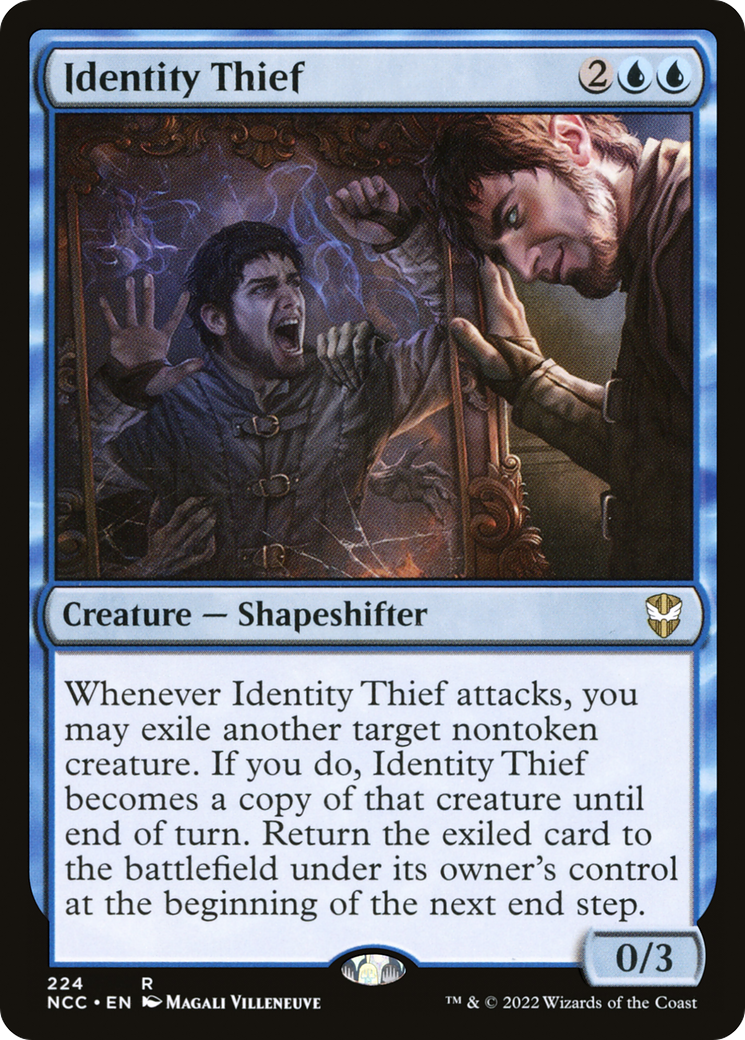
Identity Thief
Identity Thief
Creature — Shapeshifter
0/3
Whenever this creature attacks, you may exile another target nontoken creature. If you do, this creature becomes a copy of that creature until end of turn. Return the exiled card to the battlefield under its owner's control at the beginning of the next end step.
- If the targeted creature has an ability that triggers when it attacks, it'll be too late for it to trigger once Identity Thief has that ability. The same is true if another object has an ability that triggers when a creature with certain characteristics attacks and Identity Thief doesn't have those characteristics until after it becomes a copy.
- Identity Thief copies the printed values of the targeted creature, plus any copy effects that have been applied to that creature. It won't copy other effects that have changed the targeted creature's power, toughness, types, color, or so on. It also won't copy counters on the targeted creature.
- If the targeted creature is a double-faced or melded permanent, Identity Thief copies the face shown. Because Identity Thief is not a double-faced card or meld card, it won't be able to transform or meld. If it copies a melded permanent or the back face of a double-faced card, its mana value will be 0. Exiled double-faced cards and exiled meld cards will return with their front faces up.
- If the targeted creature is itself copying a permanent, Identity Thief will become whatever it's copying, as modified by that copy effect. For example, if you target a Hamlet Captain that has become a copy of Permeating Mass, Identity Thief will become a Permeating Mass.
- This effect can cause Identity Thief to stop being a creature. For example, if you target an animated Gideon Jura (a planeswalker with a loyalty ability that turns him into a creature), only the printed wording will be copied; the “becomes a creature” effect won't. Identity Thief will become a noncreature Gideon with no loyalty, be removed from combat, and then be put into its owner's graveyard.
- This effect can cause Identity Thief to become a copy of a creature that can't normally attack, such as Lupine Prototype or a creature with defender. In these cases, it remains attacking.
- Noncopy effects that have already applied to Identity Thief will continue to apply to it. For example, if Woodcutter's Grit gave Identity Thief +3/+3 and hexproof earlier in the turn, Identity Thief will still have those bonuses after copying a creature.
- Identity Thief will still be a copy of the creature during the next end step when the exiled card returns. If it has an ability that triggers at the beginning of the end step, that ability will trigger for Identity Thief and not for the returned creature.
- Auras attached to the exiled creature will be put into their owners' graveyards. Any Equipment will become unattached and remain on the battlefield. Any counters on the exiled permanent will cease to exist.
-
1
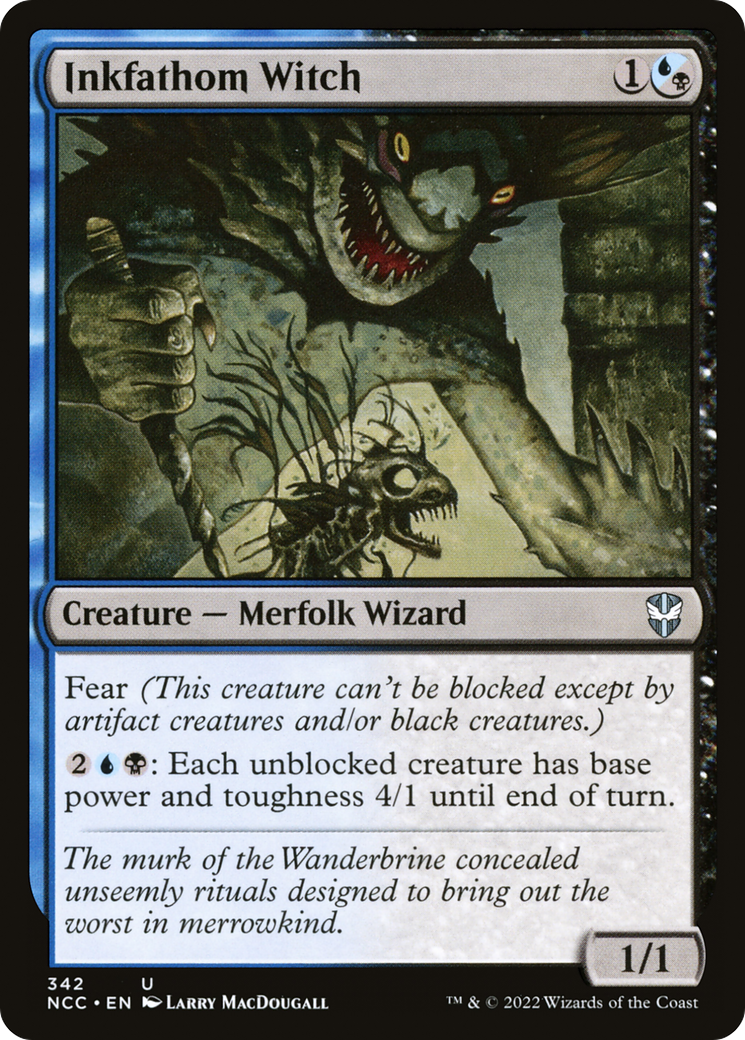
Inkfathom Witch
Inkfathom Witch
Creature — Merfolk Wizard
1/1
Fear (This creature can't be blocked except by artifact creatures and/or black creatures.)
: Each unblocked creature has base power and toughness 4/1 until end of turn.
- The effect from the ability overwrites other effects that set power and/or toughness if and only if those effects existed before the ability resolved. It will not overwrite effects that modify power or toughness (whether from a static ability, counters, or a resolved spell or ability), nor will it overwrite effects that set power and toughness which come into existence after the ability resolves. Effects that switch the creature's power and toughness are always applied after any other power or toughness changing effects, including this one, regardless of the order in which they are created.
- An “unblocked creature” is a creature that attacked and wasn't blocked. Creatures aren't “blocked” or “unblocked” until the declare blockers step, so activating this ability before then (or after combat ends) will have no effect.
- Creatures stop being unblocked as the combat phase ends. However, they'll stay 4/1 until turn ends.
- Inkfathom Witch doesn't cause creatures to lose their abilities.
- If Inkfathom Witch is attacking and unblocked, it can make itself 4/1.
-
1
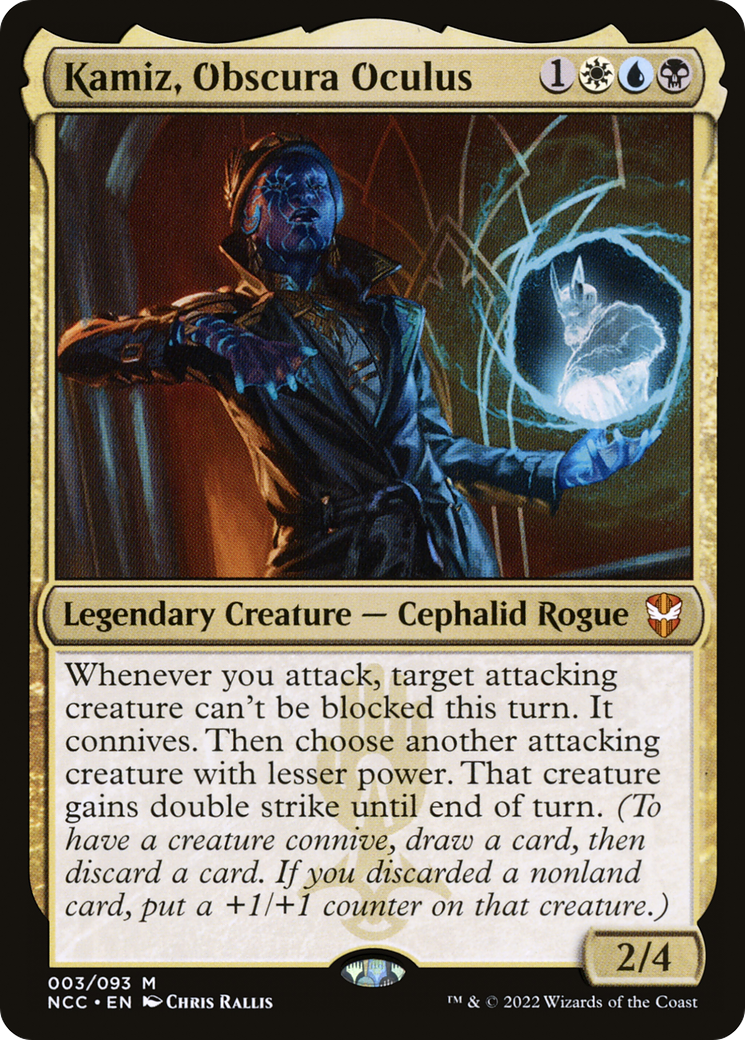
Kamiz, Obscura Oculus
Kamiz, Obscura Oculus
Legendary Creature — Octopus Rogue
2/4
Whenever you attack, target attacking creature can't be blocked this turn. It connives. Then choose another attacking creature with lesser power. That creature gains double strike until end of turn. (To have a creature connive, draw a card, then discard a card. If you discarded a nonland card, put a +1/+1 counter on that creature.)
- Once an ability that causes a creature to connive begins to resolve, no player may take any other actions until it's done. Notably, opponents can't try to remove the conniving creature after you discard a nonland card but before it receives a counter.
- If no card is discarded, most likely because that player's hand is empty and an effect says they can't draw cards, the conniving creature does not receive a +1/+1 counter.
- If a resolving spell or ability instructs a specific creature to connive but that creature has left the battlefield, the creature still connives. If you discard a nonland card this way, you won't put a +1/+1 counter on anything. Abilities that trigger “when [that creature] connives” will trigger.
-
1
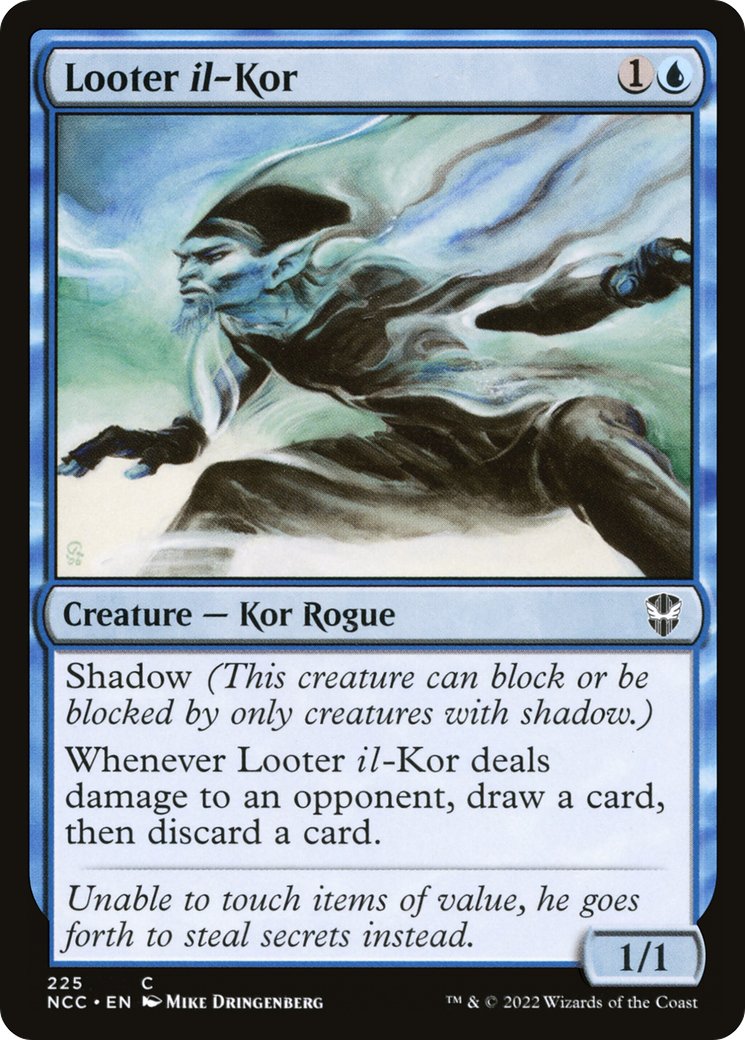
Looter il-Kor
Looter il-Kor
Creature — Kor Rogue
1/1
Shadow (This creature can block or be blocked by only creatures with shadow.)
Whenever this creature deals damage to an opponent, draw a card, then discard a card.
- You draw a card and discard a card all while Looter il-Kor's ability is resolving. Nothing can happen in between, and no player can take actions.
- Once a creature has been blocked, that creature remains blocked and will deal and be dealt combat damage even if it gains or loses shadow or if the blocking creature gains or loses shadow.
- If an attacking creature has multiple evasion abilities, such as shadow and flying, a creature can block it only if that creature satisfies all of the appropriate evasion abilities.
- Multiple instances of shadow on the same creature are redundant.
-
1
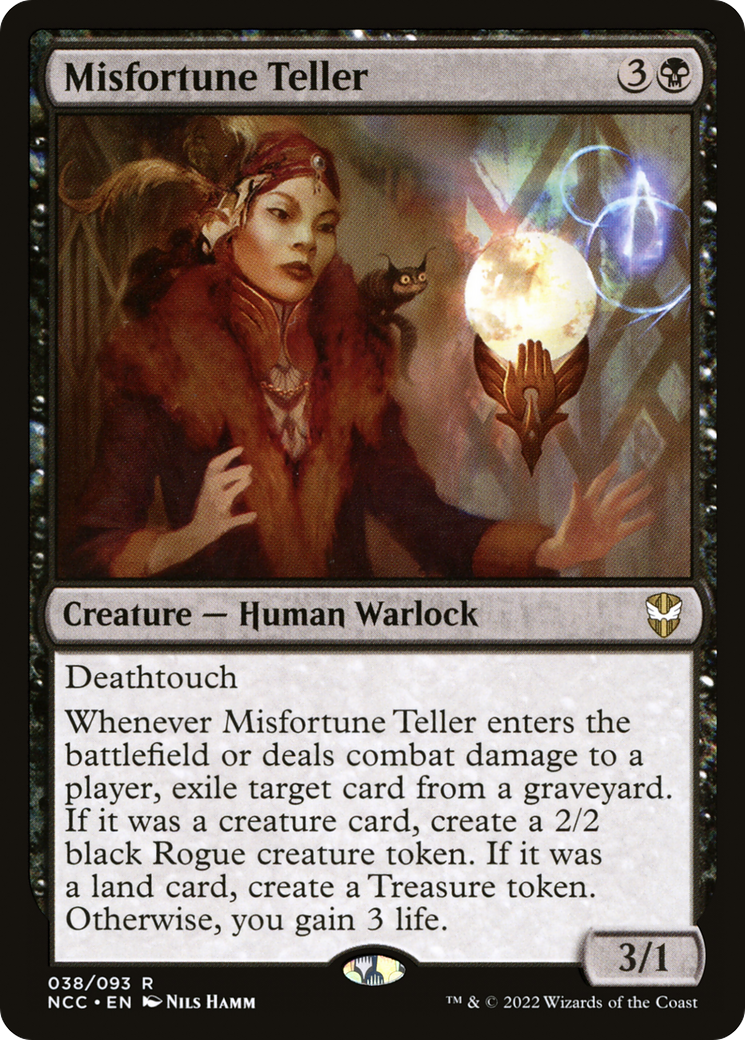
Misfortune Teller
Misfortune Teller
Creature — Human Warlock
3/1
Deathtouch
Whenever this creature enters or deals combat damage to a player, exile target card from a graveyard. If it was a creature card, create a 2/2 black Rogue creature token. If it was a land card, create a Treasure token. Otherwise, you gain 3 life.
- If the card was both a land and a creature (such as Dryad Arbor), you will create both a Rogue token and a Treasure token.
-
1
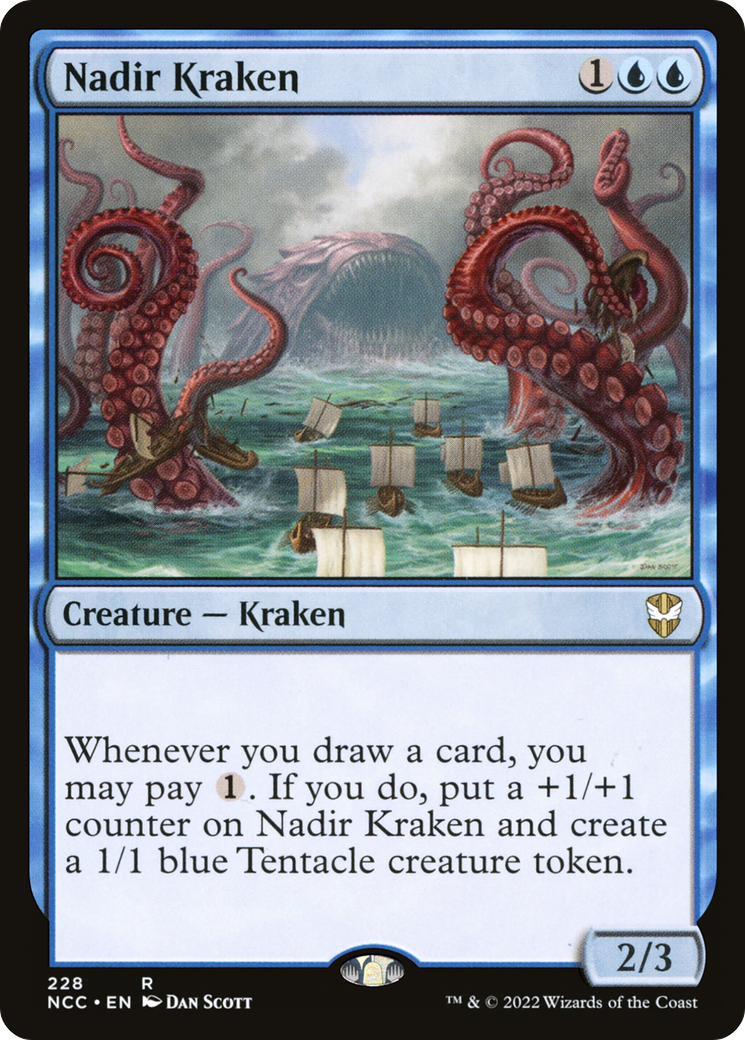
Nadir Kraken
Nadir Kraken
Creature — Kraken
2/3
Whenever you draw a card, you may pay . If you do, put a +1/+1 counter on this creature and create a 1/1 blue Tentacle creature token.
- While resolving Nadir Kraken's ability, you can't pay multiple times to create multiple Tentacles or to give it multiple +1/+1 counters.
- You choose whether to pay after drawing the card and seeing what it is. If you draw multiple cards, you see them all before deciding how many of the resulting triggers you'll pay for.
- If Nadir Kraken leaves the battlefield after its ability has triggered, you can still pay and get a Tentacle, even though you won't put a +1/+1 counter on Nadir Kraken.
-
1
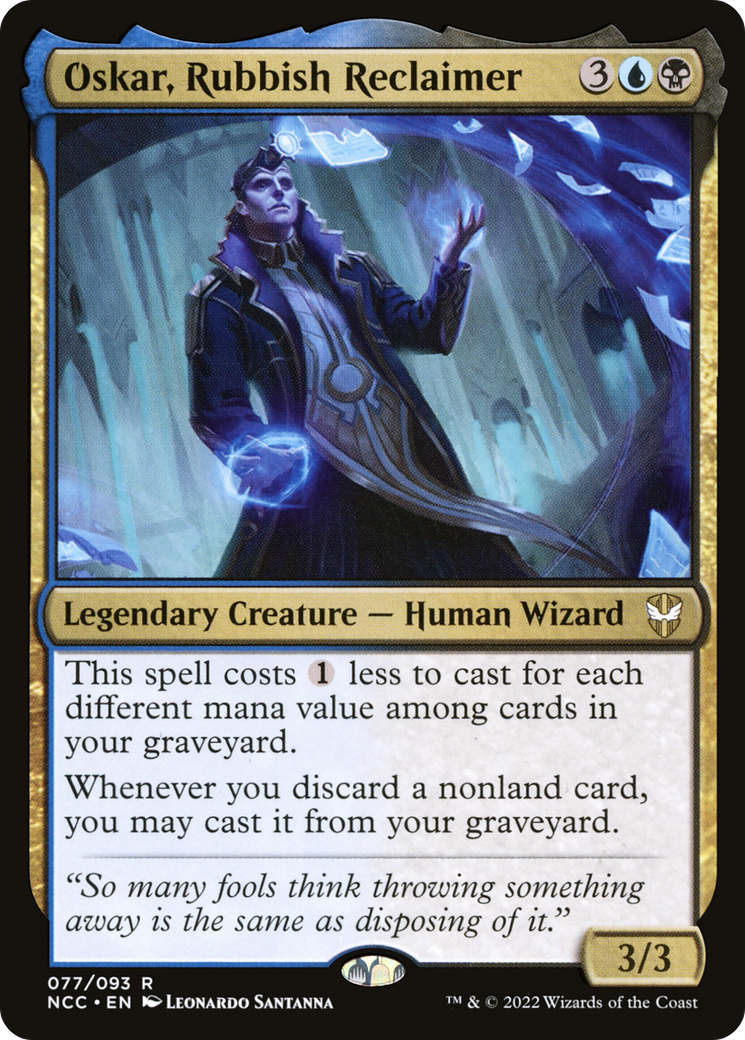
Oskar, Rubbish Reclaimer
Oskar, Rubbish Reclaimer
Legendary Creature — Human Wizard
3/3
This spell costs less to cast for each different mana value among cards in your graveyard.
Whenever you discard a nonland card, you may cast it from your graveyard.
- The mana value of a split card in the graveyard is the total mana value of both halves of that card. It does not have two mana values.
- The mana value of a double-faced card in your graveyard is always the mana value of the front face.
- X is 0 when determining the mana value of a card in your graveyard.
- The mana value of a land card is 0.
- You may cast the spell immediately. You must pay all costs for a spell cast this way.
-
1
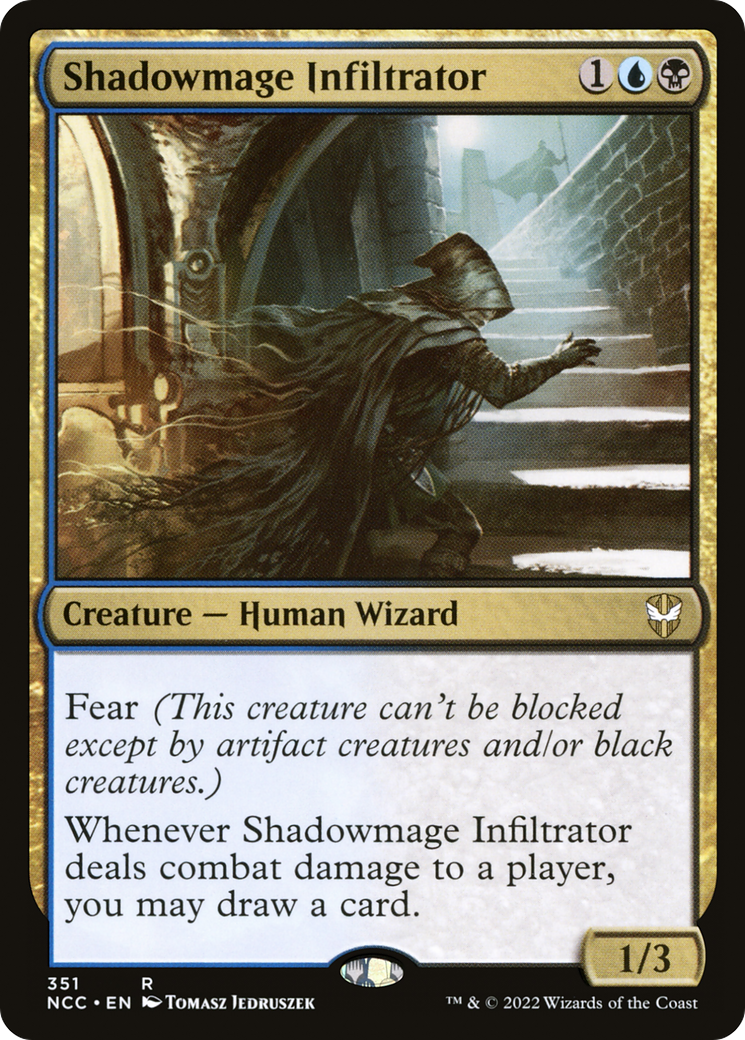
Shadowmage Infiltrator
Shadowmage Infiltrator
Creature — Human Wizard
1/3
Fear (This creature can't be blocked except by artifact creatures and/or black creatures.)
Whenever this creature deals combat damage to a player, you may draw a card.
-
1
Silent-Blade Oni
Silent-Blade Oni
Creature — Demon Ninja
6/5
Ninjutsu ( , Return an unblocked attacker you control to hand: Put this card onto the battlefield from your hand tapped and attacking.)
Whenever this creature deals combat damage to a player, look at that player's hand. You may cast a spell from among those cards without paying its mana cost.
- If you cast a permanent spell this way, it will enter under your control when it resolves. If you cast an instant or sorcery spell this way, that card will be put into its owner's graveyard when it resolves.
- The nonland card you cast via the triggered ability is cast as part of the resolution of that ability. Timing restrictions based on the card's type are ignored. Other restrictions, such as "Cast [this card] only during an opponent's turn," are not.
- If you cast a card without paying its mana cost, you can't choose to cast it for any alternative costs, such as evoke or the alternative cost provided by the morph ability. If it has in its mana cost, X must be 0. However, you can pay optional additional costs, such as kicker, and you must still pay mandatory additional costs, such as the one on Fling.
-
1
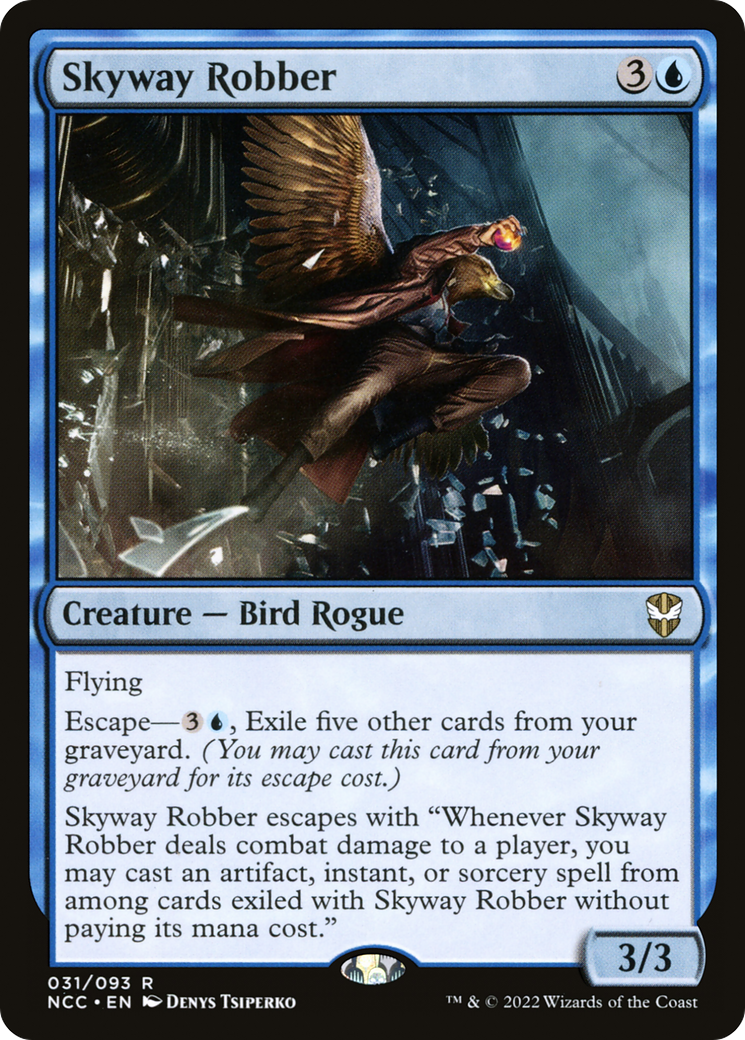
Skyway Robber
Skyway Robber
Creature — Bird Rogue
3/3
Flying
Escape— , Exile five other cards from your graveyard. (You may cast this card from your graveyard for its escape cost.)
This creature escapes with "Whenever this creature deals combat damage to a player, you may cast an artifact, instant, or sorcery spell from among cards exiled with this creature without paying its mana cost."
- The ability Skyway Robber escapes with only allows you to cast cards exiled with its escape ability the last time it escaped. If it dies and escapes again later, or if it moves to another zone and returns to the battlefield, you won't be able to cast any of the cards exiled with it before.
- Escape's permission doesn't change when you may cast the spell from your graveyard.
- To determine the total cost of a spell, start with the mana cost or alternative cost you're paying (such as an escape cost), add any cost increases, then apply any cost reductions. The mana value of the spell remains unchanged, no matter what the total cost to cast it was and no matter whether an alternative cost was paid.
- After an escaped spell resolves, it returns to its owner's graveyard if it's not a permanent spell. If it is a permanent spell, it enters the battlefield and will return to its owner's graveyard if it dies later.
- If a card has multiple abilities giving you permission to cast it, such as two escape abilities or an escape ability and a flashback ability, you choose which one to apply. The others have no effect.
- If you cast a spell with its escape permission, you can't choose to apply any other alternative costs or to cast it without paying its mana cost. If it has any additional costs, you must pay those.
- If a card with escape is put into your graveyard during your turn, you'll be able to cast it right away if it's legal to do so, before an opponent can take any actions.
- Once you begin casting a spell with escape, it immediately moves to the stack. Players can't take any other actions until you're done casting the spell.
-
1
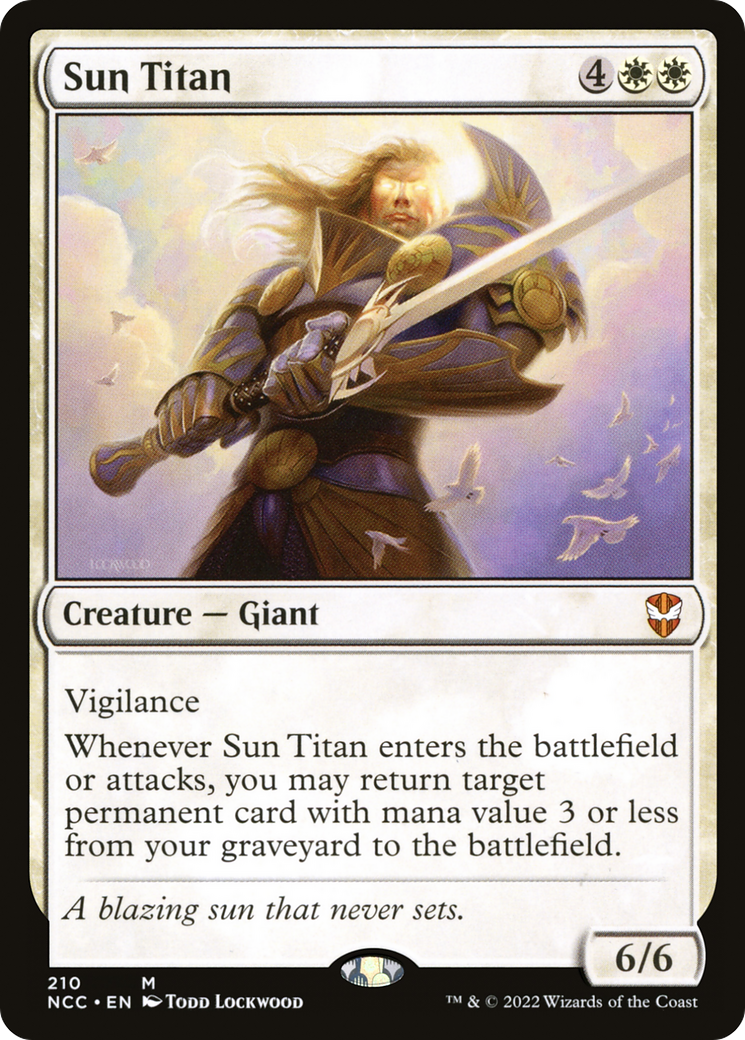
Sun Titan
Sun Titan
Creature — Giant
6/6
Vigilance
Whenever this creature enters or attacks, you may return target permanent card with mana value 3 or less from your graveyard to the battlefield.
- A permanent card is an artifact, creature, enchantment, land, or planeswalker card.
- If a card in your graveyard has no mana symbols in its upper right corner (because it's a land card, for example), its mana value is 0.
- The mana value of a card in your graveyard is determined solely by the mana symbols printed in its upper right corner. The mana value is the total amount of mana in that cost, regardless of color. For example, a card with mana cost has mana value 5.
- If the mana cost of a card in your graveyard includes , X is considered to be 0.
-
1
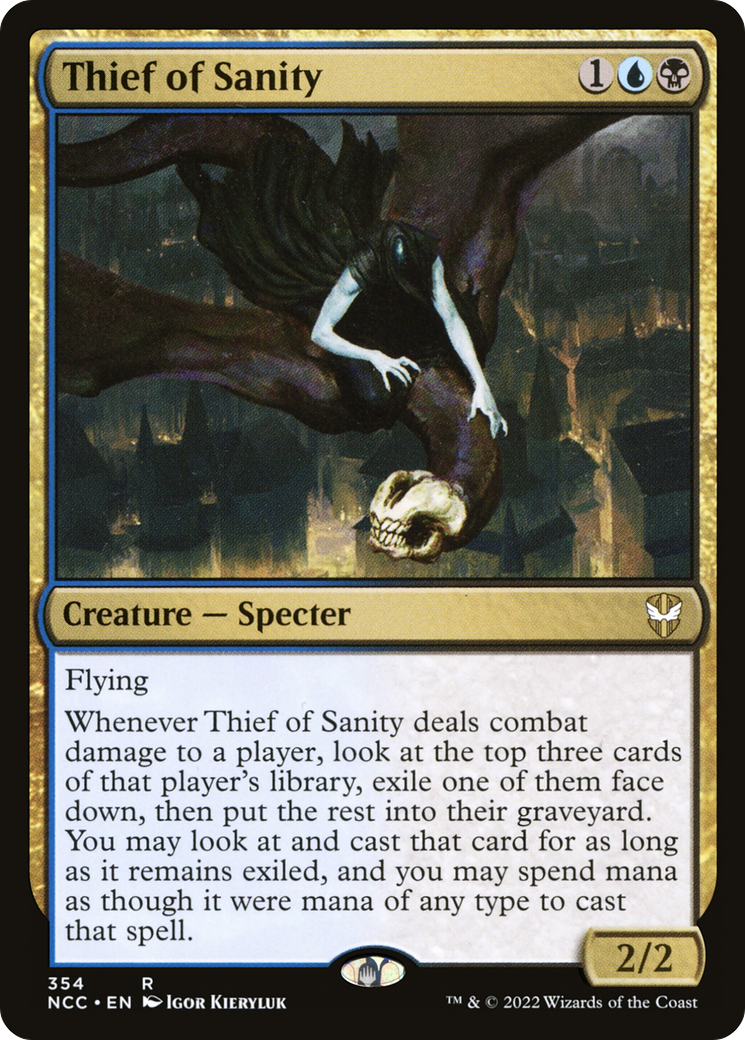
Thief of Sanity
Thief of Sanity
Creature — Specter
2/2
Flying
Whenever this creature deals combat damage to a player, look at the top three cards of that player's library, exile one of them face down, then put the rest into their graveyard. You may cast that card for as long as it remains exiled, and mana of any type can be spent to cast that spell.
- Thief of Sanity's effect doesn't change when you can cast the exiled card. For example, if you exile a sorcery card, you can cast it only during your main phase when the stack is empty.
- An effect that instructs you to "cast" a card doesn't allow you to play lands.
- You can still cast the exiled card if Thief of Sanity leaves the battlefield or leaves your control. If another player gains control of Thief of Sanity, that player can't cast the exiled card.
- Casting an exiled card causes it to leave exile. You can't cast it multiple times.
- In a multiplayer game, if a player leaves the game, all cards that player owns leave as well. If you leave the game, any spells or permanents you control from Thief of Sanity's effect are exiled, and any of the face-down exiled cards remain face down indefinitely. No player may look at them.
-
1
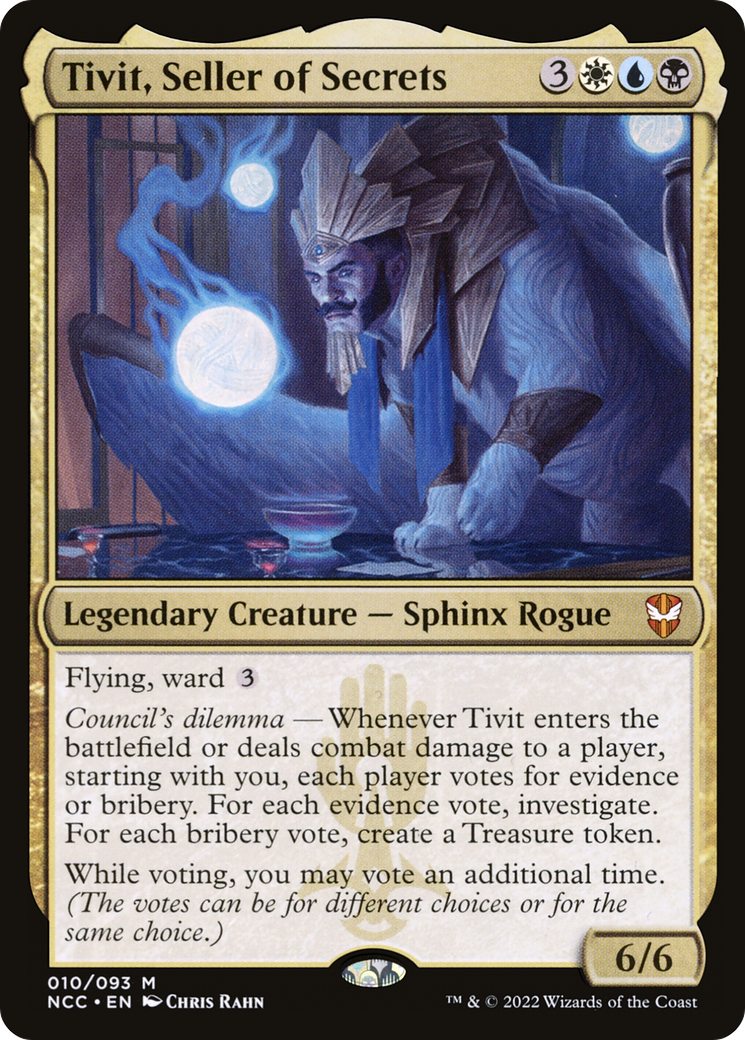
Tivit, Seller of Secrets
Tivit, Seller of Secrets
Legendary Creature — Sphinx Rogue
6/6
Flying, ward
Council's dilemma — Whenever Tivit enters or deals combat damage to a player, starting with you, each player votes for evidence or bribery. For each evidence vote, investigate. For each bribery vote, create a Treasure token.
While voting, you may vote an additional time. (The votes can be for different choices or for the same choice.)
- You make all your votes at the same time. Players who vote after you will know all of your votes when making their own.
- Abilities that allow players to vote an additional time are cumulative. For example, if you control two permanents with this ability, you can vote up to three times.
- The ability only affects spells and abilities that use the word “vote.” Other cards that involve choices, such as Archangel of Strife, are unaffected.
- You must make your initial vote, even if you decline to vote an additional time.
-
1
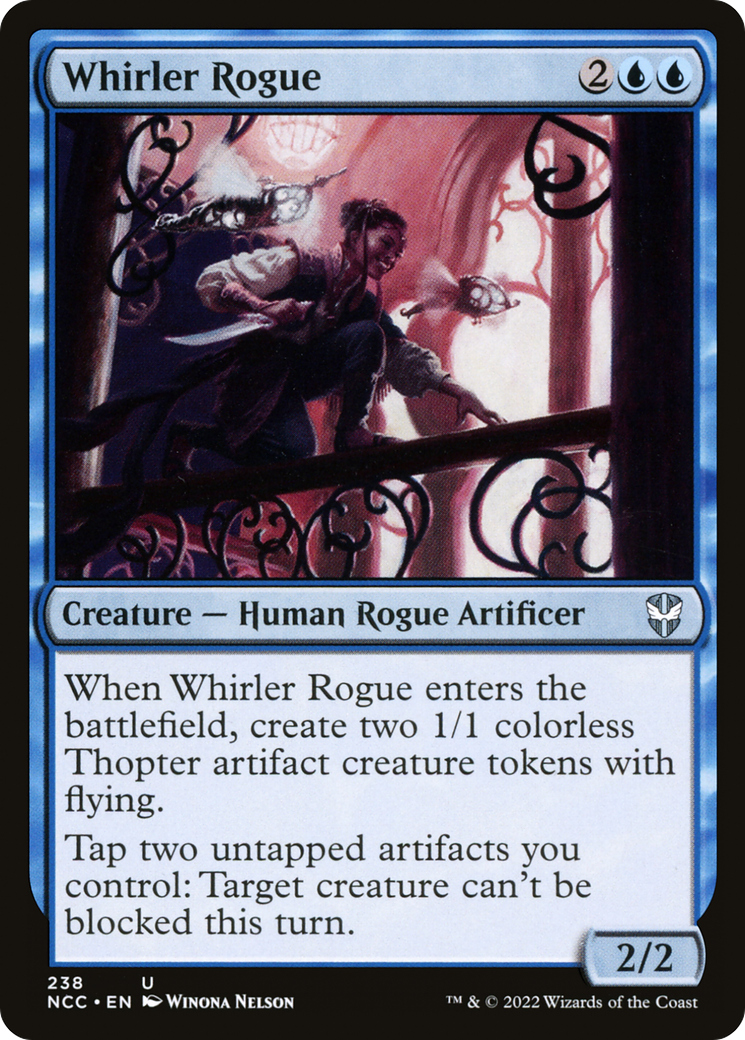
Whirler Rogue
Whirler Rogue
Creature — Human Rogue Artificer
2/2
When this creature enters, create two 1/1 colorless Thopter artifact creature tokens with flying.
Tap two untapped artifacts you control: Target creature can't be blocked this turn.
- You may tap any two untapped artifacts you control, including artifact creatures that haven't been under your control continuously since the beginning of your most recent turn.
- Activating the second ability of Whirler Rogue after a creature has become blocked won't cause it to become unblocked.
-
1
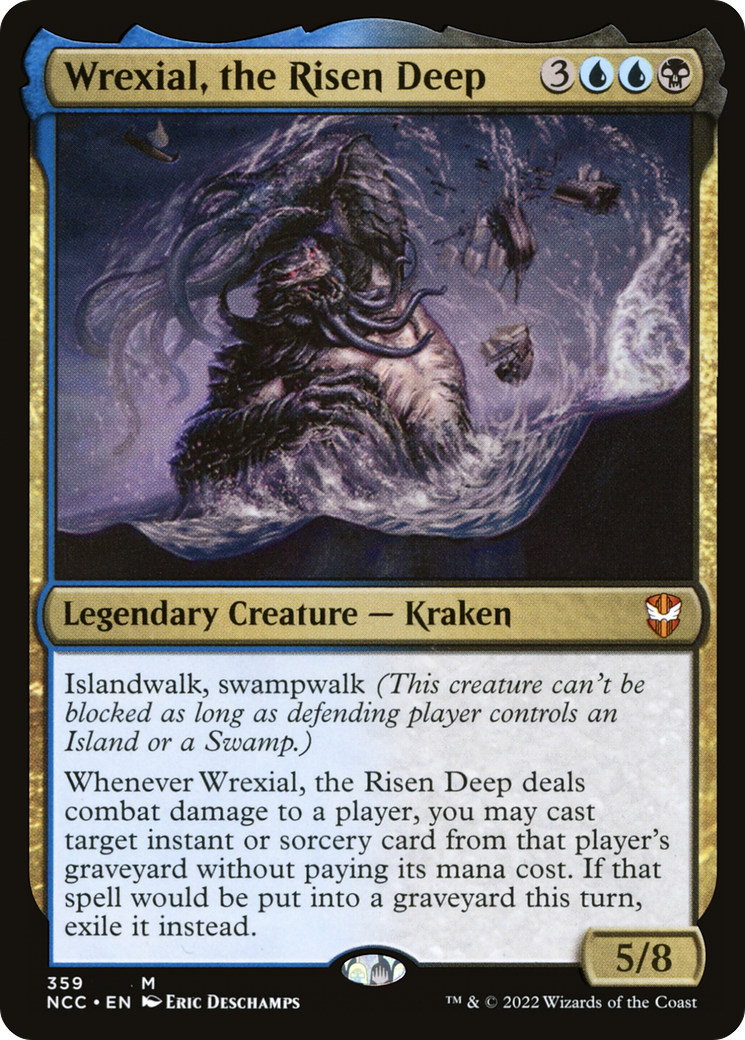
Wrexial, the Risen Deep
Wrexial, the Risen Deep
Legendary Creature — Kraken
5/8
Islandwalk, swampwalk (This creature can't be blocked as long as defending player controls an Island or a Swamp.)
Whenever Wrexial deals combat damage to a player, you may cast target instant or sorcery card from that player's graveyard without paying its mana cost. If that spell would be put into a graveyard, exile it instead.
- If you want to cast the targeted card, you cast it as part of the resolution of Wrexial's triggered ability. Timing restrictions based on the card's type are ignored. Other restrictions are not (such as "Cast [this card] only during your end step").
- If you are unable to cast the targeted card (there are no legal targets for the spell, for example), nothing happens when the ability resolves, and the card remains in its owner's graveyard.
- If you cast a card "without paying its mana cost," you can't pay any alternative costs. On the other hand, if the card has additional costs (such as kicker or multikicker), you may pay those.
- If you cast the targeted card and it would be put into its owner's graveyard from the stack for any reason (either because it resolves or because it's countered), that card is exiled instead.
Instants 8
-
1
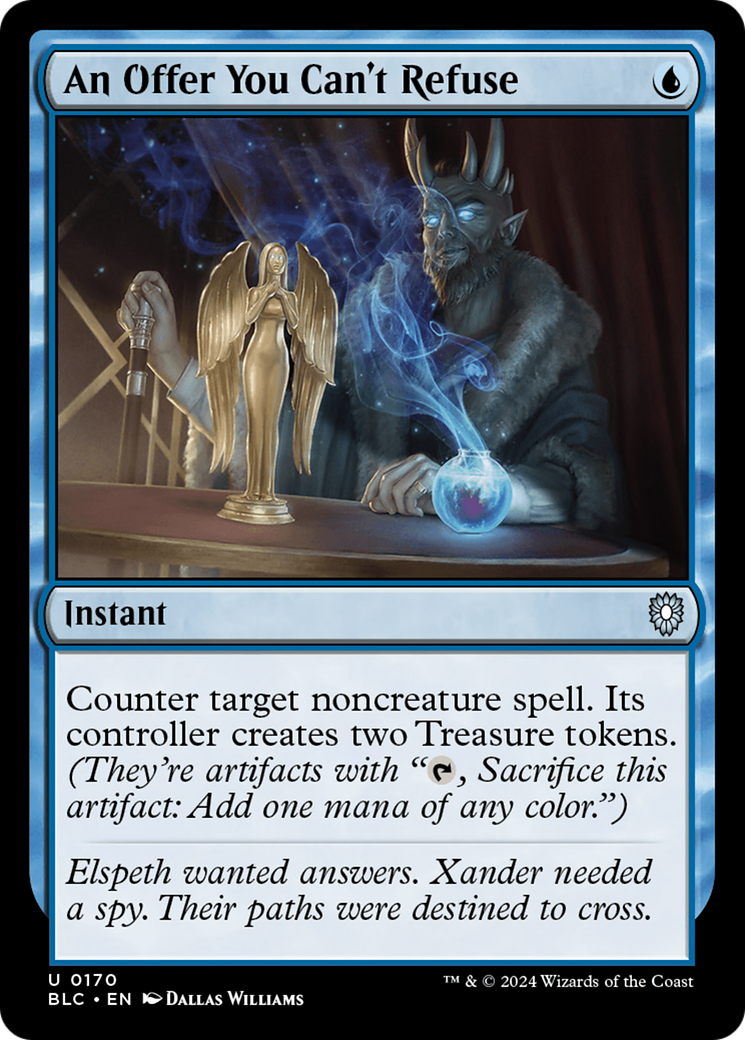
An Offer You Can't Refuse
An Offer You Can't Refuse
Instant
Counter target noncreature spell. Its controller creates two Treasure tokens. (They're artifacts with " , Sacrifice this token: Add one mana of any color.")
- If the target is still legal as it resolves but the spell can't be countered for some reason, its controller will still create two Treasure tokens.
- If the target is no longer legal as An Offer You Can't Refuse resolves, no Treasure tokens are created.
-
1
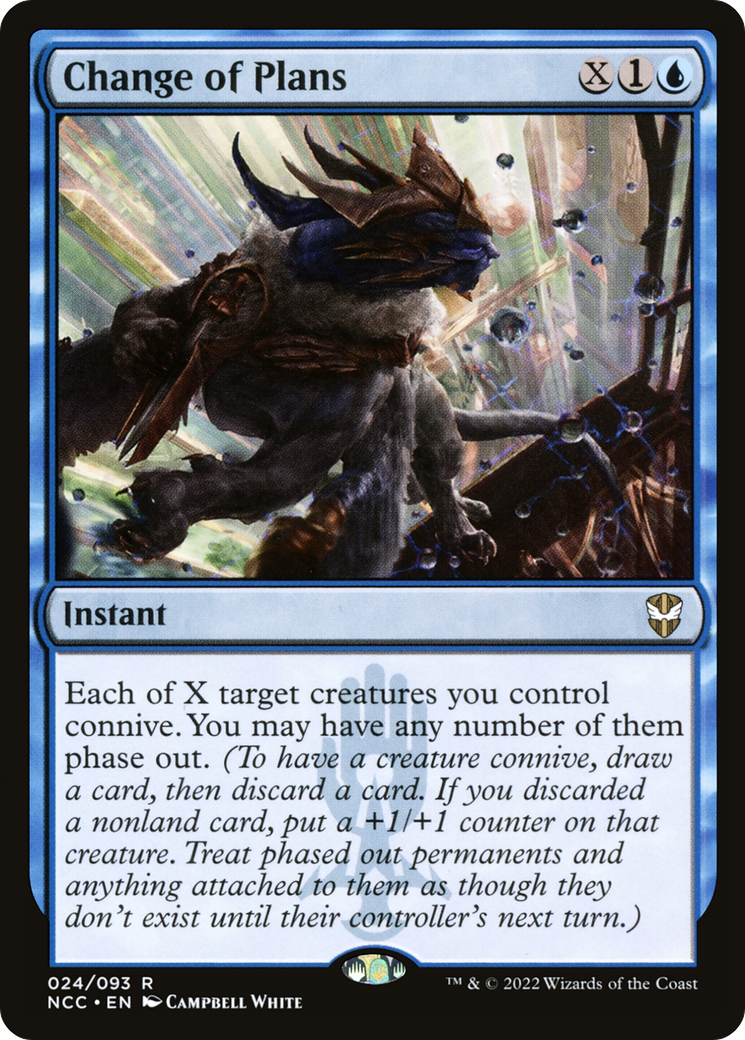
Change of Plans
Change of Plans
Instant
Each of X target creatures you control connive. You may have any number of them phase out. (To have a creature connive, draw a card, then discard a card. If you discarded a nonland card, put a +1/+1 counter on that creature. Treat phased-out permanents and anything attached to them as though they don't exist until their controller's next turn.)
- If multiple creatures are instructed to connive simultaneously, they connive one at a time in the order of their controller's choice.
- You choose which creatures to phase out after all of those creatures have connived.
- Once an ability that causes a creature to connive begins to resolve, no player may take any other actions until it's done. Notably, opponents can't try to remove the conniving creature after you discard a nonland card but before it receives a counter.
- If no card is discarded, most likely because that player's hand is empty and an effect says they can't draw cards, the conniving creature does not receive a +1/+1 counter.
- If a resolving spell or ability instructs a specific creature to connive but that creature has left the battlefield, the creature still connives. If you discard a nonland card this way, you won't put a +1/+1 counter on anything. Abilities that trigger “when [that creature] connives” will trigger.
-
1
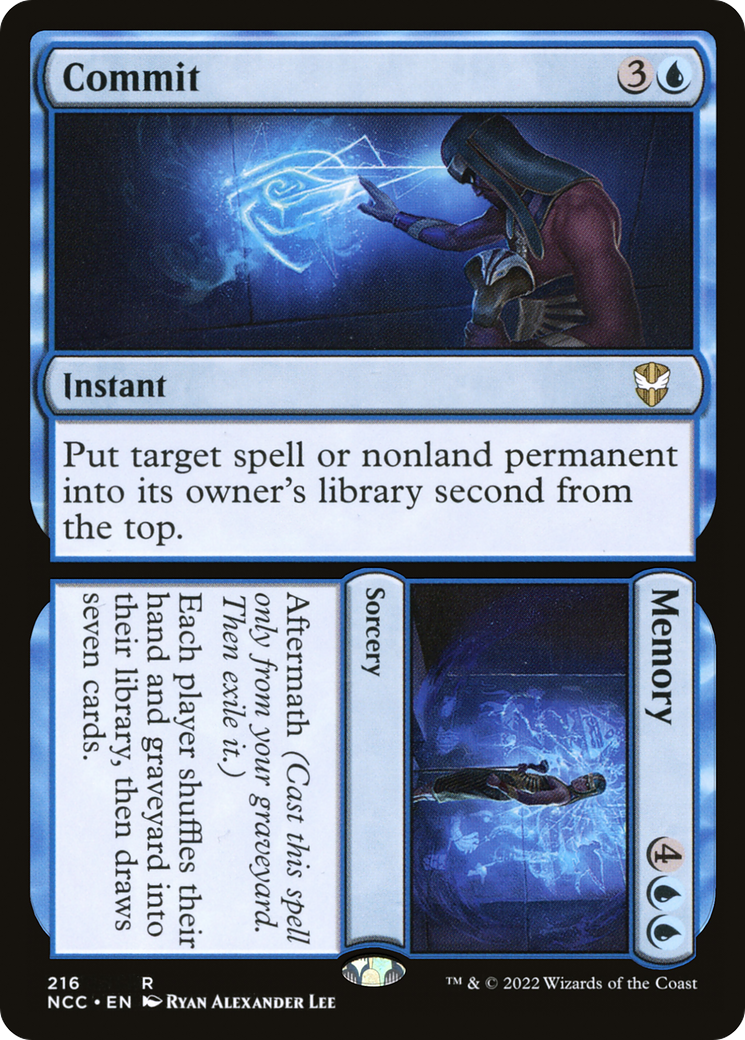
Commit // Memory
//
Commit
Instant
- Once you've started to cast a spell with aftermath from your graveyard, the card is immediately moved to the stack. Opponents can't try to stop the ability by exiling the card with an effect such as that of Crook of Condemnation.
- If a spell is put into its owner's library, it's removed from the stack and thus will not resolve. The spell isn't countered; it just no longer exists. This works against a spell that can't be countered.
- If a copy of a spell or a token is put into its owner's library, it's moved there, then it will cease to exist as a state-based action.
- Split cards with aftermath have a new frame treatment—the half you can cast from your hand is oriented the same as other cards you'd cast from your hand, while the half you can cast from your graveyard is a traditional split card half. This frame treatment is for your convenience and has no rules significance.
- All split cards have two card faces on a single card, and you put a split card onto the stack with only the half you're casting. The characteristics of the half of the card you didn't cast are ignored while the spell is on the stack. For example, if an effect prevents you from casting green spells, you can cast Destined of Destined // Lead, but not Lead.
- Each split card is a single card. For example, if you discard one, you've discarded one card, not two. If an effect counts the number of instant and sorcery cards in your graveyard, Destined // Lead counts once, not twice.
- If the target's owner's library contains no cards, the target spell or permanent will be put into that player's library as the only card.
- While not on the stack, the characteristics of a split card are the combination of its two halves. For example, Destined // Lead is a green and black card, it is both an instant card and a sorcery card, and its mana value is 6. This means that if an effect allows you to cast a card with mana value 2 from your hand, you can't cast Destined. This is a change from the previous rules for split cards.
- If you cast the first half of a split card with aftermath during your turn, you'll have priority immediately after it resolves. You can cast the half with aftermath from your graveyard before any player can take any other action if it's legal for you to do so.
- If another effect allows you to cast a split card with aftermath from any zone other than a graveyard, you can't cast the half with aftermath.
- If another effect allows you to cast a split card with aftermath from a graveyard, you may cast either half. If you cast the half that has aftermath, you'll exile the card if it would leave the stack.
- A spell with aftermath cast from a graveyard will always be exiled afterward, whether it resolves, it's countered, or it leaves the stack in some other way.
- Each split card has two names. If an effect instructs you to choose a card name, you may choose one, but not both.
-
1
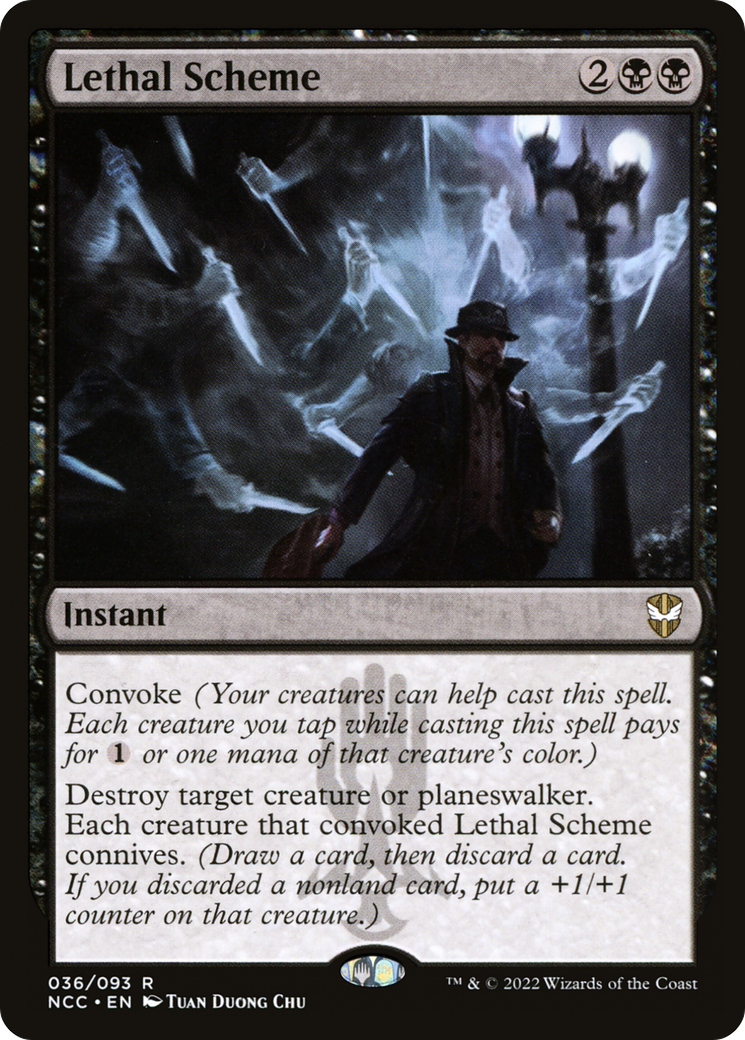
Lethal Scheme
Lethal Scheme
Instant
Convoke (Your creatures can help cast this spell. Each creature you tap while casting this spell pays for or one mana of that creature's color.)
Destroy target creature or planeswalker. Each creature that convoked Lethal Scheme connives. (Draw a card, then discard a card. If you discarded a nonland card, put a +1/+1 counter on that creature.)
- When multiple creatures are instructed to connive simultaneously, they connive one at a time in the order of their controller's choice.
- You can't tap more creatures to convoke Lethal Scheme than it takes to pay for its total cost. This means that normally no more than four creatures can convoke it.
-
1
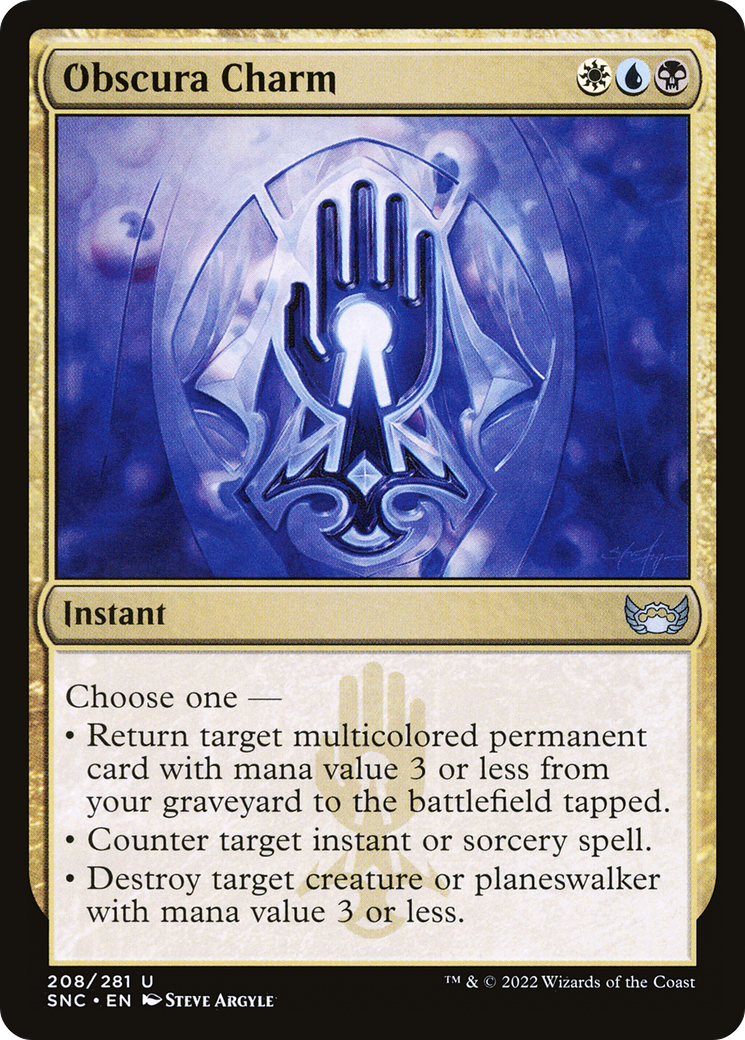
Obscura Charm
Obscura Charm
Instant
Choose one —
- Return target multicolored permanent card with mana value 3 or less from your graveyard to the battlefield tapped.
- Counter target instant or sorcery spell.
- Destroy target creature or planeswalker with mana value 3 or less.
-
1
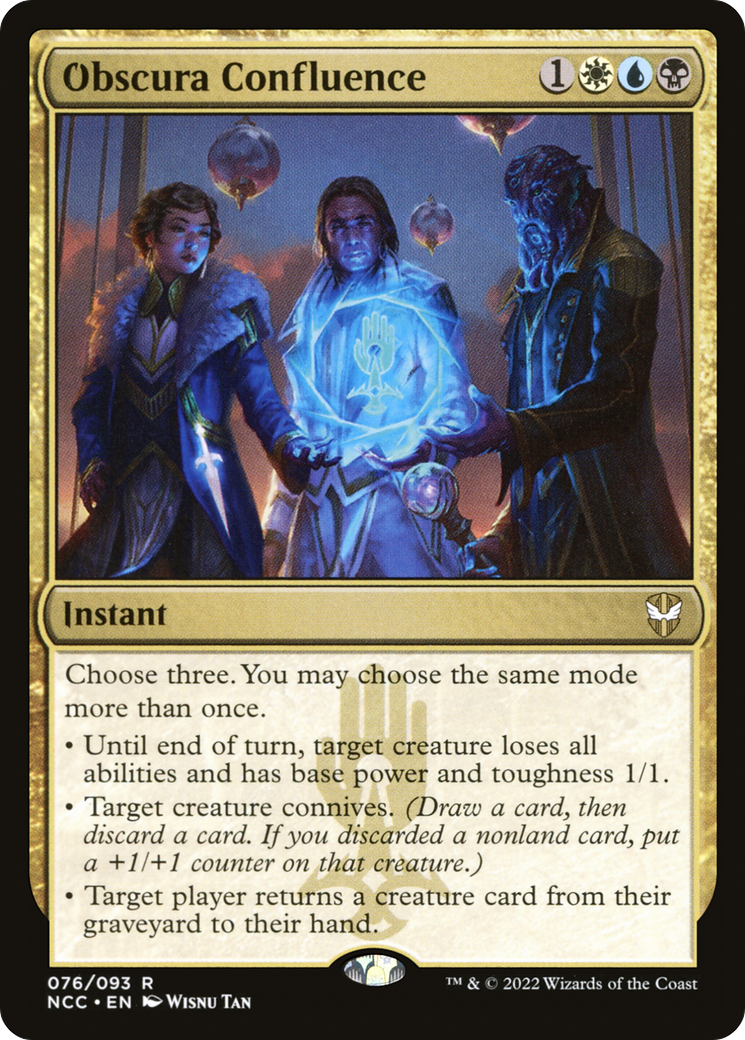
Obscura Confluence
Obscura Confluence
Instant
Choose three. You may choose the same mode more than once.
- Until end of turn, target creature loses all abilities and has base power and toughness 1/1.
- Target creature connives. (Draw a card, then discard a card. If you discarded a nonland card, put a +1/+1 counter on that creature.)
- Target player returns a creature card from their graveyard to their hand.
- Once an ability that causes a creature to connive begins to resolve, no player may take any other actions until it's done. Notably, opponents can't try to remove the conniving creature after you discard a nonland card but before it receives a counter.
- If no card is discarded, most likely because that player's hand is empty and an effect says they can't draw cards, the conniving creature does not receive a +1/+1 counter.
- If a resolving spell or ability instructs a specific creature to connive but that creature has left the battlefield, the creature still connives. If you discard a nonland card this way, you won't put a +1/+1 counter on anything. Abilities that trigger “when [that creature] connives” will trigger.
-
1
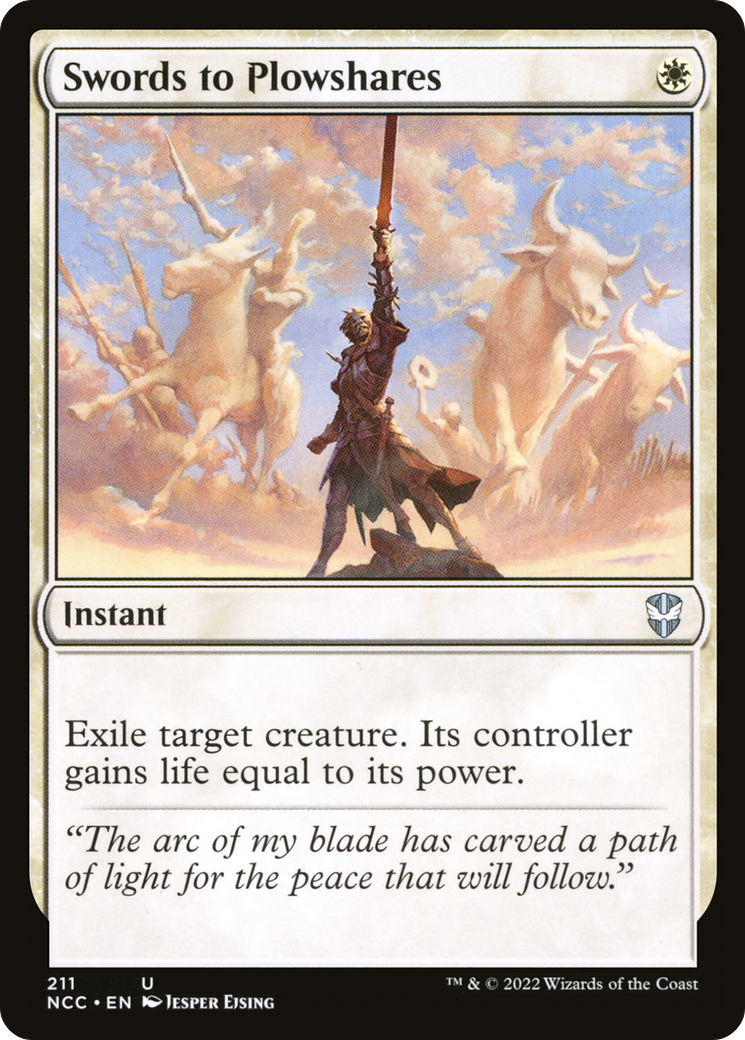
Swords to Plowshares
Swords to Plowshares
Instant
Exile target creature. Its controller gains life equal to its power.
- Use the power of the creature from when it was last on the battlefield to determine how much life is gained.
-
1
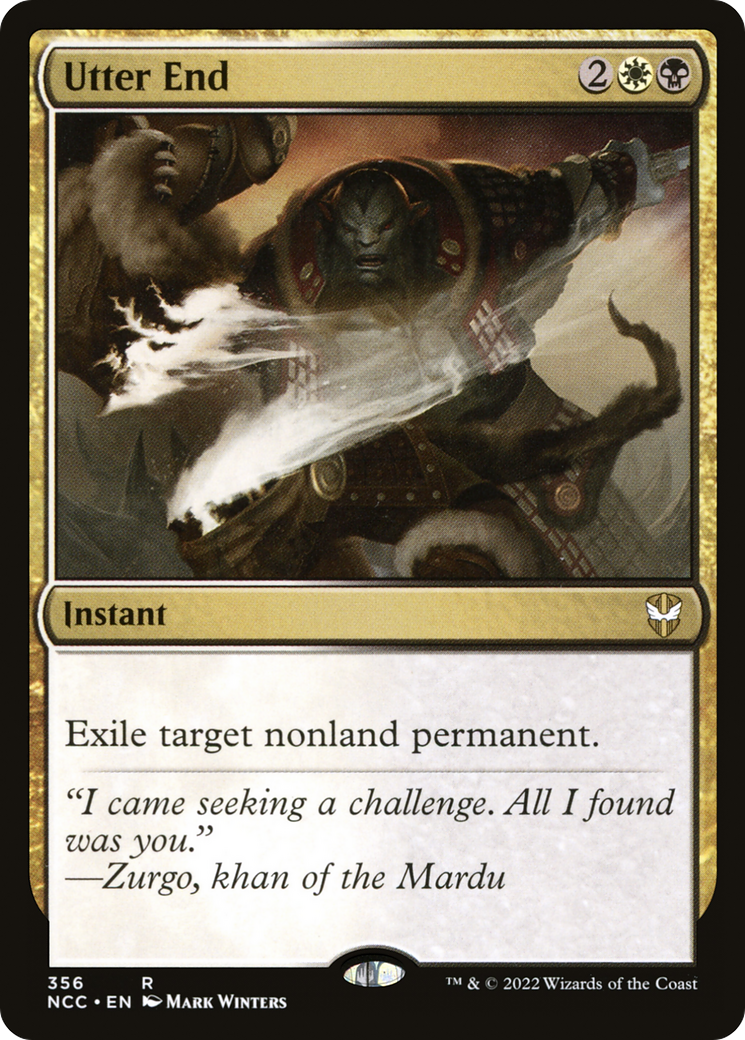
Utter End
Utter End
Instant
Exile target nonland permanent.
Sorceries 8
-
1
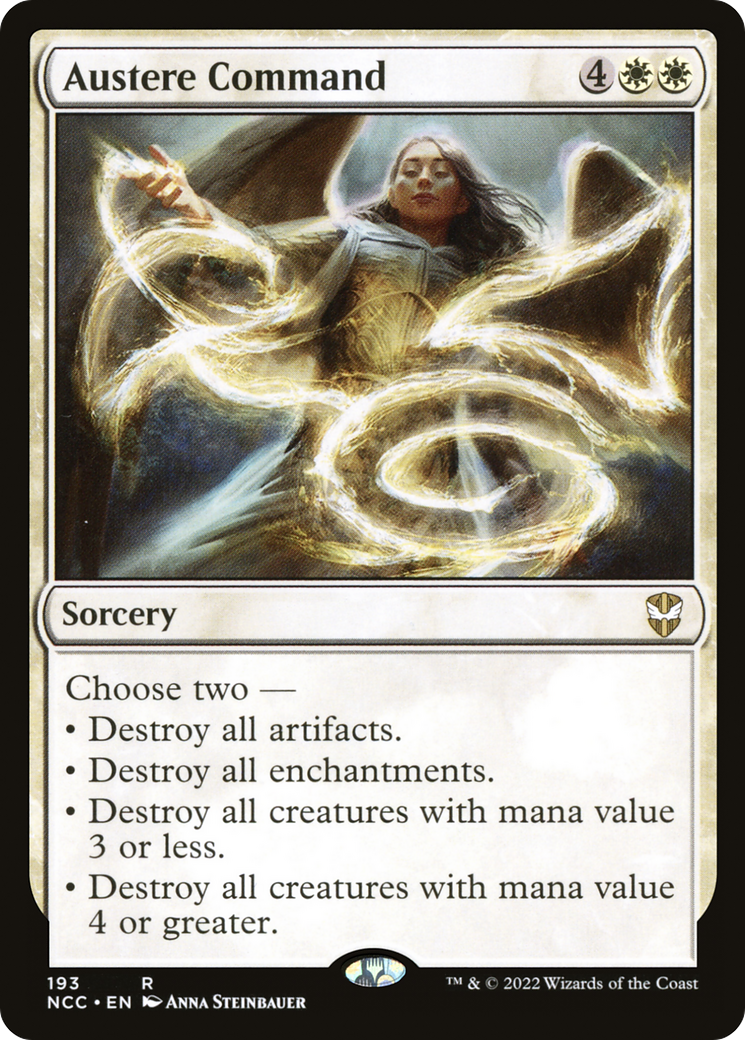
Austere Command
Austere Command
Sorcery
Choose two —
- Destroy all artifacts.
- Destroy all enchantments.
- Destroy all creatures with mana value 3 or less.
- Destroy all creatures with mana value 4 or greater.
- Each of the chosen modes happens sequentially. If a permanent has an ability that triggers whenever it or another permanent is destroyed, it will see permanents destroyed at the same time as it or before it, but not permanents destroyed by later modes.
- If a card is exiled "until" another permanent leaves the battlefield, the exiled card returns to the battlefield immediately after that permanent leaves the battlefield during Austere Command's resolution, and it may be destroyed by a later mode.
- If the first and last modes are chosen, an artifact creature with mana value 4 or greater will have to be regenerated twice to survive. This is because the modes happen sequentially, and the regeneration "shield" is used up by the first one. The same is true with any other combination of modes that covers one permanent twice.
-
1
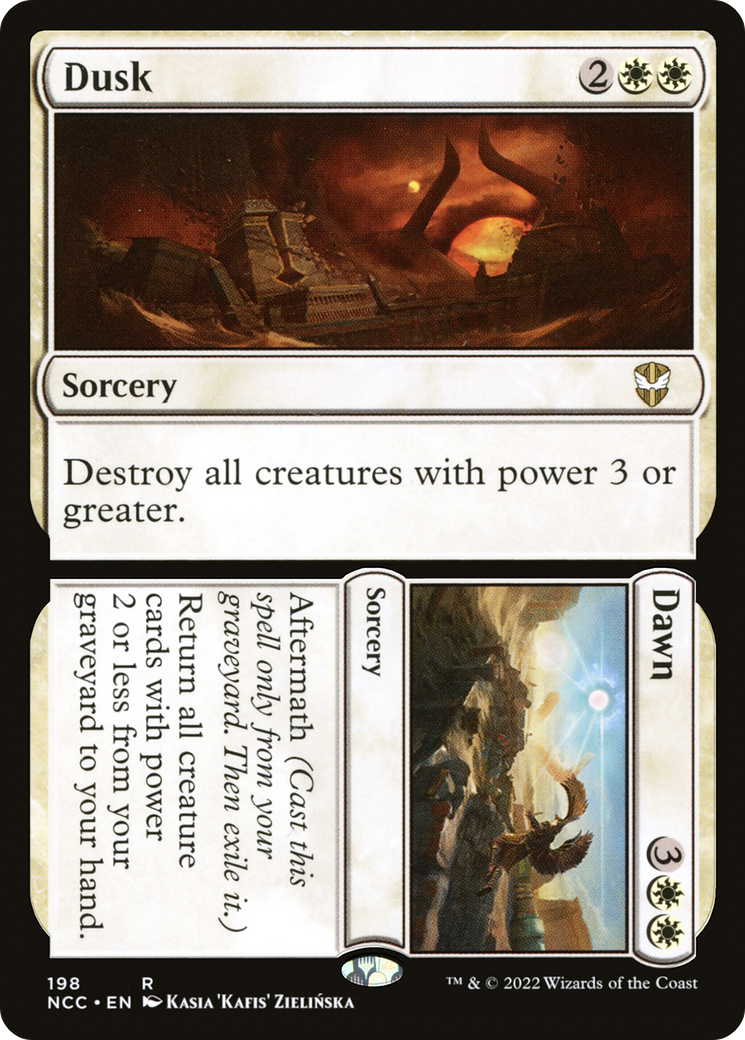
Dusk // Dawn
//
Dusk
Sorcery
- Once you've started to cast a spell with aftermath from your graveyard, the card is immediately moved to the stack. Opponents can't try to stop the ability by exiling the card with an effect such as that of Crook of Condemnation.
- All split cards have two card faces on a single card, and you put a split card onto the stack with only the half you're casting. The characteristics of the half of the card you didn't cast are ignored while the spell is on the stack. For example, if an effect prevents you from casting green spells, you can cast Destined of Destined // Lead, but not Lead.
- Each split card is a single card. For example, if you discard one, you've discarded one card, not two. If an effect counts the number of instant and sorcery cards in your graveyard, Destined // Lead counts once, not twice.
- Each split card has two names. If an effect instructs you to choose a card name, you may choose one, but not both.
- While not on the stack, the characteristics of a split card are the combination of its two halves. For example, Destined // Lead is a green and black card, it is both an instant card and a sorcery card, and its mana value is 6. This means that if an effect allows you to cast a card with mana value 2 from your hand, you can't cast Destined. This is a change from the previous rules for split cards.
- Split cards with aftermath have a new frame treatment—the half you can cast from your hand is oriented the same as other cards you'd cast from your hand, while the half you can cast from your graveyard is a traditional split card half. This frame treatment is for your convenience and has no rules significance.
- If another effect allows you to cast a split card with aftermath from any zone other than a graveyard, you can't cast the half with aftermath.
- If another effect allows you to cast a split card with aftermath from a graveyard, you may cast either half. If you cast the half that has aftermath, you'll exile the card if it would leave the stack.
- A spell with aftermath cast from a graveyard will always be exiled afterward, whether it resolves, it's countered, or it leaves the stack in some other way.
- If you cast the first half of a split card with aftermath during your turn, you'll have priority immediately after it resolves. You can cast the half with aftermath from your graveyard before any player can take any other action if it's legal for you to do so.
-
1
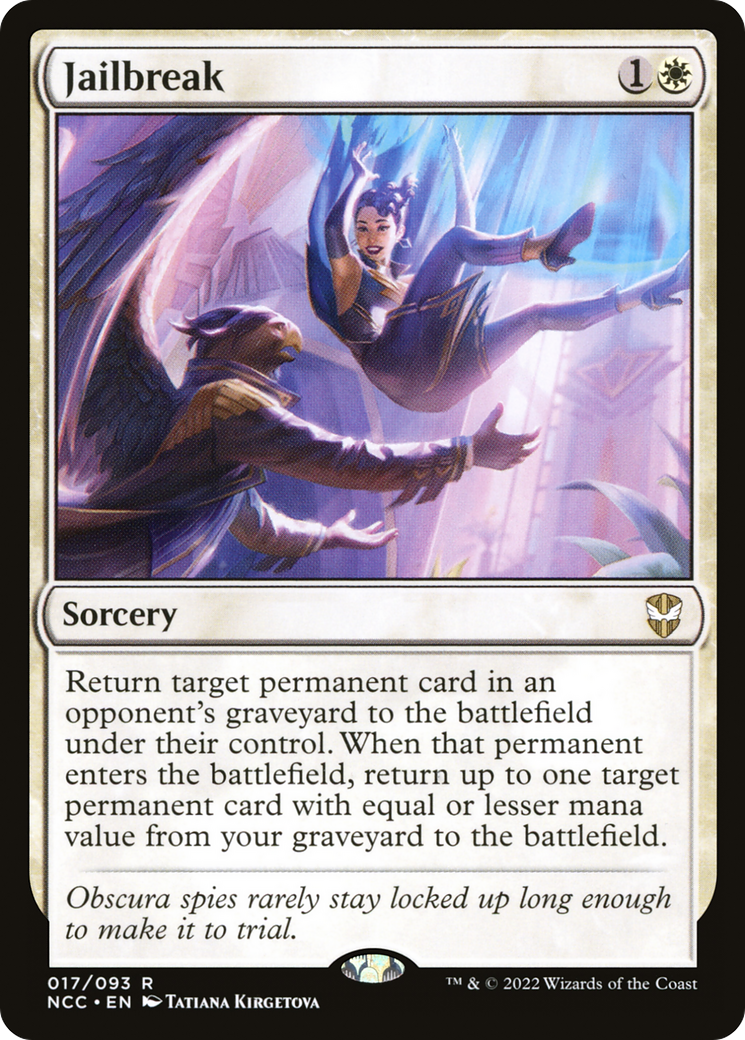
Jailbreak
Jailbreak
Sorcery
Return target permanent card in an opponent's graveyard to the battlefield under their control. When that permanent enters, return up to one target permanent card with equal or lesser mana value from your graveyard to the battlefield.
- You don't choose a target from your own graveyard until after the permanent card from your opponent's graveyard has entered the battlefield. If that card doesn't enter the battlefield for some reason, you will not be able to target and return a card from your own graveyard.
-
1
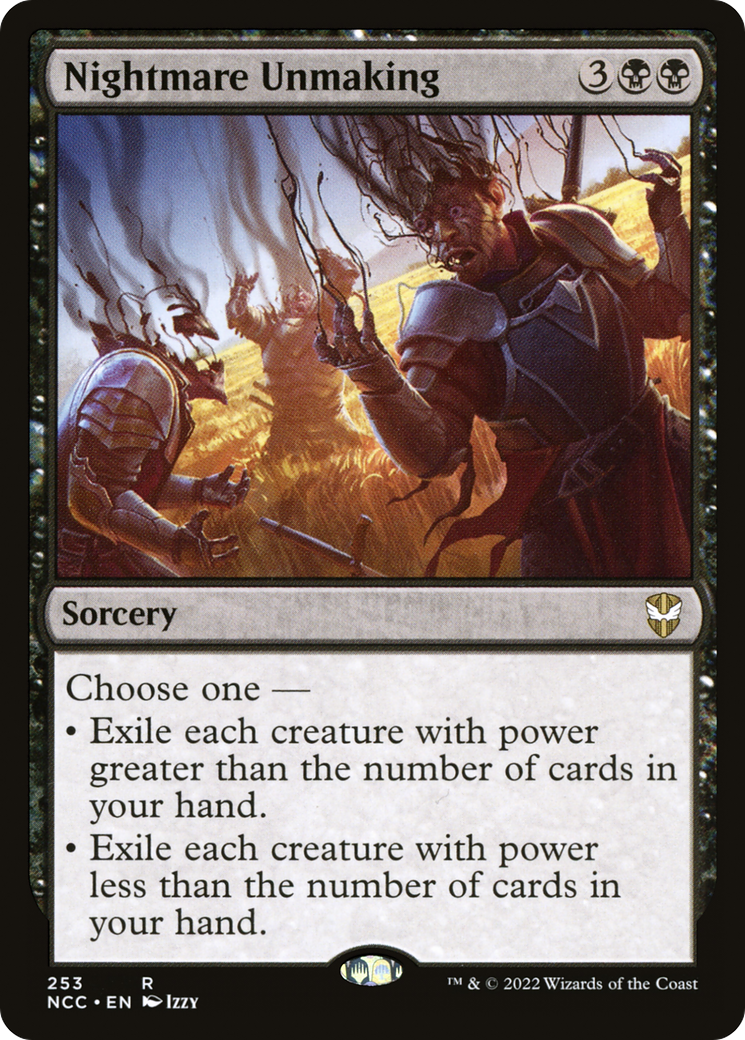
Nightmare Unmaking
Nightmare Unmaking
Sorcery
Choose one —
- Exile each creature with power greater than the number of cards in your hand.
- Exile each creature with power less than the number of cards in your hand.
- Because Nightmare Unmaking is on the stack while it's resolving, it won't be counted among the cards in your hand.
- The power of creatures and the number of cards in your hand are checked only as Nightmare Unmaking resolves. Players may respond to the spell knowing the chosen mode to try to save or doom a creature.
-
1
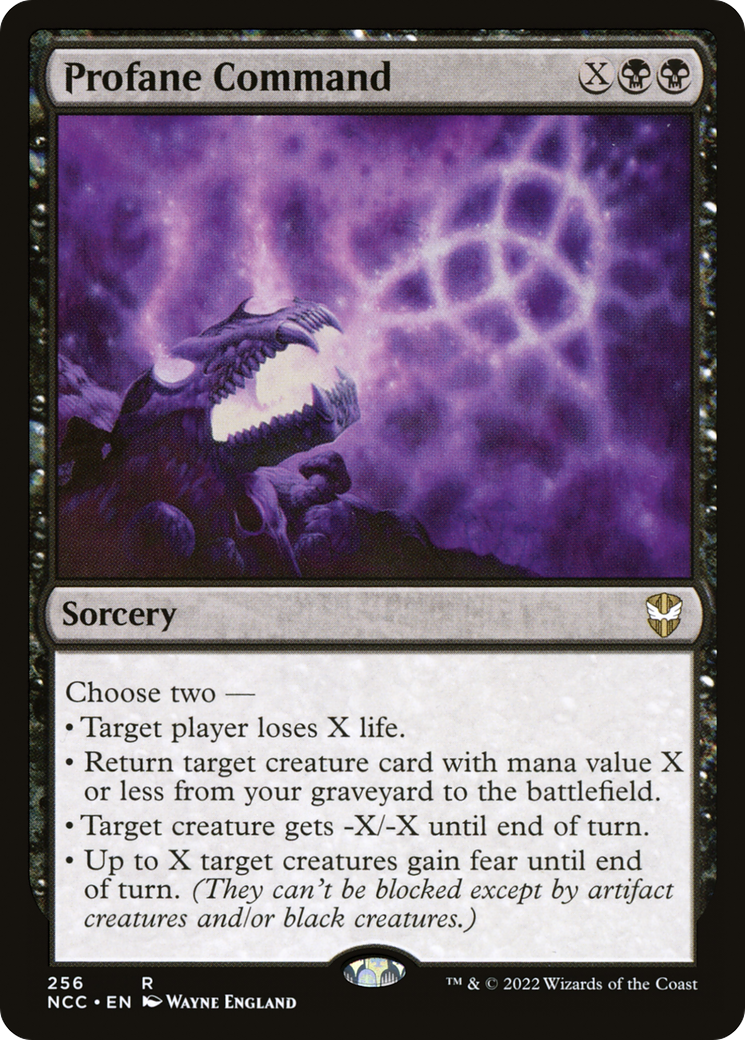
Profane Command
Profane Command
Sorcery
Choose two —
- Target player loses X life.
- Return target creature card with mana value X or less from your graveyard to the battlefield.
- Target creature gets -X/-X until end of turn.
- Up to X target creatures gain fear until end of turn. (They can't be blocked except by artifact creatures and/or black creatures.)
- The value chosen for X applies to each X in the spell's effect. You pay only once.
-
1
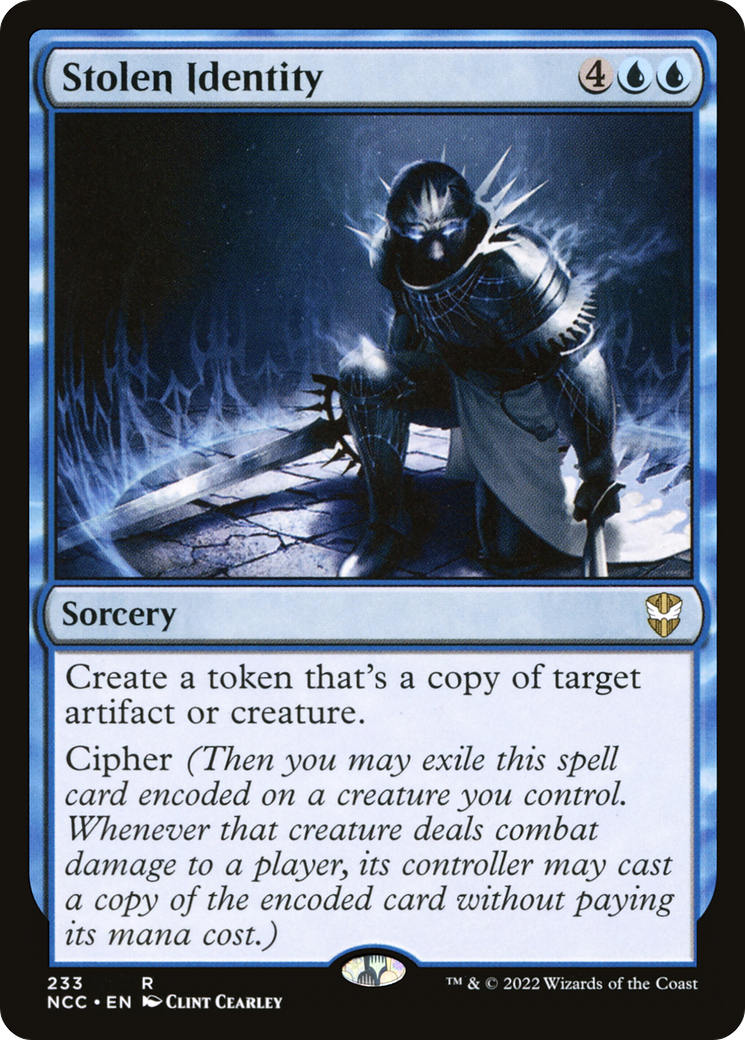
Stolen Identity
Stolen Identity
Sorcery
Create a token that's a copy of target artifact or creature.
Cipher (Then you may exile this spell card encoded on a creature you control. Whenever that creature deals combat damage to a player, its controller may cast a copy of the encoded card without paying its mana cost.)
- If a creature with an encoded card deals combat damage to more than one player simultaneously (perhaps because some of the combat damage was redirected), the triggered ability will trigger once for each player it deals combat damage to. Each ability will create a copy of the exiled card and allow you to cast it.
- If you want to encode the card with cipher onto a noncreature permanent such as a Keyrune that can turn into a creature, that permanent has to be a creature before the spell with cipher starts resolving. You can choose only a creature to encode the card onto.
- The copy of the card with cipher is created in and cast from exile.
- You cast the copy of the card with cipher during the resolution of the triggered ability. Ignore timing restrictions based on the card's type.
- If you choose not to cast the copy, or you can't cast it (perhaps because there are no legal targets available), the copy will cease to exist the next time state-based actions are performed. You won't get a chance to cast the copy at a later time.
- The exiled card with cipher grants a triggered ability to the creature it's encoded on. If that creature loses that ability and subsequently deals combat damage to a player, the triggered ability won't trigger. However, the exiled card will continue to be encoded on that creature.
- If another player gains control of the creature, that player will control the triggered ability. That player will create a copy of the encoded card and may cast it.
- The spell with cipher is encoded on the creature as part of that spell's resolution, just after the spell's other effects. That card goes directly from the stack to exile. It never goes to the graveyard.
- You choose the creature as the spell resolves. The cipher ability doesn't target that creature, although the spell with cipher may target that creature (or a different creature) because of its other abilities.
- If the spell with cipher doesn't resolve, none of its effects will happen, including cipher. The card will go to its owner's graveyard and won't be encoded on a creature.
- If the creature leaves the battlefield, the exiled card will no longer be encoded on any creature. It will stay exiled.
- The token copies exactly what was printed on the original artifact or creature and nothing else (unless that permanent is copying something else or is a token; see below). It doesn't copy whether it is tapped or untapped, whether it has any counters on it or Auras and Equipment attached to it, or any non-copy effects that have changed its power, toughness, types, color, or so on.
- If the copied permanent has in its mana cost, X is considered to be zero.
- If the copied permanent is copying something else (for example, if the copied creature is a Clone), then the token enters as whatever that creature copied.
- If the copied permanent is a token, the token that's created copies the original characteristics of that token as stated by the effect that put the token onto the battlefield.
- Any "enters" abilities of the copied permanent will trigger when the token enters the battlefield. Any "as [this permanent] enters" or "[this permanent] enters with" abilities of the chosen permanent will also work.
- If the token you create is a copy of a creature, you can exile Stolen Identity encoded on that token.
-
1
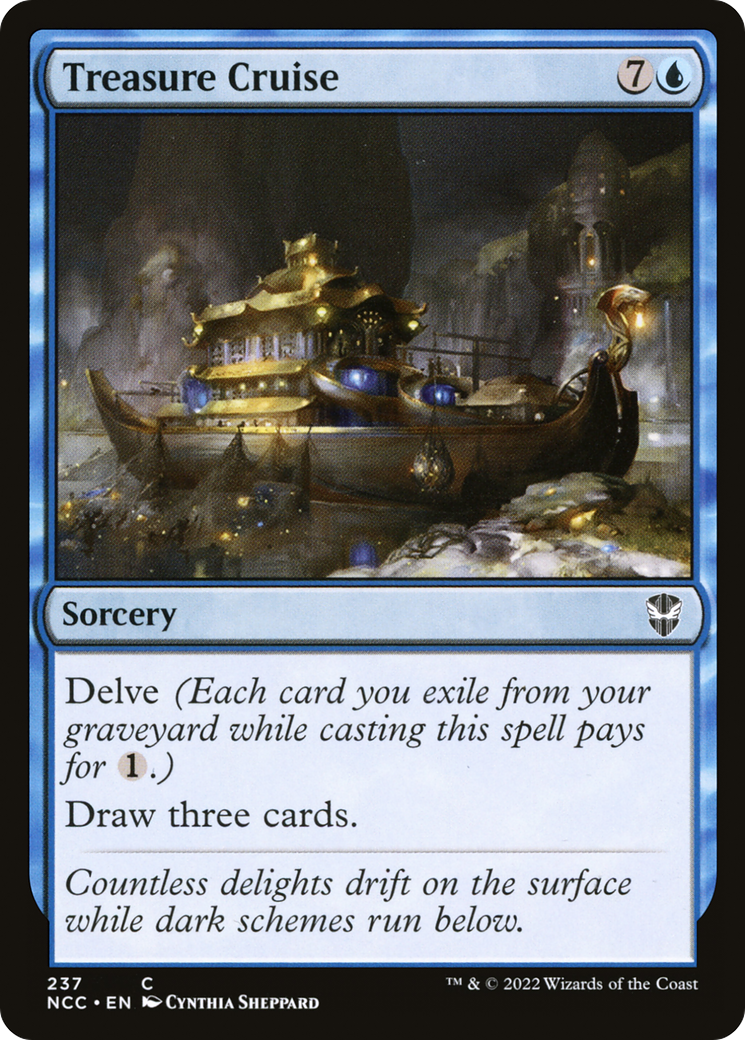
Treasure Cruise
Treasure Cruise
Sorcery
Delve (Each card you exile from your graveyard while casting this spell pays for .)
Draw three cards.
- Delve doesn't change a spell's mana cost or mana value. For example, Treasure Cruise's mana value is 8 even if you exiled three cards to cast it.
- You can exile cards to pay only for generic mana, and you can't exile more cards than the generic mana requirement of a spell with delve. For example, you can't exile more than seven cards from your graveyard to cast Treasure Cruise unless an effect has increased its cost.
- Because delve isn't an alternative cost, it can be used in conjunction with alternative costs, such as flashback. It can also be used to pay for additional costs that include generic mana.
-
1
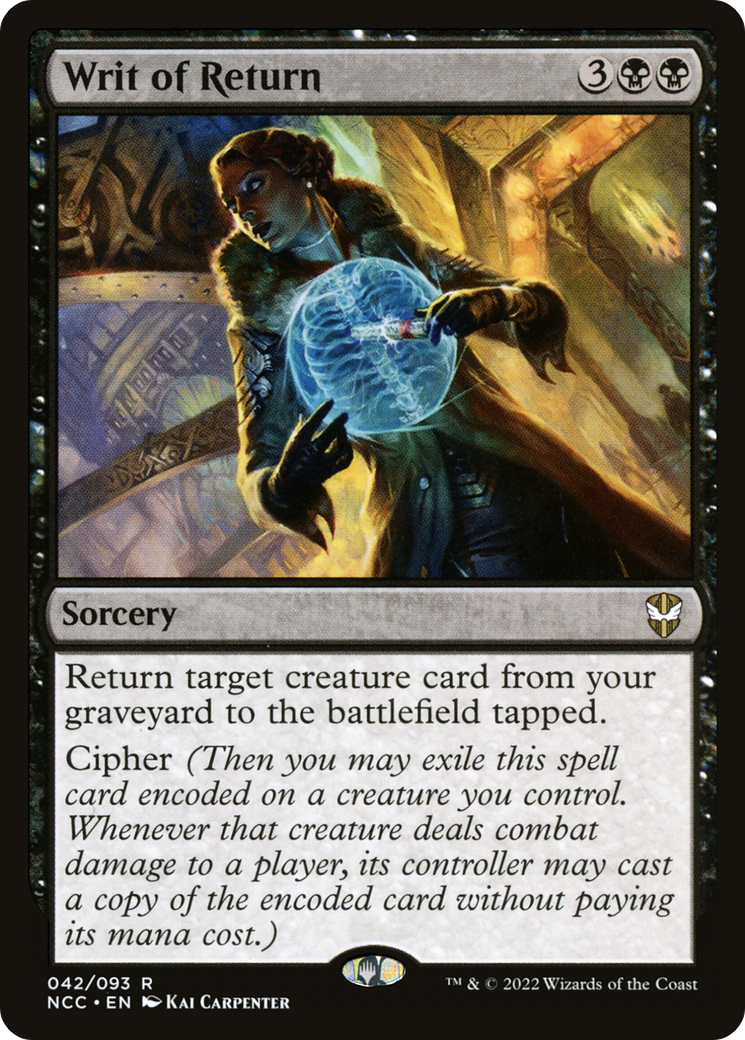
Writ of Return
Writ of Return
Sorcery
Return target creature card from your graveyard to the battlefield tapped.
Cipher (Then you may exile this spell card encoded on a creature you control. Whenever that creature deals combat damage to a player, its controller may cast a copy of the encoded card without paying its mana cost.)
- The spell with cipher is encoded on the creature as part of that spell's resolution, just after the spell's other effects. That card goes directly from the stack to exile. It never goes to the graveyard.
- You choose the creature as the spell resolves. The cipher ability doesn't target that creature.
- If the spell with cipher doesn't resolve, none of its effects will happen, including cipher. The card will go to its owner's graveyard and won't be encoded on a creature.
- If the creature leaves the battlefield, the exiled card will no longer be encoded on any creature. It will stay exiled.
- You can choose only a creature to encode the card onto.
- The copy of the card with cipher is created in and cast from exile.
- You cast the copy of the card with cipher during the resolution of the triggered ability. Ignore timing restrictions based on the card's type.
- If you choose not to cast the copy, or you can't cast it (perhaps because there are no legal targets available), the copy will cease to exist the next time state-based actions are performed. You won't get a chance to cast the copy at a later time.
- The exiled card with cipher grants a triggered ability to the creature it's encoded on. If that creature loses that ability and subsequently deals combat damage to a player, the triggered ability won't trigger. However, the exiled card will continue to be encoded on that creature.
- If another player gains control of the creature, that player will control the triggered ability. That player will create a copy of the encoded card and may cast it.
- If a creature with an encoded card deals combat damage to more than one player simultaneously (perhaps because some of the combat damage was redirected), the triggered ability will trigger once for each player it deals combat damage to. Each ability will create a copy of the exiled card and allow you to cast it.
Artifacts 14
-
1
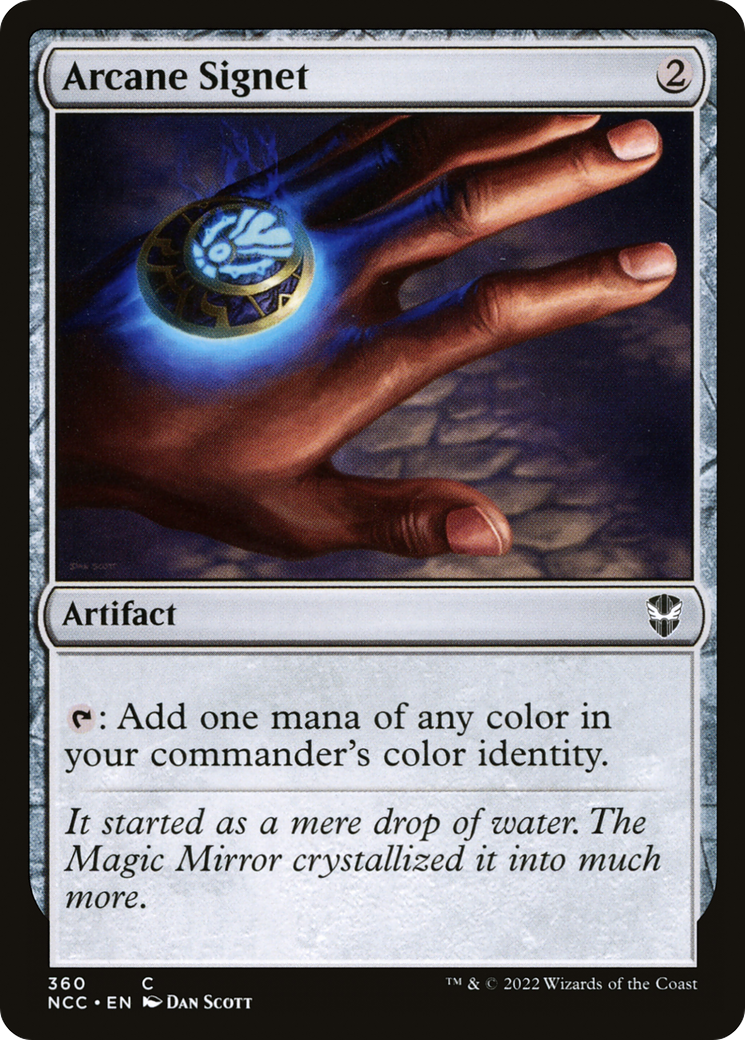
Arcane Signet
Arcane Signet
Artifact
: Add one mana of any color in your commander's color identity.
- If your commander is a card that has no colors in its color identity, Arcane Signet's ability produces no mana. It doesn't produce .
- If you have two commanders, the ability adds one mana of any color in their combined color identities.
- If you don't have a commander, Arcane Signet's ability produces no mana.
-
1
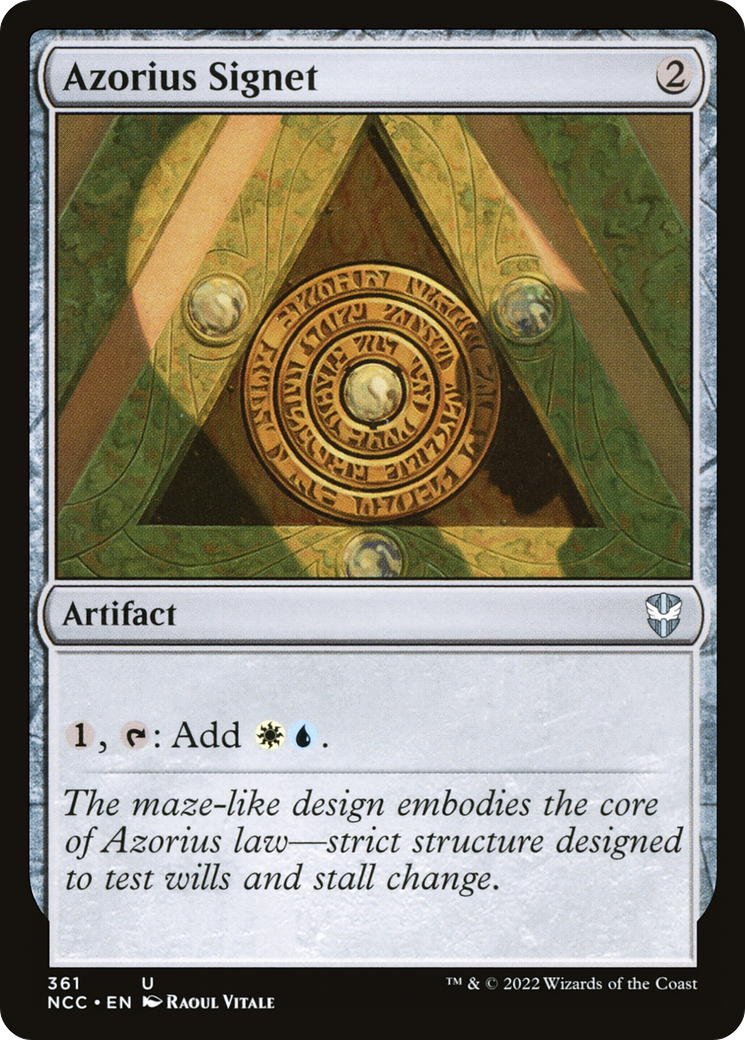
Azorius Signet
Azorius Signet
Artifact
, : Add .
-
1
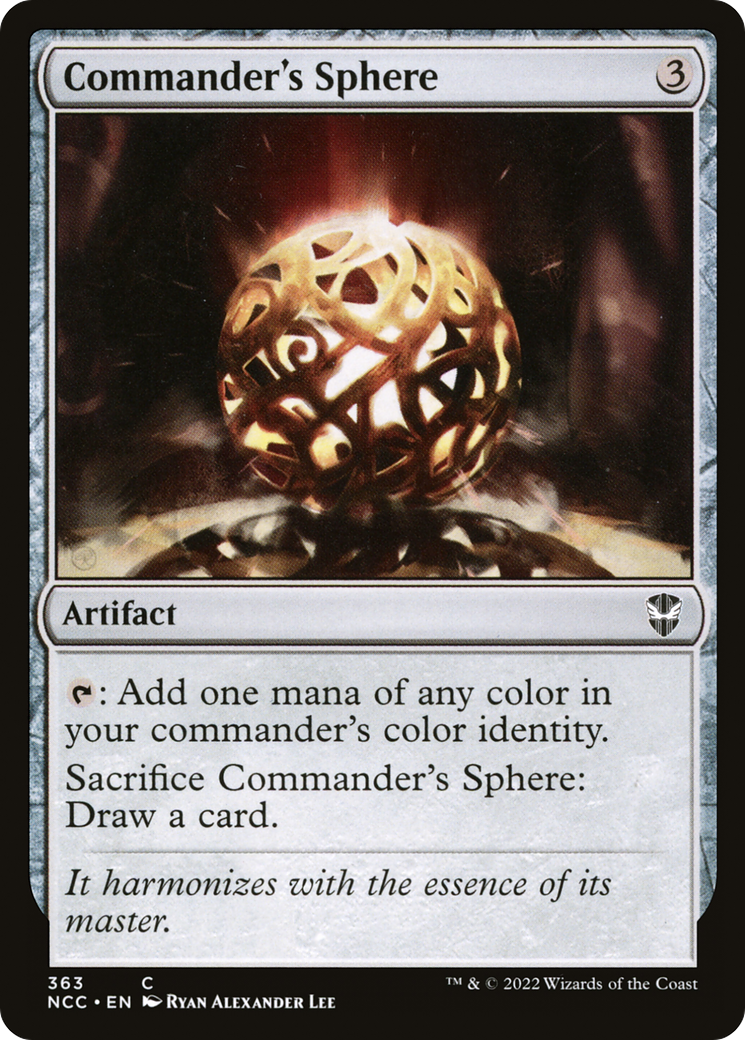
Commander's Sphere
Commander's Sphere
Artifact
: Add one mana of any color in your commander's color identity.
Sacrifice this artifact: Draw a card.
- If your commander is a card that has no colors in its color identity, Commander's Sphere's first ability produces no mana. It doesn't produce .
- If you don't have a commander, Commander's Sphere's first ability produces no mana.
- If you have two commanders, the ability adds one mana of any color in their combined color identities.
-
1
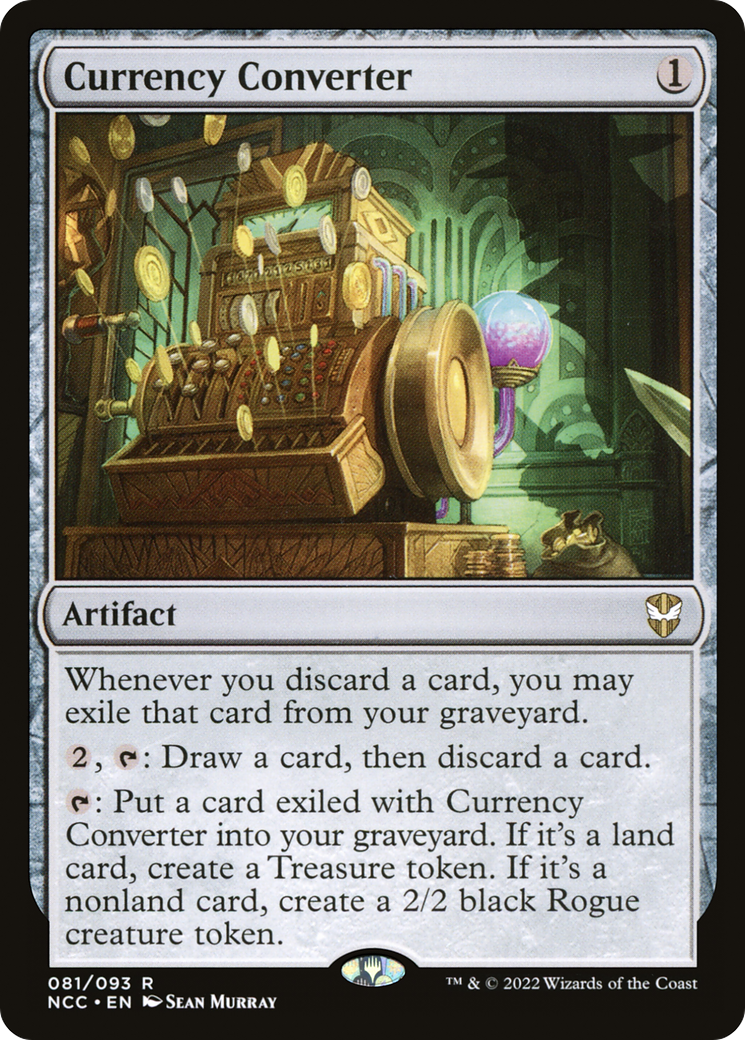
Currency Converter
Currency Converter
Artifact
Whenever you discard a card, you may exile that card from your graveyard.
, : Draw a card, then discard a card.
: Put a card exiled with this artifact into your graveyard. If it's a land card, create a Treasure token. If it's a nonland card, create a 2/2 black Rogue creature token.
-
1
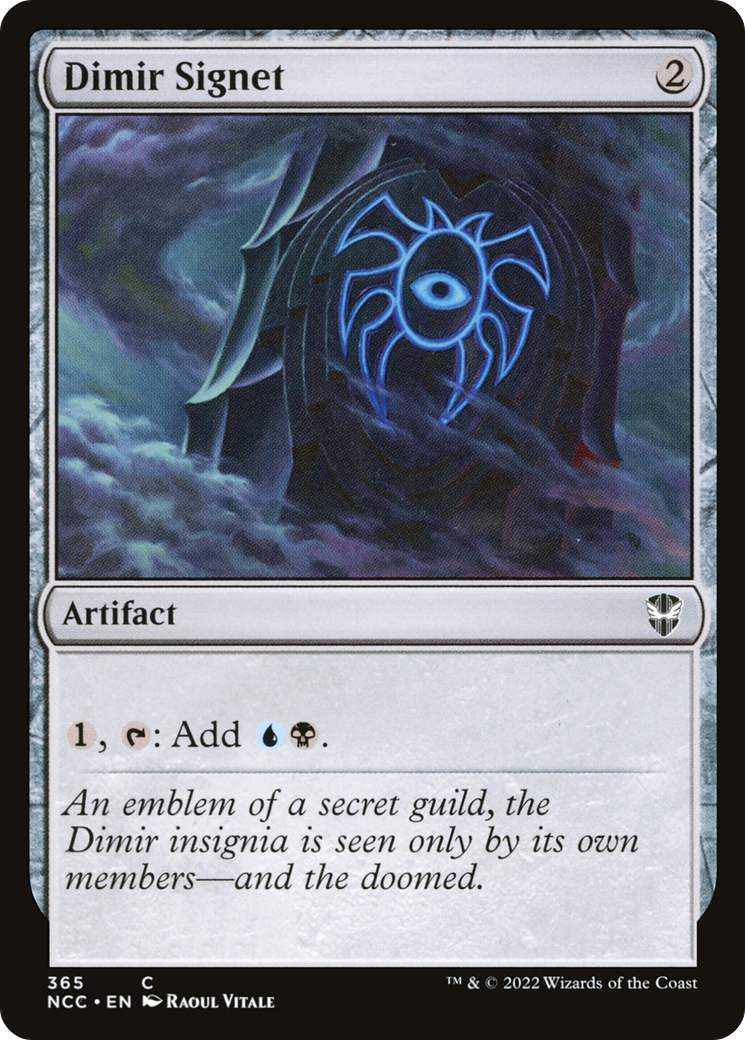
Dimir Signet
Dimir Signet
Artifact
, : Add .
-
1
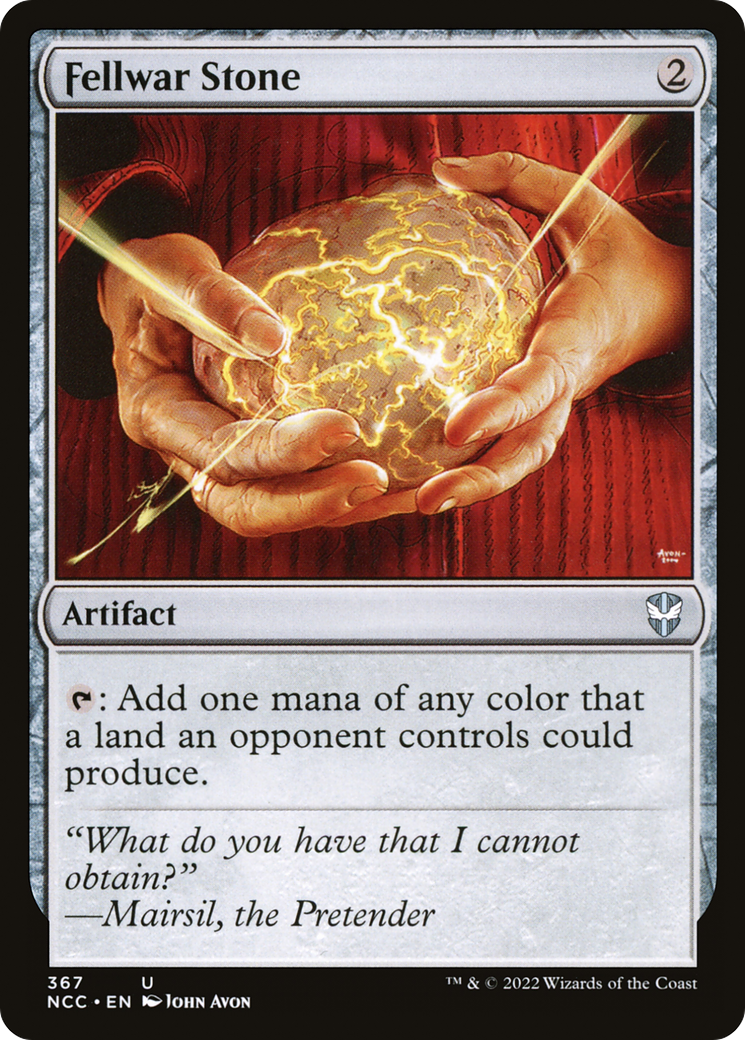
Fellwar Stone
Fellwar Stone
Artifact
: Add one mana of any color that a land an opponent controls could produce.
- When determining what colors of mana your opponents' lands could produce, take into account any applicable replacement effects that would apply to those lands' mana abilities (such as Contamination's effect, for example). If there is more than one, consider them in any possible order.
- Fellwar Stone doesn't care about any restrictions or riders your opponents' lands (such as Ancient Ziggurat or Hall of the Bandit Lord) put on the mana they produce. It just cares about colors of mana.
- The colors of mana are white, blue, black, red, and green. Fellwar Stone can't be tapped for colorless mana, even if a land an opponent controls could produce colorless mana.
- Fellwar Stone checks the effects of all mana-producing abilities of lands your opponents control, but it doesn't check their costs. For example, Vivid Crag has the ability " , Remove a charge counter from Vivid Crag: Add one mana of any color." If an opponent controls Vivid Crag and you control Fellwar Stone, you can tap Fellwar Stone for any color of mana. It doesn't matter whether Vivid Crag has a charge counter on it, and it doesn't matter whether it's untapped.
- This works even if the opponent's lands are tapped. It only checks what kinds of mana can be produced, not if the abilities that produce them are usable right now.
- It only produces one mana even if the land can produce more than one.
- The ability can be activated if the opponent has no lands that produce mana, but the effect will not be able to generate any mana.
-
1
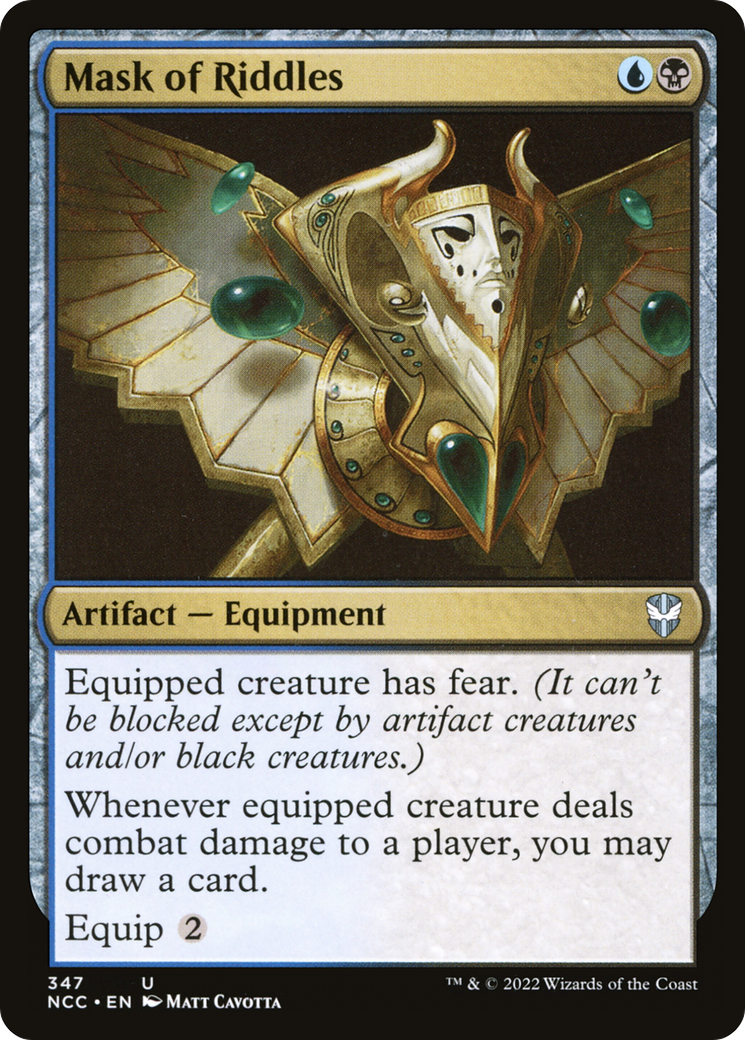
Mask of Riddles
Mask of Riddles
Artifact — Equipment
Equipped creature has fear. (It can't be blocked except by artifact creatures and/or black creatures.)
Whenever equipped creature deals combat damage to a player, you may draw a card.
Equip
- If a Mask of Riddles you control somehow winds up equipping a creature you don't control, Mask of Riddles's triggered ability will still trigger whenever that creature deals combat damage to a player (even if that player is you). You will control that ability, so you may draw a card.
-
1
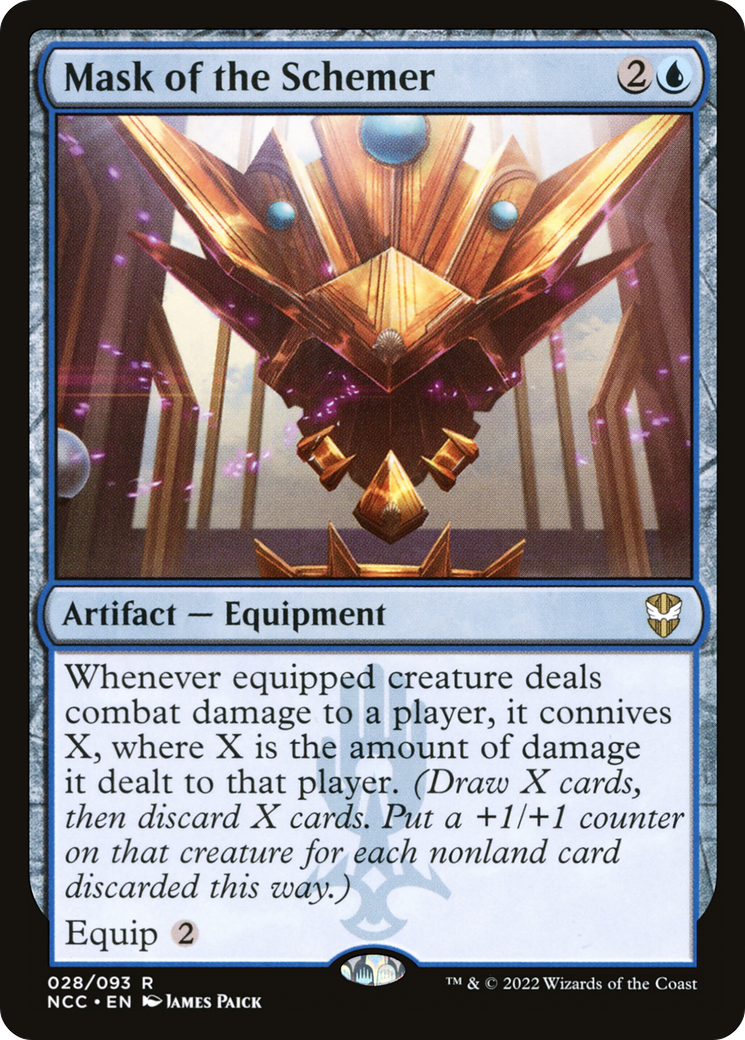
Mask of the Schemer
Mask of the Schemer
Artifact — Equipment
Whenever equipped creature deals combat damage to a player, it connives X, where X is the amount of damage it dealt to that player. (Draw X cards, then discard X cards. Put a +1/+1 counter on that creature for each nonland card discarded this way.)
Equip
- Once an ability that causes a creature to connive begins to resolve, no player may take any other actions until it's done. Notably, opponents can't try to remove the conniving creature after you discard a nonland card but before it receives a counter.
- If no card is discarded, most likely because that player's hand is empty and an effect says they can't draw cards, the conniving creature does not receive a +1/+1 counter.
- If a resolving spell or ability instructs a specific creature to connive but that creature has left the battlefield, the creature still connives. If you discard a nonland card this way, you won't put a +1/+1 counter on anything. Abilities that trigger “when [that creature] connives” will trigger.
- Connive X is a variant of connive. If a creature connives X, its controller will draw X cards, discard X cards, then then put a number of +1/+1 counters on the conniving permanent equal to the number of nonland cards discarded this way.
-
1
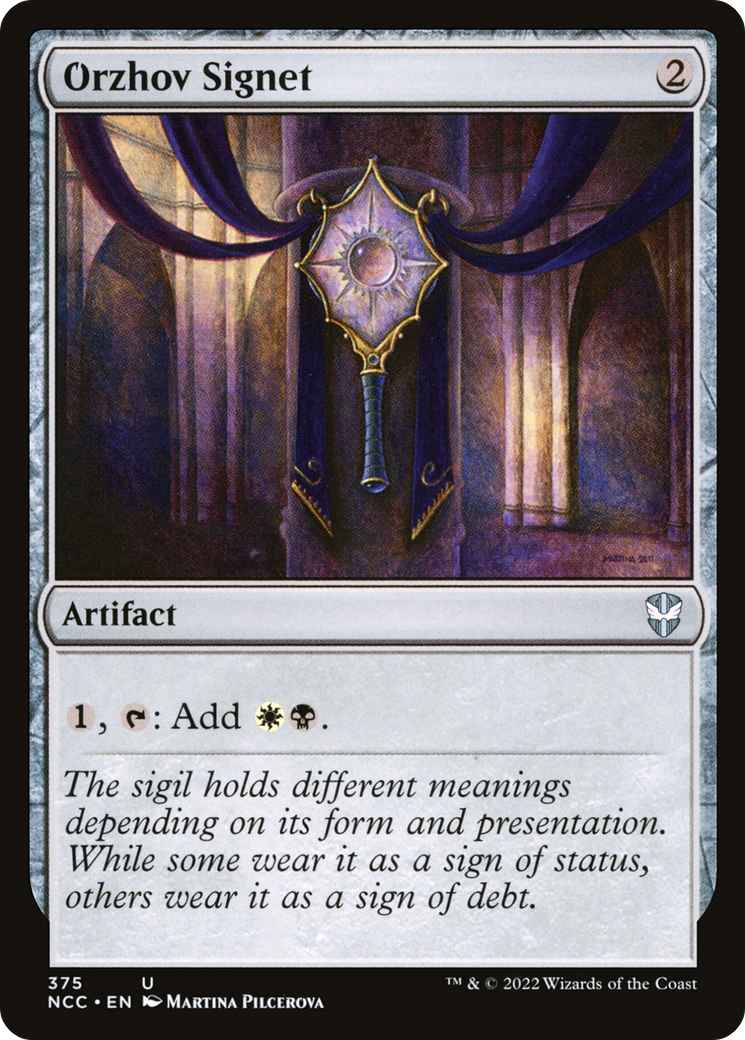
Orzhov Signet
Orzhov Signet
Artifact
, : Add .
-
1
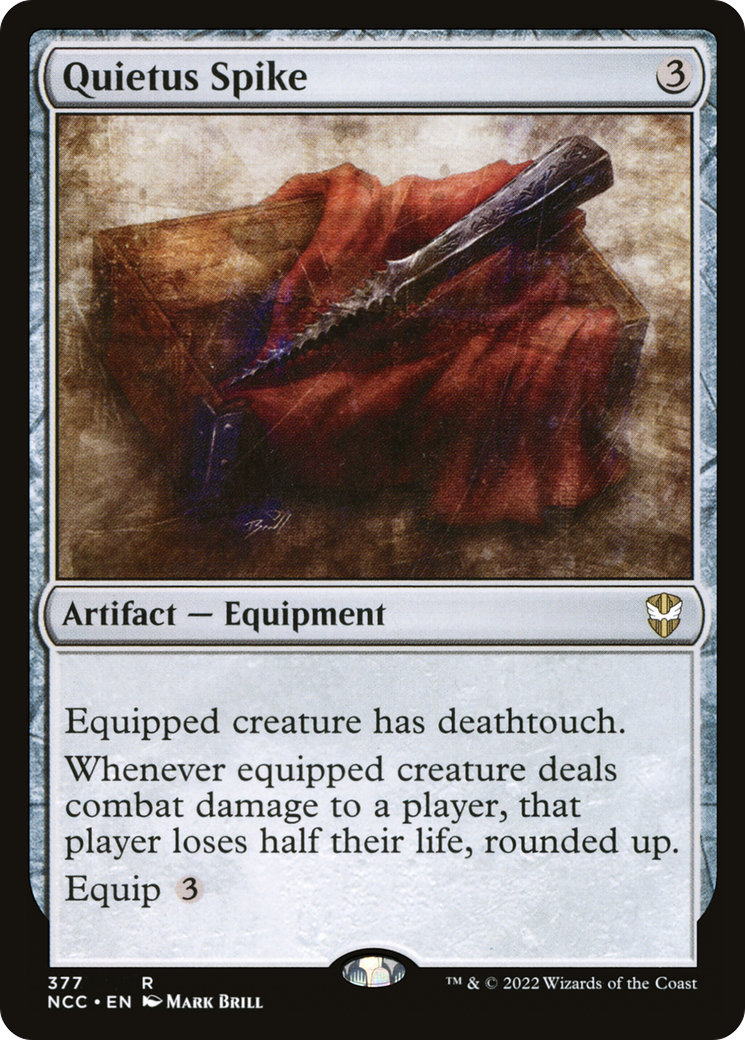
Quietus Spike
Quietus Spike
Artifact — Equipment
Equipped creature has deathtouch.
Whenever equipped creature deals combat damage to a player, that player loses half their life, rounded up.
Equip
- In a Two-Headed Giant game, after combat damage is dealt, Quietus Spike looks at that player's life total (which is the same as the team's life total) when determining how much life the team will lose, which basically means the team's life total is halved. Here's an example of the math: The team has 19 life, so the player has 19 life. Quietus Spike causes the team to lose 10 life (19 divided by 2, rounded up). The team's life total becomes 9 (19 minus 10).
- That player loses half their life after combat damage has been subtracted from the player's life total. The amount of life the player loses is determined as the triggered ability resolves.
- If multiple Quietus Spikes trigger at the same time, that player loses half their life when the first ability resolves, then loses half of the remainder when the next ability resolves, and so on. The player does not lose the same amount each time.
-
1
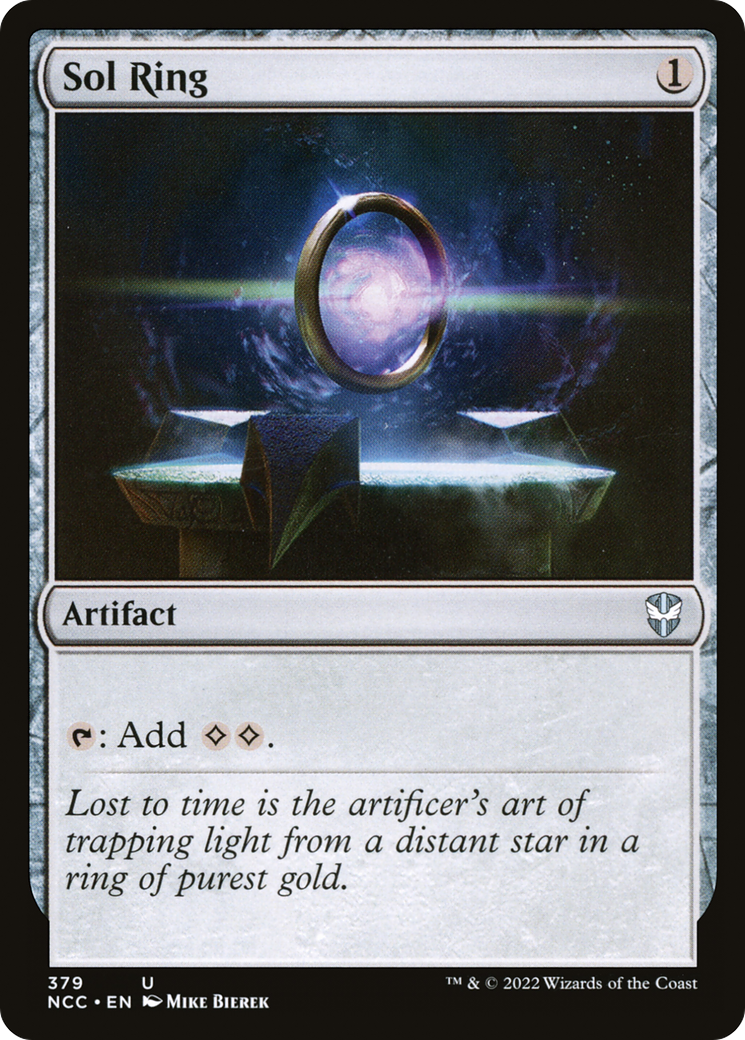
Sol Ring
Sol Ring
Artifact
: Add .
-
1
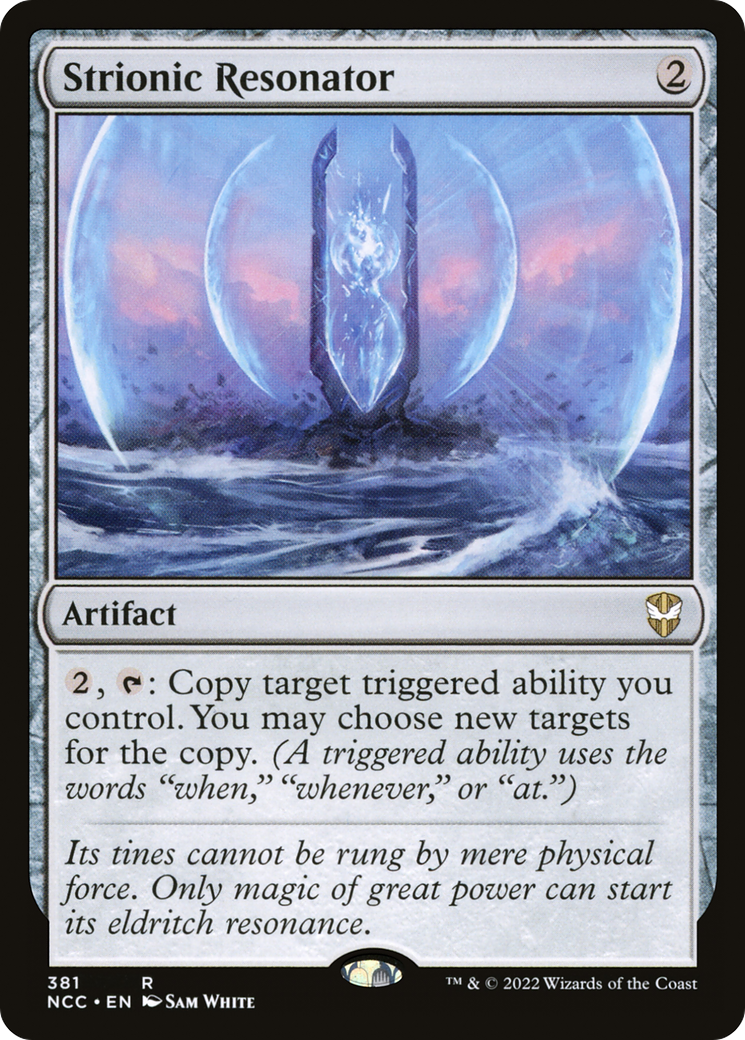
Strionic Resonator
Strionic Resonator
Artifact
, : Copy target triggered ability you control. You may choose new targets for the copy. (A triggered ability uses the words "when," "whenever," or "at.")
- Triggered abilities use the word "when," "whenever," or "at." They're often written as "[Trigger condition], [effect]."
- Strionic Resonator targets a triggered ability that has triggered and is on the stack and creates another instance of that ability on the stack. It doesn't cause any object to gain an ability.
- The source of the copy is the same as the source of the original ability.
- If the triggered ability is modal (that is, if it says, "Choose one —" or similar), the mode is copied and can't be changed.
- If the triggered ability divides damage or distributes counters among a number of targets (for example, the ability of Bogardan Hellkite), the division and number of targets can't be changed. If you choose new targets, you must choose the same number of targets.
- Any choices made when the triggered ability resolves won't have been made yet when it's copied. Any such choices will be made separately when the copy resolves. If the triggered ability asks you to pay a cost (such as that of Frenzied Goblin), you pay that cost for the copy.
- If a triggered ability is linked to a second ability, copies of that triggered ability are also linked to that second ability. If the second ability refers to "the exiled card," it refers to all cards exiled by the triggered ability and the copy. For example, if Fiend Hunter's enters-the-battlefield ability is copied and two creatures are exiled, they both return when Fiend Hunter leaves the battlefield.
- In some cases involving linked abilities, an ability requires information about "the exiled card." When this happens, the ability gets multiple answers. If these answers are being used to determine the value of a variable, the sum is used. For example, if Elite Arcanist's enters-the-battlefield ability is copied, two cards are exiled. The value of X in the activation cost of Elite Arcanist's other ability is the sum of the two cards' mana values. As the ability resolves, you create copies of both cards and can cast none, one, or both of the copies in any order.
-
1
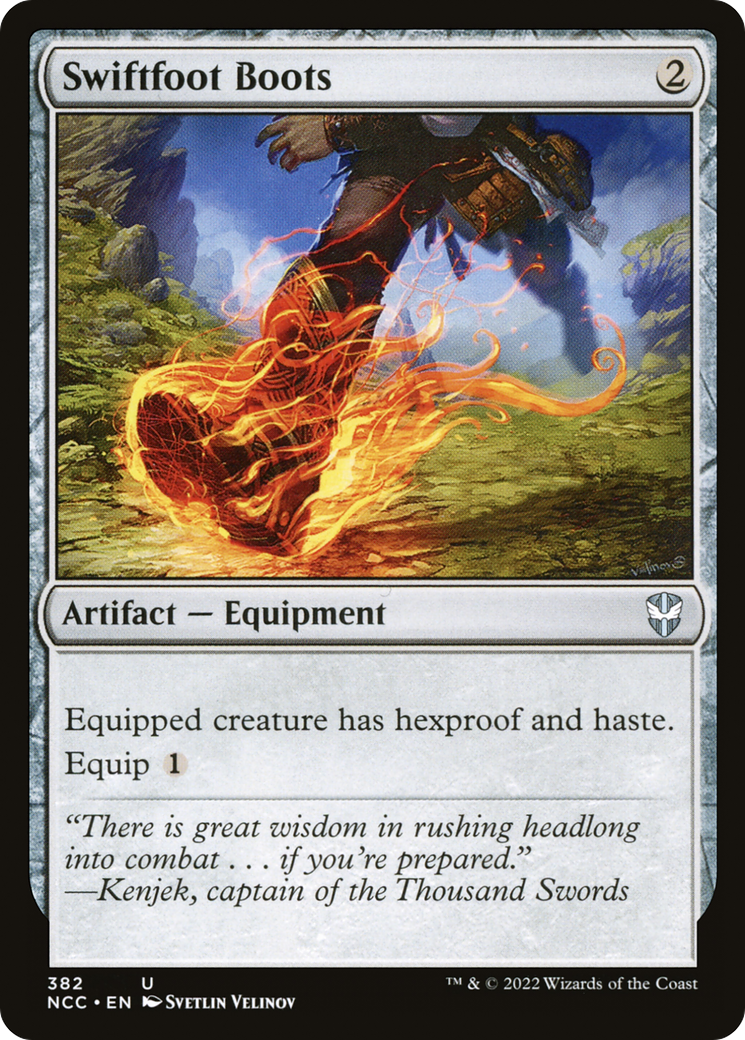
Swiftfoot Boots
Swiftfoot Boots
Artifact — Equipment
Equipped creature has hexproof and haste. (It can't be the target of spells or abilities your opponents control. It can attack and no matter when it came under your control.)
Equip ( : Attach to target creature you control. Equip only as a sorcery.)
- If a creature enters the battlefield under your control and gains haste, but then loses it before attacking, it won't be able to attack that turn. This means that you can't use one Swiftfoot Boots to allow two new creatures to attack in the same turn.
-
1
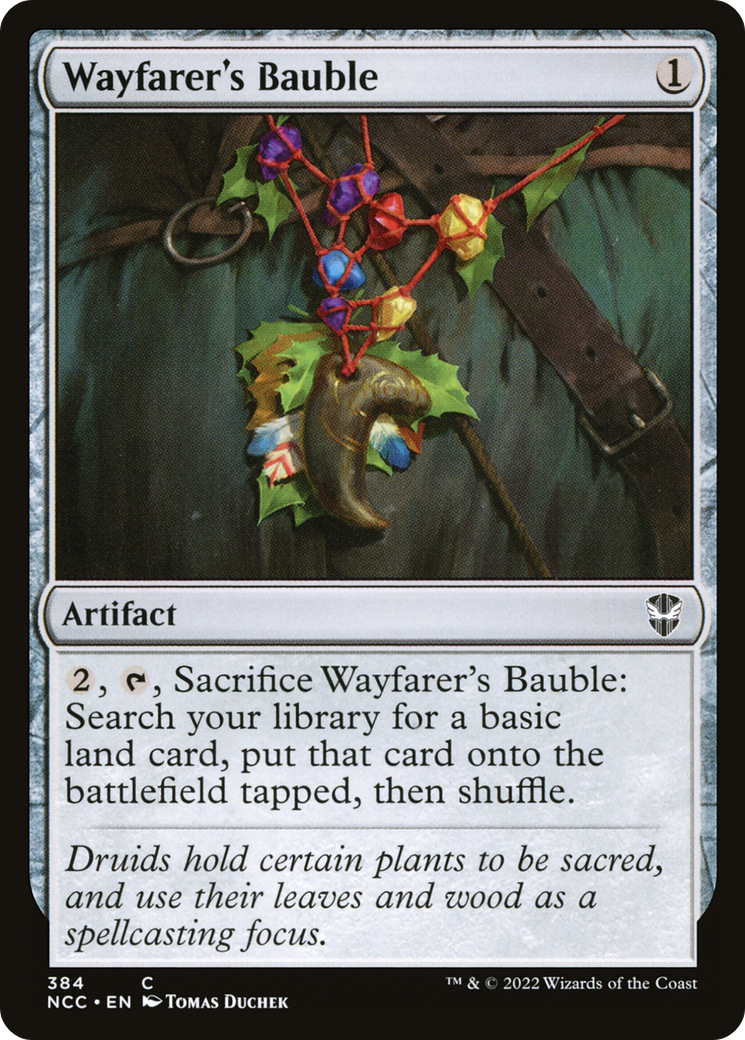
Wayfarer's Bauble
Wayfarer's Bauble
Artifact
, , Sacrifice this artifact: Search your library for a basic land card, put that card onto the battlefield tapped, then shuffle.
Enchantments 3
-
1
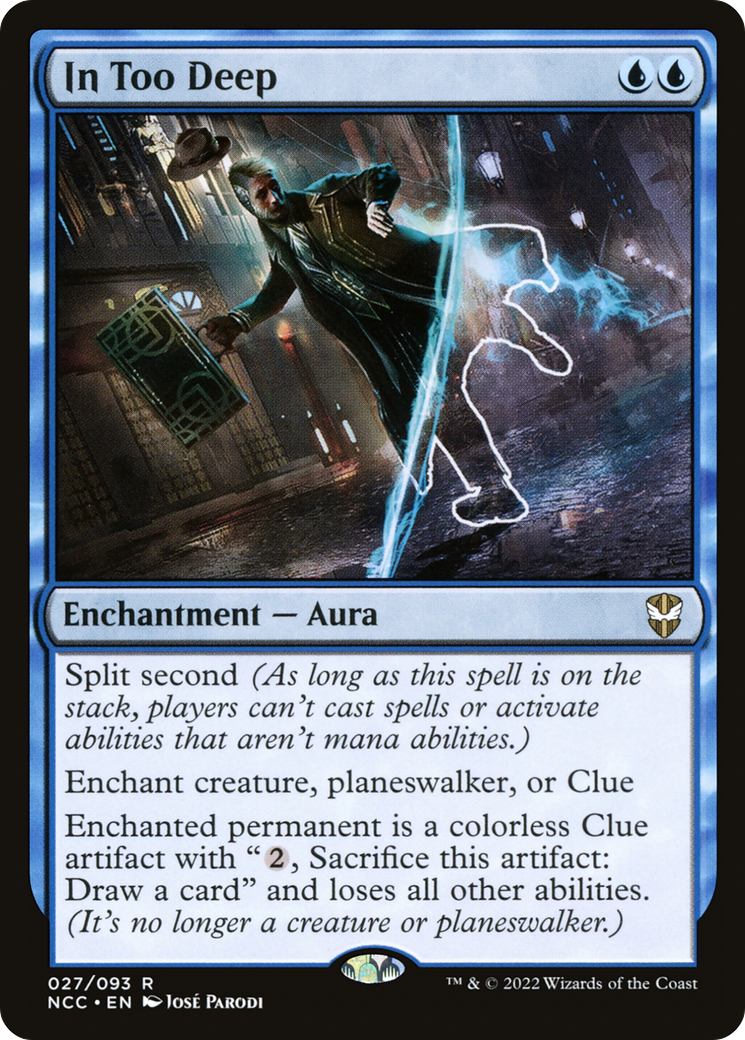
In Too Deep
In Too Deep
Enchantment — Aura
Split second (As long as this spell is on the stack, players can't cast spells or activate abilities that aren't mana abilities.)
Enchant creature, planeswalker, or Clue
Enchanted permanent is a colorless Clue artifact with " , Sacrifice this artifact: Draw a card" and loses all other abilities. (It's no longer a creature or planeswalker.)
- Players still get priority while a card with split second is on the stack; their options are just limited to mana abilities and certain special actions.
- Split second doesn't allow players to cast the spell it's on at times when they otherwise wouldn't be able to cast it. An enchantment with split second may still be cast only during its controller's main phase when the stack is empty.
- Players may turn face-down creatures face up while a spell with split second is on the stack.
- Split second doesn't stop triggered abilities from triggering, such as that of Chalice of the Void. If one does, its controller puts it on the stack and chooses targets for it, if any. Those abilities will resolve as normal.
- Casting a spell with split second won't affect spells and abilities that are already on the stack.
- If the resolution of a triggered ability involves casting a spell, that spell can't be cast if a spell with split second is on the stack.
- After a spell with split second resolves (or otherwise leaves the stack), players may again cast spells and activate abilities before the next object on the stack resolves.
-
1
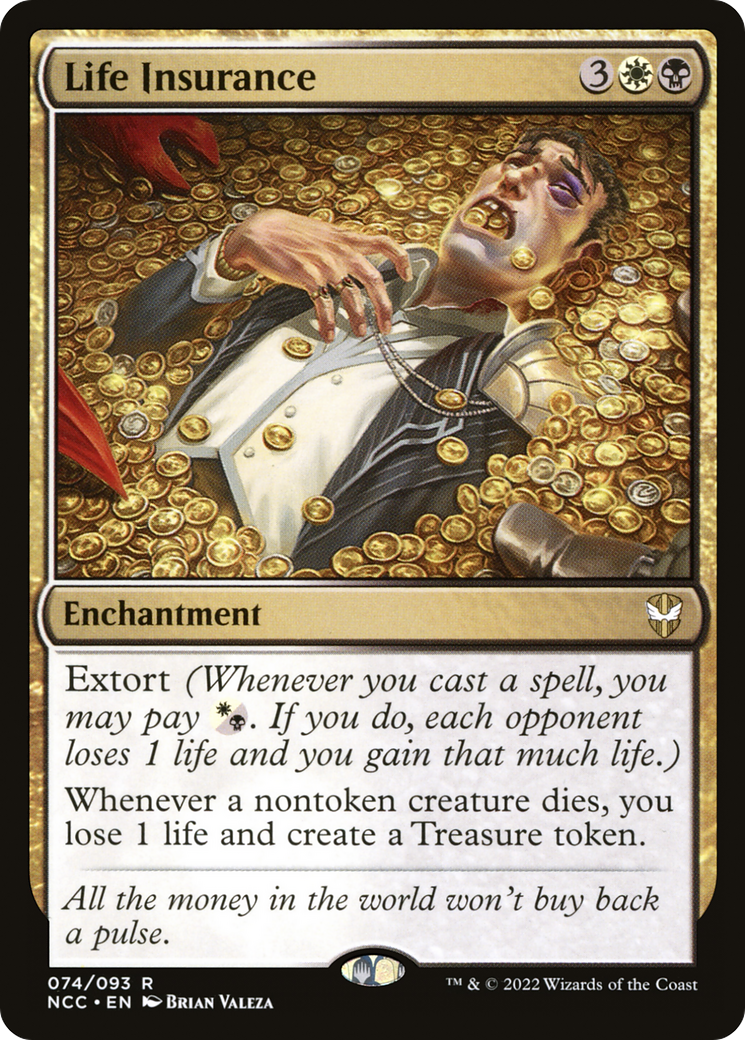
Life Insurance
Life Insurance
Enchantment
Extort (Whenever you cast a spell, you may pay . If you do, each opponent loses 1 life and you gain that much life.)
Whenever a nontoken creature dies, you lose 1 life and create a Treasure token.
- You may pay a maximum of one time for each extort triggered ability. You decide whether to pay when the ability resolves.
- The amount of life you gain from extort is based on the total amount of life lost, not necessarily the number of opponents you have. For example, if your opponent's life total can't change (perhaps because that player controls Platinum Emperion), you won't gain any life.
- The extort ability doesn't target any player.
- The extort ability resolves before the spell that caused it to trigger. The ability resolves even if that spell is countered.
-
1
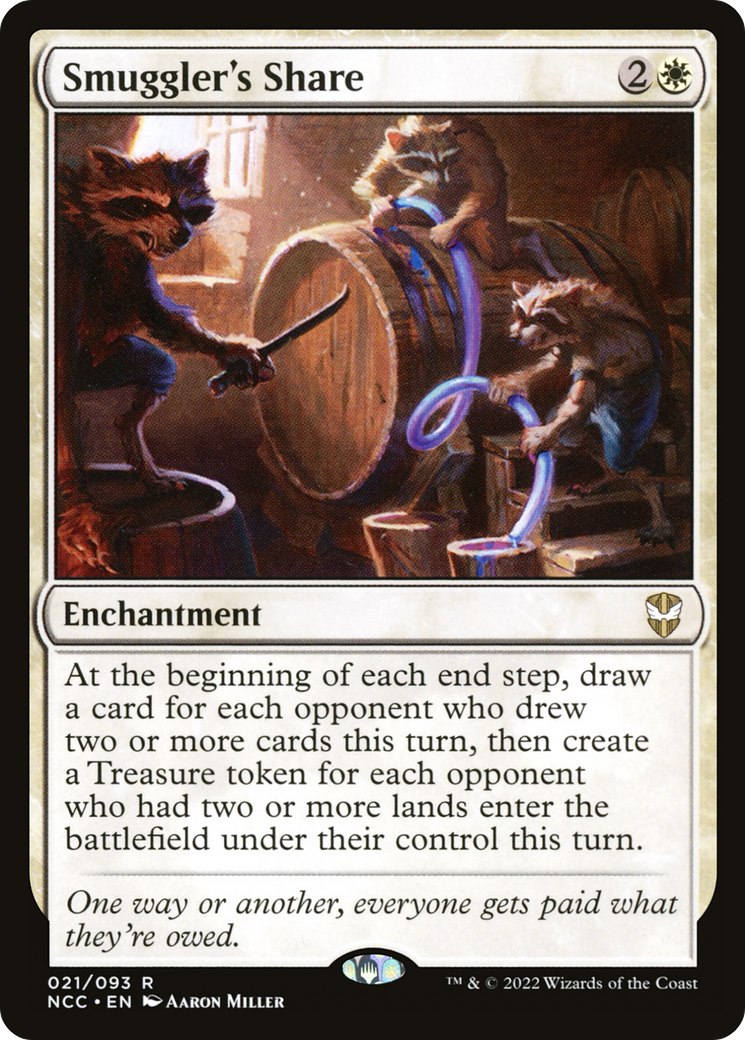
Smuggler's Share
Smuggler's Share
Enchantment
At the beginning of each end step, draw a card for each opponent who drew two or more cards this turn, then create a Treasure token for each opponent who had two or more lands enter the battlefield under their control this turn.
Lands 38
-
1
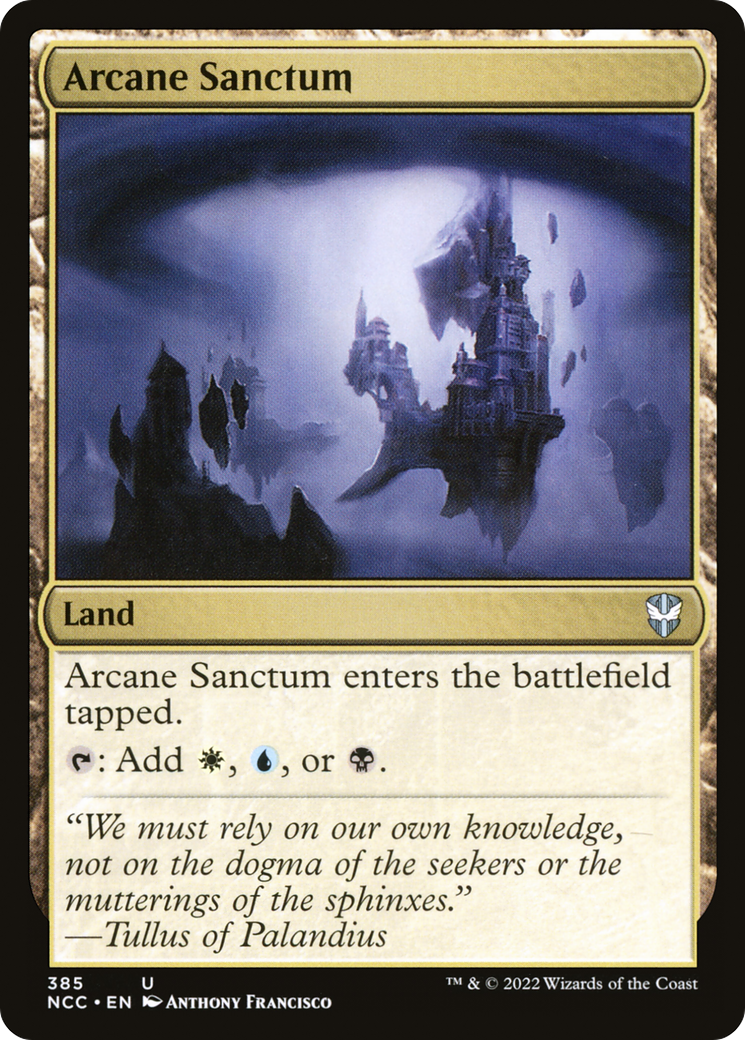
Arcane Sanctum
Arcane Sanctum
Land
This land enters tapped.
: Add , , or .
-
1
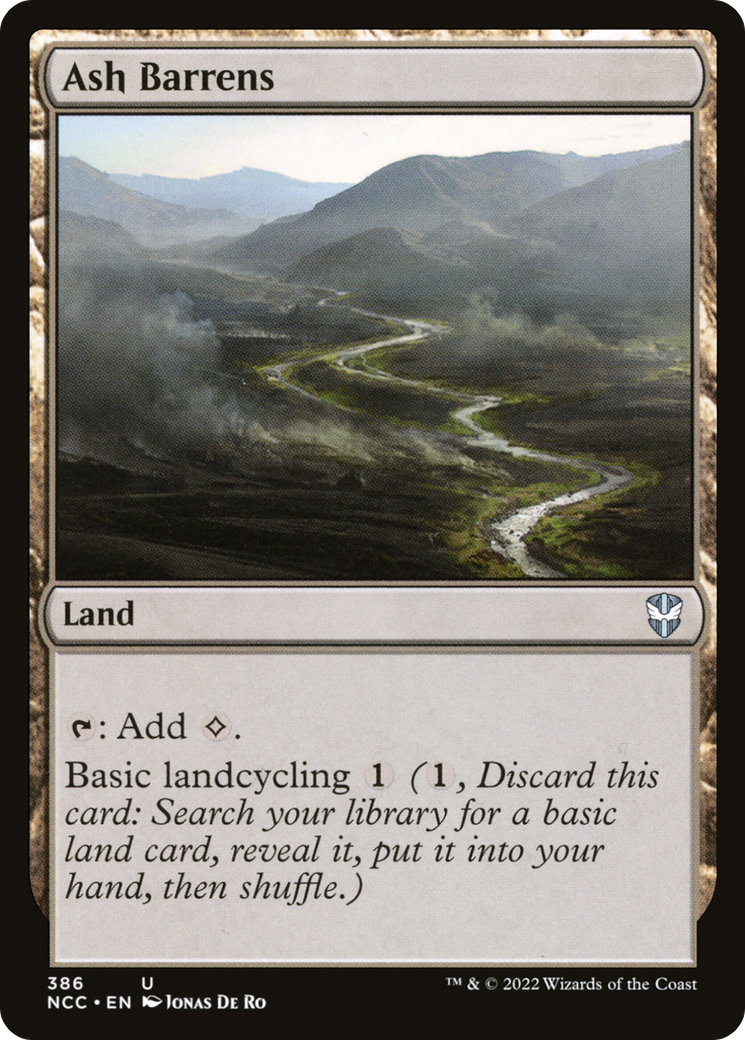
Ash Barrens
Ash Barrens
Land
: Add .
Basic landcycling ( , Discard this card: Search your library for a basic land card, reveal it, put it into your hand, then shuffle.)
-
1
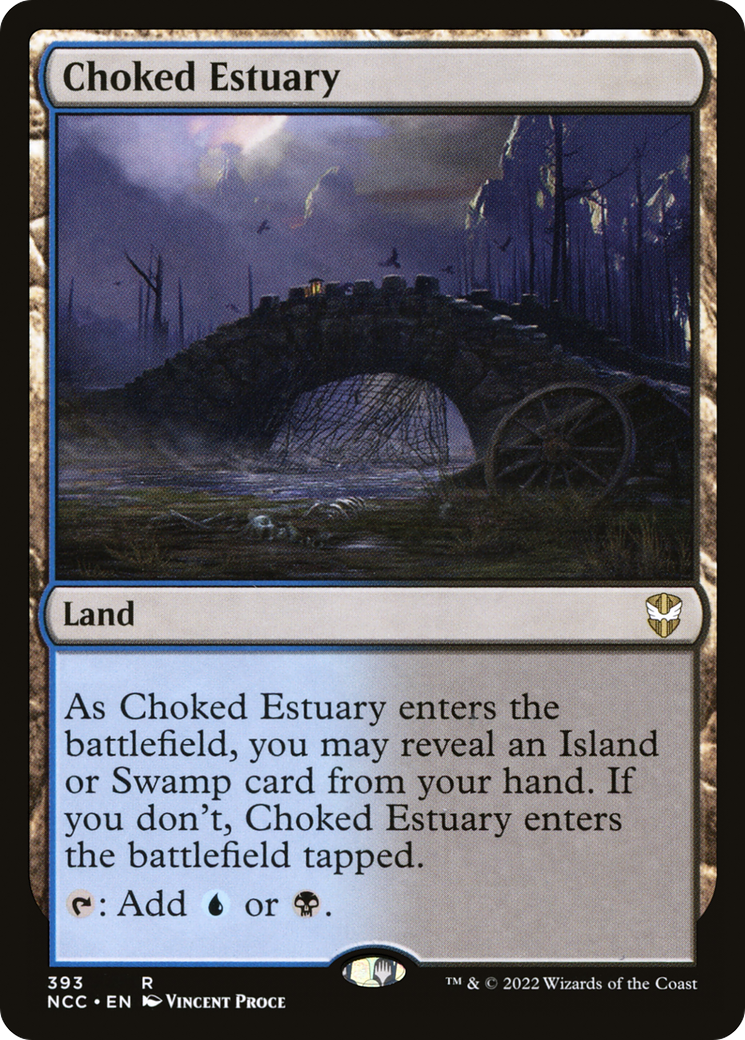
Choked Estuary
Choked Estuary
Land
As this land enters, you may reveal an Island or Swamp card from your hand. If you don't, this land enters tapped.
: Add or .
- Lands don't have a subtype just because they can produce mana of the corresponding color. Choked Estuary itself is neither an Island nor a Swamp, even though it produces blue and black mana, so you can't reveal one to satisfy the ability of another.
- If an effect instructs you to put Choked Estuary onto the battlefield tapped, it will still enter the battlefield tapped even if you reveal a land card from your hand.
- You may reveal any land card with either or both of the appropriate subtypes. It doesn't have to be a basic land. For example, you could reveal Prairie Stream from the Battle for Zendikar set to satisfy the ability of Choked Estuary.
- If an Island or Swamp is entering the battlefield from your hand at the same time as Choked Estuary, you may reveal the other land to have Choked Estuary enter untapped.
-
1
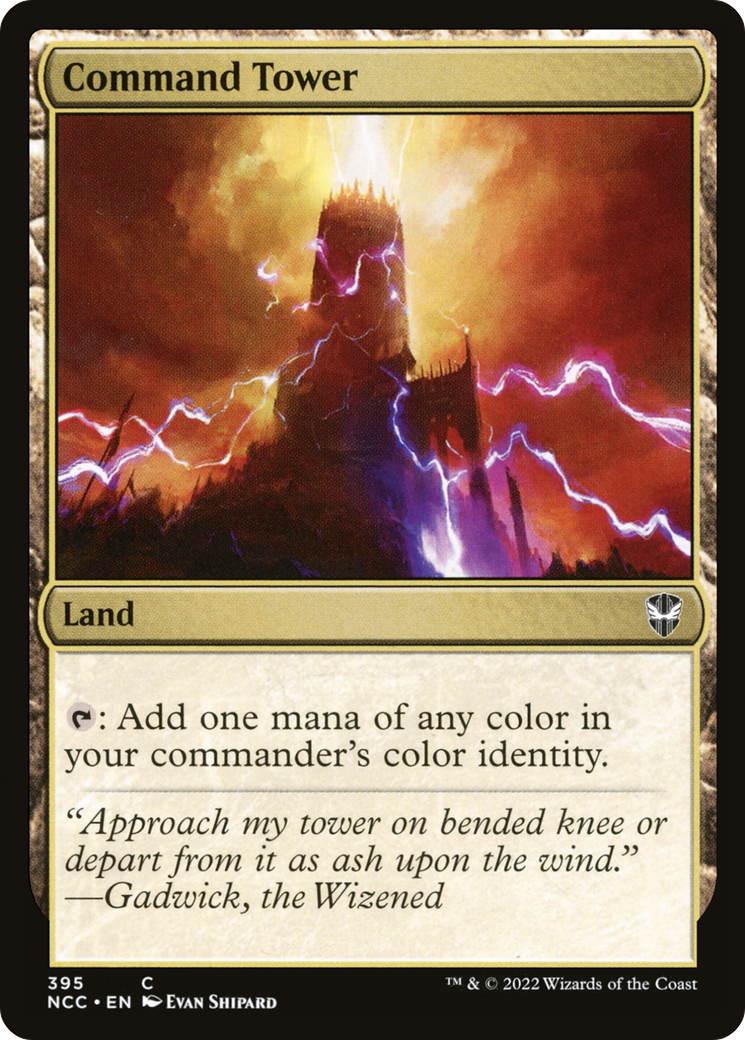
Command Tower
Command Tower
Land
: Add one mana of any color in your commander's color identity.
- If you don't have a commander, Command Tower's ability produces no mana.
- If your commander is a card that has no colors in its color identity, Command Tower's ability produces no mana. It doesn't produce .
- If you have two commanders, the ability adds one mana of any color in their combined color identities.
-
1
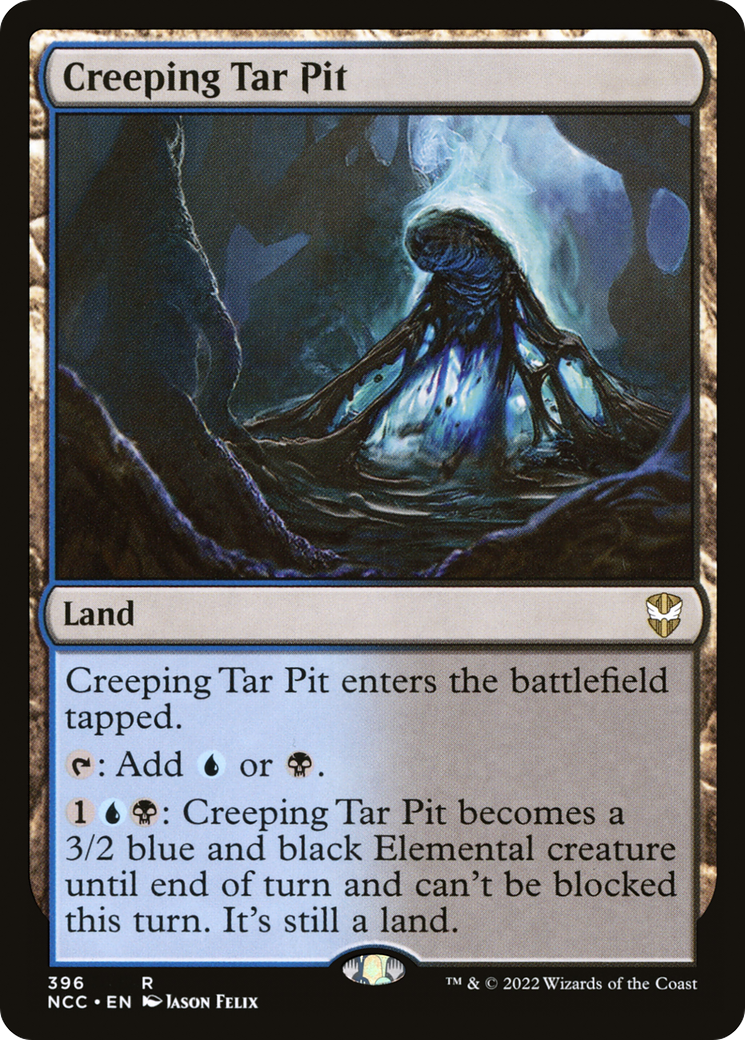
Creeping Tar Pit
Creeping Tar Pit
Land
This land enters tapped.
: Add or .
: This land becomes a 3/2 blue and black Elemental creature until end of turn and can't be blocked this turn. It's still a land.
- A land that becomes a creature may be affected by "summoning sickness." You can't attack with it or use any of its abilities (including its mana abilities) unless it began your most recent turn on the battlefield under your control. Note that summoning sickness cares about when that permanent came under your control, not when it became a creature.
- When a land becomes a creature, that doesn't count as having a creature enter. The permanent was already on the battlefield; it only changed its types. Abilities that trigger whenever a creature enters won't trigger.
-
1
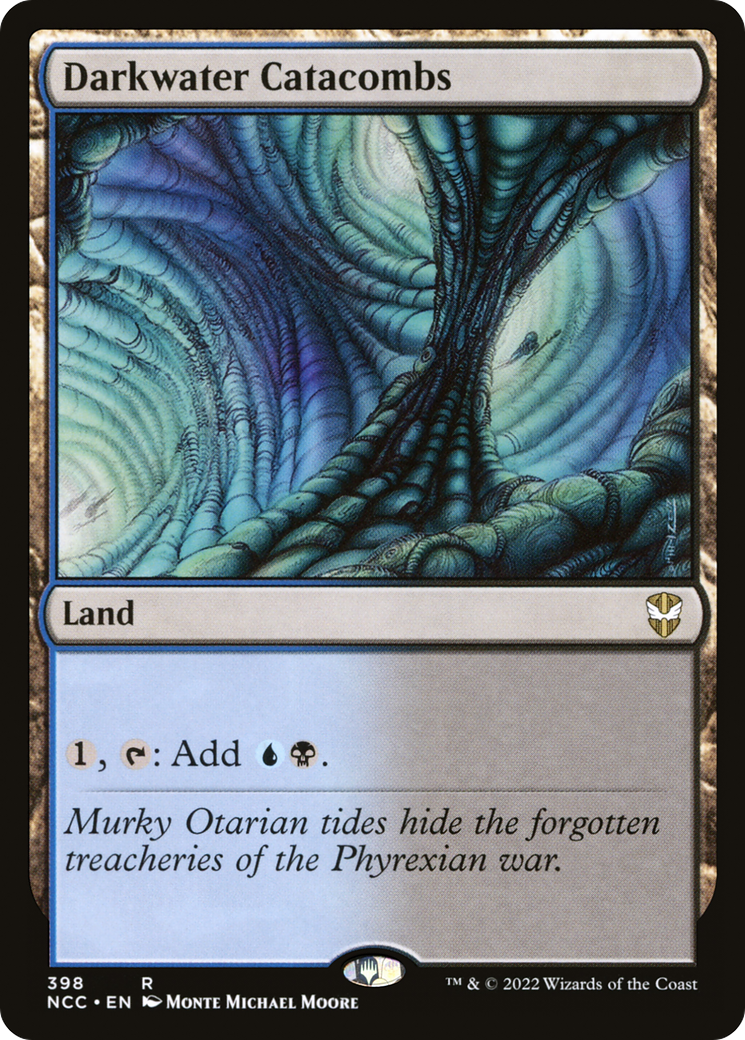
Darkwater Catacombs
Darkwater Catacombs
Land
, : Add .
-
1
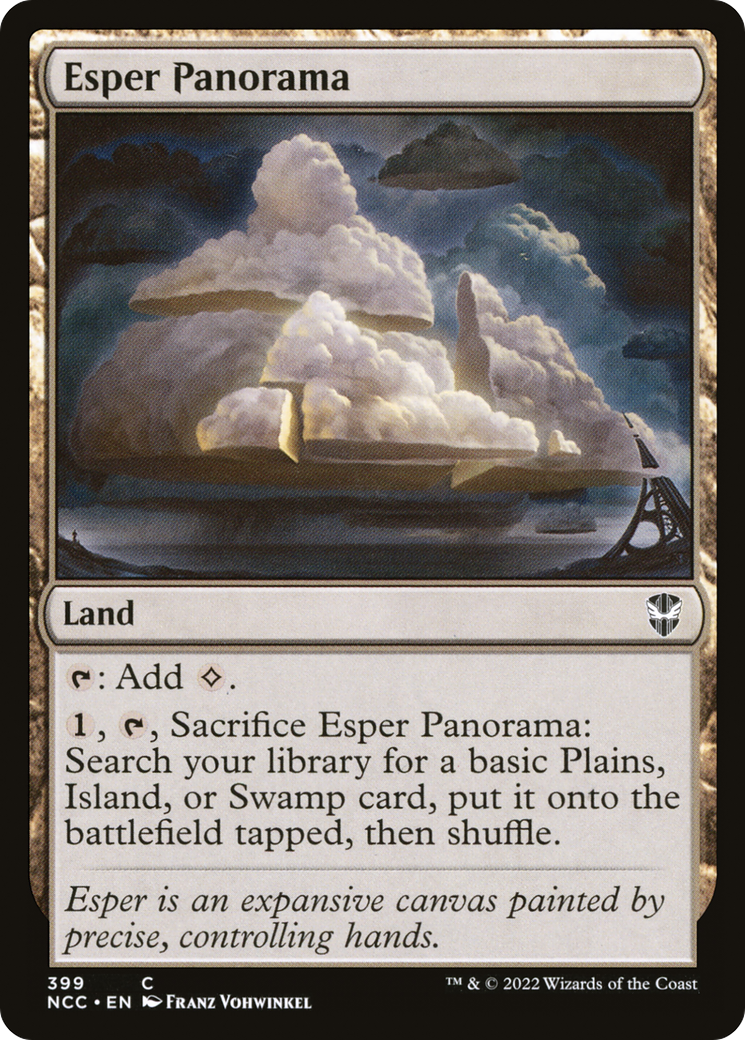
Esper Panorama
Esper Panorama
Land
: Add .
, , Sacrifice this land: Search your library for a basic Plains, Island, or Swamp card, put it onto the battlefield tapped, then shuffle.
-
1
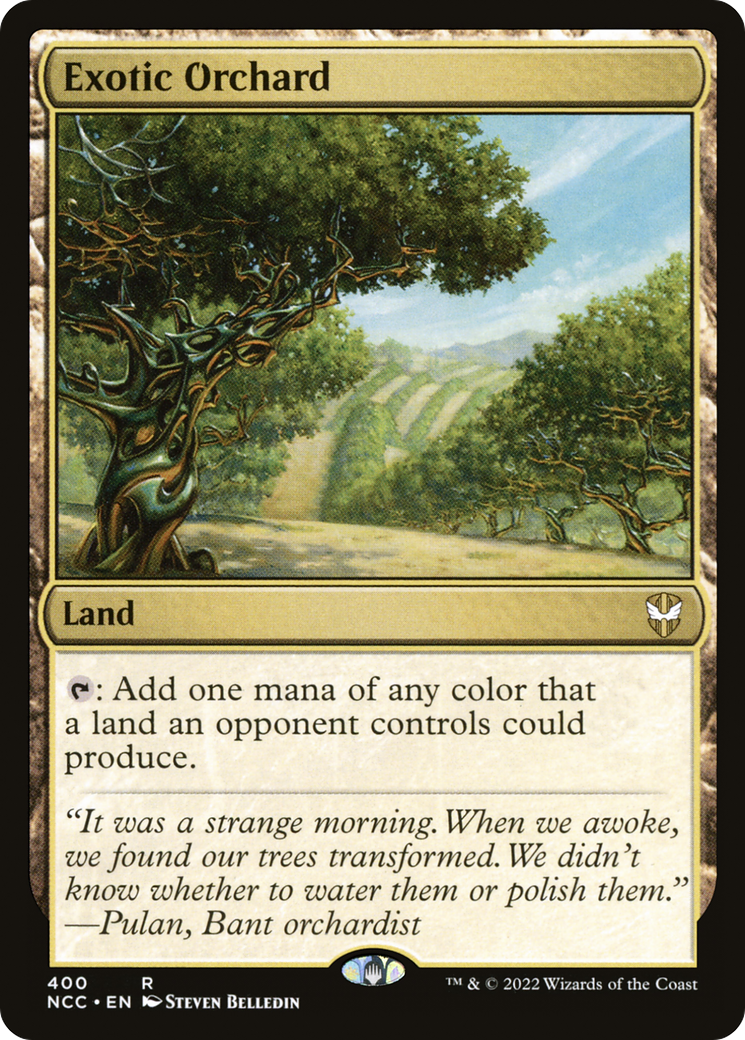
Exotic Orchard
Exotic Orchard
Land
: Add one mana of any color that a land an opponent controls could produce.
- Lands that produce mana based only on what other lands "could produce" won't help each other unless some other land allows one of them to actually produce some type of mana. For example, if you control an Exotic Orchard and your opponent controls an Exotic Orchard and a Reflecting Pool, none of those lands would produce mana if their mana abilities were activated. On the other hand, if you control a Forest and an Exotic Orchard, and your opponent controls an Exotic Orchard and a Reflecting Pool, then each of those lands can be tapped to produce . Your opponent's Exotic Orchard can produce because you control a Forest. Your Exotic Orchard and your opponent's Reflecting Pool can each produce because your opponent's Exotic Orchard can produce .
- When determining what colors of mana your opponents' lands could produce, Exotic Orchard takes into account any applicable replacement effects that would apply to those lands' mana abilities (such as Contamination's effect, for example). If there are more than one, consider them in any possible order.
- The colors of mana are white, blue, black, red, and green. Exotic Orchard can't be tapped for colorless mana, even if a land an opponent controls could produce colorless mana.
- Exotic Orchard doesn't care about any restrictions or riders your opponents' lands (such as Ancient Ziggurat or Hall of the Bandit Lord) put on the mana they produce. It just cares about colors of mana.
- Exotic Orchard checks the effects of all mana-producing abilities of lands your opponents control, but it doesn't check their costs. For example, Vivid Crag has the ability " , Remove a charge counter from Vivid Crag: Add one mana of any color." If an opponent controls Vivid Crag and you control Exotic Orchard, you can tap Exotic Orchard for any color of mana. It doesn't matter whether Vivid Crag has a charge counter on it, and it doesn't matter whether it's untapped.
-
1
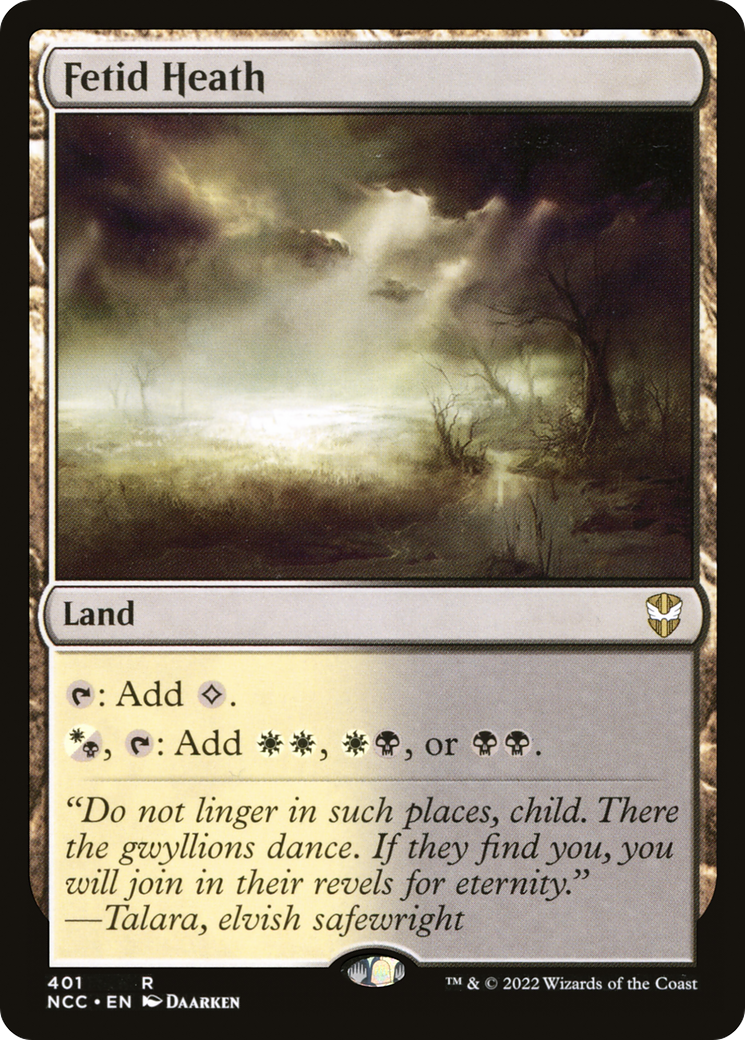
Fetid Heath
Fetid Heath
Land
: Add .
, : Add , , or .
-
6
Island
Island
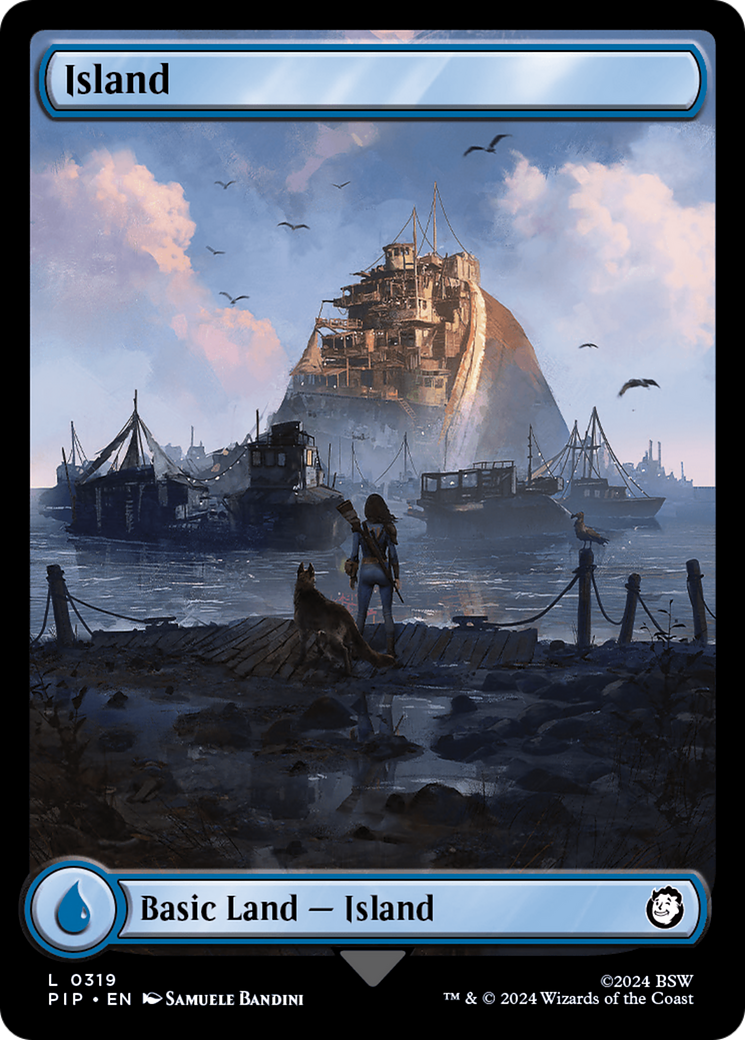
Basic Land — Island
( : Add .)
-
1
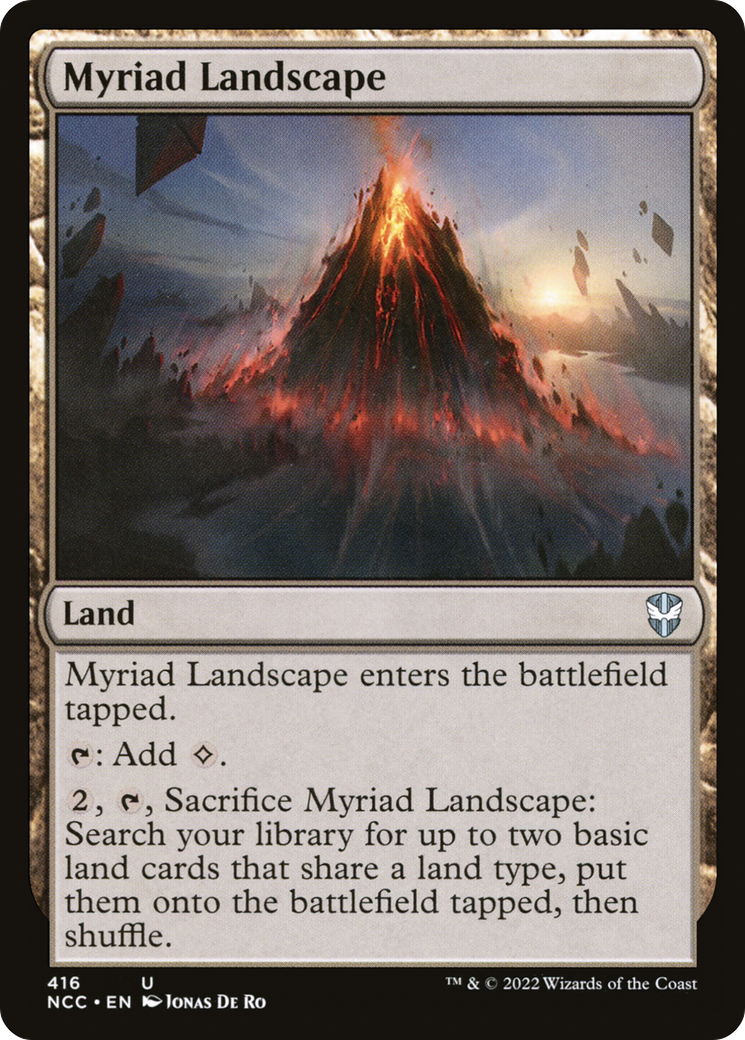
Myriad Landscape
Myriad Landscape
Land
This land enters tapped.
: Add .
, , Sacrifice this land: Search your library for up to two basic land cards that share a land type, put them onto the battlefield tapped, then shuffle.
- You can choose to find one basic land card with Myriad Landscape's last ability.
-
1
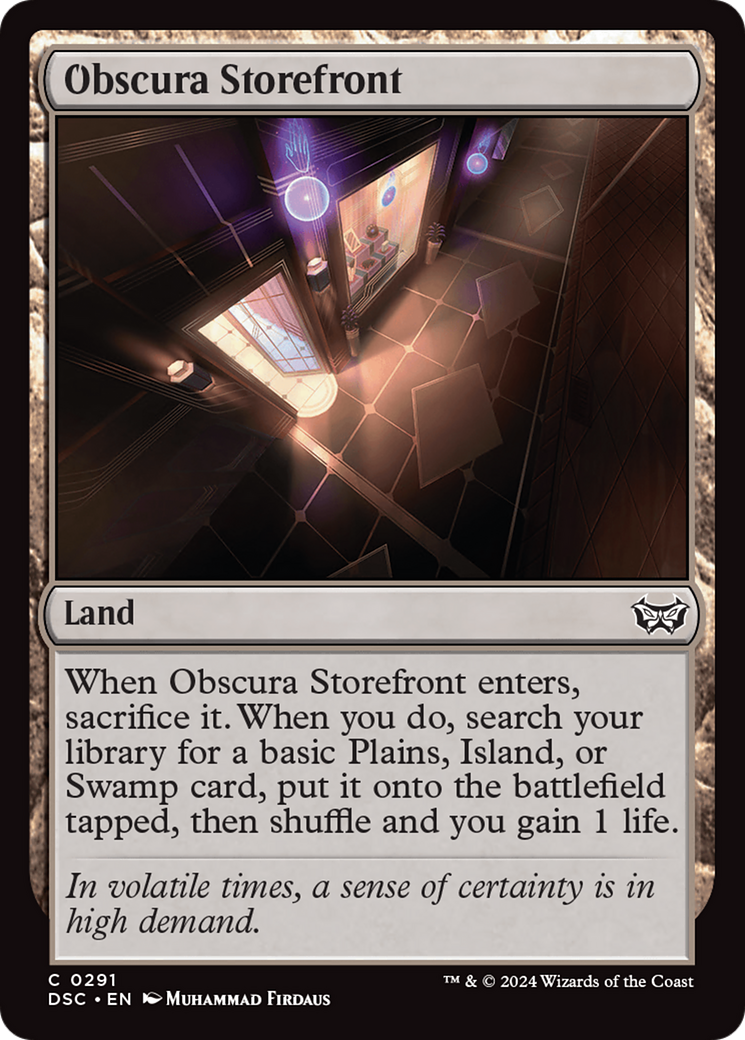
Obscura Storefront
Obscura Storefront
Land
When this land enters, sacrifice it. When you do, search your library for a basic Plains, Island, or Swamp card, put it onto the battlefield tapped, then shuffle and you gain 1 life.
-
1
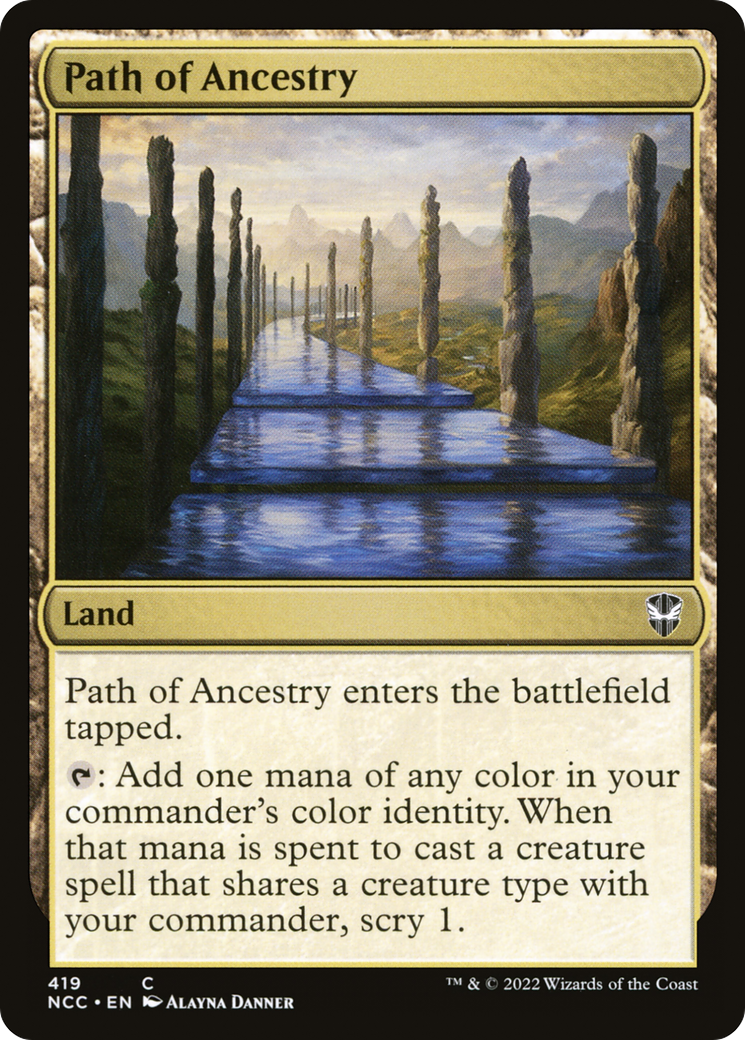
Path of Ancestry
Path of Ancestry
Land
This land enters tapped.
: Add one mana of any color in your commander's color identity. When that mana is spent to cast a creature spell that shares a creature type with your commander, scry 1. (Look at the top card of your library. You may put that card on the bottom.)
- Your commander's creature types are checked immediately after you cast a creature spell spending mana from Path of Ancestry's last ability. They aren't set before the game begins, and they may not be the same types your commander had when you activated that ability.
- If you have two commanders, the last ability adds one mana of any color in their combined color identities. When you spend that mana on a creature spell that shares a creature type with either of your commanders, you'll scry 1.
- If Path of Ancestry's last ability produces two mana (most likely due to Mana Reflection), spending those two mana to cast creature spells that share a creature type with your commander will cause two abilities to trigger. Each of those abilities will cause you to scry 1. You won't scry 2. This is true whether you spend the mana on one creature spell or two.
- If your commander has no creature types, it can't share a creature type with any spell that you cast.
- If you cast your commander with mana from Path of Ancestry, and your commander hasn't somehow lost all of its creature types while on the stack, you'll scry 1.
- If you don't have a commander, Path of Ancestry's ability produces no mana.
- If your commander is a card that has no colors in its color identity, Path of Ancestry's ability produces no mana. It doesn't produce .
-
5
Plains
Plains
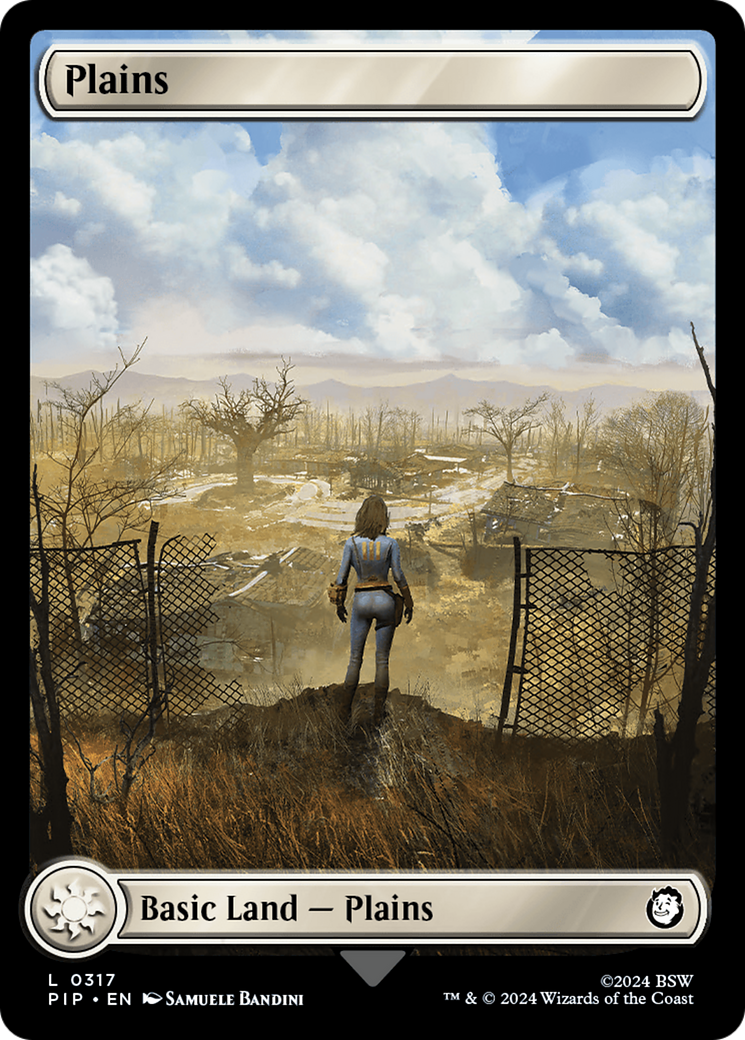
Basic Land — Plains
( : Add .)
-
1
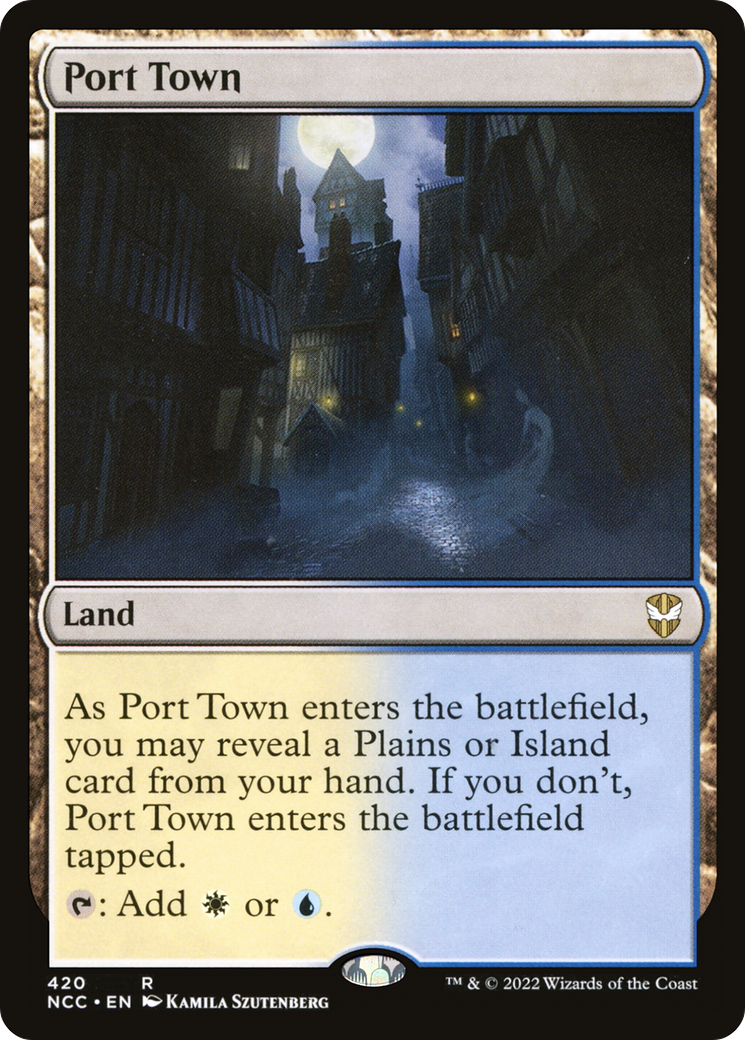
Port Town
Port Town
Land
As this land enters, you may reveal a Plains or Island card from your hand. If you don't, this land enters tapped.
: Add or .
- You may reveal any land card with either or both of the appropriate subtypes. It doesn't have to be a basic land. For example, you could reveal Canopy Vista from the Battle for Zendikar set to satisfy the ability of Port Town.
- Lands don't have a subtype just because they can produce mana of the corresponding color. Port Town itself is neither a Plains nor an Island, even though it produces white and blue mana, so you can't reveal one to satisfy the ability of another.
- If a Plains or Island is entering the battlefield from your hand at the same time as Port Town, you may reveal the other land to have Port Town enter untapped.
- If an effect instructs you to put Port Town onto the battlefield tapped, it will still enter the battlefield tapped even if you reveal a land card from your hand.
-
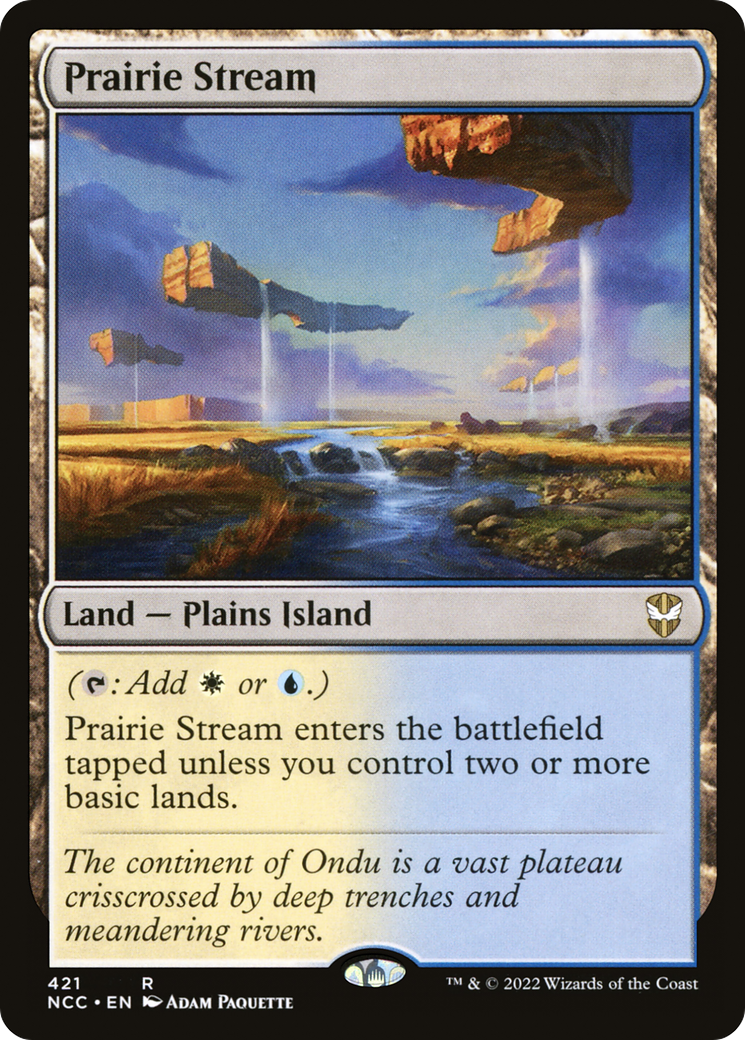
1
Prairie Stream
Prairie Stream
Land — Plains Island
( : Add or .)
This land enters tapped unless you control two or more basic lands.
- Even though these lands have basic land types, they are not basic lands because "basic" doesn't appear on their type line. Notably, controlling two or more of them won't allow others to enter the battlefield untapped.
- However, because these cards have basic land types, effects that specify a basic land type without also specifying that the land be basic can affect them. For example, a spell or ability that reads "Destroy target Forest" can target Canopy Vista, while one that reads "Destroy target basic Forest" cannot.
- If one of these lands enters the battlefield at the same time as any number of basic lands, those other lands are not counted when determining if this land enters the battlefield tapped or untapped.
-
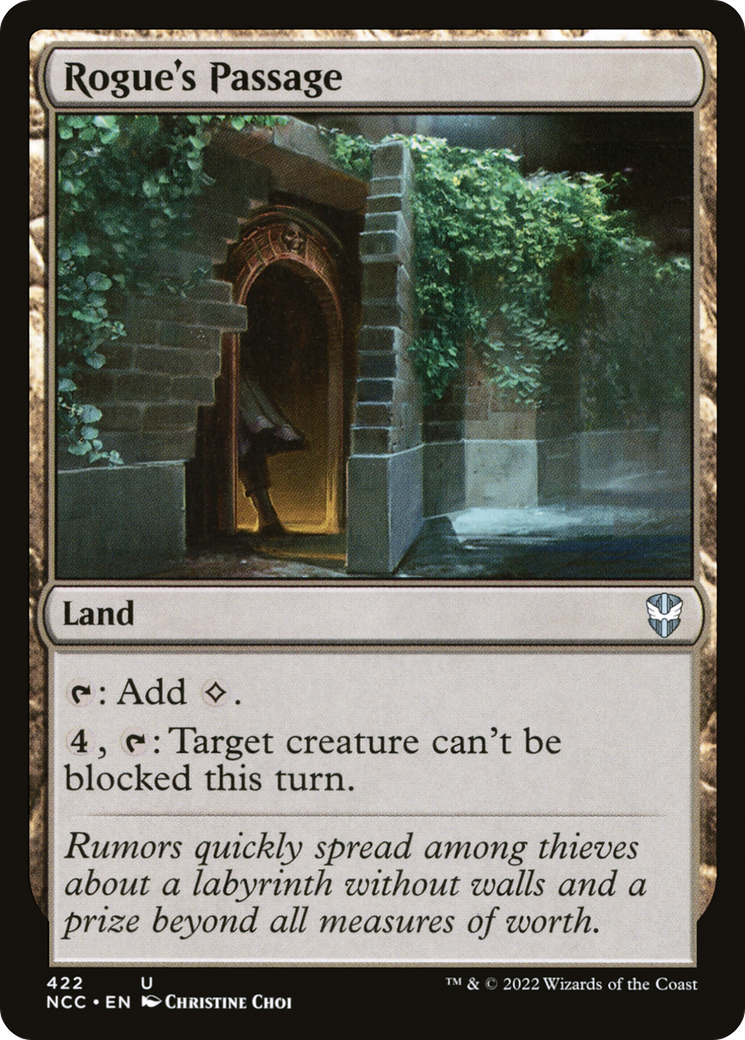
1
Rogue's Passage
Rogue's Passage
Land
: Add .
, : Target creature can't be blocked this turn.
- Activating the second ability of Rogue's Passage after a creature has become blocked won't cause that creature to become unblocked.
-
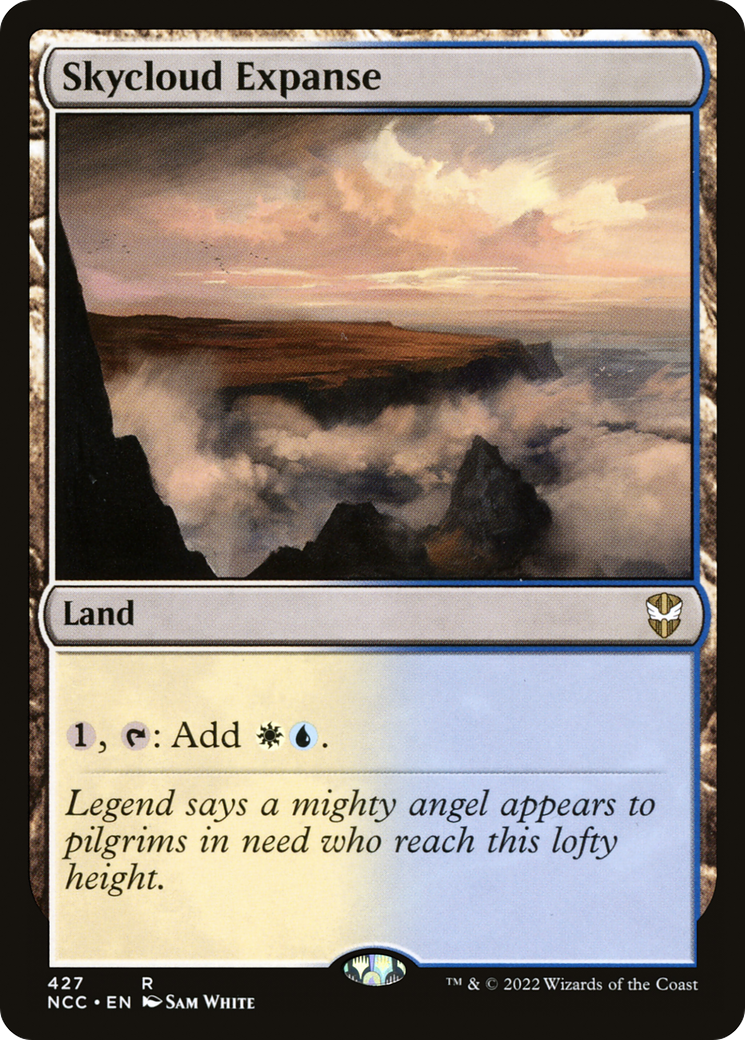
1
Skycloud Expanse
Skycloud Expanse
Land
, : Add .
-
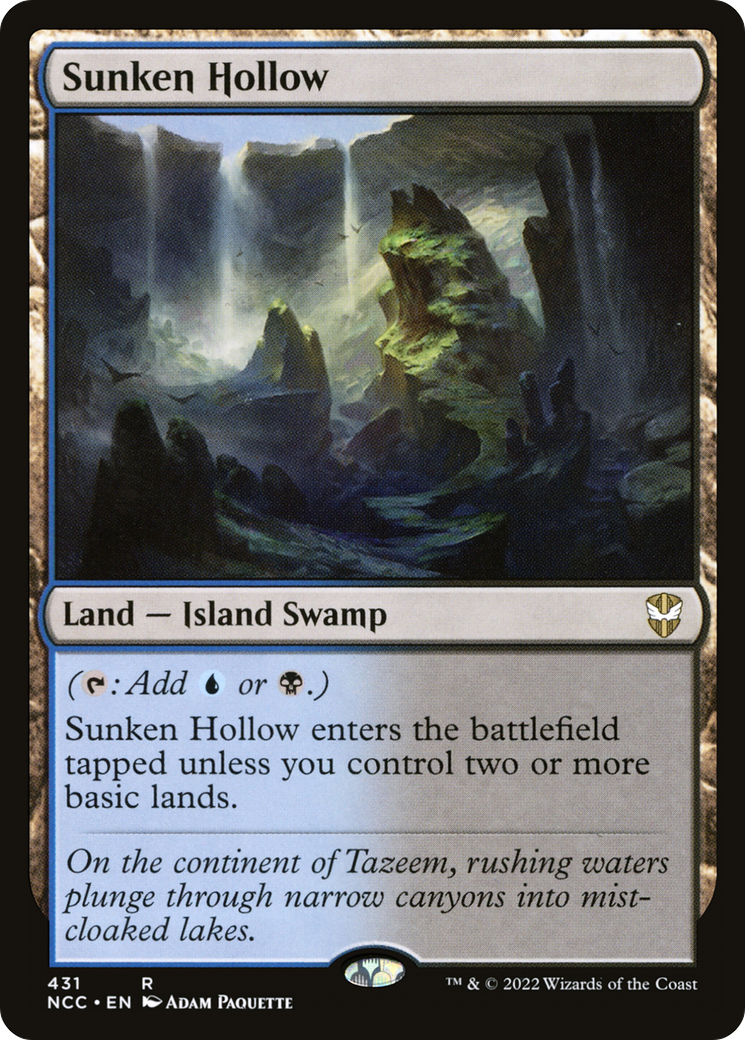
1
Sunken Hollow
Sunken Hollow
Land — Island Swamp
( : Add or .)
This land enters tapped unless you control two or more basic lands.
- Even though these lands have basic land types, they are not basic lands because "basic" doesn't appear on their type line. Notably, controlling two or more of them won't allow others to enter the battlefield untapped.
- However, because these cards have basic land types, effects that specify a basic land type without also specifying that the land be basic can affect them. For example, a spell or ability that reads "Destroy target Forest" can target Canopy Vista, while one that reads "Destroy target basic Forest" cannot.
- If one of these lands enters the battlefield at the same time as any number of basic lands, those other lands are not counted when determining if this land enters the battlefield tapped or untapped.
-
6
Swamp
Swamp
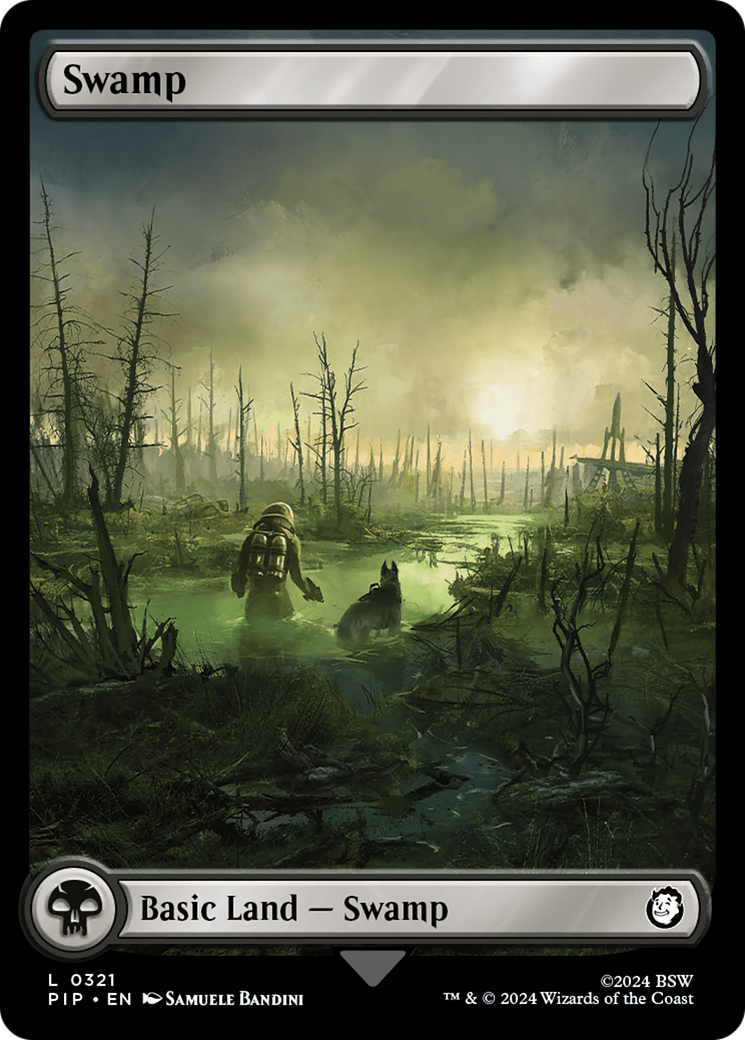
Basic Land — Swamp
( : Add .)
-
1
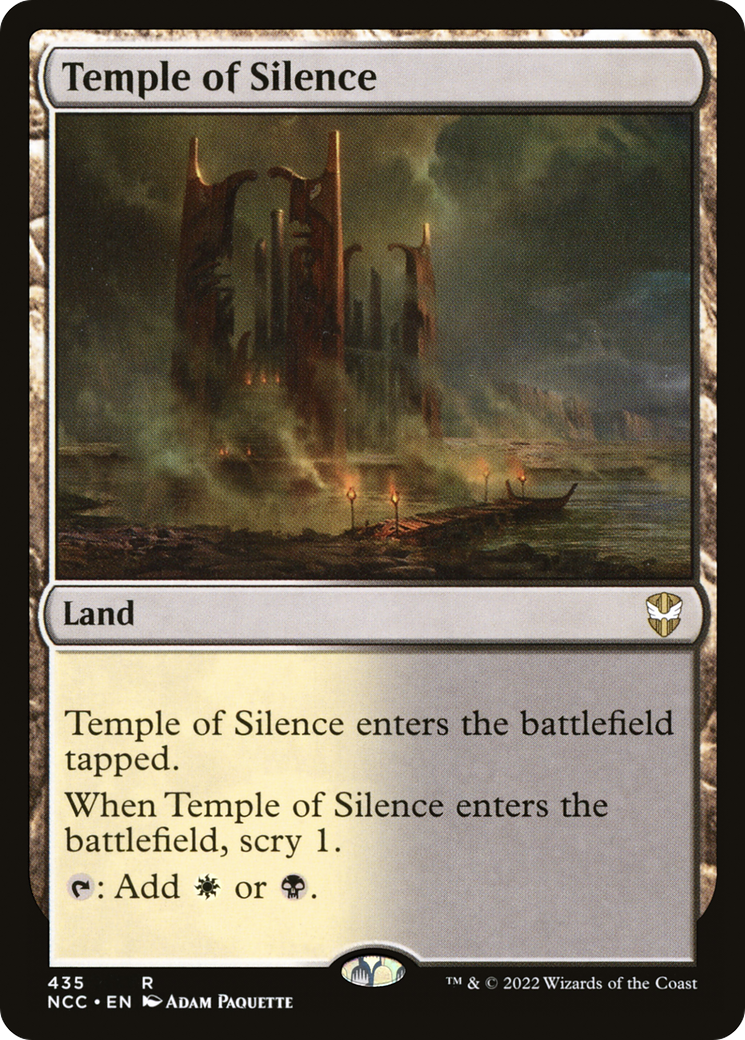
Temple of Silence
Temple of Silence
Land
This land enters tapped.
When this land enters, scry 1. (Look at the top card of your library. You may put that card on the bottom.)
: Add or .
- When you scry, you may put all the cards you look at back on top of your library, you may put all of those cards on the bottom of your library, or you may put some of those cards on top and the rest of them on the bottom.
- You choose how to order cards returned to your library after scrying no matter where you put them.
- You perform the actions stated on a card in sequence. For some spells and abilities, that means you'll scry last. For others, that means you'll scry and then perform other actions.
- Scry appears on some spells and abilities with one or more targets. If all of the spell or ability's targets are illegal when it tries to resolve, it won't resolve and none of its effects will happen. You won't scry.
-
1
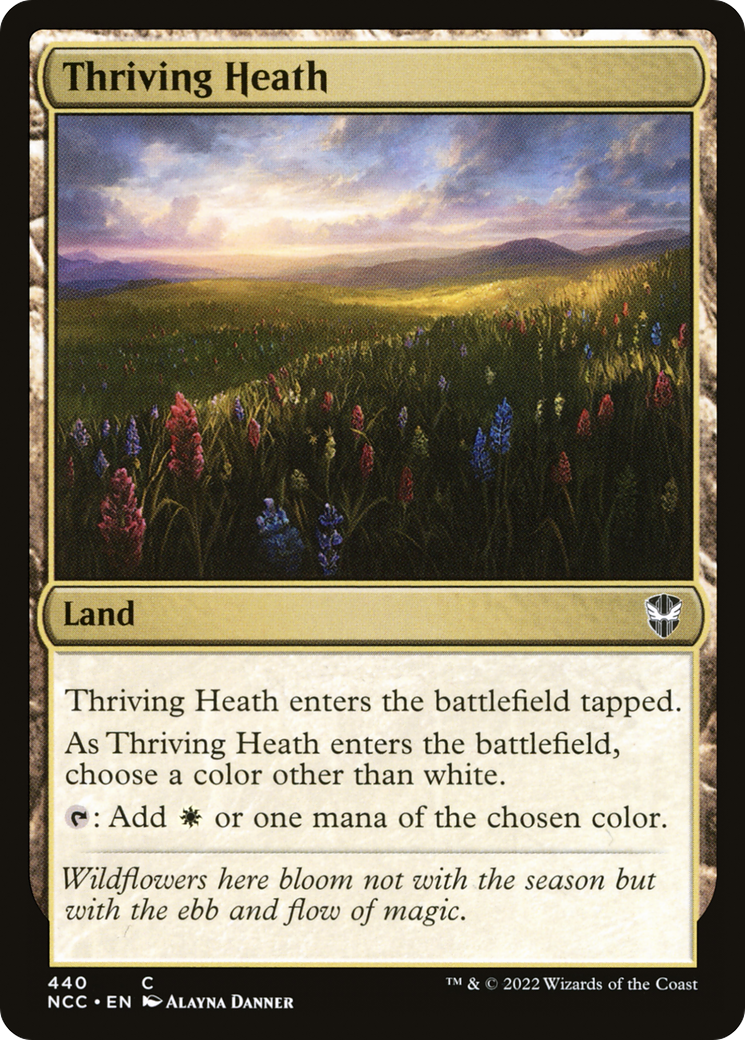
Thriving Heath
Thriving Heath
Land
This land enters tapped. As it enters, choose a color other than white.
: Add or one mana of the chosen color.
-
1
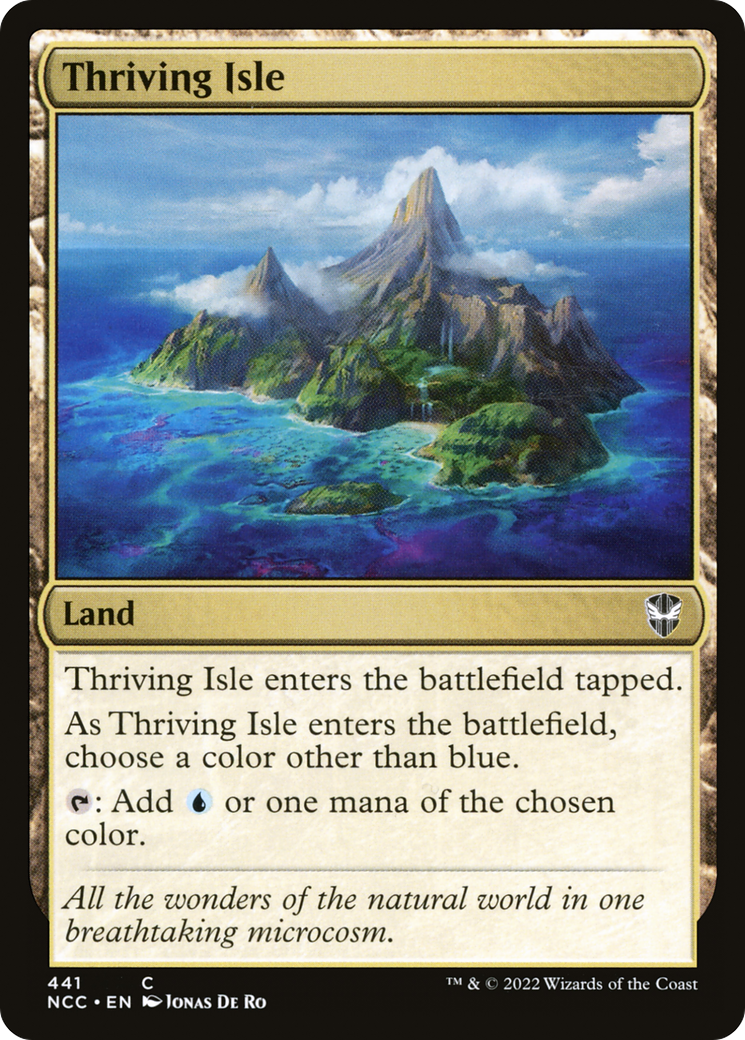
Thriving Isle
Thriving Isle
Land
This land enters tapped. As it enters, choose a color other than blue.
: Add or one mana of the chosen color.
-
1
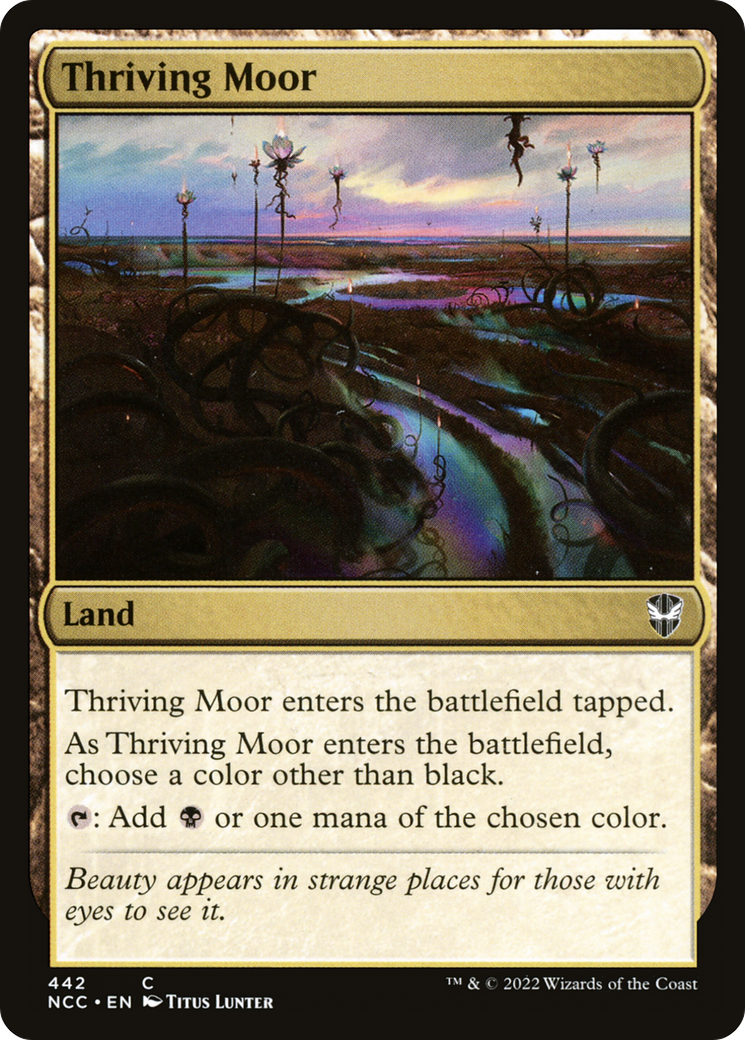
Thriving Moor
Thriving Moor
Land
This land enters tapped. As it enters, choose a color other than black.
: Add or one mana of the chosen color.
White 8
-
1
Aerial Extortionist
Aerial Extortionist
Creature — Bird Soldier
4/3
Flying
Whenever this creature enters or deals combat damage to a player, exile up to one target nonland permanent. For as long as that card remains exiled, its owner may cast it.
Whenever another player casts a spell from anywhere other than their hand, draw a card.
-
1
Archon of Coronation
Archon of Coronation
Creature — Archon
5/5
Flying
When this creature enters, you become the monarch.
As long as you're the monarch, damage doesn't cause you to lose life. (When a creature deals combat damage to you, its controller still becomes the monarch.)
- While Archon of Coronation's last ability applies, damage dealt to you still has all effects other than causing you to lose life. For example, abilities that trigger on that damage being dealt still trigger; if the source has lifelink, its controller still gains life; and so on.
- Combat damage dealt to you by a commander is still tracked, even if it didn't cause you to lose life.
- The game starts with no monarch. Once an effect makes one player the monarch, the game will have exactly one monarch from that point forward. As a player becomes the monarch, the current monarch (if any) ceases being the monarch.
- There are two inherent triggered abilities associated with being the monarch. These triggered abilities have no source and are controlled by the player who was the monarch at the time the abilities triggered. The full texts of these abilities are "At the beginning of the monarch's end step, that player draws a card" and "Whenever a creature deals combat damage to the monarch, its controller becomes the monarch."
- If the triggered ability that causes the monarch to draw a card goes on the stack and a different player becomes the monarch before that ability resolves, the first player will still draw the card.
- If the monarch leaves the game during another player's turn, that player becomes the monarch. If the monarch leaves the game during their turn, the next player in turn order becomes the monarch.
- If combat damage dealt to the monarch causes that player to lose the game, the triggered ability that causes the controller of the attacking creature to become the monarch doesn't resolve. In most cases, the controller of the attacking creature will still become the monarch as it is likely their turn.
-
1
Austere Command
Austere Command
Sorcery
Choose two —
- Destroy all artifacts.
- Destroy all enchantments.
- Destroy all creatures with mana value 3 or less.
- Destroy all creatures with mana value 4 or greater.
- Each of the chosen modes happens sequentially. If a permanent has an ability that triggers whenever it or another permanent is destroyed, it will see permanents destroyed at the same time as it or before it, but not permanents destroyed by later modes.
- If a card is exiled "until" another permanent leaves the battlefield, the exiled card returns to the battlefield immediately after that permanent leaves the battlefield during Austere Command's resolution, and it may be destroyed by a later mode.
- If the first and last modes are chosen, an artifact creature with mana value 4 or greater will have to be regenerated twice to survive. This is because the modes happen sequentially, and the regeneration "shield" is used up by the first one. The same is true with any other combination of modes that covers one permanent twice.
-
1
Dusk // Dawn
//
Dusk
Sorcery
- Once you've started to cast a spell with aftermath from your graveyard, the card is immediately moved to the stack. Opponents can't try to stop the ability by exiling the card with an effect such as that of Crook of Condemnation.
- All split cards have two card faces on a single card, and you put a split card onto the stack with only the half you're casting. The characteristics of the half of the card you didn't cast are ignored while the spell is on the stack. For example, if an effect prevents you from casting green spells, you can cast Destined of Destined // Lead, but not Lead.
- Each split card is a single card. For example, if you discard one, you've discarded one card, not two. If an effect counts the number of instant and sorcery cards in your graveyard, Destined // Lead counts once, not twice.
- Each split card has two names. If an effect instructs you to choose a card name, you may choose one, but not both.
- While not on the stack, the characteristics of a split card are the combination of its two halves. For example, Destined // Lead is a green and black card, it is both an instant card and a sorcery card, and its mana value is 6. This means that if an effect allows you to cast a card with mana value 2 from your hand, you can't cast Destined. This is a change from the previous rules for split cards.
- Split cards with aftermath have a new frame treatment—the half you can cast from your hand is oriented the same as other cards you'd cast from your hand, while the half you can cast from your graveyard is a traditional split card half. This frame treatment is for your convenience and has no rules significance.
- If another effect allows you to cast a split card with aftermath from any zone other than a graveyard, you can't cast the half with aftermath.
- If another effect allows you to cast a split card with aftermath from a graveyard, you may cast either half. If you cast the half that has aftermath, you'll exile the card if it would leave the stack.
- A spell with aftermath cast from a graveyard will always be exiled afterward, whether it resolves, it's countered, or it leaves the stack in some other way.
- If you cast the first half of a split card with aftermath during your turn, you'll have priority immediately after it resolves. You can cast the half with aftermath from your graveyard before any player can take any other action if it's legal for you to do so.
-
1
Jailbreak
Jailbreak
Sorcery
Return target permanent card in an opponent's graveyard to the battlefield under their control. When that permanent enters, return up to one target permanent card with equal or lesser mana value from your graveyard to the battlefield.
- You don't choose a target from your own graveyard until after the permanent card from your opponent's graveyard has entered the battlefield. If that card doesn't enter the battlefield for some reason, you will not be able to target and return a card from your own graveyard.
-
1
Smuggler's Share
Smuggler's Share
Enchantment
At the beginning of each end step, draw a card for each opponent who drew two or more cards this turn, then create a Treasure token for each opponent who had two or more lands enter the battlefield under their control this turn.
-
1
Sun Titan
Sun Titan
Creature — Giant
6/6
Vigilance
Whenever this creature enters or attacks, you may return target permanent card with mana value 3 or less from your graveyard to the battlefield.
- A permanent card is an artifact, creature, enchantment, land, or planeswalker card.
- If a card in your graveyard has no mana symbols in its upper right corner (because it's a land card, for example), its mana value is 0.
- The mana value of a card in your graveyard is determined solely by the mana symbols printed in its upper right corner. The mana value is the total amount of mana in that cost, regardless of color. For example, a card with mana cost has mana value 5.
- If the mana cost of a card in your graveyard includes , X is considered to be 0.
-
1
Swords to Plowshares
Swords to Plowshares
Instant
Exile target creature. Its controller gains life equal to its power.
- Use the power of the creature from when it was last on the battlefield to determine how much life is gained.
Blue 17
-
1
An Offer You Can't Refuse
An Offer You Can't Refuse
Instant
Counter target noncreature spell. Its controller creates two Treasure tokens. (They're artifacts with " , Sacrifice this token: Add one mana of any color.")
- If the target is still legal as it resolves but the spell can't be countered for some reason, its controller will still create two Treasure tokens.
- If the target is no longer legal as An Offer You Can't Refuse resolves, no Treasure tokens are created.
-
1
Cephalid Facetaker
Cephalid Facetaker
Creature — Octopus Rogue
1/4
This creature can't be blocked.
At the beginning of combat on your turn, you may have this creature become a copy of another target creature until end of turn, except it's 1/4 and has "This creature can't be blocked."
-
1
Champion of Wits
Champion of Wits
Creature — Snake Wizard
2/1
When this creature enters, you may draw cards equal to its power. If you do, discard two cards.
Eternalize ( , Exile this card from your graveyard: Create a token that's a copy of it, except it's a 4/4 black Zombie Snake Wizard with no mana cost. Eternalize only as a sorcery.)
- Use Champion of Wits's power as the first ability resolves to determine if you want to use the ability and how many cards you draw if you do. If you use the ability, you discard two cards regardless of how many cards you draw. If Champion of Wits leaves the battlefield before that ability resolves, use its last known power.
- For each card with eternalize, a corresponding game play supplement token can be found in some Hour of Devastation booster packs. These supplements are not required to play with cards with eternalize; you can use the same items to represent an eternalized token as you would any other token.
- If a creature card with eternalize is put into your graveyard during your main phase, you'll have priority immediately afterward. You can activate its eternalize ability before any player can try to exile it, such as with Crook of Condemnation, if it's legal for you to do so.
- Once you've activated an eternalize ability, the card is immediately exiled. Opponents can't try to stop the ability by exiling the card with an effect such as that of Crook of Condemnation.
- The token copies exactly what was printed on the original card and nothing else, except the characteristics specifically modified by eternalize. It doesn't copy any information about the object the card was before it was put into your graveyard.
- The token is a Zombie in addition to its other types and is black instead of its other colors. Its base power and toughness are 4/4. It has no mana cost, and thus its mana value is 0. These are copiable values of the token that other effects may copy.
- If the card copied by the token had any “when [this permanent] enters the battlefield” abilities, then the token also has those abilities and will trigger them when it's created. Similarly, any “as [this permanent] enters the battlefield” or “[this permanent] enters the battlefield with” abilities that the token has copied will also work.
-
1
Change of Plans
Change of Plans
Instant
Each of X target creatures you control connive. You may have any number of them phase out. (To have a creature connive, draw a card, then discard a card. If you discarded a nonland card, put a +1/+1 counter on that creature. Treat phased-out permanents and anything attached to them as though they don't exist until their controller's next turn.)
- If multiple creatures are instructed to connive simultaneously, they connive one at a time in the order of their controller's choice.
- You choose which creatures to phase out after all of those creatures have connived.
- Once an ability that causes a creature to connive begins to resolve, no player may take any other actions until it's done. Notably, opponents can't try to remove the conniving creature after you discard a nonland card but before it receives a counter.
- If no card is discarded, most likely because that player's hand is empty and an effect says they can't draw cards, the conniving creature does not receive a +1/+1 counter.
- If a resolving spell or ability instructs a specific creature to connive but that creature has left the battlefield, the creature still connives. If you discard a nonland card this way, you won't put a +1/+1 counter on anything. Abilities that trigger “when [that creature] connives” will trigger.
-
1
Chasm Skulker
Chasm Skulker
Creature — Squid Horror
1/1
Whenever you draw a card, put a +1/+1 counter on this creature.
When this creature dies, create X 1/1 blue Squid creature tokens with islandwalk, where X is the number of +1/+1 counters on this creature. (They can't be blocked as long as defending player controls an Island.)
- If enough -1/-1 counters are put on Chasm Skulker at the same time to make its toughness 0 or less, the number of +1/+1 counters on it before it got any -1/-1 counters will be used to determine how many Squid tokens you get. For example, if there are two +1/+1 counters on Chasm Skulker and it gets three -1/-1 counters, you'll get two Squid tokens.
- If you draw multiple cards, the first ability will trigger that many times. Each of these abilities will cause a +1/+1 counter to be put on Chasm Skulker.
-
1
Commit // Memory
//
Commit
Instant
- Once you've started to cast a spell with aftermath from your graveyard, the card is immediately moved to the stack. Opponents can't try to stop the ability by exiling the card with an effect such as that of Crook of Condemnation.
- If a spell is put into its owner's library, it's removed from the stack and thus will not resolve. The spell isn't countered; it just no longer exists. This works against a spell that can't be countered.
- If a copy of a spell or a token is put into its owner's library, it's moved there, then it will cease to exist as a state-based action.
- Split cards with aftermath have a new frame treatment—the half you can cast from your hand is oriented the same as other cards you'd cast from your hand, while the half you can cast from your graveyard is a traditional split card half. This frame treatment is for your convenience and has no rules significance.
- All split cards have two card faces on a single card, and you put a split card onto the stack with only the half you're casting. The characteristics of the half of the card you didn't cast are ignored while the spell is on the stack. For example, if an effect prevents you from casting green spells, you can cast Destined of Destined // Lead, but not Lead.
- Each split card is a single card. For example, if you discard one, you've discarded one card, not two. If an effect counts the number of instant and sorcery cards in your graveyard, Destined // Lead counts once, not twice.
- If the target's owner's library contains no cards, the target spell or permanent will be put into that player's library as the only card.
- While not on the stack, the characteristics of a split card are the combination of its two halves. For example, Destined // Lead is a green and black card, it is both an instant card and a sorcery card, and its mana value is 6. This means that if an effect allows you to cast a card with mana value 2 from your hand, you can't cast Destined. This is a change from the previous rules for split cards.
- If you cast the first half of a split card with aftermath during your turn, you'll have priority immediately after it resolves. You can cast the half with aftermath from your graveyard before any player can take any other action if it's legal for you to do so.
- If another effect allows you to cast a split card with aftermath from any zone other than a graveyard, you can't cast the half with aftermath.
- If another effect allows you to cast a split card with aftermath from a graveyard, you may cast either half. If you cast the half that has aftermath, you'll exile the card if it would leave the stack.
- A spell with aftermath cast from a graveyard will always be exiled afterward, whether it resolves, it's countered, or it leaves the stack in some other way.
- Each split card has two names. If an effect instructs you to choose a card name, you may choose one, but not both.
-
1
Daring Saboteur
Daring Saboteur
Creature — Human Pirate
2/1
: This creature can't be blocked this turn.
Whenever this creature deals combat damage to a player, you may draw a card. If you do, discard a card.
- Activating the first ability of Daring Saboteur after it has become blocked won't cause it to become unblocked.
-
1
Ghostly Pilferer
Ghostly Pilferer
Creature — Spirit Rogue
2/1
Whenever this creature becomes untapped, you may pay . If you do, draw a card.
Whenever an opponent casts a spell from anywhere other than their hand, draw a card.
Discard a card: This creature can't be blocked this turn.
- Ghostly Pilferer's first ability triggers during your untap step, but it's put onto the stack at the same time as abilities that trigger at the beginning of your upkeep step. Even though the ability triggered first, you may order it before or after other abilities you control that are put onto the stack at this time.
- While resolving Ghostly Pilferer's first ability, you can't pay more than to draw more than one card.
- An ability that triggers when a player casts a spell resolves before the spell that caused it to trigger. It resolves even if that spell is countered.
- Players can cast spells and activate abilities after the second triggered ability resolves but before the spell that caused it to trigger does.
- Once Ghostly Pilferer has been blocked, activating its last ability doesn't cause it to become unblocked.
-
1
Identity Thief
Identity Thief
Creature — Shapeshifter
0/3
Whenever this creature attacks, you may exile another target nontoken creature. If you do, this creature becomes a copy of that creature until end of turn. Return the exiled card to the battlefield under its owner's control at the beginning of the next end step.
- If the targeted creature has an ability that triggers when it attacks, it'll be too late for it to trigger once Identity Thief has that ability. The same is true if another object has an ability that triggers when a creature with certain characteristics attacks and Identity Thief doesn't have those characteristics until after it becomes a copy.
- Identity Thief copies the printed values of the targeted creature, plus any copy effects that have been applied to that creature. It won't copy other effects that have changed the targeted creature's power, toughness, types, color, or so on. It also won't copy counters on the targeted creature.
- If the targeted creature is a double-faced or melded permanent, Identity Thief copies the face shown. Because Identity Thief is not a double-faced card or meld card, it won't be able to transform or meld. If it copies a melded permanent or the back face of a double-faced card, its mana value will be 0. Exiled double-faced cards and exiled meld cards will return with their front faces up.
- If the targeted creature is itself copying a permanent, Identity Thief will become whatever it's copying, as modified by that copy effect. For example, if you target a Hamlet Captain that has become a copy of Permeating Mass, Identity Thief will become a Permeating Mass.
- This effect can cause Identity Thief to stop being a creature. For example, if you target an animated Gideon Jura (a planeswalker with a loyalty ability that turns him into a creature), only the printed wording will be copied; the “becomes a creature” effect won't. Identity Thief will become a noncreature Gideon with no loyalty, be removed from combat, and then be put into its owner's graveyard.
- This effect can cause Identity Thief to become a copy of a creature that can't normally attack, such as Lupine Prototype or a creature with defender. In these cases, it remains attacking.
- Noncopy effects that have already applied to Identity Thief will continue to apply to it. For example, if Woodcutter's Grit gave Identity Thief +3/+3 and hexproof earlier in the turn, Identity Thief will still have those bonuses after copying a creature.
- Identity Thief will still be a copy of the creature during the next end step when the exiled card returns. If it has an ability that triggers at the beginning of the end step, that ability will trigger for Identity Thief and not for the returned creature.
- Auras attached to the exiled creature will be put into their owners' graveyards. Any Equipment will become unattached and remain on the battlefield. Any counters on the exiled permanent will cease to exist.
-
1
In Too Deep
In Too Deep
Enchantment — Aura
Split second (As long as this spell is on the stack, players can't cast spells or activate abilities that aren't mana abilities.)
Enchant creature, planeswalker, or Clue
Enchanted permanent is a colorless Clue artifact with " , Sacrifice this artifact: Draw a card" and loses all other abilities. (It's no longer a creature or planeswalker.)
- Players still get priority while a card with split second is on the stack; their options are just limited to mana abilities and certain special actions.
- Split second doesn't allow players to cast the spell it's on at times when they otherwise wouldn't be able to cast it. An enchantment with split second may still be cast only during its controller's main phase when the stack is empty.
- Players may turn face-down creatures face up while a spell with split second is on the stack.
- Split second doesn't stop triggered abilities from triggering, such as that of Chalice of the Void. If one does, its controller puts it on the stack and chooses targets for it, if any. Those abilities will resolve as normal.
- Casting a spell with split second won't affect spells and abilities that are already on the stack.
- If the resolution of a triggered ability involves casting a spell, that spell can't be cast if a spell with split second is on the stack.
- After a spell with split second resolves (or otherwise leaves the stack), players may again cast spells and activate abilities before the next object on the stack resolves.
-
1
Looter il-Kor
Looter il-Kor
Creature — Kor Rogue
1/1
Shadow (This creature can block or be blocked by only creatures with shadow.)
Whenever this creature deals damage to an opponent, draw a card, then discard a card.
- You draw a card and discard a card all while Looter il-Kor's ability is resolving. Nothing can happen in between, and no player can take actions.
- Once a creature has been blocked, that creature remains blocked and will deal and be dealt combat damage even if it gains or loses shadow or if the blocking creature gains or loses shadow.
- If an attacking creature has multiple evasion abilities, such as shadow and flying, a creature can block it only if that creature satisfies all of the appropriate evasion abilities.
- Multiple instances of shadow on the same creature are redundant.
-
1
Mask of the Schemer
Mask of the Schemer
Artifact — Equipment
Whenever equipped creature deals combat damage to a player, it connives X, where X is the amount of damage it dealt to that player. (Draw X cards, then discard X cards. Put a +1/+1 counter on that creature for each nonland card discarded this way.)
Equip
- Once an ability that causes a creature to connive begins to resolve, no player may take any other actions until it's done. Notably, opponents can't try to remove the conniving creature after you discard a nonland card but before it receives a counter.
- If no card is discarded, most likely because that player's hand is empty and an effect says they can't draw cards, the conniving creature does not receive a +1/+1 counter.
- If a resolving spell or ability instructs a specific creature to connive but that creature has left the battlefield, the creature still connives. If you discard a nonland card this way, you won't put a +1/+1 counter on anything. Abilities that trigger “when [that creature] connives” will trigger.
- Connive X is a variant of connive. If a creature connives X, its controller will draw X cards, discard X cards, then then put a number of +1/+1 counters on the conniving permanent equal to the number of nonland cards discarded this way.
-
1
Nadir Kraken
Nadir Kraken
Creature — Kraken
2/3
Whenever you draw a card, you may pay . If you do, put a +1/+1 counter on this creature and create a 1/1 blue Tentacle creature token.
- While resolving Nadir Kraken's ability, you can't pay multiple times to create multiple Tentacles or to give it multiple +1/+1 counters.
- You choose whether to pay after drawing the card and seeing what it is. If you draw multiple cards, you see them all before deciding how many of the resulting triggers you'll pay for.
- If Nadir Kraken leaves the battlefield after its ability has triggered, you can still pay and get a Tentacle, even though you won't put a +1/+1 counter on Nadir Kraken.
-
1
Skyway Robber
Skyway Robber
Creature — Bird Rogue
3/3
Flying
Escape— , Exile five other cards from your graveyard. (You may cast this card from your graveyard for its escape cost.)
This creature escapes with "Whenever this creature deals combat damage to a player, you may cast an artifact, instant, or sorcery spell from among cards exiled with this creature without paying its mana cost."
- The ability Skyway Robber escapes with only allows you to cast cards exiled with its escape ability the last time it escaped. If it dies and escapes again later, or if it moves to another zone and returns to the battlefield, you won't be able to cast any of the cards exiled with it before.
- Escape's permission doesn't change when you may cast the spell from your graveyard.
- To determine the total cost of a spell, start with the mana cost or alternative cost you're paying (such as an escape cost), add any cost increases, then apply any cost reductions. The mana value of the spell remains unchanged, no matter what the total cost to cast it was and no matter whether an alternative cost was paid.
- After an escaped spell resolves, it returns to its owner's graveyard if it's not a permanent spell. If it is a permanent spell, it enters the battlefield and will return to its owner's graveyard if it dies later.
- If a card has multiple abilities giving you permission to cast it, such as two escape abilities or an escape ability and a flashback ability, you choose which one to apply. The others have no effect.
- If you cast a spell with its escape permission, you can't choose to apply any other alternative costs or to cast it without paying its mana cost. If it has any additional costs, you must pay those.
- If a card with escape is put into your graveyard during your turn, you'll be able to cast it right away if it's legal to do so, before an opponent can take any actions.
- Once you begin casting a spell with escape, it immediately moves to the stack. Players can't take any other actions until you're done casting the spell.
-
1
Stolen Identity
Stolen Identity
Sorcery
Create a token that's a copy of target artifact or creature.
Cipher (Then you may exile this spell card encoded on a creature you control. Whenever that creature deals combat damage to a player, its controller may cast a copy of the encoded card without paying its mana cost.)
- If a creature with an encoded card deals combat damage to more than one player simultaneously (perhaps because some of the combat damage was redirected), the triggered ability will trigger once for each player it deals combat damage to. Each ability will create a copy of the exiled card and allow you to cast it.
- If you want to encode the card with cipher onto a noncreature permanent such as a Keyrune that can turn into a creature, that permanent has to be a creature before the spell with cipher starts resolving. You can choose only a creature to encode the card onto.
- The copy of the card with cipher is created in and cast from exile.
- You cast the copy of the card with cipher during the resolution of the triggered ability. Ignore timing restrictions based on the card's type.
- If you choose not to cast the copy, or you can't cast it (perhaps because there are no legal targets available), the copy will cease to exist the next time state-based actions are performed. You won't get a chance to cast the copy at a later time.
- The exiled card with cipher grants a triggered ability to the creature it's encoded on. If that creature loses that ability and subsequently deals combat damage to a player, the triggered ability won't trigger. However, the exiled card will continue to be encoded on that creature.
- If another player gains control of the creature, that player will control the triggered ability. That player will create a copy of the encoded card and may cast it.
- The spell with cipher is encoded on the creature as part of that spell's resolution, just after the spell's other effects. That card goes directly from the stack to exile. It never goes to the graveyard.
- You choose the creature as the spell resolves. The cipher ability doesn't target that creature, although the spell with cipher may target that creature (or a different creature) because of its other abilities.
- If the spell with cipher doesn't resolve, none of its effects will happen, including cipher. The card will go to its owner's graveyard and won't be encoded on a creature.
- If the creature leaves the battlefield, the exiled card will no longer be encoded on any creature. It will stay exiled.
- The token copies exactly what was printed on the original artifact or creature and nothing else (unless that permanent is copying something else or is a token; see below). It doesn't copy whether it is tapped or untapped, whether it has any counters on it or Auras and Equipment attached to it, or any non-copy effects that have changed its power, toughness, types, color, or so on.
- If the copied permanent has in its mana cost, X is considered to be zero.
- If the copied permanent is copying something else (for example, if the copied creature is a Clone), then the token enters as whatever that creature copied.
- If the copied permanent is a token, the token that's created copies the original characteristics of that token as stated by the effect that put the token onto the battlefield.
- Any "enters" abilities of the copied permanent will trigger when the token enters the battlefield. Any "as [this permanent] enters" or "[this permanent] enters with" abilities of the chosen permanent will also work.
- If the token you create is a copy of a creature, you can exile Stolen Identity encoded on that token.
-
1
Treasure Cruise
Treasure Cruise
Sorcery
Delve (Each card you exile from your graveyard while casting this spell pays for .)
Draw three cards.
- Delve doesn't change a spell's mana cost or mana value. For example, Treasure Cruise's mana value is 8 even if you exiled three cards to cast it.
- You can exile cards to pay only for generic mana, and you can't exile more cards than the generic mana requirement of a spell with delve. For example, you can't exile more than seven cards from your graveyard to cast Treasure Cruise unless an effect has increased its cost.
- Because delve isn't an alternative cost, it can be used in conjunction with alternative costs, such as flashback. It can also be used to pay for additional costs that include generic mana.
-
1
Whirler Rogue
Whirler Rogue
Creature — Human Rogue Artificer
2/2
When this creature enters, create two 1/1 colorless Thopter artifact creature tokens with flying.
Tap two untapped artifacts you control: Target creature can't be blocked this turn.
- You may tap any two untapped artifacts you control, including artifact creatures that haven't been under your control continuously since the beginning of your most recent turn.
- Activating the second ability of Whirler Rogue after a creature has become blocked won't cause it to become unblocked.
Black 8
-
1
Custodi Lich
Custodi Lich
Creature — Zombie Cleric
4/2
When this creature enters, you become the monarch.
Whenever you become the monarch, target player sacrifices a creature of their choice.
- If the triggered ability that causes the monarch to draw a card goes on the stack, and a different player becomes the monarch before that ability resolves, the first player will still draw the card.
- The game starts with no monarch. Once an effect makes one player the monarch, the game will have exactly one monarch from that point forward.
- Being the monarch carries two inherent triggered abilities. “At the beginning of the monarch's end step, that player draws a card” and “Whenever a creature deals combat damage to the monarch, its controller becomes the monarch.”
- Abilities that trigger whenever you “become the monarch” trigger only if you aren't already the monarch. For example, if you are already the monarch as Custodi Lich enters the battlefield, its last ability won't trigger.
-
1
Drana, Liberator of Malakir
Drana, Liberator of Malakir
Legendary Creature — Vampire Ally
2/3
Flying, first strike
Whenever Drana deals combat damage to a player, put a +1/+1 counter on each attacking creature you control.
- Drana's last ability triggers after combat damage has been dealt, so only attacking creatures that survive the combat damage step in which Drana deals combat damage will have +1/+1 counters put on them.
- The +1/+1 counter won't change how much damage Drana or any other attacking creature with first strike or double strike deals during that combat damage step. However, the +1/+1 counters that are put on attacking creatures without first strike will affect the damage those creatures deal during the regular combat damage step.
-
1
Graveblade Marauder
Graveblade Marauder
Creature — Human Warrior
1/4
Deathtouch (Any amount of damage this deals to a creature is enough to destroy it.)
Whenever this creature deals combat damage to a player, that player loses life equal to the number of creature cards in your graveyard.
- Count the number of creature cards in your graveyard as the ability resolves to determine how much life is lost. Notably, this could include any other creature you owned that died in combat, and perhaps even Graveblade Marauder itself.
-
1
Lethal Scheme
Lethal Scheme
Instant
Convoke (Your creatures can help cast this spell. Each creature you tap while casting this spell pays for or one mana of that creature's color.)
Destroy target creature or planeswalker. Each creature that convoked Lethal Scheme connives. (Draw a card, then discard a card. If you discarded a nonland card, put a +1/+1 counter on that creature.)
- When multiple creatures are instructed to connive simultaneously, they connive one at a time in the order of their controller's choice.
- You can't tap more creatures to convoke Lethal Scheme than it takes to pay for its total cost. This means that normally no more than four creatures can convoke it.
-
1
Misfortune Teller
Misfortune Teller
Creature — Human Warlock
3/1
Deathtouch
Whenever this creature enters or deals combat damage to a player, exile target card from a graveyard. If it was a creature card, create a 2/2 black Rogue creature token. If it was a land card, create a Treasure token. Otherwise, you gain 3 life.
- If the card was both a land and a creature (such as Dryad Arbor), you will create both a Rogue token and a Treasure token.
-
1
Nightmare Unmaking
Nightmare Unmaking
Sorcery
Choose one —
- Exile each creature with power greater than the number of cards in your hand.
- Exile each creature with power less than the number of cards in your hand.
- Because Nightmare Unmaking is on the stack while it's resolving, it won't be counted among the cards in your hand.
- The power of creatures and the number of cards in your hand are checked only as Nightmare Unmaking resolves. Players may respond to the spell knowing the chosen mode to try to save or doom a creature.
-
1
Profane Command
Profane Command
Sorcery
Choose two —
- Target player loses X life.
- Return target creature card with mana value X or less from your graveyard to the battlefield.
- Target creature gets -X/-X until end of turn.
- Up to X target creatures gain fear until end of turn. (They can't be blocked except by artifact creatures and/or black creatures.)
- The value chosen for X applies to each X in the spell's effect. You pay only once.
-
1
Writ of Return
Writ of Return
Sorcery
Return target creature card from your graveyard to the battlefield tapped.
Cipher (Then you may exile this spell card encoded on a creature you control. Whenever that creature deals combat damage to a player, its controller may cast a copy of the encoded card without paying its mana cost.)
- The spell with cipher is encoded on the creature as part of that spell's resolution, just after the spell's other effects. That card goes directly from the stack to exile. It never goes to the graveyard.
- You choose the creature as the spell resolves. The cipher ability doesn't target that creature.
- If the spell with cipher doesn't resolve, none of its effects will happen, including cipher. The card will go to its owner's graveyard and won't be encoded on a creature.
- If the creature leaves the battlefield, the exiled card will no longer be encoded on any creature. It will stay exiled.
- You can choose only a creature to encode the card onto.
- The copy of the card with cipher is created in and cast from exile.
- You cast the copy of the card with cipher during the resolution of the triggered ability. Ignore timing restrictions based on the card's type.
- If you choose not to cast the copy, or you can't cast it (perhaps because there are no legal targets available), the copy will cease to exist the next time state-based actions are performed. You won't get a chance to cast the copy at a later time.
- The exiled card with cipher grants a triggered ability to the creature it's encoded on. If that creature loses that ability and subsequently deals combat damage to a player, the triggered ability won't trigger. However, the exiled card will continue to be encoded on that creature.
- If another player gains control of the creature, that player will control the triggered ability. That player will create a copy of the encoded card and may cast it.
- If a creature with an encoded card deals combat damage to more than one player simultaneously (perhaps because some of the combat damage was redirected), the triggered ability will trigger once for each player it deals combat damage to. Each ability will create a copy of the exiled card and allow you to cast it.
Multicolor 16
-
1
Alela, Artful Provocateur
Alela, Artful Provocateur
Legendary Creature — Faerie Warlock
2/3
Flying, deathtouch, lifelink
Other creatures you control with flying get +1/+0.
Whenever you cast an artifact or enchantment spell, create a 1/1 blue Faerie creature token with flying.
- Alela's last ability resolves before the spell that caused it to trigger. It resolves even if that spell is countered.
- A spell that's both an artifact and an enchantment spell causes Alela's last ability to trigger only once.
-
1
Daxos of Meletis
Daxos of Meletis
Legendary Creature — Human Soldier
2/2
Daxos can't be blocked by creatures with power 3 or greater.
Whenever Daxos deals combat damage to a player, exile the top card of that player's library. You gain life equal to that card's mana value. Until end of turn, you may cast that card and you may spend mana as though it were mana of any color to cast that spell.
- If Daxos is blocked by a creature, raising that creature's power to 3 or greater won't change or undo the block.
- If the exiled card is a land card, you won't gain any life and you won't be able to play the land.
- You must pay all costs to cast the exiled card. You may pay alternative or additional costs. If the card has any mandatory additional costs, you must pay those.
- Daxos doesn't change when you can cast the exiled card. For example, if you exile a creature card without flash, you can cast it only during your main phase when the stack is empty.
-
1
Dragonlord Ojutai
Dragonlord Ojutai
Legendary Creature — Elder Dragon
5/4
Flying
Dragonlord Ojutai has hexproof as long as it's untapped.
Whenever Dragonlord Ojutai deals combat damage to a player, look at the top three cards of your library. Put one of them into your hand and the rest on the bottom of your library in any order.
-
1
Fallen Shinobi
Fallen Shinobi
Creature — Zombie Ninja
5/4
Ninjutsu ( , Return an unblocked attacker you control to hand: Put this card onto the battlefield from your hand tapped and attacking.)
Whenever this creature deals combat damage to a player, that player exiles the top two cards of their library. Until end of turn, you may play those cards without paying their mana costs.
- Fallen Shinobi's triggered ability doesn't change when you can play the exiled cards. For example, if a sorcery card is exiled, you can cast it only during your main phase when the stack is empty. If a land card is exiled, you can play it only during your main phase and only if you have an available land play remaining.
- Casting an exiled card causes it to leave exile. You can't cast it multiple times.
- Any cards you don't cast will remain in exile.
- The ninjutsu ability can be activated only after blockers have been declared. Before then, attacking creatures are neither blocked nor unblocked.
- As you activate a ninjutsu ability, you reveal the Ninja card in your hand and return the attacking creature. The Ninja isn't put onto the battlefield until the ability resolves. If it leaves your hand before then, it won't enter the battlefield at all.
- The creature with ninjutsu enters the battlefield attacking the same player or planeswalker that the returned creature was attacking. This is a rule specific to ninjutsu; in other cases, when a creature is put onto the battlefield attacking, that creature's controller chooses which player or planeswalker it's attacking.
- Although the Ninja is attacking, it was never declared as an attacking creature (for purposes of abilities that trigger whenever a creature attacks, for example).
- The ninjutsu ability can be activated during the declare blockers step, combat damage step, or end of combat step. If you wait until after the declare blockers step, because all combat damage is dealt at once, the Ninja won't normally deal combat damage.
- If a creature in combat has first strike or double strike, you can activate the ninjutsu ability during the first-strike combat damage step. The Ninja will deal combat damage during the regular combat damage step, even if it has first strike.
-
1
Kamiz, Obscura Oculus
Kamiz, Obscura Oculus
Legendary Creature — Octopus Rogue
2/4
Whenever you attack, target attacking creature can't be blocked this turn. It connives. Then choose another attacking creature with lesser power. That creature gains double strike until end of turn. (To have a creature connive, draw a card, then discard a card. If you discarded a nonland card, put a +1/+1 counter on that creature.)
- Once an ability that causes a creature to connive begins to resolve, no player may take any other actions until it's done. Notably, opponents can't try to remove the conniving creature after you discard a nonland card but before it receives a counter.
- If no card is discarded, most likely because that player's hand is empty and an effect says they can't draw cards, the conniving creature does not receive a +1/+1 counter.
- If a resolving spell or ability instructs a specific creature to connive but that creature has left the battlefield, the creature still connives. If you discard a nonland card this way, you won't put a +1/+1 counter on anything. Abilities that trigger “when [that creature] connives” will trigger.
-
1
Life Insurance
Life Insurance
Enchantment
Extort (Whenever you cast a spell, you may pay . If you do, each opponent loses 1 life and you gain that much life.)
Whenever a nontoken creature dies, you lose 1 life and create a Treasure token.
- You may pay a maximum of one time for each extort triggered ability. You decide whether to pay when the ability resolves.
- The amount of life you gain from extort is based on the total amount of life lost, not necessarily the number of opponents you have. For example, if your opponent's life total can't change (perhaps because that player controls Platinum Emperion), you won't gain any life.
- The extort ability doesn't target any player.
- The extort ability resolves before the spell that caused it to trigger. The ability resolves even if that spell is countered.
-
1
Mask of Riddles
Mask of Riddles
Artifact — Equipment
Equipped creature has fear. (It can't be blocked except by artifact creatures and/or black creatures.)
Whenever equipped creature deals combat damage to a player, you may draw a card.
Equip
- If a Mask of Riddles you control somehow winds up equipping a creature you don't control, Mask of Riddles's triggered ability will still trigger whenever that creature deals combat damage to a player (even if that player is you). You will control that ability, so you may draw a card.
-
1
Obscura Charm
Obscura Charm
Instant
Choose one —
- Return target multicolored permanent card with mana value 3 or less from your graveyard to the battlefield tapped.
- Counter target instant or sorcery spell.
- Destroy target creature or planeswalker with mana value 3 or less.
-
1
Obscura Confluence
Obscura Confluence
Instant
Choose three. You may choose the same mode more than once.
- Until end of turn, target creature loses all abilities and has base power and toughness 1/1.
- Target creature connives. (Draw a card, then discard a card. If you discarded a nonland card, put a +1/+1 counter on that creature.)
- Target player returns a creature card from their graveyard to their hand.
- Once an ability that causes a creature to connive begins to resolve, no player may take any other actions until it's done. Notably, opponents can't try to remove the conniving creature after you discard a nonland card but before it receives a counter.
- If no card is discarded, most likely because that player's hand is empty and an effect says they can't draw cards, the conniving creature does not receive a +1/+1 counter.
- If a resolving spell or ability instructs a specific creature to connive but that creature has left the battlefield, the creature still connives. If you discard a nonland card this way, you won't put a +1/+1 counter on anything. Abilities that trigger “when [that creature] connives” will trigger.
-
1
Oskar, Rubbish Reclaimer
Oskar, Rubbish Reclaimer
Legendary Creature — Human Wizard
3/3
This spell costs less to cast for each different mana value among cards in your graveyard.
Whenever you discard a nonland card, you may cast it from your graveyard.
- The mana value of a split card in the graveyard is the total mana value of both halves of that card. It does not have two mana values.
- The mana value of a double-faced card in your graveyard is always the mana value of the front face.
- X is 0 when determining the mana value of a card in your graveyard.
- The mana value of a land card is 0.
- You may cast the spell immediately. You must pay all costs for a spell cast this way.
-
1
Shadowmage Infiltrator
Shadowmage Infiltrator
Creature — Human Wizard
1/3
Fear (This creature can't be blocked except by artifact creatures and/or black creatures.)
Whenever this creature deals combat damage to a player, you may draw a card.
-
1
Silent-Blade Oni
Silent-Blade Oni
Creature — Demon Ninja
6/5
Ninjutsu ( , Return an unblocked attacker you control to hand: Put this card onto the battlefield from your hand tapped and attacking.)
Whenever this creature deals combat damage to a player, look at that player's hand. You may cast a spell from among those cards without paying its mana cost.
- If you cast a permanent spell this way, it will enter under your control when it resolves. If you cast an instant or sorcery spell this way, that card will be put into its owner's graveyard when it resolves.
- The nonland card you cast via the triggered ability is cast as part of the resolution of that ability. Timing restrictions based on the card's type are ignored. Other restrictions, such as "Cast [this card] only during an opponent's turn," are not.
- If you cast a card without paying its mana cost, you can't choose to cast it for any alternative costs, such as evoke or the alternative cost provided by the morph ability. If it has in its mana cost, X must be 0. However, you can pay optional additional costs, such as kicker, and you must still pay mandatory additional costs, such as the one on Fling.
-
1
Thief of Sanity
Thief of Sanity
Creature — Specter
2/2
Flying
Whenever this creature deals combat damage to a player, look at the top three cards of that player's library, exile one of them face down, then put the rest into their graveyard. You may cast that card for as long as it remains exiled, and mana of any type can be spent to cast that spell.
- Thief of Sanity's effect doesn't change when you can cast the exiled card. For example, if you exile a sorcery card, you can cast it only during your main phase when the stack is empty.
- An effect that instructs you to "cast" a card doesn't allow you to play lands.
- You can still cast the exiled card if Thief of Sanity leaves the battlefield or leaves your control. If another player gains control of Thief of Sanity, that player can't cast the exiled card.
- Casting an exiled card causes it to leave exile. You can't cast it multiple times.
- In a multiplayer game, if a player leaves the game, all cards that player owns leave as well. If you leave the game, any spells or permanents you control from Thief of Sanity's effect are exiled, and any of the face-down exiled cards remain face down indefinitely. No player may look at them.
-
1
Tivit, Seller of Secrets
Tivit, Seller of Secrets
Legendary Creature — Sphinx Rogue
6/6
Flying, ward
Council's dilemma — Whenever Tivit enters or deals combat damage to a player, starting with you, each player votes for evidence or bribery. For each evidence vote, investigate. For each bribery vote, create a Treasure token.
While voting, you may vote an additional time. (The votes can be for different choices or for the same choice.)
- You make all your votes at the same time. Players who vote after you will know all of your votes when making their own.
- Abilities that allow players to vote an additional time are cumulative. For example, if you control two permanents with this ability, you can vote up to three times.
- The ability only affects spells and abilities that use the word “vote.” Other cards that involve choices, such as Archangel of Strife, are unaffected.
- You must make your initial vote, even if you decline to vote an additional time.
-
1
Utter End
Utter End
Instant
Exile target nonland permanent.
-
1
Wrexial, the Risen Deep
Wrexial, the Risen Deep
Legendary Creature — Kraken
5/8
Islandwalk, swampwalk (This creature can't be blocked as long as defending player controls an Island or a Swamp.)
Whenever Wrexial deals combat damage to a player, you may cast target instant or sorcery card from that player's graveyard without paying its mana cost. If that spell would be put into a graveyard, exile it instead.
- If you want to cast the targeted card, you cast it as part of the resolution of Wrexial's triggered ability. Timing restrictions based on the card's type are ignored. Other restrictions are not (such as "Cast [this card] only during your end step").
- If you are unable to cast the targeted card (there are no legal targets for the spell, for example), nothing happens when the ability resolves, and the card remains in its owner's graveyard.
- If you cast a card "without paying its mana cost," you can't pay any alternative costs. On the other hand, if the card has additional costs (such as kicker or multikicker), you may pay those.
- If you cast the targeted card and it would be put into its owner's graveyard from the stack for any reason (either because it resolves or because it's countered), that card is exiled instead.
Colorless 13
-
1
Arcane Signet
Arcane Signet
Artifact
: Add one mana of any color in your commander's color identity.
- If your commander is a card that has no colors in its color identity, Arcane Signet's ability produces no mana. It doesn't produce .
- If you have two commanders, the ability adds one mana of any color in their combined color identities.
- If you don't have a commander, Arcane Signet's ability produces no mana.
-
1
Azorius Signet
Azorius Signet
Artifact
, : Add .
-
1
Commander's Sphere
Commander's Sphere
Artifact
: Add one mana of any color in your commander's color identity.
Sacrifice this artifact: Draw a card.
- If your commander is a card that has no colors in its color identity, Commander's Sphere's first ability produces no mana. It doesn't produce .
- If you don't have a commander, Commander's Sphere's first ability produces no mana.
- If you have two commanders, the ability adds one mana of any color in their combined color identities.
-
1
Currency Converter
Currency Converter
Artifact
Whenever you discard a card, you may exile that card from your graveyard.
, : Draw a card, then discard a card.
: Put a card exiled with this artifact into your graveyard. If it's a land card, create a Treasure token. If it's a nonland card, create a 2/2 black Rogue creature token.
-
1
Dimir Signet
Dimir Signet
Artifact
, : Add .
-
1
Fellwar Stone
Fellwar Stone
Artifact
: Add one mana of any color that a land an opponent controls could produce.
- When determining what colors of mana your opponents' lands could produce, take into account any applicable replacement effects that would apply to those lands' mana abilities (such as Contamination's effect, for example). If there is more than one, consider them in any possible order.
- Fellwar Stone doesn't care about any restrictions or riders your opponents' lands (such as Ancient Ziggurat or Hall of the Bandit Lord) put on the mana they produce. It just cares about colors of mana.
- The colors of mana are white, blue, black, red, and green. Fellwar Stone can't be tapped for colorless mana, even if a land an opponent controls could produce colorless mana.
- Fellwar Stone checks the effects of all mana-producing abilities of lands your opponents control, but it doesn't check their costs. For example, Vivid Crag has the ability " , Remove a charge counter from Vivid Crag: Add one mana of any color." If an opponent controls Vivid Crag and you control Fellwar Stone, you can tap Fellwar Stone for any color of mana. It doesn't matter whether Vivid Crag has a charge counter on it, and it doesn't matter whether it's untapped.
- This works even if the opponent's lands are tapped. It only checks what kinds of mana can be produced, not if the abilities that produce them are usable right now.
- It only produces one mana even if the land can produce more than one.
- The ability can be activated if the opponent has no lands that produce mana, but the effect will not be able to generate any mana.
-
1
Inkfathom Witch
Inkfathom Witch
Creature — Merfolk Wizard
1/1
Fear (This creature can't be blocked except by artifact creatures and/or black creatures.)
: Each unblocked creature has base power and toughness 4/1 until end of turn.
- The effect from the ability overwrites other effects that set power and/or toughness if and only if those effects existed before the ability resolved. It will not overwrite effects that modify power or toughness (whether from a static ability, counters, or a resolved spell or ability), nor will it overwrite effects that set power and toughness which come into existence after the ability resolves. Effects that switch the creature's power and toughness are always applied after any other power or toughness changing effects, including this one, regardless of the order in which they are created.
- An “unblocked creature” is a creature that attacked and wasn't blocked. Creatures aren't “blocked” or “unblocked” until the declare blockers step, so activating this ability before then (or after combat ends) will have no effect.
- Creatures stop being unblocked as the combat phase ends. However, they'll stay 4/1 until turn ends.
- Inkfathom Witch doesn't cause creatures to lose their abilities.
- If Inkfathom Witch is attacking and unblocked, it can make itself 4/1.
-
1
Orzhov Signet
Orzhov Signet
Artifact
, : Add .
-
1
Quietus Spike
Quietus Spike
Artifact — Equipment
Equipped creature has deathtouch.
Whenever equipped creature deals combat damage to a player, that player loses half their life, rounded up.
Equip
- In a Two-Headed Giant game, after combat damage is dealt, Quietus Spike looks at that player's life total (which is the same as the team's life total) when determining how much life the team will lose, which basically means the team's life total is halved. Here's an example of the math: The team has 19 life, so the player has 19 life. Quietus Spike causes the team to lose 10 life (19 divided by 2, rounded up). The team's life total becomes 9 (19 minus 10).
- That player loses half their life after combat damage has been subtracted from the player's life total. The amount of life the player loses is determined as the triggered ability resolves.
- If multiple Quietus Spikes trigger at the same time, that player loses half their life when the first ability resolves, then loses half of the remainder when the next ability resolves, and so on. The player does not lose the same amount each time.
-
1
Sol Ring
Sol Ring
Artifact
: Add .
-
1
Strionic Resonator
Strionic Resonator
Artifact
, : Copy target triggered ability you control. You may choose new targets for the copy. (A triggered ability uses the words "when," "whenever," or "at.")
- Triggered abilities use the word "when," "whenever," or "at." They're often written as "[Trigger condition], [effect]."
- Strionic Resonator targets a triggered ability that has triggered and is on the stack and creates another instance of that ability on the stack. It doesn't cause any object to gain an ability.
- The source of the copy is the same as the source of the original ability.
- If the triggered ability is modal (that is, if it says, "Choose one —" or similar), the mode is copied and can't be changed.
- If the triggered ability divides damage or distributes counters among a number of targets (for example, the ability of Bogardan Hellkite), the division and number of targets can't be changed. If you choose new targets, you must choose the same number of targets.
- Any choices made when the triggered ability resolves won't have been made yet when it's copied. Any such choices will be made separately when the copy resolves. If the triggered ability asks you to pay a cost (such as that of Frenzied Goblin), you pay that cost for the copy.
- If a triggered ability is linked to a second ability, copies of that triggered ability are also linked to that second ability. If the second ability refers to "the exiled card," it refers to all cards exiled by the triggered ability and the copy. For example, if Fiend Hunter's enters-the-battlefield ability is copied and two creatures are exiled, they both return when Fiend Hunter leaves the battlefield.
- In some cases involving linked abilities, an ability requires information about "the exiled card." When this happens, the ability gets multiple answers. If these answers are being used to determine the value of a variable, the sum is used. For example, if Elite Arcanist's enters-the-battlefield ability is copied, two cards are exiled. The value of X in the activation cost of Elite Arcanist's other ability is the sum of the two cards' mana values. As the ability resolves, you create copies of both cards and can cast none, one, or both of the copies in any order.
-
1
Swiftfoot Boots
Swiftfoot Boots
Artifact — Equipment
Equipped creature has hexproof and haste. (It can't be the target of spells or abilities your opponents control. It can attack and no matter when it came under your control.)
Equip ( : Attach to target creature you control. Equip only as a sorcery.)
- If a creature enters the battlefield under your control and gains haste, but then loses it before attacking, it won't be able to attack that turn. This means that you can't use one Swiftfoot Boots to allow two new creatures to attack in the same turn.
-
1
Wayfarer's Bauble
Wayfarer's Bauble
Artifact
, , Sacrifice this artifact: Search your library for a basic land card, put that card onto the battlefield tapped, then shuffle.
Lands 38
-
1
Arcane Sanctum
Arcane Sanctum
Land
This land enters tapped.
: Add , , or .
-
1
Ash Barrens
Ash Barrens
Land
: Add .
Basic landcycling ( , Discard this card: Search your library for a basic land card, reveal it, put it into your hand, then shuffle.)
-
1
Choked Estuary
Choked Estuary
Land
As this land enters, you may reveal an Island or Swamp card from your hand. If you don't, this land enters tapped.
: Add or .
- Lands don't have a subtype just because they can produce mana of the corresponding color. Choked Estuary itself is neither an Island nor a Swamp, even though it produces blue and black mana, so you can't reveal one to satisfy the ability of another.
- If an effect instructs you to put Choked Estuary onto the battlefield tapped, it will still enter the battlefield tapped even if you reveal a land card from your hand.
- You may reveal any land card with either or both of the appropriate subtypes. It doesn't have to be a basic land. For example, you could reveal Prairie Stream from the Battle for Zendikar set to satisfy the ability of Choked Estuary.
- If an Island or Swamp is entering the battlefield from your hand at the same time as Choked Estuary, you may reveal the other land to have Choked Estuary enter untapped.
-
1
Command Tower
Command Tower
Land
: Add one mana of any color in your commander's color identity.
- If you don't have a commander, Command Tower's ability produces no mana.
- If your commander is a card that has no colors in its color identity, Command Tower's ability produces no mana. It doesn't produce .
- If you have two commanders, the ability adds one mana of any color in their combined color identities.
-
1
Creeping Tar Pit
Creeping Tar Pit
Land
This land enters tapped.
: Add or .
: This land becomes a 3/2 blue and black Elemental creature until end of turn and can't be blocked this turn. It's still a land.
- A land that becomes a creature may be affected by "summoning sickness." You can't attack with it or use any of its abilities (including its mana abilities) unless it began your most recent turn on the battlefield under your control. Note that summoning sickness cares about when that permanent came under your control, not when it became a creature.
- When a land becomes a creature, that doesn't count as having a creature enter. The permanent was already on the battlefield; it only changed its types. Abilities that trigger whenever a creature enters won't trigger.
-
1
Darkwater Catacombs
Darkwater Catacombs
Land
, : Add .
-
1
Esper Panorama
Esper Panorama
Land
: Add .
, , Sacrifice this land: Search your library for a basic Plains, Island, or Swamp card, put it onto the battlefield tapped, then shuffle.
-
1
Exotic Orchard
Exotic Orchard
Land
: Add one mana of any color that a land an opponent controls could produce.
- Lands that produce mana based only on what other lands "could produce" won't help each other unless some other land allows one of them to actually produce some type of mana. For example, if you control an Exotic Orchard and your opponent controls an Exotic Orchard and a Reflecting Pool, none of those lands would produce mana if their mana abilities were activated. On the other hand, if you control a Forest and an Exotic Orchard, and your opponent controls an Exotic Orchard and a Reflecting Pool, then each of those lands can be tapped to produce . Your opponent's Exotic Orchard can produce because you control a Forest. Your Exotic Orchard and your opponent's Reflecting Pool can each produce because your opponent's Exotic Orchard can produce .
- When determining what colors of mana your opponents' lands could produce, Exotic Orchard takes into account any applicable replacement effects that would apply to those lands' mana abilities (such as Contamination's effect, for example). If there are more than one, consider them in any possible order.
- The colors of mana are white, blue, black, red, and green. Exotic Orchard can't be tapped for colorless mana, even if a land an opponent controls could produce colorless mana.
- Exotic Orchard doesn't care about any restrictions or riders your opponents' lands (such as Ancient Ziggurat or Hall of the Bandit Lord) put on the mana they produce. It just cares about colors of mana.
- Exotic Orchard checks the effects of all mana-producing abilities of lands your opponents control, but it doesn't check their costs. For example, Vivid Crag has the ability " , Remove a charge counter from Vivid Crag: Add one mana of any color." If an opponent controls Vivid Crag and you control Exotic Orchard, you can tap Exotic Orchard for any color of mana. It doesn't matter whether Vivid Crag has a charge counter on it, and it doesn't matter whether it's untapped.
-
1
Fetid Heath
Fetid Heath
Land
: Add .
, : Add , , or .
-
6
Island
Island
Basic Land — Island
( : Add .)
-
1
Myriad Landscape
Myriad Landscape
Land
This land enters tapped.
: Add .
, , Sacrifice this land: Search your library for up to two basic land cards that share a land type, put them onto the battlefield tapped, then shuffle.
- You can choose to find one basic land card with Myriad Landscape's last ability.
-
1
Obscura Storefront
Obscura Storefront
Land
When this land enters, sacrifice it. When you do, search your library for a basic Plains, Island, or Swamp card, put it onto the battlefield tapped, then shuffle and you gain 1 life.
-
1
Path of Ancestry
Path of Ancestry
Land
This land enters tapped.
: Add one mana of any color in your commander's color identity. When that mana is spent to cast a creature spell that shares a creature type with your commander, scry 1. (Look at the top card of your library. You may put that card on the bottom.)
- Your commander's creature types are checked immediately after you cast a creature spell spending mana from Path of Ancestry's last ability. They aren't set before the game begins, and they may not be the same types your commander had when you activated that ability.
- If you have two commanders, the last ability adds one mana of any color in their combined color identities. When you spend that mana on a creature spell that shares a creature type with either of your commanders, you'll scry 1.
- If Path of Ancestry's last ability produces two mana (most likely due to Mana Reflection), spending those two mana to cast creature spells that share a creature type with your commander will cause two abilities to trigger. Each of those abilities will cause you to scry 1. You won't scry 2. This is true whether you spend the mana on one creature spell or two.
- If your commander has no creature types, it can't share a creature type with any spell that you cast.
- If you cast your commander with mana from Path of Ancestry, and your commander hasn't somehow lost all of its creature types while on the stack, you'll scry 1.
- If you don't have a commander, Path of Ancestry's ability produces no mana.
- If your commander is a card that has no colors in its color identity, Path of Ancestry's ability produces no mana. It doesn't produce .
-
5
Plains
Plains
Basic Land — Plains
( : Add .)
-
1
Port Town
Port Town
Land
As this land enters, you may reveal a Plains or Island card from your hand. If you don't, this land enters tapped.
: Add or .
- You may reveal any land card with either or both of the appropriate subtypes. It doesn't have to be a basic land. For example, you could reveal Canopy Vista from the Battle for Zendikar set to satisfy the ability of Port Town.
- Lands don't have a subtype just because they can produce mana of the corresponding color. Port Town itself is neither a Plains nor an Island, even though it produces white and blue mana, so you can't reveal one to satisfy the ability of another.
- If a Plains or Island is entering the battlefield from your hand at the same time as Port Town, you may reveal the other land to have Port Town enter untapped.
- If an effect instructs you to put Port Town onto the battlefield tapped, it will still enter the battlefield tapped even if you reveal a land card from your hand.
-
1
Prairie Stream
Prairie Stream
Land — Plains Island
( : Add or .)
This land enters tapped unless you control two or more basic lands.
- Even though these lands have basic land types, they are not basic lands because "basic" doesn't appear on their type line. Notably, controlling two or more of them won't allow others to enter the battlefield untapped.
- However, because these cards have basic land types, effects that specify a basic land type without also specifying that the land be basic can affect them. For example, a spell or ability that reads "Destroy target Forest" can target Canopy Vista, while one that reads "Destroy target basic Forest" cannot.
- If one of these lands enters the battlefield at the same time as any number of basic lands, those other lands are not counted when determining if this land enters the battlefield tapped or untapped.
-
1
Rogue's Passage
Rogue's Passage
Land
: Add .
, : Target creature can't be blocked this turn.
- Activating the second ability of Rogue's Passage after a creature has become blocked won't cause that creature to become unblocked.
-
1
Skycloud Expanse
Skycloud Expanse
Land
, : Add .
-
1
Sunken Hollow
Sunken Hollow
Land — Island Swamp
( : Add or .)
This land enters tapped unless you control two or more basic lands.
- Even though these lands have basic land types, they are not basic lands because "basic" doesn't appear on their type line. Notably, controlling two or more of them won't allow others to enter the battlefield untapped.
- However, because these cards have basic land types, effects that specify a basic land type without also specifying that the land be basic can affect them. For example, a spell or ability that reads "Destroy target Forest" can target Canopy Vista, while one that reads "Destroy target basic Forest" cannot.
- If one of these lands enters the battlefield at the same time as any number of basic lands, those other lands are not counted when determining if this land enters the battlefield tapped or untapped.
-
6
Swamp
Swamp
Basic Land — Swamp
( : Add .)
-
1
Temple of Silence
Temple of Silence
Land
This land enters tapped.
When this land enters, scry 1. (Look at the top card of your library. You may put that card on the bottom.)
: Add or .
- When you scry, you may put all the cards you look at back on top of your library, you may put all of those cards on the bottom of your library, or you may put some of those cards on top and the rest of them on the bottom.
- You choose how to order cards returned to your library after scrying no matter where you put them.
- You perform the actions stated on a card in sequence. For some spells and abilities, that means you'll scry last. For others, that means you'll scry and then perform other actions.
- Scry appears on some spells and abilities with one or more targets. If all of the spell or ability's targets are illegal when it tries to resolve, it won't resolve and none of its effects will happen. You won't scry.
-
1
Thriving Heath
Thriving Heath
Land
This land enters tapped. As it enters, choose a color other than white.
: Add or one mana of the chosen color.
-
1
Thriving Isle
Thriving Isle
Land
This land enters tapped. As it enters, choose a color other than blue.
: Add or one mana of the chosen color.
-
1
Thriving Moor
Thriving Moor
Land
This land enters tapped. As it enters, choose a color other than black.
: Add or one mana of the chosen color.
1 5
-
1
An Offer You Can't Refuse
An Offer You Can't Refuse
Instant
Counter target noncreature spell. Its controller creates two Treasure tokens. (They're artifacts with " , Sacrifice this token: Add one mana of any color.")
- If the target is still legal as it resolves but the spell can't be countered for some reason, its controller will still create two Treasure tokens.
- If the target is no longer legal as An Offer You Can't Refuse resolves, no Treasure tokens are created.
-
1
Currency Converter
Currency Converter
Artifact
Whenever you discard a card, you may exile that card from your graveyard.
, : Draw a card, then discard a card.
: Put a card exiled with this artifact into your graveyard. If it's a land card, create a Treasure token. If it's a nonland card, create a 2/2 black Rogue creature token.
-
1
Sol Ring
Sol Ring
Artifact
: Add .
-
1
Swords to Plowshares
Swords to Plowshares
Instant
Exile target creature. Its controller gains life equal to its power.
- Use the power of the creature from when it was last on the battlefield to determine how much life is gained.
-
1
Wayfarer's Bauble
Wayfarer's Bauble
Artifact
, , Sacrifice this artifact: Search your library for a basic land card, put that card onto the battlefield tapped, then shuffle.
2 16
-
1
Arcane Signet
Arcane Signet
Artifact
: Add one mana of any color in your commander's color identity.
- If your commander is a card that has no colors in its color identity, Arcane Signet's ability produces no mana. It doesn't produce .
- If you have two commanders, the ability adds one mana of any color in their combined color identities.
- If you don't have a commander, Arcane Signet's ability produces no mana.
-
1
Azorius Signet
Azorius Signet
Artifact
, : Add .
-
1
Change of Plans
Change of Plans
Instant
Each of X target creatures you control connive. You may have any number of them phase out. (To have a creature connive, draw a card, then discard a card. If you discarded a nonland card, put a +1/+1 counter on that creature. Treat phased-out permanents and anything attached to them as though they don't exist until their controller's next turn.)
- If multiple creatures are instructed to connive simultaneously, they connive one at a time in the order of their controller's choice.
- You choose which creatures to phase out after all of those creatures have connived.
- Once an ability that causes a creature to connive begins to resolve, no player may take any other actions until it's done. Notably, opponents can't try to remove the conniving creature after you discard a nonland card but before it receives a counter.
- If no card is discarded, most likely because that player's hand is empty and an effect says they can't draw cards, the conniving creature does not receive a +1/+1 counter.
- If a resolving spell or ability instructs a specific creature to connive but that creature has left the battlefield, the creature still connives. If you discard a nonland card this way, you won't put a +1/+1 counter on anything. Abilities that trigger “when [that creature] connives” will trigger.
-
1
Daring Saboteur
Daring Saboteur
Creature — Human Pirate
2/1
: This creature can't be blocked this turn.
Whenever this creature deals combat damage to a player, you may draw a card. If you do, discard a card.
- Activating the first ability of Daring Saboteur after it has become blocked won't cause it to become unblocked.
-
1
Dimir Signet
Dimir Signet
Artifact
, : Add .
-
1
Fellwar Stone
Fellwar Stone
Artifact
: Add one mana of any color that a land an opponent controls could produce.
- When determining what colors of mana your opponents' lands could produce, take into account any applicable replacement effects that would apply to those lands' mana abilities (such as Contamination's effect, for example). If there is more than one, consider them in any possible order.
- Fellwar Stone doesn't care about any restrictions or riders your opponents' lands (such as Ancient Ziggurat or Hall of the Bandit Lord) put on the mana they produce. It just cares about colors of mana.
- The colors of mana are white, blue, black, red, and green. Fellwar Stone can't be tapped for colorless mana, even if a land an opponent controls could produce colorless mana.
- Fellwar Stone checks the effects of all mana-producing abilities of lands your opponents control, but it doesn't check their costs. For example, Vivid Crag has the ability " , Remove a charge counter from Vivid Crag: Add one mana of any color." If an opponent controls Vivid Crag and you control Fellwar Stone, you can tap Fellwar Stone for any color of mana. It doesn't matter whether Vivid Crag has a charge counter on it, and it doesn't matter whether it's untapped.
- This works even if the opponent's lands are tapped. It only checks what kinds of mana can be produced, not if the abilities that produce them are usable right now.
- It only produces one mana even if the land can produce more than one.
- The ability can be activated if the opponent has no lands that produce mana, but the effect will not be able to generate any mana.
-
1
Ghostly Pilferer
Ghostly Pilferer
Creature — Spirit Rogue
2/1
Whenever this creature becomes untapped, you may pay . If you do, draw a card.
Whenever an opponent casts a spell from anywhere other than their hand, draw a card.
Discard a card: This creature can't be blocked this turn.
- Ghostly Pilferer's first ability triggers during your untap step, but it's put onto the stack at the same time as abilities that trigger at the beginning of your upkeep step. Even though the ability triggered first, you may order it before or after other abilities you control that are put onto the stack at this time.
- While resolving Ghostly Pilferer's first ability, you can't pay more than to draw more than one card.
- An ability that triggers when a player casts a spell resolves before the spell that caused it to trigger. It resolves even if that spell is countered.
- Players can cast spells and activate abilities after the second triggered ability resolves but before the spell that caused it to trigger does.
- Once Ghostly Pilferer has been blocked, activating its last ability doesn't cause it to become unblocked.
-
1
In Too Deep
In Too Deep
Enchantment — Aura
Split second (As long as this spell is on the stack, players can't cast spells or activate abilities that aren't mana abilities.)
Enchant creature, planeswalker, or Clue
Enchanted permanent is a colorless Clue artifact with " , Sacrifice this artifact: Draw a card" and loses all other abilities. (It's no longer a creature or planeswalker.)
- Players still get priority while a card with split second is on the stack; their options are just limited to mana abilities and certain special actions.
- Split second doesn't allow players to cast the spell it's on at times when they otherwise wouldn't be able to cast it. An enchantment with split second may still be cast only during its controller's main phase when the stack is empty.
- Players may turn face-down creatures face up while a spell with split second is on the stack.
- Split second doesn't stop triggered abilities from triggering, such as that of Chalice of the Void. If one does, its controller puts it on the stack and chooses targets for it, if any. Those abilities will resolve as normal.
- Casting a spell with split second won't affect spells and abilities that are already on the stack.
- If the resolution of a triggered ability involves casting a spell, that spell can't be cast if a spell with split second is on the stack.
- After a spell with split second resolves (or otherwise leaves the stack), players may again cast spells and activate abilities before the next object on the stack resolves.
-
1
Inkfathom Witch
Inkfathom Witch
Creature — Merfolk Wizard
1/1
Fear (This creature can't be blocked except by artifact creatures and/or black creatures.)
: Each unblocked creature has base power and toughness 4/1 until end of turn.
- The effect from the ability overwrites other effects that set power and/or toughness if and only if those effects existed before the ability resolved. It will not overwrite effects that modify power or toughness (whether from a static ability, counters, or a resolved spell or ability), nor will it overwrite effects that set power and toughness which come into existence after the ability resolves. Effects that switch the creature's power and toughness are always applied after any other power or toughness changing effects, including this one, regardless of the order in which they are created.
- An “unblocked creature” is a creature that attacked and wasn't blocked. Creatures aren't “blocked” or “unblocked” until the declare blockers step, so activating this ability before then (or after combat ends) will have no effect.
- Creatures stop being unblocked as the combat phase ends. However, they'll stay 4/1 until turn ends.
- Inkfathom Witch doesn't cause creatures to lose their abilities.
- If Inkfathom Witch is attacking and unblocked, it can make itself 4/1.
-
1
Jailbreak
Jailbreak
Sorcery
Return target permanent card in an opponent's graveyard to the battlefield under their control. When that permanent enters, return up to one target permanent card with equal or lesser mana value from your graveyard to the battlefield.
- You don't choose a target from your own graveyard until after the permanent card from your opponent's graveyard has entered the battlefield. If that card doesn't enter the battlefield for some reason, you will not be able to target and return a card from your own graveyard.
-
1
Looter il-Kor
Looter il-Kor
Creature — Kor Rogue
1/1
Shadow (This creature can block or be blocked by only creatures with shadow.)
Whenever this creature deals damage to an opponent, draw a card, then discard a card.
- You draw a card and discard a card all while Looter il-Kor's ability is resolving. Nothing can happen in between, and no player can take actions.
- Once a creature has been blocked, that creature remains blocked and will deal and be dealt combat damage even if it gains or loses shadow or if the blocking creature gains or loses shadow.
- If an attacking creature has multiple evasion abilities, such as shadow and flying, a creature can block it only if that creature satisfies all of the appropriate evasion abilities.
- Multiple instances of shadow on the same creature are redundant.
-
1
Mask of Riddles
Mask of Riddles
Artifact — Equipment
Equipped creature has fear. (It can't be blocked except by artifact creatures and/or black creatures.)
Whenever equipped creature deals combat damage to a player, you may draw a card.
Equip
- If a Mask of Riddles you control somehow winds up equipping a creature you don't control, Mask of Riddles's triggered ability will still trigger whenever that creature deals combat damage to a player (even if that player is you). You will control that ability, so you may draw a card.
-
1
Orzhov Signet
Orzhov Signet
Artifact
, : Add .
-
1
Profane Command
Profane Command
Sorcery
Choose two —
- Target player loses X life.
- Return target creature card with mana value X or less from your graveyard to the battlefield.
- Target creature gets -X/-X until end of turn.
- Up to X target creatures gain fear until end of turn. (They can't be blocked except by artifact creatures and/or black creatures.)
- The value chosen for X applies to each X in the spell's effect. You pay only once.
-
1
Strionic Resonator
Strionic Resonator
Artifact
, : Copy target triggered ability you control. You may choose new targets for the copy. (A triggered ability uses the words "when," "whenever," or "at.")
- Triggered abilities use the word "when," "whenever," or "at." They're often written as "[Trigger condition], [effect]."
- Strionic Resonator targets a triggered ability that has triggered and is on the stack and creates another instance of that ability on the stack. It doesn't cause any object to gain an ability.
- The source of the copy is the same as the source of the original ability.
- If the triggered ability is modal (that is, if it says, "Choose one —" or similar), the mode is copied and can't be changed.
- If the triggered ability divides damage or distributes counters among a number of targets (for example, the ability of Bogardan Hellkite), the division and number of targets can't be changed. If you choose new targets, you must choose the same number of targets.
- Any choices made when the triggered ability resolves won't have been made yet when it's copied. Any such choices will be made separately when the copy resolves. If the triggered ability asks you to pay a cost (such as that of Frenzied Goblin), you pay that cost for the copy.
- If a triggered ability is linked to a second ability, copies of that triggered ability are also linked to that second ability. If the second ability refers to "the exiled card," it refers to all cards exiled by the triggered ability and the copy. For example, if Fiend Hunter's enters-the-battlefield ability is copied and two creatures are exiled, they both return when Fiend Hunter leaves the battlefield.
- In some cases involving linked abilities, an ability requires information about "the exiled card." When this happens, the ability gets multiple answers. If these answers are being used to determine the value of a variable, the sum is used. For example, if Elite Arcanist's enters-the-battlefield ability is copied, two cards are exiled. The value of X in the activation cost of Elite Arcanist's other ability is the sum of the two cards' mana values. As the ability resolves, you create copies of both cards and can cast none, one, or both of the copies in any order.
-
1
Swiftfoot Boots
Swiftfoot Boots
Artifact — Equipment
Equipped creature has hexproof and haste. (It can't be the target of spells or abilities your opponents control. It can attack and no matter when it came under your control.)
Equip ( : Attach to target creature you control. Equip only as a sorcery.)
- If a creature enters the battlefield under your control and gains haste, but then loses it before attacking, it won't be able to attack that turn. This means that you can't use one Swiftfoot Boots to allow two new creatures to attack in the same turn.
3 14
-
1
Cephalid Facetaker
Cephalid Facetaker
Creature — Octopus Rogue
1/4
This creature can't be blocked.
At the beginning of combat on your turn, you may have this creature become a copy of another target creature until end of turn, except it's 1/4 and has "This creature can't be blocked."
-
1
Champion of Wits
Champion of Wits
Creature — Snake Wizard
2/1
When this creature enters, you may draw cards equal to its power. If you do, discard two cards.
Eternalize ( , Exile this card from your graveyard: Create a token that's a copy of it, except it's a 4/4 black Zombie Snake Wizard with no mana cost. Eternalize only as a sorcery.)
- Use Champion of Wits's power as the first ability resolves to determine if you want to use the ability and how many cards you draw if you do. If you use the ability, you discard two cards regardless of how many cards you draw. If Champion of Wits leaves the battlefield before that ability resolves, use its last known power.
- For each card with eternalize, a corresponding game play supplement token can be found in some Hour of Devastation booster packs. These supplements are not required to play with cards with eternalize; you can use the same items to represent an eternalized token as you would any other token.
- If a creature card with eternalize is put into your graveyard during your main phase, you'll have priority immediately afterward. You can activate its eternalize ability before any player can try to exile it, such as with Crook of Condemnation, if it's legal for you to do so.
- Once you've activated an eternalize ability, the card is immediately exiled. Opponents can't try to stop the ability by exiling the card with an effect such as that of Crook of Condemnation.
- The token copies exactly what was printed on the original card and nothing else, except the characteristics specifically modified by eternalize. It doesn't copy any information about the object the card was before it was put into your graveyard.
- The token is a Zombie in addition to its other types and is black instead of its other colors. Its base power and toughness are 4/4. It has no mana cost, and thus its mana value is 0. These are copiable values of the token that other effects may copy.
- If the card copied by the token had any “when [this permanent] enters the battlefield” abilities, then the token also has those abilities and will trigger them when it's created. Similarly, any “as [this permanent] enters the battlefield” or “[this permanent] enters the battlefield with” abilities that the token has copied will also work.
-
1
Chasm Skulker
Chasm Skulker
Creature — Squid Horror
1/1
Whenever you draw a card, put a +1/+1 counter on this creature.
When this creature dies, create X 1/1 blue Squid creature tokens with islandwalk, where X is the number of +1/+1 counters on this creature. (They can't be blocked as long as defending player controls an Island.)
- If enough -1/-1 counters are put on Chasm Skulker at the same time to make its toughness 0 or less, the number of +1/+1 counters on it before it got any -1/-1 counters will be used to determine how many Squid tokens you get. For example, if there are two +1/+1 counters on Chasm Skulker and it gets three -1/-1 counters, you'll get two Squid tokens.
- If you draw multiple cards, the first ability will trigger that many times. Each of these abilities will cause a +1/+1 counter to be put on Chasm Skulker.
-
1
Commander's Sphere
Commander's Sphere
Artifact
: Add one mana of any color in your commander's color identity.
Sacrifice this artifact: Draw a card.
- If your commander is a card that has no colors in its color identity, Commander's Sphere's first ability produces no mana. It doesn't produce .
- If you don't have a commander, Commander's Sphere's first ability produces no mana.
- If you have two commanders, the ability adds one mana of any color in their combined color identities.
-
1
Daxos of Meletis
Daxos of Meletis
Legendary Creature — Human Soldier
2/2
Daxos can't be blocked by creatures with power 3 or greater.
Whenever Daxos deals combat damage to a player, exile the top card of that player's library. You gain life equal to that card's mana value. Until end of turn, you may cast that card and you may spend mana as though it were mana of any color to cast that spell.
- If Daxos is blocked by a creature, raising that creature's power to 3 or greater won't change or undo the block.
- If the exiled card is a land card, you won't gain any life and you won't be able to play the land.
- You must pay all costs to cast the exiled card. You may pay alternative or additional costs. If the card has any mandatory additional costs, you must pay those.
- Daxos doesn't change when you can cast the exiled card. For example, if you exile a creature card without flash, you can cast it only during your main phase when the stack is empty.
-
1
Drana, Liberator of Malakir
Drana, Liberator of Malakir
Legendary Creature — Vampire Ally
2/3
Flying, first strike
Whenever Drana deals combat damage to a player, put a +1/+1 counter on each attacking creature you control.
- Drana's last ability triggers after combat damage has been dealt, so only attacking creatures that survive the combat damage step in which Drana deals combat damage will have +1/+1 counters put on them.
- The +1/+1 counter won't change how much damage Drana or any other attacking creature with first strike or double strike deals during that combat damage step. However, the +1/+1 counters that are put on attacking creatures without first strike will affect the damage those creatures deal during the regular combat damage step.
-
1
Graveblade Marauder
Graveblade Marauder
Creature — Human Warrior
1/4
Deathtouch (Any amount of damage this deals to a creature is enough to destroy it.)
Whenever this creature deals combat damage to a player, that player loses life equal to the number of creature cards in your graveyard.
- Count the number of creature cards in your graveyard as the ability resolves to determine how much life is lost. Notably, this could include any other creature you owned that died in combat, and perhaps even Graveblade Marauder itself.
-
1
Mask of the Schemer
Mask of the Schemer
Artifact — Equipment
Whenever equipped creature deals combat damage to a player, it connives X, where X is the amount of damage it dealt to that player. (Draw X cards, then discard X cards. Put a +1/+1 counter on that creature for each nonland card discarded this way.)
Equip
- Once an ability that causes a creature to connive begins to resolve, no player may take any other actions until it's done. Notably, opponents can't try to remove the conniving creature after you discard a nonland card but before it receives a counter.
- If no card is discarded, most likely because that player's hand is empty and an effect says they can't draw cards, the conniving creature does not receive a +1/+1 counter.
- If a resolving spell or ability instructs a specific creature to connive but that creature has left the battlefield, the creature still connives. If you discard a nonland card this way, you won't put a +1/+1 counter on anything. Abilities that trigger “when [that creature] connives” will trigger.
- Connive X is a variant of connive. If a creature connives X, its controller will draw X cards, discard X cards, then then put a number of +1/+1 counters on the conniving permanent equal to the number of nonland cards discarded this way.
-
1
Nadir Kraken
Nadir Kraken
Creature — Kraken
2/3
Whenever you draw a card, you may pay . If you do, put a +1/+1 counter on this creature and create a 1/1 blue Tentacle creature token.
- While resolving Nadir Kraken's ability, you can't pay multiple times to create multiple Tentacles or to give it multiple +1/+1 counters.
- You choose whether to pay after drawing the card and seeing what it is. If you draw multiple cards, you see them all before deciding how many of the resulting triggers you'll pay for.
- If Nadir Kraken leaves the battlefield after its ability has triggered, you can still pay and get a Tentacle, even though you won't put a +1/+1 counter on Nadir Kraken.
-
1
Obscura Charm
Obscura Charm
Instant
Choose one —
- Return target multicolored permanent card with mana value 3 or less from your graveyard to the battlefield tapped.
- Counter target instant or sorcery spell.
- Destroy target creature or planeswalker with mana value 3 or less.
-
1
Quietus Spike
Quietus Spike
Artifact — Equipment
Equipped creature has deathtouch.
Whenever equipped creature deals combat damage to a player, that player loses half their life, rounded up.
Equip
- In a Two-Headed Giant game, after combat damage is dealt, Quietus Spike looks at that player's life total (which is the same as the team's life total) when determining how much life the team will lose, which basically means the team's life total is halved. Here's an example of the math: The team has 19 life, so the player has 19 life. Quietus Spike causes the team to lose 10 life (19 divided by 2, rounded up). The team's life total becomes 9 (19 minus 10).
- That player loses half their life after combat damage has been subtracted from the player's life total. The amount of life the player loses is determined as the triggered ability resolves.
- If multiple Quietus Spikes trigger at the same time, that player loses half their life when the first ability resolves, then loses half of the remainder when the next ability resolves, and so on. The player does not lose the same amount each time.
-
1
Shadowmage Infiltrator
Shadowmage Infiltrator
Creature — Human Wizard
1/3
Fear (This creature can't be blocked except by artifact creatures and/or black creatures.)
Whenever this creature deals combat damage to a player, you may draw a card.
-
1
Smuggler's Share
Smuggler's Share
Enchantment
At the beginning of each end step, draw a card for each opponent who drew two or more cards this turn, then create a Treasure token for each opponent who had two or more lands enter the battlefield under their control this turn.
-
1
Thief of Sanity
Thief of Sanity
Creature — Specter
2/2
Flying
Whenever this creature deals combat damage to a player, look at the top three cards of that player's library, exile one of them face down, then put the rest into their graveyard. You may cast that card for as long as it remains exiled, and mana of any type can be spent to cast that spell.
- Thief of Sanity's effect doesn't change when you can cast the exiled card. For example, if you exile a sorcery card, you can cast it only during your main phase when the stack is empty.
- An effect that instructs you to "cast" a card doesn't allow you to play lands.
- You can still cast the exiled card if Thief of Sanity leaves the battlefield or leaves your control. If another player gains control of Thief of Sanity, that player can't cast the exiled card.
- Casting an exiled card causes it to leave exile. You can't cast it multiple times.
- In a multiplayer game, if a player leaves the game, all cards that player owns leave as well. If you leave the game, any spells or permanents you control from Thief of Sanity's effect are exiled, and any of the face-down exiled cards remain face down indefinitely. No player may look at them.
4 9
-
1
Alela, Artful Provocateur
Alela, Artful Provocateur
Legendary Creature — Faerie Warlock
2/3
Flying, deathtouch, lifelink
Other creatures you control with flying get +1/+0.
Whenever you cast an artifact or enchantment spell, create a 1/1 blue Faerie creature token with flying.
- Alela's last ability resolves before the spell that caused it to trigger. It resolves even if that spell is countered.
- A spell that's both an artifact and an enchantment spell causes Alela's last ability to trigger only once.
-
1
Identity Thief
Identity Thief
Creature — Shapeshifter
0/3
Whenever this creature attacks, you may exile another target nontoken creature. If you do, this creature becomes a copy of that creature until end of turn. Return the exiled card to the battlefield under its owner's control at the beginning of the next end step.
- If the targeted creature has an ability that triggers when it attacks, it'll be too late for it to trigger once Identity Thief has that ability. The same is true if another object has an ability that triggers when a creature with certain characteristics attacks and Identity Thief doesn't have those characteristics until after it becomes a copy.
- Identity Thief copies the printed values of the targeted creature, plus any copy effects that have been applied to that creature. It won't copy other effects that have changed the targeted creature's power, toughness, types, color, or so on. It also won't copy counters on the targeted creature.
- If the targeted creature is a double-faced or melded permanent, Identity Thief copies the face shown. Because Identity Thief is not a double-faced card or meld card, it won't be able to transform or meld. If it copies a melded permanent or the back face of a double-faced card, its mana value will be 0. Exiled double-faced cards and exiled meld cards will return with their front faces up.
- If the targeted creature is itself copying a permanent, Identity Thief will become whatever it's copying, as modified by that copy effect. For example, if you target a Hamlet Captain that has become a copy of Permeating Mass, Identity Thief will become a Permeating Mass.
- This effect can cause Identity Thief to stop being a creature. For example, if you target an animated Gideon Jura (a planeswalker with a loyalty ability that turns him into a creature), only the printed wording will be copied; the “becomes a creature” effect won't. Identity Thief will become a noncreature Gideon with no loyalty, be removed from combat, and then be put into its owner's graveyard.
- This effect can cause Identity Thief to become a copy of a creature that can't normally attack, such as Lupine Prototype or a creature with defender. In these cases, it remains attacking.
- Noncopy effects that have already applied to Identity Thief will continue to apply to it. For example, if Woodcutter's Grit gave Identity Thief +3/+3 and hexproof earlier in the turn, Identity Thief will still have those bonuses after copying a creature.
- Identity Thief will still be a copy of the creature during the next end step when the exiled card returns. If it has an ability that triggers at the beginning of the end step, that ability will trigger for Identity Thief and not for the returned creature.
- Auras attached to the exiled creature will be put into their owners' graveyards. Any Equipment will become unattached and remain on the battlefield. Any counters on the exiled permanent will cease to exist.
-
1
Kamiz, Obscura Oculus
Kamiz, Obscura Oculus
Legendary Creature — Octopus Rogue
2/4
Whenever you attack, target attacking creature can't be blocked this turn. It connives. Then choose another attacking creature with lesser power. That creature gains double strike until end of turn. (To have a creature connive, draw a card, then discard a card. If you discarded a nonland card, put a +1/+1 counter on that creature.)
- Once an ability that causes a creature to connive begins to resolve, no player may take any other actions until it's done. Notably, opponents can't try to remove the conniving creature after you discard a nonland card but before it receives a counter.
- If no card is discarded, most likely because that player's hand is empty and an effect says they can't draw cards, the conniving creature does not receive a +1/+1 counter.
- If a resolving spell or ability instructs a specific creature to connive but that creature has left the battlefield, the creature still connives. If you discard a nonland card this way, you won't put a +1/+1 counter on anything. Abilities that trigger “when [that creature] connives” will trigger.
-
1
Lethal Scheme
Lethal Scheme
Instant
Convoke (Your creatures can help cast this spell. Each creature you tap while casting this spell pays for or one mana of that creature's color.)
Destroy target creature or planeswalker. Each creature that convoked Lethal Scheme connives. (Draw a card, then discard a card. If you discarded a nonland card, put a +1/+1 counter on that creature.)
- When multiple creatures are instructed to connive simultaneously, they connive one at a time in the order of their controller's choice.
- You can't tap more creatures to convoke Lethal Scheme than it takes to pay for its total cost. This means that normally no more than four creatures can convoke it.
-
1
Misfortune Teller
Misfortune Teller
Creature — Human Warlock
3/1
Deathtouch
Whenever this creature enters or deals combat damage to a player, exile target card from a graveyard. If it was a creature card, create a 2/2 black Rogue creature token. If it was a land card, create a Treasure token. Otherwise, you gain 3 life.
- If the card was both a land and a creature (such as Dryad Arbor), you will create both a Rogue token and a Treasure token.
-
1
Obscura Confluence
Obscura Confluence
Instant
Choose three. You may choose the same mode more than once.
- Until end of turn, target creature loses all abilities and has base power and toughness 1/1.
- Target creature connives. (Draw a card, then discard a card. If you discarded a nonland card, put a +1/+1 counter on that creature.)
- Target player returns a creature card from their graveyard to their hand.
- Once an ability that causes a creature to connive begins to resolve, no player may take any other actions until it's done. Notably, opponents can't try to remove the conniving creature after you discard a nonland card but before it receives a counter.
- If no card is discarded, most likely because that player's hand is empty and an effect says they can't draw cards, the conniving creature does not receive a +1/+1 counter.
- If a resolving spell or ability instructs a specific creature to connive but that creature has left the battlefield, the creature still connives. If you discard a nonland card this way, you won't put a +1/+1 counter on anything. Abilities that trigger “when [that creature] connives” will trigger.
-
1
Skyway Robber
Skyway Robber
Creature — Bird Rogue
3/3
Flying
Escape— , Exile five other cards from your graveyard. (You may cast this card from your graveyard for its escape cost.)
This creature escapes with "Whenever this creature deals combat damage to a player, you may cast an artifact, instant, or sorcery spell from among cards exiled with this creature without paying its mana cost."
- The ability Skyway Robber escapes with only allows you to cast cards exiled with its escape ability the last time it escaped. If it dies and escapes again later, or if it moves to another zone and returns to the battlefield, you won't be able to cast any of the cards exiled with it before.
- Escape's permission doesn't change when you may cast the spell from your graveyard.
- To determine the total cost of a spell, start with the mana cost or alternative cost you're paying (such as an escape cost), add any cost increases, then apply any cost reductions. The mana value of the spell remains unchanged, no matter what the total cost to cast it was and no matter whether an alternative cost was paid.
- After an escaped spell resolves, it returns to its owner's graveyard if it's not a permanent spell. If it is a permanent spell, it enters the battlefield and will return to its owner's graveyard if it dies later.
- If a card has multiple abilities giving you permission to cast it, such as two escape abilities or an escape ability and a flashback ability, you choose which one to apply. The others have no effect.
- If you cast a spell with its escape permission, you can't choose to apply any other alternative costs or to cast it without paying its mana cost. If it has any additional costs, you must pay those.
- If a card with escape is put into your graveyard during your turn, you'll be able to cast it right away if it's legal to do so, before an opponent can take any actions.
- Once you begin casting a spell with escape, it immediately moves to the stack. Players can't take any other actions until you're done casting the spell.
-
1
Utter End
Utter End
Instant
Exile target nonland permanent.
-
1
Whirler Rogue
Whirler Rogue
Creature — Human Rogue Artificer
2/2
When this creature enters, create two 1/1 colorless Thopter artifact creature tokens with flying.
Tap two untapped artifacts you control: Target creature can't be blocked this turn.
- You may tap any two untapped artifacts you control, including artifact creatures that haven't been under your control continuously since the beginning of your most recent turn.
- Activating the second ability of Whirler Rogue after a creature has become blocked won't cause it to become unblocked.
5 8
-
1
Aerial Extortionist
Aerial Extortionist
Creature — Bird Soldier
4/3
Flying
Whenever this creature enters or deals combat damage to a player, exile up to one target nonland permanent. For as long as that card remains exiled, its owner may cast it.
Whenever another player casts a spell from anywhere other than their hand, draw a card.
-
1
Custodi Lich
Custodi Lich
Creature — Zombie Cleric
4/2
When this creature enters, you become the monarch.
Whenever you become the monarch, target player sacrifices a creature of their choice.
- If the triggered ability that causes the monarch to draw a card goes on the stack, and a different player becomes the monarch before that ability resolves, the first player will still draw the card.
- The game starts with no monarch. Once an effect makes one player the monarch, the game will have exactly one monarch from that point forward.
- Being the monarch carries two inherent triggered abilities. “At the beginning of the monarch's end step, that player draws a card” and “Whenever a creature deals combat damage to the monarch, its controller becomes the monarch.”
- Abilities that trigger whenever you “become the monarch” trigger only if you aren't already the monarch. For example, if you are already the monarch as Custodi Lich enters the battlefield, its last ability won't trigger.
-
1
Dragonlord Ojutai
Dragonlord Ojutai
Legendary Creature — Elder Dragon
5/4
Flying
Dragonlord Ojutai has hexproof as long as it's untapped.
Whenever Dragonlord Ojutai deals combat damage to a player, look at the top three cards of your library. Put one of them into your hand and the rest on the bottom of your library in any order.
-
1
Fallen Shinobi
Fallen Shinobi
Creature — Zombie Ninja
5/4
Ninjutsu ( , Return an unblocked attacker you control to hand: Put this card onto the battlefield from your hand tapped and attacking.)
Whenever this creature deals combat damage to a player, that player exiles the top two cards of their library. Until end of turn, you may play those cards without paying their mana costs.
- Fallen Shinobi's triggered ability doesn't change when you can play the exiled cards. For example, if a sorcery card is exiled, you can cast it only during your main phase when the stack is empty. If a land card is exiled, you can play it only during your main phase and only if you have an available land play remaining.
- Casting an exiled card causes it to leave exile. You can't cast it multiple times.
- Any cards you don't cast will remain in exile.
- The ninjutsu ability can be activated only after blockers have been declared. Before then, attacking creatures are neither blocked nor unblocked.
- As you activate a ninjutsu ability, you reveal the Ninja card in your hand and return the attacking creature. The Ninja isn't put onto the battlefield until the ability resolves. If it leaves your hand before then, it won't enter the battlefield at all.
- The creature with ninjutsu enters the battlefield attacking the same player or planeswalker that the returned creature was attacking. This is a rule specific to ninjutsu; in other cases, when a creature is put onto the battlefield attacking, that creature's controller chooses which player or planeswalker it's attacking.
- Although the Ninja is attacking, it was never declared as an attacking creature (for purposes of abilities that trigger whenever a creature attacks, for example).
- The ninjutsu ability can be activated during the declare blockers step, combat damage step, or end of combat step. If you wait until after the declare blockers step, because all combat damage is dealt at once, the Ninja won't normally deal combat damage.
- If a creature in combat has first strike or double strike, you can activate the ninjutsu ability during the first-strike combat damage step. The Ninja will deal combat damage during the regular combat damage step, even if it has first strike.
-
1
Life Insurance
Life Insurance
Enchantment
Extort (Whenever you cast a spell, you may pay . If you do, each opponent loses 1 life and you gain that much life.)
Whenever a nontoken creature dies, you lose 1 life and create a Treasure token.
- You may pay a maximum of one time for each extort triggered ability. You decide whether to pay when the ability resolves.
- The amount of life you gain from extort is based on the total amount of life lost, not necessarily the number of opponents you have. For example, if your opponent's life total can't change (perhaps because that player controls Platinum Emperion), you won't gain any life.
- The extort ability doesn't target any player.
- The extort ability resolves before the spell that caused it to trigger. The ability resolves even if that spell is countered.
-
1
Nightmare Unmaking
Nightmare Unmaking
Sorcery
Choose one —
- Exile each creature with power greater than the number of cards in your hand.
- Exile each creature with power less than the number of cards in your hand.
- Because Nightmare Unmaking is on the stack while it's resolving, it won't be counted among the cards in your hand.
- The power of creatures and the number of cards in your hand are checked only as Nightmare Unmaking resolves. Players may respond to the spell knowing the chosen mode to try to save or doom a creature.
-
1
Oskar, Rubbish Reclaimer
Oskar, Rubbish Reclaimer
Legendary Creature — Human Wizard
3/3
This spell costs less to cast for each different mana value among cards in your graveyard.
Whenever you discard a nonland card, you may cast it from your graveyard.
- The mana value of a split card in the graveyard is the total mana value of both halves of that card. It does not have two mana values.
- The mana value of a double-faced card in your graveyard is always the mana value of the front face.
- X is 0 when determining the mana value of a card in your graveyard.
- The mana value of a land card is 0.
- You may cast the spell immediately. You must pay all costs for a spell cast this way.
-
1
Writ of Return
Writ of Return
Sorcery
Return target creature card from your graveyard to the battlefield tapped.
Cipher (Then you may exile this spell card encoded on a creature you control. Whenever that creature deals combat damage to a player, its controller may cast a copy of the encoded card without paying its mana cost.)
- The spell with cipher is encoded on the creature as part of that spell's resolution, just after the spell's other effects. That card goes directly from the stack to exile. It never goes to the graveyard.
- You choose the creature as the spell resolves. The cipher ability doesn't target that creature.
- If the spell with cipher doesn't resolve, none of its effects will happen, including cipher. The card will go to its owner's graveyard and won't be encoded on a creature.
- If the creature leaves the battlefield, the exiled card will no longer be encoded on any creature. It will stay exiled.
- You can choose only a creature to encode the card onto.
- The copy of the card with cipher is created in and cast from exile.
- You cast the copy of the card with cipher during the resolution of the triggered ability. Ignore timing restrictions based on the card's type.
- If you choose not to cast the copy, or you can't cast it (perhaps because there are no legal targets available), the copy will cease to exist the next time state-based actions are performed. You won't get a chance to cast the copy at a later time.
- The exiled card with cipher grants a triggered ability to the creature it's encoded on. If that creature loses that ability and subsequently deals combat damage to a player, the triggered ability won't trigger. However, the exiled card will continue to be encoded on that creature.
- If another player gains control of the creature, that player will control the triggered ability. That player will create a copy of the encoded card and may cast it.
- If a creature with an encoded card deals combat damage to more than one player simultaneously (perhaps because some of the combat damage was redirected), the triggered ability will trigger once for each player it deals combat damage to. Each ability will create a copy of the exiled card and allow you to cast it.
6 6
-
1
Archon of Coronation
Archon of Coronation
Creature — Archon
5/5
Flying
When this creature enters, you become the monarch.
As long as you're the monarch, damage doesn't cause you to lose life. (When a creature deals combat damage to you, its controller still becomes the monarch.)
- While Archon of Coronation's last ability applies, damage dealt to you still has all effects other than causing you to lose life. For example, abilities that trigger on that damage being dealt still trigger; if the source has lifelink, its controller still gains life; and so on.
- Combat damage dealt to you by a commander is still tracked, even if it didn't cause you to lose life.
- The game starts with no monarch. Once an effect makes one player the monarch, the game will have exactly one monarch from that point forward. As a player becomes the monarch, the current monarch (if any) ceases being the monarch.
- There are two inherent triggered abilities associated with being the monarch. These triggered abilities have no source and are controlled by the player who was the monarch at the time the abilities triggered. The full texts of these abilities are "At the beginning of the monarch's end step, that player draws a card" and "Whenever a creature deals combat damage to the monarch, its controller becomes the monarch."
- If the triggered ability that causes the monarch to draw a card goes on the stack and a different player becomes the monarch before that ability resolves, the first player will still draw the card.
- If the monarch leaves the game during another player's turn, that player becomes the monarch. If the monarch leaves the game during their turn, the next player in turn order becomes the monarch.
- If combat damage dealt to the monarch causes that player to lose the game, the triggered ability that causes the controller of the attacking creature to become the monarch doesn't resolve. In most cases, the controller of the attacking creature will still become the monarch as it is likely their turn.
-
1
Austere Command
Austere Command
Sorcery
Choose two —
- Destroy all artifacts.
- Destroy all enchantments.
- Destroy all creatures with mana value 3 or less.
- Destroy all creatures with mana value 4 or greater.
- Each of the chosen modes happens sequentially. If a permanent has an ability that triggers whenever it or another permanent is destroyed, it will see permanents destroyed at the same time as it or before it, but not permanents destroyed by later modes.
- If a card is exiled "until" another permanent leaves the battlefield, the exiled card returns to the battlefield immediately after that permanent leaves the battlefield during Austere Command's resolution, and it may be destroyed by a later mode.
- If the first and last modes are chosen, an artifact creature with mana value 4 or greater will have to be regenerated twice to survive. This is because the modes happen sequentially, and the regeneration "shield" is used up by the first one. The same is true with any other combination of modes that covers one permanent twice.
-
1
Stolen Identity
Stolen Identity
Sorcery
Create a token that's a copy of target artifact or creature.
Cipher (Then you may exile this spell card encoded on a creature you control. Whenever that creature deals combat damage to a player, its controller may cast a copy of the encoded card without paying its mana cost.)
- If a creature with an encoded card deals combat damage to more than one player simultaneously (perhaps because some of the combat damage was redirected), the triggered ability will trigger once for each player it deals combat damage to. Each ability will create a copy of the exiled card and allow you to cast it.
- If you want to encode the card with cipher onto a noncreature permanent such as a Keyrune that can turn into a creature, that permanent has to be a creature before the spell with cipher starts resolving. You can choose only a creature to encode the card onto.
- The copy of the card with cipher is created in and cast from exile.
- You cast the copy of the card with cipher during the resolution of the triggered ability. Ignore timing restrictions based on the card's type.
- If you choose not to cast the copy, or you can't cast it (perhaps because there are no legal targets available), the copy will cease to exist the next time state-based actions are performed. You won't get a chance to cast the copy at a later time.
- The exiled card with cipher grants a triggered ability to the creature it's encoded on. If that creature loses that ability and subsequently deals combat damage to a player, the triggered ability won't trigger. However, the exiled card will continue to be encoded on that creature.
- If another player gains control of the creature, that player will control the triggered ability. That player will create a copy of the encoded card and may cast it.
- The spell with cipher is encoded on the creature as part of that spell's resolution, just after the spell's other effects. That card goes directly from the stack to exile. It never goes to the graveyard.
- You choose the creature as the spell resolves. The cipher ability doesn't target that creature, although the spell with cipher may target that creature (or a different creature) because of its other abilities.
- If the spell with cipher doesn't resolve, none of its effects will happen, including cipher. The card will go to its owner's graveyard and won't be encoded on a creature.
- If the creature leaves the battlefield, the exiled card will no longer be encoded on any creature. It will stay exiled.
- The token copies exactly what was printed on the original artifact or creature and nothing else (unless that permanent is copying something else or is a token; see below). It doesn't copy whether it is tapped or untapped, whether it has any counters on it or Auras and Equipment attached to it, or any non-copy effects that have changed its power, toughness, types, color, or so on.
- If the copied permanent has in its mana cost, X is considered to be zero.
- If the copied permanent is copying something else (for example, if the copied creature is a Clone), then the token enters as whatever that creature copied.
- If the copied permanent is a token, the token that's created copies the original characteristics of that token as stated by the effect that put the token onto the battlefield.
- Any "enters" abilities of the copied permanent will trigger when the token enters the battlefield. Any "as [this permanent] enters" or "[this permanent] enters with" abilities of the chosen permanent will also work.
- If the token you create is a copy of a creature, you can exile Stolen Identity encoded on that token.
-
1
Sun Titan
Sun Titan
Creature — Giant
6/6
Vigilance
Whenever this creature enters or attacks, you may return target permanent card with mana value 3 or less from your graveyard to the battlefield.
- A permanent card is an artifact, creature, enchantment, land, or planeswalker card.
- If a card in your graveyard has no mana symbols in its upper right corner (because it's a land card, for example), its mana value is 0.
- The mana value of a card in your graveyard is determined solely by the mana symbols printed in its upper right corner. The mana value is the total amount of mana in that cost, regardless of color. For example, a card with mana cost has mana value 5.
- If the mana cost of a card in your graveyard includes , X is considered to be 0.
-
1
Tivit, Seller of Secrets
Tivit, Seller of Secrets
Legendary Creature — Sphinx Rogue
6/6
Flying, ward
Council's dilemma — Whenever Tivit enters or deals combat damage to a player, starting with you, each player votes for evidence or bribery. For each evidence vote, investigate. For each bribery vote, create a Treasure token.
While voting, you may vote an additional time. (The votes can be for different choices or for the same choice.)
- You make all your votes at the same time. Players who vote after you will know all of your votes when making their own.
- Abilities that allow players to vote an additional time are cumulative. For example, if you control two permanents with this ability, you can vote up to three times.
- The ability only affects spells and abilities that use the word “vote.” Other cards that involve choices, such as Archangel of Strife, are unaffected.
- You must make your initial vote, even if you decline to vote an additional time.
-
1
Wrexial, the Risen Deep
Wrexial, the Risen Deep
Legendary Creature — Kraken
5/8
Islandwalk, swampwalk (This creature can't be blocked as long as defending player controls an Island or a Swamp.)
Whenever Wrexial deals combat damage to a player, you may cast target instant or sorcery card from that player's graveyard without paying its mana cost. If that spell would be put into a graveyard, exile it instead.
- If you want to cast the targeted card, you cast it as part of the resolution of Wrexial's triggered ability. Timing restrictions based on the card's type are ignored. Other restrictions are not (such as "Cast [this card] only during your end step").
- If you are unable to cast the targeted card (there are no legal targets for the spell, for example), nothing happens when the ability resolves, and the card remains in its owner's graveyard.
- If you cast a card "without paying its mana cost," you can't pay any alternative costs. On the other hand, if the card has additional costs (such as kicker or multikicker), you may pay those.
- If you cast the targeted card and it would be put into its owner's graveyard from the stack for any reason (either because it resolves or because it's countered), that card is exiled instead.
7+ 4
-
1
Commit // Memory
//
Commit
Instant
- Once you've started to cast a spell with aftermath from your graveyard, the card is immediately moved to the stack. Opponents can't try to stop the ability by exiling the card with an effect such as that of Crook of Condemnation.
- If a spell is put into its owner's library, it's removed from the stack and thus will not resolve. The spell isn't countered; it just no longer exists. This works against a spell that can't be countered.
- If a copy of a spell or a token is put into its owner's library, it's moved there, then it will cease to exist as a state-based action.
- Split cards with aftermath have a new frame treatment—the half you can cast from your hand is oriented the same as other cards you'd cast from your hand, while the half you can cast from your graveyard is a traditional split card half. This frame treatment is for your convenience and has no rules significance.
- All split cards have two card faces on a single card, and you put a split card onto the stack with only the half you're casting. The characteristics of the half of the card you didn't cast are ignored while the spell is on the stack. For example, if an effect prevents you from casting green spells, you can cast Destined of Destined // Lead, but not Lead.
- Each split card is a single card. For example, if you discard one, you've discarded one card, not two. If an effect counts the number of instant and sorcery cards in your graveyard, Destined // Lead counts once, not twice.
- If the target's owner's library contains no cards, the target spell or permanent will be put into that player's library as the only card.
- While not on the stack, the characteristics of a split card are the combination of its two halves. For example, Destined // Lead is a green and black card, it is both an instant card and a sorcery card, and its mana value is 6. This means that if an effect allows you to cast a card with mana value 2 from your hand, you can't cast Destined. This is a change from the previous rules for split cards.
- If you cast the first half of a split card with aftermath during your turn, you'll have priority immediately after it resolves. You can cast the half with aftermath from your graveyard before any player can take any other action if it's legal for you to do so.
- If another effect allows you to cast a split card with aftermath from any zone other than a graveyard, you can't cast the half with aftermath.
- If another effect allows you to cast a split card with aftermath from a graveyard, you may cast either half. If you cast the half that has aftermath, you'll exile the card if it would leave the stack.
- A spell with aftermath cast from a graveyard will always be exiled afterward, whether it resolves, it's countered, or it leaves the stack in some other way.
- Each split card has two names. If an effect instructs you to choose a card name, you may choose one, but not both.
-
1
Dusk // Dawn
//
Dusk
Sorcery
- Once you've started to cast a spell with aftermath from your graveyard, the card is immediately moved to the stack. Opponents can't try to stop the ability by exiling the card with an effect such as that of Crook of Condemnation.
- All split cards have two card faces on a single card, and you put a split card onto the stack with only the half you're casting. The characteristics of the half of the card you didn't cast are ignored while the spell is on the stack. For example, if an effect prevents you from casting green spells, you can cast Destined of Destined // Lead, but not Lead.
- Each split card is a single card. For example, if you discard one, you've discarded one card, not two. If an effect counts the number of instant and sorcery cards in your graveyard, Destined // Lead counts once, not twice.
- Each split card has two names. If an effect instructs you to choose a card name, you may choose one, but not both.
- While not on the stack, the characteristics of a split card are the combination of its two halves. For example, Destined // Lead is a green and black card, it is both an instant card and a sorcery card, and its mana value is 6. This means that if an effect allows you to cast a card with mana value 2 from your hand, you can't cast Destined. This is a change from the previous rules for split cards.
- Split cards with aftermath have a new frame treatment—the half you can cast from your hand is oriented the same as other cards you'd cast from your hand, while the half you can cast from your graveyard is a traditional split card half. This frame treatment is for your convenience and has no rules significance.
- If another effect allows you to cast a split card with aftermath from any zone other than a graveyard, you can't cast the half with aftermath.
- If another effect allows you to cast a split card with aftermath from a graveyard, you may cast either half. If you cast the half that has aftermath, you'll exile the card if it would leave the stack.
- A spell with aftermath cast from a graveyard will always be exiled afterward, whether it resolves, it's countered, or it leaves the stack in some other way.
- If you cast the first half of a split card with aftermath during your turn, you'll have priority immediately after it resolves. You can cast the half with aftermath from your graveyard before any player can take any other action if it's legal for you to do so.
-
1
Silent-Blade Oni
Silent-Blade Oni
Creature — Demon Ninja
6/5
Ninjutsu ( , Return an unblocked attacker you control to hand: Put this card onto the battlefield from your hand tapped and attacking.)
Whenever this creature deals combat damage to a player, look at that player's hand. You may cast a spell from among those cards without paying its mana cost.
- If you cast a permanent spell this way, it will enter under your control when it resolves. If you cast an instant or sorcery spell this way, that card will be put into its owner's graveyard when it resolves.
- The nonland card you cast via the triggered ability is cast as part of the resolution of that ability. Timing restrictions based on the card's type are ignored. Other restrictions, such as "Cast [this card] only during an opponent's turn," are not.
- If you cast a card without paying its mana cost, you can't choose to cast it for any alternative costs, such as evoke or the alternative cost provided by the morph ability. If it has in its mana cost, X must be 0. However, you can pay optional additional costs, such as kicker, and you must still pay mandatory additional costs, such as the one on Fling.
-
1
Treasure Cruise
Treasure Cruise
Sorcery
Delve (Each card you exile from your graveyard while casting this spell pays for .)
Draw three cards.
- Delve doesn't change a spell's mana cost or mana value. For example, Treasure Cruise's mana value is 8 even if you exiled three cards to cast it.
- You can exile cards to pay only for generic mana, and you can't exile more cards than the generic mana requirement of a spell with delve. For example, you can't exile more than seven cards from your graveyard to cast Treasure Cruise unless an effect has increased its cost.
- Because delve isn't an alternative cost, it can be used in conjunction with alternative costs, such as flashback. It can also be used to pay for additional costs that include generic mana.
Lands 38
-
1
Arcane Sanctum
Arcane Sanctum
Land
This land enters tapped.
: Add , , or .
-
1
Ash Barrens
Ash Barrens
Land
: Add .
Basic landcycling ( , Discard this card: Search your library for a basic land card, reveal it, put it into your hand, then shuffle.)
-
1
Choked Estuary
Choked Estuary
Land
As this land enters, you may reveal an Island or Swamp card from your hand. If you don't, this land enters tapped.
: Add or .
- Lands don't have a subtype just because they can produce mana of the corresponding color. Choked Estuary itself is neither an Island nor a Swamp, even though it produces blue and black mana, so you can't reveal one to satisfy the ability of another.
- If an effect instructs you to put Choked Estuary onto the battlefield tapped, it will still enter the battlefield tapped even if you reveal a land card from your hand.
- You may reveal any land card with either or both of the appropriate subtypes. It doesn't have to be a basic land. For example, you could reveal Prairie Stream from the Battle for Zendikar set to satisfy the ability of Choked Estuary.
- If an Island or Swamp is entering the battlefield from your hand at the same time as Choked Estuary, you may reveal the other land to have Choked Estuary enter untapped.
-
1
Command Tower
Command Tower
Land
: Add one mana of any color in your commander's color identity.
- If you don't have a commander, Command Tower's ability produces no mana.
- If your commander is a card that has no colors in its color identity, Command Tower's ability produces no mana. It doesn't produce .
- If you have two commanders, the ability adds one mana of any color in their combined color identities.
-
1
Creeping Tar Pit
Creeping Tar Pit
Land
This land enters tapped.
: Add or .
: This land becomes a 3/2 blue and black Elemental creature until end of turn and can't be blocked this turn. It's still a land.
- A land that becomes a creature may be affected by "summoning sickness." You can't attack with it or use any of its abilities (including its mana abilities) unless it began your most recent turn on the battlefield under your control. Note that summoning sickness cares about when that permanent came under your control, not when it became a creature.
- When a land becomes a creature, that doesn't count as having a creature enter. The permanent was already on the battlefield; it only changed its types. Abilities that trigger whenever a creature enters won't trigger.
-
1
Darkwater Catacombs
Darkwater Catacombs
Land
, : Add .
-
1
Esper Panorama
Esper Panorama
Land
: Add .
, , Sacrifice this land: Search your library for a basic Plains, Island, or Swamp card, put it onto the battlefield tapped, then shuffle.
-
1
Exotic Orchard
Exotic Orchard
Land
: Add one mana of any color that a land an opponent controls could produce.
- Lands that produce mana based only on what other lands "could produce" won't help each other unless some other land allows one of them to actually produce some type of mana. For example, if you control an Exotic Orchard and your opponent controls an Exotic Orchard and a Reflecting Pool, none of those lands would produce mana if their mana abilities were activated. On the other hand, if you control a Forest and an Exotic Orchard, and your opponent controls an Exotic Orchard and a Reflecting Pool, then each of those lands can be tapped to produce . Your opponent's Exotic Orchard can produce because you control a Forest. Your Exotic Orchard and your opponent's Reflecting Pool can each produce because your opponent's Exotic Orchard can produce .
- When determining what colors of mana your opponents' lands could produce, Exotic Orchard takes into account any applicable replacement effects that would apply to those lands' mana abilities (such as Contamination's effect, for example). If there are more than one, consider them in any possible order.
- The colors of mana are white, blue, black, red, and green. Exotic Orchard can't be tapped for colorless mana, even if a land an opponent controls could produce colorless mana.
- Exotic Orchard doesn't care about any restrictions or riders your opponents' lands (such as Ancient Ziggurat or Hall of the Bandit Lord) put on the mana they produce. It just cares about colors of mana.
- Exotic Orchard checks the effects of all mana-producing abilities of lands your opponents control, but it doesn't check their costs. For example, Vivid Crag has the ability " , Remove a charge counter from Vivid Crag: Add one mana of any color." If an opponent controls Vivid Crag and you control Exotic Orchard, you can tap Exotic Orchard for any color of mana. It doesn't matter whether Vivid Crag has a charge counter on it, and it doesn't matter whether it's untapped.
-
1
Fetid Heath
Fetid Heath
Land
: Add .
, : Add , , or .
-
6
Island
Island
Basic Land — Island
( : Add .)
-
1
Myriad Landscape
Myriad Landscape
Land
This land enters tapped.
: Add .
, , Sacrifice this land: Search your library for up to two basic land cards that share a land type, put them onto the battlefield tapped, then shuffle.
- You can choose to find one basic land card with Myriad Landscape's last ability.
-
1
Obscura Storefront
Obscura Storefront
Land
When this land enters, sacrifice it. When you do, search your library for a basic Plains, Island, or Swamp card, put it onto the battlefield tapped, then shuffle and you gain 1 life.
-
1
Path of Ancestry
Path of Ancestry
Land
This land enters tapped.
: Add one mana of any color in your commander's color identity. When that mana is spent to cast a creature spell that shares a creature type with your commander, scry 1. (Look at the top card of your library. You may put that card on the bottom.)
- Your commander's creature types are checked immediately after you cast a creature spell spending mana from Path of Ancestry's last ability. They aren't set before the game begins, and they may not be the same types your commander had when you activated that ability.
- If you have two commanders, the last ability adds one mana of any color in their combined color identities. When you spend that mana on a creature spell that shares a creature type with either of your commanders, you'll scry 1.
- If Path of Ancestry's last ability produces two mana (most likely due to Mana Reflection), spending those two mana to cast creature spells that share a creature type with your commander will cause two abilities to trigger. Each of those abilities will cause you to scry 1. You won't scry 2. This is true whether you spend the mana on one creature spell or two.
- If your commander has no creature types, it can't share a creature type with any spell that you cast.
- If you cast your commander with mana from Path of Ancestry, and your commander hasn't somehow lost all of its creature types while on the stack, you'll scry 1.
- If you don't have a commander, Path of Ancestry's ability produces no mana.
- If your commander is a card that has no colors in its color identity, Path of Ancestry's ability produces no mana. It doesn't produce .
-
5
Plains
Plains
Basic Land — Plains
( : Add .)
-
1
Port Town
Port Town
Land
As this land enters, you may reveal a Plains or Island card from your hand. If you don't, this land enters tapped.
: Add or .
- You may reveal any land card with either or both of the appropriate subtypes. It doesn't have to be a basic land. For example, you could reveal Canopy Vista from the Battle for Zendikar set to satisfy the ability of Port Town.
- Lands don't have a subtype just because they can produce mana of the corresponding color. Port Town itself is neither a Plains nor an Island, even though it produces white and blue mana, so you can't reveal one to satisfy the ability of another.
- If a Plains or Island is entering the battlefield from your hand at the same time as Port Town, you may reveal the other land to have Port Town enter untapped.
- If an effect instructs you to put Port Town onto the battlefield tapped, it will still enter the battlefield tapped even if you reveal a land card from your hand.
-
1
Prairie Stream
Prairie Stream
Land — Plains Island
( : Add or .)
This land enters tapped unless you control two or more basic lands.
- Even though these lands have basic land types, they are not basic lands because "basic" doesn't appear on their type line. Notably, controlling two or more of them won't allow others to enter the battlefield untapped.
- However, because these cards have basic land types, effects that specify a basic land type without also specifying that the land be basic can affect them. For example, a spell or ability that reads "Destroy target Forest" can target Canopy Vista, while one that reads "Destroy target basic Forest" cannot.
- If one of these lands enters the battlefield at the same time as any number of basic lands, those other lands are not counted when determining if this land enters the battlefield tapped or untapped.
-
1
Rogue's Passage
Rogue's Passage
Land
: Add .
, : Target creature can't be blocked this turn.
- Activating the second ability of Rogue's Passage after a creature has become blocked won't cause that creature to become unblocked.
-
1
Skycloud Expanse
Skycloud Expanse
Land
, : Add .
-
1
Sunken Hollow
Sunken Hollow
Land — Island Swamp
( : Add or .)
This land enters tapped unless you control two or more basic lands.
- Even though these lands have basic land types, they are not basic lands because "basic" doesn't appear on their type line. Notably, controlling two or more of them won't allow others to enter the battlefield untapped.
- However, because these cards have basic land types, effects that specify a basic land type without also specifying that the land be basic can affect them. For example, a spell or ability that reads "Destroy target Forest" can target Canopy Vista, while one that reads "Destroy target basic Forest" cannot.
- If one of these lands enters the battlefield at the same time as any number of basic lands, those other lands are not counted when determining if this land enters the battlefield tapped or untapped.
-
6
Swamp
Swamp
Basic Land — Swamp
( : Add .)
-
1
Temple of Silence
Temple of Silence
Land
This land enters tapped.
When this land enters, scry 1. (Look at the top card of your library. You may put that card on the bottom.)
: Add or .
- When you scry, you may put all the cards you look at back on top of your library, you may put all of those cards on the bottom of your library, or you may put some of those cards on top and the rest of them on the bottom.
- You choose how to order cards returned to your library after scrying no matter where you put them.
- You perform the actions stated on a card in sequence. For some spells and abilities, that means you'll scry last. For others, that means you'll scry and then perform other actions.
- Scry appears on some spells and abilities with one or more targets. If all of the spell or ability's targets are illegal when it tries to resolve, it won't resolve and none of its effects will happen. You won't scry.
-
1
Thriving Heath
Thriving Heath
Land
This land enters tapped. As it enters, choose a color other than white.
: Add or one mana of the chosen color.
-
1
Thriving Isle
Thriving Isle
Land
This land enters tapped. As it enters, choose a color other than blue.
: Add or one mana of the chosen color.
-
1
Thriving Moor
Thriving Moor
Land
This land enters tapped. As it enters, choose a color other than black.
: Add or one mana of the chosen color.