Creatures 23
-
1
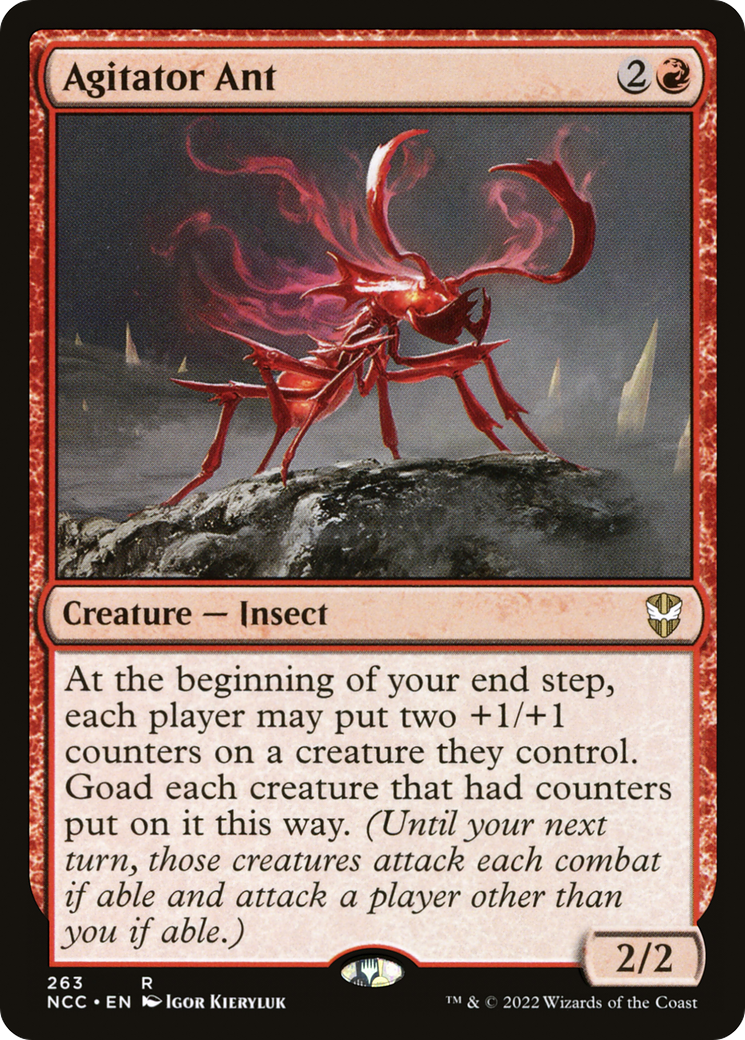
Agitator Ant
Agitator Ant
Creature — Insect
2/2
At the beginning of your end step, each player may put two +1/+1 counters on a creature they control. Goad each creature that had counters put on it this way. (Until your next turn, those creatures attack each combat if able and attack a player other than you if able.)
- If the creature doesn't meet any of the above exceptions and can attack, it must attack a player other than the controller of the spell or ability that goaded it if able. If the creature can't attack any of those players but could otherwise attack, it must attack a planeswalker an opponent controls, a battle an opponent controls, or a player who goaded it.
- Attacking with a goaded creature doesn't cause it to stop being goaded. If there is an additional combat phase that turn, or if another player gains control of it before it stops being goaded, it must attack again if able.
- If a creature you control has been goaded by multiple opponents, it must attack one of your opponents that hasn't goaded it, as that fulfills the maximum number of goad requirements. If a creature you control has been goaded by each of your opponents, the creature must attack an opponent (rather than a planeswalker or battle), but you choose which opponent it attacks.
- If, during a player's declare attackers step, a creature that player controls that's been goaded is tapped, is affected by a spell or ability that says it can't attack, or hasn't been under that player's control continuously since the turn began (and doesn't have haste), then it doesn't attack. If there's a cost associated with having a creature attack a player, its controller isn't forced to pay that cost, so it doesn't have to attack that player.
- Being goaded isn't an ability the creature has. Once it's been goaded, it must attack as detailed above even if it loses all abilities.
- If a creature can't have +1/+1 counters put on it, its controller can't choose it just to have it become goaded. If it can have counters put on it but replacement effects cause it not to receive +1/+1 counters, it doesn't become goaded.
- As Agitator Ant's ability resolves, first you choose which creature you control, if any, to put two +1/+1 counters on, then each other player in turn order does the same, knowing the choices made before them. Then each chosen creature receives its +1/+1 counters and becomes goaded.
-
1
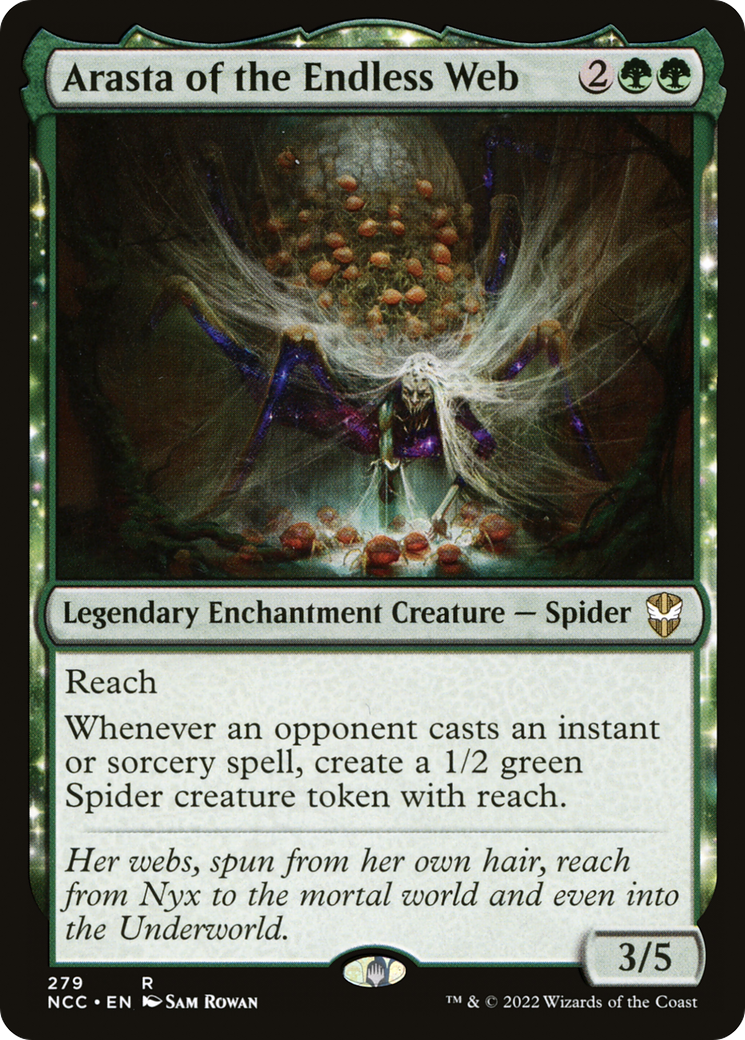
Arasta of the Endless Web
Arasta of the Endless Web
Legendary Enchantment Creature — Spider
3/5
Reach
Whenever an opponent casts an instant or sorcery spell, create a 1/2 green Spider creature token with reach.
- An ability that triggers when a player casts a spell resolves before the spell that caused it to trigger. It resolves even if that spell is countered.
-
1
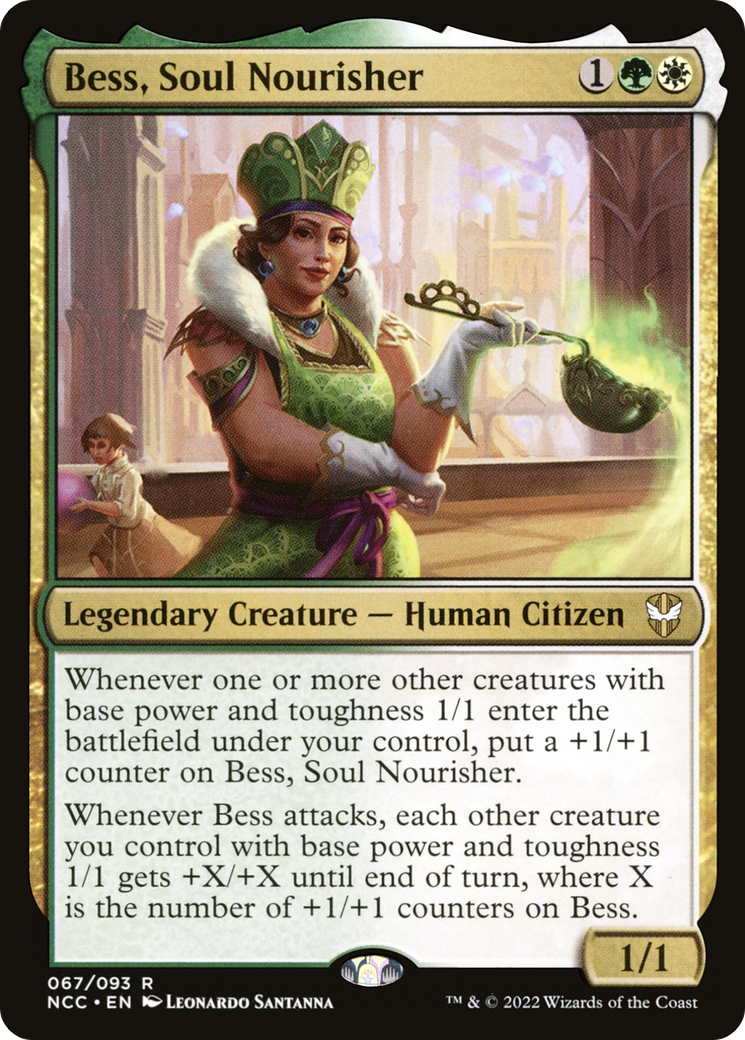
Bess, Soul Nourisher
Bess, Soul Nourisher
Legendary Creature — Human Citizen
1/1
Whenever one or more other creatures you control with base power and toughness 1/1 enter, put a +1/+1 counter on Bess.
Whenever Bess attacks, each other creature you control with base power and toughness 1/1 gets +X/+X until end of turn, where X is the number of +1/+1 counters on Bess.
- Normally, a creature's base power and toughness are the power and toughness printed on the card or, for a token, the power and toughness set by the effect that created it. If another effect sets a creature's power and toughness to specific numbers or values, those become its base power and toughness. If an effect modifies a creature's power and/or toughness without setting them, that is not included when determining its base power and toughness.
- If a creature has a characteristic-defining ability that sets its power and toughness, indicated with a */* or similar in the power and toughness box, that ability is taken into account when determining its base power and toughness.
- Some creatures have base power and toughness 0/0 and an ability that gives them a bonus based on some criteria. Those are not characteristic-defining abilities, and that ability doesn't change its base power and toughness.
-
1
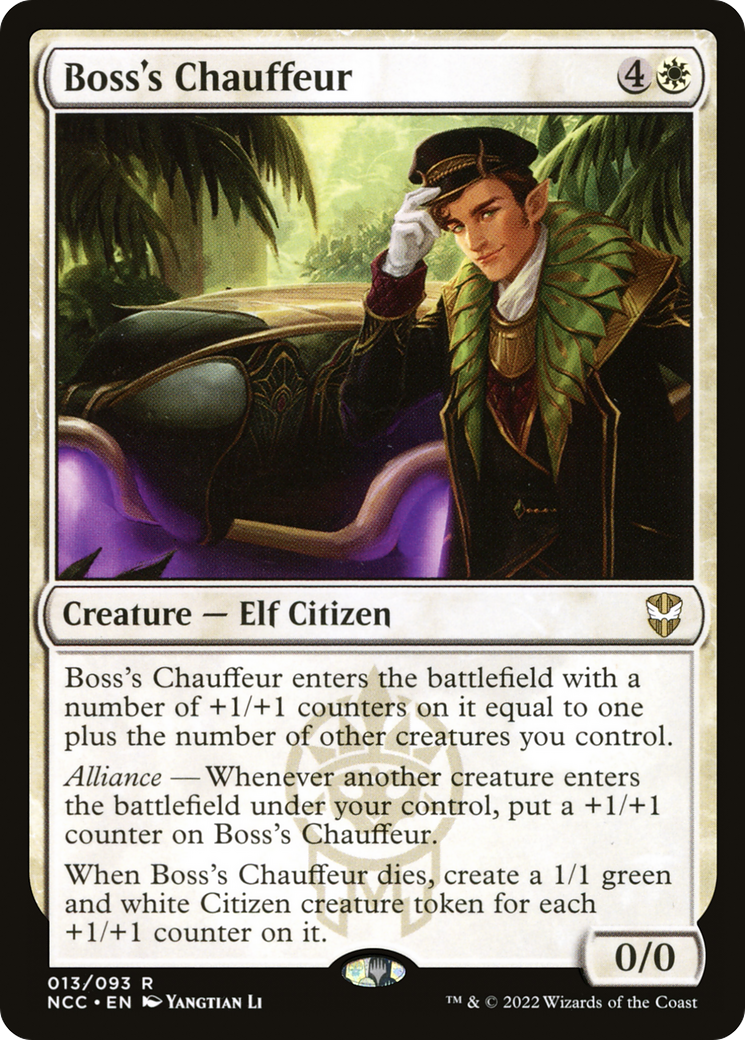
Boss's Chauffeur
Boss's Chauffeur
Creature — Elf Citizen
0/0
This creature enters with a number of +1/+1 counters on it equal to one plus the number of other creatures you control.
Alliance — Whenever another creature you control enters, put a +1/+1 counter on this creature.
When this creature dies, create a 1/1 green and white Citizen creature token for each +1/+1 counter on it.
-
1
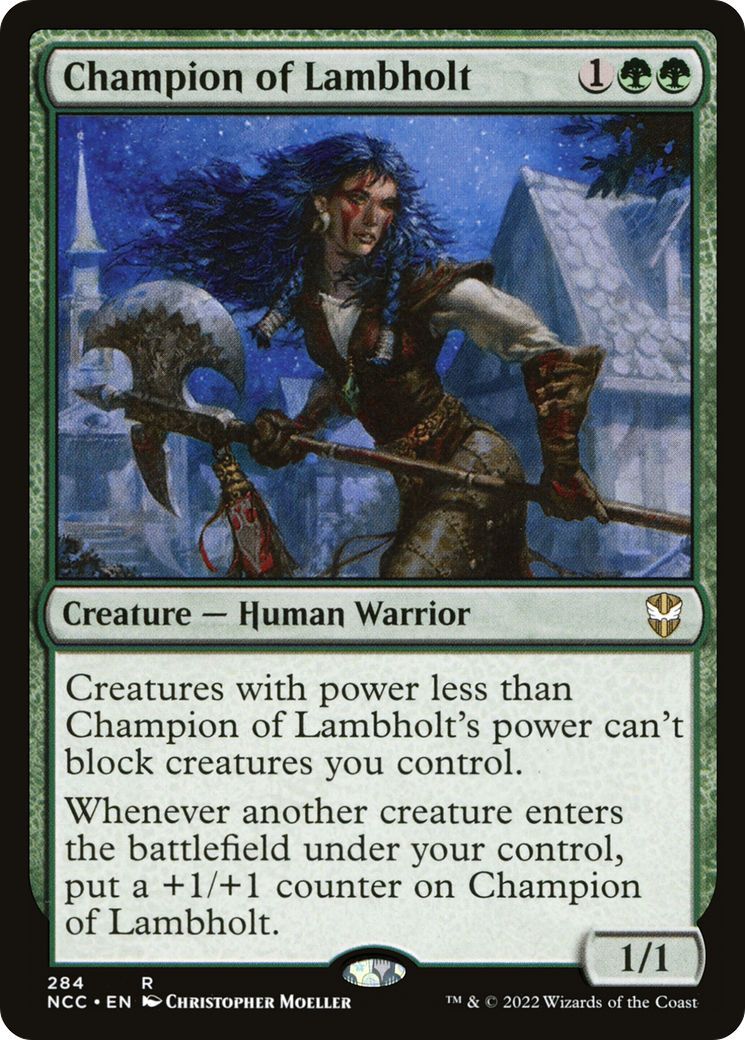
Champion of Lambholt
Champion of Lambholt
Creature — Human Warrior
1/1
Creatures with power less than this creature's power can't block creatures you control.
Whenever another creature you control enters, put a +1/+1 counter on this creature.
- Champion of Lambholt's first ability applies even if it isn't attacking.
- The comparison of power is done only when blockers are declared. Decreasing the power of a blocking creature (or increasing the power of Champion of Lambholt) after this point won't cause any creature to stop blocking or become unblocked.
-
1
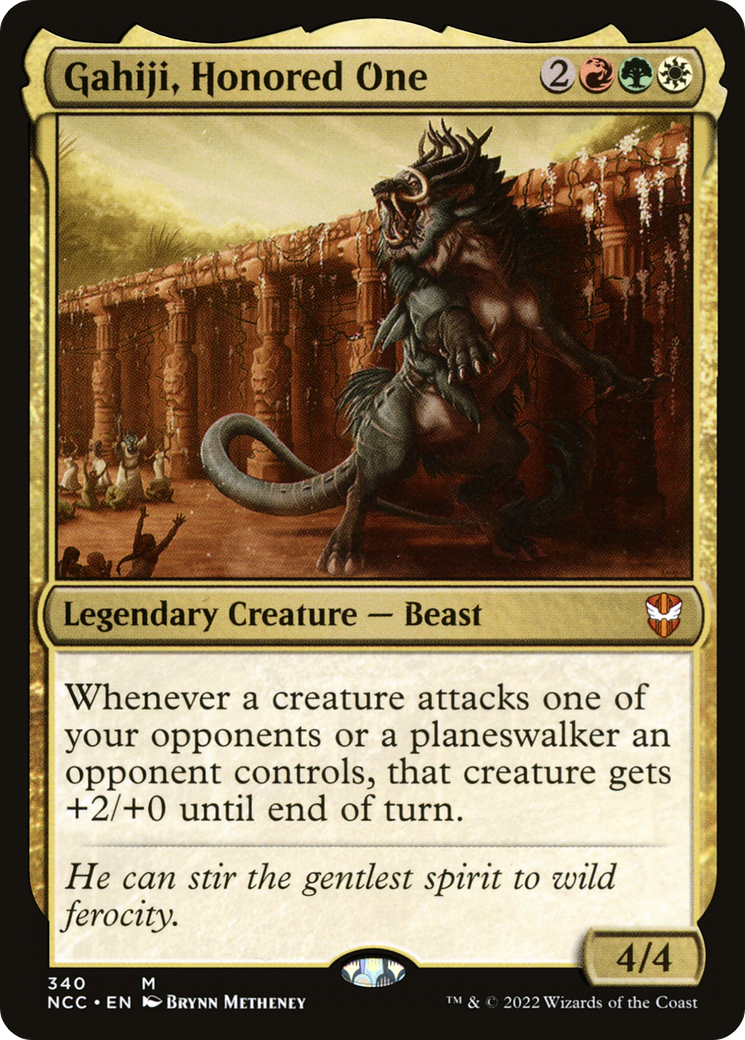
Gahiji, Honored One
Gahiji, Honored One
Legendary Creature — Beast
4/4
Whenever a creature attacks one of your opponents or a planeswalker an opponent controls, that creature gets +2/+0 until end of turn.
-
1
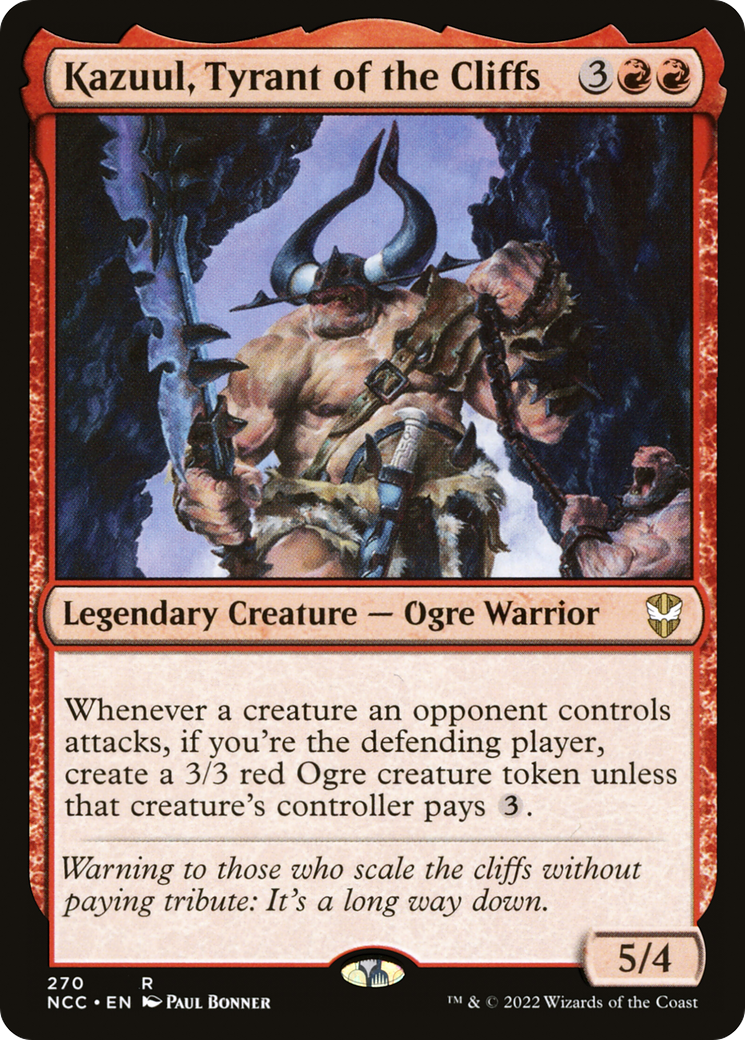
Kazuul, Tyrant of the Cliffs
Kazuul, Tyrant of the Cliffs
Legendary Creature — Ogre Warrior
5/4
Whenever a creature an opponent controls attacks, if you're the defending player, create a 3/3 red Ogre creature token unless that creature's controller pays .
- You're the defending player if a creature is attacking you, a planeswalker you control, or a battle you protect.
- If you're the defending player, Kazuul's ability triggers once for each creature that attacks, not just once per combat. The attacking player chooses whether to pay or let you have an Ogre token each time one of those abilities resolves.
- As the ability resolves, you can't put the Ogre token onto the battlefield without explicitly giving the attacking player the option to pay , even if the attacking player has forgotten about this ability.
- The ability triggers and resolves during the declare attackers step. If you put an Ogre token onto the battlefield as a result, you may block with it during that combat phase.
- If an attacking creature has a "Whenever this creature attacks" ability, that ability is put on the stack first, then Kazuul's ability is put on the stack. Although Kazuul's ability will resolve first, and potentially create an Ogre token, any target of the other ability will already have been chosen at this point, and thus could not have been the new Ogre token.
- In a multiplayer game, the ability checks whether you're the defending player for each individual attacking creature. For example, if one creature attacks you and two creatures attack another player, Kazuul's ability triggers just once.
-
1
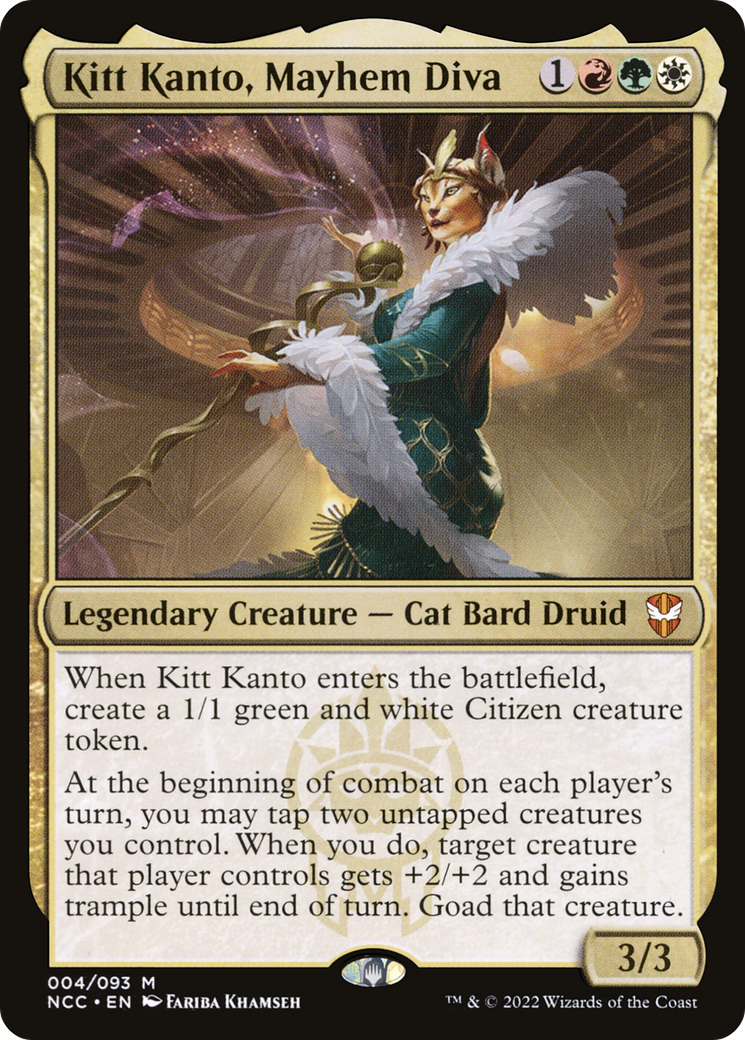
Kitt Kanto, Mayhem Diva
Kitt Kanto, Mayhem Diva
Legendary Creature — Cat Bard Druid
3/3
When Kitt Kanto enters, create a 1/1 green and white Citizen creature token.
At the beginning of combat on each player's turn, you may tap two untapped creatures you control. When you do, target creature that player controls gets +2/+2 and gains trample until end of turn. Goad that creature.
-
1
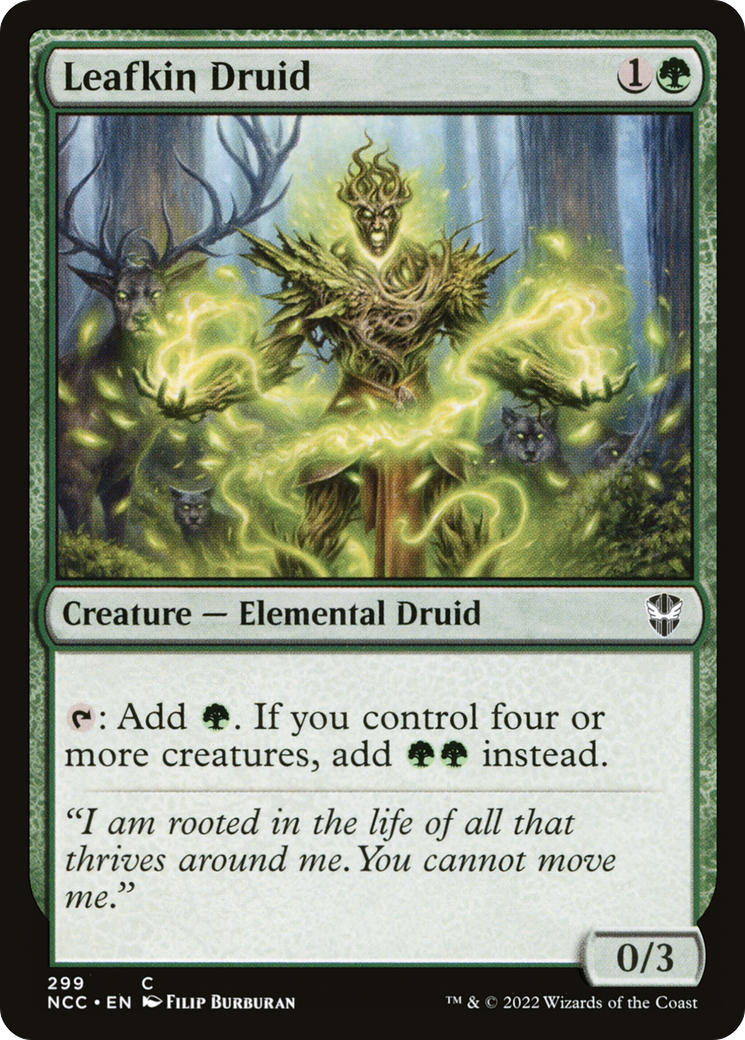
Leafkin Druid
Leafkin Druid
Creature — Elemental Druid
0/3
: Add . If you control four or more creatures, add instead.
-
1
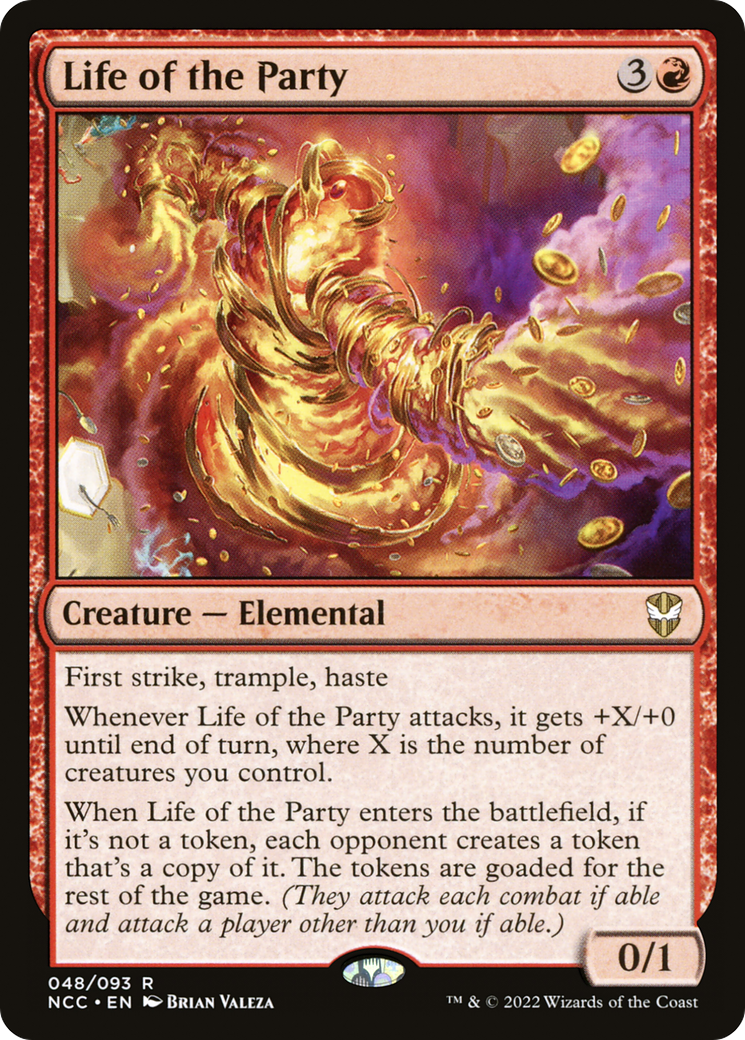
Life of the Party
Life of the Party
Creature — Elemental
0/1
First strike, trample, haste
Whenever this creature attacks, it gets +X/+0 until end of turn, where X is the number of creatures you control.
When this creature enters, if it's not a token, each opponent creates a token that's a copy of it. The tokens are goaded for the rest of the game. (They attack each combat if able and attack a player other than you if able.)
- If something is goaded but the player who goaded it has left the game, it still must attack one of the other players if able.
-
1
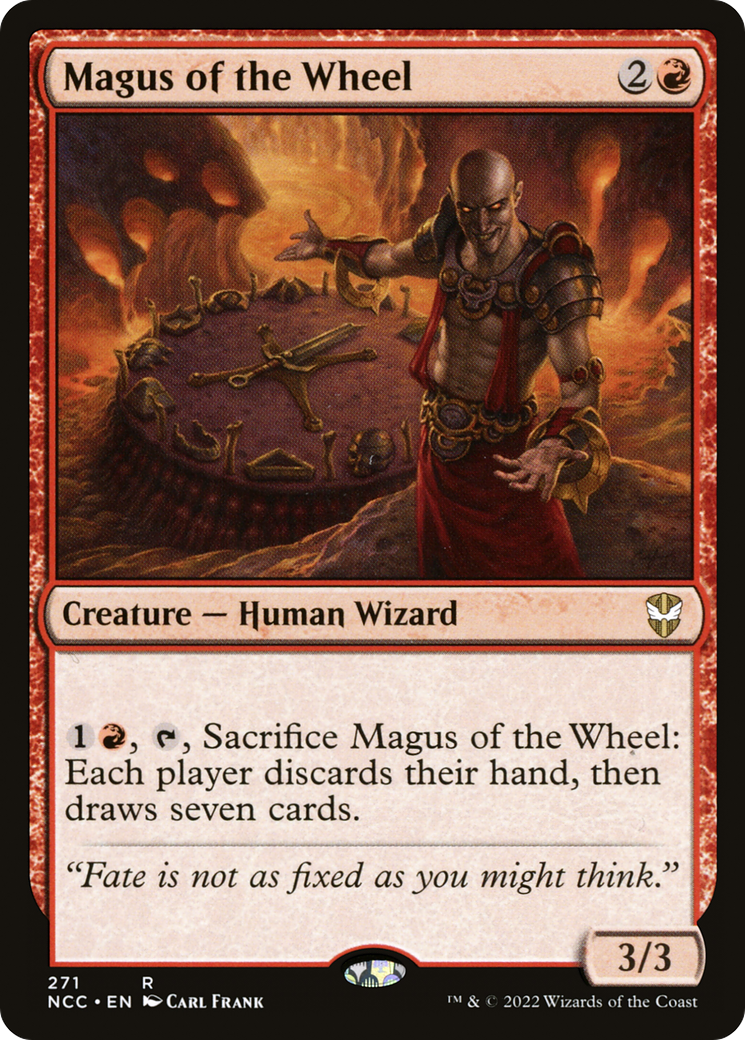
Magus of the Wheel
Magus of the Wheel
Creature — Human Wizard
3/3
, , Sacrifice this creature: Each player discards their hand, then draws seven cards.
- If each player has fewer than seven cards in their library as Magus of the Wheel's ability resolves, the game ends in a draw.
-
1
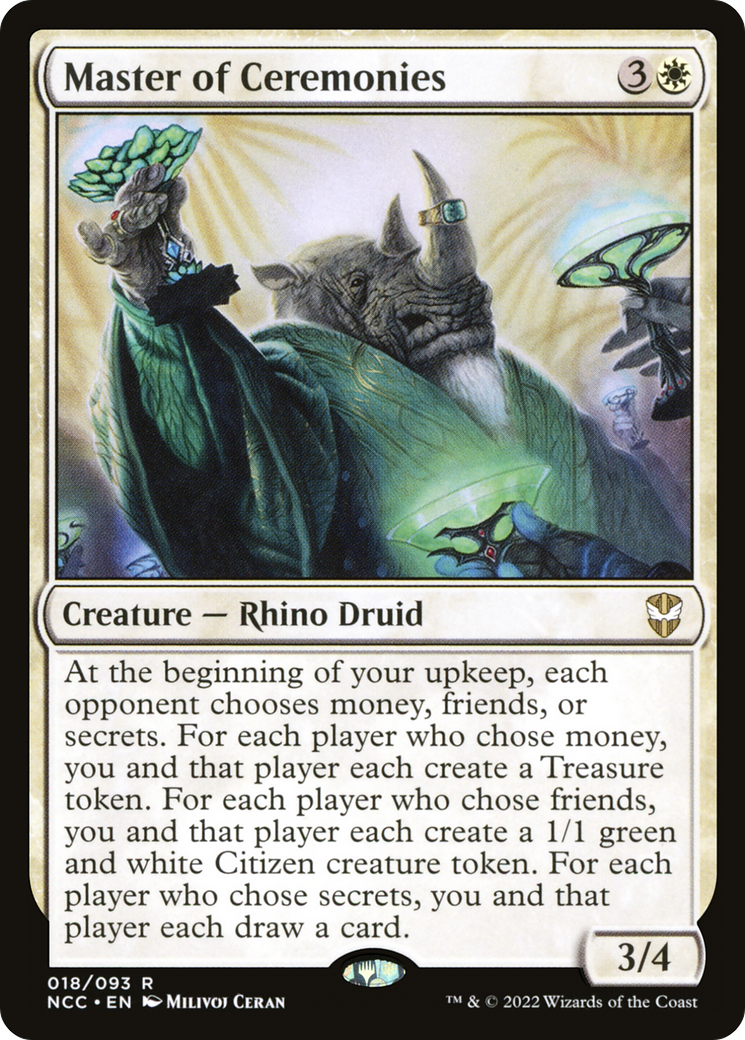
Master of Ceremonies
Master of Ceremonies
Creature — Rhino Druid
3/4
At the beginning of your upkeep, each opponent chooses money, friends, or secrets. For each player who chose money, you and that player each create a Treasure token. For each player who chose friends, you and that player each create a 1/1 green and white Citizen creature token. For each player who chose secrets, you and that player each draw a card.
-
1
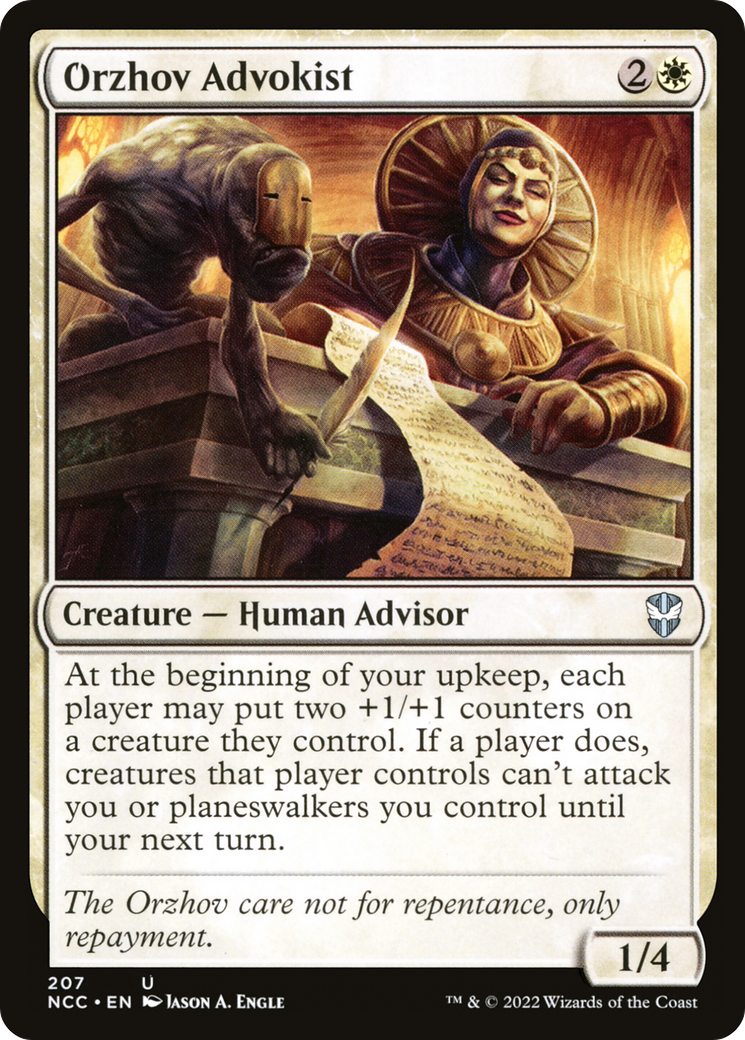
Orzhov Advokist
Orzhov Advokist
Creature — Human Advisor
1/4
At the beginning of your upkeep, each player may put two +1/+1 counters on a creature they control. If a player does, creatures that player controls can't attack you or planeswalkers you control until your next turn.
- While resolving Orzhov Advokist's ability, you choose a creature you control or choose not to put any counters on a creature, then each other player in turn order does the same. Each player will know the choices made by players who chose before them. Then simultaneously each player who chose a creature puts two +1/+1 counters on the creature they chose.
- Orzhov Advokist's ability doesn't target the creatures that receive +1/+1 counters. Their controllers choose them as the ability resolves. Players can't take actions between making their choices and the +1/+1 counters being placed.
- If a player chooses to accept Orzhov Advokist's gift, that player can't attack you or a planeswalker you control with any creatures during their next turn, even creatures that weren't on the battlefield as Orzhov Advokist's ability resolved.
- Orzhov Advokist's effect keeps creatures from attacking you even if Orzhov Advokist leaves the battlefield, if the creature that received counters is no longer on the battlefield, or if an effect has moved those counters off of the creature that received them and put them onto another creature.
-
1
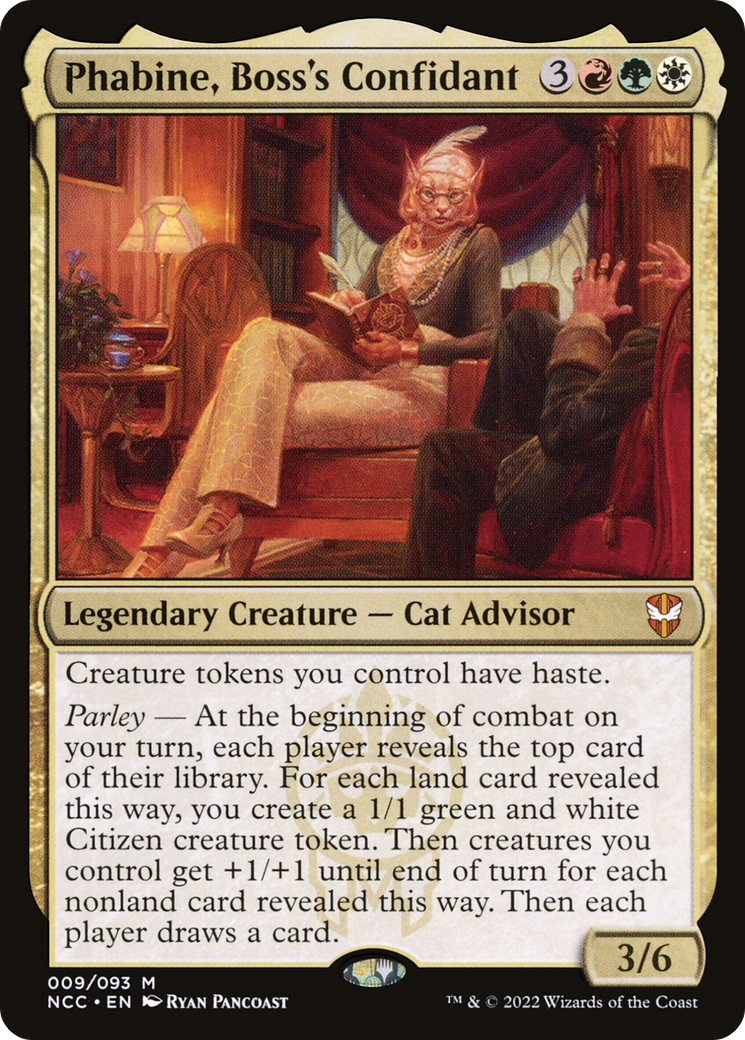
Phabine, Boss's Confidant
Phabine, Boss's Confidant
Legendary Creature — Cat Advisor
3/6
Creature tokens you control have haste.
Parley — At the beginning of combat on your turn, each player reveals the top card of their library. For each land card revealed this way, you create a 1/1 green and white Citizen creature token. Then creatures you control get +1/+1 until end of turn for each nonland card revealed this way. Then each player draws a card.
-
1
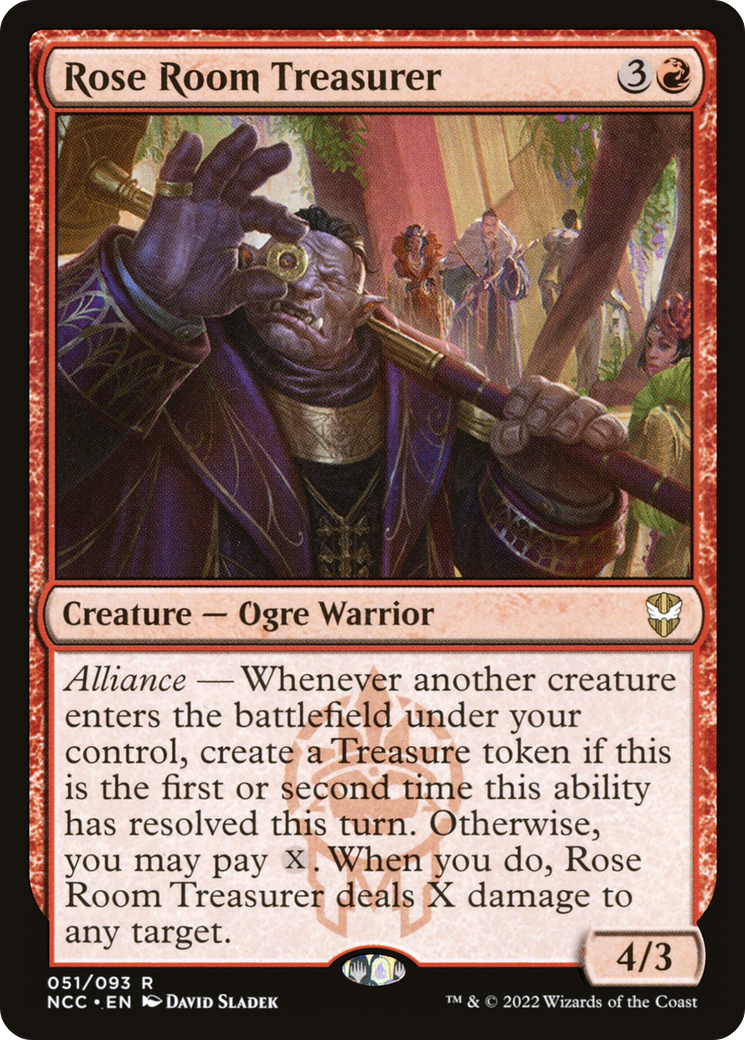
Rose Room Treasurer
Rose Room Treasurer
Creature — Ogre Warrior
4/3
Alliance — Whenever another creature you control enters, create a Treasure token if this is the first or second time this ability has resolved this turn. Otherwise, you may pay . When you do, this creature deals X damage to any target.
-
1
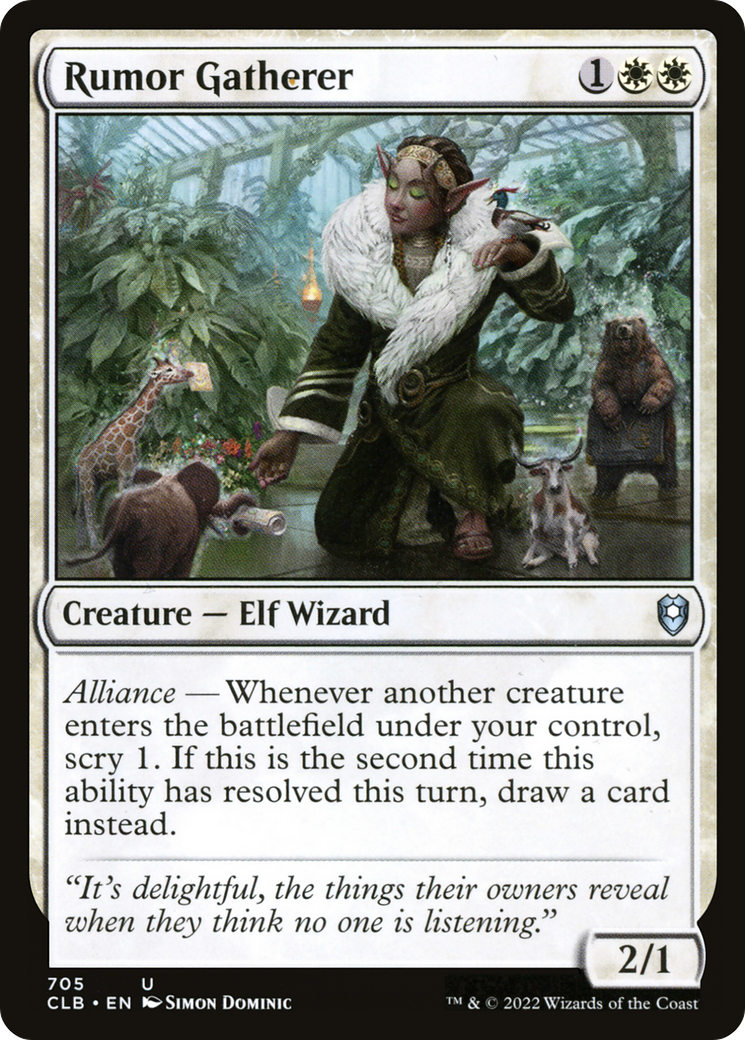
Rumor Gatherer
Rumor Gatherer
Creature — Elf Wizard
2/1
Alliance — Whenever another creature you control enters, scry 1. If this is the second time this ability has resolved this turn, draw a card instead.
-
1
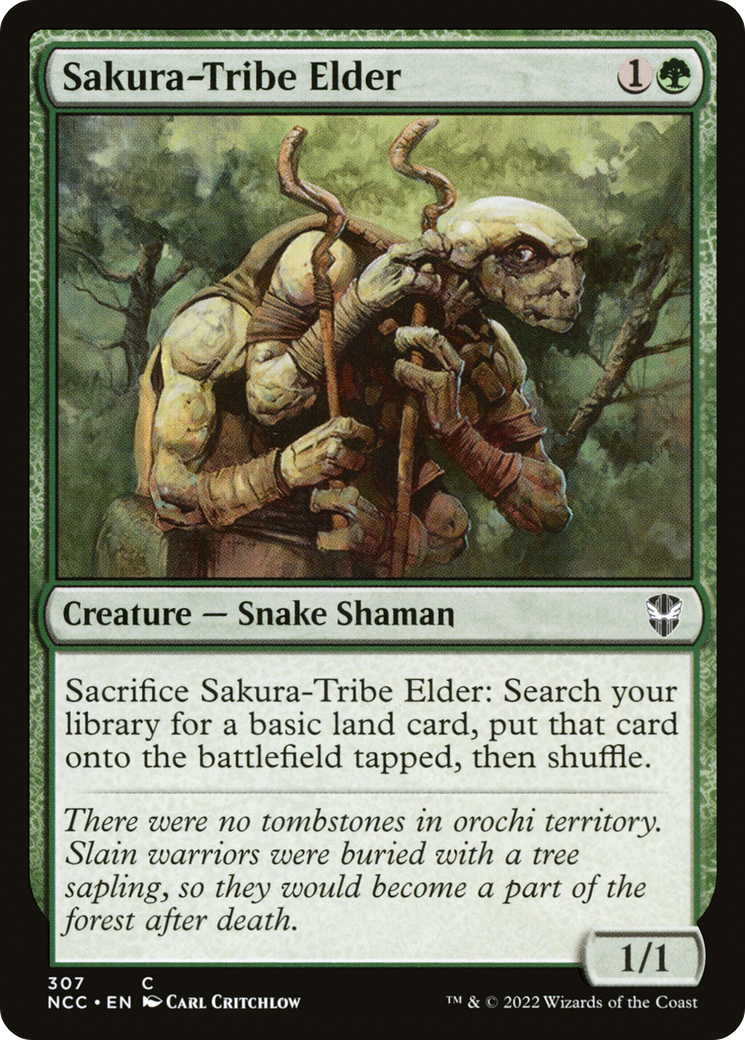
Sakura-Tribe Elder
Sakura-Tribe Elder
Creature — Snake Shaman
1/1
Sacrifice this creature: Search your library for a basic land card, put that card onto the battlefield tapped, then shuffle.
-
1
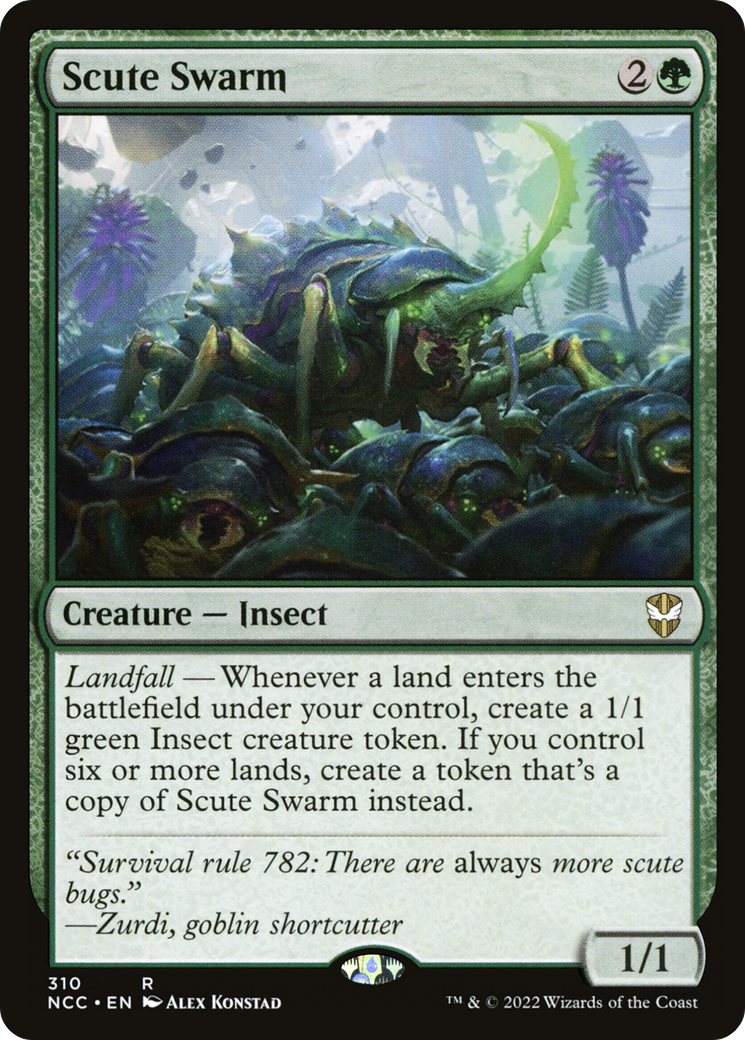
Scute Swarm
Scute Swarm
Creature — Insect
1/1
Landfall — Whenever a land you control enters, create a 1/1 green Insect creature token. If you control six or more lands, create a token that's a copy of this creature instead.
- A landfall ability triggers whenever a land you control enters for any reason. It triggers whenever you play a land, as well as whenever a spell or ability puts a land onto the battlefield under your control.
- A landfall ability doesn't trigger if a permanent already on the battlefield becomes a land.
- Whenever a land you control enters, each landfall ability of the permanents you control will trigger. You can put them on the stack in any order. The last ability you put on the stack will be the first one to resolve (As a result, you can have those abilities resolve in the order of your choosing.).
- The token copy will have Scute Swarm's ability. It will also be able to create copies of itself.
- The token copy won't copy counters or damage marked on Scute Swarm, nor will it copy other effects that have changed Scute Swarm's power, toughness, types, color, and so on. Normally, this means the token will simply be a Scute Swarm, but if any copy effects have affected the original Scute Swarm, the token will take those into account.
- If Scute Swarm leaves the battlefield before its triggered ability resolves, the token will still enter the battlefield as a copy of Scute Swarm, using Scute Swarm's copiable values from when it was last on the battlefield.
-
1
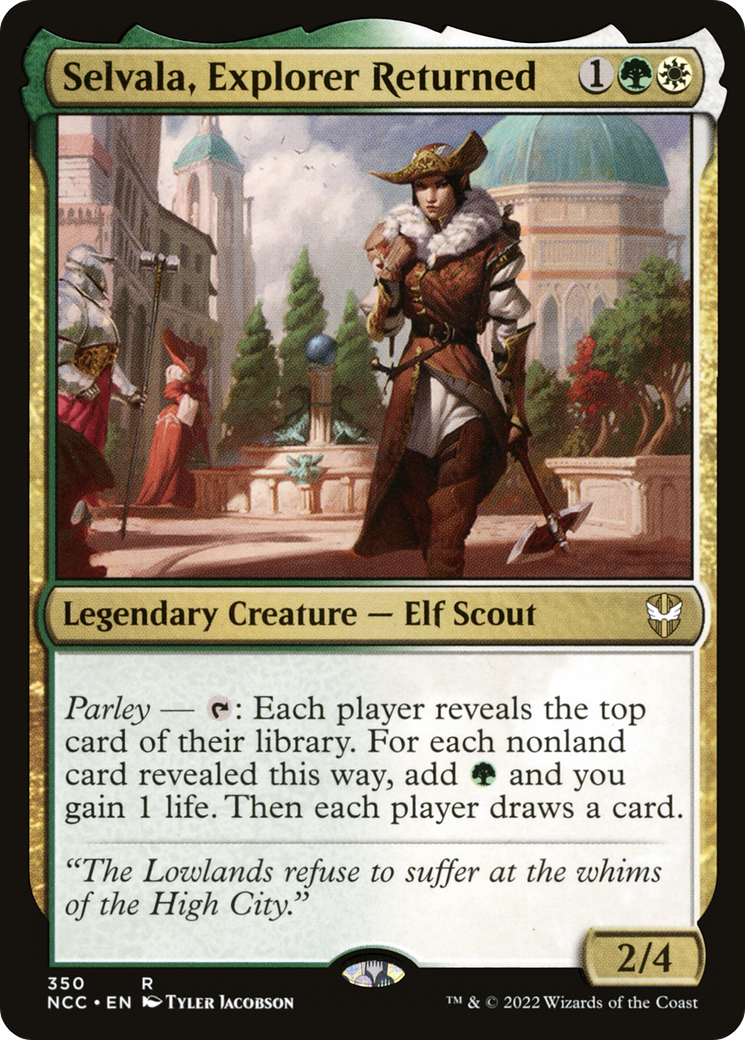
Selvala, Explorer Returned
Selvala, Explorer Returned
Legendary Creature — Elf Scout
2/4
Parley — : Each player reveals the top card of their library. For each nonland card revealed this way, add and you gain 1 life. Then each player draws a card.
- Selvala's parley ability is a mana ability. It doesn't use the stack and can't be responded to.
- If you activate Selvala's ability while casting a spell, and you discover you can't produce enough mana to pay that spell's costs, the spell is reversed. The spell returns to whatever zone you were casting it from. You may reverse other mana abilities you activated while casting the spell, but Selvala's ability can't be reversed. You'll still have whatever mana that ability produced, and each player will have drawn a card.
- Except in some very rare cases, the card each player draws will be the card revealed from the top of their library.
-
1
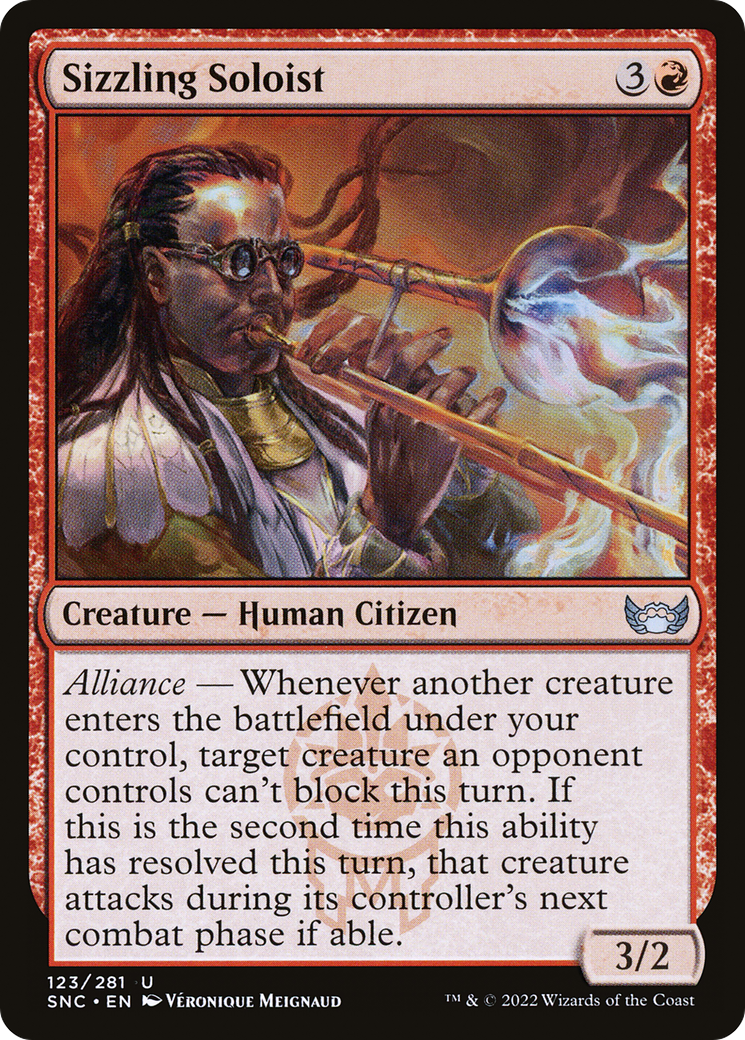
Sizzling Soloist
Sizzling Soloist
Creature — Human Citizen
3/2
Alliance — Whenever another creature you control enters, target creature an opponent controls can't block this turn. If this is the second time this ability has resolved this turn, that creature attacks during its controller's next combat phase if able.
-
1
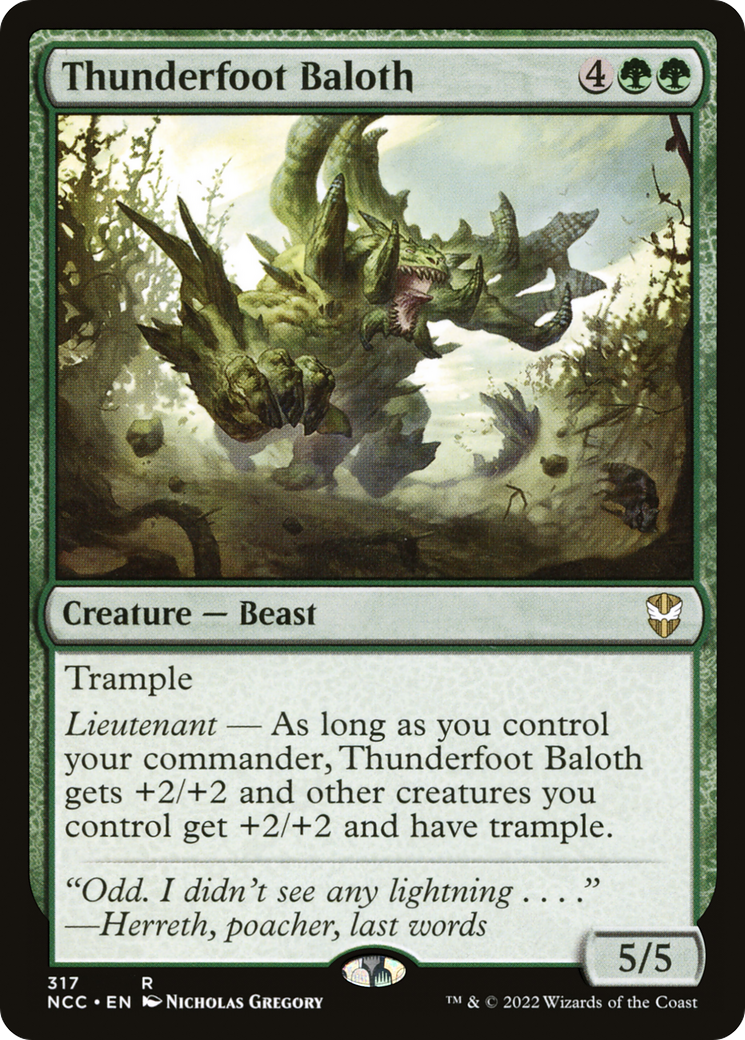
Thunderfoot Baloth
Thunderfoot Baloth
Creature — Beast
5/5
Trample
Lieutenant — As long as you control your commander, this creature gets +2/+2 and other creatures you control get +2/+2 and have trample.
- Lieutenant abilities apply only if your commander is on the battlefield and under your control.
- Lieutenant abilities refer only to whether you control your commander, not any other player's commander.
- If you gain control of a creature with a lieutenant ability owned by another player, that ability will check to see if you control your commander and will apply if you do. It won't check whether its owner controls their commander.
- If you lose control of your commander, lieutenant abilities of creatures you control will immediately stop applying. If this causes a creature's toughness to become less than or equal to the amount of damage marked on it, the creature will be destroyed.
- If a triggered ability granted by a lieutenant ability triggers, and in response to that trigger you lose control of your commander (causing the lieutenant to lose that ability), that triggered ability will still resolve.
-
1
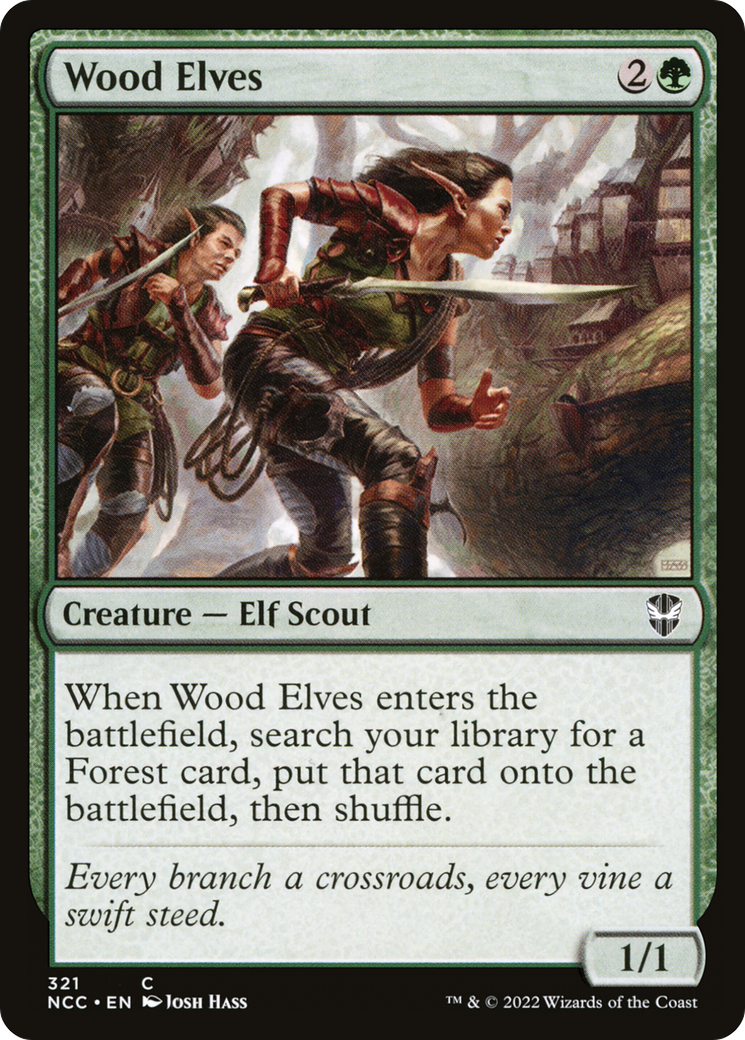
Wood Elves
Wood Elves
Creature — Elf Scout
1/1
When this creature enters, search your library for a Forest card, put that card onto the battlefield, then shuffle.
- Because the "search" requires you to find a card with certain characteristics, you don't have to find the card if you don't want to.
-
1
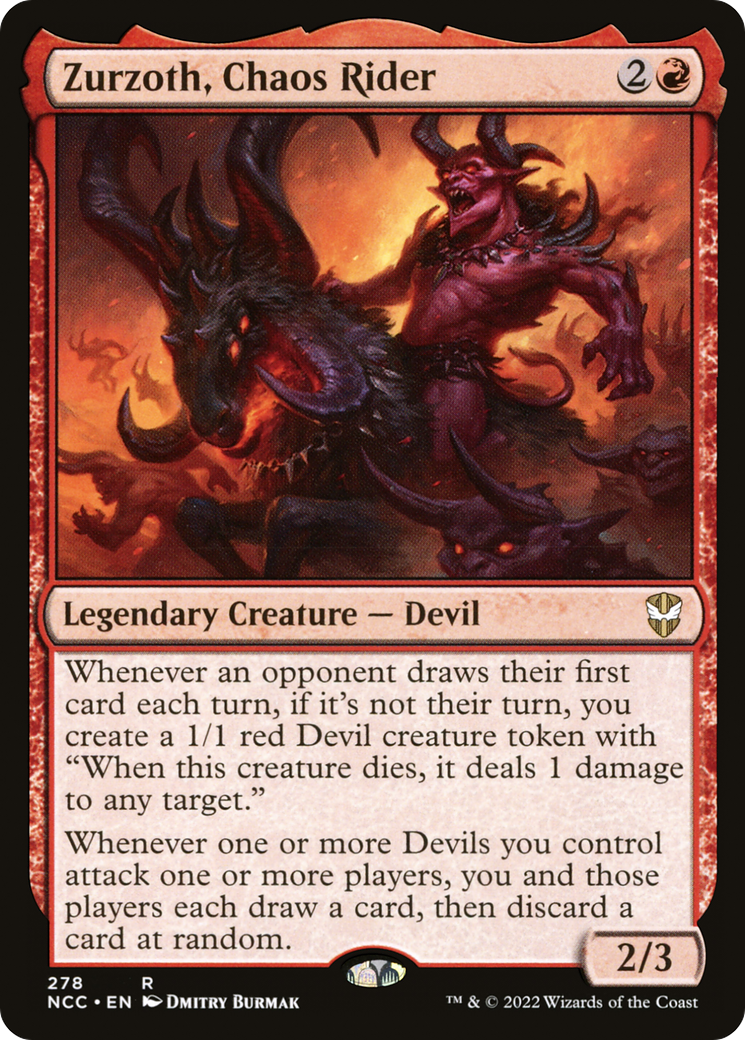
Zurzoth, Chaos Rider
Zurzoth, Chaos Rider
Legendary Creature — Devil
2/3
Whenever an opponent draws their first card each turn, if it's not their turn, you create a 1/1 red Devil creature token with "When this token dies, it deals 1 damage to any target."
Whenever one or more Devils you control attack one or more players, you and those players each draw a card, then discard a card at random.
- If a spell or ability causes a player to put a card into their hand without specifically using the word "draw," it's not a card drawn.
- If your life total is brought to 0 or less at the same time that a Devil token is dealt lethal damage, you lose the game before its ability goes on the stack.
- Devils you control that attack a planeswalker won't cause any player to draw or discard a card.
Instants 10
-
1
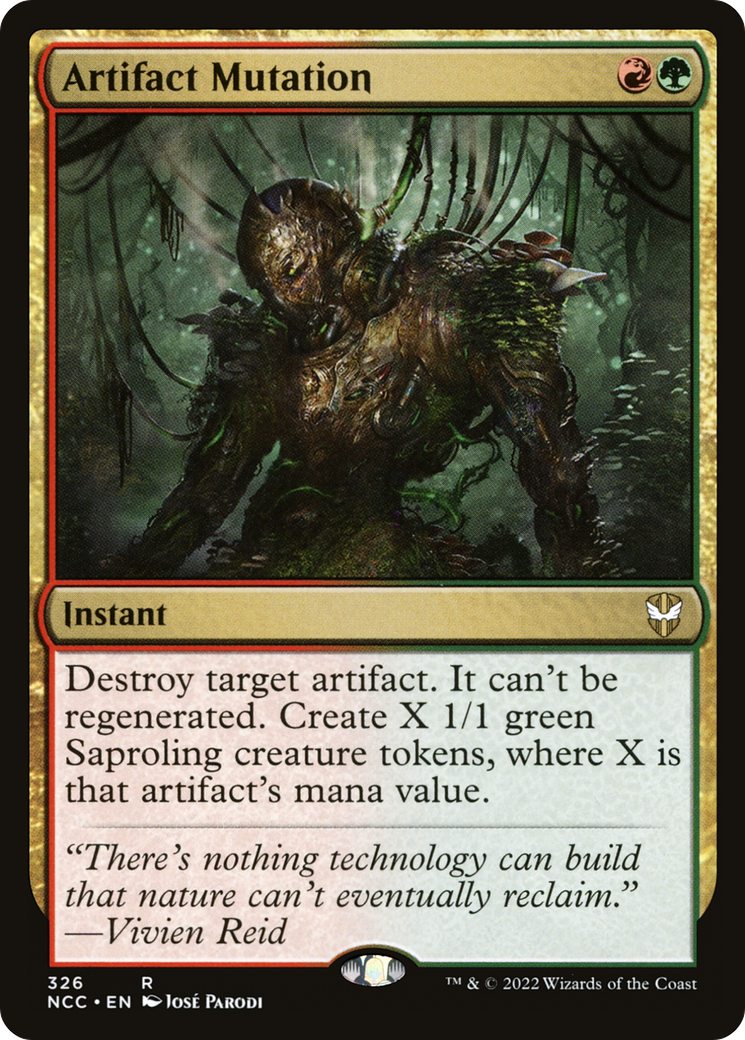
Artifact Mutation
Artifact Mutation
Instant
Destroy target artifact. It can't be regenerated. Create X 1/1 green Saproling creature tokens, where X is that artifact's mana value.
- This spell is countered and you get no Saprolings if the artifact is an illegal target on resolution.
-
1
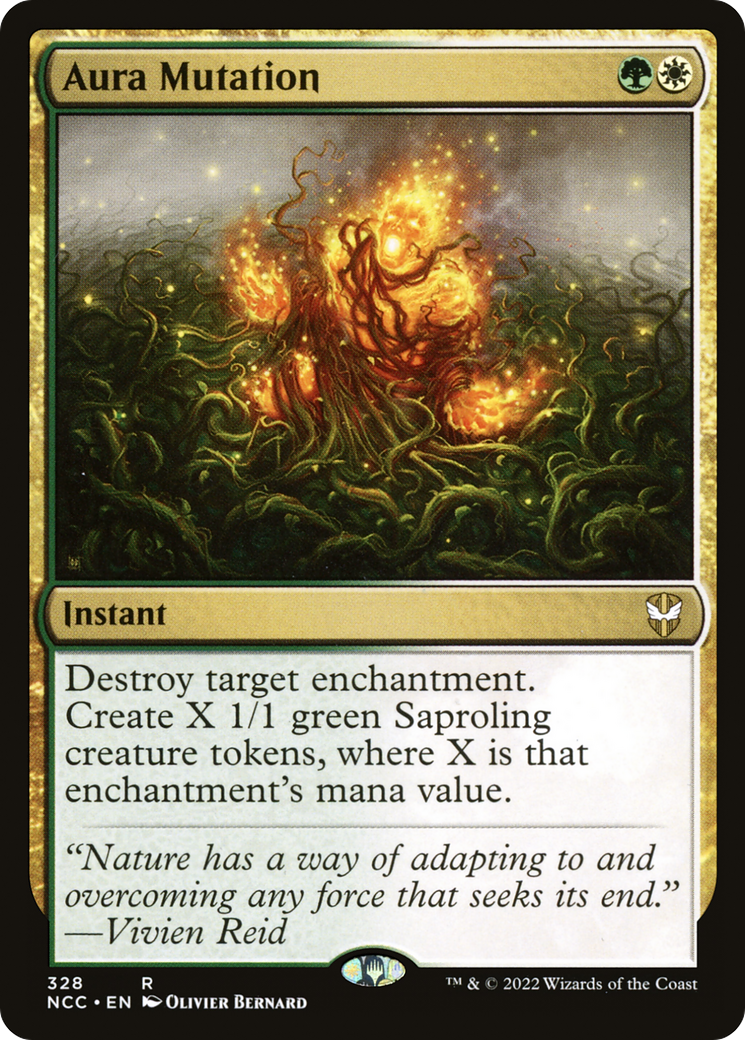
Aura Mutation
Aura Mutation
Instant
Destroy target enchantment. Create X 1/1 green Saproling creature tokens, where X is that enchantment's mana value.
- This spell doesn't resolve and you get no Saprolings if the enchantment is an illegal target on resolution.
-
1
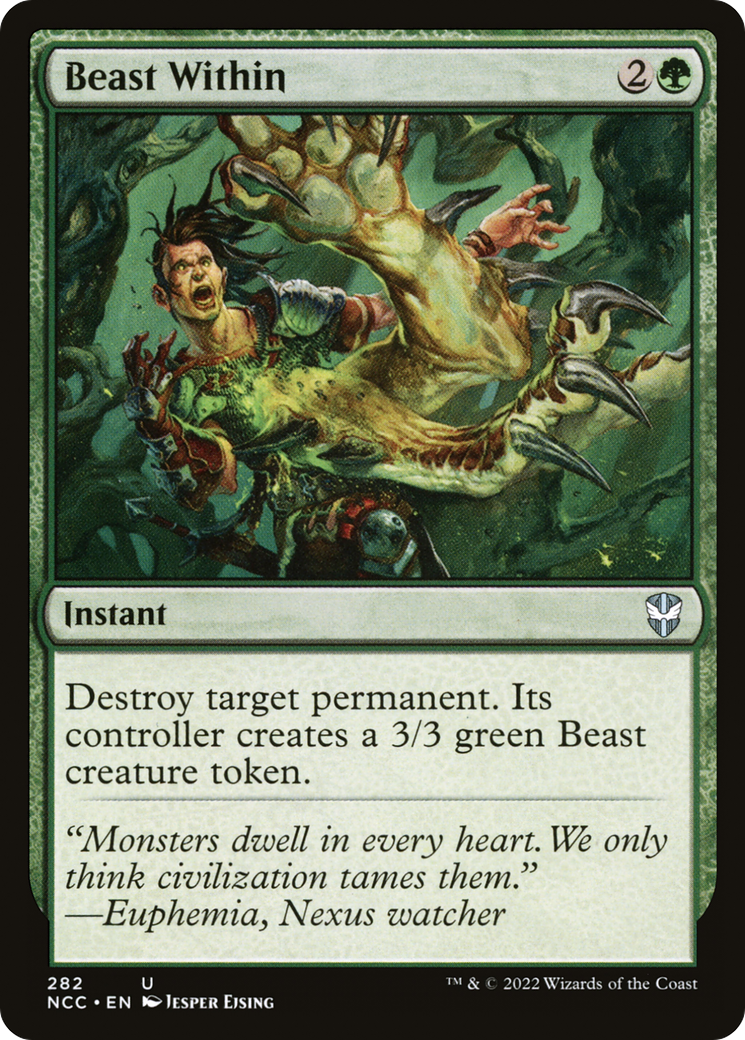
Beast Within
Beast Within
Instant
Destroy target permanent. Its controller creates a 3/3 green Beast creature token.
- If the target permanent is an illegal target by the time Beast Within tries to resolve, the spell won't resolve. No player creates a Beast token. If the target is legal but not destroyed (most likely because it has indestructible), its controller does create a Beast token.
-
1
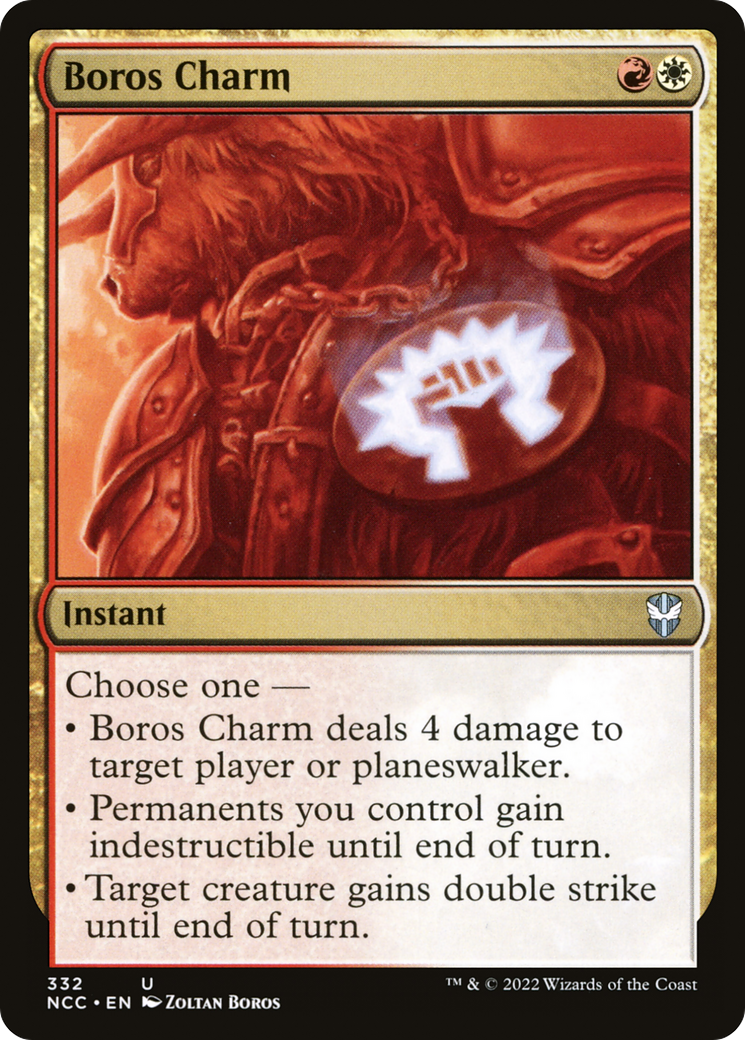
Boros Charm
Boros Charm
Instant
Choose one —
- Boros Charm deals 4 damage to target player or planeswalker.
- Permanents you control gain indestructible until end of turn.
- Target creature gains double strike until end of turn.
- Boros Charm's second mode affects only permanents you control at the time it resolves. It won't affect permanents that come under your control later in the turn.
- Planeswalkers with indestructible will still have loyalty counters removed from them as they are dealt damage. If a planeswalker with indestructible has no loyalty counters, it will still be put into its owner's graveyard, as the rule that does this doesn't destroy the planeswalker.
-
1
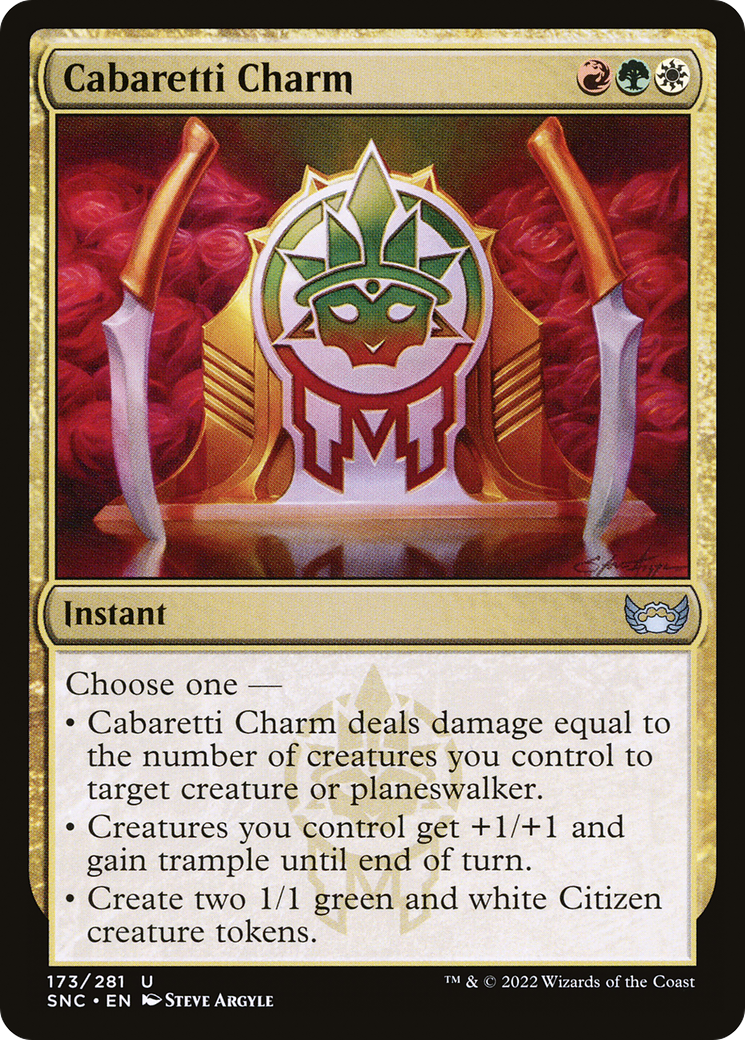
Cabaretti Charm
Cabaretti Charm
Instant
Choose one —
- Cabaretti Charm deals damage equal to the number of creatures you control to target creature or planeswalker.
- Creatures you control get +1/+1 and gain trample until end of turn.
- Create two 1/1 green and white Citizen creature tokens.
-
1
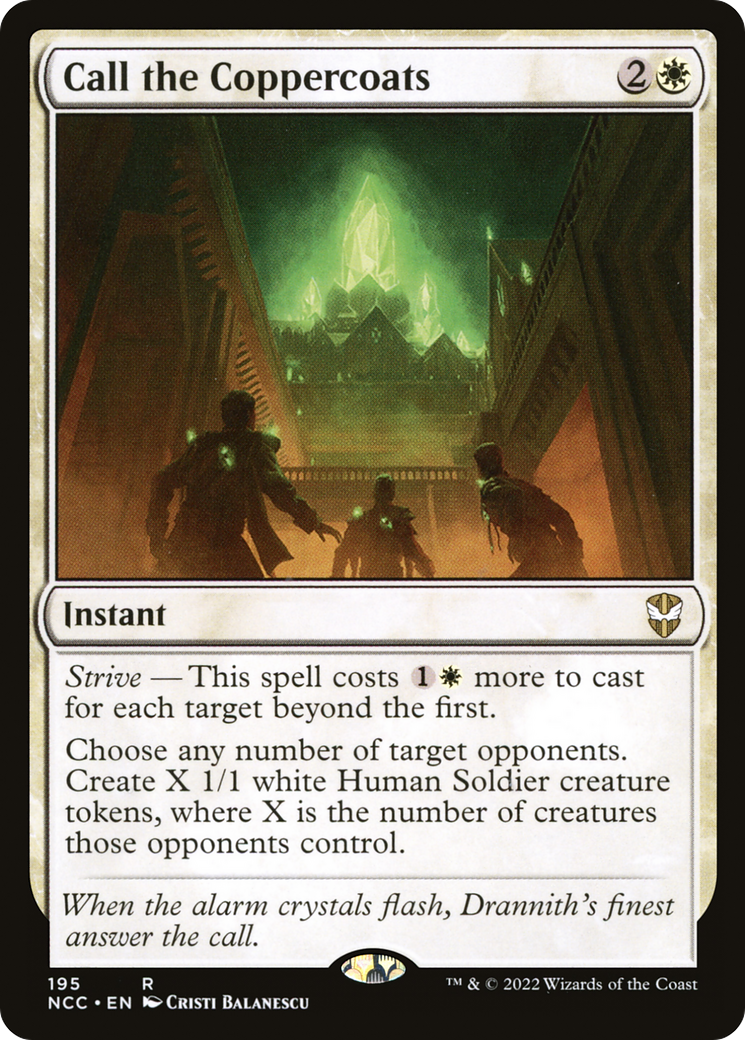
Call the Coppercoats
Call the Coppercoats
Instant
Strive — This spell costs more to cast for each target beyond the first.
Choose any number of target opponents. Create X 1/1 white Human Soldier creature tokens, where X is the number of creatures those opponents control.
- Any target opponents that are no longer legal targets by the time Call the Coppercoats resolves won't have their creatures counted when determining how many tokens you create.
- You choose how many targets each spell with a strive ability has and what those targets are as you cast it. It's legal to cast such a spell with no targets, although this is rarely a good idea. You can't choose the same target more than once for a single strive spell.
- The mana value of a strive spell doesn't change no matter how many targets it has.
- If this spell is copied and the effect that copies the spell allows a player to choose new targets for the copy, the number of targets can't be changed. The player may change any number of the targets, including all of them or none of them. If, for one of the targets, the player can't choose a new legal target, then it remains unchanged (even if the current target is illegal).
- If a spell or ability allows you to cast a strive spell without paying its mana cost, you must pay the additional cost for any targets beyond the first.
-
1
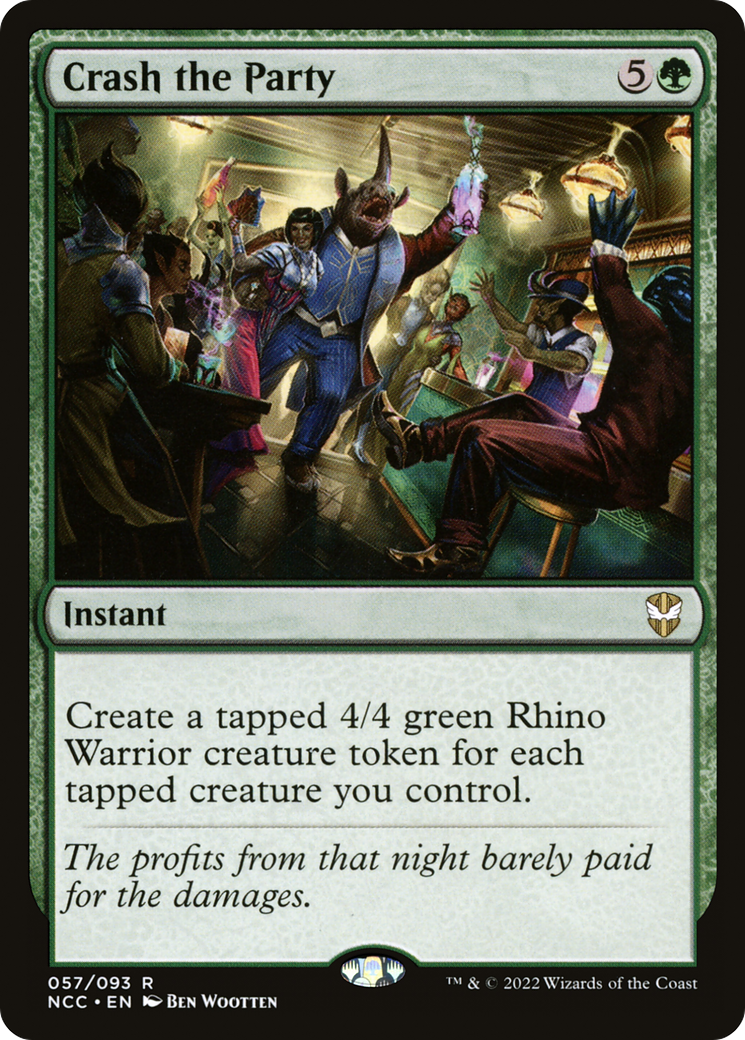
Crash the Party
Crash the Party
Instant
Create a tapped 4/4 green Rhino Warrior creature token for each tapped creature you control.
- The tokens created by Crash the Party don't enter the battlefield attacking.
-
1
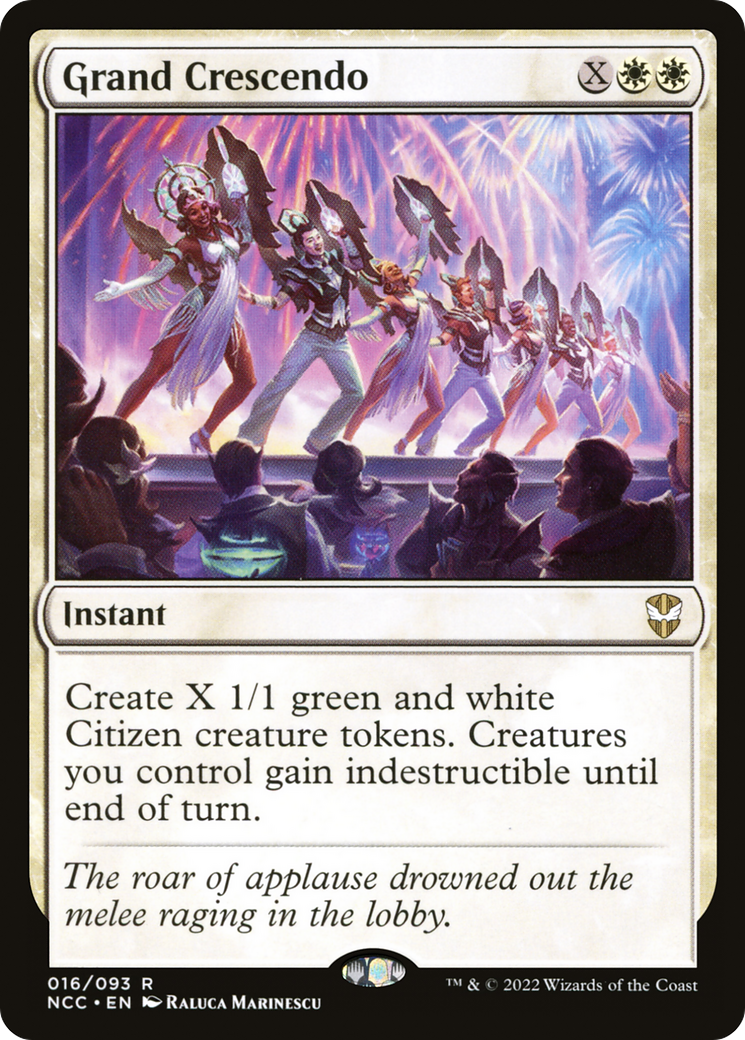
Grand Crescendo
Grand Crescendo
Instant
Create X 1/1 green and white Citizen creature tokens. Creatures you control gain indestructible until end of turn.
-
1
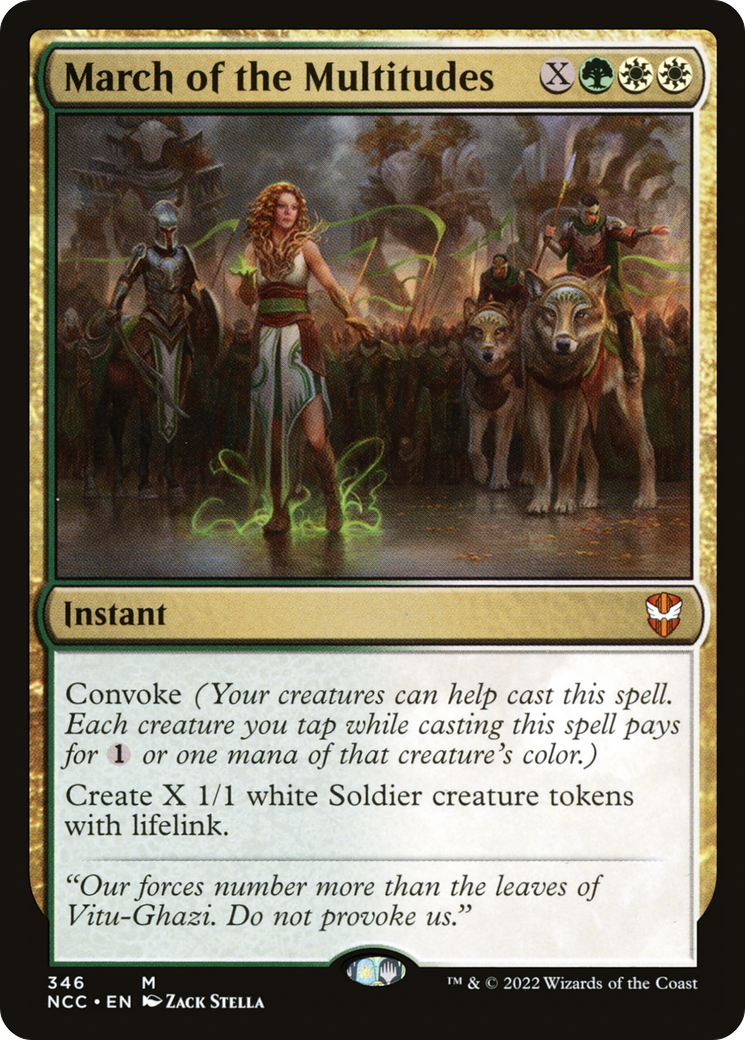
March of the Multitudes
March of the Multitudes
Instant
Convoke (Your creatures can help cast this spell. Each creature you tap while casting this spell pays for or one mana of that creature's color.)
Create X 1/1 white Soldier creature tokens with lifelink.
- You can tap any untapped creature you control to convoke a spell, even one you haven't controlled continuously since the beginning of your most recent turn.
- Tapping an untapped creature that's attacking or blocking to convoke a spell won't cause that creature to stop attacking or blocking.
- When calculating a spell's total cost, include any alternative costs, additional costs, or anything else that increases or reduces the cost to cast the spell. Convoke applies after the total cost is calculated. Convoke doesn't change a spell's mana cost or mana value.
- If a creature you control has a mana ability with in the cost, activating that ability while casting a spell with convoke will result in the creature being tapped before you pay the spell's costs. You won't be able to tap it again for convoke. Similarly, if you sacrifice a creature to activate a mana ability while casting a spell with convoke, that creature won't be on the battlefield when you pay the spell's costs, so you won't be able to tap it for convoke.
- Because convoke isn't an alternative cost, it can be used in conjunction with alternative costs.
- Tapping a multicolored creature using convoke will pay for or one mana of your choice of any of that creature's colors.
- When using convoke to cast a spell with in its mana cost, first choose the value for X. That choice, plus any cost increases or decreases, will determine the spell's total cost. Then you can tap creatures you control to help pay that cost. For example, if you cast Chord of Calling (a spell with convoke and mana cost ) and choose X to be 3, the total cost is . If you tap two green creatures and two red creatures, you'll have to pay .
-
1
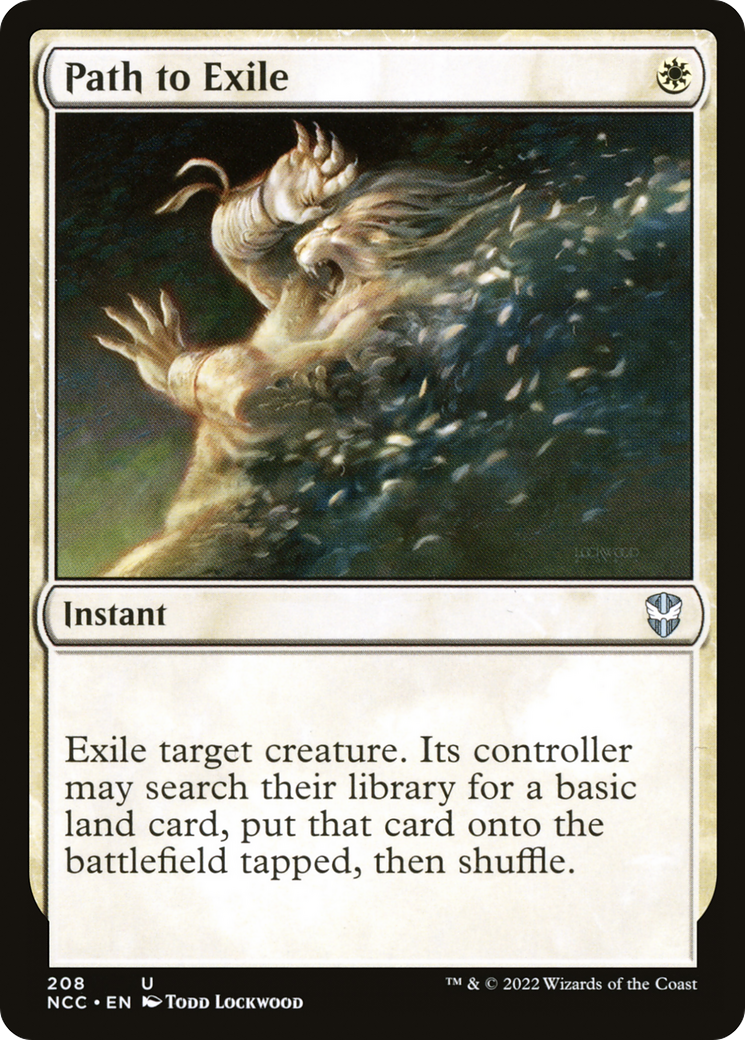
Path to Exile
Path to Exile
Instant
Exile target creature. Its controller may search their library for a basic land card, put that card onto the battlefield tapped, then shuffle.
- The controller of the exiled creature isn't required to search their library for a basic land. If that player doesn't, the player won't shuffle their library.
- If the target creature is an illegal target by the time Path to Exile tries to resolve, it won't resolve and none of its effects will happen. The creature's controller won't search for a basic land card.
Sorceries 11
-
1
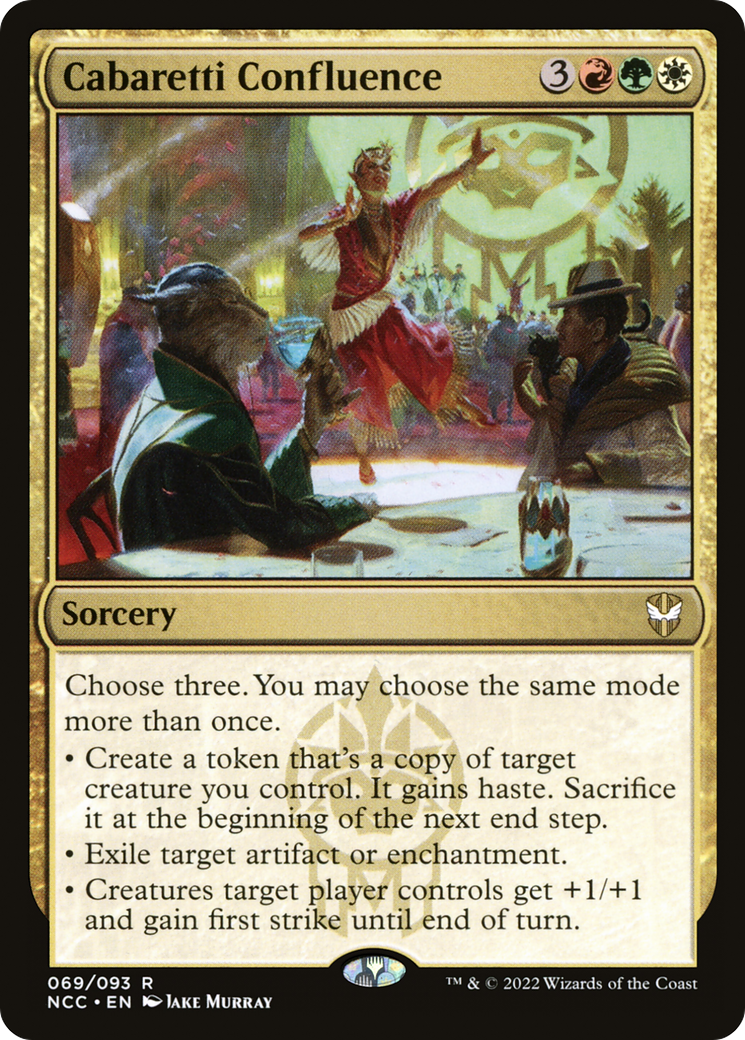
Cabaretti Confluence
Cabaretti Confluence
Sorcery
Choose three. You may choose the same mode more than once.
- Create a token that's a copy of target creature you control. It gains haste. Sacrifice it at the beginning of the next end step.
- Exile target artifact or enchantment.
- Creatures target player controls get +1/+1 and gain first strike until end of turn.
- If you choose the first and third mode, the creature tokens will enter the battlefield before the creatures target player controls get +1/+1 and gain first strike. If you target yourself with the third mode, the tokens will get that bonus.
-
1
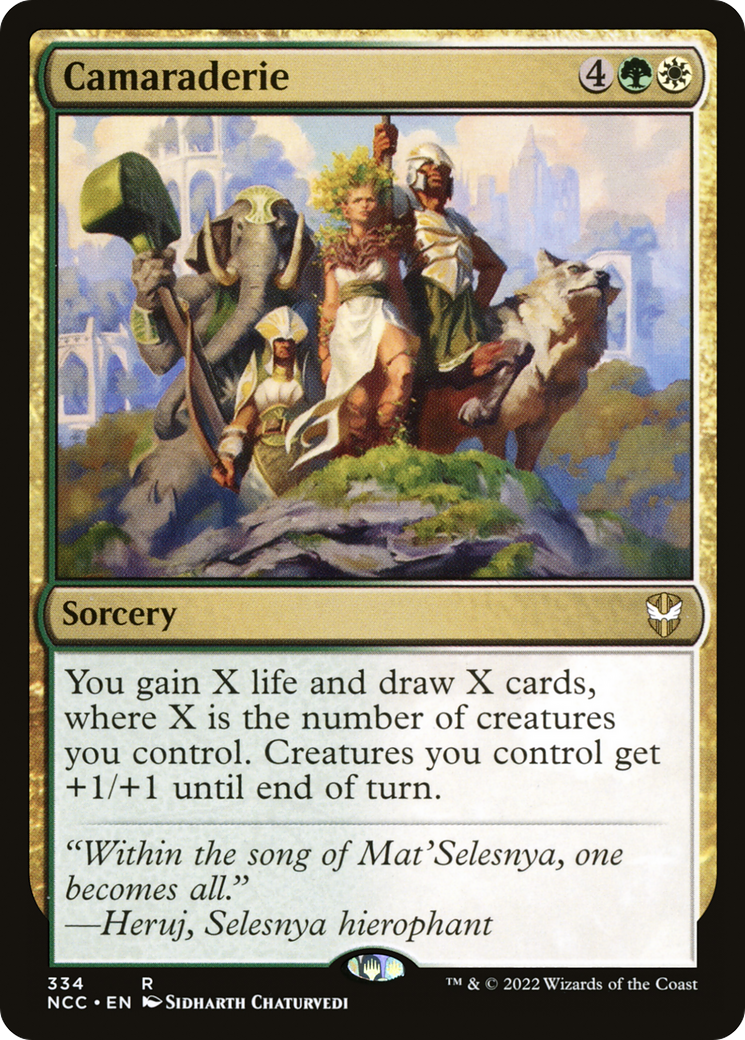
Camaraderie
Camaraderie
Sorcery
You gain X life and draw X cards, where X is the number of creatures you control. Creatures you control get +1/+1 until end of turn.
- The second part of Camaraderie's effect affects only creatures you control at the time it resolves. Creatures you begin to control later in the turn won't get +1/+1.
-
1
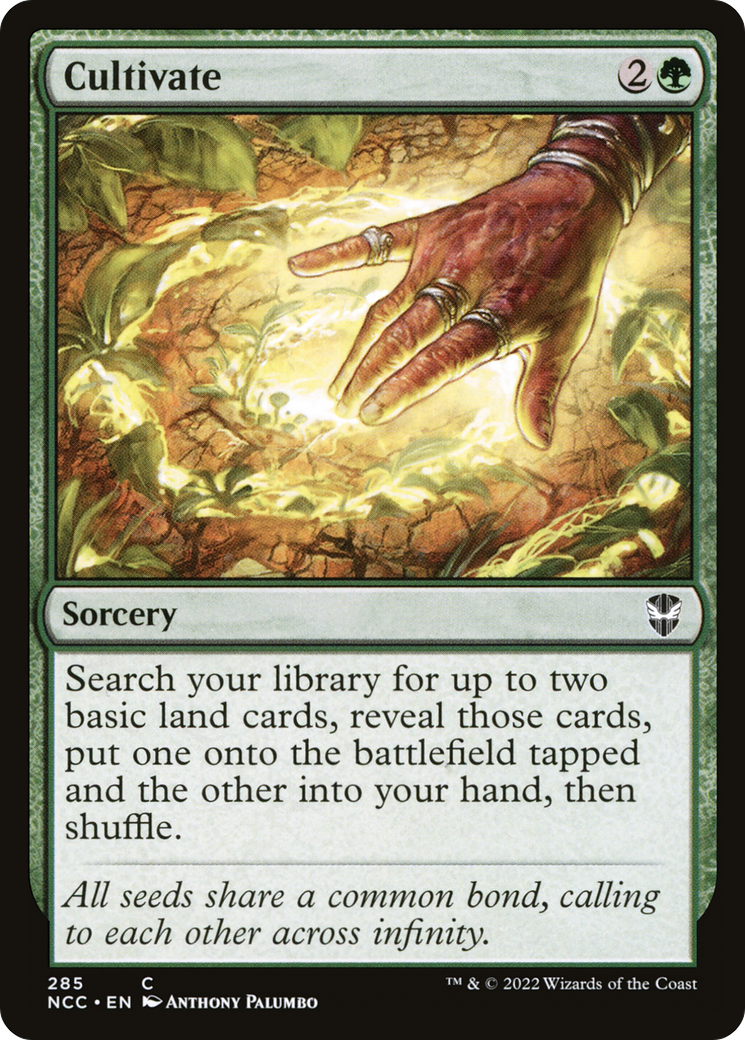
Cultivate
Cultivate
Sorcery
Search your library for up to two basic land cards, reveal those cards, put one onto the battlefield tapped and the other into your hand, then shuffle.
- If you choose to find only one basic land card, you put it onto the battlefield tapped.
-
1
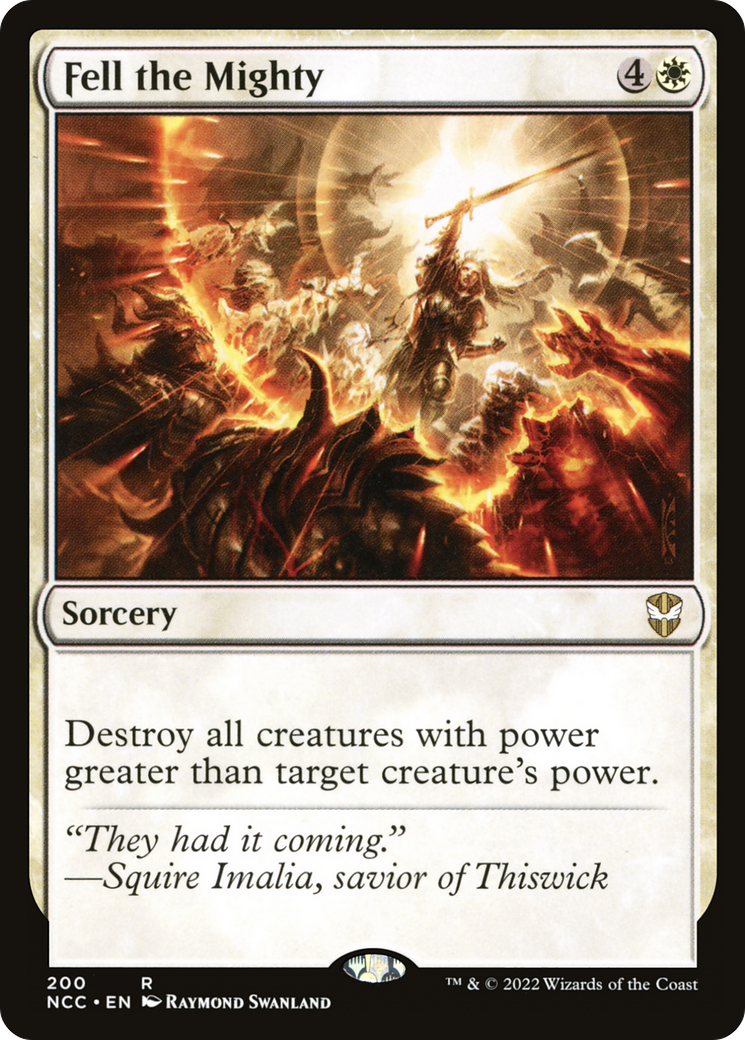
Fell the Mighty
Fell the Mighty
Sorcery
Destroy all creatures with power greater than target creature's power.
- Use the power of the target creature as Fell the Mighty resolves to determine which creatures are destroyed. Fell the Mighty doesn't target any of those creatures, so a creature with hexproof or protection from white will be destroyed if its power is high enough.
- Fell the Mighty won't destroy the target creature.
- If the target creature is an illegal target when Fell the Mighty tries to resolve, Fell the Mighty won't resolve and none of its effects will happen. No creatures will be destroyed.
-
1
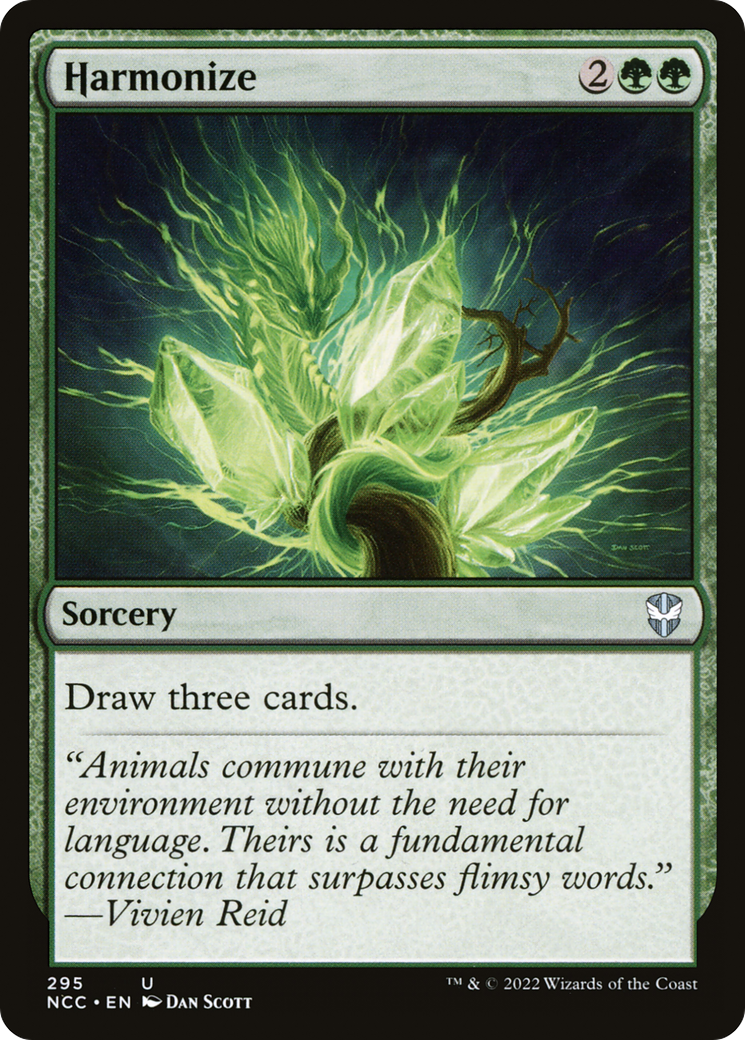
Harmonize
Harmonize
Sorcery
Draw three cards.
-
1
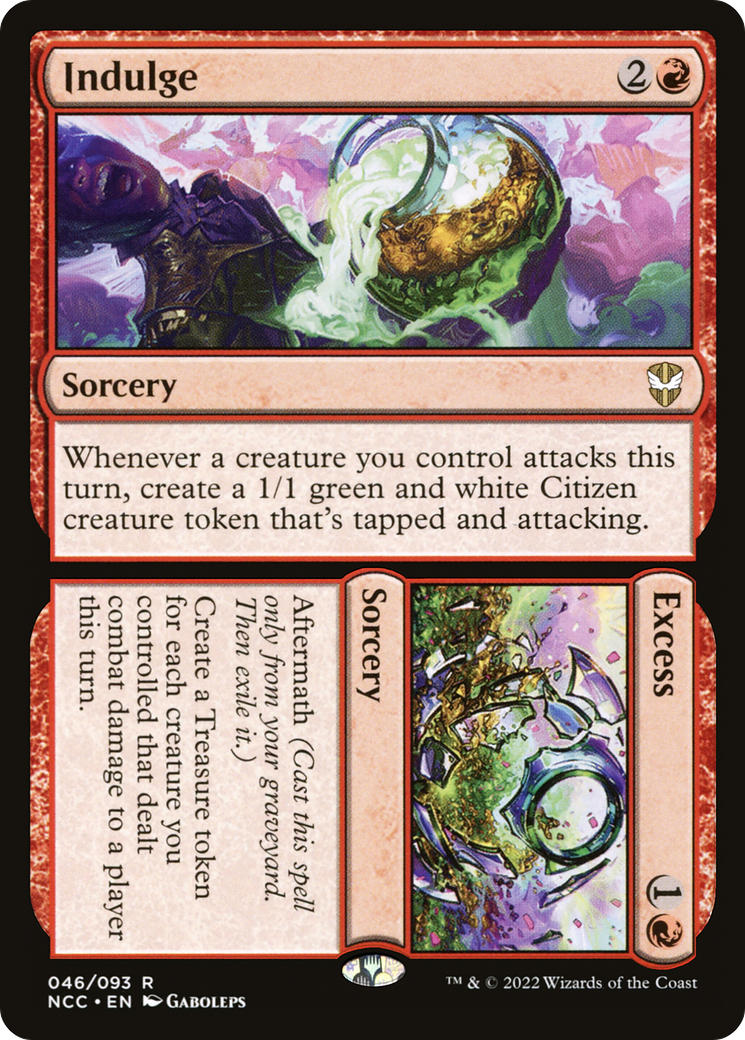
Indulge // Excess
//
Indulge
Sorcery
- Excess counts the number of creatures you controlled that dealt combat damage to a player even if you no longer control one or more of those creatures as it resolves.
- All split cards have two card faces on a single card, and you put a split card onto the stack with only the half you're casting. The characteristics of the half you didn't cast are ignored while the spell is on the stack.
- Each split card is a single card. For example, if you discard one, you've discarded one card, not two. If an effect counts the number of sorcery cards in your graveyard, Indulge /// Excess counts once, not twice.
- Each split card has two names. If an effect instructs you to choose a card name, you may choose one, but not both.
- While not on the stack, the characteristics of a split card are the combination of its two halves. For example, Indulge /// Excess has a mana value of 5.
- If you cast the first half of a split card with aftermath during your turn, you'll have priority immediately after it resolves. You can cast the half with aftermath from your graveyard before any player can take any other action if it's legal for you to do so.
- If another effect allows you to cast a split card with aftermath from any zone other than a graveyard, you can't cast the half with aftermath.
- If another effect allows you to cast a split card with aftermath from a graveyard, you may cast either half. If you cast the half that has aftermath, you'll exile the card if it would leave the stack.
- A spell with aftermath cast from a graveyard will always be exiled afterward, whether it resolves, it's countered, or it leaves the stack in some other way.
- Once you've started to cast a spell with aftermath from your graveyard, the card is immediately moved to the stack. Opponents can't try to stop the ability by exiling the card with another effect.
-
1
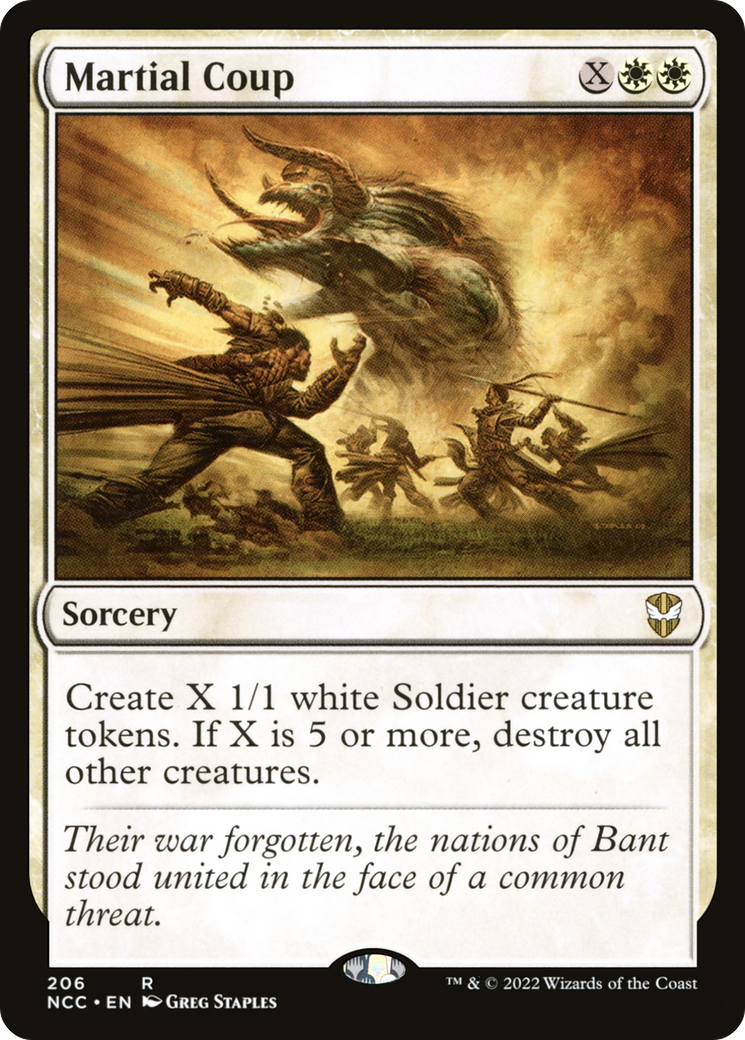
Martial Coup
Martial Coup
Sorcery
Create X 1/1 white Soldier creature tokens. If X is 5 or more, destroy all other creatures.
- Martial Coup checks the number you chose for X, not the amount of mana you actually spent.
- You do what the spell says in order. If X is 5 or more, you'll put the Soldier tokens onto the battlefield, then you'll destroy all other creatures.
- No one can cast spells or activate abilities between the time the Soldier tokens are put onto the battlefield and the time all other creatures are destroyed. For example, you can't sacrifice one of those Soldier tokens to regenerate a Skeletal Kathari.
-
1
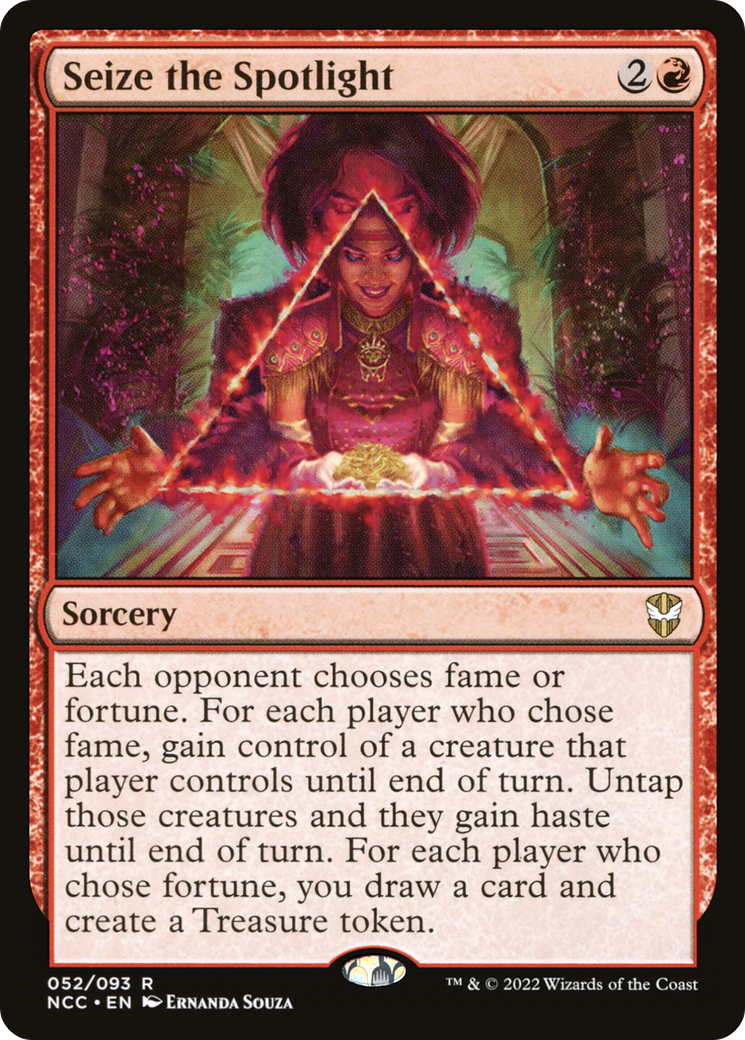
Seize the Spotlight
Seize the Spotlight
Sorcery
Each opponent chooses fame or fortune. For each player who chose fame, gain control of a creature that player controls until end of turn. Untap those creatures and they gain haste until end of turn. For each player who chose fortune, you draw a card and create a Treasure token.
-
1
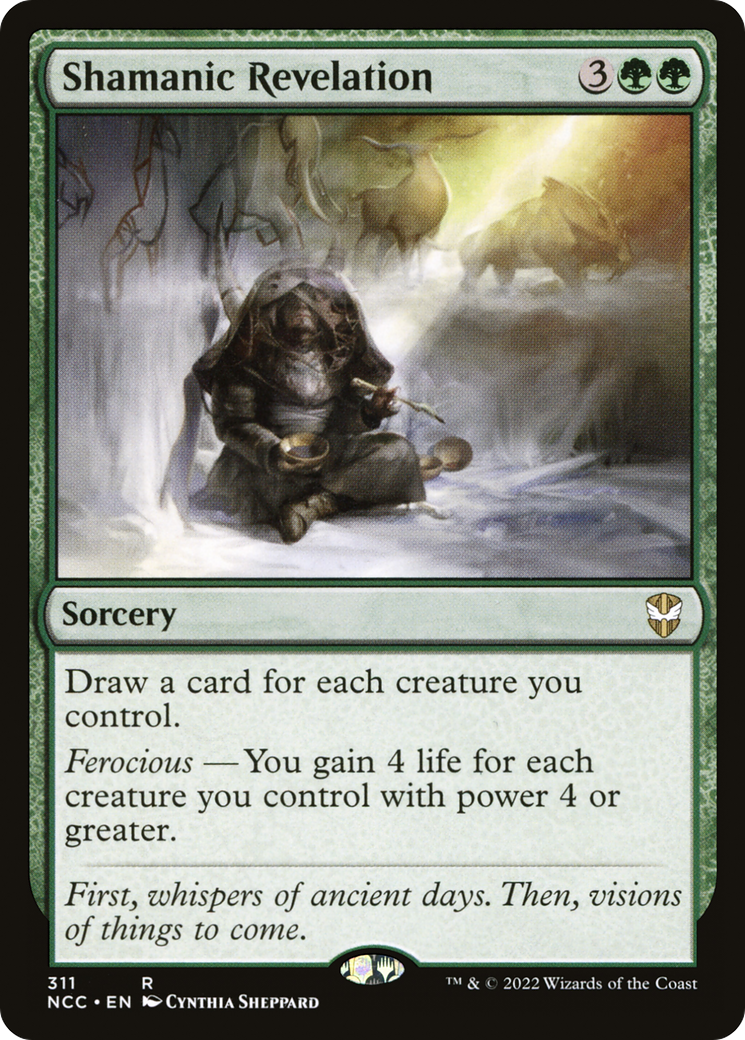
Shamanic Revelation
Shamanic Revelation
Sorcery
Draw a card for each creature you control.
Ferocious — You gain 4 life for each creature you control with power 4 or greater.
- After you draw cards while Shamanic Revelation is resolving, nothing else can happen before you gain the appropriate amount of life. Notably, abilities that trigger when you draw cards won't be put onto the stack until after you've gained life.
-
1
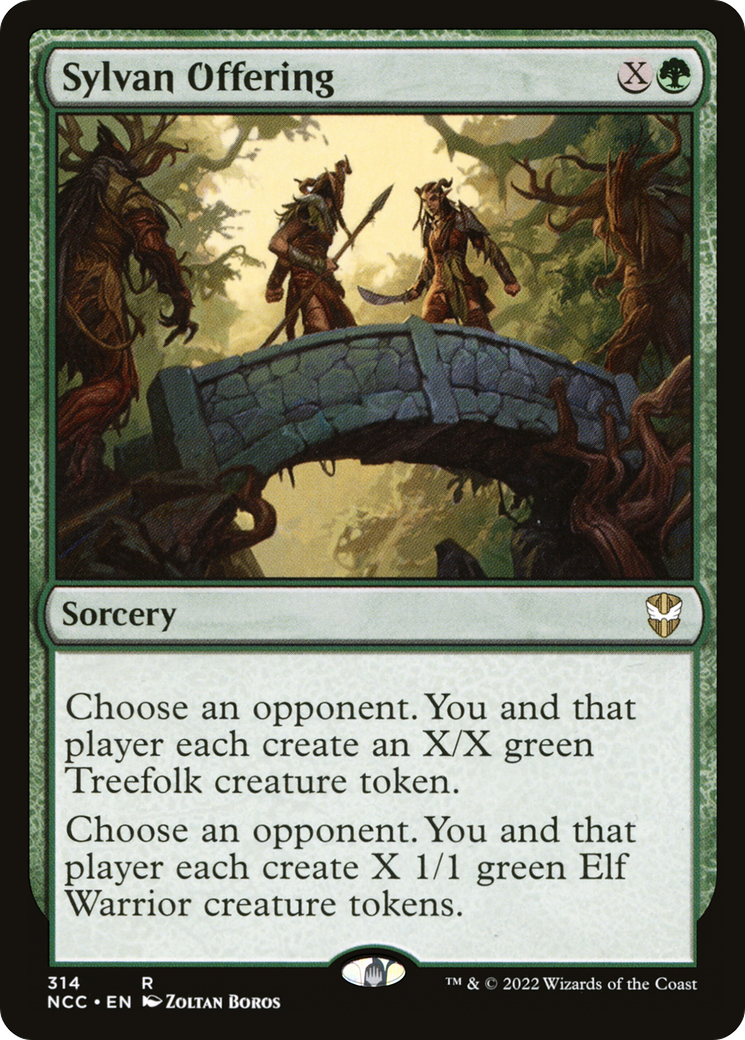
Sylvan Offering
Sylvan Offering
Sorcery
Choose an opponent. You and that player each create an X/X green Treefolk creature token.
Choose an opponent. You and that player each create X 1/1 green Elf Warrior creature tokens.
- You may choose the same opponent for each of the effects, or you may choose different opponents. None of the affected players are targets of the spell.
- You choose the opponents for each effect as the spell resolves.
-
1
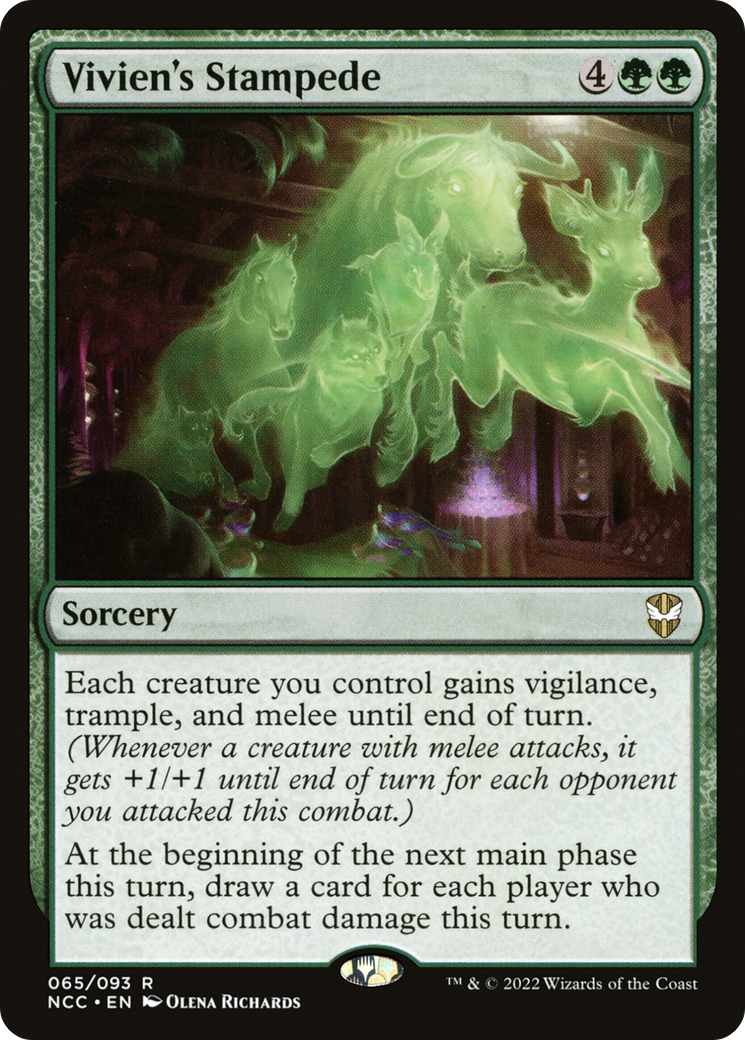
Vivien's Stampede
Vivien's Stampede
Sorcery
Each creature you control gains vigilance, trample, and melee until end of turn. (Whenever a creature with melee attacks, it gets +1/+1 until end of turn for each opponent you attacked this combat.)
At the beginning of the next main phase this turn, draw a card for each player who was dealt combat damage this turn.
Artifacts 8
-
1
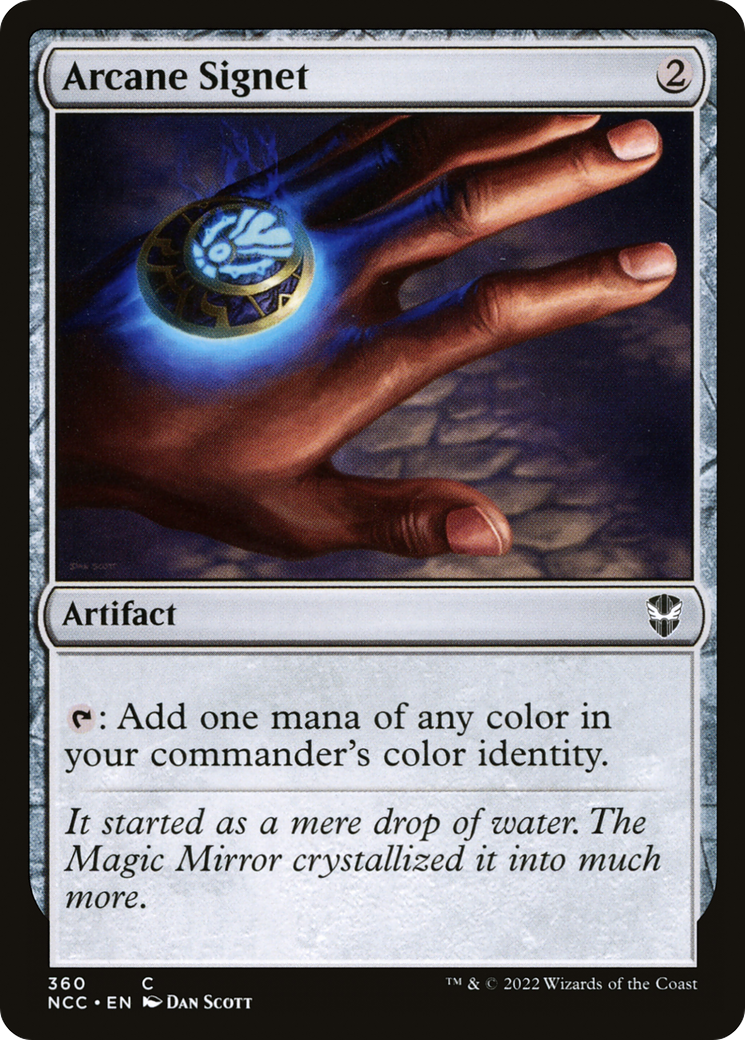
Arcane Signet
Arcane Signet
Artifact
: Add one mana of any color in your commander's color identity.
- If your commander is a card that has no colors in its color identity, Arcane Signet's ability produces no mana. It doesn't produce .
- If you have two commanders, the ability adds one mana of any color in their combined color identities.
- If you don't have a commander, Arcane Signet's ability produces no mana.
-
1
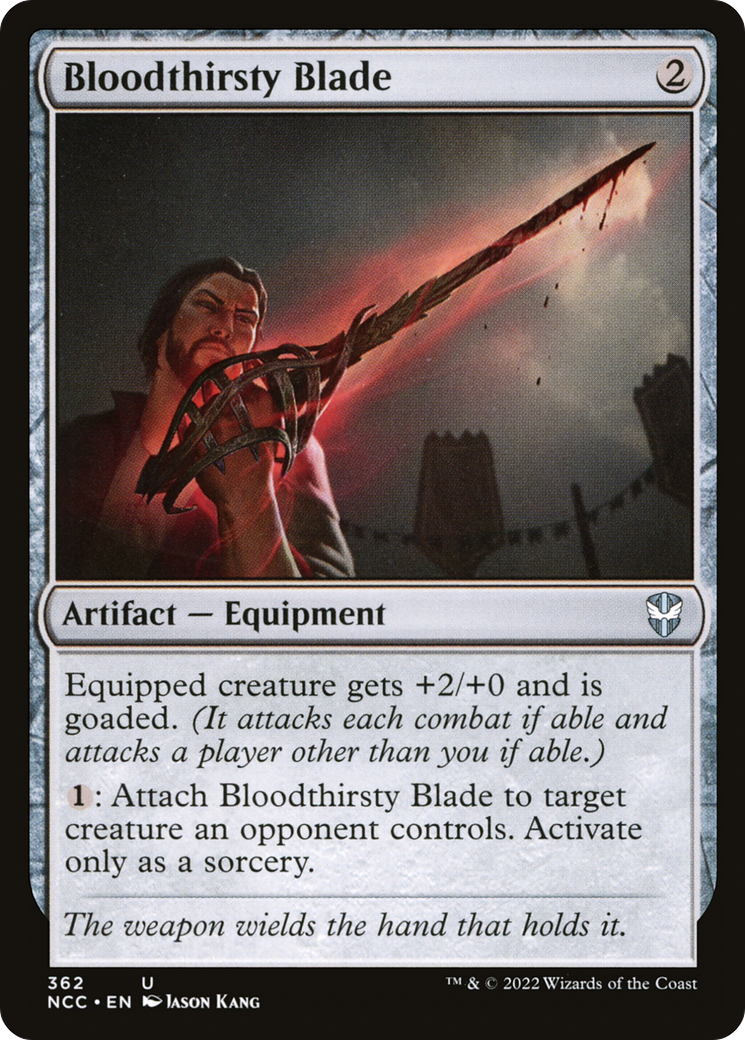
Bloodthirsty Blade
Bloodthirsty Blade
Artifact — Equipment
Equipped creature gets +2/+0 and is goaded. (It attacks each combat if able and attacks a player other than you if able.)
: Attach this Equipment to target creature an opponent controls. Activate only as a sorcery.
- If the creature doesn't meet any of the above exceptions and can attack, it must attack a player other than the controller of the spell or ability that goaded it if able. If the creature can't attack any of those players but could otherwise attack, it must attack a planeswalker an opponent controls, a battle an opponent controls, or a player who goaded it.
- Attacking with a goaded creature doesn't cause it to stop being goaded. If there is an additional combat phase that turn, or if another player gains control of it before it stops being goaded, it must attack again if able.
- If a creature you control has been goaded by multiple opponents, it must attack one of your opponents that hasn't goaded it, as that fulfills the maximum number of goad requirements. If a creature you control has been goaded by each of your opponents, the creature must attack an opponent (rather than a planeswalker or battle), but you choose which opponent it attacks.
- If, during a player's declare attackers step, a creature that player controls that's been goaded is tapped, is affected by a spell or ability that says it can't attack, or hasn't been under that player's control continuously since the turn began (and doesn't have haste), then it doesn't attack. If there's a cost associated with having a creature attack a player, its controller isn't forced to pay that cost, so it doesn't have to attack that player.
- Being goaded isn't an ability the creature has. Once it's been goaded, it must attack as detailed above even if it loses all abilities.
- You still control Bloodthirsty Blade while it's equipped to an opponent's creature. You can move it any time you could cast a sorcery; the equipped creature's controller can't.
- Bloodthirsty Blade has no equip ability. There's normally no way to have it attached to your own creature, although certain combinations of other cards make this possible.
-
1
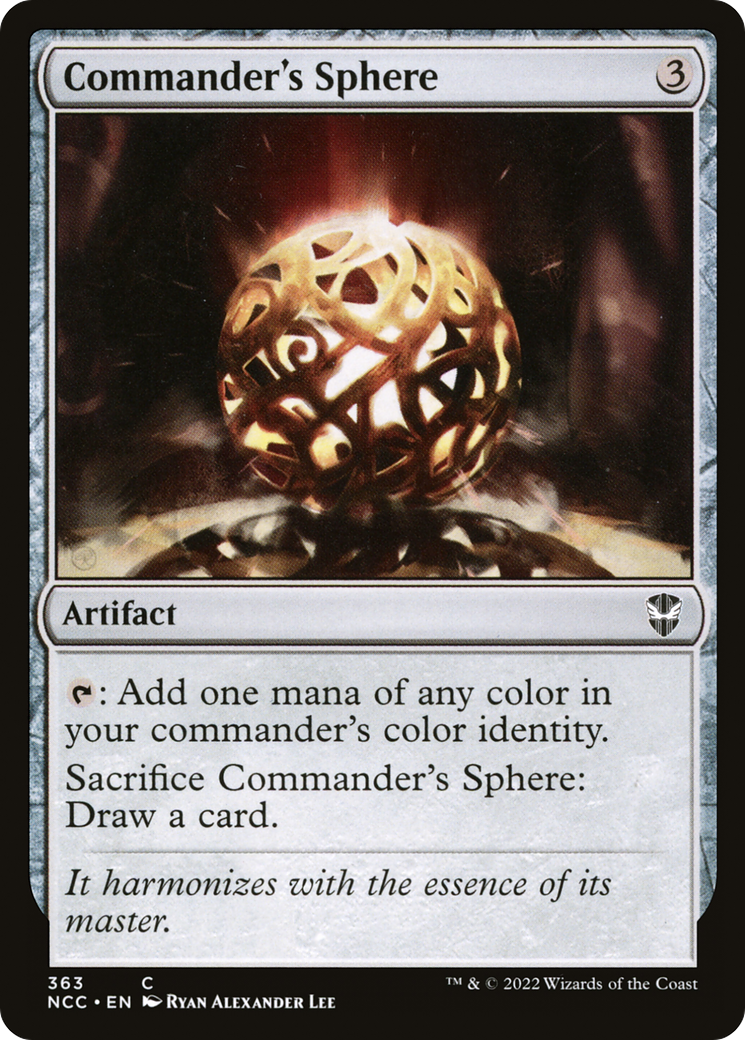
Commander's Sphere
Commander's Sphere
Artifact
: Add one mana of any color in your commander's color identity.
Sacrifice this artifact: Draw a card.
- If your commander is a card that has no colors in its color identity, Commander's Sphere's first ability produces no mana. It doesn't produce .
- If you don't have a commander, Commander's Sphere's first ability produces no mana.
- If you have two commanders, the ability adds one mana of any color in their combined color identities.
-
1
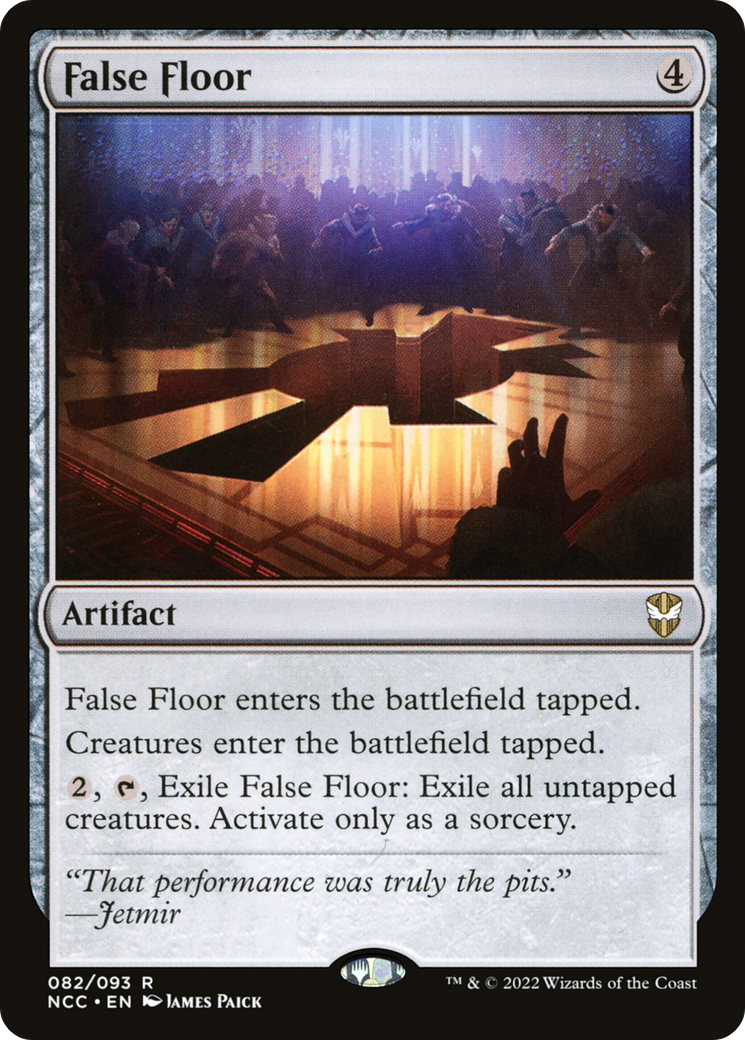
False Floor
False Floor
Artifact
This artifact enters tapped.
Creatures enter tapped.
, , Exile this artifact: Exile all untapped creatures. Activate only as a sorcery.
-
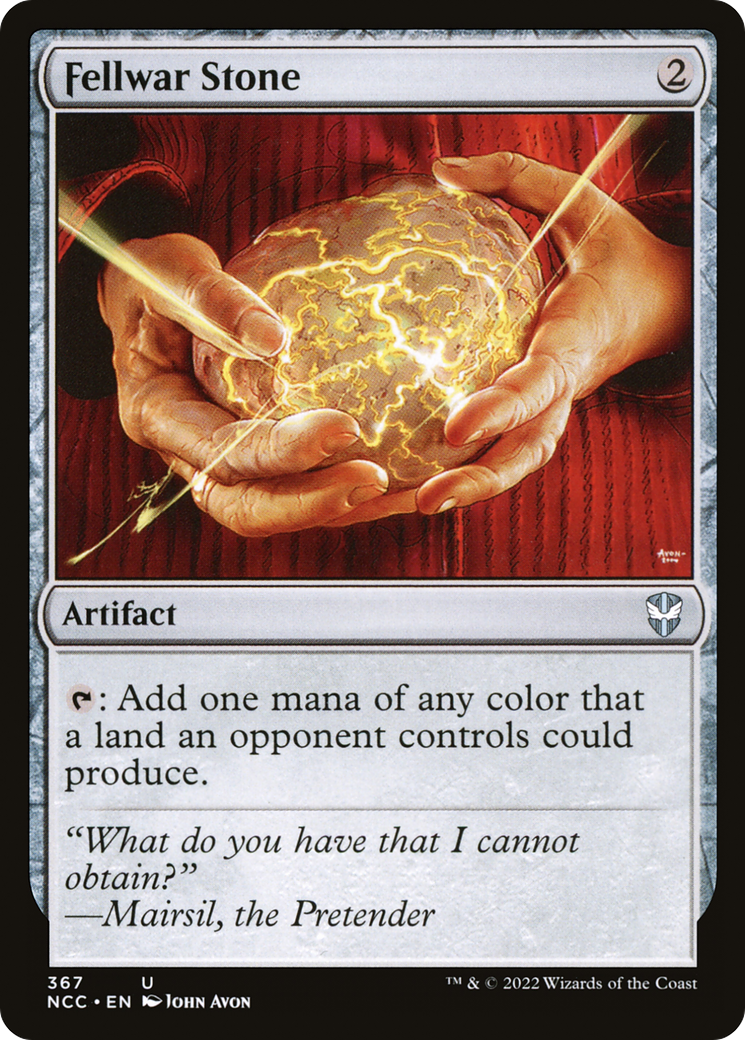
1
Fellwar Stone
Fellwar Stone
Artifact
: Add one mana of any color that a land an opponent controls could produce.
- When determining what colors of mana your opponents' lands could produce, take into account any applicable replacement effects that would apply to those lands' mana abilities (such as Contamination's effect, for example). If there is more than one, consider them in any possible order.
- Fellwar Stone doesn't care about any restrictions or riders your opponents' lands (such as Ancient Ziggurat or Hall of the Bandit Lord) put on the mana they produce. It just cares about colors of mana.
- The colors of mana are white, blue, black, red, and green. Fellwar Stone can't be tapped for colorless mana, even if a land an opponent controls could produce colorless mana.
- Fellwar Stone checks the effects of all mana-producing abilities of lands your opponents control, but it doesn't check their costs. For example, Vivid Crag has the ability " , Remove a charge counter from Vivid Crag: Add one mana of any color." If an opponent controls Vivid Crag and you control Fellwar Stone, you can tap Fellwar Stone for any color of mana. It doesn't matter whether Vivid Crag has a charge counter on it, and it doesn't matter whether it's untapped.
- This works even if the opponent's lands are tapped. It only checks what kinds of mana can be produced, not if the abilities that produce them are usable right now.
- It only produces one mana even if the land can produce more than one.
- The ability can be activated if the opponent has no lands that produce mana, but the effect will not be able to generate any mana.
-
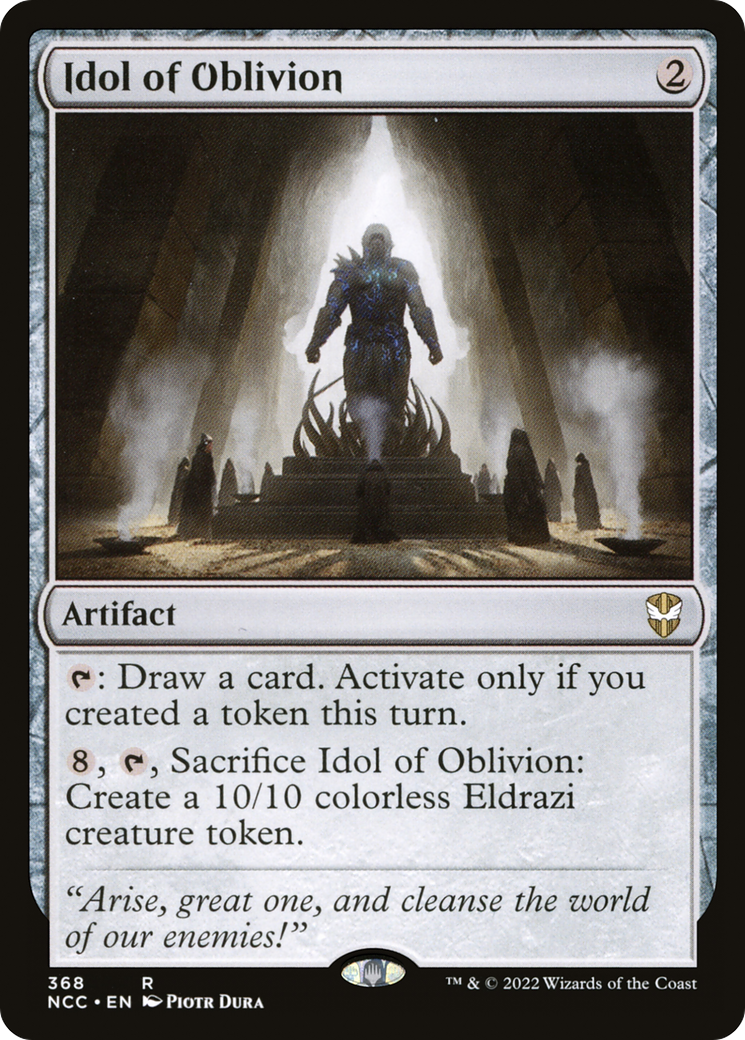
1
Idol of Oblivion
Idol of Oblivion
Artifact
: Draw a card. Activate only if you created a token this turn.
, , Sacrifice this artifact: Create a 10/10 colorless Eldrazi creature token.
- You can activate Idol of Oblivion's first ability even if the token you've created was created before Idol of Oblivion entered the battlefield or if the token has left the battlefield.
-
1
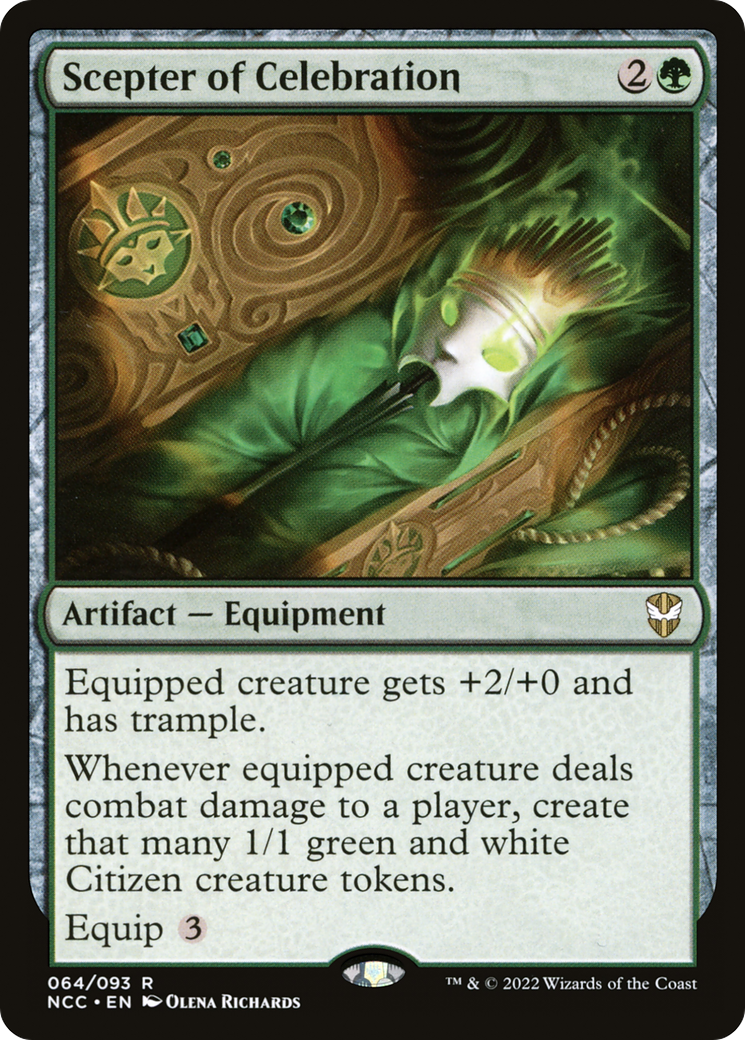
Scepter of Celebration
Scepter of Celebration
Artifact — Equipment
Equipped creature gets +2/+0 and has trample.
Whenever equipped creature deals combat damage to a player, create that many 1/1 green and white Citizen creature tokens.
Equip
-
1
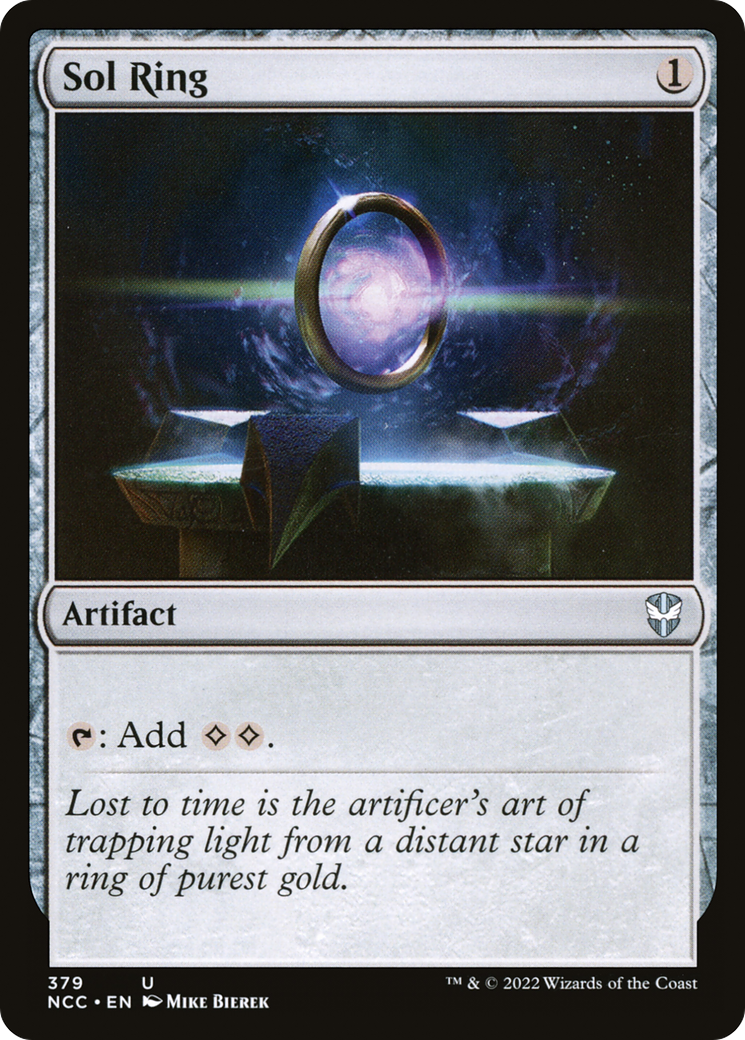
Sol Ring
Sol Ring
Artifact
: Add .
Enchantments 10
-
1
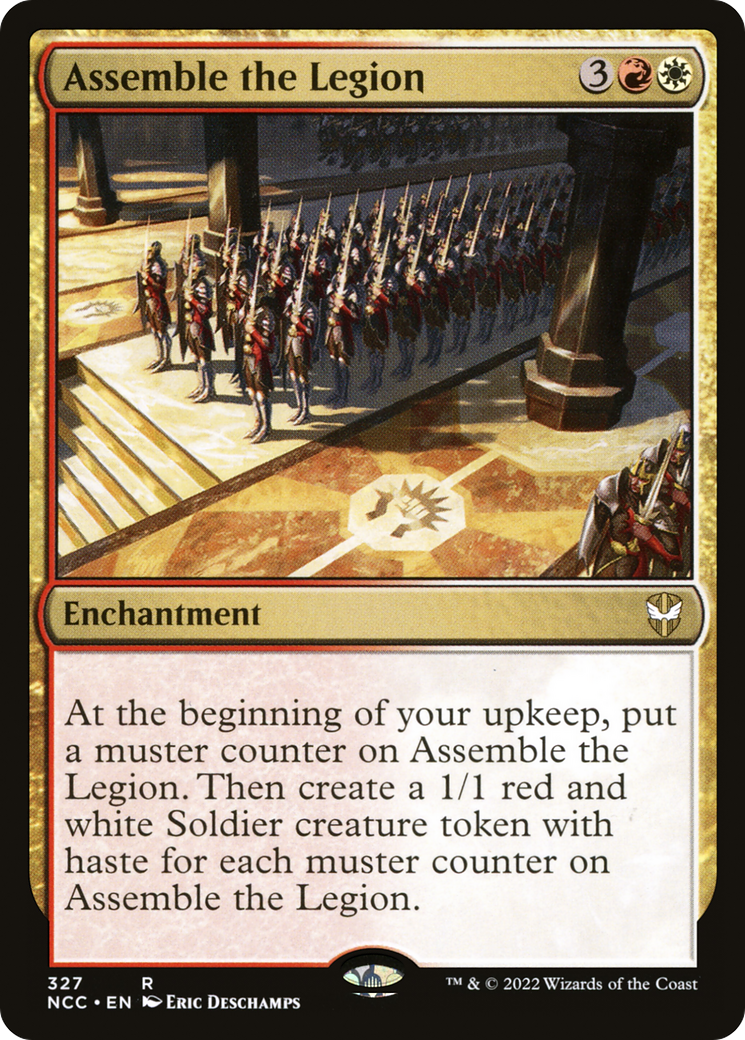
Assemble the Legion
Assemble the Legion
Enchantment
At the beginning of your upkeep, put a muster counter on this enchantment. Then create a 1/1 red and white Soldier creature token with haste for each muster counter on this enchantment.
- If Assemble the Legion isn't on the battlefield when its ability resolves, use the number of muster counters it had when it was last on the battlefield to determine how many Soldier tokens to create.
-
1
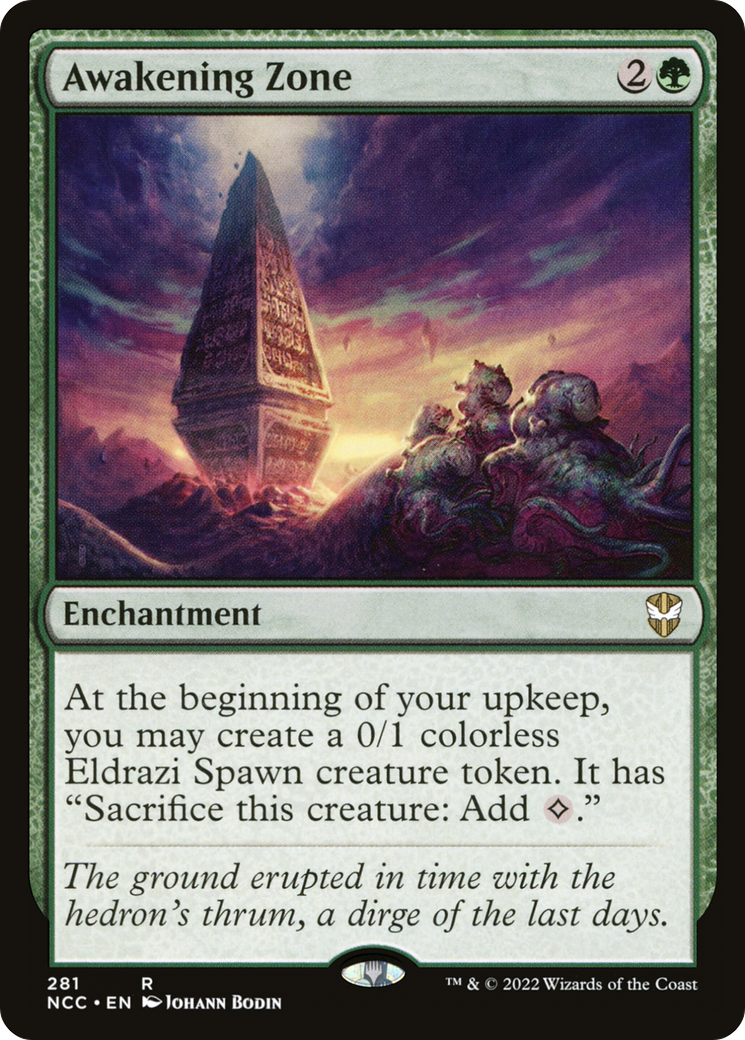
Awakening Zone
Awakening Zone
Enchantment
At the beginning of your upkeep, you may create a 0/1 colorless Eldrazi Spawn creature token. It has "Sacrifice this token: Add ."
-
1
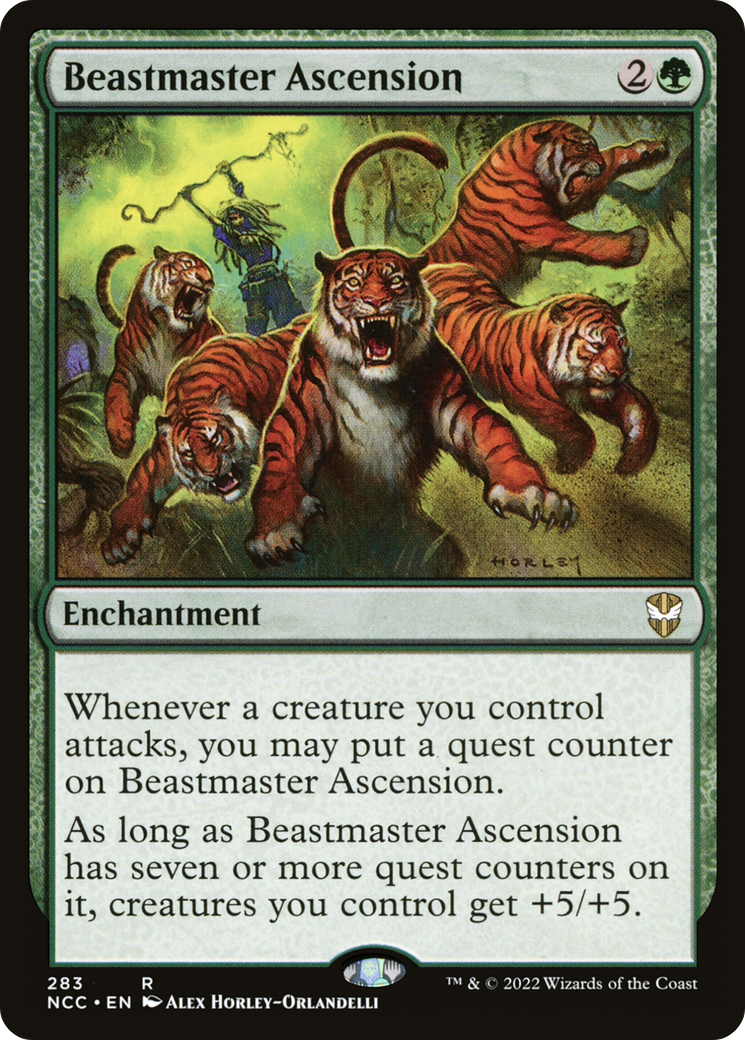
Beastmaster Ascension
Beastmaster Ascension
Enchantment
Whenever a creature you control attacks, you may put a quest counter on this enchantment.
As long as this enchantment has seven or more quest counters on it, creatures you control get +5/+5.
- If you attack with multiple creatures, Beastmaster Ascension's first ability triggers multiple times.
-
1
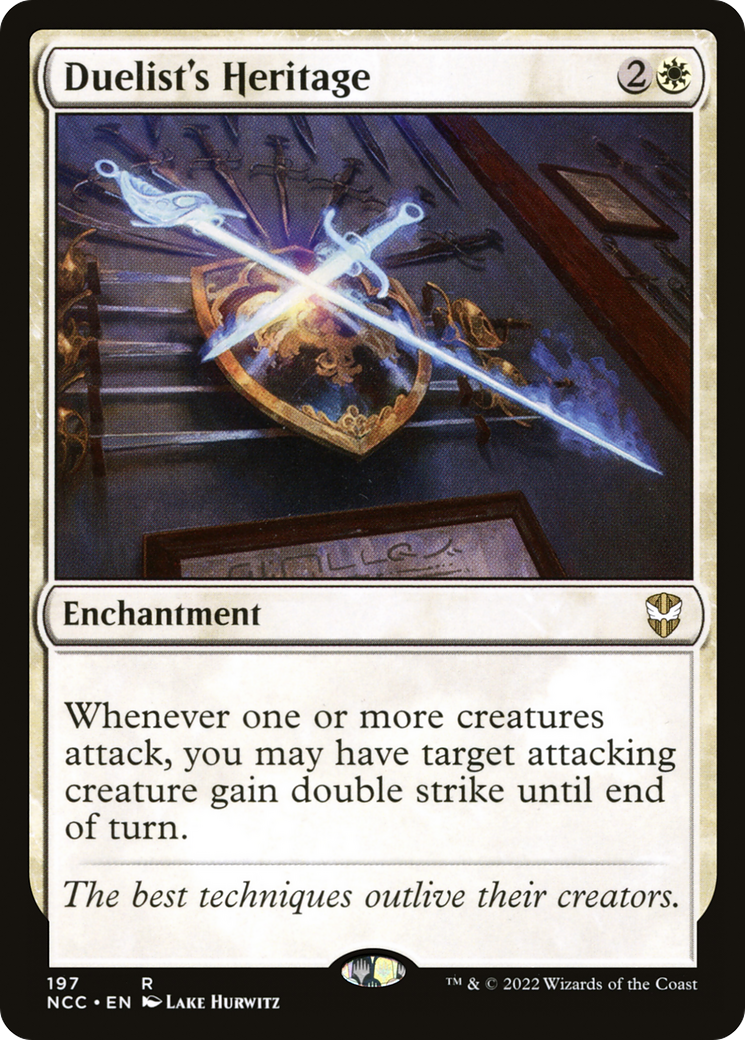
Duelist's Heritage
Duelist's Heritage
Enchantment
Whenever one or more creatures attack, you may have target attacking creature gain double strike until end of turn.
- The ability of Duelist's Heritage triggers whenever any player attacks with one or more creatures, not just when you do. You know which players and planeswalkers the creatures are attacking before you choose the target creature.
-
1
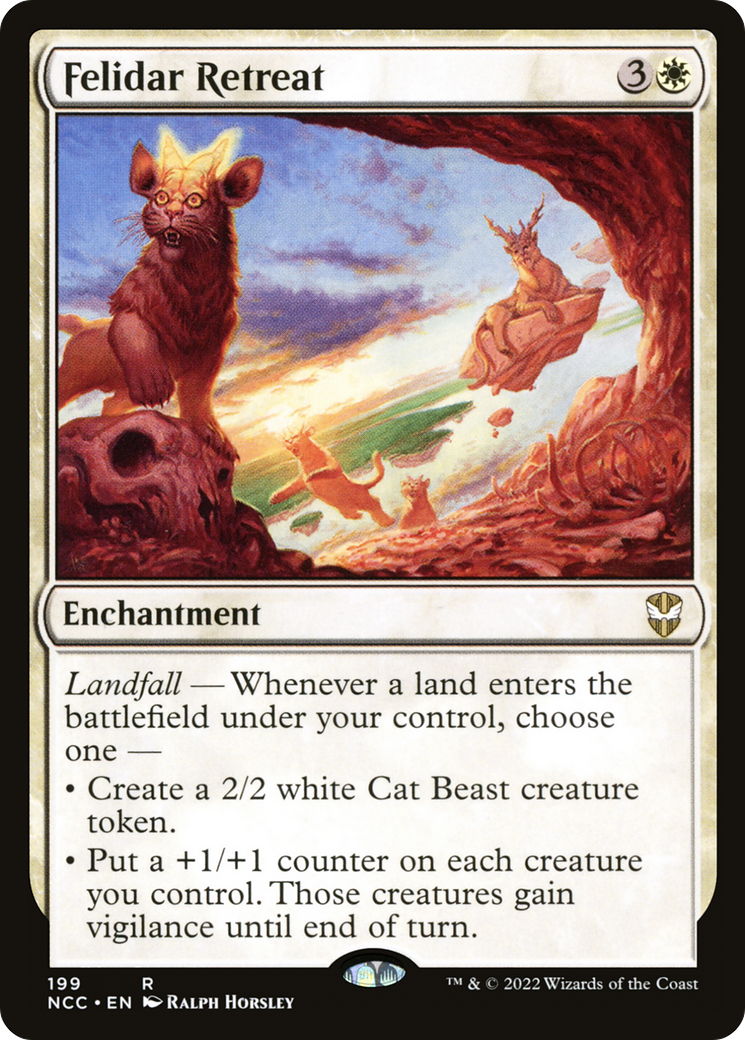
Felidar Retreat
Felidar Retreat
Enchantment
Landfall — Whenever a land you control enters, choose one —
- Create a 2/2 white Cat Beast creature token.
- Put a +1/+1 counter on each creature you control. Those creatures gain vigilance until end of turn.
- A landfall ability triggers whenever a land you control enters for any reason. It triggers whenever you play a land, as well as whenever a spell or ability puts a land onto the battlefield under your control.
- A landfall ability doesn't trigger if a permanent already on the battlefield becomes a land.
- Whenever a land you control enters, each landfall ability of the permanents you control will trigger. You can put them on the stack in any order. The last ability you put on the stack will be the first one to resolve (As a result, you can have those abilities resolve in the order of your choosing.).
- Felidar Retreat's second mode affects only creatures you control at the time the ability resolves, including creatures you control but that for some reason didn't get a +1/+1 counter. Creatures you begin to control later in the turn won't gain vigilance or get a +1/+1 counter.
-
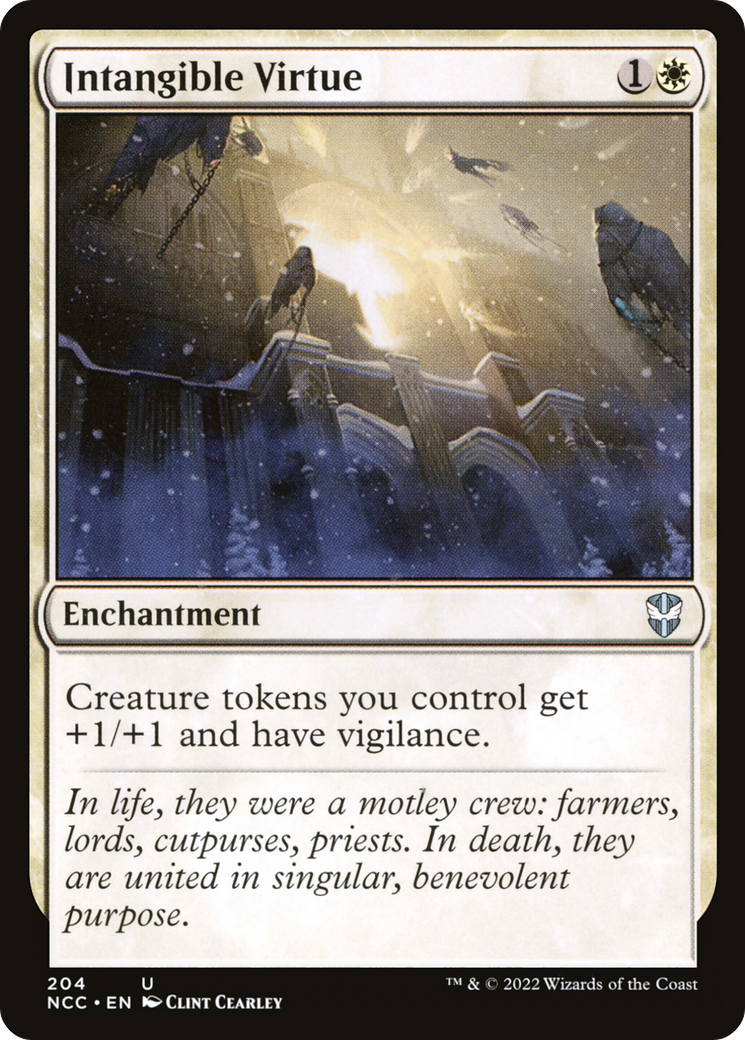
1
Intangible Virtue
Intangible Virtue
Enchantment
Creature tokens you control get +1/+1 and have vigilance.
-
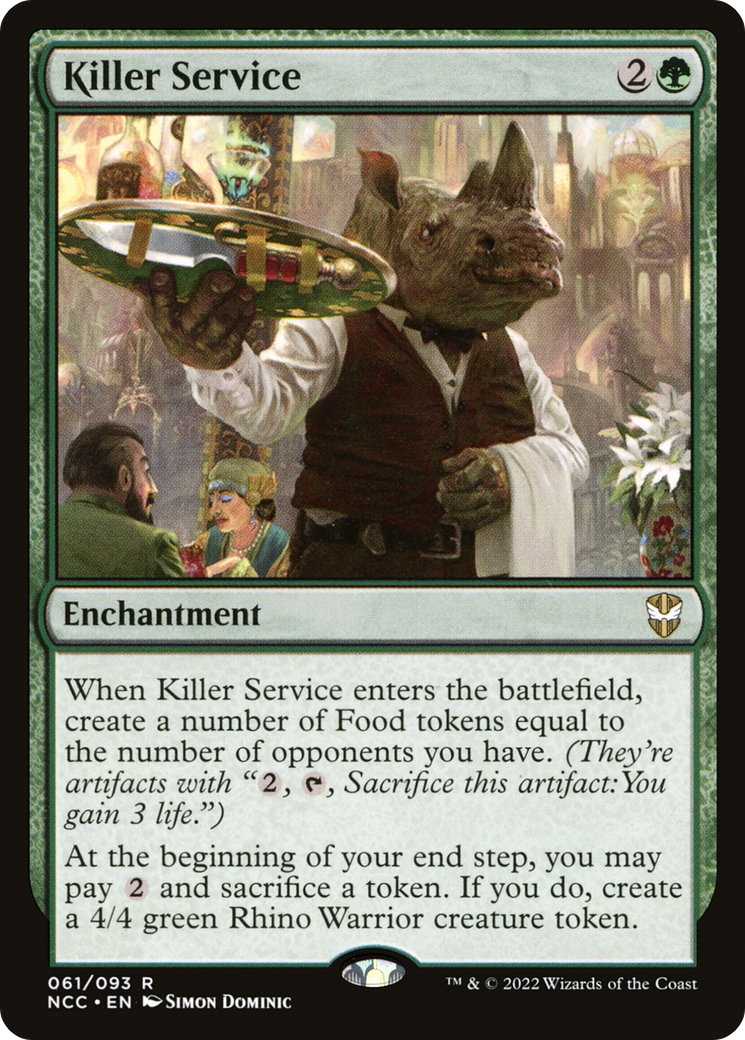
1
Killer Service
Killer Service
Enchantment
When this enchantment enters, create a number of Food tokens equal to the number of opponents you have. (They're artifacts with " , , Sacrifice this token: You gain 3 life.")
At the beginning of your end step, you may pay and sacrifice a token. If you do, create a 4/4 green Rhino Warrior creature token.
- Food is an artifact type. Even though it appears on some creatures, it's never a creature type.
- You can't sacrifice a Food to pay multiple costs. For example, you can't sacrifice a Food token to activate its own ability and also to activate Maraleaf Rider's ability.
- Whatever you do, don't eat the delicious cards.
- As Killer Service's second ability resolves, you may sacrifice any token, not just a Food token.
-
1
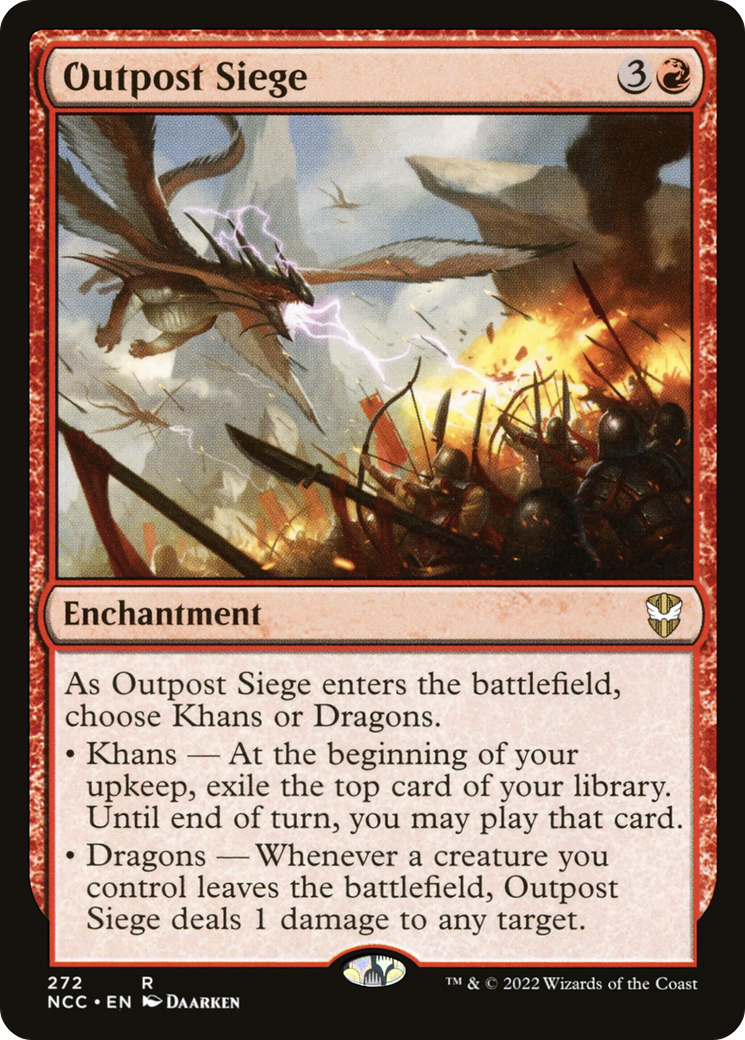
Outpost Siege
Outpost Siege
Enchantment
As this enchantment enters, choose Khans or Dragons.
- Khans — At the beginning of your upkeep, exile the top card of your library. Until end of turn, you may play that card.
- Dragons — Whenever a creature you control leaves the battlefield, this enchantment deals 1 damage to any target.
- The card exiled by the "Khans" ability is exiled face up. Playing a card exiled with the "Khans" ability follows the normal rules for playing the card. You must pay its costs, and you must follow all applicable timing rules. For example, if it's a creature card, you can cast it only during your main phase while the stack is empty.
- If you exile a land card using the "Khans" ability, you may play that land only if you have any available land plays. Normally, this means you can play the land only if you haven't played a land yet that turn.
- If a noncreature card is manifested and then leaves the battlefield while face down, the "Dragons" ability will trigger.
- Each Siege will have one of the two listed abilities, depending on your choice as it enters the battlefield.
- The words "Khans" and "Dragons" are anchor words, connecting your choice to the appropriate ability. Anchor words are a new rules concept. "[Anchor word] — [Ability]" means "As long as you chose [anchor word] as this permanent entered the battlefield, this permanent has [ability]." Notably, the anchor word "Dragons" has no connection to the creature type Dragon.
- Each of the last two abilities is linked to the first ability. They each refer only to the choice made as a result of the first ability. If a permanent enters the battlefield as a copy of one of the Sieges, its controller will make a new choice for that Siege. Which ability the copy has won't depend on the choice made for the original permanent.
-
1
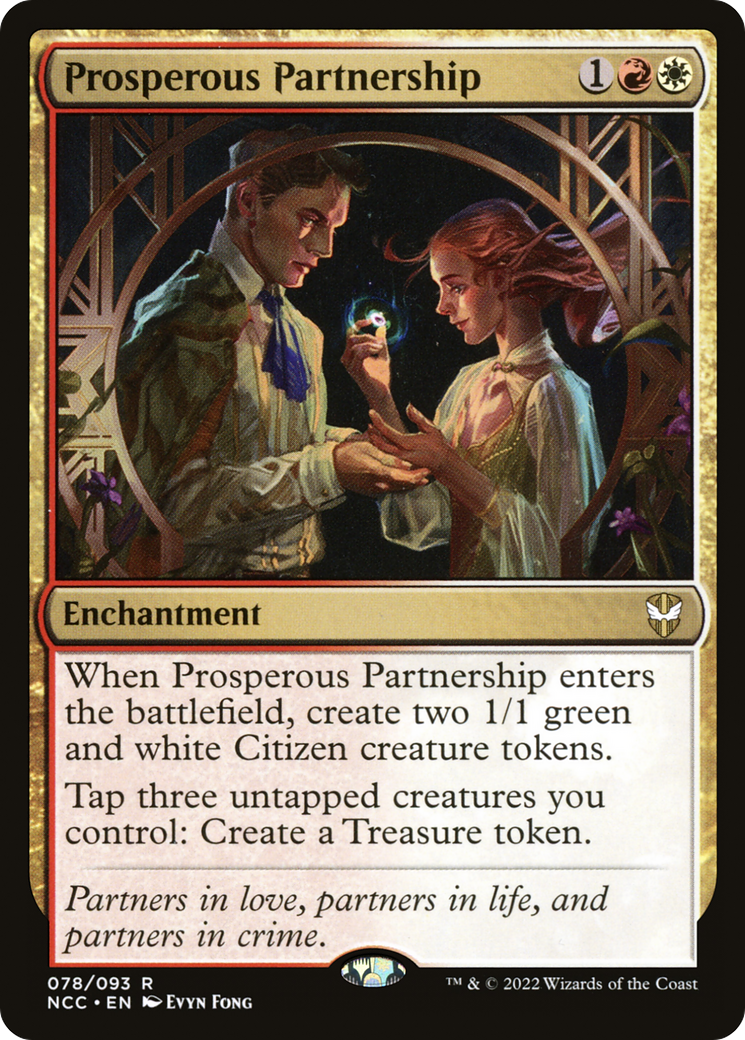
Prosperous Partnership
Prosperous Partnership
Enchantment
When this enchantment enters, create two 1/1 green and white Citizen creature tokens.
Tap three untapped creatures you control: Create a Treasure token.
-
1
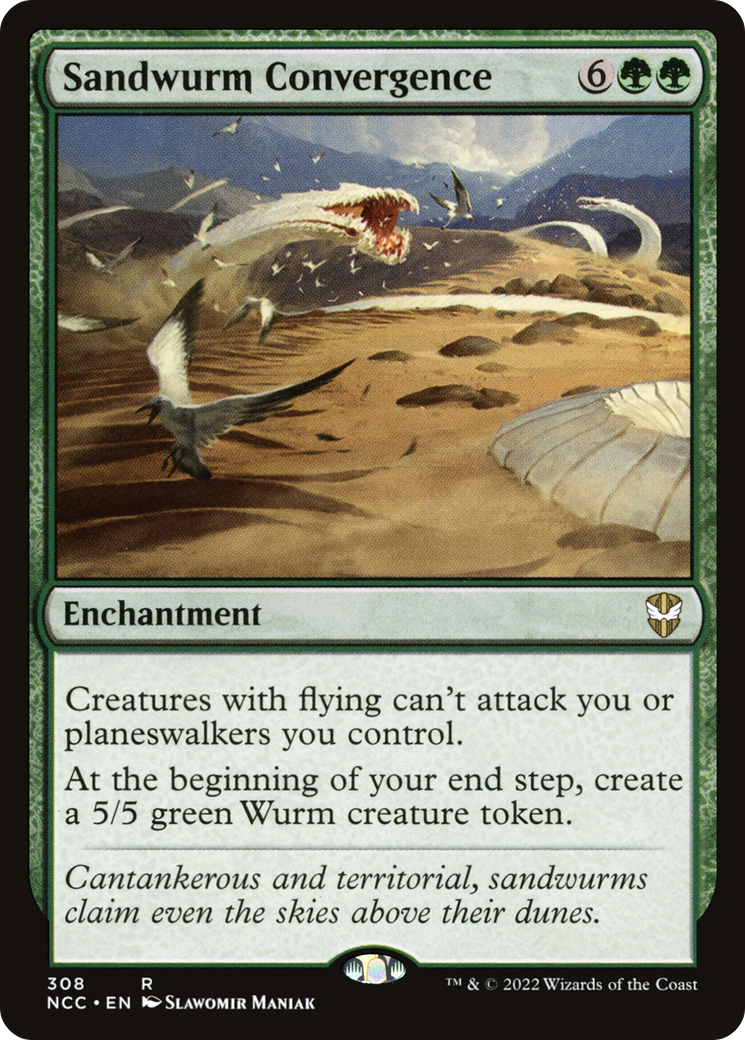
Sandwurm Convergence
Sandwurm Convergence
Enchantment
Creatures with flying can't attack you or planeswalkers you control.
At the beginning of your end step, create a 5/5 green Wurm creature token.
- Once a creature has attacked you or a planeswalker you control, it will remain in combat even if it gains flying. Similarly, if a creature with flying enters the battlefield attacking, Sandwurm Convergence's first ability can't undo that attack.
Lands 38
-
1
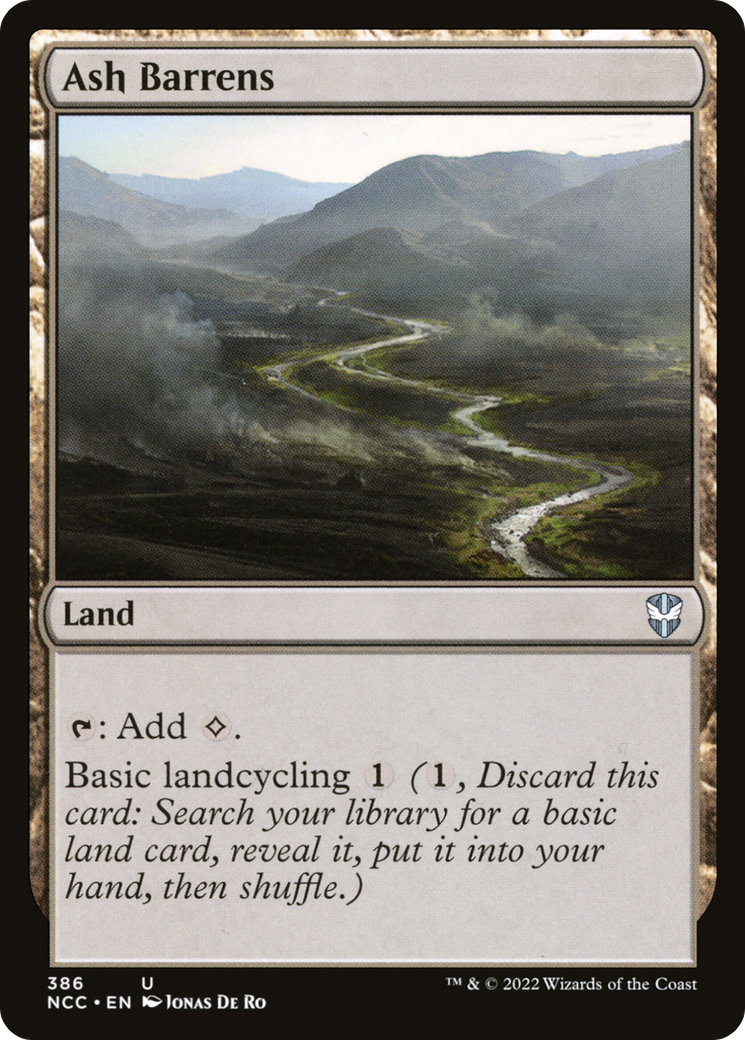
Ash Barrens
Ash Barrens
Land
: Add .
Basic landcycling ( , Discard this card: Search your library for a basic land card, reveal it, put it into your hand, then shuffle.)
-
1
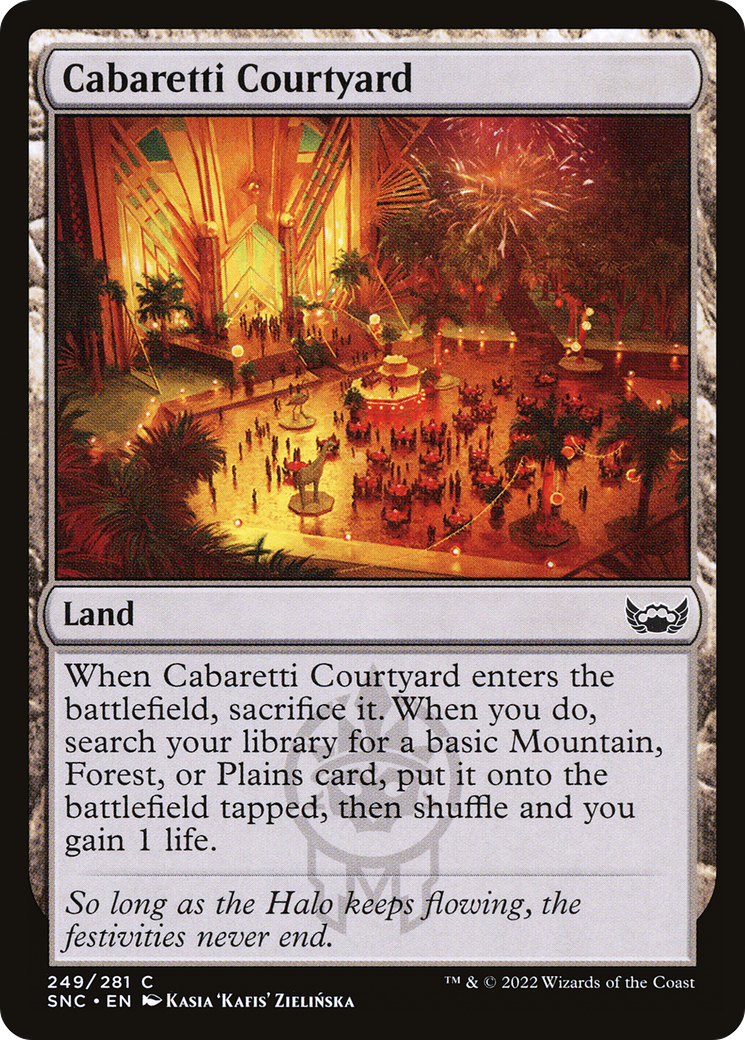
Cabaretti Courtyard
Cabaretti Courtyard
Land
When this land enters, sacrifice it. When you do, search your library for a basic Mountain, Forest, or Plains card, put it onto the battlefield tapped, then shuffle and you gain 1 life.
-
1
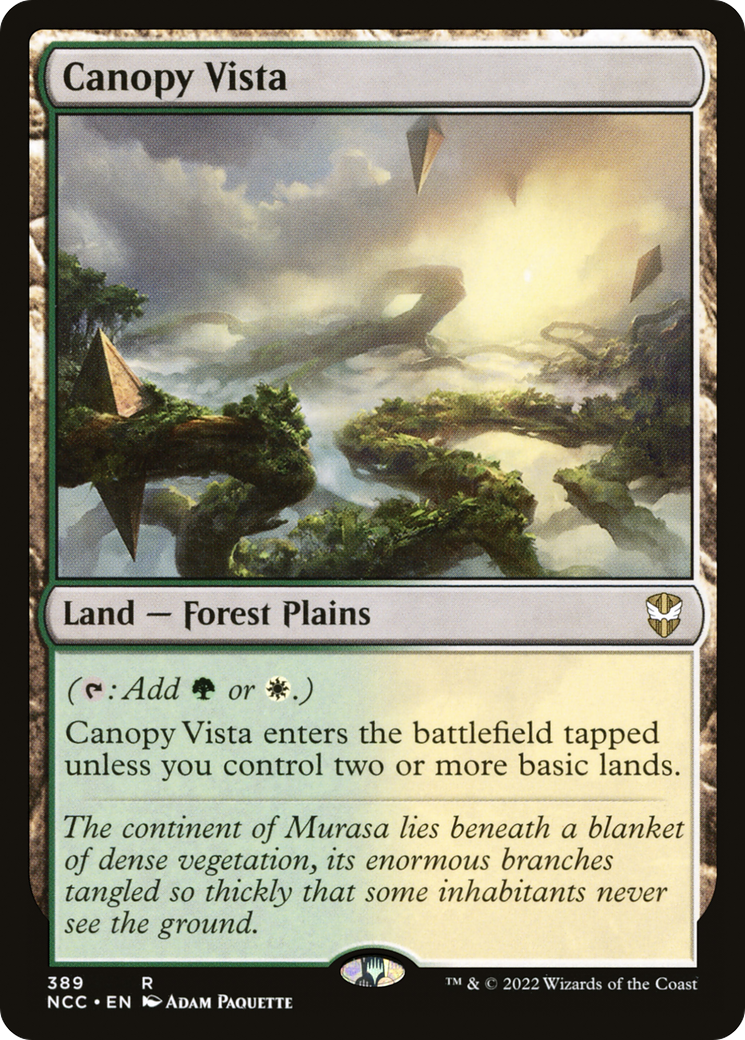
Canopy Vista
Canopy Vista
Land — Forest Plains
( : Add or .)
This land enters tapped unless you control two or more basic lands.
- Even though these lands have basic land types, they are not basic lands because "basic" doesn't appear on their type line. Notably, controlling two or more of them won't allow others to enter the battlefield untapped.
- If one of these lands enters the battlefield at the same time as any number of basic lands, those other lands are not counted when determining if this land enters the battlefield tapped or untapped.
- However, because these cards have basic land types, effects that specify a basic land type without also specifying that the land be basic can affect them. For example, a spell or ability that reads "Destroy target Forest" can target Canopy Vista, while one that reads "Destroy target basic Forest" cannot.
-
1
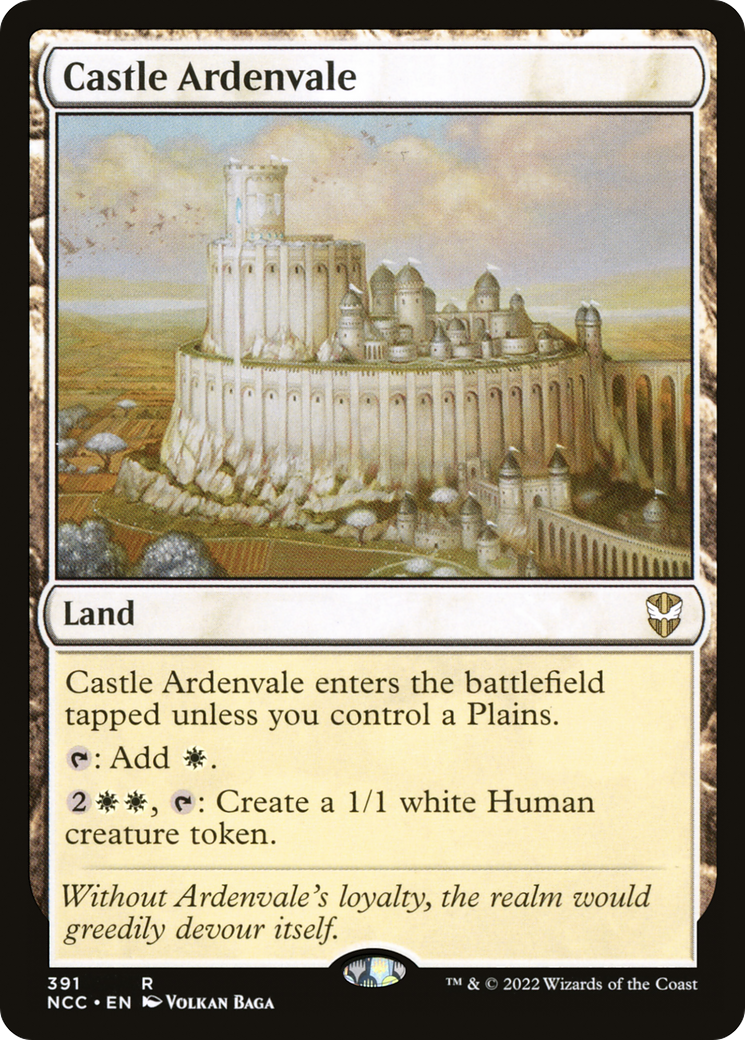
Castle Ardenvale
Castle Ardenvale
Land
This land enters tapped unless you control a Plains.
: Add .
, : Create a 1/1 white Human creature token.
- Once the common lands (such as Mystic Sanctuary) enter the battlefield tapped, there's no way to untap them with a spell or ability to make their last ability trigger.
- Although the common lands have basic land types, they aren't basic lands.
-
1
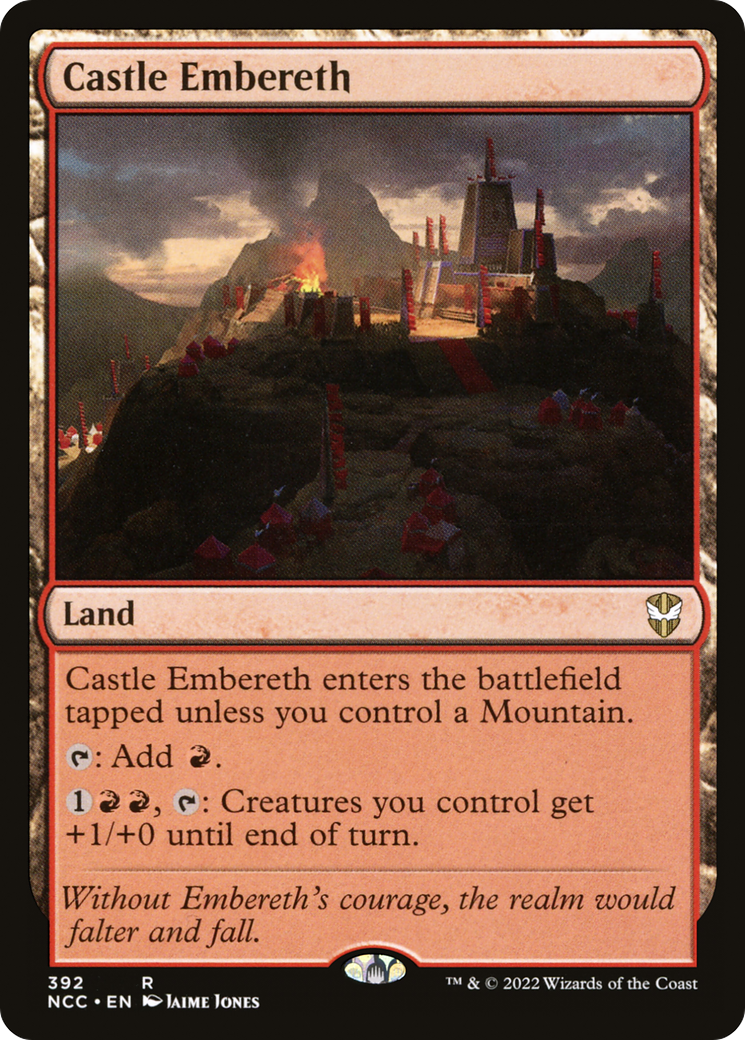
Castle Embereth
Castle Embereth
Land
This land enters tapped unless you control a Mountain.
: Add .
, : Creatures you control get +1/+0 until end of turn.
- Once the common lands (such as Mystic Sanctuary) enter the battlefield tapped, there's no way to untap them with a spell or ability to make their last ability trigger.
- Although the common lands have basic land types, they aren't basic lands.
-
1
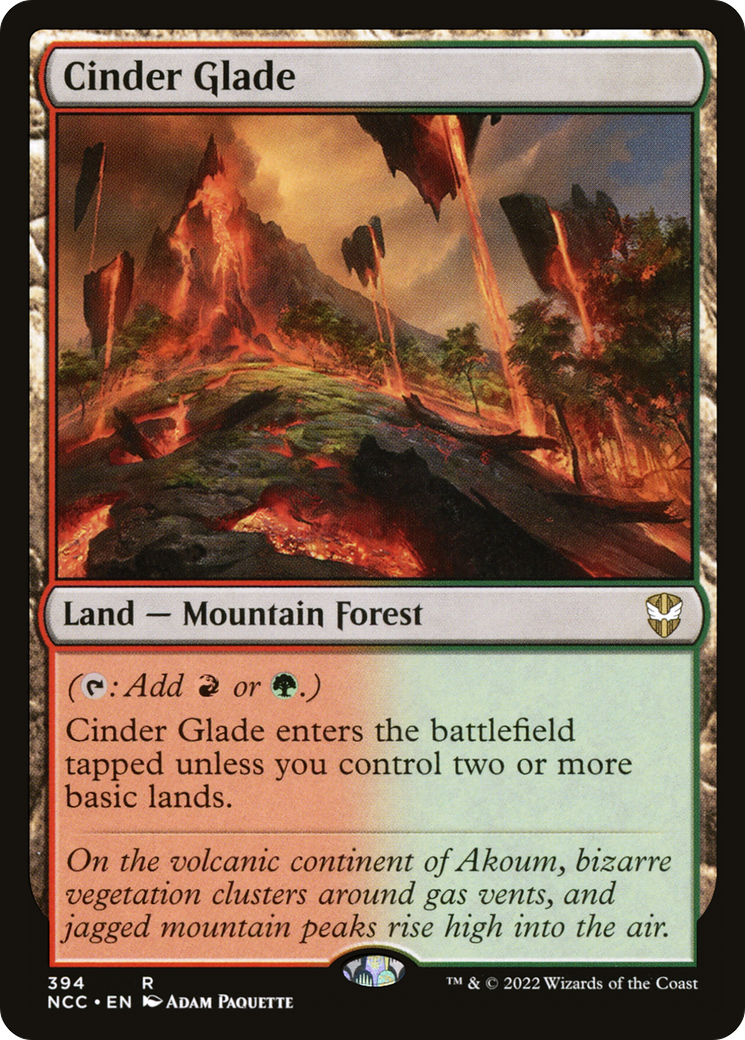
Cinder Glade
Cinder Glade
Land — Mountain Forest
( : Add or .)
This land enters tapped unless you control two or more basic lands.
- If one of these lands enters the battlefield at the same time as any number of basic lands, those other lands are not counted when determining if this land enters the battlefield tapped or untapped.
- However, because these cards have basic land types, effects that specify a basic land type without also specifying that the land be basic can affect them. For example, a spell or ability that reads "Destroy target Forest" can target Canopy Vista, while one that reads "Destroy target basic Forest" cannot.
- Even though these lands have basic land types, they are not basic lands because "basic" doesn't appear on their type line. Notably, controlling two or more of them won't allow others to enter the battlefield untapped.
-
1
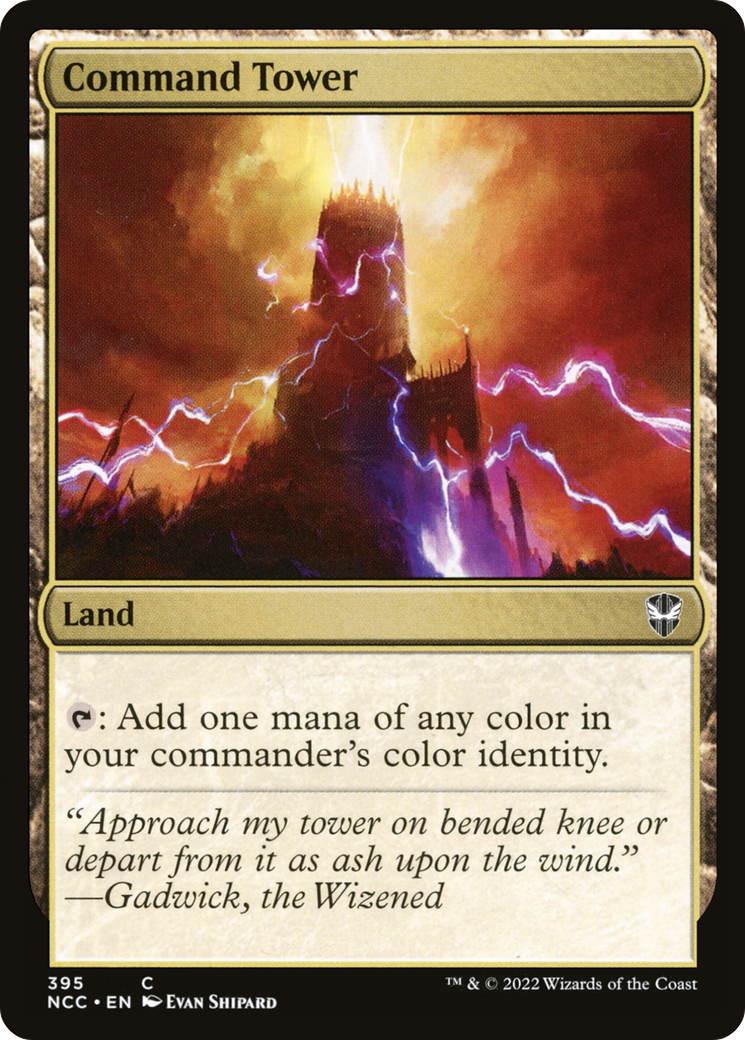
Command Tower
Command Tower
Land
: Add one mana of any color in your commander's color identity.
- If you don't have a commander, Command Tower's ability produces no mana.
- If your commander is a card that has no colors in its color identity, Command Tower's ability produces no mana. It doesn't produce .
- If you have two commanders, the ability adds one mana of any color in their combined color identities.
-
1
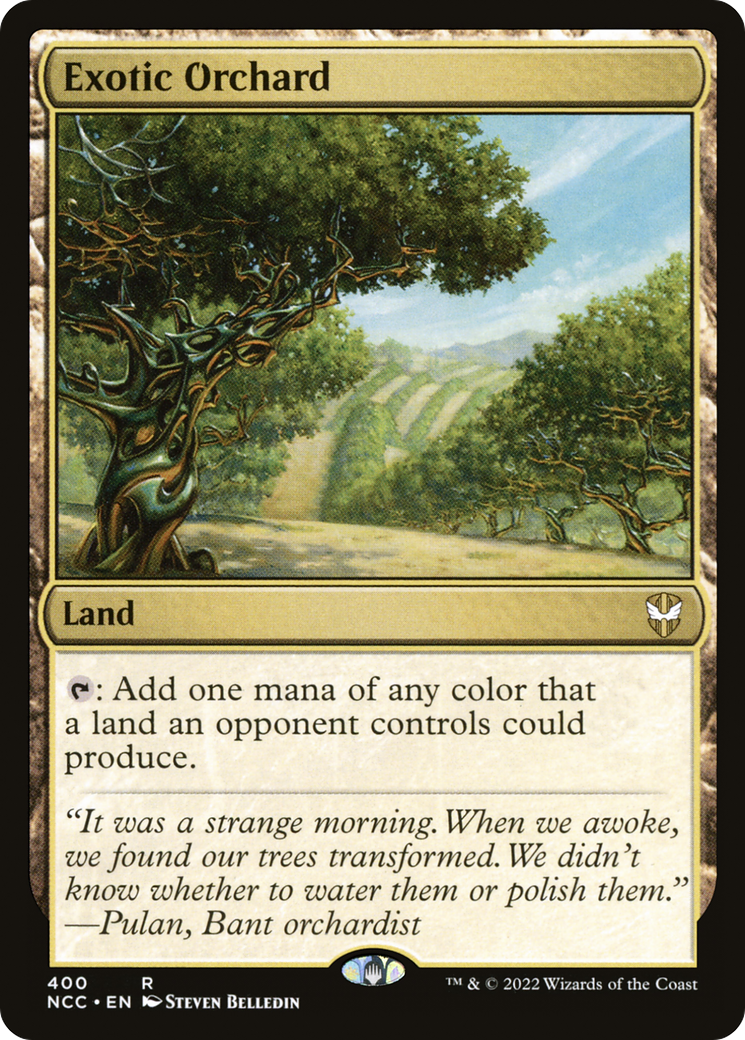
Exotic Orchard
Exotic Orchard
Land
: Add one mana of any color that a land an opponent controls could produce.
- Lands that produce mana based only on what other lands "could produce" won't help each other unless some other land allows one of them to actually produce some type of mana. For example, if you control an Exotic Orchard and your opponent controls an Exotic Orchard and a Reflecting Pool, none of those lands would produce mana if their mana abilities were activated. On the other hand, if you control a Forest and an Exotic Orchard, and your opponent controls an Exotic Orchard and a Reflecting Pool, then each of those lands can be tapped to produce . Your opponent's Exotic Orchard can produce because you control a Forest. Your Exotic Orchard and your opponent's Reflecting Pool can each produce because your opponent's Exotic Orchard can produce .
- When determining what colors of mana your opponents' lands could produce, Exotic Orchard takes into account any applicable replacement effects that would apply to those lands' mana abilities (such as Contamination's effect, for example). If there are more than one, consider them in any possible order.
- The colors of mana are white, blue, black, red, and green. Exotic Orchard can't be tapped for colorless mana, even if a land an opponent controls could produce colorless mana.
- Exotic Orchard doesn't care about any restrictions or riders your opponents' lands (such as Ancient Ziggurat or Hall of the Bandit Lord) put on the mana they produce. It just cares about colors of mana.
- Exotic Orchard checks the effects of all mana-producing abilities of lands your opponents control, but it doesn't check their costs. For example, Vivid Crag has the ability " , Remove a charge counter from Vivid Crag: Add one mana of any color." If an opponent controls Vivid Crag and you control Exotic Orchard, you can tap Exotic Orchard for any color of mana. It doesn't matter whether Vivid Crag has a charge counter on it, and it doesn't matter whether it's untapped.
-
8
Forest
Forest
Basic Land — Forest
( : Add .)
-
1
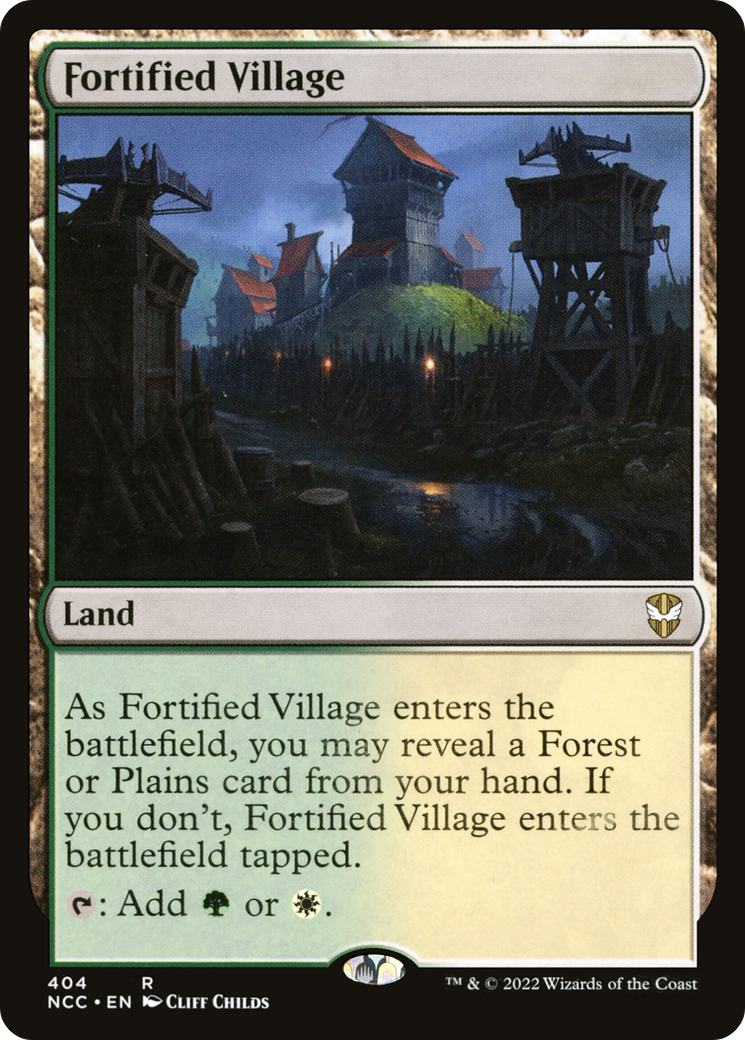
Fortified Village
Fortified Village
Land
As this land enters, you may reveal a Forest or Plains card from your hand. If you don't, this land enters tapped.
: Add or .
- If a Forest or Plains is entering the battlefield from your hand at the same time as Fortified Village, you may reveal the other land to have Fortified Village enter untapped.
- You may reveal any land card with either or both of the appropriate subtypes. It doesn't have to be a basic land. For example, you could reveal Prairie Stream from the Battle for Zendikar set to satisfy the ability of Fortified Village.
- Lands don't have a subtype just because they can produce mana of the corresponding color. Fortified Village itself is neither a Forest nor a Plains, even though it produces green and white mana, so you can't reveal one to satisfy the ability of another.
- If an effect instructs you to put Fortified Village onto the battlefield tapped, it will still enter the battlefield tapped even if you reveal a land card from your hand.
-
1
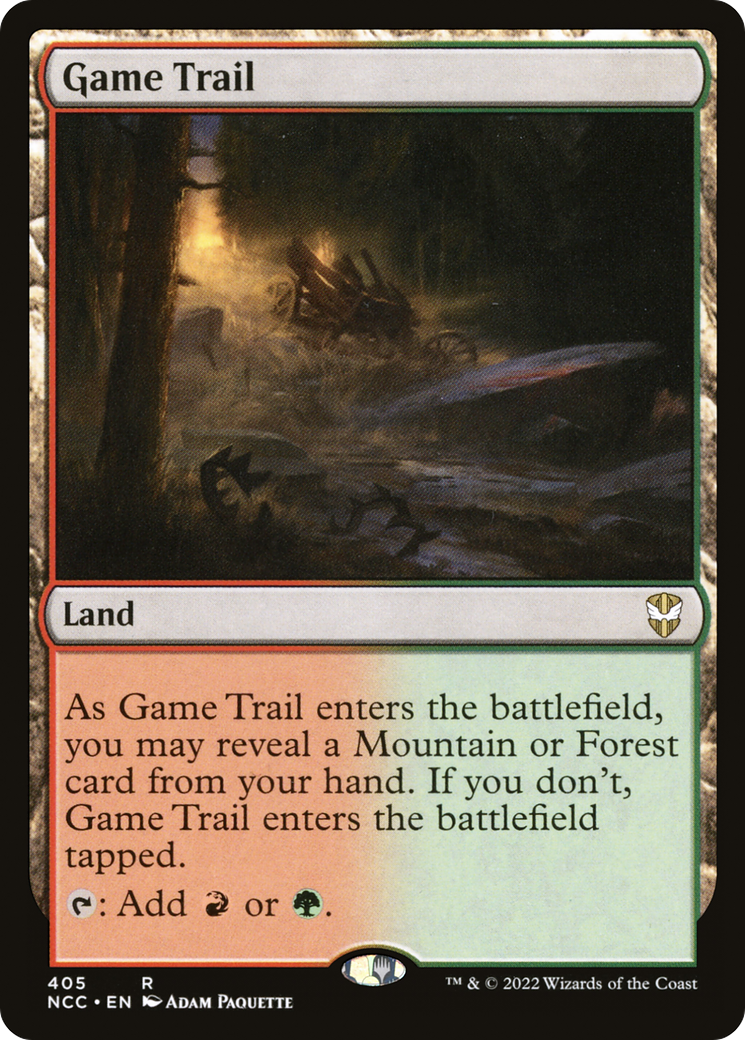
Game Trail
Game Trail
Land
As this land enters, you may reveal a Mountain or Forest card from your hand. If you don't, this land enters tapped.
: Add or .
- Lands don't have a subtype just because they can produce mana of the corresponding color. Game Trail itself is neither a Mountain nor a Forest, even though it produces red and green mana, so you can't reveal one to satisfy the ability of another.
- If an effect instructs you to put Game Trail onto the battlefield tapped, it will still enter the battlefield tapped even if you reveal a land card from your hand.
- You may reveal any land card with either or both of the appropriate subtypes. It doesn't have to be a basic land. For example, you could reveal Canopy Vista from the Battle for Zendikar set to satisfy the ability of Game Trail.
- If a Mountain or Forest is entering the battlefield from your hand at the same time as Game Trail, you may reveal the other land to have Game Trail enter untapped.
-
1
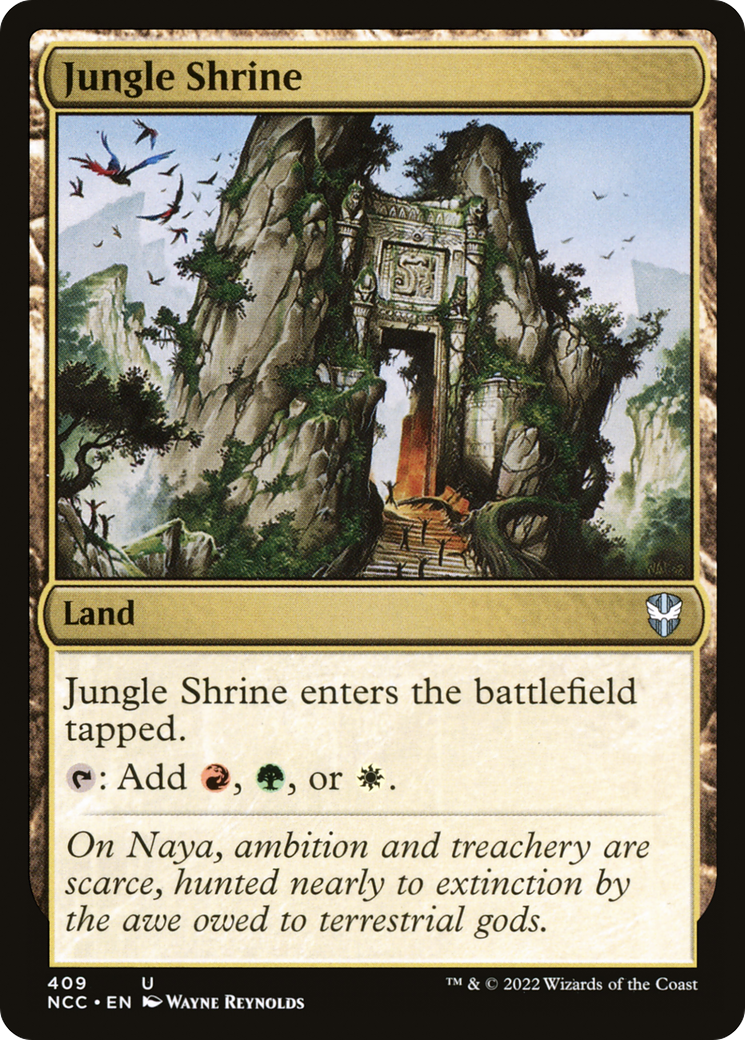
Jungle Shrine
Jungle Shrine
Land
This land enters tapped.
: Add , , or .
-
1
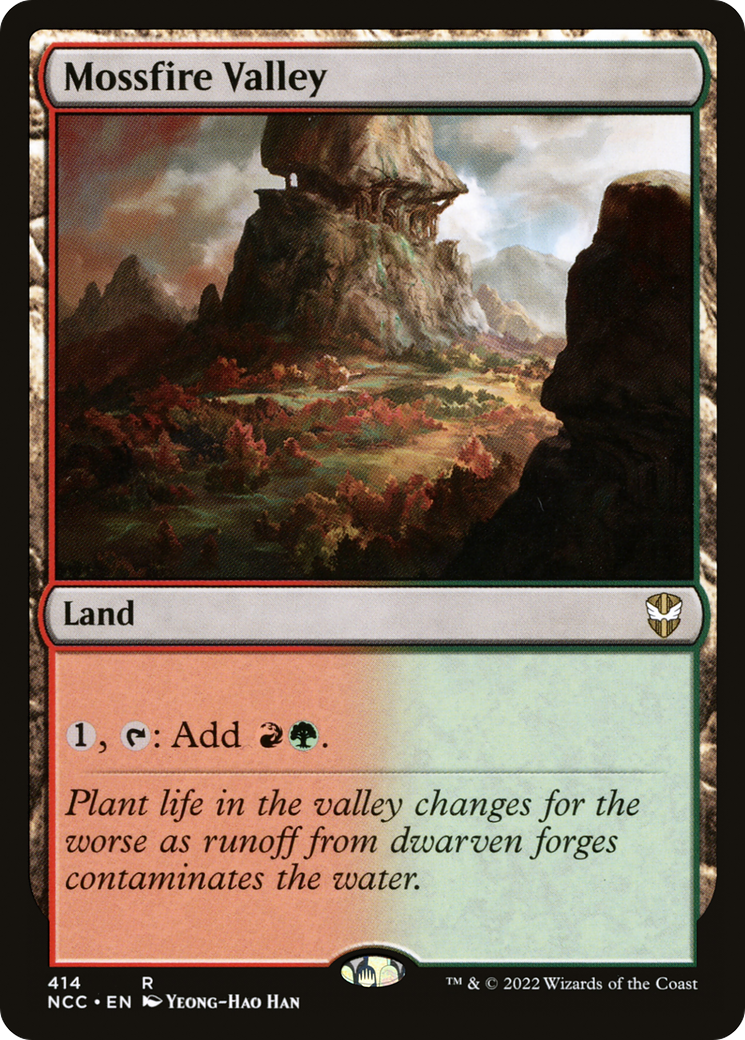
Mossfire Valley
Mossfire Valley
Land
, : Add .
-
4
Mountain
Mountain
Basic Land — Mountain
( : Add .)
-
1
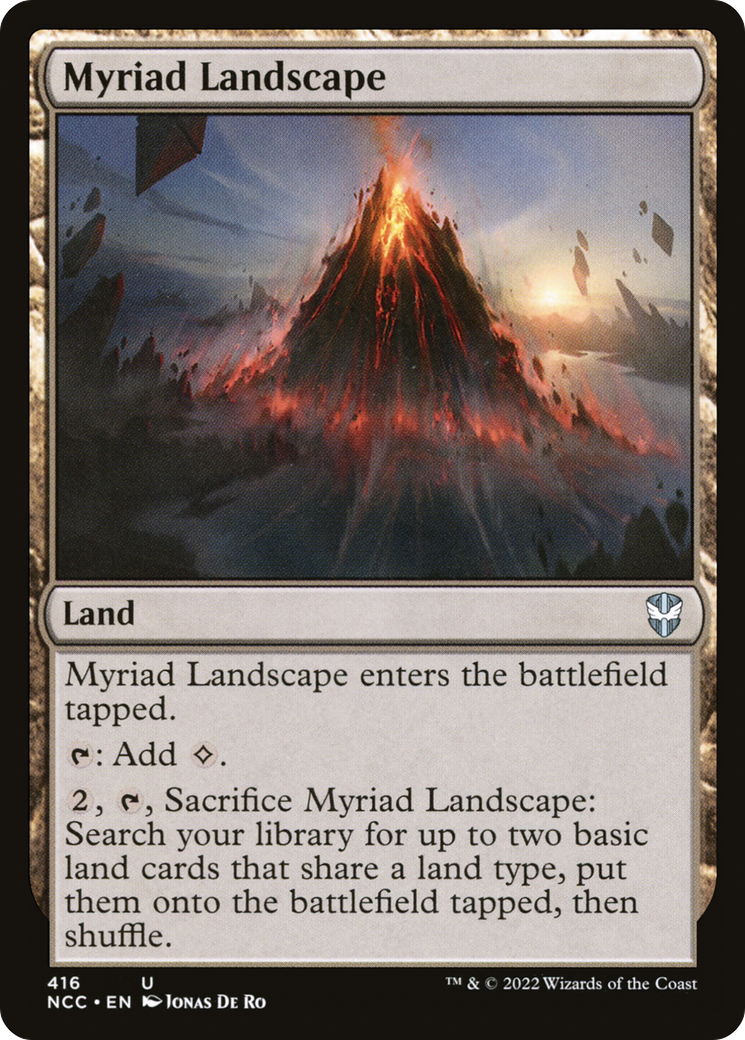
Myriad Landscape
Myriad Landscape
Land
This land enters tapped.
: Add .
, , Sacrifice this land: Search your library for up to two basic land cards that share a land type, put them onto the battlefield tapped, then shuffle.
- You can choose to find one basic land card with Myriad Landscape's last ability.
-
1
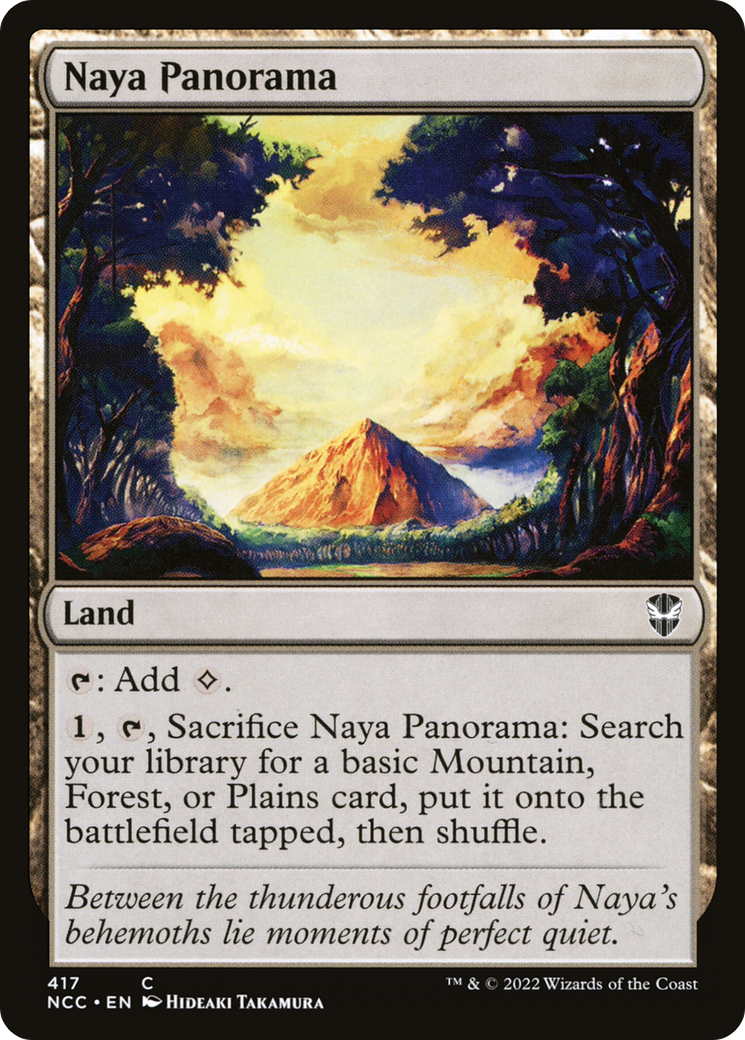
Naya Panorama
Naya Panorama
Land
: Add .
, , Sacrifice this land: Search your library for a basic Mountain, Forest, or Plains card, put it onto the battlefield tapped, then shuffle.
-
1
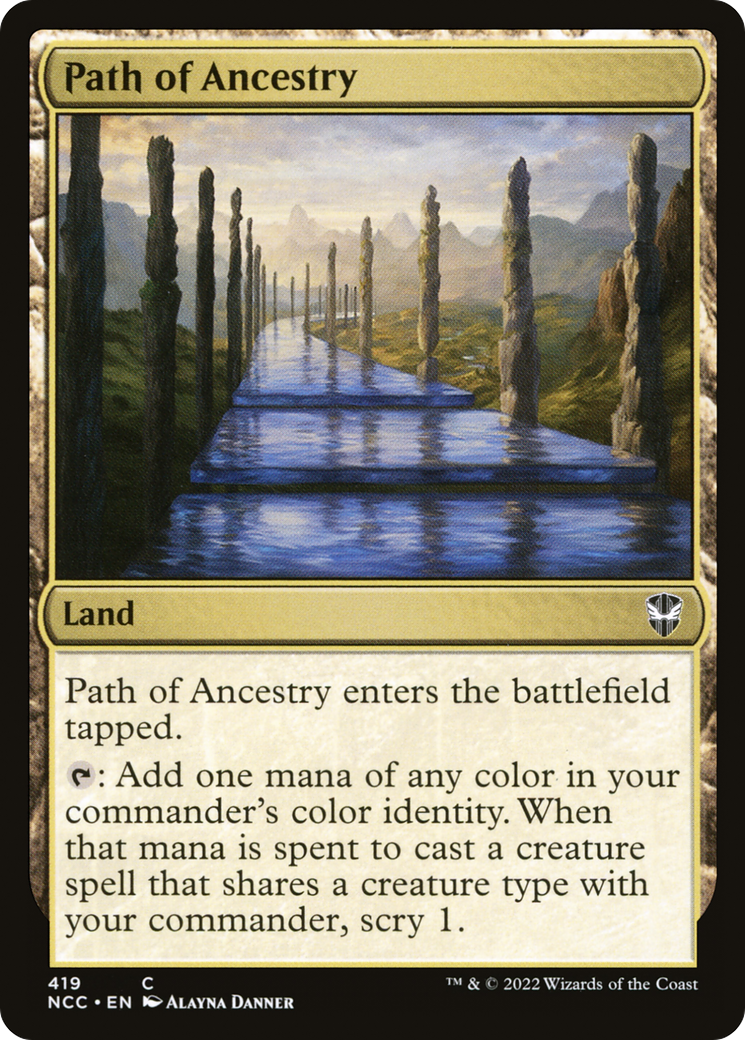
Path of Ancestry
Path of Ancestry
Land
This land enters tapped.
: Add one mana of any color in your commander's color identity. When that mana is spent to cast a creature spell that shares a creature type with your commander, scry 1. (Look at the top card of your library. You may put that card on the bottom.)
- Your commander's creature types are checked immediately after you cast a creature spell spending mana from Path of Ancestry's last ability. They aren't set before the game begins, and they may not be the same types your commander had when you activated that ability.
- If you have two commanders, the last ability adds one mana of any color in their combined color identities. When you spend that mana on a creature spell that shares a creature type with either of your commanders, you'll scry 1.
- If Path of Ancestry's last ability produces two mana (most likely due to Mana Reflection), spending those two mana to cast creature spells that share a creature type with your commander will cause two abilities to trigger. Each of those abilities will cause you to scry 1. You won't scry 2. This is true whether you spend the mana on one creature spell or two.
- If your commander has no creature types, it can't share a creature type with any spell that you cast.
- If you cast your commander with mana from Path of Ancestry, and your commander hasn't somehow lost all of its creature types while on the stack, you'll scry 1.
- If you don't have a commander, Path of Ancestry's ability produces no mana.
- If your commander is a card that has no colors in its color identity, Path of Ancestry's ability produces no mana. It doesn't produce .
-
4
Plains
Plains
Basic Land — Plains
( : Add .)
-
1
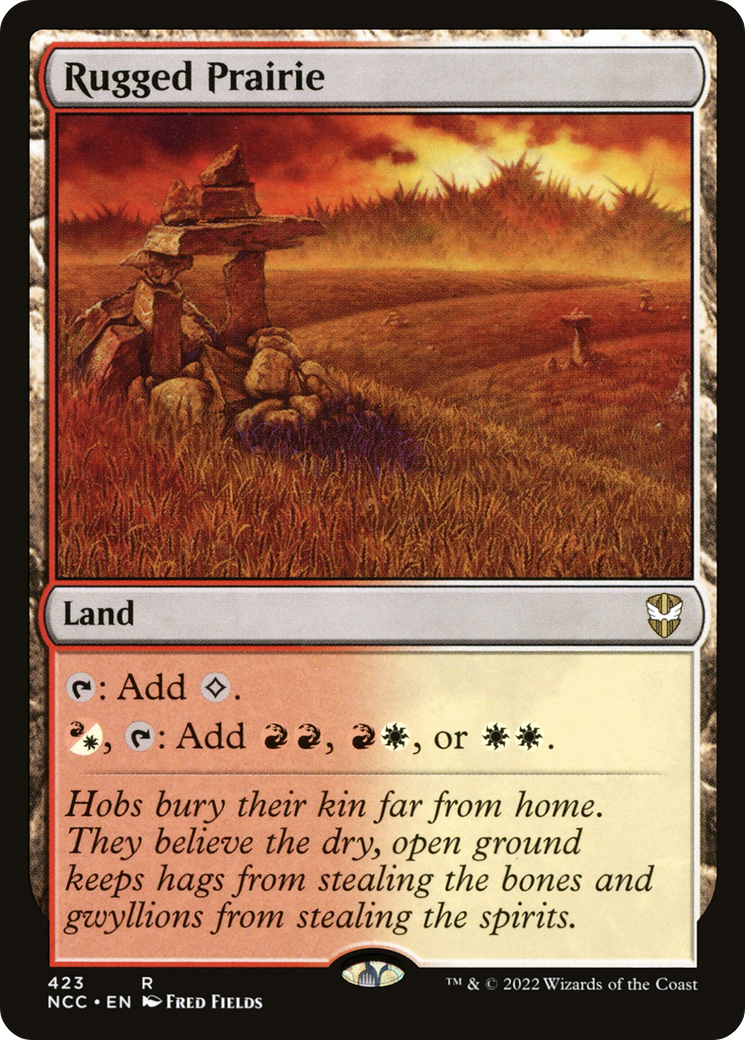
Rugged Prairie
Rugged Prairie
Land
: Add .
, : Add , , or .
-
1
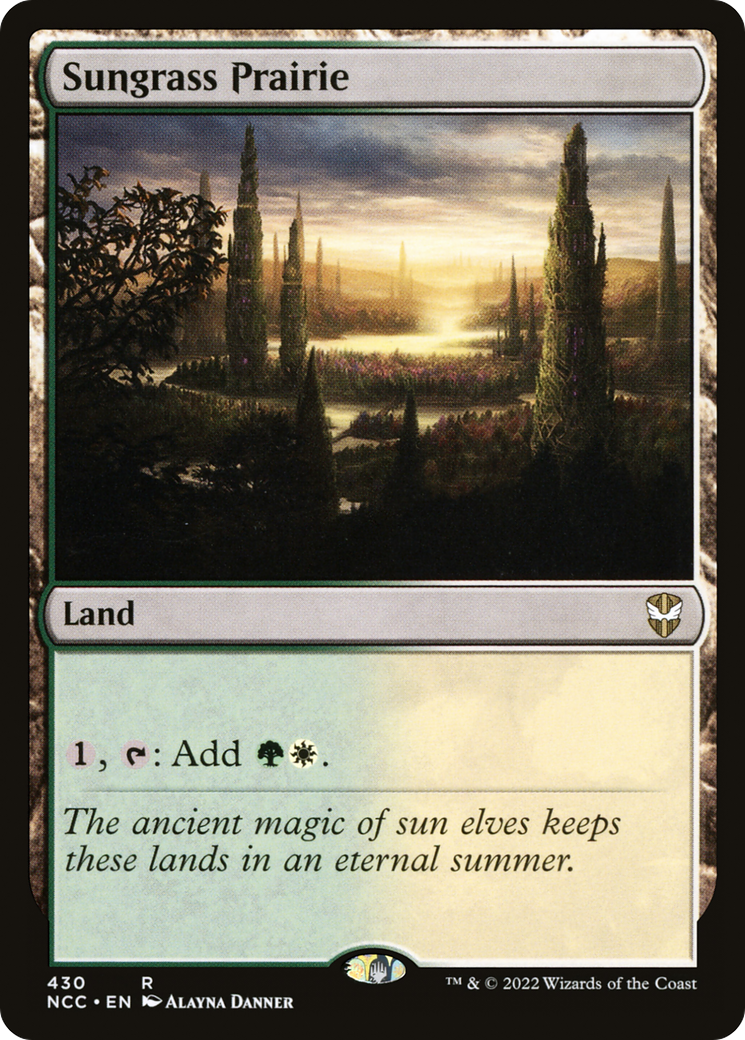
Sungrass Prairie
Sungrass Prairie
Land
, : Add .
-
1
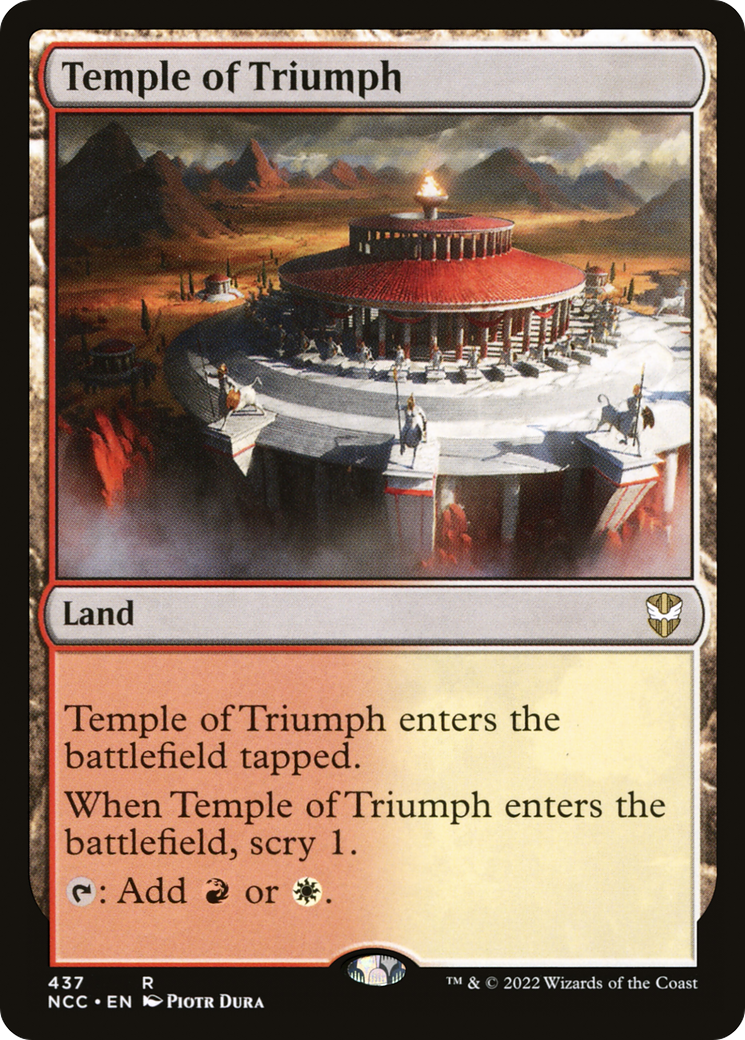
Temple of Triumph
Temple of Triumph
Land
This land enters tapped.
When this land enters, scry 1. (Look at the top card of your library. You may put that card on the bottom.)
: Add or .
- When you scry, you may put all the cards you look at back on top of your library, you may put all of those cards on the bottom of your library, or you may put some of those cards on top and the rest of them on the bottom.
- You choose how to order cards returned to your library after scrying no matter where you put them.
- You perform the actions stated on a card in sequence. For some spells and abilities, that means you'll scry last. For others, that means you'll scry and then perform other actions.
- Scry appears on some spells and abilities with one or more targets. If all of the spell or ability's targets are illegal when it tries to resolve, it won't resolve and none of its effects will happen. You won't scry.
-
1
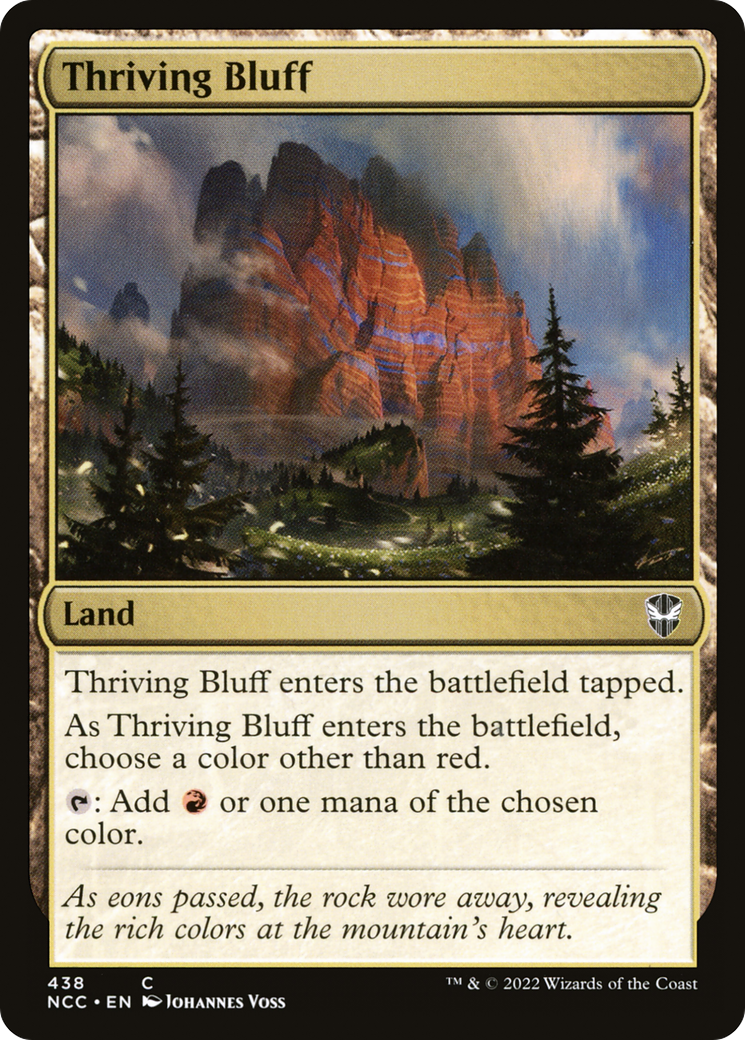
Thriving Bluff
Thriving Bluff
Land
This land enters tapped. As it enters, choose a color other than red.
: Add or one mana of the chosen color.
-
1
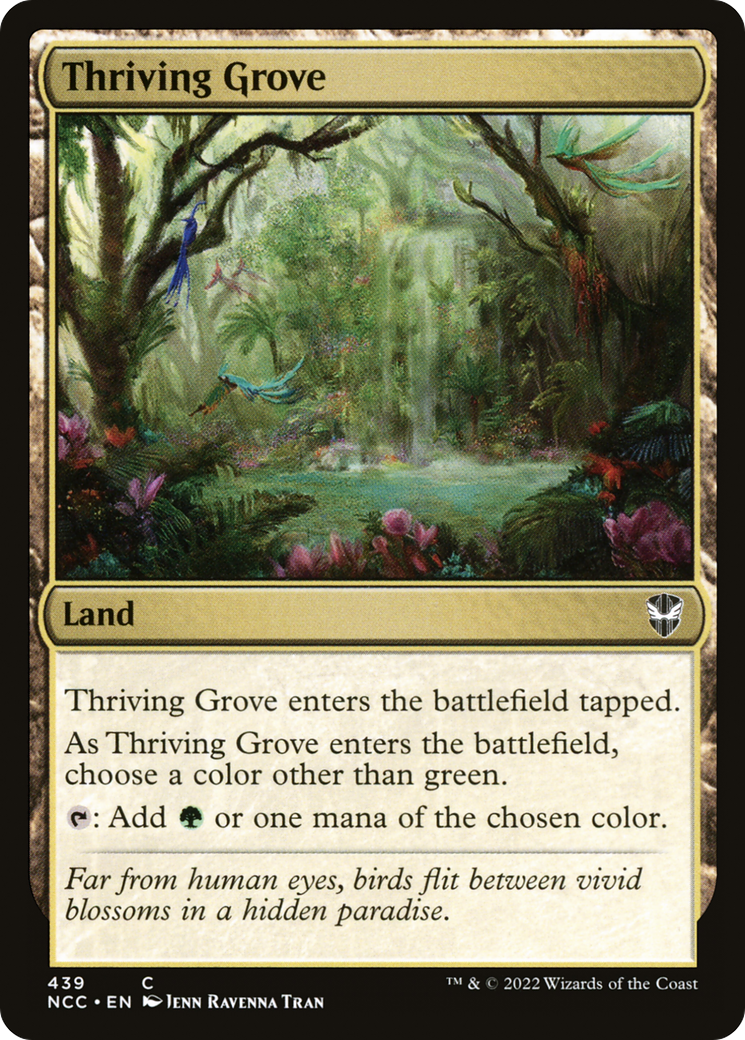
Thriving Grove
Thriving Grove
Land
This land enters tapped. As it enters, choose a color other than green.
: Add or one mana of the chosen color.
-
1
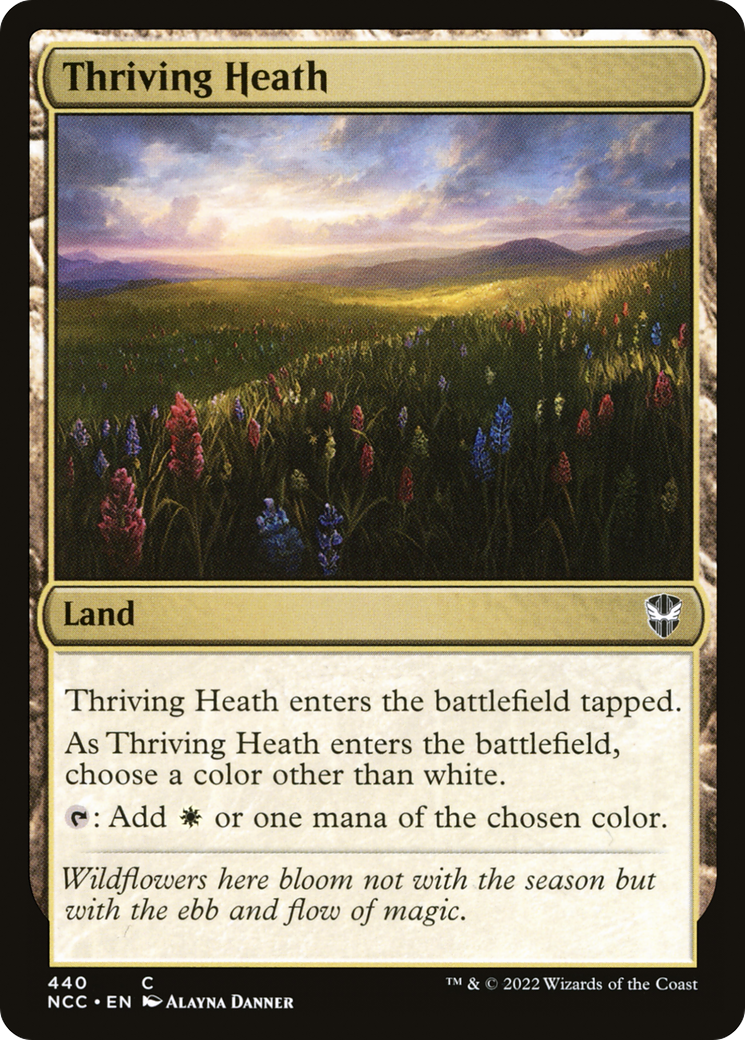
Thriving Heath
Thriving Heath
Land
This land enters tapped. As it enters, choose a color other than white.
: Add or one mana of the chosen color.
-
1
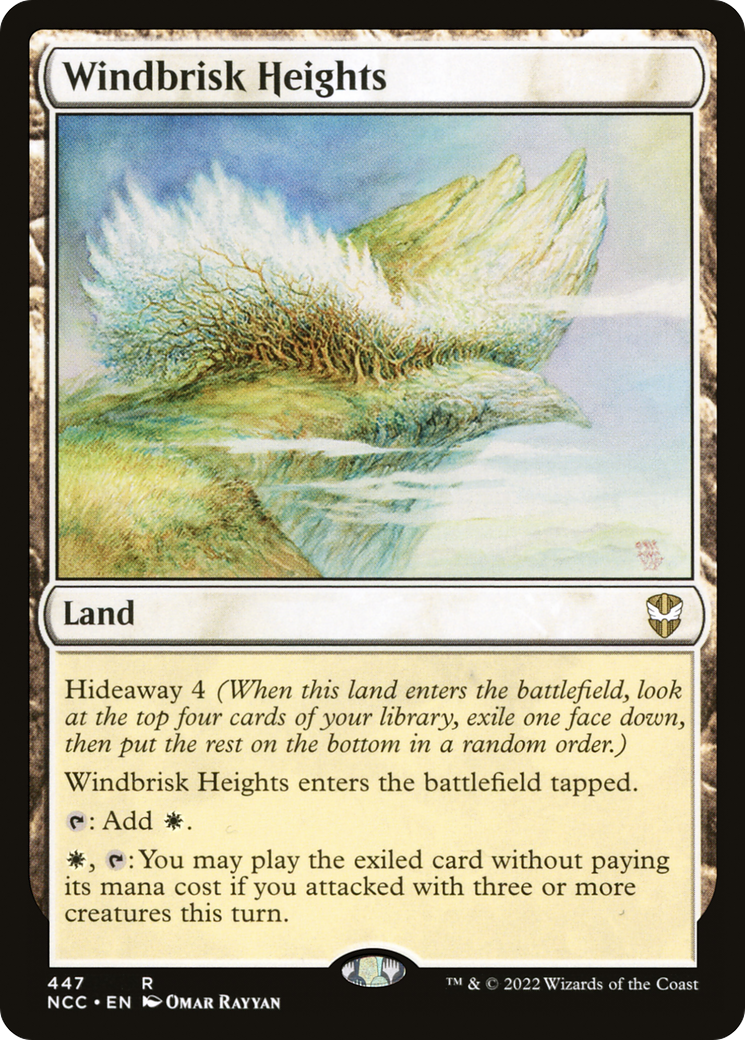
Windbrisk Heights
Windbrisk Heights
Land
Hideaway 4 (When this land enters, look at the top four cards of your library, exile one face down, then put the rest on the bottom in a random order.)
This land enters tapped.
: Add .
, : You may play the exiled card without paying its mana cost if you attacked with three or more creatures this turn.
- "Hideaway N" means "When this permanent enters the battlefield, look at the top N cards of your library. Exile one of them face down and put the rest on the bottom of your library in a random order. The exiled card gains 'The player who controls the permanent that exiled this card may look at this card in the exile zone.'"
- Any player who has controlled a permanent with a hideaway ability since a card was exiled with it may look at that card.
- Previously, permanents with hideaway entered the battlefield tapped. This ability has been removed from the definition of hideaway. Older cards have received errata to have an additional paragraph that reads "[This permanent] enters the battlefield tapped," and they now have hideaway 4.
- Hideaway now causes you to put the rest of the cards on the bottom of your library in a random order instead of any order.
- At the time the ability resolves, you'll get to play the card if you declared three different creatures as attackers at any point in the turn. A creature declared as an attacker in two different attack phases counts only once. A creature that entered attacking (such as a token created by Militia's Pride) doesn't count because you never attacked with it.
White 12
-
1
Boss's Chauffeur
Boss's Chauffeur
Creature — Elf Citizen
0/0
This creature enters with a number of +1/+1 counters on it equal to one plus the number of other creatures you control.
Alliance — Whenever another creature you control enters, put a +1/+1 counter on this creature.
When this creature dies, create a 1/1 green and white Citizen creature token for each +1/+1 counter on it.
-
1
Call the Coppercoats
Call the Coppercoats
Instant
Strive — This spell costs more to cast for each target beyond the first.
Choose any number of target opponents. Create X 1/1 white Human Soldier creature tokens, where X is the number of creatures those opponents control.
- Any target opponents that are no longer legal targets by the time Call the Coppercoats resolves won't have their creatures counted when determining how many tokens you create.
- You choose how many targets each spell with a strive ability has and what those targets are as you cast it. It's legal to cast such a spell with no targets, although this is rarely a good idea. You can't choose the same target more than once for a single strive spell.
- The mana value of a strive spell doesn't change no matter how many targets it has.
- If this spell is copied and the effect that copies the spell allows a player to choose new targets for the copy, the number of targets can't be changed. The player may change any number of the targets, including all of them or none of them. If, for one of the targets, the player can't choose a new legal target, then it remains unchanged (even if the current target is illegal).
- If a spell or ability allows you to cast a strive spell without paying its mana cost, you must pay the additional cost for any targets beyond the first.
-
1
Duelist's Heritage
Duelist's Heritage
Enchantment
Whenever one or more creatures attack, you may have target attacking creature gain double strike until end of turn.
- The ability of Duelist's Heritage triggers whenever any player attacks with one or more creatures, not just when you do. You know which players and planeswalkers the creatures are attacking before you choose the target creature.
-
1
Felidar Retreat
Felidar Retreat
Enchantment
Landfall — Whenever a land you control enters, choose one —
- Create a 2/2 white Cat Beast creature token.
- Put a +1/+1 counter on each creature you control. Those creatures gain vigilance until end of turn.
- A landfall ability triggers whenever a land you control enters for any reason. It triggers whenever you play a land, as well as whenever a spell or ability puts a land onto the battlefield under your control.
- A landfall ability doesn't trigger if a permanent already on the battlefield becomes a land.
- Whenever a land you control enters, each landfall ability of the permanents you control will trigger. You can put them on the stack in any order. The last ability you put on the stack will be the first one to resolve (As a result, you can have those abilities resolve in the order of your choosing.).
- Felidar Retreat's second mode affects only creatures you control at the time the ability resolves, including creatures you control but that for some reason didn't get a +1/+1 counter. Creatures you begin to control later in the turn won't gain vigilance or get a +1/+1 counter.
-
1
Fell the Mighty
Fell the Mighty
Sorcery
Destroy all creatures with power greater than target creature's power.
- Use the power of the target creature as Fell the Mighty resolves to determine which creatures are destroyed. Fell the Mighty doesn't target any of those creatures, so a creature with hexproof or protection from white will be destroyed if its power is high enough.
- Fell the Mighty won't destroy the target creature.
- If the target creature is an illegal target when Fell the Mighty tries to resolve, Fell the Mighty won't resolve and none of its effects will happen. No creatures will be destroyed.
-
1
Grand Crescendo
Grand Crescendo
Instant
Create X 1/1 green and white Citizen creature tokens. Creatures you control gain indestructible until end of turn.
-
1
Intangible Virtue
Intangible Virtue
Enchantment
Creature tokens you control get +1/+1 and have vigilance.
-
1
Martial Coup
Martial Coup
Sorcery
Create X 1/1 white Soldier creature tokens. If X is 5 or more, destroy all other creatures.
- Martial Coup checks the number you chose for X, not the amount of mana you actually spent.
- You do what the spell says in order. If X is 5 or more, you'll put the Soldier tokens onto the battlefield, then you'll destroy all other creatures.
- No one can cast spells or activate abilities between the time the Soldier tokens are put onto the battlefield and the time all other creatures are destroyed. For example, you can't sacrifice one of those Soldier tokens to regenerate a Skeletal Kathari.
-
1
Master of Ceremonies
Master of Ceremonies
Creature — Rhino Druid
3/4
At the beginning of your upkeep, each opponent chooses money, friends, or secrets. For each player who chose money, you and that player each create a Treasure token. For each player who chose friends, you and that player each create a 1/1 green and white Citizen creature token. For each player who chose secrets, you and that player each draw a card.
-
1
Orzhov Advokist
Orzhov Advokist
Creature — Human Advisor
1/4
At the beginning of your upkeep, each player may put two +1/+1 counters on a creature they control. If a player does, creatures that player controls can't attack you or planeswalkers you control until your next turn.
- While resolving Orzhov Advokist's ability, you choose a creature you control or choose not to put any counters on a creature, then each other player in turn order does the same. Each player will know the choices made by players who chose before them. Then simultaneously each player who chose a creature puts two +1/+1 counters on the creature they chose.
- Orzhov Advokist's ability doesn't target the creatures that receive +1/+1 counters. Their controllers choose them as the ability resolves. Players can't take actions between making their choices and the +1/+1 counters being placed.
- If a player chooses to accept Orzhov Advokist's gift, that player can't attack you or a planeswalker you control with any creatures during their next turn, even creatures that weren't on the battlefield as Orzhov Advokist's ability resolved.
- Orzhov Advokist's effect keeps creatures from attacking you even if Orzhov Advokist leaves the battlefield, if the creature that received counters is no longer on the battlefield, or if an effect has moved those counters off of the creature that received them and put them onto another creature.
-
1
Path to Exile
Path to Exile
Instant
Exile target creature. Its controller may search their library for a basic land card, put that card onto the battlefield tapped, then shuffle.
- The controller of the exiled creature isn't required to search their library for a basic land. If that player doesn't, the player won't shuffle their library.
- If the target creature is an illegal target by the time Path to Exile tries to resolve, it won't resolve and none of its effects will happen. The creature's controller won't search for a basic land card.
-
1
Rumor Gatherer
Rumor Gatherer
Creature — Elf Wizard
2/1
Alliance — Whenever another creature you control enters, scry 1. If this is the second time this ability has resolved this turn, draw a card instead.
Red 10
-
1
Agitator Ant
Agitator Ant
Creature — Insect
2/2
At the beginning of your end step, each player may put two +1/+1 counters on a creature they control. Goad each creature that had counters put on it this way. (Until your next turn, those creatures attack each combat if able and attack a player other than you if able.)
- If the creature doesn't meet any of the above exceptions and can attack, it must attack a player other than the controller of the spell or ability that goaded it if able. If the creature can't attack any of those players but could otherwise attack, it must attack a planeswalker an opponent controls, a battle an opponent controls, or a player who goaded it.
- Attacking with a goaded creature doesn't cause it to stop being goaded. If there is an additional combat phase that turn, or if another player gains control of it before it stops being goaded, it must attack again if able.
- If a creature you control has been goaded by multiple opponents, it must attack one of your opponents that hasn't goaded it, as that fulfills the maximum number of goad requirements. If a creature you control has been goaded by each of your opponents, the creature must attack an opponent (rather than a planeswalker or battle), but you choose which opponent it attacks.
- If, during a player's declare attackers step, a creature that player controls that's been goaded is tapped, is affected by a spell or ability that says it can't attack, or hasn't been under that player's control continuously since the turn began (and doesn't have haste), then it doesn't attack. If there's a cost associated with having a creature attack a player, its controller isn't forced to pay that cost, so it doesn't have to attack that player.
- Being goaded isn't an ability the creature has. Once it's been goaded, it must attack as detailed above even if it loses all abilities.
- If a creature can't have +1/+1 counters put on it, its controller can't choose it just to have it become goaded. If it can have counters put on it but replacement effects cause it not to receive +1/+1 counters, it doesn't become goaded.
- As Agitator Ant's ability resolves, first you choose which creature you control, if any, to put two +1/+1 counters on, then each other player in turn order does the same, knowing the choices made before them. Then each chosen creature receives its +1/+1 counters and becomes goaded.
-
1
Indulge // Excess
//
Indulge
Sorcery
- Excess counts the number of creatures you controlled that dealt combat damage to a player even if you no longer control one or more of those creatures as it resolves.
- All split cards have two card faces on a single card, and you put a split card onto the stack with only the half you're casting. The characteristics of the half you didn't cast are ignored while the spell is on the stack.
- Each split card is a single card. For example, if you discard one, you've discarded one card, not two. If an effect counts the number of sorcery cards in your graveyard, Indulge /// Excess counts once, not twice.
- Each split card has two names. If an effect instructs you to choose a card name, you may choose one, but not both.
- While not on the stack, the characteristics of a split card are the combination of its two halves. For example, Indulge /// Excess has a mana value of 5.
- If you cast the first half of a split card with aftermath during your turn, you'll have priority immediately after it resolves. You can cast the half with aftermath from your graveyard before any player can take any other action if it's legal for you to do so.
- If another effect allows you to cast a split card with aftermath from any zone other than a graveyard, you can't cast the half with aftermath.
- If another effect allows you to cast a split card with aftermath from a graveyard, you may cast either half. If you cast the half that has aftermath, you'll exile the card if it would leave the stack.
- A spell with aftermath cast from a graveyard will always be exiled afterward, whether it resolves, it's countered, or it leaves the stack in some other way.
- Once you've started to cast a spell with aftermath from your graveyard, the card is immediately moved to the stack. Opponents can't try to stop the ability by exiling the card with another effect.
-
1
Kazuul, Tyrant of the Cliffs
Kazuul, Tyrant of the Cliffs
Legendary Creature — Ogre Warrior
5/4
Whenever a creature an opponent controls attacks, if you're the defending player, create a 3/3 red Ogre creature token unless that creature's controller pays .
- You're the defending player if a creature is attacking you, a planeswalker you control, or a battle you protect.
- If you're the defending player, Kazuul's ability triggers once for each creature that attacks, not just once per combat. The attacking player chooses whether to pay or let you have an Ogre token each time one of those abilities resolves.
- As the ability resolves, you can't put the Ogre token onto the battlefield without explicitly giving the attacking player the option to pay , even if the attacking player has forgotten about this ability.
- The ability triggers and resolves during the declare attackers step. If you put an Ogre token onto the battlefield as a result, you may block with it during that combat phase.
- If an attacking creature has a "Whenever this creature attacks" ability, that ability is put on the stack first, then Kazuul's ability is put on the stack. Although Kazuul's ability will resolve first, and potentially create an Ogre token, any target of the other ability will already have been chosen at this point, and thus could not have been the new Ogre token.
- In a multiplayer game, the ability checks whether you're the defending player for each individual attacking creature. For example, if one creature attacks you and two creatures attack another player, Kazuul's ability triggers just once.
-
1
Life of the Party
Life of the Party
Creature — Elemental
0/1
First strike, trample, haste
Whenever this creature attacks, it gets +X/+0 until end of turn, where X is the number of creatures you control.
When this creature enters, if it's not a token, each opponent creates a token that's a copy of it. The tokens are goaded for the rest of the game. (They attack each combat if able and attack a player other than you if able.)
- If something is goaded but the player who goaded it has left the game, it still must attack one of the other players if able.
-
1
Magus of the Wheel
Magus of the Wheel
Creature — Human Wizard
3/3
, , Sacrifice this creature: Each player discards their hand, then draws seven cards.
- If each player has fewer than seven cards in their library as Magus of the Wheel's ability resolves, the game ends in a draw.
-
1
Outpost Siege
Outpost Siege
Enchantment
As this enchantment enters, choose Khans or Dragons.
- Khans — At the beginning of your upkeep, exile the top card of your library. Until end of turn, you may play that card.
- Dragons — Whenever a creature you control leaves the battlefield, this enchantment deals 1 damage to any target.
- The card exiled by the "Khans" ability is exiled face up. Playing a card exiled with the "Khans" ability follows the normal rules for playing the card. You must pay its costs, and you must follow all applicable timing rules. For example, if it's a creature card, you can cast it only during your main phase while the stack is empty.
- If you exile a land card using the "Khans" ability, you may play that land only if you have any available land plays. Normally, this means you can play the land only if you haven't played a land yet that turn.
- If a noncreature card is manifested and then leaves the battlefield while face down, the "Dragons" ability will trigger.
- Each Siege will have one of the two listed abilities, depending on your choice as it enters the battlefield.
- The words "Khans" and "Dragons" are anchor words, connecting your choice to the appropriate ability. Anchor words are a new rules concept. "[Anchor word] — [Ability]" means "As long as you chose [anchor word] as this permanent entered the battlefield, this permanent has [ability]." Notably, the anchor word "Dragons" has no connection to the creature type Dragon.
- Each of the last two abilities is linked to the first ability. They each refer only to the choice made as a result of the first ability. If a permanent enters the battlefield as a copy of one of the Sieges, its controller will make a new choice for that Siege. Which ability the copy has won't depend on the choice made for the original permanent.
-
1
Rose Room Treasurer
Rose Room Treasurer
Creature — Ogre Warrior
4/3
Alliance — Whenever another creature you control enters, create a Treasure token if this is the first or second time this ability has resolved this turn. Otherwise, you may pay . When you do, this creature deals X damage to any target.
-
1
Seize the Spotlight
Seize the Spotlight
Sorcery
Each opponent chooses fame or fortune. For each player who chose fame, gain control of a creature that player controls until end of turn. Untap those creatures and they gain haste until end of turn. For each player who chose fortune, you draw a card and create a Treasure token.
-
1
Sizzling Soloist
Sizzling Soloist
Creature — Human Citizen
3/2
Alliance — Whenever another creature you control enters, target creature an opponent controls can't block this turn. If this is the second time this ability has resolved this turn, that creature attacks during its controller's next combat phase if able.
-
1
Zurzoth, Chaos Rider
Zurzoth, Chaos Rider
Legendary Creature — Devil
2/3
Whenever an opponent draws their first card each turn, if it's not their turn, you create a 1/1 red Devil creature token with "When this token dies, it deals 1 damage to any target."
Whenever one or more Devils you control attack one or more players, you and those players each draw a card, then discard a card at random.
- If a spell or ability causes a player to put a card into their hand without specifically using the word "draw," it's not a card drawn.
- If your life total is brought to 0 or less at the same time that a Devil token is dealt lethal damage, you lose the game before its ability goes on the stack.
- Devils you control that attack a planeswalker won't cause any player to draw or discard a card.
Green 19
-
1
Arasta of the Endless Web
Arasta of the Endless Web
Legendary Enchantment Creature — Spider
3/5
Reach
Whenever an opponent casts an instant or sorcery spell, create a 1/2 green Spider creature token with reach.
- An ability that triggers when a player casts a spell resolves before the spell that caused it to trigger. It resolves even if that spell is countered.
-
1
Awakening Zone
Awakening Zone
Enchantment
At the beginning of your upkeep, you may create a 0/1 colorless Eldrazi Spawn creature token. It has "Sacrifice this token: Add ."
-
1
Beast Within
Beast Within
Instant
Destroy target permanent. Its controller creates a 3/3 green Beast creature token.
- If the target permanent is an illegal target by the time Beast Within tries to resolve, the spell won't resolve. No player creates a Beast token. If the target is legal but not destroyed (most likely because it has indestructible), its controller does create a Beast token.
-
1
Beastmaster Ascension
Beastmaster Ascension
Enchantment
Whenever a creature you control attacks, you may put a quest counter on this enchantment.
As long as this enchantment has seven or more quest counters on it, creatures you control get +5/+5.
- If you attack with multiple creatures, Beastmaster Ascension's first ability triggers multiple times.
-
1
Champion of Lambholt
Champion of Lambholt
Creature — Human Warrior
1/1
Creatures with power less than this creature's power can't block creatures you control.
Whenever another creature you control enters, put a +1/+1 counter on this creature.
- Champion of Lambholt's first ability applies even if it isn't attacking.
- The comparison of power is done only when blockers are declared. Decreasing the power of a blocking creature (or increasing the power of Champion of Lambholt) after this point won't cause any creature to stop blocking or become unblocked.
-
1
Crash the Party
Crash the Party
Instant
Create a tapped 4/4 green Rhino Warrior creature token for each tapped creature you control.
- The tokens created by Crash the Party don't enter the battlefield attacking.
-
1
Cultivate
Cultivate
Sorcery
Search your library for up to two basic land cards, reveal those cards, put one onto the battlefield tapped and the other into your hand, then shuffle.
- If you choose to find only one basic land card, you put it onto the battlefield tapped.
-
1
Harmonize
Harmonize
Sorcery
Draw three cards.
-
1
Killer Service
Killer Service
Enchantment
When this enchantment enters, create a number of Food tokens equal to the number of opponents you have. (They're artifacts with " , , Sacrifice this token: You gain 3 life.")
At the beginning of your end step, you may pay and sacrifice a token. If you do, create a 4/4 green Rhino Warrior creature token.
- Food is an artifact type. Even though it appears on some creatures, it's never a creature type.
- You can't sacrifice a Food to pay multiple costs. For example, you can't sacrifice a Food token to activate its own ability and also to activate Maraleaf Rider's ability.
- Whatever you do, don't eat the delicious cards.
- As Killer Service's second ability resolves, you may sacrifice any token, not just a Food token.
-
1
Leafkin Druid
Leafkin Druid
Creature — Elemental Druid
0/3
: Add . If you control four or more creatures, add instead.
-
1
Sakura-Tribe Elder
Sakura-Tribe Elder
Creature — Snake Shaman
1/1
Sacrifice this creature: Search your library for a basic land card, put that card onto the battlefield tapped, then shuffle.
-
1
Sandwurm Convergence
Sandwurm Convergence
Enchantment
Creatures with flying can't attack you or planeswalkers you control.
At the beginning of your end step, create a 5/5 green Wurm creature token.
- Once a creature has attacked you or a planeswalker you control, it will remain in combat even if it gains flying. Similarly, if a creature with flying enters the battlefield attacking, Sandwurm Convergence's first ability can't undo that attack.
-
1
Scepter of Celebration
Scepter of Celebration
Artifact — Equipment
Equipped creature gets +2/+0 and has trample.
Whenever equipped creature deals combat damage to a player, create that many 1/1 green and white Citizen creature tokens.
Equip
-
1
Scute Swarm
Scute Swarm
Creature — Insect
1/1
Landfall — Whenever a land you control enters, create a 1/1 green Insect creature token. If you control six or more lands, create a token that's a copy of this creature instead.
- A landfall ability triggers whenever a land you control enters for any reason. It triggers whenever you play a land, as well as whenever a spell or ability puts a land onto the battlefield under your control.
- A landfall ability doesn't trigger if a permanent already on the battlefield becomes a land.
- Whenever a land you control enters, each landfall ability of the permanents you control will trigger. You can put them on the stack in any order. The last ability you put on the stack will be the first one to resolve (As a result, you can have those abilities resolve in the order of your choosing.).
- The token copy will have Scute Swarm's ability. It will also be able to create copies of itself.
- The token copy won't copy counters or damage marked on Scute Swarm, nor will it copy other effects that have changed Scute Swarm's power, toughness, types, color, and so on. Normally, this means the token will simply be a Scute Swarm, but if any copy effects have affected the original Scute Swarm, the token will take those into account.
- If Scute Swarm leaves the battlefield before its triggered ability resolves, the token will still enter the battlefield as a copy of Scute Swarm, using Scute Swarm's copiable values from when it was last on the battlefield.
-
1
Shamanic Revelation
Shamanic Revelation
Sorcery
Draw a card for each creature you control.
Ferocious — You gain 4 life for each creature you control with power 4 or greater.
- After you draw cards while Shamanic Revelation is resolving, nothing else can happen before you gain the appropriate amount of life. Notably, abilities that trigger when you draw cards won't be put onto the stack until after you've gained life.
-
1
Sylvan Offering
Sylvan Offering
Sorcery
Choose an opponent. You and that player each create an X/X green Treefolk creature token.
Choose an opponent. You and that player each create X 1/1 green Elf Warrior creature tokens.
- You may choose the same opponent for each of the effects, or you may choose different opponents. None of the affected players are targets of the spell.
- You choose the opponents for each effect as the spell resolves.
-
1
Thunderfoot Baloth
Thunderfoot Baloth
Creature — Beast
5/5
Trample
Lieutenant — As long as you control your commander, this creature gets +2/+2 and other creatures you control get +2/+2 and have trample.
- Lieutenant abilities apply only if your commander is on the battlefield and under your control.
- Lieutenant abilities refer only to whether you control your commander, not any other player's commander.
- If you gain control of a creature with a lieutenant ability owned by another player, that ability will check to see if you control your commander and will apply if you do. It won't check whether its owner controls their commander.
- If you lose control of your commander, lieutenant abilities of creatures you control will immediately stop applying. If this causes a creature's toughness to become less than or equal to the amount of damage marked on it, the creature will be destroyed.
- If a triggered ability granted by a lieutenant ability triggers, and in response to that trigger you lose control of your commander (causing the lieutenant to lose that ability), that triggered ability will still resolve.
-
1
Vivien's Stampede
Vivien's Stampede
Sorcery
Each creature you control gains vigilance, trample, and melee until end of turn. (Whenever a creature with melee attacks, it gets +1/+1 until end of turn for each opponent you attacked this combat.)
At the beginning of the next main phase this turn, draw a card for each player who was dealt combat damage this turn.
-
1
Wood Elves
Wood Elves
Creature — Elf Scout
1/1
When this creature enters, search your library for a Forest card, put that card onto the battlefield, then shuffle.
- Because the "search" requires you to find a card with certain characteristics, you don't have to find the card if you don't want to.
Multicolor 14
-
1
Artifact Mutation
Artifact Mutation
Instant
Destroy target artifact. It can't be regenerated. Create X 1/1 green Saproling creature tokens, where X is that artifact's mana value.
- This spell is countered and you get no Saprolings if the artifact is an illegal target on resolution.
-
1
Assemble the Legion
Assemble the Legion
Enchantment
At the beginning of your upkeep, put a muster counter on this enchantment. Then create a 1/1 red and white Soldier creature token with haste for each muster counter on this enchantment.
- If Assemble the Legion isn't on the battlefield when its ability resolves, use the number of muster counters it had when it was last on the battlefield to determine how many Soldier tokens to create.
-
1
Aura Mutation
Aura Mutation
Instant
Destroy target enchantment. Create X 1/1 green Saproling creature tokens, where X is that enchantment's mana value.
- This spell doesn't resolve and you get no Saprolings if the enchantment is an illegal target on resolution.
-
1
Bess, Soul Nourisher
Bess, Soul Nourisher
Legendary Creature — Human Citizen
1/1
Whenever one or more other creatures you control with base power and toughness 1/1 enter, put a +1/+1 counter on Bess.
Whenever Bess attacks, each other creature you control with base power and toughness 1/1 gets +X/+X until end of turn, where X is the number of +1/+1 counters on Bess.
- Normally, a creature's base power and toughness are the power and toughness printed on the card or, for a token, the power and toughness set by the effect that created it. If another effect sets a creature's power and toughness to specific numbers or values, those become its base power and toughness. If an effect modifies a creature's power and/or toughness without setting them, that is not included when determining its base power and toughness.
- If a creature has a characteristic-defining ability that sets its power and toughness, indicated with a */* or similar in the power and toughness box, that ability is taken into account when determining its base power and toughness.
- Some creatures have base power and toughness 0/0 and an ability that gives them a bonus based on some criteria. Those are not characteristic-defining abilities, and that ability doesn't change its base power and toughness.
-
1
Boros Charm
Boros Charm
Instant
Choose one —
- Boros Charm deals 4 damage to target player or planeswalker.
- Permanents you control gain indestructible until end of turn.
- Target creature gains double strike until end of turn.
- Boros Charm's second mode affects only permanents you control at the time it resolves. It won't affect permanents that come under your control later in the turn.
- Planeswalkers with indestructible will still have loyalty counters removed from them as they are dealt damage. If a planeswalker with indestructible has no loyalty counters, it will still be put into its owner's graveyard, as the rule that does this doesn't destroy the planeswalker.
-
1
Cabaretti Charm
Cabaretti Charm
Instant
Choose one —
- Cabaretti Charm deals damage equal to the number of creatures you control to target creature or planeswalker.
- Creatures you control get +1/+1 and gain trample until end of turn.
- Create two 1/1 green and white Citizen creature tokens.
-
1
Cabaretti Confluence
Cabaretti Confluence
Sorcery
Choose three. You may choose the same mode more than once.
- Create a token that's a copy of target creature you control. It gains haste. Sacrifice it at the beginning of the next end step.
- Exile target artifact or enchantment.
- Creatures target player controls get +1/+1 and gain first strike until end of turn.
- If you choose the first and third mode, the creature tokens will enter the battlefield before the creatures target player controls get +1/+1 and gain first strike. If you target yourself with the third mode, the tokens will get that bonus.
-
1
Camaraderie
Camaraderie
Sorcery
You gain X life and draw X cards, where X is the number of creatures you control. Creatures you control get +1/+1 until end of turn.
- The second part of Camaraderie's effect affects only creatures you control at the time it resolves. Creatures you begin to control later in the turn won't get +1/+1.
-
1
Gahiji, Honored One
Gahiji, Honored One
Legendary Creature — Beast
4/4
Whenever a creature attacks one of your opponents or a planeswalker an opponent controls, that creature gets +2/+0 until end of turn.
-
1
Kitt Kanto, Mayhem Diva
Kitt Kanto, Mayhem Diva
Legendary Creature — Cat Bard Druid
3/3
When Kitt Kanto enters, create a 1/1 green and white Citizen creature token.
At the beginning of combat on each player's turn, you may tap two untapped creatures you control. When you do, target creature that player controls gets +2/+2 and gains trample until end of turn. Goad that creature.
-
1
March of the Multitudes
March of the Multitudes
Instant
Convoke (Your creatures can help cast this spell. Each creature you tap while casting this spell pays for or one mana of that creature's color.)
Create X 1/1 white Soldier creature tokens with lifelink.
- You can tap any untapped creature you control to convoke a spell, even one you haven't controlled continuously since the beginning of your most recent turn.
- Tapping an untapped creature that's attacking or blocking to convoke a spell won't cause that creature to stop attacking or blocking.
- When calculating a spell's total cost, include any alternative costs, additional costs, or anything else that increases or reduces the cost to cast the spell. Convoke applies after the total cost is calculated. Convoke doesn't change a spell's mana cost or mana value.
- If a creature you control has a mana ability with in the cost, activating that ability while casting a spell with convoke will result in the creature being tapped before you pay the spell's costs. You won't be able to tap it again for convoke. Similarly, if you sacrifice a creature to activate a mana ability while casting a spell with convoke, that creature won't be on the battlefield when you pay the spell's costs, so you won't be able to tap it for convoke.
- Because convoke isn't an alternative cost, it can be used in conjunction with alternative costs.
- Tapping a multicolored creature using convoke will pay for or one mana of your choice of any of that creature's colors.
- When using convoke to cast a spell with in its mana cost, first choose the value for X. That choice, plus any cost increases or decreases, will determine the spell's total cost. Then you can tap creatures you control to help pay that cost. For example, if you cast Chord of Calling (a spell with convoke and mana cost ) and choose X to be 3, the total cost is . If you tap two green creatures and two red creatures, you'll have to pay .
-
1
Phabine, Boss's Confidant
Phabine, Boss's Confidant
Legendary Creature — Cat Advisor
3/6
Creature tokens you control have haste.
Parley — At the beginning of combat on your turn, each player reveals the top card of their library. For each land card revealed this way, you create a 1/1 green and white Citizen creature token. Then creatures you control get +1/+1 until end of turn for each nonland card revealed this way. Then each player draws a card.
-
1
Prosperous Partnership
Prosperous Partnership
Enchantment
When this enchantment enters, create two 1/1 green and white Citizen creature tokens.
Tap three untapped creatures you control: Create a Treasure token.
-
1
Selvala, Explorer Returned
Selvala, Explorer Returned
Legendary Creature — Elf Scout
2/4
Parley — : Each player reveals the top card of their library. For each nonland card revealed this way, add and you gain 1 life. Then each player draws a card.
- Selvala's parley ability is a mana ability. It doesn't use the stack and can't be responded to.
- If you activate Selvala's ability while casting a spell, and you discover you can't produce enough mana to pay that spell's costs, the spell is reversed. The spell returns to whatever zone you were casting it from. You may reverse other mana abilities you activated while casting the spell, but Selvala's ability can't be reversed. You'll still have whatever mana that ability produced, and each player will have drawn a card.
- Except in some very rare cases, the card each player draws will be the card revealed from the top of their library.
Colorless 7
-
1
Arcane Signet
Arcane Signet
Artifact
: Add one mana of any color in your commander's color identity.
- If your commander is a card that has no colors in its color identity, Arcane Signet's ability produces no mana. It doesn't produce .
- If you have two commanders, the ability adds one mana of any color in their combined color identities.
- If you don't have a commander, Arcane Signet's ability produces no mana.
-
1
Bloodthirsty Blade
Bloodthirsty Blade
Artifact — Equipment
Equipped creature gets +2/+0 and is goaded. (It attacks each combat if able and attacks a player other than you if able.)
: Attach this Equipment to target creature an opponent controls. Activate only as a sorcery.
- If the creature doesn't meet any of the above exceptions and can attack, it must attack a player other than the controller of the spell or ability that goaded it if able. If the creature can't attack any of those players but could otherwise attack, it must attack a planeswalker an opponent controls, a battle an opponent controls, or a player who goaded it.
- Attacking with a goaded creature doesn't cause it to stop being goaded. If there is an additional combat phase that turn, or if another player gains control of it before it stops being goaded, it must attack again if able.
- If a creature you control has been goaded by multiple opponents, it must attack one of your opponents that hasn't goaded it, as that fulfills the maximum number of goad requirements. If a creature you control has been goaded by each of your opponents, the creature must attack an opponent (rather than a planeswalker or battle), but you choose which opponent it attacks.
- If, during a player's declare attackers step, a creature that player controls that's been goaded is tapped, is affected by a spell or ability that says it can't attack, or hasn't been under that player's control continuously since the turn began (and doesn't have haste), then it doesn't attack. If there's a cost associated with having a creature attack a player, its controller isn't forced to pay that cost, so it doesn't have to attack that player.
- Being goaded isn't an ability the creature has. Once it's been goaded, it must attack as detailed above even if it loses all abilities.
- You still control Bloodthirsty Blade while it's equipped to an opponent's creature. You can move it any time you could cast a sorcery; the equipped creature's controller can't.
- Bloodthirsty Blade has no equip ability. There's normally no way to have it attached to your own creature, although certain combinations of other cards make this possible.
-
1
Commander's Sphere
Commander's Sphere
Artifact
: Add one mana of any color in your commander's color identity.
Sacrifice this artifact: Draw a card.
- If your commander is a card that has no colors in its color identity, Commander's Sphere's first ability produces no mana. It doesn't produce .
- If you don't have a commander, Commander's Sphere's first ability produces no mana.
- If you have two commanders, the ability adds one mana of any color in their combined color identities.
-
1
False Floor
False Floor
Artifact
This artifact enters tapped.
Creatures enter tapped.
, , Exile this artifact: Exile all untapped creatures. Activate only as a sorcery.
-
1
Fellwar Stone
Fellwar Stone
Artifact
: Add one mana of any color that a land an opponent controls could produce.
- When determining what colors of mana your opponents' lands could produce, take into account any applicable replacement effects that would apply to those lands' mana abilities (such as Contamination's effect, for example). If there is more than one, consider them in any possible order.
- Fellwar Stone doesn't care about any restrictions or riders your opponents' lands (such as Ancient Ziggurat or Hall of the Bandit Lord) put on the mana they produce. It just cares about colors of mana.
- The colors of mana are white, blue, black, red, and green. Fellwar Stone can't be tapped for colorless mana, even if a land an opponent controls could produce colorless mana.
- Fellwar Stone checks the effects of all mana-producing abilities of lands your opponents control, but it doesn't check their costs. For example, Vivid Crag has the ability " , Remove a charge counter from Vivid Crag: Add one mana of any color." If an opponent controls Vivid Crag and you control Fellwar Stone, you can tap Fellwar Stone for any color of mana. It doesn't matter whether Vivid Crag has a charge counter on it, and it doesn't matter whether it's untapped.
- This works even if the opponent's lands are tapped. It only checks what kinds of mana can be produced, not if the abilities that produce them are usable right now.
- It only produces one mana even if the land can produce more than one.
- The ability can be activated if the opponent has no lands that produce mana, but the effect will not be able to generate any mana.
-
1
Idol of Oblivion
Idol of Oblivion
Artifact
: Draw a card. Activate only if you created a token this turn.
, , Sacrifice this artifact: Create a 10/10 colorless Eldrazi creature token.
- You can activate Idol of Oblivion's first ability even if the token you've created was created before Idol of Oblivion entered the battlefield or if the token has left the battlefield.
-
1
Sol Ring
Sol Ring
Artifact
: Add .
Lands 38
-
1
Ash Barrens
Ash Barrens
Land
: Add .
Basic landcycling ( , Discard this card: Search your library for a basic land card, reveal it, put it into your hand, then shuffle.)
-
1
Cabaretti Courtyard
Cabaretti Courtyard
Land
When this land enters, sacrifice it. When you do, search your library for a basic Mountain, Forest, or Plains card, put it onto the battlefield tapped, then shuffle and you gain 1 life.
-
1
Canopy Vista
Canopy Vista
Land — Forest Plains
( : Add or .)
This land enters tapped unless you control two or more basic lands.
- Even though these lands have basic land types, they are not basic lands because "basic" doesn't appear on their type line. Notably, controlling two or more of them won't allow others to enter the battlefield untapped.
- If one of these lands enters the battlefield at the same time as any number of basic lands, those other lands are not counted when determining if this land enters the battlefield tapped or untapped.
- However, because these cards have basic land types, effects that specify a basic land type without also specifying that the land be basic can affect them. For example, a spell or ability that reads "Destroy target Forest" can target Canopy Vista, while one that reads "Destroy target basic Forest" cannot.
-
1
Castle Ardenvale
Castle Ardenvale
Land
This land enters tapped unless you control a Plains.
: Add .
, : Create a 1/1 white Human creature token.
- Once the common lands (such as Mystic Sanctuary) enter the battlefield tapped, there's no way to untap them with a spell or ability to make their last ability trigger.
- Although the common lands have basic land types, they aren't basic lands.
-
1
Castle Embereth
Castle Embereth
Land
This land enters tapped unless you control a Mountain.
: Add .
, : Creatures you control get +1/+0 until end of turn.
- Once the common lands (such as Mystic Sanctuary) enter the battlefield tapped, there's no way to untap them with a spell or ability to make their last ability trigger.
- Although the common lands have basic land types, they aren't basic lands.
-
1
Cinder Glade
Cinder Glade
Land — Mountain Forest
( : Add or .)
This land enters tapped unless you control two or more basic lands.
- If one of these lands enters the battlefield at the same time as any number of basic lands, those other lands are not counted when determining if this land enters the battlefield tapped or untapped.
- However, because these cards have basic land types, effects that specify a basic land type without also specifying that the land be basic can affect them. For example, a spell or ability that reads "Destroy target Forest" can target Canopy Vista, while one that reads "Destroy target basic Forest" cannot.
- Even though these lands have basic land types, they are not basic lands because "basic" doesn't appear on their type line. Notably, controlling two or more of them won't allow others to enter the battlefield untapped.
-
1
Command Tower
Command Tower
Land
: Add one mana of any color in your commander's color identity.
- If you don't have a commander, Command Tower's ability produces no mana.
- If your commander is a card that has no colors in its color identity, Command Tower's ability produces no mana. It doesn't produce .
- If you have two commanders, the ability adds one mana of any color in their combined color identities.
-
1
Exotic Orchard
Exotic Orchard
Land
: Add one mana of any color that a land an opponent controls could produce.
- Lands that produce mana based only on what other lands "could produce" won't help each other unless some other land allows one of them to actually produce some type of mana. For example, if you control an Exotic Orchard and your opponent controls an Exotic Orchard and a Reflecting Pool, none of those lands would produce mana if their mana abilities were activated. On the other hand, if you control a Forest and an Exotic Orchard, and your opponent controls an Exotic Orchard and a Reflecting Pool, then each of those lands can be tapped to produce . Your opponent's Exotic Orchard can produce because you control a Forest. Your Exotic Orchard and your opponent's Reflecting Pool can each produce because your opponent's Exotic Orchard can produce .
- When determining what colors of mana your opponents' lands could produce, Exotic Orchard takes into account any applicable replacement effects that would apply to those lands' mana abilities (such as Contamination's effect, for example). If there are more than one, consider them in any possible order.
- The colors of mana are white, blue, black, red, and green. Exotic Orchard can't be tapped for colorless mana, even if a land an opponent controls could produce colorless mana.
- Exotic Orchard doesn't care about any restrictions or riders your opponents' lands (such as Ancient Ziggurat or Hall of the Bandit Lord) put on the mana they produce. It just cares about colors of mana.
- Exotic Orchard checks the effects of all mana-producing abilities of lands your opponents control, but it doesn't check their costs. For example, Vivid Crag has the ability " , Remove a charge counter from Vivid Crag: Add one mana of any color." If an opponent controls Vivid Crag and you control Exotic Orchard, you can tap Exotic Orchard for any color of mana. It doesn't matter whether Vivid Crag has a charge counter on it, and it doesn't matter whether it's untapped.
-
8
Forest
Forest
Basic Land — Forest
( : Add .)
-
1
Fortified Village
Fortified Village
Land
As this land enters, you may reveal a Forest or Plains card from your hand. If you don't, this land enters tapped.
: Add or .
- If a Forest or Plains is entering the battlefield from your hand at the same time as Fortified Village, you may reveal the other land to have Fortified Village enter untapped.
- You may reveal any land card with either or both of the appropriate subtypes. It doesn't have to be a basic land. For example, you could reveal Prairie Stream from the Battle for Zendikar set to satisfy the ability of Fortified Village.
- Lands don't have a subtype just because they can produce mana of the corresponding color. Fortified Village itself is neither a Forest nor a Plains, even though it produces green and white mana, so you can't reveal one to satisfy the ability of another.
- If an effect instructs you to put Fortified Village onto the battlefield tapped, it will still enter the battlefield tapped even if you reveal a land card from your hand.
-
1
Game Trail
Game Trail
Land
As this land enters, you may reveal a Mountain or Forest card from your hand. If you don't, this land enters tapped.
: Add or .
- Lands don't have a subtype just because they can produce mana of the corresponding color. Game Trail itself is neither a Mountain nor a Forest, even though it produces red and green mana, so you can't reveal one to satisfy the ability of another.
- If an effect instructs you to put Game Trail onto the battlefield tapped, it will still enter the battlefield tapped even if you reveal a land card from your hand.
- You may reveal any land card with either or both of the appropriate subtypes. It doesn't have to be a basic land. For example, you could reveal Canopy Vista from the Battle for Zendikar set to satisfy the ability of Game Trail.
- If a Mountain or Forest is entering the battlefield from your hand at the same time as Game Trail, you may reveal the other land to have Game Trail enter untapped.
-
1
Jungle Shrine
Jungle Shrine
Land
This land enters tapped.
: Add , , or .
-
1
Mossfire Valley
Mossfire Valley
Land
, : Add .
-
4
Mountain
Mountain
Basic Land — Mountain
( : Add .)
-
1
Myriad Landscape
Myriad Landscape
Land
This land enters tapped.
: Add .
, , Sacrifice this land: Search your library for up to two basic land cards that share a land type, put them onto the battlefield tapped, then shuffle.
- You can choose to find one basic land card with Myriad Landscape's last ability.
-
1
Naya Panorama
Naya Panorama
Land
: Add .
, , Sacrifice this land: Search your library for a basic Mountain, Forest, or Plains card, put it onto the battlefield tapped, then shuffle.
-
1
Path of Ancestry
Path of Ancestry
Land
This land enters tapped.
: Add one mana of any color in your commander's color identity. When that mana is spent to cast a creature spell that shares a creature type with your commander, scry 1. (Look at the top card of your library. You may put that card on the bottom.)
- Your commander's creature types are checked immediately after you cast a creature spell spending mana from Path of Ancestry's last ability. They aren't set before the game begins, and they may not be the same types your commander had when you activated that ability.
- If you have two commanders, the last ability adds one mana of any color in their combined color identities. When you spend that mana on a creature spell that shares a creature type with either of your commanders, you'll scry 1.
- If Path of Ancestry's last ability produces two mana (most likely due to Mana Reflection), spending those two mana to cast creature spells that share a creature type with your commander will cause two abilities to trigger. Each of those abilities will cause you to scry 1. You won't scry 2. This is true whether you spend the mana on one creature spell or two.
- If your commander has no creature types, it can't share a creature type with any spell that you cast.
- If you cast your commander with mana from Path of Ancestry, and your commander hasn't somehow lost all of its creature types while on the stack, you'll scry 1.
- If you don't have a commander, Path of Ancestry's ability produces no mana.
- If your commander is a card that has no colors in its color identity, Path of Ancestry's ability produces no mana. It doesn't produce .
-
4
Plains
Plains
Basic Land — Plains
( : Add .)
-
1
Rugged Prairie
Rugged Prairie
Land
: Add .
, : Add , , or .
-
1
Sungrass Prairie
Sungrass Prairie
Land
, : Add .
-
1
Temple of Triumph
Temple of Triumph
Land
This land enters tapped.
When this land enters, scry 1. (Look at the top card of your library. You may put that card on the bottom.)
: Add or .
- When you scry, you may put all the cards you look at back on top of your library, you may put all of those cards on the bottom of your library, or you may put some of those cards on top and the rest of them on the bottom.
- You choose how to order cards returned to your library after scrying no matter where you put them.
- You perform the actions stated on a card in sequence. For some spells and abilities, that means you'll scry last. For others, that means you'll scry and then perform other actions.
- Scry appears on some spells and abilities with one or more targets. If all of the spell or ability's targets are illegal when it tries to resolve, it won't resolve and none of its effects will happen. You won't scry.
-
1
Thriving Bluff
Thriving Bluff
Land
This land enters tapped. As it enters, choose a color other than red.
: Add or one mana of the chosen color.
-
1
Thriving Grove
Thriving Grove
Land
This land enters tapped. As it enters, choose a color other than green.
: Add or one mana of the chosen color.
-
1
Thriving Heath
Thriving Heath
Land
This land enters tapped. As it enters, choose a color other than white.
: Add or one mana of the chosen color.
-
1
Windbrisk Heights
Windbrisk Heights
Land
Hideaway 4 (When this land enters, look at the top four cards of your library, exile one face down, then put the rest on the bottom in a random order.)
This land enters tapped.
: Add .
, : You may play the exiled card without paying its mana cost if you attacked with three or more creatures this turn.
- "Hideaway N" means "When this permanent enters the battlefield, look at the top N cards of your library. Exile one of them face down and put the rest on the bottom of your library in a random order. The exiled card gains 'The player who controls the permanent that exiled this card may look at this card in the exile zone.'"
- Any player who has controlled a permanent with a hideaway ability since a card was exiled with it may look at that card.
- Previously, permanents with hideaway entered the battlefield tapped. This ability has been removed from the definition of hideaway. Older cards have received errata to have an additional paragraph that reads "[This permanent] enters the battlefield tapped," and they now have hideaway 4.
- Hideaway now causes you to put the rest of the cards on the bottom of your library in a random order instead of any order.
- At the time the ability resolves, you'll get to play the card if you declared three different creatures as attackers at any point in the turn. A creature declared as an attacker in two different attack phases counts only once. A creature that entered attacking (such as a token created by Militia's Pride) doesn't count because you never attacked with it.
1 3
-
1
Path to Exile
Path to Exile
Instant
Exile target creature. Its controller may search their library for a basic land card, put that card onto the battlefield tapped, then shuffle.
- The controller of the exiled creature isn't required to search their library for a basic land. If that player doesn't, the player won't shuffle their library.
- If the target creature is an illegal target by the time Path to Exile tries to resolve, it won't resolve and none of its effects will happen. The creature's controller won't search for a basic land card.
-
1
Sol Ring
Sol Ring
Artifact
: Add .
-
1
Sylvan Offering
Sylvan Offering
Sorcery
Choose an opponent. You and that player each create an X/X green Treefolk creature token.
Choose an opponent. You and that player each create X 1/1 green Elf Warrior creature tokens.
- You may choose the same opponent for each of the effects, or you may choose different opponents. None of the affected players are targets of the spell.
- You choose the opponents for each effect as the spell resolves.
2 12
-
1
Arcane Signet
Arcane Signet
Artifact
: Add one mana of any color in your commander's color identity.
- If your commander is a card that has no colors in its color identity, Arcane Signet's ability produces no mana. It doesn't produce .
- If you have two commanders, the ability adds one mana of any color in their combined color identities.
- If you don't have a commander, Arcane Signet's ability produces no mana.
-
1
Artifact Mutation
Artifact Mutation
Instant
Destroy target artifact. It can't be regenerated. Create X 1/1 green Saproling creature tokens, where X is that artifact's mana value.
- This spell is countered and you get no Saprolings if the artifact is an illegal target on resolution.
-
1
Aura Mutation
Aura Mutation
Instant
Destroy target enchantment. Create X 1/1 green Saproling creature tokens, where X is that enchantment's mana value.
- This spell doesn't resolve and you get no Saprolings if the enchantment is an illegal target on resolution.
-
1
Bloodthirsty Blade
Bloodthirsty Blade
Artifact — Equipment
Equipped creature gets +2/+0 and is goaded. (It attacks each combat if able and attacks a player other than you if able.)
: Attach this Equipment to target creature an opponent controls. Activate only as a sorcery.
- If the creature doesn't meet any of the above exceptions and can attack, it must attack a player other than the controller of the spell or ability that goaded it if able. If the creature can't attack any of those players but could otherwise attack, it must attack a planeswalker an opponent controls, a battle an opponent controls, or a player who goaded it.
- Attacking with a goaded creature doesn't cause it to stop being goaded. If there is an additional combat phase that turn, or if another player gains control of it before it stops being goaded, it must attack again if able.
- If a creature you control has been goaded by multiple opponents, it must attack one of your opponents that hasn't goaded it, as that fulfills the maximum number of goad requirements. If a creature you control has been goaded by each of your opponents, the creature must attack an opponent (rather than a planeswalker or battle), but you choose which opponent it attacks.
- If, during a player's declare attackers step, a creature that player controls that's been goaded is tapped, is affected by a spell or ability that says it can't attack, or hasn't been under that player's control continuously since the turn began (and doesn't have haste), then it doesn't attack. If there's a cost associated with having a creature attack a player, its controller isn't forced to pay that cost, so it doesn't have to attack that player.
- Being goaded isn't an ability the creature has. Once it's been goaded, it must attack as detailed above even if it loses all abilities.
- You still control Bloodthirsty Blade while it's equipped to an opponent's creature. You can move it any time you could cast a sorcery; the equipped creature's controller can't.
- Bloodthirsty Blade has no equip ability. There's normally no way to have it attached to your own creature, although certain combinations of other cards make this possible.
-
1
Boros Charm
Boros Charm
Instant
Choose one —
- Boros Charm deals 4 damage to target player or planeswalker.
- Permanents you control gain indestructible until end of turn.
- Target creature gains double strike until end of turn.
- Boros Charm's second mode affects only permanents you control at the time it resolves. It won't affect permanents that come under your control later in the turn.
- Planeswalkers with indestructible will still have loyalty counters removed from them as they are dealt damage. If a planeswalker with indestructible has no loyalty counters, it will still be put into its owner's graveyard, as the rule that does this doesn't destroy the planeswalker.
-
1
Fellwar Stone
Fellwar Stone
Artifact
: Add one mana of any color that a land an opponent controls could produce.
- When determining what colors of mana your opponents' lands could produce, take into account any applicable replacement effects that would apply to those lands' mana abilities (such as Contamination's effect, for example). If there is more than one, consider them in any possible order.
- Fellwar Stone doesn't care about any restrictions or riders your opponents' lands (such as Ancient Ziggurat or Hall of the Bandit Lord) put on the mana they produce. It just cares about colors of mana.
- The colors of mana are white, blue, black, red, and green. Fellwar Stone can't be tapped for colorless mana, even if a land an opponent controls could produce colorless mana.
- Fellwar Stone checks the effects of all mana-producing abilities of lands your opponents control, but it doesn't check their costs. For example, Vivid Crag has the ability " , Remove a charge counter from Vivid Crag: Add one mana of any color." If an opponent controls Vivid Crag and you control Fellwar Stone, you can tap Fellwar Stone for any color of mana. It doesn't matter whether Vivid Crag has a charge counter on it, and it doesn't matter whether it's untapped.
- This works even if the opponent's lands are tapped. It only checks what kinds of mana can be produced, not if the abilities that produce them are usable right now.
- It only produces one mana even if the land can produce more than one.
- The ability can be activated if the opponent has no lands that produce mana, but the effect will not be able to generate any mana.
-
1
Grand Crescendo
Grand Crescendo
Instant
Create X 1/1 green and white Citizen creature tokens. Creatures you control gain indestructible until end of turn.
-
1
Idol of Oblivion
Idol of Oblivion
Artifact
: Draw a card. Activate only if you created a token this turn.
, , Sacrifice this artifact: Create a 10/10 colorless Eldrazi creature token.
- You can activate Idol of Oblivion's first ability even if the token you've created was created before Idol of Oblivion entered the battlefield or if the token has left the battlefield.
-
1
Intangible Virtue
Intangible Virtue
Enchantment
Creature tokens you control get +1/+1 and have vigilance.
-
1
Leafkin Druid
Leafkin Druid
Creature — Elemental Druid
0/3
: Add . If you control four or more creatures, add instead.
-
1
Martial Coup
Martial Coup
Sorcery
Create X 1/1 white Soldier creature tokens. If X is 5 or more, destroy all other creatures.
- Martial Coup checks the number you chose for X, not the amount of mana you actually spent.
- You do what the spell says in order. If X is 5 or more, you'll put the Soldier tokens onto the battlefield, then you'll destroy all other creatures.
- No one can cast spells or activate abilities between the time the Soldier tokens are put onto the battlefield and the time all other creatures are destroyed. For example, you can't sacrifice one of those Soldier tokens to regenerate a Skeletal Kathari.
-
1
Sakura-Tribe Elder
Sakura-Tribe Elder
Creature — Snake Shaman
1/1
Sacrifice this creature: Search your library for a basic land card, put that card onto the battlefield tapped, then shuffle.
3 23
-
1
Agitator Ant
Agitator Ant
Creature — Insect
2/2
At the beginning of your end step, each player may put two +1/+1 counters on a creature they control. Goad each creature that had counters put on it this way. (Until your next turn, those creatures attack each combat if able and attack a player other than you if able.)
- If the creature doesn't meet any of the above exceptions and can attack, it must attack a player other than the controller of the spell or ability that goaded it if able. If the creature can't attack any of those players but could otherwise attack, it must attack a planeswalker an opponent controls, a battle an opponent controls, or a player who goaded it.
- Attacking with a goaded creature doesn't cause it to stop being goaded. If there is an additional combat phase that turn, or if another player gains control of it before it stops being goaded, it must attack again if able.
- If a creature you control has been goaded by multiple opponents, it must attack one of your opponents that hasn't goaded it, as that fulfills the maximum number of goad requirements. If a creature you control has been goaded by each of your opponents, the creature must attack an opponent (rather than a planeswalker or battle), but you choose which opponent it attacks.
- If, during a player's declare attackers step, a creature that player controls that's been goaded is tapped, is affected by a spell or ability that says it can't attack, or hasn't been under that player's control continuously since the turn began (and doesn't have haste), then it doesn't attack. If there's a cost associated with having a creature attack a player, its controller isn't forced to pay that cost, so it doesn't have to attack that player.
- Being goaded isn't an ability the creature has. Once it's been goaded, it must attack as detailed above even if it loses all abilities.
- If a creature can't have +1/+1 counters put on it, its controller can't choose it just to have it become goaded. If it can have counters put on it but replacement effects cause it not to receive +1/+1 counters, it doesn't become goaded.
- As Agitator Ant's ability resolves, first you choose which creature you control, if any, to put two +1/+1 counters on, then each other player in turn order does the same, knowing the choices made before them. Then each chosen creature receives its +1/+1 counters and becomes goaded.
-
1
Awakening Zone
Awakening Zone
Enchantment
At the beginning of your upkeep, you may create a 0/1 colorless Eldrazi Spawn creature token. It has "Sacrifice this token: Add ."
-
1
Beast Within
Beast Within
Instant
Destroy target permanent. Its controller creates a 3/3 green Beast creature token.
- If the target permanent is an illegal target by the time Beast Within tries to resolve, the spell won't resolve. No player creates a Beast token. If the target is legal but not destroyed (most likely because it has indestructible), its controller does create a Beast token.
-
1
Beastmaster Ascension
Beastmaster Ascension
Enchantment
Whenever a creature you control attacks, you may put a quest counter on this enchantment.
As long as this enchantment has seven or more quest counters on it, creatures you control get +5/+5.
- If you attack with multiple creatures, Beastmaster Ascension's first ability triggers multiple times.
-
1
Bess, Soul Nourisher
Bess, Soul Nourisher
Legendary Creature — Human Citizen
1/1
Whenever one or more other creatures you control with base power and toughness 1/1 enter, put a +1/+1 counter on Bess.
Whenever Bess attacks, each other creature you control with base power and toughness 1/1 gets +X/+X until end of turn, where X is the number of +1/+1 counters on Bess.
- Normally, a creature's base power and toughness are the power and toughness printed on the card or, for a token, the power and toughness set by the effect that created it. If another effect sets a creature's power and toughness to specific numbers or values, those become its base power and toughness. If an effect modifies a creature's power and/or toughness without setting them, that is not included when determining its base power and toughness.
- If a creature has a characteristic-defining ability that sets its power and toughness, indicated with a */* or similar in the power and toughness box, that ability is taken into account when determining its base power and toughness.
- Some creatures have base power and toughness 0/0 and an ability that gives them a bonus based on some criteria. Those are not characteristic-defining abilities, and that ability doesn't change its base power and toughness.
-
1
Cabaretti Charm
Cabaretti Charm
Instant
Choose one —
- Cabaretti Charm deals damage equal to the number of creatures you control to target creature or planeswalker.
- Creatures you control get +1/+1 and gain trample until end of turn.
- Create two 1/1 green and white Citizen creature tokens.
-
1
Call the Coppercoats
Call the Coppercoats
Instant
Strive — This spell costs more to cast for each target beyond the first.
Choose any number of target opponents. Create X 1/1 white Human Soldier creature tokens, where X is the number of creatures those opponents control.
- Any target opponents that are no longer legal targets by the time Call the Coppercoats resolves won't have their creatures counted when determining how many tokens you create.
- You choose how many targets each spell with a strive ability has and what those targets are as you cast it. It's legal to cast such a spell with no targets, although this is rarely a good idea. You can't choose the same target more than once for a single strive spell.
- The mana value of a strive spell doesn't change no matter how many targets it has.
- If this spell is copied and the effect that copies the spell allows a player to choose new targets for the copy, the number of targets can't be changed. The player may change any number of the targets, including all of them or none of them. If, for one of the targets, the player can't choose a new legal target, then it remains unchanged (even if the current target is illegal).
- If a spell or ability allows you to cast a strive spell without paying its mana cost, you must pay the additional cost for any targets beyond the first.
-
1
Champion of Lambholt
Champion of Lambholt
Creature — Human Warrior
1/1
Creatures with power less than this creature's power can't block creatures you control.
Whenever another creature you control enters, put a +1/+1 counter on this creature.
- Champion of Lambholt's first ability applies even if it isn't attacking.
- The comparison of power is done only when blockers are declared. Decreasing the power of a blocking creature (or increasing the power of Champion of Lambholt) after this point won't cause any creature to stop blocking or become unblocked.
-
1
Commander's Sphere
Commander's Sphere
Artifact
: Add one mana of any color in your commander's color identity.
Sacrifice this artifact: Draw a card.
- If your commander is a card that has no colors in its color identity, Commander's Sphere's first ability produces no mana. It doesn't produce .
- If you don't have a commander, Commander's Sphere's first ability produces no mana.
- If you have two commanders, the ability adds one mana of any color in their combined color identities.
-
1
Cultivate
Cultivate
Sorcery
Search your library for up to two basic land cards, reveal those cards, put one onto the battlefield tapped and the other into your hand, then shuffle.
- If you choose to find only one basic land card, you put it onto the battlefield tapped.
-
1
Duelist's Heritage
Duelist's Heritage
Enchantment
Whenever one or more creatures attack, you may have target attacking creature gain double strike until end of turn.
- The ability of Duelist's Heritage triggers whenever any player attacks with one or more creatures, not just when you do. You know which players and planeswalkers the creatures are attacking before you choose the target creature.
-
1
Killer Service
Killer Service
Enchantment
When this enchantment enters, create a number of Food tokens equal to the number of opponents you have. (They're artifacts with " , , Sacrifice this token: You gain 3 life.")
At the beginning of your end step, you may pay and sacrifice a token. If you do, create a 4/4 green Rhino Warrior creature token.
- Food is an artifact type. Even though it appears on some creatures, it's never a creature type.
- You can't sacrifice a Food to pay multiple costs. For example, you can't sacrifice a Food token to activate its own ability and also to activate Maraleaf Rider's ability.
- Whatever you do, don't eat the delicious cards.
- As Killer Service's second ability resolves, you may sacrifice any token, not just a Food token.
-
1
Magus of the Wheel
Magus of the Wheel
Creature — Human Wizard
3/3
, , Sacrifice this creature: Each player discards their hand, then draws seven cards.
- If each player has fewer than seven cards in their library as Magus of the Wheel's ability resolves, the game ends in a draw.
-
1
March of the Multitudes
March of the Multitudes
Instant
Convoke (Your creatures can help cast this spell. Each creature you tap while casting this spell pays for or one mana of that creature's color.)
Create X 1/1 white Soldier creature tokens with lifelink.
- You can tap any untapped creature you control to convoke a spell, even one you haven't controlled continuously since the beginning of your most recent turn.
- Tapping an untapped creature that's attacking or blocking to convoke a spell won't cause that creature to stop attacking or blocking.
- When calculating a spell's total cost, include any alternative costs, additional costs, or anything else that increases or reduces the cost to cast the spell. Convoke applies after the total cost is calculated. Convoke doesn't change a spell's mana cost or mana value.
- If a creature you control has a mana ability with in the cost, activating that ability while casting a spell with convoke will result in the creature being tapped before you pay the spell's costs. You won't be able to tap it again for convoke. Similarly, if you sacrifice a creature to activate a mana ability while casting a spell with convoke, that creature won't be on the battlefield when you pay the spell's costs, so you won't be able to tap it for convoke.
- Because convoke isn't an alternative cost, it can be used in conjunction with alternative costs.
- Tapping a multicolored creature using convoke will pay for or one mana of your choice of any of that creature's colors.
- When using convoke to cast a spell with in its mana cost, first choose the value for X. That choice, plus any cost increases or decreases, will determine the spell's total cost. Then you can tap creatures you control to help pay that cost. For example, if you cast Chord of Calling (a spell with convoke and mana cost ) and choose X to be 3, the total cost is . If you tap two green creatures and two red creatures, you'll have to pay .
-
1
Orzhov Advokist
Orzhov Advokist
Creature — Human Advisor
1/4
At the beginning of your upkeep, each player may put two +1/+1 counters on a creature they control. If a player does, creatures that player controls can't attack you or planeswalkers you control until your next turn.
- While resolving Orzhov Advokist's ability, you choose a creature you control or choose not to put any counters on a creature, then each other player in turn order does the same. Each player will know the choices made by players who chose before them. Then simultaneously each player who chose a creature puts two +1/+1 counters on the creature they chose.
- Orzhov Advokist's ability doesn't target the creatures that receive +1/+1 counters. Their controllers choose them as the ability resolves. Players can't take actions between making their choices and the +1/+1 counters being placed.
- If a player chooses to accept Orzhov Advokist's gift, that player can't attack you or a planeswalker you control with any creatures during their next turn, even creatures that weren't on the battlefield as Orzhov Advokist's ability resolved.
- Orzhov Advokist's effect keeps creatures from attacking you even if Orzhov Advokist leaves the battlefield, if the creature that received counters is no longer on the battlefield, or if an effect has moved those counters off of the creature that received them and put them onto another creature.
-
1
Prosperous Partnership
Prosperous Partnership
Enchantment
When this enchantment enters, create two 1/1 green and white Citizen creature tokens.
Tap three untapped creatures you control: Create a Treasure token.
-
1
Rumor Gatherer
Rumor Gatherer
Creature — Elf Wizard
2/1
Alliance — Whenever another creature you control enters, scry 1. If this is the second time this ability has resolved this turn, draw a card instead.
-
1
Scepter of Celebration
Scepter of Celebration
Artifact — Equipment
Equipped creature gets +2/+0 and has trample.
Whenever equipped creature deals combat damage to a player, create that many 1/1 green and white Citizen creature tokens.
Equip
-
1
Scute Swarm
Scute Swarm
Creature — Insect
1/1
Landfall — Whenever a land you control enters, create a 1/1 green Insect creature token. If you control six or more lands, create a token that's a copy of this creature instead.
- A landfall ability triggers whenever a land you control enters for any reason. It triggers whenever you play a land, as well as whenever a spell or ability puts a land onto the battlefield under your control.
- A landfall ability doesn't trigger if a permanent already on the battlefield becomes a land.
- Whenever a land you control enters, each landfall ability of the permanents you control will trigger. You can put them on the stack in any order. The last ability you put on the stack will be the first one to resolve (As a result, you can have those abilities resolve in the order of your choosing.).
- The token copy will have Scute Swarm's ability. It will also be able to create copies of itself.
- The token copy won't copy counters or damage marked on Scute Swarm, nor will it copy other effects that have changed Scute Swarm's power, toughness, types, color, and so on. Normally, this means the token will simply be a Scute Swarm, but if any copy effects have affected the original Scute Swarm, the token will take those into account.
- If Scute Swarm leaves the battlefield before its triggered ability resolves, the token will still enter the battlefield as a copy of Scute Swarm, using Scute Swarm's copiable values from when it was last on the battlefield.
-
1
Seize the Spotlight
Seize the Spotlight
Sorcery
Each opponent chooses fame or fortune. For each player who chose fame, gain control of a creature that player controls until end of turn. Untap those creatures and they gain haste until end of turn. For each player who chose fortune, you draw a card and create a Treasure token.
-
1
Selvala, Explorer Returned
Selvala, Explorer Returned
Legendary Creature — Elf Scout
2/4
Parley — : Each player reveals the top card of their library. For each nonland card revealed this way, add and you gain 1 life. Then each player draws a card.
- Selvala's parley ability is a mana ability. It doesn't use the stack and can't be responded to.
- If you activate Selvala's ability while casting a spell, and you discover you can't produce enough mana to pay that spell's costs, the spell is reversed. The spell returns to whatever zone you were casting it from. You may reverse other mana abilities you activated while casting the spell, but Selvala's ability can't be reversed. You'll still have whatever mana that ability produced, and each player will have drawn a card.
- Except in some very rare cases, the card each player draws will be the card revealed from the top of their library.
-
1
Wood Elves
Wood Elves
Creature — Elf Scout
1/1
When this creature enters, search your library for a Forest card, put that card onto the battlefield, then shuffle.
- Because the "search" requires you to find a card with certain characteristics, you don't have to find the card if you don't want to.
-
1
Zurzoth, Chaos Rider
Zurzoth, Chaos Rider
Legendary Creature — Devil
2/3
Whenever an opponent draws their first card each turn, if it's not their turn, you create a 1/1 red Devil creature token with "When this token dies, it deals 1 damage to any target."
Whenever one or more Devils you control attack one or more players, you and those players each draw a card, then discard a card at random.
- If a spell or ability causes a player to put a card into their hand without specifically using the word "draw," it's not a card drawn.
- If your life total is brought to 0 or less at the same time that a Devil token is dealt lethal damage, you lose the game before its ability goes on the stack.
- Devils you control that attack a planeswalker won't cause any player to draw or discard a card.
4 10
-
1
Arasta of the Endless Web
Arasta of the Endless Web
Legendary Enchantment Creature — Spider
3/5
Reach
Whenever an opponent casts an instant or sorcery spell, create a 1/2 green Spider creature token with reach.
- An ability that triggers when a player casts a spell resolves before the spell that caused it to trigger. It resolves even if that spell is countered.
-
1
False Floor
False Floor
Artifact
This artifact enters tapped.
Creatures enter tapped.
, , Exile this artifact: Exile all untapped creatures. Activate only as a sorcery.
-
1
Felidar Retreat
Felidar Retreat
Enchantment
Landfall — Whenever a land you control enters, choose one —
- Create a 2/2 white Cat Beast creature token.
- Put a +1/+1 counter on each creature you control. Those creatures gain vigilance until end of turn.
- A landfall ability triggers whenever a land you control enters for any reason. It triggers whenever you play a land, as well as whenever a spell or ability puts a land onto the battlefield under your control.
- A landfall ability doesn't trigger if a permanent already on the battlefield becomes a land.
- Whenever a land you control enters, each landfall ability of the permanents you control will trigger. You can put them on the stack in any order. The last ability you put on the stack will be the first one to resolve (As a result, you can have those abilities resolve in the order of your choosing.).
- Felidar Retreat's second mode affects only creatures you control at the time the ability resolves, including creatures you control but that for some reason didn't get a +1/+1 counter. Creatures you begin to control later in the turn won't gain vigilance or get a +1/+1 counter.
-
1
Harmonize
Harmonize
Sorcery
Draw three cards.
-
1
Kitt Kanto, Mayhem Diva
Kitt Kanto, Mayhem Diva
Legendary Creature — Cat Bard Druid
3/3
When Kitt Kanto enters, create a 1/1 green and white Citizen creature token.
At the beginning of combat on each player's turn, you may tap two untapped creatures you control. When you do, target creature that player controls gets +2/+2 and gains trample until end of turn. Goad that creature.
-
1
Life of the Party
Life of the Party
Creature — Elemental
0/1
First strike, trample, haste
Whenever this creature attacks, it gets +X/+0 until end of turn, where X is the number of creatures you control.
When this creature enters, if it's not a token, each opponent creates a token that's a copy of it. The tokens are goaded for the rest of the game. (They attack each combat if able and attack a player other than you if able.)
- If something is goaded but the player who goaded it has left the game, it still must attack one of the other players if able.
-
1
Master of Ceremonies
Master of Ceremonies
Creature — Rhino Druid
3/4
At the beginning of your upkeep, each opponent chooses money, friends, or secrets. For each player who chose money, you and that player each create a Treasure token. For each player who chose friends, you and that player each create a 1/1 green and white Citizen creature token. For each player who chose secrets, you and that player each draw a card.
-
1
Outpost Siege
Outpost Siege
Enchantment
As this enchantment enters, choose Khans or Dragons.
- Khans — At the beginning of your upkeep, exile the top card of your library. Until end of turn, you may play that card.
- Dragons — Whenever a creature you control leaves the battlefield, this enchantment deals 1 damage to any target.
- The card exiled by the "Khans" ability is exiled face up. Playing a card exiled with the "Khans" ability follows the normal rules for playing the card. You must pay its costs, and you must follow all applicable timing rules. For example, if it's a creature card, you can cast it only during your main phase while the stack is empty.
- If you exile a land card using the "Khans" ability, you may play that land only if you have any available land plays. Normally, this means you can play the land only if you haven't played a land yet that turn.
- If a noncreature card is manifested and then leaves the battlefield while face down, the "Dragons" ability will trigger.
- Each Siege will have one of the two listed abilities, depending on your choice as it enters the battlefield.
- The words "Khans" and "Dragons" are anchor words, connecting your choice to the appropriate ability. Anchor words are a new rules concept. "[Anchor word] — [Ability]" means "As long as you chose [anchor word] as this permanent entered the battlefield, this permanent has [ability]." Notably, the anchor word "Dragons" has no connection to the creature type Dragon.
- Each of the last two abilities is linked to the first ability. They each refer only to the choice made as a result of the first ability. If a permanent enters the battlefield as a copy of one of the Sieges, its controller will make a new choice for that Siege. Which ability the copy has won't depend on the choice made for the original permanent.
-
1
Rose Room Treasurer
Rose Room Treasurer
Creature — Ogre Warrior
4/3
Alliance — Whenever another creature you control enters, create a Treasure token if this is the first or second time this ability has resolved this turn. Otherwise, you may pay . When you do, this creature deals X damage to any target.
-
1
Sizzling Soloist
Sizzling Soloist
Creature — Human Citizen
3/2
Alliance — Whenever another creature you control enters, target creature an opponent controls can't block this turn. If this is the second time this ability has resolved this turn, that creature attacks during its controller's next combat phase if able.
5 7
-
1
Assemble the Legion
Assemble the Legion
Enchantment
At the beginning of your upkeep, put a muster counter on this enchantment. Then create a 1/1 red and white Soldier creature token with haste for each muster counter on this enchantment.
- If Assemble the Legion isn't on the battlefield when its ability resolves, use the number of muster counters it had when it was last on the battlefield to determine how many Soldier tokens to create.
-
1
Boss's Chauffeur
Boss's Chauffeur
Creature — Elf Citizen
0/0
This creature enters with a number of +1/+1 counters on it equal to one plus the number of other creatures you control.
Alliance — Whenever another creature you control enters, put a +1/+1 counter on this creature.
When this creature dies, create a 1/1 green and white Citizen creature token for each +1/+1 counter on it.
-
1
Fell the Mighty
Fell the Mighty
Sorcery
Destroy all creatures with power greater than target creature's power.
- Use the power of the target creature as Fell the Mighty resolves to determine which creatures are destroyed. Fell the Mighty doesn't target any of those creatures, so a creature with hexproof or protection from white will be destroyed if its power is high enough.
- Fell the Mighty won't destroy the target creature.
- If the target creature is an illegal target when Fell the Mighty tries to resolve, Fell the Mighty won't resolve and none of its effects will happen. No creatures will be destroyed.
-
1
Gahiji, Honored One
Gahiji, Honored One
Legendary Creature — Beast
4/4
Whenever a creature attacks one of your opponents or a planeswalker an opponent controls, that creature gets +2/+0 until end of turn.
-
1
Indulge // Excess
//
Indulge
Sorcery
- Excess counts the number of creatures you controlled that dealt combat damage to a player even if you no longer control one or more of those creatures as it resolves.
- All split cards have two card faces on a single card, and you put a split card onto the stack with only the half you're casting. The characteristics of the half you didn't cast are ignored while the spell is on the stack.
- Each split card is a single card. For example, if you discard one, you've discarded one card, not two. If an effect counts the number of sorcery cards in your graveyard, Indulge /// Excess counts once, not twice.
- Each split card has two names. If an effect instructs you to choose a card name, you may choose one, but not both.
- While not on the stack, the characteristics of a split card are the combination of its two halves. For example, Indulge /// Excess has a mana value of 5.
- If you cast the first half of a split card with aftermath during your turn, you'll have priority immediately after it resolves. You can cast the half with aftermath from your graveyard before any player can take any other action if it's legal for you to do so.
- If another effect allows you to cast a split card with aftermath from any zone other than a graveyard, you can't cast the half with aftermath.
- If another effect allows you to cast a split card with aftermath from a graveyard, you may cast either half. If you cast the half that has aftermath, you'll exile the card if it would leave the stack.
- A spell with aftermath cast from a graveyard will always be exiled afterward, whether it resolves, it's countered, or it leaves the stack in some other way.
- Once you've started to cast a spell with aftermath from your graveyard, the card is immediately moved to the stack. Opponents can't try to stop the ability by exiling the card with another effect.
-
1
Kazuul, Tyrant of the Cliffs
Kazuul, Tyrant of the Cliffs
Legendary Creature — Ogre Warrior
5/4
Whenever a creature an opponent controls attacks, if you're the defending player, create a 3/3 red Ogre creature token unless that creature's controller pays .
- You're the defending player if a creature is attacking you, a planeswalker you control, or a battle you protect.
- If you're the defending player, Kazuul's ability triggers once for each creature that attacks, not just once per combat. The attacking player chooses whether to pay or let you have an Ogre token each time one of those abilities resolves.
- As the ability resolves, you can't put the Ogre token onto the battlefield without explicitly giving the attacking player the option to pay , even if the attacking player has forgotten about this ability.
- The ability triggers and resolves during the declare attackers step. If you put an Ogre token onto the battlefield as a result, you may block with it during that combat phase.
- If an attacking creature has a "Whenever this creature attacks" ability, that ability is put on the stack first, then Kazuul's ability is put on the stack. Although Kazuul's ability will resolve first, and potentially create an Ogre token, any target of the other ability will already have been chosen at this point, and thus could not have been the new Ogre token.
- In a multiplayer game, the ability checks whether you're the defending player for each individual attacking creature. For example, if one creature attacks you and two creatures attack another player, Kazuul's ability triggers just once.
-
1
Shamanic Revelation
Shamanic Revelation
Sorcery
Draw a card for each creature you control.
Ferocious — You gain 4 life for each creature you control with power 4 or greater.
- After you draw cards while Shamanic Revelation is resolving, nothing else can happen before you gain the appropriate amount of life. Notably, abilities that trigger when you draw cards won't be put onto the stack until after you've gained life.
6 6
-
1
Cabaretti Confluence
Cabaretti Confluence
Sorcery
Choose three. You may choose the same mode more than once.
- Create a token that's a copy of target creature you control. It gains haste. Sacrifice it at the beginning of the next end step.
- Exile target artifact or enchantment.
- Creatures target player controls get +1/+1 and gain first strike until end of turn.
- If you choose the first and third mode, the creature tokens will enter the battlefield before the creatures target player controls get +1/+1 and gain first strike. If you target yourself with the third mode, the tokens will get that bonus.
-
1
Camaraderie
Camaraderie
Sorcery
You gain X life and draw X cards, where X is the number of creatures you control. Creatures you control get +1/+1 until end of turn.
- The second part of Camaraderie's effect affects only creatures you control at the time it resolves. Creatures you begin to control later in the turn won't get +1/+1.
-
1
Crash the Party
Crash the Party
Instant
Create a tapped 4/4 green Rhino Warrior creature token for each tapped creature you control.
- The tokens created by Crash the Party don't enter the battlefield attacking.
-
1
Phabine, Boss's Confidant
Phabine, Boss's Confidant
Legendary Creature — Cat Advisor
3/6
Creature tokens you control have haste.
Parley — At the beginning of combat on your turn, each player reveals the top card of their library. For each land card revealed this way, you create a 1/1 green and white Citizen creature token. Then creatures you control get +1/+1 until end of turn for each nonland card revealed this way. Then each player draws a card.
-
1
Thunderfoot Baloth
Thunderfoot Baloth
Creature — Beast
5/5
Trample
Lieutenant — As long as you control your commander, this creature gets +2/+2 and other creatures you control get +2/+2 and have trample.
- Lieutenant abilities apply only if your commander is on the battlefield and under your control.
- Lieutenant abilities refer only to whether you control your commander, not any other player's commander.
- If you gain control of a creature with a lieutenant ability owned by another player, that ability will check to see if you control your commander and will apply if you do. It won't check whether its owner controls their commander.
- If you lose control of your commander, lieutenant abilities of creatures you control will immediately stop applying. If this causes a creature's toughness to become less than or equal to the amount of damage marked on it, the creature will be destroyed.
- If a triggered ability granted by a lieutenant ability triggers, and in response to that trigger you lose control of your commander (causing the lieutenant to lose that ability), that triggered ability will still resolve.
-
1
Vivien's Stampede
Vivien's Stampede
Sorcery
Each creature you control gains vigilance, trample, and melee until end of turn. (Whenever a creature with melee attacks, it gets +1/+1 until end of turn for each opponent you attacked this combat.)
At the beginning of the next main phase this turn, draw a card for each player who was dealt combat damage this turn.
Lands 38
-
1
Ash Barrens
Ash Barrens
Land
: Add .
Basic landcycling ( , Discard this card: Search your library for a basic land card, reveal it, put it into your hand, then shuffle.)
-
1
Cabaretti Courtyard
Cabaretti Courtyard
Land
When this land enters, sacrifice it. When you do, search your library for a basic Mountain, Forest, or Plains card, put it onto the battlefield tapped, then shuffle and you gain 1 life.
-
1
Canopy Vista
Canopy Vista
Land — Forest Plains
( : Add or .)
This land enters tapped unless you control two or more basic lands.
- Even though these lands have basic land types, they are not basic lands because "basic" doesn't appear on their type line. Notably, controlling two or more of them won't allow others to enter the battlefield untapped.
- If one of these lands enters the battlefield at the same time as any number of basic lands, those other lands are not counted when determining if this land enters the battlefield tapped or untapped.
- However, because these cards have basic land types, effects that specify a basic land type without also specifying that the land be basic can affect them. For example, a spell or ability that reads "Destroy target Forest" can target Canopy Vista, while one that reads "Destroy target basic Forest" cannot.
-
1
Castle Ardenvale
Castle Ardenvale
Land
This land enters tapped unless you control a Plains.
: Add .
, : Create a 1/1 white Human creature token.
- Once the common lands (such as Mystic Sanctuary) enter the battlefield tapped, there's no way to untap them with a spell or ability to make their last ability trigger.
- Although the common lands have basic land types, they aren't basic lands.
-
1
Castle Embereth
Castle Embereth
Land
This land enters tapped unless you control a Mountain.
: Add .
, : Creatures you control get +1/+0 until end of turn.
- Once the common lands (such as Mystic Sanctuary) enter the battlefield tapped, there's no way to untap them with a spell or ability to make their last ability trigger.
- Although the common lands have basic land types, they aren't basic lands.
-
1
Cinder Glade
Cinder Glade
Land — Mountain Forest
( : Add or .)
This land enters tapped unless you control two or more basic lands.
- If one of these lands enters the battlefield at the same time as any number of basic lands, those other lands are not counted when determining if this land enters the battlefield tapped or untapped.
- However, because these cards have basic land types, effects that specify a basic land type without also specifying that the land be basic can affect them. For example, a spell or ability that reads "Destroy target Forest" can target Canopy Vista, while one that reads "Destroy target basic Forest" cannot.
- Even though these lands have basic land types, they are not basic lands because "basic" doesn't appear on their type line. Notably, controlling two or more of them won't allow others to enter the battlefield untapped.
-
1
Command Tower
Command Tower
Land
: Add one mana of any color in your commander's color identity.
- If you don't have a commander, Command Tower's ability produces no mana.
- If your commander is a card that has no colors in its color identity, Command Tower's ability produces no mana. It doesn't produce .
- If you have two commanders, the ability adds one mana of any color in their combined color identities.
-
1
Exotic Orchard
Exotic Orchard
Land
: Add one mana of any color that a land an opponent controls could produce.
- Lands that produce mana based only on what other lands "could produce" won't help each other unless some other land allows one of them to actually produce some type of mana. For example, if you control an Exotic Orchard and your opponent controls an Exotic Orchard and a Reflecting Pool, none of those lands would produce mana if their mana abilities were activated. On the other hand, if you control a Forest and an Exotic Orchard, and your opponent controls an Exotic Orchard and a Reflecting Pool, then each of those lands can be tapped to produce . Your opponent's Exotic Orchard can produce because you control a Forest. Your Exotic Orchard and your opponent's Reflecting Pool can each produce because your opponent's Exotic Orchard can produce .
- When determining what colors of mana your opponents' lands could produce, Exotic Orchard takes into account any applicable replacement effects that would apply to those lands' mana abilities (such as Contamination's effect, for example). If there are more than one, consider them in any possible order.
- The colors of mana are white, blue, black, red, and green. Exotic Orchard can't be tapped for colorless mana, even if a land an opponent controls could produce colorless mana.
- Exotic Orchard doesn't care about any restrictions or riders your opponents' lands (such as Ancient Ziggurat or Hall of the Bandit Lord) put on the mana they produce. It just cares about colors of mana.
- Exotic Orchard checks the effects of all mana-producing abilities of lands your opponents control, but it doesn't check their costs. For example, Vivid Crag has the ability " , Remove a charge counter from Vivid Crag: Add one mana of any color." If an opponent controls Vivid Crag and you control Exotic Orchard, you can tap Exotic Orchard for any color of mana. It doesn't matter whether Vivid Crag has a charge counter on it, and it doesn't matter whether it's untapped.
-
8
Forest
Forest
Basic Land — Forest
( : Add .)
-
1
Fortified Village
Fortified Village
Land
As this land enters, you may reveal a Forest or Plains card from your hand. If you don't, this land enters tapped.
: Add or .
- If a Forest or Plains is entering the battlefield from your hand at the same time as Fortified Village, you may reveal the other land to have Fortified Village enter untapped.
- You may reveal any land card with either or both of the appropriate subtypes. It doesn't have to be a basic land. For example, you could reveal Prairie Stream from the Battle for Zendikar set to satisfy the ability of Fortified Village.
- Lands don't have a subtype just because they can produce mana of the corresponding color. Fortified Village itself is neither a Forest nor a Plains, even though it produces green and white mana, so you can't reveal one to satisfy the ability of another.
- If an effect instructs you to put Fortified Village onto the battlefield tapped, it will still enter the battlefield tapped even if you reveal a land card from your hand.
-
1
Game Trail
Game Trail
Land
As this land enters, you may reveal a Mountain or Forest card from your hand. If you don't, this land enters tapped.
: Add or .
- Lands don't have a subtype just because they can produce mana of the corresponding color. Game Trail itself is neither a Mountain nor a Forest, even though it produces red and green mana, so you can't reveal one to satisfy the ability of another.
- If an effect instructs you to put Game Trail onto the battlefield tapped, it will still enter the battlefield tapped even if you reveal a land card from your hand.
- You may reveal any land card with either or both of the appropriate subtypes. It doesn't have to be a basic land. For example, you could reveal Canopy Vista from the Battle for Zendikar set to satisfy the ability of Game Trail.
- If a Mountain or Forest is entering the battlefield from your hand at the same time as Game Trail, you may reveal the other land to have Game Trail enter untapped.
-
1
Jungle Shrine
Jungle Shrine
Land
This land enters tapped.
: Add , , or .
-
1
Mossfire Valley
Mossfire Valley
Land
, : Add .
-
4
Mountain
Mountain
Basic Land — Mountain
( : Add .)
-
1
Myriad Landscape
Myriad Landscape
Land
This land enters tapped.
: Add .
, , Sacrifice this land: Search your library for up to two basic land cards that share a land type, put them onto the battlefield tapped, then shuffle.
- You can choose to find one basic land card with Myriad Landscape's last ability.
-
1
Naya Panorama
Naya Panorama
Land
: Add .
, , Sacrifice this land: Search your library for a basic Mountain, Forest, or Plains card, put it onto the battlefield tapped, then shuffle.
-
1
Path of Ancestry
Path of Ancestry
Land
This land enters tapped.
: Add one mana of any color in your commander's color identity. When that mana is spent to cast a creature spell that shares a creature type with your commander, scry 1. (Look at the top card of your library. You may put that card on the bottom.)
- Your commander's creature types are checked immediately after you cast a creature spell spending mana from Path of Ancestry's last ability. They aren't set before the game begins, and they may not be the same types your commander had when you activated that ability.
- If you have two commanders, the last ability adds one mana of any color in their combined color identities. When you spend that mana on a creature spell that shares a creature type with either of your commanders, you'll scry 1.
- If Path of Ancestry's last ability produces two mana (most likely due to Mana Reflection), spending those two mana to cast creature spells that share a creature type with your commander will cause two abilities to trigger. Each of those abilities will cause you to scry 1. You won't scry 2. This is true whether you spend the mana on one creature spell or two.
- If your commander has no creature types, it can't share a creature type with any spell that you cast.
- If you cast your commander with mana from Path of Ancestry, and your commander hasn't somehow lost all of its creature types while on the stack, you'll scry 1.
- If you don't have a commander, Path of Ancestry's ability produces no mana.
- If your commander is a card that has no colors in its color identity, Path of Ancestry's ability produces no mana. It doesn't produce .
-
4
Plains
Plains
Basic Land — Plains
( : Add .)
-
1
Rugged Prairie
Rugged Prairie
Land
: Add .
, : Add , , or .
-
1
Sungrass Prairie
Sungrass Prairie
Land
, : Add .
-
1
Temple of Triumph
Temple of Triumph
Land
This land enters tapped.
When this land enters, scry 1. (Look at the top card of your library. You may put that card on the bottom.)
: Add or .
- When you scry, you may put all the cards you look at back on top of your library, you may put all of those cards on the bottom of your library, or you may put some of those cards on top and the rest of them on the bottom.
- You choose how to order cards returned to your library after scrying no matter where you put them.
- You perform the actions stated on a card in sequence. For some spells and abilities, that means you'll scry last. For others, that means you'll scry and then perform other actions.
- Scry appears on some spells and abilities with one or more targets. If all of the spell or ability's targets are illegal when it tries to resolve, it won't resolve and none of its effects will happen. You won't scry.
-
1
Thriving Bluff
Thriving Bluff
Land
This land enters tapped. As it enters, choose a color other than red.
: Add or one mana of the chosen color.
-
1
Thriving Grove
Thriving Grove
Land
This land enters tapped. As it enters, choose a color other than green.
: Add or one mana of the chosen color.
-
1
Thriving Heath
Thriving Heath
Land
This land enters tapped. As it enters, choose a color other than white.
: Add or one mana of the chosen color.
-
1
Windbrisk Heights
Windbrisk Heights
Land
Hideaway 4 (When this land enters, look at the top four cards of your library, exile one face down, then put the rest on the bottom in a random order.)
This land enters tapped.
: Add .
, : You may play the exiled card without paying its mana cost if you attacked with three or more creatures this turn.
- "Hideaway N" means "When this permanent enters the battlefield, look at the top N cards of your library. Exile one of them face down and put the rest on the bottom of your library in a random order. The exiled card gains 'The player who controls the permanent that exiled this card may look at this card in the exile zone.'"
- Any player who has controlled a permanent with a hideaway ability since a card was exiled with it may look at that card.
- Previously, permanents with hideaway entered the battlefield tapped. This ability has been removed from the definition of hideaway. Older cards have received errata to have an additional paragraph that reads "[This permanent] enters the battlefield tapped," and they now have hideaway 4.
- Hideaway now causes you to put the rest of the cards on the bottom of your library in a random order instead of any order.
- At the time the ability resolves, you'll get to play the card if you declared three different creatures as attackers at any point in the turn. A creature declared as an attacker in two different attack phases counts only once. A creature that entered attacking (such as a token created by Militia's Pride) doesn't count because you never attacked with it.