Creatures 30
-
1
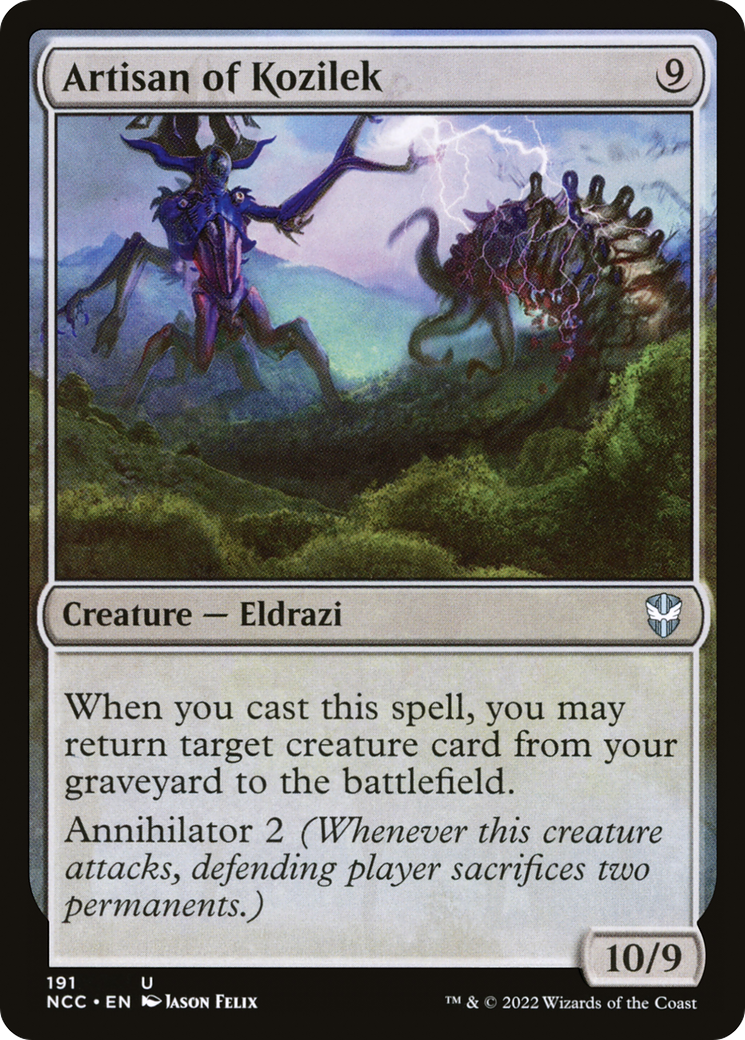
Artisan of Kozilek
Artisan of Kozilek
Creature — Eldrazi
10/9
When you cast this spell, you may return target creature card from your graveyard to the battlefield.
Annihilator 2 (Whenever this creature attacks, defending player sacrifices two permanents of their choice.)
- Annihilator abilities trigger and resolve during the declare attackers step. The defending player chooses and sacrifices the required number of permanents before they declare blockers. Any creatures sacrificed this way won't be able to block.
- If a creature with annihilator is attacking a planeswalker, and the defending player chooses to sacrifice that planeswalker, the attacking creature continues to attack. It may be blocked. If it isn't blocked, it simply won't deal combat damage to anything.
-
1
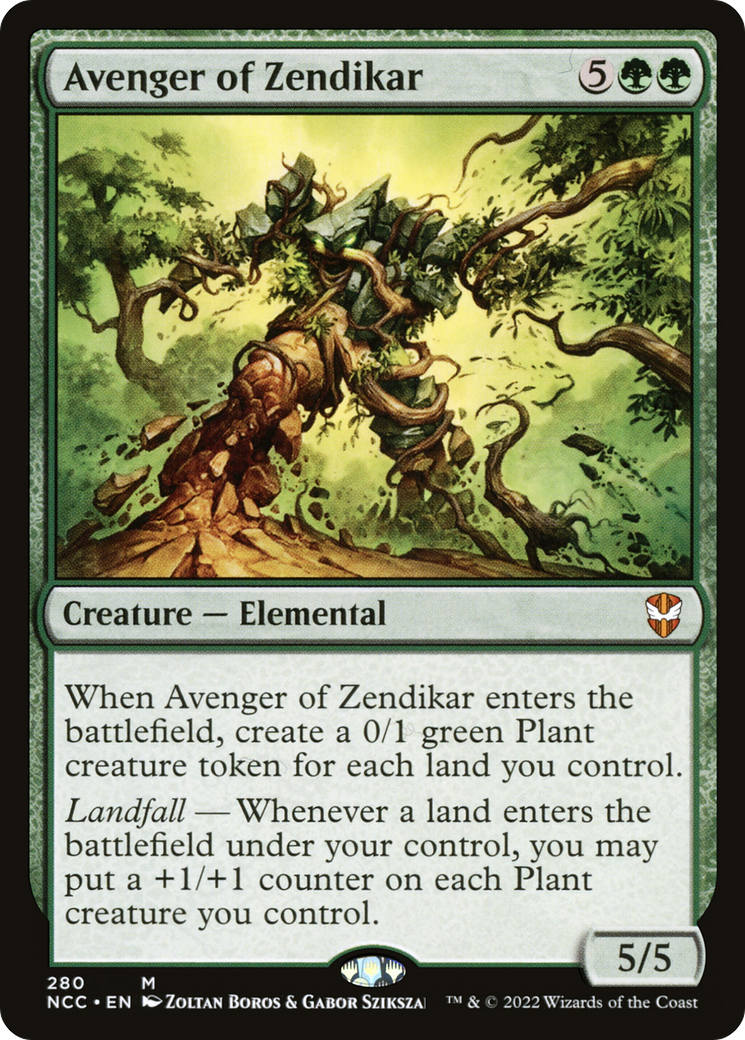
Avenger of Zendikar
Avenger of Zendikar
Creature — Elemental
5/5
When this creature enters, create a 0/1 green Plant creature token for each land you control.
Landfall — Whenever a land you control enters, you may put a +1/+1 counter on each Plant creature you control.
- A landfall ability triggers whenever a land you control enters for any reason. It triggers whenever you play a land, as well as whenever a spell or ability puts a land onto the battlefield under your control.
- A landfall ability doesn't trigger if a permanent already on the battlefield becomes a land.
- Whenever a land you control enters, each landfall ability of the permanents you control will trigger. You can put them on the stack in any order. The last ability you put on the stack will be the first one to resolve (As a result, you can have those abilities resolve in the order of your choosing.).
-
1
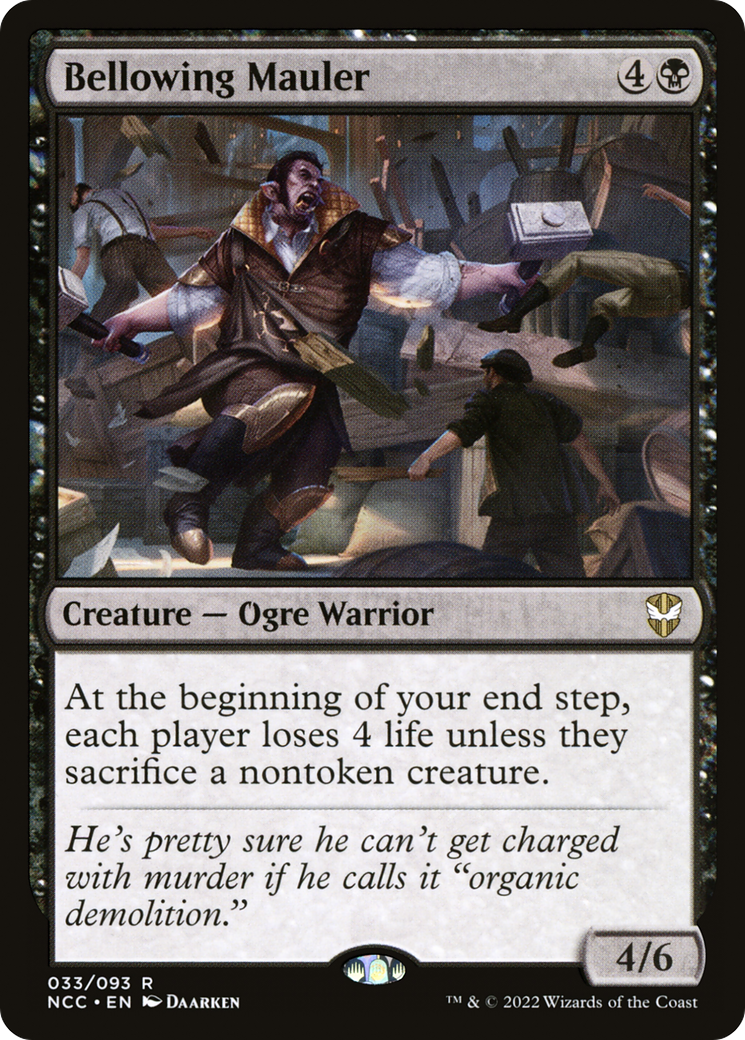
Bellowing Mauler
Bellowing Mauler
Creature — Ogre Warrior
4/6
At the beginning of your end step, each player loses 4 life unless they sacrifice a nontoken creature of their choice.
-
1
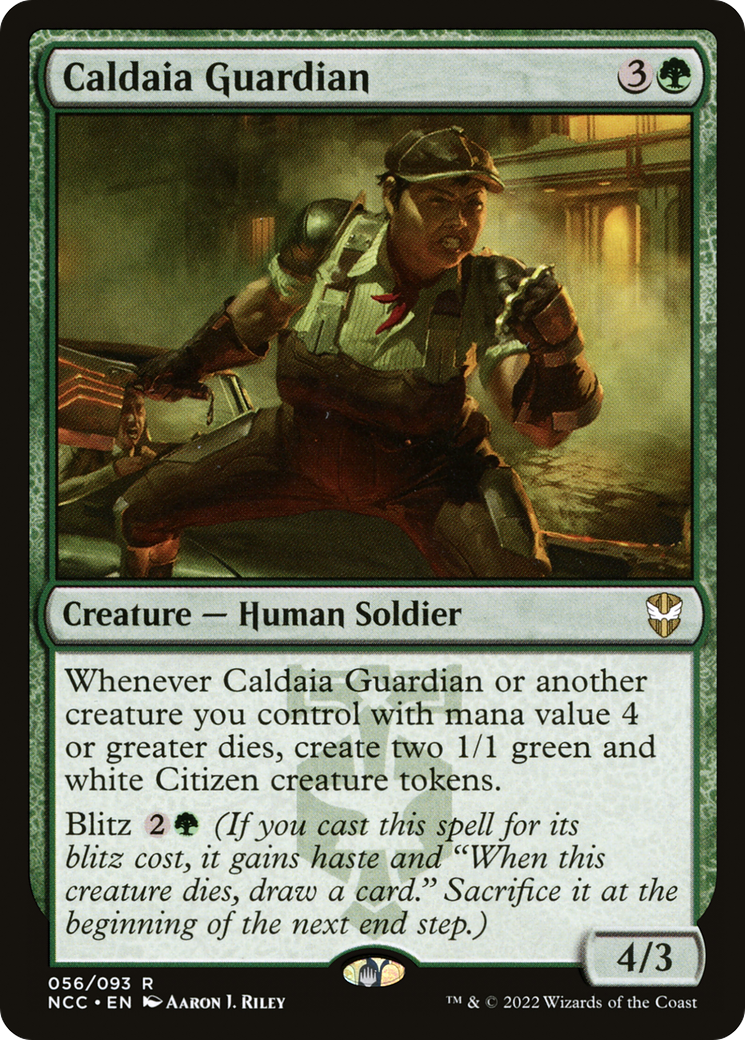
Caldaia Guardian
Caldaia Guardian
Creature — Human Soldier
4/3
Whenever this creature or another creature you control with mana value 4 or greater dies, create two 1/1 green and white Citizen creature tokens.
Blitz (If you cast this spell for its blitz cost, it gains haste and "When this creature dies, draw a card." Sacrifice it at the beginning of the next end step.)
- If you choose to pay the blitz cost rather than the mana cost, you're still casting the spell. It goes on the stack and can be responded to and countered. You can cast a creature spell for its blitz cost only if you could cast that creature spell. Most of the time, this means during your main phase when the stack is empty.
- If you pay the blitz cost to cast a creature spell, that permanent will be sacrificed only if it's still on the battlefield when that triggered ability resolves. If it dies or goes to another zone before then, it will stay where it is.
- You don't have to attack with the creature with blitz unless another ability says you do.
- If a creature enters the battlefield as a copy of or becomes a copy of a creature whose blitz cost was paid, the copy won't have haste, won't be sacrificed, and its controller won't draw a card when it dies.
- The triggered ability that lets its controller draw a card triggers when it dies for any reason, not just when you sacrifice it during the end step.
-
1
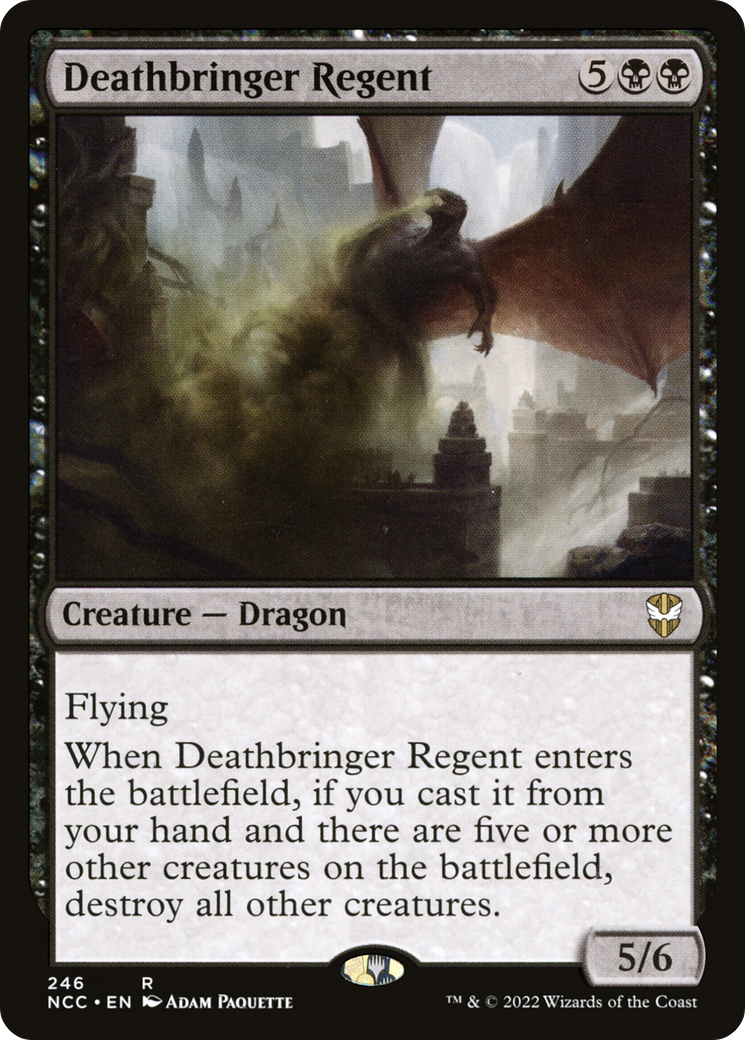
Deathbringer Regent
Deathbringer Regent
Creature — Dragon
5/6
Flying
When this creature enters, if you cast it from your hand and there are five or more other creatures on the battlefield, destroy all other creatures.
- If you cast a creature spell that enters the battlefield as a copy of Deathbringer Regent, the enters-the-battlefield ability will trigger (assuming the “five or more other creatures” requirement is also met).
- Deathbringer Regent's last ability destroys all creatures except Deathbringer Regent, including the five other creatures required for the ability to have an effect.
-
1
Disciple of Bolas
Disciple of Bolas
Creature — Human Wizard
2/1
When this creature enters, sacrifice another creature. You gain X life and draw X cards, where X is that creature's power.
- If you control at least one other creature when the ability resolves, you must sacrifice one. If you don't control any other creatures at that time, the ability won't do anything.
- The creature's power as it last existed on the battlefield is the amount of life you gain and the number of cards you draw.
-
1
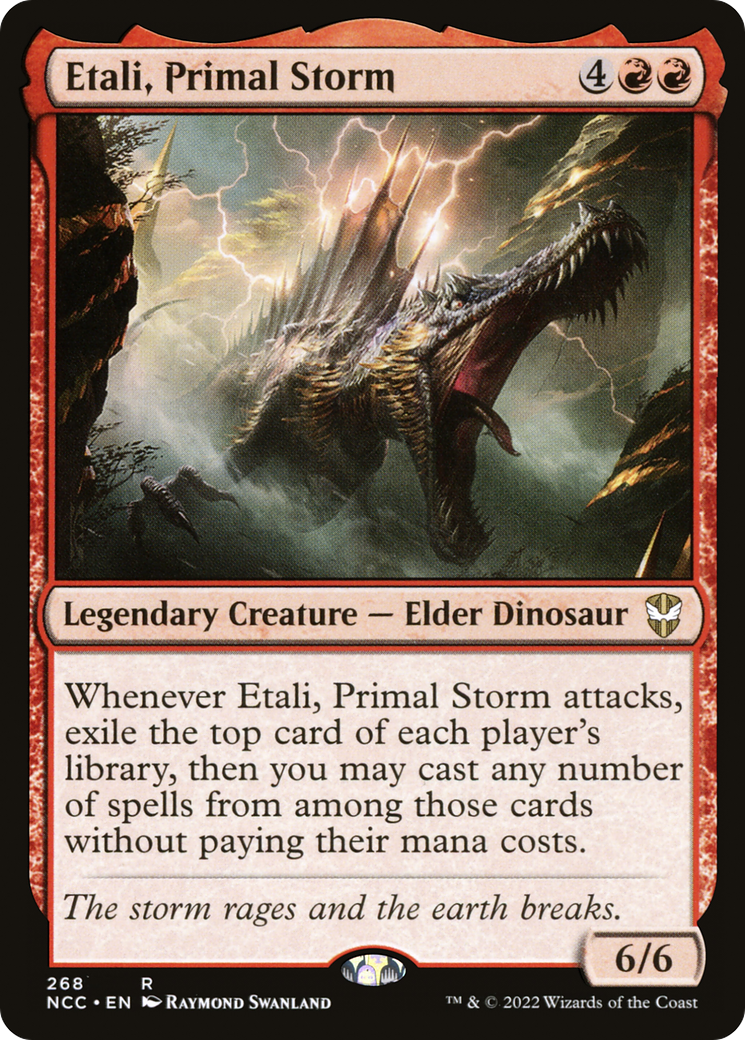
Etali, Primal Storm
Etali, Primal Storm
Legendary Creature — Elder Dinosaur
6/6
Whenever Etali attacks, exile the top card of each player's library, then you may cast any number of spells from among those cards without paying their mana costs.
- If an exiled card has in its mana cost, you must choose 0 as the value of X when casting it without paying its mana cost.
- If you cast any of the exiled cards, you do so as part of the resolution of the triggered ability. You can't wait to cast them later in the turn. Timing permissions based on a card's type are ignored, and the spells resolve before blockers are declared.
- If you cast a card "without paying its mana cost," you can't pay any alternative costs. You can, however, pay additional costs. If the card has any mandatory additional costs, those must be paid to cast the card.
- If you cast more than one of the exiled cards, you choose the order in which to cast them. A spell you cast this way can be the target of a later spell you cast this way. However, permanent spells cast this way won't resolve until you're done casting spells, so the permanents they become can't be the target of spells cast this way. For example, if you exile Twincast and Lightning Strike, you can cast Lightning Strike and then cast Twincast targeting it; but if you exile a creature card and an Aura card, you can't cast that Aura targeting that creature.
- Any cards not cast, including land cards, remain in exile. They can't be cast on later turns, even if Etali attacks again.
- Because all attacking creatures are chosen at once, a creature cast this way can't attack during the same combat as Etali, even if it has haste.
- In a multiplayer game, if a player leaves the game, all cards that player owns leave as well. If you leave the game, any spells or permanents you control from Etali's ability are exiled.
-
1
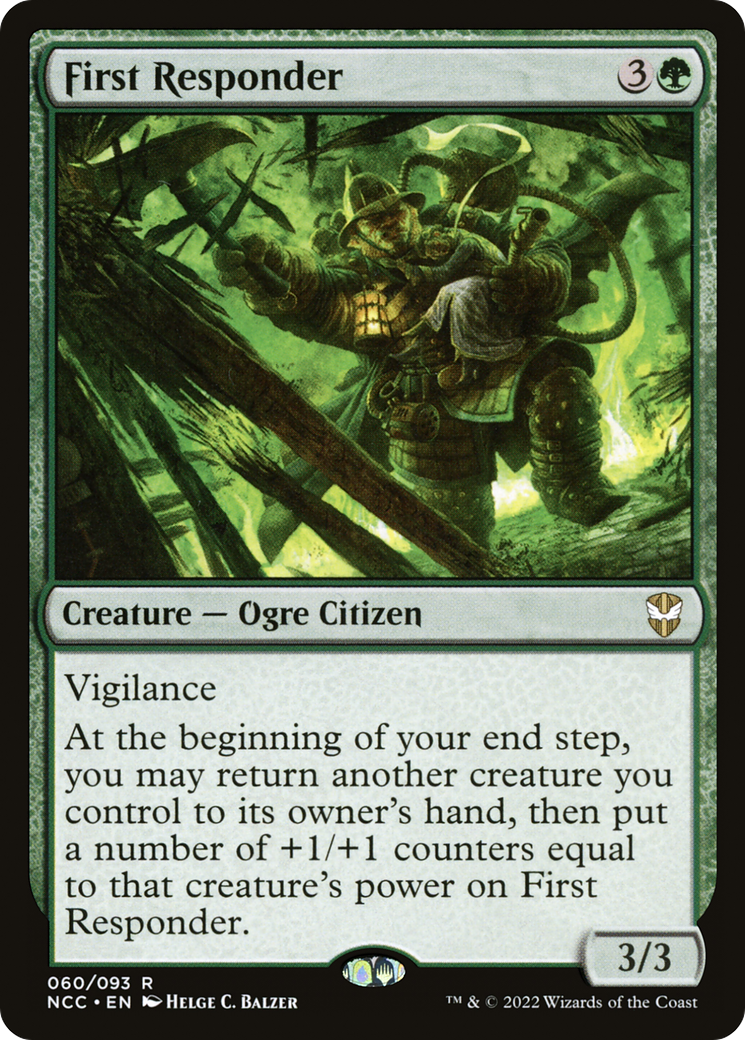
First Responder
First Responder
Creature — Ogre Citizen
3/3
Vigilance
At the beginning of your end step, you may return another creature you control to its owner's hand, then put a number of +1/+1 counters equal to that creature's power on this creature.
-
1
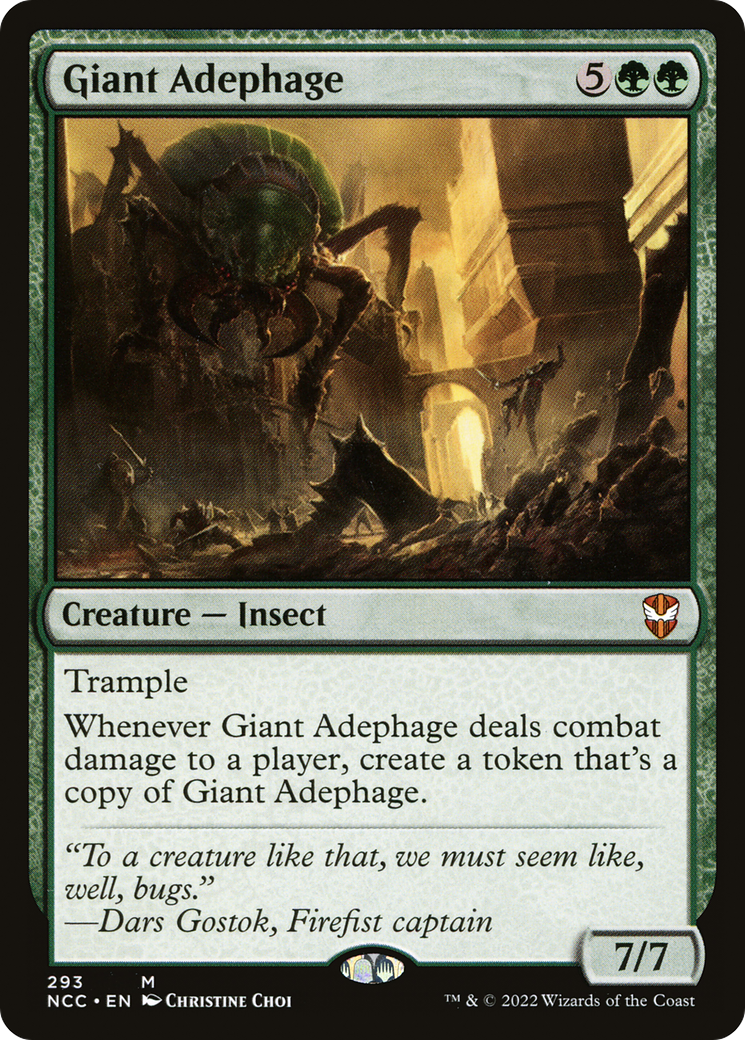
Giant Adephage
Giant Adephage
Creature — Insect
7/7
Trample
Whenever this creature deals combat damage to a player, create a token that's a copy of this creature.
- As the token is created, it checks the printed values of the Giant Adephage it's copying—or, if the Giant Adephage whose ability triggered was itself a token, the original characteristics of that token as stated by the effect that put it onto the battlefield—as well as any copy effects that have been applied to it. It won't copy counters on the Giant Adephage, nor will it copy other effects that have changed Giant Adephage's power, toughness, types, color, or so on. Normally, this means the token will simply be a Giant Adephage. But if any copy effects have affected that Giant Adephage, they're taken into account.
-
1
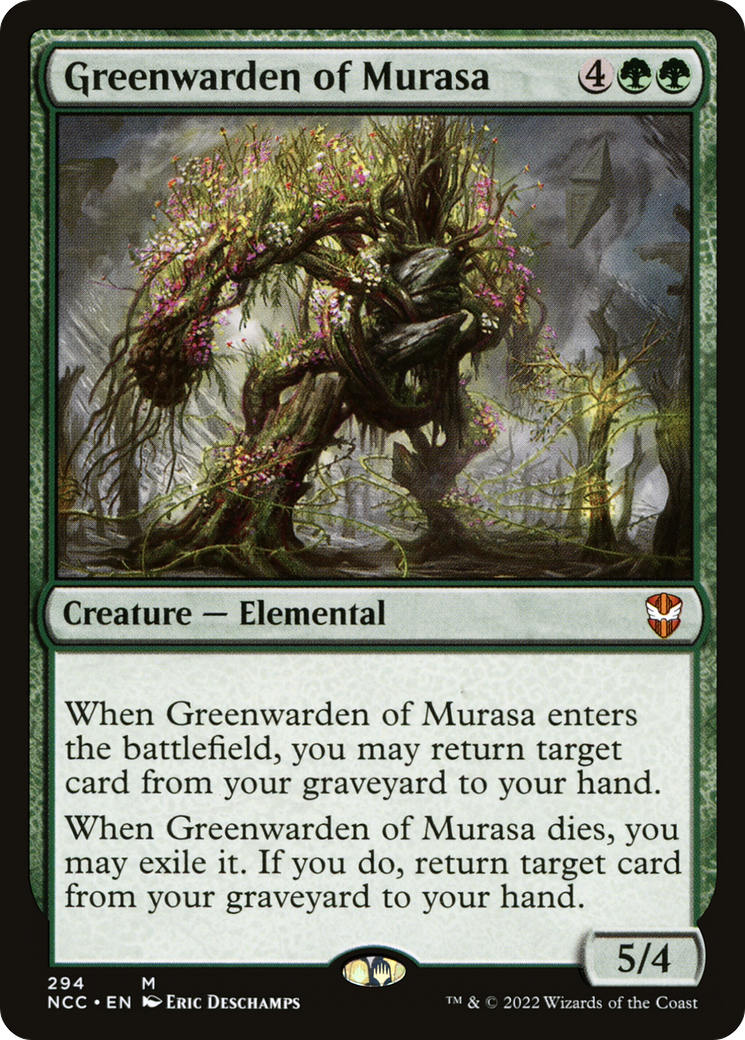
Greenwarden of Murasa
Greenwarden of Murasa
Creature — Elemental
5/4
When this creature enters, you may return target card from your graveyard to your hand.
When this creature dies, you may exile it. If you do, return target card from your graveyard to your hand.
- You decide whether to exile Greenwarden of Murasa as the last ability resolves. Players can respond to this ability triggering, but once it starts resolving and you decide to exile Greenwarden of Murasa, it's too late for anyone to respond.
- If the target card becomes illegal before the last ability resolves, it won't resolve. You can't exile Greenwarden of Murasa in that case, even if you want to.
-
1
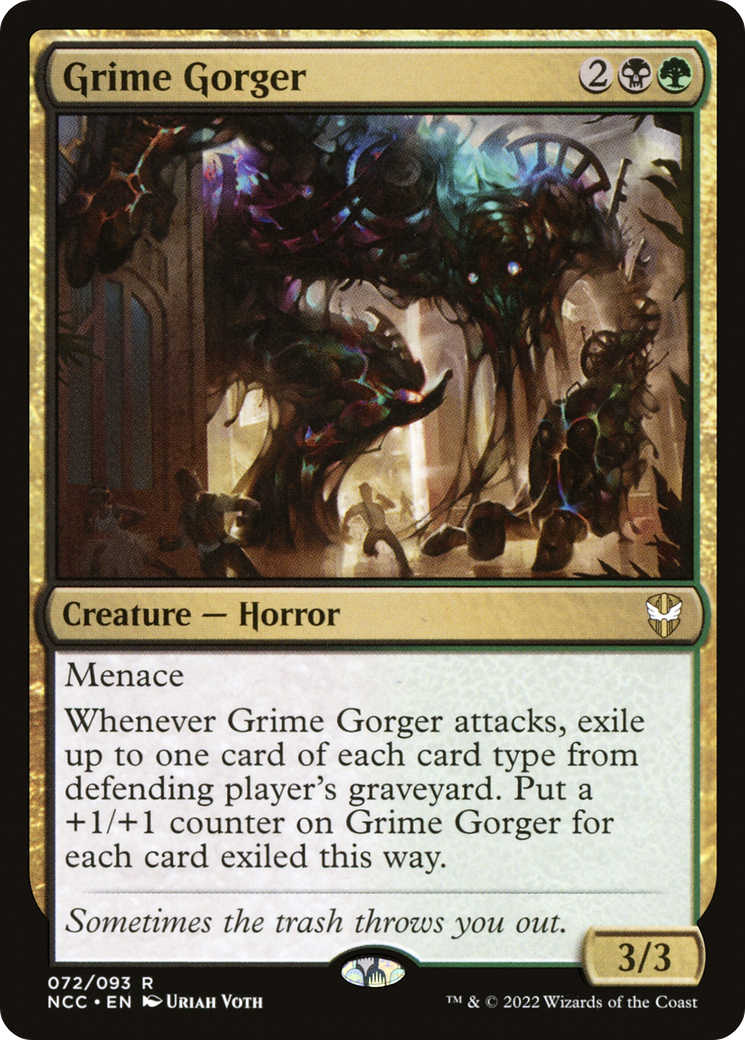
Grime Gorger
Grime Gorger
Creature — Horror
3/3
Menace
Whenever this creature attacks, exile up to one card of each card type from defending player's graveyard. Put a +1/+1 counter on this creature for each card exiled this way.
- The card types that might appear in a player's graveyard are artifact, battle, creature, enchantment, instant, kindred, land, planeswalker, and sorcery. Supertypes (such as legendary and basic) and subtypes (such as Human and Equipment) are not card types.
-
1
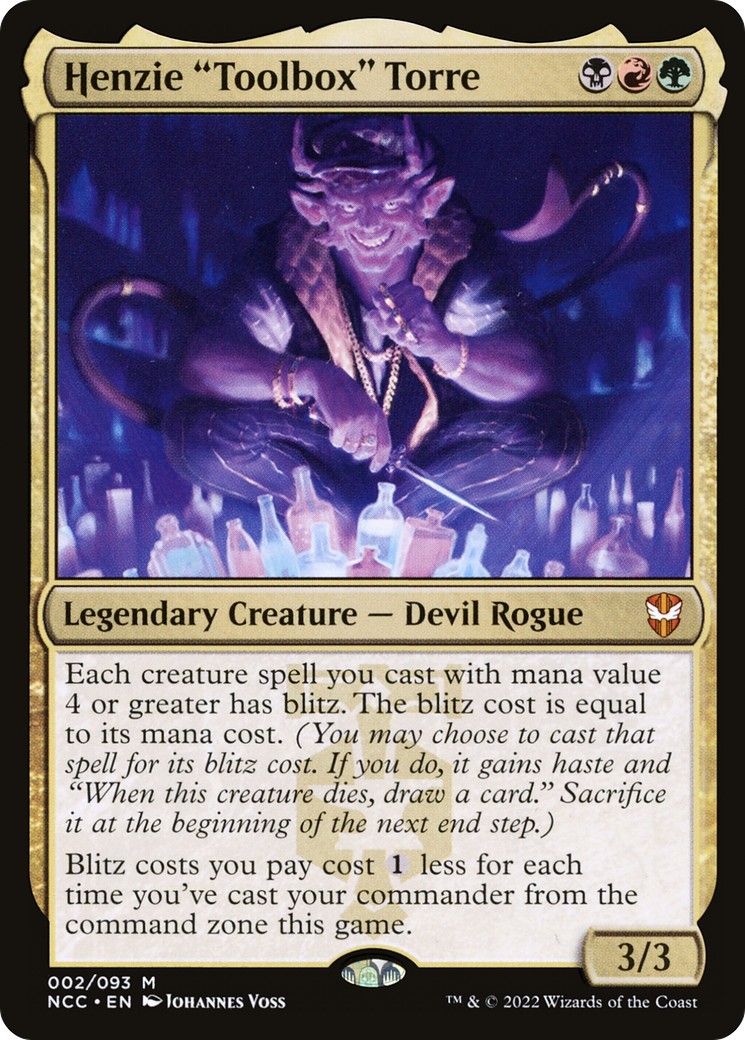
Henzie "Toolbox" Torre
Henzie "Toolbox" Torre
Legendary Creature — Devil Rogue
3/3
Each creature spell you cast with mana value 4 or greater has blitz. The blitz cost is equal to its mana cost. (You may choose to cast that spell for its blitz cost. If you do, it gains haste and "When this creature dies, draw a card." Sacrifice it at the beginning of the next end step.)
Blitz costs you pay cost less for each time you've cast your commander from the command zone this game.
- If the back face of a modal double-faced card is a creature with mana value 4 or greater, you may cast it using the blitz ability granted by Henzie.
- If you choose to pay the blitz cost rather than the mana cost, you're still casting the spell. It goes on the stack and can be responded to and countered. You can cast a creature spell for its blitz cost only if you could cast that creature spell. Most of the time, this means during your main phase when the stack is empty.
- If you pay the blitz cost to cast a creature spell, that permanent will be sacrificed only if it's still on the battlefield when that triggered ability resolves. If it dies or goes to another zone before then, it will stay where it is.
- You don't have to attack with the creature with blitz unless another ability says you do.
- If a creature enters the battlefield as a copy of or becomes a copy of a creature whose blitz cost was paid, the copy won't have haste, won't be sacrificed, and its controller won't draw a card when it dies.
- The triggered ability that lets its controller draw a card triggers when it dies for any reason, not just when you sacrifice it during the end step.
-
1
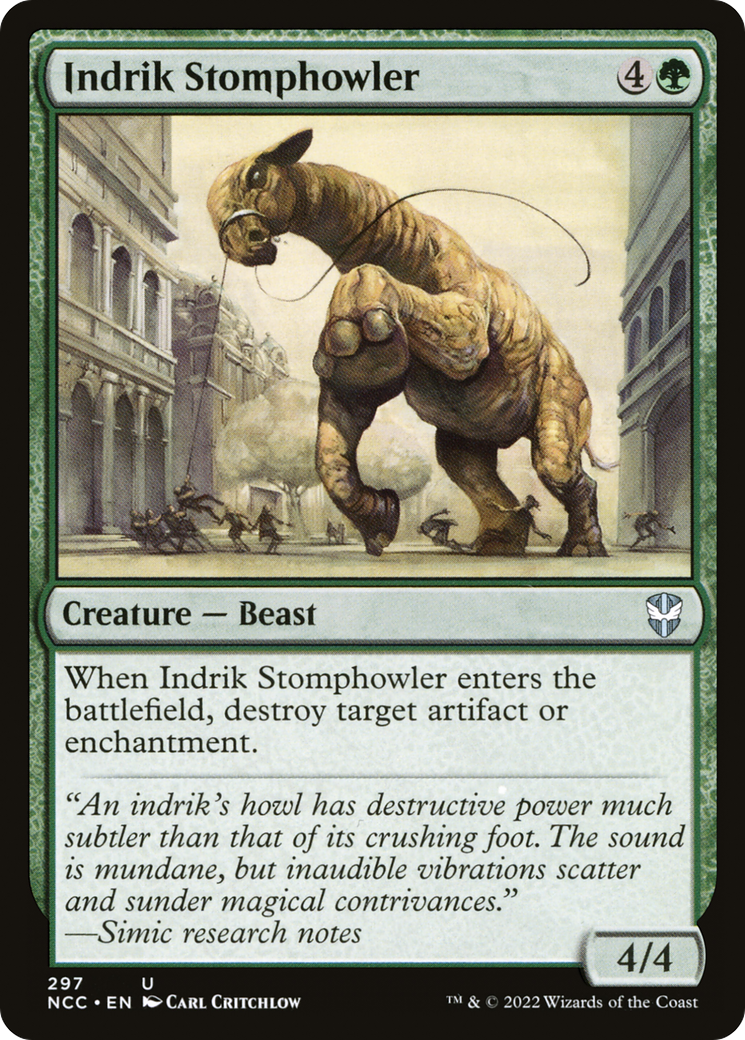
Indrik Stomphowler
Indrik Stomphowler
Creature — Beast
4/4
When this creature enters, destroy target artifact or enchantment.
-
1
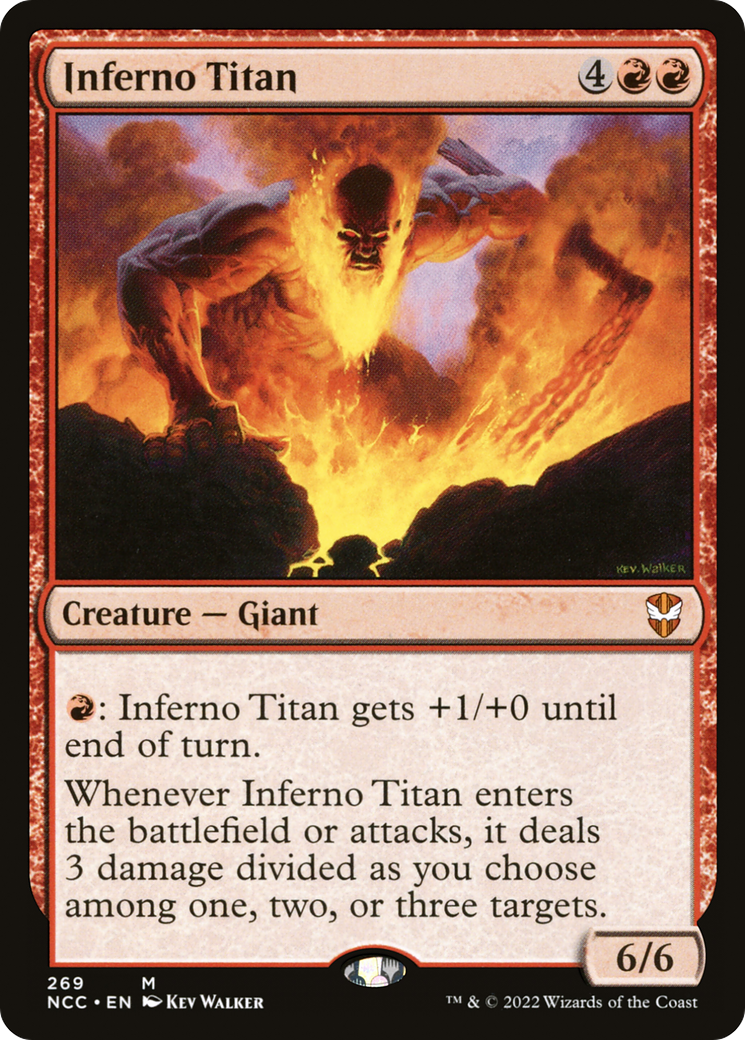
Inferno Titan
Inferno Titan
Creature — Giant
6/6
: This creature gets +1/+0 until end of turn.
Whenever this creature enters or attacks, it deals 3 damage divided as you choose among one, two, or three targets.
- You divide the damage as you put Inferno Titan's triggered ability on the stack, not as it resolves. Each target must be assigned at least 1 damage. (In other words, as you put the ability on the stack, you choose whether to have it deal 3 damage to a single target, 2 damage to one target and 1 damage to another target, or 1 damage to each of three targets.)
-
1
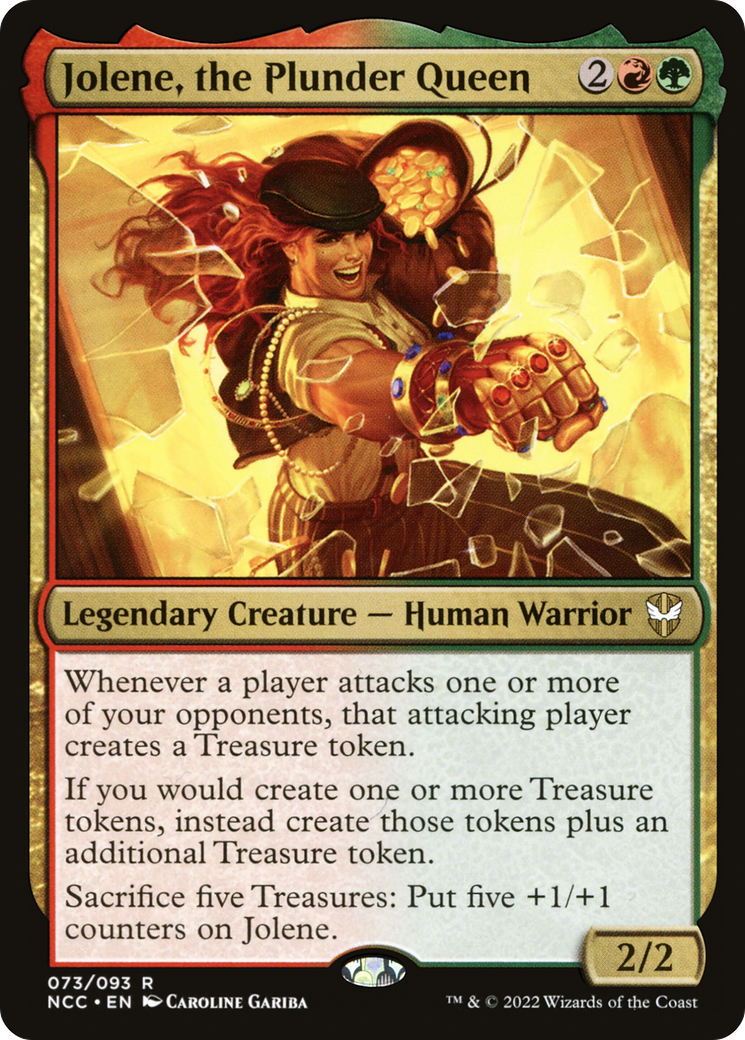
Jolene, the Plunder Queen
Jolene, the Plunder Queen
Legendary Creature — Human Warrior
2/2
Whenever a player attacks one or more of your opponents, that attacking player creates a Treasure token.
If you would create one or more Treasure tokens, instead create those tokens plus an additional Treasure token.
Sacrifice five Treasures: Put five +1/+1 counters on Jolene.
-
1
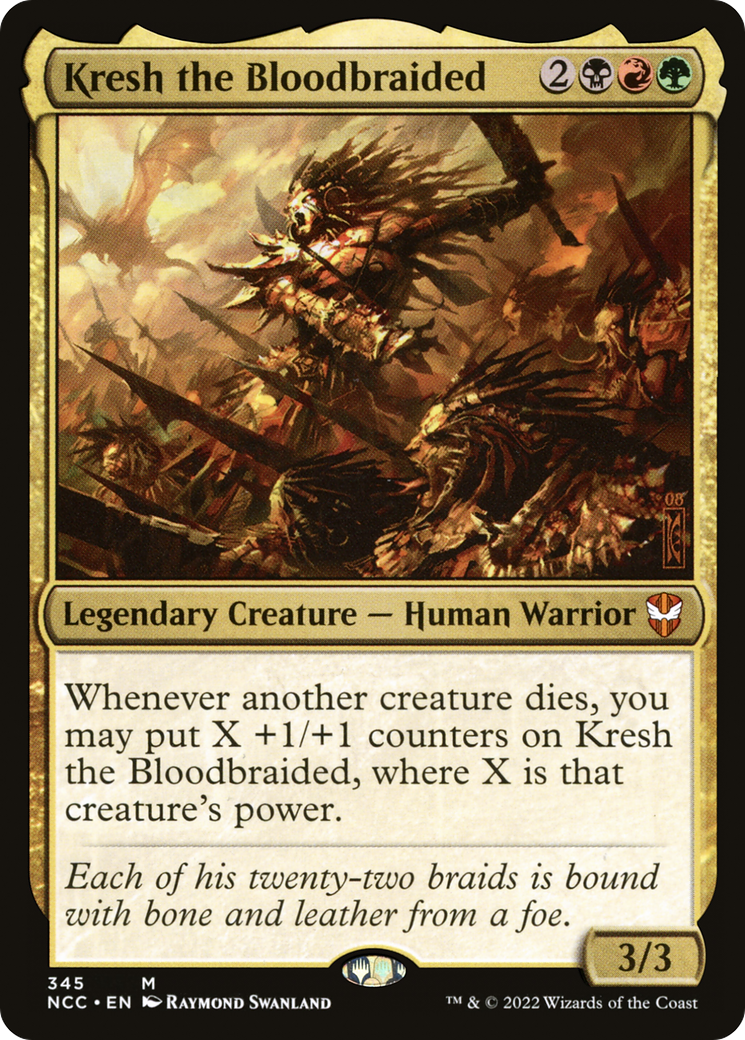
Kresh the Bloodbraided
Kresh the Bloodbraided
Legendary Creature — Human Warrior
3/3
Whenever another creature dies, you may put X +1/+1 counters on Kresh, where X is that creature's power.
- X is equal to the power of the creature as it last existed on the battlefield.
-
1
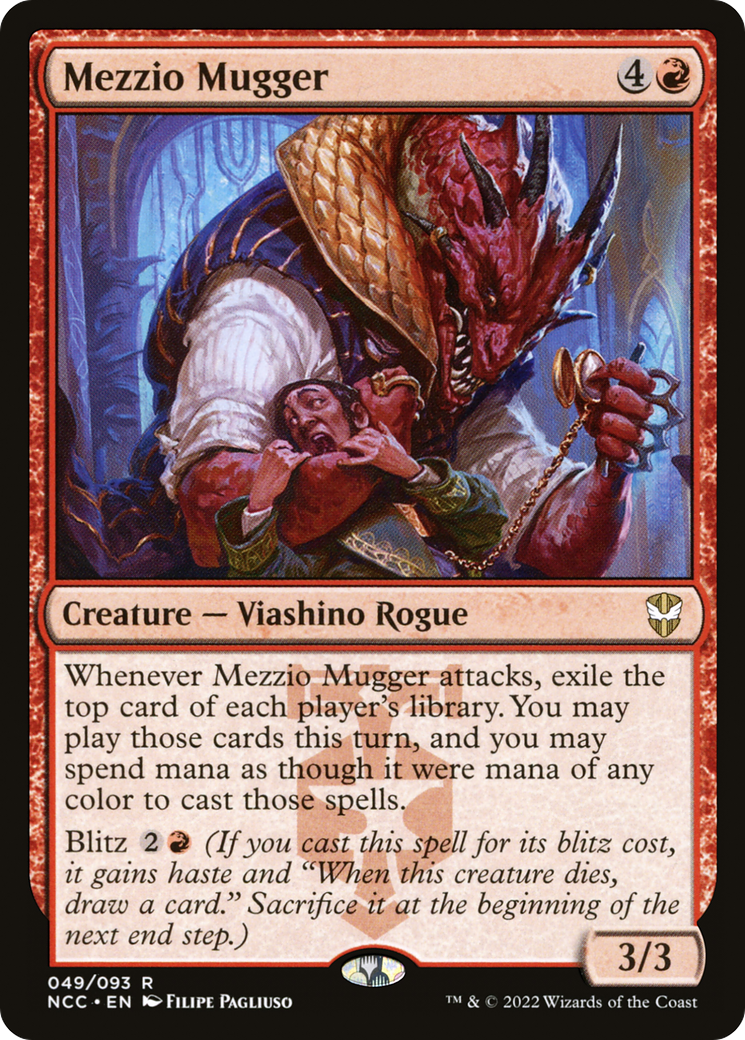
Mezzio Mugger
Mezzio Mugger
Creature — Lizard Rogue
3/3
Whenever this creature attacks, exile the top card of each player's library. You may play those cards this turn, and you may spend mana as though it were mana of any color to cast those spells.
Blitz (If you cast this spell for its blitz cost, it gains haste and "When this creature dies, draw a card." Sacrifice it at the beginning of the next end step.)
- You must follow all normal timing rules for cards played this way. For example, you may play lands this way only during your main phase while no spells or abilities are on the stack and only if you haven't played a land yet this turn.
- If you choose to pay the blitz cost rather than the mana cost, you're still casting the spell. It goes on the stack and can be responded to and countered. You can cast a creature spell for its blitz cost only if you could cast that creature spell. Most of the time, this means during your main phase when the stack is empty.
- If you pay the blitz cost to cast a creature spell, that permanent will be sacrificed only if it's still on the battlefield when that triggered ability resolves. If it dies or goes to another zone before then, it will stay where it is.
- You don't have to attack with the creature with blitz unless another ability says you do.
- If a creature enters the battlefield as a copy of or becomes a copy of a creature whose blitz cost was paid, the copy won't have haste, won't be sacrificed, and its controller won't draw a card when it dies.
- The triggered ability that lets its controller draw a card triggers when it dies for any reason, not just when you sacrifice it during the end step.
-
1
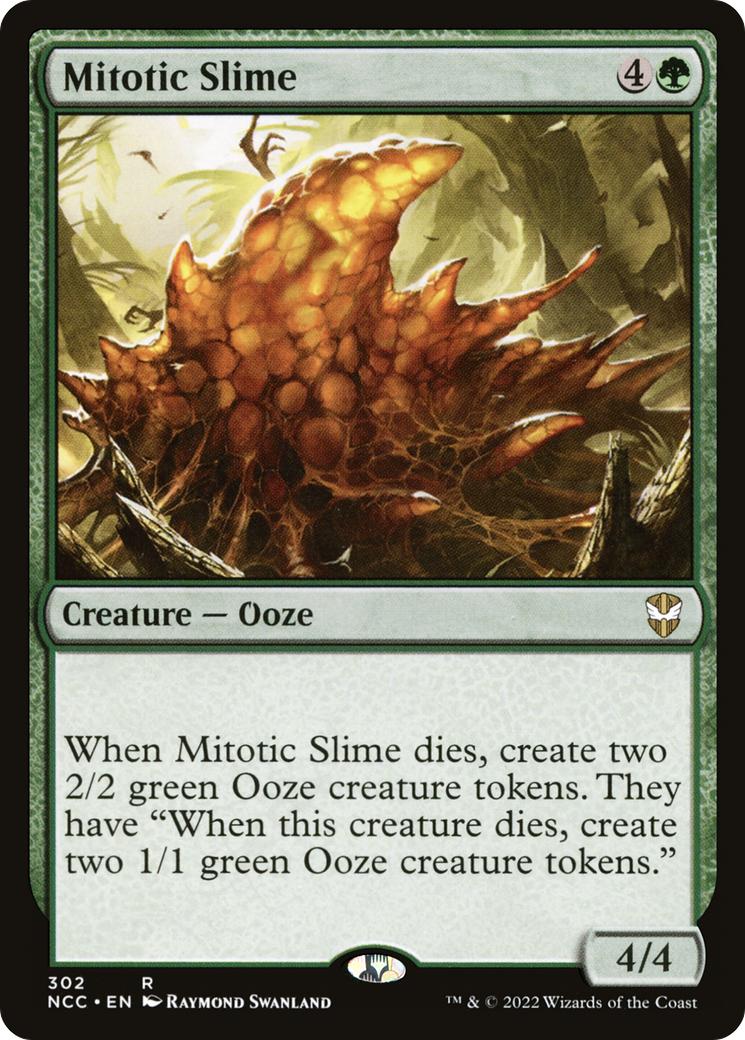
Mitotic Slime
Mitotic Slime
Creature — Ooze
4/4
When this creature dies, create two 2/2 green Ooze creature tokens. They have "When this token dies, create two 1/1 green Ooze creature tokens."
-
1
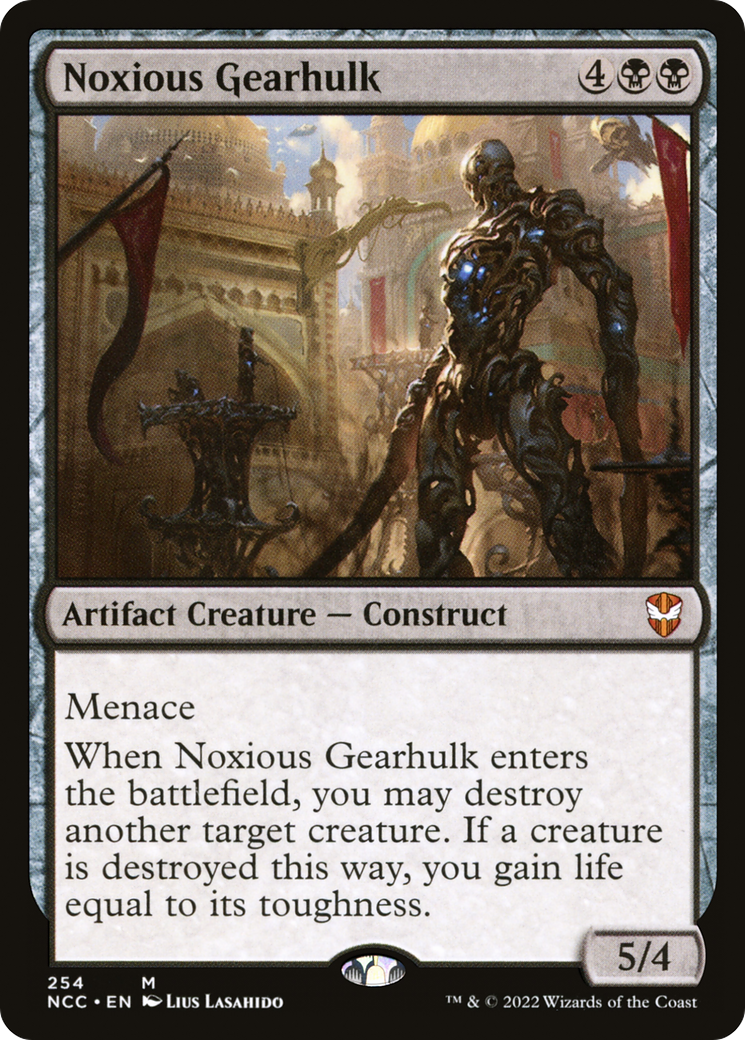
Noxious Gearhulk
Noxious Gearhulk
Artifact Creature — Construct
5/4
Menace
When this creature enters, you may destroy another target creature. If a creature is destroyed this way, you gain life equal to its toughness.
- If the target creature has indestructible, it isn't destroyed this way and you won't gain life. If it is destroyed but put into a zone other than a graveyard, you'll gain life.
- Use the toughness of the creature as it last existed on the battlefield to determine how much life to gain.
-
1
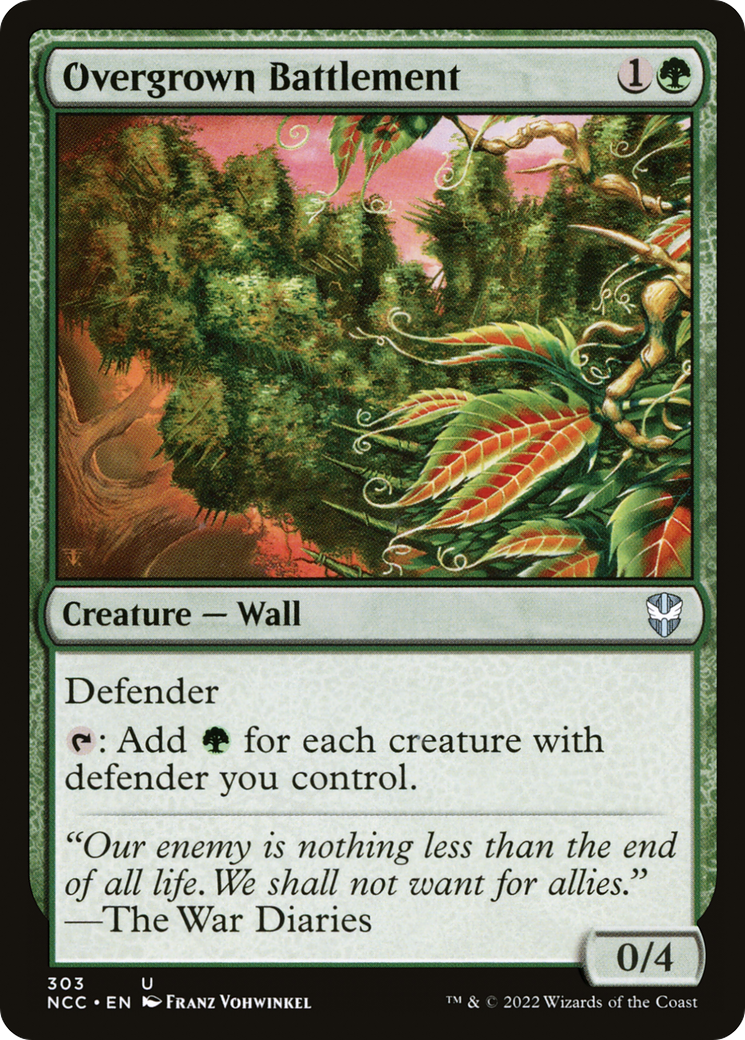
Overgrown Battlement
Overgrown Battlement
Creature — Wall
0/4
Defender
: Add for each creature you control with defender.
- Overgrown Battlement's last ability is a mana ability. It doesn't use the stack and can't be responded to (such as by removing creatures with defender you control).
-
1
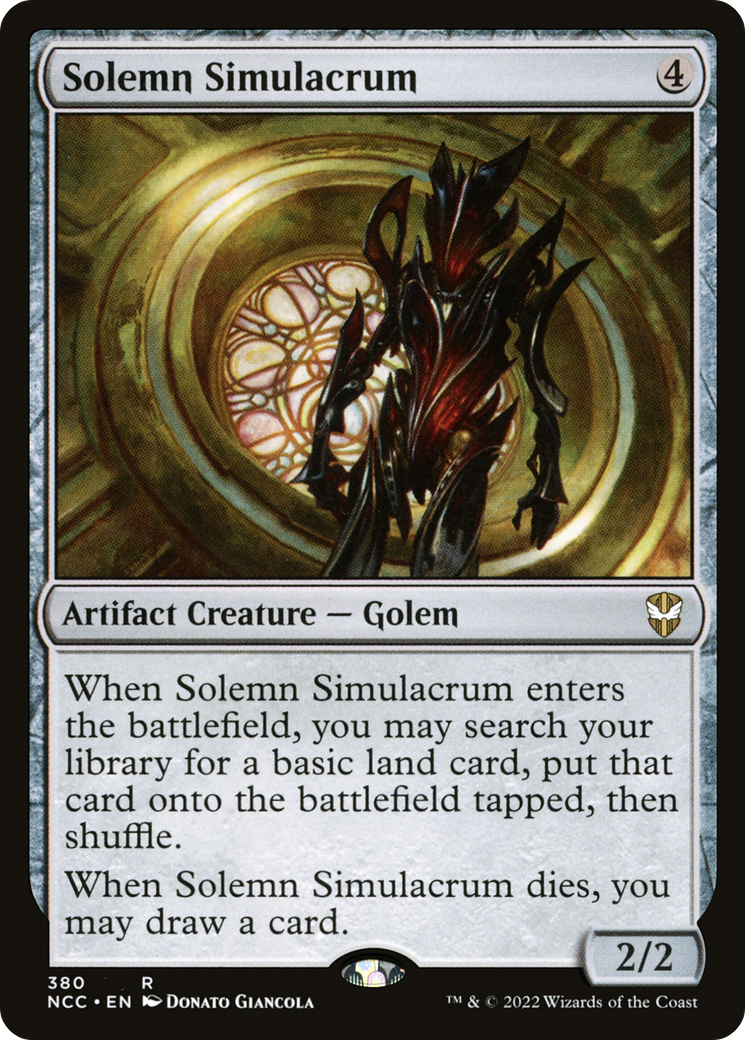
Solemn Simulacrum
Solemn Simulacrum
Artifact Creature — Golem
2/2
When this creature enters, you may search your library for a basic land card, put that card onto the battlefield tapped, then shuffle.
When this creature dies, you may draw a card.
-
1
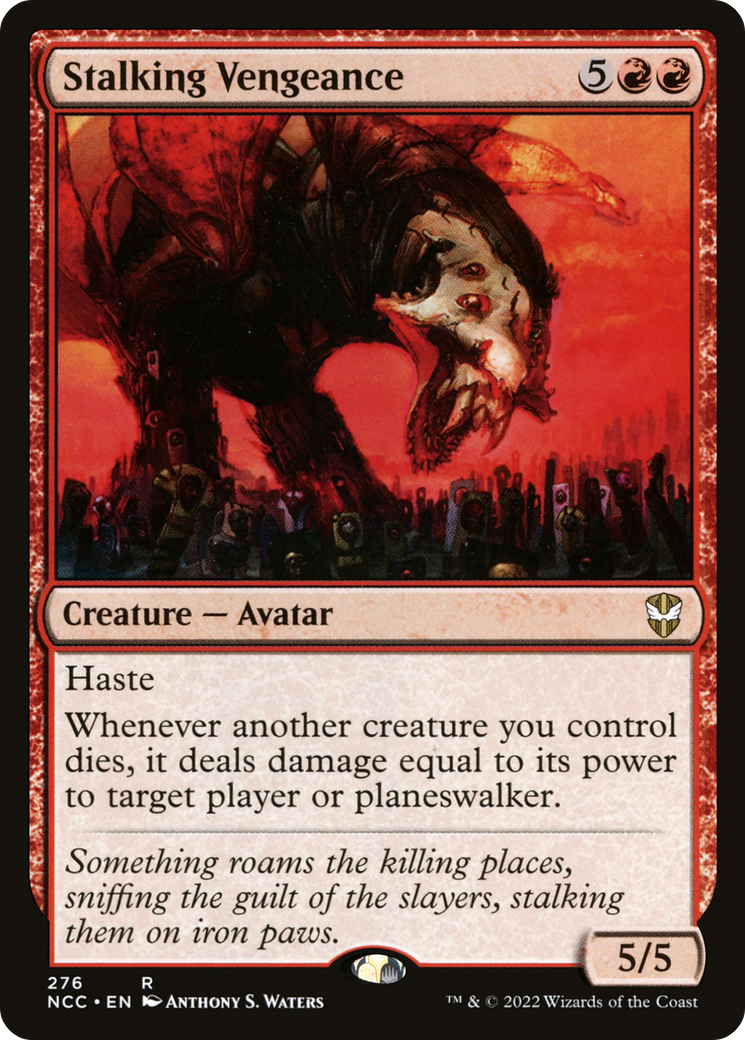
Stalking Vengeance
Stalking Vengeance
Creature — Avatar
5/5
Haste
Whenever another creature you control dies, it deals damage equal to its power to target player or planeswalker.
-
1
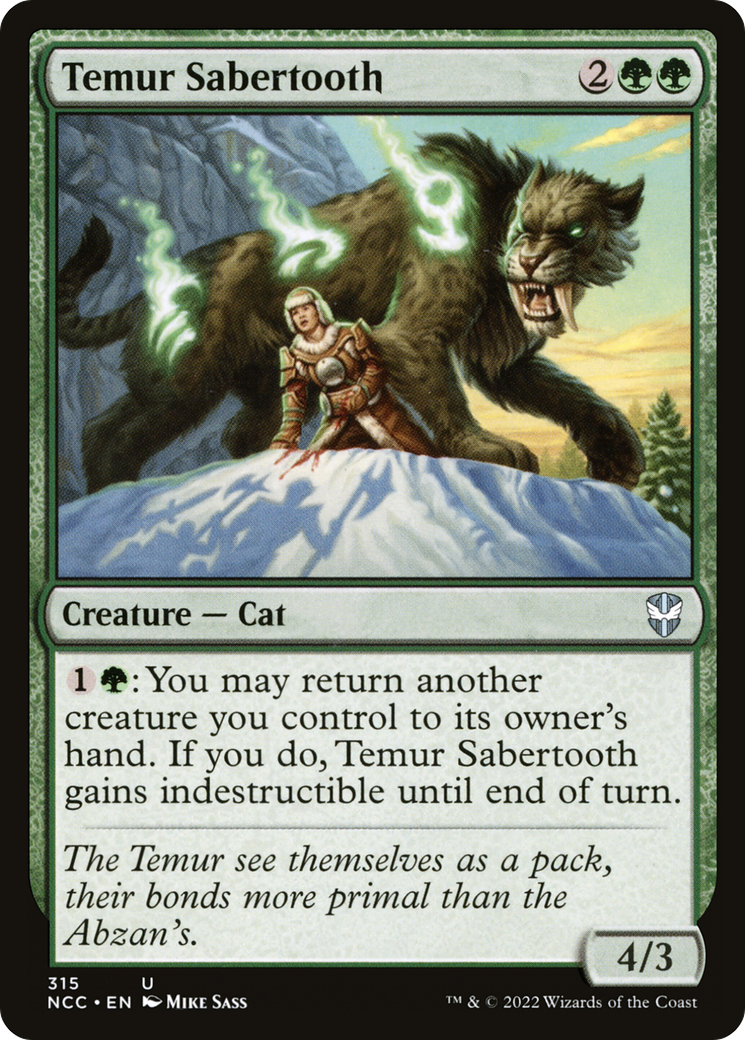
Temur Sabertooth
Temur Sabertooth
Creature — Cat
4/3
: You may return another creature you control to its owner's hand. If you do, this creature gains indestructible until end of turn.
- You choose whether to return a creature and which creature to return as the activated ability resolves. This doesn't target any creature.
-
1
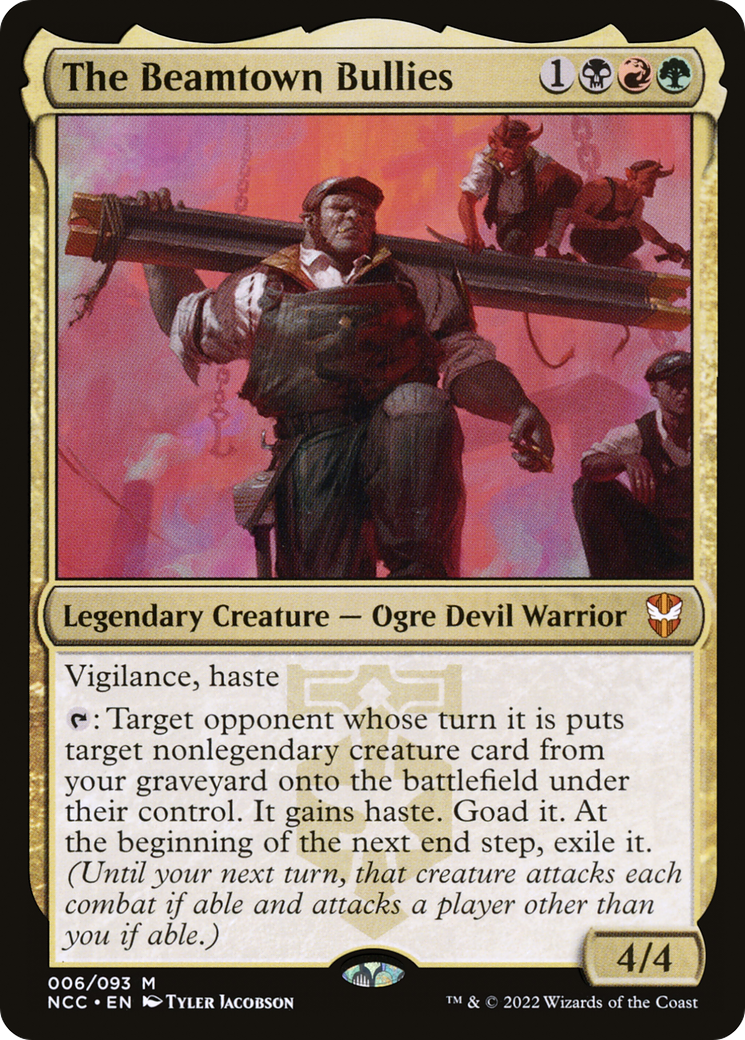
The Beamtown Bullies
The Beamtown Bullies
Legendary Creature — Ogre Devil Warrior
4/4
Vigilance, haste
: Target opponent whose turn it is puts target nonlegendary creature card from your graveyard onto the battlefield under their control. It gains haste. Goad it. At the beginning of the next end step, exile it. (Until your next turn, that creature attacks each combat if able and attacks a player other than you if able.)
-
1
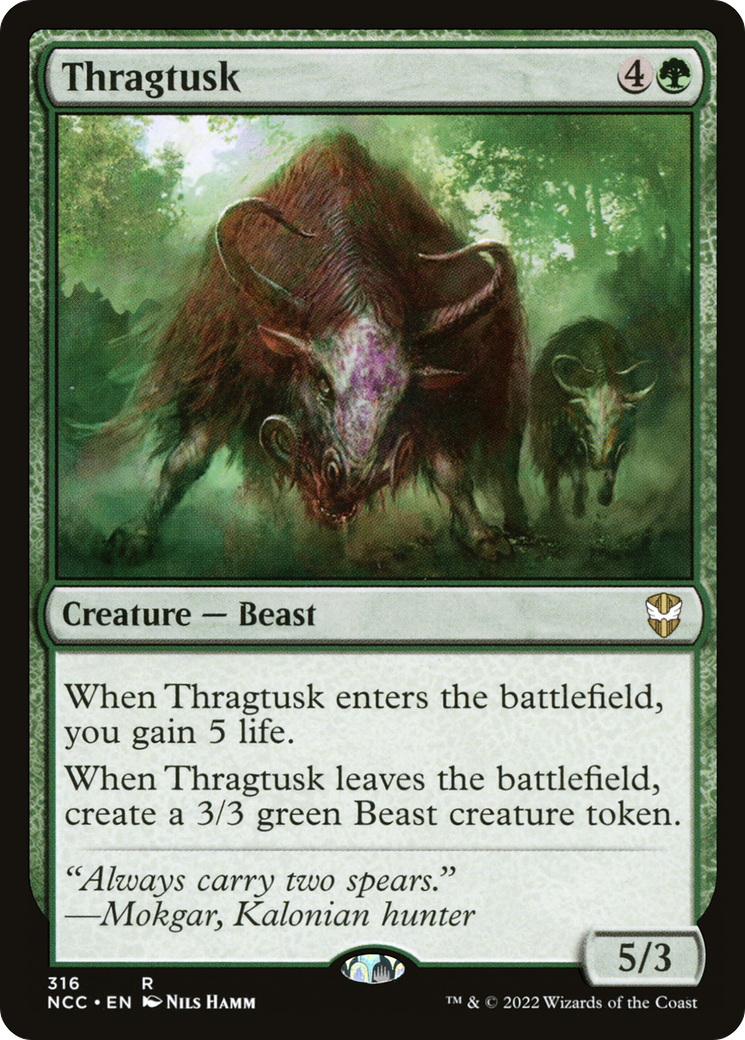
Thragtusk
Thragtusk
Creature — Beast
5/3
When this creature enters, you gain 5 life.
When this creature leaves the battlefield, create a 3/3 green Beast creature token.
- Thragtusk's second ability will trigger no matter what zone Thragtusk goes to.
-
1
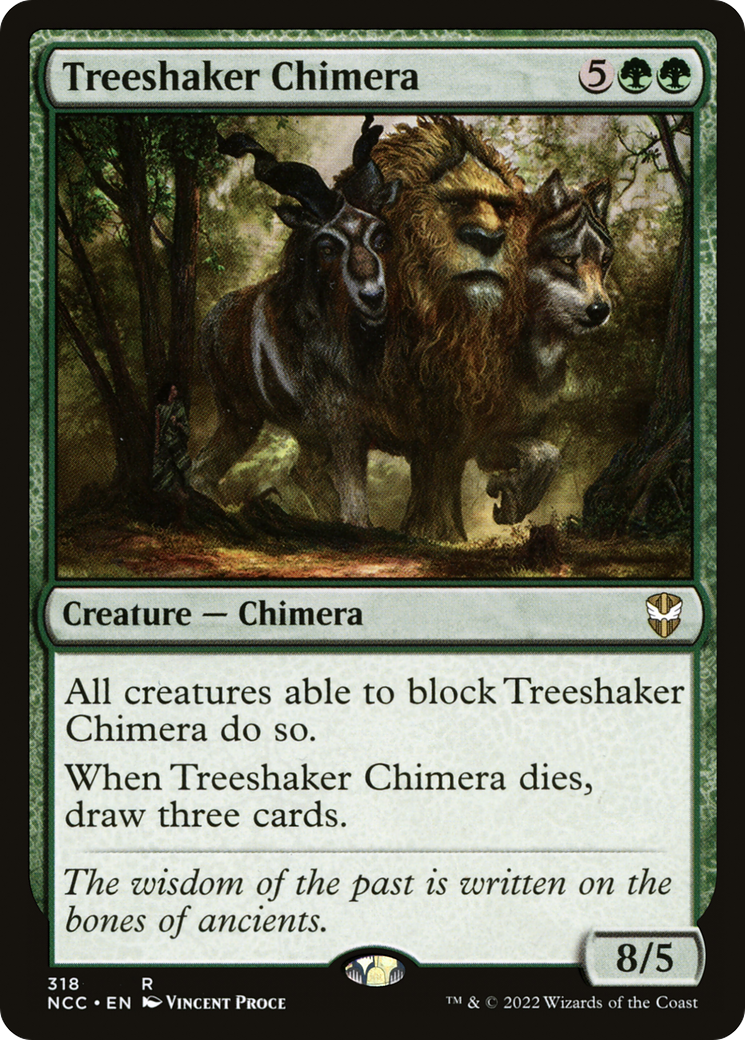
Treeshaker Chimera
Treeshaker Chimera
Creature — Chimera
8/5
All creatures able to block this creature do so.
When this creature dies, draw three cards.
- If a creature can't block Treeshaker Chimera for any reason (such as being tapped), then it doesn't block. If there's a cost associated with having it block, the player isn't forced to pay that cost, so it doesn't have to block in that case either. If there's a cost associated with having it block Treeshaker Chimera, but not to block other attacking creatures, that creature is free to block one of those other creatures or to not block at all.
- If a creature is required to block two or more different creatures, its controller chooses which one that creature blocks.
-
1
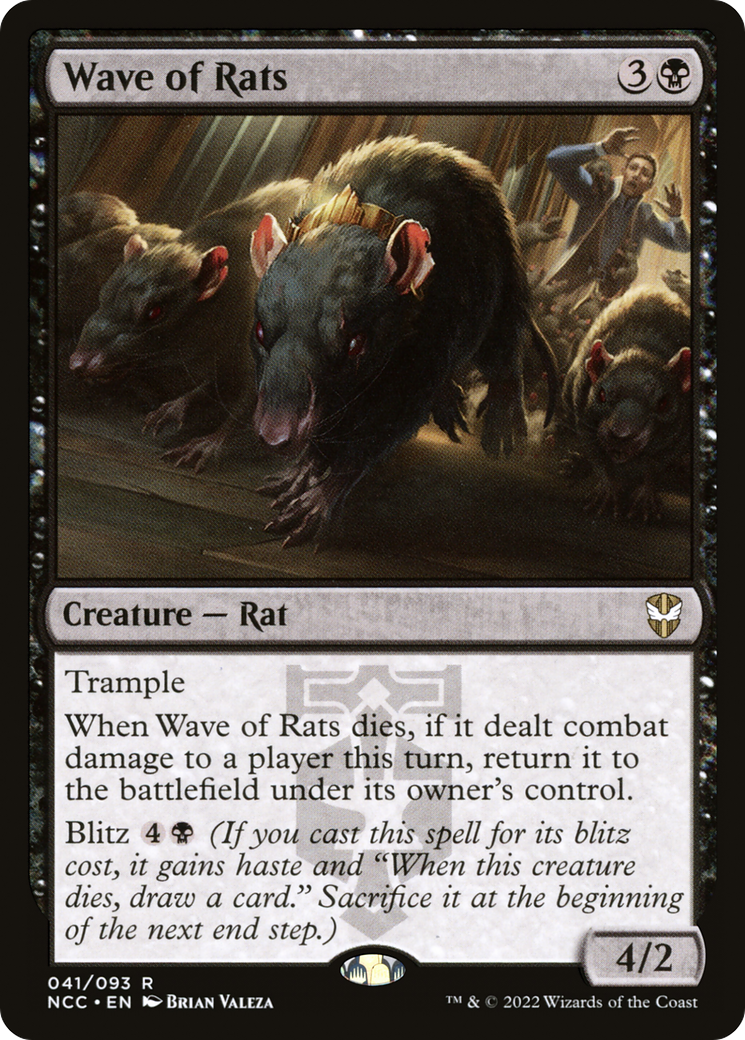
Wave of Rats
Wave of Rats
Creature — Rat
4/2
Trample
When this creature dies, if it dealt combat damage to a player this turn, return it to the battlefield under its owner's control.
Blitz (If you cast this spell for its blitz cost, it gains haste and "When this creature dies, draw a card." Sacrifice it at the beginning of the next end step.)
- If you choose to pay the blitz cost rather than the mana cost, you're still casting the spell. It goes on the stack and can be responded to and countered. You can cast a creature spell for its blitz cost only if you could cast that creature spell. Most of the time, this means during your main phase when the stack is empty.
- If you pay the blitz cost to cast a creature spell, that permanent will be sacrificed only if it's still on the battlefield when that triggered ability resolves. If it dies or goes to another zone before then, it will stay where it is.
- You don't have to attack with the creature with blitz unless another ability says you do.
- If a creature enters the battlefield as a copy of or becomes a copy of a creature whose blitz cost was paid, the copy won't have haste, won't be sacrificed, and its controller won't draw a card when it dies.
- The triggered ability that lets its controller draw a card triggers when it dies for any reason, not just when you sacrifice it during the end step.
-
1
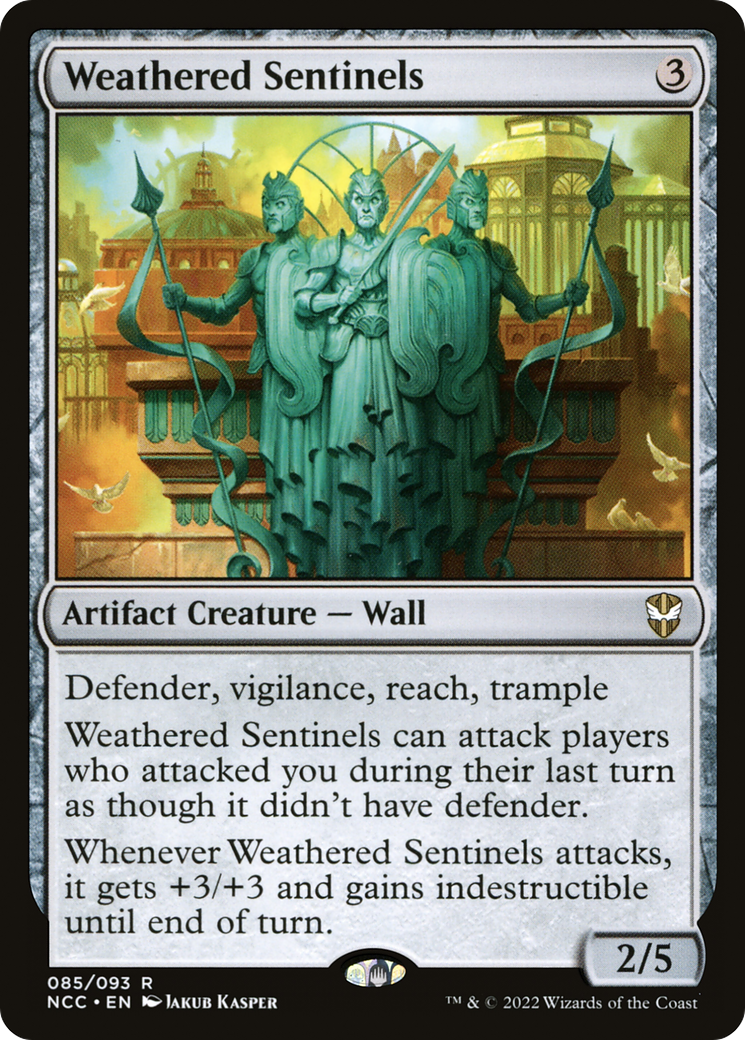
Weathered Sentinels
Weathered Sentinels
Artifact Creature — Wall
2/5
Defender, vigilance, reach, trample
This creature can attack players who attacked you during their last turn as though it didn't have defender.
Whenever this creature attacks, it gets +3/+3 and gains indestructible until end of turn.
-
1
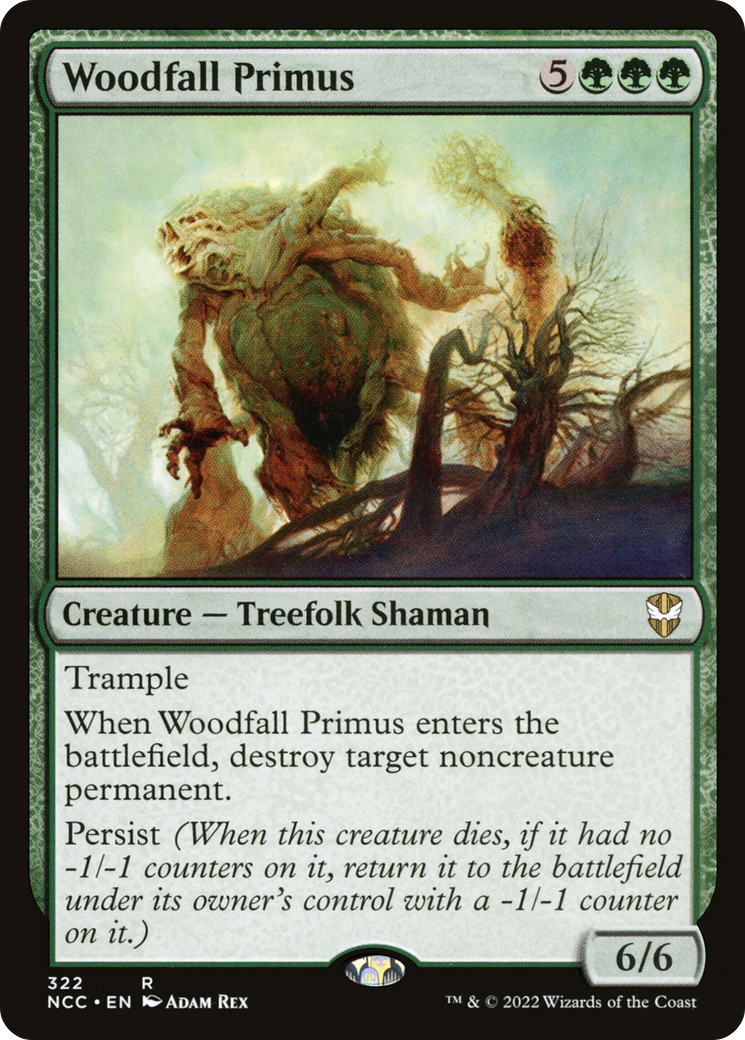
Woodfall Primus
Woodfall Primus
Creature — Treefolk Shaman
6/6
Trample
When this creature enters, destroy target noncreature permanent.
Persist (When this creature dies, if it had no -1/-1 counters on it, return it to the battlefield under its owner's control with a -1/-1 counter on it.)
- If a creature with persist stops being a creature, persist will still work.
- The persist ability triggers when the permanent is put into a graveyard. Its last known information (that is, how the creature last existed on the battlefield) is used to determine whether it had a -1/-1 counter on it.
- If a permanent has multiple instances of persist, they'll each trigger separately, but the redundant instances will have no effect. If one instance returns the card to the battlefield, the next to resolve will do nothing.
- If a token with no -1/-1 counters on it has persist, the ability will trigger when the token is put into the graveyard. However, the token will cease to exist and can't return to the battlefield.
- When a permanent with persist returns to the battlefield, it's a new object with no memory of or connection to its previous existence.
- If multiple creatures with persist are put into the graveyard at the same time (due to combat damage or a spell that destroys all creatures, for example), the active player (the player whose turn it is) puts all of their persist triggers on the stack in any order, then each other player in turn order does the same. The last trigger put on the stack is the first one that resolves. That means that in a two-player game, the nonactive player's persist creatures will return to the battlefield first, then the active player's persist creatures do the same. The creatures return to the battlefield one at a time.
- If a creature with persist that has +1/+1 counters on it receives enough -1/-1 counters to cause it to be destroyed by lethal damage or put into its owner's graveyard for having 0 or less toughness, persist won't trigger and the card won't return to the battlefield. That's because persist checks the creature's existence just before it leaves the battlefield, and it still has all those counters on it at that point.
-
1
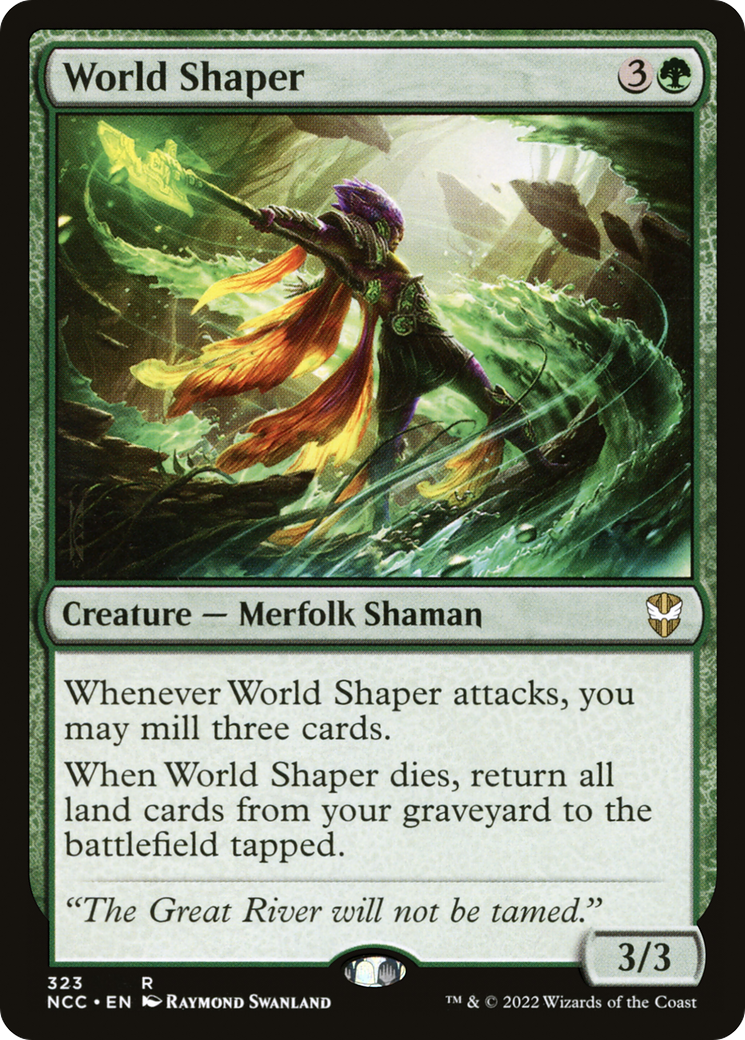
World Shaper
World Shaper
Creature — Merfolk Shaman
3/3
Whenever this creature attacks, you may mill three cards.
When this creature dies, return all land cards from your graveyard to the battlefield tapped.
Instants 4
-
1
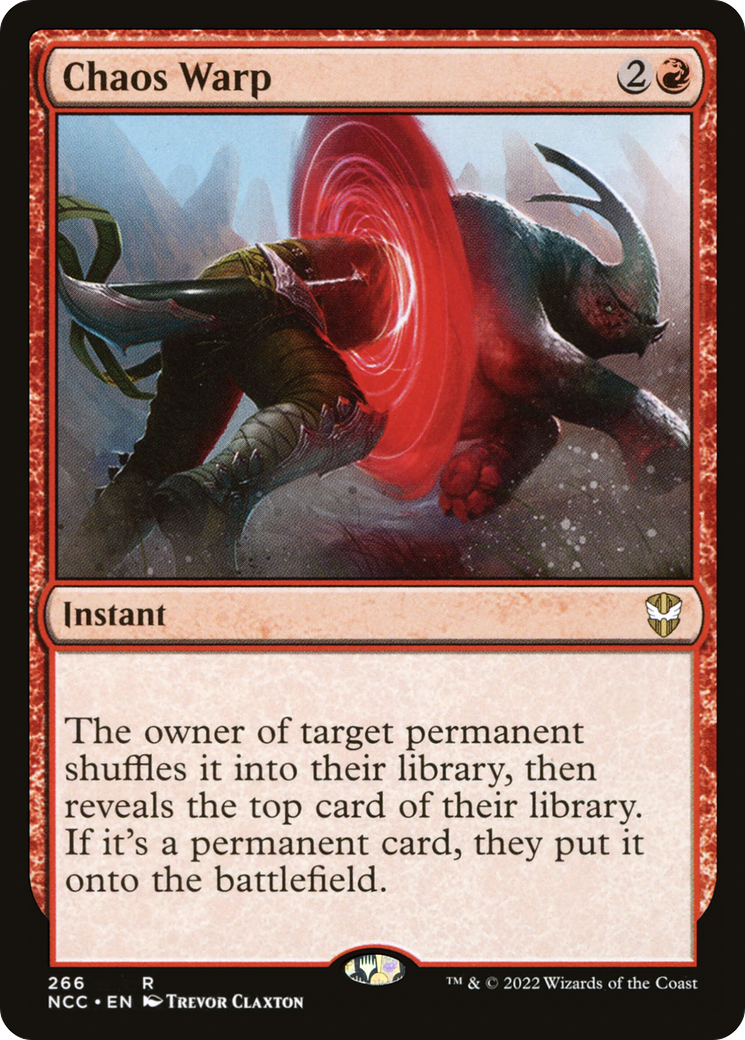
Chaos Warp
Chaos Warp
Instant
The owner of target permanent shuffles it into their library, then reveals the top card of their library. If it's a permanent card, they put it onto the battlefield.
- A permanent card is a card with one or more of the following card types: artifact, creature, enchantment, land, or planeswalker.
- The owner of a token is the player under whose control the token was put onto the battlefield. If a token is shuffled into a player's library this way, that player shuffles before revealing the top card of that library.
- If the revealed card is not a permanent card, it remains on top of that library.
- If the permanent is an illegal target by the time Chaos Warp tries to resolve, it won't resolve and none of its effects will occur. No library will be shuffled and no card will be revealed.
- If the revealed card is a permanent card but can't enter (perhaps because it's an Aura with nothing to enchant), it remains on top of that library.
-
1
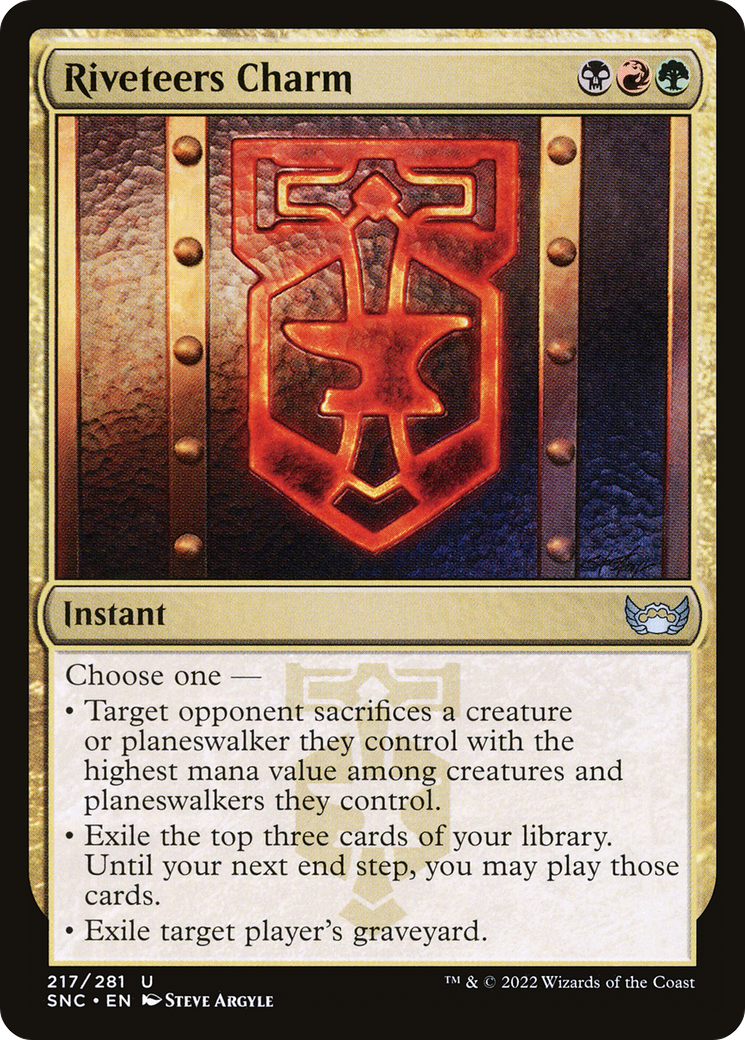
Riveteers Charm
Riveteers Charm
Instant
Choose one —
- Target opponent sacrifices a creature or planeswalker they control with the highest mana value among creatures and planeswalkers they control.
- Exile the top three cards of your library. Until your next end step, you may play those cards.
- Exile target player's graveyard.
-
1
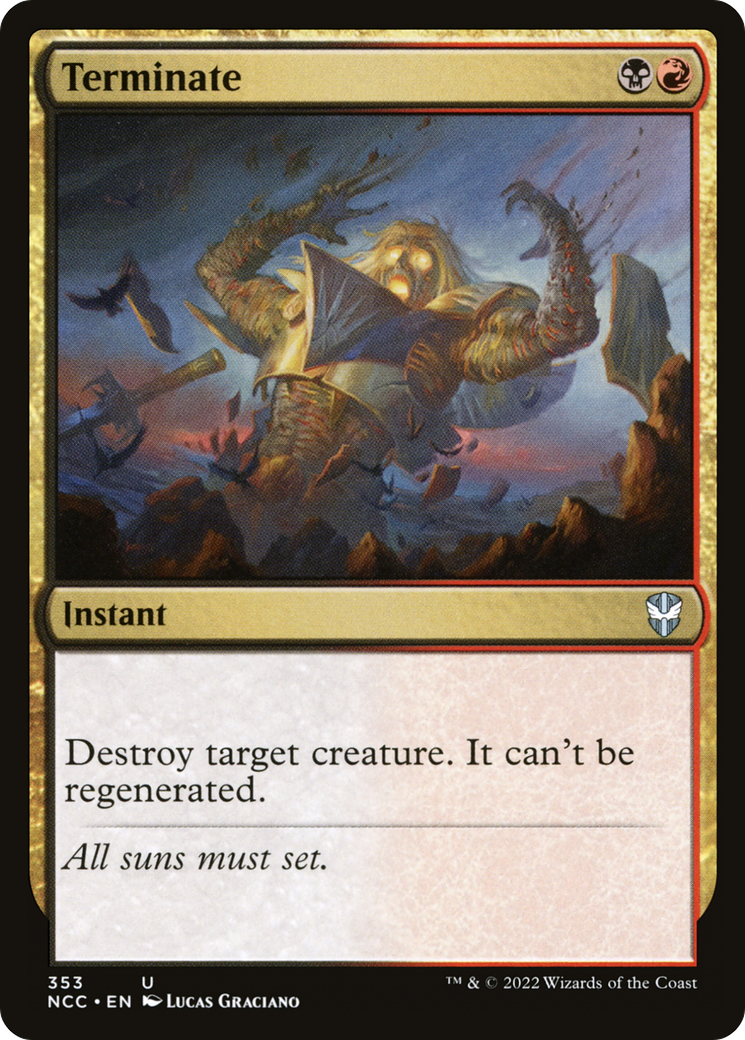
Terminate
Terminate
Instant
Destroy target creature. It can't be regenerated.
-
1
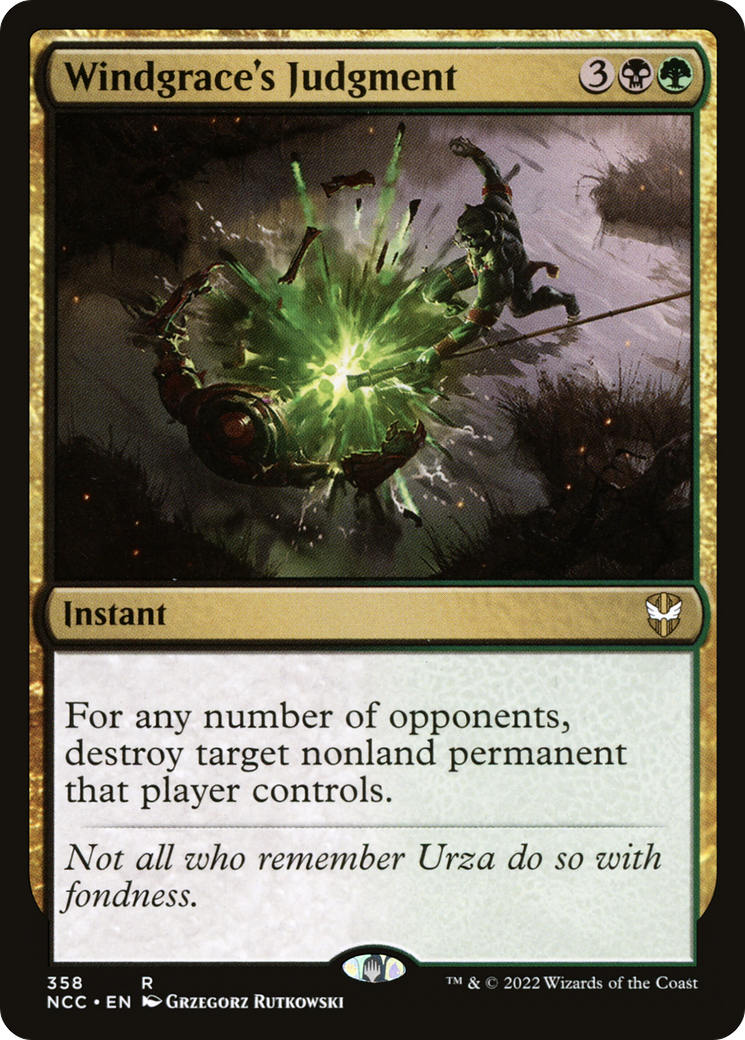
Windgrace's Judgment
Windgrace's Judgment
Instant
For any number of opponents, destroy target nonland permanent that player controls.
Sorceries 11
-
1
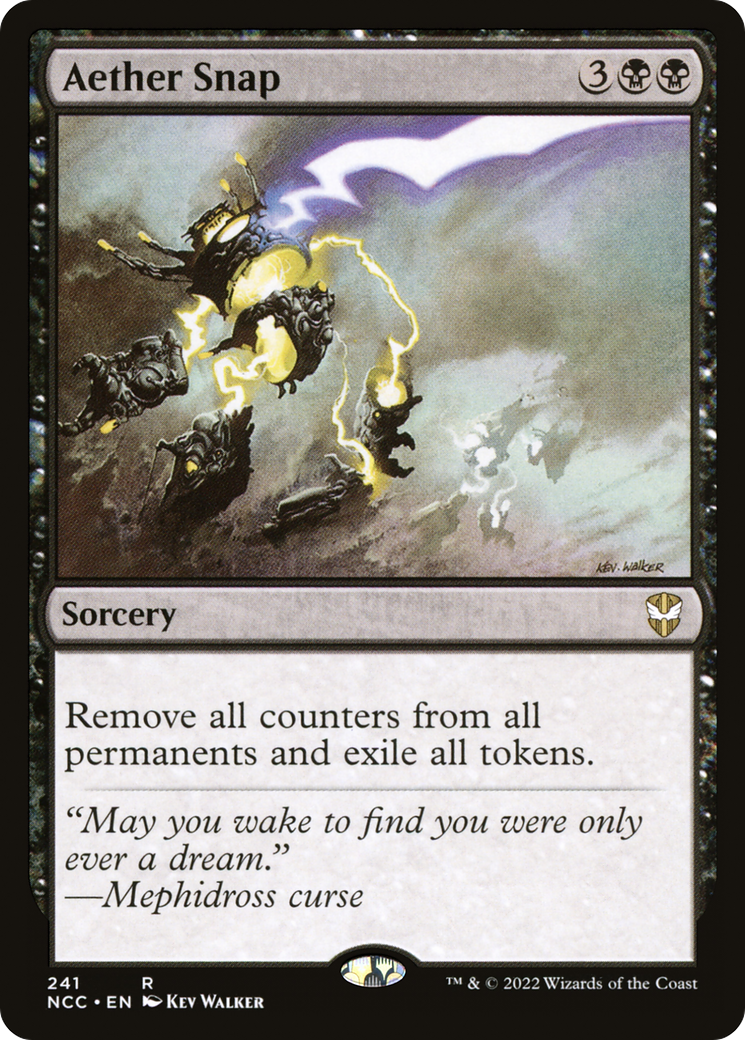
Aether Snap
Aether Snap
Sorcery
Remove all counters from all permanents and exile all tokens.
- Aether Snap removes all counters from permanents, no matter what kind they are.
- Counters on objects that aren't permanents, such as time counters on a suspended card or poison counters on a player, are unaffected by Aether Snap.
-
1
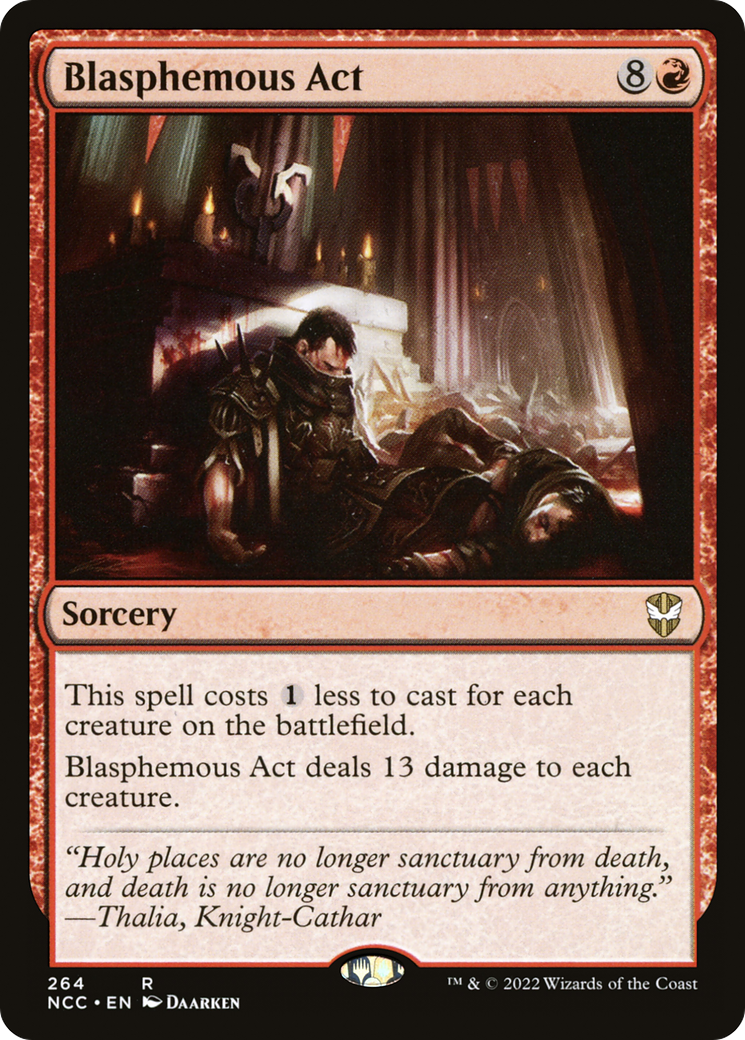
Blasphemous Act
Blasphemous Act
Sorcery
This spell costs less to cast for each creature on the battlefield.
Blasphemous Act deals 13 damage to each creature.
- Although players may respond to Blasphemous Act once it's been cast, once it's announced, they can't respond before the cost is calculated and paid.
- Blasphemous Act's ability can't reduce the total cost to cast the spell below .
- The total cost to cast Blasphemous Act is locked in before you pay that cost. For example, if there are three creatures on the battlefield, including one you can sacrifice to add , the total cost of Blasphemous Act is . Then you can sacrifice the creature when you activate mana abilities just before paying the cost.
- To determine the total cost of a spell, start with the mana cost or alternative cost you're paying, add any cost increases, then apply any cost reductions (such as that of Blasphemous Act). The mana value of the spell is determined only by its mana cost, no matter what the total cost to cast the spell was.
-
1
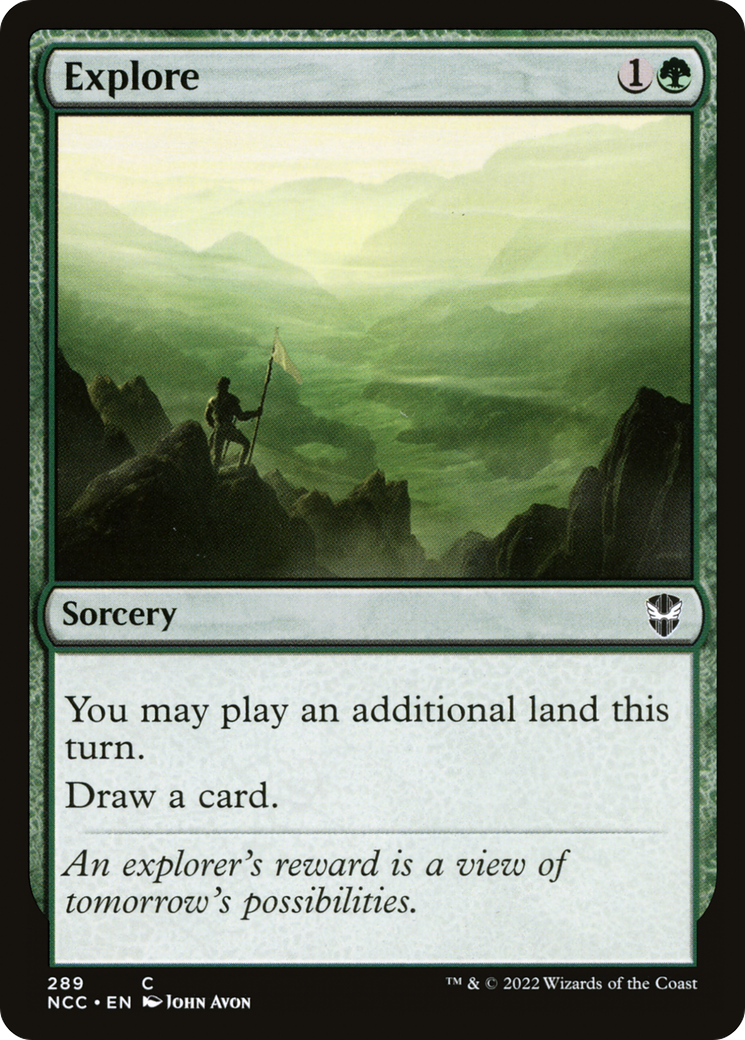
Explore
Explore
Sorcery
You may play an additional land this turn.
Draw a card.
- The effects of multiple Explores in the same turn are cumulative. They're also cumulative with other effects that let you play additional lands, such as the one from Urban Evolution.
- Explore's effect allows you to play an additional land during your main phase. Doing so follows the normal timing rules for playing lands. In particular, you don't get to play a land as Explore resolves; Explore fully resolves first and you draw a card, perhaps a land you'll play later.
- If you somehow manage to cast Explore when it's not your turn, you'll draw a card when it resolves, but you won't be able to play a land that turn.
-
1
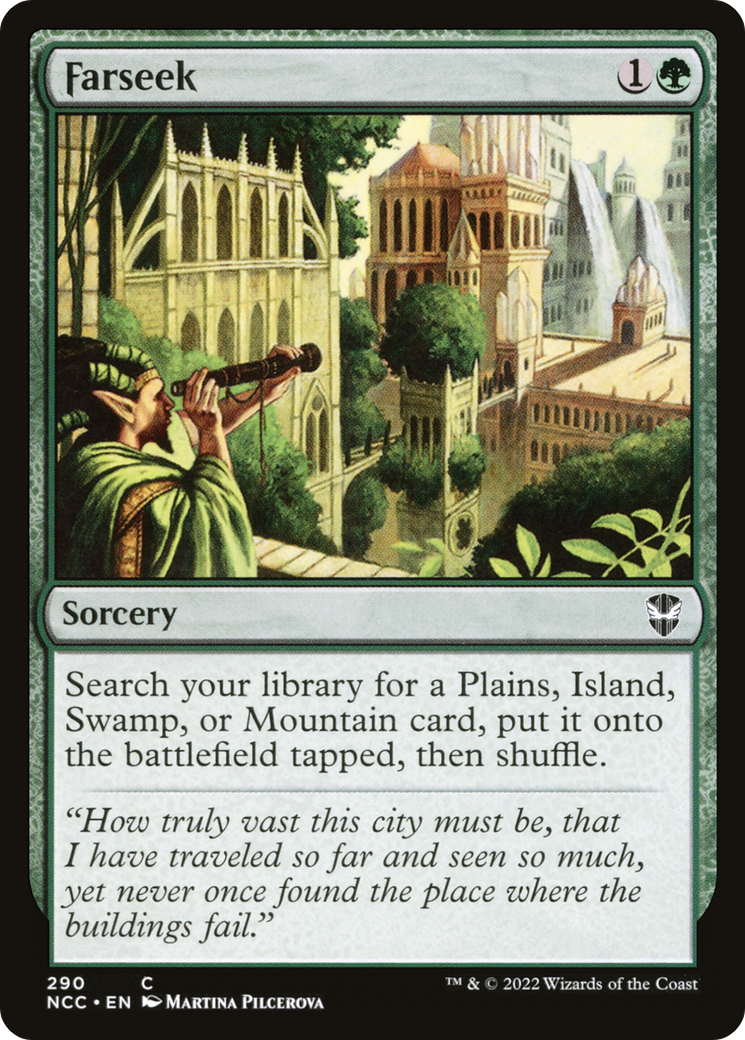
Farseek
Farseek
Sorcery
Search your library for a Plains, Island, Swamp, or Mountain card, put it onto the battlefield tapped, then shuffle.
- Farseek can find any land with any of the listed land types, including nonbasic ones, even if that land is a Forest in addition to one or more of those types.
-
1
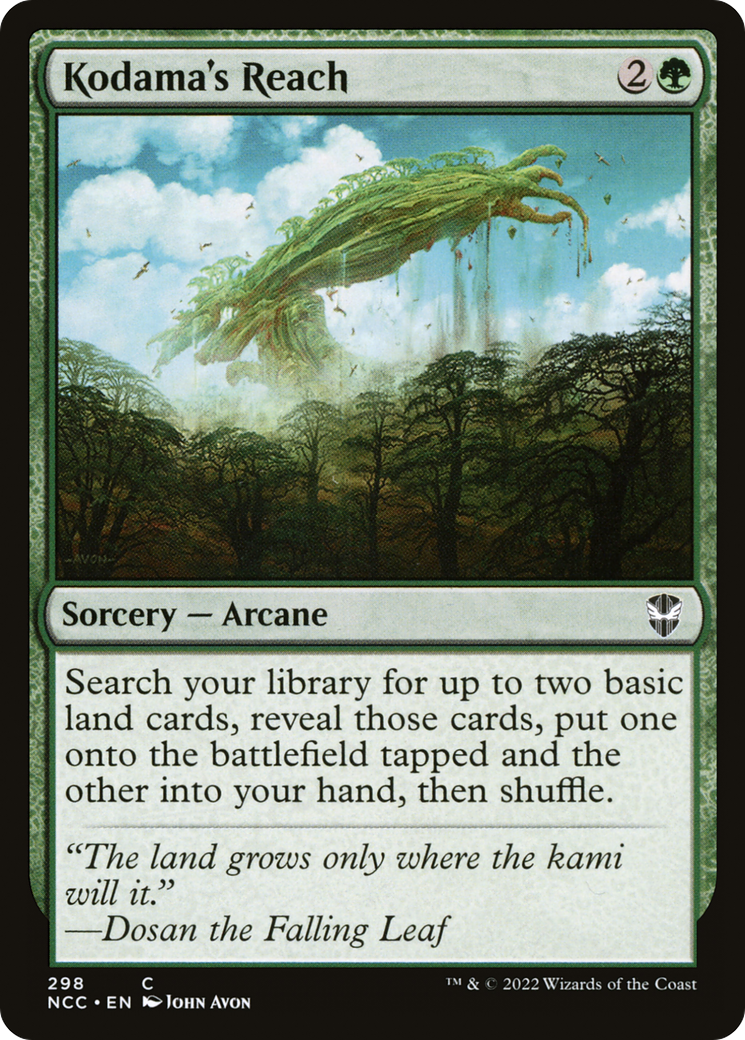
Kodama's Reach
Kodama's Reach
Sorcery — Arcane
Search your library for up to two basic land cards, reveal those cards, put one onto the battlefield tapped and the other into your hand, then shuffle.
- You can get just one basic land card if you wish (or even none at all). If you get only one land card, you put it onto the battlefield tapped.
-
1
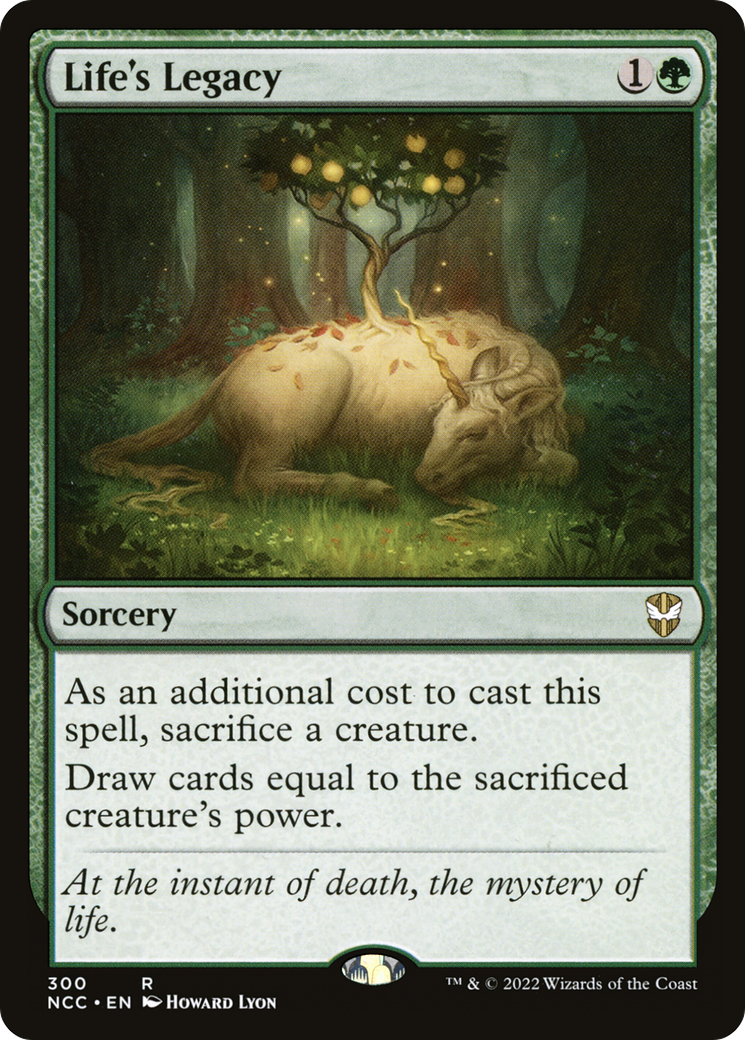
Life's Legacy
Life's Legacy
Sorcery
As an additional cost to cast this spell, sacrifice a creature.
Draw cards equal to the sacrificed creature's power.
- You must sacrifice exactly one creature to cast this spell; you can't cast it without sacrificing a creature, and you can't sacrifice additional creatures.
- Players can only respond once this spell has been cast and all its costs have been paid. No one can try to destroy the creature you sacrificed to prevent you from casting this spell.
-
1
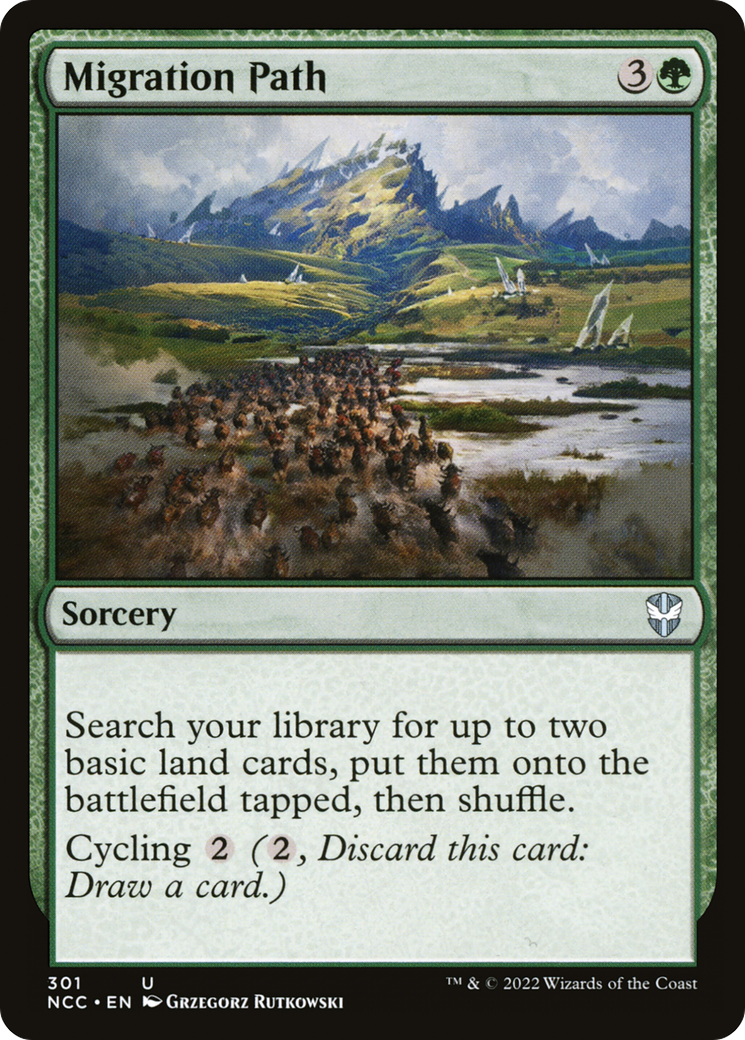
Migration Path
Migration Path
Sorcery
Search your library for up to two basic land cards, put them onto the battlefield tapped, then shuffle.
Cycling ( , Discard this card: Draw a card.)
-
1
Painful Truths
Painful Truths
Sorcery
Converge — You draw X cards and you lose X life, where X is the number of colors of mana spent to cast this spell.
- The maximum number of colors of mana you can spend to cast a spell is five. Colorless is not a color. Note that the cost of a spell with converge may limit how many colors of mana you can spend.
- Unless a spell or ability allows you to, you can't choose to pay more mana for a spell with a converge ability just to spend more colors of mana. Likewise, if a spell or ability reduces the amount of mana it costs you to cast a spell with converge, you can't ignore that cost reduction in order to spend more colors of mana.
- If there are any alternative or additional costs to cast a spell with a converge ability, the mana spent to pay those costs will count. For example, if an effect makes sorcery spells cost more to cast, you could pay to cast Radiant Flames and deal 4 damage to each creature.
- If you cast a spell with converge without spending any mana to cast it (perhaps because an effect allowed you to cast it without paying its mana cost), then the number of colors spent to cast it will be zero.
- If a spell with a converge ability is copied, no mana was spent to cast the copy, so the number of colors of mana spent to cast the spell will be zero. The number of colors spent to cast the original spell is not copied.
-
1
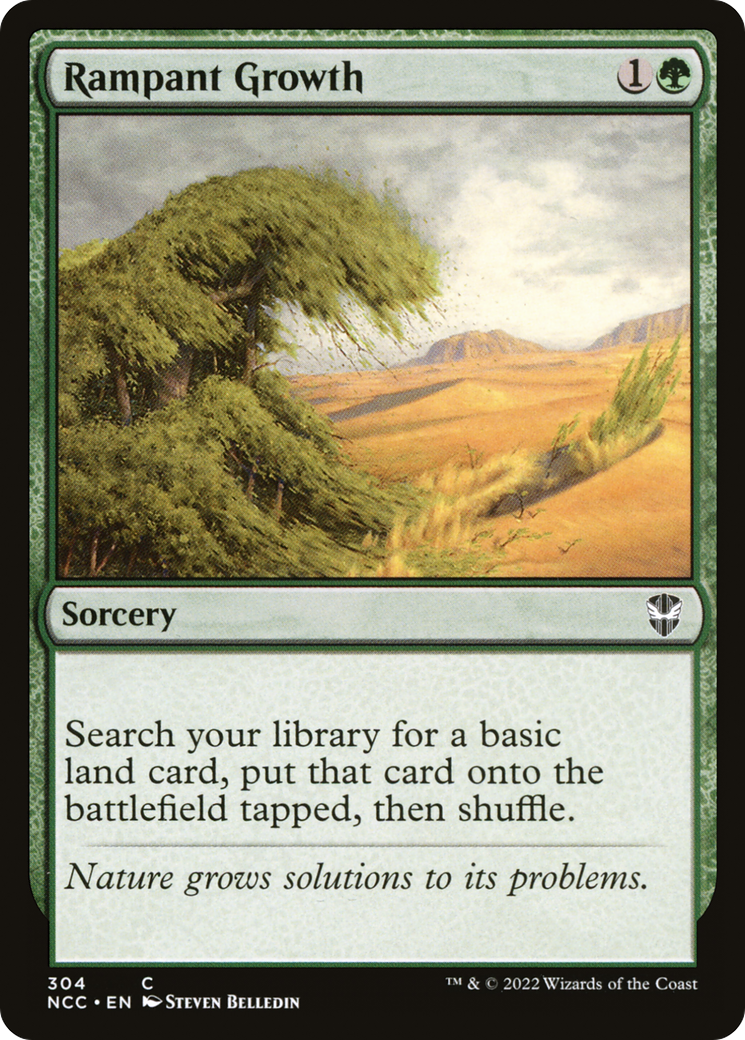
Rampant Growth
Rampant Growth
Sorcery
Search your library for a basic land card, put that card onto the battlefield tapped, then shuffle.
- The land does not count toward your one per turn limit because it was put onto the battlefield by an effect.
-
1
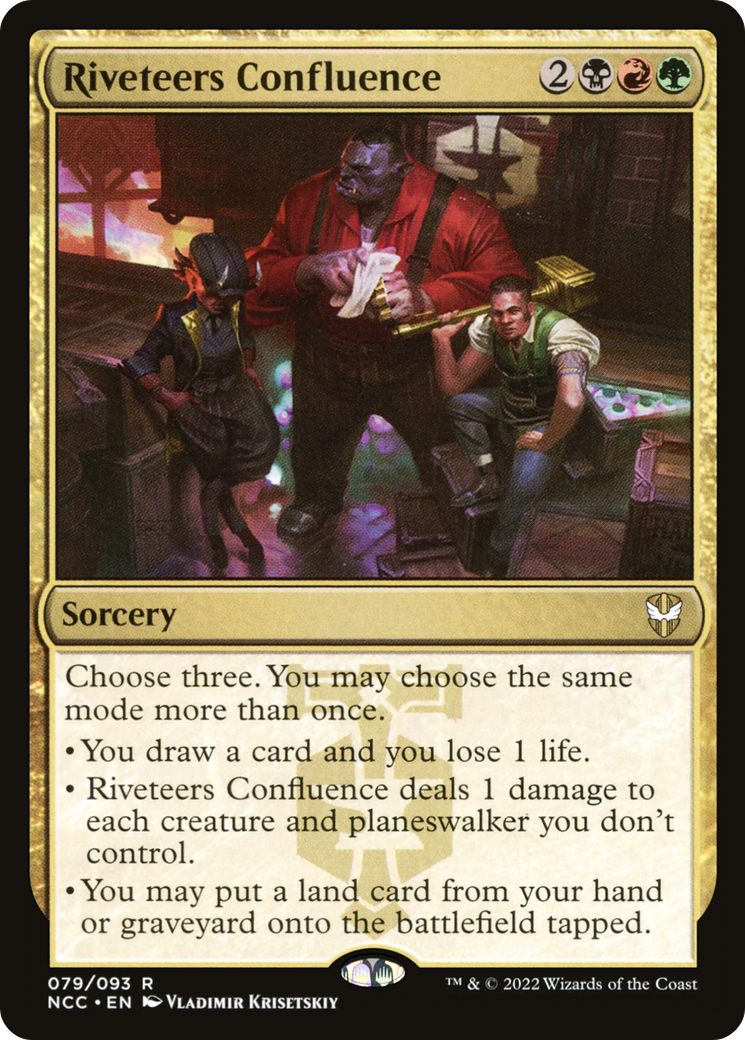
Riveteers Confluence
Riveteers Confluence
Sorcery
Choose three. You may choose the same mode more than once.
- You draw a card and you lose 1 life.
- Riveteers Confluence deals 1 damage to each creature and planeswalker you don't control.
- You may put a land card from your hand or graveyard onto the battlefield tapped.
-
1
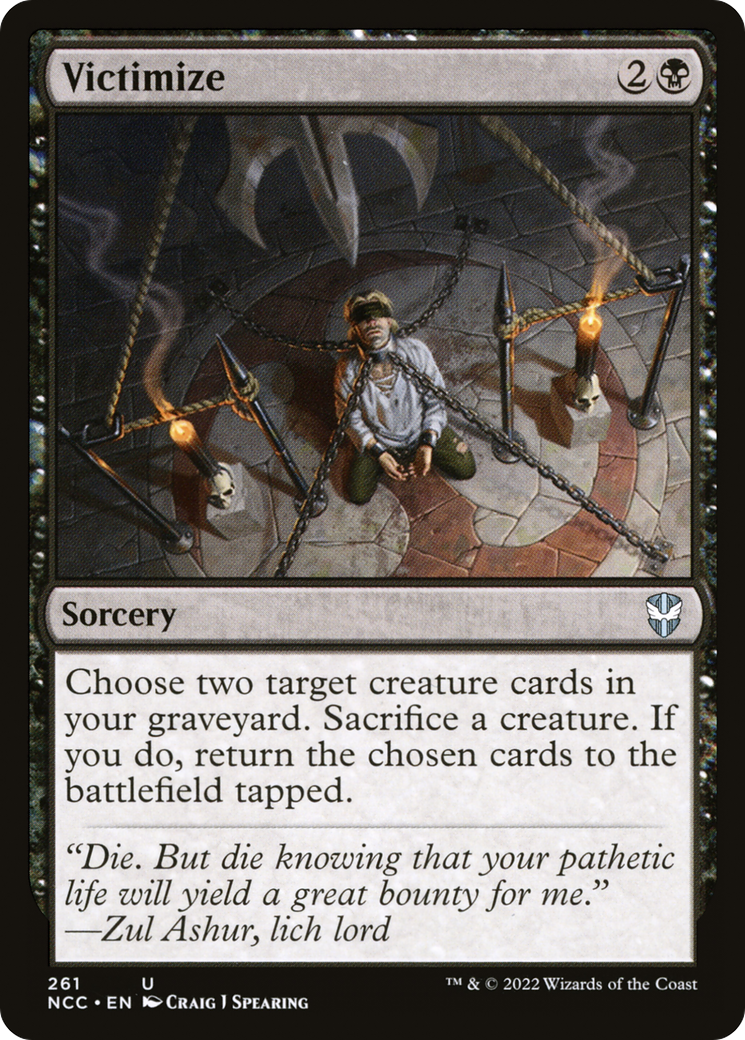
Victimize
Victimize
Sorcery
Choose two target creature cards in your graveyard. Sacrifice a creature. If you do, return the chosen cards to the battlefield tapped.
- You must choose two targets. You can't cast Victimize targeting only one creature card.
- If one of the targeted creature cards is an illegal target (for instance, because it has left your graveyard before Victimize resolves), you'll still sacrifice a creature and put the other card onto the battlefield. If both are illegal targets, Victimize won't resolve. You won't sacrifice a creature.
- The creature you sacrifice isn't chosen until Victimize resolves. You can't return the creature you sacrifice because it will still be on the battlefield at the time targets are chosen.
- As Victimize resolves, you must sacrifice a creature if able. You can't change your mind and choose not to sacrifice anything.
Artifacts 7
-
1
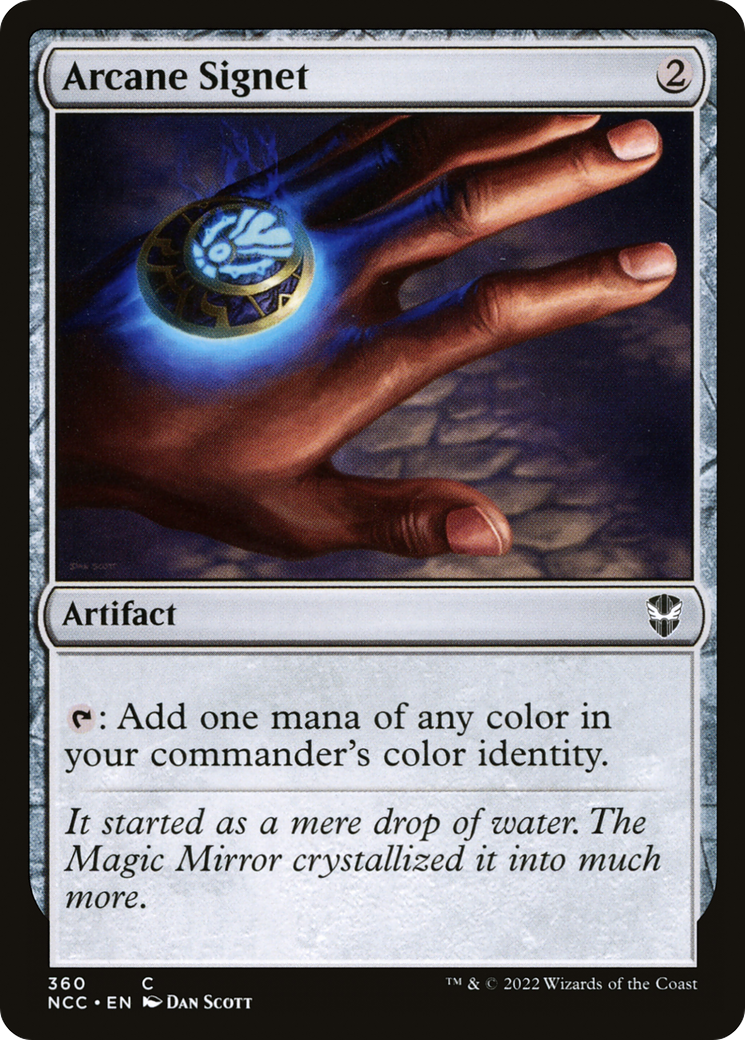
Arcane Signet
Arcane Signet
Artifact
: Add one mana of any color in your commander's color identity.
- If your commander is a card that has no colors in its color identity, Arcane Signet's ability produces no mana. It doesn't produce .
- If you have two commanders, the ability adds one mana of any color in their combined color identities.
- If you don't have a commander, Arcane Signet's ability produces no mana.
-
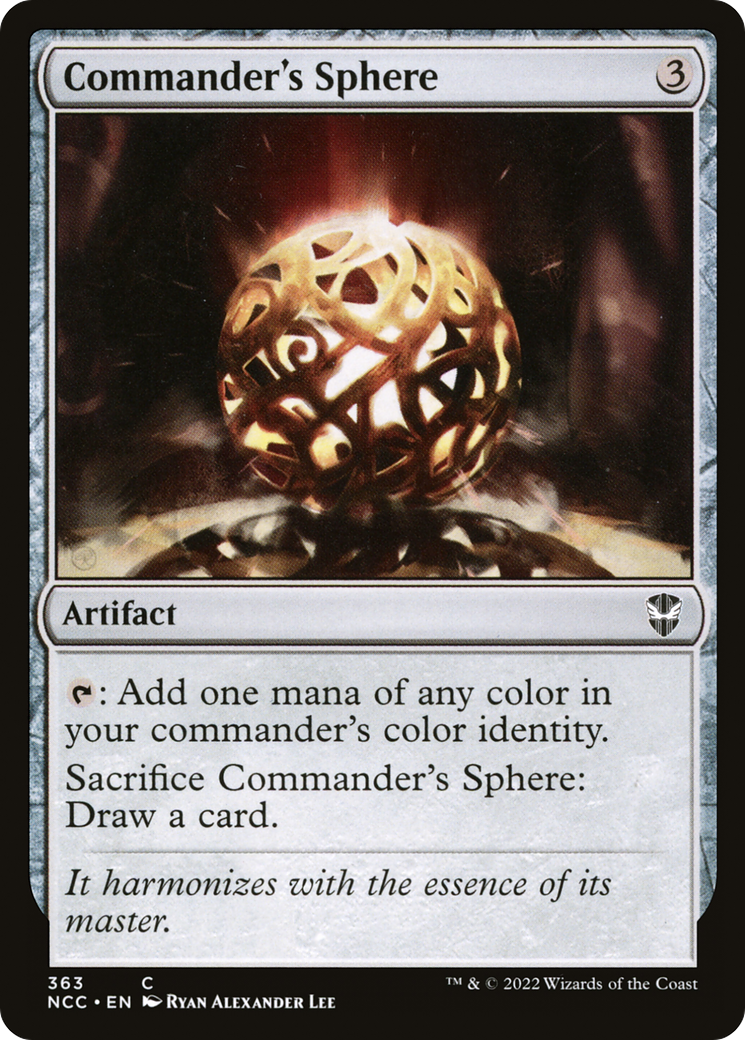
1
Commander's Sphere
Commander's Sphere
Artifact
: Add one mana of any color in your commander's color identity.
Sacrifice this artifact: Draw a card.
- If your commander is a card that has no colors in its color identity, Commander's Sphere's first ability produces no mana. It doesn't produce .
- If you don't have a commander, Commander's Sphere's first ability produces no mana.
- If you have two commanders, the ability adds one mana of any color in their combined color identities.
-
1
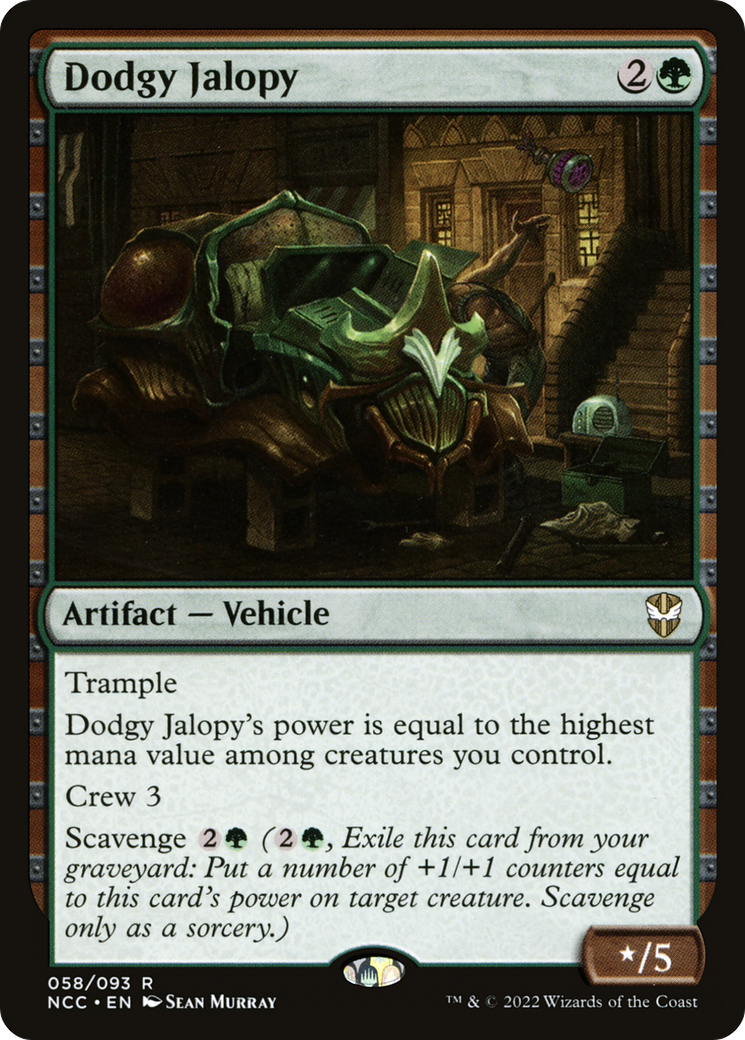
Dodgy Jalopy
Dodgy Jalopy
Artifact — Vehicle
*/5
Trample
Dodgy Jalopy's power is equal to the highest mana value among creatures you control.
Crew 3
Scavenge ( , Exile this card from your graveyard: Put a number of +1/+1 counters equal to this card's power on target creature. Scavenge only as a sorcery.)
- Exiling the card with scavenge is part of the cost of activating the scavenge ability. Once the ability is activated and the cost is paid, it's too late to stop the ability from being activated by trying to remove the card from the graveyard.
- The ability that defines Dodgy Jalopy's power works in all zones, not just on the battlefield.
- The number of counters given by Dodgy Jalopy's scavenge ability is its power as it last existed in your graveyard before exiling it. Players can't change how many counters it gives out after you've activated the ability by destroying the creature you control with the highest mana value.
-
1
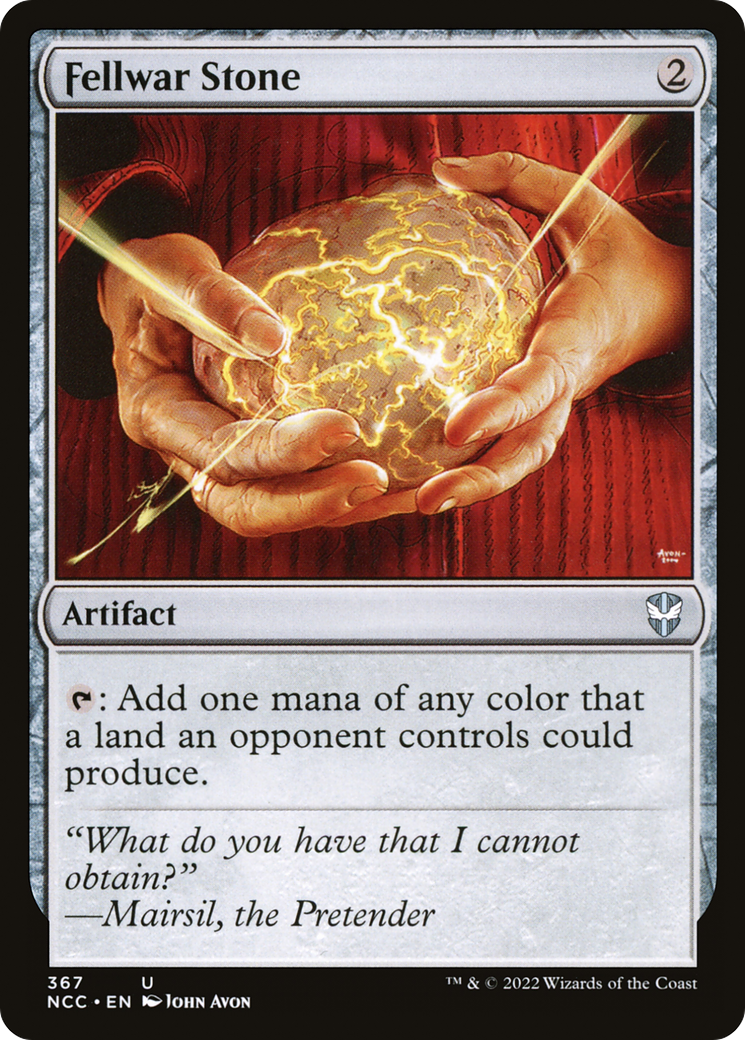
Fellwar Stone
Fellwar Stone
Artifact
: Add one mana of any color that a land an opponent controls could produce.
- When determining what colors of mana your opponents' lands could produce, take into account any applicable replacement effects that would apply to those lands' mana abilities (such as Contamination's effect, for example). If there is more than one, consider them in any possible order.
- Fellwar Stone doesn't care about any restrictions or riders your opponents' lands (such as Ancient Ziggurat or Hall of the Bandit Lord) put on the mana they produce. It just cares about colors of mana.
- The colors of mana are white, blue, black, red, and green. Fellwar Stone can't be tapped for colorless mana, even if a land an opponent controls could produce colorless mana.
- Fellwar Stone checks the effects of all mana-producing abilities of lands your opponents control, but it doesn't check their costs. For example, Vivid Crag has the ability " , Remove a charge counter from Vivid Crag: Add one mana of any color." If an opponent controls Vivid Crag and you control Fellwar Stone, you can tap Fellwar Stone for any color of mana. It doesn't matter whether Vivid Crag has a charge counter on it, and it doesn't matter whether it's untapped.
- This works even if the opponent's lands are tapped. It only checks what kinds of mana can be produced, not if the abilities that produce them are usable right now.
- It only produces one mana even if the land can produce more than one.
- The ability can be activated if the opponent has no lands that produce mana, but the effect will not be able to generate any mana.
-
1
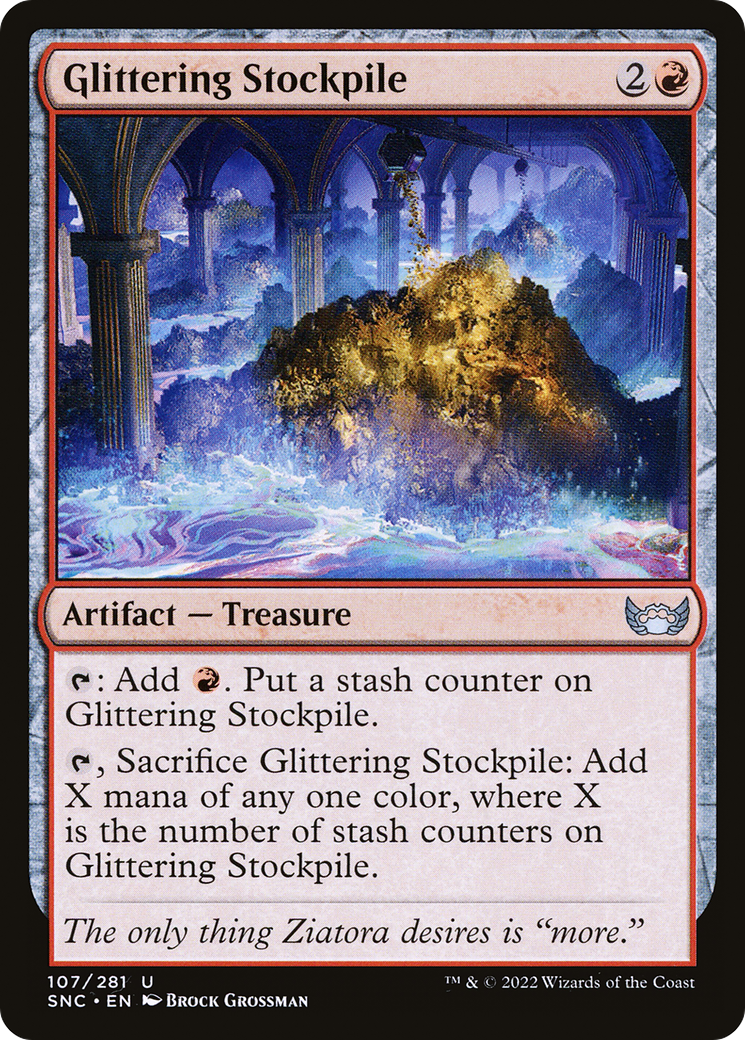
Glittering Stockpile
Glittering Stockpile
Artifact — Treasure
: Add . Put a stash counter on this artifact.
, Sacrifice this artifact: Add X mana of any one color, where X is the number of stash counters on this artifact.
-
1
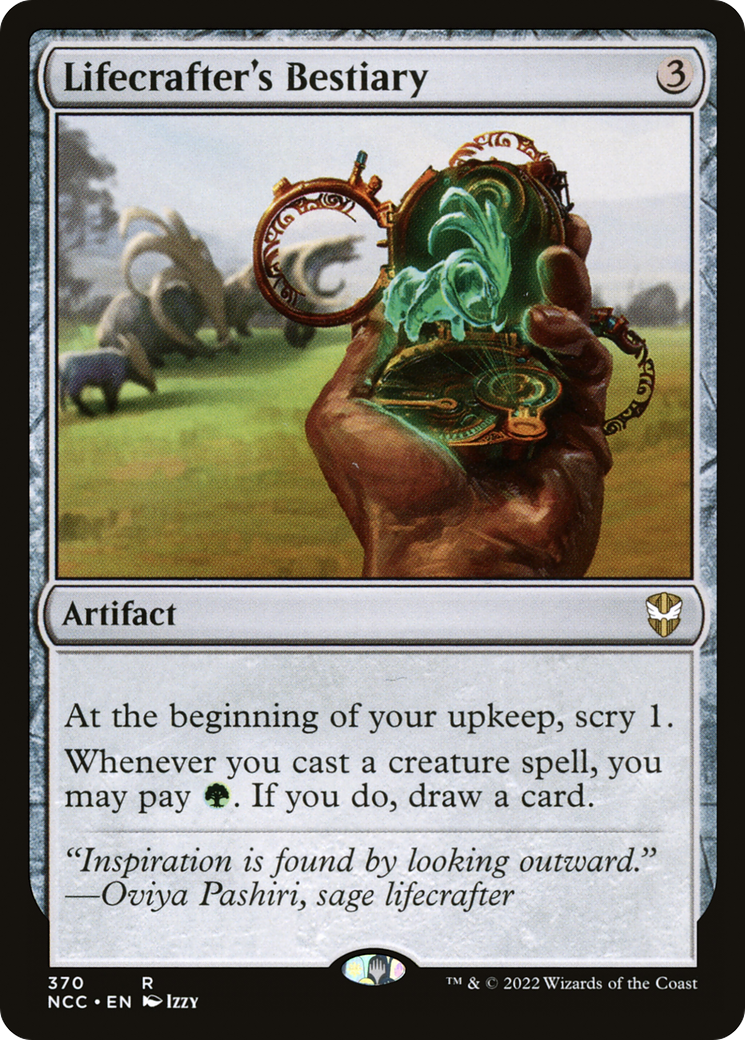
Lifecrafter's Bestiary
Lifecrafter's Bestiary
Artifact
At the beginning of your upkeep, scry 1.
Whenever you cast a creature spell, you may pay . If you do, draw a card.
- The draw step is after the upkeep step, so you'll scry 1 before you draw for the turn.
- Lifecrafter's Bestiary's second triggered ability resolves before the spell that caused it to trigger. The ability will resolve even if that spell is countered.
- While resolving Lifecrafter's Bestiary's second triggered ability, you can't pay multiple times to draw multiple cards.
-
1
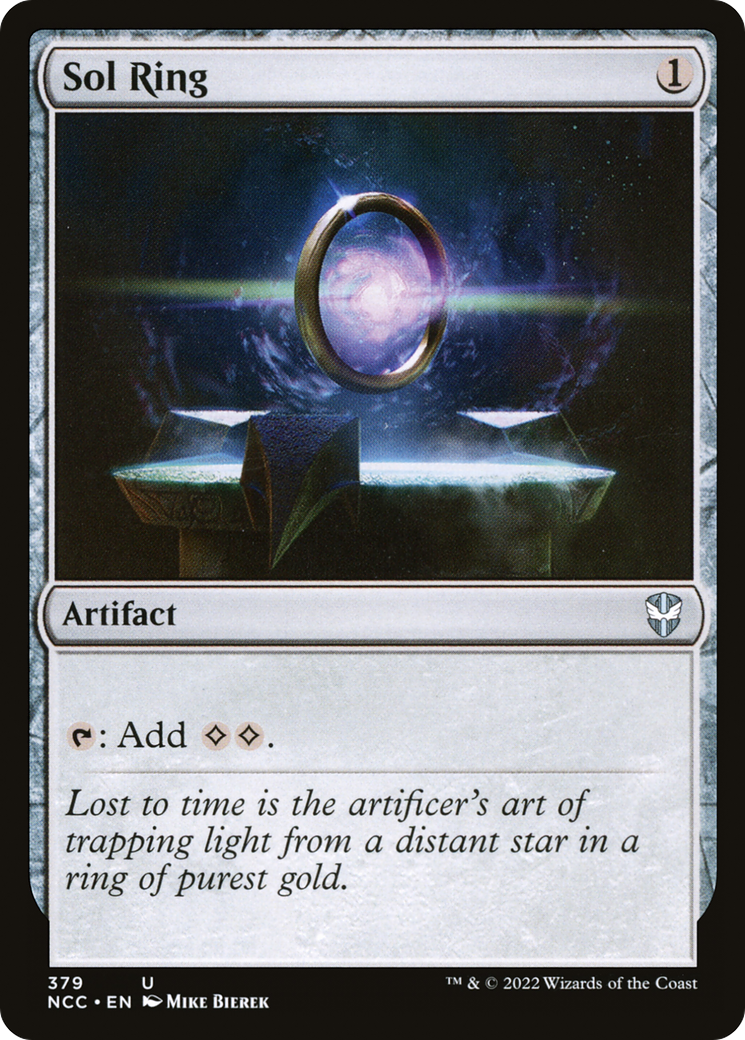
Sol Ring
Sol Ring
Artifact
: Add .
Enchantments 9
-
1
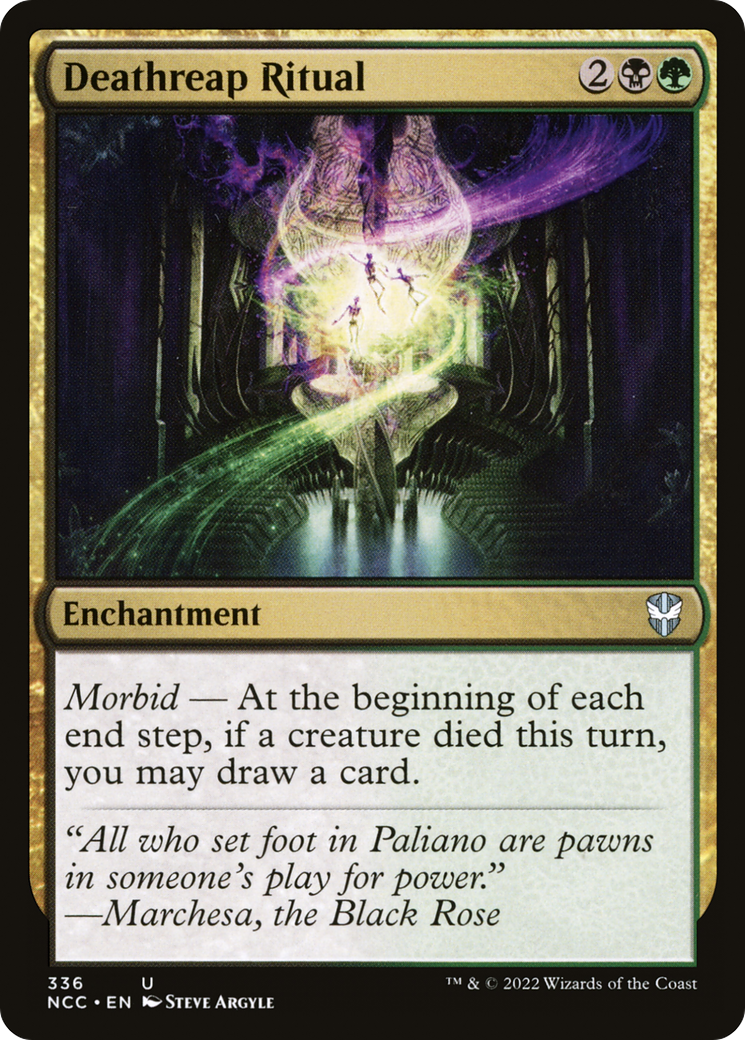
Deathreap Ritual
Deathreap Ritual
Enchantment
Morbid — At the beginning of each end step, if a creature died this turn, you may draw a card.
- If a creature didn't die before a turn's end step begins, Deathreap Ritual's ability doesn't trigger at all. The creature may have died before Deathreap Ritual entered the battlefield, however.
- You draw one card when the ability resolves, not one card per creature that died during the turn.
-
1
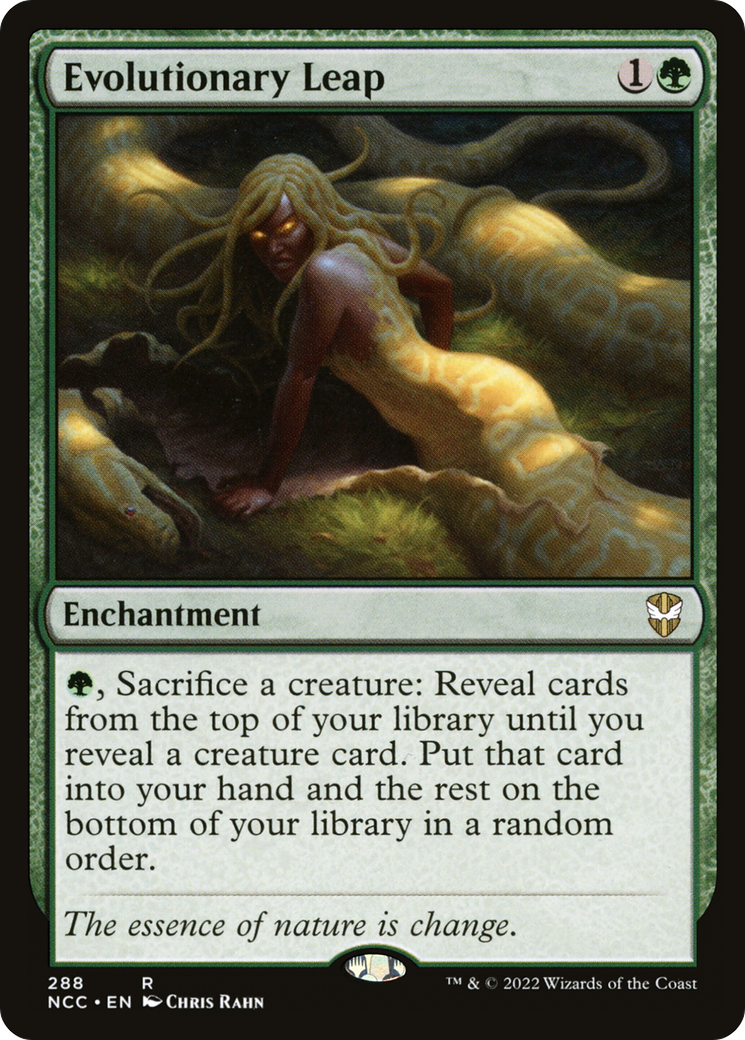
Evolutionary Leap
Evolutionary Leap
Enchantment
, Sacrifice a creature: Reveal cards from the top of your library until you reveal a creature card. Put that card into your hand and the rest on the bottom of your library in a random order.
- If you don't reveal a creature card, you'll reveal all the cards from your library and then put them back in your library in a random order.
-
1
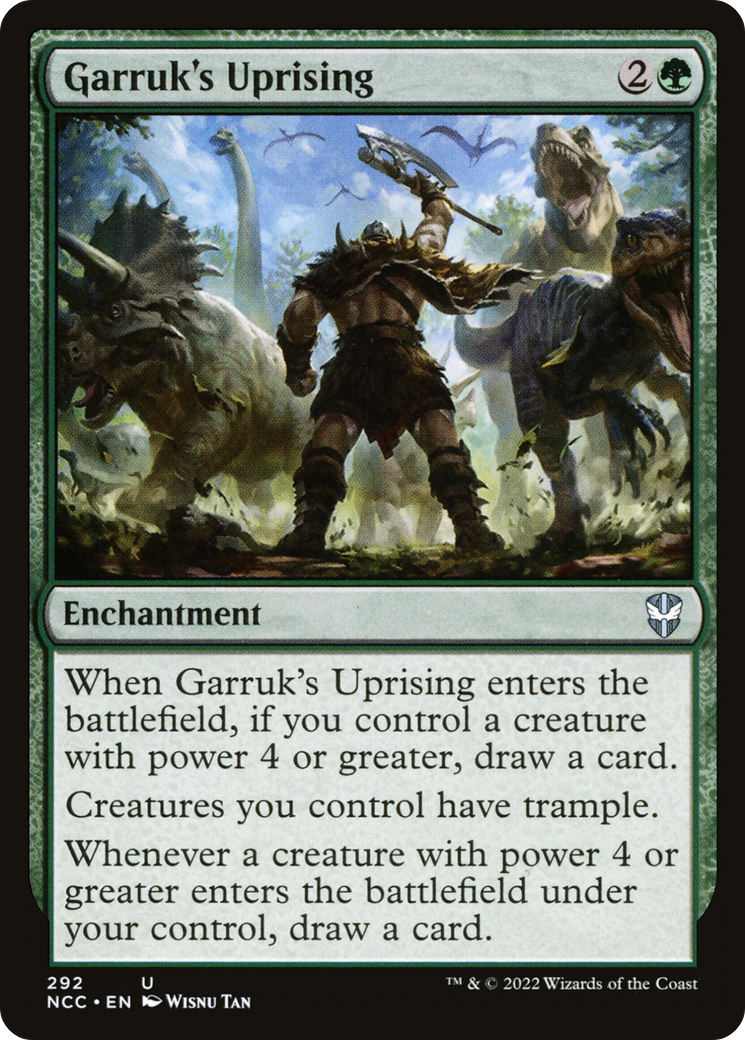
Garruk's Uprising
Garruk's Uprising
Enchantment
When this enchantment enters, if you control a creature with power 4 or greater, draw a card.
Creatures you control have trample. (Each of those creatures can deal excess combat damage to the player or planeswalker it's attacking.)
Whenever a creature you control with power 4 or greater enters, draw a card.
- The first ability of Garruk's Uprising has you draw just one card, no matter how many creatures you control with power 4 or greater.
- If one or more static abilities that apply to a creature entering change its power, those abilities are considered when determining whether Garruk's Uprising's last ability triggers. The same is true for replacement effects that apply to it, such as entering with one or more +1/+1 counters or entering as a copy of another creature.
- If you don't control a creature with power 4 or greater immediately after Garruk's Uprising enters, its first ability won't trigger. If you don't control one as the ability resolves, you don't draw a card. They don't have to be the same creature both times, however.
- Once the last ability of Garruk's Uprising has triggered, lowering the power of the creature or removing it from the battlefield won't stop you from drawing a card.
-
1
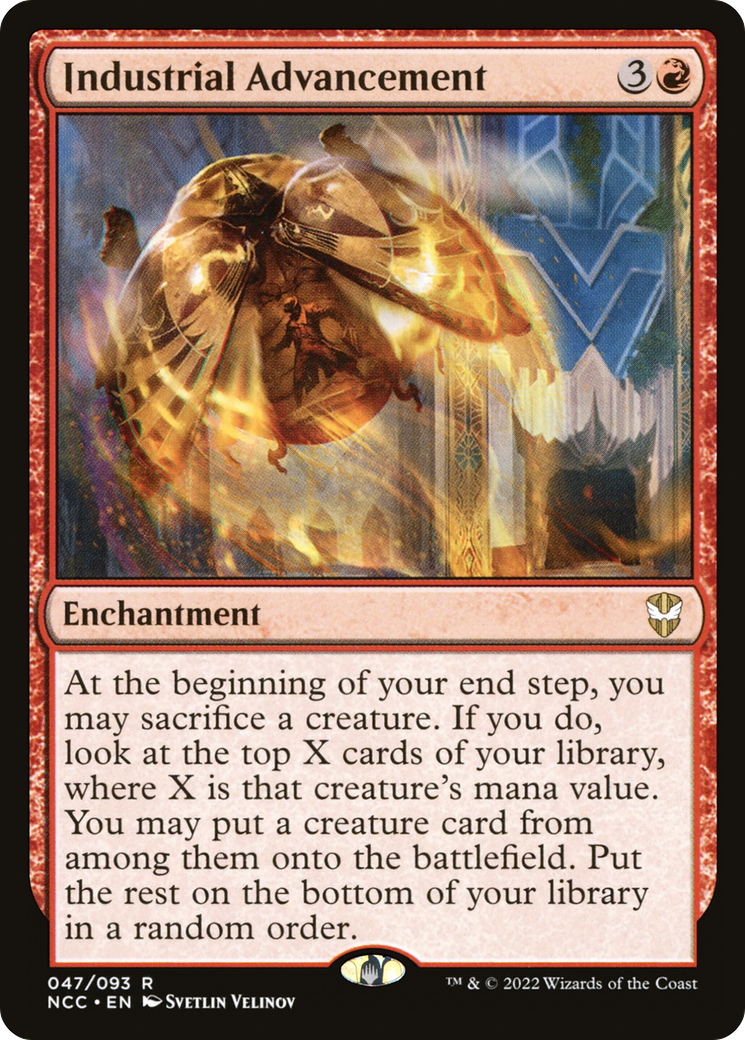
Industrial Advancement
Industrial Advancement
Enchantment
At the beginning of your end step, you may sacrifice a creature. If you do, look at the top X cards of your library, where X is that creature's mana value. You may put a creature card from among them onto the battlefield. Put the rest on the bottom of your library in a random order.
-
1
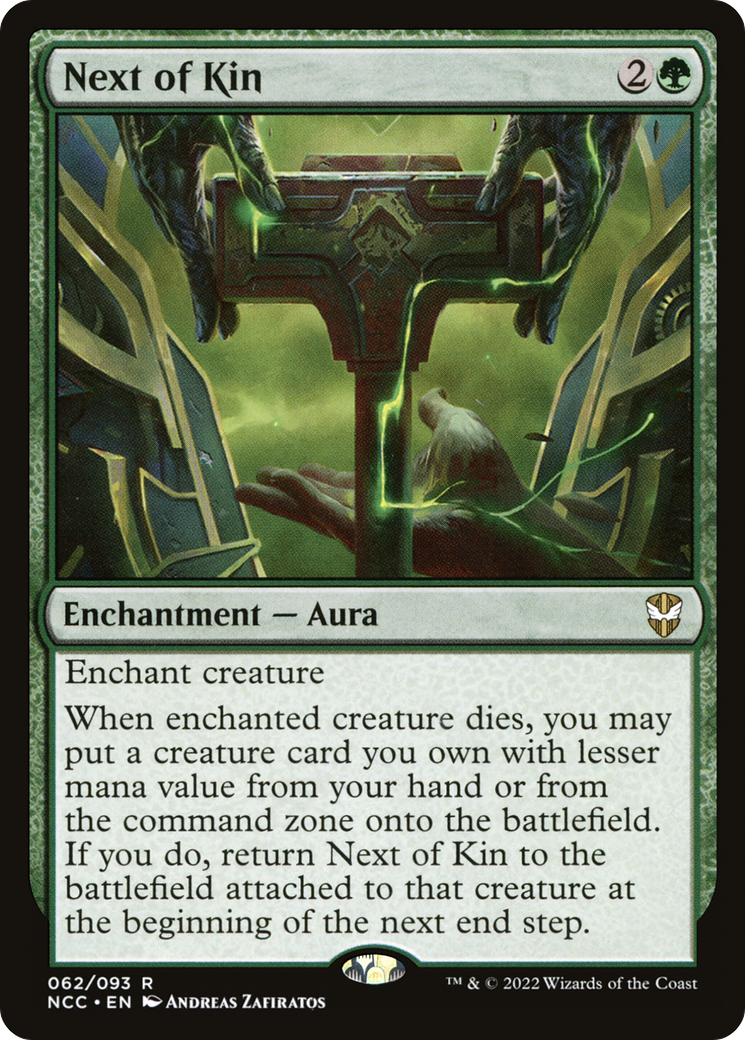
Next of Kin
Next of Kin
Enchantment — Aura
Enchant creature
When enchanted creature dies, you may put a creature card you own with lesser mana value from your hand or from the command zone onto the battlefield. If you do, return this card to the battlefield attached to that creature at the beginning of the next end step.
-
1
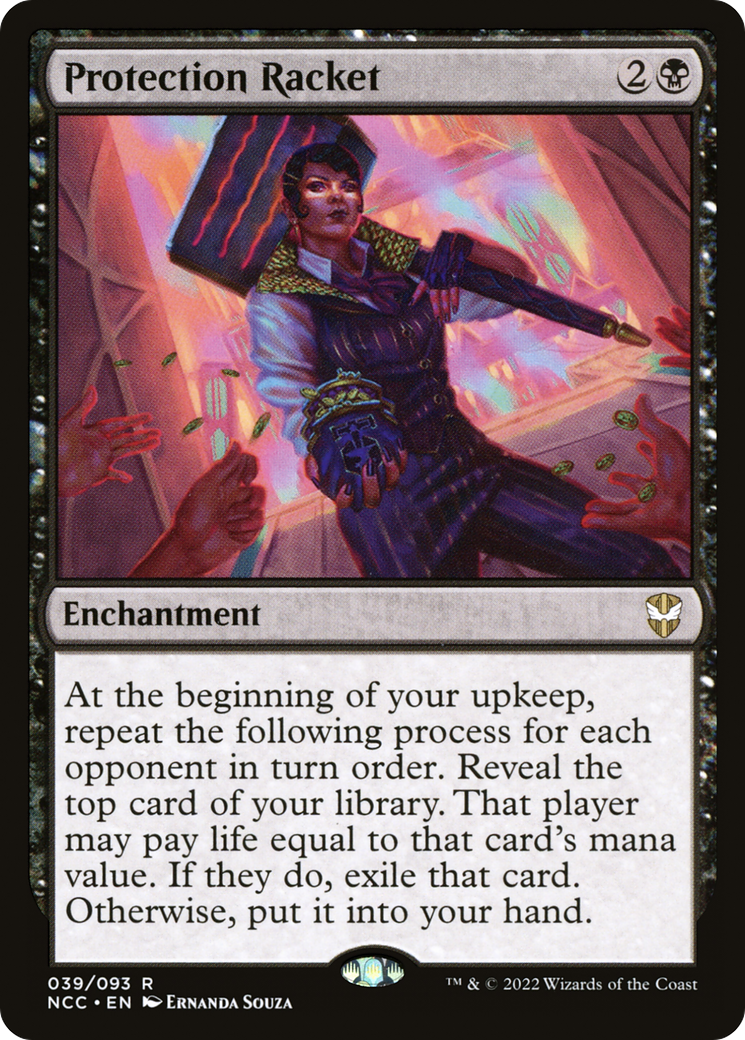
Protection Racket
Protection Racket
Enchantment
At the beginning of your upkeep, repeat the following process for each opponent in turn order. Reveal the top card of your library. That player may pay life equal to that card's mana value. If they do, exile that card. Otherwise, put it into your hand.
-
1
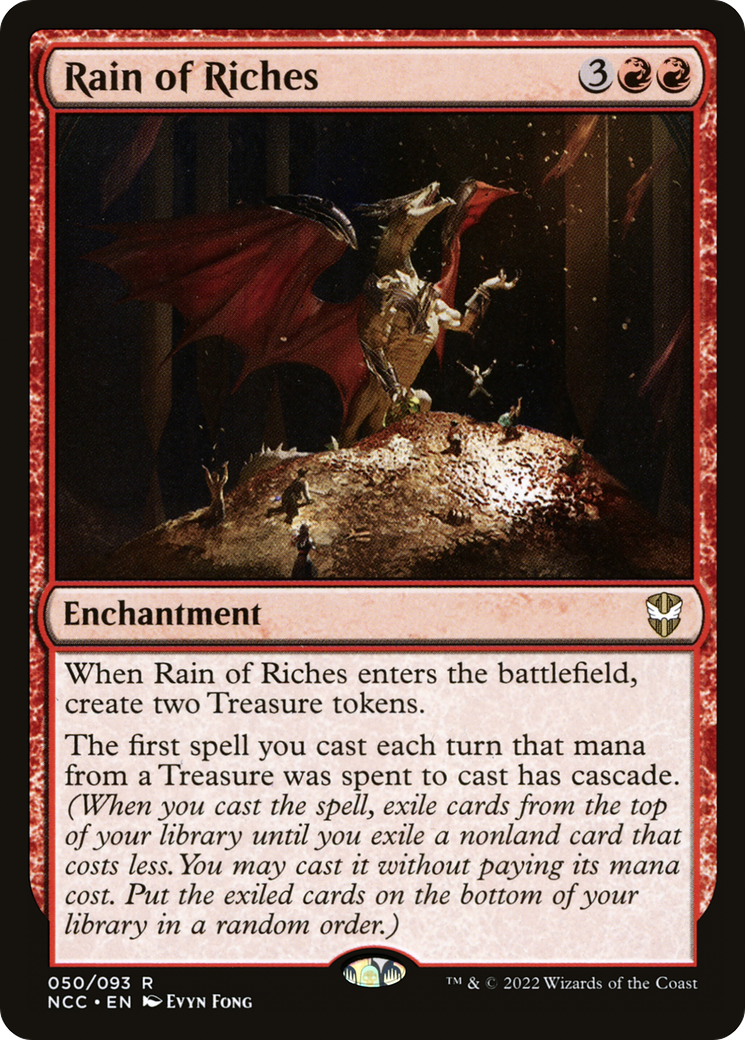
Rain of Riches
Rain of Riches
Enchantment
When this enchantment enters, create two Treasure tokens.
The first spell you cast each turn that mana from a Treasure was spent to cast has cascade. (When you cast the spell, exile cards from the top of your library until you exile a nonland card that costs less. You may cast it without paying its mana cost. Put the exiled cards on the bottom in a random order.)
-
1
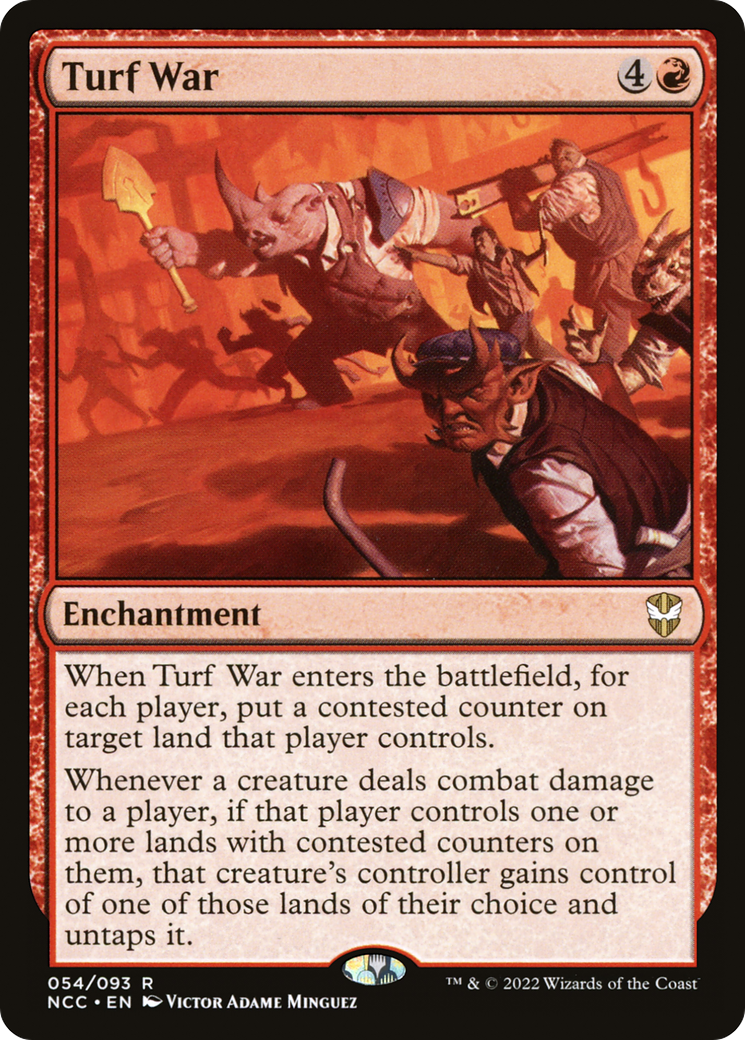
Turf War
Turf War
Enchantment
When this enchantment enters, for each player, put a contested counter on target land that player controls.
Whenever a creature deals combat damage to a player, if that player controls one or more lands with contested counters on them, that creature's controller gains control of one of those lands of their choice and untaps it.
-
1
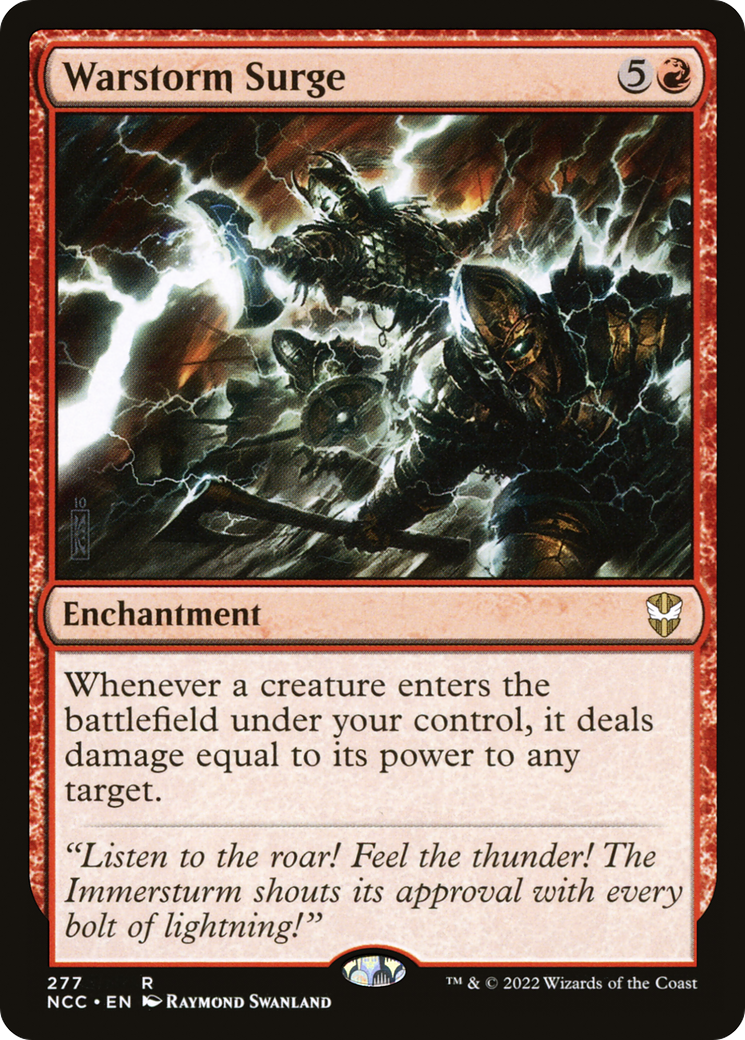
Warstorm Surge
Warstorm Surge
Enchantment
Whenever a creature you control enters, it deals damage equal to its power to any target.
- The creature that entered deals damage equal to its current power to the targeted permanent or player. If it's no longer on the battlefield, its last known existence on the battlefield is checked to determine its power.
- Warstorm Surge is the source of the ability, but the creature is the source of the damage. The ability couldn't target a creature with protection from red, for example. It could target a creature with protection from creatures, but all the damage would be prevented. Since damage is dealt by the creature, abilities like lifelink, deathtouch and infect are taken into account, even if the creature has left the battlefield by the time it deals damage.
Lands 39
-
1
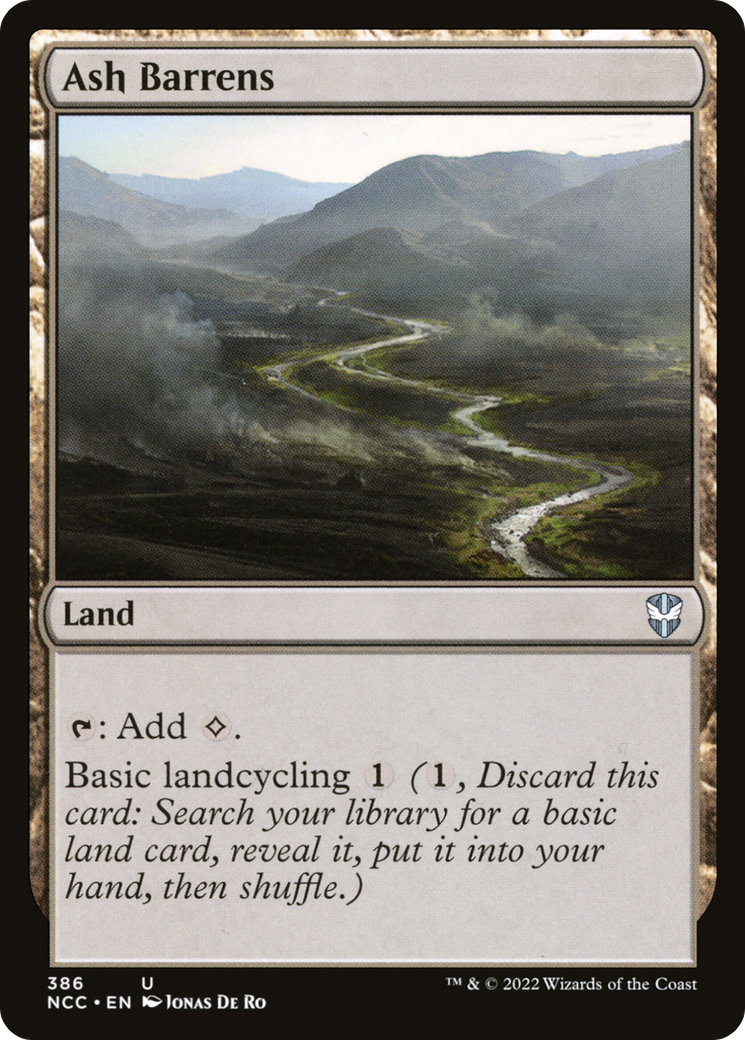
Ash Barrens
Ash Barrens
Land
: Add .
Basic landcycling ( , Discard this card: Search your library for a basic land card, reveal it, put it into your hand, then shuffle.)
-
1
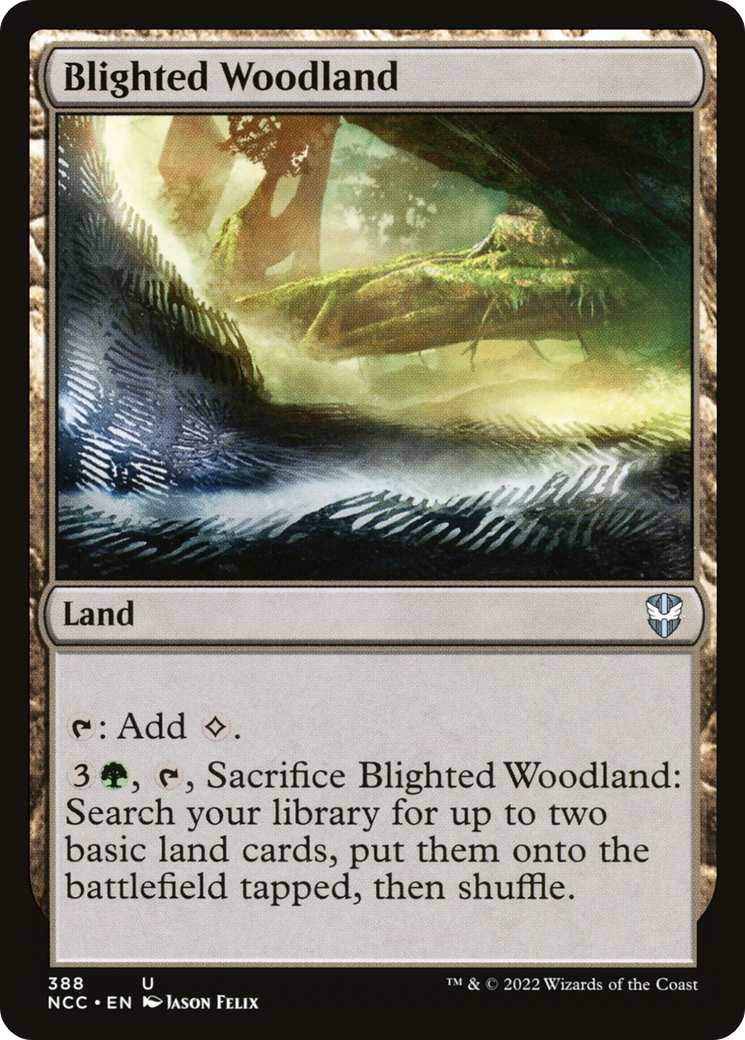
Blighted Woodland
Blighted Woodland
Land
: Add .
, , Sacrifice this land: Search your library for up to two basic land cards, put them onto the battlefield tapped, then shuffle.
-
1
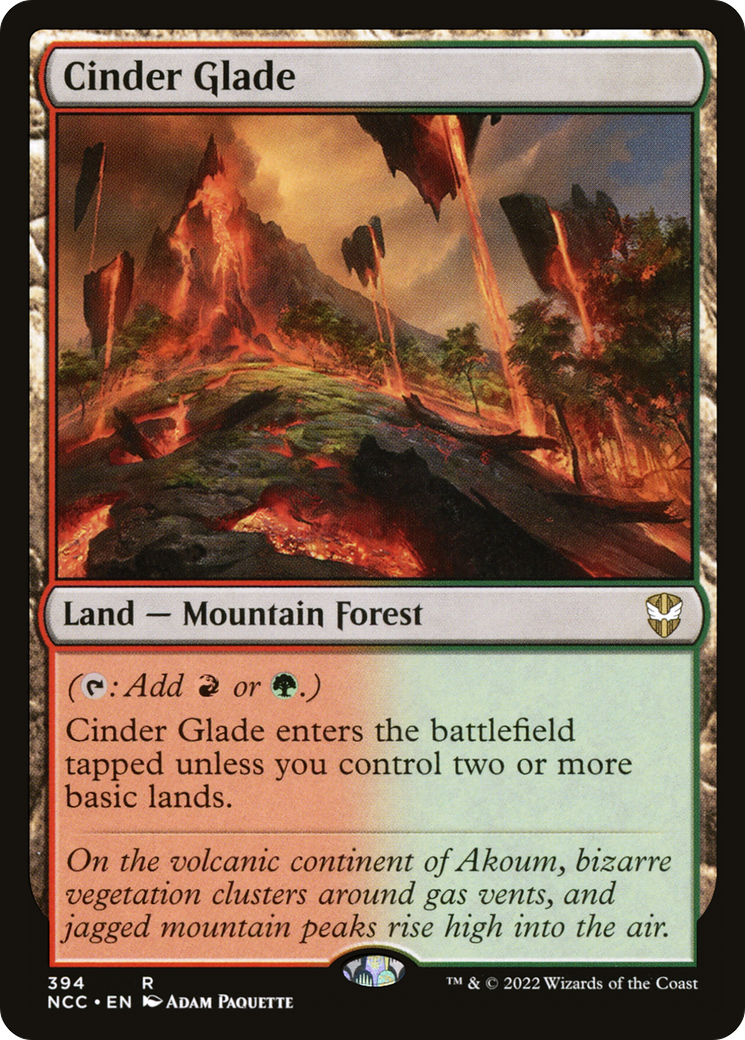
Cinder Glade
Cinder Glade
Land — Mountain Forest
( : Add or .)
This land enters tapped unless you control two or more basic lands.
- If one of these lands enters the battlefield at the same time as any number of basic lands, those other lands are not counted when determining if this land enters the battlefield tapped or untapped.
- However, because these cards have basic land types, effects that specify a basic land type without also specifying that the land be basic can affect them. For example, a spell or ability that reads "Destroy target Forest" can target Canopy Vista, while one that reads "Destroy target basic Forest" cannot.
- Even though these lands have basic land types, they are not basic lands because "basic" doesn't appear on their type line. Notably, controlling two or more of them won't allow others to enter the battlefield untapped.
-
1
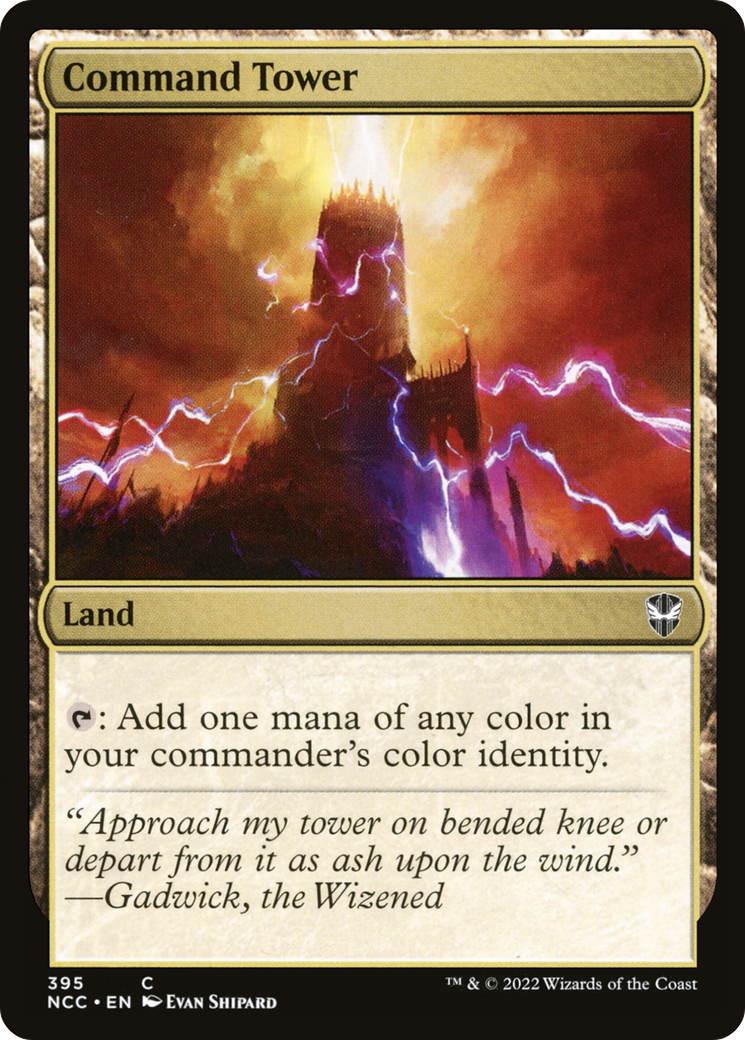
Command Tower
Command Tower
Land
: Add one mana of any color in your commander's color identity.
- If you don't have a commander, Command Tower's ability produces no mana.
- If your commander is a card that has no colors in its color identity, Command Tower's ability produces no mana. It doesn't produce .
- If you have two commanders, the ability adds one mana of any color in their combined color identities.
-
1
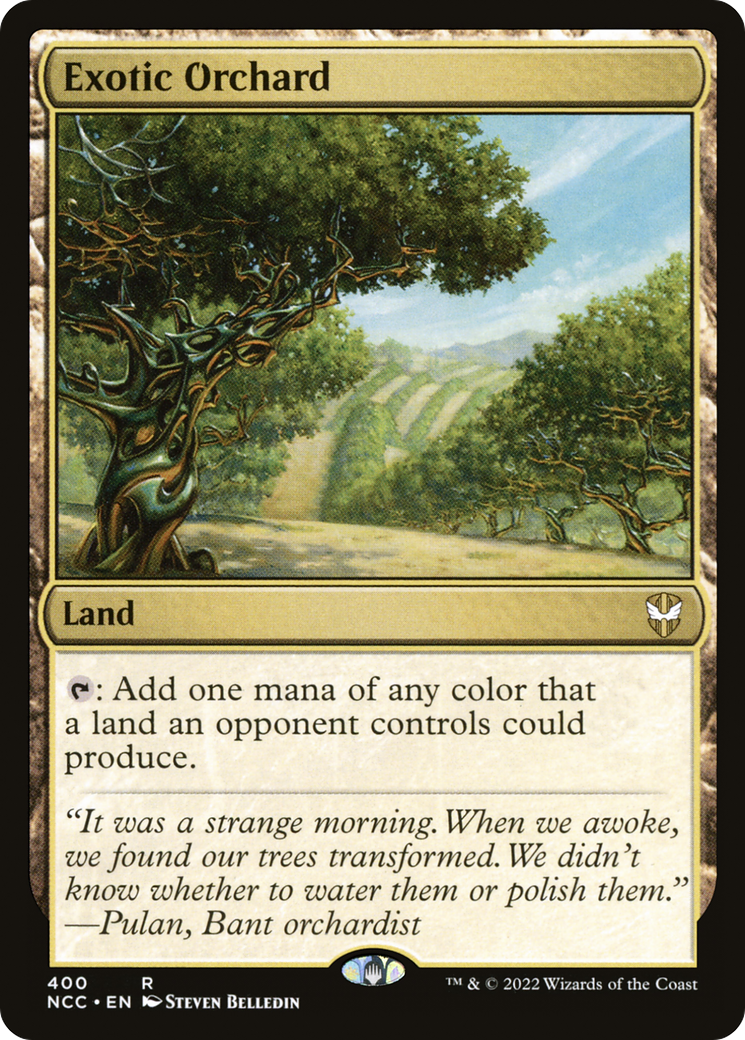
Exotic Orchard
Exotic Orchard
Land
: Add one mana of any color that a land an opponent controls could produce.
- Lands that produce mana based only on what other lands "could produce" won't help each other unless some other land allows one of them to actually produce some type of mana. For example, if you control an Exotic Orchard and your opponent controls an Exotic Orchard and a Reflecting Pool, none of those lands would produce mana if their mana abilities were activated. On the other hand, if you control a Forest and an Exotic Orchard, and your opponent controls an Exotic Orchard and a Reflecting Pool, then each of those lands can be tapped to produce . Your opponent's Exotic Orchard can produce because you control a Forest. Your Exotic Orchard and your opponent's Reflecting Pool can each produce because your opponent's Exotic Orchard can produce .
- When determining what colors of mana your opponents' lands could produce, Exotic Orchard takes into account any applicable replacement effects that would apply to those lands' mana abilities (such as Contamination's effect, for example). If there are more than one, consider them in any possible order.
- The colors of mana are white, blue, black, red, and green. Exotic Orchard can't be tapped for colorless mana, even if a land an opponent controls could produce colorless mana.
- Exotic Orchard doesn't care about any restrictions or riders your opponents' lands (such as Ancient Ziggurat or Hall of the Bandit Lord) put on the mana they produce. It just cares about colors of mana.
- Exotic Orchard checks the effects of all mana-producing abilities of lands your opponents control, but it doesn't check their costs. For example, Vivid Crag has the ability " , Remove a charge counter from Vivid Crag: Add one mana of any color." If an opponent controls Vivid Crag and you control Exotic Orchard, you can tap Exotic Orchard for any color of mana. It doesn't matter whether Vivid Crag has a charge counter on it, and it doesn't matter whether it's untapped.
-
1
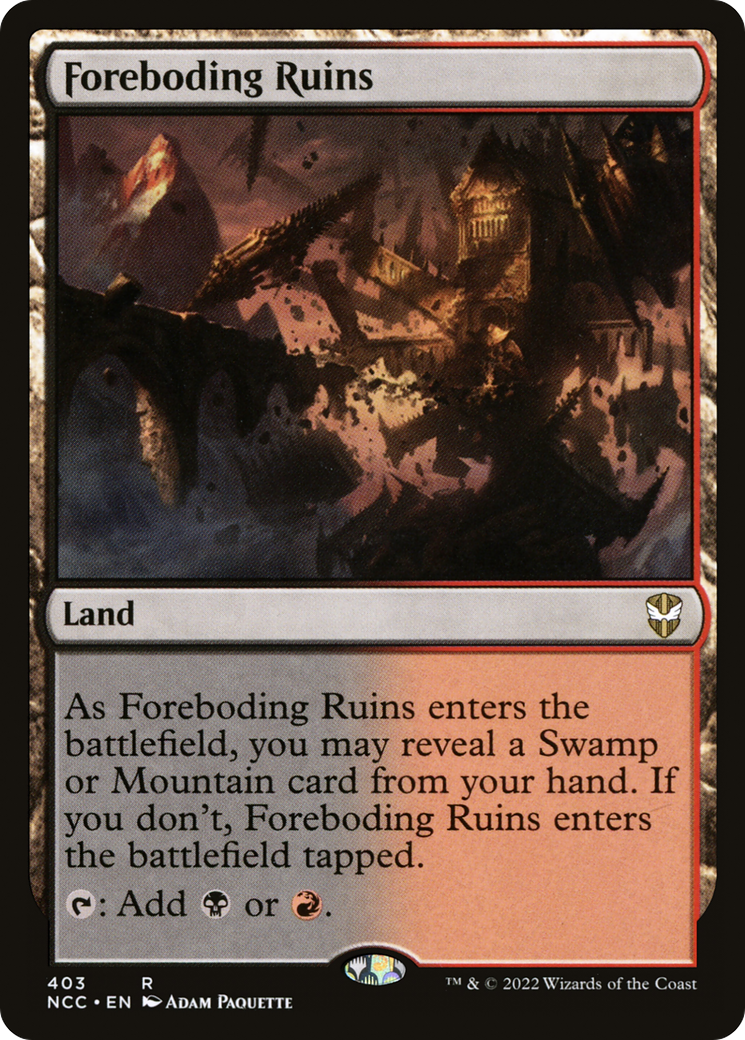
Foreboding Ruins
Foreboding Ruins
Land
As this land enters, you may reveal a Swamp or Mountain card from your hand. If you don't, this land enters tapped.
: Add or .
- You may reveal any land card with either or both of the appropriate subtypes. It doesn't have to be a basic land. For example, you could reveal Sunken Hollow from the Battle for Zendikar set to satisfy the ability of Foreboding Ruins.
- If a Swamp or Mountain is entering the battlefield from your hand at the same time as Foreboding Ruins, you may reveal the other land to have Foreboding Ruins enter untapped.
- Lands don't have a subtype just because they can produce mana of the corresponding color. Foreboding Ruins itself is neither a Swamp nor a Mountain, even though it produces black and red mana, so you can't reveal one to satisfy the ability of another.
- If an effect instructs you to put Foreboding Ruins onto the battlefield tapped, it will still enter the battlefield tapped even if you reveal a land card from your hand.
-
6
Forest
Forest
Basic Land — Forest
( : Add .)
-
1
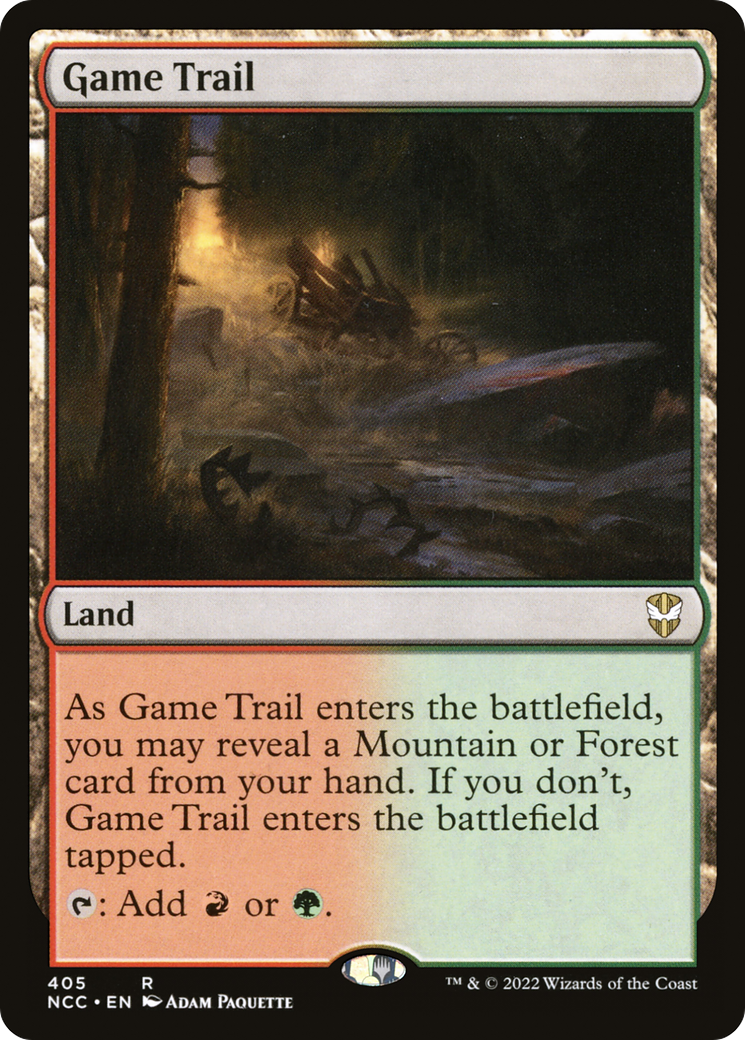
Game Trail
Game Trail
Land
As this land enters, you may reveal a Mountain or Forest card from your hand. If you don't, this land enters tapped.
: Add or .
- Lands don't have a subtype just because they can produce mana of the corresponding color. Game Trail itself is neither a Mountain nor a Forest, even though it produces red and green mana, so you can't reveal one to satisfy the ability of another.
- If an effect instructs you to put Game Trail onto the battlefield tapped, it will still enter the battlefield tapped even if you reveal a land card from your hand.
- You may reveal any land card with either or both of the appropriate subtypes. It doesn't have to be a basic land. For example, you could reveal Canopy Vista from the Battle for Zendikar set to satisfy the ability of Game Trail.
- If a Mountain or Forest is entering the battlefield from your hand at the same time as Game Trail, you may reveal the other land to have Game Trail enter untapped.
-
1
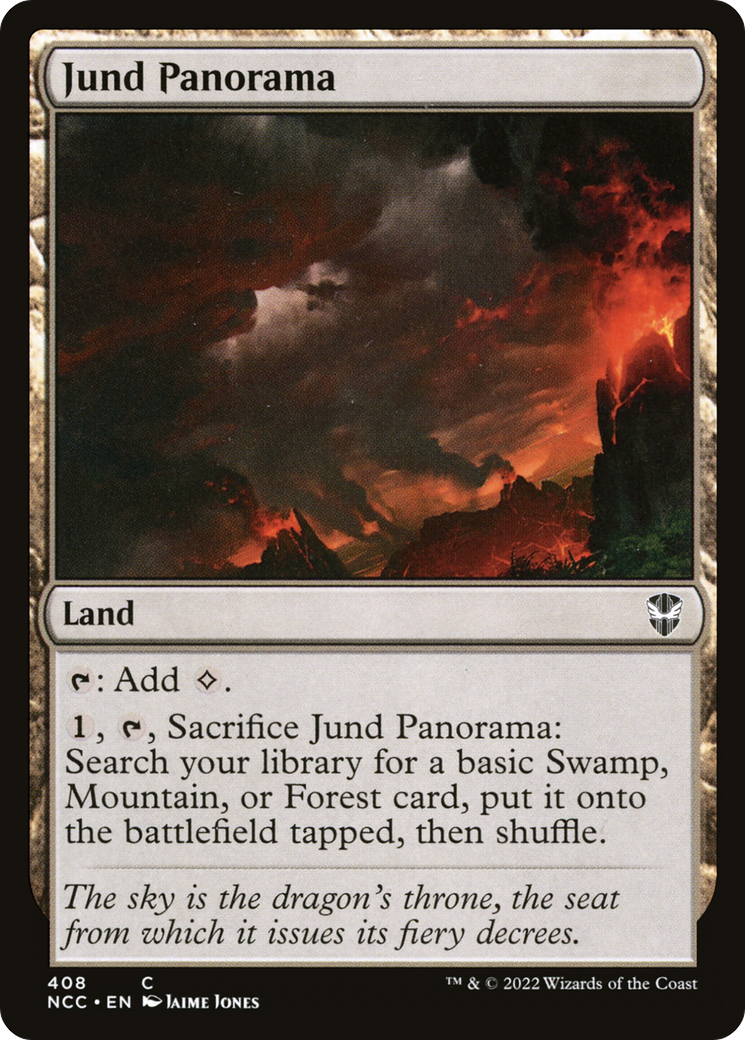
Jund Panorama
Jund Panorama
Land
: Add .
, , Sacrifice this land: Search your library for a basic Swamp, Mountain, or Forest card, put it onto the battlefield tapped, then shuffle.
-
1
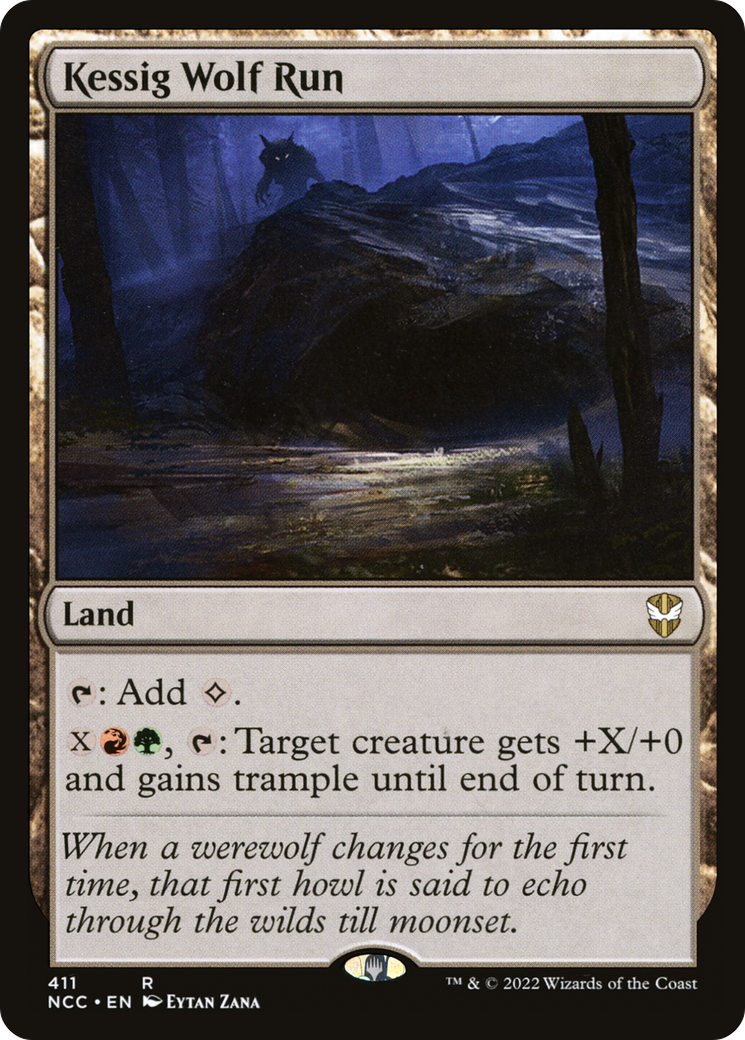
Kessig Wolf Run
Kessig Wolf Run
Land
: Add .
, : Target creature gets +X/+0 and gains trample until end of turn.
-
1
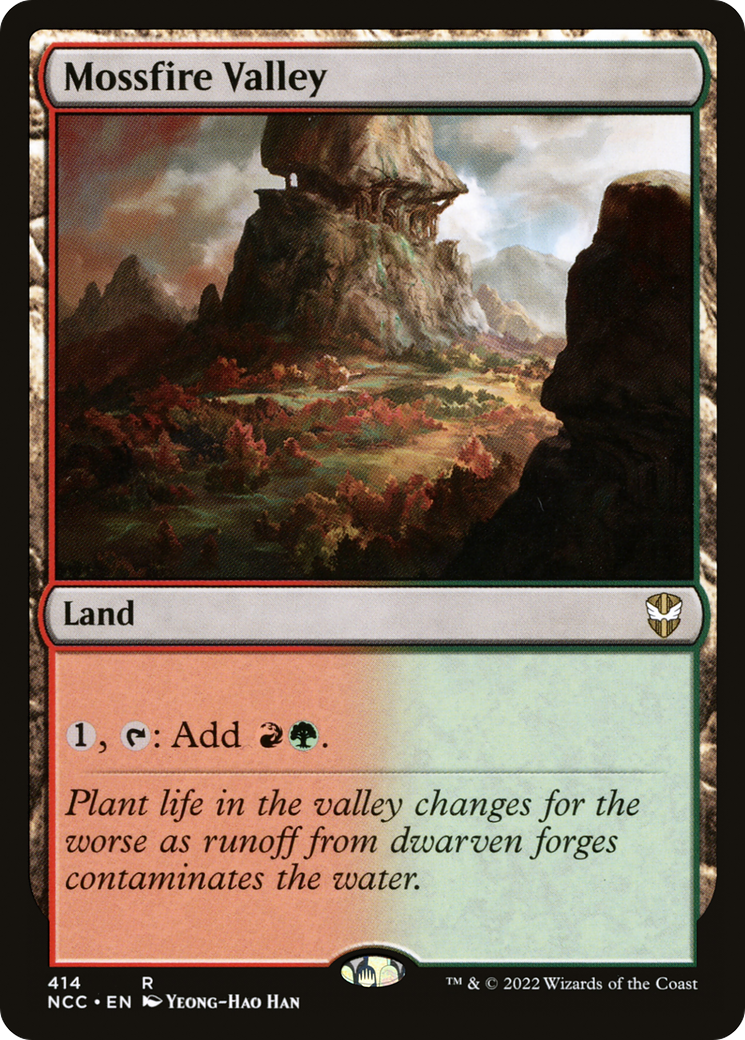
Mossfire Valley
Mossfire Valley
Land
, : Add .
-
1
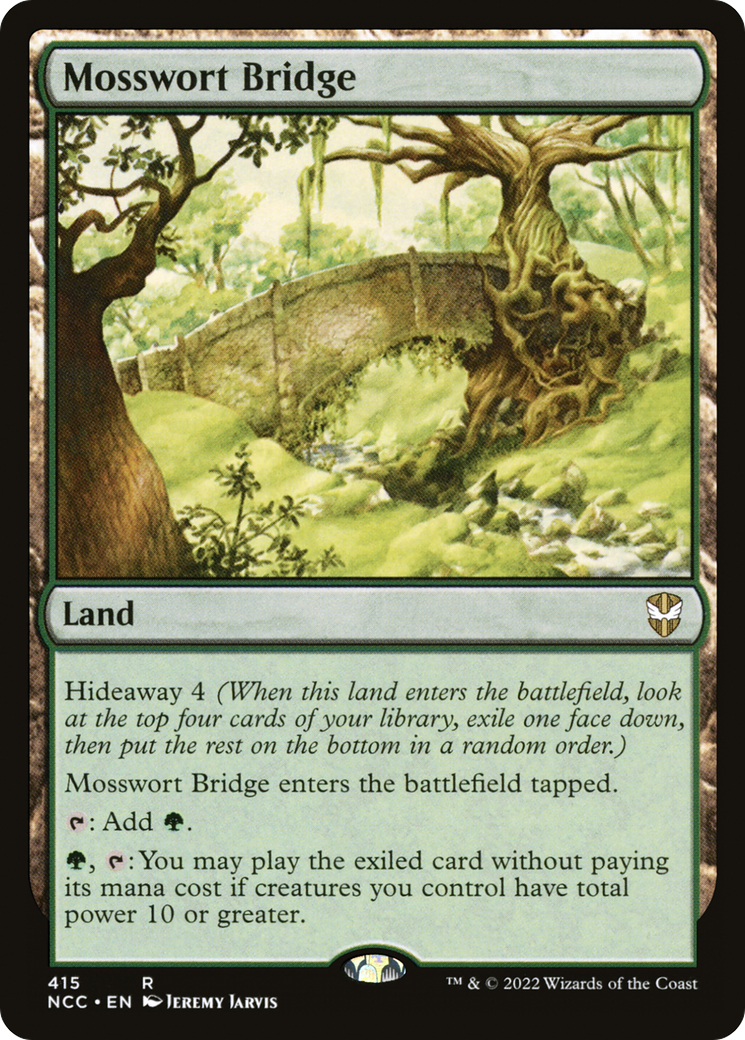
Mosswort Bridge
Mosswort Bridge
Land
Hideaway 4 (When this land enters, look at the top four cards of your library, exile one face down, then put the rest on the bottom in a random order.)
This land enters tapped.
: Add .
, : You may play the exiled card without paying its mana cost if creatures you control have total power 10 or greater.
- "Hideaway N" means "When this permanent enters the battlefield, look at the top N cards of your library. Exile one of them face down and put the rest on the bottom of your library in a random order. The exiled card gains 'The player who controls the permanent that exiled this card may look at this card in the exile zone.'"
- Any player who has controlled a permanent with a hideaway ability since a card was exiled with it may look at that card.
- Previously, permanents with hideaway entered the battlefield tapped. This ability has been removed from the definition of hideaway. Older cards have received errata to have an additional paragraph that reads "[This permanent] enters the battlefield tapped," and they now have hideaway 4.
- Hideaway now causes you to put the rest of the cards on the bottom of your library in a random order instead of any order.
-
5
Mountain
Mountain
Basic Land — Mountain
( : Add .)
-
1
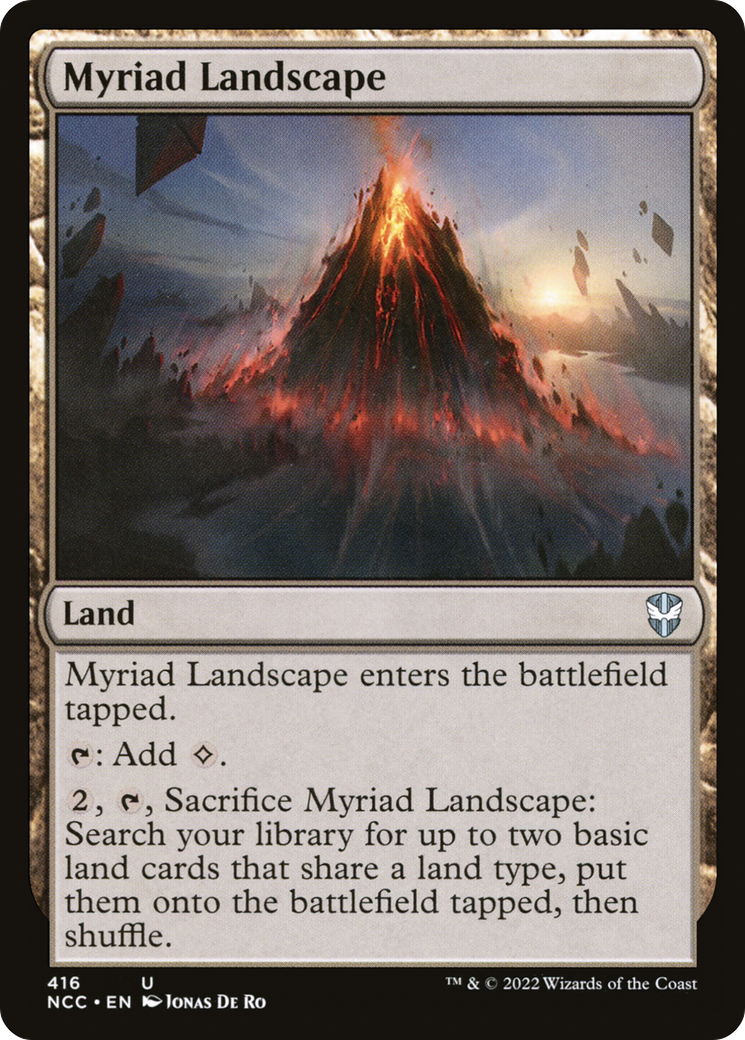
Myriad Landscape
Myriad Landscape
Land
This land enters tapped.
: Add .
, , Sacrifice this land: Search your library for up to two basic land cards that share a land type, put them onto the battlefield tapped, then shuffle.
- You can choose to find one basic land card with Myriad Landscape's last ability.
-
1
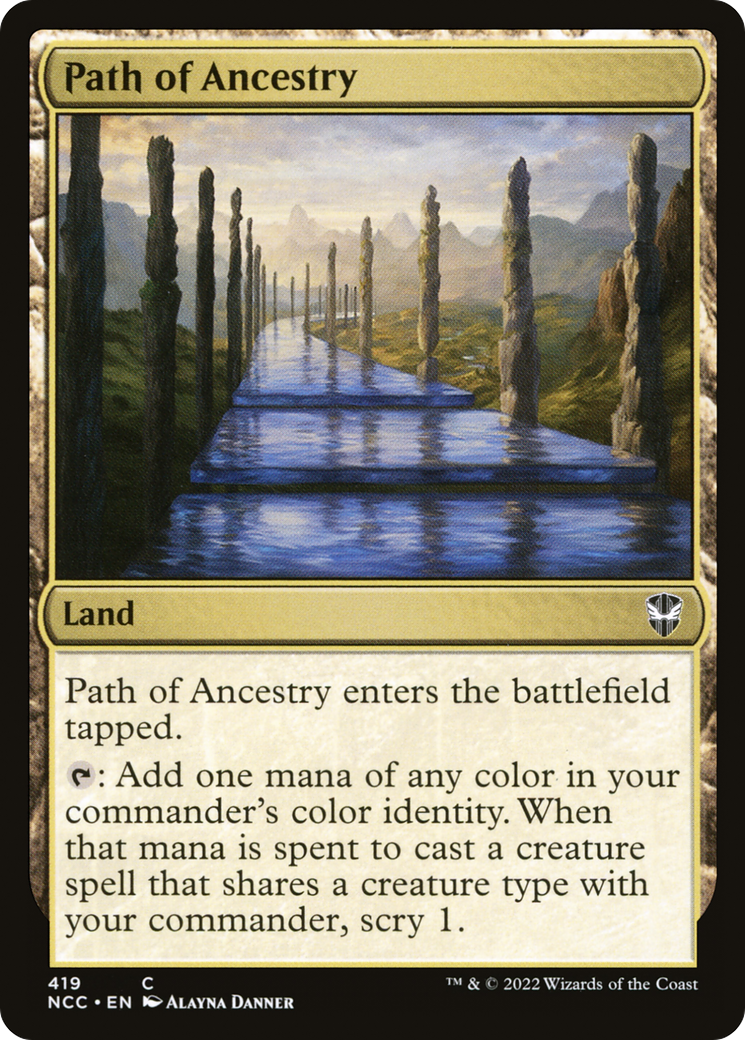
Path of Ancestry
Path of Ancestry
Land
This land enters tapped.
: Add one mana of any color in your commander's color identity. When that mana is spent to cast a creature spell that shares a creature type with your commander, scry 1. (Look at the top card of your library. You may put that card on the bottom.)
- Your commander's creature types are checked immediately after you cast a creature spell spending mana from Path of Ancestry's last ability. They aren't set before the game begins, and they may not be the same types your commander had when you activated that ability.
- If you have two commanders, the last ability adds one mana of any color in their combined color identities. When you spend that mana on a creature spell that shares a creature type with either of your commanders, you'll scry 1.
- If Path of Ancestry's last ability produces two mana (most likely due to Mana Reflection), spending those two mana to cast creature spells that share a creature type with your commander will cause two abilities to trigger. Each of those abilities will cause you to scry 1. You won't scry 2. This is true whether you spend the mana on one creature spell or two.
- If your commander has no creature types, it can't share a creature type with any spell that you cast.
- If you cast your commander with mana from Path of Ancestry, and your commander hasn't somehow lost all of its creature types while on the stack, you'll scry 1.
- If you don't have a commander, Path of Ancestry's ability produces no mana.
- If your commander is a card that has no colors in its color identity, Path of Ancestry's ability produces no mana. It doesn't produce .
-
1
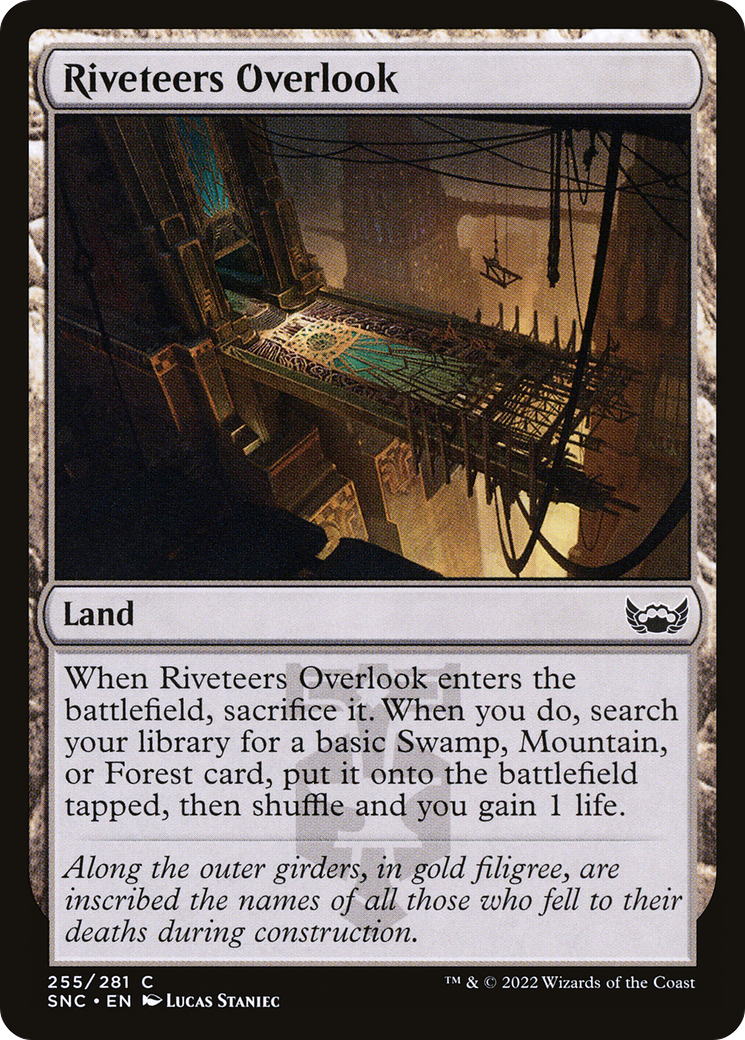
Riveteers Overlook
Riveteers Overlook
Land
When this land enters, sacrifice it. When you do, search your library for a basic Swamp, Mountain, or Forest card, put it onto the battlefield tapped, then shuffle and you gain 1 life.
-
1
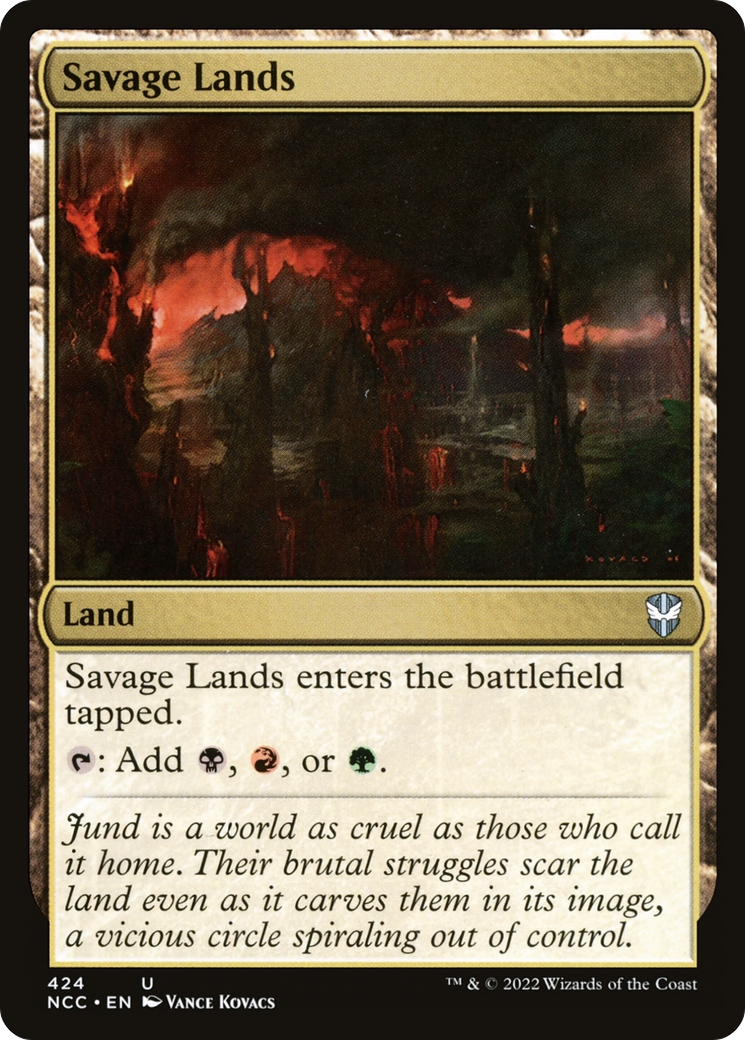
Savage Lands
Savage Lands
Land
This land enters tapped.
: Add , , or .
-
1
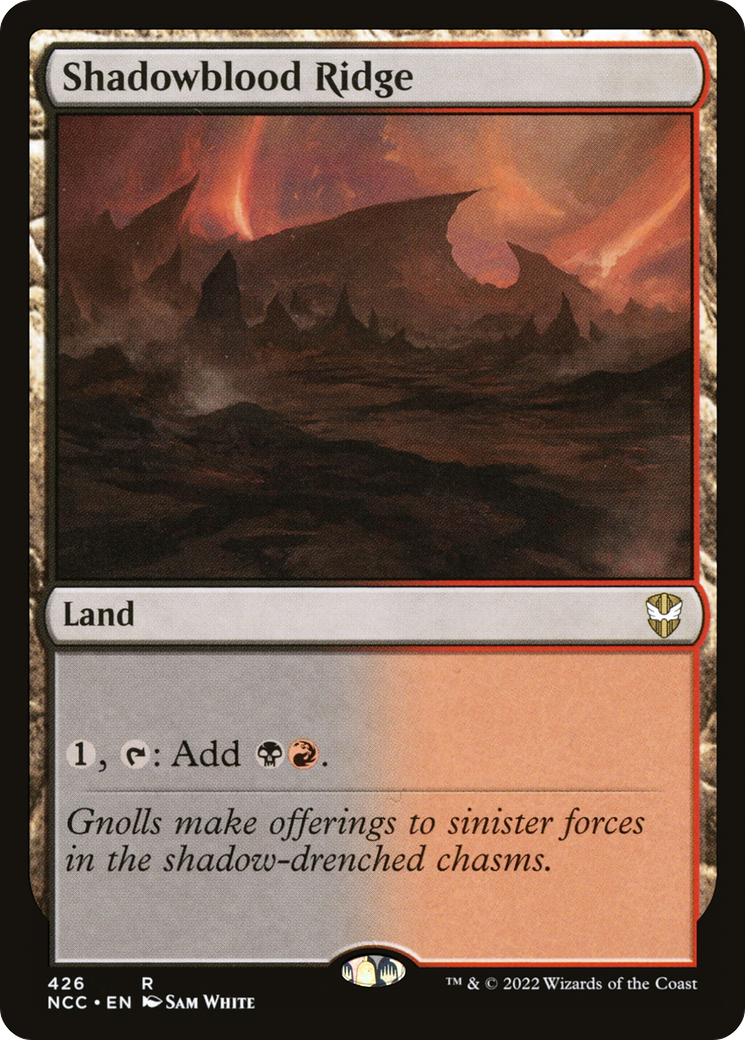
Shadowblood Ridge
Shadowblood Ridge
Land
, : Add .
-
1
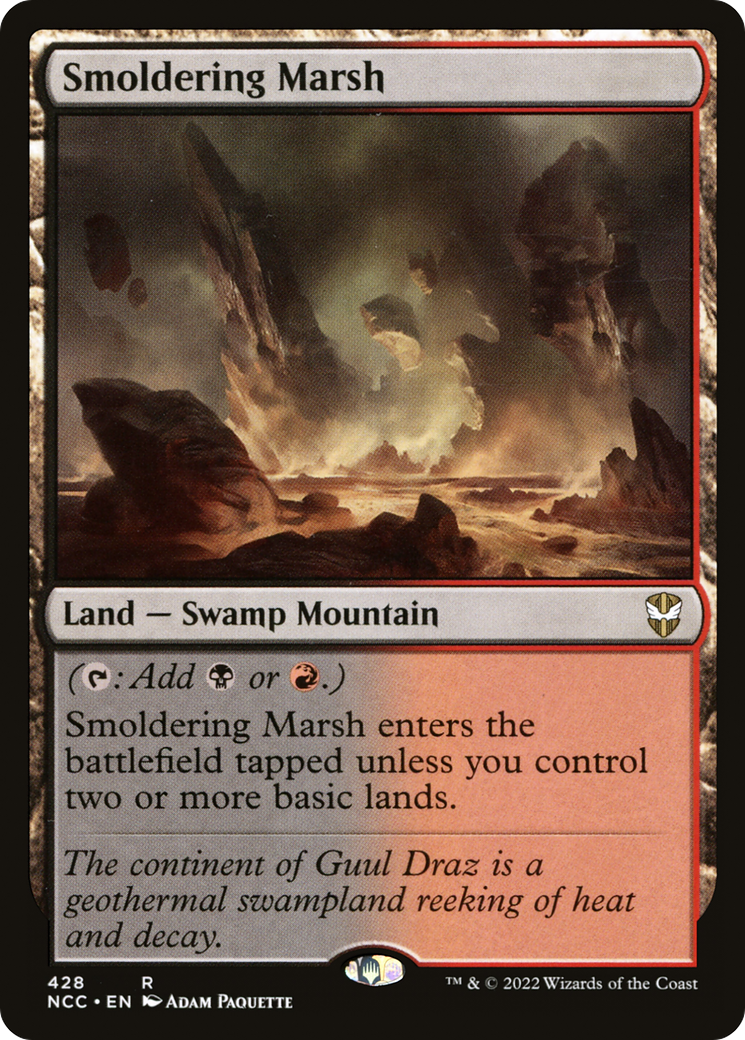
Smoldering Marsh
Smoldering Marsh
Land — Swamp Mountain
( : Add or .)
This land enters tapped unless you control two or more basic lands.
- However, because these cards have basic land types, effects that specify a basic land type without also specifying that the land be basic can affect them. For example, a spell or ability that reads "Destroy target Forest" can target Canopy Vista, while one that reads "Destroy target basic Forest" cannot.
- Even though these lands have basic land types, they are not basic lands because "basic" doesn't appear on their type line. Notably, controlling two or more of them won't allow others to enter the battlefield untapped.
- If one of these lands enters the battlefield at the same time as any number of basic lands, those other lands are not counted when determining if this land enters the battlefield tapped or untapped.
-
1
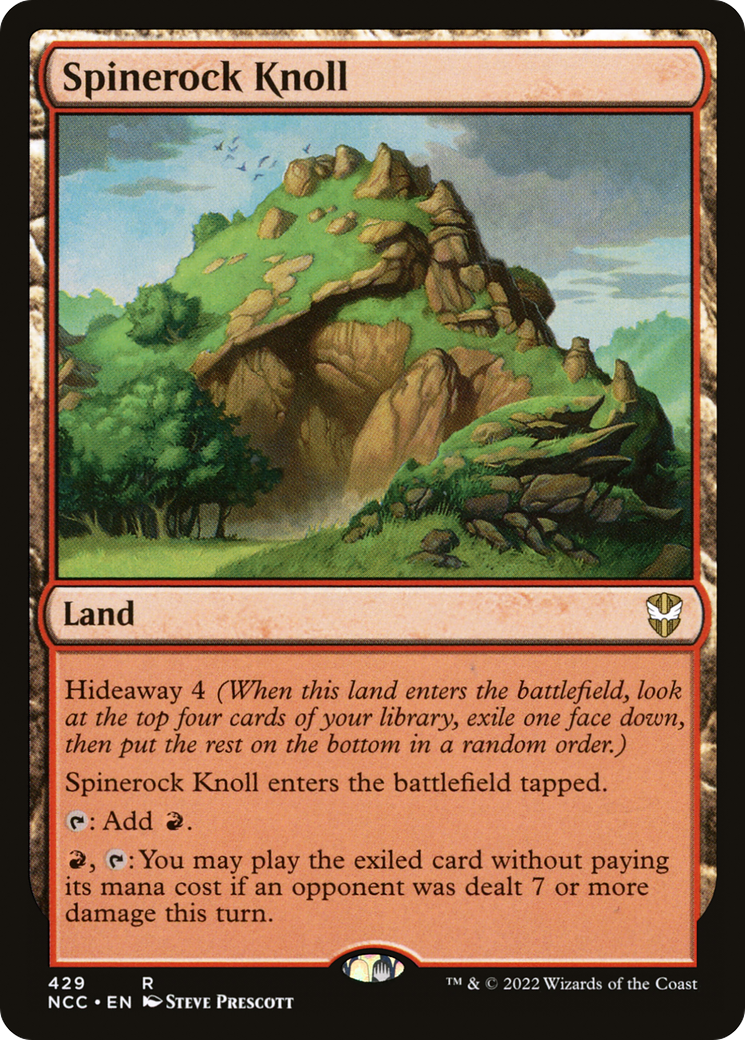
Spinerock Knoll
Spinerock Knoll
Land
Hideaway 4 (When this land enters, look at the top four cards of your library, exile one face down, then put the rest on the bottom in a random order.)
This land enters tapped.
: Add .
, : You may play the exiled card without paying its mana cost if an opponent was dealt 7 or more damage this turn.
- "Hideaway N" means "When this permanent enters the battlefield, look at the top N cards of your library. Exile one of them face down and put the rest on the bottom of your library in a random order. The exiled card gains 'The player who controls the permanent that exiled this card may look at this card in the exile zone.'"
- Any player who has controlled a permanent with a hideaway ability since a card was exiled with it may look at that card.
- Previously, permanents with hideaway entered the battlefield tapped. This ability has been removed from the definition of hideaway. Older cards have received errata to have an additional paragraph that reads "[This permanent] enters the battlefield tapped," and they now have hideaway 4.
- Hideaway now causes you to put the rest of the cards on the bottom of your library in a random order instead of any order.
- It doesn't matter how the opponent was dealt damage or by whom, as long as the total damage is 7 or more. You don't specify an opponent when you activate the ability.
- You'll get to play the card even if Spinerock Knoll wasn't on the battlefield at the time some or all of the 7 damage was dealt.
- At the time the last ability resolves, you'll get to play the card if a player who is currently your opponent, or a player who was your opponent at the time they left the game, has been dealt 7 damage over the course of the turn.
-
4
Swamp
Swamp
Basic Land — Swamp
( : Add .)
-
1
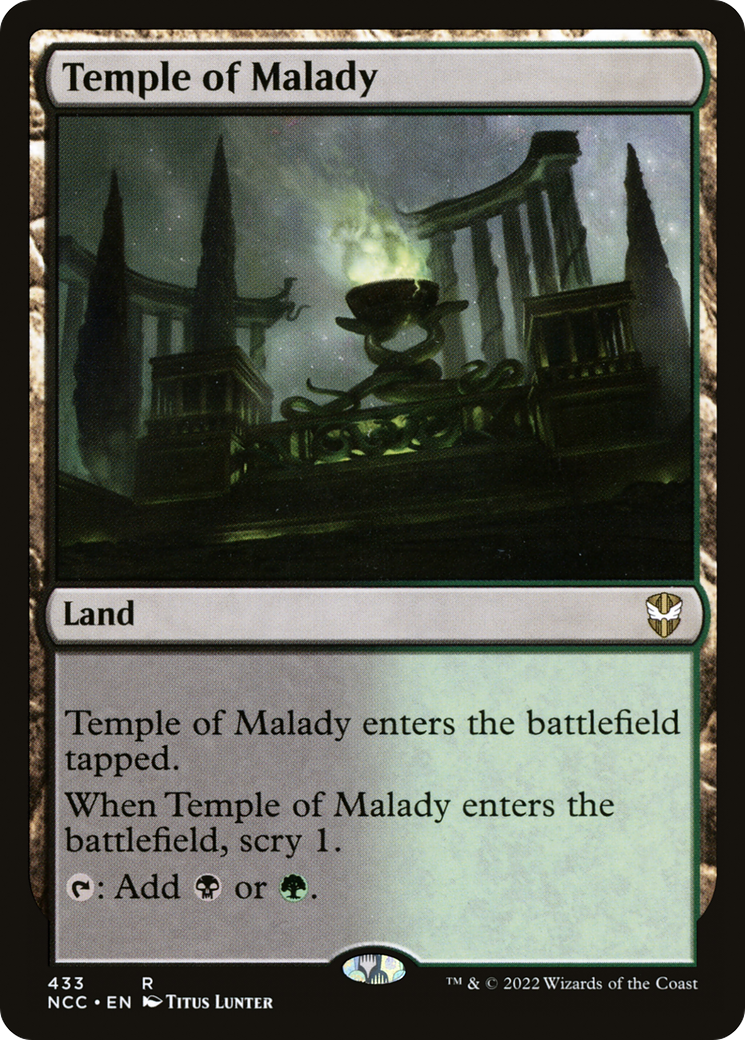
Temple of Malady
Temple of Malady
Land
This land enters tapped.
When this land enters, scry 1. (Look at the top card of your library. You may put that card on the bottom.)
: Add or .
-
1
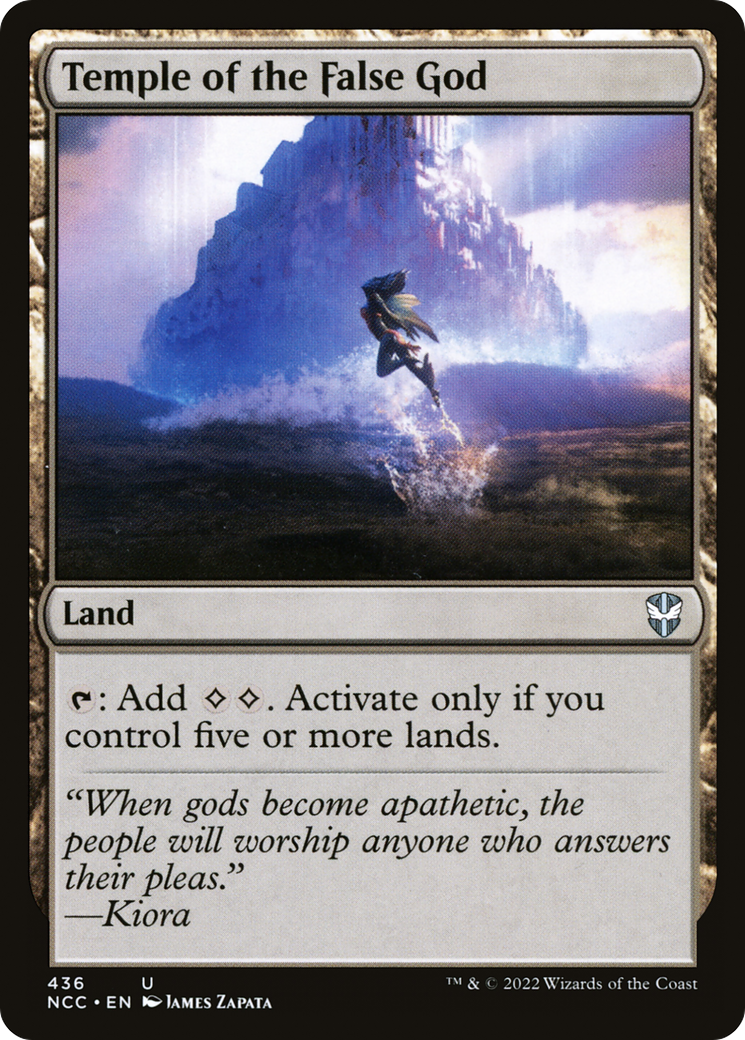
Temple of the False God
Temple of the False God
Land
: Add . Activate only if you control five or more lands.
-
1
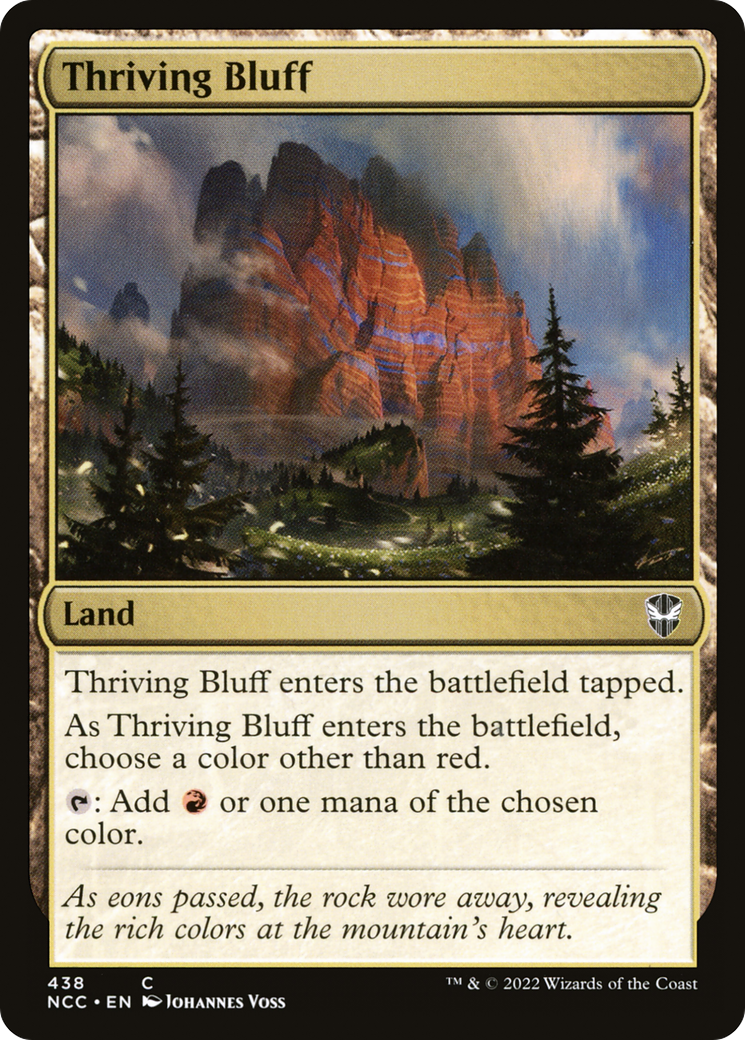
Thriving Bluff
Thriving Bluff
Land
This land enters tapped. As it enters, choose a color other than red.
: Add or one mana of the chosen color.
-
1
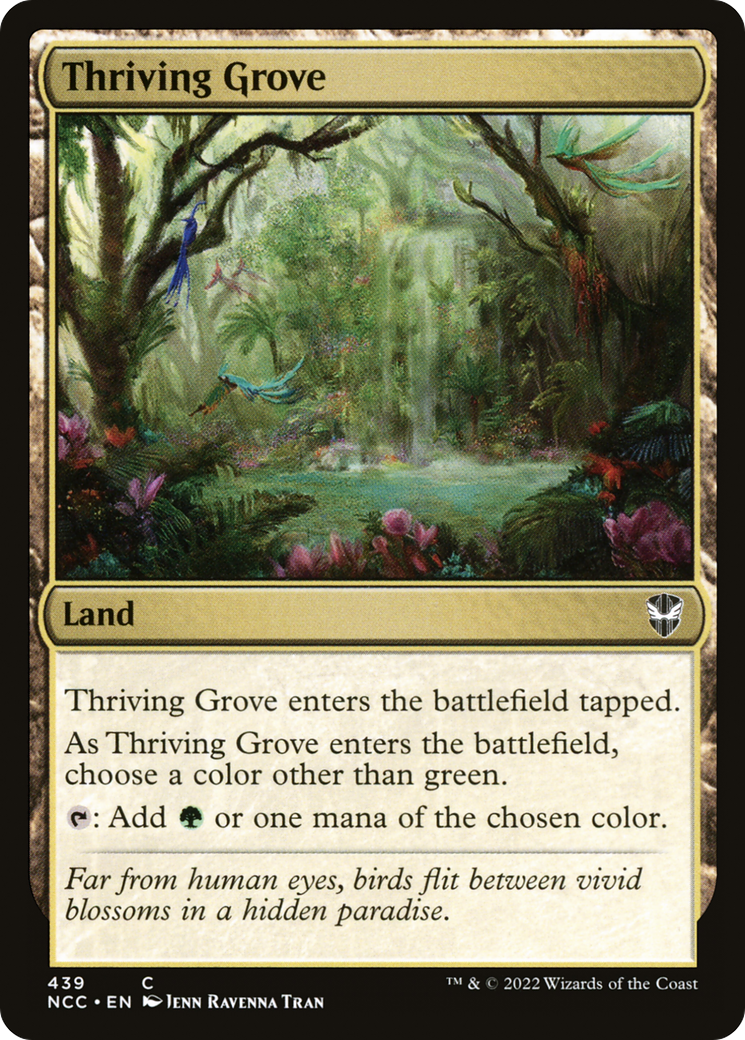
Thriving Grove
Thriving Grove
Land
This land enters tapped. As it enters, choose a color other than green.
: Add or one mana of the chosen color.
-
1
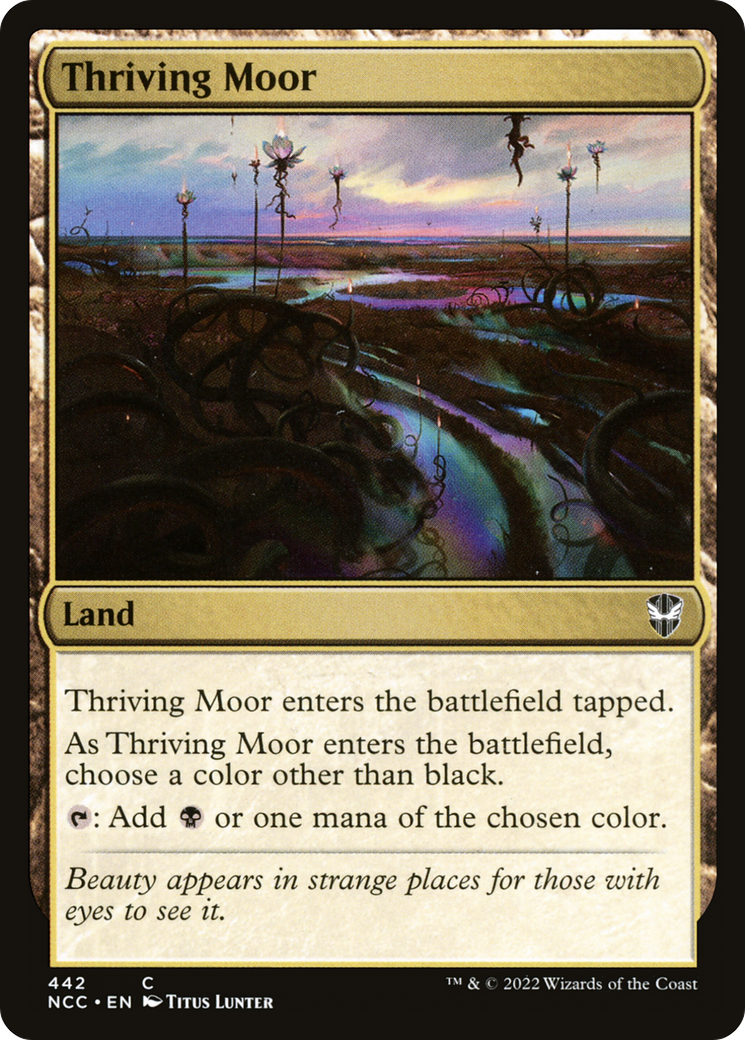
Thriving Moor
Thriving Moor
Land
This land enters tapped. As it enters, choose a color other than black.
: Add or one mana of the chosen color.
-
1
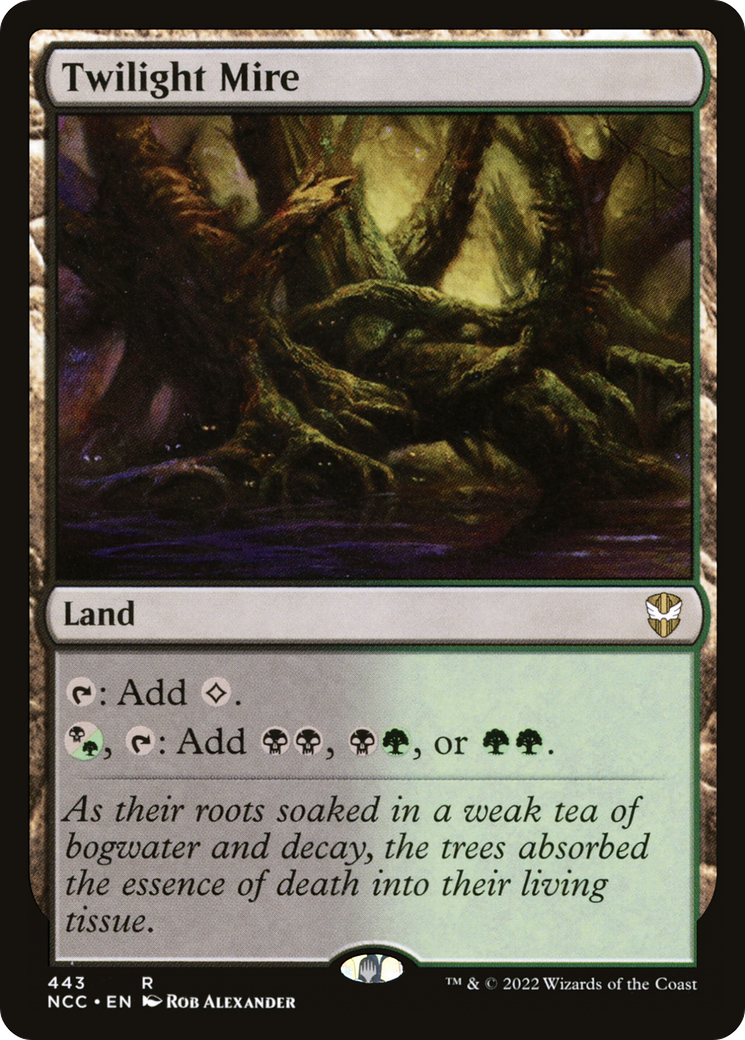
Twilight Mire
Twilight Mire
Land
: Add .
, : Add , , or .
Black 9
-
1
Aether Snap
Aether Snap
Sorcery
Remove all counters from all permanents and exile all tokens.
- Aether Snap removes all counters from permanents, no matter what kind they are.
- Counters on objects that aren't permanents, such as time counters on a suspended card or poison counters on a player, are unaffected by Aether Snap.
-
1
Bellowing Mauler
Bellowing Mauler
Creature — Ogre Warrior
4/6
At the beginning of your end step, each player loses 4 life unless they sacrifice a nontoken creature of their choice.
-
1
Deathbringer Regent
Deathbringer Regent
Creature — Dragon
5/6
Flying
When this creature enters, if you cast it from your hand and there are five or more other creatures on the battlefield, destroy all other creatures.
- If you cast a creature spell that enters the battlefield as a copy of Deathbringer Regent, the enters-the-battlefield ability will trigger (assuming the “five or more other creatures” requirement is also met).
- Deathbringer Regent's last ability destroys all creatures except Deathbringer Regent, including the five other creatures required for the ability to have an effect.
-
1
Disciple of Bolas
Disciple of Bolas
Creature — Human Wizard
2/1
When this creature enters, sacrifice another creature. You gain X life and draw X cards, where X is that creature's power.
- If you control at least one other creature when the ability resolves, you must sacrifice one. If you don't control any other creatures at that time, the ability won't do anything.
- The creature's power as it last existed on the battlefield is the amount of life you gain and the number of cards you draw.
-
1
Noxious Gearhulk
Noxious Gearhulk
Artifact Creature — Construct
5/4
Menace
When this creature enters, you may destroy another target creature. If a creature is destroyed this way, you gain life equal to its toughness.
- If the target creature has indestructible, it isn't destroyed this way and you won't gain life. If it is destroyed but put into a zone other than a graveyard, you'll gain life.
- Use the toughness of the creature as it last existed on the battlefield to determine how much life to gain.
-
1
Painful Truths
Painful Truths
Sorcery
Converge — You draw X cards and you lose X life, where X is the number of colors of mana spent to cast this spell.
- The maximum number of colors of mana you can spend to cast a spell is five. Colorless is not a color. Note that the cost of a spell with converge may limit how many colors of mana you can spend.
- Unless a spell or ability allows you to, you can't choose to pay more mana for a spell with a converge ability just to spend more colors of mana. Likewise, if a spell or ability reduces the amount of mana it costs you to cast a spell with converge, you can't ignore that cost reduction in order to spend more colors of mana.
- If there are any alternative or additional costs to cast a spell with a converge ability, the mana spent to pay those costs will count. For example, if an effect makes sorcery spells cost more to cast, you could pay to cast Radiant Flames and deal 4 damage to each creature.
- If you cast a spell with converge without spending any mana to cast it (perhaps because an effect allowed you to cast it without paying its mana cost), then the number of colors spent to cast it will be zero.
- If a spell with a converge ability is copied, no mana was spent to cast the copy, so the number of colors of mana spent to cast the spell will be zero. The number of colors spent to cast the original spell is not copied.
-
1
Protection Racket
Protection Racket
Enchantment
At the beginning of your upkeep, repeat the following process for each opponent in turn order. Reveal the top card of your library. That player may pay life equal to that card's mana value. If they do, exile that card. Otherwise, put it into your hand.
-
1
Victimize
Victimize
Sorcery
Choose two target creature cards in your graveyard. Sacrifice a creature. If you do, return the chosen cards to the battlefield tapped.
- You must choose two targets. You can't cast Victimize targeting only one creature card.
- If one of the targeted creature cards is an illegal target (for instance, because it has left your graveyard before Victimize resolves), you'll still sacrifice a creature and put the other card onto the battlefield. If both are illegal targets, Victimize won't resolve. You won't sacrifice a creature.
- The creature you sacrifice isn't chosen until Victimize resolves. You can't return the creature you sacrifice because it will still be on the battlefield at the time targets are chosen.
- As Victimize resolves, you must sacrifice a creature if able. You can't change your mind and choose not to sacrifice anything.
-
1
Wave of Rats
Wave of Rats
Creature — Rat
4/2
Trample
When this creature dies, if it dealt combat damage to a player this turn, return it to the battlefield under its owner's control.
Blitz (If you cast this spell for its blitz cost, it gains haste and "When this creature dies, draw a card." Sacrifice it at the beginning of the next end step.)
- If you choose to pay the blitz cost rather than the mana cost, you're still casting the spell. It goes on the stack and can be responded to and countered. You can cast a creature spell for its blitz cost only if you could cast that creature spell. Most of the time, this means during your main phase when the stack is empty.
- If you pay the blitz cost to cast a creature spell, that permanent will be sacrificed only if it's still on the battlefield when that triggered ability resolves. If it dies or goes to another zone before then, it will stay where it is.
- You don't have to attack with the creature with blitz unless another ability says you do.
- If a creature enters the battlefield as a copy of or becomes a copy of a creature whose blitz cost was paid, the copy won't have haste, won't be sacrificed, and its controller won't draw a card when it dies.
- The triggered ability that lets its controller draw a card triggers when it dies for any reason, not just when you sacrifice it during the end step.
Red 11
-
1
Blasphemous Act
Blasphemous Act
Sorcery
This spell costs less to cast for each creature on the battlefield.
Blasphemous Act deals 13 damage to each creature.
- Although players may respond to Blasphemous Act once it's been cast, once it's announced, they can't respond before the cost is calculated and paid.
- Blasphemous Act's ability can't reduce the total cost to cast the spell below .
- The total cost to cast Blasphemous Act is locked in before you pay that cost. For example, if there are three creatures on the battlefield, including one you can sacrifice to add , the total cost of Blasphemous Act is . Then you can sacrifice the creature when you activate mana abilities just before paying the cost.
- To determine the total cost of a spell, start with the mana cost or alternative cost you're paying, add any cost increases, then apply any cost reductions (such as that of Blasphemous Act). The mana value of the spell is determined only by its mana cost, no matter what the total cost to cast the spell was.
-
1
Chaos Warp
Chaos Warp
Instant
The owner of target permanent shuffles it into their library, then reveals the top card of their library. If it's a permanent card, they put it onto the battlefield.
- A permanent card is a card with one or more of the following card types: artifact, creature, enchantment, land, or planeswalker.
- The owner of a token is the player under whose control the token was put onto the battlefield. If a token is shuffled into a player's library this way, that player shuffles before revealing the top card of that library.
- If the revealed card is not a permanent card, it remains on top of that library.
- If the permanent is an illegal target by the time Chaos Warp tries to resolve, it won't resolve and none of its effects will occur. No library will be shuffled and no card will be revealed.
- If the revealed card is a permanent card but can't enter (perhaps because it's an Aura with nothing to enchant), it remains on top of that library.
-
1
Etali, Primal Storm
Etali, Primal Storm
Legendary Creature — Elder Dinosaur
6/6
Whenever Etali attacks, exile the top card of each player's library, then you may cast any number of spells from among those cards without paying their mana costs.
- If an exiled card has in its mana cost, you must choose 0 as the value of X when casting it without paying its mana cost.
- If you cast any of the exiled cards, you do so as part of the resolution of the triggered ability. You can't wait to cast them later in the turn. Timing permissions based on a card's type are ignored, and the spells resolve before blockers are declared.
- If you cast a card "without paying its mana cost," you can't pay any alternative costs. You can, however, pay additional costs. If the card has any mandatory additional costs, those must be paid to cast the card.
- If you cast more than one of the exiled cards, you choose the order in which to cast them. A spell you cast this way can be the target of a later spell you cast this way. However, permanent spells cast this way won't resolve until you're done casting spells, so the permanents they become can't be the target of spells cast this way. For example, if you exile Twincast and Lightning Strike, you can cast Lightning Strike and then cast Twincast targeting it; but if you exile a creature card and an Aura card, you can't cast that Aura targeting that creature.
- Any cards not cast, including land cards, remain in exile. They can't be cast on later turns, even if Etali attacks again.
- Because all attacking creatures are chosen at once, a creature cast this way can't attack during the same combat as Etali, even if it has haste.
- In a multiplayer game, if a player leaves the game, all cards that player owns leave as well. If you leave the game, any spells or permanents you control from Etali's ability are exiled.
-
1
Glittering Stockpile
Glittering Stockpile
Artifact — Treasure
: Add . Put a stash counter on this artifact.
, Sacrifice this artifact: Add X mana of any one color, where X is the number of stash counters on this artifact.
-
1
Industrial Advancement
Industrial Advancement
Enchantment
At the beginning of your end step, you may sacrifice a creature. If you do, look at the top X cards of your library, where X is that creature's mana value. You may put a creature card from among them onto the battlefield. Put the rest on the bottom of your library in a random order.
-
1
Inferno Titan
Inferno Titan
Creature — Giant
6/6
: This creature gets +1/+0 until end of turn.
Whenever this creature enters or attacks, it deals 3 damage divided as you choose among one, two, or three targets.
- You divide the damage as you put Inferno Titan's triggered ability on the stack, not as it resolves. Each target must be assigned at least 1 damage. (In other words, as you put the ability on the stack, you choose whether to have it deal 3 damage to a single target, 2 damage to one target and 1 damage to another target, or 1 damage to each of three targets.)
-
1
Mezzio Mugger
Mezzio Mugger
Creature — Lizard Rogue
3/3
Whenever this creature attacks, exile the top card of each player's library. You may play those cards this turn, and you may spend mana as though it were mana of any color to cast those spells.
Blitz (If you cast this spell for its blitz cost, it gains haste and "When this creature dies, draw a card." Sacrifice it at the beginning of the next end step.)
- You must follow all normal timing rules for cards played this way. For example, you may play lands this way only during your main phase while no spells or abilities are on the stack and only if you haven't played a land yet this turn.
- If you choose to pay the blitz cost rather than the mana cost, you're still casting the spell. It goes on the stack and can be responded to and countered. You can cast a creature spell for its blitz cost only if you could cast that creature spell. Most of the time, this means during your main phase when the stack is empty.
- If you pay the blitz cost to cast a creature spell, that permanent will be sacrificed only if it's still on the battlefield when that triggered ability resolves. If it dies or goes to another zone before then, it will stay where it is.
- You don't have to attack with the creature with blitz unless another ability says you do.
- If a creature enters the battlefield as a copy of or becomes a copy of a creature whose blitz cost was paid, the copy won't have haste, won't be sacrificed, and its controller won't draw a card when it dies.
- The triggered ability that lets its controller draw a card triggers when it dies for any reason, not just when you sacrifice it during the end step.
-
1
Rain of Riches
Rain of Riches
Enchantment
When this enchantment enters, create two Treasure tokens.
The first spell you cast each turn that mana from a Treasure was spent to cast has cascade. (When you cast the spell, exile cards from the top of your library until you exile a nonland card that costs less. You may cast it without paying its mana cost. Put the exiled cards on the bottom in a random order.)
-
1
Stalking Vengeance
Stalking Vengeance
Creature — Avatar
5/5
Haste
Whenever another creature you control dies, it deals damage equal to its power to target player or planeswalker.
-
1
Turf War
Turf War
Enchantment
When this enchantment enters, for each player, put a contested counter on target land that player controls.
Whenever a creature deals combat damage to a player, if that player controls one or more lands with contested counters on them, that creature's controller gains control of one of those lands of their choice and untaps it.
-
1
Warstorm Surge
Warstorm Surge
Enchantment
Whenever a creature you control enters, it deals damage equal to its power to any target.
- The creature that entered deals damage equal to its current power to the targeted permanent or player. If it's no longer on the battlefield, its last known existence on the battlefield is checked to determine its power.
- Warstorm Surge is the source of the ability, but the creature is the source of the damage. The ability couldn't target a creature with protection from red, for example. It could target a creature with protection from creatures, but all the damage would be prevented. Since damage is dealt by the creature, abilities like lifelink, deathtouch and infect are taken into account, even if the creature has left the battlefield by the time it deals damage.
Green 23
-
1
Avenger of Zendikar
Avenger of Zendikar
Creature — Elemental
5/5
When this creature enters, create a 0/1 green Plant creature token for each land you control.
Landfall — Whenever a land you control enters, you may put a +1/+1 counter on each Plant creature you control.
- A landfall ability triggers whenever a land you control enters for any reason. It triggers whenever you play a land, as well as whenever a spell or ability puts a land onto the battlefield under your control.
- A landfall ability doesn't trigger if a permanent already on the battlefield becomes a land.
- Whenever a land you control enters, each landfall ability of the permanents you control will trigger. You can put them on the stack in any order. The last ability you put on the stack will be the first one to resolve (As a result, you can have those abilities resolve in the order of your choosing.).
-
1
Caldaia Guardian
Caldaia Guardian
Creature — Human Soldier
4/3
Whenever this creature or another creature you control with mana value 4 or greater dies, create two 1/1 green and white Citizen creature tokens.
Blitz (If you cast this spell for its blitz cost, it gains haste and "When this creature dies, draw a card." Sacrifice it at the beginning of the next end step.)
- If you choose to pay the blitz cost rather than the mana cost, you're still casting the spell. It goes on the stack and can be responded to and countered. You can cast a creature spell for its blitz cost only if you could cast that creature spell. Most of the time, this means during your main phase when the stack is empty.
- If you pay the blitz cost to cast a creature spell, that permanent will be sacrificed only if it's still on the battlefield when that triggered ability resolves. If it dies or goes to another zone before then, it will stay where it is.
- You don't have to attack with the creature with blitz unless another ability says you do.
- If a creature enters the battlefield as a copy of or becomes a copy of a creature whose blitz cost was paid, the copy won't have haste, won't be sacrificed, and its controller won't draw a card when it dies.
- The triggered ability that lets its controller draw a card triggers when it dies for any reason, not just when you sacrifice it during the end step.
-
1
Dodgy Jalopy
Dodgy Jalopy
Artifact — Vehicle
*/5
Trample
Dodgy Jalopy's power is equal to the highest mana value among creatures you control.
Crew 3
Scavenge ( , Exile this card from your graveyard: Put a number of +1/+1 counters equal to this card's power on target creature. Scavenge only as a sorcery.)
- Exiling the card with scavenge is part of the cost of activating the scavenge ability. Once the ability is activated and the cost is paid, it's too late to stop the ability from being activated by trying to remove the card from the graveyard.
- The ability that defines Dodgy Jalopy's power works in all zones, not just on the battlefield.
- The number of counters given by Dodgy Jalopy's scavenge ability is its power as it last existed in your graveyard before exiling it. Players can't change how many counters it gives out after you've activated the ability by destroying the creature you control with the highest mana value.
-
1
Evolutionary Leap
Evolutionary Leap
Enchantment
, Sacrifice a creature: Reveal cards from the top of your library until you reveal a creature card. Put that card into your hand and the rest on the bottom of your library in a random order.
- If you don't reveal a creature card, you'll reveal all the cards from your library and then put them back in your library in a random order.
-
1
Explore
Explore
Sorcery
You may play an additional land this turn.
Draw a card.
- The effects of multiple Explores in the same turn are cumulative. They're also cumulative with other effects that let you play additional lands, such as the one from Urban Evolution.
- Explore's effect allows you to play an additional land during your main phase. Doing so follows the normal timing rules for playing lands. In particular, you don't get to play a land as Explore resolves; Explore fully resolves first and you draw a card, perhaps a land you'll play later.
- If you somehow manage to cast Explore when it's not your turn, you'll draw a card when it resolves, but you won't be able to play a land that turn.
-
1
Farseek
Farseek
Sorcery
Search your library for a Plains, Island, Swamp, or Mountain card, put it onto the battlefield tapped, then shuffle.
- Farseek can find any land with any of the listed land types, including nonbasic ones, even if that land is a Forest in addition to one or more of those types.
-
1
First Responder
First Responder
Creature — Ogre Citizen
3/3
Vigilance
At the beginning of your end step, you may return another creature you control to its owner's hand, then put a number of +1/+1 counters equal to that creature's power on this creature.
-
1
Garruk's Uprising
Garruk's Uprising
Enchantment
When this enchantment enters, if you control a creature with power 4 or greater, draw a card.
Creatures you control have trample. (Each of those creatures can deal excess combat damage to the player or planeswalker it's attacking.)
Whenever a creature you control with power 4 or greater enters, draw a card.
- The first ability of Garruk's Uprising has you draw just one card, no matter how many creatures you control with power 4 or greater.
- If one or more static abilities that apply to a creature entering change its power, those abilities are considered when determining whether Garruk's Uprising's last ability triggers. The same is true for replacement effects that apply to it, such as entering with one or more +1/+1 counters or entering as a copy of another creature.
- If you don't control a creature with power 4 or greater immediately after Garruk's Uprising enters, its first ability won't trigger. If you don't control one as the ability resolves, you don't draw a card. They don't have to be the same creature both times, however.
- Once the last ability of Garruk's Uprising has triggered, lowering the power of the creature or removing it from the battlefield won't stop you from drawing a card.
-
1
Giant Adephage
Giant Adephage
Creature — Insect
7/7
Trample
Whenever this creature deals combat damage to a player, create a token that's a copy of this creature.
- As the token is created, it checks the printed values of the Giant Adephage it's copying—or, if the Giant Adephage whose ability triggered was itself a token, the original characteristics of that token as stated by the effect that put it onto the battlefield—as well as any copy effects that have been applied to it. It won't copy counters on the Giant Adephage, nor will it copy other effects that have changed Giant Adephage's power, toughness, types, color, or so on. Normally, this means the token will simply be a Giant Adephage. But if any copy effects have affected that Giant Adephage, they're taken into account.
-
1
Greenwarden of Murasa
Greenwarden of Murasa
Creature — Elemental
5/4
When this creature enters, you may return target card from your graveyard to your hand.
When this creature dies, you may exile it. If you do, return target card from your graveyard to your hand.
- You decide whether to exile Greenwarden of Murasa as the last ability resolves. Players can respond to this ability triggering, but once it starts resolving and you decide to exile Greenwarden of Murasa, it's too late for anyone to respond.
- If the target card becomes illegal before the last ability resolves, it won't resolve. You can't exile Greenwarden of Murasa in that case, even if you want to.
-
1
Indrik Stomphowler
Indrik Stomphowler
Creature — Beast
4/4
When this creature enters, destroy target artifact or enchantment.
-
1
Kodama's Reach
Kodama's Reach
Sorcery — Arcane
Search your library for up to two basic land cards, reveal those cards, put one onto the battlefield tapped and the other into your hand, then shuffle.
- You can get just one basic land card if you wish (or even none at all). If you get only one land card, you put it onto the battlefield tapped.
-
1
Life's Legacy
Life's Legacy
Sorcery
As an additional cost to cast this spell, sacrifice a creature.
Draw cards equal to the sacrificed creature's power.
- You must sacrifice exactly one creature to cast this spell; you can't cast it without sacrificing a creature, and you can't sacrifice additional creatures.
- Players can only respond once this spell has been cast and all its costs have been paid. No one can try to destroy the creature you sacrificed to prevent you from casting this spell.
-
1
Migration Path
Migration Path
Sorcery
Search your library for up to two basic land cards, put them onto the battlefield tapped, then shuffle.
Cycling ( , Discard this card: Draw a card.)
-
1
Mitotic Slime
Mitotic Slime
Creature — Ooze
4/4
When this creature dies, create two 2/2 green Ooze creature tokens. They have "When this token dies, create two 1/1 green Ooze creature tokens."
-
1
Next of Kin
Next of Kin
Enchantment — Aura
Enchant creature
When enchanted creature dies, you may put a creature card you own with lesser mana value from your hand or from the command zone onto the battlefield. If you do, return this card to the battlefield attached to that creature at the beginning of the next end step.
-
1
Overgrown Battlement
Overgrown Battlement
Creature — Wall
0/4
Defender
: Add for each creature you control with defender.
- Overgrown Battlement's last ability is a mana ability. It doesn't use the stack and can't be responded to (such as by removing creatures with defender you control).
-
1
Rampant Growth
Rampant Growth
Sorcery
Search your library for a basic land card, put that card onto the battlefield tapped, then shuffle.
- The land does not count toward your one per turn limit because it was put onto the battlefield by an effect.
-
1
Temur Sabertooth
Temur Sabertooth
Creature — Cat
4/3
: You may return another creature you control to its owner's hand. If you do, this creature gains indestructible until end of turn.
- You choose whether to return a creature and which creature to return as the activated ability resolves. This doesn't target any creature.
-
1
Thragtusk
Thragtusk
Creature — Beast
5/3
When this creature enters, you gain 5 life.
When this creature leaves the battlefield, create a 3/3 green Beast creature token.
- Thragtusk's second ability will trigger no matter what zone Thragtusk goes to.
-
1
Treeshaker Chimera
Treeshaker Chimera
Creature — Chimera
8/5
All creatures able to block this creature do so.
When this creature dies, draw three cards.
- If a creature can't block Treeshaker Chimera for any reason (such as being tapped), then it doesn't block. If there's a cost associated with having it block, the player isn't forced to pay that cost, so it doesn't have to block in that case either. If there's a cost associated with having it block Treeshaker Chimera, but not to block other attacking creatures, that creature is free to block one of those other creatures or to not block at all.
- If a creature is required to block two or more different creatures, its controller chooses which one that creature blocks.
-
1
Woodfall Primus
Woodfall Primus
Creature — Treefolk Shaman
6/6
Trample
When this creature enters, destroy target noncreature permanent.
Persist (When this creature dies, if it had no -1/-1 counters on it, return it to the battlefield under its owner's control with a -1/-1 counter on it.)
- If a creature with persist stops being a creature, persist will still work.
- The persist ability triggers when the permanent is put into a graveyard. Its last known information (that is, how the creature last existed on the battlefield) is used to determine whether it had a -1/-1 counter on it.
- If a permanent has multiple instances of persist, they'll each trigger separately, but the redundant instances will have no effect. If one instance returns the card to the battlefield, the next to resolve will do nothing.
- If a token with no -1/-1 counters on it has persist, the ability will trigger when the token is put into the graveyard. However, the token will cease to exist and can't return to the battlefield.
- When a permanent with persist returns to the battlefield, it's a new object with no memory of or connection to its previous existence.
- If multiple creatures with persist are put into the graveyard at the same time (due to combat damage or a spell that destroys all creatures, for example), the active player (the player whose turn it is) puts all of their persist triggers on the stack in any order, then each other player in turn order does the same. The last trigger put on the stack is the first one that resolves. That means that in a two-player game, the nonactive player's persist creatures will return to the battlefield first, then the active player's persist creatures do the same. The creatures return to the battlefield one at a time.
- If a creature with persist that has +1/+1 counters on it receives enough -1/-1 counters to cause it to be destroyed by lethal damage or put into its owner's graveyard for having 0 or less toughness, persist won't trigger and the card won't return to the battlefield. That's because persist checks the creature's existence just before it leaves the battlefield, and it still has all those counters on it at that point.
-
1
World Shaper
World Shaper
Creature — Merfolk Shaman
3/3
Whenever this creature attacks, you may mill three cards.
When this creature dies, return all land cards from your graveyard to the battlefield tapped.
Multicolor 10
-
1
Deathreap Ritual
Deathreap Ritual
Enchantment
Morbid — At the beginning of each end step, if a creature died this turn, you may draw a card.
- If a creature didn't die before a turn's end step begins, Deathreap Ritual's ability doesn't trigger at all. The creature may have died before Deathreap Ritual entered the battlefield, however.
- You draw one card when the ability resolves, not one card per creature that died during the turn.
-
1
Grime Gorger
Grime Gorger
Creature — Horror
3/3
Menace
Whenever this creature attacks, exile up to one card of each card type from defending player's graveyard. Put a +1/+1 counter on this creature for each card exiled this way.
- The card types that might appear in a player's graveyard are artifact, battle, creature, enchantment, instant, kindred, land, planeswalker, and sorcery. Supertypes (such as legendary and basic) and subtypes (such as Human and Equipment) are not card types.
-
1
Henzie "Toolbox" Torre
Henzie "Toolbox" Torre
Legendary Creature — Devil Rogue
3/3
Each creature spell you cast with mana value 4 or greater has blitz. The blitz cost is equal to its mana cost. (You may choose to cast that spell for its blitz cost. If you do, it gains haste and "When this creature dies, draw a card." Sacrifice it at the beginning of the next end step.)
Blitz costs you pay cost less for each time you've cast your commander from the command zone this game.
- If the back face of a modal double-faced card is a creature with mana value 4 or greater, you may cast it using the blitz ability granted by Henzie.
- If you choose to pay the blitz cost rather than the mana cost, you're still casting the spell. It goes on the stack and can be responded to and countered. You can cast a creature spell for its blitz cost only if you could cast that creature spell. Most of the time, this means during your main phase when the stack is empty.
- If you pay the blitz cost to cast a creature spell, that permanent will be sacrificed only if it's still on the battlefield when that triggered ability resolves. If it dies or goes to another zone before then, it will stay where it is.
- You don't have to attack with the creature with blitz unless another ability says you do.
- If a creature enters the battlefield as a copy of or becomes a copy of a creature whose blitz cost was paid, the copy won't have haste, won't be sacrificed, and its controller won't draw a card when it dies.
- The triggered ability that lets its controller draw a card triggers when it dies for any reason, not just when you sacrifice it during the end step.
-
1
Jolene, the Plunder Queen
Jolene, the Plunder Queen
Legendary Creature — Human Warrior
2/2
Whenever a player attacks one or more of your opponents, that attacking player creates a Treasure token.
If you would create one or more Treasure tokens, instead create those tokens plus an additional Treasure token.
Sacrifice five Treasures: Put five +1/+1 counters on Jolene.
-
1
Kresh the Bloodbraided
Kresh the Bloodbraided
Legendary Creature — Human Warrior
3/3
Whenever another creature dies, you may put X +1/+1 counters on Kresh, where X is that creature's power.
- X is equal to the power of the creature as it last existed on the battlefield.
-
1
Riveteers Charm
Riveteers Charm
Instant
Choose one —
- Target opponent sacrifices a creature or planeswalker they control with the highest mana value among creatures and planeswalkers they control.
- Exile the top three cards of your library. Until your next end step, you may play those cards.
- Exile target player's graveyard.
-
1
Riveteers Confluence
Riveteers Confluence
Sorcery
Choose three. You may choose the same mode more than once.
- You draw a card and you lose 1 life.
- Riveteers Confluence deals 1 damage to each creature and planeswalker you don't control.
- You may put a land card from your hand or graveyard onto the battlefield tapped.
-
1
Terminate
Terminate
Instant
Destroy target creature. It can't be regenerated.
-
1
The Beamtown Bullies
The Beamtown Bullies
Legendary Creature — Ogre Devil Warrior
4/4
Vigilance, haste
: Target opponent whose turn it is puts target nonlegendary creature card from your graveyard onto the battlefield under their control. It gains haste. Goad it. At the beginning of the next end step, exile it. (Until your next turn, that creature attacks each combat if able and attacks a player other than you if able.)
-
1
Windgrace's Judgment
Windgrace's Judgment
Instant
For any number of opponents, destroy target nonland permanent that player controls.
Colorless 8
-
1
Arcane Signet
Arcane Signet
Artifact
: Add one mana of any color in your commander's color identity.
- If your commander is a card that has no colors in its color identity, Arcane Signet's ability produces no mana. It doesn't produce .
- If you have two commanders, the ability adds one mana of any color in their combined color identities.
- If you don't have a commander, Arcane Signet's ability produces no mana.
-
1
Artisan of Kozilek
Artisan of Kozilek
Creature — Eldrazi
10/9
When you cast this spell, you may return target creature card from your graveyard to the battlefield.
Annihilator 2 (Whenever this creature attacks, defending player sacrifices two permanents of their choice.)
- Annihilator abilities trigger and resolve during the declare attackers step. The defending player chooses and sacrifices the required number of permanents before they declare blockers. Any creatures sacrificed this way won't be able to block.
- If a creature with annihilator is attacking a planeswalker, and the defending player chooses to sacrifice that planeswalker, the attacking creature continues to attack. It may be blocked. If it isn't blocked, it simply won't deal combat damage to anything.
-
1
Commander's Sphere
Commander's Sphere
Artifact
: Add one mana of any color in your commander's color identity.
Sacrifice this artifact: Draw a card.
- If your commander is a card that has no colors in its color identity, Commander's Sphere's first ability produces no mana. It doesn't produce .
- If you don't have a commander, Commander's Sphere's first ability produces no mana.
- If you have two commanders, the ability adds one mana of any color in their combined color identities.
-
1
Fellwar Stone
Fellwar Stone
Artifact
: Add one mana of any color that a land an opponent controls could produce.
- When determining what colors of mana your opponents' lands could produce, take into account any applicable replacement effects that would apply to those lands' mana abilities (such as Contamination's effect, for example). If there is more than one, consider them in any possible order.
- Fellwar Stone doesn't care about any restrictions or riders your opponents' lands (such as Ancient Ziggurat or Hall of the Bandit Lord) put on the mana they produce. It just cares about colors of mana.
- The colors of mana are white, blue, black, red, and green. Fellwar Stone can't be tapped for colorless mana, even if a land an opponent controls could produce colorless mana.
- Fellwar Stone checks the effects of all mana-producing abilities of lands your opponents control, but it doesn't check their costs. For example, Vivid Crag has the ability " , Remove a charge counter from Vivid Crag: Add one mana of any color." If an opponent controls Vivid Crag and you control Fellwar Stone, you can tap Fellwar Stone for any color of mana. It doesn't matter whether Vivid Crag has a charge counter on it, and it doesn't matter whether it's untapped.
- This works even if the opponent's lands are tapped. It only checks what kinds of mana can be produced, not if the abilities that produce them are usable right now.
- It only produces one mana even if the land can produce more than one.
- The ability can be activated if the opponent has no lands that produce mana, but the effect will not be able to generate any mana.
-
1
Lifecrafter's Bestiary
Lifecrafter's Bestiary
Artifact
At the beginning of your upkeep, scry 1.
Whenever you cast a creature spell, you may pay . If you do, draw a card.
- The draw step is after the upkeep step, so you'll scry 1 before you draw for the turn.
- Lifecrafter's Bestiary's second triggered ability resolves before the spell that caused it to trigger. The ability will resolve even if that spell is countered.
- While resolving Lifecrafter's Bestiary's second triggered ability, you can't pay multiple times to draw multiple cards.
-
1
Sol Ring
Sol Ring
Artifact
: Add .
-
1
Solemn Simulacrum
Solemn Simulacrum
Artifact Creature — Golem
2/2
When this creature enters, you may search your library for a basic land card, put that card onto the battlefield tapped, then shuffle.
When this creature dies, you may draw a card.
-
1
Weathered Sentinels
Weathered Sentinels
Artifact Creature — Wall
2/5
Defender, vigilance, reach, trample
This creature can attack players who attacked you during their last turn as though it didn't have defender.
Whenever this creature attacks, it gets +3/+3 and gains indestructible until end of turn.
Lands 39
-
1
Ash Barrens
Ash Barrens
Land
: Add .
Basic landcycling ( , Discard this card: Search your library for a basic land card, reveal it, put it into your hand, then shuffle.)
-
1
Blighted Woodland
Blighted Woodland
Land
: Add .
, , Sacrifice this land: Search your library for up to two basic land cards, put them onto the battlefield tapped, then shuffle.
-
1
Cinder Glade
Cinder Glade
Land — Mountain Forest
( : Add or .)
This land enters tapped unless you control two or more basic lands.
- If one of these lands enters the battlefield at the same time as any number of basic lands, those other lands are not counted when determining if this land enters the battlefield tapped or untapped.
- However, because these cards have basic land types, effects that specify a basic land type without also specifying that the land be basic can affect them. For example, a spell or ability that reads "Destroy target Forest" can target Canopy Vista, while one that reads "Destroy target basic Forest" cannot.
- Even though these lands have basic land types, they are not basic lands because "basic" doesn't appear on their type line. Notably, controlling two or more of them won't allow others to enter the battlefield untapped.
-
1
Command Tower
Command Tower
Land
: Add one mana of any color in your commander's color identity.
- If you don't have a commander, Command Tower's ability produces no mana.
- If your commander is a card that has no colors in its color identity, Command Tower's ability produces no mana. It doesn't produce .
- If you have two commanders, the ability adds one mana of any color in their combined color identities.
-
1
Exotic Orchard
Exotic Orchard
Land
: Add one mana of any color that a land an opponent controls could produce.
- Lands that produce mana based only on what other lands "could produce" won't help each other unless some other land allows one of them to actually produce some type of mana. For example, if you control an Exotic Orchard and your opponent controls an Exotic Orchard and a Reflecting Pool, none of those lands would produce mana if their mana abilities were activated. On the other hand, if you control a Forest and an Exotic Orchard, and your opponent controls an Exotic Orchard and a Reflecting Pool, then each of those lands can be tapped to produce . Your opponent's Exotic Orchard can produce because you control a Forest. Your Exotic Orchard and your opponent's Reflecting Pool can each produce because your opponent's Exotic Orchard can produce .
- When determining what colors of mana your opponents' lands could produce, Exotic Orchard takes into account any applicable replacement effects that would apply to those lands' mana abilities (such as Contamination's effect, for example). If there are more than one, consider them in any possible order.
- The colors of mana are white, blue, black, red, and green. Exotic Orchard can't be tapped for colorless mana, even if a land an opponent controls could produce colorless mana.
- Exotic Orchard doesn't care about any restrictions or riders your opponents' lands (such as Ancient Ziggurat or Hall of the Bandit Lord) put on the mana they produce. It just cares about colors of mana.
- Exotic Orchard checks the effects of all mana-producing abilities of lands your opponents control, but it doesn't check their costs. For example, Vivid Crag has the ability " , Remove a charge counter from Vivid Crag: Add one mana of any color." If an opponent controls Vivid Crag and you control Exotic Orchard, you can tap Exotic Orchard for any color of mana. It doesn't matter whether Vivid Crag has a charge counter on it, and it doesn't matter whether it's untapped.
-
1
Foreboding Ruins
Foreboding Ruins
Land
As this land enters, you may reveal a Swamp or Mountain card from your hand. If you don't, this land enters tapped.
: Add or .
- You may reveal any land card with either or both of the appropriate subtypes. It doesn't have to be a basic land. For example, you could reveal Sunken Hollow from the Battle for Zendikar set to satisfy the ability of Foreboding Ruins.
- If a Swamp or Mountain is entering the battlefield from your hand at the same time as Foreboding Ruins, you may reveal the other land to have Foreboding Ruins enter untapped.
- Lands don't have a subtype just because they can produce mana of the corresponding color. Foreboding Ruins itself is neither a Swamp nor a Mountain, even though it produces black and red mana, so you can't reveal one to satisfy the ability of another.
- If an effect instructs you to put Foreboding Ruins onto the battlefield tapped, it will still enter the battlefield tapped even if you reveal a land card from your hand.
-
6
Forest
Forest
Basic Land — Forest
( : Add .)
-
1
Game Trail
Game Trail
Land
As this land enters, you may reveal a Mountain or Forest card from your hand. If you don't, this land enters tapped.
: Add or .
- Lands don't have a subtype just because they can produce mana of the corresponding color. Game Trail itself is neither a Mountain nor a Forest, even though it produces red and green mana, so you can't reveal one to satisfy the ability of another.
- If an effect instructs you to put Game Trail onto the battlefield tapped, it will still enter the battlefield tapped even if you reveal a land card from your hand.
- You may reveal any land card with either or both of the appropriate subtypes. It doesn't have to be a basic land. For example, you could reveal Canopy Vista from the Battle for Zendikar set to satisfy the ability of Game Trail.
- If a Mountain or Forest is entering the battlefield from your hand at the same time as Game Trail, you may reveal the other land to have Game Trail enter untapped.
-
1
Jund Panorama
Jund Panorama
Land
: Add .
, , Sacrifice this land: Search your library for a basic Swamp, Mountain, or Forest card, put it onto the battlefield tapped, then shuffle.
-
1
Kessig Wolf Run
Kessig Wolf Run
Land
: Add .
, : Target creature gets +X/+0 and gains trample until end of turn.
-
1
Mossfire Valley
Mossfire Valley
Land
, : Add .
-
1
Mosswort Bridge
Mosswort Bridge
Land
Hideaway 4 (When this land enters, look at the top four cards of your library, exile one face down, then put the rest on the bottom in a random order.)
This land enters tapped.
: Add .
, : You may play the exiled card without paying its mana cost if creatures you control have total power 10 or greater.
- "Hideaway N" means "When this permanent enters the battlefield, look at the top N cards of your library. Exile one of them face down and put the rest on the bottom of your library in a random order. The exiled card gains 'The player who controls the permanent that exiled this card may look at this card in the exile zone.'"
- Any player who has controlled a permanent with a hideaway ability since a card was exiled with it may look at that card.
- Previously, permanents with hideaway entered the battlefield tapped. This ability has been removed from the definition of hideaway. Older cards have received errata to have an additional paragraph that reads "[This permanent] enters the battlefield tapped," and they now have hideaway 4.
- Hideaway now causes you to put the rest of the cards on the bottom of your library in a random order instead of any order.
-
5
Mountain
Mountain
Basic Land — Mountain
( : Add .)
-
1
Myriad Landscape
Myriad Landscape
Land
This land enters tapped.
: Add .
, , Sacrifice this land: Search your library for up to two basic land cards that share a land type, put them onto the battlefield tapped, then shuffle.
- You can choose to find one basic land card with Myriad Landscape's last ability.
-
1
Path of Ancestry
Path of Ancestry
Land
This land enters tapped.
: Add one mana of any color in your commander's color identity. When that mana is spent to cast a creature spell that shares a creature type with your commander, scry 1. (Look at the top card of your library. You may put that card on the bottom.)
- Your commander's creature types are checked immediately after you cast a creature spell spending mana from Path of Ancestry's last ability. They aren't set before the game begins, and they may not be the same types your commander had when you activated that ability.
- If you have two commanders, the last ability adds one mana of any color in their combined color identities. When you spend that mana on a creature spell that shares a creature type with either of your commanders, you'll scry 1.
- If Path of Ancestry's last ability produces two mana (most likely due to Mana Reflection), spending those two mana to cast creature spells that share a creature type with your commander will cause two abilities to trigger. Each of those abilities will cause you to scry 1. You won't scry 2. This is true whether you spend the mana on one creature spell or two.
- If your commander has no creature types, it can't share a creature type with any spell that you cast.
- If you cast your commander with mana from Path of Ancestry, and your commander hasn't somehow lost all of its creature types while on the stack, you'll scry 1.
- If you don't have a commander, Path of Ancestry's ability produces no mana.
- If your commander is a card that has no colors in its color identity, Path of Ancestry's ability produces no mana. It doesn't produce .
-
1
Riveteers Overlook
Riveteers Overlook
Land
When this land enters, sacrifice it. When you do, search your library for a basic Swamp, Mountain, or Forest card, put it onto the battlefield tapped, then shuffle and you gain 1 life.
-
1
Savage Lands
Savage Lands
Land
This land enters tapped.
: Add , , or .
-
1
Shadowblood Ridge
Shadowblood Ridge
Land
, : Add .
-
1
Smoldering Marsh
Smoldering Marsh
Land — Swamp Mountain
( : Add or .)
This land enters tapped unless you control two or more basic lands.
- However, because these cards have basic land types, effects that specify a basic land type without also specifying that the land be basic can affect them. For example, a spell or ability that reads "Destroy target Forest" can target Canopy Vista, while one that reads "Destroy target basic Forest" cannot.
- Even though these lands have basic land types, they are not basic lands because "basic" doesn't appear on their type line. Notably, controlling two or more of them won't allow others to enter the battlefield untapped.
- If one of these lands enters the battlefield at the same time as any number of basic lands, those other lands are not counted when determining if this land enters the battlefield tapped or untapped.
-
1
Spinerock Knoll
Spinerock Knoll
Land
Hideaway 4 (When this land enters, look at the top four cards of your library, exile one face down, then put the rest on the bottom in a random order.)
This land enters tapped.
: Add .
, : You may play the exiled card without paying its mana cost if an opponent was dealt 7 or more damage this turn.
- "Hideaway N" means "When this permanent enters the battlefield, look at the top N cards of your library. Exile one of them face down and put the rest on the bottom of your library in a random order. The exiled card gains 'The player who controls the permanent that exiled this card may look at this card in the exile zone.'"
- Any player who has controlled a permanent with a hideaway ability since a card was exiled with it may look at that card.
- Previously, permanents with hideaway entered the battlefield tapped. This ability has been removed from the definition of hideaway. Older cards have received errata to have an additional paragraph that reads "[This permanent] enters the battlefield tapped," and they now have hideaway 4.
- Hideaway now causes you to put the rest of the cards on the bottom of your library in a random order instead of any order.
- It doesn't matter how the opponent was dealt damage or by whom, as long as the total damage is 7 or more. You don't specify an opponent when you activate the ability.
- You'll get to play the card even if Spinerock Knoll wasn't on the battlefield at the time some or all of the 7 damage was dealt.
- At the time the last ability resolves, you'll get to play the card if a player who is currently your opponent, or a player who was your opponent at the time they left the game, has been dealt 7 damage over the course of the turn.
-
4
Swamp
Swamp
Basic Land — Swamp
( : Add .)
-
1
Temple of Malady
Temple of Malady
Land
This land enters tapped.
When this land enters, scry 1. (Look at the top card of your library. You may put that card on the bottom.)
: Add or .
-
1
Temple of the False God
Temple of the False God
Land
: Add . Activate only if you control five or more lands.
-
1
Thriving Bluff
Thriving Bluff
Land
This land enters tapped. As it enters, choose a color other than red.
: Add or one mana of the chosen color.
-
1
Thriving Grove
Thriving Grove
Land
This land enters tapped. As it enters, choose a color other than green.
: Add or one mana of the chosen color.
-
1
Thriving Moor
Thriving Moor
Land
This land enters tapped. As it enters, choose a color other than black.
: Add or one mana of the chosen color.
-
1
Twilight Mire
Twilight Mire
Land
: Add .
, : Add , , or .
2 9
-
1
Arcane Signet
Arcane Signet
Artifact
: Add one mana of any color in your commander's color identity.
- If your commander is a card that has no colors in its color identity, Arcane Signet's ability produces no mana. It doesn't produce .
- If you have two commanders, the ability adds one mana of any color in their combined color identities.
- If you don't have a commander, Arcane Signet's ability produces no mana.
-
1
Evolutionary Leap
Evolutionary Leap
Enchantment
, Sacrifice a creature: Reveal cards from the top of your library until you reveal a creature card. Put that card into your hand and the rest on the bottom of your library in a random order.
- If you don't reveal a creature card, you'll reveal all the cards from your library and then put them back in your library in a random order.
-
1
Explore
Explore
Sorcery
You may play an additional land this turn.
Draw a card.
- The effects of multiple Explores in the same turn are cumulative. They're also cumulative with other effects that let you play additional lands, such as the one from Urban Evolution.
- Explore's effect allows you to play an additional land during your main phase. Doing so follows the normal timing rules for playing lands. In particular, you don't get to play a land as Explore resolves; Explore fully resolves first and you draw a card, perhaps a land you'll play later.
- If you somehow manage to cast Explore when it's not your turn, you'll draw a card when it resolves, but you won't be able to play a land that turn.
-
1
Farseek
Farseek
Sorcery
Search your library for a Plains, Island, Swamp, or Mountain card, put it onto the battlefield tapped, then shuffle.
- Farseek can find any land with any of the listed land types, including nonbasic ones, even if that land is a Forest in addition to one or more of those types.
-
1
Fellwar Stone
Fellwar Stone
Artifact
: Add one mana of any color that a land an opponent controls could produce.
- When determining what colors of mana your opponents' lands could produce, take into account any applicable replacement effects that would apply to those lands' mana abilities (such as Contamination's effect, for example). If there is more than one, consider them in any possible order.
- Fellwar Stone doesn't care about any restrictions or riders your opponents' lands (such as Ancient Ziggurat or Hall of the Bandit Lord) put on the mana they produce. It just cares about colors of mana.
- The colors of mana are white, blue, black, red, and green. Fellwar Stone can't be tapped for colorless mana, even if a land an opponent controls could produce colorless mana.
- Fellwar Stone checks the effects of all mana-producing abilities of lands your opponents control, but it doesn't check their costs. For example, Vivid Crag has the ability " , Remove a charge counter from Vivid Crag: Add one mana of any color." If an opponent controls Vivid Crag and you control Fellwar Stone, you can tap Fellwar Stone for any color of mana. It doesn't matter whether Vivid Crag has a charge counter on it, and it doesn't matter whether it's untapped.
- This works even if the opponent's lands are tapped. It only checks what kinds of mana can be produced, not if the abilities that produce them are usable right now.
- It only produces one mana even if the land can produce more than one.
- The ability can be activated if the opponent has no lands that produce mana, but the effect will not be able to generate any mana.
-
1
Life's Legacy
Life's Legacy
Sorcery
As an additional cost to cast this spell, sacrifice a creature.
Draw cards equal to the sacrificed creature's power.
- You must sacrifice exactly one creature to cast this spell; you can't cast it without sacrificing a creature, and you can't sacrifice additional creatures.
- Players can only respond once this spell has been cast and all its costs have been paid. No one can try to destroy the creature you sacrificed to prevent you from casting this spell.
-
1
Overgrown Battlement
Overgrown Battlement
Creature — Wall
0/4
Defender
: Add for each creature you control with defender.
- Overgrown Battlement's last ability is a mana ability. It doesn't use the stack and can't be responded to (such as by removing creatures with defender you control).
-
1
Rampant Growth
Rampant Growth
Sorcery
Search your library for a basic land card, put that card onto the battlefield tapped, then shuffle.
- The land does not count toward your one per turn limit because it was put onto the battlefield by an effect.
-
1
Terminate
Terminate
Instant
Destroy target creature. It can't be regenerated.
3 14
-
1
Chaos Warp
Chaos Warp
Instant
The owner of target permanent shuffles it into their library, then reveals the top card of their library. If it's a permanent card, they put it onto the battlefield.
- A permanent card is a card with one or more of the following card types: artifact, creature, enchantment, land, or planeswalker.
- The owner of a token is the player under whose control the token was put onto the battlefield. If a token is shuffled into a player's library this way, that player shuffles before revealing the top card of that library.
- If the revealed card is not a permanent card, it remains on top of that library.
- If the permanent is an illegal target by the time Chaos Warp tries to resolve, it won't resolve and none of its effects will occur. No library will be shuffled and no card will be revealed.
- If the revealed card is a permanent card but can't enter (perhaps because it's an Aura with nothing to enchant), it remains on top of that library.
-
1
Commander's Sphere
Commander's Sphere
Artifact
: Add one mana of any color in your commander's color identity.
Sacrifice this artifact: Draw a card.
- If your commander is a card that has no colors in its color identity, Commander's Sphere's first ability produces no mana. It doesn't produce .
- If you don't have a commander, Commander's Sphere's first ability produces no mana.
- If you have two commanders, the ability adds one mana of any color in their combined color identities.
-
1
Dodgy Jalopy
Dodgy Jalopy
Artifact — Vehicle
*/5
Trample
Dodgy Jalopy's power is equal to the highest mana value among creatures you control.
Crew 3
Scavenge ( , Exile this card from your graveyard: Put a number of +1/+1 counters equal to this card's power on target creature. Scavenge only as a sorcery.)
- Exiling the card with scavenge is part of the cost of activating the scavenge ability. Once the ability is activated and the cost is paid, it's too late to stop the ability from being activated by trying to remove the card from the graveyard.
- The ability that defines Dodgy Jalopy's power works in all zones, not just on the battlefield.
- The number of counters given by Dodgy Jalopy's scavenge ability is its power as it last existed in your graveyard before exiling it. Players can't change how many counters it gives out after you've activated the ability by destroying the creature you control with the highest mana value.
-
1
Garruk's Uprising
Garruk's Uprising
Enchantment
When this enchantment enters, if you control a creature with power 4 or greater, draw a card.
Creatures you control have trample. (Each of those creatures can deal excess combat damage to the player or planeswalker it's attacking.)
Whenever a creature you control with power 4 or greater enters, draw a card.
- The first ability of Garruk's Uprising has you draw just one card, no matter how many creatures you control with power 4 or greater.
- If one or more static abilities that apply to a creature entering change its power, those abilities are considered when determining whether Garruk's Uprising's last ability triggers. The same is true for replacement effects that apply to it, such as entering with one or more +1/+1 counters or entering as a copy of another creature.
- If you don't control a creature with power 4 or greater immediately after Garruk's Uprising enters, its first ability won't trigger. If you don't control one as the ability resolves, you don't draw a card. They don't have to be the same creature both times, however.
- Once the last ability of Garruk's Uprising has triggered, lowering the power of the creature or removing it from the battlefield won't stop you from drawing a card.
-
1
Glittering Stockpile
Glittering Stockpile
Artifact — Treasure
: Add . Put a stash counter on this artifact.
, Sacrifice this artifact: Add X mana of any one color, where X is the number of stash counters on this artifact.
-
1
Henzie "Toolbox" Torre
Henzie "Toolbox" Torre
Legendary Creature — Devil Rogue
3/3
Each creature spell you cast with mana value 4 or greater has blitz. The blitz cost is equal to its mana cost. (You may choose to cast that spell for its blitz cost. If you do, it gains haste and "When this creature dies, draw a card." Sacrifice it at the beginning of the next end step.)
Blitz costs you pay cost less for each time you've cast your commander from the command zone this game.
- If the back face of a modal double-faced card is a creature with mana value 4 or greater, you may cast it using the blitz ability granted by Henzie.
- If you choose to pay the blitz cost rather than the mana cost, you're still casting the spell. It goes on the stack and can be responded to and countered. You can cast a creature spell for its blitz cost only if you could cast that creature spell. Most of the time, this means during your main phase when the stack is empty.
- If you pay the blitz cost to cast a creature spell, that permanent will be sacrificed only if it's still on the battlefield when that triggered ability resolves. If it dies or goes to another zone before then, it will stay where it is.
- You don't have to attack with the creature with blitz unless another ability says you do.
- If a creature enters the battlefield as a copy of or becomes a copy of a creature whose blitz cost was paid, the copy won't have haste, won't be sacrificed, and its controller won't draw a card when it dies.
- The triggered ability that lets its controller draw a card triggers when it dies for any reason, not just when you sacrifice it during the end step.
-
1
Kodama's Reach
Kodama's Reach
Sorcery — Arcane
Search your library for up to two basic land cards, reveal those cards, put one onto the battlefield tapped and the other into your hand, then shuffle.
- You can get just one basic land card if you wish (or even none at all). If you get only one land card, you put it onto the battlefield tapped.
-
1
Lifecrafter's Bestiary
Lifecrafter's Bestiary
Artifact
At the beginning of your upkeep, scry 1.
Whenever you cast a creature spell, you may pay . If you do, draw a card.
- The draw step is after the upkeep step, so you'll scry 1 before you draw for the turn.
- Lifecrafter's Bestiary's second triggered ability resolves before the spell that caused it to trigger. The ability will resolve even if that spell is countered.
- While resolving Lifecrafter's Bestiary's second triggered ability, you can't pay multiple times to draw multiple cards.
-
1
Next of Kin
Next of Kin
Enchantment — Aura
Enchant creature
When enchanted creature dies, you may put a creature card you own with lesser mana value from your hand or from the command zone onto the battlefield. If you do, return this card to the battlefield attached to that creature at the beginning of the next end step.
-
1
Painful Truths
Painful Truths
Sorcery
Converge — You draw X cards and you lose X life, where X is the number of colors of mana spent to cast this spell.
- The maximum number of colors of mana you can spend to cast a spell is five. Colorless is not a color. Note that the cost of a spell with converge may limit how many colors of mana you can spend.
- Unless a spell or ability allows you to, you can't choose to pay more mana for a spell with a converge ability just to spend more colors of mana. Likewise, if a spell or ability reduces the amount of mana it costs you to cast a spell with converge, you can't ignore that cost reduction in order to spend more colors of mana.
- If there are any alternative or additional costs to cast a spell with a converge ability, the mana spent to pay those costs will count. For example, if an effect makes sorcery spells cost more to cast, you could pay to cast Radiant Flames and deal 4 damage to each creature.
- If you cast a spell with converge without spending any mana to cast it (perhaps because an effect allowed you to cast it without paying its mana cost), then the number of colors spent to cast it will be zero.
- If a spell with a converge ability is copied, no mana was spent to cast the copy, so the number of colors of mana spent to cast the spell will be zero. The number of colors spent to cast the original spell is not copied.
-
1
Protection Racket
Protection Racket
Enchantment
At the beginning of your upkeep, repeat the following process for each opponent in turn order. Reveal the top card of your library. That player may pay life equal to that card's mana value. If they do, exile that card. Otherwise, put it into your hand.
-
1
Riveteers Charm
Riveteers Charm
Instant
Choose one —
- Target opponent sacrifices a creature or planeswalker they control with the highest mana value among creatures and planeswalkers they control.
- Exile the top three cards of your library. Until your next end step, you may play those cards.
- Exile target player's graveyard.
-
1
Victimize
Victimize
Sorcery
Choose two target creature cards in your graveyard. Sacrifice a creature. If you do, return the chosen cards to the battlefield tapped.
- You must choose two targets. You can't cast Victimize targeting only one creature card.
- If one of the targeted creature cards is an illegal target (for instance, because it has left your graveyard before Victimize resolves), you'll still sacrifice a creature and put the other card onto the battlefield. If both are illegal targets, Victimize won't resolve. You won't sacrifice a creature.
- The creature you sacrifice isn't chosen until Victimize resolves. You can't return the creature you sacrifice because it will still be on the battlefield at the time targets are chosen.
- As Victimize resolves, you must sacrifice a creature if able. You can't change your mind and choose not to sacrifice anything.
-
1
Weathered Sentinels
Weathered Sentinels
Artifact Creature — Wall
2/5
Defender, vigilance, reach, trample
This creature can attack players who attacked you during their last turn as though it didn't have defender.
Whenever this creature attacks, it gets +3/+3 and gains indestructible until end of turn.
4 13
-
1
Caldaia Guardian
Caldaia Guardian
Creature — Human Soldier
4/3
Whenever this creature or another creature you control with mana value 4 or greater dies, create two 1/1 green and white Citizen creature tokens.
Blitz (If you cast this spell for its blitz cost, it gains haste and "When this creature dies, draw a card." Sacrifice it at the beginning of the next end step.)
- If you choose to pay the blitz cost rather than the mana cost, you're still casting the spell. It goes on the stack and can be responded to and countered. You can cast a creature spell for its blitz cost only if you could cast that creature spell. Most of the time, this means during your main phase when the stack is empty.
- If you pay the blitz cost to cast a creature spell, that permanent will be sacrificed only if it's still on the battlefield when that triggered ability resolves. If it dies or goes to another zone before then, it will stay where it is.
- You don't have to attack with the creature with blitz unless another ability says you do.
- If a creature enters the battlefield as a copy of or becomes a copy of a creature whose blitz cost was paid, the copy won't have haste, won't be sacrificed, and its controller won't draw a card when it dies.
- The triggered ability that lets its controller draw a card triggers when it dies for any reason, not just when you sacrifice it during the end step.
-
1
Deathreap Ritual
Deathreap Ritual
Enchantment
Morbid — At the beginning of each end step, if a creature died this turn, you may draw a card.
- If a creature didn't die before a turn's end step begins, Deathreap Ritual's ability doesn't trigger at all. The creature may have died before Deathreap Ritual entered the battlefield, however.
- You draw one card when the ability resolves, not one card per creature that died during the turn.
-
1
Disciple of Bolas
Disciple of Bolas
Creature — Human Wizard
2/1
When this creature enters, sacrifice another creature. You gain X life and draw X cards, where X is that creature's power.
- If you control at least one other creature when the ability resolves, you must sacrifice one. If you don't control any other creatures at that time, the ability won't do anything.
- The creature's power as it last existed on the battlefield is the amount of life you gain and the number of cards you draw.
-
1
First Responder
First Responder
Creature — Ogre Citizen
3/3
Vigilance
At the beginning of your end step, you may return another creature you control to its owner's hand, then put a number of +1/+1 counters equal to that creature's power on this creature.
-
1
Grime Gorger
Grime Gorger
Creature — Horror
3/3
Menace
Whenever this creature attacks, exile up to one card of each card type from defending player's graveyard. Put a +1/+1 counter on this creature for each card exiled this way.
- The card types that might appear in a player's graveyard are artifact, battle, creature, enchantment, instant, kindred, land, planeswalker, and sorcery. Supertypes (such as legendary and basic) and subtypes (such as Human and Equipment) are not card types.
-
1
Industrial Advancement
Industrial Advancement
Enchantment
At the beginning of your end step, you may sacrifice a creature. If you do, look at the top X cards of your library, where X is that creature's mana value. You may put a creature card from among them onto the battlefield. Put the rest on the bottom of your library in a random order.
-
1
Jolene, the Plunder Queen
Jolene, the Plunder Queen
Legendary Creature — Human Warrior
2/2
Whenever a player attacks one or more of your opponents, that attacking player creates a Treasure token.
If you would create one or more Treasure tokens, instead create those tokens plus an additional Treasure token.
Sacrifice five Treasures: Put five +1/+1 counters on Jolene.
-
1
Migration Path
Migration Path
Sorcery
Search your library for up to two basic land cards, put them onto the battlefield tapped, then shuffle.
Cycling ( , Discard this card: Draw a card.)
-
1
Solemn Simulacrum
Solemn Simulacrum
Artifact Creature — Golem
2/2
When this creature enters, you may search your library for a basic land card, put that card onto the battlefield tapped, then shuffle.
When this creature dies, you may draw a card.
-
1
Temur Sabertooth
Temur Sabertooth
Creature — Cat
4/3
: You may return another creature you control to its owner's hand. If you do, this creature gains indestructible until end of turn.
- You choose whether to return a creature and which creature to return as the activated ability resolves. This doesn't target any creature.
-
1
The Beamtown Bullies
The Beamtown Bullies
Legendary Creature — Ogre Devil Warrior
4/4
Vigilance, haste
: Target opponent whose turn it is puts target nonlegendary creature card from your graveyard onto the battlefield under their control. It gains haste. Goad it. At the beginning of the next end step, exile it. (Until your next turn, that creature attacks each combat if able and attacks a player other than you if able.)
-
1
Wave of Rats
Wave of Rats
Creature — Rat
4/2
Trample
When this creature dies, if it dealt combat damage to a player this turn, return it to the battlefield under its owner's control.
Blitz (If you cast this spell for its blitz cost, it gains haste and "When this creature dies, draw a card." Sacrifice it at the beginning of the next end step.)
- If you choose to pay the blitz cost rather than the mana cost, you're still casting the spell. It goes on the stack and can be responded to and countered. You can cast a creature spell for its blitz cost only if you could cast that creature spell. Most of the time, this means during your main phase when the stack is empty.
- If you pay the blitz cost to cast a creature spell, that permanent will be sacrificed only if it's still on the battlefield when that triggered ability resolves. If it dies or goes to another zone before then, it will stay where it is.
- You don't have to attack with the creature with blitz unless another ability says you do.
- If a creature enters the battlefield as a copy of or becomes a copy of a creature whose blitz cost was paid, the copy won't have haste, won't be sacrificed, and its controller won't draw a card when it dies.
- The triggered ability that lets its controller draw a card triggers when it dies for any reason, not just when you sacrifice it during the end step.
-
1
World Shaper
World Shaper
Creature — Merfolk Shaman
3/3
Whenever this creature attacks, you may mill three cards.
When this creature dies, return all land cards from your graveyard to the battlefield tapped.
5 11
-
1
Aether Snap
Aether Snap
Sorcery
Remove all counters from all permanents and exile all tokens.
- Aether Snap removes all counters from permanents, no matter what kind they are.
- Counters on objects that aren't permanents, such as time counters on a suspended card or poison counters on a player, are unaffected by Aether Snap.
-
1
Bellowing Mauler
Bellowing Mauler
Creature — Ogre Warrior
4/6
At the beginning of your end step, each player loses 4 life unless they sacrifice a nontoken creature of their choice.
-
1
Indrik Stomphowler
Indrik Stomphowler
Creature — Beast
4/4
When this creature enters, destroy target artifact or enchantment.
-
1
Kresh the Bloodbraided
Kresh the Bloodbraided
Legendary Creature — Human Warrior
3/3
Whenever another creature dies, you may put X +1/+1 counters on Kresh, where X is that creature's power.
- X is equal to the power of the creature as it last existed on the battlefield.
-
1
Mezzio Mugger
Mezzio Mugger
Creature — Lizard Rogue
3/3
Whenever this creature attacks, exile the top card of each player's library. You may play those cards this turn, and you may spend mana as though it were mana of any color to cast those spells.
Blitz (If you cast this spell for its blitz cost, it gains haste and "When this creature dies, draw a card." Sacrifice it at the beginning of the next end step.)
- You must follow all normal timing rules for cards played this way. For example, you may play lands this way only during your main phase while no spells or abilities are on the stack and only if you haven't played a land yet this turn.
- If you choose to pay the blitz cost rather than the mana cost, you're still casting the spell. It goes on the stack and can be responded to and countered. You can cast a creature spell for its blitz cost only if you could cast that creature spell. Most of the time, this means during your main phase when the stack is empty.
- If you pay the blitz cost to cast a creature spell, that permanent will be sacrificed only if it's still on the battlefield when that triggered ability resolves. If it dies or goes to another zone before then, it will stay where it is.
- You don't have to attack with the creature with blitz unless another ability says you do.
- If a creature enters the battlefield as a copy of or becomes a copy of a creature whose blitz cost was paid, the copy won't have haste, won't be sacrificed, and its controller won't draw a card when it dies.
- The triggered ability that lets its controller draw a card triggers when it dies for any reason, not just when you sacrifice it during the end step.
-
1
Mitotic Slime
Mitotic Slime
Creature — Ooze
4/4
When this creature dies, create two 2/2 green Ooze creature tokens. They have "When this token dies, create two 1/1 green Ooze creature tokens."
-
1
Rain of Riches
Rain of Riches
Enchantment
When this enchantment enters, create two Treasure tokens.
The first spell you cast each turn that mana from a Treasure was spent to cast has cascade. (When you cast the spell, exile cards from the top of your library until you exile a nonland card that costs less. You may cast it without paying its mana cost. Put the exiled cards on the bottom in a random order.)
-
1
Riveteers Confluence
Riveteers Confluence
Sorcery
Choose three. You may choose the same mode more than once.
- You draw a card and you lose 1 life.
- Riveteers Confluence deals 1 damage to each creature and planeswalker you don't control.
- You may put a land card from your hand or graveyard onto the battlefield tapped.
-
1
Thragtusk
Thragtusk
Creature — Beast
5/3
When this creature enters, you gain 5 life.
When this creature leaves the battlefield, create a 3/3 green Beast creature token.
- Thragtusk's second ability will trigger no matter what zone Thragtusk goes to.
-
1
Turf War
Turf War
Enchantment
When this enchantment enters, for each player, put a contested counter on target land that player controls.
Whenever a creature deals combat damage to a player, if that player controls one or more lands with contested counters on them, that creature's controller gains control of one of those lands of their choice and untaps it.
-
1
Windgrace's Judgment
Windgrace's Judgment
Instant
For any number of opponents, destroy target nonland permanent that player controls.
6 5
-
1
Etali, Primal Storm
Etali, Primal Storm
Legendary Creature — Elder Dinosaur
6/6
Whenever Etali attacks, exile the top card of each player's library, then you may cast any number of spells from among those cards without paying their mana costs.
- If an exiled card has in its mana cost, you must choose 0 as the value of X when casting it without paying its mana cost.
- If you cast any of the exiled cards, you do so as part of the resolution of the triggered ability. You can't wait to cast them later in the turn. Timing permissions based on a card's type are ignored, and the spells resolve before blockers are declared.
- If you cast a card "without paying its mana cost," you can't pay any alternative costs. You can, however, pay additional costs. If the card has any mandatory additional costs, those must be paid to cast the card.
- If you cast more than one of the exiled cards, you choose the order in which to cast them. A spell you cast this way can be the target of a later spell you cast this way. However, permanent spells cast this way won't resolve until you're done casting spells, so the permanents they become can't be the target of spells cast this way. For example, if you exile Twincast and Lightning Strike, you can cast Lightning Strike and then cast Twincast targeting it; but if you exile a creature card and an Aura card, you can't cast that Aura targeting that creature.
- Any cards not cast, including land cards, remain in exile. They can't be cast on later turns, even if Etali attacks again.
- Because all attacking creatures are chosen at once, a creature cast this way can't attack during the same combat as Etali, even if it has haste.
- In a multiplayer game, if a player leaves the game, all cards that player owns leave as well. If you leave the game, any spells or permanents you control from Etali's ability are exiled.
-
1
Greenwarden of Murasa
Greenwarden of Murasa
Creature — Elemental
5/4
When this creature enters, you may return target card from your graveyard to your hand.
When this creature dies, you may exile it. If you do, return target card from your graveyard to your hand.
- You decide whether to exile Greenwarden of Murasa as the last ability resolves. Players can respond to this ability triggering, but once it starts resolving and you decide to exile Greenwarden of Murasa, it's too late for anyone to respond.
- If the target card becomes illegal before the last ability resolves, it won't resolve. You can't exile Greenwarden of Murasa in that case, even if you want to.
-
1
Inferno Titan
Inferno Titan
Creature — Giant
6/6
: This creature gets +1/+0 until end of turn.
Whenever this creature enters or attacks, it deals 3 damage divided as you choose among one, two, or three targets.
- You divide the damage as you put Inferno Titan's triggered ability on the stack, not as it resolves. Each target must be assigned at least 1 damage. (In other words, as you put the ability on the stack, you choose whether to have it deal 3 damage to a single target, 2 damage to one target and 1 damage to another target, or 1 damage to each of three targets.)
-
1
Noxious Gearhulk
Noxious Gearhulk
Artifact Creature — Construct
5/4
Menace
When this creature enters, you may destroy another target creature. If a creature is destroyed this way, you gain life equal to its toughness.
- If the target creature has indestructible, it isn't destroyed this way and you won't gain life. If it is destroyed but put into a zone other than a graveyard, you'll gain life.
- Use the toughness of the creature as it last existed on the battlefield to determine how much life to gain.
-
1
Warstorm Surge
Warstorm Surge
Enchantment
Whenever a creature you control enters, it deals damage equal to its power to any target.
- The creature that entered deals damage equal to its current power to the targeted permanent or player. If it's no longer on the battlefield, its last known existence on the battlefield is checked to determine its power.
- Warstorm Surge is the source of the ability, but the creature is the source of the damage. The ability couldn't target a creature with protection from red, for example. It could target a creature with protection from creatures, but all the damage would be prevented. Since damage is dealt by the creature, abilities like lifelink, deathtouch and infect are taken into account, even if the creature has left the battlefield by the time it deals damage.
7+ 8
-
1
Artisan of Kozilek
Artisan of Kozilek
Creature — Eldrazi
10/9
When you cast this spell, you may return target creature card from your graveyard to the battlefield.
Annihilator 2 (Whenever this creature attacks, defending player sacrifices two permanents of their choice.)
- Annihilator abilities trigger and resolve during the declare attackers step. The defending player chooses and sacrifices the required number of permanents before they declare blockers. Any creatures sacrificed this way won't be able to block.
- If a creature with annihilator is attacking a planeswalker, and the defending player chooses to sacrifice that planeswalker, the attacking creature continues to attack. It may be blocked. If it isn't blocked, it simply won't deal combat damage to anything.
-
1
Avenger of Zendikar
Avenger of Zendikar
Creature — Elemental
5/5
When this creature enters, create a 0/1 green Plant creature token for each land you control.
Landfall — Whenever a land you control enters, you may put a +1/+1 counter on each Plant creature you control.
- A landfall ability triggers whenever a land you control enters for any reason. It triggers whenever you play a land, as well as whenever a spell or ability puts a land onto the battlefield under your control.
- A landfall ability doesn't trigger if a permanent already on the battlefield becomes a land.
- Whenever a land you control enters, each landfall ability of the permanents you control will trigger. You can put them on the stack in any order. The last ability you put on the stack will be the first one to resolve (As a result, you can have those abilities resolve in the order of your choosing.).
-
1
Blasphemous Act
Blasphemous Act
Sorcery
This spell costs less to cast for each creature on the battlefield.
Blasphemous Act deals 13 damage to each creature.
- Although players may respond to Blasphemous Act once it's been cast, once it's announced, they can't respond before the cost is calculated and paid.
- Blasphemous Act's ability can't reduce the total cost to cast the spell below .
- The total cost to cast Blasphemous Act is locked in before you pay that cost. For example, if there are three creatures on the battlefield, including one you can sacrifice to add , the total cost of Blasphemous Act is . Then you can sacrifice the creature when you activate mana abilities just before paying the cost.
- To determine the total cost of a spell, start with the mana cost or alternative cost you're paying, add any cost increases, then apply any cost reductions (such as that of Blasphemous Act). The mana value of the spell is determined only by its mana cost, no matter what the total cost to cast the spell was.
-
1
Deathbringer Regent
Deathbringer Regent
Creature — Dragon
5/6
Flying
When this creature enters, if you cast it from your hand and there are five or more other creatures on the battlefield, destroy all other creatures.
- If you cast a creature spell that enters the battlefield as a copy of Deathbringer Regent, the enters-the-battlefield ability will trigger (assuming the “five or more other creatures” requirement is also met).
- Deathbringer Regent's last ability destroys all creatures except Deathbringer Regent, including the five other creatures required for the ability to have an effect.
-
1
Giant Adephage
Giant Adephage
Creature — Insect
7/7
Trample
Whenever this creature deals combat damage to a player, create a token that's a copy of this creature.
- As the token is created, it checks the printed values of the Giant Adephage it's copying—or, if the Giant Adephage whose ability triggered was itself a token, the original characteristics of that token as stated by the effect that put it onto the battlefield—as well as any copy effects that have been applied to it. It won't copy counters on the Giant Adephage, nor will it copy other effects that have changed Giant Adephage's power, toughness, types, color, or so on. Normally, this means the token will simply be a Giant Adephage. But if any copy effects have affected that Giant Adephage, they're taken into account.
-
1
Stalking Vengeance
Stalking Vengeance
Creature — Avatar
5/5
Haste
Whenever another creature you control dies, it deals damage equal to its power to target player or planeswalker.
-
1
Treeshaker Chimera
Treeshaker Chimera
Creature — Chimera
8/5
All creatures able to block this creature do so.
When this creature dies, draw three cards.
- If a creature can't block Treeshaker Chimera for any reason (such as being tapped), then it doesn't block. If there's a cost associated with having it block, the player isn't forced to pay that cost, so it doesn't have to block in that case either. If there's a cost associated with having it block Treeshaker Chimera, but not to block other attacking creatures, that creature is free to block one of those other creatures or to not block at all.
- If a creature is required to block two or more different creatures, its controller chooses which one that creature blocks.
-
1
Woodfall Primus
Woodfall Primus
Creature — Treefolk Shaman
6/6
Trample
When this creature enters, destroy target noncreature permanent.
Persist (When this creature dies, if it had no -1/-1 counters on it, return it to the battlefield under its owner's control with a -1/-1 counter on it.)
- If a creature with persist stops being a creature, persist will still work.
- The persist ability triggers when the permanent is put into a graveyard. Its last known information (that is, how the creature last existed on the battlefield) is used to determine whether it had a -1/-1 counter on it.
- If a permanent has multiple instances of persist, they'll each trigger separately, but the redundant instances will have no effect. If one instance returns the card to the battlefield, the next to resolve will do nothing.
- If a token with no -1/-1 counters on it has persist, the ability will trigger when the token is put into the graveyard. However, the token will cease to exist and can't return to the battlefield.
- When a permanent with persist returns to the battlefield, it's a new object with no memory of or connection to its previous existence.
- If multiple creatures with persist are put into the graveyard at the same time (due to combat damage or a spell that destroys all creatures, for example), the active player (the player whose turn it is) puts all of their persist triggers on the stack in any order, then each other player in turn order does the same. The last trigger put on the stack is the first one that resolves. That means that in a two-player game, the nonactive player's persist creatures will return to the battlefield first, then the active player's persist creatures do the same. The creatures return to the battlefield one at a time.
- If a creature with persist that has +1/+1 counters on it receives enough -1/-1 counters to cause it to be destroyed by lethal damage or put into its owner's graveyard for having 0 or less toughness, persist won't trigger and the card won't return to the battlefield. That's because persist checks the creature's existence just before it leaves the battlefield, and it still has all those counters on it at that point.
Lands 39
-
1
Ash Barrens
Ash Barrens
Land
: Add .
Basic landcycling ( , Discard this card: Search your library for a basic land card, reveal it, put it into your hand, then shuffle.)
-
1
Blighted Woodland
Blighted Woodland
Land
: Add .
, , Sacrifice this land: Search your library for up to two basic land cards, put them onto the battlefield tapped, then shuffle.
-
1
Cinder Glade
Cinder Glade
Land — Mountain Forest
( : Add or .)
This land enters tapped unless you control two or more basic lands.
- If one of these lands enters the battlefield at the same time as any number of basic lands, those other lands are not counted when determining if this land enters the battlefield tapped or untapped.
- However, because these cards have basic land types, effects that specify a basic land type without also specifying that the land be basic can affect them. For example, a spell or ability that reads "Destroy target Forest" can target Canopy Vista, while one that reads "Destroy target basic Forest" cannot.
- Even though these lands have basic land types, they are not basic lands because "basic" doesn't appear on their type line. Notably, controlling two or more of them won't allow others to enter the battlefield untapped.
-
1
Command Tower
Command Tower
Land
: Add one mana of any color in your commander's color identity.
- If you don't have a commander, Command Tower's ability produces no mana.
- If your commander is a card that has no colors in its color identity, Command Tower's ability produces no mana. It doesn't produce .
- If you have two commanders, the ability adds one mana of any color in their combined color identities.
-
1
Exotic Orchard
Exotic Orchard
Land
: Add one mana of any color that a land an opponent controls could produce.
- Lands that produce mana based only on what other lands "could produce" won't help each other unless some other land allows one of them to actually produce some type of mana. For example, if you control an Exotic Orchard and your opponent controls an Exotic Orchard and a Reflecting Pool, none of those lands would produce mana if their mana abilities were activated. On the other hand, if you control a Forest and an Exotic Orchard, and your opponent controls an Exotic Orchard and a Reflecting Pool, then each of those lands can be tapped to produce . Your opponent's Exotic Orchard can produce because you control a Forest. Your Exotic Orchard and your opponent's Reflecting Pool can each produce because your opponent's Exotic Orchard can produce .
- When determining what colors of mana your opponents' lands could produce, Exotic Orchard takes into account any applicable replacement effects that would apply to those lands' mana abilities (such as Contamination's effect, for example). If there are more than one, consider them in any possible order.
- The colors of mana are white, blue, black, red, and green. Exotic Orchard can't be tapped for colorless mana, even if a land an opponent controls could produce colorless mana.
- Exotic Orchard doesn't care about any restrictions or riders your opponents' lands (such as Ancient Ziggurat or Hall of the Bandit Lord) put on the mana they produce. It just cares about colors of mana.
- Exotic Orchard checks the effects of all mana-producing abilities of lands your opponents control, but it doesn't check their costs. For example, Vivid Crag has the ability " , Remove a charge counter from Vivid Crag: Add one mana of any color." If an opponent controls Vivid Crag and you control Exotic Orchard, you can tap Exotic Orchard for any color of mana. It doesn't matter whether Vivid Crag has a charge counter on it, and it doesn't matter whether it's untapped.
-
1
Foreboding Ruins
Foreboding Ruins
Land
As this land enters, you may reveal a Swamp or Mountain card from your hand. If you don't, this land enters tapped.
: Add or .
- You may reveal any land card with either or both of the appropriate subtypes. It doesn't have to be a basic land. For example, you could reveal Sunken Hollow from the Battle for Zendikar set to satisfy the ability of Foreboding Ruins.
- If a Swamp or Mountain is entering the battlefield from your hand at the same time as Foreboding Ruins, you may reveal the other land to have Foreboding Ruins enter untapped.
- Lands don't have a subtype just because they can produce mana of the corresponding color. Foreboding Ruins itself is neither a Swamp nor a Mountain, even though it produces black and red mana, so you can't reveal one to satisfy the ability of another.
- If an effect instructs you to put Foreboding Ruins onto the battlefield tapped, it will still enter the battlefield tapped even if you reveal a land card from your hand.
-
6
Forest
Forest
Basic Land — Forest
( : Add .)
-
1
Game Trail
Game Trail
Land
As this land enters, you may reveal a Mountain or Forest card from your hand. If you don't, this land enters tapped.
: Add or .
- Lands don't have a subtype just because they can produce mana of the corresponding color. Game Trail itself is neither a Mountain nor a Forest, even though it produces red and green mana, so you can't reveal one to satisfy the ability of another.
- If an effect instructs you to put Game Trail onto the battlefield tapped, it will still enter the battlefield tapped even if you reveal a land card from your hand.
- You may reveal any land card with either or both of the appropriate subtypes. It doesn't have to be a basic land. For example, you could reveal Canopy Vista from the Battle for Zendikar set to satisfy the ability of Game Trail.
- If a Mountain or Forest is entering the battlefield from your hand at the same time as Game Trail, you may reveal the other land to have Game Trail enter untapped.
-
1
Jund Panorama
Jund Panorama
Land
: Add .
, , Sacrifice this land: Search your library for a basic Swamp, Mountain, or Forest card, put it onto the battlefield tapped, then shuffle.
-
1
Kessig Wolf Run
Kessig Wolf Run
Land
: Add .
, : Target creature gets +X/+0 and gains trample until end of turn.
-
1
Mossfire Valley
Mossfire Valley
Land
, : Add .
-
1
Mosswort Bridge
Mosswort Bridge
Land
Hideaway 4 (When this land enters, look at the top four cards of your library, exile one face down, then put the rest on the bottom in a random order.)
This land enters tapped.
: Add .
, : You may play the exiled card without paying its mana cost if creatures you control have total power 10 or greater.
- "Hideaway N" means "When this permanent enters the battlefield, look at the top N cards of your library. Exile one of them face down and put the rest on the bottom of your library in a random order. The exiled card gains 'The player who controls the permanent that exiled this card may look at this card in the exile zone.'"
- Any player who has controlled a permanent with a hideaway ability since a card was exiled with it may look at that card.
- Previously, permanents with hideaway entered the battlefield tapped. This ability has been removed from the definition of hideaway. Older cards have received errata to have an additional paragraph that reads "[This permanent] enters the battlefield tapped," and they now have hideaway 4.
- Hideaway now causes you to put the rest of the cards on the bottom of your library in a random order instead of any order.
-
5
Mountain
Mountain
Basic Land — Mountain
( : Add .)
-
1
Myriad Landscape
Myriad Landscape
Land
This land enters tapped.
: Add .
, , Sacrifice this land: Search your library for up to two basic land cards that share a land type, put them onto the battlefield tapped, then shuffle.
- You can choose to find one basic land card with Myriad Landscape's last ability.
-
1
Path of Ancestry
Path of Ancestry
Land
This land enters tapped.
: Add one mana of any color in your commander's color identity. When that mana is spent to cast a creature spell that shares a creature type with your commander, scry 1. (Look at the top card of your library. You may put that card on the bottom.)
- Your commander's creature types are checked immediately after you cast a creature spell spending mana from Path of Ancestry's last ability. They aren't set before the game begins, and they may not be the same types your commander had when you activated that ability.
- If you have two commanders, the last ability adds one mana of any color in their combined color identities. When you spend that mana on a creature spell that shares a creature type with either of your commanders, you'll scry 1.
- If Path of Ancestry's last ability produces two mana (most likely due to Mana Reflection), spending those two mana to cast creature spells that share a creature type with your commander will cause two abilities to trigger. Each of those abilities will cause you to scry 1. You won't scry 2. This is true whether you spend the mana on one creature spell or two.
- If your commander has no creature types, it can't share a creature type with any spell that you cast.
- If you cast your commander with mana from Path of Ancestry, and your commander hasn't somehow lost all of its creature types while on the stack, you'll scry 1.
- If you don't have a commander, Path of Ancestry's ability produces no mana.
- If your commander is a card that has no colors in its color identity, Path of Ancestry's ability produces no mana. It doesn't produce .
-
1
Riveteers Overlook
Riveteers Overlook
Land
When this land enters, sacrifice it. When you do, search your library for a basic Swamp, Mountain, or Forest card, put it onto the battlefield tapped, then shuffle and you gain 1 life.
-
1
Savage Lands
Savage Lands
Land
This land enters tapped.
: Add , , or .
-
1
Shadowblood Ridge
Shadowblood Ridge
Land
, : Add .
-
1
Smoldering Marsh
Smoldering Marsh
Land — Swamp Mountain
( : Add or .)
This land enters tapped unless you control two or more basic lands.
- However, because these cards have basic land types, effects that specify a basic land type without also specifying that the land be basic can affect them. For example, a spell or ability that reads "Destroy target Forest" can target Canopy Vista, while one that reads "Destroy target basic Forest" cannot.
- Even though these lands have basic land types, they are not basic lands because "basic" doesn't appear on their type line. Notably, controlling two or more of them won't allow others to enter the battlefield untapped.
- If one of these lands enters the battlefield at the same time as any number of basic lands, those other lands are not counted when determining if this land enters the battlefield tapped or untapped.
-
1
Spinerock Knoll
Spinerock Knoll
Land
Hideaway 4 (When this land enters, look at the top four cards of your library, exile one face down, then put the rest on the bottom in a random order.)
This land enters tapped.
: Add .
, : You may play the exiled card without paying its mana cost if an opponent was dealt 7 or more damage this turn.
- "Hideaway N" means "When this permanent enters the battlefield, look at the top N cards of your library. Exile one of them face down and put the rest on the bottom of your library in a random order. The exiled card gains 'The player who controls the permanent that exiled this card may look at this card in the exile zone.'"
- Any player who has controlled a permanent with a hideaway ability since a card was exiled with it may look at that card.
- Previously, permanents with hideaway entered the battlefield tapped. This ability has been removed from the definition of hideaway. Older cards have received errata to have an additional paragraph that reads "[This permanent] enters the battlefield tapped," and they now have hideaway 4.
- Hideaway now causes you to put the rest of the cards on the bottom of your library in a random order instead of any order.
- It doesn't matter how the opponent was dealt damage or by whom, as long as the total damage is 7 or more. You don't specify an opponent when you activate the ability.
- You'll get to play the card even if Spinerock Knoll wasn't on the battlefield at the time some or all of the 7 damage was dealt.
- At the time the last ability resolves, you'll get to play the card if a player who is currently your opponent, or a player who was your opponent at the time they left the game, has been dealt 7 damage over the course of the turn.
-
4
Swamp
Swamp
Basic Land — Swamp
( : Add .)
-
1
Temple of Malady
Temple of Malady
Land
This land enters tapped.
When this land enters, scry 1. (Look at the top card of your library. You may put that card on the bottom.)
: Add or .
-
1
Temple of the False God
Temple of the False God
Land
: Add . Activate only if you control five or more lands.
-
1
Thriving Bluff
Thriving Bluff
Land
This land enters tapped. As it enters, choose a color other than red.
: Add or one mana of the chosen color.
-
1
Thriving Grove
Thriving Grove
Land
This land enters tapped. As it enters, choose a color other than green.
: Add or one mana of the chosen color.
-
1
Thriving Moor
Thriving Moor
Land
This land enters tapped. As it enters, choose a color other than black.
: Add or one mana of the chosen color.
-
1
Twilight Mire
Twilight Mire
Land
: Add .
, : Add , , or .