Creatures 22
-
1
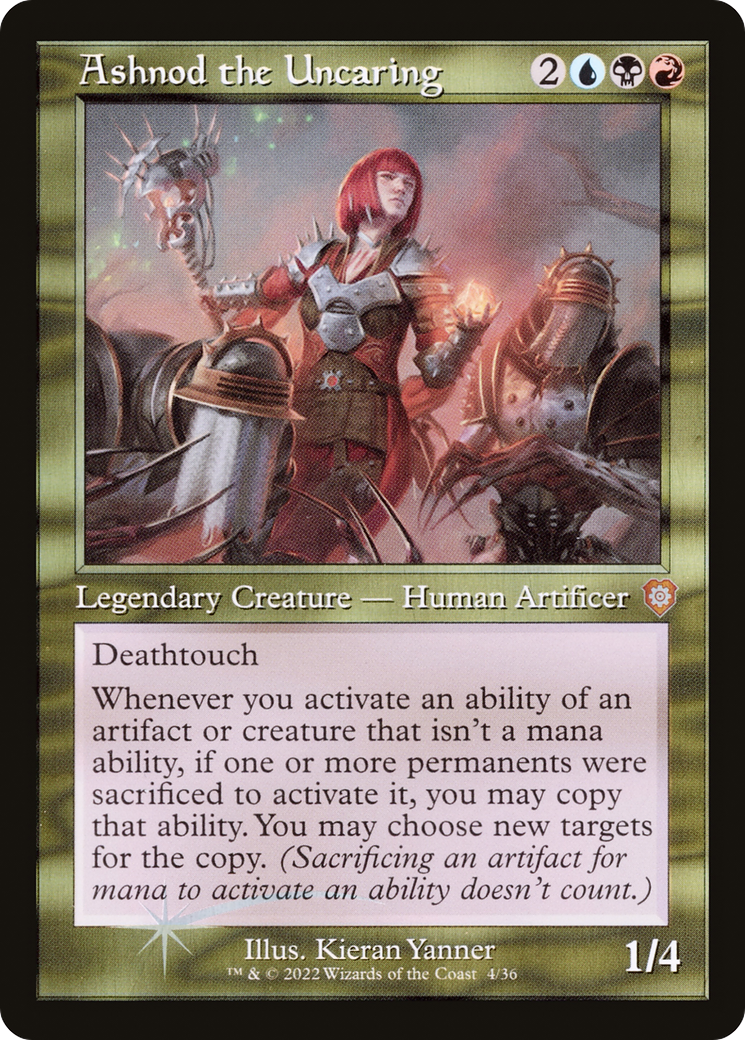
Ashnod the Uncaring
Ashnod the Uncaring
Legendary Creature — Human Artificer
1/4
Deathtouch
Whenever you activate an ability of an artifact or creature that isn't a mana ability, if one or more permanents were sacrificed to activate it, you may copy that ability. You may choose new targets for the copy. (Sacrificing an artifact for mana to activate an ability doesn't count.)
- “Sacrificed to activate it” means that a permanent was sacrificed to pay the ability’s costs. Sacrificing an artifact, such as a Treasure token, to create mana that you used to pay an activation cost doesn’t count.
-
1
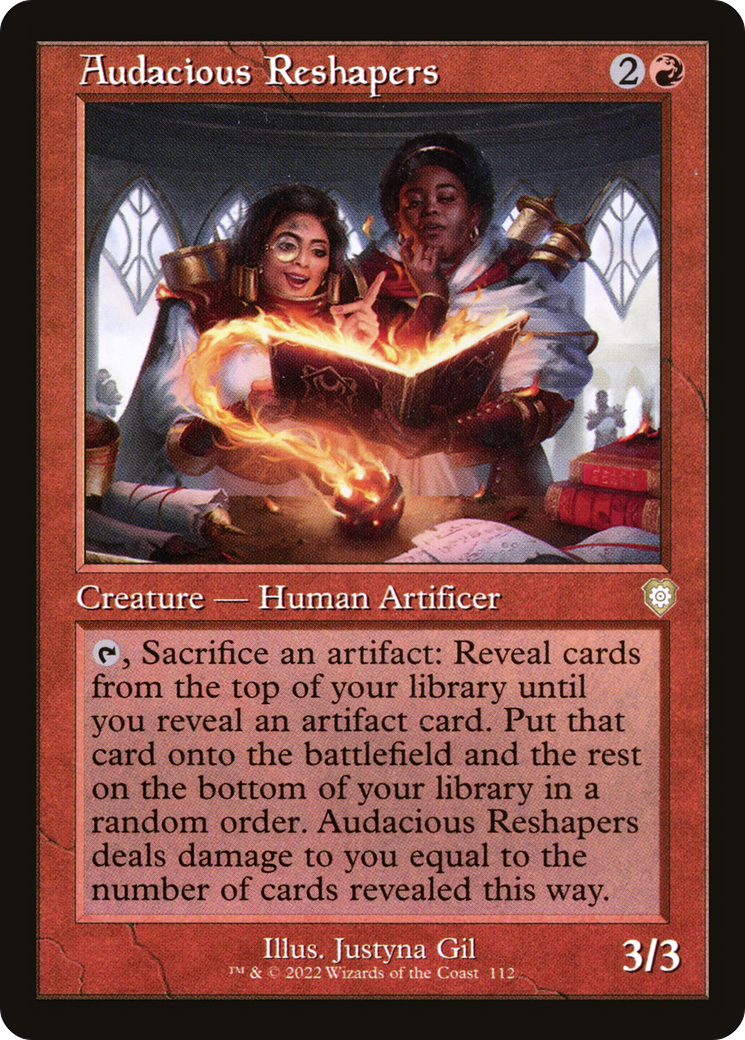
Audacious Reshapers
Audacious Reshapers
Creature — Human Artificer
3/3
, Sacrifice an artifact: Reveal cards from the top of your library until you reveal an artifact card. Put that card onto the battlefield and the rest on the bottom of your library in a random order. This creature deals damage to you equal to the number of cards revealed this way.
-
1
Blast-Furnace Hellkite
Blast-Furnace Hellkite
Creature — Dragon
5/5
Artifact offering (You may cast this spell as though it had flash by sacrificing an artifact and paying the difference in mana costs between this and the sacrificed artifact. Mana cost includes color.)
Flying, double strike
Creatures attacking your opponents have double strike.
- When you cast a spell with offering by sacrificing a permanent, generic mana in the sacrificed permanent’s mana cost reduces only generic mana in the spell’s total cost. Colored and colorless mana in the sacrificed permanent’s mana cost reduces mana of the same type in spell’s total cost, and any excess reduces the spell’s total cost by that much generic mana. The total cost of the spell can’t be reduced to less than .
- Blast-Furnace Hellkite’s last ability applies to any creature that is attacking one of your opponents, even if another opponent controls that creature.
-
1
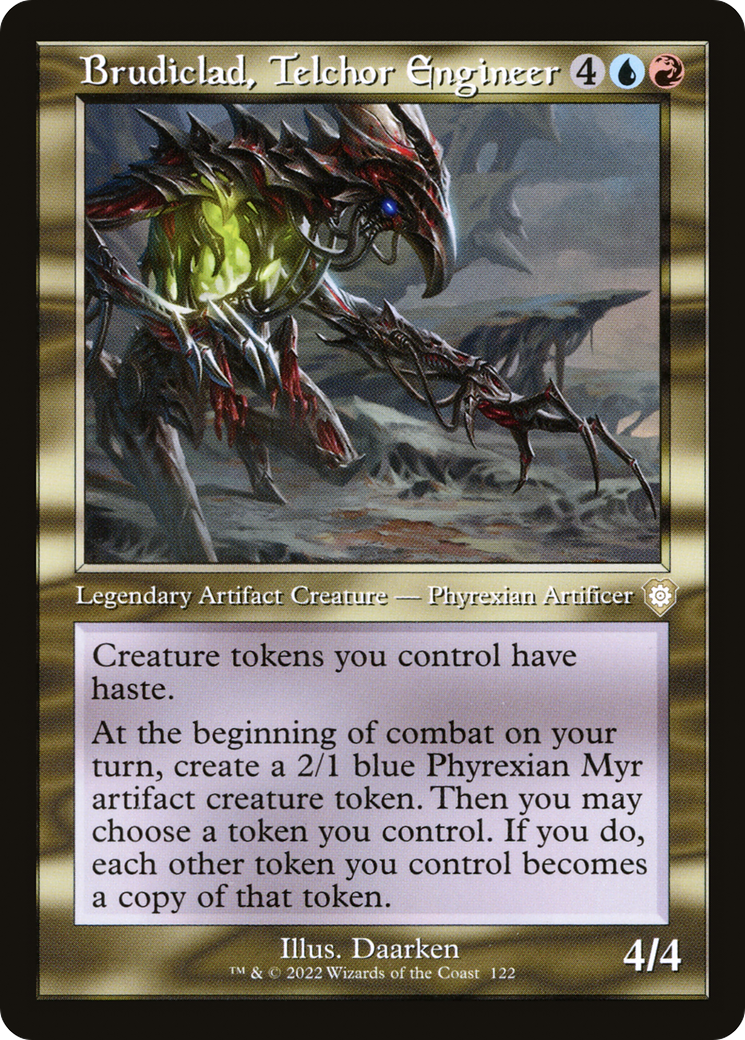
Brudiclad, Telchor Engineer
Brudiclad, Telchor Engineer
Legendary Artifact Creature — Phyrexian Artificer
4/4
Creature tokens you control have haste.
At the beginning of combat on your turn, create a 2/1 blue Phyrexian Myr artifact creature token. Then you may choose a token you control. If you do, each other token you control becomes a copy of that token.
- Once a creature token that came under your control this turn has legally attacked, causing it to lose haste by removing Brudiclad from the battlefield won't cause that token to stop attacking.
- All other tokens you control become a copy of the chosen token, even those that aren't of the same type. For example, if you control a Treasure artifact token and choose the Myr token Brudiclad just created, your Treasure will become a copy of the Myr.
- The effect of Brudiclad's triggered ability lasts indefinitely. It continues to apply after Brudiclad leaves the game.
- Brudiclad copies only the values defined as the original token was created (unless that token is copying something else; see below). It doesn't copy whether that token is tapped or untapped, whether it has any counters on it or any Auras and Equipment attached to it, or any non-copy effects that have changed its power, toughness, types, color, or so on.
- The last effect of Brudiclad's triggered ability affects all tokens you control other than the chosen token, including the token that was just created if that isn't the chosen token.
- If the chosen token is copying something else (for example, if the chosen token was previously affected by Brudiclad's triggered ability), then your tokens become copies of whatever the chosen token copied.
-
1
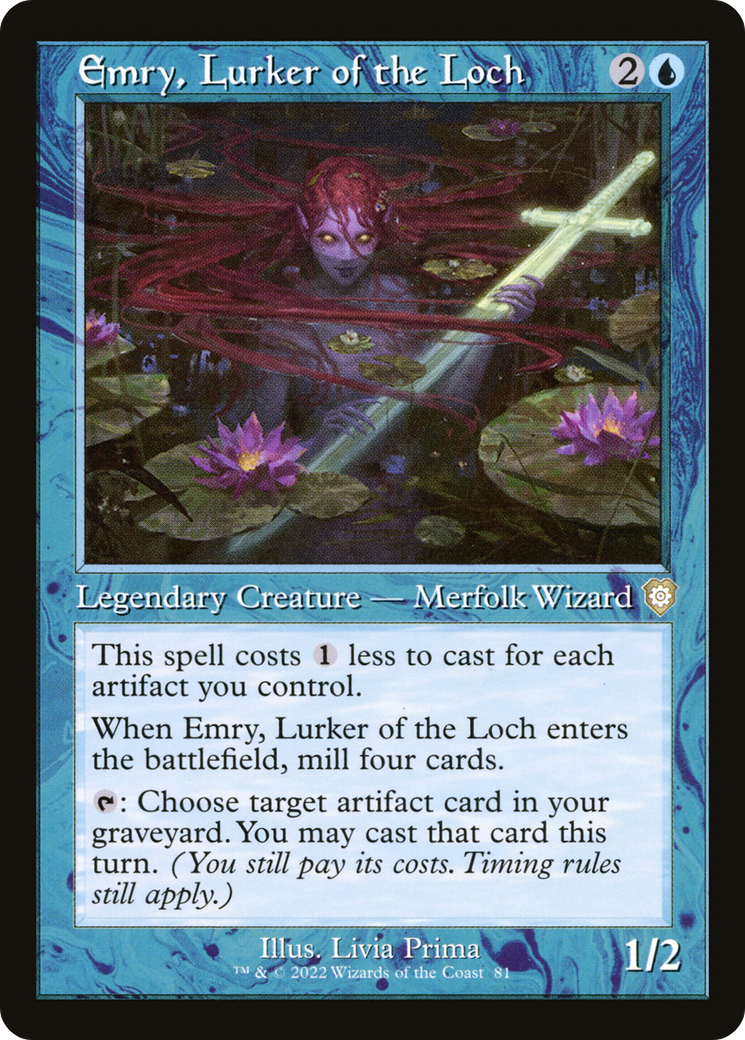
Emry, Lurker of the Loch
Emry, Lurker of the Loch
Legendary Creature — Merfolk Wizard
1/2
Affinity for artifacts (This spell costs less to cast for each artifact you control.)
When Emry enters, mill four cards.
: Choose target artifact card in your graveyard. You may cast that card this turn. (You still pay its costs. Timing rules still apply.)
- You'll still pay all costs for a spell cast this way, including additional costs. You may also pay alternative costs if any are available.
- To determine the total cost of a spell, start with the mana cost or alternative cost you're paying, add any cost increases, then apply any cost reductions (such as that of Emry). The mana value of the spell remains unchanged, no matter what the total cost to cast it was.
- Once you announce that you're casting a spell, no player may take actions until the spell has been paid for. Notably, opponents can't try to change by how much Emry's cost is reduced.
- Casting the target card causes it to leave your graveyard and become a new object. You can't cast it again if it returns to your graveyard this turn.
- If Emry's last ability targets an artifact land card, you can't play it. Effects that allow you to "cast" a card don't allow you to play a land card.
- The cost reduction ability reduces only the generic mana in Emry's cost. The colored mana must still be paid.
- You must follow the normal timing permissions and restrictions for the target artifact card. Unless it has flash, you'll most likely only be able to cast it during your main phase while the stack is empty.
-
1
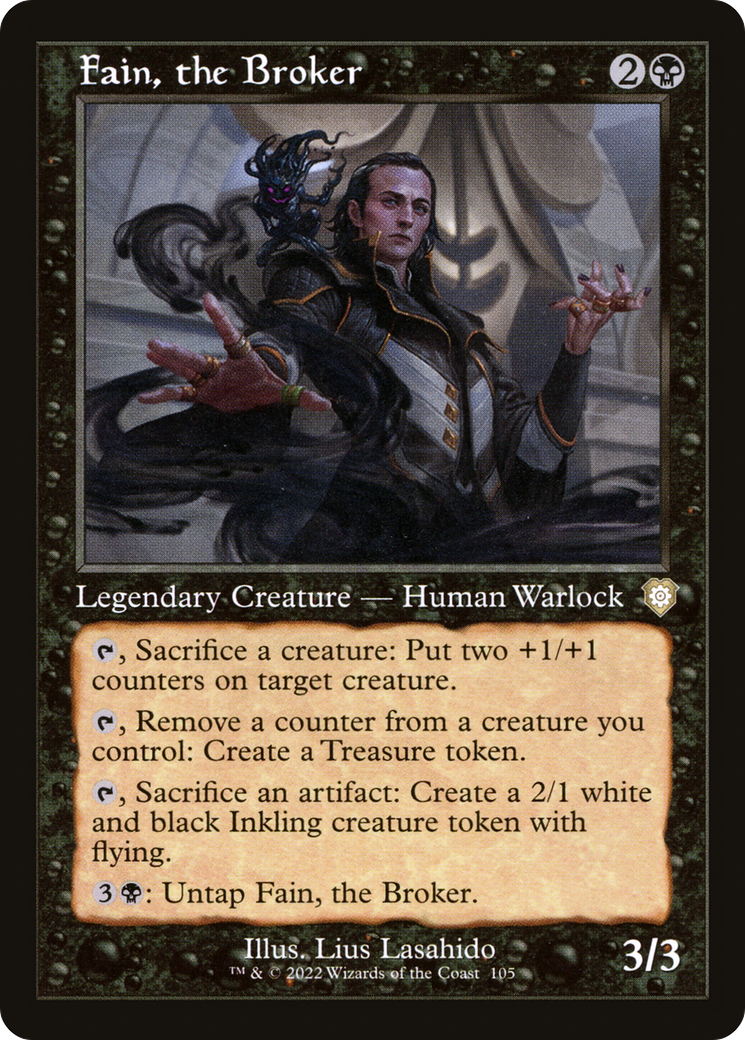
Fain, the Broker
Fain, the Broker
Legendary Creature — Human Warlock
3/3
, Sacrifice a creature: Put two +1/+1 counters on target creature.
, Remove a counter from a creature you control: Create a Treasure token.
, Sacrifice an artifact: Create a 2/1 white and black Inkling creature token with flying.
: Untap Fain.
-
1
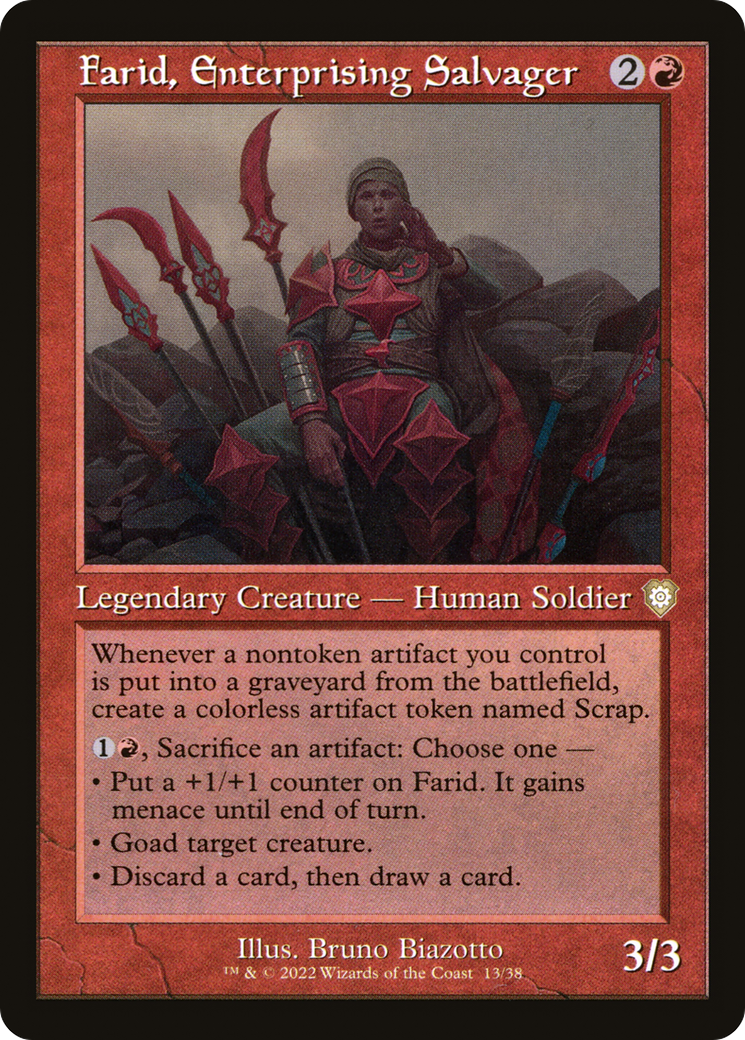
Farid, Enterprising Salvager
Farid, Enterprising Salvager
Legendary Creature — Human Soldier
3/3
Whenever a nontoken artifact you control is put into a graveyard from the battlefield, create a colorless artifact token named Scrap.
, Sacrifice an artifact: Choose one —
- Put a +1/+1 counter on Farid. It gains menace until end of turn.
- Goad target creature.
- Discard a card, then draw a card.
- If, during a player's declare attackers step, a creature that player controls that's been goaded is tapped, is affected by a spell or ability that says it can't attack, or hasn't been under that player's control continuously since the turn began (and doesn't have haste), then it doesn't attack. If there's a cost associated with having a creature attack a player, its controller isn't forced to pay that cost, so it doesn't have to attack that player.
- If the creature doesn't meet any of the above exceptions and can attack, it must attack a player other than the controller of the spell or ability that goaded it if able. If the creature can't attack any of those players but could otherwise attack, it must attack a planeswalker an opponent controls, a battle an opponent controls, or a player who goaded it.
- Being goaded isn't an ability the creature has. Once it's been goaded, it must attack as detailed above even if it loses all abilities.
- Attacking with a goaded creature doesn't cause it to stop being goaded. If there is an additional combat phase that turn, or if another player gains control of it before it stops being goaded, it must attack again if able.
- If a creature you control has been goaded by multiple opponents, it must attack one of your opponents that hasn't goaded it, as that fulfills the maximum number of goad requirements. If a creature you control has been goaded by each of your opponents, the creature must attack an opponent (rather than a planeswalker or battle), but you choose which opponent it attacks.
- The token's name is Scrap, and it has no abilities.
-
1
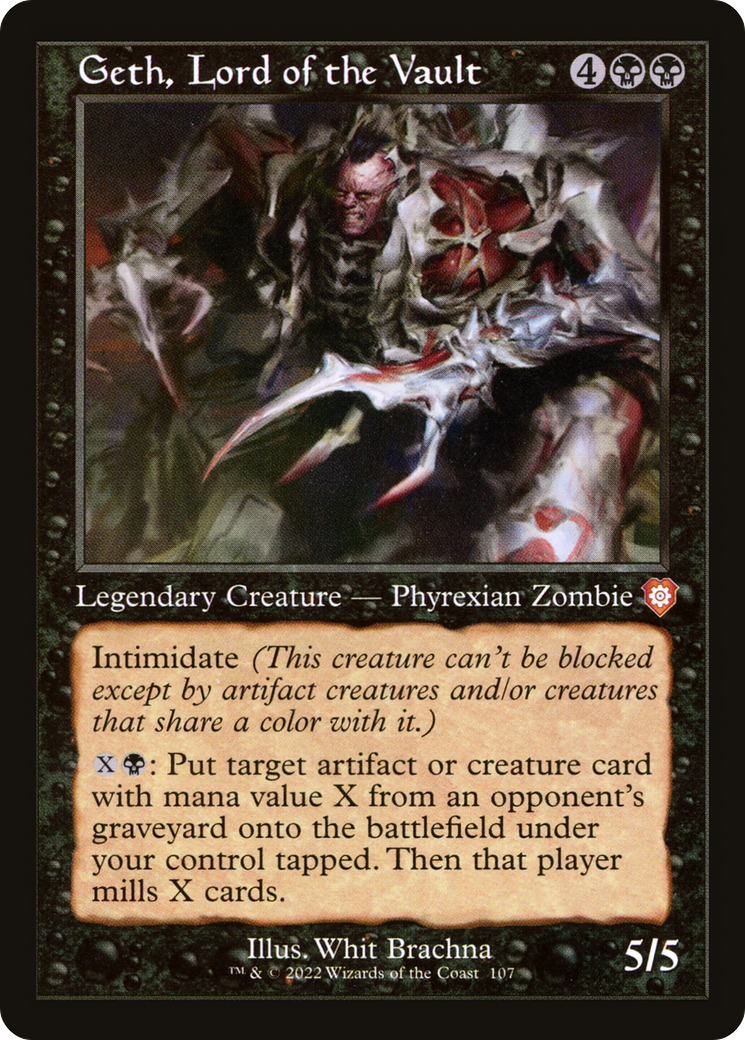
Geth, Lord of the Vault
Geth, Lord of the Vault
Legendary Creature — Phyrexian Zombie
5/5
Intimidate (This creature can't be blocked except by artifact creatures and/or creatures that share a color with it.)
: Put target artifact or creature card with mana value X from an opponent's graveyard onto the battlefield under your control tapped. Then that player mills X cards.
- If a card in a player's graveyard has in its mana cost, X is considered to be 0.
- The target card must have mana value exactly X. You can't overpay to have the player mill more cards.
- In a multiplayer game, if a player leaves the game, all cards that player owns leave as well. If you leave the game, any spells and/or permanents you control from Geth's last ability are exiled.
-
1
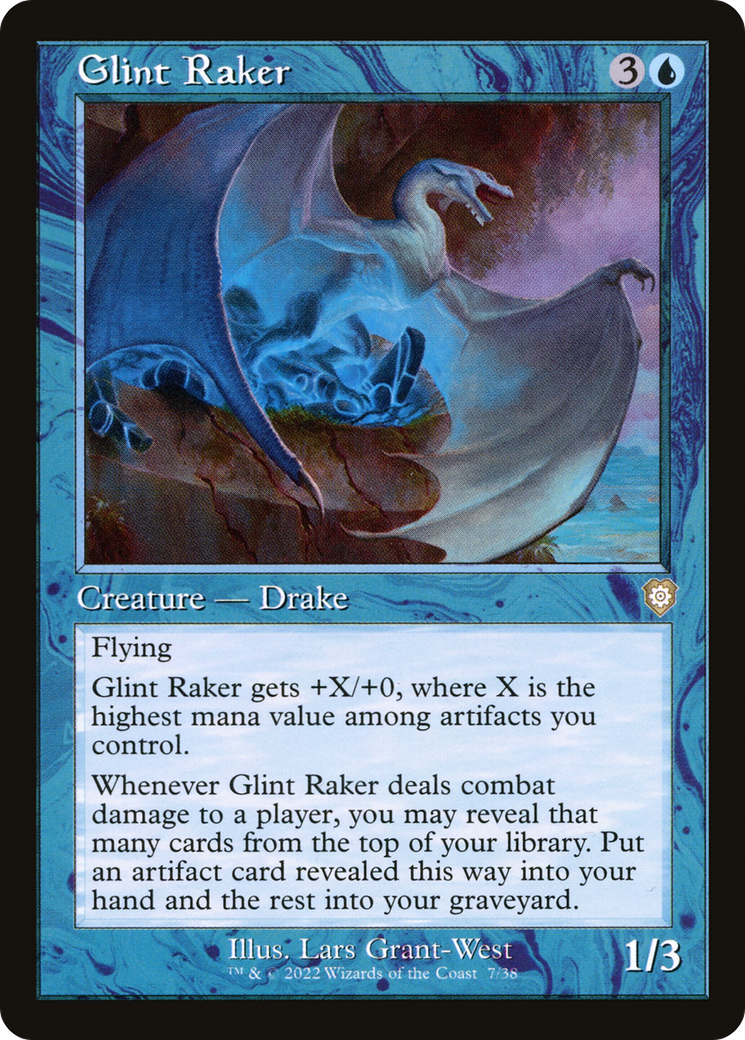
Glint Raker
Glint Raker
Creature — Drake
1/3
Flying
This creature gets +X/+0, where X is the highest mana value among artifacts you control.
Whenever this creature deals combat damage to a player, you may reveal that many cards from the top of your library. Put an artifact card revealed this way into your hand and the rest into your graveyard.
- If an artifact on the battlefield has an in its mana cost, that X is 0.
-
1
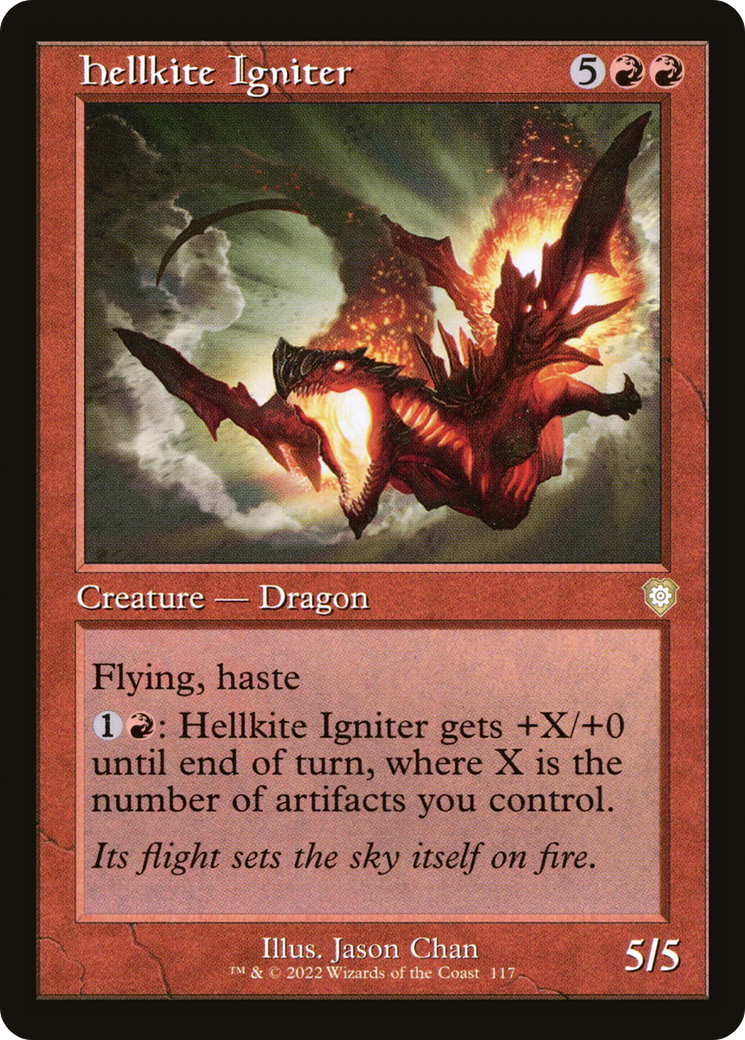
Hellkite Igniter
Hellkite Igniter
Creature — Dragon
5/5
Flying, haste
: This creature gets +X/+0 until end of turn, where X is the number of artifacts you control.
- The number of artifacts you control is counted when the ability resolves.
-
1
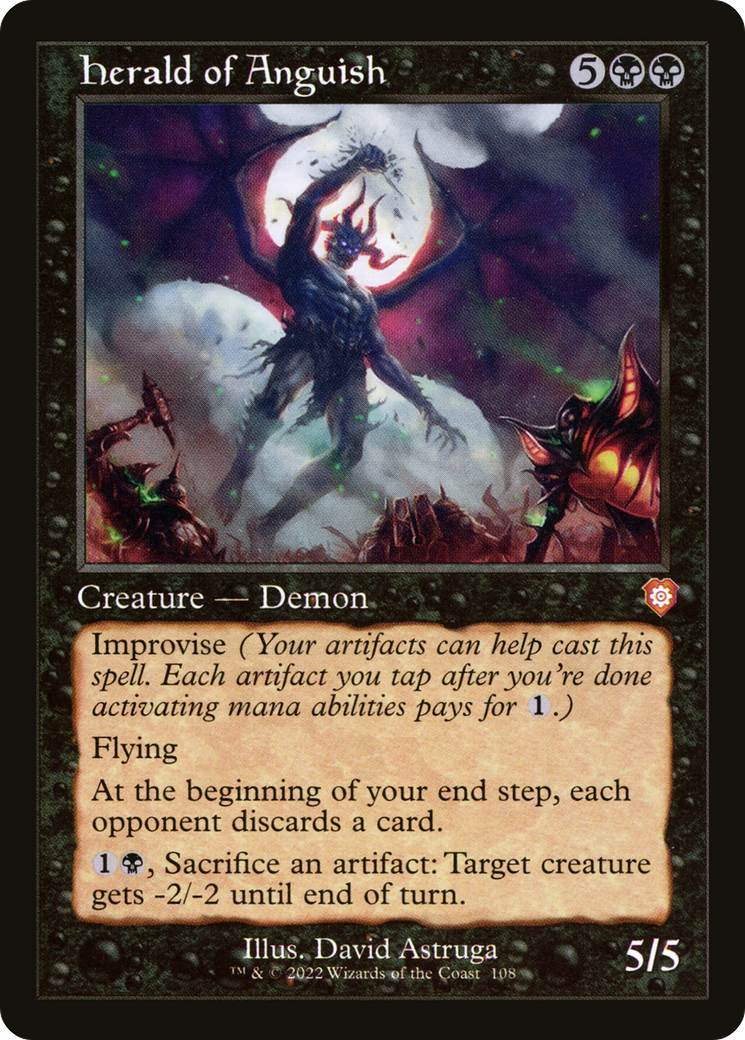
Herald of Anguish
Herald of Anguish
Creature — Demon
5/5
Improvise (Your artifacts can help cast this spell. Each artifact you tap after you're done activating mana abilities pays for .)
Flying
At the beginning of your end step, each opponent discards a card.
, Sacrifice an artifact: Target creature gets -2/-2 until end of turn.
- Improvise doesn't change a spell's mana cost or mana value.
- When calculating a spell's total cost, include any alternative costs, additional costs, or anything else that increases or reduces the cost to cast the spell. Improvise applies after the total cost is calculated.
- Because improvise isn't an alternative cost, it can be used in conjunction with alternative costs.
- Improvise can't pay for , , , , , or mana symbols in a spell's total cost.
- Improvise can't be used to pay for anything other than the cost of casting the spell. For example, it can't be used during the resolution of an ability that says “Counter target spell unless its controller pays .”
- If an artifact you control has a mana ability with in the cost, activating that ability while casting a spell with improvise will result in the artifact being tapped when you pay the spell's costs. You won't be able to tap it again for improvise. Similarly, if you sacrifice an artifact to activate a mana ability while casting a spell with improvise, that artifact won't be on the battlefield when you pay the spell's costs, so you won't be able to tap it for improvise.
- Tapping an artifact won't cause its abilities to stop applying unless those abilities say so.
- Equipment attached to a creature doesn't become tapped when that creature becomes tapped, and tapping that Equipment doesn't cause the creature to become tapped.
-
1
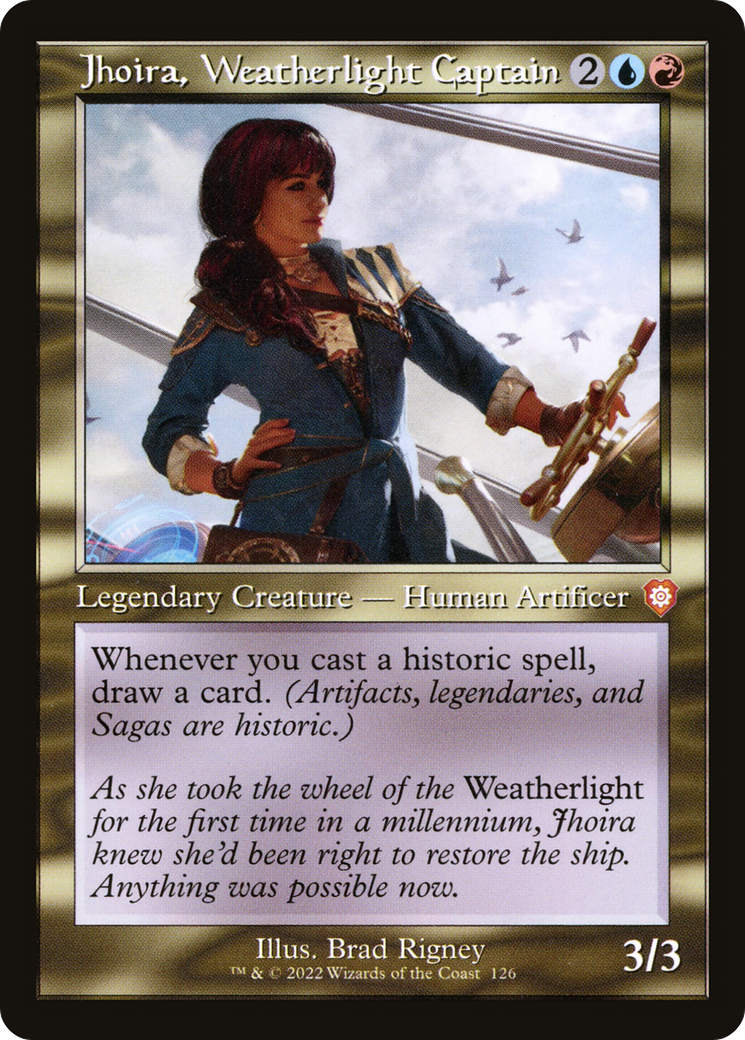
Jhoira, Weatherlight Captain
Jhoira, Weatherlight Captain
Legendary Creature — Human Artificer
3/3
Whenever you cast a historic spell, draw a card. (Artifacts, legendaries, and Sagas are historic.)
- A spell is historic if it has the legendary supertype, the artifact card type, or the Saga enchantment subtype. Having two of those qualities doesn't make a spell more historic than another or provide an additional bonus—a spell either is historic or it isn't.
- An ability that triggers when a player casts a spell resolves before the spell that caused it to trigger. It resolves even if that spell is countered.
-
1
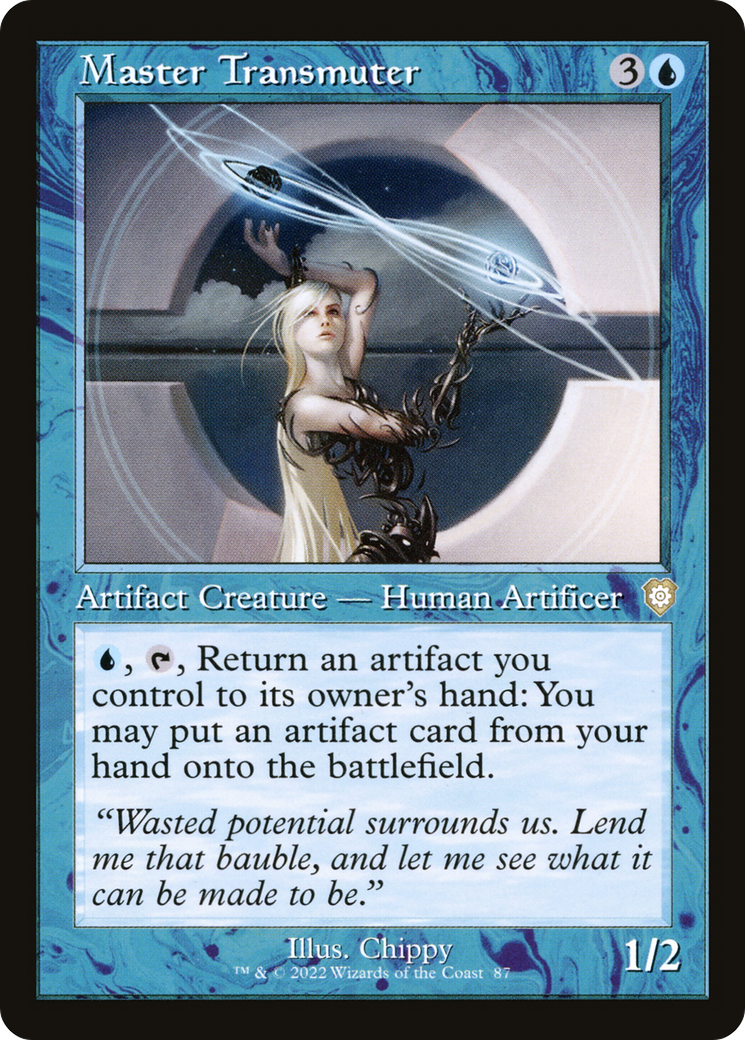
Master Transmuter
Master Transmuter
Artifact Creature — Human Artificer
1/2
, , Return an artifact you control to its owner's hand: You may put an artifact card from your hand onto the battlefield.
- Master Transmuter can be returned to its owner's hand to pay the cost of its activated ability.
- The artifact card you put onto the battlefield when the ability resolves may be the same card that you returned to your hand when you paid the cost. If so, it returns to the battlefield as a new object with no relation to its previous existence.
-
1
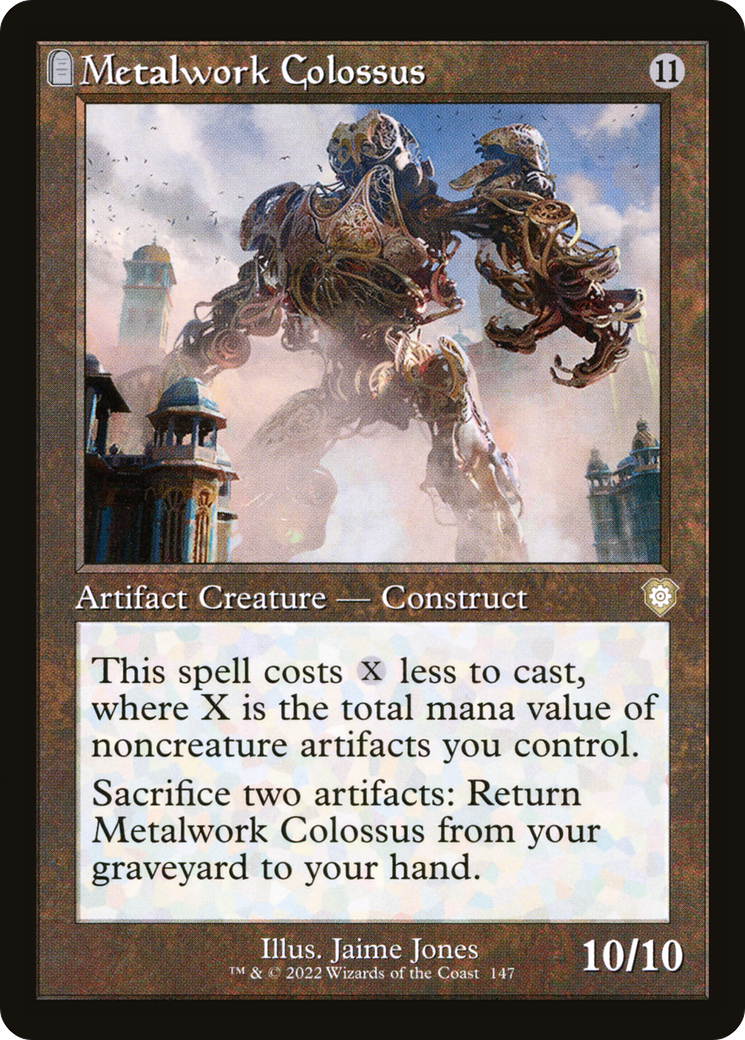
Metalwork Colossus
Metalwork Colossus
Artifact Creature — Construct
10/10
This spell costs less to cast, where X is the total mana value of noncreature artifacts you control.
Sacrifice two artifacts: Return this card from your graveyard to your hand.
- If a permanent has in its mana cost, X is considered to be 0.
- The total cost to cast Metalwork Colossus is locked in before you pay that cost. For example, if you control three noncreature artifacts each with mana value 2, including one you can sacrifice to add , the total cost of Metalwork Colossus is . Then you can sacrifice the artifact when you activate mana abilities just before paying the cost.
- If the total mana value of noncreature artifacts you control is 11 or greater, Metalwork Colossus costs to cast.
- Once a player has announced that they are casting Metalwork Colossus, no player may take actions to try to change the number of artifacts its controller controls before that spell's cost is locked in.
- Metalwork Colossus's last ability can be activated only if it is in your graveyard.
-
1
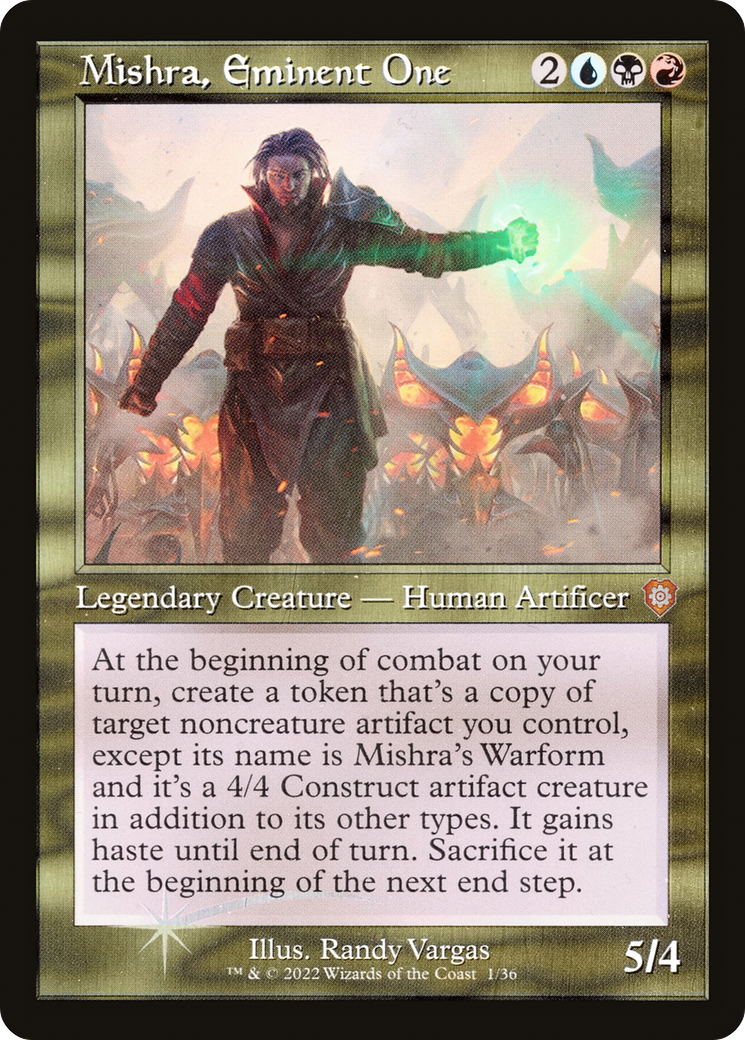
Mishra, Eminent One
Mishra, Eminent One
Legendary Creature — Human Artificer
5/4
At the beginning of combat on your turn, create a token that's a copy of target noncreature artifact you control, except its name is Mishra's Warform and it's a 4/4 Construct artifact creature in addition to its other types. It gains haste until end of turn. Sacrifice it at the beginning of the next end step.
- Except for name, power, toughness, and types, the token copies exactly what was printed on the original permanent and nothing else (unless that permanent is copying something else or it is a token; see below). It doesn’t copy whether that permanent is tapped or untapped, whether it has any counters on it or Auras attached to it, and so on.
- If the copied permanent has in its mana cost, X is 0.
- If the copied permanent is a token, the new token that’s created copies the original characteristics of that token as stated by the effect that created that token (with the listed exceptions).
- If the copied permanent is copying something else, then the token enters the battlefield as whatever that permanent copied (with the listed exceptions).
- Any enters-the-battlefield abilities of the copied permanent will trigger when the token enters the battlefield. Any “as [this permanent] enters the battlefield” or “[this permanent] enters the battlefield with” abilities of the target permanent will also work.
-
1
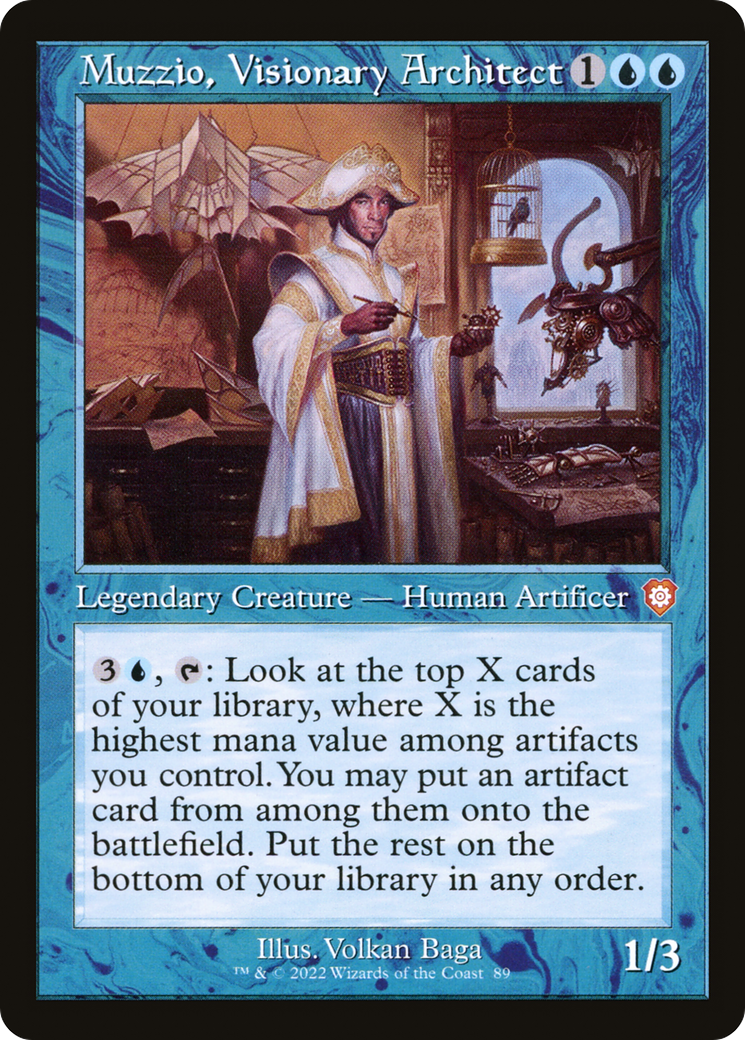
Muzzio, Visionary Architect
Muzzio, Visionary Architect
Legendary Creature — Human Artificer
1/3
, : Look at the top X cards of your library, where X is the highest mana value among artifacts you control. You may put an artifact card from among them onto the battlefield. Put the rest on the bottom of your library in any order.
- The value of X is determined as the ability resolves. If, at that time, you control no artifacts, you won't look at any cards.
-
1
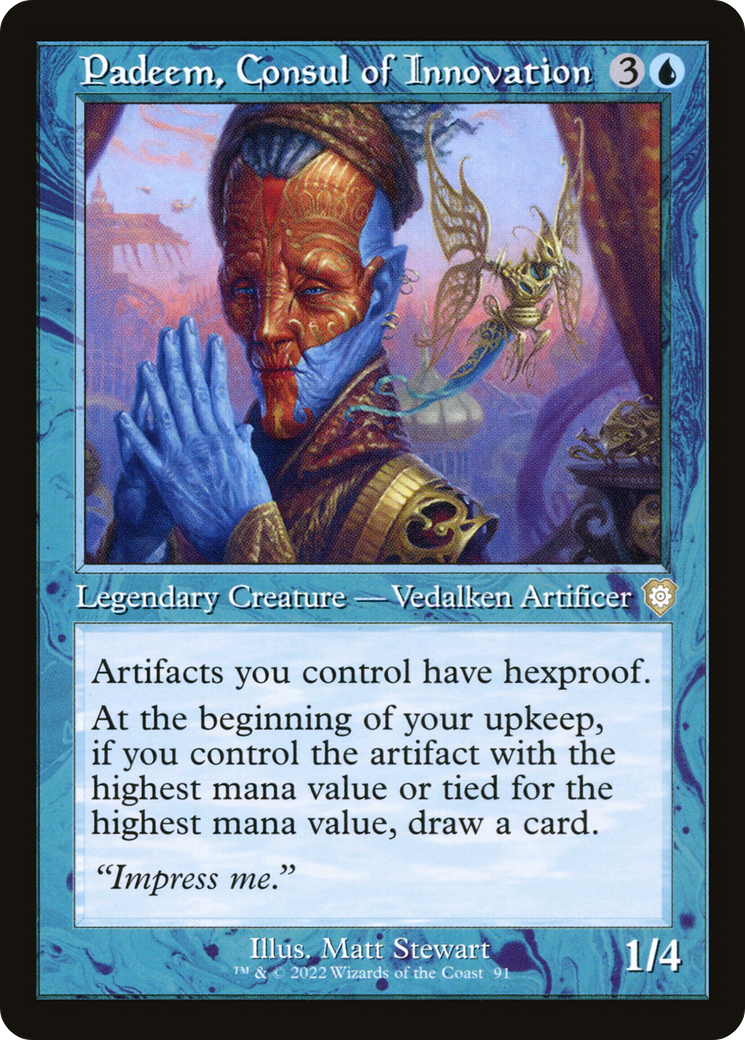
Padeem, Consul of Innovation
Padeem, Consul of Innovation
Legendary Creature — Vedalken Artificer
1/4
Artifacts you control have hexproof. (They can't be the targets of spells or abilities your opponents control.)
At the beginning of your upkeep, if you control the artifact with the highest mana value or tied for the highest mana value, draw a card.
- The artifact you control has to have the highest mana value only among artifacts on the battlefield, not among all permanents on the battlefield.
- If an artifact has in its mana cost, X is considered to be 0.
- If you don't control an artifact with the highest mana value as your upkeep begins, Padeem's second ability won't trigger. You can't cast an instant to destroy an opponent's artifact during your turn before your upkeep begins.
- If you no longer control an artifact with the highest mana value as Padeem's triggered ability resolves, you don't draw a card.
-
1
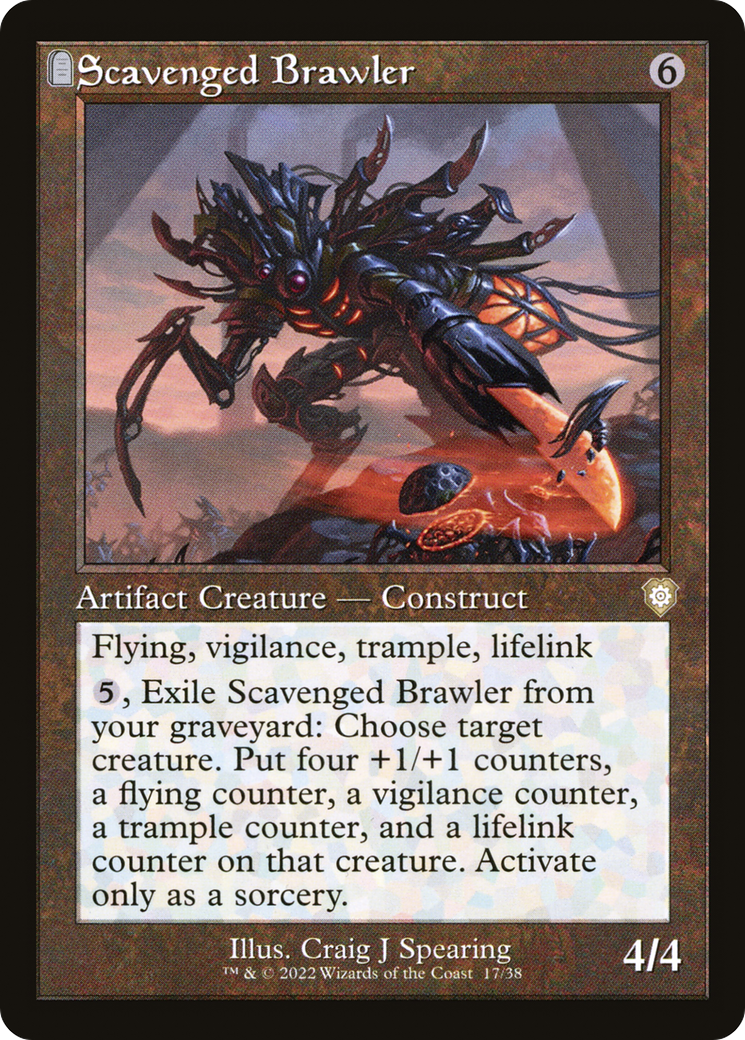
Scavenged Brawler
Scavenged Brawler
Artifact Creature — Construct
4/4
Flying, vigilance, trample, lifelink
, Exile this card from your graveyard: Choose target creature. Put four +1/+1 counters, a flying counter, a vigilance counter, a trample counter, and a lifelink counter on that creature. Activate only as a sorcery.
-
1
Silas Renn, Seeker Adept
Silas Renn, Seeker Adept
Legendary Artifact Creature — Human
2/2
Deathtouch
Whenever Silas Renn deals combat damage to a player, choose target artifact card in your graveyard. You may cast that card this turn.
Partner (You can have two commanders if both have partner.)
- Silas Renn doesn't change when you can cast the target artifact card. For example, if you target an artifact card without flash, you can cast it only during your main phase when the stack is empty.
- You pay the costs for the target artifact card if you cast it. You may pay alternative costs rather than the card's mana cost.
- You may cast that card this turn even if Silas Renn leaves the battlefield.
- An effect that instructs you to "cast" a card doesn't allow you to play lands.
- Casting the card causes it to leave your graveyard and become a new object. You can't cast it multiple times.
- If you don't cast the card, it remains in your graveyard.
- If your Commander deck has two commanders, you can only include cards whose own color identities are also found in your commanders' combined color identities. If Falthis and Kediss are your commanders, your deck may contain cards with black and/or red in their color identity, but not cards with green, white, or blue.
- Both commanders start in the command zone, and the remaining 98 cards (or 58 cards in a Commander Draft game) of your deck are shuffled to become your library.
- To have two commanders, both must have the partner ability as the game begins. Losing the ability during the game doesn't cause either to cease to be your commander.
- Once the game begins, your two commanders are tracked separately. If you cast one, you won't have to pay an additional the first time you cast the other. A player loses the game after having been dealt 21 damage from any one of them, not from both of them combined.
- If something refers to your commander while you have two commanders, it refers to one of them of your choice. If you are instructed to perform an action on your commander (e.g. put it from the command zone into your hand due to Command Beacon), you choose one of your commanders at the time the effect happens.
- An effect that checks whether you control your commander is satisfied if you control one or both of your two commanders.
- You can choose two commanders with partner that are the same color or colors. In Commander Draft, you can even choose two of the same commander with partner if you drafted them. If you do this, make sure you keep the number of times you've cast each from the command zone clear for "commander tax" purposes.
-
1
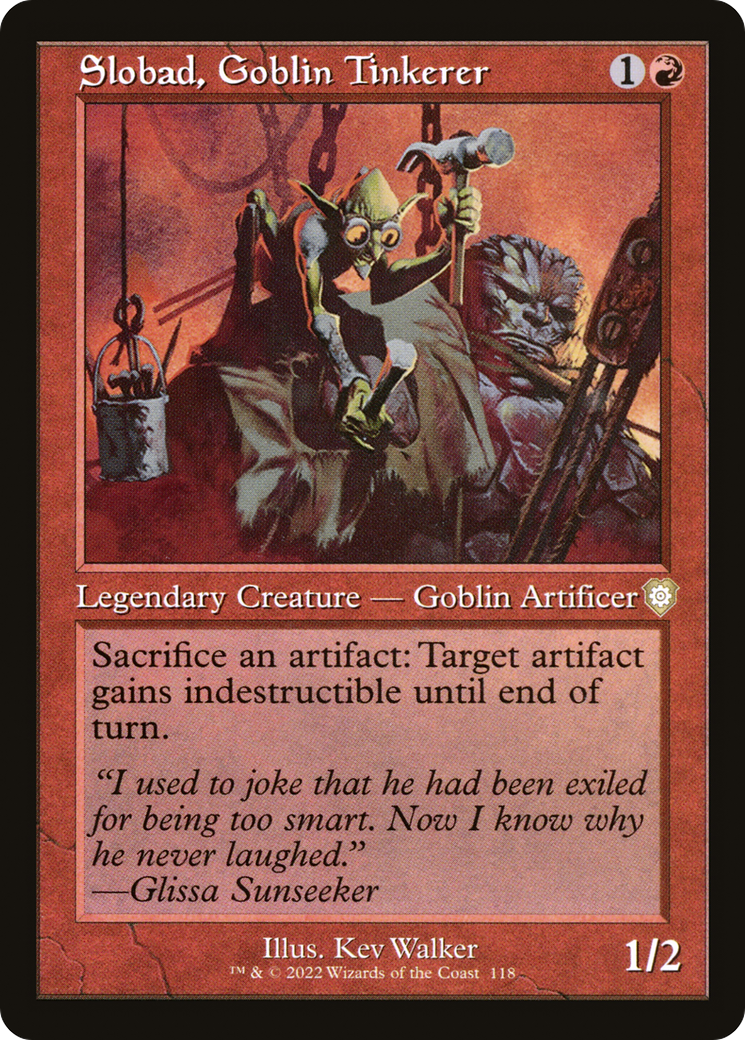
Slobad, Goblin Tinkerer
Slobad, Goblin Tinkerer
Legendary Creature — Goblin Artificer
1/2
Sacrifice an artifact: Target artifact gains indestructible until end of turn.
- Damage wears off simultaneously with this effect ending, so it does save an artifact creature from lethal damage.
-
1
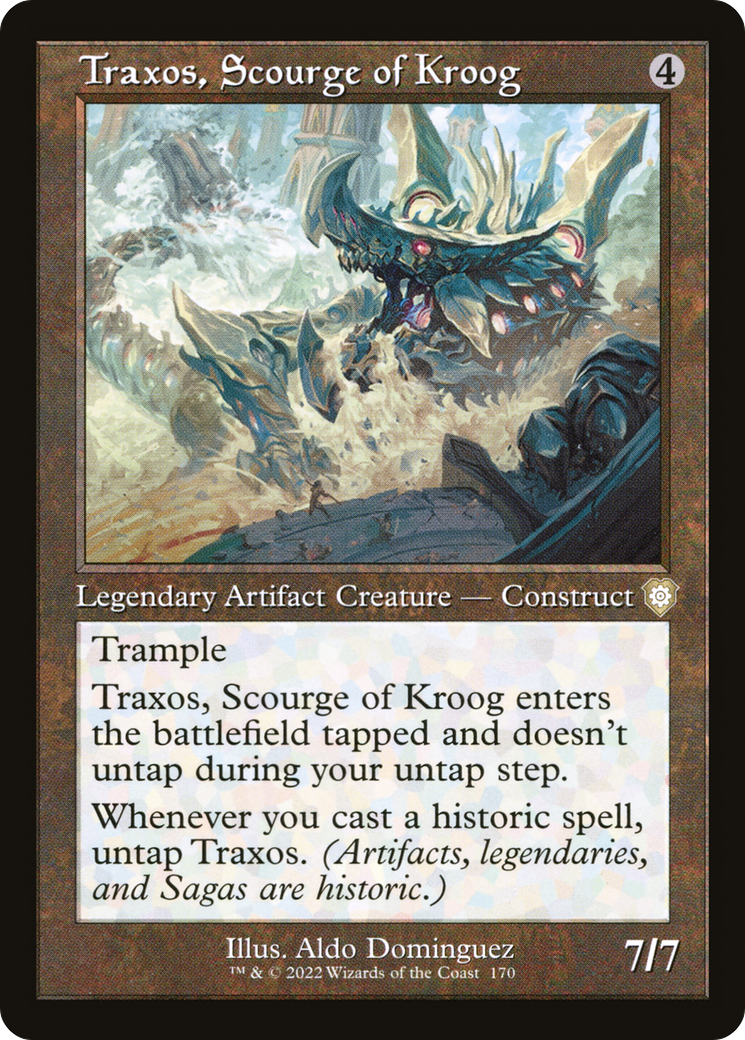
Traxos, Scourge of Kroog
Traxos, Scourge of Kroog
Legendary Artifact Creature — Construct
7/7
Trample
Traxos enters tapped and doesn't untap during your untap step.
Whenever you cast a historic spell, untap Traxos. (Artifacts, legendaries, and Sagas are historic.)
- A card, spell, or permanent is historic if it has the legendary supertype, the artifact card type, or the Saga subtype. Having two of those qualities doesn't make an object more historic than another or provide an additional bonus—an object either is historic or it isn't.
- Some abilities trigger "whenever you cast a historic spell." Such an ability resolves before the spell that caused it to trigger. It resolves even if that spell is countered.
- An ability that triggers "whenever you cast a historic spell" doesn't trigger if a historic card is put onto the battlefield without being cast.
- Lands are never cast, so abilities that trigger "whenever you cast a historic spell" won't trigger if you play a legendary land. They also won't trigger if a card on the battlefield transforms into a legendary land, as the Ixalan and Rivals of Ixalan double-faced cards do.
-
1
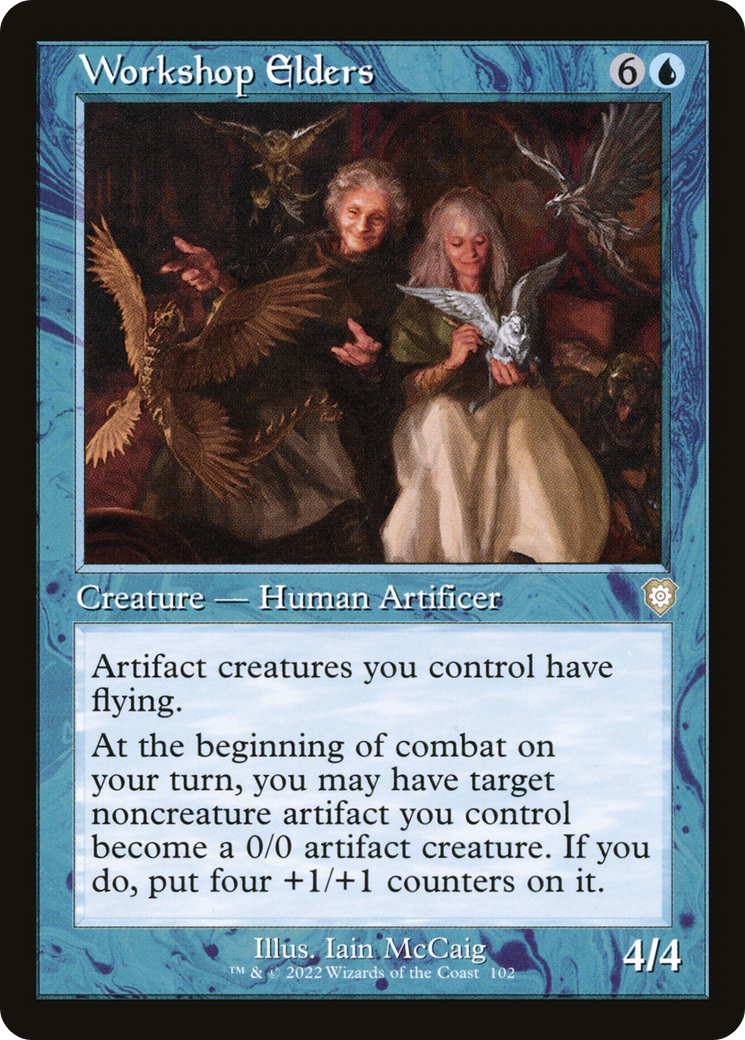
Workshop Elders
Workshop Elders
Creature — Human Artificer
4/4
Artifact creatures you control have flying.
At the beginning of combat on your turn, you may have target noncreature artifact you control become a 0/0 artifact creature. If you do, put four +1/+1 counters on it.
- The effect of Workshop Elders's triggered ability lasts indefinitely. It doesn't wear off during the cleanup step.
- An artifact that becomes a creature due to Workshop Elders can't attack unless you've controlled it continuously since your turn began.
- If another effect later causes the artifact to become a creature and sets its power and toughness as it does so, that creature will have that base power and toughness; it won't be 0/0. Notably, crewing a Vehicle does not set its power and toughness, so a Vehicle's base power and toughness remain 0/0 if you crew it.
Instants 5
-
1
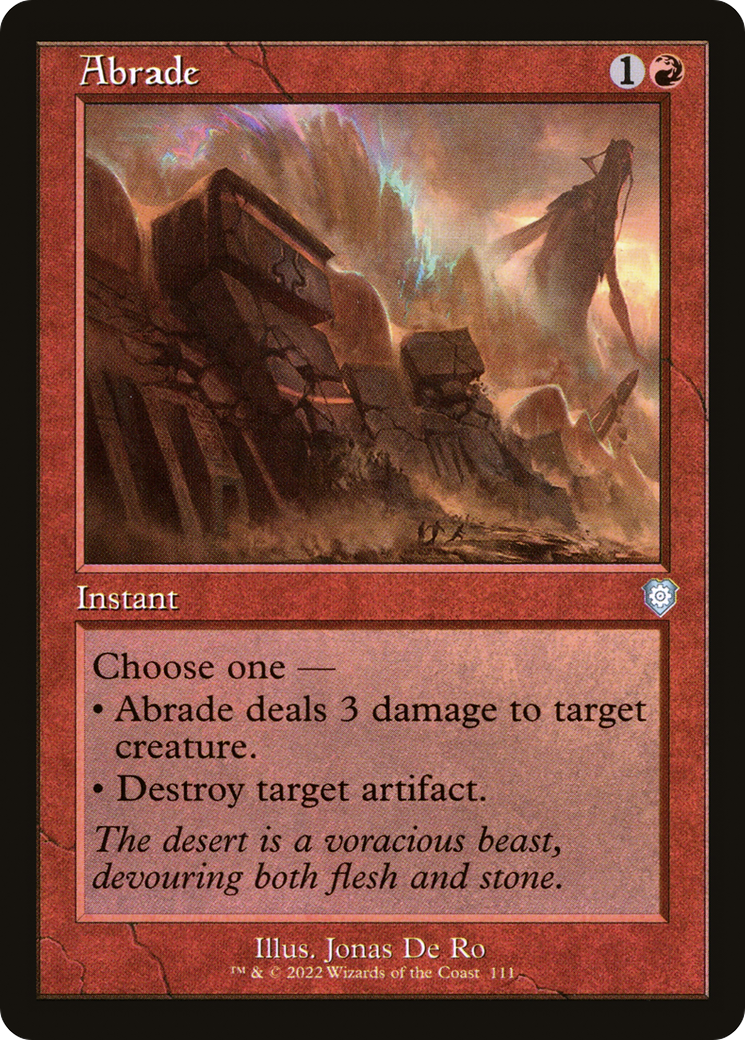
Abrade
Abrade
Instant
Choose one —
- Abrade deals 3 damage to target creature.
- Destroy target artifact.
-
1
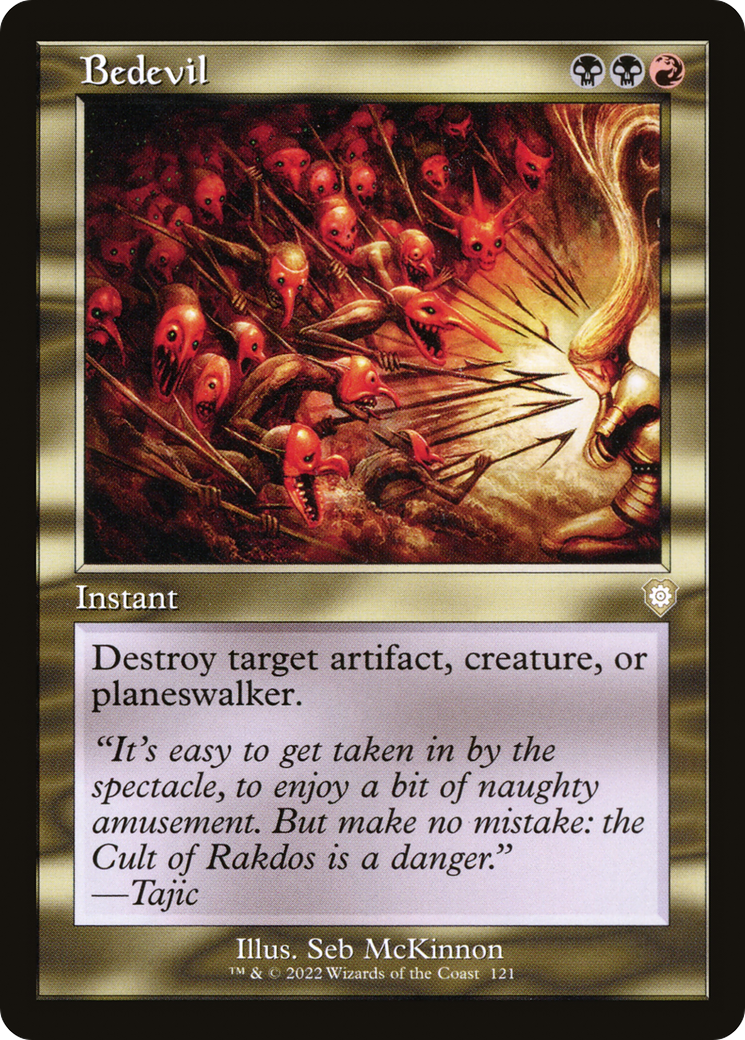
Bedevil
Bedevil
Instant
Destroy target artifact, creature, or planeswalker.
-
1
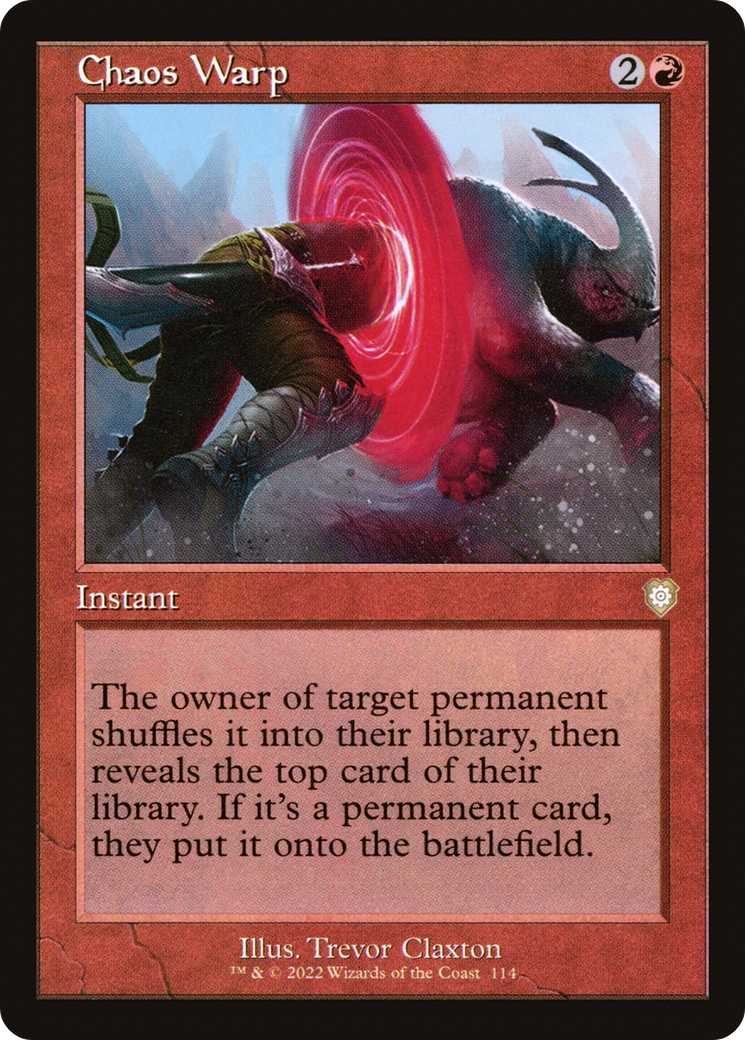
Chaos Warp
Chaos Warp
Instant
The owner of target permanent shuffles it into their library, then reveals the top card of their library. If it's a permanent card, they put it onto the battlefield.
- A permanent card is a card with one or more of the following card types: artifact, creature, enchantment, land, or planeswalker.
- The owner of a token is the player under whose control the token was put onto the battlefield. If a token is shuffled into a player's library this way, that player shuffles before revealing the top card of that library.
- If the revealed card is not a permanent card, it remains on top of that library.
- If the permanent is an illegal target by the time Chaos Warp tries to resolve, it won't resolve and none of its effects will occur. No library will be shuffled and no card will be revealed.
- If the revealed card is a permanent card but can't enter (perhaps because it's an Aura with nothing to enchant), it remains on top of that library.
-
1
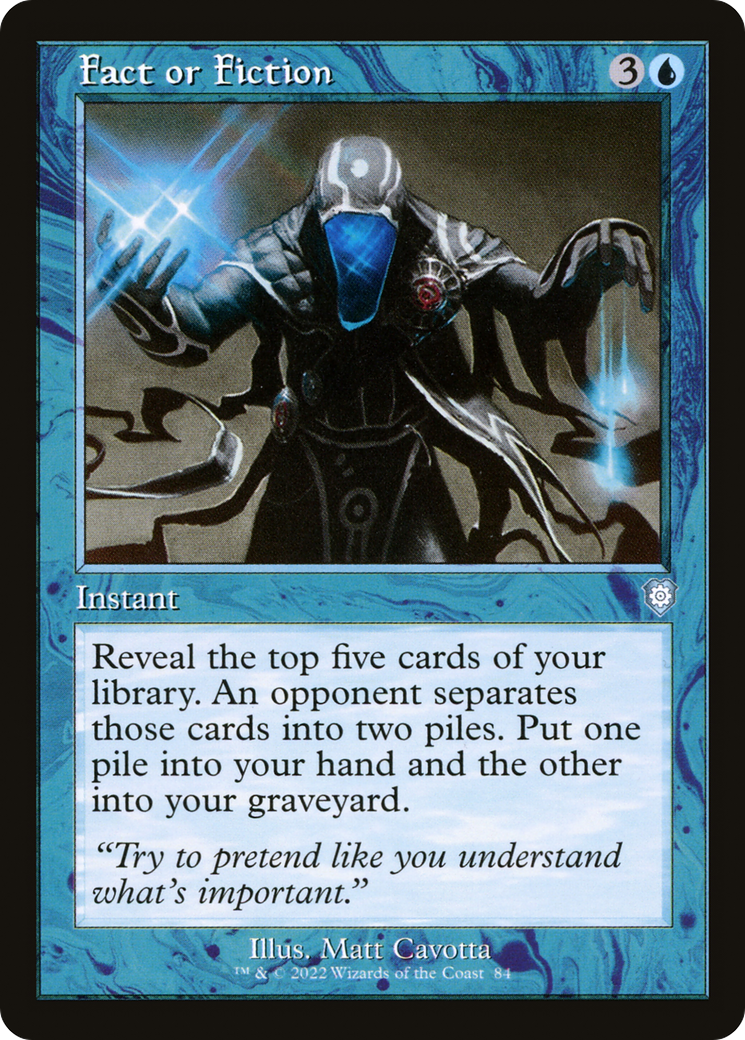
Fact or Fiction
Fact or Fiction
Instant
Reveal the top five cards of your library. An opponent separates those cards into two piles. Put one pile into your hand and the other into your graveyard.
- Piles may be empty.
-
1
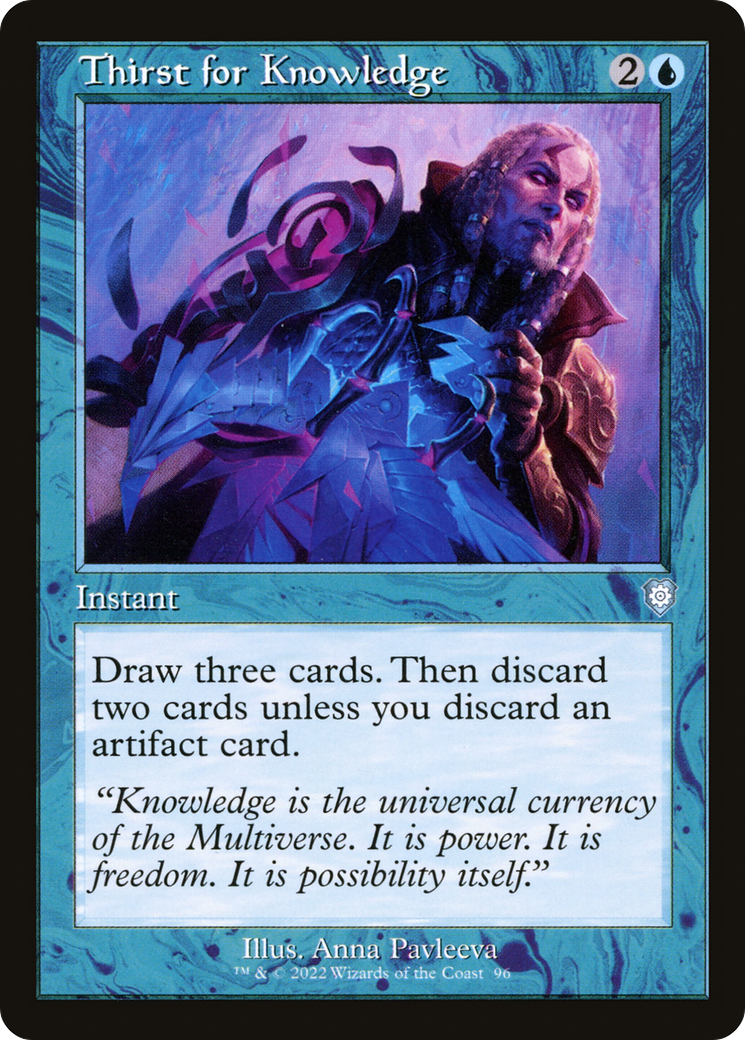
Thirst for Knowledge
Thirst for Knowledge
Instant
Draw three cards. Then discard two cards unless you discard an artifact card.
- You can discard either one artifact card or two cards which may or may not be artifacts. If you really want to, you can discard two artifact cards.
Sorceries 6
-
1
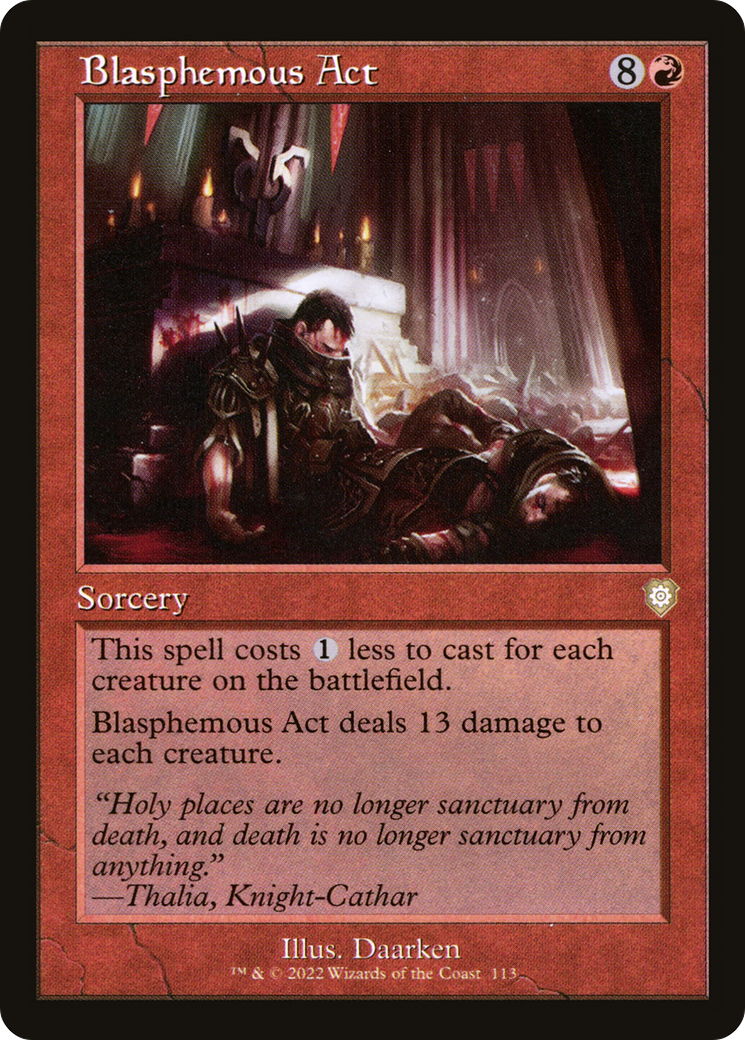
Blasphemous Act
Blasphemous Act
Sorcery
This spell costs less to cast for each creature on the battlefield.
Blasphemous Act deals 13 damage to each creature.
- Although players may respond to Blasphemous Act once it's been cast, once it's announced, they can't respond before the cost is calculated and paid.
- Blasphemous Act's ability can't reduce the total cost to cast the spell below .
- The total cost to cast Blasphemous Act is locked in before you pay that cost. For example, if there are three creatures on the battlefield, including one you can sacrifice to add , the total cost of Blasphemous Act is . Then you can sacrifice the creature when you activate mana abilities just before paying the cost.
- To determine the total cost of a spell, start with the mana cost or alternative cost you're paying, add any cost increases, then apply any cost reductions (such as that of Blasphemous Act). The mana value of the spell is determined only by its mana cost, no matter what the total cost to cast the spell was.
-
1
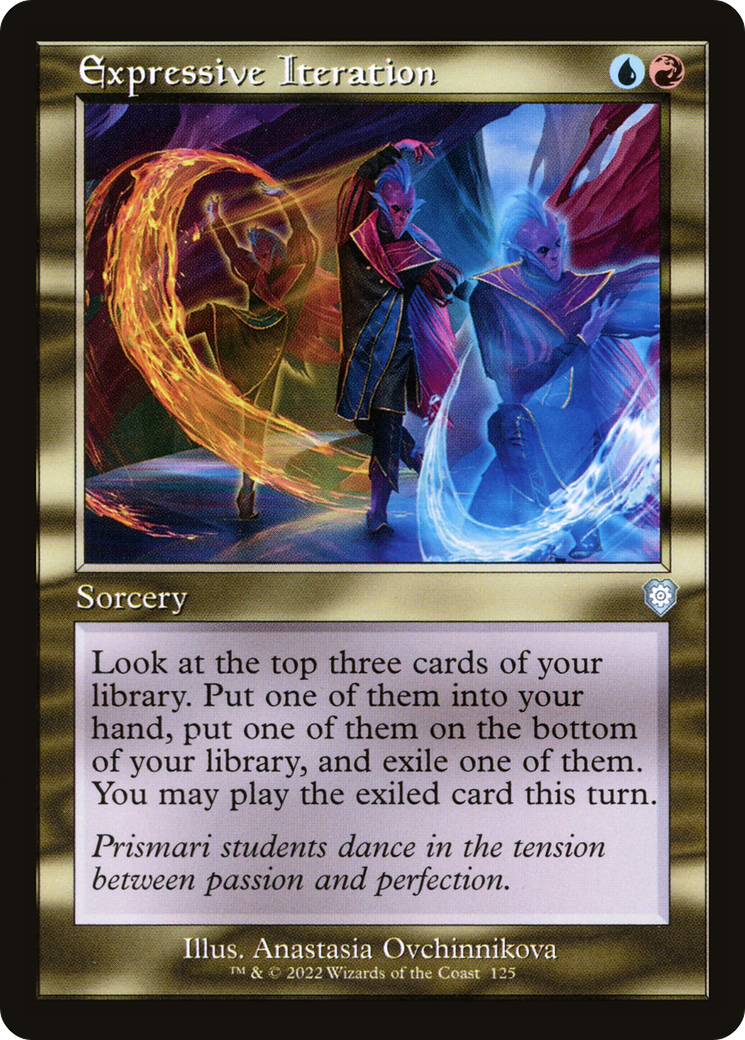
Expressive Iteration
Expressive Iteration
Sorcery
Look at the top three cards of your library. Put one of them into your hand, put one of them on the bottom of your library, and exile one of them. You may play the exiled card this turn.
- If you choose to play the exiled card this turn, you must still pay all costs and follow all timing restrictions required by that card. If it's a land, you can't play it unless you have a land play available.
- If there are fewer than three cards in your library, follow the instructions in the order given for any cards that are there. For example, if there are two cards in your library, you'll put one of them into your hand and one of them on the bottom of your library. You won't have the option to exile either of them.
- If you don't play the exiled card, it remains exiled. It won't be available to be played on future turns.
-
1
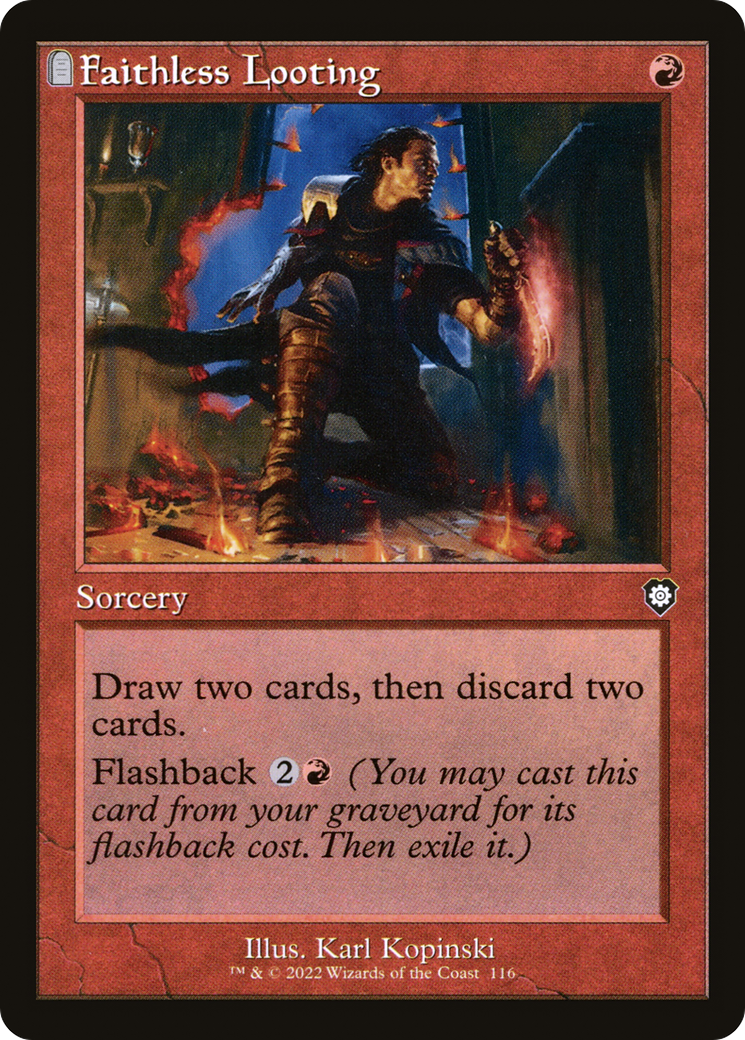
Faithless Looting
Faithless Looting
Sorcery
Draw two cards, then discard two cards.
Flashback (You may cast this card from your graveyard for its flashback cost. Then exile it.)
- To determine the total cost of a spell, start with the mana cost or alternative cost (such as a flashback cost) you're paying, add any cost increases, then apply any cost reductions. The mana value of the spell is determined only by its mana cost, no matter what the total cost to cast the spell was.
- A spell cast using flashback will always be exiled afterward, whether it resolves, is countered, or leaves the stack in some other way.
- "Flashback [cost]" means "You may cast this card from your graveyard if the resulting spell is an instant or sorcery spell by paying [cost] rather than paying its mana cost" and "If the flashback cost was paid, exile this card instead of putting it anywhere else any time it would leave the stack."
- If a card with flashback is put into your graveyard during your turn, you can cast it if it's legal to do so before any other player can take any actions.
- You can cast a spell using flashback even if it was somehow put into your graveyard without having been cast.
- You must still follow any timing restrictions and permissions, including those based on the card's type. For instance, you can cast a sorcery using flashback only when you could normally cast a sorcery.
- You draw two cards and discard two cards all while Faithless Looting is resolving. Nothing can happen between the two, and no player may choose to take actions.
-
1
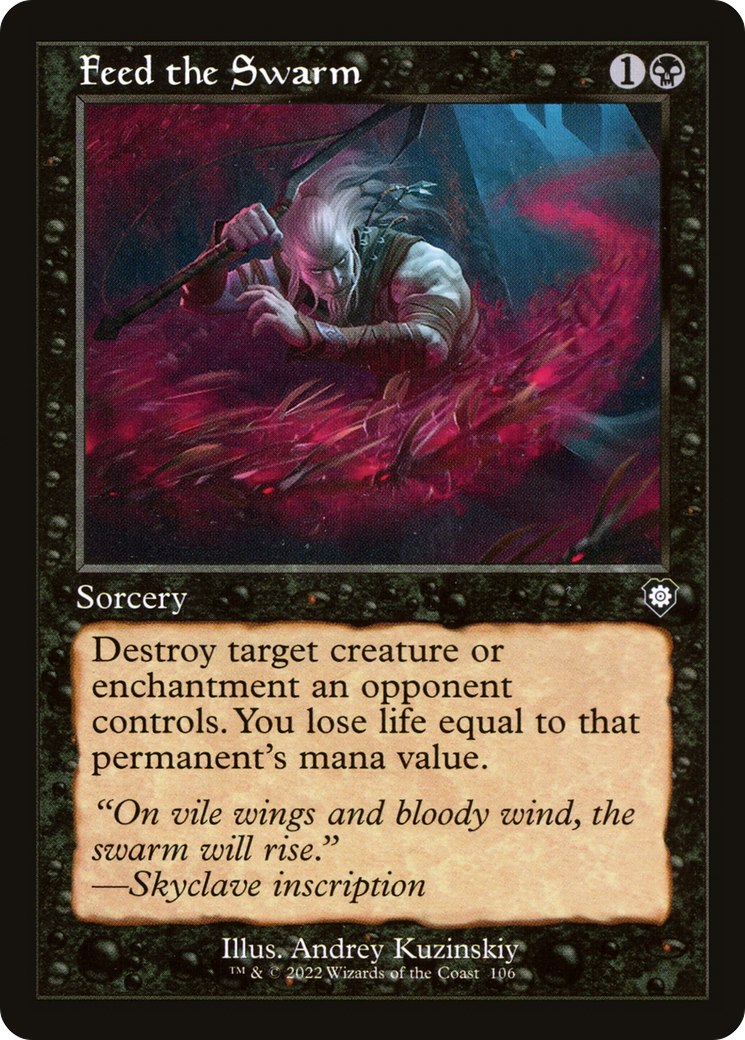
Feed the Swarm
Feed the Swarm
Sorcery
Destroy target creature or enchantment an opponent controls. You lose life equal to that permanent's mana value.
- The amount of life you lose is determined by the permanent's mana value as it last existed on the battlefield.
- If the target permanent is an illegal target by the time Feed the Swarm tries to resolve, the spell doesn't resolve. You don't lose any life. If the target is legal but not destroyed (most likely because it has indestructible), you do lose life.
- If a permanent on the battlefield has in its mana cost, X is 0 for the purpose of determining its mana value.
-
1
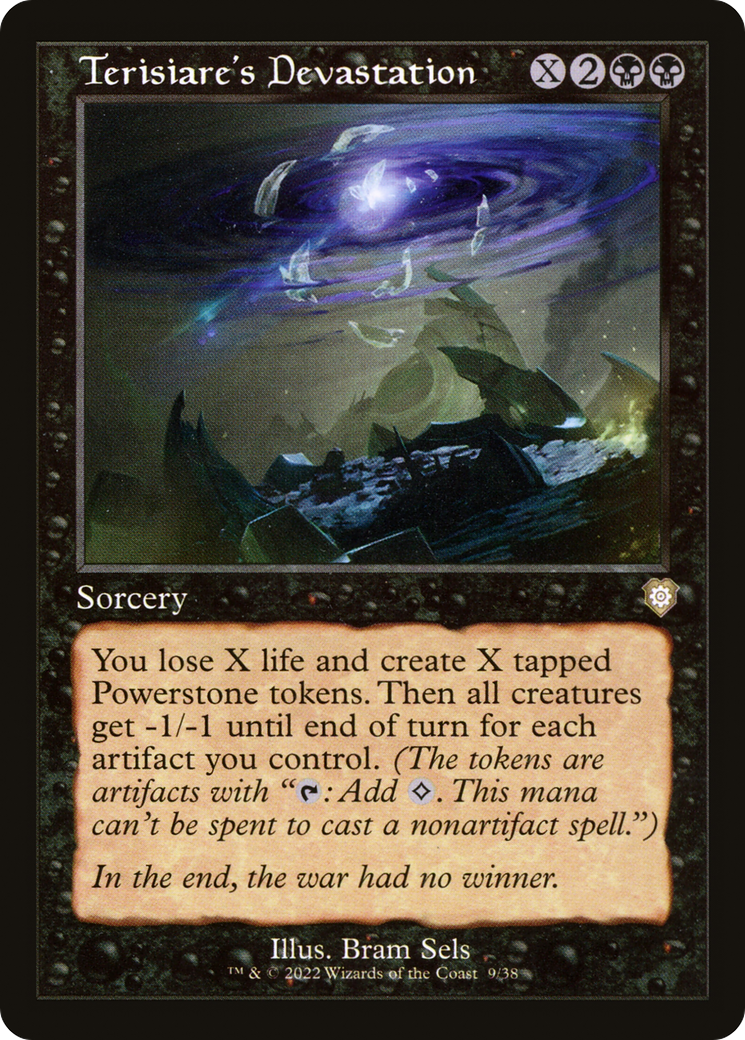
Terisiare's Devastation
Terisiare's Devastation
Sorcery
You lose X life and create X tapped Powerstone tokens. Then all creatures get -1/-1 until end of turn for each artifact you control. (The tokens are artifacts with " : Add . This mana can't be spent to cast a nonartifact spell.")
- Powerstone tokens are a kind of predefined token. Each one has the artifact subtype “Powerstone” and the ability “ : Add . This mana can’t be spent to cast a nonartifact spell.”
- You can use the added by a Powerstone token on anything that isn’t a nonartifact spell. This includes paying costs to activate abilities of both artifact and nonartifact permanents, paying ward costs, and so on.
- Although all the cards in The Brothers’ War that create Powerstone tokens create a tapped Powerstone token, entering the battlefield tapped isn’t part of the token’s definition. Notably, if you create a token that is a copy of a Powerstone token, the token copy won’t enter the battlefield tapped.
-
1
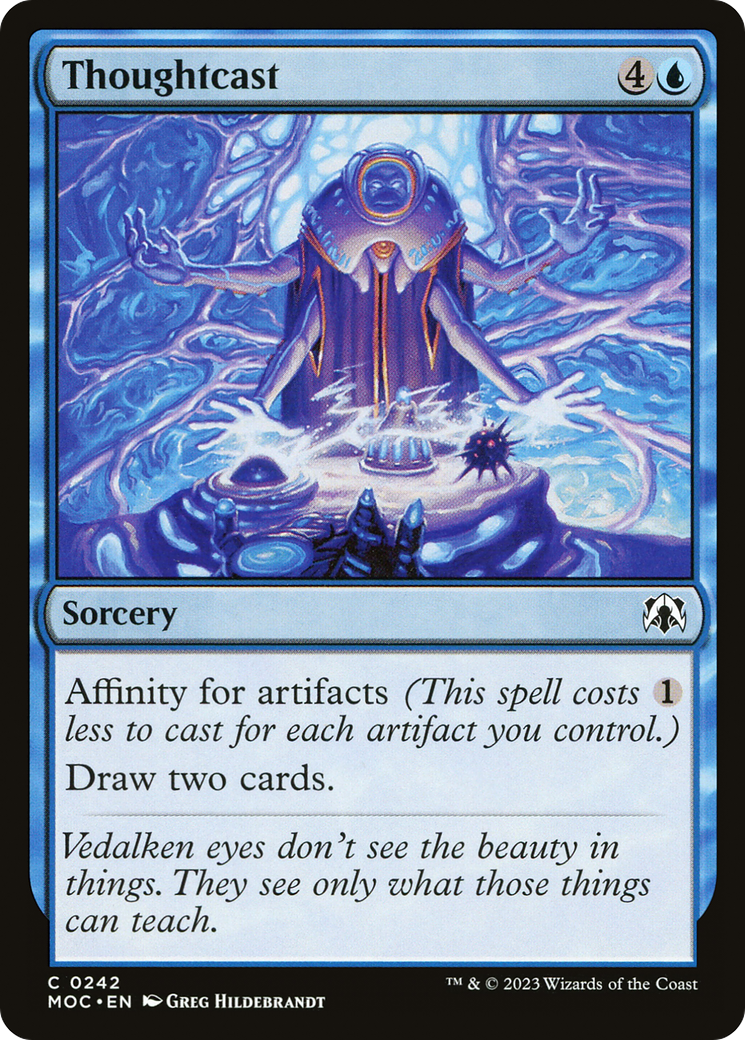
Thoughtcast
Thoughtcast
Sorcery
Affinity for artifacts (This spell costs less to cast for each artifact you control.)
Draw two cards.
Artifacts 30
-
1
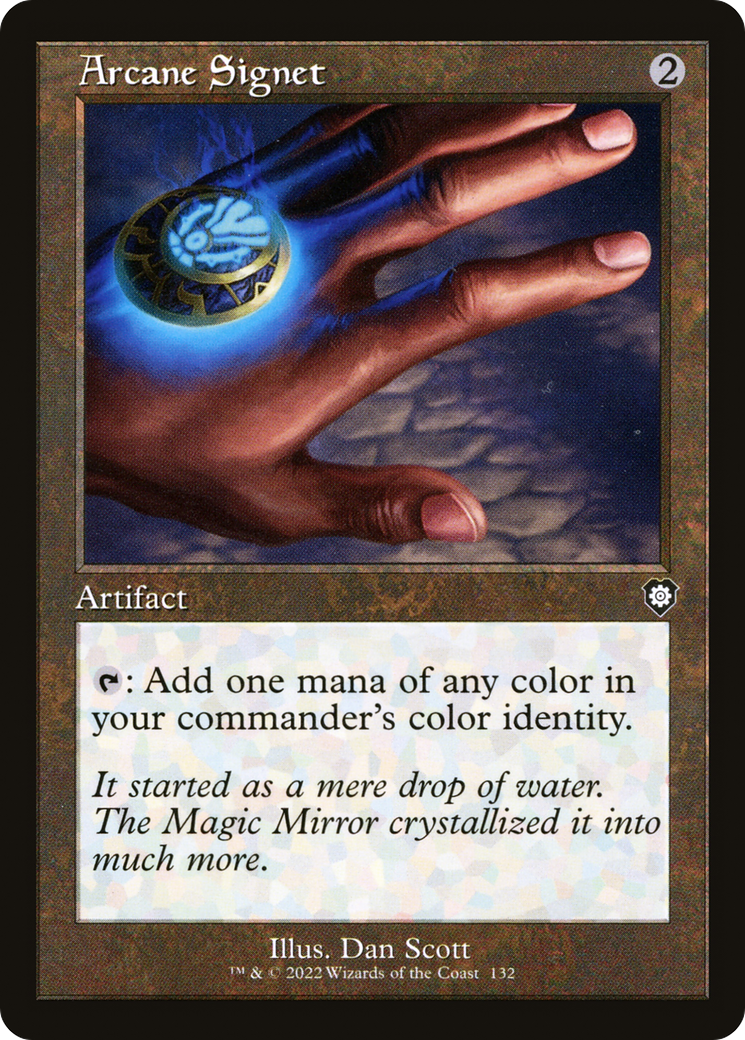
Arcane Signet
Arcane Signet
Artifact
: Add one mana of any color in your commander's color identity.
- If your commander is a card that has no colors in its color identity, Arcane Signet's ability produces no mana. It doesn't produce .
- If you have two commanders, the ability adds one mana of any color in their combined color identities.
- If you don't have a commander, Arcane Signet's ability produces no mana.
-
1
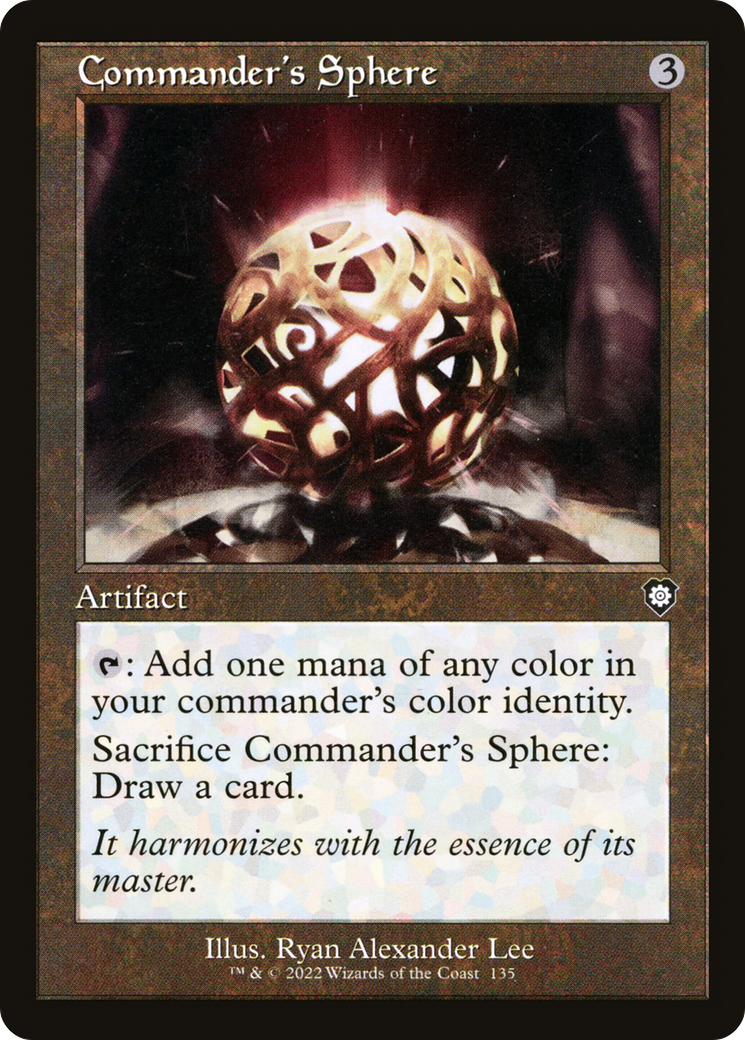
Commander's Sphere
Commander's Sphere
Artifact
: Add one mana of any color in your commander's color identity.
Sacrifice this artifact: Draw a card.
- If your commander is a card that has no colors in its color identity, Commander's Sphere's first ability produces no mana. It doesn't produce .
- If you don't have a commander, Commander's Sphere's first ability produces no mana.
- If you have two commanders, the ability adds one mana of any color in their combined color identities.
-
1
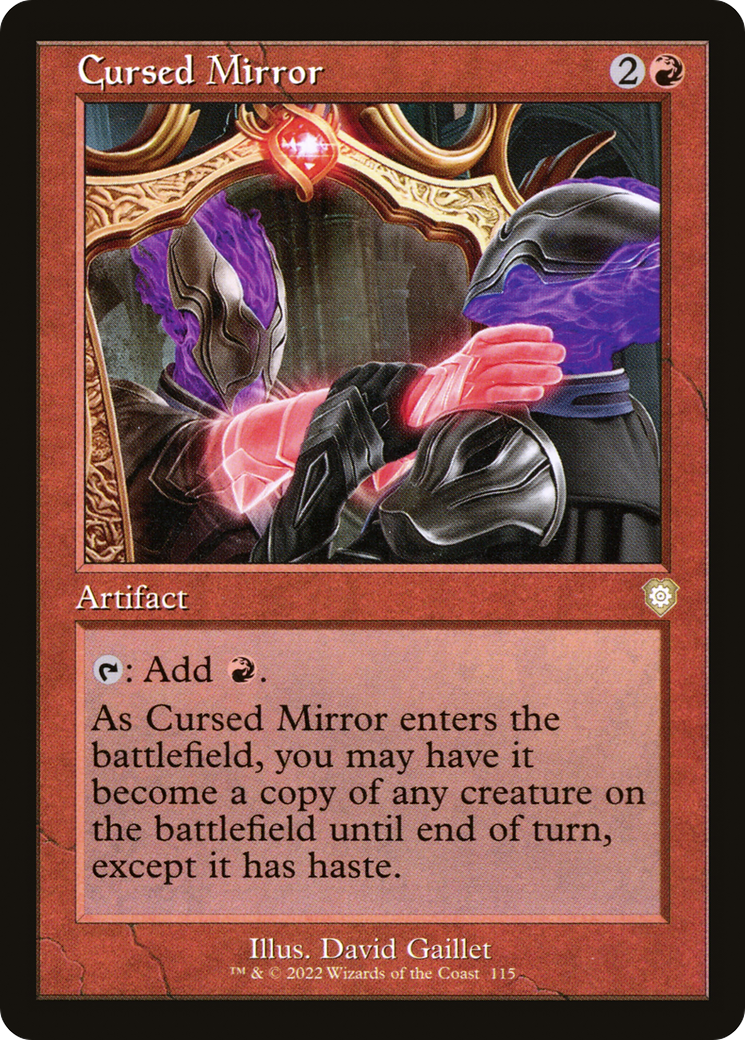
Cursed Mirror
Cursed Mirror
Artifact
: Add .
As this artifact enters, you may have it become a copy of any creature on the battlefield until end of turn, except it has haste.
- If Cursed Mirror somehow enters the battlefield at the same time as a creature, it can't become a copy of that creature. You may choose only a creature that's already on the battlefield.
- Cursed Mirror copies exactly what was printed on the original creature (unless that creature is copying something else or is a token; see below). It doesn't copy whether that creature is tapped or untapped, whether it has any counters on it or any Auras or Equipment attached to it, or any non-copy effects that have changed its types, color, power and toughness, and so on.
- If the copied creature has in its mana cost, X is considered to be 0.
- If something else becomes a copy of Cursed Mirror while Cursed Mirror is a copy of a creature, the duration of the effect is not copied. The new copy will still be a creature (with haste) after Cursed Mirror stops being a copy at the end of the turn.
- While it is copying a creature, Cursed Mirror does not have " : Add " (unless the creature it's copying also has that ability).
- If the copied creature is copying something else, then Cursed Mirror enters the battlefield as a copy of whatever that creature is copying.
- Any enters-the-battlefield abilities of the copied creature will trigger when Cursed Mirror enters the battlefield. Any "As [this creature] enters the battlefield" or "[This creature] enters the battlefield with" abilities of the copied creature will also work.
- If the copied creature is a token, Cursed Mirror copies the original characteristics of that token as stated by the effect that created the token. Copying a token doesn't make Cursed Mirror a token. Similarly, if Cursed Mirror itself is a token, copying a nontoken permanent doesn't make it stop being a token.
-
1
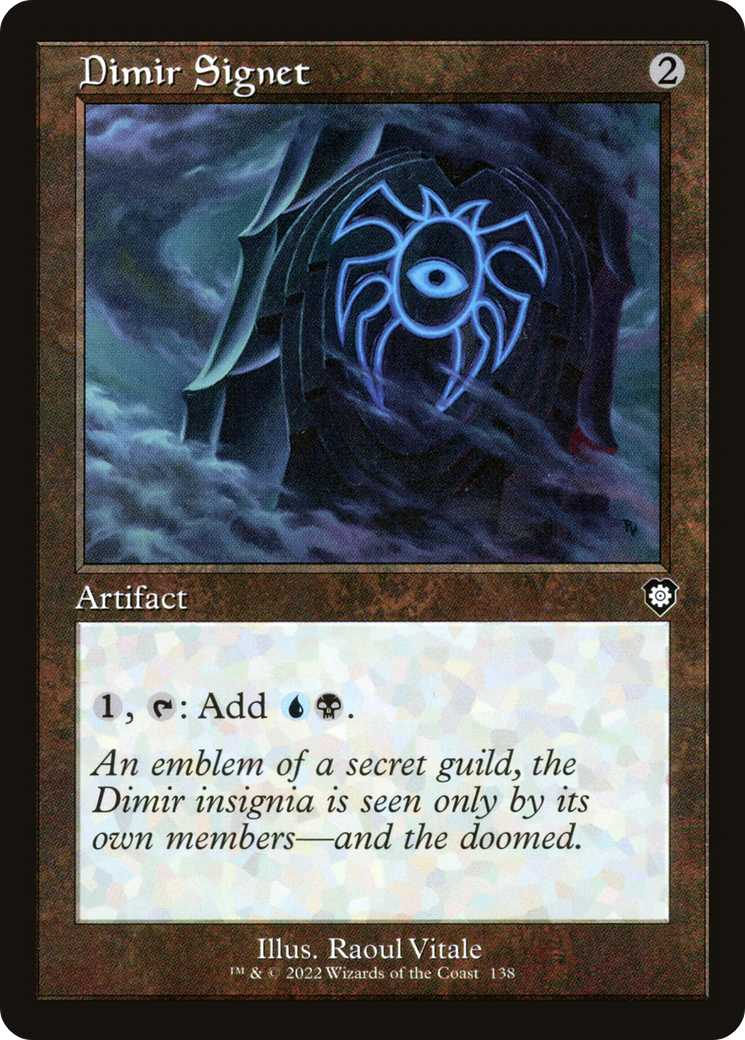
Dimir Signet
Dimir Signet
Artifact
, : Add .
-
1
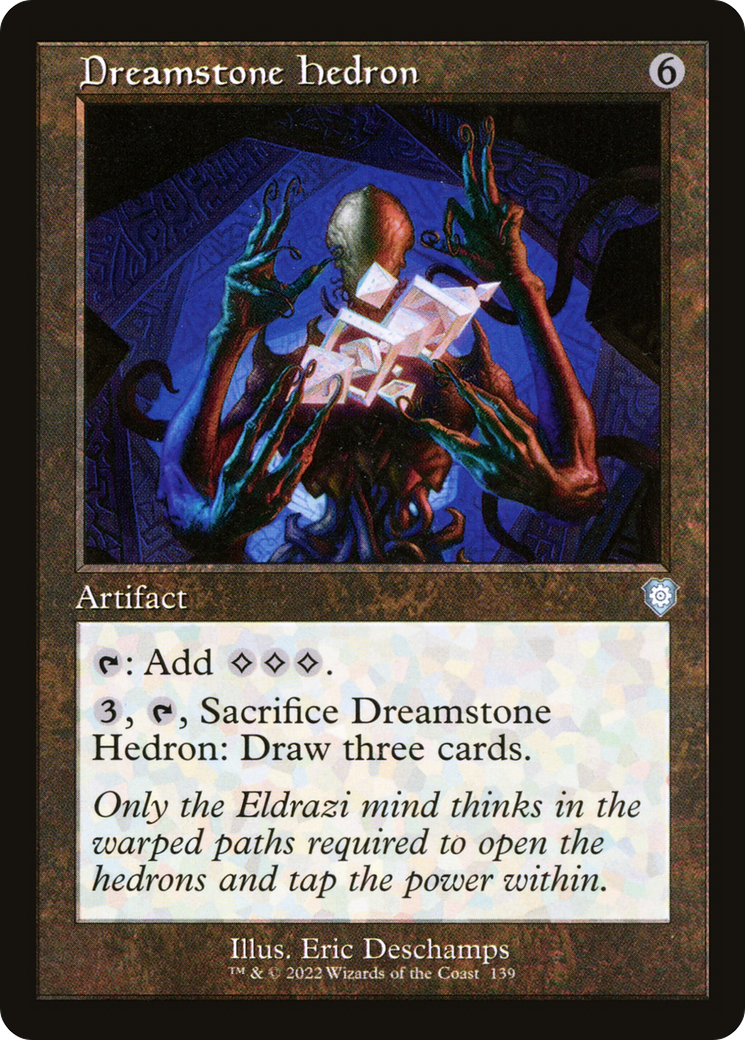
Dreamstone Hedron
Dreamstone Hedron
Artifact
: Add .
, , Sacrifice this artifact: Draw three cards.
-
1
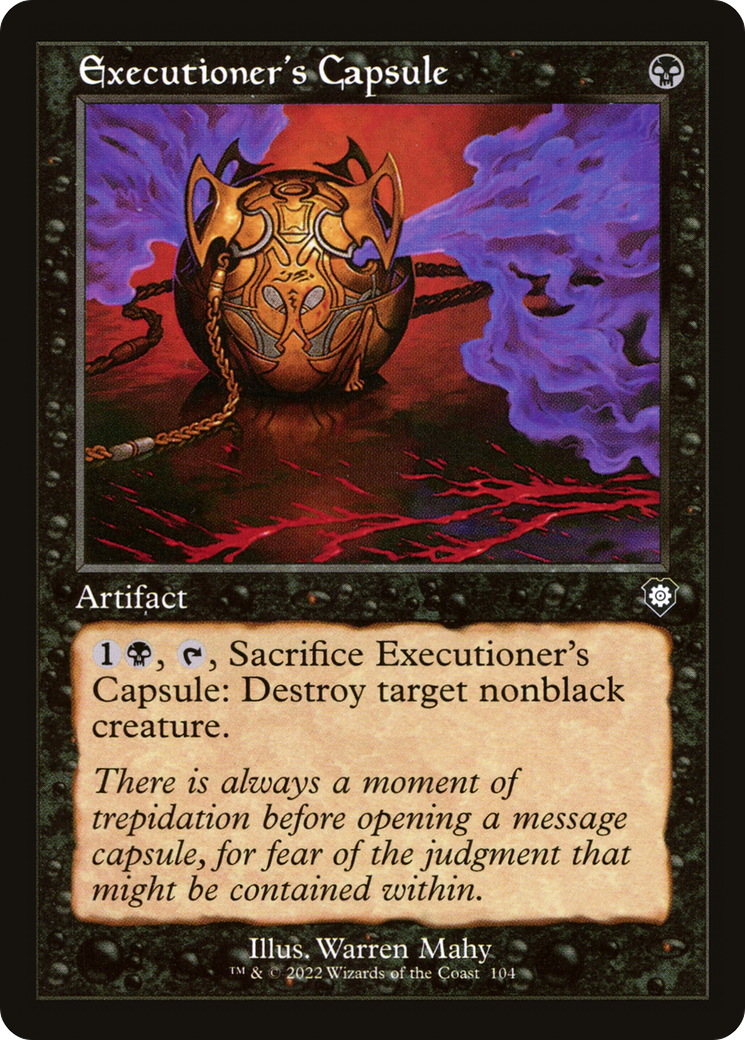
Executioner's Capsule
Executioner's Capsule
Artifact
, , Sacrifice this artifact: Destroy target nonblack creature.
- The only difference between a colored artifact and a colorless artifact is, obviously, its color. Unlike most artifacts, a colored artifact requires colored mana to cast. Also unlike most artifacts, a colored artifact has a color in all zones. It will interact with cards that care about color. Other than that, a colored artifact behaves just like any other artifact. It will interact as normal with any card that cares about artifacts, such as Shatter or Arcbound Ravager.
-
1
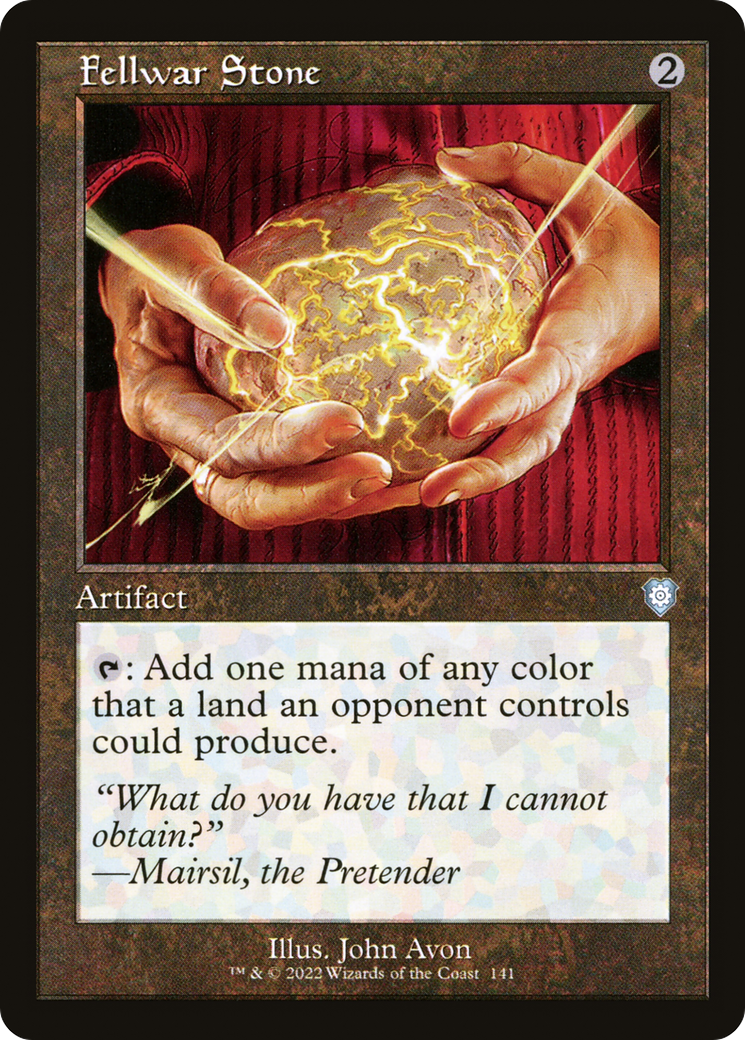
Fellwar Stone
Fellwar Stone
Artifact
: Add one mana of any color that a land an opponent controls could produce.
- When determining what colors of mana your opponents' lands could produce, take into account any applicable replacement effects that would apply to those lands' mana abilities (such as Contamination's effect, for example). If there is more than one, consider them in any possible order.
- Fellwar Stone doesn't care about any restrictions or riders your opponents' lands (such as Ancient Ziggurat or Hall of the Bandit Lord) put on the mana they produce. It just cares about colors of mana.
- The colors of mana are white, blue, black, red, and green. Fellwar Stone can't be tapped for colorless mana, even if a land an opponent controls could produce colorless mana.
- Fellwar Stone checks the effects of all mana-producing abilities of lands your opponents control, but it doesn't check their costs. For example, Vivid Crag has the ability " , Remove a charge counter from Vivid Crag: Add one mana of any color." If an opponent controls Vivid Crag and you control Fellwar Stone, you can tap Fellwar Stone for any color of mana. It doesn't matter whether Vivid Crag has a charge counter on it, and it doesn't matter whether it's untapped.
- This works even if the opponent's lands are tapped. It only checks what kinds of mana can be produced, not if the abilities that produce them are usable right now.
- It only produces one mana even if the land can produce more than one.
- The ability can be activated if the opponent has no lands that produce mana, but the effect will not be able to generate any mana.
-
1
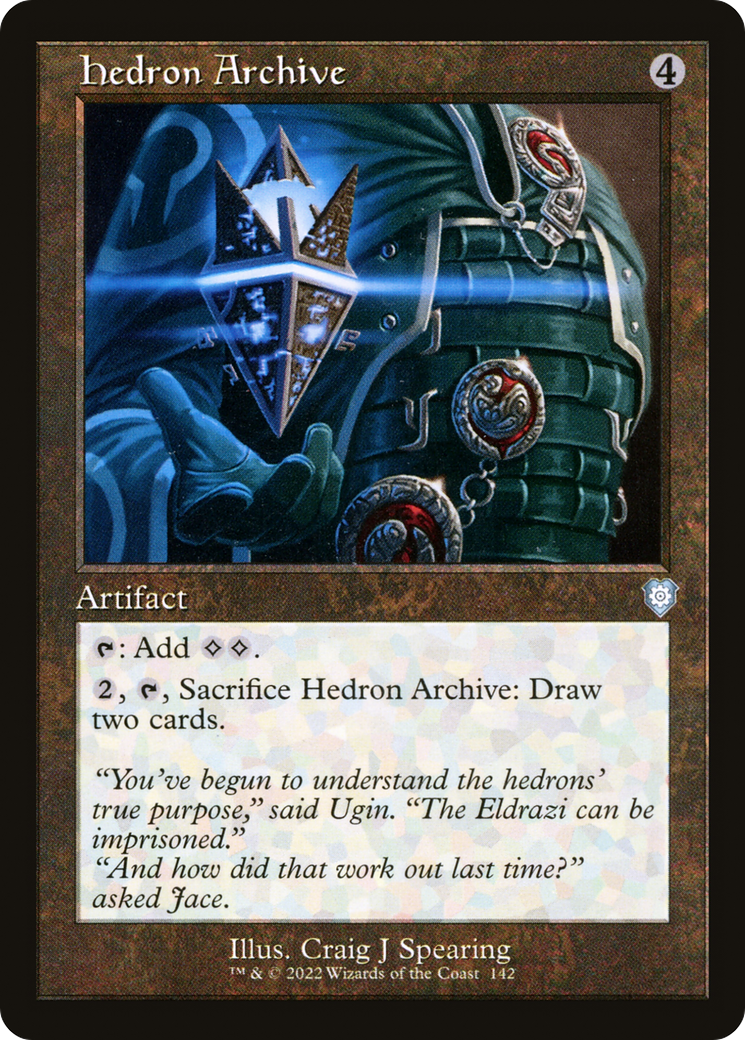
Hedron Archive
Hedron Archive
Artifact
: Add .
, , Sacrifice this artifact: Draw two cards.
-
1
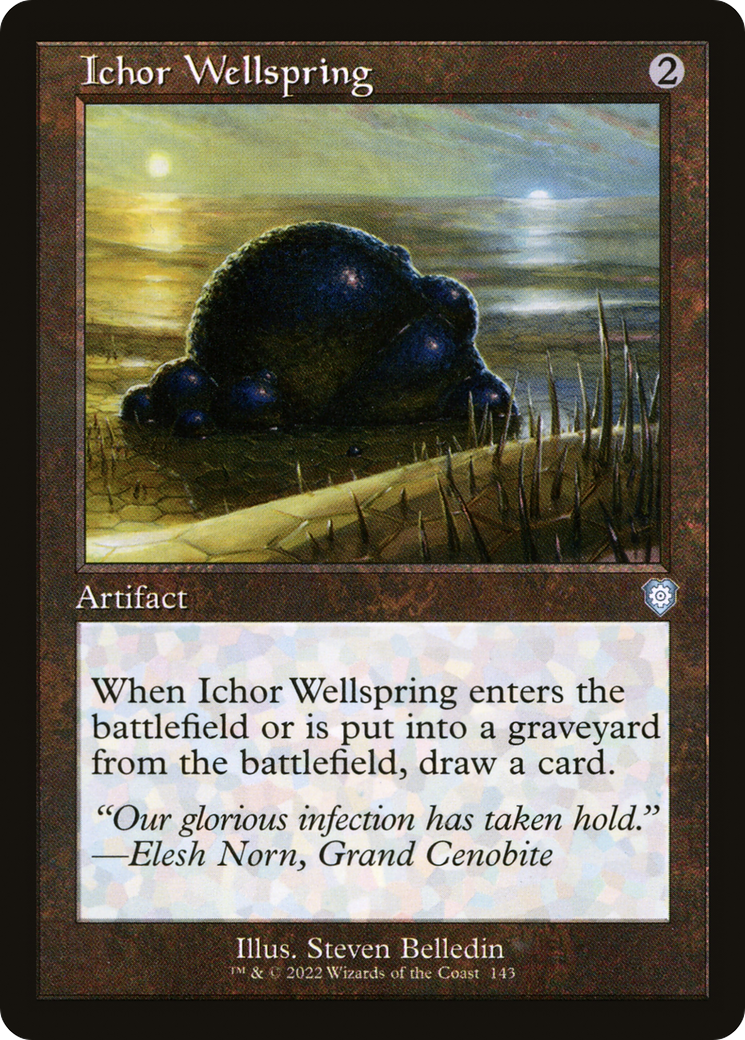
Ichor Wellspring
Ichor Wellspring
Artifact
When this artifact enters or is put into a graveyard from the battlefield, draw a card.
- The ability will trigger when Ichor Wellspring is put into a graveyard from the battlefield, even if the ability that triggered when it entered hasn't resolved yet.
-
1
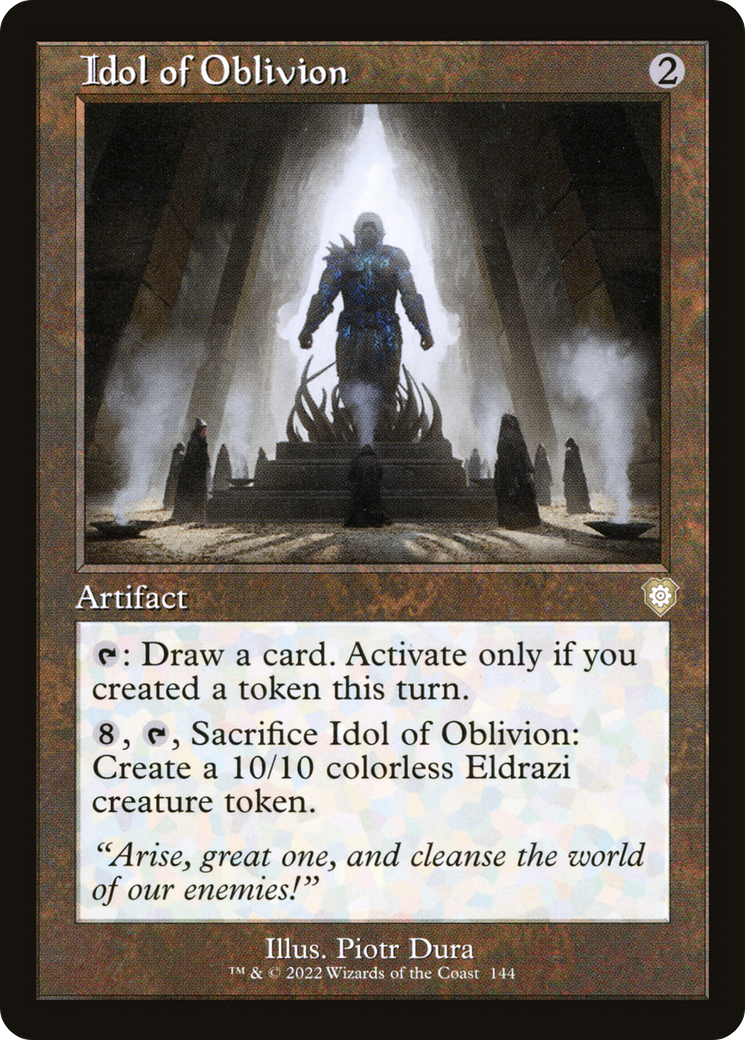
Idol of Oblivion
Idol of Oblivion
Artifact
: Draw a card. Activate only if you created a token this turn.
, , Sacrifice this artifact: Create a 10/10 colorless Eldrazi creature token.
- You can activate Idol of Oblivion's first ability even if the token you've created was created before Idol of Oblivion entered the battlefield or if the token has left the battlefield.
-
1
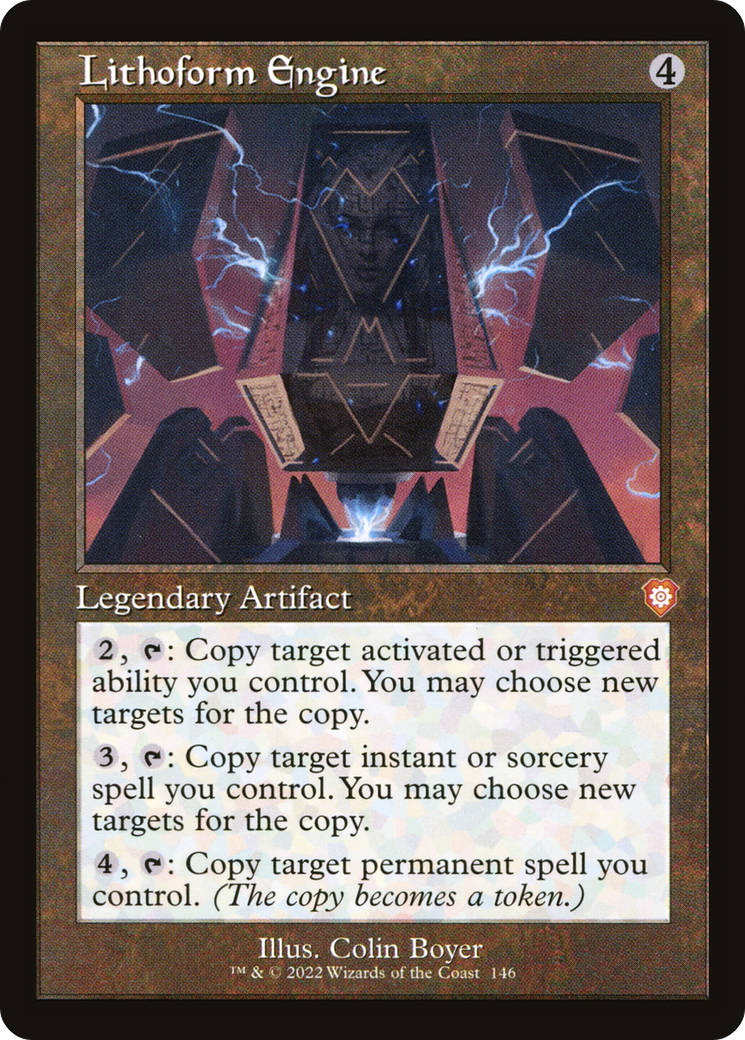
Lithoform Engine
Lithoform Engine
Legendary Artifact
, : Copy target activated or triggered ability you control. You may choose new targets for the copy.
, : Copy target instant or sorcery spell you control. You may choose new targets for the copy.
, : Copy target permanent spell you control. (The copy becomes a token.)
- The source of the copy from Lithoform Engine's first ability is the same as the source of the original ability.
- Activated abilities contain a colon. They're generally written “[Cost]: [Effect].” Some keyword abilities (such as equip) are activated abilities and will have a colon in their reminder text.
- Triggered abilities use the word “when,” “whenever,” or “at.” They're often written as “[Trigger condition], [effect].” Some keywords (such as prowess) are triggered abilities and will use “when,” “whenever,” or “at” in their reminder text.
- Lithoform Engine's first ability targets an activated or triggered ability that is on the stack and creates another instance of that ability on the stack. It doesn't cause any object to gain an ability.
- If an ability is linked to a second ability, copies of that first ability are also linked to that second ability. If the second ability refers to “the exiled card,” it refers to all cards exiled by the first ability and the copy. For example, if Fiend Hunter's enters-the-battlefield ability is copied and two creatures are exiled, they both return when Fiend Hunter leaves the battlefield.
- Lithoform Engine can copy any spell or ability on the stack, not just one with targets. If a permanent spell is copied, new targets can't be chosen for it, if it has any (perhaps because it's an Aura or a mutating creature spell).
- The copy is created on the stack, so it's not “cast” or “activated.” Creating the copy won't cause abilities that trigger when a player casts a spell or activates an ability to trigger. Abilities that say that a triggered ability triggers additional times won't apply to copying a triggered ability.
- The copy will resolve before the original spell or ability does.
- The copy will have the same targets as the spell or ability it's copying unless you choose new ones. You may change any number of the targets, including all of them or none of them. If, for one of the targets, you can't choose a new legal target, then it remains unchanged (even if the current target is illegal).
- If the spell or ability that's copied is modal (that is, it says “Choose one —” or the like), the copy will have the same mode. A different mode can't be chosen. This doesn't apply to copying a permanent spell with a modal enters-the-battlefield triggered ability, but it does apply to copying that ability.
- If the spell or ability that's copied has an X whose value was determined as it was cast or activated, the copy will have the same value of X.
- If the spell or ability has damage divided as it was put onto the stack, the division can't be changed, although the targets receiving that damage still can. The same is true of spells and abilities that distribute counters.
- You can't choose to pay any alternative or additional costs for the copy. However, effects based on any alternative or additional costs that were paid for the original spell are copied as though those same costs were paid for the copy. Most notably, if the original spell was kicked, the copy is kicked.
- Any choices made when the spell or ability resolves won't have been made yet when it's copied. Any such choices will be made separately when the copy resolves. Most notably, if a triggered ability asks you to pay a cost (such as that of Leyline Tyrant), you pay that cost for the copy if you wish to have it paid.
- If a permanent spell is copied, it's put onto the battlefield as a token as the spell resolves rather than putting the copy of the spell onto the battlefield. The rules that apply to a permanent spell becoming a permanent apply to a copy of a spell becoming a token.
- The token that a resolving copy of a spell becomes isn't said to have been “created.”
-
1
Machine God's Effigy
Machine God's Effigy
Artifact
You may have this artifact enter as a copy of any creature on the battlefield, except it's an artifact and it has " : Add ." (It's not a creature.)
: Add .
- The ability of Machine God’s Effigy doesn’t target the creature.
- Except for its types and non-artifact subtypes, Machine God’s Effigy copies exactly what was printed on the original creature and nothing more (unless that creature is copying something else or is a token; see below), and it will have “ :Add .” It doesn’t copy whether that creature is tapped or untapped, whether it has any counters on it or Auras attached to it, or any non-copy effects that have changed its types, color, and so on.
- Machine God’s Effigy will not copy any types (such as creature or enchantment) or non-artifact subtypes (such as Phyrexian or Elf) that creature had, but it will copy any supertypes, such as legendary, and artifact subtypes (such as Treasure or Vehicle). It also has the same name, so if you copy a legendary creature you control, you will need to choose one of them to put in your graveyard due to the legend rule.
- If Machine God’s Effigy copies a planeswalker that became a creature due to an effect, Machine God’s Effigy will have that planeswalker’s loyalty abilities but its only card type is artifact (it will still be legendary in most cases). Because it isn’t a planeswalker itself, it won’t enter the battlefield with any loyalty counters, but it also won’t die because due to not having any. Similarly, it can’t be attacked and damage can’t be dealt to it. You may activate only one loyalty ability of that permanent per turn. If it later becomes a creature and damage is dealt to it, that damage won’t remove any loyalty counters.
- If Machine God’s Effigy copies a Saga that has become a creature due to an effect, it will have that Saga’s chapter abilities, but it won’t get a lore counter every turn because it isn’t itself a Saga since its only card type is artifact. Unless it has the read ahead ability found on some Saga cards in the Dominaria United set, it also won’t enter the battlefield with any counters. If you do find a way to put lore counters on it, the appropriate ability or abilities will trigger. It will not be sacrificed after it has lore counters equal to its final chapter number.
- If Machine God’s Effigy copies a land with a basic land type that has become a creature due to an effect, it will not have any mana abilities that land had due to its land types (it will have the one it gives itself, though). For example, if a basic Forest became a creature due to some effect, and Machine God’s Effigy entered the battlefield as a copy of it, it would be a basic artifact named Forest and have “ : Add ,” but not the intrinsic ability “ : Add .”
- If the copied creature has in its mana cost, X is 0.
- If the chosen creature is copying something else, then Machine God’s Effigy enters the battlefield as whatever the chosen creature is copying (with the listed exceptions).
- If the chosen creature is a token, Machine God’s Effigy copies the original characteristics of that token as stated by the effect that created the token, plus the listed exceptions. Machine God’s Effigy is not a token, even when copying one.
- Any enters-the-battlefield abilities of the copied creature will trigger when Machine God’s Effigy enters the battlefield. Any “as [this creature] enters the battlefield” or “[this creature] enters the battlefield with” abilities of the chosen creature will also work. Note that some of these effects may function correctly only if it is a creature, and will not do anything productive since the copy is an artifact, not a creature.
- If Machine God’s Effigy somehow enters the battlefield at the same time as another creature, it can’t become a copy of that creature. You may choose only a creature that’s already on the battlefield.
-
1
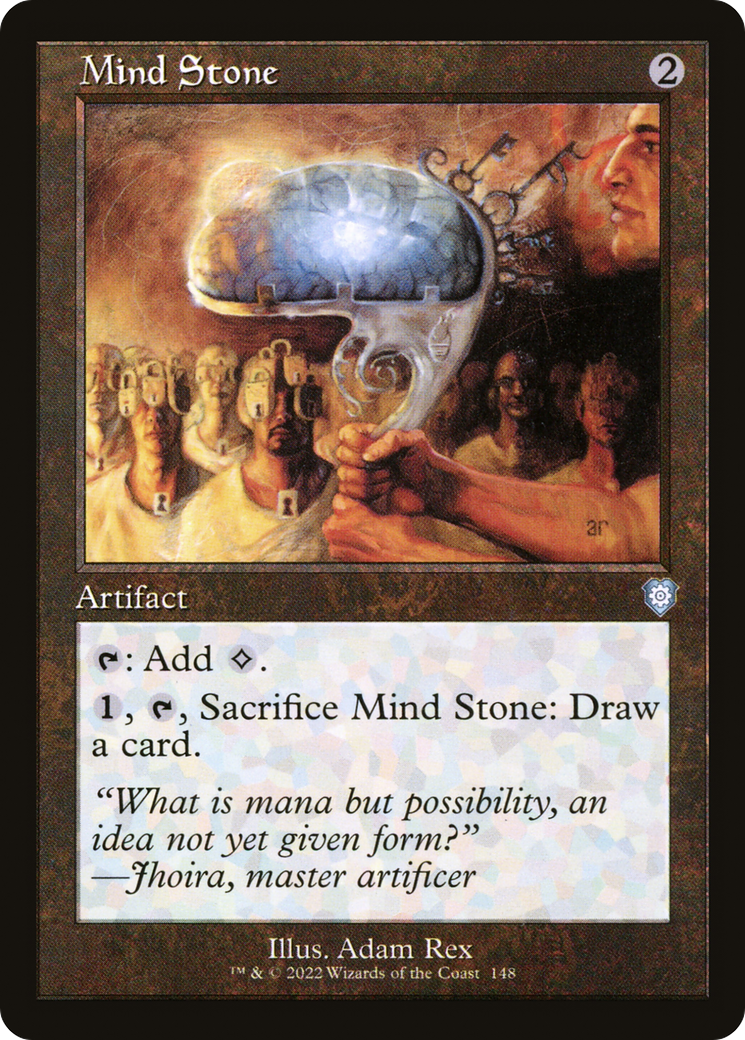
Mind Stone
Mind Stone
Artifact
: Add .
, , Sacrifice this artifact: Draw a card.
-
1
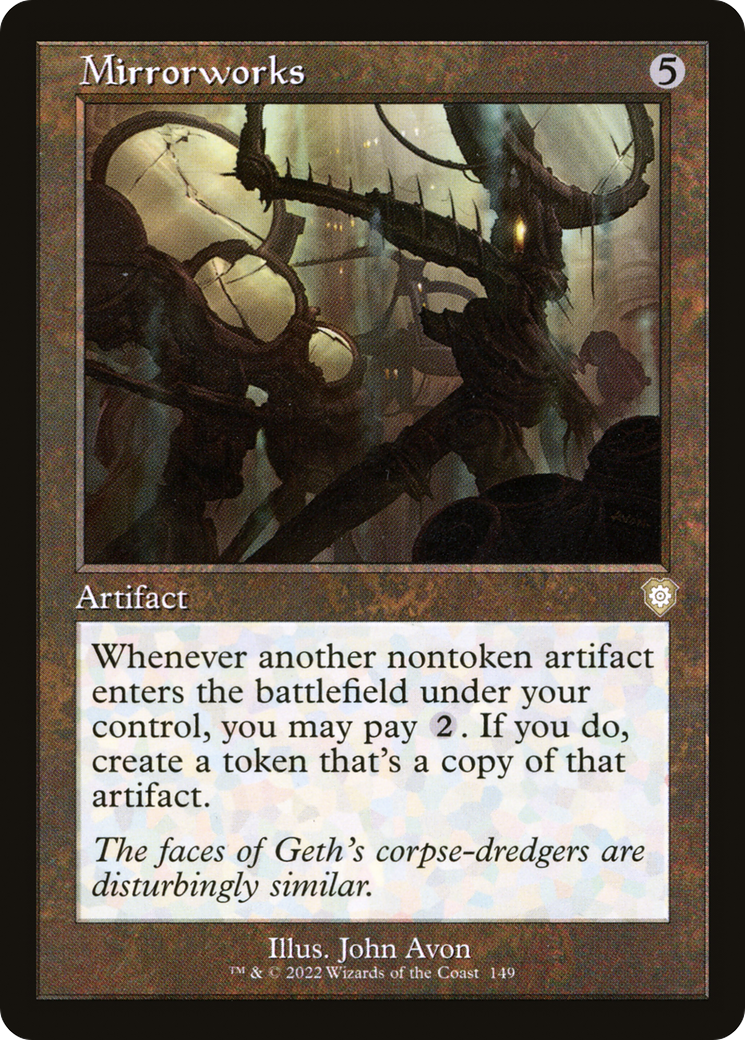
Mirrorworks
Mirrorworks
Artifact
Whenever another nontoken artifact you control enters, you may pay . If you do, create a token that's a copy of that artifact.
- Each time the ability triggers, you can pay only one time to get one token.
- As the token is created, it checks the printed values of the artifact it's copying, as well as any copy effects that have been applied to it.
- The copiable values of the token's characteristics are the same as the copiable values of the characteristics of the artifact it's copying.
- If the artifact that caused Mirrorworks's ability to trigger has already left the battlefield by the time the ability resolves, you can still pay . If you do, you'll still put a token onto the battlefield. That token has the copiable values of the characteristics of that nontoken artifact as it last existed on the battlefield.
-
1
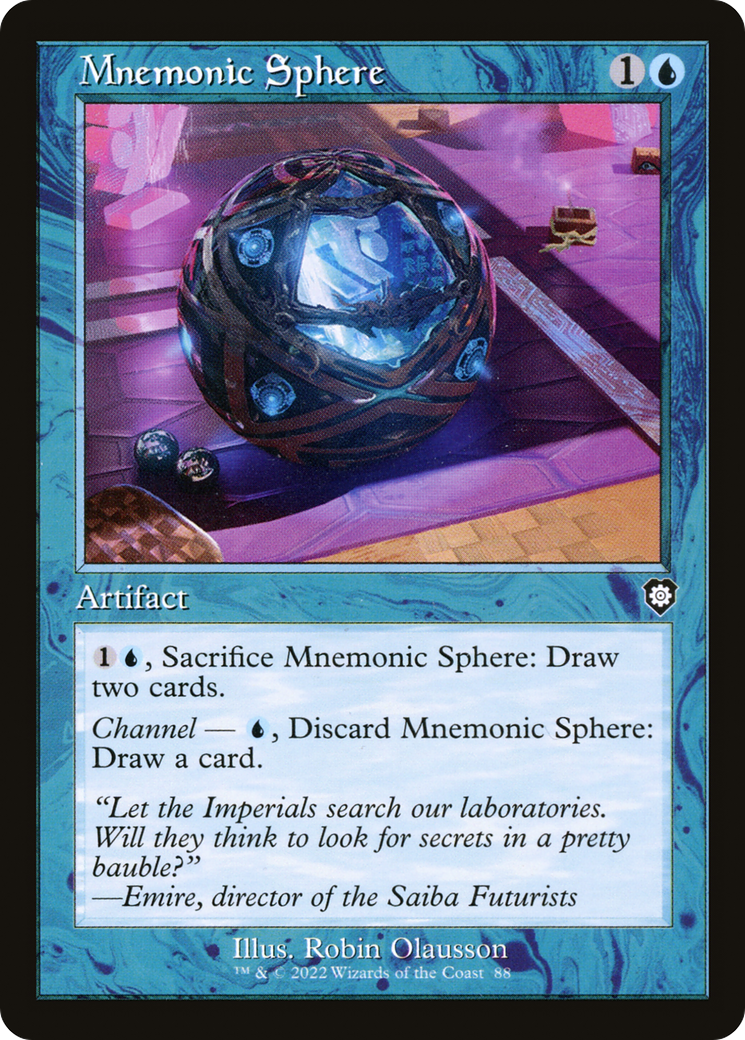
Mnemonic Sphere
Mnemonic Sphere
Artifact
, Sacrifice this artifact: Draw two cards.
Channel — , Discard this card: Draw a card.
- Discarding the card is part of the cost to activate a channel ability.
- If a channel ability requires a target, you may not activate it without a target just to discard the card.
-
1
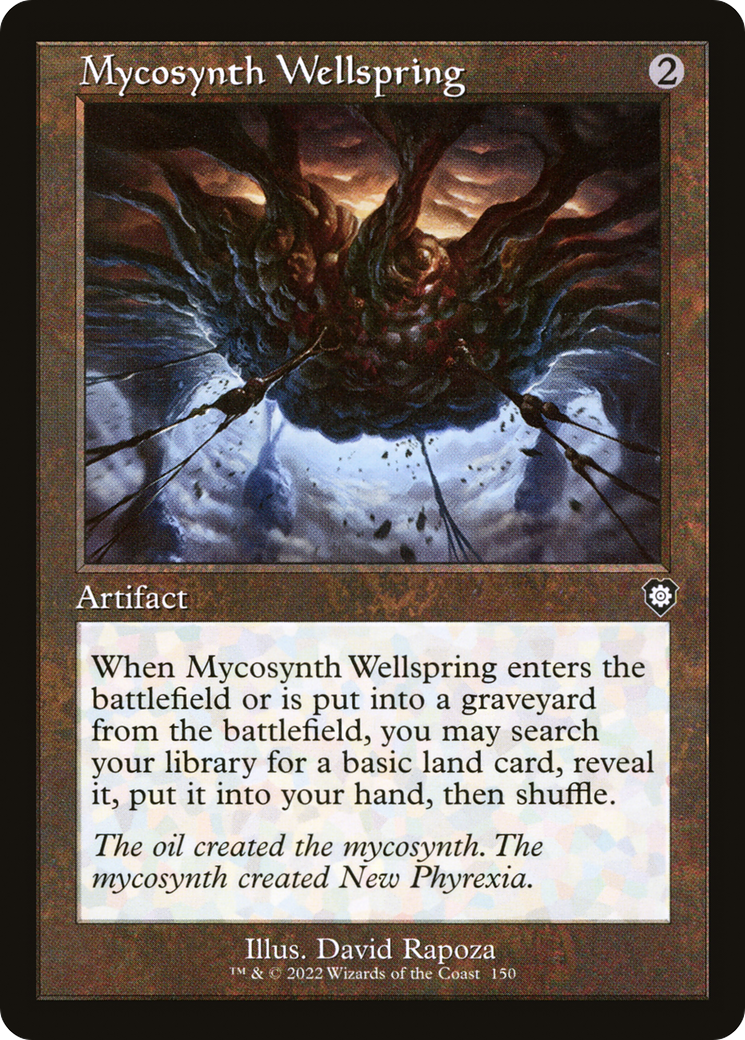
Mycosynth Wellspring
Mycosynth Wellspring
Artifact
When this artifact enters or is put into a graveyard from the battlefield, you may search your library for a basic land card, reveal it, put it into your hand, then shuffle.
- The ability will trigger when Mycosynth Wellspring is put into a graveyard from the battlefield, even if the ability that triggered when it entered hasn't resolved yet.
-
1
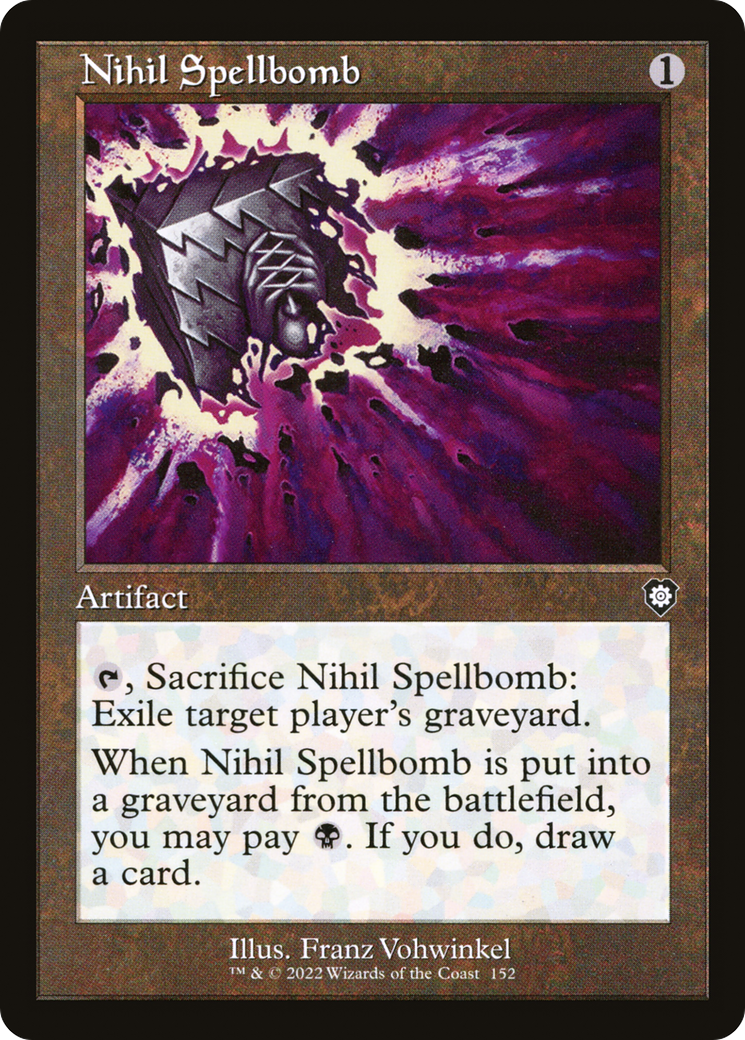
Nihil Spellbomb
Nihil Spellbomb
Artifact
, Sacrifice this artifact: Exile target player's graveyard.
When this artifact is put into a graveyard from the battlefield, you may pay . If you do, draw a card.
- You may activate Nihil Spellbomb's first ability targeting any player, even one whose graveyard has no cards in it.
-
1
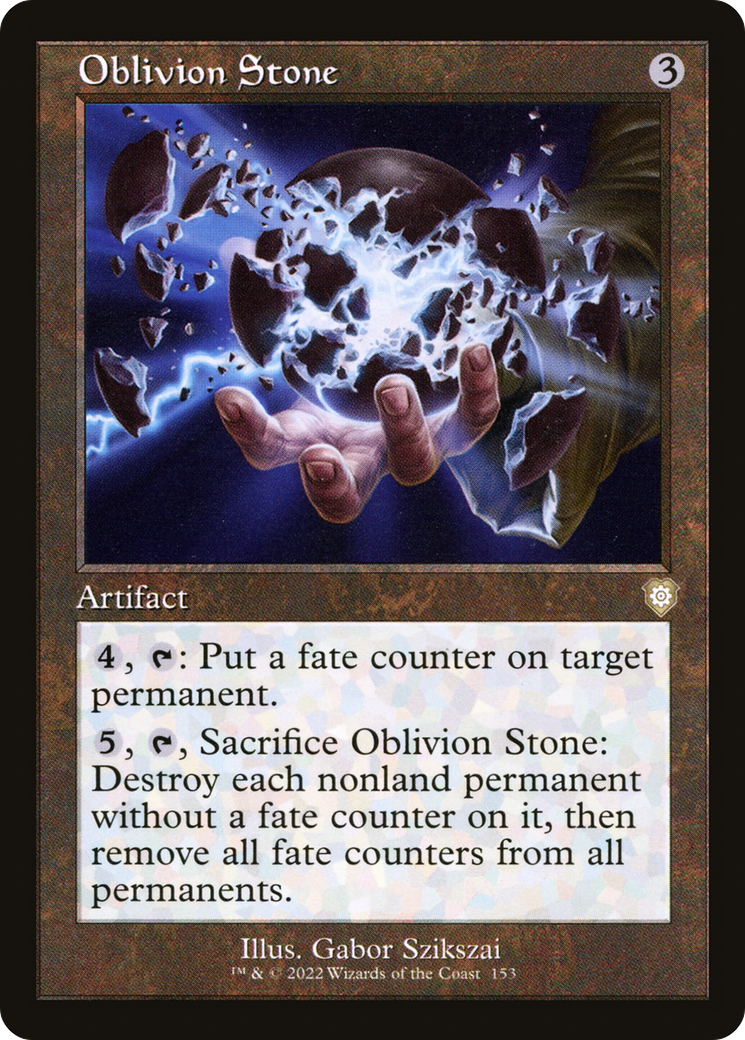
Oblivion Stone
Oblivion Stone
Artifact
, : Put a fate counter on target permanent.
, , Sacrifice this artifact: Destroy each nonland permanent without a fate counter on it, then remove all fate counters from all permanents.
-
1
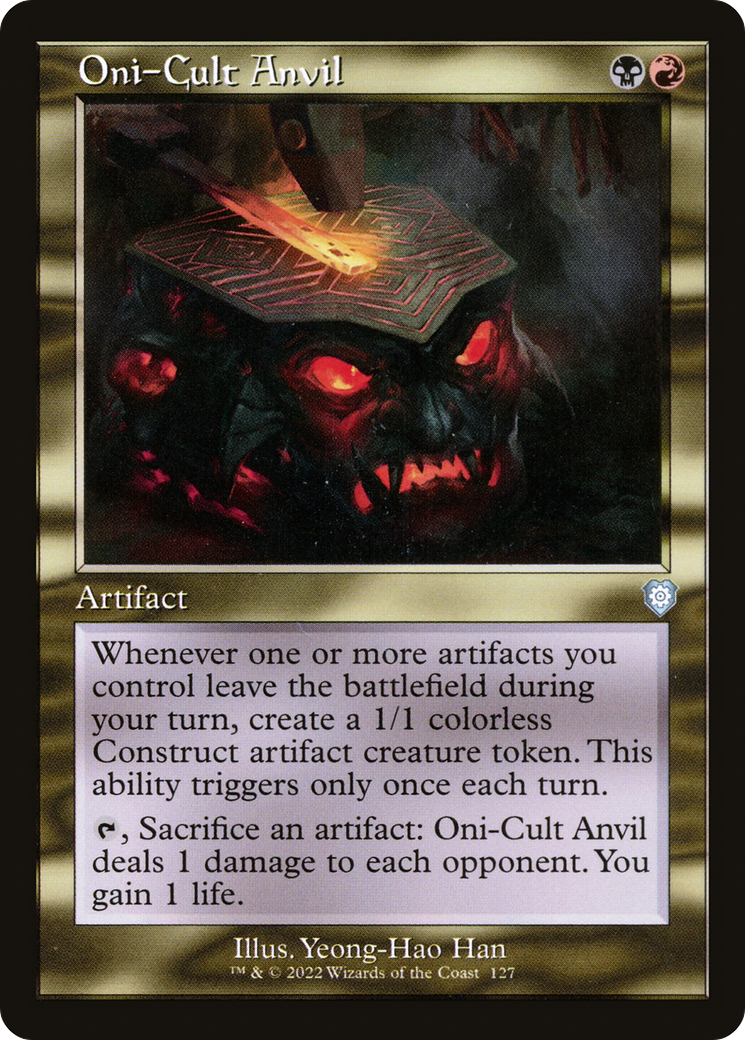
Oni-Cult Anvil
Oni-Cult Anvil
Artifact
Whenever one or more artifacts you control leave the battlefield during your turn, create a 1/1 colorless Construct artifact creature token. This ability triggers only once each turn.
, Sacrifice an artifact: This artifact deals 1 damage to each opponent. You gain 1 life.
-
1
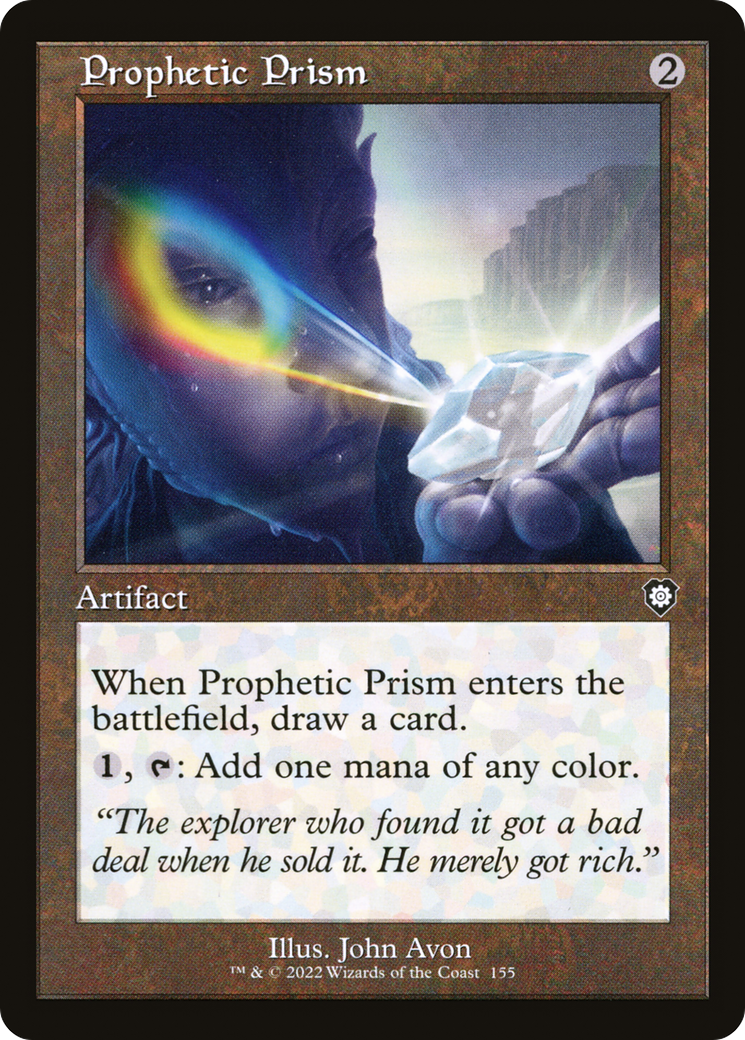
Prophetic Prism
Prophetic Prism
Artifact
When this artifact enters, draw a card.
, : Add one mana of any color.
-
1
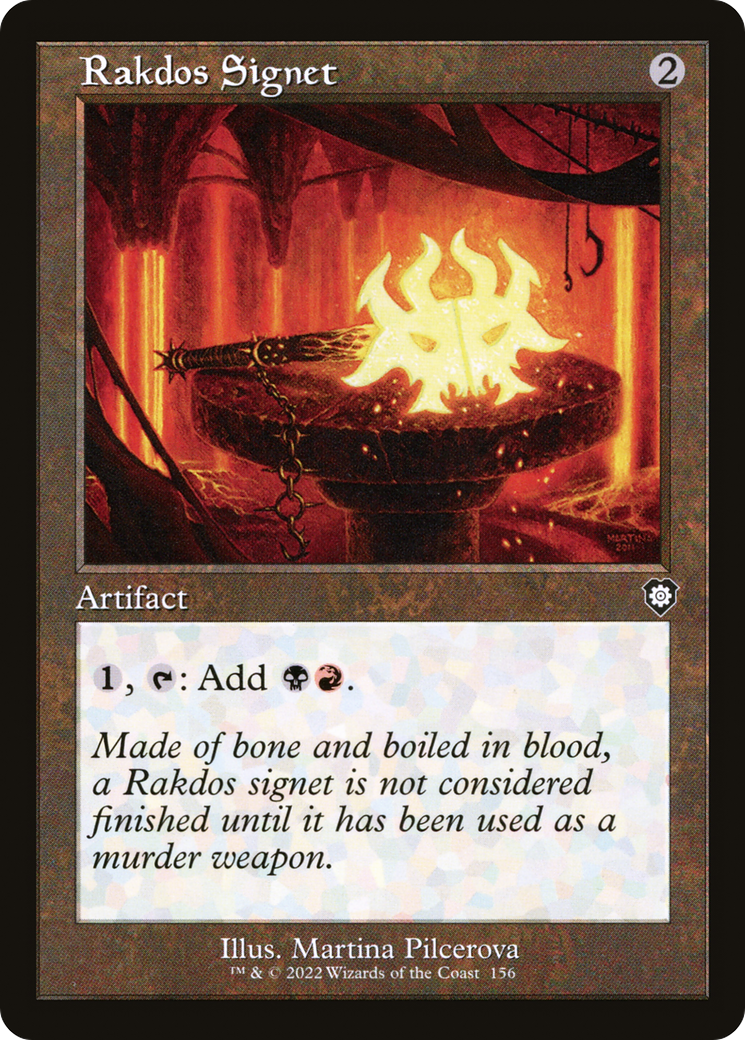
Rakdos Signet
Rakdos Signet
Artifact
, : Add .
-
1
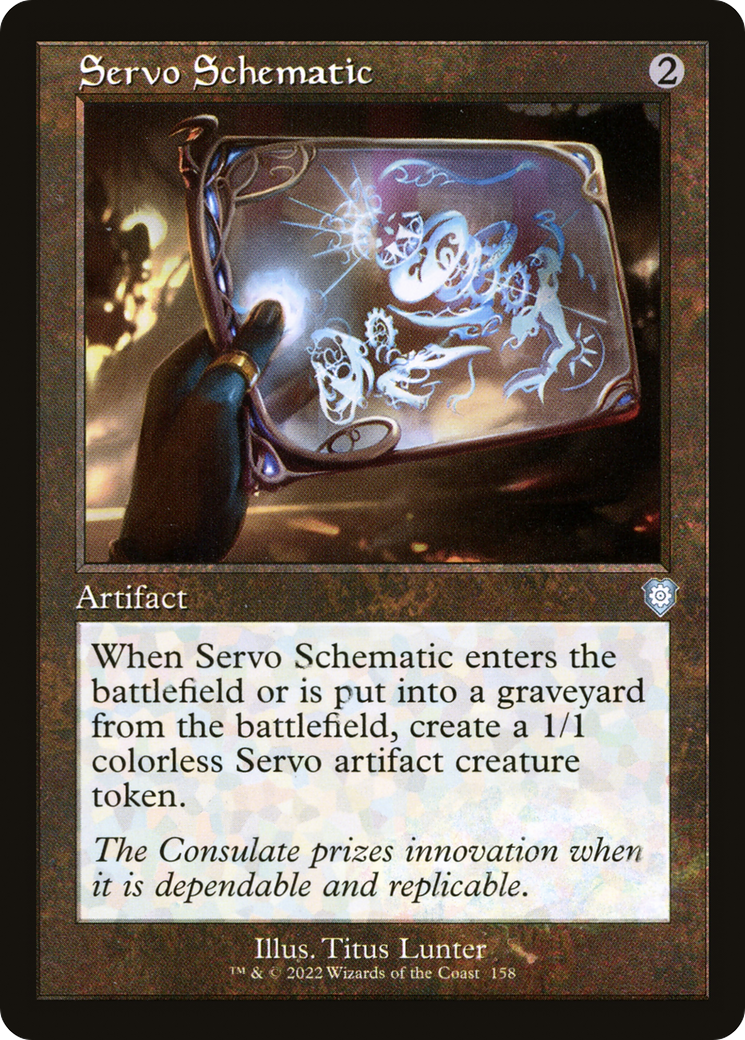
Servo Schematic
Servo Schematic
Artifact
When this artifact enters or is put into a graveyard from the battlefield, create a 1/1 colorless Servo artifact creature token.
- Servo Schematic's ability doesn't allow you to sacrifice it whenever you'd like. You must find another way to get Servo Schematic into the graveyard.
-
1
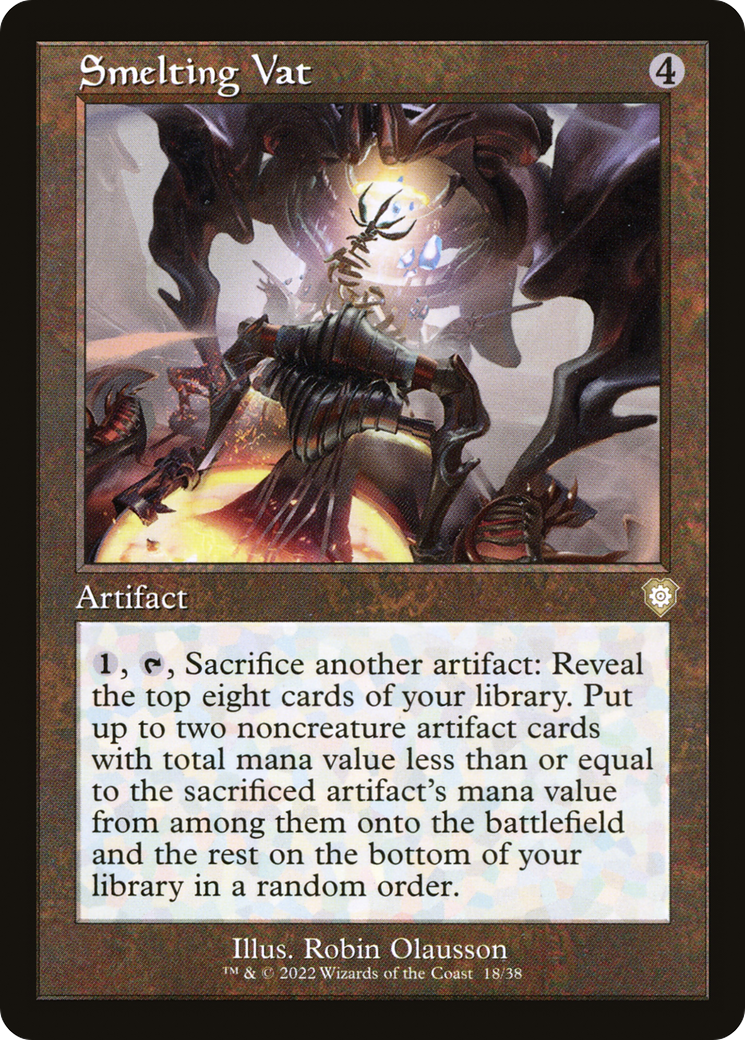
Smelting Vat
Smelting Vat
Artifact
, , Sacrifice another artifact: Reveal the top eight cards of your library. Put up to two noncreature artifact cards with total mana value less than or equal to the sacrificed artifact's mana value from among them onto the battlefield and the rest on the bottom of your library in a random order.
- If an artifact revealed this way has an is its mana cost, X is 0.
-
1
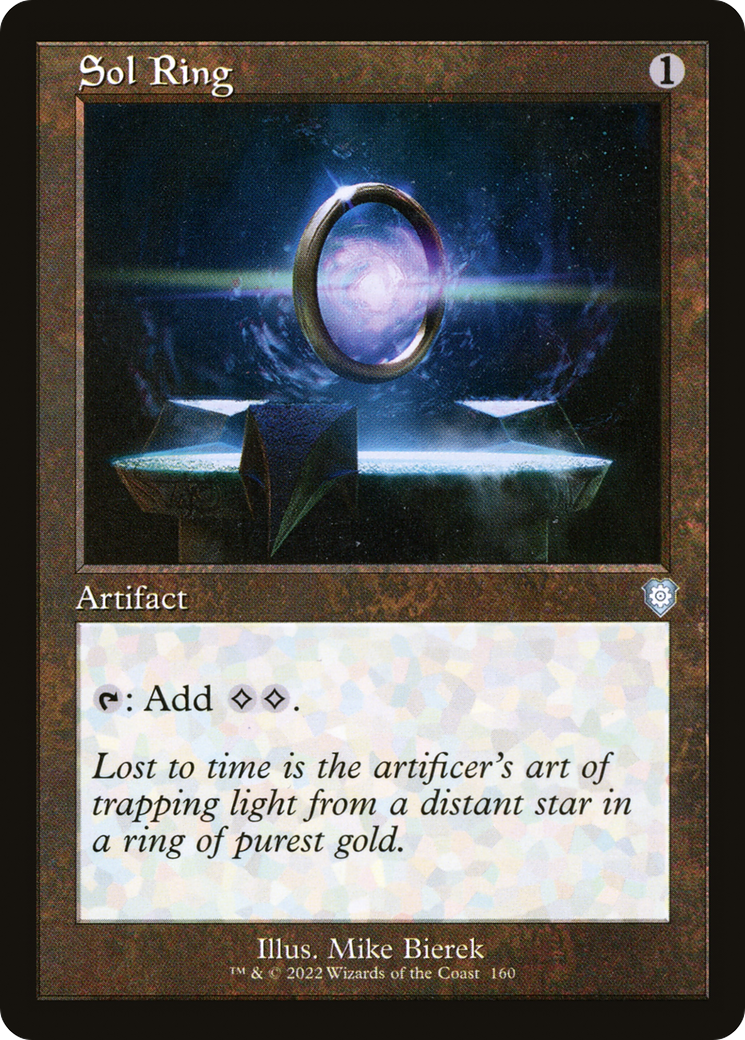
Sol Ring
Sol Ring
Artifact
: Add .
-
1
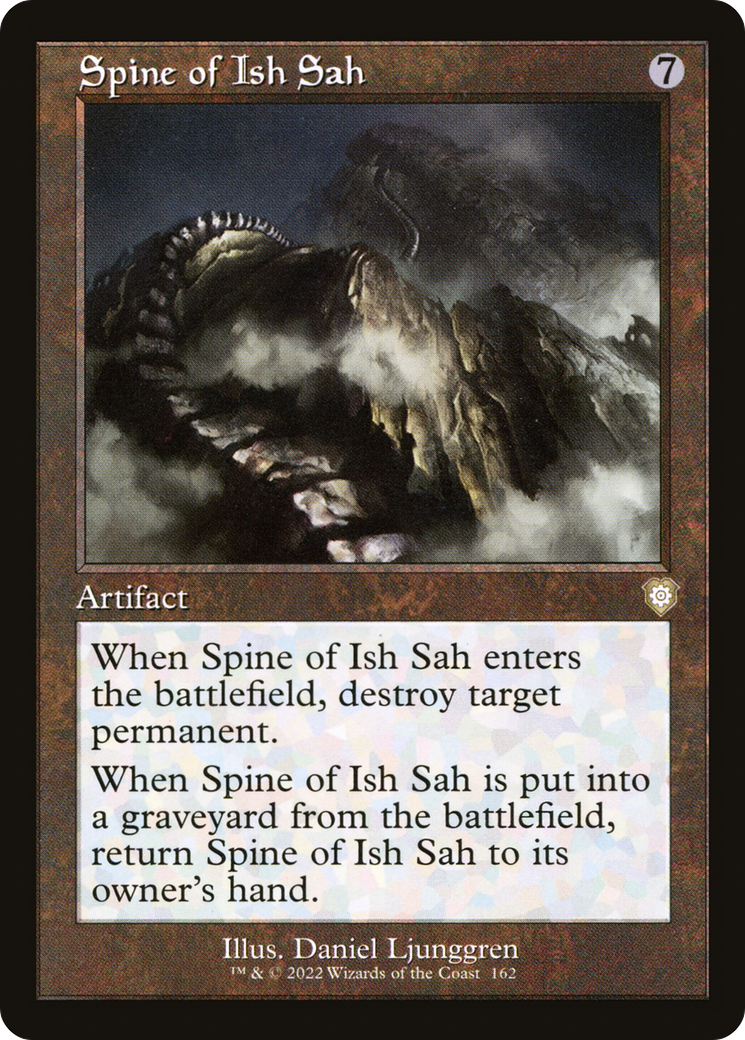
Spine of Ish Sah
Spine of Ish Sah
Artifact
When this artifact enters, destroy target permanent.
When this artifact is put into a graveyard from the battlefield, return it to its owner's hand.
- Spine of Ish Sah's last ability doesn't allow you to sacrifice it. You must find another way to get Spine of Ish Sah into the graveyard.
-
1
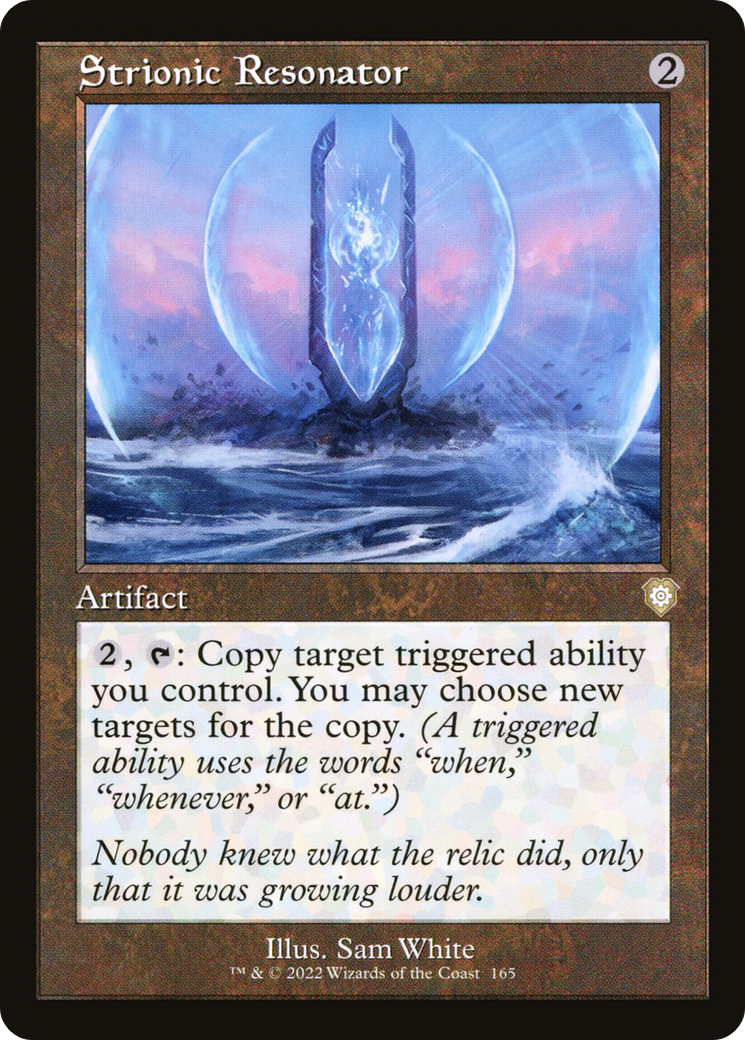
Strionic Resonator
Strionic Resonator
Artifact
, : Copy target triggered ability you control. You may choose new targets for the copy. (A triggered ability uses the words "when," "whenever," or "at.")
- Triggered abilities use the word "when," "whenever," or "at." They're often written as "[Trigger condition], [effect]."
- Strionic Resonator targets a triggered ability that has triggered and is on the stack and creates another instance of that ability on the stack. It doesn't cause any object to gain an ability.
- The source of the copy is the same as the source of the original ability.
- If the triggered ability is modal (that is, if it says, "Choose one —" or similar), the mode is copied and can't be changed.
- If the triggered ability divides damage or distributes counters among a number of targets (for example, the ability of Bogardan Hellkite), the division and number of targets can't be changed. If you choose new targets, you must choose the same number of targets.
- Any choices made when the triggered ability resolves won't have been made yet when it's copied. Any such choices will be made separately when the copy resolves. If the triggered ability asks you to pay a cost (such as that of Frenzied Goblin), you pay that cost for the copy.
- If a triggered ability is linked to a second ability, copies of that triggered ability are also linked to that second ability. If the second ability refers to "the exiled card," it refers to all cards exiled by the triggered ability and the copy. For example, if Fiend Hunter's enters-the-battlefield ability is copied and two creatures are exiled, they both return when Fiend Hunter leaves the battlefield.
- In some cases involving linked abilities, an ability requires information about "the exiled card." When this happens, the ability gets multiple answers. If these answers are being used to determine the value of a variable, the sum is used. For example, if Elite Arcanist's enters-the-battlefield ability is copied, two cards are exiled. The value of X in the activation cost of Elite Arcanist's other ability is the sum of the two cards' mana values. As the ability resolves, you create copies of both cards and can cast none, one, or both of the copies in any order.
-
1
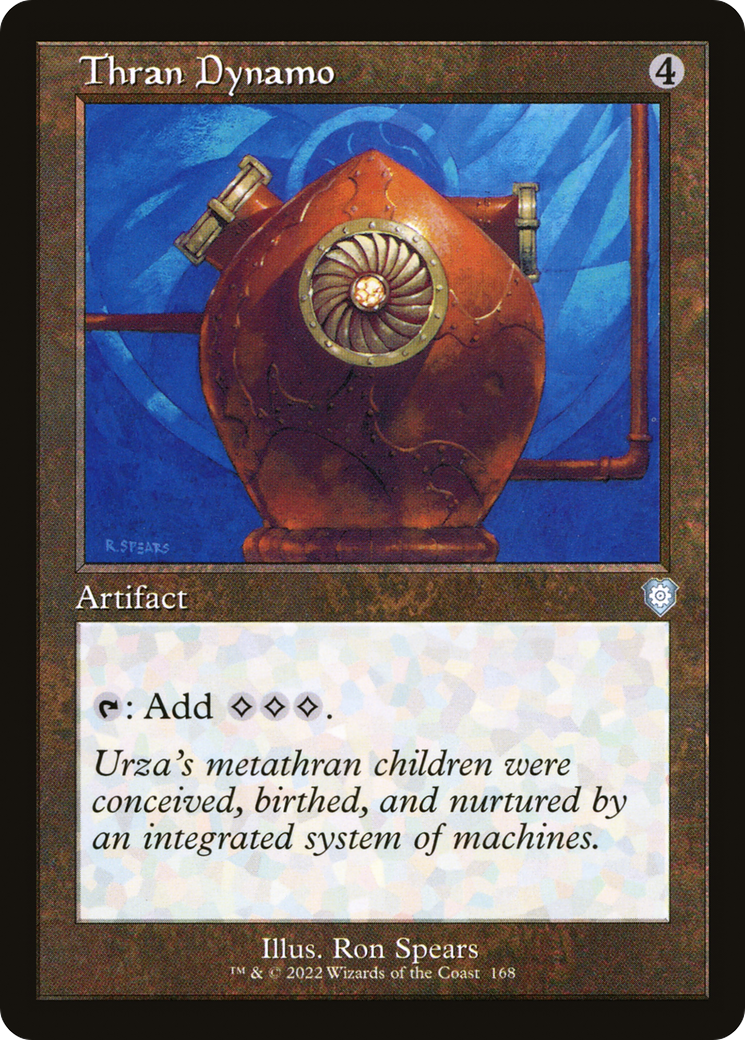
Thran Dynamo
Thran Dynamo
Artifact
: Add .
-
1
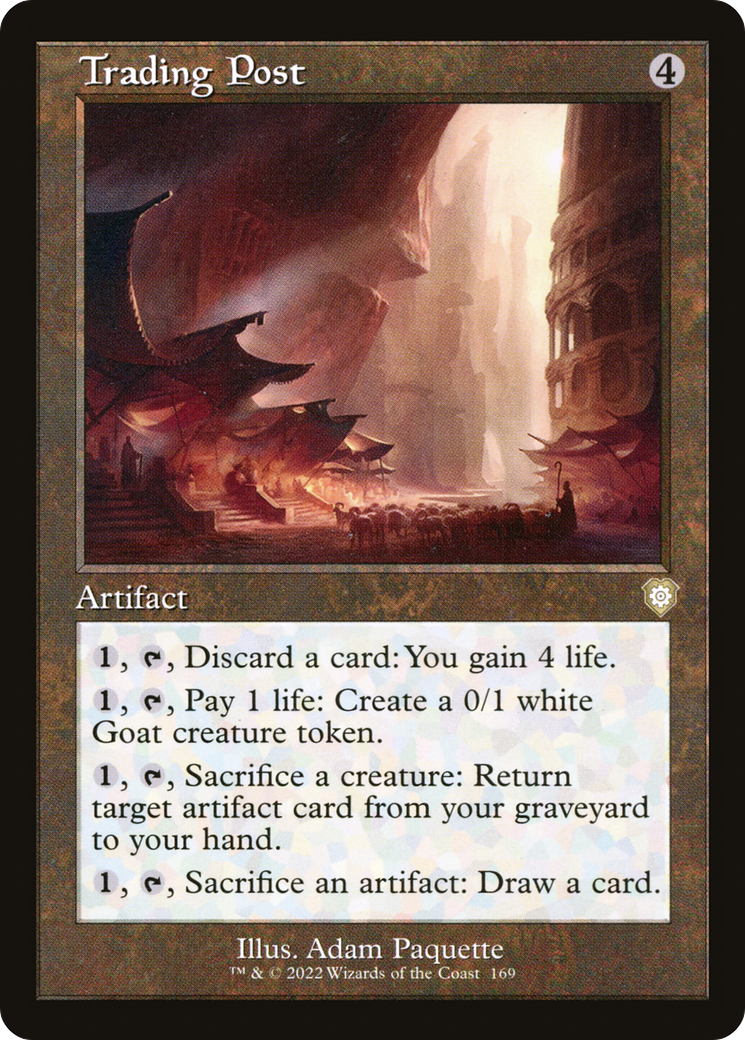
Trading Post
Trading Post
Artifact
, , Discard a card: You gain 4 life.
, , Pay 1 life: Create a 0/1 white Goat creature token.
, , Sacrifice a creature: Return target artifact card from your graveyard to your hand.
, , Sacrifice an artifact: Draw a card.
-
1
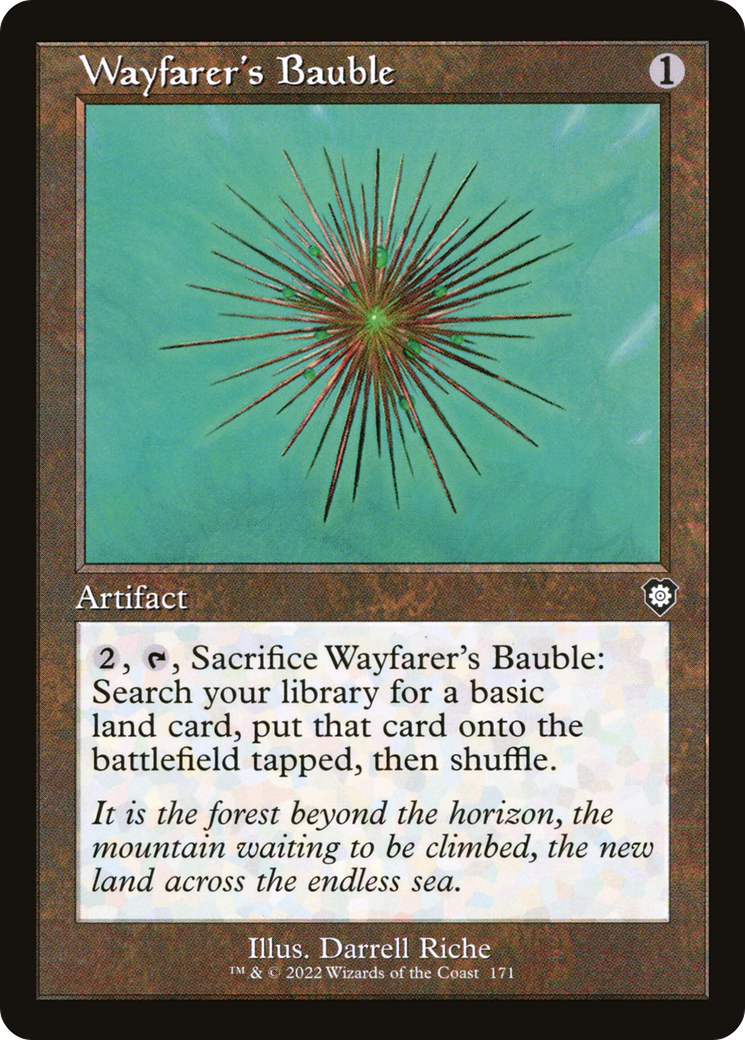
Wayfarer's Bauble
Wayfarer's Bauble
Artifact
, , Sacrifice this artifact: Search your library for a basic land card, put that card onto the battlefield tapped, then shuffle.
-
1
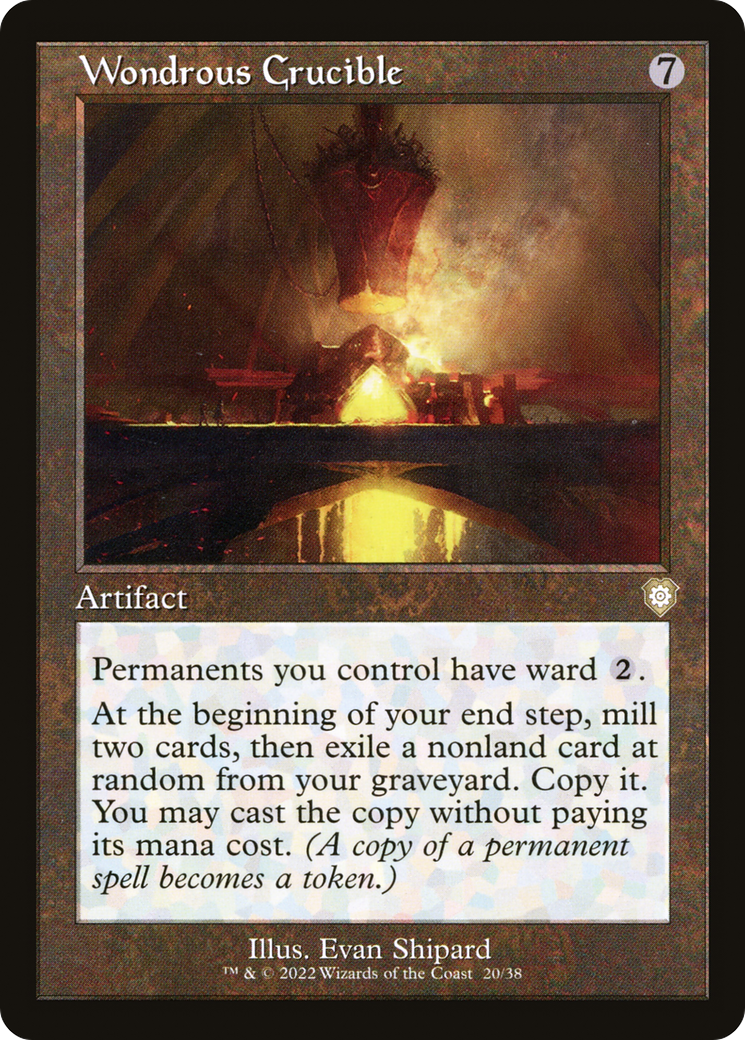
Wondrous Crucible
Wondrous Crucible
Artifact
Permanents you control have ward .
At the beginning of your end step, mill two cards, then exile a nonland card at random from your graveyard. Copy it. You may cast the copy without paying its mana cost. (A copy of a permanent spell becomes a token.)
- If you don’t cast the copy (perhaps because there are no legal targets available or you don’t want to), the copy will cease to exist.
- If you cast a spell “without paying its mana cost,” you can’t pay any alternative costs. You can, however, pay additional costs, such as kicker costs. If the card has any mandatory additional costs, you must pay those.
- If the copy has in its mana cost, you must choose 0 as the value of X.
- The card remains exiled no matter what happens to the copy.
Lands 37
-
1
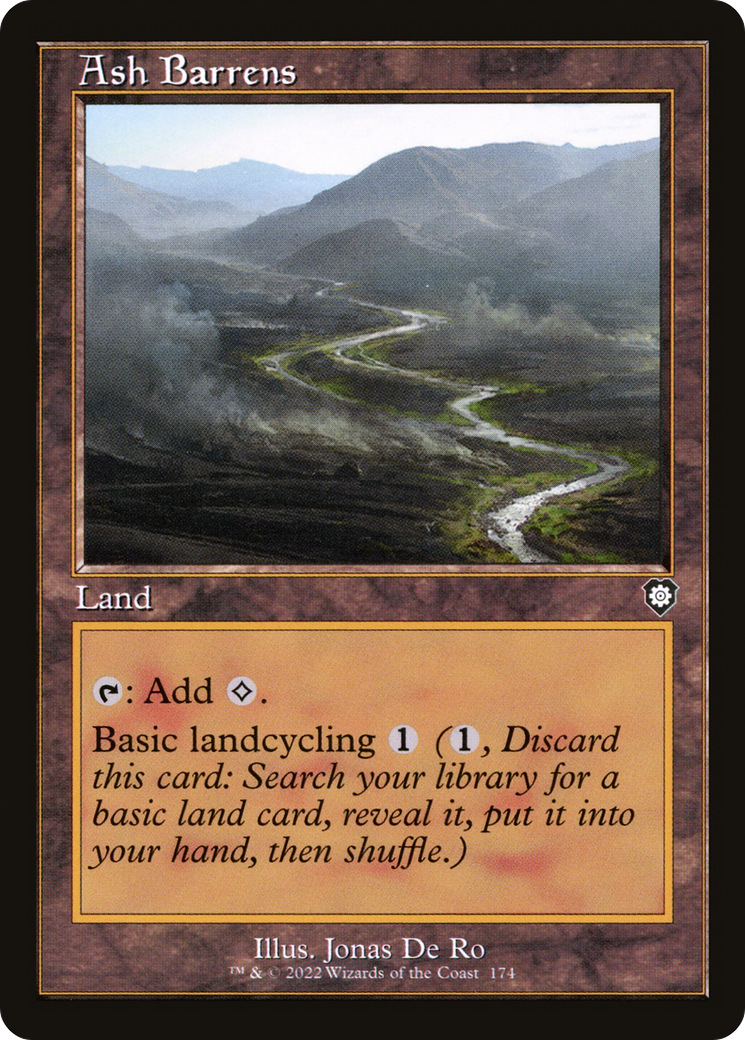
Ash Barrens
Ash Barrens
Land
: Add .
Basic landcycling ( , Discard this card: Search your library for a basic land card, reveal it, put it into your hand, then shuffle.)
-
1
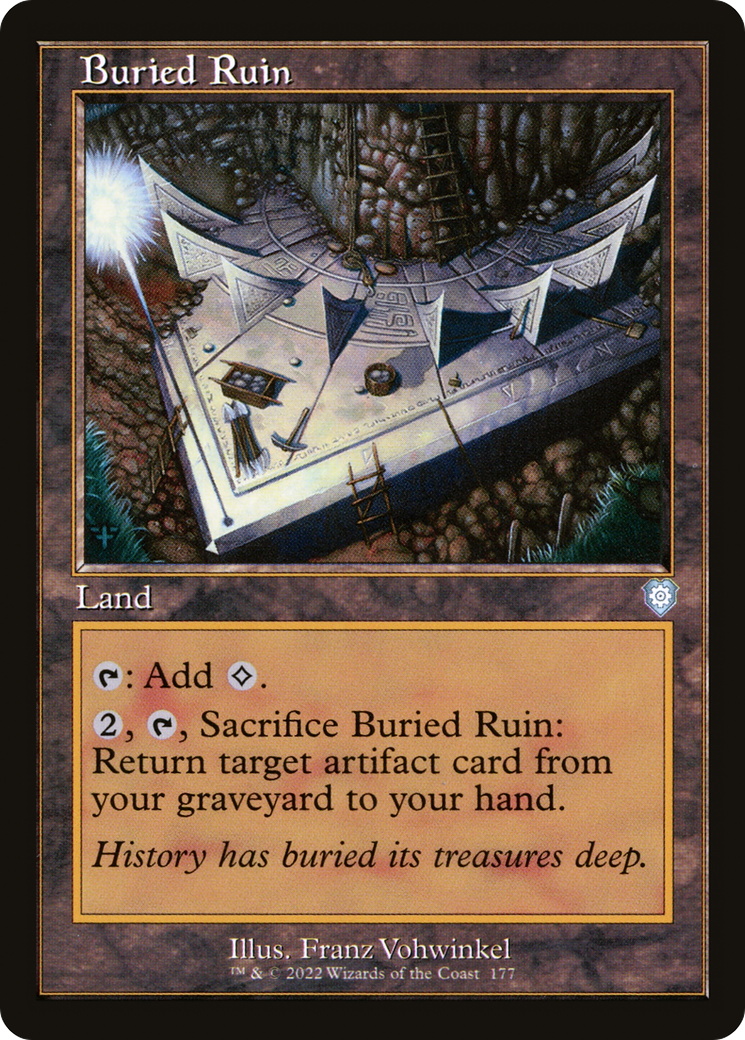
Buried Ruin
Buried Ruin
Land
: Add .
, , Sacrifice this land: Return target artifact card from your graveyard to your hand.
-
1
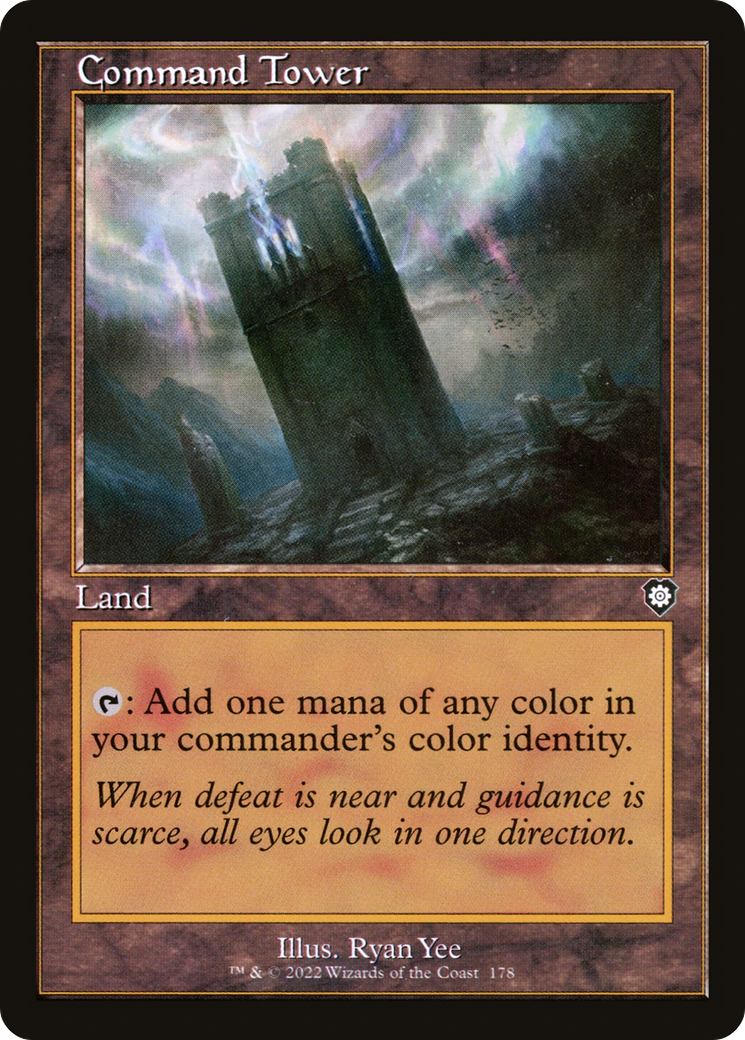
Command Tower
Command Tower
Land
: Add one mana of any color in your commander's color identity.
- If you don't have a commander, Command Tower's ability produces no mana.
- If your commander is a card that has no colors in its color identity, Command Tower's ability produces no mana. It doesn't produce .
- If you have two commanders, the ability adds one mana of any color in their combined color identities.
-
1
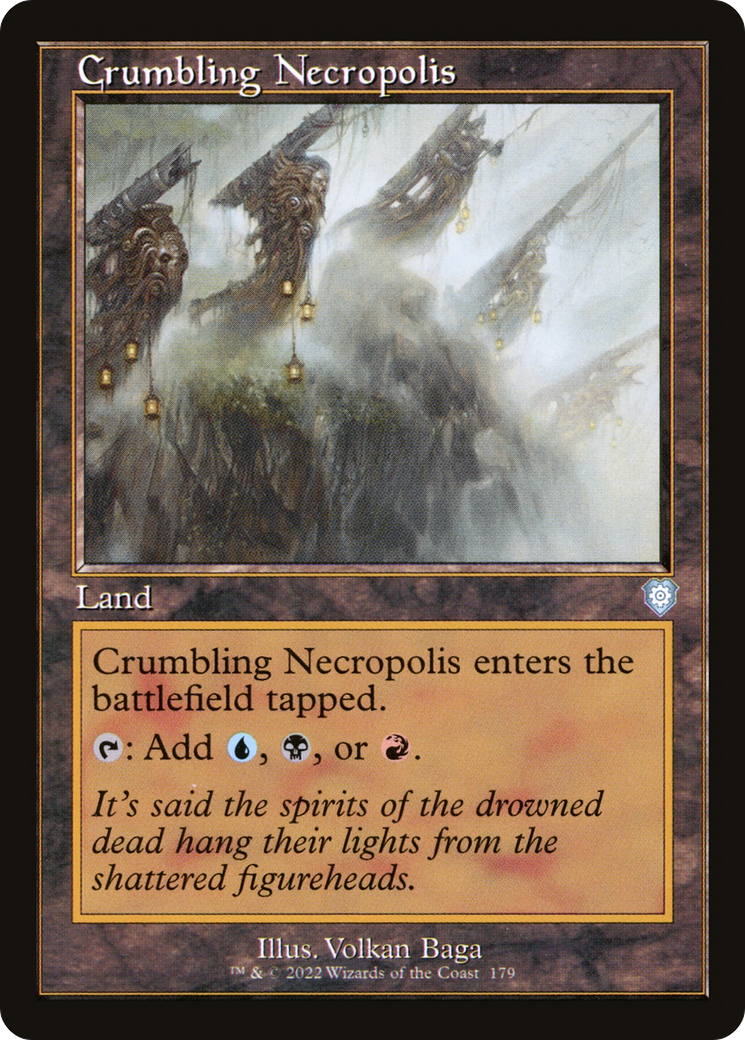
Crumbling Necropolis
Crumbling Necropolis
Land
This land enters tapped.
: Add , , or .
-
1
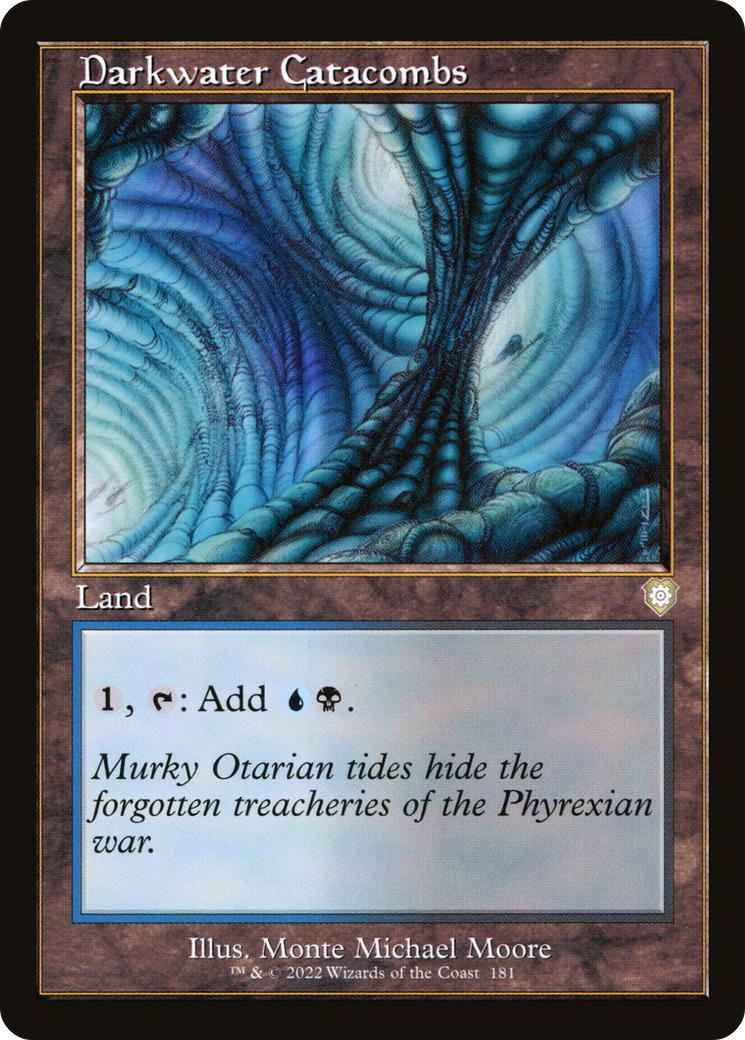
Darkwater Catacombs
Darkwater Catacombs
Land
, : Add .
-
1
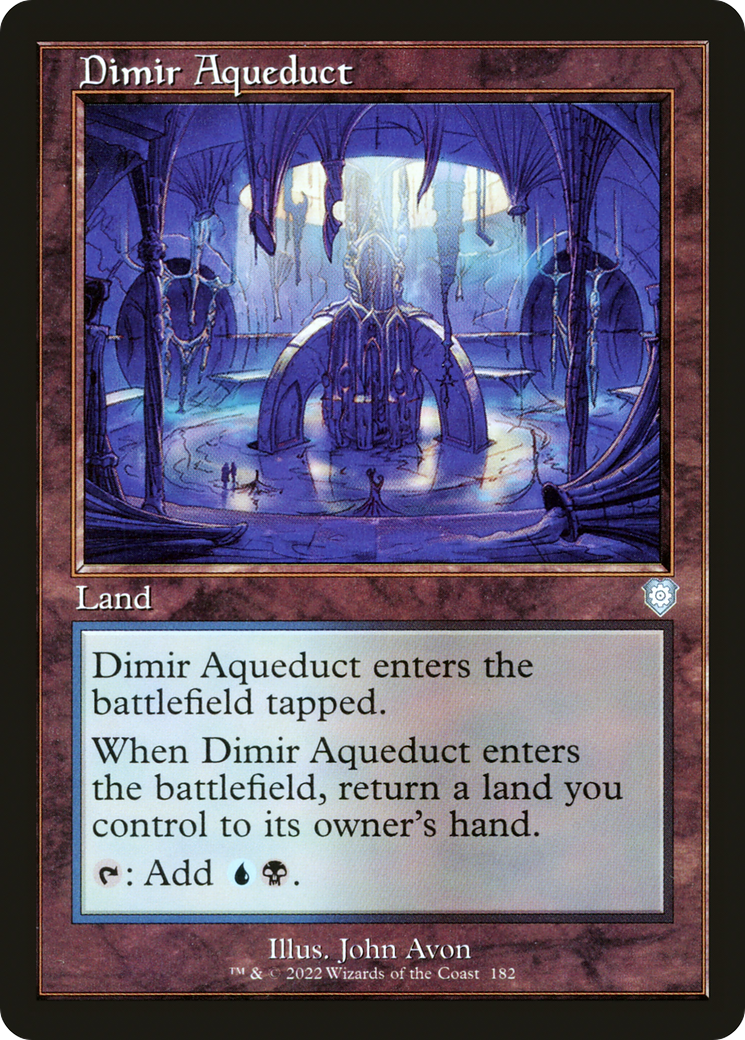
Dimir Aqueduct
Dimir Aqueduct
Land
This land enters tapped.
When this land enters, return a land you control to its owner's hand.
: Add .
- If this land enters the battlefield and you control no other lands, its ability will force you to return it to your hand.
-
1
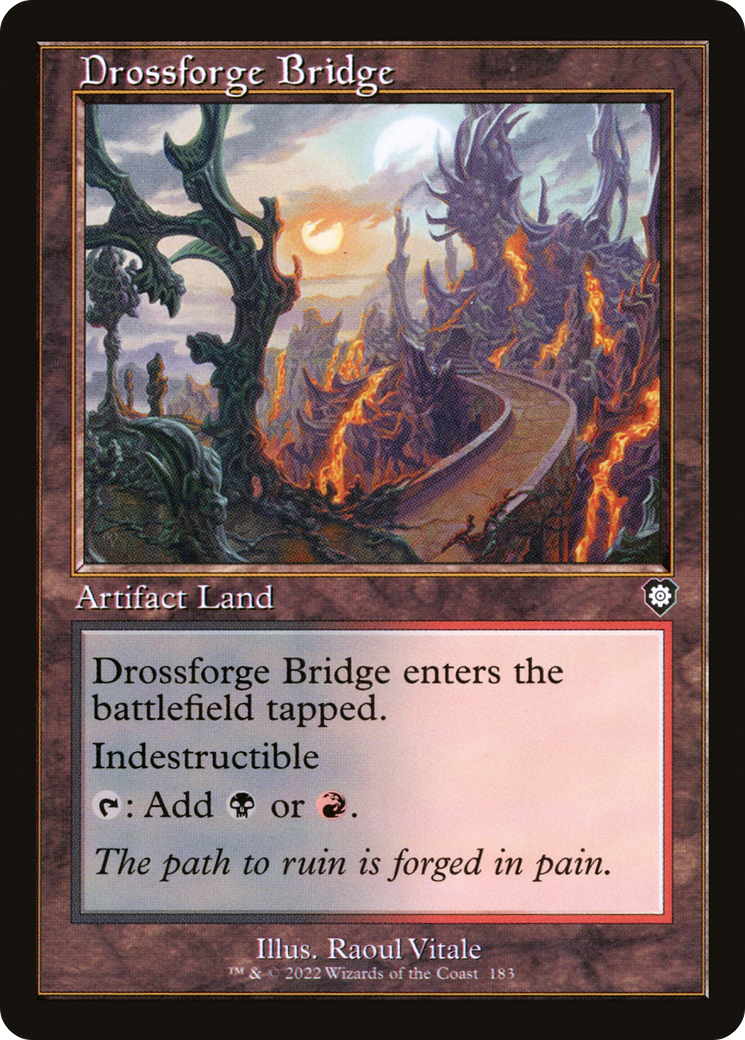
Drossforge Bridge
Drossforge Bridge
Artifact Land
This land enters tapped.
Indestructible
: Add or .
-
1
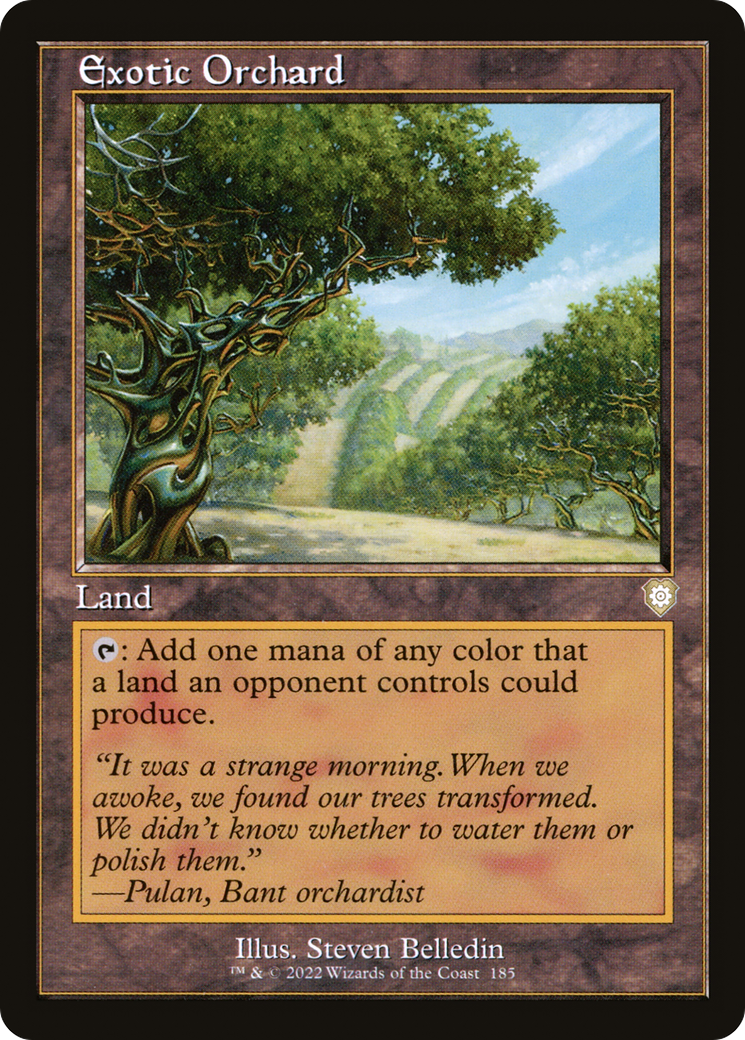
Exotic Orchard
Exotic Orchard
Land
: Add one mana of any color that a land an opponent controls could produce.
- Lands that produce mana based only on what other lands "could produce" won't help each other unless some other land allows one of them to actually produce some type of mana. For example, if you control an Exotic Orchard and your opponent controls an Exotic Orchard and a Reflecting Pool, none of those lands would produce mana if their mana abilities were activated. On the other hand, if you control a Forest and an Exotic Orchard, and your opponent controls an Exotic Orchard and a Reflecting Pool, then each of those lands can be tapped to produce . Your opponent's Exotic Orchard can produce because you control a Forest. Your Exotic Orchard and your opponent's Reflecting Pool can each produce because your opponent's Exotic Orchard can produce .
- When determining what colors of mana your opponents' lands could produce, Exotic Orchard takes into account any applicable replacement effects that would apply to those lands' mana abilities (such as Contamination's effect, for example). If there are more than one, consider them in any possible order.
- The colors of mana are white, blue, black, red, and green. Exotic Orchard can't be tapped for colorless mana, even if a land an opponent controls could produce colorless mana.
- Exotic Orchard doesn't care about any restrictions or riders your opponents' lands (such as Ancient Ziggurat or Hall of the Bandit Lord) put on the mana they produce. It just cares about colors of mana.
- Exotic Orchard checks the effects of all mana-producing abilities of lands your opponents control, but it doesn't check their costs. For example, Vivid Crag has the ability " , Remove a charge counter from Vivid Crag: Add one mana of any color." If an opponent controls Vivid Crag and you control Exotic Orchard, you can tap Exotic Orchard for any color of mana. It doesn't matter whether Vivid Crag has a charge counter on it, and it doesn't matter whether it's untapped.
-
1
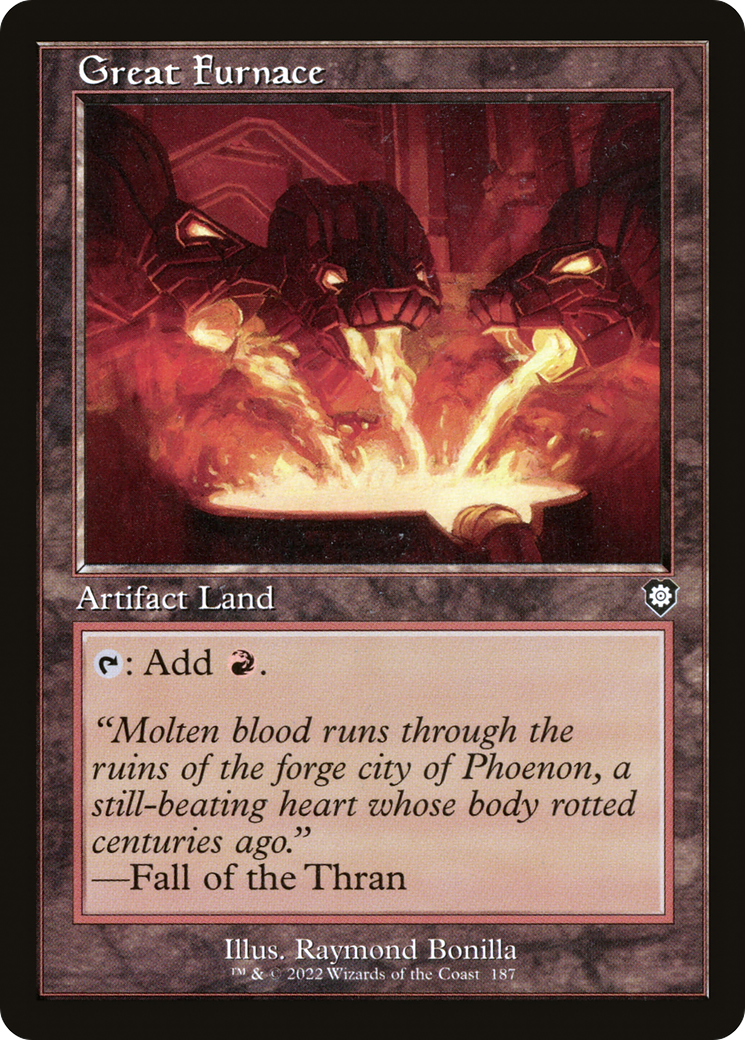
Great Furnace
Great Furnace
Artifact Land
: Add .
-
5
Island
Island
Basic Land — Island
( : Add .)
-
1
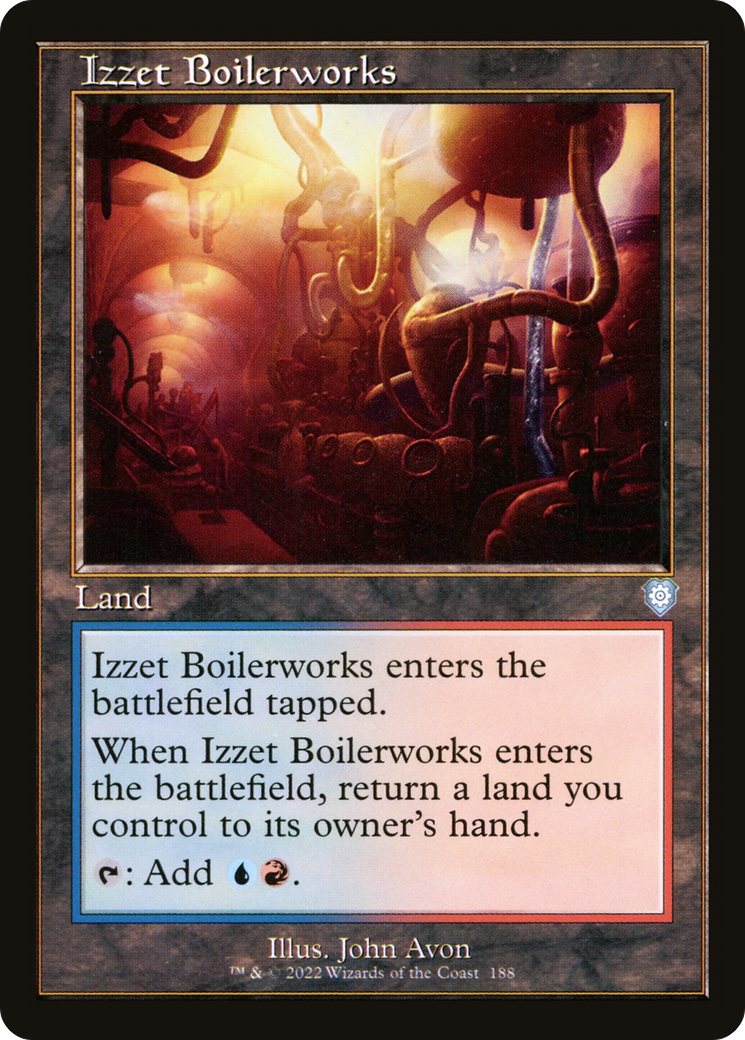
Izzet Boilerworks
Izzet Boilerworks
Land
This land enters tapped.
When this land enters, return a land you control to its owner's hand.
: Add .
- If this land enters the battlefield and you control no other lands, its ability will force you to return it to your hand.
-
1
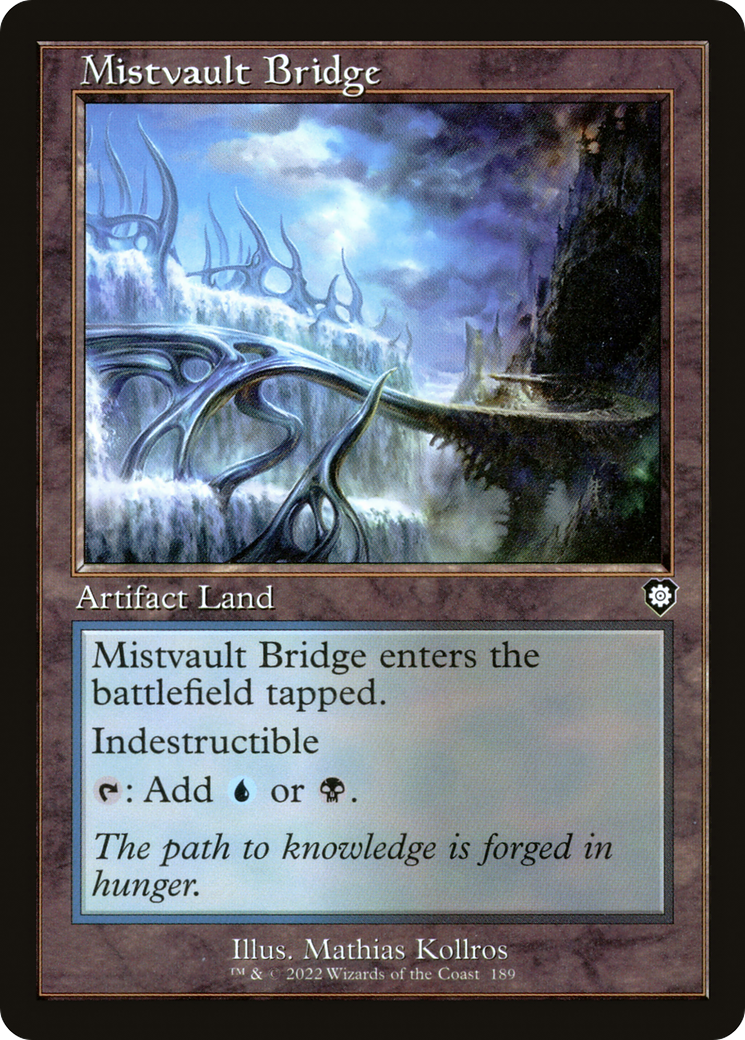
Mistvault Bridge
Mistvault Bridge
Artifact Land
This land enters tapped.
Indestructible
: Add or .
-
4
Mountain
Mountain
Basic Land — Mountain
( : Add .)
-
1
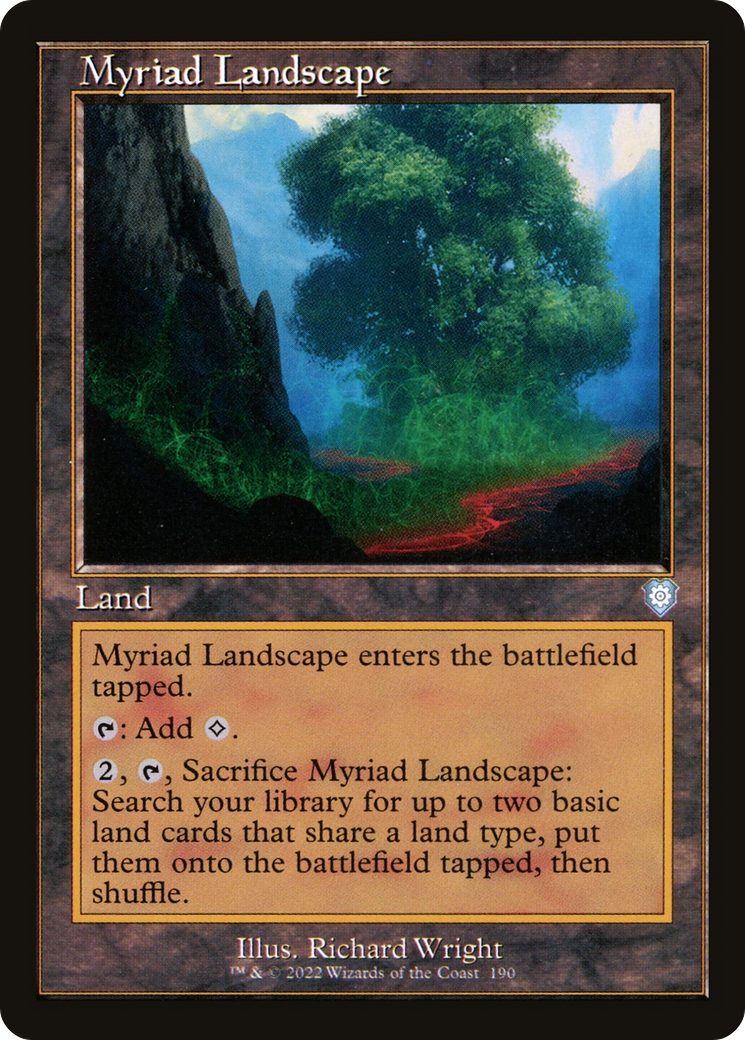
Myriad Landscape
Myriad Landscape
Land
This land enters tapped.
: Add .
, , Sacrifice this land: Search your library for up to two basic land cards that share a land type, put them onto the battlefield tapped, then shuffle.
- You can choose to find one basic land card with Myriad Landscape's last ability.
-
1
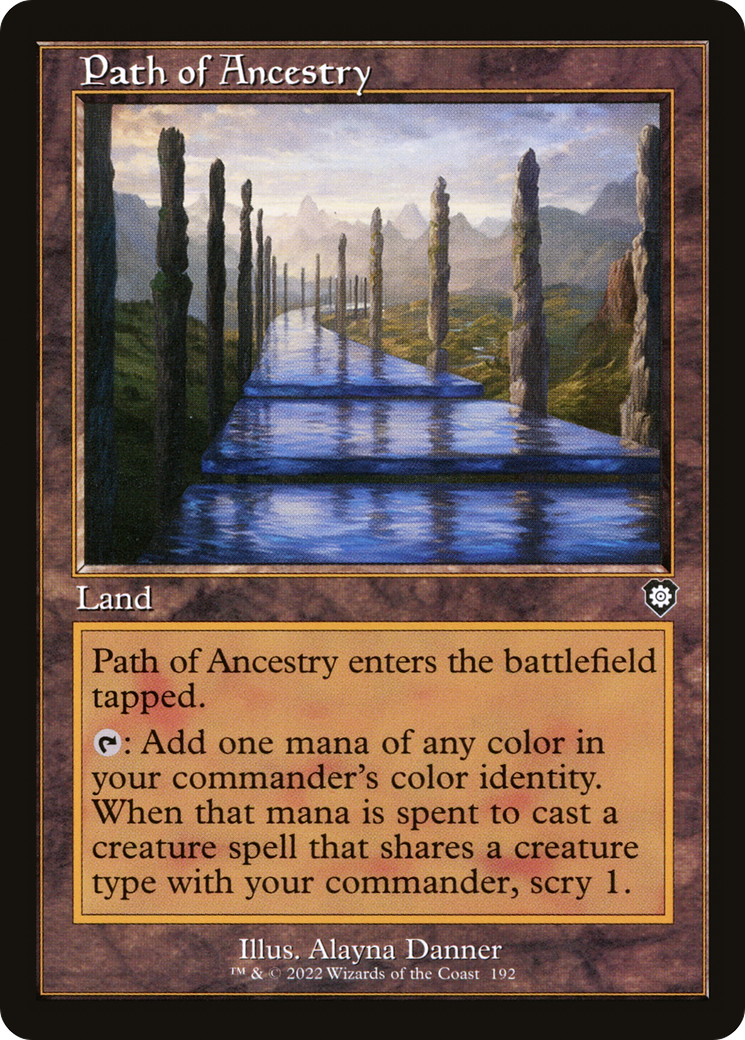
Path of Ancestry
Path of Ancestry
Land
This land enters tapped.
: Add one mana of any color in your commander's color identity. When that mana is spent to cast a creature spell that shares a creature type with your commander, scry 1. (Look at the top card of your library. You may put that card on the bottom.)
- Your commander's creature types are checked immediately after you cast a creature spell spending mana from Path of Ancestry's last ability. They aren't set before the game begins, and they may not be the same types your commander had when you activated that ability.
- If you have two commanders, the last ability adds one mana of any color in their combined color identities. When you spend that mana on a creature spell that shares a creature type with either of your commanders, you'll scry 1.
- If Path of Ancestry's last ability produces two mana (most likely due to Mana Reflection), spending those two mana to cast creature spells that share a creature type with your commander will cause two abilities to trigger. Each of those abilities will cause you to scry 1. You won't scry 2. This is true whether you spend the mana on one creature spell or two.
- If your commander has no creature types, it can't share a creature type with any spell that you cast.
- If you cast your commander with mana from Path of Ancestry, and your commander hasn't somehow lost all of its creature types while on the stack, you'll scry 1.
- If you don't have a commander, Path of Ancestry's ability produces no mana.
- If your commander is a card that has no colors in its color identity, Path of Ancestry's ability produces no mana. It doesn't produce .
-
1
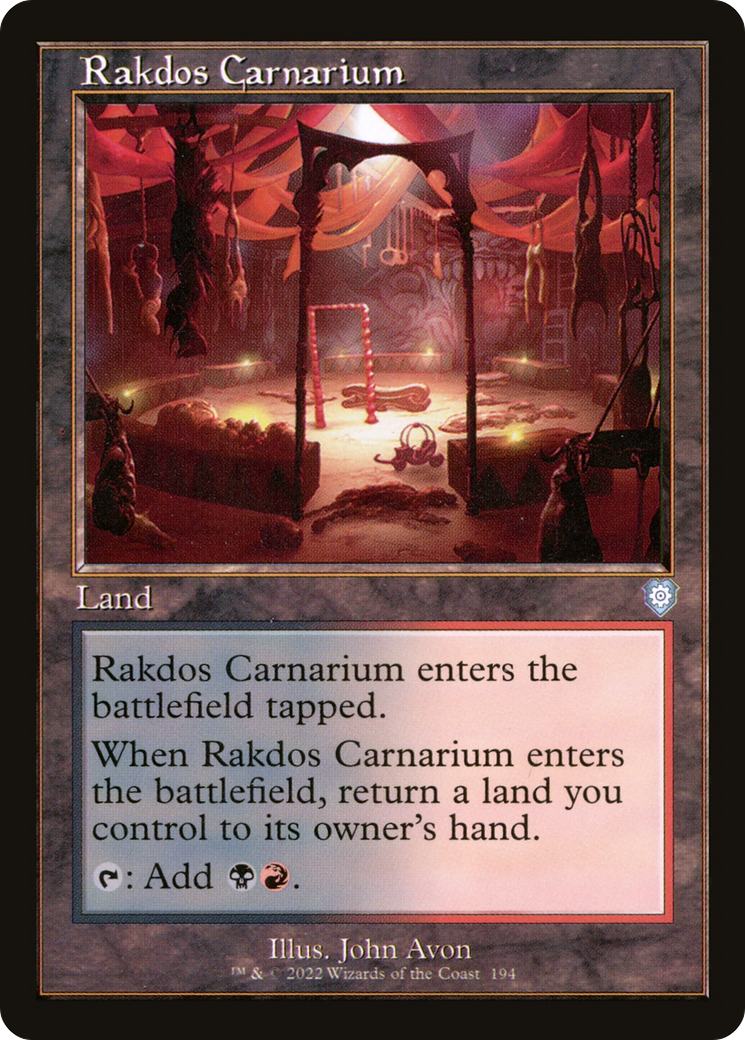
Rakdos Carnarium
Rakdos Carnarium
Land
This land enters tapped.
When this land enters, return a land you control to its owner's hand.
: Add .
- If this land enters the battlefield and you control no other lands, its ability will force you to return it to your hand.
-
1
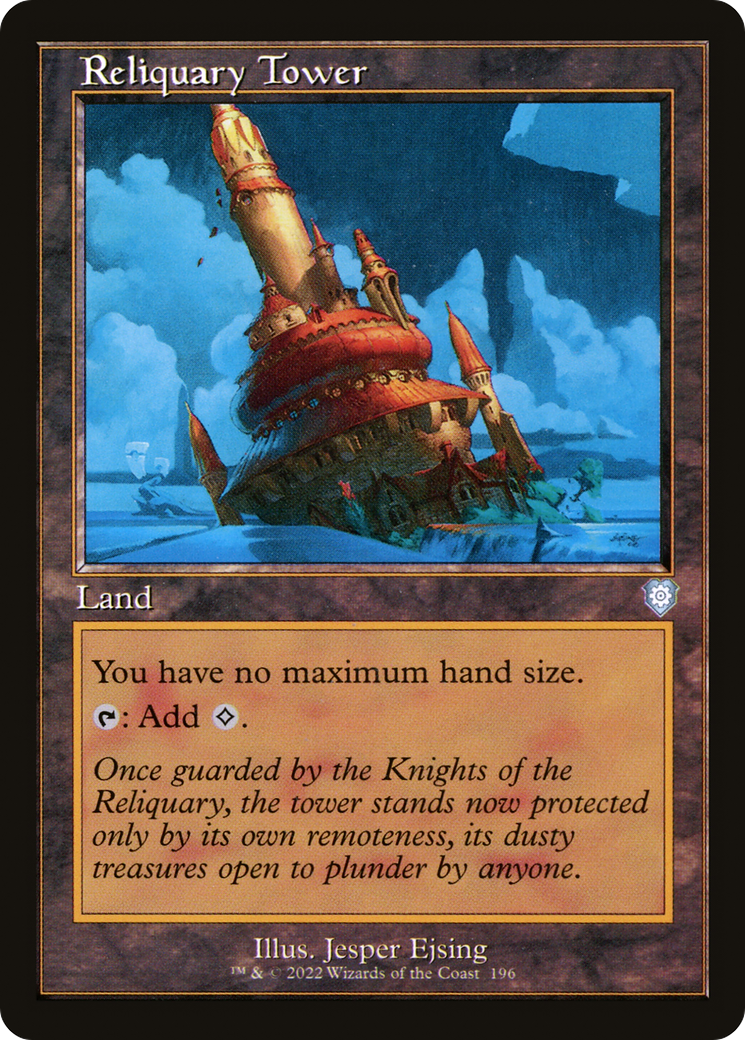
Reliquary Tower
Reliquary Tower
Land
You have no maximum hand size.
: Add .
- If multiple effects modify your hand size, apply them in timestamp order. For example, if you put Null Profusion (an enchantment that says your maximum hand size is two) onto the battlefield and then put Reliquary Tower onto the battlefield, you'll have no maximum hand size. However, if those permanents enter in the opposite order, your maximum hand size would be two.
-
1
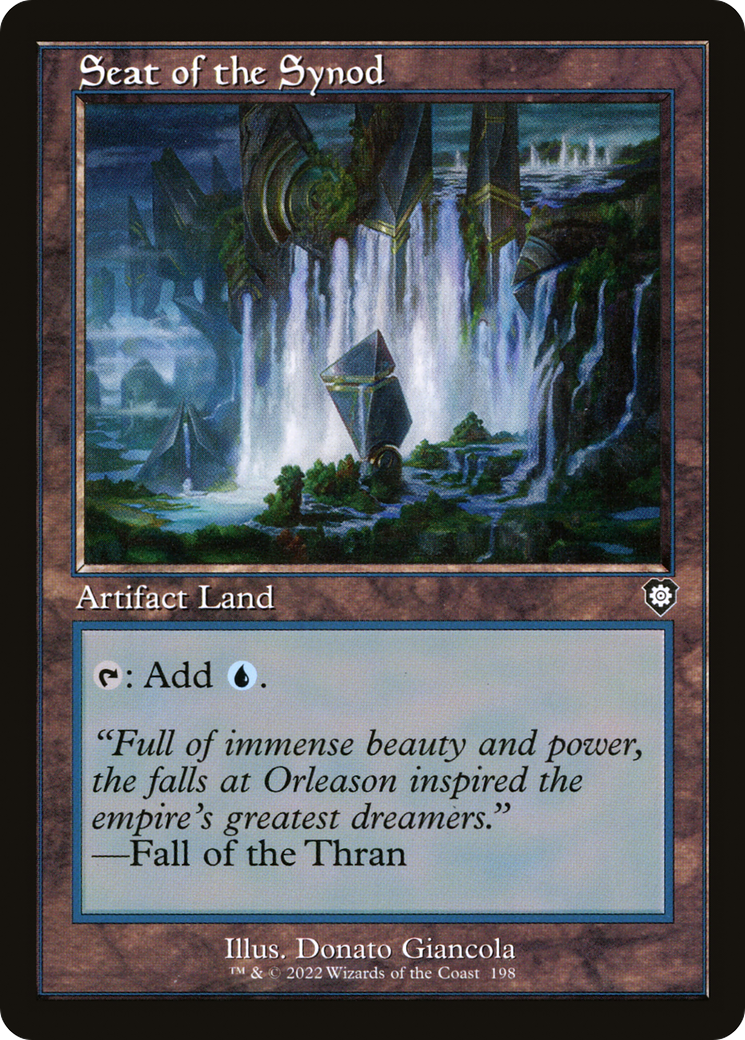
Seat of the Synod
Seat of the Synod
Artifact Land
: Add .
-
1
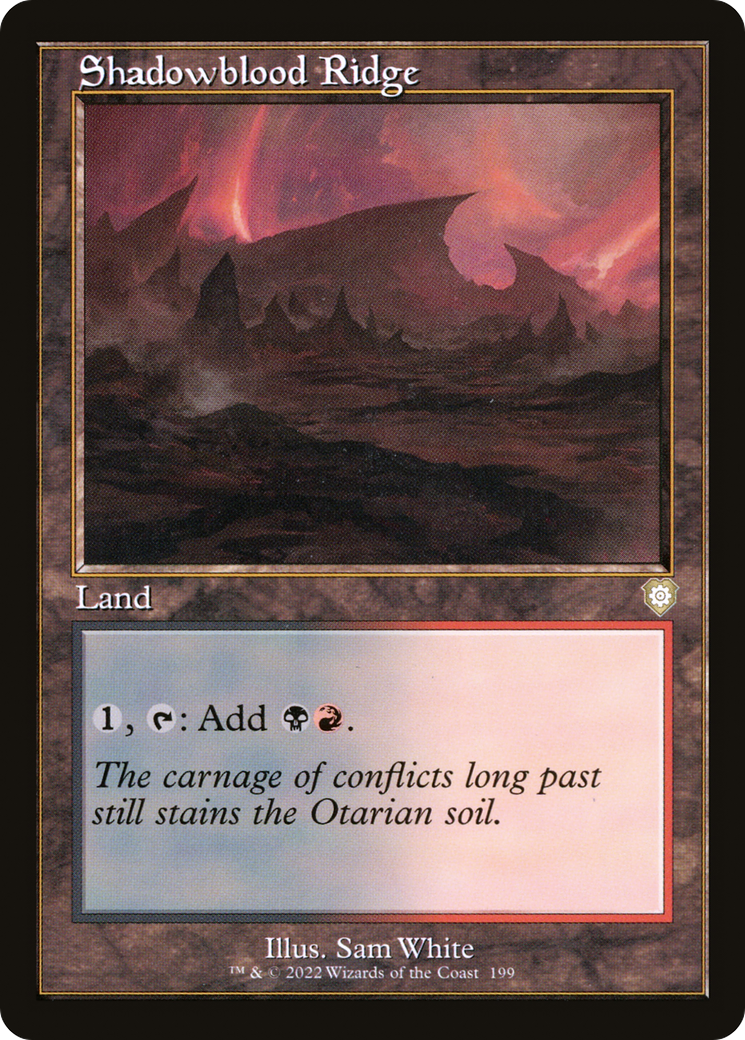
Shadowblood Ridge
Shadowblood Ridge
Land
, : Add .
-
1
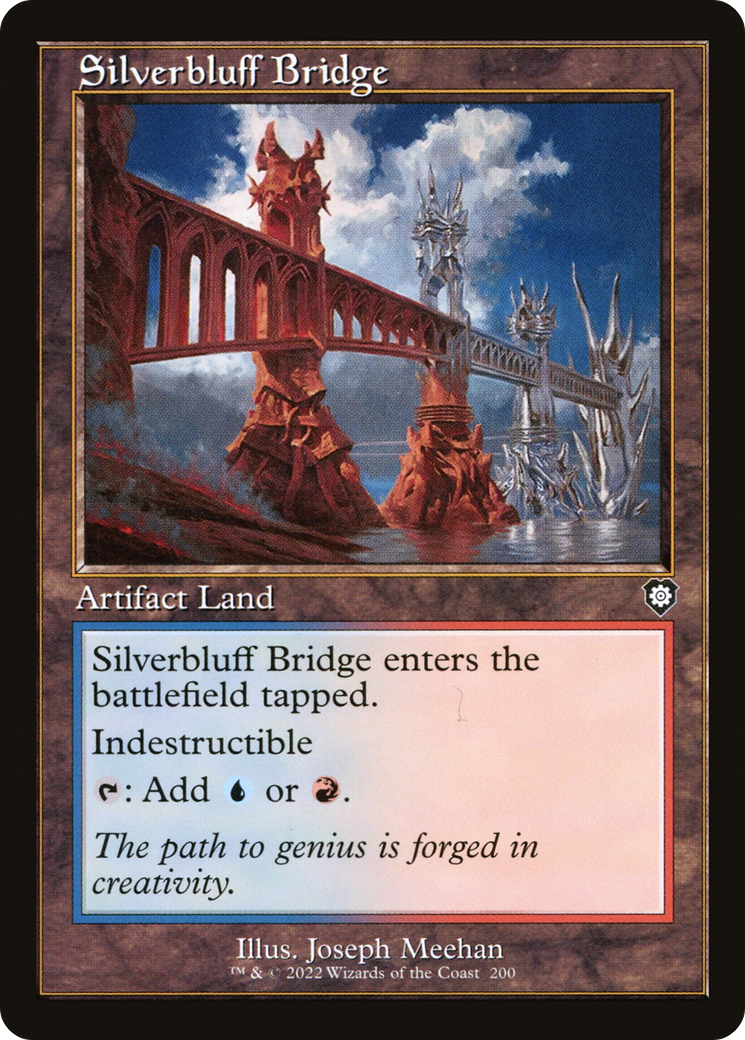
Silverbluff Bridge
Silverbluff Bridge
Artifact Land
This land enters tapped.
Indestructible
: Add or .
-
1
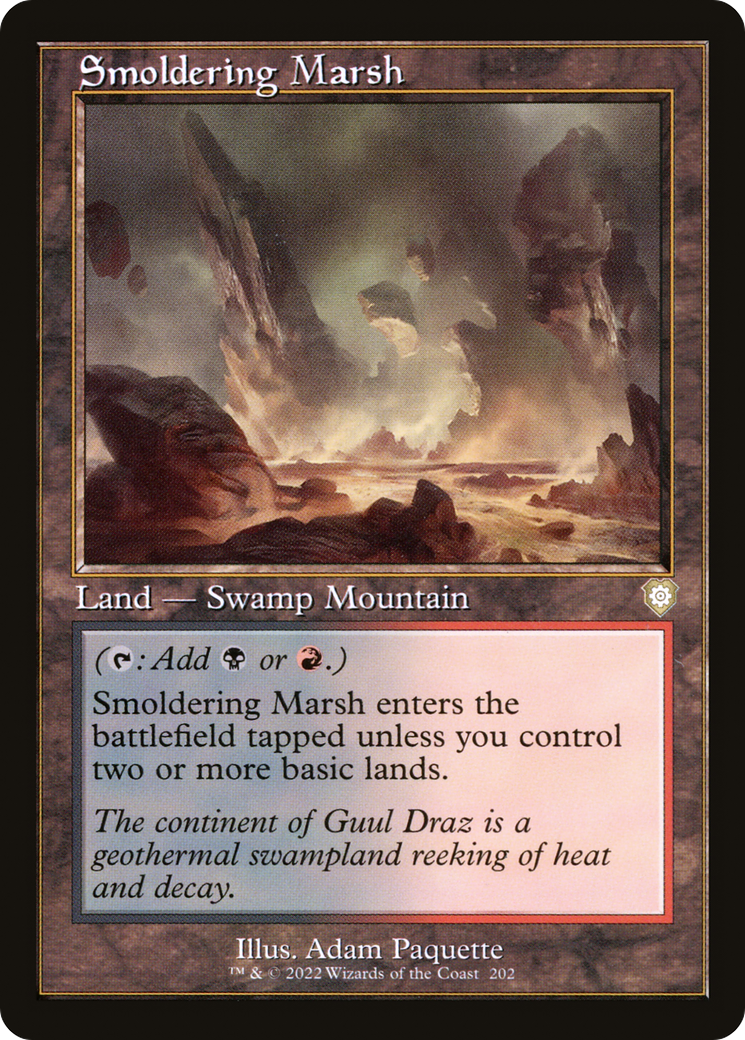
Smoldering Marsh
Smoldering Marsh
Land — Swamp Mountain
( : Add or .)
This land enters tapped unless you control two or more basic lands.
- However, because these cards have basic land types, effects that specify a basic land type without also specifying that the land be basic can affect them. For example, a spell or ability that reads "Destroy target Forest" can target Canopy Vista, while one that reads "Destroy target basic Forest" cannot.
- Even though these lands have basic land types, they are not basic lands because "basic" doesn't appear on their type line. Notably, controlling two or more of them won't allow others to enter the battlefield untapped.
- If one of these lands enters the battlefield at the same time as any number of basic lands, those other lands are not counted when determining if this land enters the battlefield tapped or untapped.
-
4
Swamp
Swamp
Basic Land — Swamp
( : Add .)
-
1
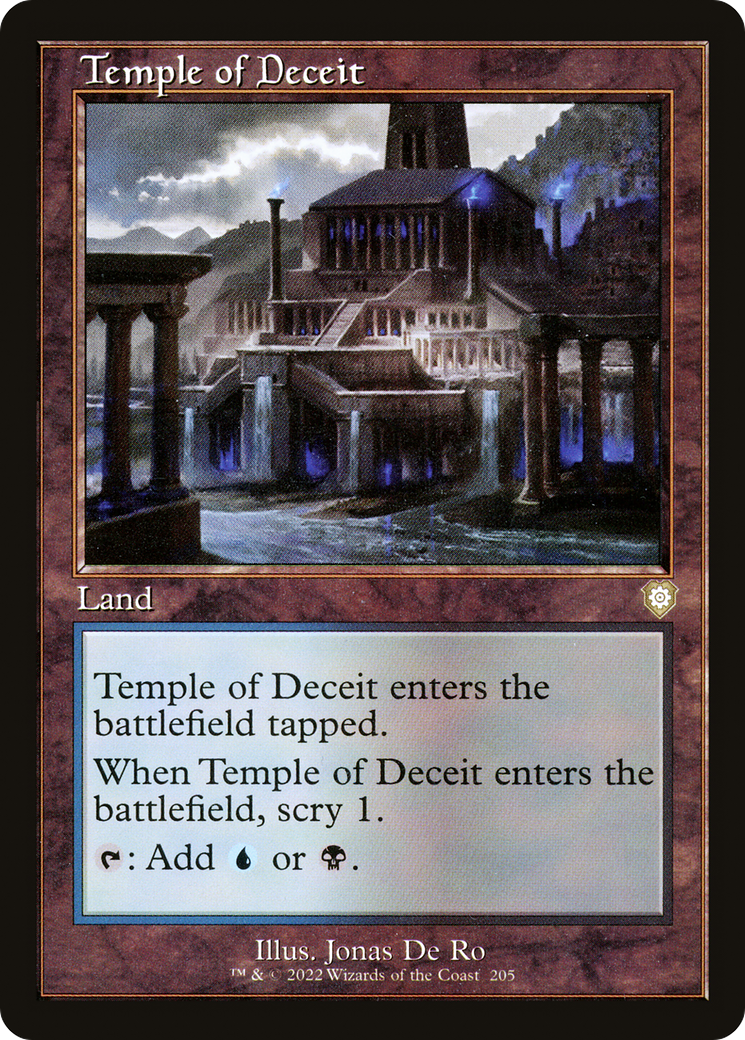
Temple of Deceit
Temple of Deceit
Land
This land enters tapped.
When this land enters, scry 1. (Look at the top card of your library. You may put that card on the bottom.)
: Add or .
- When you scry, you may put all the cards you look at back on top of your library, you may put all of those cards on the bottom of your library, or you may put some of those cards on top and the rest of them on the bottom.
- You choose how to order cards returned to your library after scrying no matter where you put them.
- You perform the actions stated on a card in sequence. For some spells and abilities, that means you'll scry last. For others, that means you'll scry and then perform other actions.
- Scry appears on some spells and abilities with one or more targets. If all of the spell or ability's targets are illegal when it tries to resolve, it won't resolve and none of its effects will happen. You won't scry.
-
1
Temple of Epiphany
Temple of Epiphany
Land
This land enters tapped.
When this land enters, scry 1. (Look at the top card of your library. You may put that card on the bottom.)
: Add or .
-
1
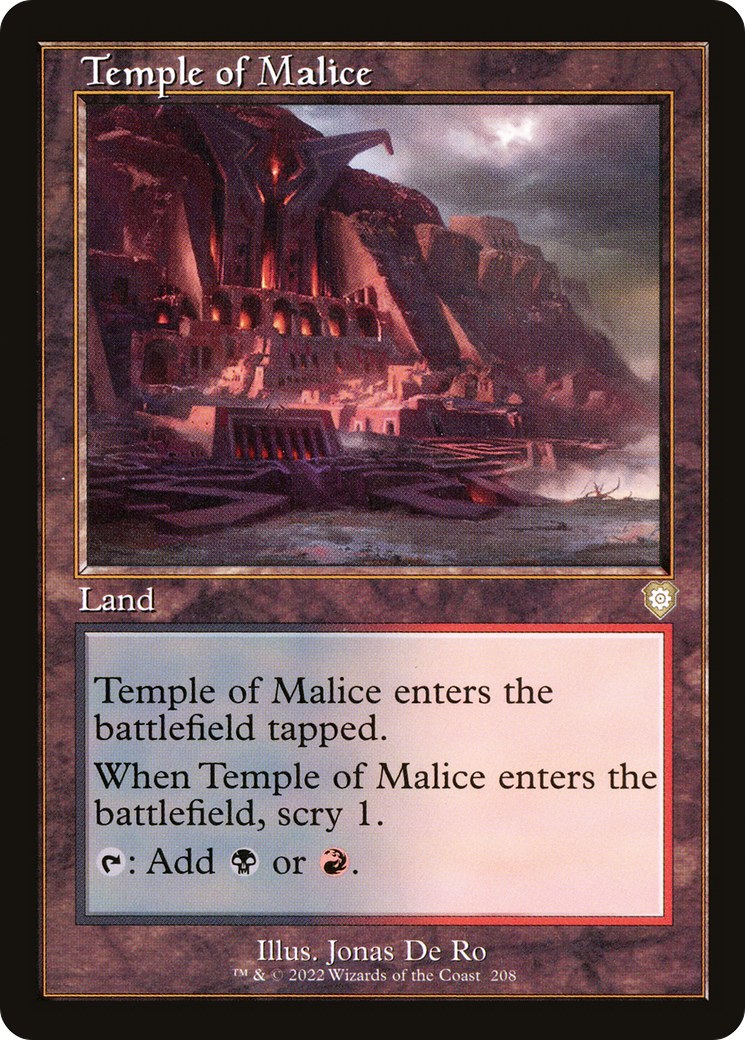
Temple of Malice
Temple of Malice
Land
This land enters tapped.
When this land enters, scry 1. (Look at the top card of your library. You may put that card on the bottom.)
: Add or .
- When you scry, you may put all the cards you look at back on top of your library, you may put all of those cards on the bottom of your library, or you may put some of those cards on top and the rest of them on the bottom.
- You choose how to order cards returned to your library after scrying no matter where you put them.
- You perform the actions stated on a card in sequence. For some spells and abilities, that means you'll scry last. For others, that means you'll scry and then perform other actions.
- Scry appears on some spells and abilities with one or more targets. If all of the spell or ability's targets are illegal when it tries to resolve, it won't resolve and none of its effects will happen. You won't scry.
-
1
Terramorphic Expanse
Terramorphic Expanse
Land
, Sacrifice this land: Search your library for a basic land card, put it onto the battlefield tapped, then shuffle.
-
1
Vault of Whispers
Vault of Whispers
Artifact Land
: Add .
Blue 10
-
1
Emry, Lurker of the Loch
Emry, Lurker of the Loch
Legendary Creature — Merfolk Wizard
1/2
Affinity for artifacts (This spell costs less to cast for each artifact you control.)
When Emry enters, mill four cards.
: Choose target artifact card in your graveyard. You may cast that card this turn. (You still pay its costs. Timing rules still apply.)
- You'll still pay all costs for a spell cast this way, including additional costs. You may also pay alternative costs if any are available.
- To determine the total cost of a spell, start with the mana cost or alternative cost you're paying, add any cost increases, then apply any cost reductions (such as that of Emry). The mana value of the spell remains unchanged, no matter what the total cost to cast it was.
- Once you announce that you're casting a spell, no player may take actions until the spell has been paid for. Notably, opponents can't try to change by how much Emry's cost is reduced.
- Casting the target card causes it to leave your graveyard and become a new object. You can't cast it again if it returns to your graveyard this turn.
- If Emry's last ability targets an artifact land card, you can't play it. Effects that allow you to "cast" a card don't allow you to play a land card.
- The cost reduction ability reduces only the generic mana in Emry's cost. The colored mana must still be paid.
- You must follow the normal timing permissions and restrictions for the target artifact card. Unless it has flash, you'll most likely only be able to cast it during your main phase while the stack is empty.
-
1
Fact or Fiction
Fact or Fiction
Instant
Reveal the top five cards of your library. An opponent separates those cards into two piles. Put one pile into your hand and the other into your graveyard.
- Piles may be empty.
-
1
Glint Raker
Glint Raker
Creature — Drake
1/3
Flying
This creature gets +X/+0, where X is the highest mana value among artifacts you control.
Whenever this creature deals combat damage to a player, you may reveal that many cards from the top of your library. Put an artifact card revealed this way into your hand and the rest into your graveyard.
- If an artifact on the battlefield has an in its mana cost, that X is 0.
-
1
Master Transmuter
Master Transmuter
Artifact Creature — Human Artificer
1/2
, , Return an artifact you control to its owner's hand: You may put an artifact card from your hand onto the battlefield.
- Master Transmuter can be returned to its owner's hand to pay the cost of its activated ability.
- The artifact card you put onto the battlefield when the ability resolves may be the same card that you returned to your hand when you paid the cost. If so, it returns to the battlefield as a new object with no relation to its previous existence.
-
1
Mnemonic Sphere
Mnemonic Sphere
Artifact
, Sacrifice this artifact: Draw two cards.
Channel — , Discard this card: Draw a card.
- Discarding the card is part of the cost to activate a channel ability.
- If a channel ability requires a target, you may not activate it without a target just to discard the card.
-
1
Muzzio, Visionary Architect
Muzzio, Visionary Architect
Legendary Creature — Human Artificer
1/3
, : Look at the top X cards of your library, where X is the highest mana value among artifacts you control. You may put an artifact card from among them onto the battlefield. Put the rest on the bottom of your library in any order.
- The value of X is determined as the ability resolves. If, at that time, you control no artifacts, you won't look at any cards.
-
1
Padeem, Consul of Innovation
Padeem, Consul of Innovation
Legendary Creature — Vedalken Artificer
1/4
Artifacts you control have hexproof. (They can't be the targets of spells or abilities your opponents control.)
At the beginning of your upkeep, if you control the artifact with the highest mana value or tied for the highest mana value, draw a card.
- The artifact you control has to have the highest mana value only among artifacts on the battlefield, not among all permanents on the battlefield.
- If an artifact has in its mana cost, X is considered to be 0.
- If you don't control an artifact with the highest mana value as your upkeep begins, Padeem's second ability won't trigger. You can't cast an instant to destroy an opponent's artifact during your turn before your upkeep begins.
- If you no longer control an artifact with the highest mana value as Padeem's triggered ability resolves, you don't draw a card.
-
1
Thirst for Knowledge
Thirst for Knowledge
Instant
Draw three cards. Then discard two cards unless you discard an artifact card.
- You can discard either one artifact card or two cards which may or may not be artifacts. If you really want to, you can discard two artifact cards.
-
1
Thoughtcast
Thoughtcast
Sorcery
Affinity for artifacts (This spell costs less to cast for each artifact you control.)
Draw two cards.
-
1
Workshop Elders
Workshop Elders
Creature — Human Artificer
4/4
Artifact creatures you control have flying.
At the beginning of combat on your turn, you may have target noncreature artifact you control become a 0/0 artifact creature. If you do, put four +1/+1 counters on it.
- The effect of Workshop Elders's triggered ability lasts indefinitely. It doesn't wear off during the cleanup step.
- An artifact that becomes a creature due to Workshop Elders can't attack unless you've controlled it continuously since your turn began.
- If another effect later causes the artifact to become a creature and sets its power and toughness as it does so, that creature will have that base power and toughness; it won't be 0/0. Notably, crewing a Vehicle does not set its power and toughness, so a Vehicle's base power and toughness remain 0/0 if you crew it.
Black 6
-
1
Executioner's Capsule
Executioner's Capsule
Artifact
, , Sacrifice this artifact: Destroy target nonblack creature.
- The only difference between a colored artifact and a colorless artifact is, obviously, its color. Unlike most artifacts, a colored artifact requires colored mana to cast. Also unlike most artifacts, a colored artifact has a color in all zones. It will interact with cards that care about color. Other than that, a colored artifact behaves just like any other artifact. It will interact as normal with any card that cares about artifacts, such as Shatter or Arcbound Ravager.
-
1
Fain, the Broker
Fain, the Broker
Legendary Creature — Human Warlock
3/3
, Sacrifice a creature: Put two +1/+1 counters on target creature.
, Remove a counter from a creature you control: Create a Treasure token.
, Sacrifice an artifact: Create a 2/1 white and black Inkling creature token with flying.
: Untap Fain.
-
1
Feed the Swarm
Feed the Swarm
Sorcery
Destroy target creature or enchantment an opponent controls. You lose life equal to that permanent's mana value.
- The amount of life you lose is determined by the permanent's mana value as it last existed on the battlefield.
- If the target permanent is an illegal target by the time Feed the Swarm tries to resolve, the spell doesn't resolve. You don't lose any life. If the target is legal but not destroyed (most likely because it has indestructible), you do lose life.
- If a permanent on the battlefield has in its mana cost, X is 0 for the purpose of determining its mana value.
-
1
Geth, Lord of the Vault
Geth, Lord of the Vault
Legendary Creature — Phyrexian Zombie
5/5
Intimidate (This creature can't be blocked except by artifact creatures and/or creatures that share a color with it.)
: Put target artifact or creature card with mana value X from an opponent's graveyard onto the battlefield under your control tapped. Then that player mills X cards.
- If a card in a player's graveyard has in its mana cost, X is considered to be 0.
- The target card must have mana value exactly X. You can't overpay to have the player mill more cards.
- In a multiplayer game, if a player leaves the game, all cards that player owns leave as well. If you leave the game, any spells and/or permanents you control from Geth's last ability are exiled.
-
1
Herald of Anguish
Herald of Anguish
Creature — Demon
5/5
Improvise (Your artifacts can help cast this spell. Each artifact you tap after you're done activating mana abilities pays for .)
Flying
At the beginning of your end step, each opponent discards a card.
, Sacrifice an artifact: Target creature gets -2/-2 until end of turn.
- Improvise doesn't change a spell's mana cost or mana value.
- When calculating a spell's total cost, include any alternative costs, additional costs, or anything else that increases or reduces the cost to cast the spell. Improvise applies after the total cost is calculated.
- Because improvise isn't an alternative cost, it can be used in conjunction with alternative costs.
- Improvise can't pay for , , , , , or mana symbols in a spell's total cost.
- Improvise can't be used to pay for anything other than the cost of casting the spell. For example, it can't be used during the resolution of an ability that says “Counter target spell unless its controller pays .”
- If an artifact you control has a mana ability with in the cost, activating that ability while casting a spell with improvise will result in the artifact being tapped when you pay the spell's costs. You won't be able to tap it again for improvise. Similarly, if you sacrifice an artifact to activate a mana ability while casting a spell with improvise, that artifact won't be on the battlefield when you pay the spell's costs, so you won't be able to tap it for improvise.
- Tapping an artifact won't cause its abilities to stop applying unless those abilities say so.
- Equipment attached to a creature doesn't become tapped when that creature becomes tapped, and tapping that Equipment doesn't cause the creature to become tapped.
-
1
Terisiare's Devastation
Terisiare's Devastation
Sorcery
You lose X life and create X tapped Powerstone tokens. Then all creatures get -1/-1 until end of turn for each artifact you control. (The tokens are artifacts with " : Add . This mana can't be spent to cast a nonartifact spell.")
- Powerstone tokens are a kind of predefined token. Each one has the artifact subtype “Powerstone” and the ability “ : Add . This mana can’t be spent to cast a nonartifact spell.”
- You can use the added by a Powerstone token on anything that isn’t a nonartifact spell. This includes paying costs to activate abilities of both artifact and nonartifact permanents, paying ward costs, and so on.
- Although all the cards in The Brothers’ War that create Powerstone tokens create a tapped Powerstone token, entering the battlefield tapped isn’t part of the token’s definition. Notably, if you create a token that is a copy of a Powerstone token, the token copy won’t enter the battlefield tapped.
Red 10
-
1
Abrade
Abrade
Instant
Choose one —
- Abrade deals 3 damage to target creature.
- Destroy target artifact.
-
1
Audacious Reshapers
Audacious Reshapers
Creature — Human Artificer
3/3
, Sacrifice an artifact: Reveal cards from the top of your library until you reveal an artifact card. Put that card onto the battlefield and the rest on the bottom of your library in a random order. This creature deals damage to you equal to the number of cards revealed this way.
-
1
Blasphemous Act
Blasphemous Act
Sorcery
This spell costs less to cast for each creature on the battlefield.
Blasphemous Act deals 13 damage to each creature.
- Although players may respond to Blasphemous Act once it's been cast, once it's announced, they can't respond before the cost is calculated and paid.
- Blasphemous Act's ability can't reduce the total cost to cast the spell below .
- The total cost to cast Blasphemous Act is locked in before you pay that cost. For example, if there are three creatures on the battlefield, including one you can sacrifice to add , the total cost of Blasphemous Act is . Then you can sacrifice the creature when you activate mana abilities just before paying the cost.
- To determine the total cost of a spell, start with the mana cost or alternative cost you're paying, add any cost increases, then apply any cost reductions (such as that of Blasphemous Act). The mana value of the spell is determined only by its mana cost, no matter what the total cost to cast the spell was.
-
1
Blast-Furnace Hellkite
Blast-Furnace Hellkite
Creature — Dragon
5/5
Artifact offering (You may cast this spell as though it had flash by sacrificing an artifact and paying the difference in mana costs between this and the sacrificed artifact. Mana cost includes color.)
Flying, double strike
Creatures attacking your opponents have double strike.
- When you cast a spell with offering by sacrificing a permanent, generic mana in the sacrificed permanent’s mana cost reduces only generic mana in the spell’s total cost. Colored and colorless mana in the sacrificed permanent’s mana cost reduces mana of the same type in spell’s total cost, and any excess reduces the spell’s total cost by that much generic mana. The total cost of the spell can’t be reduced to less than .
- Blast-Furnace Hellkite’s last ability applies to any creature that is attacking one of your opponents, even if another opponent controls that creature.
-
1
Chaos Warp
Chaos Warp
Instant
The owner of target permanent shuffles it into their library, then reveals the top card of their library. If it's a permanent card, they put it onto the battlefield.
- A permanent card is a card with one or more of the following card types: artifact, creature, enchantment, land, or planeswalker.
- The owner of a token is the player under whose control the token was put onto the battlefield. If a token is shuffled into a player's library this way, that player shuffles before revealing the top card of that library.
- If the revealed card is not a permanent card, it remains on top of that library.
- If the permanent is an illegal target by the time Chaos Warp tries to resolve, it won't resolve and none of its effects will occur. No library will be shuffled and no card will be revealed.
- If the revealed card is a permanent card but can't enter (perhaps because it's an Aura with nothing to enchant), it remains on top of that library.
-
1
Cursed Mirror
Cursed Mirror
Artifact
: Add .
As this artifact enters, you may have it become a copy of any creature on the battlefield until end of turn, except it has haste.
- If Cursed Mirror somehow enters the battlefield at the same time as a creature, it can't become a copy of that creature. You may choose only a creature that's already on the battlefield.
- Cursed Mirror copies exactly what was printed on the original creature (unless that creature is copying something else or is a token; see below). It doesn't copy whether that creature is tapped or untapped, whether it has any counters on it or any Auras or Equipment attached to it, or any non-copy effects that have changed its types, color, power and toughness, and so on.
- If the copied creature has in its mana cost, X is considered to be 0.
- If something else becomes a copy of Cursed Mirror while Cursed Mirror is a copy of a creature, the duration of the effect is not copied. The new copy will still be a creature (with haste) after Cursed Mirror stops being a copy at the end of the turn.
- While it is copying a creature, Cursed Mirror does not have " : Add " (unless the creature it's copying also has that ability).
- If the copied creature is copying something else, then Cursed Mirror enters the battlefield as a copy of whatever that creature is copying.
- Any enters-the-battlefield abilities of the copied creature will trigger when Cursed Mirror enters the battlefield. Any "As [this creature] enters the battlefield" or "[This creature] enters the battlefield with" abilities of the copied creature will also work.
- If the copied creature is a token, Cursed Mirror copies the original characteristics of that token as stated by the effect that created the token. Copying a token doesn't make Cursed Mirror a token. Similarly, if Cursed Mirror itself is a token, copying a nontoken permanent doesn't make it stop being a token.
-
1
Faithless Looting
Faithless Looting
Sorcery
Draw two cards, then discard two cards.
Flashback (You may cast this card from your graveyard for its flashback cost. Then exile it.)
- To determine the total cost of a spell, start with the mana cost or alternative cost (such as a flashback cost) you're paying, add any cost increases, then apply any cost reductions. The mana value of the spell is determined only by its mana cost, no matter what the total cost to cast the spell was.
- A spell cast using flashback will always be exiled afterward, whether it resolves, is countered, or leaves the stack in some other way.
- "Flashback [cost]" means "You may cast this card from your graveyard if the resulting spell is an instant or sorcery spell by paying [cost] rather than paying its mana cost" and "If the flashback cost was paid, exile this card instead of putting it anywhere else any time it would leave the stack."
- If a card with flashback is put into your graveyard during your turn, you can cast it if it's legal to do so before any other player can take any actions.
- You can cast a spell using flashback even if it was somehow put into your graveyard without having been cast.
- You must still follow any timing restrictions and permissions, including those based on the card's type. For instance, you can cast a sorcery using flashback only when you could normally cast a sorcery.
- You draw two cards and discard two cards all while Faithless Looting is resolving. Nothing can happen between the two, and no player may choose to take actions.
-
1
Farid, Enterprising Salvager
Farid, Enterprising Salvager
Legendary Creature — Human Soldier
3/3
Whenever a nontoken artifact you control is put into a graveyard from the battlefield, create a colorless artifact token named Scrap.
, Sacrifice an artifact: Choose one —
- Put a +1/+1 counter on Farid. It gains menace until end of turn.
- Goad target creature.
- Discard a card, then draw a card.
- If, during a player's declare attackers step, a creature that player controls that's been goaded is tapped, is affected by a spell or ability that says it can't attack, or hasn't been under that player's control continuously since the turn began (and doesn't have haste), then it doesn't attack. If there's a cost associated with having a creature attack a player, its controller isn't forced to pay that cost, so it doesn't have to attack that player.
- If the creature doesn't meet any of the above exceptions and can attack, it must attack a player other than the controller of the spell or ability that goaded it if able. If the creature can't attack any of those players but could otherwise attack, it must attack a planeswalker an opponent controls, a battle an opponent controls, or a player who goaded it.
- Being goaded isn't an ability the creature has. Once it's been goaded, it must attack as detailed above even if it loses all abilities.
- Attacking with a goaded creature doesn't cause it to stop being goaded. If there is an additional combat phase that turn, or if another player gains control of it before it stops being goaded, it must attack again if able.
- If a creature you control has been goaded by multiple opponents, it must attack one of your opponents that hasn't goaded it, as that fulfills the maximum number of goad requirements. If a creature you control has been goaded by each of your opponents, the creature must attack an opponent (rather than a planeswalker or battle), but you choose which opponent it attacks.
- The token's name is Scrap, and it has no abilities.
-
1
Hellkite Igniter
Hellkite Igniter
Creature — Dragon
5/5
Flying, haste
: This creature gets +X/+0 until end of turn, where X is the number of artifacts you control.
- The number of artifacts you control is counted when the ability resolves.
-
1
Slobad, Goblin Tinkerer
Slobad, Goblin Tinkerer
Legendary Creature — Goblin Artificer
1/2
Sacrifice an artifact: Target artifact gains indestructible until end of turn.
- Damage wears off simultaneously with this effect ending, so it does save an artifact creature from lethal damage.
Multicolor 8
-
1
Ashnod the Uncaring
Ashnod the Uncaring
Legendary Creature — Human Artificer
1/4
Deathtouch
Whenever you activate an ability of an artifact or creature that isn't a mana ability, if one or more permanents were sacrificed to activate it, you may copy that ability. You may choose new targets for the copy. (Sacrificing an artifact for mana to activate an ability doesn't count.)
- “Sacrificed to activate it” means that a permanent was sacrificed to pay the ability’s costs. Sacrificing an artifact, such as a Treasure token, to create mana that you used to pay an activation cost doesn’t count.
-
1
Bedevil
Bedevil
Instant
Destroy target artifact, creature, or planeswalker.
-
1
Brudiclad, Telchor Engineer
Brudiclad, Telchor Engineer
Legendary Artifact Creature — Phyrexian Artificer
4/4
Creature tokens you control have haste.
At the beginning of combat on your turn, create a 2/1 blue Phyrexian Myr artifact creature token. Then you may choose a token you control. If you do, each other token you control becomes a copy of that token.
- Once a creature token that came under your control this turn has legally attacked, causing it to lose haste by removing Brudiclad from the battlefield won't cause that token to stop attacking.
- All other tokens you control become a copy of the chosen token, even those that aren't of the same type. For example, if you control a Treasure artifact token and choose the Myr token Brudiclad just created, your Treasure will become a copy of the Myr.
- The effect of Brudiclad's triggered ability lasts indefinitely. It continues to apply after Brudiclad leaves the game.
- Brudiclad copies only the values defined as the original token was created (unless that token is copying something else; see below). It doesn't copy whether that token is tapped or untapped, whether it has any counters on it or any Auras and Equipment attached to it, or any non-copy effects that have changed its power, toughness, types, color, or so on.
- The last effect of Brudiclad's triggered ability affects all tokens you control other than the chosen token, including the token that was just created if that isn't the chosen token.
- If the chosen token is copying something else (for example, if the chosen token was previously affected by Brudiclad's triggered ability), then your tokens become copies of whatever the chosen token copied.
-
1
Expressive Iteration
Expressive Iteration
Sorcery
Look at the top three cards of your library. Put one of them into your hand, put one of them on the bottom of your library, and exile one of them. You may play the exiled card this turn.
- If you choose to play the exiled card this turn, you must still pay all costs and follow all timing restrictions required by that card. If it's a land, you can't play it unless you have a land play available.
- If there are fewer than three cards in your library, follow the instructions in the order given for any cards that are there. For example, if there are two cards in your library, you'll put one of them into your hand and one of them on the bottom of your library. You won't have the option to exile either of them.
- If you don't play the exiled card, it remains exiled. It won't be available to be played on future turns.
-
1
Jhoira, Weatherlight Captain
Jhoira, Weatherlight Captain
Legendary Creature — Human Artificer
3/3
Whenever you cast a historic spell, draw a card. (Artifacts, legendaries, and Sagas are historic.)
- A spell is historic if it has the legendary supertype, the artifact card type, or the Saga enchantment subtype. Having two of those qualities doesn't make a spell more historic than another or provide an additional bonus—a spell either is historic or it isn't.
- An ability that triggers when a player casts a spell resolves before the spell that caused it to trigger. It resolves even if that spell is countered.
-
1
Mishra, Eminent One
Mishra, Eminent One
Legendary Creature — Human Artificer
5/4
At the beginning of combat on your turn, create a token that's a copy of target noncreature artifact you control, except its name is Mishra's Warform and it's a 4/4 Construct artifact creature in addition to its other types. It gains haste until end of turn. Sacrifice it at the beginning of the next end step.
- Except for name, power, toughness, and types, the token copies exactly what was printed on the original permanent and nothing else (unless that permanent is copying something else or it is a token; see below). It doesn’t copy whether that permanent is tapped or untapped, whether it has any counters on it or Auras attached to it, and so on.
- If the copied permanent has in its mana cost, X is 0.
- If the copied permanent is a token, the new token that’s created copies the original characteristics of that token as stated by the effect that created that token (with the listed exceptions).
- If the copied permanent is copying something else, then the token enters the battlefield as whatever that permanent copied (with the listed exceptions).
- Any enters-the-battlefield abilities of the copied permanent will trigger when the token enters the battlefield. Any “as [this permanent] enters the battlefield” or “[this permanent] enters the battlefield with” abilities of the target permanent will also work.
-
1
Oni-Cult Anvil
Oni-Cult Anvil
Artifact
Whenever one or more artifacts you control leave the battlefield during your turn, create a 1/1 colorless Construct artifact creature token. This ability triggers only once each turn.
, Sacrifice an artifact: This artifact deals 1 damage to each opponent. You gain 1 life.
-
1
Silas Renn, Seeker Adept
Silas Renn, Seeker Adept
Legendary Artifact Creature — Human
2/2
Deathtouch
Whenever Silas Renn deals combat damage to a player, choose target artifact card in your graveyard. You may cast that card this turn.
Partner (You can have two commanders if both have partner.)
- Silas Renn doesn't change when you can cast the target artifact card. For example, if you target an artifact card without flash, you can cast it only during your main phase when the stack is empty.
- You pay the costs for the target artifact card if you cast it. You may pay alternative costs rather than the card's mana cost.
- You may cast that card this turn even if Silas Renn leaves the battlefield.
- An effect that instructs you to "cast" a card doesn't allow you to play lands.
- Casting the card causes it to leave your graveyard and become a new object. You can't cast it multiple times.
- If you don't cast the card, it remains in your graveyard.
- If your Commander deck has two commanders, you can only include cards whose own color identities are also found in your commanders' combined color identities. If Falthis and Kediss are your commanders, your deck may contain cards with black and/or red in their color identity, but not cards with green, white, or blue.
- Both commanders start in the command zone, and the remaining 98 cards (or 58 cards in a Commander Draft game) of your deck are shuffled to become your library.
- To have two commanders, both must have the partner ability as the game begins. Losing the ability during the game doesn't cause either to cease to be your commander.
- Once the game begins, your two commanders are tracked separately. If you cast one, you won't have to pay an additional the first time you cast the other. A player loses the game after having been dealt 21 damage from any one of them, not from both of them combined.
- If something refers to your commander while you have two commanders, it refers to one of them of your choice. If you are instructed to perform an action on your commander (e.g. put it from the command zone into your hand due to Command Beacon), you choose one of your commanders at the time the effect happens.
- An effect that checks whether you control your commander is satisfied if you control one or both of your two commanders.
- You can choose two commanders with partner that are the same color or colors. In Commander Draft, you can even choose two of the same commander with partner if you drafted them. If you do this, make sure you keep the number of times you've cast each from the command zone clear for "commander tax" purposes.
Colorless 29
-
1
Arcane Signet
Arcane Signet
Artifact
: Add one mana of any color in your commander's color identity.
- If your commander is a card that has no colors in its color identity, Arcane Signet's ability produces no mana. It doesn't produce .
- If you have two commanders, the ability adds one mana of any color in their combined color identities.
- If you don't have a commander, Arcane Signet's ability produces no mana.
-
1
Commander's Sphere
Commander's Sphere
Artifact
: Add one mana of any color in your commander's color identity.
Sacrifice this artifact: Draw a card.
- If your commander is a card that has no colors in its color identity, Commander's Sphere's first ability produces no mana. It doesn't produce .
- If you don't have a commander, Commander's Sphere's first ability produces no mana.
- If you have two commanders, the ability adds one mana of any color in their combined color identities.
-
1
Dimir Signet
Dimir Signet
Artifact
, : Add .
-
1
Dreamstone Hedron
Dreamstone Hedron
Artifact
: Add .
, , Sacrifice this artifact: Draw three cards.
-
1
Fellwar Stone
Fellwar Stone
Artifact
: Add one mana of any color that a land an opponent controls could produce.
- When determining what colors of mana your opponents' lands could produce, take into account any applicable replacement effects that would apply to those lands' mana abilities (such as Contamination's effect, for example). If there is more than one, consider them in any possible order.
- Fellwar Stone doesn't care about any restrictions or riders your opponents' lands (such as Ancient Ziggurat or Hall of the Bandit Lord) put on the mana they produce. It just cares about colors of mana.
- The colors of mana are white, blue, black, red, and green. Fellwar Stone can't be tapped for colorless mana, even if a land an opponent controls could produce colorless mana.
- Fellwar Stone checks the effects of all mana-producing abilities of lands your opponents control, but it doesn't check their costs. For example, Vivid Crag has the ability " , Remove a charge counter from Vivid Crag: Add one mana of any color." If an opponent controls Vivid Crag and you control Fellwar Stone, you can tap Fellwar Stone for any color of mana. It doesn't matter whether Vivid Crag has a charge counter on it, and it doesn't matter whether it's untapped.
- This works even if the opponent's lands are tapped. It only checks what kinds of mana can be produced, not if the abilities that produce them are usable right now.
- It only produces one mana even if the land can produce more than one.
- The ability can be activated if the opponent has no lands that produce mana, but the effect will not be able to generate any mana.
-
1
Hedron Archive
Hedron Archive
Artifact
: Add .
, , Sacrifice this artifact: Draw two cards.
-
1
Ichor Wellspring
Ichor Wellspring
Artifact
When this artifact enters or is put into a graveyard from the battlefield, draw a card.
- The ability will trigger when Ichor Wellspring is put into a graveyard from the battlefield, even if the ability that triggered when it entered hasn't resolved yet.
-
1
Idol of Oblivion
Idol of Oblivion
Artifact
: Draw a card. Activate only if you created a token this turn.
, , Sacrifice this artifact: Create a 10/10 colorless Eldrazi creature token.
- You can activate Idol of Oblivion's first ability even if the token you've created was created before Idol of Oblivion entered the battlefield or if the token has left the battlefield.
-
1
Lithoform Engine
Lithoform Engine
Legendary Artifact
, : Copy target activated or triggered ability you control. You may choose new targets for the copy.
, : Copy target instant or sorcery spell you control. You may choose new targets for the copy.
, : Copy target permanent spell you control. (The copy becomes a token.)
- The source of the copy from Lithoform Engine's first ability is the same as the source of the original ability.
- Activated abilities contain a colon. They're generally written “[Cost]: [Effect].” Some keyword abilities (such as equip) are activated abilities and will have a colon in their reminder text.
- Triggered abilities use the word “when,” “whenever,” or “at.” They're often written as “[Trigger condition], [effect].” Some keywords (such as prowess) are triggered abilities and will use “when,” “whenever,” or “at” in their reminder text.
- Lithoform Engine's first ability targets an activated or triggered ability that is on the stack and creates another instance of that ability on the stack. It doesn't cause any object to gain an ability.
- If an ability is linked to a second ability, copies of that first ability are also linked to that second ability. If the second ability refers to “the exiled card,” it refers to all cards exiled by the first ability and the copy. For example, if Fiend Hunter's enters-the-battlefield ability is copied and two creatures are exiled, they both return when Fiend Hunter leaves the battlefield.
- Lithoform Engine can copy any spell or ability on the stack, not just one with targets. If a permanent spell is copied, new targets can't be chosen for it, if it has any (perhaps because it's an Aura or a mutating creature spell).
- The copy is created on the stack, so it's not “cast” or “activated.” Creating the copy won't cause abilities that trigger when a player casts a spell or activates an ability to trigger. Abilities that say that a triggered ability triggers additional times won't apply to copying a triggered ability.
- The copy will resolve before the original spell or ability does.
- The copy will have the same targets as the spell or ability it's copying unless you choose new ones. You may change any number of the targets, including all of them or none of them. If, for one of the targets, you can't choose a new legal target, then it remains unchanged (even if the current target is illegal).
- If the spell or ability that's copied is modal (that is, it says “Choose one —” or the like), the copy will have the same mode. A different mode can't be chosen. This doesn't apply to copying a permanent spell with a modal enters-the-battlefield triggered ability, but it does apply to copying that ability.
- If the spell or ability that's copied has an X whose value was determined as it was cast or activated, the copy will have the same value of X.
- If the spell or ability has damage divided as it was put onto the stack, the division can't be changed, although the targets receiving that damage still can. The same is true of spells and abilities that distribute counters.
- You can't choose to pay any alternative or additional costs for the copy. However, effects based on any alternative or additional costs that were paid for the original spell are copied as though those same costs were paid for the copy. Most notably, if the original spell was kicked, the copy is kicked.
- Any choices made when the spell or ability resolves won't have been made yet when it's copied. Any such choices will be made separately when the copy resolves. Most notably, if a triggered ability asks you to pay a cost (such as that of Leyline Tyrant), you pay that cost for the copy if you wish to have it paid.
- If a permanent spell is copied, it's put onto the battlefield as a token as the spell resolves rather than putting the copy of the spell onto the battlefield. The rules that apply to a permanent spell becoming a permanent apply to a copy of a spell becoming a token.
- The token that a resolving copy of a spell becomes isn't said to have been “created.”
-
1
Machine God's Effigy
Machine God's Effigy
Artifact
You may have this artifact enter as a copy of any creature on the battlefield, except it's an artifact and it has " : Add ." (It's not a creature.)
: Add .
- The ability of Machine God’s Effigy doesn’t target the creature.
- Except for its types and non-artifact subtypes, Machine God’s Effigy copies exactly what was printed on the original creature and nothing more (unless that creature is copying something else or is a token; see below), and it will have “ :Add .” It doesn’t copy whether that creature is tapped or untapped, whether it has any counters on it or Auras attached to it, or any non-copy effects that have changed its types, color, and so on.
- Machine God’s Effigy will not copy any types (such as creature or enchantment) or non-artifact subtypes (such as Phyrexian or Elf) that creature had, but it will copy any supertypes, such as legendary, and artifact subtypes (such as Treasure or Vehicle). It also has the same name, so if you copy a legendary creature you control, you will need to choose one of them to put in your graveyard due to the legend rule.
- If Machine God’s Effigy copies a planeswalker that became a creature due to an effect, Machine God’s Effigy will have that planeswalker’s loyalty abilities but its only card type is artifact (it will still be legendary in most cases). Because it isn’t a planeswalker itself, it won’t enter the battlefield with any loyalty counters, but it also won’t die because due to not having any. Similarly, it can’t be attacked and damage can’t be dealt to it. You may activate only one loyalty ability of that permanent per turn. If it later becomes a creature and damage is dealt to it, that damage won’t remove any loyalty counters.
- If Machine God’s Effigy copies a Saga that has become a creature due to an effect, it will have that Saga’s chapter abilities, but it won’t get a lore counter every turn because it isn’t itself a Saga since its only card type is artifact. Unless it has the read ahead ability found on some Saga cards in the Dominaria United set, it also won’t enter the battlefield with any counters. If you do find a way to put lore counters on it, the appropriate ability or abilities will trigger. It will not be sacrificed after it has lore counters equal to its final chapter number.
- If Machine God’s Effigy copies a land with a basic land type that has become a creature due to an effect, it will not have any mana abilities that land had due to its land types (it will have the one it gives itself, though). For example, if a basic Forest became a creature due to some effect, and Machine God’s Effigy entered the battlefield as a copy of it, it would be a basic artifact named Forest and have “ : Add ,” but not the intrinsic ability “ : Add .”
- If the copied creature has in its mana cost, X is 0.
- If the chosen creature is copying something else, then Machine God’s Effigy enters the battlefield as whatever the chosen creature is copying (with the listed exceptions).
- If the chosen creature is a token, Machine God’s Effigy copies the original characteristics of that token as stated by the effect that created the token, plus the listed exceptions. Machine God’s Effigy is not a token, even when copying one.
- Any enters-the-battlefield abilities of the copied creature will trigger when Machine God’s Effigy enters the battlefield. Any “as [this creature] enters the battlefield” or “[this creature] enters the battlefield with” abilities of the chosen creature will also work. Note that some of these effects may function correctly only if it is a creature, and will not do anything productive since the copy is an artifact, not a creature.
- If Machine God’s Effigy somehow enters the battlefield at the same time as another creature, it can’t become a copy of that creature. You may choose only a creature that’s already on the battlefield.
-
1
Metalwork Colossus
Metalwork Colossus
Artifact Creature — Construct
10/10
This spell costs less to cast, where X is the total mana value of noncreature artifacts you control.
Sacrifice two artifacts: Return this card from your graveyard to your hand.
- If a permanent has in its mana cost, X is considered to be 0.
- The total cost to cast Metalwork Colossus is locked in before you pay that cost. For example, if you control three noncreature artifacts each with mana value 2, including one you can sacrifice to add , the total cost of Metalwork Colossus is . Then you can sacrifice the artifact when you activate mana abilities just before paying the cost.
- If the total mana value of noncreature artifacts you control is 11 or greater, Metalwork Colossus costs to cast.
- Once a player has announced that they are casting Metalwork Colossus, no player may take actions to try to change the number of artifacts its controller controls before that spell's cost is locked in.
- Metalwork Colossus's last ability can be activated only if it is in your graveyard.
-
1
Mind Stone
Mind Stone
Artifact
: Add .
, , Sacrifice this artifact: Draw a card.
-
1
Mirrorworks
Mirrorworks
Artifact
Whenever another nontoken artifact you control enters, you may pay . If you do, create a token that's a copy of that artifact.
- Each time the ability triggers, you can pay only one time to get one token.
- As the token is created, it checks the printed values of the artifact it's copying, as well as any copy effects that have been applied to it.
- The copiable values of the token's characteristics are the same as the copiable values of the characteristics of the artifact it's copying.
- If the artifact that caused Mirrorworks's ability to trigger has already left the battlefield by the time the ability resolves, you can still pay . If you do, you'll still put a token onto the battlefield. That token has the copiable values of the characteristics of that nontoken artifact as it last existed on the battlefield.
-
1
Mycosynth Wellspring
Mycosynth Wellspring
Artifact
When this artifact enters or is put into a graveyard from the battlefield, you may search your library for a basic land card, reveal it, put it into your hand, then shuffle.
- The ability will trigger when Mycosynth Wellspring is put into a graveyard from the battlefield, even if the ability that triggered when it entered hasn't resolved yet.
-
1
Nihil Spellbomb
Nihil Spellbomb
Artifact
, Sacrifice this artifact: Exile target player's graveyard.
When this artifact is put into a graveyard from the battlefield, you may pay . If you do, draw a card.
- You may activate Nihil Spellbomb's first ability targeting any player, even one whose graveyard has no cards in it.
-
1
Oblivion Stone
Oblivion Stone
Artifact
, : Put a fate counter on target permanent.
, , Sacrifice this artifact: Destroy each nonland permanent without a fate counter on it, then remove all fate counters from all permanents.
-
1
Prophetic Prism
Prophetic Prism
Artifact
When this artifact enters, draw a card.
, : Add one mana of any color.
-
1
Rakdos Signet
Rakdos Signet
Artifact
, : Add .
-
1
Scavenged Brawler
Scavenged Brawler
Artifact Creature — Construct
4/4
Flying, vigilance, trample, lifelink
, Exile this card from your graveyard: Choose target creature. Put four +1/+1 counters, a flying counter, a vigilance counter, a trample counter, and a lifelink counter on that creature. Activate only as a sorcery.
-
1
Servo Schematic
Servo Schematic
Artifact
When this artifact enters or is put into a graveyard from the battlefield, create a 1/1 colorless Servo artifact creature token.
- Servo Schematic's ability doesn't allow you to sacrifice it whenever you'd like. You must find another way to get Servo Schematic into the graveyard.
-
1
Smelting Vat
Smelting Vat
Artifact
, , Sacrifice another artifact: Reveal the top eight cards of your library. Put up to two noncreature artifact cards with total mana value less than or equal to the sacrificed artifact's mana value from among them onto the battlefield and the rest on the bottom of your library in a random order.
- If an artifact revealed this way has an is its mana cost, X is 0.
-
1
Sol Ring
Sol Ring
Artifact
: Add .
-
1
Spine of Ish Sah
Spine of Ish Sah
Artifact
When this artifact enters, destroy target permanent.
When this artifact is put into a graveyard from the battlefield, return it to its owner's hand.
- Spine of Ish Sah's last ability doesn't allow you to sacrifice it. You must find another way to get Spine of Ish Sah into the graveyard.
-
1
Strionic Resonator
Strionic Resonator
Artifact
, : Copy target triggered ability you control. You may choose new targets for the copy. (A triggered ability uses the words "when," "whenever," or "at.")
- Triggered abilities use the word "when," "whenever," or "at." They're often written as "[Trigger condition], [effect]."
- Strionic Resonator targets a triggered ability that has triggered and is on the stack and creates another instance of that ability on the stack. It doesn't cause any object to gain an ability.
- The source of the copy is the same as the source of the original ability.
- If the triggered ability is modal (that is, if it says, "Choose one —" or similar), the mode is copied and can't be changed.
- If the triggered ability divides damage or distributes counters among a number of targets (for example, the ability of Bogardan Hellkite), the division and number of targets can't be changed. If you choose new targets, you must choose the same number of targets.
- Any choices made when the triggered ability resolves won't have been made yet when it's copied. Any such choices will be made separately when the copy resolves. If the triggered ability asks you to pay a cost (such as that of Frenzied Goblin), you pay that cost for the copy.
- If a triggered ability is linked to a second ability, copies of that triggered ability are also linked to that second ability. If the second ability refers to "the exiled card," it refers to all cards exiled by the triggered ability and the copy. For example, if Fiend Hunter's enters-the-battlefield ability is copied and two creatures are exiled, they both return when Fiend Hunter leaves the battlefield.
- In some cases involving linked abilities, an ability requires information about "the exiled card." When this happens, the ability gets multiple answers. If these answers are being used to determine the value of a variable, the sum is used. For example, if Elite Arcanist's enters-the-battlefield ability is copied, two cards are exiled. The value of X in the activation cost of Elite Arcanist's other ability is the sum of the two cards' mana values. As the ability resolves, you create copies of both cards and can cast none, one, or both of the copies in any order.
-
1
Thran Dynamo
Thran Dynamo
Artifact
: Add .
-
1
Trading Post
Trading Post
Artifact
, , Discard a card: You gain 4 life.
, , Pay 1 life: Create a 0/1 white Goat creature token.
, , Sacrifice a creature: Return target artifact card from your graveyard to your hand.
, , Sacrifice an artifact: Draw a card.
-
1
Traxos, Scourge of Kroog
Traxos, Scourge of Kroog
Legendary Artifact Creature — Construct
7/7
Trample
Traxos enters tapped and doesn't untap during your untap step.
Whenever you cast a historic spell, untap Traxos. (Artifacts, legendaries, and Sagas are historic.)
- A card, spell, or permanent is historic if it has the legendary supertype, the artifact card type, or the Saga subtype. Having two of those qualities doesn't make an object more historic than another or provide an additional bonus—an object either is historic or it isn't.
- Some abilities trigger "whenever you cast a historic spell." Such an ability resolves before the spell that caused it to trigger. It resolves even if that spell is countered.
- An ability that triggers "whenever you cast a historic spell" doesn't trigger if a historic card is put onto the battlefield without being cast.
- Lands are never cast, so abilities that trigger "whenever you cast a historic spell" won't trigger if you play a legendary land. They also won't trigger if a card on the battlefield transforms into a legendary land, as the Ixalan and Rivals of Ixalan double-faced cards do.
-
1
Wayfarer's Bauble
Wayfarer's Bauble
Artifact
, , Sacrifice this artifact: Search your library for a basic land card, put that card onto the battlefield tapped, then shuffle.
-
1
Wondrous Crucible
Wondrous Crucible
Artifact
Permanents you control have ward .
At the beginning of your end step, mill two cards, then exile a nonland card at random from your graveyard. Copy it. You may cast the copy without paying its mana cost. (A copy of a permanent spell becomes a token.)
- If you don’t cast the copy (perhaps because there are no legal targets available or you don’t want to), the copy will cease to exist.
- If you cast a spell “without paying its mana cost,” you can’t pay any alternative costs. You can, however, pay additional costs, such as kicker costs. If the card has any mandatory additional costs, you must pay those.
- If the copy has in its mana cost, you must choose 0 as the value of X.
- The card remains exiled no matter what happens to the copy.
Lands 37
-
1
Ash Barrens
Ash Barrens
Land
: Add .
Basic landcycling ( , Discard this card: Search your library for a basic land card, reveal it, put it into your hand, then shuffle.)
-
1
Buried Ruin
Buried Ruin
Land
: Add .
, , Sacrifice this land: Return target artifact card from your graveyard to your hand.
-
1
Command Tower
Command Tower
Land
: Add one mana of any color in your commander's color identity.
- If you don't have a commander, Command Tower's ability produces no mana.
- If your commander is a card that has no colors in its color identity, Command Tower's ability produces no mana. It doesn't produce .
- If you have two commanders, the ability adds one mana of any color in their combined color identities.
-
1
Crumbling Necropolis
Crumbling Necropolis
Land
This land enters tapped.
: Add , , or .
-
1
Darkwater Catacombs
Darkwater Catacombs
Land
, : Add .
-
1
Dimir Aqueduct
Dimir Aqueduct
Land
This land enters tapped.
When this land enters, return a land you control to its owner's hand.
: Add .
- If this land enters the battlefield and you control no other lands, its ability will force you to return it to your hand.
-
1
Drossforge Bridge
Drossforge Bridge
Artifact Land
This land enters tapped.
Indestructible
: Add or .
-
1
Exotic Orchard
Exotic Orchard
Land
: Add one mana of any color that a land an opponent controls could produce.
- Lands that produce mana based only on what other lands "could produce" won't help each other unless some other land allows one of them to actually produce some type of mana. For example, if you control an Exotic Orchard and your opponent controls an Exotic Orchard and a Reflecting Pool, none of those lands would produce mana if their mana abilities were activated. On the other hand, if you control a Forest and an Exotic Orchard, and your opponent controls an Exotic Orchard and a Reflecting Pool, then each of those lands can be tapped to produce . Your opponent's Exotic Orchard can produce because you control a Forest. Your Exotic Orchard and your opponent's Reflecting Pool can each produce because your opponent's Exotic Orchard can produce .
- When determining what colors of mana your opponents' lands could produce, Exotic Orchard takes into account any applicable replacement effects that would apply to those lands' mana abilities (such as Contamination's effect, for example). If there are more than one, consider them in any possible order.
- The colors of mana are white, blue, black, red, and green. Exotic Orchard can't be tapped for colorless mana, even if a land an opponent controls could produce colorless mana.
- Exotic Orchard doesn't care about any restrictions or riders your opponents' lands (such as Ancient Ziggurat or Hall of the Bandit Lord) put on the mana they produce. It just cares about colors of mana.
- Exotic Orchard checks the effects of all mana-producing abilities of lands your opponents control, but it doesn't check their costs. For example, Vivid Crag has the ability " , Remove a charge counter from Vivid Crag: Add one mana of any color." If an opponent controls Vivid Crag and you control Exotic Orchard, you can tap Exotic Orchard for any color of mana. It doesn't matter whether Vivid Crag has a charge counter on it, and it doesn't matter whether it's untapped.
-
1
Great Furnace
Great Furnace
Artifact Land
: Add .
-
5
Island
Island
Basic Land — Island
( : Add .)
-
1
Izzet Boilerworks
Izzet Boilerworks
Land
This land enters tapped.
When this land enters, return a land you control to its owner's hand.
: Add .
- If this land enters the battlefield and you control no other lands, its ability will force you to return it to your hand.
-
1
Mistvault Bridge
Mistvault Bridge
Artifact Land
This land enters tapped.
Indestructible
: Add or .
-
4
Mountain
Mountain
Basic Land — Mountain
( : Add .)
-
1
Myriad Landscape
Myriad Landscape
Land
This land enters tapped.
: Add .
, , Sacrifice this land: Search your library for up to two basic land cards that share a land type, put them onto the battlefield tapped, then shuffle.
- You can choose to find one basic land card with Myriad Landscape's last ability.
-
1
Path of Ancestry
Path of Ancestry
Land
This land enters tapped.
: Add one mana of any color in your commander's color identity. When that mana is spent to cast a creature spell that shares a creature type with your commander, scry 1. (Look at the top card of your library. You may put that card on the bottom.)
- Your commander's creature types are checked immediately after you cast a creature spell spending mana from Path of Ancestry's last ability. They aren't set before the game begins, and they may not be the same types your commander had when you activated that ability.
- If you have two commanders, the last ability adds one mana of any color in their combined color identities. When you spend that mana on a creature spell that shares a creature type with either of your commanders, you'll scry 1.
- If Path of Ancestry's last ability produces two mana (most likely due to Mana Reflection), spending those two mana to cast creature spells that share a creature type with your commander will cause two abilities to trigger. Each of those abilities will cause you to scry 1. You won't scry 2. This is true whether you spend the mana on one creature spell or two.
- If your commander has no creature types, it can't share a creature type with any spell that you cast.
- If you cast your commander with mana from Path of Ancestry, and your commander hasn't somehow lost all of its creature types while on the stack, you'll scry 1.
- If you don't have a commander, Path of Ancestry's ability produces no mana.
- If your commander is a card that has no colors in its color identity, Path of Ancestry's ability produces no mana. It doesn't produce .
-
1
Rakdos Carnarium
Rakdos Carnarium
Land
This land enters tapped.
When this land enters, return a land you control to its owner's hand.
: Add .
- If this land enters the battlefield and you control no other lands, its ability will force you to return it to your hand.
-
1
Reliquary Tower
Reliquary Tower
Land
You have no maximum hand size.
: Add .
- If multiple effects modify your hand size, apply them in timestamp order. For example, if you put Null Profusion (an enchantment that says your maximum hand size is two) onto the battlefield and then put Reliquary Tower onto the battlefield, you'll have no maximum hand size. However, if those permanents enter in the opposite order, your maximum hand size would be two.
-
1
Seat of the Synod
Seat of the Synod
Artifact Land
: Add .
-
1
Shadowblood Ridge
Shadowblood Ridge
Land
, : Add .
-
1
Silverbluff Bridge
Silverbluff Bridge
Artifact Land
This land enters tapped.
Indestructible
: Add or .
-
1
Smoldering Marsh
Smoldering Marsh
Land — Swamp Mountain
( : Add or .)
This land enters tapped unless you control two or more basic lands.
- However, because these cards have basic land types, effects that specify a basic land type without also specifying that the land be basic can affect them. For example, a spell or ability that reads "Destroy target Forest" can target Canopy Vista, while one that reads "Destroy target basic Forest" cannot.
- Even though these lands have basic land types, they are not basic lands because "basic" doesn't appear on their type line. Notably, controlling two or more of them won't allow others to enter the battlefield untapped.
- If one of these lands enters the battlefield at the same time as any number of basic lands, those other lands are not counted when determining if this land enters the battlefield tapped or untapped.
-
4
Swamp
Swamp
Basic Land — Swamp
( : Add .)
-
1
Temple of Deceit
Temple of Deceit
Land
This land enters tapped.
When this land enters, scry 1. (Look at the top card of your library. You may put that card on the bottom.)
: Add or .
- When you scry, you may put all the cards you look at back on top of your library, you may put all of those cards on the bottom of your library, or you may put some of those cards on top and the rest of them on the bottom.
- You choose how to order cards returned to your library after scrying no matter where you put them.
- You perform the actions stated on a card in sequence. For some spells and abilities, that means you'll scry last. For others, that means you'll scry and then perform other actions.
- Scry appears on some spells and abilities with one or more targets. If all of the spell or ability's targets are illegal when it tries to resolve, it won't resolve and none of its effects will happen. You won't scry.
-
1
Temple of Epiphany
Temple of Epiphany
Land
This land enters tapped.
When this land enters, scry 1. (Look at the top card of your library. You may put that card on the bottom.)
: Add or .
-
1
Temple of Malice
Temple of Malice
Land
This land enters tapped.
When this land enters, scry 1. (Look at the top card of your library. You may put that card on the bottom.)
: Add or .
- When you scry, you may put all the cards you look at back on top of your library, you may put all of those cards on the bottom of your library, or you may put some of those cards on top and the rest of them on the bottom.
- You choose how to order cards returned to your library after scrying no matter where you put them.
- You perform the actions stated on a card in sequence. For some spells and abilities, that means you'll scry last. For others, that means you'll scry and then perform other actions.
- Scry appears on some spells and abilities with one or more targets. If all of the spell or ability's targets are illegal when it tries to resolve, it won't resolve and none of its effects will happen. You won't scry.
-
1
Terramorphic Expanse
Terramorphic Expanse
Land
, Sacrifice this land: Search your library for a basic land card, put it onto the battlefield tapped, then shuffle.
-
1
Vault of Whispers
Vault of Whispers
Artifact Land
: Add .
1 5
-
1
Executioner's Capsule
Executioner's Capsule
Artifact
, , Sacrifice this artifact: Destroy target nonblack creature.
- The only difference between a colored artifact and a colorless artifact is, obviously, its color. Unlike most artifacts, a colored artifact requires colored mana to cast. Also unlike most artifacts, a colored artifact has a color in all zones. It will interact with cards that care about color. Other than that, a colored artifact behaves just like any other artifact. It will interact as normal with any card that cares about artifacts, such as Shatter or Arcbound Ravager.
-
1
Faithless Looting
Faithless Looting
Sorcery
Draw two cards, then discard two cards.
Flashback (You may cast this card from your graveyard for its flashback cost. Then exile it.)
- To determine the total cost of a spell, start with the mana cost or alternative cost (such as a flashback cost) you're paying, add any cost increases, then apply any cost reductions. The mana value of the spell is determined only by its mana cost, no matter what the total cost to cast the spell was.
- A spell cast using flashback will always be exiled afterward, whether it resolves, is countered, or leaves the stack in some other way.
- "Flashback [cost]" means "You may cast this card from your graveyard if the resulting spell is an instant or sorcery spell by paying [cost] rather than paying its mana cost" and "If the flashback cost was paid, exile this card instead of putting it anywhere else any time it would leave the stack."
- If a card with flashback is put into your graveyard during your turn, you can cast it if it's legal to do so before any other player can take any actions.
- You can cast a spell using flashback even if it was somehow put into your graveyard without having been cast.
- You must still follow any timing restrictions and permissions, including those based on the card's type. For instance, you can cast a sorcery using flashback only when you could normally cast a sorcery.
- You draw two cards and discard two cards all while Faithless Looting is resolving. Nothing can happen between the two, and no player may choose to take actions.
-
1
Nihil Spellbomb
Nihil Spellbomb
Artifact
, Sacrifice this artifact: Exile target player's graveyard.
When this artifact is put into a graveyard from the battlefield, you may pay . If you do, draw a card.
- You may activate Nihil Spellbomb's first ability targeting any player, even one whose graveyard has no cards in it.
-
1
Sol Ring
Sol Ring
Artifact
: Add .
-
1
Wayfarer's Bauble
Wayfarer's Bauble
Artifact
, , Sacrifice this artifact: Search your library for a basic land card, put that card onto the battlefield tapped, then shuffle.
2 17
-
1
Abrade
Abrade
Instant
Choose one —
- Abrade deals 3 damage to target creature.
- Destroy target artifact.
-
1
Arcane Signet
Arcane Signet
Artifact
: Add one mana of any color in your commander's color identity.
- If your commander is a card that has no colors in its color identity, Arcane Signet's ability produces no mana. It doesn't produce .
- If you have two commanders, the ability adds one mana of any color in their combined color identities.
- If you don't have a commander, Arcane Signet's ability produces no mana.
-
1
Dimir Signet
Dimir Signet
Artifact
, : Add .
-
1
Expressive Iteration
Expressive Iteration
Sorcery
Look at the top three cards of your library. Put one of them into your hand, put one of them on the bottom of your library, and exile one of them. You may play the exiled card this turn.
- If you choose to play the exiled card this turn, you must still pay all costs and follow all timing restrictions required by that card. If it's a land, you can't play it unless you have a land play available.
- If there are fewer than three cards in your library, follow the instructions in the order given for any cards that are there. For example, if there are two cards in your library, you'll put one of them into your hand and one of them on the bottom of your library. You won't have the option to exile either of them.
- If you don't play the exiled card, it remains exiled. It won't be available to be played on future turns.
-
1
Feed the Swarm
Feed the Swarm
Sorcery
Destroy target creature or enchantment an opponent controls. You lose life equal to that permanent's mana value.
- The amount of life you lose is determined by the permanent's mana value as it last existed on the battlefield.
- If the target permanent is an illegal target by the time Feed the Swarm tries to resolve, the spell doesn't resolve. You don't lose any life. If the target is legal but not destroyed (most likely because it has indestructible), you do lose life.
- If a permanent on the battlefield has in its mana cost, X is 0 for the purpose of determining its mana value.
-
1
Fellwar Stone
Fellwar Stone
Artifact
: Add one mana of any color that a land an opponent controls could produce.
- When determining what colors of mana your opponents' lands could produce, take into account any applicable replacement effects that would apply to those lands' mana abilities (such as Contamination's effect, for example). If there is more than one, consider them in any possible order.
- Fellwar Stone doesn't care about any restrictions or riders your opponents' lands (such as Ancient Ziggurat or Hall of the Bandit Lord) put on the mana they produce. It just cares about colors of mana.
- The colors of mana are white, blue, black, red, and green. Fellwar Stone can't be tapped for colorless mana, even if a land an opponent controls could produce colorless mana.
- Fellwar Stone checks the effects of all mana-producing abilities of lands your opponents control, but it doesn't check their costs. For example, Vivid Crag has the ability " , Remove a charge counter from Vivid Crag: Add one mana of any color." If an opponent controls Vivid Crag and you control Fellwar Stone, you can tap Fellwar Stone for any color of mana. It doesn't matter whether Vivid Crag has a charge counter on it, and it doesn't matter whether it's untapped.
- This works even if the opponent's lands are tapped. It only checks what kinds of mana can be produced, not if the abilities that produce them are usable right now.
- It only produces one mana even if the land can produce more than one.
- The ability can be activated if the opponent has no lands that produce mana, but the effect will not be able to generate any mana.
-
1
Ichor Wellspring
Ichor Wellspring
Artifact
When this artifact enters or is put into a graveyard from the battlefield, draw a card.
- The ability will trigger when Ichor Wellspring is put into a graveyard from the battlefield, even if the ability that triggered when it entered hasn't resolved yet.
-
1
Idol of Oblivion
Idol of Oblivion
Artifact
: Draw a card. Activate only if you created a token this turn.
, , Sacrifice this artifact: Create a 10/10 colorless Eldrazi creature token.
- You can activate Idol of Oblivion's first ability even if the token you've created was created before Idol of Oblivion entered the battlefield or if the token has left the battlefield.
-
1
Mind Stone
Mind Stone
Artifact
: Add .
, , Sacrifice this artifact: Draw a card.
-
1
Mnemonic Sphere
Mnemonic Sphere
Artifact
, Sacrifice this artifact: Draw two cards.
Channel — , Discard this card: Draw a card.
- Discarding the card is part of the cost to activate a channel ability.
- If a channel ability requires a target, you may not activate it without a target just to discard the card.
-
1
Mycosynth Wellspring
Mycosynth Wellspring
Artifact
When this artifact enters or is put into a graveyard from the battlefield, you may search your library for a basic land card, reveal it, put it into your hand, then shuffle.
- The ability will trigger when Mycosynth Wellspring is put into a graveyard from the battlefield, even if the ability that triggered when it entered hasn't resolved yet.
-
1
Oni-Cult Anvil
Oni-Cult Anvil
Artifact
Whenever one or more artifacts you control leave the battlefield during your turn, create a 1/1 colorless Construct artifact creature token. This ability triggers only once each turn.
, Sacrifice an artifact: This artifact deals 1 damage to each opponent. You gain 1 life.
-
1
Prophetic Prism
Prophetic Prism
Artifact
When this artifact enters, draw a card.
, : Add one mana of any color.
-
1
Rakdos Signet
Rakdos Signet
Artifact
, : Add .
-
1
Servo Schematic
Servo Schematic
Artifact
When this artifact enters or is put into a graveyard from the battlefield, create a 1/1 colorless Servo artifact creature token.
- Servo Schematic's ability doesn't allow you to sacrifice it whenever you'd like. You must find another way to get Servo Schematic into the graveyard.
-
1
Slobad, Goblin Tinkerer
Slobad, Goblin Tinkerer
Legendary Creature — Goblin Artificer
1/2
Sacrifice an artifact: Target artifact gains indestructible until end of turn.
- Damage wears off simultaneously with this effect ending, so it does save an artifact creature from lethal damage.
-
1
Strionic Resonator
Strionic Resonator
Artifact
, : Copy target triggered ability you control. You may choose new targets for the copy. (A triggered ability uses the words "when," "whenever," or "at.")
- Triggered abilities use the word "when," "whenever," or "at." They're often written as "[Trigger condition], [effect]."
- Strionic Resonator targets a triggered ability that has triggered and is on the stack and creates another instance of that ability on the stack. It doesn't cause any object to gain an ability.
- The source of the copy is the same as the source of the original ability.
- If the triggered ability is modal (that is, if it says, "Choose one —" or similar), the mode is copied and can't be changed.
- If the triggered ability divides damage or distributes counters among a number of targets (for example, the ability of Bogardan Hellkite), the division and number of targets can't be changed. If you choose new targets, you must choose the same number of targets.
- Any choices made when the triggered ability resolves won't have been made yet when it's copied. Any such choices will be made separately when the copy resolves. If the triggered ability asks you to pay a cost (such as that of Frenzied Goblin), you pay that cost for the copy.
- If a triggered ability is linked to a second ability, copies of that triggered ability are also linked to that second ability. If the second ability refers to "the exiled card," it refers to all cards exiled by the triggered ability and the copy. For example, if Fiend Hunter's enters-the-battlefield ability is copied and two creatures are exiled, they both return when Fiend Hunter leaves the battlefield.
- In some cases involving linked abilities, an ability requires information about "the exiled card." When this happens, the ability gets multiple answers. If these answers are being used to determine the value of a variable, the sum is used. For example, if Elite Arcanist's enters-the-battlefield ability is copied, two cards are exiled. The value of X in the activation cost of Elite Arcanist's other ability is the sum of the two cards' mana values. As the ability resolves, you create copies of both cards and can cast none, one, or both of the copies in any order.
3 12
-
1
Audacious Reshapers
Audacious Reshapers
Creature — Human Artificer
3/3
, Sacrifice an artifact: Reveal cards from the top of your library until you reveal an artifact card. Put that card onto the battlefield and the rest on the bottom of your library in a random order. This creature deals damage to you equal to the number of cards revealed this way.
-
1
Bedevil
Bedevil
Instant
Destroy target artifact, creature, or planeswalker.
-
1
Chaos Warp
Chaos Warp
Instant
The owner of target permanent shuffles it into their library, then reveals the top card of their library. If it's a permanent card, they put it onto the battlefield.
- A permanent card is a card with one or more of the following card types: artifact, creature, enchantment, land, or planeswalker.
- The owner of a token is the player under whose control the token was put onto the battlefield. If a token is shuffled into a player's library this way, that player shuffles before revealing the top card of that library.
- If the revealed card is not a permanent card, it remains on top of that library.
- If the permanent is an illegal target by the time Chaos Warp tries to resolve, it won't resolve and none of its effects will occur. No library will be shuffled and no card will be revealed.
- If the revealed card is a permanent card but can't enter (perhaps because it's an Aura with nothing to enchant), it remains on top of that library.
-
1
Commander's Sphere
Commander's Sphere
Artifact
: Add one mana of any color in your commander's color identity.
Sacrifice this artifact: Draw a card.
- If your commander is a card that has no colors in its color identity, Commander's Sphere's first ability produces no mana. It doesn't produce .
- If you don't have a commander, Commander's Sphere's first ability produces no mana.
- If you have two commanders, the ability adds one mana of any color in their combined color identities.
-
1
Cursed Mirror
Cursed Mirror
Artifact
: Add .
As this artifact enters, you may have it become a copy of any creature on the battlefield until end of turn, except it has haste.
- If Cursed Mirror somehow enters the battlefield at the same time as a creature, it can't become a copy of that creature. You may choose only a creature that's already on the battlefield.
- Cursed Mirror copies exactly what was printed on the original creature (unless that creature is copying something else or is a token; see below). It doesn't copy whether that creature is tapped or untapped, whether it has any counters on it or any Auras or Equipment attached to it, or any non-copy effects that have changed its types, color, power and toughness, and so on.
- If the copied creature has in its mana cost, X is considered to be 0.
- If something else becomes a copy of Cursed Mirror while Cursed Mirror is a copy of a creature, the duration of the effect is not copied. The new copy will still be a creature (with haste) after Cursed Mirror stops being a copy at the end of the turn.
- While it is copying a creature, Cursed Mirror does not have " : Add " (unless the creature it's copying also has that ability).
- If the copied creature is copying something else, then Cursed Mirror enters the battlefield as a copy of whatever that creature is copying.
- Any enters-the-battlefield abilities of the copied creature will trigger when Cursed Mirror enters the battlefield. Any "As [this creature] enters the battlefield" or "[This creature] enters the battlefield with" abilities of the copied creature will also work.
- If the copied creature is a token, Cursed Mirror copies the original characteristics of that token as stated by the effect that created the token. Copying a token doesn't make Cursed Mirror a token. Similarly, if Cursed Mirror itself is a token, copying a nontoken permanent doesn't make it stop being a token.
-
1
Emry, Lurker of the Loch
Emry, Lurker of the Loch
Legendary Creature — Merfolk Wizard
1/2
Affinity for artifacts (This spell costs less to cast for each artifact you control.)
When Emry enters, mill four cards.
: Choose target artifact card in your graveyard. You may cast that card this turn. (You still pay its costs. Timing rules still apply.)
- You'll still pay all costs for a spell cast this way, including additional costs. You may also pay alternative costs if any are available.
- To determine the total cost of a spell, start with the mana cost or alternative cost you're paying, add any cost increases, then apply any cost reductions (such as that of Emry). The mana value of the spell remains unchanged, no matter what the total cost to cast it was.
- Once you announce that you're casting a spell, no player may take actions until the spell has been paid for. Notably, opponents can't try to change by how much Emry's cost is reduced.
- Casting the target card causes it to leave your graveyard and become a new object. You can't cast it again if it returns to your graveyard this turn.
- If Emry's last ability targets an artifact land card, you can't play it. Effects that allow you to "cast" a card don't allow you to play a land card.
- The cost reduction ability reduces only the generic mana in Emry's cost. The colored mana must still be paid.
- You must follow the normal timing permissions and restrictions for the target artifact card. Unless it has flash, you'll most likely only be able to cast it during your main phase while the stack is empty.
-
1
Fain, the Broker
Fain, the Broker
Legendary Creature — Human Warlock
3/3
, Sacrifice a creature: Put two +1/+1 counters on target creature.
, Remove a counter from a creature you control: Create a Treasure token.
, Sacrifice an artifact: Create a 2/1 white and black Inkling creature token with flying.
: Untap Fain.
-
1
Farid, Enterprising Salvager
Farid, Enterprising Salvager
Legendary Creature — Human Soldier
3/3
Whenever a nontoken artifact you control is put into a graveyard from the battlefield, create a colorless artifact token named Scrap.
, Sacrifice an artifact: Choose one —
- Put a +1/+1 counter on Farid. It gains menace until end of turn.
- Goad target creature.
- Discard a card, then draw a card.
- If, during a player's declare attackers step, a creature that player controls that's been goaded is tapped, is affected by a spell or ability that says it can't attack, or hasn't been under that player's control continuously since the turn began (and doesn't have haste), then it doesn't attack. If there's a cost associated with having a creature attack a player, its controller isn't forced to pay that cost, so it doesn't have to attack that player.
- If the creature doesn't meet any of the above exceptions and can attack, it must attack a player other than the controller of the spell or ability that goaded it if able. If the creature can't attack any of those players but could otherwise attack, it must attack a planeswalker an opponent controls, a battle an opponent controls, or a player who goaded it.
- Being goaded isn't an ability the creature has. Once it's been goaded, it must attack as detailed above even if it loses all abilities.
- Attacking with a goaded creature doesn't cause it to stop being goaded. If there is an additional combat phase that turn, or if another player gains control of it before it stops being goaded, it must attack again if able.
- If a creature you control has been goaded by multiple opponents, it must attack one of your opponents that hasn't goaded it, as that fulfills the maximum number of goad requirements. If a creature you control has been goaded by each of your opponents, the creature must attack an opponent (rather than a planeswalker or battle), but you choose which opponent it attacks.
- The token's name is Scrap, and it has no abilities.
-
1
Muzzio, Visionary Architect
Muzzio, Visionary Architect
Legendary Creature — Human Artificer
1/3
, : Look at the top X cards of your library, where X is the highest mana value among artifacts you control. You may put an artifact card from among them onto the battlefield. Put the rest on the bottom of your library in any order.
- The value of X is determined as the ability resolves. If, at that time, you control no artifacts, you won't look at any cards.
-
1
Oblivion Stone
Oblivion Stone
Artifact
, : Put a fate counter on target permanent.
, , Sacrifice this artifact: Destroy each nonland permanent without a fate counter on it, then remove all fate counters from all permanents.
-
1
Silas Renn, Seeker Adept
Silas Renn, Seeker Adept
Legendary Artifact Creature — Human
2/2
Deathtouch
Whenever Silas Renn deals combat damage to a player, choose target artifact card in your graveyard. You may cast that card this turn.
Partner (You can have two commanders if both have partner.)
- Silas Renn doesn't change when you can cast the target artifact card. For example, if you target an artifact card without flash, you can cast it only during your main phase when the stack is empty.
- You pay the costs for the target artifact card if you cast it. You may pay alternative costs rather than the card's mana cost.
- You may cast that card this turn even if Silas Renn leaves the battlefield.
- An effect that instructs you to "cast" a card doesn't allow you to play lands.
- Casting the card causes it to leave your graveyard and become a new object. You can't cast it multiple times.
- If you don't cast the card, it remains in your graveyard.
- If your Commander deck has two commanders, you can only include cards whose own color identities are also found in your commanders' combined color identities. If Falthis and Kediss are your commanders, your deck may contain cards with black and/or red in their color identity, but not cards with green, white, or blue.
- Both commanders start in the command zone, and the remaining 98 cards (or 58 cards in a Commander Draft game) of your deck are shuffled to become your library.
- To have two commanders, both must have the partner ability as the game begins. Losing the ability during the game doesn't cause either to cease to be your commander.
- Once the game begins, your two commanders are tracked separately. If you cast one, you won't have to pay an additional the first time you cast the other. A player loses the game after having been dealt 21 damage from any one of them, not from both of them combined.
- If something refers to your commander while you have two commanders, it refers to one of them of your choice. If you are instructed to perform an action on your commander (e.g. put it from the command zone into your hand due to Command Beacon), you choose one of your commanders at the time the effect happens.
- An effect that checks whether you control your commander is satisfied if you control one or both of your two commanders.
- You can choose two commanders with partner that are the same color or colors. In Commander Draft, you can even choose two of the same commander with partner if you drafted them. If you do this, make sure you keep the number of times you've cast each from the command zone clear for "commander tax" purposes.
-
1
Thirst for Knowledge
Thirst for Knowledge
Instant
Draw three cards. Then discard two cards unless you discard an artifact card.
- You can discard either one artifact card or two cards which may or may not be artifacts. If you really want to, you can discard two artifact cards.
4 13
-
1
Fact or Fiction
Fact or Fiction
Instant
Reveal the top five cards of your library. An opponent separates those cards into two piles. Put one pile into your hand and the other into your graveyard.
- Piles may be empty.
-
1
Glint Raker
Glint Raker
Creature — Drake
1/3
Flying
This creature gets +X/+0, where X is the highest mana value among artifacts you control.
Whenever this creature deals combat damage to a player, you may reveal that many cards from the top of your library. Put an artifact card revealed this way into your hand and the rest into your graveyard.
- If an artifact on the battlefield has an in its mana cost, that X is 0.
-
1
Hedron Archive
Hedron Archive
Artifact
: Add .
, , Sacrifice this artifact: Draw two cards.
-
1
Jhoira, Weatherlight Captain
Jhoira, Weatherlight Captain
Legendary Creature — Human Artificer
3/3
Whenever you cast a historic spell, draw a card. (Artifacts, legendaries, and Sagas are historic.)
- A spell is historic if it has the legendary supertype, the artifact card type, or the Saga enchantment subtype. Having two of those qualities doesn't make a spell more historic than another or provide an additional bonus—a spell either is historic or it isn't.
- An ability that triggers when a player casts a spell resolves before the spell that caused it to trigger. It resolves even if that spell is countered.
-
1
Lithoform Engine
Lithoform Engine
Legendary Artifact
, : Copy target activated or triggered ability you control. You may choose new targets for the copy.
, : Copy target instant or sorcery spell you control. You may choose new targets for the copy.
, : Copy target permanent spell you control. (The copy becomes a token.)
- The source of the copy from Lithoform Engine's first ability is the same as the source of the original ability.
- Activated abilities contain a colon. They're generally written “[Cost]: [Effect].” Some keyword abilities (such as equip) are activated abilities and will have a colon in their reminder text.
- Triggered abilities use the word “when,” “whenever,” or “at.” They're often written as “[Trigger condition], [effect].” Some keywords (such as prowess) are triggered abilities and will use “when,” “whenever,” or “at” in their reminder text.
- Lithoform Engine's first ability targets an activated or triggered ability that is on the stack and creates another instance of that ability on the stack. It doesn't cause any object to gain an ability.
- If an ability is linked to a second ability, copies of that first ability are also linked to that second ability. If the second ability refers to “the exiled card,” it refers to all cards exiled by the first ability and the copy. For example, if Fiend Hunter's enters-the-battlefield ability is copied and two creatures are exiled, they both return when Fiend Hunter leaves the battlefield.
- Lithoform Engine can copy any spell or ability on the stack, not just one with targets. If a permanent spell is copied, new targets can't be chosen for it, if it has any (perhaps because it's an Aura or a mutating creature spell).
- The copy is created on the stack, so it's not “cast” or “activated.” Creating the copy won't cause abilities that trigger when a player casts a spell or activates an ability to trigger. Abilities that say that a triggered ability triggers additional times won't apply to copying a triggered ability.
- The copy will resolve before the original spell or ability does.
- The copy will have the same targets as the spell or ability it's copying unless you choose new ones. You may change any number of the targets, including all of them or none of them. If, for one of the targets, you can't choose a new legal target, then it remains unchanged (even if the current target is illegal).
- If the spell or ability that's copied is modal (that is, it says “Choose one —” or the like), the copy will have the same mode. A different mode can't be chosen. This doesn't apply to copying a permanent spell with a modal enters-the-battlefield triggered ability, but it does apply to copying that ability.
- If the spell or ability that's copied has an X whose value was determined as it was cast or activated, the copy will have the same value of X.
- If the spell or ability has damage divided as it was put onto the stack, the division can't be changed, although the targets receiving that damage still can. The same is true of spells and abilities that distribute counters.
- You can't choose to pay any alternative or additional costs for the copy. However, effects based on any alternative or additional costs that were paid for the original spell are copied as though those same costs were paid for the copy. Most notably, if the original spell was kicked, the copy is kicked.
- Any choices made when the spell or ability resolves won't have been made yet when it's copied. Any such choices will be made separately when the copy resolves. Most notably, if a triggered ability asks you to pay a cost (such as that of Leyline Tyrant), you pay that cost for the copy if you wish to have it paid.
- If a permanent spell is copied, it's put onto the battlefield as a token as the spell resolves rather than putting the copy of the spell onto the battlefield. The rules that apply to a permanent spell becoming a permanent apply to a copy of a spell becoming a token.
- The token that a resolving copy of a spell becomes isn't said to have been “created.”
-
1
Machine God's Effigy
Machine God's Effigy
Artifact
You may have this artifact enter as a copy of any creature on the battlefield, except it's an artifact and it has " : Add ." (It's not a creature.)
: Add .
- The ability of Machine God’s Effigy doesn’t target the creature.
- Except for its types and non-artifact subtypes, Machine God’s Effigy copies exactly what was printed on the original creature and nothing more (unless that creature is copying something else or is a token; see below), and it will have “ :Add .” It doesn’t copy whether that creature is tapped or untapped, whether it has any counters on it or Auras attached to it, or any non-copy effects that have changed its types, color, and so on.
- Machine God’s Effigy will not copy any types (such as creature or enchantment) or non-artifact subtypes (such as Phyrexian or Elf) that creature had, but it will copy any supertypes, such as legendary, and artifact subtypes (such as Treasure or Vehicle). It also has the same name, so if you copy a legendary creature you control, you will need to choose one of them to put in your graveyard due to the legend rule.
- If Machine God’s Effigy copies a planeswalker that became a creature due to an effect, Machine God’s Effigy will have that planeswalker’s loyalty abilities but its only card type is artifact (it will still be legendary in most cases). Because it isn’t a planeswalker itself, it won’t enter the battlefield with any loyalty counters, but it also won’t die because due to not having any. Similarly, it can’t be attacked and damage can’t be dealt to it. You may activate only one loyalty ability of that permanent per turn. If it later becomes a creature and damage is dealt to it, that damage won’t remove any loyalty counters.
- If Machine God’s Effigy copies a Saga that has become a creature due to an effect, it will have that Saga’s chapter abilities, but it won’t get a lore counter every turn because it isn’t itself a Saga since its only card type is artifact. Unless it has the read ahead ability found on some Saga cards in the Dominaria United set, it also won’t enter the battlefield with any counters. If you do find a way to put lore counters on it, the appropriate ability or abilities will trigger. It will not be sacrificed after it has lore counters equal to its final chapter number.
- If Machine God’s Effigy copies a land with a basic land type that has become a creature due to an effect, it will not have any mana abilities that land had due to its land types (it will have the one it gives itself, though). For example, if a basic Forest became a creature due to some effect, and Machine God’s Effigy entered the battlefield as a copy of it, it would be a basic artifact named Forest and have “ : Add ,” but not the intrinsic ability “ : Add .”
- If the copied creature has in its mana cost, X is 0.
- If the chosen creature is copying something else, then Machine God’s Effigy enters the battlefield as whatever the chosen creature is copying (with the listed exceptions).
- If the chosen creature is a token, Machine God’s Effigy copies the original characteristics of that token as stated by the effect that created the token, plus the listed exceptions. Machine God’s Effigy is not a token, even when copying one.
- Any enters-the-battlefield abilities of the copied creature will trigger when Machine God’s Effigy enters the battlefield. Any “as [this creature] enters the battlefield” or “[this creature] enters the battlefield with” abilities of the chosen creature will also work. Note that some of these effects may function correctly only if it is a creature, and will not do anything productive since the copy is an artifact, not a creature.
- If Machine God’s Effigy somehow enters the battlefield at the same time as another creature, it can’t become a copy of that creature. You may choose only a creature that’s already on the battlefield.
-
1
Master Transmuter
Master Transmuter
Artifact Creature — Human Artificer
1/2
, , Return an artifact you control to its owner's hand: You may put an artifact card from your hand onto the battlefield.
- Master Transmuter can be returned to its owner's hand to pay the cost of its activated ability.
- The artifact card you put onto the battlefield when the ability resolves may be the same card that you returned to your hand when you paid the cost. If so, it returns to the battlefield as a new object with no relation to its previous existence.
-
1
Padeem, Consul of Innovation
Padeem, Consul of Innovation
Legendary Creature — Vedalken Artificer
1/4
Artifacts you control have hexproof. (They can't be the targets of spells or abilities your opponents control.)
At the beginning of your upkeep, if you control the artifact with the highest mana value or tied for the highest mana value, draw a card.
- The artifact you control has to have the highest mana value only among artifacts on the battlefield, not among all permanents on the battlefield.
- If an artifact has in its mana cost, X is considered to be 0.
- If you don't control an artifact with the highest mana value as your upkeep begins, Padeem's second ability won't trigger. You can't cast an instant to destroy an opponent's artifact during your turn before your upkeep begins.
- If you no longer control an artifact with the highest mana value as Padeem's triggered ability resolves, you don't draw a card.
-
1
Smelting Vat
Smelting Vat
Artifact
, , Sacrifice another artifact: Reveal the top eight cards of your library. Put up to two noncreature artifact cards with total mana value less than or equal to the sacrificed artifact's mana value from among them onto the battlefield and the rest on the bottom of your library in a random order.
- If an artifact revealed this way has an is its mana cost, X is 0.
-
1
Terisiare's Devastation
Terisiare's Devastation
Sorcery
You lose X life and create X tapped Powerstone tokens. Then all creatures get -1/-1 until end of turn for each artifact you control. (The tokens are artifacts with " : Add . This mana can't be spent to cast a nonartifact spell.")
- Powerstone tokens are a kind of predefined token. Each one has the artifact subtype “Powerstone” and the ability “ : Add . This mana can’t be spent to cast a nonartifact spell.”
- You can use the added by a Powerstone token on anything that isn’t a nonartifact spell. This includes paying costs to activate abilities of both artifact and nonartifact permanents, paying ward costs, and so on.
- Although all the cards in The Brothers’ War that create Powerstone tokens create a tapped Powerstone token, entering the battlefield tapped isn’t part of the token’s definition. Notably, if you create a token that is a copy of a Powerstone token, the token copy won’t enter the battlefield tapped.
-
1
Thran Dynamo
Thran Dynamo
Artifact
: Add .
-
1
Trading Post
Trading Post
Artifact
, , Discard a card: You gain 4 life.
, , Pay 1 life: Create a 0/1 white Goat creature token.
, , Sacrifice a creature: Return target artifact card from your graveyard to your hand.
, , Sacrifice an artifact: Draw a card.
-
1
Traxos, Scourge of Kroog
Traxos, Scourge of Kroog
Legendary Artifact Creature — Construct
7/7
Trample
Traxos enters tapped and doesn't untap during your untap step.
Whenever you cast a historic spell, untap Traxos. (Artifacts, legendaries, and Sagas are historic.)
- A card, spell, or permanent is historic if it has the legendary supertype, the artifact card type, or the Saga subtype. Having two of those qualities doesn't make an object more historic than another or provide an additional bonus—an object either is historic or it isn't.
- Some abilities trigger "whenever you cast a historic spell." Such an ability resolves before the spell that caused it to trigger. It resolves even if that spell is countered.
- An ability that triggers "whenever you cast a historic spell" doesn't trigger if a historic card is put onto the battlefield without being cast.
- Lands are never cast, so abilities that trigger "whenever you cast a historic spell" won't trigger if you play a legendary land. They also won't trigger if a card on the battlefield transforms into a legendary land, as the Ixalan and Rivals of Ixalan double-faced cards do.
5 4
-
1
Ashnod the Uncaring
Ashnod the Uncaring
Legendary Creature — Human Artificer
1/4
Deathtouch
Whenever you activate an ability of an artifact or creature that isn't a mana ability, if one or more permanents were sacrificed to activate it, you may copy that ability. You may choose new targets for the copy. (Sacrificing an artifact for mana to activate an ability doesn't count.)
- “Sacrificed to activate it” means that a permanent was sacrificed to pay the ability’s costs. Sacrificing an artifact, such as a Treasure token, to create mana that you used to pay an activation cost doesn’t count.
-
1
Mirrorworks
Mirrorworks
Artifact
Whenever another nontoken artifact you control enters, you may pay . If you do, create a token that's a copy of that artifact.
- Each time the ability triggers, you can pay only one time to get one token.
- As the token is created, it checks the printed values of the artifact it's copying, as well as any copy effects that have been applied to it.
- The copiable values of the token's characteristics are the same as the copiable values of the characteristics of the artifact it's copying.
- If the artifact that caused Mirrorworks's ability to trigger has already left the battlefield by the time the ability resolves, you can still pay . If you do, you'll still put a token onto the battlefield. That token has the copiable values of the characteristics of that nontoken artifact as it last existed on the battlefield.
-
1
Mishra, Eminent One
Mishra, Eminent One
Legendary Creature — Human Artificer
5/4
At the beginning of combat on your turn, create a token that's a copy of target noncreature artifact you control, except its name is Mishra's Warform and it's a 4/4 Construct artifact creature in addition to its other types. It gains haste until end of turn. Sacrifice it at the beginning of the next end step.
- Except for name, power, toughness, and types, the token copies exactly what was printed on the original permanent and nothing else (unless that permanent is copying something else or it is a token; see below). It doesn’t copy whether that permanent is tapped or untapped, whether it has any counters on it or Auras attached to it, and so on.
- If the copied permanent has in its mana cost, X is 0.
- If the copied permanent is a token, the new token that’s created copies the original characteristics of that token as stated by the effect that created that token (with the listed exceptions).
- If the copied permanent is copying something else, then the token enters the battlefield as whatever that permanent copied (with the listed exceptions).
- Any enters-the-battlefield abilities of the copied permanent will trigger when the token enters the battlefield. Any “as [this permanent] enters the battlefield” or “[this permanent] enters the battlefield with” abilities of the target permanent will also work.
-
1
Thoughtcast
Thoughtcast
Sorcery
Affinity for artifacts (This spell costs less to cast for each artifact you control.)
Draw two cards.
6 4
-
1
Brudiclad, Telchor Engineer
Brudiclad, Telchor Engineer
Legendary Artifact Creature — Phyrexian Artificer
4/4
Creature tokens you control have haste.
At the beginning of combat on your turn, create a 2/1 blue Phyrexian Myr artifact creature token. Then you may choose a token you control. If you do, each other token you control becomes a copy of that token.
- Once a creature token that came under your control this turn has legally attacked, causing it to lose haste by removing Brudiclad from the battlefield won't cause that token to stop attacking.
- All other tokens you control become a copy of the chosen token, even those that aren't of the same type. For example, if you control a Treasure artifact token and choose the Myr token Brudiclad just created, your Treasure will become a copy of the Myr.
- The effect of Brudiclad's triggered ability lasts indefinitely. It continues to apply after Brudiclad leaves the game.
- Brudiclad copies only the values defined as the original token was created (unless that token is copying something else; see below). It doesn't copy whether that token is tapped or untapped, whether it has any counters on it or any Auras and Equipment attached to it, or any non-copy effects that have changed its power, toughness, types, color, or so on.
- The last effect of Brudiclad's triggered ability affects all tokens you control other than the chosen token, including the token that was just created if that isn't the chosen token.
- If the chosen token is copying something else (for example, if the chosen token was previously affected by Brudiclad's triggered ability), then your tokens become copies of whatever the chosen token copied.
-
1
Dreamstone Hedron
Dreamstone Hedron
Artifact
: Add .
, , Sacrifice this artifact: Draw three cards.
-
1
Geth, Lord of the Vault
Geth, Lord of the Vault
Legendary Creature — Phyrexian Zombie
5/5
Intimidate (This creature can't be blocked except by artifact creatures and/or creatures that share a color with it.)
: Put target artifact or creature card with mana value X from an opponent's graveyard onto the battlefield under your control tapped. Then that player mills X cards.
- If a card in a player's graveyard has in its mana cost, X is considered to be 0.
- The target card must have mana value exactly X. You can't overpay to have the player mill more cards.
- In a multiplayer game, if a player leaves the game, all cards that player owns leave as well. If you leave the game, any spells and/or permanents you control from Geth's last ability are exiled.
-
1
Scavenged Brawler
Scavenged Brawler
Artifact Creature — Construct
4/4
Flying, vigilance, trample, lifelink
, Exile this card from your graveyard: Choose target creature. Put four +1/+1 counters, a flying counter, a vigilance counter, a trample counter, and a lifelink counter on that creature. Activate only as a sorcery.
7+ 8
-
1
Blasphemous Act
Blasphemous Act
Sorcery
This spell costs less to cast for each creature on the battlefield.
Blasphemous Act deals 13 damage to each creature.
- Although players may respond to Blasphemous Act once it's been cast, once it's announced, they can't respond before the cost is calculated and paid.
- Blasphemous Act's ability can't reduce the total cost to cast the spell below .
- The total cost to cast Blasphemous Act is locked in before you pay that cost. For example, if there are three creatures on the battlefield, including one you can sacrifice to add , the total cost of Blasphemous Act is . Then you can sacrifice the creature when you activate mana abilities just before paying the cost.
- To determine the total cost of a spell, start with the mana cost or alternative cost you're paying, add any cost increases, then apply any cost reductions (such as that of Blasphemous Act). The mana value of the spell is determined only by its mana cost, no matter what the total cost to cast the spell was.
-
1
Blast-Furnace Hellkite
Blast-Furnace Hellkite
Creature — Dragon
5/5
Artifact offering (You may cast this spell as though it had flash by sacrificing an artifact and paying the difference in mana costs between this and the sacrificed artifact. Mana cost includes color.)
Flying, double strike
Creatures attacking your opponents have double strike.
- When you cast a spell with offering by sacrificing a permanent, generic mana in the sacrificed permanent’s mana cost reduces only generic mana in the spell’s total cost. Colored and colorless mana in the sacrificed permanent’s mana cost reduces mana of the same type in spell’s total cost, and any excess reduces the spell’s total cost by that much generic mana. The total cost of the spell can’t be reduced to less than .
- Blast-Furnace Hellkite’s last ability applies to any creature that is attacking one of your opponents, even if another opponent controls that creature.
-
1
Hellkite Igniter
Hellkite Igniter
Creature — Dragon
5/5
Flying, haste
: This creature gets +X/+0 until end of turn, where X is the number of artifacts you control.
- The number of artifacts you control is counted when the ability resolves.
-
1
Herald of Anguish
Herald of Anguish
Creature — Demon
5/5
Improvise (Your artifacts can help cast this spell. Each artifact you tap after you're done activating mana abilities pays for .)
Flying
At the beginning of your end step, each opponent discards a card.
, Sacrifice an artifact: Target creature gets -2/-2 until end of turn.
- Improvise doesn't change a spell's mana cost or mana value.
- When calculating a spell's total cost, include any alternative costs, additional costs, or anything else that increases or reduces the cost to cast the spell. Improvise applies after the total cost is calculated.
- Because improvise isn't an alternative cost, it can be used in conjunction with alternative costs.
- Improvise can't pay for , , , , , or mana symbols in a spell's total cost.
- Improvise can't be used to pay for anything other than the cost of casting the spell. For example, it can't be used during the resolution of an ability that says “Counter target spell unless its controller pays .”
- If an artifact you control has a mana ability with in the cost, activating that ability while casting a spell with improvise will result in the artifact being tapped when you pay the spell's costs. You won't be able to tap it again for improvise. Similarly, if you sacrifice an artifact to activate a mana ability while casting a spell with improvise, that artifact won't be on the battlefield when you pay the spell's costs, so you won't be able to tap it for improvise.
- Tapping an artifact won't cause its abilities to stop applying unless those abilities say so.
- Equipment attached to a creature doesn't become tapped when that creature becomes tapped, and tapping that Equipment doesn't cause the creature to become tapped.
-
1
Metalwork Colossus
Metalwork Colossus
Artifact Creature — Construct
10/10
This spell costs less to cast, where X is the total mana value of noncreature artifacts you control.
Sacrifice two artifacts: Return this card from your graveyard to your hand.
- If a permanent has in its mana cost, X is considered to be 0.
- The total cost to cast Metalwork Colossus is locked in before you pay that cost. For example, if you control three noncreature artifacts each with mana value 2, including one you can sacrifice to add , the total cost of Metalwork Colossus is . Then you can sacrifice the artifact when you activate mana abilities just before paying the cost.
- If the total mana value of noncreature artifacts you control is 11 or greater, Metalwork Colossus costs to cast.
- Once a player has announced that they are casting Metalwork Colossus, no player may take actions to try to change the number of artifacts its controller controls before that spell's cost is locked in.
- Metalwork Colossus's last ability can be activated only if it is in your graveyard.
-
1
Spine of Ish Sah
Spine of Ish Sah
Artifact
When this artifact enters, destroy target permanent.
When this artifact is put into a graveyard from the battlefield, return it to its owner's hand.
- Spine of Ish Sah's last ability doesn't allow you to sacrifice it. You must find another way to get Spine of Ish Sah into the graveyard.
-
1
Wondrous Crucible
Wondrous Crucible
Artifact
Permanents you control have ward .
At the beginning of your end step, mill two cards, then exile a nonland card at random from your graveyard. Copy it. You may cast the copy without paying its mana cost. (A copy of a permanent spell becomes a token.)
- If you don’t cast the copy (perhaps because there are no legal targets available or you don’t want to), the copy will cease to exist.
- If you cast a spell “without paying its mana cost,” you can’t pay any alternative costs. You can, however, pay additional costs, such as kicker costs. If the card has any mandatory additional costs, you must pay those.
- If the copy has in its mana cost, you must choose 0 as the value of X.
- The card remains exiled no matter what happens to the copy.
-
1
Workshop Elders
Workshop Elders
Creature — Human Artificer
4/4
Artifact creatures you control have flying.
At the beginning of combat on your turn, you may have target noncreature artifact you control become a 0/0 artifact creature. If you do, put four +1/+1 counters on it.
- The effect of Workshop Elders's triggered ability lasts indefinitely. It doesn't wear off during the cleanup step.
- An artifact that becomes a creature due to Workshop Elders can't attack unless you've controlled it continuously since your turn began.
- If another effect later causes the artifact to become a creature and sets its power and toughness as it does so, that creature will have that base power and toughness; it won't be 0/0. Notably, crewing a Vehicle does not set its power and toughness, so a Vehicle's base power and toughness remain 0/0 if you crew it.
Lands 37
-
1
Ash Barrens
Ash Barrens
Land
: Add .
Basic landcycling ( , Discard this card: Search your library for a basic land card, reveal it, put it into your hand, then shuffle.)
-
1
Buried Ruin
Buried Ruin
Land
: Add .
, , Sacrifice this land: Return target artifact card from your graveyard to your hand.
-
1
Command Tower
Command Tower
Land
: Add one mana of any color in your commander's color identity.
- If you don't have a commander, Command Tower's ability produces no mana.
- If your commander is a card that has no colors in its color identity, Command Tower's ability produces no mana. It doesn't produce .
- If you have two commanders, the ability adds one mana of any color in their combined color identities.
-
1
Crumbling Necropolis
Crumbling Necropolis
Land
This land enters tapped.
: Add , , or .
-
1
Darkwater Catacombs
Darkwater Catacombs
Land
, : Add .
-
1
Dimir Aqueduct
Dimir Aqueduct
Land
This land enters tapped.
When this land enters, return a land you control to its owner's hand.
: Add .
- If this land enters the battlefield and you control no other lands, its ability will force you to return it to your hand.
-
1
Drossforge Bridge
Drossforge Bridge
Artifact Land
This land enters tapped.
Indestructible
: Add or .
-
1
Exotic Orchard
Exotic Orchard
Land
: Add one mana of any color that a land an opponent controls could produce.
- Lands that produce mana based only on what other lands "could produce" won't help each other unless some other land allows one of them to actually produce some type of mana. For example, if you control an Exotic Orchard and your opponent controls an Exotic Orchard and a Reflecting Pool, none of those lands would produce mana if their mana abilities were activated. On the other hand, if you control a Forest and an Exotic Orchard, and your opponent controls an Exotic Orchard and a Reflecting Pool, then each of those lands can be tapped to produce . Your opponent's Exotic Orchard can produce because you control a Forest. Your Exotic Orchard and your opponent's Reflecting Pool can each produce because your opponent's Exotic Orchard can produce .
- When determining what colors of mana your opponents' lands could produce, Exotic Orchard takes into account any applicable replacement effects that would apply to those lands' mana abilities (such as Contamination's effect, for example). If there are more than one, consider them in any possible order.
- The colors of mana are white, blue, black, red, and green. Exotic Orchard can't be tapped for colorless mana, even if a land an opponent controls could produce colorless mana.
- Exotic Orchard doesn't care about any restrictions or riders your opponents' lands (such as Ancient Ziggurat or Hall of the Bandit Lord) put on the mana they produce. It just cares about colors of mana.
- Exotic Orchard checks the effects of all mana-producing abilities of lands your opponents control, but it doesn't check their costs. For example, Vivid Crag has the ability " , Remove a charge counter from Vivid Crag: Add one mana of any color." If an opponent controls Vivid Crag and you control Exotic Orchard, you can tap Exotic Orchard for any color of mana. It doesn't matter whether Vivid Crag has a charge counter on it, and it doesn't matter whether it's untapped.
-
1
Great Furnace
Great Furnace
Artifact Land
: Add .
-
5
Island
Island
Basic Land — Island
( : Add .)
-
1
Izzet Boilerworks
Izzet Boilerworks
Land
This land enters tapped.
When this land enters, return a land you control to its owner's hand.
: Add .
- If this land enters the battlefield and you control no other lands, its ability will force you to return it to your hand.
-
1
Mistvault Bridge
Mistvault Bridge
Artifact Land
This land enters tapped.
Indestructible
: Add or .
-
4
Mountain
Mountain
Basic Land — Mountain
( : Add .)
-
1
Myriad Landscape
Myriad Landscape
Land
This land enters tapped.
: Add .
, , Sacrifice this land: Search your library for up to two basic land cards that share a land type, put them onto the battlefield tapped, then shuffle.
- You can choose to find one basic land card with Myriad Landscape's last ability.
-
1
Path of Ancestry
Path of Ancestry
Land
This land enters tapped.
: Add one mana of any color in your commander's color identity. When that mana is spent to cast a creature spell that shares a creature type with your commander, scry 1. (Look at the top card of your library. You may put that card on the bottom.)
- Your commander's creature types are checked immediately after you cast a creature spell spending mana from Path of Ancestry's last ability. They aren't set before the game begins, and they may not be the same types your commander had when you activated that ability.
- If you have two commanders, the last ability adds one mana of any color in their combined color identities. When you spend that mana on a creature spell that shares a creature type with either of your commanders, you'll scry 1.
- If Path of Ancestry's last ability produces two mana (most likely due to Mana Reflection), spending those two mana to cast creature spells that share a creature type with your commander will cause two abilities to trigger. Each of those abilities will cause you to scry 1. You won't scry 2. This is true whether you spend the mana on one creature spell or two.
- If your commander has no creature types, it can't share a creature type with any spell that you cast.
- If you cast your commander with mana from Path of Ancestry, and your commander hasn't somehow lost all of its creature types while on the stack, you'll scry 1.
- If you don't have a commander, Path of Ancestry's ability produces no mana.
- If your commander is a card that has no colors in its color identity, Path of Ancestry's ability produces no mana. It doesn't produce .
-
1
Rakdos Carnarium
Rakdos Carnarium
Land
This land enters tapped.
When this land enters, return a land you control to its owner's hand.
: Add .
- If this land enters the battlefield and you control no other lands, its ability will force you to return it to your hand.
-
1
Reliquary Tower
Reliquary Tower
Land
You have no maximum hand size.
: Add .
- If multiple effects modify your hand size, apply them in timestamp order. For example, if you put Null Profusion (an enchantment that says your maximum hand size is two) onto the battlefield and then put Reliquary Tower onto the battlefield, you'll have no maximum hand size. However, if those permanents enter in the opposite order, your maximum hand size would be two.
-
1
Seat of the Synod
Seat of the Synod
Artifact Land
: Add .
-
1
Shadowblood Ridge
Shadowblood Ridge
Land
, : Add .
-
1
Silverbluff Bridge
Silverbluff Bridge
Artifact Land
This land enters tapped.
Indestructible
: Add or .
-
1
Smoldering Marsh
Smoldering Marsh
Land — Swamp Mountain
( : Add or .)
This land enters tapped unless you control two or more basic lands.
- However, because these cards have basic land types, effects that specify a basic land type without also specifying that the land be basic can affect them. For example, a spell or ability that reads "Destroy target Forest" can target Canopy Vista, while one that reads "Destroy target basic Forest" cannot.
- Even though these lands have basic land types, they are not basic lands because "basic" doesn't appear on their type line. Notably, controlling two or more of them won't allow others to enter the battlefield untapped.
- If one of these lands enters the battlefield at the same time as any number of basic lands, those other lands are not counted when determining if this land enters the battlefield tapped or untapped.
-
4
Swamp
Swamp
Basic Land — Swamp
( : Add .)
-
1
Temple of Deceit
Temple of Deceit
Land
This land enters tapped.
When this land enters, scry 1. (Look at the top card of your library. You may put that card on the bottom.)
: Add or .
- When you scry, you may put all the cards you look at back on top of your library, you may put all of those cards on the bottom of your library, or you may put some of those cards on top and the rest of them on the bottom.
- You choose how to order cards returned to your library after scrying no matter where you put them.
- You perform the actions stated on a card in sequence. For some spells and abilities, that means you'll scry last. For others, that means you'll scry and then perform other actions.
- Scry appears on some spells and abilities with one or more targets. If all of the spell or ability's targets are illegal when it tries to resolve, it won't resolve and none of its effects will happen. You won't scry.
-
1
Temple of Epiphany
Temple of Epiphany
Land
This land enters tapped.
When this land enters, scry 1. (Look at the top card of your library. You may put that card on the bottom.)
: Add or .
-
1
Temple of Malice
Temple of Malice
Land
This land enters tapped.
When this land enters, scry 1. (Look at the top card of your library. You may put that card on the bottom.)
: Add or .
- When you scry, you may put all the cards you look at back on top of your library, you may put all of those cards on the bottom of your library, or you may put some of those cards on top and the rest of them on the bottom.
- You choose how to order cards returned to your library after scrying no matter where you put them.
- You perform the actions stated on a card in sequence. For some spells and abilities, that means you'll scry last. For others, that means you'll scry and then perform other actions.
- Scry appears on some spells and abilities with one or more targets. If all of the spell or ability's targets are illegal when it tries to resolve, it won't resolve and none of its effects will happen. You won't scry.
-
1
Terramorphic Expanse
Terramorphic Expanse
Land
, Sacrifice this land: Search your library for a basic land card, put it onto the battlefield tapped, then shuffle.
-
1
Vault of Whispers
Vault of Whispers
Artifact Land
: Add .