Creatures 23
-
1
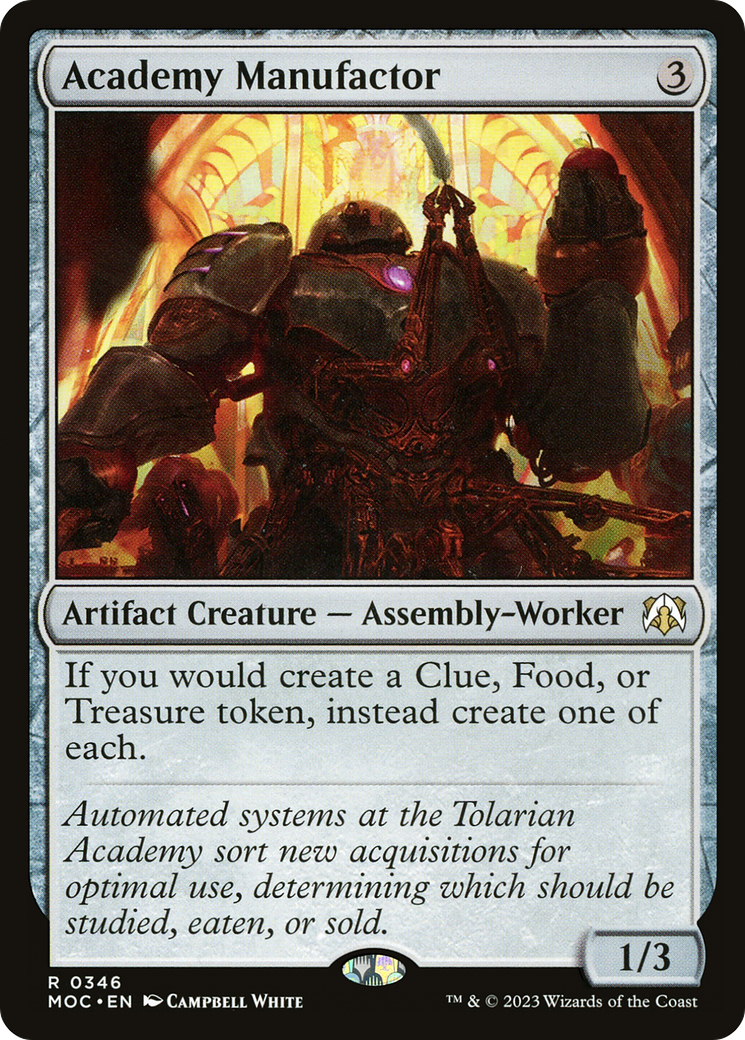
Academy Manufactor
Academy Manufactor
Artifact Creature — Assembly-Worker
1/3
If you would create a Clue, Food, or Treasure token, instead create one of each.
- If you control one Academy Manufactor and would create some number of Clue, Food, or Treasure tokens, you will instead create that many Clue tokens, that many Food tokens, and that many Treasure tokens.
- If you control two Academy Manufactors and would create some number of Clue, Food, or Treasure tokens, you will instead create three times that many Clue tokens, three times that many Food tokens, and three times that many Treasure tokens.
- If you control eighteen Academy Manufactors (I don't know, you figure it out) and would create some number of Clue, Food, or Treasure tokens, you will instead create 129,140,163 times that many Clue tokens, 129,140,163 times that many Food tokens, and 129,140,163 times that many Treasure tokens.
- Creating a Clue token this way isn't the same thing as investigating. Notably, an ability that triggers whenever you investigate won't trigger because you created a Clue token due to this replacement effect. If the original token creation was because you investigated once, those abilities will still each trigger once, no matter how many Clue tokens you end up creating.
-
1
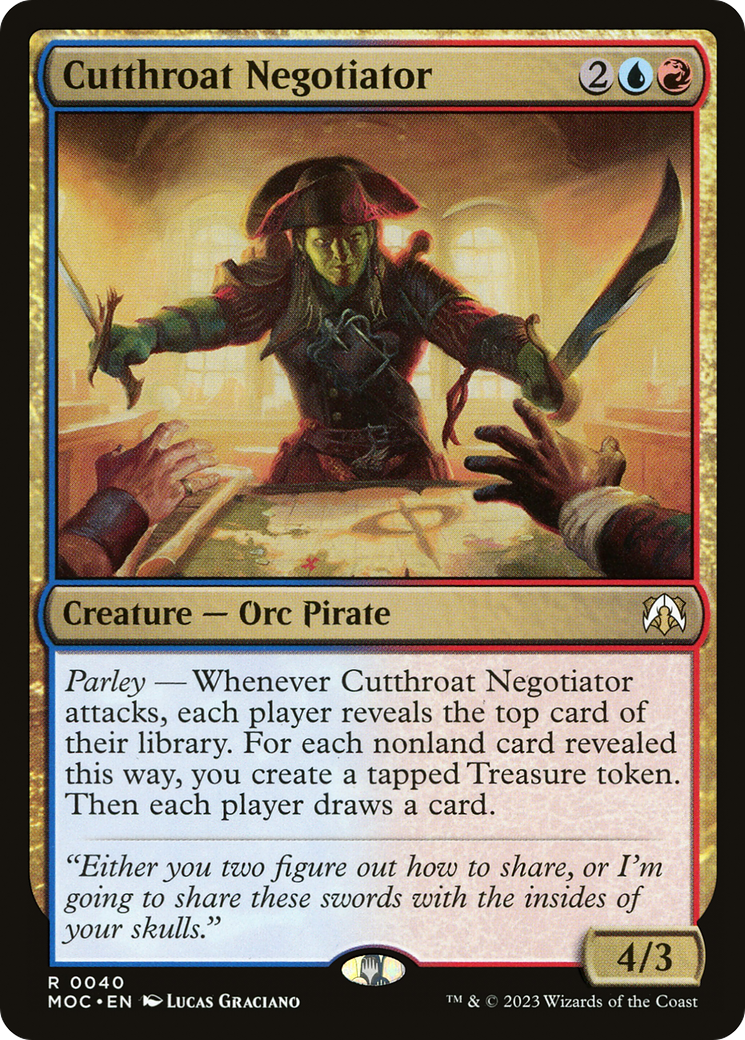
Cutthroat Negotiator
Cutthroat Negotiator
Creature — Orc Pirate
4/3
Parley — Whenever this creature attacks, each player reveals the top card of their library. For each nonland card revealed this way, you create a tapped Treasure token. Then each player draws a card.
- Except in some very unusual cases, the card each player reveals is the one they’ll draw.
-
1
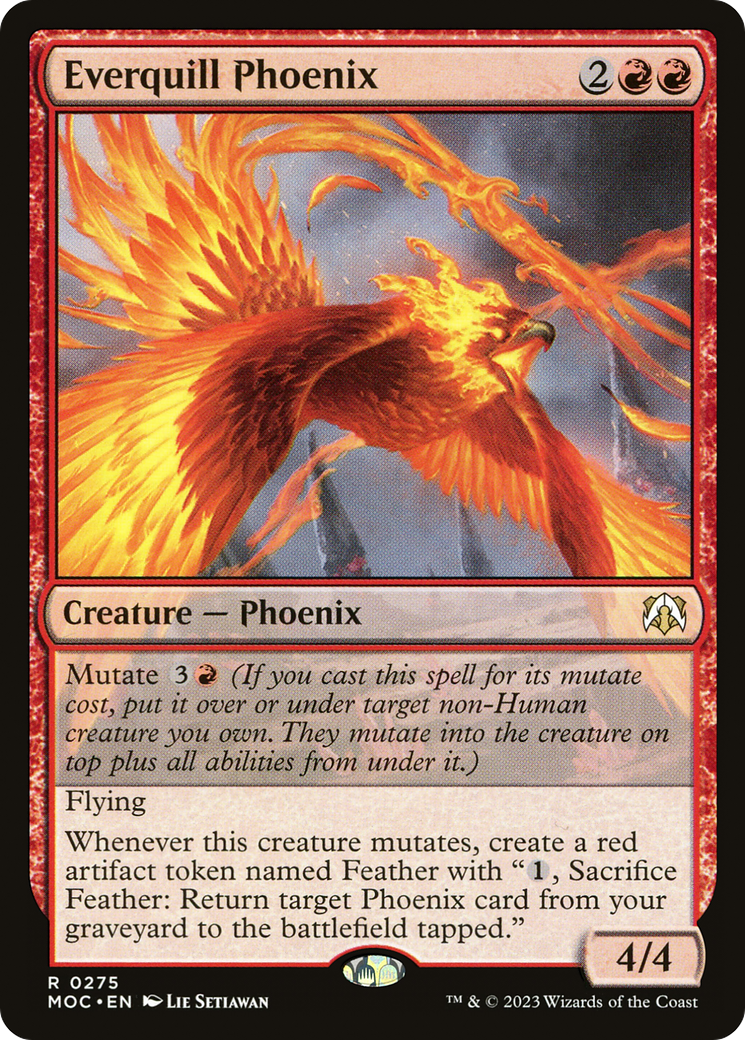
Everquill Phoenix
Everquill Phoenix
Creature — Phoenix
4/4
Mutate (If you cast this spell for its mutate cost, put it over or under target non-Human creature you own. They mutate into the creature on top plus all abilities from under it.)
Flying
Whenever this creature mutates, create a red artifact token named Feather with " , Sacrifice this token: Return target Phoenix card from your graveyard to the battlefield tapped."
-
1
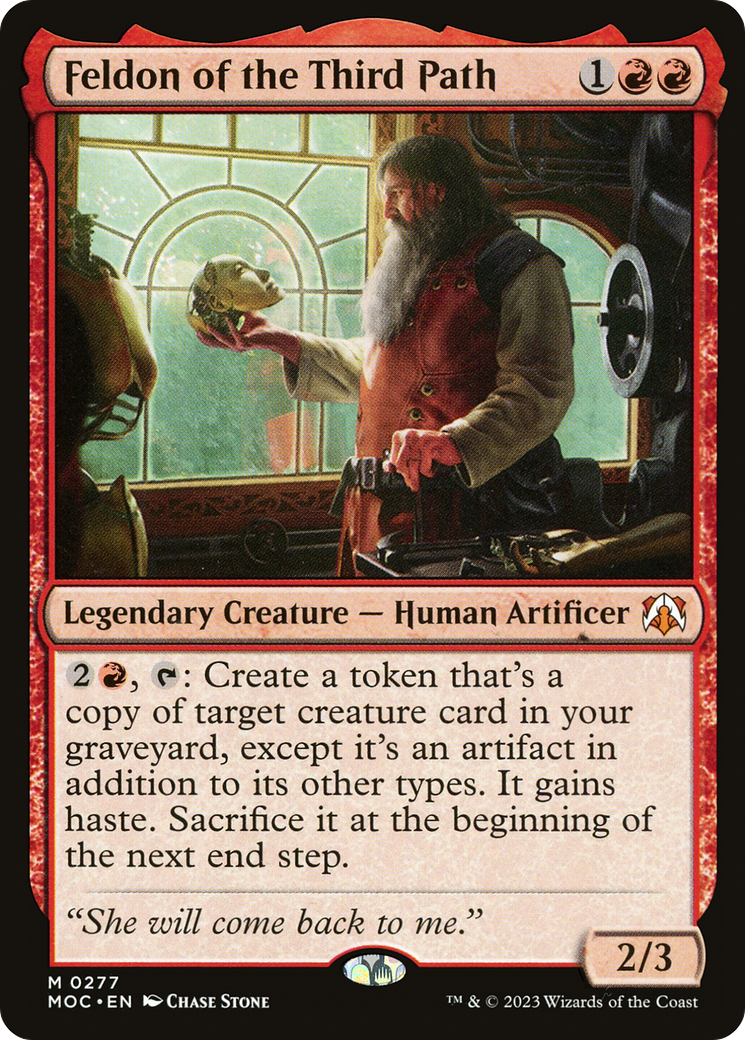
Feldon of the Third Path
Feldon of the Third Path
Legendary Creature — Human Artificer
2/3
, : Create a token that's a copy of target creature card in your graveyard, except it's an artifact in addition to its other types. It gains haste. Sacrifice it at the beginning of the next end step.
- The token copies exactly what was printed on the original creature card (except that the copy is also an artifact) and nothing else.
- If the copied creature card has in its mana cost, X is 0.
- Any enters-the-battlefield abilities of the copied creature card will trigger when the token enters the battlefield. Any "as [this permanent] enters the battlefield" or "[this permanent] enters the battlefield with" abilities of the copied creature card will also work.
- If another creature becomes a copy of, or enters the battlefield as a copy of the token, that creature will copy the creature card the token is copying, except it will also be an artifact. This is true even if the creature card that was copied by Feldon of the Third Path is no longer in the graveyard at that time. However, the new copy won't gain haste and you won't sacrifice it at the beginning of the next end step.
- If Feldon's ability creates multiple tokens due to a replacement effect (such as the one Doubling Season creates), each of those tokens will gain haste and you'll sacrifice each of them.
-
1
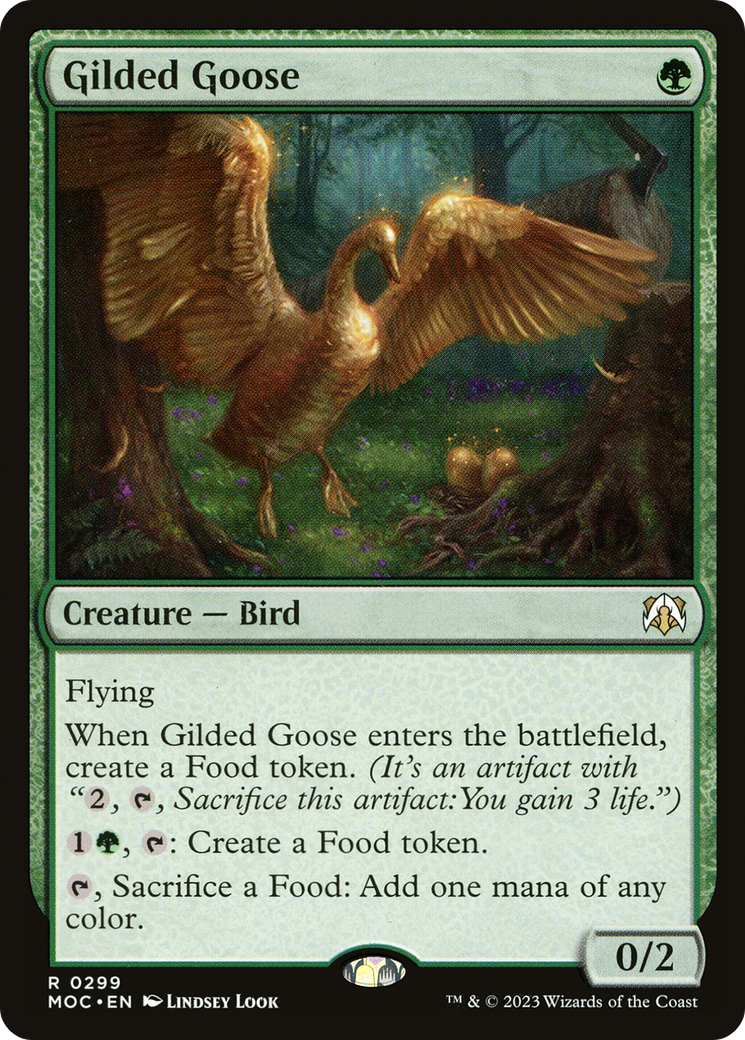
Gilded Goose
Gilded Goose
Creature — Bird
0/2
Flying
When this creature enters, create a Food token. (It's an artifact with " , , Sacrifice this token: You gain 3 life.")
, : Create a Food token.
, Sacrifice a Food: Add one mana of any color.
- If an effect refers to a Food, it means any Food artifact, not just a Food artifact token. For example, you can sacrifice Tough Cookie (an Artifact Creature — Food Golem) to activate Maraleaf Rider's ability (an ability with "Sacrifice a Food" in its cost).
- You can't sacrifice a Food to pay multiple costs. For example, you can't sacrifice a Food token to activate its own ability and also to activate Maraleaf Rider's ability.
- Whatever you do, don't eat the delicious cards.
- Food is an artifact type. Even though it appears on some creatures, it's never a creature type.
-
1
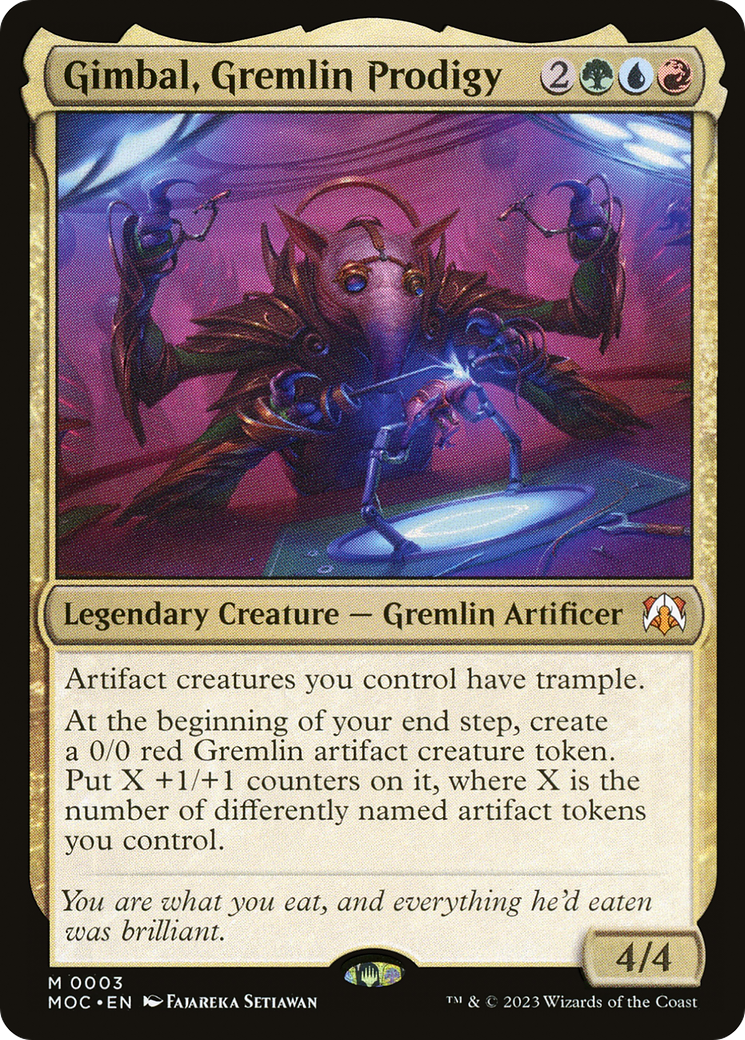
Gimbal, Gremlin Prodigy
Gimbal, Gremlin Prodigy
Legendary Creature — Gremlin Artificer
4/4
Artifact creatures you control have trample.
At the beginning of your end step, create a 0/0 red Gremlin artifact creature token. Put X +1/+1 counters on it, where X is the number of differently named artifact tokens you control.
- To determine the number of differently named artifact tokens you control, count each artifact token you control once, but only if its English name isn’t exactly the same as another artifact token you’ve already counted this way.
- A token’s name is its subtypes plus the word “Token” unless it’s copying another object or it was given a specific name by the effect that created it. For example, the tokens created by Gimbal’s last ability are named “Gremlin Token.” These tokens have the same name as the 2/2 red Gremlin creature tokens created by Release the Gremlins.
-
1
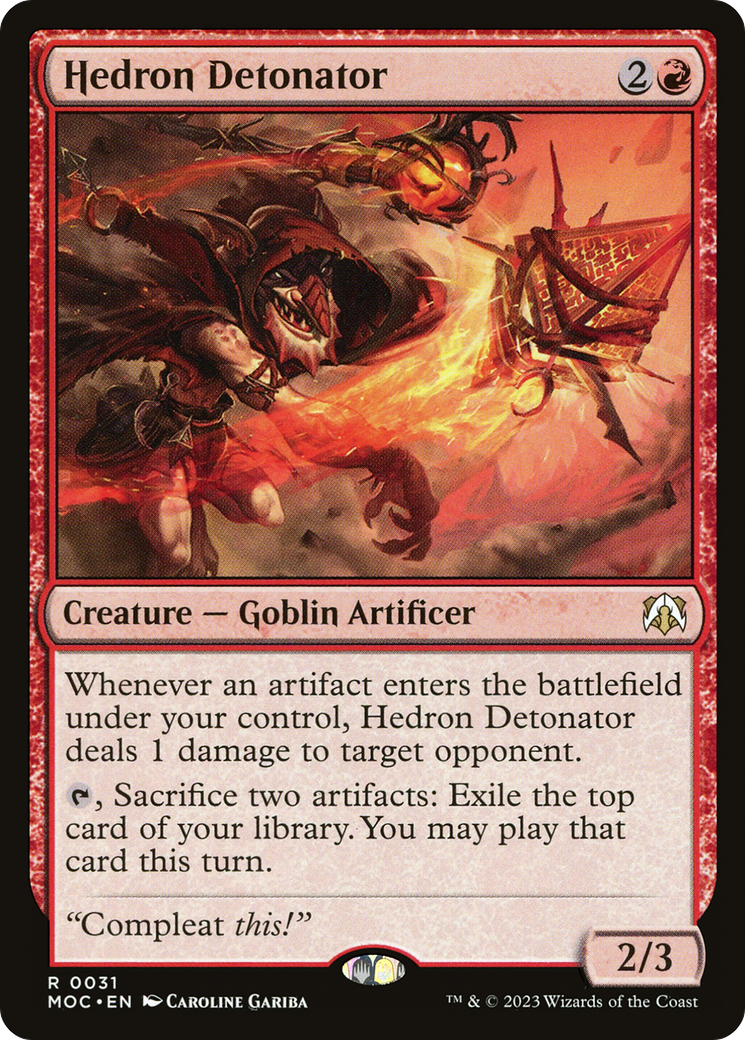
Hedron Detonator
Hedron Detonator
Creature — Goblin Artificer
2/3
Whenever an artifact you control enters, this creature deals 1 damage to target opponent.
, Sacrifice two artifacts: Exile the top card of your library. You may play that card this turn.
- You may play the card exiled with Hedron Detonator even if Hedron Detonator leaves the battlefield or you lose control of it.
- Playing the card exiled with Hedron Detonator follows the normal rules for playing that card. You must pay its costs, and you must follow all applicable timing rules. For example, if the card is a creature card, you can cast that card by paying its mana cost only during your main phase while the stack is empty.
- Unless an effect allows you to play additional lands that turn, you can play a land card exiled with Hedron Detonator only if you haven’t played a land yet that turn.
- If you don’t play the card, it will remain exiled.
-
1
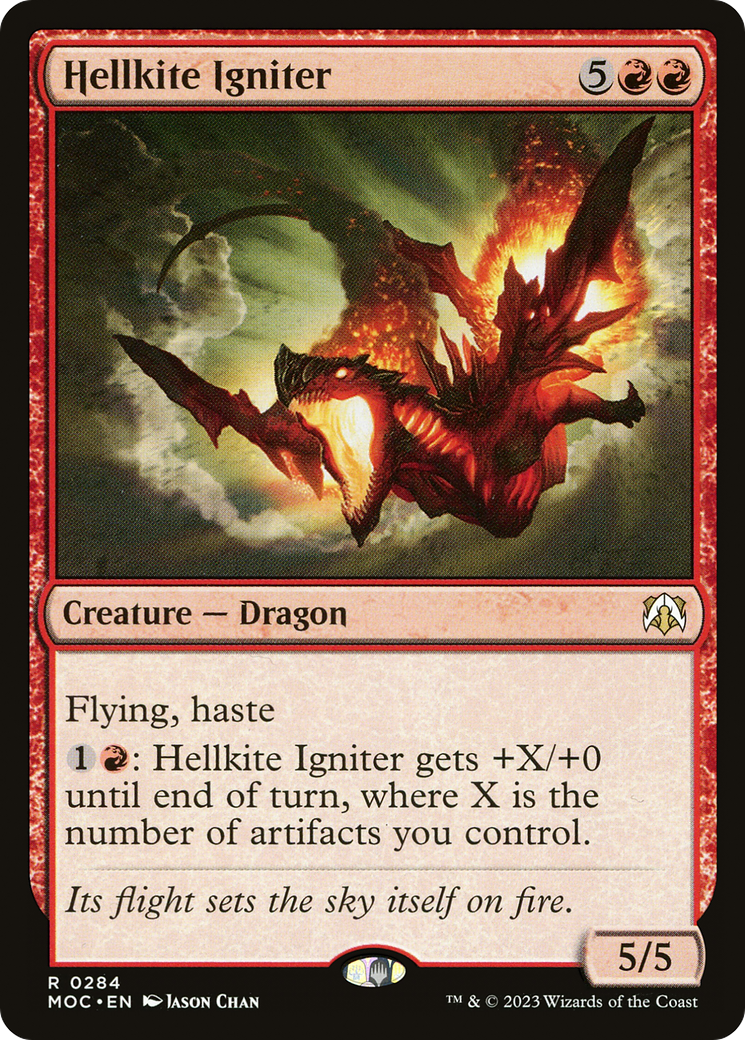
Hellkite Igniter
Hellkite Igniter
Creature — Dragon
5/5
Flying, haste
: This creature gets +X/+0 until end of turn, where X is the number of artifacts you control.
- The number of artifacts you control is counted when the ability resolves.
-
1
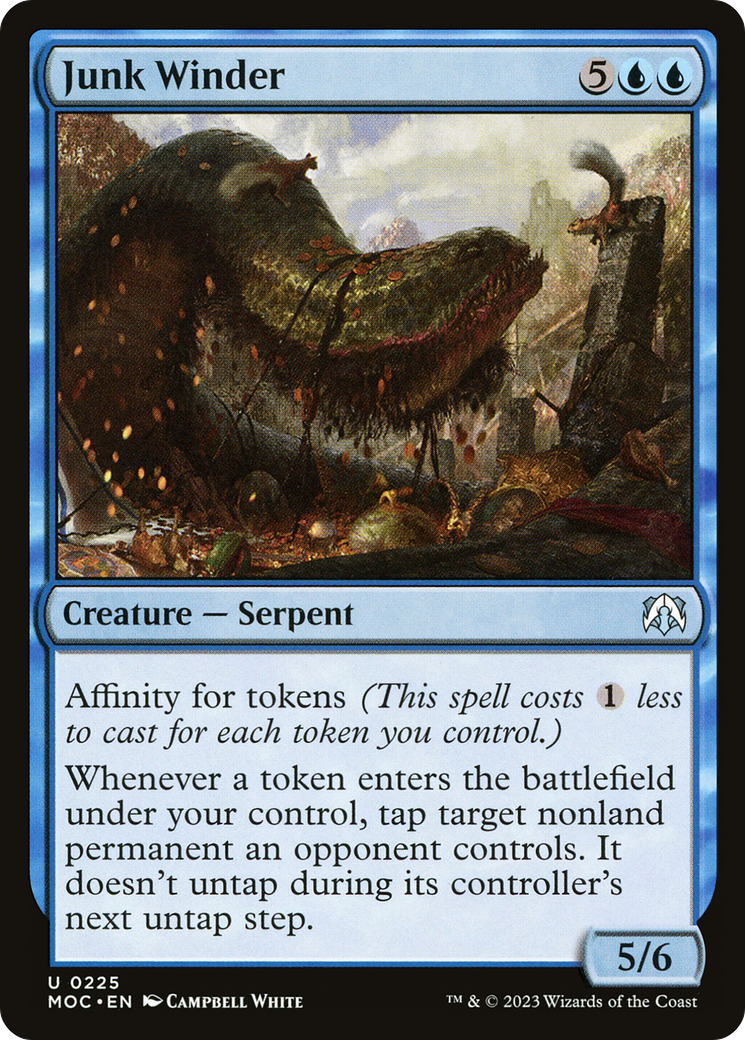
Junk Winder
Junk Winder
Creature — Serpent
5/6
Affinity for tokens (This spell costs less to cast for each token you control.)
Whenever a token you control enters, tap target nonland permanent an opponent controls. It doesn't untap during its controller's next untap step.
-
1
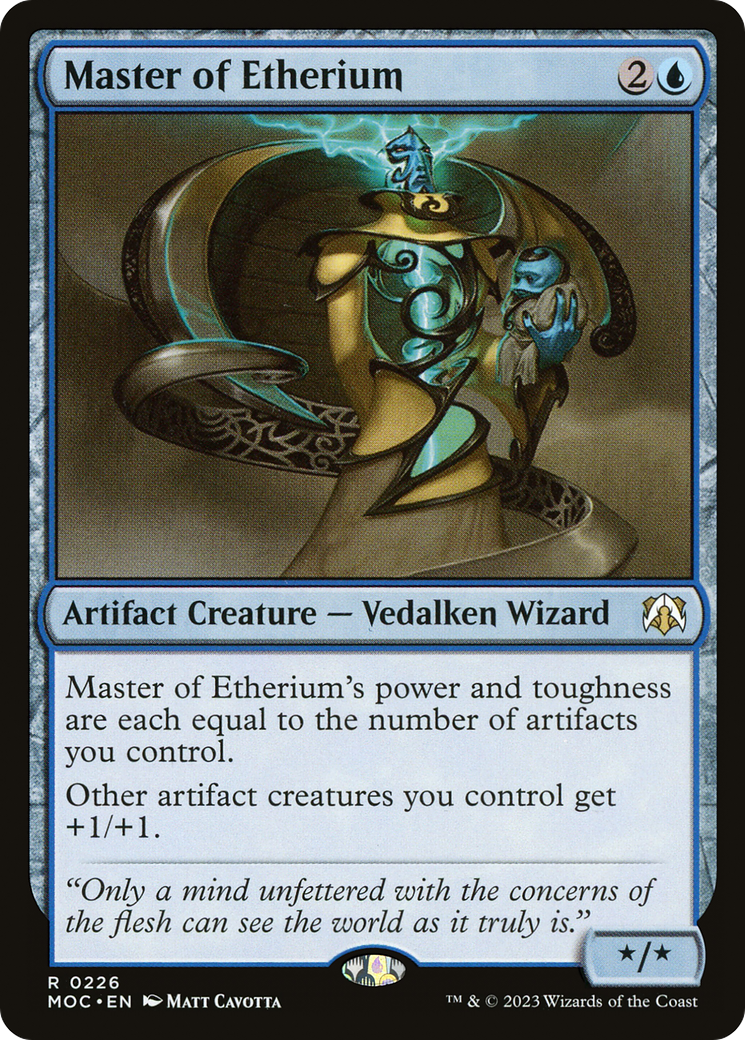
Master of Etherium
Master of Etherium
Artifact Creature — Vedalken Wizard
*/*
Master of Etherium's power and toughness are each equal to the number of artifacts you control.
Other artifact creatures you control get +1/+1.
- The ability that defines Master of Etherium's power and toughness applies in all zones, not just the battlefield.
- As long as Master of Etherium is on the battlefield, its ability will count itself.
- Because damage remains marked on a creature until the damage is removed as the turn ends, nonlethal damage dealt to Master of Etherium may become lethal if other artifacts you control leave the battlefield during that turn, and damage dealt to other artifact creatures you control may become lethal if Master of Etherium leaves the battlefield during that turn.
-
1
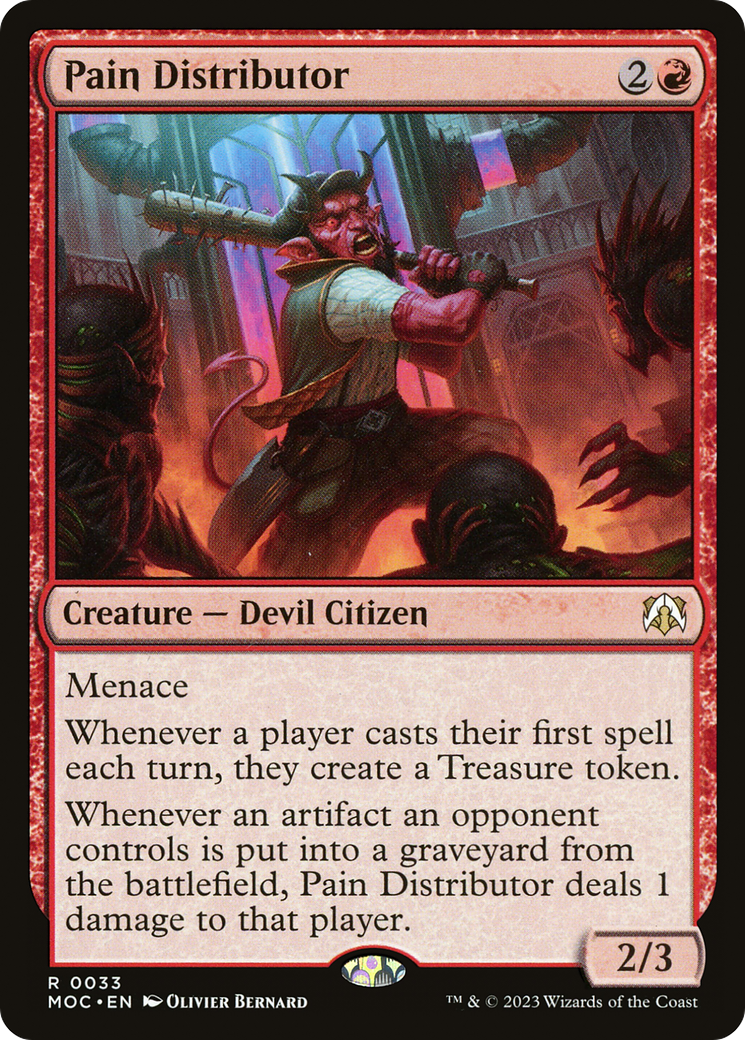
Pain Distributor
Pain Distributor
Creature — Devil Citizen
2/3
Menace
Whenever a player casts their first spell each turn, they create a Treasure token.
Whenever an artifact an opponent controls is put into a graveyard from the battlefield, this creature deals 1 damage to that player.
- Pain Distributor’s second ability triggers whenever a player casts their first spell each turn, not just on their own turn.
- Pain Distributor has to be on the battlefield at the moment they cast their first spell. Notably, Pain Distributor’s first ability won’t trigger for you on the turn you cast it, although it may trigger if another player casts their first spell that turn after Pain Distributor is on the battlefield. If a spell causes Pain Distributor to leave the battlefield as an additional cost to cast it, the ability won’t trigger.
- Pain Distributor’s ability resolves before the spell that caused it to trigger, but not before you have to pay for the original spell. You won’t be able to use the Treasure token you create to pay for it.
-
1
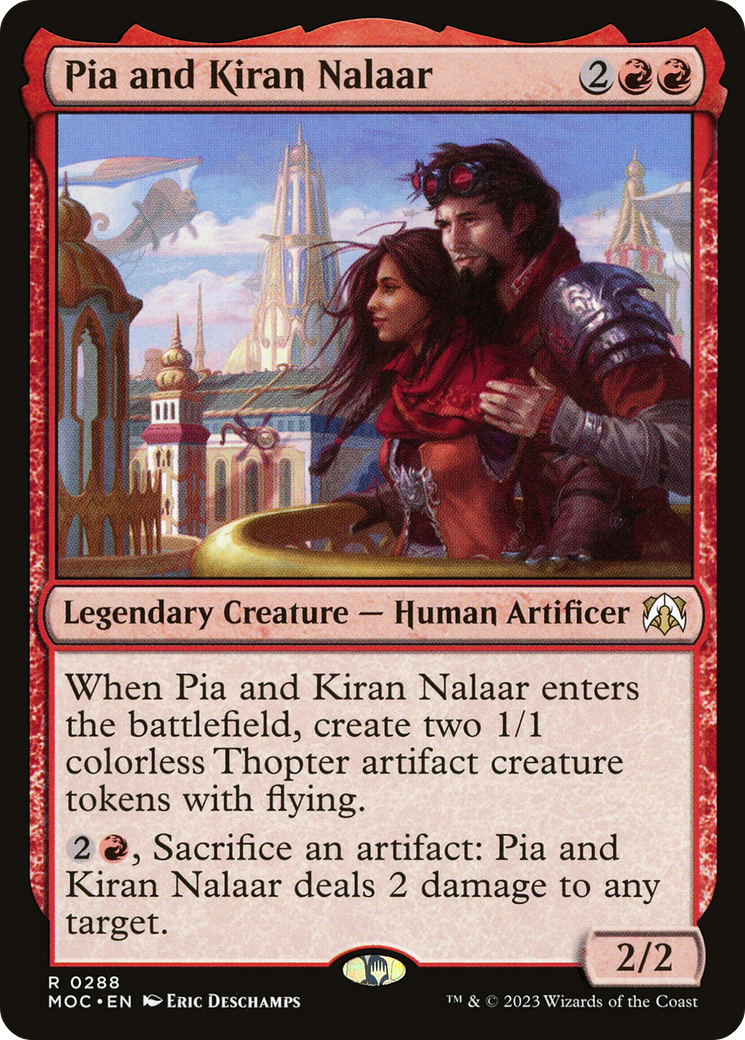
Pia and Kiran Nalaar
Pia and Kiran Nalaar
Legendary Creature — Human Artificer
2/2
When Pia and Kiran Nalaar enters, create two 1/1 colorless Thopter artifact creature tokens with flying.
, Sacrifice an artifact: Pia and Kiran Nalaar deals 2 damage to any target.
-
1
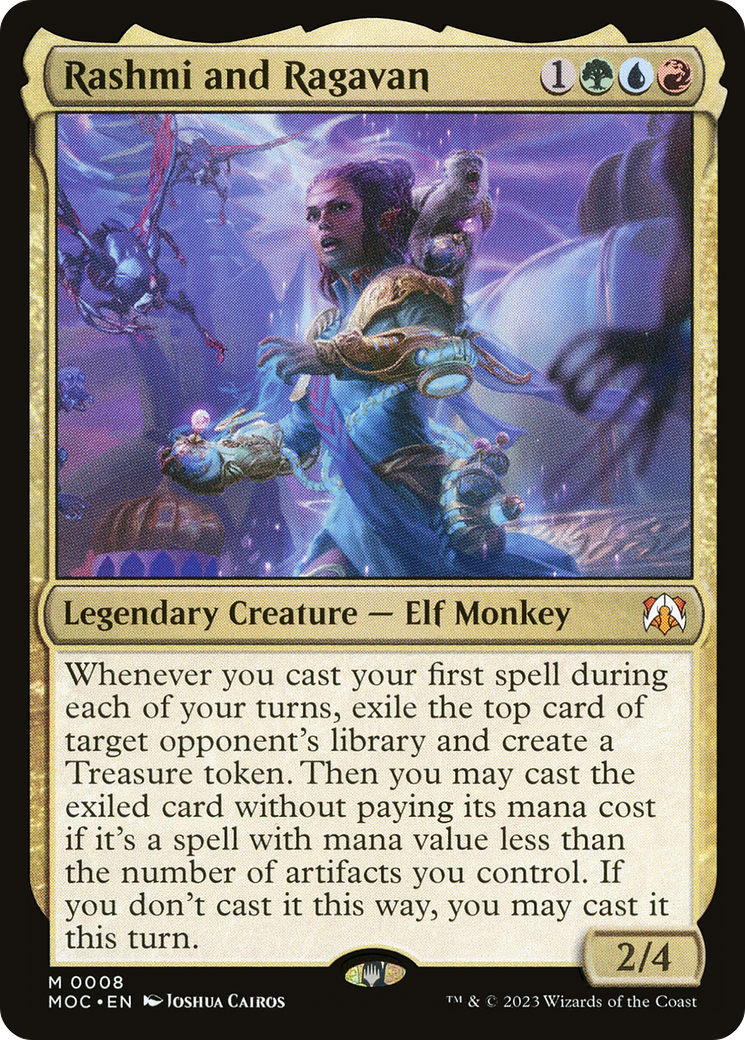
Rashmi and Ragavan
Rashmi and Ragavan
Legendary Creature — Elf Monkey
2/4
Whenever you cast your first spell during each of your turns, exile the top card of target opponent's library and create a Treasure token. Then you may cast the exiled card without paying its mana cost if it's a spell with mana value less than the number of artifacts you control. If you don't cast it this way, you may cast it this turn.
- Rashmi and Ragavan has to be on the battlefield at the moment you cast your first spell. Notably, on the turn you cast Rashmi and Ragavan, the ability won’t trigger for you that turn. If a spell causes Rashmi and Ragavan to leave the battlefield as an additional cost to cast it, the ability won’t trigger.
- Rashmi and Ragavan’s ability resolves before the spell that caused it to trigger, but not before you have to pay for the original spell. You won’t be able to use the Treasure token you create to pay for it.
- Check the number of artifacts you control as the ability resolves, including the Treasure token you just created, to see if you can cast the exiled card without paying its mana cost.
- If you cast the spell without paying its mana cost, you do so during the resolution of the triggered ability. Timing restrictions of that spell based on card type are ignored. It will resolve before the spell that caused the ability to trigger.
- If you cast a spell without paying its mana cost, you can’t choose to cast it for any alternative costs. You can, however, pay any additional costs. If the spell has any mandatory additional costs, you must pay those.
- If the spell has in its mana cost, you must choose 0 as the value of X when casting it without paying its mana cost.
- If you don’t cast it without paying its mana cost but rather cast it later in the turn, you must pay its costs, and you must follow all applicable timing rules. For example, if the card is a creature card, you can cast that card by paying its mana cost only during your main phase while the stack is empty.
- If you don’t cast the card at all, it remains exiled.
-
1
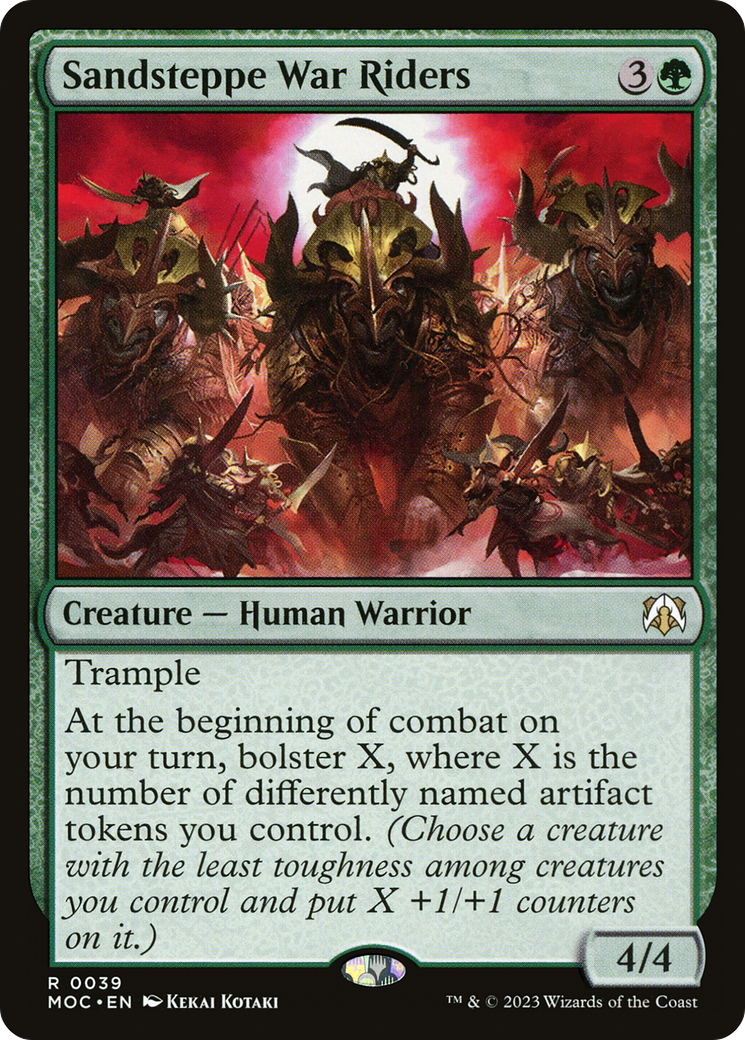
Sandsteppe War Riders
Sandsteppe War Riders
Creature — Human Warrior
4/4
Trample
At the beginning of combat on your turn, bolster X, where X is the number of differently named artifact tokens you control. (Choose a creature with the least toughness among creatures you control and put X +1/+1 counters on it.)
- To determine the number of differently named artifact tokens you control, count each artifact token you control once, but only if its English name isn’t exactly the same as another artifact token you’ve already counted this way.
- A token’s name is its subtypes plus the word “Token” unless it’s copying another object or it was given a specific name by the effect that created it. For example, Myr tokens are named “Myr Token,” and they have a different name than Phyrexian Myr tokens, which are named “Phyrexian Myr Token.”
-
1
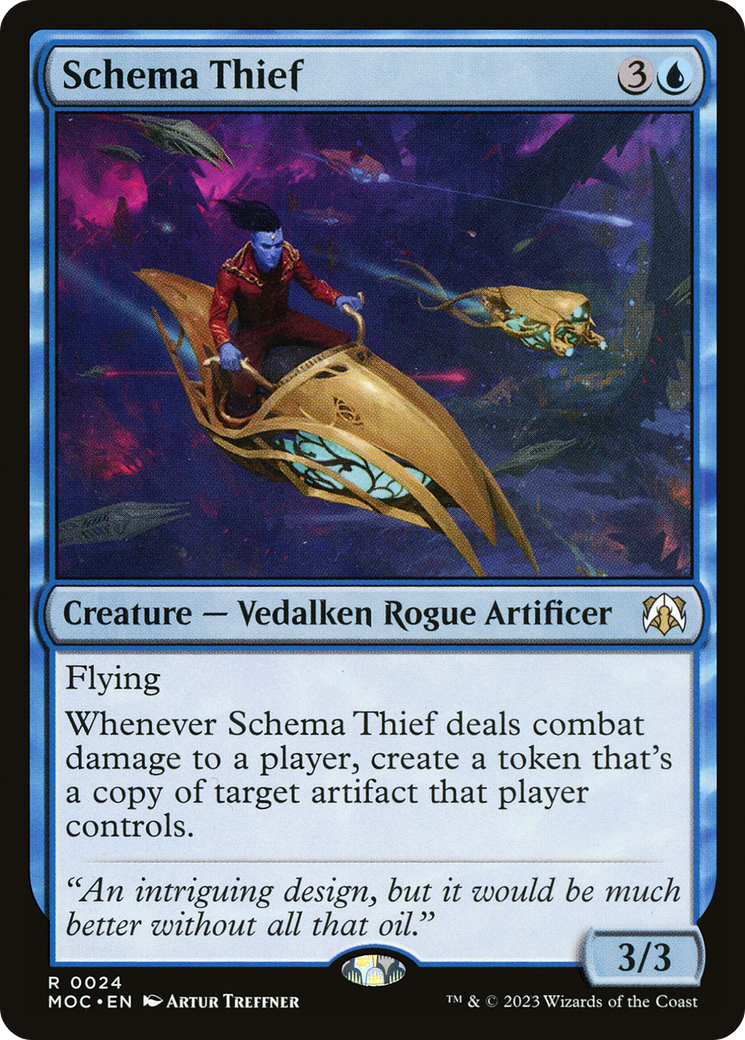
Schema Thief
Schema Thief
Creature — Vedalken Rogue Artificer
3/3
Flying
Whenever this creature deals combat damage to a player, create a token that's a copy of target artifact that player controls.
- Each of the tokens copy exactly what was printed on the original artifact and nothing else (unless that artifact is copying something else or is a token; see below). It doesn’t copy whether that artifact is tapped or untapped, whether it has any counters on it or Auras and Equipment attached to it, or any non-copy effects that have changed its power, toughness, types, color, and so on.
- If the copied artifact has in its mana cost, X is 0.
- If the copied artifact is a token, the token that’s created copies the original characteristics of that token as stated by the effect that created that token.
- If the copied artifact is copying something else, then the token enters the battlefield as whatever that artifact copied.
- Any enters-the-battlefield abilities of the copied artifact will trigger when the token enters the battlefield. Any “as [this artifact] enters the battlefield” or “[this artifact] enters the battlefield with” abilities of the copied artifact will also work.
-
1
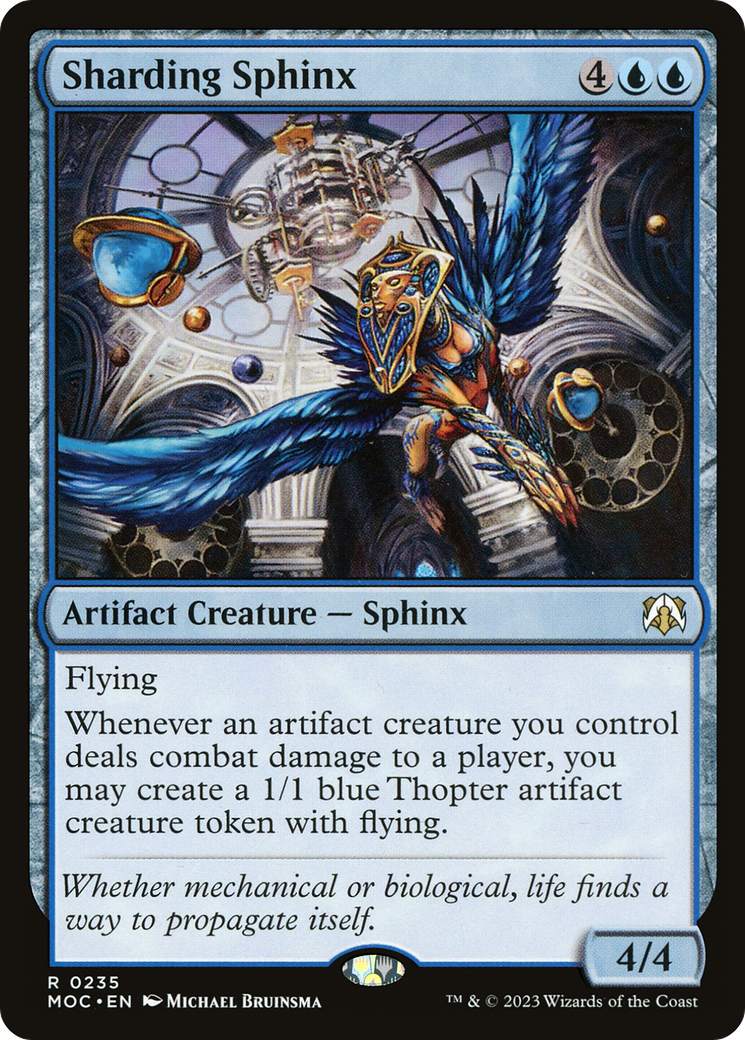
Sharding Sphinx
Sharding Sphinx
Artifact Creature — Sphinx
4/4
Flying
Whenever an artifact creature you control deals combat damage to a player, you may create a 1/1 blue Thopter artifact creature token with flying.
- The only difference between a colored artifact and a colorless artifact is, obviously, its color. Unlike most artifacts, a colored artifact requires colored mana to cast. Also unlike most artifacts, a colored artifact has a color in all zones. It will interact with cards that care about color. Other than that, a colored artifact behaves just like any other artifact. It will interact as normal with any card that cares about artifacts, such as Shatter or Arcbound Ravager.
- If combat damage is dealt to players by multiple artifact creatures you control (including, perhaps, Sharding Sphinx itself), Sharding Sphinx's ability will trigger that many times. You'll get that many Thopter tokens. You'll get just one token per creature, no matter how much combat damage that creature dealt.
-
1
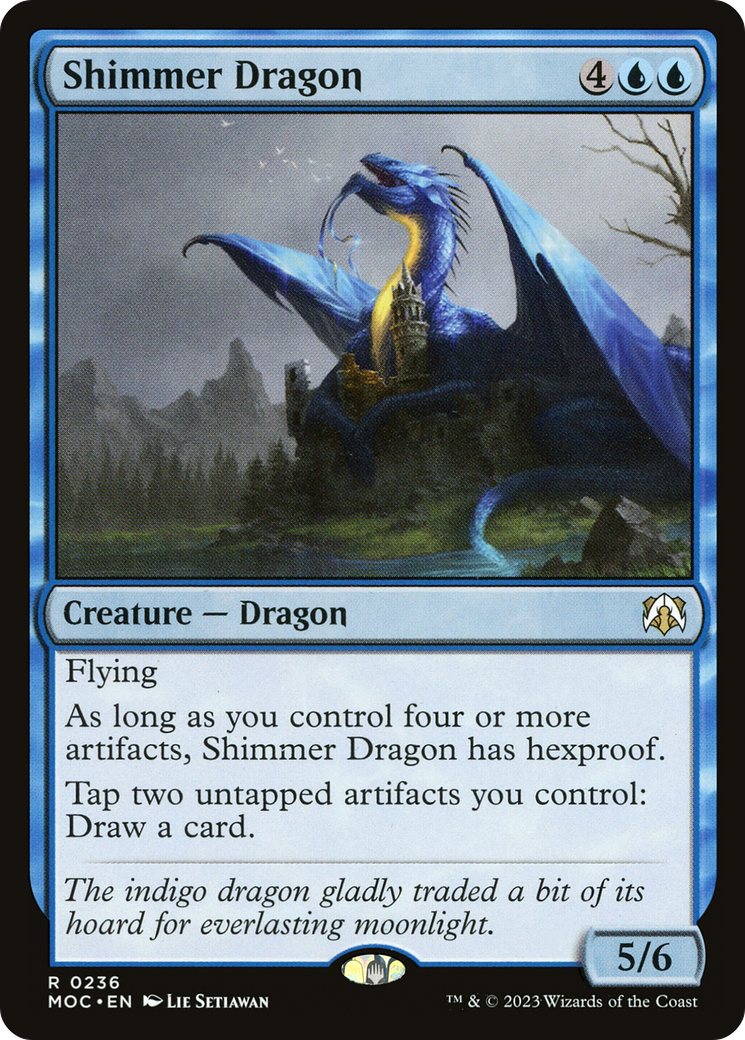
Shimmer Dragon
Shimmer Dragon
Creature — Dragon
5/6
Flying
As long as you control four or more artifacts, this creature has hexproof. (It can't be the target of spells or abilities your opponents control.)
Tap two untapped artifacts you control: Draw a card.
-
1
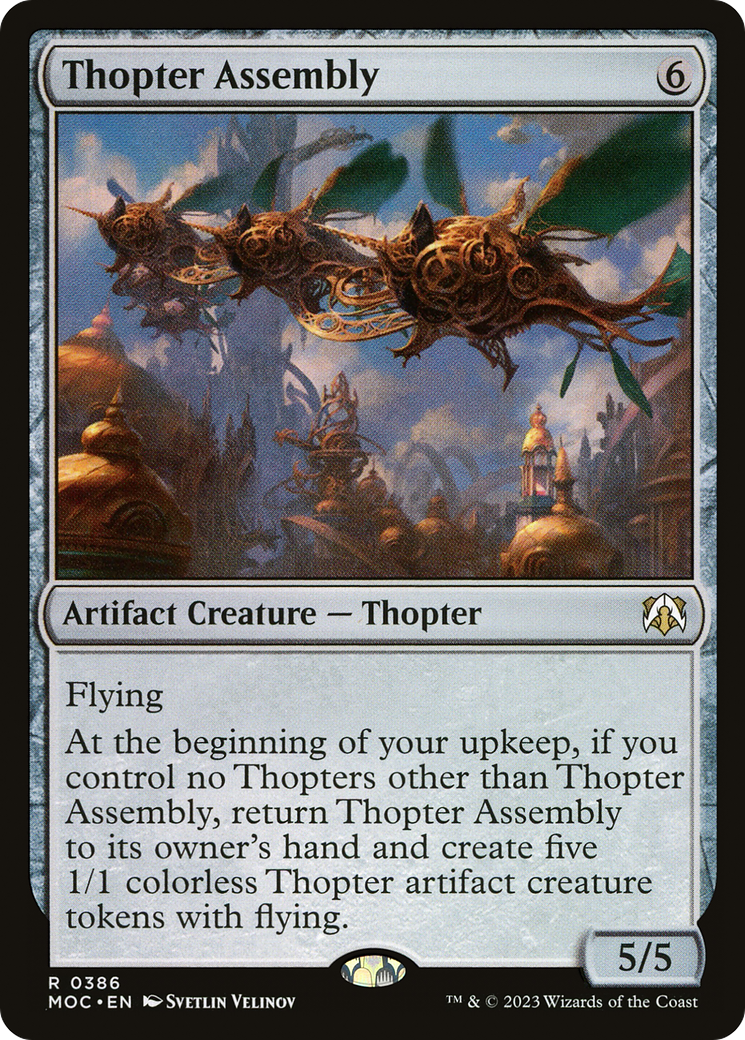
Thopter Assembly
Thopter Assembly
Artifact Creature — Thopter
5/5
Flying
At the beginning of your upkeep, if you control no Thopters other than this creature, return this creature to its owner's hand and create five 1/1 colorless Thopter artifact creature tokens with flying.
- The triggered ability looks for any permanent you control with the creature type Thopter, not just the Thopter tokens previously created by a Thopter Assembly.
-
1
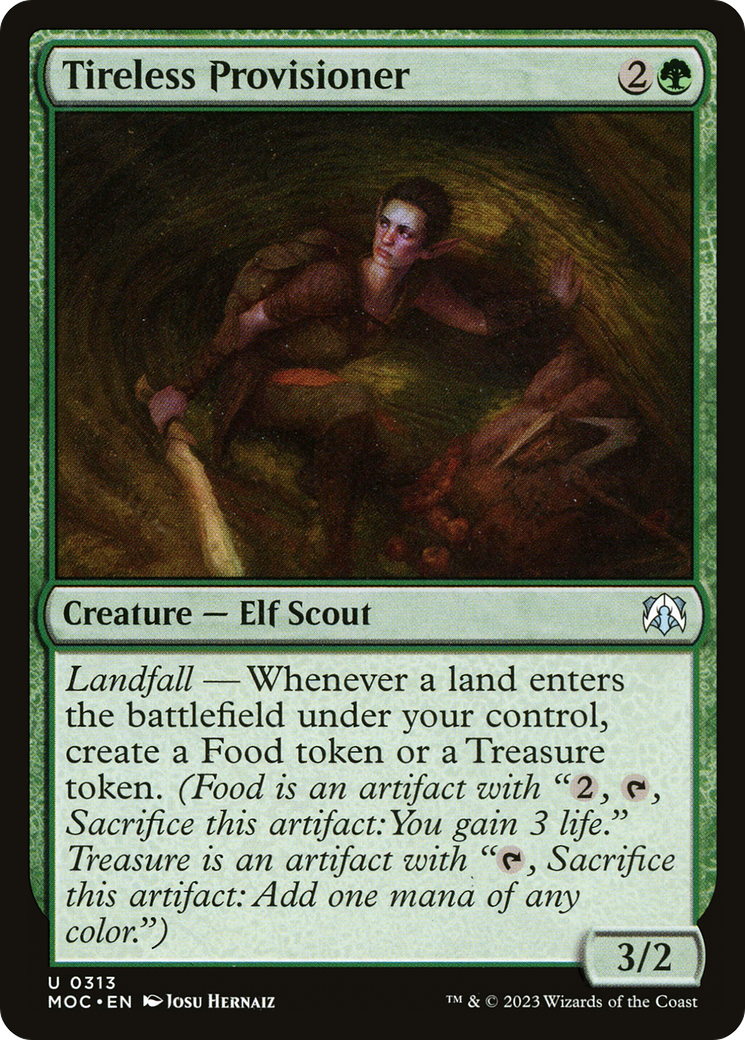
Tireless Provisioner
Tireless Provisioner
Creature — Elf Scout
3/2
Landfall — Whenever a land you control enters, create a Food token or a Treasure token. (Food is an artifact with " , , Sacrifice this token: You gain 3 life." Treasure is an artifact with " , Sacrifice this token: Add one mana of any color.")
- Food is an artifact type. Even though it appears on some creatures, it's never a creature type.
- You can't sacrifice a Food to pay multiple costs. For example, you can't sacrifice a Food token to activate its own ability and also to activate Maraleaf Rider's ability.
- Whatever you do, don't eat the delicious cards.
-
1
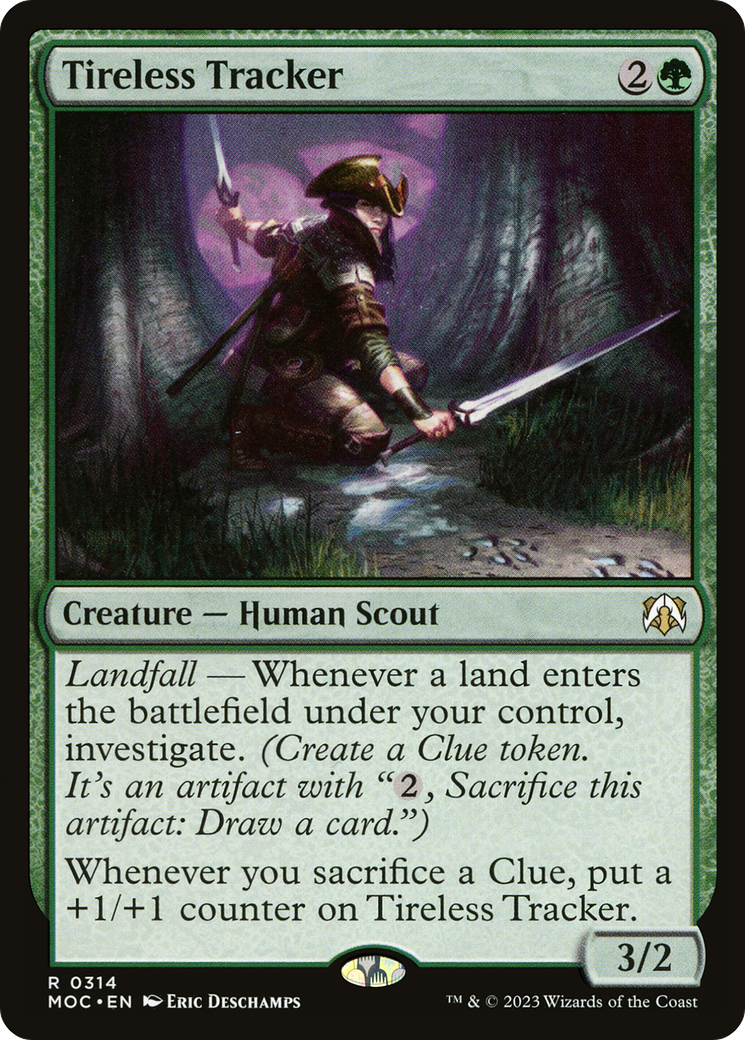
Tireless Tracker
Tireless Tracker
Creature — Human Scout
3/2
Landfall — Whenever a land you control enters, investigate. (Create a Clue token. It's an artifact with " , Sacrifice this token: Draw a card.")
Whenever you sacrifice a Clue, put a +1/+1 counter on this creature.
- A landfall ability triggers whenever a land you control enters for any reason. It triggers whenever you play a land, as well as whenever a spell or ability puts a land onto the battlefield under your control.
- Whenever a land you control enters, each landfall ability of the permanents you control will trigger. You can put them on the stack in any order. The last ability you put on the stack will be the first one to resolve (As a result, you can have those abilities resolve in the order of your choosing.).
- A landfall ability doesn't trigger if a permanent already on the battlefield becomes a land.
- Some spells and abilities that investigate may require targets. If each target chosen is an illegal target as that spell or ability tries to resolve, it won't resolve. You won't create any Clue tokens.
- Some abilities trigger "whenever you sacrifice a Clue". Those abilities trigger whenever you sacrifice a Clue for any reason, not just to activate a Clue's activated ability.
- You can't sacrifice a Clue to pay multiple costs. For example, you can't sacrifice a Clue token to activate its own ability and also to activate Alquist Proft, Master Sleuth's ability.
- Clue is an artifact type. Even though it appears on some cards with other permanent types, it's never a creature type, a land type, or anything but an artifact type.
- If an effect refers to a Clue, it means any Clue artifact, not just a Clue artifact token. For example, you can sacrifice Wrench to pay for Alquist Proft, Master Sleuth's activated ability.
- Clue is an artifact type. Even though it appears on some cards with other permanent types, it's never a creature type, a land type, or anything but an artifact type.
- You can't sacrifice a Clue to pay multiple costs. For example, you can't sacrifice a Clue token to activate its own ability and also to activate Alquist Proft, Master Sleuth's ability.
- If an effect refers to a Clue, it means any Clue artifact, not just a Clue artifact token. For example, you can sacrifice Wrench to pay for Alquist Proft, Master Sleuth's activated ability.
-
1
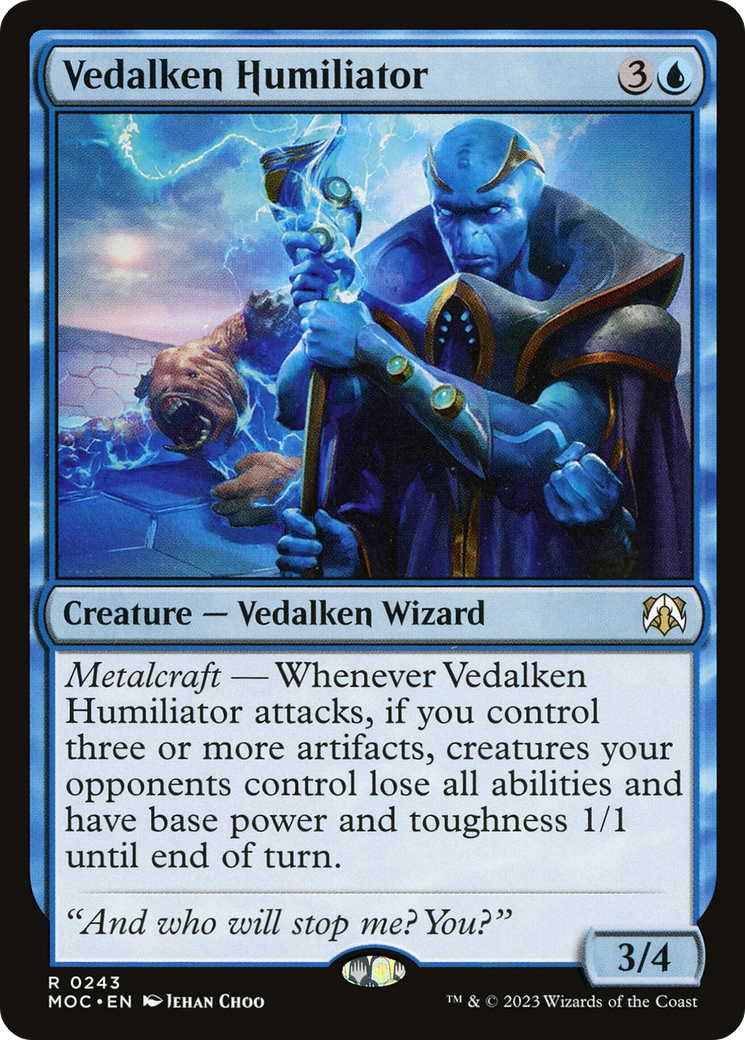
Vedalken Humiliator
Vedalken Humiliator
Creature — Vedalken Wizard
3/4
Metalcraft — Whenever this creature attacks, if you control three or more artifacts, creatures your opponents control lose all abilities and have base power and toughness 1/1 until end of turn.
- All creatures your opponents control are affected by Vedalken Humiliator's ability, not just those controlled by the player it's attacking.
- Vedalken Humiliator's ability overwrites all previous effects that set an affected creature's base power and toughness to specific values. Any power- or toughness-setting effects that start to apply to a creature after the ability resolves will overwrite this effect.
- Any power- or toughness-modifying effects (those that give +N/+N, for example) and counters will apply to the creature's new base power and toughness, even if they started to apply before Vedalken Humiliator's ability resolved.
- If you don't control three artifacts as Vedalken Humiliator's ability resolves, it has no effect. If you do, the effect continues to apply even if you lose control of Vedalken Humiliator or your artifacts later in the turn.
- Vedalken Humiliator's ability affects only creatures your opponents control at the time it resolves. Creatures they begin to control later in the turn won't lose power, toughness, or abilities.
-
1
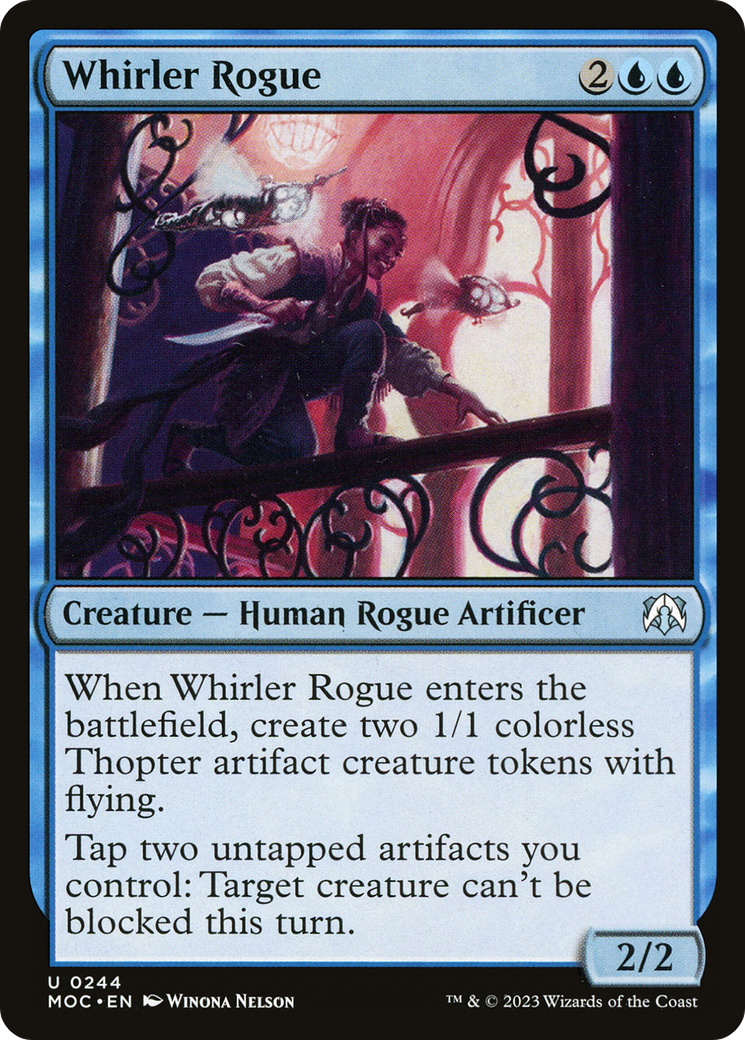
Whirler Rogue
Whirler Rogue
Creature — Human Rogue Artificer
2/2
When this creature enters, create two 1/1 colorless Thopter artifact creature tokens with flying.
Tap two untapped artifacts you control: Target creature can't be blocked this turn.
- You may tap any two untapped artifacts you control, including artifact creatures that haven't been under your control continuously since the beginning of your most recent turn.
- Activating the second ability of Whirler Rogue after a creature has become blocked won't cause it to become unblocked.
-
1
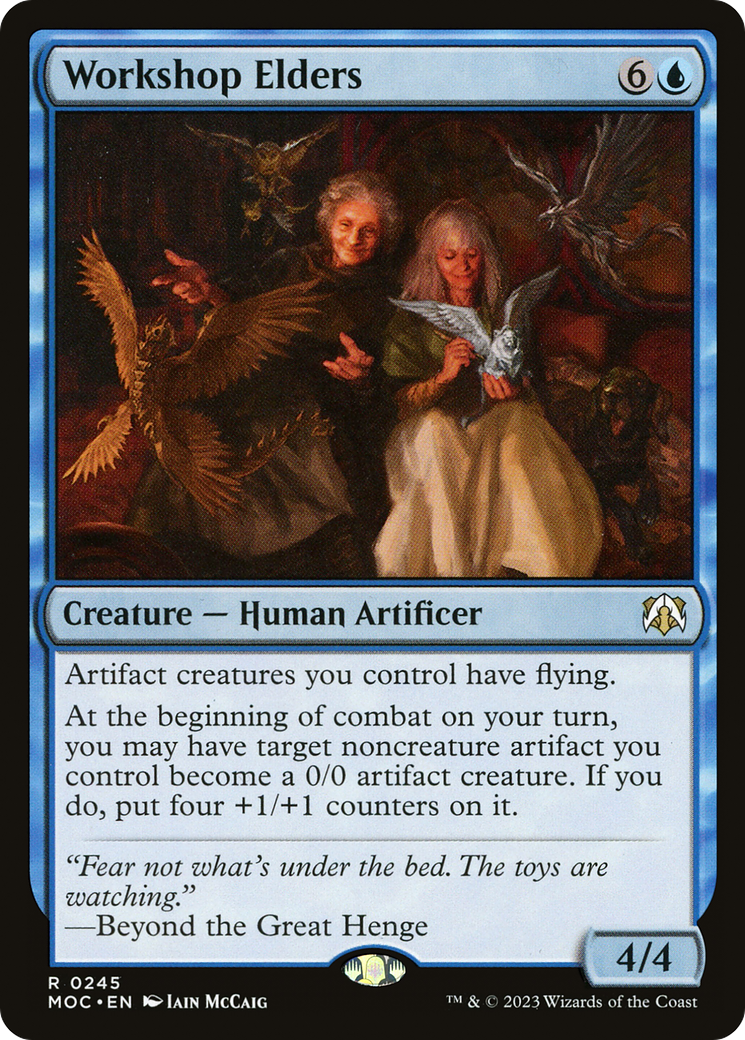
Workshop Elders
Workshop Elders
Creature — Human Artificer
4/4
Artifact creatures you control have flying.
At the beginning of combat on your turn, you may have target noncreature artifact you control become a 0/0 artifact creature. If you do, put four +1/+1 counters on it.
- The effect of Workshop Elders's triggered ability lasts indefinitely. It doesn't wear off during the cleanup step.
- An artifact that becomes a creature due to Workshop Elders can't attack unless you've controlled it continuously since your turn began.
- If another effect later causes the artifact to become a creature and sets its power and toughness as it does so, that creature will have that base power and toughness; it won't be 0/0. Notably, crewing a Vehicle does not set its power and toughness, so a Vehicle's base power and toughness remain 0/0 if you crew it.
Instants 8
-
1
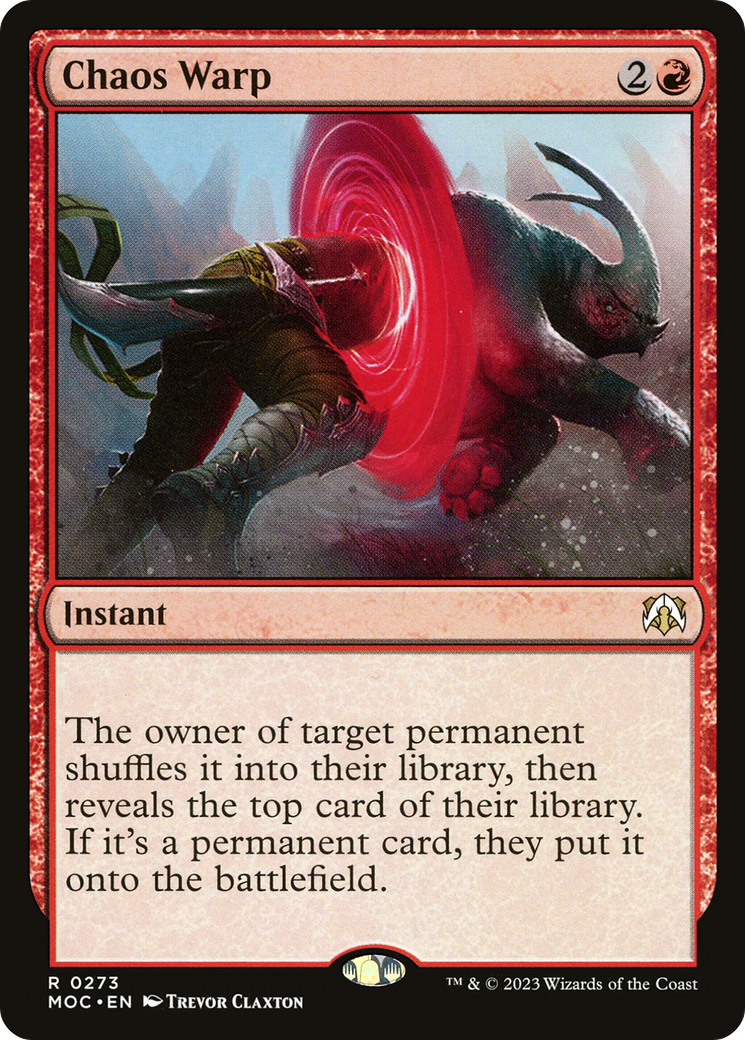
Chaos Warp
Chaos Warp
Instant
The owner of target permanent shuffles it into their library, then reveals the top card of their library. If it's a permanent card, they put it onto the battlefield.
- A permanent card is a card with one or more of the following card types: artifact, creature, enchantment, land, or planeswalker.
- The owner of a token is the player under whose control the token was put onto the battlefield. If a token is shuffled into a player's library this way, that player shuffles before revealing the top card of that library.
- If the revealed card is not a permanent card, it remains on top of that library.
- If the permanent is an illegal target by the time Chaos Warp tries to resolve, it won't resolve and none of its effects will occur. No library will be shuffled and no card will be revealed.
- If the revealed card is a permanent card but can't enter (perhaps because it's an Aura with nothing to enchant), it remains on top of that library.
-
1
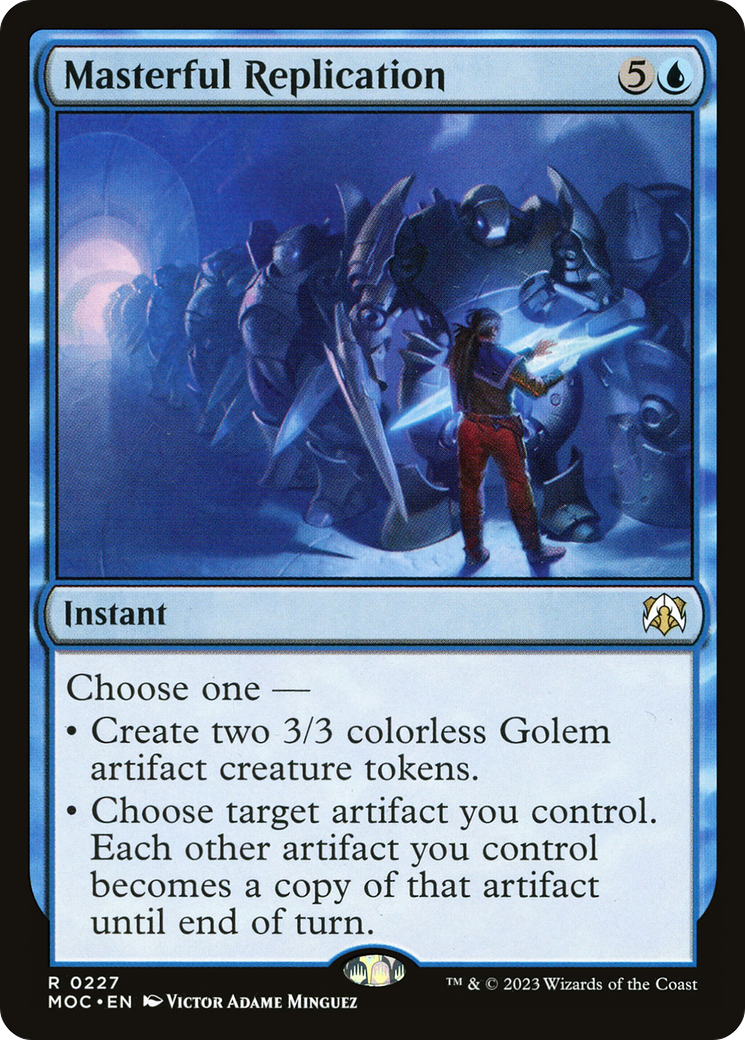
Masterful Replication
Masterful Replication
Instant
Choose one —
- Create two 3/3 colorless Golem artifact creature tokens.
- Choose target artifact you control. Each other artifact you control becomes a copy of that artifact until end of turn.
- Masterful Replication copies the printed values of the target artifact. It won't copy counters on that artifact or effects that have changed its power, toughness, types, color, or so on. Notably, it won't copy effects that made the target artifact become an artifact creature if it isn't normally an artifact creature.
- An Equipment that becomes a copy of a creature becomes unattached if it was attached to a creature. An Equipment that becomes a copy of another Equipment remains attached if it was attached to a creature.
- If the target artifact is copying something else, then your artifacts become copies of whatever the target artifact copied.
- Becoming a copy won't change whether an artifact is a token.
-
1
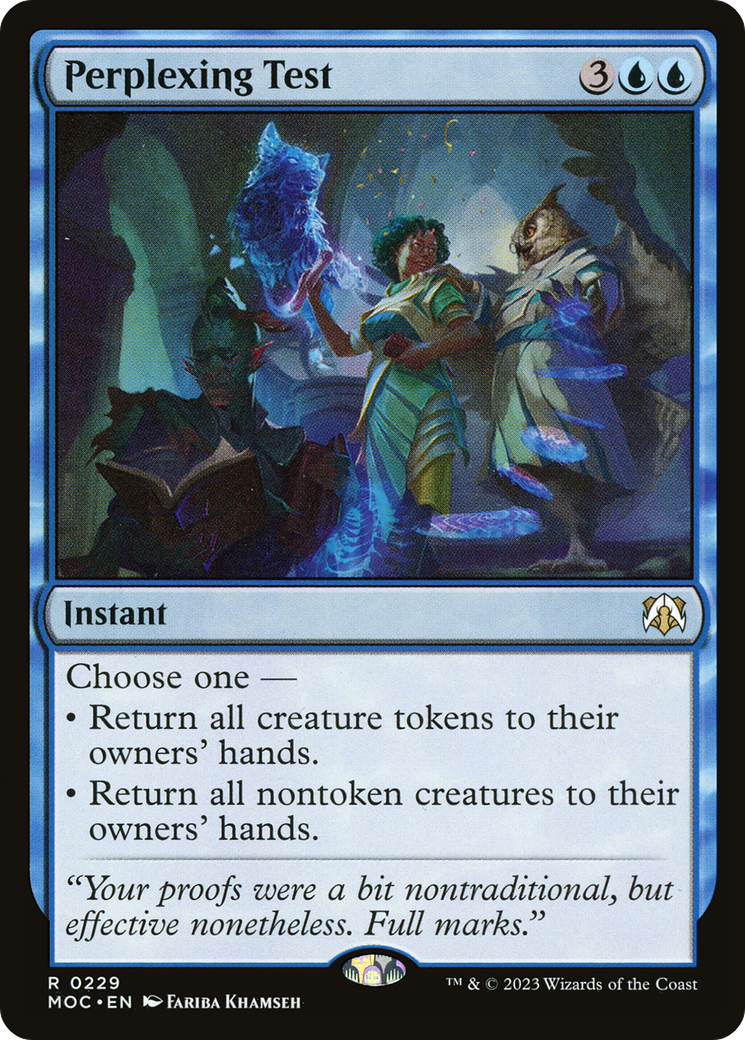
Perplexing Test
Perplexing Test
Instant
Choose one —
- Return all creature tokens to their owners' hands.
- Return all nontoken creatures to their owners' hands.
- A token that is returned to its owner's hand ceases to exist as a state-based action the next time a player would receive priority.
-
1
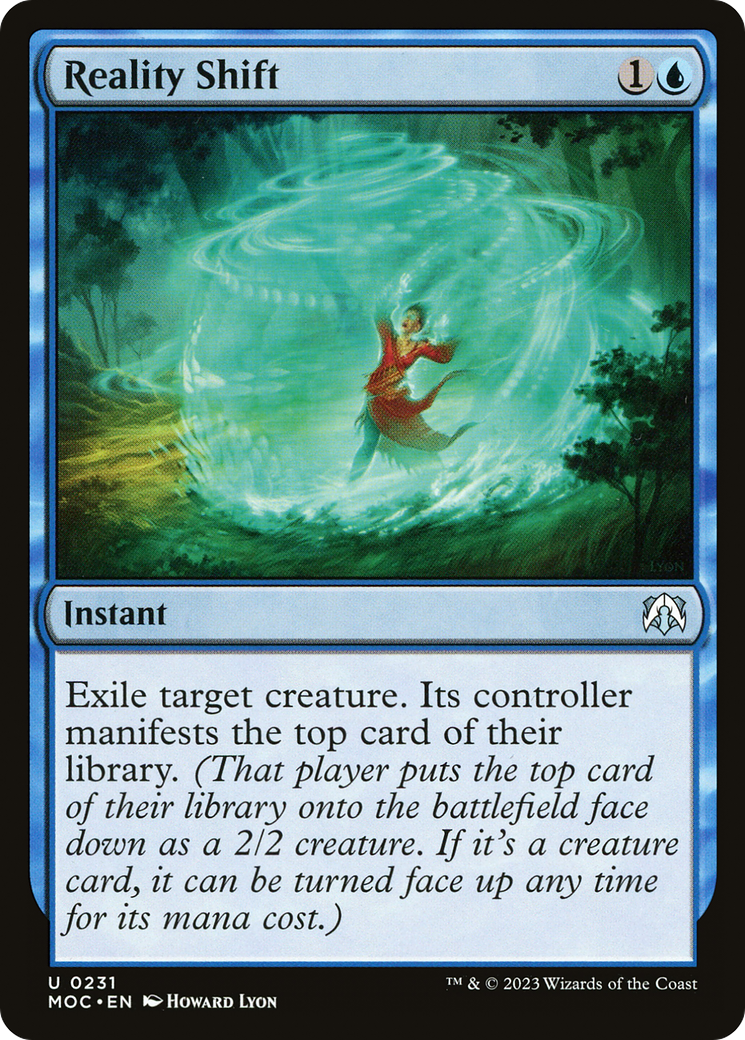
Reality Shift
Reality Shift
Instant
Exile target creature. Its controller manifests the top card of their library. (That player puts the top card of their library onto the battlefield face down as a 2/2 creature. If it's a creature card, it can be turned face up any time for its mana cost.)
- Any time you have priority, you may turn a manifested creature face up by revealing that it's a creature card (ignoring any copy effects or type-changing effects that might be applying to it) and paying its mana cost. This is a special action. It doesn't use the stack and can't be responded to.
- Because the permanent is on the battlefield both before and after it's turned face up, turning a permanent face up doesn't cause any enters-the-battlefield abilities to trigger.
- A permanent that turns face up or face down changes characteristics but is otherwise the same permanent. Spells and abilities that were targeting that permanent, as well as Auras and Equipment that were attached to the permanent, aren't affected.
- At any time, you can look at a face-down permanent you control. You can't look at face-down permanents you don't control unless an effect allows you to or instructs you to.
- The face-down permanent is a 2/2 creature with no name, mana cost, creature types, or abilities. It's colorless and has a mana value of 0. Other effects that apply to the permanent can still grant or change any of these characteristics.
- If a face-down permanent you control leaves the battlefield, you must reveal it. You must also reveal all face-down spells and permanents you control if you leave the game or if the game ends.
- If a manifested creature would have morph if it were face up, you may also turn it face up by paying its morph cost.
- Turning a permanent face up or face down doesn't change whether that permanent is tapped or untapped.
- Because face-down creatures don't have names, they can't have the same name as any other creature, even another face-down creature.
- If a double-faced card is manifested, it will be put onto the battlefield face down. While face down, it can't transform. If the front face of the card is a creature card, you can turn it face up by paying its mana cost. If you do, its front face will be up.
- There are no cards in the Fate Reforged set that would turn a face-down instant or sorcery card on the battlefield face up, but some older cards can try to do this. If something tries to turn a face-down instant or sorcery card on the battlefield face up, reveal that card to show all players it's an instant or sorcery card. The permanent remains on the battlefield face down. Abilities that trigger when a permanent turns face up won't trigger, because even though you revealed the card, it never turned face up.
- Unlike a face-down creature that was cast using the morph ability, a manifested creature may still be turned face up after it loses its abilities if it's a creature card.
- You must ensure that your face-down spells and permanents can easily be differentiated from each other. You're not allowed to mix up the cards that represent them on the battlefield in order to confuse other players. The order they entered the battlefield should remain clear. Common methods for indicating this include using markers or dice, or simply placing them in order on the battlefield. You must also track how each became face down (manifested, cast face down using the morph ability, and so on).
-
1
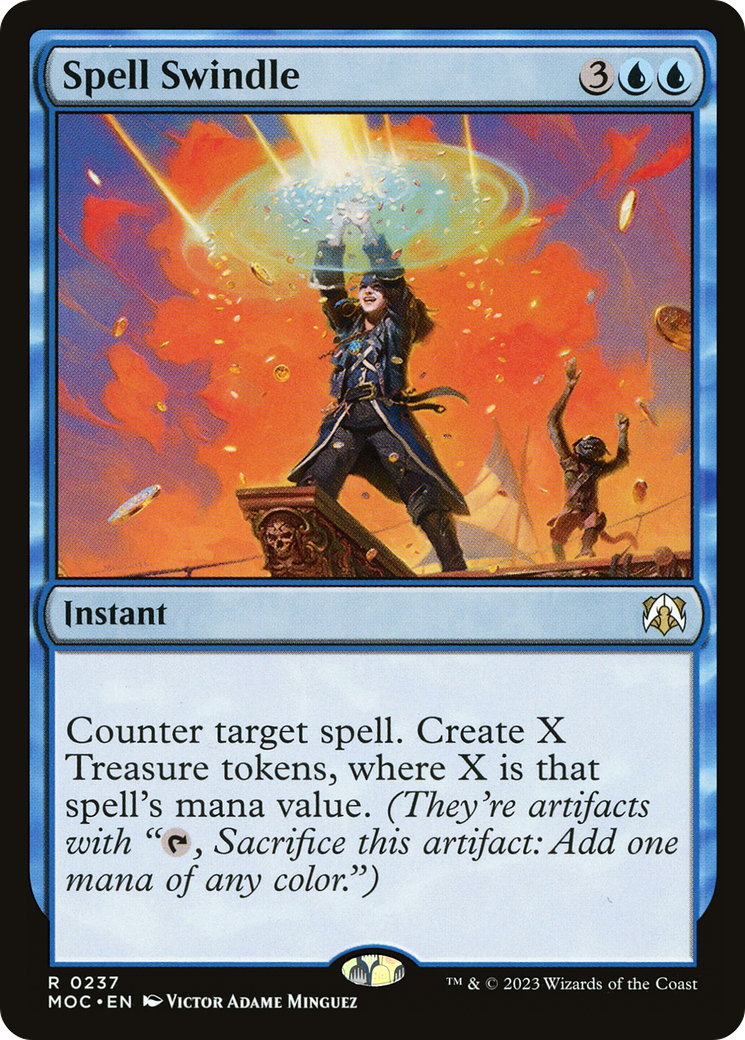
Spell Swindle
Spell Swindle
Instant
Counter target spell. Create X Treasure tokens, where X is that spell's mana value. (They're artifacts with " , Sacrifice this token: Add one mana of any color.")
- For spells with in their mana costs, use the value chosen for X to determine the spell's mana value.
- You may target a spell that can't be countered. When Spell Swindle resolves, the target spell will be unaffected, but you'll still get Treasures.
-
1
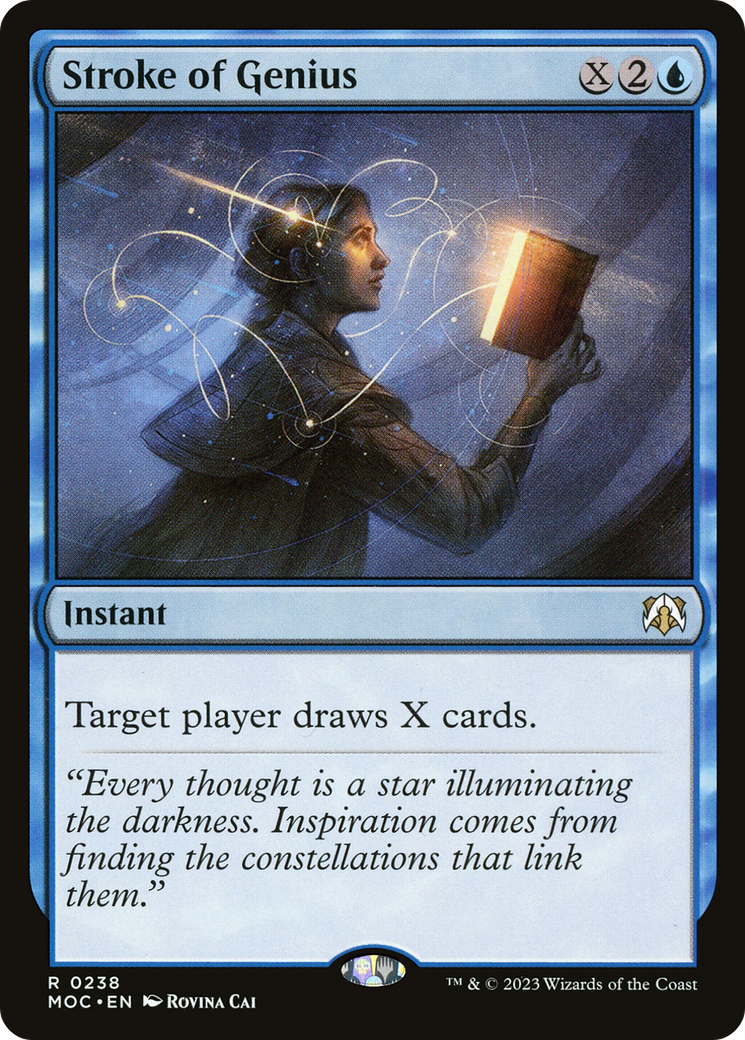
Stroke of Genius
Stroke of Genius
Instant
Target player draws X cards.
-
1
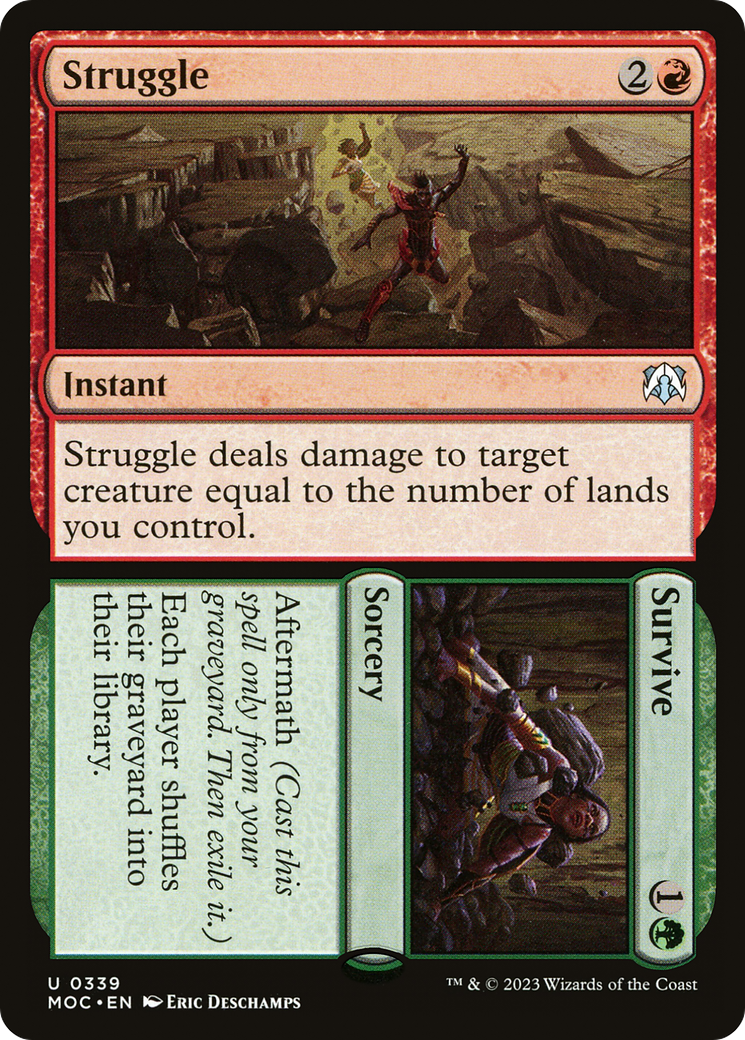
Struggle // Survive
//
Struggle
Instant
- If a player has no cards in their graveyard when Survive resolves, that player just shuffles their library.
- Once you've started to cast a spell with aftermath from your graveyard, the card is immediately moved to the stack. Opponents can't try to stop the ability by exiling the card with an effect such as that of Crook of Condemnation.
- Each split card is a single card. For example, if you discard one, you've discarded one card, not two. If an effect counts the number of instant and sorcery cards in your graveyard, Destined // Lead counts once, not twice.
- Each split card has two names. If an effect instructs you to choose a card name, you may choose one, but not both.
- While not on the stack, the characteristics of a split card are the combination of its two halves. For example, Destined // Lead is a green and black card, it is both an instant card and a sorcery card, and its mana value is 6. This means that if an effect allows you to cast a card with mana value 2 from your hand, you can't cast Destined. This is a change from the previous rules for split cards.
- Split cards with aftermath have a new frame treatment—the half you can cast from your hand is oriented the same as other cards you'd cast from your hand, while the half you can cast from your graveyard is a traditional split card half. This frame treatment is for your convenience and has no rules significance.
- If another effect allows you to cast a split card with aftermath from any zone other than a graveyard, you can't cast the half with aftermath.
- If another effect allows you to cast a split card with aftermath from a graveyard, you may cast either half. If you cast the half that has aftermath, you'll exile the card if it would leave the stack.
- A spell with aftermath cast from a graveyard will always be exiled afterward, whether it resolves, it's countered, or it leaves the stack in some other way.
- If you cast the first half of a split card with aftermath during your turn, you'll have priority immediately after it resolves. You can cast the half with aftermath from your graveyard before any player can take any other action if it's legal for you to do so.
- All split cards have two card faces on a single card, and you put a split card onto the stack with only the half you're casting. The characteristics of the half of the card you didn't cast are ignored while the spell is on the stack. For example, if an effect prevents you from casting green spells, you can cast Destined of Destined // Lead, but not Lead.
-
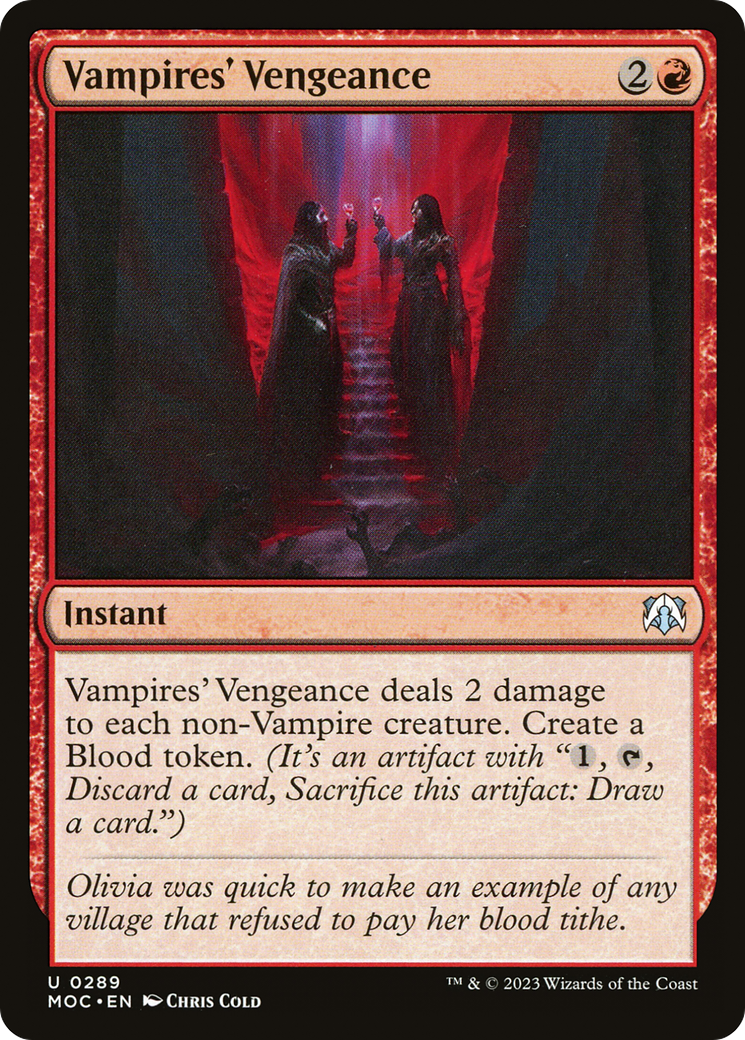
1
Vampires' Vengeance
Vampires' Vengeance
Instant
Vampires' Vengeance deals 2 damage to each non-Vampire creature. Create a Blood token. (It's an artifact with " , , Discard a card, Sacrifice this token: Draw a card.")
- If an effect refers to a Blood token, it means any artifact token with the subtype Blood, even if it has gained other subtypes.
- You can't sacrifice a Blood token to pay multiple costs.
- Some triggered abilities trigger "whenever you sacrifice a Blood token." These abilities trigger regardless of why you sacrificed that Blood token.
Sorceries 11
-
1
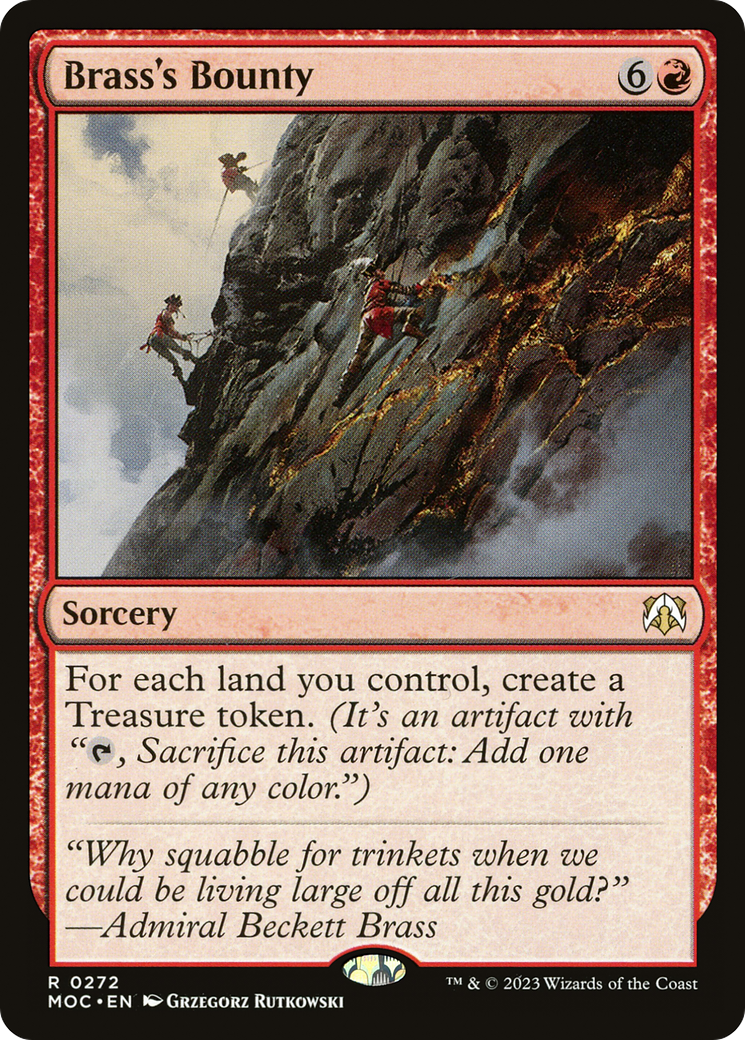
Brass's Bounty
Brass's Bounty
Sorcery
For each land you control, create a Treasure token. (It's an artifact with " , Sacrifice this token: Add one mana of any color.")
-
1
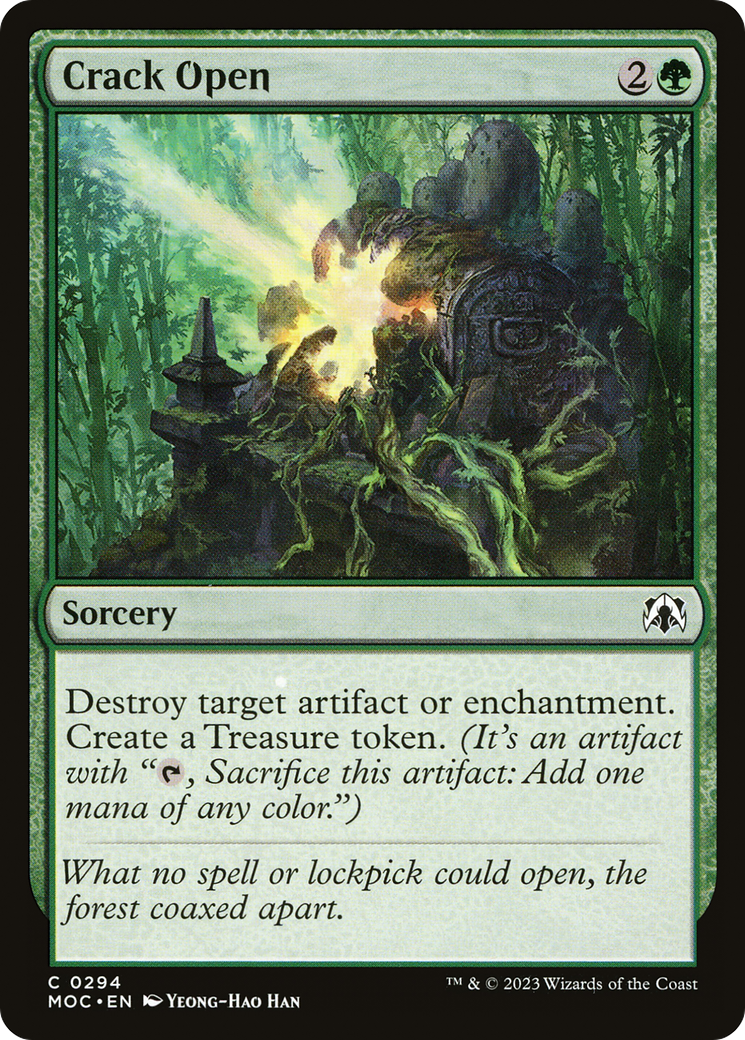
Crack Open
Crack Open
Sorcery
Destroy target artifact or enchantment. Create a Treasure token. (It's an artifact with " , Sacrifice this token: Add one mana of any color.")
-
1
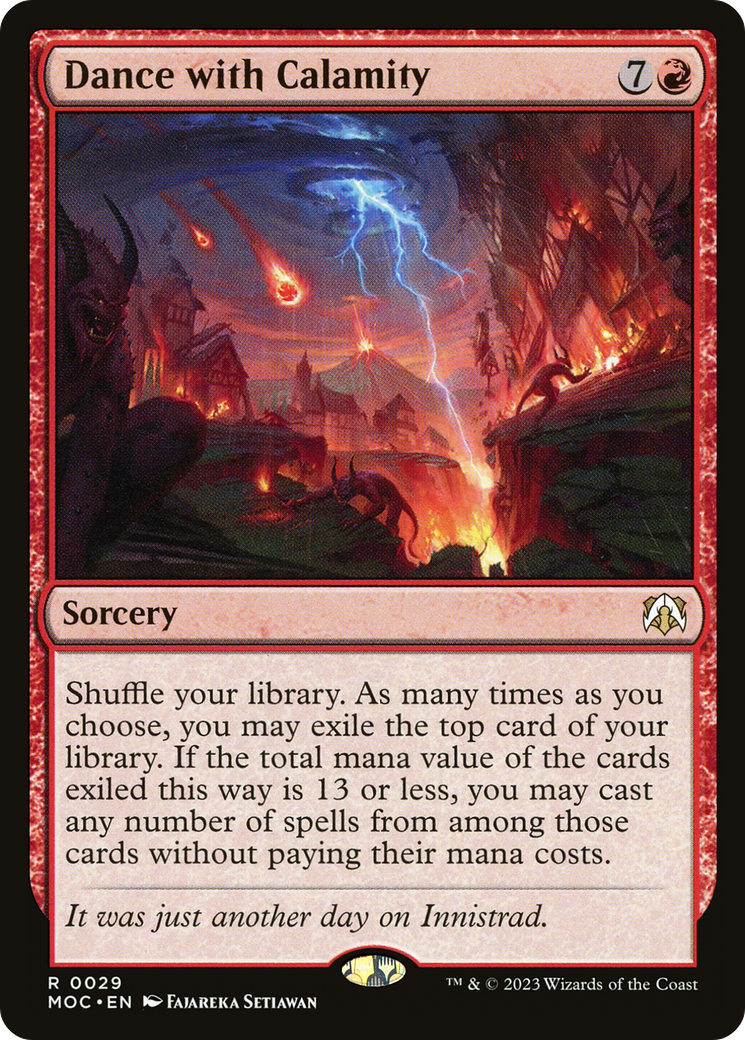
Dance with Calamity
Dance with Calamity
Sorcery
Shuffle your library. As many times as you choose, you may exile the top card of your library. If the total mana value of the cards exiled this way is 13 or less, you may cast any number of spells from among those cards without paying their mana costs.
- If you cast any of the exiled cards, you do so as part of the resolution of the spell. You can't wait to cast them later in the turn. Timing restrictions based on a card's type are ignored.
- You can look at each card you exile before deciding whether to push your luck or stop.
- If you cast a card "without paying its mana cost," you can't pay any alternative costs. You can, however, pay additional costs. If the card has any mandatory additional costs, those must be paid to cast the card.
- If you danced with calamity a little too closely, and the total mana value of the exiled cards is greater than 13, the cards you exiled will remain there and you won't get to cast any of them.
- If an exiled card has in its mana cost, you must choose 0 as the value of X when casting it without paying its mana cost.
- Any cards not cast, including land cards, remain in exile. They can't be cast on later turns.
- If you cast more than one of the exiled cards, you choose the order in which to cast them. A spell you cast this way can be the target of a later spell you cast this way. However, permanent spells cast this way won't resolve until you're done casting spells, so the permanents they become can't be the target of spells cast this way. For example, if you exile Twincast and Lightning Strike, you can cast Lightning Strike and then cast Twincast targeting it; but if you exile a creature card and an Aura card, you can't cast that Aura targeting that creature.
-
1
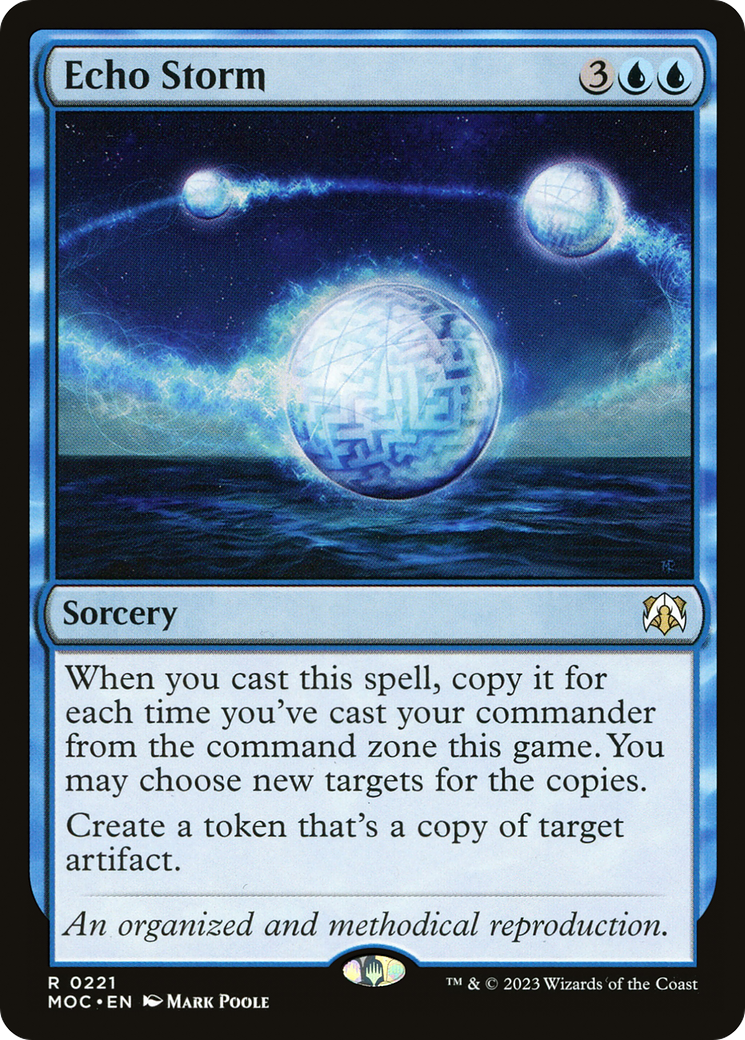
Echo Storm
Echo Storm
Sorcery
When you cast this spell, copy it for each time you've cast your commander from the command zone this game. You may choose new targets for the copies.
Create a token that's a copy of target artifact.
- If you have multiple commanders, you'll copy this spell for each time you've cast either of them. For example, if you've cast one commander once and one twice, you'll copy this spell three times.
- The token copies exactly what was printed on the original artifact and nothing else (unless that artifact is copying something else or is a token; see below). It doesn't copy whether that artifact is tapped or untapped, whether it has any counters on it or Auras attached to it, or any non-copy effects that have changed its types, color, or so on.
- If the copied artifact has in its mana cost, X is considered to be 0.
- If the copied artifact is a token, the token that's created copies the original characteristics of that token as stated by the effect that created the token.
- If the copied artifact is copying something else (for example, if the copied artifact is a Sculpting Steel), then the token enters the battlefield as whatever that artifact copied.
- Each copy resolves one at a time. Any abilities that trigger on the artifact token entering the battlefield resolve before the next copy resolves. The original spell is the last to resolve.
- Each Storm's triggered ability counts only how many times you've cast your commander from the command zone before that triggered ability resolves. If you cast your commander again later, you won't get another copy.
- If your commander was countered, that time you cast it still counts.
- Each Storm's triggered ability can copy the Storm spell even if that spell is countered before that ability resolves.
- The copies are created on the stack, so they're not “cast.” Abilities that trigger when a player casts a spell (such as the Storm's ability itself) won't trigger.
- Any enters-the-battlefield abilities of the copied artifact will trigger when the token enters the battlefield. Any “as [this artifact] enters the battlefield” or “[this artifact] enters the battlefield with” abilities of the chosen artifact will also work.
-
1
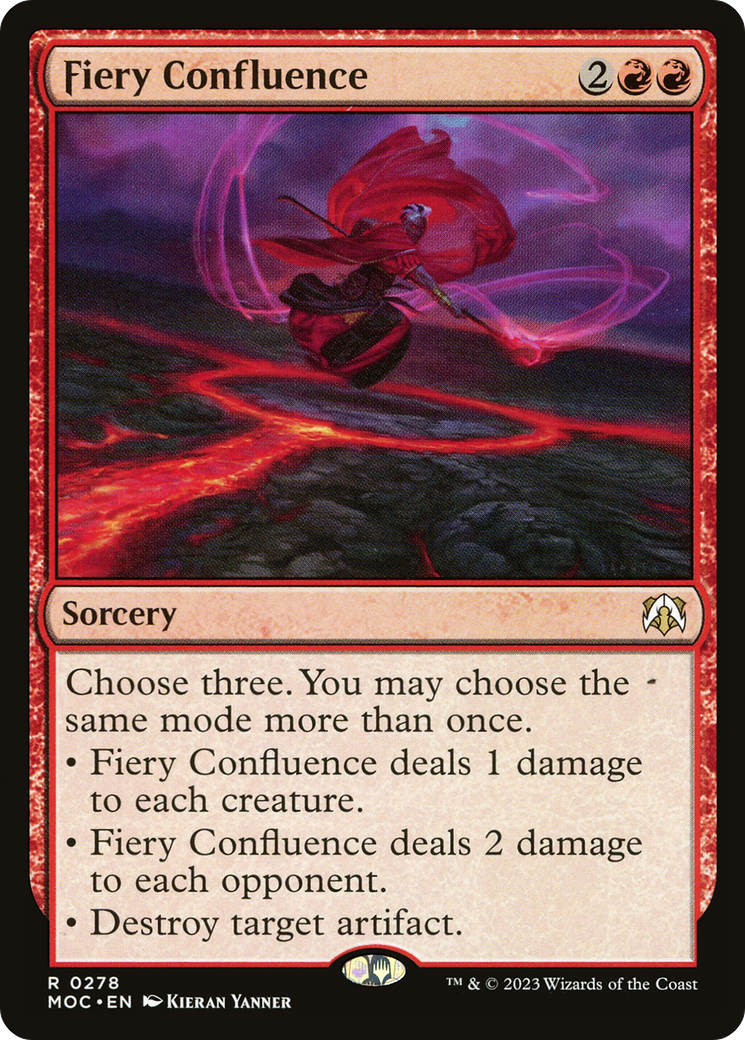
Fiery Confluence
Fiery Confluence
Sorcery
Choose three. You may choose the same mode more than once.
- Fiery Confluence deals 1 damage to each creature.
- Fiery Confluence deals 2 damage to each opponent.
- Destroy target artifact.
- No player can cast spells or activate abilities in between the modes of a resolving spell.
- You choose the modes as you cast the spell. Once modes are chosen, they can't be changed.
- If all targets for the chosen modes become illegal before the Confluence resolves, the spell won't resolve and none of its effects will happen. If at least one target is still legal, the spell will resolve but will have no effect on any illegal targets.
- If a mode requires a target, you can select that mode only if there's a legal target available. Ignore the targeting requirements for modes you don't choose. Each time you select that mode, you can choose a different target, or you can choose the same target.
- If the first or second modes are chosen multiple times, each of those modes represents a separate damage-dealing event. For example, if your opponent casts Fiery Confluence choosing the second mode three times, and you control Guardian Seraph (a creature with the ability "If a source an opponent controls would deal damage to you, prevent 1 of that damage"), you'll be dealt a total of 3 damage.
- If a Confluence is copied, the effect that creates the copy will usually allow you to choose new targets, but you can't choose new modes.
- No matter which combination of modes you choose, you always follow the instructions of a Confluence in the order they are written. If the same mode is chosen more than once, you choose their relative order as you cast the spell.
-
1
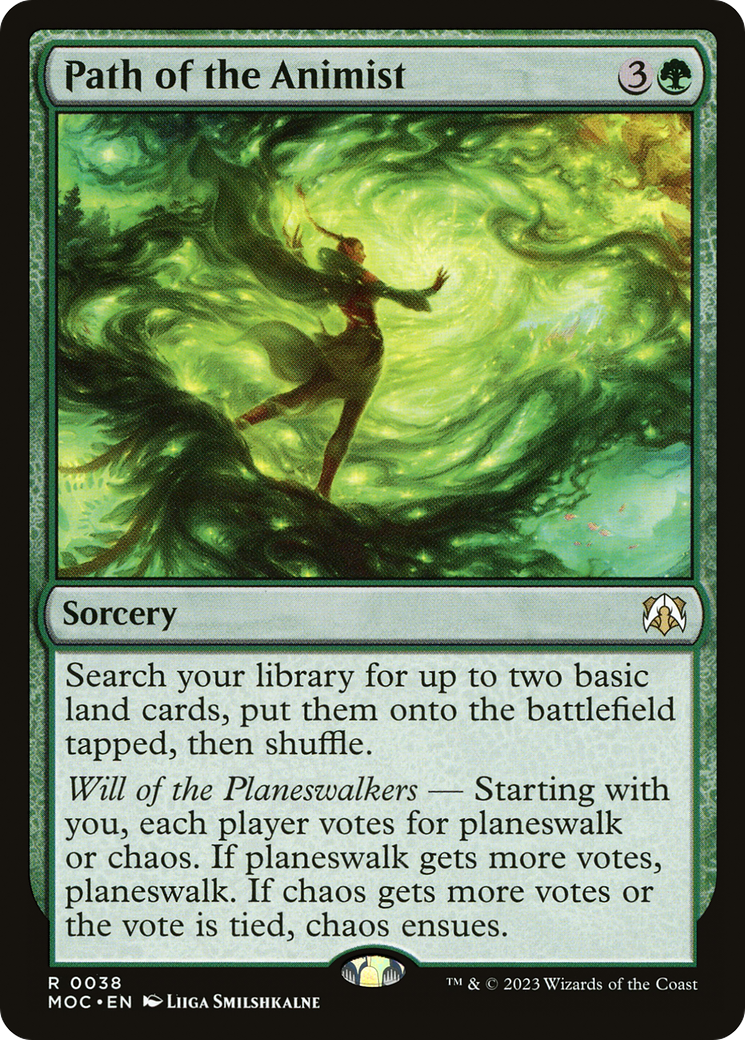
Path of the Animist
Path of the Animist
Sorcery
Search your library for up to two basic land cards, put them onto the battlefield tapped, then shuffle.
Will of the Planeswalkers — Starting with you, each player votes for planeswalk or chaos. If planeswalk gets more votes, planeswalk. If chaos gets more votes or the vote is tied, chaos ensues.
-
1
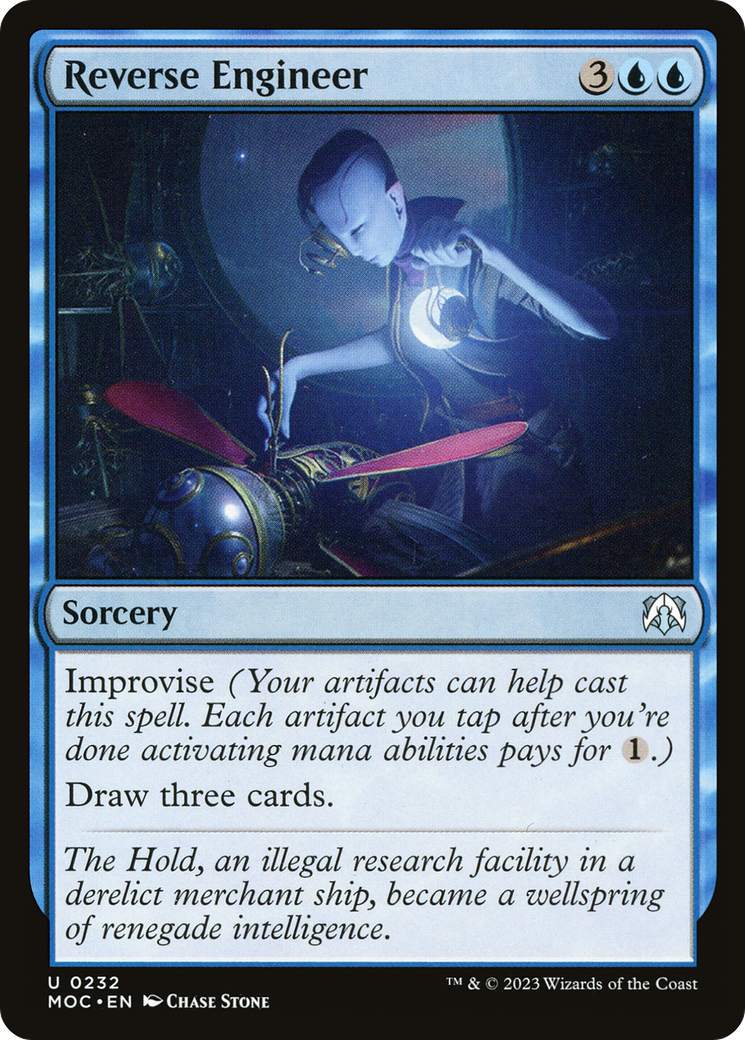
Reverse Engineer
Reverse Engineer
Sorcery
Improvise (Your artifacts can help cast this spell. Each artifact you tap after you're done activating mana abilities pays for .)
Draw three cards.
- Equipment attached to a creature doesn't become tapped when that creature becomes tapped, and tapping that Equipment doesn't cause the creature to become tapped.
- When using improvise to cast a spell with in its mana cost, first choose the value for X. That choice, plus any cost increases or decreases, will determine the spell's total cost. Then you can tap artifacts you control to help pay that cost. For example, if you cast Saheeli's Directive and choose X to be 3, the total cost is . If you tap two artifacts, you'll have to pay .
- Improvise doesn't change a spell's mana cost or mana value.
- When calculating a spell's total cost, include any alternative costs, additional costs, or anything else that increases or reduces the cost to cast the spell. Improvise applies after the total cost is calculated.
- Improvise can't pay for , , , , , or mana symbols in a spell's total cost.
- Improvise can't be used to pay for anything other than the cost of casting the spell. For example, it can't be used during the resolution of an ability that says “Counter target spell unless its controller pays .”
- If an artifact you control has a mana ability with in the cost, activating that ability while casting a spell with improvise will result in the artifact being tapped when you pay the spell's costs. You won't be able to tap it again for improvise. Similarly, if you sacrifice an artifact to activate a mana ability while casting a spell with improvise, that artifact won't be on the battlefield when you pay the spell's costs, so you won't be able to tap it for improvise.
- Tapping an artifact won't cause its abilities to stop applying unless those abilities say so.
-
1
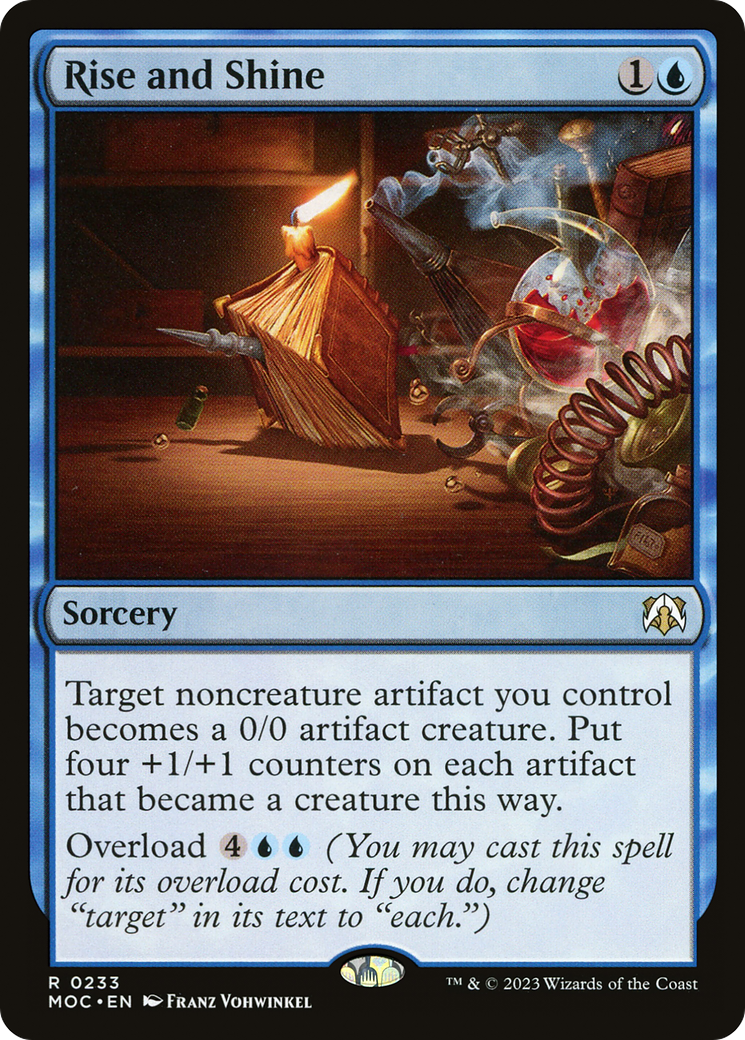
Rise and Shine
Rise and Shine
Sorcery
Target noncreature artifact you control becomes a 0/0 artifact creature. Put four +1/+1 counters on each artifact that became a creature this way.
Overload (You may cast this spell for its overload cost. If you do, change "target" in its text to "each.")
- If you don't pay the overload cost of a spell with overload, that spell will have a single target. If you pay the overload cost, the spell won't have any targets.
- Because a spell with overload doesn't target when its overload cost is paid, it may affect permanents with hexproof or with protection from the appropriate color.
- To determine the total cost of a spell, start with the mana cost or alternative cost you're paying (such as an overload cost), add any cost increases, then apply any cost reductions. The mana value of the spell remains unchanged, no matter what the total cost to cast it was.
- If you are instructed to cast a spell with overload "without paying its mana cost," you can't choose to pay its overload cost instead.
-
1
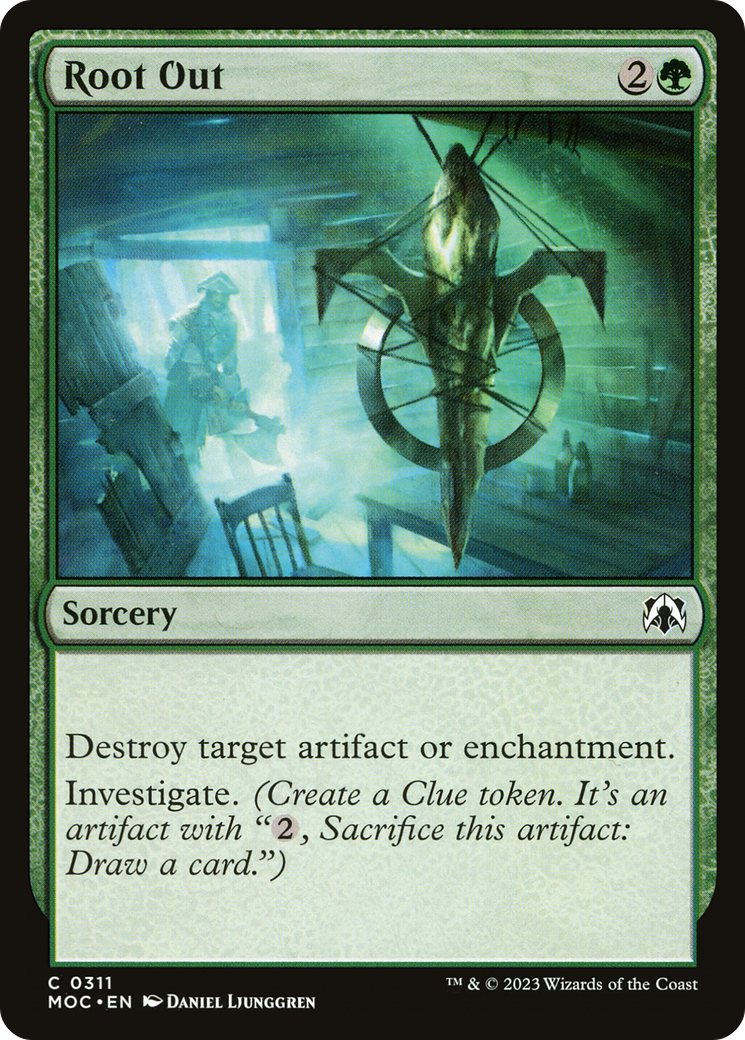
Root Out
Root Out
Sorcery
Destroy target artifact or enchantment.
Investigate. (Create a Clue token. It's an artifact with " , Sacrifice this token: Draw a card.")
- Clue is an artifact type. Even though it appears on some cards with other permanent types, it's never a creature type, a land type, or anything but an artifact type.
- If an effect refers to a Clue, it means any Clue artifact, not just a Clue artifact token. For example, you can sacrifice Wrench to pay for Alquist Proft, Master Sleuth's activated ability.
- You can't sacrifice a Clue to pay multiple costs. For example, you can't sacrifice a Clue token to activate its own ability and also to activate Alquist Proft, Master Sleuth's ability.
- You can't cast a spell without choosing legal targets. If all of those targets become illegal, the spell doesn't resolve and you won't investigate.
-
1
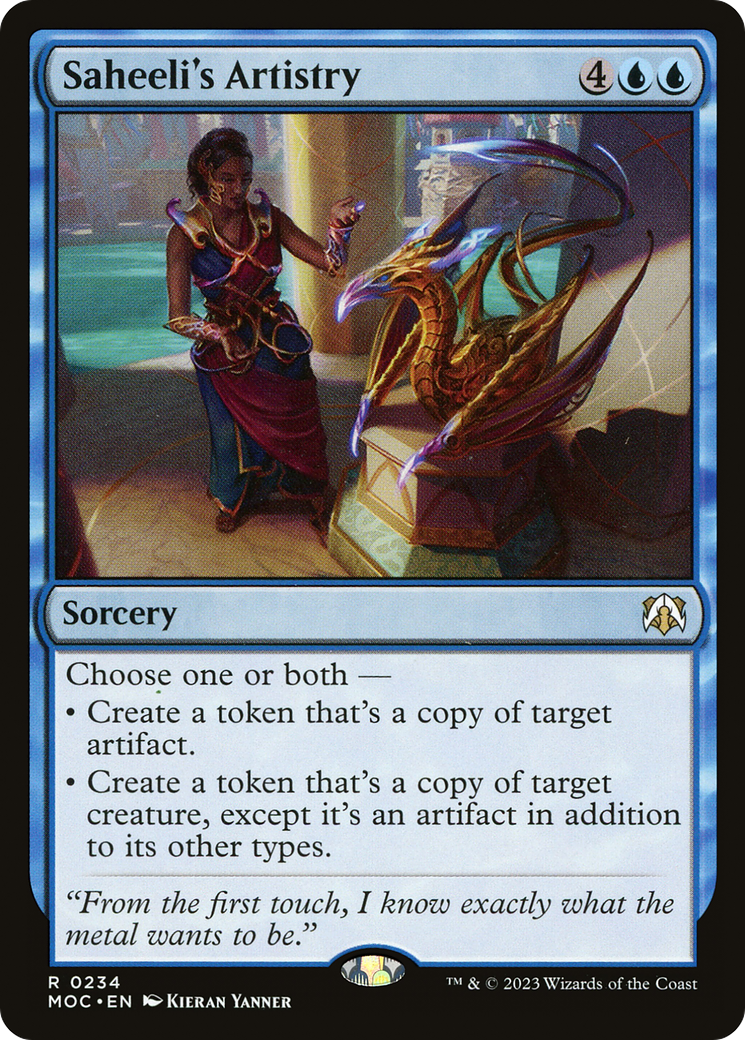
Saheeli's Artistry
Saheeli's Artistry
Sorcery
Choose one or both —
- Create a token that's a copy of target artifact.
- Create a token that's a copy of target creature, except it's an artifact in addition to its other types.
- The token copies exactly what was printed on the original permanent and nothing else (unless that permanent is copying something else or is a token; see below). It doesn't copy whether that permanent is tapped or untapped, whether it has any counters on it or Auras and Equipment attached to it, or any non-copy effects that have changed its power, toughness, types, color, or so on.
- If you chose the second mode, the token is an artifact in addition to its other types. This is a copiable value of the token that other effects may copy.
- If the copied permanent has in its mana cost, X is considered to be 0.
- If the copied permanent is copying something else (for example, if the copied permanent is an Altered Ego), then the token enters the battlefield as whatever that permanent copied.
- If the copied permanent is a token, the token created with Saheeli's Artistry copies the original characteristics of that token as stated by the effect that that created that token.
- Any enters-the-battlefield abilities of the copied permanent will trigger when the token enters the battlefield. Any “as [this permanent] enters the battlefield” or “[this permanent] enters the battlefield with” abilities of the chosen permanent will also work.
- If you choose both modes, you may target a single artifact creature twice and get two copies of that artifact creature.
- If you choose both modes, the tokens enter one at a time. Thus, if the token created by the second mode has an ability that triggers “whenever an artifact enters the battlefield,” the token created by the first mode will already be on the battlefield and won't cause that ability to trigger.
- Any abilities that trigger during the resolution of Saheeli's Artistry will wait to be put onto the stack until Saheeli's Artistry finishes resolving. An ability that triggers on the first token entering the battlefield may target the second token and vice versa.
-
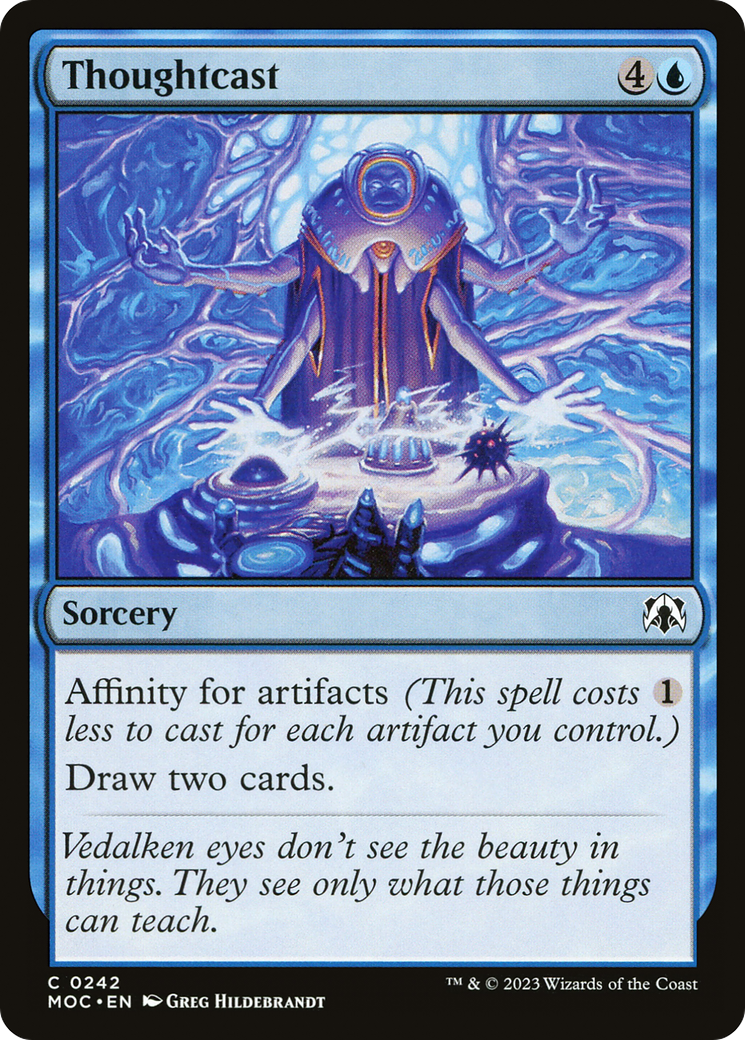
1
Thoughtcast
Thoughtcast
Sorcery
Affinity for artifacts (This spell costs less to cast for each artifact you control.)
Draw two cards.
Artifacts 13
-
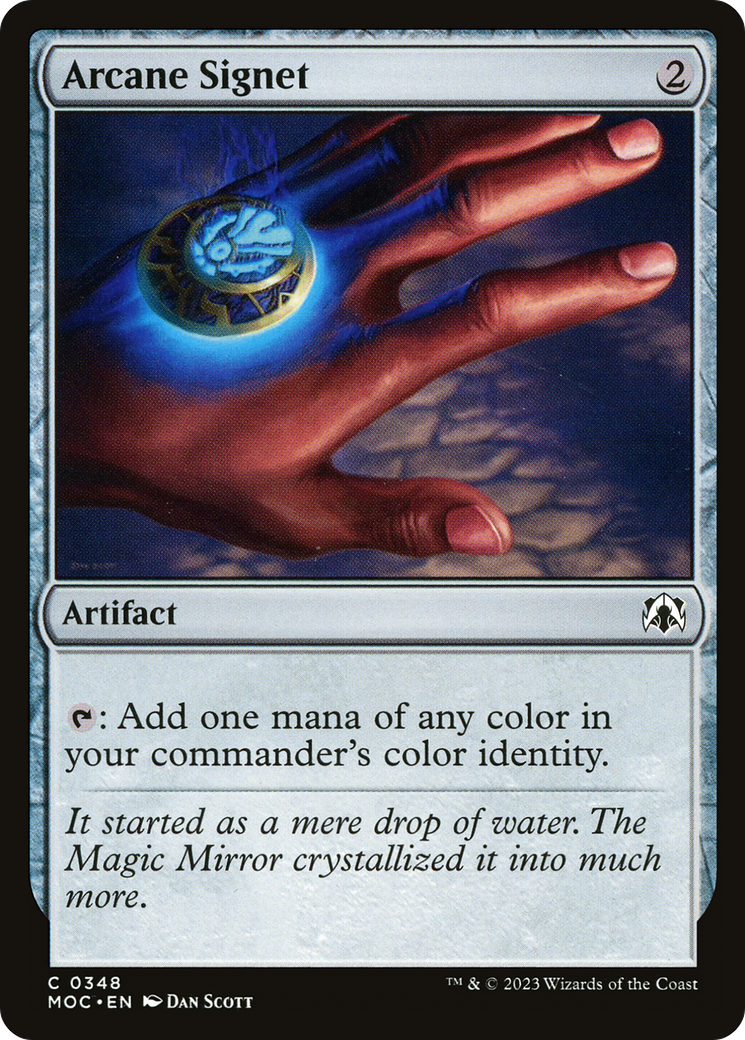
1
Arcane Signet
Arcane Signet
Artifact
: Add one mana of any color in your commander's color identity.
- If your commander is a card that has no colors in its color identity, Arcane Signet's ability produces no mana. It doesn't produce .
- If you have two commanders, the ability adds one mana of any color in their combined color identities.
- If you don't have a commander, Arcane Signet's ability produces no mana.
-
1
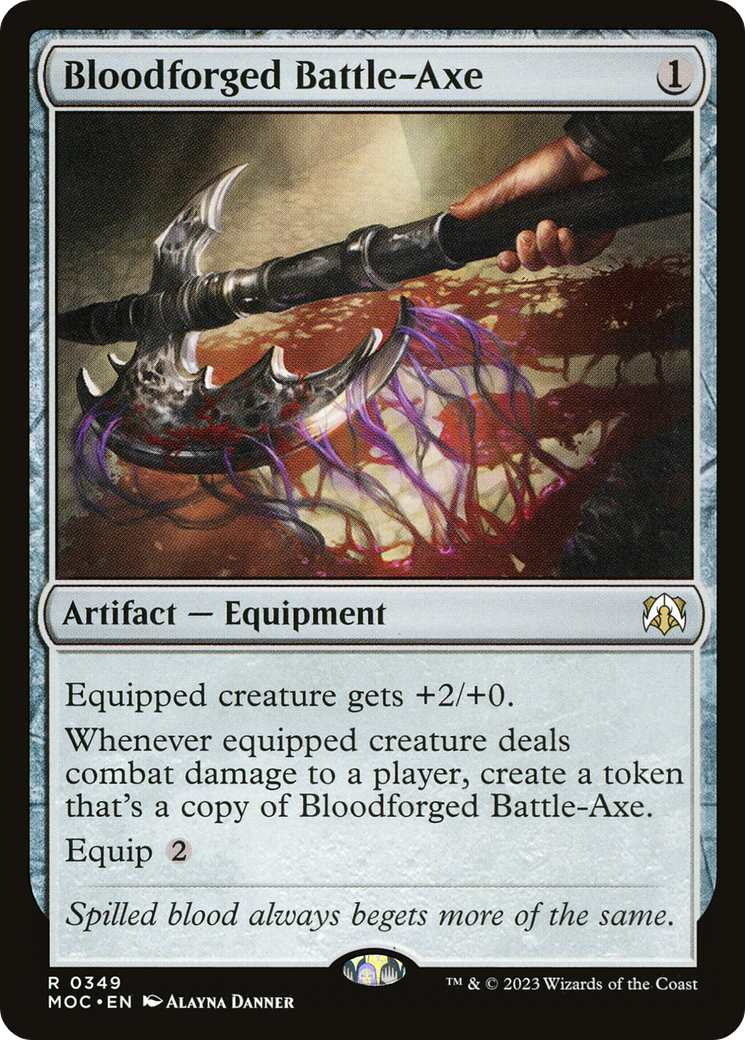
Bloodforged Battle-Axe
Bloodforged Battle-Axe
Artifact — Equipment
Equipped creature gets +2/+0.
Whenever equipped creature deals combat damage to a player, create a token that's a copy of this Equipment.
Equip
- The token enters the battlefield unattached.
- The token has all three of Bloodforged Battle-Axe's abilities, including the one that creates more tokens.
-
1
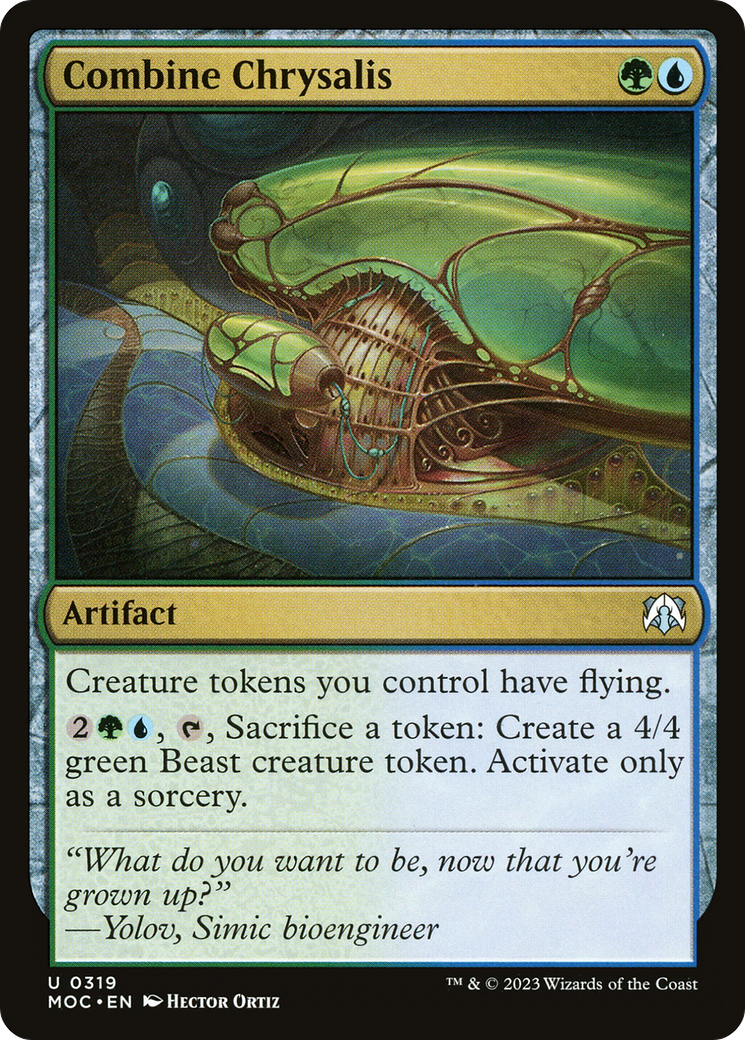
Combine Chrysalis
Combine Chrysalis
Artifact
Creature tokens you control have flying.
, , Sacrifice a token: Create a 4/4 green Beast creature token. Activate only as a sorcery.
- You can sacrifice any token you control to activate the last ability, not just creature tokens.
-
1
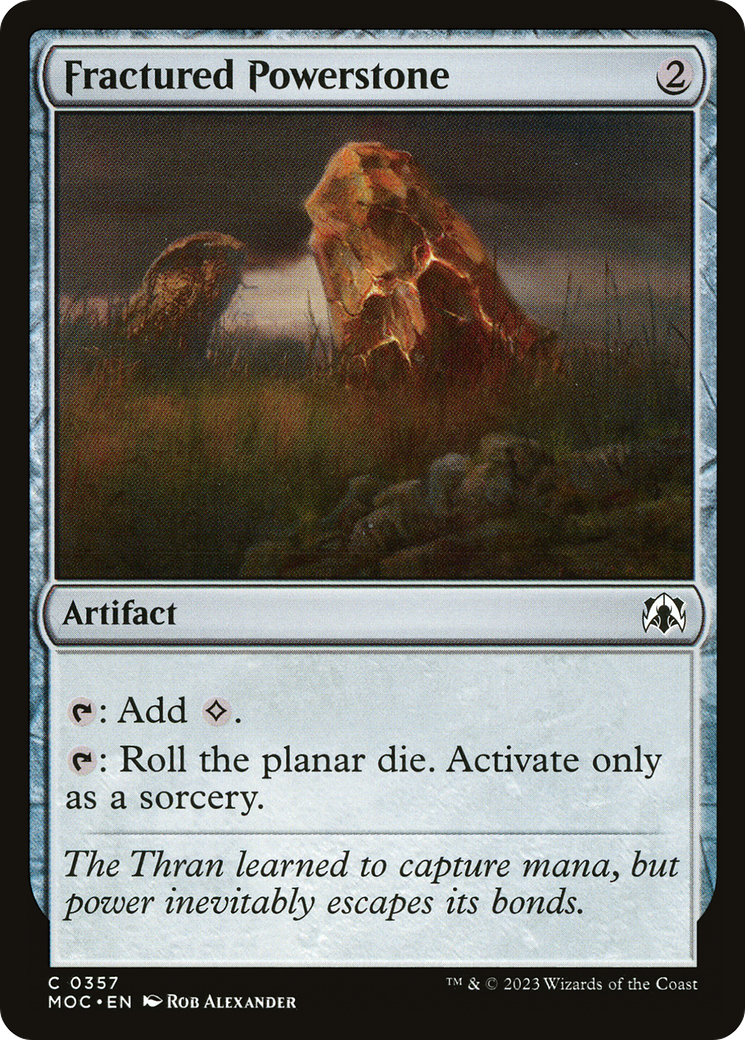
Fractured Powerstone
Fractured Powerstone
Artifact
: Add .
: Roll the planar die. Activate only as a sorcery.
- In non-Planechase games, Fractured Powerstone's second ability will have no effect.
- Rolling the planar die this way doesn't count when determining the cost of the special action of rolling the planar die. For example, if you roll the planar die twice in a turn, then activate Fractured Powerstone to roll it a third time, rolling the planar die again that turn will cost .
-
1
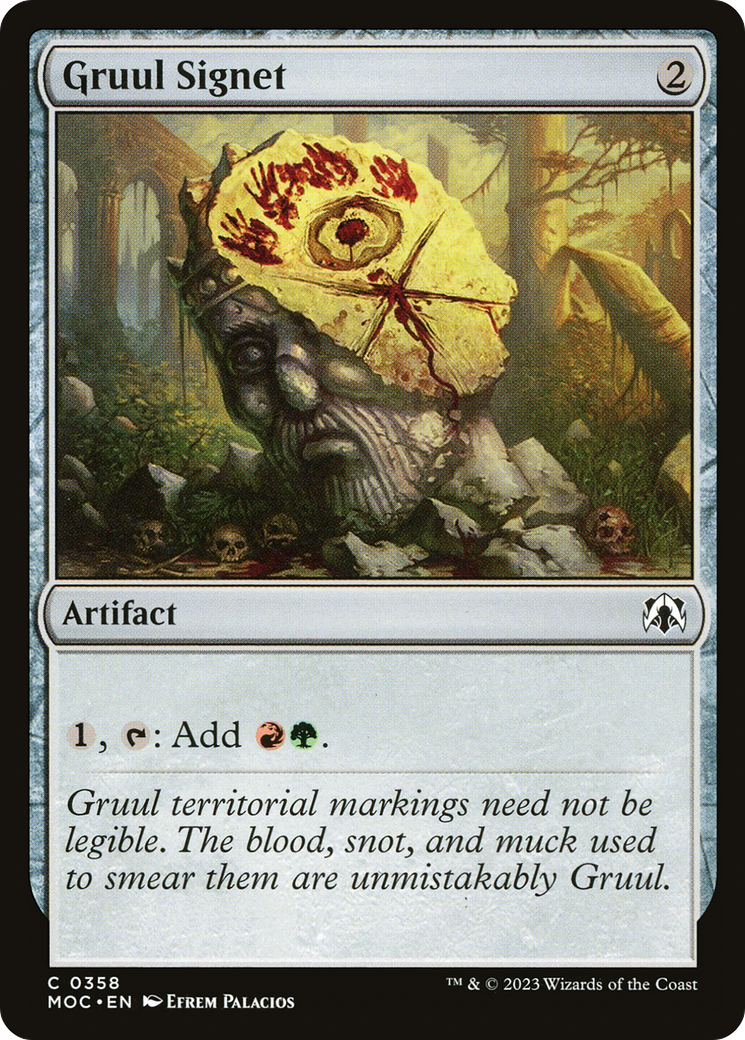
Gruul Signet
Gruul Signet
Artifact
, : Add .
-
1
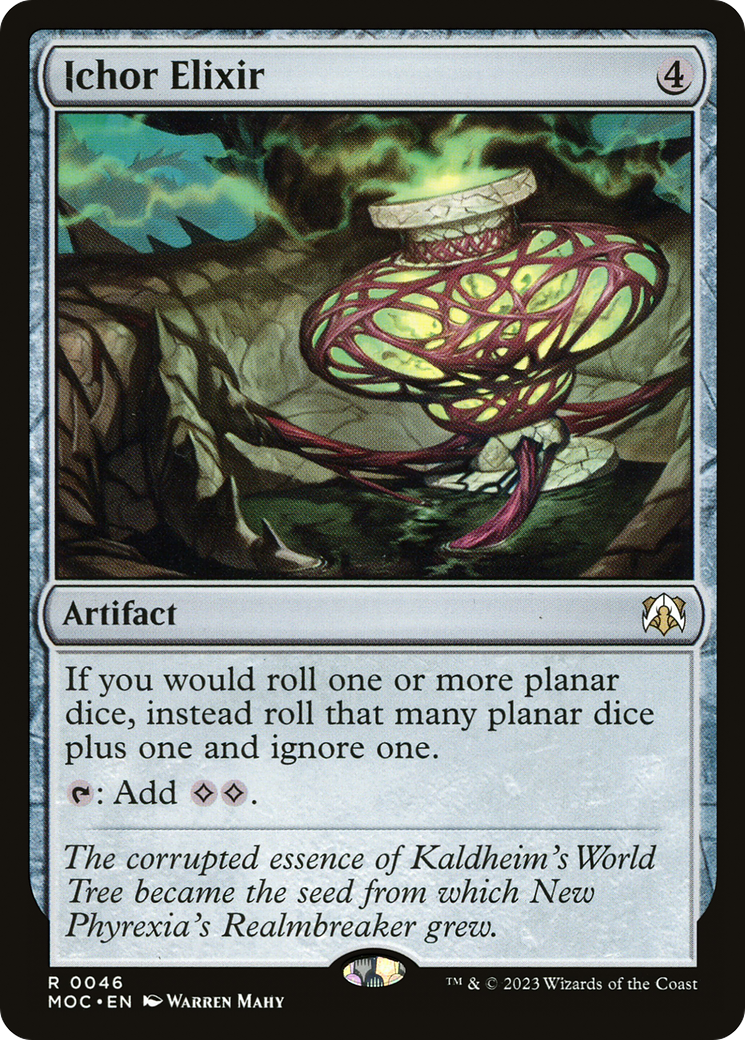
Ichor Elixir
Ichor Elixir
Artifact
If you would roll one or more planar dice, instead roll that many planar dice plus one and ignore one.
: Add .
-
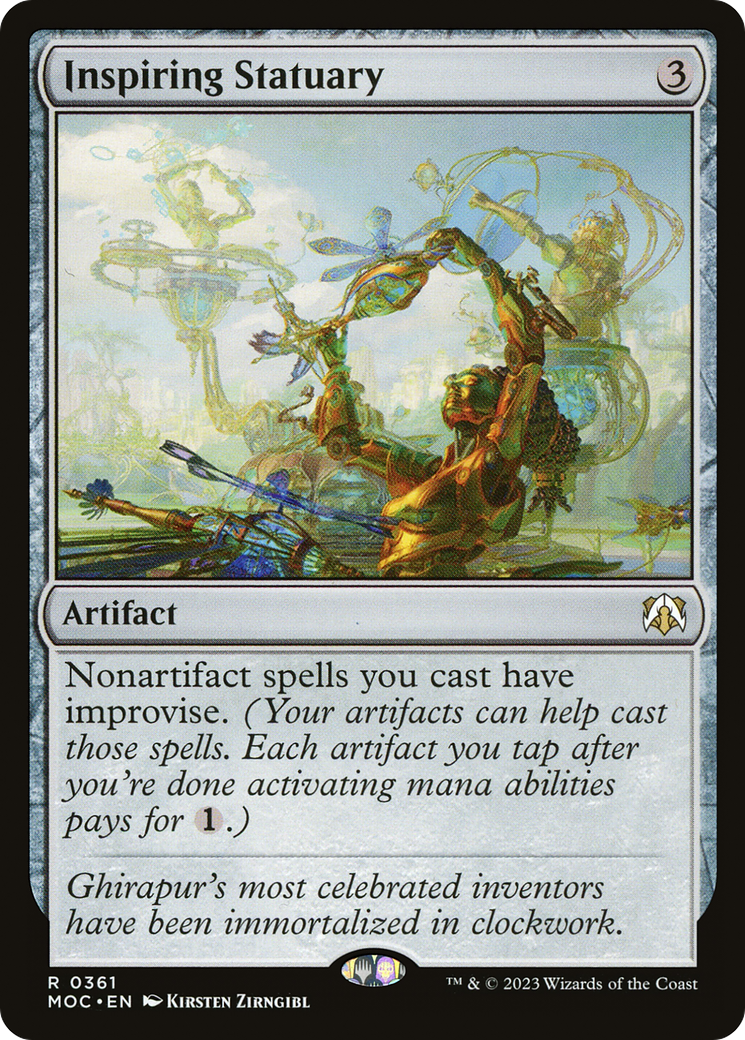
1
Inspiring Statuary
Inspiring Statuary
Artifact
Nonartifact spells you cast have improvise. (Your artifacts can help cast those spells. Each artifact you tap after you're done activating mana abilities pays for .)
- Multiple instances of improvise are redundant.
- If you cast a nonartifact spell that requires you to sacrifice a permanent as an additional cost, you may tap that permanent (if it's an artifact) for the spell's improvise ability before you sacrifice it to pay that cost.
-
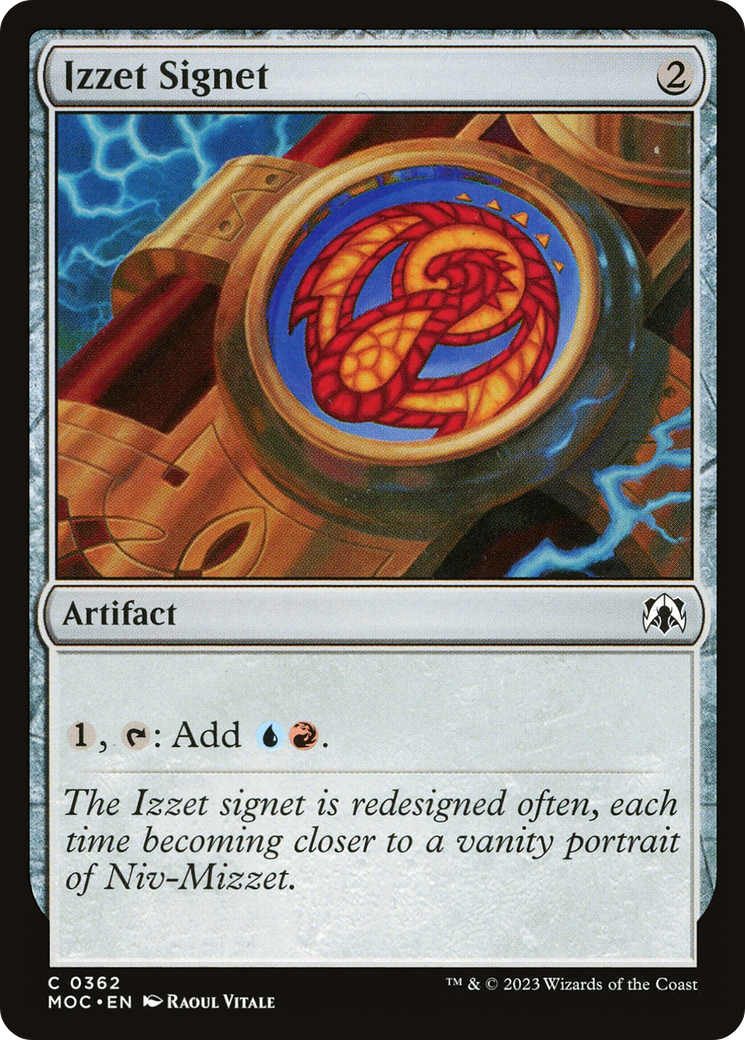
1
Izzet Signet
Izzet Signet
Artifact
, : Add .
-
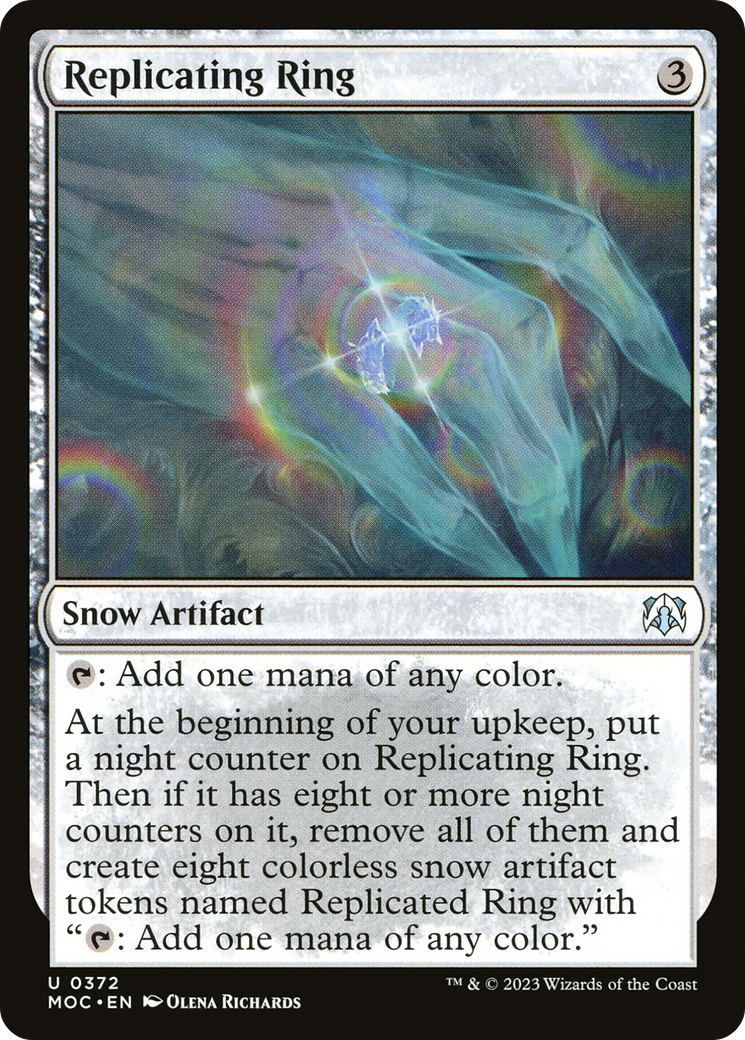
1
Replicating Ring
Replicating Ring
Snow Artifact
: Add one mana of any color.
At the beginning of your upkeep, put a night counter on this artifact. Then if it has eight or more night counters on it, remove all of them and create eight colorless snow artifact tokens named Replicated Ring with " : Add one mana of any color."
- The check of whether Replicating Ring has eight or more night counters on it happens only as part of the resolution of the triggered ability. If Replicating Ring picks up its eighth night counter at another time, you won't immediately create Replicated Rings. You'll have to wait until the next time the triggered ability resolves.
- Snow is a supertype, not a card type. It has no rules meaning or function by itself, but spells and abilities may refer to it.
- The symbol is a generic mana symbol. It represents a cost that can be paid by one mana that was produced by a snow source. That mana can be any color or colorless.
- Snow isn't a type of mana. If an effect says you may spend mana as though it were any type, you can't pay for using mana that wasn't produced by a snow source.
- Some cards have additional effects for each spent to cast them. You can cast these spells even if you don't spend any snow mana to cast them; their additional effects simply won't do anything.
- The Kaldheim set doesn't have any cards with mana costs that include , but some previous sets do. If an effect says such a spell costs less to cast, that reduction doesn't apply to any costs. This is also true for activated abilities that include in their activation costs and effects that reduce those costs.
-
1
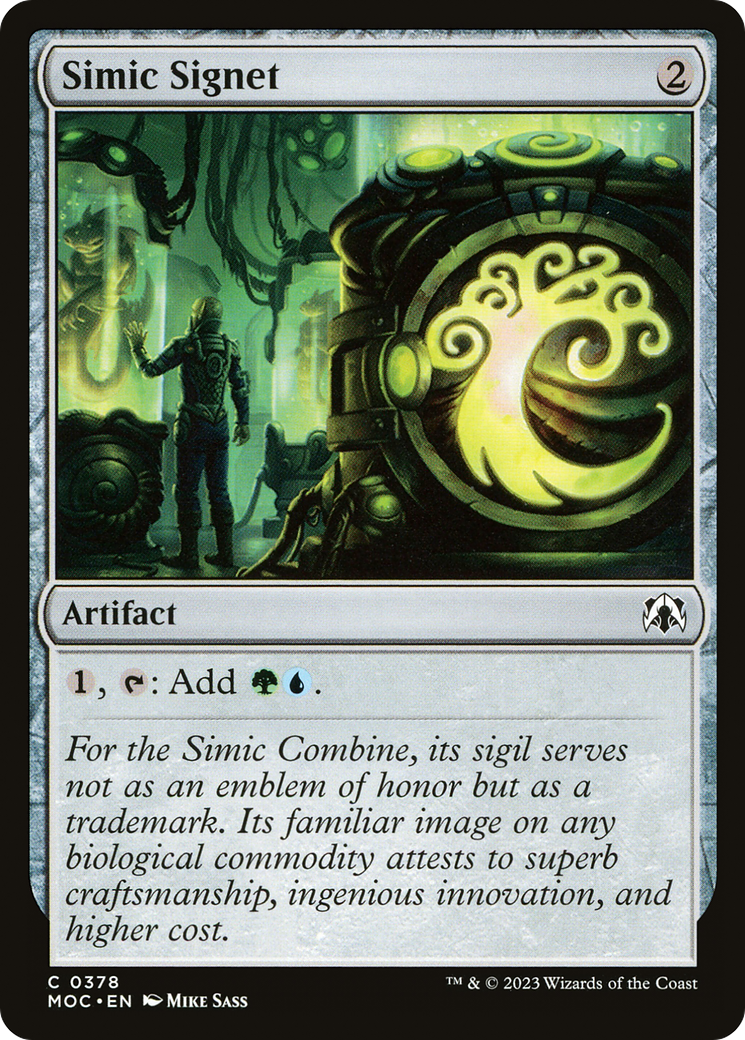
Simic Signet
Simic Signet
Artifact
, : Add .
-
1
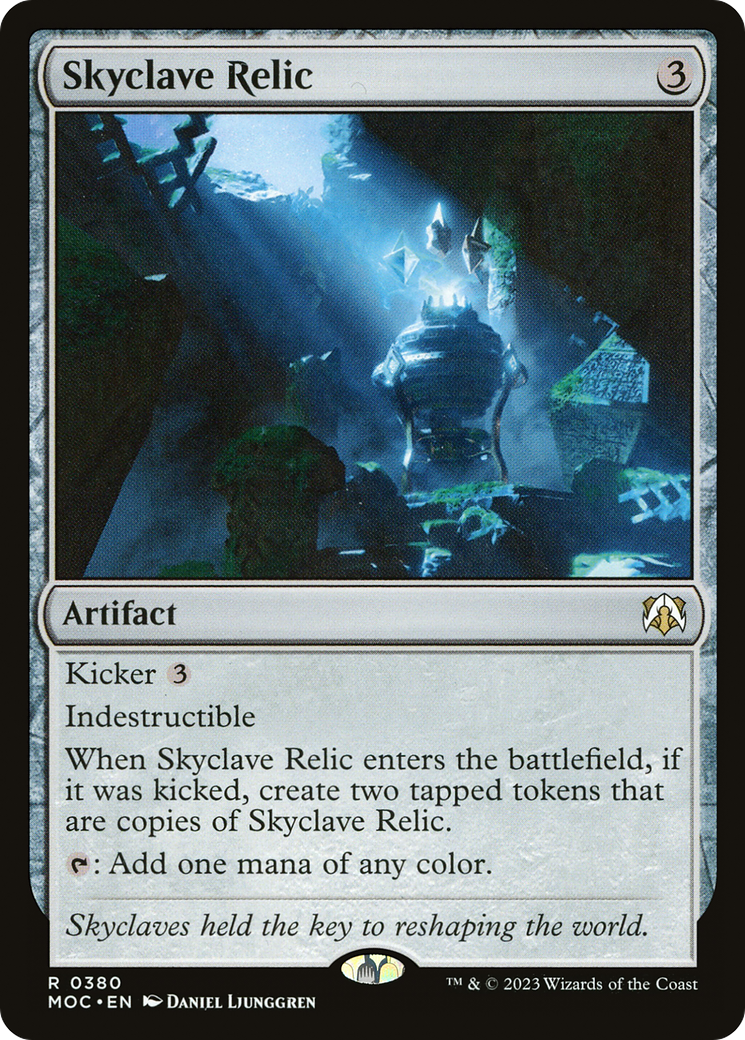
Skyclave Relic
Skyclave Relic
Artifact
Kicker
Indestructible
When this artifact enters, if it was kicked, create two tapped tokens that are copies of this artifact.
: Add one mana of any color.
- If a spell's kicker cost was paid, the spell is "kicked."
- The kicker ability doesn't let you pay a kicker cost more than once.
- If you put a permanent with a kicker ability onto the battlefield without casting it, you can't kick it.
- If you copy a kicked spell on the stack, the copy is also kicked. If the copied spell is a permanent spell, the token the copy of that spell becomes when it enters is also kicked.
- If a card or token enters as a copy of a permanent, the new permanent isn't kicked, even if the original was.
- To determine a spell's total cost, start with the mana cost (or an alternative cost if another card's effect allows you to pay one instead), add any cost increases (such as kicker), then apply any cost reductions. The spell's mana value remains unchanged, no matter what the total cost to cast it was.
-
1
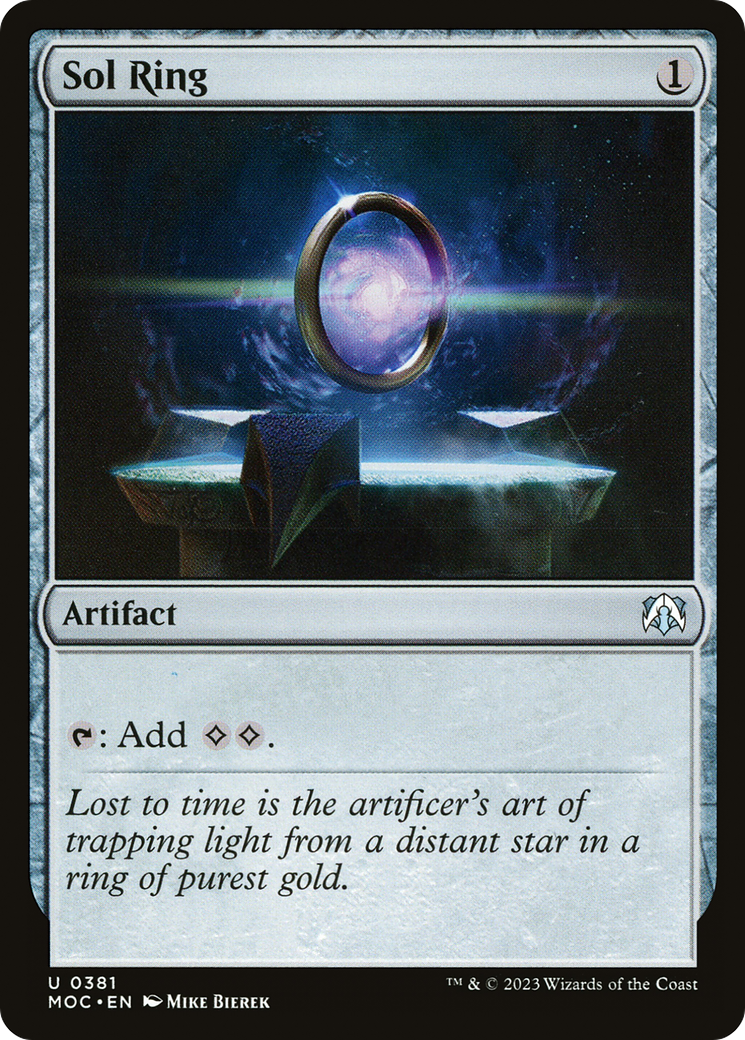
Sol Ring
Sol Ring
Artifact
: Add .
-
1
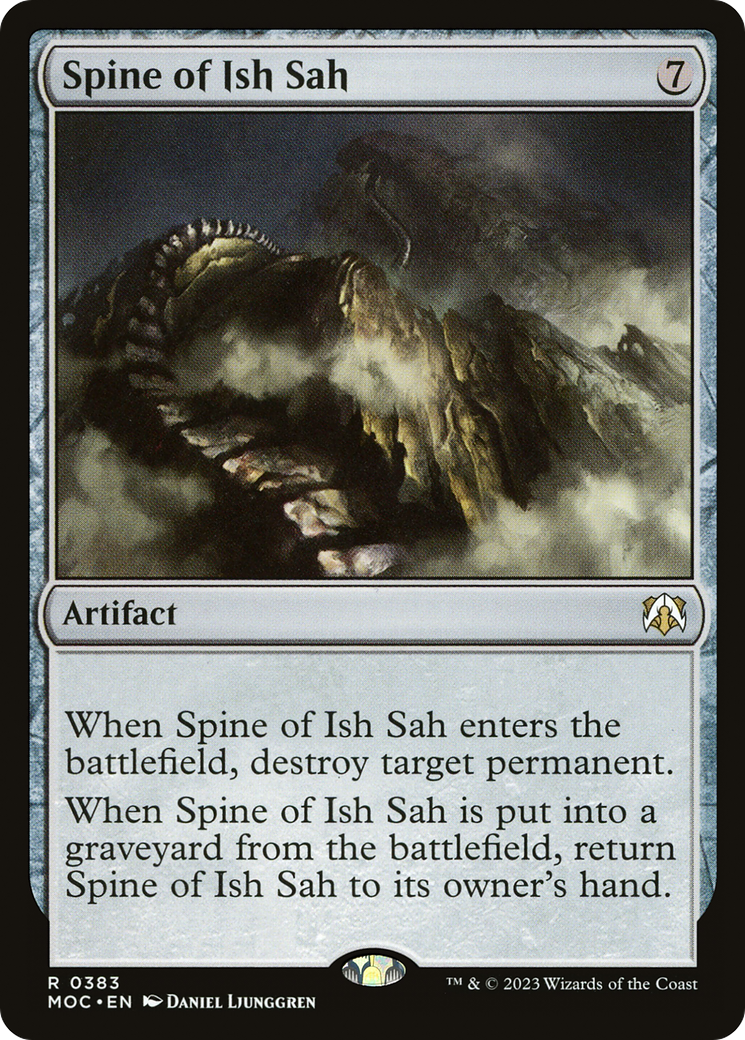
Spine of Ish Sah
Spine of Ish Sah
Artifact
When this artifact enters, destroy target permanent.
When this artifact is put into a graveyard from the battlefield, return it to its owner's hand.
- Spine of Ish Sah's last ability doesn't allow you to sacrifice it. You must find another way to get Spine of Ish Sah into the graveyard.
Enchantments 6
-
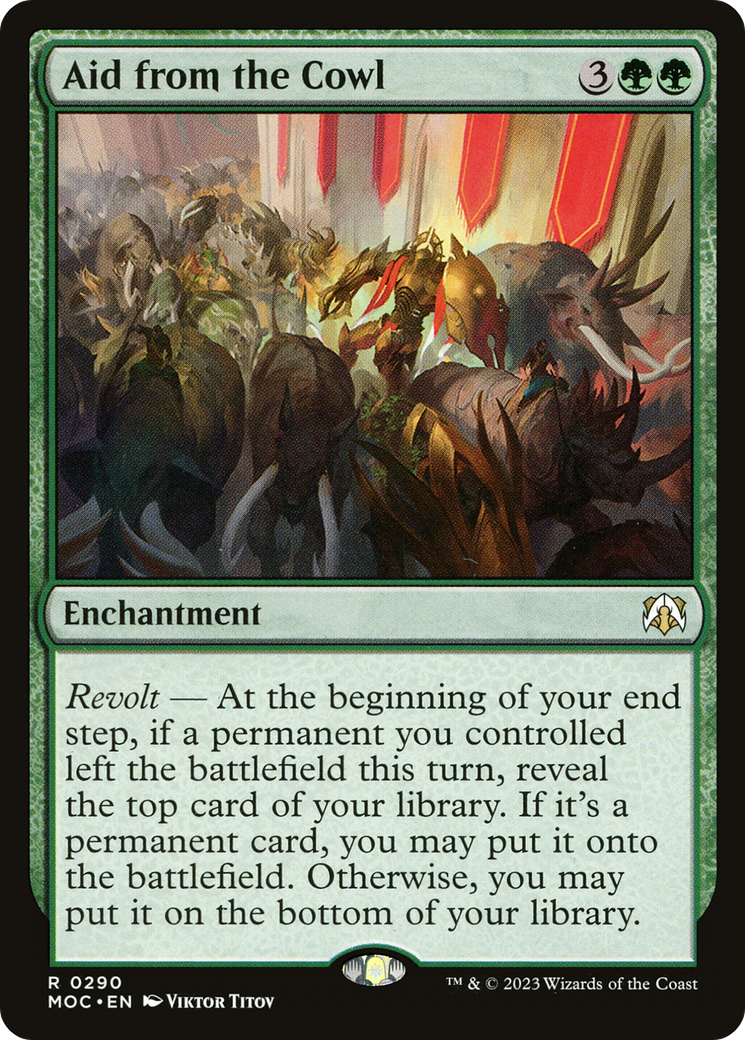
1
Aid from the Cowl
Aid from the Cowl
Enchantment
Revolt — At the beginning of your end step, if a permanent left the battlefield under your control this turn, reveal the top card of your library. If it's a permanent card, you may put it onto the battlefield. Otherwise, you may put it on the bottom of your library.
- If the revealed card is not a permanent card or if you choose not to put it onto the battlefield, you may put it on the bottom of your library. If you don't, it remains on top of your library.
- A permanent card is an artifact, creature, enchantment, land, or planeswalker card.
- If a permanent put onto the battlefield this way has an ability that triggers at the beginning of your end step, it won't trigger during this end step.
- Revolt abilities check only whether a permanent you controlled left the battlefield this turn or not. They don't apply multiple times if more than one permanent you controlled left the battlefield. They don't check whether the permanent that left the battlefield is still in the zone it moved to.
- Revolt abilities don't care why the permanent left the battlefield, who caused it to move, or where it moved to. They're equally satisfied by an artifact you sacrificed to pay a cost, a creature you controlled that was destroyed by Murder, or an enchantment you returned to your hand with Leave in the Dust.
- Tokens that leave the battlefield will satisfy a revolt ability.
- Energy counters aren't permanents. Paying won't satisfy a revolt ability.
- All cards in the Aether Revolt set with triggered revolt abilities use an intervening "if" clause. A permanent you controlled must have left the battlefield earlier in the turn in order for these abilities to trigger; otherwise they do nothing. In other words, there's no way to have the ability trigger if no permanent you controlled has left the battlefield that turn, even if you intend to have one do so in response to the triggered ability.
-
1
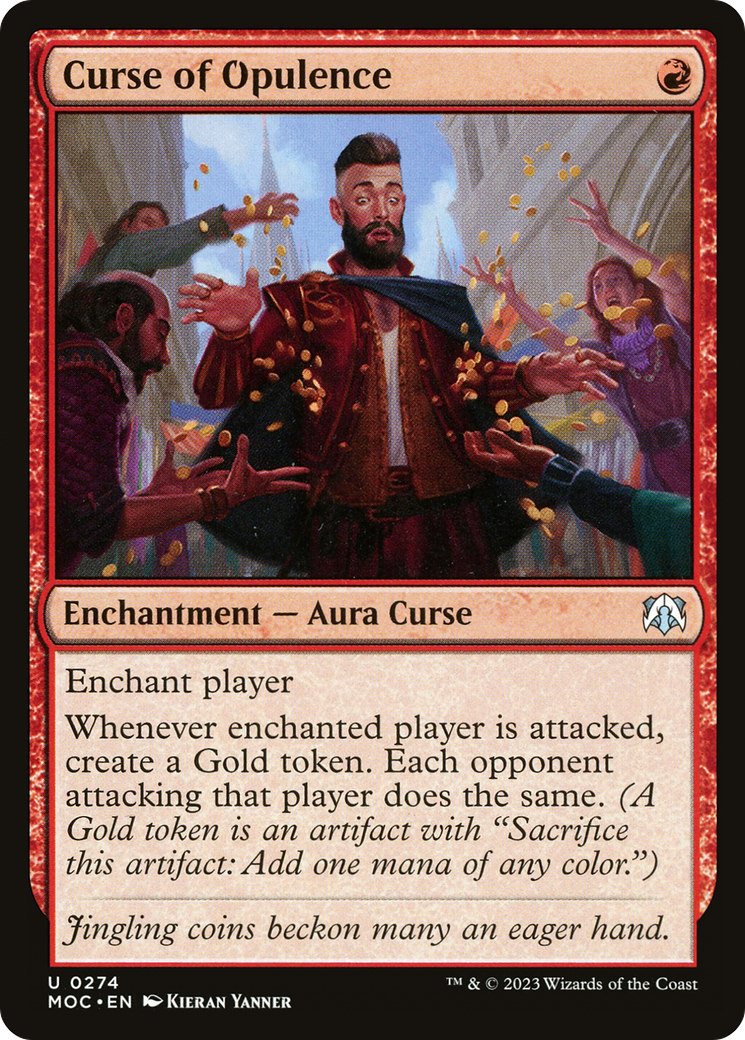
Curse of Opulence
Curse of Opulence
Enchantment — Aura Curse
Enchant player
Whenever enchanted player is attacked, create a Gold token. Each opponent attacking that player does the same. (A Gold token is an artifact with "Sacrifice this token: Add one mana of any color.")
- Curse of Opulence's triggered ability resolves after attackers have been declared. Any costs to attack must have already been paid before the attacking player creates the Gold.
- Each Curse's ability triggers only once, no matter how many creatures are attacking the enchanted player.
- A player is attacking another player if they control a creature that's attacking that player. If no creatures are attacking the enchanted player as a Curse's ability resolves (most likely because they've left the battlefield), only the Curse's controller performs its actions.
- The triggered ability of these Curses won't trigger if only a planeswalker controlled by the enchanted player is attacked.
- If you enchant yourself with one of these Curses, you'll get its effects whenever another player attacks you.
-
1
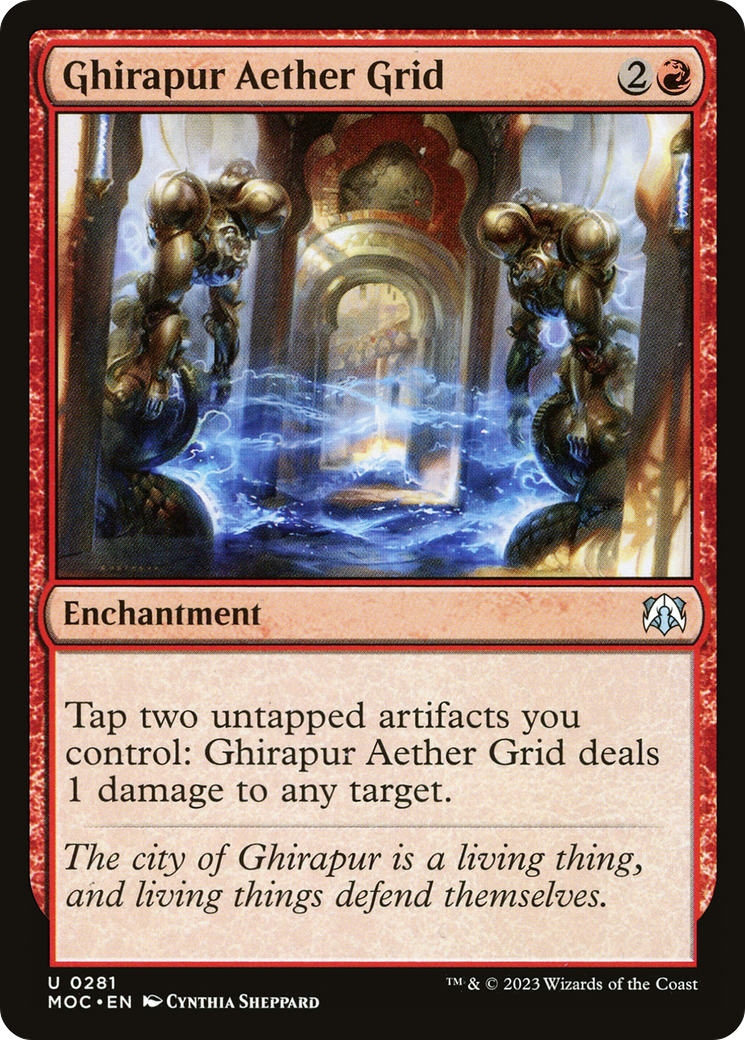
Ghirapur Aether Grid
Ghirapur Aether Grid
Enchantment
Tap two untapped artifacts you control: This enchantment deals 1 damage to any target.
- You may tap any two untapped artifacts you control, including artifact creatures that haven't been under your control continuously since the beginning of your most recent turn.
-
1
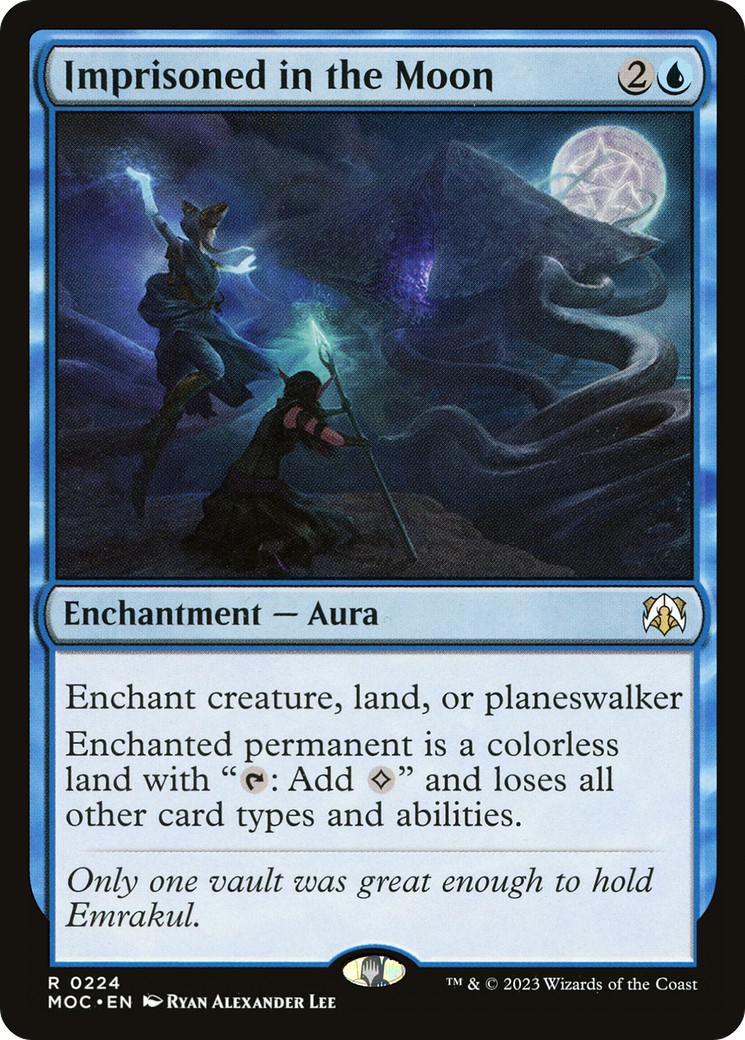
Imprisoned in the Moon
Imprisoned in the Moon
Enchantment — Aura
Enchant creature, land, or planeswalker
Enchanted permanent is a colorless land with " : Add " and loses all other card types and abilities.
- If you remove Imprisoned in the Moon from a planeswalker after tapping it for mana, you can still activate a loyalty ability of that planeswalker even though it's tapped.
- If the enchanted permanent is a land and has land types, it retains those types even though it loses any intrinsic mana abilities associated with them. For example, a Plains enchanted by Imprisoned in the Moon is still a Plains, but it can't tap for , only for .
- Becoming a land may cause other Auras to become illegally attached. These are put into their owner's graveyard, and any Equipment attached to the land become unattached and remain on the battlefield. Counters on the land remain on it even if they don't do anything.
- At the time the permanent becomes enchanted, Imprisoned in the Moon causes it to lose all abilities except the noted mana ability. Any abilities the permanent gains after that point will work normally.
- The permanent will keep any supertypes it previously had. Notably, if Imprisoned in the Moon is enchanting a legendary permanent, that permanent will continue to be legendary.
-
1
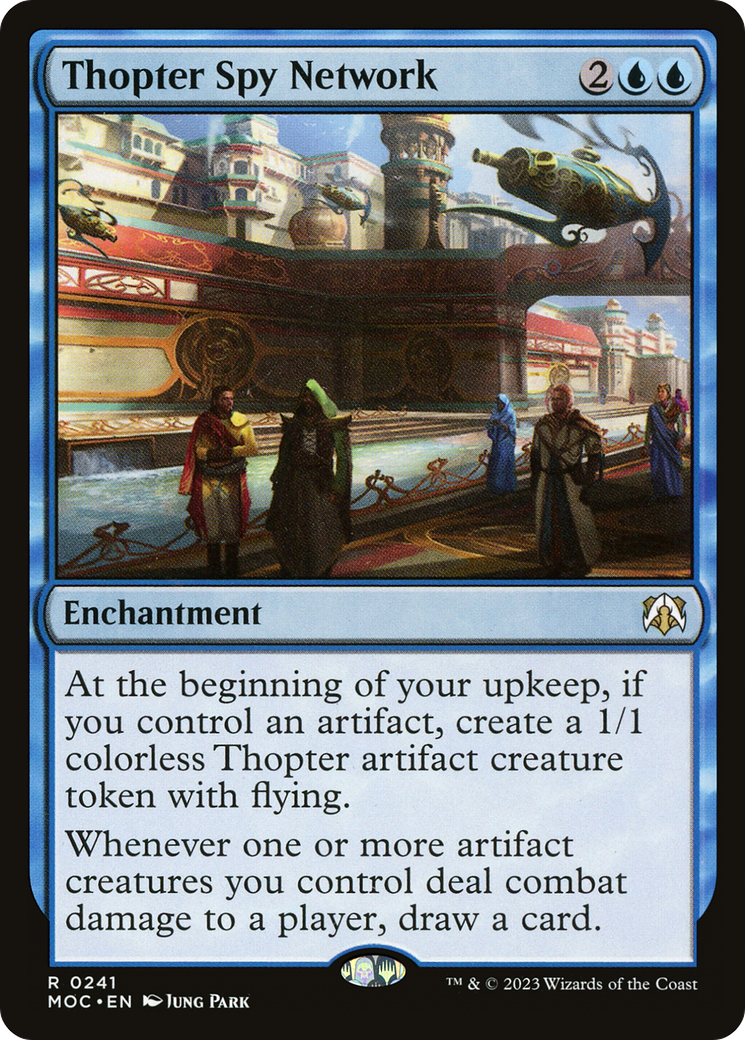
Thopter Spy Network
Thopter Spy Network
Enchantment
At the beginning of your upkeep, if you control an artifact, create a 1/1 colorless Thopter artifact creature token with flying.
Whenever one or more artifact creatures you control deal combat damage to a player, draw a card.
- Thopter Spy Network's first ability has an “intervening ‘if' clause.” That means (1) the ability won't trigger at all unless you control an artifact as your upkeep begins, and (2) the ability will do nothing if you don't control an artifact as it resolves.
- The last ability will trigger, at most, once per combat damage step per player. However, if at least one artifact creature you control has first strike and others don't, or if an artifact creature you control has double strike, the ability could trigger twice per combat: once in each combat damage step.
-
1
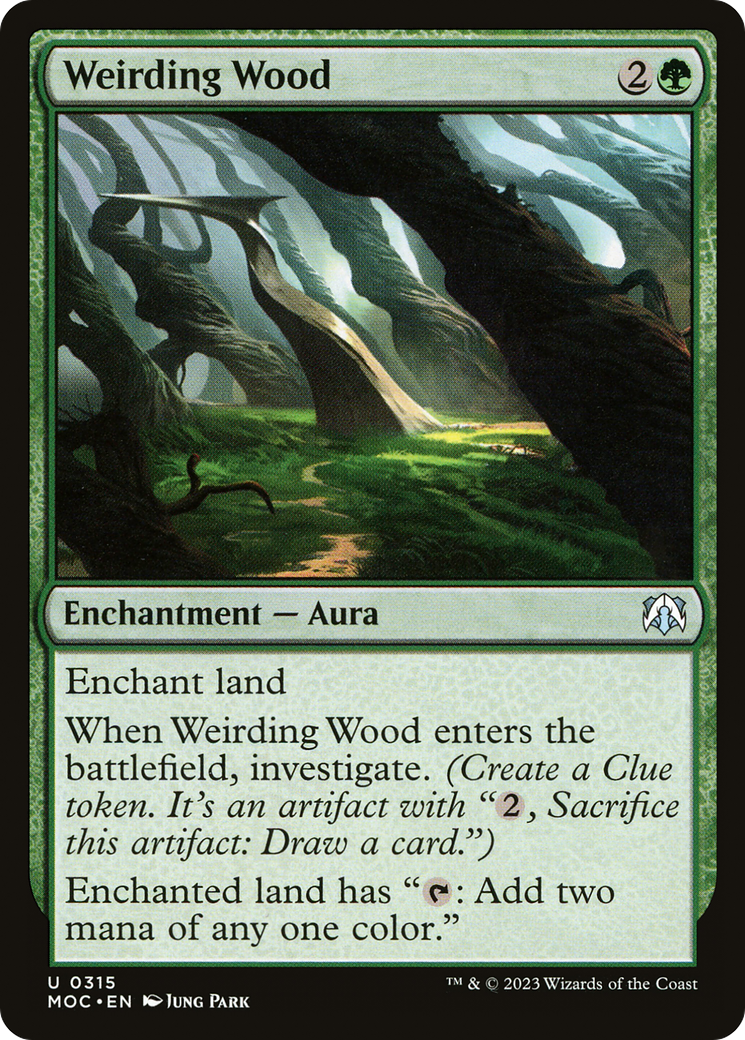
Weirding Wood
Weirding Wood
Enchantment — Aura
Enchant land
When this Aura enters, investigate. (Create a Clue token. It's an artifact with " , Sacrifice this token: Draw a card.")
Enchanted land has " : Add two mana of any one color."
- Clue is an artifact type. Even though it appears on some cards with other permanent types, it's never a creature type, a land type, or anything but an artifact type.
- If an effect refers to a Clue, it means any Clue artifact, not just a Clue artifact token. For example, you can sacrifice Wrench to pay for Alquist Proft, Master Sleuth's activated ability.
- You can't sacrifice a Clue to pay multiple costs. For example, you can't sacrifice a Clue token to activate its own ability and also to activate Alquist Proft, Master Sleuth's ability.
Lands 38
-
1
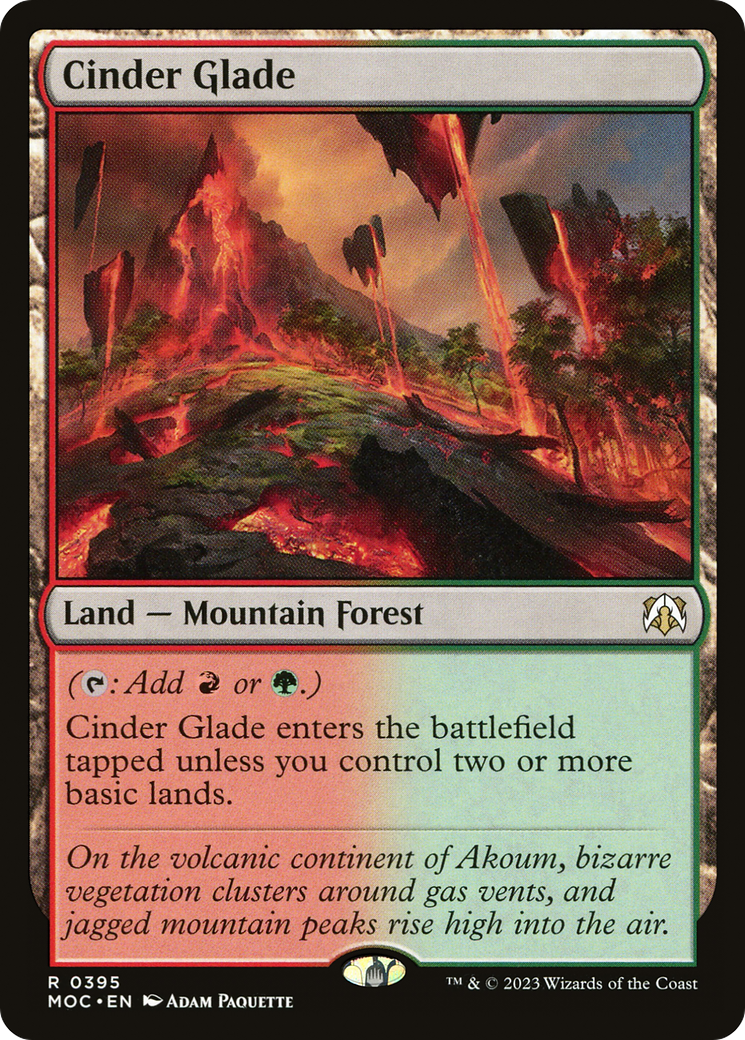
Cinder Glade
Cinder Glade
Land — Mountain Forest
( : Add or .)
This land enters tapped unless you control two or more basic lands.
- If one of these lands enters the battlefield at the same time as any number of basic lands, those other lands are not counted when determining if this land enters the battlefield tapped or untapped.
- However, because these cards have basic land types, effects that specify a basic land type without also specifying that the land be basic can affect them. For example, a spell or ability that reads "Destroy target Forest" can target Canopy Vista, while one that reads "Destroy target basic Forest" cannot.
- Even though these lands have basic land types, they are not basic lands because "basic" doesn't appear on their type line. Notably, controlling two or more of them won't allow others to enter the battlefield untapped.
-
1
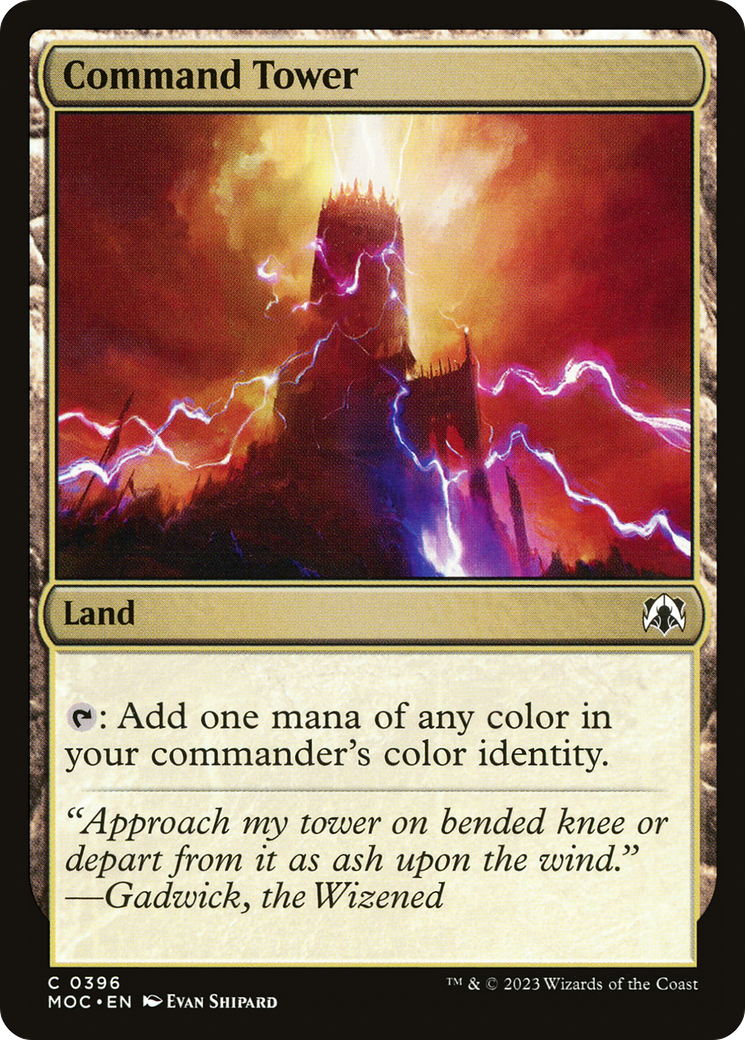
Command Tower
Command Tower
Land
: Add one mana of any color in your commander's color identity.
- If you don't have a commander, Command Tower's ability produces no mana.
- If your commander is a card that has no colors in its color identity, Command Tower's ability produces no mana. It doesn't produce .
- If you have two commanders, the ability adds one mana of any color in their combined color identities.
-
1
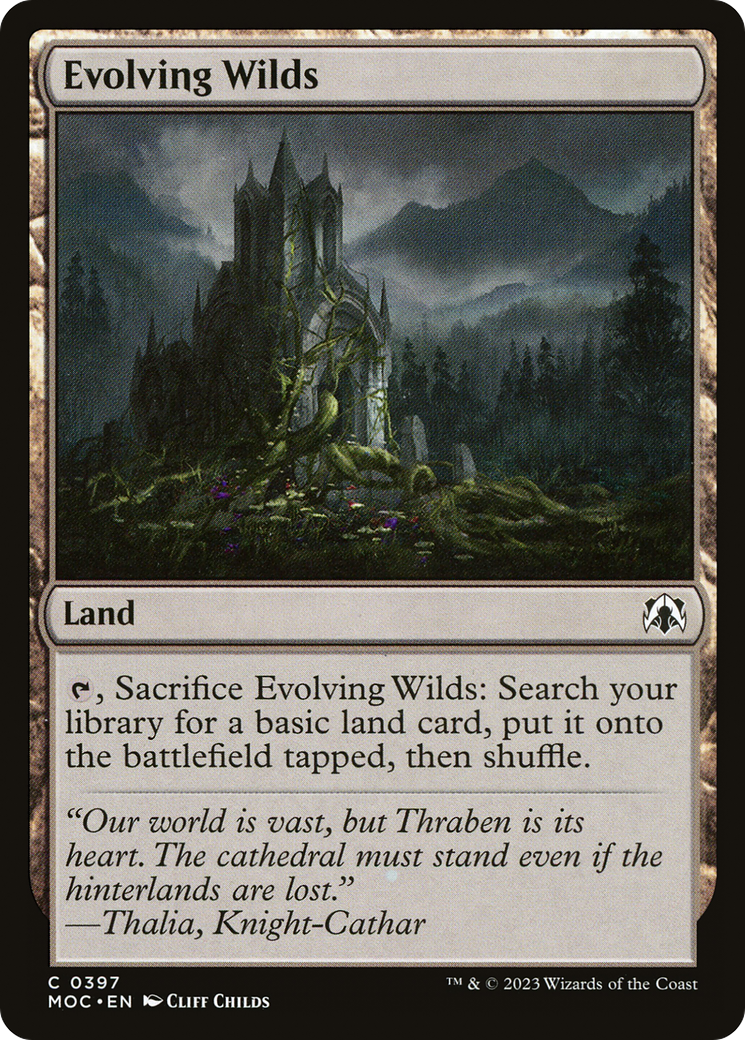
Evolving Wilds
Evolving Wilds
Land
, Sacrifice this land: Search your library for a basic land card, put it onto the battlefield tapped, then shuffle.
-
1
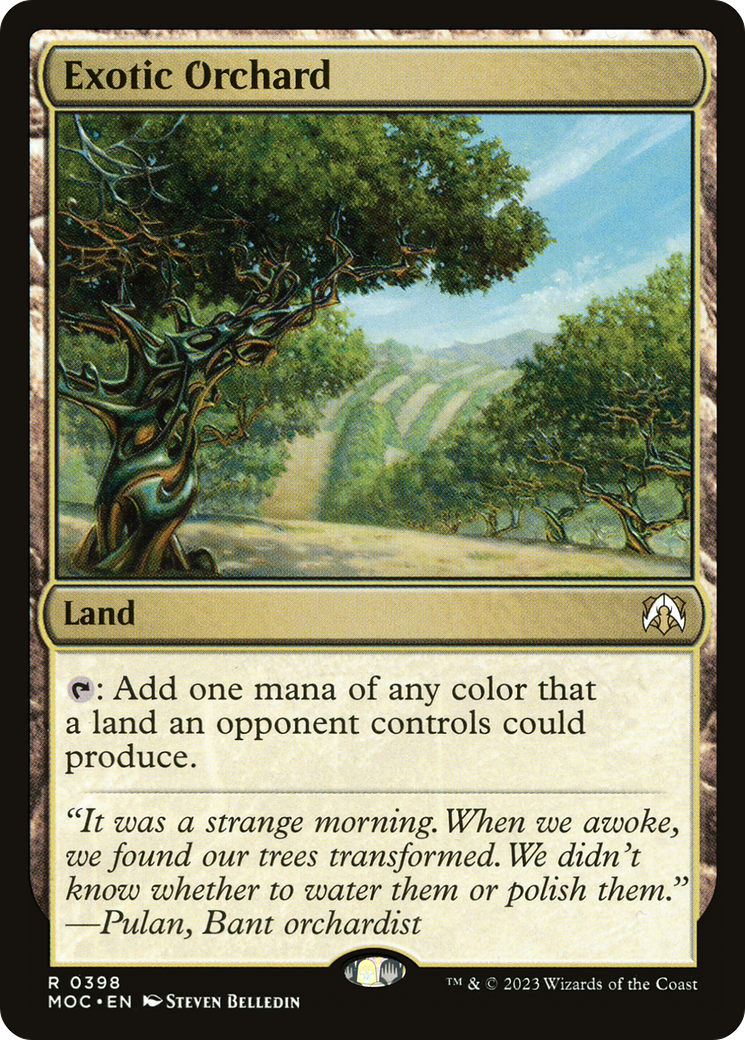
Exotic Orchard
Exotic Orchard
Land
: Add one mana of any color that a land an opponent controls could produce.
- Lands that produce mana based only on what other lands "could produce" won't help each other unless some other land allows one of them to actually produce some type of mana. For example, if you control an Exotic Orchard and your opponent controls an Exotic Orchard and a Reflecting Pool, none of those lands would produce mana if their mana abilities were activated. On the other hand, if you control a Forest and an Exotic Orchard, and your opponent controls an Exotic Orchard and a Reflecting Pool, then each of those lands can be tapped to produce . Your opponent's Exotic Orchard can produce because you control a Forest. Your Exotic Orchard and your opponent's Reflecting Pool can each produce because your opponent's Exotic Orchard can produce .
- When determining what colors of mana your opponents' lands could produce, Exotic Orchard takes into account any applicable replacement effects that would apply to those lands' mana abilities (such as Contamination's effect, for example). If there are more than one, consider them in any possible order.
- The colors of mana are white, blue, black, red, and green. Exotic Orchard can't be tapped for colorless mana, even if a land an opponent controls could produce colorless mana.
- Exotic Orchard doesn't care about any restrictions or riders your opponents' lands (such as Ancient Ziggurat or Hall of the Bandit Lord) put on the mana they produce. It just cares about colors of mana.
- Exotic Orchard checks the effects of all mana-producing abilities of lands your opponents control, but it doesn't check their costs. For example, Vivid Crag has the ability " , Remove a charge counter from Vivid Crag: Add one mana of any color." If an opponent controls Vivid Crag and you control Exotic Orchard, you can tap Exotic Orchard for any color of mana. It doesn't matter whether Vivid Crag has a charge counter on it, and it doesn't matter whether it's untapped.
-
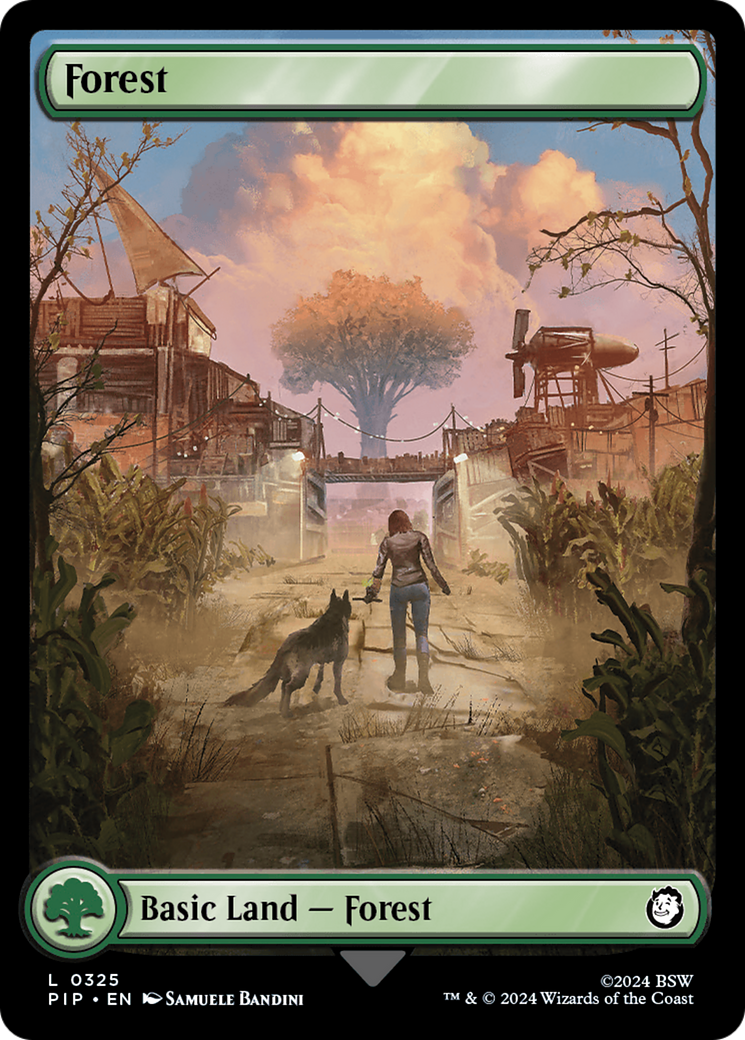
7
Forest
Forest
Basic Land — Forest
( : Add .)
-
1
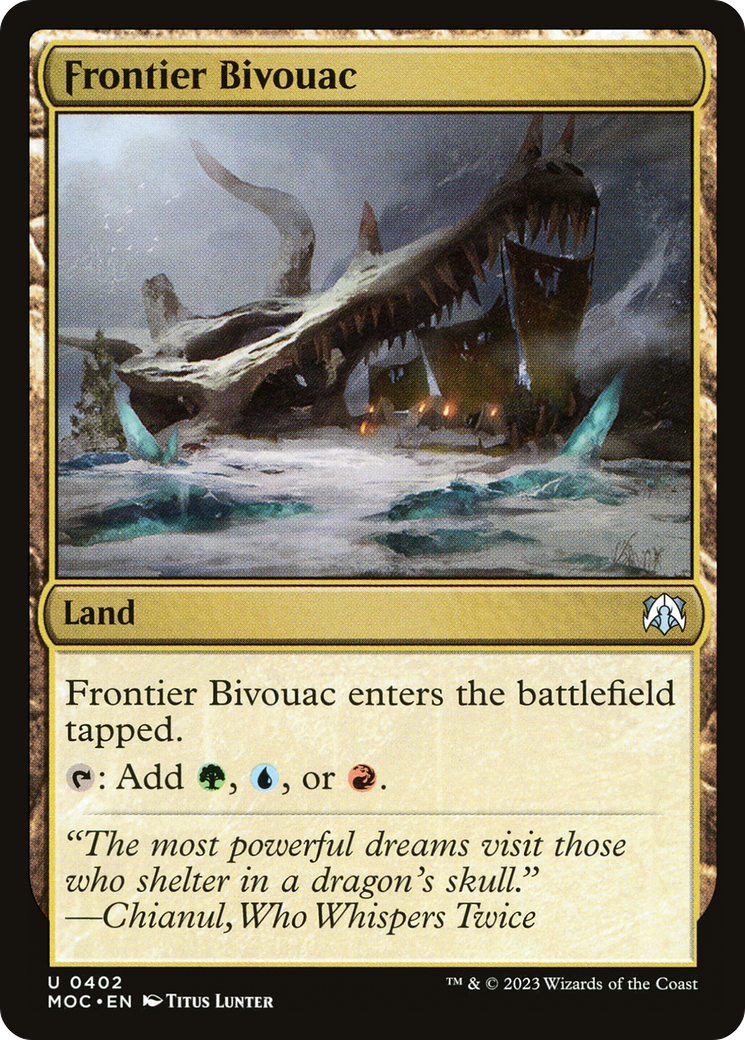
Frontier Bivouac
Frontier Bivouac
Land
This land enters tapped.
: Add , , or .
-
1
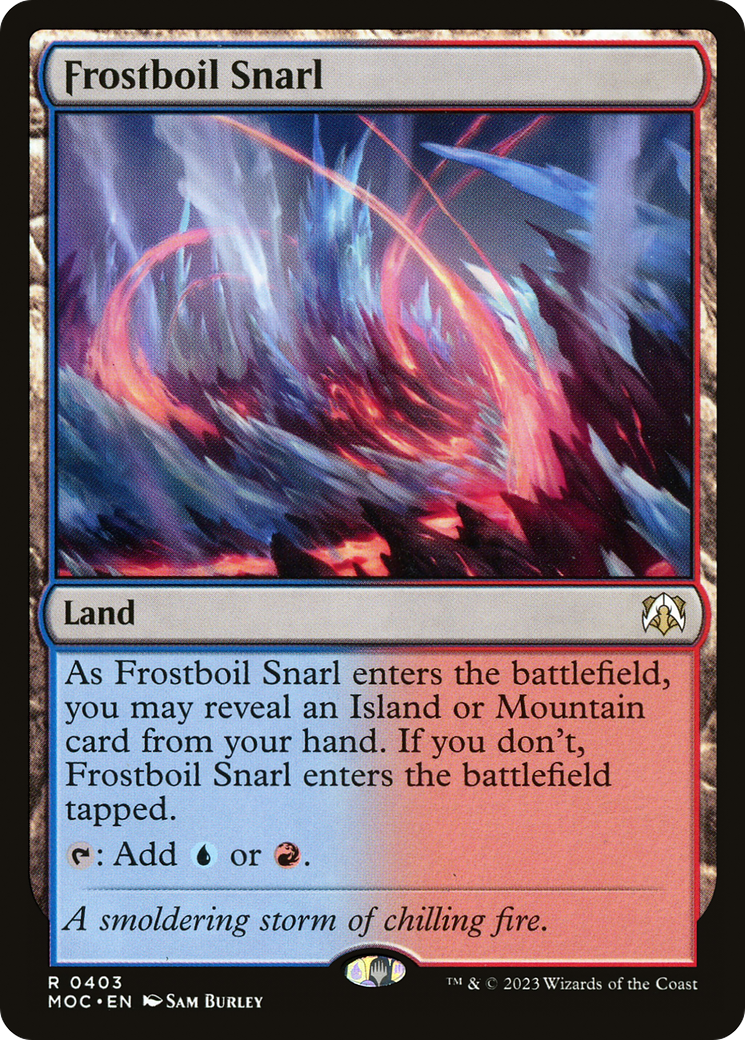
Frostboil Snarl
Frostboil Snarl
Land
As this land enters, you may reveal an Island or Mountain card from your hand. If you don't, this land enters tapped.
: Add or .
- The "Snarl" itself doesn't have any land subtypes. You can't reveal one to satisfy the ability of another.
- If a land card with an appropriate subtype is entering the battlefield from your hand at the same time as one of these lands, you may reveal the other land to have the "Snarl" enter untapped.
- If an effect instructs you to put one of these lands onto the battlefield tapped, it will still enter the battlefield tapped even if you reveal a land card from your hand.
- You may reveal any land card with either or both of the appropriate subtypes. It doesn't have to be a basic land card.
-
1
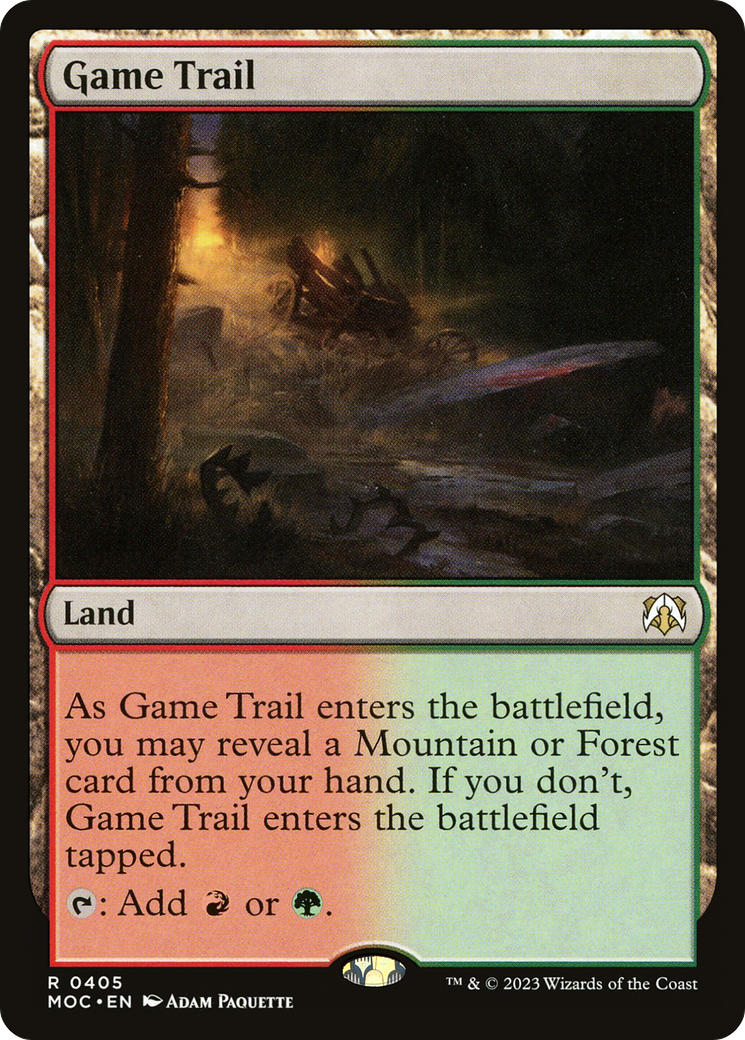
Game Trail
Game Trail
Land
As this land enters, you may reveal a Mountain or Forest card from your hand. If you don't, this land enters tapped.
: Add or .
- Lands don't have a subtype just because they can produce mana of the corresponding color. Game Trail itself is neither a Mountain nor a Forest, even though it produces red and green mana, so you can't reveal one to satisfy the ability of another.
- If an effect instructs you to put Game Trail onto the battlefield tapped, it will still enter the battlefield tapped even if you reveal a land card from your hand.
- You may reveal any land card with either or both of the appropriate subtypes. It doesn't have to be a basic land. For example, you could reveal Canopy Vista from the Battle for Zendikar set to satisfy the ability of Game Trail.
- If a Mountain or Forest is entering the battlefield from your hand at the same time as Game Trail, you may reveal the other land to have Game Trail enter untapped.
-
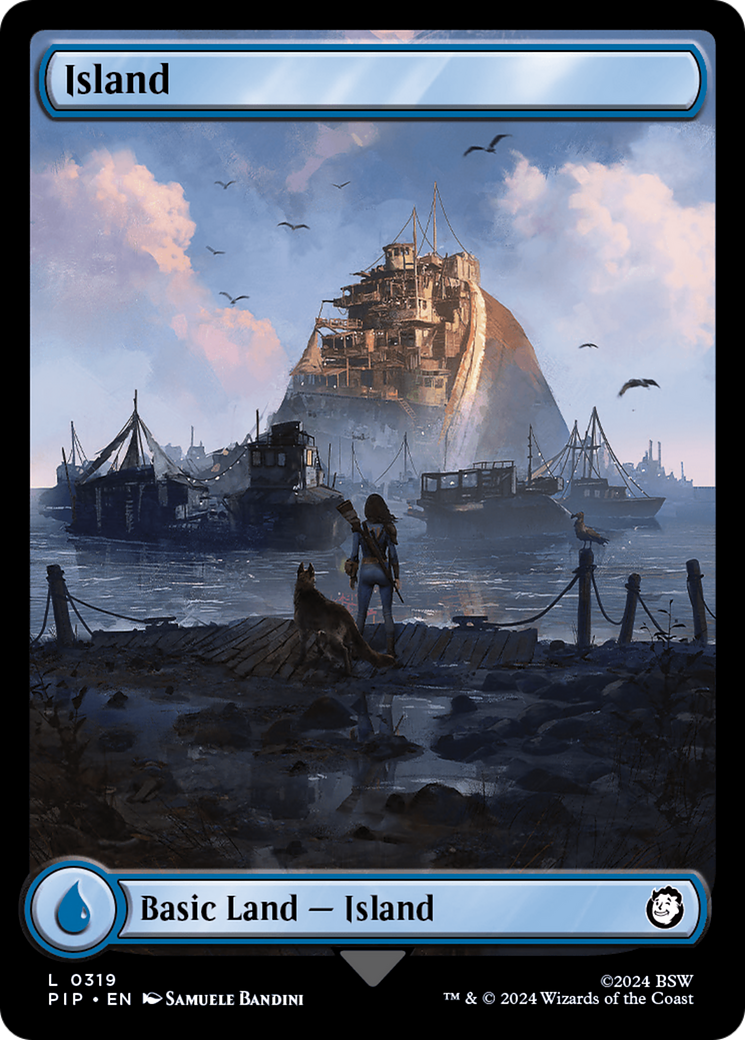
8
Island
Island
Basic Land — Island
( : Add .)
-
8
Mountain
Mountain
Basic Land — Mountain
( : Add .)
-
1
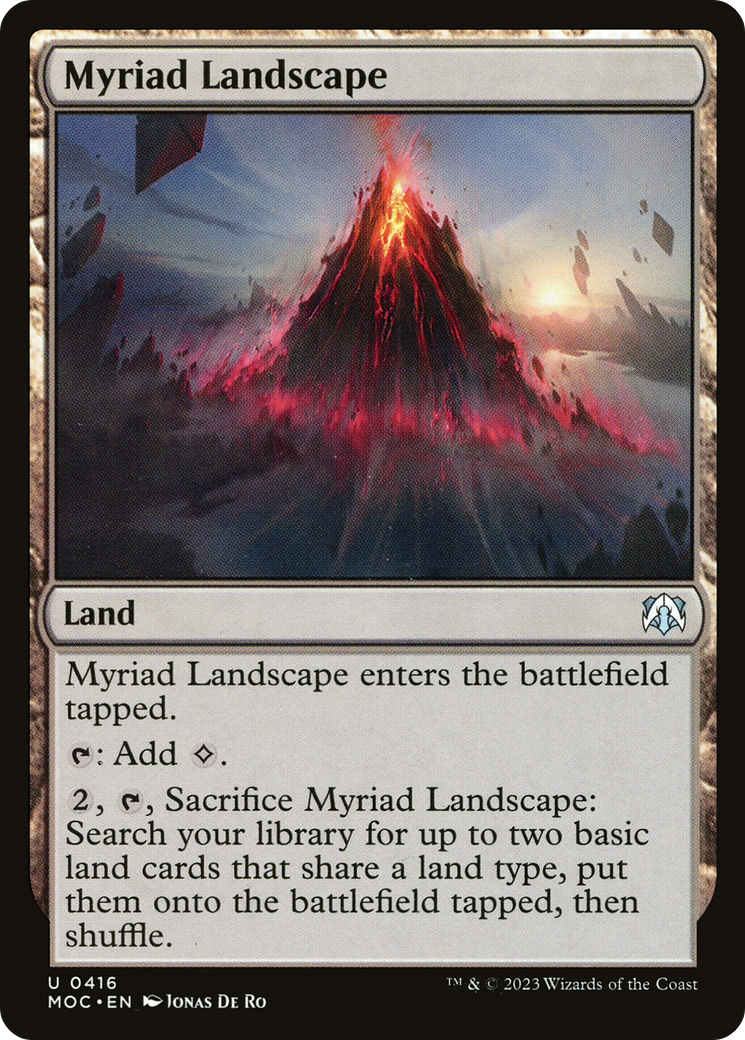
Myriad Landscape
Myriad Landscape
Land
This land enters tapped.
: Add .
, , Sacrifice this land: Search your library for up to two basic land cards that share a land type, put them onto the battlefield tapped, then shuffle.
- You can choose to find one basic land card with Myriad Landscape's last ability.
-
1
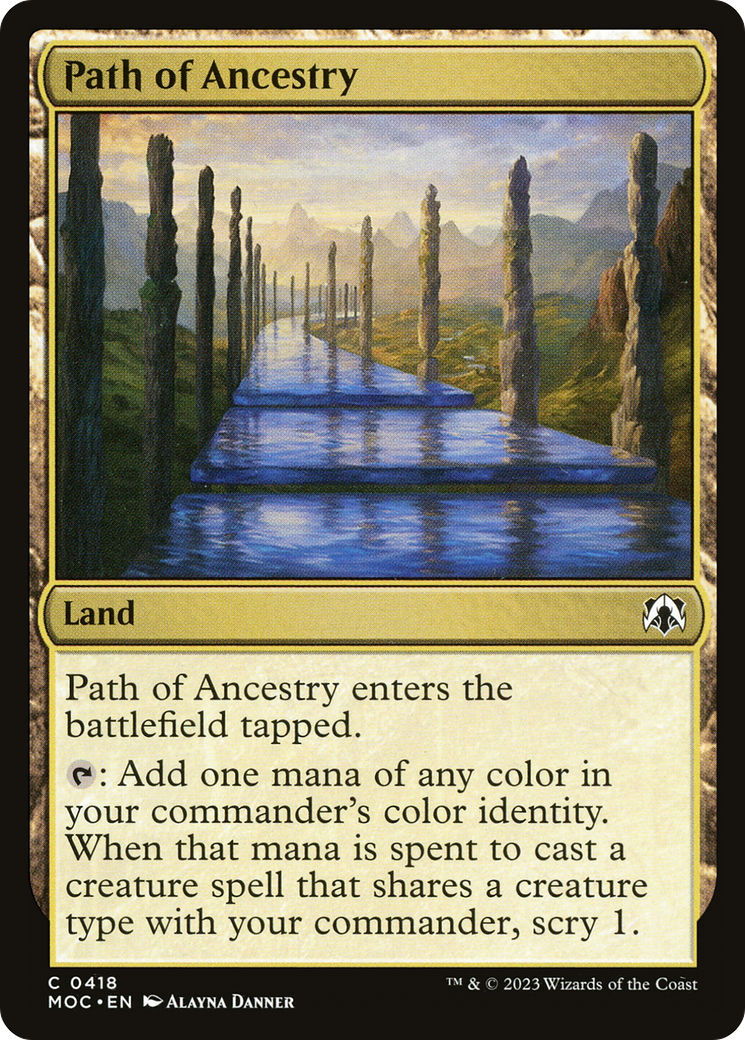
Path of Ancestry
Path of Ancestry
Land
This land enters tapped.
: Add one mana of any color in your commander's color identity. When that mana is spent to cast a creature spell that shares a creature type with your commander, scry 1. (Look at the top card of your library. You may put that card on the bottom.)
- Your commander's creature types are checked immediately after you cast a creature spell spending mana from Path of Ancestry's last ability. They aren't set before the game begins, and they may not be the same types your commander had when you activated that ability.
- If you have two commanders, the last ability adds one mana of any color in their combined color identities. When you spend that mana on a creature spell that shares a creature type with either of your commanders, you'll scry 1.
- If Path of Ancestry's last ability produces two mana (most likely due to Mana Reflection), spending those two mana to cast creature spells that share a creature type with your commander will cause two abilities to trigger. Each of those abilities will cause you to scry 1. You won't scry 2. This is true whether you spend the mana on one creature spell or two.
- If your commander has no creature types, it can't share a creature type with any spell that you cast.
- If you cast your commander with mana from Path of Ancestry, and your commander hasn't somehow lost all of its creature types while on the stack, you'll scry 1.
- If you don't have a commander, Path of Ancestry's ability produces no mana.
- If your commander is a card that has no colors in its color identity, Path of Ancestry's ability produces no mana. It doesn't produce .
-
1
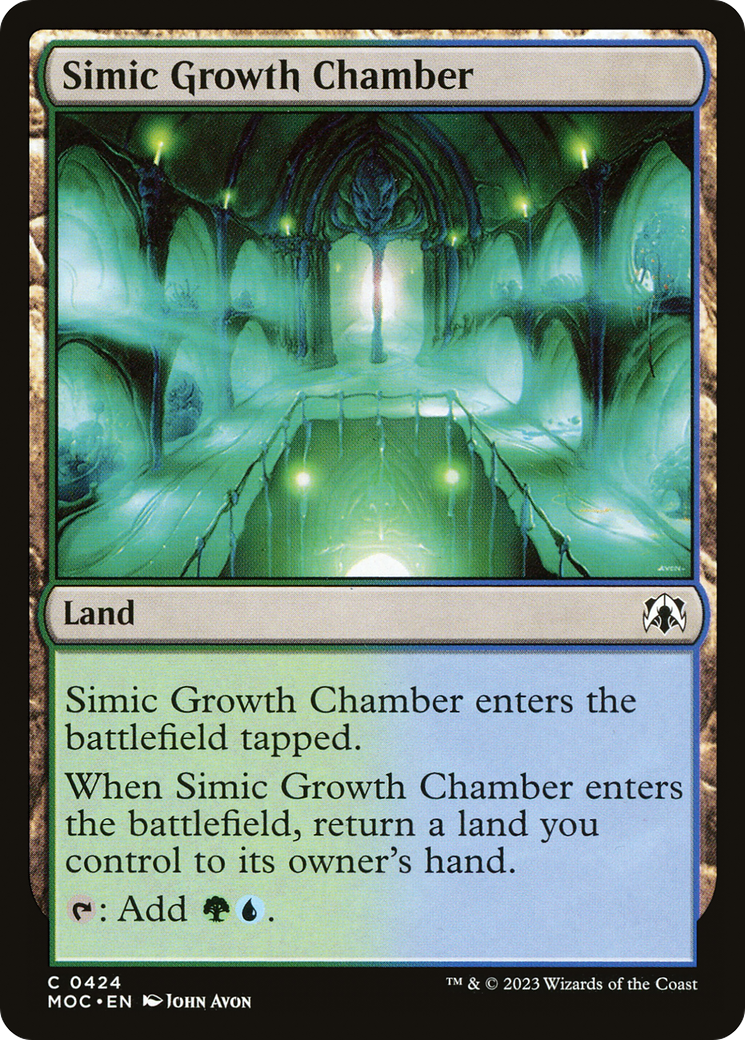
Simic Growth Chamber
Simic Growth Chamber
Land
This land enters tapped.
When this land enters, return a land you control to its owner's hand.
: Add .
- If this land enters the battlefield and you control no other lands, its ability will force you to return it to your hand.
-
1
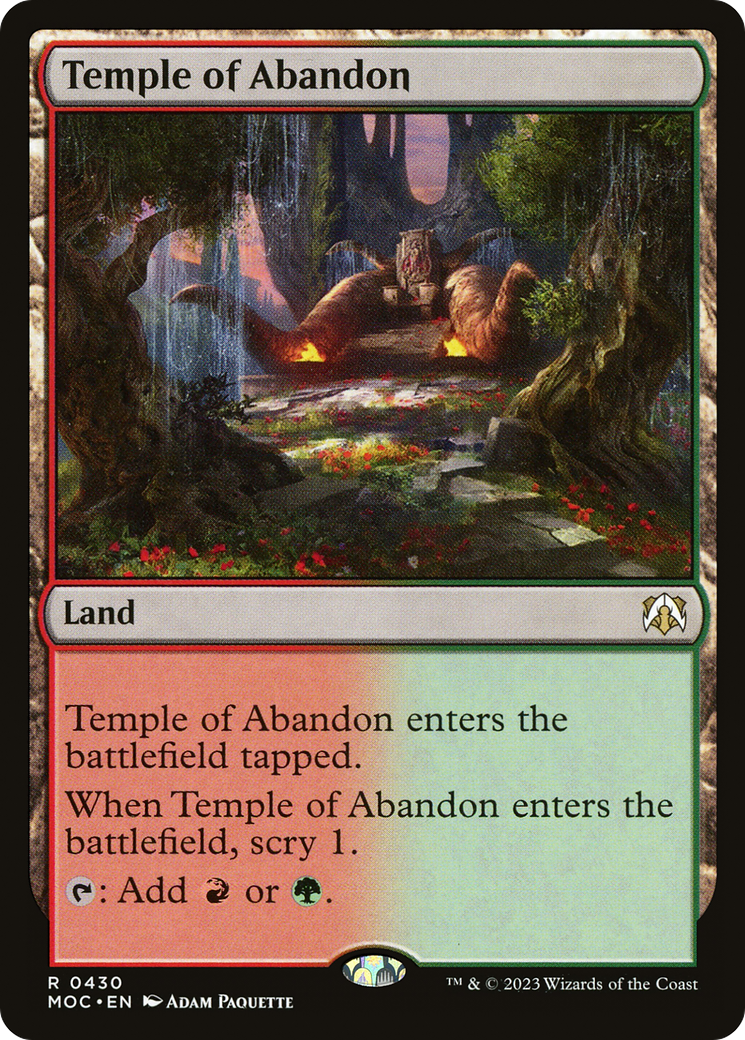
Temple of Abandon
Temple of Abandon
Land
This land enters tapped.
When this land enters, scry 1. (Look at the top card of your library. You may put that card on the bottom.)
: Add or .
- You perform the actions stated on a card in sequence. For some spells and abilities, that means you'll scry last. For others, that means you'll scry and then perform other actions.
- When you scry, you may put all the cards you look at back on top of your library, you may put all of those cards on the bottom of your library, or you may put some of those cards on top and the rest of them on the bottom.
- You choose how to order cards returned to your library after scrying no matter where you put them.
- Scry appears on some spells and abilities with one or more targets. If all of the spell or ability's targets are illegal when it tries to resolve, it won't resolve and none of its effects will happen. You won't scry.
-
1
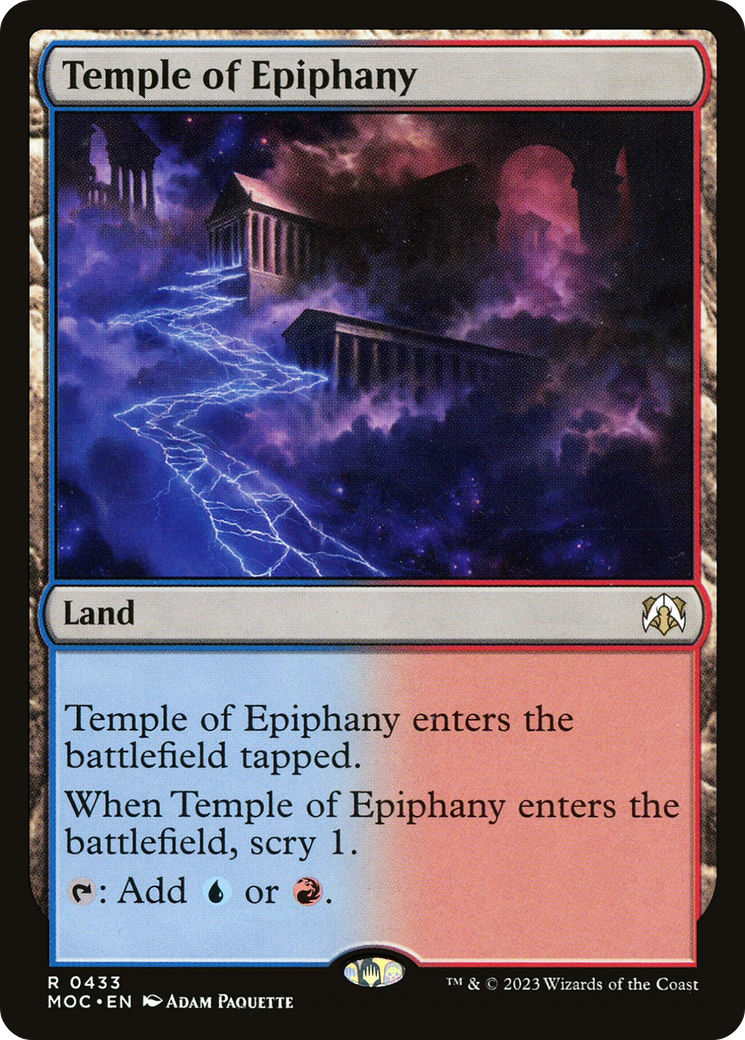
Temple of Epiphany
Temple of Epiphany
Land
This land enters tapped.
When this land enters, scry 1. (Look at the top card of your library. You may put that card on the bottom.)
: Add or .
-
1
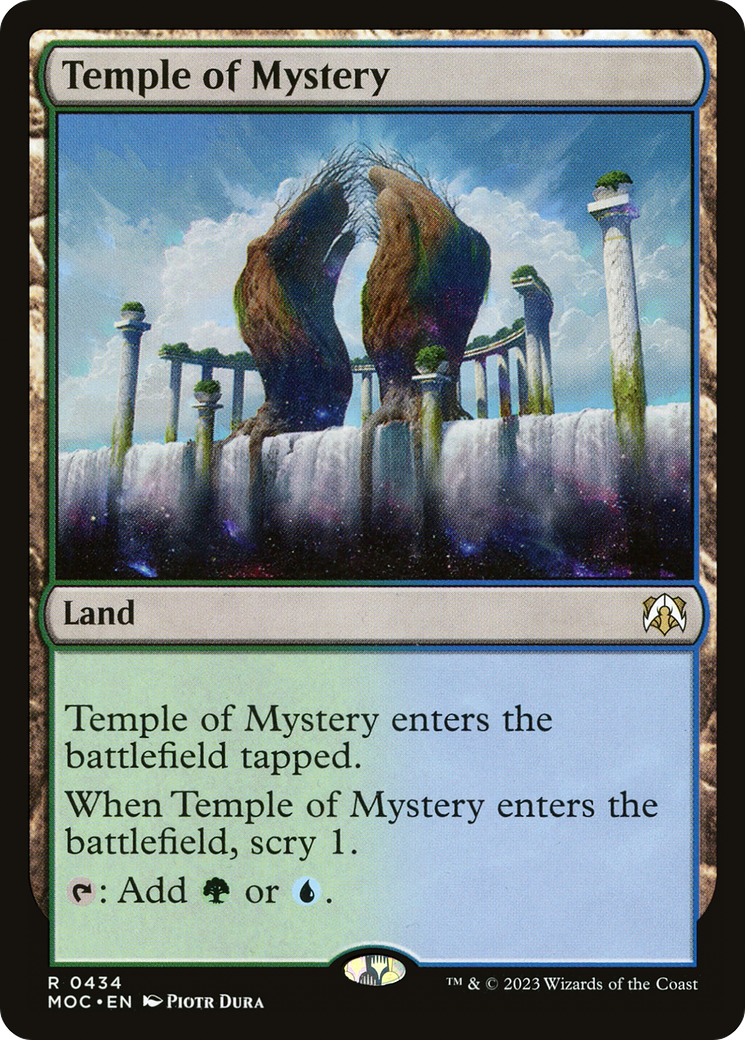
Temple of Mystery
Temple of Mystery
Land
This land enters tapped.
When this land enters, scry 1. (Look at the top card of your library. You may put that card on the bottom.)
: Add or .
- When you scry, you may put all the cards you look at back on top of your library, you may put all of those cards on the bottom of your library, or you may put some of those cards on top and the rest of them on the bottom.
- You choose how to order cards returned to your library after scrying no matter where you put them.
- You perform the actions stated on a card in sequence. For some spells and abilities, that means you'll scry last. For others, that means you'll scry and then perform other actions.
- Scry appears on some spells and abilities with one or more targets. If all of the spell or ability's targets are illegal when it tries to resolve, it won't resolve and none of its effects will happen. You won't scry.
-
1
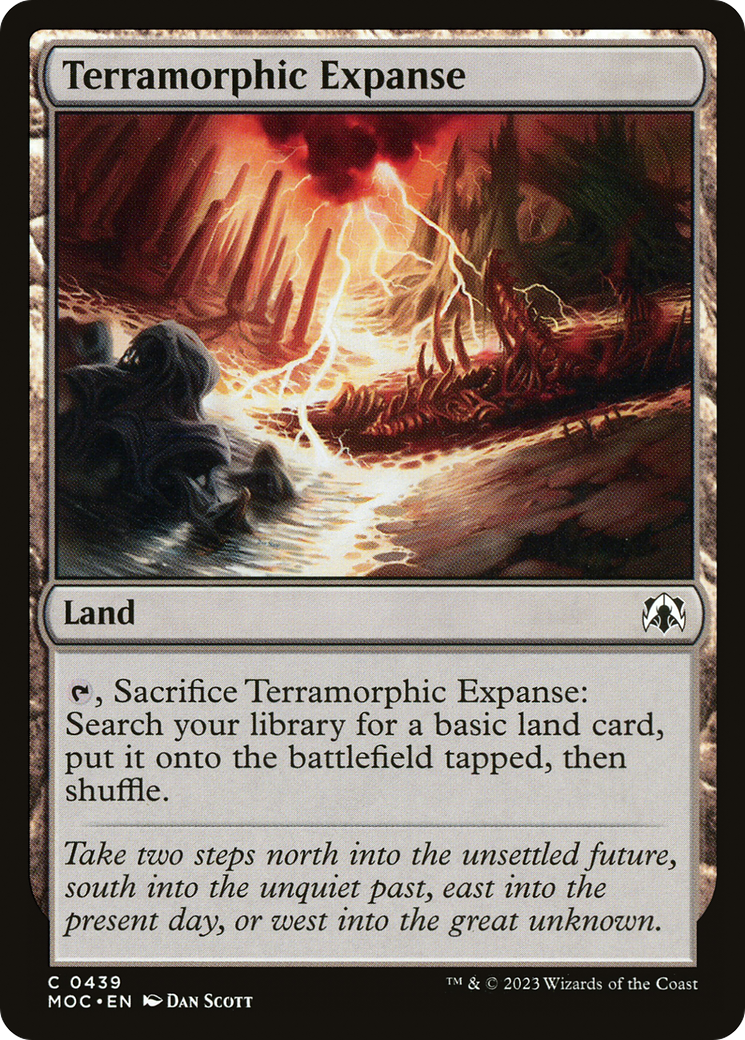
Terramorphic Expanse
Terramorphic Expanse
Land
, Sacrifice this land: Search your library for a basic land card, put it onto the battlefield tapped, then shuffle.
-
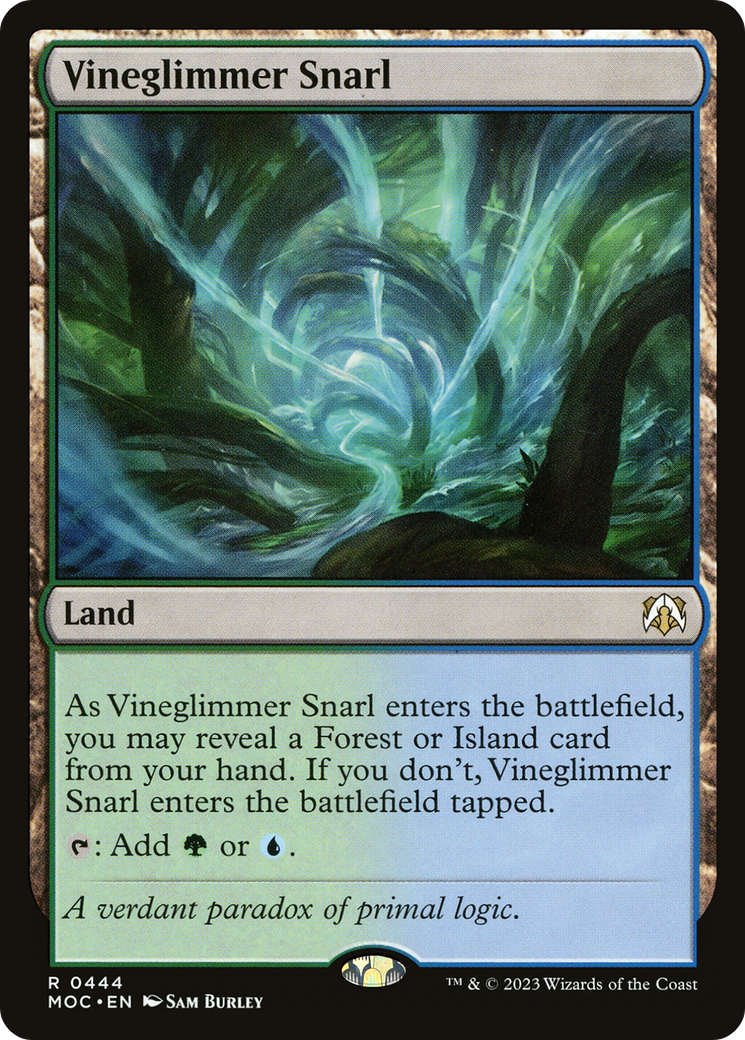
1
Vineglimmer Snarl
Vineglimmer Snarl
Land
As this land enters, you may reveal a Forest or Island card from your hand. If you don't, this land enters tapped.
: Add or .
- You may reveal any land card with either or both of the appropriate subtypes. It doesn't have to be a basic land card.
- The "Snarl" itself doesn't have any land subtypes. You can't reveal one to satisfy the ability of another.
- If a land card with an appropriate subtype is entering the battlefield from your hand at the same time as one of these lands, you may reveal the other land to have the "Snarl" enter untapped.
- If an effect instructs you to put one of these lands onto the battlefield tapped, it will still enter the battlefield tapped even if you reveal a land card from your hand.
Blue 20
-
1
Echo Storm
Echo Storm
Sorcery
When you cast this spell, copy it for each time you've cast your commander from the command zone this game. You may choose new targets for the copies.
Create a token that's a copy of target artifact.
- If you have multiple commanders, you'll copy this spell for each time you've cast either of them. For example, if you've cast one commander once and one twice, you'll copy this spell three times.
- The token copies exactly what was printed on the original artifact and nothing else (unless that artifact is copying something else or is a token; see below). It doesn't copy whether that artifact is tapped or untapped, whether it has any counters on it or Auras attached to it, or any non-copy effects that have changed its types, color, or so on.
- If the copied artifact has in its mana cost, X is considered to be 0.
- If the copied artifact is a token, the token that's created copies the original characteristics of that token as stated by the effect that created the token.
- If the copied artifact is copying something else (for example, if the copied artifact is a Sculpting Steel), then the token enters the battlefield as whatever that artifact copied.
- Each copy resolves one at a time. Any abilities that trigger on the artifact token entering the battlefield resolve before the next copy resolves. The original spell is the last to resolve.
- Each Storm's triggered ability counts only how many times you've cast your commander from the command zone before that triggered ability resolves. If you cast your commander again later, you won't get another copy.
- If your commander was countered, that time you cast it still counts.
- Each Storm's triggered ability can copy the Storm spell even if that spell is countered before that ability resolves.
- The copies are created on the stack, so they're not “cast.” Abilities that trigger when a player casts a spell (such as the Storm's ability itself) won't trigger.
- Any enters-the-battlefield abilities of the copied artifact will trigger when the token enters the battlefield. Any “as [this artifact] enters the battlefield” or “[this artifact] enters the battlefield with” abilities of the chosen artifact will also work.
-
1
Imprisoned in the Moon
Imprisoned in the Moon
Enchantment — Aura
Enchant creature, land, or planeswalker
Enchanted permanent is a colorless land with " : Add " and loses all other card types and abilities.
- If you remove Imprisoned in the Moon from a planeswalker after tapping it for mana, you can still activate a loyalty ability of that planeswalker even though it's tapped.
- If the enchanted permanent is a land and has land types, it retains those types even though it loses any intrinsic mana abilities associated with them. For example, a Plains enchanted by Imprisoned in the Moon is still a Plains, but it can't tap for , only for .
- Becoming a land may cause other Auras to become illegally attached. These are put into their owner's graveyard, and any Equipment attached to the land become unattached and remain on the battlefield. Counters on the land remain on it even if they don't do anything.
- At the time the permanent becomes enchanted, Imprisoned in the Moon causes it to lose all abilities except the noted mana ability. Any abilities the permanent gains after that point will work normally.
- The permanent will keep any supertypes it previously had. Notably, if Imprisoned in the Moon is enchanting a legendary permanent, that permanent will continue to be legendary.
-
1
Junk Winder
Junk Winder
Creature — Serpent
5/6
Affinity for tokens (This spell costs less to cast for each token you control.)
Whenever a token you control enters, tap target nonland permanent an opponent controls. It doesn't untap during its controller's next untap step.
-
1
Master of Etherium
Master of Etherium
Artifact Creature — Vedalken Wizard
*/*
Master of Etherium's power and toughness are each equal to the number of artifacts you control.
Other artifact creatures you control get +1/+1.
- The ability that defines Master of Etherium's power and toughness applies in all zones, not just the battlefield.
- As long as Master of Etherium is on the battlefield, its ability will count itself.
- Because damage remains marked on a creature until the damage is removed as the turn ends, nonlethal damage dealt to Master of Etherium may become lethal if other artifacts you control leave the battlefield during that turn, and damage dealt to other artifact creatures you control may become lethal if Master of Etherium leaves the battlefield during that turn.
-
1
Masterful Replication
Masterful Replication
Instant
Choose one —
- Create two 3/3 colorless Golem artifact creature tokens.
- Choose target artifact you control. Each other artifact you control becomes a copy of that artifact until end of turn.
- Masterful Replication copies the printed values of the target artifact. It won't copy counters on that artifact or effects that have changed its power, toughness, types, color, or so on. Notably, it won't copy effects that made the target artifact become an artifact creature if it isn't normally an artifact creature.
- An Equipment that becomes a copy of a creature becomes unattached if it was attached to a creature. An Equipment that becomes a copy of another Equipment remains attached if it was attached to a creature.
- If the target artifact is copying something else, then your artifacts become copies of whatever the target artifact copied.
- Becoming a copy won't change whether an artifact is a token.
-
1
Perplexing Test
Perplexing Test
Instant
Choose one —
- Return all creature tokens to their owners' hands.
- Return all nontoken creatures to their owners' hands.
- A token that is returned to its owner's hand ceases to exist as a state-based action the next time a player would receive priority.
-
1
Reality Shift
Reality Shift
Instant
Exile target creature. Its controller manifests the top card of their library. (That player puts the top card of their library onto the battlefield face down as a 2/2 creature. If it's a creature card, it can be turned face up any time for its mana cost.)
- Any time you have priority, you may turn a manifested creature face up by revealing that it's a creature card (ignoring any copy effects or type-changing effects that might be applying to it) and paying its mana cost. This is a special action. It doesn't use the stack and can't be responded to.
- Because the permanent is on the battlefield both before and after it's turned face up, turning a permanent face up doesn't cause any enters-the-battlefield abilities to trigger.
- A permanent that turns face up or face down changes characteristics but is otherwise the same permanent. Spells and abilities that were targeting that permanent, as well as Auras and Equipment that were attached to the permanent, aren't affected.
- At any time, you can look at a face-down permanent you control. You can't look at face-down permanents you don't control unless an effect allows you to or instructs you to.
- The face-down permanent is a 2/2 creature with no name, mana cost, creature types, or abilities. It's colorless and has a mana value of 0. Other effects that apply to the permanent can still grant or change any of these characteristics.
- If a face-down permanent you control leaves the battlefield, you must reveal it. You must also reveal all face-down spells and permanents you control if you leave the game or if the game ends.
- If a manifested creature would have morph if it were face up, you may also turn it face up by paying its morph cost.
- Turning a permanent face up or face down doesn't change whether that permanent is tapped or untapped.
- Because face-down creatures don't have names, they can't have the same name as any other creature, even another face-down creature.
- If a double-faced card is manifested, it will be put onto the battlefield face down. While face down, it can't transform. If the front face of the card is a creature card, you can turn it face up by paying its mana cost. If you do, its front face will be up.
- There are no cards in the Fate Reforged set that would turn a face-down instant or sorcery card on the battlefield face up, but some older cards can try to do this. If something tries to turn a face-down instant or sorcery card on the battlefield face up, reveal that card to show all players it's an instant or sorcery card. The permanent remains on the battlefield face down. Abilities that trigger when a permanent turns face up won't trigger, because even though you revealed the card, it never turned face up.
- Unlike a face-down creature that was cast using the morph ability, a manifested creature may still be turned face up after it loses its abilities if it's a creature card.
- You must ensure that your face-down spells and permanents can easily be differentiated from each other. You're not allowed to mix up the cards that represent them on the battlefield in order to confuse other players. The order they entered the battlefield should remain clear. Common methods for indicating this include using markers or dice, or simply placing them in order on the battlefield. You must also track how each became face down (manifested, cast face down using the morph ability, and so on).
-
1
Reverse Engineer
Reverse Engineer
Sorcery
Improvise (Your artifacts can help cast this spell. Each artifact you tap after you're done activating mana abilities pays for .)
Draw three cards.
- Equipment attached to a creature doesn't become tapped when that creature becomes tapped, and tapping that Equipment doesn't cause the creature to become tapped.
- When using improvise to cast a spell with in its mana cost, first choose the value for X. That choice, plus any cost increases or decreases, will determine the spell's total cost. Then you can tap artifacts you control to help pay that cost. For example, if you cast Saheeli's Directive and choose X to be 3, the total cost is . If you tap two artifacts, you'll have to pay .
- Improvise doesn't change a spell's mana cost or mana value.
- When calculating a spell's total cost, include any alternative costs, additional costs, or anything else that increases or reduces the cost to cast the spell. Improvise applies after the total cost is calculated.
- Improvise can't pay for , , , , , or mana symbols in a spell's total cost.
- Improvise can't be used to pay for anything other than the cost of casting the spell. For example, it can't be used during the resolution of an ability that says “Counter target spell unless its controller pays .”
- If an artifact you control has a mana ability with in the cost, activating that ability while casting a spell with improvise will result in the artifact being tapped when you pay the spell's costs. You won't be able to tap it again for improvise. Similarly, if you sacrifice an artifact to activate a mana ability while casting a spell with improvise, that artifact won't be on the battlefield when you pay the spell's costs, so you won't be able to tap it for improvise.
- Tapping an artifact won't cause its abilities to stop applying unless those abilities say so.
-
1
Rise and Shine
Rise and Shine
Sorcery
Target noncreature artifact you control becomes a 0/0 artifact creature. Put four +1/+1 counters on each artifact that became a creature this way.
Overload (You may cast this spell for its overload cost. If you do, change "target" in its text to "each.")
- If you don't pay the overload cost of a spell with overload, that spell will have a single target. If you pay the overload cost, the spell won't have any targets.
- Because a spell with overload doesn't target when its overload cost is paid, it may affect permanents with hexproof or with protection from the appropriate color.
- To determine the total cost of a spell, start with the mana cost or alternative cost you're paying (such as an overload cost), add any cost increases, then apply any cost reductions. The mana value of the spell remains unchanged, no matter what the total cost to cast it was.
- If you are instructed to cast a spell with overload "without paying its mana cost," you can't choose to pay its overload cost instead.
-
1
Saheeli's Artistry
Saheeli's Artistry
Sorcery
Choose one or both —
- Create a token that's a copy of target artifact.
- Create a token that's a copy of target creature, except it's an artifact in addition to its other types.
- The token copies exactly what was printed on the original permanent and nothing else (unless that permanent is copying something else or is a token; see below). It doesn't copy whether that permanent is tapped or untapped, whether it has any counters on it or Auras and Equipment attached to it, or any non-copy effects that have changed its power, toughness, types, color, or so on.
- If you chose the second mode, the token is an artifact in addition to its other types. This is a copiable value of the token that other effects may copy.
- If the copied permanent has in its mana cost, X is considered to be 0.
- If the copied permanent is copying something else (for example, if the copied permanent is an Altered Ego), then the token enters the battlefield as whatever that permanent copied.
- If the copied permanent is a token, the token created with Saheeli's Artistry copies the original characteristics of that token as stated by the effect that that created that token.
- Any enters-the-battlefield abilities of the copied permanent will trigger when the token enters the battlefield. Any “as [this permanent] enters the battlefield” or “[this permanent] enters the battlefield with” abilities of the chosen permanent will also work.
- If you choose both modes, you may target a single artifact creature twice and get two copies of that artifact creature.
- If you choose both modes, the tokens enter one at a time. Thus, if the token created by the second mode has an ability that triggers “whenever an artifact enters the battlefield,” the token created by the first mode will already be on the battlefield and won't cause that ability to trigger.
- Any abilities that trigger during the resolution of Saheeli's Artistry will wait to be put onto the stack until Saheeli's Artistry finishes resolving. An ability that triggers on the first token entering the battlefield may target the second token and vice versa.
-
1
Schema Thief
Schema Thief
Creature — Vedalken Rogue Artificer
3/3
Flying
Whenever this creature deals combat damage to a player, create a token that's a copy of target artifact that player controls.
- Each of the tokens copy exactly what was printed on the original artifact and nothing else (unless that artifact is copying something else or is a token; see below). It doesn’t copy whether that artifact is tapped or untapped, whether it has any counters on it or Auras and Equipment attached to it, or any non-copy effects that have changed its power, toughness, types, color, and so on.
- If the copied artifact has in its mana cost, X is 0.
- If the copied artifact is a token, the token that’s created copies the original characteristics of that token as stated by the effect that created that token.
- If the copied artifact is copying something else, then the token enters the battlefield as whatever that artifact copied.
- Any enters-the-battlefield abilities of the copied artifact will trigger when the token enters the battlefield. Any “as [this artifact] enters the battlefield” or “[this artifact] enters the battlefield with” abilities of the copied artifact will also work.
-
1
Sharding Sphinx
Sharding Sphinx
Artifact Creature — Sphinx
4/4
Flying
Whenever an artifact creature you control deals combat damage to a player, you may create a 1/1 blue Thopter artifact creature token with flying.
- The only difference between a colored artifact and a colorless artifact is, obviously, its color. Unlike most artifacts, a colored artifact requires colored mana to cast. Also unlike most artifacts, a colored artifact has a color in all zones. It will interact with cards that care about color. Other than that, a colored artifact behaves just like any other artifact. It will interact as normal with any card that cares about artifacts, such as Shatter or Arcbound Ravager.
- If combat damage is dealt to players by multiple artifact creatures you control (including, perhaps, Sharding Sphinx itself), Sharding Sphinx's ability will trigger that many times. You'll get that many Thopter tokens. You'll get just one token per creature, no matter how much combat damage that creature dealt.
-
1
Shimmer Dragon
Shimmer Dragon
Creature — Dragon
5/6
Flying
As long as you control four or more artifacts, this creature has hexproof. (It can't be the target of spells or abilities your opponents control.)
Tap two untapped artifacts you control: Draw a card.
-
1
Spell Swindle
Spell Swindle
Instant
Counter target spell. Create X Treasure tokens, where X is that spell's mana value. (They're artifacts with " , Sacrifice this token: Add one mana of any color.")
- For spells with in their mana costs, use the value chosen for X to determine the spell's mana value.
- You may target a spell that can't be countered. When Spell Swindle resolves, the target spell will be unaffected, but you'll still get Treasures.
-
1
Stroke of Genius
Stroke of Genius
Instant
Target player draws X cards.
-
1
Thopter Spy Network
Thopter Spy Network
Enchantment
At the beginning of your upkeep, if you control an artifact, create a 1/1 colorless Thopter artifact creature token with flying.
Whenever one or more artifact creatures you control deal combat damage to a player, draw a card.
- Thopter Spy Network's first ability has an “intervening ‘if' clause.” That means (1) the ability won't trigger at all unless you control an artifact as your upkeep begins, and (2) the ability will do nothing if you don't control an artifact as it resolves.
- The last ability will trigger, at most, once per combat damage step per player. However, if at least one artifact creature you control has first strike and others don't, or if an artifact creature you control has double strike, the ability could trigger twice per combat: once in each combat damage step.
-
1
Thoughtcast
Thoughtcast
Sorcery
Affinity for artifacts (This spell costs less to cast for each artifact you control.)
Draw two cards.
-
1
Vedalken Humiliator
Vedalken Humiliator
Creature — Vedalken Wizard
3/4
Metalcraft — Whenever this creature attacks, if you control three or more artifacts, creatures your opponents control lose all abilities and have base power and toughness 1/1 until end of turn.
- All creatures your opponents control are affected by Vedalken Humiliator's ability, not just those controlled by the player it's attacking.
- Vedalken Humiliator's ability overwrites all previous effects that set an affected creature's base power and toughness to specific values. Any power- or toughness-setting effects that start to apply to a creature after the ability resolves will overwrite this effect.
- Any power- or toughness-modifying effects (those that give +N/+N, for example) and counters will apply to the creature's new base power and toughness, even if they started to apply before Vedalken Humiliator's ability resolved.
- If you don't control three artifacts as Vedalken Humiliator's ability resolves, it has no effect. If you do, the effect continues to apply even if you lose control of Vedalken Humiliator or your artifacts later in the turn.
- Vedalken Humiliator's ability affects only creatures your opponents control at the time it resolves. Creatures they begin to control later in the turn won't lose power, toughness, or abilities.
-
1
Whirler Rogue
Whirler Rogue
Creature — Human Rogue Artificer
2/2
When this creature enters, create two 1/1 colorless Thopter artifact creature tokens with flying.
Tap two untapped artifacts you control: Target creature can't be blocked this turn.
- You may tap any two untapped artifacts you control, including artifact creatures that haven't been under your control continuously since the beginning of your most recent turn.
- Activating the second ability of Whirler Rogue after a creature has become blocked won't cause it to become unblocked.
-
1
Workshop Elders
Workshop Elders
Creature — Human Artificer
4/4
Artifact creatures you control have flying.
At the beginning of combat on your turn, you may have target noncreature artifact you control become a 0/0 artifact creature. If you do, put four +1/+1 counters on it.
- The effect of Workshop Elders's triggered ability lasts indefinitely. It doesn't wear off during the cleanup step.
- An artifact that becomes a creature due to Workshop Elders can't attack unless you've controlled it continuously since your turn began.
- If another effect later causes the artifact to become a creature and sets its power and toughness as it does so, that creature will have that base power and toughness; it won't be 0/0. Notably, crewing a Vehicle does not set its power and toughness, so a Vehicle's base power and toughness remain 0/0 if you crew it.
Red 13
-
1
Brass's Bounty
Brass's Bounty
Sorcery
For each land you control, create a Treasure token. (It's an artifact with " , Sacrifice this token: Add one mana of any color.")
-
1
Chaos Warp
Chaos Warp
Instant
The owner of target permanent shuffles it into their library, then reveals the top card of their library. If it's a permanent card, they put it onto the battlefield.
- A permanent card is a card with one or more of the following card types: artifact, creature, enchantment, land, or planeswalker.
- The owner of a token is the player under whose control the token was put onto the battlefield. If a token is shuffled into a player's library this way, that player shuffles before revealing the top card of that library.
- If the revealed card is not a permanent card, it remains on top of that library.
- If the permanent is an illegal target by the time Chaos Warp tries to resolve, it won't resolve and none of its effects will occur. No library will be shuffled and no card will be revealed.
- If the revealed card is a permanent card but can't enter (perhaps because it's an Aura with nothing to enchant), it remains on top of that library.
-
1
Curse of Opulence
Curse of Opulence
Enchantment — Aura Curse
Enchant player
Whenever enchanted player is attacked, create a Gold token. Each opponent attacking that player does the same. (A Gold token is an artifact with "Sacrifice this token: Add one mana of any color.")
- Curse of Opulence's triggered ability resolves after attackers have been declared. Any costs to attack must have already been paid before the attacking player creates the Gold.
- Each Curse's ability triggers only once, no matter how many creatures are attacking the enchanted player.
- A player is attacking another player if they control a creature that's attacking that player. If no creatures are attacking the enchanted player as a Curse's ability resolves (most likely because they've left the battlefield), only the Curse's controller performs its actions.
- The triggered ability of these Curses won't trigger if only a planeswalker controlled by the enchanted player is attacked.
- If you enchant yourself with one of these Curses, you'll get its effects whenever another player attacks you.
-
1
Dance with Calamity
Dance with Calamity
Sorcery
Shuffle your library. As many times as you choose, you may exile the top card of your library. If the total mana value of the cards exiled this way is 13 or less, you may cast any number of spells from among those cards without paying their mana costs.
- If you cast any of the exiled cards, you do so as part of the resolution of the spell. You can't wait to cast them later in the turn. Timing restrictions based on a card's type are ignored.
- You can look at each card you exile before deciding whether to push your luck or stop.
- If you cast a card "without paying its mana cost," you can't pay any alternative costs. You can, however, pay additional costs. If the card has any mandatory additional costs, those must be paid to cast the card.
- If you danced with calamity a little too closely, and the total mana value of the exiled cards is greater than 13, the cards you exiled will remain there and you won't get to cast any of them.
- If an exiled card has in its mana cost, you must choose 0 as the value of X when casting it without paying its mana cost.
- Any cards not cast, including land cards, remain in exile. They can't be cast on later turns.
- If you cast more than one of the exiled cards, you choose the order in which to cast them. A spell you cast this way can be the target of a later spell you cast this way. However, permanent spells cast this way won't resolve until you're done casting spells, so the permanents they become can't be the target of spells cast this way. For example, if you exile Twincast and Lightning Strike, you can cast Lightning Strike and then cast Twincast targeting it; but if you exile a creature card and an Aura card, you can't cast that Aura targeting that creature.
-
1
Everquill Phoenix
Everquill Phoenix
Creature — Phoenix
4/4
Mutate (If you cast this spell for its mutate cost, put it over or under target non-Human creature you own. They mutate into the creature on top plus all abilities from under it.)
Flying
Whenever this creature mutates, create a red artifact token named Feather with " , Sacrifice this token: Return target Phoenix card from your graveyard to the battlefield tapped."
-
1
Feldon of the Third Path
Feldon of the Third Path
Legendary Creature — Human Artificer
2/3
, : Create a token that's a copy of target creature card in your graveyard, except it's an artifact in addition to its other types. It gains haste. Sacrifice it at the beginning of the next end step.
- The token copies exactly what was printed on the original creature card (except that the copy is also an artifact) and nothing else.
- If the copied creature card has in its mana cost, X is 0.
- Any enters-the-battlefield abilities of the copied creature card will trigger when the token enters the battlefield. Any "as [this permanent] enters the battlefield" or "[this permanent] enters the battlefield with" abilities of the copied creature card will also work.
- If another creature becomes a copy of, or enters the battlefield as a copy of the token, that creature will copy the creature card the token is copying, except it will also be an artifact. This is true even if the creature card that was copied by Feldon of the Third Path is no longer in the graveyard at that time. However, the new copy won't gain haste and you won't sacrifice it at the beginning of the next end step.
- If Feldon's ability creates multiple tokens due to a replacement effect (such as the one Doubling Season creates), each of those tokens will gain haste and you'll sacrifice each of them.
-
1
Fiery Confluence
Fiery Confluence
Sorcery
Choose three. You may choose the same mode more than once.
- Fiery Confluence deals 1 damage to each creature.
- Fiery Confluence deals 2 damage to each opponent.
- Destroy target artifact.
- No player can cast spells or activate abilities in between the modes of a resolving spell.
- You choose the modes as you cast the spell. Once modes are chosen, they can't be changed.
- If all targets for the chosen modes become illegal before the Confluence resolves, the spell won't resolve and none of its effects will happen. If at least one target is still legal, the spell will resolve but will have no effect on any illegal targets.
- If a mode requires a target, you can select that mode only if there's a legal target available. Ignore the targeting requirements for modes you don't choose. Each time you select that mode, you can choose a different target, or you can choose the same target.
- If the first or second modes are chosen multiple times, each of those modes represents a separate damage-dealing event. For example, if your opponent casts Fiery Confluence choosing the second mode three times, and you control Guardian Seraph (a creature with the ability "If a source an opponent controls would deal damage to you, prevent 1 of that damage"), you'll be dealt a total of 3 damage.
- If a Confluence is copied, the effect that creates the copy will usually allow you to choose new targets, but you can't choose new modes.
- No matter which combination of modes you choose, you always follow the instructions of a Confluence in the order they are written. If the same mode is chosen more than once, you choose their relative order as you cast the spell.
-
1
Ghirapur Aether Grid
Ghirapur Aether Grid
Enchantment
Tap two untapped artifacts you control: This enchantment deals 1 damage to any target.
- You may tap any two untapped artifacts you control, including artifact creatures that haven't been under your control continuously since the beginning of your most recent turn.
-
1
Hedron Detonator
Hedron Detonator
Creature — Goblin Artificer
2/3
Whenever an artifact you control enters, this creature deals 1 damage to target opponent.
, Sacrifice two artifacts: Exile the top card of your library. You may play that card this turn.
- You may play the card exiled with Hedron Detonator even if Hedron Detonator leaves the battlefield or you lose control of it.
- Playing the card exiled with Hedron Detonator follows the normal rules for playing that card. You must pay its costs, and you must follow all applicable timing rules. For example, if the card is a creature card, you can cast that card by paying its mana cost only during your main phase while the stack is empty.
- Unless an effect allows you to play additional lands that turn, you can play a land card exiled with Hedron Detonator only if you haven’t played a land yet that turn.
- If you don’t play the card, it will remain exiled.
-
1
Hellkite Igniter
Hellkite Igniter
Creature — Dragon
5/5
Flying, haste
: This creature gets +X/+0 until end of turn, where X is the number of artifacts you control.
- The number of artifacts you control is counted when the ability resolves.
-
1
Pain Distributor
Pain Distributor
Creature — Devil Citizen
2/3
Menace
Whenever a player casts their first spell each turn, they create a Treasure token.
Whenever an artifact an opponent controls is put into a graveyard from the battlefield, this creature deals 1 damage to that player.
- Pain Distributor’s second ability triggers whenever a player casts their first spell each turn, not just on their own turn.
- Pain Distributor has to be on the battlefield at the moment they cast their first spell. Notably, Pain Distributor’s first ability won’t trigger for you on the turn you cast it, although it may trigger if another player casts their first spell that turn after Pain Distributor is on the battlefield. If a spell causes Pain Distributor to leave the battlefield as an additional cost to cast it, the ability won’t trigger.
- Pain Distributor’s ability resolves before the spell that caused it to trigger, but not before you have to pay for the original spell. You won’t be able to use the Treasure token you create to pay for it.
-
1
Pia and Kiran Nalaar
Pia and Kiran Nalaar
Legendary Creature — Human Artificer
2/2
When Pia and Kiran Nalaar enters, create two 1/1 colorless Thopter artifact creature tokens with flying.
, Sacrifice an artifact: Pia and Kiran Nalaar deals 2 damage to any target.
-
1
Vampires' Vengeance
Vampires' Vengeance
Instant
Vampires' Vengeance deals 2 damage to each non-Vampire creature. Create a Blood token. (It's an artifact with " , , Discard a card, Sacrifice this token: Draw a card.")
- If an effect refers to a Blood token, it means any artifact token with the subtype Blood, even if it has gained other subtypes.
- You can't sacrifice a Blood token to pay multiple costs.
- Some triggered abilities trigger "whenever you sacrifice a Blood token." These abilities trigger regardless of why you sacrificed that Blood token.
Green 10
-
1
Aid from the Cowl
Aid from the Cowl
Enchantment
Revolt — At the beginning of your end step, if a permanent left the battlefield under your control this turn, reveal the top card of your library. If it's a permanent card, you may put it onto the battlefield. Otherwise, you may put it on the bottom of your library.
- If the revealed card is not a permanent card or if you choose not to put it onto the battlefield, you may put it on the bottom of your library. If you don't, it remains on top of your library.
- A permanent card is an artifact, creature, enchantment, land, or planeswalker card.
- If a permanent put onto the battlefield this way has an ability that triggers at the beginning of your end step, it won't trigger during this end step.
- Revolt abilities check only whether a permanent you controlled left the battlefield this turn or not. They don't apply multiple times if more than one permanent you controlled left the battlefield. They don't check whether the permanent that left the battlefield is still in the zone it moved to.
- Revolt abilities don't care why the permanent left the battlefield, who caused it to move, or where it moved to. They're equally satisfied by an artifact you sacrificed to pay a cost, a creature you controlled that was destroyed by Murder, or an enchantment you returned to your hand with Leave in the Dust.
- Tokens that leave the battlefield will satisfy a revolt ability.
- Energy counters aren't permanents. Paying won't satisfy a revolt ability.
- All cards in the Aether Revolt set with triggered revolt abilities use an intervening "if" clause. A permanent you controlled must have left the battlefield earlier in the turn in order for these abilities to trigger; otherwise they do nothing. In other words, there's no way to have the ability trigger if no permanent you controlled has left the battlefield that turn, even if you intend to have one do so in response to the triggered ability.
-
1
Crack Open
Crack Open
Sorcery
Destroy target artifact or enchantment. Create a Treasure token. (It's an artifact with " , Sacrifice this token: Add one mana of any color.")
-
1
Gilded Goose
Gilded Goose
Creature — Bird
0/2
Flying
When this creature enters, create a Food token. (It's an artifact with " , , Sacrifice this token: You gain 3 life.")
, : Create a Food token.
, Sacrifice a Food: Add one mana of any color.
- If an effect refers to a Food, it means any Food artifact, not just a Food artifact token. For example, you can sacrifice Tough Cookie (an Artifact Creature — Food Golem) to activate Maraleaf Rider's ability (an ability with "Sacrifice a Food" in its cost).
- You can't sacrifice a Food to pay multiple costs. For example, you can't sacrifice a Food token to activate its own ability and also to activate Maraleaf Rider's ability.
- Whatever you do, don't eat the delicious cards.
- Food is an artifact type. Even though it appears on some creatures, it's never a creature type.
-
1
Path of the Animist
Path of the Animist
Sorcery
Search your library for up to two basic land cards, put them onto the battlefield tapped, then shuffle.
Will of the Planeswalkers — Starting with you, each player votes for planeswalk or chaos. If planeswalk gets more votes, planeswalk. If chaos gets more votes or the vote is tied, chaos ensues.
-
1
Root Out
Root Out
Sorcery
Destroy target artifact or enchantment.
Investigate. (Create a Clue token. It's an artifact with " , Sacrifice this token: Draw a card.")
- Clue is an artifact type. Even though it appears on some cards with other permanent types, it's never a creature type, a land type, or anything but an artifact type.
- If an effect refers to a Clue, it means any Clue artifact, not just a Clue artifact token. For example, you can sacrifice Wrench to pay for Alquist Proft, Master Sleuth's activated ability.
- You can't sacrifice a Clue to pay multiple costs. For example, you can't sacrifice a Clue token to activate its own ability and also to activate Alquist Proft, Master Sleuth's ability.
- You can't cast a spell without choosing legal targets. If all of those targets become illegal, the spell doesn't resolve and you won't investigate.
-
1
Sandsteppe War Riders
Sandsteppe War Riders
Creature — Human Warrior
4/4
Trample
At the beginning of combat on your turn, bolster X, where X is the number of differently named artifact tokens you control. (Choose a creature with the least toughness among creatures you control and put X +1/+1 counters on it.)
- To determine the number of differently named artifact tokens you control, count each artifact token you control once, but only if its English name isn’t exactly the same as another artifact token you’ve already counted this way.
- A token’s name is its subtypes plus the word “Token” unless it’s copying another object or it was given a specific name by the effect that created it. For example, Myr tokens are named “Myr Token,” and they have a different name than Phyrexian Myr tokens, which are named “Phyrexian Myr Token.”
-
1
Struggle // Survive
//
Struggle
Instant
- If a player has no cards in their graveyard when Survive resolves, that player just shuffles their library.
- Once you've started to cast a spell with aftermath from your graveyard, the card is immediately moved to the stack. Opponents can't try to stop the ability by exiling the card with an effect such as that of Crook of Condemnation.
- Each split card is a single card. For example, if you discard one, you've discarded one card, not two. If an effect counts the number of instant and sorcery cards in your graveyard, Destined // Lead counts once, not twice.
- Each split card has two names. If an effect instructs you to choose a card name, you may choose one, but not both.
- While not on the stack, the characteristics of a split card are the combination of its two halves. For example, Destined // Lead is a green and black card, it is both an instant card and a sorcery card, and its mana value is 6. This means that if an effect allows you to cast a card with mana value 2 from your hand, you can't cast Destined. This is a change from the previous rules for split cards.
- Split cards with aftermath have a new frame treatment—the half you can cast from your hand is oriented the same as other cards you'd cast from your hand, while the half you can cast from your graveyard is a traditional split card half. This frame treatment is for your convenience and has no rules significance.
- If another effect allows you to cast a split card with aftermath from any zone other than a graveyard, you can't cast the half with aftermath.
- If another effect allows you to cast a split card with aftermath from a graveyard, you may cast either half. If you cast the half that has aftermath, you'll exile the card if it would leave the stack.
- A spell with aftermath cast from a graveyard will always be exiled afterward, whether it resolves, it's countered, or it leaves the stack in some other way.
- If you cast the first half of a split card with aftermath during your turn, you'll have priority immediately after it resolves. You can cast the half with aftermath from your graveyard before any player can take any other action if it's legal for you to do so.
- All split cards have two card faces on a single card, and you put a split card onto the stack with only the half you're casting. The characteristics of the half of the card you didn't cast are ignored while the spell is on the stack. For example, if an effect prevents you from casting green spells, you can cast Destined of Destined // Lead, but not Lead.
-
1
Tireless Provisioner
Tireless Provisioner
Creature — Elf Scout
3/2
Landfall — Whenever a land you control enters, create a Food token or a Treasure token. (Food is an artifact with " , , Sacrifice this token: You gain 3 life." Treasure is an artifact with " , Sacrifice this token: Add one mana of any color.")
- Food is an artifact type. Even though it appears on some creatures, it's never a creature type.
- You can't sacrifice a Food to pay multiple costs. For example, you can't sacrifice a Food token to activate its own ability and also to activate Maraleaf Rider's ability.
- Whatever you do, don't eat the delicious cards.
-
1
Tireless Tracker
Tireless Tracker
Creature — Human Scout
3/2
Landfall — Whenever a land you control enters, investigate. (Create a Clue token. It's an artifact with " , Sacrifice this token: Draw a card.")
Whenever you sacrifice a Clue, put a +1/+1 counter on this creature.
- A landfall ability triggers whenever a land you control enters for any reason. It triggers whenever you play a land, as well as whenever a spell or ability puts a land onto the battlefield under your control.
- Whenever a land you control enters, each landfall ability of the permanents you control will trigger. You can put them on the stack in any order. The last ability you put on the stack will be the first one to resolve (As a result, you can have those abilities resolve in the order of your choosing.).
- A landfall ability doesn't trigger if a permanent already on the battlefield becomes a land.
- Some spells and abilities that investigate may require targets. If each target chosen is an illegal target as that spell or ability tries to resolve, it won't resolve. You won't create any Clue tokens.
- Some abilities trigger "whenever you sacrifice a Clue". Those abilities trigger whenever you sacrifice a Clue for any reason, not just to activate a Clue's activated ability.
- You can't sacrifice a Clue to pay multiple costs. For example, you can't sacrifice a Clue token to activate its own ability and also to activate Alquist Proft, Master Sleuth's ability.
- Clue is an artifact type. Even though it appears on some cards with other permanent types, it's never a creature type, a land type, or anything but an artifact type.
- If an effect refers to a Clue, it means any Clue artifact, not just a Clue artifact token. For example, you can sacrifice Wrench to pay for Alquist Proft, Master Sleuth's activated ability.
- Clue is an artifact type. Even though it appears on some cards with other permanent types, it's never a creature type, a land type, or anything but an artifact type.
- You can't sacrifice a Clue to pay multiple costs. For example, you can't sacrifice a Clue token to activate its own ability and also to activate Alquist Proft, Master Sleuth's ability.
- If an effect refers to a Clue, it means any Clue artifact, not just a Clue artifact token. For example, you can sacrifice Wrench to pay for Alquist Proft, Master Sleuth's activated ability.
-
1
Weirding Wood
Weirding Wood
Enchantment — Aura
Enchant land
When this Aura enters, investigate. (Create a Clue token. It's an artifact with " , Sacrifice this token: Draw a card.")
Enchanted land has " : Add two mana of any one color."
- Clue is an artifact type. Even though it appears on some cards with other permanent types, it's never a creature type, a land type, or anything but an artifact type.
- If an effect refers to a Clue, it means any Clue artifact, not just a Clue artifact token. For example, you can sacrifice Wrench to pay for Alquist Proft, Master Sleuth's activated ability.
- You can't sacrifice a Clue to pay multiple costs. For example, you can't sacrifice a Clue token to activate its own ability and also to activate Alquist Proft, Master Sleuth's ability.
Multicolor 4
-
1
Combine Chrysalis
Combine Chrysalis
Artifact
Creature tokens you control have flying.
, , Sacrifice a token: Create a 4/4 green Beast creature token. Activate only as a sorcery.
- You can sacrifice any token you control to activate the last ability, not just creature tokens.
-
1
Cutthroat Negotiator
Cutthroat Negotiator
Creature — Orc Pirate
4/3
Parley — Whenever this creature attacks, each player reveals the top card of their library. For each nonland card revealed this way, you create a tapped Treasure token. Then each player draws a card.
- Except in some very unusual cases, the card each player reveals is the one they’ll draw.
-
1
Gimbal, Gremlin Prodigy
Gimbal, Gremlin Prodigy
Legendary Creature — Gremlin Artificer
4/4
Artifact creatures you control have trample.
At the beginning of your end step, create a 0/0 red Gremlin artifact creature token. Put X +1/+1 counters on it, where X is the number of differently named artifact tokens you control.
- To determine the number of differently named artifact tokens you control, count each artifact token you control once, but only if its English name isn’t exactly the same as another artifact token you’ve already counted this way.
- A token’s name is its subtypes plus the word “Token” unless it’s copying another object or it was given a specific name by the effect that created it. For example, the tokens created by Gimbal’s last ability are named “Gremlin Token.” These tokens have the same name as the 2/2 red Gremlin creature tokens created by Release the Gremlins.
-
1
Rashmi and Ragavan
Rashmi and Ragavan
Legendary Creature — Elf Monkey
2/4
Whenever you cast your first spell during each of your turns, exile the top card of target opponent's library and create a Treasure token. Then you may cast the exiled card without paying its mana cost if it's a spell with mana value less than the number of artifacts you control. If you don't cast it this way, you may cast it this turn.
- Rashmi and Ragavan has to be on the battlefield at the moment you cast your first spell. Notably, on the turn you cast Rashmi and Ragavan, the ability won’t trigger for you that turn. If a spell causes Rashmi and Ragavan to leave the battlefield as an additional cost to cast it, the ability won’t trigger.
- Rashmi and Ragavan’s ability resolves before the spell that caused it to trigger, but not before you have to pay for the original spell. You won’t be able to use the Treasure token you create to pay for it.
- Check the number of artifacts you control as the ability resolves, including the Treasure token you just created, to see if you can cast the exiled card without paying its mana cost.
- If you cast the spell without paying its mana cost, you do so during the resolution of the triggered ability. Timing restrictions of that spell based on card type are ignored. It will resolve before the spell that caused the ability to trigger.
- If you cast a spell without paying its mana cost, you can’t choose to cast it for any alternative costs. You can, however, pay any additional costs. If the spell has any mandatory additional costs, you must pay those.
- If the spell has in its mana cost, you must choose 0 as the value of X when casting it without paying its mana cost.
- If you don’t cast it without paying its mana cost but rather cast it later in the turn, you must pay its costs, and you must follow all applicable timing rules. For example, if the card is a creature card, you can cast that card by paying its mana cost only during your main phase while the stack is empty.
- If you don’t cast the card at all, it remains exiled.
Colorless 15
-
1
Academy Manufactor
Academy Manufactor
Artifact Creature — Assembly-Worker
1/3
If you would create a Clue, Food, or Treasure token, instead create one of each.
- If you control one Academy Manufactor and would create some number of Clue, Food, or Treasure tokens, you will instead create that many Clue tokens, that many Food tokens, and that many Treasure tokens.
- If you control two Academy Manufactors and would create some number of Clue, Food, or Treasure tokens, you will instead create three times that many Clue tokens, three times that many Food tokens, and three times that many Treasure tokens.
- If you control eighteen Academy Manufactors (I don't know, you figure it out) and would create some number of Clue, Food, or Treasure tokens, you will instead create 129,140,163 times that many Clue tokens, 129,140,163 times that many Food tokens, and 129,140,163 times that many Treasure tokens.
- Creating a Clue token this way isn't the same thing as investigating. Notably, an ability that triggers whenever you investigate won't trigger because you created a Clue token due to this replacement effect. If the original token creation was because you investigated once, those abilities will still each trigger once, no matter how many Clue tokens you end up creating.
-
1
Arcane Signet
Arcane Signet
Artifact
: Add one mana of any color in your commander's color identity.
- If your commander is a card that has no colors in its color identity, Arcane Signet's ability produces no mana. It doesn't produce .
- If you have two commanders, the ability adds one mana of any color in their combined color identities.
- If you don't have a commander, Arcane Signet's ability produces no mana.
-
1
Bloodforged Battle-Axe
Bloodforged Battle-Axe
Artifact — Equipment
Equipped creature gets +2/+0.
Whenever equipped creature deals combat damage to a player, create a token that's a copy of this Equipment.
Equip
- The token enters the battlefield unattached.
- The token has all three of Bloodforged Battle-Axe's abilities, including the one that creates more tokens.
-
1
Fractured Powerstone
Fractured Powerstone
Artifact
: Add .
: Roll the planar die. Activate only as a sorcery.
- In non-Planechase games, Fractured Powerstone's second ability will have no effect.
- Rolling the planar die this way doesn't count when determining the cost of the special action of rolling the planar die. For example, if you roll the planar die twice in a turn, then activate Fractured Powerstone to roll it a third time, rolling the planar die again that turn will cost .
-
1
Gruul Signet
Gruul Signet
Artifact
, : Add .
-
1
Ichor Elixir
Ichor Elixir
Artifact
If you would roll one or more planar dice, instead roll that many planar dice plus one and ignore one.
: Add .
-
1
Inspiring Statuary
Inspiring Statuary
Artifact
Nonartifact spells you cast have improvise. (Your artifacts can help cast those spells. Each artifact you tap after you're done activating mana abilities pays for .)
- Multiple instances of improvise are redundant.
- If you cast a nonartifact spell that requires you to sacrifice a permanent as an additional cost, you may tap that permanent (if it's an artifact) for the spell's improvise ability before you sacrifice it to pay that cost.
-
1
Izzet Signet
Izzet Signet
Artifact
, : Add .
-
1
Replicating Ring
Replicating Ring
Snow Artifact
: Add one mana of any color.
At the beginning of your upkeep, put a night counter on this artifact. Then if it has eight or more night counters on it, remove all of them and create eight colorless snow artifact tokens named Replicated Ring with " : Add one mana of any color."
- The check of whether Replicating Ring has eight or more night counters on it happens only as part of the resolution of the triggered ability. If Replicating Ring picks up its eighth night counter at another time, you won't immediately create Replicated Rings. You'll have to wait until the next time the triggered ability resolves.
- Snow is a supertype, not a card type. It has no rules meaning or function by itself, but spells and abilities may refer to it.
- The symbol is a generic mana symbol. It represents a cost that can be paid by one mana that was produced by a snow source. That mana can be any color or colorless.
- Snow isn't a type of mana. If an effect says you may spend mana as though it were any type, you can't pay for using mana that wasn't produced by a snow source.
- Some cards have additional effects for each spent to cast them. You can cast these spells even if you don't spend any snow mana to cast them; their additional effects simply won't do anything.
- The Kaldheim set doesn't have any cards with mana costs that include , but some previous sets do. If an effect says such a spell costs less to cast, that reduction doesn't apply to any costs. This is also true for activated abilities that include in their activation costs and effects that reduce those costs.
-
1
Saheeli, Sublime Artificer
Saheeli, Sublime Artificer
Legendary Planeswalker — Saheeli
Whenever you cast a noncreature spell, create a 1/1 colorless Servo artifact creature token.
−2: Target artifact you control becomes a copy of another target artifact or creature you control until end of turn, except it's an artifact in addition to its other types.
- Saheeli's first ability resolves before the spell that caused it to trigger. It resolves even if that spell is countered.
- Saheeli's loyalty ability causes the target artifact to copy the printed values of the target permanent, plus any copy effects that have been applied to it. It won't copy counters on that permanent or effects that have changed its power, toughness, types, color, or so on. Notably, it won't copy effects that made the target permanent become a creature.
- The target artifact is an artifact in addition to whatever types the second target has, and this exception is copiable. If something else copies the artifact later in the turn, that copy also will be an artifact.
- If the target artifact copies a permanent that's copying something else, it will become whatever the target is copying.
- If an effect begins to apply to the target artifact before it becomes a copy of another permanent, that effect will continue to apply.
- If the target artifact becomes a creature the same turn it enters the battlefield, you can't attack with it or use any of its abilities unless it has haste.
- If the target artifact isn't an Equipment and becomes a copy of an Equipment, it'll become unattached when it becomes a non-Equipment artifact again.
- If the target artifact is an Equipment attached to a creature and it becomes a copy of a non-Equipment permanent, it becomes unattached. If it becomes a copy of an Equipment, it remains attached.
-
1
Simic Signet
Simic Signet
Artifact
, : Add .
-
1
Skyclave Relic
Skyclave Relic
Artifact
Kicker
Indestructible
When this artifact enters, if it was kicked, create two tapped tokens that are copies of this artifact.
: Add one mana of any color.
- If a spell's kicker cost was paid, the spell is "kicked."
- The kicker ability doesn't let you pay a kicker cost more than once.
- If you put a permanent with a kicker ability onto the battlefield without casting it, you can't kick it.
- If you copy a kicked spell on the stack, the copy is also kicked. If the copied spell is a permanent spell, the token the copy of that spell becomes when it enters is also kicked.
- If a card or token enters as a copy of a permanent, the new permanent isn't kicked, even if the original was.
- To determine a spell's total cost, start with the mana cost (or an alternative cost if another card's effect allows you to pay one instead), add any cost increases (such as kicker), then apply any cost reductions. The spell's mana value remains unchanged, no matter what the total cost to cast it was.
-
1
Sol Ring
Sol Ring
Artifact
: Add .
-
1
Spine of Ish Sah
Spine of Ish Sah
Artifact
When this artifact enters, destroy target permanent.
When this artifact is put into a graveyard from the battlefield, return it to its owner's hand.
- Spine of Ish Sah's last ability doesn't allow you to sacrifice it. You must find another way to get Spine of Ish Sah into the graveyard.
-
1
Thopter Assembly
Thopter Assembly
Artifact Creature — Thopter
5/5
Flying
At the beginning of your upkeep, if you control no Thopters other than this creature, return this creature to its owner's hand and create five 1/1 colorless Thopter artifact creature tokens with flying.
- The triggered ability looks for any permanent you control with the creature type Thopter, not just the Thopter tokens previously created by a Thopter Assembly.
Lands 38
-
1
Cinder Glade
Cinder Glade
Land — Mountain Forest
( : Add or .)
This land enters tapped unless you control two or more basic lands.
- If one of these lands enters the battlefield at the same time as any number of basic lands, those other lands are not counted when determining if this land enters the battlefield tapped or untapped.
- However, because these cards have basic land types, effects that specify a basic land type without also specifying that the land be basic can affect them. For example, a spell or ability that reads "Destroy target Forest" can target Canopy Vista, while one that reads "Destroy target basic Forest" cannot.
- Even though these lands have basic land types, they are not basic lands because "basic" doesn't appear on their type line. Notably, controlling two or more of them won't allow others to enter the battlefield untapped.
-
1
Command Tower
Command Tower
Land
: Add one mana of any color in your commander's color identity.
- If you don't have a commander, Command Tower's ability produces no mana.
- If your commander is a card that has no colors in its color identity, Command Tower's ability produces no mana. It doesn't produce .
- If you have two commanders, the ability adds one mana of any color in their combined color identities.
-
1
Evolving Wilds
Evolving Wilds
Land
, Sacrifice this land: Search your library for a basic land card, put it onto the battlefield tapped, then shuffle.
-
1
Exotic Orchard
Exotic Orchard
Land
: Add one mana of any color that a land an opponent controls could produce.
- Lands that produce mana based only on what other lands "could produce" won't help each other unless some other land allows one of them to actually produce some type of mana. For example, if you control an Exotic Orchard and your opponent controls an Exotic Orchard and a Reflecting Pool, none of those lands would produce mana if their mana abilities were activated. On the other hand, if you control a Forest and an Exotic Orchard, and your opponent controls an Exotic Orchard and a Reflecting Pool, then each of those lands can be tapped to produce . Your opponent's Exotic Orchard can produce because you control a Forest. Your Exotic Orchard and your opponent's Reflecting Pool can each produce because your opponent's Exotic Orchard can produce .
- When determining what colors of mana your opponents' lands could produce, Exotic Orchard takes into account any applicable replacement effects that would apply to those lands' mana abilities (such as Contamination's effect, for example). If there are more than one, consider them in any possible order.
- The colors of mana are white, blue, black, red, and green. Exotic Orchard can't be tapped for colorless mana, even if a land an opponent controls could produce colorless mana.
- Exotic Orchard doesn't care about any restrictions or riders your opponents' lands (such as Ancient Ziggurat or Hall of the Bandit Lord) put on the mana they produce. It just cares about colors of mana.
- Exotic Orchard checks the effects of all mana-producing abilities of lands your opponents control, but it doesn't check their costs. For example, Vivid Crag has the ability " , Remove a charge counter from Vivid Crag: Add one mana of any color." If an opponent controls Vivid Crag and you control Exotic Orchard, you can tap Exotic Orchard for any color of mana. It doesn't matter whether Vivid Crag has a charge counter on it, and it doesn't matter whether it's untapped.
-
7
Forest
Forest
Basic Land — Forest
( : Add .)
-
1
Frontier Bivouac
Frontier Bivouac
Land
This land enters tapped.
: Add , , or .
-
1
Frostboil Snarl
Frostboil Snarl
Land
As this land enters, you may reveal an Island or Mountain card from your hand. If you don't, this land enters tapped.
: Add or .
- The "Snarl" itself doesn't have any land subtypes. You can't reveal one to satisfy the ability of another.
- If a land card with an appropriate subtype is entering the battlefield from your hand at the same time as one of these lands, you may reveal the other land to have the "Snarl" enter untapped.
- If an effect instructs you to put one of these lands onto the battlefield tapped, it will still enter the battlefield tapped even if you reveal a land card from your hand.
- You may reveal any land card with either or both of the appropriate subtypes. It doesn't have to be a basic land card.
-
1
Game Trail
Game Trail
Land
As this land enters, you may reveal a Mountain or Forest card from your hand. If you don't, this land enters tapped.
: Add or .
- Lands don't have a subtype just because they can produce mana of the corresponding color. Game Trail itself is neither a Mountain nor a Forest, even though it produces red and green mana, so you can't reveal one to satisfy the ability of another.
- If an effect instructs you to put Game Trail onto the battlefield tapped, it will still enter the battlefield tapped even if you reveal a land card from your hand.
- You may reveal any land card with either or both of the appropriate subtypes. It doesn't have to be a basic land. For example, you could reveal Canopy Vista from the Battle for Zendikar set to satisfy the ability of Game Trail.
- If a Mountain or Forest is entering the battlefield from your hand at the same time as Game Trail, you may reveal the other land to have Game Trail enter untapped.
-
8
Island
Island
Basic Land — Island
( : Add .)
-
8
Mountain
Mountain
Basic Land — Mountain
( : Add .)
-
1
Myriad Landscape
Myriad Landscape
Land
This land enters tapped.
: Add .
, , Sacrifice this land: Search your library for up to two basic land cards that share a land type, put them onto the battlefield tapped, then shuffle.
- You can choose to find one basic land card with Myriad Landscape's last ability.
-
1
Path of Ancestry
Path of Ancestry
Land
This land enters tapped.
: Add one mana of any color in your commander's color identity. When that mana is spent to cast a creature spell that shares a creature type with your commander, scry 1. (Look at the top card of your library. You may put that card on the bottom.)
- Your commander's creature types are checked immediately after you cast a creature spell spending mana from Path of Ancestry's last ability. They aren't set before the game begins, and they may not be the same types your commander had when you activated that ability.
- If you have two commanders, the last ability adds one mana of any color in their combined color identities. When you spend that mana on a creature spell that shares a creature type with either of your commanders, you'll scry 1.
- If Path of Ancestry's last ability produces two mana (most likely due to Mana Reflection), spending those two mana to cast creature spells that share a creature type with your commander will cause two abilities to trigger. Each of those abilities will cause you to scry 1. You won't scry 2. This is true whether you spend the mana on one creature spell or two.
- If your commander has no creature types, it can't share a creature type with any spell that you cast.
- If you cast your commander with mana from Path of Ancestry, and your commander hasn't somehow lost all of its creature types while on the stack, you'll scry 1.
- If you don't have a commander, Path of Ancestry's ability produces no mana.
- If your commander is a card that has no colors in its color identity, Path of Ancestry's ability produces no mana. It doesn't produce .
-
1
Simic Growth Chamber
Simic Growth Chamber
Land
This land enters tapped.
When this land enters, return a land you control to its owner's hand.
: Add .
- If this land enters the battlefield and you control no other lands, its ability will force you to return it to your hand.
-
1
Temple of Abandon
Temple of Abandon
Land
This land enters tapped.
When this land enters, scry 1. (Look at the top card of your library. You may put that card on the bottom.)
: Add or .
- You perform the actions stated on a card in sequence. For some spells and abilities, that means you'll scry last. For others, that means you'll scry and then perform other actions.
- When you scry, you may put all the cards you look at back on top of your library, you may put all of those cards on the bottom of your library, or you may put some of those cards on top and the rest of them on the bottom.
- You choose how to order cards returned to your library after scrying no matter where you put them.
- Scry appears on some spells and abilities with one or more targets. If all of the spell or ability's targets are illegal when it tries to resolve, it won't resolve and none of its effects will happen. You won't scry.
-
1
Temple of Epiphany
Temple of Epiphany
Land
This land enters tapped.
When this land enters, scry 1. (Look at the top card of your library. You may put that card on the bottom.)
: Add or .
-
1
Temple of Mystery
Temple of Mystery
Land
This land enters tapped.
When this land enters, scry 1. (Look at the top card of your library. You may put that card on the bottom.)
: Add or .
- When you scry, you may put all the cards you look at back on top of your library, you may put all of those cards on the bottom of your library, or you may put some of those cards on top and the rest of them on the bottom.
- You choose how to order cards returned to your library after scrying no matter where you put them.
- You perform the actions stated on a card in sequence. For some spells and abilities, that means you'll scry last. For others, that means you'll scry and then perform other actions.
- Scry appears on some spells and abilities with one or more targets. If all of the spell or ability's targets are illegal when it tries to resolve, it won't resolve and none of its effects will happen. You won't scry.
-
1
Terramorphic Expanse
Terramorphic Expanse
Land
, Sacrifice this land: Search your library for a basic land card, put it onto the battlefield tapped, then shuffle.
-
1
Vineglimmer Snarl
Vineglimmer Snarl
Land
As this land enters, you may reveal a Forest or Island card from your hand. If you don't, this land enters tapped.
: Add or .
- You may reveal any land card with either or both of the appropriate subtypes. It doesn't have to be a basic land card.
- The "Snarl" itself doesn't have any land subtypes. You can't reveal one to satisfy the ability of another.
- If a land card with an appropriate subtype is entering the battlefield from your hand at the same time as one of these lands, you may reveal the other land to have the "Snarl" enter untapped.
- If an effect instructs you to put one of these lands onto the battlefield tapped, it will still enter the battlefield tapped even if you reveal a land card from your hand.
1 4
-
1
Bloodforged Battle-Axe
Bloodforged Battle-Axe
Artifact — Equipment
Equipped creature gets +2/+0.
Whenever equipped creature deals combat damage to a player, create a token that's a copy of this Equipment.
Equip
- The token enters the battlefield unattached.
- The token has all three of Bloodforged Battle-Axe's abilities, including the one that creates more tokens.
-
1
Curse of Opulence
Curse of Opulence
Enchantment — Aura Curse
Enchant player
Whenever enchanted player is attacked, create a Gold token. Each opponent attacking that player does the same. (A Gold token is an artifact with "Sacrifice this token: Add one mana of any color.")
- Curse of Opulence's triggered ability resolves after attackers have been declared. Any costs to attack must have already been paid before the attacking player creates the Gold.
- Each Curse's ability triggers only once, no matter how many creatures are attacking the enchanted player.
- A player is attacking another player if they control a creature that's attacking that player. If no creatures are attacking the enchanted player as a Curse's ability resolves (most likely because they've left the battlefield), only the Curse's controller performs its actions.
- The triggered ability of these Curses won't trigger if only a planeswalker controlled by the enchanted player is attacked.
- If you enchant yourself with one of these Curses, you'll get its effects whenever another player attacks you.
-
1
Gilded Goose
Gilded Goose
Creature — Bird
0/2
Flying
When this creature enters, create a Food token. (It's an artifact with " , , Sacrifice this token: You gain 3 life.")
, : Create a Food token.
, Sacrifice a Food: Add one mana of any color.
- If an effect refers to a Food, it means any Food artifact, not just a Food artifact token. For example, you can sacrifice Tough Cookie (an Artifact Creature — Food Golem) to activate Maraleaf Rider's ability (an ability with "Sacrifice a Food" in its cost).
- You can't sacrifice a Food to pay multiple costs. For example, you can't sacrifice a Food token to activate its own ability and also to activate Maraleaf Rider's ability.
- Whatever you do, don't eat the delicious cards.
- Food is an artifact type. Even though it appears on some creatures, it's never a creature type.
-
1
Sol Ring
Sol Ring
Artifact
: Add .
2 8
-
1
Arcane Signet
Arcane Signet
Artifact
: Add one mana of any color in your commander's color identity.
- If your commander is a card that has no colors in its color identity, Arcane Signet's ability produces no mana. It doesn't produce .
- If you have two commanders, the ability adds one mana of any color in their combined color identities.
- If you don't have a commander, Arcane Signet's ability produces no mana.
-
1
Combine Chrysalis
Combine Chrysalis
Artifact
Creature tokens you control have flying.
, , Sacrifice a token: Create a 4/4 green Beast creature token. Activate only as a sorcery.
- You can sacrifice any token you control to activate the last ability, not just creature tokens.
-
1
Fractured Powerstone
Fractured Powerstone
Artifact
: Add .
: Roll the planar die. Activate only as a sorcery.
- In non-Planechase games, Fractured Powerstone's second ability will have no effect.
- Rolling the planar die this way doesn't count when determining the cost of the special action of rolling the planar die. For example, if you roll the planar die twice in a turn, then activate Fractured Powerstone to roll it a third time, rolling the planar die again that turn will cost .
-
1
Gruul Signet
Gruul Signet
Artifact
, : Add .
-
1
Izzet Signet
Izzet Signet
Artifact
, : Add .
-
1
Reality Shift
Reality Shift
Instant
Exile target creature. Its controller manifests the top card of their library. (That player puts the top card of their library onto the battlefield face down as a 2/2 creature. If it's a creature card, it can be turned face up any time for its mana cost.)
- Any time you have priority, you may turn a manifested creature face up by revealing that it's a creature card (ignoring any copy effects or type-changing effects that might be applying to it) and paying its mana cost. This is a special action. It doesn't use the stack and can't be responded to.
- Because the permanent is on the battlefield both before and after it's turned face up, turning a permanent face up doesn't cause any enters-the-battlefield abilities to trigger.
- A permanent that turns face up or face down changes characteristics but is otherwise the same permanent. Spells and abilities that were targeting that permanent, as well as Auras and Equipment that were attached to the permanent, aren't affected.
- At any time, you can look at a face-down permanent you control. You can't look at face-down permanents you don't control unless an effect allows you to or instructs you to.
- The face-down permanent is a 2/2 creature with no name, mana cost, creature types, or abilities. It's colorless and has a mana value of 0. Other effects that apply to the permanent can still grant or change any of these characteristics.
- If a face-down permanent you control leaves the battlefield, you must reveal it. You must also reveal all face-down spells and permanents you control if you leave the game or if the game ends.
- If a manifested creature would have morph if it were face up, you may also turn it face up by paying its morph cost.
- Turning a permanent face up or face down doesn't change whether that permanent is tapped or untapped.
- Because face-down creatures don't have names, they can't have the same name as any other creature, even another face-down creature.
- If a double-faced card is manifested, it will be put onto the battlefield face down. While face down, it can't transform. If the front face of the card is a creature card, you can turn it face up by paying its mana cost. If you do, its front face will be up.
- There are no cards in the Fate Reforged set that would turn a face-down instant or sorcery card on the battlefield face up, but some older cards can try to do this. If something tries to turn a face-down instant or sorcery card on the battlefield face up, reveal that card to show all players it's an instant or sorcery card. The permanent remains on the battlefield face down. Abilities that trigger when a permanent turns face up won't trigger, because even though you revealed the card, it never turned face up.
- Unlike a face-down creature that was cast using the morph ability, a manifested creature may still be turned face up after it loses its abilities if it's a creature card.
- You must ensure that your face-down spells and permanents can easily be differentiated from each other. You're not allowed to mix up the cards that represent them on the battlefield in order to confuse other players. The order they entered the battlefield should remain clear. Common methods for indicating this include using markers or dice, or simply placing them in order on the battlefield. You must also track how each became face down (manifested, cast face down using the morph ability, and so on).
-
1
Rise and Shine
Rise and Shine
Sorcery
Target noncreature artifact you control becomes a 0/0 artifact creature. Put four +1/+1 counters on each artifact that became a creature this way.
Overload (You may cast this spell for its overload cost. If you do, change "target" in its text to "each.")
- If you don't pay the overload cost of a spell with overload, that spell will have a single target. If you pay the overload cost, the spell won't have any targets.
- Because a spell with overload doesn't target when its overload cost is paid, it may affect permanents with hexproof or with protection from the appropriate color.
- To determine the total cost of a spell, start with the mana cost or alternative cost you're paying (such as an overload cost), add any cost increases, then apply any cost reductions. The mana value of the spell remains unchanged, no matter what the total cost to cast it was.
- If you are instructed to cast a spell with overload "without paying its mana cost," you can't choose to pay its overload cost instead.
-
1
Simic Signet
Simic Signet
Artifact
, : Add .
3 19
-
1
Academy Manufactor
Academy Manufactor
Artifact Creature — Assembly-Worker
1/3
If you would create a Clue, Food, or Treasure token, instead create one of each.
- If you control one Academy Manufactor and would create some number of Clue, Food, or Treasure tokens, you will instead create that many Clue tokens, that many Food tokens, and that many Treasure tokens.
- If you control two Academy Manufactors and would create some number of Clue, Food, or Treasure tokens, you will instead create three times that many Clue tokens, three times that many Food tokens, and three times that many Treasure tokens.
- If you control eighteen Academy Manufactors (I don't know, you figure it out) and would create some number of Clue, Food, or Treasure tokens, you will instead create 129,140,163 times that many Clue tokens, 129,140,163 times that many Food tokens, and 129,140,163 times that many Treasure tokens.
- Creating a Clue token this way isn't the same thing as investigating. Notably, an ability that triggers whenever you investigate won't trigger because you created a Clue token due to this replacement effect. If the original token creation was because you investigated once, those abilities will still each trigger once, no matter how many Clue tokens you end up creating.
-
1
Chaos Warp
Chaos Warp
Instant
The owner of target permanent shuffles it into their library, then reveals the top card of their library. If it's a permanent card, they put it onto the battlefield.
- A permanent card is a card with one or more of the following card types: artifact, creature, enchantment, land, or planeswalker.
- The owner of a token is the player under whose control the token was put onto the battlefield. If a token is shuffled into a player's library this way, that player shuffles before revealing the top card of that library.
- If the revealed card is not a permanent card, it remains on top of that library.
- If the permanent is an illegal target by the time Chaos Warp tries to resolve, it won't resolve and none of its effects will occur. No library will be shuffled and no card will be revealed.
- If the revealed card is a permanent card but can't enter (perhaps because it's an Aura with nothing to enchant), it remains on top of that library.
-
1
Crack Open
Crack Open
Sorcery
Destroy target artifact or enchantment. Create a Treasure token. (It's an artifact with " , Sacrifice this token: Add one mana of any color.")
-
1
Feldon of the Third Path
Feldon of the Third Path
Legendary Creature — Human Artificer
2/3
, : Create a token that's a copy of target creature card in your graveyard, except it's an artifact in addition to its other types. It gains haste. Sacrifice it at the beginning of the next end step.
- The token copies exactly what was printed on the original creature card (except that the copy is also an artifact) and nothing else.
- If the copied creature card has in its mana cost, X is 0.
- Any enters-the-battlefield abilities of the copied creature card will trigger when the token enters the battlefield. Any "as [this permanent] enters the battlefield" or "[this permanent] enters the battlefield with" abilities of the copied creature card will also work.
- If another creature becomes a copy of, or enters the battlefield as a copy of the token, that creature will copy the creature card the token is copying, except it will also be an artifact. This is true even if the creature card that was copied by Feldon of the Third Path is no longer in the graveyard at that time. However, the new copy won't gain haste and you won't sacrifice it at the beginning of the next end step.
- If Feldon's ability creates multiple tokens due to a replacement effect (such as the one Doubling Season creates), each of those tokens will gain haste and you'll sacrifice each of them.
-
1
Ghirapur Aether Grid
Ghirapur Aether Grid
Enchantment
Tap two untapped artifacts you control: This enchantment deals 1 damage to any target.
- You may tap any two untapped artifacts you control, including artifact creatures that haven't been under your control continuously since the beginning of your most recent turn.
-
1
Hedron Detonator
Hedron Detonator
Creature — Goblin Artificer
2/3
Whenever an artifact you control enters, this creature deals 1 damage to target opponent.
, Sacrifice two artifacts: Exile the top card of your library. You may play that card this turn.
- You may play the card exiled with Hedron Detonator even if Hedron Detonator leaves the battlefield or you lose control of it.
- Playing the card exiled with Hedron Detonator follows the normal rules for playing that card. You must pay its costs, and you must follow all applicable timing rules. For example, if the card is a creature card, you can cast that card by paying its mana cost only during your main phase while the stack is empty.
- Unless an effect allows you to play additional lands that turn, you can play a land card exiled with Hedron Detonator only if you haven’t played a land yet that turn.
- If you don’t play the card, it will remain exiled.
-
1
Imprisoned in the Moon
Imprisoned in the Moon
Enchantment — Aura
Enchant creature, land, or planeswalker
Enchanted permanent is a colorless land with " : Add " and loses all other card types and abilities.
- If you remove Imprisoned in the Moon from a planeswalker after tapping it for mana, you can still activate a loyalty ability of that planeswalker even though it's tapped.
- If the enchanted permanent is a land and has land types, it retains those types even though it loses any intrinsic mana abilities associated with them. For example, a Plains enchanted by Imprisoned in the Moon is still a Plains, but it can't tap for , only for .
- Becoming a land may cause other Auras to become illegally attached. These are put into their owner's graveyard, and any Equipment attached to the land become unattached and remain on the battlefield. Counters on the land remain on it even if they don't do anything.
- At the time the permanent becomes enchanted, Imprisoned in the Moon causes it to lose all abilities except the noted mana ability. Any abilities the permanent gains after that point will work normally.
- The permanent will keep any supertypes it previously had. Notably, if Imprisoned in the Moon is enchanting a legendary permanent, that permanent will continue to be legendary.
-
1
Inspiring Statuary
Inspiring Statuary
Artifact
Nonartifact spells you cast have improvise. (Your artifacts can help cast those spells. Each artifact you tap after you're done activating mana abilities pays for .)
- Multiple instances of improvise are redundant.
- If you cast a nonartifact spell that requires you to sacrifice a permanent as an additional cost, you may tap that permanent (if it's an artifact) for the spell's improvise ability before you sacrifice it to pay that cost.
-
1
Master of Etherium
Master of Etherium
Artifact Creature — Vedalken Wizard
*/*
Master of Etherium's power and toughness are each equal to the number of artifacts you control.
Other artifact creatures you control get +1/+1.
- The ability that defines Master of Etherium's power and toughness applies in all zones, not just the battlefield.
- As long as Master of Etherium is on the battlefield, its ability will count itself.
- Because damage remains marked on a creature until the damage is removed as the turn ends, nonlethal damage dealt to Master of Etherium may become lethal if other artifacts you control leave the battlefield during that turn, and damage dealt to other artifact creatures you control may become lethal if Master of Etherium leaves the battlefield during that turn.
-
1
Pain Distributor
Pain Distributor
Creature — Devil Citizen
2/3
Menace
Whenever a player casts their first spell each turn, they create a Treasure token.
Whenever an artifact an opponent controls is put into a graveyard from the battlefield, this creature deals 1 damage to that player.
- Pain Distributor’s second ability triggers whenever a player casts their first spell each turn, not just on their own turn.
- Pain Distributor has to be on the battlefield at the moment they cast their first spell. Notably, Pain Distributor’s first ability won’t trigger for you on the turn you cast it, although it may trigger if another player casts their first spell that turn after Pain Distributor is on the battlefield. If a spell causes Pain Distributor to leave the battlefield as an additional cost to cast it, the ability won’t trigger.
- Pain Distributor’s ability resolves before the spell that caused it to trigger, but not before you have to pay for the original spell. You won’t be able to use the Treasure token you create to pay for it.
-
1
Replicating Ring
Replicating Ring
Snow Artifact
: Add one mana of any color.
At the beginning of your upkeep, put a night counter on this artifact. Then if it has eight or more night counters on it, remove all of them and create eight colorless snow artifact tokens named Replicated Ring with " : Add one mana of any color."
- The check of whether Replicating Ring has eight or more night counters on it happens only as part of the resolution of the triggered ability. If Replicating Ring picks up its eighth night counter at another time, you won't immediately create Replicated Rings. You'll have to wait until the next time the triggered ability resolves.
- Snow is a supertype, not a card type. It has no rules meaning or function by itself, but spells and abilities may refer to it.
- The symbol is a generic mana symbol. It represents a cost that can be paid by one mana that was produced by a snow source. That mana can be any color or colorless.
- Snow isn't a type of mana. If an effect says you may spend mana as though it were any type, you can't pay for using mana that wasn't produced by a snow source.
- Some cards have additional effects for each spent to cast them. You can cast these spells even if you don't spend any snow mana to cast them; their additional effects simply won't do anything.
- The Kaldheim set doesn't have any cards with mana costs that include , but some previous sets do. If an effect says such a spell costs less to cast, that reduction doesn't apply to any costs. This is also true for activated abilities that include in their activation costs and effects that reduce those costs.
-
1
Root Out
Root Out
Sorcery
Destroy target artifact or enchantment.
Investigate. (Create a Clue token. It's an artifact with " , Sacrifice this token: Draw a card.")
- Clue is an artifact type. Even though it appears on some cards with other permanent types, it's never a creature type, a land type, or anything but an artifact type.
- If an effect refers to a Clue, it means any Clue artifact, not just a Clue artifact token. For example, you can sacrifice Wrench to pay for Alquist Proft, Master Sleuth's activated ability.
- You can't sacrifice a Clue to pay multiple costs. For example, you can't sacrifice a Clue token to activate its own ability and also to activate Alquist Proft, Master Sleuth's ability.
- You can't cast a spell without choosing legal targets. If all of those targets become illegal, the spell doesn't resolve and you won't investigate.
-
1
Saheeli, Sublime Artificer
Saheeli, Sublime Artificer
Legendary Planeswalker — Saheeli
Whenever you cast a noncreature spell, create a 1/1 colorless Servo artifact creature token.
−2: Target artifact you control becomes a copy of another target artifact or creature you control until end of turn, except it's an artifact in addition to its other types.
- Saheeli's first ability resolves before the spell that caused it to trigger. It resolves even if that spell is countered.
- Saheeli's loyalty ability causes the target artifact to copy the printed values of the target permanent, plus any copy effects that have been applied to it. It won't copy counters on that permanent or effects that have changed its power, toughness, types, color, or so on. Notably, it won't copy effects that made the target permanent become a creature.
- The target artifact is an artifact in addition to whatever types the second target has, and this exception is copiable. If something else copies the artifact later in the turn, that copy also will be an artifact.
- If the target artifact copies a permanent that's copying something else, it will become whatever the target is copying.
- If an effect begins to apply to the target artifact before it becomes a copy of another permanent, that effect will continue to apply.
- If the target artifact becomes a creature the same turn it enters the battlefield, you can't attack with it or use any of its abilities unless it has haste.
- If the target artifact isn't an Equipment and becomes a copy of an Equipment, it'll become unattached when it becomes a non-Equipment artifact again.
- If the target artifact is an Equipment attached to a creature and it becomes a copy of a non-Equipment permanent, it becomes unattached. If it becomes a copy of an Equipment, it remains attached.
-
1
Skyclave Relic
Skyclave Relic
Artifact
Kicker
Indestructible
When this artifact enters, if it was kicked, create two tapped tokens that are copies of this artifact.
: Add one mana of any color.
- If a spell's kicker cost was paid, the spell is "kicked."
- The kicker ability doesn't let you pay a kicker cost more than once.
- If you put a permanent with a kicker ability onto the battlefield without casting it, you can't kick it.
- If you copy a kicked spell on the stack, the copy is also kicked. If the copied spell is a permanent spell, the token the copy of that spell becomes when it enters is also kicked.
- If a card or token enters as a copy of a permanent, the new permanent isn't kicked, even if the original was.
- To determine a spell's total cost, start with the mana cost (or an alternative cost if another card's effect allows you to pay one instead), add any cost increases (such as kicker), then apply any cost reductions. The spell's mana value remains unchanged, no matter what the total cost to cast it was.
-
1
Stroke of Genius
Stroke of Genius
Instant
Target player draws X cards.
-
1
Tireless Provisioner
Tireless Provisioner
Creature — Elf Scout
3/2
Landfall — Whenever a land you control enters, create a Food token or a Treasure token. (Food is an artifact with " , , Sacrifice this token: You gain 3 life." Treasure is an artifact with " , Sacrifice this token: Add one mana of any color.")
- Food is an artifact type. Even though it appears on some creatures, it's never a creature type.
- You can't sacrifice a Food to pay multiple costs. For example, you can't sacrifice a Food token to activate its own ability and also to activate Maraleaf Rider's ability.
- Whatever you do, don't eat the delicious cards.
-
1
Tireless Tracker
Tireless Tracker
Creature — Human Scout
3/2
Landfall — Whenever a land you control enters, investigate. (Create a Clue token. It's an artifact with " , Sacrifice this token: Draw a card.")
Whenever you sacrifice a Clue, put a +1/+1 counter on this creature.
- A landfall ability triggers whenever a land you control enters for any reason. It triggers whenever you play a land, as well as whenever a spell or ability puts a land onto the battlefield under your control.
- Whenever a land you control enters, each landfall ability of the permanents you control will trigger. You can put them on the stack in any order. The last ability you put on the stack will be the first one to resolve (As a result, you can have those abilities resolve in the order of your choosing.).
- A landfall ability doesn't trigger if a permanent already on the battlefield becomes a land.
- Some spells and abilities that investigate may require targets. If each target chosen is an illegal target as that spell or ability tries to resolve, it won't resolve. You won't create any Clue tokens.
- Some abilities trigger "whenever you sacrifice a Clue". Those abilities trigger whenever you sacrifice a Clue for any reason, not just to activate a Clue's activated ability.
- You can't sacrifice a Clue to pay multiple costs. For example, you can't sacrifice a Clue token to activate its own ability and also to activate Alquist Proft, Master Sleuth's ability.
- Clue is an artifact type. Even though it appears on some cards with other permanent types, it's never a creature type, a land type, or anything but an artifact type.
- If an effect refers to a Clue, it means any Clue artifact, not just a Clue artifact token. For example, you can sacrifice Wrench to pay for Alquist Proft, Master Sleuth's activated ability.
- Clue is an artifact type. Even though it appears on some cards with other permanent types, it's never a creature type, a land type, or anything but an artifact type.
- You can't sacrifice a Clue to pay multiple costs. For example, you can't sacrifice a Clue token to activate its own ability and also to activate Alquist Proft, Master Sleuth's ability.
- If an effect refers to a Clue, it means any Clue artifact, not just a Clue artifact token. For example, you can sacrifice Wrench to pay for Alquist Proft, Master Sleuth's activated ability.
-
1
Vampires' Vengeance
Vampires' Vengeance
Instant
Vampires' Vengeance deals 2 damage to each non-Vampire creature. Create a Blood token. (It's an artifact with " , , Discard a card, Sacrifice this token: Draw a card.")
- If an effect refers to a Blood token, it means any artifact token with the subtype Blood, even if it has gained other subtypes.
- You can't sacrifice a Blood token to pay multiple costs.
- Some triggered abilities trigger "whenever you sacrifice a Blood token." These abilities trigger regardless of why you sacrificed that Blood token.
-
1
Weirding Wood
Weirding Wood
Enchantment — Aura
Enchant land
When this Aura enters, investigate. (Create a Clue token. It's an artifact with " , Sacrifice this token: Draw a card.")
Enchanted land has " : Add two mana of any one color."
- Clue is an artifact type. Even though it appears on some cards with other permanent types, it's never a creature type, a land type, or anything but an artifact type.
- If an effect refers to a Clue, it means any Clue artifact, not just a Clue artifact token. For example, you can sacrifice Wrench to pay for Alquist Proft, Master Sleuth's activated ability.
- You can't sacrifice a Clue to pay multiple costs. For example, you can't sacrifice a Clue token to activate its own ability and also to activate Alquist Proft, Master Sleuth's ability.
4 12
-
1
Cutthroat Negotiator
Cutthroat Negotiator
Creature — Orc Pirate
4/3
Parley — Whenever this creature attacks, each player reveals the top card of their library. For each nonland card revealed this way, you create a tapped Treasure token. Then each player draws a card.
- Except in some very unusual cases, the card each player reveals is the one they’ll draw.
-
1
Everquill Phoenix
Everquill Phoenix
Creature — Phoenix
4/4
Mutate (If you cast this spell for its mutate cost, put it over or under target non-Human creature you own. They mutate into the creature on top plus all abilities from under it.)
Flying
Whenever this creature mutates, create a red artifact token named Feather with " , Sacrifice this token: Return target Phoenix card from your graveyard to the battlefield tapped."
-
1
Fiery Confluence
Fiery Confluence
Sorcery
Choose three. You may choose the same mode more than once.
- Fiery Confluence deals 1 damage to each creature.
- Fiery Confluence deals 2 damage to each opponent.
- Destroy target artifact.
- No player can cast spells or activate abilities in between the modes of a resolving spell.
- You choose the modes as you cast the spell. Once modes are chosen, they can't be changed.
- If all targets for the chosen modes become illegal before the Confluence resolves, the spell won't resolve and none of its effects will happen. If at least one target is still legal, the spell will resolve but will have no effect on any illegal targets.
- If a mode requires a target, you can select that mode only if there's a legal target available. Ignore the targeting requirements for modes you don't choose. Each time you select that mode, you can choose a different target, or you can choose the same target.
- If the first or second modes are chosen multiple times, each of those modes represents a separate damage-dealing event. For example, if your opponent casts Fiery Confluence choosing the second mode three times, and you control Guardian Seraph (a creature with the ability "If a source an opponent controls would deal damage to you, prevent 1 of that damage"), you'll be dealt a total of 3 damage.
- If a Confluence is copied, the effect that creates the copy will usually allow you to choose new targets, but you can't choose new modes.
- No matter which combination of modes you choose, you always follow the instructions of a Confluence in the order they are written. If the same mode is chosen more than once, you choose their relative order as you cast the spell.
-
1
Ichor Elixir
Ichor Elixir
Artifact
If you would roll one or more planar dice, instead roll that many planar dice plus one and ignore one.
: Add .
-
1
Path of the Animist
Path of the Animist
Sorcery
Search your library for up to two basic land cards, put them onto the battlefield tapped, then shuffle.
Will of the Planeswalkers — Starting with you, each player votes for planeswalk or chaos. If planeswalk gets more votes, planeswalk. If chaos gets more votes or the vote is tied, chaos ensues.
-
1
Pia and Kiran Nalaar
Pia and Kiran Nalaar
Legendary Creature — Human Artificer
2/2
When Pia and Kiran Nalaar enters, create two 1/1 colorless Thopter artifact creature tokens with flying.
, Sacrifice an artifact: Pia and Kiran Nalaar deals 2 damage to any target.
-
1
Rashmi and Ragavan
Rashmi and Ragavan
Legendary Creature — Elf Monkey
2/4
Whenever you cast your first spell during each of your turns, exile the top card of target opponent's library and create a Treasure token. Then you may cast the exiled card without paying its mana cost if it's a spell with mana value less than the number of artifacts you control. If you don't cast it this way, you may cast it this turn.
- Rashmi and Ragavan has to be on the battlefield at the moment you cast your first spell. Notably, on the turn you cast Rashmi and Ragavan, the ability won’t trigger for you that turn. If a spell causes Rashmi and Ragavan to leave the battlefield as an additional cost to cast it, the ability won’t trigger.
- Rashmi and Ragavan’s ability resolves before the spell that caused it to trigger, but not before you have to pay for the original spell. You won’t be able to use the Treasure token you create to pay for it.
- Check the number of artifacts you control as the ability resolves, including the Treasure token you just created, to see if you can cast the exiled card without paying its mana cost.
- If you cast the spell without paying its mana cost, you do so during the resolution of the triggered ability. Timing restrictions of that spell based on card type are ignored. It will resolve before the spell that caused the ability to trigger.
- If you cast a spell without paying its mana cost, you can’t choose to cast it for any alternative costs. You can, however, pay any additional costs. If the spell has any mandatory additional costs, you must pay those.
- If the spell has in its mana cost, you must choose 0 as the value of X when casting it without paying its mana cost.
- If you don’t cast it without paying its mana cost but rather cast it later in the turn, you must pay its costs, and you must follow all applicable timing rules. For example, if the card is a creature card, you can cast that card by paying its mana cost only during your main phase while the stack is empty.
- If you don’t cast the card at all, it remains exiled.
-
1
Sandsteppe War Riders
Sandsteppe War Riders
Creature — Human Warrior
4/4
Trample
At the beginning of combat on your turn, bolster X, where X is the number of differently named artifact tokens you control. (Choose a creature with the least toughness among creatures you control and put X +1/+1 counters on it.)
- To determine the number of differently named artifact tokens you control, count each artifact token you control once, but only if its English name isn’t exactly the same as another artifact token you’ve already counted this way.
- A token’s name is its subtypes plus the word “Token” unless it’s copying another object or it was given a specific name by the effect that created it. For example, Myr tokens are named “Myr Token,” and they have a different name than Phyrexian Myr tokens, which are named “Phyrexian Myr Token.”
-
1
Schema Thief
Schema Thief
Creature — Vedalken Rogue Artificer
3/3
Flying
Whenever this creature deals combat damage to a player, create a token that's a copy of target artifact that player controls.
- Each of the tokens copy exactly what was printed on the original artifact and nothing else (unless that artifact is copying something else or is a token; see below). It doesn’t copy whether that artifact is tapped or untapped, whether it has any counters on it or Auras and Equipment attached to it, or any non-copy effects that have changed its power, toughness, types, color, and so on.
- If the copied artifact has in its mana cost, X is 0.
- If the copied artifact is a token, the token that’s created copies the original characteristics of that token as stated by the effect that created that token.
- If the copied artifact is copying something else, then the token enters the battlefield as whatever that artifact copied.
- Any enters-the-battlefield abilities of the copied artifact will trigger when the token enters the battlefield. Any “as [this artifact] enters the battlefield” or “[this artifact] enters the battlefield with” abilities of the copied artifact will also work.
-
1
Thopter Spy Network
Thopter Spy Network
Enchantment
At the beginning of your upkeep, if you control an artifact, create a 1/1 colorless Thopter artifact creature token with flying.
Whenever one or more artifact creatures you control deal combat damage to a player, draw a card.
- Thopter Spy Network's first ability has an “intervening ‘if' clause.” That means (1) the ability won't trigger at all unless you control an artifact as your upkeep begins, and (2) the ability will do nothing if you don't control an artifact as it resolves.
- The last ability will trigger, at most, once per combat damage step per player. However, if at least one artifact creature you control has first strike and others don't, or if an artifact creature you control has double strike, the ability could trigger twice per combat: once in each combat damage step.
-
1
Vedalken Humiliator
Vedalken Humiliator
Creature — Vedalken Wizard
3/4
Metalcraft — Whenever this creature attacks, if you control three or more artifacts, creatures your opponents control lose all abilities and have base power and toughness 1/1 until end of turn.
- All creatures your opponents control are affected by Vedalken Humiliator's ability, not just those controlled by the player it's attacking.
- Vedalken Humiliator's ability overwrites all previous effects that set an affected creature's base power and toughness to specific values. Any power- or toughness-setting effects that start to apply to a creature after the ability resolves will overwrite this effect.
- Any power- or toughness-modifying effects (those that give +N/+N, for example) and counters will apply to the creature's new base power and toughness, even if they started to apply before Vedalken Humiliator's ability resolved.
- If you don't control three artifacts as Vedalken Humiliator's ability resolves, it has no effect. If you do, the effect continues to apply even if you lose control of Vedalken Humiliator or your artifacts later in the turn.
- Vedalken Humiliator's ability affects only creatures your opponents control at the time it resolves. Creatures they begin to control later in the turn won't lose power, toughness, or abilities.
-
1
Whirler Rogue
Whirler Rogue
Creature — Human Rogue Artificer
2/2
When this creature enters, create two 1/1 colorless Thopter artifact creature tokens with flying.
Tap two untapped artifacts you control: Target creature can't be blocked this turn.
- You may tap any two untapped artifacts you control, including artifact creatures that haven't been under your control continuously since the beginning of your most recent turn.
- Activating the second ability of Whirler Rogue after a creature has become blocked won't cause it to become unblocked.
5 8
-
1
Aid from the Cowl
Aid from the Cowl
Enchantment
Revolt — At the beginning of your end step, if a permanent left the battlefield under your control this turn, reveal the top card of your library. If it's a permanent card, you may put it onto the battlefield. Otherwise, you may put it on the bottom of your library.
- If the revealed card is not a permanent card or if you choose not to put it onto the battlefield, you may put it on the bottom of your library. If you don't, it remains on top of your library.
- A permanent card is an artifact, creature, enchantment, land, or planeswalker card.
- If a permanent put onto the battlefield this way has an ability that triggers at the beginning of your end step, it won't trigger during this end step.
- Revolt abilities check only whether a permanent you controlled left the battlefield this turn or not. They don't apply multiple times if more than one permanent you controlled left the battlefield. They don't check whether the permanent that left the battlefield is still in the zone it moved to.
- Revolt abilities don't care why the permanent left the battlefield, who caused it to move, or where it moved to. They're equally satisfied by an artifact you sacrificed to pay a cost, a creature you controlled that was destroyed by Murder, or an enchantment you returned to your hand with Leave in the Dust.
- Tokens that leave the battlefield will satisfy a revolt ability.
- Energy counters aren't permanents. Paying won't satisfy a revolt ability.
- All cards in the Aether Revolt set with triggered revolt abilities use an intervening "if" clause. A permanent you controlled must have left the battlefield earlier in the turn in order for these abilities to trigger; otherwise they do nothing. In other words, there's no way to have the ability trigger if no permanent you controlled has left the battlefield that turn, even if you intend to have one do so in response to the triggered ability.
-
1
Echo Storm
Echo Storm
Sorcery
When you cast this spell, copy it for each time you've cast your commander from the command zone this game. You may choose new targets for the copies.
Create a token that's a copy of target artifact.
- If you have multiple commanders, you'll copy this spell for each time you've cast either of them. For example, if you've cast one commander once and one twice, you'll copy this spell three times.
- The token copies exactly what was printed on the original artifact and nothing else (unless that artifact is copying something else or is a token; see below). It doesn't copy whether that artifact is tapped or untapped, whether it has any counters on it or Auras attached to it, or any non-copy effects that have changed its types, color, or so on.
- If the copied artifact has in its mana cost, X is considered to be 0.
- If the copied artifact is a token, the token that's created copies the original characteristics of that token as stated by the effect that created the token.
- If the copied artifact is copying something else (for example, if the copied artifact is a Sculpting Steel), then the token enters the battlefield as whatever that artifact copied.
- Each copy resolves one at a time. Any abilities that trigger on the artifact token entering the battlefield resolve before the next copy resolves. The original spell is the last to resolve.
- Each Storm's triggered ability counts only how many times you've cast your commander from the command zone before that triggered ability resolves. If you cast your commander again later, you won't get another copy.
- If your commander was countered, that time you cast it still counts.
- Each Storm's triggered ability can copy the Storm spell even if that spell is countered before that ability resolves.
- The copies are created on the stack, so they're not “cast.” Abilities that trigger when a player casts a spell (such as the Storm's ability itself) won't trigger.
- Any enters-the-battlefield abilities of the copied artifact will trigger when the token enters the battlefield. Any “as [this artifact] enters the battlefield” or “[this artifact] enters the battlefield with” abilities of the chosen artifact will also work.
-
1
Gimbal, Gremlin Prodigy
Gimbal, Gremlin Prodigy
Legendary Creature — Gremlin Artificer
4/4
Artifact creatures you control have trample.
At the beginning of your end step, create a 0/0 red Gremlin artifact creature token. Put X +1/+1 counters on it, where X is the number of differently named artifact tokens you control.
- To determine the number of differently named artifact tokens you control, count each artifact token you control once, but only if its English name isn’t exactly the same as another artifact token you’ve already counted this way.
- A token’s name is its subtypes plus the word “Token” unless it’s copying another object or it was given a specific name by the effect that created it. For example, the tokens created by Gimbal’s last ability are named “Gremlin Token.” These tokens have the same name as the 2/2 red Gremlin creature tokens created by Release the Gremlins.
-
1
Perplexing Test
Perplexing Test
Instant
Choose one —
- Return all creature tokens to their owners' hands.
- Return all nontoken creatures to their owners' hands.
- A token that is returned to its owner's hand ceases to exist as a state-based action the next time a player would receive priority.
-
1
Reverse Engineer
Reverse Engineer
Sorcery
Improvise (Your artifacts can help cast this spell. Each artifact you tap after you're done activating mana abilities pays for .)
Draw three cards.
- Equipment attached to a creature doesn't become tapped when that creature becomes tapped, and tapping that Equipment doesn't cause the creature to become tapped.
- When using improvise to cast a spell with in its mana cost, first choose the value for X. That choice, plus any cost increases or decreases, will determine the spell's total cost. Then you can tap artifacts you control to help pay that cost. For example, if you cast Saheeli's Directive and choose X to be 3, the total cost is . If you tap two artifacts, you'll have to pay .
- Improvise doesn't change a spell's mana cost or mana value.
- When calculating a spell's total cost, include any alternative costs, additional costs, or anything else that increases or reduces the cost to cast the spell. Improvise applies after the total cost is calculated.
- Improvise can't pay for , , , , , or mana symbols in a spell's total cost.
- Improvise can't be used to pay for anything other than the cost of casting the spell. For example, it can't be used during the resolution of an ability that says “Counter target spell unless its controller pays .”
- If an artifact you control has a mana ability with in the cost, activating that ability while casting a spell with improvise will result in the artifact being tapped when you pay the spell's costs. You won't be able to tap it again for improvise. Similarly, if you sacrifice an artifact to activate a mana ability while casting a spell with improvise, that artifact won't be on the battlefield when you pay the spell's costs, so you won't be able to tap it for improvise.
- Tapping an artifact won't cause its abilities to stop applying unless those abilities say so.
-
1
Spell Swindle
Spell Swindle
Instant
Counter target spell. Create X Treasure tokens, where X is that spell's mana value. (They're artifacts with " , Sacrifice this token: Add one mana of any color.")
- For spells with in their mana costs, use the value chosen for X to determine the spell's mana value.
- You may target a spell that can't be countered. When Spell Swindle resolves, the target spell will be unaffected, but you'll still get Treasures.
-
1
Struggle // Survive
//
Struggle
Instant
- If a player has no cards in their graveyard when Survive resolves, that player just shuffles their library.
- Once you've started to cast a spell with aftermath from your graveyard, the card is immediately moved to the stack. Opponents can't try to stop the ability by exiling the card with an effect such as that of Crook of Condemnation.
- Each split card is a single card. For example, if you discard one, you've discarded one card, not two. If an effect counts the number of instant and sorcery cards in your graveyard, Destined // Lead counts once, not twice.
- Each split card has two names. If an effect instructs you to choose a card name, you may choose one, but not both.
- While not on the stack, the characteristics of a split card are the combination of its two halves. For example, Destined // Lead is a green and black card, it is both an instant card and a sorcery card, and its mana value is 6. This means that if an effect allows you to cast a card with mana value 2 from your hand, you can't cast Destined. This is a change from the previous rules for split cards.
- Split cards with aftermath have a new frame treatment—the half you can cast from your hand is oriented the same as other cards you'd cast from your hand, while the half you can cast from your graveyard is a traditional split card half. This frame treatment is for your convenience and has no rules significance.
- If another effect allows you to cast a split card with aftermath from any zone other than a graveyard, you can't cast the half with aftermath.
- If another effect allows you to cast a split card with aftermath from a graveyard, you may cast either half. If you cast the half that has aftermath, you'll exile the card if it would leave the stack.
- A spell with aftermath cast from a graveyard will always be exiled afterward, whether it resolves, it's countered, or it leaves the stack in some other way.
- If you cast the first half of a split card with aftermath during your turn, you'll have priority immediately after it resolves. You can cast the half with aftermath from your graveyard before any player can take any other action if it's legal for you to do so.
- All split cards have two card faces on a single card, and you put a split card onto the stack with only the half you're casting. The characteristics of the half of the card you didn't cast are ignored while the spell is on the stack. For example, if an effect prevents you from casting green spells, you can cast Destined of Destined // Lead, but not Lead.
-
1
Thoughtcast
Thoughtcast
Sorcery
Affinity for artifacts (This spell costs less to cast for each artifact you control.)
Draw two cards.
6 5
-
1
Masterful Replication
Masterful Replication
Instant
Choose one —
- Create two 3/3 colorless Golem artifact creature tokens.
- Choose target artifact you control. Each other artifact you control becomes a copy of that artifact until end of turn.
- Masterful Replication copies the printed values of the target artifact. It won't copy counters on that artifact or effects that have changed its power, toughness, types, color, or so on. Notably, it won't copy effects that made the target artifact become an artifact creature if it isn't normally an artifact creature.
- An Equipment that becomes a copy of a creature becomes unattached if it was attached to a creature. An Equipment that becomes a copy of another Equipment remains attached if it was attached to a creature.
- If the target artifact is copying something else, then your artifacts become copies of whatever the target artifact copied.
- Becoming a copy won't change whether an artifact is a token.
-
1
Saheeli's Artistry
Saheeli's Artistry
Sorcery
Choose one or both —
- Create a token that's a copy of target artifact.
- Create a token that's a copy of target creature, except it's an artifact in addition to its other types.
- The token copies exactly what was printed on the original permanent and nothing else (unless that permanent is copying something else or is a token; see below). It doesn't copy whether that permanent is tapped or untapped, whether it has any counters on it or Auras and Equipment attached to it, or any non-copy effects that have changed its power, toughness, types, color, or so on.
- If you chose the second mode, the token is an artifact in addition to its other types. This is a copiable value of the token that other effects may copy.
- If the copied permanent has in its mana cost, X is considered to be 0.
- If the copied permanent is copying something else (for example, if the copied permanent is an Altered Ego), then the token enters the battlefield as whatever that permanent copied.
- If the copied permanent is a token, the token created with Saheeli's Artistry copies the original characteristics of that token as stated by the effect that that created that token.
- Any enters-the-battlefield abilities of the copied permanent will trigger when the token enters the battlefield. Any “as [this permanent] enters the battlefield” or “[this permanent] enters the battlefield with” abilities of the chosen permanent will also work.
- If you choose both modes, you may target a single artifact creature twice and get two copies of that artifact creature.
- If you choose both modes, the tokens enter one at a time. Thus, if the token created by the second mode has an ability that triggers “whenever an artifact enters the battlefield,” the token created by the first mode will already be on the battlefield and won't cause that ability to trigger.
- Any abilities that trigger during the resolution of Saheeli's Artistry will wait to be put onto the stack until Saheeli's Artistry finishes resolving. An ability that triggers on the first token entering the battlefield may target the second token and vice versa.
-
1
Sharding Sphinx
Sharding Sphinx
Artifact Creature — Sphinx
4/4
Flying
Whenever an artifact creature you control deals combat damage to a player, you may create a 1/1 blue Thopter artifact creature token with flying.
- The only difference between a colored artifact and a colorless artifact is, obviously, its color. Unlike most artifacts, a colored artifact requires colored mana to cast. Also unlike most artifacts, a colored artifact has a color in all zones. It will interact with cards that care about color. Other than that, a colored artifact behaves just like any other artifact. It will interact as normal with any card that cares about artifacts, such as Shatter or Arcbound Ravager.
- If combat damage is dealt to players by multiple artifact creatures you control (including, perhaps, Sharding Sphinx itself), Sharding Sphinx's ability will trigger that many times. You'll get that many Thopter tokens. You'll get just one token per creature, no matter how much combat damage that creature dealt.
-
1
Shimmer Dragon
Shimmer Dragon
Creature — Dragon
5/6
Flying
As long as you control four or more artifacts, this creature has hexproof. (It can't be the target of spells or abilities your opponents control.)
Tap two untapped artifacts you control: Draw a card.
-
1
Thopter Assembly
Thopter Assembly
Artifact Creature — Thopter
5/5
Flying
At the beginning of your upkeep, if you control no Thopters other than this creature, return this creature to its owner's hand and create five 1/1 colorless Thopter artifact creature tokens with flying.
- The triggered ability looks for any permanent you control with the creature type Thopter, not just the Thopter tokens previously created by a Thopter Assembly.
7+ 6
-
1
Brass's Bounty
Brass's Bounty
Sorcery
For each land you control, create a Treasure token. (It's an artifact with " , Sacrifice this token: Add one mana of any color.")
-
1
Dance with Calamity
Dance with Calamity
Sorcery
Shuffle your library. As many times as you choose, you may exile the top card of your library. If the total mana value of the cards exiled this way is 13 or less, you may cast any number of spells from among those cards without paying their mana costs.
- If you cast any of the exiled cards, you do so as part of the resolution of the spell. You can't wait to cast them later in the turn. Timing restrictions based on a card's type are ignored.
- You can look at each card you exile before deciding whether to push your luck or stop.
- If you cast a card "without paying its mana cost," you can't pay any alternative costs. You can, however, pay additional costs. If the card has any mandatory additional costs, those must be paid to cast the card.
- If you danced with calamity a little too closely, and the total mana value of the exiled cards is greater than 13, the cards you exiled will remain there and you won't get to cast any of them.
- If an exiled card has in its mana cost, you must choose 0 as the value of X when casting it without paying its mana cost.
- Any cards not cast, including land cards, remain in exile. They can't be cast on later turns.
- If you cast more than one of the exiled cards, you choose the order in which to cast them. A spell you cast this way can be the target of a later spell you cast this way. However, permanent spells cast this way won't resolve until you're done casting spells, so the permanents they become can't be the target of spells cast this way. For example, if you exile Twincast and Lightning Strike, you can cast Lightning Strike and then cast Twincast targeting it; but if you exile a creature card and an Aura card, you can't cast that Aura targeting that creature.
-
1
Hellkite Igniter
Hellkite Igniter
Creature — Dragon
5/5
Flying, haste
: This creature gets +X/+0 until end of turn, where X is the number of artifacts you control.
- The number of artifacts you control is counted when the ability resolves.
-
1
Junk Winder
Junk Winder
Creature — Serpent
5/6
Affinity for tokens (This spell costs less to cast for each token you control.)
Whenever a token you control enters, tap target nonland permanent an opponent controls. It doesn't untap during its controller's next untap step.
-
1
Spine of Ish Sah
Spine of Ish Sah
Artifact
When this artifact enters, destroy target permanent.
When this artifact is put into a graveyard from the battlefield, return it to its owner's hand.
- Spine of Ish Sah's last ability doesn't allow you to sacrifice it. You must find another way to get Spine of Ish Sah into the graveyard.
-
1
Workshop Elders
Workshop Elders
Creature — Human Artificer
4/4
Artifact creatures you control have flying.
At the beginning of combat on your turn, you may have target noncreature artifact you control become a 0/0 artifact creature. If you do, put four +1/+1 counters on it.
- The effect of Workshop Elders's triggered ability lasts indefinitely. It doesn't wear off during the cleanup step.
- An artifact that becomes a creature due to Workshop Elders can't attack unless you've controlled it continuously since your turn began.
- If another effect later causes the artifact to become a creature and sets its power and toughness as it does so, that creature will have that base power and toughness; it won't be 0/0. Notably, crewing a Vehicle does not set its power and toughness, so a Vehicle's base power and toughness remain 0/0 if you crew it.
Lands 38
-
1
Cinder Glade
Cinder Glade
Land — Mountain Forest
( : Add or .)
This land enters tapped unless you control two or more basic lands.
- If one of these lands enters the battlefield at the same time as any number of basic lands, those other lands are not counted when determining if this land enters the battlefield tapped or untapped.
- However, because these cards have basic land types, effects that specify a basic land type without also specifying that the land be basic can affect them. For example, a spell or ability that reads "Destroy target Forest" can target Canopy Vista, while one that reads "Destroy target basic Forest" cannot.
- Even though these lands have basic land types, they are not basic lands because "basic" doesn't appear on their type line. Notably, controlling two or more of them won't allow others to enter the battlefield untapped.
-
1
Command Tower
Command Tower
Land
: Add one mana of any color in your commander's color identity.
- If you don't have a commander, Command Tower's ability produces no mana.
- If your commander is a card that has no colors in its color identity, Command Tower's ability produces no mana. It doesn't produce .
- If you have two commanders, the ability adds one mana of any color in their combined color identities.
-
1
Evolving Wilds
Evolving Wilds
Land
, Sacrifice this land: Search your library for a basic land card, put it onto the battlefield tapped, then shuffle.
-
1
Exotic Orchard
Exotic Orchard
Land
: Add one mana of any color that a land an opponent controls could produce.
- Lands that produce mana based only on what other lands "could produce" won't help each other unless some other land allows one of them to actually produce some type of mana. For example, if you control an Exotic Orchard and your opponent controls an Exotic Orchard and a Reflecting Pool, none of those lands would produce mana if their mana abilities were activated. On the other hand, if you control a Forest and an Exotic Orchard, and your opponent controls an Exotic Orchard and a Reflecting Pool, then each of those lands can be tapped to produce . Your opponent's Exotic Orchard can produce because you control a Forest. Your Exotic Orchard and your opponent's Reflecting Pool can each produce because your opponent's Exotic Orchard can produce .
- When determining what colors of mana your opponents' lands could produce, Exotic Orchard takes into account any applicable replacement effects that would apply to those lands' mana abilities (such as Contamination's effect, for example). If there are more than one, consider them in any possible order.
- The colors of mana are white, blue, black, red, and green. Exotic Orchard can't be tapped for colorless mana, even if a land an opponent controls could produce colorless mana.
- Exotic Orchard doesn't care about any restrictions or riders your opponents' lands (such as Ancient Ziggurat or Hall of the Bandit Lord) put on the mana they produce. It just cares about colors of mana.
- Exotic Orchard checks the effects of all mana-producing abilities of lands your opponents control, but it doesn't check their costs. For example, Vivid Crag has the ability " , Remove a charge counter from Vivid Crag: Add one mana of any color." If an opponent controls Vivid Crag and you control Exotic Orchard, you can tap Exotic Orchard for any color of mana. It doesn't matter whether Vivid Crag has a charge counter on it, and it doesn't matter whether it's untapped.
-
7
Forest
Forest
Basic Land — Forest
( : Add .)
-
1
Frontier Bivouac
Frontier Bivouac
Land
This land enters tapped.
: Add , , or .
-
1
Frostboil Snarl
Frostboil Snarl
Land
As this land enters, you may reveal an Island or Mountain card from your hand. If you don't, this land enters tapped.
: Add or .
- The "Snarl" itself doesn't have any land subtypes. You can't reveal one to satisfy the ability of another.
- If a land card with an appropriate subtype is entering the battlefield from your hand at the same time as one of these lands, you may reveal the other land to have the "Snarl" enter untapped.
- If an effect instructs you to put one of these lands onto the battlefield tapped, it will still enter the battlefield tapped even if you reveal a land card from your hand.
- You may reveal any land card with either or both of the appropriate subtypes. It doesn't have to be a basic land card.
-
1
Game Trail
Game Trail
Land
As this land enters, you may reveal a Mountain or Forest card from your hand. If you don't, this land enters tapped.
: Add or .
- Lands don't have a subtype just because they can produce mana of the corresponding color. Game Trail itself is neither a Mountain nor a Forest, even though it produces red and green mana, so you can't reveal one to satisfy the ability of another.
- If an effect instructs you to put Game Trail onto the battlefield tapped, it will still enter the battlefield tapped even if you reveal a land card from your hand.
- You may reveal any land card with either or both of the appropriate subtypes. It doesn't have to be a basic land. For example, you could reveal Canopy Vista from the Battle for Zendikar set to satisfy the ability of Game Trail.
- If a Mountain or Forest is entering the battlefield from your hand at the same time as Game Trail, you may reveal the other land to have Game Trail enter untapped.
-
8
Island
Island
Basic Land — Island
( : Add .)
-
8
Mountain
Mountain
Basic Land — Mountain
( : Add .)
-
1
Myriad Landscape
Myriad Landscape
Land
This land enters tapped.
: Add .
, , Sacrifice this land: Search your library for up to two basic land cards that share a land type, put them onto the battlefield tapped, then shuffle.
- You can choose to find one basic land card with Myriad Landscape's last ability.
-
1
Path of Ancestry
Path of Ancestry
Land
This land enters tapped.
: Add one mana of any color in your commander's color identity. When that mana is spent to cast a creature spell that shares a creature type with your commander, scry 1. (Look at the top card of your library. You may put that card on the bottom.)
- Your commander's creature types are checked immediately after you cast a creature spell spending mana from Path of Ancestry's last ability. They aren't set before the game begins, and they may not be the same types your commander had when you activated that ability.
- If you have two commanders, the last ability adds one mana of any color in their combined color identities. When you spend that mana on a creature spell that shares a creature type with either of your commanders, you'll scry 1.
- If Path of Ancestry's last ability produces two mana (most likely due to Mana Reflection), spending those two mana to cast creature spells that share a creature type with your commander will cause two abilities to trigger. Each of those abilities will cause you to scry 1. You won't scry 2. This is true whether you spend the mana on one creature spell or two.
- If your commander has no creature types, it can't share a creature type with any spell that you cast.
- If you cast your commander with mana from Path of Ancestry, and your commander hasn't somehow lost all of its creature types while on the stack, you'll scry 1.
- If you don't have a commander, Path of Ancestry's ability produces no mana.
- If your commander is a card that has no colors in its color identity, Path of Ancestry's ability produces no mana. It doesn't produce .
-
1
Simic Growth Chamber
Simic Growth Chamber
Land
This land enters tapped.
When this land enters, return a land you control to its owner's hand.
: Add .
- If this land enters the battlefield and you control no other lands, its ability will force you to return it to your hand.
-
1
Temple of Abandon
Temple of Abandon
Land
This land enters tapped.
When this land enters, scry 1. (Look at the top card of your library. You may put that card on the bottom.)
: Add or .
- You perform the actions stated on a card in sequence. For some spells and abilities, that means you'll scry last. For others, that means you'll scry and then perform other actions.
- When you scry, you may put all the cards you look at back on top of your library, you may put all of those cards on the bottom of your library, or you may put some of those cards on top and the rest of them on the bottom.
- You choose how to order cards returned to your library after scrying no matter where you put them.
- Scry appears on some spells and abilities with one or more targets. If all of the spell or ability's targets are illegal when it tries to resolve, it won't resolve and none of its effects will happen. You won't scry.
-
1
Temple of Epiphany
Temple of Epiphany
Land
This land enters tapped.
When this land enters, scry 1. (Look at the top card of your library. You may put that card on the bottom.)
: Add or .
-
1
Temple of Mystery
Temple of Mystery
Land
This land enters tapped.
When this land enters, scry 1. (Look at the top card of your library. You may put that card on the bottom.)
: Add or .
- When you scry, you may put all the cards you look at back on top of your library, you may put all of those cards on the bottom of your library, or you may put some of those cards on top and the rest of them on the bottom.
- You choose how to order cards returned to your library after scrying no matter where you put them.
- You perform the actions stated on a card in sequence. For some spells and abilities, that means you'll scry last. For others, that means you'll scry and then perform other actions.
- Scry appears on some spells and abilities with one or more targets. If all of the spell or ability's targets are illegal when it tries to resolve, it won't resolve and none of its effects will happen. You won't scry.
-
1
Terramorphic Expanse
Terramorphic Expanse
Land
, Sacrifice this land: Search your library for a basic land card, put it onto the battlefield tapped, then shuffle.
-
1
Vineglimmer Snarl
Vineglimmer Snarl
Land
As this land enters, you may reveal a Forest or Island card from your hand. If you don't, this land enters tapped.
: Add or .
- You may reveal any land card with either or both of the appropriate subtypes. It doesn't have to be a basic land card.
- The "Snarl" itself doesn't have any land subtypes. You can't reveal one to satisfy the ability of another.
- If a land card with an appropriate subtype is entering the battlefield from your hand at the same time as one of these lands, you may reveal the other land to have the "Snarl" enter untapped.
- If an effect instructs you to put one of these lands onto the battlefield tapped, it will still enter the battlefield tapped even if you reveal a land card from your hand.