Creatures 40
-
1
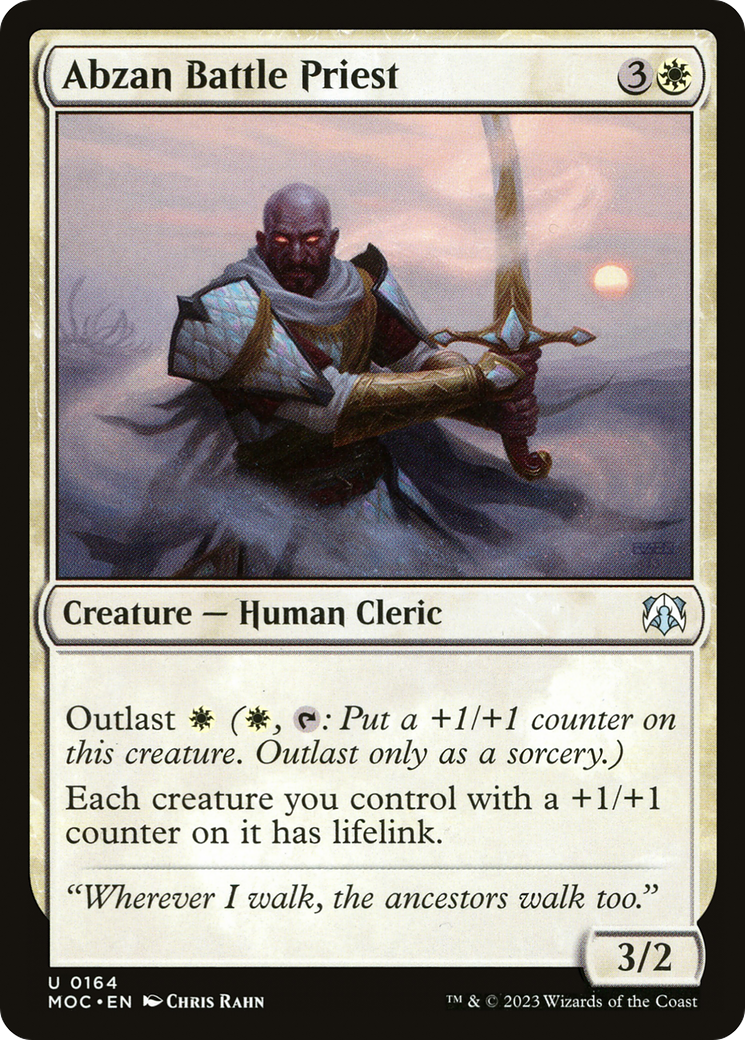
Abzan Battle Priest
Abzan Battle Priest
Creature — Human Cleric
3/2
Outlast ( , : Put a +1/+1 counter on this creature. Outlast only as a sorcery.)
Each creature you control with a +1/+1 counter on it has lifelink.
- The cost to activate a creature's outlast ability includes the tap symbol ( ). A creature's outlast ability can't be activated unless that creature has been under your control continuously since the beginning of your turn.
- Several creatures with outlast also grant an ability to creatures you control with +1/+1 counters on them, including themselves. These counters could come from an outlast ability, but any +1/+1 counter on the creature will count.
-
1
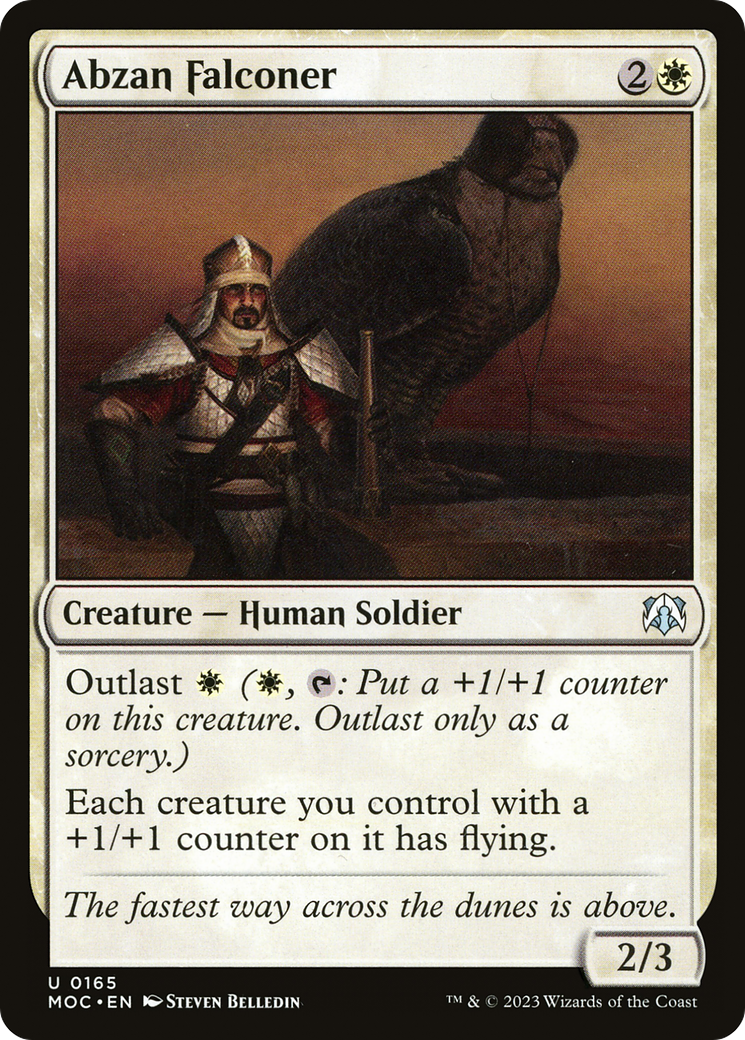
Abzan Falconer
Abzan Falconer
Creature — Human Soldier
2/3
Outlast ( , : Put a +1/+1 counter on this creature. Outlast only as a sorcery.)
Each creature you control with a +1/+1 counter on it has flying.
- The cost to activate a creature's outlast ability includes the tap symbol ( ). A creature's outlast ability can't be activated unless that creature has been under your control continuously since the beginning of your turn.
- Several creatures with outlast also grant an ability to creatures you control with +1/+1 counters on them, including themselves. These counters could come from an outlast ability, but any +1/+1 counter on the creature will count.
-
1
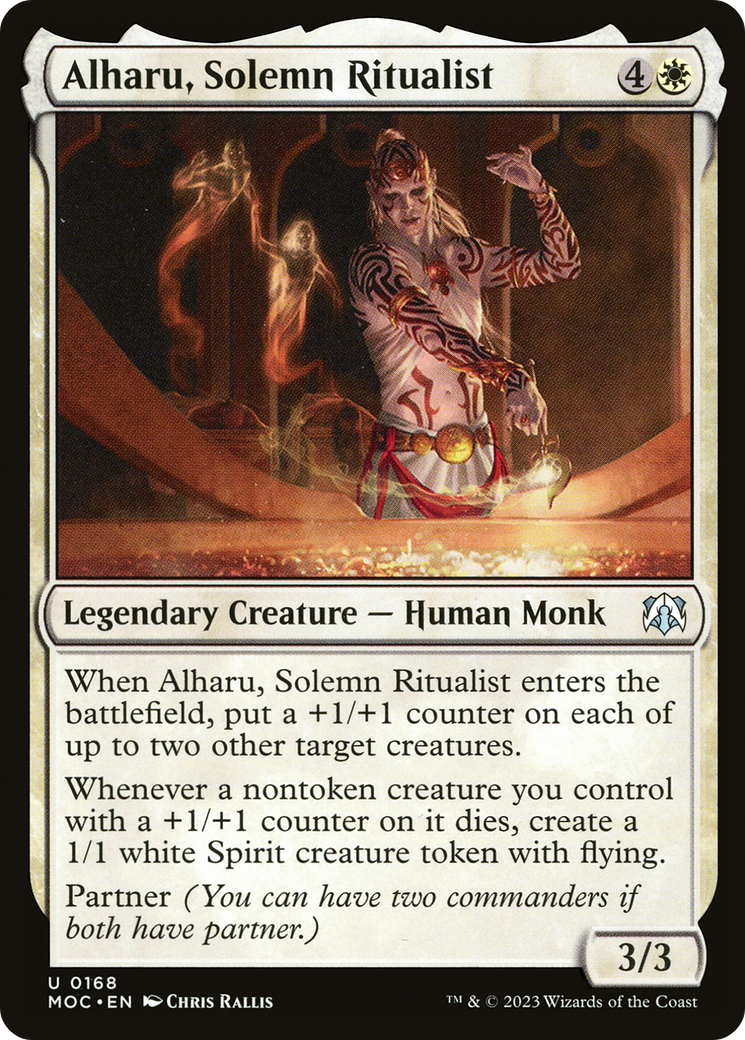
Alharu, Solemn Ritualist
Alharu, Solemn Ritualist
Legendary Creature — Human Monk
3/3
When Alharu enters, put a +1/+1 counter on each of up to two other target creatures.
Whenever a nontoken creature you control with a +1/+1 counter on it dies, create a 1/1 white Spirit creature token with flying.
Partner (You can have two commanders if both have partner.)
- You create just one Spirit token, not one for each +1/+1 counter that was on the creature that died.
- If a creature you control with a +1/+1 counter on it dies at the same time as Alharu, Alharu's ability triggers for that creature.
- If Alharu has a +1/+1 counter on it and dies, its ability triggers for itself.
- If your Commander deck has two commanders, you can only include cards whose own color identities are also found in your commanders' combined color identities. If Falthis and Kediss are your commanders, your deck may contain cards with black and/or red in their color identity, but not cards with green, white, or blue.
- Both commanders start in the command zone, and the remaining 98 cards (or 58 cards in a Commander Draft game) of your deck are shuffled to become your library.
- To have two commanders, both must have the partner ability as the game begins. Losing the ability during the game doesn't cause either to cease to be your commander.
- Once the game begins, your two commanders are tracked separately. If you cast one, you won't have to pay an additional the first time you cast the other. A player loses the game after having been dealt 21 damage from any one of them, not from both of them combined.
- If something refers to your commander while you have two commanders, it refers to one of them of your choice. If you are instructed to perform an action on your commander (e.g. put it from the command zone into your hand due to Command Beacon), you choose one of your commanders at the time the effect happens.
- An effect that checks whether you control your commander is satisfied if you control one or both of your two commanders.
- You can choose two commanders with partner that are the same color or colors. In Commander Draft, you can even choose two of the same commander with partner if you drafted them. If you do this, make sure you keep the number of times you've cast each from the command zone clear for "commander tax" purposes.
-
1
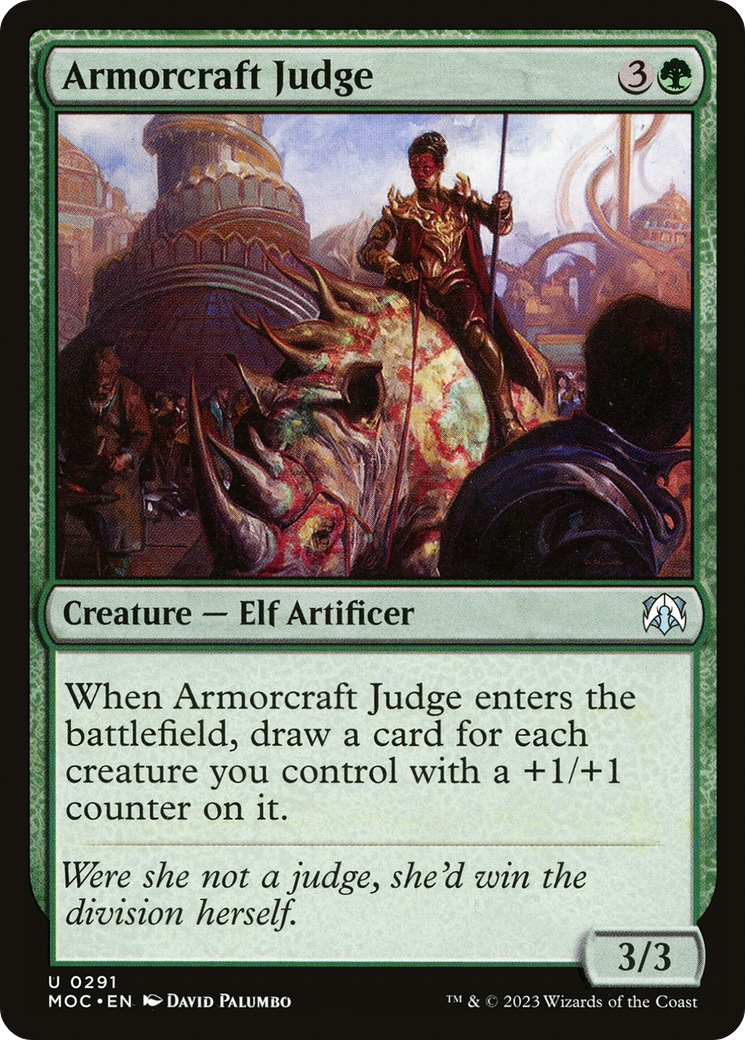
Armorcraft Judge
Armorcraft Judge
Creature — Elf Artificer
3/3
When this creature enters, draw a card for each creature you control with a +1/+1 counter on it.
- The number of creatures you control with +1/+1 counters on them is counted only as Armorcraft Judge's triggered ability resolves. Players may respond to the triggered ability by trying to change that number.
- Armorcraft Judge's ability counts the number of creatures, not the number of counters. A creature with more than one +1/+1 counter won't cause you to draw more than one card.
-
1
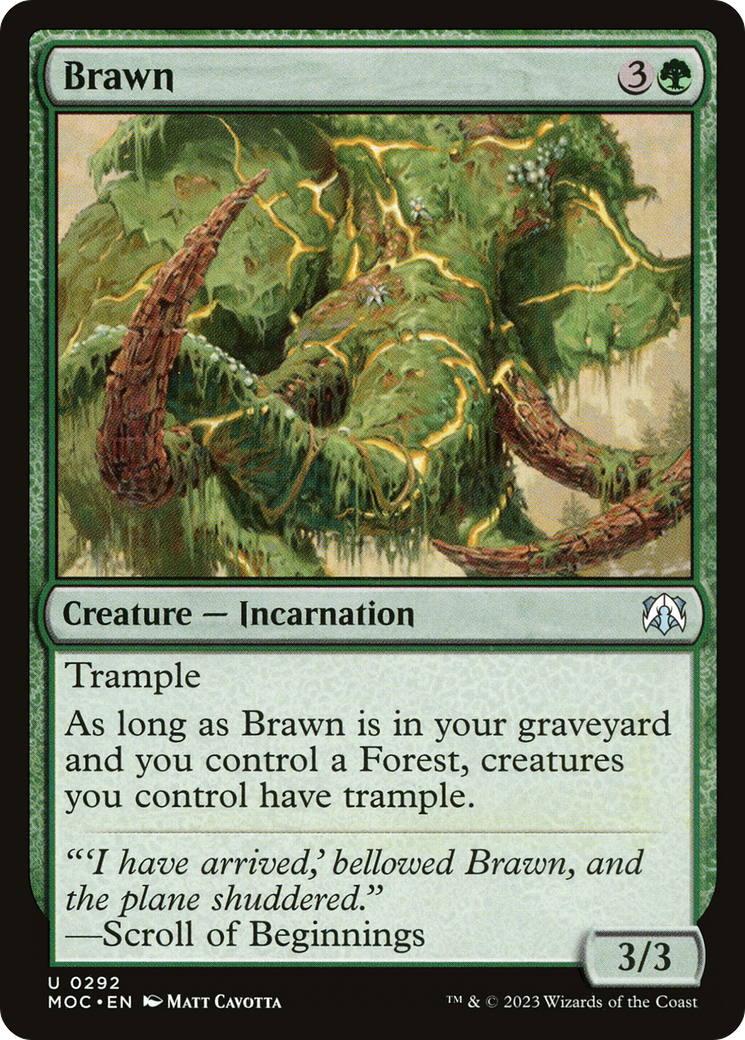
Brawn
Brawn
Creature — Incarnation
3/3
Trample
As long as this card is in your graveyard and you control a Forest, creatures you control have trample.
-
1
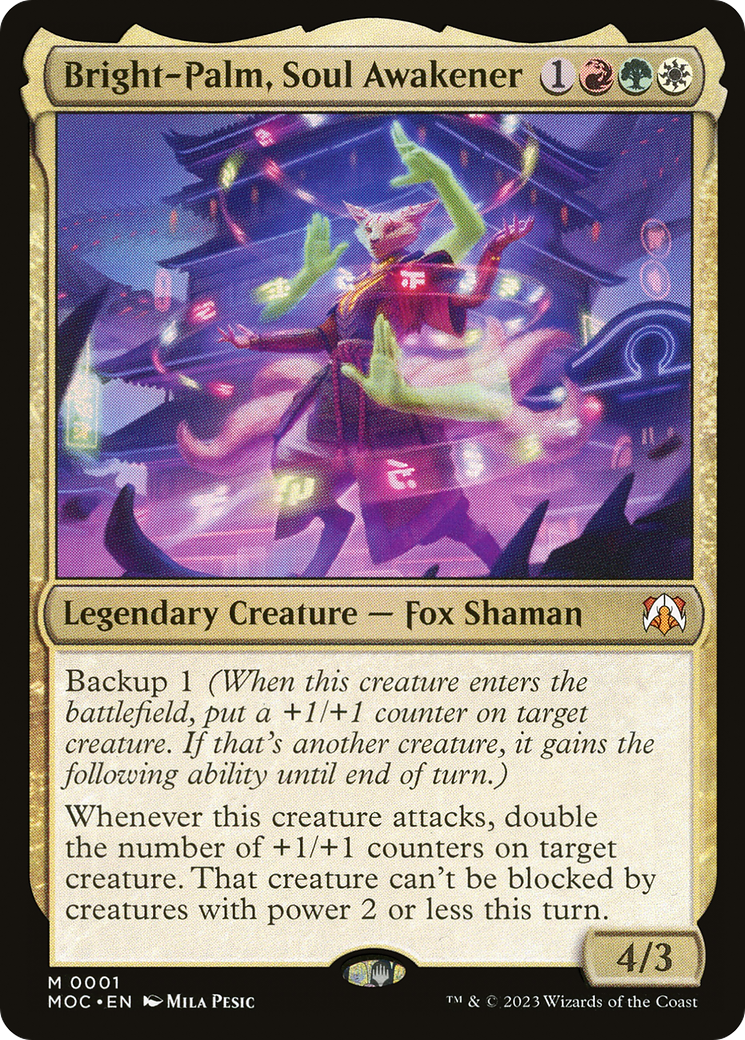
Bright-Palm, Soul Awakener
Bright-Palm, Soul Awakener
Legendary Creature — Fox Shaman
4/3
Backup 1 (When this creature enters, put a +1/+1 counter on target creature. If that's another creature, it gains the following ability until end of turn.)
Whenever this creature attacks, double the number of +1/+1 counters on target creature. That creature can't be blocked by creatures with power 2 or less this turn.
- If a backup ability targets the creature with backup, that creature will get +1/+1 counters, but it won’t gain additional abilities.
- If a backup ability causes another creature to gain abilities, the creature with backup will still have those abilities.
- If a permanent enters the battlefield as a copy of a card with a backup ability or a token is created that is a copy of that card, the order of the printed abilities is maintained.
- Backup confers only abilities that are actually printed below it. Any abilities that are gained by the permanent are ignored, including abilities gained due to a resolving spell or ability or copy effects.
- The abilities that backup grants to the target creature are determined only once, at the time the ability triggers. They won’t change if the permanent with backup loses any abilities before the backup ability resolves.
-
1
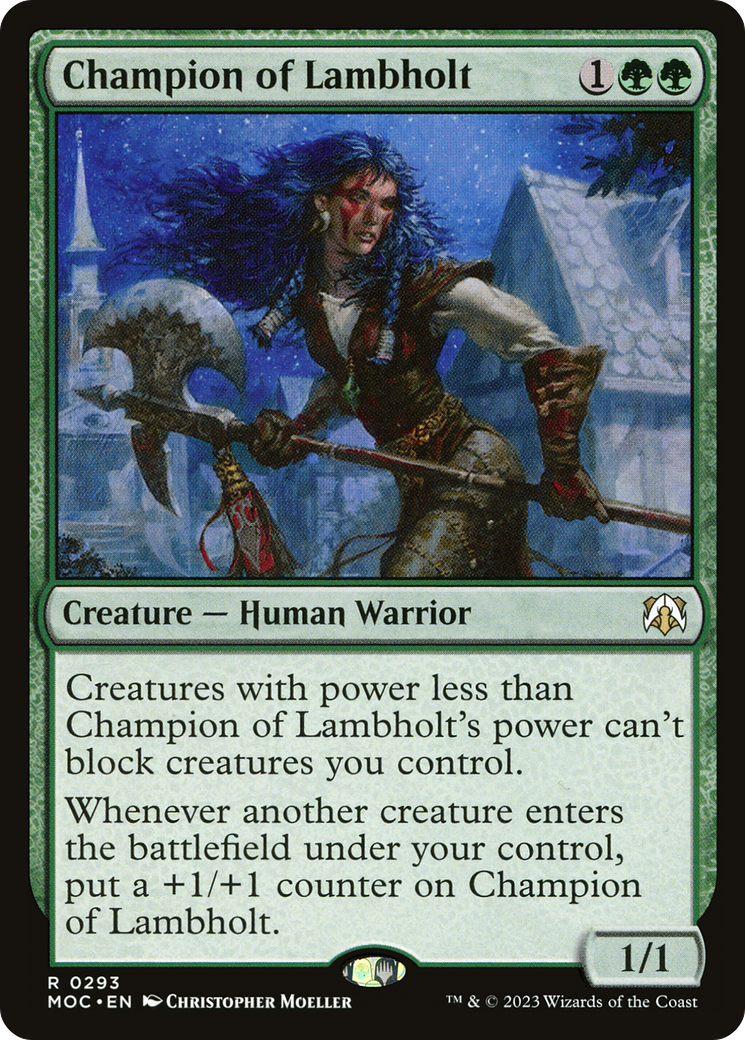
Champion of Lambholt
Champion of Lambholt
Creature — Human Warrior
1/1
Creatures with power less than this creature's power can't block creatures you control.
Whenever another creature you control enters, put a +1/+1 counter on this creature.
- Champion of Lambholt's first ability applies even if it isn't attacking.
- The comparison of power is done only when blockers are declared. Decreasing the power of a blocking creature (or increasing the power of Champion of Lambholt) after this point won't cause any creature to stop blocking or become unblocked.
-
1
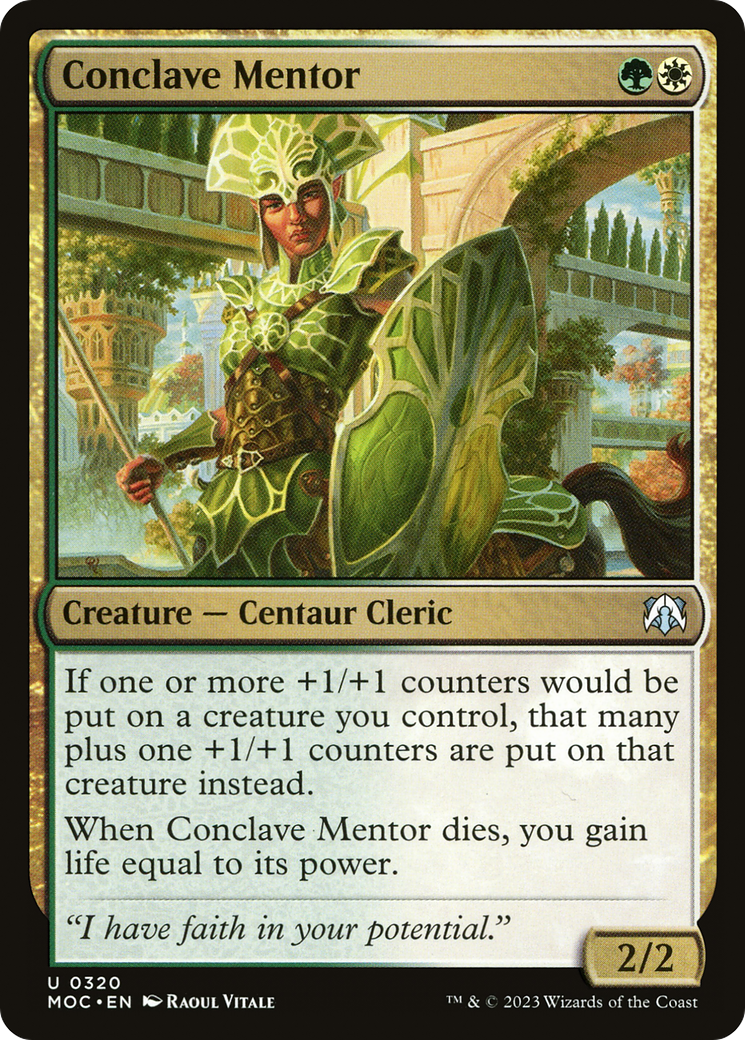
Conclave Mentor
Conclave Mentor
Creature — Centaur Cleric
2/2
If one or more +1/+1 counters would be put on a creature you control, that many plus one +1/+1 counters are put on that creature instead.
When this creature dies, you gain life equal to its power.
- If a creature you control would enter the battlefield with a number of +1/+1 counters on it, it enters with that many plus one instead.
- Conclave Mentor's first ability doesn't apply to itself if it's somehow entering the battlefield with a +1/+1 counter on it.
- If you control two Conclave Mentors, the number of +1/+1 counters put on a creature is two plus the original number. Three Conclave Mentors add three, and so on.
- If two or more effects attempt to modify how many counters would be put onto a creature you control, you choose the order to apply those effects, no matter who controls the sources of those effects.
- Use Conclave Mentor's power as it last existed on the battlefield to determine how much life you gain.
-
1
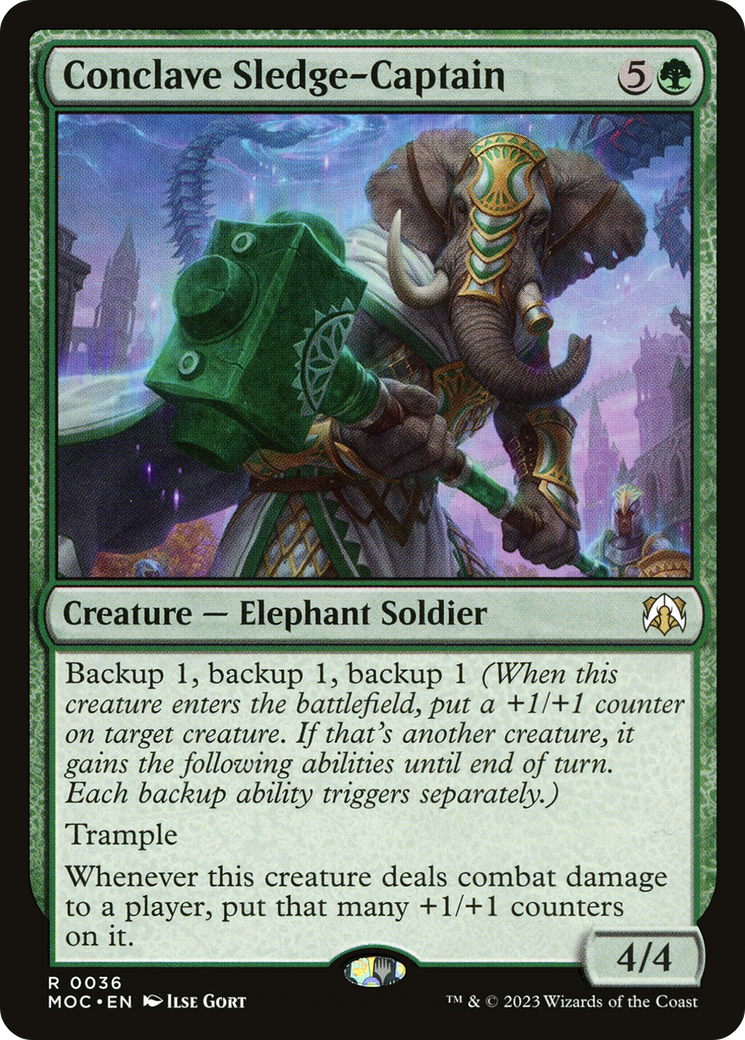
Conclave Sledge-Captain
Conclave Sledge-Captain
Creature — Elephant Soldier
4/4
Backup 1, backup 1, backup 1 (When this creature enters, put a +1/+1 counter on target creature. If that's another creature, it gains the following abilities until end of turn. Each backup ability triggers separately.)
Trample
Whenever this creature deals combat damage to a player, put that many +1/+1 counters on it.
- If the same creature is the target of more than one of Conclave Sledge-Captain’s backup abilities, it will get more than one instance of its triggered ability. Each of those triggered abilities triggers separately. If the creature deals combat damage to a player, it will get that many +1/+1 counters more than once. (It will also have trample more than once, but that’s way less interesting.)
- If a backup ability targets the creature with backup, that creature will get +1/+1 counters, but it won’t gain additional abilities.
- If a backup ability causes another creature to gain abilities, the creature with backup will still have those abilities.
- If a permanent enters the battlefield as a copy of a card with a backup ability or a token is created that is a copy of that card, the order of the printed abilities is maintained.
- Backup confers only abilities that are actually printed below it. Any abilities that are gained by the permanent are ignored, including abilities gained due to a resolving spell or ability or copy effects.
- The abilities that backup grants to the target creature are determined only once, at the time the ability triggers. They won’t change if the permanent with backup loses any abilities before the backup ability resolves.
-
1
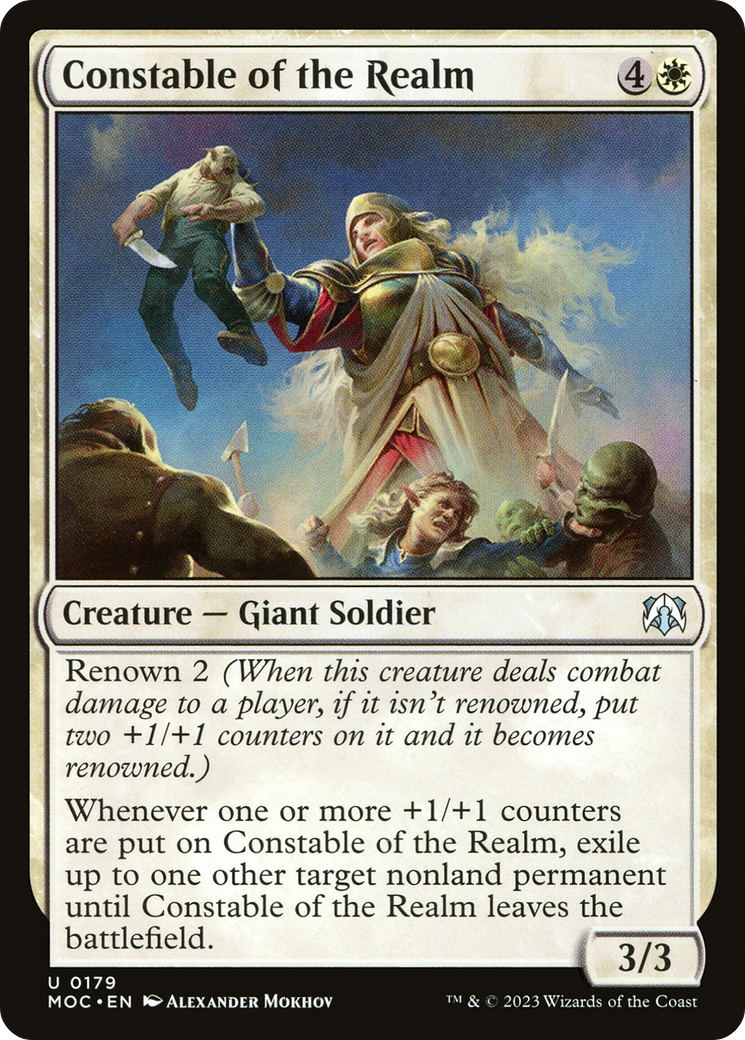
Constable of the Realm
Constable of the Realm
Creature — Giant Soldier
3/3
Renown 2 (When this creature deals combat damage to a player, if it isn't renowned, put two +1/+1 counters on it and it becomes renowned.)
Whenever one or more +1/+1 counters are put on this creature, exile up to one other target nonland permanent until this creature leaves the battlefield.
- Constable of the Realm's last ability triggers whenever a +1/+1 counter is put on it for any reason, not just because of its renown ability.
- If Constable of the Realm leaves the battlefield before its last triggered ability resolves, the target permanent won't be exiled.
- Auras attached to the exiled permanent will be put into their owners' graveyards. Equipment attached to it will become unattached and remain on the battlefield. Any counters on the exiled permanent will cease to exist.
- If a token creature is exiled this way, it will cease to exist and won't return to the battlefield.
- All permanents exiled by Constable of the Realm will return to the battlefield at the same time, and each one will enter under its owner's control.
- Renown won't trigger when a creature deals combat damage to a planeswalker or another creature. It also won't trigger when a creature deals noncombat damage to a player.
- If a creature with renown deals combat damage to its controller because that damage was redirected, renown will trigger.
-
1
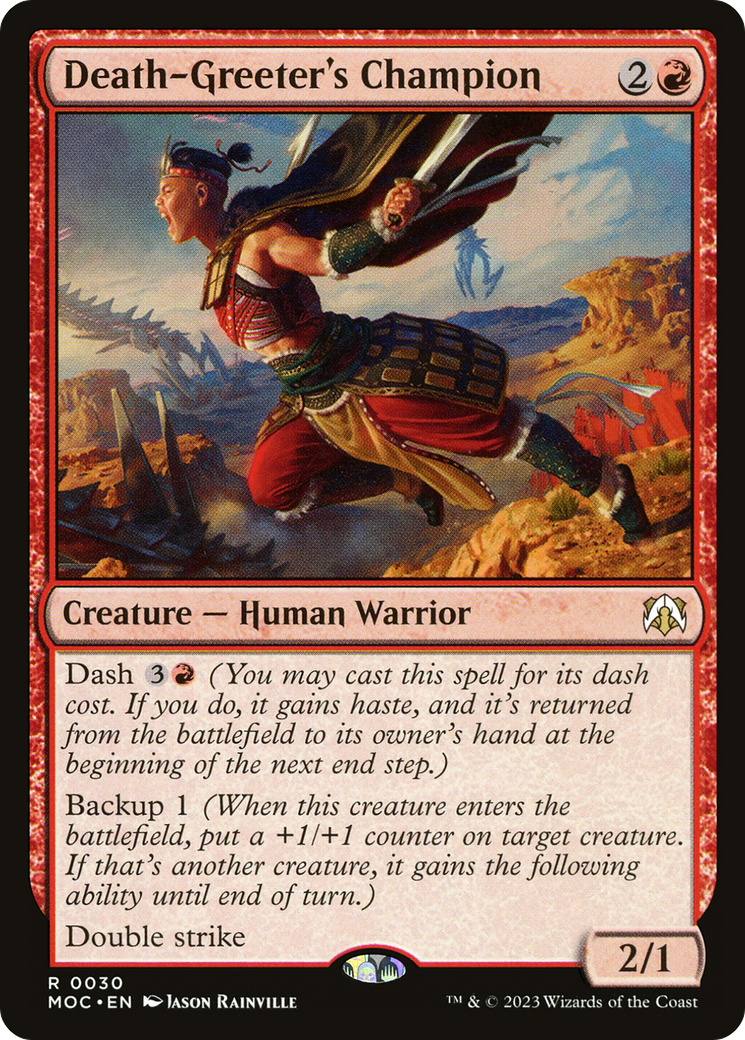
Death-Greeter's Champion
Death-Greeter's Champion
Creature — Human Warrior
2/1
Dash (You may cast this spell for its dash cost. If you do, it gains haste, and it's returned from the battlefield to its owner's hand at the beginning of the next end step.)
Backup 1 (When this creature enters, put a +1/+1 counter on target creature. If that's another creature, it gains the following ability until end of turn.)
Double strike
- If a backup ability targets the creature with backup, that creature will get +1/+1 counters, but it won't gain additional abilities.
- If a backup ability causes another creature to gain abilities, the creature with backup will still have those abilities.
- If a permanent enters the battlefield as a copy of a card with a backup ability or a token is created that is a copy of that card, the order of the printed abilities is maintained.
- Backup confers only abilities that are actually printed below it. Any abilities that are gained by the permanent are ignored, including abilities gained due to a resolving spell or ability or copy effects.
- The abilities that backup grants to the target creature are determined only once, at the time the ability triggers. They won't change if the permanent with backup loses any abilities before the backup ability resolves.
-
1
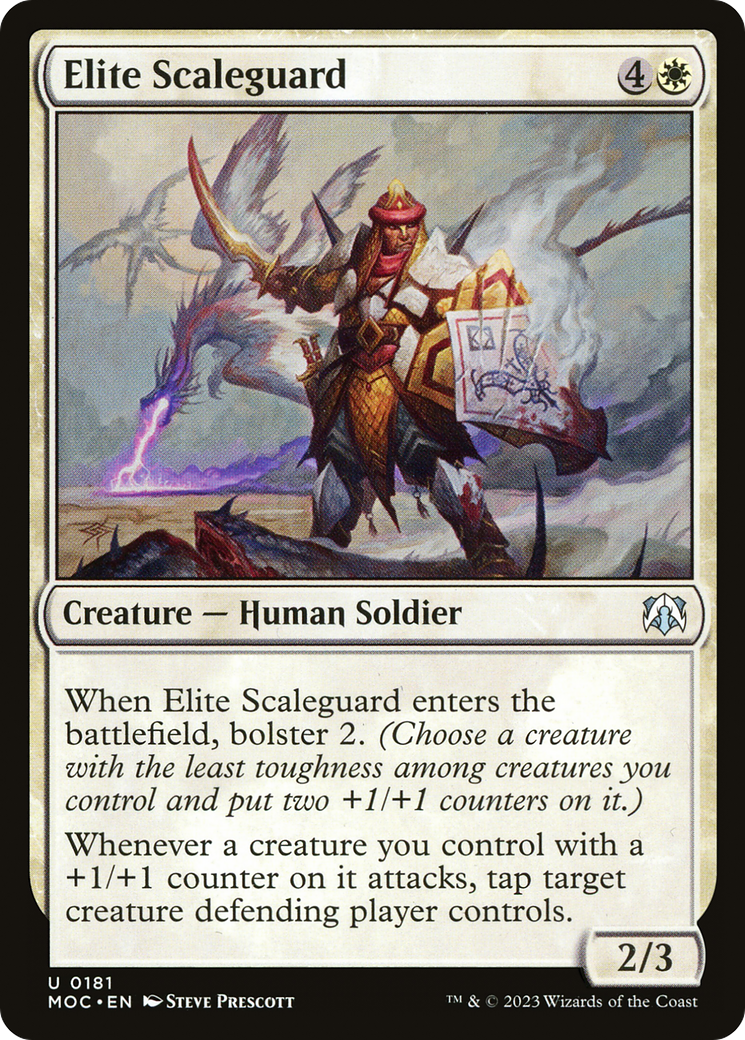
Elite Scaleguard
Elite Scaleguard
Creature — Human Soldier
2/3
When this creature enters, bolster 2. (Choose a creature with the least toughness among creatures you control and put two +1/+1 counters on it.)
Whenever a creature you control with a +1/+1 counter on it attacks, tap target creature defending player controls.
- Bolster itself doesn't target any creature, though some spells and abilities that bolster may have other effects that target creatures. For example, you could put counters on a creature with protection from white with Abzan Skycaptain's bolster ability.
- You determine which creature to put counters on as the spell or ability that instructs you to bolster resolves.
-
1
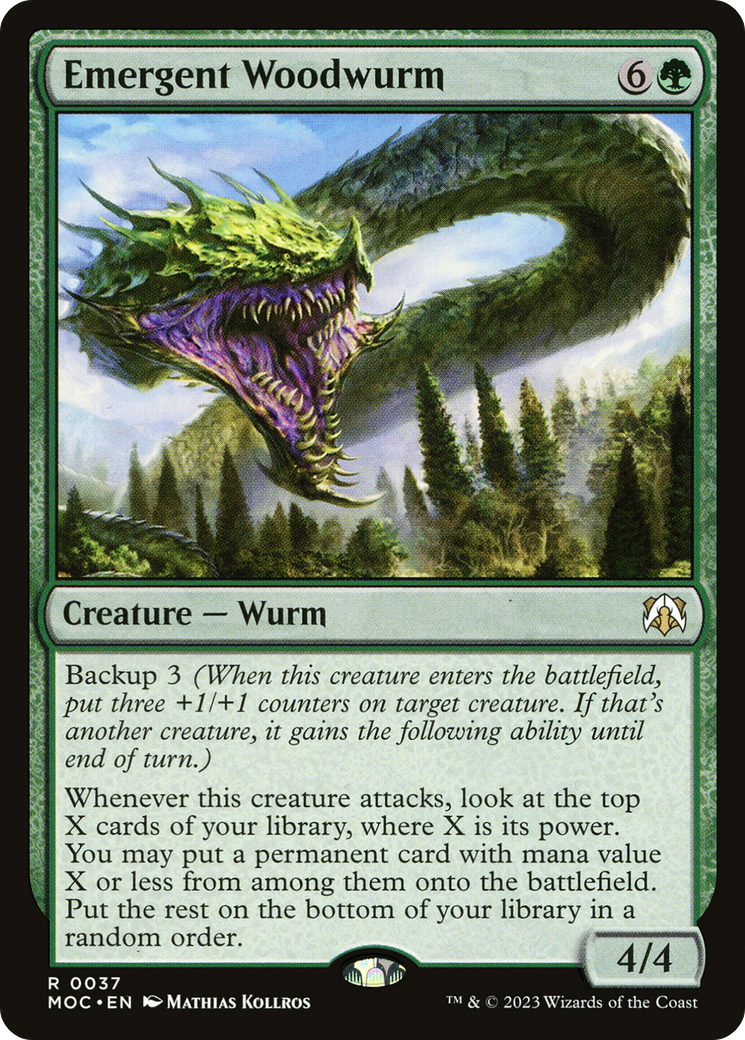
Emergent Woodwurm
Emergent Woodwurm
Creature — Wurm
4/4
Backup 3 (When this creature enters, put three +1/+1 counters on target creature. If that's another creature, it gains the following ability until end of turn.)
Whenever this creature attacks, look at the top X cards of your library, where X is its power. You may put a permanent card with mana value X or less from among them onto the battlefield. Put the rest on the bottom of your library in a random order.
- Use the power of the creature as the triggered ability resolves to determine the value of X. If the creature is no longer on the battlefield at that time, use its power from when it was last on the battlefield.
- If a backup ability targets the creature with backup, that creature will get +1/+1 counters, but it won’t gain additional abilities.
- If a backup ability causes another creature to gain abilities, the creature with backup will still have those abilities.
- If a permanent enters the battlefield as a copy of a card with a backup ability or a token is created that is a copy of that card, the order of the printed abilities is maintained.
- Backup confers only abilities that are actually printed below it. Any abilities that are gained by the permanent are ignored, including abilities gained due to a resolving spell or ability or copy effects.
- The abilities that backup grants to the target creature are determined only once, at the time the ability triggers. They won’t change if the permanent with backup loses any abilities before the backup ability resolves.
-
1
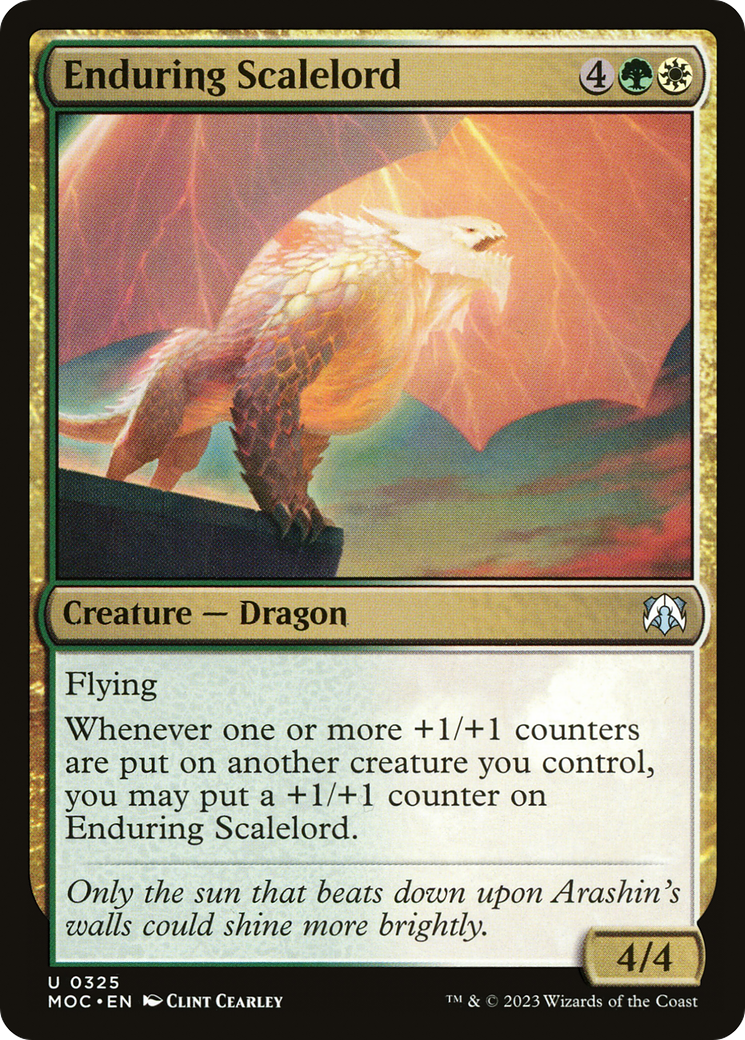
Enduring Scalelord
Enduring Scalelord
Creature — Dragon
4/4
Flying
Whenever one or more +1/+1 counters are put on another creature you control, you may put a +1/+1 counter on this creature.
- A creature entering the battlefield with one or more +1/+1 counters on it will cause Enduring Scalelord's ability to trigger.
- If +1/+1 counters are put on multiple creatures you control (other than Enduring Scalelord) at the same time, Enduring Scalelord's ability will trigger once for each of those creatures.
- If you control two Enduring Scalelords, putting a +1/+1 counter on one of them will cause the ability of the other one to trigger. When this ability resolves, you'll put a +1/+1 counter on the other Scalelord. This will cause the ability of the first one to trigger. This loop will repeat until you choose not to put a +1/+1 counter on one of the Enduring Scalelords.
-
1
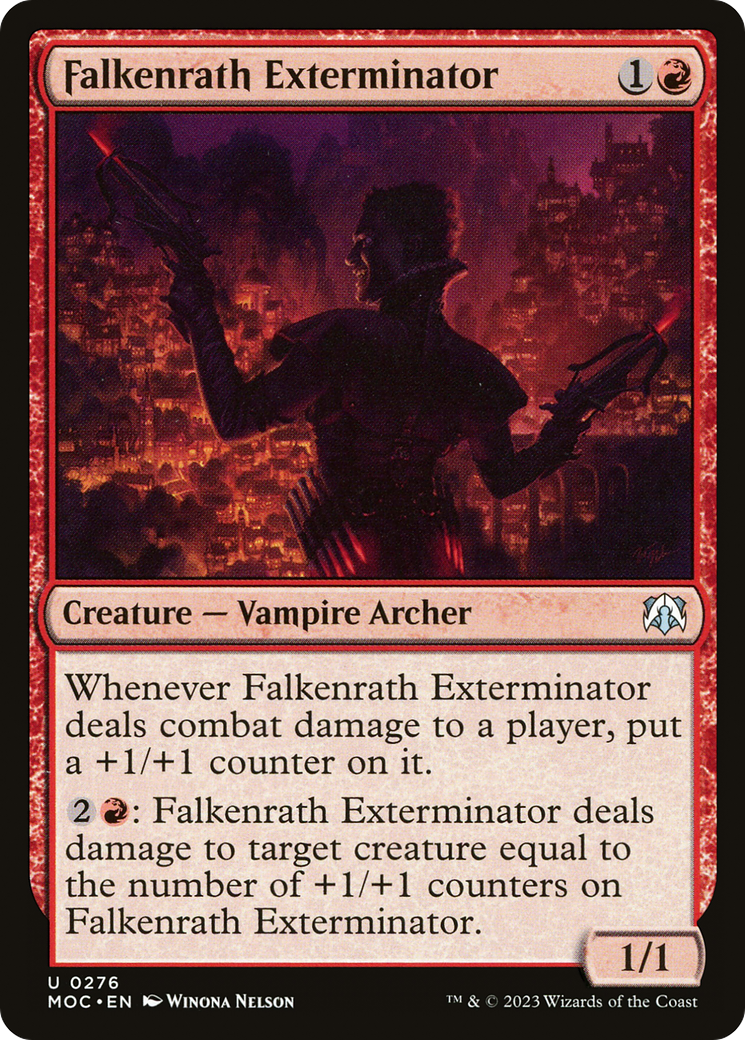
Falkenrath Exterminator
Falkenrath Exterminator
Creature — Vampire Archer
1/1
Whenever this creature deals combat damage to a player, put a +1/+1 counter on it.
: This creature deals damage to target creature equal to the number of +1/+1 counters on this creature.
-
1
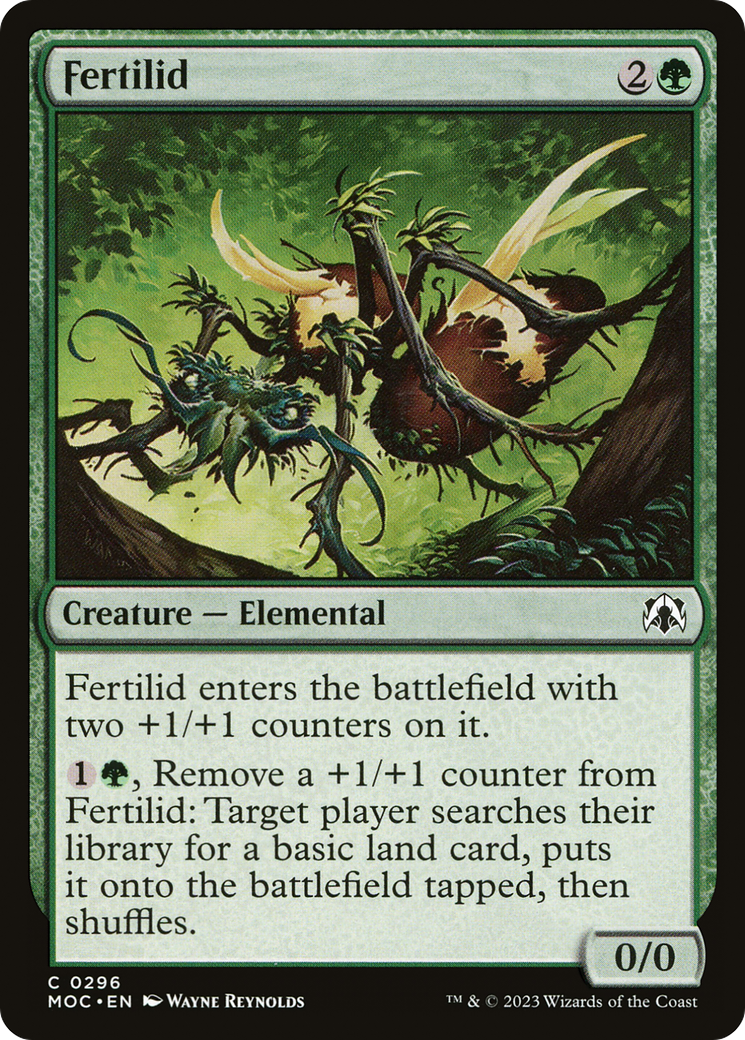
Fertilid
Fertilid
Creature — Elemental
0/0
This creature enters with two +1/+1 counters on it.
, Remove a +1/+1 counter from this creature: Target player searches their library for a basic land card, puts it onto the battlefield tapped, then shuffles.
- Although the targeted player doesn't need to find a basic land card if they don't want to, that player must shuffle their library.
-
1
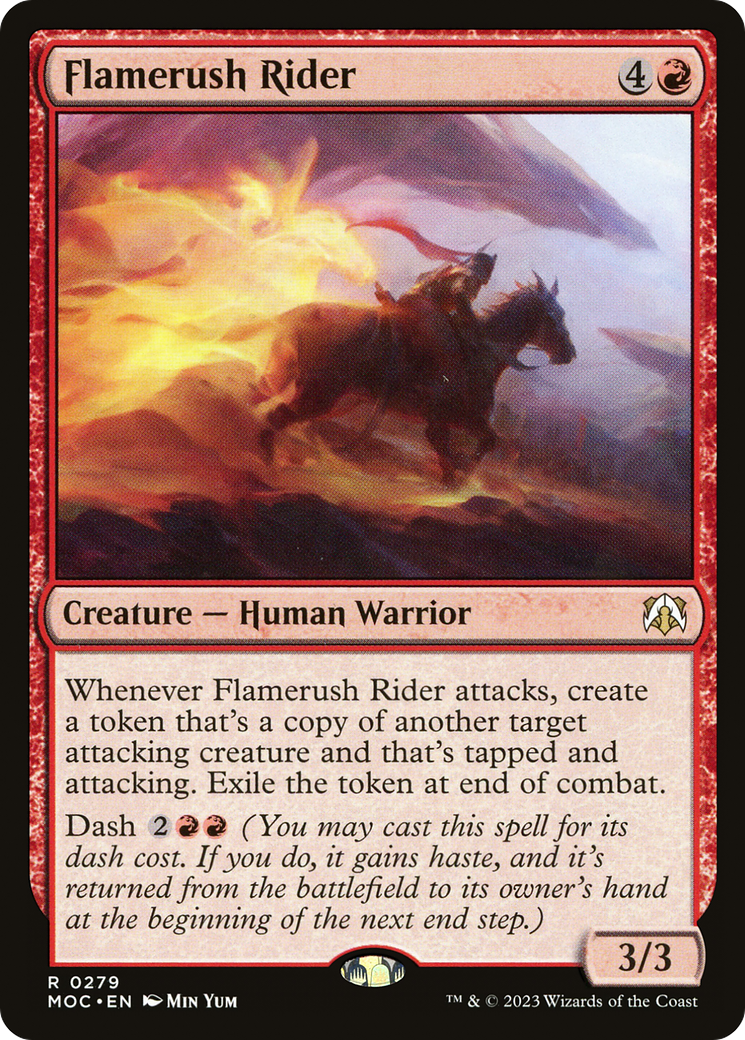
Flamerush Rider
Flamerush Rider
Creature — Human Warrior
3/3
Whenever this creature attacks, create a token that's a copy of another target attacking creature and that's tapped and attacking. Exile the token at end of combat.
Dash (You may cast this spell for its dash cost. If you do, it gains haste, and it's returned from the battlefield to its owner's hand at the beginning of the next end step.)
- You choose which opponent or opposing planeswalker the token is attacking as you put it onto the battlefield. It doesn't have to be the same player or planeswalker Flamerush Rider is attacking.
- Although the token is attacking, it was never declared as an attacking creature (for purposes of abilities that trigger whenever a creature attacks, for example).
- The token copies exactly what was printed on the original creature and nothing else (unless that permanent is copying something else or is a token; see below). It doesn't copy whether that creature has any counters on it or Auras and/or Equipment attached to it, or any non-copy effects that changed its power, toughness, types, color, and so on. Notably, it doesn't copy any effects that may have turned a noncreature permanent into a creature. If the token isn't a creature as it enters the battlefield, it won't be attacking.
- If the copied creature had in its mana cost, X is 0.
- If the copied creature was copying something else, the token enters the battlefield as whatever that creature was copying.
- If the copied creature is a token, the token created by Flamerush Rider copies the original characteristics of that token as stated by the effect that put it onto the battlefield.
- Any enters-the-battlefield abilities of the copied creature will trigger when the token enters the battlefield. Any "As [this creature] enters the battlefield" or "[This creature] enters the battlefield with" abilities of the copied creature will also work.
- If another creature becomes or enters the battlefield as a copy of the token, you won't exile that creature at end of combat. However, if Flamerush Rider creates multiple tokens due to a replacement effect (like the one Doubling Season creates), you'll exile each of those tokens.
- If you choose to pay the dash cost rather than the mana cost, you're still casting the spell. It goes on the stack and can be responded to and countered. You can cast a creature spell for its dash cost only when you otherwise could cast that creature spell. Most of the time, this means during your main phase when the stack is empty.
- If you pay the dash cost to cast a creature spell, that card will be returned to its owner's hand only if it's still on the battlefield when its triggered ability resolves. If it dies or goes to another zone before then, it will stay where it is.
- You don't have to attack with the creature with dash unless another ability says you do.
- If a creature enters the battlefield as a copy of or becomes a copy of a creature whose dash cost was paid, the copy won't have haste and won't be returned to its owner's hand.
-
1
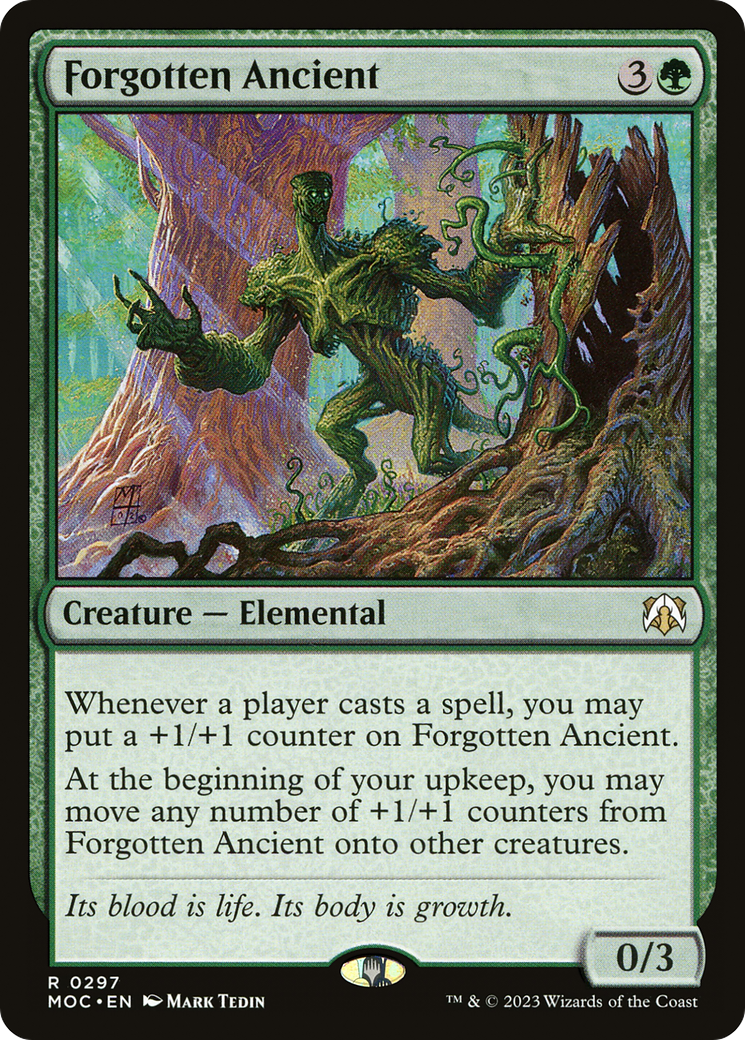
Forgotten Ancient
Forgotten Ancient
Creature — Elemental
0/3
Whenever a player casts a spell, you may put a +1/+1 counter on this creature.
At the beginning of your upkeep, you may move any number of +1/+1 counters from this creature onto other creatures.
- Forgotten Ancient's last ability doesn't target any creatures. You choose how many +1/+1 counters will be moved (and onto which creatures) as the ability resolves. Notably, once the ability starts resolving and you make these choices, no player may take actions until the ability has finished resolving.
- Forgotten Ancient's first ability will resolve before the spell that caused it to trigger. Putting a +1/+1 counter on Forgotten Ancient is optional.
-
1
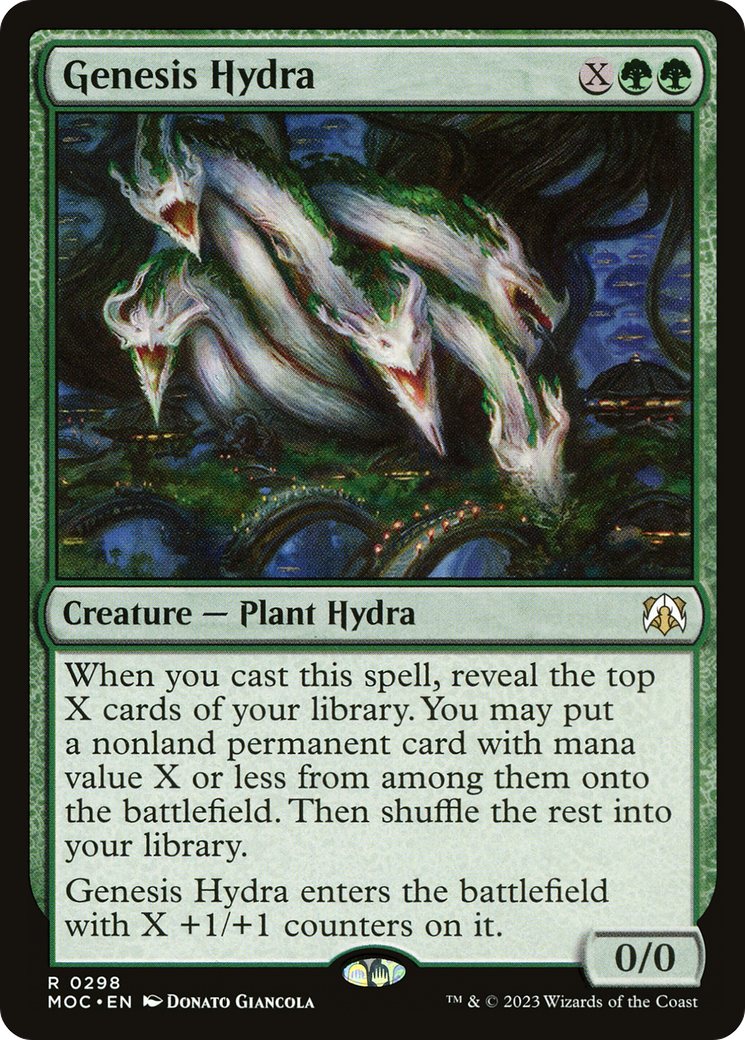
Genesis Hydra
Genesis Hydra
Creature — Plant Hydra
0/0
When you cast this spell, reveal the top X cards of your library. You may put a nonland permanent card with mana value X or less from among them onto the battlefield. Then shuffle the rest into your library.
This creature enters with X +1/+1 counters on it.
- Genesis Hydra's first ability will resolve before Genesis Hydra does. Notably, if you put an Aura card onto the battlefield this way, it can't enchant Genesis Hydra.
- If you have fewer than X cards in your library, you reveal all of them.
- If a card in a player's library has in its mana cost, X is considered to be 0.
- A nonland permanent card is an artifact, creature, enchantment, or planeswalker card.
- If you put an Aura onto the battlefield this way, you choose what it enchants as it enters the battlefield. This doesn't target any permanent or player, but it must be able to enchant that permanent or player. For example, you could put a green Aura onto the battlefield enchanting a creature with hexproof controlled by an opponent, but not one with protection from green.
- If "the rest" is zero cards, either because X was 0 or because X was 1 and that card was put onto the battlefield, the library is still shuffled.
-
1
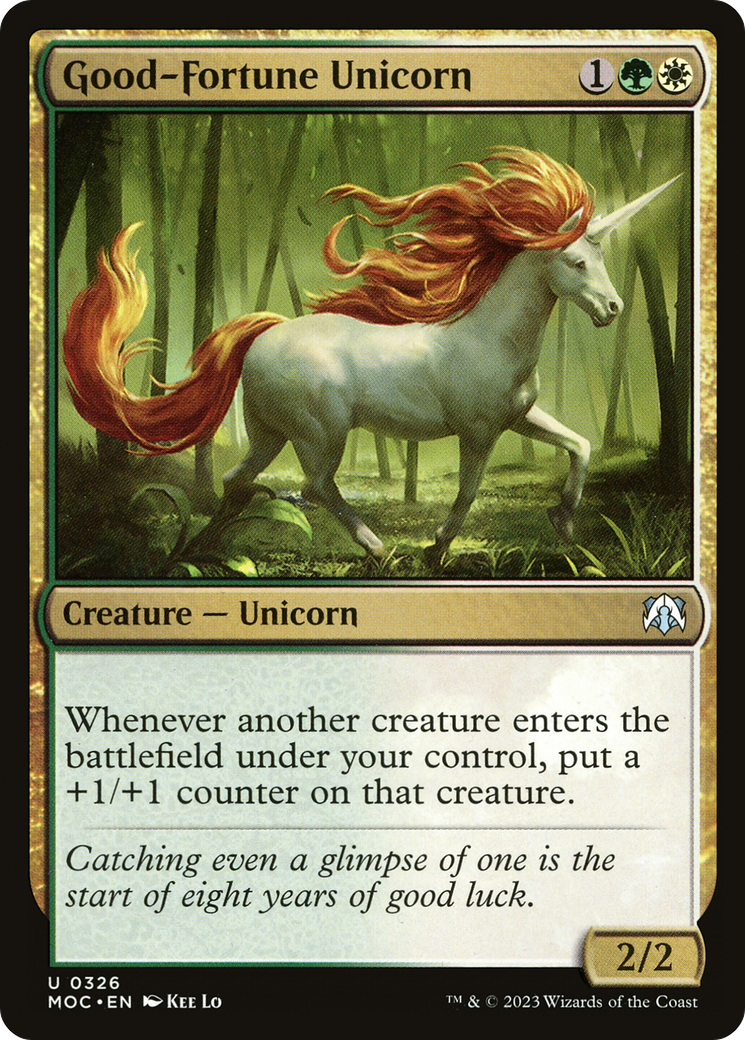
Good-Fortune Unicorn
Good-Fortune Unicorn
Creature — Unicorn
2/2
Whenever another creature you control enters, put a +1/+1 counter on that creature.
-
1
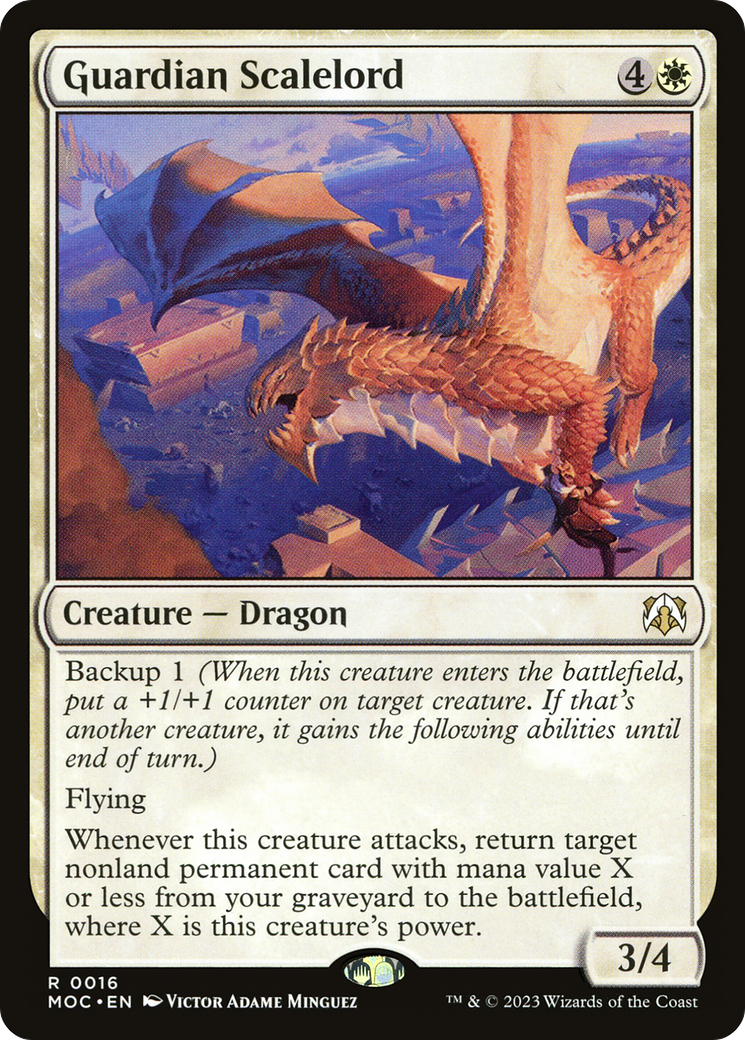
Guardian Scalelord
Guardian Scalelord
Creature — Dragon
3/4
Backup 1 (When this creature enters, put a +1/+1 counter on target creature. If that's another creature, it gains the following abilities until end of turn.)
Flying
Whenever this creature attacks, return target nonland permanent card with mana value X or less from your graveyard to the battlefield, where X is this creature's power.
- If a permanent enters the battlefield as a copy of a card with a backup ability or a token is created that is a copy of that card, the order of the printed abilities is maintained.
- If a backup ability causes another creature to gain abilities, the creature with backup will still have those abilities.
- If a backup ability targets the creature with backup, that creature will get +1/+1 counters, but it won't gain additional abilities.
- The abilities that backup grants to the target creature are determined only once, at the time the ability triggers. They won't change if the permanent with backup loses any abilities before the backup ability resolves.
- Backup confers only abilities that are actually printed below it. Any abilities that are gained by the permanent are ignored, including abilities gained due to a resolving spell or ability or copy effects.
-
1
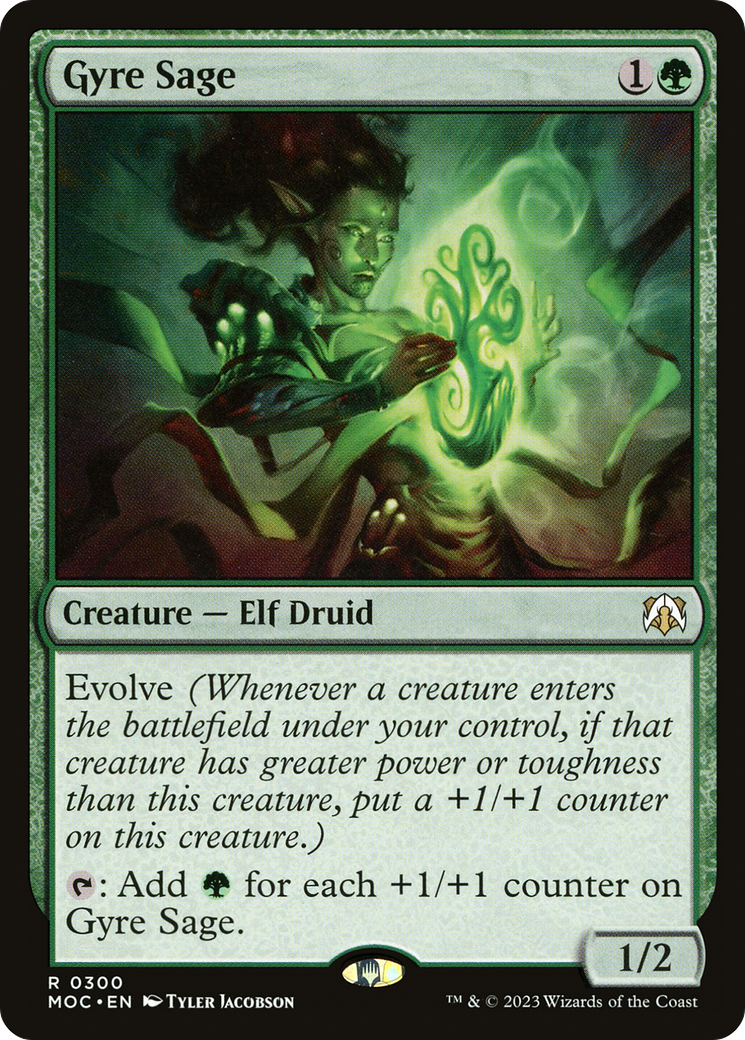
Gyre Sage
Gyre Sage
Creature — Elf Druid
1/2
Evolve (Whenever a creature you control enters, if that creature has greater power or toughness than this creature, put a +1/+1 counter on this creature.)
: Add for each +1/+1 counter on this creature.
- Gyre Sage's last ability is a mana ability. It doesn't use the stack and can't be responded to.
-
1
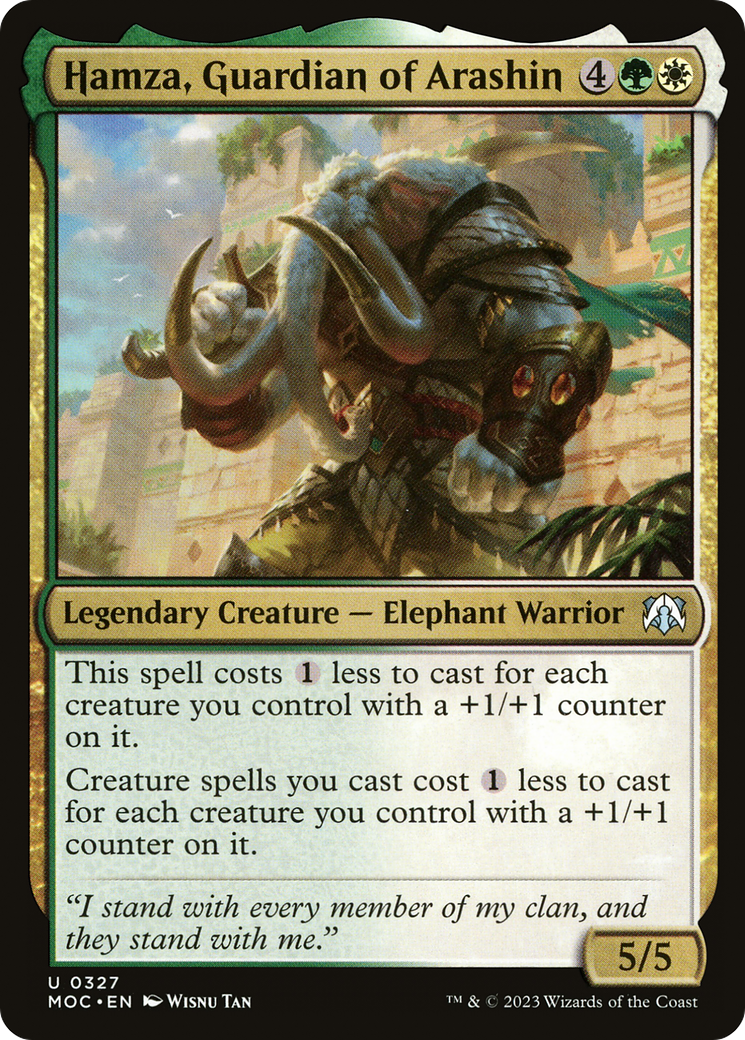
Hamza, Guardian of Arashin
Hamza, Guardian of Arashin
Legendary Creature — Elephant Warrior
5/5
This spell costs less to cast for each creature you control with a +1/+1 counter on it.
Creature spells you cast cost less to cast for each creature you control with a +1/+1 counter on it.
- To determine the total cost of a spell, start with the mana cost or alternative cost you're paying, add any cost increases, then apply any cost reductions (such as that of Hamza, Guardian of Arashin). The total cost is locked in before any costs are paid. The mana value of the spell is determined only by its mana cost, no matter what the total cost to cast the spell was.
- Once you announce you're casting a creature spell, no player may take actions until the spell has been paid for. Notably, opponents can't try to change the number of creatures you control with +1/+1 counters.
- Hamza's first ability affects only generic mana costs. It can't reduce the total cost to cast the spell below .
-
1
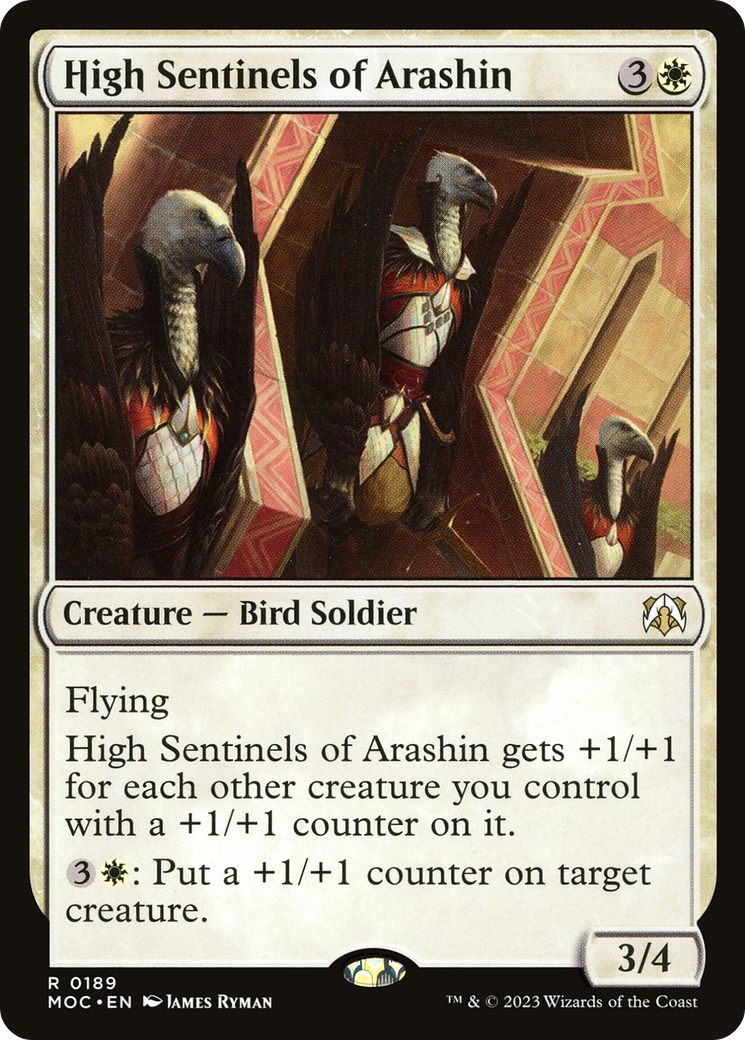
High Sentinels of Arashin
High Sentinels of Arashin
Creature — Bird Soldier
3/4
Flying
This creature gets +1/+1 for each other creature you control with a +1/+1 counter on it.
: Put a +1/+1 counter on target creature.
- The activated ability can target and put +1/+1 counters on High Sentinels of Arashin itself.
- High Sentinels of Arashin gets +1/+1 per creature, not per +1/+1 counter. It doesn't matter how many +1/+1 counters are on any other creature you control as long as there's one or more.
-
1
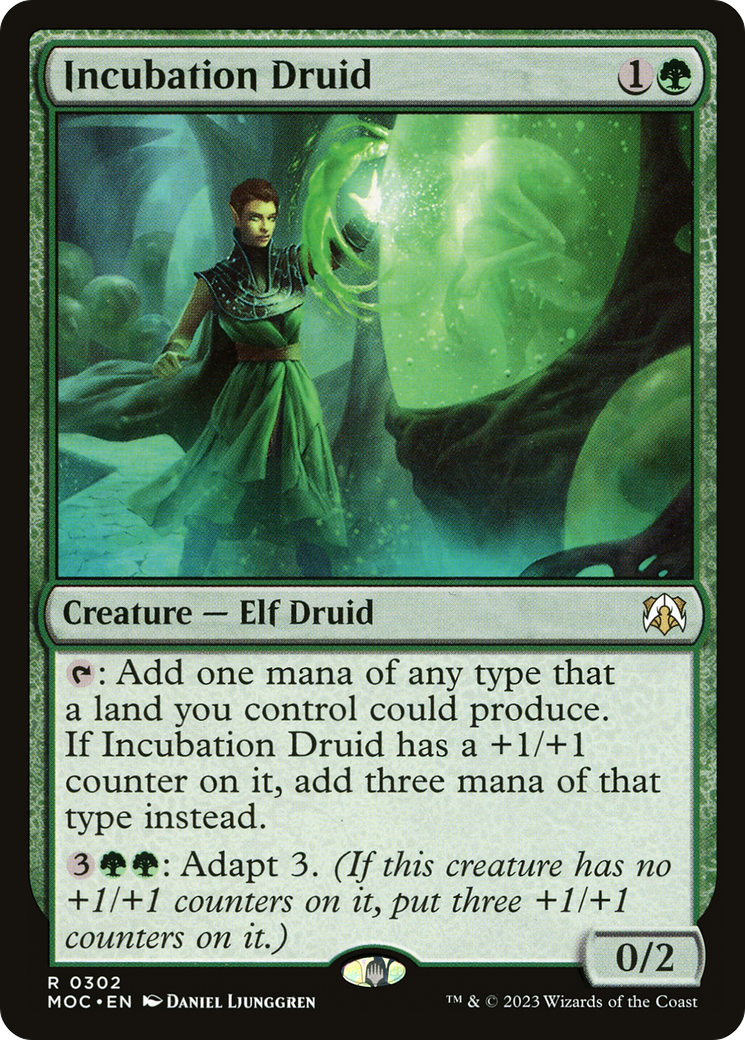
Incubation Druid
Incubation Druid
Creature — Elf Druid
0/2
: Add one mana of any type that a land you control could produce. If this creature has a +1/+1 counter on it, add three mana of that type instead.
: Adapt 3. (If this creature has no +1/+1 counters on it, put three +1/+1 counters on it.)
- The types of mana are white, blue, black, red, green, and colorless.
- Incubation Druid checks the effects of all mana-producing abilities of lands you control, but it doesn't check their costs or legality. For example, Spire of Industry says " , Pay 1 life: Add one mana of any color. Activate only if you control an artifact." If you control Spire of Industry and Incubation Druid, you can tap Incubation Druid for any color of mana. It doesn't matter whether you control an artifact, whether you can pay 1 life, or whether Spire of Industry is untapped.
- Any change to a land's type or abilities gained by a land can affect the types of mana a land can produce.
- Incubation Druid doesn't care about any restrictions or riders your lands put on the mana they produce, such as those of Unclaimed Territory and Guildmages' Forum. It just produces one mana of the appropriate type, with no restrictions or riders.
-
1
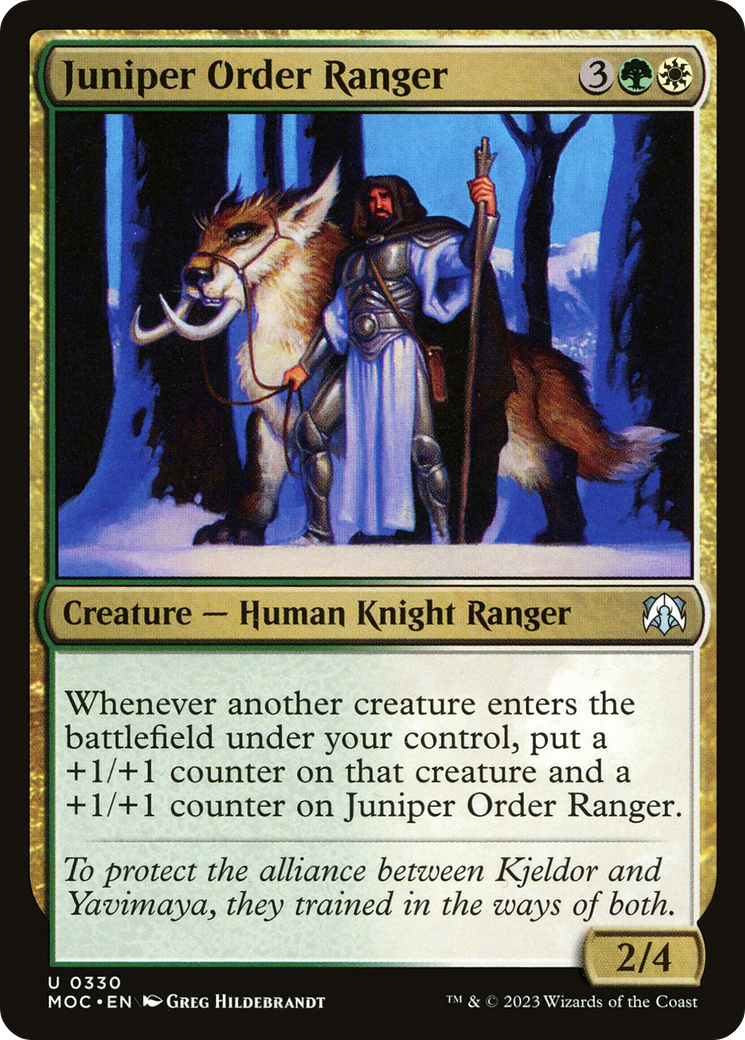
Juniper Order Ranger
Juniper Order Ranger
Creature — Human Knight Ranger
2/4
Whenever another creature you control enters, put a +1/+1 counter on that creature and a +1/+1 counter on this creature.
- The creature doesn't enter with a +1/+1 counter on it. It enters, then the ability triggers. If either that creature or Juniper Order Ranger leaves the battlefield before the ability resolves, the remaining creature will still get a +1/+1 counter.
-
1
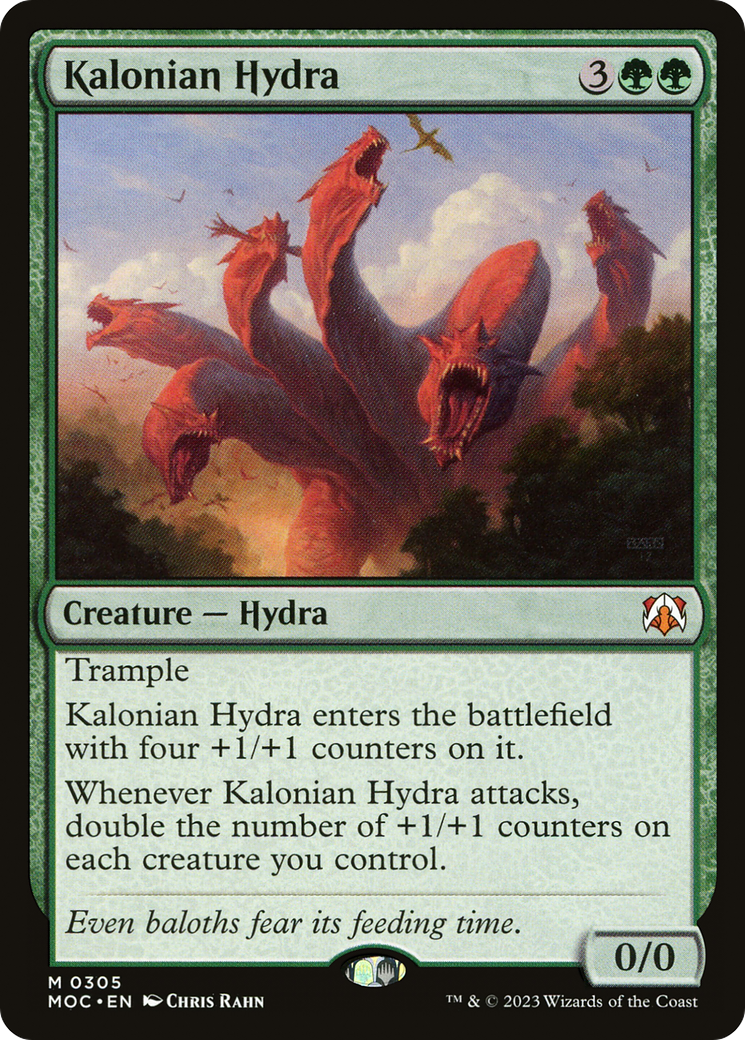
Kalonian Hydra
Kalonian Hydra
Creature — Hydra
0/0
Trample
This creature enters with four +1/+1 counters on it.
Whenever this creature attacks, double the number of +1/+1 counters on each creature you control.
- To double the number of +1/+1 counters on a creature, determine how many +1/+1 counters are on the creature and put that many more on it. Effects that interact with counters (such as the one created by Corpsejack Menace's ability) may change the number of counters ultimately put on the creature.
-
1
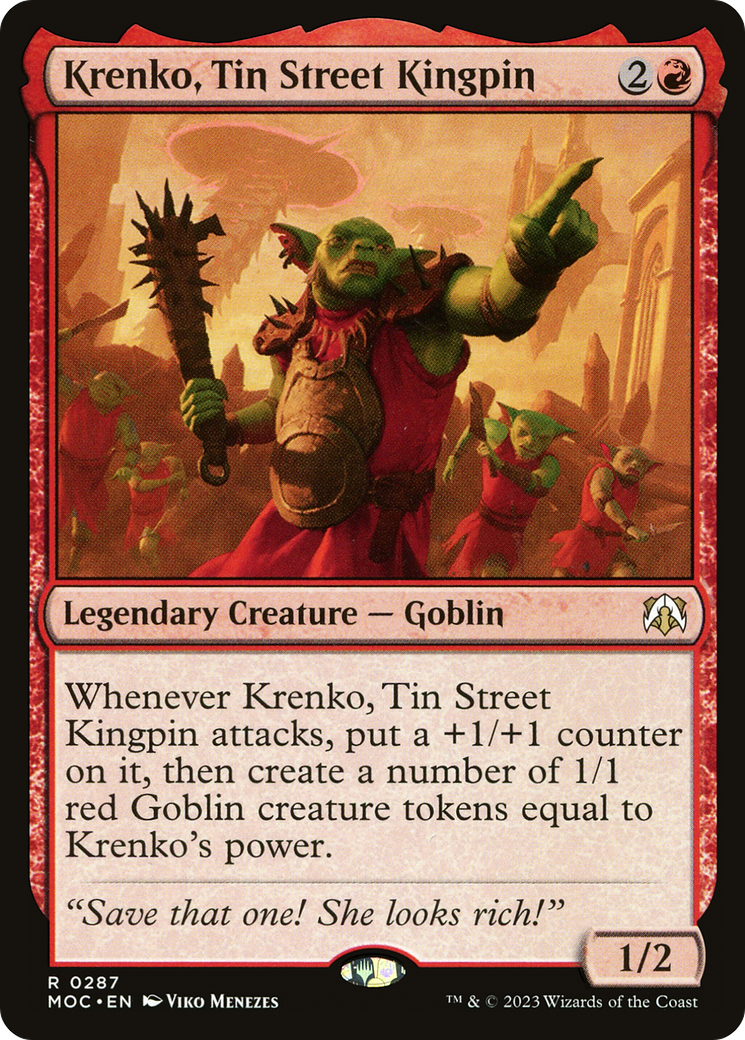
Krenko, Tin Street Kingpin
Krenko, Tin Street Kingpin
Legendary Creature — Goblin
1/2
Whenever Krenko attacks, put a +1/+1 counter on it, then create a number of 1/1 red Goblin creature tokens equal to Krenko's power.
- If Krenko leaves the battlefield after its ability has triggered but before it resolves, you don't put a +1/+1 counter on it, but you do use its power as it last existed before it left the battlefield to determine how many Goblin tokens to create.
- The tokens created by Krenko's triggered ability aren't attacking. Because all attackers are chosen at once, a token created this way can't attack, even if it gains haste.
-
1
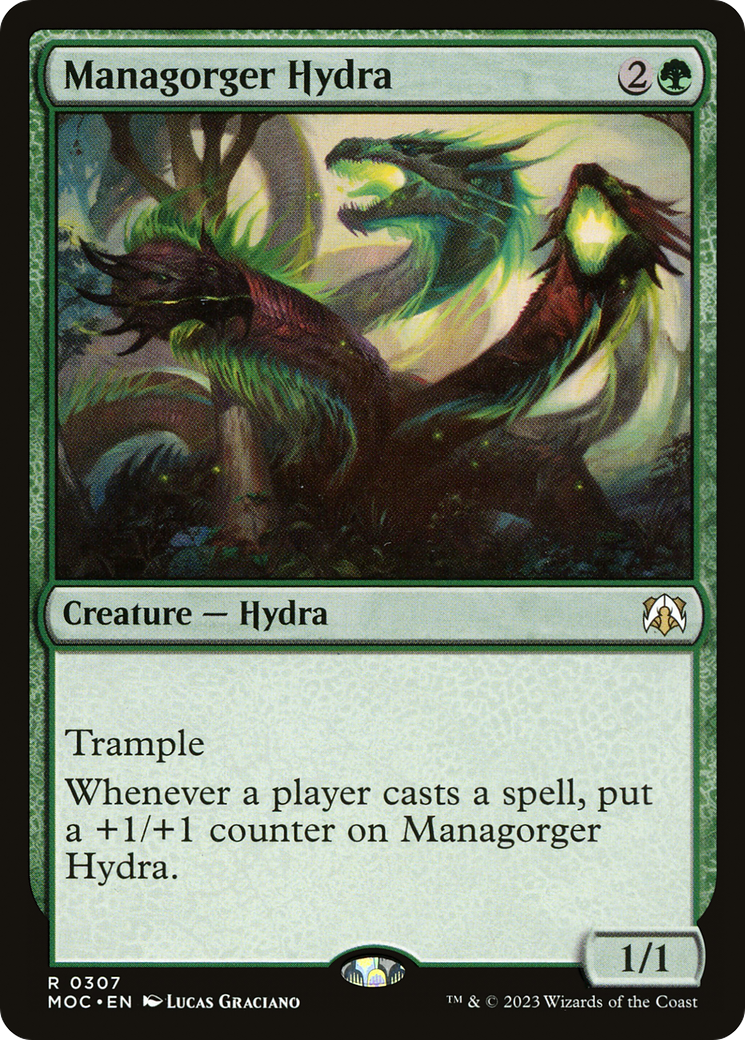
Managorger Hydra
Managorger Hydra
Creature — Hydra
1/1
Trample
Whenever a player casts a spell, put a +1/+1 counter on this creature.
- Managorger Hydra's last ability will resolve before the spell that caused it to trigger.
-
1
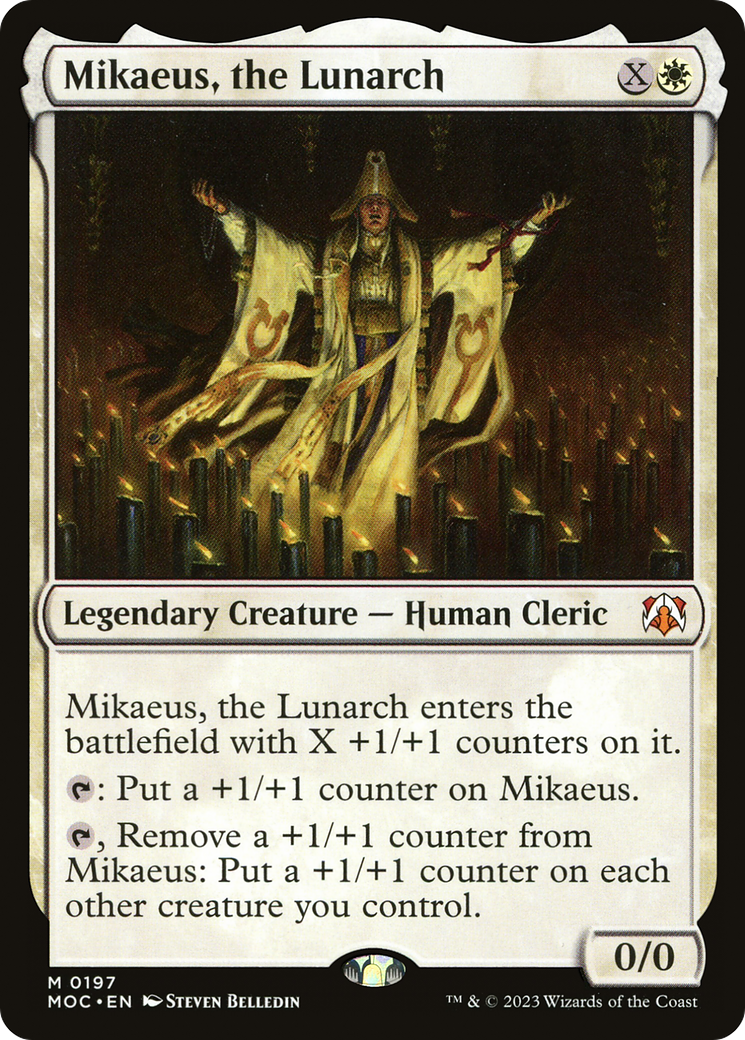
Mikaeus, the Lunarch
Mikaeus, the Lunarch
Legendary Creature — Human Cleric
0/0
Mikaeus enters with X +1/+1 counters on it.
: Put a +1/+1 counter on Mikaeus.
, Remove a +1/+1 counter from Mikaeus: Put a +1/+1 counter on each other creature you control.
-
1
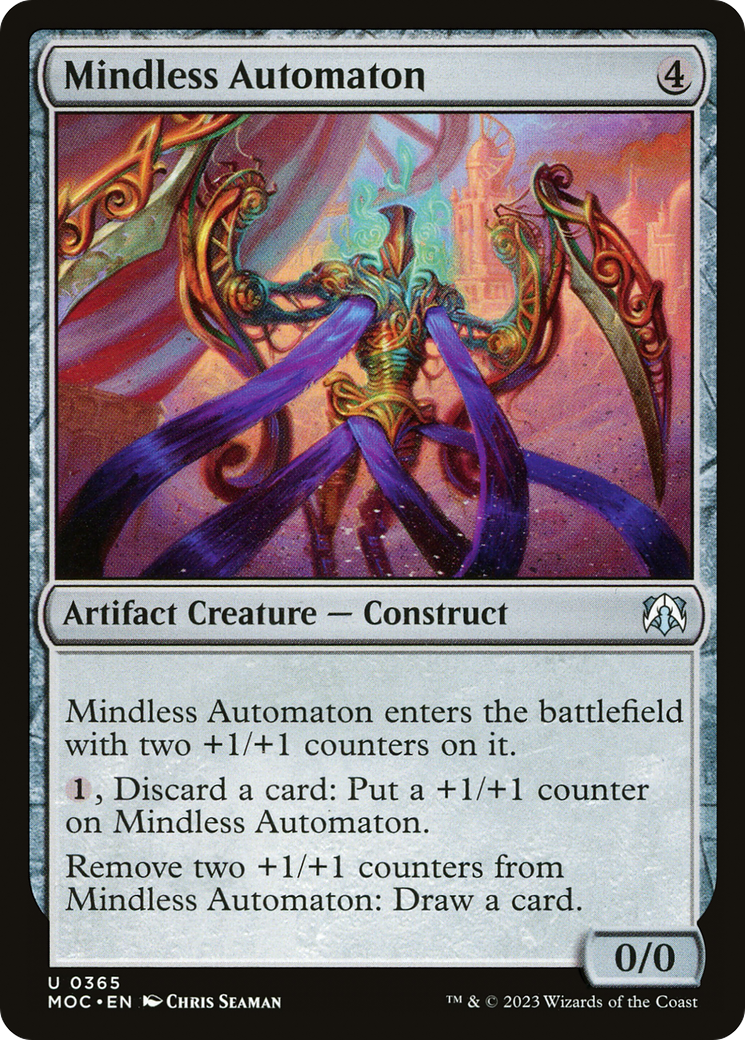
Mindless Automaton
Mindless Automaton
Artifact Creature — Construct
0/0
This creature enters with two +1/+1 counters on it.
, Discard a card: Put a +1/+1 counter on this creature.
Remove two +1/+1 counters from this creature: Draw a card.
- If removing two +1/+1 counters from Mindless Automaton causes the amount of damage already marked on Mindless Automaton to be equal to or greater than its toughness, it will be put into its owner's graveyard as a state-based action before the ability can be activated again and before the card is drawn.
-
1
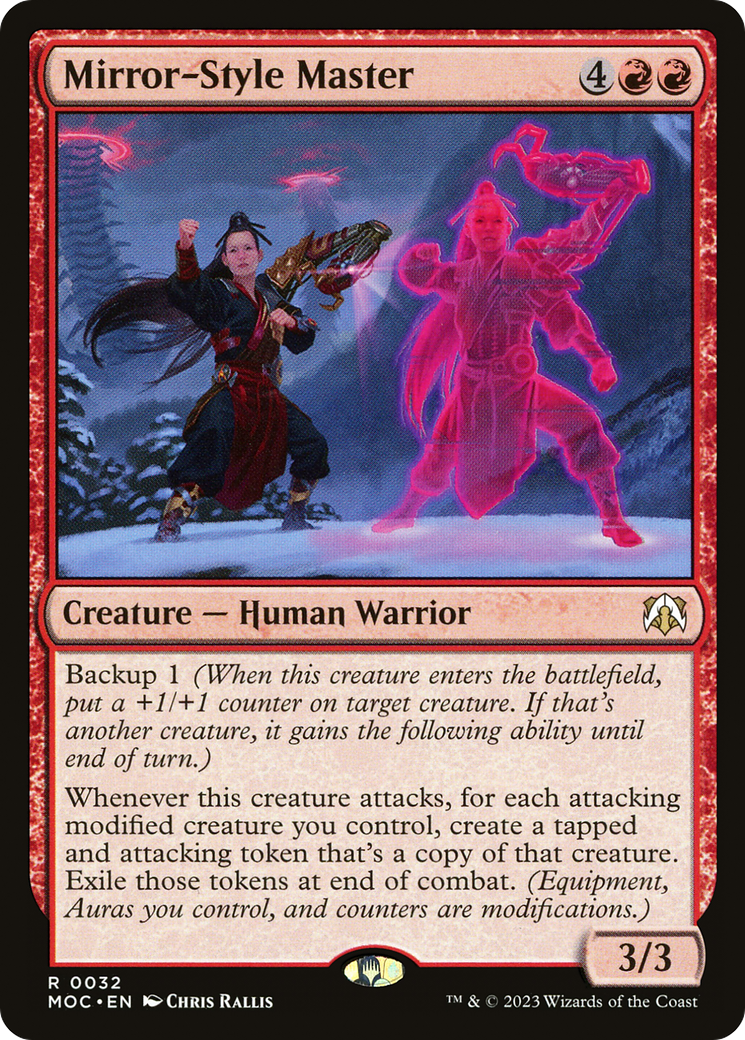
Mirror-Style Master
Mirror-Style Master
Creature — Human Warrior
3/3
Backup 1 (When this creature enters, put a +1/+1 counter on target creature. If that's another creature, it gains the following ability until end of turn.)
Whenever this creature attacks, for each attacking modified creature you control, create a tapped and attacking token that's a copy of that creature. Exile those tokens at end of combat. (Equipment, Auras you control, and counters are modifications.)
- Although the tokens enter the battlefield attacking, they were never declared as attacking creatures (for the purposes of abilities that trigger whenever a creature attacks, for example).
- All of the tokens enter the battlefield at the same time.
- Each of the tokens copy exactly what was printed on the original creature and nothing else (unless that creature is copying something else or is a token; see below). It doesn’t copy whether that creature is tapped or untapped, whether it has any counters on it or Auras and Equipment attached to it, or any non-copy effects that have changed its power, toughness, types, color, and so on. (Basically, it won’t copy anything that made it modified in the first place. C’est la vie.)
- If the copied creature has in its mana cost, X is 0.
- If the copied creature is a token, the token that’s created copies the original characteristics of that token as stated by the effect that created that token.
- If the copied creature is copying something else, then the token enters the battlefield as whatever that creature copied.
- Any enters-the-battlefield abilities of the copied creature will trigger when the token enters the battlefield. Any “as [this creature] enters the battlefield” or “[this creature] enters the battlefield with” abilities of the copied creature will also work.
- If a backup ability targets the creature with backup, that creature will get +1/+1 counters, but it won’t gain additional abilities.
- If a backup ability causes another creature to gain abilities, the creature with backup will still have those abilities.
- If a permanent enters the battlefield as a copy of a card with a backup ability or a token is created that is a copy of that card, the order of the printed abilities is maintained.
- Backup confers only abilities that are actually printed below it. Any abilities that are gained by the permanent are ignored, including abilities gained due to a resolving spell or ability or copy effects.
- The abilities that backup grants to the target creature are determined only once, at the time the ability triggers. They won’t change if the permanent with backup loses any abilities before the backup ability resolves.
-
1
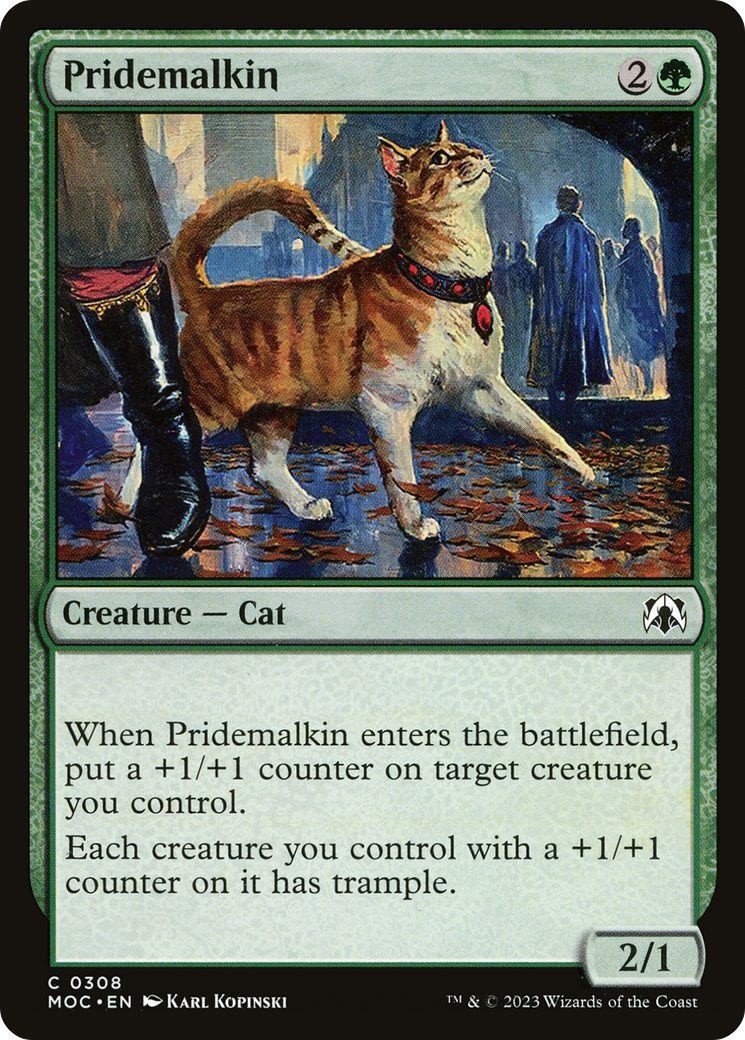
Pridemalkin
Pridemalkin
Creature — Cat
2/1
When this creature enters, put a +1/+1 counter on target creature you control.
Each creature you control with a +1/+1 counter on it has trample. (It can deal excess combat damage to the player or planeswalker it's attacking.)
- Pridemalkin can be the target of its own first ability.
- Pridemalkin's second ability applies to Pridemalkin as long as it has a +1/+1 counter on it.
-
1
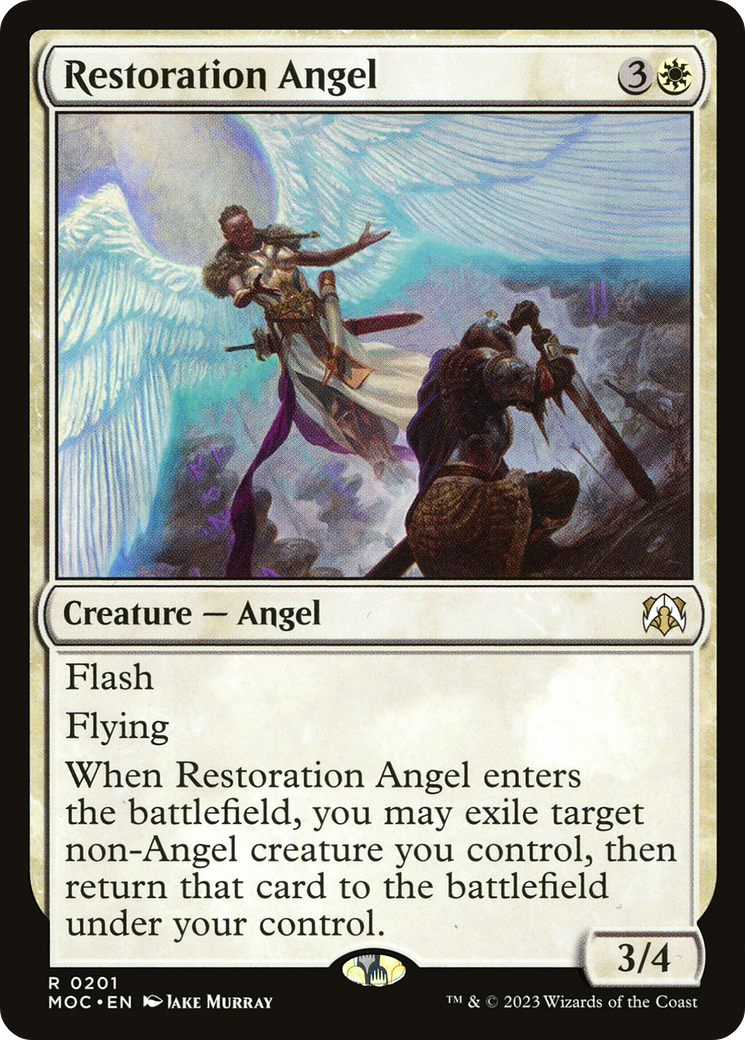
Restoration Angel
Restoration Angel
Creature — Angel
3/4
Flash
Flying
When this creature enters, you may exile target non-Angel creature you control, then return that card to the battlefield under your control.
- Once the exiled creature returns, it's considered a new object with no relation to the object that it was. Auras attached to the exiled creature will be put into their owners' graveyards. Equipment attached to the exiled creature will become unattached and remain on the battlefield. Any counters on the exiled creature will cease to exist.
- If a token is exiled this way, it will cease to exist and won't return to the battlefield.
- When an effect returns the exiled card "under your control," you control it indefinitely after that. If you had temporarily gained control of a creature, it won't return to its previous controller. In a multiplayer game, if a player leaves the game, all cards that player owns leave as well. If you leave the game, a creature you took with Restoration Angel's effect is exiled.
-
1
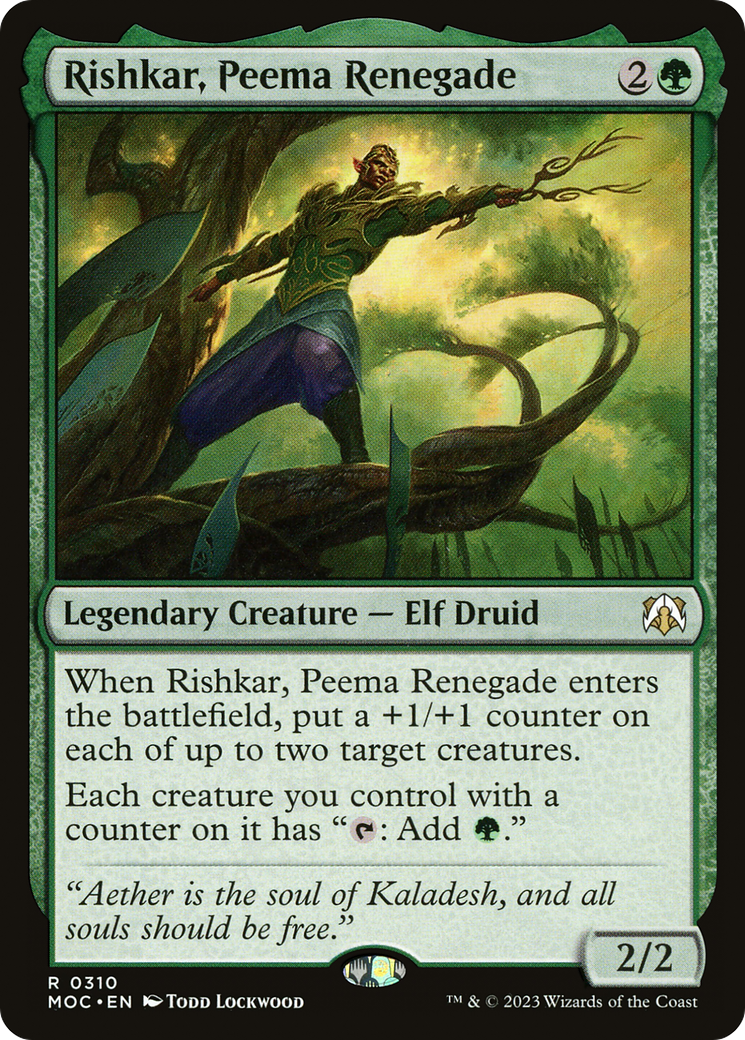
Rishkar, Peema Renegade
Rishkar, Peema Renegade
Legendary Creature — Elf Druid
2/2
When Rishkar enters, put a +1/+1 counter on each of up to two target creatures.
Each creature you control with a counter on it has " : Add ."
- Rishkar can be a target of its own triggered ability.
- You can't target the same creature twice to have one recipient get two +1/+1 counters.
- Each creature you control has Rishkar's mana ability as long as that creature has any kind of counter on it. The effect isn't limited to those with +1/+1 counters.
-
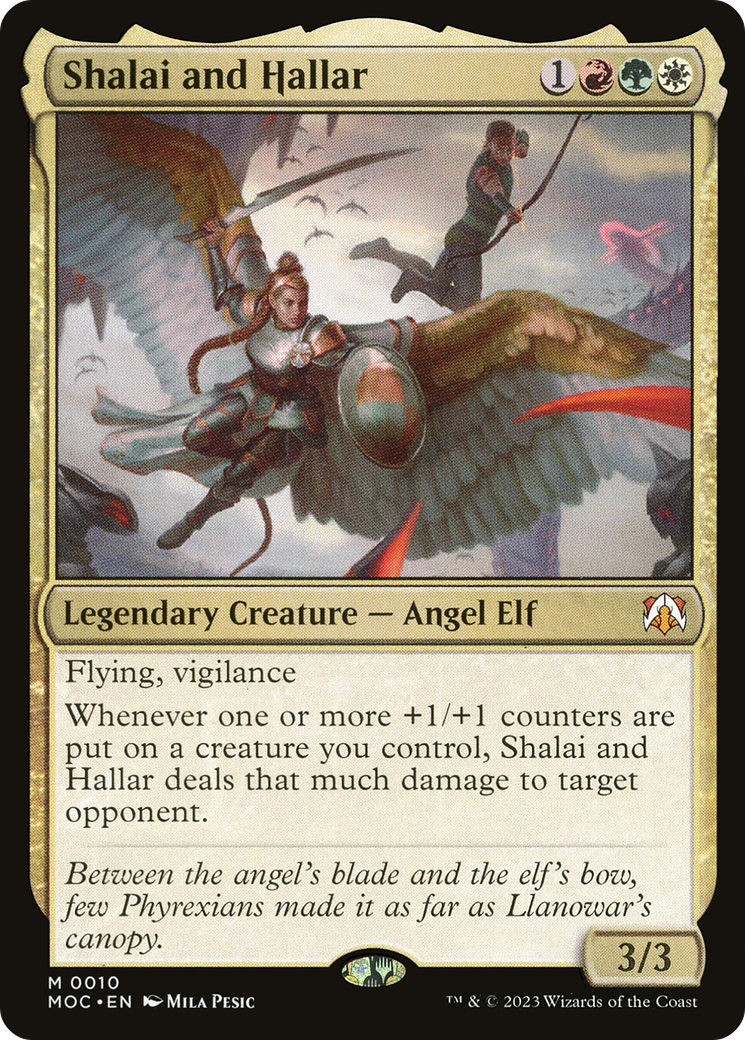
1
Shalai and Hallar
Shalai and Hallar
Legendary Creature — Angel Elf
3/3
Flying, vigilance
Whenever one or more +1/+1 counters are put on a creature you control, Shalai and Hallar deals that much damage to target opponent.
-
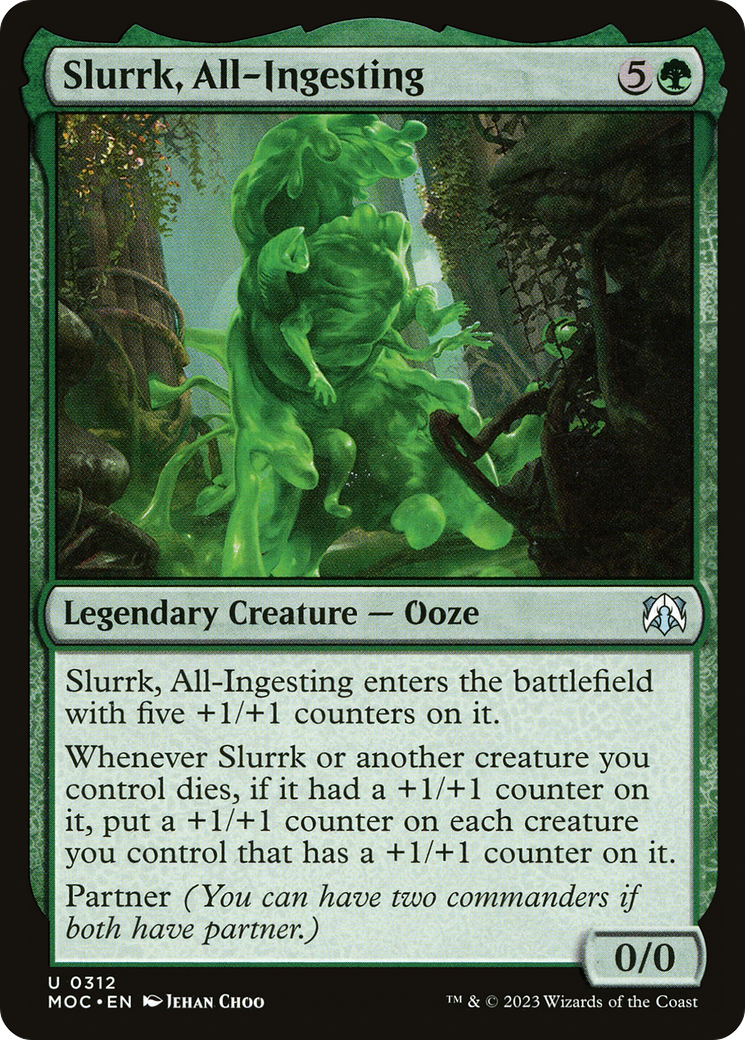
1
Slurrk, All-Ingesting
Slurrk, All-Ingesting
Legendary Creature — Ooze
0/0
Slurrk enters with five +1/+1 counters on it.
Whenever Slurrk or another creature you control dies, if it had a +1/+1 counter on it, put a +1/+1 counter on each creature you control that has a +1/+1 counter on it.
Partner (You can have two commanders if both have partner.)
- If your Commander deck has two commanders, you can only include cards whose own color identities are also found in your commanders' combined color identities. If Falthis and Kediss are your commanders, your deck may contain cards with black and/or red in their color identity, but not cards with green, white, or blue.
- Both commanders start in the command zone, and the remaining 98 cards (or 58 cards in a Commander Draft game) of your deck are shuffled to become your library.
- To have two commanders, both must have the partner ability as the game begins. Losing the ability during the game doesn't cause either to cease to be your commander.
- Once the game begins, your two commanders are tracked separately. If you cast one, you won't have to pay an additional the first time you cast the other. A player loses the game after having been dealt 21 damage from any one of them, not from both of them combined.
- If something refers to your commander while you have two commanders, it refers to one of them of your choice. If you are instructed to perform an action on your commander (e.g. put it from the command zone into your hand due to Command Beacon), you choose one of your commanders at the time the effect happens.
- An effect that checks whether you control your commander is satisfied if you control one or both of your two commanders.
- You can choose two commanders with partner that are the same color or colors. In Commander Draft, you can even choose two of the same commander with partner if you drafted them. If you do this, make sure you keep the number of times you've cast each from the command zone clear for "commander tax" purposes.
-
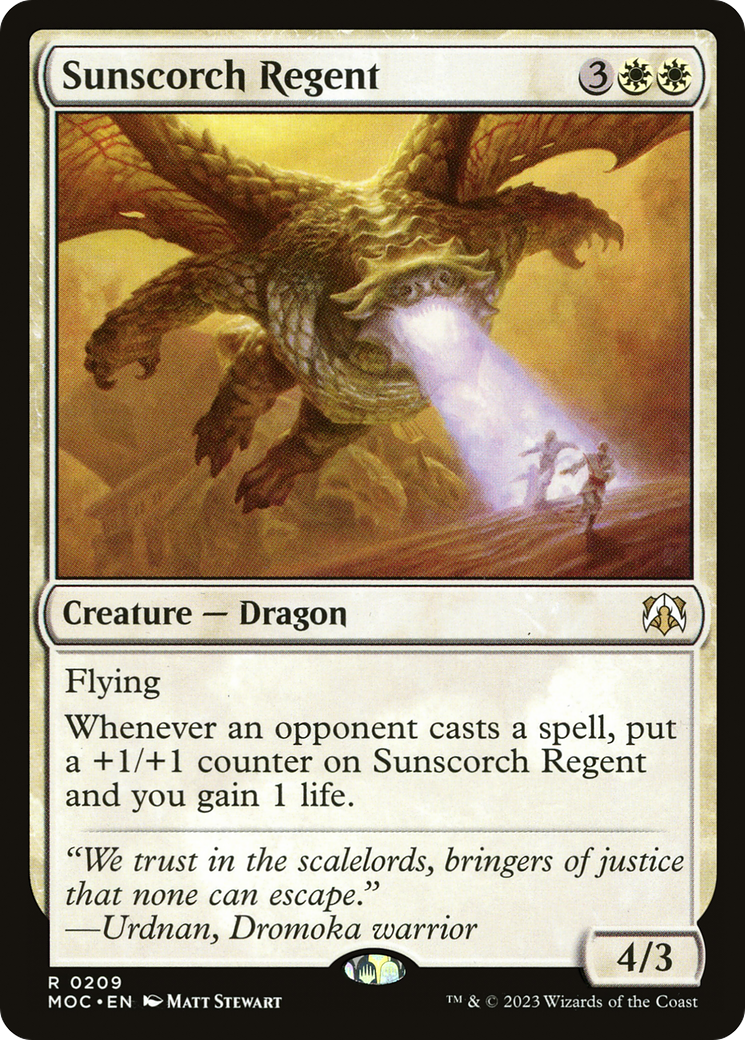
1
Sunscorch Regent
Sunscorch Regent
Creature — Dragon
4/3
Flying
Whenever an opponent casts a spell, put a +1/+1 counter on this creature and you gain 1 life.
-
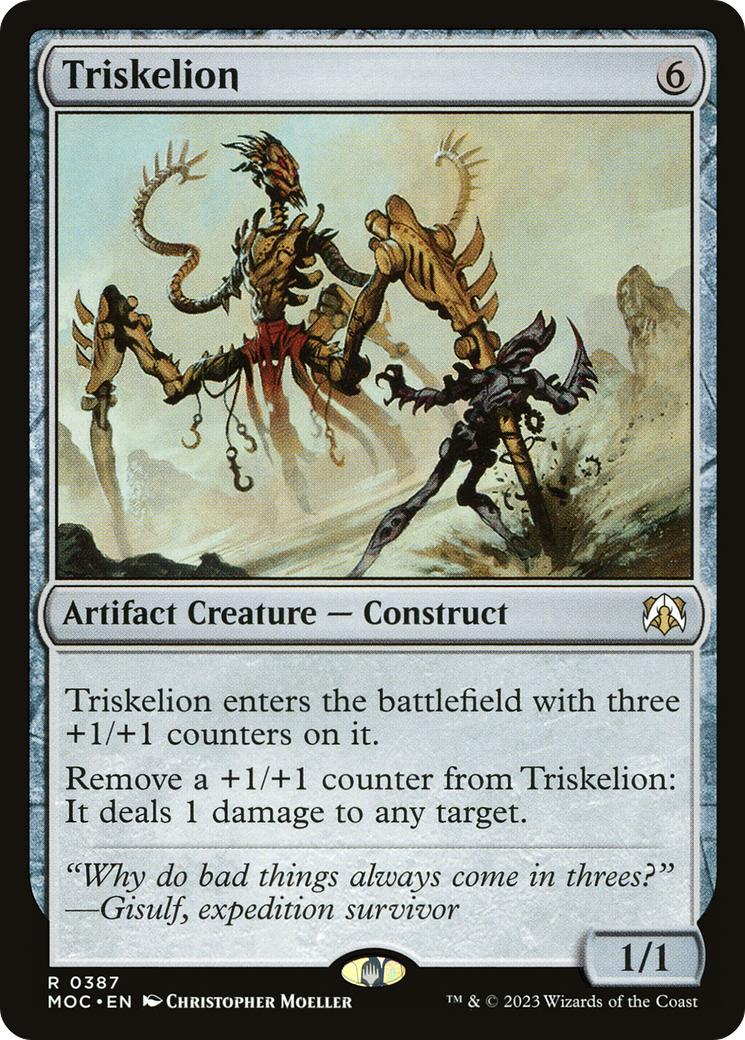
1
Triskelion
Triskelion
Artifact Creature — Construct
1/1
This creature enters with three +1/+1 counters on it.
Remove a +1/+1 counter from this creature: It deals 1 damage to any target.
- If you activate the ability of an attacking or blocking Triskelion during the declare blockers step, it will deal less combat damage as a result. If you wait until the combat damage step, but Triskelion is dealt lethal damage, it’ll be destroyed before you get a chance to activate its ability.
- If Triskelion has damage marked on it, activating its ability may cause that damage to become lethal. For example, say a Triskelion with two +1/+1 counters on it has been dealt 2 damage earlier in the turn. If you activate its ability by removing a +1/+1 counter from it, it now has 2 toughness and is destroyed as a state-based action. You won’t be able to remove the other +1/+1 counter from it to activate its ability again. The first activation of the ability will still resolve.
-
1
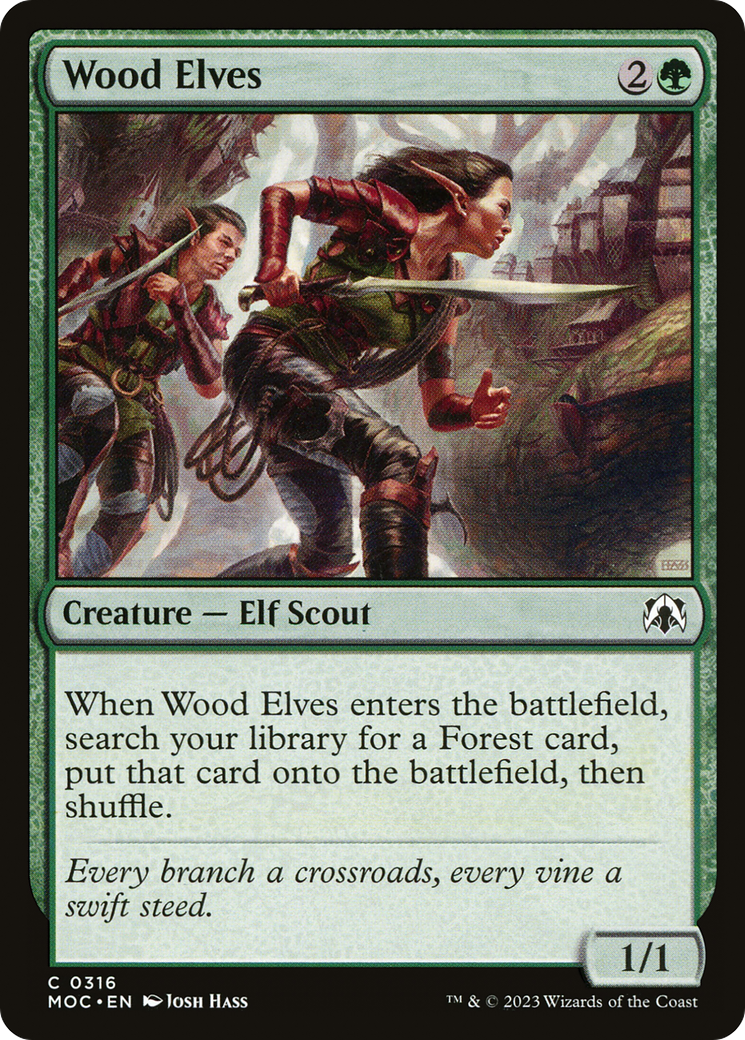
Wood Elves
Wood Elves
Creature — Elf Scout
1/1
When this creature enters, search your library for a Forest card, put that card onto the battlefield, then shuffle.
- Because the "search" requires you to find a card with certain characteristics, you don't have to find the card if you don't want to.
Instants 9
-
1
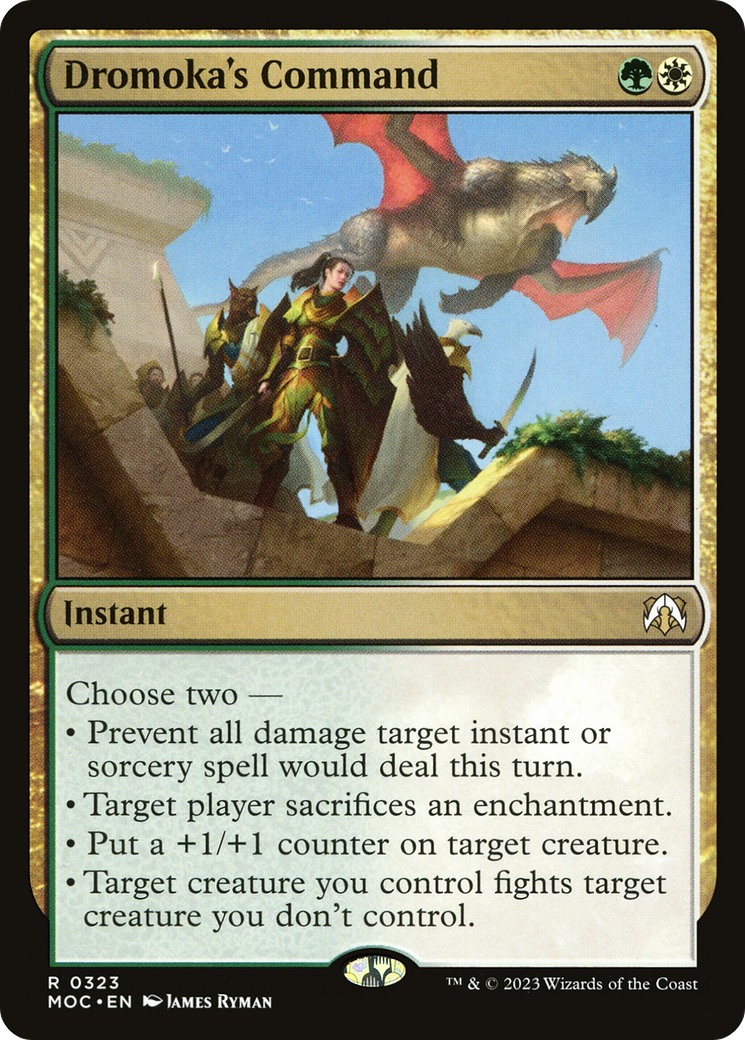
Dromoka's Command
Dromoka's Command
Instant
Choose two —
- Prevent all damage target instant or sorcery spell would deal this turn.
- Target player sacrifices an enchantment of their choice.
- Put a +1/+1 counter on target creature.
- Target creature you control fights target creature you don't control.
- Although most instants and sorceries that cause damage to be dealt are the sources of that damage, a few cause other objects to deal damage (for example, spells that cause creatures to fight). The first ability of Dromoka's Command won't prevent damage caused by those other sources.
- You can target any player with the second ability, including one that doesn't control an enchantment.
- You choose the two modes as you cast the spell. You must choose two different modes. Once modes are chosen, they can't be changed.
- You can choose a mode only if you can choose legal targets for that mode. Ignore the targeting requirements for modes that aren't chosen. For example, you can cast Ojutai's Command without targeting a creature spell provided you don't choose the third mode.
- As the spell resolves, follow the instructions of the modes you chose in the order they are printed on the card. For example, if you chose the second and fourth modes of Ojutai's Command, you would gain 4 life and then draw a card. (The order won't matter in most cases.)
- If a Command is copied, the effect that creates the copy will usually allow you to choose new targets for the copy, but you can't choose new modes.
- If all targets for the chosen modes become illegal before the Command resolves, the spell won't resolve and none of its effects will happen. If at least one target is still legal, the spell will resolve but will have no effect on any illegal targets.
-
1
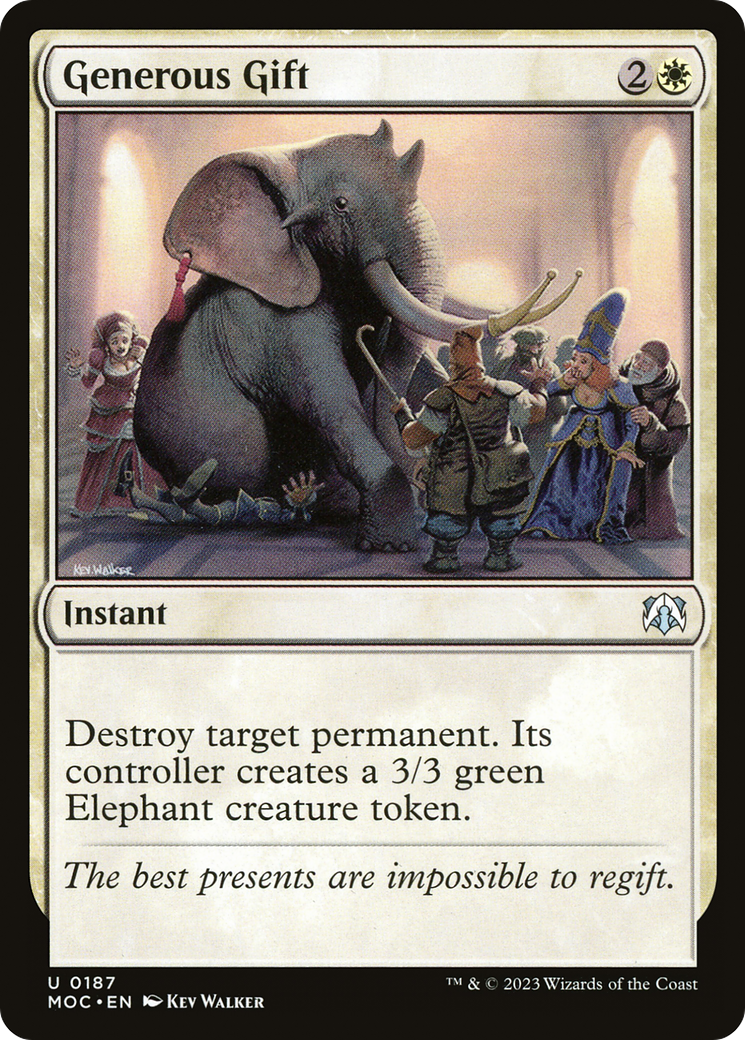
Generous Gift
Generous Gift
Instant
Destroy target permanent. Its controller creates a 3/3 green Elephant creature token.
- If the target permanent is an illegal target by the time Generous Gift tries to resolve, the spell doesn't resolve. No player creates an Elephant. If the target is legal but not destroyed (most likely because it has indestructible), its controller does create an Elephant.
-
1
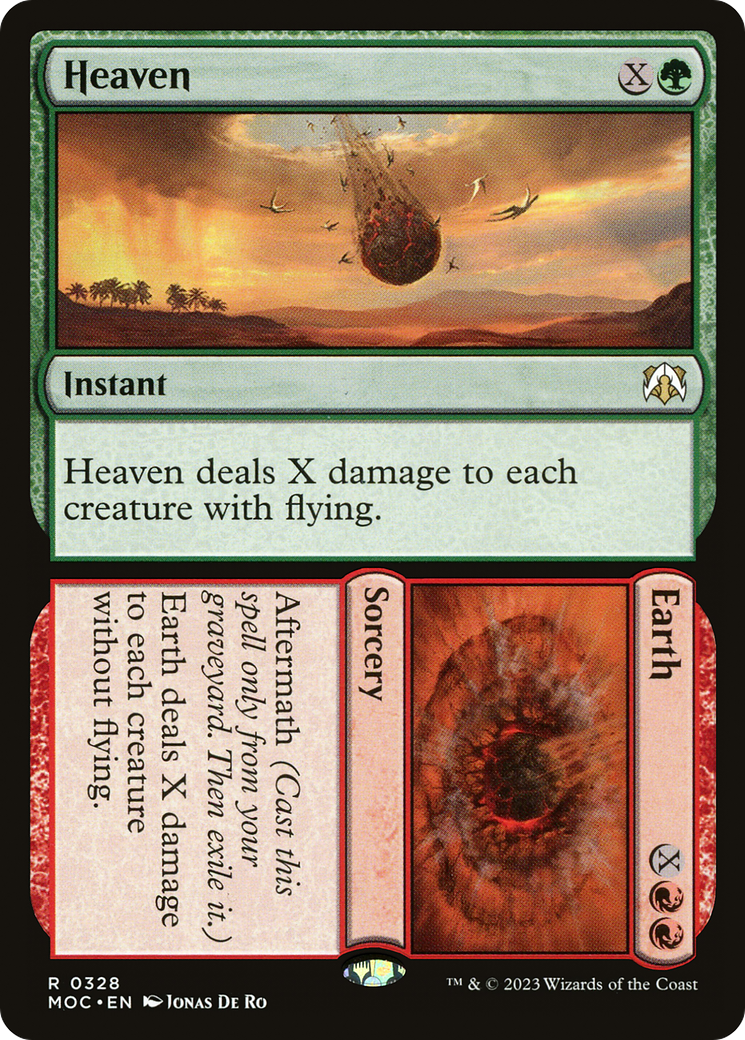
Heaven // Earth
//
Heaven
Instant
- Once you've started to cast a spell with aftermath from your graveyard, the card is immediately moved to the stack. Opponents can't try to stop the ability by exiling the card with an effect such as that of Crook of Condemnation.
- All split cards have two card faces on a single card, and you put a split card onto the stack with only the half you're casting. The characteristics of the half of the card you didn't cast are ignored while the spell is on the stack. For example, if an effect prevents you from casting green spells, you can cast Destined of Destined // Lead, but not Lead.
- Each split card is a single card. For example, if you discard one, you've discarded one card, not two. If an effect counts the number of instant and sorcery cards in your graveyard, Destined // Lead counts once, not twice.
- Each split card has two names. If an effect instructs you to choose a card name, you may choose one, but not both.
- While not on the stack, the characteristics of a split card are the combination of its two halves. For example, Destined // Lead is a green and black card, it is both an instant card and a sorcery card, and its mana value is 6. This means that if an effect allows you to cast a card with mana value 2 from your hand, you can't cast Destined. This is a change from the previous rules for split cards.
- Split cards with aftermath have a new frame treatment—the half you can cast from your hand is oriented the same as other cards you'd cast from your hand, while the half you can cast from your graveyard is a traditional split card half. This frame treatment is for your convenience and has no rules significance.
- If another effect allows you to cast a split card with aftermath from any zone other than a graveyard, you can't cast the half with aftermath.
- If another effect allows you to cast a split card with aftermath from a graveyard, you may cast either half. If you cast the half that has aftermath, you'll exile the card if it would leave the stack.
- A spell with aftermath cast from a graveyard will always be exiled afterward, whether it resolves, it's countered, or it leaves the stack in some other way.
- You don't have to choose the same value for X while casting Earth as you did while casting Heaven.
- If you cast the first half of a split card with aftermath during your turn, you'll have priority immediately after it resolves. You can cast the half with aftermath from your graveyard before any player can take any other action if it's legal for you to do so.
-
1
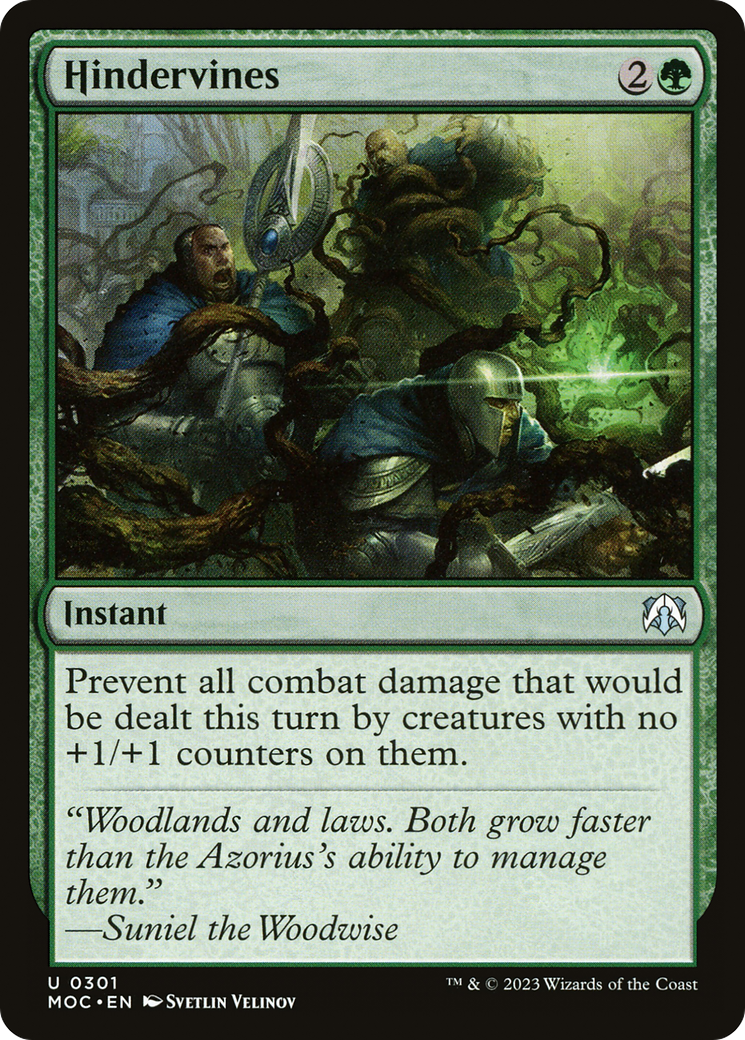
Hindervines
Hindervines
Instant
Prevent all combat damage that would be dealt this turn by creatures with no +1/+1 counters on them.
- Hindervines checks whether a creature has a +1/+1 counter on it at the moment it deals damage. It doesn't matter whether a creature had a +1/+1 counter, or was even on the battlefield, when Hindervines resolved.
-
1
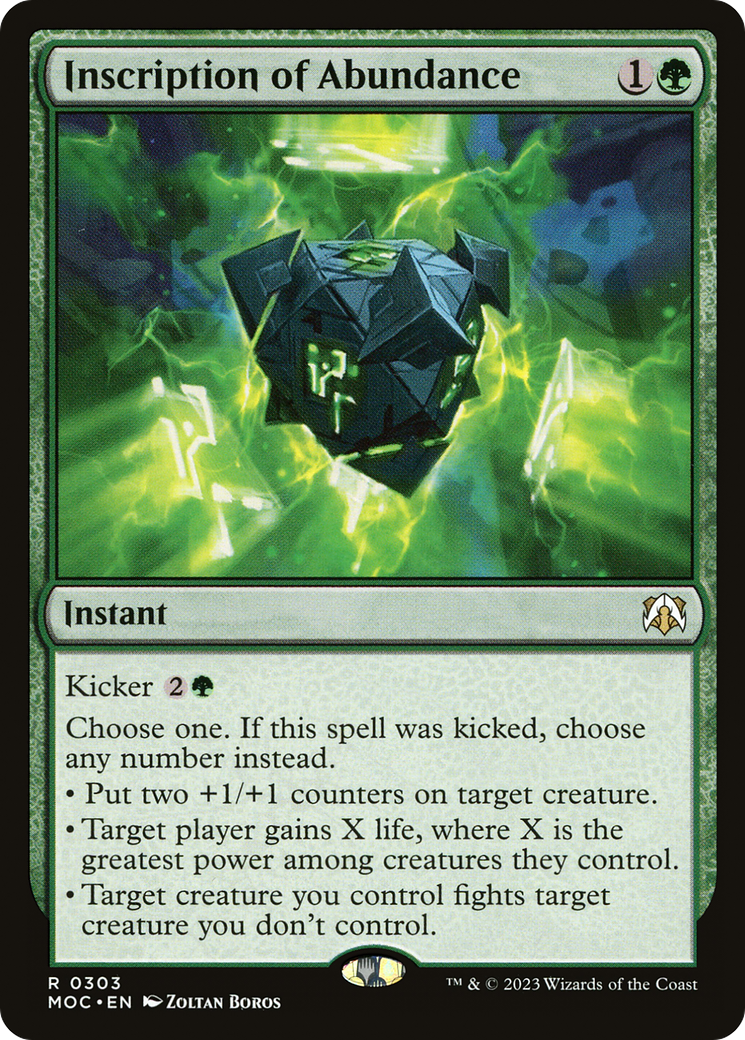
Inscription of Abundance
Inscription of Abundance
Instant
Kicker
Choose one. If this spell was kicked, choose any number instead.
- Put two +1/+1 counters on target creature.
- Target player gains X life, where X is the greatest power among creatures they control.
- Target creature you control fights target creature you don't control.
- To determine a spell's total cost, start with the mana cost (or an alternative cost if another card's effect allows you to pay one instead), add any cost increases (such as kicker), then apply any cost reductions. The spell's mana value remains unchanged, no matter what the total cost to cast it was.
- If a spell's kicker cost was paid, the spell is "kicked."
- The kicker ability doesn't let you pay a kicker cost more than once.
- If you put a permanent with a kicker ability onto the battlefield without casting it, you can't kick it.
- If you copy a kicked spell on the stack, the copy is also kicked. If the copied spell is a permanent spell, the token the copy of that spell becomes when it enters is also kicked.
- If a card or token enters as a copy of a permanent, the new permanent isn't kicked, even if the original was.
- If more than one mode is chosen, perform them in the order written. Nothing can happen in between, however, and no player may choose to take actions. Any abilities that trigger will be put onto the stack after the spell has finished resolving.
- If any targets become illegal, the other targets will still be affected as appropriate.
- If the second mode is chosen and each creature the target player controls has negative power, that player doesn't gain or lose life.
- If either target creature is an illegal target as Inscription of Abundance resolves with its last mode chosen, no creature will deal or be dealt damage.
- If you kick Inscription of Abundance, you can't choose any one mode more than once.
-
1
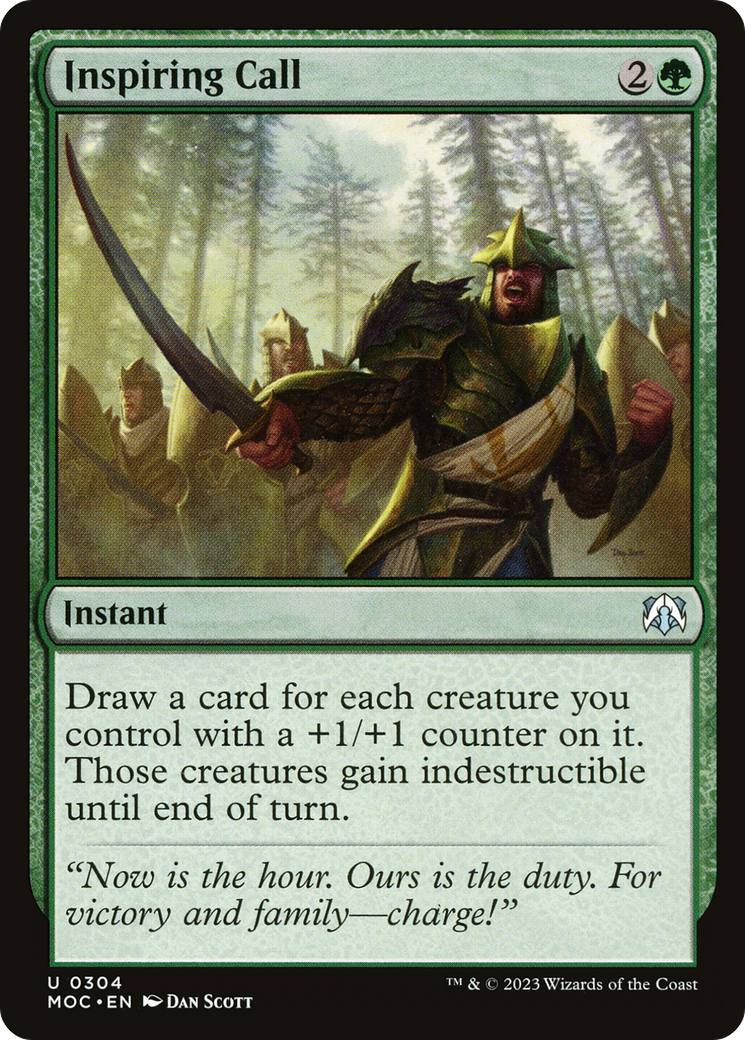
Inspiring Call
Inspiring Call
Instant
Draw a card for each creature you control with a +1/+1 counter on it. Those creatures gain indestructible until end of turn. (Damage and effects that say "destroy" don't destroy them.)
- Creatures you control that have +1/+1 counters put on them after Inspiring Call resolves won't gain indestructible.
- Once a creature gains indestructible, it will have it for the turn, even if it loses all its +1/+1 counters.
-
1
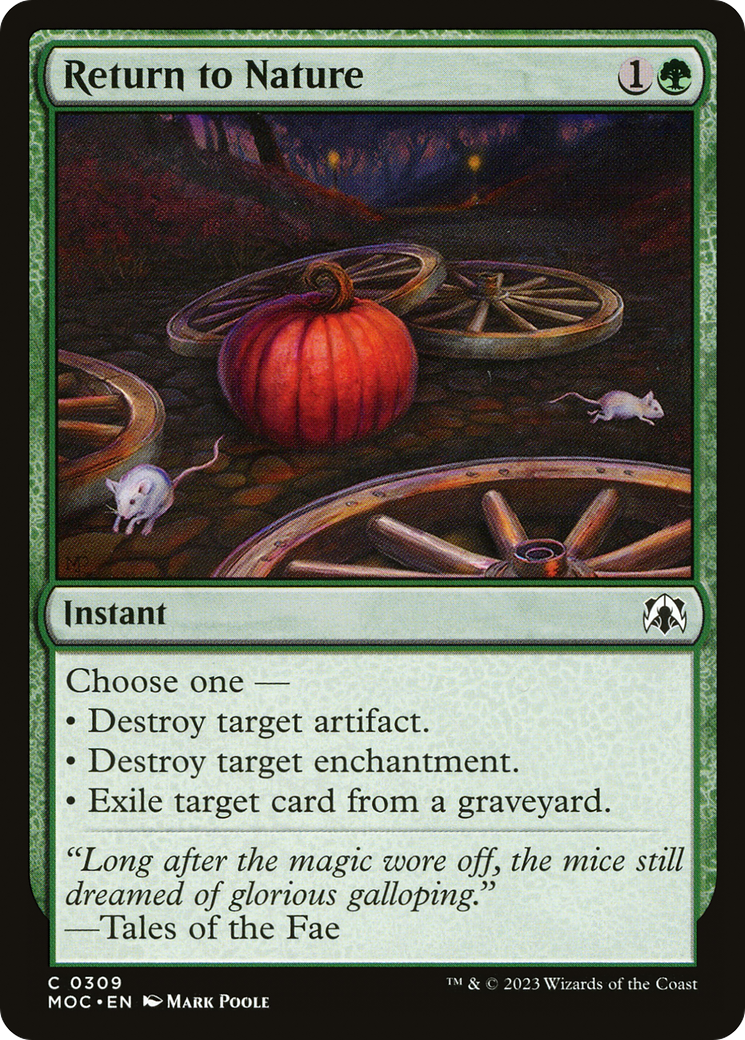
Return to Nature
Return to Nature
Instant
Choose one —
- Destroy target artifact.
- Destroy target enchantment.
- Exile target card from a graveyard.
-
1
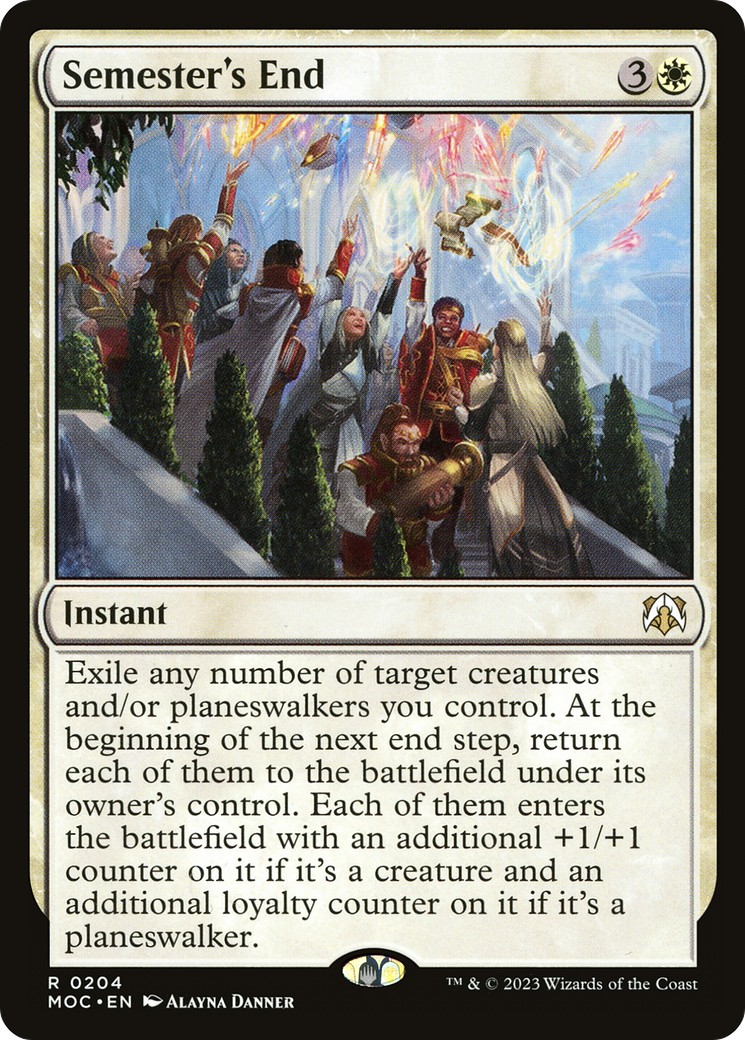
Semester's End
Semester's End
Instant
Exile any number of target creatures and/or planeswalkers you control. At the beginning of the next end step, return each of them to the battlefield under its owner's control. Each of them enters with an additional +1/+1 counter on it if it's a creature and an additional loyalty counter on it if it's a planeswalker.
- Use the characteristics of each permanent as it returns to the battlefield to determine if it should enter with an additional +1/+1 counter, an additional loyalty counter, or in very unusual cases, both. Notably, if you exile a creature that was only a creature because of a type-changing effect, it will enter as a noncreature permanent and won't get any additional +1/+1 counters from the effect of Semester's End.
-
1
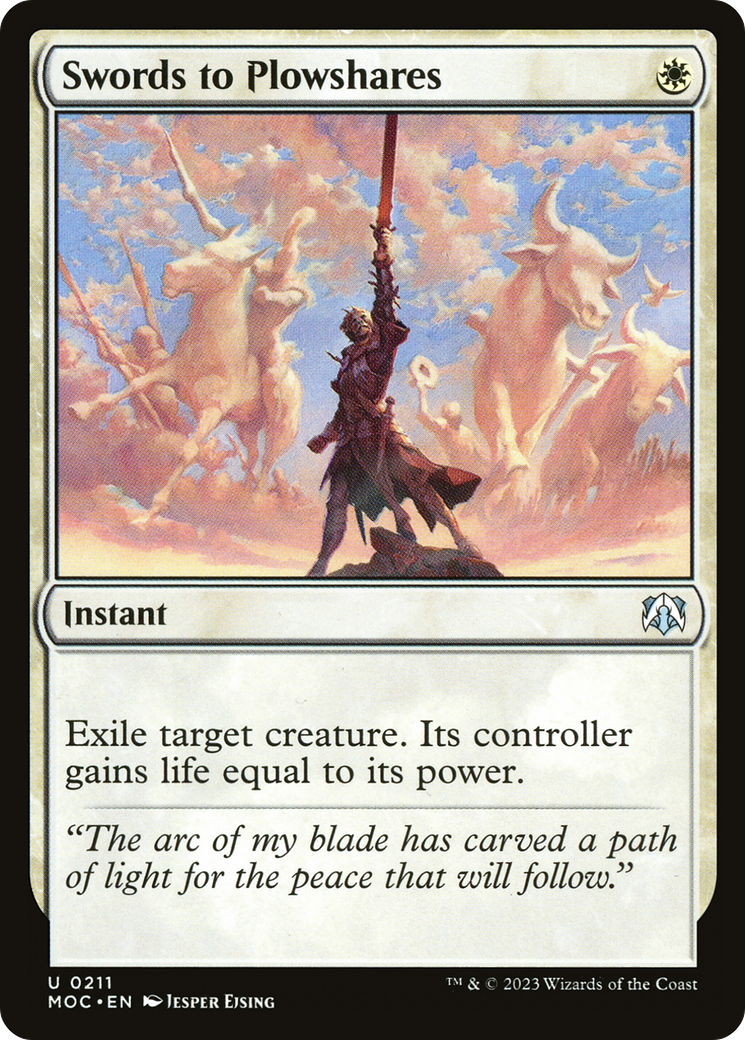
Swords to Plowshares
Swords to Plowshares
Instant
Exile target creature. Its controller gains life equal to its power.
- Use the power of the creature from when it was last on the battlefield to determine how much life is gained.
Sorceries 3
-
1
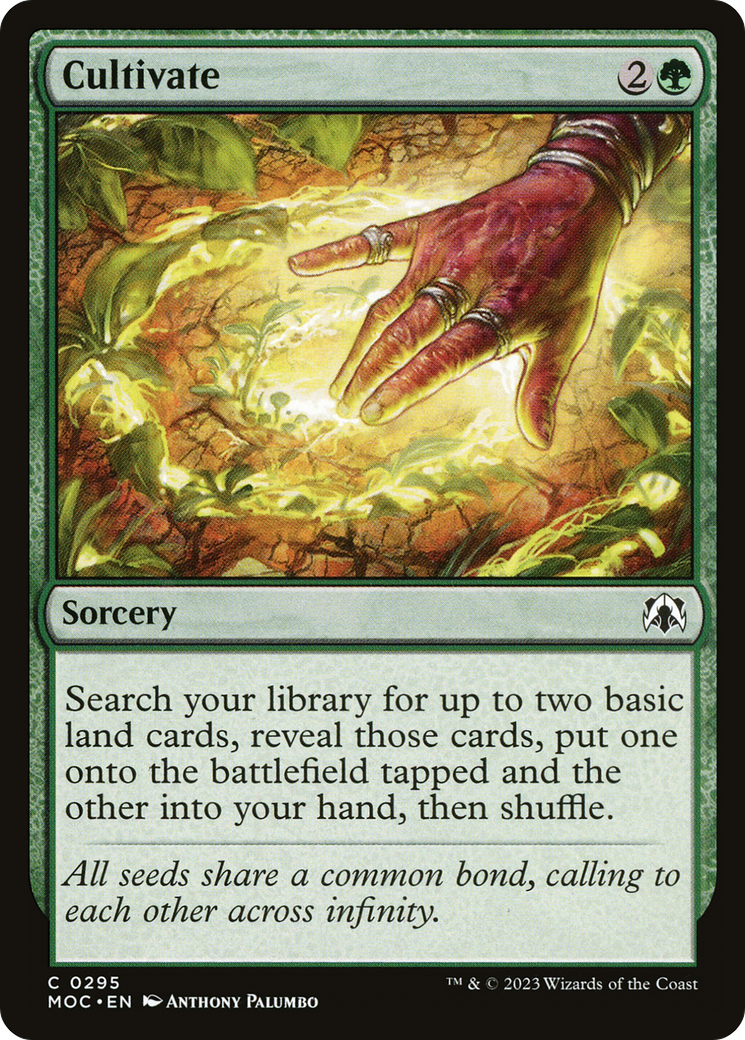
Cultivate
Cultivate
Sorcery
Search your library for up to two basic land cards, reveal those cards, put one onto the battlefield tapped and the other into your hand, then shuffle.
- If you choose to find only one basic land card, you put it onto the battlefield tapped.
-
1
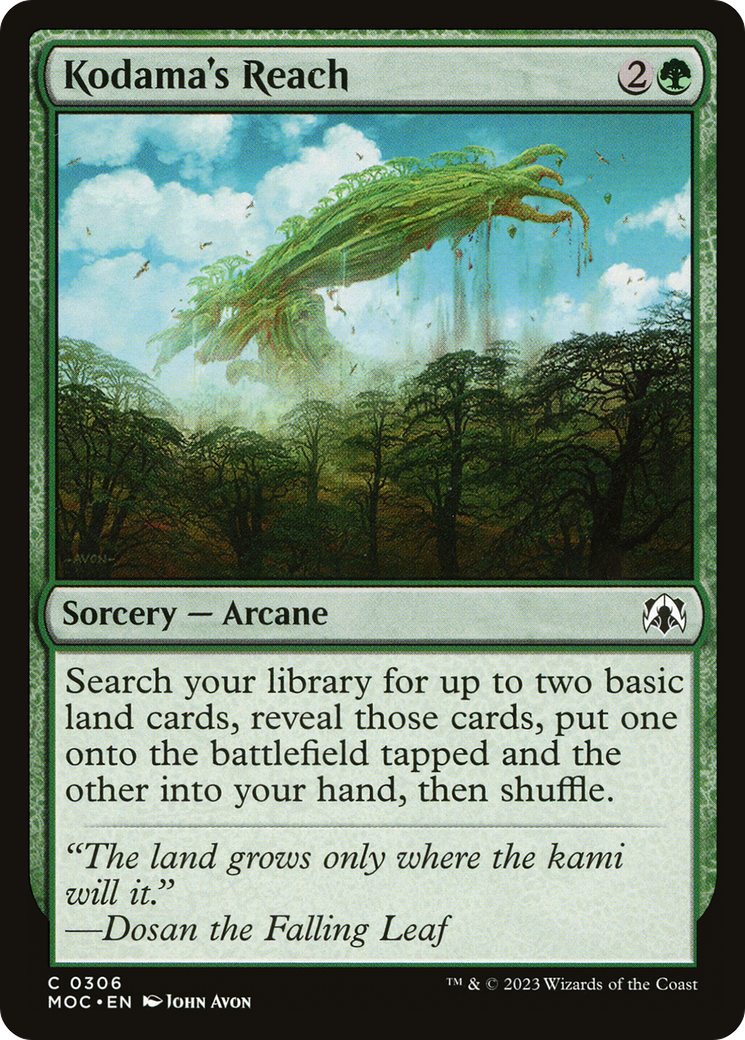
Kodama's Reach
Kodama's Reach
Sorcery — Arcane
Search your library for up to two basic land cards, reveal those cards, put one onto the battlefield tapped and the other into your hand, then shuffle.
- You can get just one basic land card if you wish (or even none at all). If you get only one land card, you put it onto the battlefield tapped.
-
1
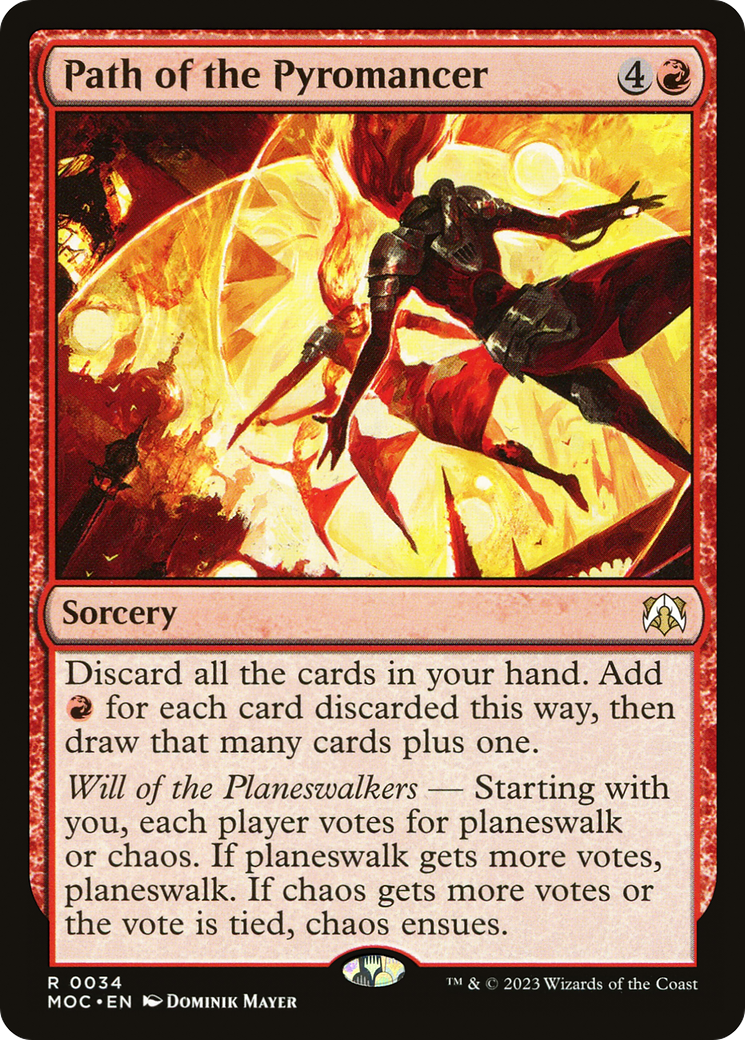
Path of the Pyromancer
Path of the Pyromancer
Sorcery
Discard all the cards in your hand. Add for each card discarded this way, then draw that many cards plus one.
Will of the Planeswalkers — Starting with you, each player votes for planeswalk or chaos. If planeswalk gets more votes, planeswalk. If chaos gets more votes or the vote is tied, chaos ensues.
- If your hand is empty as Path of the Pyromancer resolves, you won’t add any mana, but you will draw a card.
Artifacts 6
-
1
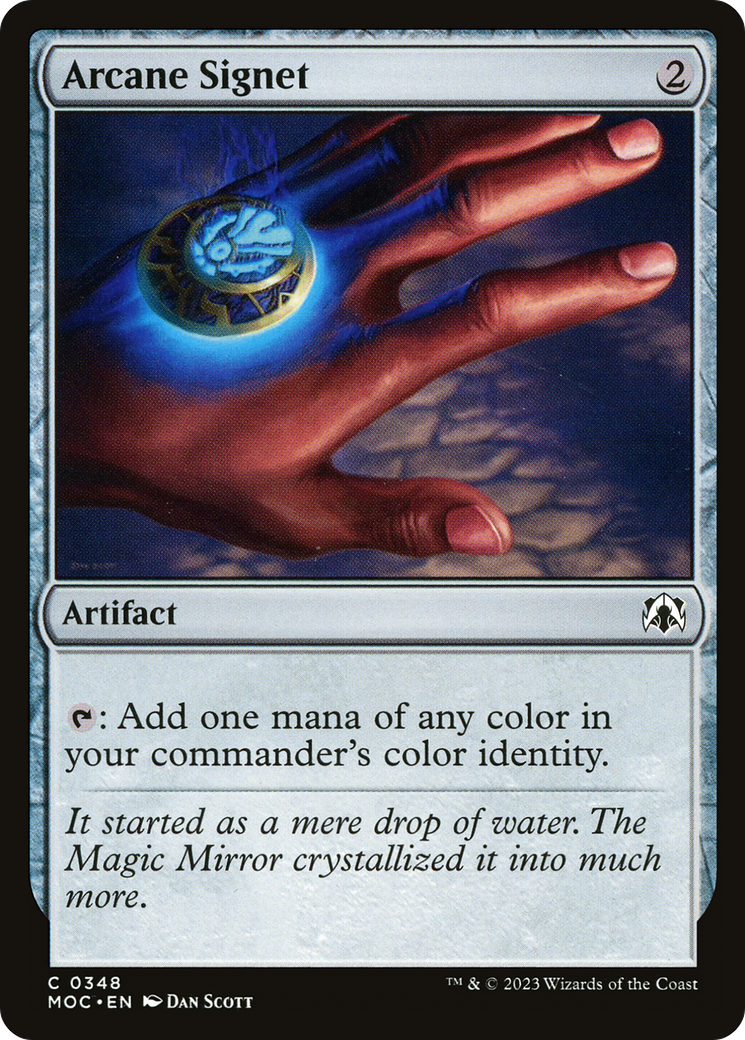
Arcane Signet
Arcane Signet
Artifact
: Add one mana of any color in your commander's color identity.
- If your commander is a card that has no colors in its color identity, Arcane Signet's ability produces no mana. It doesn't produce .
- If you have two commanders, the ability adds one mana of any color in their combined color identities.
- If you don't have a commander, Arcane Signet's ability produces no mana.
-
1
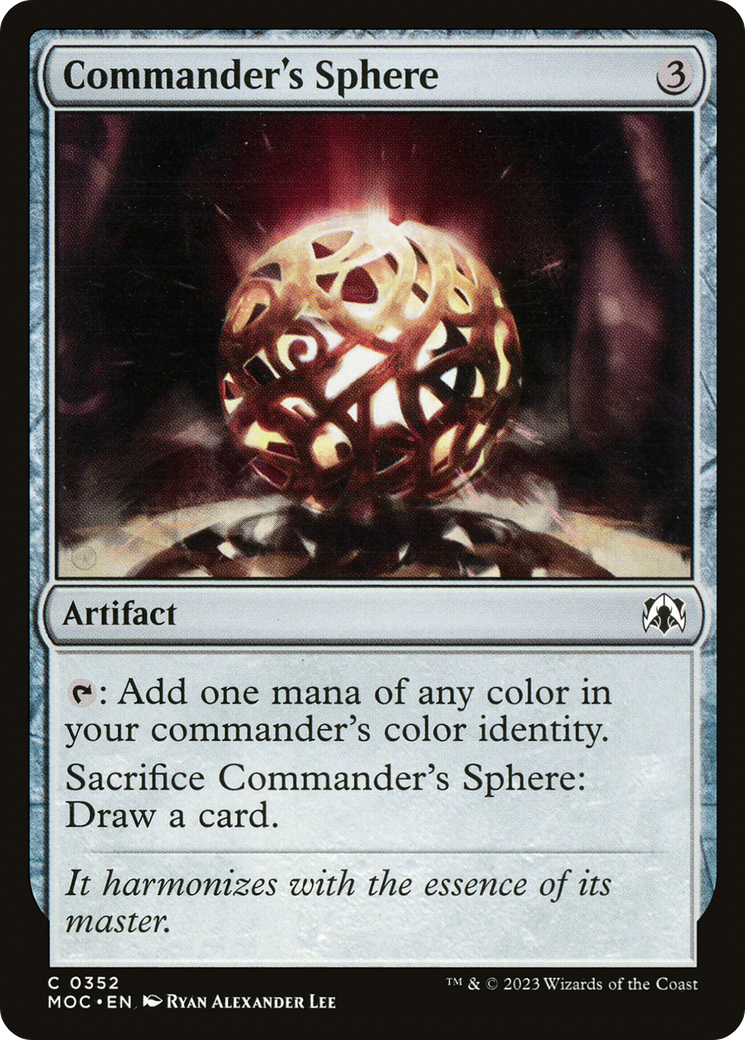
Commander's Sphere
Commander's Sphere
Artifact
: Add one mana of any color in your commander's color identity.
Sacrifice this artifact: Draw a card.
- If your commander is a card that has no colors in its color identity, Commander's Sphere's first ability produces no mana. It doesn't produce .
- If you don't have a commander, Commander's Sphere's first ability produces no mana.
- If you have two commanders, the ability adds one mana of any color in their combined color identities.
-
1
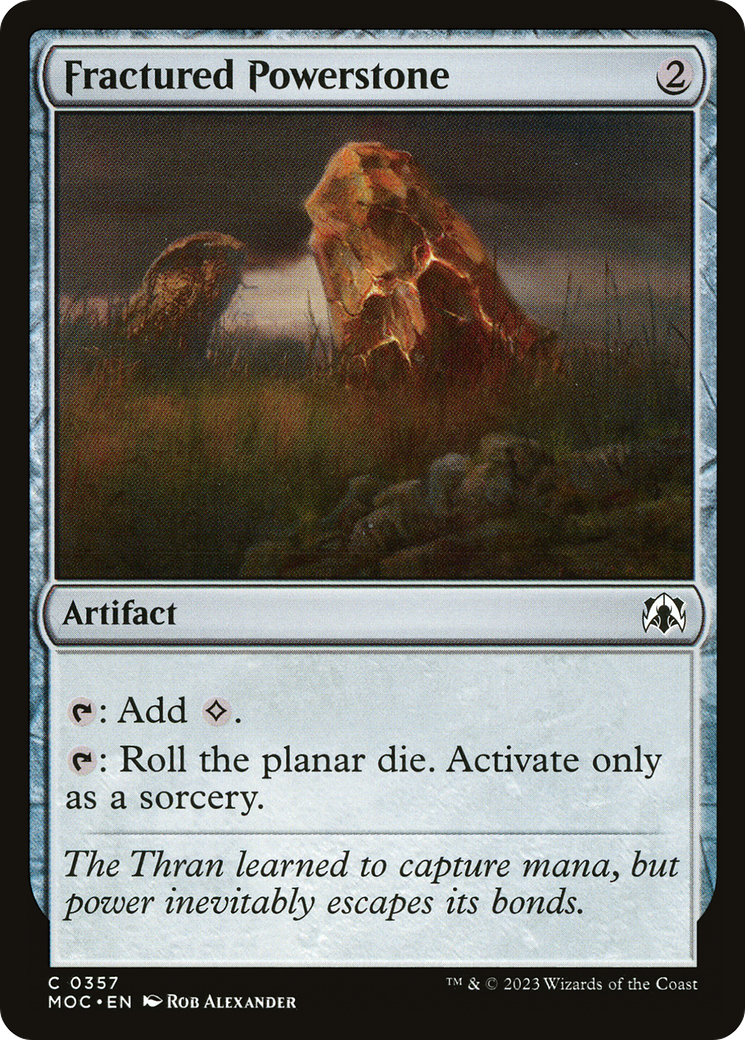
Fractured Powerstone
Fractured Powerstone
Artifact
: Add .
: Roll the planar die. Activate only as a sorcery.
- In non-Planechase games, Fractured Powerstone's second ability will have no effect.
- Rolling the planar die this way doesn't count when determining the cost of the special action of rolling the planar die. For example, if you roll the planar die twice in a turn, then activate Fractured Powerstone to roll it a third time, rolling the planar die again that turn will cost .
-
1
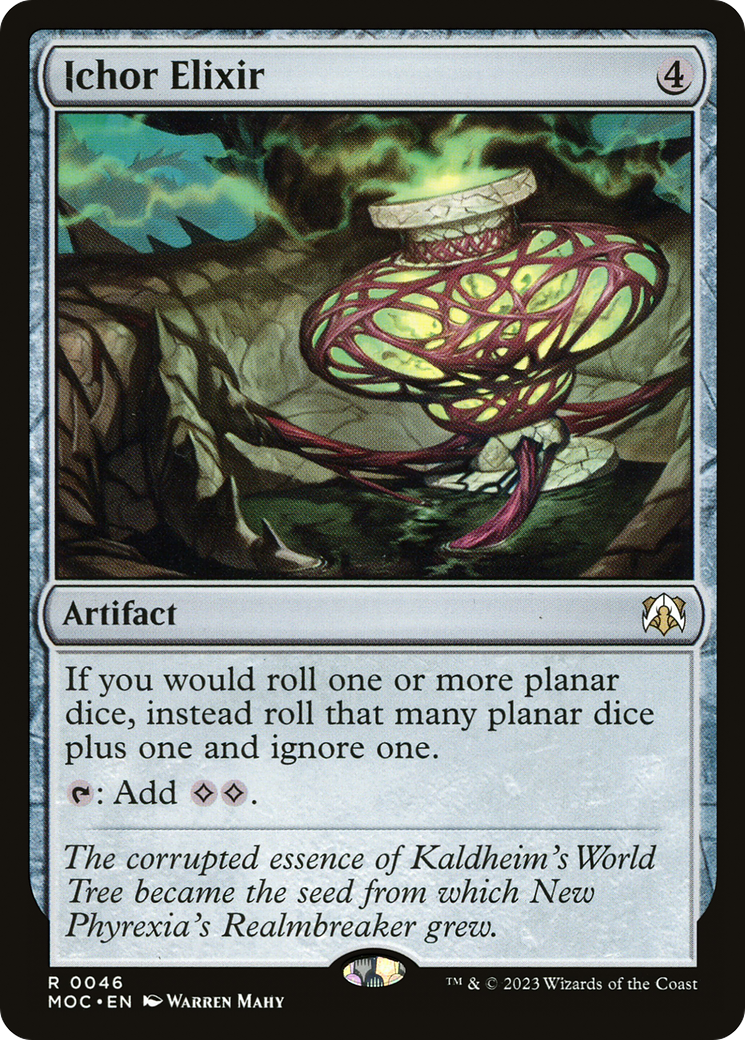
Ichor Elixir
Ichor Elixir
Artifact
If you would roll one or more planar dice, instead roll that many planar dice plus one and ignore one.
: Add .
-
1
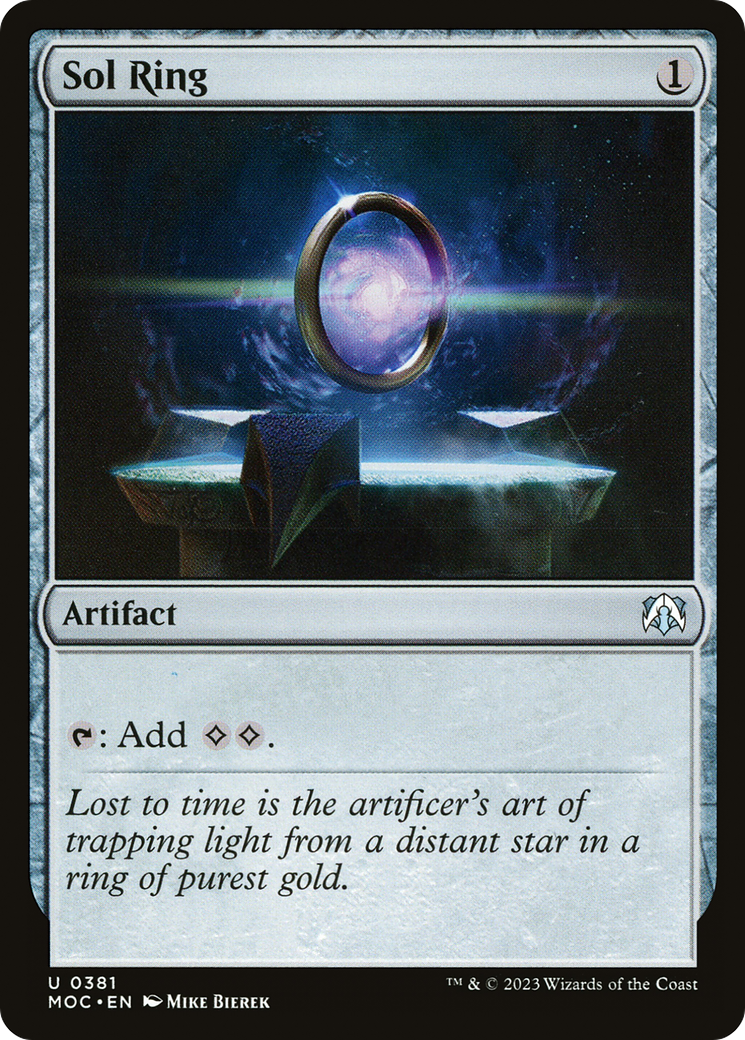
Sol Ring
Sol Ring
Artifact
: Add .
-
1
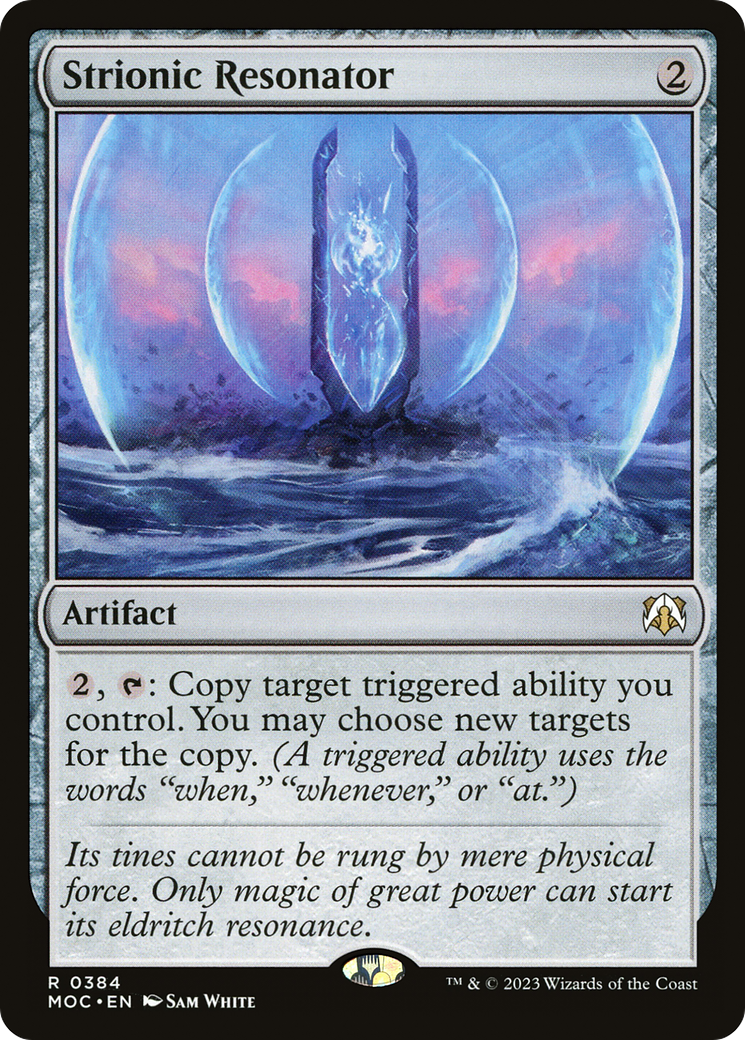
Strionic Resonator
Strionic Resonator
Artifact
, : Copy target triggered ability you control. You may choose new targets for the copy. (A triggered ability uses the words "when," "whenever," or "at.")
- Triggered abilities use the word "when," "whenever," or "at." They're often written as "[Trigger condition], [effect]."
- Strionic Resonator targets a triggered ability that has triggered and is on the stack and creates another instance of that ability on the stack. It doesn't cause any object to gain an ability.
- The source of the copy is the same as the source of the original ability.
- If the triggered ability is modal (that is, if it says, "Choose one —" or similar), the mode is copied and can't be changed.
- If the triggered ability divides damage or distributes counters among a number of targets (for example, the ability of Bogardan Hellkite), the division and number of targets can't be changed. If you choose new targets, you must choose the same number of targets.
- Any choices made when the triggered ability resolves won't have been made yet when it's copied. Any such choices will be made separately when the copy resolves. If the triggered ability asks you to pay a cost (such as that of Frenzied Goblin), you pay that cost for the copy.
- If a triggered ability is linked to a second ability, copies of that triggered ability are also linked to that second ability. If the second ability refers to "the exiled card," it refers to all cards exiled by the triggered ability and the copy. For example, if Fiend Hunter's enters-the-battlefield ability is copied and two creatures are exiled, they both return when Fiend Hunter leaves the battlefield.
- In some cases involving linked abilities, an ability requires information about "the exiled card." When this happens, the ability gets multiple answers. If these answers are being used to determine the value of a variable, the sum is used. For example, if Elite Arcanist's enters-the-battlefield ability is copied, two cards are exiled. The value of X in the activation cost of Elite Arcanist's other ability is the sum of the two cards' mana values. As the ability resolves, you create copies of both cards and can cast none, one, or both of the copies in any order.
Enchantments 4
-
1
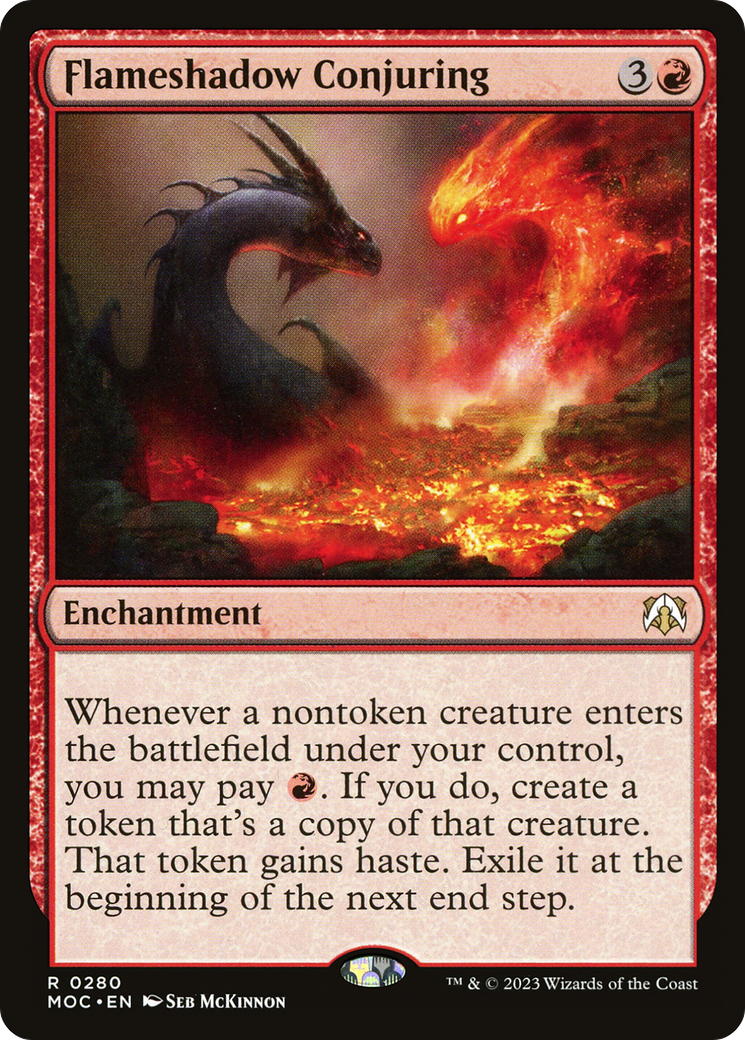
Flameshadow Conjuring
Flameshadow Conjuring
Enchantment
Whenever a nontoken creature you control enters, you may pay . If you do, create a token that's a copy of that creature. That token gains haste. Exile it at the beginning of the next end step.
- The token copies exactly what's printed on the original creature and nothing else (unless that creature is copying something else; see below). It doesn't copy whether that creature is tapped or untapped, whether it has any counters on it or Auras and Equipment attached to it, or any non-copy effects that have changed its power, toughness, types, color, and so on.
- If the copied creature has in its mana cost, X is 0.
- If the copied creature is copying something else when the ability resolves, then the token enters the battlefield as a copy of whatever that creature is copying.
- Any enters-the-battlefield abilities of the copied creature will trigger when the token enters the battlefield. Any “as [this permanent] enters the battlefield” or “[this permanent] enters the battlefield with” abilities of the copied creature will also work.
- The token is exiled at the beginning of the next end step regardless of who controls it at that time.
- If the ability resolves during a turn's end step, the token will be exiled at the beginning of the next turn's end step.
- If the token isn't exiled at the beginning of the next end step (perhaps because the delayed triggered ability is countered), it remains on the battlefield indefinitely. It continues to have haste.
- If another creature becomes or enters the battlefield as a copy of the token, that creature won't have haste and it won't be exiled.
-
1
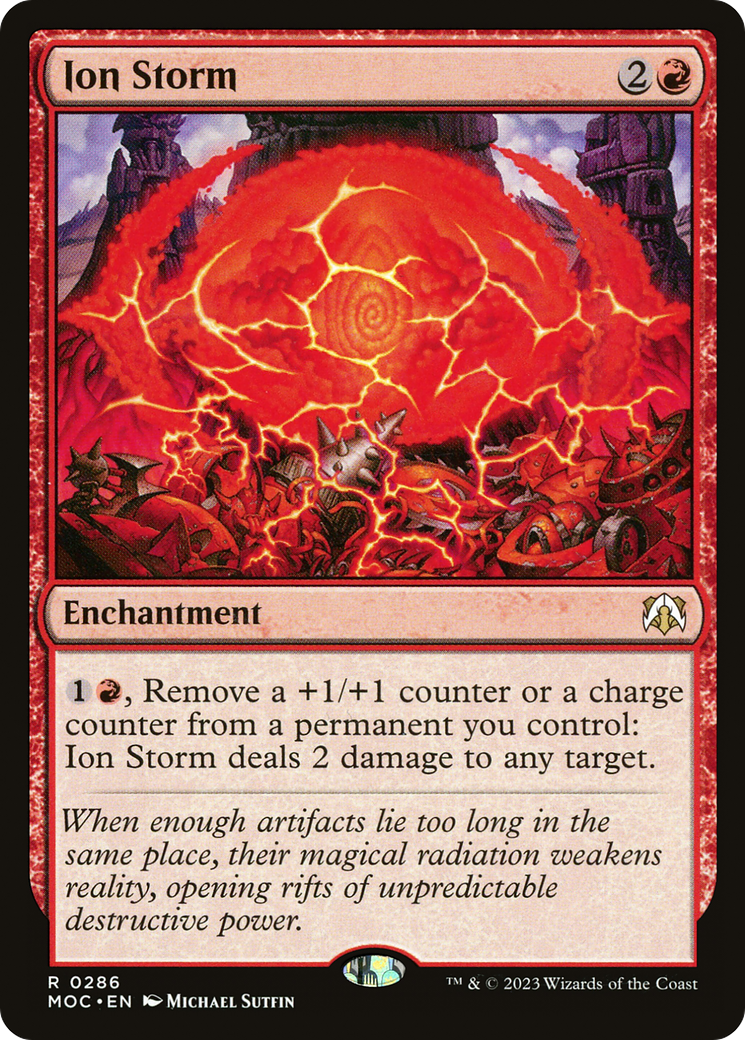
Ion Storm
Ion Storm
Enchantment
, Remove a +1/+1 counter or a charge counter from a permanent you control: This enchantment deals 2 damage to any target.
-
1
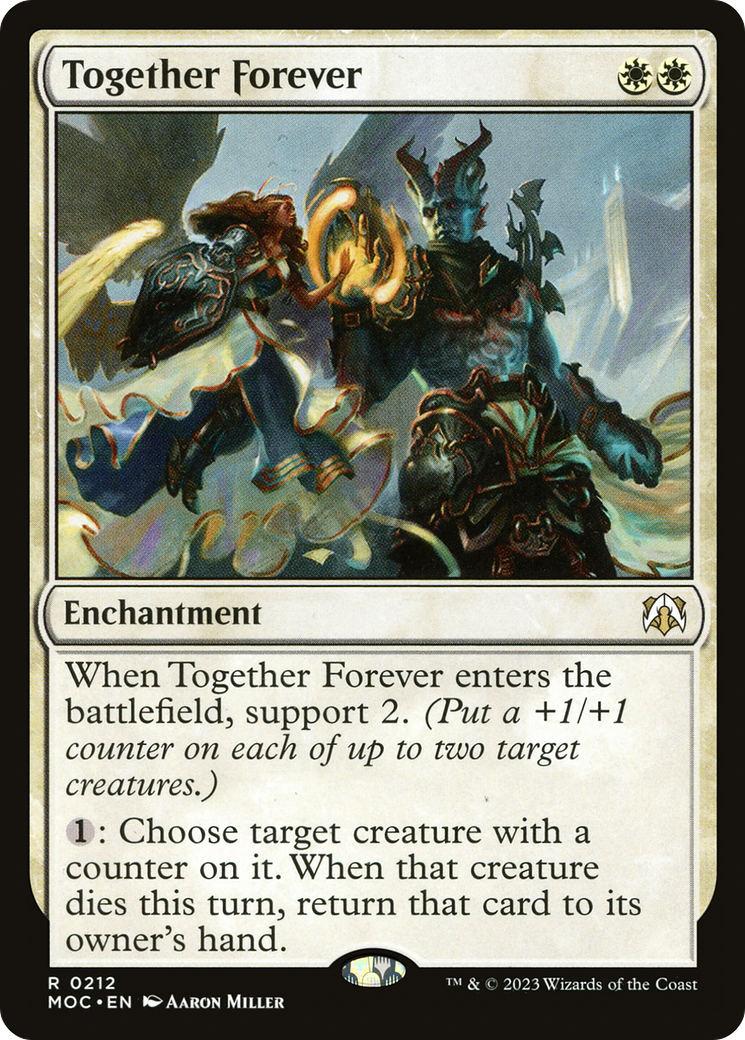
Together Forever
Together Forever
Enchantment
When this enchantment enters, support 2. (Put a +1/+1 counter on each of up to two target creatures.)
: Choose target creature with a counter on it. When that creature dies this turn, return that card to its owner's hand.
- If a creature without counters receives enough -1/-1 counters to reduce its toughness to 0 or less, Together Forever's ability can't be activated before state-based actions put that creature into its owner's graveyard.
- Together Forever's activated ability checks whether the target creature has a counter on it as the ability is activated and as the ability resolves. If the creature loses its counters later in the turn, the delayed triggered ability will still return it to its owner's hand when it dies.
- If some, but not all, targets for a spell become illegal, the remaining targets are affected as appropriate. If all of a spell's targets become illegal, that spell doesn't resolve.
- If a spell with support has other abilities that target creatures, those abilities and the support ability can target the same creature.
- You can't put more than one +1/+1 counter on any one target using the support action.
- Support can target a creature another player controls.
-
1
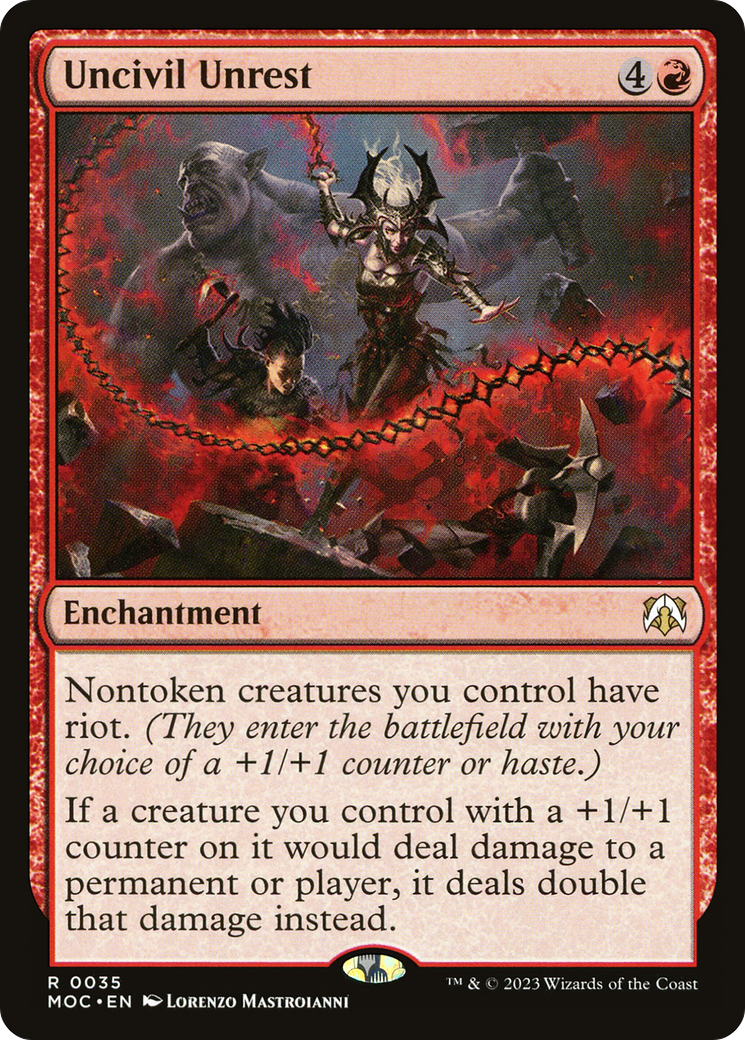
Uncivil Unrest
Uncivil Unrest
Enchantment
Nontoken creatures you control have riot. (They enter with your choice of a +1/+1 counter or haste.)
If a creature you control with a +1/+1 counter on it would deal damage to a permanent or player, it deals double that damage instead.
- Riot is a replacement effect. Players can’t respond to your choice of +1/+1 counter or haste, and they can’t take actions while the creature is on the battlefield without one or the other.
- If you choose for the creature to gain haste, it gains haste indefinitely. It won’t lose it as the turn ends or as another player gains control of it.
- The damage is dealt by the same source as the original source of damage. The doubled damage isn’t dealt by Uncivil Unrest unless it was somehow the original source of damage.
- If another effect (or effects) modifies how much damage your creature with a +1/+1 counter on it would deal—by preventing some of it, for example—the player being dealt damage or the controller of the permanent being dealt damage chooses the order in which any such effects (including Uncivil Unrest’s) apply. If all of the damage is prevented, Uncivil Unrest’s effect no longer applies.
- If damage dealt by a creature you control with a +1/+1 counter on it is being divided or assigned among multiple permanents and/or players, that damage is divided or assigned before doubling. For example, if you attack with a 5/5 creature with trample and it’s blocked by a 2/2 creature, you can assign 2 damage to the blocker and 3 damage to the defending player. Those amounts are then doubled to 4 and 6, respectively.
Lands 38
-
1
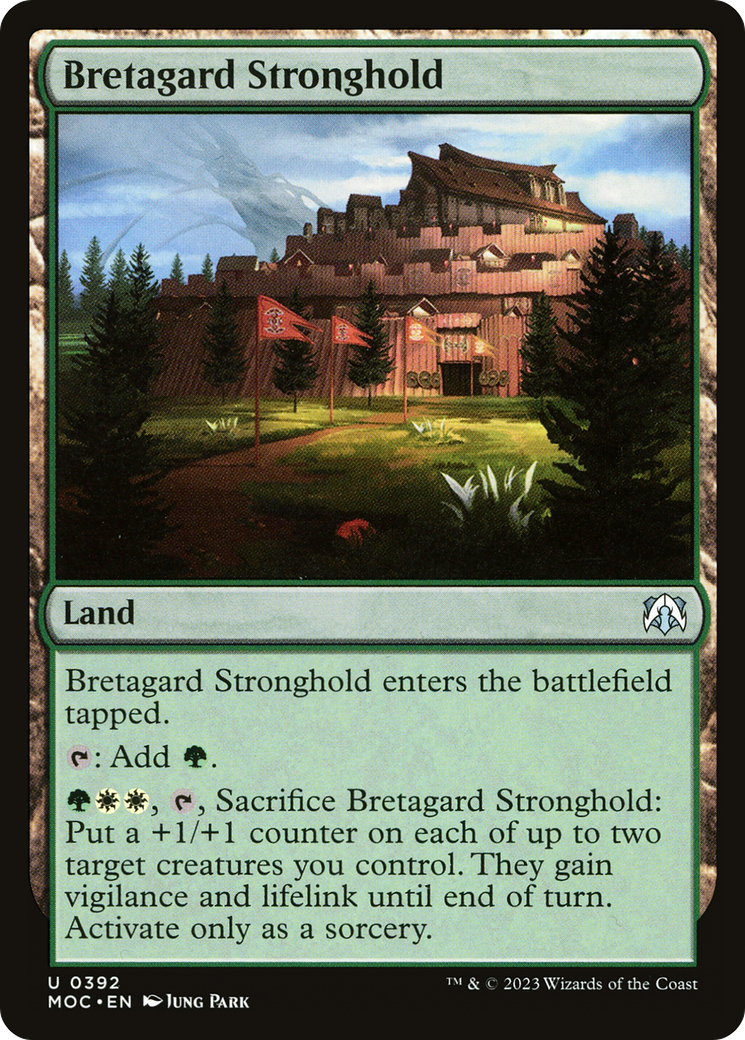
Bretagard Stronghold
Bretagard Stronghold
Land
This land enters tapped.
: Add .
, , Sacrifice this land: Put a +1/+1 counter on each of up to two target creatures you control. They gain vigilance and lifelink until end of turn. Activate only as a sorcery.
-
1
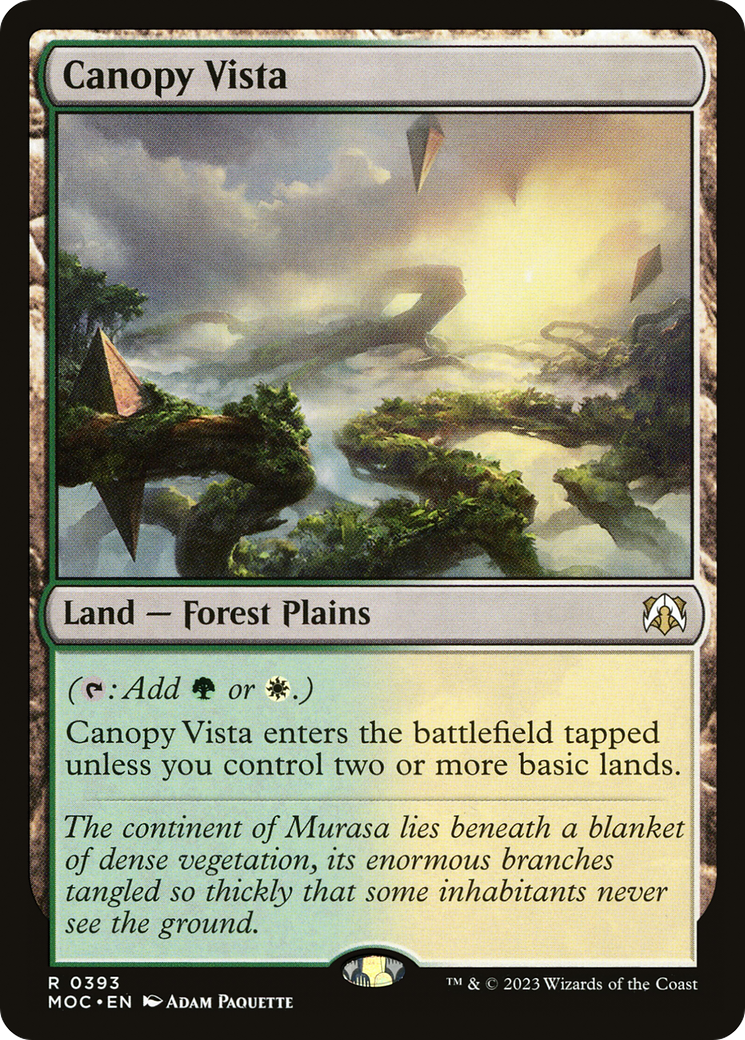
Canopy Vista
Canopy Vista
Land — Forest Plains
( : Add or .)
This land enters tapped unless you control two or more basic lands.
- Even though these lands have basic land types, they are not basic lands because "basic" doesn't appear on their type line. Notably, controlling two or more of them won't allow others to enter the battlefield untapped.
- If one of these lands enters the battlefield at the same time as any number of basic lands, those other lands are not counted when determining if this land enters the battlefield tapped or untapped.
- However, because these cards have basic land types, effects that specify a basic land type without also specifying that the land be basic can affect them. For example, a spell or ability that reads "Destroy target Forest" can target Canopy Vista, while one that reads "Destroy target basic Forest" cannot.
-
1
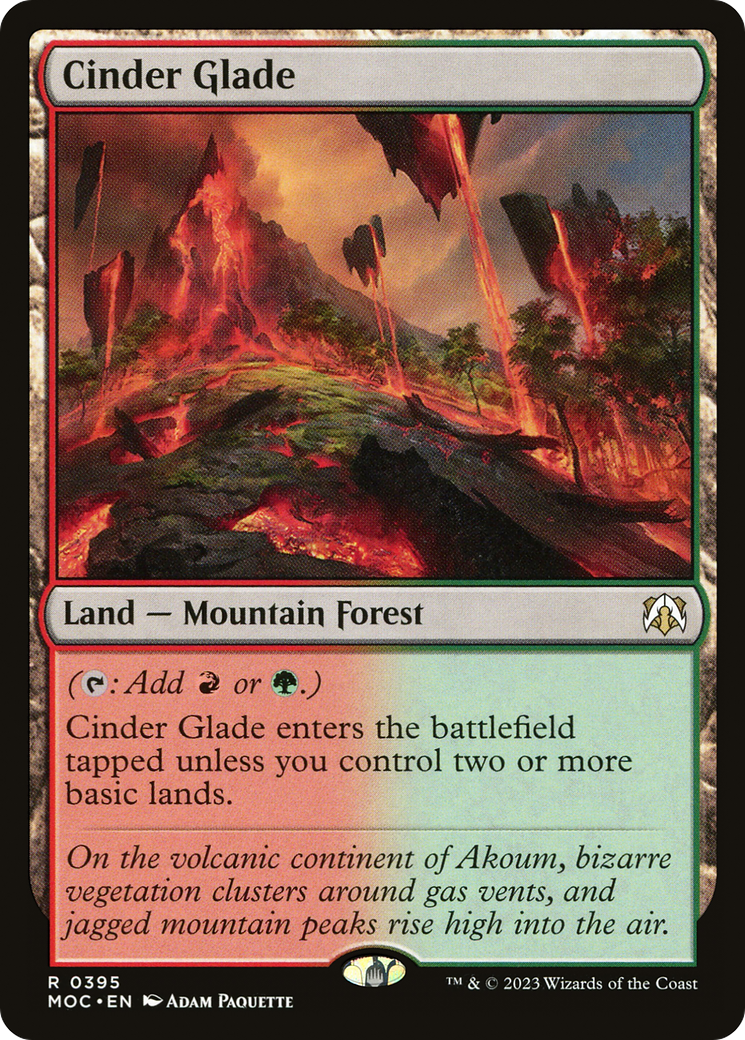
Cinder Glade
Cinder Glade
Land — Mountain Forest
( : Add or .)
This land enters tapped unless you control two or more basic lands.
- If one of these lands enters the battlefield at the same time as any number of basic lands, those other lands are not counted when determining if this land enters the battlefield tapped or untapped.
- However, because these cards have basic land types, effects that specify a basic land type without also specifying that the land be basic can affect them. For example, a spell or ability that reads "Destroy target Forest" can target Canopy Vista, while one that reads "Destroy target basic Forest" cannot.
- Even though these lands have basic land types, they are not basic lands because "basic" doesn't appear on their type line. Notably, controlling two or more of them won't allow others to enter the battlefield untapped.
-
1
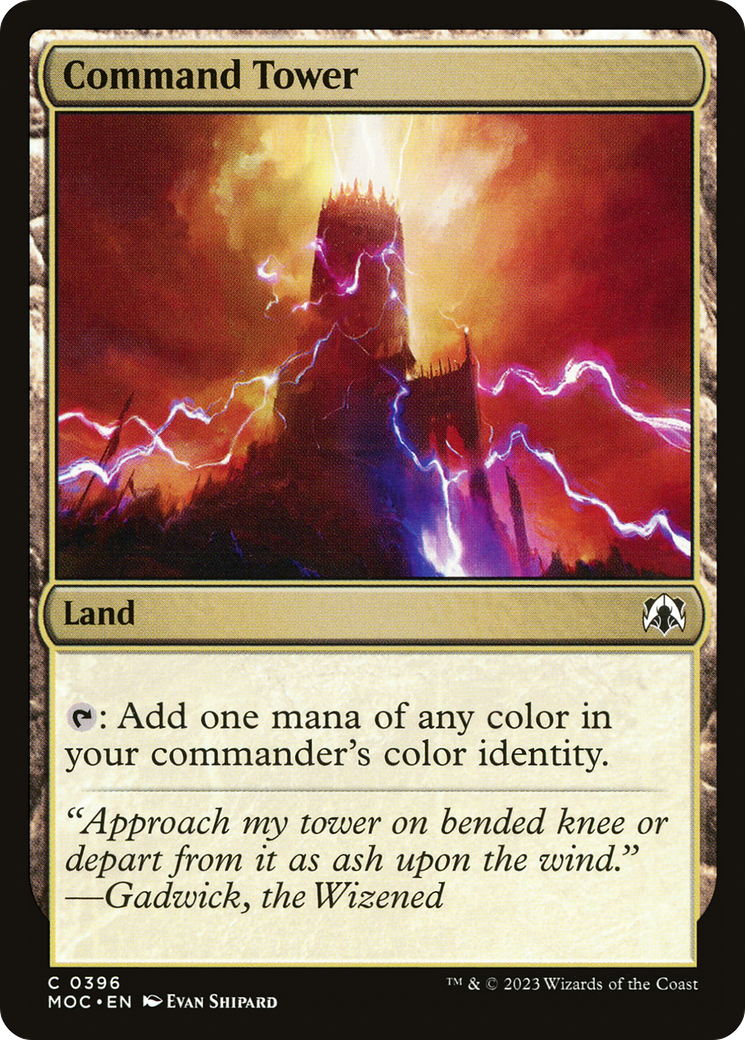
Command Tower
Command Tower
Land
: Add one mana of any color in your commander's color identity.
- If you don't have a commander, Command Tower's ability produces no mana.
- If your commander is a card that has no colors in its color identity, Command Tower's ability produces no mana. It doesn't produce .
- If you have two commanders, the ability adds one mana of any color in their combined color identities.
-
1
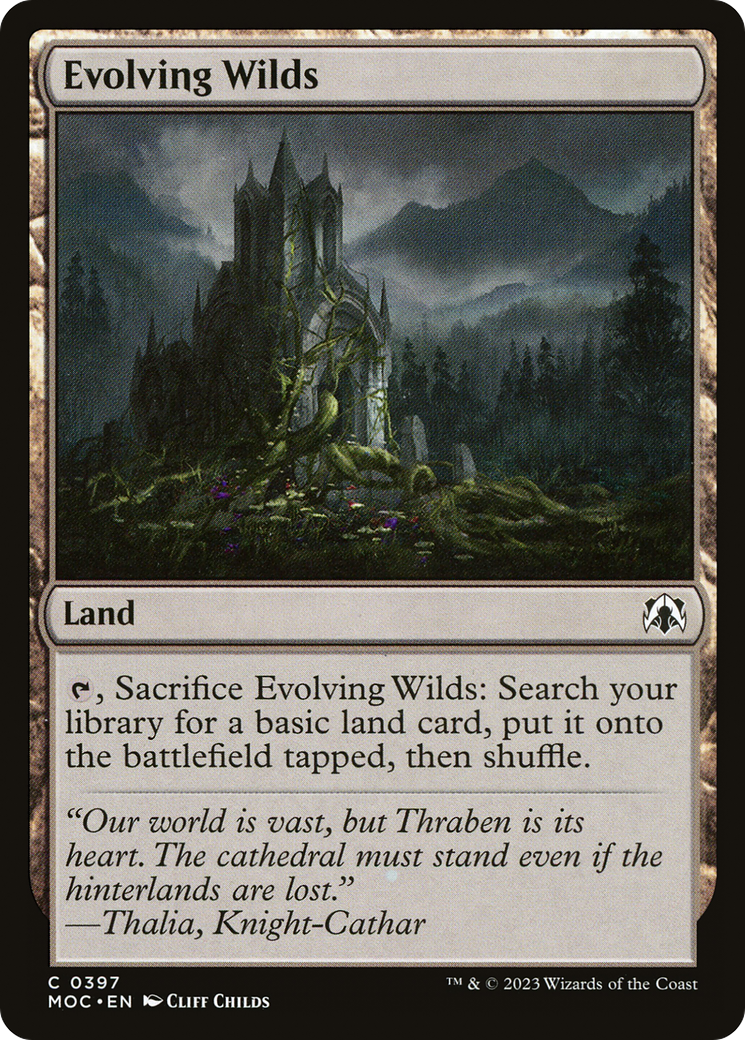
Evolving Wilds
Evolving Wilds
Land
, Sacrifice this land: Search your library for a basic land card, put it onto the battlefield tapped, then shuffle.
-
1
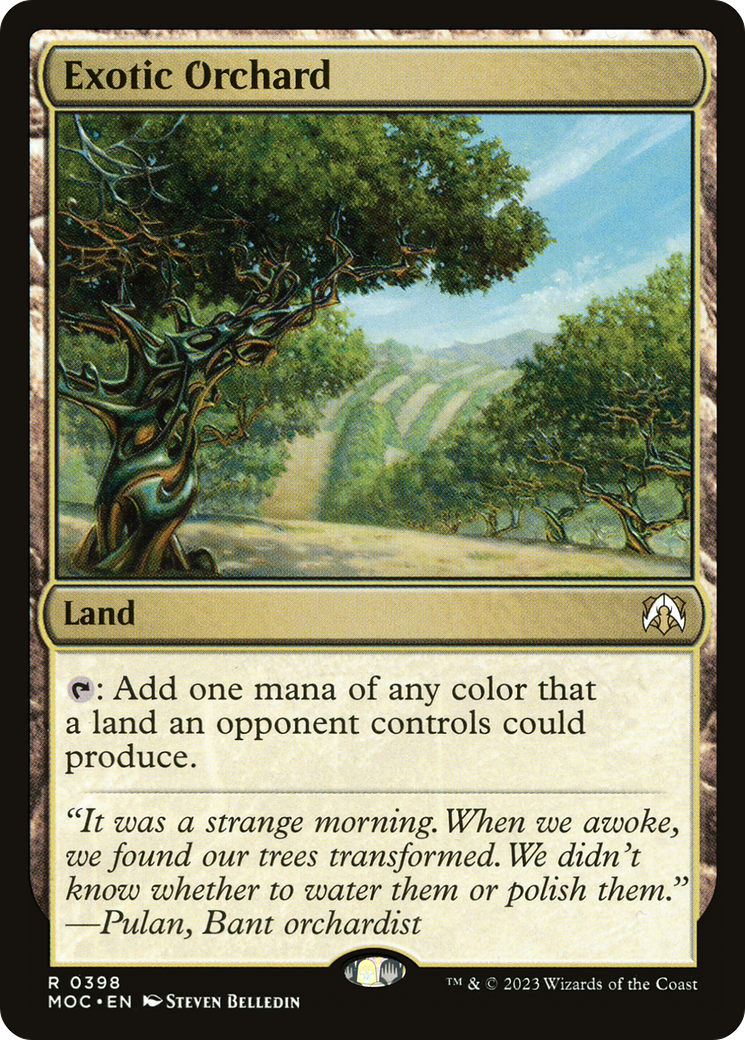
Exotic Orchard
Exotic Orchard
Land
: Add one mana of any color that a land an opponent controls could produce.
- Lands that produce mana based only on what other lands "could produce" won't help each other unless some other land allows one of them to actually produce some type of mana. For example, if you control an Exotic Orchard and your opponent controls an Exotic Orchard and a Reflecting Pool, none of those lands would produce mana if their mana abilities were activated. On the other hand, if you control a Forest and an Exotic Orchard, and your opponent controls an Exotic Orchard and a Reflecting Pool, then each of those lands can be tapped to produce . Your opponent's Exotic Orchard can produce because you control a Forest. Your Exotic Orchard and your opponent's Reflecting Pool can each produce because your opponent's Exotic Orchard can produce .
- When determining what colors of mana your opponents' lands could produce, Exotic Orchard takes into account any applicable replacement effects that would apply to those lands' mana abilities (such as Contamination's effect, for example). If there are more than one, consider them in any possible order.
- The colors of mana are white, blue, black, red, and green. Exotic Orchard can't be tapped for colorless mana, even if a land an opponent controls could produce colorless mana.
- Exotic Orchard doesn't care about any restrictions or riders your opponents' lands (such as Ancient Ziggurat or Hall of the Bandit Lord) put on the mana they produce. It just cares about colors of mana.
- Exotic Orchard checks the effects of all mana-producing abilities of lands your opponents control, but it doesn't check their costs. For example, Vivid Crag has the ability " , Remove a charge counter from Vivid Crag: Add one mana of any color." If an opponent controls Vivid Crag and you control Exotic Orchard, you can tap Exotic Orchard for any color of mana. It doesn't matter whether Vivid Crag has a charge counter on it, and it doesn't matter whether it's untapped.
-
1
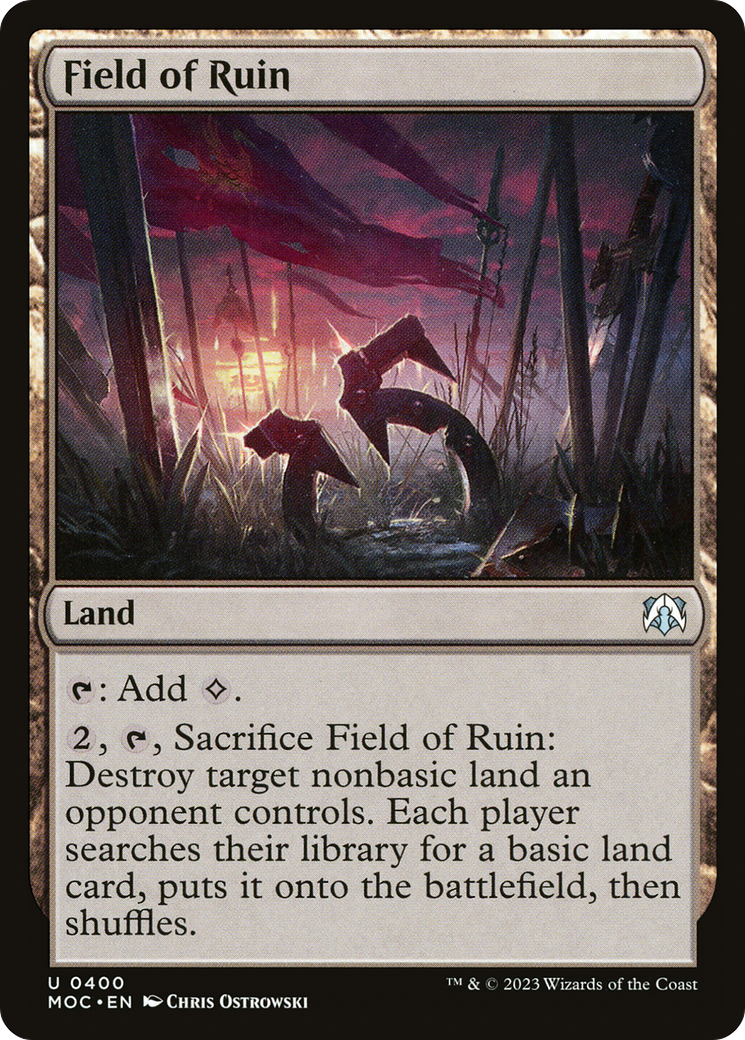
Field of Ruin
Field of Ruin
Land
: Add .
, , Sacrifice this land: Destroy target nonbasic land an opponent controls. Each player searches their library for a basic land card, puts it onto the battlefield, then shuffles.
- If the target land is an illegal target by the time Field of Ruin's ability tries to resolve, the ability doesn't resolve. No players search for a basic land card or shuffles. If the target is legal but not destroyed (most likely because it has indestructible), each player does search and shuffle.
-
6
Forest
Forest
Basic Land — Forest
( : Add .)
-
1
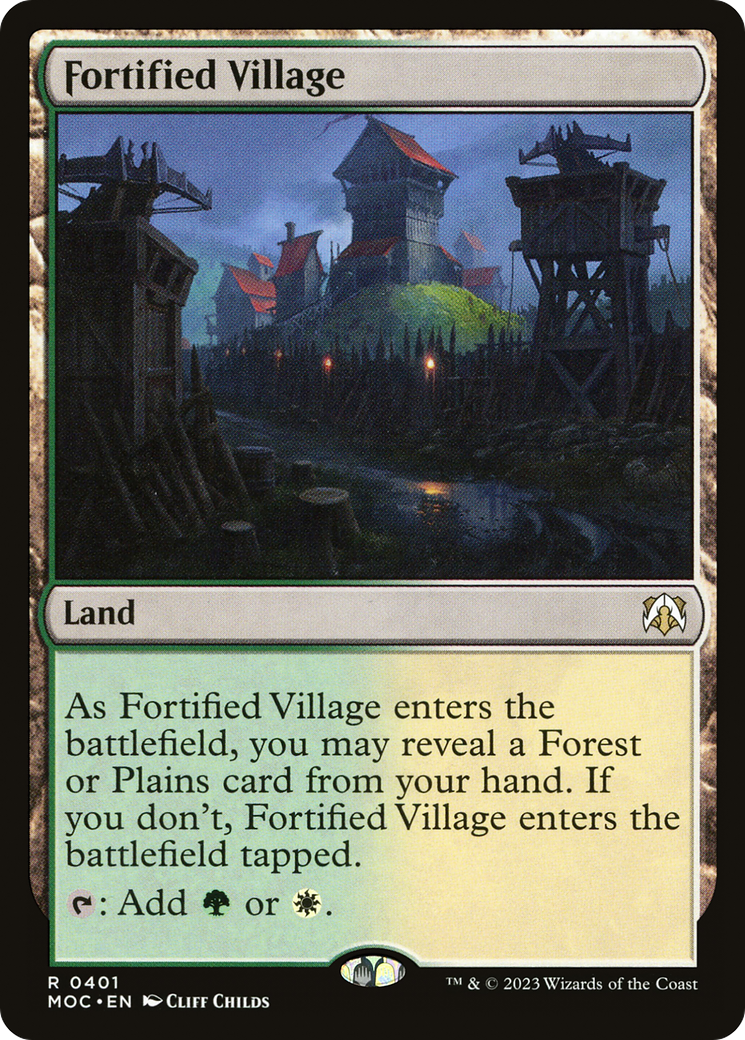
Fortified Village
Fortified Village
Land
As this land enters, you may reveal a Forest or Plains card from your hand. If you don't, this land enters tapped.
: Add or .
- If a Forest or Plains is entering the battlefield from your hand at the same time as Fortified Village, you may reveal the other land to have Fortified Village enter untapped.
- You may reveal any land card with either or both of the appropriate subtypes. It doesn't have to be a basic land. For example, you could reveal Prairie Stream from the Battle for Zendikar set to satisfy the ability of Fortified Village.
- Lands don't have a subtype just because they can produce mana of the corresponding color. Fortified Village itself is neither a Forest nor a Plains, even though it produces green and white mana, so you can't reveal one to satisfy the ability of another.
- If an effect instructs you to put Fortified Village onto the battlefield tapped, it will still enter the battlefield tapped even if you reveal a land card from your hand.
-
1
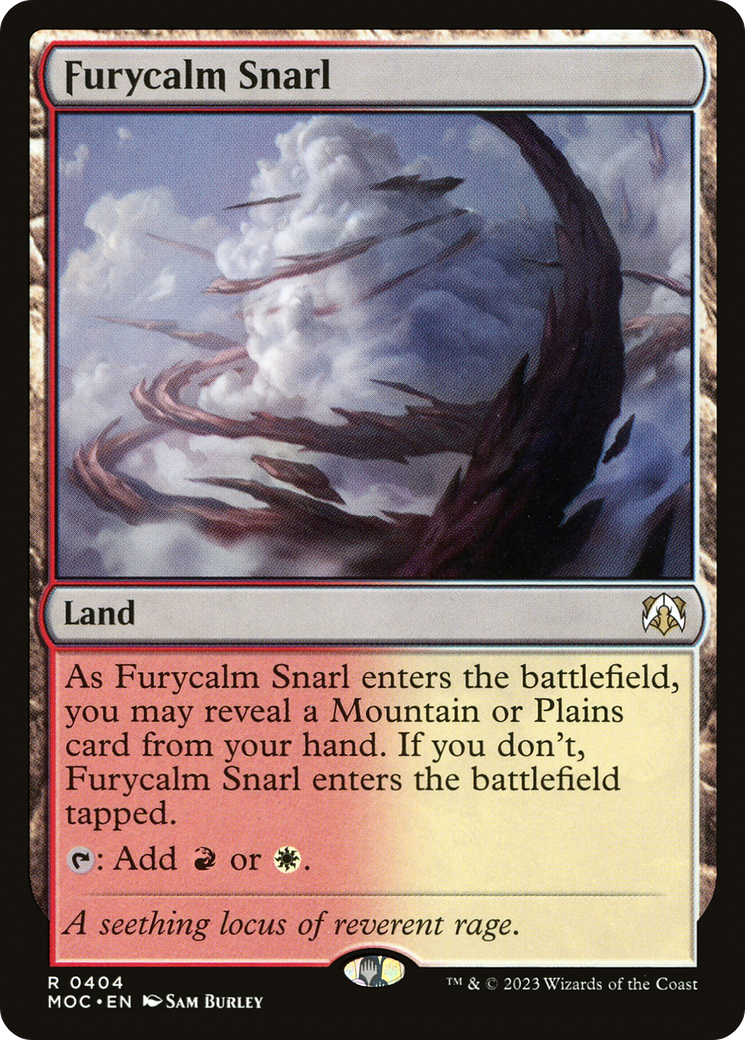
Furycalm Snarl
Furycalm Snarl
Land
As this land enters, you may reveal a Mountain or Plains card from your hand. If you don't, this land enters tapped.
: Add or .
- The "Snarl" itself doesn't have any land subtypes. You can't reveal one to satisfy the ability of another.
- If a land card with an appropriate subtype is entering the battlefield from your hand at the same time as one of these lands, you may reveal the other land to have the "Snarl" enter untapped.
- If an effect instructs you to put one of these lands onto the battlefield tapped, it will still enter the battlefield tapped even if you reveal a land card from your hand.
- You may reveal any land card with either or both of the appropriate subtypes. It doesn't have to be a basic land card.
-
1
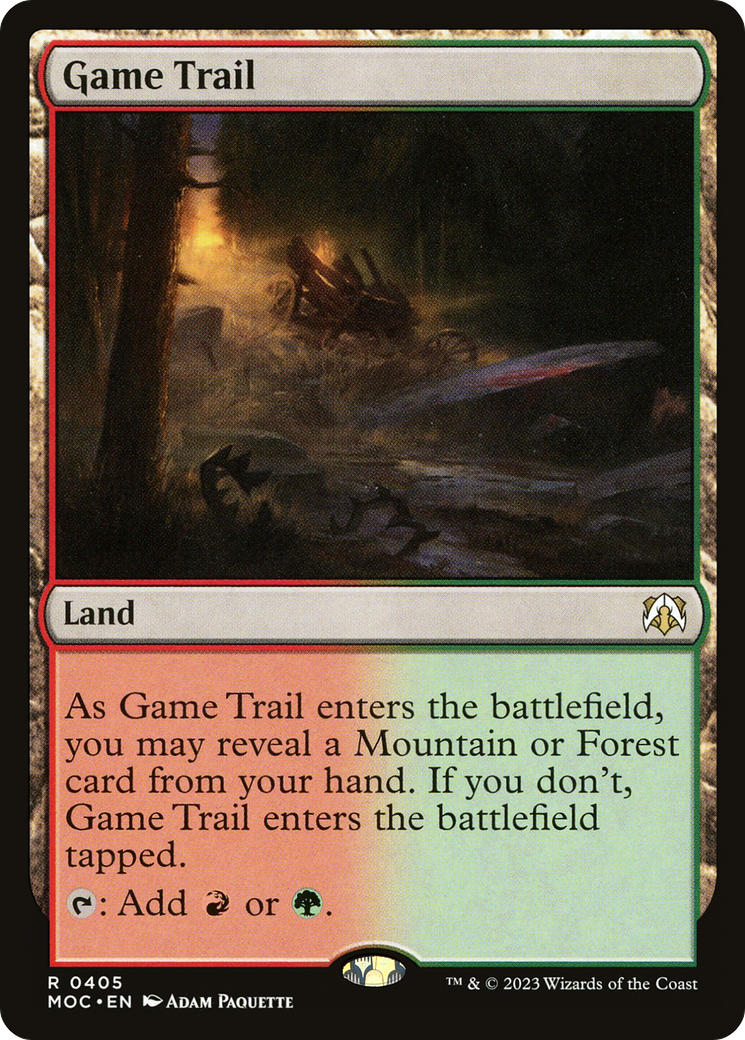
Game Trail
Game Trail
Land
As this land enters, you may reveal a Mountain or Forest card from your hand. If you don't, this land enters tapped.
: Add or .
- Lands don't have a subtype just because they can produce mana of the corresponding color. Game Trail itself is neither a Mountain nor a Forest, even though it produces red and green mana, so you can't reveal one to satisfy the ability of another.
- If an effect instructs you to put Game Trail onto the battlefield tapped, it will still enter the battlefield tapped even if you reveal a land card from your hand.
- You may reveal any land card with either or both of the appropriate subtypes. It doesn't have to be a basic land. For example, you could reveal Canopy Vista from the Battle for Zendikar set to satisfy the ability of Game Trail.
- If a Mountain or Forest is entering the battlefield from your hand at the same time as Game Trail, you may reveal the other land to have Game Trail enter untapped.
-
1
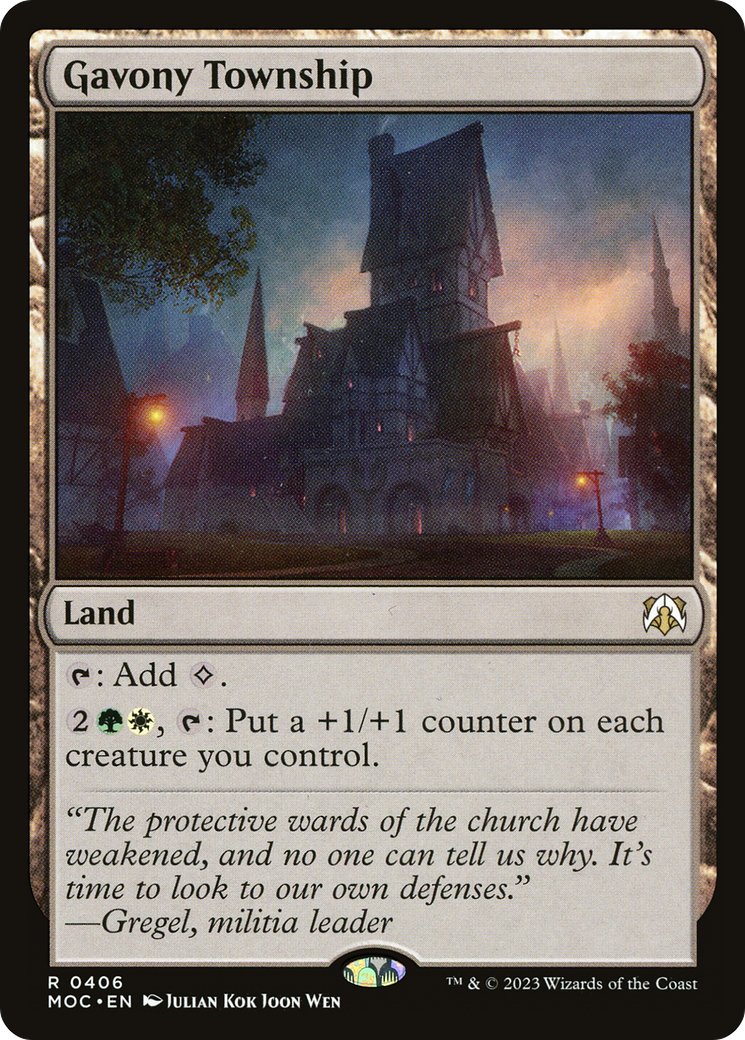
Gavony Township
Gavony Township
Land
: Add .
, : Put a +1/+1 counter on each creature you control.
-
1
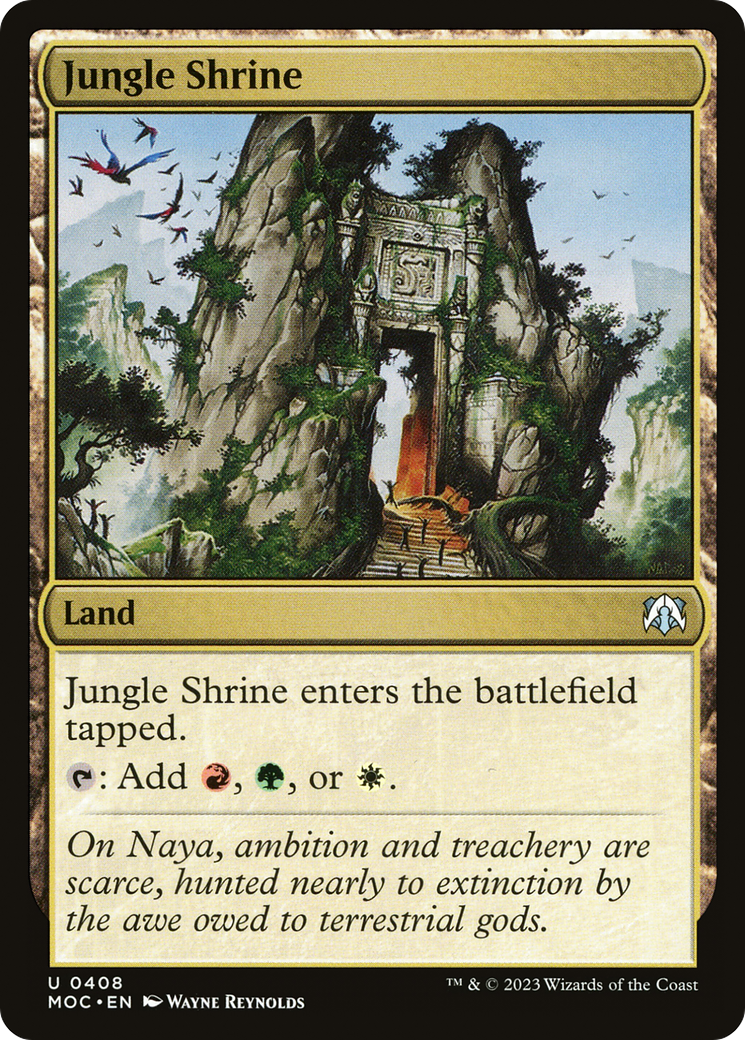
Jungle Shrine
Jungle Shrine
Land
This land enters tapped.
: Add , , or .
-
1
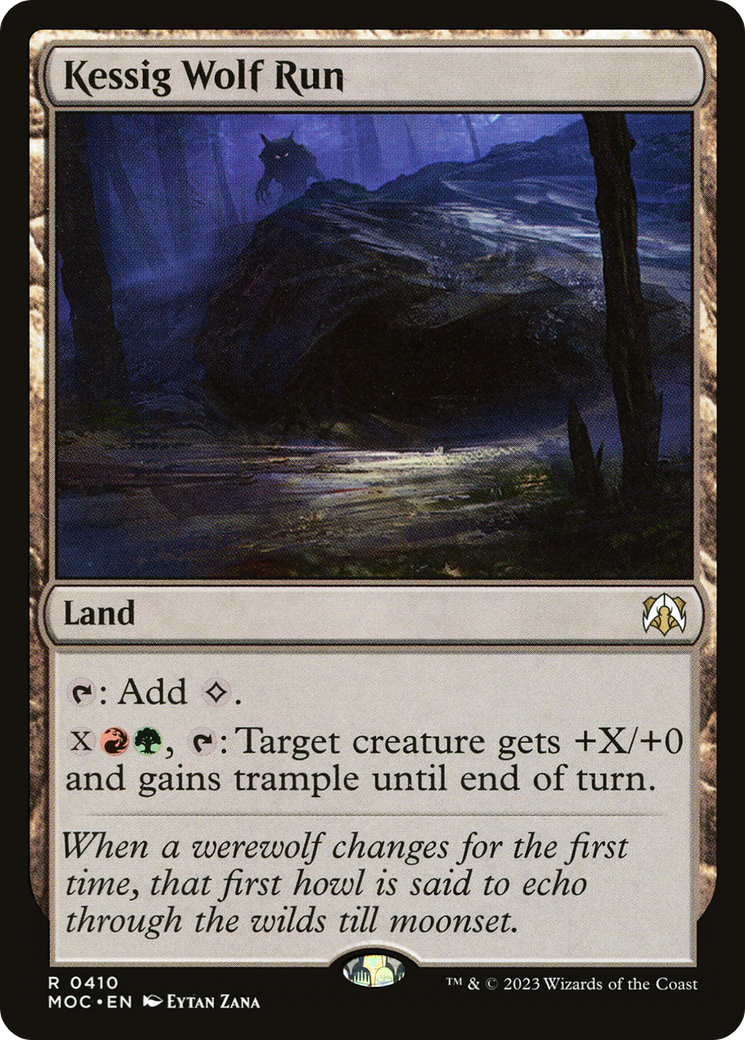
Kessig Wolf Run
Kessig Wolf Run
Land
: Add .
, : Target creature gets +X/+0 and gains trample until end of turn.
-
1
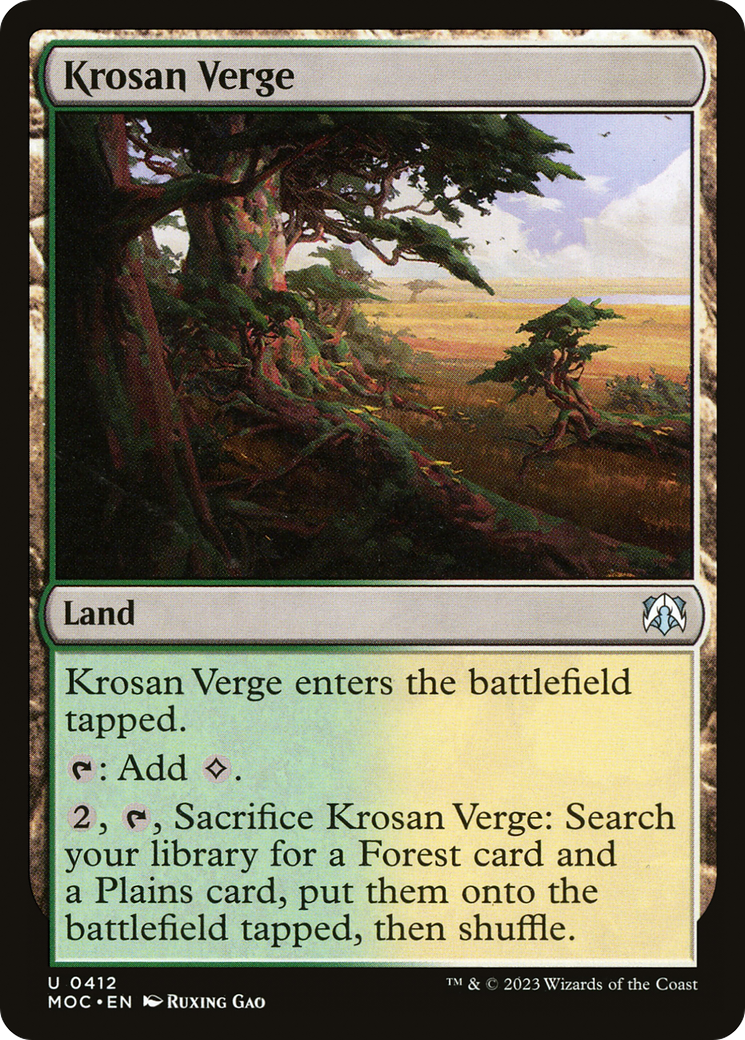
Krosan Verge
Krosan Verge
Land
This land enters tapped.
: Add .
, , Sacrifice this land: Search your library for a Forest card and a Plains card, put them onto the battlefield tapped, then shuffle.
-
1
Llanowar Reborn
Llanowar Reborn
Land
This land enters tapped.
: Add .
Graft 1 (This land enters with a +1/+1 counter on it. Whenever a creature enters, you may move a +1/+1 counter from this land onto it.)
- The +1/+1 counter won't affect Llanowar Reborn in any way unless another effect turns it into a creature.
-
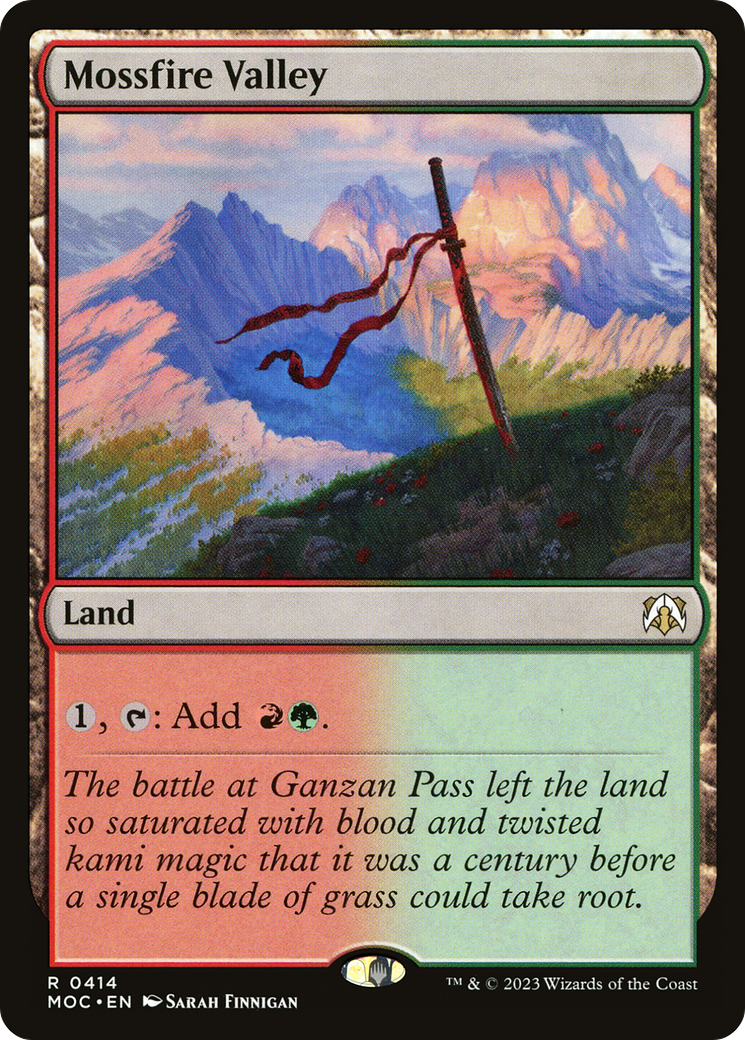
1
Mossfire Valley
Mossfire Valley
Land
, : Add .
-
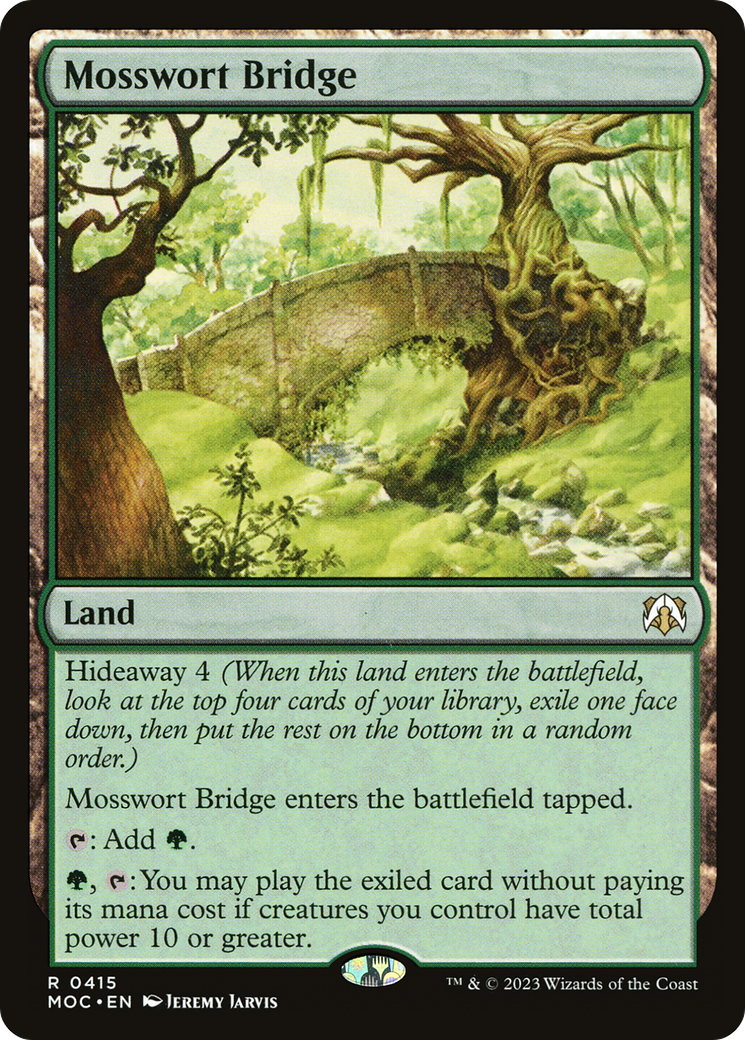
1
Mosswort Bridge
Mosswort Bridge
Land
Hideaway 4 (When this land enters, look at the top four cards of your library, exile one face down, then put the rest on the bottom in a random order.)
This land enters tapped.
: Add .
, : You may play the exiled card without paying its mana cost if creatures you control have total power 10 or greater.
- "Hideaway N" means "When this permanent enters the battlefield, look at the top N cards of your library. Exile one of them face down and put the rest on the bottom of your library in a random order. The exiled card gains 'The player who controls the permanent that exiled this card may look at this card in the exile zone.'"
- Any player who has controlled a permanent with a hideaway ability since a card was exiled with it may look at that card.
- Previously, permanents with hideaway entered the battlefield tapped. This ability has been removed from the definition of hideaway. Older cards have received errata to have an additional paragraph that reads "[This permanent] enters the battlefield tapped," and they now have hideaway 4.
- Hideaway now causes you to put the rest of the cards on the bottom of your library in a random order instead of any order.
-
2
Mountain
Mountain
Basic Land — Mountain
( : Add .)
-
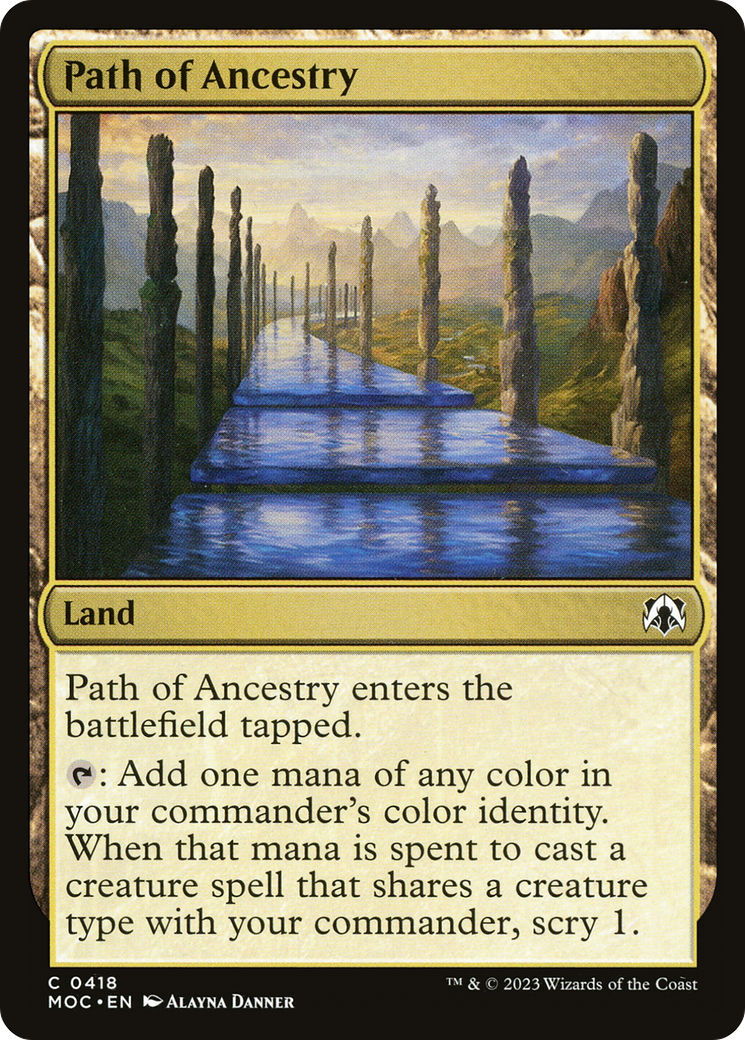
1
Path of Ancestry
Path of Ancestry
Land
This land enters tapped.
: Add one mana of any color in your commander's color identity. When that mana is spent to cast a creature spell that shares a creature type with your commander, scry 1. (Look at the top card of your library. You may put that card on the bottom.)
- Your commander's creature types are checked immediately after you cast a creature spell spending mana from Path of Ancestry's last ability. They aren't set before the game begins, and they may not be the same types your commander had when you activated that ability.
- If you have two commanders, the last ability adds one mana of any color in their combined color identities. When you spend that mana on a creature spell that shares a creature type with either of your commanders, you'll scry 1.
- If Path of Ancestry's last ability produces two mana (most likely due to Mana Reflection), spending those two mana to cast creature spells that share a creature type with your commander will cause two abilities to trigger. Each of those abilities will cause you to scry 1. You won't scry 2. This is true whether you spend the mana on one creature spell or two.
- If your commander has no creature types, it can't share a creature type with any spell that you cast.
- If you cast your commander with mana from Path of Ancestry, and your commander hasn't somehow lost all of its creature types while on the stack, you'll scry 1.
- If you don't have a commander, Path of Ancestry's ability produces no mana.
- If your commander is a card that has no colors in its color identity, Path of Ancestry's ability produces no mana. It doesn't produce .
-
5
Plains
Plains
Basic Land — Plains
( : Add .)
-
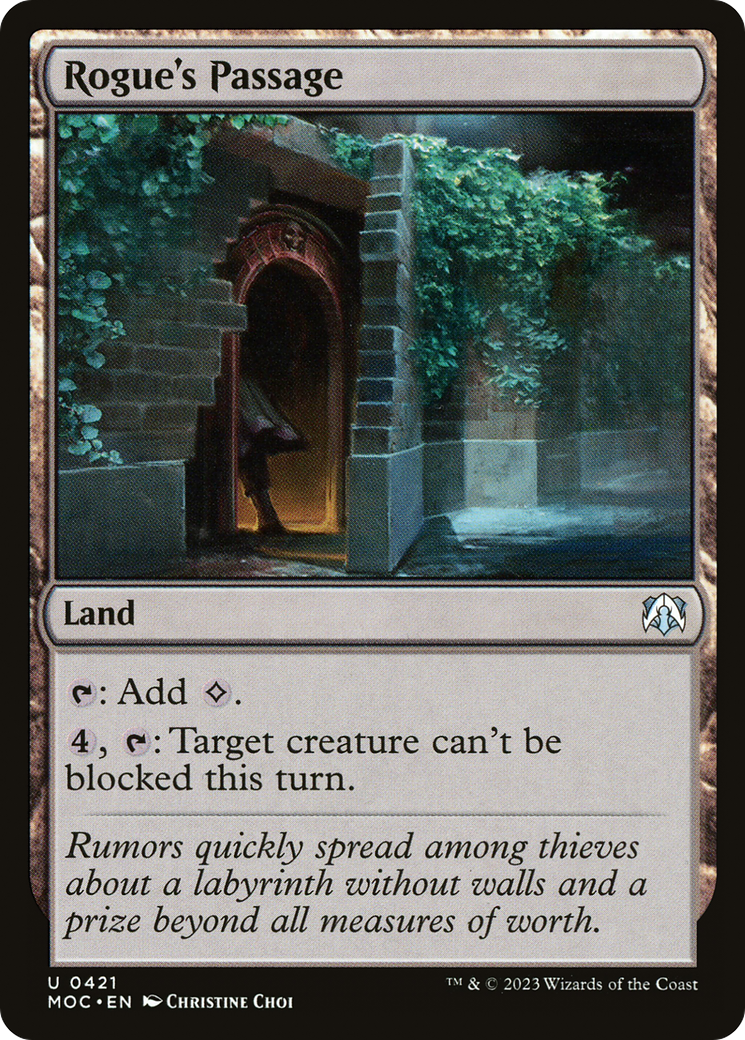
1
Rogue's Passage
Rogue's Passage
Land
: Add .
, : Target creature can't be blocked this turn.
- Activating the second ability of Rogue's Passage after a creature has become blocked won't cause that creature to become unblocked.
-
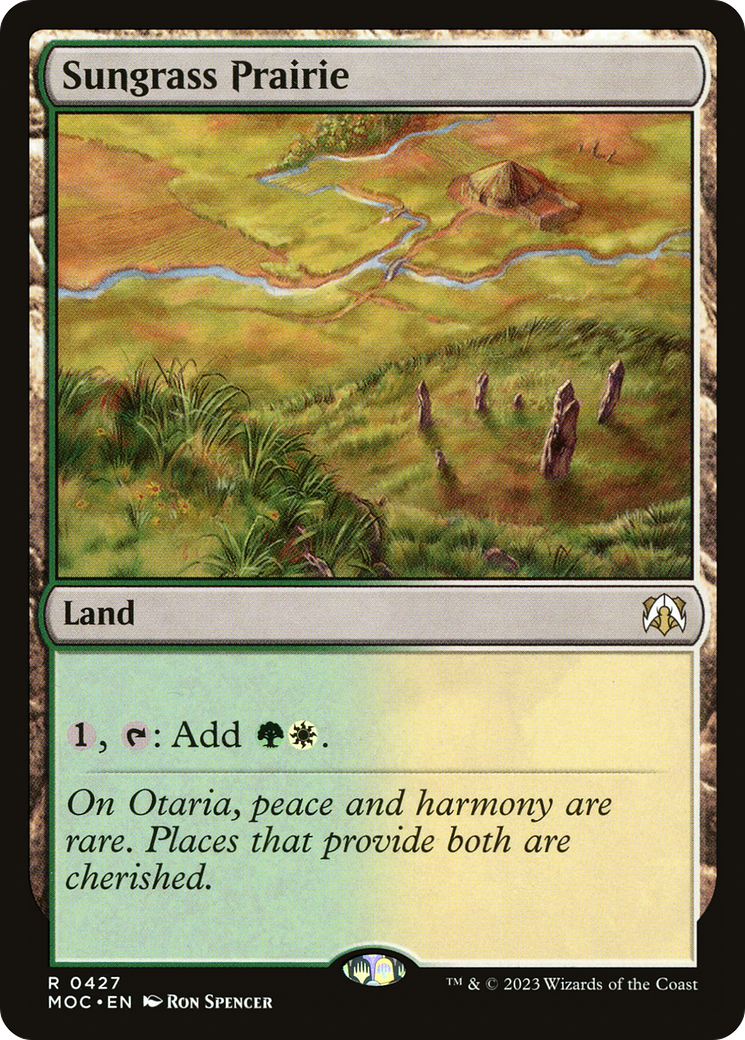
1
Sungrass Prairie
Sungrass Prairie
Land
, : Add .
-
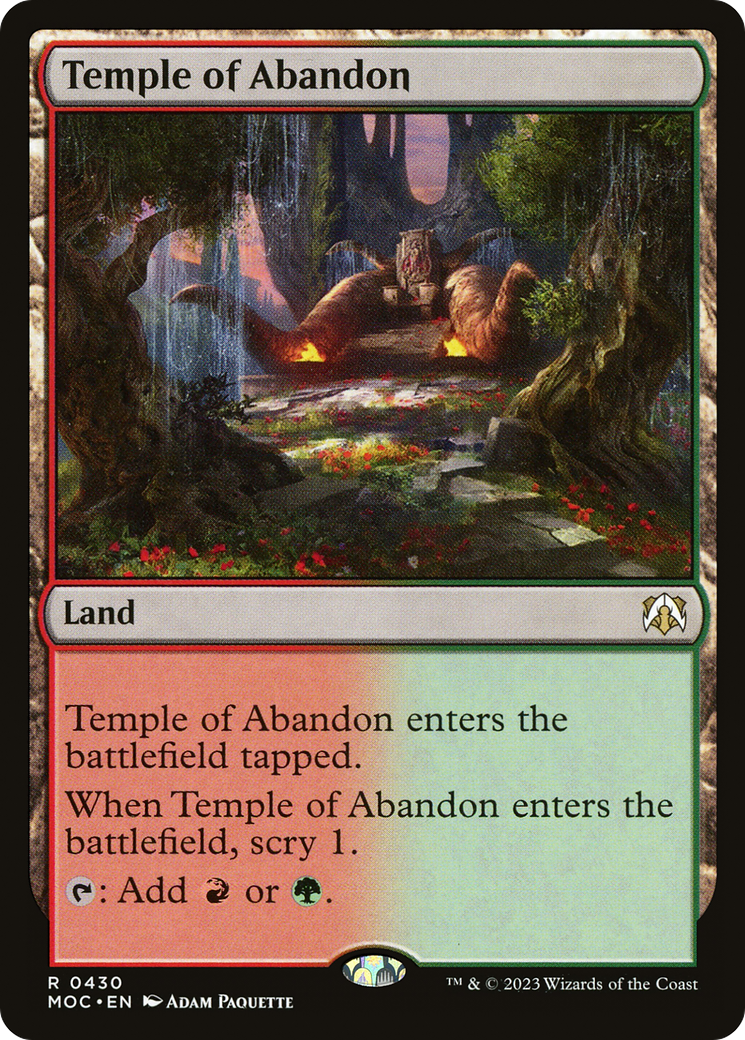
1
Temple of Abandon
Temple of Abandon
Land
This land enters tapped.
When this land enters, scry 1. (Look at the top card of your library. You may put that card on the bottom.)
: Add or .
- You perform the actions stated on a card in sequence. For some spells and abilities, that means you'll scry last. For others, that means you'll scry and then perform other actions.
- When you scry, you may put all the cards you look at back on top of your library, you may put all of those cards on the bottom of your library, or you may put some of those cards on top and the rest of them on the bottom.
- You choose how to order cards returned to your library after scrying no matter where you put them.
- Scry appears on some spells and abilities with one or more targets. If all of the spell or ability's targets are illegal when it tries to resolve, it won't resolve and none of its effects will happen. You won't scry.
-
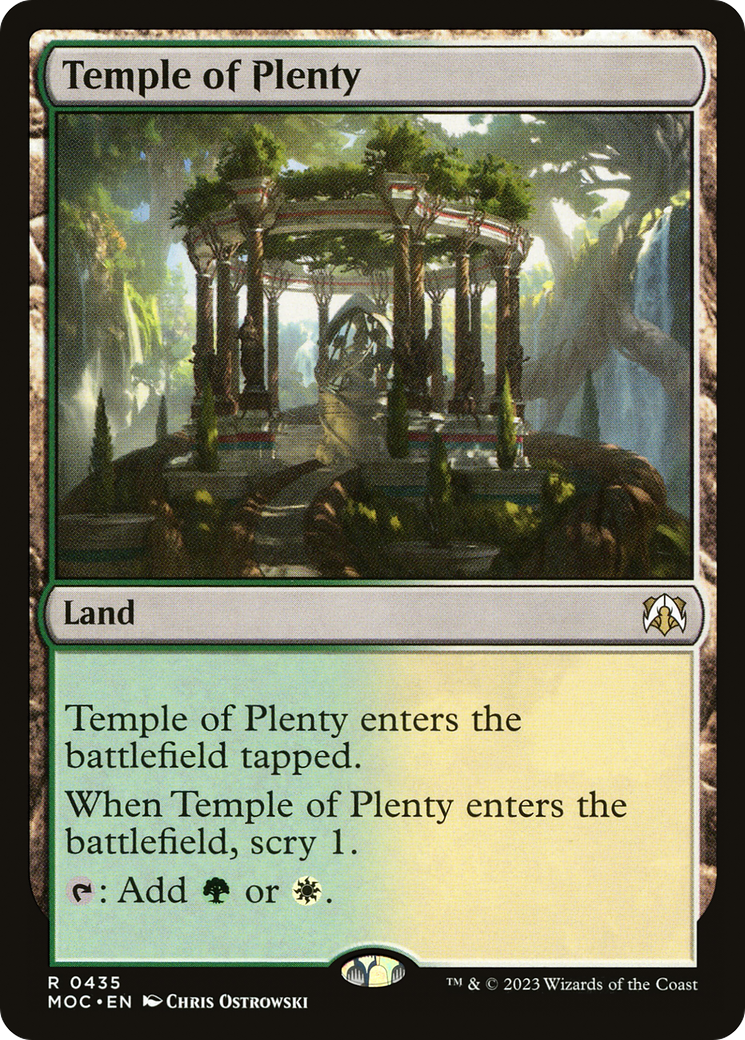
1
Temple of Plenty
Temple of Plenty
Land
This land enters tapped.
When this land enters, scry 1. (Look at the top card of your library. You may put that card on the bottom.)
: Add or .
- You perform the actions stated on a card in sequence. For some spells and abilities, that means you'll scry last. For others, that means you'll scry and then perform other actions.
- You choose how to order cards returned to your library after scrying no matter where you put them.
- When you scry, you may put all the cards you look at back on top of your library, you may put all of those cards on the bottom of your library, or you may put some of those cards on top and the rest of them on the bottom.
- Scry appears on some spells and abilities with one or more targets. If all of the spell or ability's targets are illegal when it tries to resolve, it won't resolve and none of its effects will happen. You won't scry.
-
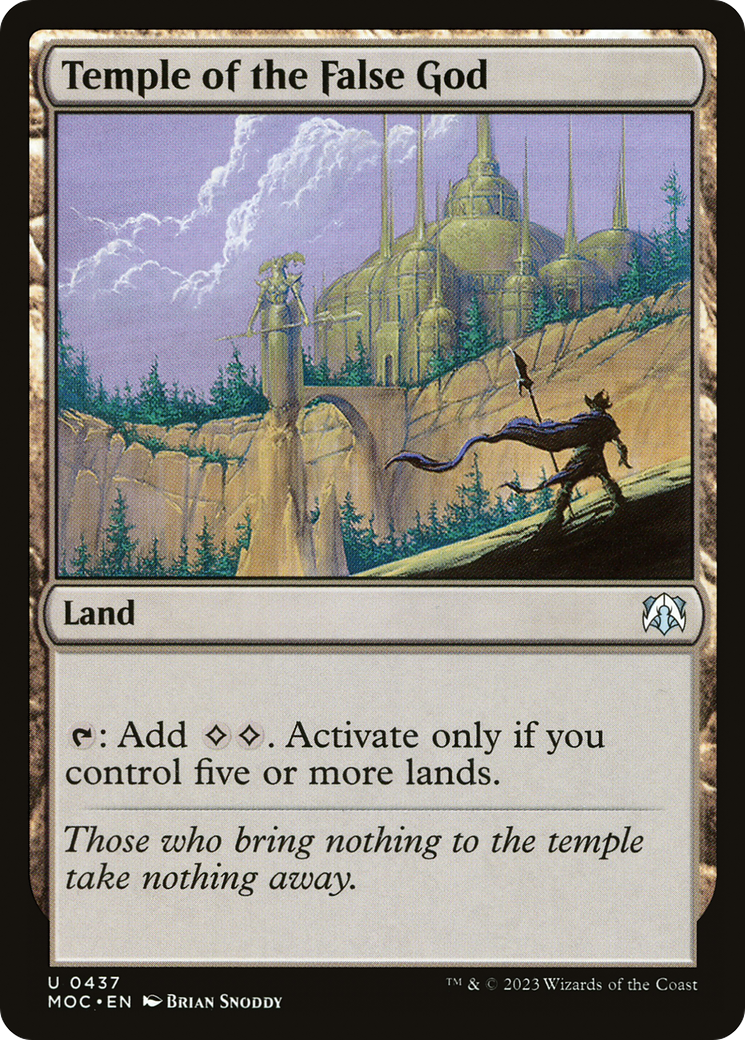
1
Temple of the False God
Temple of the False God
Land
: Add . Activate only if you control five or more lands.
-
1
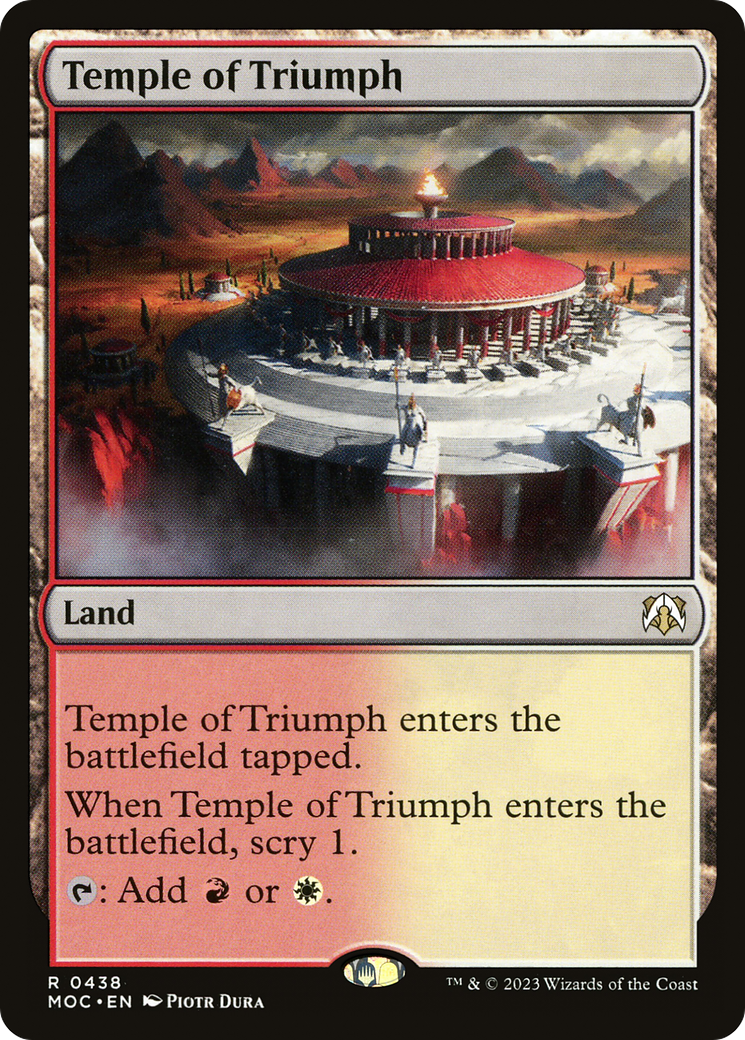
Temple of Triumph
Temple of Triumph
Land
This land enters tapped.
When this land enters, scry 1. (Look at the top card of your library. You may put that card on the bottom.)
: Add or .
- When you scry, you may put all the cards you look at back on top of your library, you may put all of those cards on the bottom of your library, or you may put some of those cards on top and the rest of them on the bottom.
- You choose how to order cards returned to your library after scrying no matter where you put them.
- You perform the actions stated on a card in sequence. For some spells and abilities, that means you'll scry last. For others, that means you'll scry and then perform other actions.
- Scry appears on some spells and abilities with one or more targets. If all of the spell or ability's targets are illegal when it tries to resolve, it won't resolve and none of its effects will happen. You won't scry.
-
1
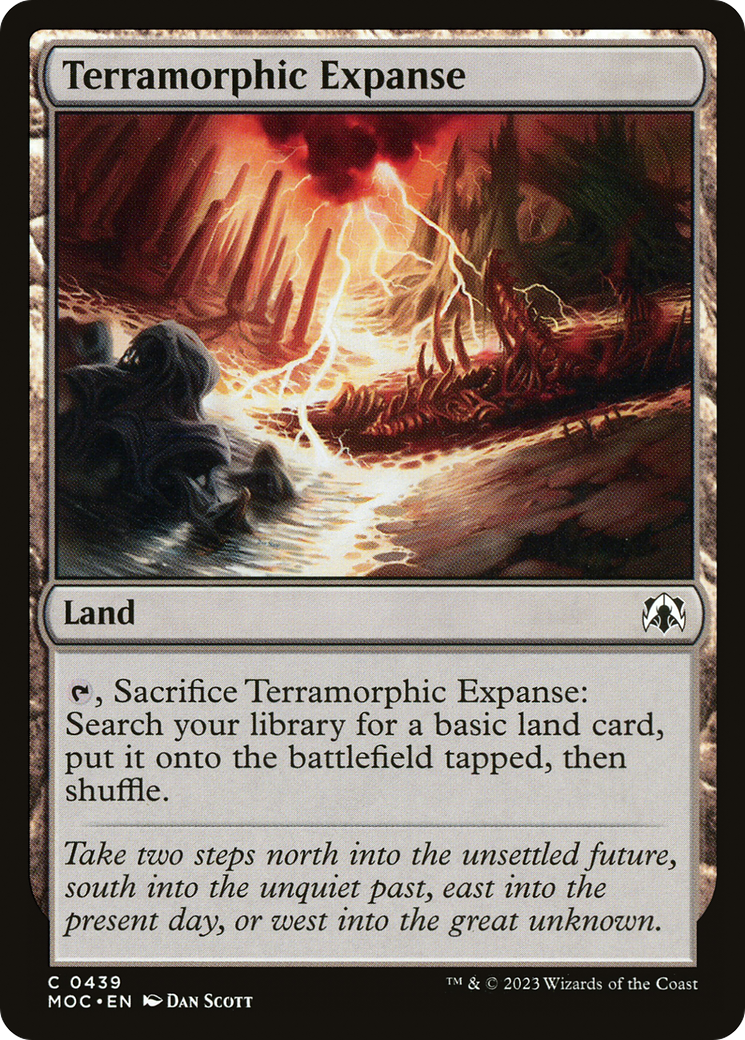
Terramorphic Expanse
Terramorphic Expanse
Land
, Sacrifice this land: Search your library for a basic land card, put it onto the battlefield tapped, then shuffle.
White 14
-
1
Abzan Battle Priest
Abzan Battle Priest
Creature — Human Cleric
3/2
Outlast ( , : Put a +1/+1 counter on this creature. Outlast only as a sorcery.)
Each creature you control with a +1/+1 counter on it has lifelink.
- The cost to activate a creature's outlast ability includes the tap symbol ( ). A creature's outlast ability can't be activated unless that creature has been under your control continuously since the beginning of your turn.
- Several creatures with outlast also grant an ability to creatures you control with +1/+1 counters on them, including themselves. These counters could come from an outlast ability, but any +1/+1 counter on the creature will count.
-
1
Abzan Falconer
Abzan Falconer
Creature — Human Soldier
2/3
Outlast ( , : Put a +1/+1 counter on this creature. Outlast only as a sorcery.)
Each creature you control with a +1/+1 counter on it has flying.
- The cost to activate a creature's outlast ability includes the tap symbol ( ). A creature's outlast ability can't be activated unless that creature has been under your control continuously since the beginning of your turn.
- Several creatures with outlast also grant an ability to creatures you control with +1/+1 counters on them, including themselves. These counters could come from an outlast ability, but any +1/+1 counter on the creature will count.
-
1
Alharu, Solemn Ritualist
Alharu, Solemn Ritualist
Legendary Creature — Human Monk
3/3
When Alharu enters, put a +1/+1 counter on each of up to two other target creatures.
Whenever a nontoken creature you control with a +1/+1 counter on it dies, create a 1/1 white Spirit creature token with flying.
Partner (You can have two commanders if both have partner.)
- You create just one Spirit token, not one for each +1/+1 counter that was on the creature that died.
- If a creature you control with a +1/+1 counter on it dies at the same time as Alharu, Alharu's ability triggers for that creature.
- If Alharu has a +1/+1 counter on it and dies, its ability triggers for itself.
- If your Commander deck has two commanders, you can only include cards whose own color identities are also found in your commanders' combined color identities. If Falthis and Kediss are your commanders, your deck may contain cards with black and/or red in their color identity, but not cards with green, white, or blue.
- Both commanders start in the command zone, and the remaining 98 cards (or 58 cards in a Commander Draft game) of your deck are shuffled to become your library.
- To have two commanders, both must have the partner ability as the game begins. Losing the ability during the game doesn't cause either to cease to be your commander.
- Once the game begins, your two commanders are tracked separately. If you cast one, you won't have to pay an additional the first time you cast the other. A player loses the game after having been dealt 21 damage from any one of them, not from both of them combined.
- If something refers to your commander while you have two commanders, it refers to one of them of your choice. If you are instructed to perform an action on your commander (e.g. put it from the command zone into your hand due to Command Beacon), you choose one of your commanders at the time the effect happens.
- An effect that checks whether you control your commander is satisfied if you control one or both of your two commanders.
- You can choose two commanders with partner that are the same color or colors. In Commander Draft, you can even choose two of the same commander with partner if you drafted them. If you do this, make sure you keep the number of times you've cast each from the command zone clear for "commander tax" purposes.
-
1
Constable of the Realm
Constable of the Realm
Creature — Giant Soldier
3/3
Renown 2 (When this creature deals combat damage to a player, if it isn't renowned, put two +1/+1 counters on it and it becomes renowned.)
Whenever one or more +1/+1 counters are put on this creature, exile up to one other target nonland permanent until this creature leaves the battlefield.
- Constable of the Realm's last ability triggers whenever a +1/+1 counter is put on it for any reason, not just because of its renown ability.
- If Constable of the Realm leaves the battlefield before its last triggered ability resolves, the target permanent won't be exiled.
- Auras attached to the exiled permanent will be put into their owners' graveyards. Equipment attached to it will become unattached and remain on the battlefield. Any counters on the exiled permanent will cease to exist.
- If a token creature is exiled this way, it will cease to exist and won't return to the battlefield.
- All permanents exiled by Constable of the Realm will return to the battlefield at the same time, and each one will enter under its owner's control.
- Renown won't trigger when a creature deals combat damage to a planeswalker or another creature. It also won't trigger when a creature deals noncombat damage to a player.
- If a creature with renown deals combat damage to its controller because that damage was redirected, renown will trigger.
-
1
Elite Scaleguard
Elite Scaleguard
Creature — Human Soldier
2/3
When this creature enters, bolster 2. (Choose a creature with the least toughness among creatures you control and put two +1/+1 counters on it.)
Whenever a creature you control with a +1/+1 counter on it attacks, tap target creature defending player controls.
- Bolster itself doesn't target any creature, though some spells and abilities that bolster may have other effects that target creatures. For example, you could put counters on a creature with protection from white with Abzan Skycaptain's bolster ability.
- You determine which creature to put counters on as the spell or ability that instructs you to bolster resolves.
-
1
Generous Gift
Generous Gift
Instant
Destroy target permanent. Its controller creates a 3/3 green Elephant creature token.
- If the target permanent is an illegal target by the time Generous Gift tries to resolve, the spell doesn't resolve. No player creates an Elephant. If the target is legal but not destroyed (most likely because it has indestructible), its controller does create an Elephant.
-
1
Guardian Scalelord
Guardian Scalelord
Creature — Dragon
3/4
Backup 1 (When this creature enters, put a +1/+1 counter on target creature. If that's another creature, it gains the following abilities until end of turn.)
Flying
Whenever this creature attacks, return target nonland permanent card with mana value X or less from your graveyard to the battlefield, where X is this creature's power.
- If a permanent enters the battlefield as a copy of a card with a backup ability or a token is created that is a copy of that card, the order of the printed abilities is maintained.
- If a backup ability causes another creature to gain abilities, the creature with backup will still have those abilities.
- If a backup ability targets the creature with backup, that creature will get +1/+1 counters, but it won't gain additional abilities.
- The abilities that backup grants to the target creature are determined only once, at the time the ability triggers. They won't change if the permanent with backup loses any abilities before the backup ability resolves.
- Backup confers only abilities that are actually printed below it. Any abilities that are gained by the permanent are ignored, including abilities gained due to a resolving spell or ability or copy effects.
-
1
High Sentinels of Arashin
High Sentinels of Arashin
Creature — Bird Soldier
3/4
Flying
This creature gets +1/+1 for each other creature you control with a +1/+1 counter on it.
: Put a +1/+1 counter on target creature.
- The activated ability can target and put +1/+1 counters on High Sentinels of Arashin itself.
- High Sentinels of Arashin gets +1/+1 per creature, not per +1/+1 counter. It doesn't matter how many +1/+1 counters are on any other creature you control as long as there's one or more.
-
1
Mikaeus, the Lunarch
Mikaeus, the Lunarch
Legendary Creature — Human Cleric
0/0
Mikaeus enters with X +1/+1 counters on it.
: Put a +1/+1 counter on Mikaeus.
, Remove a +1/+1 counter from Mikaeus: Put a +1/+1 counter on each other creature you control.
-
1
Restoration Angel
Restoration Angel
Creature — Angel
3/4
Flash
Flying
When this creature enters, you may exile target non-Angel creature you control, then return that card to the battlefield under your control.
- Once the exiled creature returns, it's considered a new object with no relation to the object that it was. Auras attached to the exiled creature will be put into their owners' graveyards. Equipment attached to the exiled creature will become unattached and remain on the battlefield. Any counters on the exiled creature will cease to exist.
- If a token is exiled this way, it will cease to exist and won't return to the battlefield.
- When an effect returns the exiled card "under your control," you control it indefinitely after that. If you had temporarily gained control of a creature, it won't return to its previous controller. In a multiplayer game, if a player leaves the game, all cards that player owns leave as well. If you leave the game, a creature you took with Restoration Angel's effect is exiled.
-
1
Semester's End
Semester's End
Instant
Exile any number of target creatures and/or planeswalkers you control. At the beginning of the next end step, return each of them to the battlefield under its owner's control. Each of them enters with an additional +1/+1 counter on it if it's a creature and an additional loyalty counter on it if it's a planeswalker.
- Use the characteristics of each permanent as it returns to the battlefield to determine if it should enter with an additional +1/+1 counter, an additional loyalty counter, or in very unusual cases, both. Notably, if you exile a creature that was only a creature because of a type-changing effect, it will enter as a noncreature permanent and won't get any additional +1/+1 counters from the effect of Semester's End.
-
1
Sunscorch Regent
Sunscorch Regent
Creature — Dragon
4/3
Flying
Whenever an opponent casts a spell, put a +1/+1 counter on this creature and you gain 1 life.
-
1
Swords to Plowshares
Swords to Plowshares
Instant
Exile target creature. Its controller gains life equal to its power.
- Use the power of the creature from when it was last on the battlefield to determine how much life is gained.
-
1
Together Forever
Together Forever
Enchantment
When this enchantment enters, support 2. (Put a +1/+1 counter on each of up to two target creatures.)
: Choose target creature with a counter on it. When that creature dies this turn, return that card to its owner's hand.
- If a creature without counters receives enough -1/-1 counters to reduce its toughness to 0 or less, Together Forever's ability can't be activated before state-based actions put that creature into its owner's graveyard.
- Together Forever's activated ability checks whether the target creature has a counter on it as the ability is activated and as the ability resolves. If the creature loses its counters later in the turn, the delayed triggered ability will still return it to its owner's hand when it dies.
- If some, but not all, targets for a spell become illegal, the remaining targets are affected as appropriate. If all of a spell's targets become illegal, that spell doesn't resolve.
- If a spell with support has other abilities that target creatures, those abilities and the support ability can target the same creature.
- You can't put more than one +1/+1 counter on any one target using the support action.
- Support can target a creature another player controls.
Red 10
-
1
Death-Greeter's Champion
Death-Greeter's Champion
Creature — Human Warrior
2/1
Dash (You may cast this spell for its dash cost. If you do, it gains haste, and it's returned from the battlefield to its owner's hand at the beginning of the next end step.)
Backup 1 (When this creature enters, put a +1/+1 counter on target creature. If that's another creature, it gains the following ability until end of turn.)
Double strike
- If a backup ability targets the creature with backup, that creature will get +1/+1 counters, but it won't gain additional abilities.
- If a backup ability causes another creature to gain abilities, the creature with backup will still have those abilities.
- If a permanent enters the battlefield as a copy of a card with a backup ability or a token is created that is a copy of that card, the order of the printed abilities is maintained.
- Backup confers only abilities that are actually printed below it. Any abilities that are gained by the permanent are ignored, including abilities gained due to a resolving spell or ability or copy effects.
- The abilities that backup grants to the target creature are determined only once, at the time the ability triggers. They won't change if the permanent with backup loses any abilities before the backup ability resolves.
-
1
Falkenrath Exterminator
Falkenrath Exterminator
Creature — Vampire Archer
1/1
Whenever this creature deals combat damage to a player, put a +1/+1 counter on it.
: This creature deals damage to target creature equal to the number of +1/+1 counters on this creature.
-
1
Flamerush Rider
Flamerush Rider
Creature — Human Warrior
3/3
Whenever this creature attacks, create a token that's a copy of another target attacking creature and that's tapped and attacking. Exile the token at end of combat.
Dash (You may cast this spell for its dash cost. If you do, it gains haste, and it's returned from the battlefield to its owner's hand at the beginning of the next end step.)
- You choose which opponent or opposing planeswalker the token is attacking as you put it onto the battlefield. It doesn't have to be the same player or planeswalker Flamerush Rider is attacking.
- Although the token is attacking, it was never declared as an attacking creature (for purposes of abilities that trigger whenever a creature attacks, for example).
- The token copies exactly what was printed on the original creature and nothing else (unless that permanent is copying something else or is a token; see below). It doesn't copy whether that creature has any counters on it or Auras and/or Equipment attached to it, or any non-copy effects that changed its power, toughness, types, color, and so on. Notably, it doesn't copy any effects that may have turned a noncreature permanent into a creature. If the token isn't a creature as it enters the battlefield, it won't be attacking.
- If the copied creature had in its mana cost, X is 0.
- If the copied creature was copying something else, the token enters the battlefield as whatever that creature was copying.
- If the copied creature is a token, the token created by Flamerush Rider copies the original characteristics of that token as stated by the effect that put it onto the battlefield.
- Any enters-the-battlefield abilities of the copied creature will trigger when the token enters the battlefield. Any "As [this creature] enters the battlefield" or "[This creature] enters the battlefield with" abilities of the copied creature will also work.
- If another creature becomes or enters the battlefield as a copy of the token, you won't exile that creature at end of combat. However, if Flamerush Rider creates multiple tokens due to a replacement effect (like the one Doubling Season creates), you'll exile each of those tokens.
- If you choose to pay the dash cost rather than the mana cost, you're still casting the spell. It goes on the stack and can be responded to and countered. You can cast a creature spell for its dash cost only when you otherwise could cast that creature spell. Most of the time, this means during your main phase when the stack is empty.
- If you pay the dash cost to cast a creature spell, that card will be returned to its owner's hand only if it's still on the battlefield when its triggered ability resolves. If it dies or goes to another zone before then, it will stay where it is.
- You don't have to attack with the creature with dash unless another ability says you do.
- If a creature enters the battlefield as a copy of or becomes a copy of a creature whose dash cost was paid, the copy won't have haste and won't be returned to its owner's hand.
-
1
Flameshadow Conjuring
Flameshadow Conjuring
Enchantment
Whenever a nontoken creature you control enters, you may pay . If you do, create a token that's a copy of that creature. That token gains haste. Exile it at the beginning of the next end step.
- The token copies exactly what's printed on the original creature and nothing else (unless that creature is copying something else; see below). It doesn't copy whether that creature is tapped or untapped, whether it has any counters on it or Auras and Equipment attached to it, or any non-copy effects that have changed its power, toughness, types, color, and so on.
- If the copied creature has in its mana cost, X is 0.
- If the copied creature is copying something else when the ability resolves, then the token enters the battlefield as a copy of whatever that creature is copying.
- Any enters-the-battlefield abilities of the copied creature will trigger when the token enters the battlefield. Any “as [this permanent] enters the battlefield” or “[this permanent] enters the battlefield with” abilities of the copied creature will also work.
- The token is exiled at the beginning of the next end step regardless of who controls it at that time.
- If the ability resolves during a turn's end step, the token will be exiled at the beginning of the next turn's end step.
- If the token isn't exiled at the beginning of the next end step (perhaps because the delayed triggered ability is countered), it remains on the battlefield indefinitely. It continues to have haste.
- If another creature becomes or enters the battlefield as a copy of the token, that creature won't have haste and it won't be exiled.
-
1
Heaven // Earth
//
Heaven
Instant
- Once you've started to cast a spell with aftermath from your graveyard, the card is immediately moved to the stack. Opponents can't try to stop the ability by exiling the card with an effect such as that of Crook of Condemnation.
- All split cards have two card faces on a single card, and you put a split card onto the stack with only the half you're casting. The characteristics of the half of the card you didn't cast are ignored while the spell is on the stack. For example, if an effect prevents you from casting green spells, you can cast Destined of Destined // Lead, but not Lead.
- Each split card is a single card. For example, if you discard one, you've discarded one card, not two. If an effect counts the number of instant and sorcery cards in your graveyard, Destined // Lead counts once, not twice.
- Each split card has two names. If an effect instructs you to choose a card name, you may choose one, but not both.
- While not on the stack, the characteristics of a split card are the combination of its two halves. For example, Destined // Lead is a green and black card, it is both an instant card and a sorcery card, and its mana value is 6. This means that if an effect allows you to cast a card with mana value 2 from your hand, you can't cast Destined. This is a change from the previous rules for split cards.
- Split cards with aftermath have a new frame treatment—the half you can cast from your hand is oriented the same as other cards you'd cast from your hand, while the half you can cast from your graveyard is a traditional split card half. This frame treatment is for your convenience and has no rules significance.
- If another effect allows you to cast a split card with aftermath from any zone other than a graveyard, you can't cast the half with aftermath.
- If another effect allows you to cast a split card with aftermath from a graveyard, you may cast either half. If you cast the half that has aftermath, you'll exile the card if it would leave the stack.
- A spell with aftermath cast from a graveyard will always be exiled afterward, whether it resolves, it's countered, or it leaves the stack in some other way.
- You don't have to choose the same value for X while casting Earth as you did while casting Heaven.
- If you cast the first half of a split card with aftermath during your turn, you'll have priority immediately after it resolves. You can cast the half with aftermath from your graveyard before any player can take any other action if it's legal for you to do so.
-
1
Ion Storm
Ion Storm
Enchantment
, Remove a +1/+1 counter or a charge counter from a permanent you control: This enchantment deals 2 damage to any target.
-
1
Krenko, Tin Street Kingpin
Krenko, Tin Street Kingpin
Legendary Creature — Goblin
1/2
Whenever Krenko attacks, put a +1/+1 counter on it, then create a number of 1/1 red Goblin creature tokens equal to Krenko's power.
- If Krenko leaves the battlefield after its ability has triggered but before it resolves, you don't put a +1/+1 counter on it, but you do use its power as it last existed before it left the battlefield to determine how many Goblin tokens to create.
- The tokens created by Krenko's triggered ability aren't attacking. Because all attackers are chosen at once, a token created this way can't attack, even if it gains haste.
-
1
Mirror-Style Master
Mirror-Style Master
Creature — Human Warrior
3/3
Backup 1 (When this creature enters, put a +1/+1 counter on target creature. If that's another creature, it gains the following ability until end of turn.)
Whenever this creature attacks, for each attacking modified creature you control, create a tapped and attacking token that's a copy of that creature. Exile those tokens at end of combat. (Equipment, Auras you control, and counters are modifications.)
- Although the tokens enter the battlefield attacking, they were never declared as attacking creatures (for the purposes of abilities that trigger whenever a creature attacks, for example).
- All of the tokens enter the battlefield at the same time.
- Each of the tokens copy exactly what was printed on the original creature and nothing else (unless that creature is copying something else or is a token; see below). It doesn’t copy whether that creature is tapped or untapped, whether it has any counters on it or Auras and Equipment attached to it, or any non-copy effects that have changed its power, toughness, types, color, and so on. (Basically, it won’t copy anything that made it modified in the first place. C’est la vie.)
- If the copied creature has in its mana cost, X is 0.
- If the copied creature is a token, the token that’s created copies the original characteristics of that token as stated by the effect that created that token.
- If the copied creature is copying something else, then the token enters the battlefield as whatever that creature copied.
- Any enters-the-battlefield abilities of the copied creature will trigger when the token enters the battlefield. Any “as [this creature] enters the battlefield” or “[this creature] enters the battlefield with” abilities of the copied creature will also work.
- If a backup ability targets the creature with backup, that creature will get +1/+1 counters, but it won’t gain additional abilities.
- If a backup ability causes another creature to gain abilities, the creature with backup will still have those abilities.
- If a permanent enters the battlefield as a copy of a card with a backup ability or a token is created that is a copy of that card, the order of the printed abilities is maintained.
- Backup confers only abilities that are actually printed below it. Any abilities that are gained by the permanent are ignored, including abilities gained due to a resolving spell or ability or copy effects.
- The abilities that backup grants to the target creature are determined only once, at the time the ability triggers. They won’t change if the permanent with backup loses any abilities before the backup ability resolves.
-
1
Path of the Pyromancer
Path of the Pyromancer
Sorcery
Discard all the cards in your hand. Add for each card discarded this way, then draw that many cards plus one.
Will of the Planeswalkers — Starting with you, each player votes for planeswalk or chaos. If planeswalk gets more votes, planeswalk. If chaos gets more votes or the vote is tied, chaos ensues.
- If your hand is empty as Path of the Pyromancer resolves, you won’t add any mana, but you will draw a card.
-
1
Uncivil Unrest
Uncivil Unrest
Enchantment
Nontoken creatures you control have riot. (They enter with your choice of a +1/+1 counter or haste.)
If a creature you control with a +1/+1 counter on it would deal damage to a permanent or player, it deals double that damage instead.
- Riot is a replacement effect. Players can’t respond to your choice of +1/+1 counter or haste, and they can’t take actions while the creature is on the battlefield without one or the other.
- If you choose for the creature to gain haste, it gains haste indefinitely. It won’t lose it as the turn ends or as another player gains control of it.
- The damage is dealt by the same source as the original source of damage. The doubled damage isn’t dealt by Uncivil Unrest unless it was somehow the original source of damage.
- If another effect (or effects) modifies how much damage your creature with a +1/+1 counter on it would deal—by preventing some of it, for example—the player being dealt damage or the controller of the permanent being dealt damage chooses the order in which any such effects (including Uncivil Unrest’s) apply. If all of the damage is prevented, Uncivil Unrest’s effect no longer applies.
- If damage dealt by a creature you control with a +1/+1 counter on it is being divided or assigned among multiple permanents and/or players, that damage is divided or assigned before doubling. For example, if you attack with a 5/5 creature with trample and it’s blocked by a 2/2 creature, you can assign 2 damage to the blocker and 3 damage to the defending player. Those amounts are then doubled to 4 and 6, respectively.
Green 22
-
1
Armorcraft Judge
Armorcraft Judge
Creature — Elf Artificer
3/3
When this creature enters, draw a card for each creature you control with a +1/+1 counter on it.
- The number of creatures you control with +1/+1 counters on them is counted only as Armorcraft Judge's triggered ability resolves. Players may respond to the triggered ability by trying to change that number.
- Armorcraft Judge's ability counts the number of creatures, not the number of counters. A creature with more than one +1/+1 counter won't cause you to draw more than one card.
-
1
Brawn
Brawn
Creature — Incarnation
3/3
Trample
As long as this card is in your graveyard and you control a Forest, creatures you control have trample.
-
1
Champion of Lambholt
Champion of Lambholt
Creature — Human Warrior
1/1
Creatures with power less than this creature's power can't block creatures you control.
Whenever another creature you control enters, put a +1/+1 counter on this creature.
- Champion of Lambholt's first ability applies even if it isn't attacking.
- The comparison of power is done only when blockers are declared. Decreasing the power of a blocking creature (or increasing the power of Champion of Lambholt) after this point won't cause any creature to stop blocking or become unblocked.
-
1
Conclave Sledge-Captain
Conclave Sledge-Captain
Creature — Elephant Soldier
4/4
Backup 1, backup 1, backup 1 (When this creature enters, put a +1/+1 counter on target creature. If that's another creature, it gains the following abilities until end of turn. Each backup ability triggers separately.)
Trample
Whenever this creature deals combat damage to a player, put that many +1/+1 counters on it.
- If the same creature is the target of more than one of Conclave Sledge-Captain’s backup abilities, it will get more than one instance of its triggered ability. Each of those triggered abilities triggers separately. If the creature deals combat damage to a player, it will get that many +1/+1 counters more than once. (It will also have trample more than once, but that’s way less interesting.)
- If a backup ability targets the creature with backup, that creature will get +1/+1 counters, but it won’t gain additional abilities.
- If a backup ability causes another creature to gain abilities, the creature with backup will still have those abilities.
- If a permanent enters the battlefield as a copy of a card with a backup ability or a token is created that is a copy of that card, the order of the printed abilities is maintained.
- Backup confers only abilities that are actually printed below it. Any abilities that are gained by the permanent are ignored, including abilities gained due to a resolving spell or ability or copy effects.
- The abilities that backup grants to the target creature are determined only once, at the time the ability triggers. They won’t change if the permanent with backup loses any abilities before the backup ability resolves.
-
1
Cultivate
Cultivate
Sorcery
Search your library for up to two basic land cards, reveal those cards, put one onto the battlefield tapped and the other into your hand, then shuffle.
- If you choose to find only one basic land card, you put it onto the battlefield tapped.
-
1
Emergent Woodwurm
Emergent Woodwurm
Creature — Wurm
4/4
Backup 3 (When this creature enters, put three +1/+1 counters on target creature. If that's another creature, it gains the following ability until end of turn.)
Whenever this creature attacks, look at the top X cards of your library, where X is its power. You may put a permanent card with mana value X or less from among them onto the battlefield. Put the rest on the bottom of your library in a random order.
- Use the power of the creature as the triggered ability resolves to determine the value of X. If the creature is no longer on the battlefield at that time, use its power from when it was last on the battlefield.
- If a backup ability targets the creature with backup, that creature will get +1/+1 counters, but it won’t gain additional abilities.
- If a backup ability causes another creature to gain abilities, the creature with backup will still have those abilities.
- If a permanent enters the battlefield as a copy of a card with a backup ability or a token is created that is a copy of that card, the order of the printed abilities is maintained.
- Backup confers only abilities that are actually printed below it. Any abilities that are gained by the permanent are ignored, including abilities gained due to a resolving spell or ability or copy effects.
- The abilities that backup grants to the target creature are determined only once, at the time the ability triggers. They won’t change if the permanent with backup loses any abilities before the backup ability resolves.
-
1
Fertilid
Fertilid
Creature — Elemental
0/0
This creature enters with two +1/+1 counters on it.
, Remove a +1/+1 counter from this creature: Target player searches their library for a basic land card, puts it onto the battlefield tapped, then shuffles.
- Although the targeted player doesn't need to find a basic land card if they don't want to, that player must shuffle their library.
-
1
Forgotten Ancient
Forgotten Ancient
Creature — Elemental
0/3
Whenever a player casts a spell, you may put a +1/+1 counter on this creature.
At the beginning of your upkeep, you may move any number of +1/+1 counters from this creature onto other creatures.
- Forgotten Ancient's last ability doesn't target any creatures. You choose how many +1/+1 counters will be moved (and onto which creatures) as the ability resolves. Notably, once the ability starts resolving and you make these choices, no player may take actions until the ability has finished resolving.
- Forgotten Ancient's first ability will resolve before the spell that caused it to trigger. Putting a +1/+1 counter on Forgotten Ancient is optional.
-
1
Genesis Hydra
Genesis Hydra
Creature — Plant Hydra
0/0
When you cast this spell, reveal the top X cards of your library. You may put a nonland permanent card with mana value X or less from among them onto the battlefield. Then shuffle the rest into your library.
This creature enters with X +1/+1 counters on it.
- Genesis Hydra's first ability will resolve before Genesis Hydra does. Notably, if you put an Aura card onto the battlefield this way, it can't enchant Genesis Hydra.
- If you have fewer than X cards in your library, you reveal all of them.
- If a card in a player's library has in its mana cost, X is considered to be 0.
- A nonland permanent card is an artifact, creature, enchantment, or planeswalker card.
- If you put an Aura onto the battlefield this way, you choose what it enchants as it enters the battlefield. This doesn't target any permanent or player, but it must be able to enchant that permanent or player. For example, you could put a green Aura onto the battlefield enchanting a creature with hexproof controlled by an opponent, but not one with protection from green.
- If "the rest" is zero cards, either because X was 0 or because X was 1 and that card was put onto the battlefield, the library is still shuffled.
-
1
Gyre Sage
Gyre Sage
Creature — Elf Druid
1/2
Evolve (Whenever a creature you control enters, if that creature has greater power or toughness than this creature, put a +1/+1 counter on this creature.)
: Add for each +1/+1 counter on this creature.
- Gyre Sage's last ability is a mana ability. It doesn't use the stack and can't be responded to.
-
1
Hindervines
Hindervines
Instant
Prevent all combat damage that would be dealt this turn by creatures with no +1/+1 counters on them.
- Hindervines checks whether a creature has a +1/+1 counter on it at the moment it deals damage. It doesn't matter whether a creature had a +1/+1 counter, or was even on the battlefield, when Hindervines resolved.
-
1
Incubation Druid
Incubation Druid
Creature — Elf Druid
0/2
: Add one mana of any type that a land you control could produce. If this creature has a +1/+1 counter on it, add three mana of that type instead.
: Adapt 3. (If this creature has no +1/+1 counters on it, put three +1/+1 counters on it.)
- The types of mana are white, blue, black, red, green, and colorless.
- Incubation Druid checks the effects of all mana-producing abilities of lands you control, but it doesn't check their costs or legality. For example, Spire of Industry says " , Pay 1 life: Add one mana of any color. Activate only if you control an artifact." If you control Spire of Industry and Incubation Druid, you can tap Incubation Druid for any color of mana. It doesn't matter whether you control an artifact, whether you can pay 1 life, or whether Spire of Industry is untapped.
- Any change to a land's type or abilities gained by a land can affect the types of mana a land can produce.
- Incubation Druid doesn't care about any restrictions or riders your lands put on the mana they produce, such as those of Unclaimed Territory and Guildmages' Forum. It just produces one mana of the appropriate type, with no restrictions or riders.
-
1
Inscription of Abundance
Inscription of Abundance
Instant
Kicker
Choose one. If this spell was kicked, choose any number instead.
- Put two +1/+1 counters on target creature.
- Target player gains X life, where X is the greatest power among creatures they control.
- Target creature you control fights target creature you don't control.
- To determine a spell's total cost, start with the mana cost (or an alternative cost if another card's effect allows you to pay one instead), add any cost increases (such as kicker), then apply any cost reductions. The spell's mana value remains unchanged, no matter what the total cost to cast it was.
- If a spell's kicker cost was paid, the spell is "kicked."
- The kicker ability doesn't let you pay a kicker cost more than once.
- If you put a permanent with a kicker ability onto the battlefield without casting it, you can't kick it.
- If you copy a kicked spell on the stack, the copy is also kicked. If the copied spell is a permanent spell, the token the copy of that spell becomes when it enters is also kicked.
- If a card or token enters as a copy of a permanent, the new permanent isn't kicked, even if the original was.
- If more than one mode is chosen, perform them in the order written. Nothing can happen in between, however, and no player may choose to take actions. Any abilities that trigger will be put onto the stack after the spell has finished resolving.
- If any targets become illegal, the other targets will still be affected as appropriate.
- If the second mode is chosen and each creature the target player controls has negative power, that player doesn't gain or lose life.
- If either target creature is an illegal target as Inscription of Abundance resolves with its last mode chosen, no creature will deal or be dealt damage.
- If you kick Inscription of Abundance, you can't choose any one mode more than once.
-
1
Inspiring Call
Inspiring Call
Instant
Draw a card for each creature you control with a +1/+1 counter on it. Those creatures gain indestructible until end of turn. (Damage and effects that say "destroy" don't destroy them.)
- Creatures you control that have +1/+1 counters put on them after Inspiring Call resolves won't gain indestructible.
- Once a creature gains indestructible, it will have it for the turn, even if it loses all its +1/+1 counters.
-
1
Kalonian Hydra
Kalonian Hydra
Creature — Hydra
0/0
Trample
This creature enters with four +1/+1 counters on it.
Whenever this creature attacks, double the number of +1/+1 counters on each creature you control.
- To double the number of +1/+1 counters on a creature, determine how many +1/+1 counters are on the creature and put that many more on it. Effects that interact with counters (such as the one created by Corpsejack Menace's ability) may change the number of counters ultimately put on the creature.
-
1
Kodama's Reach
Kodama's Reach
Sorcery — Arcane
Search your library for up to two basic land cards, reveal those cards, put one onto the battlefield tapped and the other into your hand, then shuffle.
- You can get just one basic land card if you wish (or even none at all). If you get only one land card, you put it onto the battlefield tapped.
-
1
Managorger Hydra
Managorger Hydra
Creature — Hydra
1/1
Trample
Whenever a player casts a spell, put a +1/+1 counter on this creature.
- Managorger Hydra's last ability will resolve before the spell that caused it to trigger.
-
1
Pridemalkin
Pridemalkin
Creature — Cat
2/1
When this creature enters, put a +1/+1 counter on target creature you control.
Each creature you control with a +1/+1 counter on it has trample. (It can deal excess combat damage to the player or planeswalker it's attacking.)
- Pridemalkin can be the target of its own first ability.
- Pridemalkin's second ability applies to Pridemalkin as long as it has a +1/+1 counter on it.
-
1
Return to Nature
Return to Nature
Instant
Choose one —
- Destroy target artifact.
- Destroy target enchantment.
- Exile target card from a graveyard.
-
1
Rishkar, Peema Renegade
Rishkar, Peema Renegade
Legendary Creature — Elf Druid
2/2
When Rishkar enters, put a +1/+1 counter on each of up to two target creatures.
Each creature you control with a counter on it has " : Add ."
- Rishkar can be a target of its own triggered ability.
- You can't target the same creature twice to have one recipient get two +1/+1 counters.
- Each creature you control has Rishkar's mana ability as long as that creature has any kind of counter on it. The effect isn't limited to those with +1/+1 counters.
-
1
Slurrk, All-Ingesting
Slurrk, All-Ingesting
Legendary Creature — Ooze
0/0
Slurrk enters with five +1/+1 counters on it.
Whenever Slurrk or another creature you control dies, if it had a +1/+1 counter on it, put a +1/+1 counter on each creature you control that has a +1/+1 counter on it.
Partner (You can have two commanders if both have partner.)
- If your Commander deck has two commanders, you can only include cards whose own color identities are also found in your commanders' combined color identities. If Falthis and Kediss are your commanders, your deck may contain cards with black and/or red in their color identity, but not cards with green, white, or blue.
- Both commanders start in the command zone, and the remaining 98 cards (or 58 cards in a Commander Draft game) of your deck are shuffled to become your library.
- To have two commanders, both must have the partner ability as the game begins. Losing the ability during the game doesn't cause either to cease to be your commander.
- Once the game begins, your two commanders are tracked separately. If you cast one, you won't have to pay an additional the first time you cast the other. A player loses the game after having been dealt 21 damage from any one of them, not from both of them combined.
- If something refers to your commander while you have two commanders, it refers to one of them of your choice. If you are instructed to perform an action on your commander (e.g. put it from the command zone into your hand due to Command Beacon), you choose one of your commanders at the time the effect happens.
- An effect that checks whether you control your commander is satisfied if you control one or both of your two commanders.
- You can choose two commanders with partner that are the same color or colors. In Commander Draft, you can even choose two of the same commander with partner if you drafted them. If you do this, make sure you keep the number of times you've cast each from the command zone clear for "commander tax" purposes.
-
1
Wood Elves
Wood Elves
Creature — Elf Scout
1/1
When this creature enters, search your library for a Forest card, put that card onto the battlefield, then shuffle.
- Because the "search" requires you to find a card with certain characteristics, you don't have to find the card if you don't want to.
Multicolor 8
-
1
Bright-Palm, Soul Awakener
Bright-Palm, Soul Awakener
Legendary Creature — Fox Shaman
4/3
Backup 1 (When this creature enters, put a +1/+1 counter on target creature. If that's another creature, it gains the following ability until end of turn.)
Whenever this creature attacks, double the number of +1/+1 counters on target creature. That creature can't be blocked by creatures with power 2 or less this turn.
- If a backup ability targets the creature with backup, that creature will get +1/+1 counters, but it won’t gain additional abilities.
- If a backup ability causes another creature to gain abilities, the creature with backup will still have those abilities.
- If a permanent enters the battlefield as a copy of a card with a backup ability or a token is created that is a copy of that card, the order of the printed abilities is maintained.
- Backup confers only abilities that are actually printed below it. Any abilities that are gained by the permanent are ignored, including abilities gained due to a resolving spell or ability or copy effects.
- The abilities that backup grants to the target creature are determined only once, at the time the ability triggers. They won’t change if the permanent with backup loses any abilities before the backup ability resolves.
-
1
Conclave Mentor
Conclave Mentor
Creature — Centaur Cleric
2/2
If one or more +1/+1 counters would be put on a creature you control, that many plus one +1/+1 counters are put on that creature instead.
When this creature dies, you gain life equal to its power.
- If a creature you control would enter the battlefield with a number of +1/+1 counters on it, it enters with that many plus one instead.
- Conclave Mentor's first ability doesn't apply to itself if it's somehow entering the battlefield with a +1/+1 counter on it.
- If you control two Conclave Mentors, the number of +1/+1 counters put on a creature is two plus the original number. Three Conclave Mentors add three, and so on.
- If two or more effects attempt to modify how many counters would be put onto a creature you control, you choose the order to apply those effects, no matter who controls the sources of those effects.
- Use Conclave Mentor's power as it last existed on the battlefield to determine how much life you gain.
-
1
Dromoka's Command
Dromoka's Command
Instant
Choose two —
- Prevent all damage target instant or sorcery spell would deal this turn.
- Target player sacrifices an enchantment of their choice.
- Put a +1/+1 counter on target creature.
- Target creature you control fights target creature you don't control.
- Although most instants and sorceries that cause damage to be dealt are the sources of that damage, a few cause other objects to deal damage (for example, spells that cause creatures to fight). The first ability of Dromoka's Command won't prevent damage caused by those other sources.
- You can target any player with the second ability, including one that doesn't control an enchantment.
- You choose the two modes as you cast the spell. You must choose two different modes. Once modes are chosen, they can't be changed.
- You can choose a mode only if you can choose legal targets for that mode. Ignore the targeting requirements for modes that aren't chosen. For example, you can cast Ojutai's Command without targeting a creature spell provided you don't choose the third mode.
- As the spell resolves, follow the instructions of the modes you chose in the order they are printed on the card. For example, if you chose the second and fourth modes of Ojutai's Command, you would gain 4 life and then draw a card. (The order won't matter in most cases.)
- If a Command is copied, the effect that creates the copy will usually allow you to choose new targets for the copy, but you can't choose new modes.
- If all targets for the chosen modes become illegal before the Command resolves, the spell won't resolve and none of its effects will happen. If at least one target is still legal, the spell will resolve but will have no effect on any illegal targets.
-
1
Enduring Scalelord
Enduring Scalelord
Creature — Dragon
4/4
Flying
Whenever one or more +1/+1 counters are put on another creature you control, you may put a +1/+1 counter on this creature.
- A creature entering the battlefield with one or more +1/+1 counters on it will cause Enduring Scalelord's ability to trigger.
- If +1/+1 counters are put on multiple creatures you control (other than Enduring Scalelord) at the same time, Enduring Scalelord's ability will trigger once for each of those creatures.
- If you control two Enduring Scalelords, putting a +1/+1 counter on one of them will cause the ability of the other one to trigger. When this ability resolves, you'll put a +1/+1 counter on the other Scalelord. This will cause the ability of the first one to trigger. This loop will repeat until you choose not to put a +1/+1 counter on one of the Enduring Scalelords.
-
1
Good-Fortune Unicorn
Good-Fortune Unicorn
Creature — Unicorn
2/2
Whenever another creature you control enters, put a +1/+1 counter on that creature.
-
1
Hamza, Guardian of Arashin
Hamza, Guardian of Arashin
Legendary Creature — Elephant Warrior
5/5
This spell costs less to cast for each creature you control with a +1/+1 counter on it.
Creature spells you cast cost less to cast for each creature you control with a +1/+1 counter on it.
- To determine the total cost of a spell, start with the mana cost or alternative cost you're paying, add any cost increases, then apply any cost reductions (such as that of Hamza, Guardian of Arashin). The total cost is locked in before any costs are paid. The mana value of the spell is determined only by its mana cost, no matter what the total cost to cast the spell was.
- Once you announce you're casting a creature spell, no player may take actions until the spell has been paid for. Notably, opponents can't try to change the number of creatures you control with +1/+1 counters.
- Hamza's first ability affects only generic mana costs. It can't reduce the total cost to cast the spell below .
-
1
Juniper Order Ranger
Juniper Order Ranger
Creature — Human Knight Ranger
2/4
Whenever another creature you control enters, put a +1/+1 counter on that creature and a +1/+1 counter on this creature.
- The creature doesn't enter with a +1/+1 counter on it. It enters, then the ability triggers. If either that creature or Juniper Order Ranger leaves the battlefield before the ability resolves, the remaining creature will still get a +1/+1 counter.
-
1
Shalai and Hallar
Shalai and Hallar
Legendary Creature — Angel Elf
3/3
Flying, vigilance
Whenever one or more +1/+1 counters are put on a creature you control, Shalai and Hallar deals that much damage to target opponent.
Colorless 8
-
1
Arcane Signet
Arcane Signet
Artifact
: Add one mana of any color in your commander's color identity.
- If your commander is a card that has no colors in its color identity, Arcane Signet's ability produces no mana. It doesn't produce .
- If you have two commanders, the ability adds one mana of any color in their combined color identities.
- If you don't have a commander, Arcane Signet's ability produces no mana.
-
1
Commander's Sphere
Commander's Sphere
Artifact
: Add one mana of any color in your commander's color identity.
Sacrifice this artifact: Draw a card.
- If your commander is a card that has no colors in its color identity, Commander's Sphere's first ability produces no mana. It doesn't produce .
- If you don't have a commander, Commander's Sphere's first ability produces no mana.
- If you have two commanders, the ability adds one mana of any color in their combined color identities.
-
1
Fractured Powerstone
Fractured Powerstone
Artifact
: Add .
: Roll the planar die. Activate only as a sorcery.
- In non-Planechase games, Fractured Powerstone's second ability will have no effect.
- Rolling the planar die this way doesn't count when determining the cost of the special action of rolling the planar die. For example, if you roll the planar die twice in a turn, then activate Fractured Powerstone to roll it a third time, rolling the planar die again that turn will cost .
-
1
Ichor Elixir
Ichor Elixir
Artifact
If you would roll one or more planar dice, instead roll that many planar dice plus one and ignore one.
: Add .
-
1
Mindless Automaton
Mindless Automaton
Artifact Creature — Construct
0/0
This creature enters with two +1/+1 counters on it.
, Discard a card: Put a +1/+1 counter on this creature.
Remove two +1/+1 counters from this creature: Draw a card.
- If removing two +1/+1 counters from Mindless Automaton causes the amount of damage already marked on Mindless Automaton to be equal to or greater than its toughness, it will be put into its owner's graveyard as a state-based action before the ability can be activated again and before the card is drawn.
-
1
Sol Ring
Sol Ring
Artifact
: Add .
-
1
Strionic Resonator
Strionic Resonator
Artifact
, : Copy target triggered ability you control. You may choose new targets for the copy. (A triggered ability uses the words "when," "whenever," or "at.")
- Triggered abilities use the word "when," "whenever," or "at." They're often written as "[Trigger condition], [effect]."
- Strionic Resonator targets a triggered ability that has triggered and is on the stack and creates another instance of that ability on the stack. It doesn't cause any object to gain an ability.
- The source of the copy is the same as the source of the original ability.
- If the triggered ability is modal (that is, if it says, "Choose one —" or similar), the mode is copied and can't be changed.
- If the triggered ability divides damage or distributes counters among a number of targets (for example, the ability of Bogardan Hellkite), the division and number of targets can't be changed. If you choose new targets, you must choose the same number of targets.
- Any choices made when the triggered ability resolves won't have been made yet when it's copied. Any such choices will be made separately when the copy resolves. If the triggered ability asks you to pay a cost (such as that of Frenzied Goblin), you pay that cost for the copy.
- If a triggered ability is linked to a second ability, copies of that triggered ability are also linked to that second ability. If the second ability refers to "the exiled card," it refers to all cards exiled by the triggered ability and the copy. For example, if Fiend Hunter's enters-the-battlefield ability is copied and two creatures are exiled, they both return when Fiend Hunter leaves the battlefield.
- In some cases involving linked abilities, an ability requires information about "the exiled card." When this happens, the ability gets multiple answers. If these answers are being used to determine the value of a variable, the sum is used. For example, if Elite Arcanist's enters-the-battlefield ability is copied, two cards are exiled. The value of X in the activation cost of Elite Arcanist's other ability is the sum of the two cards' mana values. As the ability resolves, you create copies of both cards and can cast none, one, or both of the copies in any order.
-
1
Triskelion
Triskelion
Artifact Creature — Construct
1/1
This creature enters with three +1/+1 counters on it.
Remove a +1/+1 counter from this creature: It deals 1 damage to any target.
- If you activate the ability of an attacking or blocking Triskelion during the declare blockers step, it will deal less combat damage as a result. If you wait until the combat damage step, but Triskelion is dealt lethal damage, it’ll be destroyed before you get a chance to activate its ability.
- If Triskelion has damage marked on it, activating its ability may cause that damage to become lethal. For example, say a Triskelion with two +1/+1 counters on it has been dealt 2 damage earlier in the turn. If you activate its ability by removing a +1/+1 counter from it, it now has 2 toughness and is destroyed as a state-based action. You won’t be able to remove the other +1/+1 counter from it to activate its ability again. The first activation of the ability will still resolve.
Lands 38
-
1
Bretagard Stronghold
Bretagard Stronghold
Land
This land enters tapped.
: Add .
, , Sacrifice this land: Put a +1/+1 counter on each of up to two target creatures you control. They gain vigilance and lifelink until end of turn. Activate only as a sorcery.
-
1
Canopy Vista
Canopy Vista
Land — Forest Plains
( : Add or .)
This land enters tapped unless you control two or more basic lands.
- Even though these lands have basic land types, they are not basic lands because "basic" doesn't appear on their type line. Notably, controlling two or more of them won't allow others to enter the battlefield untapped.
- If one of these lands enters the battlefield at the same time as any number of basic lands, those other lands are not counted when determining if this land enters the battlefield tapped or untapped.
- However, because these cards have basic land types, effects that specify a basic land type without also specifying that the land be basic can affect them. For example, a spell or ability that reads "Destroy target Forest" can target Canopy Vista, while one that reads "Destroy target basic Forest" cannot.
-
1
Cinder Glade
Cinder Glade
Land — Mountain Forest
( : Add or .)
This land enters tapped unless you control two or more basic lands.
- If one of these lands enters the battlefield at the same time as any number of basic lands, those other lands are not counted when determining if this land enters the battlefield tapped or untapped.
- However, because these cards have basic land types, effects that specify a basic land type without also specifying that the land be basic can affect them. For example, a spell or ability that reads "Destroy target Forest" can target Canopy Vista, while one that reads "Destroy target basic Forest" cannot.
- Even though these lands have basic land types, they are not basic lands because "basic" doesn't appear on their type line. Notably, controlling two or more of them won't allow others to enter the battlefield untapped.
-
1
Command Tower
Command Tower
Land
: Add one mana of any color in your commander's color identity.
- If you don't have a commander, Command Tower's ability produces no mana.
- If your commander is a card that has no colors in its color identity, Command Tower's ability produces no mana. It doesn't produce .
- If you have two commanders, the ability adds one mana of any color in their combined color identities.
-
1
Evolving Wilds
Evolving Wilds
Land
, Sacrifice this land: Search your library for a basic land card, put it onto the battlefield tapped, then shuffle.
-
1
Exotic Orchard
Exotic Orchard
Land
: Add one mana of any color that a land an opponent controls could produce.
- Lands that produce mana based only on what other lands "could produce" won't help each other unless some other land allows one of them to actually produce some type of mana. For example, if you control an Exotic Orchard and your opponent controls an Exotic Orchard and a Reflecting Pool, none of those lands would produce mana if their mana abilities were activated. On the other hand, if you control a Forest and an Exotic Orchard, and your opponent controls an Exotic Orchard and a Reflecting Pool, then each of those lands can be tapped to produce . Your opponent's Exotic Orchard can produce because you control a Forest. Your Exotic Orchard and your opponent's Reflecting Pool can each produce because your opponent's Exotic Orchard can produce .
- When determining what colors of mana your opponents' lands could produce, Exotic Orchard takes into account any applicable replacement effects that would apply to those lands' mana abilities (such as Contamination's effect, for example). If there are more than one, consider them in any possible order.
- The colors of mana are white, blue, black, red, and green. Exotic Orchard can't be tapped for colorless mana, even if a land an opponent controls could produce colorless mana.
- Exotic Orchard doesn't care about any restrictions or riders your opponents' lands (such as Ancient Ziggurat or Hall of the Bandit Lord) put on the mana they produce. It just cares about colors of mana.
- Exotic Orchard checks the effects of all mana-producing abilities of lands your opponents control, but it doesn't check their costs. For example, Vivid Crag has the ability " , Remove a charge counter from Vivid Crag: Add one mana of any color." If an opponent controls Vivid Crag and you control Exotic Orchard, you can tap Exotic Orchard for any color of mana. It doesn't matter whether Vivid Crag has a charge counter on it, and it doesn't matter whether it's untapped.
-
1
Field of Ruin
Field of Ruin
Land
: Add .
, , Sacrifice this land: Destroy target nonbasic land an opponent controls. Each player searches their library for a basic land card, puts it onto the battlefield, then shuffles.
- If the target land is an illegal target by the time Field of Ruin's ability tries to resolve, the ability doesn't resolve. No players search for a basic land card or shuffles. If the target is legal but not destroyed (most likely because it has indestructible), each player does search and shuffle.
-
6
Forest
Forest
Basic Land — Forest
( : Add .)
-
1
Fortified Village
Fortified Village
Land
As this land enters, you may reveal a Forest or Plains card from your hand. If you don't, this land enters tapped.
: Add or .
- If a Forest or Plains is entering the battlefield from your hand at the same time as Fortified Village, you may reveal the other land to have Fortified Village enter untapped.
- You may reveal any land card with either or both of the appropriate subtypes. It doesn't have to be a basic land. For example, you could reveal Prairie Stream from the Battle for Zendikar set to satisfy the ability of Fortified Village.
- Lands don't have a subtype just because they can produce mana of the corresponding color. Fortified Village itself is neither a Forest nor a Plains, even though it produces green and white mana, so you can't reveal one to satisfy the ability of another.
- If an effect instructs you to put Fortified Village onto the battlefield tapped, it will still enter the battlefield tapped even if you reveal a land card from your hand.
-
1
Furycalm Snarl
Furycalm Snarl
Land
As this land enters, you may reveal a Mountain or Plains card from your hand. If you don't, this land enters tapped.
: Add or .
- The "Snarl" itself doesn't have any land subtypes. You can't reveal one to satisfy the ability of another.
- If a land card with an appropriate subtype is entering the battlefield from your hand at the same time as one of these lands, you may reveal the other land to have the "Snarl" enter untapped.
- If an effect instructs you to put one of these lands onto the battlefield tapped, it will still enter the battlefield tapped even if you reveal a land card from your hand.
- You may reveal any land card with either or both of the appropriate subtypes. It doesn't have to be a basic land card.
-
1
Game Trail
Game Trail
Land
As this land enters, you may reveal a Mountain or Forest card from your hand. If you don't, this land enters tapped.
: Add or .
- Lands don't have a subtype just because they can produce mana of the corresponding color. Game Trail itself is neither a Mountain nor a Forest, even though it produces red and green mana, so you can't reveal one to satisfy the ability of another.
- If an effect instructs you to put Game Trail onto the battlefield tapped, it will still enter the battlefield tapped even if you reveal a land card from your hand.
- You may reveal any land card with either or both of the appropriate subtypes. It doesn't have to be a basic land. For example, you could reveal Canopy Vista from the Battle for Zendikar set to satisfy the ability of Game Trail.
- If a Mountain or Forest is entering the battlefield from your hand at the same time as Game Trail, you may reveal the other land to have Game Trail enter untapped.
-
1
Gavony Township
Gavony Township
Land
: Add .
, : Put a +1/+1 counter on each creature you control.
-
1
Jungle Shrine
Jungle Shrine
Land
This land enters tapped.
: Add , , or .
-
1
Kessig Wolf Run
Kessig Wolf Run
Land
: Add .
, : Target creature gets +X/+0 and gains trample until end of turn.
-
1
Krosan Verge
Krosan Verge
Land
This land enters tapped.
: Add .
, , Sacrifice this land: Search your library for a Forest card and a Plains card, put them onto the battlefield tapped, then shuffle.
-
1
Llanowar Reborn
Llanowar Reborn
Land
This land enters tapped.
: Add .
Graft 1 (This land enters with a +1/+1 counter on it. Whenever a creature enters, you may move a +1/+1 counter from this land onto it.)
- The +1/+1 counter won't affect Llanowar Reborn in any way unless another effect turns it into a creature.
-
1
Mossfire Valley
Mossfire Valley
Land
, : Add .
-
1
Mosswort Bridge
Mosswort Bridge
Land
Hideaway 4 (When this land enters, look at the top four cards of your library, exile one face down, then put the rest on the bottom in a random order.)
This land enters tapped.
: Add .
, : You may play the exiled card without paying its mana cost if creatures you control have total power 10 or greater.
- "Hideaway N" means "When this permanent enters the battlefield, look at the top N cards of your library. Exile one of them face down and put the rest on the bottom of your library in a random order. The exiled card gains 'The player who controls the permanent that exiled this card may look at this card in the exile zone.'"
- Any player who has controlled a permanent with a hideaway ability since a card was exiled with it may look at that card.
- Previously, permanents with hideaway entered the battlefield tapped. This ability has been removed from the definition of hideaway. Older cards have received errata to have an additional paragraph that reads "[This permanent] enters the battlefield tapped," and they now have hideaway 4.
- Hideaway now causes you to put the rest of the cards on the bottom of your library in a random order instead of any order.
-
2
Mountain
Mountain
Basic Land — Mountain
( : Add .)
-
1
Path of Ancestry
Path of Ancestry
Land
This land enters tapped.
: Add one mana of any color in your commander's color identity. When that mana is spent to cast a creature spell that shares a creature type with your commander, scry 1. (Look at the top card of your library. You may put that card on the bottom.)
- Your commander's creature types are checked immediately after you cast a creature spell spending mana from Path of Ancestry's last ability. They aren't set before the game begins, and they may not be the same types your commander had when you activated that ability.
- If you have two commanders, the last ability adds one mana of any color in their combined color identities. When you spend that mana on a creature spell that shares a creature type with either of your commanders, you'll scry 1.
- If Path of Ancestry's last ability produces two mana (most likely due to Mana Reflection), spending those two mana to cast creature spells that share a creature type with your commander will cause two abilities to trigger. Each of those abilities will cause you to scry 1. You won't scry 2. This is true whether you spend the mana on one creature spell or two.
- If your commander has no creature types, it can't share a creature type with any spell that you cast.
- If you cast your commander with mana from Path of Ancestry, and your commander hasn't somehow lost all of its creature types while on the stack, you'll scry 1.
- If you don't have a commander, Path of Ancestry's ability produces no mana.
- If your commander is a card that has no colors in its color identity, Path of Ancestry's ability produces no mana. It doesn't produce .
-
5
Plains
Plains
Basic Land — Plains
( : Add .)
-
1
Rogue's Passage
Rogue's Passage
Land
: Add .
, : Target creature can't be blocked this turn.
- Activating the second ability of Rogue's Passage after a creature has become blocked won't cause that creature to become unblocked.
-
1
Sungrass Prairie
Sungrass Prairie
Land
, : Add .
-
1
Temple of Abandon
Temple of Abandon
Land
This land enters tapped.
When this land enters, scry 1. (Look at the top card of your library. You may put that card on the bottom.)
: Add or .
- You perform the actions stated on a card in sequence. For some spells and abilities, that means you'll scry last. For others, that means you'll scry and then perform other actions.
- When you scry, you may put all the cards you look at back on top of your library, you may put all of those cards on the bottom of your library, or you may put some of those cards on top and the rest of them on the bottom.
- You choose how to order cards returned to your library after scrying no matter where you put them.
- Scry appears on some spells and abilities with one or more targets. If all of the spell or ability's targets are illegal when it tries to resolve, it won't resolve and none of its effects will happen. You won't scry.
-
1
Temple of Plenty
Temple of Plenty
Land
This land enters tapped.
When this land enters, scry 1. (Look at the top card of your library. You may put that card on the bottom.)
: Add or .
- You perform the actions stated on a card in sequence. For some spells and abilities, that means you'll scry last. For others, that means you'll scry and then perform other actions.
- You choose how to order cards returned to your library after scrying no matter where you put them.
- When you scry, you may put all the cards you look at back on top of your library, you may put all of those cards on the bottom of your library, or you may put some of those cards on top and the rest of them on the bottom.
- Scry appears on some spells and abilities with one or more targets. If all of the spell or ability's targets are illegal when it tries to resolve, it won't resolve and none of its effects will happen. You won't scry.
-
1
Temple of the False God
Temple of the False God
Land
: Add . Activate only if you control five or more lands.
-
1
Temple of Triumph
Temple of Triumph
Land
This land enters tapped.
When this land enters, scry 1. (Look at the top card of your library. You may put that card on the bottom.)
: Add or .
- When you scry, you may put all the cards you look at back on top of your library, you may put all of those cards on the bottom of your library, or you may put some of those cards on top and the rest of them on the bottom.
- You choose how to order cards returned to your library after scrying no matter where you put them.
- You perform the actions stated on a card in sequence. For some spells and abilities, that means you'll scry last. For others, that means you'll scry and then perform other actions.
- Scry appears on some spells and abilities with one or more targets. If all of the spell or ability's targets are illegal when it tries to resolve, it won't resolve and none of its effects will happen. You won't scry.
-
1
Terramorphic Expanse
Terramorphic Expanse
Land
, Sacrifice this land: Search your library for a basic land card, put it onto the battlefield tapped, then shuffle.
1 3
-
1
Mikaeus, the Lunarch
Mikaeus, the Lunarch
Legendary Creature — Human Cleric
0/0
Mikaeus enters with X +1/+1 counters on it.
: Put a +1/+1 counter on Mikaeus.
, Remove a +1/+1 counter from Mikaeus: Put a +1/+1 counter on each other creature you control.
-
1
Sol Ring
Sol Ring
Artifact
: Add .
-
1
Swords to Plowshares
Swords to Plowshares
Instant
Exile target creature. Its controller gains life equal to its power.
- Use the power of the creature from when it was last on the battlefield to determine how much life is gained.
2 12
-
1
Arcane Signet
Arcane Signet
Artifact
: Add one mana of any color in your commander's color identity.
- If your commander is a card that has no colors in its color identity, Arcane Signet's ability produces no mana. It doesn't produce .
- If you have two commanders, the ability adds one mana of any color in their combined color identities.
- If you don't have a commander, Arcane Signet's ability produces no mana.
-
1
Conclave Mentor
Conclave Mentor
Creature — Centaur Cleric
2/2
If one or more +1/+1 counters would be put on a creature you control, that many plus one +1/+1 counters are put on that creature instead.
When this creature dies, you gain life equal to its power.
- If a creature you control would enter the battlefield with a number of +1/+1 counters on it, it enters with that many plus one instead.
- Conclave Mentor's first ability doesn't apply to itself if it's somehow entering the battlefield with a +1/+1 counter on it.
- If you control two Conclave Mentors, the number of +1/+1 counters put on a creature is two plus the original number. Three Conclave Mentors add three, and so on.
- If two or more effects attempt to modify how many counters would be put onto a creature you control, you choose the order to apply those effects, no matter who controls the sources of those effects.
- Use Conclave Mentor's power as it last existed on the battlefield to determine how much life you gain.
-
1
Dromoka's Command
Dromoka's Command
Instant
Choose two —
- Prevent all damage target instant or sorcery spell would deal this turn.
- Target player sacrifices an enchantment of their choice.
- Put a +1/+1 counter on target creature.
- Target creature you control fights target creature you don't control.
- Although most instants and sorceries that cause damage to be dealt are the sources of that damage, a few cause other objects to deal damage (for example, spells that cause creatures to fight). The first ability of Dromoka's Command won't prevent damage caused by those other sources.
- You can target any player with the second ability, including one that doesn't control an enchantment.
- You choose the two modes as you cast the spell. You must choose two different modes. Once modes are chosen, they can't be changed.
- You can choose a mode only if you can choose legal targets for that mode. Ignore the targeting requirements for modes that aren't chosen. For example, you can cast Ojutai's Command without targeting a creature spell provided you don't choose the third mode.
- As the spell resolves, follow the instructions of the modes you chose in the order they are printed on the card. For example, if you chose the second and fourth modes of Ojutai's Command, you would gain 4 life and then draw a card. (The order won't matter in most cases.)
- If a Command is copied, the effect that creates the copy will usually allow you to choose new targets for the copy, but you can't choose new modes.
- If all targets for the chosen modes become illegal before the Command resolves, the spell won't resolve and none of its effects will happen. If at least one target is still legal, the spell will resolve but will have no effect on any illegal targets.
-
1
Falkenrath Exterminator
Falkenrath Exterminator
Creature — Vampire Archer
1/1
Whenever this creature deals combat damage to a player, put a +1/+1 counter on it.
: This creature deals damage to target creature equal to the number of +1/+1 counters on this creature.
-
1
Fractured Powerstone
Fractured Powerstone
Artifact
: Add .
: Roll the planar die. Activate only as a sorcery.
- In non-Planechase games, Fractured Powerstone's second ability will have no effect.
- Rolling the planar die this way doesn't count when determining the cost of the special action of rolling the planar die. For example, if you roll the planar die twice in a turn, then activate Fractured Powerstone to roll it a third time, rolling the planar die again that turn will cost .
-
1
Genesis Hydra
Genesis Hydra
Creature — Plant Hydra
0/0
When you cast this spell, reveal the top X cards of your library. You may put a nonland permanent card with mana value X or less from among them onto the battlefield. Then shuffle the rest into your library.
This creature enters with X +1/+1 counters on it.
- Genesis Hydra's first ability will resolve before Genesis Hydra does. Notably, if you put an Aura card onto the battlefield this way, it can't enchant Genesis Hydra.
- If you have fewer than X cards in your library, you reveal all of them.
- If a card in a player's library has in its mana cost, X is considered to be 0.
- A nonland permanent card is an artifact, creature, enchantment, or planeswalker card.
- If you put an Aura onto the battlefield this way, you choose what it enchants as it enters the battlefield. This doesn't target any permanent or player, but it must be able to enchant that permanent or player. For example, you could put a green Aura onto the battlefield enchanting a creature with hexproof controlled by an opponent, but not one with protection from green.
- If "the rest" is zero cards, either because X was 0 or because X was 1 and that card was put onto the battlefield, the library is still shuffled.
-
1
Gyre Sage
Gyre Sage
Creature — Elf Druid
1/2
Evolve (Whenever a creature you control enters, if that creature has greater power or toughness than this creature, put a +1/+1 counter on this creature.)
: Add for each +1/+1 counter on this creature.
- Gyre Sage's last ability is a mana ability. It doesn't use the stack and can't be responded to.
-
1
Incubation Druid
Incubation Druid
Creature — Elf Druid
0/2
: Add one mana of any type that a land you control could produce. If this creature has a +1/+1 counter on it, add three mana of that type instead.
: Adapt 3. (If this creature has no +1/+1 counters on it, put three +1/+1 counters on it.)
- The types of mana are white, blue, black, red, green, and colorless.
- Incubation Druid checks the effects of all mana-producing abilities of lands you control, but it doesn't check their costs or legality. For example, Spire of Industry says " , Pay 1 life: Add one mana of any color. Activate only if you control an artifact." If you control Spire of Industry and Incubation Druid, you can tap Incubation Druid for any color of mana. It doesn't matter whether you control an artifact, whether you can pay 1 life, or whether Spire of Industry is untapped.
- Any change to a land's type or abilities gained by a land can affect the types of mana a land can produce.
- Incubation Druid doesn't care about any restrictions or riders your lands put on the mana they produce, such as those of Unclaimed Territory and Guildmages' Forum. It just produces one mana of the appropriate type, with no restrictions or riders.
-
1
Inscription of Abundance
Inscription of Abundance
Instant
Kicker
Choose one. If this spell was kicked, choose any number instead.
- Put two +1/+1 counters on target creature.
- Target player gains X life, where X is the greatest power among creatures they control.
- Target creature you control fights target creature you don't control.
- To determine a spell's total cost, start with the mana cost (or an alternative cost if another card's effect allows you to pay one instead), add any cost increases (such as kicker), then apply any cost reductions. The spell's mana value remains unchanged, no matter what the total cost to cast it was.
- If a spell's kicker cost was paid, the spell is "kicked."
- The kicker ability doesn't let you pay a kicker cost more than once.
- If you put a permanent with a kicker ability onto the battlefield without casting it, you can't kick it.
- If you copy a kicked spell on the stack, the copy is also kicked. If the copied spell is a permanent spell, the token the copy of that spell becomes when it enters is also kicked.
- If a card or token enters as a copy of a permanent, the new permanent isn't kicked, even if the original was.
- If more than one mode is chosen, perform them in the order written. Nothing can happen in between, however, and no player may choose to take actions. Any abilities that trigger will be put onto the stack after the spell has finished resolving.
- If any targets become illegal, the other targets will still be affected as appropriate.
- If the second mode is chosen and each creature the target player controls has negative power, that player doesn't gain or lose life.
- If either target creature is an illegal target as Inscription of Abundance resolves with its last mode chosen, no creature will deal or be dealt damage.
- If you kick Inscription of Abundance, you can't choose any one mode more than once.
-
1
Return to Nature
Return to Nature
Instant
Choose one —
- Destroy target artifact.
- Destroy target enchantment.
- Exile target card from a graveyard.
-
1
Strionic Resonator
Strionic Resonator
Artifact
, : Copy target triggered ability you control. You may choose new targets for the copy. (A triggered ability uses the words "when," "whenever," or "at.")
- Triggered abilities use the word "when," "whenever," or "at." They're often written as "[Trigger condition], [effect]."
- Strionic Resonator targets a triggered ability that has triggered and is on the stack and creates another instance of that ability on the stack. It doesn't cause any object to gain an ability.
- The source of the copy is the same as the source of the original ability.
- If the triggered ability is modal (that is, if it says, "Choose one —" or similar), the mode is copied and can't be changed.
- If the triggered ability divides damage or distributes counters among a number of targets (for example, the ability of Bogardan Hellkite), the division and number of targets can't be changed. If you choose new targets, you must choose the same number of targets.
- Any choices made when the triggered ability resolves won't have been made yet when it's copied. Any such choices will be made separately when the copy resolves. If the triggered ability asks you to pay a cost (such as that of Frenzied Goblin), you pay that cost for the copy.
- If a triggered ability is linked to a second ability, copies of that triggered ability are also linked to that second ability. If the second ability refers to "the exiled card," it refers to all cards exiled by the triggered ability and the copy. For example, if Fiend Hunter's enters-the-battlefield ability is copied and two creatures are exiled, they both return when Fiend Hunter leaves the battlefield.
- In some cases involving linked abilities, an ability requires information about "the exiled card." When this happens, the ability gets multiple answers. If these answers are being used to determine the value of a variable, the sum is used. For example, if Elite Arcanist's enters-the-battlefield ability is copied, two cards are exiled. The value of X in the activation cost of Elite Arcanist's other ability is the sum of the two cards' mana values. As the ability resolves, you create copies of both cards and can cast none, one, or both of the copies in any order.
-
1
Together Forever
Together Forever
Enchantment
When this enchantment enters, support 2. (Put a +1/+1 counter on each of up to two target creatures.)
: Choose target creature with a counter on it. When that creature dies this turn, return that card to its owner's hand.
- If a creature without counters receives enough -1/-1 counters to reduce its toughness to 0 or less, Together Forever's ability can't be activated before state-based actions put that creature into its owner's graveyard.
- Together Forever's activated ability checks whether the target creature has a counter on it as the ability is activated and as the ability resolves. If the creature loses its counters later in the turn, the delayed triggered ability will still return it to its owner's hand when it dies.
- If some, but not all, targets for a spell become illegal, the remaining targets are affected as appropriate. If all of a spell's targets become illegal, that spell doesn't resolve.
- If a spell with support has other abilities that target creatures, those abilities and the support ability can target the same creature.
- You can't put more than one +1/+1 counter on any one target using the support action.
- Support can target a creature another player controls.
3 18
-
1
Abzan Falconer
Abzan Falconer
Creature — Human Soldier
2/3
Outlast ( , : Put a +1/+1 counter on this creature. Outlast only as a sorcery.)
Each creature you control with a +1/+1 counter on it has flying.
- The cost to activate a creature's outlast ability includes the tap symbol ( ). A creature's outlast ability can't be activated unless that creature has been under your control continuously since the beginning of your turn.
- Several creatures with outlast also grant an ability to creatures you control with +1/+1 counters on them, including themselves. These counters could come from an outlast ability, but any +1/+1 counter on the creature will count.
-
1
Champion of Lambholt
Champion of Lambholt
Creature — Human Warrior
1/1
Creatures with power less than this creature's power can't block creatures you control.
Whenever another creature you control enters, put a +1/+1 counter on this creature.
- Champion of Lambholt's first ability applies even if it isn't attacking.
- The comparison of power is done only when blockers are declared. Decreasing the power of a blocking creature (or increasing the power of Champion of Lambholt) after this point won't cause any creature to stop blocking or become unblocked.
-
1
Commander's Sphere
Commander's Sphere
Artifact
: Add one mana of any color in your commander's color identity.
Sacrifice this artifact: Draw a card.
- If your commander is a card that has no colors in its color identity, Commander's Sphere's first ability produces no mana. It doesn't produce .
- If you don't have a commander, Commander's Sphere's first ability produces no mana.
- If you have two commanders, the ability adds one mana of any color in their combined color identities.
-
1
Cultivate
Cultivate
Sorcery
Search your library for up to two basic land cards, reveal those cards, put one onto the battlefield tapped and the other into your hand, then shuffle.
- If you choose to find only one basic land card, you put it onto the battlefield tapped.
-
1
Death-Greeter's Champion
Death-Greeter's Champion
Creature — Human Warrior
2/1
Dash (You may cast this spell for its dash cost. If you do, it gains haste, and it's returned from the battlefield to its owner's hand at the beginning of the next end step.)
Backup 1 (When this creature enters, put a +1/+1 counter on target creature. If that's another creature, it gains the following ability until end of turn.)
Double strike
- If a backup ability targets the creature with backup, that creature will get +1/+1 counters, but it won't gain additional abilities.
- If a backup ability causes another creature to gain abilities, the creature with backup will still have those abilities.
- If a permanent enters the battlefield as a copy of a card with a backup ability or a token is created that is a copy of that card, the order of the printed abilities is maintained.
- Backup confers only abilities that are actually printed below it. Any abilities that are gained by the permanent are ignored, including abilities gained due to a resolving spell or ability or copy effects.
- The abilities that backup grants to the target creature are determined only once, at the time the ability triggers. They won't change if the permanent with backup loses any abilities before the backup ability resolves.
-
1
Fertilid
Fertilid
Creature — Elemental
0/0
This creature enters with two +1/+1 counters on it.
, Remove a +1/+1 counter from this creature: Target player searches their library for a basic land card, puts it onto the battlefield tapped, then shuffles.
- Although the targeted player doesn't need to find a basic land card if they don't want to, that player must shuffle their library.
-
1
Generous Gift
Generous Gift
Instant
Destroy target permanent. Its controller creates a 3/3 green Elephant creature token.
- If the target permanent is an illegal target by the time Generous Gift tries to resolve, the spell doesn't resolve. No player creates an Elephant. If the target is legal but not destroyed (most likely because it has indestructible), its controller does create an Elephant.
-
1
Good-Fortune Unicorn
Good-Fortune Unicorn
Creature — Unicorn
2/2
Whenever another creature you control enters, put a +1/+1 counter on that creature.
-
1
Heaven // Earth
//
Heaven
Instant
- Once you've started to cast a spell with aftermath from your graveyard, the card is immediately moved to the stack. Opponents can't try to stop the ability by exiling the card with an effect such as that of Crook of Condemnation.
- All split cards have two card faces on a single card, and you put a split card onto the stack with only the half you're casting. The characteristics of the half of the card you didn't cast are ignored while the spell is on the stack. For example, if an effect prevents you from casting green spells, you can cast Destined of Destined // Lead, but not Lead.
- Each split card is a single card. For example, if you discard one, you've discarded one card, not two. If an effect counts the number of instant and sorcery cards in your graveyard, Destined // Lead counts once, not twice.
- Each split card has two names. If an effect instructs you to choose a card name, you may choose one, but not both.
- While not on the stack, the characteristics of a split card are the combination of its two halves. For example, Destined // Lead is a green and black card, it is both an instant card and a sorcery card, and its mana value is 6. This means that if an effect allows you to cast a card with mana value 2 from your hand, you can't cast Destined. This is a change from the previous rules for split cards.
- Split cards with aftermath have a new frame treatment—the half you can cast from your hand is oriented the same as other cards you'd cast from your hand, while the half you can cast from your graveyard is a traditional split card half. This frame treatment is for your convenience and has no rules significance.
- If another effect allows you to cast a split card with aftermath from any zone other than a graveyard, you can't cast the half with aftermath.
- If another effect allows you to cast a split card with aftermath from a graveyard, you may cast either half. If you cast the half that has aftermath, you'll exile the card if it would leave the stack.
- A spell with aftermath cast from a graveyard will always be exiled afterward, whether it resolves, it's countered, or it leaves the stack in some other way.
- You don't have to choose the same value for X while casting Earth as you did while casting Heaven.
- If you cast the first half of a split card with aftermath during your turn, you'll have priority immediately after it resolves. You can cast the half with aftermath from your graveyard before any player can take any other action if it's legal for you to do so.
-
1
Hindervines
Hindervines
Instant
Prevent all combat damage that would be dealt this turn by creatures with no +1/+1 counters on them.
- Hindervines checks whether a creature has a +1/+1 counter on it at the moment it deals damage. It doesn't matter whether a creature had a +1/+1 counter, or was even on the battlefield, when Hindervines resolved.
-
1
Inspiring Call
Inspiring Call
Instant
Draw a card for each creature you control with a +1/+1 counter on it. Those creatures gain indestructible until end of turn. (Damage and effects that say "destroy" don't destroy them.)
- Creatures you control that have +1/+1 counters put on them after Inspiring Call resolves won't gain indestructible.
- Once a creature gains indestructible, it will have it for the turn, even if it loses all its +1/+1 counters.
-
1
Ion Storm
Ion Storm
Enchantment
, Remove a +1/+1 counter or a charge counter from a permanent you control: This enchantment deals 2 damage to any target.
-
1
Kodama's Reach
Kodama's Reach
Sorcery — Arcane
Search your library for up to two basic land cards, reveal those cards, put one onto the battlefield tapped and the other into your hand, then shuffle.
- You can get just one basic land card if you wish (or even none at all). If you get only one land card, you put it onto the battlefield tapped.
-
1
Krenko, Tin Street Kingpin
Krenko, Tin Street Kingpin
Legendary Creature — Goblin
1/2
Whenever Krenko attacks, put a +1/+1 counter on it, then create a number of 1/1 red Goblin creature tokens equal to Krenko's power.
- If Krenko leaves the battlefield after its ability has triggered but before it resolves, you don't put a +1/+1 counter on it, but you do use its power as it last existed before it left the battlefield to determine how many Goblin tokens to create.
- The tokens created by Krenko's triggered ability aren't attacking. Because all attackers are chosen at once, a token created this way can't attack, even if it gains haste.
-
1
Managorger Hydra
Managorger Hydra
Creature — Hydra
1/1
Trample
Whenever a player casts a spell, put a +1/+1 counter on this creature.
- Managorger Hydra's last ability will resolve before the spell that caused it to trigger.
-
1
Pridemalkin
Pridemalkin
Creature — Cat
2/1
When this creature enters, put a +1/+1 counter on target creature you control.
Each creature you control with a +1/+1 counter on it has trample. (It can deal excess combat damage to the player or planeswalker it's attacking.)
- Pridemalkin can be the target of its own first ability.
- Pridemalkin's second ability applies to Pridemalkin as long as it has a +1/+1 counter on it.
-
1
Rishkar, Peema Renegade
Rishkar, Peema Renegade
Legendary Creature — Elf Druid
2/2
When Rishkar enters, put a +1/+1 counter on each of up to two target creatures.
Each creature you control with a counter on it has " : Add ."
- Rishkar can be a target of its own triggered ability.
- You can't target the same creature twice to have one recipient get two +1/+1 counters.
- Each creature you control has Rishkar's mana ability as long as that creature has any kind of counter on it. The effect isn't limited to those with +1/+1 counters.
-
1
Wood Elves
Wood Elves
Creature — Elf Scout
1/1
When this creature enters, search your library for a Forest card, put that card onto the battlefield, then shuffle.
- Because the "search" requires you to find a card with certain characteristics, you don't have to find the card if you don't want to.
4 12
-
1
Abzan Battle Priest
Abzan Battle Priest
Creature — Human Cleric
3/2
Outlast ( , : Put a +1/+1 counter on this creature. Outlast only as a sorcery.)
Each creature you control with a +1/+1 counter on it has lifelink.
- The cost to activate a creature's outlast ability includes the tap symbol ( ). A creature's outlast ability can't be activated unless that creature has been under your control continuously since the beginning of your turn.
- Several creatures with outlast also grant an ability to creatures you control with +1/+1 counters on them, including themselves. These counters could come from an outlast ability, but any +1/+1 counter on the creature will count.
-
1
Armorcraft Judge
Armorcraft Judge
Creature — Elf Artificer
3/3
When this creature enters, draw a card for each creature you control with a +1/+1 counter on it.
- The number of creatures you control with +1/+1 counters on them is counted only as Armorcraft Judge's triggered ability resolves. Players may respond to the triggered ability by trying to change that number.
- Armorcraft Judge's ability counts the number of creatures, not the number of counters. A creature with more than one +1/+1 counter won't cause you to draw more than one card.
-
1
Brawn
Brawn
Creature — Incarnation
3/3
Trample
As long as this card is in your graveyard and you control a Forest, creatures you control have trample.
-
1
Bright-Palm, Soul Awakener
Bright-Palm, Soul Awakener
Legendary Creature — Fox Shaman
4/3
Backup 1 (When this creature enters, put a +1/+1 counter on target creature. If that's another creature, it gains the following ability until end of turn.)
Whenever this creature attacks, double the number of +1/+1 counters on target creature. That creature can't be blocked by creatures with power 2 or less this turn.
- If a backup ability targets the creature with backup, that creature will get +1/+1 counters, but it won’t gain additional abilities.
- If a backup ability causes another creature to gain abilities, the creature with backup will still have those abilities.
- If a permanent enters the battlefield as a copy of a card with a backup ability or a token is created that is a copy of that card, the order of the printed abilities is maintained.
- Backup confers only abilities that are actually printed below it. Any abilities that are gained by the permanent are ignored, including abilities gained due to a resolving spell or ability or copy effects.
- The abilities that backup grants to the target creature are determined only once, at the time the ability triggers. They won’t change if the permanent with backup loses any abilities before the backup ability resolves.
-
1
Flameshadow Conjuring
Flameshadow Conjuring
Enchantment
Whenever a nontoken creature you control enters, you may pay . If you do, create a token that's a copy of that creature. That token gains haste. Exile it at the beginning of the next end step.
- The token copies exactly what's printed on the original creature and nothing else (unless that creature is copying something else; see below). It doesn't copy whether that creature is tapped or untapped, whether it has any counters on it or Auras and Equipment attached to it, or any non-copy effects that have changed its power, toughness, types, color, and so on.
- If the copied creature has in its mana cost, X is 0.
- If the copied creature is copying something else when the ability resolves, then the token enters the battlefield as a copy of whatever that creature is copying.
- Any enters-the-battlefield abilities of the copied creature will trigger when the token enters the battlefield. Any “as [this permanent] enters the battlefield” or “[this permanent] enters the battlefield with” abilities of the copied creature will also work.
- The token is exiled at the beginning of the next end step regardless of who controls it at that time.
- If the ability resolves during a turn's end step, the token will be exiled at the beginning of the next turn's end step.
- If the token isn't exiled at the beginning of the next end step (perhaps because the delayed triggered ability is countered), it remains on the battlefield indefinitely. It continues to have haste.
- If another creature becomes or enters the battlefield as a copy of the token, that creature won't have haste and it won't be exiled.
-
1
Forgotten Ancient
Forgotten Ancient
Creature — Elemental
0/3
Whenever a player casts a spell, you may put a +1/+1 counter on this creature.
At the beginning of your upkeep, you may move any number of +1/+1 counters from this creature onto other creatures.
- Forgotten Ancient's last ability doesn't target any creatures. You choose how many +1/+1 counters will be moved (and onto which creatures) as the ability resolves. Notably, once the ability starts resolving and you make these choices, no player may take actions until the ability has finished resolving.
- Forgotten Ancient's first ability will resolve before the spell that caused it to trigger. Putting a +1/+1 counter on Forgotten Ancient is optional.
-
1
High Sentinels of Arashin
High Sentinels of Arashin
Creature — Bird Soldier
3/4
Flying
This creature gets +1/+1 for each other creature you control with a +1/+1 counter on it.
: Put a +1/+1 counter on target creature.
- The activated ability can target and put +1/+1 counters on High Sentinels of Arashin itself.
- High Sentinels of Arashin gets +1/+1 per creature, not per +1/+1 counter. It doesn't matter how many +1/+1 counters are on any other creature you control as long as there's one or more.
-
1
Ichor Elixir
Ichor Elixir
Artifact
If you would roll one or more planar dice, instead roll that many planar dice plus one and ignore one.
: Add .
-
1
Mindless Automaton
Mindless Automaton
Artifact Creature — Construct
0/0
This creature enters with two +1/+1 counters on it.
, Discard a card: Put a +1/+1 counter on this creature.
Remove two +1/+1 counters from this creature: Draw a card.
- If removing two +1/+1 counters from Mindless Automaton causes the amount of damage already marked on Mindless Automaton to be equal to or greater than its toughness, it will be put into its owner's graveyard as a state-based action before the ability can be activated again and before the card is drawn.
-
1
Restoration Angel
Restoration Angel
Creature — Angel
3/4
Flash
Flying
When this creature enters, you may exile target non-Angel creature you control, then return that card to the battlefield under your control.
- Once the exiled creature returns, it's considered a new object with no relation to the object that it was. Auras attached to the exiled creature will be put into their owners' graveyards. Equipment attached to the exiled creature will become unattached and remain on the battlefield. Any counters on the exiled creature will cease to exist.
- If a token is exiled this way, it will cease to exist and won't return to the battlefield.
- When an effect returns the exiled card "under your control," you control it indefinitely after that. If you had temporarily gained control of a creature, it won't return to its previous controller. In a multiplayer game, if a player leaves the game, all cards that player owns leave as well. If you leave the game, a creature you took with Restoration Angel's effect is exiled.
-
1
Semester's End
Semester's End
Instant
Exile any number of target creatures and/or planeswalkers you control. At the beginning of the next end step, return each of them to the battlefield under its owner's control. Each of them enters with an additional +1/+1 counter on it if it's a creature and an additional loyalty counter on it if it's a planeswalker.
- Use the characteristics of each permanent as it returns to the battlefield to determine if it should enter with an additional +1/+1 counter, an additional loyalty counter, or in very unusual cases, both. Notably, if you exile a creature that was only a creature because of a type-changing effect, it will enter as a noncreature permanent and won't get any additional +1/+1 counters from the effect of Semester's End.
-
1
Shalai and Hallar
Shalai and Hallar
Legendary Creature — Angel Elf
3/3
Flying, vigilance
Whenever one or more +1/+1 counters are put on a creature you control, Shalai and Hallar deals that much damage to target opponent.
5 10
-
1
Alharu, Solemn Ritualist
Alharu, Solemn Ritualist
Legendary Creature — Human Monk
3/3
When Alharu enters, put a +1/+1 counter on each of up to two other target creatures.
Whenever a nontoken creature you control with a +1/+1 counter on it dies, create a 1/1 white Spirit creature token with flying.
Partner (You can have two commanders if both have partner.)
- You create just one Spirit token, not one for each +1/+1 counter that was on the creature that died.
- If a creature you control with a +1/+1 counter on it dies at the same time as Alharu, Alharu's ability triggers for that creature.
- If Alharu has a +1/+1 counter on it and dies, its ability triggers for itself.
- If your Commander deck has two commanders, you can only include cards whose own color identities are also found in your commanders' combined color identities. If Falthis and Kediss are your commanders, your deck may contain cards with black and/or red in their color identity, but not cards with green, white, or blue.
- Both commanders start in the command zone, and the remaining 98 cards (or 58 cards in a Commander Draft game) of your deck are shuffled to become your library.
- To have two commanders, both must have the partner ability as the game begins. Losing the ability during the game doesn't cause either to cease to be your commander.
- Once the game begins, your two commanders are tracked separately. If you cast one, you won't have to pay an additional the first time you cast the other. A player loses the game after having been dealt 21 damage from any one of them, not from both of them combined.
- If something refers to your commander while you have two commanders, it refers to one of them of your choice. If you are instructed to perform an action on your commander (e.g. put it from the command zone into your hand due to Command Beacon), you choose one of your commanders at the time the effect happens.
- An effect that checks whether you control your commander is satisfied if you control one or both of your two commanders.
- You can choose two commanders with partner that are the same color or colors. In Commander Draft, you can even choose two of the same commander with partner if you drafted them. If you do this, make sure you keep the number of times you've cast each from the command zone clear for "commander tax" purposes.
-
1
Constable of the Realm
Constable of the Realm
Creature — Giant Soldier
3/3
Renown 2 (When this creature deals combat damage to a player, if it isn't renowned, put two +1/+1 counters on it and it becomes renowned.)
Whenever one or more +1/+1 counters are put on this creature, exile up to one other target nonland permanent until this creature leaves the battlefield.
- Constable of the Realm's last ability triggers whenever a +1/+1 counter is put on it for any reason, not just because of its renown ability.
- If Constable of the Realm leaves the battlefield before its last triggered ability resolves, the target permanent won't be exiled.
- Auras attached to the exiled permanent will be put into their owners' graveyards. Equipment attached to it will become unattached and remain on the battlefield. Any counters on the exiled permanent will cease to exist.
- If a token creature is exiled this way, it will cease to exist and won't return to the battlefield.
- All permanents exiled by Constable of the Realm will return to the battlefield at the same time, and each one will enter under its owner's control.
- Renown won't trigger when a creature deals combat damage to a planeswalker or another creature. It also won't trigger when a creature deals noncombat damage to a player.
- If a creature with renown deals combat damage to its controller because that damage was redirected, renown will trigger.
-
1
Elite Scaleguard
Elite Scaleguard
Creature — Human Soldier
2/3
When this creature enters, bolster 2. (Choose a creature with the least toughness among creatures you control and put two +1/+1 counters on it.)
Whenever a creature you control with a +1/+1 counter on it attacks, tap target creature defending player controls.
- Bolster itself doesn't target any creature, though some spells and abilities that bolster may have other effects that target creatures. For example, you could put counters on a creature with protection from white with Abzan Skycaptain's bolster ability.
- You determine which creature to put counters on as the spell or ability that instructs you to bolster resolves.
-
1
Flamerush Rider
Flamerush Rider
Creature — Human Warrior
3/3
Whenever this creature attacks, create a token that's a copy of another target attacking creature and that's tapped and attacking. Exile the token at end of combat.
Dash (You may cast this spell for its dash cost. If you do, it gains haste, and it's returned from the battlefield to its owner's hand at the beginning of the next end step.)
- You choose which opponent or opposing planeswalker the token is attacking as you put it onto the battlefield. It doesn't have to be the same player or planeswalker Flamerush Rider is attacking.
- Although the token is attacking, it was never declared as an attacking creature (for purposes of abilities that trigger whenever a creature attacks, for example).
- The token copies exactly what was printed on the original creature and nothing else (unless that permanent is copying something else or is a token; see below). It doesn't copy whether that creature has any counters on it or Auras and/or Equipment attached to it, or any non-copy effects that changed its power, toughness, types, color, and so on. Notably, it doesn't copy any effects that may have turned a noncreature permanent into a creature. If the token isn't a creature as it enters the battlefield, it won't be attacking.
- If the copied creature had in its mana cost, X is 0.
- If the copied creature was copying something else, the token enters the battlefield as whatever that creature was copying.
- If the copied creature is a token, the token created by Flamerush Rider copies the original characteristics of that token as stated by the effect that put it onto the battlefield.
- Any enters-the-battlefield abilities of the copied creature will trigger when the token enters the battlefield. Any "As [this creature] enters the battlefield" or "[This creature] enters the battlefield with" abilities of the copied creature will also work.
- If another creature becomes or enters the battlefield as a copy of the token, you won't exile that creature at end of combat. However, if Flamerush Rider creates multiple tokens due to a replacement effect (like the one Doubling Season creates), you'll exile each of those tokens.
- If you choose to pay the dash cost rather than the mana cost, you're still casting the spell. It goes on the stack and can be responded to and countered. You can cast a creature spell for its dash cost only when you otherwise could cast that creature spell. Most of the time, this means during your main phase when the stack is empty.
- If you pay the dash cost to cast a creature spell, that card will be returned to its owner's hand only if it's still on the battlefield when its triggered ability resolves. If it dies or goes to another zone before then, it will stay where it is.
- You don't have to attack with the creature with dash unless another ability says you do.
- If a creature enters the battlefield as a copy of or becomes a copy of a creature whose dash cost was paid, the copy won't have haste and won't be returned to its owner's hand.
-
1
Guardian Scalelord
Guardian Scalelord
Creature — Dragon
3/4
Backup 1 (When this creature enters, put a +1/+1 counter on target creature. If that's another creature, it gains the following abilities until end of turn.)
Flying
Whenever this creature attacks, return target nonland permanent card with mana value X or less from your graveyard to the battlefield, where X is this creature's power.
- If a permanent enters the battlefield as a copy of a card with a backup ability or a token is created that is a copy of that card, the order of the printed abilities is maintained.
- If a backup ability causes another creature to gain abilities, the creature with backup will still have those abilities.
- If a backup ability targets the creature with backup, that creature will get +1/+1 counters, but it won't gain additional abilities.
- The abilities that backup grants to the target creature are determined only once, at the time the ability triggers. They won't change if the permanent with backup loses any abilities before the backup ability resolves.
- Backup confers only abilities that are actually printed below it. Any abilities that are gained by the permanent are ignored, including abilities gained due to a resolving spell or ability or copy effects.
-
1
Juniper Order Ranger
Juniper Order Ranger
Creature — Human Knight Ranger
2/4
Whenever another creature you control enters, put a +1/+1 counter on that creature and a +1/+1 counter on this creature.
- The creature doesn't enter with a +1/+1 counter on it. It enters, then the ability triggers. If either that creature or Juniper Order Ranger leaves the battlefield before the ability resolves, the remaining creature will still get a +1/+1 counter.
-
1
Kalonian Hydra
Kalonian Hydra
Creature — Hydra
0/0
Trample
This creature enters with four +1/+1 counters on it.
Whenever this creature attacks, double the number of +1/+1 counters on each creature you control.
- To double the number of +1/+1 counters on a creature, determine how many +1/+1 counters are on the creature and put that many more on it. Effects that interact with counters (such as the one created by Corpsejack Menace's ability) may change the number of counters ultimately put on the creature.
-
1
Path of the Pyromancer
Path of the Pyromancer
Sorcery
Discard all the cards in your hand. Add for each card discarded this way, then draw that many cards plus one.
Will of the Planeswalkers — Starting with you, each player votes for planeswalk or chaos. If planeswalk gets more votes, planeswalk. If chaos gets more votes or the vote is tied, chaos ensues.
- If your hand is empty as Path of the Pyromancer resolves, you won’t add any mana, but you will draw a card.
-
1
Sunscorch Regent
Sunscorch Regent
Creature — Dragon
4/3
Flying
Whenever an opponent casts a spell, put a +1/+1 counter on this creature and you gain 1 life.
-
1
Uncivil Unrest
Uncivil Unrest
Enchantment
Nontoken creatures you control have riot. (They enter with your choice of a +1/+1 counter or haste.)
If a creature you control with a +1/+1 counter on it would deal damage to a permanent or player, it deals double that damage instead.
- Riot is a replacement effect. Players can’t respond to your choice of +1/+1 counter or haste, and they can’t take actions while the creature is on the battlefield without one or the other.
- If you choose for the creature to gain haste, it gains haste indefinitely. It won’t lose it as the turn ends or as another player gains control of it.
- The damage is dealt by the same source as the original source of damage. The doubled damage isn’t dealt by Uncivil Unrest unless it was somehow the original source of damage.
- If another effect (or effects) modifies how much damage your creature with a +1/+1 counter on it would deal—by preventing some of it, for example—the player being dealt damage or the controller of the permanent being dealt damage chooses the order in which any such effects (including Uncivil Unrest’s) apply. If all of the damage is prevented, Uncivil Unrest’s effect no longer applies.
- If damage dealt by a creature you control with a +1/+1 counter on it is being divided or assigned among multiple permanents and/or players, that damage is divided or assigned before doubling. For example, if you attack with a 5/5 creature with trample and it’s blocked by a 2/2 creature, you can assign 2 damage to the blocker and 3 damage to the defending player. Those amounts are then doubled to 4 and 6, respectively.
6 6
-
1
Conclave Sledge-Captain
Conclave Sledge-Captain
Creature — Elephant Soldier
4/4
Backup 1, backup 1, backup 1 (When this creature enters, put a +1/+1 counter on target creature. If that's another creature, it gains the following abilities until end of turn. Each backup ability triggers separately.)
Trample
Whenever this creature deals combat damage to a player, put that many +1/+1 counters on it.
- If the same creature is the target of more than one of Conclave Sledge-Captain’s backup abilities, it will get more than one instance of its triggered ability. Each of those triggered abilities triggers separately. If the creature deals combat damage to a player, it will get that many +1/+1 counters more than once. (It will also have trample more than once, but that’s way less interesting.)
- If a backup ability targets the creature with backup, that creature will get +1/+1 counters, but it won’t gain additional abilities.
- If a backup ability causes another creature to gain abilities, the creature with backup will still have those abilities.
- If a permanent enters the battlefield as a copy of a card with a backup ability or a token is created that is a copy of that card, the order of the printed abilities is maintained.
- Backup confers only abilities that are actually printed below it. Any abilities that are gained by the permanent are ignored, including abilities gained due to a resolving spell or ability or copy effects.
- The abilities that backup grants to the target creature are determined only once, at the time the ability triggers. They won’t change if the permanent with backup loses any abilities before the backup ability resolves.
-
1
Enduring Scalelord
Enduring Scalelord
Creature — Dragon
4/4
Flying
Whenever one or more +1/+1 counters are put on another creature you control, you may put a +1/+1 counter on this creature.
- A creature entering the battlefield with one or more +1/+1 counters on it will cause Enduring Scalelord's ability to trigger.
- If +1/+1 counters are put on multiple creatures you control (other than Enduring Scalelord) at the same time, Enduring Scalelord's ability will trigger once for each of those creatures.
- If you control two Enduring Scalelords, putting a +1/+1 counter on one of them will cause the ability of the other one to trigger. When this ability resolves, you'll put a +1/+1 counter on the other Scalelord. This will cause the ability of the first one to trigger. This loop will repeat until you choose not to put a +1/+1 counter on one of the Enduring Scalelords.
-
1
Hamza, Guardian of Arashin
Hamza, Guardian of Arashin
Legendary Creature — Elephant Warrior
5/5
This spell costs less to cast for each creature you control with a +1/+1 counter on it.
Creature spells you cast cost less to cast for each creature you control with a +1/+1 counter on it.
- To determine the total cost of a spell, start with the mana cost or alternative cost you're paying, add any cost increases, then apply any cost reductions (such as that of Hamza, Guardian of Arashin). The total cost is locked in before any costs are paid. The mana value of the spell is determined only by its mana cost, no matter what the total cost to cast the spell was.
- Once you announce you're casting a creature spell, no player may take actions until the spell has been paid for. Notably, opponents can't try to change the number of creatures you control with +1/+1 counters.
- Hamza's first ability affects only generic mana costs. It can't reduce the total cost to cast the spell below .
-
1
Mirror-Style Master
Mirror-Style Master
Creature — Human Warrior
3/3
Backup 1 (When this creature enters, put a +1/+1 counter on target creature. If that's another creature, it gains the following ability until end of turn.)
Whenever this creature attacks, for each attacking modified creature you control, create a tapped and attacking token that's a copy of that creature. Exile those tokens at end of combat. (Equipment, Auras you control, and counters are modifications.)
- Although the tokens enter the battlefield attacking, they were never declared as attacking creatures (for the purposes of abilities that trigger whenever a creature attacks, for example).
- All of the tokens enter the battlefield at the same time.
- Each of the tokens copy exactly what was printed on the original creature and nothing else (unless that creature is copying something else or is a token; see below). It doesn’t copy whether that creature is tapped or untapped, whether it has any counters on it or Auras and Equipment attached to it, or any non-copy effects that have changed its power, toughness, types, color, and so on. (Basically, it won’t copy anything that made it modified in the first place. C’est la vie.)
- If the copied creature has in its mana cost, X is 0.
- If the copied creature is a token, the token that’s created copies the original characteristics of that token as stated by the effect that created that token.
- If the copied creature is copying something else, then the token enters the battlefield as whatever that creature copied.
- Any enters-the-battlefield abilities of the copied creature will trigger when the token enters the battlefield. Any “as [this creature] enters the battlefield” or “[this creature] enters the battlefield with” abilities of the copied creature will also work.
- If a backup ability targets the creature with backup, that creature will get +1/+1 counters, but it won’t gain additional abilities.
- If a backup ability causes another creature to gain abilities, the creature with backup will still have those abilities.
- If a permanent enters the battlefield as a copy of a card with a backup ability or a token is created that is a copy of that card, the order of the printed abilities is maintained.
- Backup confers only abilities that are actually printed below it. Any abilities that are gained by the permanent are ignored, including abilities gained due to a resolving spell or ability or copy effects.
- The abilities that backup grants to the target creature are determined only once, at the time the ability triggers. They won’t change if the permanent with backup loses any abilities before the backup ability resolves.
-
1
Slurrk, All-Ingesting
Slurrk, All-Ingesting
Legendary Creature — Ooze
0/0
Slurrk enters with five +1/+1 counters on it.
Whenever Slurrk or another creature you control dies, if it had a +1/+1 counter on it, put a +1/+1 counter on each creature you control that has a +1/+1 counter on it.
Partner (You can have two commanders if both have partner.)
- If your Commander deck has two commanders, you can only include cards whose own color identities are also found in your commanders' combined color identities. If Falthis and Kediss are your commanders, your deck may contain cards with black and/or red in their color identity, but not cards with green, white, or blue.
- Both commanders start in the command zone, and the remaining 98 cards (or 58 cards in a Commander Draft game) of your deck are shuffled to become your library.
- To have two commanders, both must have the partner ability as the game begins. Losing the ability during the game doesn't cause either to cease to be your commander.
- Once the game begins, your two commanders are tracked separately. If you cast one, you won't have to pay an additional the first time you cast the other. A player loses the game after having been dealt 21 damage from any one of them, not from both of them combined.
- If something refers to your commander while you have two commanders, it refers to one of them of your choice. If you are instructed to perform an action on your commander (e.g. put it from the command zone into your hand due to Command Beacon), you choose one of your commanders at the time the effect happens.
- An effect that checks whether you control your commander is satisfied if you control one or both of your two commanders.
- You can choose two commanders with partner that are the same color or colors. In Commander Draft, you can even choose two of the same commander with partner if you drafted them. If you do this, make sure you keep the number of times you've cast each from the command zone clear for "commander tax" purposes.
-
1
Triskelion
Triskelion
Artifact Creature — Construct
1/1
This creature enters with three +1/+1 counters on it.
Remove a +1/+1 counter from this creature: It deals 1 damage to any target.
- If you activate the ability of an attacking or blocking Triskelion during the declare blockers step, it will deal less combat damage as a result. If you wait until the combat damage step, but Triskelion is dealt lethal damage, it’ll be destroyed before you get a chance to activate its ability.
- If Triskelion has damage marked on it, activating its ability may cause that damage to become lethal. For example, say a Triskelion with two +1/+1 counters on it has been dealt 2 damage earlier in the turn. If you activate its ability by removing a +1/+1 counter from it, it now has 2 toughness and is destroyed as a state-based action. You won’t be able to remove the other +1/+1 counter from it to activate its ability again. The first activation of the ability will still resolve.
Lands 38
-
1
Bretagard Stronghold
Bretagard Stronghold
Land
This land enters tapped.
: Add .
, , Sacrifice this land: Put a +1/+1 counter on each of up to two target creatures you control. They gain vigilance and lifelink until end of turn. Activate only as a sorcery.
-
1
Canopy Vista
Canopy Vista
Land — Forest Plains
( : Add or .)
This land enters tapped unless you control two or more basic lands.
- Even though these lands have basic land types, they are not basic lands because "basic" doesn't appear on their type line. Notably, controlling two or more of them won't allow others to enter the battlefield untapped.
- If one of these lands enters the battlefield at the same time as any number of basic lands, those other lands are not counted when determining if this land enters the battlefield tapped or untapped.
- However, because these cards have basic land types, effects that specify a basic land type without also specifying that the land be basic can affect them. For example, a spell or ability that reads "Destroy target Forest" can target Canopy Vista, while one that reads "Destroy target basic Forest" cannot.
-
1
Cinder Glade
Cinder Glade
Land — Mountain Forest
( : Add or .)
This land enters tapped unless you control two or more basic lands.
- If one of these lands enters the battlefield at the same time as any number of basic lands, those other lands are not counted when determining if this land enters the battlefield tapped or untapped.
- However, because these cards have basic land types, effects that specify a basic land type without also specifying that the land be basic can affect them. For example, a spell or ability that reads "Destroy target Forest" can target Canopy Vista, while one that reads "Destroy target basic Forest" cannot.
- Even though these lands have basic land types, they are not basic lands because "basic" doesn't appear on their type line. Notably, controlling two or more of them won't allow others to enter the battlefield untapped.
-
1
Command Tower
Command Tower
Land
: Add one mana of any color in your commander's color identity.
- If you don't have a commander, Command Tower's ability produces no mana.
- If your commander is a card that has no colors in its color identity, Command Tower's ability produces no mana. It doesn't produce .
- If you have two commanders, the ability adds one mana of any color in their combined color identities.
-
1
Evolving Wilds
Evolving Wilds
Land
, Sacrifice this land: Search your library for a basic land card, put it onto the battlefield tapped, then shuffle.
-
1
Exotic Orchard
Exotic Orchard
Land
: Add one mana of any color that a land an opponent controls could produce.
- Lands that produce mana based only on what other lands "could produce" won't help each other unless some other land allows one of them to actually produce some type of mana. For example, if you control an Exotic Orchard and your opponent controls an Exotic Orchard and a Reflecting Pool, none of those lands would produce mana if their mana abilities were activated. On the other hand, if you control a Forest and an Exotic Orchard, and your opponent controls an Exotic Orchard and a Reflecting Pool, then each of those lands can be tapped to produce . Your opponent's Exotic Orchard can produce because you control a Forest. Your Exotic Orchard and your opponent's Reflecting Pool can each produce because your opponent's Exotic Orchard can produce .
- When determining what colors of mana your opponents' lands could produce, Exotic Orchard takes into account any applicable replacement effects that would apply to those lands' mana abilities (such as Contamination's effect, for example). If there are more than one, consider them in any possible order.
- The colors of mana are white, blue, black, red, and green. Exotic Orchard can't be tapped for colorless mana, even if a land an opponent controls could produce colorless mana.
- Exotic Orchard doesn't care about any restrictions or riders your opponents' lands (such as Ancient Ziggurat or Hall of the Bandit Lord) put on the mana they produce. It just cares about colors of mana.
- Exotic Orchard checks the effects of all mana-producing abilities of lands your opponents control, but it doesn't check their costs. For example, Vivid Crag has the ability " , Remove a charge counter from Vivid Crag: Add one mana of any color." If an opponent controls Vivid Crag and you control Exotic Orchard, you can tap Exotic Orchard for any color of mana. It doesn't matter whether Vivid Crag has a charge counter on it, and it doesn't matter whether it's untapped.
-
1
Field of Ruin
Field of Ruin
Land
: Add .
, , Sacrifice this land: Destroy target nonbasic land an opponent controls. Each player searches their library for a basic land card, puts it onto the battlefield, then shuffles.
- If the target land is an illegal target by the time Field of Ruin's ability tries to resolve, the ability doesn't resolve. No players search for a basic land card or shuffles. If the target is legal but not destroyed (most likely because it has indestructible), each player does search and shuffle.
-
6
Forest
Forest
Basic Land — Forest
( : Add .)
-
1
Fortified Village
Fortified Village
Land
As this land enters, you may reveal a Forest or Plains card from your hand. If you don't, this land enters tapped.
: Add or .
- If a Forest or Plains is entering the battlefield from your hand at the same time as Fortified Village, you may reveal the other land to have Fortified Village enter untapped.
- You may reveal any land card with either or both of the appropriate subtypes. It doesn't have to be a basic land. For example, you could reveal Prairie Stream from the Battle for Zendikar set to satisfy the ability of Fortified Village.
- Lands don't have a subtype just because they can produce mana of the corresponding color. Fortified Village itself is neither a Forest nor a Plains, even though it produces green and white mana, so you can't reveal one to satisfy the ability of another.
- If an effect instructs you to put Fortified Village onto the battlefield tapped, it will still enter the battlefield tapped even if you reveal a land card from your hand.
-
1
Furycalm Snarl
Furycalm Snarl
Land
As this land enters, you may reveal a Mountain or Plains card from your hand. If you don't, this land enters tapped.
: Add or .
- The "Snarl" itself doesn't have any land subtypes. You can't reveal one to satisfy the ability of another.
- If a land card with an appropriate subtype is entering the battlefield from your hand at the same time as one of these lands, you may reveal the other land to have the "Snarl" enter untapped.
- If an effect instructs you to put one of these lands onto the battlefield tapped, it will still enter the battlefield tapped even if you reveal a land card from your hand.
- You may reveal any land card with either or both of the appropriate subtypes. It doesn't have to be a basic land card.
-
1
Game Trail
Game Trail
Land
As this land enters, you may reveal a Mountain or Forest card from your hand. If you don't, this land enters tapped.
: Add or .
- Lands don't have a subtype just because they can produce mana of the corresponding color. Game Trail itself is neither a Mountain nor a Forest, even though it produces red and green mana, so you can't reveal one to satisfy the ability of another.
- If an effect instructs you to put Game Trail onto the battlefield tapped, it will still enter the battlefield tapped even if you reveal a land card from your hand.
- You may reveal any land card with either or both of the appropriate subtypes. It doesn't have to be a basic land. For example, you could reveal Canopy Vista from the Battle for Zendikar set to satisfy the ability of Game Trail.
- If a Mountain or Forest is entering the battlefield from your hand at the same time as Game Trail, you may reveal the other land to have Game Trail enter untapped.
-
1
Gavony Township
Gavony Township
Land
: Add .
, : Put a +1/+1 counter on each creature you control.
-
1
Jungle Shrine
Jungle Shrine
Land
This land enters tapped.
: Add , , or .
-
1
Kessig Wolf Run
Kessig Wolf Run
Land
: Add .
, : Target creature gets +X/+0 and gains trample until end of turn.
-
1
Krosan Verge
Krosan Verge
Land
This land enters tapped.
: Add .
, , Sacrifice this land: Search your library for a Forest card and a Plains card, put them onto the battlefield tapped, then shuffle.
-
1
Llanowar Reborn
Llanowar Reborn
Land
This land enters tapped.
: Add .
Graft 1 (This land enters with a +1/+1 counter on it. Whenever a creature enters, you may move a +1/+1 counter from this land onto it.)
- The +1/+1 counter won't affect Llanowar Reborn in any way unless another effect turns it into a creature.
-
1
Mossfire Valley
Mossfire Valley
Land
, : Add .
-
1
Mosswort Bridge
Mosswort Bridge
Land
Hideaway 4 (When this land enters, look at the top four cards of your library, exile one face down, then put the rest on the bottom in a random order.)
This land enters tapped.
: Add .
, : You may play the exiled card without paying its mana cost if creatures you control have total power 10 or greater.
- "Hideaway N" means "When this permanent enters the battlefield, look at the top N cards of your library. Exile one of them face down and put the rest on the bottom of your library in a random order. The exiled card gains 'The player who controls the permanent that exiled this card may look at this card in the exile zone.'"
- Any player who has controlled a permanent with a hideaway ability since a card was exiled with it may look at that card.
- Previously, permanents with hideaway entered the battlefield tapped. This ability has been removed from the definition of hideaway. Older cards have received errata to have an additional paragraph that reads "[This permanent] enters the battlefield tapped," and they now have hideaway 4.
- Hideaway now causes you to put the rest of the cards on the bottom of your library in a random order instead of any order.
-
2
Mountain
Mountain
Basic Land — Mountain
( : Add .)
-
1
Path of Ancestry
Path of Ancestry
Land
This land enters tapped.
: Add one mana of any color in your commander's color identity. When that mana is spent to cast a creature spell that shares a creature type with your commander, scry 1. (Look at the top card of your library. You may put that card on the bottom.)
- Your commander's creature types are checked immediately after you cast a creature spell spending mana from Path of Ancestry's last ability. They aren't set before the game begins, and they may not be the same types your commander had when you activated that ability.
- If you have two commanders, the last ability adds one mana of any color in their combined color identities. When you spend that mana on a creature spell that shares a creature type with either of your commanders, you'll scry 1.
- If Path of Ancestry's last ability produces two mana (most likely due to Mana Reflection), spending those two mana to cast creature spells that share a creature type with your commander will cause two abilities to trigger. Each of those abilities will cause you to scry 1. You won't scry 2. This is true whether you spend the mana on one creature spell or two.
- If your commander has no creature types, it can't share a creature type with any spell that you cast.
- If you cast your commander with mana from Path of Ancestry, and your commander hasn't somehow lost all of its creature types while on the stack, you'll scry 1.
- If you don't have a commander, Path of Ancestry's ability produces no mana.
- If your commander is a card that has no colors in its color identity, Path of Ancestry's ability produces no mana. It doesn't produce .
-
5
Plains
Plains
Basic Land — Plains
( : Add .)
-
1
Rogue's Passage
Rogue's Passage
Land
: Add .
, : Target creature can't be blocked this turn.
- Activating the second ability of Rogue's Passage after a creature has become blocked won't cause that creature to become unblocked.
-
1
Sungrass Prairie
Sungrass Prairie
Land
, : Add .
-
1
Temple of Abandon
Temple of Abandon
Land
This land enters tapped.
When this land enters, scry 1. (Look at the top card of your library. You may put that card on the bottom.)
: Add or .
- You perform the actions stated on a card in sequence. For some spells and abilities, that means you'll scry last. For others, that means you'll scry and then perform other actions.
- When you scry, you may put all the cards you look at back on top of your library, you may put all of those cards on the bottom of your library, or you may put some of those cards on top and the rest of them on the bottom.
- You choose how to order cards returned to your library after scrying no matter where you put them.
- Scry appears on some spells and abilities with one or more targets. If all of the spell or ability's targets are illegal when it tries to resolve, it won't resolve and none of its effects will happen. You won't scry.
-
1
Temple of Plenty
Temple of Plenty
Land
This land enters tapped.
When this land enters, scry 1. (Look at the top card of your library. You may put that card on the bottom.)
: Add or .
- You perform the actions stated on a card in sequence. For some spells and abilities, that means you'll scry last. For others, that means you'll scry and then perform other actions.
- You choose how to order cards returned to your library after scrying no matter where you put them.
- When you scry, you may put all the cards you look at back on top of your library, you may put all of those cards on the bottom of your library, or you may put some of those cards on top and the rest of them on the bottom.
- Scry appears on some spells and abilities with one or more targets. If all of the spell or ability's targets are illegal when it tries to resolve, it won't resolve and none of its effects will happen. You won't scry.
-
1
Temple of the False God
Temple of the False God
Land
: Add . Activate only if you control five or more lands.
-
1
Temple of Triumph
Temple of Triumph
Land
This land enters tapped.
When this land enters, scry 1. (Look at the top card of your library. You may put that card on the bottom.)
: Add or .
- When you scry, you may put all the cards you look at back on top of your library, you may put all of those cards on the bottom of your library, or you may put some of those cards on top and the rest of them on the bottom.
- You choose how to order cards returned to your library after scrying no matter where you put them.
- You perform the actions stated on a card in sequence. For some spells and abilities, that means you'll scry last. For others, that means you'll scry and then perform other actions.
- Scry appears on some spells and abilities with one or more targets. If all of the spell or ability's targets are illegal when it tries to resolve, it won't resolve and none of its effects will happen. You won't scry.
-
1
Terramorphic Expanse
Terramorphic Expanse
Land
, Sacrifice this land: Search your library for a basic land card, put it onto the battlefield tapped, then shuffle.