Creatures 27
-
1
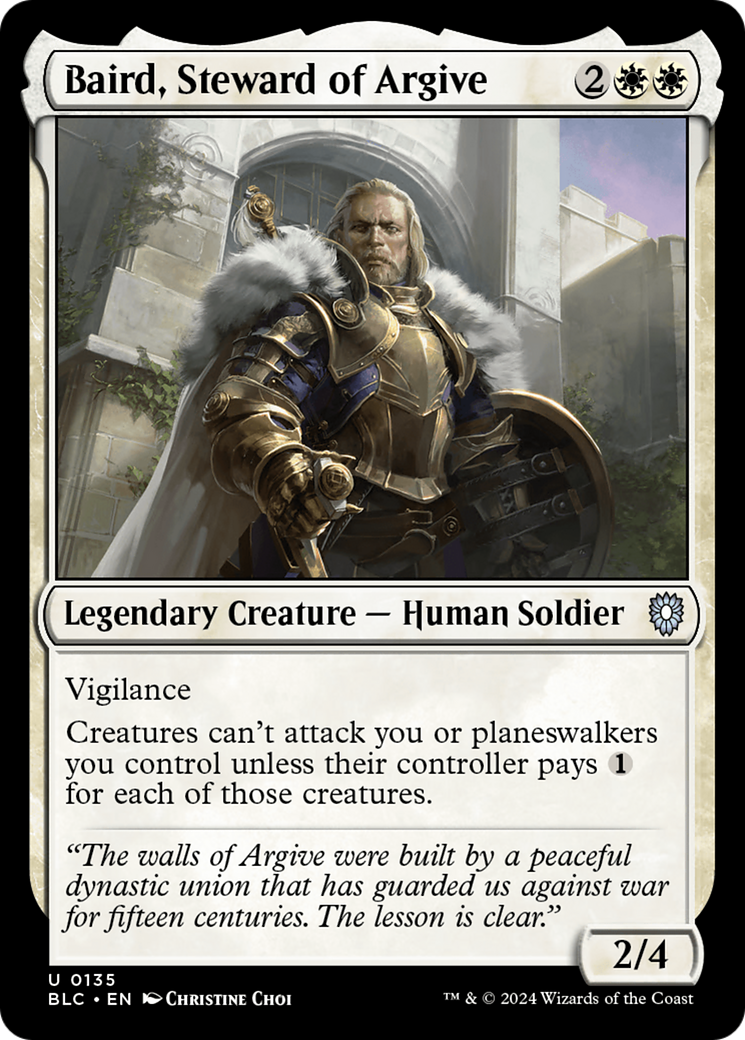
Baird, Steward of Argive
Baird, Steward of Argive
Legendary Creature — Human Soldier
2/4
Vigilance
Creatures can't attack you or planeswalkers you control unless their controller pays for each of those creatures.
- If you control Baird, your opponents can choose not to pay to attack with a creature that attacks "if able." If there's no other player, planeswalker, or battle to attack, that creature simply doesn't attack.
- In a Two-Headed Giant game, creatures can attack your teammate and planeswalkers your teammate controls without requiring a mana payment. This is a change from previous rules.
-
1
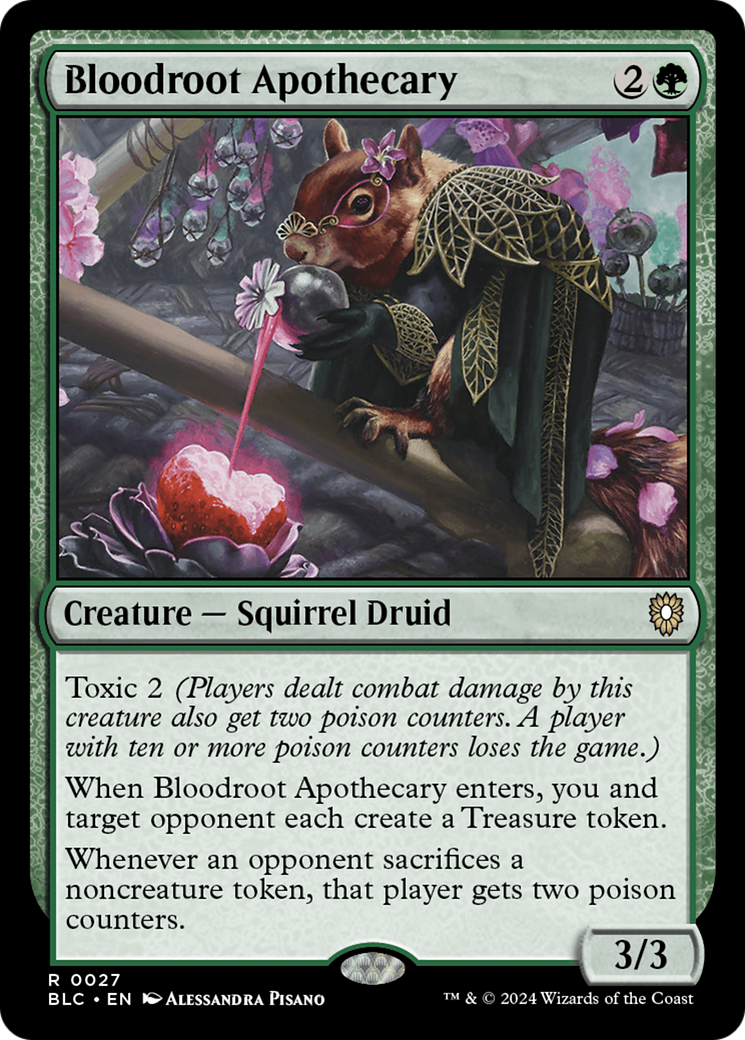
Bloodroot Apothecary
Bloodroot Apothecary
Creature — Squirrel Druid
3/3
Toxic 2 (Players dealt combat damage by this creature also get two poison counters. A player with ten or more poison counters loses the game.)
When this creature enters, you and target opponent each create a Treasure token.
Whenever an opponent sacrifices a noncreature token, that player gets two poison counters.
- A player with ten or more poison counters loses the game. This is a state-based action and doesn't use the stack. In other words, it happens immediately and players can't respond to it, just like a player losing the game due to having 0 or less life.
- Toxic doesn't change the amount of combat damage a creature deals. For example, if a 2/2 creature with toxic 1 deals combat damage to a player, that creature will deal 2 damage. The results of that damage are the player loses 2 life and gets a poison counter.
- Any other effects of that damage, such as life gain from lifelink, still apply.
- If a creature with toxic deals combat damage to a creature or planeswalker, or if it deals noncombat damage, toxic has no effect and no player gets poison counters.
- Damage dealt by a creature with toxic grants the same number of counters regardless of how much damage is dealt. Notably, if a replacement effect modifies the damage in some way (such as that of Gratuitous Violence), the number of counters given remains unchanged.
- Conversely, replacement effects that apply to the number of counters put on a player can modify the counters placed this way. For example, Vorinclex, Monstrous Raider's last two abilities can apply to counters placed this way.
- Multiple instances of toxic are cumulative. For example, if a creature has toxic 2 and gains toxic 1 due to another effect, combat damage that creature deals to a player will cause that player to get three poison counters.
- If the target player is an illegal target as Bloodroot Apothecary's second ability tries to resolve, it won't resolve and none of its effects will happen. No player will create a Treasure token.
-
1
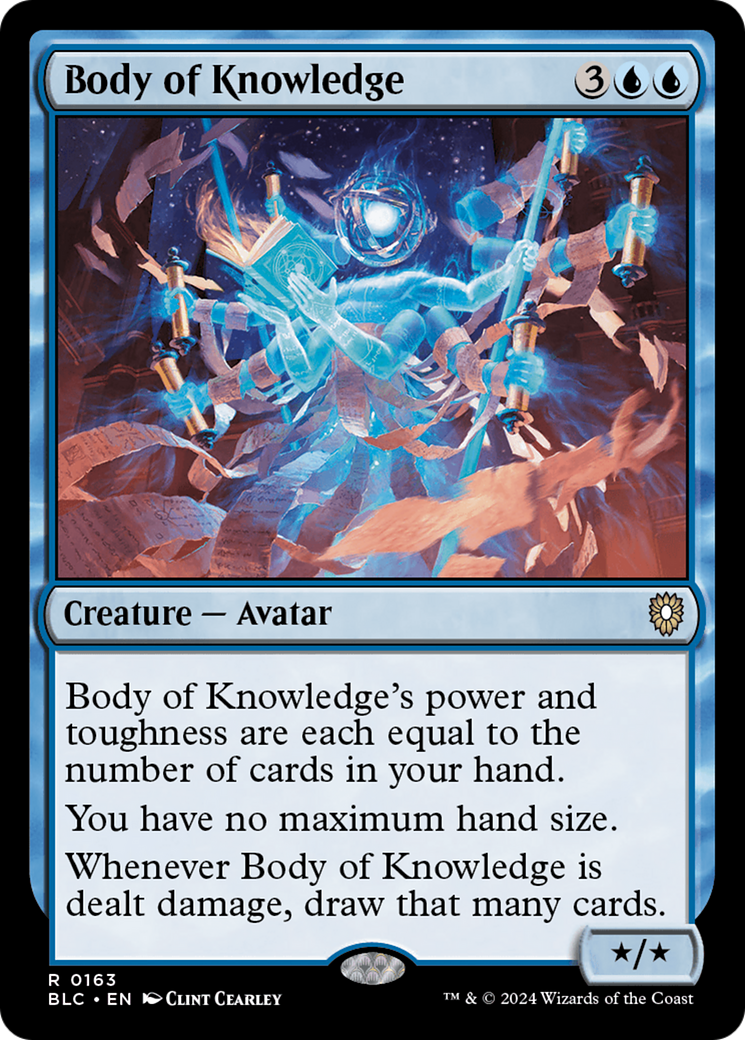
Body of Knowledge
Body of Knowledge
Creature — Avatar
*/*
Body of Knowledge's power and toughness are each equal to the number of cards in your hand.
You have no maximum hand size.
Whenever this creature is dealt damage, draw that many cards.
- The ability that defines Body of Knowledge's power and toughness applies in all zones, not just the battlefield.
- As long as Body of Knowledge is in your hand, its ability will count itself.
- Creatures may be dealt damage greater than their toughness. For example, if Body of Knowledge is a 3/3 creature and a source deals 5 damage to it, you'll draw five cards. Note that if Body of Knowledge is dealt lethal damage, it dies before the cards are drawn, meaning they won't raise Body of Knowledge's toughness in time to save it.
-
1
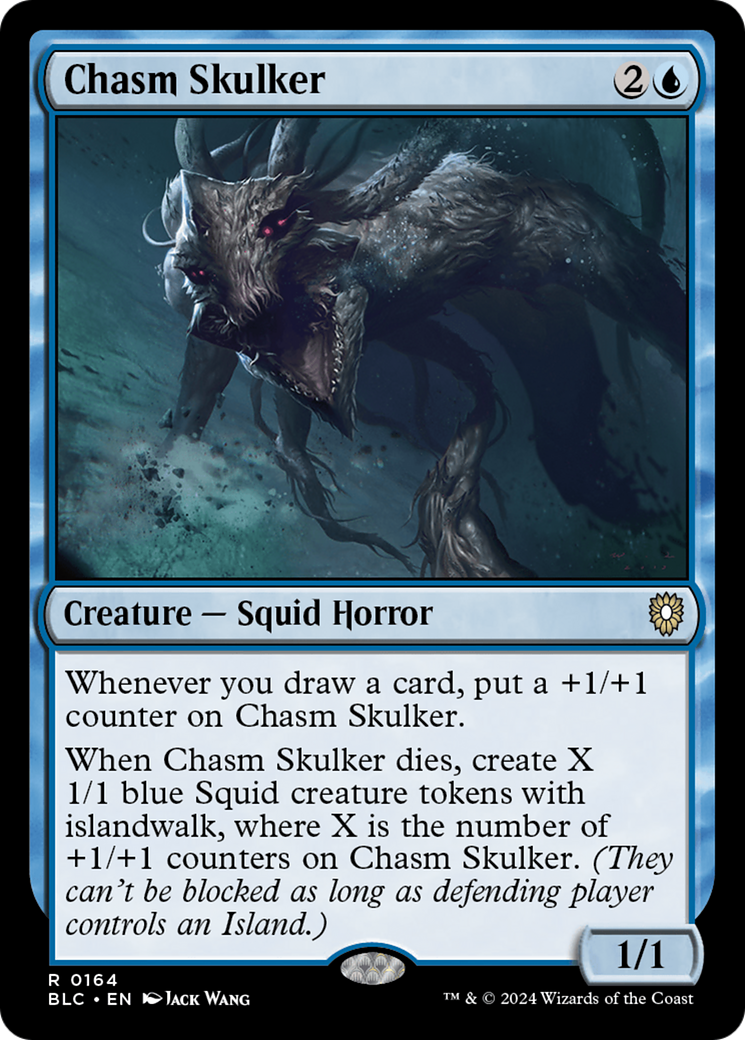
Chasm Skulker
Chasm Skulker
Creature — Squid Horror
1/1
Whenever you draw a card, put a +1/+1 counter on this creature.
When this creature dies, create X 1/1 blue Squid creature tokens with islandwalk, where X is the number of +1/+1 counters on this creature. (They can't be blocked as long as defending player controls an Island.)
- If you draw multiple cards, the first ability will trigger that many times. Each of these abilities will cause a +1/+1 counter to be put on Chasm Skulker.
- If enough -1/-1 counters are put on Chasm Skulker at the same time to make its toughness 0 or less, the number of +1/+1 counters on it before it got any -1/-1 counters will be used to determine how many Squid tokens you get. For example, if there are two +1/+1 counters on Chasm Skulker and it gets three -1/-1 counters, you'll get two Squid tokens.
-
1
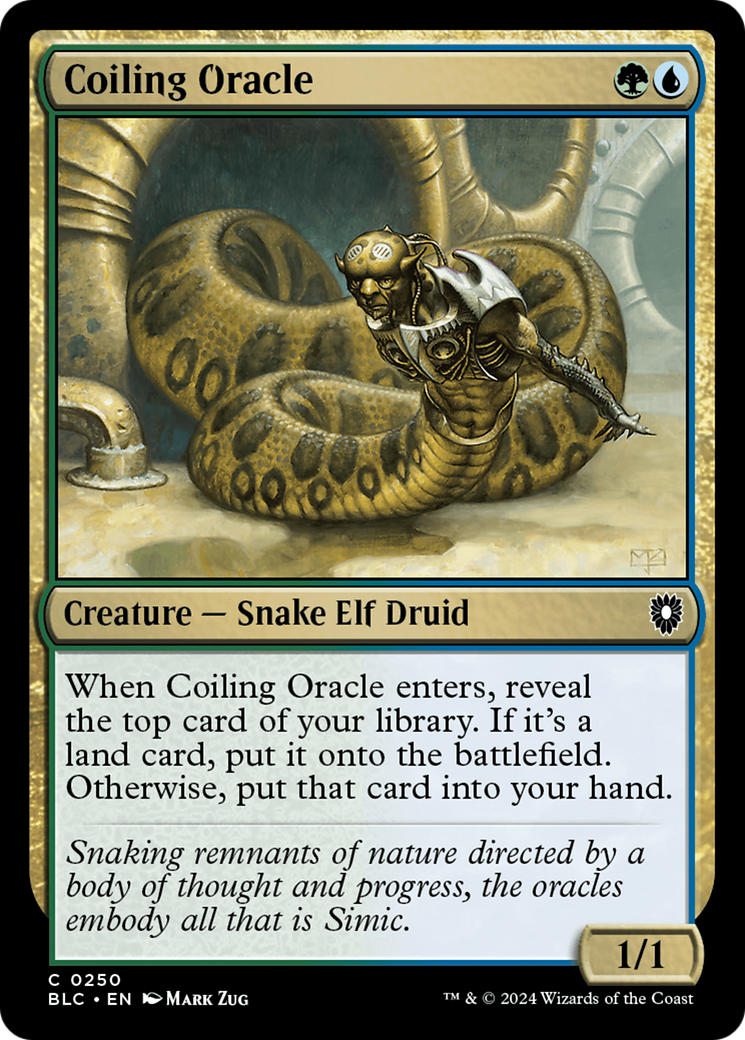
Coiling Oracle
Coiling Oracle
Creature — Snake Elf Druid
1/1
When this creature enters, reveal the top card of your library. If it's a land card, put it onto the battlefield. Otherwise, put that card into your hand.
-
1
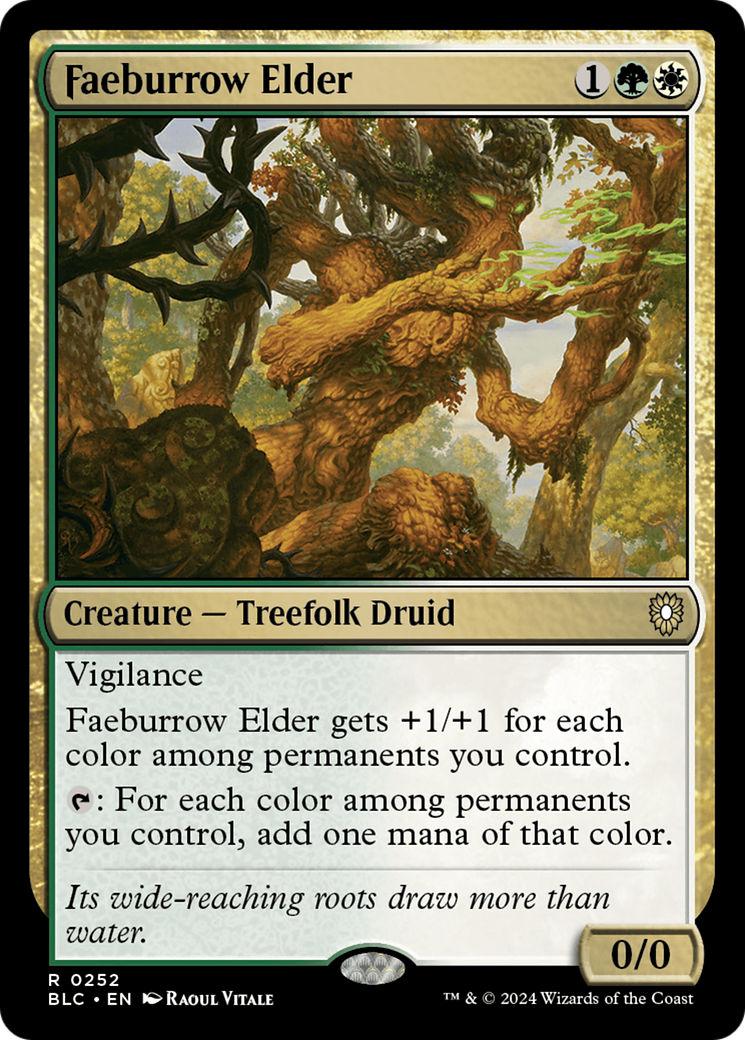
Faeburrow Elder
Faeburrow Elder
Creature — Treefolk Druid
0/0
Vigilance
This creature gets +1/+1 for each color among permanents you control.
: For each color among permanents you control, add one mana of that color.
- Faeburrow Elder's middle ability can give it at most +5/+5, that is, +1/+1 each for white, blue, black, red, and green. "Gold," "multicolor," and "colorless" aren't colors. Similarly, Faeburrow Elder's last ability can produce at most five mana.
- Since Faeburrow Elder is a green and white permanent, its middle ability usually gives it at least +2/+2 and its last ability usually produces at least .
-
1
Forgotten Ancient
Forgotten Ancient
Creature — Elemental
0/3
Whenever a player casts a spell, you may put a +1/+1 counter on this creature.
At the beginning of your upkeep, you may move any number of +1/+1 counters from this creature onto other creatures.
- Forgotten Ancient's first ability will resolve before the spell that caused it to trigger. Putting a +1/+1 counter on Forgotten Ancient is optional.
- Forgotten Ancient's last ability doesn't target any creatures. You choose how many +1/+1 counters will be moved (and onto which creatures) as the ability resolves. Notably, once the ability starts resolving and you make these choices, no player may take actions until the ability has finished resolving.
-
1
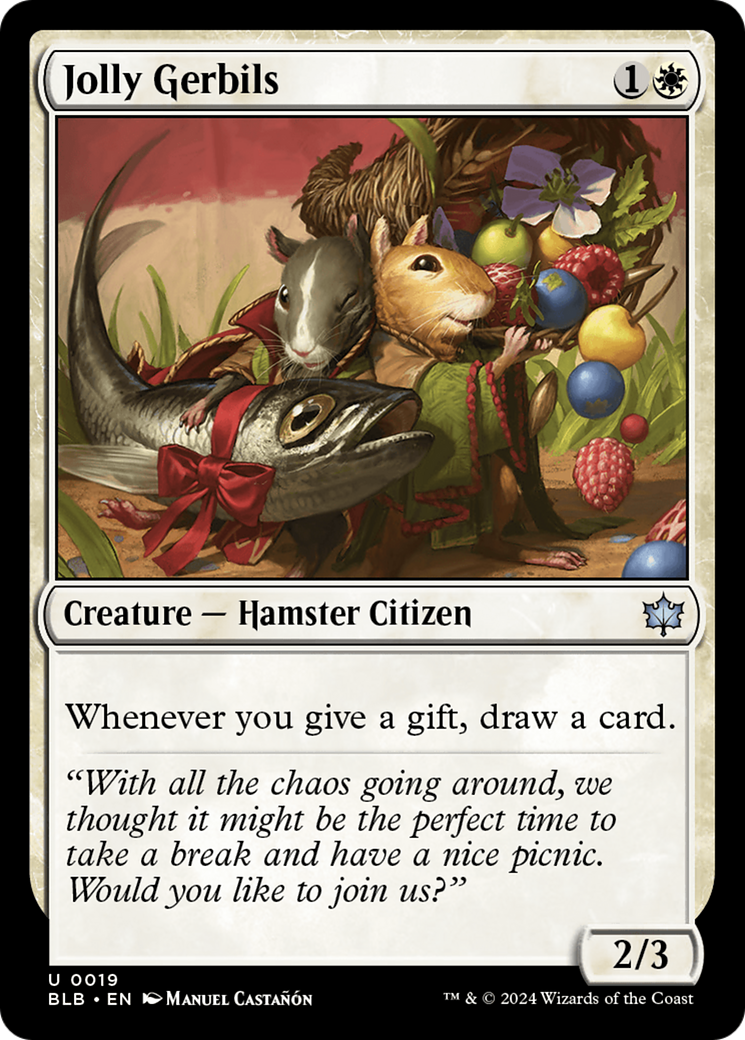
Jolly Gerbils
Jolly Gerbils
Creature — Hamster Citizen
2/3
Whenever you give a gift, draw a card.
- The ability of Jolly Gerbils triggers when the gift is actually given. For permanent spells, that happens when the gift triggered ability resolves. For instants and sorceries, that happens when the spell resolves. It doesn’t matter if a replacement effect causes the gift you gave to become something else or if a static effect stops the player from receiving that gift.
-
1
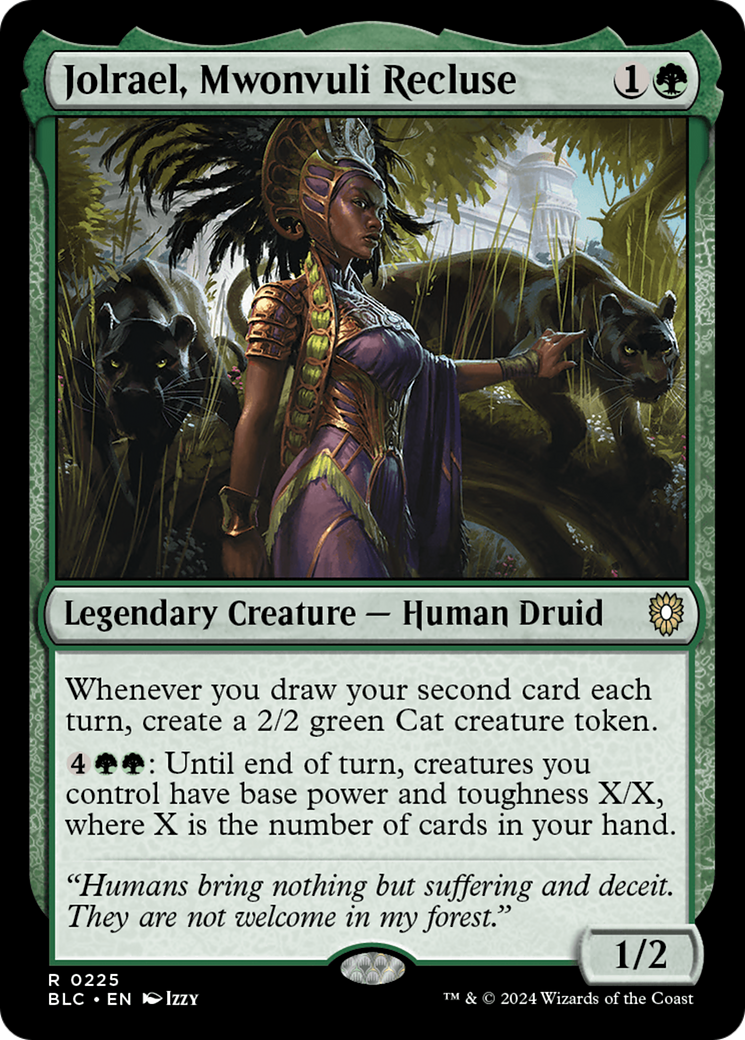
Jolrael, Mwonvuli Recluse
Jolrael, Mwonvuli Recluse
Legendary Creature — Human Druid
1/2
Whenever you draw your second card each turn, create a 2/2 green Cat creature token.
: Until end of turn, creatures you control have base power and toughness X/X, where X is the number of cards in your hand.
- The triggered ability can trigger only once each turn. It doesn't matter if Jolrael was on the battlefield when the first card was drawn: if it's not on the battlefield when the second card is drawn, the ability can't trigger at all that turn.
- Jolrael's last ability overwrites all previous effects that set the affected creatures' power and/or toughness to specific values. If other effects that set these characteristics to specific values start to apply after Jolrael's ability resolves, they will overwrite that part of the effect.
- Effects that modify an affected creature's power and/or toughness without setting them to specific values will apply no matter when those effects began. The same is true for counters that change the creature's power and/or toughness.
- The value of X is determined only as Jolrael's last ability resolves. Once that happens, the value of X won't change later in the turn even if the number of cards in your hand changes.
-
1
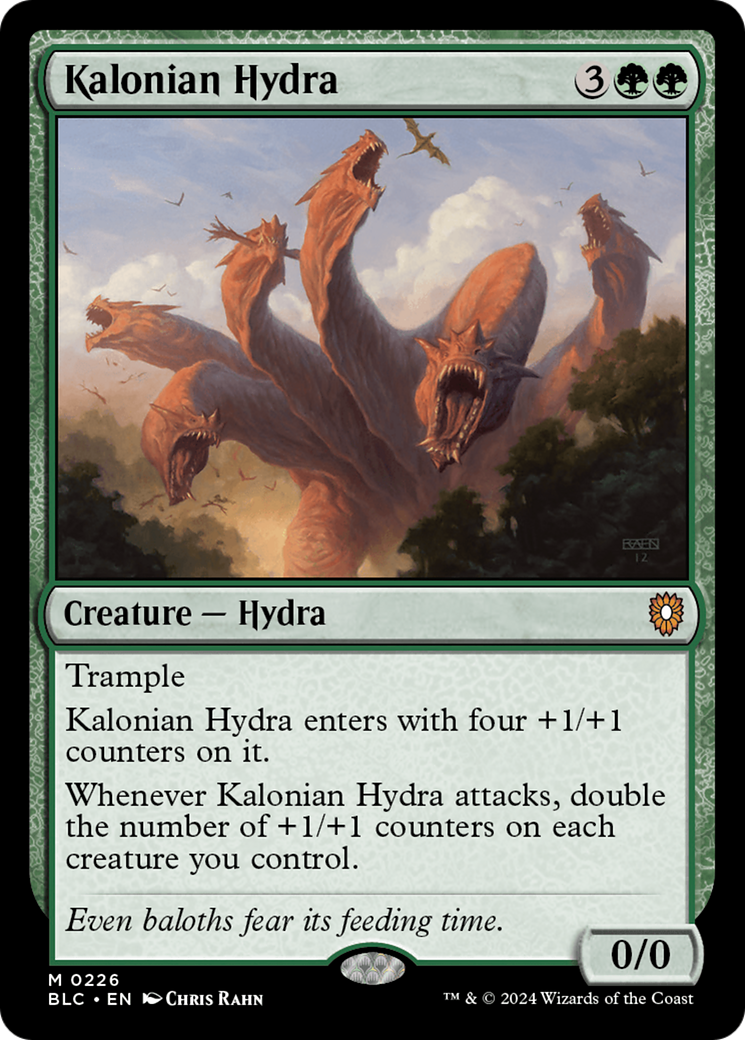
Kalonian Hydra
Kalonian Hydra
Creature — Hydra
0/0
Trample
This creature enters with four +1/+1 counters on it.
Whenever this creature attacks, double the number of +1/+1 counters on each creature you control.
- To double the number of +1/+1 counters on a creature, determine how many +1/+1 counters are on the creature and put that many more on it. Effects that interact with counters (such as the one created by Corpsejack Menace's ability) may change the number of counters ultimately put on the creature.
-
1
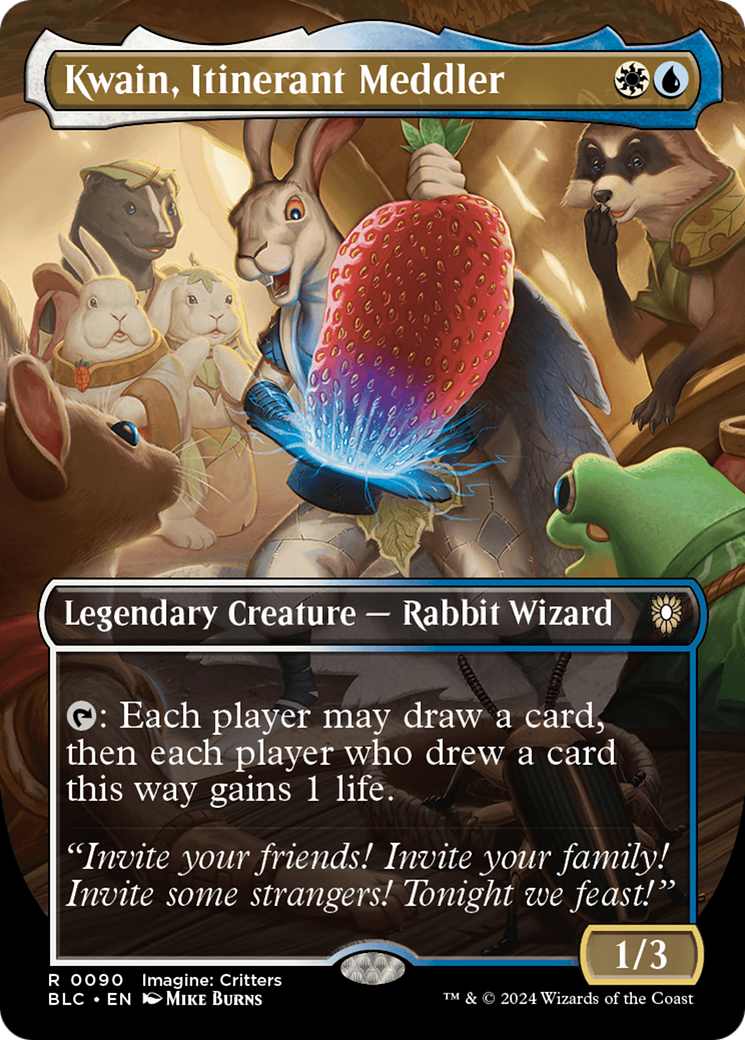
Kwain, Itinerant Meddler
Kwain, Itinerant Meddler
Legendary Creature — Rabbit Wizard
1/3
: Each player may draw a card, then each player who drew a card this way gains 1 life.
-
1
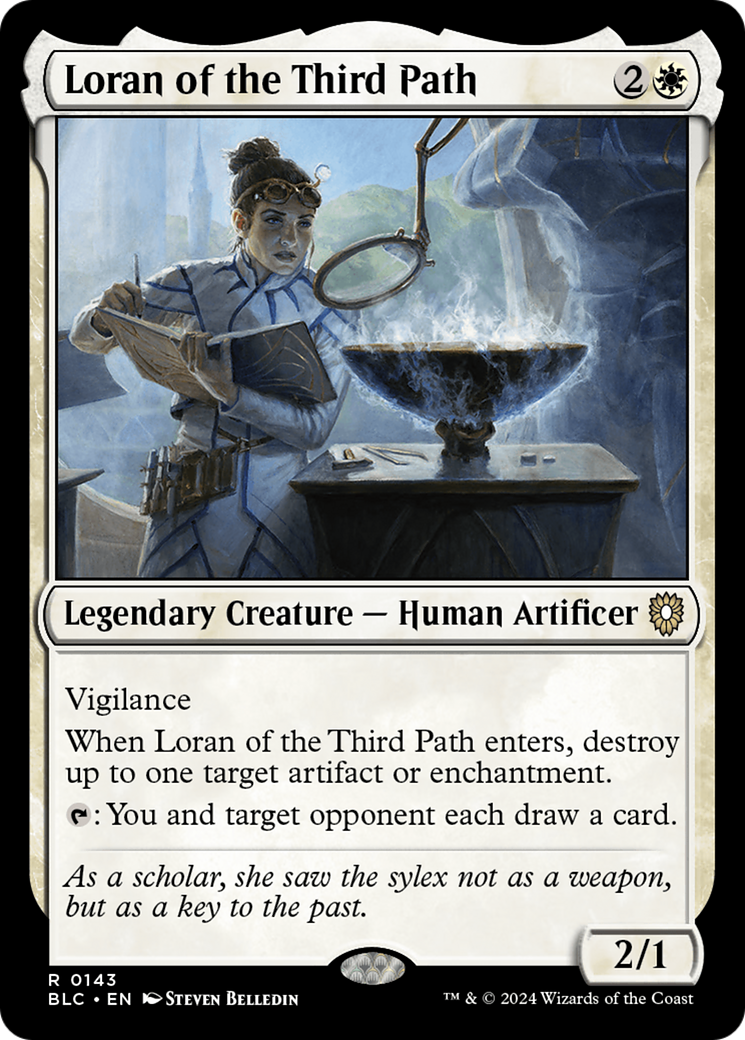
Loran of the Third Path
Loran of the Third Path
Legendary Creature — Human Artificer
2/1
Vigilance
When Loran enters, destroy up to one target artifact or enchantment.
: You and target opponent each draw a card.
-
1
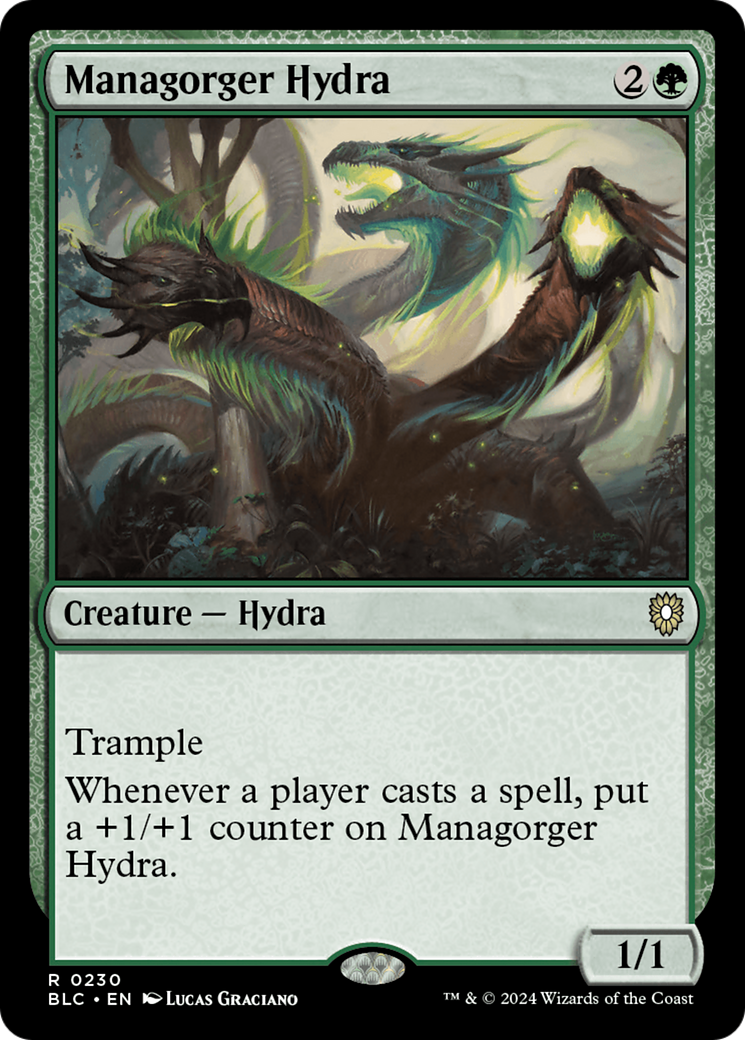
Managorger Hydra
Managorger Hydra
Creature — Hydra
1/1
Trample
Whenever a player casts a spell, put a +1/+1 counter on this creature.
- Managorger Hydra's last ability will resolve before the spell that caused it to trigger.
-
1
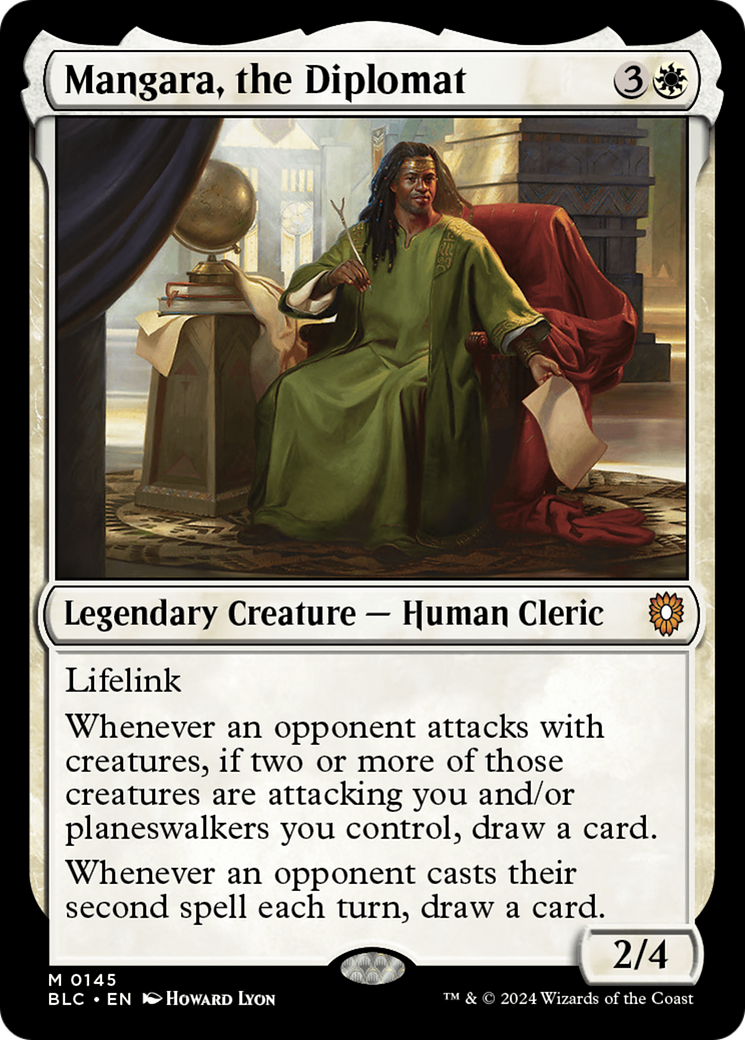
Mangara, the Diplomat
Mangara, the Diplomat
Legendary Creature — Human Cleric
2/4
Lifelink
Whenever an opponent attacks with creatures, if two or more of those creatures are attacking you and/or planeswalkers you control, draw a card.
Whenever an opponent casts their second spell each turn, draw a card.
- If some of the attacking creatures leave the battlefield while Mangara's triggered ability is on the stack, use the player or planeswalker they were attacking before they left to determine whether you draw a card. On the other hand, if they're removed from combat without leaving the battlefield, use their current information to determine that they're not attacking you or a planeswalker you control anymore.
- If your opponent attacks you with one creature and your planeswalker with another, you draw a card.
- You draw just one card, no matter how many creatures are attacking you and your planeswalkers beyond the second.
- An ability that triggers when a player casts a spell resolves before the spell that caused it to trigger. It resolves even if that spell is countered.
- Players can cast spells and activate abilities after the triggered ability resolves but before the spell that caused it to trigger does.
-
1
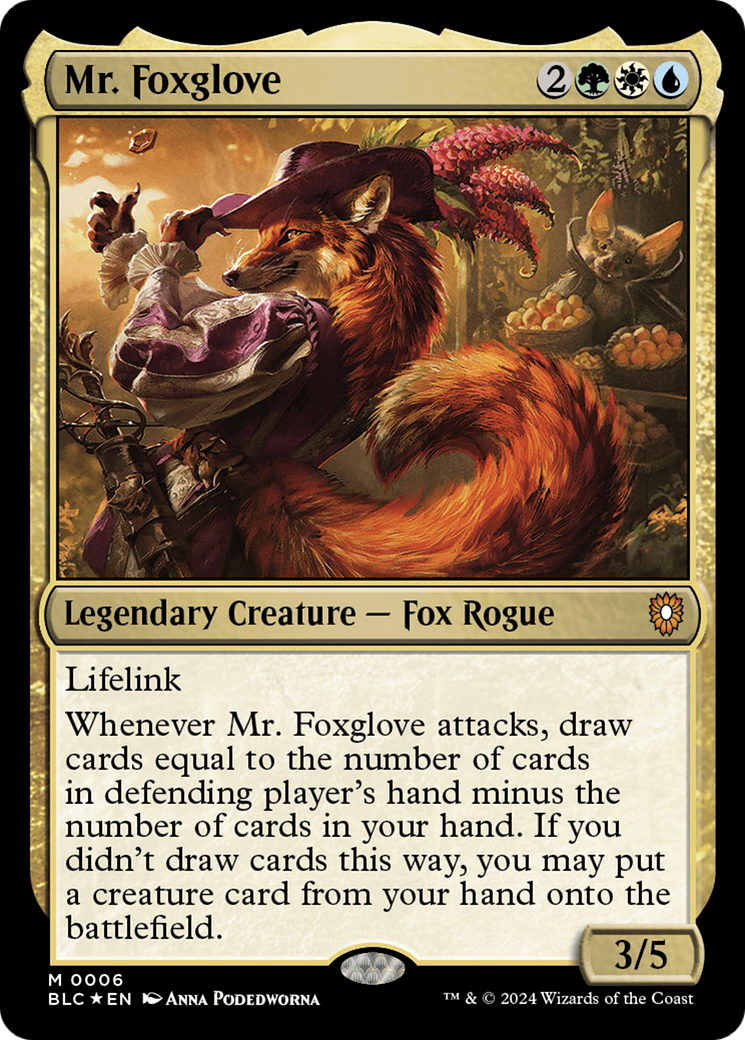
Mr. Foxglove
Mr. Foxglove
Legendary Creature — Fox Rogue
3/5
Lifelink
Whenever Mr. Foxglove attacks, draw cards equal to the number of cards in defending player's hand minus the number of cards in your hand. If you didn't draw cards this way, you may put a creature card from your hand onto the battlefield.
- If the number of cards in defending player's hand minus the number of cards in your hand is 0 or less, you won't draw any cards.
-
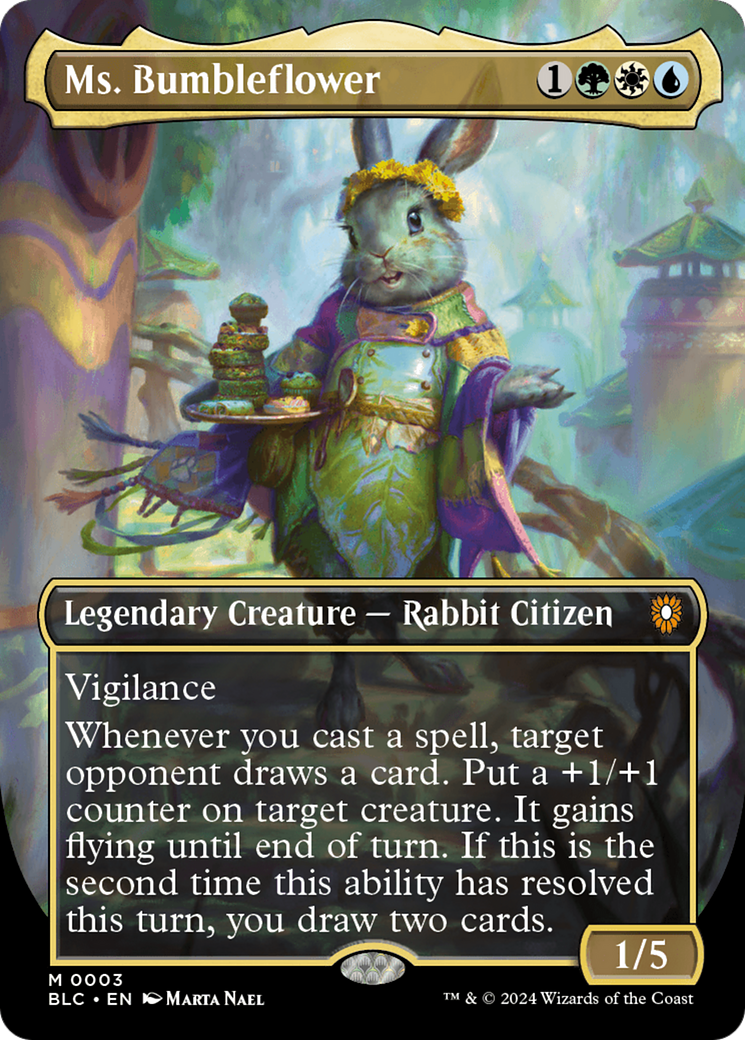
1
Ms. Bumbleflower
Ms. Bumbleflower
Legendary Creature — Rabbit Citizen
1/5
Vigilance
Whenever you cast a spell, target opponent draws a card. Put a +1/+1 counter on target creature. It gains flying until end of turn. If this is the second time this ability has resolved this turn, you draw two cards.
- Ms. Bumbleflower's last ability resolves before the spell that caused it to trigger. It resolves even if that spell is countered.
-
1
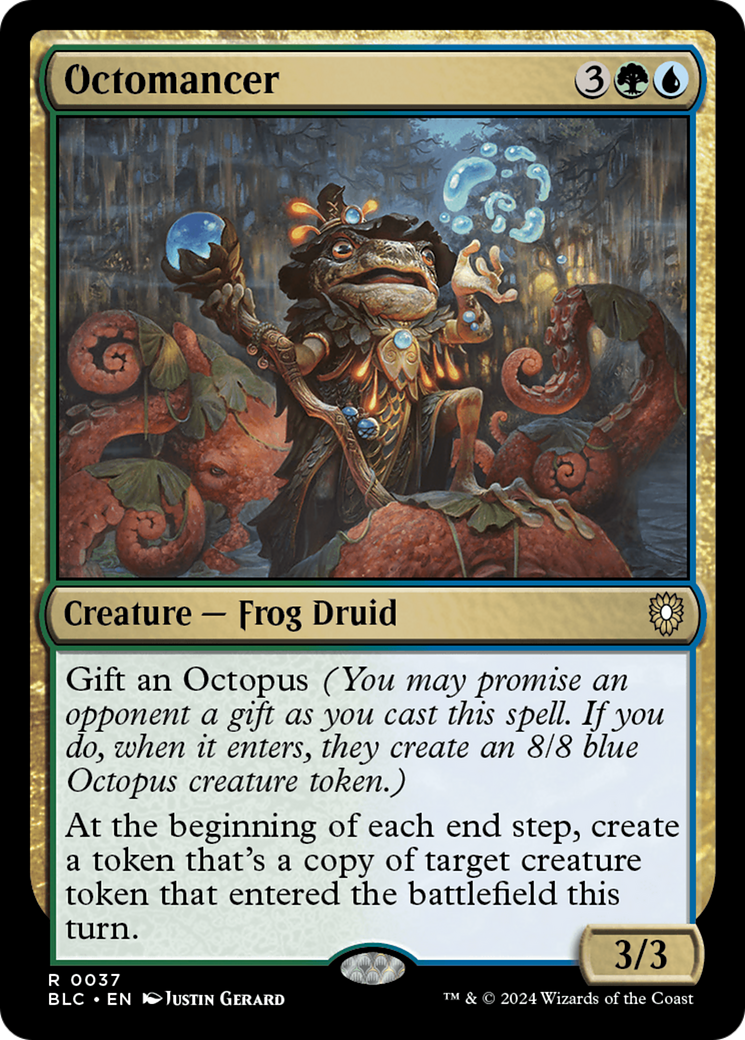
Octomancer
Octomancer
Creature — Frog Druid
3/3
Gift an Octopus (You may promise an opponent a gift as you cast this spell. If you do, when it enters, they create an 8/8 blue Octopus creature token.)
At the beginning of each end step, create a token that's a copy of target creature token that entered the battlefield this turn.
- The token you create copies the original characteristics of the token as stated by the effect that created that token (unless that token is copying something else; see below). It doesn't copy whether that token is tapped or untapped, whether it has any counters on it or Auras and Equipment attached to it, or any non-copy effects that have changed its power, toughness, types, color, or so on.
- If the copied token is copying something else (for example, if the copied token is one previously created by this ability), then the token enters as whatever that token copied.
- If the copied token has in its mana cost, X is 0.
- Any "enters" abilities of the copied token will trigger when the token enters. Any "as [this permanent] enters" or "[this permanent] enters with" abilities of the copied token will also work.
- As an additional cost to cast a spell with gift, you can promise the listed gift to an opponent. That opponent is chosen as part of that additional cost. The gift isn't given at this time; rather, it's given at a later time based on whether or not the spell is a permanent spell.
- For permanent spells with gift, an ability triggers when that permanent enters if the gift was promised. When that ability resolves, the gift is given to the appropriate opponent.
- For instants and sorceries with gift, the gift is given to the appropriate opponent as part of the resolution of the spell. This happens before any of the spell's other effects would take place.
- If a spell for which the gift was promised is countered, doesn't resolve (perhaps because all of its targets are illegal), or is otherwise removed from the stack, the gift won't be given. None of its other effects will happen either.
- You can't pay a gift cost more than once.
- If you copy a spell for which the gift was promised, the gift was also promised to the same opponent for the copy. If a card or token enters as a copy of a permanent that's already on the battlefield, the gift isn't promised for that new permanent, even if it was promised for the original.
- Some instant or sorcery spells require alternative or additional targets if the gift was promised. You ignore these targeting requirements if the gifts aren't promised for those spells. On the other hand, you can promise a gift for a permanent spell even if you won't be able to choose targets for an enters ability of that permanent once the spell resolves.
- In the main set, there are four different kinds of gifts. "Gift a Food" causes the chosen opponent to create a Food token, while "Gift a Treasure" causes the chosen opponent to create a Treasure token. "Gift a card" causes them to draw a card, and "Gift a tapped Fish" causes them to create a tapped 1/1 blue Fish creature token. The Commander decks contain two more kinds of gifts: "Gift an Octopus," which causes the chosen opponent to create an 8/8 blue Octopus creature token, and "Gift an extra turn," which causes them to take an extra turn after the current turn ends.
-
1
Psychosis Crawler
Psychosis Crawler
Artifact Creature — Phyrexian Horror
*/*
Psychosis Crawler's power and toughness are each equal to the number of cards in your hand.
Whenever you draw a card, each opponent loses 1 life.
- If an effect causes you to draw multiple cards, Psychosis Crawler will trigger that many times.
-
1
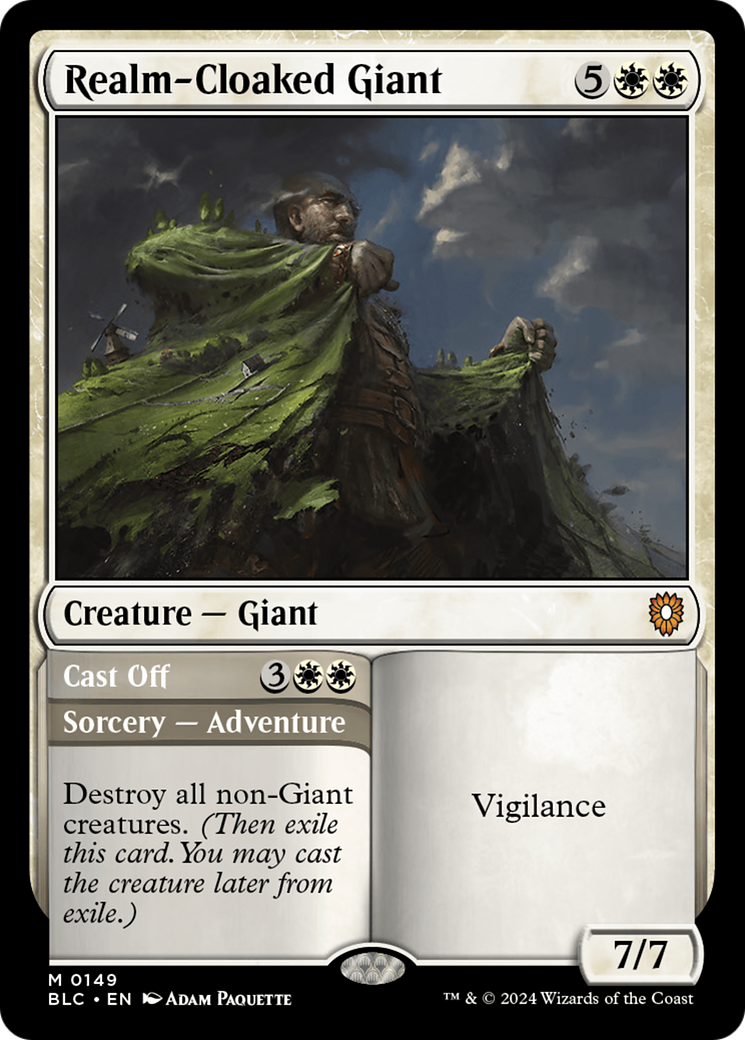
Realm-Cloaked Giant // Cast Off
//
Realm-Cloaked Giant
Creature — Giant
7/7
- An adventurer card is a permanent card in every zone except the stack, as well as while on the stack if not cast as an Adventure. Ignore its alternative characteristics in those cases. For example, while it's in your graveyard, Giant Killer is a white creature card whose mana value is 1. It can't be the target of the triggered ability of Mystic Sanctuary.
- When casting a spell as an Adventure, use the alternative characteristics and ignore all of the card's normal characteristics. The spell's color, mana cost, mana value, and so on are determined by only those alternative characteristics. If the spell leaves the stack, it immediately resumes using its normal characteristics.
- If you cast an adventurer card as an Adventure, use only its alternative characteristics to determine whether it's legal to cast that spell. For example, if Giant Killer is exiled with the last ability of Vivien, Champion of the Wilds, you can't cast it as Chop Down.
- If a spell is cast as an Adventure, its controller exiles it instead of putting it into its owner's graveyard as it resolves. For as long as it remains exiled, that player may cast it as a permanent spell. If an Adventure spell leaves the stack in any way other than resolving (most likely by being countered or by failing to resolve because its targets have all become illegal), that card won't be exiled and the spell's controller won't be able to cast it as a permanent later.
- If an adventurer card ends up in exile for any other reason than by exiling itself while resolving, it won't give you permission to cast it as a permanent spell.
- You must still follow any timing restrictions and permissions for the permanent spell you cast from exile. Normally, you'll be able to cast it only during your main phase while the stack is empty.
- If an effect copies an Adventure spell, that copy is exiled as it resolves. It ceases to exist as a state-based action; it's not possible to cast the copy as a permanent.
- If an object becomes a copy of an object that has an Adventure, the copy also has an Adventure. If it changes zones, it will either cease to exist (if it's a token) or cease to be a copy (if it's a nontoken permanent), and so you won't be able to cast it as an Adventure.
- If an effect instructs you to choose a card name, you may choose the alternative Adventure name. Consider only the alternative characteristics to determine whether that is an appropriate name to choose.
- Casting a card as an Adventure isn't casting it for an alternative cost. Effects that allow you to cast a spell for an alternative cost or without paying its mana cost may allow you to apply those to the Adventure.
-
1
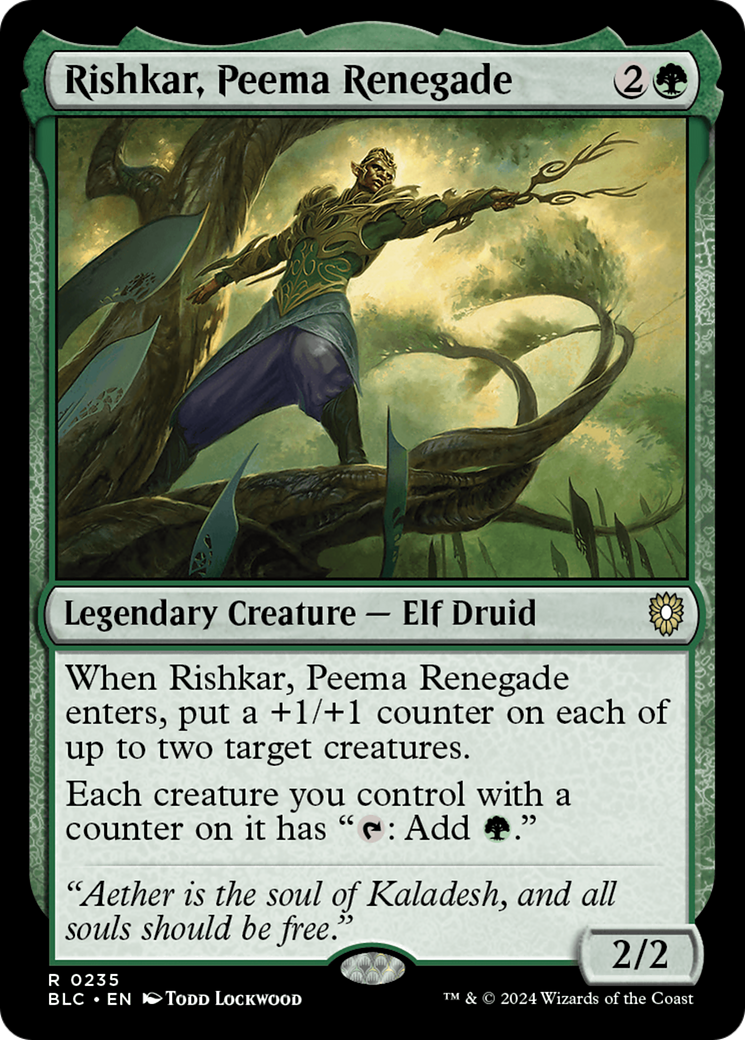
Rishkar, Peema Renegade
Rishkar, Peema Renegade
Legendary Creature — Elf Druid
2/2
When Rishkar enters, put a +1/+1 counter on each of up to two target creatures.
Each creature you control with a counter on it has " : Add ."
- Rishkar can be a target of its own triggered ability.
- You can't target the same creature twice to have one recipient get two +1/+1 counters.
- Each creature you control has Rishkar's mana ability as long as that creature has any kind of counter on it. The effect isn't limited to those with +1/+1 counters.
-
1
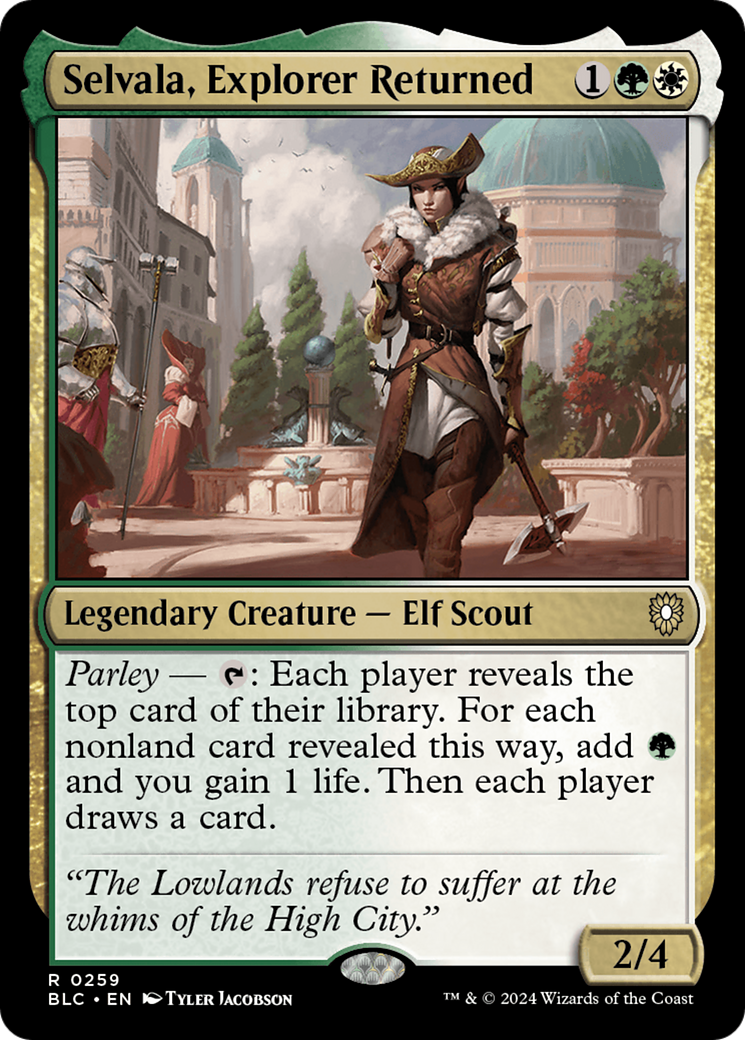
Selvala, Explorer Returned
Selvala, Explorer Returned
Legendary Creature — Elf Scout
2/4
Parley — : Each player reveals the top card of their library. For each nonland card revealed this way, add and you gain 1 life. Then each player draws a card.
- Selvala's parley ability is a mana ability. It doesn't use the stack and can't be responded to.
- If you activate Selvala's ability while casting a spell, and you discover you can't produce enough mana to pay that spell's costs, the spell is reversed. The spell returns to whatever zone you were casting it from. You may reverse other mana abilities you activated while casting the spell, but Selvala's ability can't be reversed. You'll still have whatever mana that ability produced, and each player will have drawn a card.
- Except in some very rare cases, the card each player draws will be the card revealed from the top of their library.
-
1
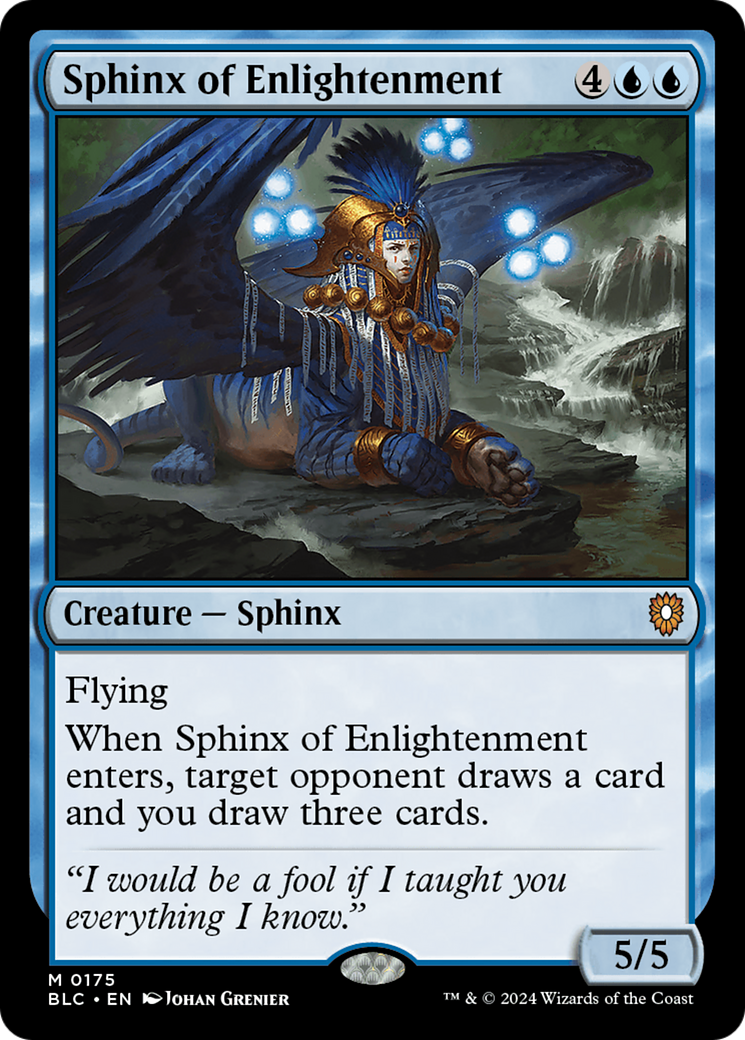
Sphinx of Enlightenment
Sphinx of Enlightenment
Creature — Sphinx
5/5
Flying
When this creature enters, target opponent draws a card and you draw three cards.
-
1
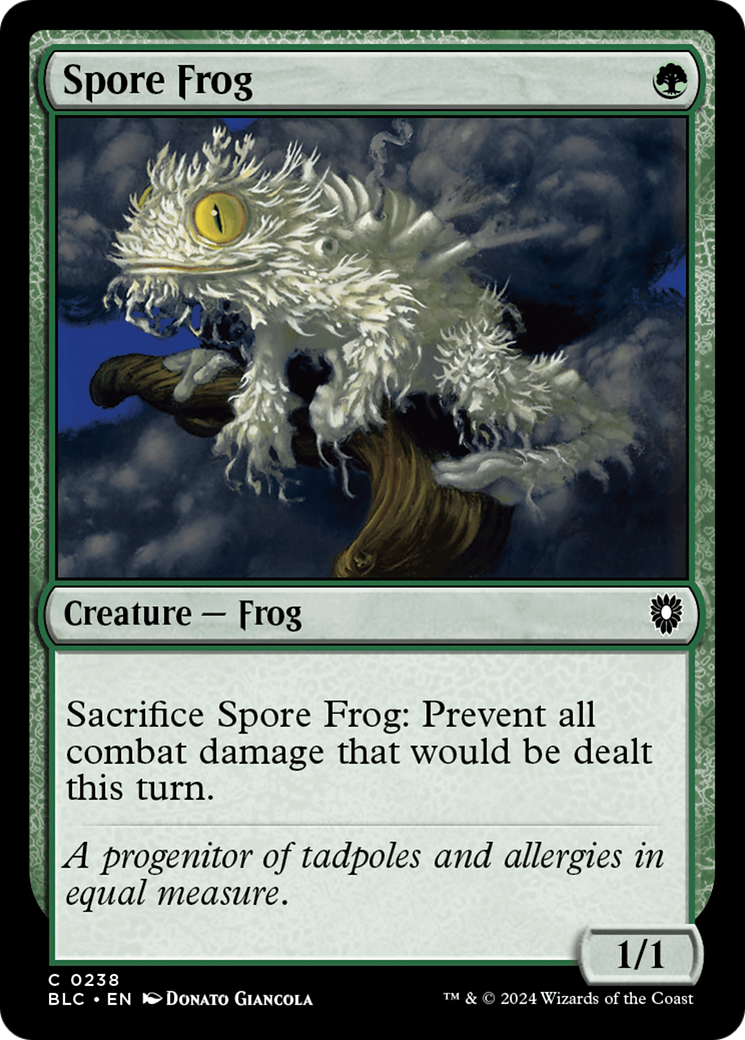
Spore Frog
Spore Frog
Creature — Frog
1/1
Sacrifice this creature: Prevent all combat damage that would be dealt this turn.
-
1
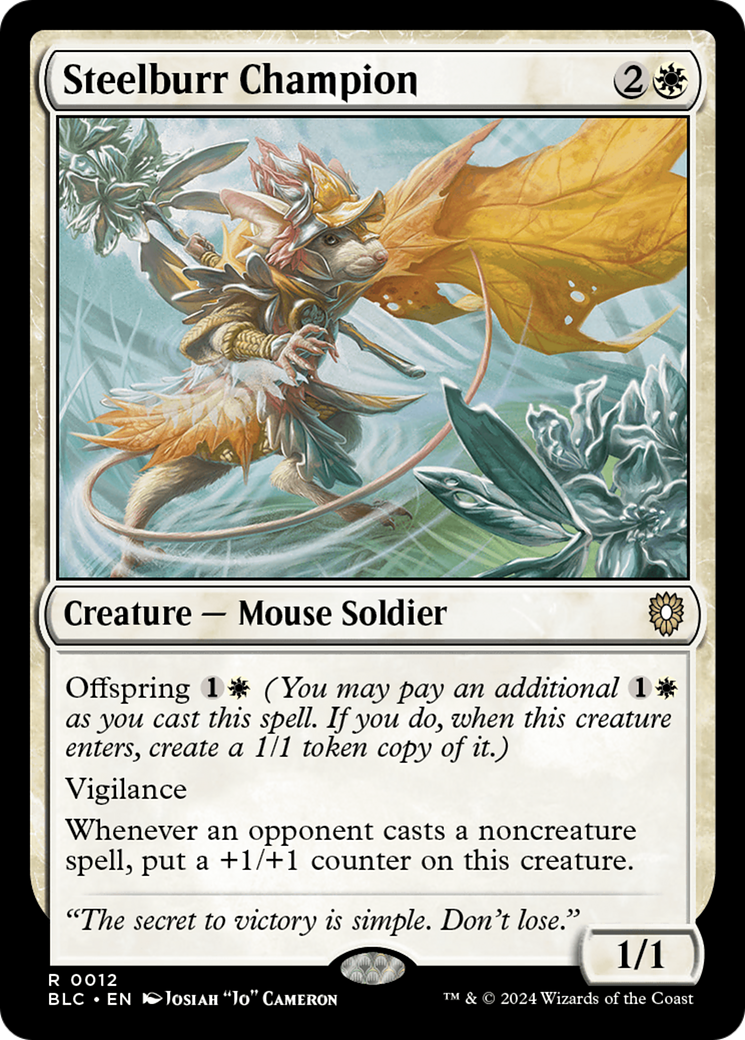
Steelburr Champion
Steelburr Champion
Creature — Mouse Soldier
1/1
Offspring (You may pay an additional as you cast this spell. If you do, when this creature enters, create a 1/1 token copy of it.)
Vigilance
Whenever an opponent casts a noncreature spell, put a +1/+1 counter on this creature.
- Steelburr Champion's last ability resolves before the spell that caused it to trigger. It resolves even if that spell is countered.
- You can pay an offspring cost only once as you cast a spell with offspring. You can't try to pay it multiple times to get more token copies.
- If the spell is countered, the offspring ability will not trigger, and no token will be created.
- If the spell resolves but the creature with offspring leaves the battlefield before the offspring ability resolves, you'll still create a token copy of it.
- The token copies exactly what was printed on the original creature and nothing else, except it's a 1/1 (unless that creature is copying something else; see below). It doesn't copy whether that creature is tapped or untapped, whether it has any counters on it or Auras and Equipment attached to it, or any non-copy effects that have changed its types, color, or so on.
- In the rare case where the original creature is copying something else when the offspring ability resolves, the token enters as whatever that creature copied, except it's a 1/1.
- Many creatures with offspring abilities have other abilities that refer to them as "this creature" rather than referring to them by name. This difference is for clarity purposes and does not change the function of any of these abilities.
- Any "enters" abilities of the copied creature will trigger when the token enters. Any "as [this creature] enters" or "[this creature] enters with" abilities of the copied creature will also work.
- The token created by the offspring ability isn't "cast", so abilities that trigger when a creature spell is cast won't trigger for the copy.
- In the rare case where the creature doesn't have the offspring ability when it enters, the ability won't trigger even if you paid the offspring cost.
-
1
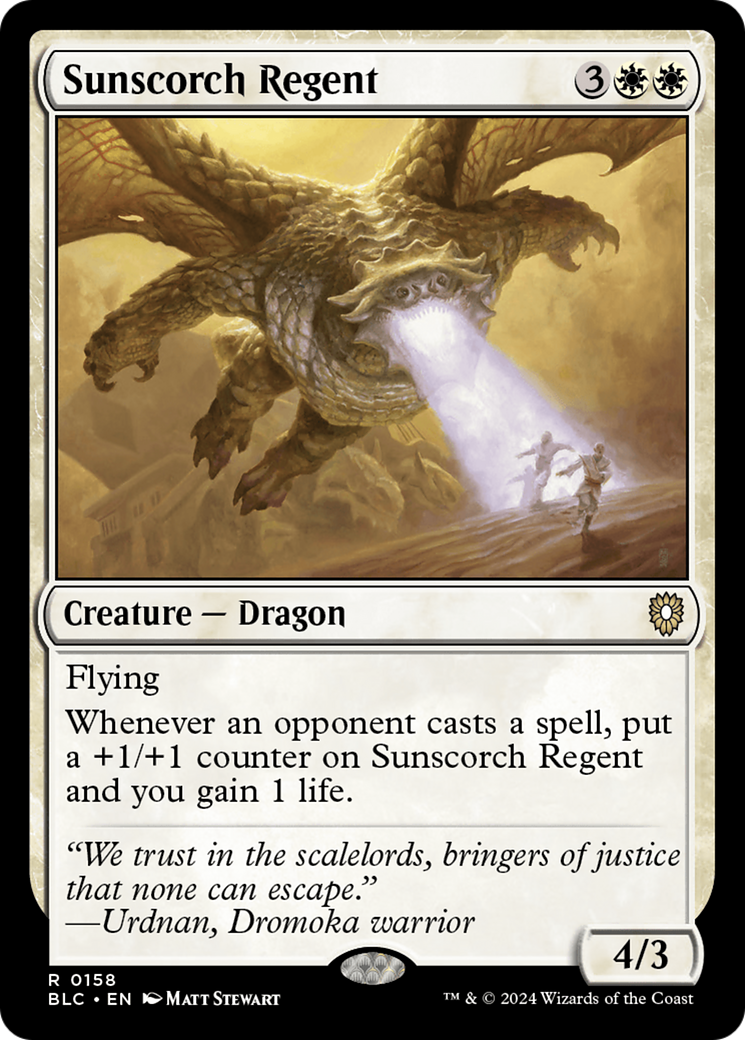
Sunscorch Regent
Sunscorch Regent
Creature — Dragon
4/3
Flying
Whenever an opponent casts a spell, put a +1/+1 counter on this creature and you gain 1 life.
-
1
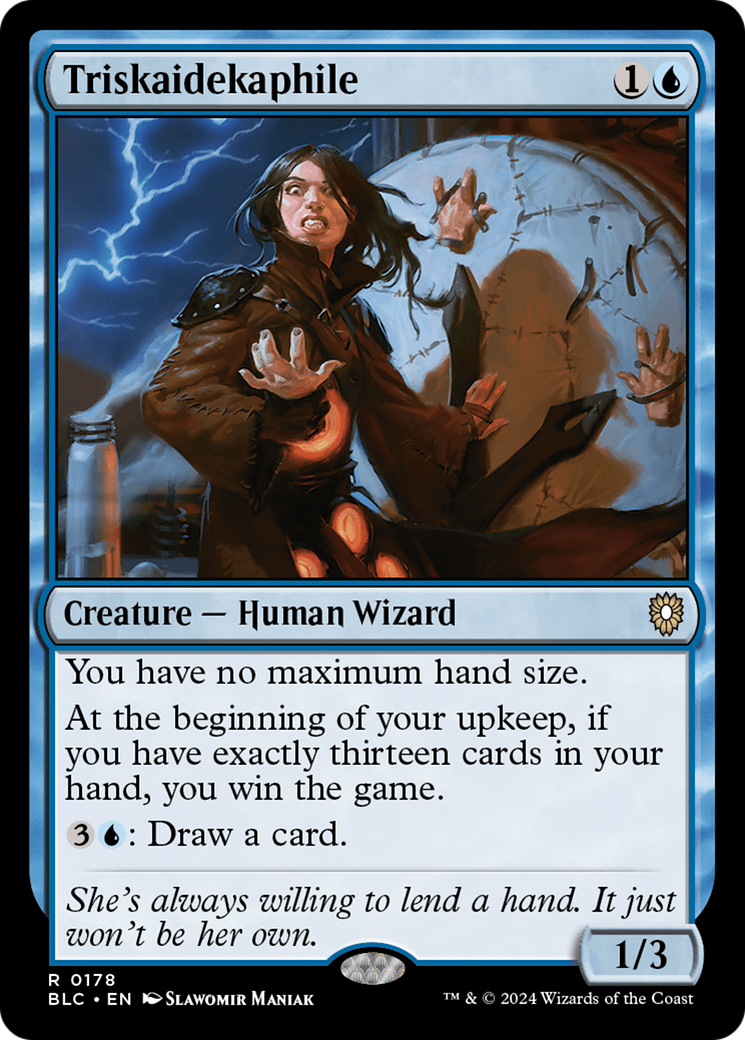
Triskaidekaphile
Triskaidekaphile
Creature — Human Wizard
1/3
You have no maximum hand size.
At the beginning of your upkeep, if you have exactly thirteen cards in your hand, you win the game.
: Draw a card.
- Triskaidekaphile's triggered ability will trigger only if you have exactly thirteen cards in your hand as your upkeep starts. If you have fewer cards in your hand, you won't be able to draw cards during your upkeep in time to cause the ability to trigger.
-
1
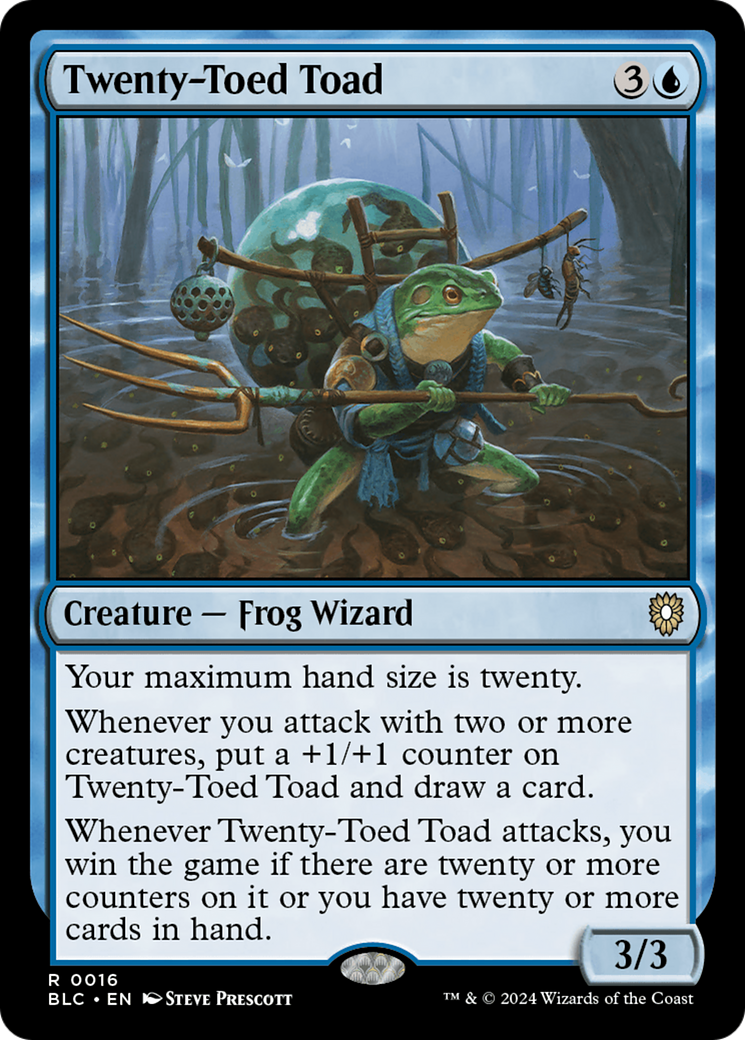
Twenty-Toed Toad
Twenty-Toed Toad
Creature — Frog Wizard
3/3
Your maximum hand size is twenty.
Whenever you attack with two or more creatures, put a +1/+1 counter on Twenty-Toed Toad and draw a card.
Whenever Twenty-Toed Toad attacks, you win the game if there are twenty or more counters on it or you have twenty or more cards in hand.
- If multiple effects modify your hand size, apply them in timestamp order. For example, if you put Twenty-Toed Toad onto the battlefield and then put Spellbook (an artifact that says you have no maximum hand size) onto the battlefield, you would have no maximum hand size. However, if those permanents entered in the opposite order, your maximum hand size would he twenty.
- Your maximum hand size is only checked during the cleanup step of your turn. At other times, you may have more cards in hand than your maximum hand size.
- Twenty-Toed Toad's last ability will trigger whenever it attacks, no matter how many counters are on it or cards you have in your hand at that time. The number of counters on it and the number of cards in your hand are only checked when that ability resolves.
Instants 11
-
1
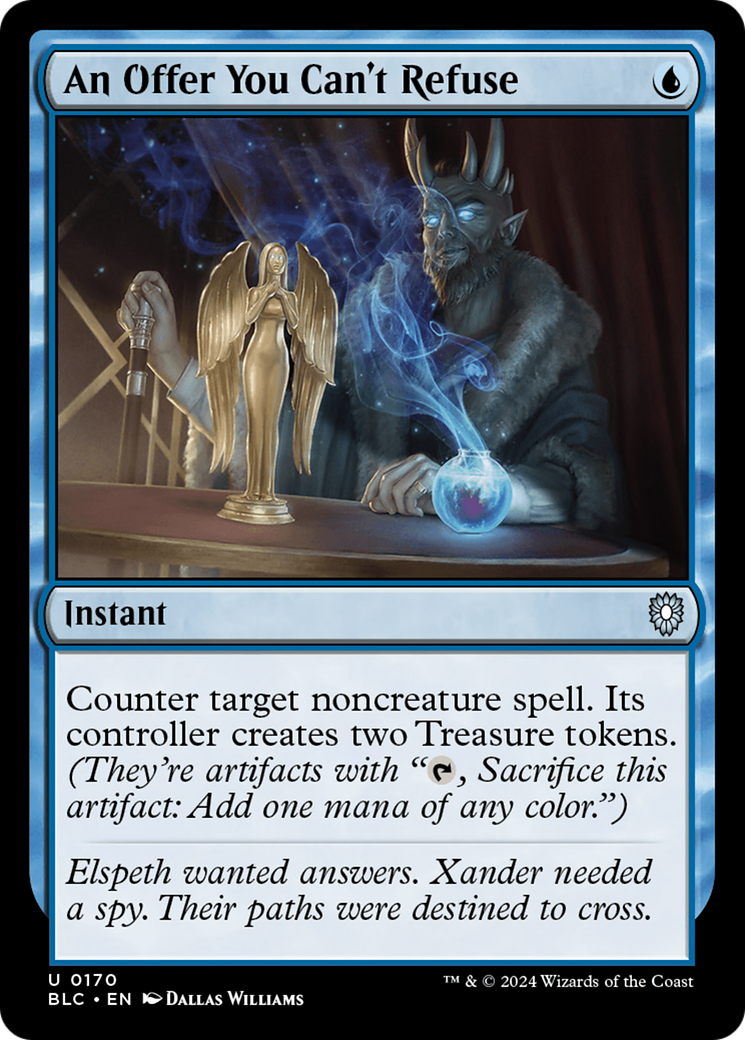
An Offer You Can't Refuse
An Offer You Can't Refuse
Instant
Counter target noncreature spell. Its controller creates two Treasure tokens. (They're artifacts with " , Sacrifice this token: Add one mana of any color.")
- If the target is still legal as it resolves but the spell can't be countered for some reason, its controller will still create two Treasure tokens.
- If the target is no longer legal as An Offer You Can't Refuse resolves, no Treasure tokens are created.
-
1
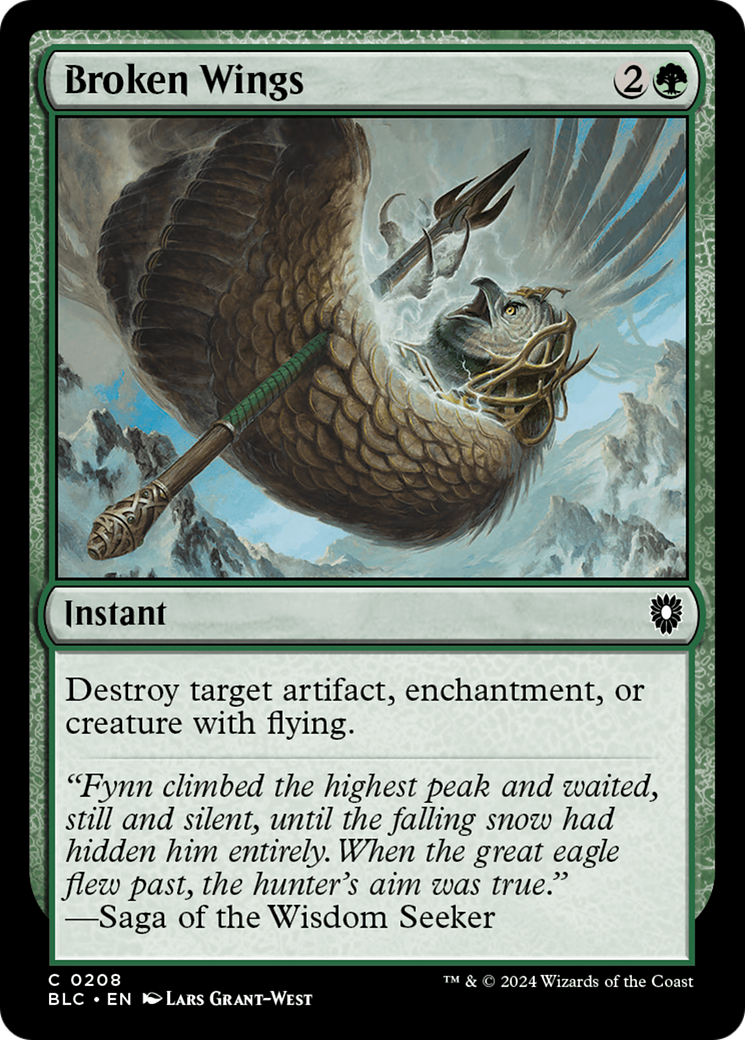
Broken Wings
Broken Wings
Instant
Destroy target artifact, enchantment, or creature with flying.
-
1
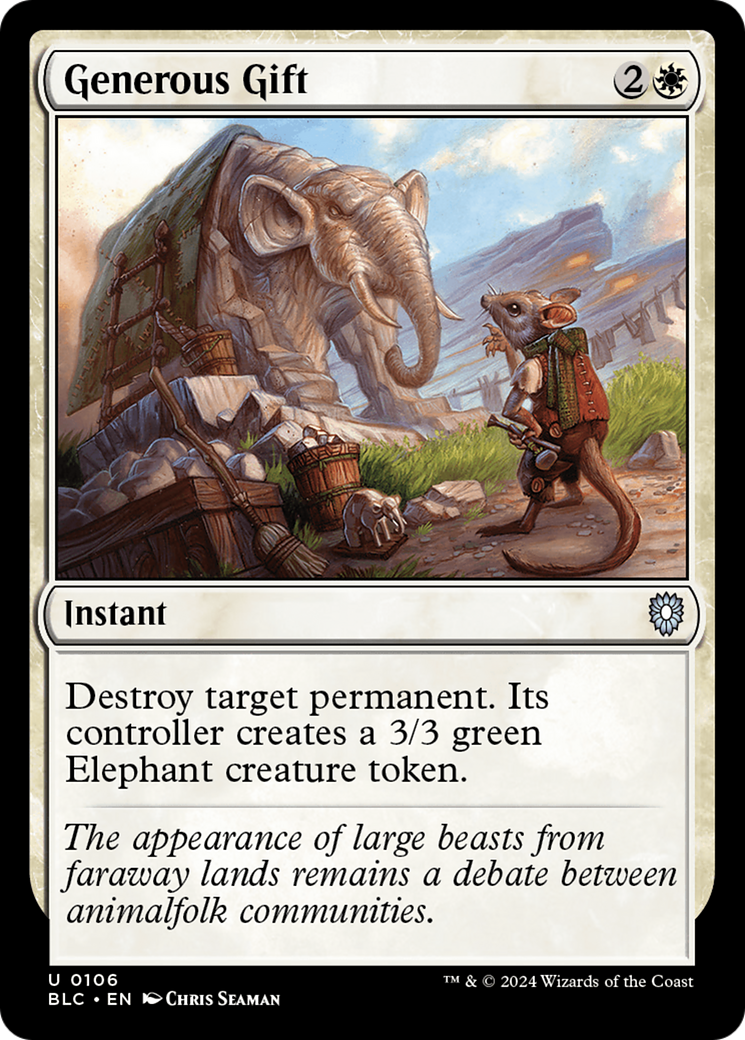
Generous Gift
Generous Gift
Instant
Destroy target permanent. Its controller creates a 3/3 green Elephant creature token.
- If the target permanent is an illegal target by the time Generous Gift tries to resolve, the spell doesn't resolve. No player creates an Elephant. If the target is legal but not destroyed (most likely because it has indestructible), its controller does create an Elephant.
-
1
Illusionist's Gambit
Illusionist's Gambit
Instant
Cast this spell only during the declare blockers step on an opponent's turn.
Remove all attacking creatures from combat and untap them. After this phase, there is an additional combat phase. Each of those creatures attacks that combat if able. They can't attack you or planeswalkers you control that combat.
- Creatures that didn't attack during the combat phase when Illusionist's Gambit resolved aren't required to attack in the additional combat phase, although they may. Those creatures can attack you or a planeswalker you control.
- If, during a player's declare attackers step, a creature is tapped, is affected by a spell or ability that says it can't attack, or hasn't been under that player's control continuously since the turn began (and doesn't have haste), then it doesn't attack.
- If there's a cost associated with having a creature attack, the player isn't forced to pay that cost, so it doesn't have to attack.
-
1
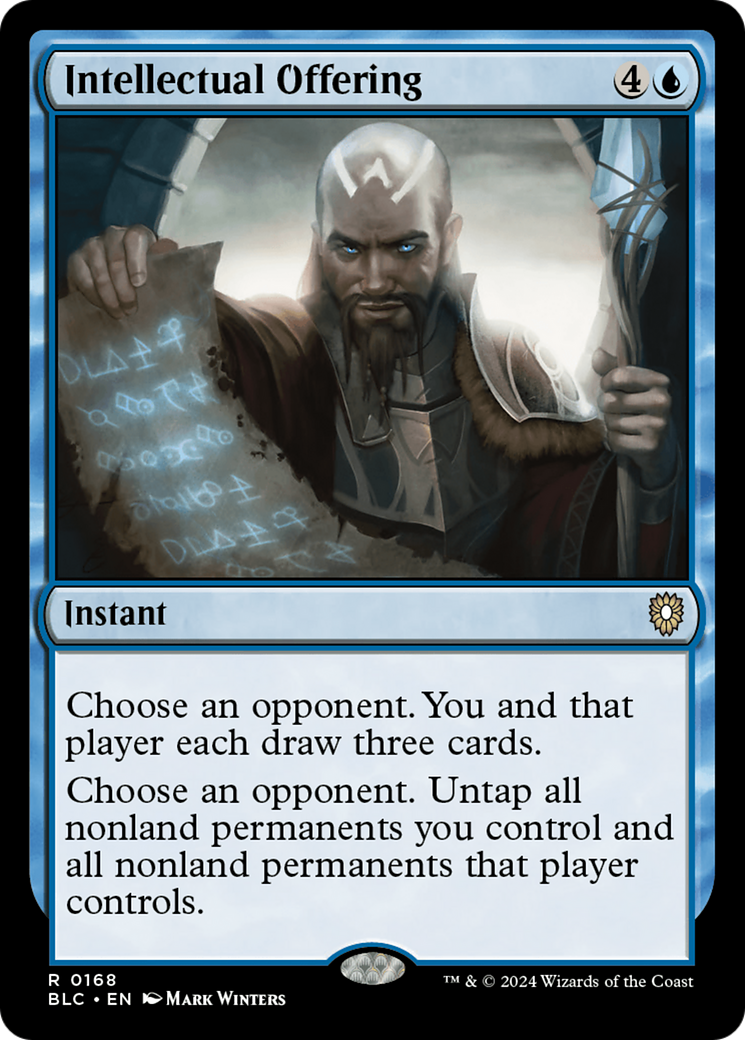
Intellectual Offering
Intellectual Offering
Instant
Choose an opponent. You and that player each draw three cards.
Choose an opponent. Untap all nonland permanents you control and all nonland permanents that player controls.
- You may choose the same opponent for each of the effects, or you may choose different opponents. None of the affected players are targets of the spell.
- You choose the opponents for each effect as the spell resolves.
-
1
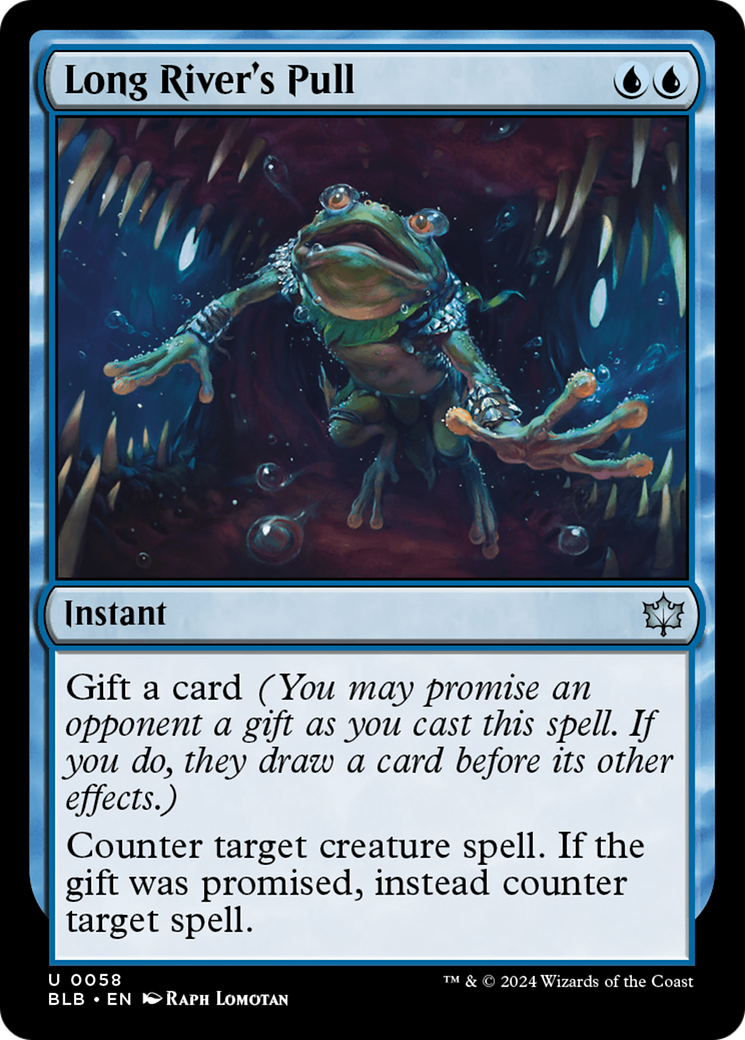
Long River's Pull
Long River's Pull
Instant
Gift a card (You may promise an opponent a gift as you cast this spell. If you do, they draw a card before its other effects.)
Counter target creature spell. If the gift was promised, instead counter target spell.
- As an additional cost to cast a spell with gift, you can promise the listed gift to an opponent. That opponent is chosen as part of that additional cost. The gift isn't given at this time; rather, it's given at a later time based on whether or not the spell is a permanent spell.
- For permanent spells with gift, an ability triggers when that permanent enters if the gift was promised. When that ability resolves, the gift is given to the appropriate opponent.
- For instants and sorceries with gift, the gift is given to the appropriate opponent as part of the resolution of the spell. This happens before any of the spell's other effects would take place.
- If a spell for which the gift was promised is countered, doesn't resolve (perhaps because all of its targets are illegal), or is otherwise removed from the stack, the gift won't be given. None of its other effects will happen either.
- You can't pay a gift cost more than once.
- If you copy a spell for which the gift was promised, the gift was also promised to the same opponent for the copy. If a card or token enters as a copy of a permanent that's already on the battlefield, the gift isn't promised for that new permanent, even if it was promised for the original.
- Some instant or sorcery spells require alternative or additional targets if the gift was promised. You ignore these targeting requirements if the gifts aren't promised for those spells. On the other hand, you can promise a gift for a permanent spell even if you won't be able to choose targets for an enters ability of that permanent once the spell resolves.
- In the main set, there are four different kinds of gifts. "Gift a Food" causes the chosen opponent to create a Food token, while "Gift a Treasure" causes the chosen opponent to create a Treasure token. "Gift a card" causes them to draw a card, and "Gift a tapped Fish" causes them to create a tapped 1/1 blue Fish creature token. The Commander decks contain two more kinds of gifts: "Gift an Octopus," which causes the chosen opponent to create an 8/8 blue Octopus creature token, and "Gift an extra turn," which causes them to take an extra turn after the current turn ends.
-
1
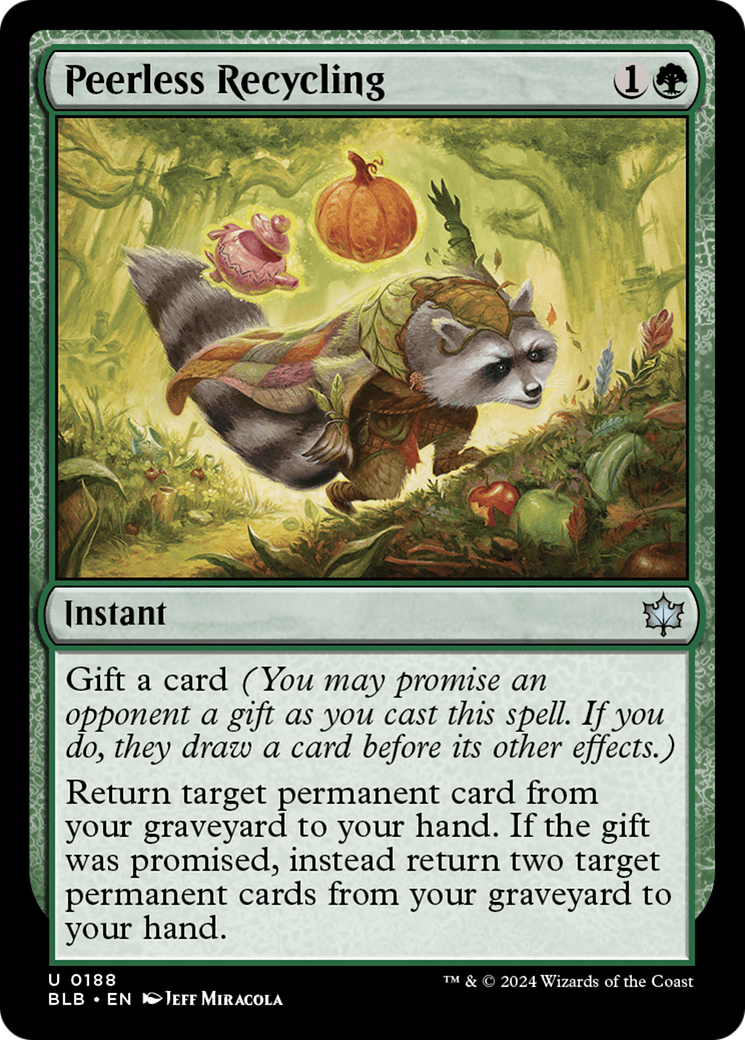
Peerless Recycling
Peerless Recycling
Instant
Gift a card (You may promise an opponent a gift as you cast this spell. If you do, they draw a card before its other effects.)
Return target permanent card from your graveyard to your hand. If the gift was promised, instead return two target permanent cards from your graveyard to your hand.
- As an additional cost to cast a spell with gift, you can promise the listed gift to an opponent. That opponent is chosen as part of that additional cost. The gift isn’t given at this time; rather, it’s given at a later time based on whether or not the spell is a permanent spell.
- For permanent spells with gift, an ability triggers when that permanent enters if the gift was promised. When that ability resolves, the gift is given to the appropriate opponent.
- For instants and sorceries with gift, the gift is given to the appropriate opponent as part of the resolution of the spell. This happens before any of the spell’s other effects would take place.
- If a spell for which the gift was promised is countered, doesn’t resolve (perhaps because all of its targets are illegal), or is otherwise removed from the stack, the gift won’t be given. None of its other effects will happen either.
- You can’t pay a gift cost more than once.
- If you copy a spell for which the gift was promised, the gift was also promised to the same opponent for the copy. If a card or token enters as a copy of a permanent that’s already on the battlefield, the gift isn’t promised for that new permanent, even if it was promised for the original.
- Some instant or sorcery spells require alternative or additional targets if the gift was promised. You ignore these targeting requirements if the gifts aren’t promised for those spells. On the other hand, you can promise a gift for a permanent spell even if you won’t be able to choose targets for an enters ability of that permanent once the spell resolves.
- In the main set, there are four different kinds of gifts. “Gift a Food” causes the chosen opponent to create a Food token, while “Gift a Treasure” causes the chosen opponent to create a Treasure token. “Gift a card” causes them to draw a card, and “Gift a tapped Fish” causes them to create a tapped 1/1 blue Fish creature token. The Commander decks contain two more kinds of gifts: “Gift an Octopus,” which causes the chosen opponent to create an 8/8 blue Octopus creature token, and “Gift an extra turn,” which causes them to take an extra turn after the current turn ends.
-
1
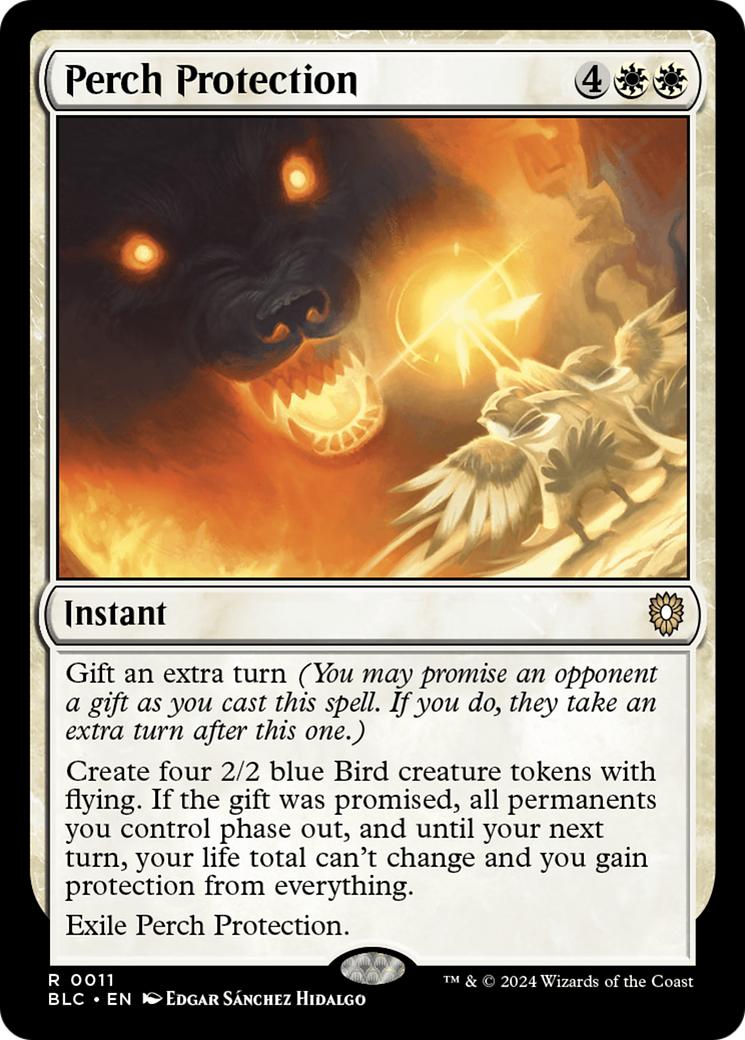
Perch Protection
Perch Protection
Instant
Gift an extra turn (You may promise an opponent a gift as you cast this spell. If you do, they take an extra turn after this one.)
Create four 2/2 blue Bird creature tokens with flying. If the gift was promised, all permanents you control phase out, and until your next turn, your life total can't change and you gain protection from everything.
Exile Perch Protection.
- If your life total can't change, spells and abilities that would normally cause you to gain or lose life still resolve while your life total can't change, but the life-gain or life-loss part simply has no effect.
- If your life total can't change, you can't pay a cost that includes the payment of any amount of life other than 0 life. Similarly, if a cost includes causing you to gain life (like the alternative cost of an opponent's Invigorate does), that cost can't be paid.
- If your life total can't change, effects that would replace having you gain life with some other event won't be able to be applied because it's impossible for you to gain life. The same is true for effects that would replace having you lose life with some other event.
- If your life total can't change, effects that replace an event with having you gain life (like Words of Worship's effect does) or having you lose life will apply and end up replacing the event with nothing.
- If your life total can't change and an effect would set your life total to a specific number that's different from your current life total, that part of the effect won't do anything. Similarly, if an effect would cause you to exchange life totals with another player, the exchange won't happen, and neither player's life total will change.
- If a player has protection from everything, it means three things: 1) All damage that would be dealt to that player is prevented. 2) Auras can't be attached to that player. 3) That player can't be the target of spells or abilities.
- Nothing other than the specified events are prevented or illegal. An effect that doesn't target you could still cause you to discard cards, for example. Creatures can still attack you while you have protection from everything, although combat damage that they would deal to you will be prevented.
- Gaining protection from everything causes a spell or ability on the stack to have an illegal target if it targets you. As a spell or ability tries to resolve, if all its targets are illegal, that spell or ability doesn't resolve and none of its effects happen, including effects unrelated to the target. If at least one target is still legal, the spell or ability does as much as it can to the remaining legal targets, and its other effects still happen.
- Protection from everything will usually prevent damage if it would be dealt to you, but some damage can't be prevented. In this case, because your life total also can't change, that damage has any other effects that it may have aside from causing you to lose that much life (such as effects from lifelink or infect) and triggers and effects can see that damage was dealt even though your life total didn't change.
- While a permanent is phased out, it's treated as though it doesn't exist. It can't be the target of spells or abilities, its static abilities have no effect on the game, its triggered abilities can't trigger, it can't attack or block, and so on.
- Phasing out doesn't cause any "leaves the battlefield" abilities to trigger. Similarly, phasing in won't cause any "enters" abilities to trigger.
- Any one-shot effects that are waiting "until [this] leaves the battlefield," such as that of Banishing Light, won't happen when a permanent phases out.
- Any continuous effects with a "for as long as" duration such as that of Mathas, Fiend Seeker ignore phased-out objects. Any such effects will expire if their conditions are no longer met after ignoring the phased-out objects.
- Each Aura and Equipment that phases out attached to a permanent that's phasing out phases in with that permanent and still attached to it.
- Each Aura and Equipment you control attached to a permanent that isn't phasing out phases in attached to that permanent if it can still be attached to that permanent. If not, it phases in unattached. An Aura that phases in unattached will be put into its owner's graveyard as a state-based action. The same is true with Auras attached to players.
- Permanents that phase out with counters phase in with those counters.
- Choices made for permanents as they entered are remembered when they phase in.
- If a token is phased out, it will phase in as your next untap step begins.
- A permanent phasing out causes a spell or ability on the stack to have an illegal target if it targets that permanent. As a spell or ability tries to resolve, if all its targets are illegal, that spell or ability doesn't resolve and none of its effects happen, including effects unrelated to the target. If at least one target is still legal, the spell or ability does as much as it can to the remaining legal targets, and its other effects still happen.
- If your untap step is somehow skipped as your next turn begins, your phased-out permanents won't phase in until the next untap step you actually have, but you'll no longer have protection from everything and your life total can change again.
- Any creatures that phase in under your control as your next untap step begins will be able to attack and pay a cost of during that turn.
- If you gain control of another player's permanent and it phases out, if the duration of the control-change effect expires before it phases in, that permanent phases in under that other player's control as your next untap step begins. If you leave the game before your next untap step, it phases in as the next untap step begins after your turn would have begun.
- As an additional cost to cast a spell with gift, you can promise the listed gift to an opponent. That opponent is chosen as part of that additional cost. The gift isn't given at this time; rather, it's given at a later time based on whether or not the spell is a permanent spell.
- For permanent spells with gift, an ability triggers when that permanent enters if the gift was promised. When that ability resolves, the gift is given to the appropriate opponent.
- For instants and sorceries with gift, the gift is given to the appropriate opponent as part of the resolution of the spell. This happens before any of the spell's other effects would take place.
- If a spell for which the gift was promised is countered, doesn't resolve (perhaps because all of its targets are illegal), or is otherwise removed from the stack, the gift won't be given. None of its other effects will happen either.
- You can't pay a gift cost more than once.
- If you copy a spell for which the gift was promised, the gift was also promised to the same opponent for the copy. If a card or token enters as a copy of a permanent that's already on the battlefield, the gift isn't promised for that new permanent, even if it was promised for the original.
- Some instant or sorcery spells require alternative or additional targets if the gift was promised. You ignore these targeting requirements if the gifts aren't promised for those spells. On the other hand, you can promise a gift for a permanent spell even if you won't be able to choose targets for an enters ability of that permanent once the spell resolves.
- In the main set, there are four different kinds of gifts. "Gift a Food" causes the chosen opponent to create a Food token, while "Gift a Treasure" causes the chosen opponent to create a Treasure token. "Gift a card" causes them to draw a card, and "Gift a tapped Fish" causes them to create a tapped 1/1 blue Fish creature token. The Commander decks contain two more kinds of gifts: "Gift an Octopus," which causes the chosen opponent to create an 8/8 blue Octopus creature token, and "Gift an extra turn," which causes them to take an extra turn after the current turn ends.
-
1
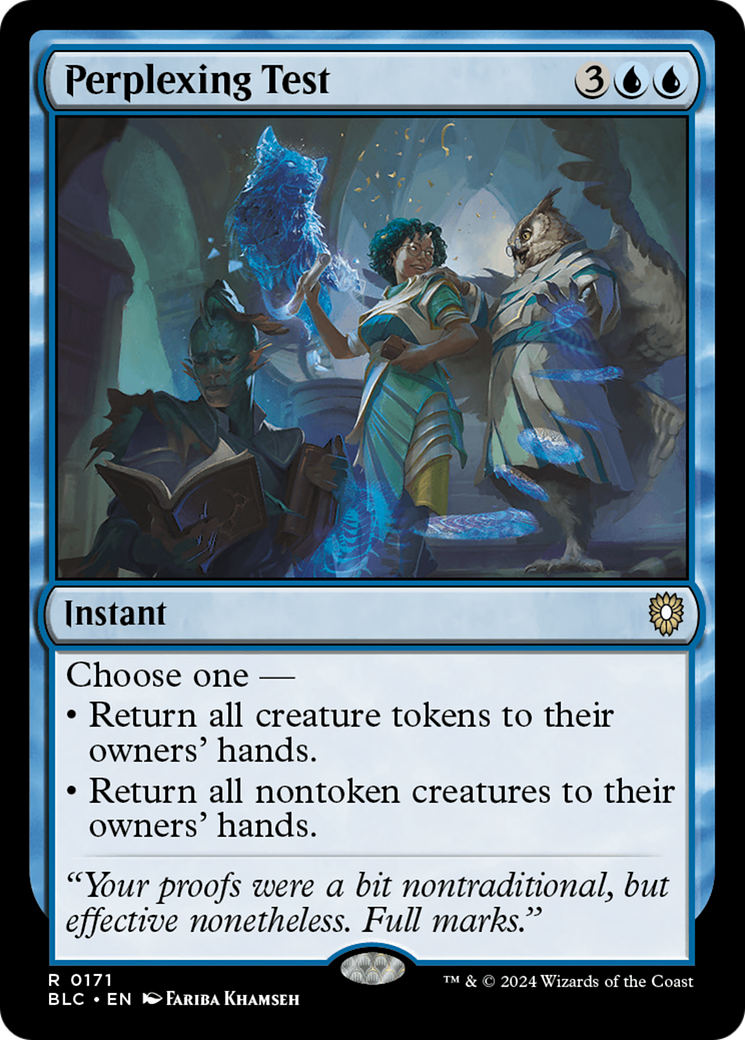
Perplexing Test
Perplexing Test
Instant
Choose one —
- Return all creature tokens to their owners' hands.
- Return all nontoken creatures to their owners' hands.
- A token that is returned to its owner's hand ceases to exist as a state-based action the next time a player would receive priority.
-
1
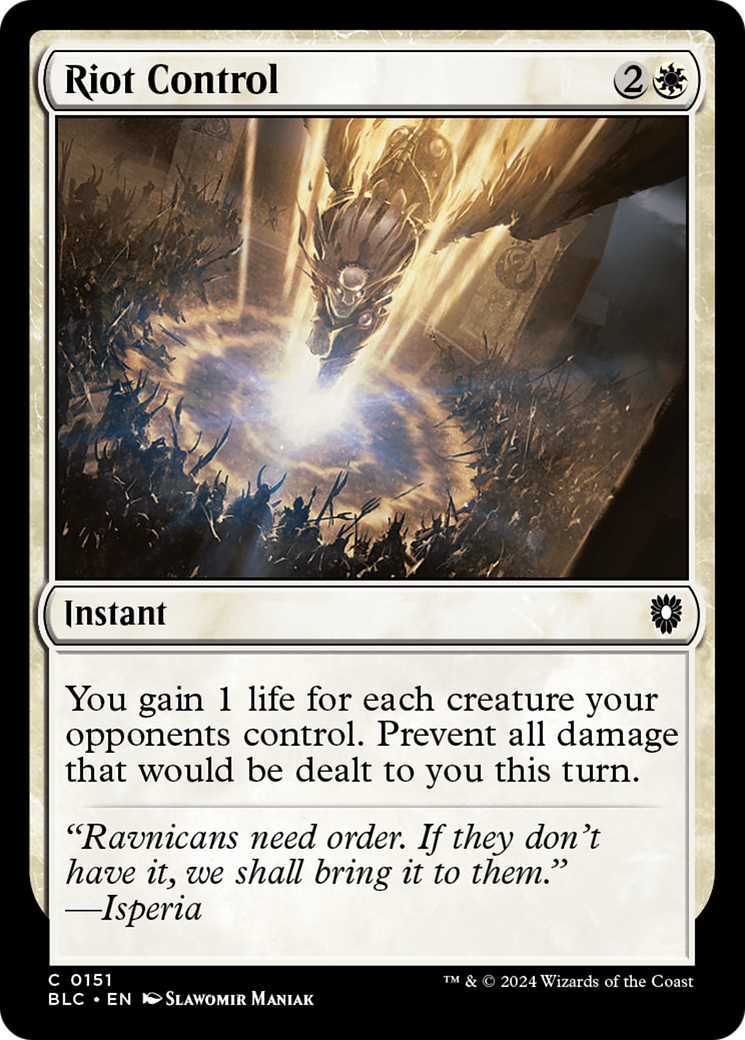
Riot Control
Riot Control
Instant
You gain 1 life for each creature your opponents control. Prevent all damage that would be dealt to you this turn.
- Count the number of creatures your opponents control as Riot Control resolves to determine how much life you gain.
- Riot Control doesn't prevent combat damage that would be dealt to planeswalkers you control. It also doesn't prevent damage that would be dealt to creatures you control.
-
1
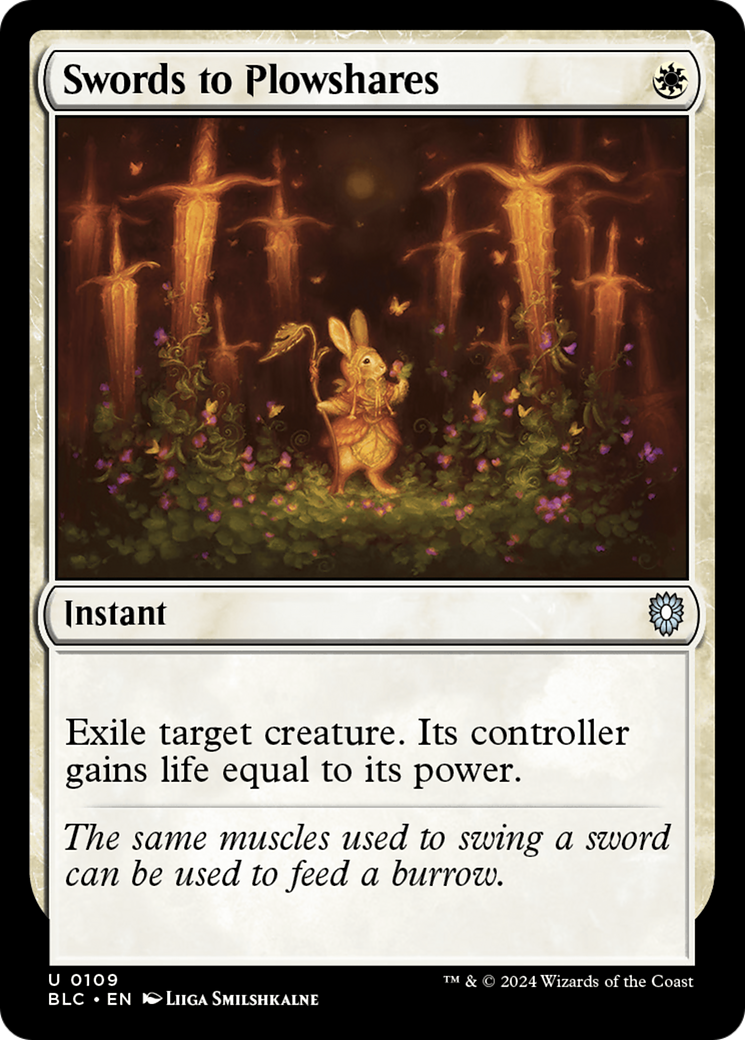
Swords to Plowshares
Swords to Plowshares
Instant
Exile target creature. Its controller gains life equal to its power.
- Use the power of the creature from when it was last on the battlefield to determine how much life is gained.
Sorceries 7
-
1
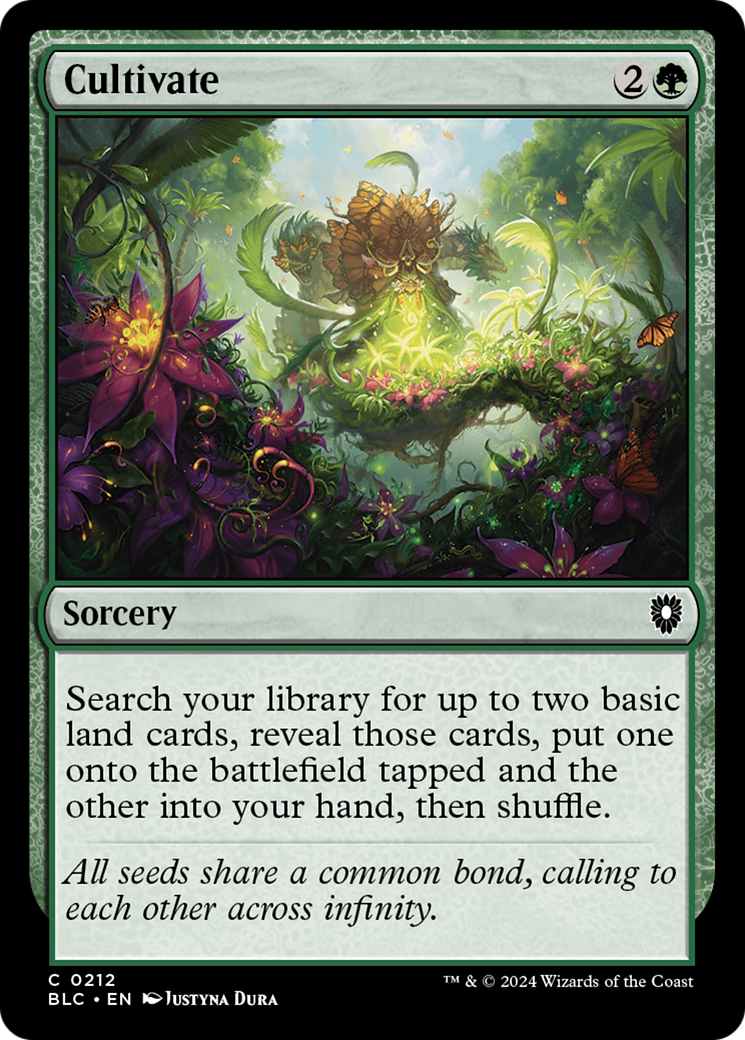
Cultivate
Cultivate
Sorcery
Search your library for up to two basic land cards, reveal those cards, put one onto the battlefield tapped and the other into your hand, then shuffle.
- If you choose to find only one basic land card, you put it onto the battlefield tapped.
-
1
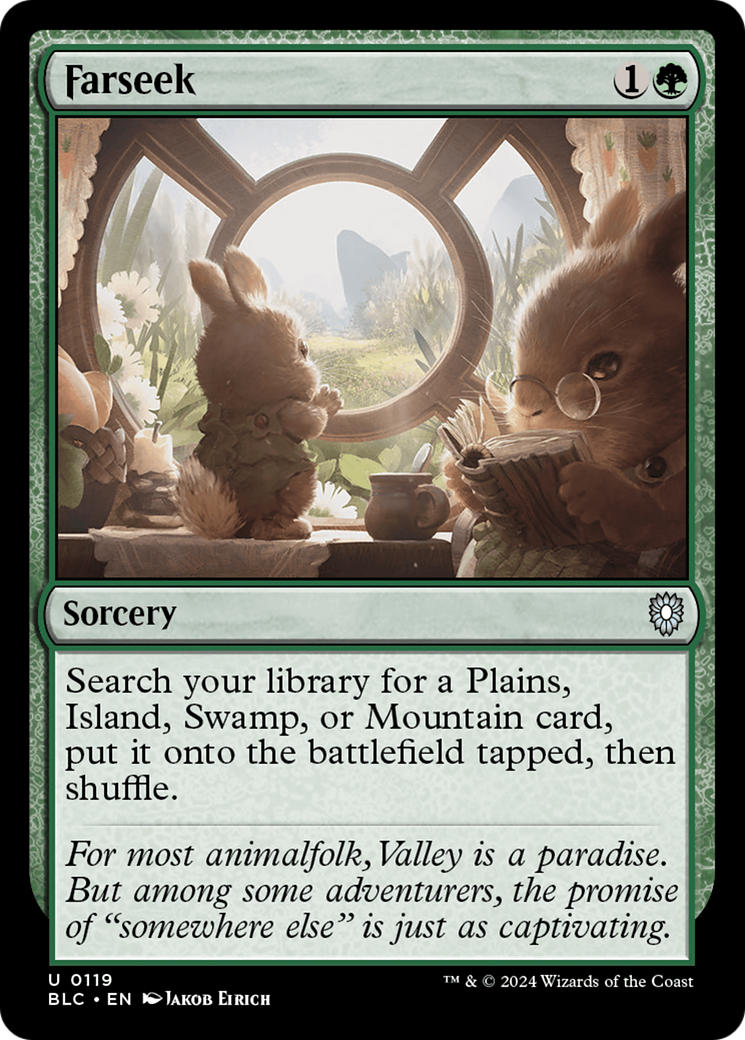
Farseek
Farseek
Sorcery
Search your library for a Plains, Island, Swamp, or Mountain card, put it onto the battlefield tapped, then shuffle.
- Farseek can find any land with any of the listed land types, including nonbasic ones, even if that land is a Forest in addition to one or more of those types.
-
1
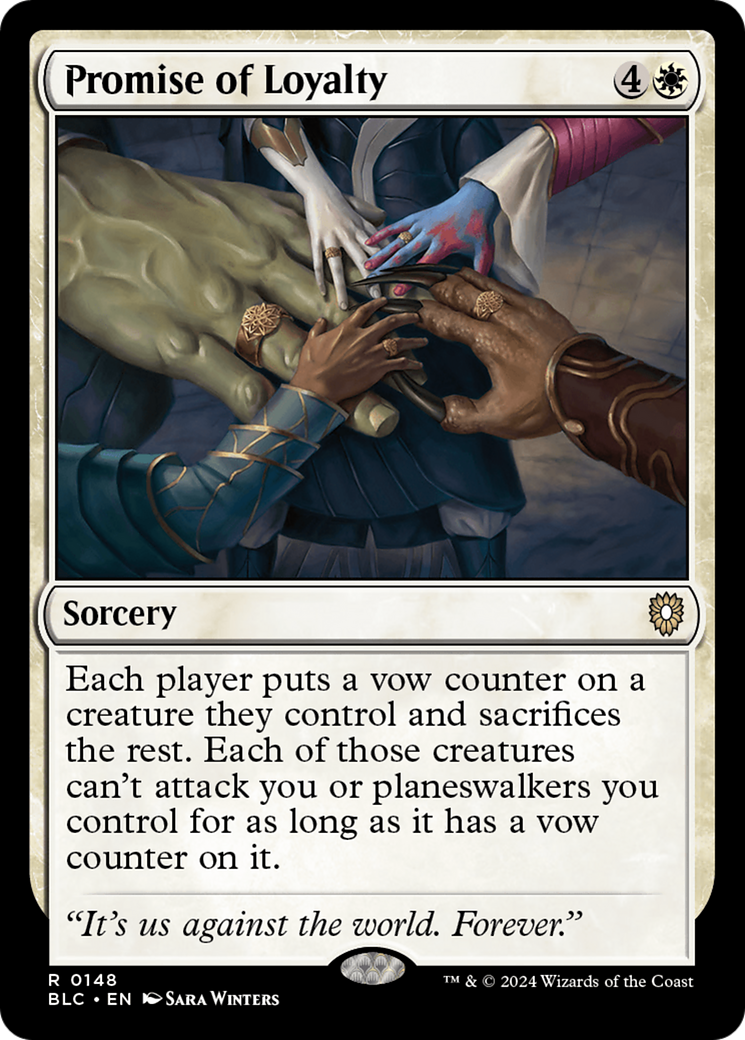
Promise of Loyalty
Promise of Loyalty
Sorcery
Each player puts a vow counter on a creature they control and sacrifices the rest. Each of those creatures can't attack you or planeswalkers you control for as long as it has a vow counter on it.
- Each player, including you, must put a vow counter on a creature they control if able. They can't choose to opt out and sacrifice all of their creatures. The creature you put a vow counter on will remember its promise if another player gains control of it.
- If the vow counter is removed from the creature, it can attack as normal.
- If the vow counter is moved to another creature, it won't prevent the second creature from attacking normally.
-
1
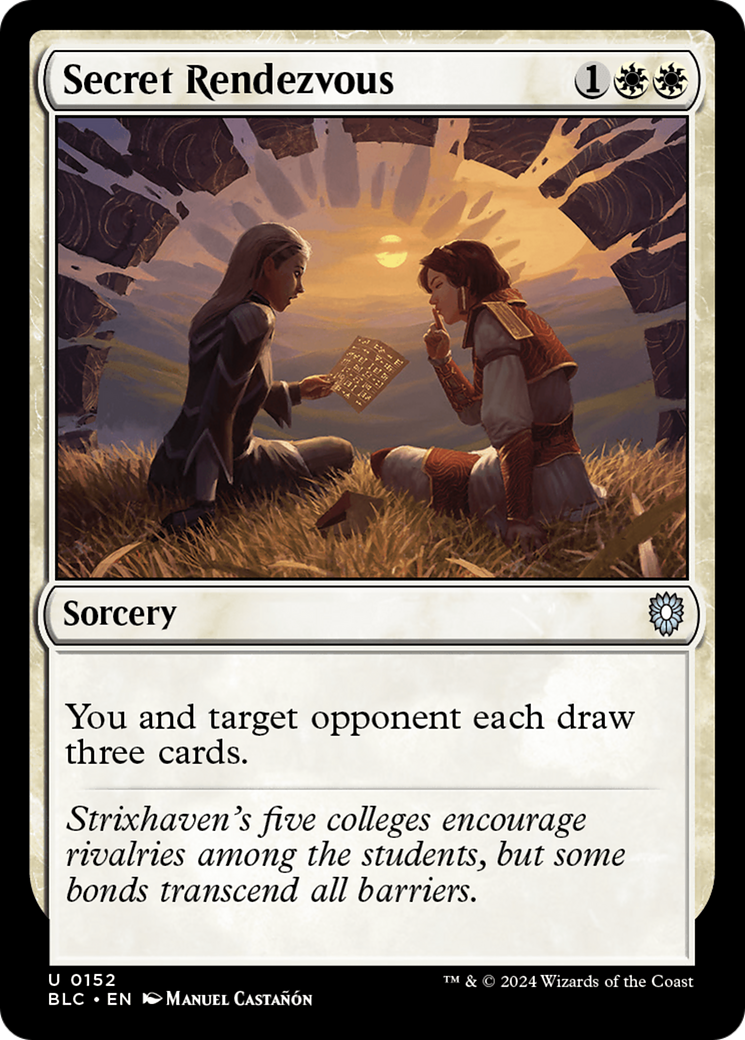
Secret Rendezvous
Secret Rendezvous
Sorcery
You and target opponent each draw three cards.
- If the opponent is an illegal target as Secret Rendezvous tries to resolve, neither player will draw cards.
-
1
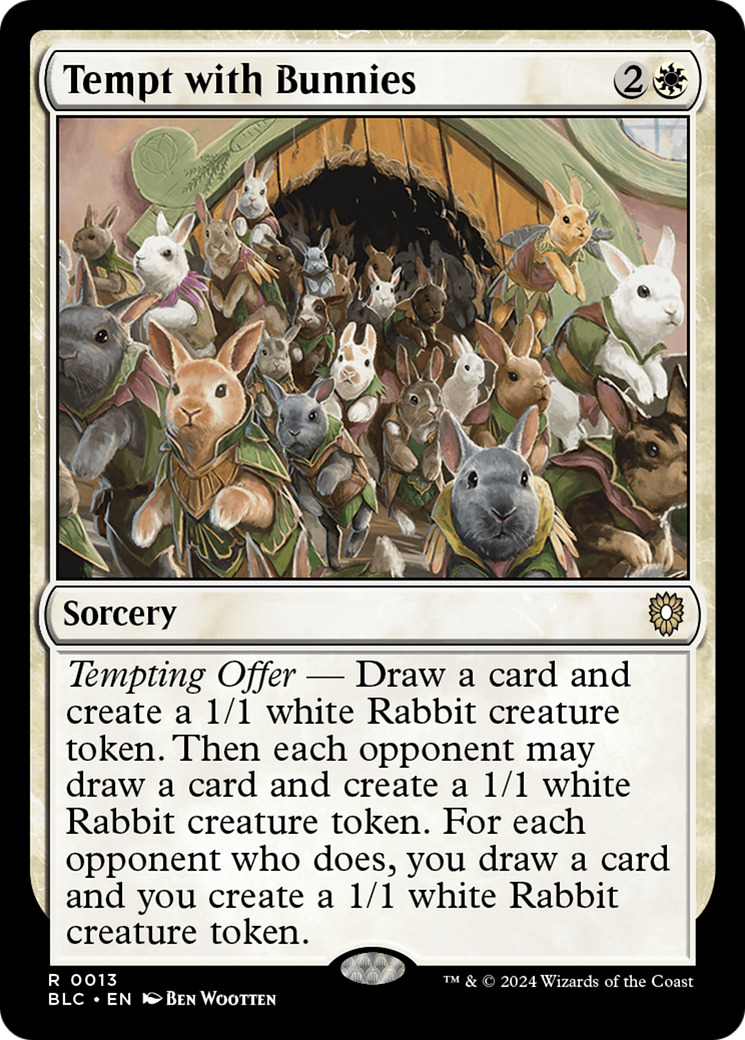
Tempt with Bunnies
Tempt with Bunnies
Sorcery
Tempting Offer — Draw a card and create a 1/1 white Rabbit creature token. Then each opponent may draw a card and create a 1/1 white Rabbit creature token. For each opponent who does, you draw a card and you create a 1/1 white Rabbit creature token.
- Your opponents decide in turn order whether or not they accept the offer, starting with the next opponent in turn order. Each opponent will know the decisions of previous opponents in turn order when making their decision.
- After each opponent has decided, the effect happens simultaneously for each one who accepted the offer. Then the effect happens again for you a number of times equal to the number of opponents who accepted.
-
1
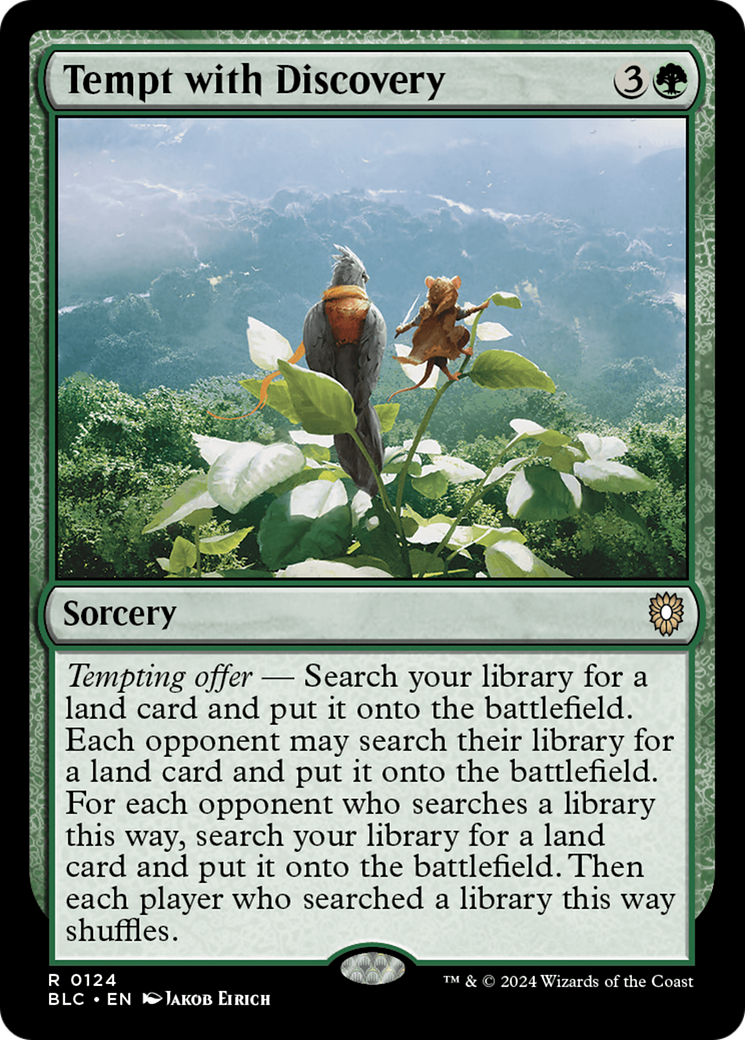
Tempt with Discovery
Tempt with Discovery
Sorcery
Tempting offer — Search your library for a land card and put it onto the battlefield. Each opponent may search their library for a land card and put it onto the battlefield. For each opponent who searches a library this way, search your library for a land card and put it onto the battlefield. Then each player who searched a library this way shuffles.
- Your opponents decide in turn order whether or not they accept the offer, starting with the opponent on your left. Each opponent will know the decisions of previous opponents in turn order when making their decision.
- After each opponent has decided, the effect happens simultaneously for each one who accepted the offer. Then, the effect happens again for you a number of times equal to the number of opponents who accepted.
-
1
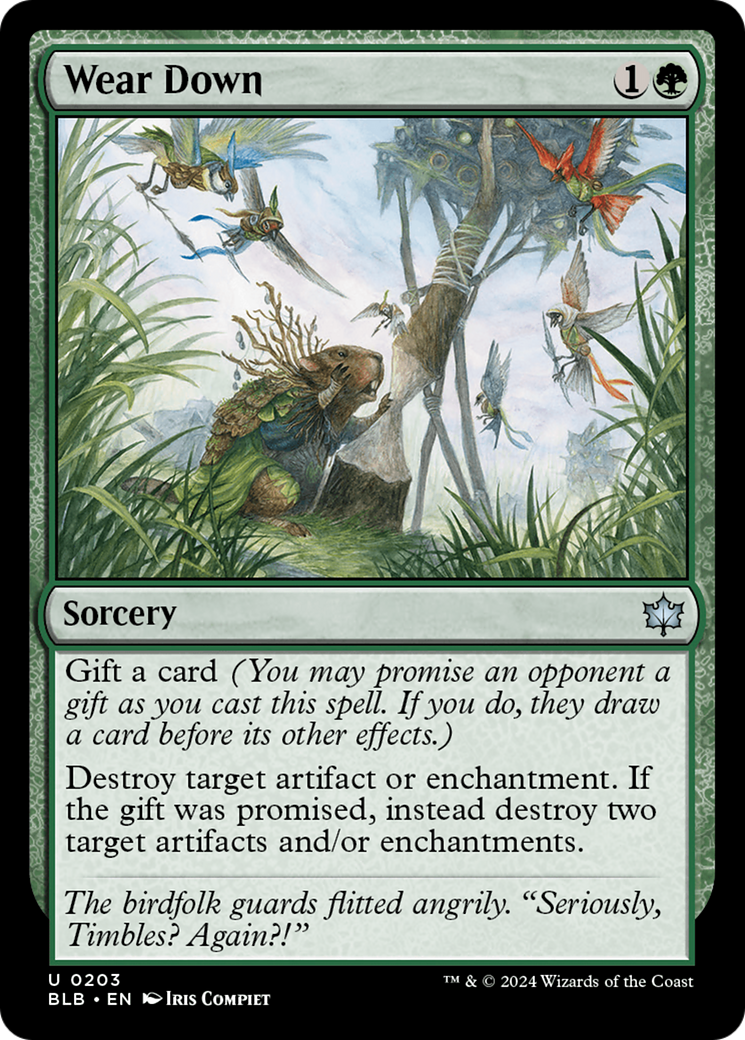
Wear Down
Wear Down
Sorcery
Gift a card (You may promise an opponent a gift as you cast this spell. If you do, they draw a card before its other effects.)
Destroy target artifact or enchantment. If the gift was promised, instead destroy two target artifacts and/or enchantments.
- As an additional cost to cast a spell with gift, you can promise the listed gift to an opponent. That opponent is chosen as part of that additional cost. The gift isn’t given at this time; rather, it’s given at a later time based on whether or not the spell is a permanent spell.
- For permanent spells with gift, an ability triggers when that permanent enters if the gift was promised. When that ability resolves, the gift is given to the appropriate opponent.
- For instants and sorceries with gift, the gift is given to the appropriate opponent as part of the resolution of the spell. This happens before any of the spell’s other effects would take place.
- If a spell for which the gift was promised is countered, doesn’t resolve (perhaps because all of its targets are illegal), or is otherwise removed from the stack, the gift won’t be given. None of its other effects will happen either.
- You can’t pay a gift cost more than once.
- If you copy a spell for which the gift was promised, the gift was also promised to the same opponent for the copy. If a card or token enters as a copy of a permanent that’s already on the battlefield, the gift isn’t promised for that new permanent, even if it was promised for the original.
- Some instant or sorcery spells require alternative or additional targets if the gift was promised. You ignore these targeting requirements if the gifts aren’t promised for those spells. On the other hand, you can promise a gift for a permanent spell even if you won’t be able to choose targets for an enters ability of that permanent once the spell resolves.
- In the main set, there are four different kinds of gifts. “Gift a Food” causes the chosen opponent to create a Food token, while “Gift a Treasure” causes the chosen opponent to create a Treasure token. “Gift a card” causes them to draw a card, and “Gift a tapped Fish” causes them to create a tapped 1/1 blue Fish creature token. The Commander decks contain two more kinds of gifts: “Gift an Octopus,” which causes the chosen opponent to create an 8/8 blue Octopus creature token, and “Gift an extra turn,” which causes them to take an extra turn after the current turn ends.
Artifacts 8
-
1
Arcane Signet
Arcane Signet
Artifact
: Add one mana of any color in your commander's color identity.
- If your commander is a card that has no colors in its color identity, Arcane Signet's ability produces no mana. It doesn't produce .
- If you have two commanders, the ability adds one mana of any color in their combined color identities.
- If you don't have a commander, Arcane Signet's ability produces no mana.
-
1
Coveted Jewel
Coveted Jewel
Artifact
When this artifact enters, draw three cards.
: Add three mana of any one color.
Whenever one or more creatures an opponent controls attack you and aren't blocked, that player draws three cards and gains control of this artifact. Untap it.
- A creature attacking a planeswalker you control won't cause Coveted Jewel's last ability to trigger.
- Coveted Jewel's last ability triggers after you declare blockers (or declare no blockers at all) if any attacking creatures are unblocked. It doesn't matter if some attacking creatures were blocked.
- Coveted Jewel's last ability resolves after blockers are chosen but before combat damage is dealt.
- If more than one opponent attacks you at the same time, Coveted Jewel's last ability triggers for each of them. You choose which player ends up with Coveted Jewel, but each of them draws three cards and has a chance to activate its mana ability.
-
1
Fellwar Stone
Fellwar Stone
Artifact
: Add one mana of any color that a land an opponent controls could produce.
- The colors of mana are white, blue, black, red, and green. Fellwar Stone can't be tapped for colorless mana, even if a land an opponent controls could produce colorless mana.
- Fellwar Stone checks the effects of all mana-producing abilities of lands your opponents control, but it doesn't check their costs. For example, Vivid Crag has the ability " , Remove a charge counter from Vivid Crag: Add one mana of any color." If an opponent controls Vivid Crag and you control Fellwar Stone, you can tap Fellwar Stone for any color of mana. It doesn't matter whether Vivid Crag has a charge counter on it, and it doesn't matter whether it's untapped.
- When determining what colors of mana your opponents' lands could produce, take into account any applicable replacement effects that would apply to those lands' mana abilities (such as Contamination's effect, for example). If there is more than one, consider them in any possible order.
- Fellwar Stone doesn't care about any restrictions or riders your opponents' lands (such as Ancient Ziggurat or Hall of the Bandit Lord) put on the mana they produce. It just cares about colors of mana.
- This works even if the opponent's lands are tapped. It only checks what kinds of mana can be produced, not if the abilities that produce them are usable right now.
- The ability can be activated if the opponent has no lands that produce mana, but the effect will not be able to generate any mana.
- It only produces one mana even if the land can produce more than one.
-
1
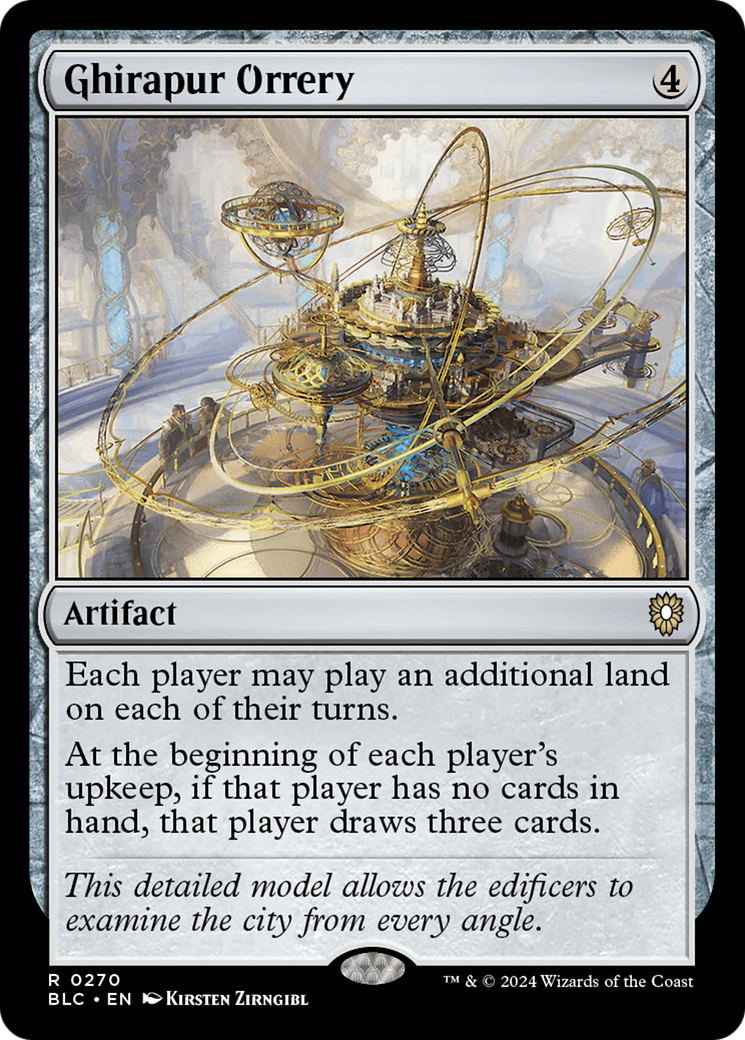
Ghirapur Orrery
Ghirapur Orrery
Artifact
Each player may play an additional land on each of their turns.
At the beginning of each player's upkeep, if that player has no cards in hand, that player draws three cards.
- Ghirapur Orrery's first ability allows a player to play an additional land during their main phase. Doing so follows the normal timing rules for playing lands.
- Ghirapur Orrery's first ability is cumulative if more than one is on the battlefield.
- No player may take actions in a turn before Ghirapur Orrery's second ability checks to see if it should trigger. If the player whose turn it is has any cards in hand, it won't trigger.
- If the player has any cards in hand as Ghirapur Orrery's second ability resolves, the ability does nothing. Notably, a second Ghirapur Orrery won't have a player draw another three cards unless the player empties their hand after resolving the first one's trigger.
- The draw step is after the upkeep step, so drawing a card as a turn-based action won't affect whether Ghirapur Orrery's second ability triggers.
- In a Two-Headed Giant game, Ghirapur Orrery's second ability triggers for each player on a team separately. If one player has cards in hand, it can still trigger for the other player.
-
1
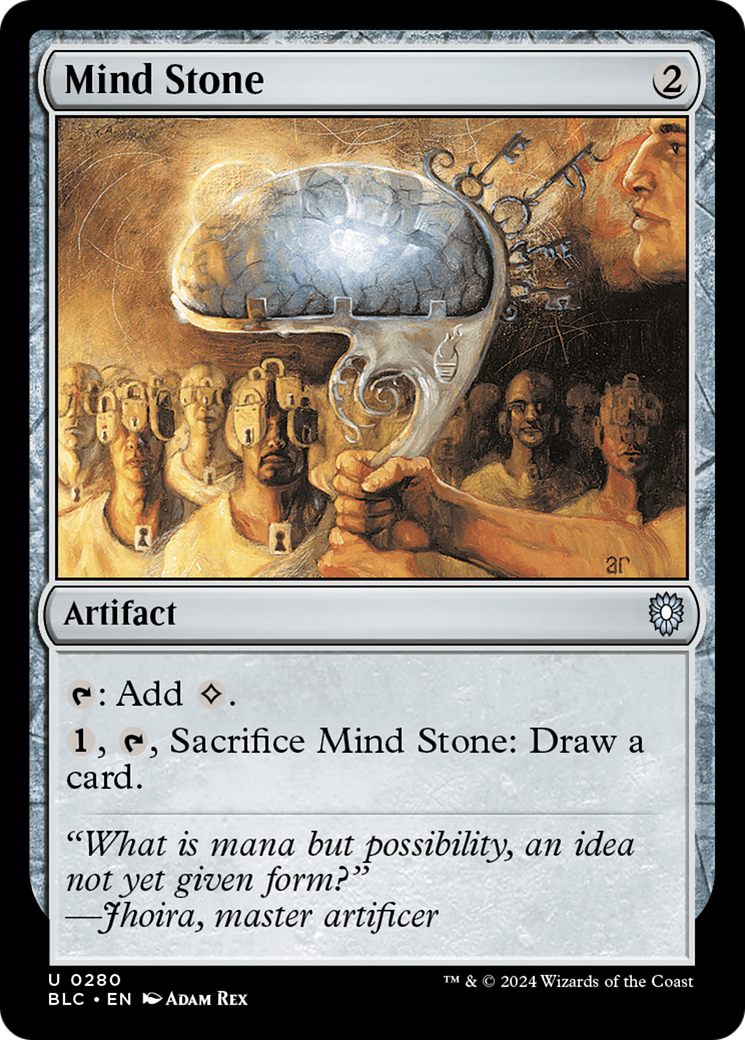
Mind Stone
Mind Stone
Artifact
: Add .
, , Sacrifice this artifact: Draw a card.
-
1
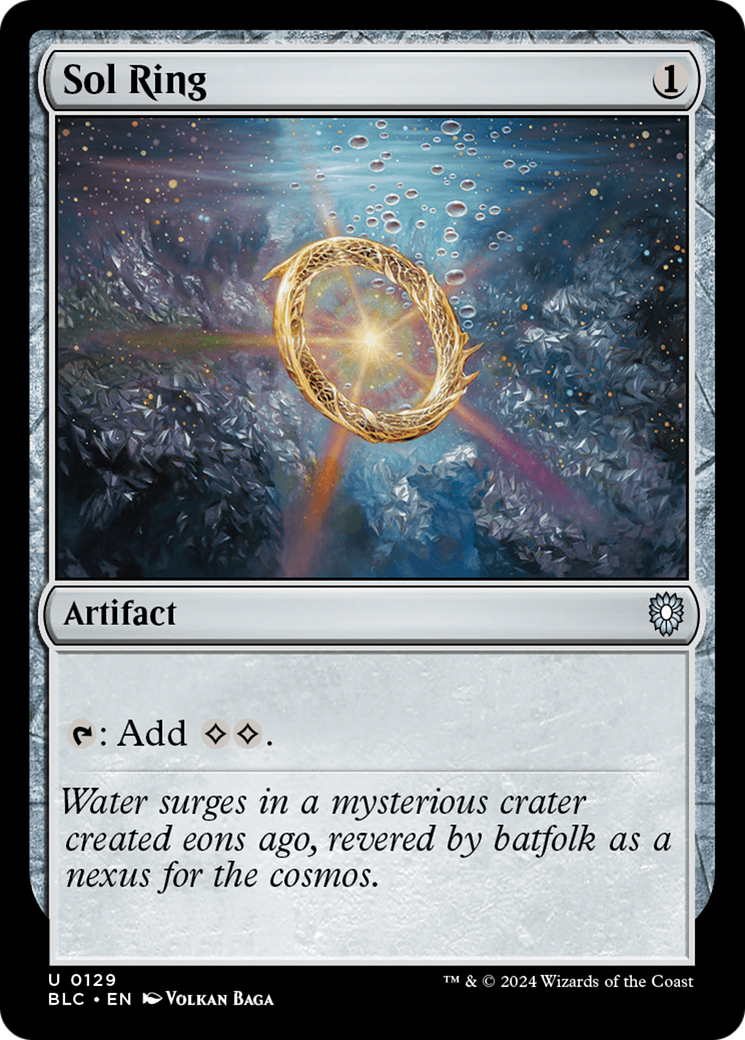
Sol Ring
Sol Ring
Artifact
: Add .
-
1
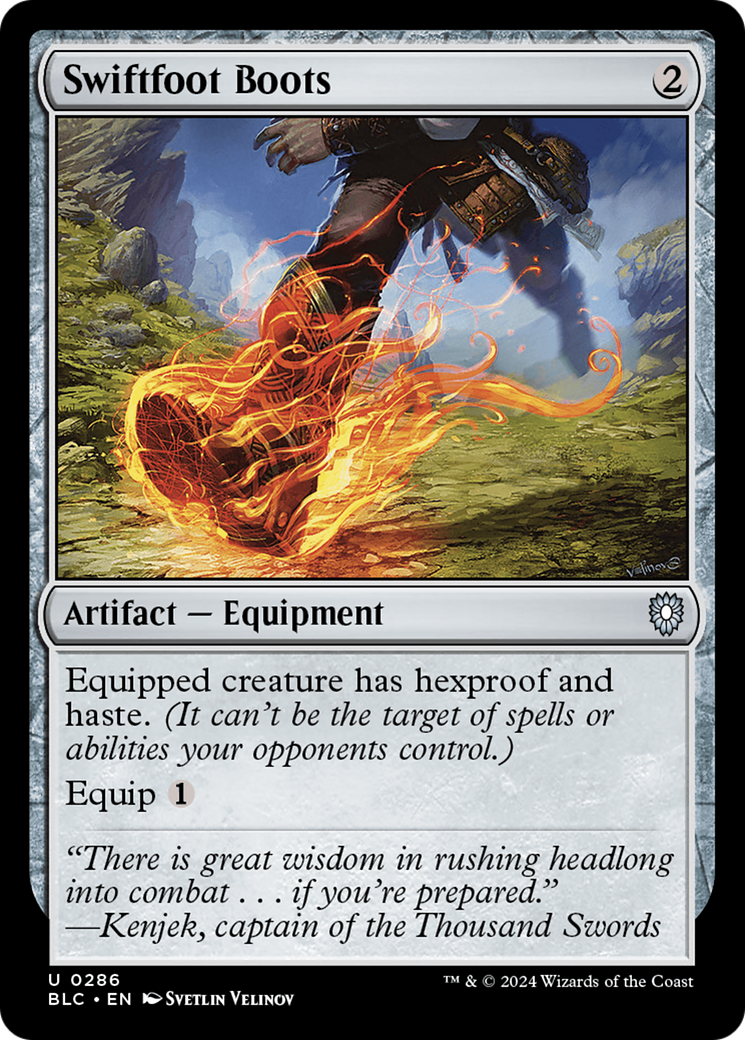
Swiftfoot Boots
Swiftfoot Boots
Artifact — Equipment
Equipped creature has hexproof and haste. (It can't be the target of spells or abilities your opponents control. It can attack and no matter when it came under your control.)
Equip ( : Attach to target creature you control. Equip only as a sorcery.)
- If a creature enters the battlefield under your control and gains haste, but then loses it before attacking, it won't be able to attack that turn. This means that you can't use one Swiftfoot Boots to allow two new creatures to attack in the same turn.
-
1
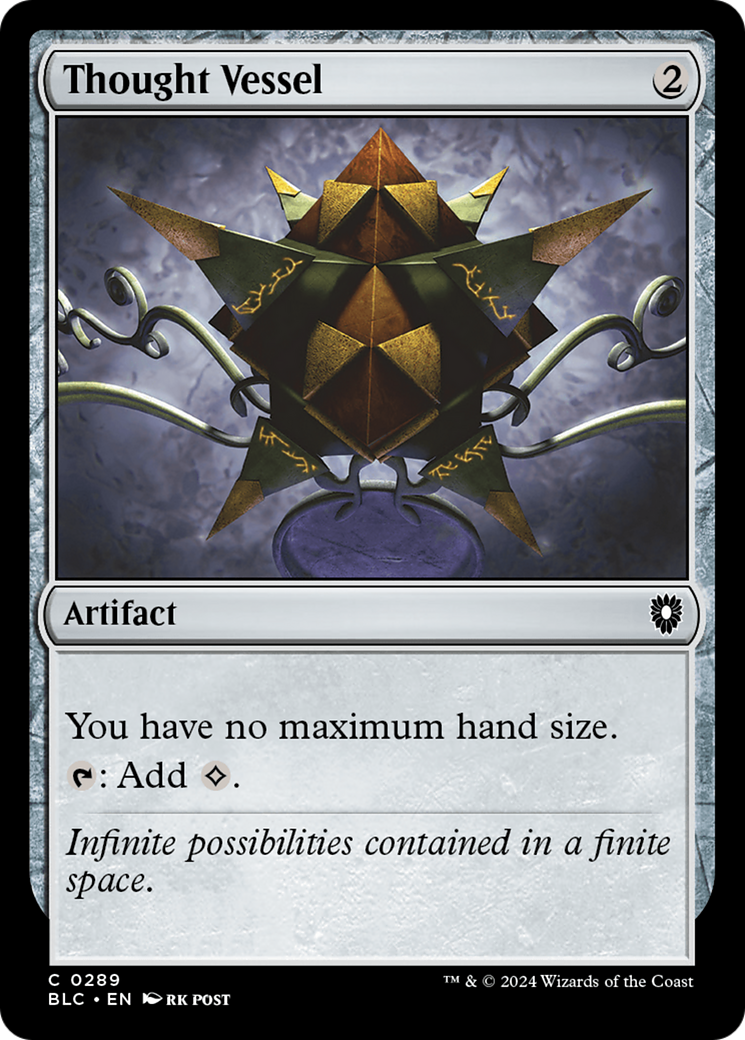
Thought Vessel
Thought Vessel
Artifact
You have no maximum hand size.
: Add .
Enchantments 8
-
1
Communal Brewing
Communal Brewing
Enchantment
When this enchantment enters, any number of target opponents each draw a card. Put an ingredient counter on this enchantment, then put an ingredient counter on it for each card drawn this way.
Whenever you cast a creature spell, that creature enters with X additional +1/+1 counters on it, where X is the number of ingredient counters on this enchantment.
- You don't have to choose any target opponents for Communal Brewing's first ability. However, if you do, and all of those targets are illegal as the ability tries to resolve, it won't resolve and none of its effects will happen. No players will draw cards, and you won't put any ingredient counters on Communal Brewing.
- The value of X is calculated as Communal Brewing's last ability resolves.
- If Communal Brewing leaves the battlefield before its last ability resolves, use the number of ingredient counters that were on it as it last existed on the battlefield to determine the value of X.
-
1
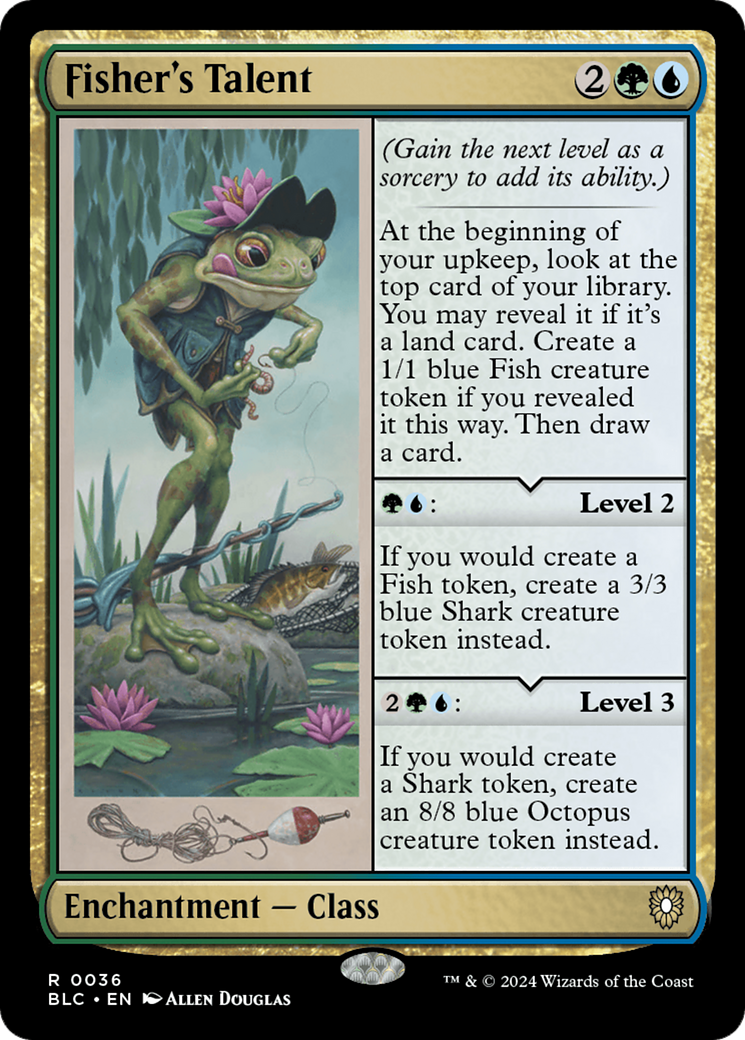
Fisher's Talent
Fisher's Talent
Enchantment — Class
(Gain the next level as a sorcery to add its ability.)
At the beginning of your upkeep, look at the top card of your library. You may reveal it if it's a land card. Create a 1/1 blue Fish creature token if you revealed it this way. Then draw a card.
: Level 2
If you would create a Fish token, create a 3/3 blue Shark creature token instead.
: Level 3
If you would create a Shark token, create an 8/8 blue Octopus creature token instead.
- You don't have to reveal the card if it's a land card. (Maybe you're not in the mood for fish. That's okay.)
- The token's characteristics are entirely replaced by either 3/3 blue Shark creature token or 8/8 blue Octopus creature token, as appropriate. They don't have any other abilities the tokens would have been created with. Anything else specified in the effect creating the tokens (such as tapped, attacking, "That token gains haste," or "Exile that token at end of combat") still applies.
- The level 2 and level 3 class abilities of Fisher's Talent will replace any Fish or Shark tokens you create, not just ones created by the abilities of Fisher's Talent.
- Each Class has five abilities. The three in the major sections of its text box are class abilities. Class abilities can be static, activated, or triggered abilities. The other two are level abilities, one activated ability to advance the Class to level 2 and another to advance the Class to level 3.
- Each Class starts with only the first of its three class abilities. As the first level ability resolves, the Class becomes level 2 and gains the second class ability. As the second level ability resolves, the Class becomes level 3 and gains the third class ability.
- Gaining a level won't remove abilities that a Class had at a previous level.
- Gaining a level is a normal activated ability. It uses the stack and can be responded to.
- You can't activate the first level ability of a Class unless that Class is level 1. Similarly, you can't activate the second level ability of a Class unless that Class is level 2.
- There's no restriction on how many Class permanents you can control, whether they're the same or different classes. Each Class permanent tracks its own level separately.
-
1
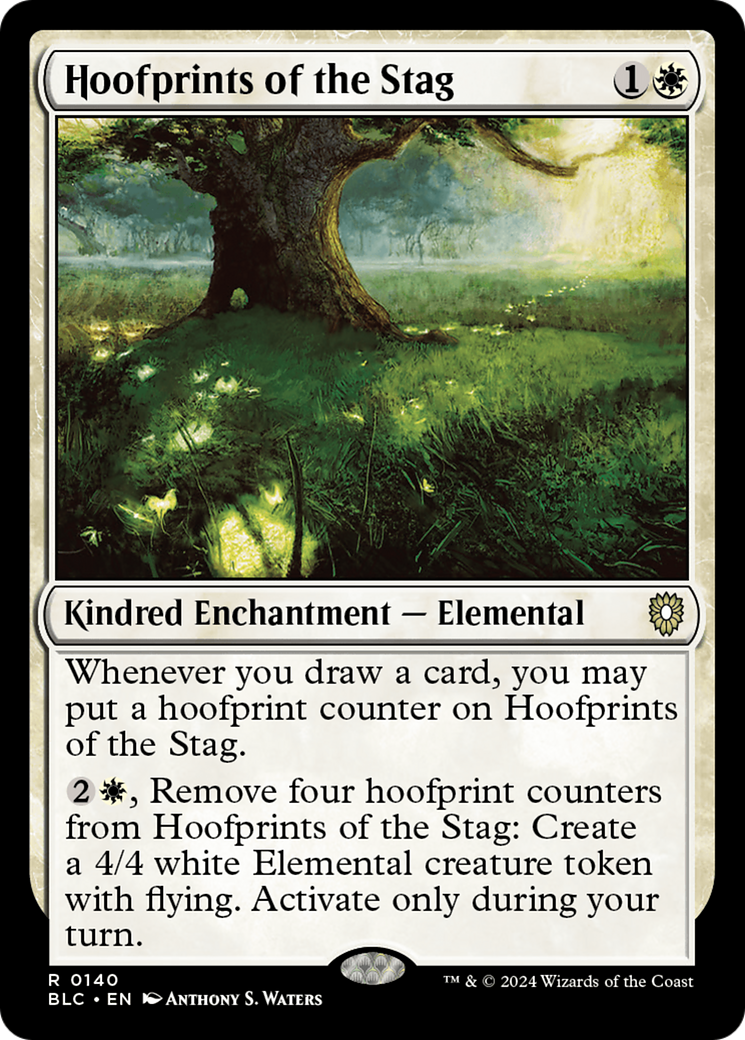
Hoofprints of the Stag
Hoofprints of the Stag
Kindred Enchantment — Elemental
Whenever you draw a card, you may put a hoofprint counter on this enchantment.
, Remove four hoofprint counters from this enchantment: Create a 4/4 white Elemental creature token with flying. Activate only during your turn.
- This cards was originally printed with the "tribal" card type. That card type has been replaced with "kindred". This change does not affect the gameplay function of this card.
- Kindred is a card type that allows noncreature cards to have creature types. For example, Echoes of Eternity is an Eldrazi (although not a creature) while on the battlefield and an Eldrazi card (although not a creature card) in zones other than the battlefield.
- While it appears only on cards that already have other card types, kindred is a card type and will be counted by effects that refer to the number of card types among cards in a zone.
- If a spell or ability has you draw multiple cards, Hoofprints of the Stag's ability triggers that many times.
-
1
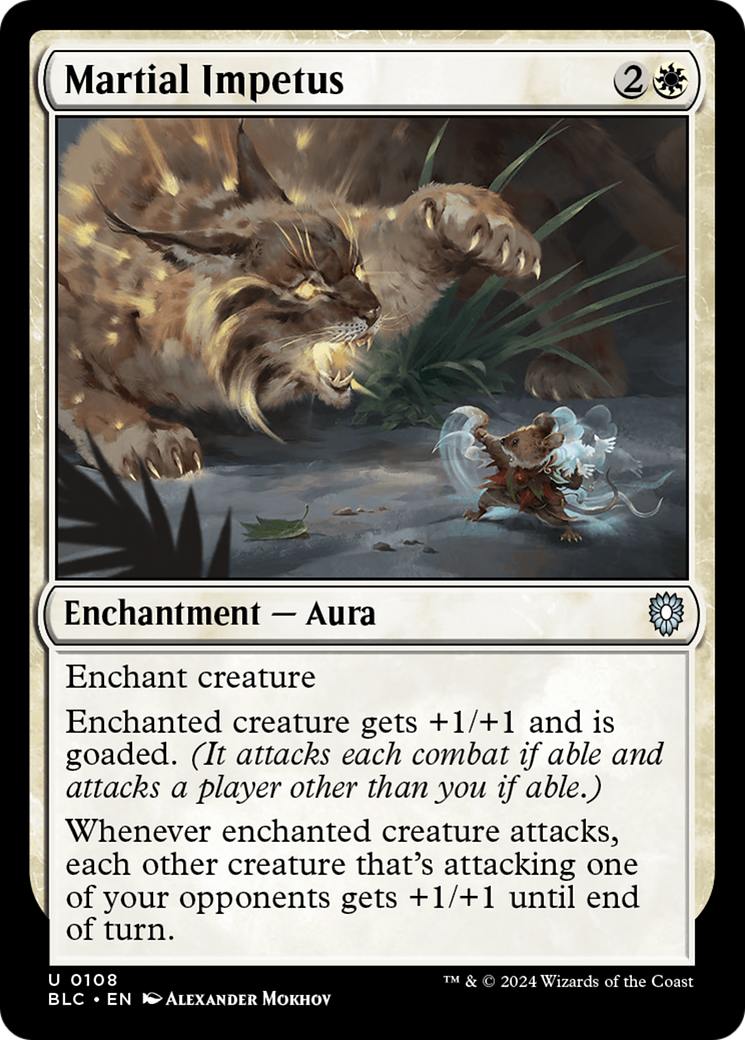
Martial Impetus
Martial Impetus
Enchantment — Aura
Enchant creature
Enchanted creature gets +1/+1 and is goaded. (It attacks each combat if able and attacks a player other than you if able.)
Whenever enchanted creature attacks, each other creature that's attacking one of your opponents gets +1/+1 until end of turn.
- If, during a player's declare attackers step, a creature that player controls that's been goaded is tapped, is affected by a spell or ability that says it can't attack, or hasn't been under that player's control continuously since the turn began (and doesn't have haste), then it doesn't attack. If there's a cost associated with having a creature attack a player, its controller isn't forced to pay that cost, so it doesn't have to attack that player.
- If the creature doesn't meet any of the above exceptions and can attack, it must attack a player other than the controller of the spell or ability that goaded it if able. If the creature can't attack any of those players but could otherwise attack, it must attack a planeswalker an opponent controls, a battle an opponent controls, or a player who goaded it.
- Being goaded isn't an ability the creature has. Once it's been goaded, it must attack as detailed above even if it loses all abilities.
- Attacking with a goaded creature doesn't cause it to stop being goaded. If there is an additional combat phase that turn, or if another player gains control of it before it stops being goaded, it must attack again if able.
- If a creature you control has been goaded by multiple opponents, it must attack one of your opponents that hasn't goaded it, as that fulfills the maximum number of goad requirements. If a creature you control has been goaded by each of your opponents, the creature must attack an opponent (rather than a planeswalker or battle), but you choose which opponent it attacks.
-
1
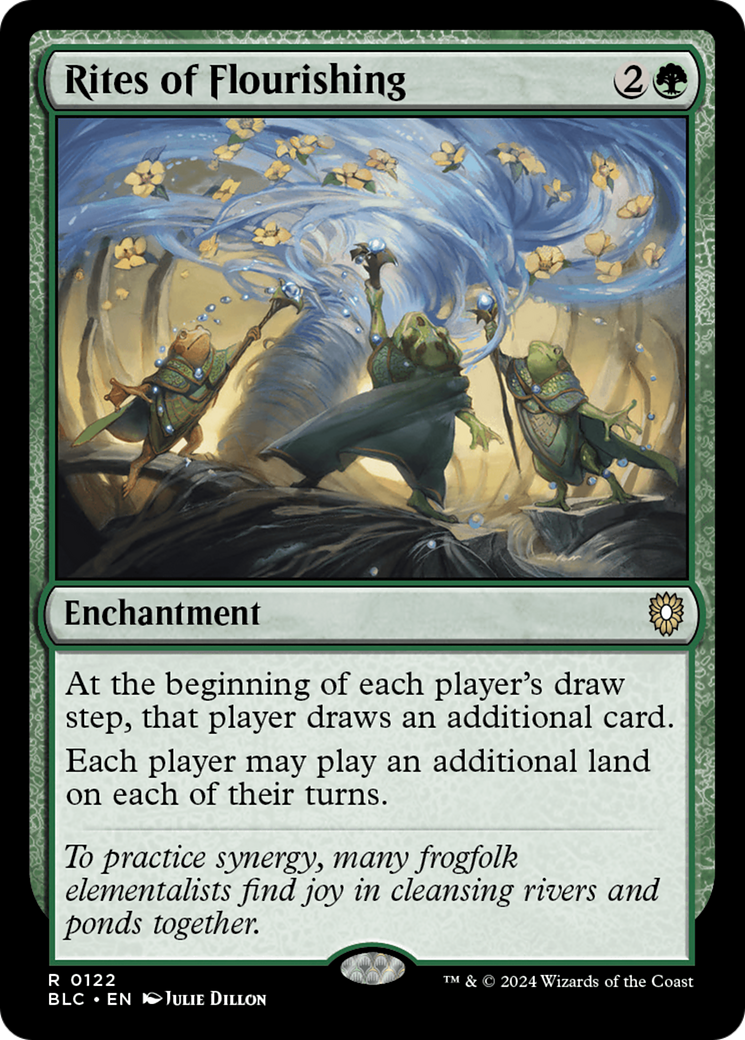
Rites of Flourishing
Rites of Flourishing
Enchantment
At the beginning of each player's draw step, that player draws an additional card.
Each player may play an additional land on each of their turns.
- The triggered ability is put onto the stack after you have already drawn your card for the turn.
-
1
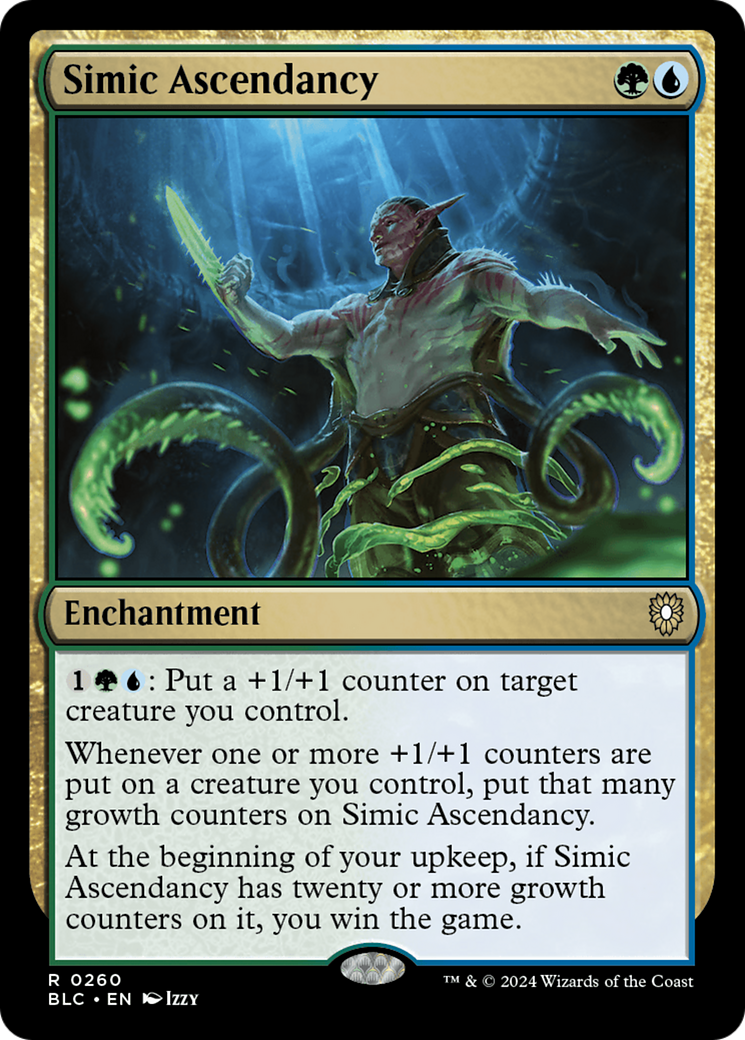
Simic Ascendancy
Simic Ascendancy
Enchantment
: Put a +1/+1 counter on target creature you control.
Whenever one or more +1/+1 counters are put on a creature you control, put that many growth counters on this enchantment.
At the beginning of your upkeep, if this enchantment has twenty or more growth counters on it, you win the game.
- An ability that triggers when counters are put on a permanent will trigger if that permanent somehow enters the battlefield with those counters.
- If Simic Ascendancy doesn't have twenty or more growth counters on it as your upkeep begins, its last ability won't trigger. You can't take any actions during your turn before your upkeep begins.
- If the last ability does trigger, but counters are removed from Simic Ascendancy so it has fewer than twenty remaining on it, you won't win the game.
- If the last ability does trigger, but Simic Ascendancy leaves the battlefield, use the number of counters it had on it immediately before it left the battlefield to determine whether you win the game.
-
1
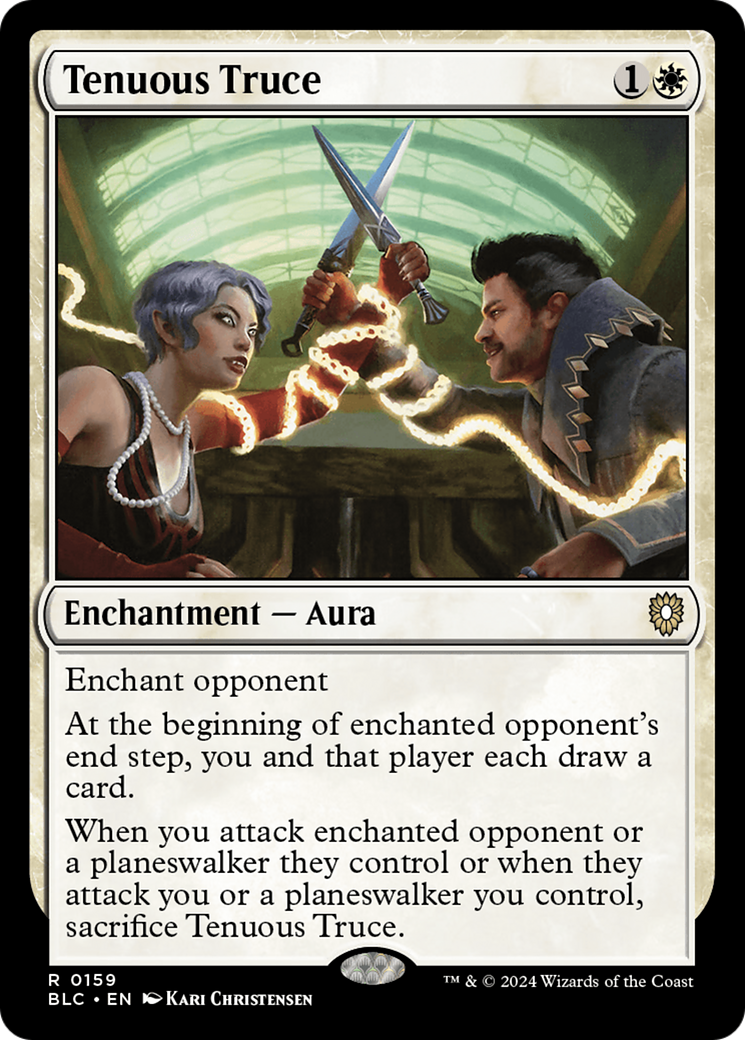
Tenuous Truce
Tenuous Truce
Enchantment — Aura
Enchant opponent
At the beginning of enchanted opponent's end step, you and that player each draw a card.
When you attack enchanted opponent or a planeswalker they control or when they attack you or a planeswalker you control, sacrifice this Aura.
-
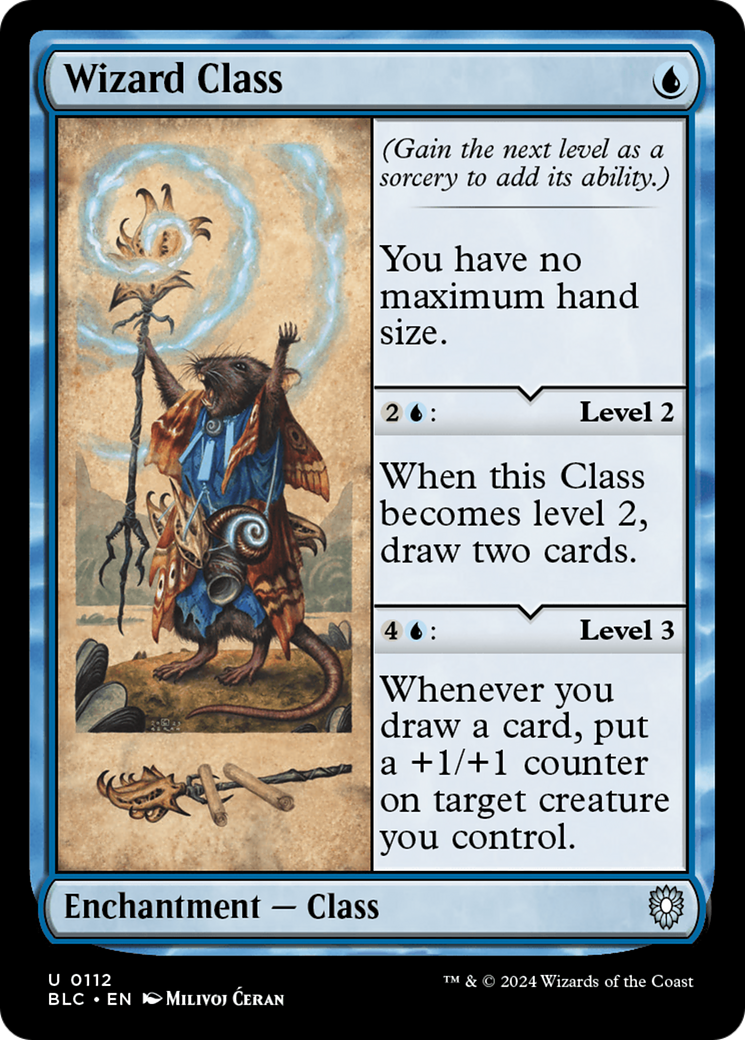
1
Wizard Class
Wizard Class
Enchantment — Class
(Gain the next level as a sorcery to add its ability.)
You have no maximum hand size.
: Level 2
When this Class becomes level 2, draw two cards.
: Level 3
Whenever you draw a card, put a +1/+1 counter on target creature you control.
- Each Class has five abilities. The three in the major sections of its text box are class abilities. Class abilities can be static, activated, or triggered abilities. The other two are level abilities, one activated ability to advance the Class to level 2 and another to advance the Class to level 3.
- Each Class starts with only the first of three class abilities. As the first level ability resolves, the Class becomes level 2 and gains the second class ability. As the second level ability resolves, the Class becomes level 3 and gains the third class ability.
- Gaining a level won't remove abilities that a Class had at a previous level.
- Gaining a level is a normal activated ability. It uses the stack and can be responded to.
- You can't activate the first level ability of a Class unless that Class is level 1. Similarly, you can't activate the second level ability of a Class unless that Class is level 2.
- You can multiclass or even control multiple Class enchantments of the same class. Each Class permanent tracks its own level separately.
- Some Class cards have an effect that increases when more are under your control. For example, if you have multiple Barbarian Class cards, you roll that many additional dice and ignore that many of the lowest rolls.
Lands 38
-
1
Adarkar Wastes
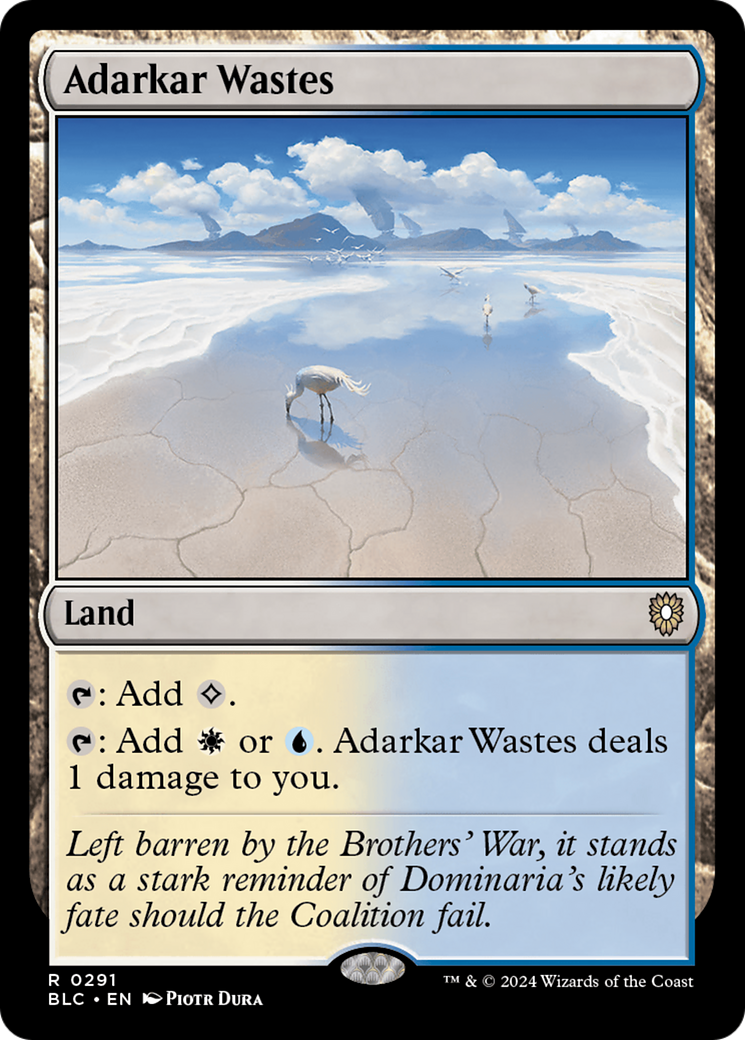
Adarkar Wastes
Land
: Add .
: Add or . This land deals 1 damage to you.
-
1
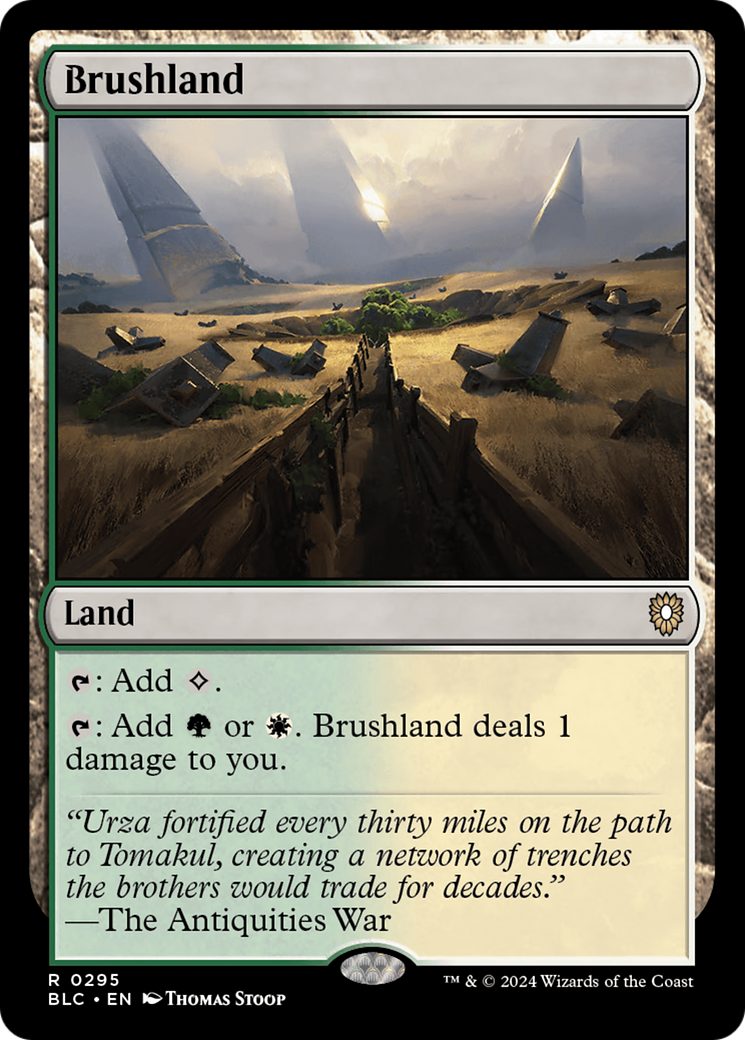
Brushland
Brushland
Land
: Add .
: Add or . This land deals 1 damage to you.
-
1
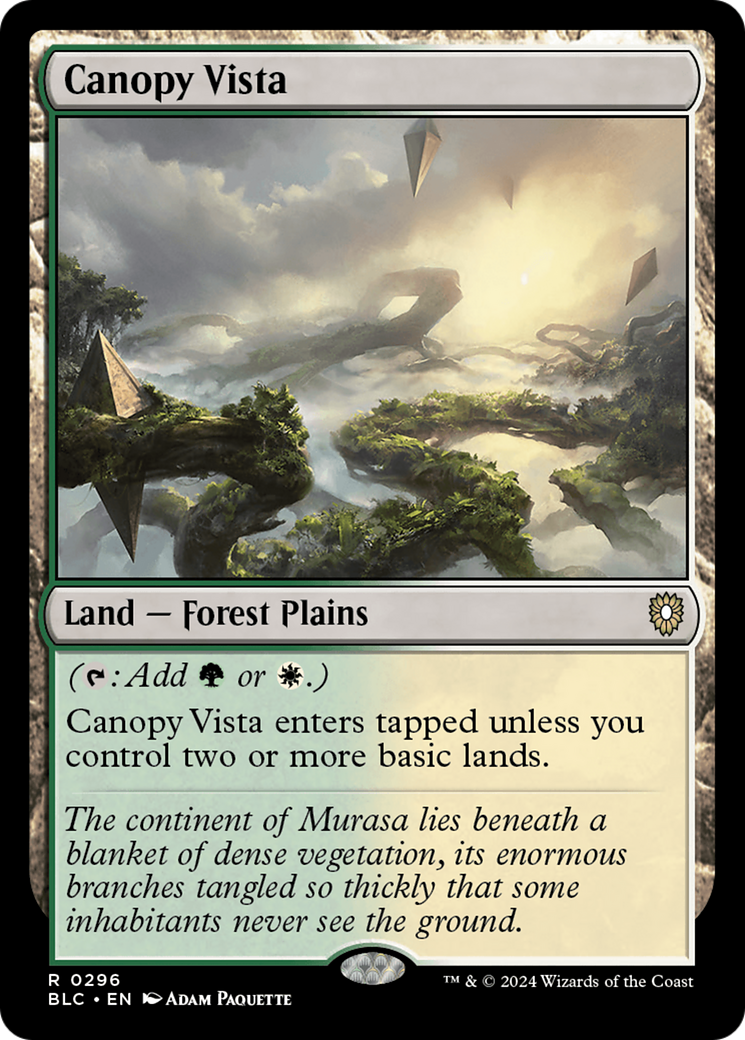
Canopy Vista
Canopy Vista
Land — Forest Plains
( : Add or .)
This land enters tapped unless you control two or more basic lands.
- Even though these lands have basic land types, they are not basic lands because "basic" doesn't appear on their type line. Notably, controlling two or more of them won't allow others to enter the battlefield untapped.
- However, because these cards have basic land types, effects that specify a basic land type without also specifying that the land be basic can affect them. For example, a spell or ability that reads "Destroy target Forest" can target Canopy Vista, while one that reads "Destroy target basic Forest" cannot.
- If one of these lands enters the battlefield at the same time as any number of basic lands, those other lands are not counted when determining if this land enters the battlefield tapped or untapped.
-
1
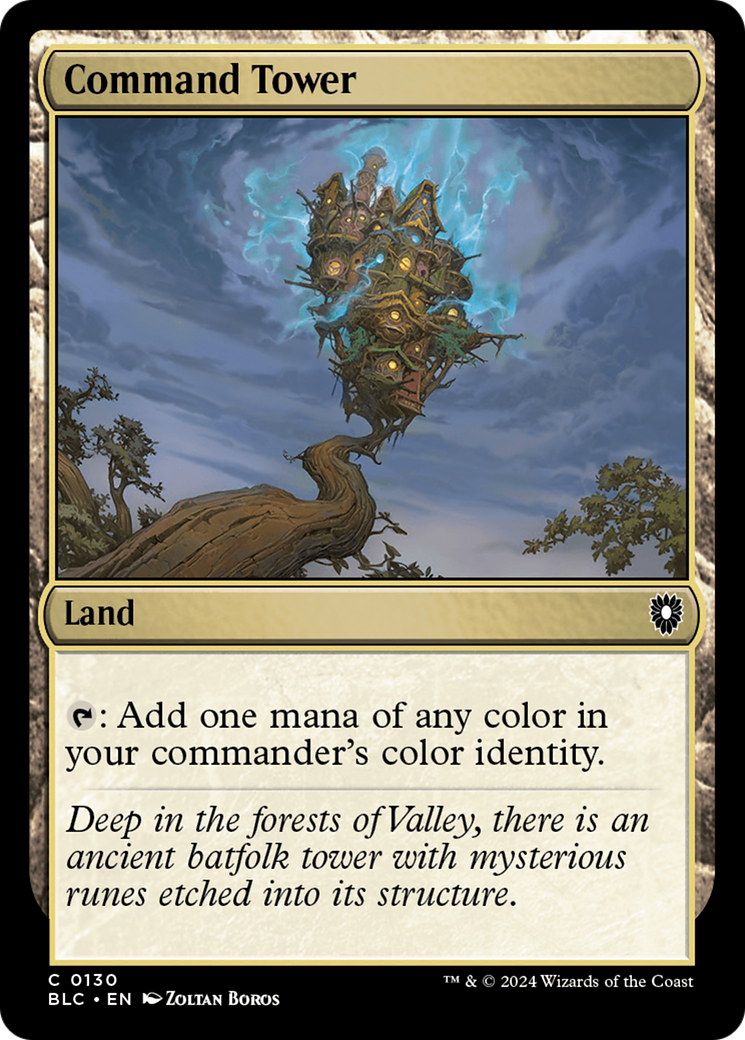
Command Tower
Command Tower
Land
: Add one mana of any color in your commander's color identity.
- If you have two commanders, the ability adds one mana of any color in their combined color identities.
- If your commander is a card that has no colors in its color identity, Command Tower's ability produces no mana. It doesn't produce .
- If you don't have a commander, Command Tower's ability produces no mana.
-
1
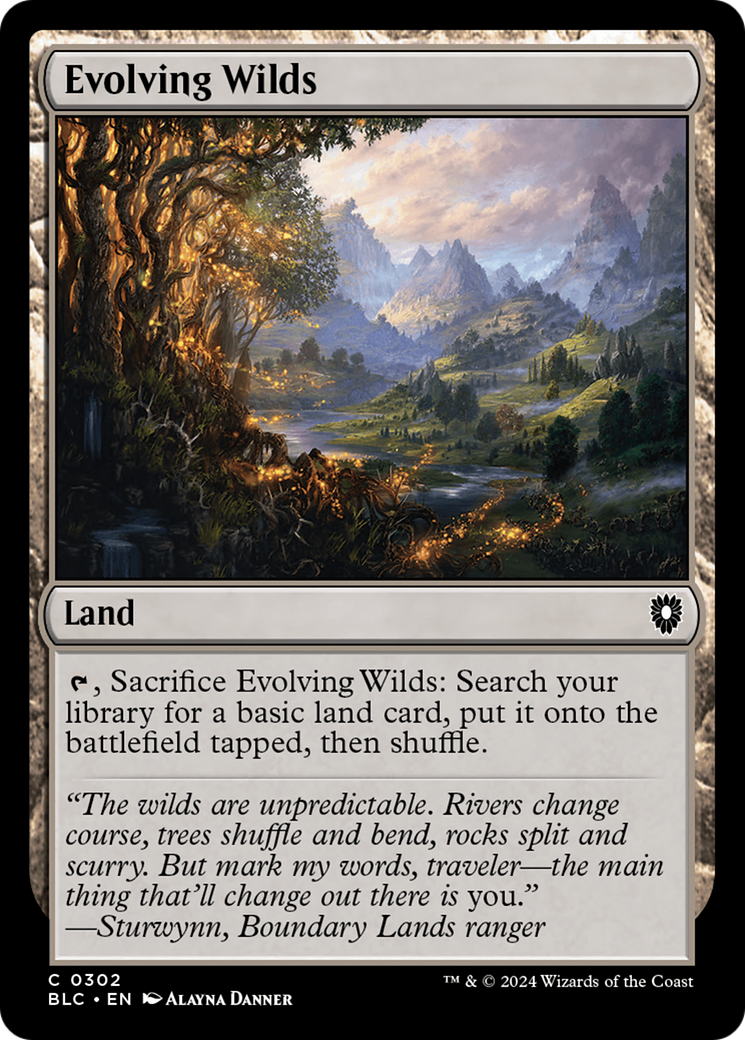
Evolving Wilds
Evolving Wilds
Land
, Sacrifice this land: Search your library for a basic land card, put it onto the battlefield tapped, then shuffle.
-
1
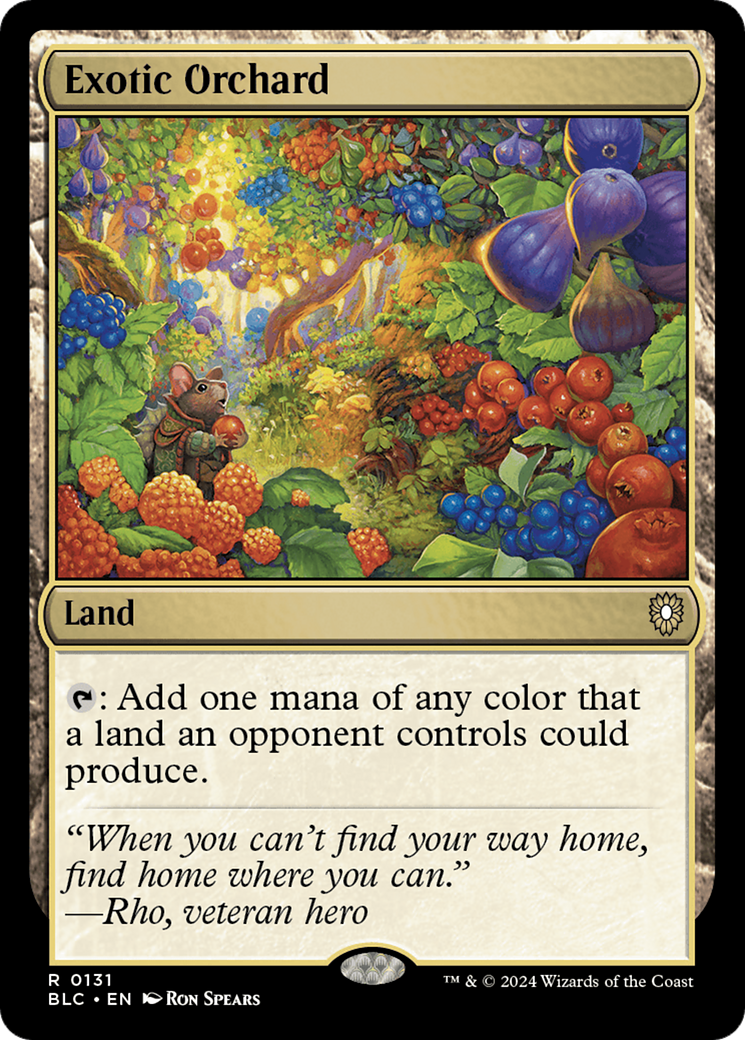
Exotic Orchard
Exotic Orchard
Land
: Add one mana of any color that a land an opponent controls could produce.
- The colors of mana are white, blue, black, red, and green. Exotic Orchard can't be tapped for colorless mana, even if a land an opponent controls could produce colorless mana.
- Exotic Orchard checks the effects of all mana-producing abilities of lands your opponents control, but it doesn't check their costs. For example, Vivid Crag has the ability " , Remove a charge counter from Vivid Crag: Add one mana of any color." If an opponent controls Vivid Crag and you control Exotic Orchard, you can tap Exotic Orchard for any color of mana. It doesn't matter whether Vivid Crag has a charge counter on it, and it doesn't matter whether it's untapped.
- When determining what colors of mana your opponents' lands could produce, Exotic Orchard takes into account any applicable replacement effects that would apply to those lands' mana abilities (such as Contamination's effect, for example). If there are more than one, consider them in any possible order.
- Exotic Orchard doesn't care about any restrictions or riders your opponents' lands (such as Ancient Ziggurat or Hall of the Bandit Lord) put on the mana they produce. It just cares about colors of mana.
- Lands that produce mana based only on what other lands "could produce" won't help each other unless some other land allows one of them to actually produce some type of mana. For example, if you control an Exotic Orchard and your opponent controls an Exotic Orchard and a Reflecting Pool, none of those lands would produce mana if their mana abilities were activated. On the other hand, if you control a Forest and an Exotic Orchard, and your opponent controls an Exotic Orchard and a Reflecting Pool, then each of those lands can be tapped to produce . Your opponent's Exotic Orchard can produce because you control a Forest. Your Exotic Orchard and your opponent's Reflecting Pool can each produce because your opponent's Exotic Orchard can produce .
-
1
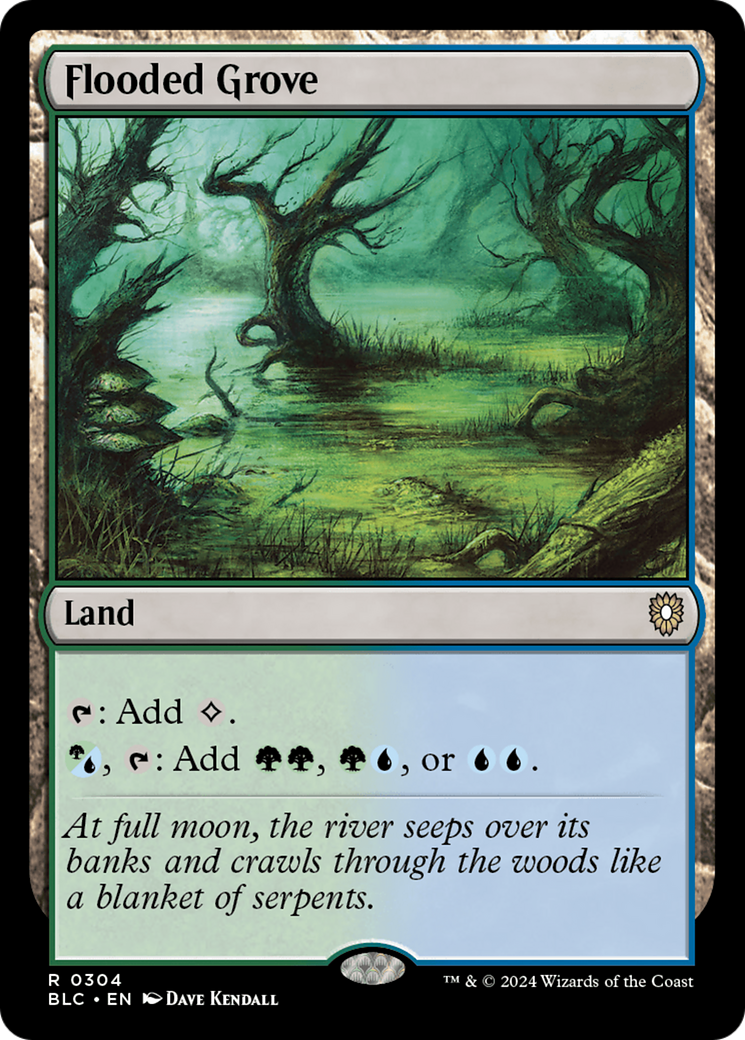
Flooded Grove
Flooded Grove
Land
: Add .
, : Add , , or .
-
4
Forest
Forest
Basic Land — Forest
( : Add .)
-
1
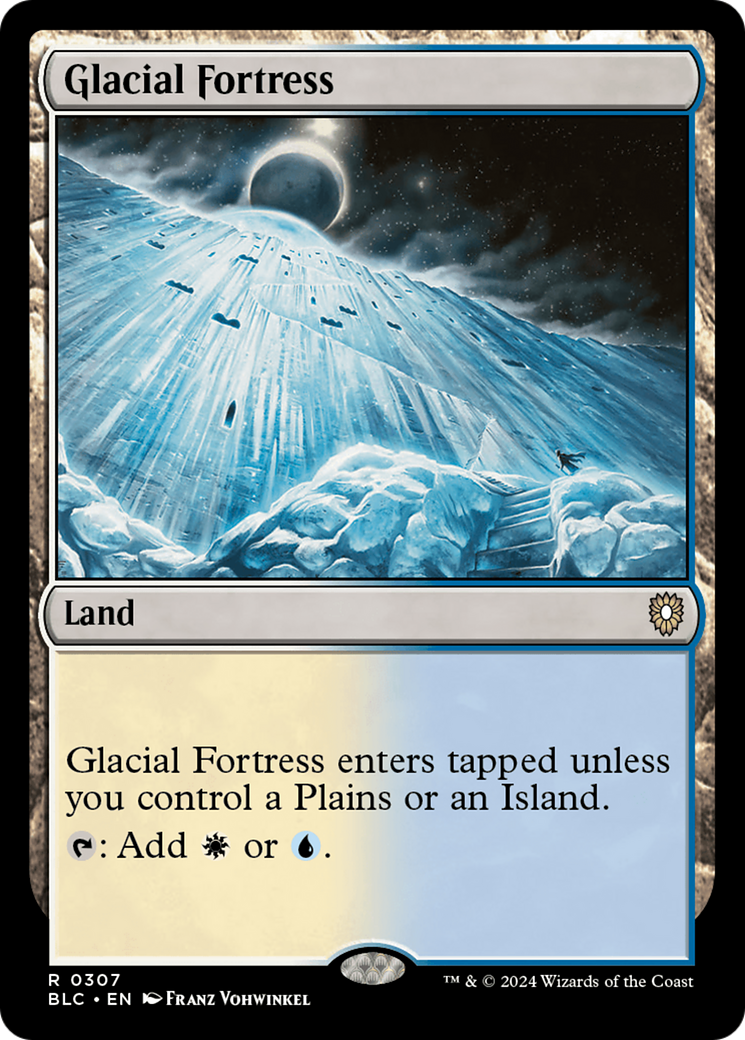
Glacial Fortress
Glacial Fortress
Land
This land enters tapped unless you control a Plains or an Island.
: Add or .
- This checks for lands you control with the land type Plains or Island, not for lands named Plains or Island. The lands it checks for don't have to be basic lands. For example, if you control Watery Grave (a nonbasic land with the land types Island and Swamp), Glacial Fortress will enter untapped.
- As this is entering, it checks for lands that are already on the battlefield. It won't see lands that are entering at the same time (due to Warp World, for example).
-
1
Hinterland Harbor
Hinterland Harbor
Land
This land enters tapped unless you control a Forest or an Island.
: Add or .
-
4
Island
Island
Basic Land — Island
( : Add .)
-
1
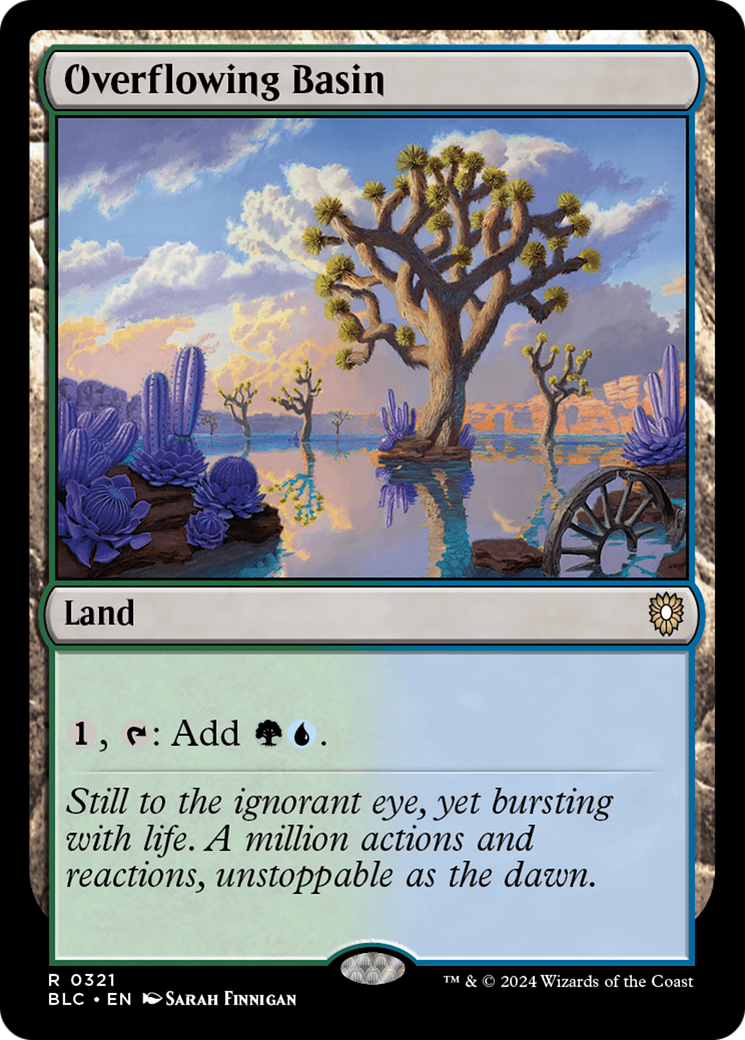
Overflowing Basin
Overflowing Basin
Land
, : Add .
-
4
Plains
Plains
Basic Land — Plains
( : Add .)
-
1
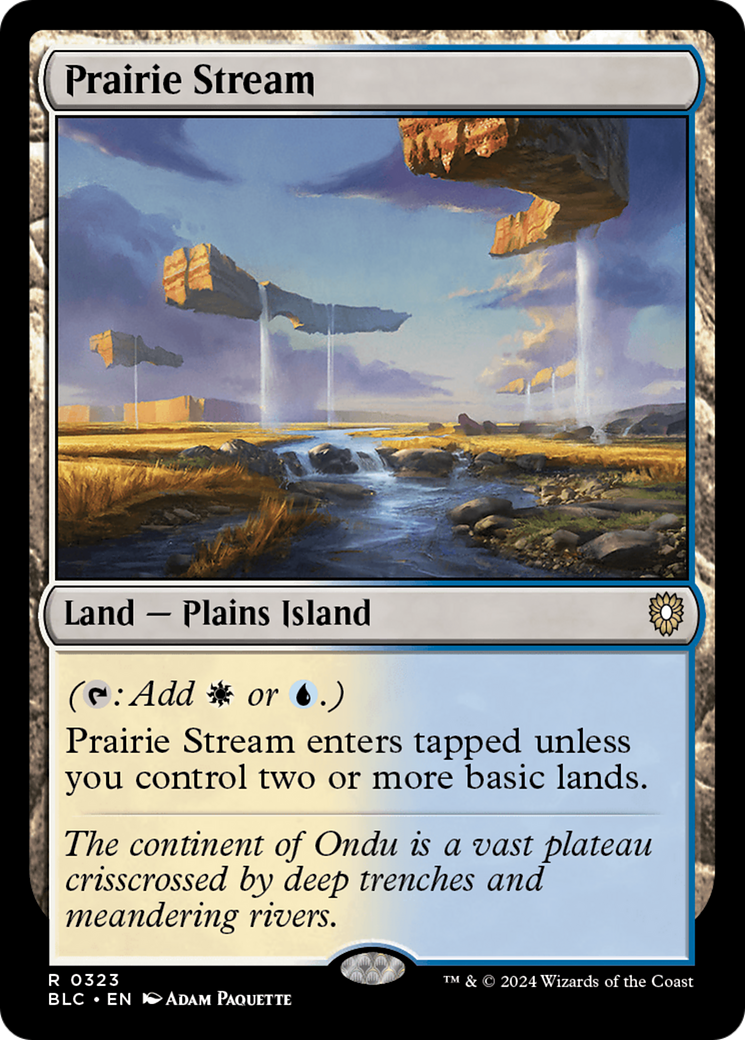
Prairie Stream
Prairie Stream
Land — Plains Island
( : Add or .)
This land enters tapped unless you control two or more basic lands.
- Even though these lands have basic land types, they are not basic lands because "basic" doesn't appear on their type line. Notably, controlling two or more of them won't allow others to enter the battlefield untapped.
- However, because these cards have basic land types, effects that specify a basic land type without also specifying that the land be basic can affect them. For example, a spell or ability that reads "Destroy target Forest" can target Canopy Vista, while one that reads "Destroy target basic Forest" cannot.
- If one of these lands enters the battlefield at the same time as any number of basic lands, those other lands are not counted when determining if this land enters the battlefield tapped or untapped.
-
1
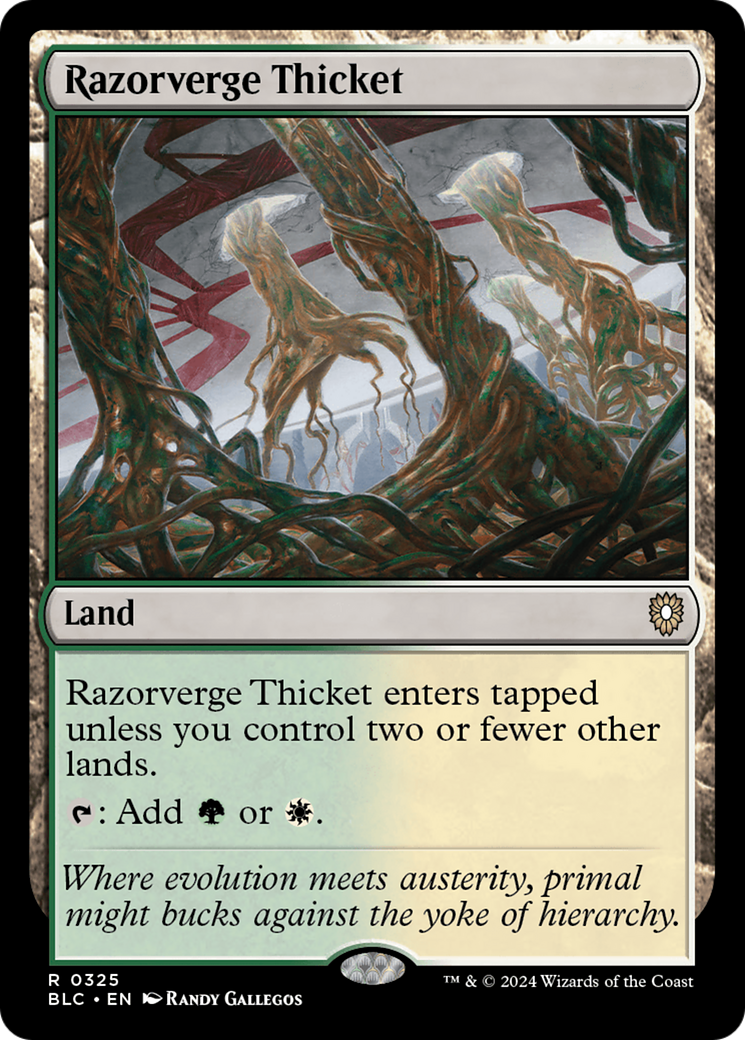
Razorverge Thicket
Razorverge Thicket
Land
This land enters tapped unless you control two or fewer other lands.
: Add or .
- If one of these lands enters the battlefield under your control and you control zero, one, or two other lands, it enters the battlefield untapped. If you control three or more other lands, however, it enters the battlefield tapped.
- If one of these lands enters the battlefield at the same time as one or more other lands (due to Oblivion Sower or Warp World, perhaps), it doesn't take those lands into consideration when determining how many other lands you control.
-
1
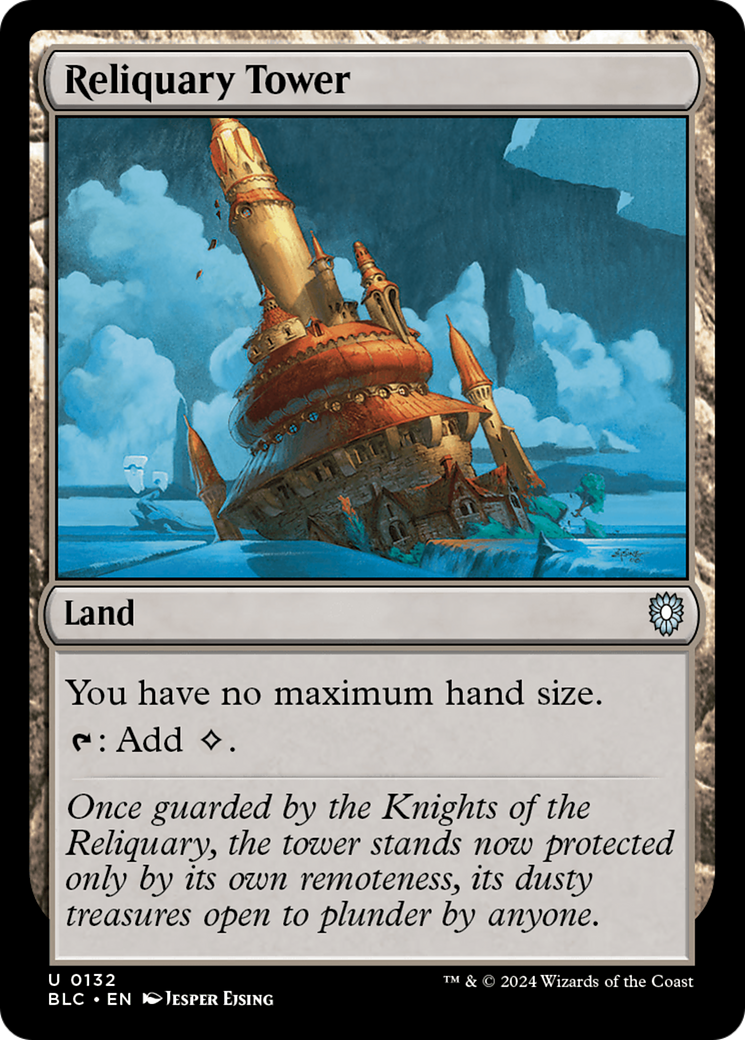
Reliquary Tower
Reliquary Tower
Land
You have no maximum hand size.
: Add .
- If multiple effects modify your hand size, apply them in timestamp order. For example, if you put Null Profusion (an enchantment that says your maximum hand size is two) onto the battlefield and then put Reliquary Tower onto the battlefield, you'll have no maximum hand size. However, if those permanents enter in the opposite order, your maximum hand size would be two.
-
1
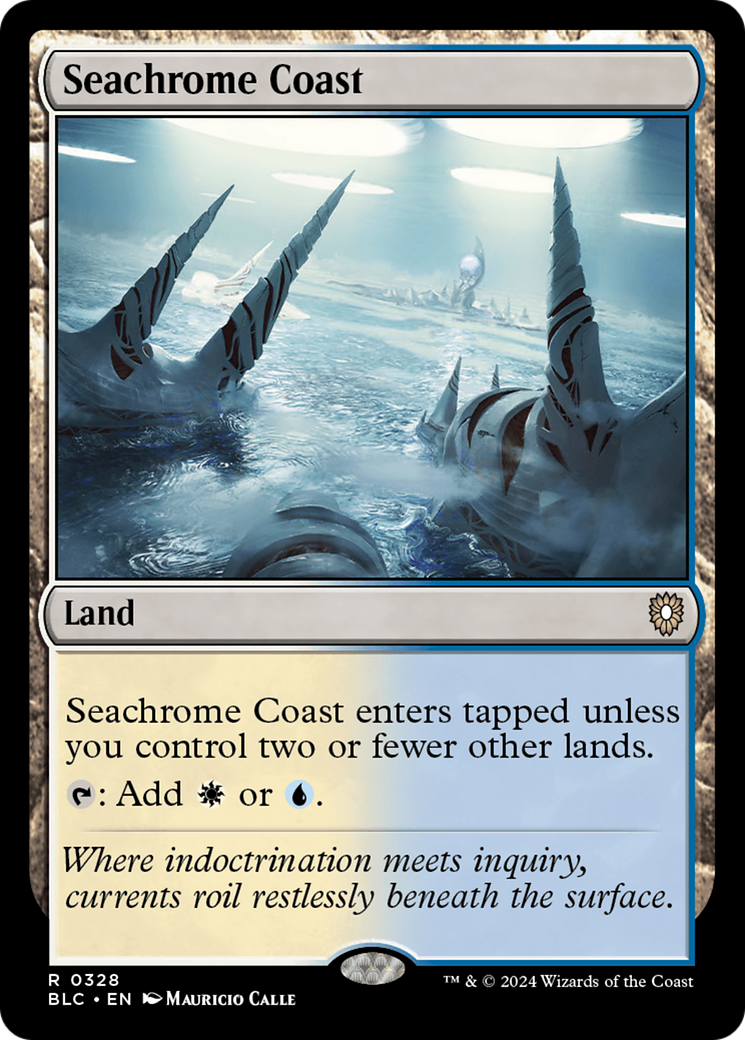
Seachrome Coast
Seachrome Coast
Land
This land enters tapped unless you control two or fewer other lands.
: Add or .
- If one of these lands enters the battlefield under your control and you control zero, one, or two other lands, it enters the battlefield untapped. If you control three or more other lands, however, it enters the battlefield tapped.
- If one of these lands enters the battlefield at the same time as one or more other lands (due to Oblivion Sower or Warp World, perhaps), it doesn't take those lands into consideration when determining how many other lands you control.
-
1
Seaside Citadel
Seaside Citadel
Land
This land enters tapped.
: Add , , or .
-
1
Skycloud Expanse
Skycloud Expanse
Land
, : Add .
-
1
Sungrass Prairie
Sungrass Prairie
Land
, : Add .
-
1
Sunpetal Grove
Sunpetal Grove
Land
This land enters tapped unless you control a Forest or a Plains.
: Add or .
- This checks for lands you control with the land type Forest or Plains, not for lands named Forest or Plains. The lands it checks for don't have to be basic lands. For example, if you control Hallowed Fountain (a nonbasic land with the land types Plains and Island), Sunpetal Grove will enter untapped.
- As this is entering, it checks for lands that are already on the battlefield. It won't see lands that are entering at the same time (due to Warp World, for example).
-
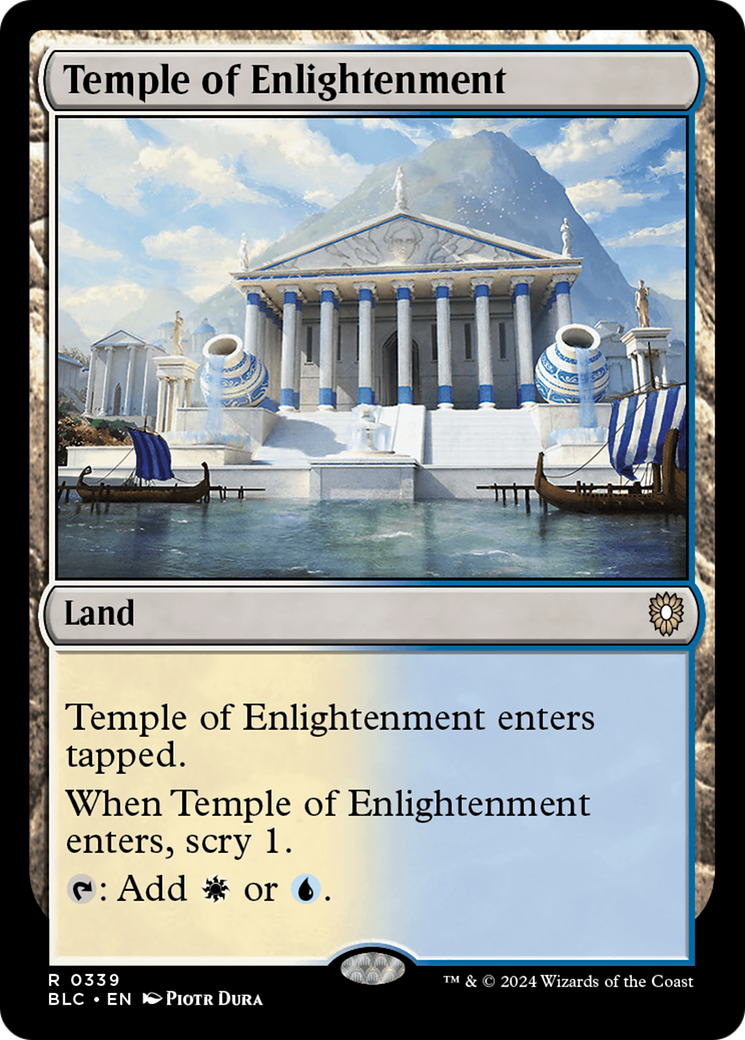
1
Temple of Enlightenment
Temple of Enlightenment
Land
This land enters tapped.
When this land enters, scry 1. (Look at the top card of your library. You may put that card on the bottom.)
: Add or .
- When you scry, you may put all the cards you look at back on top of your library, you may put all of those cards on the bottom of your library, or you may put some of those cards on top and the rest of them on the bottom.
- You choose how to order cards returned to your library after scrying no matter where you put them.
- You perform the actions stated on a card in sequence. For some spells and abilities, that means you'll scry last. For others, that means you'll scry and then perform other actions.
- Scry appears on some spells and abilities with one or more targets. If all of the spell or ability's targets are illegal when it tries to resolve, it won't resolve and none of its effects will happen. You won't scry.
-
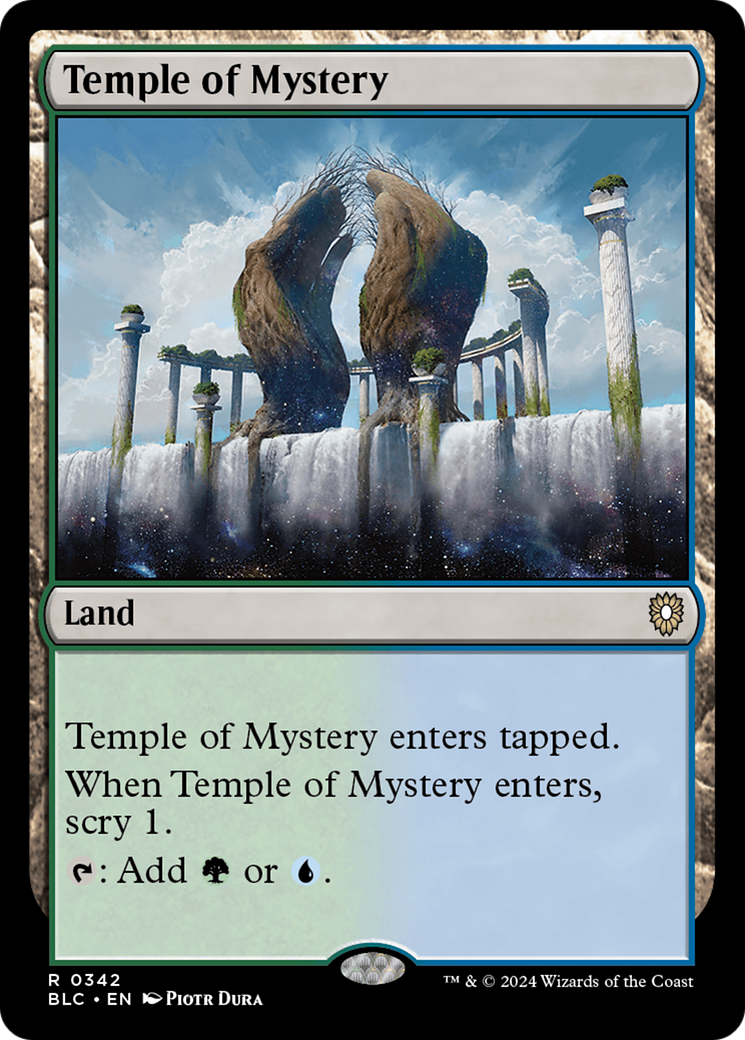
1
Temple of Mystery
Temple of Mystery
Land
This land enters tapped.
When this land enters, scry 1. (Look at the top card of your library. You may put that card on the bottom.)
: Add or .
- When you scry, you may put all the cards you look at back on top of your library, you may put all of those cards on the bottom of your library, or you may put some of those cards on top and the rest of them on the bottom.
- You choose how to order cards returned to your library after scrying no matter where you put them.
- You perform the actions stated on a card in sequence. For some spells and abilities, that means you'll scry last. For others, that means you'll scry and then perform other actions.
- Scry appears on some spells and abilities with one or more targets. If all of the spell or ability's targets are illegal when it tries to resolve, it won't resolve and none of its effects will happen. You won't scry.
-
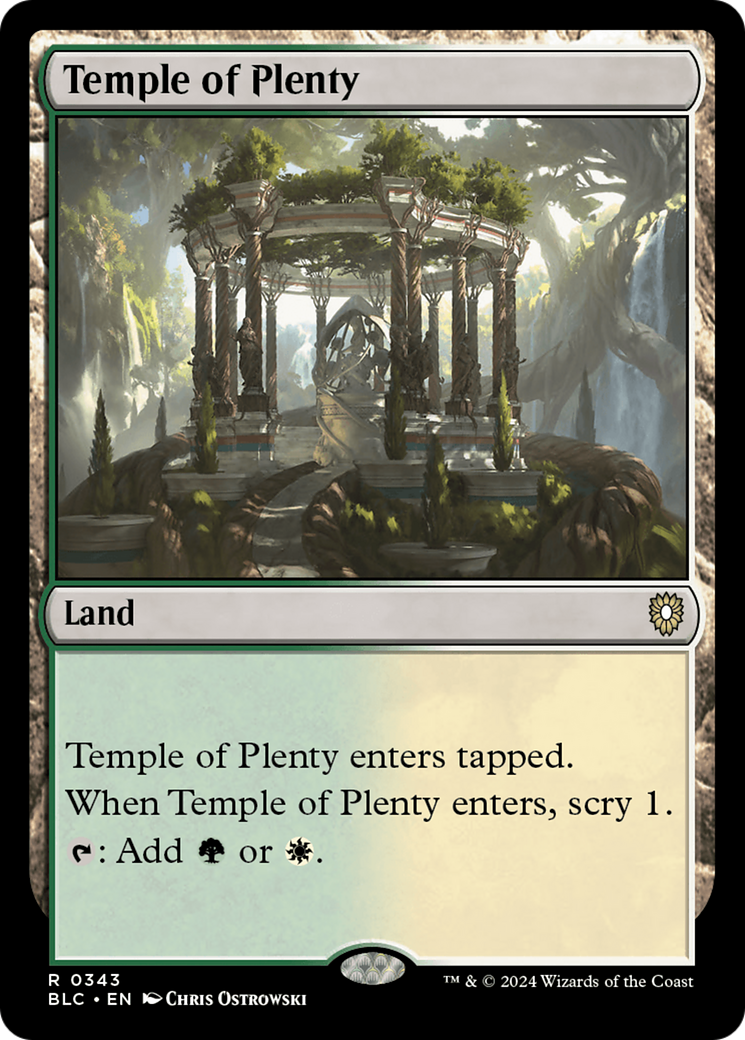
1
Temple of Plenty
Temple of Plenty
Land
This land enters tapped.
When this land enters, scry 1. (Look at the top card of your library. You may put that card on the bottom.)
: Add or .
- You perform the actions stated on a card in sequence. For some spells and abilities, that means you'll scry last. For others, that means you'll scry and then perform other actions.
- You choose how to order cards returned to your library after scrying no matter where you put them.
- When you scry, you may put all the cards you look at back on top of your library, you may put all of those cards on the bottom of your library, or you may put some of those cards on top and the rest of them on the bottom.
- Scry appears on some spells and abilities with one or more targets. If all of the spell or ability's targets are illegal when it tries to resolve, it won't resolve and none of its effects will happen. You won't scry.
-
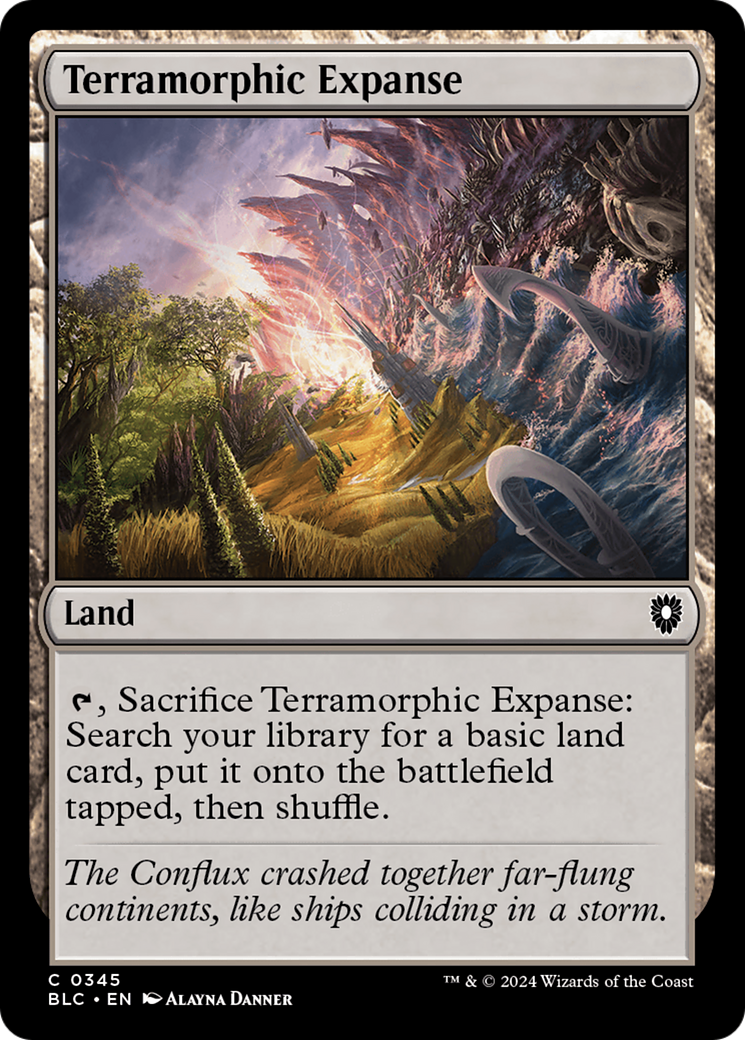
1
Terramorphic Expanse
Terramorphic Expanse
Land
, Sacrifice this land: Search your library for a basic land card, put it onto the battlefield tapped, then shuffle.
-
1
Thriving Grove
Thriving Grove
Land
This land enters tapped. As it enters, choose a color other than green.
: Add or one mana of the chosen color.
-
1
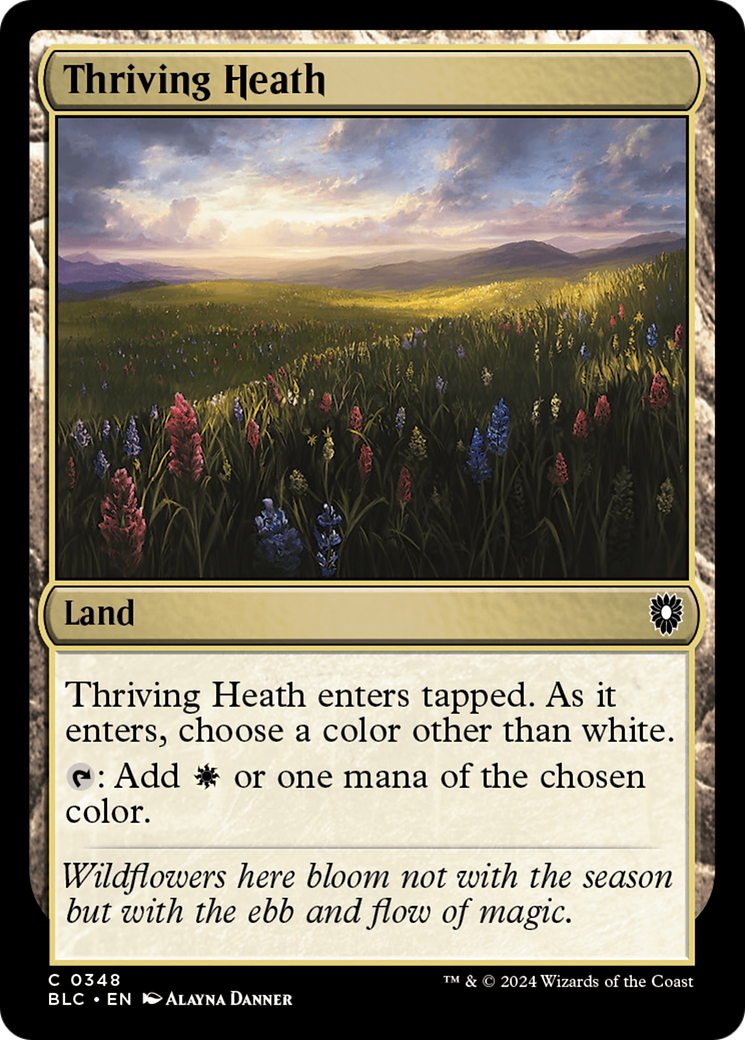
Thriving Heath
Thriving Heath
Land
This land enters tapped. As it enters, choose a color other than white.
: Add or one mana of the chosen color.
-
1
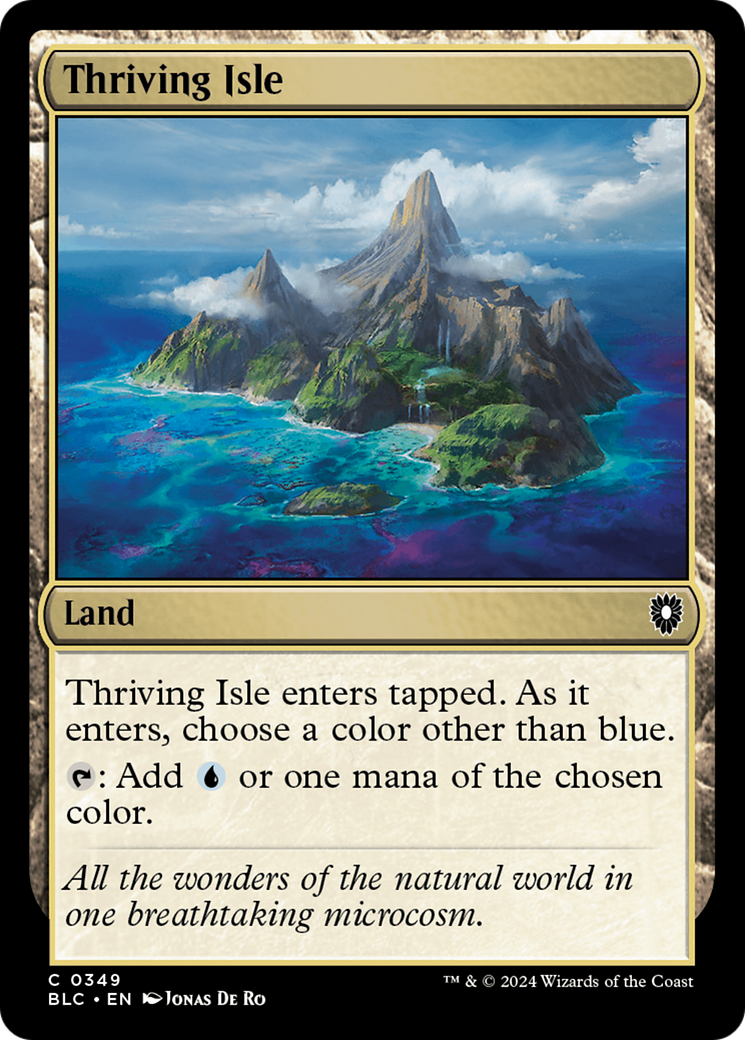
Thriving Isle
Thriving Isle
Land
This land enters tapped. As it enters, choose a color other than blue.
: Add or one mana of the chosen color.
-
1
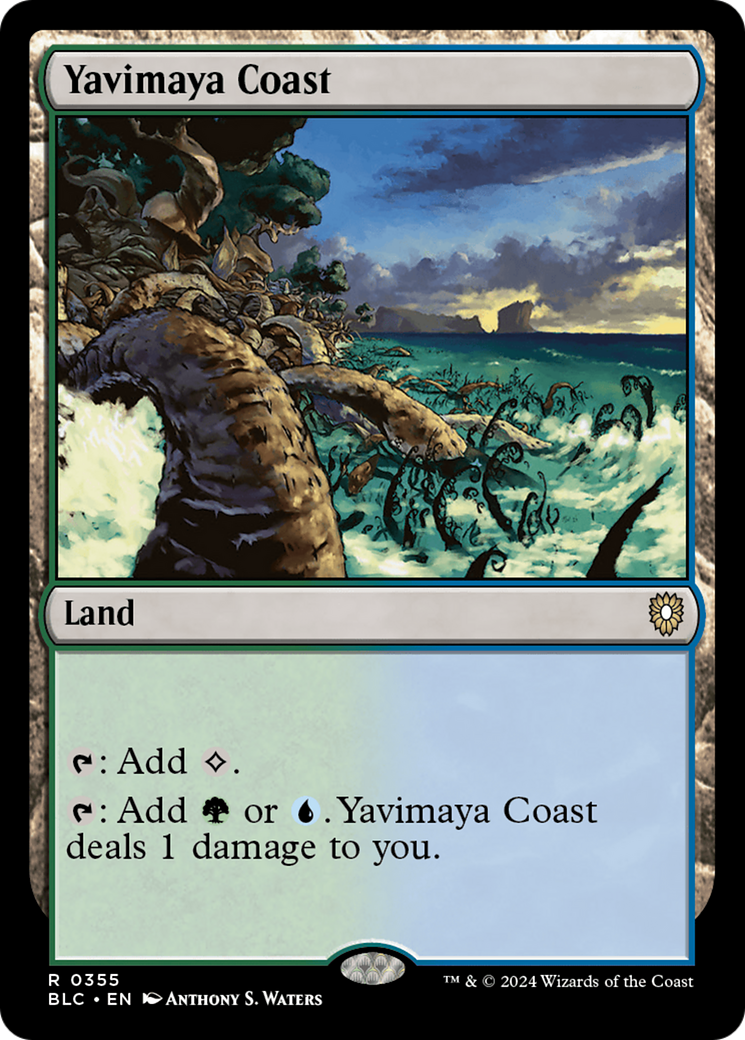
Yavimaya Coast
Yavimaya Coast
Land
: Add .
: Add or . This land deals 1 damage to you.
- The damage dealt to you is part of the second mana ability. It doesn't use the stack and can't be responded to.
- Like most lands, each land in this cycle is colorless. The damage dealt to you is dealt by a colorless source.
White 17
-
1
Baird, Steward of Argive
Baird, Steward of Argive
Legendary Creature — Human Soldier
2/4
Vigilance
Creatures can't attack you or planeswalkers you control unless their controller pays for each of those creatures.
- If you control Baird, your opponents can choose not to pay to attack with a creature that attacks "if able." If there's no other player, planeswalker, or battle to attack, that creature simply doesn't attack.
- In a Two-Headed Giant game, creatures can attack your teammate and planeswalkers your teammate controls without requiring a mana payment. This is a change from previous rules.
-
1
Generous Gift
Generous Gift
Instant
Destroy target permanent. Its controller creates a 3/3 green Elephant creature token.
- If the target permanent is an illegal target by the time Generous Gift tries to resolve, the spell doesn't resolve. No player creates an Elephant. If the target is legal but not destroyed (most likely because it has indestructible), its controller does create an Elephant.
-
1
Hoofprints of the Stag
Hoofprints of the Stag
Kindred Enchantment — Elemental
Whenever you draw a card, you may put a hoofprint counter on this enchantment.
, Remove four hoofprint counters from this enchantment: Create a 4/4 white Elemental creature token with flying. Activate only during your turn.
- This cards was originally printed with the "tribal" card type. That card type has been replaced with "kindred". This change does not affect the gameplay function of this card.
- Kindred is a card type that allows noncreature cards to have creature types. For example, Echoes of Eternity is an Eldrazi (although not a creature) while on the battlefield and an Eldrazi card (although not a creature card) in zones other than the battlefield.
- While it appears only on cards that already have other card types, kindred is a card type and will be counted by effects that refer to the number of card types among cards in a zone.
- If a spell or ability has you draw multiple cards, Hoofprints of the Stag's ability triggers that many times.
-
1
Jolly Gerbils
Jolly Gerbils
Creature — Hamster Citizen
2/3
Whenever you give a gift, draw a card.
- The ability of Jolly Gerbils triggers when the gift is actually given. For permanent spells, that happens when the gift triggered ability resolves. For instants and sorceries, that happens when the spell resolves. It doesn’t matter if a replacement effect causes the gift you gave to become something else or if a static effect stops the player from receiving that gift.
-
1
Loran of the Third Path
Loran of the Third Path
Legendary Creature — Human Artificer
2/1
Vigilance
When Loran enters, destroy up to one target artifact or enchantment.
: You and target opponent each draw a card.
-
1
Mangara, the Diplomat
Mangara, the Diplomat
Legendary Creature — Human Cleric
2/4
Lifelink
Whenever an opponent attacks with creatures, if two or more of those creatures are attacking you and/or planeswalkers you control, draw a card.
Whenever an opponent casts their second spell each turn, draw a card.
- If some of the attacking creatures leave the battlefield while Mangara's triggered ability is on the stack, use the player or planeswalker they were attacking before they left to determine whether you draw a card. On the other hand, if they're removed from combat without leaving the battlefield, use their current information to determine that they're not attacking you or a planeswalker you control anymore.
- If your opponent attacks you with one creature and your planeswalker with another, you draw a card.
- You draw just one card, no matter how many creatures are attacking you and your planeswalkers beyond the second.
- An ability that triggers when a player casts a spell resolves before the spell that caused it to trigger. It resolves even if that spell is countered.
- Players can cast spells and activate abilities after the triggered ability resolves but before the spell that caused it to trigger does.
-
1
Martial Impetus
Martial Impetus
Enchantment — Aura
Enchant creature
Enchanted creature gets +1/+1 and is goaded. (It attacks each combat if able and attacks a player other than you if able.)
Whenever enchanted creature attacks, each other creature that's attacking one of your opponents gets +1/+1 until end of turn.
- If, during a player's declare attackers step, a creature that player controls that's been goaded is tapped, is affected by a spell or ability that says it can't attack, or hasn't been under that player's control continuously since the turn began (and doesn't have haste), then it doesn't attack. If there's a cost associated with having a creature attack a player, its controller isn't forced to pay that cost, so it doesn't have to attack that player.
- If the creature doesn't meet any of the above exceptions and can attack, it must attack a player other than the controller of the spell or ability that goaded it if able. If the creature can't attack any of those players but could otherwise attack, it must attack a planeswalker an opponent controls, a battle an opponent controls, or a player who goaded it.
- Being goaded isn't an ability the creature has. Once it's been goaded, it must attack as detailed above even if it loses all abilities.
- Attacking with a goaded creature doesn't cause it to stop being goaded. If there is an additional combat phase that turn, or if another player gains control of it before it stops being goaded, it must attack again if able.
- If a creature you control has been goaded by multiple opponents, it must attack one of your opponents that hasn't goaded it, as that fulfills the maximum number of goad requirements. If a creature you control has been goaded by each of your opponents, the creature must attack an opponent (rather than a planeswalker or battle), but you choose which opponent it attacks.
-
1
Perch Protection
Perch Protection
Instant
Gift an extra turn (You may promise an opponent a gift as you cast this spell. If you do, they take an extra turn after this one.)
Create four 2/2 blue Bird creature tokens with flying. If the gift was promised, all permanents you control phase out, and until your next turn, your life total can't change and you gain protection from everything.
Exile Perch Protection.
- If your life total can't change, spells and abilities that would normally cause you to gain or lose life still resolve while your life total can't change, but the life-gain or life-loss part simply has no effect.
- If your life total can't change, you can't pay a cost that includes the payment of any amount of life other than 0 life. Similarly, if a cost includes causing you to gain life (like the alternative cost of an opponent's Invigorate does), that cost can't be paid.
- If your life total can't change, effects that would replace having you gain life with some other event won't be able to be applied because it's impossible for you to gain life. The same is true for effects that would replace having you lose life with some other event.
- If your life total can't change, effects that replace an event with having you gain life (like Words of Worship's effect does) or having you lose life will apply and end up replacing the event with nothing.
- If your life total can't change and an effect would set your life total to a specific number that's different from your current life total, that part of the effect won't do anything. Similarly, if an effect would cause you to exchange life totals with another player, the exchange won't happen, and neither player's life total will change.
- If a player has protection from everything, it means three things: 1) All damage that would be dealt to that player is prevented. 2) Auras can't be attached to that player. 3) That player can't be the target of spells or abilities.
- Nothing other than the specified events are prevented or illegal. An effect that doesn't target you could still cause you to discard cards, for example. Creatures can still attack you while you have protection from everything, although combat damage that they would deal to you will be prevented.
- Gaining protection from everything causes a spell or ability on the stack to have an illegal target if it targets you. As a spell or ability tries to resolve, if all its targets are illegal, that spell or ability doesn't resolve and none of its effects happen, including effects unrelated to the target. If at least one target is still legal, the spell or ability does as much as it can to the remaining legal targets, and its other effects still happen.
- Protection from everything will usually prevent damage if it would be dealt to you, but some damage can't be prevented. In this case, because your life total also can't change, that damage has any other effects that it may have aside from causing you to lose that much life (such as effects from lifelink or infect) and triggers and effects can see that damage was dealt even though your life total didn't change.
- While a permanent is phased out, it's treated as though it doesn't exist. It can't be the target of spells or abilities, its static abilities have no effect on the game, its triggered abilities can't trigger, it can't attack or block, and so on.
- Phasing out doesn't cause any "leaves the battlefield" abilities to trigger. Similarly, phasing in won't cause any "enters" abilities to trigger.
- Any one-shot effects that are waiting "until [this] leaves the battlefield," such as that of Banishing Light, won't happen when a permanent phases out.
- Any continuous effects with a "for as long as" duration such as that of Mathas, Fiend Seeker ignore phased-out objects. Any such effects will expire if their conditions are no longer met after ignoring the phased-out objects.
- Each Aura and Equipment that phases out attached to a permanent that's phasing out phases in with that permanent and still attached to it.
- Each Aura and Equipment you control attached to a permanent that isn't phasing out phases in attached to that permanent if it can still be attached to that permanent. If not, it phases in unattached. An Aura that phases in unattached will be put into its owner's graveyard as a state-based action. The same is true with Auras attached to players.
- Permanents that phase out with counters phase in with those counters.
- Choices made for permanents as they entered are remembered when they phase in.
- If a token is phased out, it will phase in as your next untap step begins.
- A permanent phasing out causes a spell or ability on the stack to have an illegal target if it targets that permanent. As a spell or ability tries to resolve, if all its targets are illegal, that spell or ability doesn't resolve and none of its effects happen, including effects unrelated to the target. If at least one target is still legal, the spell or ability does as much as it can to the remaining legal targets, and its other effects still happen.
- If your untap step is somehow skipped as your next turn begins, your phased-out permanents won't phase in until the next untap step you actually have, but you'll no longer have protection from everything and your life total can change again.
- Any creatures that phase in under your control as your next untap step begins will be able to attack and pay a cost of during that turn.
- If you gain control of another player's permanent and it phases out, if the duration of the control-change effect expires before it phases in, that permanent phases in under that other player's control as your next untap step begins. If you leave the game before your next untap step, it phases in as the next untap step begins after your turn would have begun.
- As an additional cost to cast a spell with gift, you can promise the listed gift to an opponent. That opponent is chosen as part of that additional cost. The gift isn't given at this time; rather, it's given at a later time based on whether or not the spell is a permanent spell.
- For permanent spells with gift, an ability triggers when that permanent enters if the gift was promised. When that ability resolves, the gift is given to the appropriate opponent.
- For instants and sorceries with gift, the gift is given to the appropriate opponent as part of the resolution of the spell. This happens before any of the spell's other effects would take place.
- If a spell for which the gift was promised is countered, doesn't resolve (perhaps because all of its targets are illegal), or is otherwise removed from the stack, the gift won't be given. None of its other effects will happen either.
- You can't pay a gift cost more than once.
- If you copy a spell for which the gift was promised, the gift was also promised to the same opponent for the copy. If a card or token enters as a copy of a permanent that's already on the battlefield, the gift isn't promised for that new permanent, even if it was promised for the original.
- Some instant or sorcery spells require alternative or additional targets if the gift was promised. You ignore these targeting requirements if the gifts aren't promised for those spells. On the other hand, you can promise a gift for a permanent spell even if you won't be able to choose targets for an enters ability of that permanent once the spell resolves.
- In the main set, there are four different kinds of gifts. "Gift a Food" causes the chosen opponent to create a Food token, while "Gift a Treasure" causes the chosen opponent to create a Treasure token. "Gift a card" causes them to draw a card, and "Gift a tapped Fish" causes them to create a tapped 1/1 blue Fish creature token. The Commander decks contain two more kinds of gifts: "Gift an Octopus," which causes the chosen opponent to create an 8/8 blue Octopus creature token, and "Gift an extra turn," which causes them to take an extra turn after the current turn ends.
-
1
Promise of Loyalty
Promise of Loyalty
Sorcery
Each player puts a vow counter on a creature they control and sacrifices the rest. Each of those creatures can't attack you or planeswalkers you control for as long as it has a vow counter on it.
- Each player, including you, must put a vow counter on a creature they control if able. They can't choose to opt out and sacrifice all of their creatures. The creature you put a vow counter on will remember its promise if another player gains control of it.
- If the vow counter is removed from the creature, it can attack as normal.
- If the vow counter is moved to another creature, it won't prevent the second creature from attacking normally.
-
1
Realm-Cloaked Giant // Cast Off
//
Realm-Cloaked Giant
Creature — Giant
7/7
- An adventurer card is a permanent card in every zone except the stack, as well as while on the stack if not cast as an Adventure. Ignore its alternative characteristics in those cases. For example, while it's in your graveyard, Giant Killer is a white creature card whose mana value is 1. It can't be the target of the triggered ability of Mystic Sanctuary.
- When casting a spell as an Adventure, use the alternative characteristics and ignore all of the card's normal characteristics. The spell's color, mana cost, mana value, and so on are determined by only those alternative characteristics. If the spell leaves the stack, it immediately resumes using its normal characteristics.
- If you cast an adventurer card as an Adventure, use only its alternative characteristics to determine whether it's legal to cast that spell. For example, if Giant Killer is exiled with the last ability of Vivien, Champion of the Wilds, you can't cast it as Chop Down.
- If a spell is cast as an Adventure, its controller exiles it instead of putting it into its owner's graveyard as it resolves. For as long as it remains exiled, that player may cast it as a permanent spell. If an Adventure spell leaves the stack in any way other than resolving (most likely by being countered or by failing to resolve because its targets have all become illegal), that card won't be exiled and the spell's controller won't be able to cast it as a permanent later.
- If an adventurer card ends up in exile for any other reason than by exiling itself while resolving, it won't give you permission to cast it as a permanent spell.
- You must still follow any timing restrictions and permissions for the permanent spell you cast from exile. Normally, you'll be able to cast it only during your main phase while the stack is empty.
- If an effect copies an Adventure spell, that copy is exiled as it resolves. It ceases to exist as a state-based action; it's not possible to cast the copy as a permanent.
- If an object becomes a copy of an object that has an Adventure, the copy also has an Adventure. If it changes zones, it will either cease to exist (if it's a token) or cease to be a copy (if it's a nontoken permanent), and so you won't be able to cast it as an Adventure.
- If an effect instructs you to choose a card name, you may choose the alternative Adventure name. Consider only the alternative characteristics to determine whether that is an appropriate name to choose.
- Casting a card as an Adventure isn't casting it for an alternative cost. Effects that allow you to cast a spell for an alternative cost or without paying its mana cost may allow you to apply those to the Adventure.
-
1
Riot Control
Riot Control
Instant
You gain 1 life for each creature your opponents control. Prevent all damage that would be dealt to you this turn.
- Count the number of creatures your opponents control as Riot Control resolves to determine how much life you gain.
- Riot Control doesn't prevent combat damage that would be dealt to planeswalkers you control. It also doesn't prevent damage that would be dealt to creatures you control.
-
1
Secret Rendezvous
Secret Rendezvous
Sorcery
You and target opponent each draw three cards.
- If the opponent is an illegal target as Secret Rendezvous tries to resolve, neither player will draw cards.
-
1
Steelburr Champion
Steelburr Champion
Creature — Mouse Soldier
1/1
Offspring (You may pay an additional as you cast this spell. If you do, when this creature enters, create a 1/1 token copy of it.)
Vigilance
Whenever an opponent casts a noncreature spell, put a +1/+1 counter on this creature.
- Steelburr Champion's last ability resolves before the spell that caused it to trigger. It resolves even if that spell is countered.
- You can pay an offspring cost only once as you cast a spell with offspring. You can't try to pay it multiple times to get more token copies.
- If the spell is countered, the offspring ability will not trigger, and no token will be created.
- If the spell resolves but the creature with offspring leaves the battlefield before the offspring ability resolves, you'll still create a token copy of it.
- The token copies exactly what was printed on the original creature and nothing else, except it's a 1/1 (unless that creature is copying something else; see below). It doesn't copy whether that creature is tapped or untapped, whether it has any counters on it or Auras and Equipment attached to it, or any non-copy effects that have changed its types, color, or so on.
- In the rare case where the original creature is copying something else when the offspring ability resolves, the token enters as whatever that creature copied, except it's a 1/1.
- Many creatures with offspring abilities have other abilities that refer to them as "this creature" rather than referring to them by name. This difference is for clarity purposes and does not change the function of any of these abilities.
- Any "enters" abilities of the copied creature will trigger when the token enters. Any "as [this creature] enters" or "[this creature] enters with" abilities of the copied creature will also work.
- The token created by the offspring ability isn't "cast", so abilities that trigger when a creature spell is cast won't trigger for the copy.
- In the rare case where the creature doesn't have the offspring ability when it enters, the ability won't trigger even if you paid the offspring cost.
-
1
Sunscorch Regent
Sunscorch Regent
Creature — Dragon
4/3
Flying
Whenever an opponent casts a spell, put a +1/+1 counter on this creature and you gain 1 life.
-
1
Swords to Plowshares
Swords to Plowshares
Instant
Exile target creature. Its controller gains life equal to its power.
- Use the power of the creature from when it was last on the battlefield to determine how much life is gained.
-
1
Tempt with Bunnies
Tempt with Bunnies
Sorcery
Tempting Offer — Draw a card and create a 1/1 white Rabbit creature token. Then each opponent may draw a card and create a 1/1 white Rabbit creature token. For each opponent who does, you draw a card and you create a 1/1 white Rabbit creature token.
- Your opponents decide in turn order whether or not they accept the offer, starting with the next opponent in turn order. Each opponent will know the decisions of previous opponents in turn order when making their decision.
- After each opponent has decided, the effect happens simultaneously for each one who accepted the offer. Then the effect happens again for you a number of times equal to the number of opponents who accepted.
-
1
Tenuous Truce
Tenuous Truce
Enchantment — Aura
Enchant opponent
At the beginning of enchanted opponent's end step, you and that player each draw a card.
When you attack enchanted opponent or a planeswalker they control or when they attack you or a planeswalker you control, sacrifice this Aura.
Blue 11
-
1
An Offer You Can't Refuse
An Offer You Can't Refuse
Instant
Counter target noncreature spell. Its controller creates two Treasure tokens. (They're artifacts with " , Sacrifice this token: Add one mana of any color.")
- If the target is still legal as it resolves but the spell can't be countered for some reason, its controller will still create two Treasure tokens.
- If the target is no longer legal as An Offer You Can't Refuse resolves, no Treasure tokens are created.
-
1
Body of Knowledge
Body of Knowledge
Creature — Avatar
*/*
Body of Knowledge's power and toughness are each equal to the number of cards in your hand.
You have no maximum hand size.
Whenever this creature is dealt damage, draw that many cards.
- The ability that defines Body of Knowledge's power and toughness applies in all zones, not just the battlefield.
- As long as Body of Knowledge is in your hand, its ability will count itself.
- Creatures may be dealt damage greater than their toughness. For example, if Body of Knowledge is a 3/3 creature and a source deals 5 damage to it, you'll draw five cards. Note that if Body of Knowledge is dealt lethal damage, it dies before the cards are drawn, meaning they won't raise Body of Knowledge's toughness in time to save it.
-
1
Chasm Skulker
Chasm Skulker
Creature — Squid Horror
1/1
Whenever you draw a card, put a +1/+1 counter on this creature.
When this creature dies, create X 1/1 blue Squid creature tokens with islandwalk, where X is the number of +1/+1 counters on this creature. (They can't be blocked as long as defending player controls an Island.)
- If you draw multiple cards, the first ability will trigger that many times. Each of these abilities will cause a +1/+1 counter to be put on Chasm Skulker.
- If enough -1/-1 counters are put on Chasm Skulker at the same time to make its toughness 0 or less, the number of +1/+1 counters on it before it got any -1/-1 counters will be used to determine how many Squid tokens you get. For example, if there are two +1/+1 counters on Chasm Skulker and it gets three -1/-1 counters, you'll get two Squid tokens.
-
1
Illusionist's Gambit
Illusionist's Gambit
Instant
Cast this spell only during the declare blockers step on an opponent's turn.
Remove all attacking creatures from combat and untap them. After this phase, there is an additional combat phase. Each of those creatures attacks that combat if able. They can't attack you or planeswalkers you control that combat.
- Creatures that didn't attack during the combat phase when Illusionist's Gambit resolved aren't required to attack in the additional combat phase, although they may. Those creatures can attack you or a planeswalker you control.
- If, during a player's declare attackers step, a creature is tapped, is affected by a spell or ability that says it can't attack, or hasn't been under that player's control continuously since the turn began (and doesn't have haste), then it doesn't attack.
- If there's a cost associated with having a creature attack, the player isn't forced to pay that cost, so it doesn't have to attack.
-
1
Intellectual Offering
Intellectual Offering
Instant
Choose an opponent. You and that player each draw three cards.
Choose an opponent. Untap all nonland permanents you control and all nonland permanents that player controls.
- You may choose the same opponent for each of the effects, or you may choose different opponents. None of the affected players are targets of the spell.
- You choose the opponents for each effect as the spell resolves.
-
1
Long River's Pull
Long River's Pull
Instant
Gift a card (You may promise an opponent a gift as you cast this spell. If you do, they draw a card before its other effects.)
Counter target creature spell. If the gift was promised, instead counter target spell.
- As an additional cost to cast a spell with gift, you can promise the listed gift to an opponent. That opponent is chosen as part of that additional cost. The gift isn't given at this time; rather, it's given at a later time based on whether or not the spell is a permanent spell.
- For permanent spells with gift, an ability triggers when that permanent enters if the gift was promised. When that ability resolves, the gift is given to the appropriate opponent.
- For instants and sorceries with gift, the gift is given to the appropriate opponent as part of the resolution of the spell. This happens before any of the spell's other effects would take place.
- If a spell for which the gift was promised is countered, doesn't resolve (perhaps because all of its targets are illegal), or is otherwise removed from the stack, the gift won't be given. None of its other effects will happen either.
- You can't pay a gift cost more than once.
- If you copy a spell for which the gift was promised, the gift was also promised to the same opponent for the copy. If a card or token enters as a copy of a permanent that's already on the battlefield, the gift isn't promised for that new permanent, even if it was promised for the original.
- Some instant or sorcery spells require alternative or additional targets if the gift was promised. You ignore these targeting requirements if the gifts aren't promised for those spells. On the other hand, you can promise a gift for a permanent spell even if you won't be able to choose targets for an enters ability of that permanent once the spell resolves.
- In the main set, there are four different kinds of gifts. "Gift a Food" causes the chosen opponent to create a Food token, while "Gift a Treasure" causes the chosen opponent to create a Treasure token. "Gift a card" causes them to draw a card, and "Gift a tapped Fish" causes them to create a tapped 1/1 blue Fish creature token. The Commander decks contain two more kinds of gifts: "Gift an Octopus," which causes the chosen opponent to create an 8/8 blue Octopus creature token, and "Gift an extra turn," which causes them to take an extra turn after the current turn ends.
-
1
Perplexing Test
Perplexing Test
Instant
Choose one —
- Return all creature tokens to their owners' hands.
- Return all nontoken creatures to their owners' hands.
- A token that is returned to its owner's hand ceases to exist as a state-based action the next time a player would receive priority.
-
1
Sphinx of Enlightenment
Sphinx of Enlightenment
Creature — Sphinx
5/5
Flying
When this creature enters, target opponent draws a card and you draw three cards.
-
1
Triskaidekaphile
Triskaidekaphile
Creature — Human Wizard
1/3
You have no maximum hand size.
At the beginning of your upkeep, if you have exactly thirteen cards in your hand, you win the game.
: Draw a card.
- Triskaidekaphile's triggered ability will trigger only if you have exactly thirteen cards in your hand as your upkeep starts. If you have fewer cards in your hand, you won't be able to draw cards during your upkeep in time to cause the ability to trigger.
-
1
Twenty-Toed Toad
Twenty-Toed Toad
Creature — Frog Wizard
3/3
Your maximum hand size is twenty.
Whenever you attack with two or more creatures, put a +1/+1 counter on Twenty-Toed Toad and draw a card.
Whenever Twenty-Toed Toad attacks, you win the game if there are twenty or more counters on it or you have twenty or more cards in hand.
- If multiple effects modify your hand size, apply them in timestamp order. For example, if you put Twenty-Toed Toad onto the battlefield and then put Spellbook (an artifact that says you have no maximum hand size) onto the battlefield, you would have no maximum hand size. However, if those permanents entered in the opposite order, your maximum hand size would he twenty.
- Your maximum hand size is only checked during the cleanup step of your turn. At other times, you may have more cards in hand than your maximum hand size.
- Twenty-Toed Toad's last ability will trigger whenever it attacks, no matter how many counters are on it or cards you have in your hand at that time. The number of counters on it and the number of cards in your hand are only checked when that ability resolves.
-
1
Wizard Class
Wizard Class
Enchantment — Class
(Gain the next level as a sorcery to add its ability.)
You have no maximum hand size.
: Level 2
When this Class becomes level 2, draw two cards.
: Level 3
Whenever you draw a card, put a +1/+1 counter on target creature you control.
- Each Class has five abilities. The three in the major sections of its text box are class abilities. Class abilities can be static, activated, or triggered abilities. The other two are level abilities, one activated ability to advance the Class to level 2 and another to advance the Class to level 3.
- Each Class starts with only the first of three class abilities. As the first level ability resolves, the Class becomes level 2 and gains the second class ability. As the second level ability resolves, the Class becomes level 3 and gains the third class ability.
- Gaining a level won't remove abilities that a Class had at a previous level.
- Gaining a level is a normal activated ability. It uses the stack and can be responded to.
- You can't activate the first level ability of a Class unless that Class is level 1. Similarly, you can't activate the second level ability of a Class unless that Class is level 2.
- You can multiclass or even control multiple Class enchantments of the same class. Each Class permanent tracks its own level separately.
- Some Class cards have an effect that increases when more are under your control. For example, if you have multiple Barbarian Class cards, you roll that many additional dice and ignore that many of the lowest rolls.
Green 15
-
1
Bloodroot Apothecary
Bloodroot Apothecary
Creature — Squirrel Druid
3/3
Toxic 2 (Players dealt combat damage by this creature also get two poison counters. A player with ten or more poison counters loses the game.)
When this creature enters, you and target opponent each create a Treasure token.
Whenever an opponent sacrifices a noncreature token, that player gets two poison counters.
- A player with ten or more poison counters loses the game. This is a state-based action and doesn't use the stack. In other words, it happens immediately and players can't respond to it, just like a player losing the game due to having 0 or less life.
- Toxic doesn't change the amount of combat damage a creature deals. For example, if a 2/2 creature with toxic 1 deals combat damage to a player, that creature will deal 2 damage. The results of that damage are the player loses 2 life and gets a poison counter.
- Any other effects of that damage, such as life gain from lifelink, still apply.
- If a creature with toxic deals combat damage to a creature or planeswalker, or if it deals noncombat damage, toxic has no effect and no player gets poison counters.
- Damage dealt by a creature with toxic grants the same number of counters regardless of how much damage is dealt. Notably, if a replacement effect modifies the damage in some way (such as that of Gratuitous Violence), the number of counters given remains unchanged.
- Conversely, replacement effects that apply to the number of counters put on a player can modify the counters placed this way. For example, Vorinclex, Monstrous Raider's last two abilities can apply to counters placed this way.
- Multiple instances of toxic are cumulative. For example, if a creature has toxic 2 and gains toxic 1 due to another effect, combat damage that creature deals to a player will cause that player to get three poison counters.
- If the target player is an illegal target as Bloodroot Apothecary's second ability tries to resolve, it won't resolve and none of its effects will happen. No player will create a Treasure token.
-
1
Broken Wings
Broken Wings
Instant
Destroy target artifact, enchantment, or creature with flying.
-
1
Communal Brewing
Communal Brewing
Enchantment
When this enchantment enters, any number of target opponents each draw a card. Put an ingredient counter on this enchantment, then put an ingredient counter on it for each card drawn this way.
Whenever you cast a creature spell, that creature enters with X additional +1/+1 counters on it, where X is the number of ingredient counters on this enchantment.
- You don't have to choose any target opponents for Communal Brewing's first ability. However, if you do, and all of those targets are illegal as the ability tries to resolve, it won't resolve and none of its effects will happen. No players will draw cards, and you won't put any ingredient counters on Communal Brewing.
- The value of X is calculated as Communal Brewing's last ability resolves.
- If Communal Brewing leaves the battlefield before its last ability resolves, use the number of ingredient counters that were on it as it last existed on the battlefield to determine the value of X.
-
1
Cultivate
Cultivate
Sorcery
Search your library for up to two basic land cards, reveal those cards, put one onto the battlefield tapped and the other into your hand, then shuffle.
- If you choose to find only one basic land card, you put it onto the battlefield tapped.
-
1
Farseek
Farseek
Sorcery
Search your library for a Plains, Island, Swamp, or Mountain card, put it onto the battlefield tapped, then shuffle.
- Farseek can find any land with any of the listed land types, including nonbasic ones, even if that land is a Forest in addition to one or more of those types.
-
1
Forgotten Ancient
Forgotten Ancient
Creature — Elemental
0/3
Whenever a player casts a spell, you may put a +1/+1 counter on this creature.
At the beginning of your upkeep, you may move any number of +1/+1 counters from this creature onto other creatures.
- Forgotten Ancient's first ability will resolve before the spell that caused it to trigger. Putting a +1/+1 counter on Forgotten Ancient is optional.
- Forgotten Ancient's last ability doesn't target any creatures. You choose how many +1/+1 counters will be moved (and onto which creatures) as the ability resolves. Notably, once the ability starts resolving and you make these choices, no player may take actions until the ability has finished resolving.
-
1
Jolrael, Mwonvuli Recluse
Jolrael, Mwonvuli Recluse
Legendary Creature — Human Druid
1/2
Whenever you draw your second card each turn, create a 2/2 green Cat creature token.
: Until end of turn, creatures you control have base power and toughness X/X, where X is the number of cards in your hand.
- The triggered ability can trigger only once each turn. It doesn't matter if Jolrael was on the battlefield when the first card was drawn: if it's not on the battlefield when the second card is drawn, the ability can't trigger at all that turn.
- Jolrael's last ability overwrites all previous effects that set the affected creatures' power and/or toughness to specific values. If other effects that set these characteristics to specific values start to apply after Jolrael's ability resolves, they will overwrite that part of the effect.
- Effects that modify an affected creature's power and/or toughness without setting them to specific values will apply no matter when those effects began. The same is true for counters that change the creature's power and/or toughness.
- The value of X is determined only as Jolrael's last ability resolves. Once that happens, the value of X won't change later in the turn even if the number of cards in your hand changes.
-
1
Kalonian Hydra
Kalonian Hydra
Creature — Hydra
0/0
Trample
This creature enters with four +1/+1 counters on it.
Whenever this creature attacks, double the number of +1/+1 counters on each creature you control.
- To double the number of +1/+1 counters on a creature, determine how many +1/+1 counters are on the creature and put that many more on it. Effects that interact with counters (such as the one created by Corpsejack Menace's ability) may change the number of counters ultimately put on the creature.
-
1
Managorger Hydra
Managorger Hydra
Creature — Hydra
1/1
Trample
Whenever a player casts a spell, put a +1/+1 counter on this creature.
- Managorger Hydra's last ability will resolve before the spell that caused it to trigger.
-
1
Peerless Recycling
Peerless Recycling
Instant
Gift a card (You may promise an opponent a gift as you cast this spell. If you do, they draw a card before its other effects.)
Return target permanent card from your graveyard to your hand. If the gift was promised, instead return two target permanent cards from your graveyard to your hand.
- As an additional cost to cast a spell with gift, you can promise the listed gift to an opponent. That opponent is chosen as part of that additional cost. The gift isn’t given at this time; rather, it’s given at a later time based on whether or not the spell is a permanent spell.
- For permanent spells with gift, an ability triggers when that permanent enters if the gift was promised. When that ability resolves, the gift is given to the appropriate opponent.
- For instants and sorceries with gift, the gift is given to the appropriate opponent as part of the resolution of the spell. This happens before any of the spell’s other effects would take place.
- If a spell for which the gift was promised is countered, doesn’t resolve (perhaps because all of its targets are illegal), or is otherwise removed from the stack, the gift won’t be given. None of its other effects will happen either.
- You can’t pay a gift cost more than once.
- If you copy a spell for which the gift was promised, the gift was also promised to the same opponent for the copy. If a card or token enters as a copy of a permanent that’s already on the battlefield, the gift isn’t promised for that new permanent, even if it was promised for the original.
- Some instant or sorcery spells require alternative or additional targets if the gift was promised. You ignore these targeting requirements if the gifts aren’t promised for those spells. On the other hand, you can promise a gift for a permanent spell even if you won’t be able to choose targets for an enters ability of that permanent once the spell resolves.
- In the main set, there are four different kinds of gifts. “Gift a Food” causes the chosen opponent to create a Food token, while “Gift a Treasure” causes the chosen opponent to create a Treasure token. “Gift a card” causes them to draw a card, and “Gift a tapped Fish” causes them to create a tapped 1/1 blue Fish creature token. The Commander decks contain two more kinds of gifts: “Gift an Octopus,” which causes the chosen opponent to create an 8/8 blue Octopus creature token, and “Gift an extra turn,” which causes them to take an extra turn after the current turn ends.
-
1
Rishkar, Peema Renegade
Rishkar, Peema Renegade
Legendary Creature — Elf Druid
2/2
When Rishkar enters, put a +1/+1 counter on each of up to two target creatures.
Each creature you control with a counter on it has " : Add ."
- Rishkar can be a target of its own triggered ability.
- You can't target the same creature twice to have one recipient get two +1/+1 counters.
- Each creature you control has Rishkar's mana ability as long as that creature has any kind of counter on it. The effect isn't limited to those with +1/+1 counters.
-
1
Rites of Flourishing
Rites of Flourishing
Enchantment
At the beginning of each player's draw step, that player draws an additional card.
Each player may play an additional land on each of their turns.
- The triggered ability is put onto the stack after you have already drawn your card for the turn.
-
1
Spore Frog
Spore Frog
Creature — Frog
1/1
Sacrifice this creature: Prevent all combat damage that would be dealt this turn.
-
1
Tempt with Discovery
Tempt with Discovery
Sorcery
Tempting offer — Search your library for a land card and put it onto the battlefield. Each opponent may search their library for a land card and put it onto the battlefield. For each opponent who searches a library this way, search your library for a land card and put it onto the battlefield. Then each player who searched a library this way shuffles.
- Your opponents decide in turn order whether or not they accept the offer, starting with the opponent on your left. Each opponent will know the decisions of previous opponents in turn order when making their decision.
- After each opponent has decided, the effect happens simultaneously for each one who accepted the offer. Then, the effect happens again for you a number of times equal to the number of opponents who accepted.
-
1
Wear Down
Wear Down
Sorcery
Gift a card (You may promise an opponent a gift as you cast this spell. If you do, they draw a card before its other effects.)
Destroy target artifact or enchantment. If the gift was promised, instead destroy two target artifacts and/or enchantments.
- As an additional cost to cast a spell with gift, you can promise the listed gift to an opponent. That opponent is chosen as part of that additional cost. The gift isn’t given at this time; rather, it’s given at a later time based on whether or not the spell is a permanent spell.
- For permanent spells with gift, an ability triggers when that permanent enters if the gift was promised. When that ability resolves, the gift is given to the appropriate opponent.
- For instants and sorceries with gift, the gift is given to the appropriate opponent as part of the resolution of the spell. This happens before any of the spell’s other effects would take place.
- If a spell for which the gift was promised is countered, doesn’t resolve (perhaps because all of its targets are illegal), or is otherwise removed from the stack, the gift won’t be given. None of its other effects will happen either.
- You can’t pay a gift cost more than once.
- If you copy a spell for which the gift was promised, the gift was also promised to the same opponent for the copy. If a card or token enters as a copy of a permanent that’s already on the battlefield, the gift isn’t promised for that new permanent, even if it was promised for the original.
- Some instant or sorcery spells require alternative or additional targets if the gift was promised. You ignore these targeting requirements if the gifts aren’t promised for those spells. On the other hand, you can promise a gift for a permanent spell even if you won’t be able to choose targets for an enters ability of that permanent once the spell resolves.
- In the main set, there are four different kinds of gifts. “Gift a Food” causes the chosen opponent to create a Food token, while “Gift a Treasure” causes the chosen opponent to create a Treasure token. “Gift a card” causes them to draw a card, and “Gift a tapped Fish” causes them to create a tapped 1/1 blue Fish creature token. The Commander decks contain two more kinds of gifts: “Gift an Octopus,” which causes the chosen opponent to create an 8/8 blue Octopus creature token, and “Gift an extra turn,” which causes them to take an extra turn after the current turn ends.
Multicolor 10
-
1
Coiling Oracle
Coiling Oracle
Creature — Snake Elf Druid
1/1
When this creature enters, reveal the top card of your library. If it's a land card, put it onto the battlefield. Otherwise, put that card into your hand.
-
1
Faeburrow Elder
Faeburrow Elder
Creature — Treefolk Druid
0/0
Vigilance
This creature gets +1/+1 for each color among permanents you control.
: For each color among permanents you control, add one mana of that color.
- Faeburrow Elder's middle ability can give it at most +5/+5, that is, +1/+1 each for white, blue, black, red, and green. "Gold," "multicolor," and "colorless" aren't colors. Similarly, Faeburrow Elder's last ability can produce at most five mana.
- Since Faeburrow Elder is a green and white permanent, its middle ability usually gives it at least +2/+2 and its last ability usually produces at least .
-
1
Fisher's Talent
Fisher's Talent
Enchantment — Class
(Gain the next level as a sorcery to add its ability.)
At the beginning of your upkeep, look at the top card of your library. You may reveal it if it's a land card. Create a 1/1 blue Fish creature token if you revealed it this way. Then draw a card.
: Level 2
If you would create a Fish token, create a 3/3 blue Shark creature token instead.
: Level 3
If you would create a Shark token, create an 8/8 blue Octopus creature token instead.
- You don't have to reveal the card if it's a land card. (Maybe you're not in the mood for fish. That's okay.)
- The token's characteristics are entirely replaced by either 3/3 blue Shark creature token or 8/8 blue Octopus creature token, as appropriate. They don't have any other abilities the tokens would have been created with. Anything else specified in the effect creating the tokens (such as tapped, attacking, "That token gains haste," or "Exile that token at end of combat") still applies.
- The level 2 and level 3 class abilities of Fisher's Talent will replace any Fish or Shark tokens you create, not just ones created by the abilities of Fisher's Talent.
- Each Class has five abilities. The three in the major sections of its text box are class abilities. Class abilities can be static, activated, or triggered abilities. The other two are level abilities, one activated ability to advance the Class to level 2 and another to advance the Class to level 3.
- Each Class starts with only the first of its three class abilities. As the first level ability resolves, the Class becomes level 2 and gains the second class ability. As the second level ability resolves, the Class becomes level 3 and gains the third class ability.
- Gaining a level won't remove abilities that a Class had at a previous level.
- Gaining a level is a normal activated ability. It uses the stack and can be responded to.
- You can't activate the first level ability of a Class unless that Class is level 1. Similarly, you can't activate the second level ability of a Class unless that Class is level 2.
- There's no restriction on how many Class permanents you can control, whether they're the same or different classes. Each Class permanent tracks its own level separately.
-
1
Kwain, Itinerant Meddler
Kwain, Itinerant Meddler
Legendary Creature — Rabbit Wizard
1/3
: Each player may draw a card, then each player who drew a card this way gains 1 life.
-
1
Mr. Foxglove
Mr. Foxglove
Legendary Creature — Fox Rogue
3/5
Lifelink
Whenever Mr. Foxglove attacks, draw cards equal to the number of cards in defending player's hand minus the number of cards in your hand. If you didn't draw cards this way, you may put a creature card from your hand onto the battlefield.
- If the number of cards in defending player's hand minus the number of cards in your hand is 0 or less, you won't draw any cards.
-
1
Ms. Bumbleflower
Ms. Bumbleflower
Legendary Creature — Rabbit Citizen
1/5
Vigilance
Whenever you cast a spell, target opponent draws a card. Put a +1/+1 counter on target creature. It gains flying until end of turn. If this is the second time this ability has resolved this turn, you draw two cards.
- Ms. Bumbleflower's last ability resolves before the spell that caused it to trigger. It resolves even if that spell is countered.
-
1
Octomancer
Octomancer
Creature — Frog Druid
3/3
Gift an Octopus (You may promise an opponent a gift as you cast this spell. If you do, when it enters, they create an 8/8 blue Octopus creature token.)
At the beginning of each end step, create a token that's a copy of target creature token that entered the battlefield this turn.
- The token you create copies the original characteristics of the token as stated by the effect that created that token (unless that token is copying something else; see below). It doesn't copy whether that token is tapped or untapped, whether it has any counters on it or Auras and Equipment attached to it, or any non-copy effects that have changed its power, toughness, types, color, or so on.
- If the copied token is copying something else (for example, if the copied token is one previously created by this ability), then the token enters as whatever that token copied.
- If the copied token has in its mana cost, X is 0.
- Any "enters" abilities of the copied token will trigger when the token enters. Any "as [this permanent] enters" or "[this permanent] enters with" abilities of the copied token will also work.
- As an additional cost to cast a spell with gift, you can promise the listed gift to an opponent. That opponent is chosen as part of that additional cost. The gift isn't given at this time; rather, it's given at a later time based on whether or not the spell is a permanent spell.
- For permanent spells with gift, an ability triggers when that permanent enters if the gift was promised. When that ability resolves, the gift is given to the appropriate opponent.
- For instants and sorceries with gift, the gift is given to the appropriate opponent as part of the resolution of the spell. This happens before any of the spell's other effects would take place.
- If a spell for which the gift was promised is countered, doesn't resolve (perhaps because all of its targets are illegal), or is otherwise removed from the stack, the gift won't be given. None of its other effects will happen either.
- You can't pay a gift cost more than once.
- If you copy a spell for which the gift was promised, the gift was also promised to the same opponent for the copy. If a card or token enters as a copy of a permanent that's already on the battlefield, the gift isn't promised for that new permanent, even if it was promised for the original.
- Some instant or sorcery spells require alternative or additional targets if the gift was promised. You ignore these targeting requirements if the gifts aren't promised for those spells. On the other hand, you can promise a gift for a permanent spell even if you won't be able to choose targets for an enters ability of that permanent once the spell resolves.
- In the main set, there are four different kinds of gifts. "Gift a Food" causes the chosen opponent to create a Food token, while "Gift a Treasure" causes the chosen opponent to create a Treasure token. "Gift a card" causes them to draw a card, and "Gift a tapped Fish" causes them to create a tapped 1/1 blue Fish creature token. The Commander decks contain two more kinds of gifts: "Gift an Octopus," which causes the chosen opponent to create an 8/8 blue Octopus creature token, and "Gift an extra turn," which causes them to take an extra turn after the current turn ends.
-
1
Selvala, Explorer Returned
Selvala, Explorer Returned
Legendary Creature — Elf Scout
2/4
Parley — : Each player reveals the top card of their library. For each nonland card revealed this way, add and you gain 1 life. Then each player draws a card.
- Selvala's parley ability is a mana ability. It doesn't use the stack and can't be responded to.
- If you activate Selvala's ability while casting a spell, and you discover you can't produce enough mana to pay that spell's costs, the spell is reversed. The spell returns to whatever zone you were casting it from. You may reverse other mana abilities you activated while casting the spell, but Selvala's ability can't be reversed. You'll still have whatever mana that ability produced, and each player will have drawn a card.
- Except in some very rare cases, the card each player draws will be the card revealed from the top of their library.
-
1
Simic Ascendancy
Simic Ascendancy
Enchantment
: Put a +1/+1 counter on target creature you control.
Whenever one or more +1/+1 counters are put on a creature you control, put that many growth counters on this enchantment.
At the beginning of your upkeep, if this enchantment has twenty or more growth counters on it, you win the game.
- An ability that triggers when counters are put on a permanent will trigger if that permanent somehow enters the battlefield with those counters.
- If Simic Ascendancy doesn't have twenty or more growth counters on it as your upkeep begins, its last ability won't trigger. You can't take any actions during your turn before your upkeep begins.
- If the last ability does trigger, but counters are removed from Simic Ascendancy so it has fewer than twenty remaining on it, you won't win the game.
- If the last ability does trigger, but Simic Ascendancy leaves the battlefield, use the number of counters it had on it immediately before it left the battlefield to determine whether you win the game.
-
1
Tamiyo, Field Researcher
Tamiyo, Field Researcher
Legendary Planeswalker — Tamiyo
+1: Choose up to two target creatures. Until your next turn, whenever either of those creatures deals combat damage, you draw a card.
−2: Tap up to two target nonland permanents. They don't untap during their controller's next untap step.
−7: Draw three cards. You get an emblem with "You may cast spells from your hand without paying their mana costs."
- Tamiyo’s first ability can target creatures you don’t control. You’ll draw a card, not their controller, if they deal combat damage.
- Tamiyo’s first ability sets up a delayed triggered ability that triggers even if Tamiyo has left the battlefield before those creatures deal combat damage.
- If Tamiyo’s first ability targets two creatures, and both deal combat damage at the same time, the delayed triggered ability triggers twice.
- If you cast a spell “without paying its mana cost,” you can’t choose to cast it for any alternative costs. You can, however, pay additional costs. If the spell has any mandatory additional costs, those must be paid to cast the spell.
- If a spell has in its mana cost, you must choose 0 as the value of X when casting it without paying its mana cost.
Colorless 9
-
1
Arcane Signet
Arcane Signet
Artifact
: Add one mana of any color in your commander's color identity.
- If your commander is a card that has no colors in its color identity, Arcane Signet's ability produces no mana. It doesn't produce .
- If you have two commanders, the ability adds one mana of any color in their combined color identities.
- If you don't have a commander, Arcane Signet's ability produces no mana.
-
1
Coveted Jewel
Coveted Jewel
Artifact
When this artifact enters, draw three cards.
: Add three mana of any one color.
Whenever one or more creatures an opponent controls attack you and aren't blocked, that player draws three cards and gains control of this artifact. Untap it.
- A creature attacking a planeswalker you control won't cause Coveted Jewel's last ability to trigger.
- Coveted Jewel's last ability triggers after you declare blockers (or declare no blockers at all) if any attacking creatures are unblocked. It doesn't matter if some attacking creatures were blocked.
- Coveted Jewel's last ability resolves after blockers are chosen but before combat damage is dealt.
- If more than one opponent attacks you at the same time, Coveted Jewel's last ability triggers for each of them. You choose which player ends up with Coveted Jewel, but each of them draws three cards and has a chance to activate its mana ability.
-
1
Fellwar Stone
Fellwar Stone
Artifact
: Add one mana of any color that a land an opponent controls could produce.
- The colors of mana are white, blue, black, red, and green. Fellwar Stone can't be tapped for colorless mana, even if a land an opponent controls could produce colorless mana.
- Fellwar Stone checks the effects of all mana-producing abilities of lands your opponents control, but it doesn't check their costs. For example, Vivid Crag has the ability " , Remove a charge counter from Vivid Crag: Add one mana of any color." If an opponent controls Vivid Crag and you control Fellwar Stone, you can tap Fellwar Stone for any color of mana. It doesn't matter whether Vivid Crag has a charge counter on it, and it doesn't matter whether it's untapped.
- When determining what colors of mana your opponents' lands could produce, take into account any applicable replacement effects that would apply to those lands' mana abilities (such as Contamination's effect, for example). If there is more than one, consider them in any possible order.
- Fellwar Stone doesn't care about any restrictions or riders your opponents' lands (such as Ancient Ziggurat or Hall of the Bandit Lord) put on the mana they produce. It just cares about colors of mana.
- This works even if the opponent's lands are tapped. It only checks what kinds of mana can be produced, not if the abilities that produce them are usable right now.
- The ability can be activated if the opponent has no lands that produce mana, but the effect will not be able to generate any mana.
- It only produces one mana even if the land can produce more than one.
-
1
Ghirapur Orrery
Ghirapur Orrery
Artifact
Each player may play an additional land on each of their turns.
At the beginning of each player's upkeep, if that player has no cards in hand, that player draws three cards.
- Ghirapur Orrery's first ability allows a player to play an additional land during their main phase. Doing so follows the normal timing rules for playing lands.
- Ghirapur Orrery's first ability is cumulative if more than one is on the battlefield.
- No player may take actions in a turn before Ghirapur Orrery's second ability checks to see if it should trigger. If the player whose turn it is has any cards in hand, it won't trigger.
- If the player has any cards in hand as Ghirapur Orrery's second ability resolves, the ability does nothing. Notably, a second Ghirapur Orrery won't have a player draw another three cards unless the player empties their hand after resolving the first one's trigger.
- The draw step is after the upkeep step, so drawing a card as a turn-based action won't affect whether Ghirapur Orrery's second ability triggers.
- In a Two-Headed Giant game, Ghirapur Orrery's second ability triggers for each player on a team separately. If one player has cards in hand, it can still trigger for the other player.
-
1
Mind Stone
Mind Stone
Artifact
: Add .
, , Sacrifice this artifact: Draw a card.
-
1
Psychosis Crawler
Psychosis Crawler
Artifact Creature — Phyrexian Horror
*/*
Psychosis Crawler's power and toughness are each equal to the number of cards in your hand.
Whenever you draw a card, each opponent loses 1 life.
- If an effect causes you to draw multiple cards, Psychosis Crawler will trigger that many times.
-
1
Sol Ring
Sol Ring
Artifact
: Add .
-
1
Swiftfoot Boots
Swiftfoot Boots
Artifact — Equipment
Equipped creature has hexproof and haste. (It can't be the target of spells or abilities your opponents control. It can attack and no matter when it came under your control.)
Equip ( : Attach to target creature you control. Equip only as a sorcery.)
- If a creature enters the battlefield under your control and gains haste, but then loses it before attacking, it won't be able to attack that turn. This means that you can't use one Swiftfoot Boots to allow two new creatures to attack in the same turn.
-
1
Thought Vessel
Thought Vessel
Artifact
You have no maximum hand size.
: Add .
Lands 38
-
1
Adarkar Wastes
Adarkar Wastes
Land
: Add .
: Add or . This land deals 1 damage to you.
-
1
Brushland
Brushland
Land
: Add .
: Add or . This land deals 1 damage to you.
-
1
Canopy Vista
Canopy Vista
Land — Forest Plains
( : Add or .)
This land enters tapped unless you control two or more basic lands.
- Even though these lands have basic land types, they are not basic lands because "basic" doesn't appear on their type line. Notably, controlling two or more of them won't allow others to enter the battlefield untapped.
- However, because these cards have basic land types, effects that specify a basic land type without also specifying that the land be basic can affect them. For example, a spell or ability that reads "Destroy target Forest" can target Canopy Vista, while one that reads "Destroy target basic Forest" cannot.
- If one of these lands enters the battlefield at the same time as any number of basic lands, those other lands are not counted when determining if this land enters the battlefield tapped or untapped.
-
1
Command Tower
Command Tower
Land
: Add one mana of any color in your commander's color identity.
- If you have two commanders, the ability adds one mana of any color in their combined color identities.
- If your commander is a card that has no colors in its color identity, Command Tower's ability produces no mana. It doesn't produce .
- If you don't have a commander, Command Tower's ability produces no mana.
-
1
Evolving Wilds
Evolving Wilds
Land
, Sacrifice this land: Search your library for a basic land card, put it onto the battlefield tapped, then shuffle.
-
1
Exotic Orchard
Exotic Orchard
Land
: Add one mana of any color that a land an opponent controls could produce.
- The colors of mana are white, blue, black, red, and green. Exotic Orchard can't be tapped for colorless mana, even if a land an opponent controls could produce colorless mana.
- Exotic Orchard checks the effects of all mana-producing abilities of lands your opponents control, but it doesn't check their costs. For example, Vivid Crag has the ability " , Remove a charge counter from Vivid Crag: Add one mana of any color." If an opponent controls Vivid Crag and you control Exotic Orchard, you can tap Exotic Orchard for any color of mana. It doesn't matter whether Vivid Crag has a charge counter on it, and it doesn't matter whether it's untapped.
- When determining what colors of mana your opponents' lands could produce, Exotic Orchard takes into account any applicable replacement effects that would apply to those lands' mana abilities (such as Contamination's effect, for example). If there are more than one, consider them in any possible order.
- Exotic Orchard doesn't care about any restrictions or riders your opponents' lands (such as Ancient Ziggurat or Hall of the Bandit Lord) put on the mana they produce. It just cares about colors of mana.
- Lands that produce mana based only on what other lands "could produce" won't help each other unless some other land allows one of them to actually produce some type of mana. For example, if you control an Exotic Orchard and your opponent controls an Exotic Orchard and a Reflecting Pool, none of those lands would produce mana if their mana abilities were activated. On the other hand, if you control a Forest and an Exotic Orchard, and your opponent controls an Exotic Orchard and a Reflecting Pool, then each of those lands can be tapped to produce . Your opponent's Exotic Orchard can produce because you control a Forest. Your Exotic Orchard and your opponent's Reflecting Pool can each produce because your opponent's Exotic Orchard can produce .
-
1
Flooded Grove
Flooded Grove
Land
: Add .
, : Add , , or .
-
4
Forest
Forest
Basic Land — Forest
( : Add .)
-
1
Glacial Fortress
Glacial Fortress
Land
This land enters tapped unless you control a Plains or an Island.
: Add or .
- This checks for lands you control with the land type Plains or Island, not for lands named Plains or Island. The lands it checks for don't have to be basic lands. For example, if you control Watery Grave (a nonbasic land with the land types Island and Swamp), Glacial Fortress will enter untapped.
- As this is entering, it checks for lands that are already on the battlefield. It won't see lands that are entering at the same time (due to Warp World, for example).
-
1
Hinterland Harbor
Hinterland Harbor
Land
This land enters tapped unless you control a Forest or an Island.
: Add or .
-
4
Island
Island
Basic Land — Island
( : Add .)
-
1
Overflowing Basin
Overflowing Basin
Land
, : Add .
-
4
Plains
Plains
Basic Land — Plains
( : Add .)
-
1
Prairie Stream
Prairie Stream
Land — Plains Island
( : Add or .)
This land enters tapped unless you control two or more basic lands.
- Even though these lands have basic land types, they are not basic lands because "basic" doesn't appear on their type line. Notably, controlling two or more of them won't allow others to enter the battlefield untapped.
- However, because these cards have basic land types, effects that specify a basic land type without also specifying that the land be basic can affect them. For example, a spell or ability that reads "Destroy target Forest" can target Canopy Vista, while one that reads "Destroy target basic Forest" cannot.
- If one of these lands enters the battlefield at the same time as any number of basic lands, those other lands are not counted when determining if this land enters the battlefield tapped or untapped.
-
1
Razorverge Thicket
Razorverge Thicket
Land
This land enters tapped unless you control two or fewer other lands.
: Add or .
- If one of these lands enters the battlefield under your control and you control zero, one, or two other lands, it enters the battlefield untapped. If you control three or more other lands, however, it enters the battlefield tapped.
- If one of these lands enters the battlefield at the same time as one or more other lands (due to Oblivion Sower or Warp World, perhaps), it doesn't take those lands into consideration when determining how many other lands you control.
-
1
Reliquary Tower
Reliquary Tower
Land
You have no maximum hand size.
: Add .
- If multiple effects modify your hand size, apply them in timestamp order. For example, if you put Null Profusion (an enchantment that says your maximum hand size is two) onto the battlefield and then put Reliquary Tower onto the battlefield, you'll have no maximum hand size. However, if those permanents enter in the opposite order, your maximum hand size would be two.
-
1
Seachrome Coast
Seachrome Coast
Land
This land enters tapped unless you control two or fewer other lands.
: Add or .
- If one of these lands enters the battlefield under your control and you control zero, one, or two other lands, it enters the battlefield untapped. If you control three or more other lands, however, it enters the battlefield tapped.
- If one of these lands enters the battlefield at the same time as one or more other lands (due to Oblivion Sower or Warp World, perhaps), it doesn't take those lands into consideration when determining how many other lands you control.
-
1
Seaside Citadel
Seaside Citadel
Land
This land enters tapped.
: Add , , or .
-
1
Skycloud Expanse
Skycloud Expanse
Land
, : Add .
-
1
Sungrass Prairie
Sungrass Prairie
Land
, : Add .
-
1
Sunpetal Grove
Sunpetal Grove
Land
This land enters tapped unless you control a Forest or a Plains.
: Add or .
- This checks for lands you control with the land type Forest or Plains, not for lands named Forest or Plains. The lands it checks for don't have to be basic lands. For example, if you control Hallowed Fountain (a nonbasic land with the land types Plains and Island), Sunpetal Grove will enter untapped.
- As this is entering, it checks for lands that are already on the battlefield. It won't see lands that are entering at the same time (due to Warp World, for example).
-
1
Temple of Enlightenment
Temple of Enlightenment
Land
This land enters tapped.
When this land enters, scry 1. (Look at the top card of your library. You may put that card on the bottom.)
: Add or .
- When you scry, you may put all the cards you look at back on top of your library, you may put all of those cards on the bottom of your library, or you may put some of those cards on top and the rest of them on the bottom.
- You choose how to order cards returned to your library after scrying no matter where you put them.
- You perform the actions stated on a card in sequence. For some spells and abilities, that means you'll scry last. For others, that means you'll scry and then perform other actions.
- Scry appears on some spells and abilities with one or more targets. If all of the spell or ability's targets are illegal when it tries to resolve, it won't resolve and none of its effects will happen. You won't scry.
-
1
Temple of Mystery
Temple of Mystery
Land
This land enters tapped.
When this land enters, scry 1. (Look at the top card of your library. You may put that card on the bottom.)
: Add or .
- When you scry, you may put all the cards you look at back on top of your library, you may put all of those cards on the bottom of your library, or you may put some of those cards on top and the rest of them on the bottom.
- You choose how to order cards returned to your library after scrying no matter where you put them.
- You perform the actions stated on a card in sequence. For some spells and abilities, that means you'll scry last. For others, that means you'll scry and then perform other actions.
- Scry appears on some spells and abilities with one or more targets. If all of the spell or ability's targets are illegal when it tries to resolve, it won't resolve and none of its effects will happen. You won't scry.
-
1
Temple of Plenty
Temple of Plenty
Land
This land enters tapped.
When this land enters, scry 1. (Look at the top card of your library. You may put that card on the bottom.)
: Add or .
- You perform the actions stated on a card in sequence. For some spells and abilities, that means you'll scry last. For others, that means you'll scry and then perform other actions.
- You choose how to order cards returned to your library after scrying no matter where you put them.
- When you scry, you may put all the cards you look at back on top of your library, you may put all of those cards on the bottom of your library, or you may put some of those cards on top and the rest of them on the bottom.
- Scry appears on some spells and abilities with one or more targets. If all of the spell or ability's targets are illegal when it tries to resolve, it won't resolve and none of its effects will happen. You won't scry.
-
1
Terramorphic Expanse
Terramorphic Expanse
Land
, Sacrifice this land: Search your library for a basic land card, put it onto the battlefield tapped, then shuffle.
-
1
Thriving Grove
Thriving Grove
Land
This land enters tapped. As it enters, choose a color other than green.
: Add or one mana of the chosen color.
-
1
Thriving Heath
Thriving Heath
Land
This land enters tapped. As it enters, choose a color other than white.
: Add or one mana of the chosen color.
-
1
Thriving Isle
Thriving Isle
Land
This land enters tapped. As it enters, choose a color other than blue.
: Add or one mana of the chosen color.
-
1
Yavimaya Coast
Yavimaya Coast
Land
: Add .
: Add or . This land deals 1 damage to you.
- The damage dealt to you is part of the second mana ability. It doesn't use the stack and can't be responded to.
- Like most lands, each land in this cycle is colorless. The damage dealt to you is dealt by a colorless source.
1 5
-
1
An Offer You Can't Refuse
An Offer You Can't Refuse
Instant
Counter target noncreature spell. Its controller creates two Treasure tokens. (They're artifacts with " , Sacrifice this token: Add one mana of any color.")
- If the target is still legal as it resolves but the spell can't be countered for some reason, its controller will still create two Treasure tokens.
- If the target is no longer legal as An Offer You Can't Refuse resolves, no Treasure tokens are created.
-
1
Sol Ring
Sol Ring
Artifact
: Add .
-
1
Spore Frog
Spore Frog
Creature — Frog
1/1
Sacrifice this creature: Prevent all combat damage that would be dealt this turn.
-
1
Swords to Plowshares
Swords to Plowshares
Instant
Exile target creature. Its controller gains life equal to its power.
- Use the power of the creature from when it was last on the battlefield to determine how much life is gained.
-
1
Wizard Class
Wizard Class
Enchantment — Class
(Gain the next level as a sorcery to add its ability.)
You have no maximum hand size.
: Level 2
When this Class becomes level 2, draw two cards.
: Level 3
Whenever you draw a card, put a +1/+1 counter on target creature you control.
- Each Class has five abilities. The three in the major sections of its text box are class abilities. Class abilities can be static, activated, or triggered abilities. The other two are level abilities, one activated ability to advance the Class to level 2 and another to advance the Class to level 3.
- Each Class starts with only the first of three class abilities. As the first level ability resolves, the Class becomes level 2 and gains the second class ability. As the second level ability resolves, the Class becomes level 3 and gains the third class ability.
- Gaining a level won't remove abilities that a Class had at a previous level.
- Gaining a level is a normal activated ability. It uses the stack and can be responded to.
- You can't activate the first level ability of a Class unless that Class is level 1. Similarly, you can't activate the second level ability of a Class unless that Class is level 2.
- You can multiclass or even control multiple Class enchantments of the same class. Each Class permanent tracks its own level separately.
- Some Class cards have an effect that increases when more are under your control. For example, if you have multiple Barbarian Class cards, you roll that many additional dice and ignore that many of the lowest rolls.
2 17
-
1
Arcane Signet
Arcane Signet
Artifact
: Add one mana of any color in your commander's color identity.
- If your commander is a card that has no colors in its color identity, Arcane Signet's ability produces no mana. It doesn't produce .
- If you have two commanders, the ability adds one mana of any color in their combined color identities.
- If you don't have a commander, Arcane Signet's ability produces no mana.
-
1
Coiling Oracle
Coiling Oracle
Creature — Snake Elf Druid
1/1
When this creature enters, reveal the top card of your library. If it's a land card, put it onto the battlefield. Otherwise, put that card into your hand.
-
1
Farseek
Farseek
Sorcery
Search your library for a Plains, Island, Swamp, or Mountain card, put it onto the battlefield tapped, then shuffle.
- Farseek can find any land with any of the listed land types, including nonbasic ones, even if that land is a Forest in addition to one or more of those types.
-
1
Fellwar Stone
Fellwar Stone
Artifact
: Add one mana of any color that a land an opponent controls could produce.
- The colors of mana are white, blue, black, red, and green. Fellwar Stone can't be tapped for colorless mana, even if a land an opponent controls could produce colorless mana.
- Fellwar Stone checks the effects of all mana-producing abilities of lands your opponents control, but it doesn't check their costs. For example, Vivid Crag has the ability " , Remove a charge counter from Vivid Crag: Add one mana of any color." If an opponent controls Vivid Crag and you control Fellwar Stone, you can tap Fellwar Stone for any color of mana. It doesn't matter whether Vivid Crag has a charge counter on it, and it doesn't matter whether it's untapped.
- When determining what colors of mana your opponents' lands could produce, take into account any applicable replacement effects that would apply to those lands' mana abilities (such as Contamination's effect, for example). If there is more than one, consider them in any possible order.
- Fellwar Stone doesn't care about any restrictions or riders your opponents' lands (such as Ancient Ziggurat or Hall of the Bandit Lord) put on the mana they produce. It just cares about colors of mana.
- This works even if the opponent's lands are tapped. It only checks what kinds of mana can be produced, not if the abilities that produce them are usable right now.
- The ability can be activated if the opponent has no lands that produce mana, but the effect will not be able to generate any mana.
- It only produces one mana even if the land can produce more than one.
-
1
Hoofprints of the Stag
Hoofprints of the Stag
Kindred Enchantment — Elemental
Whenever you draw a card, you may put a hoofprint counter on this enchantment.
, Remove four hoofprint counters from this enchantment: Create a 4/4 white Elemental creature token with flying. Activate only during your turn.
- This cards was originally printed with the "tribal" card type. That card type has been replaced with "kindred". This change does not affect the gameplay function of this card.
- Kindred is a card type that allows noncreature cards to have creature types. For example, Echoes of Eternity is an Eldrazi (although not a creature) while on the battlefield and an Eldrazi card (although not a creature card) in zones other than the battlefield.
- While it appears only on cards that already have other card types, kindred is a card type and will be counted by effects that refer to the number of card types among cards in a zone.
- If a spell or ability has you draw multiple cards, Hoofprints of the Stag's ability triggers that many times.
-
1
Jolly Gerbils
Jolly Gerbils
Creature — Hamster Citizen
2/3
Whenever you give a gift, draw a card.
- The ability of Jolly Gerbils triggers when the gift is actually given. For permanent spells, that happens when the gift triggered ability resolves. For instants and sorceries, that happens when the spell resolves. It doesn’t matter if a replacement effect causes the gift you gave to become something else or if a static effect stops the player from receiving that gift.
-
1
Jolrael, Mwonvuli Recluse
Jolrael, Mwonvuli Recluse
Legendary Creature — Human Druid
1/2
Whenever you draw your second card each turn, create a 2/2 green Cat creature token.
: Until end of turn, creatures you control have base power and toughness X/X, where X is the number of cards in your hand.
- The triggered ability can trigger only once each turn. It doesn't matter if Jolrael was on the battlefield when the first card was drawn: if it's not on the battlefield when the second card is drawn, the ability can't trigger at all that turn.
- Jolrael's last ability overwrites all previous effects that set the affected creatures' power and/or toughness to specific values. If other effects that set these characteristics to specific values start to apply after Jolrael's ability resolves, they will overwrite that part of the effect.
- Effects that modify an affected creature's power and/or toughness without setting them to specific values will apply no matter when those effects began. The same is true for counters that change the creature's power and/or toughness.
- The value of X is determined only as Jolrael's last ability resolves. Once that happens, the value of X won't change later in the turn even if the number of cards in your hand changes.
-
1
Kwain, Itinerant Meddler
Kwain, Itinerant Meddler
Legendary Creature — Rabbit Wizard
1/3
: Each player may draw a card, then each player who drew a card this way gains 1 life.
-
1
Long River's Pull
Long River's Pull
Instant
Gift a card (You may promise an opponent a gift as you cast this spell. If you do, they draw a card before its other effects.)
Counter target creature spell. If the gift was promised, instead counter target spell.
- As an additional cost to cast a spell with gift, you can promise the listed gift to an opponent. That opponent is chosen as part of that additional cost. The gift isn't given at this time; rather, it's given at a later time based on whether or not the spell is a permanent spell.
- For permanent spells with gift, an ability triggers when that permanent enters if the gift was promised. When that ability resolves, the gift is given to the appropriate opponent.
- For instants and sorceries with gift, the gift is given to the appropriate opponent as part of the resolution of the spell. This happens before any of the spell's other effects would take place.
- If a spell for which the gift was promised is countered, doesn't resolve (perhaps because all of its targets are illegal), or is otherwise removed from the stack, the gift won't be given. None of its other effects will happen either.
- You can't pay a gift cost more than once.
- If you copy a spell for which the gift was promised, the gift was also promised to the same opponent for the copy. If a card or token enters as a copy of a permanent that's already on the battlefield, the gift isn't promised for that new permanent, even if it was promised for the original.
- Some instant or sorcery spells require alternative or additional targets if the gift was promised. You ignore these targeting requirements if the gifts aren't promised for those spells. On the other hand, you can promise a gift for a permanent spell even if you won't be able to choose targets for an enters ability of that permanent once the spell resolves.
- In the main set, there are four different kinds of gifts. "Gift a Food" causes the chosen opponent to create a Food token, while "Gift a Treasure" causes the chosen opponent to create a Treasure token. "Gift a card" causes them to draw a card, and "Gift a tapped Fish" causes them to create a tapped 1/1 blue Fish creature token. The Commander decks contain two more kinds of gifts: "Gift an Octopus," which causes the chosen opponent to create an 8/8 blue Octopus creature token, and "Gift an extra turn," which causes them to take an extra turn after the current turn ends.
-
1
Mind Stone
Mind Stone
Artifact
: Add .
, , Sacrifice this artifact: Draw a card.
-
1
Peerless Recycling
Peerless Recycling
Instant
Gift a card (You may promise an opponent a gift as you cast this spell. If you do, they draw a card before its other effects.)
Return target permanent card from your graveyard to your hand. If the gift was promised, instead return two target permanent cards from your graveyard to your hand.
- As an additional cost to cast a spell with gift, you can promise the listed gift to an opponent. That opponent is chosen as part of that additional cost. The gift isn’t given at this time; rather, it’s given at a later time based on whether or not the spell is a permanent spell.
- For permanent spells with gift, an ability triggers when that permanent enters if the gift was promised. When that ability resolves, the gift is given to the appropriate opponent.
- For instants and sorceries with gift, the gift is given to the appropriate opponent as part of the resolution of the spell. This happens before any of the spell’s other effects would take place.
- If a spell for which the gift was promised is countered, doesn’t resolve (perhaps because all of its targets are illegal), or is otherwise removed from the stack, the gift won’t be given. None of its other effects will happen either.
- You can’t pay a gift cost more than once.
- If you copy a spell for which the gift was promised, the gift was also promised to the same opponent for the copy. If a card or token enters as a copy of a permanent that’s already on the battlefield, the gift isn’t promised for that new permanent, even if it was promised for the original.
- Some instant or sorcery spells require alternative or additional targets if the gift was promised. You ignore these targeting requirements if the gifts aren’t promised for those spells. On the other hand, you can promise a gift for a permanent spell even if you won’t be able to choose targets for an enters ability of that permanent once the spell resolves.
- In the main set, there are four different kinds of gifts. “Gift a Food” causes the chosen opponent to create a Food token, while “Gift a Treasure” causes the chosen opponent to create a Treasure token. “Gift a card” causes them to draw a card, and “Gift a tapped Fish” causes them to create a tapped 1/1 blue Fish creature token. The Commander decks contain two more kinds of gifts: “Gift an Octopus,” which causes the chosen opponent to create an 8/8 blue Octopus creature token, and “Gift an extra turn,” which causes them to take an extra turn after the current turn ends.
-
1
Simic Ascendancy
Simic Ascendancy
Enchantment
: Put a +1/+1 counter on target creature you control.
Whenever one or more +1/+1 counters are put on a creature you control, put that many growth counters on this enchantment.
At the beginning of your upkeep, if this enchantment has twenty or more growth counters on it, you win the game.
- An ability that triggers when counters are put on a permanent will trigger if that permanent somehow enters the battlefield with those counters.
- If Simic Ascendancy doesn't have twenty or more growth counters on it as your upkeep begins, its last ability won't trigger. You can't take any actions during your turn before your upkeep begins.
- If the last ability does trigger, but counters are removed from Simic Ascendancy so it has fewer than twenty remaining on it, you won't win the game.
- If the last ability does trigger, but Simic Ascendancy leaves the battlefield, use the number of counters it had on it immediately before it left the battlefield to determine whether you win the game.
-
1
Swiftfoot Boots
Swiftfoot Boots
Artifact — Equipment
Equipped creature has hexproof and haste. (It can't be the target of spells or abilities your opponents control. It can attack and no matter when it came under your control.)
Equip ( : Attach to target creature you control. Equip only as a sorcery.)
- If a creature enters the battlefield under your control and gains haste, but then loses it before attacking, it won't be able to attack that turn. This means that you can't use one Swiftfoot Boots to allow two new creatures to attack in the same turn.
-
1
Tenuous Truce
Tenuous Truce
Enchantment — Aura
Enchant opponent
At the beginning of enchanted opponent's end step, you and that player each draw a card.
When you attack enchanted opponent or a planeswalker they control or when they attack you or a planeswalker you control, sacrifice this Aura.
-
1
Thought Vessel
Thought Vessel
Artifact
You have no maximum hand size.
: Add .
-
1
Triskaidekaphile
Triskaidekaphile
Creature — Human Wizard
1/3
You have no maximum hand size.
At the beginning of your upkeep, if you have exactly thirteen cards in your hand, you win the game.
: Draw a card.
- Triskaidekaphile's triggered ability will trigger only if you have exactly thirteen cards in your hand as your upkeep starts. If you have fewer cards in your hand, you won't be able to draw cards during your upkeep in time to cause the ability to trigger.
-
1
Wear Down
Wear Down
Sorcery
Gift a card (You may promise an opponent a gift as you cast this spell. If you do, they draw a card before its other effects.)
Destroy target artifact or enchantment. If the gift was promised, instead destroy two target artifacts and/or enchantments.
- As an additional cost to cast a spell with gift, you can promise the listed gift to an opponent. That opponent is chosen as part of that additional cost. The gift isn’t given at this time; rather, it’s given at a later time based on whether or not the spell is a permanent spell.
- For permanent spells with gift, an ability triggers when that permanent enters if the gift was promised. When that ability resolves, the gift is given to the appropriate opponent.
- For instants and sorceries with gift, the gift is given to the appropriate opponent as part of the resolution of the spell. This happens before any of the spell’s other effects would take place.
- If a spell for which the gift was promised is countered, doesn’t resolve (perhaps because all of its targets are illegal), or is otherwise removed from the stack, the gift won’t be given. None of its other effects will happen either.
- You can’t pay a gift cost more than once.
- If you copy a spell for which the gift was promised, the gift was also promised to the same opponent for the copy. If a card or token enters as a copy of a permanent that’s already on the battlefield, the gift isn’t promised for that new permanent, even if it was promised for the original.
- Some instant or sorcery spells require alternative or additional targets if the gift was promised. You ignore these targeting requirements if the gifts aren’t promised for those spells. On the other hand, you can promise a gift for a permanent spell even if you won’t be able to choose targets for an enters ability of that permanent once the spell resolves.
- In the main set, there are four different kinds of gifts. “Gift a Food” causes the chosen opponent to create a Food token, while “Gift a Treasure” causes the chosen opponent to create a Treasure token. “Gift a card” causes them to draw a card, and “Gift a tapped Fish” causes them to create a tapped 1/1 blue Fish creature token. The Commander decks contain two more kinds of gifts: “Gift an Octopus,” which causes the chosen opponent to create an 8/8 blue Octopus creature token, and “Gift an extra turn,” which causes them to take an extra turn after the current turn ends.
3 17
-
1
Bloodroot Apothecary
Bloodroot Apothecary
Creature — Squirrel Druid
3/3
Toxic 2 (Players dealt combat damage by this creature also get two poison counters. A player with ten or more poison counters loses the game.)
When this creature enters, you and target opponent each create a Treasure token.
Whenever an opponent sacrifices a noncreature token, that player gets two poison counters.
- A player with ten or more poison counters loses the game. This is a state-based action and doesn't use the stack. In other words, it happens immediately and players can't respond to it, just like a player losing the game due to having 0 or less life.
- Toxic doesn't change the amount of combat damage a creature deals. For example, if a 2/2 creature with toxic 1 deals combat damage to a player, that creature will deal 2 damage. The results of that damage are the player loses 2 life and gets a poison counter.
- Any other effects of that damage, such as life gain from lifelink, still apply.
- If a creature with toxic deals combat damage to a creature or planeswalker, or if it deals noncombat damage, toxic has no effect and no player gets poison counters.
- Damage dealt by a creature with toxic grants the same number of counters regardless of how much damage is dealt. Notably, if a replacement effect modifies the damage in some way (such as that of Gratuitous Violence), the number of counters given remains unchanged.
- Conversely, replacement effects that apply to the number of counters put on a player can modify the counters placed this way. For example, Vorinclex, Monstrous Raider's last two abilities can apply to counters placed this way.
- Multiple instances of toxic are cumulative. For example, if a creature has toxic 2 and gains toxic 1 due to another effect, combat damage that creature deals to a player will cause that player to get three poison counters.
- If the target player is an illegal target as Bloodroot Apothecary's second ability tries to resolve, it won't resolve and none of its effects will happen. No player will create a Treasure token.
-
1
Broken Wings
Broken Wings
Instant
Destroy target artifact, enchantment, or creature with flying.
-
1
Chasm Skulker
Chasm Skulker
Creature — Squid Horror
1/1
Whenever you draw a card, put a +1/+1 counter on this creature.
When this creature dies, create X 1/1 blue Squid creature tokens with islandwalk, where X is the number of +1/+1 counters on this creature. (They can't be blocked as long as defending player controls an Island.)
- If you draw multiple cards, the first ability will trigger that many times. Each of these abilities will cause a +1/+1 counter to be put on Chasm Skulker.
- If enough -1/-1 counters are put on Chasm Skulker at the same time to make its toughness 0 or less, the number of +1/+1 counters on it before it got any -1/-1 counters will be used to determine how many Squid tokens you get. For example, if there are two +1/+1 counters on Chasm Skulker and it gets three -1/-1 counters, you'll get two Squid tokens.
-
1
Communal Brewing
Communal Brewing
Enchantment
When this enchantment enters, any number of target opponents each draw a card. Put an ingredient counter on this enchantment, then put an ingredient counter on it for each card drawn this way.
Whenever you cast a creature spell, that creature enters with X additional +1/+1 counters on it, where X is the number of ingredient counters on this enchantment.
- You don't have to choose any target opponents for Communal Brewing's first ability. However, if you do, and all of those targets are illegal as the ability tries to resolve, it won't resolve and none of its effects will happen. No players will draw cards, and you won't put any ingredient counters on Communal Brewing.
- The value of X is calculated as Communal Brewing's last ability resolves.
- If Communal Brewing leaves the battlefield before its last ability resolves, use the number of ingredient counters that were on it as it last existed on the battlefield to determine the value of X.
-
1
Cultivate
Cultivate
Sorcery
Search your library for up to two basic land cards, reveal those cards, put one onto the battlefield tapped and the other into your hand, then shuffle.
- If you choose to find only one basic land card, you put it onto the battlefield tapped.
-
1
Faeburrow Elder
Faeburrow Elder
Creature — Treefolk Druid
0/0
Vigilance
This creature gets +1/+1 for each color among permanents you control.
: For each color among permanents you control, add one mana of that color.
- Faeburrow Elder's middle ability can give it at most +5/+5, that is, +1/+1 each for white, blue, black, red, and green. "Gold," "multicolor," and "colorless" aren't colors. Similarly, Faeburrow Elder's last ability can produce at most five mana.
- Since Faeburrow Elder is a green and white permanent, its middle ability usually gives it at least +2/+2 and its last ability usually produces at least .
-
1
Generous Gift
Generous Gift
Instant
Destroy target permanent. Its controller creates a 3/3 green Elephant creature token.
- If the target permanent is an illegal target by the time Generous Gift tries to resolve, the spell doesn't resolve. No player creates an Elephant. If the target is legal but not destroyed (most likely because it has indestructible), its controller does create an Elephant.
-
1
Loran of the Third Path
Loran of the Third Path
Legendary Creature — Human Artificer
2/1
Vigilance
When Loran enters, destroy up to one target artifact or enchantment.
: You and target opponent each draw a card.
-
1
Managorger Hydra
Managorger Hydra
Creature — Hydra
1/1
Trample
Whenever a player casts a spell, put a +1/+1 counter on this creature.
- Managorger Hydra's last ability will resolve before the spell that caused it to trigger.
-
1
Martial Impetus
Martial Impetus
Enchantment — Aura
Enchant creature
Enchanted creature gets +1/+1 and is goaded. (It attacks each combat if able and attacks a player other than you if able.)
Whenever enchanted creature attacks, each other creature that's attacking one of your opponents gets +1/+1 until end of turn.
- If, during a player's declare attackers step, a creature that player controls that's been goaded is tapped, is affected by a spell or ability that says it can't attack, or hasn't been under that player's control continuously since the turn began (and doesn't have haste), then it doesn't attack. If there's a cost associated with having a creature attack a player, its controller isn't forced to pay that cost, so it doesn't have to attack that player.
- If the creature doesn't meet any of the above exceptions and can attack, it must attack a player other than the controller of the spell or ability that goaded it if able. If the creature can't attack any of those players but could otherwise attack, it must attack a planeswalker an opponent controls, a battle an opponent controls, or a player who goaded it.
- Being goaded isn't an ability the creature has. Once it's been goaded, it must attack as detailed above even if it loses all abilities.
- Attacking with a goaded creature doesn't cause it to stop being goaded. If there is an additional combat phase that turn, or if another player gains control of it before it stops being goaded, it must attack again if able.
- If a creature you control has been goaded by multiple opponents, it must attack one of your opponents that hasn't goaded it, as that fulfills the maximum number of goad requirements. If a creature you control has been goaded by each of your opponents, the creature must attack an opponent (rather than a planeswalker or battle), but you choose which opponent it attacks.
-
1
Riot Control
Riot Control
Instant
You gain 1 life for each creature your opponents control. Prevent all damage that would be dealt to you this turn.
- Count the number of creatures your opponents control as Riot Control resolves to determine how much life you gain.
- Riot Control doesn't prevent combat damage that would be dealt to planeswalkers you control. It also doesn't prevent damage that would be dealt to creatures you control.
-
1
Rishkar, Peema Renegade
Rishkar, Peema Renegade
Legendary Creature — Elf Druid
2/2
When Rishkar enters, put a +1/+1 counter on each of up to two target creatures.
Each creature you control with a counter on it has " : Add ."
- Rishkar can be a target of its own triggered ability.
- You can't target the same creature twice to have one recipient get two +1/+1 counters.
- Each creature you control has Rishkar's mana ability as long as that creature has any kind of counter on it. The effect isn't limited to those with +1/+1 counters.
-
1
Rites of Flourishing
Rites of Flourishing
Enchantment
At the beginning of each player's draw step, that player draws an additional card.
Each player may play an additional land on each of their turns.
- The triggered ability is put onto the stack after you have already drawn your card for the turn.
-
1
Secret Rendezvous
Secret Rendezvous
Sorcery
You and target opponent each draw three cards.
- If the opponent is an illegal target as Secret Rendezvous tries to resolve, neither player will draw cards.
-
1
Selvala, Explorer Returned
Selvala, Explorer Returned
Legendary Creature — Elf Scout
2/4
Parley — : Each player reveals the top card of their library. For each nonland card revealed this way, add and you gain 1 life. Then each player draws a card.
- Selvala's parley ability is a mana ability. It doesn't use the stack and can't be responded to.
- If you activate Selvala's ability while casting a spell, and you discover you can't produce enough mana to pay that spell's costs, the spell is reversed. The spell returns to whatever zone you were casting it from. You may reverse other mana abilities you activated while casting the spell, but Selvala's ability can't be reversed. You'll still have whatever mana that ability produced, and each player will have drawn a card.
- Except in some very rare cases, the card each player draws will be the card revealed from the top of their library.
-
1
Steelburr Champion
Steelburr Champion
Creature — Mouse Soldier
1/1
Offspring (You may pay an additional as you cast this spell. If you do, when this creature enters, create a 1/1 token copy of it.)
Vigilance
Whenever an opponent casts a noncreature spell, put a +1/+1 counter on this creature.
- Steelburr Champion's last ability resolves before the spell that caused it to trigger. It resolves even if that spell is countered.
- You can pay an offspring cost only once as you cast a spell with offspring. You can't try to pay it multiple times to get more token copies.
- If the spell is countered, the offspring ability will not trigger, and no token will be created.
- If the spell resolves but the creature with offspring leaves the battlefield before the offspring ability resolves, you'll still create a token copy of it.
- The token copies exactly what was printed on the original creature and nothing else, except it's a 1/1 (unless that creature is copying something else; see below). It doesn't copy whether that creature is tapped or untapped, whether it has any counters on it or Auras and Equipment attached to it, or any non-copy effects that have changed its types, color, or so on.
- In the rare case where the original creature is copying something else when the offspring ability resolves, the token enters as whatever that creature copied, except it's a 1/1.
- Many creatures with offspring abilities have other abilities that refer to them as "this creature" rather than referring to them by name. This difference is for clarity purposes and does not change the function of any of these abilities.
- Any "enters" abilities of the copied creature will trigger when the token enters. Any "as [this creature] enters" or "[this creature] enters with" abilities of the copied creature will also work.
- The token created by the offspring ability isn't "cast", so abilities that trigger when a creature spell is cast won't trigger for the copy.
- In the rare case where the creature doesn't have the offspring ability when it enters, the ability won't trigger even if you paid the offspring cost.
-
1
Tempt with Bunnies
Tempt with Bunnies
Sorcery
Tempting Offer — Draw a card and create a 1/1 white Rabbit creature token. Then each opponent may draw a card and create a 1/1 white Rabbit creature token. For each opponent who does, you draw a card and you create a 1/1 white Rabbit creature token.
- Your opponents decide in turn order whether or not they accept the offer, starting with the next opponent in turn order. Each opponent will know the decisions of previous opponents in turn order when making their decision.
- After each opponent has decided, the effect happens simultaneously for each one who accepted the offer. Then the effect happens again for you a number of times equal to the number of opponents who accepted.
4 10
-
1
Baird, Steward of Argive
Baird, Steward of Argive
Legendary Creature — Human Soldier
2/4
Vigilance
Creatures can't attack you or planeswalkers you control unless their controller pays for each of those creatures.
- If you control Baird, your opponents can choose not to pay to attack with a creature that attacks "if able." If there's no other player, planeswalker, or battle to attack, that creature simply doesn't attack.
- In a Two-Headed Giant game, creatures can attack your teammate and planeswalkers your teammate controls without requiring a mana payment. This is a change from previous rules.
-
1
Fisher's Talent
Fisher's Talent
Enchantment — Class
(Gain the next level as a sorcery to add its ability.)
At the beginning of your upkeep, look at the top card of your library. You may reveal it if it's a land card. Create a 1/1 blue Fish creature token if you revealed it this way. Then draw a card.
: Level 2
If you would create a Fish token, create a 3/3 blue Shark creature token instead.
: Level 3
If you would create a Shark token, create an 8/8 blue Octopus creature token instead.
- You don't have to reveal the card if it's a land card. (Maybe you're not in the mood for fish. That's okay.)
- The token's characteristics are entirely replaced by either 3/3 blue Shark creature token or 8/8 blue Octopus creature token, as appropriate. They don't have any other abilities the tokens would have been created with. Anything else specified in the effect creating the tokens (such as tapped, attacking, "That token gains haste," or "Exile that token at end of combat") still applies.
- The level 2 and level 3 class abilities of Fisher's Talent will replace any Fish or Shark tokens you create, not just ones created by the abilities of Fisher's Talent.
- Each Class has five abilities. The three in the major sections of its text box are class abilities. Class abilities can be static, activated, or triggered abilities. The other two are level abilities, one activated ability to advance the Class to level 2 and another to advance the Class to level 3.
- Each Class starts with only the first of its three class abilities. As the first level ability resolves, the Class becomes level 2 and gains the second class ability. As the second level ability resolves, the Class becomes level 3 and gains the third class ability.
- Gaining a level won't remove abilities that a Class had at a previous level.
- Gaining a level is a normal activated ability. It uses the stack and can be responded to.
- You can't activate the first level ability of a Class unless that Class is level 1. Similarly, you can't activate the second level ability of a Class unless that Class is level 2.
- There's no restriction on how many Class permanents you can control, whether they're the same or different classes. Each Class permanent tracks its own level separately.
-
1
Forgotten Ancient
Forgotten Ancient
Creature — Elemental
0/3
Whenever a player casts a spell, you may put a +1/+1 counter on this creature.
At the beginning of your upkeep, you may move any number of +1/+1 counters from this creature onto other creatures.
- Forgotten Ancient's first ability will resolve before the spell that caused it to trigger. Putting a +1/+1 counter on Forgotten Ancient is optional.
- Forgotten Ancient's last ability doesn't target any creatures. You choose how many +1/+1 counters will be moved (and onto which creatures) as the ability resolves. Notably, once the ability starts resolving and you make these choices, no player may take actions until the ability has finished resolving.
-
1
Ghirapur Orrery
Ghirapur Orrery
Artifact
Each player may play an additional land on each of their turns.
At the beginning of each player's upkeep, if that player has no cards in hand, that player draws three cards.
- Ghirapur Orrery's first ability allows a player to play an additional land during their main phase. Doing so follows the normal timing rules for playing lands.
- Ghirapur Orrery's first ability is cumulative if more than one is on the battlefield.
- No player may take actions in a turn before Ghirapur Orrery's second ability checks to see if it should trigger. If the player whose turn it is has any cards in hand, it won't trigger.
- If the player has any cards in hand as Ghirapur Orrery's second ability resolves, the ability does nothing. Notably, a second Ghirapur Orrery won't have a player draw another three cards unless the player empties their hand after resolving the first one's trigger.
- The draw step is after the upkeep step, so drawing a card as a turn-based action won't affect whether Ghirapur Orrery's second ability triggers.
- In a Two-Headed Giant game, Ghirapur Orrery's second ability triggers for each player on a team separately. If one player has cards in hand, it can still trigger for the other player.
-
1
Illusionist's Gambit
Illusionist's Gambit
Instant
Cast this spell only during the declare blockers step on an opponent's turn.
Remove all attacking creatures from combat and untap them. After this phase, there is an additional combat phase. Each of those creatures attacks that combat if able. They can't attack you or planeswalkers you control that combat.
- Creatures that didn't attack during the combat phase when Illusionist's Gambit resolved aren't required to attack in the additional combat phase, although they may. Those creatures can attack you or a planeswalker you control.
- If, during a player's declare attackers step, a creature is tapped, is affected by a spell or ability that says it can't attack, or hasn't been under that player's control continuously since the turn began (and doesn't have haste), then it doesn't attack.
- If there's a cost associated with having a creature attack, the player isn't forced to pay that cost, so it doesn't have to attack.
-
1
Mangara, the Diplomat
Mangara, the Diplomat
Legendary Creature — Human Cleric
2/4
Lifelink
Whenever an opponent attacks with creatures, if two or more of those creatures are attacking you and/or planeswalkers you control, draw a card.
Whenever an opponent casts their second spell each turn, draw a card.
- If some of the attacking creatures leave the battlefield while Mangara's triggered ability is on the stack, use the player or planeswalker they were attacking before they left to determine whether you draw a card. On the other hand, if they're removed from combat without leaving the battlefield, use their current information to determine that they're not attacking you or a planeswalker you control anymore.
- If your opponent attacks you with one creature and your planeswalker with another, you draw a card.
- You draw just one card, no matter how many creatures are attacking you and your planeswalkers beyond the second.
- An ability that triggers when a player casts a spell resolves before the spell that caused it to trigger. It resolves even if that spell is countered.
- Players can cast spells and activate abilities after the triggered ability resolves but before the spell that caused it to trigger does.
-
1
Ms. Bumbleflower
Ms. Bumbleflower
Legendary Creature — Rabbit Citizen
1/5
Vigilance
Whenever you cast a spell, target opponent draws a card. Put a +1/+1 counter on target creature. It gains flying until end of turn. If this is the second time this ability has resolved this turn, you draw two cards.
- Ms. Bumbleflower's last ability resolves before the spell that caused it to trigger. It resolves even if that spell is countered.
-
1
Tamiyo, Field Researcher
Tamiyo, Field Researcher
Legendary Planeswalker — Tamiyo
+1: Choose up to two target creatures. Until your next turn, whenever either of those creatures deals combat damage, you draw a card.
−2: Tap up to two target nonland permanents. They don't untap during their controller's next untap step.
−7: Draw three cards. You get an emblem with "You may cast spells from your hand without paying their mana costs."
- Tamiyo’s first ability can target creatures you don’t control. You’ll draw a card, not their controller, if they deal combat damage.
- Tamiyo’s first ability sets up a delayed triggered ability that triggers even if Tamiyo has left the battlefield before those creatures deal combat damage.
- If Tamiyo’s first ability targets two creatures, and both deal combat damage at the same time, the delayed triggered ability triggers twice.
- If you cast a spell “without paying its mana cost,” you can’t choose to cast it for any alternative costs. You can, however, pay additional costs. If the spell has any mandatory additional costs, those must be paid to cast the spell.
- If a spell has in its mana cost, you must choose 0 as the value of X when casting it without paying its mana cost.
-
1
Tempt with Discovery
Tempt with Discovery
Sorcery
Tempting offer — Search your library for a land card and put it onto the battlefield. Each opponent may search their library for a land card and put it onto the battlefield. For each opponent who searches a library this way, search your library for a land card and put it onto the battlefield. Then each player who searched a library this way shuffles.
- Your opponents decide in turn order whether or not they accept the offer, starting with the opponent on your left. Each opponent will know the decisions of previous opponents in turn order when making their decision.
- After each opponent has decided, the effect happens simultaneously for each one who accepted the offer. Then, the effect happens again for you a number of times equal to the number of opponents who accepted.
-
1
Twenty-Toed Toad
Twenty-Toed Toad
Creature — Frog Wizard
3/3
Your maximum hand size is twenty.
Whenever you attack with two or more creatures, put a +1/+1 counter on Twenty-Toed Toad and draw a card.
Whenever Twenty-Toed Toad attacks, you win the game if there are twenty or more counters on it or you have twenty or more cards in hand.
- If multiple effects modify your hand size, apply them in timestamp order. For example, if you put Twenty-Toed Toad onto the battlefield and then put Spellbook (an artifact that says you have no maximum hand size) onto the battlefield, you would have no maximum hand size. However, if those permanents entered in the opposite order, your maximum hand size would he twenty.
- Your maximum hand size is only checked during the cleanup step of your turn. At other times, you may have more cards in hand than your maximum hand size.
- Twenty-Toed Toad's last ability will trigger whenever it attacks, no matter how many counters are on it or cards you have in your hand at that time. The number of counters on it and the number of cards in your hand are only checked when that ability resolves.
5 9
-
1
Body of Knowledge
Body of Knowledge
Creature — Avatar
*/*
Body of Knowledge's power and toughness are each equal to the number of cards in your hand.
You have no maximum hand size.
Whenever this creature is dealt damage, draw that many cards.
- The ability that defines Body of Knowledge's power and toughness applies in all zones, not just the battlefield.
- As long as Body of Knowledge is in your hand, its ability will count itself.
- Creatures may be dealt damage greater than their toughness. For example, if Body of Knowledge is a 3/3 creature and a source deals 5 damage to it, you'll draw five cards. Note that if Body of Knowledge is dealt lethal damage, it dies before the cards are drawn, meaning they won't raise Body of Knowledge's toughness in time to save it.
-
1
Intellectual Offering
Intellectual Offering
Instant
Choose an opponent. You and that player each draw three cards.
Choose an opponent. Untap all nonland permanents you control and all nonland permanents that player controls.
- You may choose the same opponent for each of the effects, or you may choose different opponents. None of the affected players are targets of the spell.
- You choose the opponents for each effect as the spell resolves.
-
1
Kalonian Hydra
Kalonian Hydra
Creature — Hydra
0/0
Trample
This creature enters with four +1/+1 counters on it.
Whenever this creature attacks, double the number of +1/+1 counters on each creature you control.
- To double the number of +1/+1 counters on a creature, determine how many +1/+1 counters are on the creature and put that many more on it. Effects that interact with counters (such as the one created by Corpsejack Menace's ability) may change the number of counters ultimately put on the creature.
-
1
Mr. Foxglove
Mr. Foxglove
Legendary Creature — Fox Rogue
3/5
Lifelink
Whenever Mr. Foxglove attacks, draw cards equal to the number of cards in defending player's hand minus the number of cards in your hand. If you didn't draw cards this way, you may put a creature card from your hand onto the battlefield.
- If the number of cards in defending player's hand minus the number of cards in your hand is 0 or less, you won't draw any cards.
-
1
Octomancer
Octomancer
Creature — Frog Druid
3/3
Gift an Octopus (You may promise an opponent a gift as you cast this spell. If you do, when it enters, they create an 8/8 blue Octopus creature token.)
At the beginning of each end step, create a token that's a copy of target creature token that entered the battlefield this turn.
- The token you create copies the original characteristics of the token as stated by the effect that created that token (unless that token is copying something else; see below). It doesn't copy whether that token is tapped or untapped, whether it has any counters on it or Auras and Equipment attached to it, or any non-copy effects that have changed its power, toughness, types, color, or so on.
- If the copied token is copying something else (for example, if the copied token is one previously created by this ability), then the token enters as whatever that token copied.
- If the copied token has in its mana cost, X is 0.
- Any "enters" abilities of the copied token will trigger when the token enters. Any "as [this permanent] enters" or "[this permanent] enters with" abilities of the copied token will also work.
- As an additional cost to cast a spell with gift, you can promise the listed gift to an opponent. That opponent is chosen as part of that additional cost. The gift isn't given at this time; rather, it's given at a later time based on whether or not the spell is a permanent spell.
- For permanent spells with gift, an ability triggers when that permanent enters if the gift was promised. When that ability resolves, the gift is given to the appropriate opponent.
- For instants and sorceries with gift, the gift is given to the appropriate opponent as part of the resolution of the spell. This happens before any of the spell's other effects would take place.
- If a spell for which the gift was promised is countered, doesn't resolve (perhaps because all of its targets are illegal), or is otherwise removed from the stack, the gift won't be given. None of its other effects will happen either.
- You can't pay a gift cost more than once.
- If you copy a spell for which the gift was promised, the gift was also promised to the same opponent for the copy. If a card or token enters as a copy of a permanent that's already on the battlefield, the gift isn't promised for that new permanent, even if it was promised for the original.
- Some instant or sorcery spells require alternative or additional targets if the gift was promised. You ignore these targeting requirements if the gifts aren't promised for those spells. On the other hand, you can promise a gift for a permanent spell even if you won't be able to choose targets for an enters ability of that permanent once the spell resolves.
- In the main set, there are four different kinds of gifts. "Gift a Food" causes the chosen opponent to create a Food token, while "Gift a Treasure" causes the chosen opponent to create a Treasure token. "Gift a card" causes them to draw a card, and "Gift a tapped Fish" causes them to create a tapped 1/1 blue Fish creature token. The Commander decks contain two more kinds of gifts: "Gift an Octopus," which causes the chosen opponent to create an 8/8 blue Octopus creature token, and "Gift an extra turn," which causes them to take an extra turn after the current turn ends.
-
1
Perplexing Test
Perplexing Test
Instant
Choose one —
- Return all creature tokens to their owners' hands.
- Return all nontoken creatures to their owners' hands.
- A token that is returned to its owner's hand ceases to exist as a state-based action the next time a player would receive priority.
-
1
Promise of Loyalty
Promise of Loyalty
Sorcery
Each player puts a vow counter on a creature they control and sacrifices the rest. Each of those creatures can't attack you or planeswalkers you control for as long as it has a vow counter on it.
- Each player, including you, must put a vow counter on a creature they control if able. They can't choose to opt out and sacrifice all of their creatures. The creature you put a vow counter on will remember its promise if another player gains control of it.
- If the vow counter is removed from the creature, it can attack as normal.
- If the vow counter is moved to another creature, it won't prevent the second creature from attacking normally.
-
1
Psychosis Crawler
Psychosis Crawler
Artifact Creature — Phyrexian Horror
*/*
Psychosis Crawler's power and toughness are each equal to the number of cards in your hand.
Whenever you draw a card, each opponent loses 1 life.
- If an effect causes you to draw multiple cards, Psychosis Crawler will trigger that many times.
-
1
Sunscorch Regent
Sunscorch Regent
Creature — Dragon
4/3
Flying
Whenever an opponent casts a spell, put a +1/+1 counter on this creature and you gain 1 life.
6 3
-
1
Coveted Jewel
Coveted Jewel
Artifact
When this artifact enters, draw three cards.
: Add three mana of any one color.
Whenever one or more creatures an opponent controls attack you and aren't blocked, that player draws three cards and gains control of this artifact. Untap it.
- A creature attacking a planeswalker you control won't cause Coveted Jewel's last ability to trigger.
- Coveted Jewel's last ability triggers after you declare blockers (or declare no blockers at all) if any attacking creatures are unblocked. It doesn't matter if some attacking creatures were blocked.
- Coveted Jewel's last ability resolves after blockers are chosen but before combat damage is dealt.
- If more than one opponent attacks you at the same time, Coveted Jewel's last ability triggers for each of them. You choose which player ends up with Coveted Jewel, but each of them draws three cards and has a chance to activate its mana ability.
-
1
Perch Protection
Perch Protection
Instant
Gift an extra turn (You may promise an opponent a gift as you cast this spell. If you do, they take an extra turn after this one.)
Create four 2/2 blue Bird creature tokens with flying. If the gift was promised, all permanents you control phase out, and until your next turn, your life total can't change and you gain protection from everything.
Exile Perch Protection.
- If your life total can't change, spells and abilities that would normally cause you to gain or lose life still resolve while your life total can't change, but the life-gain or life-loss part simply has no effect.
- If your life total can't change, you can't pay a cost that includes the payment of any amount of life other than 0 life. Similarly, if a cost includes causing you to gain life (like the alternative cost of an opponent's Invigorate does), that cost can't be paid.
- If your life total can't change, effects that would replace having you gain life with some other event won't be able to be applied because it's impossible for you to gain life. The same is true for effects that would replace having you lose life with some other event.
- If your life total can't change, effects that replace an event with having you gain life (like Words of Worship's effect does) or having you lose life will apply and end up replacing the event with nothing.
- If your life total can't change and an effect would set your life total to a specific number that's different from your current life total, that part of the effect won't do anything. Similarly, if an effect would cause you to exchange life totals with another player, the exchange won't happen, and neither player's life total will change.
- If a player has protection from everything, it means three things: 1) All damage that would be dealt to that player is prevented. 2) Auras can't be attached to that player. 3) That player can't be the target of spells or abilities.
- Nothing other than the specified events are prevented or illegal. An effect that doesn't target you could still cause you to discard cards, for example. Creatures can still attack you while you have protection from everything, although combat damage that they would deal to you will be prevented.
- Gaining protection from everything causes a spell or ability on the stack to have an illegal target if it targets you. As a spell or ability tries to resolve, if all its targets are illegal, that spell or ability doesn't resolve and none of its effects happen, including effects unrelated to the target. If at least one target is still legal, the spell or ability does as much as it can to the remaining legal targets, and its other effects still happen.
- Protection from everything will usually prevent damage if it would be dealt to you, but some damage can't be prevented. In this case, because your life total also can't change, that damage has any other effects that it may have aside from causing you to lose that much life (such as effects from lifelink or infect) and triggers and effects can see that damage was dealt even though your life total didn't change.
- While a permanent is phased out, it's treated as though it doesn't exist. It can't be the target of spells or abilities, its static abilities have no effect on the game, its triggered abilities can't trigger, it can't attack or block, and so on.
- Phasing out doesn't cause any "leaves the battlefield" abilities to trigger. Similarly, phasing in won't cause any "enters" abilities to trigger.
- Any one-shot effects that are waiting "until [this] leaves the battlefield," such as that of Banishing Light, won't happen when a permanent phases out.
- Any continuous effects with a "for as long as" duration such as that of Mathas, Fiend Seeker ignore phased-out objects. Any such effects will expire if their conditions are no longer met after ignoring the phased-out objects.
- Each Aura and Equipment that phases out attached to a permanent that's phasing out phases in with that permanent and still attached to it.
- Each Aura and Equipment you control attached to a permanent that isn't phasing out phases in attached to that permanent if it can still be attached to that permanent. If not, it phases in unattached. An Aura that phases in unattached will be put into its owner's graveyard as a state-based action. The same is true with Auras attached to players.
- Permanents that phase out with counters phase in with those counters.
- Choices made for permanents as they entered are remembered when they phase in.
- If a token is phased out, it will phase in as your next untap step begins.
- A permanent phasing out causes a spell or ability on the stack to have an illegal target if it targets that permanent. As a spell or ability tries to resolve, if all its targets are illegal, that spell or ability doesn't resolve and none of its effects happen, including effects unrelated to the target. If at least one target is still legal, the spell or ability does as much as it can to the remaining legal targets, and its other effects still happen.
- If your untap step is somehow skipped as your next turn begins, your phased-out permanents won't phase in until the next untap step you actually have, but you'll no longer have protection from everything and your life total can change again.
- Any creatures that phase in under your control as your next untap step begins will be able to attack and pay a cost of during that turn.
- If you gain control of another player's permanent and it phases out, if the duration of the control-change effect expires before it phases in, that permanent phases in under that other player's control as your next untap step begins. If you leave the game before your next untap step, it phases in as the next untap step begins after your turn would have begun.
- As an additional cost to cast a spell with gift, you can promise the listed gift to an opponent. That opponent is chosen as part of that additional cost. The gift isn't given at this time; rather, it's given at a later time based on whether or not the spell is a permanent spell.
- For permanent spells with gift, an ability triggers when that permanent enters if the gift was promised. When that ability resolves, the gift is given to the appropriate opponent.
- For instants and sorceries with gift, the gift is given to the appropriate opponent as part of the resolution of the spell. This happens before any of the spell's other effects would take place.
- If a spell for which the gift was promised is countered, doesn't resolve (perhaps because all of its targets are illegal), or is otherwise removed from the stack, the gift won't be given. None of its other effects will happen either.
- You can't pay a gift cost more than once.
- If you copy a spell for which the gift was promised, the gift was also promised to the same opponent for the copy. If a card or token enters as a copy of a permanent that's already on the battlefield, the gift isn't promised for that new permanent, even if it was promised for the original.
- Some instant or sorcery spells require alternative or additional targets if the gift was promised. You ignore these targeting requirements if the gifts aren't promised for those spells. On the other hand, you can promise a gift for a permanent spell even if you won't be able to choose targets for an enters ability of that permanent once the spell resolves.
- In the main set, there are four different kinds of gifts. "Gift a Food" causes the chosen opponent to create a Food token, while "Gift a Treasure" causes the chosen opponent to create a Treasure token. "Gift a card" causes them to draw a card, and "Gift a tapped Fish" causes them to create a tapped 1/1 blue Fish creature token. The Commander decks contain two more kinds of gifts: "Gift an Octopus," which causes the chosen opponent to create an 8/8 blue Octopus creature token, and "Gift an extra turn," which causes them to take an extra turn after the current turn ends.
-
1
Sphinx of Enlightenment
Sphinx of Enlightenment
Creature — Sphinx
5/5
Flying
When this creature enters, target opponent draws a card and you draw three cards.
Lands 38
-
1
Adarkar Wastes
Adarkar Wastes
Land
: Add .
: Add or . This land deals 1 damage to you.
-
1
Brushland
Brushland
Land
: Add .
: Add or . This land deals 1 damage to you.
-
1
Canopy Vista
Canopy Vista
Land — Forest Plains
( : Add or .)
This land enters tapped unless you control two or more basic lands.
- Even though these lands have basic land types, they are not basic lands because "basic" doesn't appear on their type line. Notably, controlling two or more of them won't allow others to enter the battlefield untapped.
- However, because these cards have basic land types, effects that specify a basic land type without also specifying that the land be basic can affect them. For example, a spell or ability that reads "Destroy target Forest" can target Canopy Vista, while one that reads "Destroy target basic Forest" cannot.
- If one of these lands enters the battlefield at the same time as any number of basic lands, those other lands are not counted when determining if this land enters the battlefield tapped or untapped.
-
1
Command Tower
Command Tower
Land
: Add one mana of any color in your commander's color identity.
- If you have two commanders, the ability adds one mana of any color in their combined color identities.
- If your commander is a card that has no colors in its color identity, Command Tower's ability produces no mana. It doesn't produce .
- If you don't have a commander, Command Tower's ability produces no mana.
-
1
Evolving Wilds
Evolving Wilds
Land
, Sacrifice this land: Search your library for a basic land card, put it onto the battlefield tapped, then shuffle.
-
1
Exotic Orchard
Exotic Orchard
Land
: Add one mana of any color that a land an opponent controls could produce.
- The colors of mana are white, blue, black, red, and green. Exotic Orchard can't be tapped for colorless mana, even if a land an opponent controls could produce colorless mana.
- Exotic Orchard checks the effects of all mana-producing abilities of lands your opponents control, but it doesn't check their costs. For example, Vivid Crag has the ability " , Remove a charge counter from Vivid Crag: Add one mana of any color." If an opponent controls Vivid Crag and you control Exotic Orchard, you can tap Exotic Orchard for any color of mana. It doesn't matter whether Vivid Crag has a charge counter on it, and it doesn't matter whether it's untapped.
- When determining what colors of mana your opponents' lands could produce, Exotic Orchard takes into account any applicable replacement effects that would apply to those lands' mana abilities (such as Contamination's effect, for example). If there are more than one, consider them in any possible order.
- Exotic Orchard doesn't care about any restrictions or riders your opponents' lands (such as Ancient Ziggurat or Hall of the Bandit Lord) put on the mana they produce. It just cares about colors of mana.
- Lands that produce mana based only on what other lands "could produce" won't help each other unless some other land allows one of them to actually produce some type of mana. For example, if you control an Exotic Orchard and your opponent controls an Exotic Orchard and a Reflecting Pool, none of those lands would produce mana if their mana abilities were activated. On the other hand, if you control a Forest and an Exotic Orchard, and your opponent controls an Exotic Orchard and a Reflecting Pool, then each of those lands can be tapped to produce . Your opponent's Exotic Orchard can produce because you control a Forest. Your Exotic Orchard and your opponent's Reflecting Pool can each produce because your opponent's Exotic Orchard can produce .
-
1
Flooded Grove
Flooded Grove
Land
: Add .
, : Add , , or .
-
4
Forest
Forest
Basic Land — Forest
( : Add .)
-
1
Glacial Fortress
Glacial Fortress
Land
This land enters tapped unless you control a Plains or an Island.
: Add or .
- This checks for lands you control with the land type Plains or Island, not for lands named Plains or Island. The lands it checks for don't have to be basic lands. For example, if you control Watery Grave (a nonbasic land with the land types Island and Swamp), Glacial Fortress will enter untapped.
- As this is entering, it checks for lands that are already on the battlefield. It won't see lands that are entering at the same time (due to Warp World, for example).
-
1
Hinterland Harbor
Hinterland Harbor
Land
This land enters tapped unless you control a Forest or an Island.
: Add or .
-
4
Island
Island
Basic Land — Island
( : Add .)
-
1
Overflowing Basin
Overflowing Basin
Land
, : Add .
-
4
Plains
Plains
Basic Land — Plains
( : Add .)
-
1
Prairie Stream
Prairie Stream
Land — Plains Island
( : Add or .)
This land enters tapped unless you control two or more basic lands.
- Even though these lands have basic land types, they are not basic lands because "basic" doesn't appear on their type line. Notably, controlling two or more of them won't allow others to enter the battlefield untapped.
- However, because these cards have basic land types, effects that specify a basic land type without also specifying that the land be basic can affect them. For example, a spell or ability that reads "Destroy target Forest" can target Canopy Vista, while one that reads "Destroy target basic Forest" cannot.
- If one of these lands enters the battlefield at the same time as any number of basic lands, those other lands are not counted when determining if this land enters the battlefield tapped or untapped.
-
1
Razorverge Thicket
Razorverge Thicket
Land
This land enters tapped unless you control two or fewer other lands.
: Add or .
- If one of these lands enters the battlefield under your control and you control zero, one, or two other lands, it enters the battlefield untapped. If you control three or more other lands, however, it enters the battlefield tapped.
- If one of these lands enters the battlefield at the same time as one or more other lands (due to Oblivion Sower or Warp World, perhaps), it doesn't take those lands into consideration when determining how many other lands you control.
-
1
Reliquary Tower
Reliquary Tower
Land
You have no maximum hand size.
: Add .
- If multiple effects modify your hand size, apply them in timestamp order. For example, if you put Null Profusion (an enchantment that says your maximum hand size is two) onto the battlefield and then put Reliquary Tower onto the battlefield, you'll have no maximum hand size. However, if those permanents enter in the opposite order, your maximum hand size would be two.
-
1
Seachrome Coast
Seachrome Coast
Land
This land enters tapped unless you control two or fewer other lands.
: Add or .
- If one of these lands enters the battlefield under your control and you control zero, one, or two other lands, it enters the battlefield untapped. If you control three or more other lands, however, it enters the battlefield tapped.
- If one of these lands enters the battlefield at the same time as one or more other lands (due to Oblivion Sower or Warp World, perhaps), it doesn't take those lands into consideration when determining how many other lands you control.
-
1
Seaside Citadel
Seaside Citadel
Land
This land enters tapped.
: Add , , or .
-
1
Skycloud Expanse
Skycloud Expanse
Land
, : Add .
-
1
Sungrass Prairie
Sungrass Prairie
Land
, : Add .
-
1
Sunpetal Grove
Sunpetal Grove
Land
This land enters tapped unless you control a Forest or a Plains.
: Add or .
- This checks for lands you control with the land type Forest or Plains, not for lands named Forest or Plains. The lands it checks for don't have to be basic lands. For example, if you control Hallowed Fountain (a nonbasic land with the land types Plains and Island), Sunpetal Grove will enter untapped.
- As this is entering, it checks for lands that are already on the battlefield. It won't see lands that are entering at the same time (due to Warp World, for example).
-
1
Temple of Enlightenment
Temple of Enlightenment
Land
This land enters tapped.
When this land enters, scry 1. (Look at the top card of your library. You may put that card on the bottom.)
: Add or .
- When you scry, you may put all the cards you look at back on top of your library, you may put all of those cards on the bottom of your library, or you may put some of those cards on top and the rest of them on the bottom.
- You choose how to order cards returned to your library after scrying no matter where you put them.
- You perform the actions stated on a card in sequence. For some spells and abilities, that means you'll scry last. For others, that means you'll scry and then perform other actions.
- Scry appears on some spells and abilities with one or more targets. If all of the spell or ability's targets are illegal when it tries to resolve, it won't resolve and none of its effects will happen. You won't scry.
-
1
Temple of Mystery
Temple of Mystery
Land
This land enters tapped.
When this land enters, scry 1. (Look at the top card of your library. You may put that card on the bottom.)
: Add or .
- When you scry, you may put all the cards you look at back on top of your library, you may put all of those cards on the bottom of your library, or you may put some of those cards on top and the rest of them on the bottom.
- You choose how to order cards returned to your library after scrying no matter where you put them.
- You perform the actions stated on a card in sequence. For some spells and abilities, that means you'll scry last. For others, that means you'll scry and then perform other actions.
- Scry appears on some spells and abilities with one or more targets. If all of the spell or ability's targets are illegal when it tries to resolve, it won't resolve and none of its effects will happen. You won't scry.
-
1
Temple of Plenty
Temple of Plenty
Land
This land enters tapped.
When this land enters, scry 1. (Look at the top card of your library. You may put that card on the bottom.)
: Add or .
- You perform the actions stated on a card in sequence. For some spells and abilities, that means you'll scry last. For others, that means you'll scry and then perform other actions.
- You choose how to order cards returned to your library after scrying no matter where you put them.
- When you scry, you may put all the cards you look at back on top of your library, you may put all of those cards on the bottom of your library, or you may put some of those cards on top and the rest of them on the bottom.
- Scry appears on some spells and abilities with one or more targets. If all of the spell or ability's targets are illegal when it tries to resolve, it won't resolve and none of its effects will happen. You won't scry.
-
1
Terramorphic Expanse
Terramorphic Expanse
Land
, Sacrifice this land: Search your library for a basic land card, put it onto the battlefield tapped, then shuffle.
-
1
Thriving Grove
Thriving Grove
Land
This land enters tapped. As it enters, choose a color other than green.
: Add or one mana of the chosen color.
-
1
Thriving Heath
Thriving Heath
Land
This land enters tapped. As it enters, choose a color other than white.
: Add or one mana of the chosen color.
-
1
Thriving Isle
Thriving Isle
Land
This land enters tapped. As it enters, choose a color other than blue.
: Add or one mana of the chosen color.
-
1
Yavimaya Coast
Yavimaya Coast
Land
: Add .
: Add or . This land deals 1 damage to you.
- The damage dealt to you is part of the second mana ability. It doesn't use the stack and can't be responded to.
- Like most lands, each land in this cycle is colorless. The damage dealt to you is dealt by a colorless source.