Creatures 29
-
1
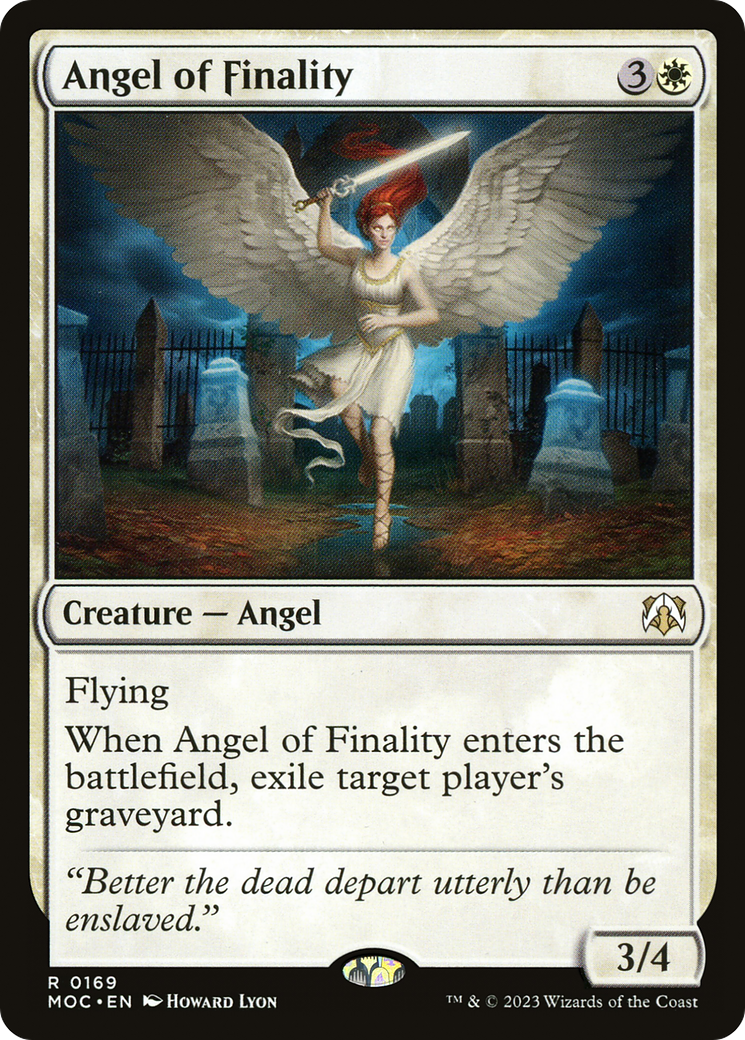
Angel of Finality
Angel of Finality
Creature — Angel
3/4
Flying
When this creature enters, exile target player's graveyard.
-
1
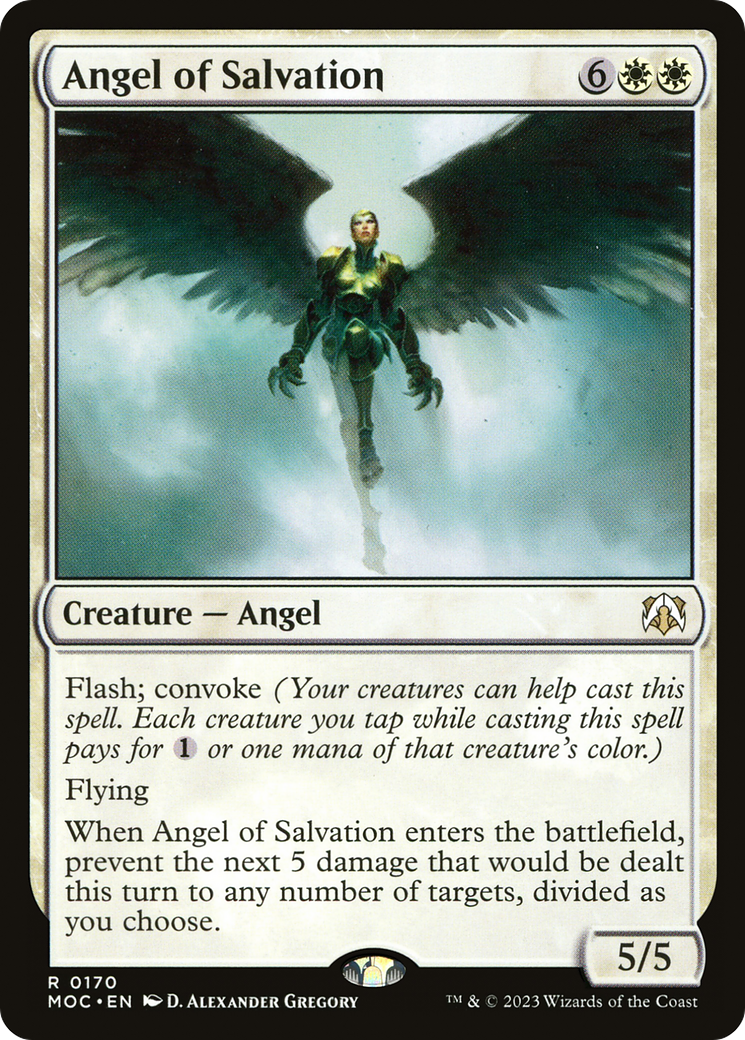
Angel of Salvation
Angel of Salvation
Creature — Angel
5/5
Flash; convoke (Your creatures can help cast this spell. Each creature you tap while casting this spell pays for or one mana of that creature's color.)
Flying
When this creature enters, prevent the next 5 damage that would be dealt this turn to any number of targets, divided as you choose.
- Tapping a multicolored creature using convoke will pay for or one mana of your choice of any of that creature's colors.
- Tapping an untapped creature that's attacking or blocking to convoke a spell won't cause that creature to stop attacking or blocking.
- When calculating a spell's total cost, include any alternative costs, additional costs, or anything else that increases or reduces the cost to cast the spell. Convoke applies after the total cost is calculated. Convoke doesn't change a spell's mana cost or mana value.
- If a creature you control has a mana ability with in the cost, activating that ability while casting a spell with convoke will result in the creature being tapped before you pay the spell's costs. You won't be able to tap it again for convoke. Similarly, if you sacrifice a creature to activate a mana ability while casting a spell with convoke, that creature won't be on the battlefield when you pay the spell's costs, so you won't be able to tap it for convoke.
- Because convoke isn't an alternative cost, it can be used in conjunction with alternative costs.
- You can tap any untapped creature you control to convoke a spell, even one you haven't controlled continuously since the beginning of your most recent turn.
- If some of the targets become illegal for Angel of Salvation's ability, the original division of prevention effects still applies, but the effects that would have been created for illegal targets aren't created at all.
- If multiple sources would deal damage to an affected target at once, that target or that target's controller chooses which source's damage to prevent for each "shield."
- If multiple replacement effects apply to a player or permanent being dealt damage, that player or the controller of that permanent chooses the order to apply them, not the controller of the source of damage.
- You divide the prevention effects as Angel of Salvation's triggered ability is put onto the stack, not as it resolves. Each target must be assigned at least 1 prevention "shield." You can't choose more than five targets and assign none to a target.
-
1
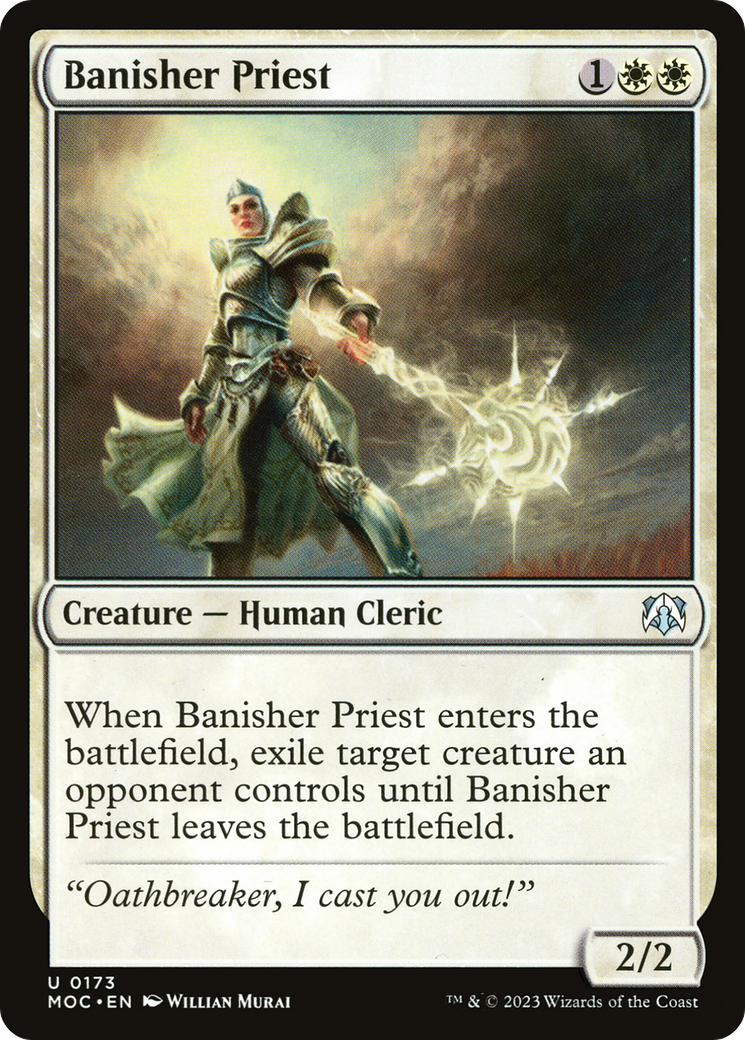
Banisher Priest
Banisher Priest
Creature — Human Cleric
2/2
When this creature enters, exile target creature an opponent controls until this creature leaves the battlefield.
- If Banisher Priest leaves the battlefield before its triggered ability resolves, the target permanent won't be exiled.
- Auras attached to the exiled permanent will be put into their owners' graveyards. Any Equipment will become unattached and remain on the battlefield. Any counters on the exiled permanent will cease to exist. When the card returns to the battlefield, it will be a new object with no connection to the card that was exiled.
- If a token is exiled this way, it will cease to exist and won't return to the battlefield.
- If an Aura is exiled this way, its owner chooses what it will enchant as it returns to the battlefield. An Aura put onto the battlefield this way doesn't target anything (so it could be attached to a permanent with shroud, for example), but the Aura's enchant ability restricts what it can be attached to. If the Aura can't legally be attached to anything, it remains in exile for the rest of the game.
-
1
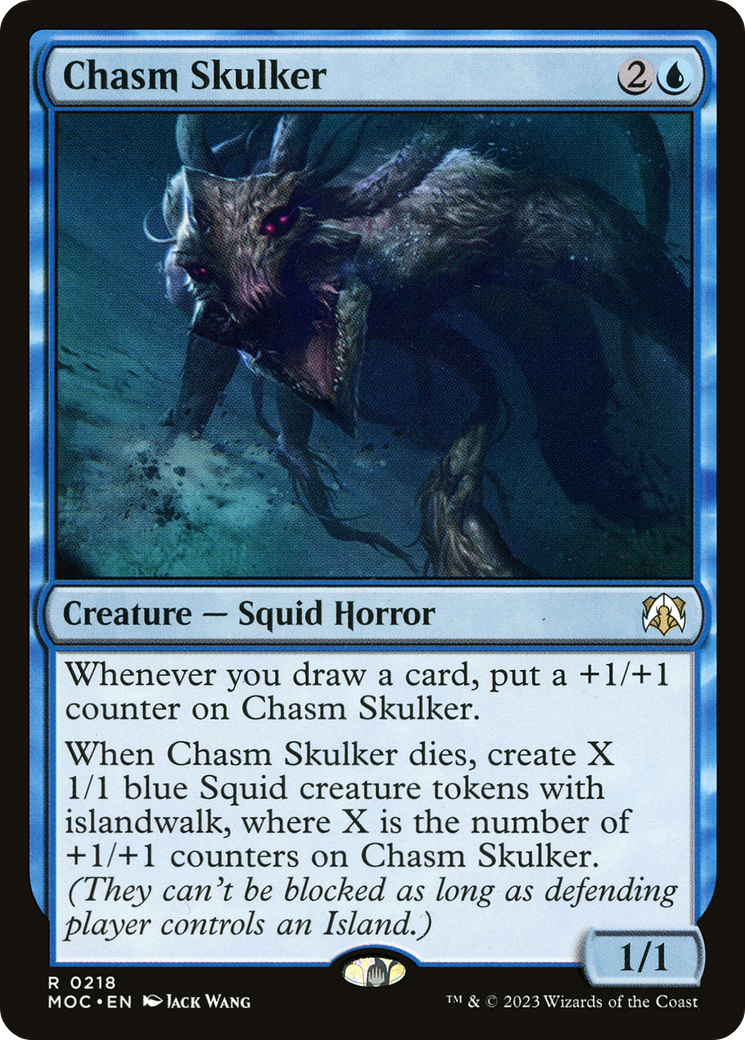
Chasm Skulker
Chasm Skulker
Creature — Squid Horror
1/1
Whenever you draw a card, put a +1/+1 counter on this creature.
When this creature dies, create X 1/1 blue Squid creature tokens with islandwalk, where X is the number of +1/+1 counters on this creature. (They can't be blocked as long as defending player controls an Island.)
- If enough -1/-1 counters are put on Chasm Skulker at the same time to make its toughness 0 or less, the number of +1/+1 counters on it before it got any -1/-1 counters will be used to determine how many Squid tokens you get. For example, if there are two +1/+1 counters on Chasm Skulker and it gets three -1/-1 counters, you'll get two Squid tokens.
- If you draw multiple cards, the first ability will trigger that many times. Each of these abilities will cause a +1/+1 counter to be put on Chasm Skulker.
-
1
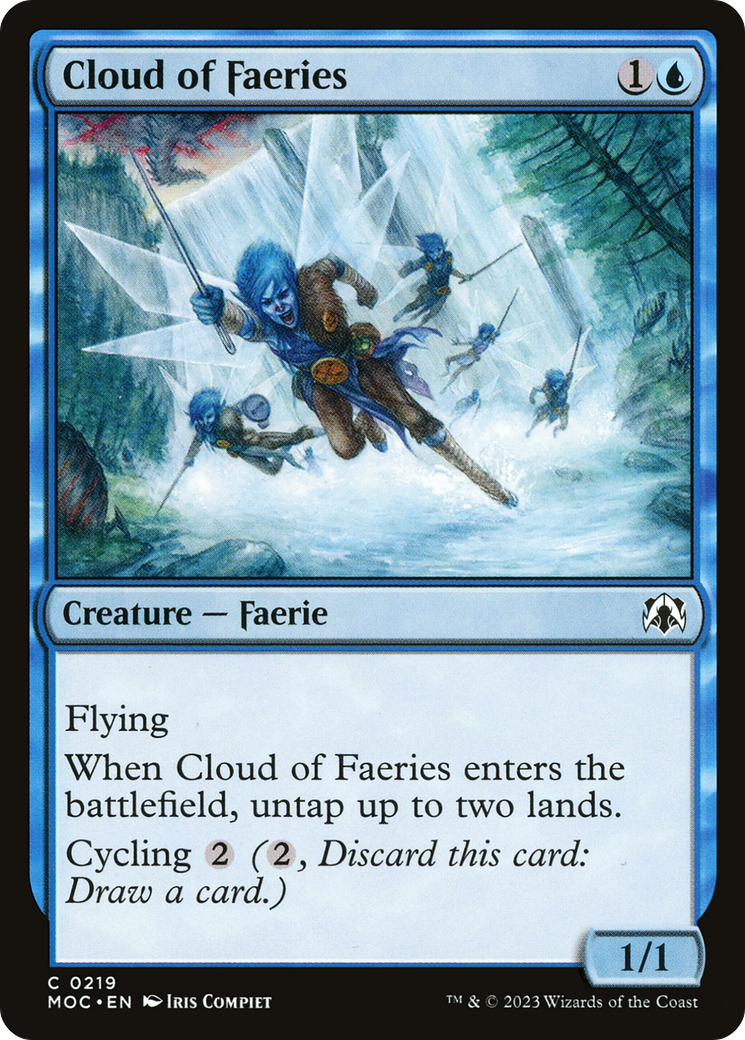
Cloud of Faeries
Cloud of Faeries
Creature — Faerie
1/1
Flying
When this creature enters, untap up to two lands.
Cycling ( , Discard this card: Draw a card.)
- You choose which lands to untap as the triggered ability resolves. They aren't targeted, and they don't have to be lands that you control.
-
1
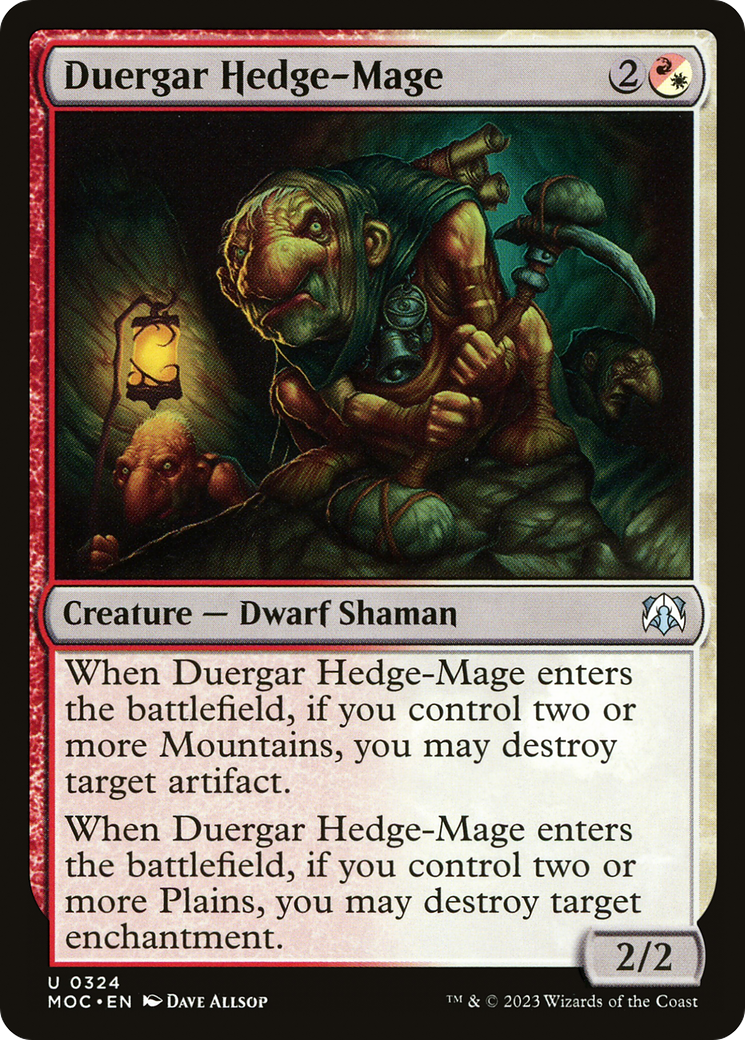
Duergar Hedge-Mage
Duergar Hedge-Mage
Creature — Dwarf Shaman
2/2
When this creature enters, if you control two or more Mountains, you may destroy target artifact.
When this creature enters, if you control two or more Plains, you may destroy target enchantment.
- Each of the triggered abilities has an "intervening 'if' clause." That means (1) the ability won't trigger at all unless you control two or more lands of the appropriate land type when the Hedge-Mage enters, and (2) the ability will do nothing if you don't control two or more lands of the appropriate land type by the time it resolves.
- Both abilities trigger at the same time. You can put them on the stack in any order.
- Each of the triggered abilities look at your lands individually. This means that if you only control two dual-lands of the appropriate types, both of the abilities will trigger.
- Both abilities are optional; you choose whether to use them when they resolve. If an ability has a target, you must choose a target even if you don't plan to use the ability.
-
1
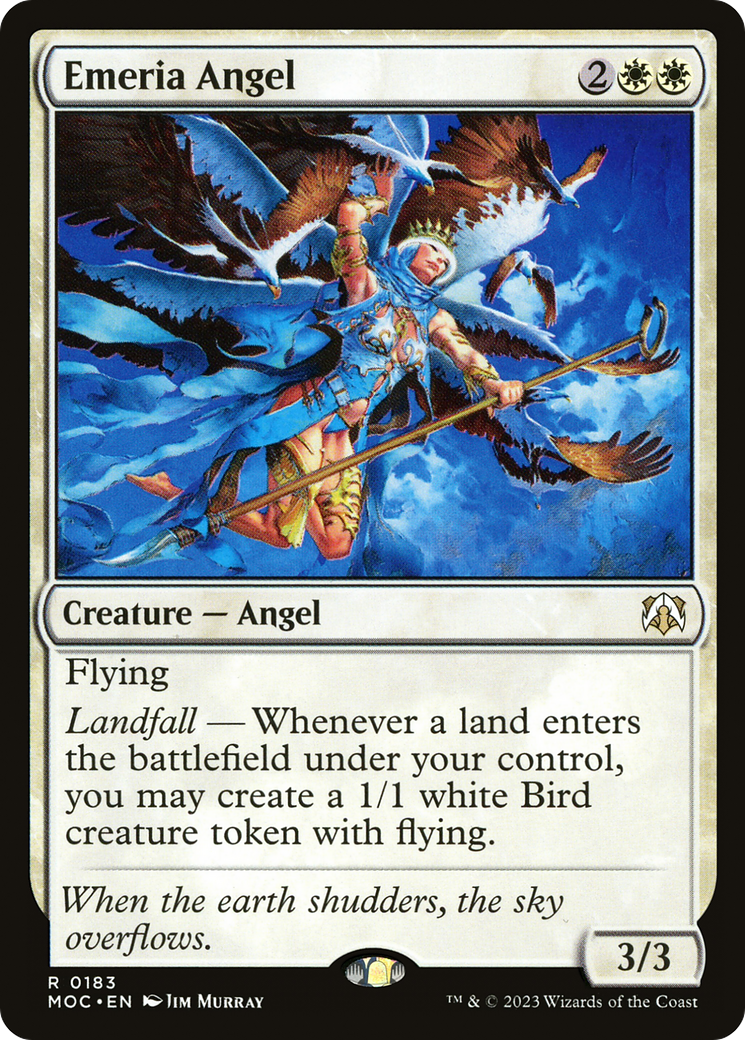
Emeria Angel
Emeria Angel
Creature — Angel
3/3
Flying
Landfall — Whenever a land you control enters, you may create a 1/1 white Bird creature token with flying.
- A landfall ability triggers whenever a land you control enters for any reason. It triggers whenever you play a land, as well as whenever a spell or ability puts a land onto the battlefield under your control.
- A landfall ability doesn't trigger if a permanent already on the battlefield becomes a land.
- Whenever a land you control enters, each landfall ability of the permanents you control will trigger. You can put them on the stack in any order. The last ability you put on the stack will be the first one to resolve (As a result, you can have those abilities resolve in the order of your choosing.).
-
1
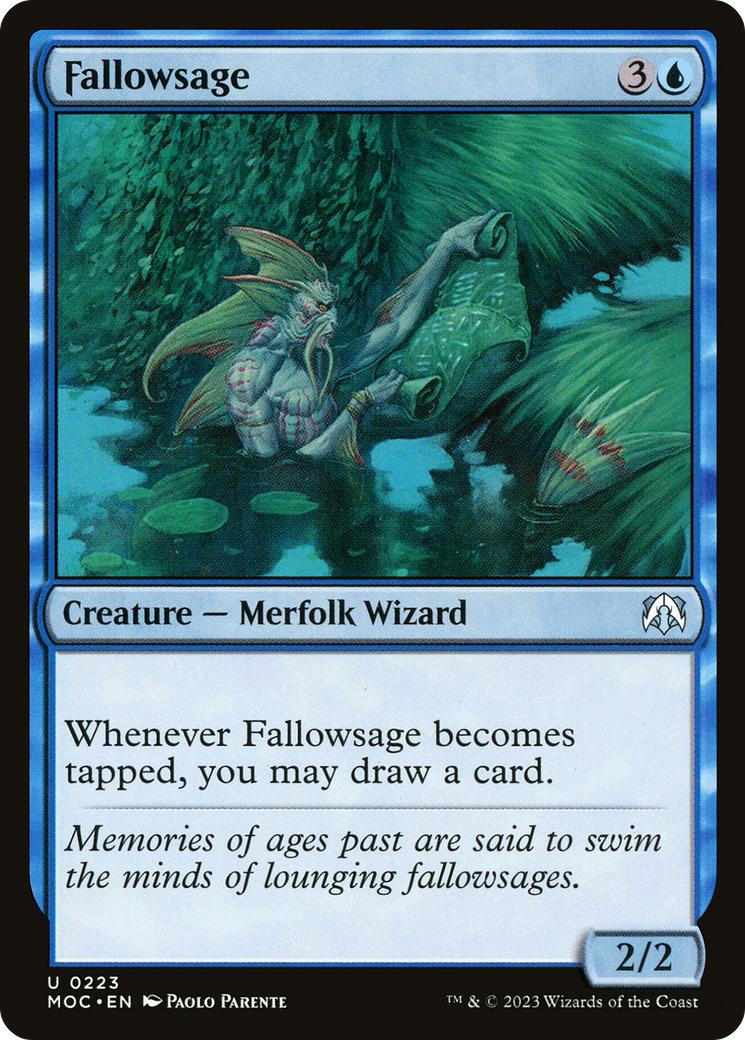
Fallowsage
Fallowsage
Creature — Merfolk Wizard
2/2
Whenever this creature becomes tapped, you may draw a card.
- This is a triggered ability, not an activated ability. It doesn't allow you to tap the creature whenever you want; rather, you need some other way of tapping it, such as by attacking with the creature.
- For the ability to trigger, the creature has to actually change from untapped to tapped. If an effect attempts to tap the creature, but it was already tapped at the time, this ability won't trigger.
-
1
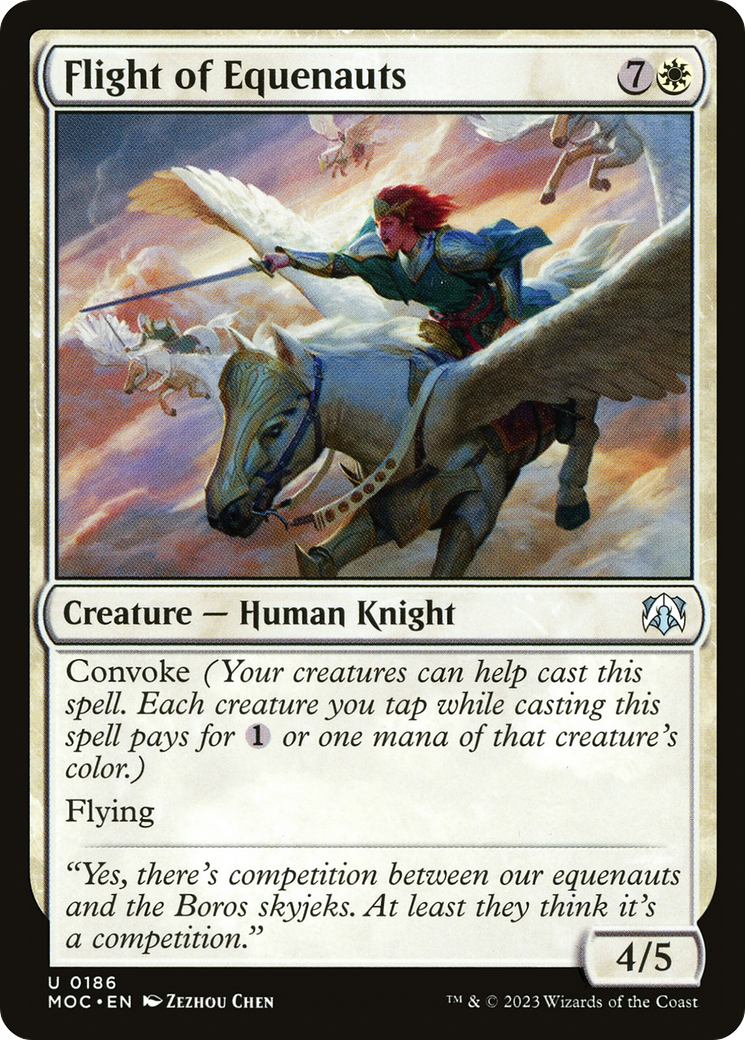
Flight of Equenauts
Flight of Equenauts
Creature — Human Knight
4/5
Convoke (Your creatures can help cast this spell. Each creature you tap while casting this spell pays for or one mana of that creature's color.)
Flying
- You can tap any untapped creature you control to convoke a spell, even one you haven't controlled continuously since the beginning of your most recent turn.
- Tapping an untapped creature that's attacking or blocking to convoke a spell won't cause that creature to stop attacking or blocking.
- When calculating a spell's total cost, include any alternative costs, additional costs, or anything else that increases or reduces the cost to cast the spell. Convoke applies after the total cost is calculated. Convoke doesn't change a spell's mana cost or mana value.
- If a creature you control has a mana ability with in the cost, activating that ability while casting a spell with convoke will result in the creature being tapped before you pay the spell's costs. You won't be able to tap it again for convoke. Similarly, if you sacrifice a creature to activate a mana ability while casting a spell with convoke, that creature won't be on the battlefield when you pay the spell's costs, so you won't be able to tap it for convoke.
- Because convoke isn't an alternative cost, it can be used in conjunction with alternative costs.
- Tapping a multicolored creature using convoke will pay for or one mana of your choice of any of that creature's colors.
-
1
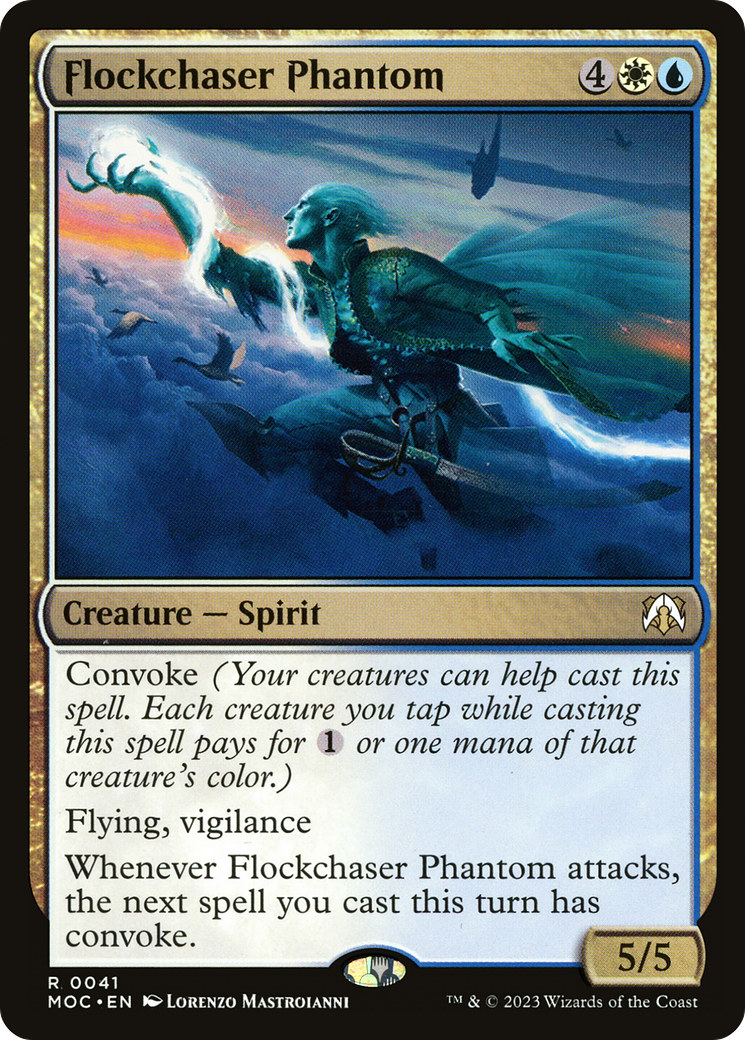
Flockchaser Phantom
Flockchaser Phantom
Creature — Spirit
5/5
Convoke (Your creatures can help cast this spell. Each creature you tap while casting this spell pays for or one mana of that creature's color.)
Flying, vigilance
Whenever this creature attacks, the next spell you cast this turn has convoke.
- When calculating a spell's total cost, include any alternative costs, additional costs, or anything else that increases or reduces the cost to cast the spell. Convoke applies after the total cost is calculated. Convoke doesn't change a spell's mana cost or mana value.
- You can tap any untapped creature you control to convoke a spell, even one you haven't controlled continuously since the beginning of your most recent turn.
- Tapping an untapped creature that's attacking or blocking to convoke a spell won't cause that creature to stop attacking or blocking.
- Tapping a multicolored creature using convoke will pay for or one mana of your choice of any of that creature's colors.
- If a creature you control has a mana ability with in the cost, activating that ability while casting a spell with convoke will result in the creature being tapped before you pay the spell's costs. You won't be able to tap it again for convoke. Similarly, if you sacrifice a creature to activate a mana ability while casting a spell with convoke, that creature won't be on the battlefield when you pay the spell's costs, so you won't be able to tap it for convoke.
- Because convoke isn't an alternative cost, it can be used in conjunction with alternative costs.
- If the next spell you cast after Flockchaser Phantom's ability resolves already has convoke, giving it convoke again doesn't have any real benefit. Tapping a creature you control will still pay for only or one mana of that creature's color.
-
1
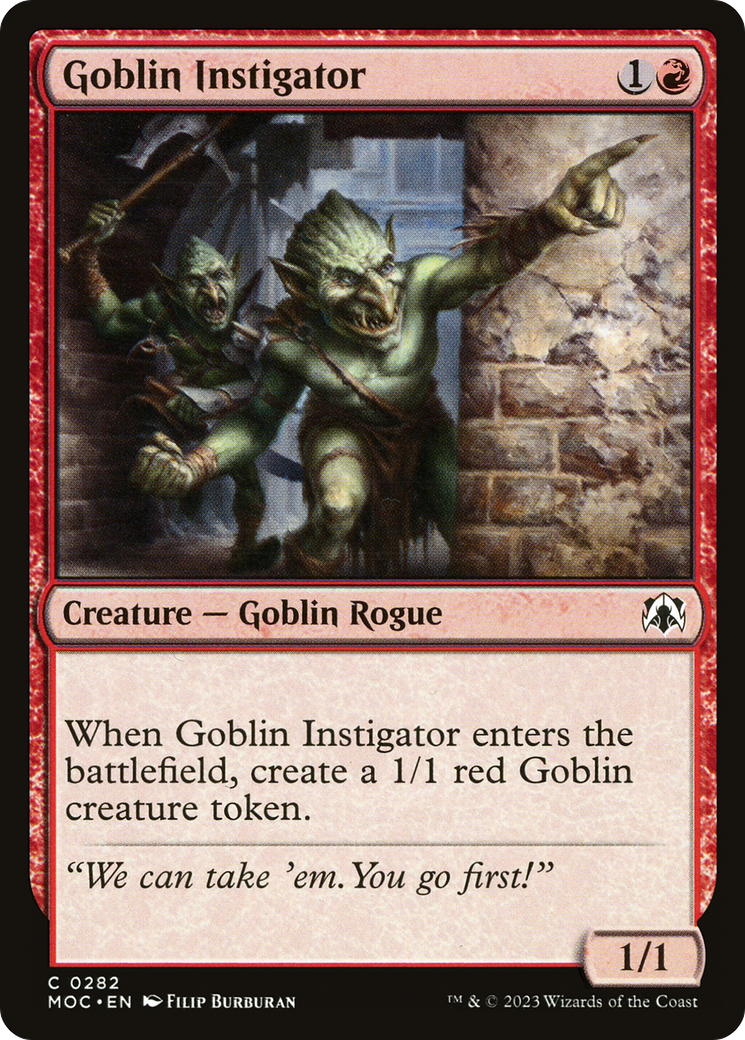
Goblin Instigator
Goblin Instigator
Creature — Goblin Rogue
1/1
When this creature enters, create a 1/1 red Goblin creature token.
-
1
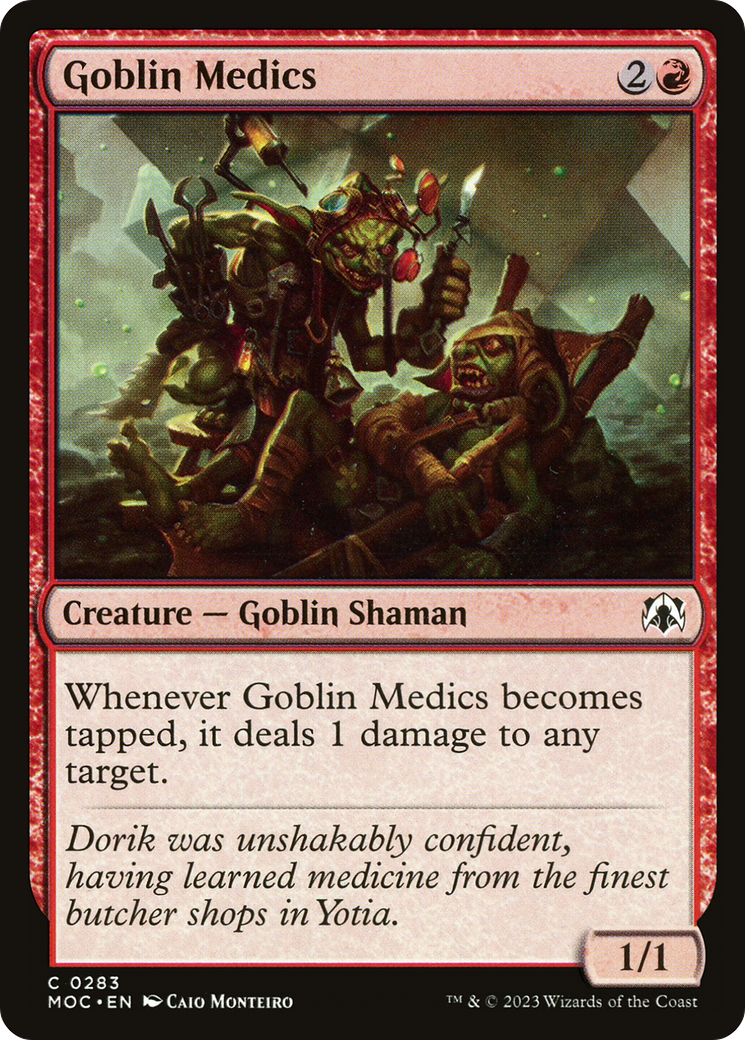
Goblin Medics
Goblin Medics
Creature — Goblin Shaman
1/1
Whenever this creature becomes tapped, it deals 1 damage to any target.
- The ability does trigger when it taps to attack.
-
1
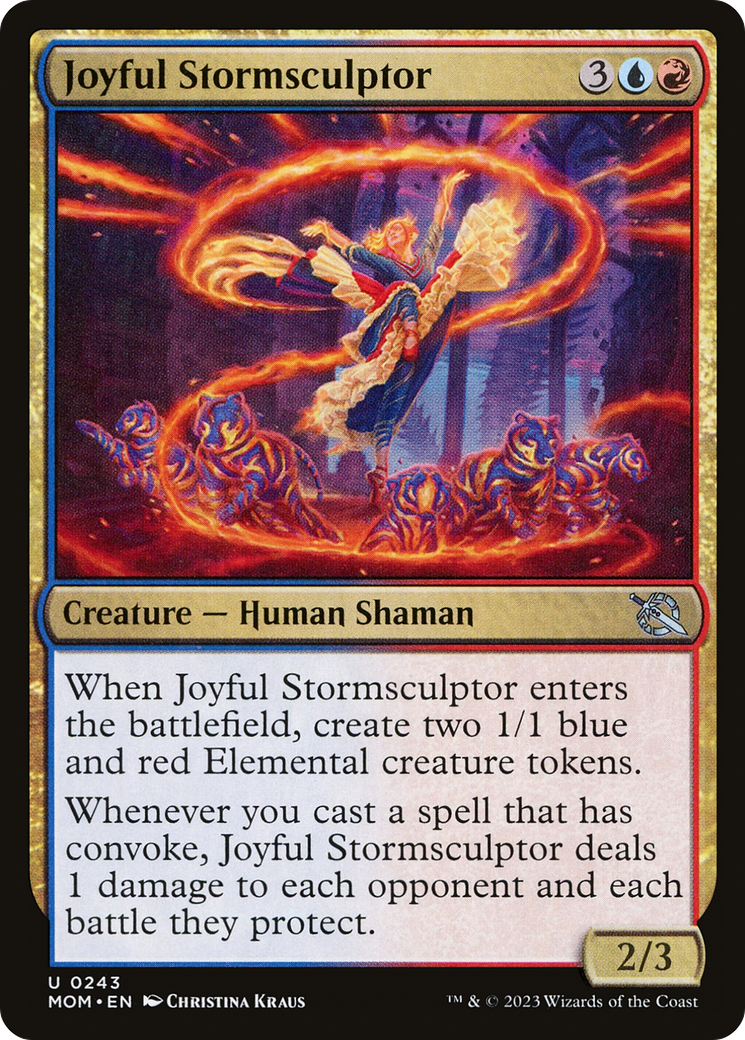
Joyful Stormsculptor
Joyful Stormsculptor
Creature — Human Shaman
2/3
When this creature enters, create two 1/1 blue and red Elemental creature tokens.
Whenever you cast a spell that has convoke, this creature deals 1 damage to each opponent and each battle they protect.
-
1
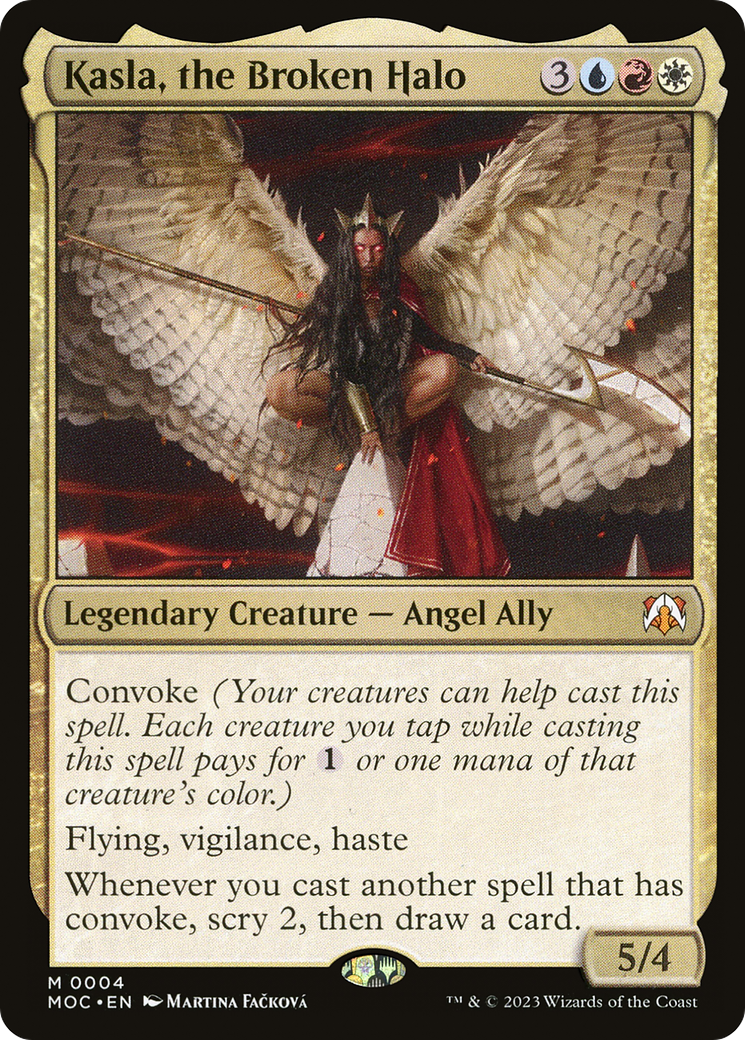
Kasla, the Broken Halo
Kasla, the Broken Halo
Legendary Creature — Angel Ally
5/4
Convoke (Your creatures can help cast this spell. Each creature you tap while casting this spell pays for or one mana of that creature's color.)
Flying, vigilance, haste
Whenever you cast another spell that has convoke, scry 2, then draw a card.
- When calculating a spell's total cost, include any alternative costs, additional costs, or anything else that increases or reduces the cost to cast the spell. Convoke applies after the total cost is calculated. Convoke doesn't change a spell's mana cost or mana value.
- You can tap any untapped creature you control to convoke a spell, even one you haven't controlled continuously since the beginning of your most recent turn.
- Tapping an untapped creature that's attacking or blocking to convoke a spell won't cause that creature to stop attacking or blocking.
- Tapping a multicolored creature using convoke will pay for or one mana of your choice of any of that creature's colors.
- If a creature you control has a mana ability with in the cost, activating that ability while casting a spell with convoke will result in the creature being tapped before you pay the spell's costs. You won't be able to tap it again for convoke. Similarly, if you sacrifice a creature to activate a mana ability while casting a spell with convoke, that creature won't be on the battlefield when you pay the spell's costs, so you won't be able to tap it for convoke.
- Because convoke isn't an alternative cost, it can be used in conjunction with alternative costs.
- Kasla's last ability will trigger whether you tapped any creatures to pay for the spell or not, as long as it has convoke.
-
1
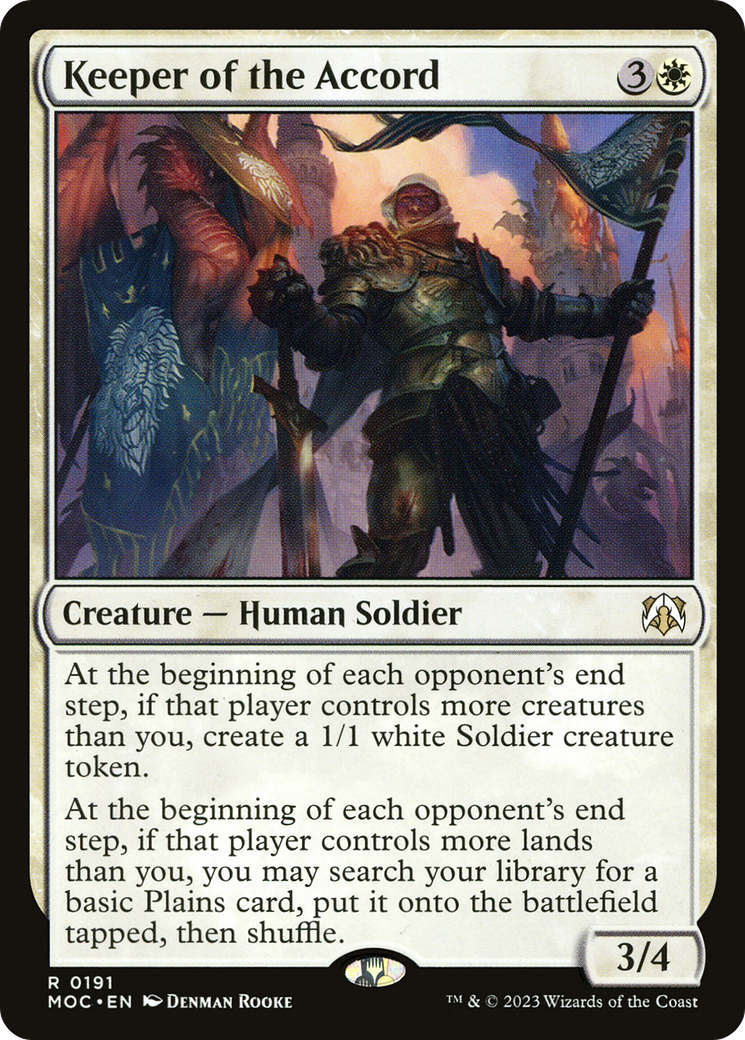
Keeper of the Accord
Keeper of the Accord
Creature — Human Soldier
3/4
At the beginning of each opponent's end step, if that player controls more creatures than you, create a 1/1 white Soldier creature token.
At the beginning of each opponent's end step, if that player controls more lands than you, you may search your library for a basic Plains card, put it onto the battlefield tapped, then shuffle.
- Both triggered abilities trigger at the same time. You may put them on the stack in either order.
- If the opponent doesn't control more creatures than you as their end step begins, the first ability won't trigger. The same is true for lands and the second ability. Each of those abilities will check again when it tries to resolve. If the opponent no longer controls more creatures (or lands) than you, the ability won't resolve and will have no effect.
-
1
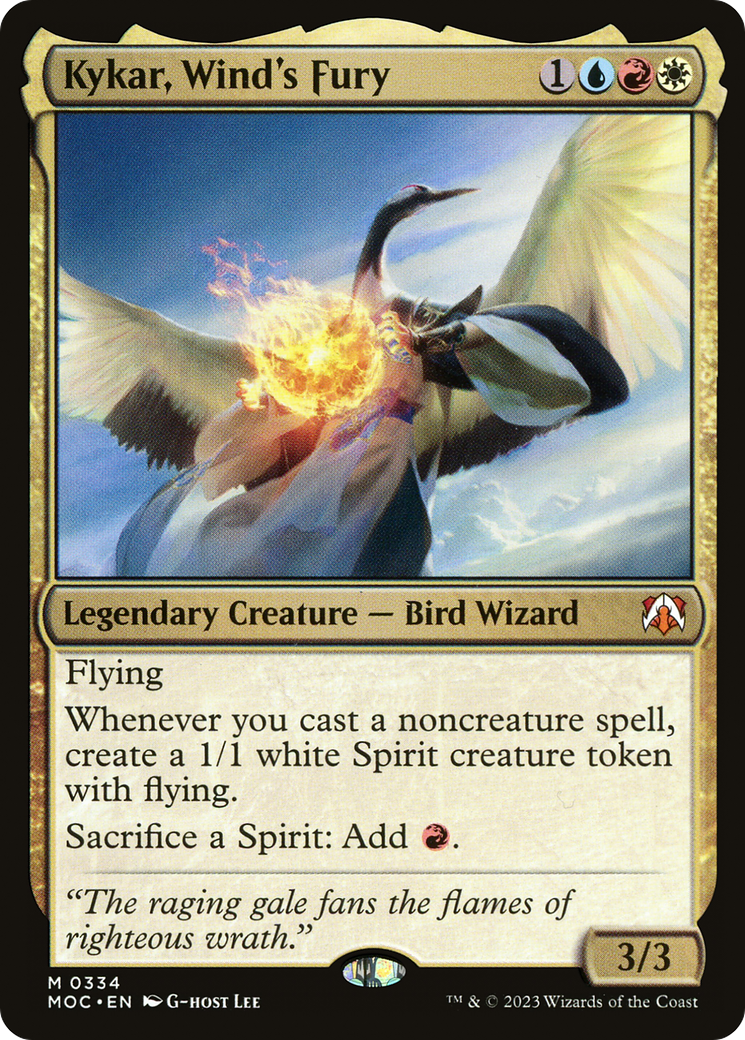
Kykar, Wind's Fury
Kykar, Wind's Fury
Legendary Creature — Bird Wizard
3/3
Flying
Whenever you cast a noncreature spell, create a 1/1 white Spirit creature token with flying.
Sacrifice a Spirit: Add .
- Kykar's triggered ability will resolve before the spell that caused it to trigger but after targets have been chosen for that spell, so the Spirit that will be created can't be a target of that spell. Kykar's ability resolves even if that spell is countered.
-
1
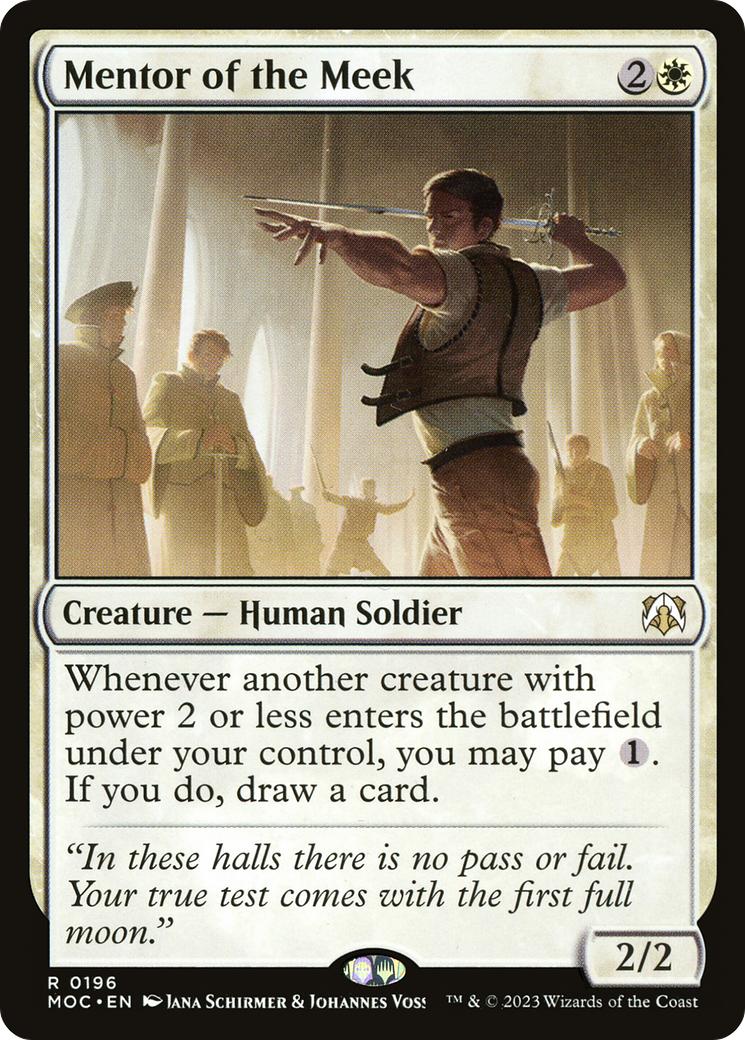
Mentor of the Meek
Mentor of the Meek
Creature — Human Soldier
2/2
Whenever another creature you control with power 2 or less enters, you may pay . If you do, draw a card.
- Mentor of the Meek’s ability checks the power of the other creature only as it enters. If that creature’s power is 2 or less, the ability will trigger. Once the ability triggers, raising that creature’s power above 2 won’t affect that ability. Similarly, reducing the creature’s power to 2 or less after it enters won’t cause the ability to trigger.
- If a creature enters with +1/+1 counters or a continuous effect such as that of Wedding Festivity will apply to the creature on the battlefield, those effects apply when checking to see if Mentor of the Meek’s ability will trigger.
- While resolving the triggered ability of Mentor of the Meek, you can’t pay multiple times to draw more than one card.
-
1
Mistmeadow Vanisher
Mistmeadow Vanisher
Creature — Kithkin Wizard
3/2
Whenever this creature becomes tapped, exile up to one target nonland, nontoken permanent. Return that card to the battlefield under its owner's control at the beginning of the next end step.
-
1
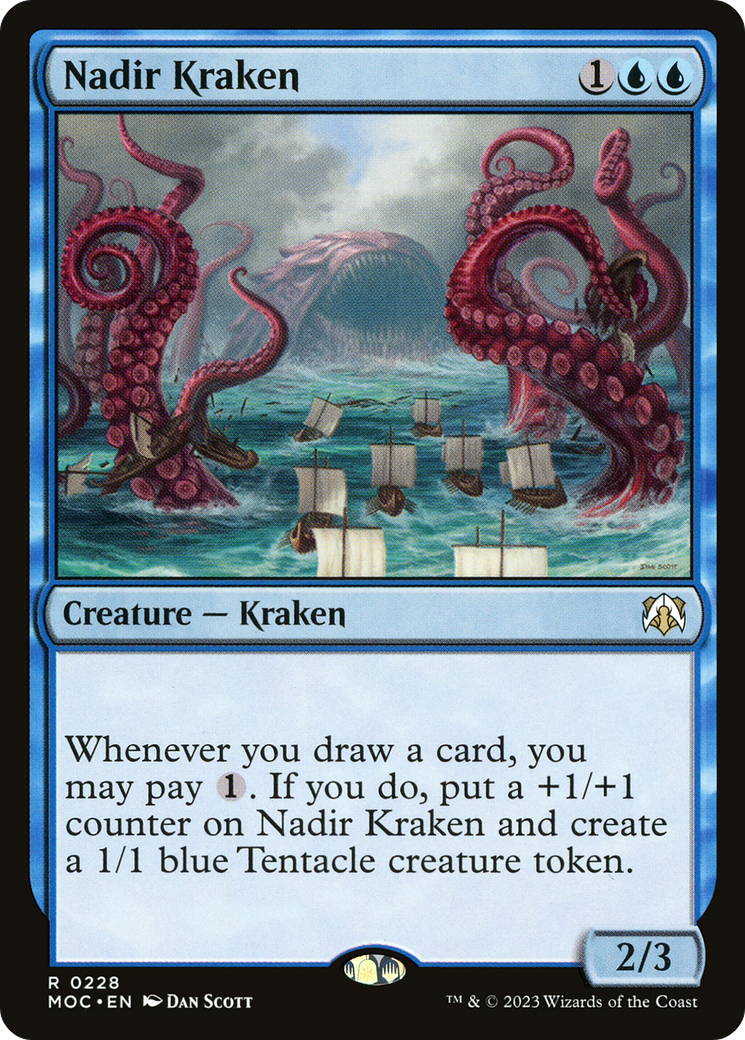
Nadir Kraken
Nadir Kraken
Creature — Kraken
2/3
Whenever you draw a card, you may pay . If you do, put a +1/+1 counter on this creature and create a 1/1 blue Tentacle creature token.
- While resolving Nadir Kraken's ability, you can't pay multiple times to create multiple Tentacles or to give it multiple +1/+1 counters.
- You choose whether to pay after drawing the card and seeing what it is. If you draw multiple cards, you see them all before deciding how many of the resulting triggers you'll pay for.
- If Nadir Kraken leaves the battlefield after its ability has triggered, you can still pay and get a Tentacle, even though you won't put a +1/+1 counter on Nadir Kraken.
-
1
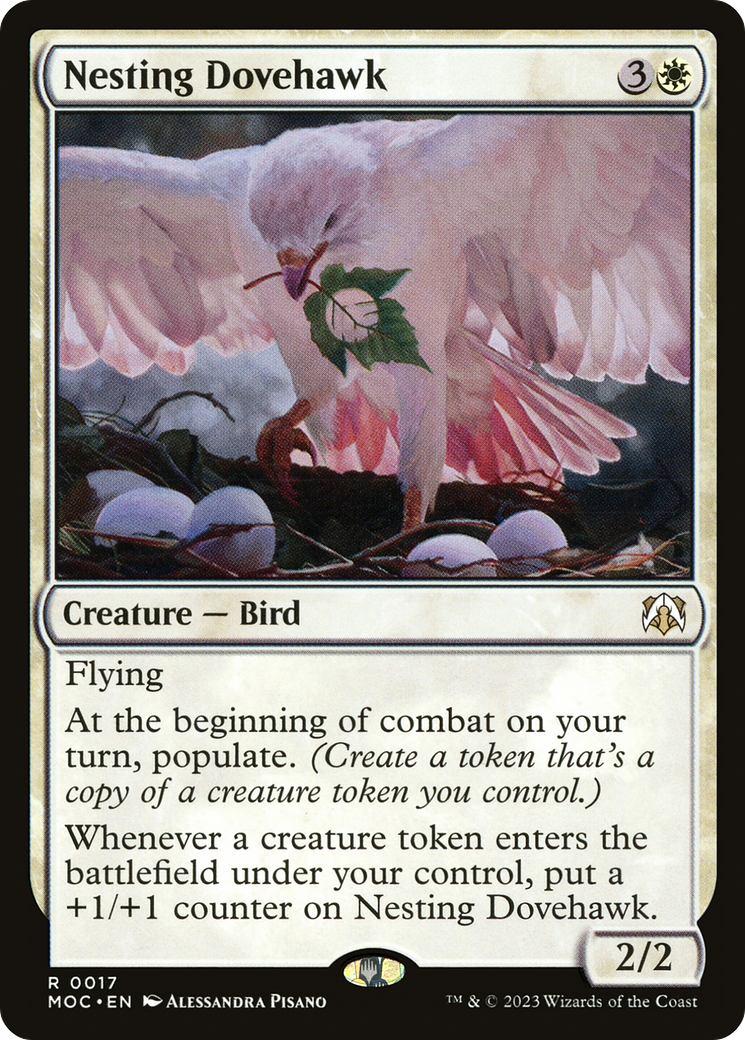
Nesting Dovehawk
Nesting Dovehawk
Creature — Bird
2/2
Flying
At the beginning of combat on your turn, populate. (Create a token that's a copy of a creature token you control.)
Whenever a creature token you control enters, put a +1/+1 counter on this creature.
- Populate doesn't target the creature token you're copying. You choose that creature token as you're taking the populate action. You can choose any creature token you control. If a spell or ability causes you to create a creature token and then instructs you to populate, you may choose to copy the token you just created, or you may choose to copy another creature token you control.
- If you choose to copy a creature token that's a copy of another creature, the new creature token will copy the characteristics of whatever the original token is copying.
- The new creature token copies the characteristics of the original token as stated by the effect that created the original token.
- The new token doesn't copy whether the original token is tapped or untapped, whether it has any counters on it or Auras and Equipment attached to it, or any noncopy effects that have changed its power, toughness, color, and so on.
- Any enters-the-battlefield abilities of the copied token will trigger when the new token enters the battlefield. Any "as [this creature] enters the battlefield" or "[this creature] enters the battlefield with" abilities of the copied token will also work.
- If you control no creature tokens when you populate, nothing will happen.
-
1
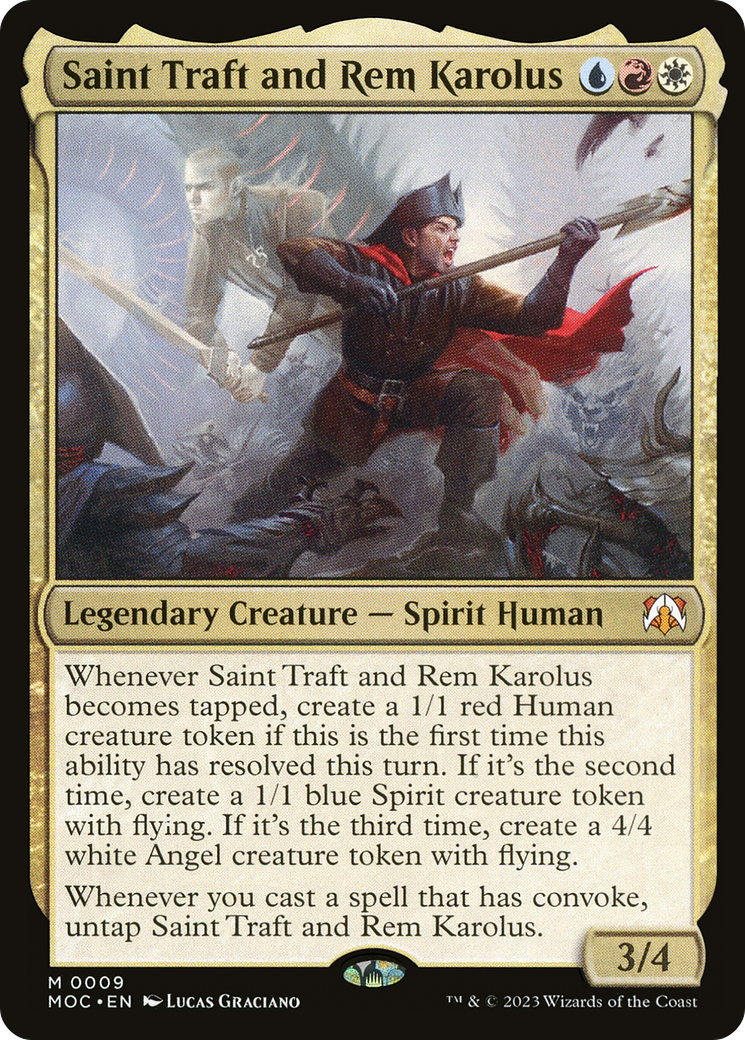
Saint Traft and Rem Karolus
Saint Traft and Rem Karolus
Legendary Creature — Spirit Human
3/4
Whenever Saint Traft and Rem Karolus becomes tapped, create a 1/1 red Human creature token if this is the first time this ability has resolved this turn. If it's the second time, create a 1/1 blue Spirit creature token with flying. If it's the third time, create a 4/4 white Angel creature token with flying.
Whenever you cast a spell that has convoke, untap Saint Traft and Rem Karolus.
- If it’s the fourth or subsequent time the first ability has resolved in a turn, nothing happens.
- The last ability of Saint Traft and Rem Karolus will trigger whether you tapped any creatures to pay for the spell or not, as long as it has convoke.
-
1
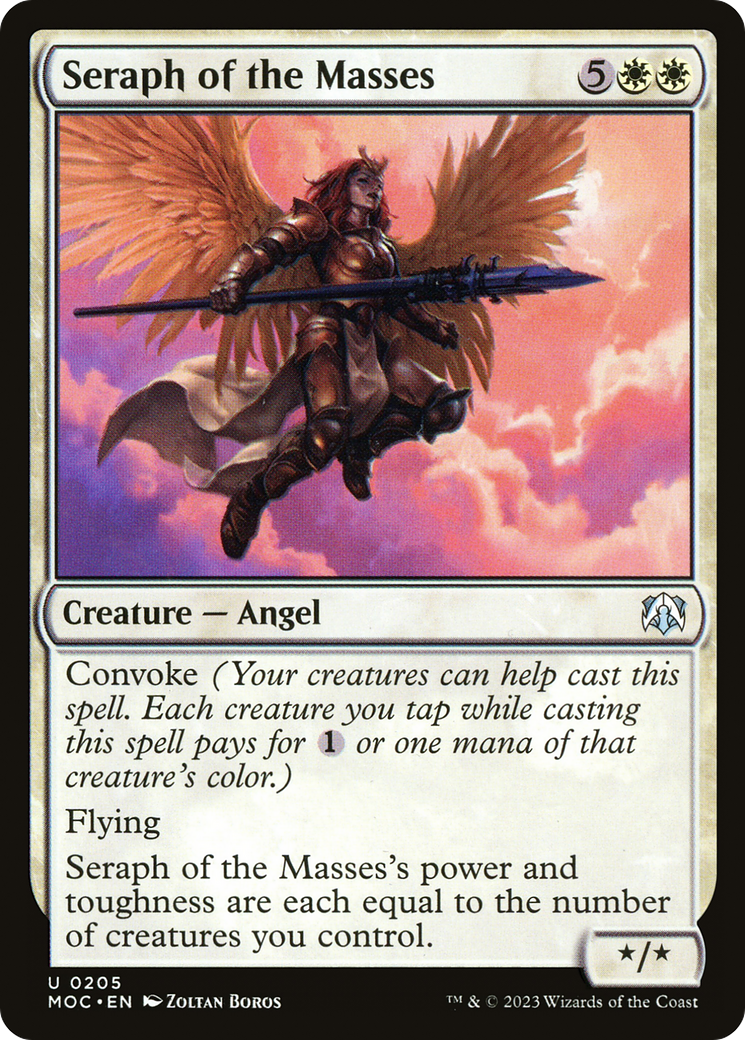
Seraph of the Masses
Seraph of the Masses
Creature — Angel
*/*
Convoke (Your creatures can help cast this spell. Each creature you tap while casting this spell pays for or one mana of that creature's color.)
Flying
Seraph of the Masses's power and toughness are each equal to the number of creatures you control.
- Tapping a multicolored creature using convoke will pay for or one mana of your choice of any of that creature's colors.
- If a creature you control has a mana ability with in the cost, activating that ability while casting a spell with convoke will result in the creature being tapped before you pay the spell's costs. You won't be able to tap it again for convoke. Similarly, if you sacrifice a creature to activate a mana ability while casting a spell with convoke, that creature won't be on the battlefield when you pay the spell's costs, so you won't be able to tap it for convoke.
- Because convoke isn't an alternative cost, it can be used in conjunction with alternative costs.
- You can tap any untapped creature you control to convoke a spell, even one you haven't controlled continuously since the beginning of your most recent turn.
- Tapping an untapped creature that's attacking or blocking to convoke a spell won't cause that creature to stop attacking or blocking.
- When calculating a spell's total cost, include any alternative costs, additional costs, or anything else that increases or reduces the cost to cast the spell. Convoke applies after the total cost is calculated. Convoke doesn't change a spell's mana cost or mana value.
- As long as Seraph of the Masses is on the battlefield, its ability will count itself.
- The ability that defines Seraph of the Masses's power and toughness works in all zones, not just the battlefield.
-
1
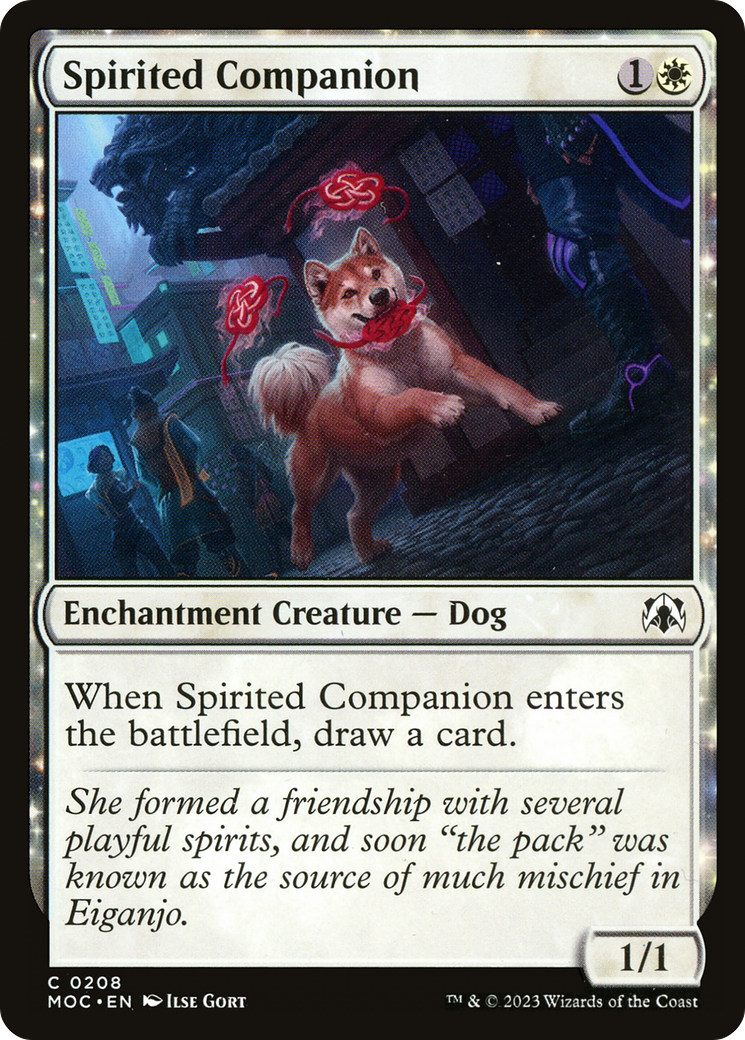
Spirited Companion
Spirited Companion
Enchantment Creature — Dog
1/1
When this creature enters, draw a card.
-
1
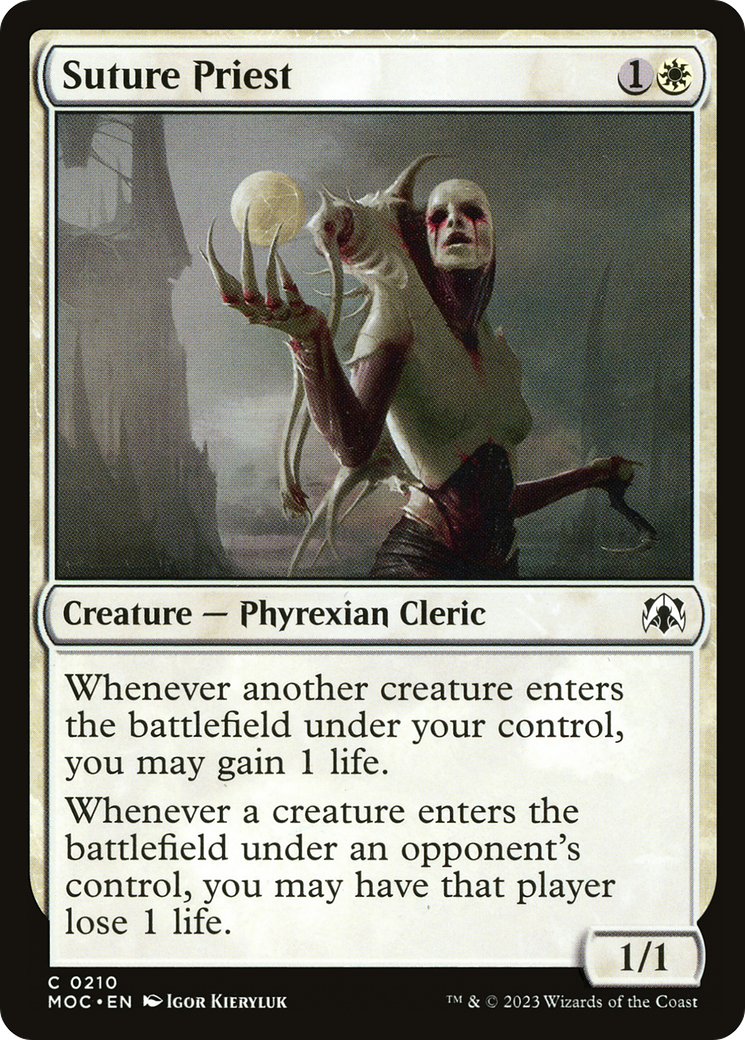
Suture Priest
Suture Priest
Creature — Phyrexian Cleric
1/1
Whenever another creature you control enters, you may gain 1 life.
Whenever a creature an opponent controls enters, you may have that player lose 1 life.
-
1
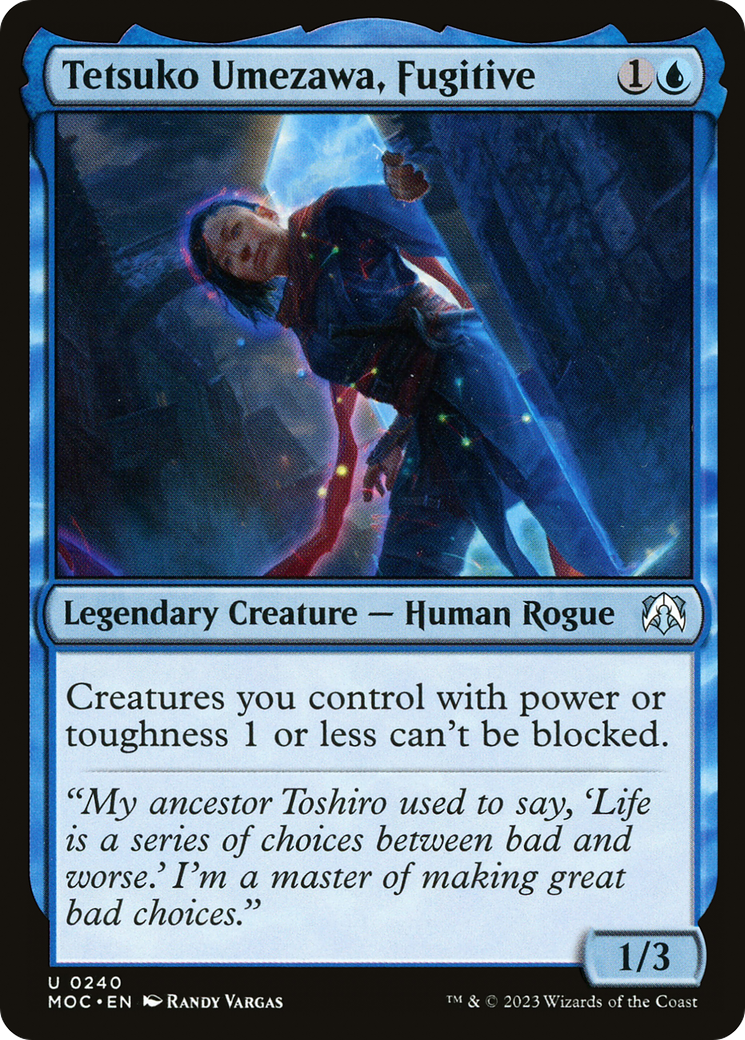
Tetsuko Umezawa, Fugitive
Tetsuko Umezawa, Fugitive
Legendary Creature — Human Rogue
1/3
Creatures you control with power or toughness 1 or less can't be blocked.
- Once a creature you control has been blocked, changing its power to 1 or less won't cause it to become unblocked. Changing its toughness to 1 won't cause it to become unblocked, and changing its toughness to less than 1 will cause it to die.
-
1
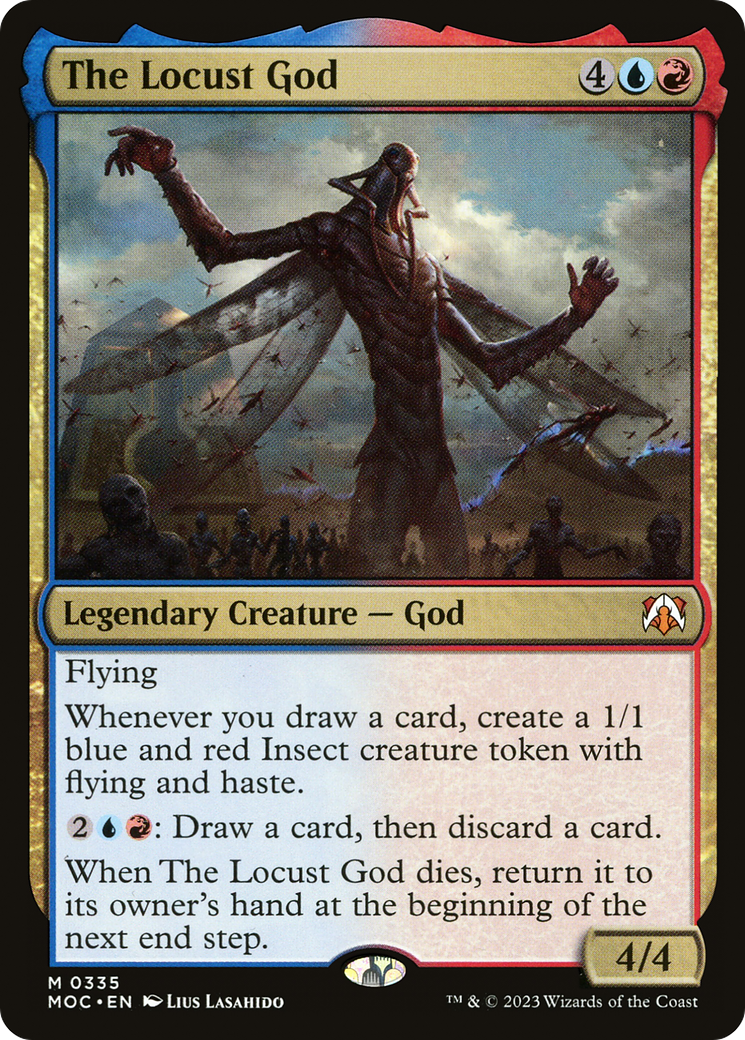
The Locust God
The Locust God
Legendary Creature — God
4/4
Flying
Whenever you draw a card, create a 1/1 blue and red Insect creature token with flying and haste.
: Draw a card, then discard a card.
When The Locust God dies, return it to its owner's hand at the beginning of the next end step.
- If a spell or ability causes you to put cards into your hand without specifically using the word “draw,” The Locust God's first triggered ability won't trigger.
- If this creature dies but leaves your graveyard before the next end step, it will remain in its new zone.
- The “next end step” refers to the next end step that occurs, not the end step of the next turn. If this creature dies before a turn's end step (for example, during combat), it will be returned to its owner's hand at the beginning of that turn's end step.
-
1
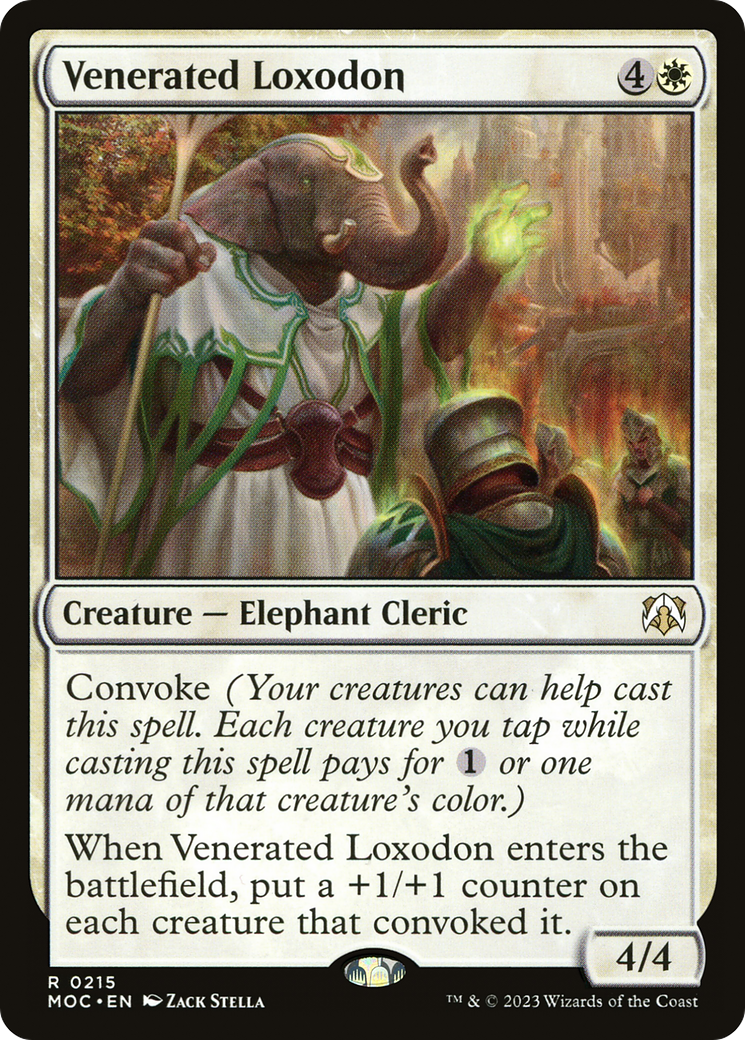
Venerated Loxodon
Venerated Loxodon
Creature — Elephant Cleric
4/4
Convoke (Your creatures can help cast this spell. Each creature you tap while casting this spell pays for or one mana of that creature's color.)
When this creature enters, put a +1/+1 counter on each creature that convoked it.
- When calculating a spell's total cost, include any alternative costs, additional costs, or anything else that increases or reduces the cost to cast the spell. Convoke applies after the total cost is calculated. Convoke doesn't change a spell's mana cost or mana value.
- You can tap any untapped creature you control to convoke a spell, even one you haven't controlled continuously since the beginning of your most recent turn.
- Tapping an untapped creature that's attacking or blocking to convoke a spell won't cause that creature to stop attacking or blocking.
- Tapping a multicolored creature using convoke will pay for or one mana of your choice of any of that creature's colors.
- If a creature you control has a mana ability with in the cost, activating that ability while casting a spell with convoke will result in the creature being tapped before you pay the spell's costs. You won't be able to tap it again for convoke. Similarly, if you sacrifice a creature to activate a mana ability while casting a spell with convoke, that creature won't be on the battlefield when you pay the spell's costs, so you won't be able to tap it for convoke.
- Because convoke isn't an alternative cost, it can be used in conjunction with alternative costs.
- You can't tap more creatures to convoke Venerated Loxodon than it takes to pay for its total cost. This means that normally no more than five creatures can convoke it.
-
1
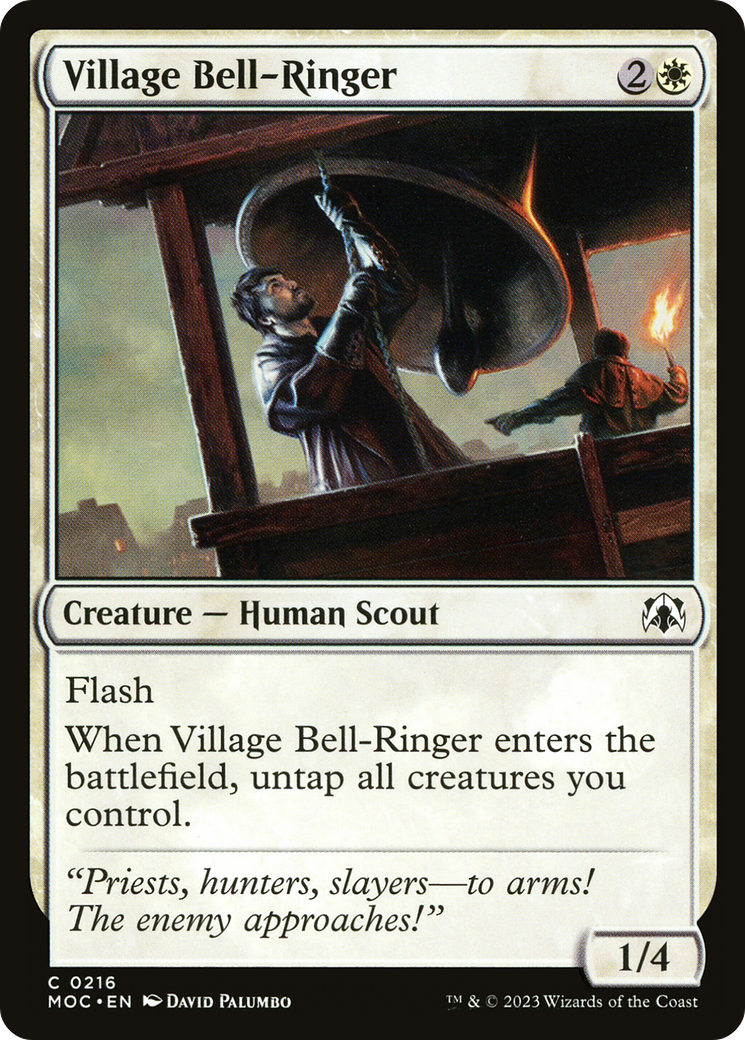
Village Bell-Ringer
Village Bell-Ringer
Creature — Human Scout
1/4
Flash (You may cast this spell any time you could cast an instant.)
When this creature enters, untap all creatures you control.
- Untapping an attacking creature doesn't remove it from combat.
-
1
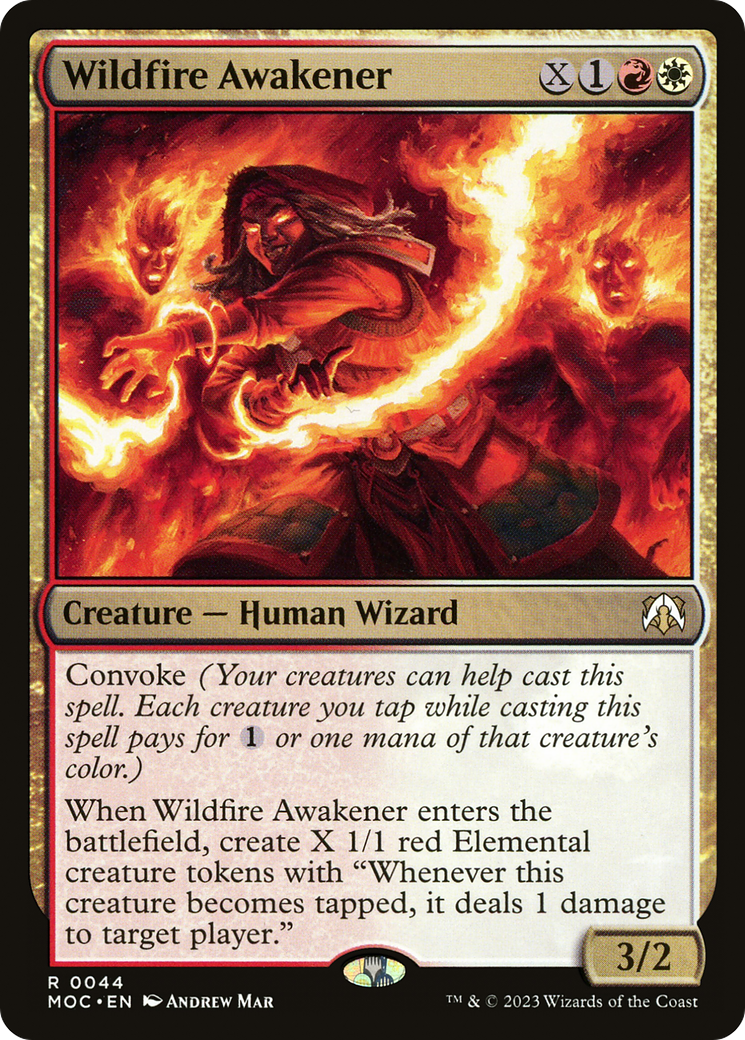
Wildfire Awakener
Wildfire Awakener
Creature — Human Wizard
3/2
Convoke (Your creatures can help cast this spell. Each creature you tap while casting this spell pays for or one mana of that creature's color.)
When this creature enters, create X 1/1 red Elemental creature tokens with "Whenever this token becomes tapped, it deals 1 damage to target player."
- You can tap any untapped creature you control to convoke a spell, even one you haven't controlled continuously since the beginning of your most recent turn.
- Tapping an untapped creature that's attacking or blocking to convoke a spell won't cause that creature to stop attacking or blocking.
- When calculating a spell's total cost, include any alternative costs, additional costs, or anything else that increases or reduces the cost to cast the spell. Convoke applies after the total cost is calculated. Convoke doesn't change a spell's mana cost or mana value.
- If a creature you control has a mana ability with in the cost, activating that ability while casting a spell with convoke will result in the creature being tapped before you pay the spell's costs. You won't be able to tap it again for convoke. Similarly, if you sacrifice a creature to activate a mana ability while casting a spell with convoke, that creature won't be on the battlefield when you pay the spell's costs, so you won't be able to tap it for convoke.
- Because convoke isn't an alternative cost, it can be used in conjunction with alternative costs.
- Tapping a multicolored creature using convoke will pay for or one mana of your choice of any of that creature's colors.
Instants 11
-
1
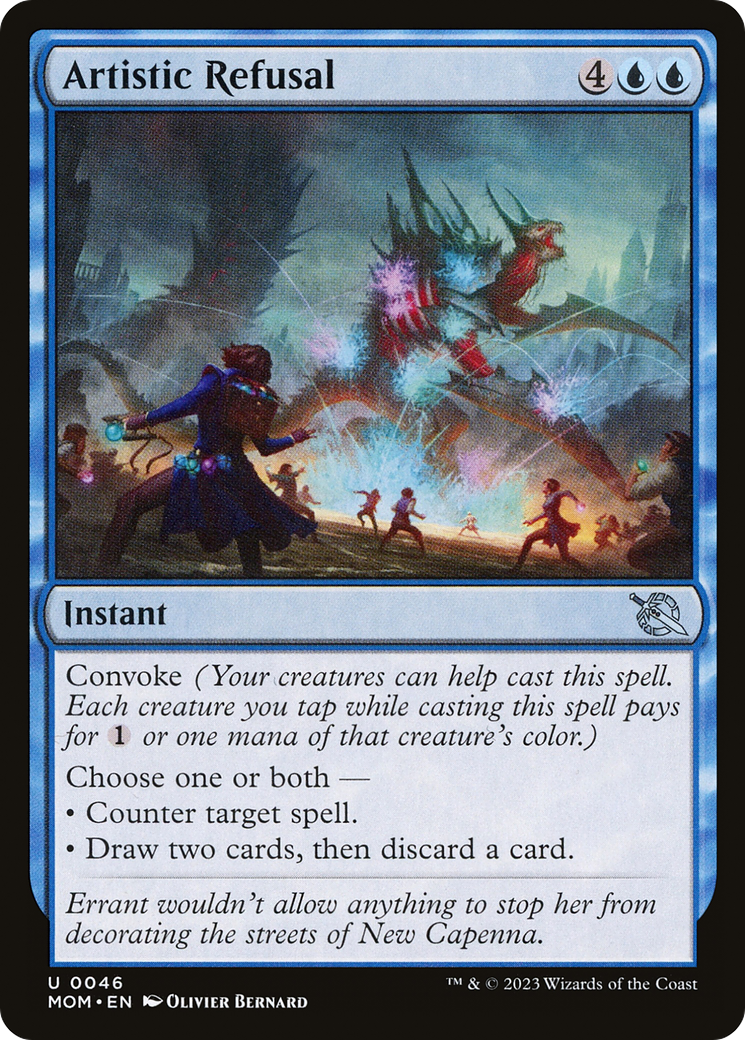
Artistic Refusal
Artistic Refusal
Instant
Convoke (Your creatures can help cast this spell. Each creature you tap while casting this spell pays for or one mana of that creature's color.)
Choose one or both —
- Counter target spell.
- Draw two cards, then discard a card.
-
1
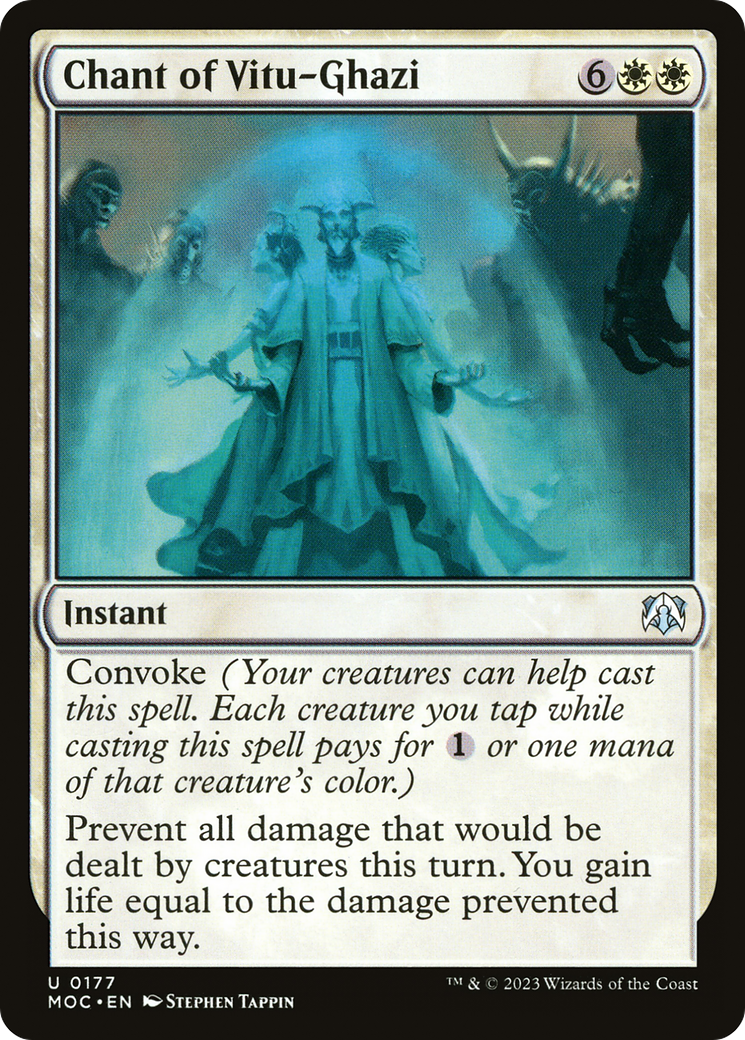
Chant of Vitu-Ghazi
Chant of Vitu-Ghazi
Instant
Convoke (Your creatures can help cast this spell. Each creature you tap while casting this spell pays for or one mana of that creature's color.)
Prevent all damage that would be dealt by creatures this turn. You gain life equal to the damage prevented this way.
- When calculating a spell's total cost, include any alternative costs, additional costs, or anything else that increases or reduces the cost to cast the spell. Convoke applies after the total cost is calculated. Convoke doesn't change a spell's mana cost or mana value.
- You can tap any untapped creature you control to convoke a spell, even one you haven't controlled continuously since the beginning of your most recent turn.
- Tapping an untapped creature that's attacking or blocking to convoke a spell won't cause that creature to stop attacking or blocking.
- Tapping a multicolored creature using convoke will pay for or one mana of your choice of any of that creature's colors.
- If a creature you control has a mana ability with in the cost, activating that ability while casting a spell with convoke will result in the creature being tapped before you pay the spell's costs. You won't be able to tap it again for convoke. Similarly, if you sacrifice a creature to activate a mana ability while casting a spell with convoke, that creature won't be on the battlefield when you pay the spell's costs, so you won't be able to tap it for convoke.
- Because convoke isn't an alternative cost, it can be used in conjunction with alternative costs.
- The damage prevention shield lasts for the rest of the turn, and you gain life each time that shield prevents 1 or more damage.
-
1
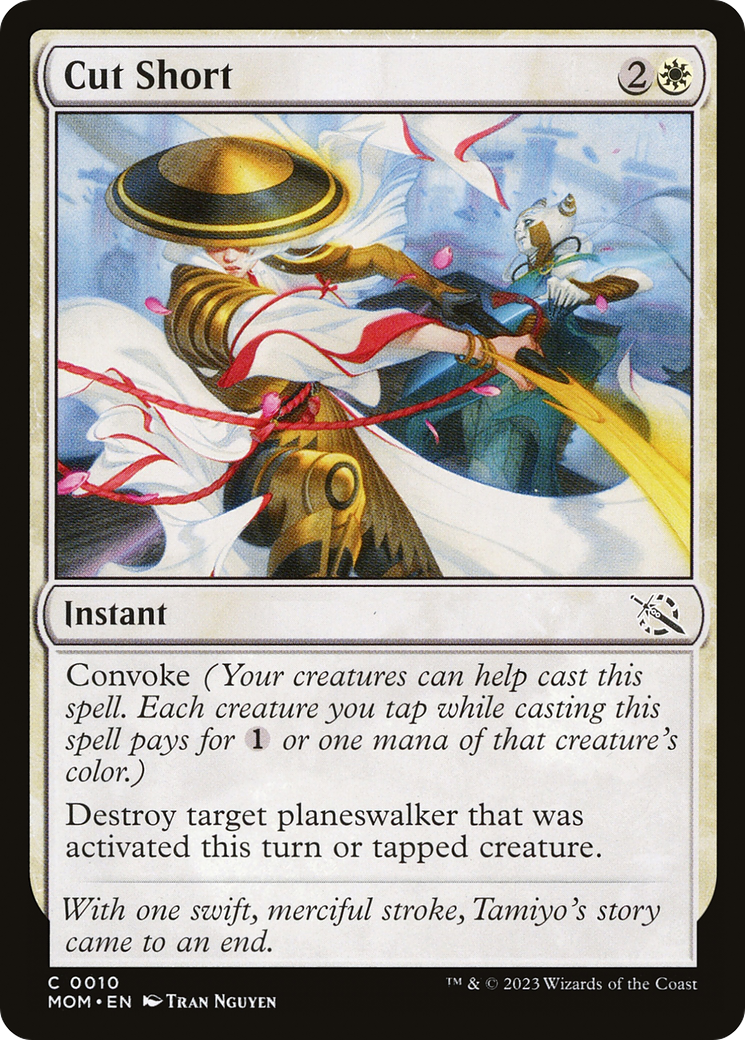
Cut Short
Cut Short
Instant
Convoke (Your creatures can help cast this spell. Each creature you tap while casting this spell pays for or one mana of that creature's color.)
Destroy target planeswalker that was activated this turn or tapped creature.
-
1
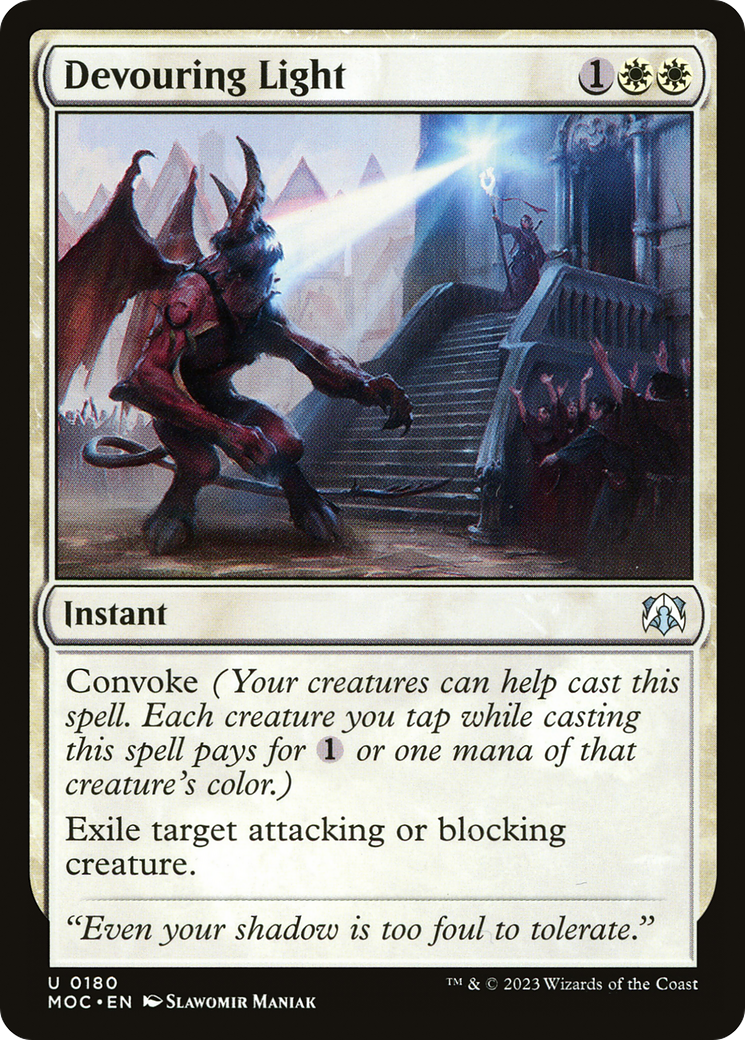
Devouring Light
Devouring Light
Instant
Convoke (Your creatures can help cast this spell. Each creature you tap while casting this spell pays for or one mana of that creature's color.)
Exile target attacking or blocking creature.
- When calculating a spell's total cost, include any alternative costs, additional costs, or anything else that increases or reduces the cost to cast the spell. Convoke applies after the total cost is calculated. Convoke doesn't change a spell's mana cost or mana value.
- You can tap any untapped creature you control to convoke a spell, even one you haven't controlled continuously since the beginning of your most recent turn.
- Tapping an untapped creature that's attacking or blocking to convoke a spell won't cause that creature to stop attacking or blocking.
- Tapping a multicolored creature using convoke will pay for or one mana of your choice of any of that creature's colors.
- If a creature you control has a mana ability with in the cost, activating that ability while casting a spell with convoke will result in the creature being tapped before you pay the spell's costs. You won't be able to tap it again for convoke. Similarly, if you sacrifice a creature to activate a mana ability while casting a spell with convoke, that creature won't be on the battlefield when you pay the spell's costs, so you won't be able to tap it for convoke.
- Because convoke isn't an alternative cost, it can be used in conjunction with alternative costs.
- The declare blockers step is the last chance to cast Devouring Light before creatures deal their combat damage. However, a creature remains an attacking or blocking creature during the combat damage step and end of combat step. Devouring Light may be cast targeting such a creature during those steps, after the creature has dealt combat damage.
-
1
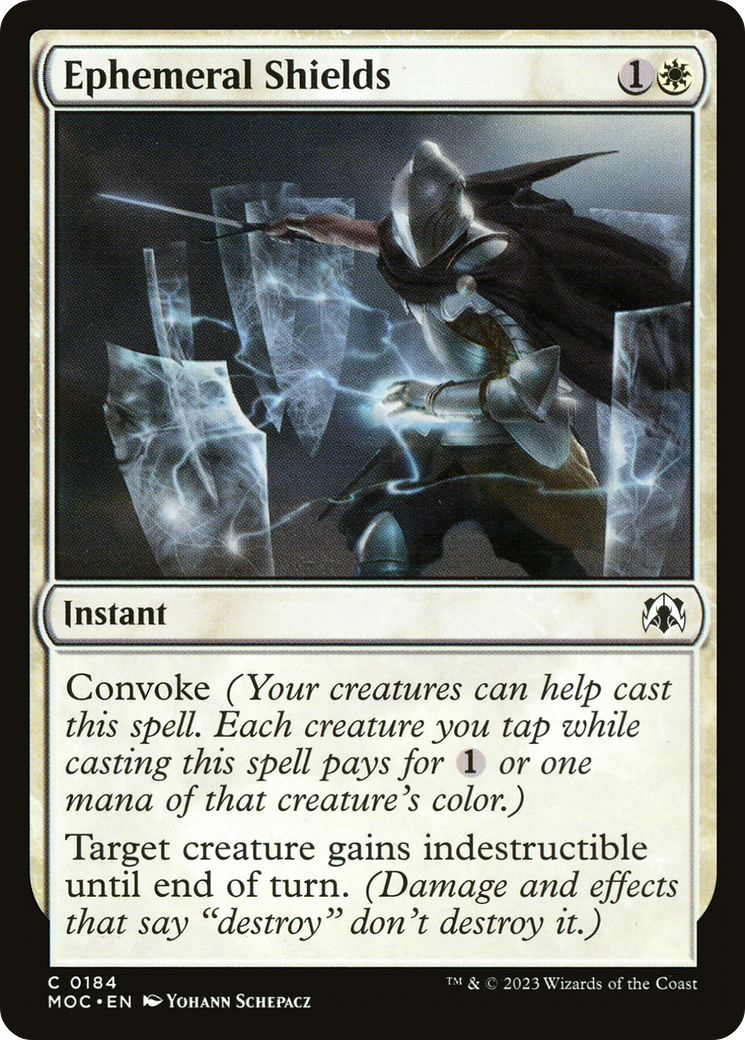
Ephemeral Shields
Ephemeral Shields
Instant
Convoke (Your creatures can help cast this spell. Each creature you tap while casting this spell pays for or one mana of that creature's color.)
Target creature gains indestructible until end of turn. (Damage and effects that say "destroy" don't destroy it.)
- You can tap any untapped creature you control to convoke a spell, even one you haven't controlled continuously since the beginning of your most recent turn.
- Tapping an untapped creature that's attacking or blocking to convoke a spell won't cause that creature to stop attacking or blocking.
- When calculating a spell's total cost, include any alternative costs, additional costs, or anything else that increases or reduces the cost to cast the spell. Convoke applies after the total cost is calculated. Convoke doesn't change a spell's mana cost or mana value.
- If a creature you control has a mana ability with in the cost, activating that ability while casting a spell with convoke will result in the creature being tapped before you pay the spell's costs. You won't be able to tap it again for convoke. Similarly, if you sacrifice a creature to activate a mana ability while casting a spell with convoke, that creature won't be on the battlefield when you pay the spell's costs, so you won't be able to tap it for convoke.
- Because convoke isn't an alternative cost, it can be used in conjunction with alternative costs.
- Tapping a multicolored creature using convoke will pay for or one mana of your choice of any of that creature's colors.
-
1
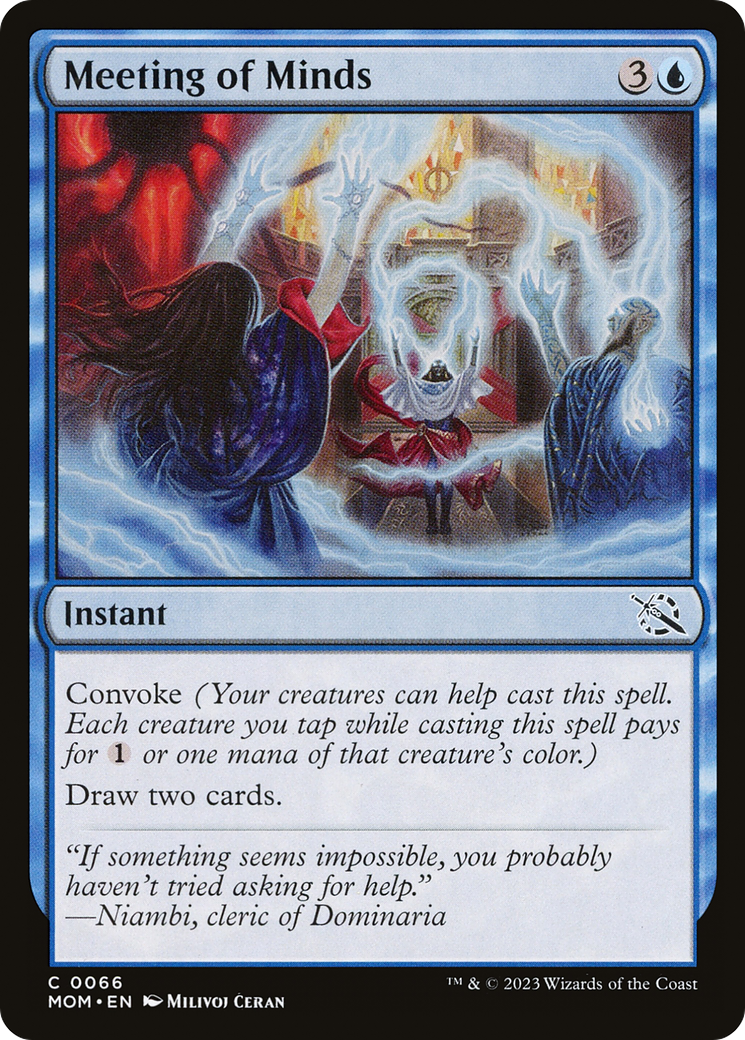
Meeting of Minds
Meeting of Minds
Instant
Convoke (Your creatures can help cast this spell. Each creature you tap while casting this spell pays for or one mana of that creature's color.)
Draw two cards.
-
1
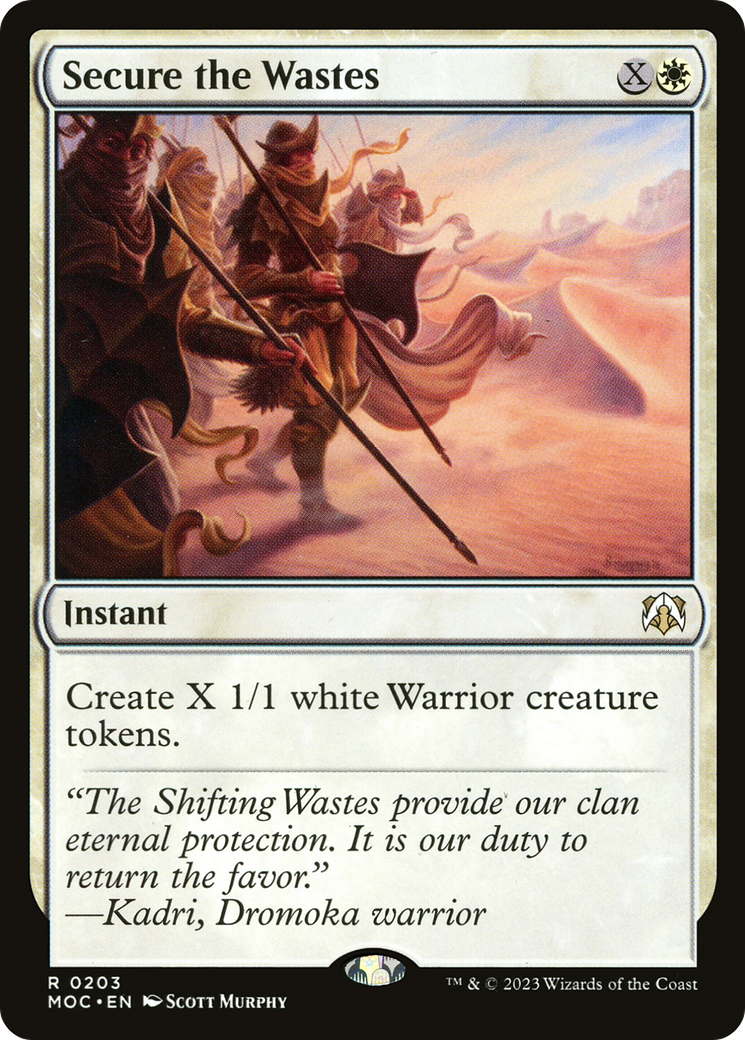
Secure the Wastes
Secure the Wastes
Instant
Create X 1/1 white Warrior creature tokens.
-
1
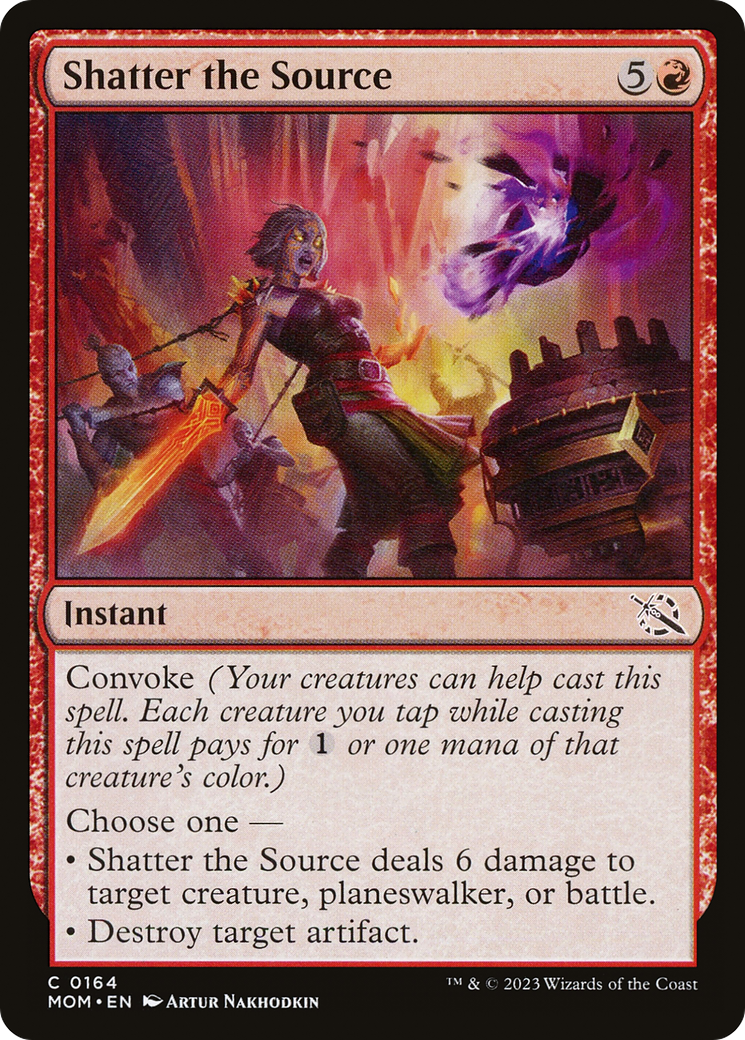
Shatter the Source
Shatter the Source
Instant
Convoke (Your creatures can help cast this spell. Each creature you tap while casting this spell pays for or one mana of that creature's color.)
Choose one —
- Shatter the Source deals 6 damage to target creature, planeswalker, or battle.
- Destroy target artifact.
-
1
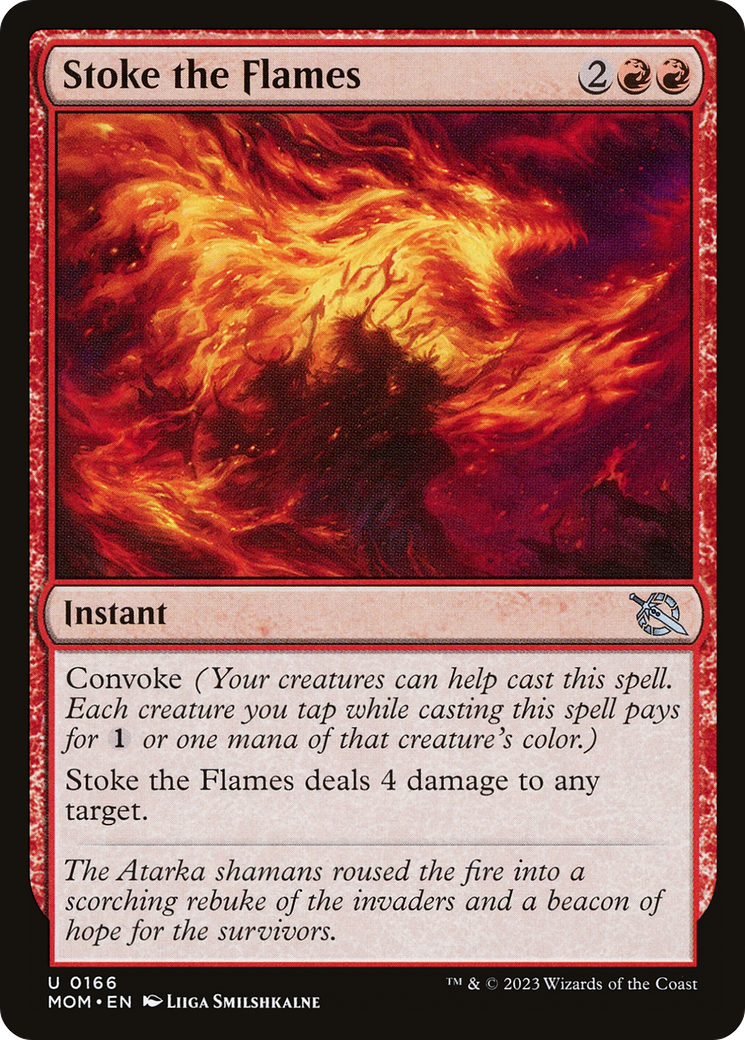
Stoke the Flames
Stoke the Flames
Instant
Convoke (Your creatures can help cast this spell. Each creature you tap while casting this spell pays for or one mana of that creature's color.)
Stoke the Flames deals 4 damage to any target.
-
1
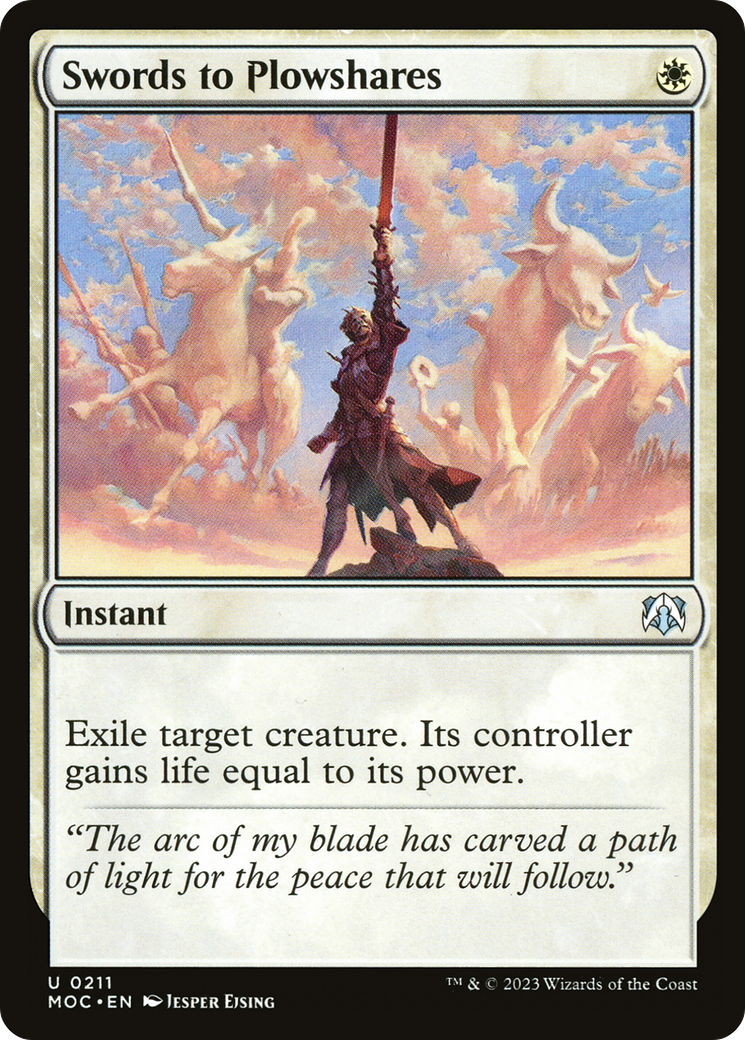
Swords to Plowshares
Swords to Plowshares
Instant
Exile target creature. Its controller gains life equal to its power.
- Use the power of the creature from when it was last on the battlefield to determine how much life is gained.
-
1
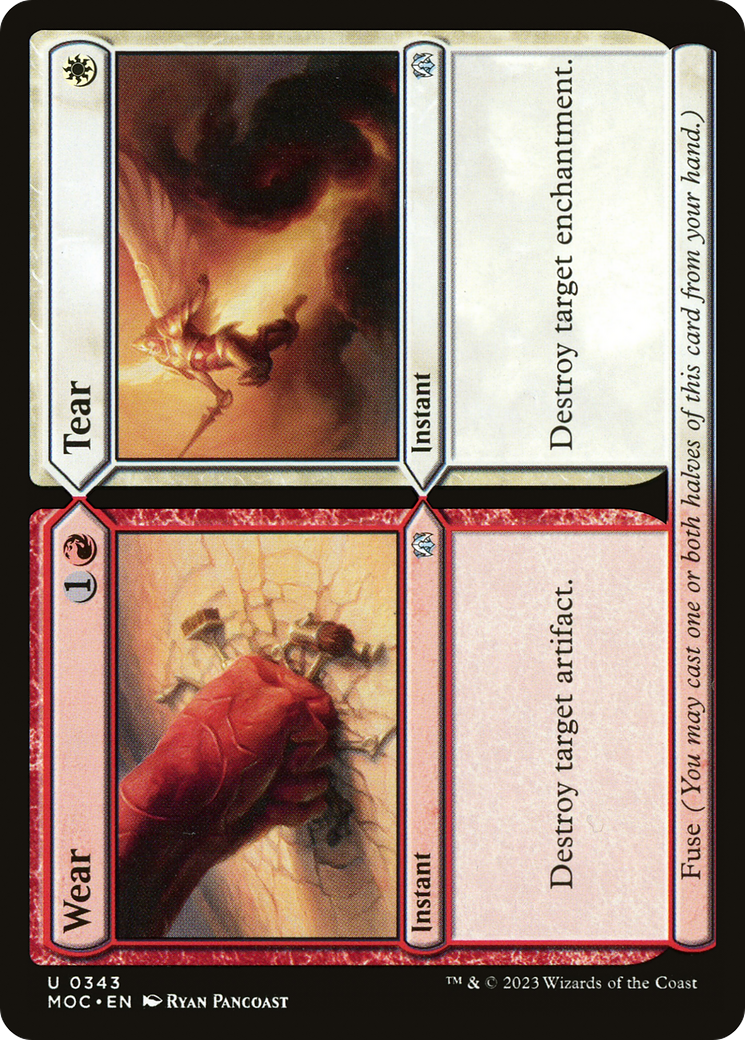
Wear // Tear
//
Wear
Instant
- If you're casting a split card with fuse from any zone other than your hand, you can't cast both halves. You'll only be able to cast one half or the other.
- To cast a fused split spell, pay both of its mana costs. While the spell is on the stack, its mana value is the total amount of mana in both costs.
- You can choose the same object as the target of each half of a fused split spell, if appropriate.
- When resolving a fused split spell with multiple targets, treat it as you would any spell with multiple targets. If all targets are illegal when the spell tries to resolve, the spell doesn't resolve and none of its effects happen. If at least one target is still legal at that time, the spell resolves, but an illegal target can't perform any actions or have any actions performed on it.
- When a fused split spell resolves, follow the instructions of the left half first, then the instructions on the right half.
- On the stack, a split spell that hasn't been fused has only that half's characteristics and mana value. The other half is treated as though it didn't exist.
- Some split cards with fuse have two monocolor halves of different colors. If such a card is cast as a fused split spell, the resulting spell is multicolored. If only one half is cast, the spell is the color of that half. While not on the stack, such a card is multicolored.
- Some split cards with fuse have two halves that are both multicolored. That card is multicolored no matter which half is cast, or if both halves are cast. It's also multicolored while not on the stack.
- If a player names a card, the player may name either half of a split card, but not both. A split card has the chosen name if one of its two names matches the chosen name.
- If you cast a split card with fuse from your hand without paying its mana cost, you can choose to use its fuse ability and cast both halves without paying their mana costs.
Sorceries 7
-
1
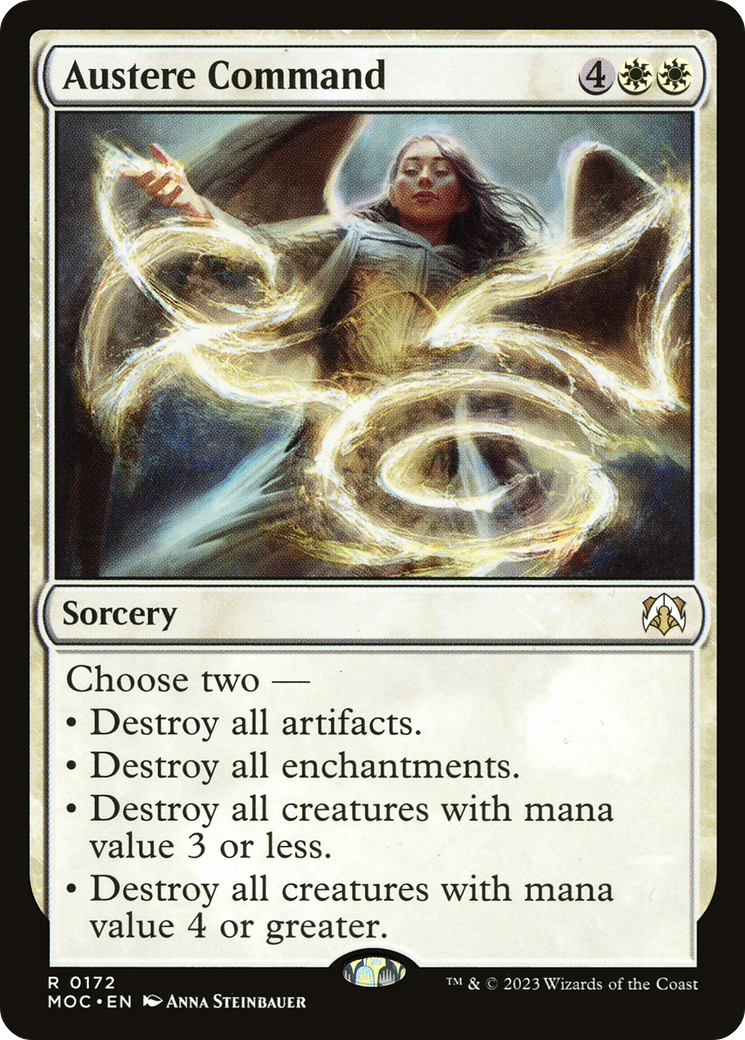
Austere Command
Austere Command
Sorcery
Choose two —
- Destroy all artifacts.
- Destroy all enchantments.
- Destroy all creatures with mana value 3 or less.
- Destroy all creatures with mana value 4 or greater.
- Each of the chosen modes happens sequentially. If a permanent has an ability that triggers whenever it or another permanent is destroyed, it will see permanents destroyed at the same time as it or before it, but not permanents destroyed by later modes.
- If a card is exiled "until" another permanent leaves the battlefield, the exiled card returns to the battlefield immediately after that permanent leaves the battlefield during Austere Command's resolution, and it may be destroyed by a later mode.
- If the first and last modes are chosen, an artifact creature with mana value 4 or greater will have to be regenerated twice to survive. This is because the modes happen sequentially, and the regeneration "shield" is used up by the first one. The same is true with any other combination of modes that covers one permanent twice.
-
1
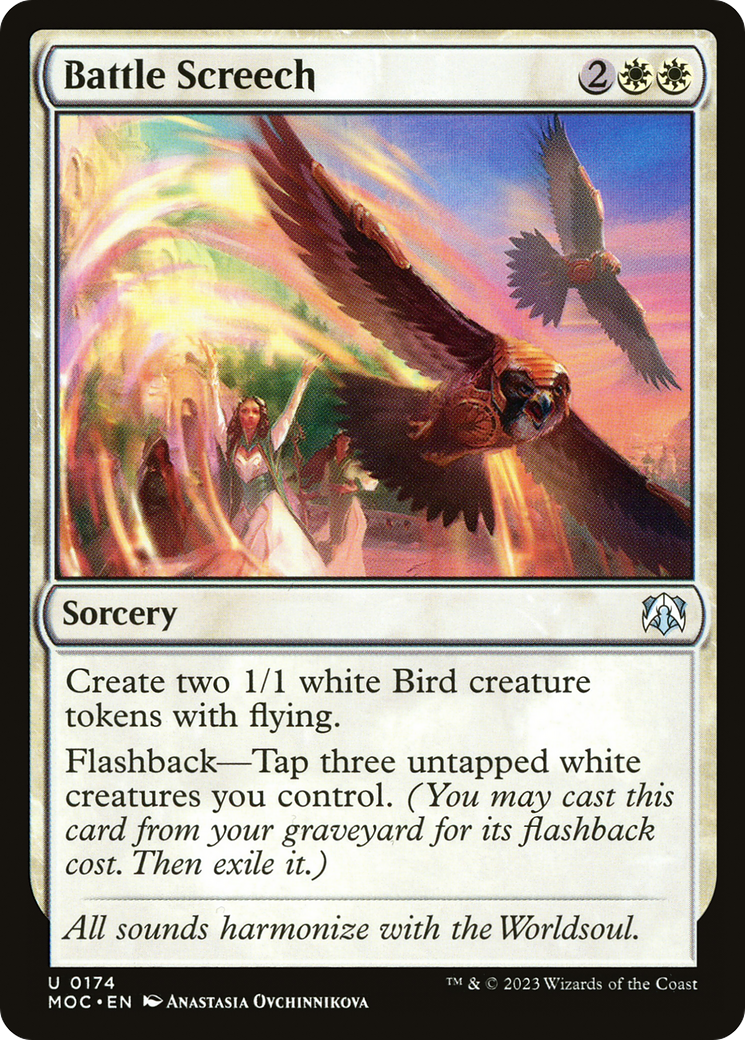
Battle Screech
Battle Screech
Sorcery
Create two 1/1 white Bird creature tokens with flying.
Flashback—Tap three untapped white creatures you control. (You may cast this card from your graveyard for its flashback cost. Then exile it.)
- You can tap any untapped white creatures you control to pay for Battle Screech’s flashback cost, even ones you haven’t controlled continuously since the beginning of your most recent turn.
- “Flashback [cost]” means “You may cast this card from your graveyard by paying [cost] rather than paying its mana cost” and “If the flashback cost was paid, exile this card instead of putting it anywhere else any time it would leave the stack.”
- You must still follow any timing restrictions and permissions, including those based on the card's type. For instance, you can cast a sorcery using flashback only when you could normally cast a sorcery.
- To determine the total cost of a spell, start with the mana cost or alternative cost (such as a flashback cost) you're paying, add any cost increases, then apply any cost reductions. The mana value of the spell is determined only by its mana cost, no matter what the total cost to cast the spell was.
- A spell cast using flashback will always be exiled afterward, whether it resolves, is countered, or leaves the stack in some other way.
- You can cast a spell using flashback even if it was somehow put into your graveyard without having been cast.
- If a card with flashback is put into your graveyard during your turn, you can cast it if it's legal to do so before any other player can take any actions.
-
1
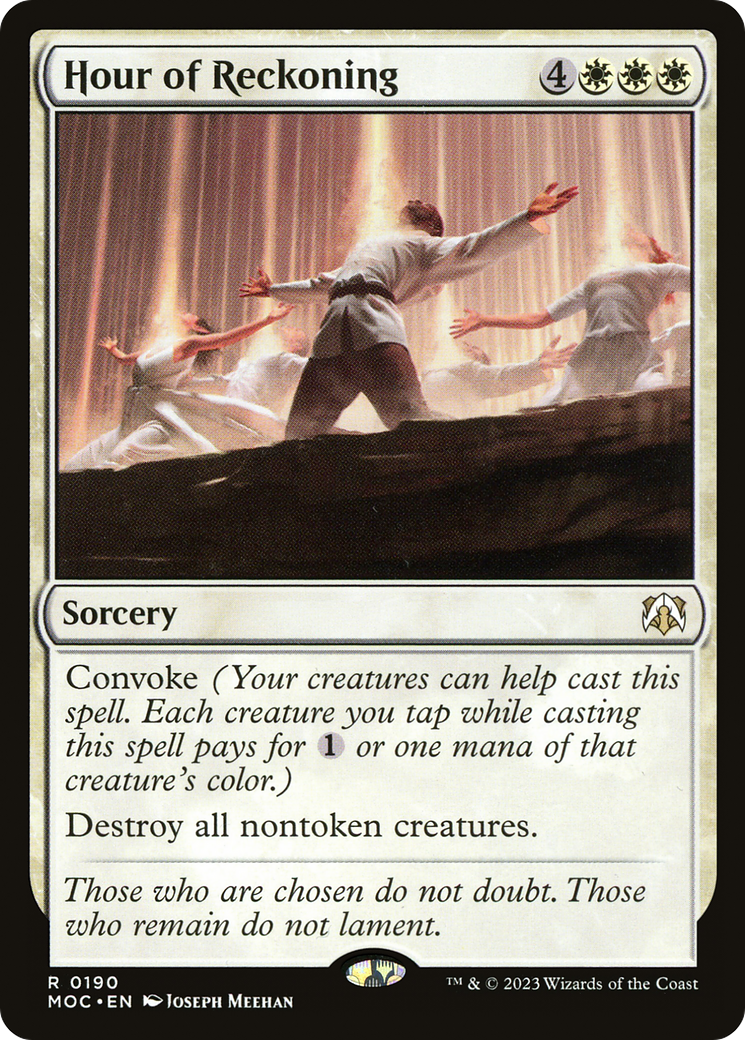
Hour of Reckoning
Hour of Reckoning
Sorcery
Convoke (Your creatures can help cast this spell. Each creature you tap while casting this spell pays for or one mana of that creature's color.)
Destroy all nontoken creatures.
- You can tap any untapped creature you control to convoke a spell, even one you haven't controlled continuously since the beginning of your most recent turn.
- Tapping an untapped creature that's attacking or blocking to convoke a spell won't cause that creature to stop attacking or blocking.
- When calculating a spell's total cost, include any alternative costs, additional costs, or anything else that increases or reduces the cost to cast the spell. Convoke applies after the total cost is calculated. Convoke doesn't change a spell's mana cost or mana value.
- If a creature you control has a mana ability with in the cost, activating that ability while casting a spell with convoke will result in the creature being tapped before you pay the spell's costs. You won't be able to tap it again for convoke. Similarly, if you sacrifice a creature to activate a mana ability while casting a spell with convoke, that creature won't be on the battlefield when you pay the spell's costs, so you won't be able to tap it for convoke.
- Because convoke isn't an alternative cost, it can be used in conjunction with alternative costs.
- Tapping a multicolored creature using convoke will pay for or one mana of your choice of any of that creature's colors.
-
1
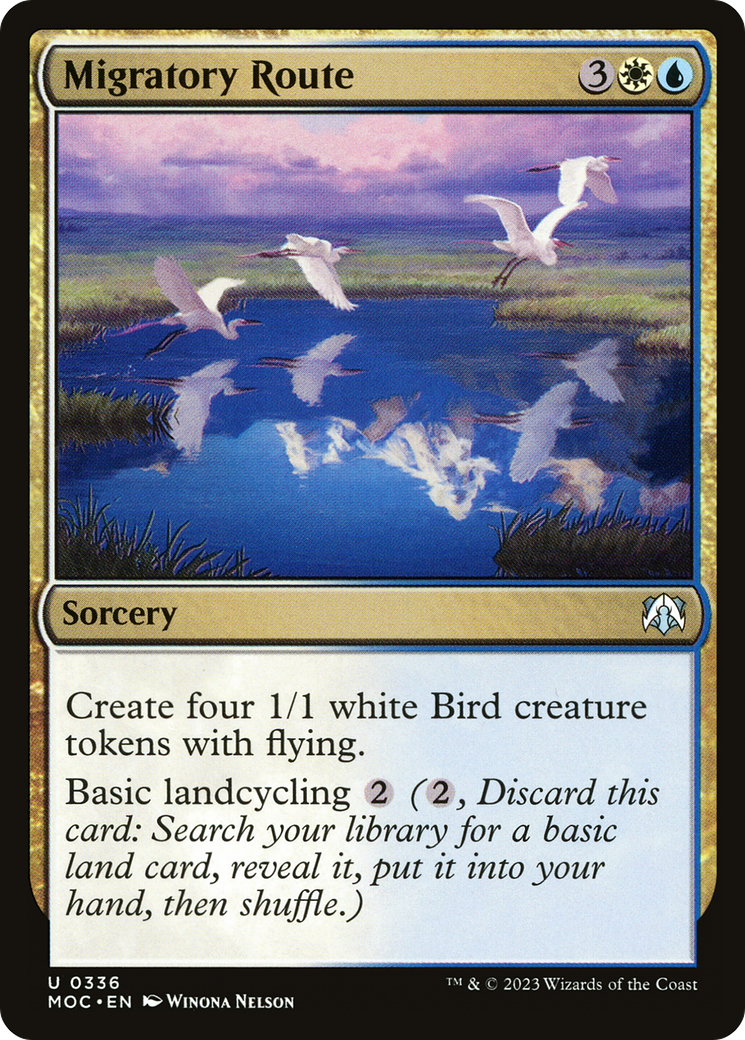
Migratory Route
Migratory Route
Sorcery
Create four 1/1 white Bird creature tokens with flying.
Basic landcycling ( , Discard this card: Search your library for a basic land card, reveal it, put it into your hand, then shuffle.)
-
1
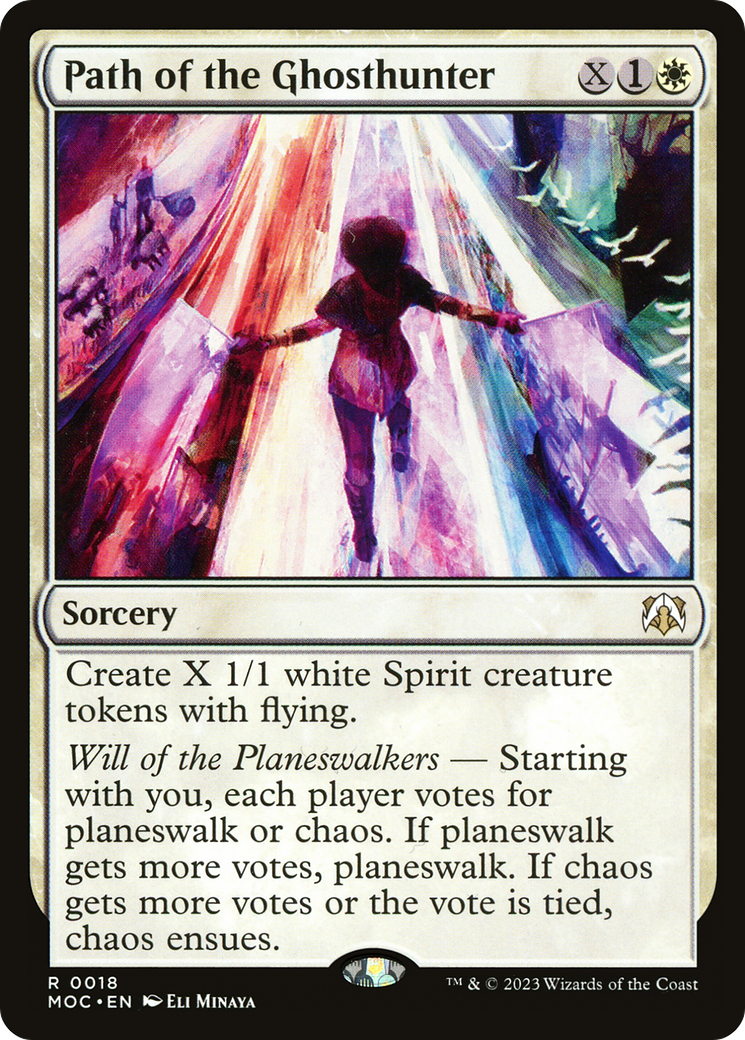
Path of the Ghosthunter
Path of the Ghosthunter
Sorcery
Create X 1/1 white Spirit creature tokens with flying.
Will of the Planeswalkers — Starting with you, each player votes for planeswalk or chaos. If planeswalk gets more votes, planeswalk. If chaos gets more votes or the vote is tied, chaos ensues.
-
1
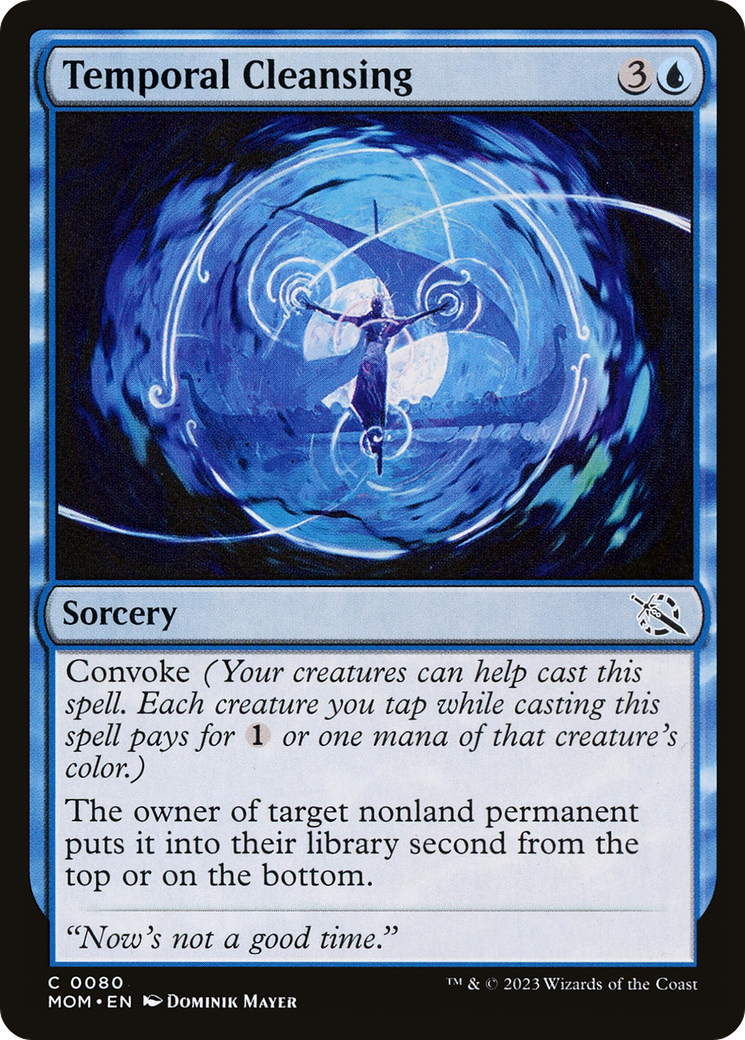
Temporal Cleansing
Temporal Cleansing
Sorcery
Convoke (Your creatures can help cast this spell. Each creature you tap while casting this spell pays for or one mana of that creature's color.)
The owner of target nonland permanent puts it into their library second from the top or on the bottom.
-
1
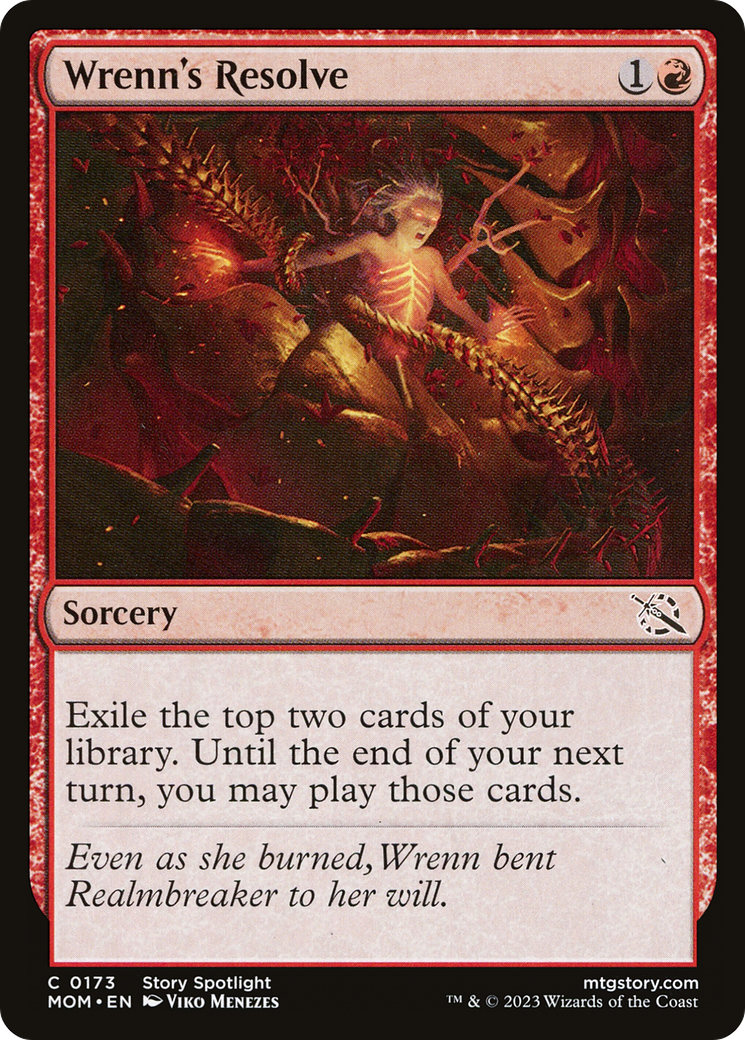
Wrenn's Resolve
Wrenn's Resolve
Sorcery
Exile the top two cards of your library. Until the end of your next turn, you may play those cards.
Artifacts 9
-
1
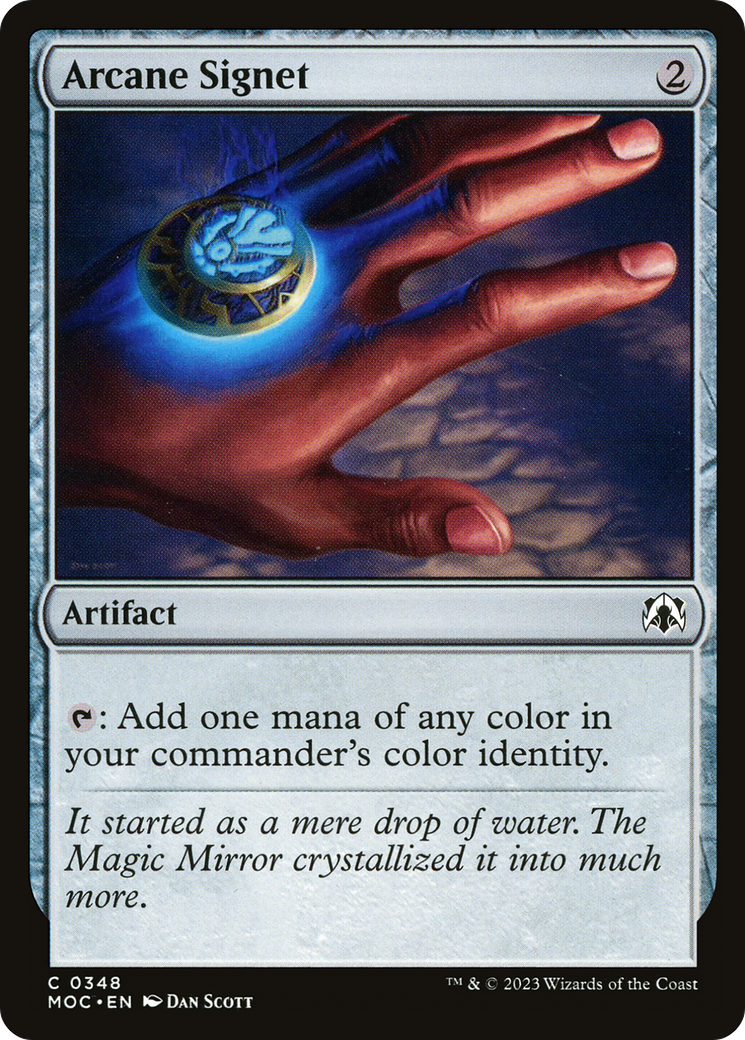
Arcane Signet
Arcane Signet
Artifact
: Add one mana of any color in your commander's color identity.
- If your commander is a card that has no colors in its color identity, Arcane Signet's ability produces no mana. It doesn't produce .
- If you have two commanders, the ability adds one mana of any color in their combined color identities.
- If you don't have a commander, Arcane Signet's ability produces no mana.
-
1
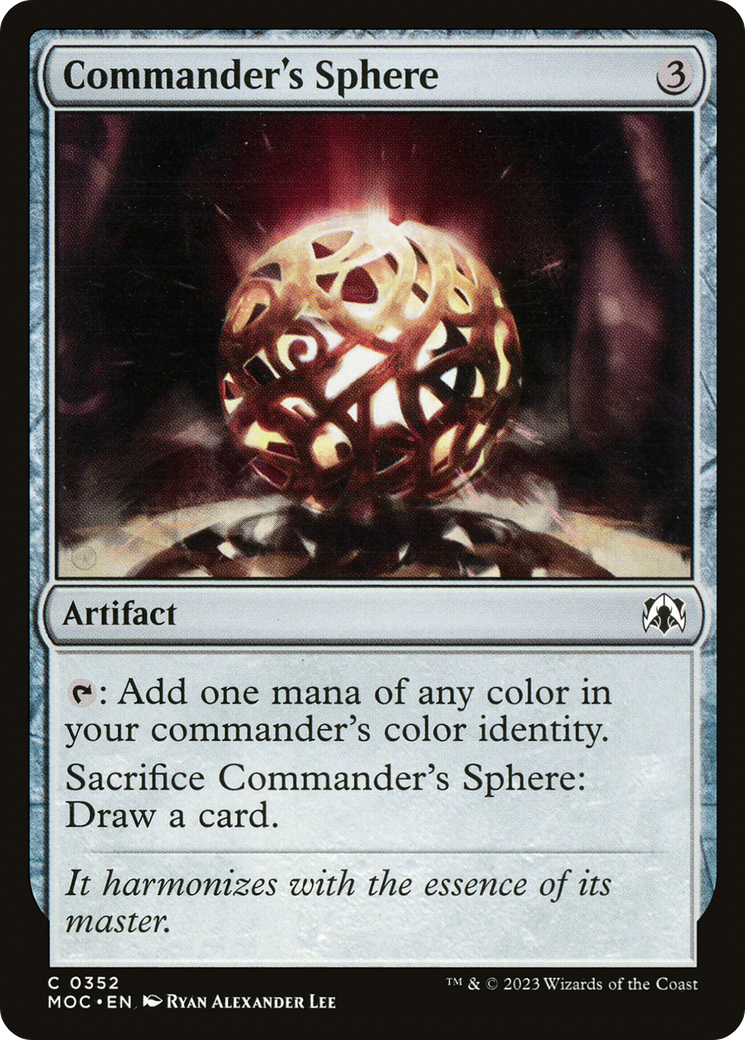
Commander's Sphere
Commander's Sphere
Artifact
: Add one mana of any color in your commander's color identity.
Sacrifice this artifact: Draw a card.
- If your commander is a card that has no colors in its color identity, Commander's Sphere's first ability produces no mana. It doesn't produce .
- If you don't have a commander, Commander's Sphere's first ability produces no mana.
- If you have two commanders, the ability adds one mana of any color in their combined color identities.
-
1
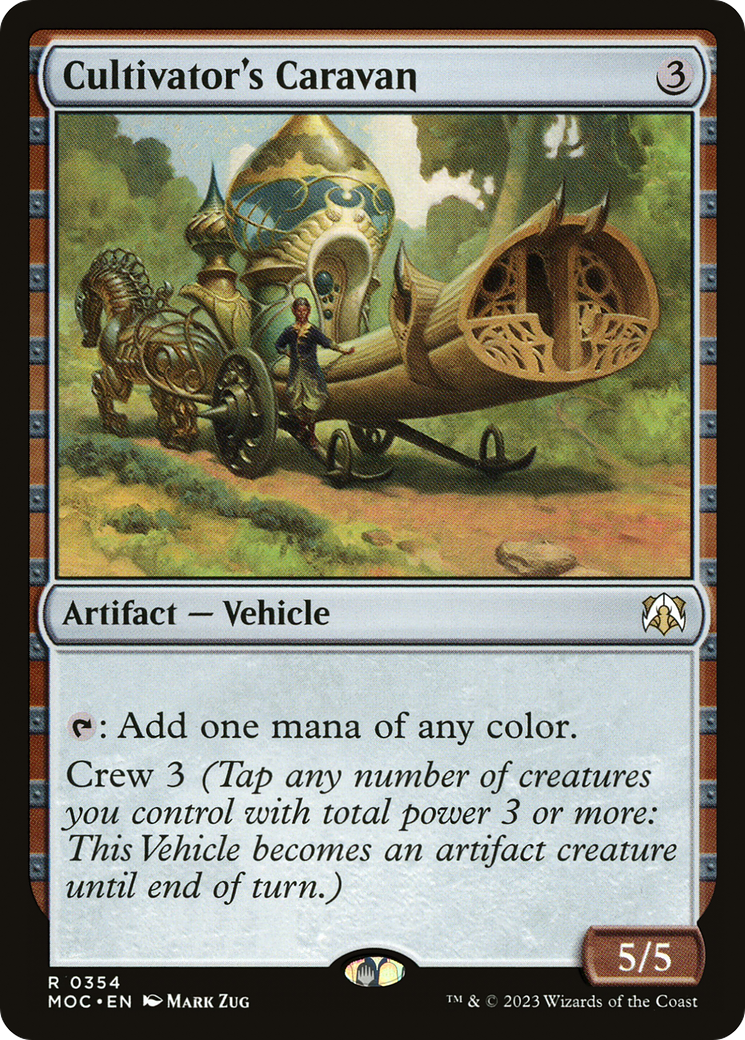
Cultivator's Caravan
Cultivator's Caravan
Artifact — Vehicle
5/5
: Add one mana of any color.
Crew 3 (Tap any number of creatures you control with total power 3 or more: This Vehicle becomes an artifact creature until end of turn.)
- If a permanent becomes a copy of a Vehicle, the copy won't be a creature, even if the Vehicle it's copying has become an artifact creature.
- Each Vehicle is printed with a power and toughness, but it's not a creature. If it becomes a creature (most likely through its crew ability), it will have that power and toughness.
- If an effect causes a Vehicle to become an artifact creature with a specified power and toughness, that effect overwrites the Vehicle's printed power and toughness.
- Vehicle is an artifact type, not a creature type. A Vehicle that's crewed won't normally have any creature type.
- Once a player announces that they are activating a crew ability, no player may take other actions until the ability has been paid for. Notably, players can't try to stop the ability by changing a creature's power or by removing or tapping a creature.
- Any untapped creature you control can be tapped to pay a crew cost, even one that just came under your control.
- You may tap more creatures than necessary to activate a crew ability.
- Creatures that crew a Vehicle aren't attached to it or related in any other way. Effects that affect the Vehicle, such as by destroying it or giving it a +1/+1 counter, don't affect the creatures that crewed it.
- Once a Vehicle becomes a creature, it behaves exactly like any other artifact creature. It can't attack unless you've controlled it continuously since your turn began, it can block if it's untapped, it can be tapped to pay a Vehicle's crew cost, and so on.
- You may activate a crew ability of a Vehicle even if it's already an artifact creature. Doing so has no effect on the Vehicle. It doesn't change its power and toughness.
- For a Vehicle to be able to attack, it must be a creature as the declare attackers step begins, so the latest you can activate its crew ability to attack with it is during the beginning of combat step. For a Vehicle to be able to block, it must be a creature as the declare blockers step begins, so the latest you can activate its crew ability to block with it is during the declare attackers step. In either case, players may take actions after the crew ability resolves but before the Vehicle has been declared as an attacking or blocking creature.
- When a Vehicle becomes a creature, that doesn't count as having a creature enter the battlefield. The permanent was already on the battlefield; it only changed its types. Abilities that trigger whenever a creature enters the battlefield won't trigger.
- As long as Cultivator's Caravan isn't an artifact creature, its ability can be activated if it came under your control this turn.
-
1
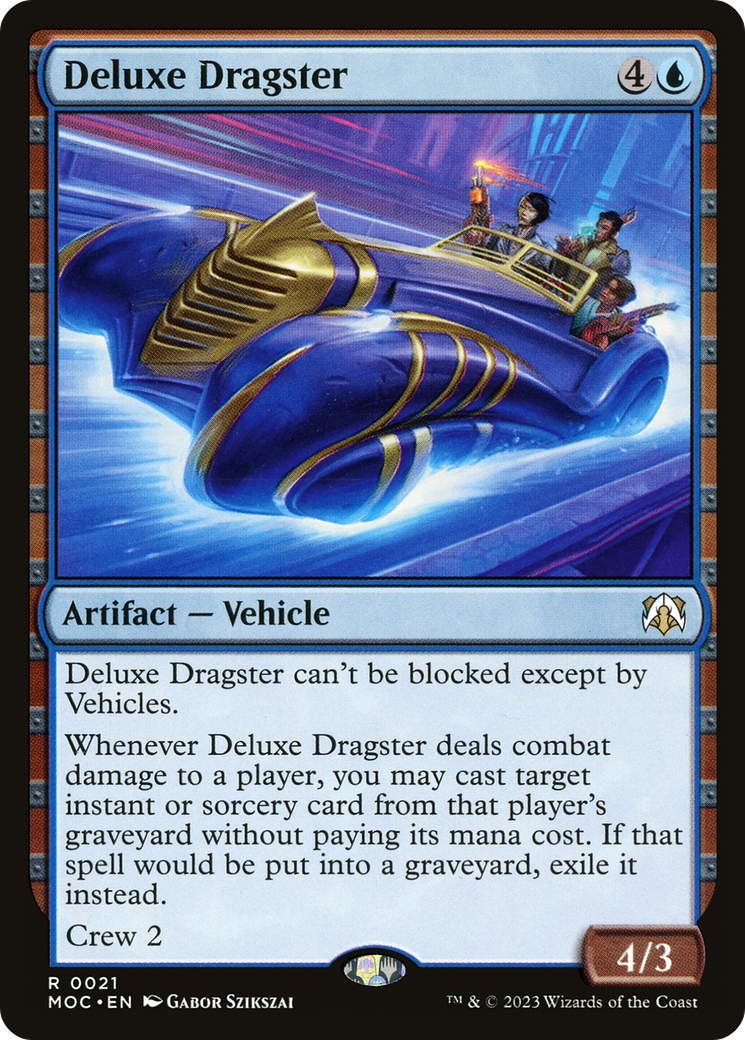
Deluxe Dragster
Deluxe Dragster
Artifact — Vehicle
4/3
This Vehicle can't be blocked except by Vehicles.
Whenever this Vehicle deals combat damage to a player, you may cast target instant or sorcery card from that player's graveyard without paying its mana cost. If that spell would be put into a graveyard, exile it instead.
Crew 2
- If you cast the instant or sorcery card, you do so as part of the resolution of the triggered ability. You can't wait to cast them later in the turn. Timing restrictions based on a card's type are ignored.
- If you cast a card "without paying its mana cost," you can't pay any alternative costs. You can, however, pay additional costs. If the card has any mandatory additional costs, those must be paid to cast the card.
- If an exiled card has in its mana cost, you must choose 0 as the value of X when casting it without paying its mana cost.
-
1
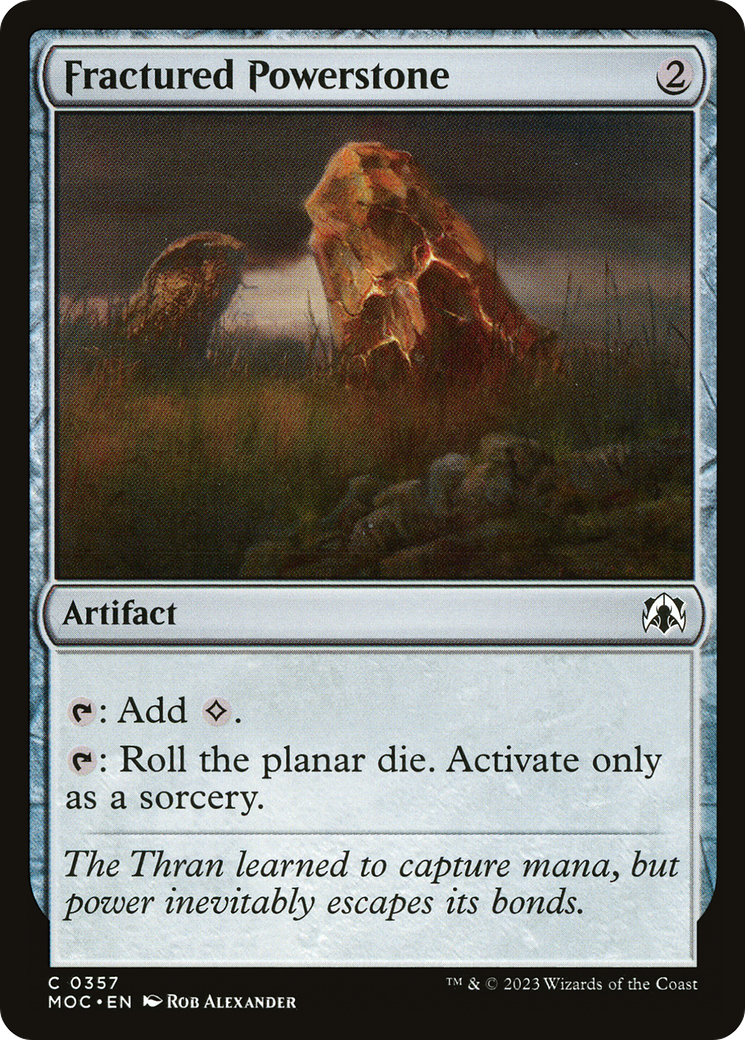
Fractured Powerstone
Fractured Powerstone
Artifact
: Add .
: Roll the planar die. Activate only as a sorcery.
- In non-Planechase games, Fractured Powerstone's second ability will have no effect.
- Rolling the planar die this way doesn't count when determining the cost of the special action of rolling the planar die. For example, if you roll the planar die twice in a turn, then activate Fractured Powerstone to roll it a third time, rolling the planar die again that turn will cost .
-
1
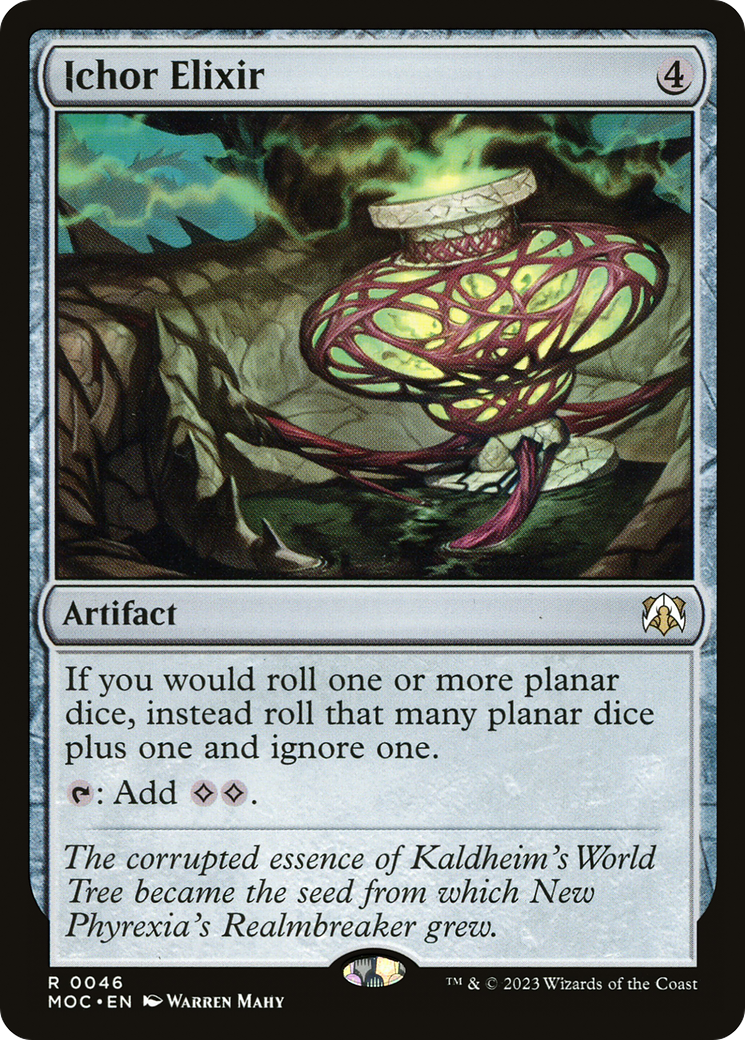
Ichor Elixir
Ichor Elixir
Artifact
If you would roll one or more planar dice, instead roll that many planar dice plus one and ignore one.
: Add .
-
1
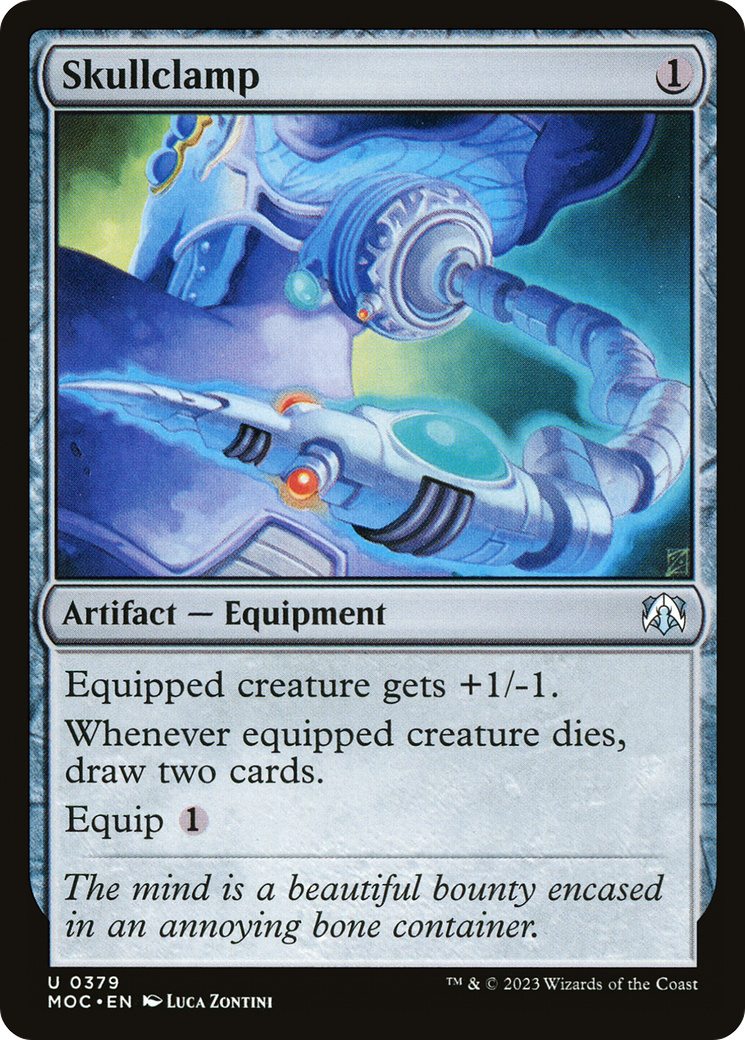
Skullclamp
Skullclamp
Artifact — Equipment
Equipped creature gets +1/-1.
Whenever equipped creature dies, draw two cards.
Equip
-
1
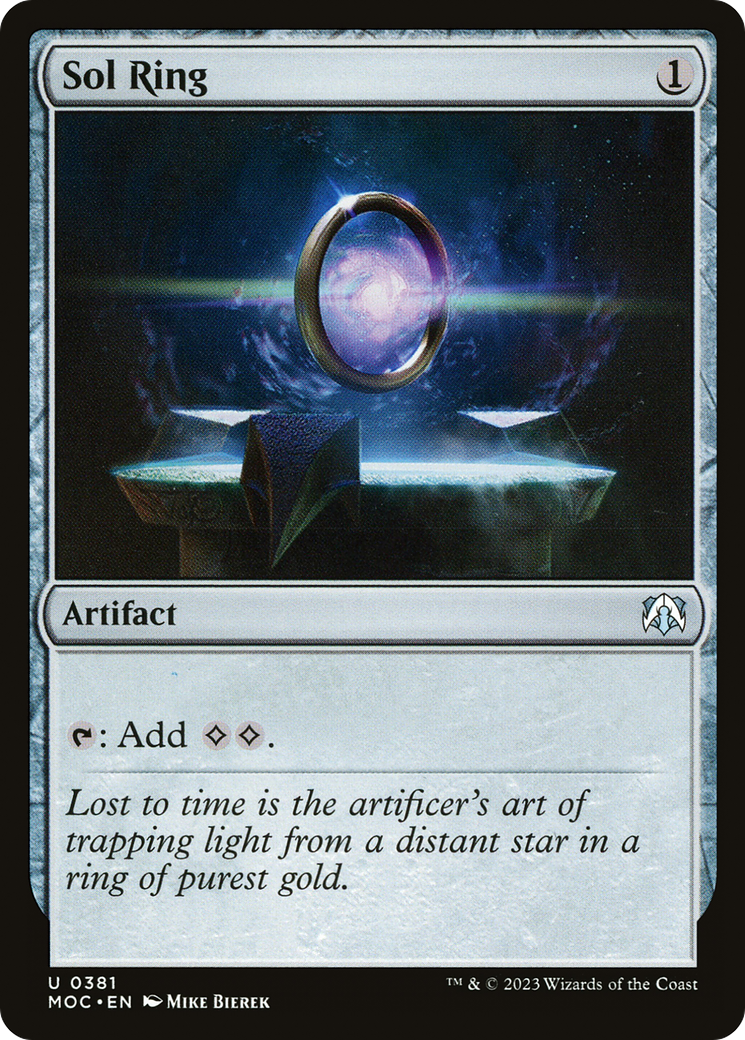
Sol Ring
Sol Ring
Artifact
: Add .
-
1
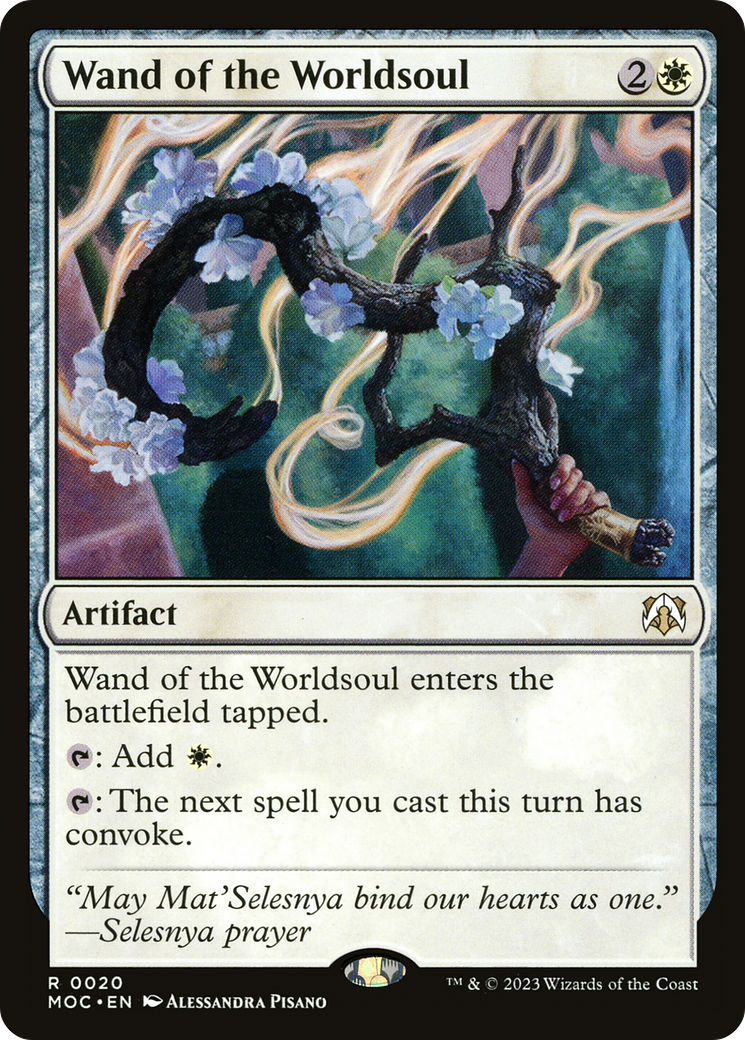
Wand of the Worldsoul
Wand of the Worldsoul
Artifact
This artifact enters tapped.
: Add .
: The next spell you cast this turn has convoke.
- When calculating a spell's total cost, include any alternative costs, additional costs, or anything else that increases or reduces the cost to cast the spell. Convoke applies after the total cost is calculated. Convoke doesn't change a spell's mana cost or mana value.
- You can tap any untapped creature you control to convoke a spell, even one you haven't controlled continuously since the beginning of your most recent turn.
- Tapping an untapped creature that's attacking or blocking to convoke a spell won't cause that creature to stop attacking or blocking.
- Tapping a multicolored creature using convoke will pay for or one mana of your choice of any of that creature's colors.
- If a creature you control has a mana ability with in the cost, activating that ability while casting a spell with convoke will result in the creature being tapped before you pay the spell's costs. You won't be able to tap it again for convoke. Similarly, if you sacrifice a creature to activate a mana ability while casting a spell with convoke, that creature won't be on the battlefield when you pay the spell's costs, so you won't be able to tap it for convoke.
- Because convoke isn't an alternative cost, it can be used in conjunction with alternative costs.
- If the next spell you cast after Wand of the Worldsoul's ability resolves already has convoke, giving it convoke again doesn't have any real benefit. Tapping a creature you control will still pay for only or one mana of that creature's color.
Enchantments 4
-
1
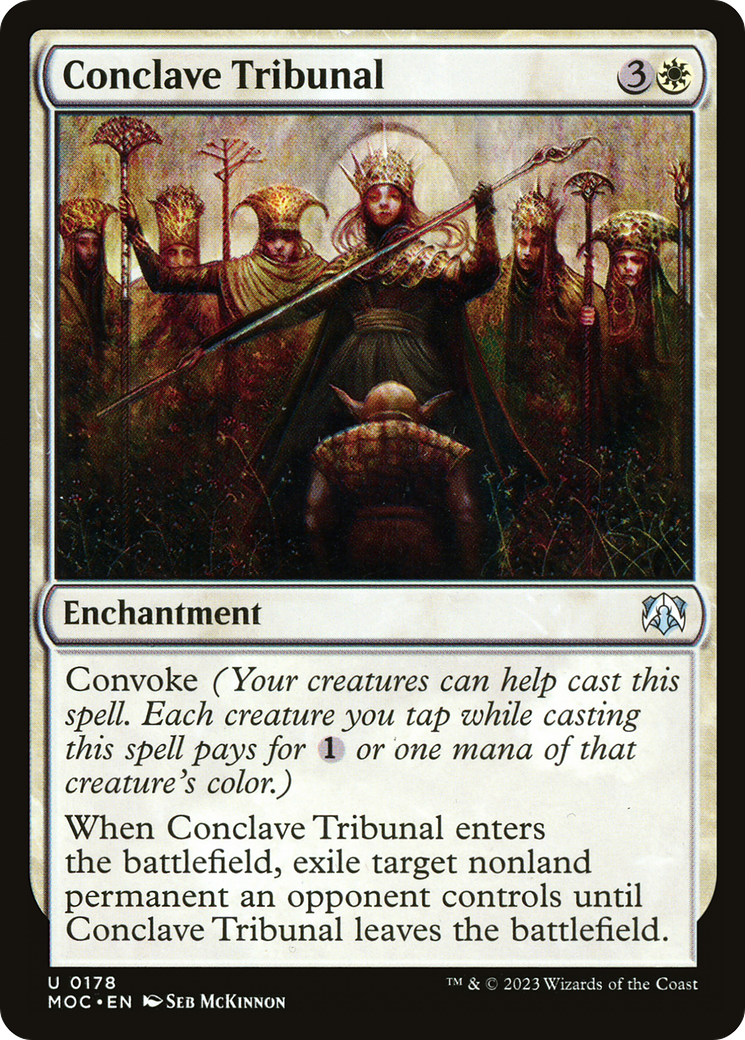
Conclave Tribunal
Conclave Tribunal
Enchantment
Convoke (Your creatures can help cast this spell. Each creature you tap while casting this spell pays for or one mana of that creature's color.)
When this enchantment enters, exile target nonland permanent an opponent controls until this enchantment leaves the battlefield.
- Tapping a multicolored creature using convoke will pay for or one mana of your choice of any of that creature's colors.
- When calculating a spell's total cost, include any alternative costs, additional costs, or anything else that increases or reduces the cost to cast the spell. Convoke applies after the total cost is calculated. Convoke doesn't change a spell's mana cost or mana value.
- If a creature you control has a mana ability with in the cost, activating that ability while casting a spell with convoke will result in the creature being tapped before you pay the spell's costs. You won't be able to tap it again for convoke. Similarly, if you sacrifice a creature to activate a mana ability while casting a spell with convoke, that creature won't be on the battlefield when you pay the spell's costs, so you won't be able to tap it for convoke.
- Because convoke isn't an alternative cost, it can be used in conjunction with alternative costs.
- You can tap any untapped creature you control to convoke a spell, even one you haven't controlled continuously since the beginning of your most recent turn.
- Tapping an untapped creature that's attacking or blocking to convoke a spell won't cause that creature to stop attacking or blocking.
- Auras attached to the exiled permanent will be put into their owners' graveyards. Any Equipment will become unattached and remain on the battlefield. Any counters on the exiled permanent will cease to exist. When the card returns to the battlefield, it will be a new object with no connection to the card that was exiled.
- If a token is exiled this way, it will cease to exist and won't return to the battlefield.
- If Conclave Tribunal leaves the battlefield before its triggered ability resolves, the target permanent won't be exiled.
-
1
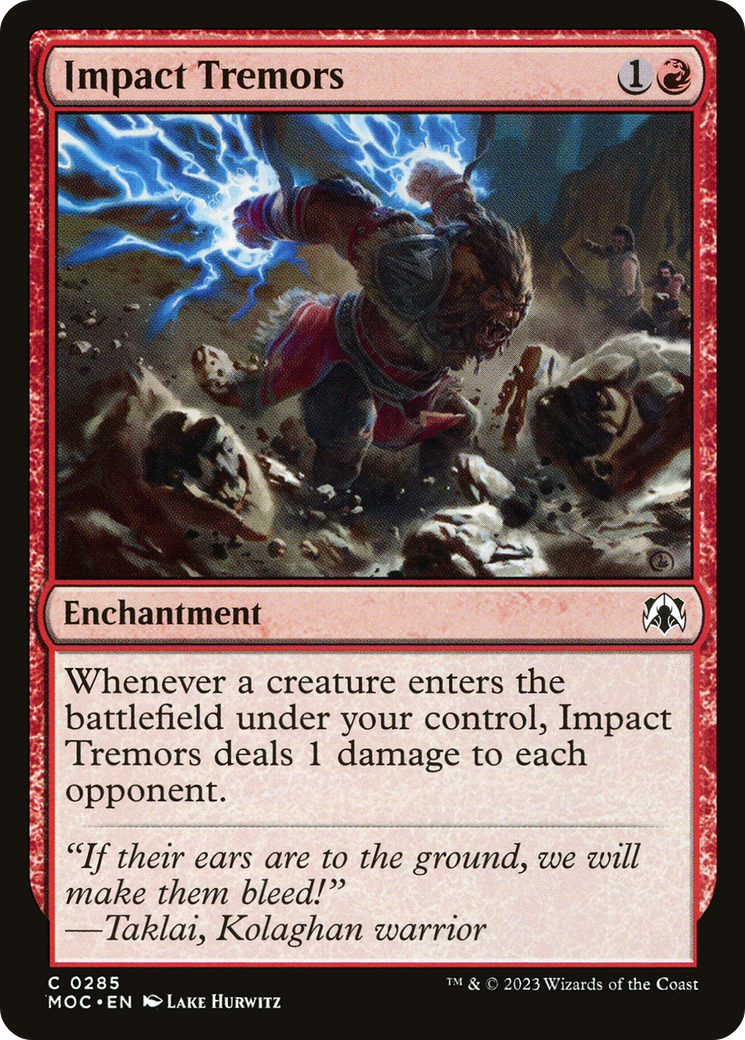
Impact Tremors
Impact Tremors
Enchantment
Whenever a creature you control enters, this enchantment deals 1 damage to each opponent.
- If multiple creatures you control enter at the same time, Impact Tremors will trigger once for each of those creatures. This is true even if Impact Tremors enters at the same time as those creatures.
-
1
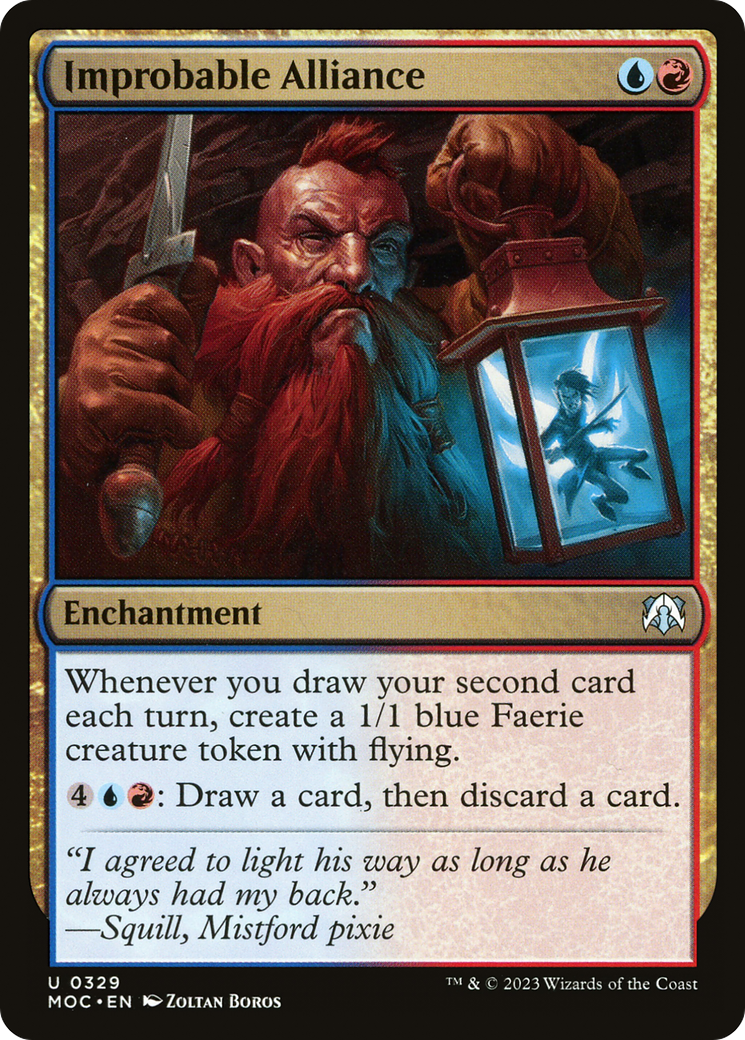
Improbable Alliance
Improbable Alliance
Enchantment
Whenever you draw your second card each turn, create a 1/1 blue Faerie creature token with flying.
: Draw a card, then discard a card.
- The triggered ability can trigger only once each turn. It doesn't matter whether the permanent with that ability was on the battlefield when the first card was drawn. If it's not on the battlefield when the second card is drawn, the ability can't trigger at all that turn. It won't trigger when the third or fourth card is drawn.
- If an effect instructs you to draw multiple cards, the ability triggers after you draw whichever is the second one for the turn. You choose a target (if any) for the ability after you've drawn and looked at all of the cards and finished resolving the spell or ability that caused you to draw them.
- If a spell or ability causes you to put cards into your hand without specifically using the word "draw," it's not a card drawn.
-
1
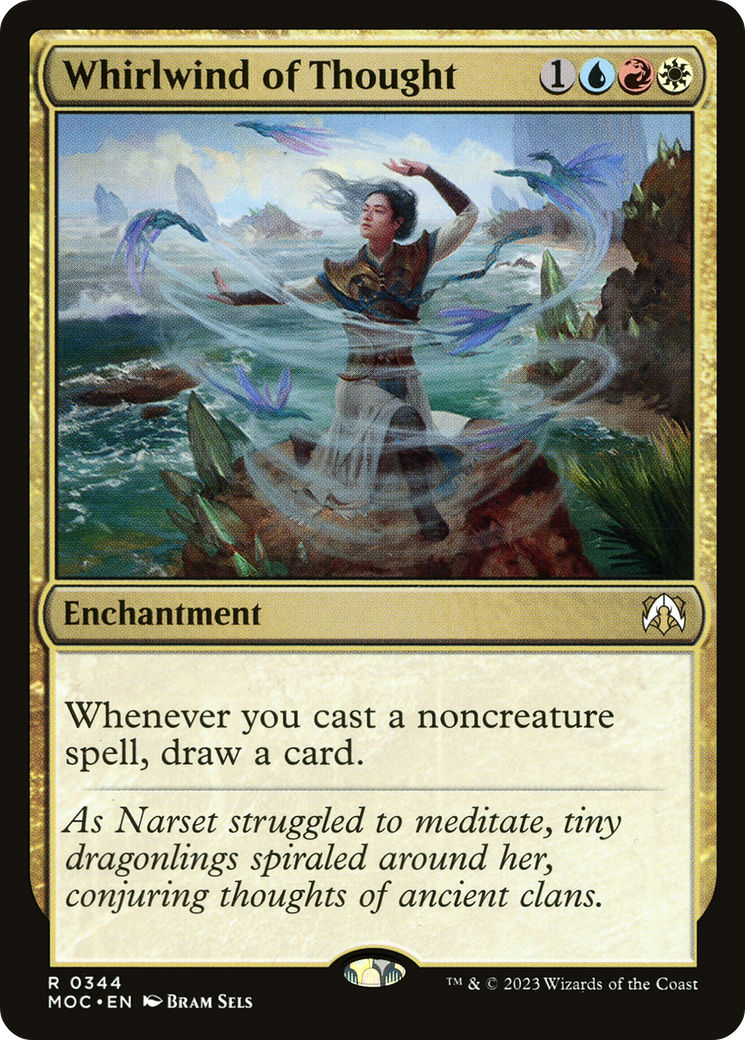
Whirlwind of Thought
Whirlwind of Thought
Enchantment
Whenever you cast a noncreature spell, draw a card.
- An ability that triggers when a player casts a spell resolves before the spell that caused it to trigger. It resolves even if that spell is countered.
- Players can cast spells and activate abilities after the triggered ability resolves but before the spell that caused it to trigger does.
Lands 39
-
1
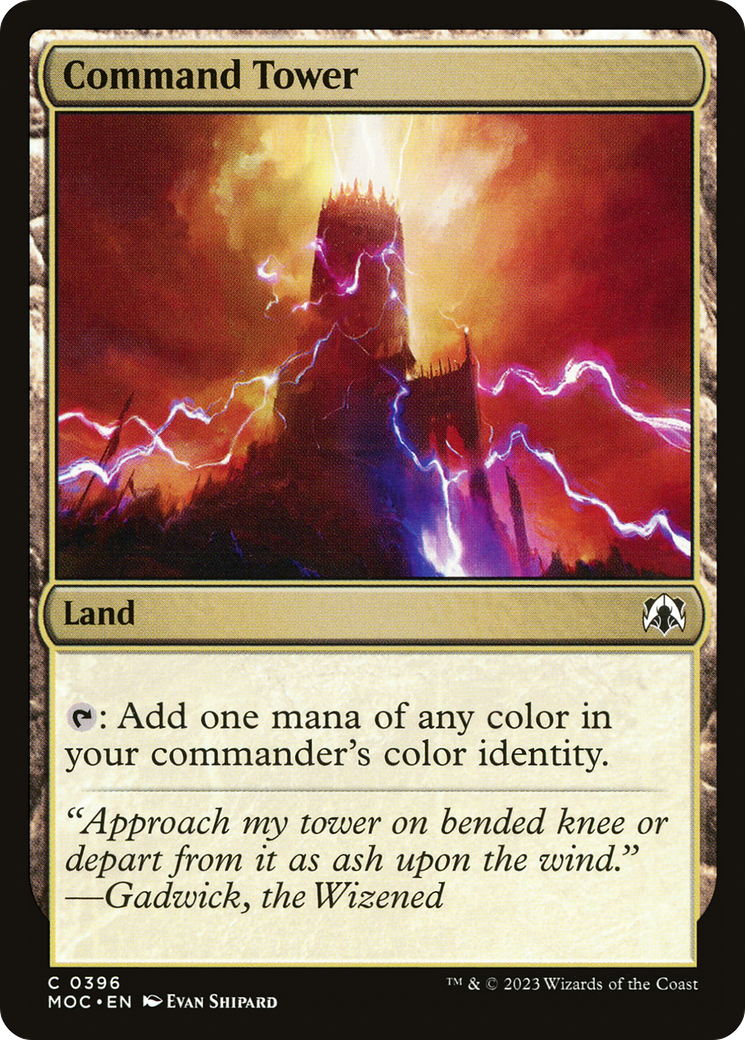
Command Tower
Command Tower
Land
: Add one mana of any color in your commander's color identity.
- If you don't have a commander, Command Tower's ability produces no mana.
- If your commander is a card that has no colors in its color identity, Command Tower's ability produces no mana. It doesn't produce .
- If you have two commanders, the ability adds one mana of any color in their combined color identities.
-
1
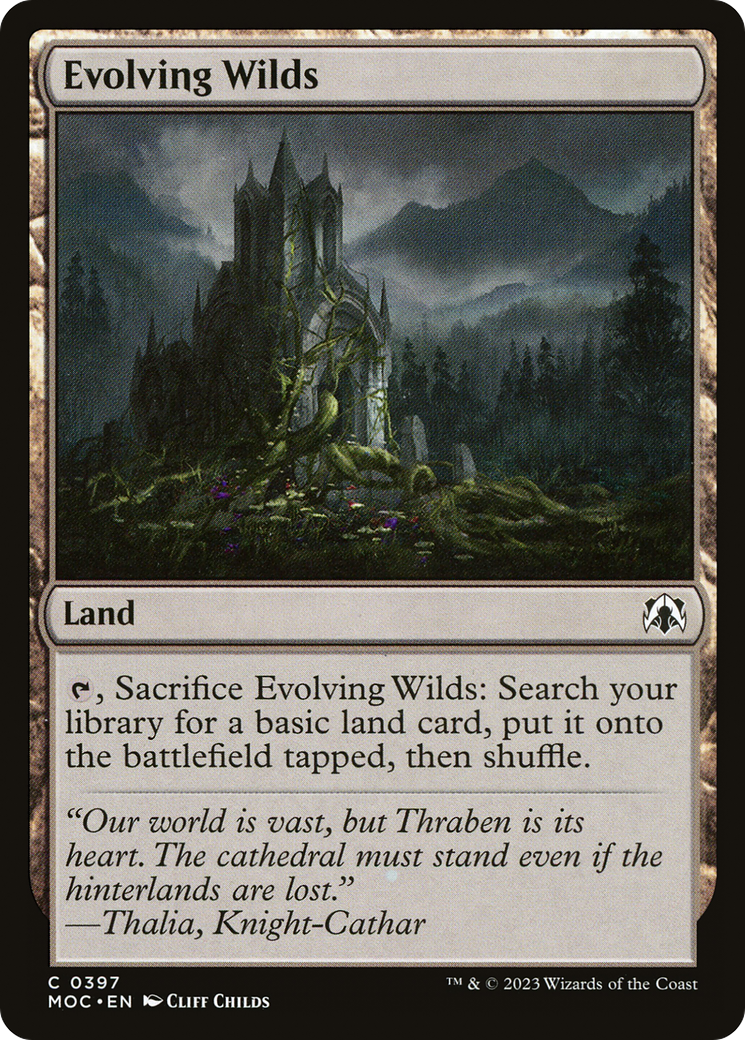
Evolving Wilds
Evolving Wilds
Land
, Sacrifice this land: Search your library for a basic land card, put it onto the battlefield tapped, then shuffle.
-
1
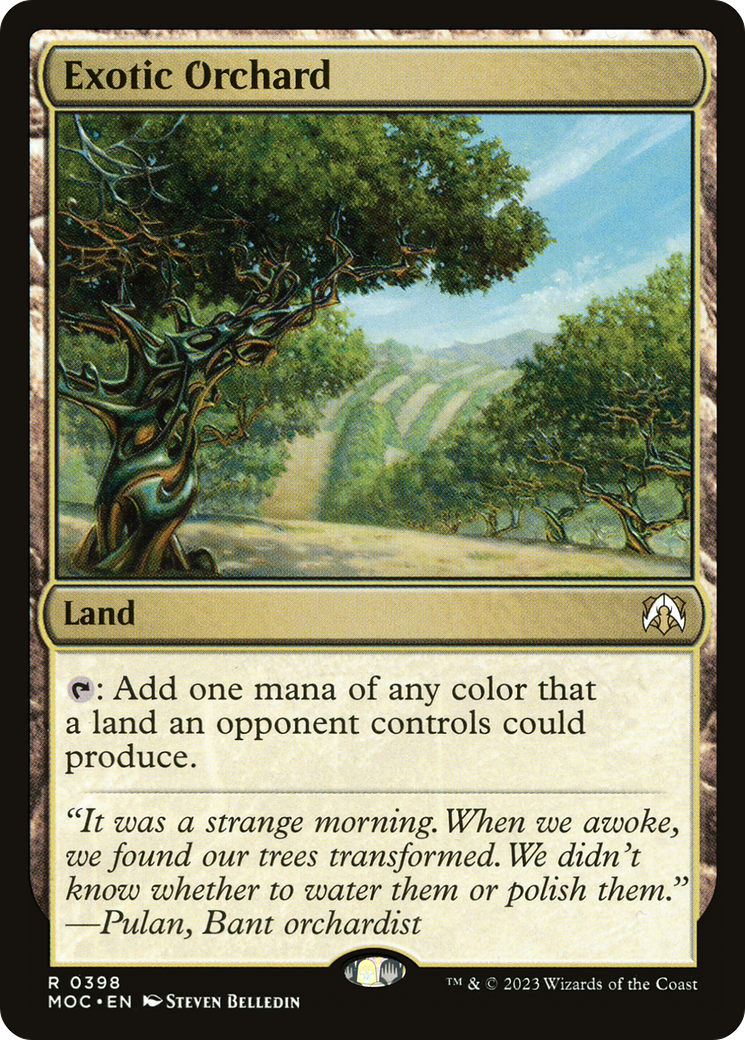
Exotic Orchard
Exotic Orchard
Land
: Add one mana of any color that a land an opponent controls could produce.
- Lands that produce mana based only on what other lands "could produce" won't help each other unless some other land allows one of them to actually produce some type of mana. For example, if you control an Exotic Orchard and your opponent controls an Exotic Orchard and a Reflecting Pool, none of those lands would produce mana if their mana abilities were activated. On the other hand, if you control a Forest and an Exotic Orchard, and your opponent controls an Exotic Orchard and a Reflecting Pool, then each of those lands can be tapped to produce . Your opponent's Exotic Orchard can produce because you control a Forest. Your Exotic Orchard and your opponent's Reflecting Pool can each produce because your opponent's Exotic Orchard can produce .
- When determining what colors of mana your opponents' lands could produce, Exotic Orchard takes into account any applicable replacement effects that would apply to those lands' mana abilities (such as Contamination's effect, for example). If there are more than one, consider them in any possible order.
- The colors of mana are white, blue, black, red, and green. Exotic Orchard can't be tapped for colorless mana, even if a land an opponent controls could produce colorless mana.
- Exotic Orchard doesn't care about any restrictions or riders your opponents' lands (such as Ancient Ziggurat or Hall of the Bandit Lord) put on the mana they produce. It just cares about colors of mana.
- Exotic Orchard checks the effects of all mana-producing abilities of lands your opponents control, but it doesn't check their costs. For example, Vivid Crag has the ability " , Remove a charge counter from Vivid Crag: Add one mana of any color." If an opponent controls Vivid Crag and you control Exotic Orchard, you can tap Exotic Orchard for any color of mana. It doesn't matter whether Vivid Crag has a charge counter on it, and it doesn't matter whether it's untapped.
-
1
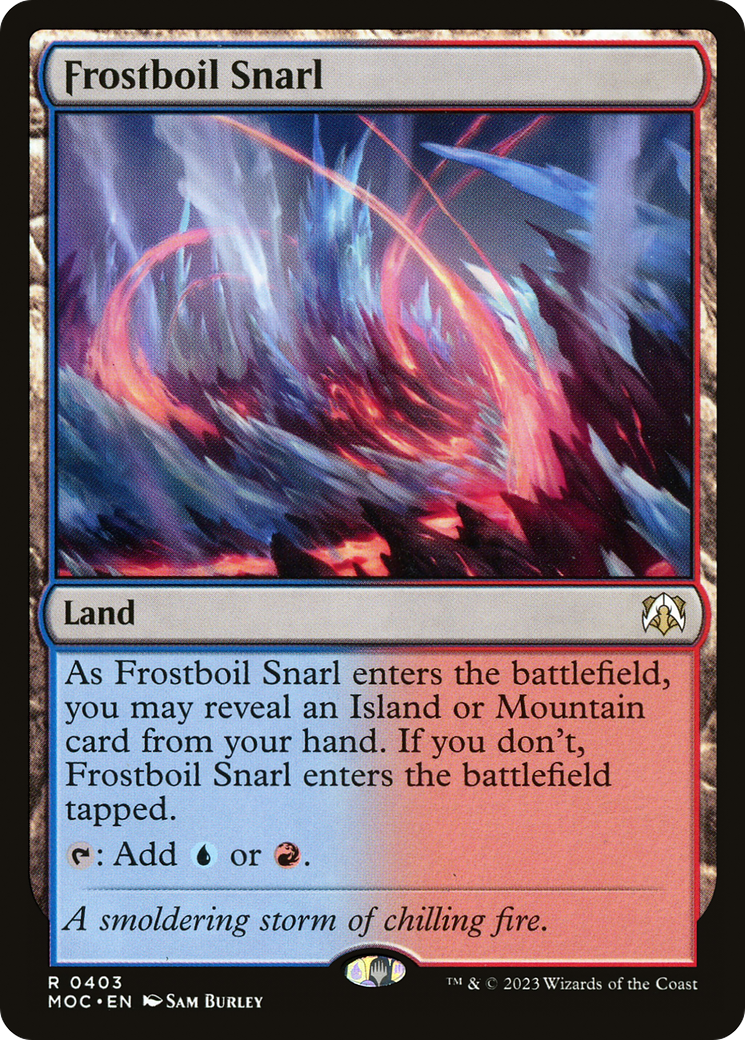
Frostboil Snarl
Frostboil Snarl
Land
As this land enters, you may reveal an Island or Mountain card from your hand. If you don't, this land enters tapped.
: Add or .
- The "Snarl" itself doesn't have any land subtypes. You can't reveal one to satisfy the ability of another.
- If a land card with an appropriate subtype is entering the battlefield from your hand at the same time as one of these lands, you may reveal the other land to have the "Snarl" enter untapped.
- If an effect instructs you to put one of these lands onto the battlefield tapped, it will still enter the battlefield tapped even if you reveal a land card from your hand.
- You may reveal any land card with either or both of the appropriate subtypes. It doesn't have to be a basic land card.
-
1
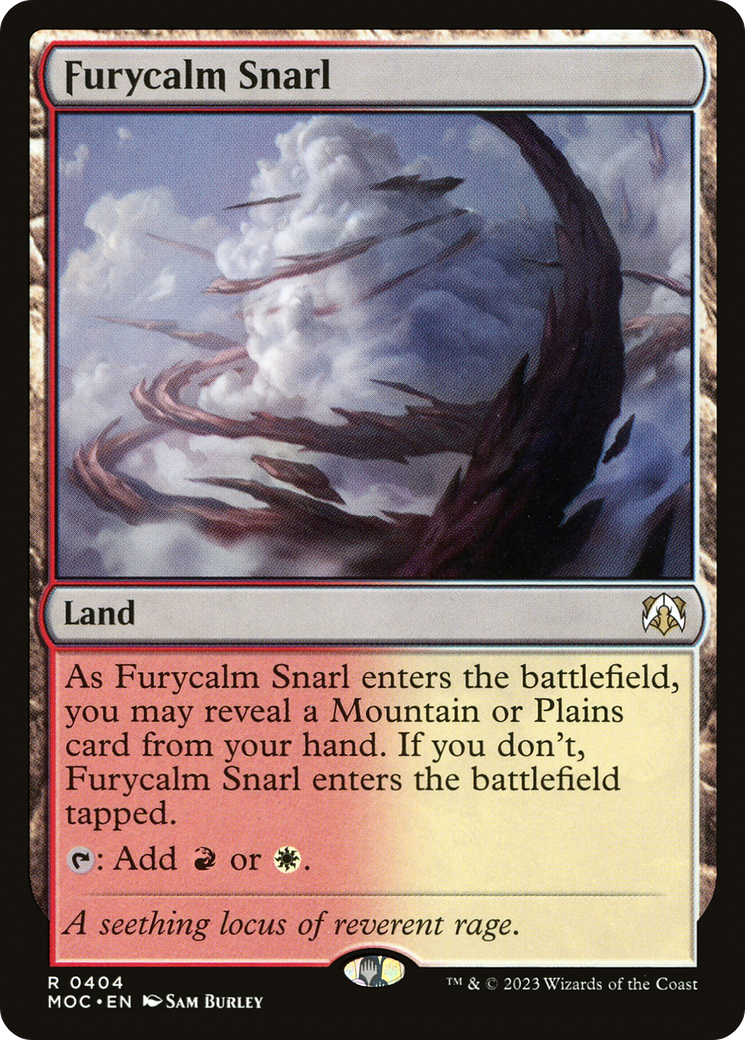
Furycalm Snarl
Furycalm Snarl
Land
As this land enters, you may reveal a Mountain or Plains card from your hand. If you don't, this land enters tapped.
: Add or .
- The "Snarl" itself doesn't have any land subtypes. You can't reveal one to satisfy the ability of another.
- If a land card with an appropriate subtype is entering the battlefield from your hand at the same time as one of these lands, you may reveal the other land to have the "Snarl" enter untapped.
- If an effect instructs you to put one of these lands onto the battlefield tapped, it will still enter the battlefield tapped even if you reveal a land card from your hand.
- You may reveal any land card with either or both of the appropriate subtypes. It doesn't have to be a basic land card.
-
8
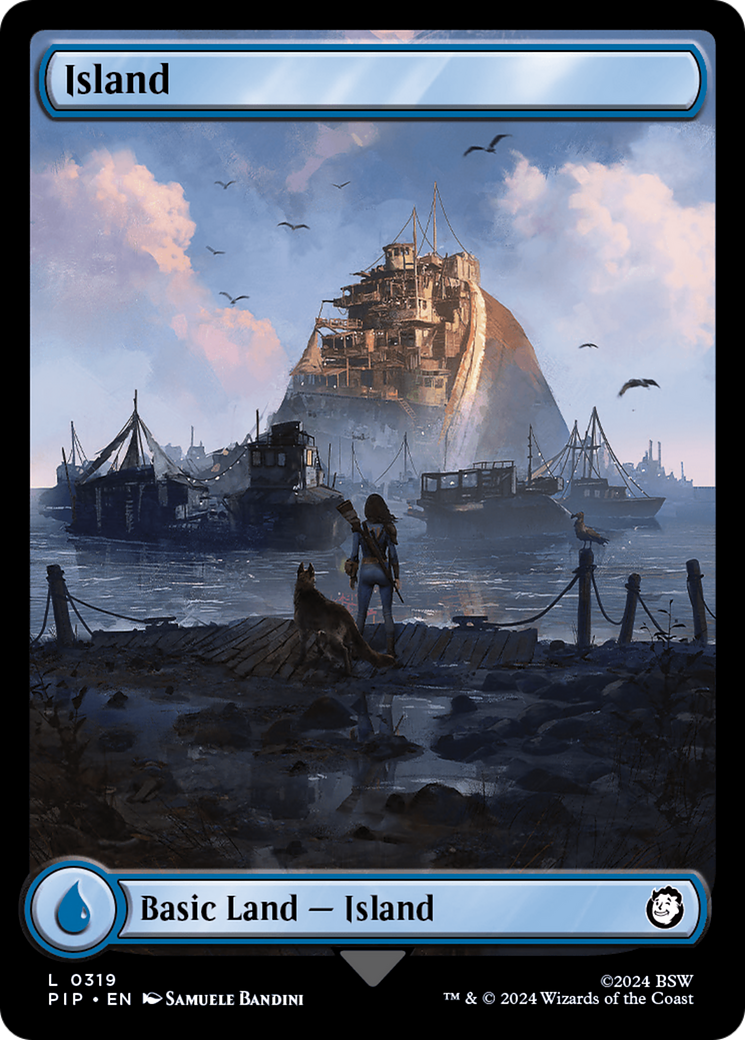
Island
Island
Basic Land — Island
( : Add .)
-
1
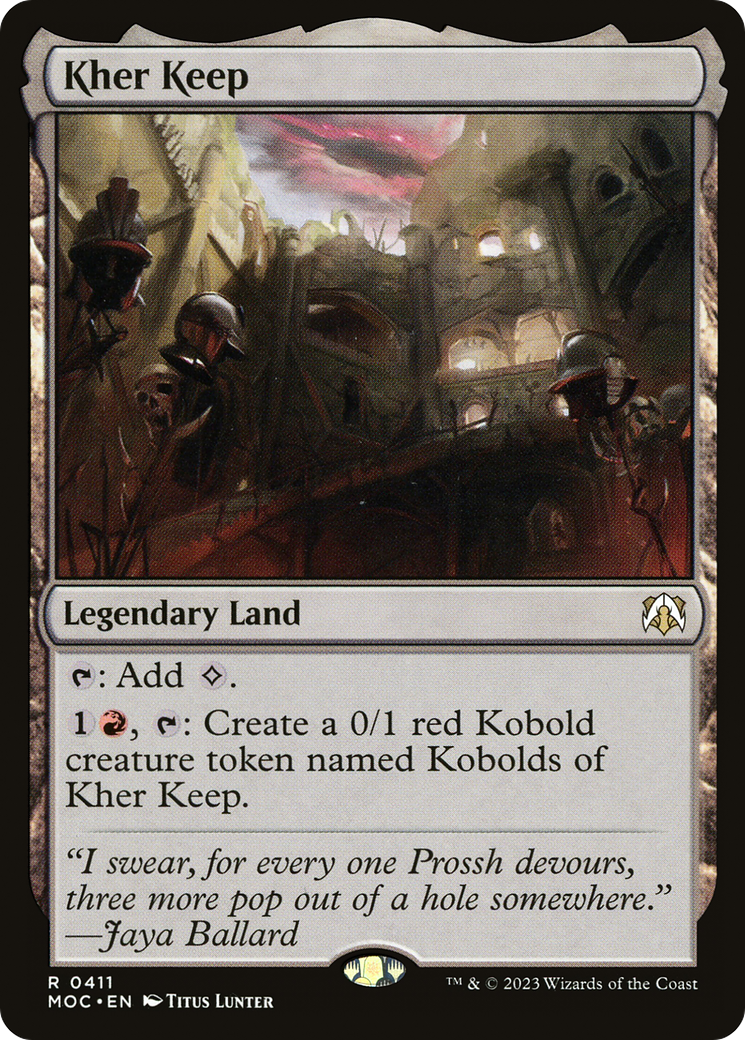
Kher Keep
Kher Keep
Legendary Land
: Add .
, : Create a 0/1 red Kobold creature token named Kobolds of Kher Keep.
-
8
Mountain
Mountain
Basic Land — Mountain
( : Add .)
-
1
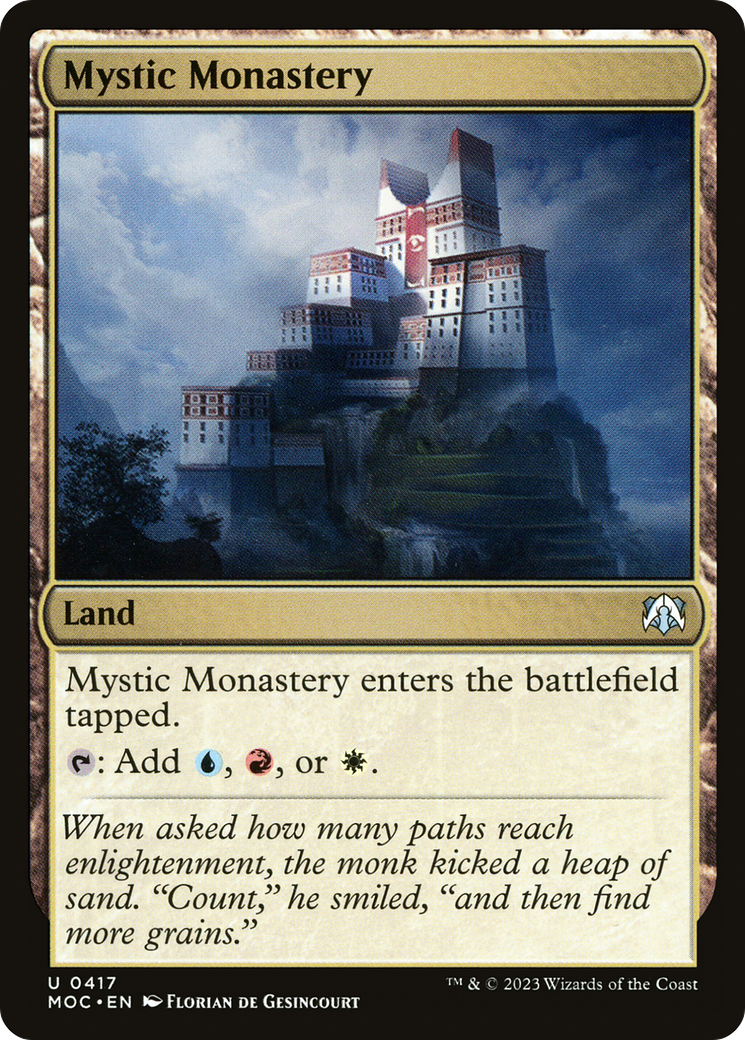
Mystic Monastery
Mystic Monastery
Land
This land enters tapped.
: Add , , or .
-
8
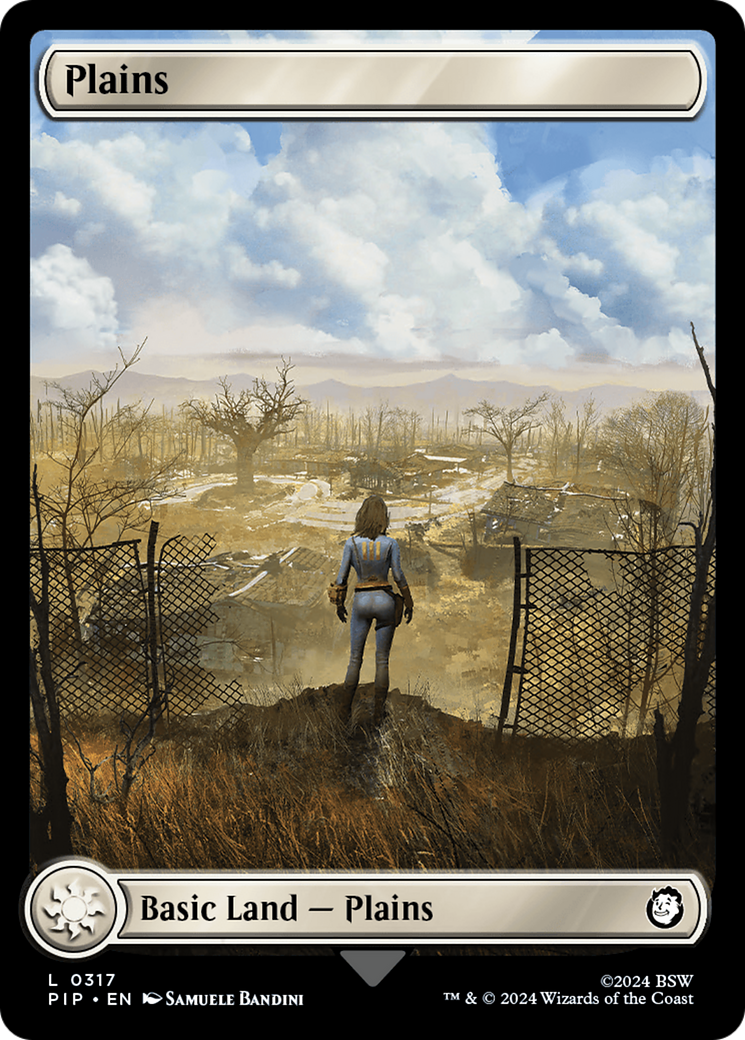
Plains
Plains
Basic Land — Plains
( : Add .)
-
1
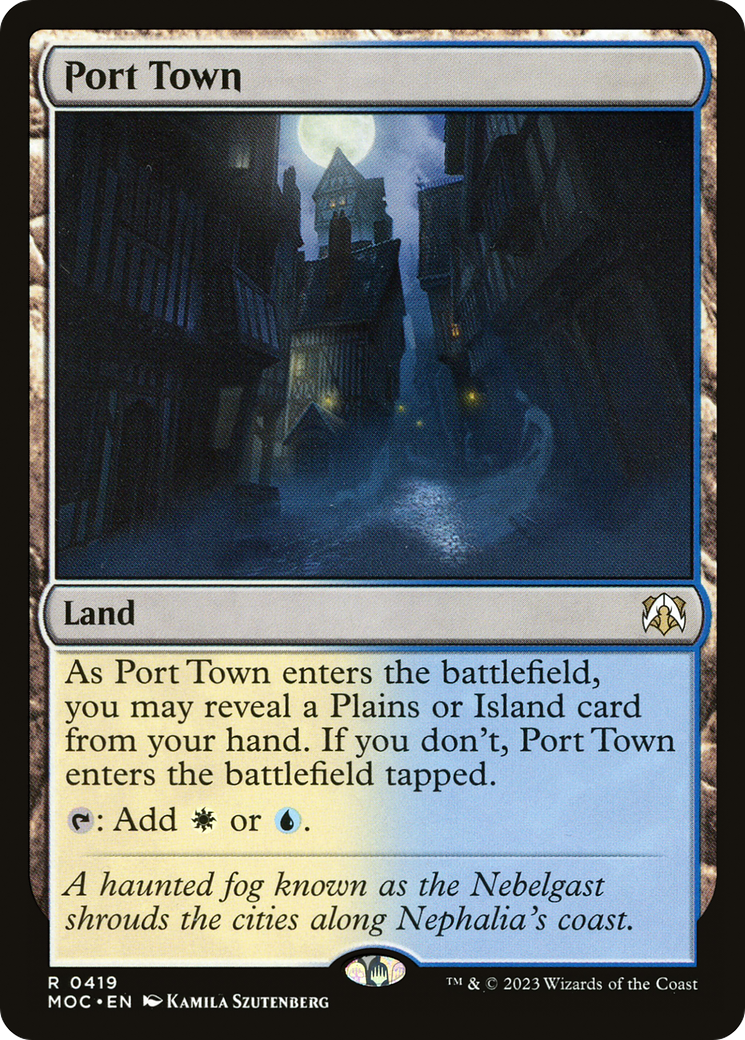
Port Town
Port Town
Land
As this land enters, you may reveal a Plains or Island card from your hand. If you don't, this land enters tapped.
: Add or .
- You may reveal any land card with either or both of the appropriate subtypes. It doesn't have to be a basic land. For example, you could reveal Canopy Vista from the Battle for Zendikar set to satisfy the ability of Port Town.
- Lands don't have a subtype just because they can produce mana of the corresponding color. Port Town itself is neither a Plains nor an Island, even though it produces white and blue mana, so you can't reveal one to satisfy the ability of another.
- If a Plains or Island is entering the battlefield from your hand at the same time as Port Town, you may reveal the other land to have Port Town enter untapped.
- If an effect instructs you to put Port Town onto the battlefield tapped, it will still enter the battlefield tapped even if you reveal a land card from your hand.
-
1
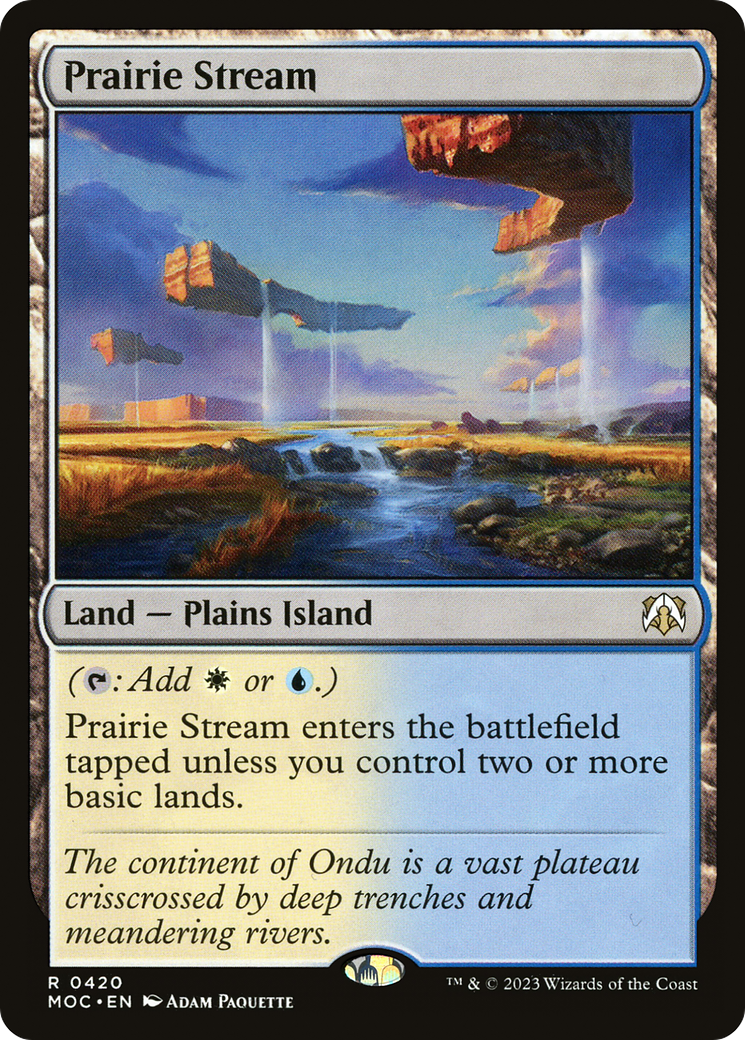
Prairie Stream
Prairie Stream
Land — Plains Island
( : Add or .)
This land enters tapped unless you control two or more basic lands.
- Even though these lands have basic land types, they are not basic lands because "basic" doesn't appear on their type line. Notably, controlling two or more of them won't allow others to enter the battlefield untapped.
- However, because these cards have basic land types, effects that specify a basic land type without also specifying that the land be basic can affect them. For example, a spell or ability that reads "Destroy target Forest" can target Canopy Vista, while one that reads "Destroy target basic Forest" cannot.
- If one of these lands enters the battlefield at the same time as any number of basic lands, those other lands are not counted when determining if this land enters the battlefield tapped or untapped.
-
1
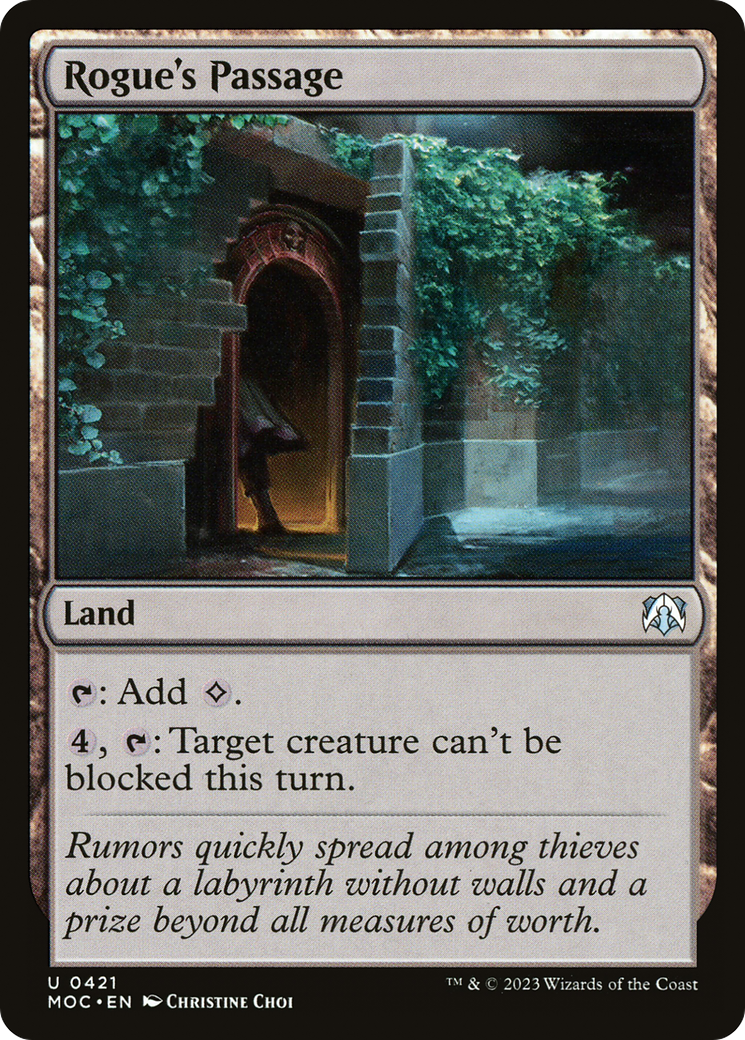
Rogue's Passage
Rogue's Passage
Land
: Add .
, : Target creature can't be blocked this turn.
- Activating the second ability of Rogue's Passage after a creature has become blocked won't cause that creature to become unblocked.
-
1
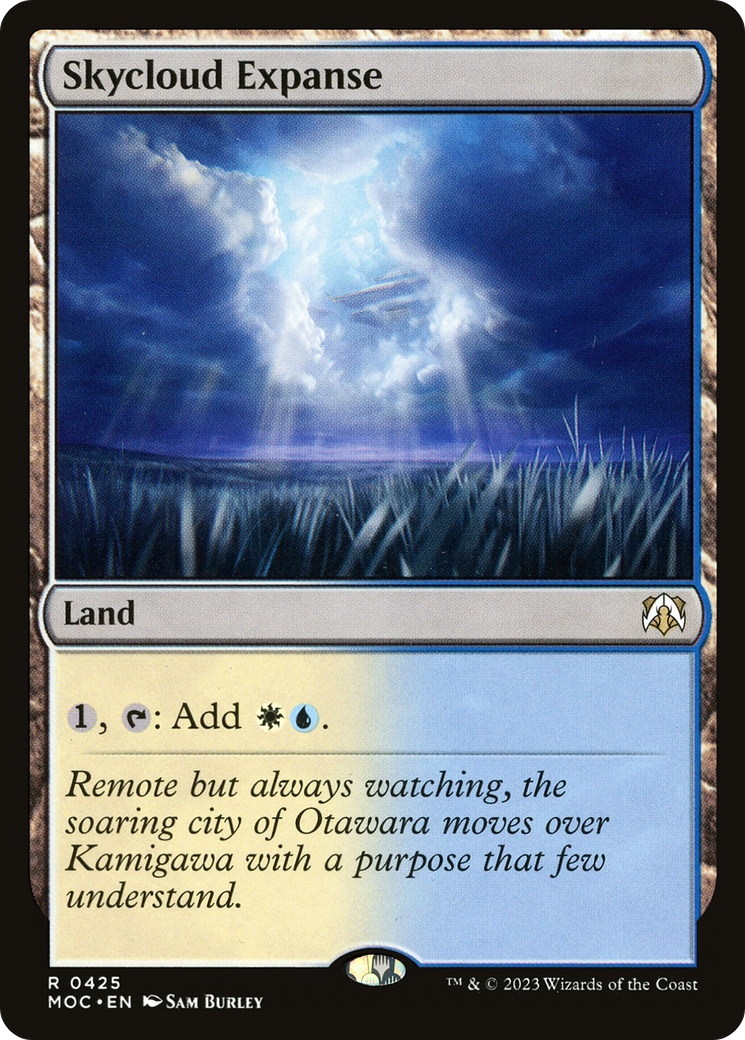
Skycloud Expanse
Skycloud Expanse
Land
, : Add .
-
1
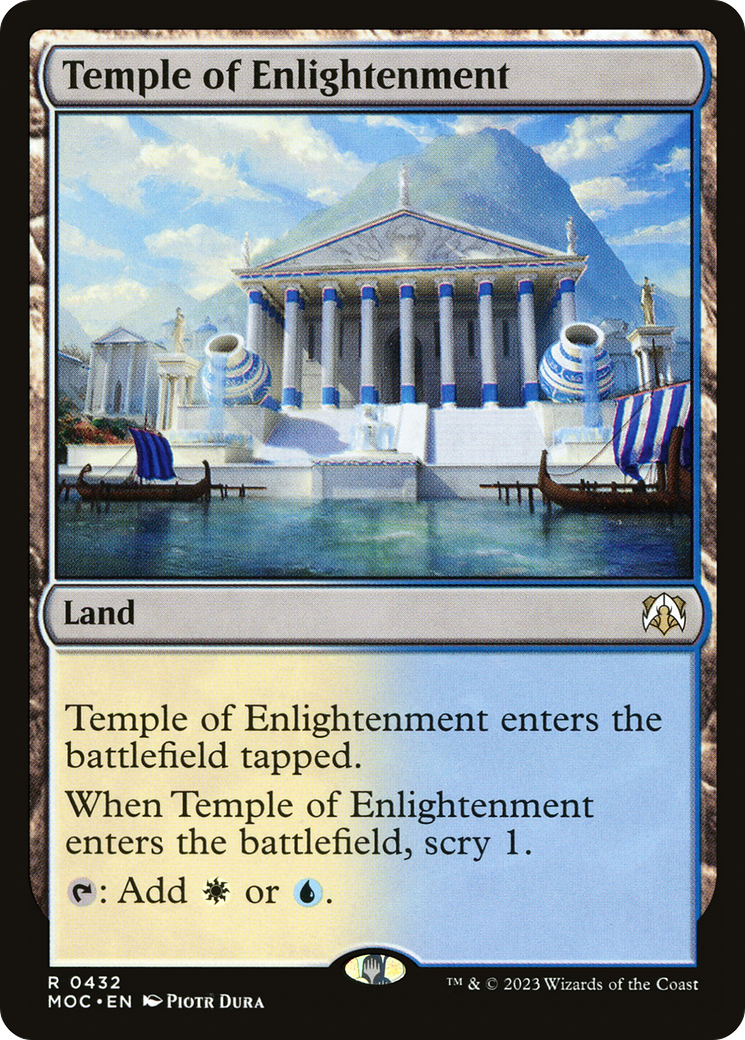
Temple of Enlightenment
Temple of Enlightenment
Land
This land enters tapped.
When this land enters, scry 1. (Look at the top card of your library. You may put that card on the bottom.)
: Add or .
- When you scry, you may put all the cards you look at back on top of your library, you may put all of those cards on the bottom of your library, or you may put some of those cards on top and the rest of them on the bottom.
- You choose how to order cards returned to your library after scrying no matter where you put them.
- You perform the actions stated on a card in sequence. For some spells and abilities, that means you'll scry last. For others, that means you'll scry and then perform other actions.
- Scry appears on some spells and abilities with one or more targets. If all of the spell or ability's targets are illegal when it tries to resolve, it won't resolve and none of its effects will happen. You won't scry.
-
1
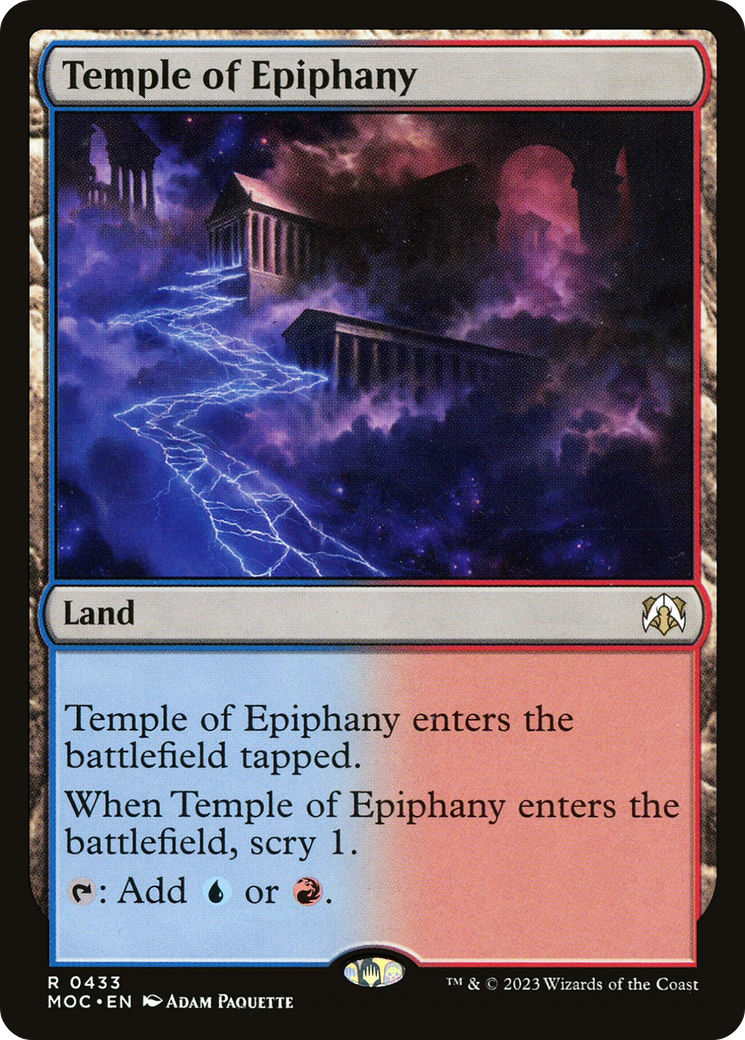
Temple of Epiphany
Temple of Epiphany
Land
This land enters tapped.
When this land enters, scry 1. (Look at the top card of your library. You may put that card on the bottom.)
: Add or .
-
1
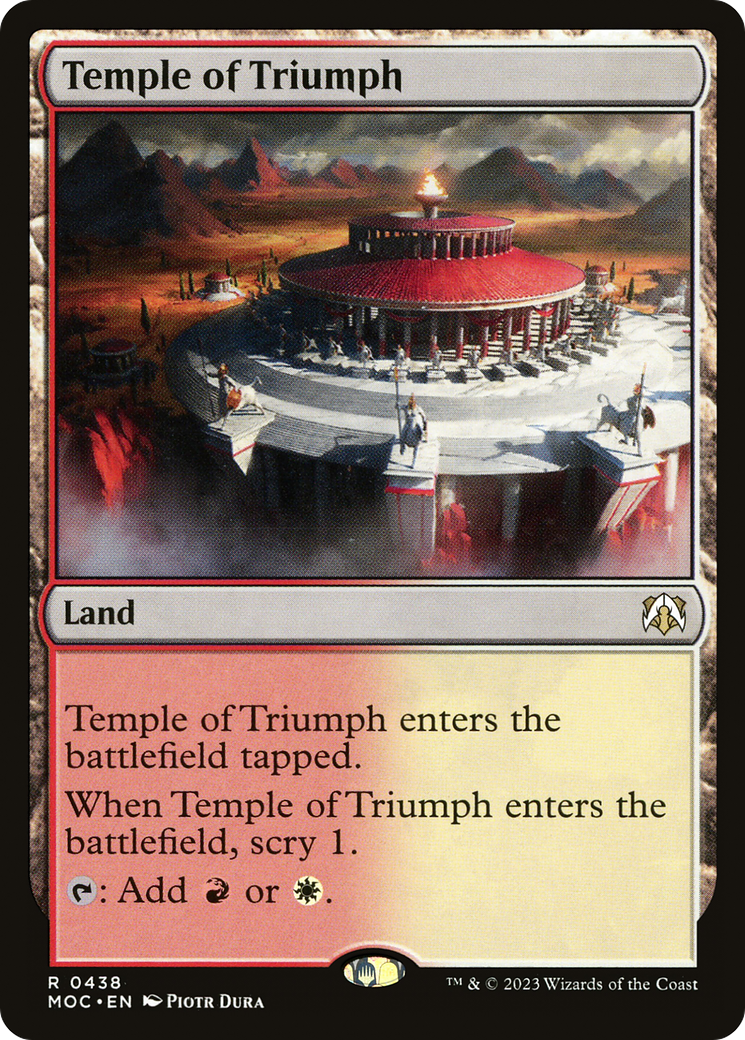
Temple of Triumph
Temple of Triumph
Land
This land enters tapped.
When this land enters, scry 1. (Look at the top card of your library. You may put that card on the bottom.)
: Add or .
- When you scry, you may put all the cards you look at back on top of your library, you may put all of those cards on the bottom of your library, or you may put some of those cards on top and the rest of them on the bottom.
- You choose how to order cards returned to your library after scrying no matter where you put them.
- You perform the actions stated on a card in sequence. For some spells and abilities, that means you'll scry last. For others, that means you'll scry and then perform other actions.
- Scry appears on some spells and abilities with one or more targets. If all of the spell or ability's targets are illegal when it tries to resolve, it won't resolve and none of its effects will happen. You won't scry.
-
1
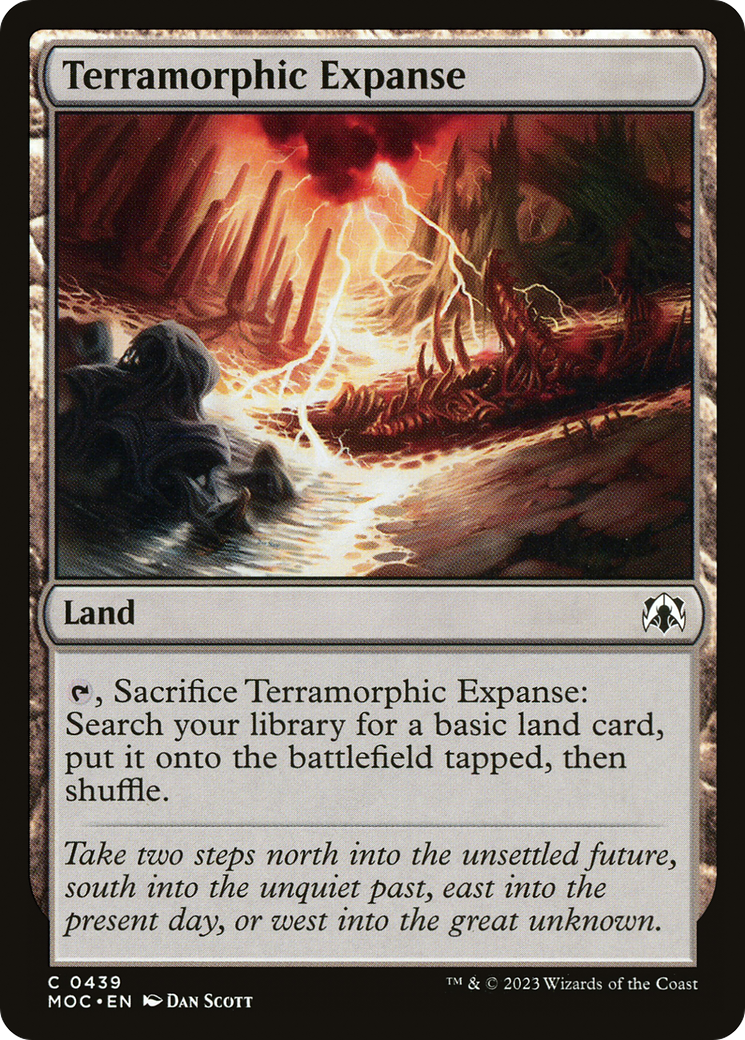
Terramorphic Expanse
Terramorphic Expanse
Land
, Sacrifice this land: Search your library for a basic land card, put it onto the battlefield tapped, then shuffle.
White 26
-
1
Angel of Finality
Angel of Finality
Creature — Angel
3/4
Flying
When this creature enters, exile target player's graveyard.
-
1
Angel of Salvation
Angel of Salvation
Creature — Angel
5/5
Flash; convoke (Your creatures can help cast this spell. Each creature you tap while casting this spell pays for or one mana of that creature's color.)
Flying
When this creature enters, prevent the next 5 damage that would be dealt this turn to any number of targets, divided as you choose.
- Tapping a multicolored creature using convoke will pay for or one mana of your choice of any of that creature's colors.
- Tapping an untapped creature that's attacking or blocking to convoke a spell won't cause that creature to stop attacking or blocking.
- When calculating a spell's total cost, include any alternative costs, additional costs, or anything else that increases or reduces the cost to cast the spell. Convoke applies after the total cost is calculated. Convoke doesn't change a spell's mana cost or mana value.
- If a creature you control has a mana ability with in the cost, activating that ability while casting a spell with convoke will result in the creature being tapped before you pay the spell's costs. You won't be able to tap it again for convoke. Similarly, if you sacrifice a creature to activate a mana ability while casting a spell with convoke, that creature won't be on the battlefield when you pay the spell's costs, so you won't be able to tap it for convoke.
- Because convoke isn't an alternative cost, it can be used in conjunction with alternative costs.
- You can tap any untapped creature you control to convoke a spell, even one you haven't controlled continuously since the beginning of your most recent turn.
- If some of the targets become illegal for Angel of Salvation's ability, the original division of prevention effects still applies, but the effects that would have been created for illegal targets aren't created at all.
- If multiple sources would deal damage to an affected target at once, that target or that target's controller chooses which source's damage to prevent for each "shield."
- If multiple replacement effects apply to a player or permanent being dealt damage, that player or the controller of that permanent chooses the order to apply them, not the controller of the source of damage.
- You divide the prevention effects as Angel of Salvation's triggered ability is put onto the stack, not as it resolves. Each target must be assigned at least 1 prevention "shield." You can't choose more than five targets and assign none to a target.
-
1
Austere Command
Austere Command
Sorcery
Choose two —
- Destroy all artifacts.
- Destroy all enchantments.
- Destroy all creatures with mana value 3 or less.
- Destroy all creatures with mana value 4 or greater.
- Each of the chosen modes happens sequentially. If a permanent has an ability that triggers whenever it or another permanent is destroyed, it will see permanents destroyed at the same time as it or before it, but not permanents destroyed by later modes.
- If a card is exiled "until" another permanent leaves the battlefield, the exiled card returns to the battlefield immediately after that permanent leaves the battlefield during Austere Command's resolution, and it may be destroyed by a later mode.
- If the first and last modes are chosen, an artifact creature with mana value 4 or greater will have to be regenerated twice to survive. This is because the modes happen sequentially, and the regeneration "shield" is used up by the first one. The same is true with any other combination of modes that covers one permanent twice.
-
1
Banisher Priest
Banisher Priest
Creature — Human Cleric
2/2
When this creature enters, exile target creature an opponent controls until this creature leaves the battlefield.
- If Banisher Priest leaves the battlefield before its triggered ability resolves, the target permanent won't be exiled.
- Auras attached to the exiled permanent will be put into their owners' graveyards. Any Equipment will become unattached and remain on the battlefield. Any counters on the exiled permanent will cease to exist. When the card returns to the battlefield, it will be a new object with no connection to the card that was exiled.
- If a token is exiled this way, it will cease to exist and won't return to the battlefield.
- If an Aura is exiled this way, its owner chooses what it will enchant as it returns to the battlefield. An Aura put onto the battlefield this way doesn't target anything (so it could be attached to a permanent with shroud, for example), but the Aura's enchant ability restricts what it can be attached to. If the Aura can't legally be attached to anything, it remains in exile for the rest of the game.
-
1
Battle Screech
Battle Screech
Sorcery
Create two 1/1 white Bird creature tokens with flying.
Flashback—Tap three untapped white creatures you control. (You may cast this card from your graveyard for its flashback cost. Then exile it.)
- You can tap any untapped white creatures you control to pay for Battle Screech’s flashback cost, even ones you haven’t controlled continuously since the beginning of your most recent turn.
- “Flashback [cost]” means “You may cast this card from your graveyard by paying [cost] rather than paying its mana cost” and “If the flashback cost was paid, exile this card instead of putting it anywhere else any time it would leave the stack.”
- You must still follow any timing restrictions and permissions, including those based on the card's type. For instance, you can cast a sorcery using flashback only when you could normally cast a sorcery.
- To determine the total cost of a spell, start with the mana cost or alternative cost (such as a flashback cost) you're paying, add any cost increases, then apply any cost reductions. The mana value of the spell is determined only by its mana cost, no matter what the total cost to cast the spell was.
- A spell cast using flashback will always be exiled afterward, whether it resolves, is countered, or leaves the stack in some other way.
- You can cast a spell using flashback even if it was somehow put into your graveyard without having been cast.
- If a card with flashback is put into your graveyard during your turn, you can cast it if it's legal to do so before any other player can take any actions.
-
1
Chant of Vitu-Ghazi
Chant of Vitu-Ghazi
Instant
Convoke (Your creatures can help cast this spell. Each creature you tap while casting this spell pays for or one mana of that creature's color.)
Prevent all damage that would be dealt by creatures this turn. You gain life equal to the damage prevented this way.
- When calculating a spell's total cost, include any alternative costs, additional costs, or anything else that increases or reduces the cost to cast the spell. Convoke applies after the total cost is calculated. Convoke doesn't change a spell's mana cost or mana value.
- You can tap any untapped creature you control to convoke a spell, even one you haven't controlled continuously since the beginning of your most recent turn.
- Tapping an untapped creature that's attacking or blocking to convoke a spell won't cause that creature to stop attacking or blocking.
- Tapping a multicolored creature using convoke will pay for or one mana of your choice of any of that creature's colors.
- If a creature you control has a mana ability with in the cost, activating that ability while casting a spell with convoke will result in the creature being tapped before you pay the spell's costs. You won't be able to tap it again for convoke. Similarly, if you sacrifice a creature to activate a mana ability while casting a spell with convoke, that creature won't be on the battlefield when you pay the spell's costs, so you won't be able to tap it for convoke.
- Because convoke isn't an alternative cost, it can be used in conjunction with alternative costs.
- The damage prevention shield lasts for the rest of the turn, and you gain life each time that shield prevents 1 or more damage.
-
1
Conclave Tribunal
Conclave Tribunal
Enchantment
Convoke (Your creatures can help cast this spell. Each creature you tap while casting this spell pays for or one mana of that creature's color.)
When this enchantment enters, exile target nonland permanent an opponent controls until this enchantment leaves the battlefield.
- Tapping a multicolored creature using convoke will pay for or one mana of your choice of any of that creature's colors.
- When calculating a spell's total cost, include any alternative costs, additional costs, or anything else that increases or reduces the cost to cast the spell. Convoke applies after the total cost is calculated. Convoke doesn't change a spell's mana cost or mana value.
- If a creature you control has a mana ability with in the cost, activating that ability while casting a spell with convoke will result in the creature being tapped before you pay the spell's costs. You won't be able to tap it again for convoke. Similarly, if you sacrifice a creature to activate a mana ability while casting a spell with convoke, that creature won't be on the battlefield when you pay the spell's costs, so you won't be able to tap it for convoke.
- Because convoke isn't an alternative cost, it can be used in conjunction with alternative costs.
- You can tap any untapped creature you control to convoke a spell, even one you haven't controlled continuously since the beginning of your most recent turn.
- Tapping an untapped creature that's attacking or blocking to convoke a spell won't cause that creature to stop attacking or blocking.
- Auras attached to the exiled permanent will be put into their owners' graveyards. Any Equipment will become unattached and remain on the battlefield. Any counters on the exiled permanent will cease to exist. When the card returns to the battlefield, it will be a new object with no connection to the card that was exiled.
- If a token is exiled this way, it will cease to exist and won't return to the battlefield.
- If Conclave Tribunal leaves the battlefield before its triggered ability resolves, the target permanent won't be exiled.
-
1
Cut Short
Cut Short
Instant
Convoke (Your creatures can help cast this spell. Each creature you tap while casting this spell pays for or one mana of that creature's color.)
Destroy target planeswalker that was activated this turn or tapped creature.
-
1
Devouring Light
Devouring Light
Instant
Convoke (Your creatures can help cast this spell. Each creature you tap while casting this spell pays for or one mana of that creature's color.)
Exile target attacking or blocking creature.
- When calculating a spell's total cost, include any alternative costs, additional costs, or anything else that increases or reduces the cost to cast the spell. Convoke applies after the total cost is calculated. Convoke doesn't change a spell's mana cost or mana value.
- You can tap any untapped creature you control to convoke a spell, even one you haven't controlled continuously since the beginning of your most recent turn.
- Tapping an untapped creature that's attacking or blocking to convoke a spell won't cause that creature to stop attacking or blocking.
- Tapping a multicolored creature using convoke will pay for or one mana of your choice of any of that creature's colors.
- If a creature you control has a mana ability with in the cost, activating that ability while casting a spell with convoke will result in the creature being tapped before you pay the spell's costs. You won't be able to tap it again for convoke. Similarly, if you sacrifice a creature to activate a mana ability while casting a spell with convoke, that creature won't be on the battlefield when you pay the spell's costs, so you won't be able to tap it for convoke.
- Because convoke isn't an alternative cost, it can be used in conjunction with alternative costs.
- The declare blockers step is the last chance to cast Devouring Light before creatures deal their combat damage. However, a creature remains an attacking or blocking creature during the combat damage step and end of combat step. Devouring Light may be cast targeting such a creature during those steps, after the creature has dealt combat damage.
-
1
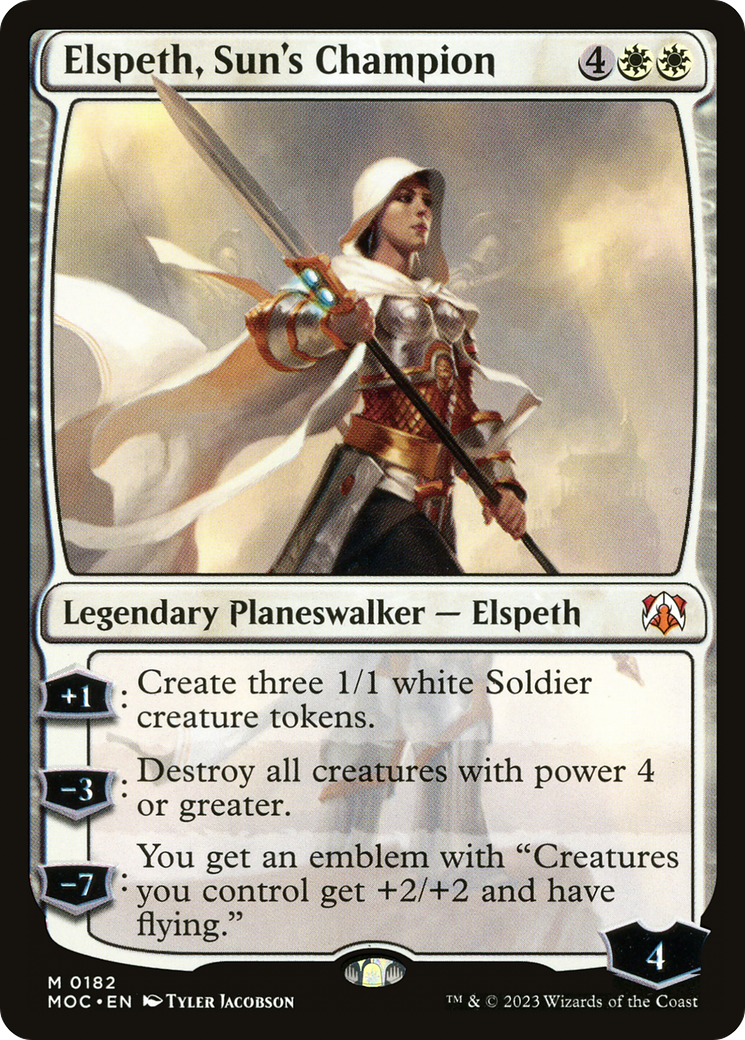
Elspeth, Sun's Champion
Elspeth, Sun's Champion
Legendary Planeswalker — Elspeth
+1: Create three 1/1 white Soldier creature tokens.
−3: Destroy all creatures with power 4 or greater.
−7: You get an emblem with "Creatures you control get +2/+2 and have flying."
-
1
Emeria Angel
Emeria Angel
Creature — Angel
3/3
Flying
Landfall — Whenever a land you control enters, you may create a 1/1 white Bird creature token with flying.
- A landfall ability triggers whenever a land you control enters for any reason. It triggers whenever you play a land, as well as whenever a spell or ability puts a land onto the battlefield under your control.
- A landfall ability doesn't trigger if a permanent already on the battlefield becomes a land.
- Whenever a land you control enters, each landfall ability of the permanents you control will trigger. You can put them on the stack in any order. The last ability you put on the stack will be the first one to resolve (As a result, you can have those abilities resolve in the order of your choosing.).
-
1
Ephemeral Shields
Ephemeral Shields
Instant
Convoke (Your creatures can help cast this spell. Each creature you tap while casting this spell pays for or one mana of that creature's color.)
Target creature gains indestructible until end of turn. (Damage and effects that say "destroy" don't destroy it.)
- You can tap any untapped creature you control to convoke a spell, even one you haven't controlled continuously since the beginning of your most recent turn.
- Tapping an untapped creature that's attacking or blocking to convoke a spell won't cause that creature to stop attacking or blocking.
- When calculating a spell's total cost, include any alternative costs, additional costs, or anything else that increases or reduces the cost to cast the spell. Convoke applies after the total cost is calculated. Convoke doesn't change a spell's mana cost or mana value.
- If a creature you control has a mana ability with in the cost, activating that ability while casting a spell with convoke will result in the creature being tapped before you pay the spell's costs. You won't be able to tap it again for convoke. Similarly, if you sacrifice a creature to activate a mana ability while casting a spell with convoke, that creature won't be on the battlefield when you pay the spell's costs, so you won't be able to tap it for convoke.
- Because convoke isn't an alternative cost, it can be used in conjunction with alternative costs.
- Tapping a multicolored creature using convoke will pay for or one mana of your choice of any of that creature's colors.
-
1
Flight of Equenauts
Flight of Equenauts
Creature — Human Knight
4/5
Convoke (Your creatures can help cast this spell. Each creature you tap while casting this spell pays for or one mana of that creature's color.)
Flying
- You can tap any untapped creature you control to convoke a spell, even one you haven't controlled continuously since the beginning of your most recent turn.
- Tapping an untapped creature that's attacking or blocking to convoke a spell won't cause that creature to stop attacking or blocking.
- When calculating a spell's total cost, include any alternative costs, additional costs, or anything else that increases or reduces the cost to cast the spell. Convoke applies after the total cost is calculated. Convoke doesn't change a spell's mana cost or mana value.
- If a creature you control has a mana ability with in the cost, activating that ability while casting a spell with convoke will result in the creature being tapped before you pay the spell's costs. You won't be able to tap it again for convoke. Similarly, if you sacrifice a creature to activate a mana ability while casting a spell with convoke, that creature won't be on the battlefield when you pay the spell's costs, so you won't be able to tap it for convoke.
- Because convoke isn't an alternative cost, it can be used in conjunction with alternative costs.
- Tapping a multicolored creature using convoke will pay for or one mana of your choice of any of that creature's colors.
-
1
Hour of Reckoning
Hour of Reckoning
Sorcery
Convoke (Your creatures can help cast this spell. Each creature you tap while casting this spell pays for or one mana of that creature's color.)
Destroy all nontoken creatures.
- You can tap any untapped creature you control to convoke a spell, even one you haven't controlled continuously since the beginning of your most recent turn.
- Tapping an untapped creature that's attacking or blocking to convoke a spell won't cause that creature to stop attacking or blocking.
- When calculating a spell's total cost, include any alternative costs, additional costs, or anything else that increases or reduces the cost to cast the spell. Convoke applies after the total cost is calculated. Convoke doesn't change a spell's mana cost or mana value.
- If a creature you control has a mana ability with in the cost, activating that ability while casting a spell with convoke will result in the creature being tapped before you pay the spell's costs. You won't be able to tap it again for convoke. Similarly, if you sacrifice a creature to activate a mana ability while casting a spell with convoke, that creature won't be on the battlefield when you pay the spell's costs, so you won't be able to tap it for convoke.
- Because convoke isn't an alternative cost, it can be used in conjunction with alternative costs.
- Tapping a multicolored creature using convoke will pay for or one mana of your choice of any of that creature's colors.
-
1
Keeper of the Accord
Keeper of the Accord
Creature — Human Soldier
3/4
At the beginning of each opponent's end step, if that player controls more creatures than you, create a 1/1 white Soldier creature token.
At the beginning of each opponent's end step, if that player controls more lands than you, you may search your library for a basic Plains card, put it onto the battlefield tapped, then shuffle.
- Both triggered abilities trigger at the same time. You may put them on the stack in either order.
- If the opponent doesn't control more creatures than you as their end step begins, the first ability won't trigger. The same is true for lands and the second ability. Each of those abilities will check again when it tries to resolve. If the opponent no longer controls more creatures (or lands) than you, the ability won't resolve and will have no effect.
-
1
Mentor of the Meek
Mentor of the Meek
Creature — Human Soldier
2/2
Whenever another creature you control with power 2 or less enters, you may pay . If you do, draw a card.
- Mentor of the Meek’s ability checks the power of the other creature only as it enters. If that creature’s power is 2 or less, the ability will trigger. Once the ability triggers, raising that creature’s power above 2 won’t affect that ability. Similarly, reducing the creature’s power to 2 or less after it enters won’t cause the ability to trigger.
- If a creature enters with +1/+1 counters or a continuous effect such as that of Wedding Festivity will apply to the creature on the battlefield, those effects apply when checking to see if Mentor of the Meek’s ability will trigger.
- While resolving the triggered ability of Mentor of the Meek, you can’t pay multiple times to draw more than one card.
-
1
Nesting Dovehawk
Nesting Dovehawk
Creature — Bird
2/2
Flying
At the beginning of combat on your turn, populate. (Create a token that's a copy of a creature token you control.)
Whenever a creature token you control enters, put a +1/+1 counter on this creature.
- Populate doesn't target the creature token you're copying. You choose that creature token as you're taking the populate action. You can choose any creature token you control. If a spell or ability causes you to create a creature token and then instructs you to populate, you may choose to copy the token you just created, or you may choose to copy another creature token you control.
- If you choose to copy a creature token that's a copy of another creature, the new creature token will copy the characteristics of whatever the original token is copying.
- The new creature token copies the characteristics of the original token as stated by the effect that created the original token.
- The new token doesn't copy whether the original token is tapped or untapped, whether it has any counters on it or Auras and Equipment attached to it, or any noncopy effects that have changed its power, toughness, color, and so on.
- Any enters-the-battlefield abilities of the copied token will trigger when the new token enters the battlefield. Any "as [this creature] enters the battlefield" or "[this creature] enters the battlefield with" abilities of the copied token will also work.
- If you control no creature tokens when you populate, nothing will happen.
-
1
Path of the Ghosthunter
Path of the Ghosthunter
Sorcery
Create X 1/1 white Spirit creature tokens with flying.
Will of the Planeswalkers — Starting with you, each player votes for planeswalk or chaos. If planeswalk gets more votes, planeswalk. If chaos gets more votes or the vote is tied, chaos ensues.
-
1
Secure the Wastes
Secure the Wastes
Instant
Create X 1/1 white Warrior creature tokens.
-
1
Seraph of the Masses
Seraph of the Masses
Creature — Angel
*/*
Convoke (Your creatures can help cast this spell. Each creature you tap while casting this spell pays for or one mana of that creature's color.)
Flying
Seraph of the Masses's power and toughness are each equal to the number of creatures you control.
- Tapping a multicolored creature using convoke will pay for or one mana of your choice of any of that creature's colors.
- If a creature you control has a mana ability with in the cost, activating that ability while casting a spell with convoke will result in the creature being tapped before you pay the spell's costs. You won't be able to tap it again for convoke. Similarly, if you sacrifice a creature to activate a mana ability while casting a spell with convoke, that creature won't be on the battlefield when you pay the spell's costs, so you won't be able to tap it for convoke.
- Because convoke isn't an alternative cost, it can be used in conjunction with alternative costs.
- You can tap any untapped creature you control to convoke a spell, even one you haven't controlled continuously since the beginning of your most recent turn.
- Tapping an untapped creature that's attacking or blocking to convoke a spell won't cause that creature to stop attacking or blocking.
- When calculating a spell's total cost, include any alternative costs, additional costs, or anything else that increases or reduces the cost to cast the spell. Convoke applies after the total cost is calculated. Convoke doesn't change a spell's mana cost or mana value.
- As long as Seraph of the Masses is on the battlefield, its ability will count itself.
- The ability that defines Seraph of the Masses's power and toughness works in all zones, not just the battlefield.
-
1
Spirited Companion
Spirited Companion
Enchantment Creature — Dog
1/1
When this creature enters, draw a card.
-
1
Suture Priest
Suture Priest
Creature — Phyrexian Cleric
1/1
Whenever another creature you control enters, you may gain 1 life.
Whenever a creature an opponent controls enters, you may have that player lose 1 life.
-
1
Swords to Plowshares
Swords to Plowshares
Instant
Exile target creature. Its controller gains life equal to its power.
- Use the power of the creature from when it was last on the battlefield to determine how much life is gained.
-
1
Venerated Loxodon
Venerated Loxodon
Creature — Elephant Cleric
4/4
Convoke (Your creatures can help cast this spell. Each creature you tap while casting this spell pays for or one mana of that creature's color.)
When this creature enters, put a +1/+1 counter on each creature that convoked it.
- When calculating a spell's total cost, include any alternative costs, additional costs, or anything else that increases or reduces the cost to cast the spell. Convoke applies after the total cost is calculated. Convoke doesn't change a spell's mana cost or mana value.
- You can tap any untapped creature you control to convoke a spell, even one you haven't controlled continuously since the beginning of your most recent turn.
- Tapping an untapped creature that's attacking or blocking to convoke a spell won't cause that creature to stop attacking or blocking.
- Tapping a multicolored creature using convoke will pay for or one mana of your choice of any of that creature's colors.
- If a creature you control has a mana ability with in the cost, activating that ability while casting a spell with convoke will result in the creature being tapped before you pay the spell's costs. You won't be able to tap it again for convoke. Similarly, if you sacrifice a creature to activate a mana ability while casting a spell with convoke, that creature won't be on the battlefield when you pay the spell's costs, so you won't be able to tap it for convoke.
- Because convoke isn't an alternative cost, it can be used in conjunction with alternative costs.
- You can't tap more creatures to convoke Venerated Loxodon than it takes to pay for its total cost. This means that normally no more than five creatures can convoke it.
-
1
Village Bell-Ringer
Village Bell-Ringer
Creature — Human Scout
1/4
Flash (You may cast this spell any time you could cast an instant.)
When this creature enters, untap all creatures you control.
- Untapping an attacking creature doesn't remove it from combat.
-
1
Wand of the Worldsoul
Wand of the Worldsoul
Artifact
This artifact enters tapped.
: Add .
: The next spell you cast this turn has convoke.
- When calculating a spell's total cost, include any alternative costs, additional costs, or anything else that increases or reduces the cost to cast the spell. Convoke applies after the total cost is calculated. Convoke doesn't change a spell's mana cost or mana value.
- You can tap any untapped creature you control to convoke a spell, even one you haven't controlled continuously since the beginning of your most recent turn.
- Tapping an untapped creature that's attacking or blocking to convoke a spell won't cause that creature to stop attacking or blocking.
- Tapping a multicolored creature using convoke will pay for or one mana of your choice of any of that creature's colors.
- If a creature you control has a mana ability with in the cost, activating that ability while casting a spell with convoke will result in the creature being tapped before you pay the spell's costs. You won't be able to tap it again for convoke. Similarly, if you sacrifice a creature to activate a mana ability while casting a spell with convoke, that creature won't be on the battlefield when you pay the spell's costs, so you won't be able to tap it for convoke.
- Because convoke isn't an alternative cost, it can be used in conjunction with alternative costs.
- If the next spell you cast after Wand of the Worldsoul's ability resolves already has convoke, giving it convoke again doesn't have any real benefit. Tapping a creature you control will still pay for only or one mana of that creature's color.
Blue 9
-
1
Artistic Refusal
Artistic Refusal
Instant
Convoke (Your creatures can help cast this spell. Each creature you tap while casting this spell pays for or one mana of that creature's color.)
Choose one or both —
- Counter target spell.
- Draw two cards, then discard a card.
-
1
Chasm Skulker
Chasm Skulker
Creature — Squid Horror
1/1
Whenever you draw a card, put a +1/+1 counter on this creature.
When this creature dies, create X 1/1 blue Squid creature tokens with islandwalk, where X is the number of +1/+1 counters on this creature. (They can't be blocked as long as defending player controls an Island.)
- If enough -1/-1 counters are put on Chasm Skulker at the same time to make its toughness 0 or less, the number of +1/+1 counters on it before it got any -1/-1 counters will be used to determine how many Squid tokens you get. For example, if there are two +1/+1 counters on Chasm Skulker and it gets three -1/-1 counters, you'll get two Squid tokens.
- If you draw multiple cards, the first ability will trigger that many times. Each of these abilities will cause a +1/+1 counter to be put on Chasm Skulker.
-
1
Cloud of Faeries
Cloud of Faeries
Creature — Faerie
1/1
Flying
When this creature enters, untap up to two lands.
Cycling ( , Discard this card: Draw a card.)
- You choose which lands to untap as the triggered ability resolves. They aren't targeted, and they don't have to be lands that you control.
-
1
Deluxe Dragster
Deluxe Dragster
Artifact — Vehicle
4/3
This Vehicle can't be blocked except by Vehicles.
Whenever this Vehicle deals combat damage to a player, you may cast target instant or sorcery card from that player's graveyard without paying its mana cost. If that spell would be put into a graveyard, exile it instead.
Crew 2
- If you cast the instant or sorcery card, you do so as part of the resolution of the triggered ability. You can't wait to cast them later in the turn. Timing restrictions based on a card's type are ignored.
- If you cast a card "without paying its mana cost," you can't pay any alternative costs. You can, however, pay additional costs. If the card has any mandatory additional costs, those must be paid to cast the card.
- If an exiled card has in its mana cost, you must choose 0 as the value of X when casting it without paying its mana cost.
-
1
Fallowsage
Fallowsage
Creature — Merfolk Wizard
2/2
Whenever this creature becomes tapped, you may draw a card.
- This is a triggered ability, not an activated ability. It doesn't allow you to tap the creature whenever you want; rather, you need some other way of tapping it, such as by attacking with the creature.
- For the ability to trigger, the creature has to actually change from untapped to tapped. If an effect attempts to tap the creature, but it was already tapped at the time, this ability won't trigger.
-
1
Meeting of Minds
Meeting of Minds
Instant
Convoke (Your creatures can help cast this spell. Each creature you tap while casting this spell pays for or one mana of that creature's color.)
Draw two cards.
-
1
Nadir Kraken
Nadir Kraken
Creature — Kraken
2/3
Whenever you draw a card, you may pay . If you do, put a +1/+1 counter on this creature and create a 1/1 blue Tentacle creature token.
- While resolving Nadir Kraken's ability, you can't pay multiple times to create multiple Tentacles or to give it multiple +1/+1 counters.
- You choose whether to pay after drawing the card and seeing what it is. If you draw multiple cards, you see them all before deciding how many of the resulting triggers you'll pay for.
- If Nadir Kraken leaves the battlefield after its ability has triggered, you can still pay and get a Tentacle, even though you won't put a +1/+1 counter on Nadir Kraken.
-
1
Temporal Cleansing
Temporal Cleansing
Sorcery
Convoke (Your creatures can help cast this spell. Each creature you tap while casting this spell pays for or one mana of that creature's color.)
The owner of target nonland permanent puts it into their library second from the top or on the bottom.
-
1
Tetsuko Umezawa, Fugitive
Tetsuko Umezawa, Fugitive
Legendary Creature — Human Rogue
1/3
Creatures you control with power or toughness 1 or less can't be blocked.
- Once a creature you control has been blocked, changing its power to 1 or less won't cause it to become unblocked. Changing its toughness to 1 won't cause it to become unblocked, and changing its toughness to less than 1 will cause it to die.
Red 6
-
1
Goblin Instigator
Goblin Instigator
Creature — Goblin Rogue
1/1
When this creature enters, create a 1/1 red Goblin creature token.
-
1
Goblin Medics
Goblin Medics
Creature — Goblin Shaman
1/1
Whenever this creature becomes tapped, it deals 1 damage to any target.
- The ability does trigger when it taps to attack.
-
1
Impact Tremors
Impact Tremors
Enchantment
Whenever a creature you control enters, this enchantment deals 1 damage to each opponent.
- If multiple creatures you control enter at the same time, Impact Tremors will trigger once for each of those creatures. This is true even if Impact Tremors enters at the same time as those creatures.
-
1
Shatter the Source
Shatter the Source
Instant
Convoke (Your creatures can help cast this spell. Each creature you tap while casting this spell pays for or one mana of that creature's color.)
Choose one —
- Shatter the Source deals 6 damage to target creature, planeswalker, or battle.
- Destroy target artifact.
-
1
Stoke the Flames
Stoke the Flames
Instant
Convoke (Your creatures can help cast this spell. Each creature you tap while casting this spell pays for or one mana of that creature's color.)
Stoke the Flames deals 4 damage to any target.
-
1
Wrenn's Resolve
Wrenn's Resolve
Sorcery
Exile the top two cards of your library. Until the end of your next turn, you may play those cards.
Multicolor 10
-
1
Flockchaser Phantom
Flockchaser Phantom
Creature — Spirit
5/5
Convoke (Your creatures can help cast this spell. Each creature you tap while casting this spell pays for or one mana of that creature's color.)
Flying, vigilance
Whenever this creature attacks, the next spell you cast this turn has convoke.
- When calculating a spell's total cost, include any alternative costs, additional costs, or anything else that increases or reduces the cost to cast the spell. Convoke applies after the total cost is calculated. Convoke doesn't change a spell's mana cost or mana value.
- You can tap any untapped creature you control to convoke a spell, even one you haven't controlled continuously since the beginning of your most recent turn.
- Tapping an untapped creature that's attacking or blocking to convoke a spell won't cause that creature to stop attacking or blocking.
- Tapping a multicolored creature using convoke will pay for or one mana of your choice of any of that creature's colors.
- If a creature you control has a mana ability with in the cost, activating that ability while casting a spell with convoke will result in the creature being tapped before you pay the spell's costs. You won't be able to tap it again for convoke. Similarly, if you sacrifice a creature to activate a mana ability while casting a spell with convoke, that creature won't be on the battlefield when you pay the spell's costs, so you won't be able to tap it for convoke.
- Because convoke isn't an alternative cost, it can be used in conjunction with alternative costs.
- If the next spell you cast after Flockchaser Phantom's ability resolves already has convoke, giving it convoke again doesn't have any real benefit. Tapping a creature you control will still pay for only or one mana of that creature's color.
-
1
Improbable Alliance
Improbable Alliance
Enchantment
Whenever you draw your second card each turn, create a 1/1 blue Faerie creature token with flying.
: Draw a card, then discard a card.
- The triggered ability can trigger only once each turn. It doesn't matter whether the permanent with that ability was on the battlefield when the first card was drawn. If it's not on the battlefield when the second card is drawn, the ability can't trigger at all that turn. It won't trigger when the third or fourth card is drawn.
- If an effect instructs you to draw multiple cards, the ability triggers after you draw whichever is the second one for the turn. You choose a target (if any) for the ability after you've drawn and looked at all of the cards and finished resolving the spell or ability that caused you to draw them.
- If a spell or ability causes you to put cards into your hand without specifically using the word "draw," it's not a card drawn.
-
1
Joyful Stormsculptor
Joyful Stormsculptor
Creature — Human Shaman
2/3
When this creature enters, create two 1/1 blue and red Elemental creature tokens.
Whenever you cast a spell that has convoke, this creature deals 1 damage to each opponent and each battle they protect.
-
1
Kasla, the Broken Halo
Kasla, the Broken Halo
Legendary Creature — Angel Ally
5/4
Convoke (Your creatures can help cast this spell. Each creature you tap while casting this spell pays for or one mana of that creature's color.)
Flying, vigilance, haste
Whenever you cast another spell that has convoke, scry 2, then draw a card.
- When calculating a spell's total cost, include any alternative costs, additional costs, or anything else that increases or reduces the cost to cast the spell. Convoke applies after the total cost is calculated. Convoke doesn't change a spell's mana cost or mana value.
- You can tap any untapped creature you control to convoke a spell, even one you haven't controlled continuously since the beginning of your most recent turn.
- Tapping an untapped creature that's attacking or blocking to convoke a spell won't cause that creature to stop attacking or blocking.
- Tapping a multicolored creature using convoke will pay for or one mana of your choice of any of that creature's colors.
- If a creature you control has a mana ability with in the cost, activating that ability while casting a spell with convoke will result in the creature being tapped before you pay the spell's costs. You won't be able to tap it again for convoke. Similarly, if you sacrifice a creature to activate a mana ability while casting a spell with convoke, that creature won't be on the battlefield when you pay the spell's costs, so you won't be able to tap it for convoke.
- Because convoke isn't an alternative cost, it can be used in conjunction with alternative costs.
- Kasla's last ability will trigger whether you tapped any creatures to pay for the spell or not, as long as it has convoke.
-
1
Kykar, Wind's Fury
Kykar, Wind's Fury
Legendary Creature — Bird Wizard
3/3
Flying
Whenever you cast a noncreature spell, create a 1/1 white Spirit creature token with flying.
Sacrifice a Spirit: Add .
- Kykar's triggered ability will resolve before the spell that caused it to trigger but after targets have been chosen for that spell, so the Spirit that will be created can't be a target of that spell. Kykar's ability resolves even if that spell is countered.
-
1
Migratory Route
Migratory Route
Sorcery
Create four 1/1 white Bird creature tokens with flying.
Basic landcycling ( , Discard this card: Search your library for a basic land card, reveal it, put it into your hand, then shuffle.)
-
1
Saint Traft and Rem Karolus
Saint Traft and Rem Karolus
Legendary Creature — Spirit Human
3/4
Whenever Saint Traft and Rem Karolus becomes tapped, create a 1/1 red Human creature token if this is the first time this ability has resolved this turn. If it's the second time, create a 1/1 blue Spirit creature token with flying. If it's the third time, create a 4/4 white Angel creature token with flying.
Whenever you cast a spell that has convoke, untap Saint Traft and Rem Karolus.
- If it’s the fourth or subsequent time the first ability has resolved in a turn, nothing happens.
- The last ability of Saint Traft and Rem Karolus will trigger whether you tapped any creatures to pay for the spell or not, as long as it has convoke.
-
1
The Locust God
The Locust God
Legendary Creature — God
4/4
Flying
Whenever you draw a card, create a 1/1 blue and red Insect creature token with flying and haste.
: Draw a card, then discard a card.
When The Locust God dies, return it to its owner's hand at the beginning of the next end step.
- If a spell or ability causes you to put cards into your hand without specifically using the word “draw,” The Locust God's first triggered ability won't trigger.
- If this creature dies but leaves your graveyard before the next end step, it will remain in its new zone.
- The “next end step” refers to the next end step that occurs, not the end step of the next turn. If this creature dies before a turn's end step (for example, during combat), it will be returned to its owner's hand at the beginning of that turn's end step.
-
1
Whirlwind of Thought
Whirlwind of Thought
Enchantment
Whenever you cast a noncreature spell, draw a card.
- An ability that triggers when a player casts a spell resolves before the spell that caused it to trigger. It resolves even if that spell is countered.
- Players can cast spells and activate abilities after the triggered ability resolves but before the spell that caused it to trigger does.
-
1
Wildfire Awakener
Wildfire Awakener
Creature — Human Wizard
3/2
Convoke (Your creatures can help cast this spell. Each creature you tap while casting this spell pays for or one mana of that creature's color.)
When this creature enters, create X 1/1 red Elemental creature tokens with "Whenever this token becomes tapped, it deals 1 damage to target player."
- You can tap any untapped creature you control to convoke a spell, even one you haven't controlled continuously since the beginning of your most recent turn.
- Tapping an untapped creature that's attacking or blocking to convoke a spell won't cause that creature to stop attacking or blocking.
- When calculating a spell's total cost, include any alternative costs, additional costs, or anything else that increases or reduces the cost to cast the spell. Convoke applies after the total cost is calculated. Convoke doesn't change a spell's mana cost or mana value.
- If a creature you control has a mana ability with in the cost, activating that ability while casting a spell with convoke will result in the creature being tapped before you pay the spell's costs. You won't be able to tap it again for convoke. Similarly, if you sacrifice a creature to activate a mana ability while casting a spell with convoke, that creature won't be on the battlefield when you pay the spell's costs, so you won't be able to tap it for convoke.
- Because convoke isn't an alternative cost, it can be used in conjunction with alternative costs.
- Tapping a multicolored creature using convoke will pay for or one mana of your choice of any of that creature's colors.
Colorless 10
-
1
Arcane Signet
Arcane Signet
Artifact
: Add one mana of any color in your commander's color identity.
- If your commander is a card that has no colors in its color identity, Arcane Signet's ability produces no mana. It doesn't produce .
- If you have two commanders, the ability adds one mana of any color in their combined color identities.
- If you don't have a commander, Arcane Signet's ability produces no mana.
-
1
Commander's Sphere
Commander's Sphere
Artifact
: Add one mana of any color in your commander's color identity.
Sacrifice this artifact: Draw a card.
- If your commander is a card that has no colors in its color identity, Commander's Sphere's first ability produces no mana. It doesn't produce .
- If you don't have a commander, Commander's Sphere's first ability produces no mana.
- If you have two commanders, the ability adds one mana of any color in their combined color identities.
-
1
Cultivator's Caravan
Cultivator's Caravan
Artifact — Vehicle
5/5
: Add one mana of any color.
Crew 3 (Tap any number of creatures you control with total power 3 or more: This Vehicle becomes an artifact creature until end of turn.)
- If a permanent becomes a copy of a Vehicle, the copy won't be a creature, even if the Vehicle it's copying has become an artifact creature.
- Each Vehicle is printed with a power and toughness, but it's not a creature. If it becomes a creature (most likely through its crew ability), it will have that power and toughness.
- If an effect causes a Vehicle to become an artifact creature with a specified power and toughness, that effect overwrites the Vehicle's printed power and toughness.
- Vehicle is an artifact type, not a creature type. A Vehicle that's crewed won't normally have any creature type.
- Once a player announces that they are activating a crew ability, no player may take other actions until the ability has been paid for. Notably, players can't try to stop the ability by changing a creature's power or by removing or tapping a creature.
- Any untapped creature you control can be tapped to pay a crew cost, even one that just came under your control.
- You may tap more creatures than necessary to activate a crew ability.
- Creatures that crew a Vehicle aren't attached to it or related in any other way. Effects that affect the Vehicle, such as by destroying it or giving it a +1/+1 counter, don't affect the creatures that crewed it.
- Once a Vehicle becomes a creature, it behaves exactly like any other artifact creature. It can't attack unless you've controlled it continuously since your turn began, it can block if it's untapped, it can be tapped to pay a Vehicle's crew cost, and so on.
- You may activate a crew ability of a Vehicle even if it's already an artifact creature. Doing so has no effect on the Vehicle. It doesn't change its power and toughness.
- For a Vehicle to be able to attack, it must be a creature as the declare attackers step begins, so the latest you can activate its crew ability to attack with it is during the beginning of combat step. For a Vehicle to be able to block, it must be a creature as the declare blockers step begins, so the latest you can activate its crew ability to block with it is during the declare attackers step. In either case, players may take actions after the crew ability resolves but before the Vehicle has been declared as an attacking or blocking creature.
- When a Vehicle becomes a creature, that doesn't count as having a creature enter the battlefield. The permanent was already on the battlefield; it only changed its types. Abilities that trigger whenever a creature enters the battlefield won't trigger.
- As long as Cultivator's Caravan isn't an artifact creature, its ability can be activated if it came under your control this turn.
-
1
Duergar Hedge-Mage
Duergar Hedge-Mage
Creature — Dwarf Shaman
2/2
When this creature enters, if you control two or more Mountains, you may destroy target artifact.
When this creature enters, if you control two or more Plains, you may destroy target enchantment.
- Each of the triggered abilities has an "intervening 'if' clause." That means (1) the ability won't trigger at all unless you control two or more lands of the appropriate land type when the Hedge-Mage enters, and (2) the ability will do nothing if you don't control two or more lands of the appropriate land type by the time it resolves.
- Both abilities trigger at the same time. You can put them on the stack in any order.
- Each of the triggered abilities look at your lands individually. This means that if you only control two dual-lands of the appropriate types, both of the abilities will trigger.
- Both abilities are optional; you choose whether to use them when they resolve. If an ability has a target, you must choose a target even if you don't plan to use the ability.
-
1
Fractured Powerstone
Fractured Powerstone
Artifact
: Add .
: Roll the planar die. Activate only as a sorcery.
- In non-Planechase games, Fractured Powerstone's second ability will have no effect.
- Rolling the planar die this way doesn't count when determining the cost of the special action of rolling the planar die. For example, if you roll the planar die twice in a turn, then activate Fractured Powerstone to roll it a third time, rolling the planar die again that turn will cost .
-
1
Ichor Elixir
Ichor Elixir
Artifact
If you would roll one or more planar dice, instead roll that many planar dice plus one and ignore one.
: Add .
-
1
Mistmeadow Vanisher
Mistmeadow Vanisher
Creature — Kithkin Wizard
3/2
Whenever this creature becomes tapped, exile up to one target nonland, nontoken permanent. Return that card to the battlefield under its owner's control at the beginning of the next end step.
-
1
Skullclamp
Skullclamp
Artifact — Equipment
Equipped creature gets +1/-1.
Whenever equipped creature dies, draw two cards.
Equip
-
1
Sol Ring
Sol Ring
Artifact
: Add .
-
1
Wear // Tear
//
Wear
Instant
- If you're casting a split card with fuse from any zone other than your hand, you can't cast both halves. You'll only be able to cast one half or the other.
- To cast a fused split spell, pay both of its mana costs. While the spell is on the stack, its mana value is the total amount of mana in both costs.
- You can choose the same object as the target of each half of a fused split spell, if appropriate.
- When resolving a fused split spell with multiple targets, treat it as you would any spell with multiple targets. If all targets are illegal when the spell tries to resolve, the spell doesn't resolve and none of its effects happen. If at least one target is still legal at that time, the spell resolves, but an illegal target can't perform any actions or have any actions performed on it.
- When a fused split spell resolves, follow the instructions of the left half first, then the instructions on the right half.
- On the stack, a split spell that hasn't been fused has only that half's characteristics and mana value. The other half is treated as though it didn't exist.
- Some split cards with fuse have two monocolor halves of different colors. If such a card is cast as a fused split spell, the resulting spell is multicolored. If only one half is cast, the spell is the color of that half. While not on the stack, such a card is multicolored.
- Some split cards with fuse have two halves that are both multicolored. That card is multicolored no matter which half is cast, or if both halves are cast. It's also multicolored while not on the stack.
- If a player names a card, the player may name either half of a split card, but not both. A split card has the chosen name if one of its two names matches the chosen name.
- If you cast a split card with fuse from your hand without paying its mana cost, you can choose to use its fuse ability and cast both halves without paying their mana costs.
Lands 39
-
1
Command Tower
Command Tower
Land
: Add one mana of any color in your commander's color identity.
- If you don't have a commander, Command Tower's ability produces no mana.
- If your commander is a card that has no colors in its color identity, Command Tower's ability produces no mana. It doesn't produce .
- If you have two commanders, the ability adds one mana of any color in their combined color identities.
-
1
Evolving Wilds
Evolving Wilds
Land
, Sacrifice this land: Search your library for a basic land card, put it onto the battlefield tapped, then shuffle.
-
1
Exotic Orchard
Exotic Orchard
Land
: Add one mana of any color that a land an opponent controls could produce.
- Lands that produce mana based only on what other lands "could produce" won't help each other unless some other land allows one of them to actually produce some type of mana. For example, if you control an Exotic Orchard and your opponent controls an Exotic Orchard and a Reflecting Pool, none of those lands would produce mana if their mana abilities were activated. On the other hand, if you control a Forest and an Exotic Orchard, and your opponent controls an Exotic Orchard and a Reflecting Pool, then each of those lands can be tapped to produce . Your opponent's Exotic Orchard can produce because you control a Forest. Your Exotic Orchard and your opponent's Reflecting Pool can each produce because your opponent's Exotic Orchard can produce .
- When determining what colors of mana your opponents' lands could produce, Exotic Orchard takes into account any applicable replacement effects that would apply to those lands' mana abilities (such as Contamination's effect, for example). If there are more than one, consider them in any possible order.
- The colors of mana are white, blue, black, red, and green. Exotic Orchard can't be tapped for colorless mana, even if a land an opponent controls could produce colorless mana.
- Exotic Orchard doesn't care about any restrictions or riders your opponents' lands (such as Ancient Ziggurat or Hall of the Bandit Lord) put on the mana they produce. It just cares about colors of mana.
- Exotic Orchard checks the effects of all mana-producing abilities of lands your opponents control, but it doesn't check their costs. For example, Vivid Crag has the ability " , Remove a charge counter from Vivid Crag: Add one mana of any color." If an opponent controls Vivid Crag and you control Exotic Orchard, you can tap Exotic Orchard for any color of mana. It doesn't matter whether Vivid Crag has a charge counter on it, and it doesn't matter whether it's untapped.
-
1
Frostboil Snarl
Frostboil Snarl
Land
As this land enters, you may reveal an Island or Mountain card from your hand. If you don't, this land enters tapped.
: Add or .
- The "Snarl" itself doesn't have any land subtypes. You can't reveal one to satisfy the ability of another.
- If a land card with an appropriate subtype is entering the battlefield from your hand at the same time as one of these lands, you may reveal the other land to have the "Snarl" enter untapped.
- If an effect instructs you to put one of these lands onto the battlefield tapped, it will still enter the battlefield tapped even if you reveal a land card from your hand.
- You may reveal any land card with either or both of the appropriate subtypes. It doesn't have to be a basic land card.
-
1
Furycalm Snarl
Furycalm Snarl
Land
As this land enters, you may reveal a Mountain or Plains card from your hand. If you don't, this land enters tapped.
: Add or .
- The "Snarl" itself doesn't have any land subtypes. You can't reveal one to satisfy the ability of another.
- If a land card with an appropriate subtype is entering the battlefield from your hand at the same time as one of these lands, you may reveal the other land to have the "Snarl" enter untapped.
- If an effect instructs you to put one of these lands onto the battlefield tapped, it will still enter the battlefield tapped even if you reveal a land card from your hand.
- You may reveal any land card with either or both of the appropriate subtypes. It doesn't have to be a basic land card.
-
8
Island
Island
Basic Land — Island
( : Add .)
-
1
Kher Keep
Kher Keep
Legendary Land
: Add .
, : Create a 0/1 red Kobold creature token named Kobolds of Kher Keep.
-
8
Mountain
Mountain
Basic Land — Mountain
( : Add .)
-
1
Mystic Monastery
Mystic Monastery
Land
This land enters tapped.
: Add , , or .
-
8
Plains
Plains
Basic Land — Plains
( : Add .)
-
1
Port Town
Port Town
Land
As this land enters, you may reveal a Plains or Island card from your hand. If you don't, this land enters tapped.
: Add or .
- You may reveal any land card with either or both of the appropriate subtypes. It doesn't have to be a basic land. For example, you could reveal Canopy Vista from the Battle for Zendikar set to satisfy the ability of Port Town.
- Lands don't have a subtype just because they can produce mana of the corresponding color. Port Town itself is neither a Plains nor an Island, even though it produces white and blue mana, so you can't reveal one to satisfy the ability of another.
- If a Plains or Island is entering the battlefield from your hand at the same time as Port Town, you may reveal the other land to have Port Town enter untapped.
- If an effect instructs you to put Port Town onto the battlefield tapped, it will still enter the battlefield tapped even if you reveal a land card from your hand.
-
1
Prairie Stream
Prairie Stream
Land — Plains Island
( : Add or .)
This land enters tapped unless you control two or more basic lands.
- Even though these lands have basic land types, they are not basic lands because "basic" doesn't appear on their type line. Notably, controlling two or more of them won't allow others to enter the battlefield untapped.
- However, because these cards have basic land types, effects that specify a basic land type without also specifying that the land be basic can affect them. For example, a spell or ability that reads "Destroy target Forest" can target Canopy Vista, while one that reads "Destroy target basic Forest" cannot.
- If one of these lands enters the battlefield at the same time as any number of basic lands, those other lands are not counted when determining if this land enters the battlefield tapped or untapped.
-
1
Rogue's Passage
Rogue's Passage
Land
: Add .
, : Target creature can't be blocked this turn.
- Activating the second ability of Rogue's Passage after a creature has become blocked won't cause that creature to become unblocked.
-
1
Skycloud Expanse
Skycloud Expanse
Land
, : Add .
-
1
Temple of Enlightenment
Temple of Enlightenment
Land
This land enters tapped.
When this land enters, scry 1. (Look at the top card of your library. You may put that card on the bottom.)
: Add or .
- When you scry, you may put all the cards you look at back on top of your library, you may put all of those cards on the bottom of your library, or you may put some of those cards on top and the rest of them on the bottom.
- You choose how to order cards returned to your library after scrying no matter where you put them.
- You perform the actions stated on a card in sequence. For some spells and abilities, that means you'll scry last. For others, that means you'll scry and then perform other actions.
- Scry appears on some spells and abilities with one or more targets. If all of the spell or ability's targets are illegal when it tries to resolve, it won't resolve and none of its effects will happen. You won't scry.
-
1
Temple of Epiphany
Temple of Epiphany
Land
This land enters tapped.
When this land enters, scry 1. (Look at the top card of your library. You may put that card on the bottom.)
: Add or .
-
1
Temple of Triumph
Temple of Triumph
Land
This land enters tapped.
When this land enters, scry 1. (Look at the top card of your library. You may put that card on the bottom.)
: Add or .
- When you scry, you may put all the cards you look at back on top of your library, you may put all of those cards on the bottom of your library, or you may put some of those cards on top and the rest of them on the bottom.
- You choose how to order cards returned to your library after scrying no matter where you put them.
- You perform the actions stated on a card in sequence. For some spells and abilities, that means you'll scry last. For others, that means you'll scry and then perform other actions.
- Scry appears on some spells and abilities with one or more targets. If all of the spell or ability's targets are illegal when it tries to resolve, it won't resolve and none of its effects will happen. You won't scry.
-
1
Terramorphic Expanse
Terramorphic Expanse
Land
, Sacrifice this land: Search your library for a basic land card, put it onto the battlefield tapped, then shuffle.
1 4
-
1
Secure the Wastes
Secure the Wastes
Instant
Create X 1/1 white Warrior creature tokens.
-
1
Skullclamp
Skullclamp
Artifact — Equipment
Equipped creature gets +1/-1.
Whenever equipped creature dies, draw two cards.
Equip
-
1
Sol Ring
Sol Ring
Artifact
: Add .
-
1
Swords to Plowshares
Swords to Plowshares
Instant
Exile target creature. Its controller gains life equal to its power.
- Use the power of the creature from when it was last on the battlefield to determine how much life is gained.
2 12
-
1
Arcane Signet
Arcane Signet
Artifact
: Add one mana of any color in your commander's color identity.
- If your commander is a card that has no colors in its color identity, Arcane Signet's ability produces no mana. It doesn't produce .
- If you have two commanders, the ability adds one mana of any color in their combined color identities.
- If you don't have a commander, Arcane Signet's ability produces no mana.
-
1
Cloud of Faeries
Cloud of Faeries
Creature — Faerie
1/1
Flying
When this creature enters, untap up to two lands.
Cycling ( , Discard this card: Draw a card.)
- You choose which lands to untap as the triggered ability resolves. They aren't targeted, and they don't have to be lands that you control.
-
1
Ephemeral Shields
Ephemeral Shields
Instant
Convoke (Your creatures can help cast this spell. Each creature you tap while casting this spell pays for or one mana of that creature's color.)
Target creature gains indestructible until end of turn. (Damage and effects that say "destroy" don't destroy it.)
- You can tap any untapped creature you control to convoke a spell, even one you haven't controlled continuously since the beginning of your most recent turn.
- Tapping an untapped creature that's attacking or blocking to convoke a spell won't cause that creature to stop attacking or blocking.
- When calculating a spell's total cost, include any alternative costs, additional costs, or anything else that increases or reduces the cost to cast the spell. Convoke applies after the total cost is calculated. Convoke doesn't change a spell's mana cost or mana value.
- If a creature you control has a mana ability with in the cost, activating that ability while casting a spell with convoke will result in the creature being tapped before you pay the spell's costs. You won't be able to tap it again for convoke. Similarly, if you sacrifice a creature to activate a mana ability while casting a spell with convoke, that creature won't be on the battlefield when you pay the spell's costs, so you won't be able to tap it for convoke.
- Because convoke isn't an alternative cost, it can be used in conjunction with alternative costs.
- Tapping a multicolored creature using convoke will pay for or one mana of your choice of any of that creature's colors.
-
1
Fractured Powerstone
Fractured Powerstone
Artifact
: Add .
: Roll the planar die. Activate only as a sorcery.
- In non-Planechase games, Fractured Powerstone's second ability will have no effect.
- Rolling the planar die this way doesn't count when determining the cost of the special action of rolling the planar die. For example, if you roll the planar die twice in a turn, then activate Fractured Powerstone to roll it a third time, rolling the planar die again that turn will cost .
-
1
Goblin Instigator
Goblin Instigator
Creature — Goblin Rogue
1/1
When this creature enters, create a 1/1 red Goblin creature token.
-
1
Impact Tremors
Impact Tremors
Enchantment
Whenever a creature you control enters, this enchantment deals 1 damage to each opponent.
- If multiple creatures you control enter at the same time, Impact Tremors will trigger once for each of those creatures. This is true even if Impact Tremors enters at the same time as those creatures.
-
1
Improbable Alliance
Improbable Alliance
Enchantment
Whenever you draw your second card each turn, create a 1/1 blue Faerie creature token with flying.
: Draw a card, then discard a card.
- The triggered ability can trigger only once each turn. It doesn't matter whether the permanent with that ability was on the battlefield when the first card was drawn. If it's not on the battlefield when the second card is drawn, the ability can't trigger at all that turn. It won't trigger when the third or fourth card is drawn.
- If an effect instructs you to draw multiple cards, the ability triggers after you draw whichever is the second one for the turn. You choose a target (if any) for the ability after you've drawn and looked at all of the cards and finished resolving the spell or ability that caused you to draw them.
- If a spell or ability causes you to put cards into your hand without specifically using the word "draw," it's not a card drawn.
-
1
Path of the Ghosthunter
Path of the Ghosthunter
Sorcery
Create X 1/1 white Spirit creature tokens with flying.
Will of the Planeswalkers — Starting with you, each player votes for planeswalk or chaos. If planeswalk gets more votes, planeswalk. If chaos gets more votes or the vote is tied, chaos ensues.
-
1
Spirited Companion
Spirited Companion
Enchantment Creature — Dog
1/1
When this creature enters, draw a card.
-
1
Suture Priest
Suture Priest
Creature — Phyrexian Cleric
1/1
Whenever another creature you control enters, you may gain 1 life.
Whenever a creature an opponent controls enters, you may have that player lose 1 life.
-
1
Tetsuko Umezawa, Fugitive
Tetsuko Umezawa, Fugitive
Legendary Creature — Human Rogue
1/3
Creatures you control with power or toughness 1 or less can't be blocked.
- Once a creature you control has been blocked, changing its power to 1 or less won't cause it to become unblocked. Changing its toughness to 1 won't cause it to become unblocked, and changing its toughness to less than 1 will cause it to die.
-
1
Wrenn's Resolve
Wrenn's Resolve
Sorcery
Exile the top two cards of your library. Until the end of your next turn, you may play those cards.
3 16
-
1
Banisher Priest
Banisher Priest
Creature — Human Cleric
2/2
When this creature enters, exile target creature an opponent controls until this creature leaves the battlefield.
- If Banisher Priest leaves the battlefield before its triggered ability resolves, the target permanent won't be exiled.
- Auras attached to the exiled permanent will be put into their owners' graveyards. Any Equipment will become unattached and remain on the battlefield. Any counters on the exiled permanent will cease to exist. When the card returns to the battlefield, it will be a new object with no connection to the card that was exiled.
- If a token is exiled this way, it will cease to exist and won't return to the battlefield.
- If an Aura is exiled this way, its owner chooses what it will enchant as it returns to the battlefield. An Aura put onto the battlefield this way doesn't target anything (so it could be attached to a permanent with shroud, for example), but the Aura's enchant ability restricts what it can be attached to. If the Aura can't legally be attached to anything, it remains in exile for the rest of the game.
-
1
Chasm Skulker
Chasm Skulker
Creature — Squid Horror
1/1
Whenever you draw a card, put a +1/+1 counter on this creature.
When this creature dies, create X 1/1 blue Squid creature tokens with islandwalk, where X is the number of +1/+1 counters on this creature. (They can't be blocked as long as defending player controls an Island.)
- If enough -1/-1 counters are put on Chasm Skulker at the same time to make its toughness 0 or less, the number of +1/+1 counters on it before it got any -1/-1 counters will be used to determine how many Squid tokens you get. For example, if there are two +1/+1 counters on Chasm Skulker and it gets three -1/-1 counters, you'll get two Squid tokens.
- If you draw multiple cards, the first ability will trigger that many times. Each of these abilities will cause a +1/+1 counter to be put on Chasm Skulker.
-
1
Commander's Sphere
Commander's Sphere
Artifact
: Add one mana of any color in your commander's color identity.
Sacrifice this artifact: Draw a card.
- If your commander is a card that has no colors in its color identity, Commander's Sphere's first ability produces no mana. It doesn't produce .
- If you don't have a commander, Commander's Sphere's first ability produces no mana.
- If you have two commanders, the ability adds one mana of any color in their combined color identities.
-
1
Cultivator's Caravan
Cultivator's Caravan
Artifact — Vehicle
5/5
: Add one mana of any color.
Crew 3 (Tap any number of creatures you control with total power 3 or more: This Vehicle becomes an artifact creature until end of turn.)
- If a permanent becomes a copy of a Vehicle, the copy won't be a creature, even if the Vehicle it's copying has become an artifact creature.
- Each Vehicle is printed with a power and toughness, but it's not a creature. If it becomes a creature (most likely through its crew ability), it will have that power and toughness.
- If an effect causes a Vehicle to become an artifact creature with a specified power and toughness, that effect overwrites the Vehicle's printed power and toughness.
- Vehicle is an artifact type, not a creature type. A Vehicle that's crewed won't normally have any creature type.
- Once a player announces that they are activating a crew ability, no player may take other actions until the ability has been paid for. Notably, players can't try to stop the ability by changing a creature's power or by removing or tapping a creature.
- Any untapped creature you control can be tapped to pay a crew cost, even one that just came under your control.
- You may tap more creatures than necessary to activate a crew ability.
- Creatures that crew a Vehicle aren't attached to it or related in any other way. Effects that affect the Vehicle, such as by destroying it or giving it a +1/+1 counter, don't affect the creatures that crewed it.
- Once a Vehicle becomes a creature, it behaves exactly like any other artifact creature. It can't attack unless you've controlled it continuously since your turn began, it can block if it's untapped, it can be tapped to pay a Vehicle's crew cost, and so on.
- You may activate a crew ability of a Vehicle even if it's already an artifact creature. Doing so has no effect on the Vehicle. It doesn't change its power and toughness.
- For a Vehicle to be able to attack, it must be a creature as the declare attackers step begins, so the latest you can activate its crew ability to attack with it is during the beginning of combat step. For a Vehicle to be able to block, it must be a creature as the declare blockers step begins, so the latest you can activate its crew ability to block with it is during the declare attackers step. In either case, players may take actions after the crew ability resolves but before the Vehicle has been declared as an attacking or blocking creature.
- When a Vehicle becomes a creature, that doesn't count as having a creature enter the battlefield. The permanent was already on the battlefield; it only changed its types. Abilities that trigger whenever a creature enters the battlefield won't trigger.
- As long as Cultivator's Caravan isn't an artifact creature, its ability can be activated if it came under your control this turn.
-
1
Cut Short
Cut Short
Instant
Convoke (Your creatures can help cast this spell. Each creature you tap while casting this spell pays for or one mana of that creature's color.)
Destroy target planeswalker that was activated this turn or tapped creature.
-
1
Devouring Light
Devouring Light
Instant
Convoke (Your creatures can help cast this spell. Each creature you tap while casting this spell pays for or one mana of that creature's color.)
Exile target attacking or blocking creature.
- When calculating a spell's total cost, include any alternative costs, additional costs, or anything else that increases or reduces the cost to cast the spell. Convoke applies after the total cost is calculated. Convoke doesn't change a spell's mana cost or mana value.
- You can tap any untapped creature you control to convoke a spell, even one you haven't controlled continuously since the beginning of your most recent turn.
- Tapping an untapped creature that's attacking or blocking to convoke a spell won't cause that creature to stop attacking or blocking.
- Tapping a multicolored creature using convoke will pay for or one mana of your choice of any of that creature's colors.
- If a creature you control has a mana ability with in the cost, activating that ability while casting a spell with convoke will result in the creature being tapped before you pay the spell's costs. You won't be able to tap it again for convoke. Similarly, if you sacrifice a creature to activate a mana ability while casting a spell with convoke, that creature won't be on the battlefield when you pay the spell's costs, so you won't be able to tap it for convoke.
- Because convoke isn't an alternative cost, it can be used in conjunction with alternative costs.
- The declare blockers step is the last chance to cast Devouring Light before creatures deal their combat damage. However, a creature remains an attacking or blocking creature during the combat damage step and end of combat step. Devouring Light may be cast targeting such a creature during those steps, after the creature has dealt combat damage.
-
1
Duergar Hedge-Mage
Duergar Hedge-Mage
Creature — Dwarf Shaman
2/2
When this creature enters, if you control two or more Mountains, you may destroy target artifact.
When this creature enters, if you control two or more Plains, you may destroy target enchantment.
- Each of the triggered abilities has an "intervening 'if' clause." That means (1) the ability won't trigger at all unless you control two or more lands of the appropriate land type when the Hedge-Mage enters, and (2) the ability will do nothing if you don't control two or more lands of the appropriate land type by the time it resolves.
- Both abilities trigger at the same time. You can put them on the stack in any order.
- Each of the triggered abilities look at your lands individually. This means that if you only control two dual-lands of the appropriate types, both of the abilities will trigger.
- Both abilities are optional; you choose whether to use them when they resolve. If an ability has a target, you must choose a target even if you don't plan to use the ability.
-
1
Goblin Medics
Goblin Medics
Creature — Goblin Shaman
1/1
Whenever this creature becomes tapped, it deals 1 damage to any target.
- The ability does trigger when it taps to attack.
-
1
Mentor of the Meek
Mentor of the Meek
Creature — Human Soldier
2/2
Whenever another creature you control with power 2 or less enters, you may pay . If you do, draw a card.
- Mentor of the Meek’s ability checks the power of the other creature only as it enters. If that creature’s power is 2 or less, the ability will trigger. Once the ability triggers, raising that creature’s power above 2 won’t affect that ability. Similarly, reducing the creature’s power to 2 or less after it enters won’t cause the ability to trigger.
- If a creature enters with +1/+1 counters or a continuous effect such as that of Wedding Festivity will apply to the creature on the battlefield, those effects apply when checking to see if Mentor of the Meek’s ability will trigger.
- While resolving the triggered ability of Mentor of the Meek, you can’t pay multiple times to draw more than one card.
-
1
Mistmeadow Vanisher
Mistmeadow Vanisher
Creature — Kithkin Wizard
3/2
Whenever this creature becomes tapped, exile up to one target nonland, nontoken permanent. Return that card to the battlefield under its owner's control at the beginning of the next end step.
-
1
Nadir Kraken
Nadir Kraken
Creature — Kraken
2/3
Whenever you draw a card, you may pay . If you do, put a +1/+1 counter on this creature and create a 1/1 blue Tentacle creature token.
- While resolving Nadir Kraken's ability, you can't pay multiple times to create multiple Tentacles or to give it multiple +1/+1 counters.
- You choose whether to pay after drawing the card and seeing what it is. If you draw multiple cards, you see them all before deciding how many of the resulting triggers you'll pay for.
- If Nadir Kraken leaves the battlefield after its ability has triggered, you can still pay and get a Tentacle, even though you won't put a +1/+1 counter on Nadir Kraken.
-
1
Saint Traft and Rem Karolus
Saint Traft and Rem Karolus
Legendary Creature — Spirit Human
3/4
Whenever Saint Traft and Rem Karolus becomes tapped, create a 1/1 red Human creature token if this is the first time this ability has resolved this turn. If it's the second time, create a 1/1 blue Spirit creature token with flying. If it's the third time, create a 4/4 white Angel creature token with flying.
Whenever you cast a spell that has convoke, untap Saint Traft and Rem Karolus.
- If it’s the fourth or subsequent time the first ability has resolved in a turn, nothing happens.
- The last ability of Saint Traft and Rem Karolus will trigger whether you tapped any creatures to pay for the spell or not, as long as it has convoke.
-
1
Village Bell-Ringer
Village Bell-Ringer
Creature — Human Scout
1/4
Flash (You may cast this spell any time you could cast an instant.)
When this creature enters, untap all creatures you control.
- Untapping an attacking creature doesn't remove it from combat.
-
1
Wand of the Worldsoul
Wand of the Worldsoul
Artifact
This artifact enters tapped.
: Add .
: The next spell you cast this turn has convoke.
- When calculating a spell's total cost, include any alternative costs, additional costs, or anything else that increases or reduces the cost to cast the spell. Convoke applies after the total cost is calculated. Convoke doesn't change a spell's mana cost or mana value.
- You can tap any untapped creature you control to convoke a spell, even one you haven't controlled continuously since the beginning of your most recent turn.
- Tapping an untapped creature that's attacking or blocking to convoke a spell won't cause that creature to stop attacking or blocking.
- Tapping a multicolored creature using convoke will pay for or one mana of your choice of any of that creature's colors.
- If a creature you control has a mana ability with in the cost, activating that ability while casting a spell with convoke will result in the creature being tapped before you pay the spell's costs. You won't be able to tap it again for convoke. Similarly, if you sacrifice a creature to activate a mana ability while casting a spell with convoke, that creature won't be on the battlefield when you pay the spell's costs, so you won't be able to tap it for convoke.
- Because convoke isn't an alternative cost, it can be used in conjunction with alternative costs.
- If the next spell you cast after Wand of the Worldsoul's ability resolves already has convoke, giving it convoke again doesn't have any real benefit. Tapping a creature you control will still pay for only or one mana of that creature's color.
-
1
Wear // Tear
//
Wear
Instant
- If you're casting a split card with fuse from any zone other than your hand, you can't cast both halves. You'll only be able to cast one half or the other.
- To cast a fused split spell, pay both of its mana costs. While the spell is on the stack, its mana value is the total amount of mana in both costs.
- You can choose the same object as the target of each half of a fused split spell, if appropriate.
- When resolving a fused split spell with multiple targets, treat it as you would any spell with multiple targets. If all targets are illegal when the spell tries to resolve, the spell doesn't resolve and none of its effects happen. If at least one target is still legal at that time, the spell resolves, but an illegal target can't perform any actions or have any actions performed on it.
- When a fused split spell resolves, follow the instructions of the left half first, then the instructions on the right half.
- On the stack, a split spell that hasn't been fused has only that half's characteristics and mana value. The other half is treated as though it didn't exist.
- Some split cards with fuse have two monocolor halves of different colors. If such a card is cast as a fused split spell, the resulting spell is multicolored. If only one half is cast, the spell is the color of that half. While not on the stack, such a card is multicolored.
- Some split cards with fuse have two halves that are both multicolored. That card is multicolored no matter which half is cast, or if both halves are cast. It's also multicolored while not on the stack.
- If a player names a card, the player may name either half of a split card, but not both. A split card has the chosen name if one of its two names matches the chosen name.
- If you cast a split card with fuse from your hand without paying its mana cost, you can choose to use its fuse ability and cast both halves without paying their mana costs.
-
1
Wildfire Awakener
Wildfire Awakener
Creature — Human Wizard
3/2
Convoke (Your creatures can help cast this spell. Each creature you tap while casting this spell pays for or one mana of that creature's color.)
When this creature enters, create X 1/1 red Elemental creature tokens with "Whenever this token becomes tapped, it deals 1 damage to target player."
- You can tap any untapped creature you control to convoke a spell, even one you haven't controlled continuously since the beginning of your most recent turn.
- Tapping an untapped creature that's attacking or blocking to convoke a spell won't cause that creature to stop attacking or blocking.
- When calculating a spell's total cost, include any alternative costs, additional costs, or anything else that increases or reduces the cost to cast the spell. Convoke applies after the total cost is calculated. Convoke doesn't change a spell's mana cost or mana value.
- If a creature you control has a mana ability with in the cost, activating that ability while casting a spell with convoke will result in the creature being tapped before you pay the spell's costs. You won't be able to tap it again for convoke. Similarly, if you sacrifice a creature to activate a mana ability while casting a spell with convoke, that creature won't be on the battlefield when you pay the spell's costs, so you won't be able to tap it for convoke.
- Because convoke isn't an alternative cost, it can be used in conjunction with alternative costs.
- Tapping a multicolored creature using convoke will pay for or one mana of your choice of any of that creature's colors.
4 13
-
1
Angel of Finality
Angel of Finality
Creature — Angel
3/4
Flying
When this creature enters, exile target player's graveyard.
-
1
Battle Screech
Battle Screech
Sorcery
Create two 1/1 white Bird creature tokens with flying.
Flashback—Tap three untapped white creatures you control. (You may cast this card from your graveyard for its flashback cost. Then exile it.)
- You can tap any untapped white creatures you control to pay for Battle Screech’s flashback cost, even ones you haven’t controlled continuously since the beginning of your most recent turn.
- “Flashback [cost]” means “You may cast this card from your graveyard by paying [cost] rather than paying its mana cost” and “If the flashback cost was paid, exile this card instead of putting it anywhere else any time it would leave the stack.”
- You must still follow any timing restrictions and permissions, including those based on the card's type. For instance, you can cast a sorcery using flashback only when you could normally cast a sorcery.
- To determine the total cost of a spell, start with the mana cost or alternative cost (such as a flashback cost) you're paying, add any cost increases, then apply any cost reductions. The mana value of the spell is determined only by its mana cost, no matter what the total cost to cast the spell was.
- A spell cast using flashback will always be exiled afterward, whether it resolves, is countered, or leaves the stack in some other way.
- You can cast a spell using flashback even if it was somehow put into your graveyard without having been cast.
- If a card with flashback is put into your graveyard during your turn, you can cast it if it's legal to do so before any other player can take any actions.
-
1
Conclave Tribunal
Conclave Tribunal
Enchantment
Convoke (Your creatures can help cast this spell. Each creature you tap while casting this spell pays for or one mana of that creature's color.)
When this enchantment enters, exile target nonland permanent an opponent controls until this enchantment leaves the battlefield.
- Tapping a multicolored creature using convoke will pay for or one mana of your choice of any of that creature's colors.
- When calculating a spell's total cost, include any alternative costs, additional costs, or anything else that increases or reduces the cost to cast the spell. Convoke applies after the total cost is calculated. Convoke doesn't change a spell's mana cost or mana value.
- If a creature you control has a mana ability with in the cost, activating that ability while casting a spell with convoke will result in the creature being tapped before you pay the spell's costs. You won't be able to tap it again for convoke. Similarly, if you sacrifice a creature to activate a mana ability while casting a spell with convoke, that creature won't be on the battlefield when you pay the spell's costs, so you won't be able to tap it for convoke.
- Because convoke isn't an alternative cost, it can be used in conjunction with alternative costs.
- You can tap any untapped creature you control to convoke a spell, even one you haven't controlled continuously since the beginning of your most recent turn.
- Tapping an untapped creature that's attacking or blocking to convoke a spell won't cause that creature to stop attacking or blocking.
- Auras attached to the exiled permanent will be put into their owners' graveyards. Any Equipment will become unattached and remain on the battlefield. Any counters on the exiled permanent will cease to exist. When the card returns to the battlefield, it will be a new object with no connection to the card that was exiled.
- If a token is exiled this way, it will cease to exist and won't return to the battlefield.
- If Conclave Tribunal leaves the battlefield before its triggered ability resolves, the target permanent won't be exiled.
-
1
Emeria Angel
Emeria Angel
Creature — Angel
3/3
Flying
Landfall — Whenever a land you control enters, you may create a 1/1 white Bird creature token with flying.
- A landfall ability triggers whenever a land you control enters for any reason. It triggers whenever you play a land, as well as whenever a spell or ability puts a land onto the battlefield under your control.
- A landfall ability doesn't trigger if a permanent already on the battlefield becomes a land.
- Whenever a land you control enters, each landfall ability of the permanents you control will trigger. You can put them on the stack in any order. The last ability you put on the stack will be the first one to resolve (As a result, you can have those abilities resolve in the order of your choosing.).
-
1
Fallowsage
Fallowsage
Creature — Merfolk Wizard
2/2
Whenever this creature becomes tapped, you may draw a card.
- This is a triggered ability, not an activated ability. It doesn't allow you to tap the creature whenever you want; rather, you need some other way of tapping it, such as by attacking with the creature.
- For the ability to trigger, the creature has to actually change from untapped to tapped. If an effect attempts to tap the creature, but it was already tapped at the time, this ability won't trigger.
-
1
Ichor Elixir
Ichor Elixir
Artifact
If you would roll one or more planar dice, instead roll that many planar dice plus one and ignore one.
: Add .
-
1
Keeper of the Accord
Keeper of the Accord
Creature — Human Soldier
3/4
At the beginning of each opponent's end step, if that player controls more creatures than you, create a 1/1 white Soldier creature token.
At the beginning of each opponent's end step, if that player controls more lands than you, you may search your library for a basic Plains card, put it onto the battlefield tapped, then shuffle.
- Both triggered abilities trigger at the same time. You may put them on the stack in either order.
- If the opponent doesn't control more creatures than you as their end step begins, the first ability won't trigger. The same is true for lands and the second ability. Each of those abilities will check again when it tries to resolve. If the opponent no longer controls more creatures (or lands) than you, the ability won't resolve and will have no effect.
-
1
Kykar, Wind's Fury
Kykar, Wind's Fury
Legendary Creature — Bird Wizard
3/3
Flying
Whenever you cast a noncreature spell, create a 1/1 white Spirit creature token with flying.
Sacrifice a Spirit: Add .
- Kykar's triggered ability will resolve before the spell that caused it to trigger but after targets have been chosen for that spell, so the Spirit that will be created can't be a target of that spell. Kykar's ability resolves even if that spell is countered.
-
1
Meeting of Minds
Meeting of Minds
Instant
Convoke (Your creatures can help cast this spell. Each creature you tap while casting this spell pays for or one mana of that creature's color.)
Draw two cards.
-
1
Nesting Dovehawk
Nesting Dovehawk
Creature — Bird
2/2
Flying
At the beginning of combat on your turn, populate. (Create a token that's a copy of a creature token you control.)
Whenever a creature token you control enters, put a +1/+1 counter on this creature.
- Populate doesn't target the creature token you're copying. You choose that creature token as you're taking the populate action. You can choose any creature token you control. If a spell or ability causes you to create a creature token and then instructs you to populate, you may choose to copy the token you just created, or you may choose to copy another creature token you control.
- If you choose to copy a creature token that's a copy of another creature, the new creature token will copy the characteristics of whatever the original token is copying.
- The new creature token copies the characteristics of the original token as stated by the effect that created the original token.
- The new token doesn't copy whether the original token is tapped or untapped, whether it has any counters on it or Auras and Equipment attached to it, or any noncopy effects that have changed its power, toughness, color, and so on.
- Any enters-the-battlefield abilities of the copied token will trigger when the new token enters the battlefield. Any "as [this creature] enters the battlefield" or "[this creature] enters the battlefield with" abilities of the copied token will also work.
- If you control no creature tokens when you populate, nothing will happen.
-
1
Stoke the Flames
Stoke the Flames
Instant
Convoke (Your creatures can help cast this spell. Each creature you tap while casting this spell pays for or one mana of that creature's color.)
Stoke the Flames deals 4 damage to any target.
-
1
Temporal Cleansing
Temporal Cleansing
Sorcery
Convoke (Your creatures can help cast this spell. Each creature you tap while casting this spell pays for or one mana of that creature's color.)
The owner of target nonland permanent puts it into their library second from the top or on the bottom.
-
1
Whirlwind of Thought
Whirlwind of Thought
Enchantment
Whenever you cast a noncreature spell, draw a card.
- An ability that triggers when a player casts a spell resolves before the spell that caused it to trigger. It resolves even if that spell is countered.
- Players can cast spells and activate abilities after the triggered ability resolves but before the spell that caused it to trigger does.
5 4
-
1
Deluxe Dragster
Deluxe Dragster
Artifact — Vehicle
4/3
This Vehicle can't be blocked except by Vehicles.
Whenever this Vehicle deals combat damage to a player, you may cast target instant or sorcery card from that player's graveyard without paying its mana cost. If that spell would be put into a graveyard, exile it instead.
Crew 2
- If you cast the instant or sorcery card, you do so as part of the resolution of the triggered ability. You can't wait to cast them later in the turn. Timing restrictions based on a card's type are ignored.
- If you cast a card "without paying its mana cost," you can't pay any alternative costs. You can, however, pay additional costs. If the card has any mandatory additional costs, those must be paid to cast the card.
- If an exiled card has in its mana cost, you must choose 0 as the value of X when casting it without paying its mana cost.
-
1
Joyful Stormsculptor
Joyful Stormsculptor
Creature — Human Shaman
2/3
When this creature enters, create two 1/1 blue and red Elemental creature tokens.
Whenever you cast a spell that has convoke, this creature deals 1 damage to each opponent and each battle they protect.
-
1
Migratory Route
Migratory Route
Sorcery
Create four 1/1 white Bird creature tokens with flying.
Basic landcycling ( , Discard this card: Search your library for a basic land card, reveal it, put it into your hand, then shuffle.)
-
1
Venerated Loxodon
Venerated Loxodon
Creature — Elephant Cleric
4/4
Convoke (Your creatures can help cast this spell. Each creature you tap while casting this spell pays for or one mana of that creature's color.)
When this creature enters, put a +1/+1 counter on each creature that convoked it.
- When calculating a spell's total cost, include any alternative costs, additional costs, or anything else that increases or reduces the cost to cast the spell. Convoke applies after the total cost is calculated. Convoke doesn't change a spell's mana cost or mana value.
- You can tap any untapped creature you control to convoke a spell, even one you haven't controlled continuously since the beginning of your most recent turn.
- Tapping an untapped creature that's attacking or blocking to convoke a spell won't cause that creature to stop attacking or blocking.
- Tapping a multicolored creature using convoke will pay for or one mana of your choice of any of that creature's colors.
- If a creature you control has a mana ability with in the cost, activating that ability while casting a spell with convoke will result in the creature being tapped before you pay the spell's costs. You won't be able to tap it again for convoke. Similarly, if you sacrifice a creature to activate a mana ability while casting a spell with convoke, that creature won't be on the battlefield when you pay the spell's costs, so you won't be able to tap it for convoke.
- Because convoke isn't an alternative cost, it can be used in conjunction with alternative costs.
- You can't tap more creatures to convoke Venerated Loxodon than it takes to pay for its total cost. This means that normally no more than five creatures can convoke it.
6 7
-
1
Artistic Refusal
Artistic Refusal
Instant
Convoke (Your creatures can help cast this spell. Each creature you tap while casting this spell pays for or one mana of that creature's color.)
Choose one or both —
- Counter target spell.
- Draw two cards, then discard a card.
-
1
Austere Command
Austere Command
Sorcery
Choose two —
- Destroy all artifacts.
- Destroy all enchantments.
- Destroy all creatures with mana value 3 or less.
- Destroy all creatures with mana value 4 or greater.
- Each of the chosen modes happens sequentially. If a permanent has an ability that triggers whenever it or another permanent is destroyed, it will see permanents destroyed at the same time as it or before it, but not permanents destroyed by later modes.
- If a card is exiled "until" another permanent leaves the battlefield, the exiled card returns to the battlefield immediately after that permanent leaves the battlefield during Austere Command's resolution, and it may be destroyed by a later mode.
- If the first and last modes are chosen, an artifact creature with mana value 4 or greater will have to be regenerated twice to survive. This is because the modes happen sequentially, and the regeneration "shield" is used up by the first one. The same is true with any other combination of modes that covers one permanent twice.
-
1
Elspeth, Sun's Champion
Elspeth, Sun's Champion
Legendary Planeswalker — Elspeth
+1: Create three 1/1 white Soldier creature tokens.
−3: Destroy all creatures with power 4 or greater.
−7: You get an emblem with "Creatures you control get +2/+2 and have flying."
-
1
Flockchaser Phantom
Flockchaser Phantom
Creature — Spirit
5/5
Convoke (Your creatures can help cast this spell. Each creature you tap while casting this spell pays for or one mana of that creature's color.)
Flying, vigilance
Whenever this creature attacks, the next spell you cast this turn has convoke.
- When calculating a spell's total cost, include any alternative costs, additional costs, or anything else that increases or reduces the cost to cast the spell. Convoke applies after the total cost is calculated. Convoke doesn't change a spell's mana cost or mana value.
- You can tap any untapped creature you control to convoke a spell, even one you haven't controlled continuously since the beginning of your most recent turn.
- Tapping an untapped creature that's attacking or blocking to convoke a spell won't cause that creature to stop attacking or blocking.
- Tapping a multicolored creature using convoke will pay for or one mana of your choice of any of that creature's colors.
- If a creature you control has a mana ability with in the cost, activating that ability while casting a spell with convoke will result in the creature being tapped before you pay the spell's costs. You won't be able to tap it again for convoke. Similarly, if you sacrifice a creature to activate a mana ability while casting a spell with convoke, that creature won't be on the battlefield when you pay the spell's costs, so you won't be able to tap it for convoke.
- Because convoke isn't an alternative cost, it can be used in conjunction with alternative costs.
- If the next spell you cast after Flockchaser Phantom's ability resolves already has convoke, giving it convoke again doesn't have any real benefit. Tapping a creature you control will still pay for only or one mana of that creature's color.
-
1
Kasla, the Broken Halo
Kasla, the Broken Halo
Legendary Creature — Angel Ally
5/4
Convoke (Your creatures can help cast this spell. Each creature you tap while casting this spell pays for or one mana of that creature's color.)
Flying, vigilance, haste
Whenever you cast another spell that has convoke, scry 2, then draw a card.
- When calculating a spell's total cost, include any alternative costs, additional costs, or anything else that increases or reduces the cost to cast the spell. Convoke applies after the total cost is calculated. Convoke doesn't change a spell's mana cost or mana value.
- You can tap any untapped creature you control to convoke a spell, even one you haven't controlled continuously since the beginning of your most recent turn.
- Tapping an untapped creature that's attacking or blocking to convoke a spell won't cause that creature to stop attacking or blocking.
- Tapping a multicolored creature using convoke will pay for or one mana of your choice of any of that creature's colors.
- If a creature you control has a mana ability with in the cost, activating that ability while casting a spell with convoke will result in the creature being tapped before you pay the spell's costs. You won't be able to tap it again for convoke. Similarly, if you sacrifice a creature to activate a mana ability while casting a spell with convoke, that creature won't be on the battlefield when you pay the spell's costs, so you won't be able to tap it for convoke.
- Because convoke isn't an alternative cost, it can be used in conjunction with alternative costs.
- Kasla's last ability will trigger whether you tapped any creatures to pay for the spell or not, as long as it has convoke.
-
1
Shatter the Source
Shatter the Source
Instant
Convoke (Your creatures can help cast this spell. Each creature you tap while casting this spell pays for or one mana of that creature's color.)
Choose one —
- Shatter the Source deals 6 damage to target creature, planeswalker, or battle.
- Destroy target artifact.
-
1
The Locust God
The Locust God
Legendary Creature — God
4/4
Flying
Whenever you draw a card, create a 1/1 blue and red Insect creature token with flying and haste.
: Draw a card, then discard a card.
When The Locust God dies, return it to its owner's hand at the beginning of the next end step.
- If a spell or ability causes you to put cards into your hand without specifically using the word “draw,” The Locust God's first triggered ability won't trigger.
- If this creature dies but leaves your graveyard before the next end step, it will remain in its new zone.
- The “next end step” refers to the next end step that occurs, not the end step of the next turn. If this creature dies before a turn's end step (for example, during combat), it will be returned to its owner's hand at the beginning of that turn's end step.
7+ 5
-
1
Angel of Salvation
Angel of Salvation
Creature — Angel
5/5
Flash; convoke (Your creatures can help cast this spell. Each creature you tap while casting this spell pays for or one mana of that creature's color.)
Flying
When this creature enters, prevent the next 5 damage that would be dealt this turn to any number of targets, divided as you choose.
- Tapping a multicolored creature using convoke will pay for or one mana of your choice of any of that creature's colors.
- Tapping an untapped creature that's attacking or blocking to convoke a spell won't cause that creature to stop attacking or blocking.
- When calculating a spell's total cost, include any alternative costs, additional costs, or anything else that increases or reduces the cost to cast the spell. Convoke applies after the total cost is calculated. Convoke doesn't change a spell's mana cost or mana value.
- If a creature you control has a mana ability with in the cost, activating that ability while casting a spell with convoke will result in the creature being tapped before you pay the spell's costs. You won't be able to tap it again for convoke. Similarly, if you sacrifice a creature to activate a mana ability while casting a spell with convoke, that creature won't be on the battlefield when you pay the spell's costs, so you won't be able to tap it for convoke.
- Because convoke isn't an alternative cost, it can be used in conjunction with alternative costs.
- You can tap any untapped creature you control to convoke a spell, even one you haven't controlled continuously since the beginning of your most recent turn.
- If some of the targets become illegal for Angel of Salvation's ability, the original division of prevention effects still applies, but the effects that would have been created for illegal targets aren't created at all.
- If multiple sources would deal damage to an affected target at once, that target or that target's controller chooses which source's damage to prevent for each "shield."
- If multiple replacement effects apply to a player or permanent being dealt damage, that player or the controller of that permanent chooses the order to apply them, not the controller of the source of damage.
- You divide the prevention effects as Angel of Salvation's triggered ability is put onto the stack, not as it resolves. Each target must be assigned at least 1 prevention "shield." You can't choose more than five targets and assign none to a target.
-
1
Chant of Vitu-Ghazi
Chant of Vitu-Ghazi
Instant
Convoke (Your creatures can help cast this spell. Each creature you tap while casting this spell pays for or one mana of that creature's color.)
Prevent all damage that would be dealt by creatures this turn. You gain life equal to the damage prevented this way.
- When calculating a spell's total cost, include any alternative costs, additional costs, or anything else that increases or reduces the cost to cast the spell. Convoke applies after the total cost is calculated. Convoke doesn't change a spell's mana cost or mana value.
- You can tap any untapped creature you control to convoke a spell, even one you haven't controlled continuously since the beginning of your most recent turn.
- Tapping an untapped creature that's attacking or blocking to convoke a spell won't cause that creature to stop attacking or blocking.
- Tapping a multicolored creature using convoke will pay for or one mana of your choice of any of that creature's colors.
- If a creature you control has a mana ability with in the cost, activating that ability while casting a spell with convoke will result in the creature being tapped before you pay the spell's costs. You won't be able to tap it again for convoke. Similarly, if you sacrifice a creature to activate a mana ability while casting a spell with convoke, that creature won't be on the battlefield when you pay the spell's costs, so you won't be able to tap it for convoke.
- Because convoke isn't an alternative cost, it can be used in conjunction with alternative costs.
- The damage prevention shield lasts for the rest of the turn, and you gain life each time that shield prevents 1 or more damage.
-
1
Flight of Equenauts
Flight of Equenauts
Creature — Human Knight
4/5
Convoke (Your creatures can help cast this spell. Each creature you tap while casting this spell pays for or one mana of that creature's color.)
Flying
- You can tap any untapped creature you control to convoke a spell, even one you haven't controlled continuously since the beginning of your most recent turn.
- Tapping an untapped creature that's attacking or blocking to convoke a spell won't cause that creature to stop attacking or blocking.
- When calculating a spell's total cost, include any alternative costs, additional costs, or anything else that increases or reduces the cost to cast the spell. Convoke applies after the total cost is calculated. Convoke doesn't change a spell's mana cost or mana value.
- If a creature you control has a mana ability with in the cost, activating that ability while casting a spell with convoke will result in the creature being tapped before you pay the spell's costs. You won't be able to tap it again for convoke. Similarly, if you sacrifice a creature to activate a mana ability while casting a spell with convoke, that creature won't be on the battlefield when you pay the spell's costs, so you won't be able to tap it for convoke.
- Because convoke isn't an alternative cost, it can be used in conjunction with alternative costs.
- Tapping a multicolored creature using convoke will pay for or one mana of your choice of any of that creature's colors.
-
1
Hour of Reckoning
Hour of Reckoning
Sorcery
Convoke (Your creatures can help cast this spell. Each creature you tap while casting this spell pays for or one mana of that creature's color.)
Destroy all nontoken creatures.
- You can tap any untapped creature you control to convoke a spell, even one you haven't controlled continuously since the beginning of your most recent turn.
- Tapping an untapped creature that's attacking or blocking to convoke a spell won't cause that creature to stop attacking or blocking.
- When calculating a spell's total cost, include any alternative costs, additional costs, or anything else that increases or reduces the cost to cast the spell. Convoke applies after the total cost is calculated. Convoke doesn't change a spell's mana cost or mana value.
- If a creature you control has a mana ability with in the cost, activating that ability while casting a spell with convoke will result in the creature being tapped before you pay the spell's costs. You won't be able to tap it again for convoke. Similarly, if you sacrifice a creature to activate a mana ability while casting a spell with convoke, that creature won't be on the battlefield when you pay the spell's costs, so you won't be able to tap it for convoke.
- Because convoke isn't an alternative cost, it can be used in conjunction with alternative costs.
- Tapping a multicolored creature using convoke will pay for or one mana of your choice of any of that creature's colors.
-
1
Seraph of the Masses
Seraph of the Masses
Creature — Angel
*/*
Convoke (Your creatures can help cast this spell. Each creature you tap while casting this spell pays for or one mana of that creature's color.)
Flying
Seraph of the Masses's power and toughness are each equal to the number of creatures you control.
- Tapping a multicolored creature using convoke will pay for or one mana of your choice of any of that creature's colors.
- If a creature you control has a mana ability with in the cost, activating that ability while casting a spell with convoke will result in the creature being tapped before you pay the spell's costs. You won't be able to tap it again for convoke. Similarly, if you sacrifice a creature to activate a mana ability while casting a spell with convoke, that creature won't be on the battlefield when you pay the spell's costs, so you won't be able to tap it for convoke.
- Because convoke isn't an alternative cost, it can be used in conjunction with alternative costs.
- You can tap any untapped creature you control to convoke a spell, even one you haven't controlled continuously since the beginning of your most recent turn.
- Tapping an untapped creature that's attacking or blocking to convoke a spell won't cause that creature to stop attacking or blocking.
- When calculating a spell's total cost, include any alternative costs, additional costs, or anything else that increases or reduces the cost to cast the spell. Convoke applies after the total cost is calculated. Convoke doesn't change a spell's mana cost or mana value.
- As long as Seraph of the Masses is on the battlefield, its ability will count itself.
- The ability that defines Seraph of the Masses's power and toughness works in all zones, not just the battlefield.
Lands 39
-
1
Command Tower
Command Tower
Land
: Add one mana of any color in your commander's color identity.
- If you don't have a commander, Command Tower's ability produces no mana.
- If your commander is a card that has no colors in its color identity, Command Tower's ability produces no mana. It doesn't produce .
- If you have two commanders, the ability adds one mana of any color in their combined color identities.
-
1
Evolving Wilds
Evolving Wilds
Land
, Sacrifice this land: Search your library for a basic land card, put it onto the battlefield tapped, then shuffle.
-
1
Exotic Orchard
Exotic Orchard
Land
: Add one mana of any color that a land an opponent controls could produce.
- Lands that produce mana based only on what other lands "could produce" won't help each other unless some other land allows one of them to actually produce some type of mana. For example, if you control an Exotic Orchard and your opponent controls an Exotic Orchard and a Reflecting Pool, none of those lands would produce mana if their mana abilities were activated. On the other hand, if you control a Forest and an Exotic Orchard, and your opponent controls an Exotic Orchard and a Reflecting Pool, then each of those lands can be tapped to produce . Your opponent's Exotic Orchard can produce because you control a Forest. Your Exotic Orchard and your opponent's Reflecting Pool can each produce because your opponent's Exotic Orchard can produce .
- When determining what colors of mana your opponents' lands could produce, Exotic Orchard takes into account any applicable replacement effects that would apply to those lands' mana abilities (such as Contamination's effect, for example). If there are more than one, consider them in any possible order.
- The colors of mana are white, blue, black, red, and green. Exotic Orchard can't be tapped for colorless mana, even if a land an opponent controls could produce colorless mana.
- Exotic Orchard doesn't care about any restrictions or riders your opponents' lands (such as Ancient Ziggurat or Hall of the Bandit Lord) put on the mana they produce. It just cares about colors of mana.
- Exotic Orchard checks the effects of all mana-producing abilities of lands your opponents control, but it doesn't check their costs. For example, Vivid Crag has the ability " , Remove a charge counter from Vivid Crag: Add one mana of any color." If an opponent controls Vivid Crag and you control Exotic Orchard, you can tap Exotic Orchard for any color of mana. It doesn't matter whether Vivid Crag has a charge counter on it, and it doesn't matter whether it's untapped.
-
1
Frostboil Snarl
Frostboil Snarl
Land
As this land enters, you may reveal an Island or Mountain card from your hand. If you don't, this land enters tapped.
: Add or .
- The "Snarl" itself doesn't have any land subtypes. You can't reveal one to satisfy the ability of another.
- If a land card with an appropriate subtype is entering the battlefield from your hand at the same time as one of these lands, you may reveal the other land to have the "Snarl" enter untapped.
- If an effect instructs you to put one of these lands onto the battlefield tapped, it will still enter the battlefield tapped even if you reveal a land card from your hand.
- You may reveal any land card with either or both of the appropriate subtypes. It doesn't have to be a basic land card.
-
1
Furycalm Snarl
Furycalm Snarl
Land
As this land enters, you may reveal a Mountain or Plains card from your hand. If you don't, this land enters tapped.
: Add or .
- The "Snarl" itself doesn't have any land subtypes. You can't reveal one to satisfy the ability of another.
- If a land card with an appropriate subtype is entering the battlefield from your hand at the same time as one of these lands, you may reveal the other land to have the "Snarl" enter untapped.
- If an effect instructs you to put one of these lands onto the battlefield tapped, it will still enter the battlefield tapped even if you reveal a land card from your hand.
- You may reveal any land card with either or both of the appropriate subtypes. It doesn't have to be a basic land card.
-
8
Island
Island
Basic Land — Island
( : Add .)
-
1
Kher Keep
Kher Keep
Legendary Land
: Add .
, : Create a 0/1 red Kobold creature token named Kobolds of Kher Keep.
-
8
Mountain
Mountain
Basic Land — Mountain
( : Add .)
-
1
Mystic Monastery
Mystic Monastery
Land
This land enters tapped.
: Add , , or .
-
8
Plains
Plains
Basic Land — Plains
( : Add .)
-
1
Port Town
Port Town
Land
As this land enters, you may reveal a Plains or Island card from your hand. If you don't, this land enters tapped.
: Add or .
- You may reveal any land card with either or both of the appropriate subtypes. It doesn't have to be a basic land. For example, you could reveal Canopy Vista from the Battle for Zendikar set to satisfy the ability of Port Town.
- Lands don't have a subtype just because they can produce mana of the corresponding color. Port Town itself is neither a Plains nor an Island, even though it produces white and blue mana, so you can't reveal one to satisfy the ability of another.
- If a Plains or Island is entering the battlefield from your hand at the same time as Port Town, you may reveal the other land to have Port Town enter untapped.
- If an effect instructs you to put Port Town onto the battlefield tapped, it will still enter the battlefield tapped even if you reveal a land card from your hand.
-
1
Prairie Stream
Prairie Stream
Land — Plains Island
( : Add or .)
This land enters tapped unless you control two or more basic lands.
- Even though these lands have basic land types, they are not basic lands because "basic" doesn't appear on their type line. Notably, controlling two or more of them won't allow others to enter the battlefield untapped.
- However, because these cards have basic land types, effects that specify a basic land type without also specifying that the land be basic can affect them. For example, a spell or ability that reads "Destroy target Forest" can target Canopy Vista, while one that reads "Destroy target basic Forest" cannot.
- If one of these lands enters the battlefield at the same time as any number of basic lands, those other lands are not counted when determining if this land enters the battlefield tapped or untapped.
-
1
Rogue's Passage
Rogue's Passage
Land
: Add .
, : Target creature can't be blocked this turn.
- Activating the second ability of Rogue's Passage after a creature has become blocked won't cause that creature to become unblocked.
-
1
Skycloud Expanse
Skycloud Expanse
Land
, : Add .
-
1
Temple of Enlightenment
Temple of Enlightenment
Land
This land enters tapped.
When this land enters, scry 1. (Look at the top card of your library. You may put that card on the bottom.)
: Add or .
- When you scry, you may put all the cards you look at back on top of your library, you may put all of those cards on the bottom of your library, or you may put some of those cards on top and the rest of them on the bottom.
- You choose how to order cards returned to your library after scrying no matter where you put them.
- You perform the actions stated on a card in sequence. For some spells and abilities, that means you'll scry last. For others, that means you'll scry and then perform other actions.
- Scry appears on some spells and abilities with one or more targets. If all of the spell or ability's targets are illegal when it tries to resolve, it won't resolve and none of its effects will happen. You won't scry.
-
1
Temple of Epiphany
Temple of Epiphany
Land
This land enters tapped.
When this land enters, scry 1. (Look at the top card of your library. You may put that card on the bottom.)
: Add or .
-
1
Temple of Triumph
Temple of Triumph
Land
This land enters tapped.
When this land enters, scry 1. (Look at the top card of your library. You may put that card on the bottom.)
: Add or .
- When you scry, you may put all the cards you look at back on top of your library, you may put all of those cards on the bottom of your library, or you may put some of those cards on top and the rest of them on the bottom.
- You choose how to order cards returned to your library after scrying no matter where you put them.
- You perform the actions stated on a card in sequence. For some spells and abilities, that means you'll scry last. For others, that means you'll scry and then perform other actions.
- Scry appears on some spells and abilities with one or more targets. If all of the spell or ability's targets are illegal when it tries to resolve, it won't resolve and none of its effects will happen. You won't scry.
-
1
Terramorphic Expanse
Terramorphic Expanse
Land
, Sacrifice this land: Search your library for a basic land card, put it onto the battlefield tapped, then shuffle.