Creatures 33
-
1
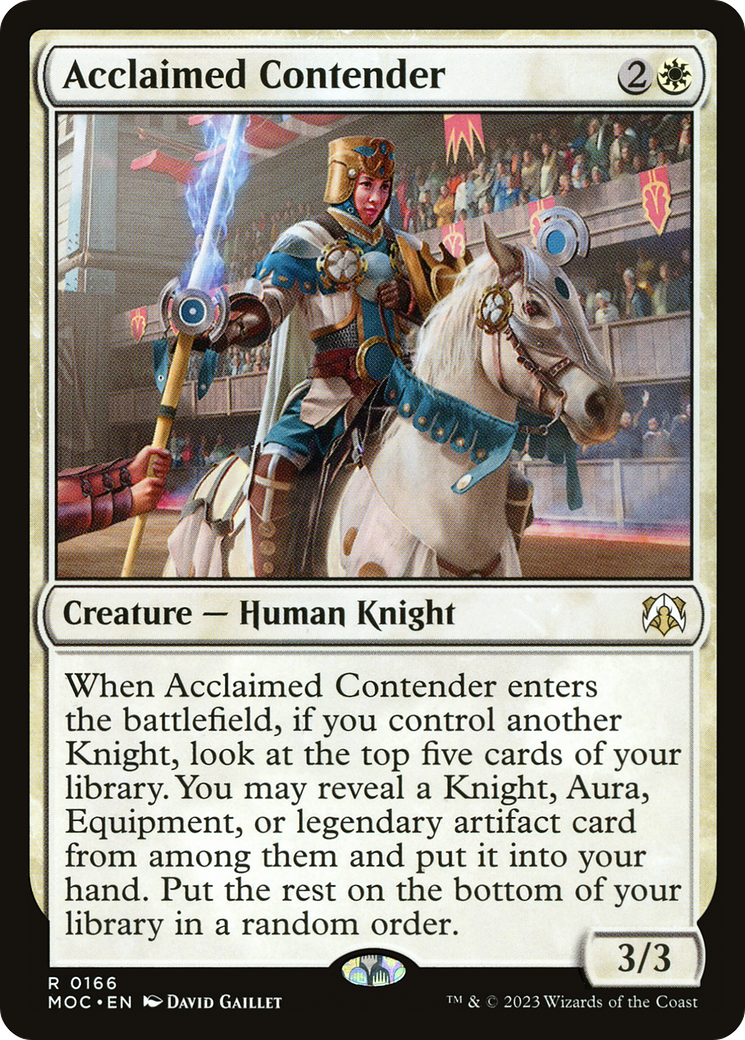
Acclaimed Contender
Acclaimed Contender
Creature — Human Knight
3/3
When this creature enters, if you control another Knight, look at the top five cards of your library. You may reveal a Knight, Aura, Equipment, or legendary artifact card from among them and put it into your hand. Put the rest on the bottom of your library in a random order.
- Acclaimed Contender's ability won't trigger if you don't control another Knight immediately after it enters the battlefield. If you don't control another Knight as that ability resolves, the ability has no effect. This doesn't have the be the same Knight at both times, however.
- Acclaimed Contender's ability can get you at most one card from the top five cards, no matter how many other Knights you control.
-
1
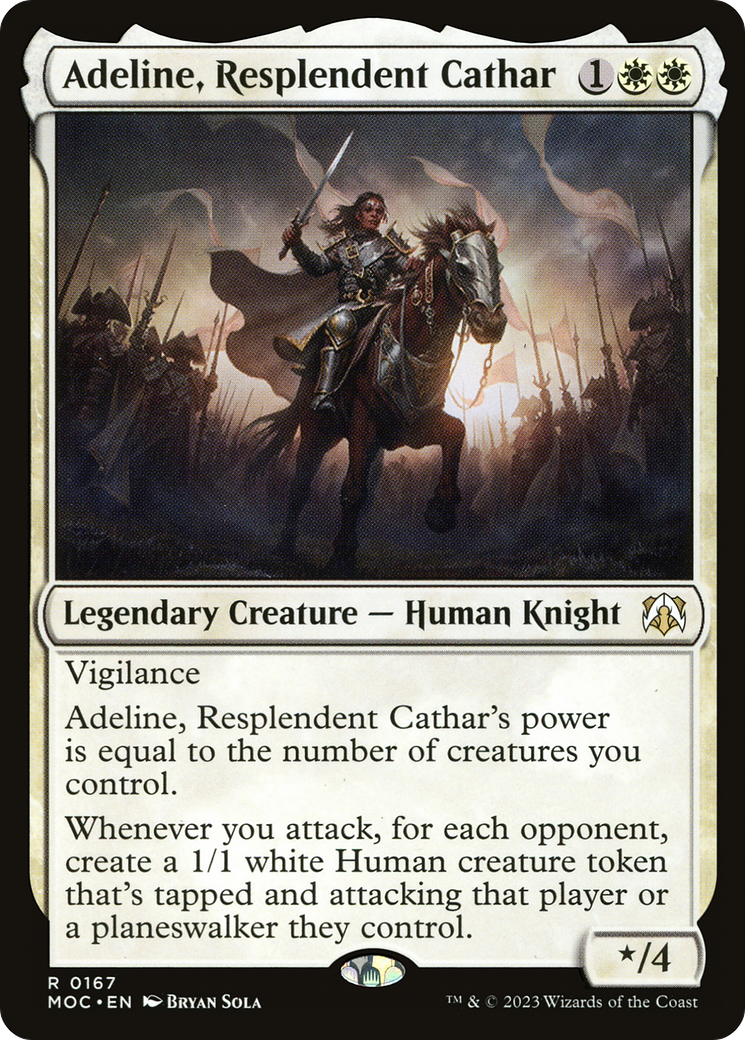
Adeline, Resplendent Cathar
Adeline, Resplendent Cathar
Legendary Creature — Human Knight
*/4
Vigilance
Adeline's power is equal to the number of creatures you control.
Whenever you attack, for each opponent, create a 1/1 white Human creature token that's tapped and attacking that player or a planeswalker they control.
- The ability that defines Adeline's power works in all zones, not just the battlefield. As long as Adeline is on the battlefield (and still a creature), that ability will count Adeline itself.
- Attacking with any creatures will cause Adeline's last ability to trigger. Adeline doesn't have to be among them.
- Tokens will be created for each of your opponents, not just opponents that you attacked.
- You choose whether each token is attacking that opponent or a planeswalker they control as those tokens enter the battlefield.
- Although the Human tokens created by the triggered ability are attacking, they were never declared as attacking creatures (for the purposes of abilities that trigger whenever a creature attacks, for example).
-
1
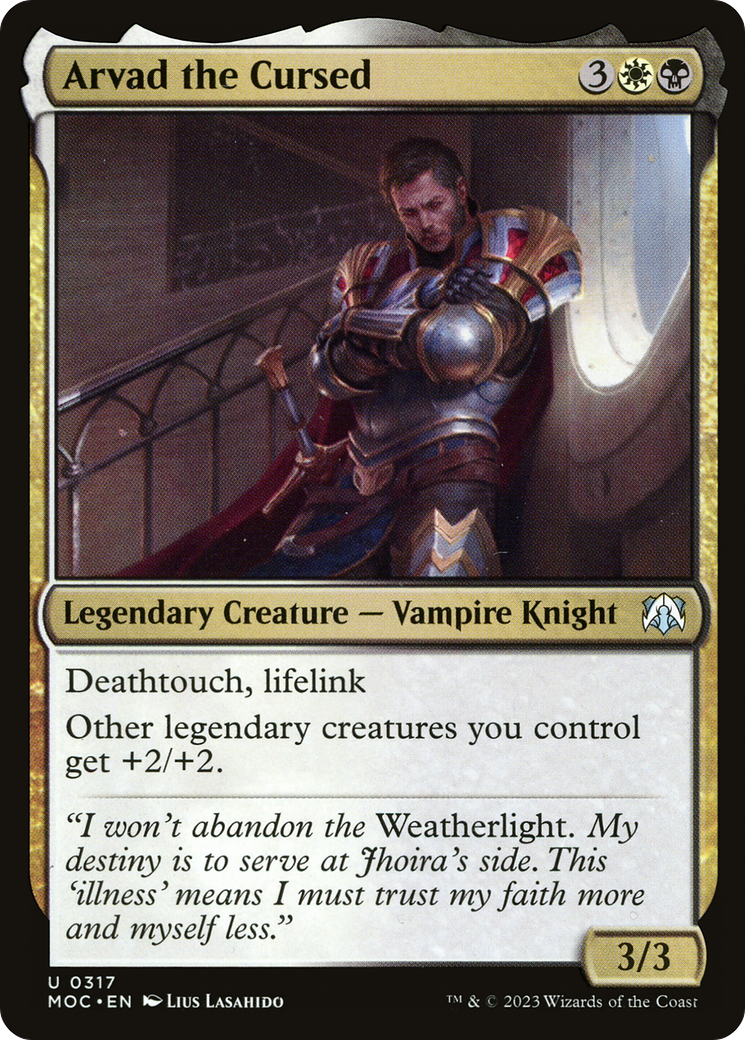
Arvad the Cursed
Arvad the Cursed
Legendary Creature — Vampire Knight
3/3
Deathtouch, lifelink
Other legendary creatures you control get +2/+2.
- Because damage remains marked on a creature until it's removed as the turn ends, nonlethal damage dealt to a legendary creature you control may become lethal if Arvad leaves the battlefield during that turn.
-
1
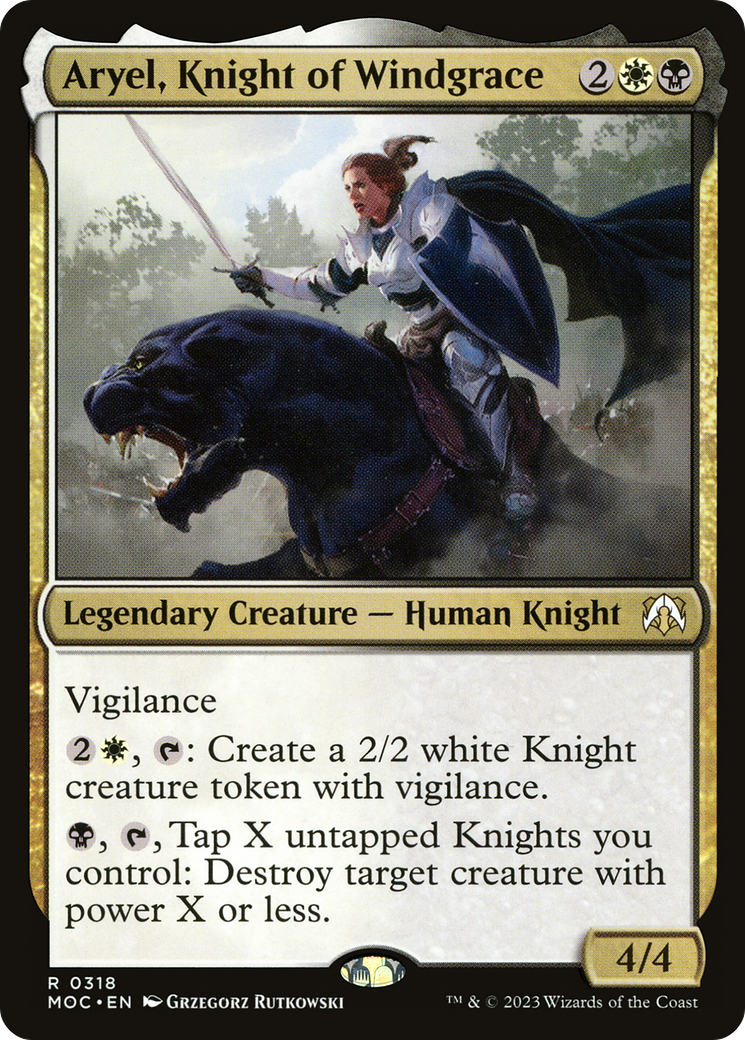
Aryel, Knight of Windgrace
Aryel, Knight of Windgrace
Legendary Creature — Human Knight
4/4
Vigilance
, : Create a 2/2 white Knight creature token with vigilance.
, , Tap X untapped Knights you control: Destroy target creature with power X or less.
- Tapping Aryel to activate either of its abilities while it's attacking doesn't remove it from combat.
- You can tap any untapped Knights you control, including ones you haven't controlled continuously since the beginning of your most recent turn, to pay the cost of Aryel's last ability. However, you must have controlled Aryel continuously since the beginning of your most recent turn in order to use either of its activated abilities.
- Once you announce that you're activating Aryel's last ability, no player may take other actions until the ability's been paid for. Notably, players can't try to make the value of X invalid by removing or tapping your Knights.
- If the target creature's power is greater than X as Aryel's last ability tries to resolve, the ability doesn't resolve. You can't tap extra Knights once the ability has been activated.
-
1
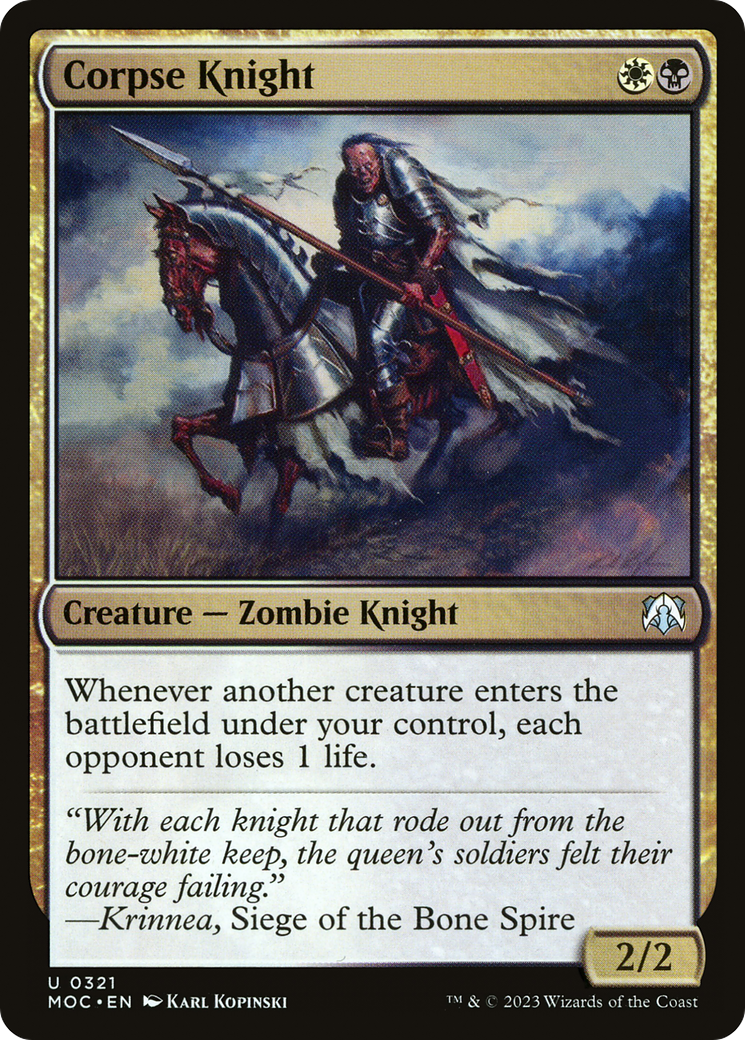
Corpse Knight
Corpse Knight
Creature — Zombie Knight
2/2
Whenever another creature you control enters, each opponent loses 1 life.
- In a Two-Headed Giant game, Corpse Knight's ability causes the opposing team to lose 1 life twice.
-
1
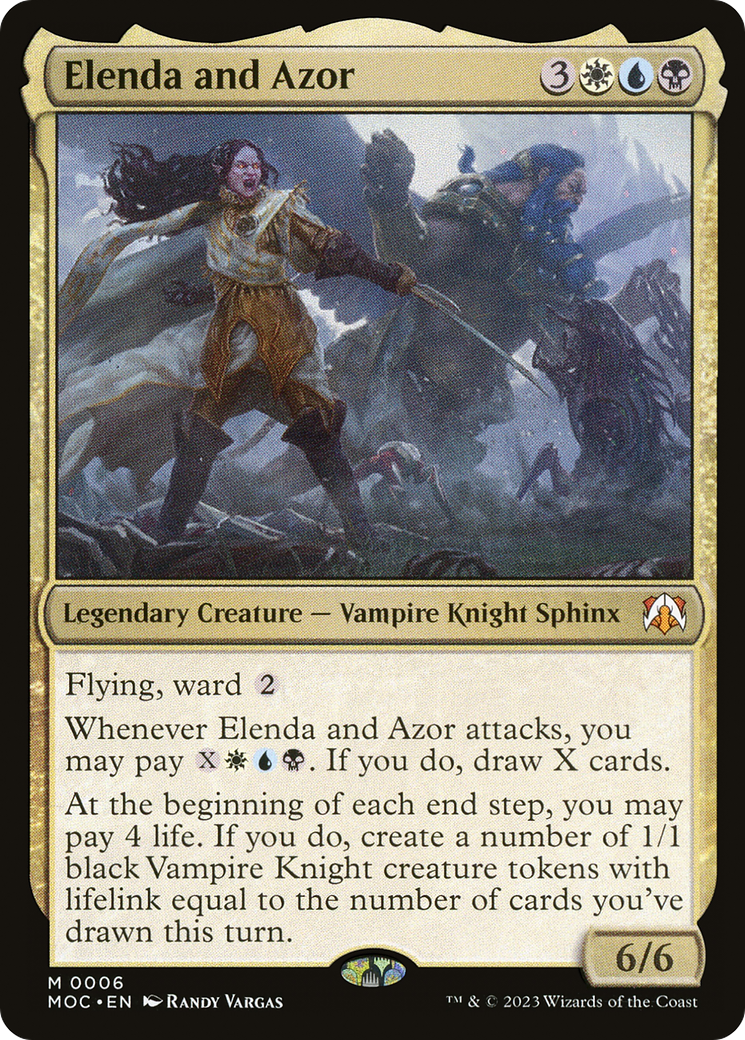
Elenda and Azor
Elenda and Azor
Legendary Creature — Vampire Knight Sphinx
6/6
Flying, ward
Whenever Elenda and Azor attacks, you may pay . If you do, draw X cards.
At the beginning of each end step, you may pay 4 life. If you do, create a number of 1/1 black Vampire Knight creature tokens with lifelink equal to the number of cards you've drawn this turn.
- You choose the value of X as the first triggered ability resolves.
- As the last ability resolves, you choose whether to pay 4 life. You can’t pay it more than once to create additional Vampire Knight tokens.
-
1
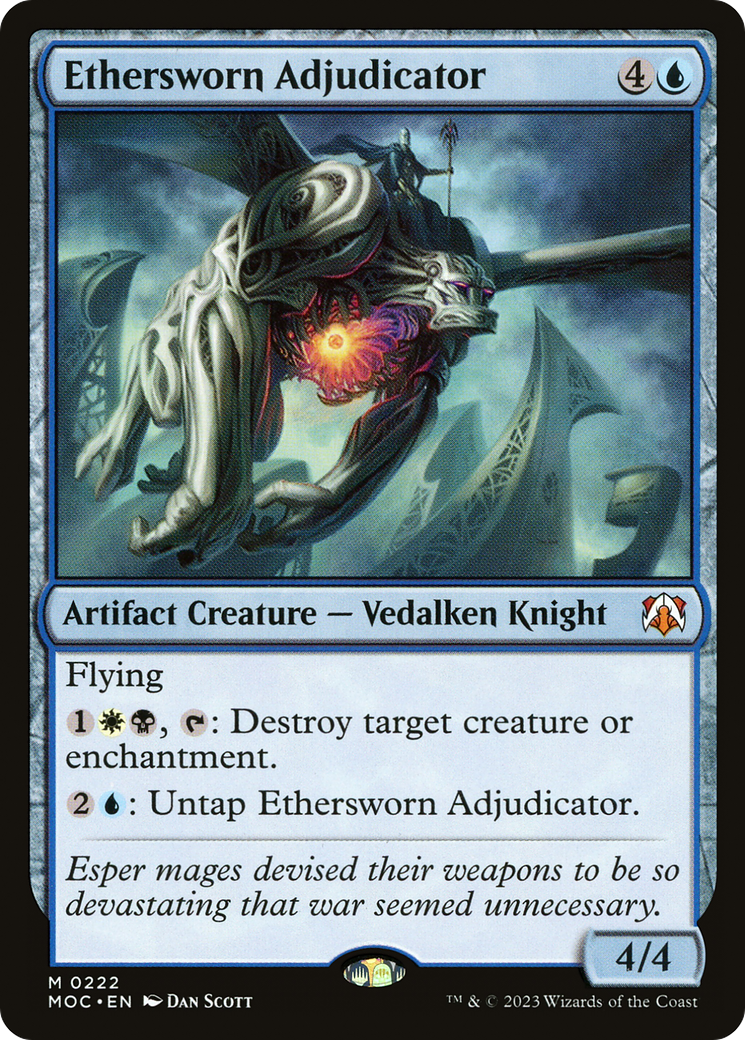
Ethersworn Adjudicator
Ethersworn Adjudicator
Artifact Creature — Vedalken Knight
4/4
Flying
, : Destroy target creature or enchantment.
: Untap this creature.
-
1
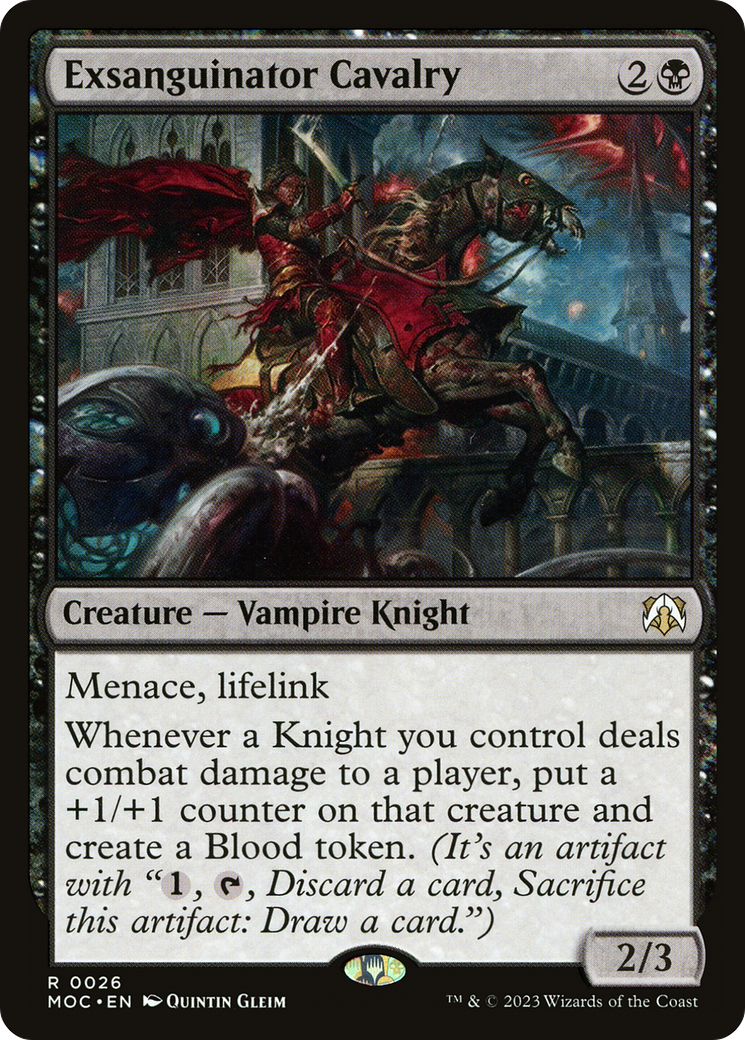
Exsanguinator Cavalry
Exsanguinator Cavalry
Creature — Vampire Knight
2/3
Menace, lifelink
Whenever a Knight you control deals combat damage to a player, put a +1/+1 counter on that creature and create a Blood token. (It's an artifact with " , , Discard a card, Sacrifice this token: Draw a card.")
- If an effect refers to a Blood token, it means any artifact token with the subtype Blood, even if it has gained other subtypes.
- You can't sacrifice a Blood token to pay multiple costs.
- Some triggered abilities trigger "whenever you sacrifice a Blood token." These abilities trigger regardless of why you sacrificed that Blood token.
-
1
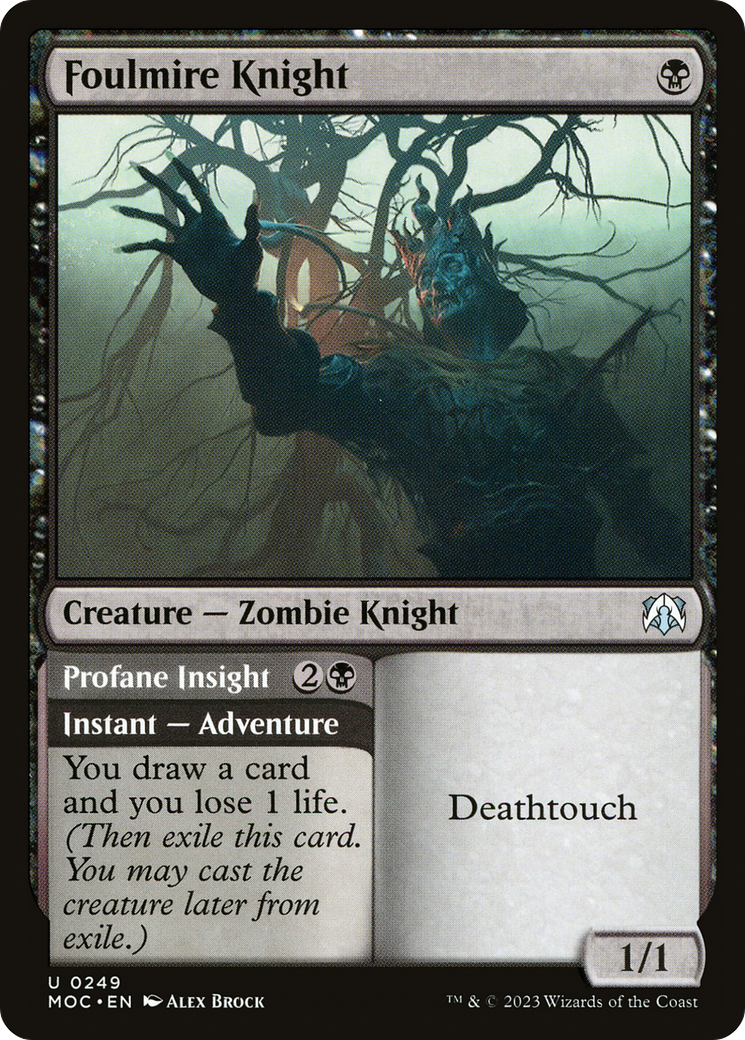
Foulmire Knight // Profane Insight
//
Foulmire Knight
Creature — Zombie Knight
1/1
- An adventurer card is a permanent card in every zone except the stack, as well as while on the stack if not cast as an Adventure. Ignore its alternative characteristics in those cases. For example, while it's in your graveyard, Giant Killer is a white creature card whose mana value is 1. It can't be the target of the triggered ability of Mystic Sanctuary.
- When casting a spell as an Adventure, use the alternative characteristics and ignore all of the card's normal characteristics. The spell's color, mana cost, mana value, and so on are determined by only those alternative characteristics. If the spell leaves the stack, it immediately resumes using its normal characteristics.
- If you cast an adventurer card as an Adventure, use only its alternative characteristics to determine whether it's legal to cast that spell. For example, if Giant Killer is exiled with the last ability of Vivien, Champion of the Wilds, you can't cast it as Chop Down.
- If a spell is cast as an Adventure, its controller exiles it instead of putting it into its owner's graveyard as it resolves. For as long as it remains exiled, that player may cast it as a permanent spell. If an Adventure spell leaves the stack in any way other than resolving (most likely by being countered or by failing to resolve because its targets have all become illegal), that card won't be exiled and the spell's controller won't be able to cast it as a permanent later.
- If an adventurer card ends up in exile for any other reason than by exiling itself while resolving, it won't give you permission to cast it as a permanent spell.
- You must still follow any timing restrictions and permissions for the permanent spell you cast from exile. Normally, you'll be able to cast it only during your main phase while the stack is empty.
- If an effect copies an Adventure spell, that copy is exiled as it resolves. It ceases to exist as a state-based action; it's not possible to cast the copy as a permanent.
- If an object becomes a copy of an object that has an Adventure, the copy also has an Adventure. If it changes zones, it will either cease to exist (if it's a token) or cease to be a copy (if it's a nontoken permanent), and so you won't be able to cast it as an Adventure.
- If an effect instructs you to choose a card name, you may choose the alternative Adventure name. Consider only the alternative characteristics to determine whether that is an appropriate name to choose.
- Casting a card as an Adventure isn't casting it for an alternative cost. Effects that allow you to cast a spell for an alternative cost or without paying its mana cost may allow you to apply those to the Adventure.
-
1
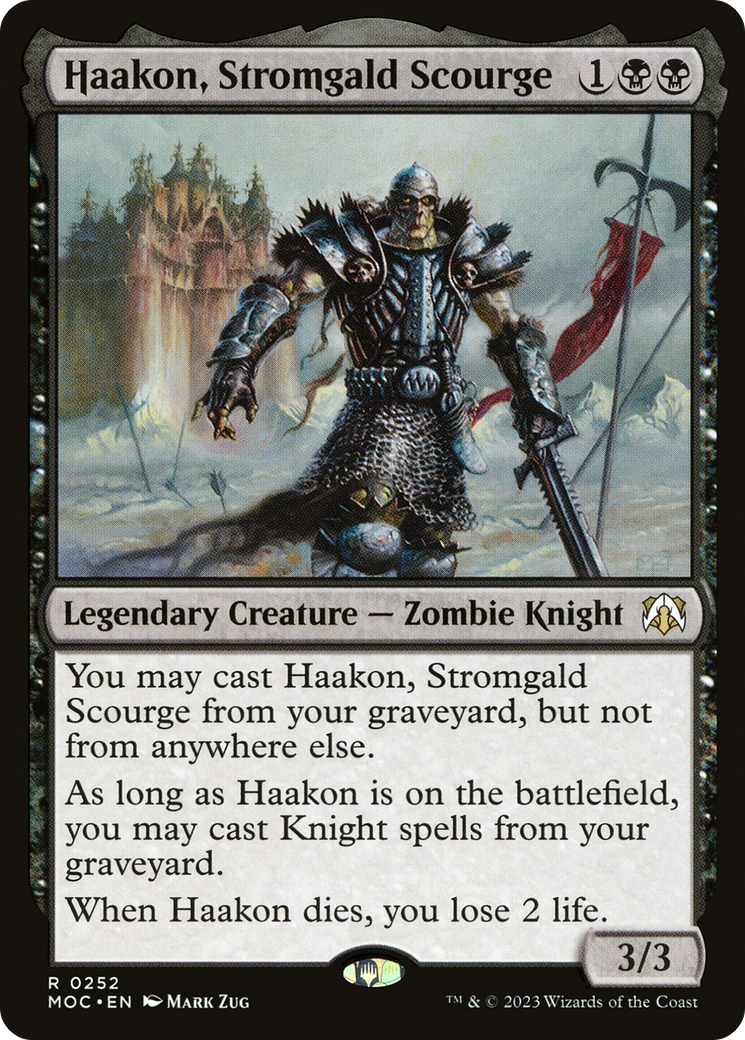
Haakon, Stromgald Scourge
Haakon, Stromgald Scourge
Legendary Creature — Zombie Knight
3/3
You may cast this card from your graveyard, but not from anywhere else.
As long as Haakon is on the battlefield, you may cast Knight spells from your graveyard.
When Haakon dies, you lose 2 life.
- Haakon can't be cast from your hand. It can't be cast from any zone other than your graveyard, even if an effect such as that of Spelljack or Muse Vessel would otherwise allow you to.
- While Haakon is in your graveyard, you may cast it. This follows the normal rules and timing for casting a creature spell; the only difference is what zone Haakon is being cast from. The spell goes on the stack. You have to pay Haakon's mana cost and any applicable additional costs. The same applies for Knight cards you cast from your graveyard while Haakon is on the battlefield.
-
1
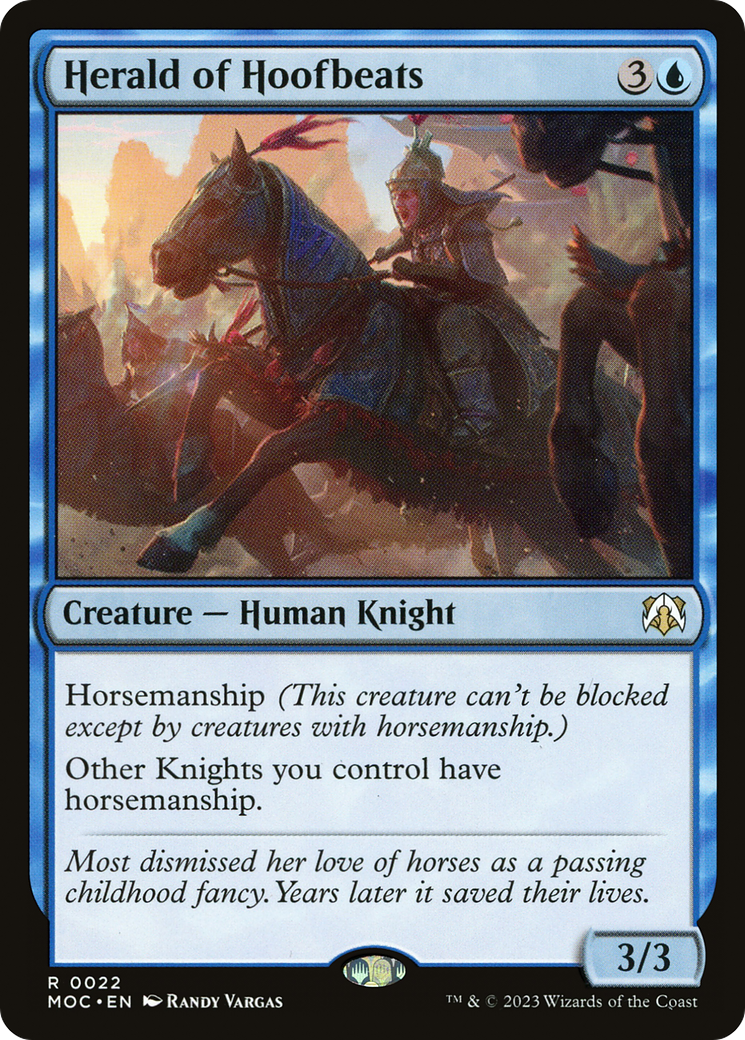
Herald of Hoofbeats
Herald of Hoofbeats
Creature — Human Knight
3/3
Horsemanship (This creature can't be blocked except by creatures with horsemanship.)
Other Knights you control have horsemanship.
-
1
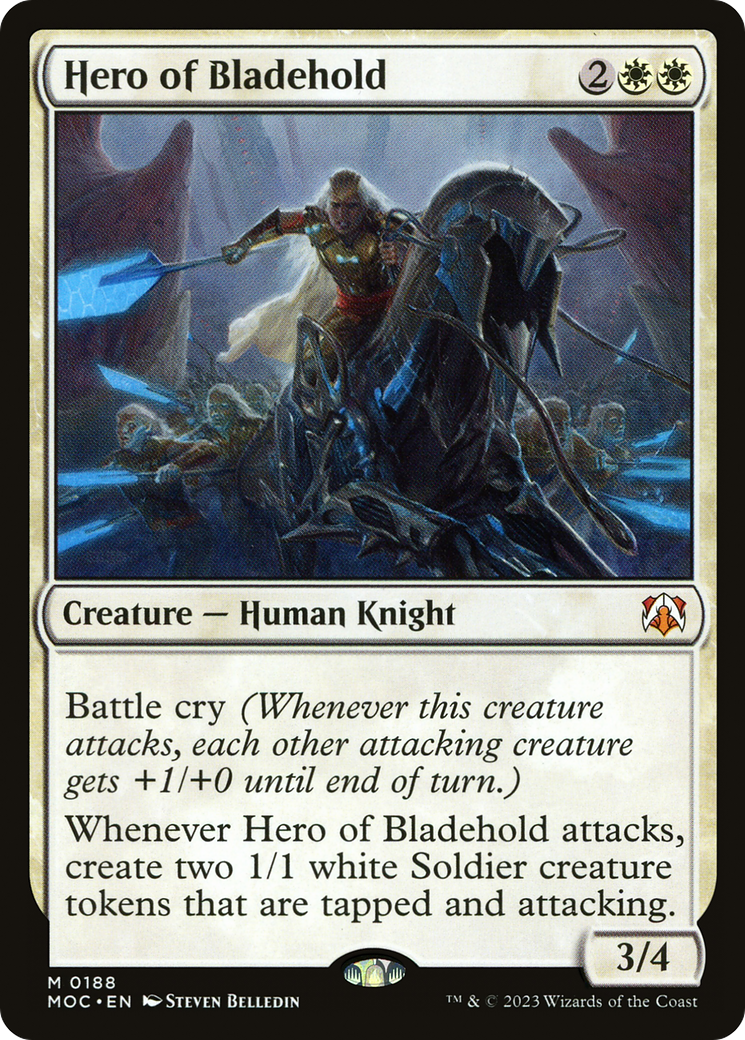
Hero of Bladehold
Hero of Bladehold
Creature — Human Knight
3/4
Battle cry (Whenever this creature attacks, each other attacking creature gets +1/+0 until end of turn.)
Whenever this creature attacks, create two 1/1 white Soldier creature tokens that are tapped and attacking.
- Whenever Hero of Bladehold attacks, both abilities will trigger. You can put them onto the stack in any order. If the token-creating ability resolves first, the tokens each get +1/+0 until end of turn from the battle cry ability.
- You choose which opponent or planeswalker an opponent controls that each token is attacking when it is put onto the battlefield.
- Although the tokens are attacking, they never were declared as attacking creatures (for purposes of abilities that trigger whenever a creature attacks, for example).
-
1
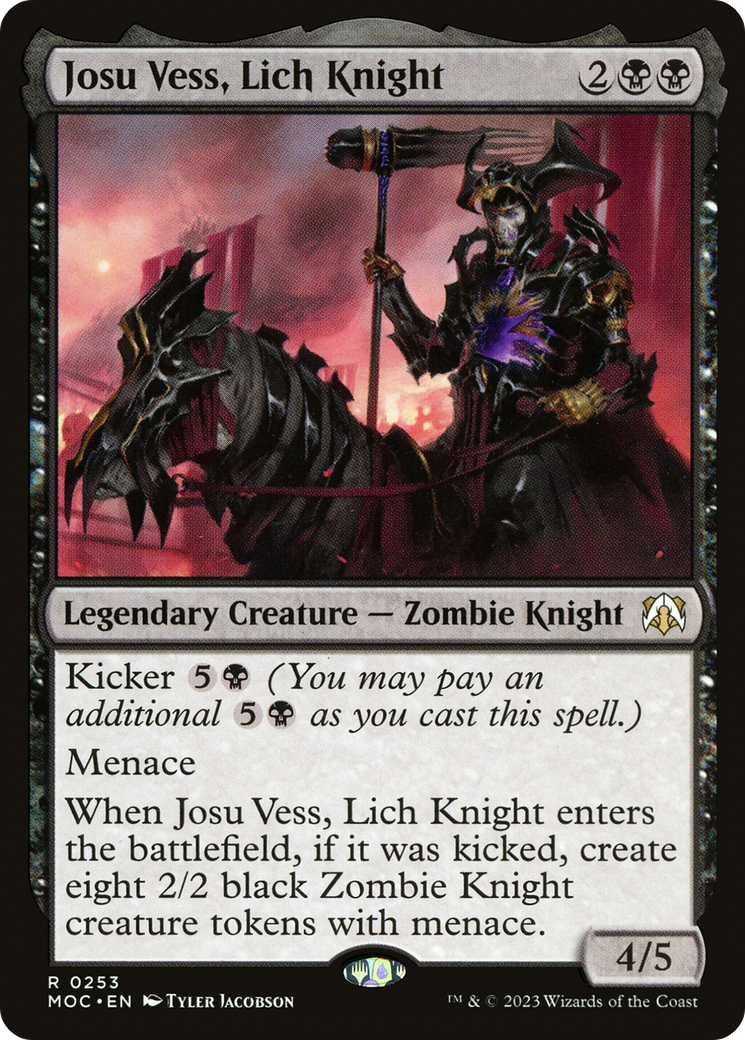
Josu Vess, Lich Knight
Josu Vess, Lich Knight
Legendary Creature — Zombie Knight
4/5
Kicker (You may pay an additional as you cast this spell.)
Menace
When Josu Vess enters, if it was kicked, create eight 2/2 black Zombie Knight creature tokens with menace.
- If a spell's kicker cost was paid, the spell is "kicked."
- The kicker ability doesn't let you pay a kicker cost more than once.
- If you put a permanent with a kicker ability onto the battlefield without casting it, you can't kick it.
- If you copy a kicked spell on the stack, the copy is also kicked. If the copied spell is a permanent spell, the token the copy of that spell becomes when it enters is also kicked.
- If a card or token enters as a copy of a permanent, the new permanent isn't kicked, even if the original was.
- To determine a spell's total cost, start with the mana cost (or an alternative cost if another card's effect allows you to pay one instead), add any cost increases (such as kicker), then apply any cost reductions. The spell's mana value remains unchanged, no matter what the total cost to cast it was.
-
1
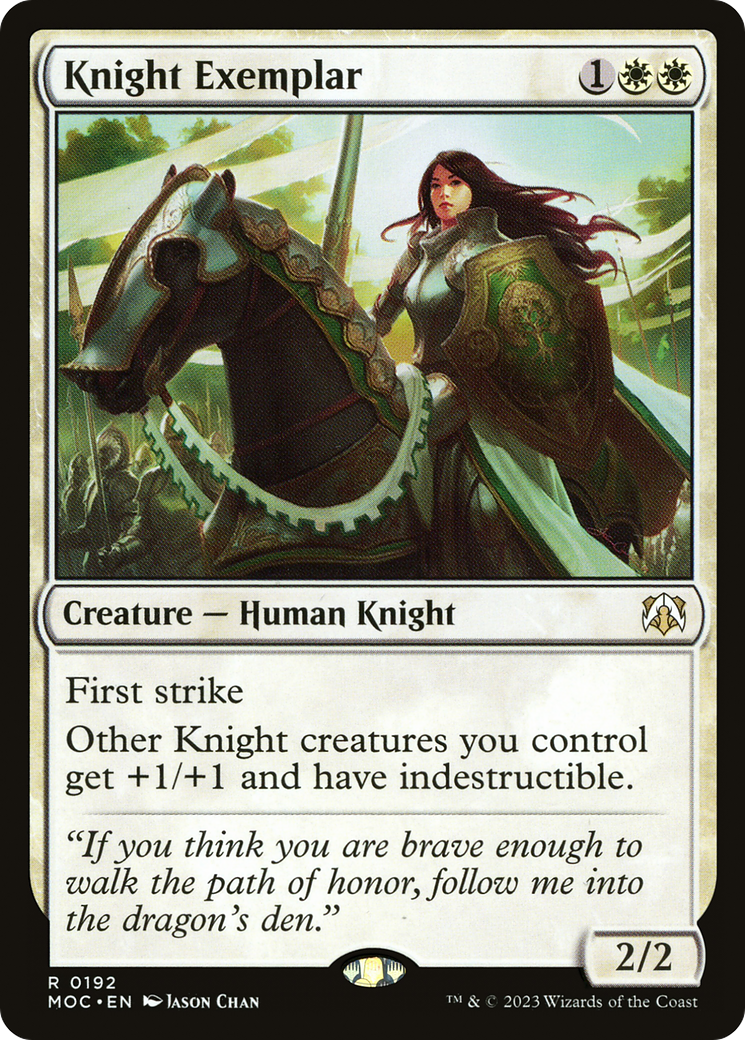
Knight Exemplar
Knight Exemplar
Creature — Human Knight
2/2
First strike (This creature deals combat damage before creatures without first strike.)
Other Knight creatures you control get +1/+1 and have indestructible. (Damage and effects that say "destroy" don't destroy them.)
- Lethal damage, damage from a source with deathtouch, and effects that say “destroy” won't cause a creature with indestructible to be put into the graveyard. However, a creature with indestructible can be put into the graveyard for a number of reasons. The most likely reasons are if it's sacrificed, if it's legendary and another legendary creature with the same name is controlled by the same player, or if its toughness is 0 or less.
- If another Knight creature you control is dealt lethal damage, the creature isn't destroyed, but the damage remains marked on it. If, at some point later in that turn, you no longer control Knight Exemplar or it loses its abilities, the other Knight creature will lose indestructible and will be destroyed.
- If you control two Knight Exemplars, each one causes the other to get +1/+1 and have indestructible.
- If an effect would simultaneously destroy Knight Exemplar and another Knight creature you control, only Knight Exemplar is destroyed.
-
1
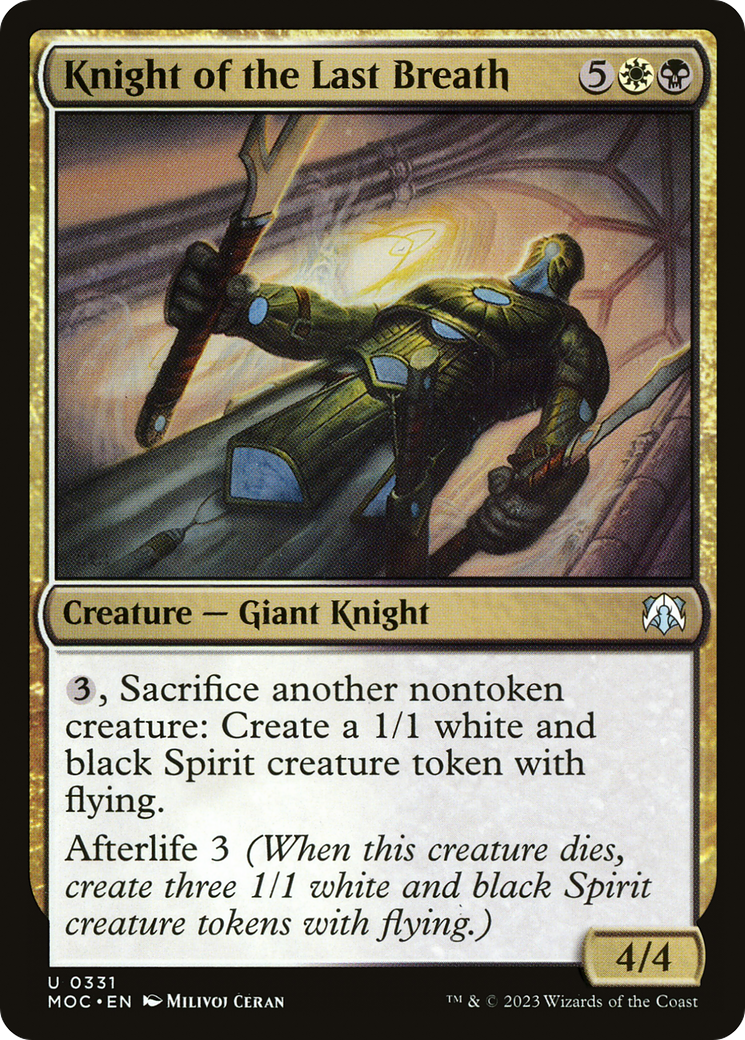
Knight of the Last Breath
Knight of the Last Breath
Creature — Giant Knight
4/4
, Sacrifice another nontoken creature: Create a 1/1 white and black Spirit creature token with flying.
Afterlife 3 (When this creature dies, create three 1/1 white and black Spirit creature tokens with flying.)
- Because blockers are chosen all at once, you can't block with a creature with afterlife, wait for it to die, then block with the resulting Spirit tokens.
-
1
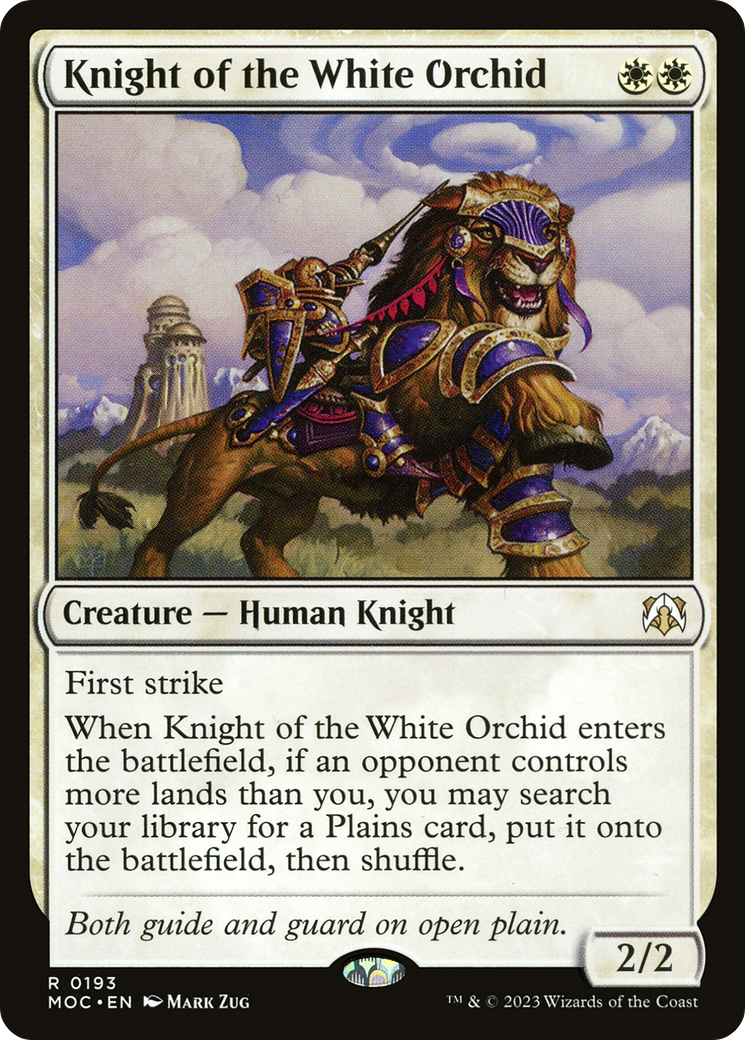
Knight of the White Orchid
Knight of the White Orchid
Creature — Human Knight
2/2
First strike
When this creature enters, if an opponent controls more lands than you, you may search your library for a Plains card, put it onto the battlefield, then shuffle.
- The Plains you search for doesn't have to be basic. For example, you could put a Sacred Foundry onto the battlefield.
- Knight of the White Orchid's triggered ability has an “intervening ‘if' clause.” That means (1) the ability won't trigger at all unless any one of your opponents controls more lands than you, and (2) the ability will do nothing if you control at least as many lands as each of your opponents by the time it resolves.
-
1
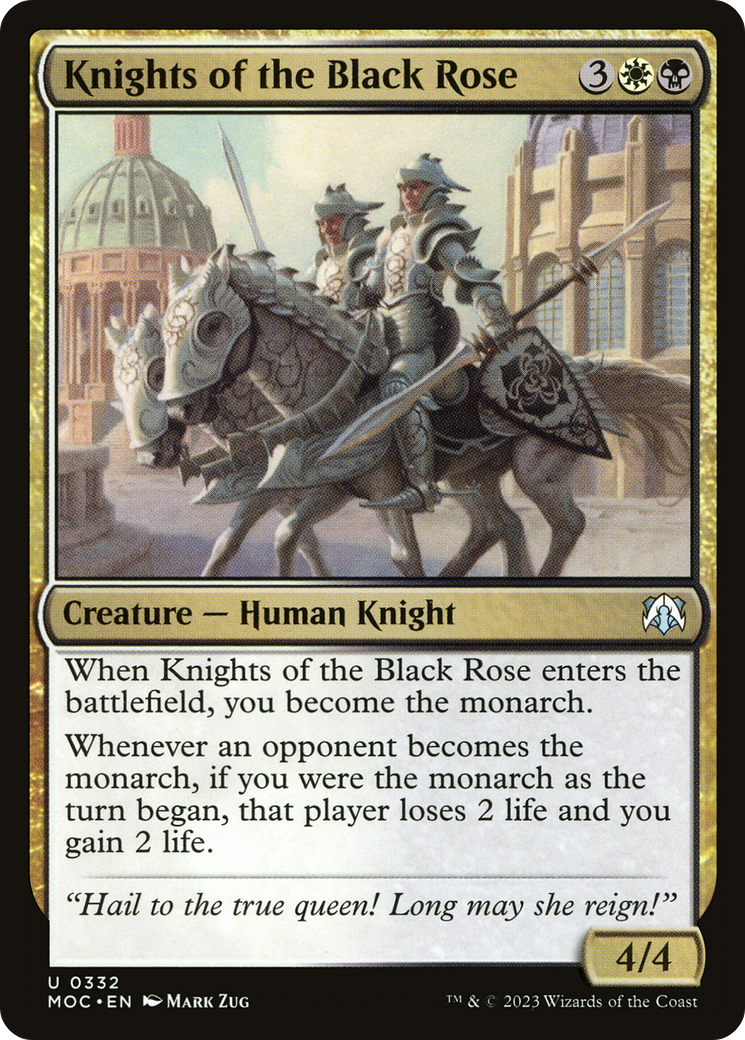
Knights of the Black Rose
Knights of the Black Rose
Creature — Human Knight
4/4
When this creature enters, you become the monarch.
Whenever an opponent becomes the monarch, if you were the monarch as the turn began, that player loses 2 life and you gain 2 life.
- The last ability of Knights of the Black Rose will trigger even if the most recent monarch was another player, as long as you were monarch as the turn began.
- The game starts with no monarch. Once an effect makes one player the monarch, the game will have exactly one monarch from that point forward.
- Being the monarch carries two inherent triggered abilities. “At the beginning of the monarch's end step, that player draws a card” and “Whenever a creature deals combat damage to the monarch, its controller becomes the monarch.”
- Abilities that trigger whenever you “become the monarch” trigger only if you aren't already the monarch. For example, if you are already the monarch as Custodi Lich enters the battlefield, its last ability won't trigger.
- If the triggered ability that causes the monarch to draw a card goes on the stack, and a different player becomes the monarch before that ability resolves, the first player will still draw the card.
-
1
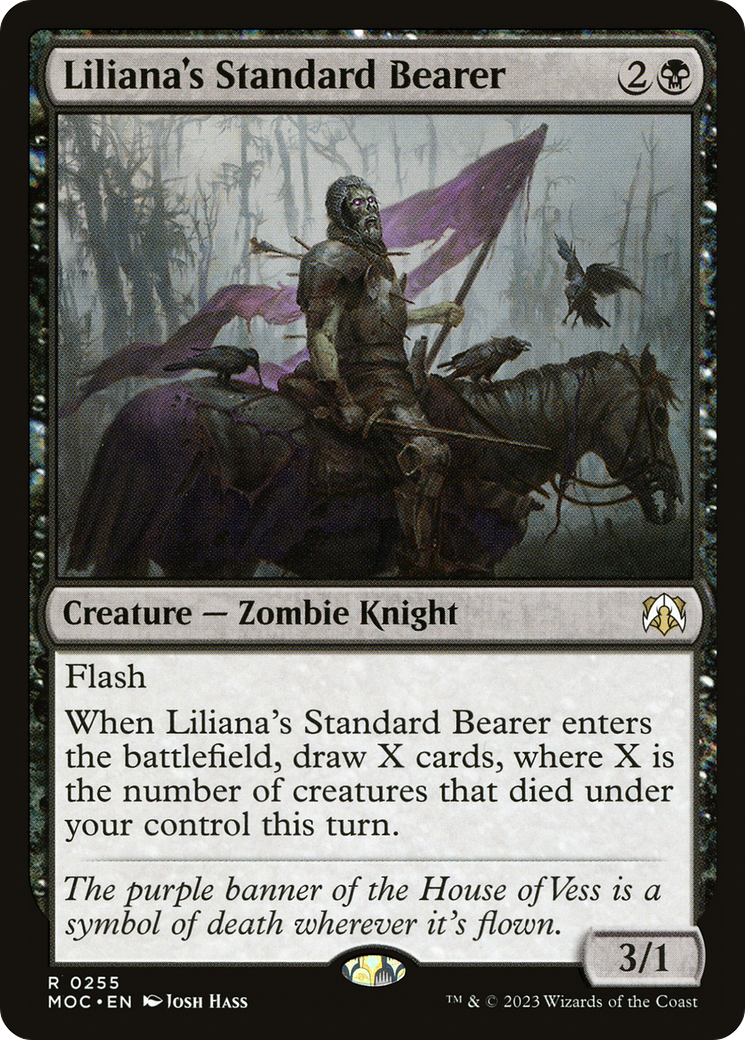
Liliana's Standard Bearer
Liliana's Standard Bearer
Creature — Zombie Knight
3/1
Flash
When this creature enters, draw X cards, where X is the number of creatures that died under your control this turn.
- The value of X is determined only as the triggered ability resolves. If Liliana's Standard Bearer dies while that ability's on the stack, it will count itself.
-
1
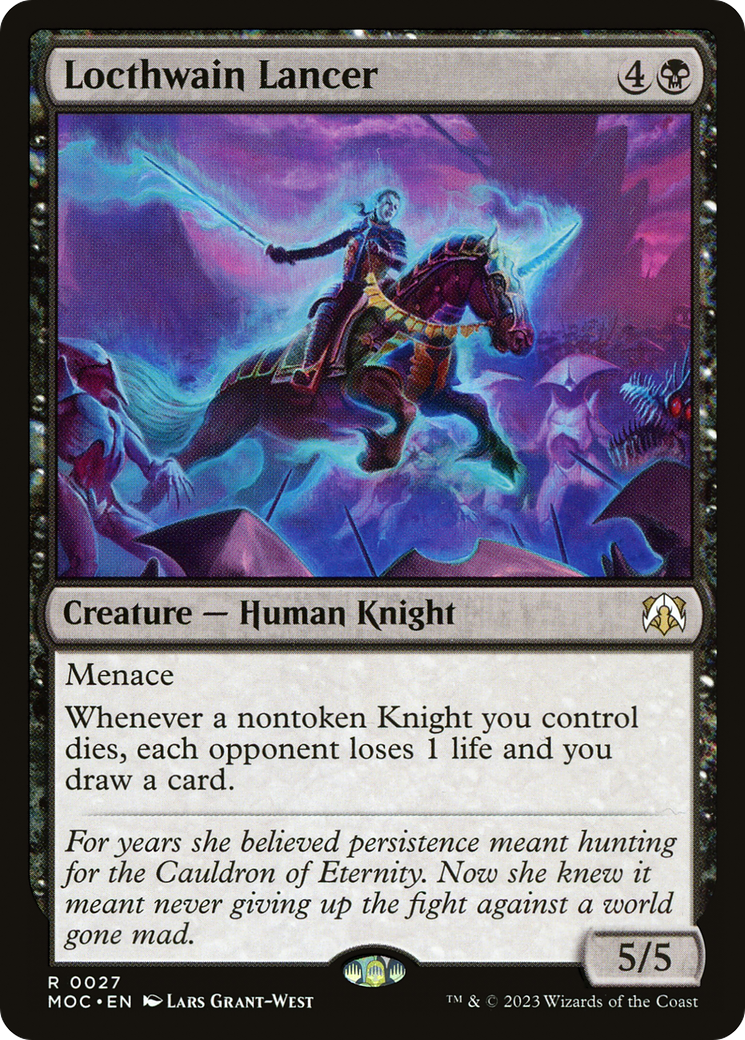
Locthwain Lancer
Locthwain Lancer
Creature — Human Knight
5/5
Menace
Whenever a nontoken Knight you control dies, each opponent loses 1 life and you draw a card.
- If Locthwain Lancer dies at the same time as other nontoken Knights you control, its ability will trigger once for itself (assuming it’s not a token) and once for each of those other Knights.
-
1
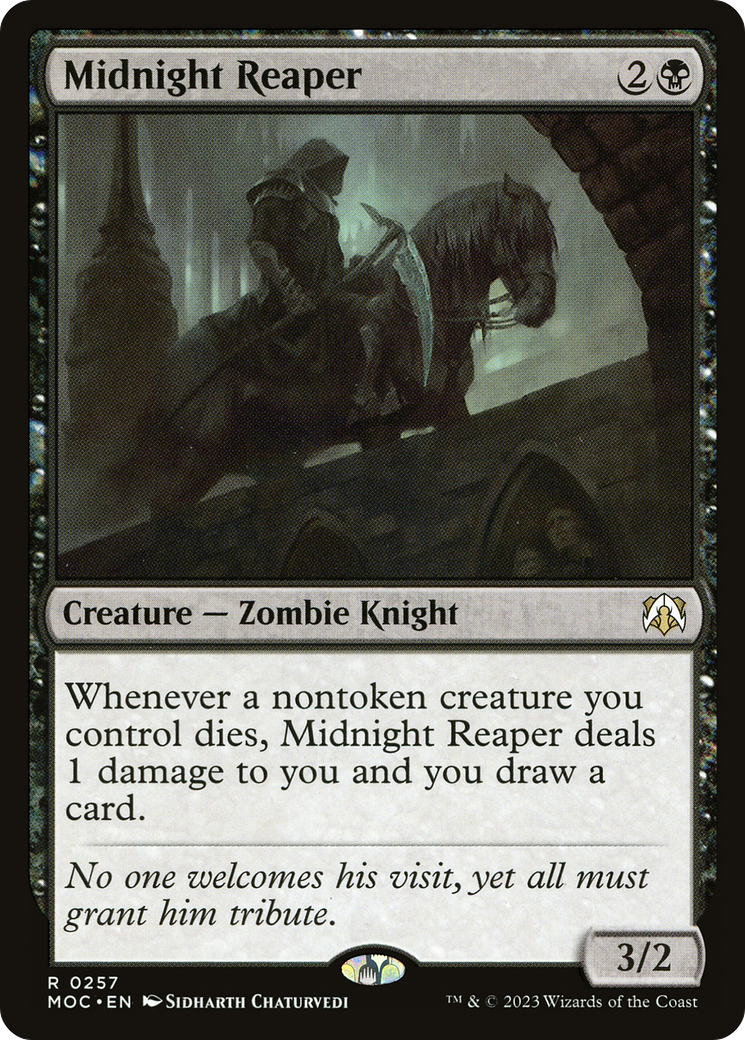
Midnight Reaper
Midnight Reaper
Creature — Zombie Knight
3/2
Whenever a nontoken creature you control dies, this creature deals 1 damage to you and you draw a card.
- Midnight Reaper's ability triggers when it dies if it's not a token.
- If Midnight Reaper dies at the same time as one or more other nontoken creatures you control, Midnight Reaper's ability triggers for each of them.
-
1
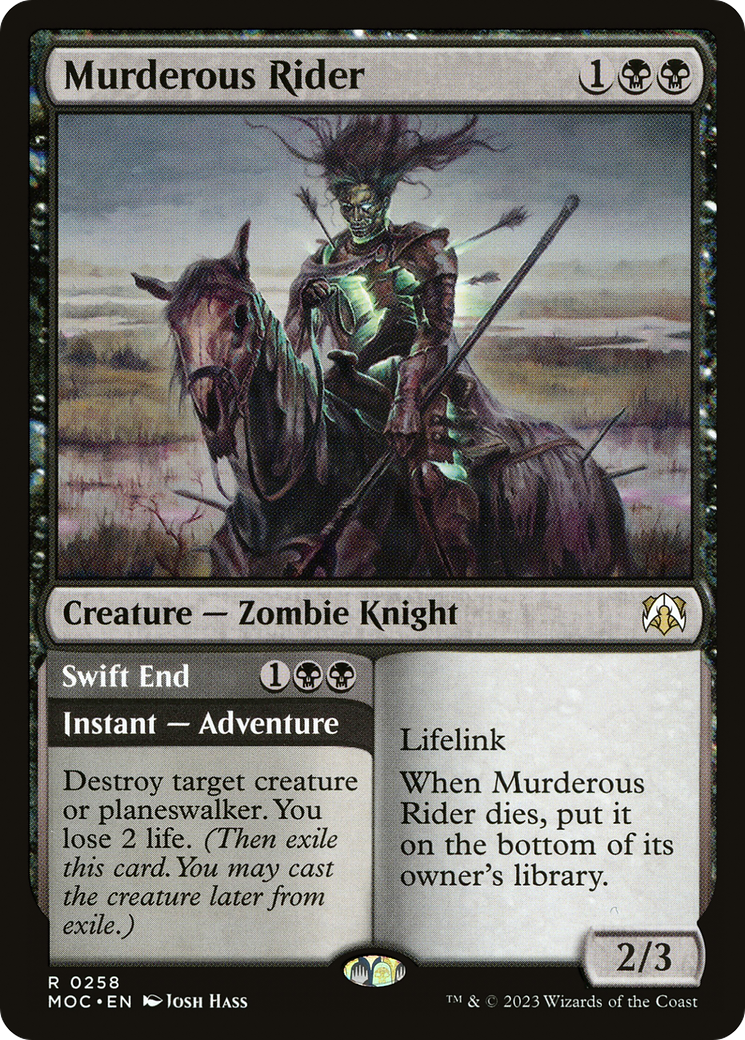
Murderous Rider // Swift End
//
Murderous Rider
Creature — Zombie Knight
2/3
- An adventurer card is a permanent card in every zone except the stack, as well as while on the stack if not cast as an Adventure. Ignore its alternative characteristics in those cases. For example, while it's in your graveyard, Giant Killer is a white creature card whose mana value is 1. It can't be the target of the triggered ability of Mystic Sanctuary.
- When casting a spell as an Adventure, use the alternative characteristics and ignore all of the card's normal characteristics. The spell's color, mana cost, mana value, and so on are determined by only those alternative characteristics. If the spell leaves the stack, it immediately resumes using its normal characteristics.
- If you cast an adventurer card as an Adventure, use only its alternative characteristics to determine whether it's legal to cast that spell. For example, if Giant Killer is exiled with the last ability of Vivien, Champion of the Wilds, you can't cast it as Chop Down.
- If a spell is cast as an Adventure, its controller exiles it instead of putting it into its owner's graveyard as it resolves. For as long as it remains exiled, that player may cast it as a permanent spell. If an Adventure spell leaves the stack in any way other than resolving (most likely by being countered or by failing to resolve because its targets have all become illegal), that card won't be exiled and the spell's controller won't be able to cast it as a permanent later.
- If an adventurer card ends up in exile for any other reason than by exiling itself while resolving, it won't give you permission to cast it as a permanent spell.
- You must still follow any timing restrictions and permissions for the permanent spell you cast from exile. Normally, you'll be able to cast it only during your main phase while the stack is empty.
- If an effect copies an Adventure spell, that copy is exiled as it resolves. It ceases to exist as a state-based action; it's not possible to cast the copy as a permanent.
- If an object becomes a copy of an object that has an Adventure, the copy also has an Adventure. If it changes zones, it will either cease to exist (if it's a token) or cease to be a copy (if it's a nontoken permanent), and so you won't be able to cast it as an Adventure.
- If an effect instructs you to choose a card name, you may choose the alternative Adventure name. Consider only the alternative characteristics to determine whether that is an appropriate name to choose.
- Casting a card as an Adventure isn't casting it for an alternative cost. Effects that allow you to cast a spell for an alternative cost or without paying its mana cost may allow you to apply those to the Adventure.
- If the target creature or planeswalker is an illegal target by the time Swift End tries to resolve, the spell won't resolve. You won't lose 2 life or exile Swift End. If the target is legal but not destroyed (most likely because it has indestructible), you do lose 2 life and exile Swift End.
-
1
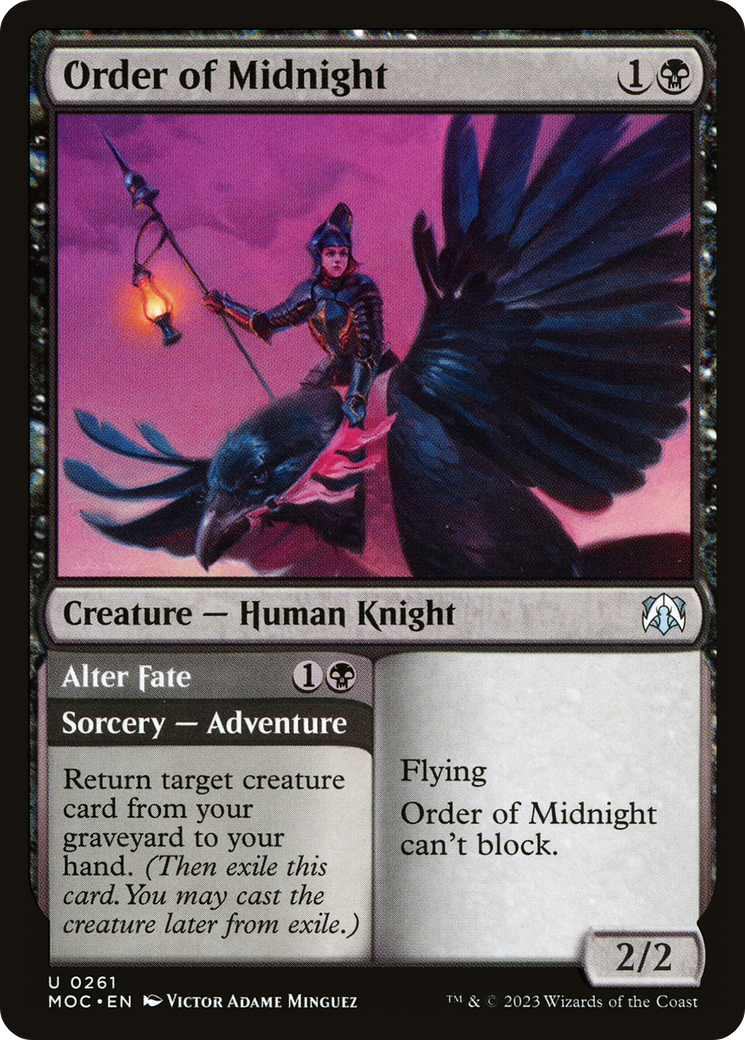
Order of Midnight // Alter Fate
//
Order of Midnight
Creature — Human Knight
2/2
- An adventurer card is a permanent card in every zone except the stack, as well as while on the stack if not cast as an Adventure. Ignore its alternative characteristics in those cases. For example, while it's in your graveyard, Giant Killer is a white creature card whose mana value is 1. It can't be the target of the triggered ability of Mystic Sanctuary.
- When casting a spell as an Adventure, use the alternative characteristics and ignore all of the card's normal characteristics. The spell's color, mana cost, mana value, and so on are determined by only those alternative characteristics. If the spell leaves the stack, it immediately resumes using its normal characteristics.
- If you cast an adventurer card as an Adventure, use only its alternative characteristics to determine whether it's legal to cast that spell. For example, if Giant Killer is exiled with the last ability of Vivien, Champion of the Wilds, you can't cast it as Chop Down.
- If a spell is cast as an Adventure, its controller exiles it instead of putting it into its owner's graveyard as it resolves. For as long as it remains exiled, that player may cast it as a permanent spell. If an Adventure spell leaves the stack in any way other than resolving (most likely by being countered or by failing to resolve because its targets have all become illegal), that card won't be exiled and the spell's controller won't be able to cast it as a permanent later.
- If an adventurer card ends up in exile for any other reason than by exiling itself while resolving, it won't give you permission to cast it as a permanent spell.
- You must still follow any timing restrictions and permissions for the permanent spell you cast from exile. Normally, you'll be able to cast it only during your main phase while the stack is empty.
- If an effect copies an Adventure spell, that copy is exiled as it resolves. It ceases to exist as a state-based action; it's not possible to cast the copy as a permanent.
- If an object becomes a copy of an object that has an Adventure, the copy also has an Adventure. If it changes zones, it will either cease to exist (if it's a token) or cease to be a copy (if it's a nontoken permanent), and so you won't be able to cast it as an Adventure.
- If an effect instructs you to choose a card name, you may choose the alternative Adventure name. Consider only the alternative characteristics to determine whether that is an appropriate name to choose.
- Casting a card as an Adventure isn't casting it for an alternative cost. Effects that allow you to cast a spell for an alternative cost or without paying its mana cost may allow you to apply those to the Adventure.
-
1
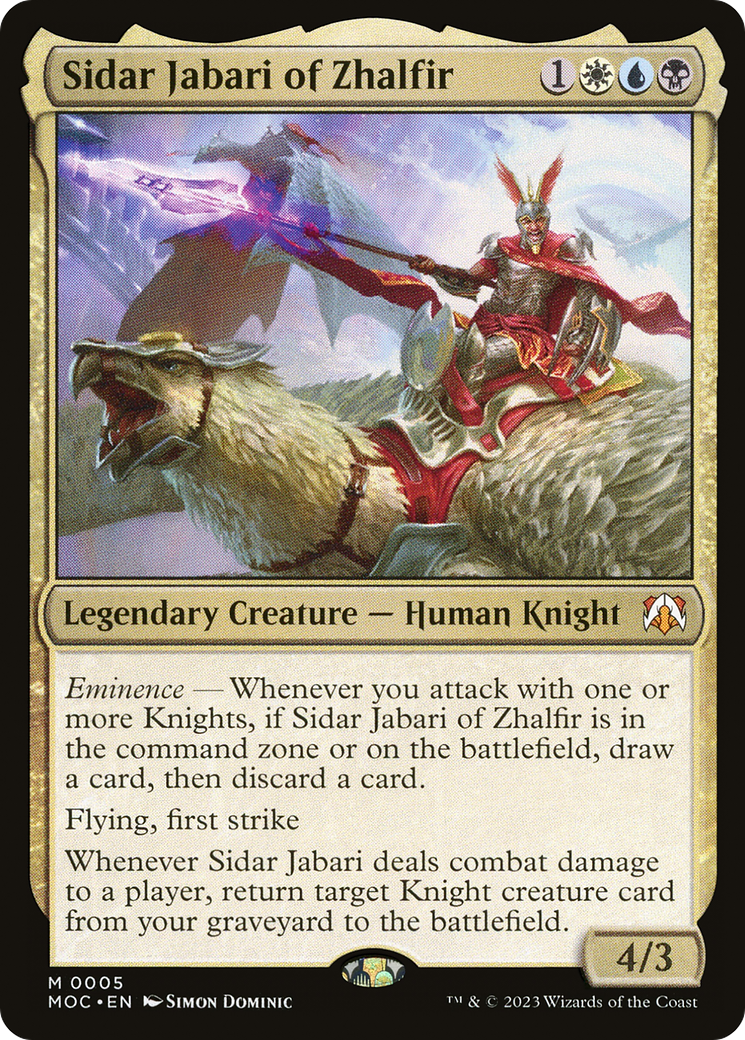
Sidar Jabari of Zhalfir
Sidar Jabari of Zhalfir
Legendary Creature — Human Knight
4/3
Eminence — Whenever you attack with one or more Knights, if Sidar Jabari is in the command zone or on the battlefield, draw a card, then discard a card.
Flying, first strike
Whenever Sidar Jabari deals combat damage to a player, return target Knight creature card from your graveyard to the battlefield.
- Sidar Jabari must be on the battlefield or in the command zone at the moment you attack with one or more Knights and also as the triggered ability tries to resolve. Notably, if Sidar Jabari is on the battlefield and its eminence ability triggers, but it's put into the command zone before that ability resolves, that ability won't do anything as it resolves. This is because an object that changes zones is considered a new object.
-
1
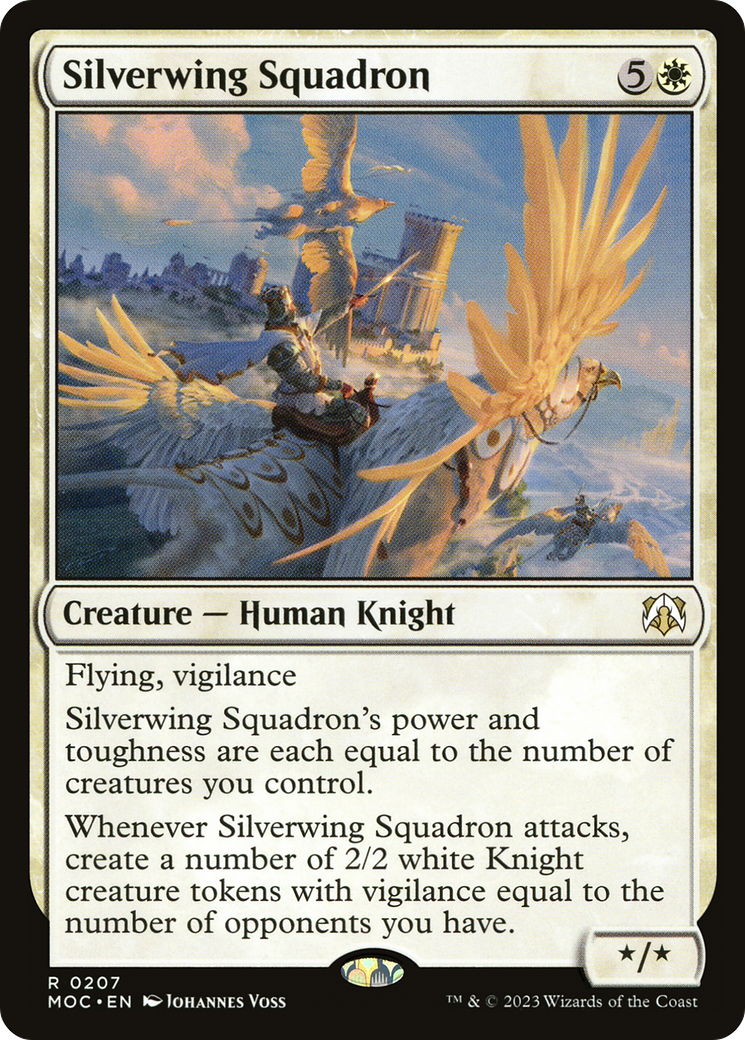
Silverwing Squadron
Silverwing Squadron
Creature — Human Knight
*/*
Flying, vigilance
Silverwing Squadron's power and toughness are each equal to the number of creatures you control.
Whenever this creature attacks, create a number of 2/2 white Knight creature tokens with vigilance equal to the number of opponents you have.
- The ability that defines Silverwing Squadron's power and toughness works in all zones, not just the battlefield.
- As long as Silverwing Squadron is on the battlefield, its ability will count itself, so it'll be at least 1/1.
- In a multiplayer game, opponents who have left the game aren't counted by Silverwing Squadron's triggered ability.
-
1
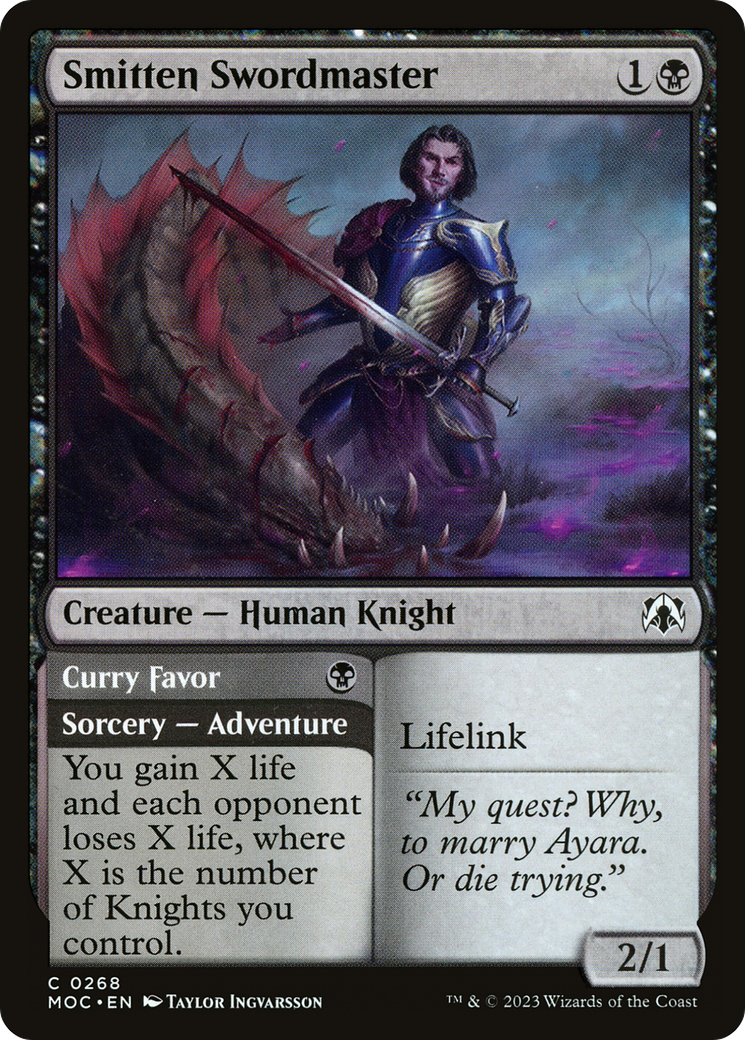
Smitten Swordmaster // Curry Favor
//
Smitten Swordmaster
Creature — Human Knight
2/1
- If you cast an adventurer card as an Adventure, use only its alternative characteristics to determine whether it's legal to cast that spell. For example, if Giant Killer is exiled with the last ability of Vivien, Champion of the Wilds, you can't cast it as Chop Down.
- An adventurer card is a permanent card in every zone except the stack, as well as while on the stack if not cast as an Adventure. Ignore its alternative characteristics in those cases. For example, while it's in your graveyard, Giant Killer is a white creature card whose mana value is 1. It can't be the target of the triggered ability of Mystic Sanctuary.
- When casting a spell as an Adventure, use the alternative characteristics and ignore all of the card's normal characteristics. The spell's color, mana cost, mana value, and so on are determined by only those alternative characteristics. If the spell leaves the stack, it immediately resumes using its normal characteristics.
- If a spell is cast as an Adventure, its controller exiles it instead of putting it into its owner's graveyard as it resolves. For as long as it remains exiled, that player may cast it as a permanent spell. If an Adventure spell leaves the stack in any way other than resolving (most likely by being countered or by failing to resolve because its targets have all become illegal), that card won't be exiled and the spell's controller won't be able to cast it as a permanent later.
- If an adventurer card ends up in exile for any other reason than by exiling itself while resolving, it won't give you permission to cast it as a permanent spell.
- You must still follow any timing restrictions and permissions for the permanent spell you cast from exile. Normally, you'll be able to cast it only during your main phase while the stack is empty.
- If an effect copies an Adventure spell, that copy is exiled as it resolves. It ceases to exist as a state-based action; it's not possible to cast the copy as a permanent.
- If an object becomes a copy of an object that has an Adventure, the copy also has an Adventure. If it changes zones, it will either cease to exist (if it's a token) or cease to be a copy (if it's a nontoken permanent), and so you won't be able to cast it as an Adventure.
- If an effect instructs you to choose a card name, you may choose the alternative Adventure name. Consider only the alternative characteristics to determine whether that is an appropriate name to choose.
- Casting a card as an Adventure isn't casting it for an alternative cost. Effects that allow you to cast a spell for an alternative cost or without paying its mana cost may allow you to apply those to the Adventure.
- In a Two-Headed Giant game, Curry Favor causes the opposing team to lose X life twice, after you gain X life once.
-
1
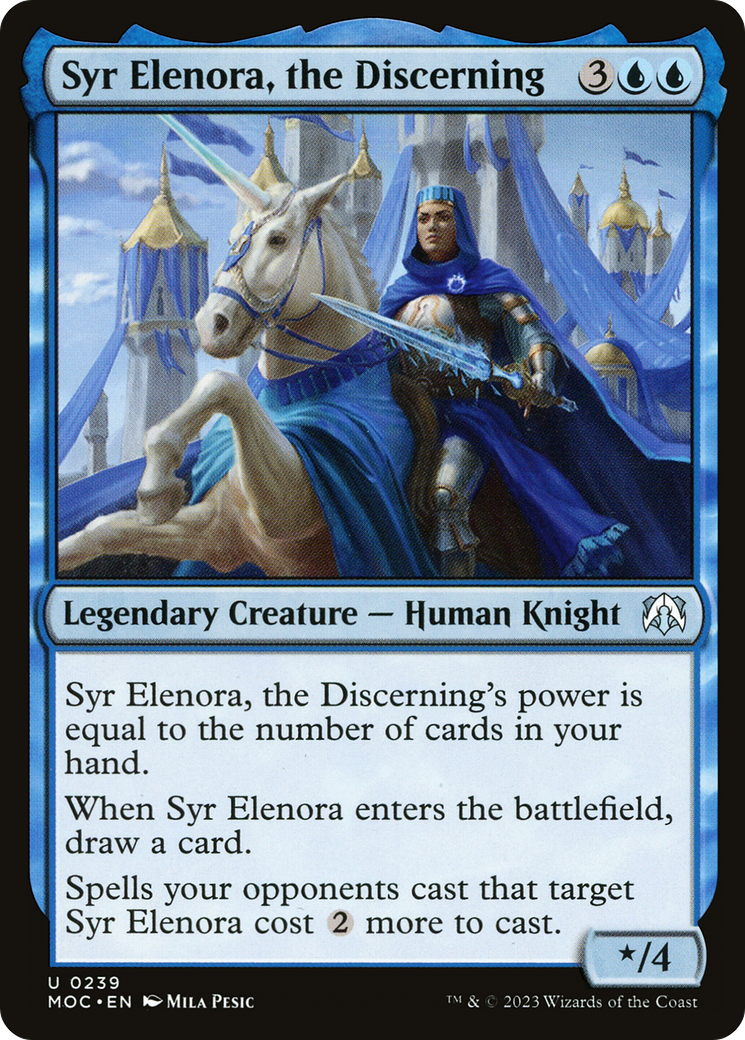
Syr Elenora, the Discerning
Syr Elenora, the Discerning
Legendary Creature — Human Knight
*/4
Syr Elenora's power is equal to the number of cards in your hand.
When Syr Elenora enters, draw a card.
Spells your opponents cast that target Syr Elenora cost more to cast.
- The ability that defines Syr Elenora's power works in all zones, not just the battlefield.
- To determine the total cost of an opponent's spell that targets Syr Elenora, start with the mana cost or alternative cost that player is paying, add any cost increases (such as that of Syr Elenora's effect), then apply any cost reductions. The mana value of the spell remains unchanged, no matter what the total cost to cast it was.
-
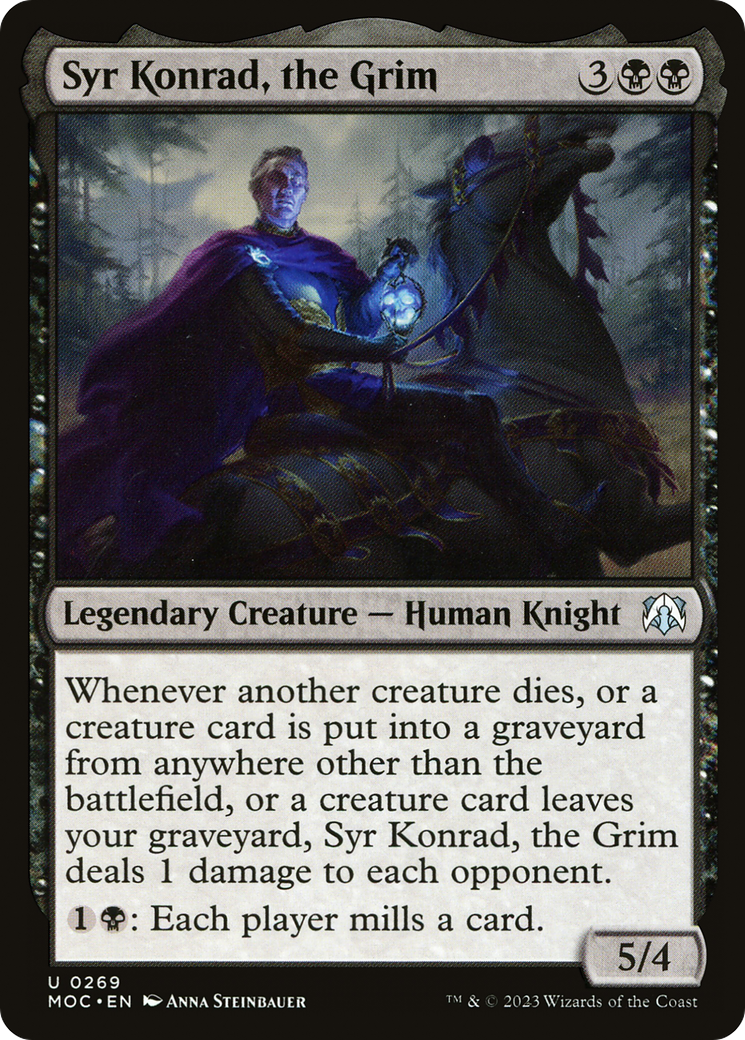
1
Syr Konrad, the Grim
Syr Konrad, the Grim
Legendary Creature — Human Knight
5/4
Whenever another creature dies, or a creature card is put into a graveyard from anywhere other than the battlefield, or a creature card leaves your graveyard, Syr Konrad deals 1 damage to each opponent.
: Each player mills a card. (They each put the top card of their library into their graveyard.)
- If one or more creatures die at the same time as Syr Konrad, its first ability triggers for each of those creatures.
- In a Two-Headed Giant game, Syr Konrad's first ability causes it to deal 1 damage twice.
-
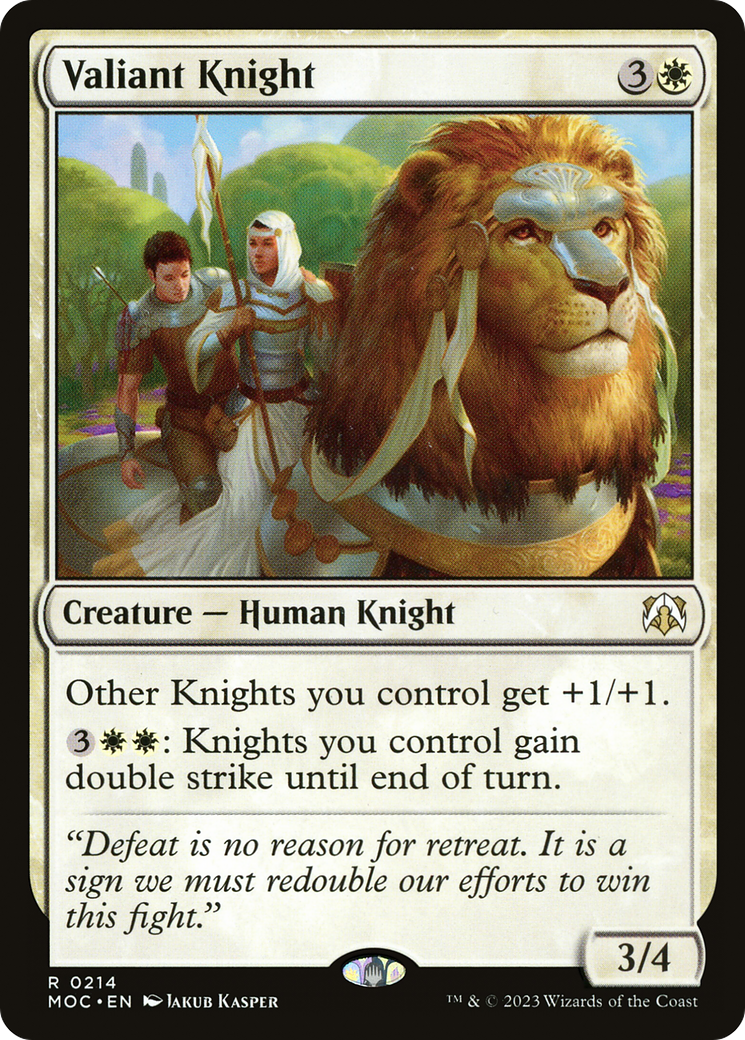
1
Valiant Knight
Valiant Knight
Creature — Human Knight
3/4
Other Knights you control get +1/+1.
: Knights you control gain double strike until end of turn.
- Multiple instances of double strike on the same creature are redundant.
- Because damage remains marked on a creature until it's removed as the turn ends, nonlethal damage dealt to a Knight you control may become lethal if Valiant Knight leaves the battlefield during that turn.
-
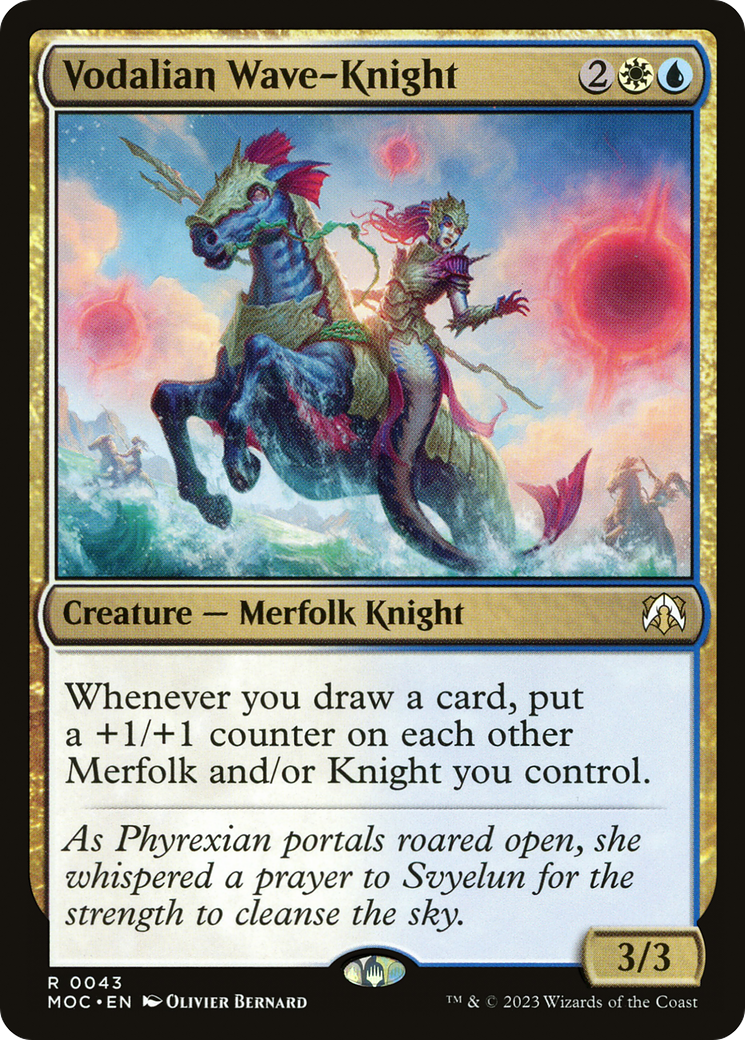
1
Vodalian Wave-Knight
Vodalian Wave-Knight
Creature — Merfolk Knight
3/3
Whenever you draw a card, put a +1/+1 counter on each other Merfolk and/or Knight you control.
- If a creature you control is both a Merfolk and a Knight, it gets one +1/+1 counter.
-
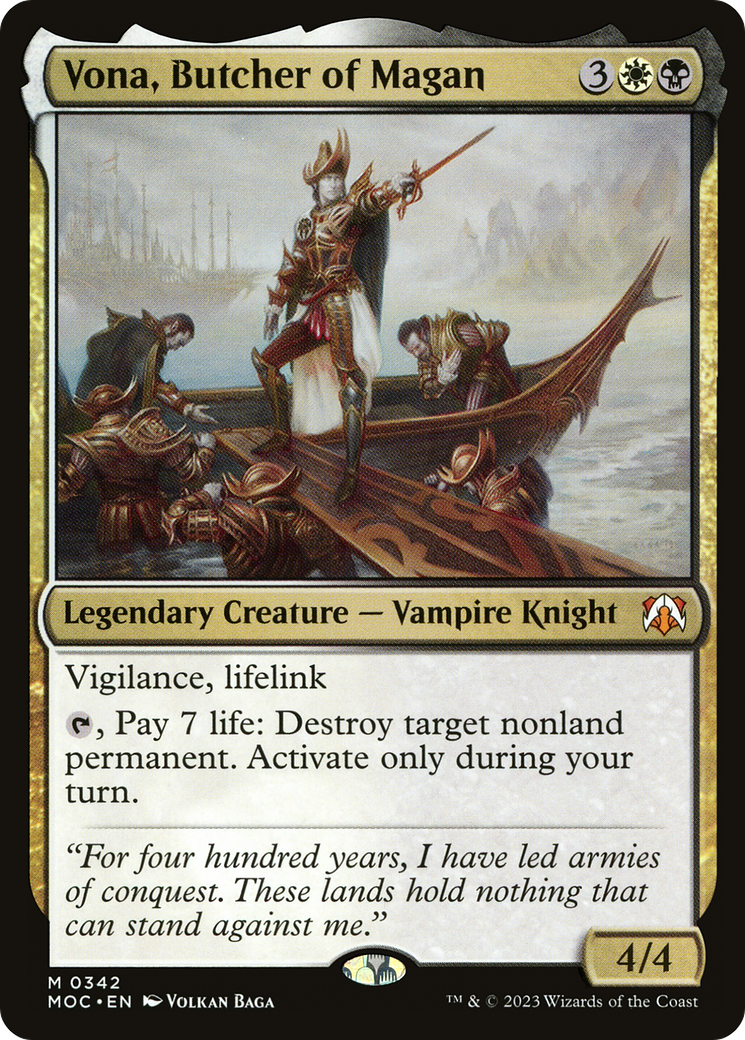
1
Vona, Butcher of Magan
Vona, Butcher of Magan
Legendary Creature — Vampire Knight
4/4
Vigilance, lifelink
, Pay 7 life: Destroy target nonland permanent. Activate only during your turn.
- Vona's last ability can be activated during any step or phase of your turn, including the combat phase. It's possible to attack with Vona and then activate its ability before blockers are declared. Doing so won't remove Vona from combat.
-
1
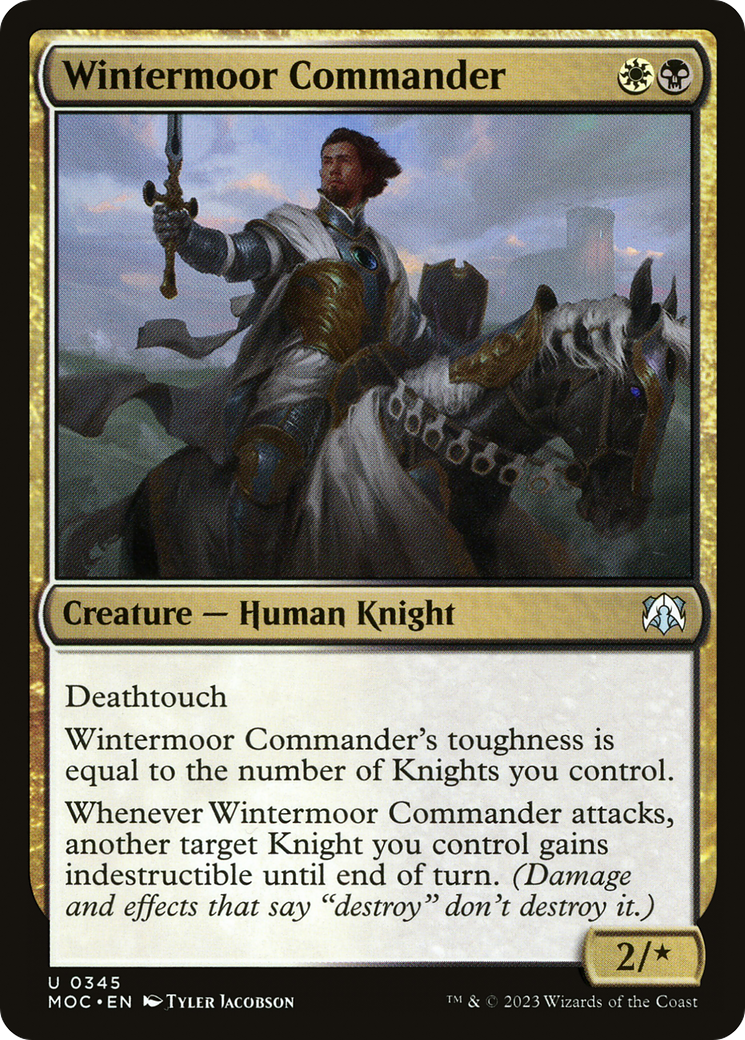
Wintermoor Commander
Wintermoor Commander
Creature — Human Knight
2/*
Deathtouch
Wintermoor Commander's toughness is equal to the number of Knights you control.
Whenever this creature attacks, another target Knight you control gains indestructible until end of turn. (Damage and effects that say "destroy" don't destroy it.)
- The ability that defines Wintermoor Commander's toughness works in all zones, not just the battlefield.
- As long as Wintermoor Commander is on the battlefield, its ability will count itself, so it'll be at least 2/1.
- Because damage remains marked on a creature until the damage is removed as the turn ends, nonlethal damage dealt to Wintermoor Commander may become lethal if Knights you control leave the battlefield during that turn.
-
1
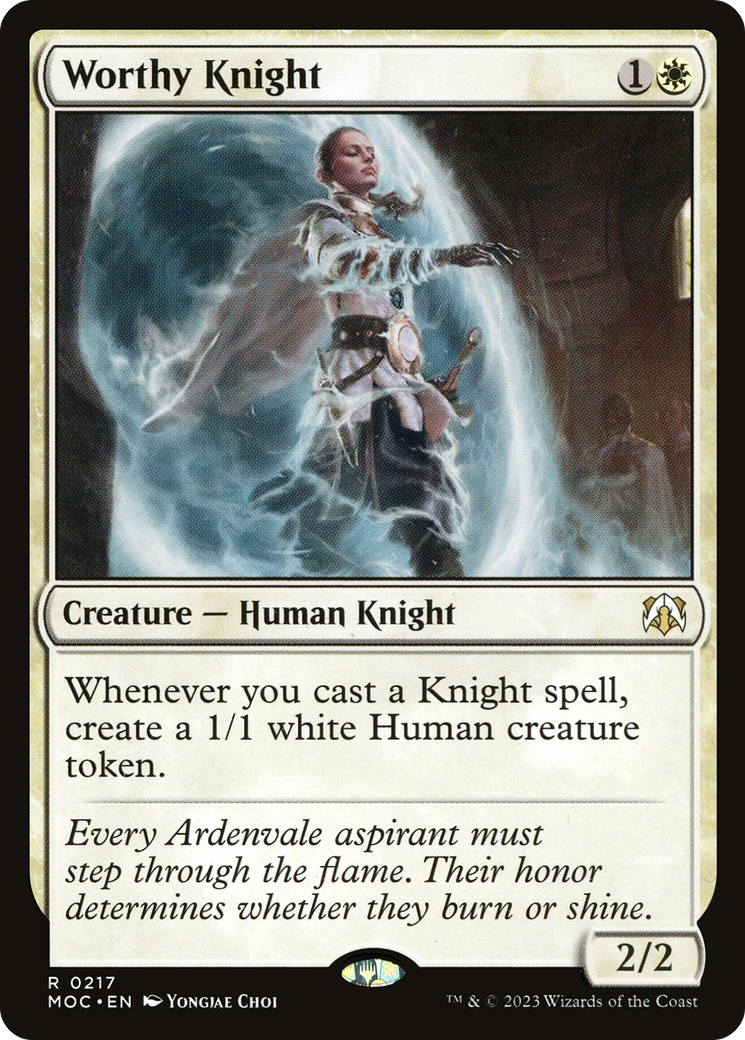
Worthy Knight
Worthy Knight
Creature — Human Knight
2/2
Whenever you cast a Knight spell, create a 1/1 white Human creature token.
- Worthy Knight's ability resolves before the spell that caused it to trigger. It resolves even if that spell is countered.
- If an effect refers to a “[subtype] spell,” it refers only to a spell that has that subtype. For example, Knights' Charge is a card with “Knight” in its name and benefits Knights, but it isn't a Knight card.
- Worthy Knight's triggered ability won't trigger when you cast it because it's not on the battlefield yet.
-
1
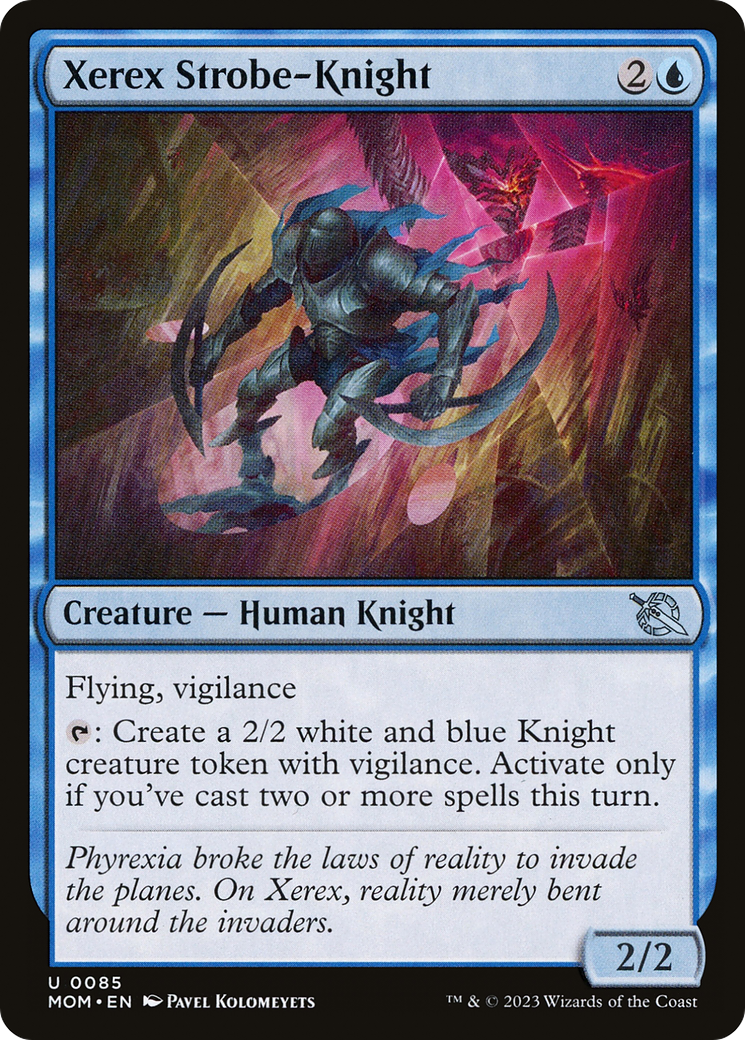
Xerex Strobe-Knight
Xerex Strobe-Knight
Creature — Human Knight
2/2
Flying, vigilance
: Create a 2/2 white and blue Knight creature token with vigilance. Activate only if you've cast two or more spells this turn.
Instants 6
-
1
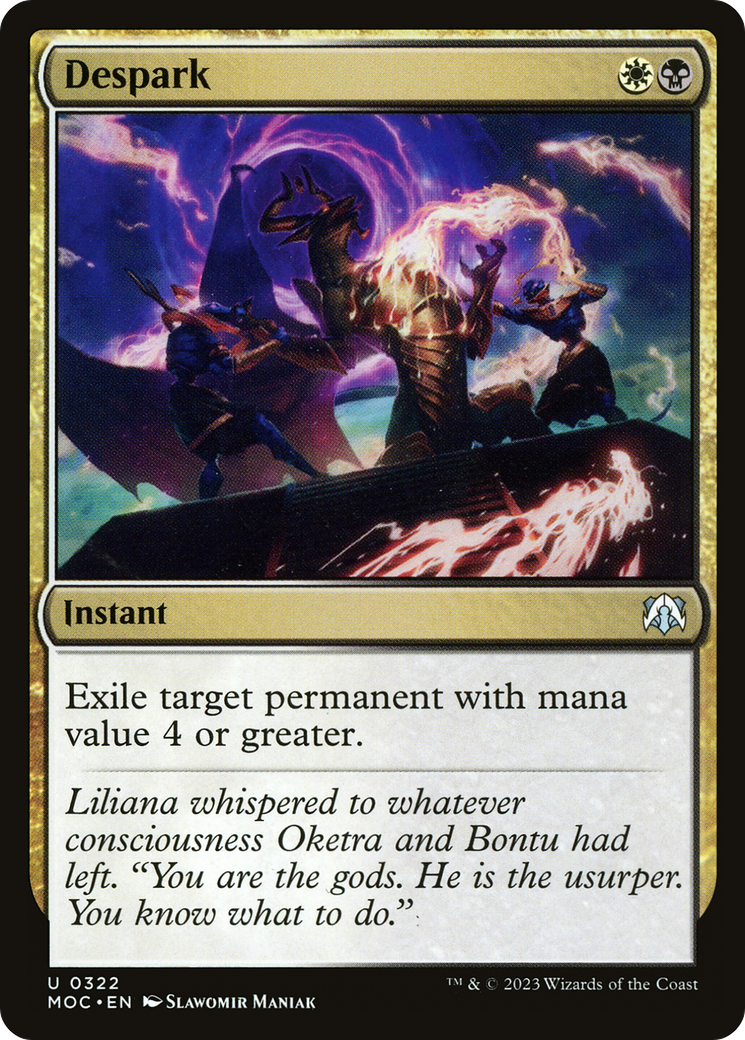
Despark
Despark
Instant
Exile target permanent with mana value 4 or greater.
- If a permanent has in its mana cost, X is considered to be 0.
-
1
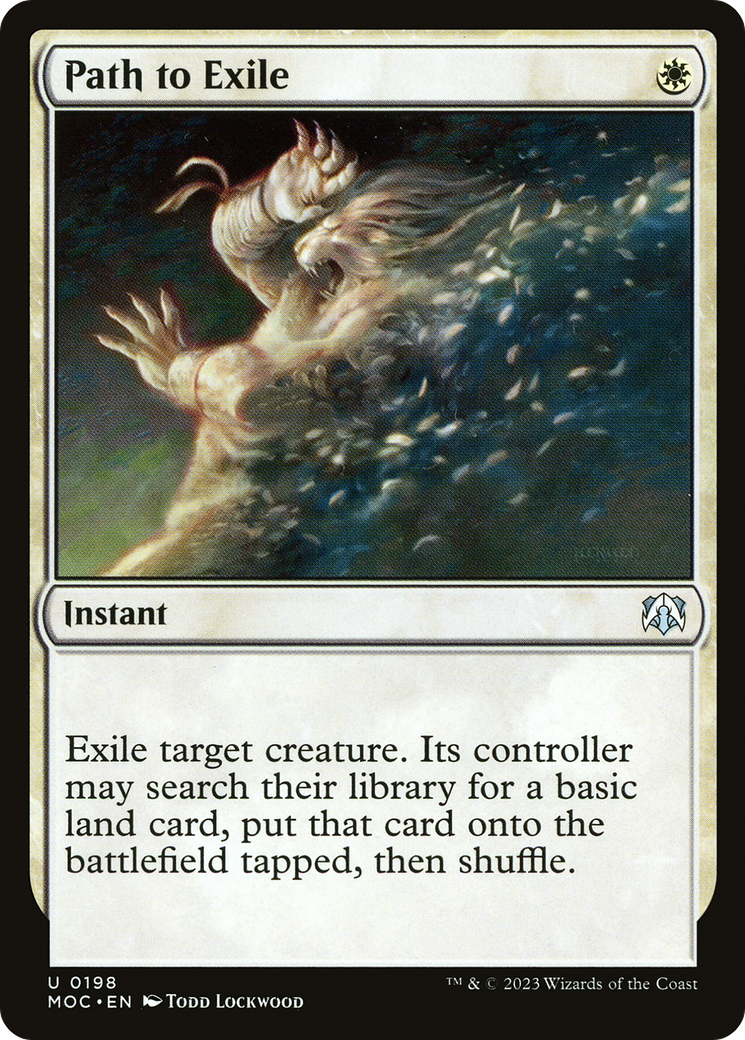
Path to Exile
Path to Exile
Instant
Exile target creature. Its controller may search their library for a basic land card, put that card onto the battlefield tapped, then shuffle.
- The controller of the exiled creature isn't required to search their library for a basic land. If that player doesn't, the player won't shuffle their library.
- If the target creature is an illegal target by the time Path to Exile tries to resolve, it won't resolve and none of its effects will happen. The creature's controller won't search for a basic land card.
-
1
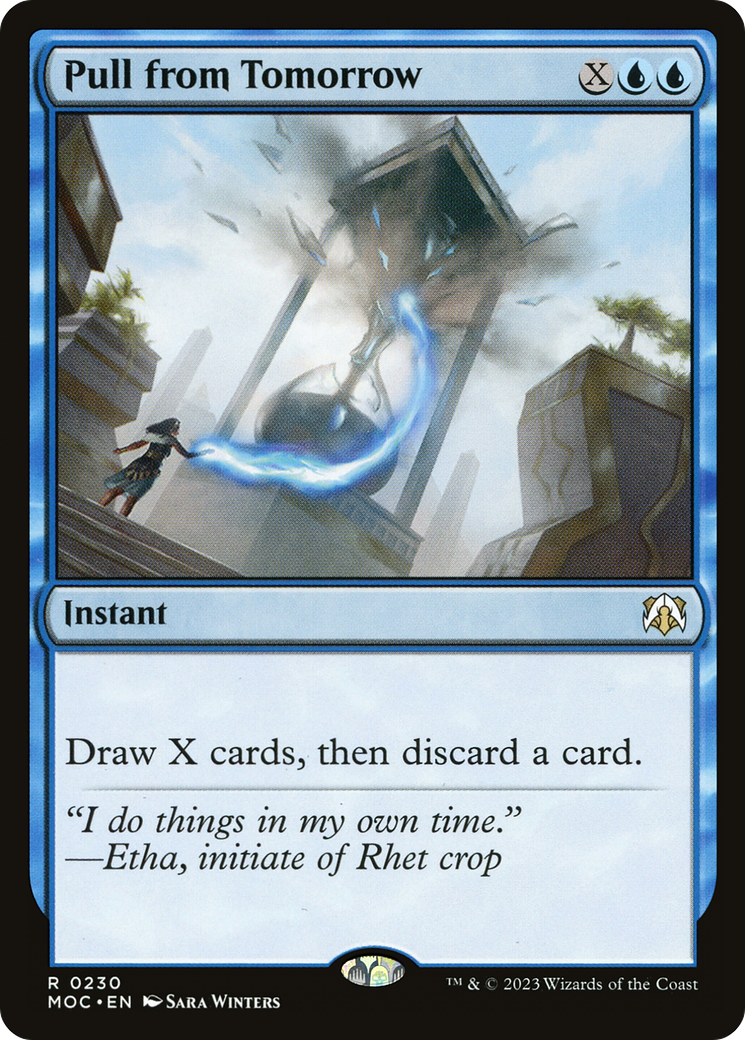
Pull from Tomorrow
Pull from Tomorrow
Instant
Draw X cards, then discard a card.
-
1
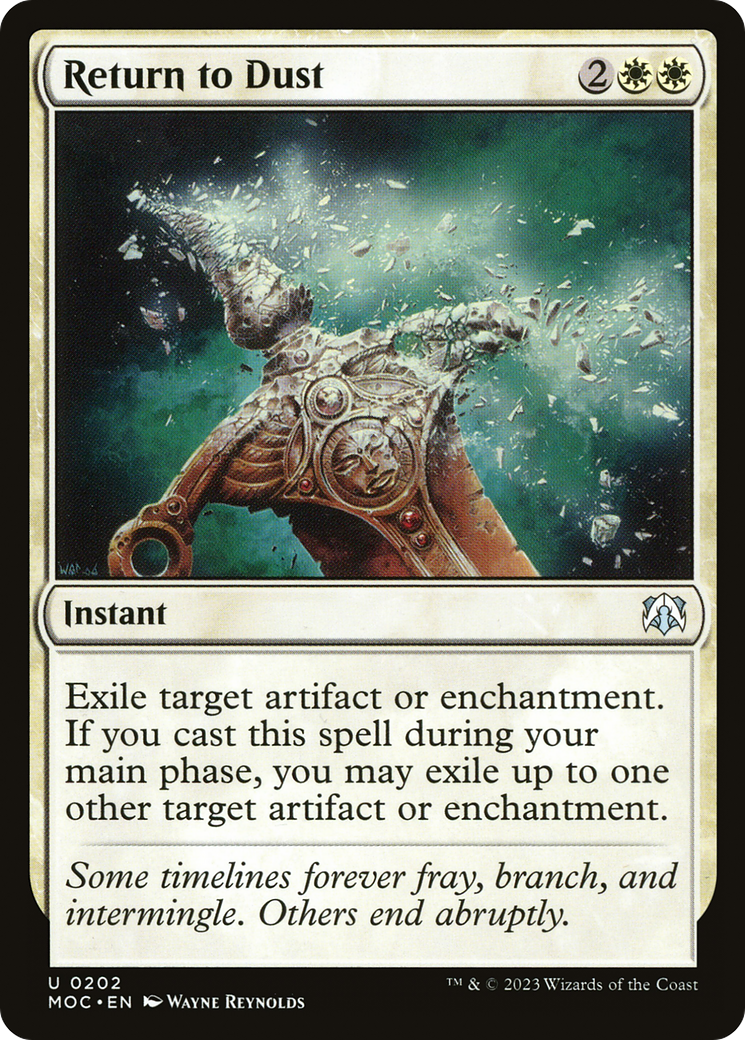
Return to Dust
Return to Dust
Instant
Exile target artifact or enchantment. If you cast this spell during your main phase, you may exile up to one other target artifact or enchantment.
- Return to Dust can always target a second artifact or enchantment; it just won't exile it if it's not your main phase when you cast Return to Dust.
- If a spell or ability copies Return to Dust, the copy exiles only the first target artifact or enchantment. This is because the copy wasn't cast at all.
-
1
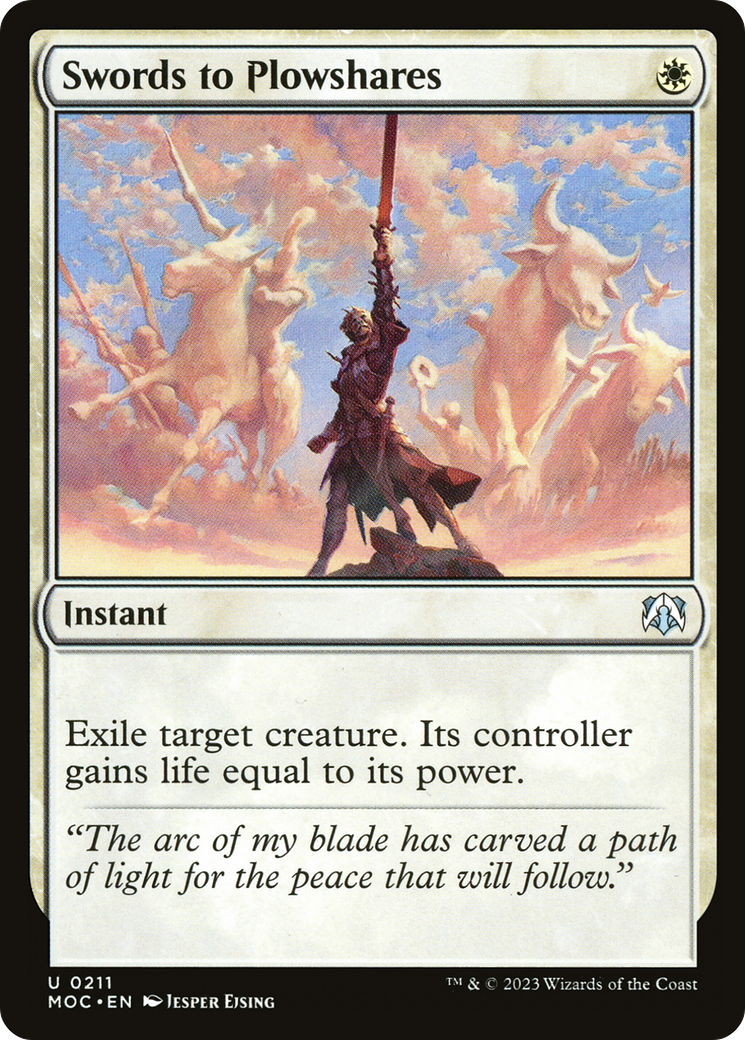
Swords to Plowshares
Swords to Plowshares
Instant
Exile target creature. Its controller gains life equal to its power.
- Use the power of the creature from when it was last on the battlefield to determine how much life is gained.
-
1
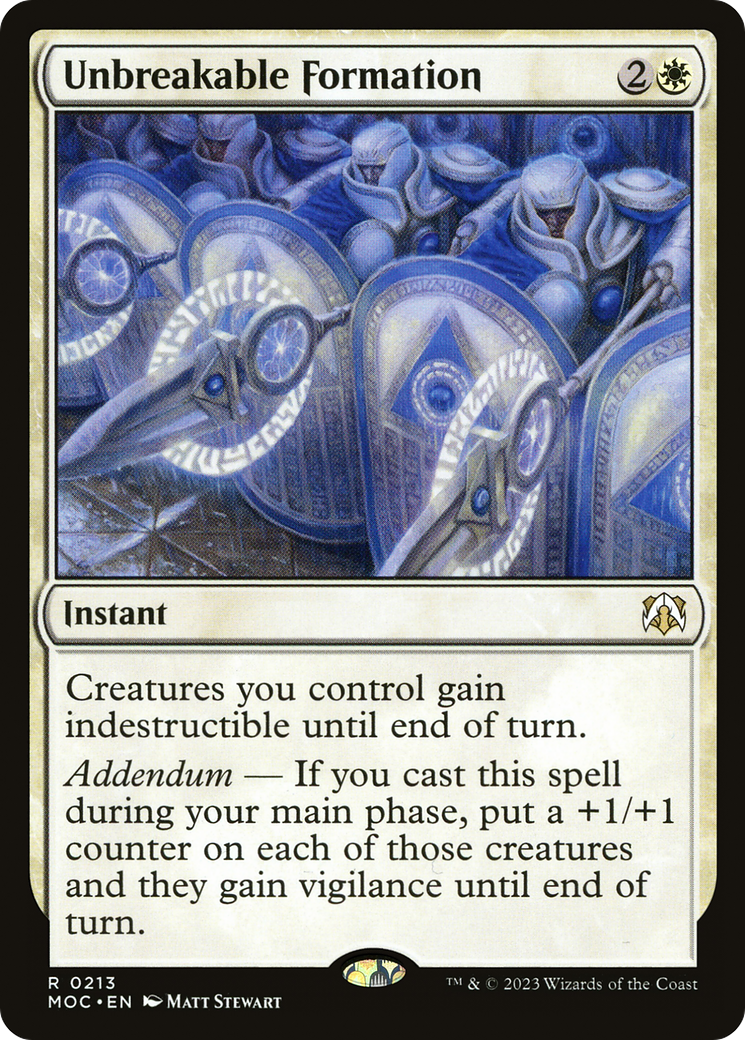
Unbreakable Formation
Unbreakable Formation
Instant
Creatures you control gain indestructible until end of turn.
Addendum — If you cast this spell during your main phase, put a +1/+1 counter on each of those creatures and they gain vigilance until end of turn.
- Addendum abilities of instant spells apply while the spell is resolving, not immediately after casting it. If the spell is countered, you don't get the addendum bonus.
- If an effect copies a spell with an addendum ability while it's on the stack, the copy wasn't cast at all, so you won't get the addendum bonus.
- Unbreakable Formation affects only creatures you control at the time it resolves. Creatures you begin to control later in the turn won't gain indestructible or vigilance and they won't get a +1/+1 counter.
Sorceries 7
-
1
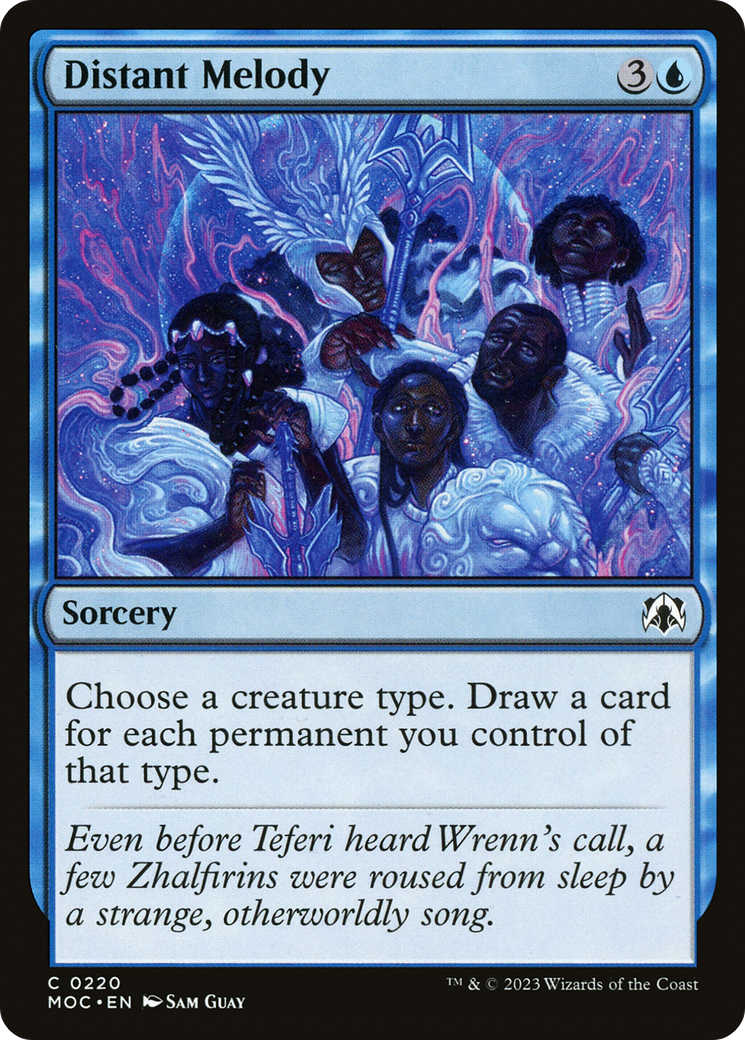
Distant Melody
Distant Melody
Sorcery
Choose a creature type. Draw a card for each permanent you control of that type.
- Note that this spell counts the number of permanents you control of the chosen type, not just the number of creatures you control. It will also take your kindred permanents of the chosen type into account.
-
1
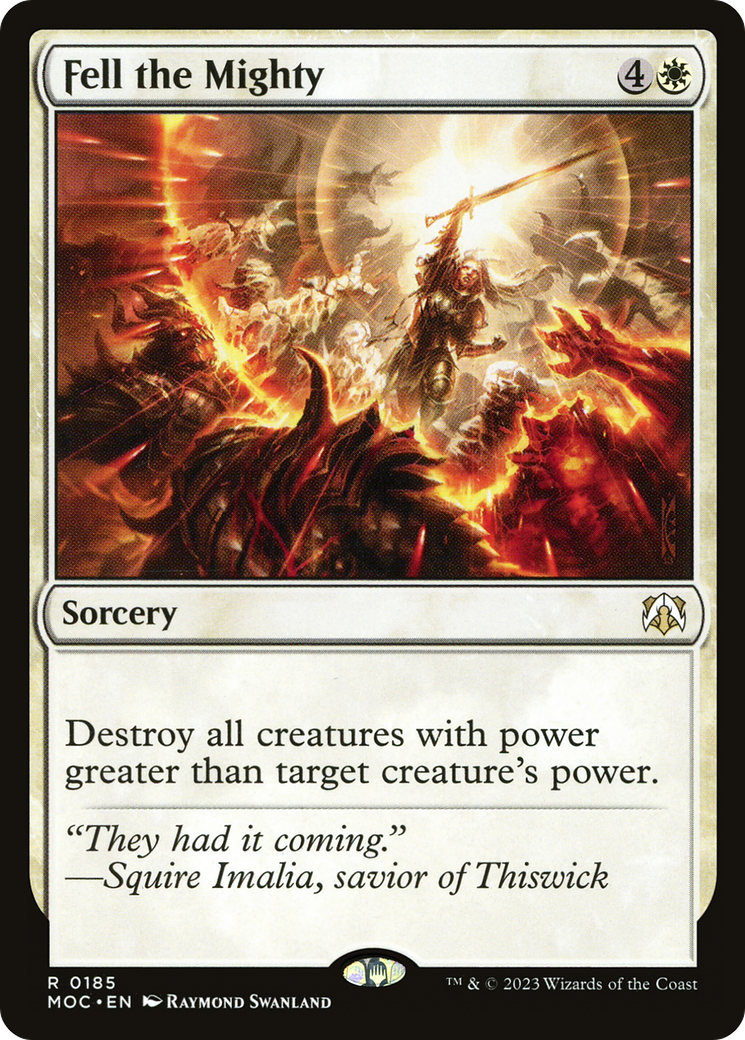
Fell the Mighty
Fell the Mighty
Sorcery
Destroy all creatures with power greater than target creature's power.
- Use the power of the target creature as Fell the Mighty resolves to determine which creatures are destroyed. Fell the Mighty doesn't target any of those creatures, so a creature with hexproof or protection from white will be destroyed if its power is high enough.
- Fell the Mighty won't destroy the target creature.
- If the target creature is an illegal target when Fell the Mighty tries to resolve, Fell the Mighty won't resolve and none of its effects will happen. No creatures will be destroyed.
-
1
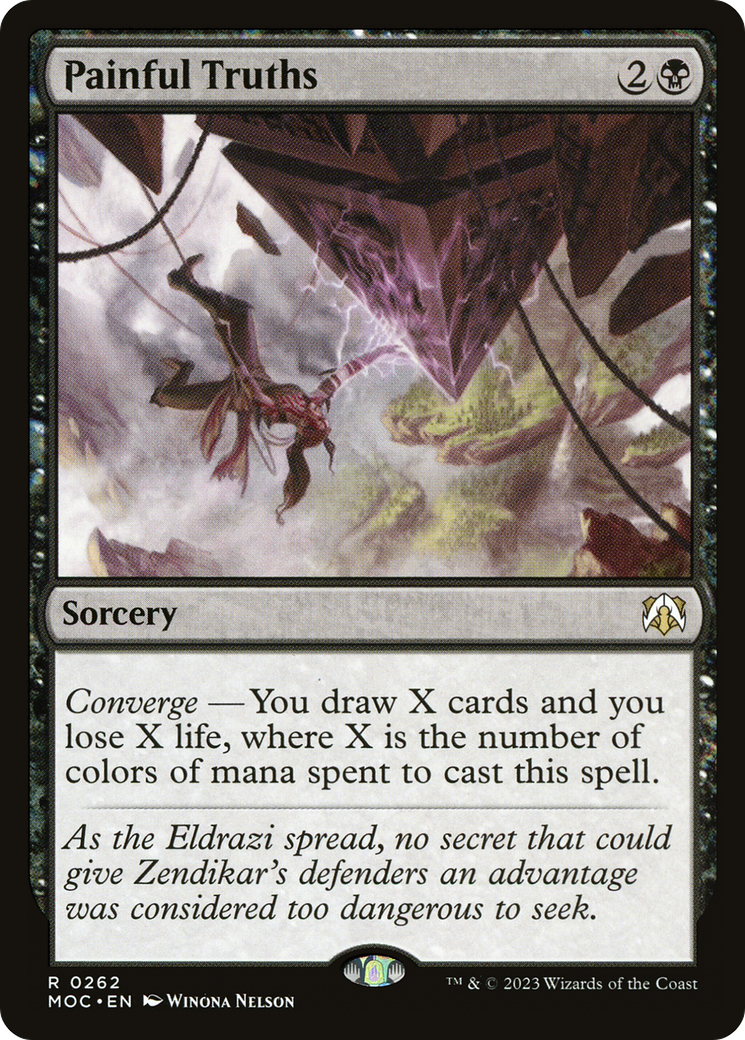
Painful Truths
Painful Truths
Sorcery
Converge — You draw X cards and you lose X life, where X is the number of colors of mana spent to cast this spell.
- The maximum number of colors of mana you can spend to cast a spell is five. Colorless is not a color. Note that the cost of a spell with converge may limit how many colors of mana you can spend.
- Unless a spell or ability allows you to, you can't choose to pay more mana for a spell with a converge ability just to spend more colors of mana. Likewise, if a spell or ability reduces the amount of mana it costs you to cast a spell with converge, you can't ignore that cost reduction in order to spend more colors of mana.
- If there are any alternative or additional costs to cast a spell with a converge ability, the mana spent to pay those costs will count. For example, if an effect makes sorcery spells cost more to cast, you could pay to cast Radiant Flames and deal 4 damage to each creature.
- If you cast a spell with converge without spending any mana to cast it (perhaps because an effect allowed you to cast it without paying its mana cost), then the number of colors spent to cast it will be zero.
- If a spell with a converge ability is copied, no mana was spent to cast the copy, so the number of colors of mana spent to cast the spell will be zero. The number of colors spent to cast the original spell is not copied.
-
1
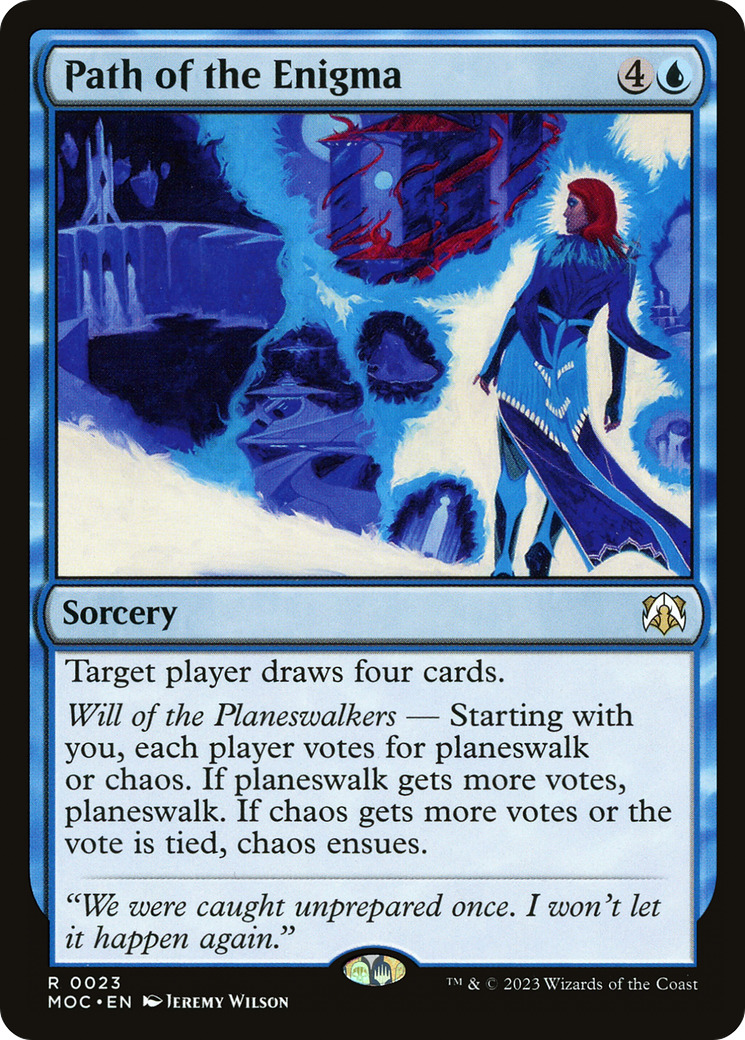
Path of the Enigma
Path of the Enigma
Sorcery
Target player draws four cards.
Will of the Planeswalkers — Starting with you, each player votes for planeswalk or chaos. If planeswalk gets more votes, planeswalk. If chaos gets more votes or the vote is tied, chaos ensues.
-
1
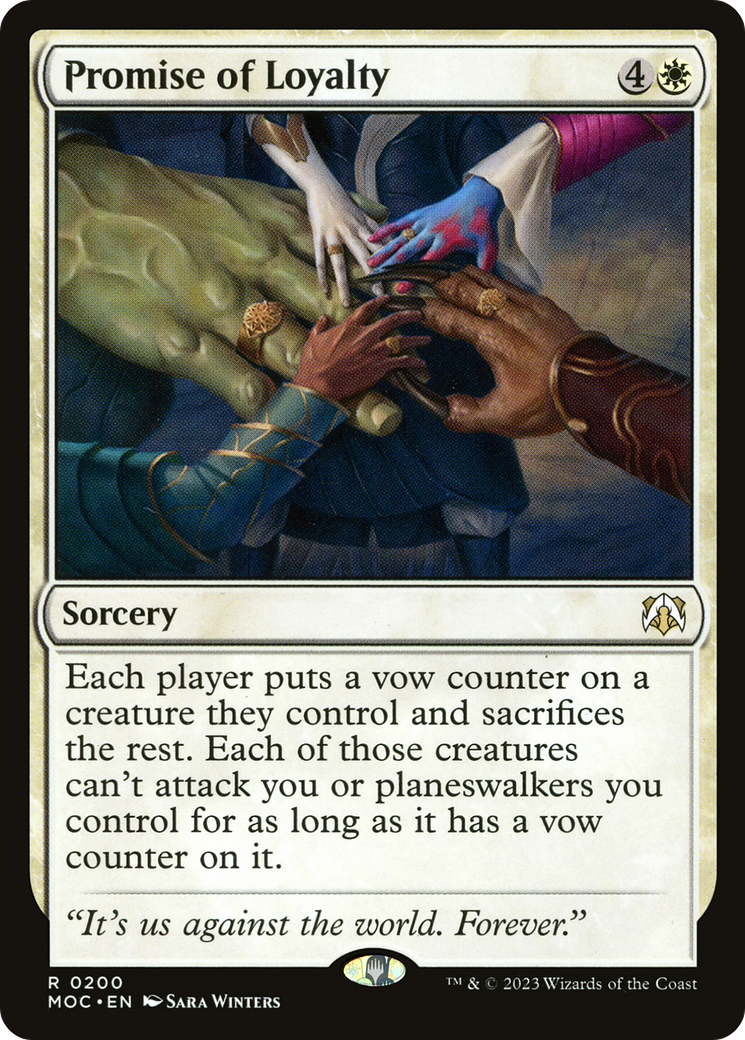
Promise of Loyalty
Promise of Loyalty
Sorcery
Each player puts a vow counter on a creature they control and sacrifices the rest. Each of those creatures can't attack you or planeswalkers you control for as long as it has a vow counter on it.
- If the vow counter is removed from the creature, it can attack as normal.
- Each player, including you, must put a vow counter on a creature they control if able. They can't choose to opt out and sacrifice all of their creatures. The creature you put a vow counter on will remember its promise if another player gains control of it.
- If the vow counter is moved to another creature, it won't prevent the second creature from attacking normally.
-
1
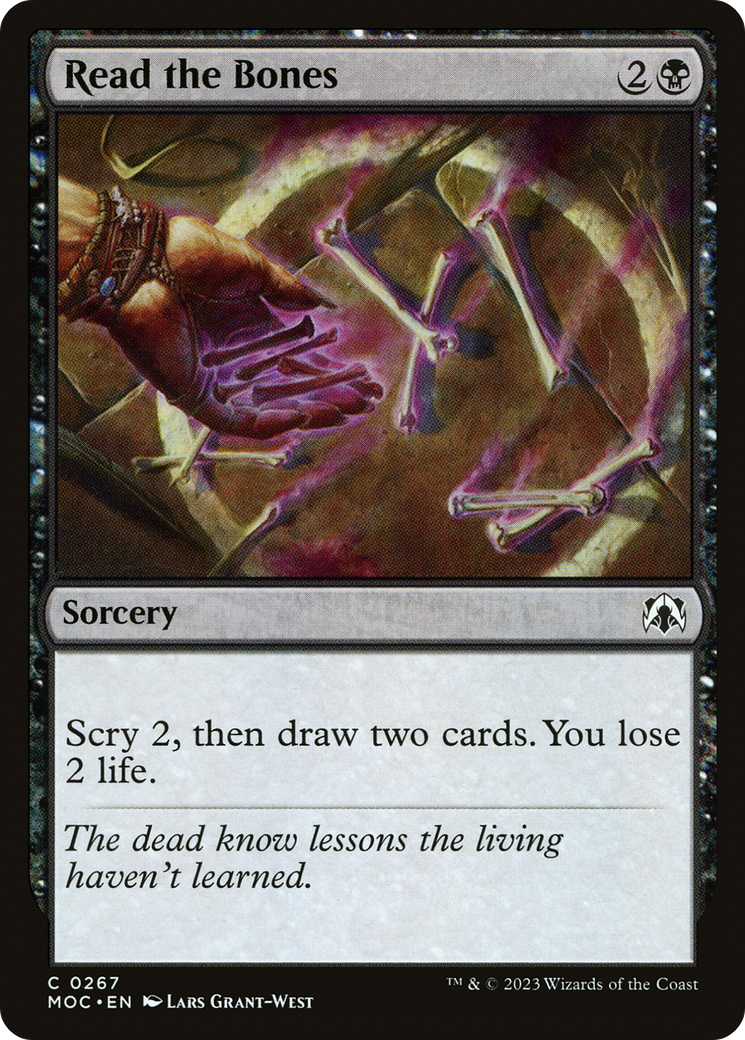
Read the Bones
Read the Bones
Sorcery
Scry 2, then draw two cards. You lose 2 life. (To scry 2, look at the top two cards of your library, then put any number of them on the bottom and the rest on top in any order.)
- The loss of life is part of the spell's effect. It's not an additional cost. If Read the Bones doesn't resolve, you won't lose life.
- When you scry, you may put all the cards you look at back on top of your library, you may put all of those cards on the bottom of your library, or you may put some of those cards on top and the rest of them on the bottom.
- You choose how to order cards returned to your library after scrying no matter where you put them.
- You perform the actions stated on a card in sequence. For some spells and abilities, that means you'll scry last. For others, that means you'll scry and then perform other actions.
- Scry appears on some spells and abilities with one or more targets. If all of the spell or ability's targets are illegal when it tries to resolve, it won't resolve and none of its effects will happen. You won't scry.
-
1
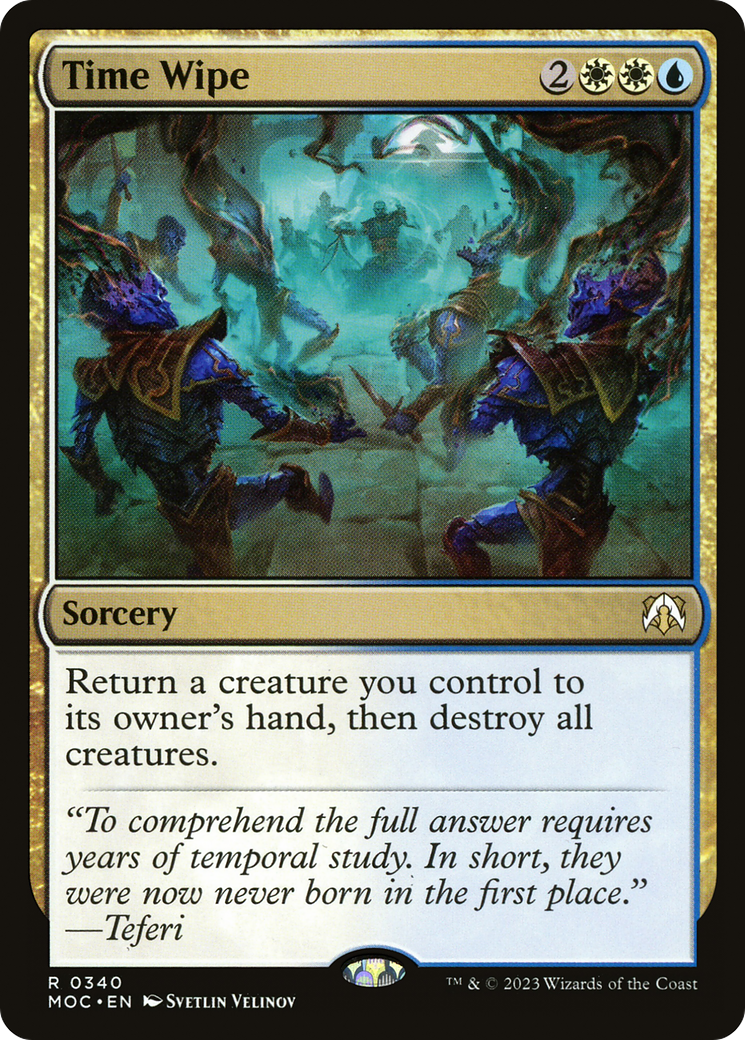
Time Wipe
Time Wipe
Sorcery
Return a creature you control to its owner's hand, then destroy all creatures.
- You chose which creature to return to its owner's hand while Time Wipe is resolving. No player may take any actions between the time you choose the creature to return and the time other creatures are destroyed.
- If you control no creatures, you simply destroy all creatures.
Artifacts 13
-
1
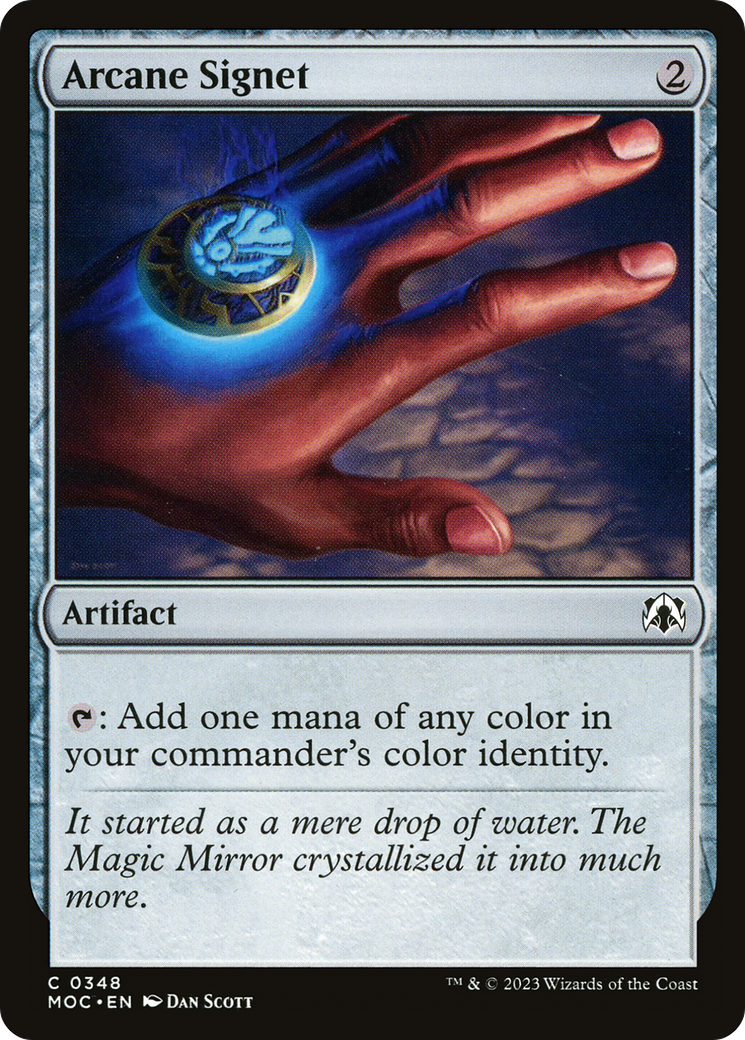
Arcane Signet
Arcane Signet
Artifact
: Add one mana of any color in your commander's color identity.
- If your commander is a card that has no colors in its color identity, Arcane Signet's ability produces no mana. It doesn't produce .
- If you have two commanders, the ability adds one mana of any color in their combined color identities.
- If you don't have a commander, Arcane Signet's ability produces no mana.
-
1
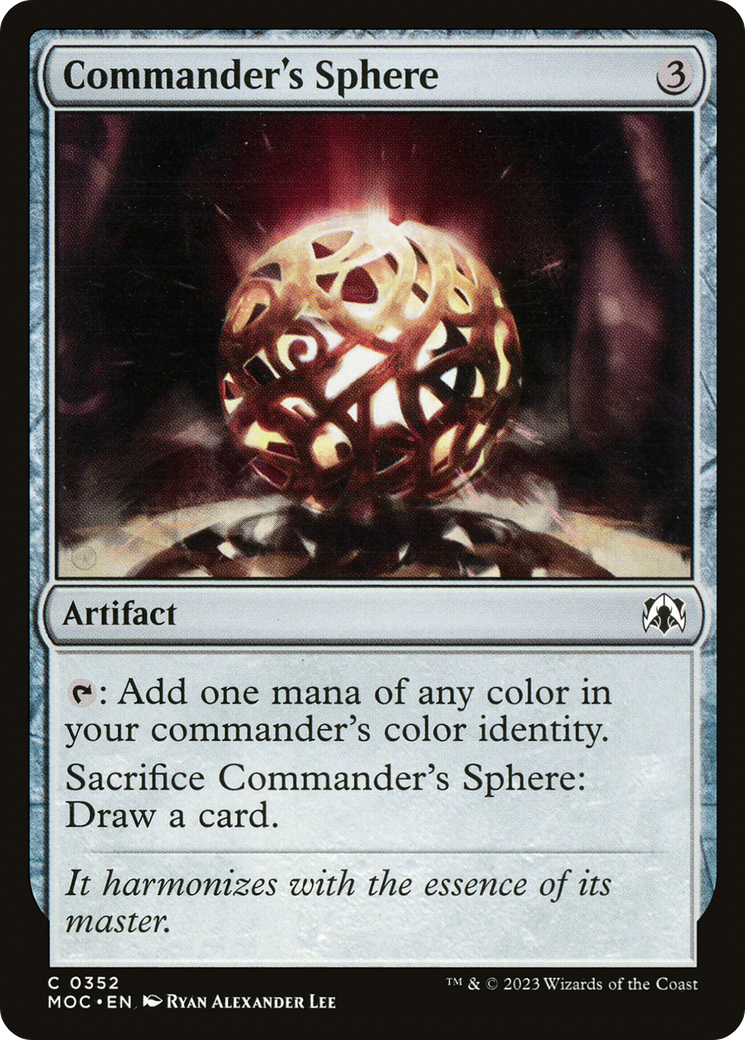
Commander's Sphere
Commander's Sphere
Artifact
: Add one mana of any color in your commander's color identity.
Sacrifice this artifact: Draw a card.
- If your commander is a card that has no colors in its color identity, Commander's Sphere's first ability produces no mana. It doesn't produce .
- If you don't have a commander, Commander's Sphere's first ability produces no mana.
- If you have two commanders, the ability adds one mana of any color in their combined color identities.
-
1
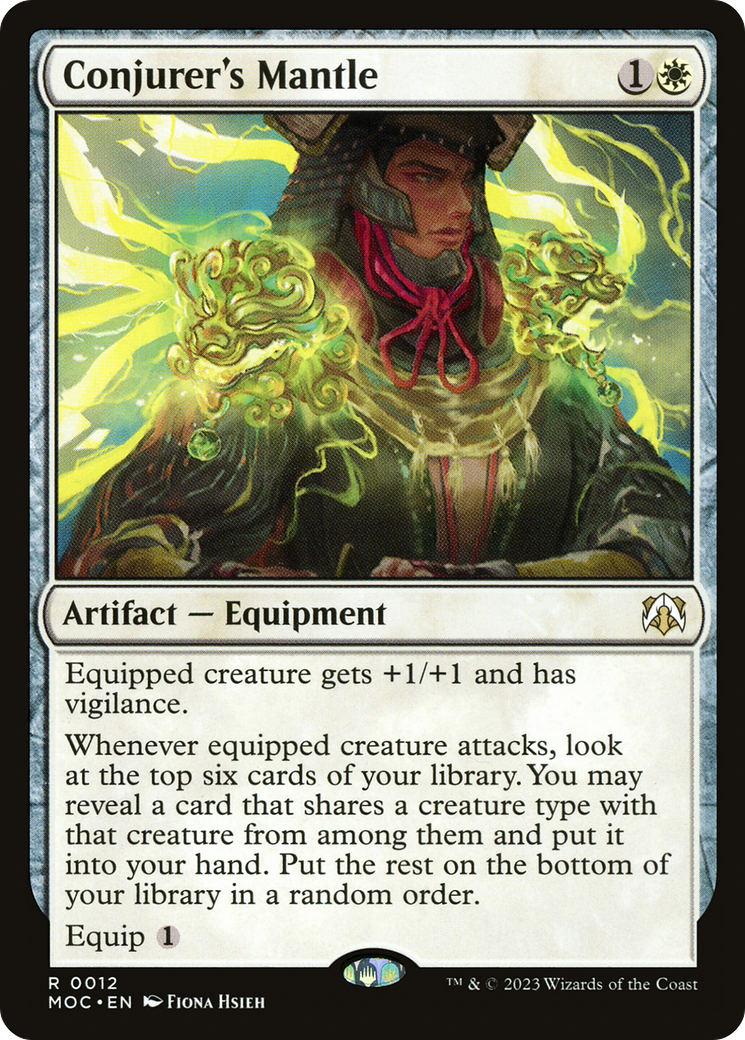
Conjurer's Mantle
Conjurer's Mantle
Artifact — Equipment
Equipped creature gets +1/+1 and has vigilance.
Whenever equipped creature attacks, look at the top six cards of your library. You may reveal a card that shares a creature type with that creature from among them and put it into your hand. Put the rest on the bottom of your library in a random order.
Equip
- A creature "shares a creature type" with the equipped creature if they have at least one creature type in common.
- If the equipped creature is no longer on the battlefield as the triggered ability resolves, use its creature types from when it was last on the battlefield.
-
1
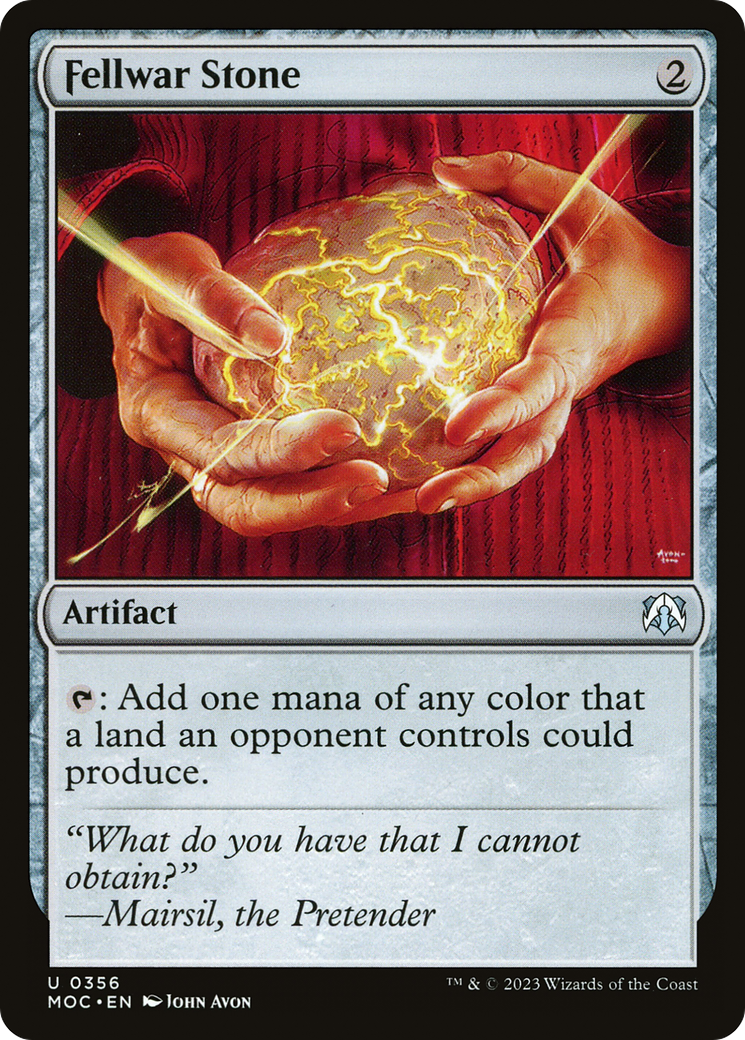
Fellwar Stone
Fellwar Stone
Artifact
: Add one mana of any color that a land an opponent controls could produce.
- When determining what colors of mana your opponents' lands could produce, take into account any applicable replacement effects that would apply to those lands' mana abilities (such as Contamination's effect, for example). If there is more than one, consider them in any possible order.
- Fellwar Stone doesn't care about any restrictions or riders your opponents' lands (such as Ancient Ziggurat or Hall of the Bandit Lord) put on the mana they produce. It just cares about colors of mana.
- The colors of mana are white, blue, black, red, and green. Fellwar Stone can't be tapped for colorless mana, even if a land an opponent controls could produce colorless mana.
- Fellwar Stone checks the effects of all mana-producing abilities of lands your opponents control, but it doesn't check their costs. For example, Vivid Crag has the ability " , Remove a charge counter from Vivid Crag: Add one mana of any color." If an opponent controls Vivid Crag and you control Fellwar Stone, you can tap Fellwar Stone for any color of mana. It doesn't matter whether Vivid Crag has a charge counter on it, and it doesn't matter whether it's untapped.
- This works even if the opponent's lands are tapped. It only checks what kinds of mana can be produced, not if the abilities that produce them are usable right now.
- It only produces one mana even if the land can produce more than one.
- The ability can be activated if the opponent has no lands that produce mana, but the effect will not be able to generate any mana.
-
1
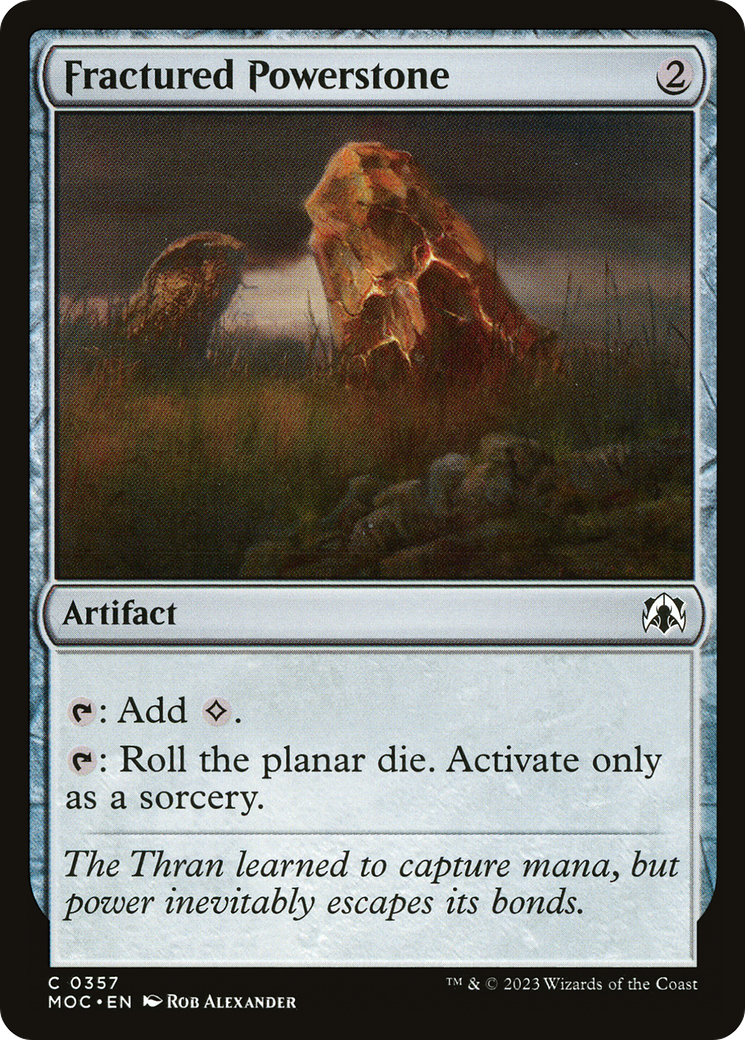
Fractured Powerstone
Fractured Powerstone
Artifact
: Add .
: Roll the planar die. Activate only as a sorcery.
- In non-Planechase games, Fractured Powerstone's second ability will have no effect.
- Rolling the planar die this way doesn't count when determining the cost of the special action of rolling the planar die. For example, if you roll the planar die twice in a turn, then activate Fractured Powerstone to roll it a third time, rolling the planar die again that turn will cost .
-
1
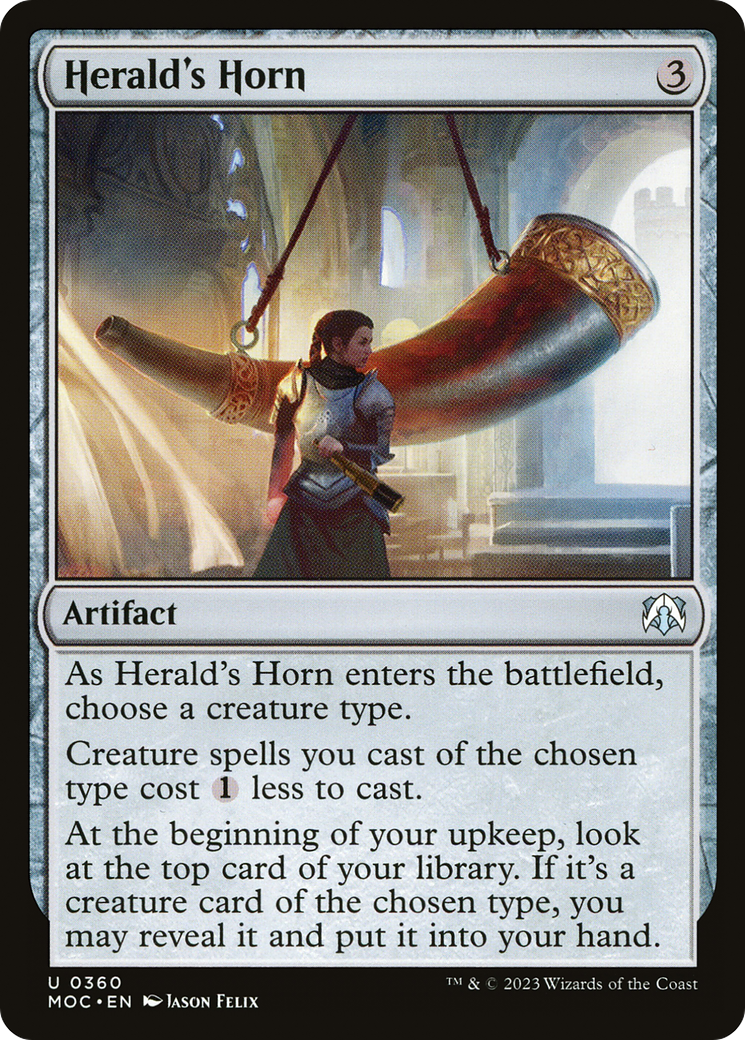
Herald's Horn
Herald's Horn
Artifact
As this artifact enters, choose a creature type.
Creature spells you cast of the chosen type cost less to cast.
At the beginning of your upkeep, look at the top card of your library. If it's a creature card of the chosen type, you may reveal it and put it into your hand.
- If you somehow control a Herald's Horn with no chosen creature type, no spells will cost less to cast, not even creature spells with no creature type. You'll be able to look at the top card of your library at the beginning of each of your upkeeps, but you can never put it into your hand this way, even if it's a creature card with no creature type.
- The effect of Herald's Horn reduces only generic mana in a spell's cost. If that cost has no generic mana, the cost isn't reduced.
- To determine the total cost of a spell, start with the mana cost or alternative cost you're paying, add any cost increases, then apply any cost reductions. The mana value of the spell remains unchanged, no matter what the total cost to cast it was.
- If you don't put the top card of your library into your hand, you put it back on top of your library without revealing it. You'll draw it in that turn's draw step.
-
1
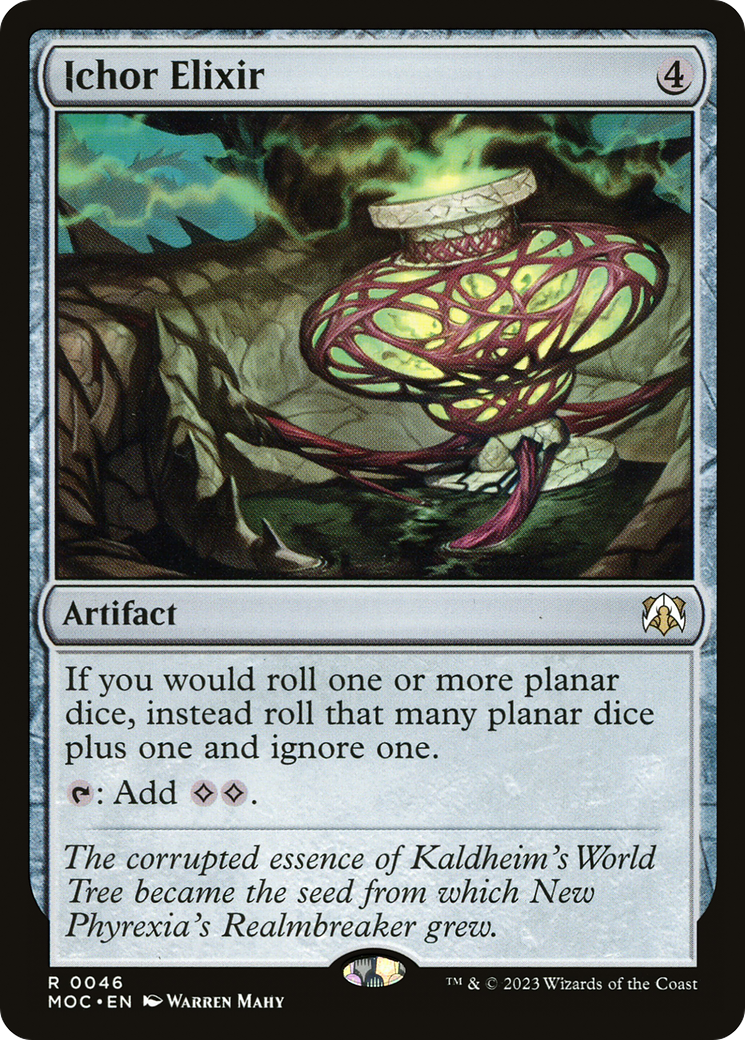
Ichor Elixir
Ichor Elixir
Artifact
If you would roll one or more planar dice, instead roll that many planar dice plus one and ignore one.
: Add .
-
1
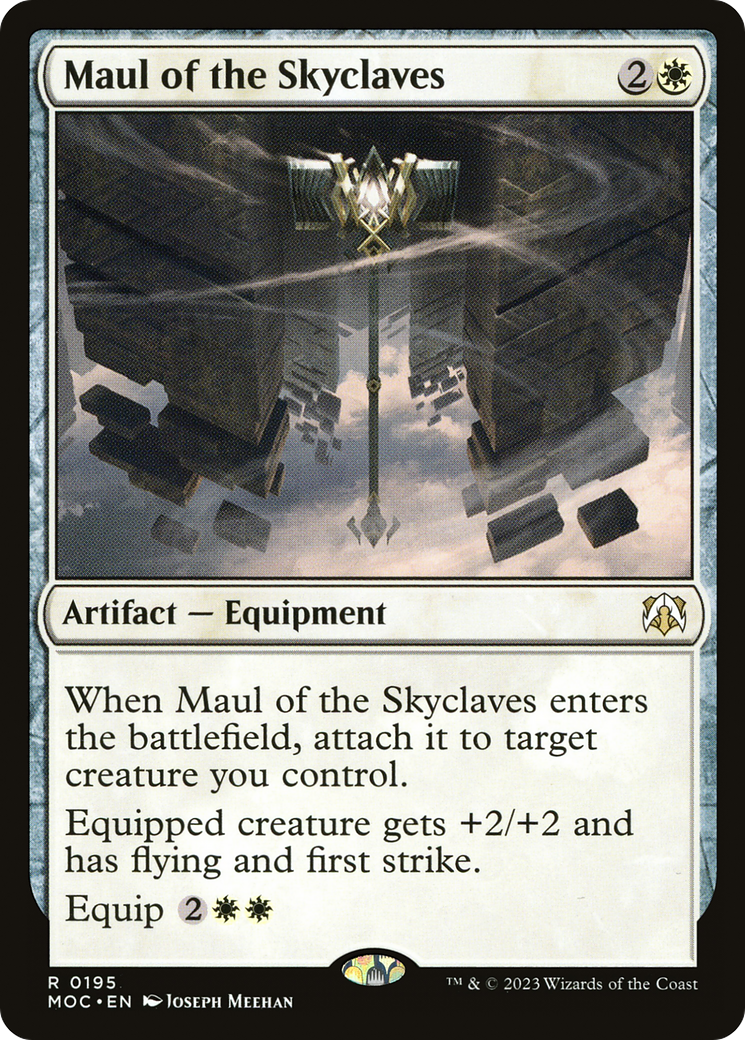
Maul of the Skyclaves
Maul of the Skyclaves
Artifact — Equipment
When this Equipment enters, attach it to target creature you control.
Equipped creature gets +2/+2 and has flying and first strike.(It deals combat damage before creatures without first strike.)
Equip
- Attaching an Equipment with its enters-the-battlefield triggered ability isn't the same as using its equip ability. You don't pay mana for the attachment, and if the Equipment enters at a time you couldn't cast a sorcery, you can still attach it to a creature you control.
- If the target creature becomes an illegal target, the Equipment remains on the battlefield unattached.
-
1
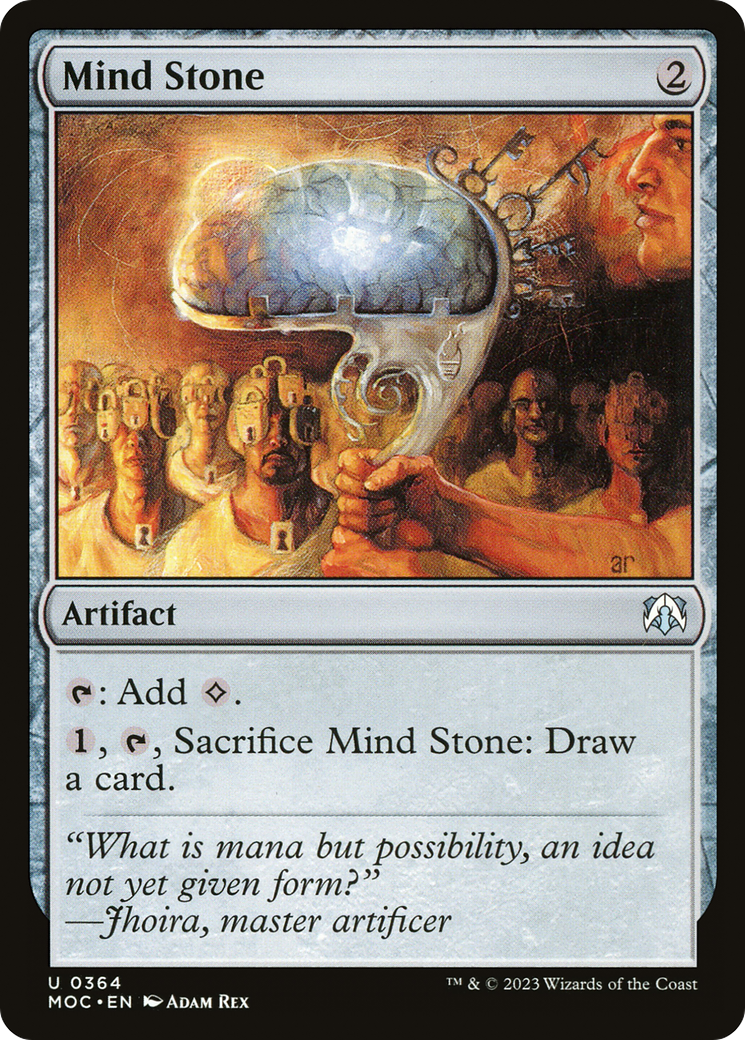
Mind Stone
Mind Stone
Artifact
: Add .
, , Sacrifice this artifact: Draw a card.
-
1
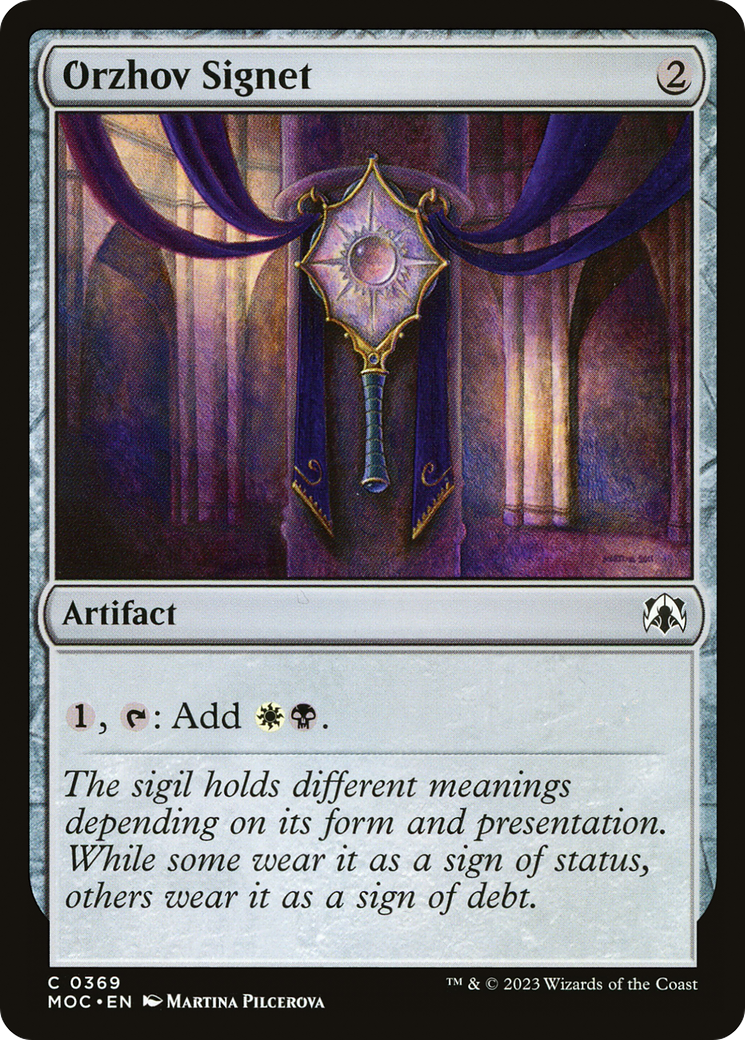
Orzhov Signet
Orzhov Signet
Artifact
, : Add .
-
1
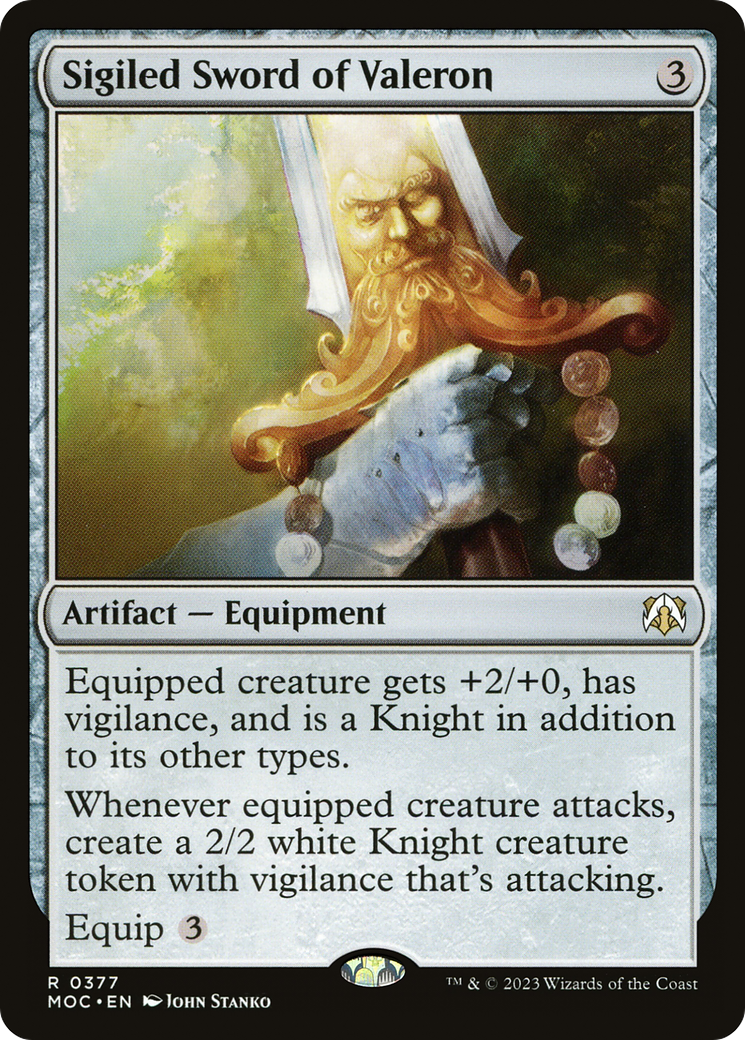
Sigiled Sword of Valeron
Sigiled Sword of Valeron
Artifact — Equipment
Equipped creature gets +2/+0, has vigilance, and is a Knight in addition to its other types.
Whenever equipped creature attacks, create a 2/2 white Knight creature token with vigilance that's attacking.
Equip
- You choose which player or planeswalker the token is attacking. It doesn't have to be attacking the same player or planeswalker that the equipped creature is attacking.
- Although the token is attacking, it was never declared as an attacking creature (for the purposes of abilities that trigger whenever a creature attacks, for example).
-
1
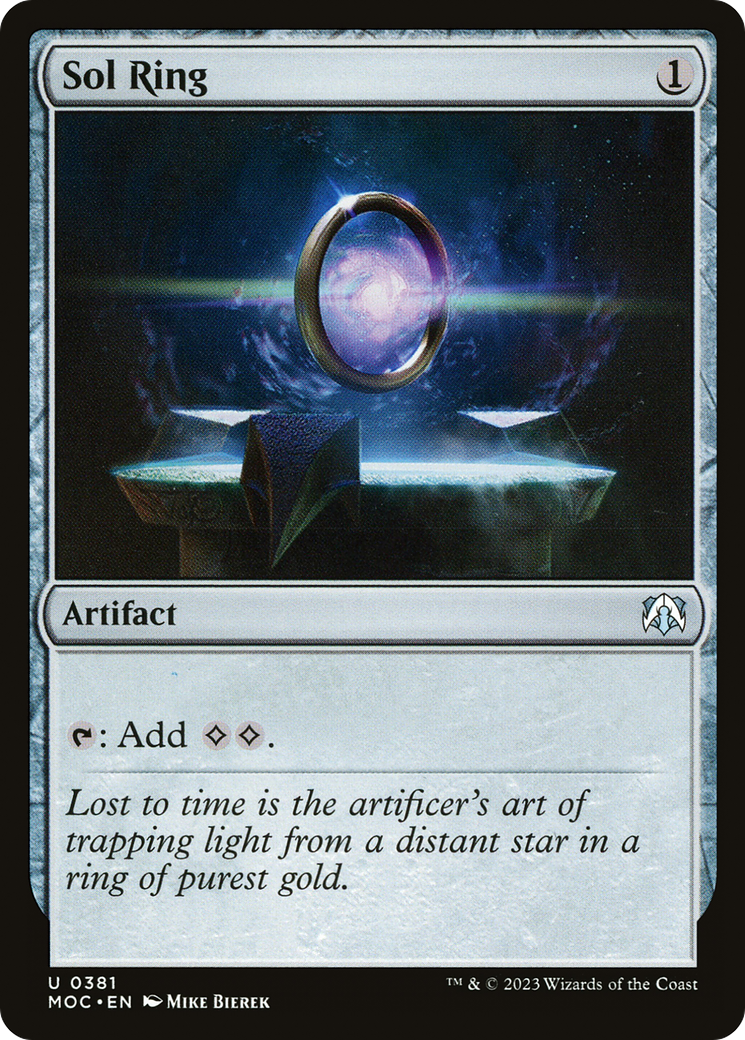
Sol Ring
Sol Ring
Artifact
: Add .
-
1
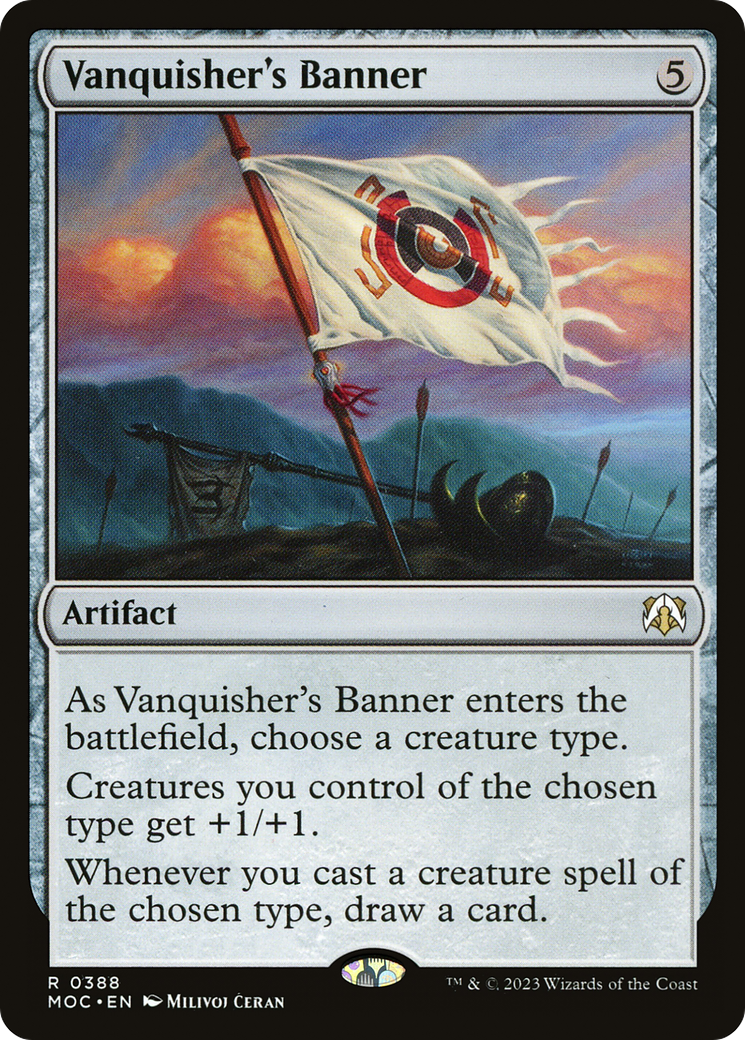
Vanquisher's Banner
Vanquisher's Banner
Artifact
As this artifact enters, choose a creature type.
Creatures you control of the chosen type get +1/+1.
Whenever you cast a creature spell of the chosen type, draw a card.
- The choice of creature type is made as Vanquisher's Banner enters the battlefield. Players can't respond to this choice. The bonus starts applying immediately.
- The last ability of Vanquisher's Banner resolves before the spell that caused it to trigger. The ability will resolve even if the creature spell is countered.
- To choose a creature type, you must choose an existing creature type, such as Fungus or Sliver. You can't choose multiple creature types, such as Fungus Sliver. Card types such as artifact can't be chosen, nor can subtypes that aren't creature types, such as Jace, Vehicle, or Treasure.
- Because damage remains marked on a creature until the damage is removed as the turn ends, nonlethal damage dealt to a creature you control of the chosen type may become lethal if Vanquisher's Banner leaves the battlefield during that turn.
- The choice of creature type is made as Vanquisher's Banner enters the battlefield. Players can't respond to this choice. The bonus starts applying immediately.
- The last ability of Vanquisher's Banner resolves before the spell that caused it to trigger. The ability will resolve even if the creature spell is countered.
Enchantments 2
-
1
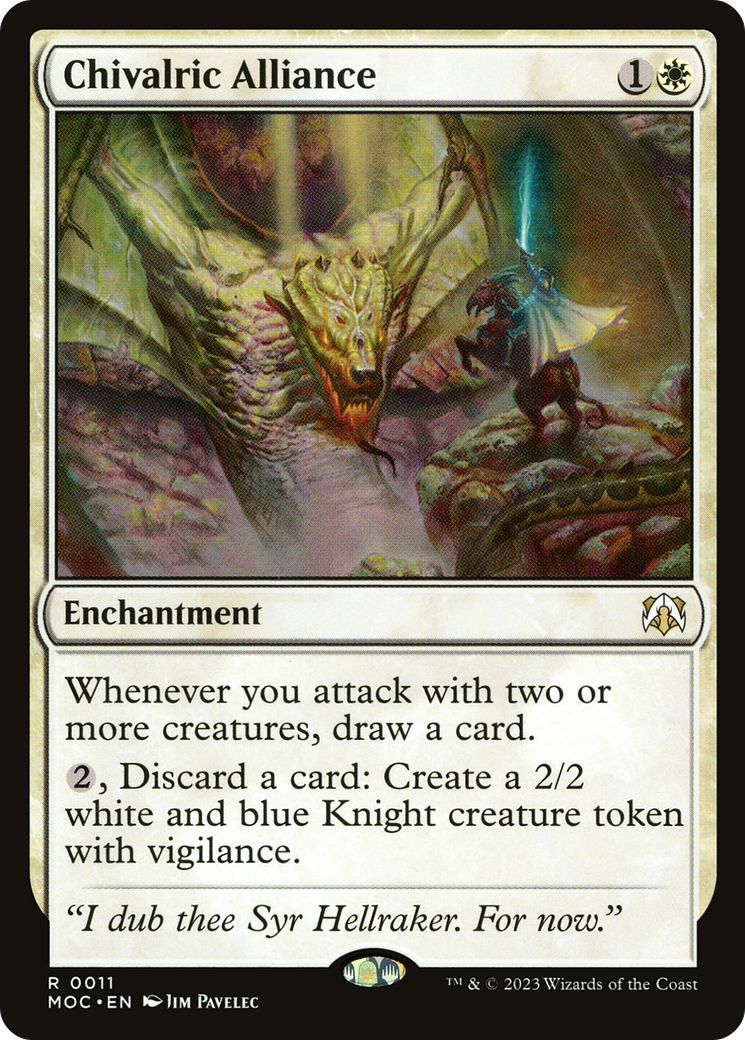
Chivalric Alliance
Chivalric Alliance
Enchantment
Whenever you attack with two or more creatures, draw a card.
, Discard a card: Create a 2/2 white and blue Knight creature token with vigilance.
-
1
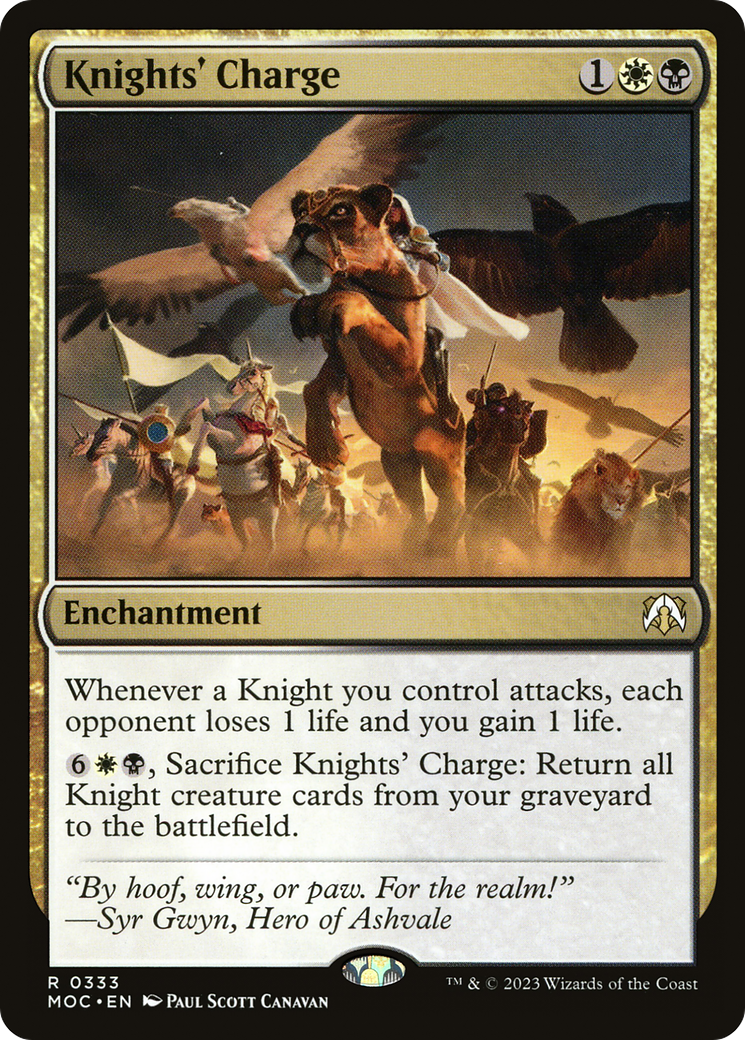
Knights' Charge
Knights' Charge
Enchantment
Whenever a Knight you control attacks, each opponent loses 1 life and you gain 1 life.
, Sacrifice this enchantment: Return all Knight creature cards from your graveyard to the battlefield.
- In a Two-Headed Giant game, Knights' Charge's first ability causes the opposing team to lose 1 life twice, and you gain 1 life once.
Lands 39
-
1
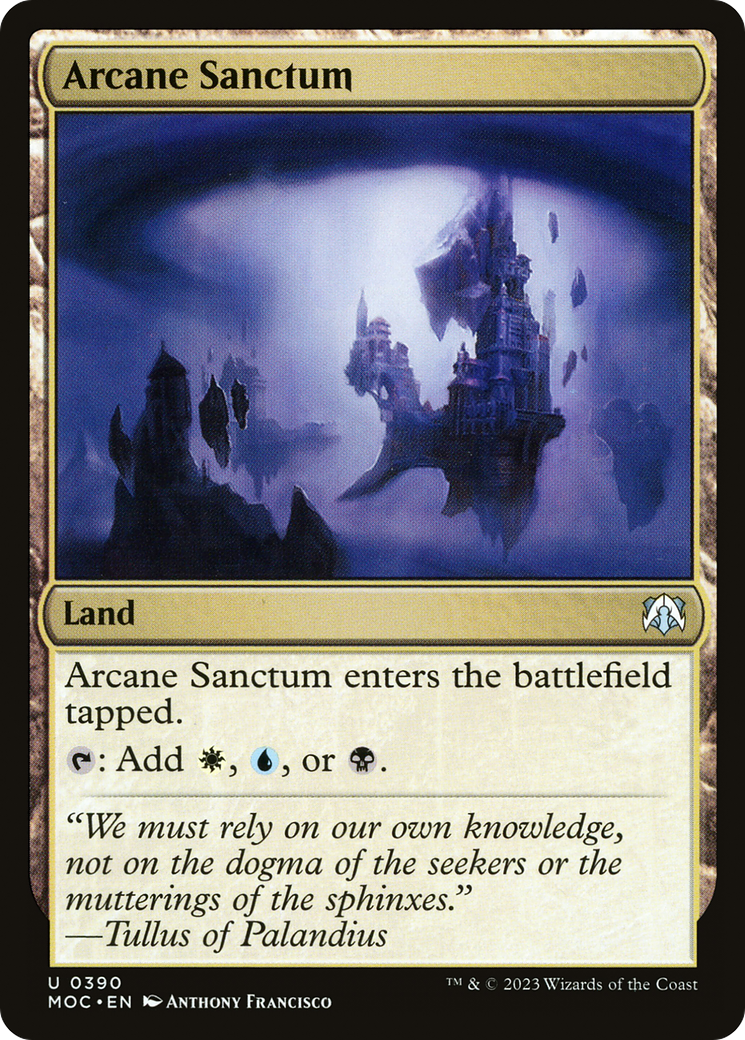
Arcane Sanctum
Arcane Sanctum
Land
This land enters tapped.
: Add , , or .
-
1
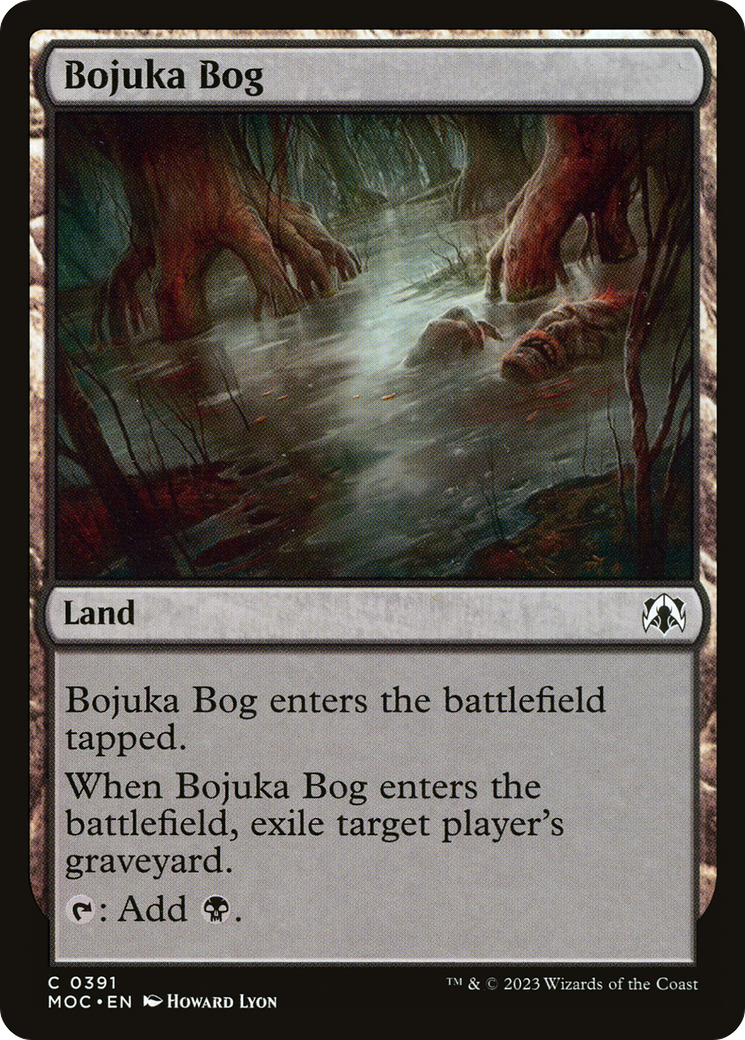
Bojuka Bog
Bojuka Bog
Land
This land enters tapped.
When this land enters, exile target player's graveyard.
: Add .
-
1
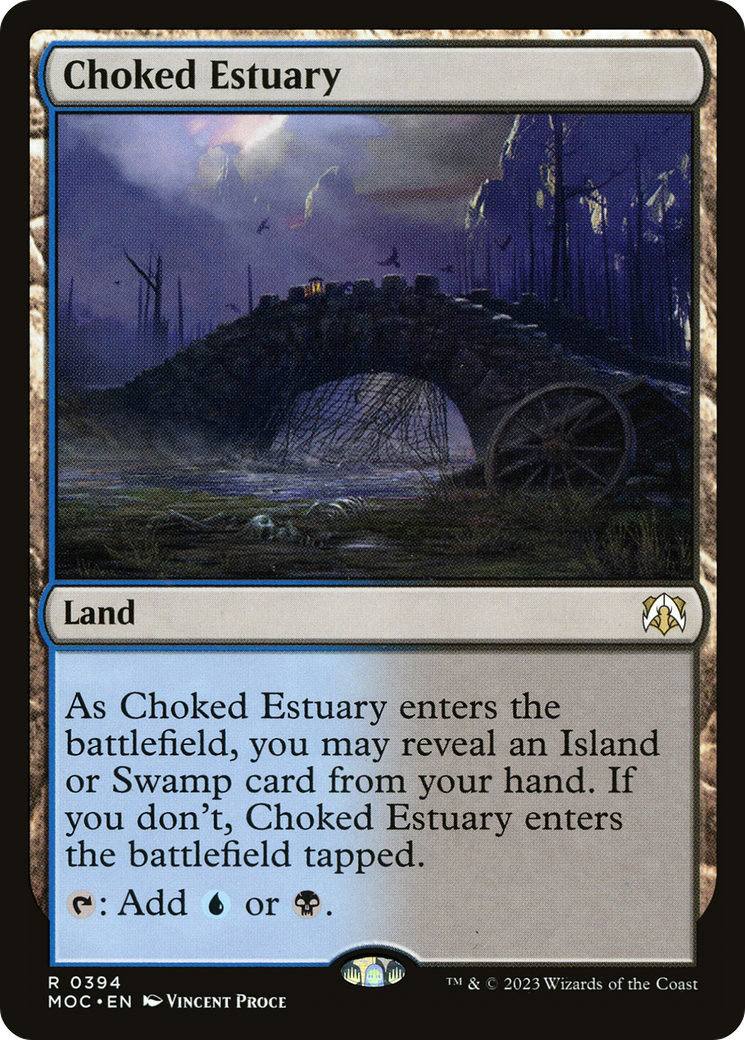
Choked Estuary
Choked Estuary
Land
As this land enters, you may reveal an Island or Swamp card from your hand. If you don't, this land enters tapped.
: Add or .
- Lands don't have a subtype just because they can produce mana of the corresponding color. Choked Estuary itself is neither an Island nor a Swamp, even though it produces blue and black mana, so you can't reveal one to satisfy the ability of another.
- If an effect instructs you to put Choked Estuary onto the battlefield tapped, it will still enter the battlefield tapped even if you reveal a land card from your hand.
- You may reveal any land card with either or both of the appropriate subtypes. It doesn't have to be a basic land. For example, you could reveal Prairie Stream from the Battle for Zendikar set to satisfy the ability of Choked Estuary.
- If an Island or Swamp is entering the battlefield from your hand at the same time as Choked Estuary, you may reveal the other land to have Choked Estuary enter untapped.
-
1
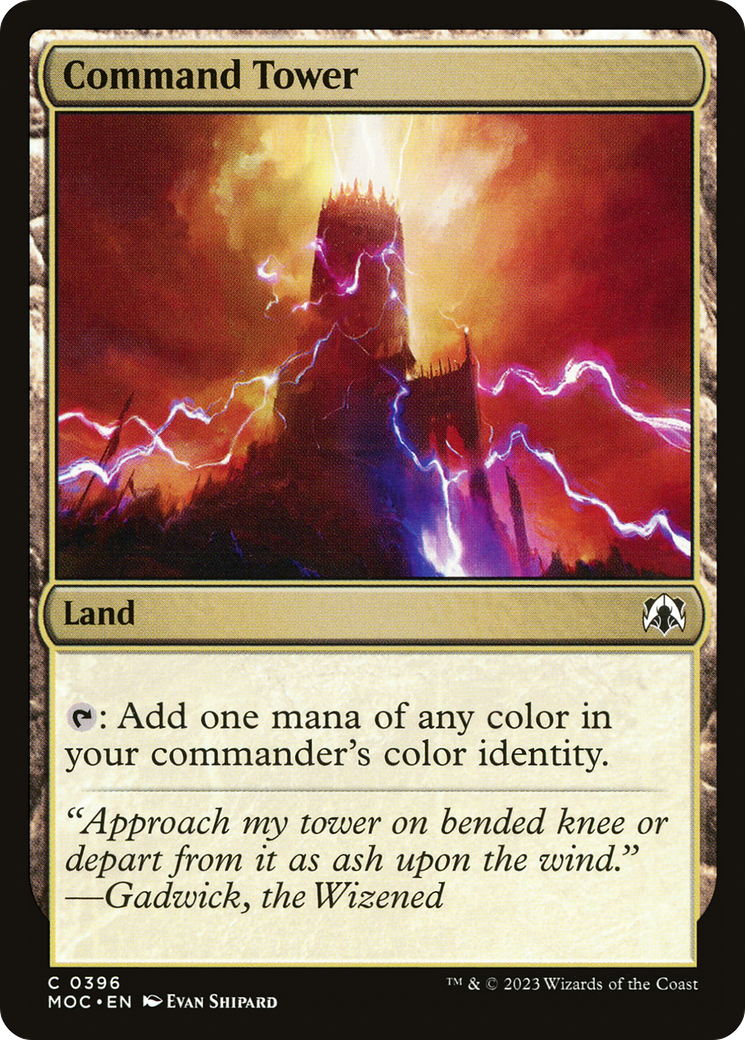
Command Tower
Command Tower
Land
: Add one mana of any color in your commander's color identity.
- If you don't have a commander, Command Tower's ability produces no mana.
- If your commander is a card that has no colors in its color identity, Command Tower's ability produces no mana. It doesn't produce .
- If you have two commanders, the ability adds one mana of any color in their combined color identities.
-
1
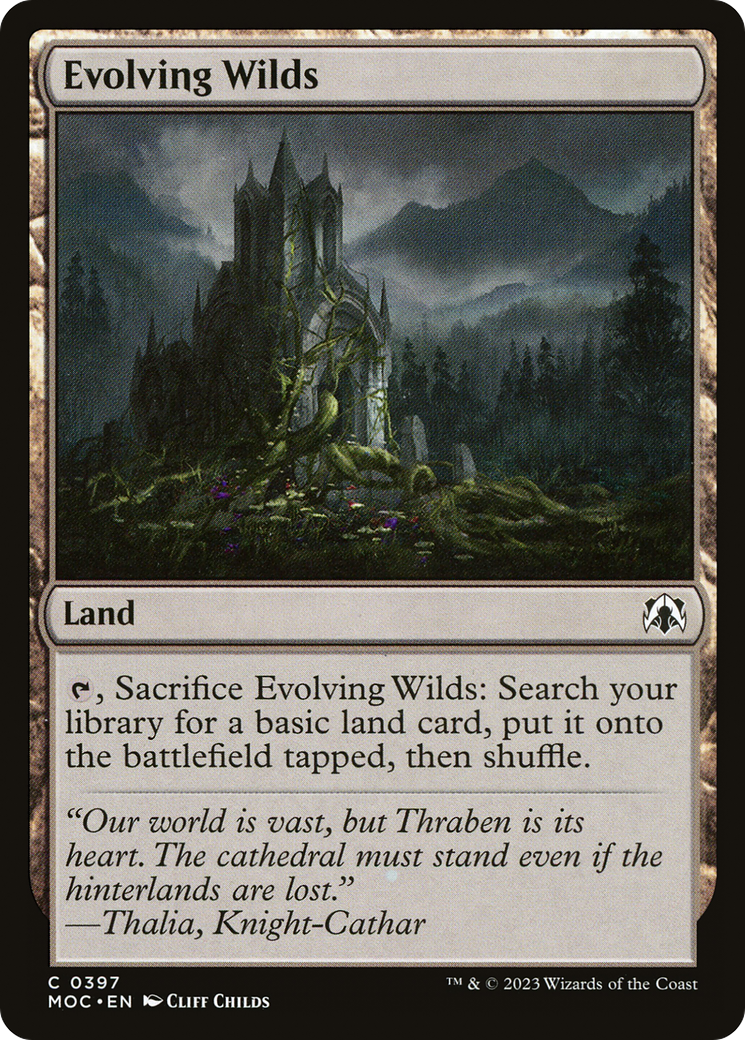
Evolving Wilds
Evolving Wilds
Land
, Sacrifice this land: Search your library for a basic land card, put it onto the battlefield tapped, then shuffle.
-
1
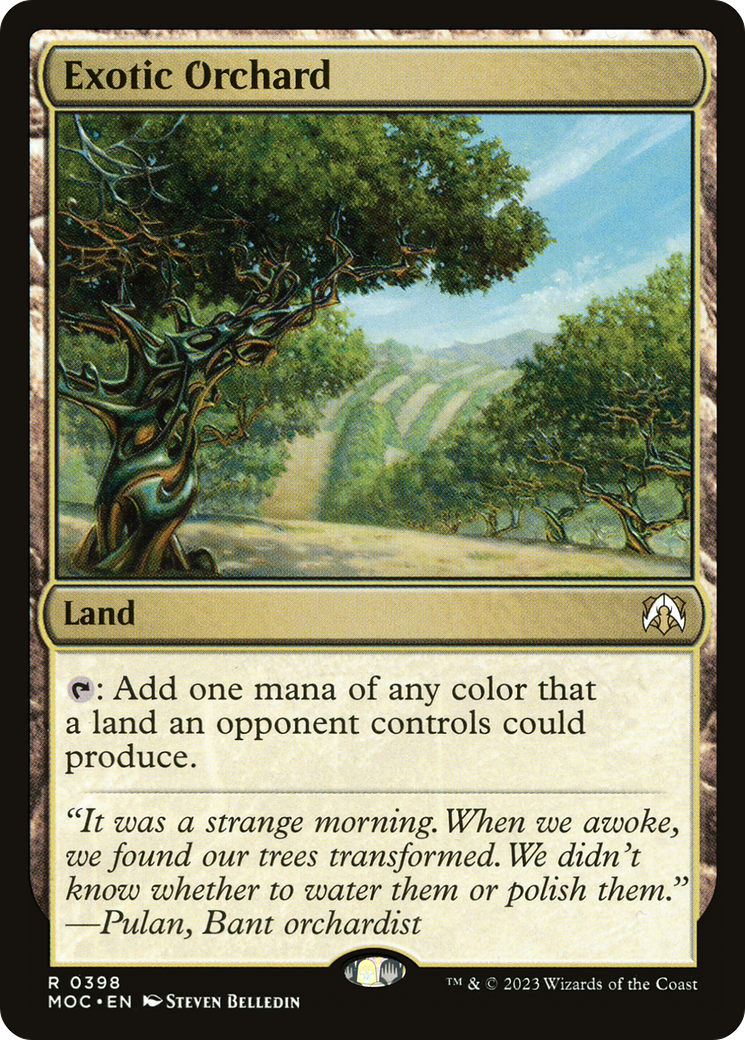
Exotic Orchard
Exotic Orchard
Land
: Add one mana of any color that a land an opponent controls could produce.
- Lands that produce mana based only on what other lands "could produce" won't help each other unless some other land allows one of them to actually produce some type of mana. For example, if you control an Exotic Orchard and your opponent controls an Exotic Orchard and a Reflecting Pool, none of those lands would produce mana if their mana abilities were activated. On the other hand, if you control a Forest and an Exotic Orchard, and your opponent controls an Exotic Orchard and a Reflecting Pool, then each of those lands can be tapped to produce . Your opponent's Exotic Orchard can produce because you control a Forest. Your Exotic Orchard and your opponent's Reflecting Pool can each produce because your opponent's Exotic Orchard can produce .
- When determining what colors of mana your opponents' lands could produce, Exotic Orchard takes into account any applicable replacement effects that would apply to those lands' mana abilities (such as Contamination's effect, for example). If there are more than one, consider them in any possible order.
- The colors of mana are white, blue, black, red, and green. Exotic Orchard can't be tapped for colorless mana, even if a land an opponent controls could produce colorless mana.
- Exotic Orchard doesn't care about any restrictions or riders your opponents' lands (such as Ancient Ziggurat or Hall of the Bandit Lord) put on the mana they produce. It just cares about colors of mana.
- Exotic Orchard checks the effects of all mana-producing abilities of lands your opponents control, but it doesn't check their costs. For example, Vivid Crag has the ability " , Remove a charge counter from Vivid Crag: Add one mana of any color." If an opponent controls Vivid Crag and you control Exotic Orchard, you can tap Exotic Orchard for any color of mana. It doesn't matter whether Vivid Crag has a charge counter on it, and it doesn't matter whether it's untapped.
-
6
Island
Island
Basic Land — Island
( : Add .)
-
1
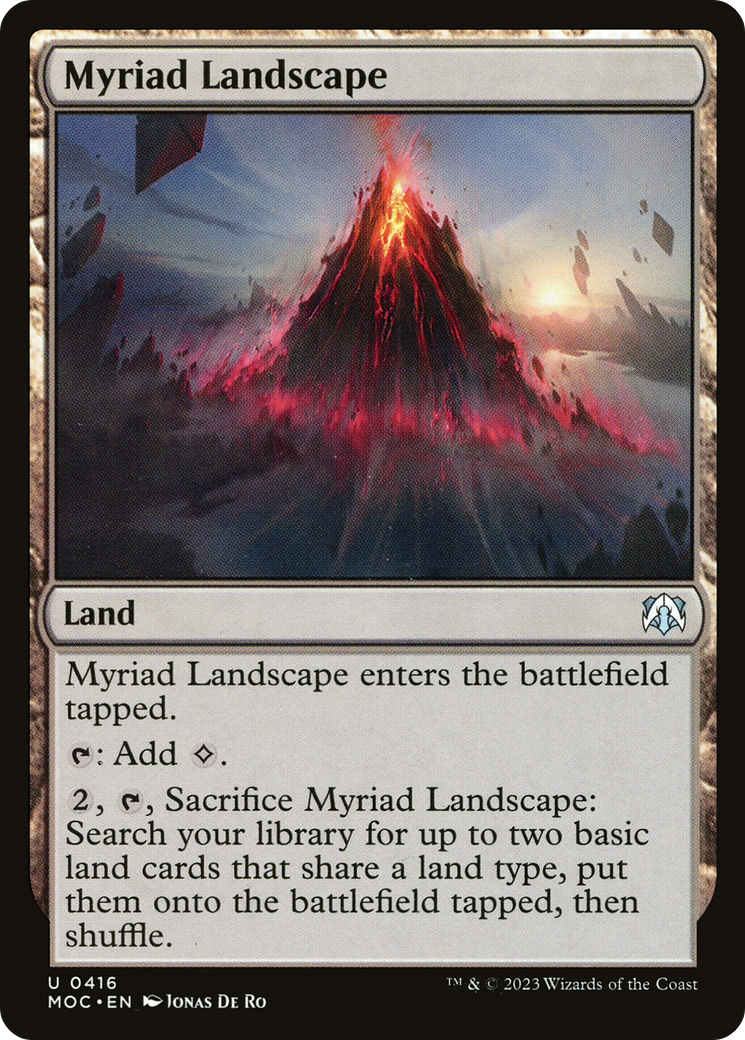
Myriad Landscape
Myriad Landscape
Land
This land enters tapped.
: Add .
, , Sacrifice this land: Search your library for up to two basic land cards that share a land type, put them onto the battlefield tapped, then shuffle.
- You can choose to find one basic land card with Myriad Landscape's last ability.
-
1
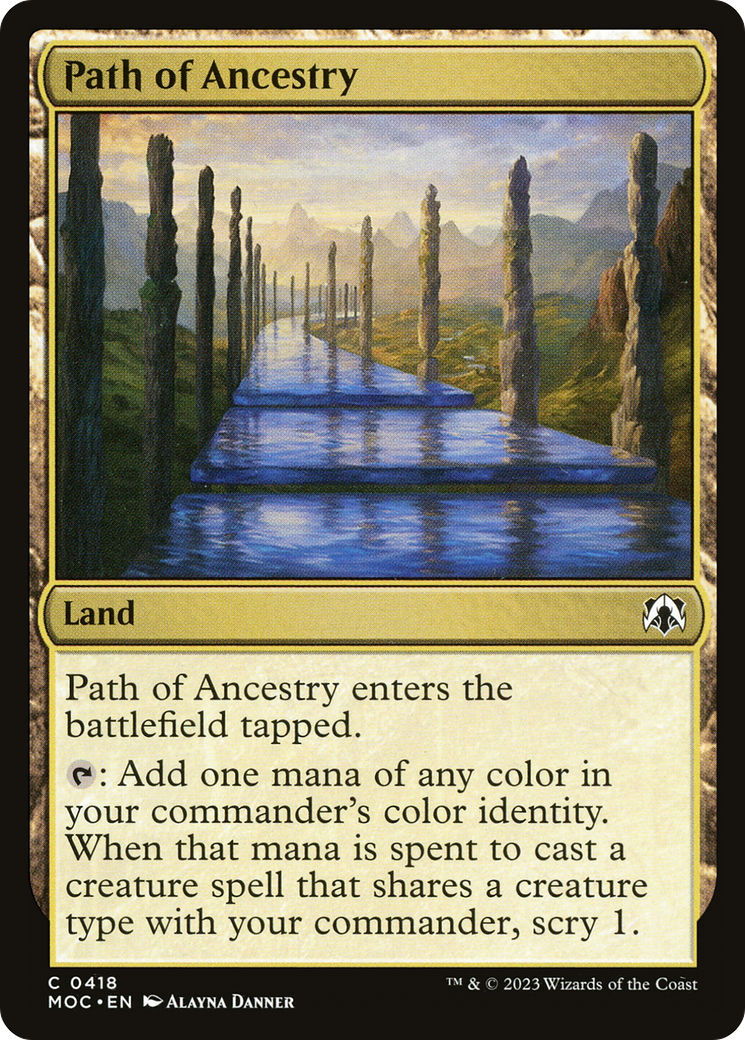
Path of Ancestry
Path of Ancestry
Land
This land enters tapped.
: Add one mana of any color in your commander's color identity. When that mana is spent to cast a creature spell that shares a creature type with your commander, scry 1. (Look at the top card of your library. You may put that card on the bottom.)
- Your commander's creature types are checked immediately after you cast a creature spell spending mana from Path of Ancestry's last ability. They aren't set before the game begins, and they may not be the same types your commander had when you activated that ability.
- If you have two commanders, the last ability adds one mana of any color in their combined color identities. When you spend that mana on a creature spell that shares a creature type with either of your commanders, you'll scry 1.
- If Path of Ancestry's last ability produces two mana (most likely due to Mana Reflection), spending those two mana to cast creature spells that share a creature type with your commander will cause two abilities to trigger. Each of those abilities will cause you to scry 1. You won't scry 2. This is true whether you spend the mana on one creature spell or two.
- If your commander has no creature types, it can't share a creature type with any spell that you cast.
- If you cast your commander with mana from Path of Ancestry, and your commander hasn't somehow lost all of its creature types while on the stack, you'll scry 1.
- If you don't have a commander, Path of Ancestry's ability produces no mana.
- If your commander is a card that has no colors in its color identity, Path of Ancestry's ability produces no mana. It doesn't produce .
-
8
Plains
Plains
Basic Land — Plains
( : Add .)
-
1
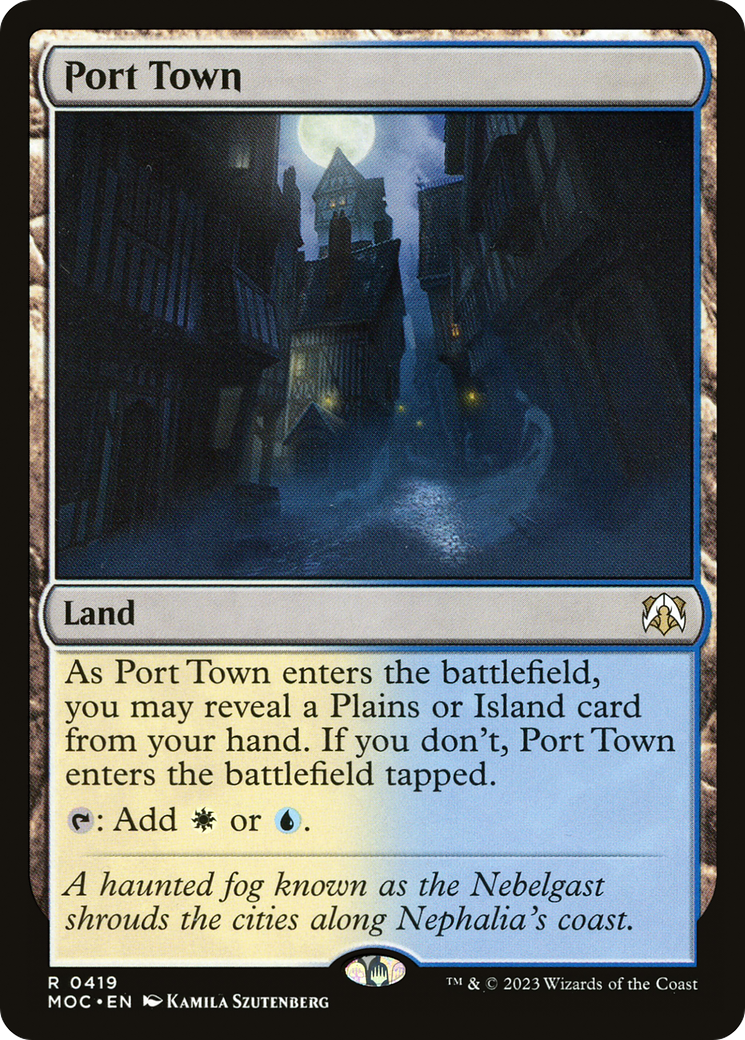
Port Town
Port Town
Land
As this land enters, you may reveal a Plains or Island card from your hand. If you don't, this land enters tapped.
: Add or .
- You may reveal any land card with either or both of the appropriate subtypes. It doesn't have to be a basic land. For example, you could reveal Canopy Vista from the Battle for Zendikar set to satisfy the ability of Port Town.
- Lands don't have a subtype just because they can produce mana of the corresponding color. Port Town itself is neither a Plains nor an Island, even though it produces white and blue mana, so you can't reveal one to satisfy the ability of another.
- If a Plains or Island is entering the battlefield from your hand at the same time as Port Town, you may reveal the other land to have Port Town enter untapped.
- If an effect instructs you to put Port Town onto the battlefield tapped, it will still enter the battlefield tapped even if you reveal a land card from your hand.
-
1
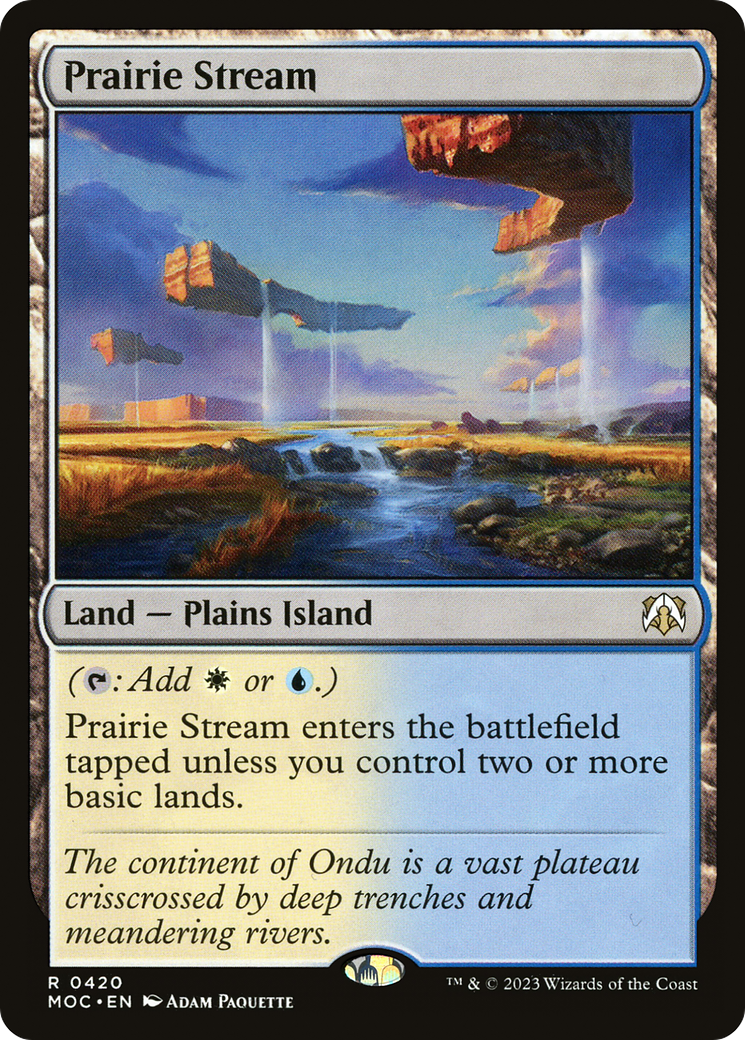
Prairie Stream
Prairie Stream
Land — Plains Island
( : Add or .)
This land enters tapped unless you control two or more basic lands.
- Even though these lands have basic land types, they are not basic lands because "basic" doesn't appear on their type line. Notably, controlling two or more of them won't allow others to enter the battlefield untapped.
- However, because these cards have basic land types, effects that specify a basic land type without also specifying that the land be basic can affect them. For example, a spell or ability that reads "Destroy target Forest" can target Canopy Vista, while one that reads "Destroy target basic Forest" cannot.
- If one of these lands enters the battlefield at the same time as any number of basic lands, those other lands are not counted when determining if this land enters the battlefield tapped or untapped.
-
1
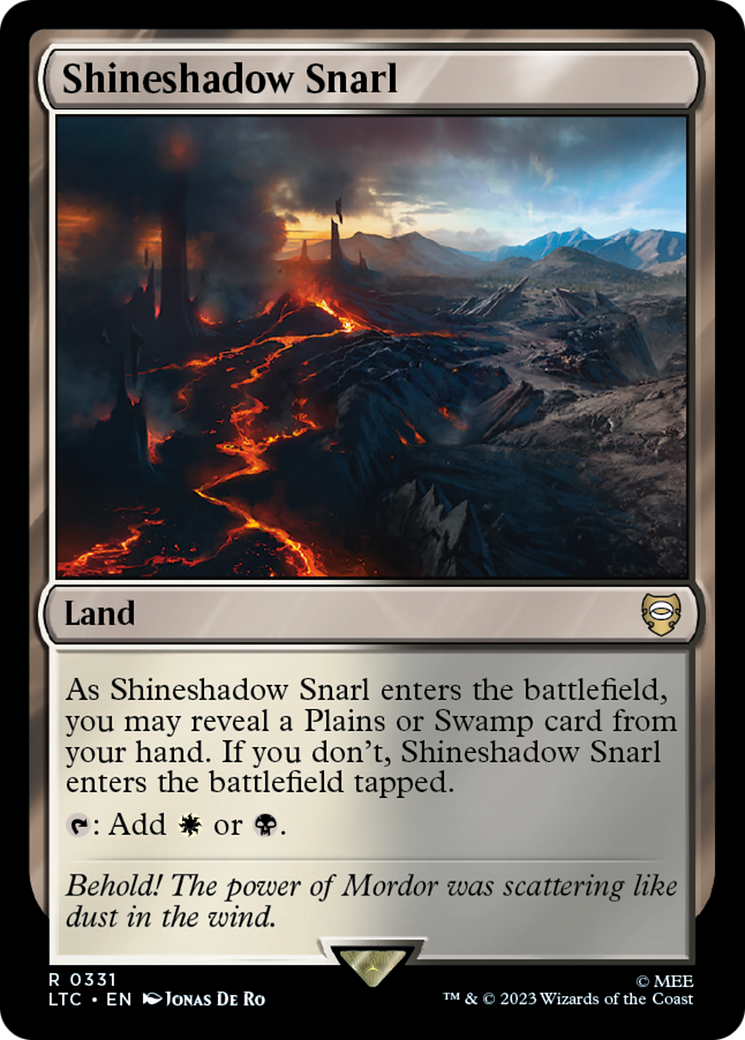
Shineshadow Snarl
Shineshadow Snarl
Land
As this land enters, you may reveal a Plains or Swamp card from your hand. If you don't, this land enters tapped.
: Add or .
- You may reveal any land card with either or both of the appropriate subtypes. It doesn't have to be a basic land card.
- The "Snarl" itself doesn't have any land subtypes. You can't reveal one to satisfy the ability of another.
- If a land card with an appropriate subtype is entering the battlefield from your hand at the same time as one of these lands, you may reveal the other land to have the "Snarl" enter untapped.
- If an effect instructs you to put one of these lands onto the battlefield tapped, it will still enter the battlefield tapped even if you reveal a land card from your hand.
-
1
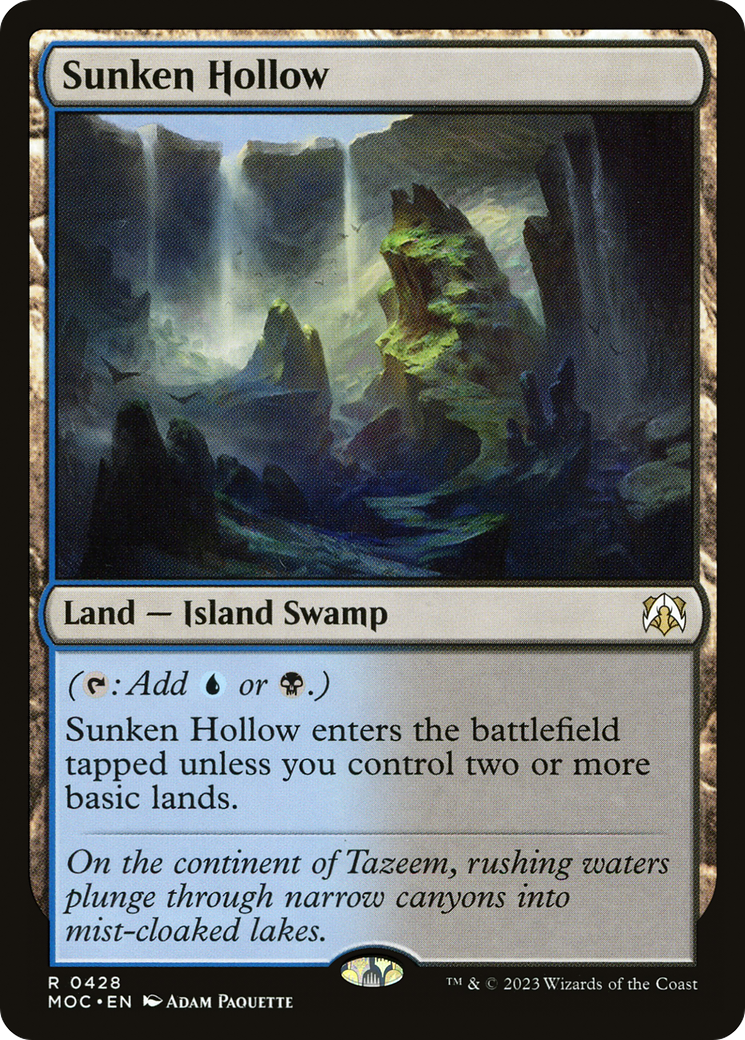
Sunken Hollow
Sunken Hollow
Land — Island Swamp
( : Add or .)
This land enters tapped unless you control two or more basic lands.
- Even though these lands have basic land types, they are not basic lands because "basic" doesn't appear on their type line. Notably, controlling two or more of them won't allow others to enter the battlefield untapped.
- However, because these cards have basic land types, effects that specify a basic land type without also specifying that the land be basic can affect them. For example, a spell or ability that reads "Destroy target Forest" can target Canopy Vista, while one that reads "Destroy target basic Forest" cannot.
- If one of these lands enters the battlefield at the same time as any number of basic lands, those other lands are not counted when determining if this land enters the battlefield tapped or untapped.
-
5
Swamp
Swamp
Basic Land — Swamp
( : Add .)
-
1
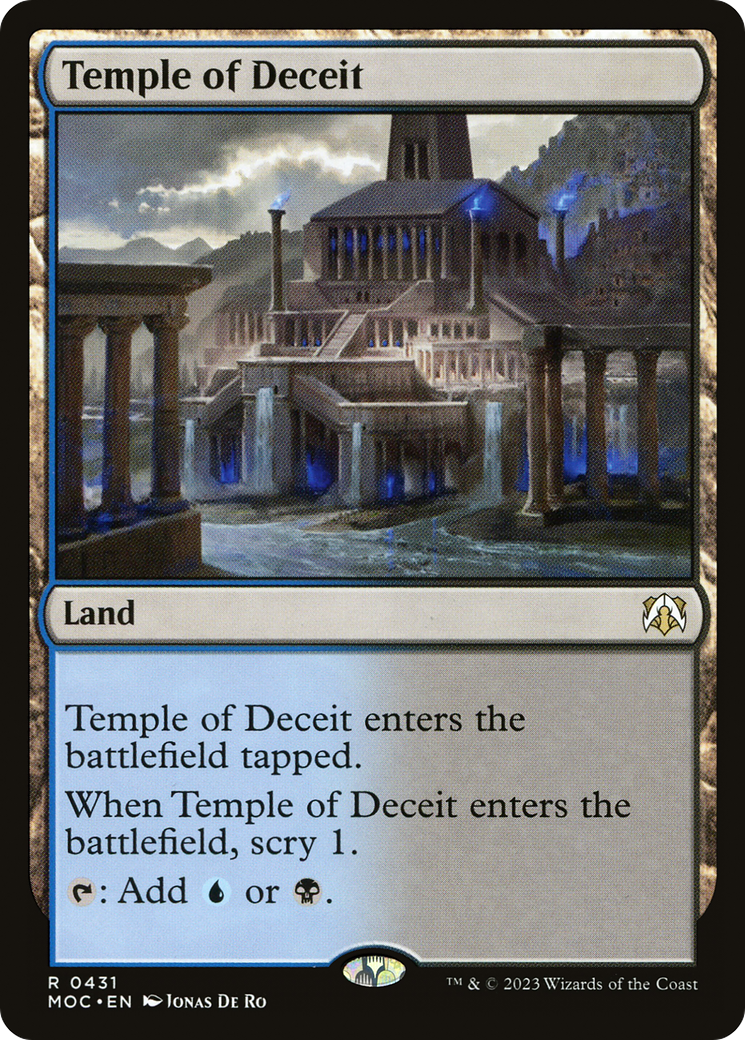
Temple of Deceit
Temple of Deceit
Land
This land enters tapped.
When this land enters, scry 1. (Look at the top card of your library. You may put that card on the bottom.)
: Add or .
- When you scry, you may put all the cards you look at back on top of your library, you may put all of those cards on the bottom of your library, or you may put some of those cards on top and the rest of them on the bottom.
- You choose how to order cards returned to your library after scrying no matter where you put them.
- You perform the actions stated on a card in sequence. For some spells and abilities, that means you'll scry last. For others, that means you'll scry and then perform other actions.
- Scry appears on some spells and abilities with one or more targets. If all of the spell or ability's targets are illegal when it tries to resolve, it won't resolve and none of its effects will happen. You won't scry.
-
1
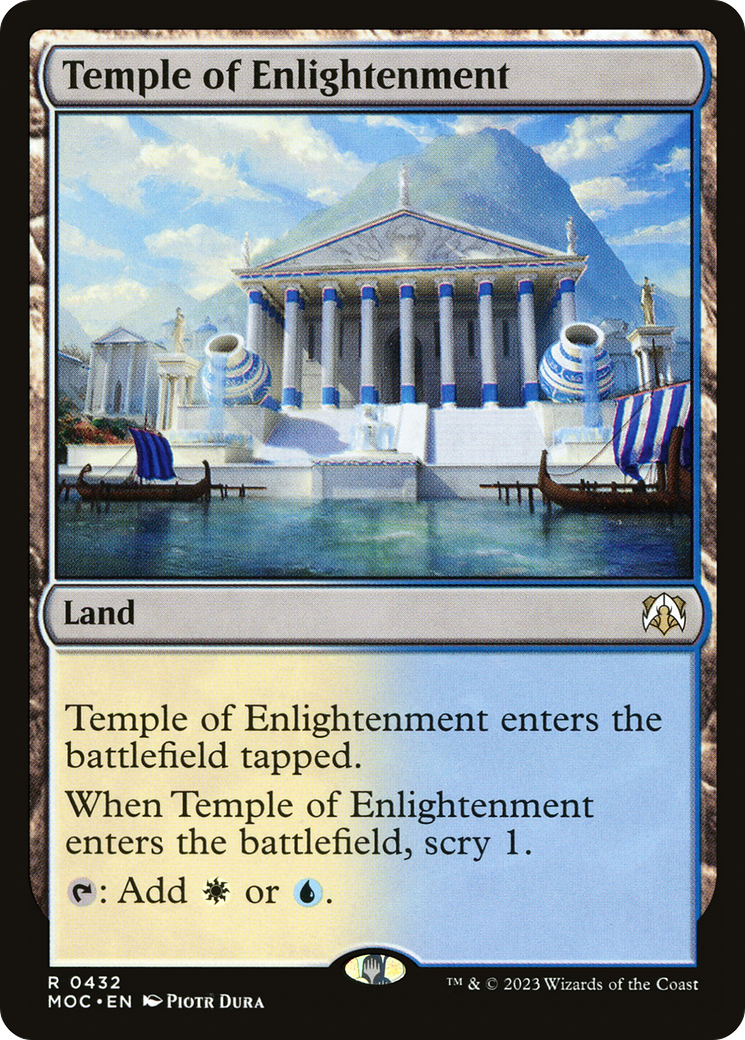
Temple of Enlightenment
Temple of Enlightenment
Land
This land enters tapped.
When this land enters, scry 1. (Look at the top card of your library. You may put that card on the bottom.)
: Add or .
- When you scry, you may put all the cards you look at back on top of your library, you may put all of those cards on the bottom of your library, or you may put some of those cards on top and the rest of them on the bottom.
- You choose how to order cards returned to your library after scrying no matter where you put them.
- You perform the actions stated on a card in sequence. For some spells and abilities, that means you'll scry last. For others, that means you'll scry and then perform other actions.
- Scry appears on some spells and abilities with one or more targets. If all of the spell or ability's targets are illegal when it tries to resolve, it won't resolve and none of its effects will happen. You won't scry.
-
1
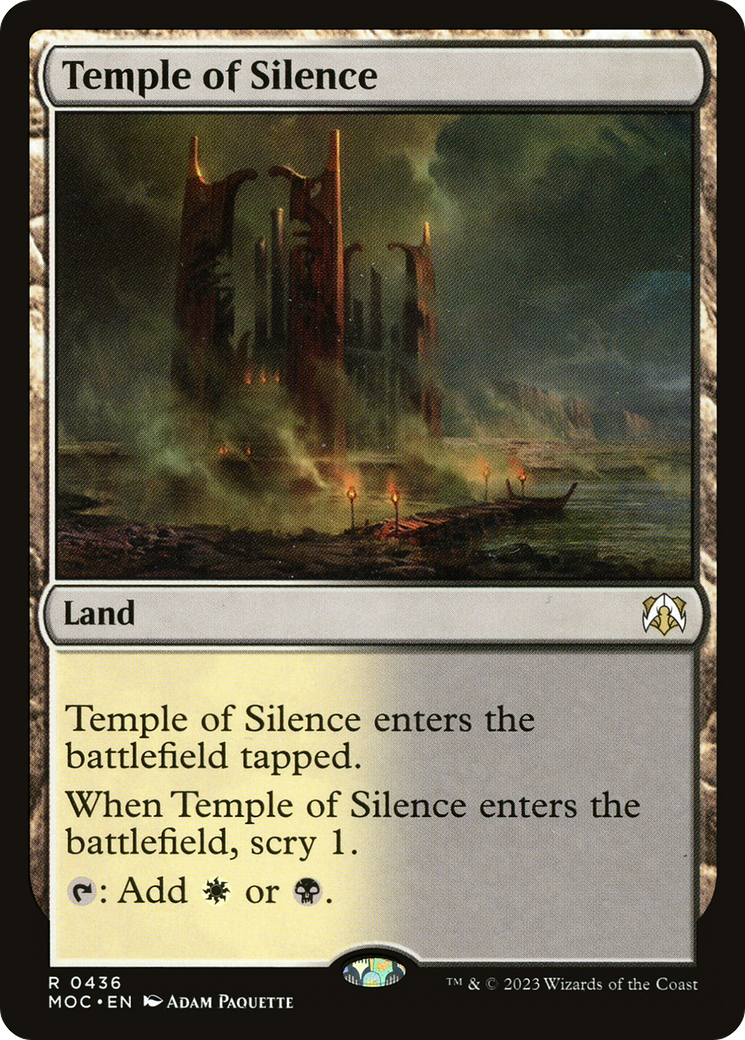
Temple of Silence
Temple of Silence
Land
This land enters tapped.
When this land enters, scry 1. (Look at the top card of your library. You may put that card on the bottom.)
: Add or .
- When you scry, you may put all the cards you look at back on top of your library, you may put all of those cards on the bottom of your library, or you may put some of those cards on top and the rest of them on the bottom.
- You choose how to order cards returned to your library after scrying no matter where you put them.
- You perform the actions stated on a card in sequence. For some spells and abilities, that means you'll scry last. For others, that means you'll scry and then perform other actions.
- Scry appears on some spells and abilities with one or more targets. If all of the spell or ability's targets are illegal when it tries to resolve, it won't resolve and none of its effects will happen. You won't scry.
-
1
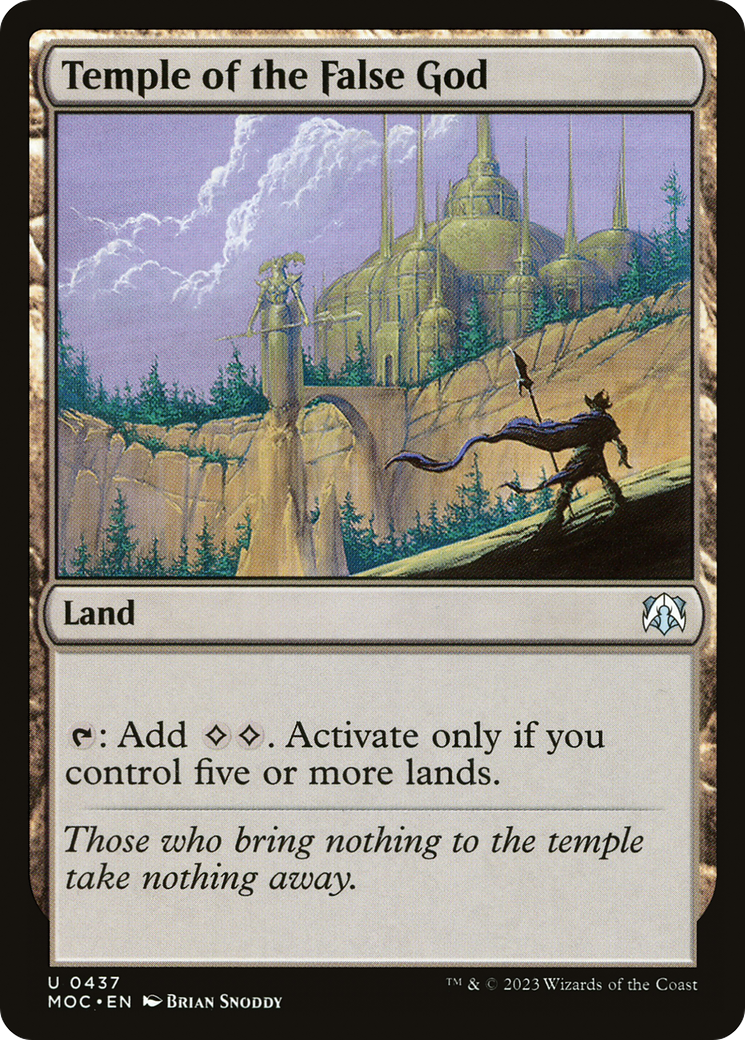
Temple of the False God
Temple of the False God
Land
: Add . Activate only if you control five or more lands.
-
1
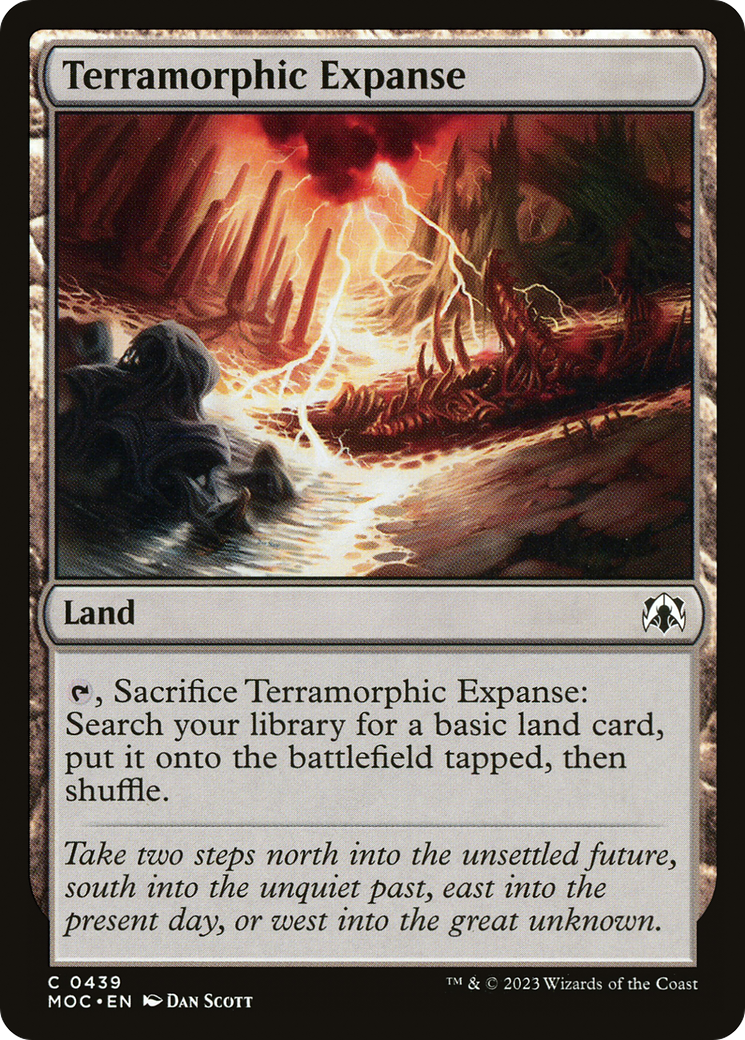
Terramorphic Expanse
Terramorphic Expanse
Land
, Sacrifice this land: Search your library for a basic land card, put it onto the battlefield tapped, then shuffle.
-
1
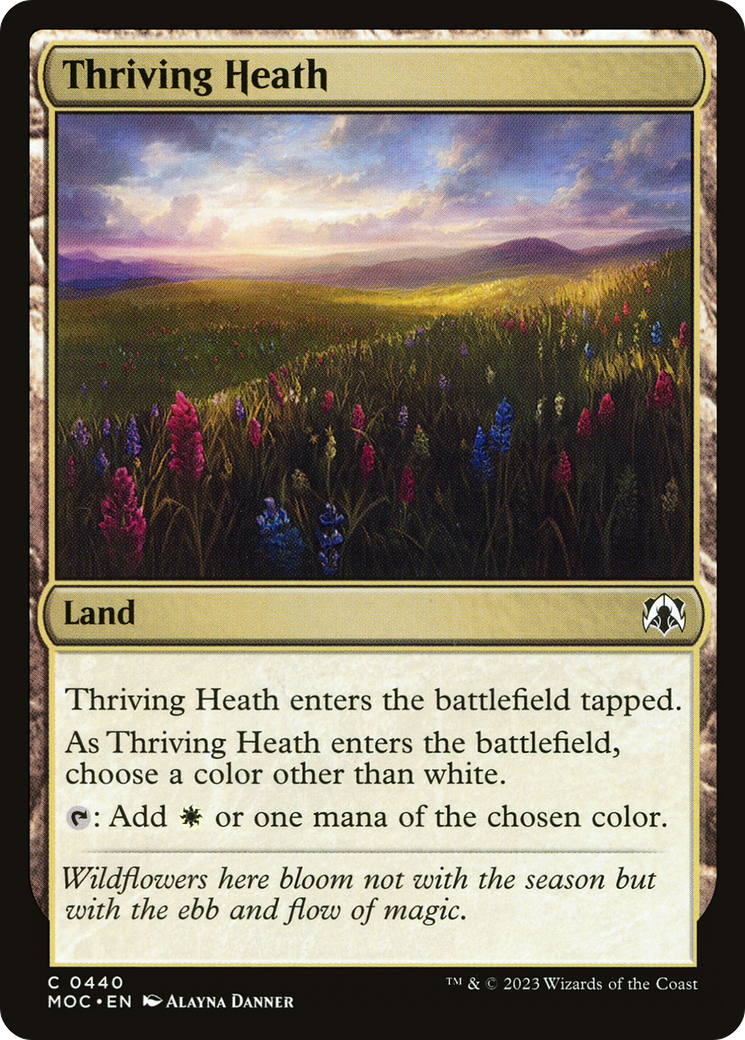
Thriving Heath
Thriving Heath
Land
This land enters tapped. As it enters, choose a color other than white.
: Add or one mana of the chosen color.
-
1
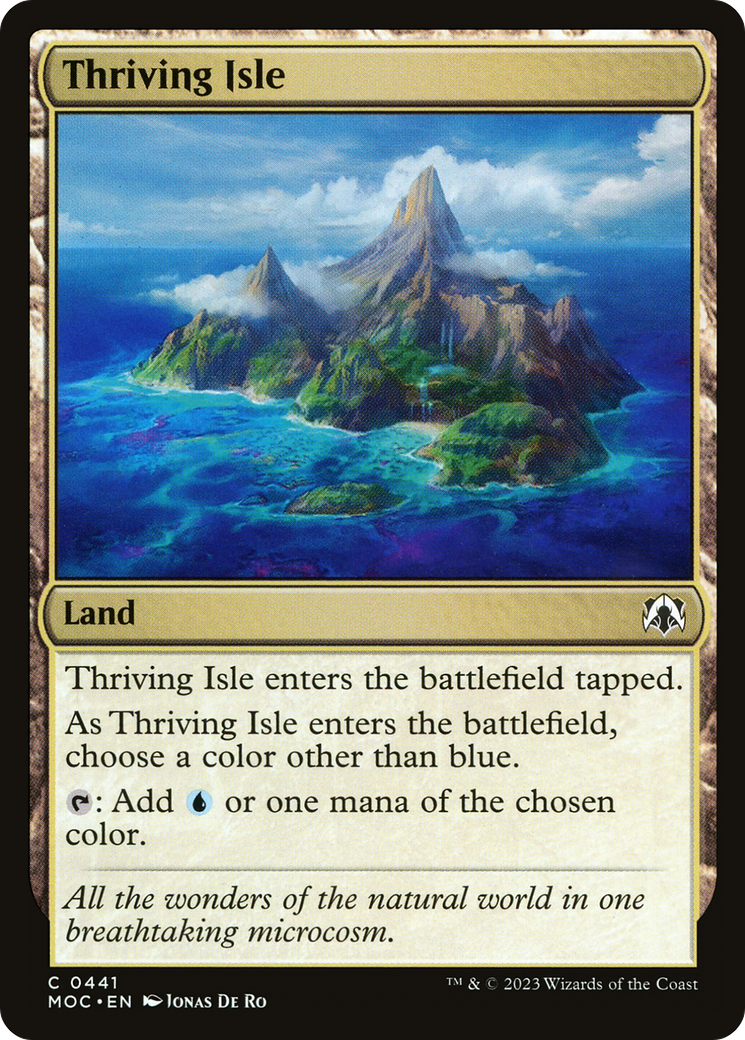
Thriving Isle
Thriving Isle
Land
This land enters tapped. As it enters, choose a color other than blue.
: Add or one mana of the chosen color.
-
1
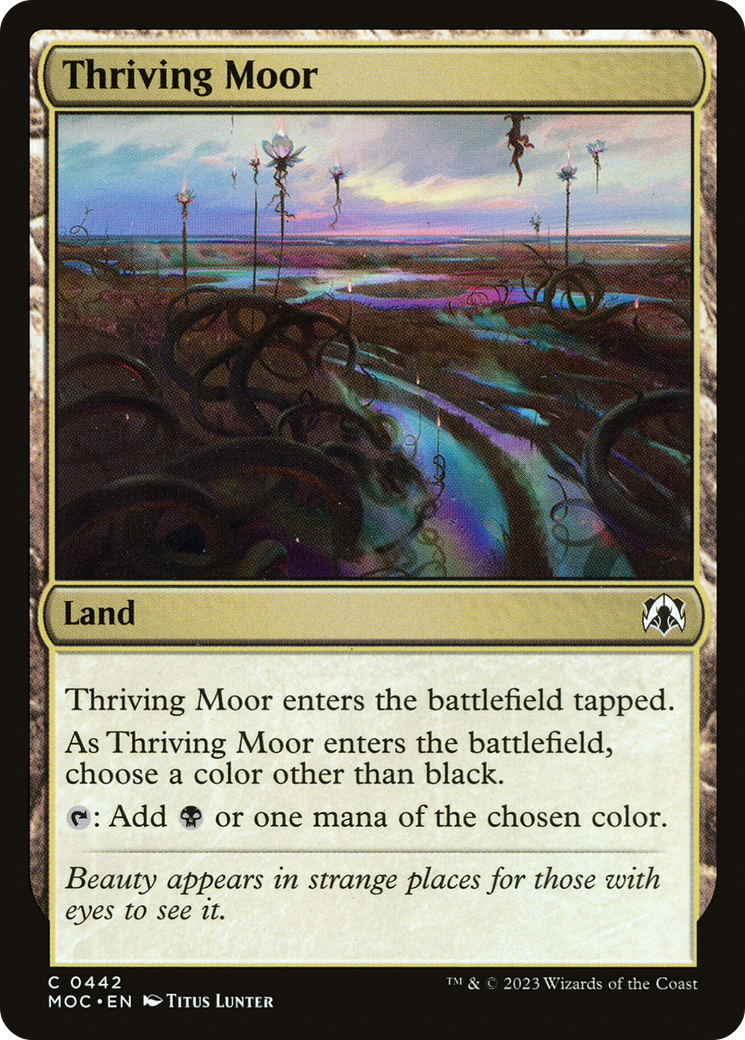
Thriving Moor
Thriving Moor
Land
This land enters tapped. As it enters, choose a color other than black.
: Add or one mana of the chosen color.
White 17
-
1
Acclaimed Contender
Acclaimed Contender
Creature — Human Knight
3/3
When this creature enters, if you control another Knight, look at the top five cards of your library. You may reveal a Knight, Aura, Equipment, or legendary artifact card from among them and put it into your hand. Put the rest on the bottom of your library in a random order.
- Acclaimed Contender's ability won't trigger if you don't control another Knight immediately after it enters the battlefield. If you don't control another Knight as that ability resolves, the ability has no effect. This doesn't have the be the same Knight at both times, however.
- Acclaimed Contender's ability can get you at most one card from the top five cards, no matter how many other Knights you control.
-
1
Adeline, Resplendent Cathar
Adeline, Resplendent Cathar
Legendary Creature — Human Knight
*/4
Vigilance
Adeline's power is equal to the number of creatures you control.
Whenever you attack, for each opponent, create a 1/1 white Human creature token that's tapped and attacking that player or a planeswalker they control.
- The ability that defines Adeline's power works in all zones, not just the battlefield. As long as Adeline is on the battlefield (and still a creature), that ability will count Adeline itself.
- Attacking with any creatures will cause Adeline's last ability to trigger. Adeline doesn't have to be among them.
- Tokens will be created for each of your opponents, not just opponents that you attacked.
- You choose whether each token is attacking that opponent or a planeswalker they control as those tokens enter the battlefield.
- Although the Human tokens created by the triggered ability are attacking, they were never declared as attacking creatures (for the purposes of abilities that trigger whenever a creature attacks, for example).
-
1
Chivalric Alliance
Chivalric Alliance
Enchantment
Whenever you attack with two or more creatures, draw a card.
, Discard a card: Create a 2/2 white and blue Knight creature token with vigilance.
-
1
Conjurer's Mantle
Conjurer's Mantle
Artifact — Equipment
Equipped creature gets +1/+1 and has vigilance.
Whenever equipped creature attacks, look at the top six cards of your library. You may reveal a card that shares a creature type with that creature from among them and put it into your hand. Put the rest on the bottom of your library in a random order.
Equip
- A creature "shares a creature type" with the equipped creature if they have at least one creature type in common.
- If the equipped creature is no longer on the battlefield as the triggered ability resolves, use its creature types from when it was last on the battlefield.
-
1
Fell the Mighty
Fell the Mighty
Sorcery
Destroy all creatures with power greater than target creature's power.
- Use the power of the target creature as Fell the Mighty resolves to determine which creatures are destroyed. Fell the Mighty doesn't target any of those creatures, so a creature with hexproof or protection from white will be destroyed if its power is high enough.
- Fell the Mighty won't destroy the target creature.
- If the target creature is an illegal target when Fell the Mighty tries to resolve, Fell the Mighty won't resolve and none of its effects will happen. No creatures will be destroyed.
-
1
Hero of Bladehold
Hero of Bladehold
Creature — Human Knight
3/4
Battle cry (Whenever this creature attacks, each other attacking creature gets +1/+0 until end of turn.)
Whenever this creature attacks, create two 1/1 white Soldier creature tokens that are tapped and attacking.
- Whenever Hero of Bladehold attacks, both abilities will trigger. You can put them onto the stack in any order. If the token-creating ability resolves first, the tokens each get +1/+0 until end of turn from the battle cry ability.
- You choose which opponent or planeswalker an opponent controls that each token is attacking when it is put onto the battlefield.
- Although the tokens are attacking, they never were declared as attacking creatures (for purposes of abilities that trigger whenever a creature attacks, for example).
-
1
Knight Exemplar
Knight Exemplar
Creature — Human Knight
2/2
First strike (This creature deals combat damage before creatures without first strike.)
Other Knight creatures you control get +1/+1 and have indestructible. (Damage and effects that say "destroy" don't destroy them.)
- Lethal damage, damage from a source with deathtouch, and effects that say “destroy” won't cause a creature with indestructible to be put into the graveyard. However, a creature with indestructible can be put into the graveyard for a number of reasons. The most likely reasons are if it's sacrificed, if it's legendary and another legendary creature with the same name is controlled by the same player, or if its toughness is 0 or less.
- If another Knight creature you control is dealt lethal damage, the creature isn't destroyed, but the damage remains marked on it. If, at some point later in that turn, you no longer control Knight Exemplar or it loses its abilities, the other Knight creature will lose indestructible and will be destroyed.
- If you control two Knight Exemplars, each one causes the other to get +1/+1 and have indestructible.
- If an effect would simultaneously destroy Knight Exemplar and another Knight creature you control, only Knight Exemplar is destroyed.
-
1
Knight of the White Orchid
Knight of the White Orchid
Creature — Human Knight
2/2
First strike
When this creature enters, if an opponent controls more lands than you, you may search your library for a Plains card, put it onto the battlefield, then shuffle.
- The Plains you search for doesn't have to be basic. For example, you could put a Sacred Foundry onto the battlefield.
- Knight of the White Orchid's triggered ability has an “intervening ‘if' clause.” That means (1) the ability won't trigger at all unless any one of your opponents controls more lands than you, and (2) the ability will do nothing if you control at least as many lands as each of your opponents by the time it resolves.
-
1
Maul of the Skyclaves
Maul of the Skyclaves
Artifact — Equipment
When this Equipment enters, attach it to target creature you control.
Equipped creature gets +2/+2 and has flying and first strike.(It deals combat damage before creatures without first strike.)
Equip
- Attaching an Equipment with its enters-the-battlefield triggered ability isn't the same as using its equip ability. You don't pay mana for the attachment, and if the Equipment enters at a time you couldn't cast a sorcery, you can still attach it to a creature you control.
- If the target creature becomes an illegal target, the Equipment remains on the battlefield unattached.
-
1
Path to Exile
Path to Exile
Instant
Exile target creature. Its controller may search their library for a basic land card, put that card onto the battlefield tapped, then shuffle.
- The controller of the exiled creature isn't required to search their library for a basic land. If that player doesn't, the player won't shuffle their library.
- If the target creature is an illegal target by the time Path to Exile tries to resolve, it won't resolve and none of its effects will happen. The creature's controller won't search for a basic land card.
-
1
Promise of Loyalty
Promise of Loyalty
Sorcery
Each player puts a vow counter on a creature they control and sacrifices the rest. Each of those creatures can't attack you or planeswalkers you control for as long as it has a vow counter on it.
- If the vow counter is removed from the creature, it can attack as normal.
- Each player, including you, must put a vow counter on a creature they control if able. They can't choose to opt out and sacrifice all of their creatures. The creature you put a vow counter on will remember its promise if another player gains control of it.
- If the vow counter is moved to another creature, it won't prevent the second creature from attacking normally.
-
1
Return to Dust
Return to Dust
Instant
Exile target artifact or enchantment. If you cast this spell during your main phase, you may exile up to one other target artifact or enchantment.
- Return to Dust can always target a second artifact or enchantment; it just won't exile it if it's not your main phase when you cast Return to Dust.
- If a spell or ability copies Return to Dust, the copy exiles only the first target artifact or enchantment. This is because the copy wasn't cast at all.
-
1
Silverwing Squadron
Silverwing Squadron
Creature — Human Knight
*/*
Flying, vigilance
Silverwing Squadron's power and toughness are each equal to the number of creatures you control.
Whenever this creature attacks, create a number of 2/2 white Knight creature tokens with vigilance equal to the number of opponents you have.
- The ability that defines Silverwing Squadron's power and toughness works in all zones, not just the battlefield.
- As long as Silverwing Squadron is on the battlefield, its ability will count itself, so it'll be at least 1/1.
- In a multiplayer game, opponents who have left the game aren't counted by Silverwing Squadron's triggered ability.
-
1
Swords to Plowshares
Swords to Plowshares
Instant
Exile target creature. Its controller gains life equal to its power.
- Use the power of the creature from when it was last on the battlefield to determine how much life is gained.
-
1
Unbreakable Formation
Unbreakable Formation
Instant
Creatures you control gain indestructible until end of turn.
Addendum — If you cast this spell during your main phase, put a +1/+1 counter on each of those creatures and they gain vigilance until end of turn.
- Addendum abilities of instant spells apply while the spell is resolving, not immediately after casting it. If the spell is countered, you don't get the addendum bonus.
- If an effect copies a spell with an addendum ability while it's on the stack, the copy wasn't cast at all, so you won't get the addendum bonus.
- Unbreakable Formation affects only creatures you control at the time it resolves. Creatures you begin to control later in the turn won't gain indestructible or vigilance and they won't get a +1/+1 counter.
-
1
Valiant Knight
Valiant Knight
Creature — Human Knight
3/4
Other Knights you control get +1/+1.
: Knights you control gain double strike until end of turn.
- Multiple instances of double strike on the same creature are redundant.
- Because damage remains marked on a creature until it's removed as the turn ends, nonlethal damage dealt to a Knight you control may become lethal if Valiant Knight leaves the battlefield during that turn.
-
1
Worthy Knight
Worthy Knight
Creature — Human Knight
2/2
Whenever you cast a Knight spell, create a 1/1 white Human creature token.
- Worthy Knight's ability resolves before the spell that caused it to trigger. It resolves even if that spell is countered.
- If an effect refers to a “[subtype] spell,” it refers only to a spell that has that subtype. For example, Knights' Charge is a card with “Knight” in its name and benefits Knights, but it isn't a Knight card.
- Worthy Knight's triggered ability won't trigger when you cast it because it's not on the battlefield yet.
Blue 7
-
1
Distant Melody
Distant Melody
Sorcery
Choose a creature type. Draw a card for each permanent you control of that type.
- Note that this spell counts the number of permanents you control of the chosen type, not just the number of creatures you control. It will also take your kindred permanents of the chosen type into account.
-
1
Ethersworn Adjudicator
Ethersworn Adjudicator
Artifact Creature — Vedalken Knight
4/4
Flying
, : Destroy target creature or enchantment.
: Untap this creature.
-
1
Herald of Hoofbeats
Herald of Hoofbeats
Creature — Human Knight
3/3
Horsemanship (This creature can't be blocked except by creatures with horsemanship.)
Other Knights you control have horsemanship.
-
1
Path of the Enigma
Path of the Enigma
Sorcery
Target player draws four cards.
Will of the Planeswalkers — Starting with you, each player votes for planeswalk or chaos. If planeswalk gets more votes, planeswalk. If chaos gets more votes or the vote is tied, chaos ensues.
-
1
Pull from Tomorrow
Pull from Tomorrow
Instant
Draw X cards, then discard a card.
-
1
Syr Elenora, the Discerning
Syr Elenora, the Discerning
Legendary Creature — Human Knight
*/4
Syr Elenora's power is equal to the number of cards in your hand.
When Syr Elenora enters, draw a card.
Spells your opponents cast that target Syr Elenora cost more to cast.
- The ability that defines Syr Elenora's power works in all zones, not just the battlefield.
- To determine the total cost of an opponent's spell that targets Syr Elenora, start with the mana cost or alternative cost that player is paying, add any cost increases (such as that of Syr Elenora's effect), then apply any cost reductions. The mana value of the spell remains unchanged, no matter what the total cost to cast it was.
-
1
Xerex Strobe-Knight
Xerex Strobe-Knight
Creature — Human Knight
2/2
Flying, vigilance
: Create a 2/2 white and blue Knight creature token with vigilance. Activate only if you've cast two or more spells this turn.
Black 12
-
1
Exsanguinator Cavalry
Exsanguinator Cavalry
Creature — Vampire Knight
2/3
Menace, lifelink
Whenever a Knight you control deals combat damage to a player, put a +1/+1 counter on that creature and create a Blood token. (It's an artifact with " , , Discard a card, Sacrifice this token: Draw a card.")
- If an effect refers to a Blood token, it means any artifact token with the subtype Blood, even if it has gained other subtypes.
- You can't sacrifice a Blood token to pay multiple costs.
- Some triggered abilities trigger "whenever you sacrifice a Blood token." These abilities trigger regardless of why you sacrificed that Blood token.
-
1
Foulmire Knight // Profane Insight
//
Foulmire Knight
Creature — Zombie Knight
1/1
- An adventurer card is a permanent card in every zone except the stack, as well as while on the stack if not cast as an Adventure. Ignore its alternative characteristics in those cases. For example, while it's in your graveyard, Giant Killer is a white creature card whose mana value is 1. It can't be the target of the triggered ability of Mystic Sanctuary.
- When casting a spell as an Adventure, use the alternative characteristics and ignore all of the card's normal characteristics. The spell's color, mana cost, mana value, and so on are determined by only those alternative characteristics. If the spell leaves the stack, it immediately resumes using its normal characteristics.
- If you cast an adventurer card as an Adventure, use only its alternative characteristics to determine whether it's legal to cast that spell. For example, if Giant Killer is exiled with the last ability of Vivien, Champion of the Wilds, you can't cast it as Chop Down.
- If a spell is cast as an Adventure, its controller exiles it instead of putting it into its owner's graveyard as it resolves. For as long as it remains exiled, that player may cast it as a permanent spell. If an Adventure spell leaves the stack in any way other than resolving (most likely by being countered or by failing to resolve because its targets have all become illegal), that card won't be exiled and the spell's controller won't be able to cast it as a permanent later.
- If an adventurer card ends up in exile for any other reason than by exiling itself while resolving, it won't give you permission to cast it as a permanent spell.
- You must still follow any timing restrictions and permissions for the permanent spell you cast from exile. Normally, you'll be able to cast it only during your main phase while the stack is empty.
- If an effect copies an Adventure spell, that copy is exiled as it resolves. It ceases to exist as a state-based action; it's not possible to cast the copy as a permanent.
- If an object becomes a copy of an object that has an Adventure, the copy also has an Adventure. If it changes zones, it will either cease to exist (if it's a token) or cease to be a copy (if it's a nontoken permanent), and so you won't be able to cast it as an Adventure.
- If an effect instructs you to choose a card name, you may choose the alternative Adventure name. Consider only the alternative characteristics to determine whether that is an appropriate name to choose.
- Casting a card as an Adventure isn't casting it for an alternative cost. Effects that allow you to cast a spell for an alternative cost or without paying its mana cost may allow you to apply those to the Adventure.
-
1
Haakon, Stromgald Scourge
Haakon, Stromgald Scourge
Legendary Creature — Zombie Knight
3/3
You may cast this card from your graveyard, but not from anywhere else.
As long as Haakon is on the battlefield, you may cast Knight spells from your graveyard.
When Haakon dies, you lose 2 life.
- Haakon can't be cast from your hand. It can't be cast from any zone other than your graveyard, even if an effect such as that of Spelljack or Muse Vessel would otherwise allow you to.
- While Haakon is in your graveyard, you may cast it. This follows the normal rules and timing for casting a creature spell; the only difference is what zone Haakon is being cast from. The spell goes on the stack. You have to pay Haakon's mana cost and any applicable additional costs. The same applies for Knight cards you cast from your graveyard while Haakon is on the battlefield.
-
1
Josu Vess, Lich Knight
Josu Vess, Lich Knight
Legendary Creature — Zombie Knight
4/5
Kicker (You may pay an additional as you cast this spell.)
Menace
When Josu Vess enters, if it was kicked, create eight 2/2 black Zombie Knight creature tokens with menace.
- If a spell's kicker cost was paid, the spell is "kicked."
- The kicker ability doesn't let you pay a kicker cost more than once.
- If you put a permanent with a kicker ability onto the battlefield without casting it, you can't kick it.
- If you copy a kicked spell on the stack, the copy is also kicked. If the copied spell is a permanent spell, the token the copy of that spell becomes when it enters is also kicked.
- If a card or token enters as a copy of a permanent, the new permanent isn't kicked, even if the original was.
- To determine a spell's total cost, start with the mana cost (or an alternative cost if another card's effect allows you to pay one instead), add any cost increases (such as kicker), then apply any cost reductions. The spell's mana value remains unchanged, no matter what the total cost to cast it was.
-
1
Liliana's Standard Bearer
Liliana's Standard Bearer
Creature — Zombie Knight
3/1
Flash
When this creature enters, draw X cards, where X is the number of creatures that died under your control this turn.
- The value of X is determined only as the triggered ability resolves. If Liliana's Standard Bearer dies while that ability's on the stack, it will count itself.
-
1
Locthwain Lancer
Locthwain Lancer
Creature — Human Knight
5/5
Menace
Whenever a nontoken Knight you control dies, each opponent loses 1 life and you draw a card.
- If Locthwain Lancer dies at the same time as other nontoken Knights you control, its ability will trigger once for itself (assuming it’s not a token) and once for each of those other Knights.
-
1
Midnight Reaper
Midnight Reaper
Creature — Zombie Knight
3/2
Whenever a nontoken creature you control dies, this creature deals 1 damage to you and you draw a card.
- Midnight Reaper's ability triggers when it dies if it's not a token.
- If Midnight Reaper dies at the same time as one or more other nontoken creatures you control, Midnight Reaper's ability triggers for each of them.
-
1
Murderous Rider // Swift End
//
Murderous Rider
Creature — Zombie Knight
2/3
- An adventurer card is a permanent card in every zone except the stack, as well as while on the stack if not cast as an Adventure. Ignore its alternative characteristics in those cases. For example, while it's in your graveyard, Giant Killer is a white creature card whose mana value is 1. It can't be the target of the triggered ability of Mystic Sanctuary.
- When casting a spell as an Adventure, use the alternative characteristics and ignore all of the card's normal characteristics. The spell's color, mana cost, mana value, and so on are determined by only those alternative characteristics. If the spell leaves the stack, it immediately resumes using its normal characteristics.
- If you cast an adventurer card as an Adventure, use only its alternative characteristics to determine whether it's legal to cast that spell. For example, if Giant Killer is exiled with the last ability of Vivien, Champion of the Wilds, you can't cast it as Chop Down.
- If a spell is cast as an Adventure, its controller exiles it instead of putting it into its owner's graveyard as it resolves. For as long as it remains exiled, that player may cast it as a permanent spell. If an Adventure spell leaves the stack in any way other than resolving (most likely by being countered or by failing to resolve because its targets have all become illegal), that card won't be exiled and the spell's controller won't be able to cast it as a permanent later.
- If an adventurer card ends up in exile for any other reason than by exiling itself while resolving, it won't give you permission to cast it as a permanent spell.
- You must still follow any timing restrictions and permissions for the permanent spell you cast from exile. Normally, you'll be able to cast it only during your main phase while the stack is empty.
- If an effect copies an Adventure spell, that copy is exiled as it resolves. It ceases to exist as a state-based action; it's not possible to cast the copy as a permanent.
- If an object becomes a copy of an object that has an Adventure, the copy also has an Adventure. If it changes zones, it will either cease to exist (if it's a token) or cease to be a copy (if it's a nontoken permanent), and so you won't be able to cast it as an Adventure.
- If an effect instructs you to choose a card name, you may choose the alternative Adventure name. Consider only the alternative characteristics to determine whether that is an appropriate name to choose.
- Casting a card as an Adventure isn't casting it for an alternative cost. Effects that allow you to cast a spell for an alternative cost or without paying its mana cost may allow you to apply those to the Adventure.
- If the target creature or planeswalker is an illegal target by the time Swift End tries to resolve, the spell won't resolve. You won't lose 2 life or exile Swift End. If the target is legal but not destroyed (most likely because it has indestructible), you do lose 2 life and exile Swift End.
-
1
Order of Midnight // Alter Fate
//
Order of Midnight
Creature — Human Knight
2/2
- An adventurer card is a permanent card in every zone except the stack, as well as while on the stack if not cast as an Adventure. Ignore its alternative characteristics in those cases. For example, while it's in your graveyard, Giant Killer is a white creature card whose mana value is 1. It can't be the target of the triggered ability of Mystic Sanctuary.
- When casting a spell as an Adventure, use the alternative characteristics and ignore all of the card's normal characteristics. The spell's color, mana cost, mana value, and so on are determined by only those alternative characteristics. If the spell leaves the stack, it immediately resumes using its normal characteristics.
- If you cast an adventurer card as an Adventure, use only its alternative characteristics to determine whether it's legal to cast that spell. For example, if Giant Killer is exiled with the last ability of Vivien, Champion of the Wilds, you can't cast it as Chop Down.
- If a spell is cast as an Adventure, its controller exiles it instead of putting it into its owner's graveyard as it resolves. For as long as it remains exiled, that player may cast it as a permanent spell. If an Adventure spell leaves the stack in any way other than resolving (most likely by being countered or by failing to resolve because its targets have all become illegal), that card won't be exiled and the spell's controller won't be able to cast it as a permanent later.
- If an adventurer card ends up in exile for any other reason than by exiling itself while resolving, it won't give you permission to cast it as a permanent spell.
- You must still follow any timing restrictions and permissions for the permanent spell you cast from exile. Normally, you'll be able to cast it only during your main phase while the stack is empty.
- If an effect copies an Adventure spell, that copy is exiled as it resolves. It ceases to exist as a state-based action; it's not possible to cast the copy as a permanent.
- If an object becomes a copy of an object that has an Adventure, the copy also has an Adventure. If it changes zones, it will either cease to exist (if it's a token) or cease to be a copy (if it's a nontoken permanent), and so you won't be able to cast it as an Adventure.
- If an effect instructs you to choose a card name, you may choose the alternative Adventure name. Consider only the alternative characteristics to determine whether that is an appropriate name to choose.
- Casting a card as an Adventure isn't casting it for an alternative cost. Effects that allow you to cast a spell for an alternative cost or without paying its mana cost may allow you to apply those to the Adventure.
-
1
Painful Truths
Painful Truths
Sorcery
Converge — You draw X cards and you lose X life, where X is the number of colors of mana spent to cast this spell.
- The maximum number of colors of mana you can spend to cast a spell is five. Colorless is not a color. Note that the cost of a spell with converge may limit how many colors of mana you can spend.
- Unless a spell or ability allows you to, you can't choose to pay more mana for a spell with a converge ability just to spend more colors of mana. Likewise, if a spell or ability reduces the amount of mana it costs you to cast a spell with converge, you can't ignore that cost reduction in order to spend more colors of mana.
- If there are any alternative or additional costs to cast a spell with a converge ability, the mana spent to pay those costs will count. For example, if an effect makes sorcery spells cost more to cast, you could pay to cast Radiant Flames and deal 4 damage to each creature.
- If you cast a spell with converge without spending any mana to cast it (perhaps because an effect allowed you to cast it without paying its mana cost), then the number of colors spent to cast it will be zero.
- If a spell with a converge ability is copied, no mana was spent to cast the copy, so the number of colors of mana spent to cast the spell will be zero. The number of colors spent to cast the original spell is not copied.
-
1
Read the Bones
Read the Bones
Sorcery
Scry 2, then draw two cards. You lose 2 life. (To scry 2, look at the top two cards of your library, then put any number of them on the bottom and the rest on top in any order.)
- The loss of life is part of the spell's effect. It's not an additional cost. If Read the Bones doesn't resolve, you won't lose life.
- When you scry, you may put all the cards you look at back on top of your library, you may put all of those cards on the bottom of your library, or you may put some of those cards on top and the rest of them on the bottom.
- You choose how to order cards returned to your library after scrying no matter where you put them.
- You perform the actions stated on a card in sequence. For some spells and abilities, that means you'll scry last. For others, that means you'll scry and then perform other actions.
- Scry appears on some spells and abilities with one or more targets. If all of the spell or ability's targets are illegal when it tries to resolve, it won't resolve and none of its effects will happen. You won't scry.
-
1
Syr Konrad, the Grim
Syr Konrad, the Grim
Legendary Creature — Human Knight
5/4
Whenever another creature dies, or a creature card is put into a graveyard from anywhere other than the battlefield, or a creature card leaves your graveyard, Syr Konrad deals 1 damage to each opponent.
: Each player mills a card. (They each put the top card of their library into their graveyard.)
- If one or more creatures die at the same time as Syr Konrad, its first ability triggers for each of those creatures.
- In a Two-Headed Giant game, Syr Konrad's first ability causes it to deal 1 damage twice.
Multicolor 13
-
1
Arvad the Cursed
Arvad the Cursed
Legendary Creature — Vampire Knight
3/3
Deathtouch, lifelink
Other legendary creatures you control get +2/+2.
- Because damage remains marked on a creature until it's removed as the turn ends, nonlethal damage dealt to a legendary creature you control may become lethal if Arvad leaves the battlefield during that turn.
-
1
Aryel, Knight of Windgrace
Aryel, Knight of Windgrace
Legendary Creature — Human Knight
4/4
Vigilance
, : Create a 2/2 white Knight creature token with vigilance.
, , Tap X untapped Knights you control: Destroy target creature with power X or less.
- Tapping Aryel to activate either of its abilities while it's attacking doesn't remove it from combat.
- You can tap any untapped Knights you control, including ones you haven't controlled continuously since the beginning of your most recent turn, to pay the cost of Aryel's last ability. However, you must have controlled Aryel continuously since the beginning of your most recent turn in order to use either of its activated abilities.
- Once you announce that you're activating Aryel's last ability, no player may take other actions until the ability's been paid for. Notably, players can't try to make the value of X invalid by removing or tapping your Knights.
- If the target creature's power is greater than X as Aryel's last ability tries to resolve, the ability doesn't resolve. You can't tap extra Knights once the ability has been activated.
-
1
Corpse Knight
Corpse Knight
Creature — Zombie Knight
2/2
Whenever another creature you control enters, each opponent loses 1 life.
- In a Two-Headed Giant game, Corpse Knight's ability causes the opposing team to lose 1 life twice.
-
1
Despark
Despark
Instant
Exile target permanent with mana value 4 or greater.
- If a permanent has in its mana cost, X is considered to be 0.
-
1
Elenda and Azor
Elenda and Azor
Legendary Creature — Vampire Knight Sphinx
6/6
Flying, ward
Whenever Elenda and Azor attacks, you may pay . If you do, draw X cards.
At the beginning of each end step, you may pay 4 life. If you do, create a number of 1/1 black Vampire Knight creature tokens with lifelink equal to the number of cards you've drawn this turn.
- You choose the value of X as the first triggered ability resolves.
- As the last ability resolves, you choose whether to pay 4 life. You can’t pay it more than once to create additional Vampire Knight tokens.
-
1
Knight of the Last Breath
Knight of the Last Breath
Creature — Giant Knight
4/4
, Sacrifice another nontoken creature: Create a 1/1 white and black Spirit creature token with flying.
Afterlife 3 (When this creature dies, create three 1/1 white and black Spirit creature tokens with flying.)
- Because blockers are chosen all at once, you can't block with a creature with afterlife, wait for it to die, then block with the resulting Spirit tokens.
-
1
Knights of the Black Rose
Knights of the Black Rose
Creature — Human Knight
4/4
When this creature enters, you become the monarch.
Whenever an opponent becomes the monarch, if you were the monarch as the turn began, that player loses 2 life and you gain 2 life.
- The last ability of Knights of the Black Rose will trigger even if the most recent monarch was another player, as long as you were monarch as the turn began.
- The game starts with no monarch. Once an effect makes one player the monarch, the game will have exactly one monarch from that point forward.
- Being the monarch carries two inherent triggered abilities. “At the beginning of the monarch's end step, that player draws a card” and “Whenever a creature deals combat damage to the monarch, its controller becomes the monarch.”
- Abilities that trigger whenever you “become the monarch” trigger only if you aren't already the monarch. For example, if you are already the monarch as Custodi Lich enters the battlefield, its last ability won't trigger.
- If the triggered ability that causes the monarch to draw a card goes on the stack, and a different player becomes the monarch before that ability resolves, the first player will still draw the card.
-
1
Knights' Charge
Knights' Charge
Enchantment
Whenever a Knight you control attacks, each opponent loses 1 life and you gain 1 life.
, Sacrifice this enchantment: Return all Knight creature cards from your graveyard to the battlefield.
- In a Two-Headed Giant game, Knights' Charge's first ability causes the opposing team to lose 1 life twice, and you gain 1 life once.
-
1
Sidar Jabari of Zhalfir
Sidar Jabari of Zhalfir
Legendary Creature — Human Knight
4/3
Eminence — Whenever you attack with one or more Knights, if Sidar Jabari is in the command zone or on the battlefield, draw a card, then discard a card.
Flying, first strike
Whenever Sidar Jabari deals combat damage to a player, return target Knight creature card from your graveyard to the battlefield.
- Sidar Jabari must be on the battlefield or in the command zone at the moment you attack with one or more Knights and also as the triggered ability tries to resolve. Notably, if Sidar Jabari is on the battlefield and its eminence ability triggers, but it's put into the command zone before that ability resolves, that ability won't do anything as it resolves. This is because an object that changes zones is considered a new object.
-
1
Time Wipe
Time Wipe
Sorcery
Return a creature you control to its owner's hand, then destroy all creatures.
- You chose which creature to return to its owner's hand while Time Wipe is resolving. No player may take any actions between the time you choose the creature to return and the time other creatures are destroyed.
- If you control no creatures, you simply destroy all creatures.
-
1
Vodalian Wave-Knight
Vodalian Wave-Knight
Creature — Merfolk Knight
3/3
Whenever you draw a card, put a +1/+1 counter on each other Merfolk and/or Knight you control.
- If a creature you control is both a Merfolk and a Knight, it gets one +1/+1 counter.
-
1
Vona, Butcher of Magan
Vona, Butcher of Magan
Legendary Creature — Vampire Knight
4/4
Vigilance, lifelink
, Pay 7 life: Destroy target nonland permanent. Activate only during your turn.
- Vona's last ability can be activated during any step or phase of your turn, including the combat phase. It's possible to attack with Vona and then activate its ability before blockers are declared. Doing so won't remove Vona from combat.
-
1
Wintermoor Commander
Wintermoor Commander
Creature — Human Knight
2/*
Deathtouch
Wintermoor Commander's toughness is equal to the number of Knights you control.
Whenever this creature attacks, another target Knight you control gains indestructible until end of turn. (Damage and effects that say "destroy" don't destroy it.)
- The ability that defines Wintermoor Commander's toughness works in all zones, not just the battlefield.
- As long as Wintermoor Commander is on the battlefield, its ability will count itself, so it'll be at least 2/1.
- Because damage remains marked on a creature until the damage is removed as the turn ends, nonlethal damage dealt to Wintermoor Commander may become lethal if Knights you control leave the battlefield during that turn.
Colorless 12
-
1
Arcane Signet
Arcane Signet
Artifact
: Add one mana of any color in your commander's color identity.
- If your commander is a card that has no colors in its color identity, Arcane Signet's ability produces no mana. It doesn't produce .
- If you have two commanders, the ability adds one mana of any color in their combined color identities.
- If you don't have a commander, Arcane Signet's ability produces no mana.
-
1
Commander's Sphere
Commander's Sphere
Artifact
: Add one mana of any color in your commander's color identity.
Sacrifice this artifact: Draw a card.
- If your commander is a card that has no colors in its color identity, Commander's Sphere's first ability produces no mana. It doesn't produce .
- If you don't have a commander, Commander's Sphere's first ability produces no mana.
- If you have two commanders, the ability adds one mana of any color in their combined color identities.
-
1
Fellwar Stone
Fellwar Stone
Artifact
: Add one mana of any color that a land an opponent controls could produce.
- When determining what colors of mana your opponents' lands could produce, take into account any applicable replacement effects that would apply to those lands' mana abilities (such as Contamination's effect, for example). If there is more than one, consider them in any possible order.
- Fellwar Stone doesn't care about any restrictions or riders your opponents' lands (such as Ancient Ziggurat or Hall of the Bandit Lord) put on the mana they produce. It just cares about colors of mana.
- The colors of mana are white, blue, black, red, and green. Fellwar Stone can't be tapped for colorless mana, even if a land an opponent controls could produce colorless mana.
- Fellwar Stone checks the effects of all mana-producing abilities of lands your opponents control, but it doesn't check their costs. For example, Vivid Crag has the ability " , Remove a charge counter from Vivid Crag: Add one mana of any color." If an opponent controls Vivid Crag and you control Fellwar Stone, you can tap Fellwar Stone for any color of mana. It doesn't matter whether Vivid Crag has a charge counter on it, and it doesn't matter whether it's untapped.
- This works even if the opponent's lands are tapped. It only checks what kinds of mana can be produced, not if the abilities that produce them are usable right now.
- It only produces one mana even if the land can produce more than one.
- The ability can be activated if the opponent has no lands that produce mana, but the effect will not be able to generate any mana.
-
1
Fractured Powerstone
Fractured Powerstone
Artifact
: Add .
: Roll the planar die. Activate only as a sorcery.
- In non-Planechase games, Fractured Powerstone's second ability will have no effect.
- Rolling the planar die this way doesn't count when determining the cost of the special action of rolling the planar die. For example, if you roll the planar die twice in a turn, then activate Fractured Powerstone to roll it a third time, rolling the planar die again that turn will cost .
-
1
Herald's Horn
Herald's Horn
Artifact
As this artifact enters, choose a creature type.
Creature spells you cast of the chosen type cost less to cast.
At the beginning of your upkeep, look at the top card of your library. If it's a creature card of the chosen type, you may reveal it and put it into your hand.
- If you somehow control a Herald's Horn with no chosen creature type, no spells will cost less to cast, not even creature spells with no creature type. You'll be able to look at the top card of your library at the beginning of each of your upkeeps, but you can never put it into your hand this way, even if it's a creature card with no creature type.
- The effect of Herald's Horn reduces only generic mana in a spell's cost. If that cost has no generic mana, the cost isn't reduced.
- To determine the total cost of a spell, start with the mana cost or alternative cost you're paying, add any cost increases, then apply any cost reductions. The mana value of the spell remains unchanged, no matter what the total cost to cast it was.
- If you don't put the top card of your library into your hand, you put it back on top of your library without revealing it. You'll draw it in that turn's draw step.
-
1
Ichor Elixir
Ichor Elixir
Artifact
If you would roll one or more planar dice, instead roll that many planar dice plus one and ignore one.
: Add .
-
1
Mind Stone
Mind Stone
Artifact
: Add .
, , Sacrifice this artifact: Draw a card.
-
1
Orzhov Signet
Orzhov Signet
Artifact
, : Add .
-
1
Sigiled Sword of Valeron
Sigiled Sword of Valeron
Artifact — Equipment
Equipped creature gets +2/+0, has vigilance, and is a Knight in addition to its other types.
Whenever equipped creature attacks, create a 2/2 white Knight creature token with vigilance that's attacking.
Equip
- You choose which player or planeswalker the token is attacking. It doesn't have to be attacking the same player or planeswalker that the equipped creature is attacking.
- Although the token is attacking, it was never declared as an attacking creature (for the purposes of abilities that trigger whenever a creature attacks, for example).
-
1
Smitten Swordmaster // Curry Favor
//
Smitten Swordmaster
Creature — Human Knight
2/1
- If you cast an adventurer card as an Adventure, use only its alternative characteristics to determine whether it's legal to cast that spell. For example, if Giant Killer is exiled with the last ability of Vivien, Champion of the Wilds, you can't cast it as Chop Down.
- An adventurer card is a permanent card in every zone except the stack, as well as while on the stack if not cast as an Adventure. Ignore its alternative characteristics in those cases. For example, while it's in your graveyard, Giant Killer is a white creature card whose mana value is 1. It can't be the target of the triggered ability of Mystic Sanctuary.
- When casting a spell as an Adventure, use the alternative characteristics and ignore all of the card's normal characteristics. The spell's color, mana cost, mana value, and so on are determined by only those alternative characteristics. If the spell leaves the stack, it immediately resumes using its normal characteristics.
- If a spell is cast as an Adventure, its controller exiles it instead of putting it into its owner's graveyard as it resolves. For as long as it remains exiled, that player may cast it as a permanent spell. If an Adventure spell leaves the stack in any way other than resolving (most likely by being countered or by failing to resolve because its targets have all become illegal), that card won't be exiled and the spell's controller won't be able to cast it as a permanent later.
- If an adventurer card ends up in exile for any other reason than by exiling itself while resolving, it won't give you permission to cast it as a permanent spell.
- You must still follow any timing restrictions and permissions for the permanent spell you cast from exile. Normally, you'll be able to cast it only during your main phase while the stack is empty.
- If an effect copies an Adventure spell, that copy is exiled as it resolves. It ceases to exist as a state-based action; it's not possible to cast the copy as a permanent.
- If an object becomes a copy of an object that has an Adventure, the copy also has an Adventure. If it changes zones, it will either cease to exist (if it's a token) or cease to be a copy (if it's a nontoken permanent), and so you won't be able to cast it as an Adventure.
- If an effect instructs you to choose a card name, you may choose the alternative Adventure name. Consider only the alternative characteristics to determine whether that is an appropriate name to choose.
- Casting a card as an Adventure isn't casting it for an alternative cost. Effects that allow you to cast a spell for an alternative cost or without paying its mana cost may allow you to apply those to the Adventure.
- In a Two-Headed Giant game, Curry Favor causes the opposing team to lose X life twice, after you gain X life once.
-
1
Sol Ring
Sol Ring
Artifact
: Add .
-
1
Vanquisher's Banner
Vanquisher's Banner
Artifact
As this artifact enters, choose a creature type.
Creatures you control of the chosen type get +1/+1.
Whenever you cast a creature spell of the chosen type, draw a card.
- The choice of creature type is made as Vanquisher's Banner enters the battlefield. Players can't respond to this choice. The bonus starts applying immediately.
- The last ability of Vanquisher's Banner resolves before the spell that caused it to trigger. The ability will resolve even if the creature spell is countered.
- To choose a creature type, you must choose an existing creature type, such as Fungus or Sliver. You can't choose multiple creature types, such as Fungus Sliver. Card types such as artifact can't be chosen, nor can subtypes that aren't creature types, such as Jace, Vehicle, or Treasure.
- Because damage remains marked on a creature until the damage is removed as the turn ends, nonlethal damage dealt to a creature you control of the chosen type may become lethal if Vanquisher's Banner leaves the battlefield during that turn.
- The choice of creature type is made as Vanquisher's Banner enters the battlefield. Players can't respond to this choice. The bonus starts applying immediately.
- The last ability of Vanquisher's Banner resolves before the spell that caused it to trigger. The ability will resolve even if the creature spell is countered.
Lands 39
-
1
Arcane Sanctum
Arcane Sanctum
Land
This land enters tapped.
: Add , , or .
-
1
Bojuka Bog
Bojuka Bog
Land
This land enters tapped.
When this land enters, exile target player's graveyard.
: Add .
-
1
Choked Estuary
Choked Estuary
Land
As this land enters, you may reveal an Island or Swamp card from your hand. If you don't, this land enters tapped.
: Add or .
- Lands don't have a subtype just because they can produce mana of the corresponding color. Choked Estuary itself is neither an Island nor a Swamp, even though it produces blue and black mana, so you can't reveal one to satisfy the ability of another.
- If an effect instructs you to put Choked Estuary onto the battlefield tapped, it will still enter the battlefield tapped even if you reveal a land card from your hand.
- You may reveal any land card with either or both of the appropriate subtypes. It doesn't have to be a basic land. For example, you could reveal Prairie Stream from the Battle for Zendikar set to satisfy the ability of Choked Estuary.
- If an Island or Swamp is entering the battlefield from your hand at the same time as Choked Estuary, you may reveal the other land to have Choked Estuary enter untapped.
-
1
Command Tower
Command Tower
Land
: Add one mana of any color in your commander's color identity.
- If you don't have a commander, Command Tower's ability produces no mana.
- If your commander is a card that has no colors in its color identity, Command Tower's ability produces no mana. It doesn't produce .
- If you have two commanders, the ability adds one mana of any color in their combined color identities.
-
1
Evolving Wilds
Evolving Wilds
Land
, Sacrifice this land: Search your library for a basic land card, put it onto the battlefield tapped, then shuffle.
-
1
Exotic Orchard
Exotic Orchard
Land
: Add one mana of any color that a land an opponent controls could produce.
- Lands that produce mana based only on what other lands "could produce" won't help each other unless some other land allows one of them to actually produce some type of mana. For example, if you control an Exotic Orchard and your opponent controls an Exotic Orchard and a Reflecting Pool, none of those lands would produce mana if their mana abilities were activated. On the other hand, if you control a Forest and an Exotic Orchard, and your opponent controls an Exotic Orchard and a Reflecting Pool, then each of those lands can be tapped to produce . Your opponent's Exotic Orchard can produce because you control a Forest. Your Exotic Orchard and your opponent's Reflecting Pool can each produce because your opponent's Exotic Orchard can produce .
- When determining what colors of mana your opponents' lands could produce, Exotic Orchard takes into account any applicable replacement effects that would apply to those lands' mana abilities (such as Contamination's effect, for example). If there are more than one, consider them in any possible order.
- The colors of mana are white, blue, black, red, and green. Exotic Orchard can't be tapped for colorless mana, even if a land an opponent controls could produce colorless mana.
- Exotic Orchard doesn't care about any restrictions or riders your opponents' lands (such as Ancient Ziggurat or Hall of the Bandit Lord) put on the mana they produce. It just cares about colors of mana.
- Exotic Orchard checks the effects of all mana-producing abilities of lands your opponents control, but it doesn't check their costs. For example, Vivid Crag has the ability " , Remove a charge counter from Vivid Crag: Add one mana of any color." If an opponent controls Vivid Crag and you control Exotic Orchard, you can tap Exotic Orchard for any color of mana. It doesn't matter whether Vivid Crag has a charge counter on it, and it doesn't matter whether it's untapped.
-
6
Island
Island
Basic Land — Island
( : Add .)
-
1
Myriad Landscape
Myriad Landscape
Land
This land enters tapped.
: Add .
, , Sacrifice this land: Search your library for up to two basic land cards that share a land type, put them onto the battlefield tapped, then shuffle.
- You can choose to find one basic land card with Myriad Landscape's last ability.
-
1
Path of Ancestry
Path of Ancestry
Land
This land enters tapped.
: Add one mana of any color in your commander's color identity. When that mana is spent to cast a creature spell that shares a creature type with your commander, scry 1. (Look at the top card of your library. You may put that card on the bottom.)
- Your commander's creature types are checked immediately after you cast a creature spell spending mana from Path of Ancestry's last ability. They aren't set before the game begins, and they may not be the same types your commander had when you activated that ability.
- If you have two commanders, the last ability adds one mana of any color in their combined color identities. When you spend that mana on a creature spell that shares a creature type with either of your commanders, you'll scry 1.
- If Path of Ancestry's last ability produces two mana (most likely due to Mana Reflection), spending those two mana to cast creature spells that share a creature type with your commander will cause two abilities to trigger. Each of those abilities will cause you to scry 1. You won't scry 2. This is true whether you spend the mana on one creature spell or two.
- If your commander has no creature types, it can't share a creature type with any spell that you cast.
- If you cast your commander with mana from Path of Ancestry, and your commander hasn't somehow lost all of its creature types while on the stack, you'll scry 1.
- If you don't have a commander, Path of Ancestry's ability produces no mana.
- If your commander is a card that has no colors in its color identity, Path of Ancestry's ability produces no mana. It doesn't produce .
-
8
Plains
Plains
Basic Land — Plains
( : Add .)
-
1
Port Town
Port Town
Land
As this land enters, you may reveal a Plains or Island card from your hand. If you don't, this land enters tapped.
: Add or .
- You may reveal any land card with either or both of the appropriate subtypes. It doesn't have to be a basic land. For example, you could reveal Canopy Vista from the Battle for Zendikar set to satisfy the ability of Port Town.
- Lands don't have a subtype just because they can produce mana of the corresponding color. Port Town itself is neither a Plains nor an Island, even though it produces white and blue mana, so you can't reveal one to satisfy the ability of another.
- If a Plains or Island is entering the battlefield from your hand at the same time as Port Town, you may reveal the other land to have Port Town enter untapped.
- If an effect instructs you to put Port Town onto the battlefield tapped, it will still enter the battlefield tapped even if you reveal a land card from your hand.
-
1
Prairie Stream
Prairie Stream
Land — Plains Island
( : Add or .)
This land enters tapped unless you control two or more basic lands.
- Even though these lands have basic land types, they are not basic lands because "basic" doesn't appear on their type line. Notably, controlling two or more of them won't allow others to enter the battlefield untapped.
- However, because these cards have basic land types, effects that specify a basic land type without also specifying that the land be basic can affect them. For example, a spell or ability that reads "Destroy target Forest" can target Canopy Vista, while one that reads "Destroy target basic Forest" cannot.
- If one of these lands enters the battlefield at the same time as any number of basic lands, those other lands are not counted when determining if this land enters the battlefield tapped or untapped.
-
1
Shineshadow Snarl
Shineshadow Snarl
Land
As this land enters, you may reveal a Plains or Swamp card from your hand. If you don't, this land enters tapped.
: Add or .
- You may reveal any land card with either or both of the appropriate subtypes. It doesn't have to be a basic land card.
- The "Snarl" itself doesn't have any land subtypes. You can't reveal one to satisfy the ability of another.
- If a land card with an appropriate subtype is entering the battlefield from your hand at the same time as one of these lands, you may reveal the other land to have the "Snarl" enter untapped.
- If an effect instructs you to put one of these lands onto the battlefield tapped, it will still enter the battlefield tapped even if you reveal a land card from your hand.
-
1
Sunken Hollow
Sunken Hollow
Land — Island Swamp
( : Add or .)
This land enters tapped unless you control two or more basic lands.
- Even though these lands have basic land types, they are not basic lands because "basic" doesn't appear on their type line. Notably, controlling two or more of them won't allow others to enter the battlefield untapped.
- However, because these cards have basic land types, effects that specify a basic land type without also specifying that the land be basic can affect them. For example, a spell or ability that reads "Destroy target Forest" can target Canopy Vista, while one that reads "Destroy target basic Forest" cannot.
- If one of these lands enters the battlefield at the same time as any number of basic lands, those other lands are not counted when determining if this land enters the battlefield tapped or untapped.
-
5
Swamp
Swamp
Basic Land — Swamp
( : Add .)
-
1
Temple of Deceit
Temple of Deceit
Land
This land enters tapped.
When this land enters, scry 1. (Look at the top card of your library. You may put that card on the bottom.)
: Add or .
- When you scry, you may put all the cards you look at back on top of your library, you may put all of those cards on the bottom of your library, or you may put some of those cards on top and the rest of them on the bottom.
- You choose how to order cards returned to your library after scrying no matter where you put them.
- You perform the actions stated on a card in sequence. For some spells and abilities, that means you'll scry last. For others, that means you'll scry and then perform other actions.
- Scry appears on some spells and abilities with one or more targets. If all of the spell or ability's targets are illegal when it tries to resolve, it won't resolve and none of its effects will happen. You won't scry.
-
1
Temple of Enlightenment
Temple of Enlightenment
Land
This land enters tapped.
When this land enters, scry 1. (Look at the top card of your library. You may put that card on the bottom.)
: Add or .
- When you scry, you may put all the cards you look at back on top of your library, you may put all of those cards on the bottom of your library, or you may put some of those cards on top and the rest of them on the bottom.
- You choose how to order cards returned to your library after scrying no matter where you put them.
- You perform the actions stated on a card in sequence. For some spells and abilities, that means you'll scry last. For others, that means you'll scry and then perform other actions.
- Scry appears on some spells and abilities with one or more targets. If all of the spell or ability's targets are illegal when it tries to resolve, it won't resolve and none of its effects will happen. You won't scry.
-
1
Temple of Silence
Temple of Silence
Land
This land enters tapped.
When this land enters, scry 1. (Look at the top card of your library. You may put that card on the bottom.)
: Add or .
- When you scry, you may put all the cards you look at back on top of your library, you may put all of those cards on the bottom of your library, or you may put some of those cards on top and the rest of them on the bottom.
- You choose how to order cards returned to your library after scrying no matter where you put them.
- You perform the actions stated on a card in sequence. For some spells and abilities, that means you'll scry last. For others, that means you'll scry and then perform other actions.
- Scry appears on some spells and abilities with one or more targets. If all of the spell or ability's targets are illegal when it tries to resolve, it won't resolve and none of its effects will happen. You won't scry.
-
1
Temple of the False God
Temple of the False God
Land
: Add . Activate only if you control five or more lands.
-
1
Terramorphic Expanse
Terramorphic Expanse
Land
, Sacrifice this land: Search your library for a basic land card, put it onto the battlefield tapped, then shuffle.
-
1
Thriving Heath
Thriving Heath
Land
This land enters tapped. As it enters, choose a color other than white.
: Add or one mana of the chosen color.
-
1
Thriving Isle
Thriving Isle
Land
This land enters tapped. As it enters, choose a color other than blue.
: Add or one mana of the chosen color.
-
1
Thriving Moor
Thriving Moor
Land
This land enters tapped. As it enters, choose a color other than black.
: Add or one mana of the chosen color.
1 4
-
1
Foulmire Knight // Profane Insight
//
Foulmire Knight
Creature — Zombie Knight
1/1
- An adventurer card is a permanent card in every zone except the stack, as well as while on the stack if not cast as an Adventure. Ignore its alternative characteristics in those cases. For example, while it's in your graveyard, Giant Killer is a white creature card whose mana value is 1. It can't be the target of the triggered ability of Mystic Sanctuary.
- When casting a spell as an Adventure, use the alternative characteristics and ignore all of the card's normal characteristics. The spell's color, mana cost, mana value, and so on are determined by only those alternative characteristics. If the spell leaves the stack, it immediately resumes using its normal characteristics.
- If you cast an adventurer card as an Adventure, use only its alternative characteristics to determine whether it's legal to cast that spell. For example, if Giant Killer is exiled with the last ability of Vivien, Champion of the Wilds, you can't cast it as Chop Down.
- If a spell is cast as an Adventure, its controller exiles it instead of putting it into its owner's graveyard as it resolves. For as long as it remains exiled, that player may cast it as a permanent spell. If an Adventure spell leaves the stack in any way other than resolving (most likely by being countered or by failing to resolve because its targets have all become illegal), that card won't be exiled and the spell's controller won't be able to cast it as a permanent later.
- If an adventurer card ends up in exile for any other reason than by exiling itself while resolving, it won't give you permission to cast it as a permanent spell.
- You must still follow any timing restrictions and permissions for the permanent spell you cast from exile. Normally, you'll be able to cast it only during your main phase while the stack is empty.
- If an effect copies an Adventure spell, that copy is exiled as it resolves. It ceases to exist as a state-based action; it's not possible to cast the copy as a permanent.
- If an object becomes a copy of an object that has an Adventure, the copy also has an Adventure. If it changes zones, it will either cease to exist (if it's a token) or cease to be a copy (if it's a nontoken permanent), and so you won't be able to cast it as an Adventure.
- If an effect instructs you to choose a card name, you may choose the alternative Adventure name. Consider only the alternative characteristics to determine whether that is an appropriate name to choose.
- Casting a card as an Adventure isn't casting it for an alternative cost. Effects that allow you to cast a spell for an alternative cost or without paying its mana cost may allow you to apply those to the Adventure.
-
1
Path to Exile
Path to Exile
Instant
Exile target creature. Its controller may search their library for a basic land card, put that card onto the battlefield tapped, then shuffle.
- The controller of the exiled creature isn't required to search their library for a basic land. If that player doesn't, the player won't shuffle their library.
- If the target creature is an illegal target by the time Path to Exile tries to resolve, it won't resolve and none of its effects will happen. The creature's controller won't search for a basic land card.
-
1
Sol Ring
Sol Ring
Artifact
: Add .
-
1
Swords to Plowshares
Swords to Plowshares
Instant
Exile target creature. Its controller gains life equal to its power.
- Use the power of the creature from when it was last on the battlefield to determine how much life is gained.
2 15
-
1
Arcane Signet
Arcane Signet
Artifact
: Add one mana of any color in your commander's color identity.
- If your commander is a card that has no colors in its color identity, Arcane Signet's ability produces no mana. It doesn't produce .
- If you have two commanders, the ability adds one mana of any color in their combined color identities.
- If you don't have a commander, Arcane Signet's ability produces no mana.
-
1
Chivalric Alliance
Chivalric Alliance
Enchantment
Whenever you attack with two or more creatures, draw a card.
, Discard a card: Create a 2/2 white and blue Knight creature token with vigilance.
-
1
Conjurer's Mantle
Conjurer's Mantle
Artifact — Equipment
Equipped creature gets +1/+1 and has vigilance.
Whenever equipped creature attacks, look at the top six cards of your library. You may reveal a card that shares a creature type with that creature from among them and put it into your hand. Put the rest on the bottom of your library in a random order.
Equip
- A creature "shares a creature type" with the equipped creature if they have at least one creature type in common.
- If the equipped creature is no longer on the battlefield as the triggered ability resolves, use its creature types from when it was last on the battlefield.
-
1
Corpse Knight
Corpse Knight
Creature — Zombie Knight
2/2
Whenever another creature you control enters, each opponent loses 1 life.
- In a Two-Headed Giant game, Corpse Knight's ability causes the opposing team to lose 1 life twice.
-
1
Despark
Despark
Instant
Exile target permanent with mana value 4 or greater.
- If a permanent has in its mana cost, X is considered to be 0.
-
1
Fellwar Stone
Fellwar Stone
Artifact
: Add one mana of any color that a land an opponent controls could produce.
- When determining what colors of mana your opponents' lands could produce, take into account any applicable replacement effects that would apply to those lands' mana abilities (such as Contamination's effect, for example). If there is more than one, consider them in any possible order.
- Fellwar Stone doesn't care about any restrictions or riders your opponents' lands (such as Ancient Ziggurat or Hall of the Bandit Lord) put on the mana they produce. It just cares about colors of mana.
- The colors of mana are white, blue, black, red, and green. Fellwar Stone can't be tapped for colorless mana, even if a land an opponent controls could produce colorless mana.
- Fellwar Stone checks the effects of all mana-producing abilities of lands your opponents control, but it doesn't check their costs. For example, Vivid Crag has the ability " , Remove a charge counter from Vivid Crag: Add one mana of any color." If an opponent controls Vivid Crag and you control Fellwar Stone, you can tap Fellwar Stone for any color of mana. It doesn't matter whether Vivid Crag has a charge counter on it, and it doesn't matter whether it's untapped.
- This works even if the opponent's lands are tapped. It only checks what kinds of mana can be produced, not if the abilities that produce them are usable right now.
- It only produces one mana even if the land can produce more than one.
- The ability can be activated if the opponent has no lands that produce mana, but the effect will not be able to generate any mana.
-
1
Fractured Powerstone
Fractured Powerstone
Artifact
: Add .
: Roll the planar die. Activate only as a sorcery.
- In non-Planechase games, Fractured Powerstone's second ability will have no effect.
- Rolling the planar die this way doesn't count when determining the cost of the special action of rolling the planar die. For example, if you roll the planar die twice in a turn, then activate Fractured Powerstone to roll it a third time, rolling the planar die again that turn will cost .
-
1
Knight of the White Orchid
Knight of the White Orchid
Creature — Human Knight
2/2
First strike
When this creature enters, if an opponent controls more lands than you, you may search your library for a Plains card, put it onto the battlefield, then shuffle.
- The Plains you search for doesn't have to be basic. For example, you could put a Sacred Foundry onto the battlefield.
- Knight of the White Orchid's triggered ability has an “intervening ‘if' clause.” That means (1) the ability won't trigger at all unless any one of your opponents controls more lands than you, and (2) the ability will do nothing if you control at least as many lands as each of your opponents by the time it resolves.
-
1
Mind Stone
Mind Stone
Artifact
: Add .
, , Sacrifice this artifact: Draw a card.
-
1
Order of Midnight // Alter Fate
//
Order of Midnight
Creature — Human Knight
2/2
- An adventurer card is a permanent card in every zone except the stack, as well as while on the stack if not cast as an Adventure. Ignore its alternative characteristics in those cases. For example, while it's in your graveyard, Giant Killer is a white creature card whose mana value is 1. It can't be the target of the triggered ability of Mystic Sanctuary.
- When casting a spell as an Adventure, use the alternative characteristics and ignore all of the card's normal characteristics. The spell's color, mana cost, mana value, and so on are determined by only those alternative characteristics. If the spell leaves the stack, it immediately resumes using its normal characteristics.
- If you cast an adventurer card as an Adventure, use only its alternative characteristics to determine whether it's legal to cast that spell. For example, if Giant Killer is exiled with the last ability of Vivien, Champion of the Wilds, you can't cast it as Chop Down.
- If a spell is cast as an Adventure, its controller exiles it instead of putting it into its owner's graveyard as it resolves. For as long as it remains exiled, that player may cast it as a permanent spell. If an Adventure spell leaves the stack in any way other than resolving (most likely by being countered or by failing to resolve because its targets have all become illegal), that card won't be exiled and the spell's controller won't be able to cast it as a permanent later.
- If an adventurer card ends up in exile for any other reason than by exiling itself while resolving, it won't give you permission to cast it as a permanent spell.
- You must still follow any timing restrictions and permissions for the permanent spell you cast from exile. Normally, you'll be able to cast it only during your main phase while the stack is empty.
- If an effect copies an Adventure spell, that copy is exiled as it resolves. It ceases to exist as a state-based action; it's not possible to cast the copy as a permanent.
- If an object becomes a copy of an object that has an Adventure, the copy also has an Adventure. If it changes zones, it will either cease to exist (if it's a token) or cease to be a copy (if it's a nontoken permanent), and so you won't be able to cast it as an Adventure.
- If an effect instructs you to choose a card name, you may choose the alternative Adventure name. Consider only the alternative characteristics to determine whether that is an appropriate name to choose.
- Casting a card as an Adventure isn't casting it for an alternative cost. Effects that allow you to cast a spell for an alternative cost or without paying its mana cost may allow you to apply those to the Adventure.
-
1
Orzhov Signet
Orzhov Signet
Artifact
, : Add .
-
1
Pull from Tomorrow
Pull from Tomorrow
Instant
Draw X cards, then discard a card.
-
1
Smitten Swordmaster // Curry Favor
//
Smitten Swordmaster
Creature — Human Knight
2/1
- If you cast an adventurer card as an Adventure, use only its alternative characteristics to determine whether it's legal to cast that spell. For example, if Giant Killer is exiled with the last ability of Vivien, Champion of the Wilds, you can't cast it as Chop Down.
- An adventurer card is a permanent card in every zone except the stack, as well as while on the stack if not cast as an Adventure. Ignore its alternative characteristics in those cases. For example, while it's in your graveyard, Giant Killer is a white creature card whose mana value is 1. It can't be the target of the triggered ability of Mystic Sanctuary.
- When casting a spell as an Adventure, use the alternative characteristics and ignore all of the card's normal characteristics. The spell's color, mana cost, mana value, and so on are determined by only those alternative characteristics. If the spell leaves the stack, it immediately resumes using its normal characteristics.
- If a spell is cast as an Adventure, its controller exiles it instead of putting it into its owner's graveyard as it resolves. For as long as it remains exiled, that player may cast it as a permanent spell. If an Adventure spell leaves the stack in any way other than resolving (most likely by being countered or by failing to resolve because its targets have all become illegal), that card won't be exiled and the spell's controller won't be able to cast it as a permanent later.
- If an adventurer card ends up in exile for any other reason than by exiling itself while resolving, it won't give you permission to cast it as a permanent spell.
- You must still follow any timing restrictions and permissions for the permanent spell you cast from exile. Normally, you'll be able to cast it only during your main phase while the stack is empty.
- If an effect copies an Adventure spell, that copy is exiled as it resolves. It ceases to exist as a state-based action; it's not possible to cast the copy as a permanent.
- If an object becomes a copy of an object that has an Adventure, the copy also has an Adventure. If it changes zones, it will either cease to exist (if it's a token) or cease to be a copy (if it's a nontoken permanent), and so you won't be able to cast it as an Adventure.
- If an effect instructs you to choose a card name, you may choose the alternative Adventure name. Consider only the alternative characteristics to determine whether that is an appropriate name to choose.
- Casting a card as an Adventure isn't casting it for an alternative cost. Effects that allow you to cast a spell for an alternative cost or without paying its mana cost may allow you to apply those to the Adventure.
- In a Two-Headed Giant game, Curry Favor causes the opposing team to lose X life twice, after you gain X life once.
-
1
Wintermoor Commander
Wintermoor Commander
Creature — Human Knight
2/*
Deathtouch
Wintermoor Commander's toughness is equal to the number of Knights you control.
Whenever this creature attacks, another target Knight you control gains indestructible until end of turn. (Damage and effects that say "destroy" don't destroy it.)
- The ability that defines Wintermoor Commander's toughness works in all zones, not just the battlefield.
- As long as Wintermoor Commander is on the battlefield, its ability will count itself, so it'll be at least 2/1.
- Because damage remains marked on a creature until the damage is removed as the turn ends, nonlethal damage dealt to Wintermoor Commander may become lethal if Knights you control leave the battlefield during that turn.
-
1
Worthy Knight
Worthy Knight
Creature — Human Knight
2/2
Whenever you cast a Knight spell, create a 1/1 white Human creature token.
- Worthy Knight's ability resolves before the spell that caused it to trigger. It resolves even if that spell is countered.
- If an effect refers to a “[subtype] spell,” it refers only to a spell that has that subtype. For example, Knights' Charge is a card with “Knight” in its name and benefits Knights, but it isn't a Knight card.
- Worthy Knight's triggered ability won't trigger when you cast it because it's not on the battlefield yet.
3 17
-
1
Acclaimed Contender
Acclaimed Contender
Creature — Human Knight
3/3
When this creature enters, if you control another Knight, look at the top five cards of your library. You may reveal a Knight, Aura, Equipment, or legendary artifact card from among them and put it into your hand. Put the rest on the bottom of your library in a random order.
- Acclaimed Contender's ability won't trigger if you don't control another Knight immediately after it enters the battlefield. If you don't control another Knight as that ability resolves, the ability has no effect. This doesn't have the be the same Knight at both times, however.
- Acclaimed Contender's ability can get you at most one card from the top five cards, no matter how many other Knights you control.
-
1
Adeline, Resplendent Cathar
Adeline, Resplendent Cathar
Legendary Creature — Human Knight
*/4
Vigilance
Adeline's power is equal to the number of creatures you control.
Whenever you attack, for each opponent, create a 1/1 white Human creature token that's tapped and attacking that player or a planeswalker they control.
- The ability that defines Adeline's power works in all zones, not just the battlefield. As long as Adeline is on the battlefield (and still a creature), that ability will count Adeline itself.
- Attacking with any creatures will cause Adeline's last ability to trigger. Adeline doesn't have to be among them.
- Tokens will be created for each of your opponents, not just opponents that you attacked.
- You choose whether each token is attacking that opponent or a planeswalker they control as those tokens enter the battlefield.
- Although the Human tokens created by the triggered ability are attacking, they were never declared as attacking creatures (for the purposes of abilities that trigger whenever a creature attacks, for example).
-
1
Commander's Sphere
Commander's Sphere
Artifact
: Add one mana of any color in your commander's color identity.
Sacrifice this artifact: Draw a card.
- If your commander is a card that has no colors in its color identity, Commander's Sphere's first ability produces no mana. It doesn't produce .
- If you don't have a commander, Commander's Sphere's first ability produces no mana.
- If you have two commanders, the ability adds one mana of any color in their combined color identities.
-
1
Exsanguinator Cavalry
Exsanguinator Cavalry
Creature — Vampire Knight
2/3
Menace, lifelink
Whenever a Knight you control deals combat damage to a player, put a +1/+1 counter on that creature and create a Blood token. (It's an artifact with " , , Discard a card, Sacrifice this token: Draw a card.")
- If an effect refers to a Blood token, it means any artifact token with the subtype Blood, even if it has gained other subtypes.
- You can't sacrifice a Blood token to pay multiple costs.
- Some triggered abilities trigger "whenever you sacrifice a Blood token." These abilities trigger regardless of why you sacrificed that Blood token.
-
1
Haakon, Stromgald Scourge
Haakon, Stromgald Scourge
Legendary Creature — Zombie Knight
3/3
You may cast this card from your graveyard, but not from anywhere else.
As long as Haakon is on the battlefield, you may cast Knight spells from your graveyard.
When Haakon dies, you lose 2 life.
- Haakon can't be cast from your hand. It can't be cast from any zone other than your graveyard, even if an effect such as that of Spelljack or Muse Vessel would otherwise allow you to.
- While Haakon is in your graveyard, you may cast it. This follows the normal rules and timing for casting a creature spell; the only difference is what zone Haakon is being cast from. The spell goes on the stack. You have to pay Haakon's mana cost and any applicable additional costs. The same applies for Knight cards you cast from your graveyard while Haakon is on the battlefield.
-
1
Herald's Horn
Herald's Horn
Artifact
As this artifact enters, choose a creature type.
Creature spells you cast of the chosen type cost less to cast.
At the beginning of your upkeep, look at the top card of your library. If it's a creature card of the chosen type, you may reveal it and put it into your hand.
- If you somehow control a Herald's Horn with no chosen creature type, no spells will cost less to cast, not even creature spells with no creature type. You'll be able to look at the top card of your library at the beginning of each of your upkeeps, but you can never put it into your hand this way, even if it's a creature card with no creature type.
- The effect of Herald's Horn reduces only generic mana in a spell's cost. If that cost has no generic mana, the cost isn't reduced.
- To determine the total cost of a spell, start with the mana cost or alternative cost you're paying, add any cost increases, then apply any cost reductions. The mana value of the spell remains unchanged, no matter what the total cost to cast it was.
- If you don't put the top card of your library into your hand, you put it back on top of your library without revealing it. You'll draw it in that turn's draw step.
-
1
Knight Exemplar
Knight Exemplar
Creature — Human Knight
2/2
First strike (This creature deals combat damage before creatures without first strike.)
Other Knight creatures you control get +1/+1 and have indestructible. (Damage and effects that say "destroy" don't destroy them.)
- Lethal damage, damage from a source with deathtouch, and effects that say “destroy” won't cause a creature with indestructible to be put into the graveyard. However, a creature with indestructible can be put into the graveyard for a number of reasons. The most likely reasons are if it's sacrificed, if it's legendary and another legendary creature with the same name is controlled by the same player, or if its toughness is 0 or less.
- If another Knight creature you control is dealt lethal damage, the creature isn't destroyed, but the damage remains marked on it. If, at some point later in that turn, you no longer control Knight Exemplar or it loses its abilities, the other Knight creature will lose indestructible and will be destroyed.
- If you control two Knight Exemplars, each one causes the other to get +1/+1 and have indestructible.
- If an effect would simultaneously destroy Knight Exemplar and another Knight creature you control, only Knight Exemplar is destroyed.
-
1
Knights' Charge
Knights' Charge
Enchantment
Whenever a Knight you control attacks, each opponent loses 1 life and you gain 1 life.
, Sacrifice this enchantment: Return all Knight creature cards from your graveyard to the battlefield.
- In a Two-Headed Giant game, Knights' Charge's first ability causes the opposing team to lose 1 life twice, and you gain 1 life once.
-
1
Liliana's Standard Bearer
Liliana's Standard Bearer
Creature — Zombie Knight
3/1
Flash
When this creature enters, draw X cards, where X is the number of creatures that died under your control this turn.
- The value of X is determined only as the triggered ability resolves. If Liliana's Standard Bearer dies while that ability's on the stack, it will count itself.
-
1
Maul of the Skyclaves
Maul of the Skyclaves
Artifact — Equipment
When this Equipment enters, attach it to target creature you control.
Equipped creature gets +2/+2 and has flying and first strike.(It deals combat damage before creatures without first strike.)
Equip
- Attaching an Equipment with its enters-the-battlefield triggered ability isn't the same as using its equip ability. You don't pay mana for the attachment, and if the Equipment enters at a time you couldn't cast a sorcery, you can still attach it to a creature you control.
- If the target creature becomes an illegal target, the Equipment remains on the battlefield unattached.
-
1
Midnight Reaper
Midnight Reaper
Creature — Zombie Knight
3/2
Whenever a nontoken creature you control dies, this creature deals 1 damage to you and you draw a card.
- Midnight Reaper's ability triggers when it dies if it's not a token.
- If Midnight Reaper dies at the same time as one or more other nontoken creatures you control, Midnight Reaper's ability triggers for each of them.
-
1
Murderous Rider // Swift End
//
Murderous Rider
Creature — Zombie Knight
2/3
- An adventurer card is a permanent card in every zone except the stack, as well as while on the stack if not cast as an Adventure. Ignore its alternative characteristics in those cases. For example, while it's in your graveyard, Giant Killer is a white creature card whose mana value is 1. It can't be the target of the triggered ability of Mystic Sanctuary.
- When casting a spell as an Adventure, use the alternative characteristics and ignore all of the card's normal characteristics. The spell's color, mana cost, mana value, and so on are determined by only those alternative characteristics. If the spell leaves the stack, it immediately resumes using its normal characteristics.
- If you cast an adventurer card as an Adventure, use only its alternative characteristics to determine whether it's legal to cast that spell. For example, if Giant Killer is exiled with the last ability of Vivien, Champion of the Wilds, you can't cast it as Chop Down.
- If a spell is cast as an Adventure, its controller exiles it instead of putting it into its owner's graveyard as it resolves. For as long as it remains exiled, that player may cast it as a permanent spell. If an Adventure spell leaves the stack in any way other than resolving (most likely by being countered or by failing to resolve because its targets have all become illegal), that card won't be exiled and the spell's controller won't be able to cast it as a permanent later.
- If an adventurer card ends up in exile for any other reason than by exiling itself while resolving, it won't give you permission to cast it as a permanent spell.
- You must still follow any timing restrictions and permissions for the permanent spell you cast from exile. Normally, you'll be able to cast it only during your main phase while the stack is empty.
- If an effect copies an Adventure spell, that copy is exiled as it resolves. It ceases to exist as a state-based action; it's not possible to cast the copy as a permanent.
- If an object becomes a copy of an object that has an Adventure, the copy also has an Adventure. If it changes zones, it will either cease to exist (if it's a token) or cease to be a copy (if it's a nontoken permanent), and so you won't be able to cast it as an Adventure.
- If an effect instructs you to choose a card name, you may choose the alternative Adventure name. Consider only the alternative characteristics to determine whether that is an appropriate name to choose.
- Casting a card as an Adventure isn't casting it for an alternative cost. Effects that allow you to cast a spell for an alternative cost or without paying its mana cost may allow you to apply those to the Adventure.
- If the target creature or planeswalker is an illegal target by the time Swift End tries to resolve, the spell won't resolve. You won't lose 2 life or exile Swift End. If the target is legal but not destroyed (most likely because it has indestructible), you do lose 2 life and exile Swift End.
-
1
Painful Truths
Painful Truths
Sorcery
Converge — You draw X cards and you lose X life, where X is the number of colors of mana spent to cast this spell.
- The maximum number of colors of mana you can spend to cast a spell is five. Colorless is not a color. Note that the cost of a spell with converge may limit how many colors of mana you can spend.
- Unless a spell or ability allows you to, you can't choose to pay more mana for a spell with a converge ability just to spend more colors of mana. Likewise, if a spell or ability reduces the amount of mana it costs you to cast a spell with converge, you can't ignore that cost reduction in order to spend more colors of mana.
- If there are any alternative or additional costs to cast a spell with a converge ability, the mana spent to pay those costs will count. For example, if an effect makes sorcery spells cost more to cast, you could pay to cast Radiant Flames and deal 4 damage to each creature.
- If you cast a spell with converge without spending any mana to cast it (perhaps because an effect allowed you to cast it without paying its mana cost), then the number of colors spent to cast it will be zero.
- If a spell with a converge ability is copied, no mana was spent to cast the copy, so the number of colors of mana spent to cast the spell will be zero. The number of colors spent to cast the original spell is not copied.
-
1
Read the Bones
Read the Bones
Sorcery
Scry 2, then draw two cards. You lose 2 life. (To scry 2, look at the top two cards of your library, then put any number of them on the bottom and the rest on top in any order.)
- The loss of life is part of the spell's effect. It's not an additional cost. If Read the Bones doesn't resolve, you won't lose life.
- When you scry, you may put all the cards you look at back on top of your library, you may put all of those cards on the bottom of your library, or you may put some of those cards on top and the rest of them on the bottom.
- You choose how to order cards returned to your library after scrying no matter where you put them.
- You perform the actions stated on a card in sequence. For some spells and abilities, that means you'll scry last. For others, that means you'll scry and then perform other actions.
- Scry appears on some spells and abilities with one or more targets. If all of the spell or ability's targets are illegal when it tries to resolve, it won't resolve and none of its effects will happen. You won't scry.
-
1
Sigiled Sword of Valeron
Sigiled Sword of Valeron
Artifact — Equipment
Equipped creature gets +2/+0, has vigilance, and is a Knight in addition to its other types.
Whenever equipped creature attacks, create a 2/2 white Knight creature token with vigilance that's attacking.
Equip
- You choose which player or planeswalker the token is attacking. It doesn't have to be attacking the same player or planeswalker that the equipped creature is attacking.
- Although the token is attacking, it was never declared as an attacking creature (for the purposes of abilities that trigger whenever a creature attacks, for example).
-
1
Unbreakable Formation
Unbreakable Formation
Instant
Creatures you control gain indestructible until end of turn.
Addendum — If you cast this spell during your main phase, put a +1/+1 counter on each of those creatures and they gain vigilance until end of turn.
- Addendum abilities of instant spells apply while the spell is resolving, not immediately after casting it. If the spell is countered, you don't get the addendum bonus.
- If an effect copies a spell with an addendum ability while it's on the stack, the copy wasn't cast at all, so you won't get the addendum bonus.
- Unbreakable Formation affects only creatures you control at the time it resolves. Creatures you begin to control later in the turn won't gain indestructible or vigilance and they won't get a +1/+1 counter.
-
1
Xerex Strobe-Knight
Xerex Strobe-Knight
Creature — Human Knight
2/2
Flying, vigilance
: Create a 2/2 white and blue Knight creature token with vigilance. Activate only if you've cast two or more spells this turn.
4 10
-
1
Aryel, Knight of Windgrace
Aryel, Knight of Windgrace
Legendary Creature — Human Knight
4/4
Vigilance
, : Create a 2/2 white Knight creature token with vigilance.
, , Tap X untapped Knights you control: Destroy target creature with power X or less.
- Tapping Aryel to activate either of its abilities while it's attacking doesn't remove it from combat.
- You can tap any untapped Knights you control, including ones you haven't controlled continuously since the beginning of your most recent turn, to pay the cost of Aryel's last ability. However, you must have controlled Aryel continuously since the beginning of your most recent turn in order to use either of its activated abilities.
- Once you announce that you're activating Aryel's last ability, no player may take other actions until the ability's been paid for. Notably, players can't try to make the value of X invalid by removing or tapping your Knights.
- If the target creature's power is greater than X as Aryel's last ability tries to resolve, the ability doesn't resolve. You can't tap extra Knights once the ability has been activated.
-
1
Distant Melody
Distant Melody
Sorcery
Choose a creature type. Draw a card for each permanent you control of that type.
- Note that this spell counts the number of permanents you control of the chosen type, not just the number of creatures you control. It will also take your kindred permanents of the chosen type into account.
-
1
Herald of Hoofbeats
Herald of Hoofbeats
Creature — Human Knight
3/3
Horsemanship (This creature can't be blocked except by creatures with horsemanship.)
Other Knights you control have horsemanship.
-
1
Hero of Bladehold
Hero of Bladehold
Creature — Human Knight
3/4
Battle cry (Whenever this creature attacks, each other attacking creature gets +1/+0 until end of turn.)
Whenever this creature attacks, create two 1/1 white Soldier creature tokens that are tapped and attacking.
- Whenever Hero of Bladehold attacks, both abilities will trigger. You can put them onto the stack in any order. If the token-creating ability resolves first, the tokens each get +1/+0 until end of turn from the battle cry ability.
- You choose which opponent or planeswalker an opponent controls that each token is attacking when it is put onto the battlefield.
- Although the tokens are attacking, they never were declared as attacking creatures (for purposes of abilities that trigger whenever a creature attacks, for example).
-
1
Ichor Elixir
Ichor Elixir
Artifact
If you would roll one or more planar dice, instead roll that many planar dice plus one and ignore one.
: Add .
-
1
Josu Vess, Lich Knight
Josu Vess, Lich Knight
Legendary Creature — Zombie Knight
4/5
Kicker (You may pay an additional as you cast this spell.)
Menace
When Josu Vess enters, if it was kicked, create eight 2/2 black Zombie Knight creature tokens with menace.
- If a spell's kicker cost was paid, the spell is "kicked."
- The kicker ability doesn't let you pay a kicker cost more than once.
- If you put a permanent with a kicker ability onto the battlefield without casting it, you can't kick it.
- If you copy a kicked spell on the stack, the copy is also kicked. If the copied spell is a permanent spell, the token the copy of that spell becomes when it enters is also kicked.
- If a card or token enters as a copy of a permanent, the new permanent isn't kicked, even if the original was.
- To determine a spell's total cost, start with the mana cost (or an alternative cost if another card's effect allows you to pay one instead), add any cost increases (such as kicker), then apply any cost reductions. The spell's mana value remains unchanged, no matter what the total cost to cast it was.
-
1
Return to Dust
Return to Dust
Instant
Exile target artifact or enchantment. If you cast this spell during your main phase, you may exile up to one other target artifact or enchantment.
- Return to Dust can always target a second artifact or enchantment; it just won't exile it if it's not your main phase when you cast Return to Dust.
- If a spell or ability copies Return to Dust, the copy exiles only the first target artifact or enchantment. This is because the copy wasn't cast at all.
-
1
Sidar Jabari of Zhalfir
Sidar Jabari of Zhalfir
Legendary Creature — Human Knight
4/3
Eminence — Whenever you attack with one or more Knights, if Sidar Jabari is in the command zone or on the battlefield, draw a card, then discard a card.
Flying, first strike
Whenever Sidar Jabari deals combat damage to a player, return target Knight creature card from your graveyard to the battlefield.
- Sidar Jabari must be on the battlefield or in the command zone at the moment you attack with one or more Knights and also as the triggered ability tries to resolve. Notably, if Sidar Jabari is on the battlefield and its eminence ability triggers, but it's put into the command zone before that ability resolves, that ability won't do anything as it resolves. This is because an object that changes zones is considered a new object.
-
1
Valiant Knight
Valiant Knight
Creature — Human Knight
3/4
Other Knights you control get +1/+1.
: Knights you control gain double strike until end of turn.
- Multiple instances of double strike on the same creature are redundant.
- Because damage remains marked on a creature until it's removed as the turn ends, nonlethal damage dealt to a Knight you control may become lethal if Valiant Knight leaves the battlefield during that turn.
-
1
Vodalian Wave-Knight
Vodalian Wave-Knight
Creature — Merfolk Knight
3/3
Whenever you draw a card, put a +1/+1 counter on each other Merfolk and/or Knight you control.
- If a creature you control is both a Merfolk and a Knight, it gets one +1/+1 counter.
5 12
-
1
Arvad the Cursed
Arvad the Cursed
Legendary Creature — Vampire Knight
3/3
Deathtouch, lifelink
Other legendary creatures you control get +2/+2.
- Because damage remains marked on a creature until it's removed as the turn ends, nonlethal damage dealt to a legendary creature you control may become lethal if Arvad leaves the battlefield during that turn.
-
1
Ethersworn Adjudicator
Ethersworn Adjudicator
Artifact Creature — Vedalken Knight
4/4
Flying
, : Destroy target creature or enchantment.
: Untap this creature.
-
1
Fell the Mighty
Fell the Mighty
Sorcery
Destroy all creatures with power greater than target creature's power.
- Use the power of the target creature as Fell the Mighty resolves to determine which creatures are destroyed. Fell the Mighty doesn't target any of those creatures, so a creature with hexproof or protection from white will be destroyed if its power is high enough.
- Fell the Mighty won't destroy the target creature.
- If the target creature is an illegal target when Fell the Mighty tries to resolve, Fell the Mighty won't resolve and none of its effects will happen. No creatures will be destroyed.
-
1
Knights of the Black Rose
Knights of the Black Rose
Creature — Human Knight
4/4
When this creature enters, you become the monarch.
Whenever an opponent becomes the monarch, if you were the monarch as the turn began, that player loses 2 life and you gain 2 life.
- The last ability of Knights of the Black Rose will trigger even if the most recent monarch was another player, as long as you were monarch as the turn began.
- The game starts with no monarch. Once an effect makes one player the monarch, the game will have exactly one monarch from that point forward.
- Being the monarch carries two inherent triggered abilities. “At the beginning of the monarch's end step, that player draws a card” and “Whenever a creature deals combat damage to the monarch, its controller becomes the monarch.”
- Abilities that trigger whenever you “become the monarch” trigger only if you aren't already the monarch. For example, if you are already the monarch as Custodi Lich enters the battlefield, its last ability won't trigger.
- If the triggered ability that causes the monarch to draw a card goes on the stack, and a different player becomes the monarch before that ability resolves, the first player will still draw the card.
-
1
Locthwain Lancer
Locthwain Lancer
Creature — Human Knight
5/5
Menace
Whenever a nontoken Knight you control dies, each opponent loses 1 life and you draw a card.
- If Locthwain Lancer dies at the same time as other nontoken Knights you control, its ability will trigger once for itself (assuming it’s not a token) and once for each of those other Knights.
-
1
Path of the Enigma
Path of the Enigma
Sorcery
Target player draws four cards.
Will of the Planeswalkers — Starting with you, each player votes for planeswalk or chaos. If planeswalk gets more votes, planeswalk. If chaos gets more votes or the vote is tied, chaos ensues.
-
1
Promise of Loyalty
Promise of Loyalty
Sorcery
Each player puts a vow counter on a creature they control and sacrifices the rest. Each of those creatures can't attack you or planeswalkers you control for as long as it has a vow counter on it.
- If the vow counter is removed from the creature, it can attack as normal.
- Each player, including you, must put a vow counter on a creature they control if able. They can't choose to opt out and sacrifice all of their creatures. The creature you put a vow counter on will remember its promise if another player gains control of it.
- If the vow counter is moved to another creature, it won't prevent the second creature from attacking normally.
-
1
Syr Elenora, the Discerning
Syr Elenora, the Discerning
Legendary Creature — Human Knight
*/4
Syr Elenora's power is equal to the number of cards in your hand.
When Syr Elenora enters, draw a card.
Spells your opponents cast that target Syr Elenora cost more to cast.
- The ability that defines Syr Elenora's power works in all zones, not just the battlefield.
- To determine the total cost of an opponent's spell that targets Syr Elenora, start with the mana cost or alternative cost that player is paying, add any cost increases (such as that of Syr Elenora's effect), then apply any cost reductions. The mana value of the spell remains unchanged, no matter what the total cost to cast it was.
-
1
Syr Konrad, the Grim
Syr Konrad, the Grim
Legendary Creature — Human Knight
5/4
Whenever another creature dies, or a creature card is put into a graveyard from anywhere other than the battlefield, or a creature card leaves your graveyard, Syr Konrad deals 1 damage to each opponent.
: Each player mills a card. (They each put the top card of their library into their graveyard.)
- If one or more creatures die at the same time as Syr Konrad, its first ability triggers for each of those creatures.
- In a Two-Headed Giant game, Syr Konrad's first ability causes it to deal 1 damage twice.
-
1
Time Wipe
Time Wipe
Sorcery
Return a creature you control to its owner's hand, then destroy all creatures.
- You chose which creature to return to its owner's hand while Time Wipe is resolving. No player may take any actions between the time you choose the creature to return and the time other creatures are destroyed.
- If you control no creatures, you simply destroy all creatures.
-
1
Vanquisher's Banner
Vanquisher's Banner
Artifact
As this artifact enters, choose a creature type.
Creatures you control of the chosen type get +1/+1.
Whenever you cast a creature spell of the chosen type, draw a card.
- The choice of creature type is made as Vanquisher's Banner enters the battlefield. Players can't respond to this choice. The bonus starts applying immediately.
- The last ability of Vanquisher's Banner resolves before the spell that caused it to trigger. The ability will resolve even if the creature spell is countered.
- To choose a creature type, you must choose an existing creature type, such as Fungus or Sliver. You can't choose multiple creature types, such as Fungus Sliver. Card types such as artifact can't be chosen, nor can subtypes that aren't creature types, such as Jace, Vehicle, or Treasure.
- Because damage remains marked on a creature until the damage is removed as the turn ends, nonlethal damage dealt to a creature you control of the chosen type may become lethal if Vanquisher's Banner leaves the battlefield during that turn.
- The choice of creature type is made as Vanquisher's Banner enters the battlefield. Players can't respond to this choice. The bonus starts applying immediately.
- The last ability of Vanquisher's Banner resolves before the spell that caused it to trigger. The ability will resolve even if the creature spell is countered.
-
1
Vona, Butcher of Magan
Vona, Butcher of Magan
Legendary Creature — Vampire Knight
4/4
Vigilance, lifelink
, Pay 7 life: Destroy target nonland permanent. Activate only during your turn.
- Vona's last ability can be activated during any step or phase of your turn, including the combat phase. It's possible to attack with Vona and then activate its ability before blockers are declared. Doing so won't remove Vona from combat.
6 2
-
1
Elenda and Azor
Elenda and Azor
Legendary Creature — Vampire Knight Sphinx
6/6
Flying, ward
Whenever Elenda and Azor attacks, you may pay . If you do, draw X cards.
At the beginning of each end step, you may pay 4 life. If you do, create a number of 1/1 black Vampire Knight creature tokens with lifelink equal to the number of cards you've drawn this turn.
- You choose the value of X as the first triggered ability resolves.
- As the last ability resolves, you choose whether to pay 4 life. You can’t pay it more than once to create additional Vampire Knight tokens.
-
1
Silverwing Squadron
Silverwing Squadron
Creature — Human Knight
*/*
Flying, vigilance
Silverwing Squadron's power and toughness are each equal to the number of creatures you control.
Whenever this creature attacks, create a number of 2/2 white Knight creature tokens with vigilance equal to the number of opponents you have.
- The ability that defines Silverwing Squadron's power and toughness works in all zones, not just the battlefield.
- As long as Silverwing Squadron is on the battlefield, its ability will count itself, so it'll be at least 1/1.
- In a multiplayer game, opponents who have left the game aren't counted by Silverwing Squadron's triggered ability.
Lands 39
-
1
Arcane Sanctum
Arcane Sanctum
Land
This land enters tapped.
: Add , , or .
-
1
Bojuka Bog
Bojuka Bog
Land
This land enters tapped.
When this land enters, exile target player's graveyard.
: Add .
-
1
Choked Estuary
Choked Estuary
Land
As this land enters, you may reveal an Island or Swamp card from your hand. If you don't, this land enters tapped.
: Add or .
- Lands don't have a subtype just because they can produce mana of the corresponding color. Choked Estuary itself is neither an Island nor a Swamp, even though it produces blue and black mana, so you can't reveal one to satisfy the ability of another.
- If an effect instructs you to put Choked Estuary onto the battlefield tapped, it will still enter the battlefield tapped even if you reveal a land card from your hand.
- You may reveal any land card with either or both of the appropriate subtypes. It doesn't have to be a basic land. For example, you could reveal Prairie Stream from the Battle for Zendikar set to satisfy the ability of Choked Estuary.
- If an Island or Swamp is entering the battlefield from your hand at the same time as Choked Estuary, you may reveal the other land to have Choked Estuary enter untapped.
-
1
Command Tower
Command Tower
Land
: Add one mana of any color in your commander's color identity.
- If you don't have a commander, Command Tower's ability produces no mana.
- If your commander is a card that has no colors in its color identity, Command Tower's ability produces no mana. It doesn't produce .
- If you have two commanders, the ability adds one mana of any color in their combined color identities.
-
1
Evolving Wilds
Evolving Wilds
Land
, Sacrifice this land: Search your library for a basic land card, put it onto the battlefield tapped, then shuffle.
-
1
Exotic Orchard
Exotic Orchard
Land
: Add one mana of any color that a land an opponent controls could produce.
- Lands that produce mana based only on what other lands "could produce" won't help each other unless some other land allows one of them to actually produce some type of mana. For example, if you control an Exotic Orchard and your opponent controls an Exotic Orchard and a Reflecting Pool, none of those lands would produce mana if their mana abilities were activated. On the other hand, if you control a Forest and an Exotic Orchard, and your opponent controls an Exotic Orchard and a Reflecting Pool, then each of those lands can be tapped to produce . Your opponent's Exotic Orchard can produce because you control a Forest. Your Exotic Orchard and your opponent's Reflecting Pool can each produce because your opponent's Exotic Orchard can produce .
- When determining what colors of mana your opponents' lands could produce, Exotic Orchard takes into account any applicable replacement effects that would apply to those lands' mana abilities (such as Contamination's effect, for example). If there are more than one, consider them in any possible order.
- The colors of mana are white, blue, black, red, and green. Exotic Orchard can't be tapped for colorless mana, even if a land an opponent controls could produce colorless mana.
- Exotic Orchard doesn't care about any restrictions or riders your opponents' lands (such as Ancient Ziggurat or Hall of the Bandit Lord) put on the mana they produce. It just cares about colors of mana.
- Exotic Orchard checks the effects of all mana-producing abilities of lands your opponents control, but it doesn't check their costs. For example, Vivid Crag has the ability " , Remove a charge counter from Vivid Crag: Add one mana of any color." If an opponent controls Vivid Crag and you control Exotic Orchard, you can tap Exotic Orchard for any color of mana. It doesn't matter whether Vivid Crag has a charge counter on it, and it doesn't matter whether it's untapped.
-
6
Island
Island
Basic Land — Island
( : Add .)
-
1
Myriad Landscape
Myriad Landscape
Land
This land enters tapped.
: Add .
, , Sacrifice this land: Search your library for up to two basic land cards that share a land type, put them onto the battlefield tapped, then shuffle.
- You can choose to find one basic land card with Myriad Landscape's last ability.
-
1
Path of Ancestry
Path of Ancestry
Land
This land enters tapped.
: Add one mana of any color in your commander's color identity. When that mana is spent to cast a creature spell that shares a creature type with your commander, scry 1. (Look at the top card of your library. You may put that card on the bottom.)
- Your commander's creature types are checked immediately after you cast a creature spell spending mana from Path of Ancestry's last ability. They aren't set before the game begins, and they may not be the same types your commander had when you activated that ability.
- If you have two commanders, the last ability adds one mana of any color in their combined color identities. When you spend that mana on a creature spell that shares a creature type with either of your commanders, you'll scry 1.
- If Path of Ancestry's last ability produces two mana (most likely due to Mana Reflection), spending those two mana to cast creature spells that share a creature type with your commander will cause two abilities to trigger. Each of those abilities will cause you to scry 1. You won't scry 2. This is true whether you spend the mana on one creature spell or two.
- If your commander has no creature types, it can't share a creature type with any spell that you cast.
- If you cast your commander with mana from Path of Ancestry, and your commander hasn't somehow lost all of its creature types while on the stack, you'll scry 1.
- If you don't have a commander, Path of Ancestry's ability produces no mana.
- If your commander is a card that has no colors in its color identity, Path of Ancestry's ability produces no mana. It doesn't produce .
-
8
Plains
Plains
Basic Land — Plains
( : Add .)
-
1
Port Town
Port Town
Land
As this land enters, you may reveal a Plains or Island card from your hand. If you don't, this land enters tapped.
: Add or .
- You may reveal any land card with either or both of the appropriate subtypes. It doesn't have to be a basic land. For example, you could reveal Canopy Vista from the Battle for Zendikar set to satisfy the ability of Port Town.
- Lands don't have a subtype just because they can produce mana of the corresponding color. Port Town itself is neither a Plains nor an Island, even though it produces white and blue mana, so you can't reveal one to satisfy the ability of another.
- If a Plains or Island is entering the battlefield from your hand at the same time as Port Town, you may reveal the other land to have Port Town enter untapped.
- If an effect instructs you to put Port Town onto the battlefield tapped, it will still enter the battlefield tapped even if you reveal a land card from your hand.
-
1
Prairie Stream
Prairie Stream
Land — Plains Island
( : Add or .)
This land enters tapped unless you control two or more basic lands.
- Even though these lands have basic land types, they are not basic lands because "basic" doesn't appear on their type line. Notably, controlling two or more of them won't allow others to enter the battlefield untapped.
- However, because these cards have basic land types, effects that specify a basic land type without also specifying that the land be basic can affect them. For example, a spell or ability that reads "Destroy target Forest" can target Canopy Vista, while one that reads "Destroy target basic Forest" cannot.
- If one of these lands enters the battlefield at the same time as any number of basic lands, those other lands are not counted when determining if this land enters the battlefield tapped or untapped.
-
1
Shineshadow Snarl
Shineshadow Snarl
Land
As this land enters, you may reveal a Plains or Swamp card from your hand. If you don't, this land enters tapped.
: Add or .
- You may reveal any land card with either or both of the appropriate subtypes. It doesn't have to be a basic land card.
- The "Snarl" itself doesn't have any land subtypes. You can't reveal one to satisfy the ability of another.
- If a land card with an appropriate subtype is entering the battlefield from your hand at the same time as one of these lands, you may reveal the other land to have the "Snarl" enter untapped.
- If an effect instructs you to put one of these lands onto the battlefield tapped, it will still enter the battlefield tapped even if you reveal a land card from your hand.
-
1
Sunken Hollow
Sunken Hollow
Land — Island Swamp
( : Add or .)
This land enters tapped unless you control two or more basic lands.
- Even though these lands have basic land types, they are not basic lands because "basic" doesn't appear on their type line. Notably, controlling two or more of them won't allow others to enter the battlefield untapped.
- However, because these cards have basic land types, effects that specify a basic land type without also specifying that the land be basic can affect them. For example, a spell or ability that reads "Destroy target Forest" can target Canopy Vista, while one that reads "Destroy target basic Forest" cannot.
- If one of these lands enters the battlefield at the same time as any number of basic lands, those other lands are not counted when determining if this land enters the battlefield tapped or untapped.
-
5
Swamp
Swamp
Basic Land — Swamp
( : Add .)
-
1
Temple of Deceit
Temple of Deceit
Land
This land enters tapped.
When this land enters, scry 1. (Look at the top card of your library. You may put that card on the bottom.)
: Add or .
- When you scry, you may put all the cards you look at back on top of your library, you may put all of those cards on the bottom of your library, or you may put some of those cards on top and the rest of them on the bottom.
- You choose how to order cards returned to your library after scrying no matter where you put them.
- You perform the actions stated on a card in sequence. For some spells and abilities, that means you'll scry last. For others, that means you'll scry and then perform other actions.
- Scry appears on some spells and abilities with one or more targets. If all of the spell or ability's targets are illegal when it tries to resolve, it won't resolve and none of its effects will happen. You won't scry.
-
1
Temple of Enlightenment
Temple of Enlightenment
Land
This land enters tapped.
When this land enters, scry 1. (Look at the top card of your library. You may put that card on the bottom.)
: Add or .
- When you scry, you may put all the cards you look at back on top of your library, you may put all of those cards on the bottom of your library, or you may put some of those cards on top and the rest of them on the bottom.
- You choose how to order cards returned to your library after scrying no matter where you put them.
- You perform the actions stated on a card in sequence. For some spells and abilities, that means you'll scry last. For others, that means you'll scry and then perform other actions.
- Scry appears on some spells and abilities with one or more targets. If all of the spell or ability's targets are illegal when it tries to resolve, it won't resolve and none of its effects will happen. You won't scry.
-
1
Temple of Silence
Temple of Silence
Land
This land enters tapped.
When this land enters, scry 1. (Look at the top card of your library. You may put that card on the bottom.)
: Add or .
- When you scry, you may put all the cards you look at back on top of your library, you may put all of those cards on the bottom of your library, or you may put some of those cards on top and the rest of them on the bottom.
- You choose how to order cards returned to your library after scrying no matter where you put them.
- You perform the actions stated on a card in sequence. For some spells and abilities, that means you'll scry last. For others, that means you'll scry and then perform other actions.
- Scry appears on some spells and abilities with one or more targets. If all of the spell or ability's targets are illegal when it tries to resolve, it won't resolve and none of its effects will happen. You won't scry.
-
1
Temple of the False God
Temple of the False God
Land
: Add . Activate only if you control five or more lands.
-
1
Terramorphic Expanse
Terramorphic Expanse
Land
, Sacrifice this land: Search your library for a basic land card, put it onto the battlefield tapped, then shuffle.
-
1
Thriving Heath
Thriving Heath
Land
This land enters tapped. As it enters, choose a color other than white.
: Add or one mana of the chosen color.
-
1
Thriving Isle
Thriving Isle
Land
This land enters tapped. As it enters, choose a color other than blue.
: Add or one mana of the chosen color.
-
1
Thriving Moor
Thriving Moor
Land
This land enters tapped. As it enters, choose a color other than black.
: Add or one mana of the chosen color.