Creatures 31
-
1
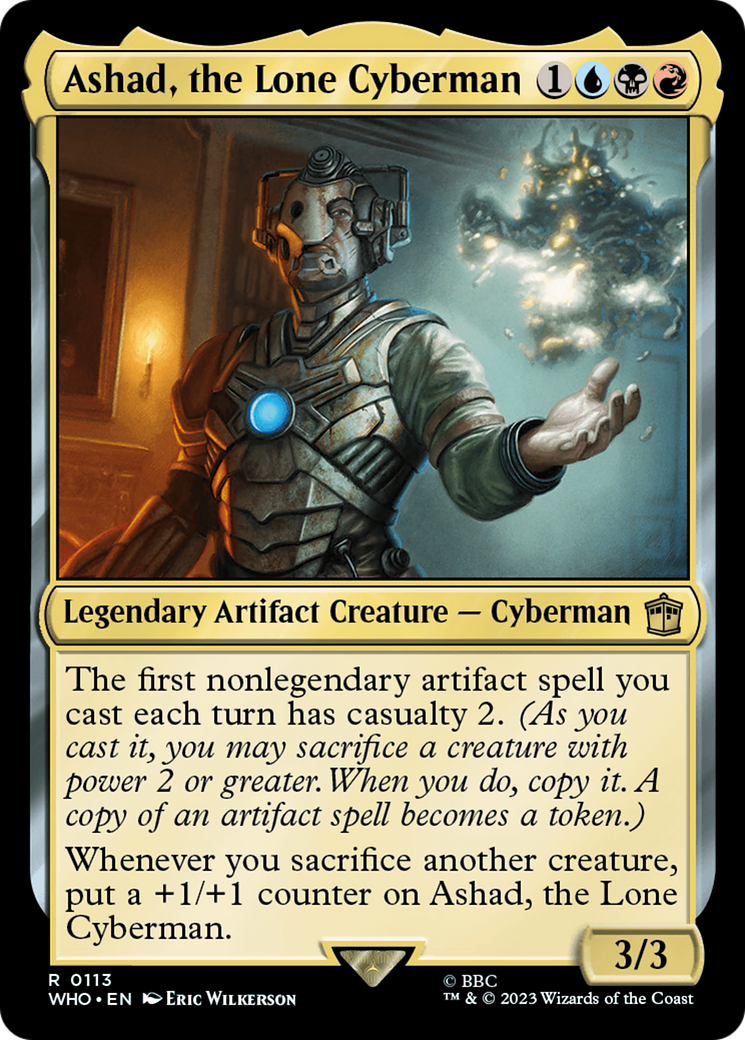
Ashad, the Lone Cyberman
Ashad, the Lone Cyberman
Legendary Artifact Creature — Cyberman
3/3
The first nonlegendary artifact spell you cast each turn has casualty 2. (As you cast it, you may sacrifice a creature with power 2 or greater. When you do, copy it. A copy of an artifact spell becomes a token.)
Whenever you sacrifice another creature, put a +1/+1 counter on Ashad.
- Casualty 2 means "As an additional cost to cast this spell, you may sacrifice a creature with power 2 or greater." and "When you cast this spell, if a casualty cost was paid for it, copy it. If the spell has any targets, you may choose new targets for the copy."
- You may sacrifice only one creature to pay a spell's casualty cost, and you copy the spell only once.
- If you pay the casualty cost of a spell, the copy will resolve before the original spell.
- The copy of the spell is created on the stack, so it's not "cast." Abilities that trigger when a player casts a spell won't trigger.
-
1
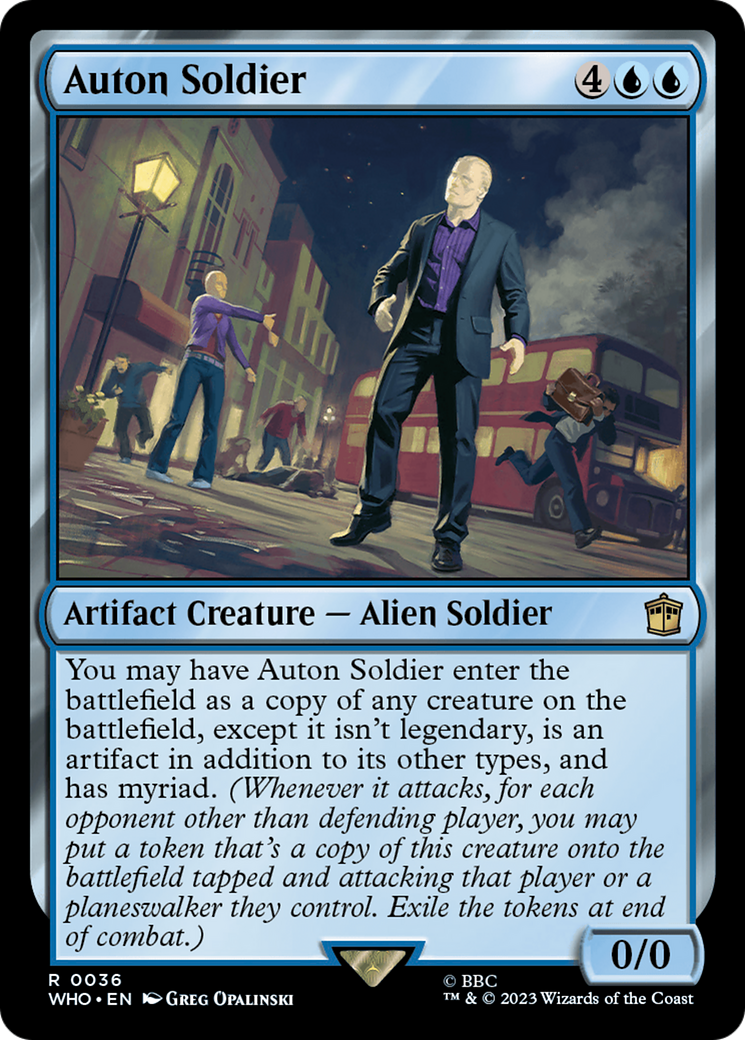
Auton Soldier
Auton Soldier
Artifact Creature — Alien Soldier
0/0
You may have this creature enter as a copy of any creature on the battlefield, except it isn't legendary, is an artifact in addition to its other types, and has myriad. (Whenever it attacks, for each opponent other than defending player, you may create a token copy that's tapped and attacking that player or a planeswalker they control. Exile the tokens at end of combat.)
- The term "defending player" in the myriad rules (or any other ability of an attacking creature) refers to the player the creature with myriad was attacking at the time it became an attacking creature this combat, or the controller of the planeswalker or protector of the battle the creature was attacking at the time it became an attacking creature this combat.
- If the defending player is your only opponent, no tokens are put onto the battlefield.
- You choose whether each token is attacking the player or a planeswalker they control as the token is created.
- Although the tokens enter the battlefield attacking, they were never declared as attackers. Abilities that trigger whenever a creature attacks won't trigger, including the myriad ability of the tokens. If there any costs to have a creature attack, those costs won't apply to the tokens.
- The tokens all enter the battlefield at the same time.
- Each token created by the myriad ability will be a copy of whatever Auton Soldier is copying, along with the listed exceptions. However, it doesn't copy whether Auton Soldier is tapped or untapped, whether it has any counters on it or Auras and Equipment attached to it, or any non-copy effects that have changed its power, toughness, types, color, and so on.
- Any enters-the-battlefield abilities of the copied creature will trigger when the token enters the battlefield. Any "as [this permanent] enters the battlefield" or "[this permanent] enters the battlefield with" abilities of the copied creature will also work.
- If myriad creates more than one token for any given player (due to an effect such as the one Doubling Season creates), you may choose separately for each token whether it's attacking the player or a planeswalker they control.
- If you choose not to have Auton Soldier enter the battlefield as a copy of another creature, it won't have myriad. It will also probably die due to having 0 toughness.
-
1
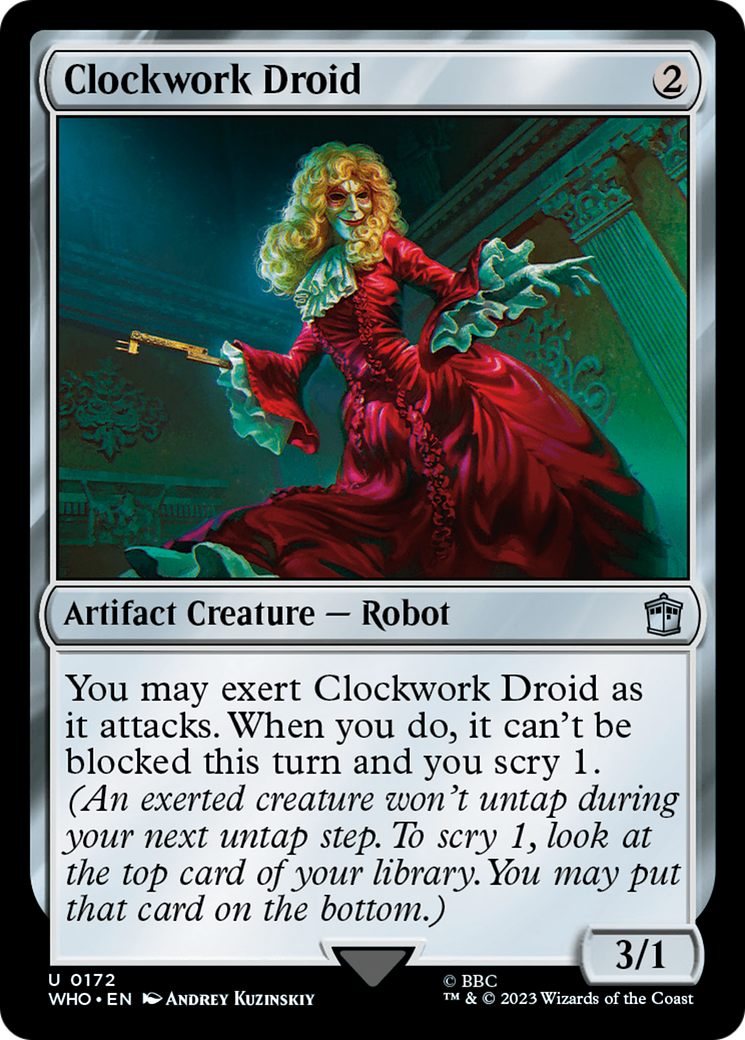
Clockwork Droid
Clockwork Droid
Artifact Creature — Robot
3/1
You may exert this creature as it attacks. When you do, it can't be blocked this turn and you scry 1. (An exerted creature won't untap during your next untap step. To scry 1, look at the top card of your library. You may put that card on the bottom.)
- You can't exert a creature unless an effect allows you to do so. Similar effects that "tap and freeze" a creature don't exert that creature.
- If an exerted creature is already untapped during your next untap step (most likely because it had vigilance or an effect untapped it), exert's effect preventing it from untapping expires without having done anything.
- If you gain control of another player's creature until end of turn and exert it, and then that player regains control of it, it will untap during that player's untap step.
- You may exert Clockwork Droid only as you attack with it. You can't do so later in combat, and creatures put onto the battlefield attacking can't be exerted. The ability that triggers on exerting it will resolve before blockers are declared.
-
1
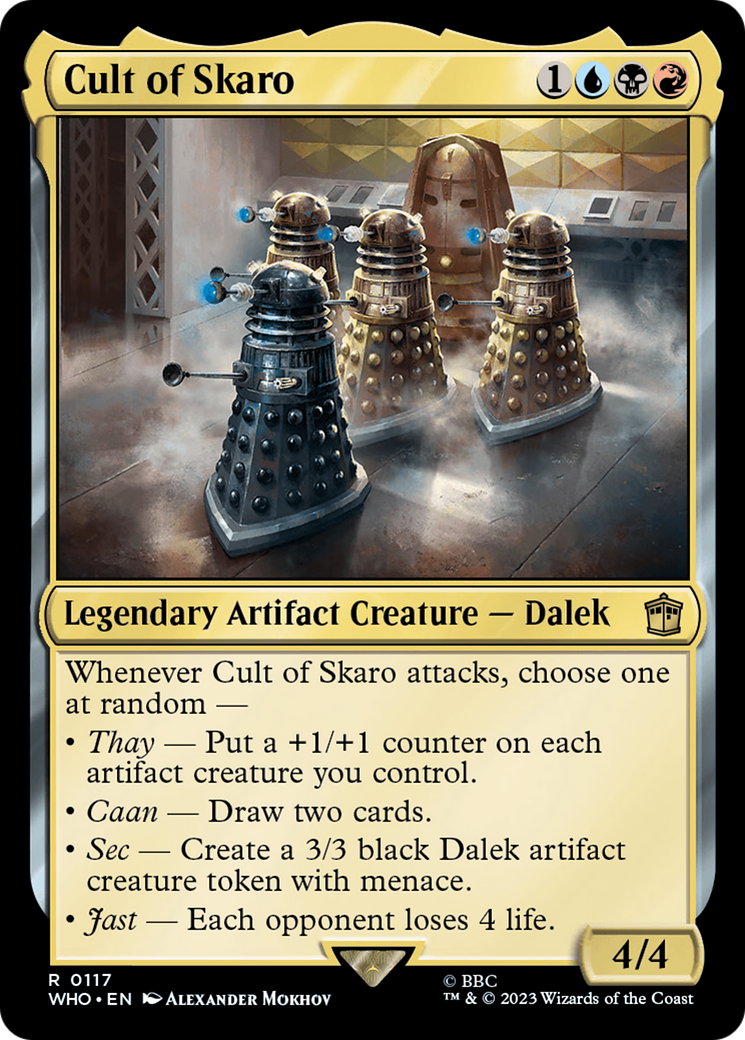
Cult of Skaro
Cult of Skaro
Legendary Artifact Creature — Dalek
4/4
Whenever Cult of Skaro attacks, choose one at random —
- Thay — Put a +1/+1 counter on each artifact creature you control.
- Caan — Draw two cards.
- Sec — Create a 3/3 black Dalek artifact creature token with menace.
- Jast — Each opponent loses 4 life.
-
1
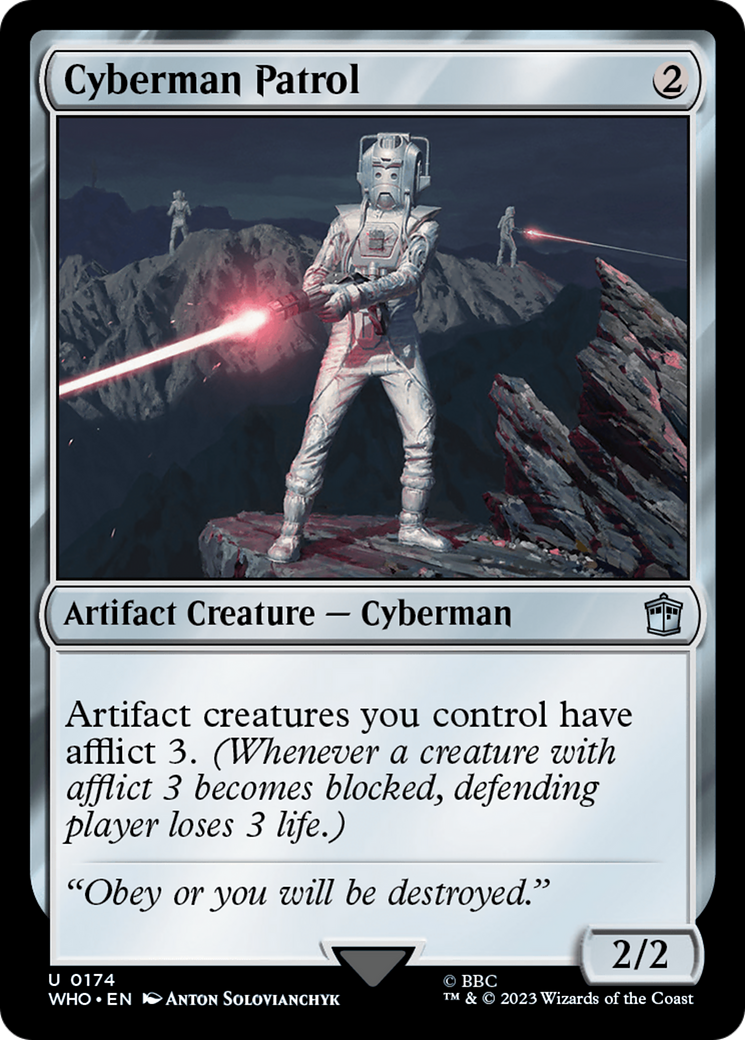
Cyberman Patrol
Cyberman Patrol
Artifact Creature — Cyberman
2/2
Artifact creatures you control have afflict 3. (Whenever a creature with afflict 3 becomes blocked, defending player loses 3 life.)
-
1
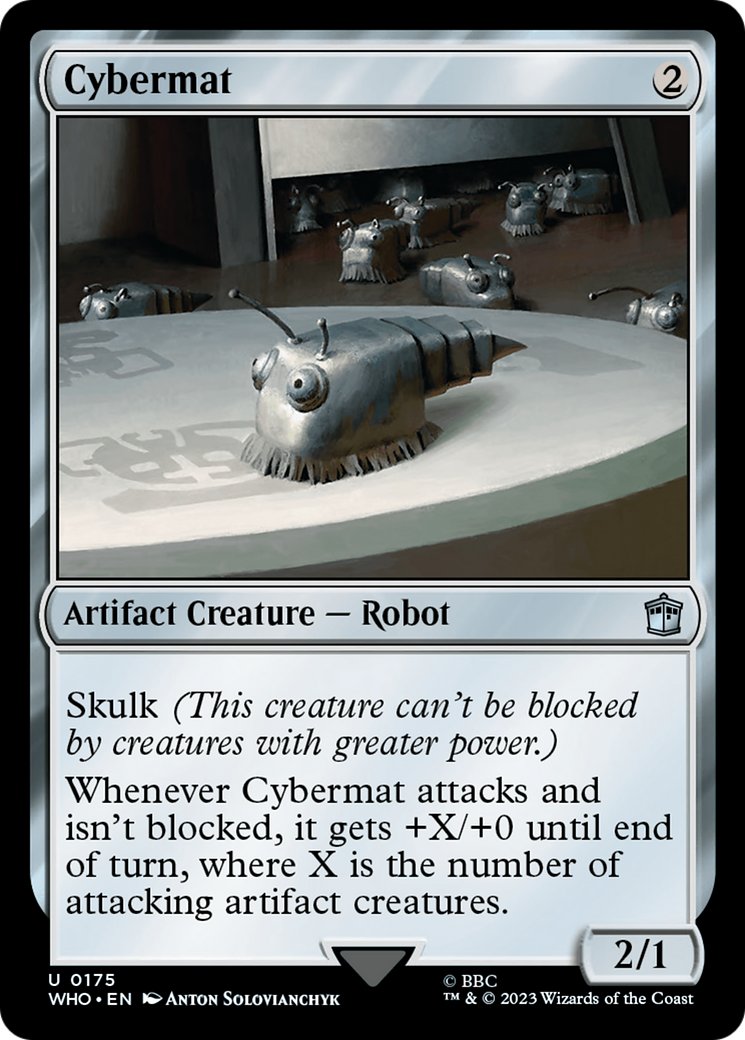
Cybermat
Cybermat
Artifact Creature — Robot
2/1
Skulk (This creature can't be blocked by creatures with greater power.)
Whenever this creature attacks and isn't blocked, it gets +X/+0 until end of turn, where X is the number of attacking artifact creatures.
-
1
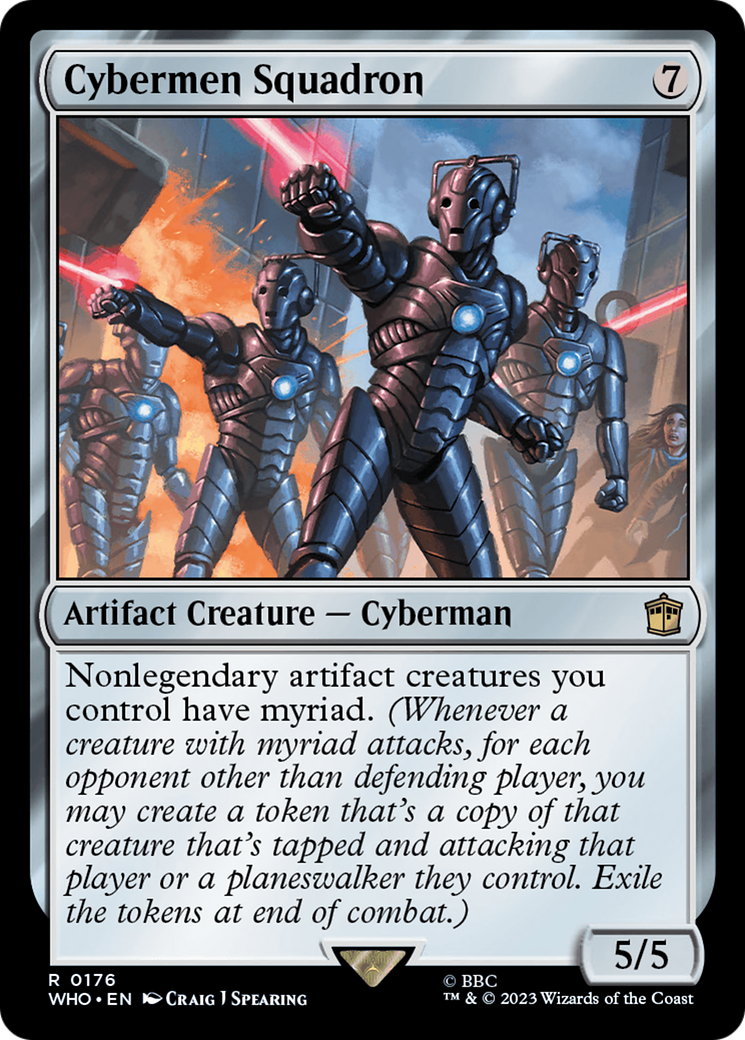
Cybermen Squadron
Cybermen Squadron
Artifact Creature — Cyberman
5/5
Nonlegendary artifact creatures you control have myriad. (Whenever a creature with myriad attacks, for each opponent other than defending player, you may create a token copy that's tapped and attacking that player or a planeswalker they control. Exile the tokens at end of combat.)
- Cybermen Squadron will itself have myriad as long as it remains a nonlegendary artifact creature.
- The term "defending player" in the myriad rules (or any other ability of an attacking creature) refers to the player the creature with myriad was attacking at the time it became an attacking creature this combat, or the controller of the planeswalker or the protector of the battle the creature was attacking at the time it became an attacking creature this combat.
- If the defending player is your only opponent, no tokens are put onto the battlefield.
- You choose whether each token is attacking the player or a planeswalker they control as the token is created.
- Although the tokens enter the battlefield attacking, they were never declared as attackers. Abilities that trigger whenever a creature attacks won't trigger, including the myriad ability of the tokens. If there any costs to have a creature attack, those costs won't apply to the tokens.
- The token creatures all enter the battlefield at the same time.
- Each token copies exactly what was printed on the original creature and nothing else. It doesn't copy whether that creature is tapped or untapped, whether it has any counters on it or Auras and Equipment attached to it, or any non-copy effects that have changed its power, toughness, types, color, and so on.
- Any enters-the-battlefield abilities of the copied creature will trigger when the token enters the battlefield. Any "as [this permanent] enters the battlefield" or "[this permanent] enters the battlefield with" abilities of the copied creature will also work.
- If myriad creates more than one token for any given player (due to an effect such as the one Doubling Season creates), you may choose separately for each token whether it's attacking the player or a planeswalker they control.
- Multiple instances of myriad trigger separately.
-
1
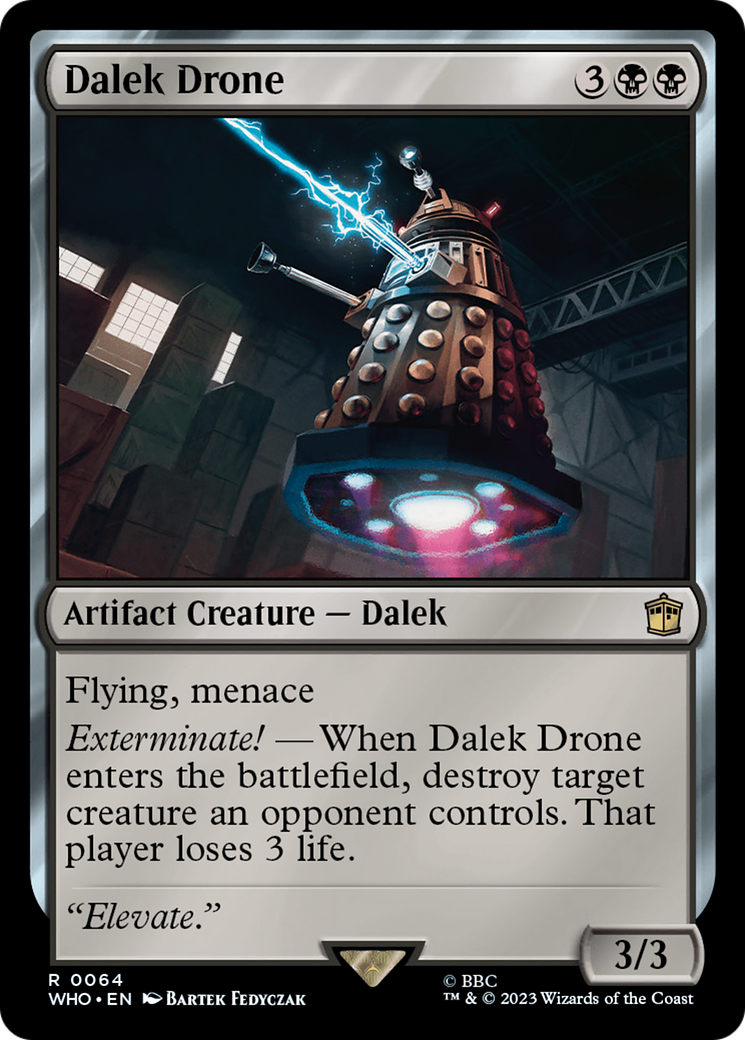
Dalek Drone
Dalek Drone
Artifact Creature — Dalek
3/3
Flying, menace
Exterminate! — When this creature enters, destroy target creature an opponent controls. That player loses 3 life.
-
1
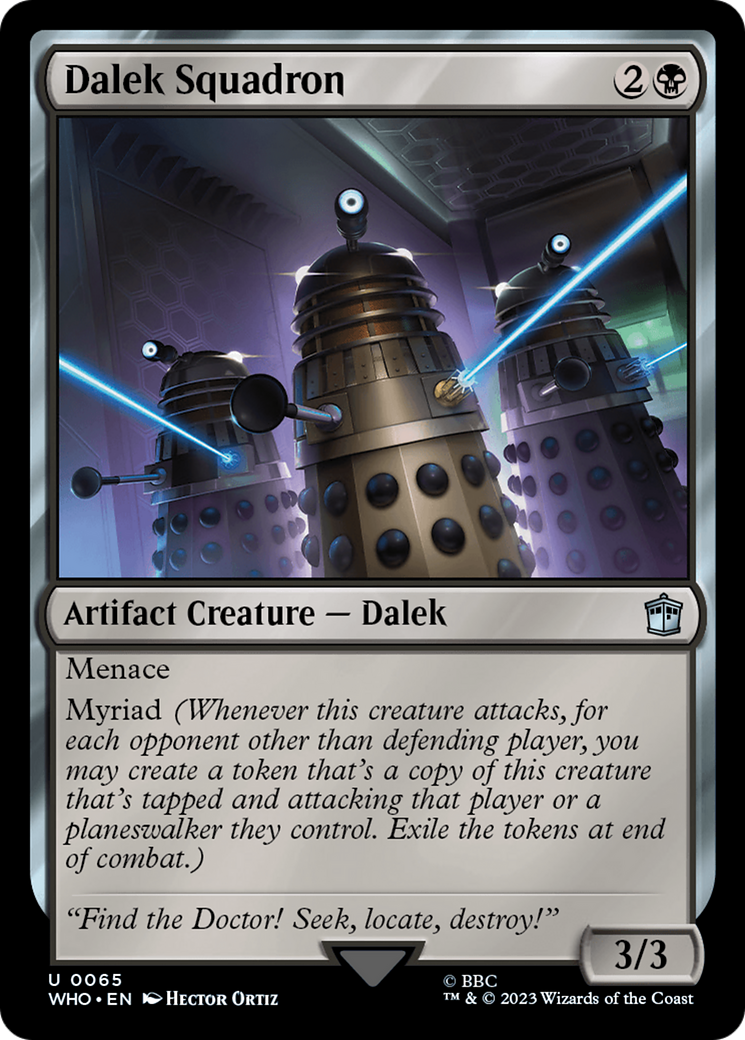
Dalek Squadron
Dalek Squadron
Artifact Creature — Dalek
3/3
Menace
Myriad (Whenever this creature attacks, for each opponent other than defending player, you may create a token copy that's tapped and attacking that player or a planeswalker they control. Exile the tokens at end of combat.)
- The term "defending player" in the myriad rules (or any other ability of an attacking creature) refers to the player the creature with myriad was attacking at the time it became an attacking creature this combat, or the controller of the planeswalker or the protector of the battle the creature was attacking at the time it became an attacking creature this combat.
- If the defending player is your only opponent, no tokens are put onto the battlefield.
- You choose whether each token is attacking the player or a planeswalker they control as the token is created.
- Although the tokens enter the battlefield attacking, they were never declared as attackers. Abilities that trigger whenever a creature attacks won't trigger, including the myriad ability of the tokens. If there any costs to have a creature attack, those costs won't apply to the tokens.
- The token creatures all enter the battlefield at the same time.
- Each token copies exactly what was printed on the original creature and nothing else. It doesn't copy whether that creature is tapped or untapped, whether it has any counters on it or Auras and Equipment attached to it, or any non-copy effects that have changed its power, toughness, types, color, and so on.
- Any enters-the-battlefield abilities of the copied creature will trigger when the token enters the battlefield. Any "as [this permanent] enters the battlefield" or "[this permanent] enters the battlefield with" abilities of the copied creature will also work.
- If myriad creates more than one token for any given player (due to an effect such as the one Doubling Season creates), you may choose separately for each token whether it's attacking the player or a planeswalker they control.
-
1
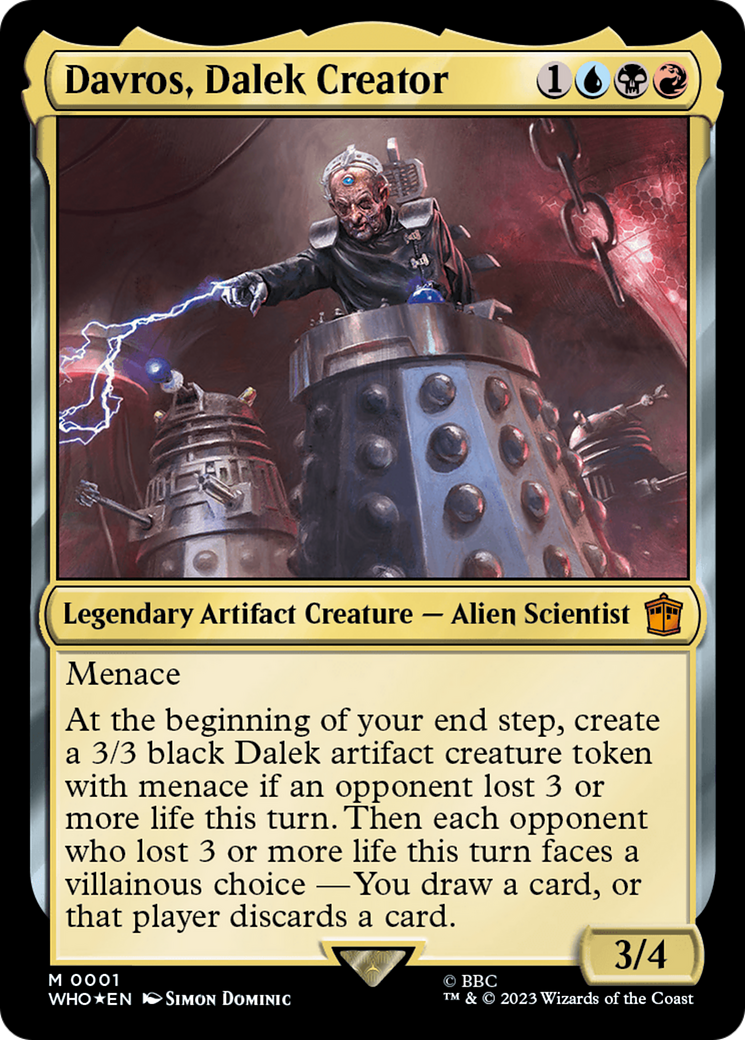
Davros, Dalek Creator
Davros, Dalek Creator
Legendary Artifact Creature — Alien Scientist
3/4
Menace
At the beginning of your end step, create a 3/3 black Dalek artifact creature token with menace if an opponent lost 3 or more life this turn. Then each opponent who lost 3 or more life this turn faces a villainous choice — You draw a card, or that player discards a card.
- When a player faces a villainous choice, they first choose one of the two options, then all actions in the chosen option are performed.
- If a spell or ability requires multiple players to face a villainous choice, the result is a little different from other effects in Magic. In that case, the first player in turn order makes their choice and the action for that choice is performed before the next player makes their choice. Then each of the remaining players repeat this process in turn order.
- A player facing a villainous choice can always choose either option, even if one or both of the options are impossible. For example, if one of the options is to sacrifice a creature, a player who controls no creatures can still choose that option.
-
1
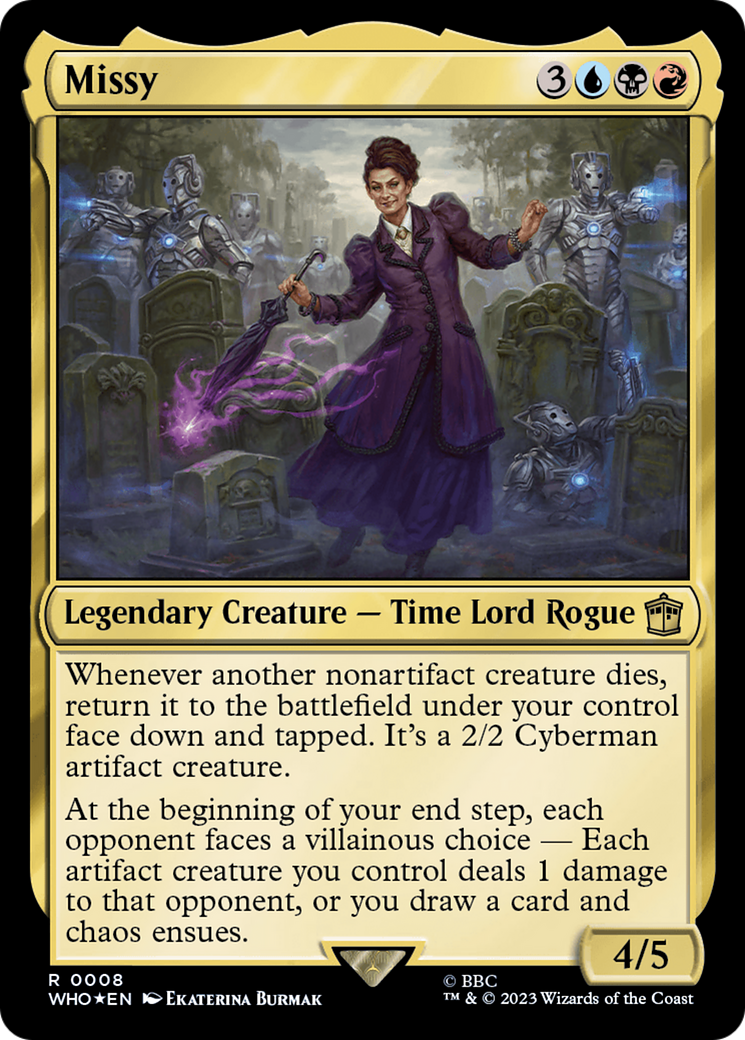
Missy
Missy
Legendary Creature — Time Lord Rogue
4/5
Whenever another nonartifact creature dies, return it to the battlefield under your control face down and tapped. It's a 2/2 Cyberman artifact creature.
At the beginning of your end step, each opponent faces a villainous choice — Each artifact creature you control deals 1 damage to that opponent, or you draw a card and chaos ensues.
- When a player faces a villainous choice, they first choose one of the two options, then all actions in the chosen option are performed.
- Each creature turned face down this way or put onto the battlefield this way is a 2/2 Cyberman artifact creature with no name and no color.
- If, for any reason, the face-down creature is turned face up, the effect making it a Cyberman ends. It will be whatever is printed on the card.
- The player who controls a face-down permanent may look at it at any time. Notably, if the cards were put on the battlefield face down from another player's library, the player that owns them does not get to look at those cards.
- Double-faced permanents that are already on the battlefield can't be turned face down this way. However, a double-faced card can be put onto the battlefield face down from another zone this way.
- If the face-down card has a morph ability, its controller may turn it face up by paying the associated morph cost.
- If a spell or ability requires multiple players to face a villainous choice, the result is a little different from other effects in Magic. In that case, the first player in turn order makes their choice and the action for that choice is performed before the next player makes their choice. Then each of the remaining players repeat this process in turn order.
- A player facing a villainous choice can always choose either option, even if one or both of the options are impossible. For example, if one of the options is to sacrifice a creature, a player who controls no creatures can still choose that option.
- Unlike other creature types in Magic that are each only one word, the two words "Time Lord" represent a single creature subtype. Time Lord is the only two-word creature type.
- Neither "Time" nor "Lord" are creature types. Some older cards were printed with the subtype "Lord," but all of those cards have updated Oracle card text that removed that type.
- If an effect instructs you to choose a creature type, you may choose Time Lord.
-
1
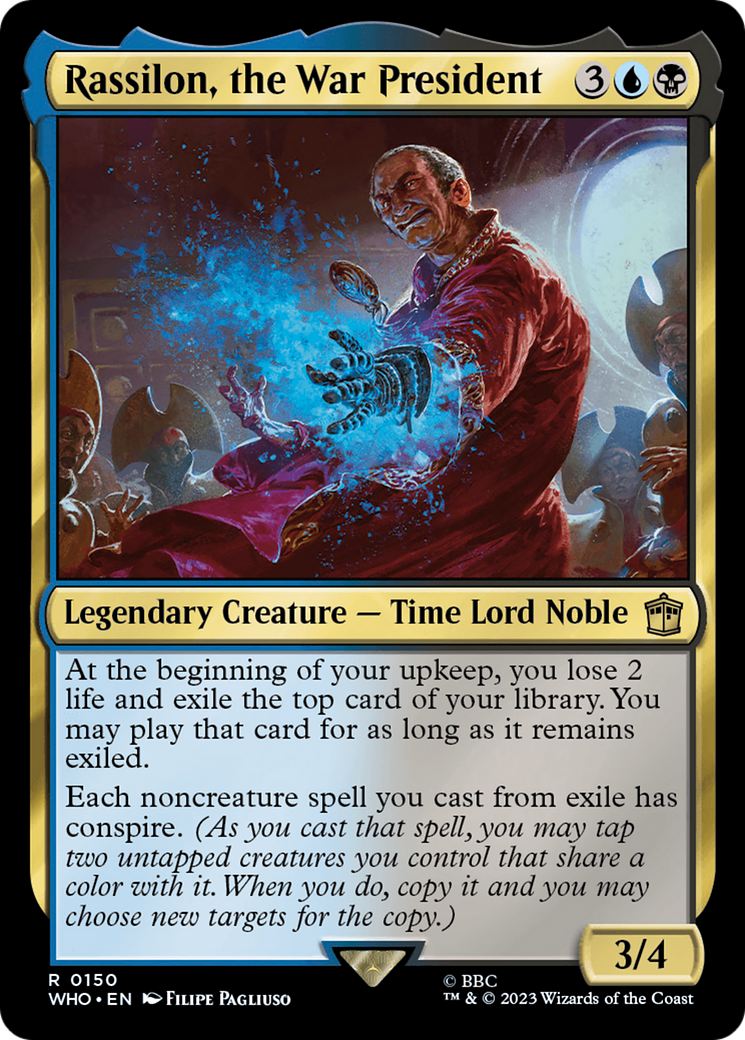
Rassilon, the War President
Rassilon, the War President
Legendary Creature — Time Lord Noble
3/4
At the beginning of your upkeep, you lose 2 life and exile the top card of your library. You may play that card for as long as it remains exiled.
Each noncreature spell you cast from exile has conspire. (As you cast that spell, you may tap two untapped creatures you control that share a color with it. When you do, copy it and you may choose new targets for the copy.)
- You must pay all costs and follow all normal timing rules for playing a card exiled this way. For example, you may play a land this way only during your main phase while the stack is empty.
- Unlike other creature types in Magic that are each only one word, the two words "Time Lord" represent a single creature subtype. Time Lord is the only two-word creature type.
- Neither "Time" nor "Lord" are creature types. Some older cards were printed with the subtype "Lord," but all of those cards have updated Oracle card text that removed that type.
- If an effect instructs you to choose a creature type, you may choose Time Lord.
-
1
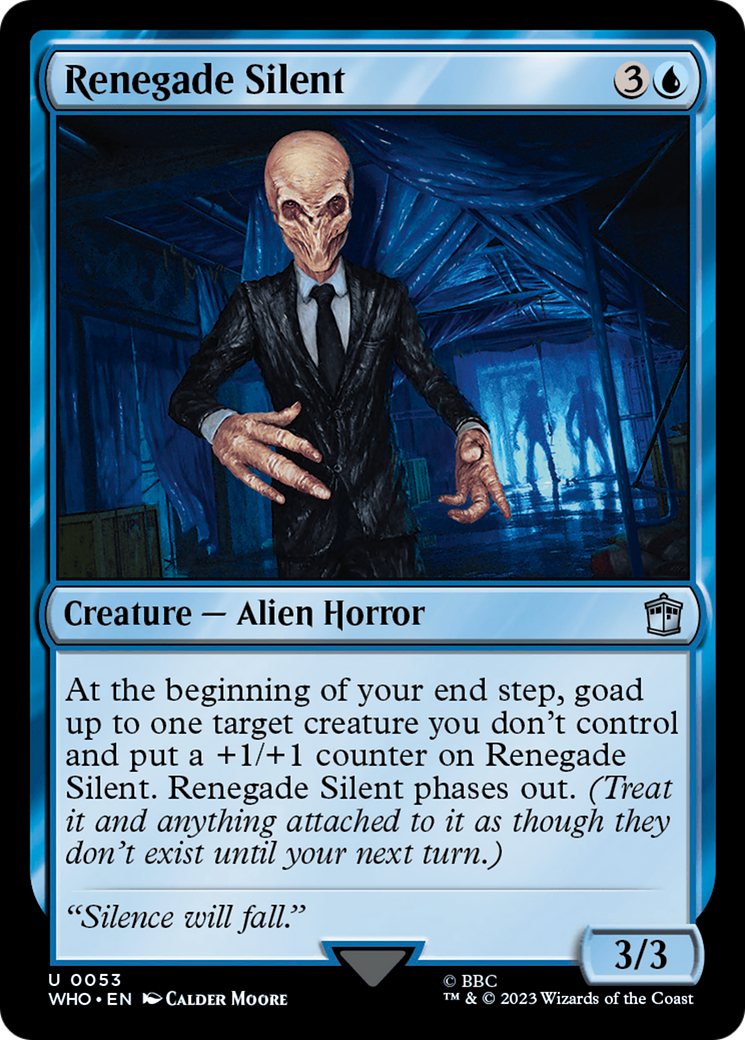
Renegade Silent
Renegade Silent
Creature — Alien Horror
3/3
At the beginning of your end step, goad up to one target creature you don't control and put a +1/+1 counter on this creature. This creature phases out. (Treat it and anything attached to it as though they don't exist until your next turn.)
- Phased-out permanents are treated as though they don't exist. They can't be the targets of spells or abilities, their static abilities have no effect on the game, their triggered abilities can't trigger, they can't attack or block, and so on.
- As Renegade Silent phases out, Auras and Equipment attached to it also phase out at the same time. Those Auras and Equipment will phase in at the same time Renegade Silent does, and they'll phase in still attached to Renegade Silent. Similarly, it will phase in with any counters it had on it.
- Permanents phase back in during their controller's untap step, immediately before that player untaps their permanents. Creatures that phase in this way are able to attack and pay a cost of during that turn.
- Phasing out doesn't cause any "leaves the battlefield" abilities to trigger. Similarly, phasing in won't cause any "enters the battlefield" abilities to trigger.
- Any continuous effects with a "for as long as" duration, such as that of Mind Flayer, ignore phased-out objects. If ignoring those objects causes the effect's conditions to no longer be met, the duration will expire.
- Choices made for permanents as they entered the battlefield are remembered when they phase in.
- If an opponent gains control of your Renegade Silent until end of turn, it will phase out while they still have control of it. The control-changing effect ends while it is phased out, and it phases in under your control as that opponent's next untap step begins. If they leave the game before their next untap step, Renegade Silent phases in as the next untap step begins after their turn would have begun.
-
1
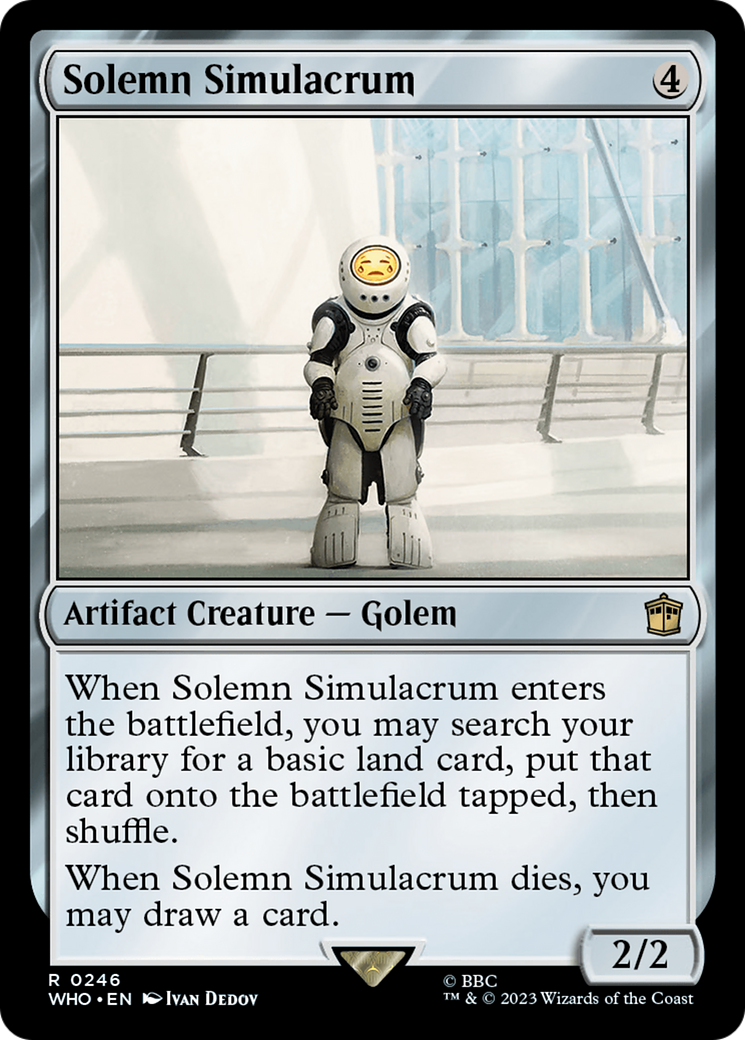
Solemn Simulacrum
Solemn Simulacrum
Artifact Creature — Golem
2/2
When this creature enters, you may search your library for a basic land card, put that card onto the battlefield tapped, then shuffle.
When this creature dies, you may draw a card.
-
1
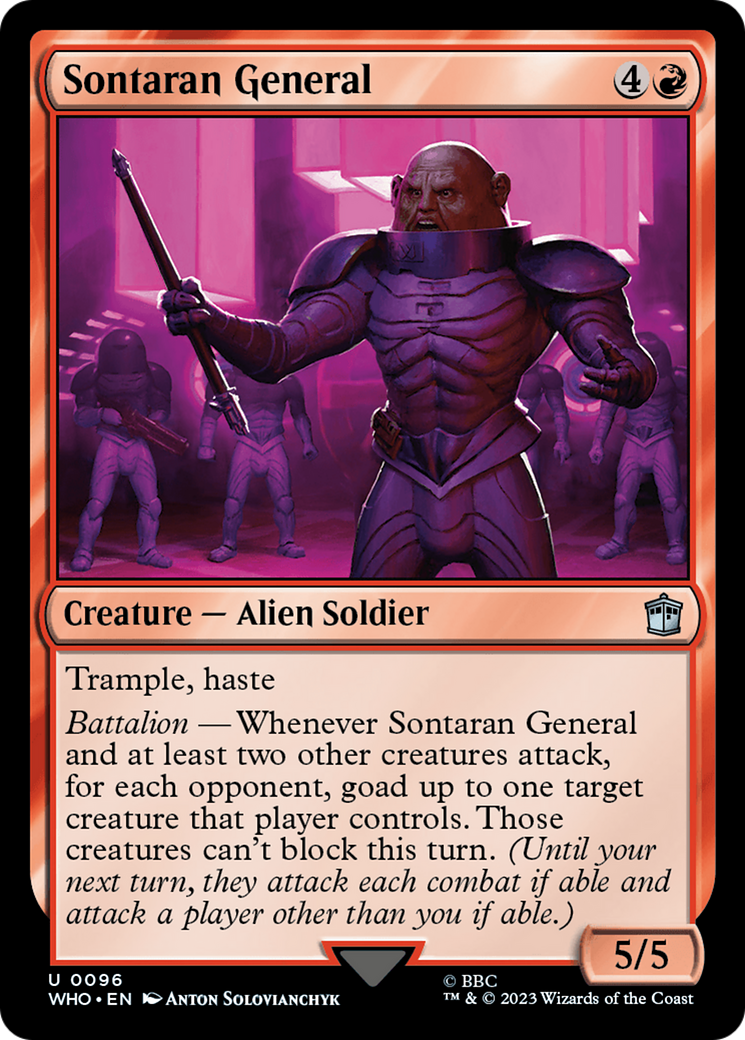
Sontaran General
Sontaran General
Creature — Alien Soldier
5/5
Trample, haste
Battalion — Whenever this creature and at least two other creatures attack, for each opponent, goad up to one target creature that player controls. Those creatures can't block this turn. (Until your next turn, they attack each combat if able and attack a player other than you if able.)
-
1
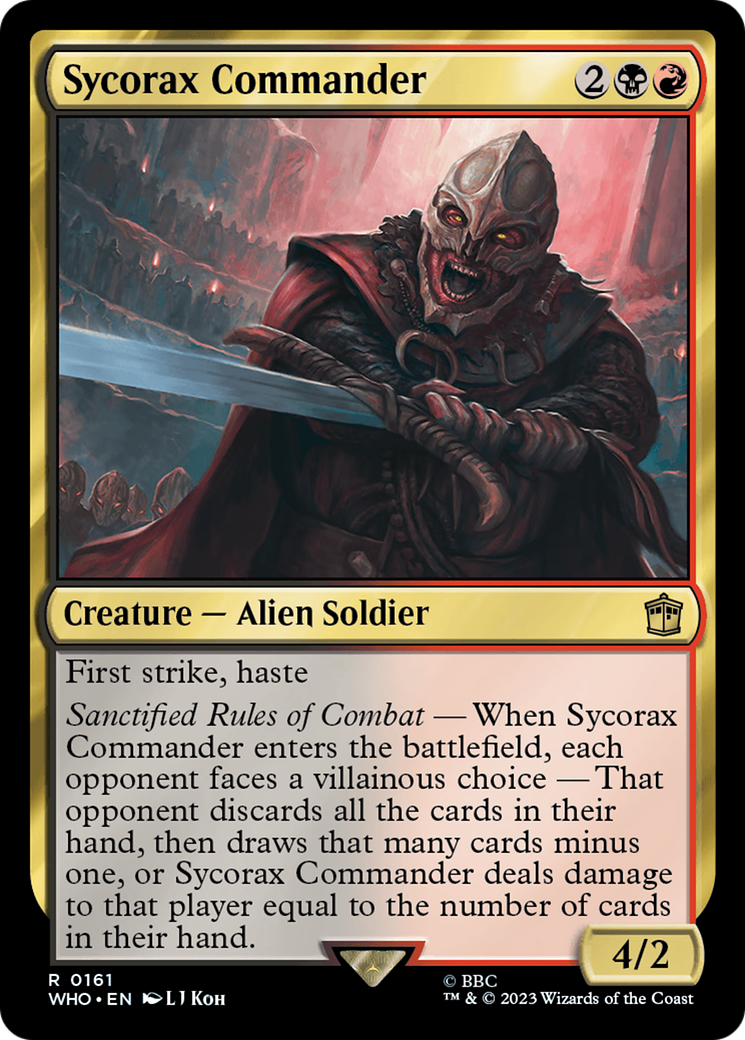
Sycorax Commander
Sycorax Commander
Creature — Alien Soldier
4/2
First strike, haste
Sanctified Rules of Combat — When this creature enters, each opponent faces a villainous choice — That opponent discards all the cards in their hand, then draws that many cards minus one, or this creature deals damage to that player equal to the number of cards in their hand.
- When a player faces a villainous choice, they first choose one of the two options, then all actions in the chosen option are performed.
- If a spell or ability requires multiple players to face a villainous choice, the result is a little different from other effects in Magic. In that case, the first player in turn order makes their choice and the action for that choice is performed before the next player makes their choice. Then each of the remaining players repeat this process in turn order.
- A player facing a villainous choice can always choose either option, even if one or both of the options are impossible. For example, if one of the options is to sacrifice a creature, a player who controls no creatures can still choose that option.
-
1
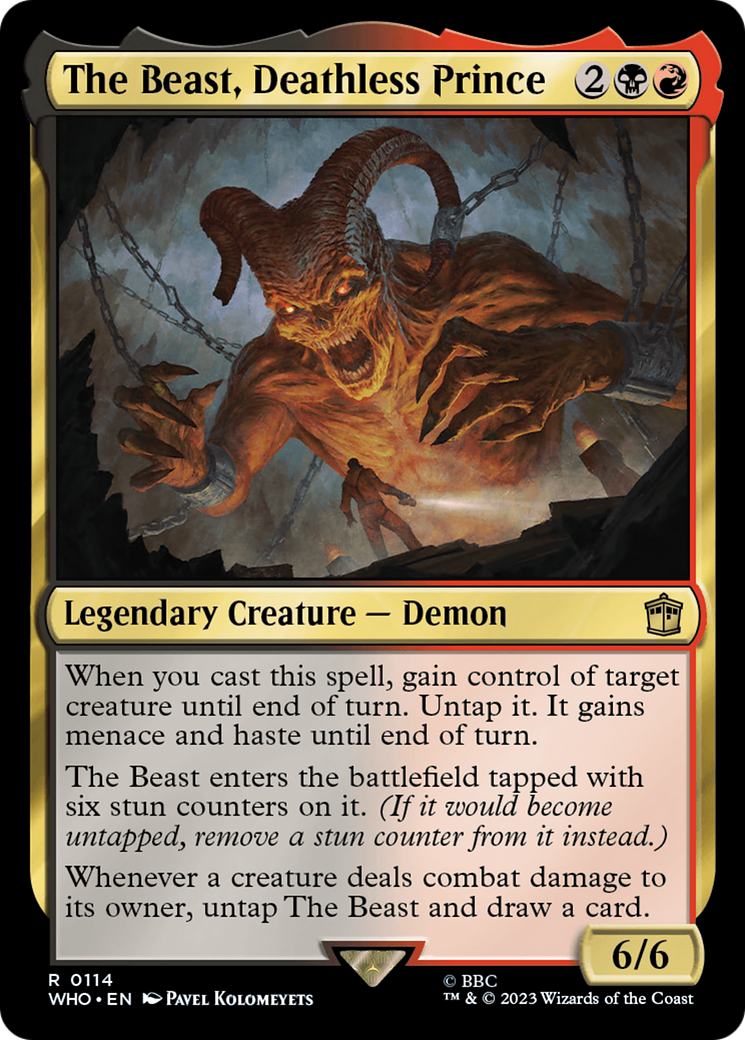
The Beast, Deathless Prince
The Beast, Deathless Prince
Legendary Creature — Demon
6/6
When you cast this spell, gain control of target creature until end of turn. Untap it. It gains menace and haste until end of turn.
The Beast enters tapped with six stun counters on it. (If it would become untapped, remove a stun counter from it instead.)
Whenever a creature deals combat damage to its owner, untap The Beast and draw a card.
-
1
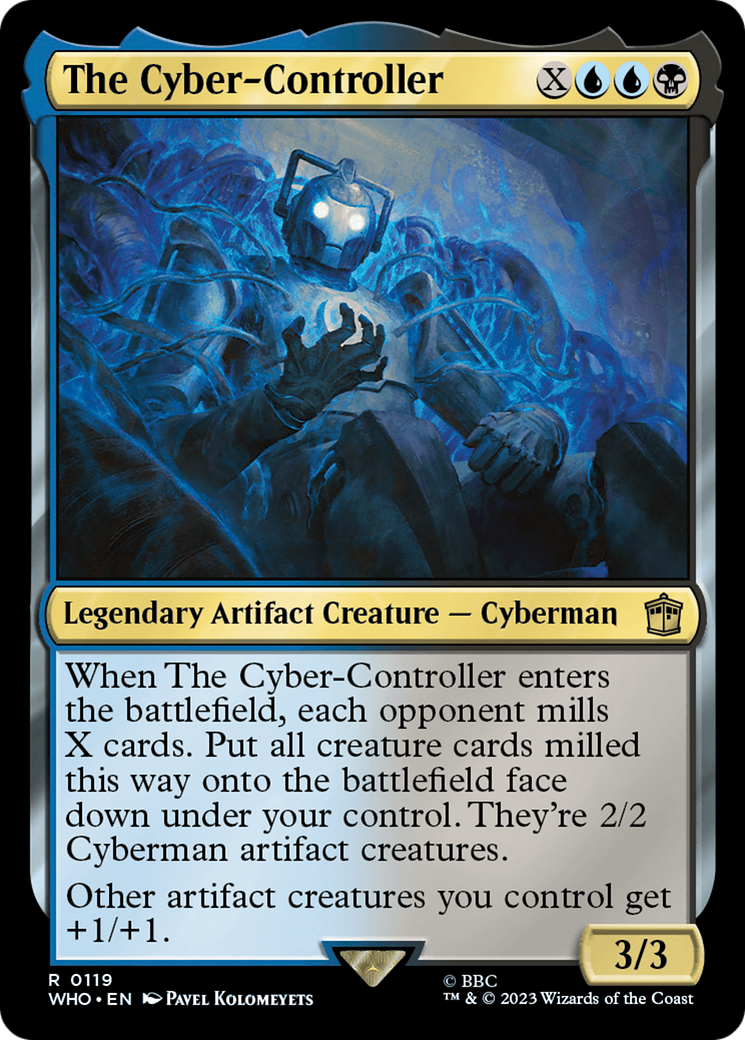
The Cyber-Controller
The Cyber-Controller
Legendary Artifact Creature — Cyberman
3/3
When The Cyber-Controller enters, each opponent mills X cards. Put all creature cards milled this way onto the battlefield face down under your control. They're 2/2 Cyberman artifact creatures.
Other artifact creatures you control get +1/+1.
- Each creature turned face down this way or put onto the battlefield this way is a 2/2 Cyberman artifact creature with no name and no color.
- If, for any reason, the face-down creature is turned face up, the effect making it a Cyberman ends. It will be whatever is printed on the card.
- The player who controls a face-down permanent may look at it at any time. Notably, if the cards were put on the battlefield face down from another player's library, the player that owns them does not get to look at those cards.
- Double-faced permanents that are already on the battlefield can't be turned face down this way. However, a double-faced card can be put onto the battlefield face down from another zone this way.
- If the face-down card has a morph ability, its controller may turn it face up by paying the associated morph cost.
-
1
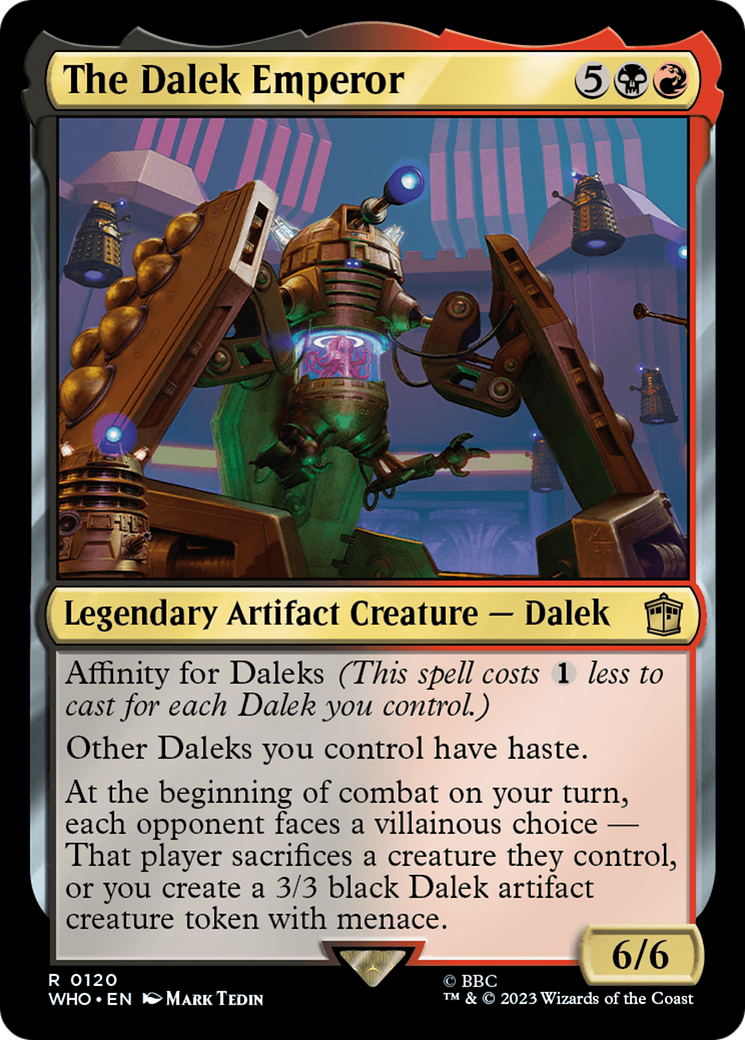
The Dalek Emperor
The Dalek Emperor
Legendary Artifact Creature — Dalek
6/6
Affinity for Daleks (This spell costs less to cast for each Dalek you control.)
Other Daleks you control have haste.
At the beginning of combat on your turn, each opponent faces a villainous choice — That player sacrifices a creature of their choice, or you create a 3/3 black Dalek artifact creature token with menace.
- When a player faces a villainous choice, they first choose one of the two options, then all actions in the chosen option are performed.
- If a spell or ability requires multiple players to face a villainous choice, the result is a little different from other effects in Magic. In that case, the first player in turn order makes their choice and the action for that choice is performed before the next player makes their choice. Then each of the remaining players repeat this process in turn order.
- A player facing a villainous choice can always choose either option, even if one or both of the options are impossible. For example, if one of the options is to sacrifice a creature, a player who controls no creatures can still choose that option.
-
1
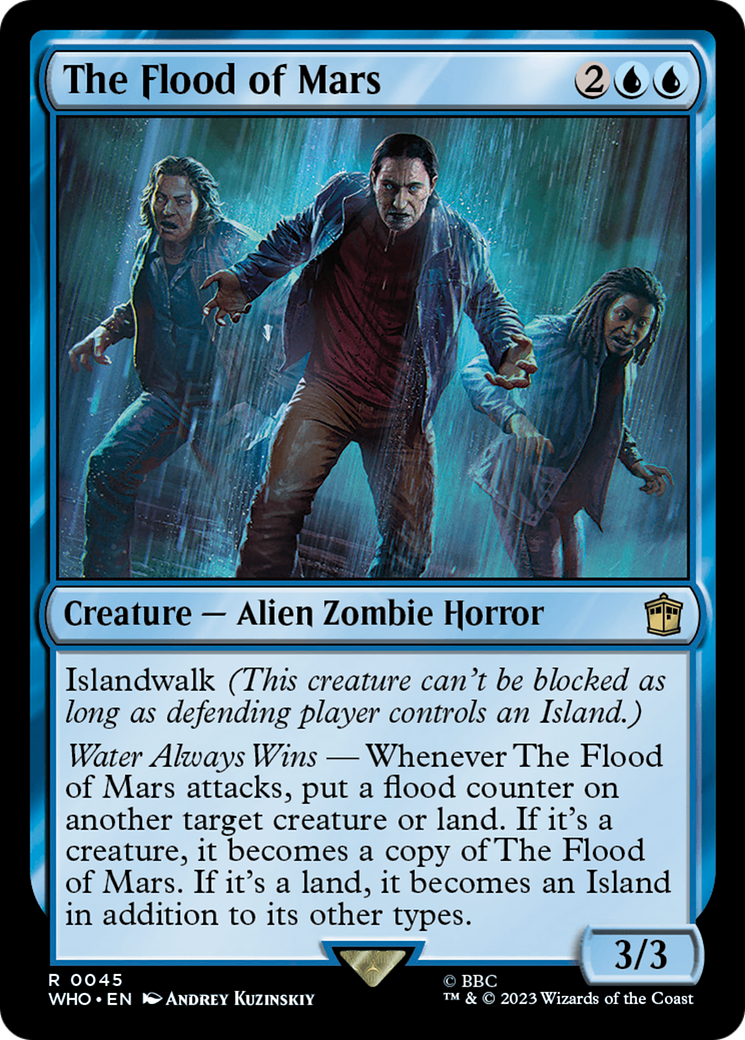
The Flood of Mars
The Flood of Mars
Creature — Alien Zombie Horror
3/3
Islandwalk (This creature can't be blocked as long as defending player controls an Island.)
Water Always Wins — Whenever this creature attacks, put a flood counter on another target creature or land. If it's a creature, it becomes a copy of this creature. If it's a land, it becomes an Island in addition to its other types.
- If the target is both a creature and a land as the triggered ability resolves, it will become a copy of The Flood of Mars. Excepting some very unusual cases, that copy won't be a land, so it won't also become an Island.
-
1
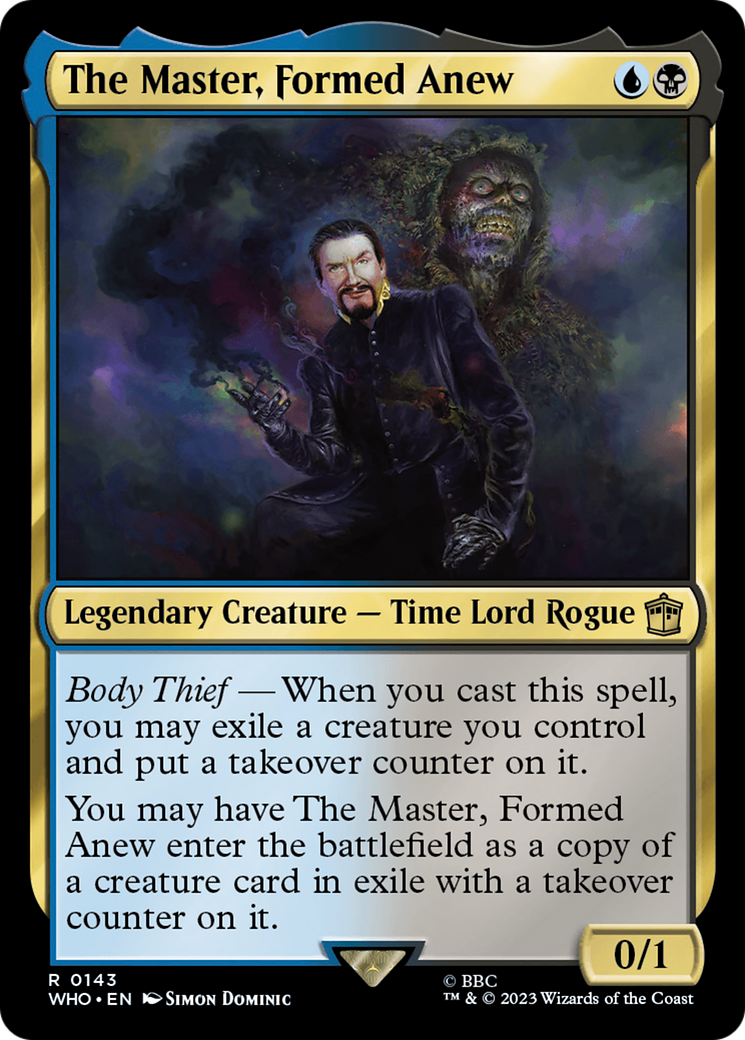
The Master, Formed Anew
The Master, Formed Anew
Legendary Creature — Time Lord Rogue
0/1
Body Thief — When you cast this spell, you may exile a creature you control and put a takeover counter on it.
You may have The Master enter as a copy of a creature card in exile with a takeover counter on it.
- Unlike other creature types in Magic that are each only one word, the two words "Time Lord" represent a single creature subtype. Time Lord is the only two-word creature type.
- Neither "Time" nor "Lord" are creature types. Some older cards were printed with the subtype "Lord," but all of those cards have updated Oracle card text that removed that type.
- If an effect instructs you to choose a creature type, you may choose Time Lord.
-
1
The Master, Gallifrey's End
The Master, Gallifrey's End
Legendary Creature — Time Lord Rogue
4/3
Make Them Pay — Whenever a nontoken artifact creature you control dies, you may exile it. If you do, choose an opponent with the most life among your opponents. That player faces a villainous choice — They lose 4 life, or you create a token that's a copy of that card.
- When a player faces a villainous choice, they first choose one of the two options, then all actions in the chosen option are performed.
- If a spell or ability requires multiple players to face a villainous choice, the result is a little different from other effects in Magic. In that case, the first player in turn order makes their choice and the action for that choice is performed before the next player makes their choice. Then each of the remaining players repeat this process in turn order.
- A player facing a villainous choice can always choose either option, even if one or both of the options are impossible. For example, if one of the options is to sacrifice a creature, a player who controls no creatures can still choose that option.
- Unlike other creature types in Magic that are each only one word, the two words "Time Lord" represent a single creature subtype. Time Lord is the only two-word creature type.
- Neither "Time" nor "Lord" are creature types. Some older cards were printed with the subtype "Lord," but all of those cards have updated Oracle card text that removed that type.
- If an effect instructs you to choose a creature type, you may choose Time Lord.
-
1
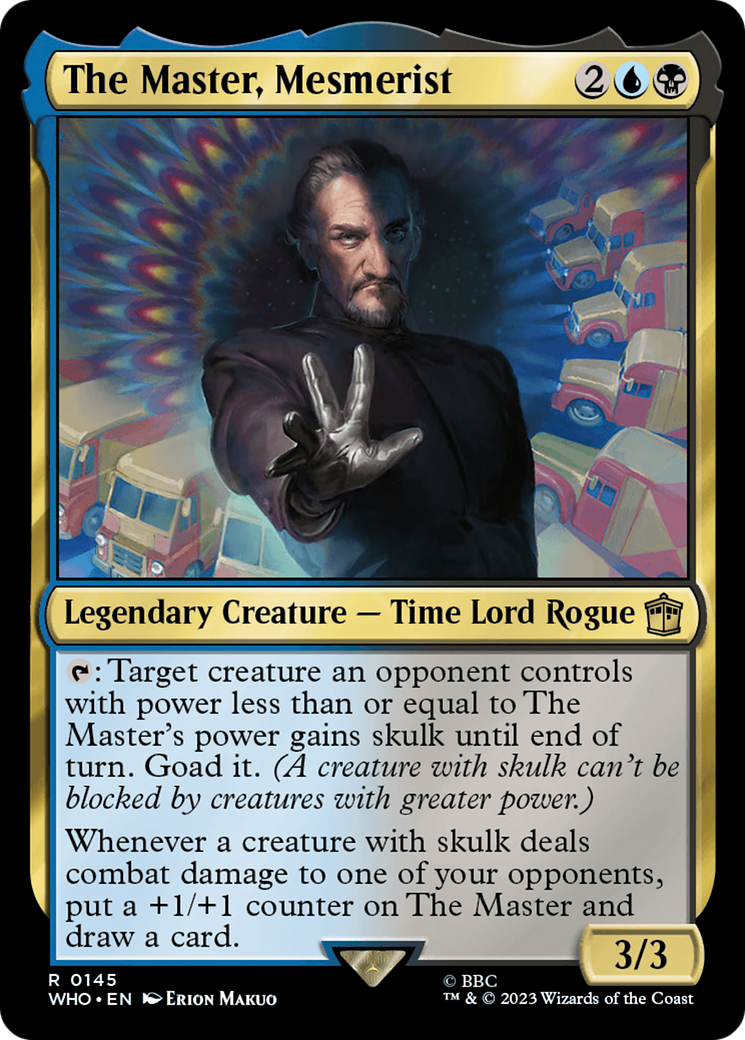
The Master, Mesmerist
The Master, Mesmerist
Legendary Creature — Time Lord Rogue
3/3
: Target creature an opponent controls with power less than or equal to The Master's power gains skulk until end of turn. Goad it. (A creature with skulk can't be blocked by creatures with greater power.)
Whenever a creature with skulk deals combat damage to one of your opponents, put a +1/+1 counter on The Master and draw a card.
- Unlike other creature types in Magic that are each only one word, the two words "Time Lord" represent a single creature subtype. Time Lord is the only two-word creature type.
- Neither "Time" nor "Lord" are creature types. Some older cards were printed with the subtype "Lord," but all of those cards have updated Oracle card text that removed that type.
- If an effect instructs you to choose a creature type, you may choose Time Lord.
-
1
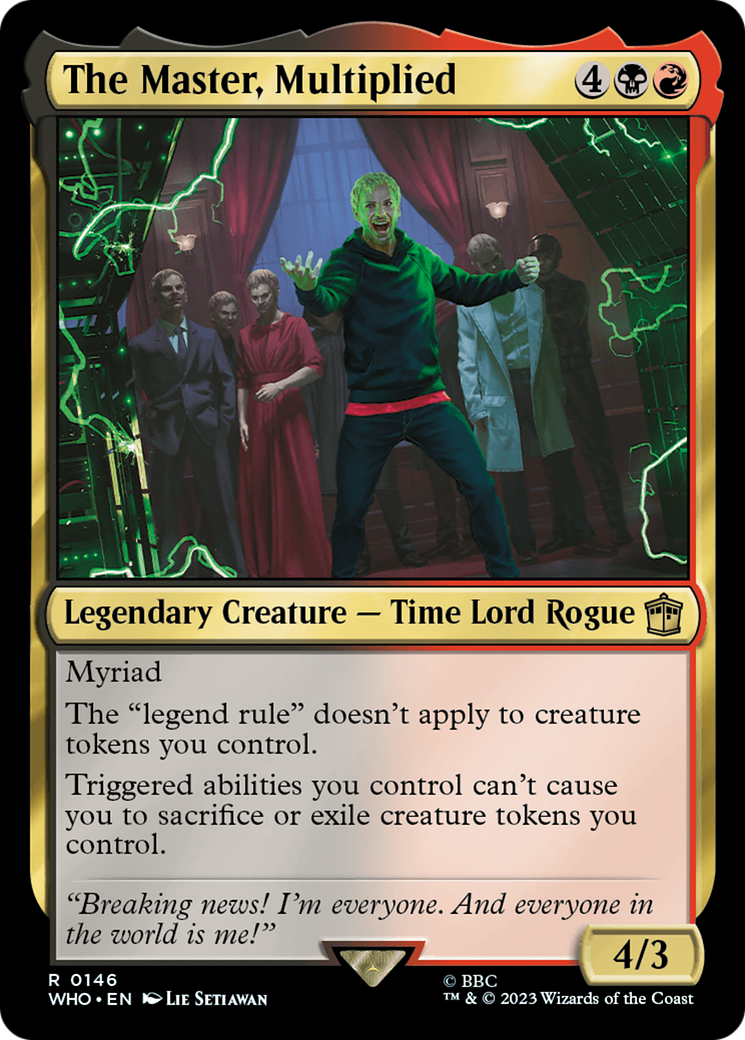
The Master, Multiplied
The Master, Multiplied
Legendary Creature — Time Lord Rogue
4/3
Myriad
The "legend rule" doesn't apply to creature tokens you control.
Triggered abilities you control can't cause you to sacrifice or exile creature tokens you control.
- If, while you control The Master, Multiplied, you also control a token legendary permanent and a single nontoken legendary permanent with the same name, the legend rule will not cause you to put either one into your graveyard.
- The term "defending player" in the myriad rules (or any other ability of an attacking creature) refers to the player the creature with myriad was attacking at the time it became an attacking creature this combat, or the controller of the planeswalker or the protector of the battle the creature was attacking at the time it became an attacking creature this combat.
- If the defending player is your only opponent, no tokens are put onto the battlefield.
- You choose whether each token is attacking the player or a planeswalker they control as the token is created.
- Although the tokens enter the battlefield attacking, they were never declared as attackers. Abilities that trigger whenever a creature attacks won't trigger, including the myriad ability of the tokens. If there any costs to have a creature attack, those costs won't apply to the tokens.
- The token creatures all enter the battlefield at the same time.
- Notably, the part of myriad that makes you exile the creature tokens at end of combat is a triggered ability. This means that the ability will trigger, but you won't exile the tokens when it resolves. Since the tokens also have myriad, attacking with each of them will cause that myriad ability to trigger, causing the Master to, well . . . multiply.
- Any enters-the-battlefield abilities of the copied creature will trigger when the token enters the battlefield. Any "as [this permanent] enters the battlefield" or "[this permanent] enters the battlefield with" abilities of the copied creature will also work.
- If myriad creates more than one token for any given player (due to an effect such as the one Doubling Season creates), you may choose separately for each token whether it's attacking the player or a planeswalker they control.
- Unlike other creature types in Magic that are each only one word, the two words "Time Lord" represent a single creature subtype. Time Lord is the only two-word creature type.
- Neither "Time" nor "Lord" are creature types. Some older cards were printed with the subtype "Lord," but all of those cards have updated Oracle card text that removed that type.
- If an effect instructs you to choose a creature type, you may choose Time Lord.
- Each token copies exactly what was printed on the original creature and nothing else. It doesn't copy whether that creature is tapped or untapped, whether it has any counters on it or Auras and Equipment attached to it, or any non-copy effects that have changed its power, toughness, types, color, and so on.
-
1
The Rani
The Rani
Legendary Creature — Time Lord Scientist
3/4
Whenever The Rani enters or attacks, create a red Aura enchantment token named Mark of the Rani attached to another target creature. That token has enchant creature and "Enchanted creature gets +2/+2 and is goaded."
Whenever a goaded creature deals combat damage to one of your opponents, investigate.
- Unlike other creature types in Magic that are each only one word, the two words "Time Lord" represent a single creature subtype. Time Lord is the only two-word creature type.
- Neither "Time" nor "Lord" are creature types. Some older cards were printed with the subtype "Lord," but all of those cards have updated Oracle card text that removed that type.
- If an effect instructs you to choose a creature type, you may choose Time Lord.
-
1
The Valeyard
The Valeyard
Legendary Creature — Time Lord Noble
4/5
If an opponent would face a villainous choice, they face that choice an additional time. (They can make the same or different choices.)
While voting, you may vote an additional time.
- Neither "Time" nor "Lord" are creature types. Some older cards were printed with the subtype "Lord," but all of those cards have updated Oracle card text that removed that type.
- If an effect instructs you to choose a creature type, you may choose Time Lord.
- Unlike other creature types in Magic that are each only one word, the two words "Time Lord" represent a single creature subtype. Time Lord is the only two-word creature type.
-
1
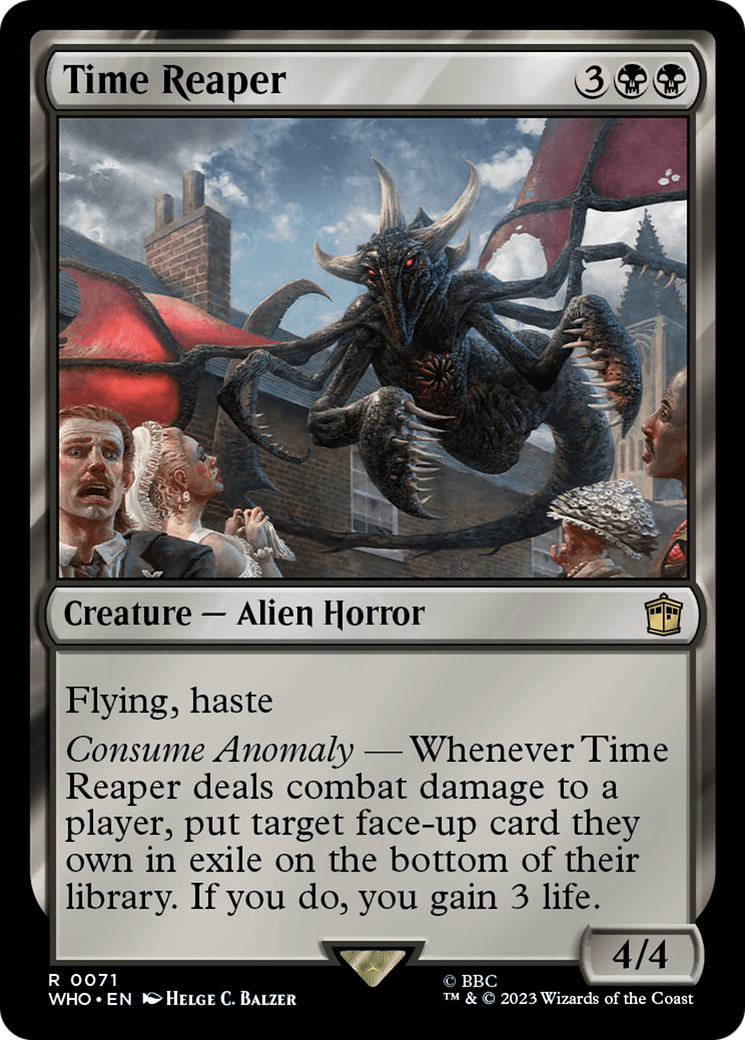
Time Reaper
Time Reaper
Creature — Alien Horror
4/4
Flying, haste
Consume Anomaly — Whenever this creature deals combat damage to a player, put target face-up card they own in exile on the bottom of their library. If you do, you gain 3 life.
- Most cards in exile are face up and can be targeted by Time Reaper's triggered ability. A card is face down in the exile zone only if the effect or action that put it there specifically says it puts it there face down (like the foretell ability).
-
1
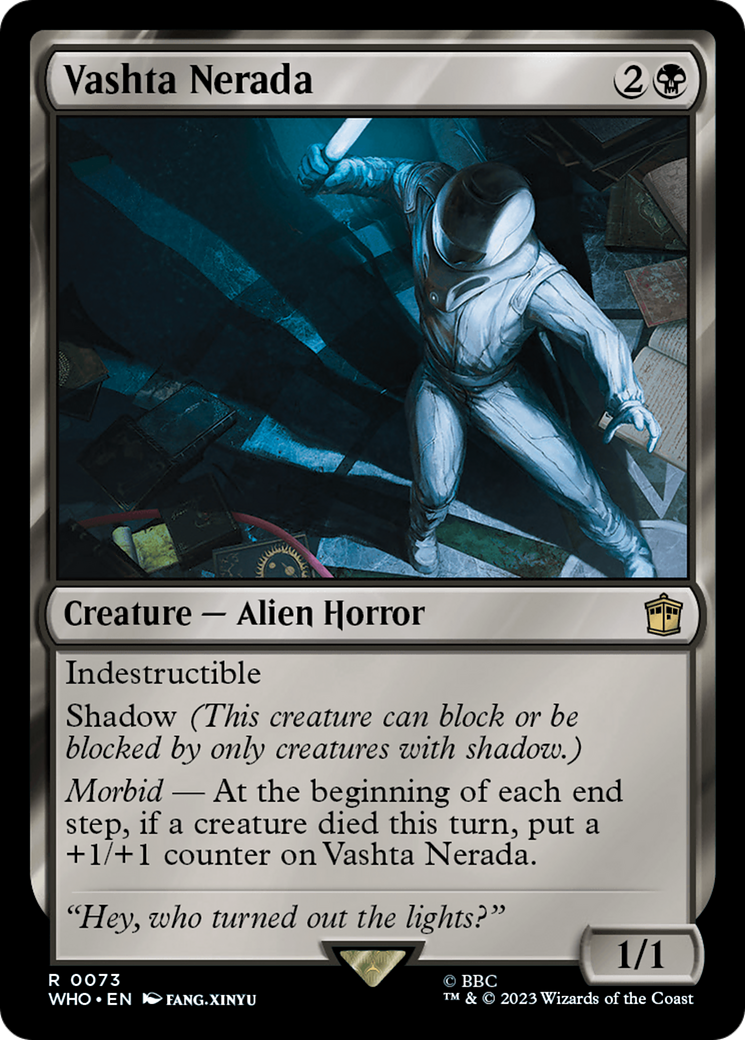
Vashta Nerada
Vashta Nerada
Creature — Alien Horror
1/1
Indestructible
Shadow (This creature can block or be blocked by only creatures with shadow.)
Morbid — At the beginning of each end step, if a creature died this turn, put a +1/+1 counter on this creature.
-
1
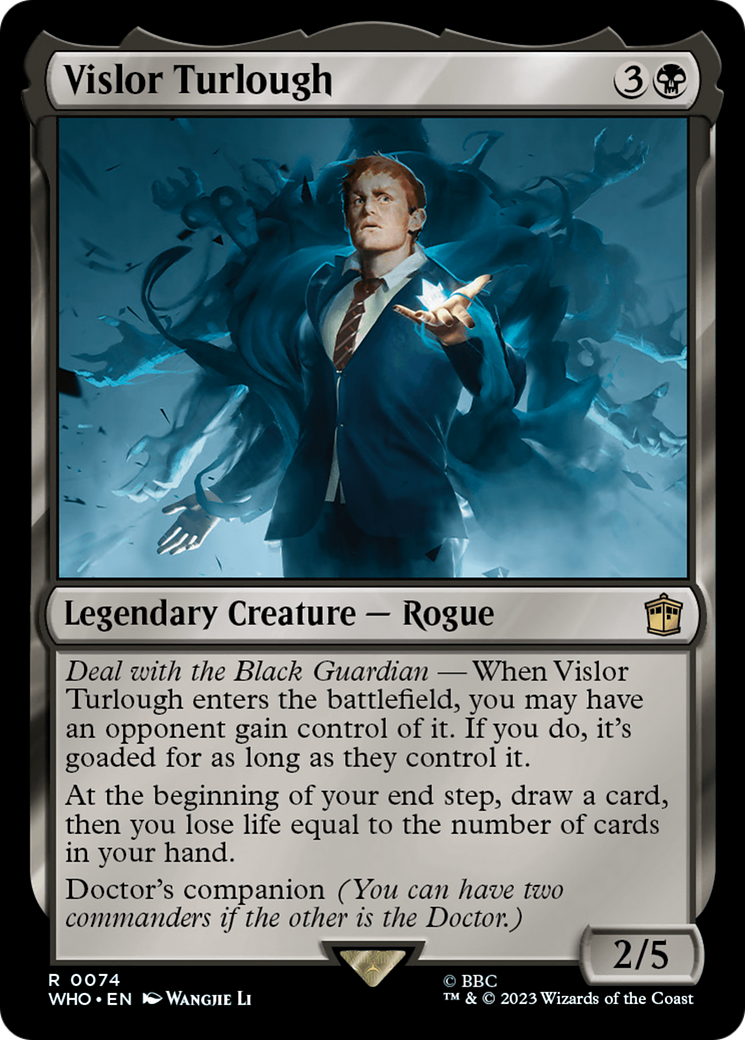
Vislor Turlough
Vislor Turlough
Legendary Creature — Rogue
2/5
Deal with the Black Guardian — When Vislor Turlough enters, you may have an opponent gain control of it. If you do, it's goaded for as long as they control it.
At the beginning of your end step, draw a card, then you lose life equal to the number of cards in your hand.
Doctor's companion (You can have two commanders if the other is the Doctor.)
- The Doctor's companion ability allows you to have two commanders if one has the ability and the other is a legendary creature that is a Time Lord Doctor and has no other creature types. Creatures with the changeling ability, for example, can't be a second commander this way.
- Although Doctor's companion is a new variant of the partner ability, the rules for partner have not otherwise changed. Notably, Time Lord Doctors and cards with Doctor's companion do not interact with cards which have another partner ability.
- If your Commander deck has two commanders, you can include only cards whose own color identities are also found in your commanders' combined color identities.
- Both commanders start in the command zone, and the remaining 98 cards (or 58 cards in a Commander Draft game) of your deck are shuffled to become your library.
- Once the game begins, your two commanders are tracked separately. If you cast one, you won't have to pay an additional the first time you cast the other. A player loses the game after having been dealt 21 combat damage from any one of them, not from both of them combined.
- If something refers to your commander while you have two commanders, it refers to one of them of your choice. If you are instructed to perform an action on your commander (e.g. put it from the command zone into your hand due to Command Beacon), you choose one of your commanders at the time the effect happens.
- An effect that checks whether you control your commander is satisfied if you control one or both of your two commanders.
-
1
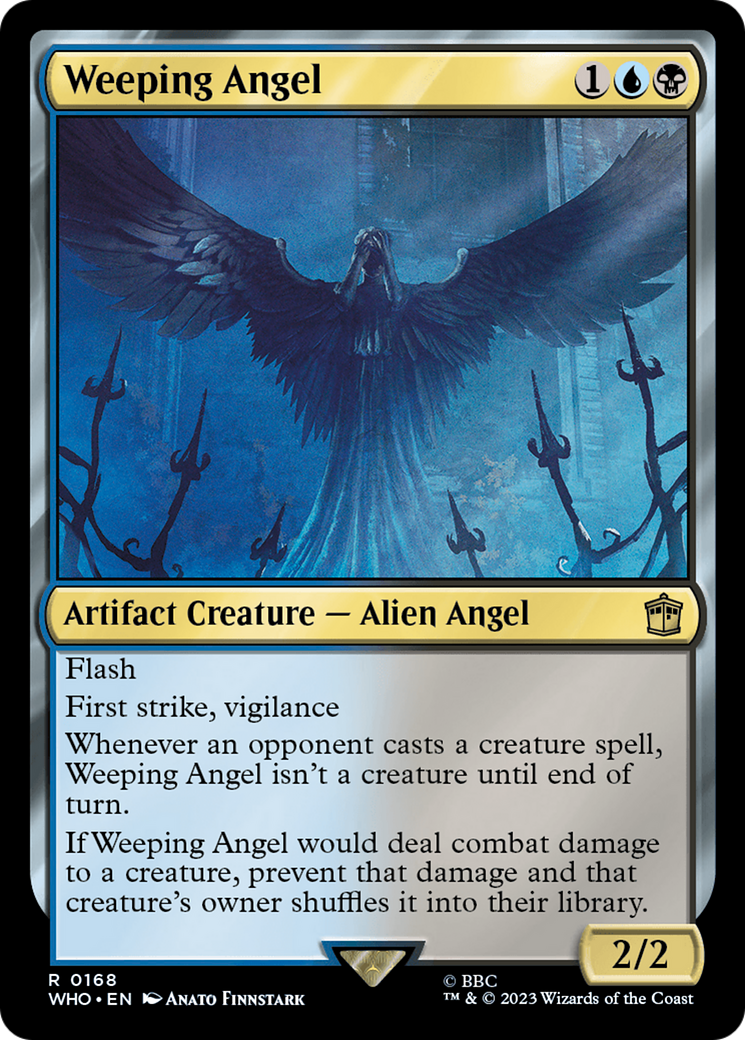
Weeping Angel
Weeping Angel
Artifact Creature — Alien Angel
2/2
Flash
First strike, vigilance
Whenever an opponent casts a creature spell, this creature isn't a creature until end of turn.
If this creature would deal combat damage to a creature, prevent that damage and that creature's owner shuffles it into their library.
- As the first triggered ability of Weeping Angel resolves, it continues to be an artifact but will stop being both an Alien and an Angel until it becomes a creature again. It's just a statue, how dangerous could it be?
- Damage that is prevented never occurs, so any triggered abilities that trigger due to combat damage that would have been dealt by Weeping Angel won't trigger.
- If an opponent casts a creature spell with flash while Weeping Angel is attacking or blocking, it is removed from combat because it stops being a creature. However, any creatures that it was blocking are still considered blocked.
-
1
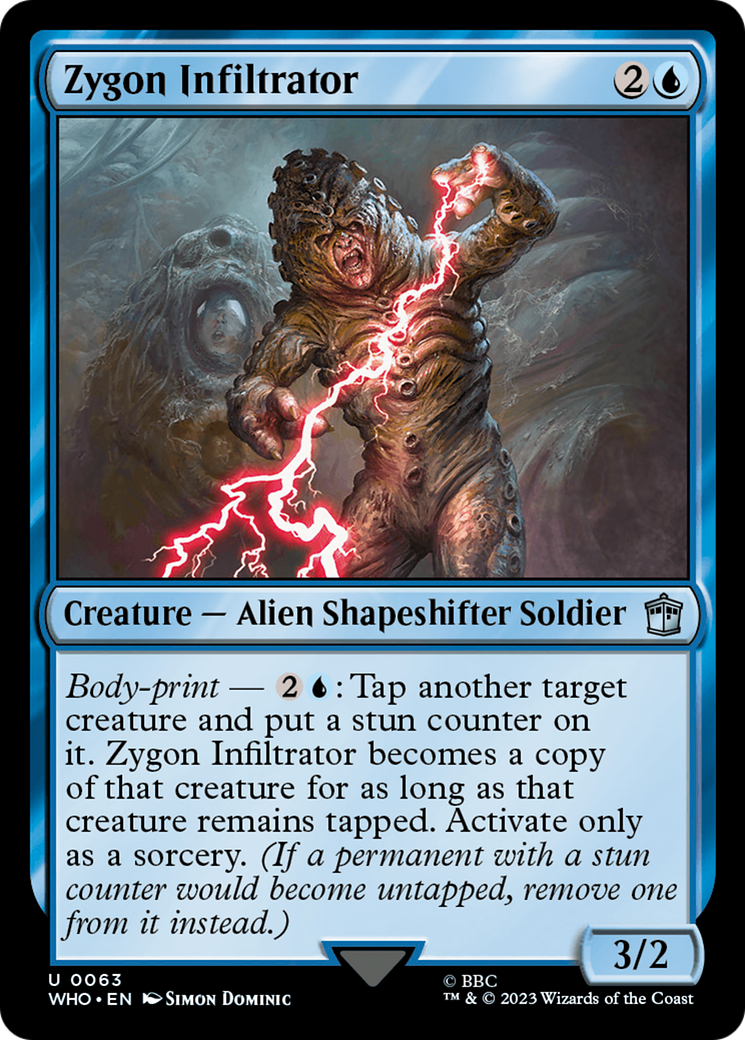
Zygon Infiltrator
Zygon Infiltrator
Creature — Alien Shapeshifter Soldier
3/2
Body-print — : Tap another target creature and put a stun counter on it. This creature becomes a copy of that creature for as long as that creature remains tapped. Activate only as a sorcery. (If a permanent with a stun counter would become untapped, remove one from it instead.)
- Zygon Infiltrator copies the printed values of the creature plus any copy effects that have been applied to it. It won't copy any other effects that have changed that creature's power, toughness, color, and so on. Zygon Infiltrator won't copy any counters on the creature, but it will retain any counters it already had on it.
- If it becomes a copy of a token creature, it copies the original characteristics of that token as defined by the effect that created the token. It won't become a token creature.
- When Zygon Infiltrator becomes a copy of a creature, it's neither entering nor leaving the battlefield. Any enters-the-battlefield or leaves-the-battlefield abilities won't trigger.
- If another creature becomes a copy of Zygon Infiltrator, it will become a copy of whatever Zygon Infiltrator is currently copying (if anything).
Instants 4
-
1
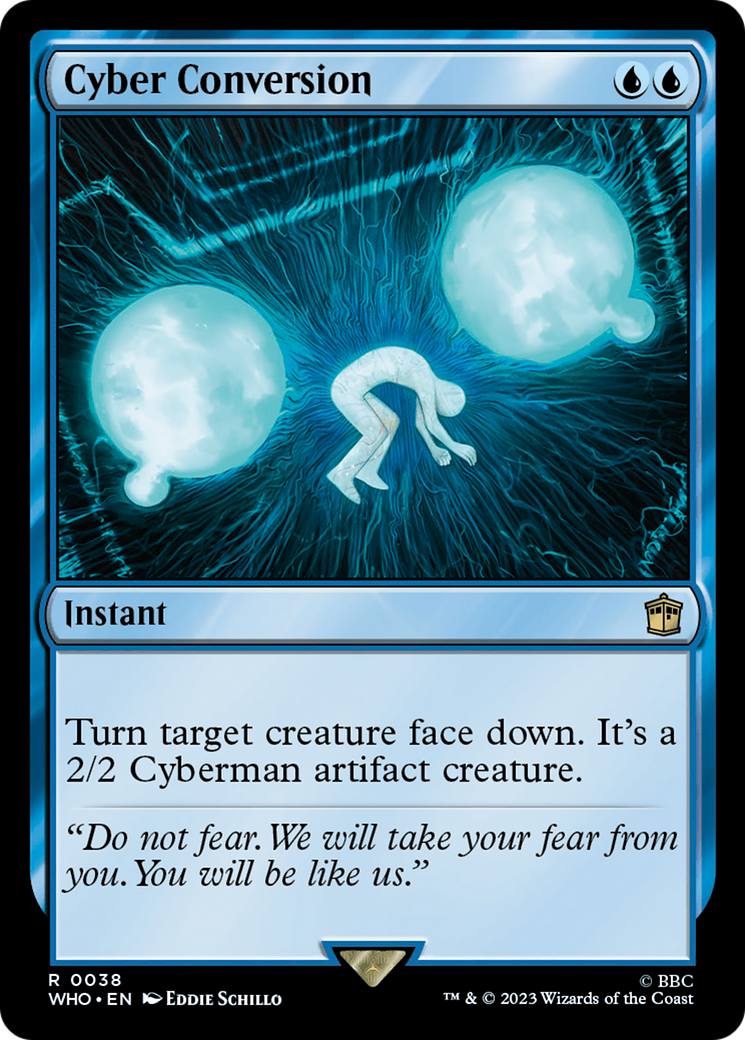
Cyber Conversion
Cyber Conversion
Instant
Turn target creature face down. It's a 2/2 Cyberman artifact creature.
- Each creature turned face down this way or put onto the battlefield this way is a 2/2 Cyberman artifact creature with no name and no color.
- If, for any reason, the face-down creature is turned face up, the effect making it a Cyberman ends. It will be whatever is printed on the card.
- The player who controls a face-down permanent may look at it at any time. Notably, if the cards were put on the battlefield face down from another player's library, the player that owns them does not get to look at those cards.
- Double-faced permanents that are already on the battlefield can't be turned face down this way. However, a double-faced card can be put onto the battlefield face down from another zone this way.
- If the face-down card has a morph ability, its controller may turn it face up by paying the associated morph cost.
-
1
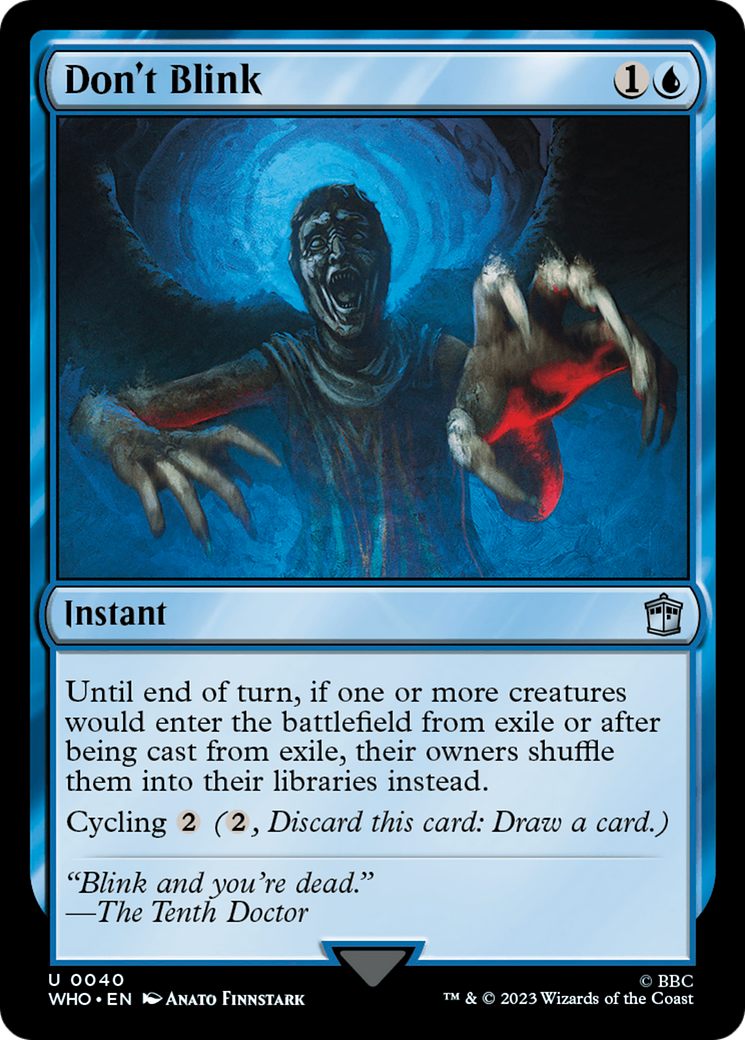
Don't Blink
Don't Blink
Instant
Until end of turn, if one or more creatures would enter from exile or after being cast from exile, their owners shuffle them into their libraries instead.
Cycling ( , Discard this card: Draw a card.)
-
1
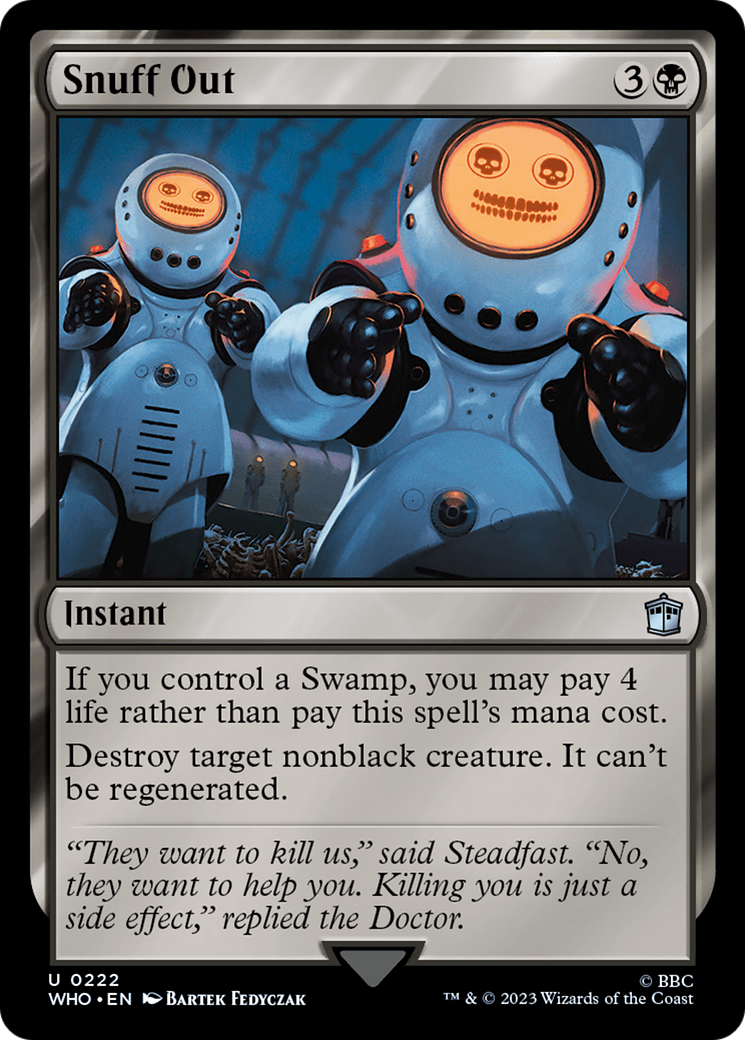
Snuff Out
Snuff Out
Instant
If you control a Swamp, you may pay 4 life rather than pay this spell's mana cost.
Destroy target nonblack creature. It can't be regenerated.
-
1
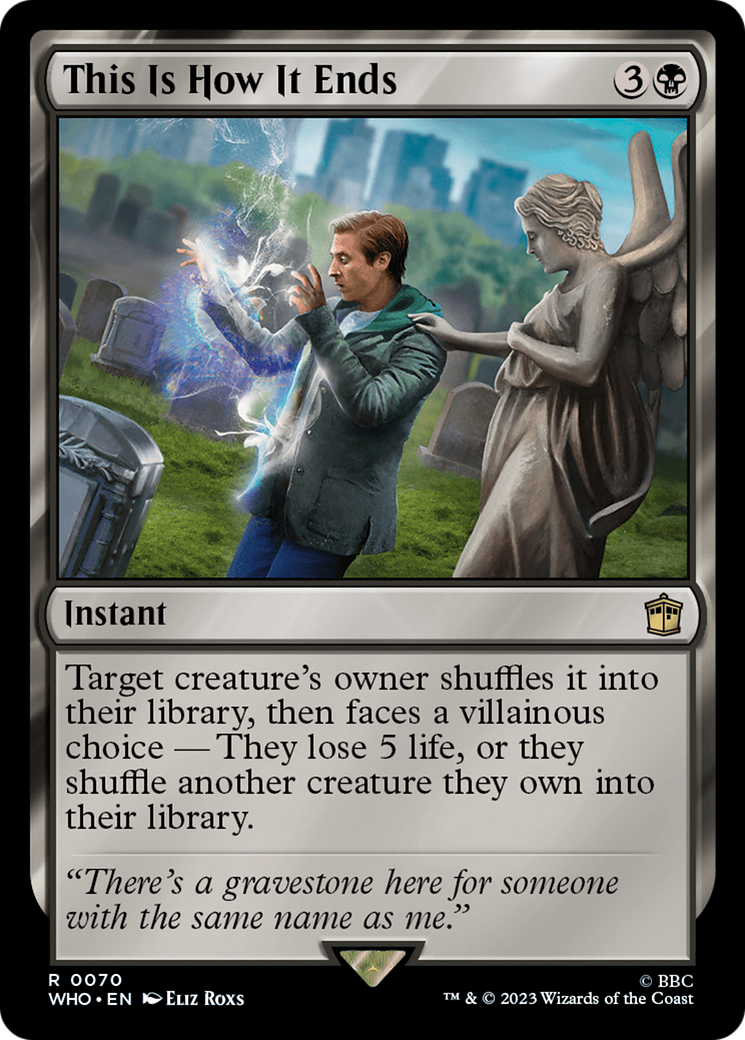
This Is How It Ends
This Is How It Ends
Instant
Target creature's owner shuffles it into their library, then faces a villainous choice — They lose 5 life, or they shuffle another creature they own into their library.
- When a player faces a villainous choice, they first choose one of the two options, then all actions in the chosen option are performed.
- If a spell or ability requires multiple players to face a villainous choice, the result is a little different from other effects in Magic. In that case, the first player in turn order makes their choice and the action for that choice is performed before the next player makes their choice. Then each of the remaining players repeat this process in turn order.
- A player facing a villainous choice can always choose either option, even if one or both of the options are impossible. For example, if one of the options is to sacrifice a creature, a player who controls no creatures can still choose that option.
Sorceries 8
-
1
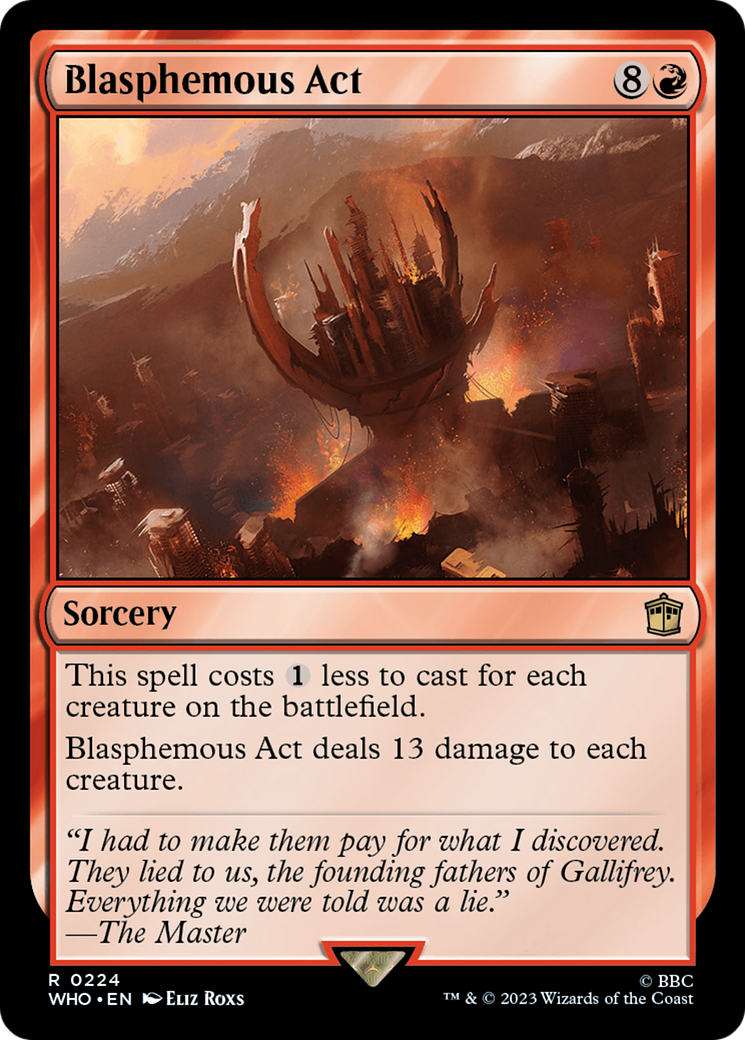
Blasphemous Act
Blasphemous Act
Sorcery
This spell costs less to cast for each creature on the battlefield.
Blasphemous Act deals 13 damage to each creature.
- Although players may respond to Blasphemous Act once it's been cast, once it's announced, they can't respond before the cost is calculated and paid.
- Blasphemous Act's ability can't reduce the total cost to cast the spell below .
- The total cost to cast Blasphemous Act is locked in before you pay that cost. For example, if there are three creatures on the battlefield, including one you can sacrifice to add , the total cost of Blasphemous Act is . Then you can sacrifice the creature when you activate mana abilities just before paying the cost.
- To determine the total cost of a spell, start with the mana cost or alternative cost you're paying, add any cost increases, then apply any cost reductions (such as that of Blasphemous Act). The mana value of the spell is determined only by its mana cost, no matter what the total cost to cast the spell was.
-
1
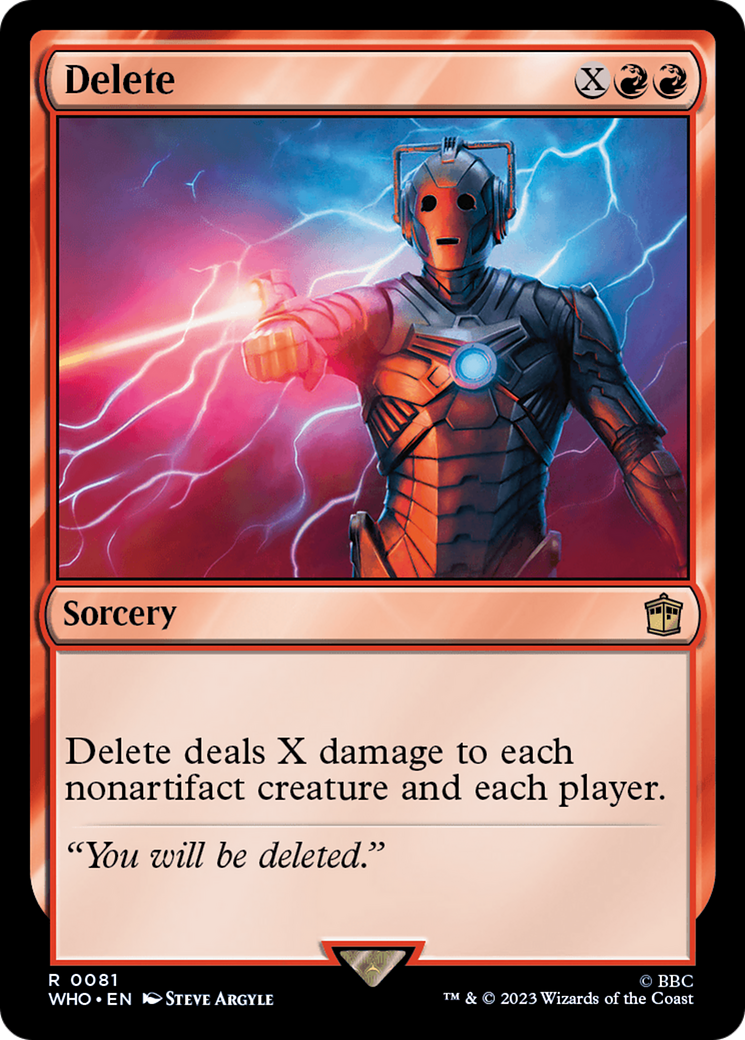
Delete
Delete
Sorcery
Delete deals X damage to each nonartifact creature and each player.
-
1
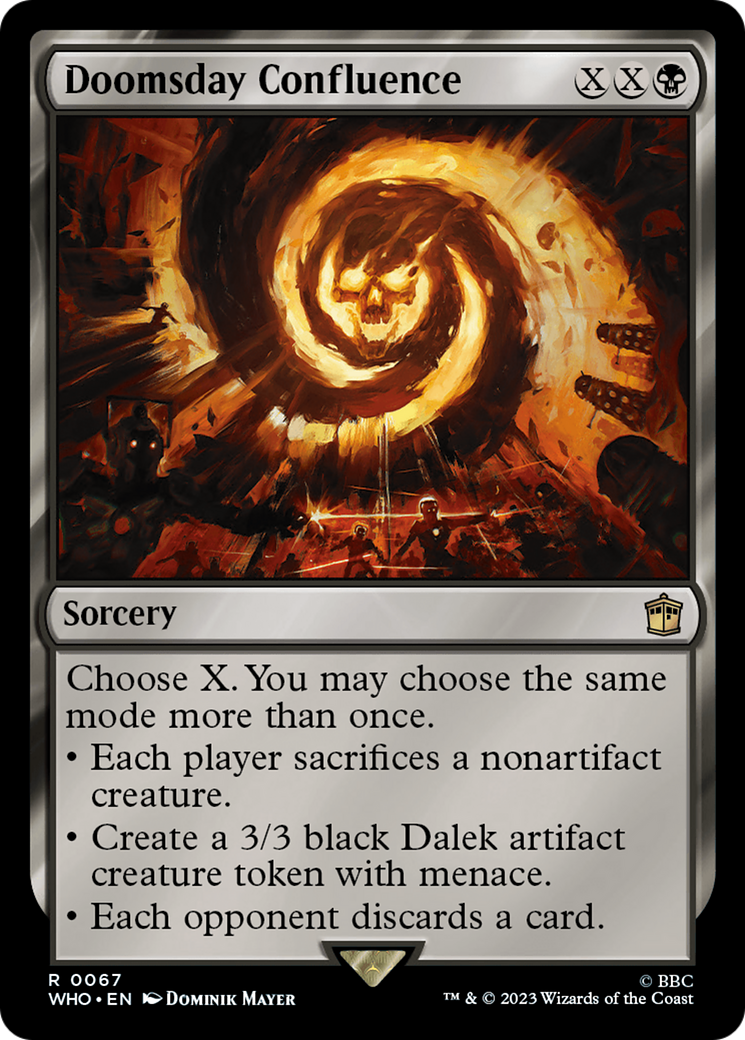
Doomsday Confluence
Doomsday Confluence
Sorcery
Choose X. You may choose the same mode more than once.
- Each player sacrifices a nonartifact creature of their choice.
- Create a 3/3 black Dalek artifact creature token with menace.
- Each opponent discards a card.
- You choose the modes as you cast the spell. Once modes are chosen, they can't be changed.
- No matter which combination of modes you choose, you always follow the instructions in the order they are written.
- No player can cast spells or activate abilities in between the modes of a resolving spell.
- If an effect copies Doomsday Confluence, the copy will have the same modes chosen the same number of times.
-
1
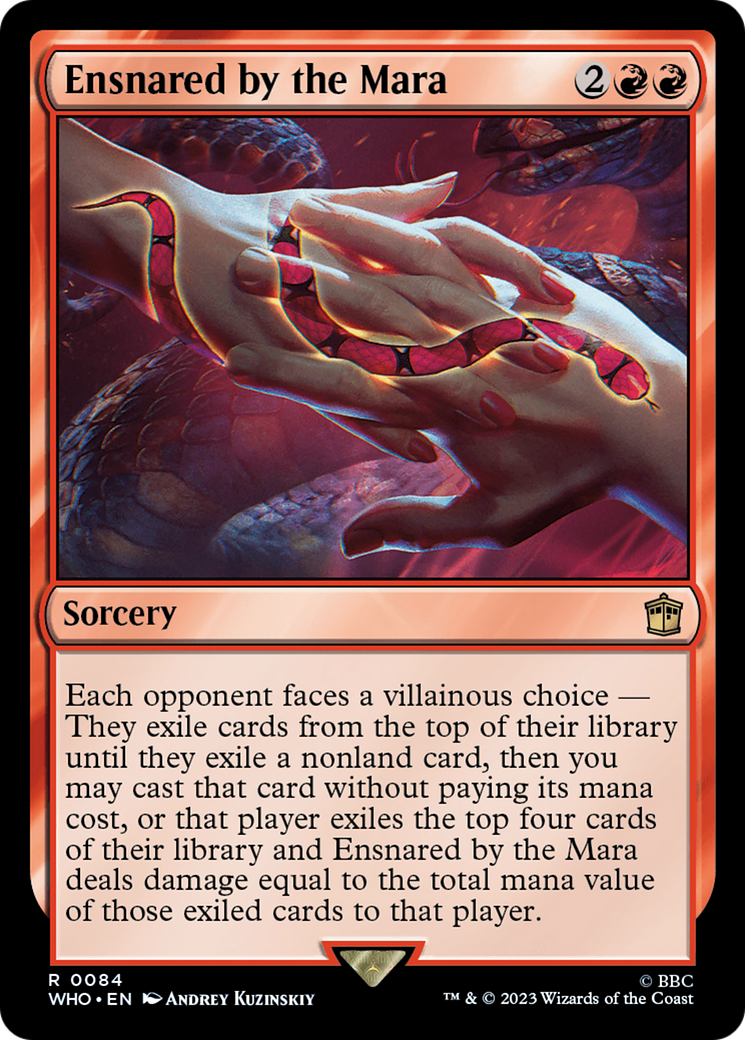
Ensnared by the Mara
Ensnared by the Mara
Sorcery
Each opponent faces a villainous choice — They exile cards from the top of their library until they exile a nonland card, then you may cast that card without paying its mana cost, or that player exiles the top four cards of their library and Ensnared by the Mara deals damage equal to the total mana value of those exiled cards to that player.
- The opponent chooses whether to exile cards from the top of their library until they exile a nonland card or to exile the top four cards of their library. They don't choose whether you cast the cards exiled by the first option.
- When a player faces a villainous choice, they first choose one of the two options, then all actions in the chosen option are performed.
- If a spell or ability requires multiple players to face a villainous choice, the result is a little different from other effects in Magic. In that case, the first player in turn order makes their choice and the action for that choice is performed before the next player makes their choice. Then each of the remaining players repeat this process in turn order.
- A player facing a villainous choice can always choose either option, even if one or both of the options are impossible. For example, if one of the options is to sacrifice a creature, a player who controls no creatures can still choose that option.
-
1
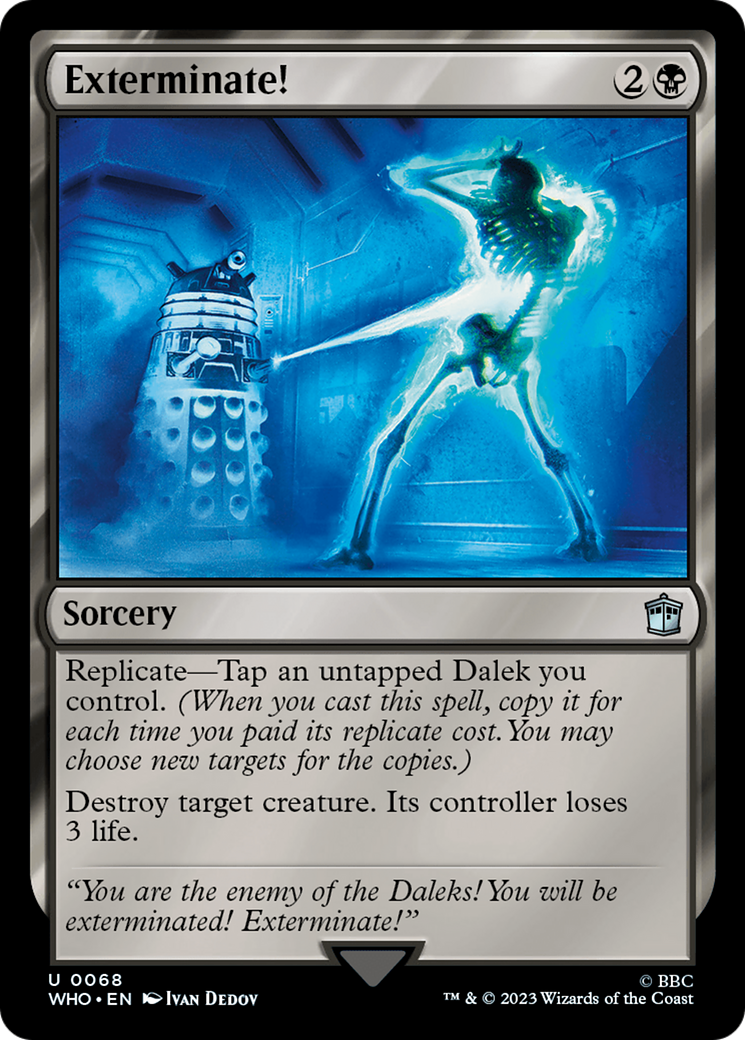
Exterminate!
Exterminate!
Sorcery
Replicate—Tap an untapped Dalek you control. (When you cast this spell, copy it for each time you paid its replicate cost. You may choose new targets for the copies.)
Destroy target creature. Its controller loses 3 life.
-
1
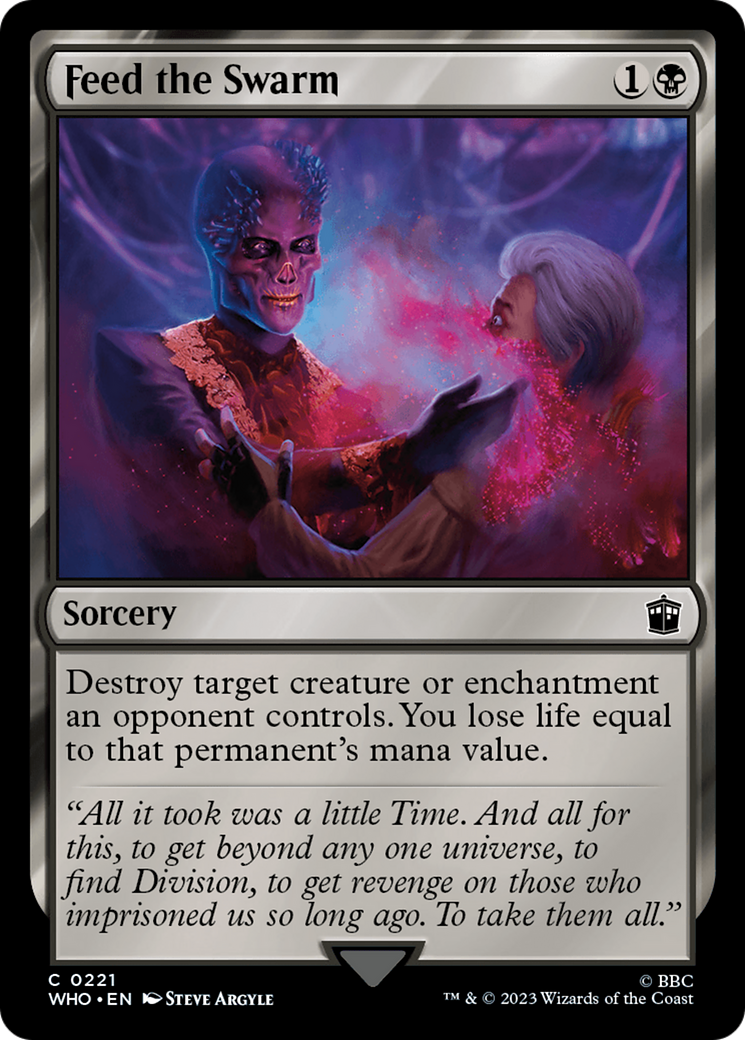
Feed the Swarm
Feed the Swarm
Sorcery
Destroy target creature or enchantment an opponent controls. You lose life equal to that permanent's mana value.
- The amount of life you lose is determined by the permanent's mana value as it last existed on the battlefield.
- If the target permanent is an illegal target by the time Feed the Swarm tries to resolve, the spell doesn't resolve. You don't lose any life. If the target is legal but not destroyed (most likely because it has indestructible), you do lose life.
- If a permanent on the battlefield has in its mana cost, X is 0 for the purpose of determining its mana value.
-
1
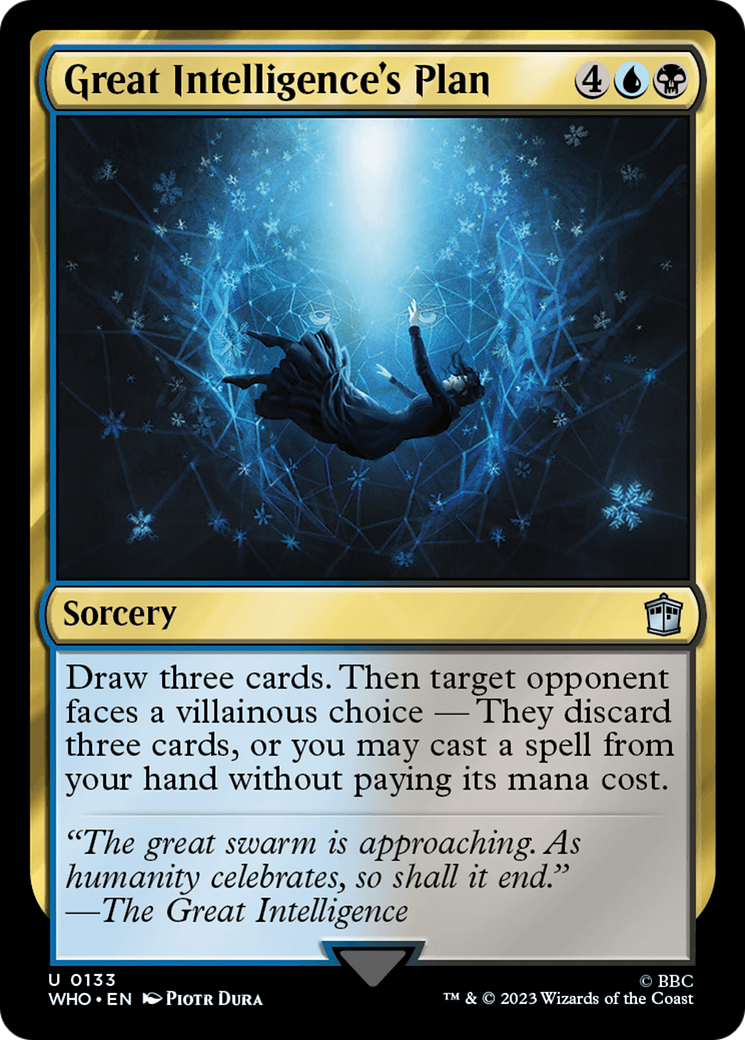
Great Intelligence's Plan
Great Intelligence's Plan
Sorcery
Draw three cards. Then target opponent faces a villainous choice — They discard three cards, or you may cast a spell from your hand without paying its mana cost.
- When a player faces a villainous choice, they first choose one of the two options, then all actions in the chosen option are performed.
- If a spell or ability requires multiple players to face a villainous choice, the result is a little different from other effects in Magic. In that case, the first player in turn order makes their choice and the action for that choice is performed before the next player makes their choice. Then each of the remaining players repeat this process in turn order.
- A player facing a villainous choice can always choose either option, even if one or both of the options are impossible. For example, if one of the options is to sacrifice a creature, a player who controls no creatures can still choose that option.
-
1
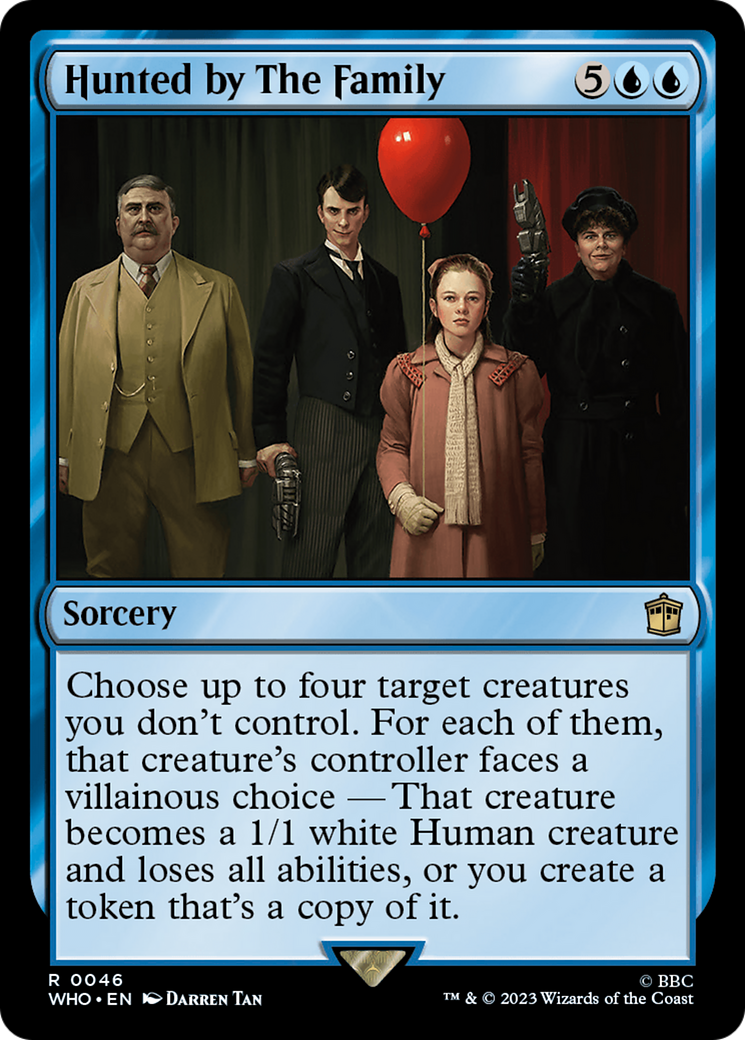
Hunted by The Family
Hunted by The Family
Sorcery
Choose up to four target creatures you don't control. For each of them, that creature's controller faces a villainous choice — That creature becomes a 1/1 white Human creature and loses all abilities, or you create a token that's a copy of it.
- When a player faces a villainous choice, they first choose one of the two options, then all actions in the chosen option are performed.
- If a spell or ability requires multiple players to face a villainous choice, the result is a little different from other effects in Magic. In that case, the first player in turn order makes their choice and the action for that choice is performed before the next player makes their choice. Then each of the remaining players repeat this process in turn order.
- A player facing a villainous choice can always choose either option, even if one or both of the options are impossible. For example, if one of the options is to sacrifice a creature, a player who controls no creatures can still choose that option.
Artifacts 12
-
1
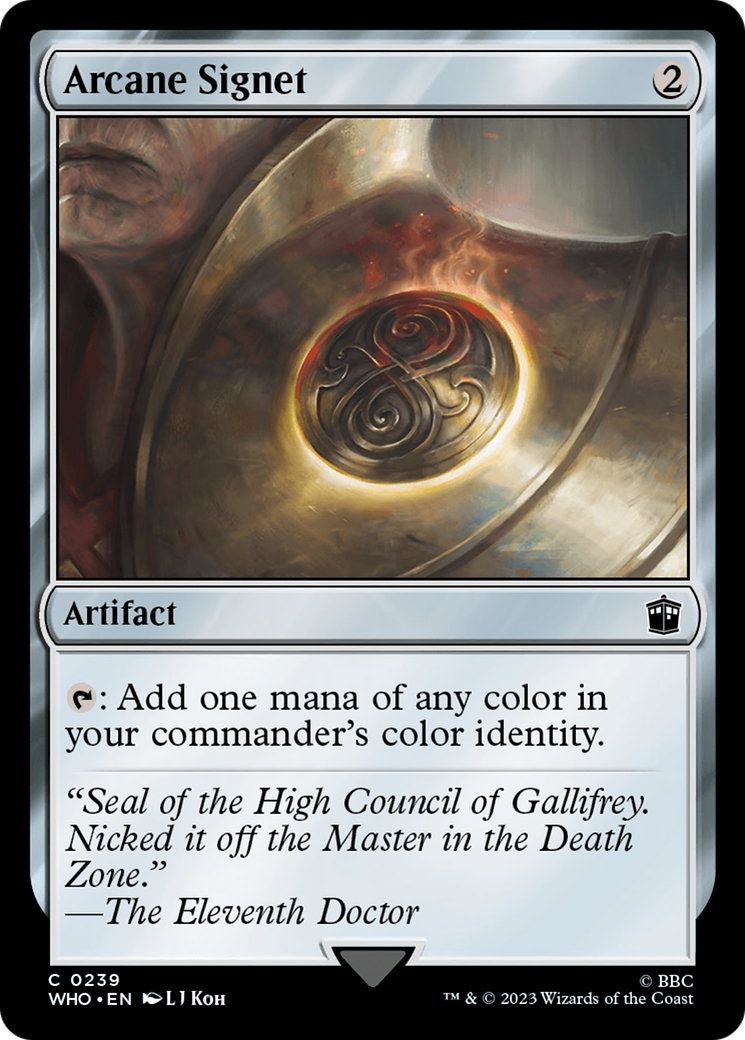
Arcane Signet
Arcane Signet
Artifact
: Add one mana of any color in your commander's color identity.
- If your commander is a card that has no colors in its color identity, Arcane Signet's ability produces no mana. It doesn't produce .
- If you have two commanders, the ability adds one mana of any color in their combined color identities.
- If you don't have a commander, Arcane Signet's ability produces no mana.
-
1
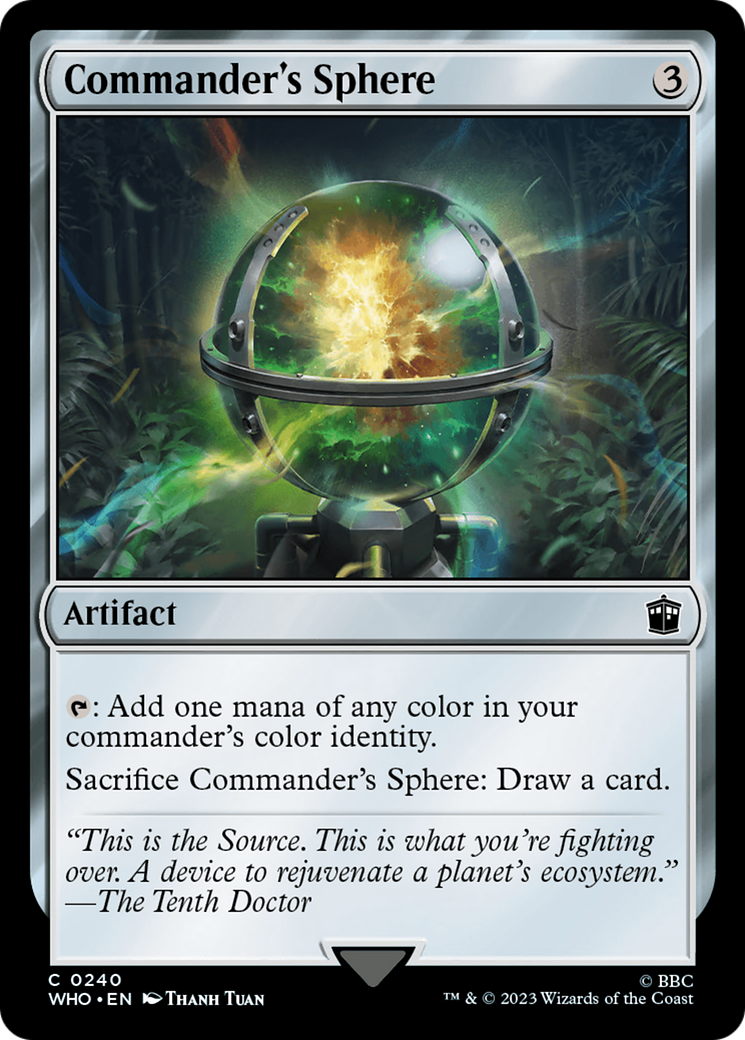
Commander's Sphere
Commander's Sphere
Artifact
: Add one mana of any color in your commander's color identity.
Sacrifice this artifact: Draw a card.
- If your commander is a card that has no colors in its color identity, Commander's Sphere's first ability produces no mana. It doesn't produce .
- If you don't have a commander, Commander's Sphere's first ability produces no mana.
- If you have two commanders, the ability adds one mana of any color in their combined color identities.
-
1
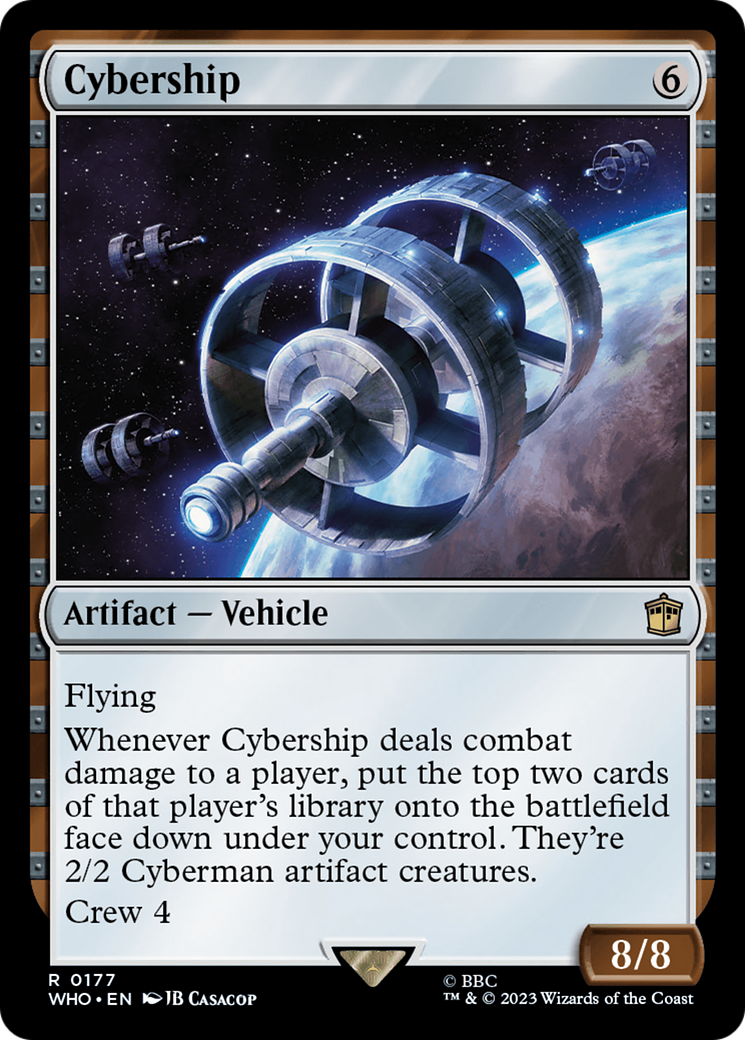
Cybership
Cybership
Artifact — Vehicle
8/8
Flying
Whenever this Vehicle deals combat damage to a player, put the top two cards of that player's library onto the battlefield face down under your control. They're 2/2 Cyberman artifact creatures.
Crew 4
- Each creature turned face down this way or put onto the battlefield this way is a 2/2 Cyberman artifact creature with no name and no color.
- If, for any reason, the face-down creature is turned face up, the effect making it a Cyberman ends. It will be whatever is printed on the card.
- The player who controls a face-down permanent may look at it at any time. Notably, if the cards were put on the battlefield face down from another player's library, the player that owns them does not get to look at those cards.
- Double-faced permanents that are already on the battlefield can't be turned face down this way. However, a double-faced card can be put onto the battlefield face down from another zone this way.
- If the face-down card has a morph ability, its controller may turn it face up by paying the associated morph cost.
-
1
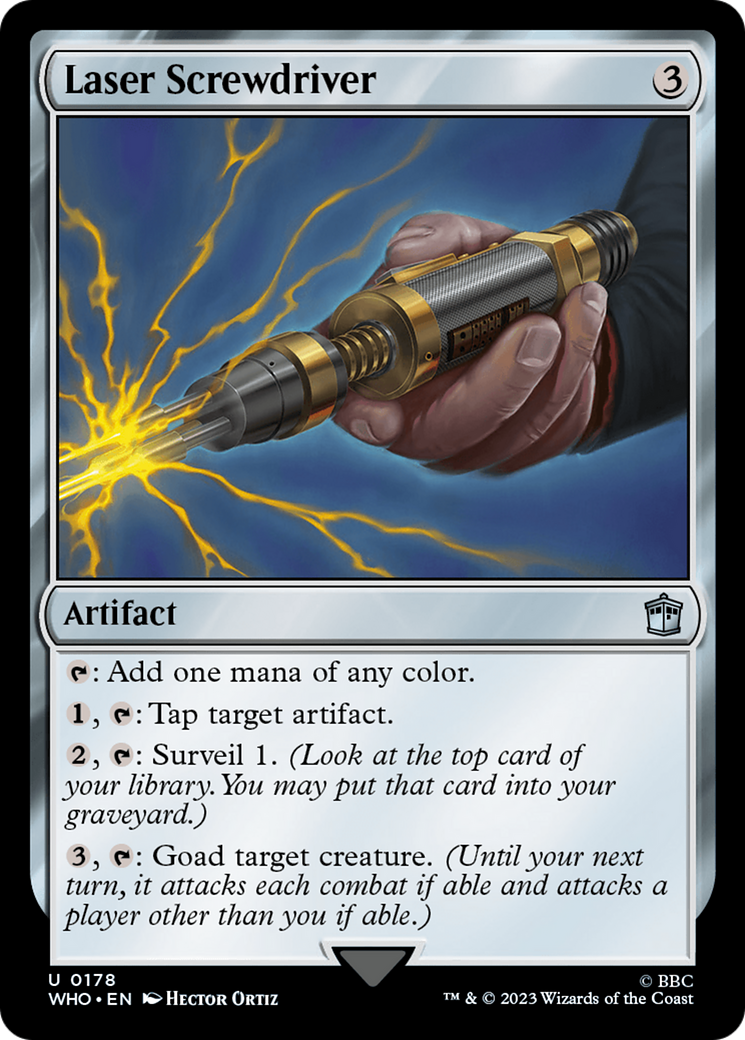
Laser Screwdriver
Laser Screwdriver
Artifact
: Add one mana of any color.
, : Tap target artifact.
, : Surveil 1. (Look at the top card of your library. You may put that card into your graveyard.)
, : Goad target creature. (Until your next turn, it attacks each combat if able and attacks a player other than you if able.)
-
1
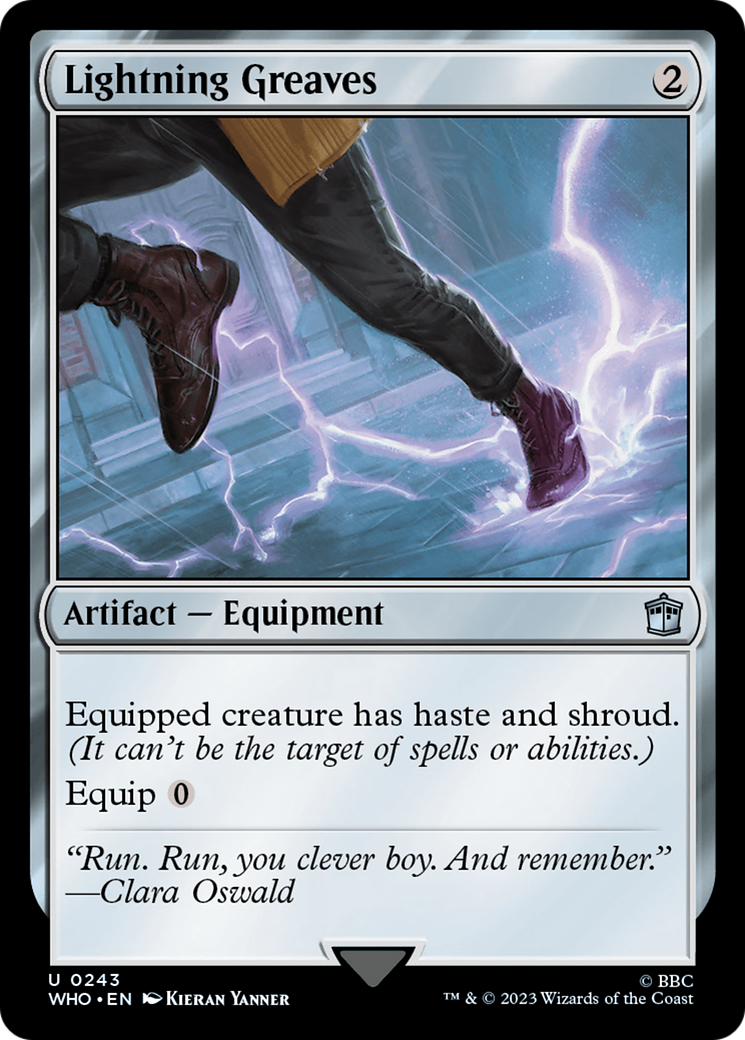
Lightning Greaves
Lightning Greaves
Artifact — Equipment
Equipped creature has haste and shroud. (It can't be the target of spells or abilities.)
Equip
- You can't simply unequip Equipment from a creature. If Lightning Greaves is attached to the only creature you control, you won't be able to attach other equipment to it (or target it with anything else) until you have another creature to which you can attach Lightning Greaves.
- If a creature enters the battlefield under your control and gains haste, but then loses it before attacking, it won't be able to attack that turn. This means that you can't use one Lightning Greaves to allow two new creatures to attack in the same turn.
-
1
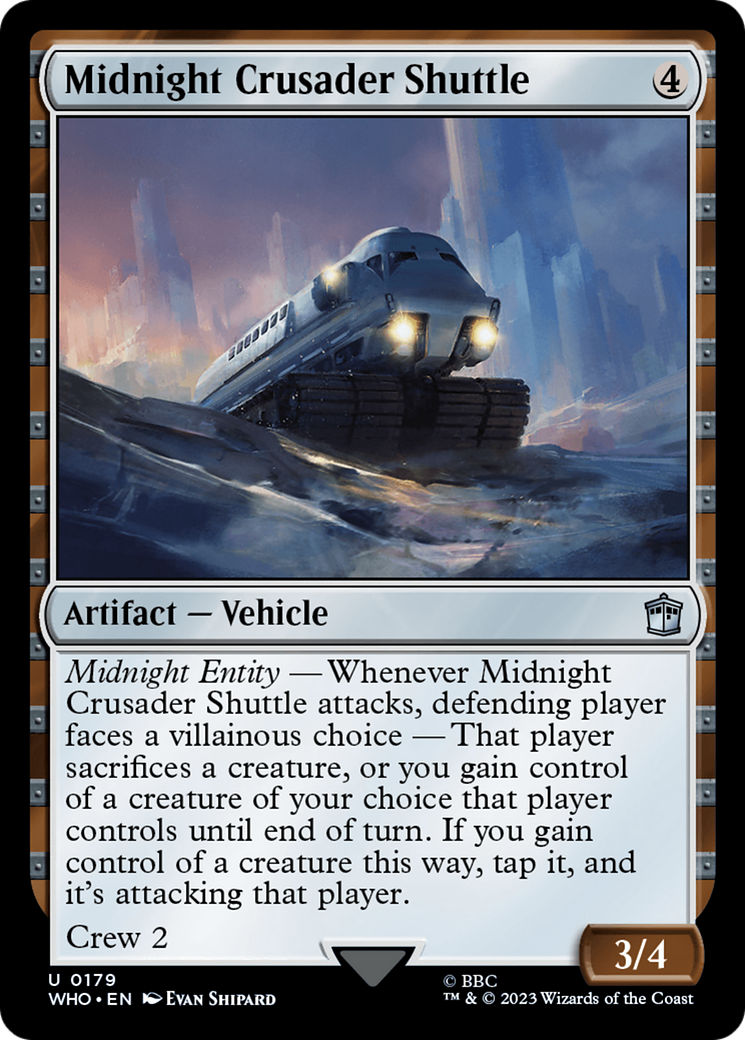
Midnight Crusader Shuttle
Midnight Crusader Shuttle
Artifact — Vehicle
3/4
Midnight Entity — Whenever this Vehicle attacks, defending player faces a villainous choice — That player sacrifices a creature of their choice, or you gain control of a creature of your choice that player controls until end of turn. If you gain control of a creature this way, tap it, and it's attacking that player.
Crew 2
- When a creature becomes attacking this way, it wasn't declared as an attacker, so triggered abilities that trigger when a creature attacks won't trigger. Similar, all restrictions or costs to attack are ignored. For example, if the chosen creature has defender, it could still end up being an attacking creature this way.
- When a player faces a villainous choice, they first choose one of the two options, then all actions in the chosen option are performed.
- If a spell or ability requires multiple players to face a villainous choice, the result is a little different from other effects in Magic. In that case, the first player in turn order makes their choice and the action for that choice is performed before the next player makes their choice. Then each of the remaining players repeat this process in turn order.
- A player facing a villainous choice can always choose either option, even if one or both of the options are impossible. For example, if one of the options is to sacrifice a creature, a player who controls no creatures can still choose that option.
-
1
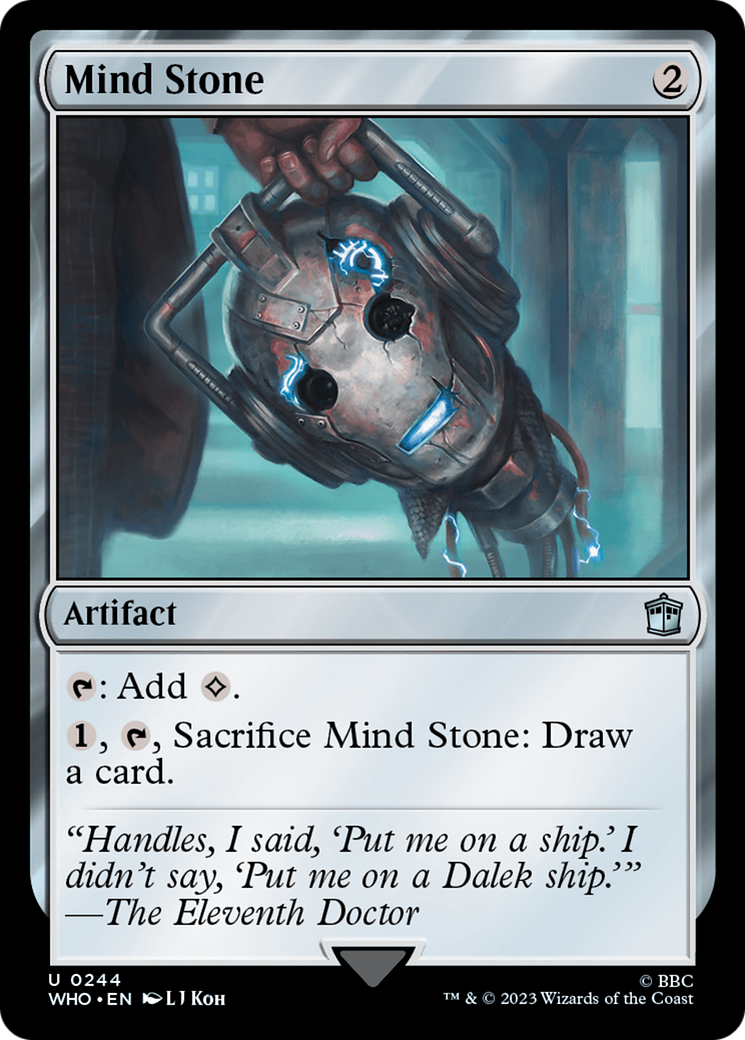
Mind Stone
Mind Stone
Artifact
: Add .
, , Sacrifice this artifact: Draw a card.
-
1
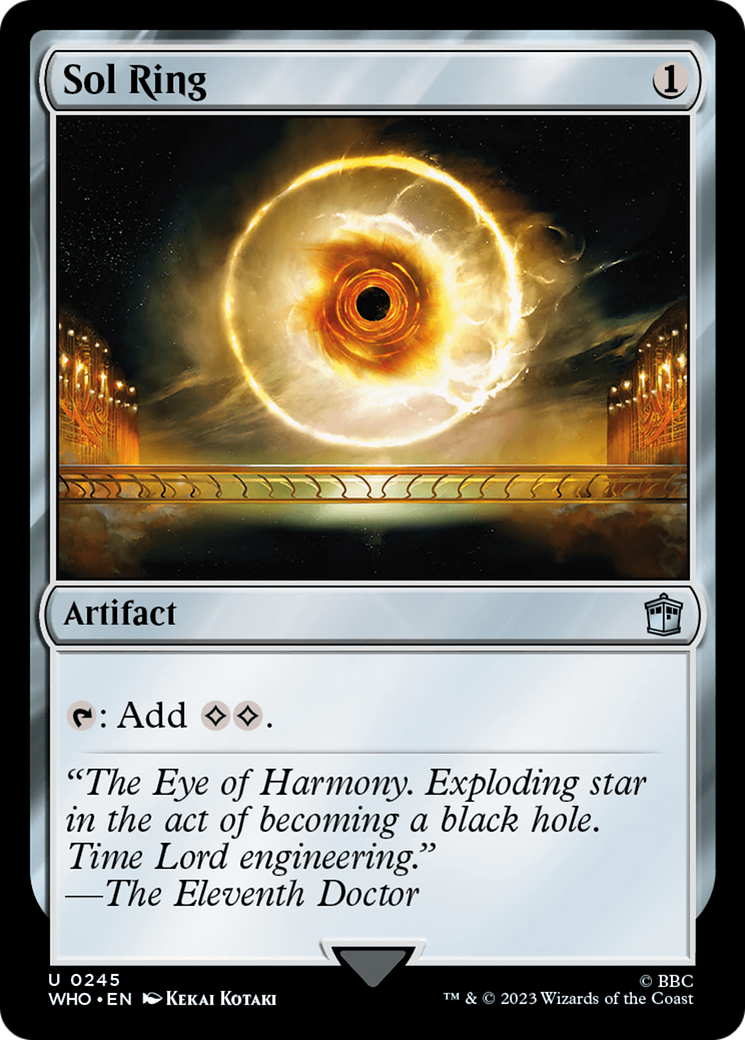
Sol Ring
Sol Ring
Artifact
: Add .
-
1
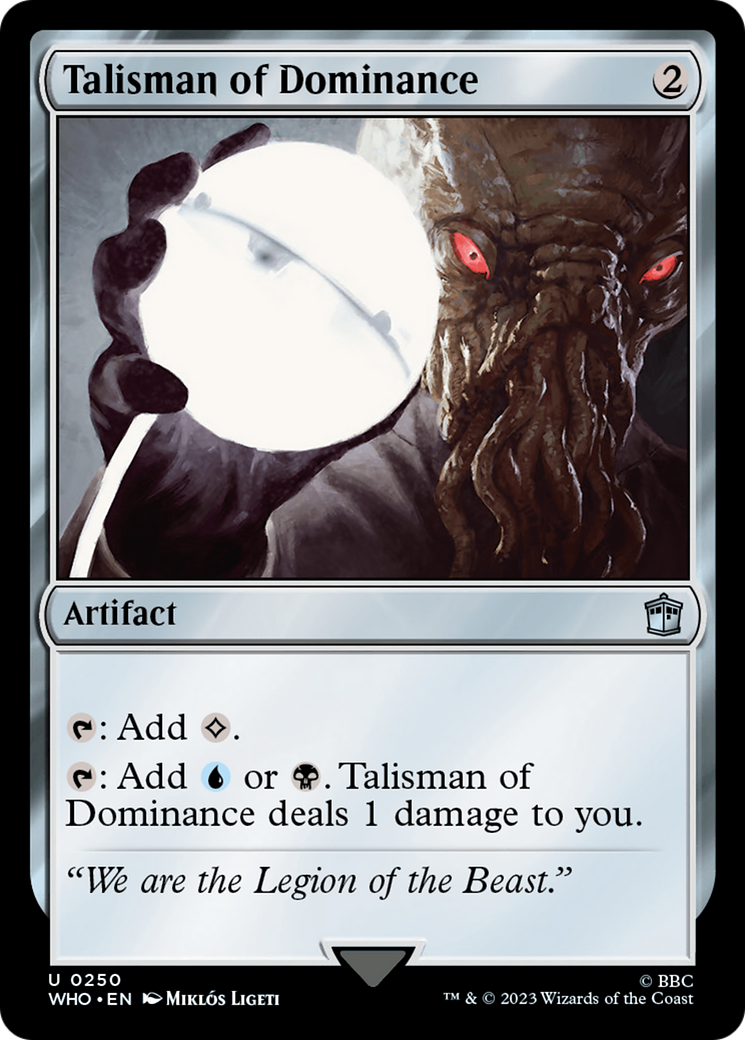
Talisman of Dominance
Talisman of Dominance
Artifact
: Add .
: Add or . This artifact deals 1 damage to you.
-
1
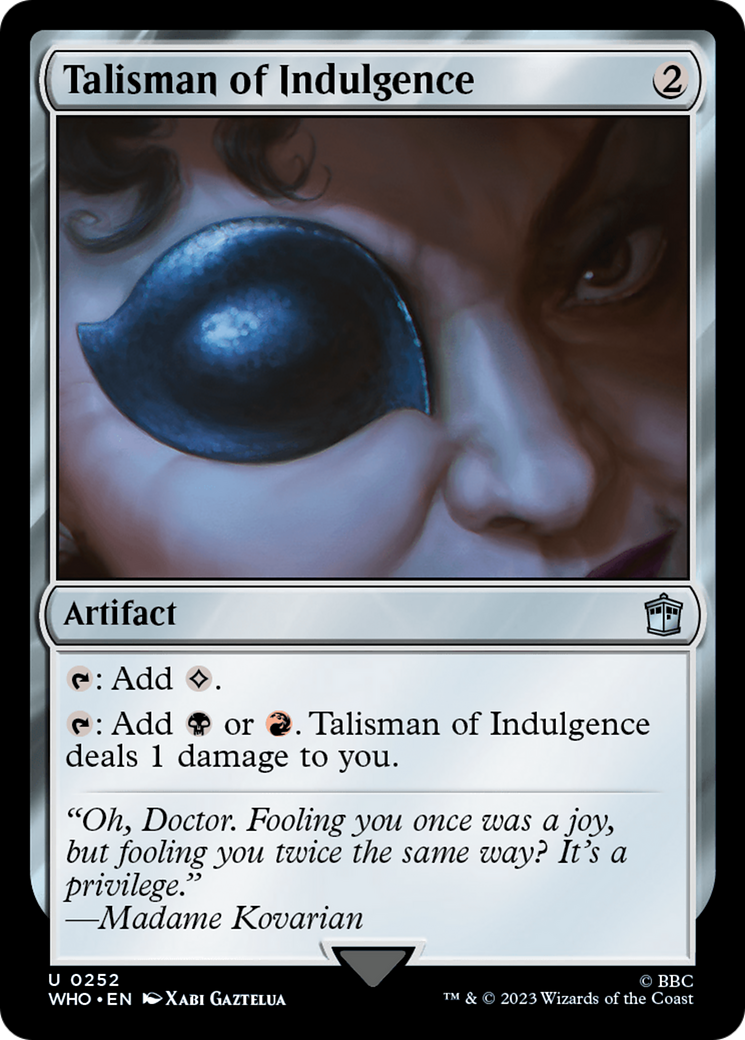
Talisman of Indulgence
Talisman of Indulgence
Artifact
: Add .
: Add or . This artifact deals 1 damage to you.
-
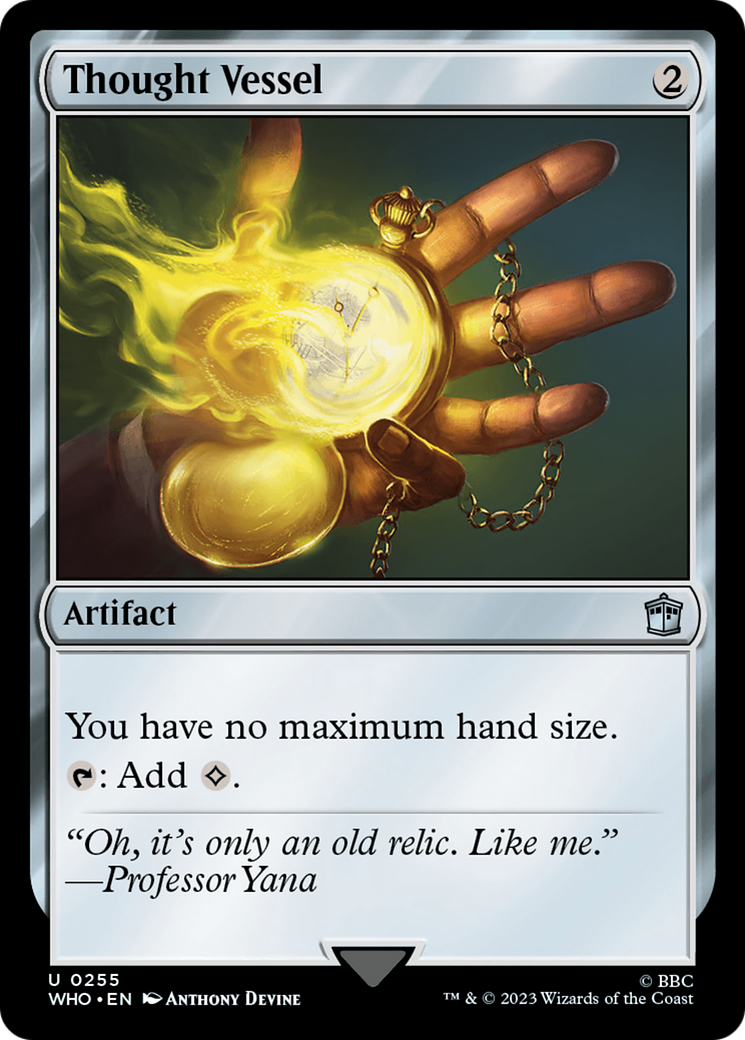
1
Thought Vessel
Thought Vessel
Artifact
You have no maximum hand size.
: Add .
-
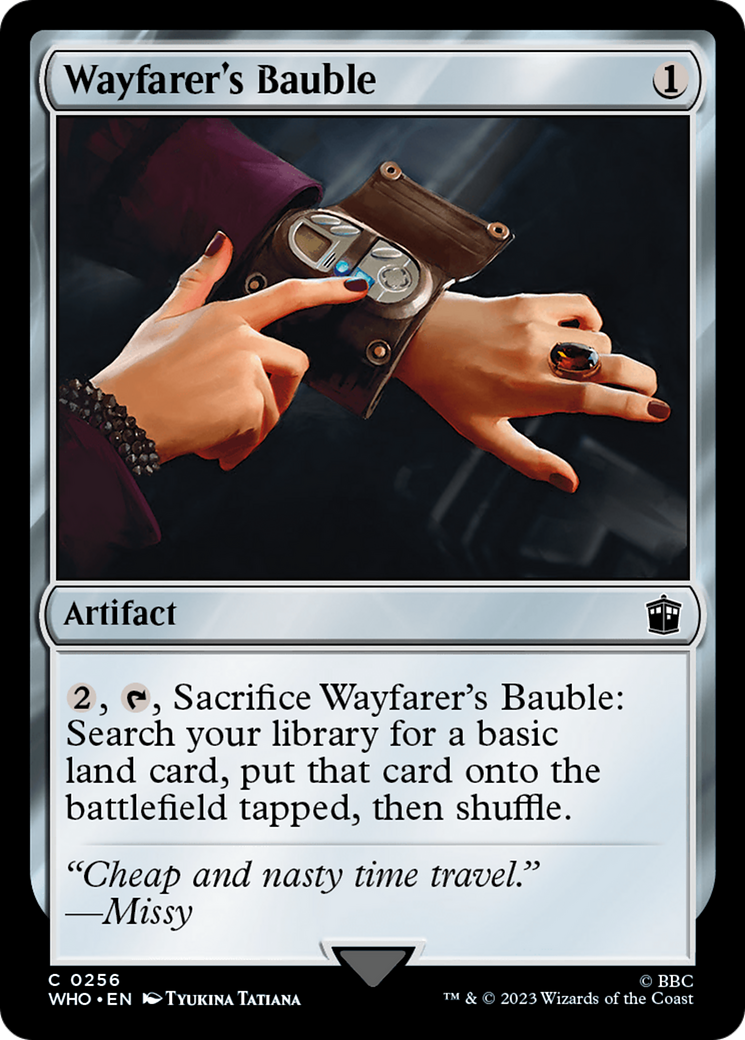
1
Wayfarer's Bauble
Wayfarer's Bauble
Artifact
, , Sacrifice this artifact: Search your library for a basic land card, put that card onto the battlefield tapped, then shuffle.
Enchantments 8
-
1
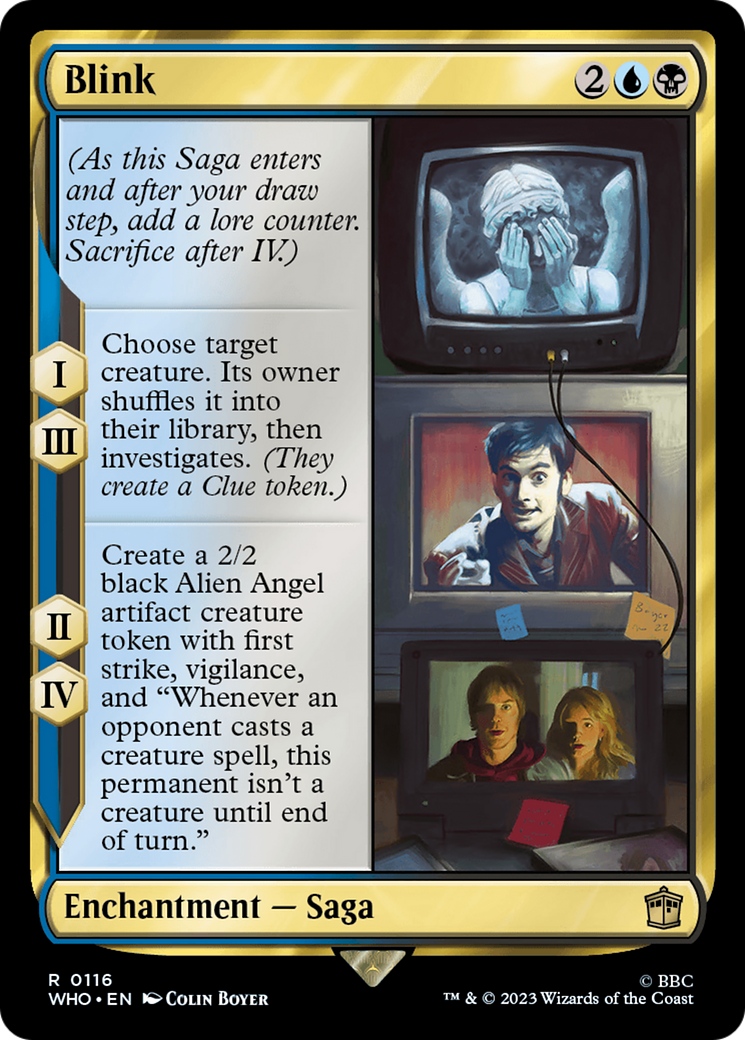
Blink
Blink
Enchantment — Saga
(As this Saga enters and after your draw step, add a lore counter. Sacrifice after IV.)
I, III — Choose target creature. Its owner shuffles it into their library, then investigates. (They create a Clue token.)
II, IV — Create a 2/2 black Alien Angel artifact creature token with first strike, vigilance, and "Whenever an opponent casts a creature spell, this token isn't a creature until end of turn."
- People often assume that Sagas are a strict progression from top to bottom, but actually, from a non-linear, non-subjective viewpoint, it's more like a big ball of wibbly wobbly, timey-wimey . . . stuff. That is, the rules support chapter abilities that appear to be out of order, like those on Blink. The first ability triggers when the first and third lore counters are added. The last ability triggers when the second and fourth lore counters are placed on it.
- As the triggered ability of the Alien Angel token resolves, it continues to be an artifact but will stop being both an Alien and an Angel until it becomes a creature again.
- If an opponent casts a creature spell with flash while the token is attacking or blocking, the token is removed from combat because it stops being a creature. However, any creatures that it was blocking are still considered blocked.
-
1
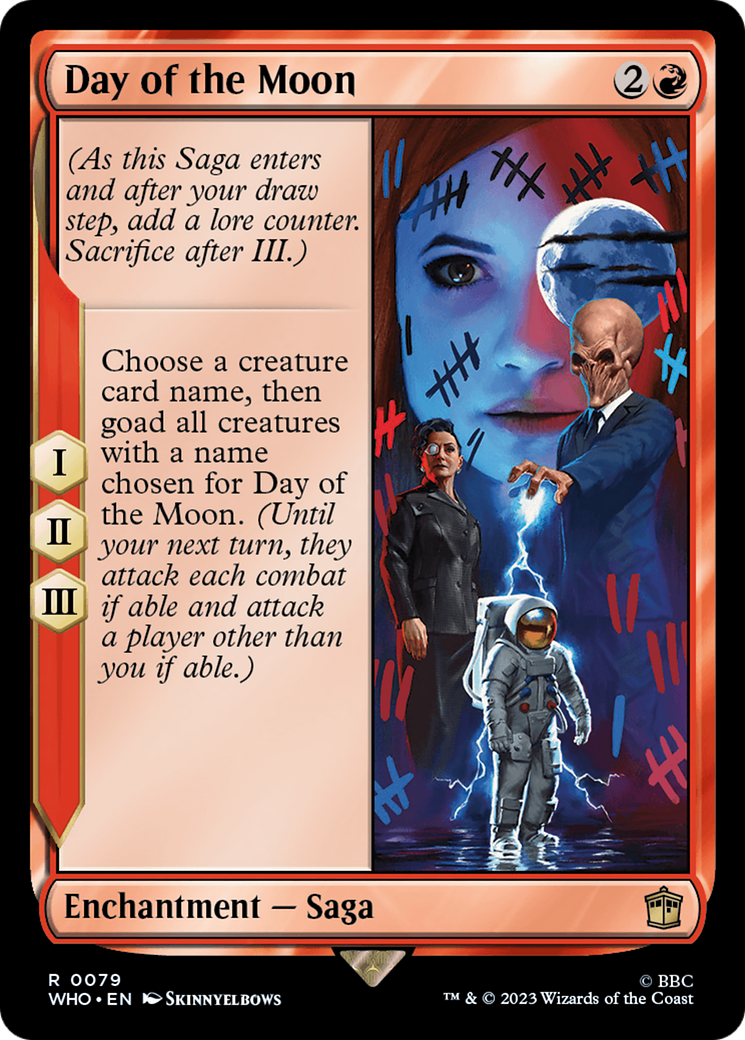
Day of the Moon
Day of the Moon
Enchantment — Saga
(As this Saga enters and after your draw step, add a lore counter. Sacrifice after III.)
I, II, III — Choose a creature card name, then goad all creatures with a name chosen for this enchantment. (Until your next turn, they attack each combat if able and attack a player other than you if able.)
-
1
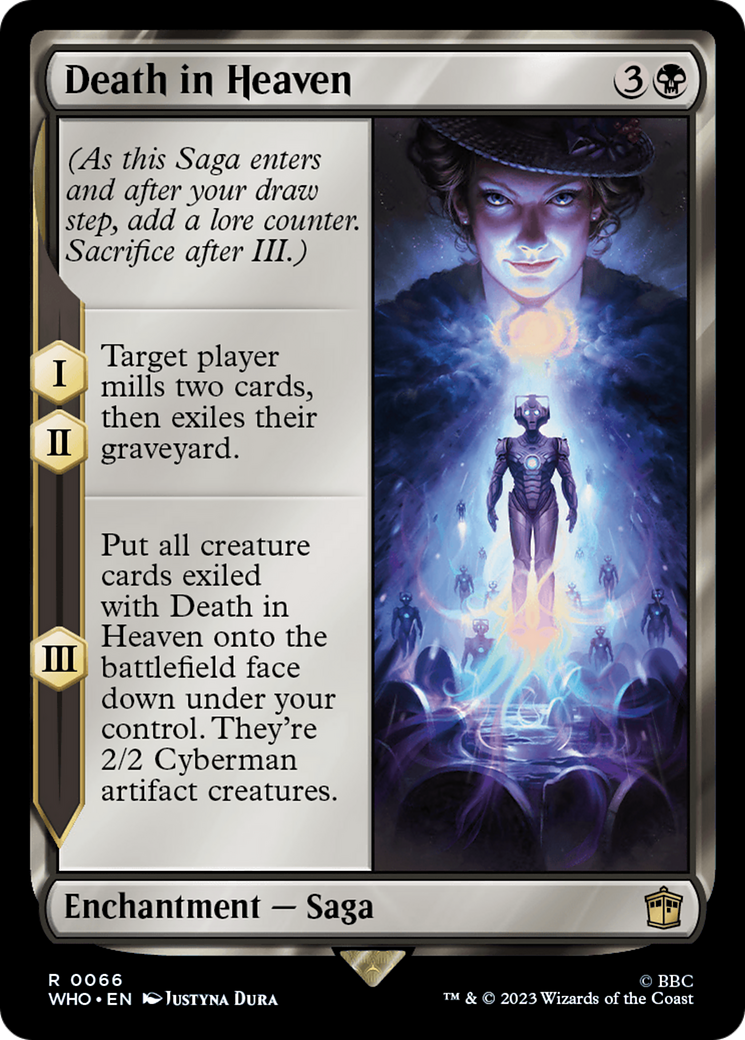
Death in Heaven
Death in Heaven
Enchantment — Saga
(As this Saga enters and after your draw step, add a lore counter. Sacrifice after III.)
I, II — Target player mills two cards, then exiles their graveyard.
III — Put all creature cards exiled with this enchantment onto the battlefield face down under your control. They're 2/2 Cyberman artifact creatures.
- Each creature turned face down this way or put onto the battlefield this way is a 2/2 Cyberman artifact creature with no name and no color.
- If, for any reason, the face-down creature is turned face up, the effect making it a Cyberman ends. It will be whatever is printed on the card.
- The player who controls a face-down permanent may look at it at any time. Notably, if the cards were put on the battlefield face down from another player's library, the player that owns them does not get to look at those cards.
- Double-faced permanents that are already on the battlefield can't be turned face down this way. However, a double-faced card can be put onto the battlefield face down from another zone this way.
- If the face-down card has a morph ability, its controller may turn it face up by paying the associated morph cost.
-
1
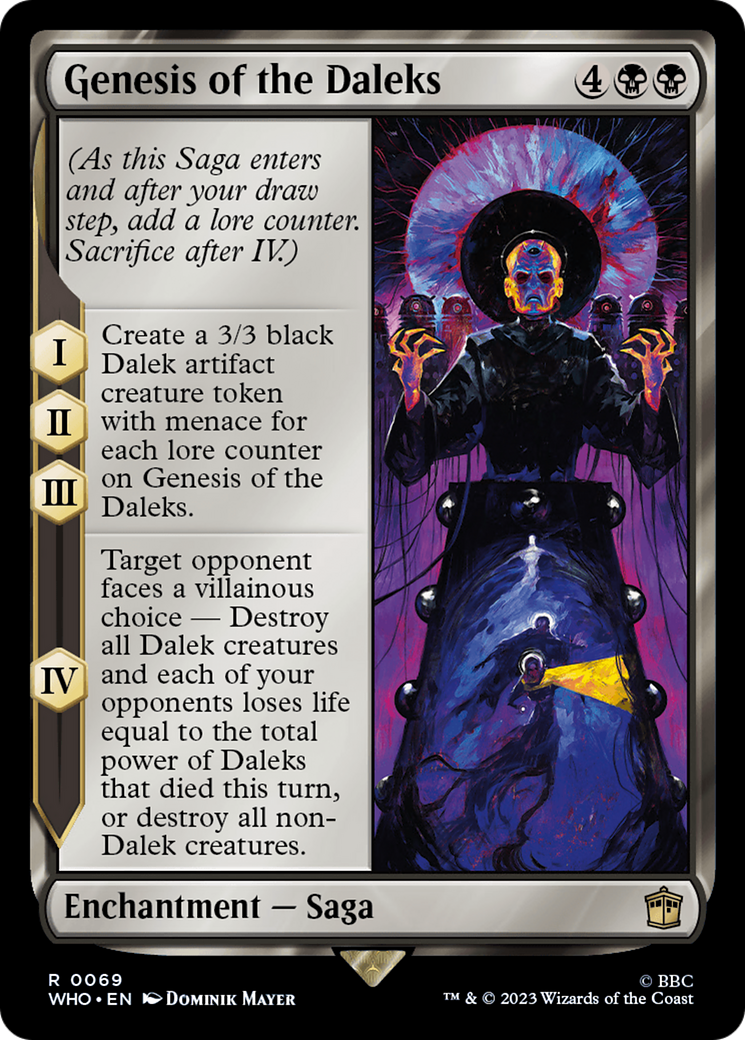
Genesis of the Daleks
Genesis of the Daleks
Enchantment — Saga
(As this Saga enters and after your draw step, add a lore counter. Sacrifice after IV.)
I, II, III — Create a 3/3 black Dalek artifact creature token with menace for each lore counter on Genesis of the Daleks.
IV — Target opponent faces a villainous choice — Destroy all Dalek creatures and each of your opponents loses life equal to the total power of Daleks that died this turn, or destroy all non-Dalek creatures.
- When a player faces a villainous choice, they first choose one of the two options, then all actions in the chosen option are performed.
- If a spell or ability requires multiple players to face a villainous choice, the result is a little different from other effects in Magic. In that case, the first player in turn order makes their choice and the action for that choice is performed before the next player makes their choice. Then each of the remaining players repeat this process in turn order.
- A player facing a villainous choice can always choose either option, even if one or both of the options are impossible. For example, if one of the options is to sacrifice a creature, a player who controls no creatures can still choose that option.
-
1
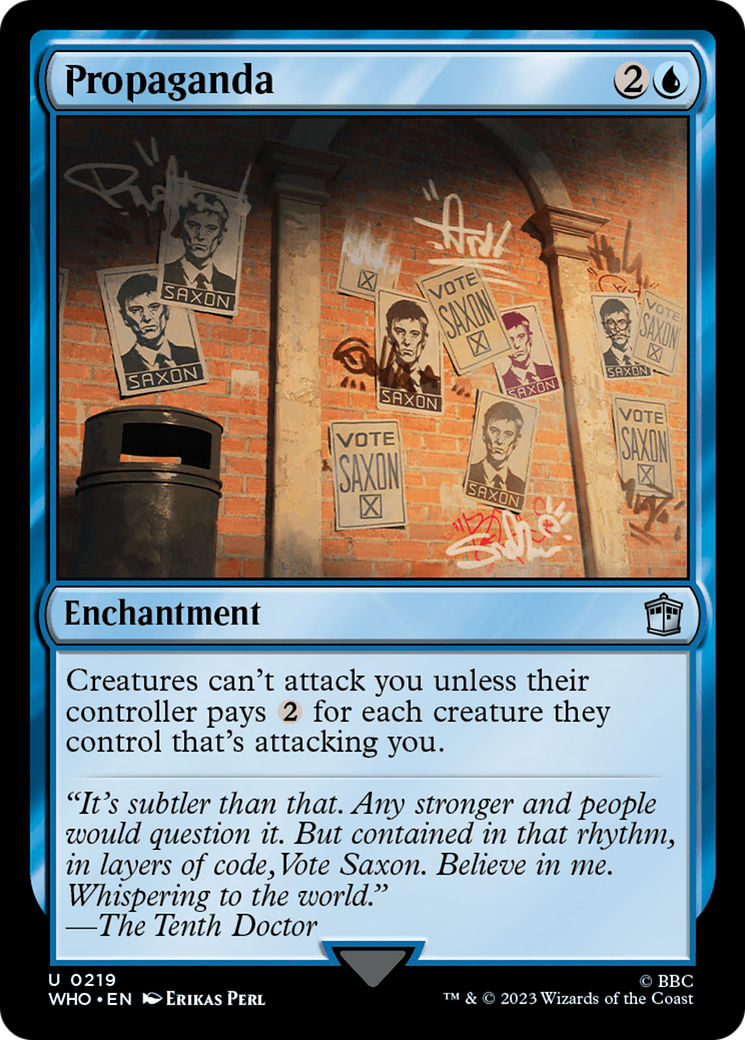
Propaganda
Propaganda
Enchantment
Creatures can't attack you unless their controller pays for each creature they control that's attacking you.
- The payment is made during the declare attackers step at the same time you are declaring the attacker.
- If there are multiple attacks in a turn, then you have to pay for each attack.
- If there is more than one Propaganda on the battlefield, the cost is cumulative.
- Paying this cost is not an instant or any other kind of ability, it is an additional cost on the declaration of the attacker.
-
1
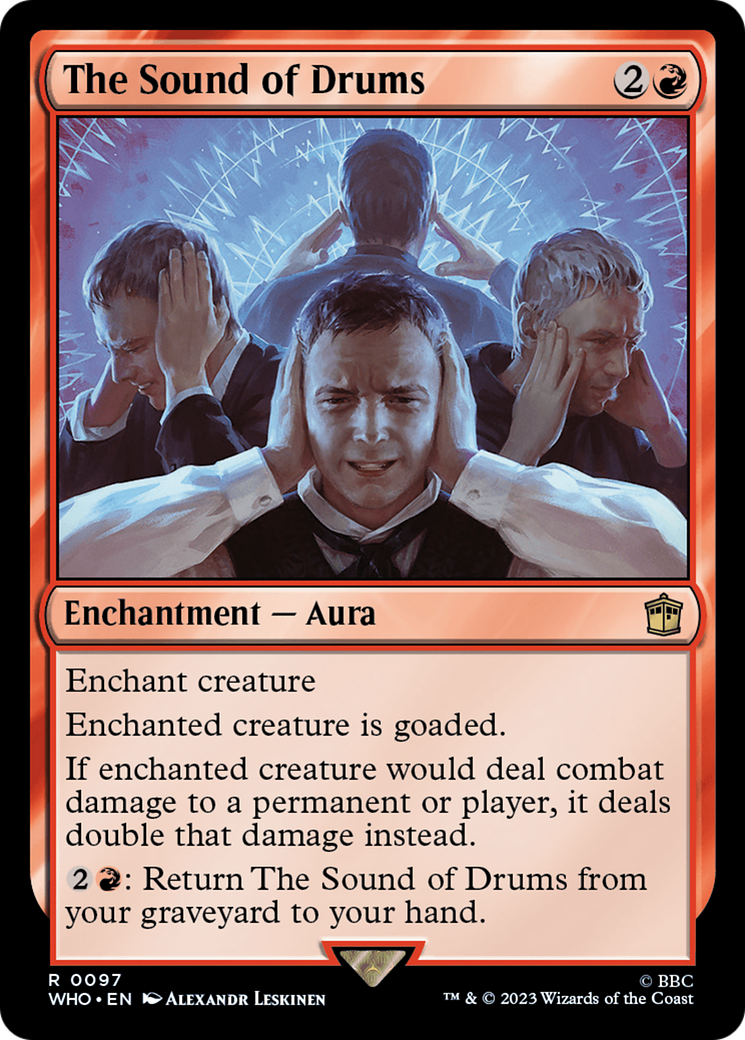
The Sound of Drums
The Sound of Drums
Enchantment — Aura
Enchant creature
Enchanted creature is goaded.
If enchanted creature would deal combat damage to a permanent or player, it deals double that damage instead.
: Return this card from your graveyard to your hand.
-
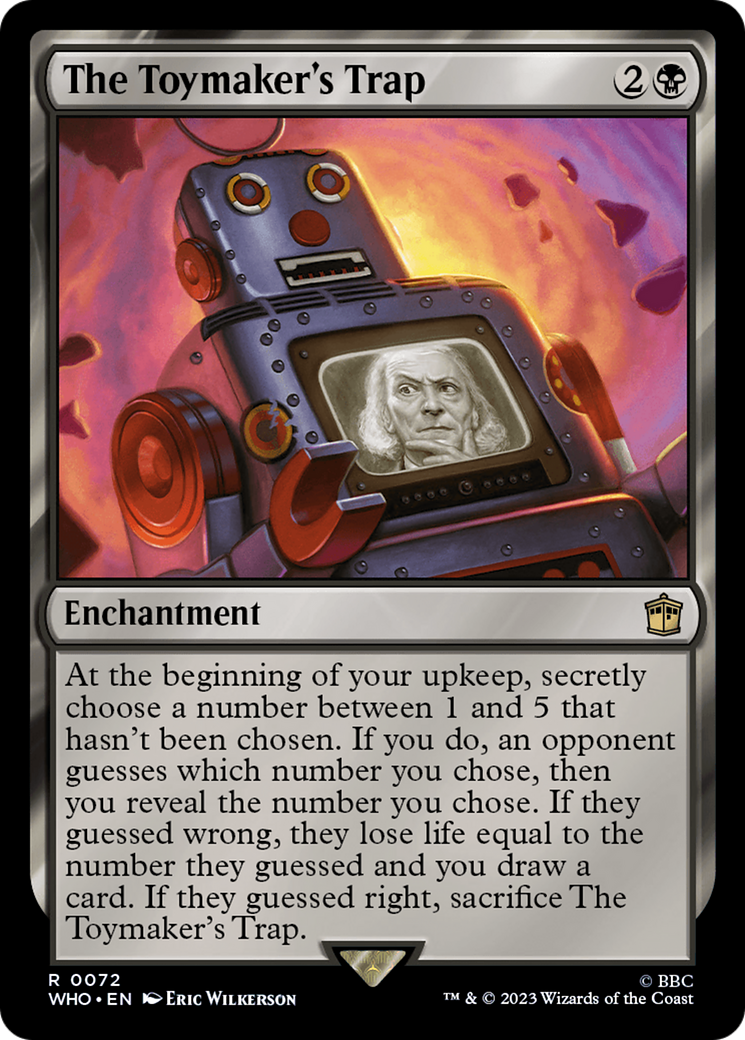
1
The Toymaker's Trap
The Toymaker's Trap
Enchantment
At the beginning of your upkeep, secretly choose a number between 1 and 5 that hasn't been chosen. If you do, an opponent guesses which number you chose, then you reveal the number you chose. If they guessed wrong, they lose life equal to the number they guessed and you draw a card. If they guessed right, sacrifice this enchantment.
- To secretly choose a number, write a number from 1 to 5 down without showing it to anyone else.
- If The Toymaker's Trap leaves the battlefield and later returns to the battlefield, it has no memory of which numbers were chosen for its effect before. The same is true if you control a second copy of it.
-
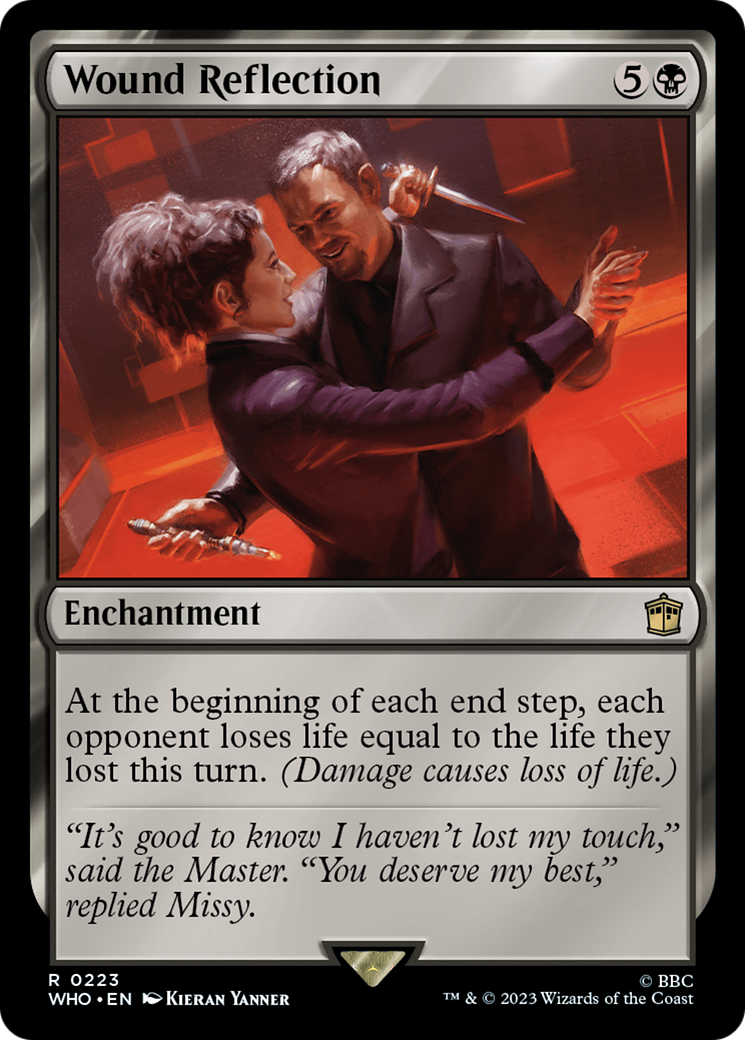
1
Wound Reflection
Wound Reflection
Enchantment
At the beginning of each end step, each opponent loses life equal to the life they lost this turn. (Damage causes loss of life.)
- When Wound Reflection's ability resolves, it checks how much life each opponent lost over the course of the turn, then it causes that opponent to lose that much life. It doesn't matter how the opponent lost life or who caused it. It also doesn't matter if Wound Reflection wasn't on the battlefield at the time some or all of the life was lost.
- Wound Reflection's ability checks only whether life was lost. It doesn't care whether life was also gained. For example, if an opponent lost 4 life and gained 6 life during the turn, that player will have a higher life total than they started the turn with but Wound Reflection's ability will still cause that player to lose 4 life.
- If Wound Reflection's ability resolves, then an opponent loses life later in the same turn, that life loss is never counted by Wound Reflection.
- Multiple Wound Reflections each trigger separately. For example, if an opponent lost 1 life, the first one's triggered ability to resolve causes them to lose another 1 life. Since they've now lost 2 life, the next triggered ability causes them to lose 2 life, and the next 4, and so on.
Lands 37
-
1
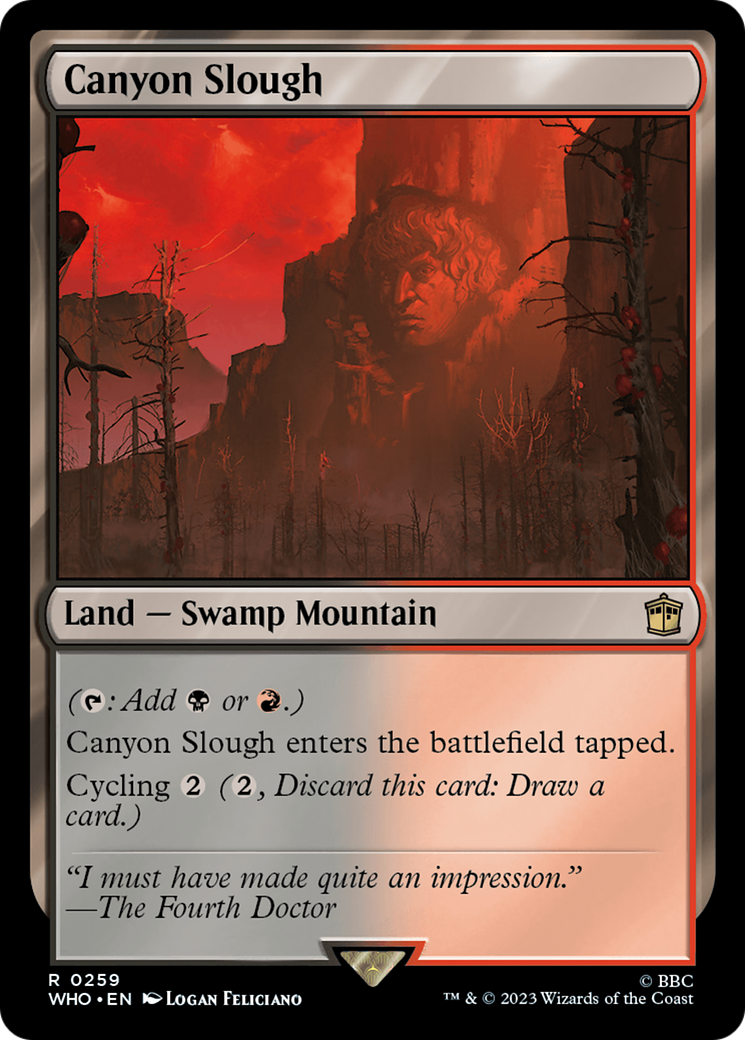
Canyon Slough
Canyon Slough
Land — Swamp Mountain
( : Add or .)
This land enters tapped.
Cycling ( , Discard this card: Draw a card.)
-
1
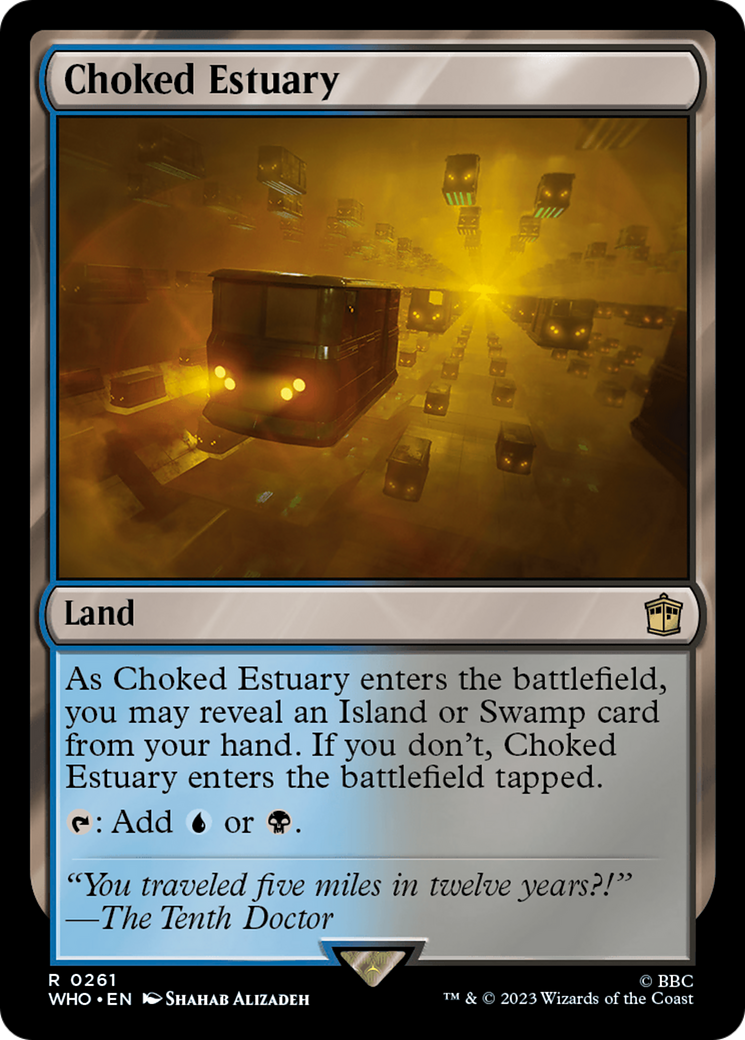
Choked Estuary
Choked Estuary
Land
As this land enters, you may reveal an Island or Swamp card from your hand. If you don't, this land enters tapped.
: Add or .
- Lands don't have a subtype just because they can produce mana of the corresponding color. Choked Estuary itself is neither an Island nor a Swamp, even though it produces blue and black mana, so you can't reveal one to satisfy the ability of another.
- If an effect instructs you to put Choked Estuary onto the battlefield tapped, it will still enter the battlefield tapped even if you reveal a land card from your hand.
- You may reveal any land card with either or both of the appropriate subtypes. It doesn't have to be a basic land. For example, you could reveal Prairie Stream from the Battle for Zendikar set to satisfy the ability of Choked Estuary.
- If an Island or Swamp is entering the battlefield from your hand at the same time as Choked Estuary, you may reveal the other land to have Choked Estuary enter untapped.
-
1
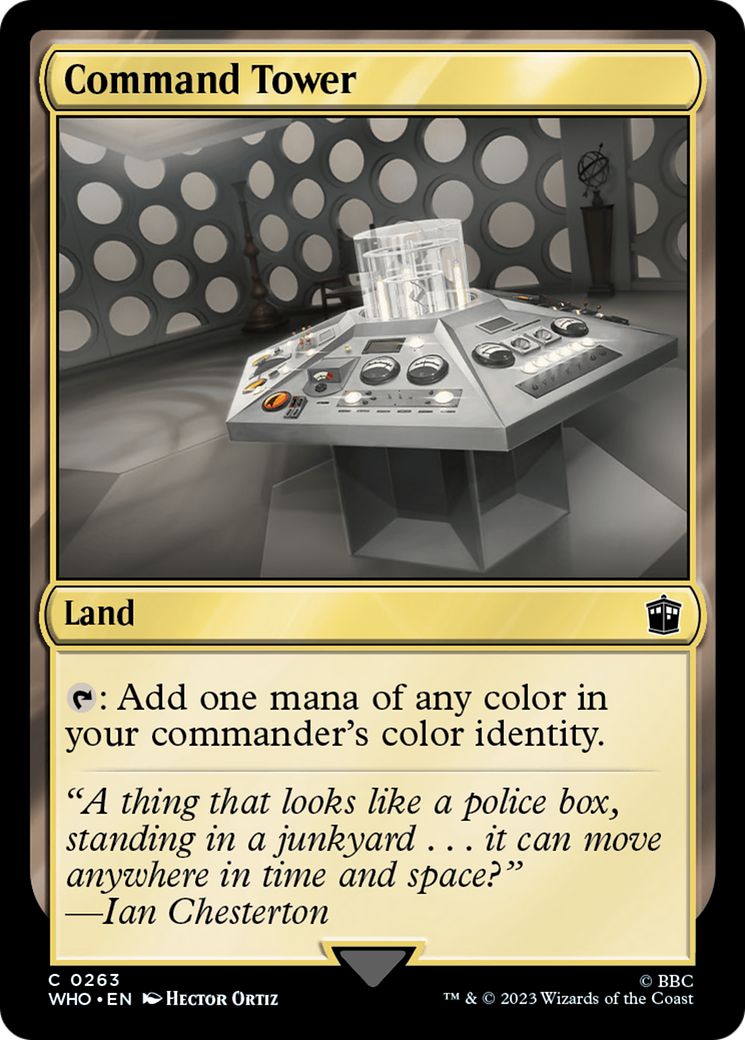
Command Tower
Command Tower
Land
: Add one mana of any color in your commander's color identity.
- If you don't have a commander, Command Tower's ability produces no mana.
- If your commander is a card that has no colors in its color identity, Command Tower's ability produces no mana. It doesn't produce .
- If you have two commanders, the ability adds one mana of any color in their combined color identities.
-
1
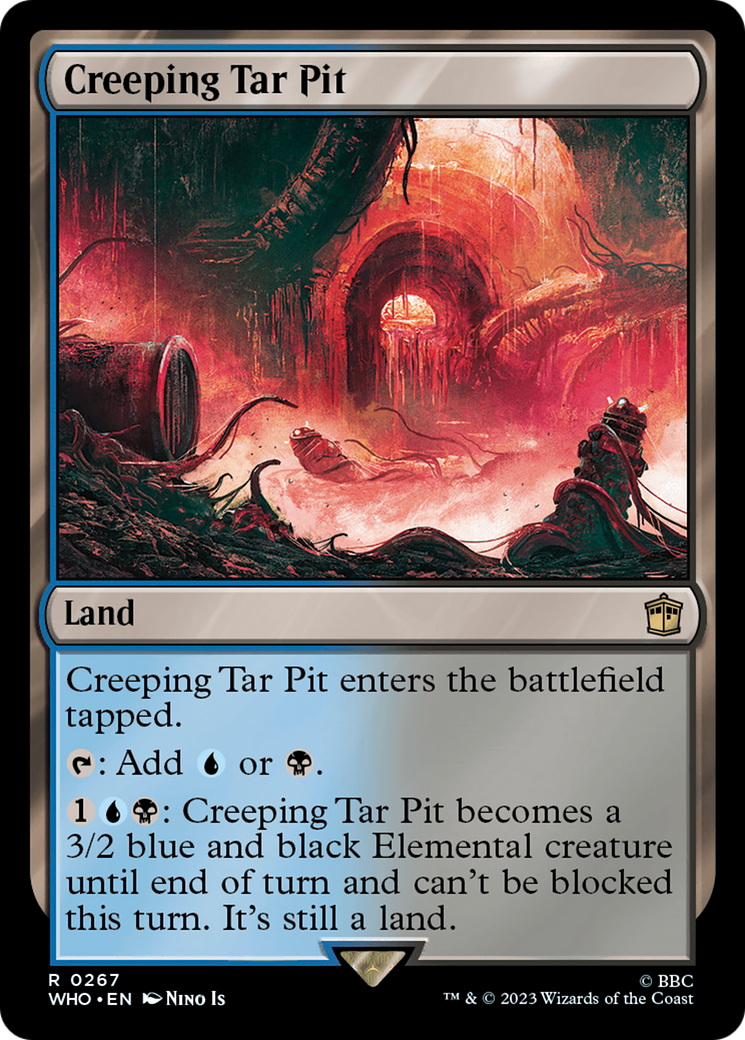
Creeping Tar Pit
Creeping Tar Pit
Land
This land enters tapped.
: Add or .
: Until end of turn, this land becomes a 3/2 blue and black Elemental creature. It's still a land. It can't be blocked this turn.
- A land that becomes a creature may be affected by "summoning sickness." You can't attack with it or use any of its abilities (including its mana abilities) unless it began your most recent turn on the battlefield under your control. Note that summoning sickness cares about when that permanent came under your control, not when it became a creature.
- When a land becomes a creature, that doesn't count as having a creature enter. The permanent was already on the battlefield; it only changed its types. Abilities that trigger whenever a creature enters won't trigger.
-
1
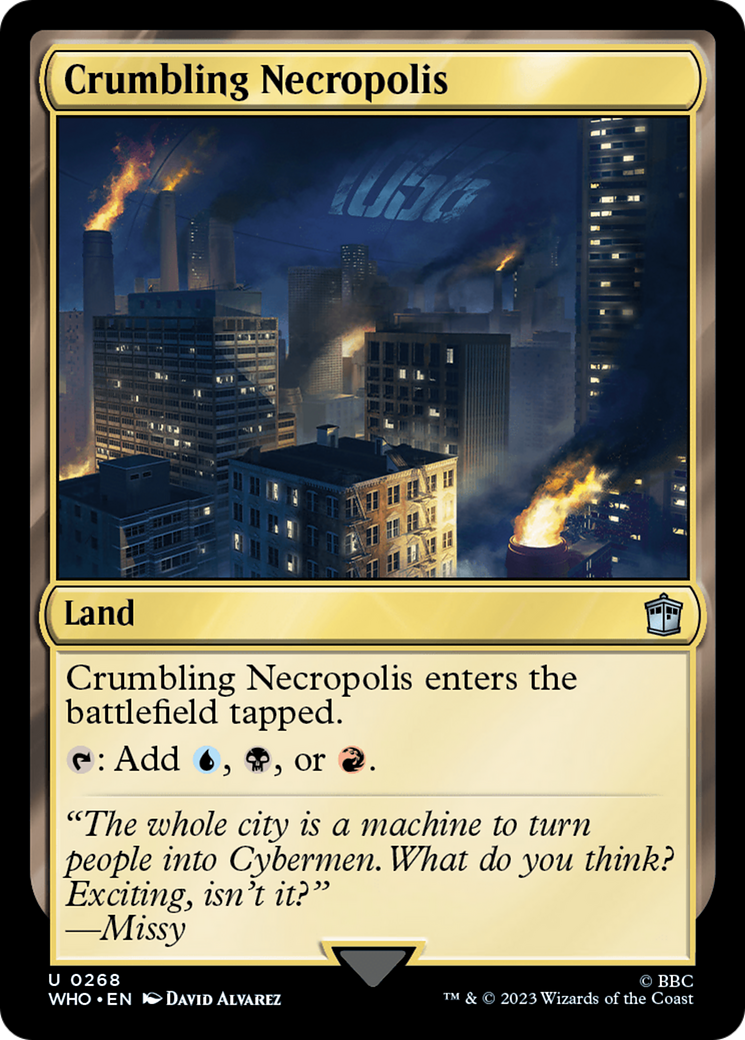
Crumbling Necropolis
Crumbling Necropolis
Land
This land enters tapped.
: Add , , or .
-
1
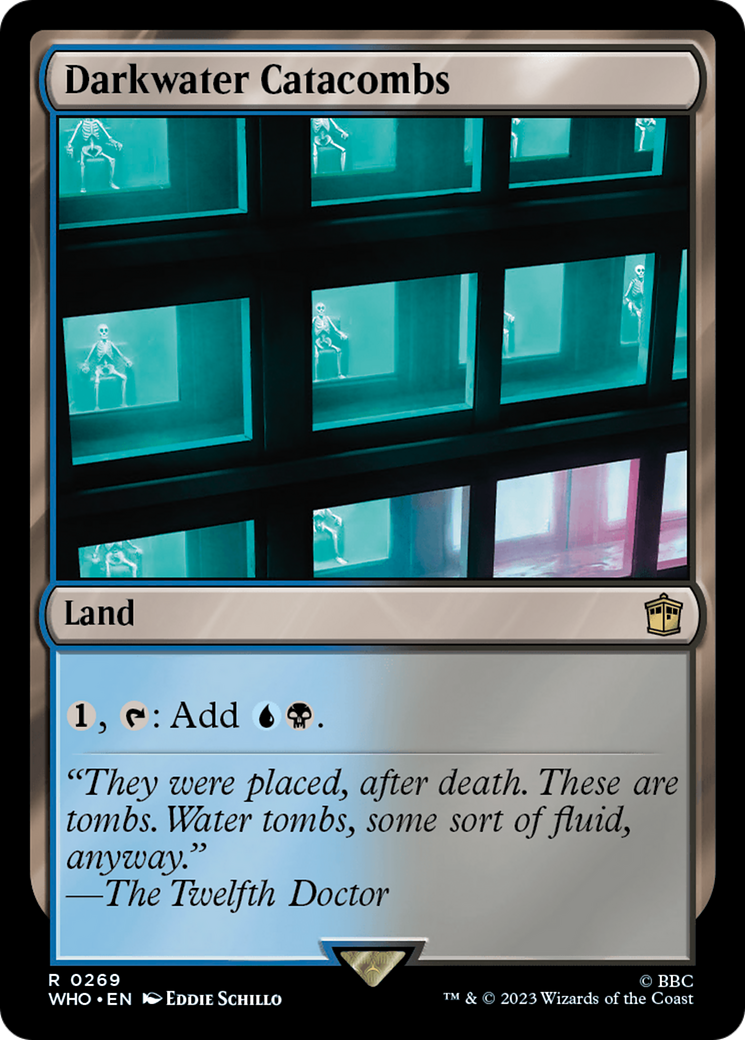
Darkwater Catacombs
Darkwater Catacombs
Land
, : Add .
-
1
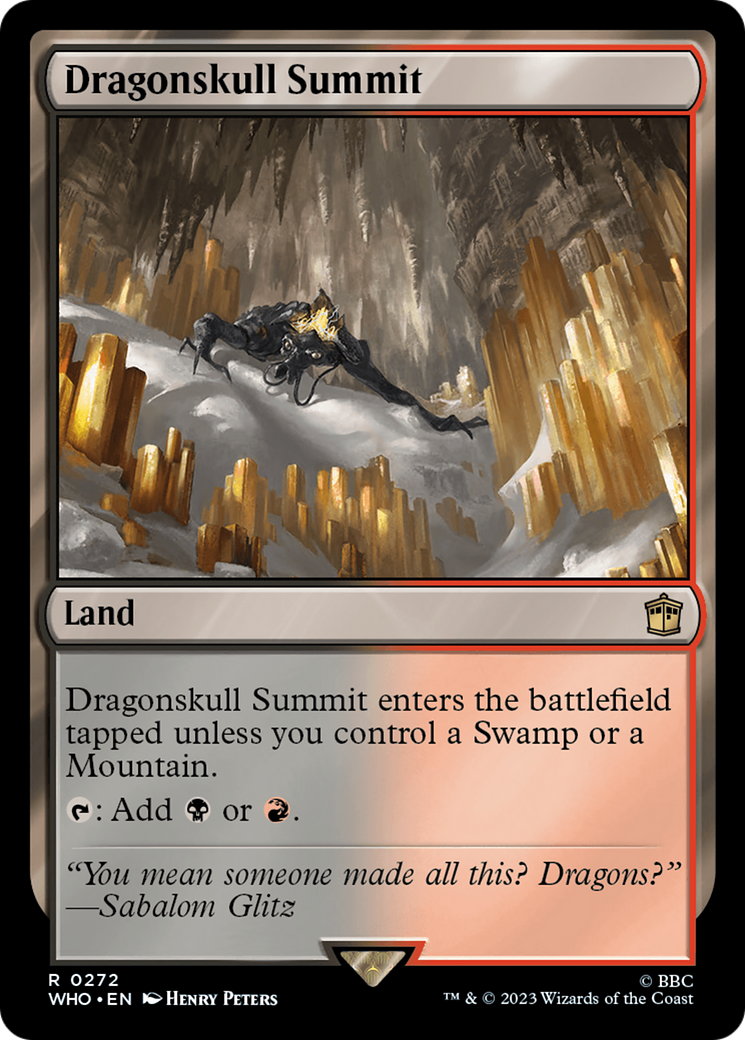
Dragonskull Summit
Dragonskull Summit
Land
This land enters tapped unless you control a Swamp or a Mountain.
: Add or .
- This checks for lands you control with the land type Swamp or Mountain, not for lands named Swamp or Mountain. The lands it checks for don't have to be basic lands. For example, if you control Stomping Ground (a nonbasic land with the land types Mountain and Forest), Dragonskull Summit will enter untapped.
- As this is entering, it checks for lands that are already on the battlefield. It won't see lands that are entering at the same time (due to Warp World, for example).
-
1
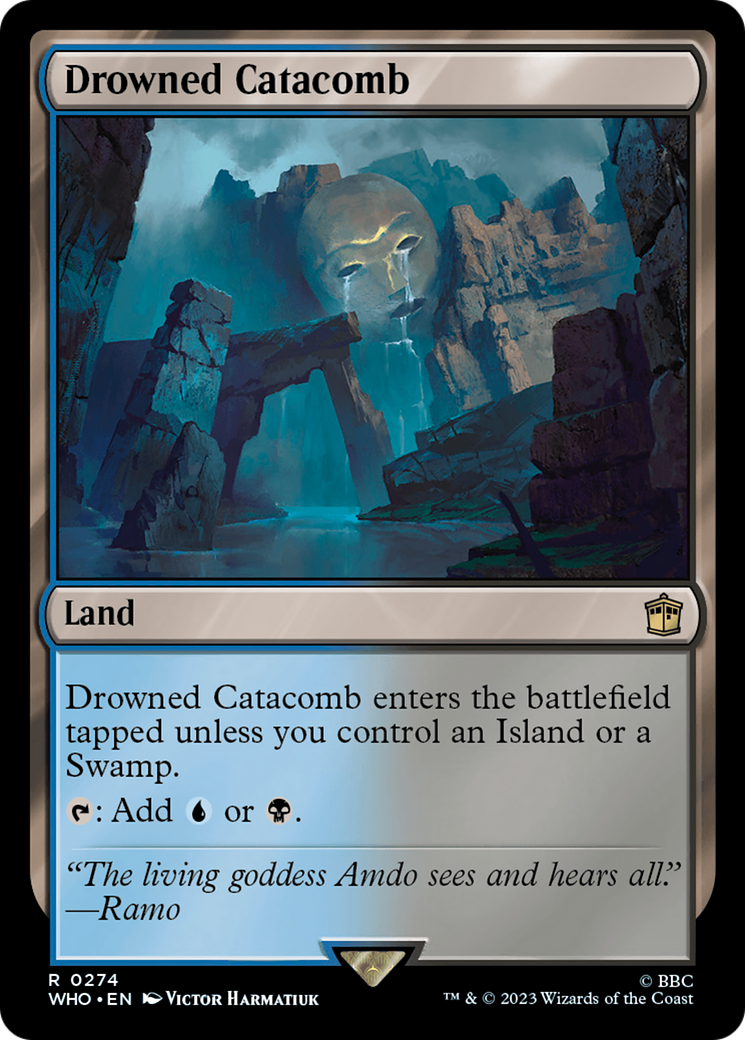
Drowned Catacomb
Drowned Catacomb
Land
This land enters tapped unless you control an Island or a Swamp.
: Add or .
- As this is entering, it checks for lands that are already on the battlefield. It won't see lands that are entering at the same time (due to Warp World, for example).
- This checks for lands you control with the land type Island or Swamp, not for lands named Island or Swamp. The lands it checks for don't have to be basic lands. For example, if you control Blood Crypt (a nonbasic land with the land types Swamp and Mountain), Drowned Catacomb will enter untapped.
-
1
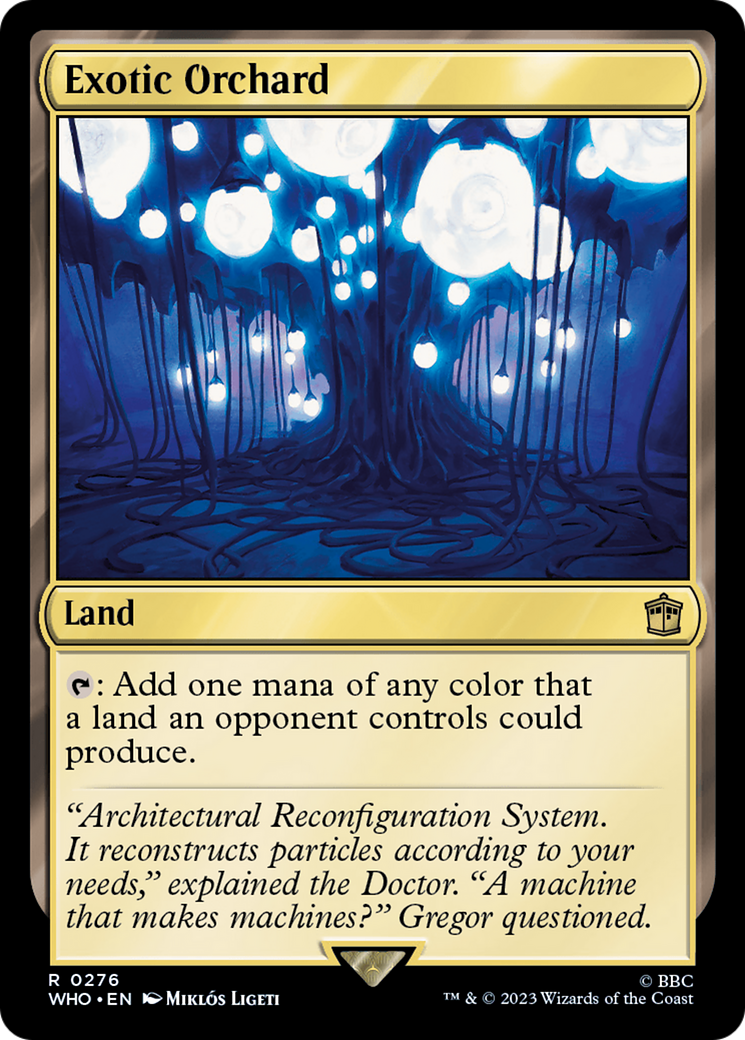
Exotic Orchard
Exotic Orchard
Land
: Add one mana of any color that a land an opponent controls could produce.
- Lands that produce mana based only on what other lands "could produce" won't help each other unless some other land allows one of them to actually produce some type of mana. For example, if you control an Exotic Orchard and your opponent controls an Exotic Orchard and a Reflecting Pool, none of those lands would produce mana if their mana abilities were activated. On the other hand, if you control a Forest and an Exotic Orchard, and your opponent controls an Exotic Orchard and a Reflecting Pool, then each of those lands can be tapped to produce . Your opponent's Exotic Orchard can produce because you control a Forest. Your Exotic Orchard and your opponent's Reflecting Pool can each produce because your opponent's Exotic Orchard can produce .
- When determining what colors of mana your opponents' lands could produce, Exotic Orchard takes into account any applicable replacement effects that would apply to those lands' mana abilities (such as Contamination's effect, for example). If there are more than one, consider them in any possible order.
- The colors of mana are white, blue, black, red, and green. Exotic Orchard can't be tapped for colorless mana, even if a land an opponent controls could produce colorless mana.
- Exotic Orchard doesn't care about any restrictions or riders your opponents' lands (such as Ancient Ziggurat or Hall of the Bandit Lord) put on the mana they produce. It just cares about colors of mana.
- Exotic Orchard checks the effects of all mana-producing abilities of lands your opponents control, but it doesn't check their costs. For example, Vivid Crag has the ability " , Remove a charge counter from Vivid Crag: Add one mana of any color." If an opponent controls Vivid Crag and you control Exotic Orchard, you can tap Exotic Orchard for any color of mana. It doesn't matter whether Vivid Crag has a charge counter on it, and it doesn't matter whether it's untapped.
-
1
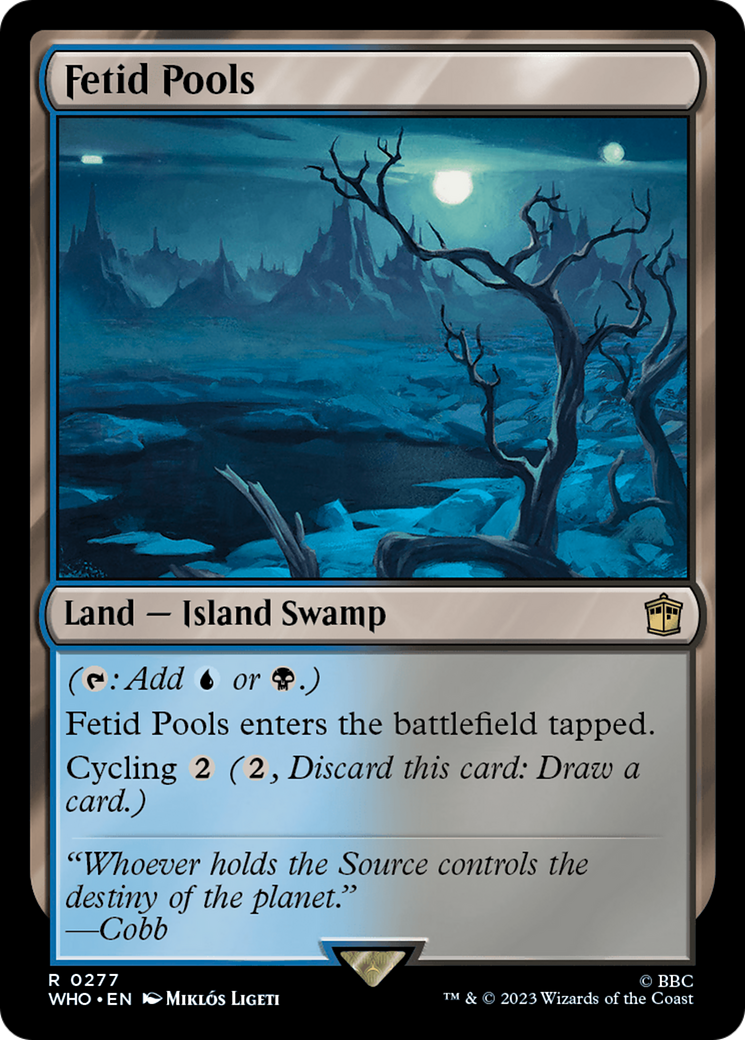
Fetid Pools
Fetid Pools
Land — Island Swamp
( : Add or .)
This land enters tapped.
Cycling ( , Discard this card: Draw a card.)
-
1
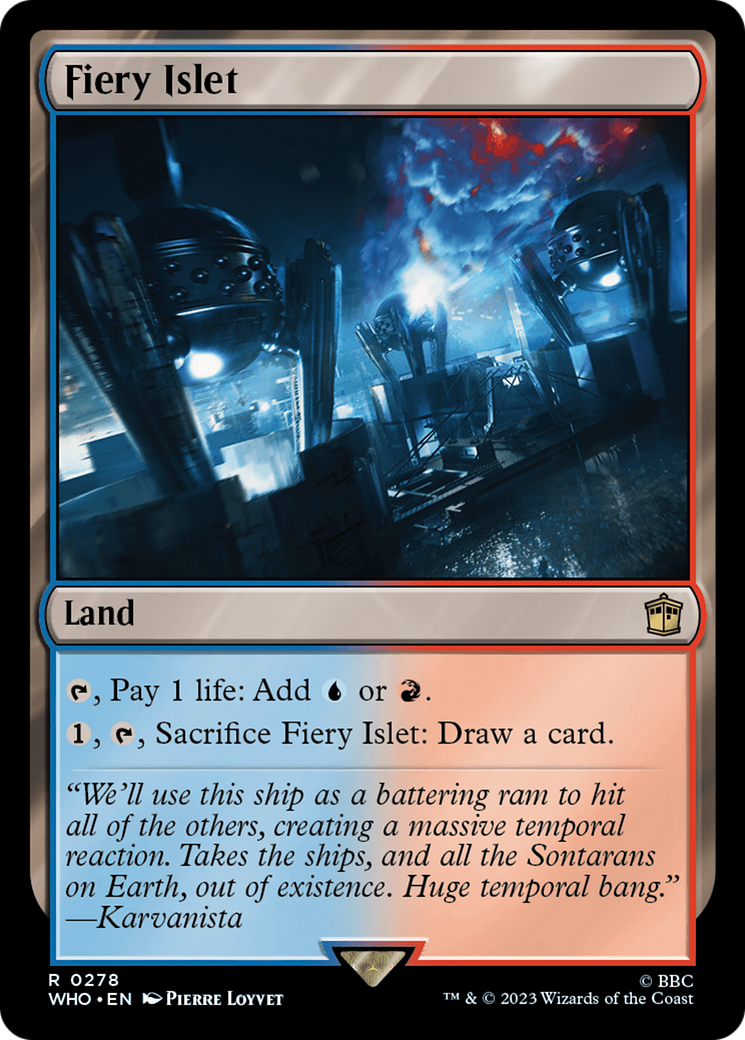
Fiery Islet
Fiery Islet
Land
, Pay 1 life: Add or .
, , Sacrifice this land: Draw a card.
-
1
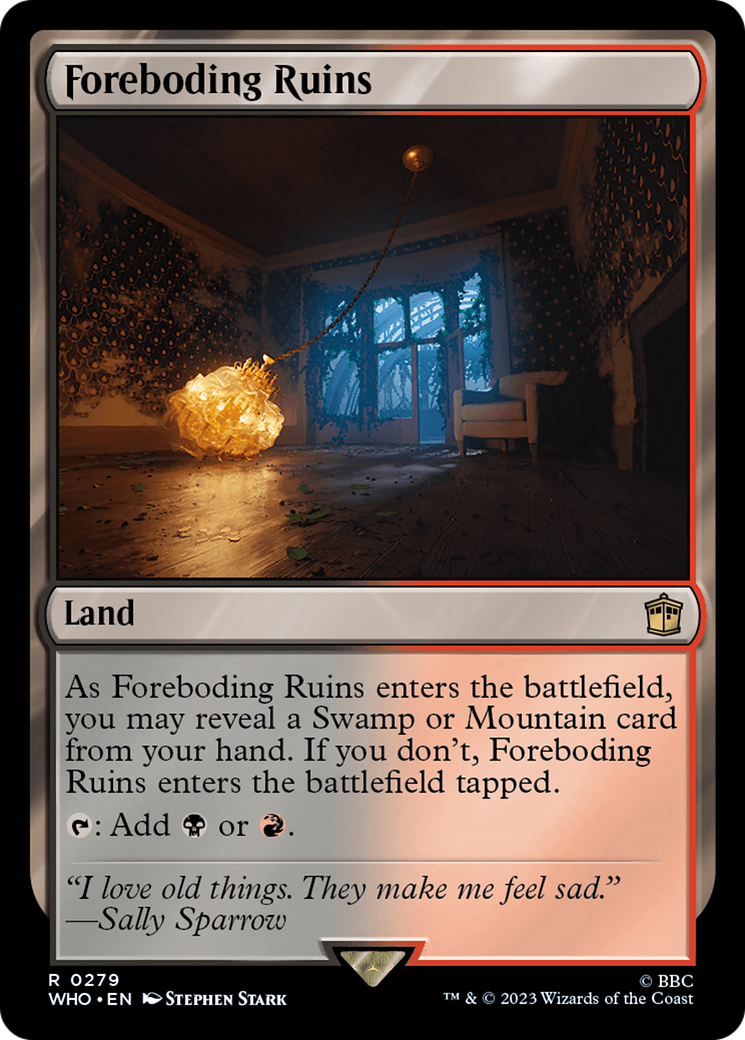
Foreboding Ruins
Foreboding Ruins
Land
As this land enters, you may reveal a Swamp or Mountain card from your hand. If you don't, this land enters tapped.
: Add or .
- You may reveal any land card with either or both of the appropriate subtypes. It doesn't have to be a basic land. For example, you could reveal Sunken Hollow from the Battle for Zendikar set to satisfy the ability of Foreboding Ruins.
- If a Swamp or Mountain is entering the battlefield from your hand at the same time as Foreboding Ruins, you may reveal the other land to have Foreboding Ruins enter untapped.
- Lands don't have a subtype just because they can produce mana of the corresponding color. Foreboding Ruins itself is neither a Swamp nor a Mountain, even though it produces black and red mana, so you can't reveal one to satisfy the ability of another.
- If an effect instructs you to put Foreboding Ruins onto the battlefield tapped, it will still enter the battlefield tapped even if you reveal a land card from your hand.
-
1
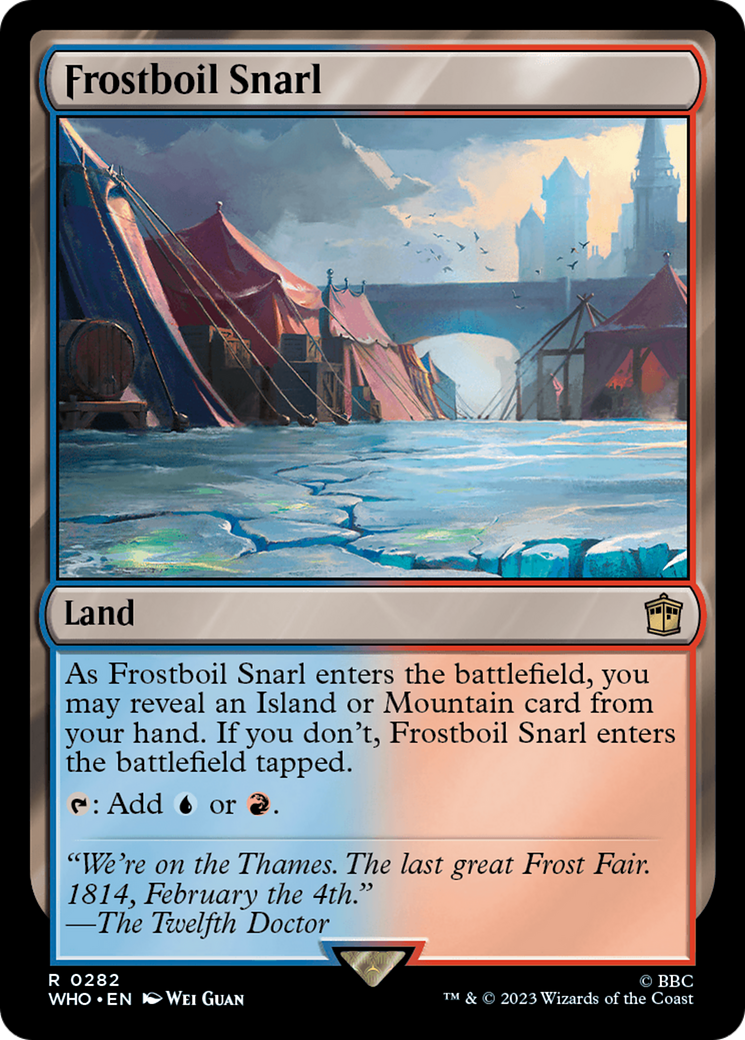
Frostboil Snarl
Frostboil Snarl
Land
As this land enters, you may reveal an Island or Mountain card from your hand. If you don't, this land enters tapped.
: Add or .
- The "Snarl" itself doesn't have any land subtypes. You can't reveal one to satisfy the ability of another.
- If a land card with an appropriate subtype is entering the battlefield from your hand at the same time as one of these lands, you may reveal the other land to have the "Snarl" enter untapped.
- If an effect instructs you to put one of these lands onto the battlefield tapped, it will still enter the battlefield tapped even if you reveal a land card from your hand.
- You may reveal any land card with either or both of the appropriate subtypes. It doesn't have to be a basic land card.
-
1
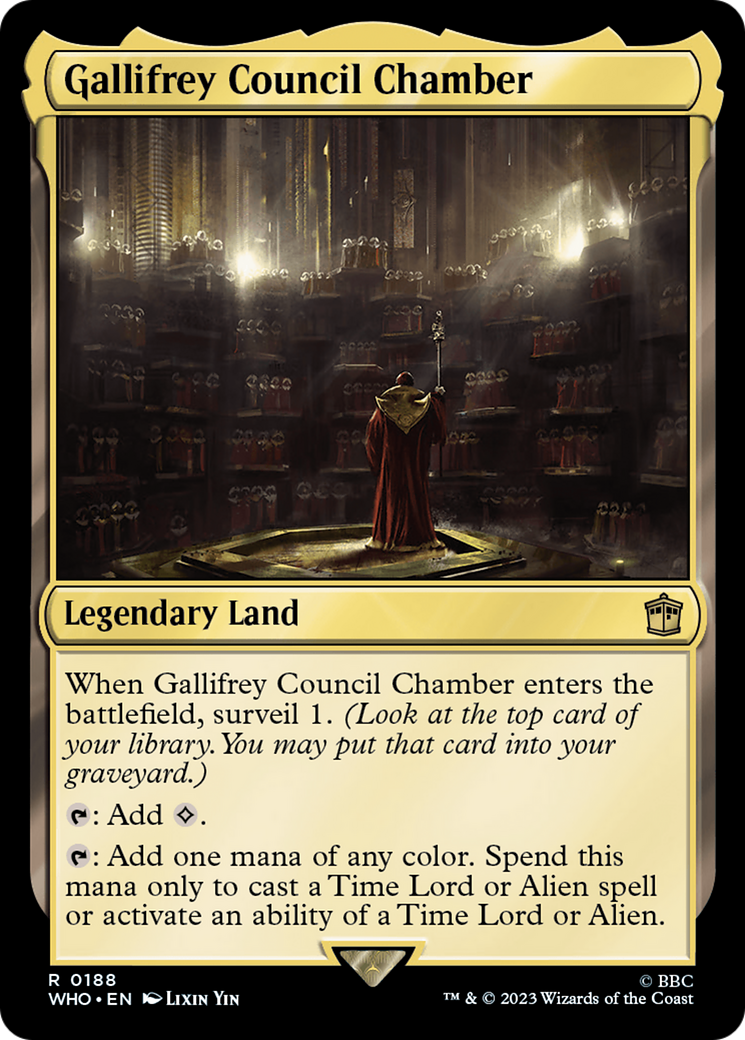
Gallifrey Council Chamber
Gallifrey Council Chamber
Legendary Land
When Gallifrey Council Chamber enters, surveil 1. (Look at the top card of your library. You may put that card into your graveyard.)
: Add .
: Add one mana of any color. Spend this mana only to cast a Time Lord or Alien spell or activate an ability of a Time Lord or Alien.
-
1
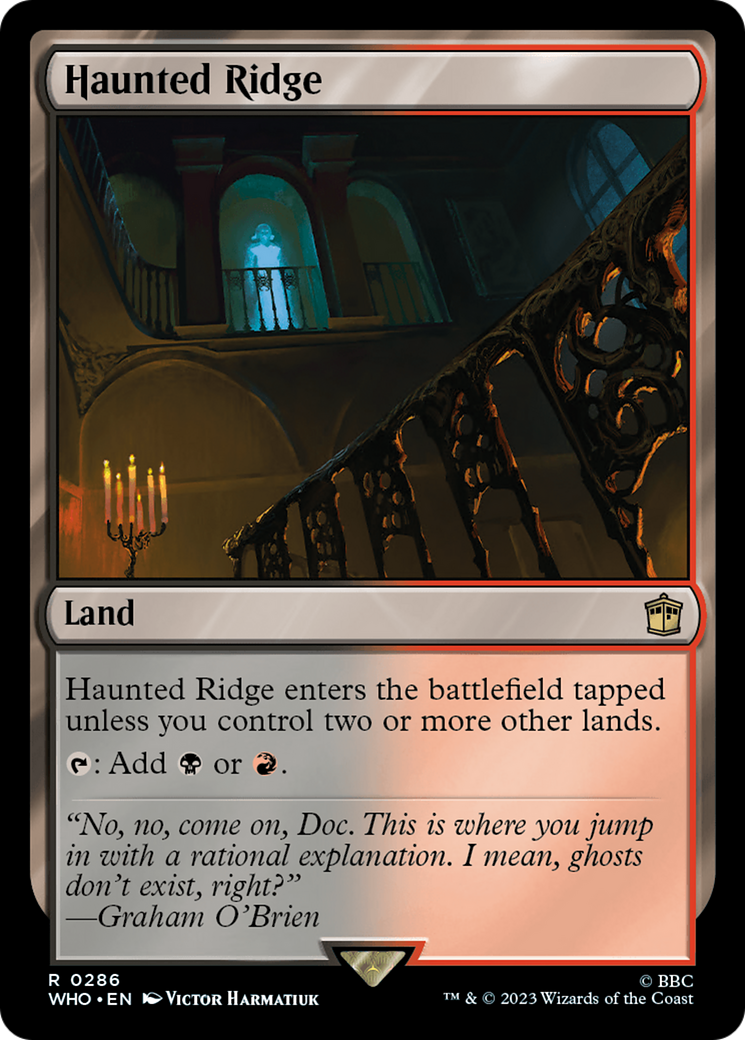
Haunted Ridge
Haunted Ridge
Land
This land enters tapped unless you control two or more other lands.
: Add or .
- If this land enters the battlefield at the same time as any number of other lands, those other lands are not counted when determining if this land enters the battlefield tapped or untapped.
-
2
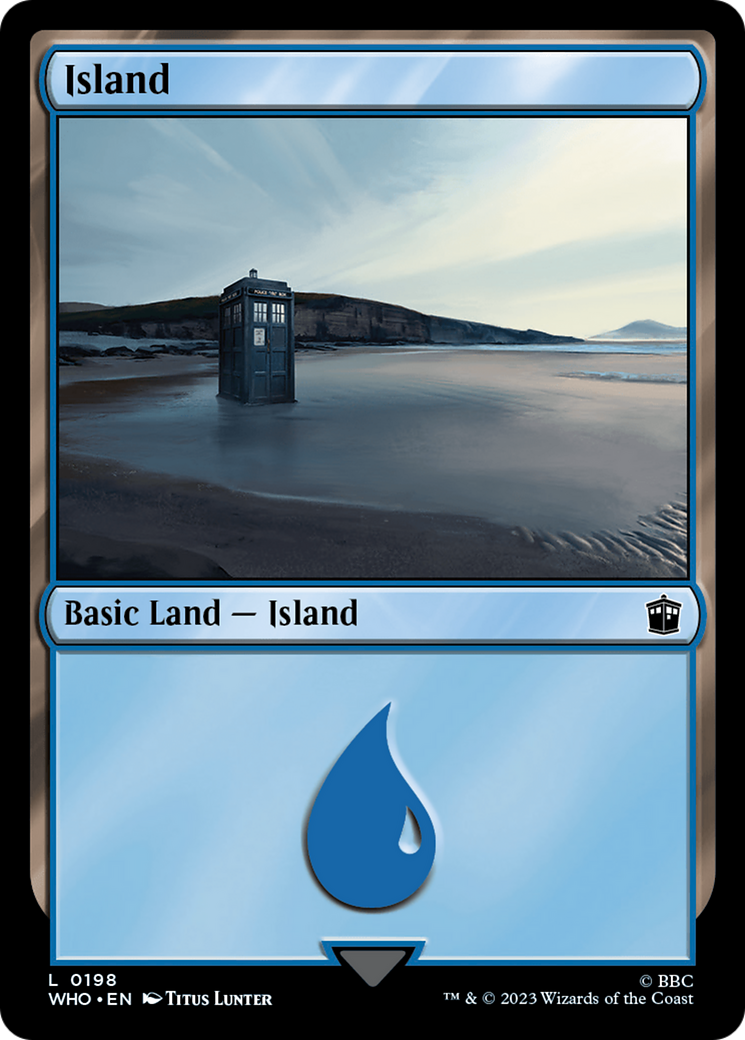
Island
Island
Basic Land — Island
( : Add .)
-
1
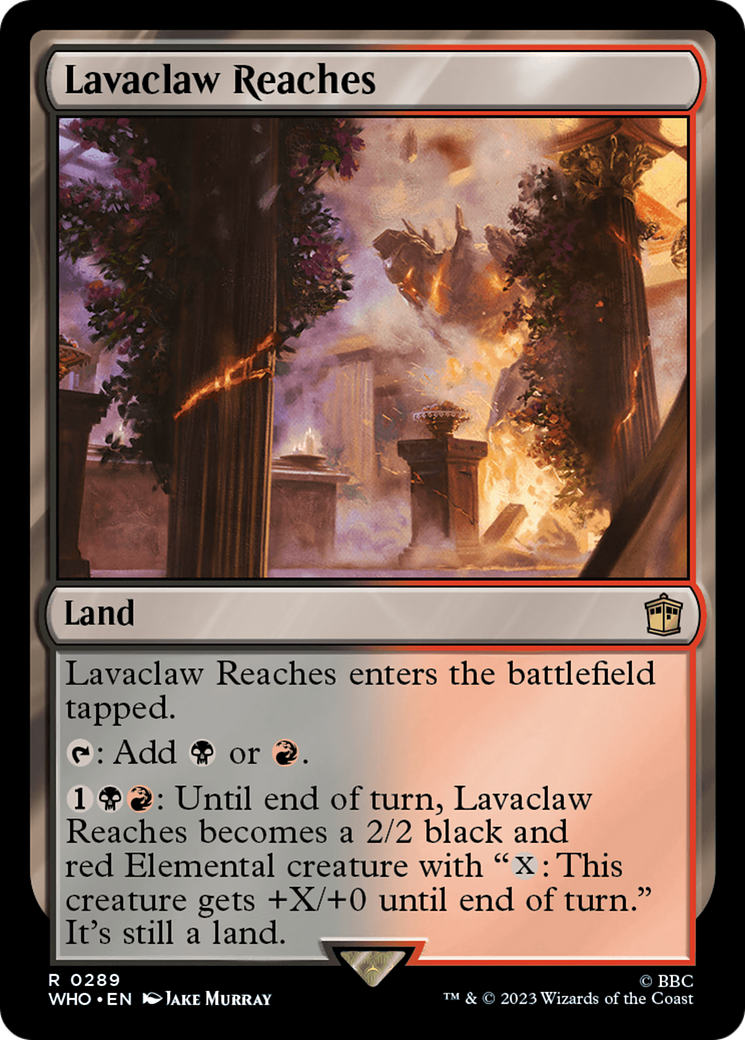
Lavaclaw Reaches
Lavaclaw Reaches
Land
This land enters tapped.
: Add or .
: Until end of turn, this land becomes a 2/2 black and red Elemental creature with " : This creature gets +X/+0 until end of turn." It's still a land.
- A land that becomes a creature may be affected by "summoning sickness." You can't attack with it or use any of its abilities (including its mana abilities) unless it began your most recent turn on the battlefield under your control. Note that summoning sickness cares about when that permanent came under your control, not when it became a creature.
- When a land becomes a creature, that doesn't count as having a creature enter. The permanent was already on the battlefield; it only changed its types. Abilities that trigger whenever a creature enters won't trigger.
-
2
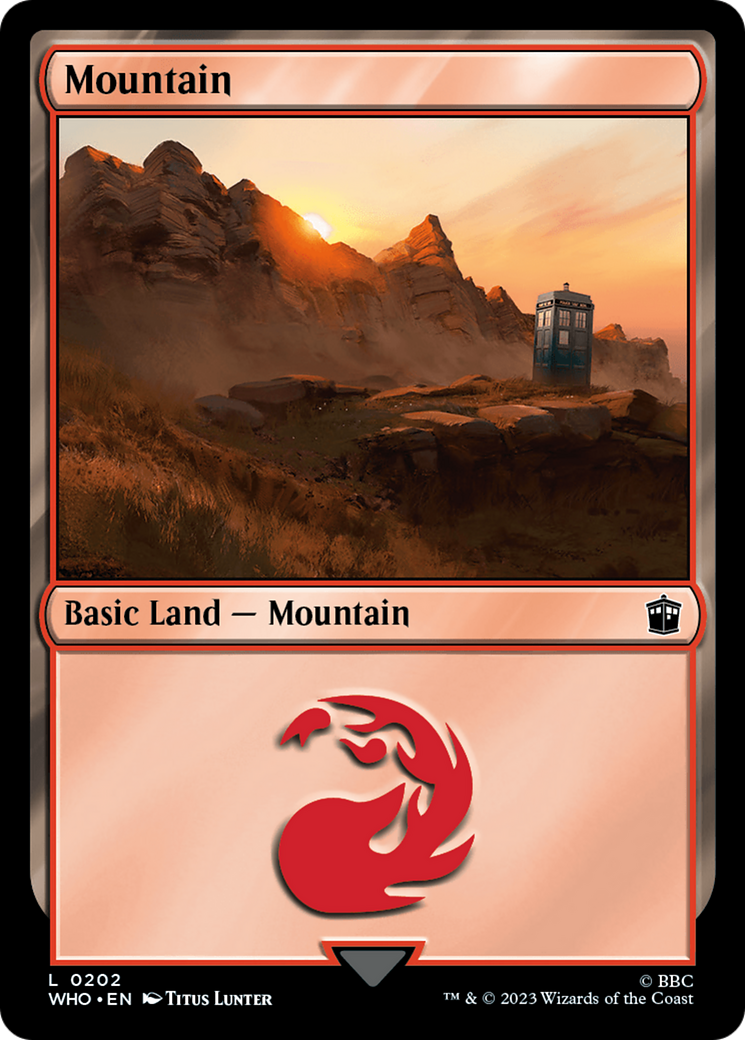
Mountain
Mountain
Basic Land — Mountain
( : Add .)
-
1
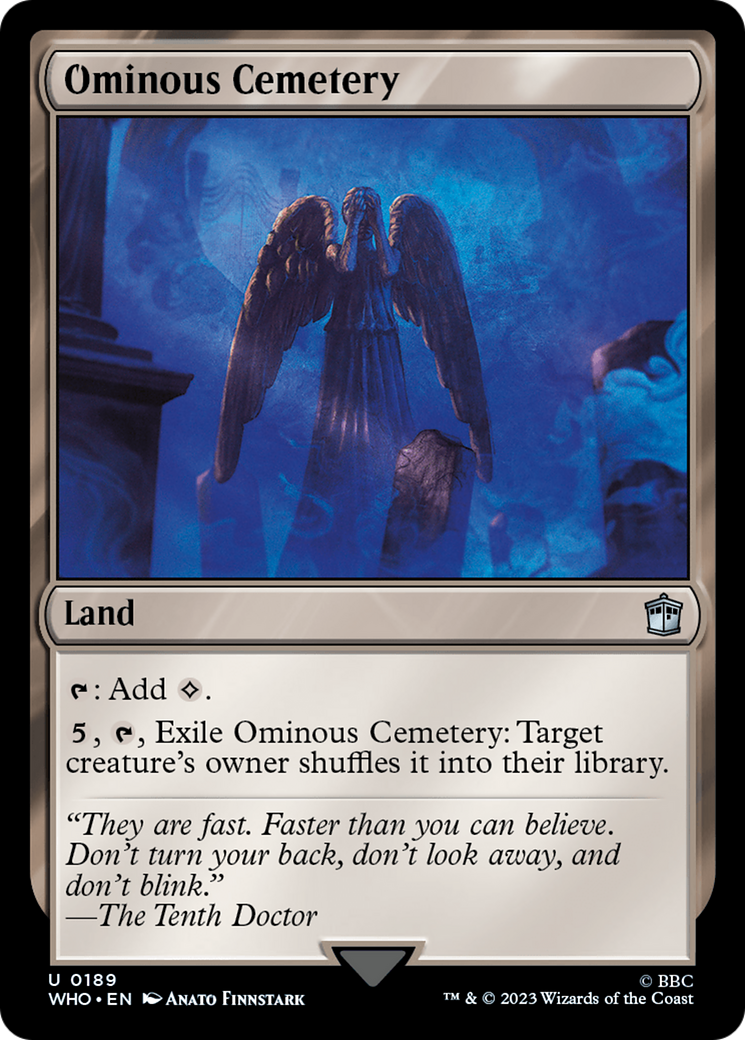
Ominous Cemetery
Ominous Cemetery
Land
: Add .
, , Exile this land: Target creature's owner shuffles it into their library.
-
1
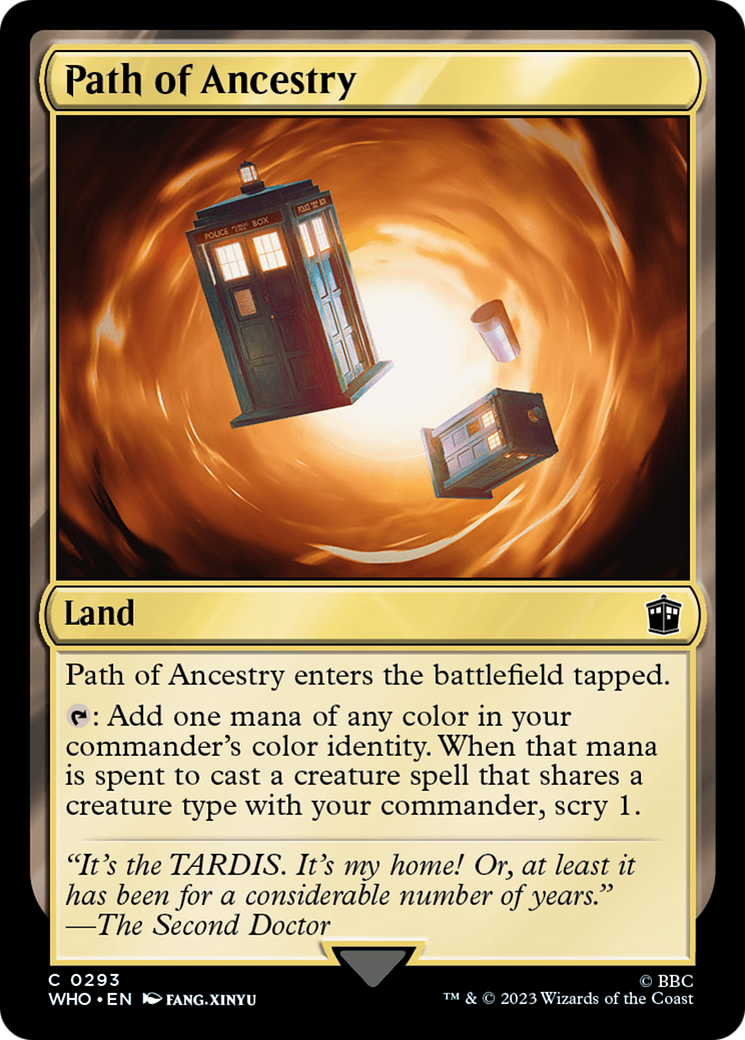
Path of Ancestry
Path of Ancestry
Land
This land enters tapped.
: Add one mana of any color in your commander's color identity. When that mana is spent to cast a creature spell that shares a creature type with your commander, scry 1. (Look at the top card of your library. You may put that card on the bottom.)
- Your commander's creature types are checked immediately after you cast a creature spell spending mana from Path of Ancestry's last ability. They aren't set before the game begins, and they may not be the same types your commander had when you activated that ability.
- If you have two commanders, the last ability adds one mana of any color in their combined color identities. When you spend that mana on a creature spell that shares a creature type with either of your commanders, you'll scry 1.
- If Path of Ancestry's last ability produces two mana (most likely due to Mana Reflection), spending those two mana to cast creature spells that share a creature type with your commander will cause two abilities to trigger. Each of those abilities will cause you to scry 1. You won't scry 2. This is true whether you spend the mana on one creature spell or two.
- If your commander has no creature types, it can't share a creature type with any spell that you cast.
- If you cast your commander with mana from Path of Ancestry, and your commander hasn't somehow lost all of its creature types while on the stack, you'll scry 1.
- If you don't have a commander, Path of Ancestry's ability produces no mana.
- If your commander is a card that has no colors in its color identity, Path of Ancestry's ability produces no mana. It doesn't produce .
-
1
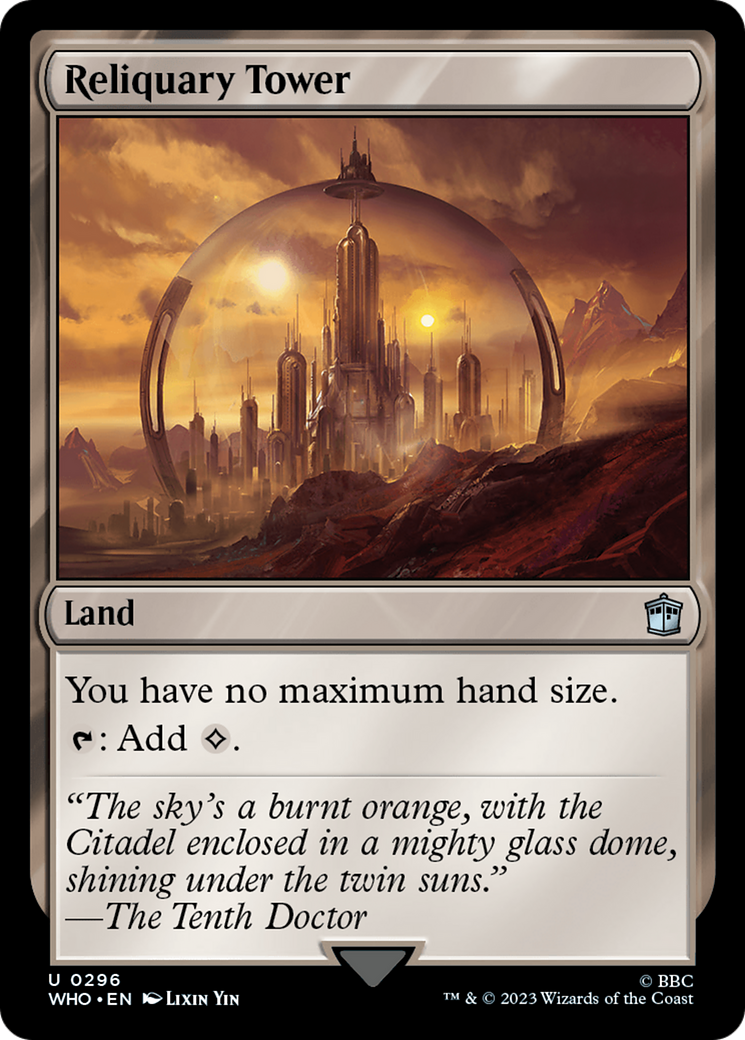
Reliquary Tower
Reliquary Tower
Land
You have no maximum hand size.
: Add .
- If multiple effects modify your hand size, apply them in timestamp order. For example, if you put Null Profusion (an enchantment that says your maximum hand size is two) onto the battlefield and then put Reliquary Tower onto the battlefield, you'll have no maximum hand size. However, if those permanents enter in the opposite order, your maximum hand size would be two.
-
1
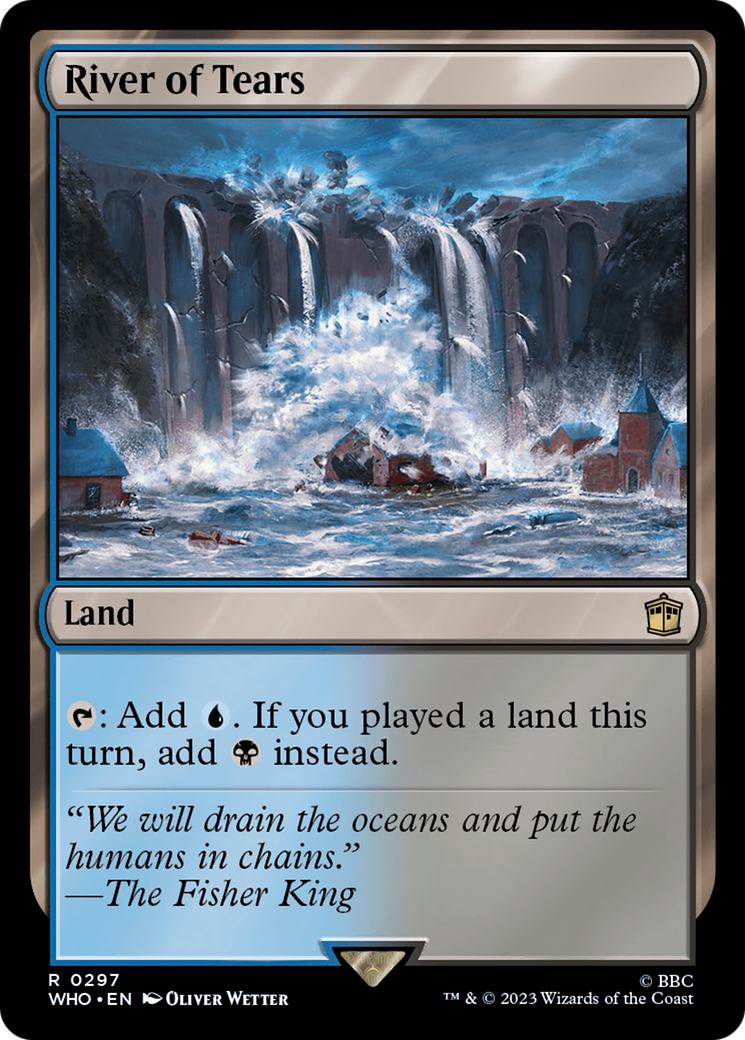
River of Tears
River of Tears
Land
: Add . If you played a land this turn, add instead.
- The turn you play River of Tears, it will produce when tapped for mana.
- River of Tears produces only after you've played a land, not after you've put a land onto the battlefield (such as with Evolving Wilds).
-
1
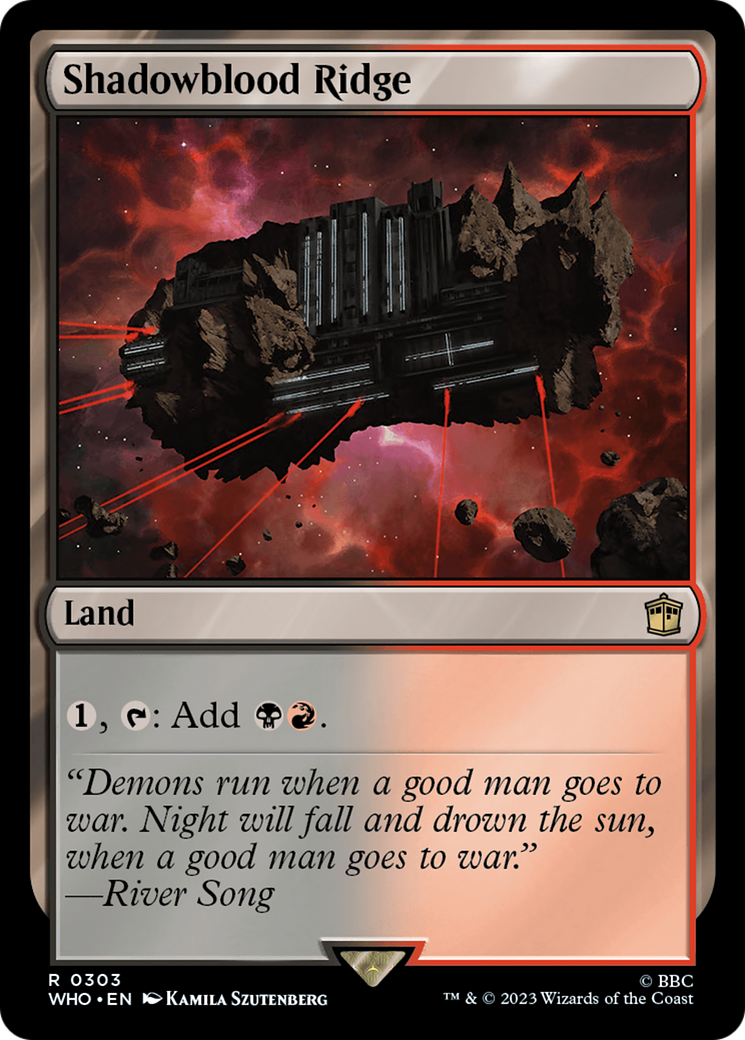
Shadowblood Ridge
Shadowblood Ridge
Land
, : Add .
-
1
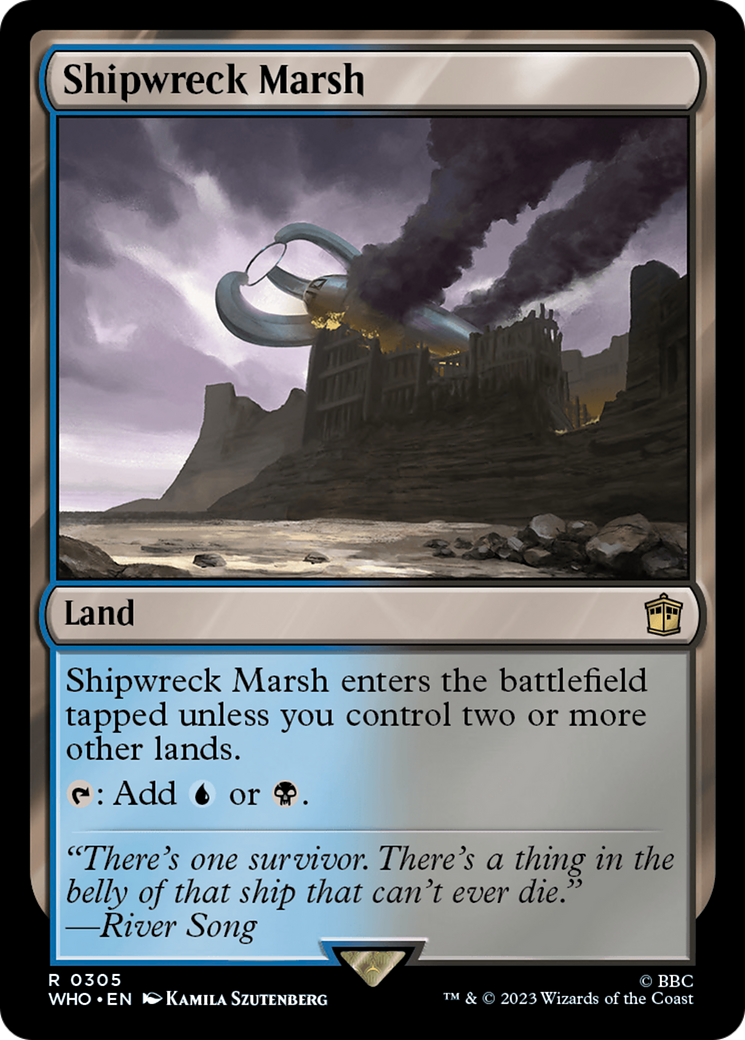
Shipwreck Marsh
Shipwreck Marsh
Land
This land enters tapped unless you control two or more other lands.
: Add or .
- If this land enters the battlefield at the same time as any number of other lands, those other lands are not counted when determining if this land enters the battlefield tapped or untapped.
-
1
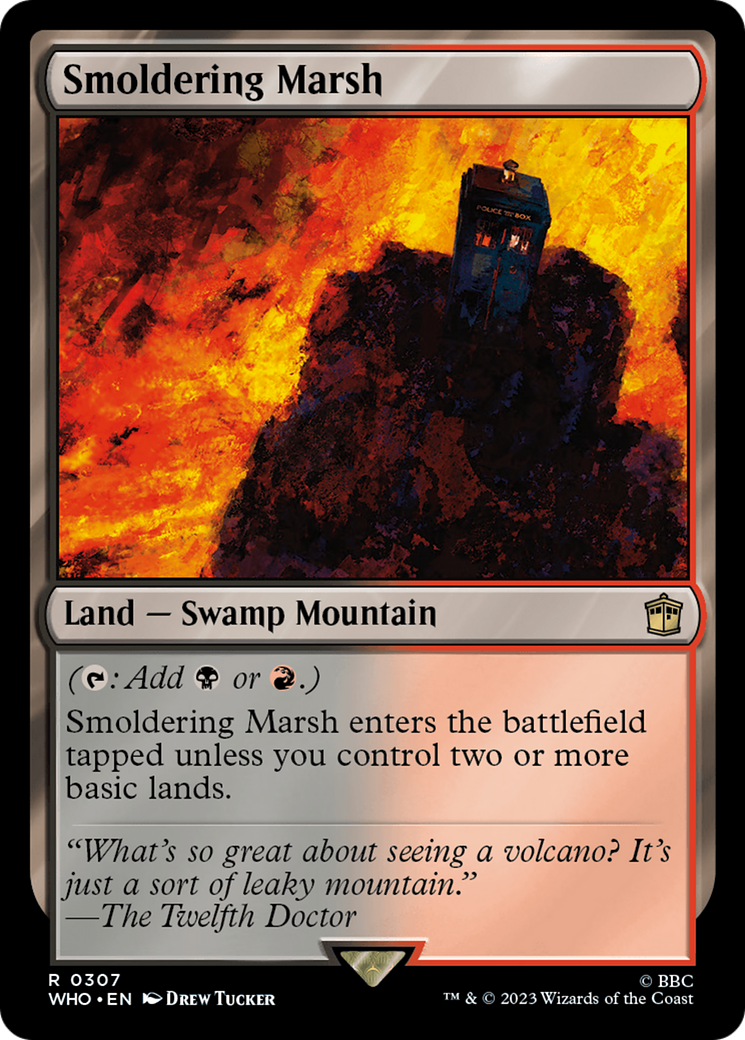
Smoldering Marsh
Smoldering Marsh
Land — Swamp Mountain
( : Add or .)
This land enters tapped unless you control two or more basic lands.
- However, because these cards have basic land types, effects that specify a basic land type without also specifying that the land be basic can affect them. For example, a spell or ability that reads "Destroy target Forest" can target Canopy Vista, while one that reads "Destroy target basic Forest" cannot.
- Even though these lands have basic land types, they are not basic lands because "basic" doesn't appear on their type line. Notably, controlling two or more of them won't allow others to enter the battlefield untapped.
- If one of these lands enters the battlefield at the same time as any number of basic lands, those other lands are not counted when determining if this land enters the battlefield tapped or untapped.
-
1
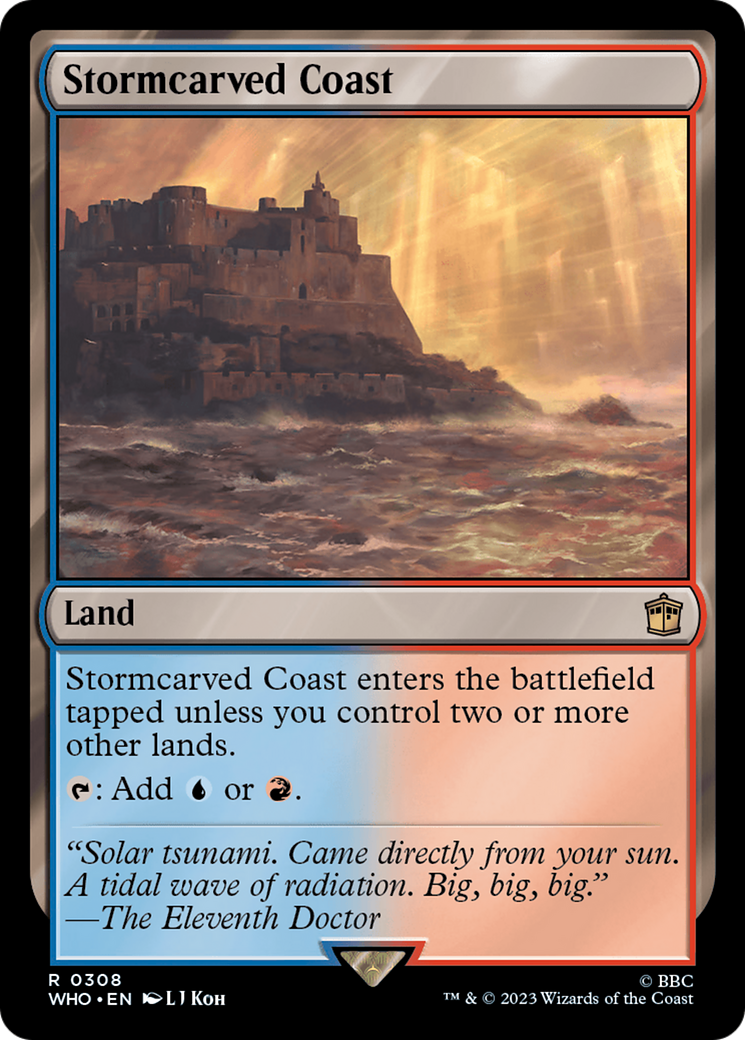
Stormcarved Coast
Stormcarved Coast
Land
This land enters tapped unless you control two or more other lands.
: Add or .
-
1
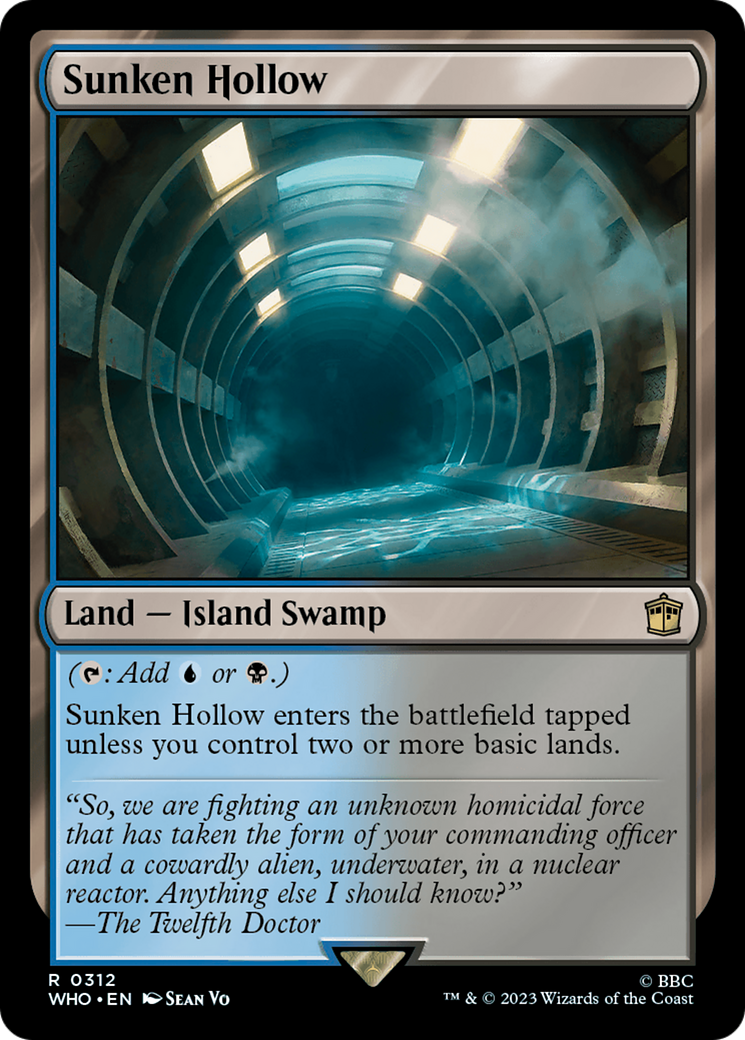
Sunken Hollow
Sunken Hollow
Land — Island Swamp
( : Add or .)
This land enters tapped unless you control two or more basic lands.
- Even though these lands have basic land types, they are not basic lands because "basic" doesn't appear on their type line. Notably, controlling two or more of them won't allow others to enter the battlefield untapped.
- However, because these cards have basic land types, effects that specify a basic land type without also specifying that the land be basic can affect them. For example, a spell or ability that reads "Destroy target Forest" can target Canopy Vista, while one that reads "Destroy target basic Forest" cannot.
- If one of these lands enters the battlefield at the same time as any number of basic lands, those other lands are not counted when determining if this land enters the battlefield tapped or untapped.
-
2
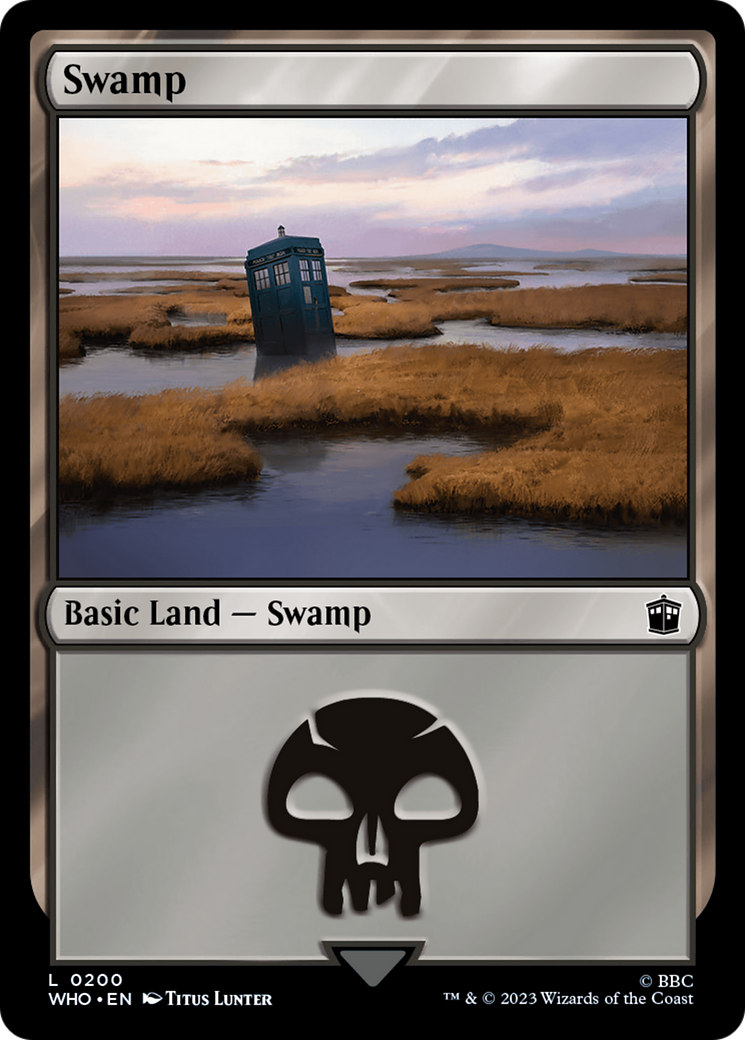
Swamp
Swamp
Basic Land — Swamp
( : Add .)
-
1
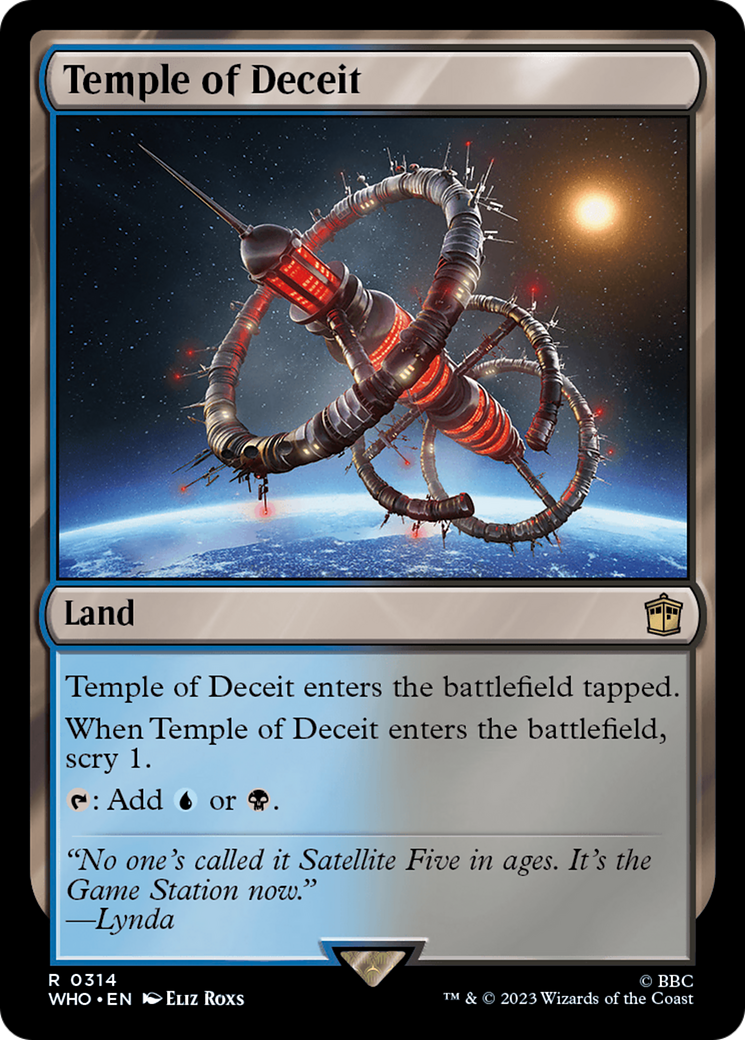
Temple of Deceit
Temple of Deceit
Land
This land enters tapped.
When this land enters, scry 1. (Look at the top card of your library. You may put that card on the bottom.)
: Add or .
- When you scry, you may put all the cards you look at back on top of your library, you may put all of those cards on the bottom of your library, or you may put some of those cards on top and the rest of them on the bottom.
- You choose how to order cards returned to your library after scrying no matter where you put them.
- You perform the actions stated on a card in sequence. For some spells and abilities, that means you'll scry last. For others, that means you'll scry and then perform other actions.
- Scry appears on some spells and abilities with one or more targets. If all of the spell or ability's targets are illegal when it tries to resolve, it won't resolve and none of its effects will happen. You won't scry.
-
1
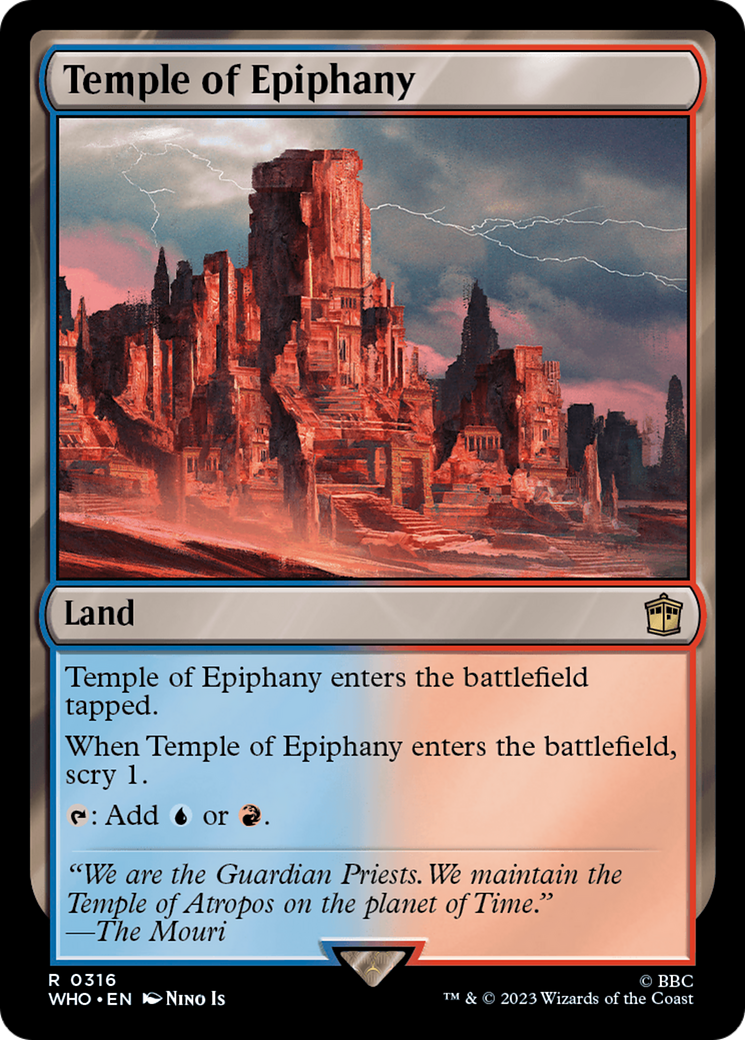
Temple of Epiphany
Temple of Epiphany
Land
This land enters tapped.
When this land enters, scry 1. (Look at the top card of your library. You may put that card on the bottom.)
: Add or .
-
1
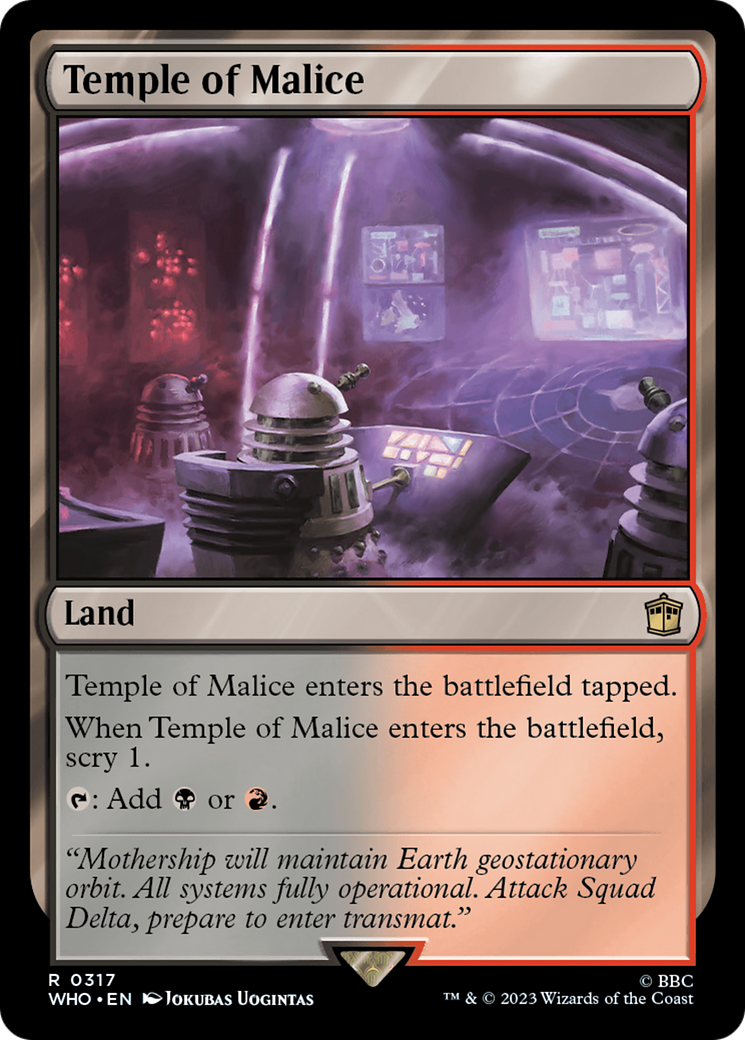
Temple of Malice
Temple of Malice
Land
This land enters tapped.
When this land enters, scry 1. (Look at the top card of your library. You may put that card on the bottom.)
: Add or .
- When you scry, you may put all the cards you look at back on top of your library, you may put all of those cards on the bottom of your library, or you may put some of those cards on top and the rest of them on the bottom.
- You choose how to order cards returned to your library after scrying no matter where you put them.
- You perform the actions stated on a card in sequence. For some spells and abilities, that means you'll scry last. For others, that means you'll scry and then perform other actions.
- Scry appears on some spells and abilities with one or more targets. If all of the spell or ability's targets are illegal when it tries to resolve, it won't resolve and none of its effects will happen. You won't scry.
-
1
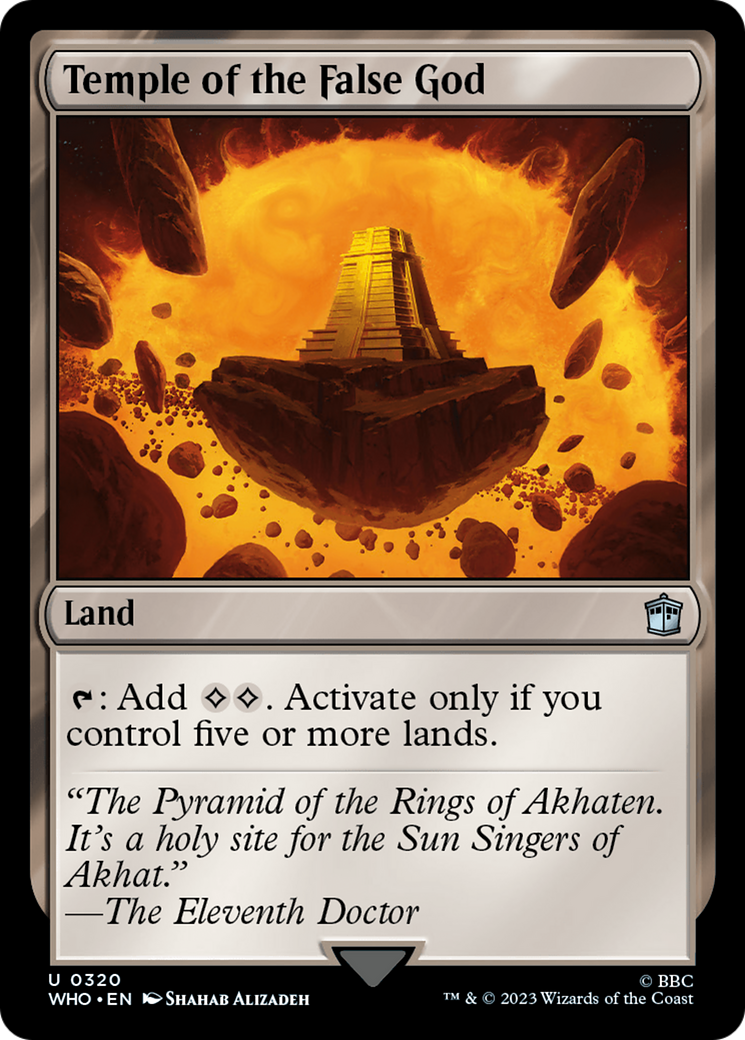
Temple of the False God
Temple of the False God
Land
: Add . Activate only if you control five or more lands.
-
1
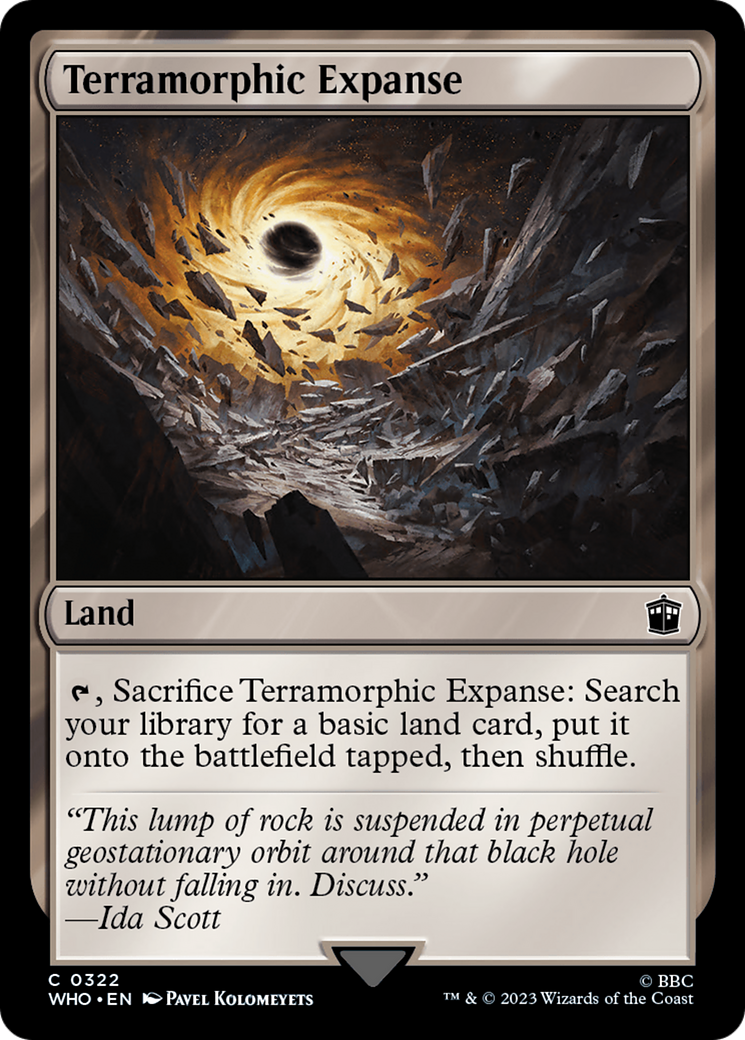
Terramorphic Expanse
Terramorphic Expanse
Land
, Sacrifice this land: Search your library for a basic land card, put it onto the battlefield tapped, then shuffle.
-
1
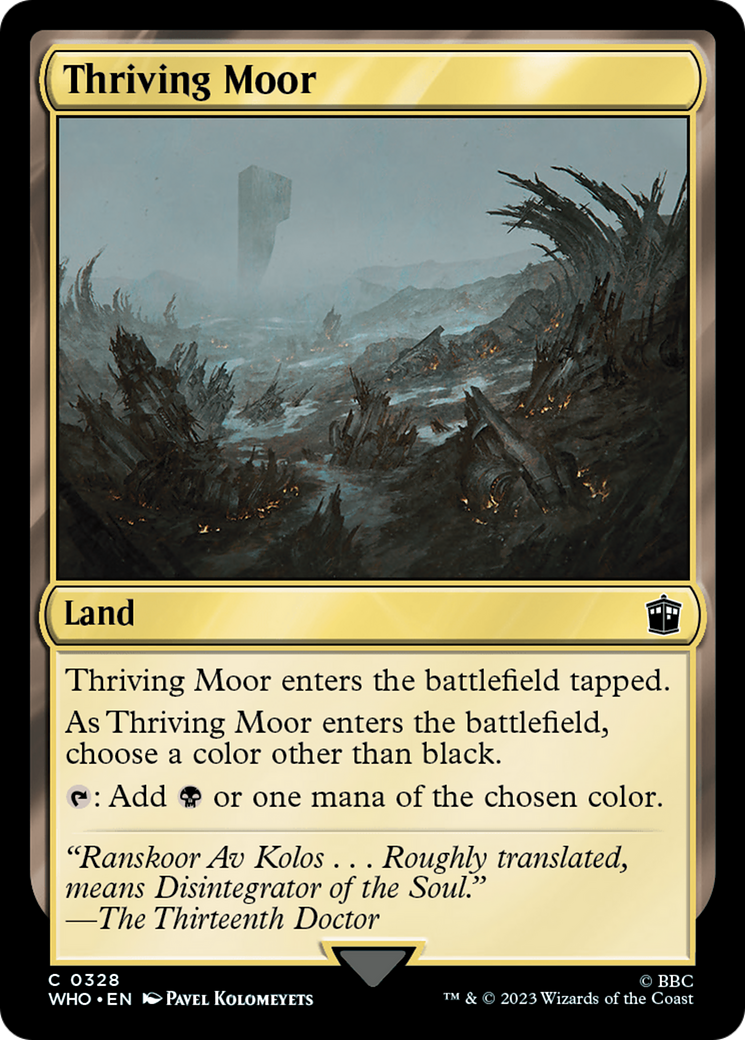
Thriving Moor
Thriving Moor
Land
This land enters tapped. As it enters, choose a color other than black.
: Add or one mana of the chosen color.
Blue 8
-
1
Auton Soldier
Auton Soldier
Artifact Creature — Alien Soldier
0/0
You may have this creature enter as a copy of any creature on the battlefield, except it isn't legendary, is an artifact in addition to its other types, and has myriad. (Whenever it attacks, for each opponent other than defending player, you may create a token copy that's tapped and attacking that player or a planeswalker they control. Exile the tokens at end of combat.)
- The term "defending player" in the myriad rules (or any other ability of an attacking creature) refers to the player the creature with myriad was attacking at the time it became an attacking creature this combat, or the controller of the planeswalker or protector of the battle the creature was attacking at the time it became an attacking creature this combat.
- If the defending player is your only opponent, no tokens are put onto the battlefield.
- You choose whether each token is attacking the player or a planeswalker they control as the token is created.
- Although the tokens enter the battlefield attacking, they were never declared as attackers. Abilities that trigger whenever a creature attacks won't trigger, including the myriad ability of the tokens. If there any costs to have a creature attack, those costs won't apply to the tokens.
- The tokens all enter the battlefield at the same time.
- Each token created by the myriad ability will be a copy of whatever Auton Soldier is copying, along with the listed exceptions. However, it doesn't copy whether Auton Soldier is tapped or untapped, whether it has any counters on it or Auras and Equipment attached to it, or any non-copy effects that have changed its power, toughness, types, color, and so on.
- Any enters-the-battlefield abilities of the copied creature will trigger when the token enters the battlefield. Any "as [this permanent] enters the battlefield" or "[this permanent] enters the battlefield with" abilities of the copied creature will also work.
- If myriad creates more than one token for any given player (due to an effect such as the one Doubling Season creates), you may choose separately for each token whether it's attacking the player or a planeswalker they control.
- If you choose not to have Auton Soldier enter the battlefield as a copy of another creature, it won't have myriad. It will also probably die due to having 0 toughness.
-
1
Cyber Conversion
Cyber Conversion
Instant
Turn target creature face down. It's a 2/2 Cyberman artifact creature.
- Each creature turned face down this way or put onto the battlefield this way is a 2/2 Cyberman artifact creature with no name and no color.
- If, for any reason, the face-down creature is turned face up, the effect making it a Cyberman ends. It will be whatever is printed on the card.
- The player who controls a face-down permanent may look at it at any time. Notably, if the cards were put on the battlefield face down from another player's library, the player that owns them does not get to look at those cards.
- Double-faced permanents that are already on the battlefield can't be turned face down this way. However, a double-faced card can be put onto the battlefield face down from another zone this way.
- If the face-down card has a morph ability, its controller may turn it face up by paying the associated morph cost.
-
1
Don't Blink
Don't Blink
Instant
Until end of turn, if one or more creatures would enter from exile or after being cast from exile, their owners shuffle them into their libraries instead.
Cycling ( , Discard this card: Draw a card.)
-
1
Hunted by The Family
Hunted by The Family
Sorcery
Choose up to four target creatures you don't control. For each of them, that creature's controller faces a villainous choice — That creature becomes a 1/1 white Human creature and loses all abilities, or you create a token that's a copy of it.
- When a player faces a villainous choice, they first choose one of the two options, then all actions in the chosen option are performed.
- If a spell or ability requires multiple players to face a villainous choice, the result is a little different from other effects in Magic. In that case, the first player in turn order makes their choice and the action for that choice is performed before the next player makes their choice. Then each of the remaining players repeat this process in turn order.
- A player facing a villainous choice can always choose either option, even if one or both of the options are impossible. For example, if one of the options is to sacrifice a creature, a player who controls no creatures can still choose that option.
-
1
Propaganda
Propaganda
Enchantment
Creatures can't attack you unless their controller pays for each creature they control that's attacking you.
- The payment is made during the declare attackers step at the same time you are declaring the attacker.
- If there are multiple attacks in a turn, then you have to pay for each attack.
- If there is more than one Propaganda on the battlefield, the cost is cumulative.
- Paying this cost is not an instant or any other kind of ability, it is an additional cost on the declaration of the attacker.
-
1
Renegade Silent
Renegade Silent
Creature — Alien Horror
3/3
At the beginning of your end step, goad up to one target creature you don't control and put a +1/+1 counter on this creature. This creature phases out. (Treat it and anything attached to it as though they don't exist until your next turn.)
- Phased-out permanents are treated as though they don't exist. They can't be the targets of spells or abilities, their static abilities have no effect on the game, their triggered abilities can't trigger, they can't attack or block, and so on.
- As Renegade Silent phases out, Auras and Equipment attached to it also phase out at the same time. Those Auras and Equipment will phase in at the same time Renegade Silent does, and they'll phase in still attached to Renegade Silent. Similarly, it will phase in with any counters it had on it.
- Permanents phase back in during their controller's untap step, immediately before that player untaps their permanents. Creatures that phase in this way are able to attack and pay a cost of during that turn.
- Phasing out doesn't cause any "leaves the battlefield" abilities to trigger. Similarly, phasing in won't cause any "enters the battlefield" abilities to trigger.
- Any continuous effects with a "for as long as" duration, such as that of Mind Flayer, ignore phased-out objects. If ignoring those objects causes the effect's conditions to no longer be met, the duration will expire.
- Choices made for permanents as they entered the battlefield are remembered when they phase in.
- If an opponent gains control of your Renegade Silent until end of turn, it will phase out while they still have control of it. The control-changing effect ends while it is phased out, and it phases in under your control as that opponent's next untap step begins. If they leave the game before their next untap step, Renegade Silent phases in as the next untap step begins after their turn would have begun.
-
1
The Flood of Mars
The Flood of Mars
Creature — Alien Zombie Horror
3/3
Islandwalk (This creature can't be blocked as long as defending player controls an Island.)
Water Always Wins — Whenever this creature attacks, put a flood counter on another target creature or land. If it's a creature, it becomes a copy of this creature. If it's a land, it becomes an Island in addition to its other types.
- If the target is both a creature and a land as the triggered ability resolves, it will become a copy of The Flood of Mars. Excepting some very unusual cases, that copy won't be a land, so it won't also become an Island.
-
1
Zygon Infiltrator
Zygon Infiltrator
Creature — Alien Shapeshifter Soldier
3/2
Body-print — : Tap another target creature and put a stun counter on it. This creature becomes a copy of that creature for as long as that creature remains tapped. Activate only as a sorcery. (If a permanent with a stun counter would become untapped, remove one from it instead.)
- Zygon Infiltrator copies the printed values of the creature plus any copy effects that have been applied to it. It won't copy any other effects that have changed that creature's power, toughness, color, and so on. Zygon Infiltrator won't copy any counters on the creature, but it will retain any counters it already had on it.
- If it becomes a copy of a token creature, it copies the original characteristics of that token as defined by the effect that created the token. It won't become a token creature.
- When Zygon Infiltrator becomes a copy of a creature, it's neither entering nor leaving the battlefield. Any enters-the-battlefield or leaves-the-battlefield abilities won't trigger.
- If another creature becomes a copy of Zygon Infiltrator, it will become a copy of whatever Zygon Infiltrator is currently copying (if anything).
Black 14
-
1
Dalek Drone
Dalek Drone
Artifact Creature — Dalek
3/3
Flying, menace
Exterminate! — When this creature enters, destroy target creature an opponent controls. That player loses 3 life.
-
1
Dalek Squadron
Dalek Squadron
Artifact Creature — Dalek
3/3
Menace
Myriad (Whenever this creature attacks, for each opponent other than defending player, you may create a token copy that's tapped and attacking that player or a planeswalker they control. Exile the tokens at end of combat.)
- The term "defending player" in the myriad rules (or any other ability of an attacking creature) refers to the player the creature with myriad was attacking at the time it became an attacking creature this combat, or the controller of the planeswalker or the protector of the battle the creature was attacking at the time it became an attacking creature this combat.
- If the defending player is your only opponent, no tokens are put onto the battlefield.
- You choose whether each token is attacking the player or a planeswalker they control as the token is created.
- Although the tokens enter the battlefield attacking, they were never declared as attackers. Abilities that trigger whenever a creature attacks won't trigger, including the myriad ability of the tokens. If there any costs to have a creature attack, those costs won't apply to the tokens.
- The token creatures all enter the battlefield at the same time.
- Each token copies exactly what was printed on the original creature and nothing else. It doesn't copy whether that creature is tapped or untapped, whether it has any counters on it or Auras and Equipment attached to it, or any non-copy effects that have changed its power, toughness, types, color, and so on.
- Any enters-the-battlefield abilities of the copied creature will trigger when the token enters the battlefield. Any "as [this permanent] enters the battlefield" or "[this permanent] enters the battlefield with" abilities of the copied creature will also work.
- If myriad creates more than one token for any given player (due to an effect such as the one Doubling Season creates), you may choose separately for each token whether it's attacking the player or a planeswalker they control.
-
1
Death in Heaven
Death in Heaven
Enchantment — Saga
(As this Saga enters and after your draw step, add a lore counter. Sacrifice after III.)
I, II — Target player mills two cards, then exiles their graveyard.
III — Put all creature cards exiled with this enchantment onto the battlefield face down under your control. They're 2/2 Cyberman artifact creatures.
- Each creature turned face down this way or put onto the battlefield this way is a 2/2 Cyberman artifact creature with no name and no color.
- If, for any reason, the face-down creature is turned face up, the effect making it a Cyberman ends. It will be whatever is printed on the card.
- The player who controls a face-down permanent may look at it at any time. Notably, if the cards were put on the battlefield face down from another player's library, the player that owns them does not get to look at those cards.
- Double-faced permanents that are already on the battlefield can't be turned face down this way. However, a double-faced card can be put onto the battlefield face down from another zone this way.
- If the face-down card has a morph ability, its controller may turn it face up by paying the associated morph cost.
-
1
Doomsday Confluence
Doomsday Confluence
Sorcery
Choose X. You may choose the same mode more than once.
- Each player sacrifices a nonartifact creature of their choice.
- Create a 3/3 black Dalek artifact creature token with menace.
- Each opponent discards a card.
- You choose the modes as you cast the spell. Once modes are chosen, they can't be changed.
- No matter which combination of modes you choose, you always follow the instructions in the order they are written.
- No player can cast spells or activate abilities in between the modes of a resolving spell.
- If an effect copies Doomsday Confluence, the copy will have the same modes chosen the same number of times.
-
1
Exterminate!
Exterminate!
Sorcery
Replicate—Tap an untapped Dalek you control. (When you cast this spell, copy it for each time you paid its replicate cost. You may choose new targets for the copies.)
Destroy target creature. Its controller loses 3 life.
-
1
Feed the Swarm
Feed the Swarm
Sorcery
Destroy target creature or enchantment an opponent controls. You lose life equal to that permanent's mana value.
- The amount of life you lose is determined by the permanent's mana value as it last existed on the battlefield.
- If the target permanent is an illegal target by the time Feed the Swarm tries to resolve, the spell doesn't resolve. You don't lose any life. If the target is legal but not destroyed (most likely because it has indestructible), you do lose life.
- If a permanent on the battlefield has in its mana cost, X is 0 for the purpose of determining its mana value.
-
1
Genesis of the Daleks
Genesis of the Daleks
Enchantment — Saga
(As this Saga enters and after your draw step, add a lore counter. Sacrifice after IV.)
I, II, III — Create a 3/3 black Dalek artifact creature token with menace for each lore counter on Genesis of the Daleks.
IV — Target opponent faces a villainous choice — Destroy all Dalek creatures and each of your opponents loses life equal to the total power of Daleks that died this turn, or destroy all non-Dalek creatures.
- When a player faces a villainous choice, they first choose one of the two options, then all actions in the chosen option are performed.
- If a spell or ability requires multiple players to face a villainous choice, the result is a little different from other effects in Magic. In that case, the first player in turn order makes their choice and the action for that choice is performed before the next player makes their choice. Then each of the remaining players repeat this process in turn order.
- A player facing a villainous choice can always choose either option, even if one or both of the options are impossible. For example, if one of the options is to sacrifice a creature, a player who controls no creatures can still choose that option.
-
1
Snuff Out
Snuff Out
Instant
If you control a Swamp, you may pay 4 life rather than pay this spell's mana cost.
Destroy target nonblack creature. It can't be regenerated.
-
1
The Toymaker's Trap
The Toymaker's Trap
Enchantment
At the beginning of your upkeep, secretly choose a number between 1 and 5 that hasn't been chosen. If you do, an opponent guesses which number you chose, then you reveal the number you chose. If they guessed wrong, they lose life equal to the number they guessed and you draw a card. If they guessed right, sacrifice this enchantment.
- To secretly choose a number, write a number from 1 to 5 down without showing it to anyone else.
- If The Toymaker's Trap leaves the battlefield and later returns to the battlefield, it has no memory of which numbers were chosen for its effect before. The same is true if you control a second copy of it.
-
1
This Is How It Ends
This Is How It Ends
Instant
Target creature's owner shuffles it into their library, then faces a villainous choice — They lose 5 life, or they shuffle another creature they own into their library.
- When a player faces a villainous choice, they first choose one of the two options, then all actions in the chosen option are performed.
- If a spell or ability requires multiple players to face a villainous choice, the result is a little different from other effects in Magic. In that case, the first player in turn order makes their choice and the action for that choice is performed before the next player makes their choice. Then each of the remaining players repeat this process in turn order.
- A player facing a villainous choice can always choose either option, even if one or both of the options are impossible. For example, if one of the options is to sacrifice a creature, a player who controls no creatures can still choose that option.
-
1
Time Reaper
Time Reaper
Creature — Alien Horror
4/4
Flying, haste
Consume Anomaly — Whenever this creature deals combat damage to a player, put target face-up card they own in exile on the bottom of their library. If you do, you gain 3 life.
- Most cards in exile are face up and can be targeted by Time Reaper's triggered ability. A card is face down in the exile zone only if the effect or action that put it there specifically says it puts it there face down (like the foretell ability).
-
1
Vashta Nerada
Vashta Nerada
Creature — Alien Horror
1/1
Indestructible
Shadow (This creature can block or be blocked by only creatures with shadow.)
Morbid — At the beginning of each end step, if a creature died this turn, put a +1/+1 counter on this creature.
-
1
Vislor Turlough
Vislor Turlough
Legendary Creature — Rogue
2/5
Deal with the Black Guardian — When Vislor Turlough enters, you may have an opponent gain control of it. If you do, it's goaded for as long as they control it.
At the beginning of your end step, draw a card, then you lose life equal to the number of cards in your hand.
Doctor's companion (You can have two commanders if the other is the Doctor.)
- The Doctor's companion ability allows you to have two commanders if one has the ability and the other is a legendary creature that is a Time Lord Doctor and has no other creature types. Creatures with the changeling ability, for example, can't be a second commander this way.
- Although Doctor's companion is a new variant of the partner ability, the rules for partner have not otherwise changed. Notably, Time Lord Doctors and cards with Doctor's companion do not interact with cards which have another partner ability.
- If your Commander deck has two commanders, you can include only cards whose own color identities are also found in your commanders' combined color identities.
- Both commanders start in the command zone, and the remaining 98 cards (or 58 cards in a Commander Draft game) of your deck are shuffled to become your library.
- Once the game begins, your two commanders are tracked separately. If you cast one, you won't have to pay an additional the first time you cast the other. A player loses the game after having been dealt 21 combat damage from any one of them, not from both of them combined.
- If something refers to your commander while you have two commanders, it refers to one of them of your choice. If you are instructed to perform an action on your commander (e.g. put it from the command zone into your hand due to Command Beacon), you choose one of your commanders at the time the effect happens.
- An effect that checks whether you control your commander is satisfied if you control one or both of your two commanders.
-
1
Wound Reflection
Wound Reflection
Enchantment
At the beginning of each end step, each opponent loses life equal to the life they lost this turn. (Damage causes loss of life.)
- When Wound Reflection's ability resolves, it checks how much life each opponent lost over the course of the turn, then it causes that opponent to lose that much life. It doesn't matter how the opponent lost life or who caused it. It also doesn't matter if Wound Reflection wasn't on the battlefield at the time some or all of the life was lost.
- Wound Reflection's ability checks only whether life was lost. It doesn't care whether life was also gained. For example, if an opponent lost 4 life and gained 6 life during the turn, that player will have a higher life total than they started the turn with but Wound Reflection's ability will still cause that player to lose 4 life.
- If Wound Reflection's ability resolves, then an opponent loses life later in the same turn, that life loss is never counted by Wound Reflection.
- Multiple Wound Reflections each trigger separately. For example, if an opponent lost 1 life, the first one's triggered ability to resolve causes them to lose another 1 life. Since they've now lost 2 life, the next triggered ability causes them to lose 2 life, and the next 4, and so on.
Red 6
-
1
Blasphemous Act
Blasphemous Act
Sorcery
This spell costs less to cast for each creature on the battlefield.
Blasphemous Act deals 13 damage to each creature.
- Although players may respond to Blasphemous Act once it's been cast, once it's announced, they can't respond before the cost is calculated and paid.
- Blasphemous Act's ability can't reduce the total cost to cast the spell below .
- The total cost to cast Blasphemous Act is locked in before you pay that cost. For example, if there are three creatures on the battlefield, including one you can sacrifice to add , the total cost of Blasphemous Act is . Then you can sacrifice the creature when you activate mana abilities just before paying the cost.
- To determine the total cost of a spell, start with the mana cost or alternative cost you're paying, add any cost increases, then apply any cost reductions (such as that of Blasphemous Act). The mana value of the spell is determined only by its mana cost, no matter what the total cost to cast the spell was.
-
1
Day of the Moon
Day of the Moon
Enchantment — Saga
(As this Saga enters and after your draw step, add a lore counter. Sacrifice after III.)
I, II, III — Choose a creature card name, then goad all creatures with a name chosen for this enchantment. (Until your next turn, they attack each combat if able and attack a player other than you if able.)
-
1
Delete
Delete
Sorcery
Delete deals X damage to each nonartifact creature and each player.
-
1
Ensnared by the Mara
Ensnared by the Mara
Sorcery
Each opponent faces a villainous choice — They exile cards from the top of their library until they exile a nonland card, then you may cast that card without paying its mana cost, or that player exiles the top four cards of their library and Ensnared by the Mara deals damage equal to the total mana value of those exiled cards to that player.
- The opponent chooses whether to exile cards from the top of their library until they exile a nonland card or to exile the top four cards of their library. They don't choose whether you cast the cards exiled by the first option.
- When a player faces a villainous choice, they first choose one of the two options, then all actions in the chosen option are performed.
- If a spell or ability requires multiple players to face a villainous choice, the result is a little different from other effects in Magic. In that case, the first player in turn order makes their choice and the action for that choice is performed before the next player makes their choice. Then each of the remaining players repeat this process in turn order.
- A player facing a villainous choice can always choose either option, even if one or both of the options are impossible. For example, if one of the options is to sacrifice a creature, a player who controls no creatures can still choose that option.
-
1
Sontaran General
Sontaran General
Creature — Alien Soldier
5/5
Trample, haste
Battalion — Whenever this creature and at least two other creatures attack, for each opponent, goad up to one target creature that player controls. Those creatures can't block this turn. (Until your next turn, they attack each combat if able and attack a player other than you if able.)
-
1
The Sound of Drums
The Sound of Drums
Enchantment — Aura
Enchant creature
Enchanted creature is goaded.
If enchanted creature would deal combat damage to a permanent or player, it deals double that damage instead.
: Return this card from your graveyard to your hand.
Multicolor 18
-
1
Ashad, the Lone Cyberman
Ashad, the Lone Cyberman
Legendary Artifact Creature — Cyberman
3/3
The first nonlegendary artifact spell you cast each turn has casualty 2. (As you cast it, you may sacrifice a creature with power 2 or greater. When you do, copy it. A copy of an artifact spell becomes a token.)
Whenever you sacrifice another creature, put a +1/+1 counter on Ashad.
- Casualty 2 means "As an additional cost to cast this spell, you may sacrifice a creature with power 2 or greater." and "When you cast this spell, if a casualty cost was paid for it, copy it. If the spell has any targets, you may choose new targets for the copy."
- You may sacrifice only one creature to pay a spell's casualty cost, and you copy the spell only once.
- If you pay the casualty cost of a spell, the copy will resolve before the original spell.
- The copy of the spell is created on the stack, so it's not "cast." Abilities that trigger when a player casts a spell won't trigger.
-
1
Blink
Blink
Enchantment — Saga
(As this Saga enters and after your draw step, add a lore counter. Sacrifice after IV.)
I, III — Choose target creature. Its owner shuffles it into their library, then investigates. (They create a Clue token.)
II, IV — Create a 2/2 black Alien Angel artifact creature token with first strike, vigilance, and "Whenever an opponent casts a creature spell, this token isn't a creature until end of turn."
- People often assume that Sagas are a strict progression from top to bottom, but actually, from a non-linear, non-subjective viewpoint, it's more like a big ball of wibbly wobbly, timey-wimey . . . stuff. That is, the rules support chapter abilities that appear to be out of order, like those on Blink. The first ability triggers when the first and third lore counters are added. The last ability triggers when the second and fourth lore counters are placed on it.
- As the triggered ability of the Alien Angel token resolves, it continues to be an artifact but will stop being both an Alien and an Angel until it becomes a creature again.
- If an opponent casts a creature spell with flash while the token is attacking or blocking, the token is removed from combat because it stops being a creature. However, any creatures that it was blocking are still considered blocked.
-
1
Cult of Skaro
Cult of Skaro
Legendary Artifact Creature — Dalek
4/4
Whenever Cult of Skaro attacks, choose one at random —
- Thay — Put a +1/+1 counter on each artifact creature you control.
- Caan — Draw two cards.
- Sec — Create a 3/3 black Dalek artifact creature token with menace.
- Jast — Each opponent loses 4 life.
-
1
Davros, Dalek Creator
Davros, Dalek Creator
Legendary Artifact Creature — Alien Scientist
3/4
Menace
At the beginning of your end step, create a 3/3 black Dalek artifact creature token with menace if an opponent lost 3 or more life this turn. Then each opponent who lost 3 or more life this turn faces a villainous choice — You draw a card, or that player discards a card.
- When a player faces a villainous choice, they first choose one of the two options, then all actions in the chosen option are performed.
- If a spell or ability requires multiple players to face a villainous choice, the result is a little different from other effects in Magic. In that case, the first player in turn order makes their choice and the action for that choice is performed before the next player makes their choice. Then each of the remaining players repeat this process in turn order.
- A player facing a villainous choice can always choose either option, even if one or both of the options are impossible. For example, if one of the options is to sacrifice a creature, a player who controls no creatures can still choose that option.
-
1
Great Intelligence's Plan
Great Intelligence's Plan
Sorcery
Draw three cards. Then target opponent faces a villainous choice — They discard three cards, or you may cast a spell from your hand without paying its mana cost.
- When a player faces a villainous choice, they first choose one of the two options, then all actions in the chosen option are performed.
- If a spell or ability requires multiple players to face a villainous choice, the result is a little different from other effects in Magic. In that case, the first player in turn order makes their choice and the action for that choice is performed before the next player makes their choice. Then each of the remaining players repeat this process in turn order.
- A player facing a villainous choice can always choose either option, even if one or both of the options are impossible. For example, if one of the options is to sacrifice a creature, a player who controls no creatures can still choose that option.
-
1
Missy
Missy
Legendary Creature — Time Lord Rogue
4/5
Whenever another nonartifact creature dies, return it to the battlefield under your control face down and tapped. It's a 2/2 Cyberman artifact creature.
At the beginning of your end step, each opponent faces a villainous choice — Each artifact creature you control deals 1 damage to that opponent, or you draw a card and chaos ensues.
- When a player faces a villainous choice, they first choose one of the two options, then all actions in the chosen option are performed.
- Each creature turned face down this way or put onto the battlefield this way is a 2/2 Cyberman artifact creature with no name and no color.
- If, for any reason, the face-down creature is turned face up, the effect making it a Cyberman ends. It will be whatever is printed on the card.
- The player who controls a face-down permanent may look at it at any time. Notably, if the cards were put on the battlefield face down from another player's library, the player that owns them does not get to look at those cards.
- Double-faced permanents that are already on the battlefield can't be turned face down this way. However, a double-faced card can be put onto the battlefield face down from another zone this way.
- If the face-down card has a morph ability, its controller may turn it face up by paying the associated morph cost.
- If a spell or ability requires multiple players to face a villainous choice, the result is a little different from other effects in Magic. In that case, the first player in turn order makes their choice and the action for that choice is performed before the next player makes their choice. Then each of the remaining players repeat this process in turn order.
- A player facing a villainous choice can always choose either option, even if one or both of the options are impossible. For example, if one of the options is to sacrifice a creature, a player who controls no creatures can still choose that option.
- Unlike other creature types in Magic that are each only one word, the two words "Time Lord" represent a single creature subtype. Time Lord is the only two-word creature type.
- Neither "Time" nor "Lord" are creature types. Some older cards were printed with the subtype "Lord," but all of those cards have updated Oracle card text that removed that type.
- If an effect instructs you to choose a creature type, you may choose Time Lord.
-
1
Rassilon, the War President
Rassilon, the War President
Legendary Creature — Time Lord Noble
3/4
At the beginning of your upkeep, you lose 2 life and exile the top card of your library. You may play that card for as long as it remains exiled.
Each noncreature spell you cast from exile has conspire. (As you cast that spell, you may tap two untapped creatures you control that share a color with it. When you do, copy it and you may choose new targets for the copy.)
- You must pay all costs and follow all normal timing rules for playing a card exiled this way. For example, you may play a land this way only during your main phase while the stack is empty.
- Unlike other creature types in Magic that are each only one word, the two words "Time Lord" represent a single creature subtype. Time Lord is the only two-word creature type.
- Neither "Time" nor "Lord" are creature types. Some older cards were printed with the subtype "Lord," but all of those cards have updated Oracle card text that removed that type.
- If an effect instructs you to choose a creature type, you may choose Time Lord.
-
1
Sycorax Commander
Sycorax Commander
Creature — Alien Soldier
4/2
First strike, haste
Sanctified Rules of Combat — When this creature enters, each opponent faces a villainous choice — That opponent discards all the cards in their hand, then draws that many cards minus one, or this creature deals damage to that player equal to the number of cards in their hand.
- When a player faces a villainous choice, they first choose one of the two options, then all actions in the chosen option are performed.
- If a spell or ability requires multiple players to face a villainous choice, the result is a little different from other effects in Magic. In that case, the first player in turn order makes their choice and the action for that choice is performed before the next player makes their choice. Then each of the remaining players repeat this process in turn order.
- A player facing a villainous choice can always choose either option, even if one or both of the options are impossible. For example, if one of the options is to sacrifice a creature, a player who controls no creatures can still choose that option.
-
1
The Beast, Deathless Prince
The Beast, Deathless Prince
Legendary Creature — Demon
6/6
When you cast this spell, gain control of target creature until end of turn. Untap it. It gains menace and haste until end of turn.
The Beast enters tapped with six stun counters on it. (If it would become untapped, remove a stun counter from it instead.)
Whenever a creature deals combat damage to its owner, untap The Beast and draw a card.
-
1
The Cyber-Controller
The Cyber-Controller
Legendary Artifact Creature — Cyberman
3/3
When The Cyber-Controller enters, each opponent mills X cards. Put all creature cards milled this way onto the battlefield face down under your control. They're 2/2 Cyberman artifact creatures.
Other artifact creatures you control get +1/+1.
- Each creature turned face down this way or put onto the battlefield this way is a 2/2 Cyberman artifact creature with no name and no color.
- If, for any reason, the face-down creature is turned face up, the effect making it a Cyberman ends. It will be whatever is printed on the card.
- The player who controls a face-down permanent may look at it at any time. Notably, if the cards were put on the battlefield face down from another player's library, the player that owns them does not get to look at those cards.
- Double-faced permanents that are already on the battlefield can't be turned face down this way. However, a double-faced card can be put onto the battlefield face down from another zone this way.
- If the face-down card has a morph ability, its controller may turn it face up by paying the associated morph cost.
-
1
The Dalek Emperor
The Dalek Emperor
Legendary Artifact Creature — Dalek
6/6
Affinity for Daleks (This spell costs less to cast for each Dalek you control.)
Other Daleks you control have haste.
At the beginning of combat on your turn, each opponent faces a villainous choice — That player sacrifices a creature of their choice, or you create a 3/3 black Dalek artifact creature token with menace.
- When a player faces a villainous choice, they first choose one of the two options, then all actions in the chosen option are performed.
- If a spell or ability requires multiple players to face a villainous choice, the result is a little different from other effects in Magic. In that case, the first player in turn order makes their choice and the action for that choice is performed before the next player makes their choice. Then each of the remaining players repeat this process in turn order.
- A player facing a villainous choice can always choose either option, even if one or both of the options are impossible. For example, if one of the options is to sacrifice a creature, a player who controls no creatures can still choose that option.
-
1
The Master, Formed Anew
The Master, Formed Anew
Legendary Creature — Time Lord Rogue
0/1
Body Thief — When you cast this spell, you may exile a creature you control and put a takeover counter on it.
You may have The Master enter as a copy of a creature card in exile with a takeover counter on it.
- Unlike other creature types in Magic that are each only one word, the two words "Time Lord" represent a single creature subtype. Time Lord is the only two-word creature type.
- Neither "Time" nor "Lord" are creature types. Some older cards were printed with the subtype "Lord," but all of those cards have updated Oracle card text that removed that type.
- If an effect instructs you to choose a creature type, you may choose Time Lord.
-
1
The Master, Gallifrey's End
The Master, Gallifrey's End
Legendary Creature — Time Lord Rogue
4/3
Make Them Pay — Whenever a nontoken artifact creature you control dies, you may exile it. If you do, choose an opponent with the most life among your opponents. That player faces a villainous choice — They lose 4 life, or you create a token that's a copy of that card.
- When a player faces a villainous choice, they first choose one of the two options, then all actions in the chosen option are performed.
- If a spell or ability requires multiple players to face a villainous choice, the result is a little different from other effects in Magic. In that case, the first player in turn order makes their choice and the action for that choice is performed before the next player makes their choice. Then each of the remaining players repeat this process in turn order.
- A player facing a villainous choice can always choose either option, even if one or both of the options are impossible. For example, if one of the options is to sacrifice a creature, a player who controls no creatures can still choose that option.
- Unlike other creature types in Magic that are each only one word, the two words "Time Lord" represent a single creature subtype. Time Lord is the only two-word creature type.
- Neither "Time" nor "Lord" are creature types. Some older cards were printed with the subtype "Lord," but all of those cards have updated Oracle card text that removed that type.
- If an effect instructs you to choose a creature type, you may choose Time Lord.
-
1
The Master, Mesmerist
The Master, Mesmerist
Legendary Creature — Time Lord Rogue
3/3
: Target creature an opponent controls with power less than or equal to The Master's power gains skulk until end of turn. Goad it. (A creature with skulk can't be blocked by creatures with greater power.)
Whenever a creature with skulk deals combat damage to one of your opponents, put a +1/+1 counter on The Master and draw a card.
- Unlike other creature types in Magic that are each only one word, the two words "Time Lord" represent a single creature subtype. Time Lord is the only two-word creature type.
- Neither "Time" nor "Lord" are creature types. Some older cards were printed with the subtype "Lord," but all of those cards have updated Oracle card text that removed that type.
- If an effect instructs you to choose a creature type, you may choose Time Lord.
-
1
The Master, Multiplied
The Master, Multiplied
Legendary Creature — Time Lord Rogue
4/3
Myriad
The "legend rule" doesn't apply to creature tokens you control.
Triggered abilities you control can't cause you to sacrifice or exile creature tokens you control.
- If, while you control The Master, Multiplied, you also control a token legendary permanent and a single nontoken legendary permanent with the same name, the legend rule will not cause you to put either one into your graveyard.
- The term "defending player" in the myriad rules (or any other ability of an attacking creature) refers to the player the creature with myriad was attacking at the time it became an attacking creature this combat, or the controller of the planeswalker or the protector of the battle the creature was attacking at the time it became an attacking creature this combat.
- If the defending player is your only opponent, no tokens are put onto the battlefield.
- You choose whether each token is attacking the player or a planeswalker they control as the token is created.
- Although the tokens enter the battlefield attacking, they were never declared as attackers. Abilities that trigger whenever a creature attacks won't trigger, including the myriad ability of the tokens. If there any costs to have a creature attack, those costs won't apply to the tokens.
- The token creatures all enter the battlefield at the same time.
- Notably, the part of myriad that makes you exile the creature tokens at end of combat is a triggered ability. This means that the ability will trigger, but you won't exile the tokens when it resolves. Since the tokens also have myriad, attacking with each of them will cause that myriad ability to trigger, causing the Master to, well . . . multiply.
- Any enters-the-battlefield abilities of the copied creature will trigger when the token enters the battlefield. Any "as [this permanent] enters the battlefield" or "[this permanent] enters the battlefield with" abilities of the copied creature will also work.
- If myriad creates more than one token for any given player (due to an effect such as the one Doubling Season creates), you may choose separately for each token whether it's attacking the player or a planeswalker they control.
- Unlike other creature types in Magic that are each only one word, the two words "Time Lord" represent a single creature subtype. Time Lord is the only two-word creature type.
- Neither "Time" nor "Lord" are creature types. Some older cards were printed with the subtype "Lord," but all of those cards have updated Oracle card text that removed that type.
- If an effect instructs you to choose a creature type, you may choose Time Lord.
- Each token copies exactly what was printed on the original creature and nothing else. It doesn't copy whether that creature is tapped or untapped, whether it has any counters on it or Auras and Equipment attached to it, or any non-copy effects that have changed its power, toughness, types, color, and so on.
-
1
The Rani
The Rani
Legendary Creature — Time Lord Scientist
3/4
Whenever The Rani enters or attacks, create a red Aura enchantment token named Mark of the Rani attached to another target creature. That token has enchant creature and "Enchanted creature gets +2/+2 and is goaded."
Whenever a goaded creature deals combat damage to one of your opponents, investigate.
- Unlike other creature types in Magic that are each only one word, the two words "Time Lord" represent a single creature subtype. Time Lord is the only two-word creature type.
- Neither "Time" nor "Lord" are creature types. Some older cards were printed with the subtype "Lord," but all of those cards have updated Oracle card text that removed that type.
- If an effect instructs you to choose a creature type, you may choose Time Lord.
-
1
The Valeyard
The Valeyard
Legendary Creature — Time Lord Noble
4/5
If an opponent would face a villainous choice, they face that choice an additional time. (They can make the same or different choices.)
While voting, you may vote an additional time.
- Neither "Time" nor "Lord" are creature types. Some older cards were printed with the subtype "Lord," but all of those cards have updated Oracle card text that removed that type.
- If an effect instructs you to choose a creature type, you may choose Time Lord.
- Unlike other creature types in Magic that are each only one word, the two words "Time Lord" represent a single creature subtype. Time Lord is the only two-word creature type.
-
1
Weeping Angel
Weeping Angel
Artifact Creature — Alien Angel
2/2
Flash
First strike, vigilance
Whenever an opponent casts a creature spell, this creature isn't a creature until end of turn.
If this creature would deal combat damage to a creature, prevent that damage and that creature's owner shuffles it into their library.
- As the first triggered ability of Weeping Angel resolves, it continues to be an artifact but will stop being both an Alien and an Angel until it becomes a creature again. It's just a statue, how dangerous could it be?
- Damage that is prevented never occurs, so any triggered abilities that trigger due to combat damage that would have been dealt by Weeping Angel won't trigger.
- If an opponent casts a creature spell with flash while Weeping Angel is attacking or blocking, it is removed from combat because it stops being a creature. However, any creatures that it was blocking are still considered blocked.
Colorless 17
-
1
Arcane Signet
Arcane Signet
Artifact
: Add one mana of any color in your commander's color identity.
- If your commander is a card that has no colors in its color identity, Arcane Signet's ability produces no mana. It doesn't produce .
- If you have two commanders, the ability adds one mana of any color in their combined color identities.
- If you don't have a commander, Arcane Signet's ability produces no mana.
-
1
Clockwork Droid
Clockwork Droid
Artifact Creature — Robot
3/1
You may exert this creature as it attacks. When you do, it can't be blocked this turn and you scry 1. (An exerted creature won't untap during your next untap step. To scry 1, look at the top card of your library. You may put that card on the bottom.)
- You can't exert a creature unless an effect allows you to do so. Similar effects that "tap and freeze" a creature don't exert that creature.
- If an exerted creature is already untapped during your next untap step (most likely because it had vigilance or an effect untapped it), exert's effect preventing it from untapping expires without having done anything.
- If you gain control of another player's creature until end of turn and exert it, and then that player regains control of it, it will untap during that player's untap step.
- You may exert Clockwork Droid only as you attack with it. You can't do so later in combat, and creatures put onto the battlefield attacking can't be exerted. The ability that triggers on exerting it will resolve before blockers are declared.
-
1
Commander's Sphere
Commander's Sphere
Artifact
: Add one mana of any color in your commander's color identity.
Sacrifice this artifact: Draw a card.
- If your commander is a card that has no colors in its color identity, Commander's Sphere's first ability produces no mana. It doesn't produce .
- If you don't have a commander, Commander's Sphere's first ability produces no mana.
- If you have two commanders, the ability adds one mana of any color in their combined color identities.
-
1
Cyberman Patrol
Cyberman Patrol
Artifact Creature — Cyberman
2/2
Artifact creatures you control have afflict 3. (Whenever a creature with afflict 3 becomes blocked, defending player loses 3 life.)
-
1
Cybermat
Cybermat
Artifact Creature — Robot
2/1
Skulk (This creature can't be blocked by creatures with greater power.)
Whenever this creature attacks and isn't blocked, it gets +X/+0 until end of turn, where X is the number of attacking artifact creatures.
-
1
Cybermen Squadron
Cybermen Squadron
Artifact Creature — Cyberman
5/5
Nonlegendary artifact creatures you control have myriad. (Whenever a creature with myriad attacks, for each opponent other than defending player, you may create a token copy that's tapped and attacking that player or a planeswalker they control. Exile the tokens at end of combat.)
- Cybermen Squadron will itself have myriad as long as it remains a nonlegendary artifact creature.
- The term "defending player" in the myriad rules (or any other ability of an attacking creature) refers to the player the creature with myriad was attacking at the time it became an attacking creature this combat, or the controller of the planeswalker or the protector of the battle the creature was attacking at the time it became an attacking creature this combat.
- If the defending player is your only opponent, no tokens are put onto the battlefield.
- You choose whether each token is attacking the player or a planeswalker they control as the token is created.
- Although the tokens enter the battlefield attacking, they were never declared as attackers. Abilities that trigger whenever a creature attacks won't trigger, including the myriad ability of the tokens. If there any costs to have a creature attack, those costs won't apply to the tokens.
- The token creatures all enter the battlefield at the same time.
- Each token copies exactly what was printed on the original creature and nothing else. It doesn't copy whether that creature is tapped or untapped, whether it has any counters on it or Auras and Equipment attached to it, or any non-copy effects that have changed its power, toughness, types, color, and so on.
- Any enters-the-battlefield abilities of the copied creature will trigger when the token enters the battlefield. Any "as [this permanent] enters the battlefield" or "[this permanent] enters the battlefield with" abilities of the copied creature will also work.
- If myriad creates more than one token for any given player (due to an effect such as the one Doubling Season creates), you may choose separately for each token whether it's attacking the player or a planeswalker they control.
- Multiple instances of myriad trigger separately.
-
1
Cybership
Cybership
Artifact — Vehicle
8/8
Flying
Whenever this Vehicle deals combat damage to a player, put the top two cards of that player's library onto the battlefield face down under your control. They're 2/2 Cyberman artifact creatures.
Crew 4
- Each creature turned face down this way or put onto the battlefield this way is a 2/2 Cyberman artifact creature with no name and no color.
- If, for any reason, the face-down creature is turned face up, the effect making it a Cyberman ends. It will be whatever is printed on the card.
- The player who controls a face-down permanent may look at it at any time. Notably, if the cards were put on the battlefield face down from another player's library, the player that owns them does not get to look at those cards.
- Double-faced permanents that are already on the battlefield can't be turned face down this way. However, a double-faced card can be put onto the battlefield face down from another zone this way.
- If the face-down card has a morph ability, its controller may turn it face up by paying the associated morph cost.
-
1
Laser Screwdriver
Laser Screwdriver
Artifact
: Add one mana of any color.
, : Tap target artifact.
, : Surveil 1. (Look at the top card of your library. You may put that card into your graveyard.)
, : Goad target creature. (Until your next turn, it attacks each combat if able and attacks a player other than you if able.)
-
1
Lightning Greaves
Lightning Greaves
Artifact — Equipment
Equipped creature has haste and shroud. (It can't be the target of spells or abilities.)
Equip
- You can't simply unequip Equipment from a creature. If Lightning Greaves is attached to the only creature you control, you won't be able to attach other equipment to it (or target it with anything else) until you have another creature to which you can attach Lightning Greaves.
- If a creature enters the battlefield under your control and gains haste, but then loses it before attacking, it won't be able to attack that turn. This means that you can't use one Lightning Greaves to allow two new creatures to attack in the same turn.
-
1
Midnight Crusader Shuttle
Midnight Crusader Shuttle
Artifact — Vehicle
3/4
Midnight Entity — Whenever this Vehicle attacks, defending player faces a villainous choice — That player sacrifices a creature of their choice, or you gain control of a creature of your choice that player controls until end of turn. If you gain control of a creature this way, tap it, and it's attacking that player.
Crew 2
- When a creature becomes attacking this way, it wasn't declared as an attacker, so triggered abilities that trigger when a creature attacks won't trigger. Similar, all restrictions or costs to attack are ignored. For example, if the chosen creature has defender, it could still end up being an attacking creature this way.
- When a player faces a villainous choice, they first choose one of the two options, then all actions in the chosen option are performed.
- If a spell or ability requires multiple players to face a villainous choice, the result is a little different from other effects in Magic. In that case, the first player in turn order makes their choice and the action for that choice is performed before the next player makes their choice. Then each of the remaining players repeat this process in turn order.
- A player facing a villainous choice can always choose either option, even if one or both of the options are impossible. For example, if one of the options is to sacrifice a creature, a player who controls no creatures can still choose that option.
-
1
Mind Stone
Mind Stone
Artifact
: Add .
, , Sacrifice this artifact: Draw a card.
-
1
Sol Ring
Sol Ring
Artifact
: Add .
-
1
Solemn Simulacrum
Solemn Simulacrum
Artifact Creature — Golem
2/2
When this creature enters, you may search your library for a basic land card, put that card onto the battlefield tapped, then shuffle.
When this creature dies, you may draw a card.
-
1
Talisman of Dominance
Talisman of Dominance
Artifact
: Add .
: Add or . This artifact deals 1 damage to you.
-
1
Talisman of Indulgence
Talisman of Indulgence
Artifact
: Add .
: Add or . This artifact deals 1 damage to you.
-
1
Thought Vessel
Thought Vessel
Artifact
You have no maximum hand size.
: Add .
-
1
Wayfarer's Bauble
Wayfarer's Bauble
Artifact
, , Sacrifice this artifact: Search your library for a basic land card, put that card onto the battlefield tapped, then shuffle.
Lands 37
-
1
Canyon Slough
Canyon Slough
Land — Swamp Mountain
( : Add or .)
This land enters tapped.
Cycling ( , Discard this card: Draw a card.)
-
1
Choked Estuary
Choked Estuary
Land
As this land enters, you may reveal an Island or Swamp card from your hand. If you don't, this land enters tapped.
: Add or .
- Lands don't have a subtype just because they can produce mana of the corresponding color. Choked Estuary itself is neither an Island nor a Swamp, even though it produces blue and black mana, so you can't reveal one to satisfy the ability of another.
- If an effect instructs you to put Choked Estuary onto the battlefield tapped, it will still enter the battlefield tapped even if you reveal a land card from your hand.
- You may reveal any land card with either or both of the appropriate subtypes. It doesn't have to be a basic land. For example, you could reveal Prairie Stream from the Battle for Zendikar set to satisfy the ability of Choked Estuary.
- If an Island or Swamp is entering the battlefield from your hand at the same time as Choked Estuary, you may reveal the other land to have Choked Estuary enter untapped.
-
1
Command Tower
Command Tower
Land
: Add one mana of any color in your commander's color identity.
- If you don't have a commander, Command Tower's ability produces no mana.
- If your commander is a card that has no colors in its color identity, Command Tower's ability produces no mana. It doesn't produce .
- If you have two commanders, the ability adds one mana of any color in their combined color identities.
-
1
Creeping Tar Pit
Creeping Tar Pit
Land
This land enters tapped.
: Add or .
: Until end of turn, this land becomes a 3/2 blue and black Elemental creature. It's still a land. It can't be blocked this turn.
- A land that becomes a creature may be affected by "summoning sickness." You can't attack with it or use any of its abilities (including its mana abilities) unless it began your most recent turn on the battlefield under your control. Note that summoning sickness cares about when that permanent came under your control, not when it became a creature.
- When a land becomes a creature, that doesn't count as having a creature enter. The permanent was already on the battlefield; it only changed its types. Abilities that trigger whenever a creature enters won't trigger.
-
1
Crumbling Necropolis
Crumbling Necropolis
Land
This land enters tapped.
: Add , , or .
-
1
Darkwater Catacombs
Darkwater Catacombs
Land
, : Add .
-
1
Dragonskull Summit
Dragonskull Summit
Land
This land enters tapped unless you control a Swamp or a Mountain.
: Add or .
- This checks for lands you control with the land type Swamp or Mountain, not for lands named Swamp or Mountain. The lands it checks for don't have to be basic lands. For example, if you control Stomping Ground (a nonbasic land with the land types Mountain and Forest), Dragonskull Summit will enter untapped.
- As this is entering, it checks for lands that are already on the battlefield. It won't see lands that are entering at the same time (due to Warp World, for example).
-
1
Drowned Catacomb
Drowned Catacomb
Land
This land enters tapped unless you control an Island or a Swamp.
: Add or .
- As this is entering, it checks for lands that are already on the battlefield. It won't see lands that are entering at the same time (due to Warp World, for example).
- This checks for lands you control with the land type Island or Swamp, not for lands named Island or Swamp. The lands it checks for don't have to be basic lands. For example, if you control Blood Crypt (a nonbasic land with the land types Swamp and Mountain), Drowned Catacomb will enter untapped.
-
1
Exotic Orchard
Exotic Orchard
Land
: Add one mana of any color that a land an opponent controls could produce.
- Lands that produce mana based only on what other lands "could produce" won't help each other unless some other land allows one of them to actually produce some type of mana. For example, if you control an Exotic Orchard and your opponent controls an Exotic Orchard and a Reflecting Pool, none of those lands would produce mana if their mana abilities were activated. On the other hand, if you control a Forest and an Exotic Orchard, and your opponent controls an Exotic Orchard and a Reflecting Pool, then each of those lands can be tapped to produce . Your opponent's Exotic Orchard can produce because you control a Forest. Your Exotic Orchard and your opponent's Reflecting Pool can each produce because your opponent's Exotic Orchard can produce .
- When determining what colors of mana your opponents' lands could produce, Exotic Orchard takes into account any applicable replacement effects that would apply to those lands' mana abilities (such as Contamination's effect, for example). If there are more than one, consider them in any possible order.
- The colors of mana are white, blue, black, red, and green. Exotic Orchard can't be tapped for colorless mana, even if a land an opponent controls could produce colorless mana.
- Exotic Orchard doesn't care about any restrictions or riders your opponents' lands (such as Ancient Ziggurat or Hall of the Bandit Lord) put on the mana they produce. It just cares about colors of mana.
- Exotic Orchard checks the effects of all mana-producing abilities of lands your opponents control, but it doesn't check their costs. For example, Vivid Crag has the ability " , Remove a charge counter from Vivid Crag: Add one mana of any color." If an opponent controls Vivid Crag and you control Exotic Orchard, you can tap Exotic Orchard for any color of mana. It doesn't matter whether Vivid Crag has a charge counter on it, and it doesn't matter whether it's untapped.
-
1
Fetid Pools
Fetid Pools
Land — Island Swamp
( : Add or .)
This land enters tapped.
Cycling ( , Discard this card: Draw a card.)
-
1
Fiery Islet
Fiery Islet
Land
, Pay 1 life: Add or .
, , Sacrifice this land: Draw a card.
-
1
Foreboding Ruins
Foreboding Ruins
Land
As this land enters, you may reveal a Swamp or Mountain card from your hand. If you don't, this land enters tapped.
: Add or .
- You may reveal any land card with either or both of the appropriate subtypes. It doesn't have to be a basic land. For example, you could reveal Sunken Hollow from the Battle for Zendikar set to satisfy the ability of Foreboding Ruins.
- If a Swamp or Mountain is entering the battlefield from your hand at the same time as Foreboding Ruins, you may reveal the other land to have Foreboding Ruins enter untapped.
- Lands don't have a subtype just because they can produce mana of the corresponding color. Foreboding Ruins itself is neither a Swamp nor a Mountain, even though it produces black and red mana, so you can't reveal one to satisfy the ability of another.
- If an effect instructs you to put Foreboding Ruins onto the battlefield tapped, it will still enter the battlefield tapped even if you reveal a land card from your hand.
-
1
Frostboil Snarl
Frostboil Snarl
Land
As this land enters, you may reveal an Island or Mountain card from your hand. If you don't, this land enters tapped.
: Add or .
- The "Snarl" itself doesn't have any land subtypes. You can't reveal one to satisfy the ability of another.
- If a land card with an appropriate subtype is entering the battlefield from your hand at the same time as one of these lands, you may reveal the other land to have the "Snarl" enter untapped.
- If an effect instructs you to put one of these lands onto the battlefield tapped, it will still enter the battlefield tapped even if you reveal a land card from your hand.
- You may reveal any land card with either or both of the appropriate subtypes. It doesn't have to be a basic land card.
-
1
Gallifrey Council Chamber
Gallifrey Council Chamber
Legendary Land
When Gallifrey Council Chamber enters, surveil 1. (Look at the top card of your library. You may put that card into your graveyard.)
: Add .
: Add one mana of any color. Spend this mana only to cast a Time Lord or Alien spell or activate an ability of a Time Lord or Alien.
-
1
Haunted Ridge
Haunted Ridge
Land
This land enters tapped unless you control two or more other lands.
: Add or .
- If this land enters the battlefield at the same time as any number of other lands, those other lands are not counted when determining if this land enters the battlefield tapped or untapped.
-
2
Island
Island
Basic Land — Island
( : Add .)
-
1
Lavaclaw Reaches
Lavaclaw Reaches
Land
This land enters tapped.
: Add or .
: Until end of turn, this land becomes a 2/2 black and red Elemental creature with " : This creature gets +X/+0 until end of turn." It's still a land.
- A land that becomes a creature may be affected by "summoning sickness." You can't attack with it or use any of its abilities (including its mana abilities) unless it began your most recent turn on the battlefield under your control. Note that summoning sickness cares about when that permanent came under your control, not when it became a creature.
- When a land becomes a creature, that doesn't count as having a creature enter. The permanent was already on the battlefield; it only changed its types. Abilities that trigger whenever a creature enters won't trigger.
-
2
Mountain
Mountain
Basic Land — Mountain
( : Add .)
-
1
Ominous Cemetery
Ominous Cemetery
Land
: Add .
, , Exile this land: Target creature's owner shuffles it into their library.
-
1
Path of Ancestry
Path of Ancestry
Land
This land enters tapped.
: Add one mana of any color in your commander's color identity. When that mana is spent to cast a creature spell that shares a creature type with your commander, scry 1. (Look at the top card of your library. You may put that card on the bottom.)
- Your commander's creature types are checked immediately after you cast a creature spell spending mana from Path of Ancestry's last ability. They aren't set before the game begins, and they may not be the same types your commander had when you activated that ability.
- If you have two commanders, the last ability adds one mana of any color in their combined color identities. When you spend that mana on a creature spell that shares a creature type with either of your commanders, you'll scry 1.
- If Path of Ancestry's last ability produces two mana (most likely due to Mana Reflection), spending those two mana to cast creature spells that share a creature type with your commander will cause two abilities to trigger. Each of those abilities will cause you to scry 1. You won't scry 2. This is true whether you spend the mana on one creature spell or two.
- If your commander has no creature types, it can't share a creature type with any spell that you cast.
- If you cast your commander with mana from Path of Ancestry, and your commander hasn't somehow lost all of its creature types while on the stack, you'll scry 1.
- If you don't have a commander, Path of Ancestry's ability produces no mana.
- If your commander is a card that has no colors in its color identity, Path of Ancestry's ability produces no mana. It doesn't produce .
-
1
Reliquary Tower
Reliquary Tower
Land
You have no maximum hand size.
: Add .
- If multiple effects modify your hand size, apply them in timestamp order. For example, if you put Null Profusion (an enchantment that says your maximum hand size is two) onto the battlefield and then put Reliquary Tower onto the battlefield, you'll have no maximum hand size. However, if those permanents enter in the opposite order, your maximum hand size would be two.
-
1
River of Tears
River of Tears
Land
: Add . If you played a land this turn, add instead.
- The turn you play River of Tears, it will produce when tapped for mana.
- River of Tears produces only after you've played a land, not after you've put a land onto the battlefield (such as with Evolving Wilds).
-
1
Shadowblood Ridge
Shadowblood Ridge
Land
, : Add .
-
1
Shipwreck Marsh
Shipwreck Marsh
Land
This land enters tapped unless you control two or more other lands.
: Add or .
- If this land enters the battlefield at the same time as any number of other lands, those other lands are not counted when determining if this land enters the battlefield tapped or untapped.
-
1
Smoldering Marsh
Smoldering Marsh
Land — Swamp Mountain
( : Add or .)
This land enters tapped unless you control two or more basic lands.
- However, because these cards have basic land types, effects that specify a basic land type without also specifying that the land be basic can affect them. For example, a spell or ability that reads "Destroy target Forest" can target Canopy Vista, while one that reads "Destroy target basic Forest" cannot.
- Even though these lands have basic land types, they are not basic lands because "basic" doesn't appear on their type line. Notably, controlling two or more of them won't allow others to enter the battlefield untapped.
- If one of these lands enters the battlefield at the same time as any number of basic lands, those other lands are not counted when determining if this land enters the battlefield tapped or untapped.
-
1
Stormcarved Coast
Stormcarved Coast
Land
This land enters tapped unless you control two or more other lands.
: Add or .
-
1
Sunken Hollow
Sunken Hollow
Land — Island Swamp
( : Add or .)
This land enters tapped unless you control two or more basic lands.
- Even though these lands have basic land types, they are not basic lands because "basic" doesn't appear on their type line. Notably, controlling two or more of them won't allow others to enter the battlefield untapped.
- However, because these cards have basic land types, effects that specify a basic land type without also specifying that the land be basic can affect them. For example, a spell or ability that reads "Destroy target Forest" can target Canopy Vista, while one that reads "Destroy target basic Forest" cannot.
- If one of these lands enters the battlefield at the same time as any number of basic lands, those other lands are not counted when determining if this land enters the battlefield tapped or untapped.
-
2
Swamp
Swamp
Basic Land — Swamp
( : Add .)
-
1
Temple of Deceit
Temple of Deceit
Land
This land enters tapped.
When this land enters, scry 1. (Look at the top card of your library. You may put that card on the bottom.)
: Add or .
- When you scry, you may put all the cards you look at back on top of your library, you may put all of those cards on the bottom of your library, or you may put some of those cards on top and the rest of them on the bottom.
- You choose how to order cards returned to your library after scrying no matter where you put them.
- You perform the actions stated on a card in sequence. For some spells and abilities, that means you'll scry last. For others, that means you'll scry and then perform other actions.
- Scry appears on some spells and abilities with one or more targets. If all of the spell or ability's targets are illegal when it tries to resolve, it won't resolve and none of its effects will happen. You won't scry.
-
1
Temple of Epiphany
Temple of Epiphany
Land
This land enters tapped.
When this land enters, scry 1. (Look at the top card of your library. You may put that card on the bottom.)
: Add or .
-
1
Temple of Malice
Temple of Malice
Land
This land enters tapped.
When this land enters, scry 1. (Look at the top card of your library. You may put that card on the bottom.)
: Add or .
- When you scry, you may put all the cards you look at back on top of your library, you may put all of those cards on the bottom of your library, or you may put some of those cards on top and the rest of them on the bottom.
- You choose how to order cards returned to your library after scrying no matter where you put them.
- You perform the actions stated on a card in sequence. For some spells and abilities, that means you'll scry last. For others, that means you'll scry and then perform other actions.
- Scry appears on some spells and abilities with one or more targets. If all of the spell or ability's targets are illegal when it tries to resolve, it won't resolve and none of its effects will happen. You won't scry.
-
1
Temple of the False God
Temple of the False God
Land
: Add . Activate only if you control five or more lands.
-
1
Terramorphic Expanse
Terramorphic Expanse
Land
, Sacrifice this land: Search your library for a basic land card, put it onto the battlefield tapped, then shuffle.
-
1
Thriving Moor
Thriving Moor
Land
This land enters tapped. As it enters, choose a color other than black.
: Add or one mana of the chosen color.
1 3
-
1
Doomsday Confluence
Doomsday Confluence
Sorcery
Choose X. You may choose the same mode more than once.
- Each player sacrifices a nonartifact creature of their choice.
- Create a 3/3 black Dalek artifact creature token with menace.
- Each opponent discards a card.
- You choose the modes as you cast the spell. Once modes are chosen, they can't be changed.
- No matter which combination of modes you choose, you always follow the instructions in the order they are written.
- No player can cast spells or activate abilities in between the modes of a resolving spell.
- If an effect copies Doomsday Confluence, the copy will have the same modes chosen the same number of times.
-
1
Sol Ring
Sol Ring
Artifact
: Add .
-
1
Wayfarer's Bauble
Wayfarer's Bauble
Artifact
, , Sacrifice this artifact: Search your library for a basic land card, put that card onto the battlefield tapped, then shuffle.
2 14
-
1
Arcane Signet
Arcane Signet
Artifact
: Add one mana of any color in your commander's color identity.
- If your commander is a card that has no colors in its color identity, Arcane Signet's ability produces no mana. It doesn't produce .
- If you have two commanders, the ability adds one mana of any color in their combined color identities.
- If you don't have a commander, Arcane Signet's ability produces no mana.
-
1
Clockwork Droid
Clockwork Droid
Artifact Creature — Robot
3/1
You may exert this creature as it attacks. When you do, it can't be blocked this turn and you scry 1. (An exerted creature won't untap during your next untap step. To scry 1, look at the top card of your library. You may put that card on the bottom.)
- You can't exert a creature unless an effect allows you to do so. Similar effects that "tap and freeze" a creature don't exert that creature.
- If an exerted creature is already untapped during your next untap step (most likely because it had vigilance or an effect untapped it), exert's effect preventing it from untapping expires without having done anything.
- If you gain control of another player's creature until end of turn and exert it, and then that player regains control of it, it will untap during that player's untap step.
- You may exert Clockwork Droid only as you attack with it. You can't do so later in combat, and creatures put onto the battlefield attacking can't be exerted. The ability that triggers on exerting it will resolve before blockers are declared.
-
1
Cyber Conversion
Cyber Conversion
Instant
Turn target creature face down. It's a 2/2 Cyberman artifact creature.
- Each creature turned face down this way or put onto the battlefield this way is a 2/2 Cyberman artifact creature with no name and no color.
- If, for any reason, the face-down creature is turned face up, the effect making it a Cyberman ends. It will be whatever is printed on the card.
- The player who controls a face-down permanent may look at it at any time. Notably, if the cards were put on the battlefield face down from another player's library, the player that owns them does not get to look at those cards.
- Double-faced permanents that are already on the battlefield can't be turned face down this way. However, a double-faced card can be put onto the battlefield face down from another zone this way.
- If the face-down card has a morph ability, its controller may turn it face up by paying the associated morph cost.
-
1
Cyberman Patrol
Cyberman Patrol
Artifact Creature — Cyberman
2/2
Artifact creatures you control have afflict 3. (Whenever a creature with afflict 3 becomes blocked, defending player loses 3 life.)
-
1
Cybermat
Cybermat
Artifact Creature — Robot
2/1
Skulk (This creature can't be blocked by creatures with greater power.)
Whenever this creature attacks and isn't blocked, it gets +X/+0 until end of turn, where X is the number of attacking artifact creatures.
-
1
Delete
Delete
Sorcery
Delete deals X damage to each nonartifact creature and each player.
-
1
Don't Blink
Don't Blink
Instant
Until end of turn, if one or more creatures would enter from exile or after being cast from exile, their owners shuffle them into their libraries instead.
Cycling ( , Discard this card: Draw a card.)
-
1
Feed the Swarm
Feed the Swarm
Sorcery
Destroy target creature or enchantment an opponent controls. You lose life equal to that permanent's mana value.
- The amount of life you lose is determined by the permanent's mana value as it last existed on the battlefield.
- If the target permanent is an illegal target by the time Feed the Swarm tries to resolve, the spell doesn't resolve. You don't lose any life. If the target is legal but not destroyed (most likely because it has indestructible), you do lose life.
- If a permanent on the battlefield has in its mana cost, X is 0 for the purpose of determining its mana value.
-
1
Lightning Greaves
Lightning Greaves
Artifact — Equipment
Equipped creature has haste and shroud. (It can't be the target of spells or abilities.)
Equip
- You can't simply unequip Equipment from a creature. If Lightning Greaves is attached to the only creature you control, you won't be able to attach other equipment to it (or target it with anything else) until you have another creature to which you can attach Lightning Greaves.
- If a creature enters the battlefield under your control and gains haste, but then loses it before attacking, it won't be able to attack that turn. This means that you can't use one Lightning Greaves to allow two new creatures to attack in the same turn.
-
1
Mind Stone
Mind Stone
Artifact
: Add .
, , Sacrifice this artifact: Draw a card.
-
1
Talisman of Dominance
Talisman of Dominance
Artifact
: Add .
: Add or . This artifact deals 1 damage to you.
-
1
Talisman of Indulgence
Talisman of Indulgence
Artifact
: Add .
: Add or . This artifact deals 1 damage to you.
-
1
The Master, Formed Anew
The Master, Formed Anew
Legendary Creature — Time Lord Rogue
0/1
Body Thief — When you cast this spell, you may exile a creature you control and put a takeover counter on it.
You may have The Master enter as a copy of a creature card in exile with a takeover counter on it.
- Unlike other creature types in Magic that are each only one word, the two words "Time Lord" represent a single creature subtype. Time Lord is the only two-word creature type.
- Neither "Time" nor "Lord" are creature types. Some older cards were printed with the subtype "Lord," but all of those cards have updated Oracle card text that removed that type.
- If an effect instructs you to choose a creature type, you may choose Time Lord.
-
1
Thought Vessel
Thought Vessel
Artifact
You have no maximum hand size.
: Add .
3 12
-
1
Commander's Sphere
Commander's Sphere
Artifact
: Add one mana of any color in your commander's color identity.
Sacrifice this artifact: Draw a card.
- If your commander is a card that has no colors in its color identity, Commander's Sphere's first ability produces no mana. It doesn't produce .
- If you don't have a commander, Commander's Sphere's first ability produces no mana.
- If you have two commanders, the ability adds one mana of any color in their combined color identities.
-
1
Dalek Squadron
Dalek Squadron
Artifact Creature — Dalek
3/3
Menace
Myriad (Whenever this creature attacks, for each opponent other than defending player, you may create a token copy that's tapped and attacking that player or a planeswalker they control. Exile the tokens at end of combat.)
- The term "defending player" in the myriad rules (or any other ability of an attacking creature) refers to the player the creature with myriad was attacking at the time it became an attacking creature this combat, or the controller of the planeswalker or the protector of the battle the creature was attacking at the time it became an attacking creature this combat.
- If the defending player is your only opponent, no tokens are put onto the battlefield.
- You choose whether each token is attacking the player or a planeswalker they control as the token is created.
- Although the tokens enter the battlefield attacking, they were never declared as attackers. Abilities that trigger whenever a creature attacks won't trigger, including the myriad ability of the tokens. If there any costs to have a creature attack, those costs won't apply to the tokens.
- The token creatures all enter the battlefield at the same time.
- Each token copies exactly what was printed on the original creature and nothing else. It doesn't copy whether that creature is tapped or untapped, whether it has any counters on it or Auras and Equipment attached to it, or any non-copy effects that have changed its power, toughness, types, color, and so on.
- Any enters-the-battlefield abilities of the copied creature will trigger when the token enters the battlefield. Any "as [this permanent] enters the battlefield" or "[this permanent] enters the battlefield with" abilities of the copied creature will also work.
- If myriad creates more than one token for any given player (due to an effect such as the one Doubling Season creates), you may choose separately for each token whether it's attacking the player or a planeswalker they control.
-
1
Day of the Moon
Day of the Moon
Enchantment — Saga
(As this Saga enters and after your draw step, add a lore counter. Sacrifice after III.)
I, II, III — Choose a creature card name, then goad all creatures with a name chosen for this enchantment. (Until your next turn, they attack each combat if able and attack a player other than you if able.)
-
1
Exterminate!
Exterminate!
Sorcery
Replicate—Tap an untapped Dalek you control. (When you cast this spell, copy it for each time you paid its replicate cost. You may choose new targets for the copies.)
Destroy target creature. Its controller loses 3 life.
-
1
Laser Screwdriver
Laser Screwdriver
Artifact
: Add one mana of any color.
, : Tap target artifact.
, : Surveil 1. (Look at the top card of your library. You may put that card into your graveyard.)
, : Goad target creature. (Until your next turn, it attacks each combat if able and attacks a player other than you if able.)
-
1
Propaganda
Propaganda
Enchantment
Creatures can't attack you unless their controller pays for each creature they control that's attacking you.
- The payment is made during the declare attackers step at the same time you are declaring the attacker.
- If there are multiple attacks in a turn, then you have to pay for each attack.
- If there is more than one Propaganda on the battlefield, the cost is cumulative.
- Paying this cost is not an instant or any other kind of ability, it is an additional cost on the declaration of the attacker.
-
1
The Cyber-Controller
The Cyber-Controller
Legendary Artifact Creature — Cyberman
3/3
When The Cyber-Controller enters, each opponent mills X cards. Put all creature cards milled this way onto the battlefield face down under your control. They're 2/2 Cyberman artifact creatures.
Other artifact creatures you control get +1/+1.
- Each creature turned face down this way or put onto the battlefield this way is a 2/2 Cyberman artifact creature with no name and no color.
- If, for any reason, the face-down creature is turned face up, the effect making it a Cyberman ends. It will be whatever is printed on the card.
- The player who controls a face-down permanent may look at it at any time. Notably, if the cards were put on the battlefield face down from another player's library, the player that owns them does not get to look at those cards.
- Double-faced permanents that are already on the battlefield can't be turned face down this way. However, a double-faced card can be put onto the battlefield face down from another zone this way.
- If the face-down card has a morph ability, its controller may turn it face up by paying the associated morph cost.
-
1
The Sound of Drums
The Sound of Drums
Enchantment — Aura
Enchant creature
Enchanted creature is goaded.
If enchanted creature would deal combat damage to a permanent or player, it deals double that damage instead.
: Return this card from your graveyard to your hand.
-
1
The Toymaker's Trap
The Toymaker's Trap
Enchantment
At the beginning of your upkeep, secretly choose a number between 1 and 5 that hasn't been chosen. If you do, an opponent guesses which number you chose, then you reveal the number you chose. If they guessed wrong, they lose life equal to the number they guessed and you draw a card. If they guessed right, sacrifice this enchantment.
- To secretly choose a number, write a number from 1 to 5 down without showing it to anyone else.
- If The Toymaker's Trap leaves the battlefield and later returns to the battlefield, it has no memory of which numbers were chosen for its effect before. The same is true if you control a second copy of it.
-
1
Vashta Nerada
Vashta Nerada
Creature — Alien Horror
1/1
Indestructible
Shadow (This creature can block or be blocked by only creatures with shadow.)
Morbid — At the beginning of each end step, if a creature died this turn, put a +1/+1 counter on this creature.
-
1
Weeping Angel
Weeping Angel
Artifact Creature — Alien Angel
2/2
Flash
First strike, vigilance
Whenever an opponent casts a creature spell, this creature isn't a creature until end of turn.
If this creature would deal combat damage to a creature, prevent that damage and that creature's owner shuffles it into their library.
- As the first triggered ability of Weeping Angel resolves, it continues to be an artifact but will stop being both an Alien and an Angel until it becomes a creature again. It's just a statue, how dangerous could it be?
- Damage that is prevented never occurs, so any triggered abilities that trigger due to combat damage that would have been dealt by Weeping Angel won't trigger.
- If an opponent casts a creature spell with flash while Weeping Angel is attacking or blocking, it is removed from combat because it stops being a creature. However, any creatures that it was blocking are still considered blocked.
-
1
Zygon Infiltrator
Zygon Infiltrator
Creature — Alien Shapeshifter Soldier
3/2
Body-print — : Tap another target creature and put a stun counter on it. This creature becomes a copy of that creature for as long as that creature remains tapped. Activate only as a sorcery. (If a permanent with a stun counter would become untapped, remove one from it instead.)
- Zygon Infiltrator copies the printed values of the creature plus any copy effects that have been applied to it. It won't copy any other effects that have changed that creature's power, toughness, color, and so on. Zygon Infiltrator won't copy any counters on the creature, but it will retain any counters it already had on it.
- If it becomes a copy of a token creature, it copies the original characteristics of that token as defined by the effect that created the token. It won't become a token creature.
- When Zygon Infiltrator becomes a copy of a creature, it's neither entering nor leaving the battlefield. Any enters-the-battlefield or leaves-the-battlefield abilities won't trigger.
- If another creature becomes a copy of Zygon Infiltrator, it will become a copy of whatever Zygon Infiltrator is currently copying (if anything).
4 18
-
1
Ashad, the Lone Cyberman
Ashad, the Lone Cyberman
Legendary Artifact Creature — Cyberman
3/3
The first nonlegendary artifact spell you cast each turn has casualty 2. (As you cast it, you may sacrifice a creature with power 2 or greater. When you do, copy it. A copy of an artifact spell becomes a token.)
Whenever you sacrifice another creature, put a +1/+1 counter on Ashad.
- Casualty 2 means "As an additional cost to cast this spell, you may sacrifice a creature with power 2 or greater." and "When you cast this spell, if a casualty cost was paid for it, copy it. If the spell has any targets, you may choose new targets for the copy."
- You may sacrifice only one creature to pay a spell's casualty cost, and you copy the spell only once.
- If you pay the casualty cost of a spell, the copy will resolve before the original spell.
- The copy of the spell is created on the stack, so it's not "cast." Abilities that trigger when a player casts a spell won't trigger.
-
1
Blink
Blink
Enchantment — Saga
(As this Saga enters and after your draw step, add a lore counter. Sacrifice after IV.)
I, III — Choose target creature. Its owner shuffles it into their library, then investigates. (They create a Clue token.)
II, IV — Create a 2/2 black Alien Angel artifact creature token with first strike, vigilance, and "Whenever an opponent casts a creature spell, this token isn't a creature until end of turn."
- People often assume that Sagas are a strict progression from top to bottom, but actually, from a non-linear, non-subjective viewpoint, it's more like a big ball of wibbly wobbly, timey-wimey . . . stuff. That is, the rules support chapter abilities that appear to be out of order, like those on Blink. The first ability triggers when the first and third lore counters are added. The last ability triggers when the second and fourth lore counters are placed on it.
- As the triggered ability of the Alien Angel token resolves, it continues to be an artifact but will stop being both an Alien and an Angel until it becomes a creature again.
- If an opponent casts a creature spell with flash while the token is attacking or blocking, the token is removed from combat because it stops being a creature. However, any creatures that it was blocking are still considered blocked.
-
1
Cult of Skaro
Cult of Skaro
Legendary Artifact Creature — Dalek
4/4
Whenever Cult of Skaro attacks, choose one at random —
- Thay — Put a +1/+1 counter on each artifact creature you control.
- Caan — Draw two cards.
- Sec — Create a 3/3 black Dalek artifact creature token with menace.
- Jast — Each opponent loses 4 life.
-
1
Davros, Dalek Creator
Davros, Dalek Creator
Legendary Artifact Creature — Alien Scientist
3/4
Menace
At the beginning of your end step, create a 3/3 black Dalek artifact creature token with menace if an opponent lost 3 or more life this turn. Then each opponent who lost 3 or more life this turn faces a villainous choice — You draw a card, or that player discards a card.
- When a player faces a villainous choice, they first choose one of the two options, then all actions in the chosen option are performed.
- If a spell or ability requires multiple players to face a villainous choice, the result is a little different from other effects in Magic. In that case, the first player in turn order makes their choice and the action for that choice is performed before the next player makes their choice. Then each of the remaining players repeat this process in turn order.
- A player facing a villainous choice can always choose either option, even if one or both of the options are impossible. For example, if one of the options is to sacrifice a creature, a player who controls no creatures can still choose that option.
-
1
Death in Heaven
Death in Heaven
Enchantment — Saga
(As this Saga enters and after your draw step, add a lore counter. Sacrifice after III.)
I, II — Target player mills two cards, then exiles their graveyard.
III — Put all creature cards exiled with this enchantment onto the battlefield face down under your control. They're 2/2 Cyberman artifact creatures.
- Each creature turned face down this way or put onto the battlefield this way is a 2/2 Cyberman artifact creature with no name and no color.
- If, for any reason, the face-down creature is turned face up, the effect making it a Cyberman ends. It will be whatever is printed on the card.
- The player who controls a face-down permanent may look at it at any time. Notably, if the cards were put on the battlefield face down from another player's library, the player that owns them does not get to look at those cards.
- Double-faced permanents that are already on the battlefield can't be turned face down this way. However, a double-faced card can be put onto the battlefield face down from another zone this way.
- If the face-down card has a morph ability, its controller may turn it face up by paying the associated morph cost.
-
1
Ensnared by the Mara
Ensnared by the Mara
Sorcery
Each opponent faces a villainous choice — They exile cards from the top of their library until they exile a nonland card, then you may cast that card without paying its mana cost, or that player exiles the top four cards of their library and Ensnared by the Mara deals damage equal to the total mana value of those exiled cards to that player.
- The opponent chooses whether to exile cards from the top of their library until they exile a nonland card or to exile the top four cards of their library. They don't choose whether you cast the cards exiled by the first option.
- When a player faces a villainous choice, they first choose one of the two options, then all actions in the chosen option are performed.
- If a spell or ability requires multiple players to face a villainous choice, the result is a little different from other effects in Magic. In that case, the first player in turn order makes their choice and the action for that choice is performed before the next player makes their choice. Then each of the remaining players repeat this process in turn order.
- A player facing a villainous choice can always choose either option, even if one or both of the options are impossible. For example, if one of the options is to sacrifice a creature, a player who controls no creatures can still choose that option.
-
1
Midnight Crusader Shuttle
Midnight Crusader Shuttle
Artifact — Vehicle
3/4
Midnight Entity — Whenever this Vehicle attacks, defending player faces a villainous choice — That player sacrifices a creature of their choice, or you gain control of a creature of your choice that player controls until end of turn. If you gain control of a creature this way, tap it, and it's attacking that player.
Crew 2
- When a creature becomes attacking this way, it wasn't declared as an attacker, so triggered abilities that trigger when a creature attacks won't trigger. Similar, all restrictions or costs to attack are ignored. For example, if the chosen creature has defender, it could still end up being an attacking creature this way.
- When a player faces a villainous choice, they first choose one of the two options, then all actions in the chosen option are performed.
- If a spell or ability requires multiple players to face a villainous choice, the result is a little different from other effects in Magic. In that case, the first player in turn order makes their choice and the action for that choice is performed before the next player makes their choice. Then each of the remaining players repeat this process in turn order.
- A player facing a villainous choice can always choose either option, even if one or both of the options are impossible. For example, if one of the options is to sacrifice a creature, a player who controls no creatures can still choose that option.
-
1
Renegade Silent
Renegade Silent
Creature — Alien Horror
3/3
At the beginning of your end step, goad up to one target creature you don't control and put a +1/+1 counter on this creature. This creature phases out. (Treat it and anything attached to it as though they don't exist until your next turn.)
- Phased-out permanents are treated as though they don't exist. They can't be the targets of spells or abilities, their static abilities have no effect on the game, their triggered abilities can't trigger, they can't attack or block, and so on.
- As Renegade Silent phases out, Auras and Equipment attached to it also phase out at the same time. Those Auras and Equipment will phase in at the same time Renegade Silent does, and they'll phase in still attached to Renegade Silent. Similarly, it will phase in with any counters it had on it.
- Permanents phase back in during their controller's untap step, immediately before that player untaps their permanents. Creatures that phase in this way are able to attack and pay a cost of during that turn.
- Phasing out doesn't cause any "leaves the battlefield" abilities to trigger. Similarly, phasing in won't cause any "enters the battlefield" abilities to trigger.
- Any continuous effects with a "for as long as" duration, such as that of Mind Flayer, ignore phased-out objects. If ignoring those objects causes the effect's conditions to no longer be met, the duration will expire.
- Choices made for permanents as they entered the battlefield are remembered when they phase in.
- If an opponent gains control of your Renegade Silent until end of turn, it will phase out while they still have control of it. The control-changing effect ends while it is phased out, and it phases in under your control as that opponent's next untap step begins. If they leave the game before their next untap step, Renegade Silent phases in as the next untap step begins after their turn would have begun.
-
1
Snuff Out
Snuff Out
Instant
If you control a Swamp, you may pay 4 life rather than pay this spell's mana cost.
Destroy target nonblack creature. It can't be regenerated.
-
1
Solemn Simulacrum
Solemn Simulacrum
Artifact Creature — Golem
2/2
When this creature enters, you may search your library for a basic land card, put that card onto the battlefield tapped, then shuffle.
When this creature dies, you may draw a card.
-
1
Sycorax Commander
Sycorax Commander
Creature — Alien Soldier
4/2
First strike, haste
Sanctified Rules of Combat — When this creature enters, each opponent faces a villainous choice — That opponent discards all the cards in their hand, then draws that many cards minus one, or this creature deals damage to that player equal to the number of cards in their hand.
- When a player faces a villainous choice, they first choose one of the two options, then all actions in the chosen option are performed.
- If a spell or ability requires multiple players to face a villainous choice, the result is a little different from other effects in Magic. In that case, the first player in turn order makes their choice and the action for that choice is performed before the next player makes their choice. Then each of the remaining players repeat this process in turn order.
- A player facing a villainous choice can always choose either option, even if one or both of the options are impossible. For example, if one of the options is to sacrifice a creature, a player who controls no creatures can still choose that option.
-
1
The Beast, Deathless Prince
The Beast, Deathless Prince
Legendary Creature — Demon
6/6
When you cast this spell, gain control of target creature until end of turn. Untap it. It gains menace and haste until end of turn.
The Beast enters tapped with six stun counters on it. (If it would become untapped, remove a stun counter from it instead.)
Whenever a creature deals combat damage to its owner, untap The Beast and draw a card.
-
1
The Flood of Mars
The Flood of Mars
Creature — Alien Zombie Horror
3/3
Islandwalk (This creature can't be blocked as long as defending player controls an Island.)
Water Always Wins — Whenever this creature attacks, put a flood counter on another target creature or land. If it's a creature, it becomes a copy of this creature. If it's a land, it becomes an Island in addition to its other types.
- If the target is both a creature and a land as the triggered ability resolves, it will become a copy of The Flood of Mars. Excepting some very unusual cases, that copy won't be a land, so it won't also become an Island.
-
1
The Master, Gallifrey's End
The Master, Gallifrey's End
Legendary Creature — Time Lord Rogue
4/3
Make Them Pay — Whenever a nontoken artifact creature you control dies, you may exile it. If you do, choose an opponent with the most life among your opponents. That player faces a villainous choice — They lose 4 life, or you create a token that's a copy of that card.
- When a player faces a villainous choice, they first choose one of the two options, then all actions in the chosen option are performed.
- If a spell or ability requires multiple players to face a villainous choice, the result is a little different from other effects in Magic. In that case, the first player in turn order makes their choice and the action for that choice is performed before the next player makes their choice. Then each of the remaining players repeat this process in turn order.
- A player facing a villainous choice can always choose either option, even if one or both of the options are impossible. For example, if one of the options is to sacrifice a creature, a player who controls no creatures can still choose that option.
- Unlike other creature types in Magic that are each only one word, the two words "Time Lord" represent a single creature subtype. Time Lord is the only two-word creature type.
- Neither "Time" nor "Lord" are creature types. Some older cards were printed with the subtype "Lord," but all of those cards have updated Oracle card text that removed that type.
- If an effect instructs you to choose a creature type, you may choose Time Lord.
-
1
The Master, Mesmerist
The Master, Mesmerist
Legendary Creature — Time Lord Rogue
3/3
: Target creature an opponent controls with power less than or equal to The Master's power gains skulk until end of turn. Goad it. (A creature with skulk can't be blocked by creatures with greater power.)
Whenever a creature with skulk deals combat damage to one of your opponents, put a +1/+1 counter on The Master and draw a card.
- Unlike other creature types in Magic that are each only one word, the two words "Time Lord" represent a single creature subtype. Time Lord is the only two-word creature type.
- Neither "Time" nor "Lord" are creature types. Some older cards were printed with the subtype "Lord," but all of those cards have updated Oracle card text that removed that type.
- If an effect instructs you to choose a creature type, you may choose Time Lord.
-
1
The Rani
The Rani
Legendary Creature — Time Lord Scientist
3/4
Whenever The Rani enters or attacks, create a red Aura enchantment token named Mark of the Rani attached to another target creature. That token has enchant creature and "Enchanted creature gets +2/+2 and is goaded."
Whenever a goaded creature deals combat damage to one of your opponents, investigate.
- Unlike other creature types in Magic that are each only one word, the two words "Time Lord" represent a single creature subtype. Time Lord is the only two-word creature type.
- Neither "Time" nor "Lord" are creature types. Some older cards were printed with the subtype "Lord," but all of those cards have updated Oracle card text that removed that type.
- If an effect instructs you to choose a creature type, you may choose Time Lord.
-
1
This Is How It Ends
This Is How It Ends
Instant
Target creature's owner shuffles it into their library, then faces a villainous choice — They lose 5 life, or they shuffle another creature they own into their library.
- When a player faces a villainous choice, they first choose one of the two options, then all actions in the chosen option are performed.
- If a spell or ability requires multiple players to face a villainous choice, the result is a little different from other effects in Magic. In that case, the first player in turn order makes their choice and the action for that choice is performed before the next player makes their choice. Then each of the remaining players repeat this process in turn order.
- A player facing a villainous choice can always choose either option, even if one or both of the options are impossible. For example, if one of the options is to sacrifice a creature, a player who controls no creatures can still choose that option.
-
1
Vislor Turlough
Vislor Turlough
Legendary Creature — Rogue
2/5
Deal with the Black Guardian — When Vislor Turlough enters, you may have an opponent gain control of it. If you do, it's goaded for as long as they control it.
At the beginning of your end step, draw a card, then you lose life equal to the number of cards in your hand.
Doctor's companion (You can have two commanders if the other is the Doctor.)
- The Doctor's companion ability allows you to have two commanders if one has the ability and the other is a legendary creature that is a Time Lord Doctor and has no other creature types. Creatures with the changeling ability, for example, can't be a second commander this way.
- Although Doctor's companion is a new variant of the partner ability, the rules for partner have not otherwise changed. Notably, Time Lord Doctors and cards with Doctor's companion do not interact with cards which have another partner ability.
- If your Commander deck has two commanders, you can include only cards whose own color identities are also found in your commanders' combined color identities.
- Both commanders start in the command zone, and the remaining 98 cards (or 58 cards in a Commander Draft game) of your deck are shuffled to become your library.
- Once the game begins, your two commanders are tracked separately. If you cast one, you won't have to pay an additional the first time you cast the other. A player loses the game after having been dealt 21 combat damage from any one of them, not from both of them combined.
- If something refers to your commander while you have two commanders, it refers to one of them of your choice. If you are instructed to perform an action on your commander (e.g. put it from the command zone into your hand due to Command Beacon), you choose one of your commanders at the time the effect happens.
- An effect that checks whether you control your commander is satisfied if you control one or both of your two commanders.
5 5
-
1
Dalek Drone
Dalek Drone
Artifact Creature — Dalek
3/3
Flying, menace
Exterminate! — When this creature enters, destroy target creature an opponent controls. That player loses 3 life.
-
1
Rassilon, the War President
Rassilon, the War President
Legendary Creature — Time Lord Noble
3/4
At the beginning of your upkeep, you lose 2 life and exile the top card of your library. You may play that card for as long as it remains exiled.
Each noncreature spell you cast from exile has conspire. (As you cast that spell, you may tap two untapped creatures you control that share a color with it. When you do, copy it and you may choose new targets for the copy.)
- You must pay all costs and follow all normal timing rules for playing a card exiled this way. For example, you may play a land this way only during your main phase while the stack is empty.
- Unlike other creature types in Magic that are each only one word, the two words "Time Lord" represent a single creature subtype. Time Lord is the only two-word creature type.
- Neither "Time" nor "Lord" are creature types. Some older cards were printed with the subtype "Lord," but all of those cards have updated Oracle card text that removed that type.
- If an effect instructs you to choose a creature type, you may choose Time Lord.
-
1
Sontaran General
Sontaran General
Creature — Alien Soldier
5/5
Trample, haste
Battalion — Whenever this creature and at least two other creatures attack, for each opponent, goad up to one target creature that player controls. Those creatures can't block this turn. (Until your next turn, they attack each combat if able and attack a player other than you if able.)
-
1
The Valeyard
The Valeyard
Legendary Creature — Time Lord Noble
4/5
If an opponent would face a villainous choice, they face that choice an additional time. (They can make the same or different choices.)
While voting, you may vote an additional time.
- Neither "Time" nor "Lord" are creature types. Some older cards were printed with the subtype "Lord," but all of those cards have updated Oracle card text that removed that type.
- If an effect instructs you to choose a creature type, you may choose Time Lord.
- Unlike other creature types in Magic that are each only one word, the two words "Time Lord" represent a single creature subtype. Time Lord is the only two-word creature type.
-
1
Time Reaper
Time Reaper
Creature — Alien Horror
4/4
Flying, haste
Consume Anomaly — Whenever this creature deals combat damage to a player, put target face-up card they own in exile on the bottom of their library. If you do, you gain 3 life.
- Most cards in exile are face up and can be targeted by Time Reaper's triggered ability. A card is face down in the exile zone only if the effect or action that put it there specifically says it puts it there face down (like the foretell ability).
6 7
-
1
Auton Soldier
Auton Soldier
Artifact Creature — Alien Soldier
0/0
You may have this creature enter as a copy of any creature on the battlefield, except it isn't legendary, is an artifact in addition to its other types, and has myriad. (Whenever it attacks, for each opponent other than defending player, you may create a token copy that's tapped and attacking that player or a planeswalker they control. Exile the tokens at end of combat.)
- The term "defending player" in the myriad rules (or any other ability of an attacking creature) refers to the player the creature with myriad was attacking at the time it became an attacking creature this combat, or the controller of the planeswalker or protector of the battle the creature was attacking at the time it became an attacking creature this combat.
- If the defending player is your only opponent, no tokens are put onto the battlefield.
- You choose whether each token is attacking the player or a planeswalker they control as the token is created.
- Although the tokens enter the battlefield attacking, they were never declared as attackers. Abilities that trigger whenever a creature attacks won't trigger, including the myriad ability of the tokens. If there any costs to have a creature attack, those costs won't apply to the tokens.
- The tokens all enter the battlefield at the same time.
- Each token created by the myriad ability will be a copy of whatever Auton Soldier is copying, along with the listed exceptions. However, it doesn't copy whether Auton Soldier is tapped or untapped, whether it has any counters on it or Auras and Equipment attached to it, or any non-copy effects that have changed its power, toughness, types, color, and so on.
- Any enters-the-battlefield abilities of the copied creature will trigger when the token enters the battlefield. Any "as [this permanent] enters the battlefield" or "[this permanent] enters the battlefield with" abilities of the copied creature will also work.
- If myriad creates more than one token for any given player (due to an effect such as the one Doubling Season creates), you may choose separately for each token whether it's attacking the player or a planeswalker they control.
- If you choose not to have Auton Soldier enter the battlefield as a copy of another creature, it won't have myriad. It will also probably die due to having 0 toughness.
-
1
Cybership
Cybership
Artifact — Vehicle
8/8
Flying
Whenever this Vehicle deals combat damage to a player, put the top two cards of that player's library onto the battlefield face down under your control. They're 2/2 Cyberman artifact creatures.
Crew 4
- Each creature turned face down this way or put onto the battlefield this way is a 2/2 Cyberman artifact creature with no name and no color.
- If, for any reason, the face-down creature is turned face up, the effect making it a Cyberman ends. It will be whatever is printed on the card.
- The player who controls a face-down permanent may look at it at any time. Notably, if the cards were put on the battlefield face down from another player's library, the player that owns them does not get to look at those cards.
- Double-faced permanents that are already on the battlefield can't be turned face down this way. However, a double-faced card can be put onto the battlefield face down from another zone this way.
- If the face-down card has a morph ability, its controller may turn it face up by paying the associated morph cost.
-
1
Genesis of the Daleks
Genesis of the Daleks
Enchantment — Saga
(As this Saga enters and after your draw step, add a lore counter. Sacrifice after IV.)
I, II, III — Create a 3/3 black Dalek artifact creature token with menace for each lore counter on Genesis of the Daleks.
IV — Target opponent faces a villainous choice — Destroy all Dalek creatures and each of your opponents loses life equal to the total power of Daleks that died this turn, or destroy all non-Dalek creatures.
- When a player faces a villainous choice, they first choose one of the two options, then all actions in the chosen option are performed.
- If a spell or ability requires multiple players to face a villainous choice, the result is a little different from other effects in Magic. In that case, the first player in turn order makes their choice and the action for that choice is performed before the next player makes their choice. Then each of the remaining players repeat this process in turn order.
- A player facing a villainous choice can always choose either option, even if one or both of the options are impossible. For example, if one of the options is to sacrifice a creature, a player who controls no creatures can still choose that option.
-
1
Great Intelligence's Plan
Great Intelligence's Plan
Sorcery
Draw three cards. Then target opponent faces a villainous choice — They discard three cards, or you may cast a spell from your hand without paying its mana cost.
- When a player faces a villainous choice, they first choose one of the two options, then all actions in the chosen option are performed.
- If a spell or ability requires multiple players to face a villainous choice, the result is a little different from other effects in Magic. In that case, the first player in turn order makes their choice and the action for that choice is performed before the next player makes their choice. Then each of the remaining players repeat this process in turn order.
- A player facing a villainous choice can always choose either option, even if one or both of the options are impossible. For example, if one of the options is to sacrifice a creature, a player who controls no creatures can still choose that option.
-
1
Missy
Missy
Legendary Creature — Time Lord Rogue
4/5
Whenever another nonartifact creature dies, return it to the battlefield under your control face down and tapped. It's a 2/2 Cyberman artifact creature.
At the beginning of your end step, each opponent faces a villainous choice — Each artifact creature you control deals 1 damage to that opponent, or you draw a card and chaos ensues.
- When a player faces a villainous choice, they first choose one of the two options, then all actions in the chosen option are performed.
- Each creature turned face down this way or put onto the battlefield this way is a 2/2 Cyberman artifact creature with no name and no color.
- If, for any reason, the face-down creature is turned face up, the effect making it a Cyberman ends. It will be whatever is printed on the card.
- The player who controls a face-down permanent may look at it at any time. Notably, if the cards were put on the battlefield face down from another player's library, the player that owns them does not get to look at those cards.
- Double-faced permanents that are already on the battlefield can't be turned face down this way. However, a double-faced card can be put onto the battlefield face down from another zone this way.
- If the face-down card has a morph ability, its controller may turn it face up by paying the associated morph cost.
- If a spell or ability requires multiple players to face a villainous choice, the result is a little different from other effects in Magic. In that case, the first player in turn order makes their choice and the action for that choice is performed before the next player makes their choice. Then each of the remaining players repeat this process in turn order.
- A player facing a villainous choice can always choose either option, even if one or both of the options are impossible. For example, if one of the options is to sacrifice a creature, a player who controls no creatures can still choose that option.
- Unlike other creature types in Magic that are each only one word, the two words "Time Lord" represent a single creature subtype. Time Lord is the only two-word creature type.
- Neither "Time" nor "Lord" are creature types. Some older cards were printed with the subtype "Lord," but all of those cards have updated Oracle card text that removed that type.
- If an effect instructs you to choose a creature type, you may choose Time Lord.
-
1
The Master, Multiplied
The Master, Multiplied
Legendary Creature — Time Lord Rogue
4/3
Myriad
The "legend rule" doesn't apply to creature tokens you control.
Triggered abilities you control can't cause you to sacrifice or exile creature tokens you control.
- If, while you control The Master, Multiplied, you also control a token legendary permanent and a single nontoken legendary permanent with the same name, the legend rule will not cause you to put either one into your graveyard.
- The term "defending player" in the myriad rules (or any other ability of an attacking creature) refers to the player the creature with myriad was attacking at the time it became an attacking creature this combat, or the controller of the planeswalker or the protector of the battle the creature was attacking at the time it became an attacking creature this combat.
- If the defending player is your only opponent, no tokens are put onto the battlefield.
- You choose whether each token is attacking the player or a planeswalker they control as the token is created.
- Although the tokens enter the battlefield attacking, they were never declared as attackers. Abilities that trigger whenever a creature attacks won't trigger, including the myriad ability of the tokens. If there any costs to have a creature attack, those costs won't apply to the tokens.
- The token creatures all enter the battlefield at the same time.
- Notably, the part of myriad that makes you exile the creature tokens at end of combat is a triggered ability. This means that the ability will trigger, but you won't exile the tokens when it resolves. Since the tokens also have myriad, attacking with each of them will cause that myriad ability to trigger, causing the Master to, well . . . multiply.
- Any enters-the-battlefield abilities of the copied creature will trigger when the token enters the battlefield. Any "as [this permanent] enters the battlefield" or "[this permanent] enters the battlefield with" abilities of the copied creature will also work.
- If myriad creates more than one token for any given player (due to an effect such as the one Doubling Season creates), you may choose separately for each token whether it's attacking the player or a planeswalker they control.
- Unlike other creature types in Magic that are each only one word, the two words "Time Lord" represent a single creature subtype. Time Lord is the only two-word creature type.
- Neither "Time" nor "Lord" are creature types. Some older cards were printed with the subtype "Lord," but all of those cards have updated Oracle card text that removed that type.
- If an effect instructs you to choose a creature type, you may choose Time Lord.
- Each token copies exactly what was printed on the original creature and nothing else. It doesn't copy whether that creature is tapped or untapped, whether it has any counters on it or Auras and Equipment attached to it, or any non-copy effects that have changed its power, toughness, types, color, and so on.
-
1
Wound Reflection
Wound Reflection
Enchantment
At the beginning of each end step, each opponent loses life equal to the life they lost this turn. (Damage causes loss of life.)
- When Wound Reflection's ability resolves, it checks how much life each opponent lost over the course of the turn, then it causes that opponent to lose that much life. It doesn't matter how the opponent lost life or who caused it. It also doesn't matter if Wound Reflection wasn't on the battlefield at the time some or all of the life was lost.
- Wound Reflection's ability checks only whether life was lost. It doesn't care whether life was also gained. For example, if an opponent lost 4 life and gained 6 life during the turn, that player will have a higher life total than they started the turn with but Wound Reflection's ability will still cause that player to lose 4 life.
- If Wound Reflection's ability resolves, then an opponent loses life later in the same turn, that life loss is never counted by Wound Reflection.
- Multiple Wound Reflections each trigger separately. For example, if an opponent lost 1 life, the first one's triggered ability to resolve causes them to lose another 1 life. Since they've now lost 2 life, the next triggered ability causes them to lose 2 life, and the next 4, and so on.
7+ 4
-
1
Blasphemous Act
Blasphemous Act
Sorcery
This spell costs less to cast for each creature on the battlefield.
Blasphemous Act deals 13 damage to each creature.
- Although players may respond to Blasphemous Act once it's been cast, once it's announced, they can't respond before the cost is calculated and paid.
- Blasphemous Act's ability can't reduce the total cost to cast the spell below .
- The total cost to cast Blasphemous Act is locked in before you pay that cost. For example, if there are three creatures on the battlefield, including one you can sacrifice to add , the total cost of Blasphemous Act is . Then you can sacrifice the creature when you activate mana abilities just before paying the cost.
- To determine the total cost of a spell, start with the mana cost or alternative cost you're paying, add any cost increases, then apply any cost reductions (such as that of Blasphemous Act). The mana value of the spell is determined only by its mana cost, no matter what the total cost to cast the spell was.
-
1
Cybermen Squadron
Cybermen Squadron
Artifact Creature — Cyberman
5/5
Nonlegendary artifact creatures you control have myriad. (Whenever a creature with myriad attacks, for each opponent other than defending player, you may create a token copy that's tapped and attacking that player or a planeswalker they control. Exile the tokens at end of combat.)
- Cybermen Squadron will itself have myriad as long as it remains a nonlegendary artifact creature.
- The term "defending player" in the myriad rules (or any other ability of an attacking creature) refers to the player the creature with myriad was attacking at the time it became an attacking creature this combat, or the controller of the planeswalker or the protector of the battle the creature was attacking at the time it became an attacking creature this combat.
- If the defending player is your only opponent, no tokens are put onto the battlefield.
- You choose whether each token is attacking the player or a planeswalker they control as the token is created.
- Although the tokens enter the battlefield attacking, they were never declared as attackers. Abilities that trigger whenever a creature attacks won't trigger, including the myriad ability of the tokens. If there any costs to have a creature attack, those costs won't apply to the tokens.
- The token creatures all enter the battlefield at the same time.
- Each token copies exactly what was printed on the original creature and nothing else. It doesn't copy whether that creature is tapped or untapped, whether it has any counters on it or Auras and Equipment attached to it, or any non-copy effects that have changed its power, toughness, types, color, and so on.
- Any enters-the-battlefield abilities of the copied creature will trigger when the token enters the battlefield. Any "as [this permanent] enters the battlefield" or "[this permanent] enters the battlefield with" abilities of the copied creature will also work.
- If myriad creates more than one token for any given player (due to an effect such as the one Doubling Season creates), you may choose separately for each token whether it's attacking the player or a planeswalker they control.
- Multiple instances of myriad trigger separately.
-
1
Hunted by The Family
Hunted by The Family
Sorcery
Choose up to four target creatures you don't control. For each of them, that creature's controller faces a villainous choice — That creature becomes a 1/1 white Human creature and loses all abilities, or you create a token that's a copy of it.
- When a player faces a villainous choice, they first choose one of the two options, then all actions in the chosen option are performed.
- If a spell or ability requires multiple players to face a villainous choice, the result is a little different from other effects in Magic. In that case, the first player in turn order makes their choice and the action for that choice is performed before the next player makes their choice. Then each of the remaining players repeat this process in turn order.
- A player facing a villainous choice can always choose either option, even if one or both of the options are impossible. For example, if one of the options is to sacrifice a creature, a player who controls no creatures can still choose that option.
-
1
The Dalek Emperor
The Dalek Emperor
Legendary Artifact Creature — Dalek
6/6
Affinity for Daleks (This spell costs less to cast for each Dalek you control.)
Other Daleks you control have haste.
At the beginning of combat on your turn, each opponent faces a villainous choice — That player sacrifices a creature of their choice, or you create a 3/3 black Dalek artifact creature token with menace.
- When a player faces a villainous choice, they first choose one of the two options, then all actions in the chosen option are performed.
- If a spell or ability requires multiple players to face a villainous choice, the result is a little different from other effects in Magic. In that case, the first player in turn order makes their choice and the action for that choice is performed before the next player makes their choice. Then each of the remaining players repeat this process in turn order.
- A player facing a villainous choice can always choose either option, even if one or both of the options are impossible. For example, if one of the options is to sacrifice a creature, a player who controls no creatures can still choose that option.
Lands 37
-
1
Canyon Slough
Canyon Slough
Land — Swamp Mountain
( : Add or .)
This land enters tapped.
Cycling ( , Discard this card: Draw a card.)
-
1
Choked Estuary
Choked Estuary
Land
As this land enters, you may reveal an Island or Swamp card from your hand. If you don't, this land enters tapped.
: Add or .
- Lands don't have a subtype just because they can produce mana of the corresponding color. Choked Estuary itself is neither an Island nor a Swamp, even though it produces blue and black mana, so you can't reveal one to satisfy the ability of another.
- If an effect instructs you to put Choked Estuary onto the battlefield tapped, it will still enter the battlefield tapped even if you reveal a land card from your hand.
- You may reveal any land card with either or both of the appropriate subtypes. It doesn't have to be a basic land. For example, you could reveal Prairie Stream from the Battle for Zendikar set to satisfy the ability of Choked Estuary.
- If an Island or Swamp is entering the battlefield from your hand at the same time as Choked Estuary, you may reveal the other land to have Choked Estuary enter untapped.
-
1
Command Tower
Command Tower
Land
: Add one mana of any color in your commander's color identity.
- If you don't have a commander, Command Tower's ability produces no mana.
- If your commander is a card that has no colors in its color identity, Command Tower's ability produces no mana. It doesn't produce .
- If you have two commanders, the ability adds one mana of any color in their combined color identities.
-
1
Creeping Tar Pit
Creeping Tar Pit
Land
This land enters tapped.
: Add or .
: Until end of turn, this land becomes a 3/2 blue and black Elemental creature. It's still a land. It can't be blocked this turn.
- A land that becomes a creature may be affected by "summoning sickness." You can't attack with it or use any of its abilities (including its mana abilities) unless it began your most recent turn on the battlefield under your control. Note that summoning sickness cares about when that permanent came under your control, not when it became a creature.
- When a land becomes a creature, that doesn't count as having a creature enter. The permanent was already on the battlefield; it only changed its types. Abilities that trigger whenever a creature enters won't trigger.
-
1
Crumbling Necropolis
Crumbling Necropolis
Land
This land enters tapped.
: Add , , or .
-
1
Darkwater Catacombs
Darkwater Catacombs
Land
, : Add .
-
1
Dragonskull Summit
Dragonskull Summit
Land
This land enters tapped unless you control a Swamp or a Mountain.
: Add or .
- This checks for lands you control with the land type Swamp or Mountain, not for lands named Swamp or Mountain. The lands it checks for don't have to be basic lands. For example, if you control Stomping Ground (a nonbasic land with the land types Mountain and Forest), Dragonskull Summit will enter untapped.
- As this is entering, it checks for lands that are already on the battlefield. It won't see lands that are entering at the same time (due to Warp World, for example).
-
1
Drowned Catacomb
Drowned Catacomb
Land
This land enters tapped unless you control an Island or a Swamp.
: Add or .
- As this is entering, it checks for lands that are already on the battlefield. It won't see lands that are entering at the same time (due to Warp World, for example).
- This checks for lands you control with the land type Island or Swamp, not for lands named Island or Swamp. The lands it checks for don't have to be basic lands. For example, if you control Blood Crypt (a nonbasic land with the land types Swamp and Mountain), Drowned Catacomb will enter untapped.
-
1
Exotic Orchard
Exotic Orchard
Land
: Add one mana of any color that a land an opponent controls could produce.
- Lands that produce mana based only on what other lands "could produce" won't help each other unless some other land allows one of them to actually produce some type of mana. For example, if you control an Exotic Orchard and your opponent controls an Exotic Orchard and a Reflecting Pool, none of those lands would produce mana if their mana abilities were activated. On the other hand, if you control a Forest and an Exotic Orchard, and your opponent controls an Exotic Orchard and a Reflecting Pool, then each of those lands can be tapped to produce . Your opponent's Exotic Orchard can produce because you control a Forest. Your Exotic Orchard and your opponent's Reflecting Pool can each produce because your opponent's Exotic Orchard can produce .
- When determining what colors of mana your opponents' lands could produce, Exotic Orchard takes into account any applicable replacement effects that would apply to those lands' mana abilities (such as Contamination's effect, for example). If there are more than one, consider them in any possible order.
- The colors of mana are white, blue, black, red, and green. Exotic Orchard can't be tapped for colorless mana, even if a land an opponent controls could produce colorless mana.
- Exotic Orchard doesn't care about any restrictions or riders your opponents' lands (such as Ancient Ziggurat or Hall of the Bandit Lord) put on the mana they produce. It just cares about colors of mana.
- Exotic Orchard checks the effects of all mana-producing abilities of lands your opponents control, but it doesn't check their costs. For example, Vivid Crag has the ability " , Remove a charge counter from Vivid Crag: Add one mana of any color." If an opponent controls Vivid Crag and you control Exotic Orchard, you can tap Exotic Orchard for any color of mana. It doesn't matter whether Vivid Crag has a charge counter on it, and it doesn't matter whether it's untapped.
-
1
Fetid Pools
Fetid Pools
Land — Island Swamp
( : Add or .)
This land enters tapped.
Cycling ( , Discard this card: Draw a card.)
-
1
Fiery Islet
Fiery Islet
Land
, Pay 1 life: Add or .
, , Sacrifice this land: Draw a card.
-
1
Foreboding Ruins
Foreboding Ruins
Land
As this land enters, you may reveal a Swamp or Mountain card from your hand. If you don't, this land enters tapped.
: Add or .
- You may reveal any land card with either or both of the appropriate subtypes. It doesn't have to be a basic land. For example, you could reveal Sunken Hollow from the Battle for Zendikar set to satisfy the ability of Foreboding Ruins.
- If a Swamp or Mountain is entering the battlefield from your hand at the same time as Foreboding Ruins, you may reveal the other land to have Foreboding Ruins enter untapped.
- Lands don't have a subtype just because they can produce mana of the corresponding color. Foreboding Ruins itself is neither a Swamp nor a Mountain, even though it produces black and red mana, so you can't reveal one to satisfy the ability of another.
- If an effect instructs you to put Foreboding Ruins onto the battlefield tapped, it will still enter the battlefield tapped even if you reveal a land card from your hand.
-
1
Frostboil Snarl
Frostboil Snarl
Land
As this land enters, you may reveal an Island or Mountain card from your hand. If you don't, this land enters tapped.
: Add or .
- The "Snarl" itself doesn't have any land subtypes. You can't reveal one to satisfy the ability of another.
- If a land card with an appropriate subtype is entering the battlefield from your hand at the same time as one of these lands, you may reveal the other land to have the "Snarl" enter untapped.
- If an effect instructs you to put one of these lands onto the battlefield tapped, it will still enter the battlefield tapped even if you reveal a land card from your hand.
- You may reveal any land card with either or both of the appropriate subtypes. It doesn't have to be a basic land card.
-
1
Gallifrey Council Chamber
Gallifrey Council Chamber
Legendary Land
When Gallifrey Council Chamber enters, surveil 1. (Look at the top card of your library. You may put that card into your graveyard.)
: Add .
: Add one mana of any color. Spend this mana only to cast a Time Lord or Alien spell or activate an ability of a Time Lord or Alien.
-
1
Haunted Ridge
Haunted Ridge
Land
This land enters tapped unless you control two or more other lands.
: Add or .
- If this land enters the battlefield at the same time as any number of other lands, those other lands are not counted when determining if this land enters the battlefield tapped or untapped.
-
2
Island
Island
Basic Land — Island
( : Add .)
-
1
Lavaclaw Reaches
Lavaclaw Reaches
Land
This land enters tapped.
: Add or .
: Until end of turn, this land becomes a 2/2 black and red Elemental creature with " : This creature gets +X/+0 until end of turn." It's still a land.
- A land that becomes a creature may be affected by "summoning sickness." You can't attack with it or use any of its abilities (including its mana abilities) unless it began your most recent turn on the battlefield under your control. Note that summoning sickness cares about when that permanent came under your control, not when it became a creature.
- When a land becomes a creature, that doesn't count as having a creature enter. The permanent was already on the battlefield; it only changed its types. Abilities that trigger whenever a creature enters won't trigger.
-
2
Mountain
Mountain
Basic Land — Mountain
( : Add .)
-
1
Ominous Cemetery
Ominous Cemetery
Land
: Add .
, , Exile this land: Target creature's owner shuffles it into their library.
-
1
Path of Ancestry
Path of Ancestry
Land
This land enters tapped.
: Add one mana of any color in your commander's color identity. When that mana is spent to cast a creature spell that shares a creature type with your commander, scry 1. (Look at the top card of your library. You may put that card on the bottom.)
- Your commander's creature types are checked immediately after you cast a creature spell spending mana from Path of Ancestry's last ability. They aren't set before the game begins, and they may not be the same types your commander had when you activated that ability.
- If you have two commanders, the last ability adds one mana of any color in their combined color identities. When you spend that mana on a creature spell that shares a creature type with either of your commanders, you'll scry 1.
- If Path of Ancestry's last ability produces two mana (most likely due to Mana Reflection), spending those two mana to cast creature spells that share a creature type with your commander will cause two abilities to trigger. Each of those abilities will cause you to scry 1. You won't scry 2. This is true whether you spend the mana on one creature spell or two.
- If your commander has no creature types, it can't share a creature type with any spell that you cast.
- If you cast your commander with mana from Path of Ancestry, and your commander hasn't somehow lost all of its creature types while on the stack, you'll scry 1.
- If you don't have a commander, Path of Ancestry's ability produces no mana.
- If your commander is a card that has no colors in its color identity, Path of Ancestry's ability produces no mana. It doesn't produce .
-
1
Reliquary Tower
Reliquary Tower
Land
You have no maximum hand size.
: Add .
- If multiple effects modify your hand size, apply them in timestamp order. For example, if you put Null Profusion (an enchantment that says your maximum hand size is two) onto the battlefield and then put Reliquary Tower onto the battlefield, you'll have no maximum hand size. However, if those permanents enter in the opposite order, your maximum hand size would be two.
-
1
River of Tears
River of Tears
Land
: Add . If you played a land this turn, add instead.
- The turn you play River of Tears, it will produce when tapped for mana.
- River of Tears produces only after you've played a land, not after you've put a land onto the battlefield (such as with Evolving Wilds).
-
1
Shadowblood Ridge
Shadowblood Ridge
Land
, : Add .
-
1
Shipwreck Marsh
Shipwreck Marsh
Land
This land enters tapped unless you control two or more other lands.
: Add or .
- If this land enters the battlefield at the same time as any number of other lands, those other lands are not counted when determining if this land enters the battlefield tapped or untapped.
-
1
Smoldering Marsh
Smoldering Marsh
Land — Swamp Mountain
( : Add or .)
This land enters tapped unless you control two or more basic lands.
- However, because these cards have basic land types, effects that specify a basic land type without also specifying that the land be basic can affect them. For example, a spell or ability that reads "Destroy target Forest" can target Canopy Vista, while one that reads "Destroy target basic Forest" cannot.
- Even though these lands have basic land types, they are not basic lands because "basic" doesn't appear on their type line. Notably, controlling two or more of them won't allow others to enter the battlefield untapped.
- If one of these lands enters the battlefield at the same time as any number of basic lands, those other lands are not counted when determining if this land enters the battlefield tapped or untapped.
-
1
Stormcarved Coast
Stormcarved Coast
Land
This land enters tapped unless you control two or more other lands.
: Add or .
-
1
Sunken Hollow
Sunken Hollow
Land — Island Swamp
( : Add or .)
This land enters tapped unless you control two or more basic lands.
- Even though these lands have basic land types, they are not basic lands because "basic" doesn't appear on their type line. Notably, controlling two or more of them won't allow others to enter the battlefield untapped.
- However, because these cards have basic land types, effects that specify a basic land type without also specifying that the land be basic can affect them. For example, a spell or ability that reads "Destroy target Forest" can target Canopy Vista, while one that reads "Destroy target basic Forest" cannot.
- If one of these lands enters the battlefield at the same time as any number of basic lands, those other lands are not counted when determining if this land enters the battlefield tapped or untapped.
-
2
Swamp
Swamp
Basic Land — Swamp
( : Add .)
-
1
Temple of Deceit
Temple of Deceit
Land
This land enters tapped.
When this land enters, scry 1. (Look at the top card of your library. You may put that card on the bottom.)
: Add or .
- When you scry, you may put all the cards you look at back on top of your library, you may put all of those cards on the bottom of your library, or you may put some of those cards on top and the rest of them on the bottom.
- You choose how to order cards returned to your library after scrying no matter where you put them.
- You perform the actions stated on a card in sequence. For some spells and abilities, that means you'll scry last. For others, that means you'll scry and then perform other actions.
- Scry appears on some spells and abilities with one or more targets. If all of the spell or ability's targets are illegal when it tries to resolve, it won't resolve and none of its effects will happen. You won't scry.
-
1
Temple of Epiphany
Temple of Epiphany
Land
This land enters tapped.
When this land enters, scry 1. (Look at the top card of your library. You may put that card on the bottom.)
: Add or .
-
1
Temple of Malice
Temple of Malice
Land
This land enters tapped.
When this land enters, scry 1. (Look at the top card of your library. You may put that card on the bottom.)
: Add or .
- When you scry, you may put all the cards you look at back on top of your library, you may put all of those cards on the bottom of your library, or you may put some of those cards on top and the rest of them on the bottom.
- You choose how to order cards returned to your library after scrying no matter where you put them.
- You perform the actions stated on a card in sequence. For some spells and abilities, that means you'll scry last. For others, that means you'll scry and then perform other actions.
- Scry appears on some spells and abilities with one or more targets. If all of the spell or ability's targets are illegal when it tries to resolve, it won't resolve and none of its effects will happen. You won't scry.
-
1
Temple of the False God
Temple of the False God
Land
: Add . Activate only if you control five or more lands.
-
1
Terramorphic Expanse
Terramorphic Expanse
Land
, Sacrifice this land: Search your library for a basic land card, put it onto the battlefield tapped, then shuffle.
-
1
Thriving Moor
Thriving Moor
Land
This land enters tapped. As it enters, choose a color other than black.
: Add or one mana of the chosen color.