Creatures 27
-
1
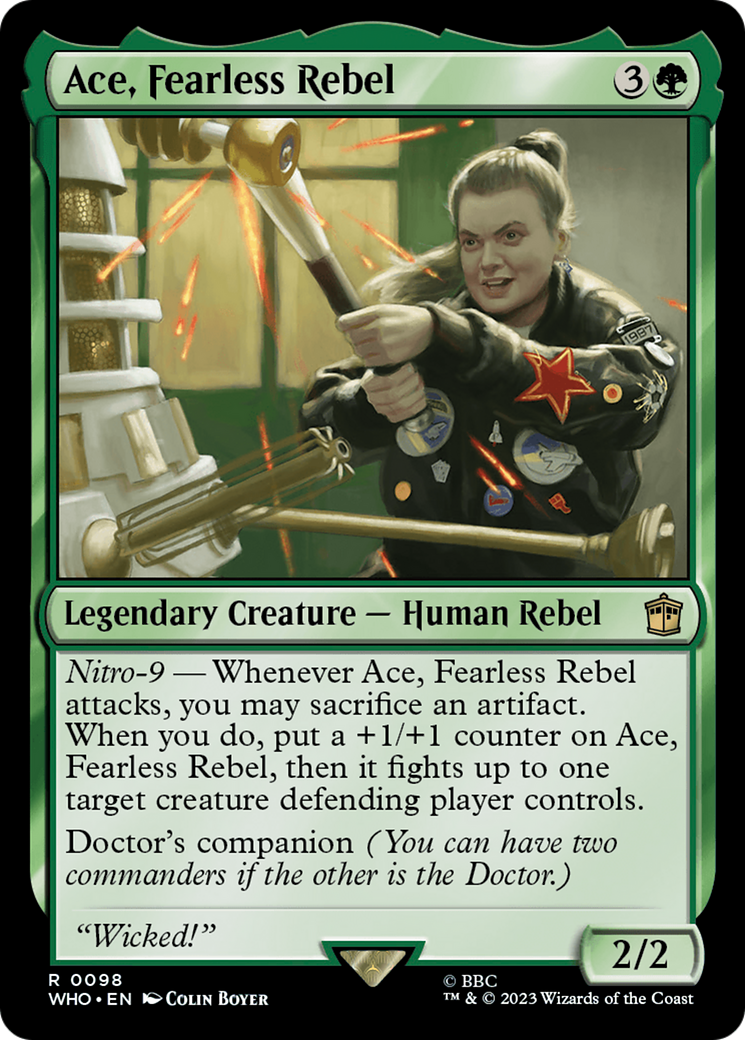
Ace, Fearless Rebel
Ace, Fearless Rebel
Legendary Creature — Human Rebel
2/2
Nitro-9 — Whenever Ace attacks, you may sacrifice an artifact. When you do, put a +1/+1 counter on Ace, then it fights up to one target creature defending player controls.
Doctor's companion (You can have two commanders if the other is the Doctor.)
- If you choose no target for Ace's Nitro-9 ability, you will put a +1/+1 counter on it. However, if you choose a target and it is an illegal target as the ability tries to resolve, you won't put a +1/+1 counter on Ace. In either case, no fight will happen and no creature will deal or be dealt damage.
- The Doctor's companion ability allows you to have two commanders if one has the ability and the other is a legendary creature that is a Time Lord Doctor and has no other creature types. Creatures with the changeling ability, for example, can't be a second commander this way.
- Although Doctor's companion is a new variant of the partner ability, the rules for partner have not otherwise changed. Notably, Time Lord Doctors and cards with Doctor's companion do not interact with cards which have another partner ability.
- If your Commander deck has two commanders, you can include only cards whose own color identities are also found in your commanders' combined color identities.
- Both commanders start in the command zone, and the remaining 98 cards (or 58 cards in a Commander Draft game) of your deck are shuffled to become your library.
- Once the game begins, your two commanders are tracked separately. If you cast one, you won't have to pay an additional the first time you cast the other. A player loses the game after having been dealt 21 combat damage from any one of them, not from both of them combined.
- If something refers to your commander while you have two commanders, it refers to one of them of your choice. If you are instructed to perform an action on your commander (e.g. put it from the command zone into your hand due to Command Beacon), you choose one of your commanders at the time the effect happens.
- An effect that checks whether you control your commander is satisfied if you control one or both of your two commanders.
-
1
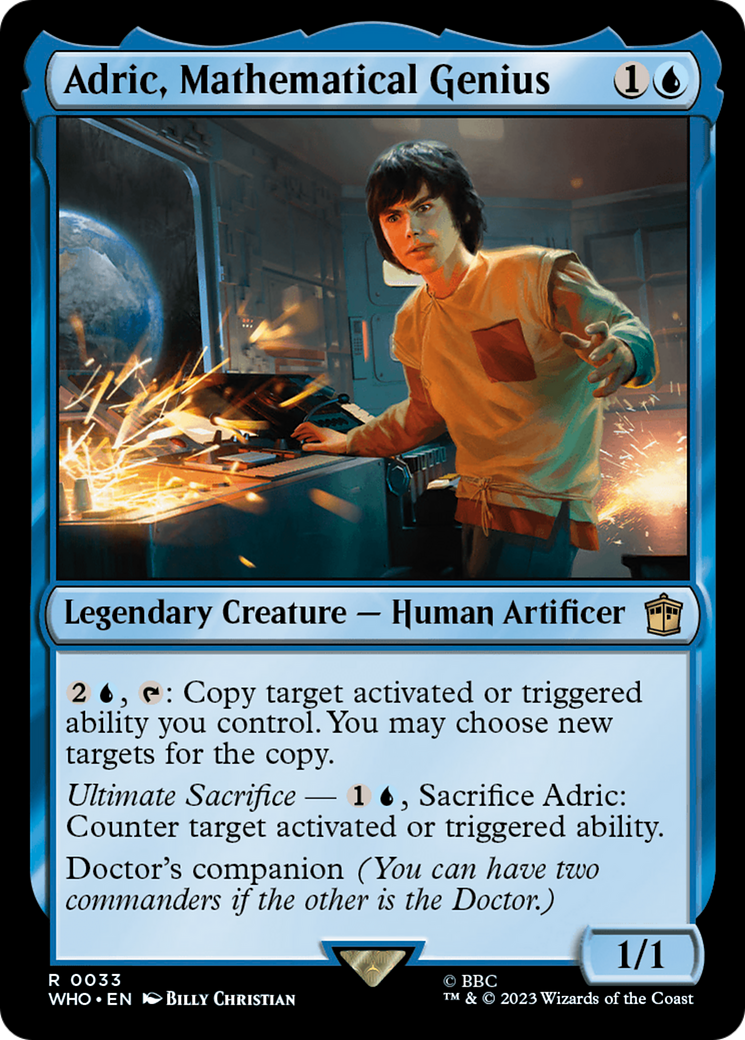
Adric, Mathematical Genius
Adric, Mathematical Genius
Legendary Creature — Human Artificer
1/1
, : Copy target activated or triggered ability you control. You may choose new targets for the copy.
Ultimate Sacrifice — , Sacrifice Adric: Counter target activated or triggered ability.
Doctor's companion (You can have two commanders if the other is the Doctor.)
- Adric, Mathematical Genius's first ability targets an activated or triggered ability that is on the stack and creates another instance of that ability on the stack. It doesn't cause any object to gain an ability.
- The source of the copy from Adric, Mathematical Genius's first ability is the same as the source of the original ability.
- Activated abilities contain a colon. They're generally written "[Cost]: [Effect]." Some keyword abilities (such as equip) are activated abilities and will have a colon in their reminder text.
- Triggered abilities use the word "when," "whenever," or "at." They're often written as "[Trigger condition], [effect]." Some keywords (such as prowess) are triggered abilities and will use "when," "whenever," or "at" in their reminder text.
- If an ability is linked to a second ability, copies of that first ability are also linked to that second ability. If the second ability refers to "the exiled card," it refers to all cards exiled by the first ability and the copy. For example, if Fiend Hunter's enters-the-battlefield ability is copied and two creatures are exiled, they both return when Fiend Hunter leaves the battlefield.
- Adric, Mathematical Genius can copy any activated or triggered ability on the stack, not just one with targets.
- The copy is created on the stack, so it's not "activated." Creating the copy won't cause abilities that trigger when a player activates an ability to trigger. Abilities that say that a triggered ability triggers additional times won't apply to copying a triggered ability.
- The copy will resolve before the original ability does.
- The copy will have the same targets as the ability it's copying unless you choose new ones. You may change any number of the targets, including all of them or none of them. If, for one of the targets, you can't choose a new legal target, then it remains unchanged (even if the current target is illegal).
- If the ability that's copied is modal (that is, it says "Choose one —" or the like), the copy will have the same mode. A different mode can't be chosen.
- If the ability that's copied has an X whose value was determined as it was activated, the copy will have the same value of X.
- If the ability has damage divided as it was put onto the stack, the division can't be changed, although the targets receiving that damage still can. The same is true of abilities that distribute counters.
- You can't choose to pay any activation costs for the copy. However, effects based on those costs that were paid for the original ability are copied as though those same costs were paid for the copy.
- Any choices made when the ability resolves won't have been made yet when it's copied. Any such choices will be made separately when the copy resolves. Most notably, if a triggered ability asks its controller to pay a cost, you pay that cost for the copy if you wish to have it paid.
- The Doctor's companion ability allows you to have two commanders if one has the ability and the other is a legendary creature that is a Time Lord Doctor and has no other creature types. Creatures with the changeling ability, for example, can't be a second commander this way.
- Although Doctor's companion is a new variant of the partner ability, the rules for partner have not otherwise changed. Notably, Time Lord Doctors and cards with Doctor's companion do not interact with cards which have another partner ability.
- If your Commander deck has two commanders, you can include only cards whose own color identities are also found in your commanders' combined color identities.
- Both commanders start in the command zone, and the remaining 98 cards (or 58 cards in a Commander Draft game) of your deck are shuffled to become your library.
- Once the game begins, your two commanders are tracked separately. If you cast one, you won't have to pay an additional the first time you cast the other. A player loses the game after having been dealt 21 combat damage from any one of them, not from both of them combined.
- If something refers to your commander while you have two commanders, it refers to one of them of your choice. If you are instructed to perform an action on your commander (e.g. put it from the command zone into your hand due to Command Beacon), you choose one of your commanders at the time the effect happens.
- An effect that checks whether you control your commander is satisfied if you control one or both of your two commanders.
-
1
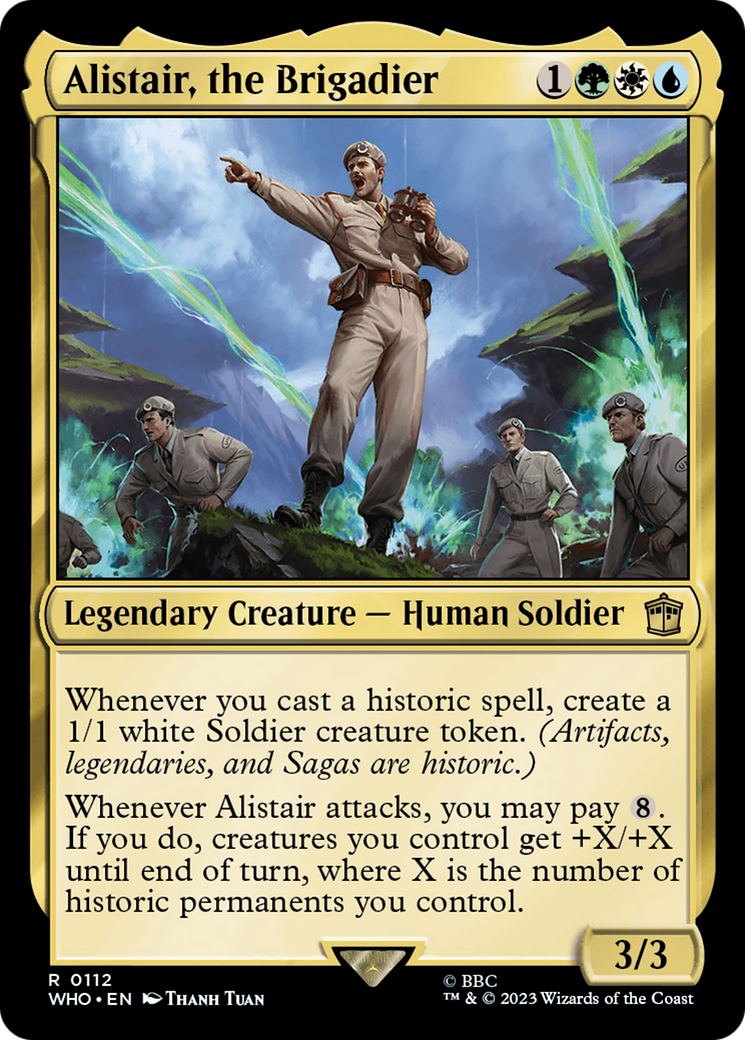
Alistair, the Brigadier
Alistair, the Brigadier
Legendary Creature — Human Soldier
3/3
Whenever you cast a historic spell, create a 1/1 white Soldier creature token. (Artifacts, legendaries, and Sagas are historic.)
Whenever Alistair attacks, you may pay . If you do, creatures you control get +X/+X until end of turn, where X is the number of historic permanents you control.
- You choose whether to pay as Alistair's second ability resolves. Notably, once it begins to resolve, none of your opponents may take actions that might change the result before it happens, such as casting a spell that destroys one of your historic permanents.
-
1
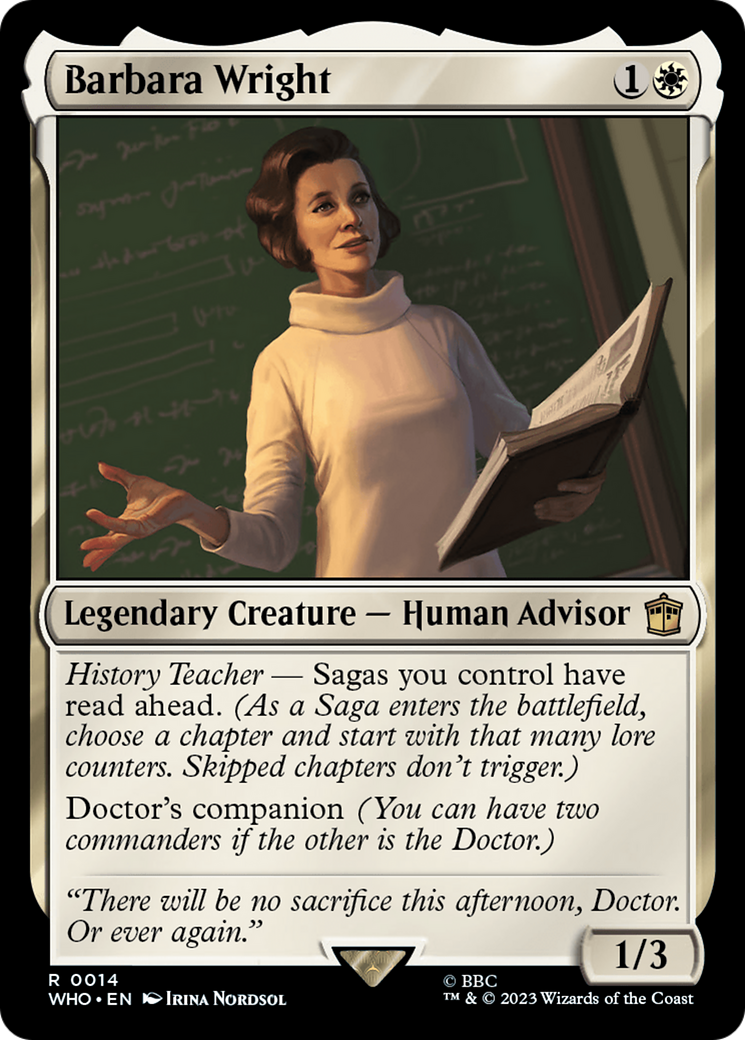
Barbara Wright
Barbara Wright
Legendary Creature — Human Advisor
1/3
History Teacher — Sagas you control have read ahead. (As a Saga enters, choose a chapter and start with that many lore counters. Skipped chapters don't trigger.)
Doctor's companion (You can have two commanders if the other is the Doctor.)
- As a Saga with read ahead enters the battlefield, its controller chooses a number from one to that Saga's greatest chapter number. The Saga enters the battlefield with the chosen number of lore counters. Neither choosing the number nor putting the counters on the Saga use the stack, and neither can be responded to.
- Having multiple instances of read ahead doesn't cause anything unusual to happen. It functions the same way as having one instance of read ahead.
- The Doctor's companion ability allows you to have two commanders if one has the ability and the other is a legendary creature that is a Time Lord Doctor and has no other creature types. Creatures with the changeling ability, for example, can't be a second commander this way.
- Although Doctor's companion is a new variant of the partner ability, the rules for partner have not otherwise changed. Notably, Time Lord Doctors and cards with Doctor's companion do not interact with cards which have another partner ability.
- If your Commander deck has two commanders, you can include only cards whose own color identities are also found in your commanders' combined color identities.
- Both commanders start in the command zone, and the remaining 98 cards (or 58 cards in a Commander Draft game) of your deck are shuffled to become your library.
- Once the game begins, your two commanders are tracked separately. If you cast one, you won't have to pay an additional the first time you cast the other. A player loses the game after having been dealt 21 combat damage from any one of them, not from both of them combined.
- If something refers to your commander while you have two commanders, it refers to one of them of your choice. If you are instructed to perform an action on your commander (e.g. put it from the command zone into your hand due to Command Beacon), you choose one of your commanders at the time the effect happens.
- An effect that checks whether you control your commander is satisfied if you control one or both of your two commanders.
-
1
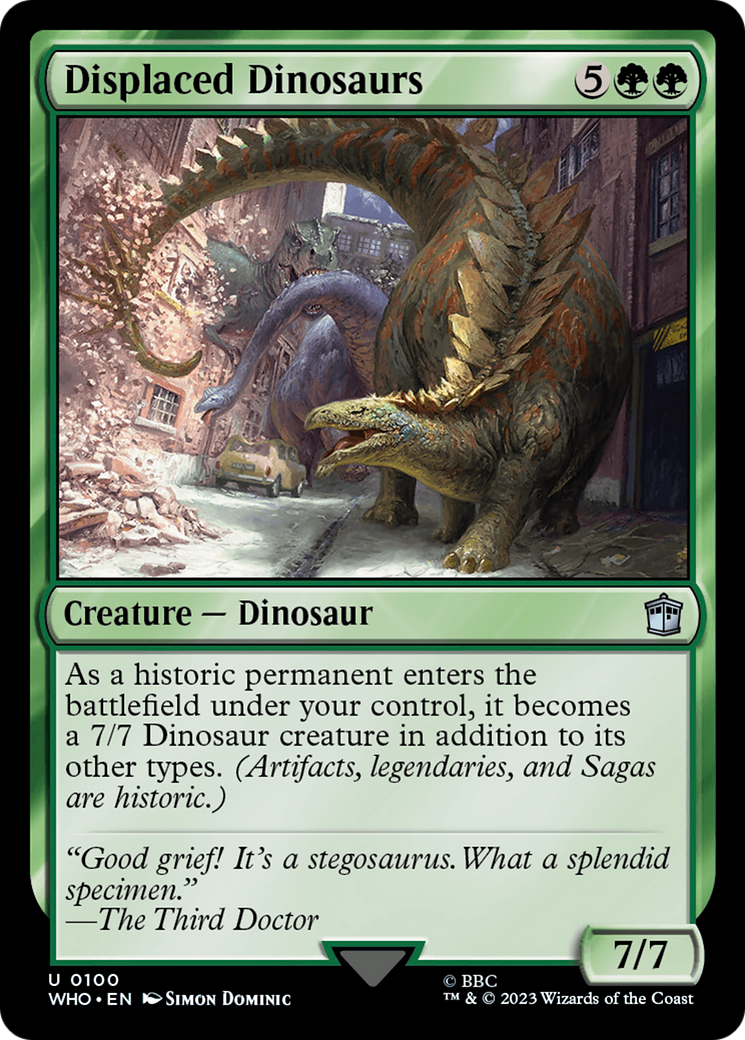
Displaced Dinosaurs
Displaced Dinosaurs
Creature — Dinosaur
7/7
As a historic permanent you control enters, it becomes a 7/7 Dinosaur creature in addition to its other types. (Artifacts, legendaries, and Sagas are historic.)
- The permanent enters as a 7/7 Dinosaur creature that still has its other types and abilities; it doesn't enter and then become a 7/7 Dinosaur creature. Any triggered abilities that look for power, toughness, or creature types to determine whether or not they trigger will see those characteristics.
-
1
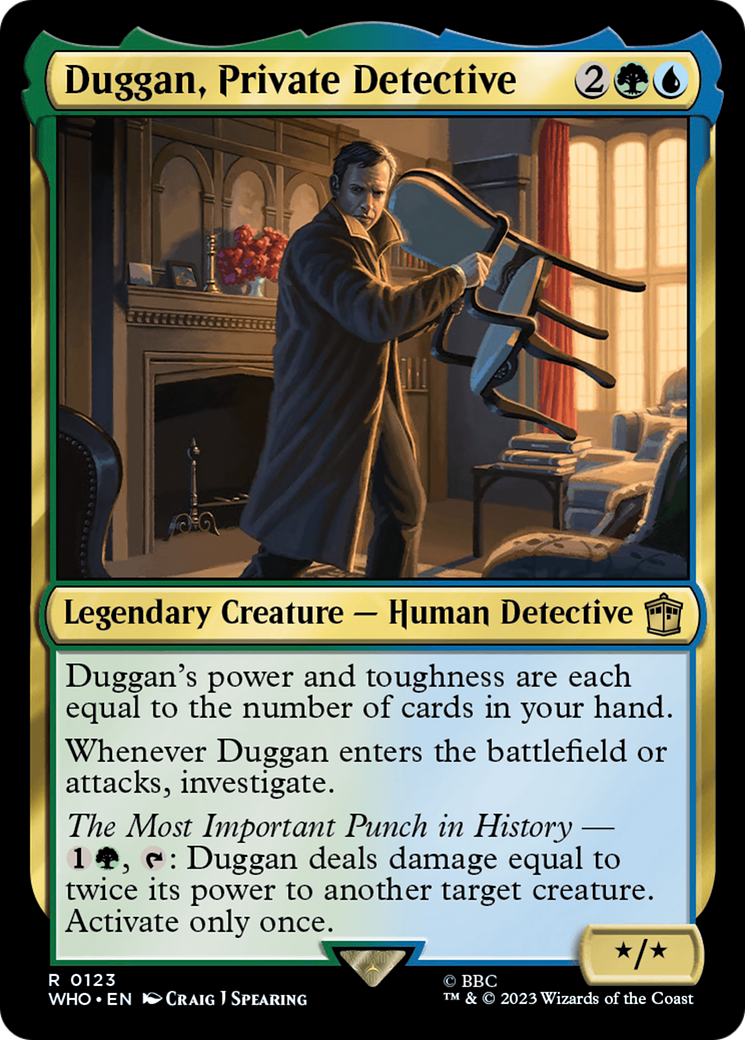
Duggan, Private Detective
Duggan, Private Detective
Legendary Creature — Human Detective
*/*
Duggan's power and toughness are each equal to the number of cards in your hand.
Whenever Duggan enters or attacks, investigate.
The Most Important Punch in History — , : Duggan deals damage equal to twice its power to another target creature. Activate only once.
- Duggan, Private Detective's last ability can be activated only once during the game. However, if Duggan leaves and later returns to the battlefield, he's considered a new permanent (with a new set of abilities) and it can be activated again.
-
1
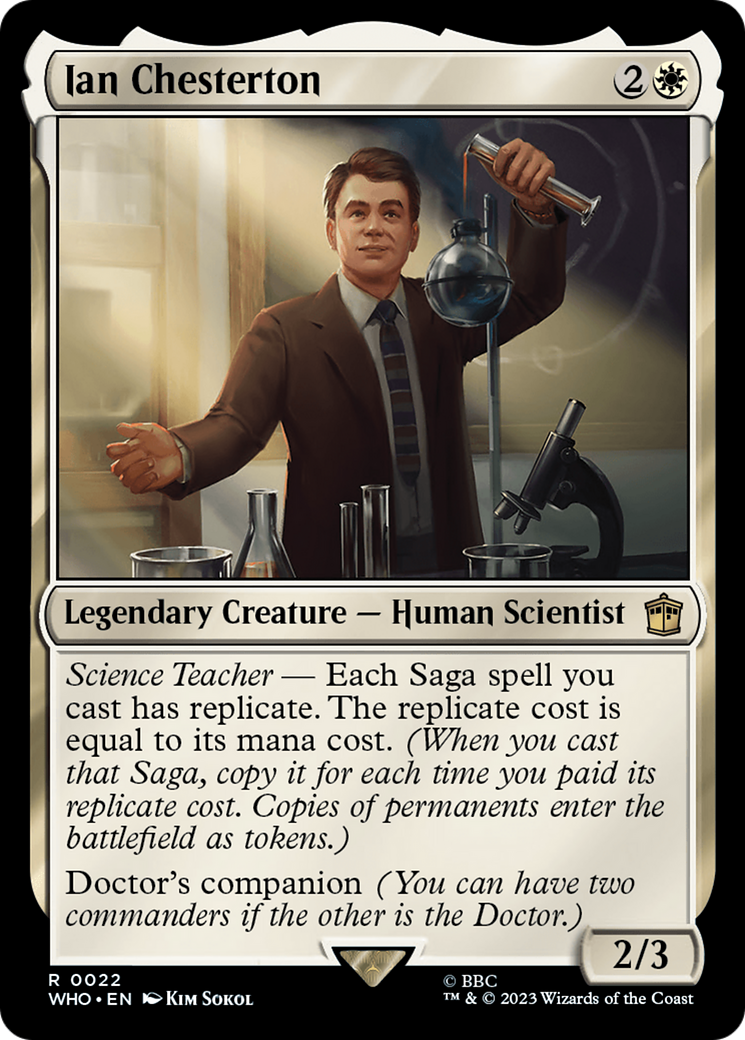
Ian Chesterton
Ian Chesterton
Legendary Creature — Human Scientist
2/3
Science Teacher — Each Saga spell you cast has replicate. The replicate cost is equal to its mana cost. (When you cast that Saga, copy it for each time you paid its replicate cost. Copies of Saga spells become tokens.)
Doctor's companion (You can have two commanders if the other is the Doctor.)
- The Doctor's companion ability allows you to have two commanders if one has the ability and the other is a legendary creature that is a Time Lord Doctor and has no other creature types. Creatures with the changeling ability, for example, can't be a second commander this way.
- Although Doctor's companion is a new variant of the partner ability, the rules for partner have not otherwise changed. Notably, Time Lord Doctors and cards with Doctor's companion do not interact with cards which have another partner ability.
- If your Commander deck has two commanders, you can include only cards whose own color identities are also found in your commanders' combined color identities.
- Both commanders start in the command zone, and the remaining 98 cards (or 58 cards in a Commander Draft game) of your deck are shuffled to become your library.
- Once the game begins, your two commanders are tracked separately. If you cast one, you won't have to pay an additional the first time you cast the other. A player loses the game after having been dealt 21 combat damage from any one of them, not from both of them combined.
- If something refers to your commander while you have two commanders, it refers to one of them of your choice. If you are instructed to perform an action on your commander (e.g. put it from the command zone into your hand due to Command Beacon), you choose one of your commanders at the time the effect happens.
- An effect that checks whether you control your commander is satisfied if you control one or both of your two commanders.
-
1
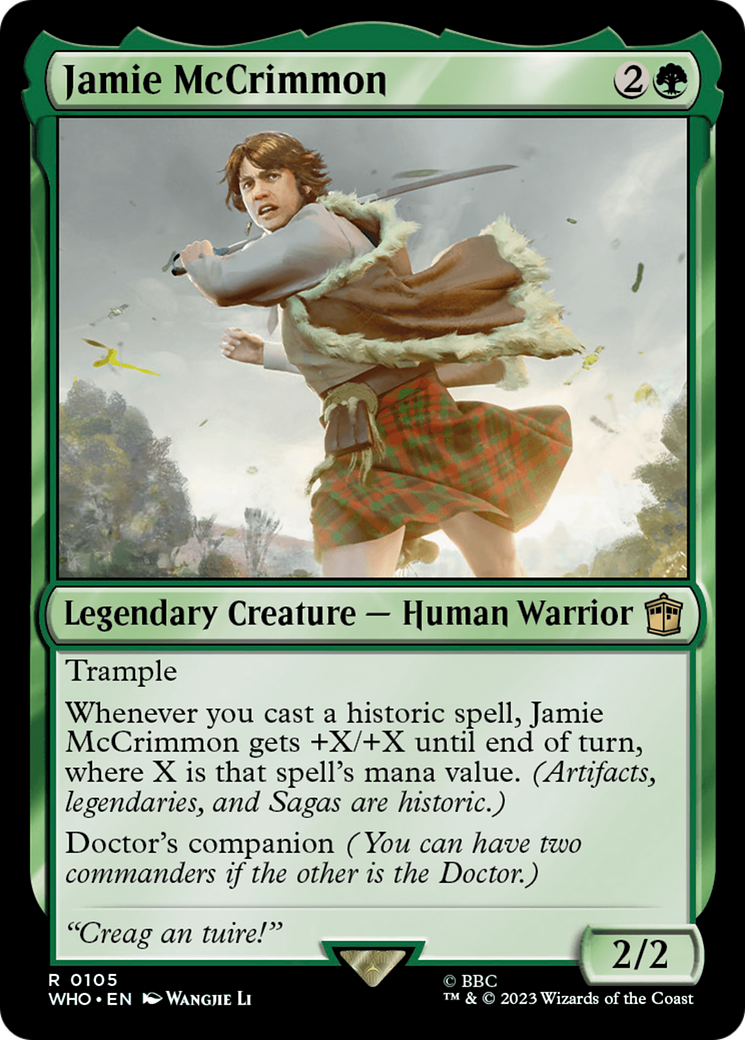
Jamie McCrimmon
Jamie McCrimmon
Legendary Creature — Human Warrior
2/2
Trample
Whenever you cast a historic spell, Jamie McCrimmon gets +X/+X until end of turn, where X is that spell's mana value. (Artifacts, legendaries, and Sagas are historic.)
Doctor's companion (You can have two commanders if the other is the Doctor.)
- The Doctor's companion ability allows you to have two commanders if one has the ability and the other is a legendary creature that is a Time Lord Doctor and has no other creature types. Creatures with the changeling ability, for example, can't be a second commander this way.
- Although Doctor's companion is a new variant of the partner ability, the rules for partner have not otherwise changed. Notably, Time Lord Doctors and cards with Doctor's companion do not interact with cards which have another partner ability.
- If your Commander deck has two commanders, you can include only cards whose own color identities are also found in your commanders' combined color identities.
- Both commanders start in the command zone, and the remaining 98 cards (or 58 cards in a Commander Draft game) of your deck are shuffled to become your library.
- Once the game begins, your two commanders are tracked separately. If you cast one, you won't have to pay an additional the first time you cast the other. A player loses the game after having been dealt 21 combat damage from any one of them, not from both of them combined.
- If something refers to your commander while you have two commanders, it refers to one of them of your choice. If you are instructed to perform an action on your commander (e.g. put it from the command zone into your hand due to Command Beacon), you choose one of your commanders at the time the effect happens.
- An effect that checks whether you control your commander is satisfied if you control one or both of your two commanders.
-
1
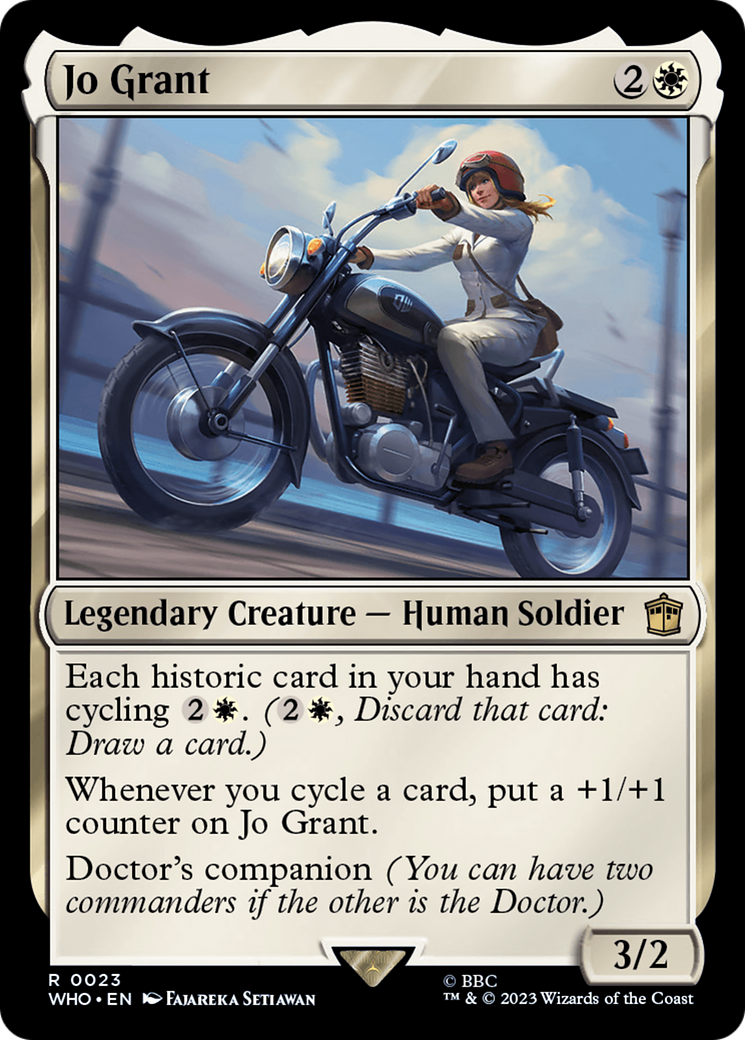
Jo Grant
Jo Grant
Legendary Creature — Human Soldier
3/2
Each historic card in your hand has cycling . ( , Discard that card: Draw a card.)
Whenever you cycle a card, put a +1/+1 counter on Jo Grant.
Doctor's companion (You can have two commanders if the other is the Doctor.)
- The Doctor's companion ability allows you to have two commanders if one has the ability and the other is a legendary creature that is a Time Lord Doctor and has no other creature types. Creatures with the changeling ability, for example, can't be a second commander this way.
- Although Doctor's companion is a new variant of the partner ability, the rules for partner have not otherwise changed. Notably, Time Lord Doctors and cards with Doctor's companion do not interact with cards which have another partner ability.
- If your Commander deck has two commanders, you can include only cards whose own color identities are also found in your commanders' combined color identities.
- Both commanders start in the command zone, and the remaining 98 cards (or 58 cards in a Commander Draft game) of your deck are shuffled to become your library.
- Once the game begins, your two commanders are tracked separately. If you cast one, you won't have to pay an additional the first time you cast the other. A player loses the game after having been dealt 21 combat damage from any one of them, not from both of them combined.
- If something refers to your commander while you have two commanders, it refers to one of them of your choice. If you are instructed to perform an action on your commander (e.g. put it from the command zone into your hand due to Command Beacon), you choose one of your commanders at the time the effect happens.
- An effect that checks whether you control your commander is satisfied if you control one or both of your two commanders.
-
1
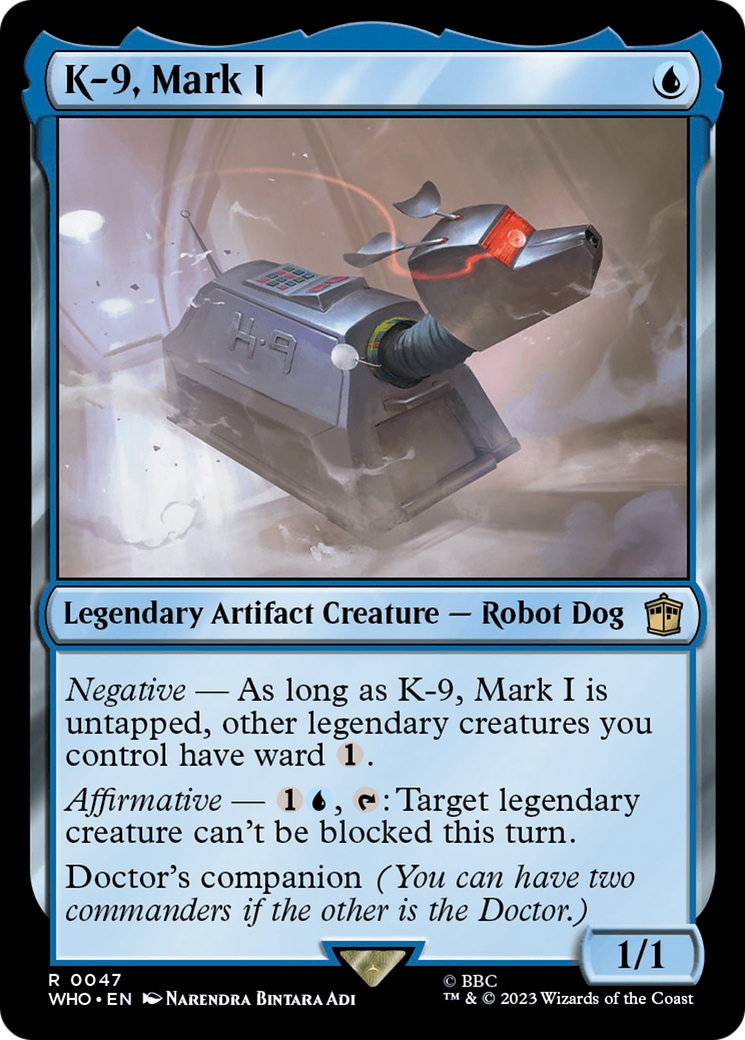
K-9, Mark I
K-9, Mark I
Legendary Artifact Creature — Robot Dog
1/1
Negative — As long as K-9 is untapped, other legendary creatures you control have ward .
Affirmative — , : Target legendary creature can't be blocked this turn.
Doctor's companion (You can have two commanders if the other is the Doctor.)
- The Doctor's companion ability allows you to have two commanders if one has the ability and the other is a legendary creature that is a Time Lord Doctor and has no other creature types. Creatures with the changeling ability, for example, can't be a second commander this way.
- Although Doctor's companion is a new variant of the partner ability, the rules for partner have not otherwise changed. Notably, Time Lord Doctors and cards with Doctor's companion do not interact with cards which have another partner ability.
- If your Commander deck has two commanders, you can include only cards whose own color identities are also found in your commanders' combined color identities.
- Both commanders start in the command zone, and the remaining 98 cards (or 58 cards in a Commander Draft game) of your deck are shuffled to become your library.
- Once the game begins, your two commanders are tracked separately. If you cast one, you won't have to pay an additional the first time you cast the other. A player loses the game after having been dealt 21 combat damage from any one of them, not from both of them combined.
- If something refers to your commander while you have two commanders, it refers to one of them of your choice. If you are instructed to perform an action on your commander (e.g. put it from the command zone into your hand due to Command Beacon), you choose one of your commanders at the time the effect happens.
- An effect that checks whether you control your commander is satisfied if you control one or both of your two commanders.
-
1
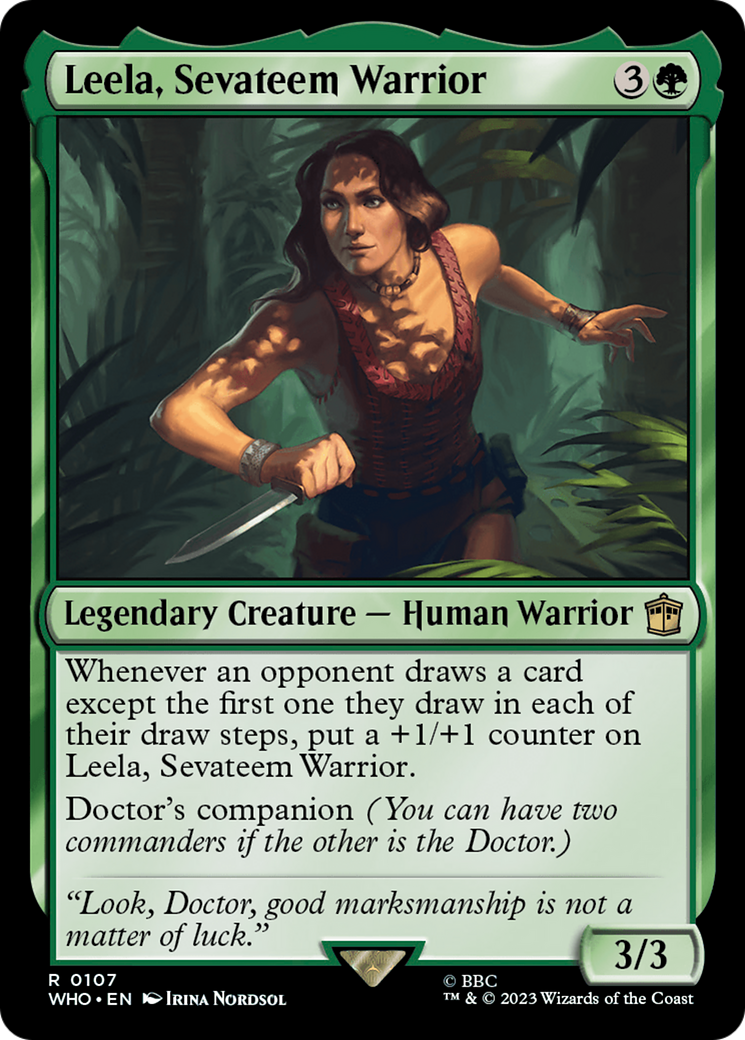
Leela, Sevateem Warrior
Leela, Sevateem Warrior
Legendary Creature — Human Warrior
3/3
Whenever an opponent draws a card except the first one they draw in each of their draw steps, put a +1/+1 counter on Leela.
Doctor's companion (You can have two commanders if the other is the Doctor.)
- The Doctor's companion ability allows you to have two commanders if one has the ability and the other is a legendary creature that is a Time Lord Doctor and has no other creature types. Creatures with the changeling ability, for example, can't be a second commander this way.
- Although Doctor's companion is a new variant of the partner ability, the rules for partner have not otherwise changed. Notably, Time Lord Doctors and cards with Doctor's companion do not interact with cards which have another partner ability.
- If your Commander deck has two commanders, you can include only cards whose own color identities are also found in your commanders' combined color identities.
- Both commanders start in the command zone, and the remaining 98 cards (or 58 cards in a Commander Draft game) of your deck are shuffled to become your library.
- Once the game begins, your two commanders are tracked separately. If you cast one, you won't have to pay an additional the first time you cast the other. A player loses the game after having been dealt 21 combat damage from any one of them, not from both of them combined.
- If something refers to your commander while you have two commanders, it refers to one of them of your choice. If you are instructed to perform an action on your commander (e.g. put it from the command zone into your hand due to Command Beacon), you choose one of your commanders at the time the effect happens.
- An effect that checks whether you control your commander is satisfied if you control one or both of your two commanders.
-
1
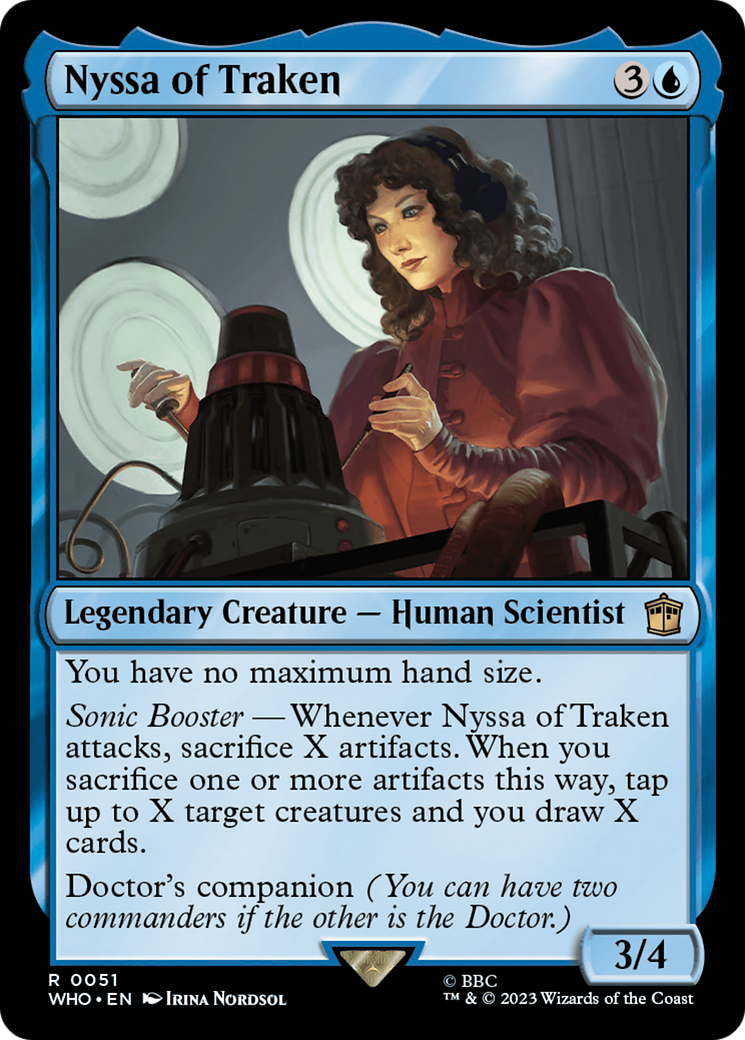
Nyssa of Traken
Nyssa of Traken
Legendary Creature — Human Scientist
3/4
You have no maximum hand size.
Sonic Booster — Whenever Nyssa of Traken attacks, sacrifice any number of artifacts. When you sacrifice one or more artifacts this way, tap up to that many target creatures and draw that many cards.
Doctor's companion (You can have two commanders if the other is the Doctor.)
- You can choose fewer than X targets for Nyssa's reflexive triggered ability. The number of targets doesn't change the number of cards drawn.
- If you chose at least one target and all targets are illegal as the ability tries to resolve, the ability is removed from the stack and does nothing. You will not draw any cards in this case.
- The Doctor's companion ability allows you to have two commanders if one has the ability and the other is a legendary creature that is a Time Lord Doctor and has no other creature types. Creatures with the changeling ability, for example, can't be a second commander this way.
- Although Doctor's companion is a new variant of the partner ability, the rules for partner have not otherwise changed. Notably, Time Lord Doctors and cards with Doctor's companion do not interact with cards which have another partner ability.
- If your Commander deck has two commanders, you can include only cards whose own color identities are also found in your commanders' combined color identities.
- Both commanders start in the command zone, and the remaining 98 cards (or 58 cards in a Commander Draft game) of your deck are shuffled to become your library.
- Once the game begins, your two commanders are tracked separately. If you cast one, you won't have to pay an additional the first time you cast the other. A player loses the game after having been dealt 21 combat damage from any one of them, not from both of them combined.
- If something refers to your commander while you have two commanders, it refers to one of them of your choice. If you are instructed to perform an action on your commander (e.g. put it from the command zone into your hand due to Command Beacon), you choose one of your commanders at the time the effect happens.
- An effect that checks whether you control your commander is satisfied if you control one or both of your two commanders.
-
1
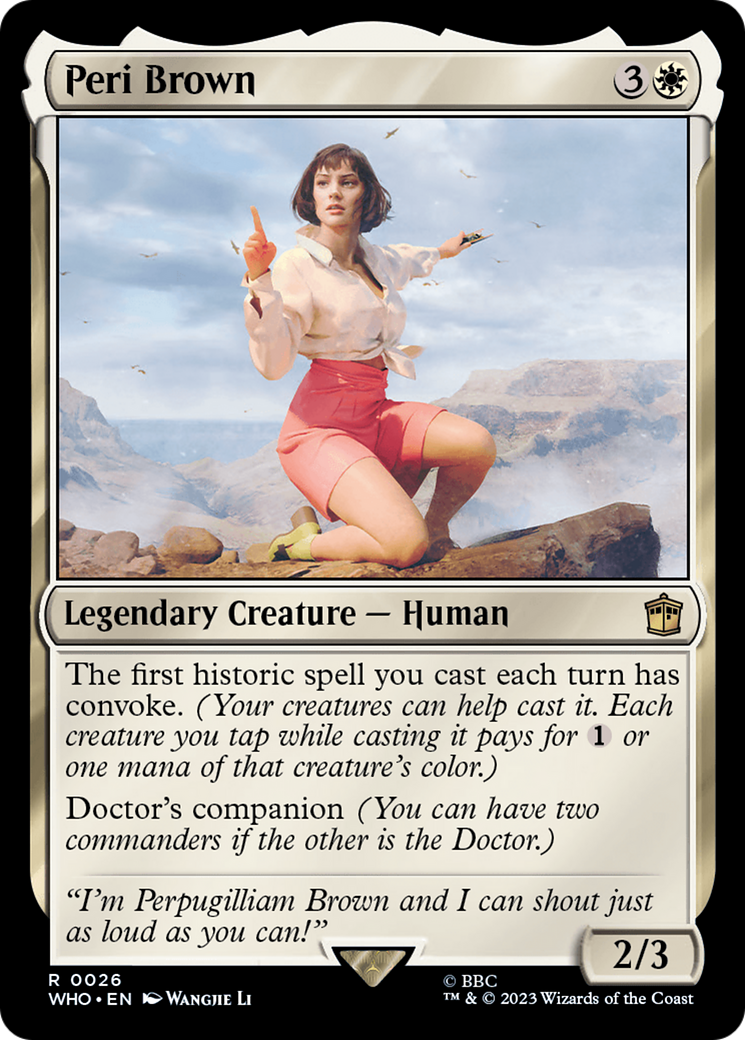
Peri Brown
Peri Brown
Legendary Creature — Human
2/3
The first historic spell you cast each turn has convoke. (Your creatures can help cast it. Each creature you tap while casting it pays for or one mana of that creature's color.)
Doctor's companion (You can have two commanders if the other is the Doctor.)
- You can tap any untapped creature you control to convoke a spell, even one you haven't controlled continuously since the beginning of your most recent turn.
- Tapping an untapped creature that's attacking or blocking to convoke a spell won't cause that creature to stop attacking or blocking.
- When calculating a spell's total cost, include any alternative costs, additional costs, or anything else that increases or reduces the cost to cast the spell. Convoke applies after the total cost is calculated. Convoke doesn't change a spell's mana cost or mana value.
- If a creature you control has a mana ability with in the cost, activating that ability while casting a spell with convoke will result in the creature being tapped before you pay the spell's costs. You won't be able to tap it again for convoke. Similarly, if you sacrifice a creature to activate a mana ability while casting a spell with convoke, that creature won't be on the battlefield when you pay the spell's costs, so you won't be able to tap it for convoke.
- Because convoke isn't an alternative cost, it can be used in conjunction with alternative costs.
- Tapping a multicolored creature using convoke will pay for or one mana of your choice of any of that creature's colors.
- The Doctor's companion ability allows you to have two commanders if one has the ability and the other is a legendary creature that is a Time Lord Doctor and has no other creature types. Creatures with the changeling ability, for example, can't be a second commander this way.
- An effect that checks whether you control your commander is satisfied if you control one or both of your two commanders.
- Although Doctor's companion is a new variant of the partner ability, the rules for partner have not otherwise changed. Notably, Time Lord Doctors and cards with Doctor's companion do not interact with cards which have another partner ability.
- If your Commander deck has two commanders, you can include only cards whose own color identities are also found in your commanders' combined color identities.
- Both commanders start in the command zone, and the remaining 98 cards (or 58 cards in a Commander Draft game) of your deck are shuffled to become your library.
- Once the game begins, your two commanders are tracked separately. If you cast one, you won't have to pay an additional the first time you cast the other. A player loses the game after having been dealt 21 combat damage from any one of them, not from both of them combined.
- If something refers to your commander while you have two commanders, it refers to one of them of your choice. If you are instructed to perform an action on your commander (e.g. put it from the command zone into your hand due to Command Beacon), you choose one of your commanders at the time the effect happens.
-
1
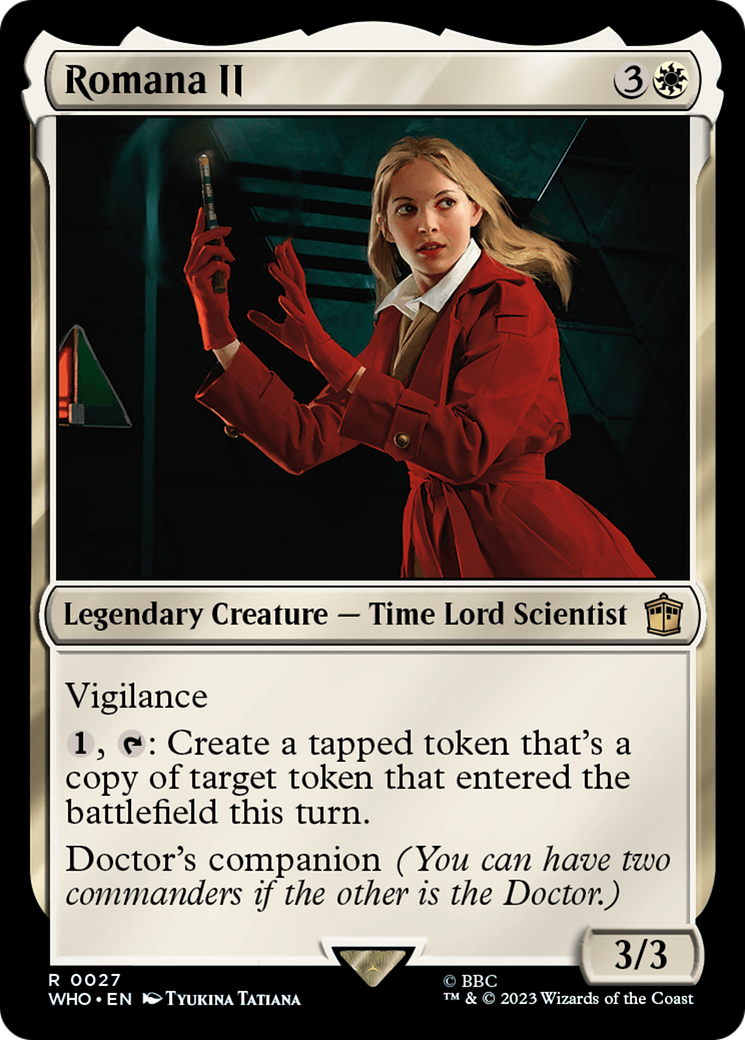
Romana II
Romana II
Legendary Creature — Time Lord Scientist
3/3
Vigilance
, : Create a tapped token that's a copy of target token that entered this turn.
Doctor's companion (You can have two commanders if the other is the Doctor.)
- If an effect instructs you to choose a creature type, you may choose Time Lord.
- The token you create copies the original characteristics of the token as stated by the effect that created that token (unless that token is copying something else; see below). It doesn't copy whether that token is tapped or untapped, whether it has any counters on it or Auras and Equipment attached to it, or any non-copy effects that have changed its power, toughness, types, color, or so on.
- If the copied token has in its mana cost, X is considered to be 0.
- If the copied token is copying something else (for example, if the copied token is one previously created by this ability), then the token enters the battlefield as whatever that token copied.
- Any enters-the-battlefield abilities of the copied token will trigger when the token enters the battlefield. Any "as [this permanent] enters the battlefield" or "[this permanent] enters the battlefield with" abilities of the chosen token will also work.
- The Doctor's companion ability allows you to have two commanders if one has the ability and the other is a legendary creature that is a Time Lord Doctor and has no other creature types. Creatures with the changeling ability, for example, can't be a second commander this way.
- Although Doctor's companion is a new variant of the partner ability, the rules for partner have not otherwise changed. Notably, Time Lord Doctors and cards with Doctor's companion do not interact with cards which have another partner ability.
- If your Commander deck has two commanders, you can include only cards whose own color identities are also found in your commanders' combined color identities.
- Both commanders start in the command zone, and the remaining 98 cards (or 58 cards in a Commander Draft game) of your deck are shuffled to become your library.
- Once the game begins, your two commanders are tracked separately. If you cast one, you won't have to pay an additional the first time you cast the other. A player loses the game after having been dealt 21 combat damage from any one of them, not from both of them combined.
- If something refers to your commander while you have two commanders, it refers to one of them of your choice. If you are instructed to perform an action on your commander (e.g. put it from the command zone into your hand due to Command Beacon), you choose one of your commanders at the time the effect happens.
- An effect that checks whether you control your commander is satisfied if you control one or both of your two commanders.
- Unlike other creature types in Magic that are each only one word, the two words "Time Lord" represent a single creature subtype. Time Lord is the only two-word creature type.
- Neither "Time" nor "Lord" are creature types. Some older cards were printed with the subtype "Lord," but all of those cards have updated Oracle card text that removed that type.
-
1
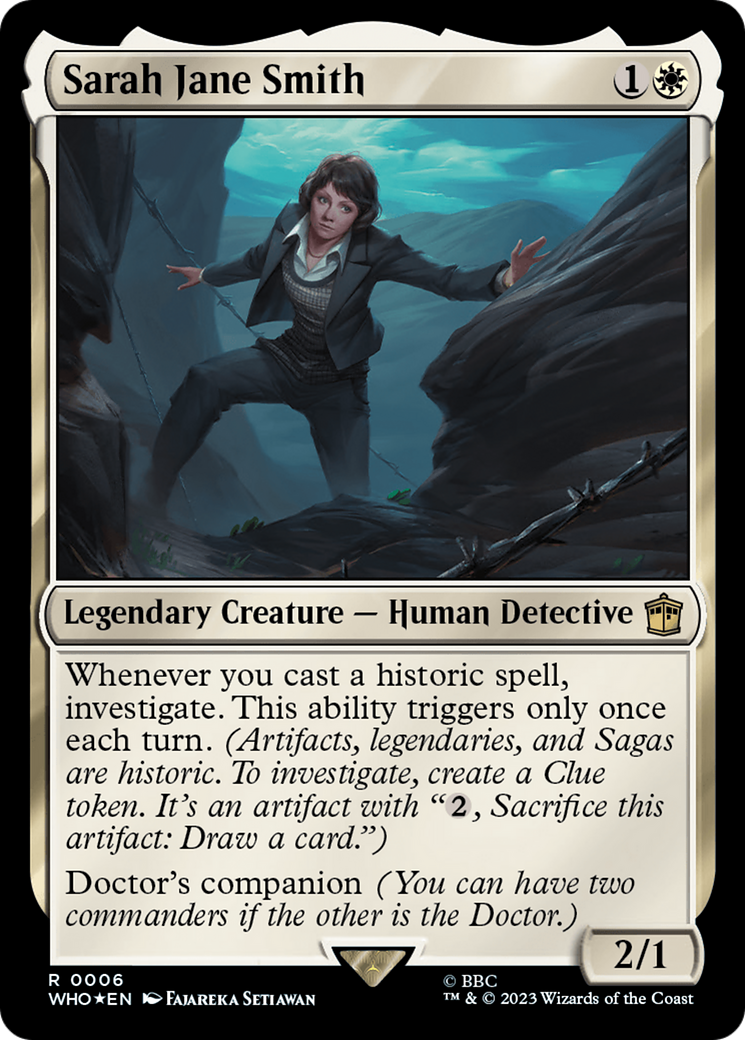
Sarah Jane Smith
Sarah Jane Smith
Legendary Creature — Human Detective
2/1
Whenever you cast a historic spell, investigate. This ability triggers only once each turn. (Artifacts, legendaries, and Sagas are historic. To investigate, create a Clue token. It's an artifact with " , Sacrifice this token: Draw a card.")
Doctor's companion (You can have two commanders if the other is the Doctor.)
- The Doctor's companion ability allows you to have two commanders if one has the ability and the other is a legendary creature that is a Time Lord Doctor and has no other creature types. Creatures with the changeling ability, for example, can't be a second commander this way.
- Although Doctor's companion is a new variant of the partner ability, the rules for partner have not otherwise changed. Notably, Time Lord Doctors and cards with Doctor's companion do not interact with cards which have another partner ability.
- If your Commander deck has two commanders, you can include only cards whose own color identities are also found in your commanders' combined color identities.
- Both commanders start in the command zone, and the remaining 98 cards (or 58 cards in a Commander Draft game) of your deck are shuffled to become your library.
- Once the game begins, your two commanders are tracked separately. If you cast one, you won't have to pay an additional the first time you cast the other. A player loses the game after having been dealt 21 combat damage from any one of them, not from both of them combined.
- If something refers to your commander while you have two commanders, it refers to one of them of your choice. If you are instructed to perform an action on your commander (e.g. put it from the command zone into your hand due to Command Beacon), you choose one of your commanders at the time the effect happens.
- An effect that checks whether you control your commander is satisfied if you control one or both of your two commanders.
-
1
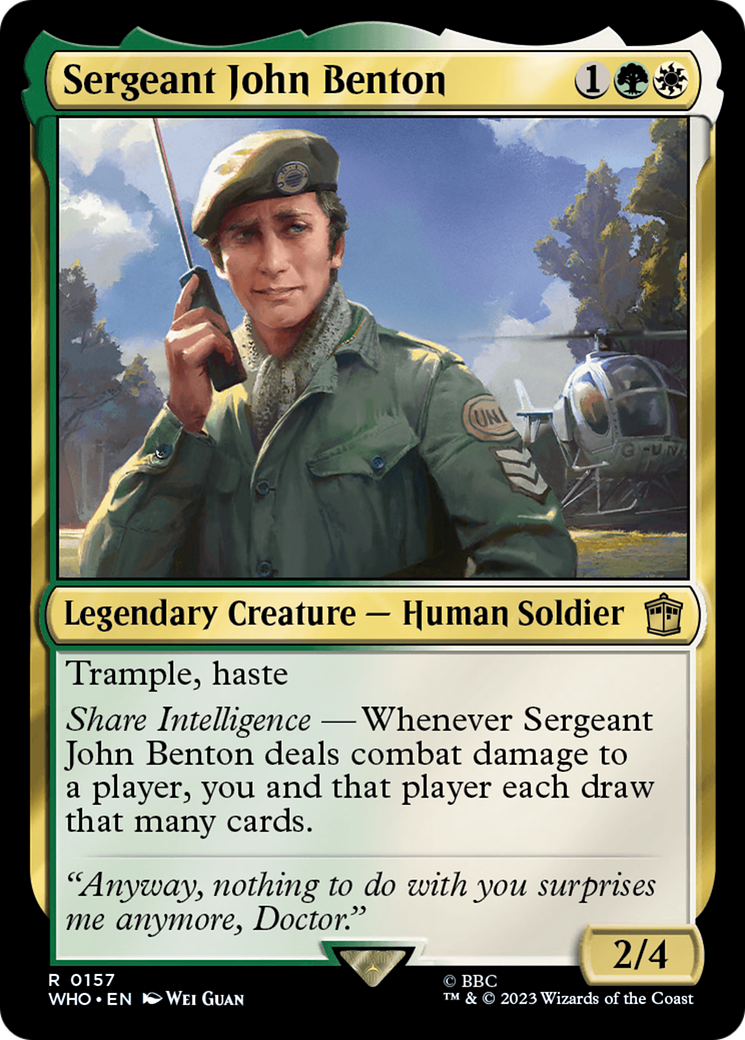
Sergeant John Benton
Sergeant John Benton
Legendary Creature — Human Soldier
2/4
Trample, haste
Share Intelligence — Whenever Sergeant John Benton deals combat damage to a player, you and that player each draw that many cards.
-
1
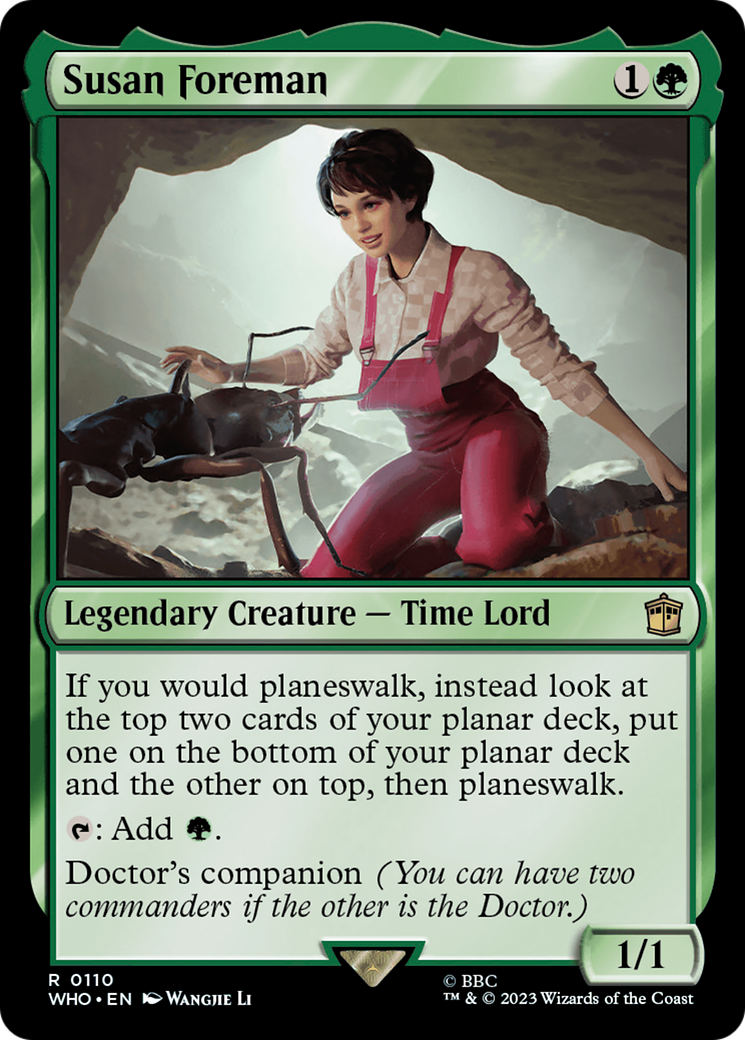
Susan Foreman
Susan Foreman
Legendary Creature — Time Lord
1/1
If you would planeswalk, instead look at the top two cards of your planar deck, put one on the bottom of your planar deck and the other on top, then planeswalk.
: Add .
Doctor's companion (You can have two commanders if the other is the Doctor.)
- The Doctor's companion ability allows you to have two commanders if one has the ability and the other is a legendary creature that is a Time Lord Doctor and has no other creature types. Creatures with the changeling ability, for example, can't be a second commander this way.
- Although Doctor's companion is a new variant of the partner ability, the rules for partner have not otherwise changed. Notably, Time Lord Doctors and cards with Doctor's companion do not interact with cards which have another partner ability.
- If your Commander deck has two commanders, you can include only cards whose own color identities are also found in your commanders' combined color identities.
- Both commanders start in the command zone, and the remaining 98 cards (or 58 cards in a Commander Draft game) of your deck are shuffled to become your library.
- Once the game begins, your two commanders are tracked separately. If you cast one, you won't have to pay an additional the first time you cast the other. A player loses the game after having been dealt 21 combat damage from any one of them, not from both of them combined.
- If something refers to your commander while you have two commanders, it refers to one of them of your choice. If you are instructed to perform an action on your commander (e.g. put it from the command zone into your hand due to Command Beacon), you choose one of your commanders at the time the effect happens.
- An effect that checks whether you control your commander is satisfied if you control one or both of your two commanders.
- Unlike other creature types in Magic that are each only one word, the two words "Time Lord" represent a single creature subtype. Time Lord is the only two-word creature type.
- Neither "Time" nor "Lord" are creature types. Some older cards were printed with the subtype "Lord," but all of those cards have updated Oracle card text that removed that type.
- If an effect instructs you to choose a creature type, you may choose Time Lord.
-
1
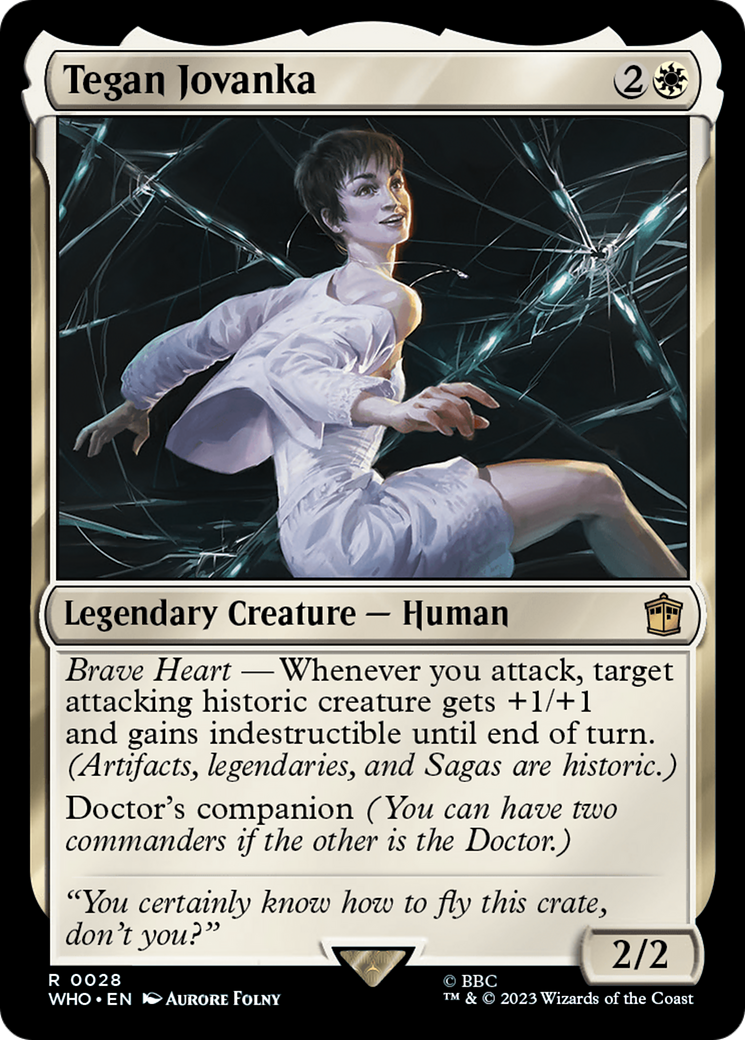
Tegan Jovanka
Tegan Jovanka
Legendary Creature — Human
2/2
Brave Heart — Whenever you attack, target attacking historic creature gets +1/+1 and gains indestructible until end of turn. (Artifacts, legendaries, and Sagas are historic.)
Doctor's companion (You can have two commanders if the other is the Doctor.)
- The Doctor's companion ability allows you to have two commanders if one has the ability and the other is a legendary creature that is a Time Lord Doctor and has no other creature types. Creatures with the changeling ability, for example, can't be a second commander this way.
- Although Doctor's companion is a new variant of the partner ability, the rules for partner have not otherwise changed. Notably, Time Lord Doctors and cards with Doctor's companion do not interact with cards which have another partner ability.
- If your Commander deck has two commanders, you can include only cards whose own color identities are also found in your commanders' combined color identities.
- Both commanders start in the command zone, and the remaining 98 cards (or 58 cards in a Commander Draft game) of your deck are shuffled to become your library.
- Once the game begins, your two commanders are tracked separately. If you cast one, you won't have to pay an additional the first time you cast the other. A player loses the game after having been dealt 21 combat damage from any one of them, not from both of them combined.
- If something refers to your commander while you have two commanders, it refers to one of them of your choice. If you are instructed to perform an action on your commander (e.g. put it from the command zone into your hand due to Command Beacon), you choose one of your commanders at the time the effect happens.
- An effect that checks whether you control your commander is satisfied if you control one or both of your two commanders.
-
1
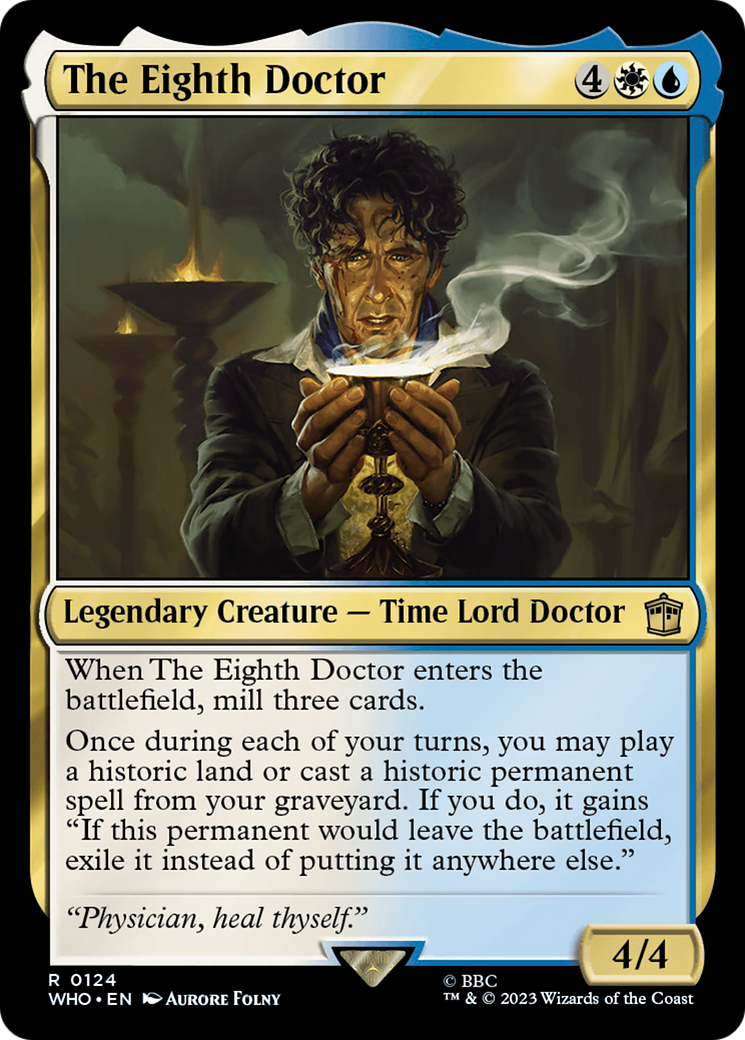
The Eighth Doctor
The Eighth Doctor
Legendary Creature — Time Lord Doctor
4/4
When The Eighth Doctor enters, mill three cards.
Once during each of your turns, you may play a historic land or cast a historic permanent spell from your graveyard. If you do, it gains "If this permanent would leave the battlefield, exile it instead of putting it anywhere else."
- Unlike other creature types in Magic that are each only one word, the two words "Time Lord" represent a single creature subtype. Time Lord is the only two-word creature type.
- Neither "Time" nor "Lord" are creature types. Some older cards were printed with the subtype "Lord," but all of those cards have updated Oracle card text that removed that type.
- If an effect instructs you to choose a creature type, you may choose Time Lord.
-
1
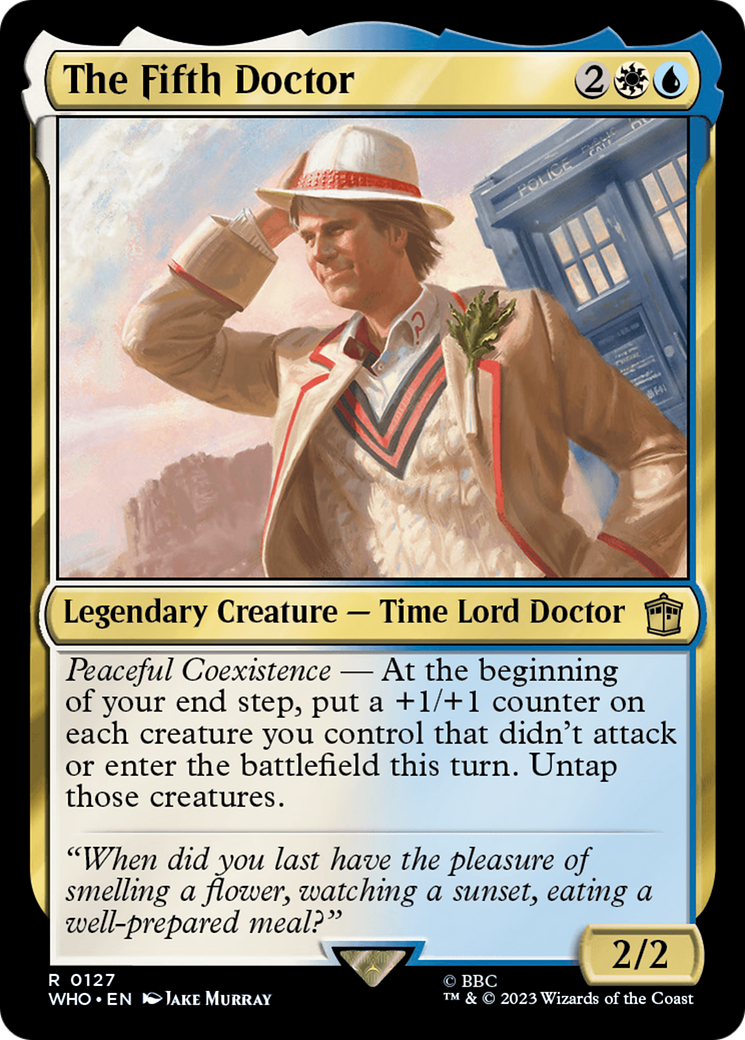
The Fifth Doctor
The Fifth Doctor
Legendary Creature — Time Lord Doctor
2/2
Peaceful Coexistence — At the beginning of your end step, put a +1/+1 counter on each creature you control that didn't attack or enter this turn. Untap those creatures.
- Unlike other creature types in Magic that are each only one word, the two words "Time Lord" represent a single creature subtype. Time Lord is the only two-word creature type.
- Neither "Time" nor "Lord" are creature types. Some older cards were printed with the subtype "Lord," but all of those cards have updated Oracle card text that removed that type.
- If an effect instructs you to choose a creature type, you may choose Time Lord.
-
1
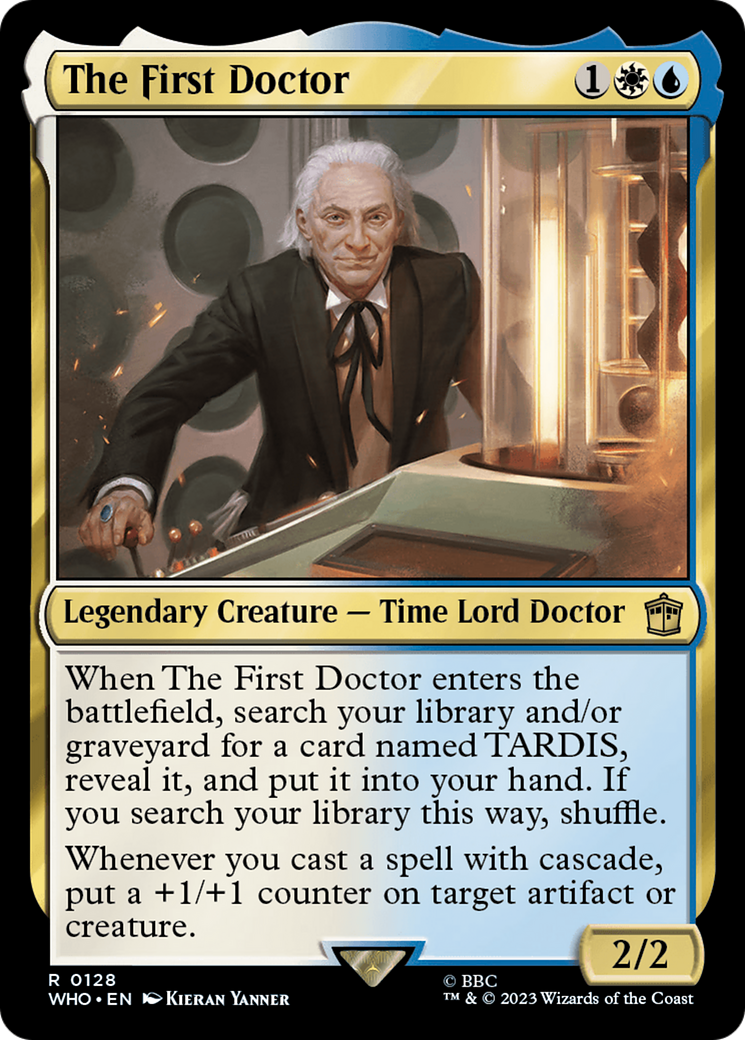
The First Doctor
The First Doctor
Legendary Creature — Time Lord Doctor
2/2
When The First Doctor enters, search your library and/or graveyard for a card named TARDIS, reveal it, and put it into your hand. If you search your library this way, shuffle.
Whenever you cast a spell with cascade, put a +1/+1 counter on target artifact or creature.
- You choose the target for The First Doctor's last ability before revealing any cards for cascade.
- Unlike other creature types in Magic that are each only one word, the two words "Time Lord" represent a single creature subtype. Time Lord is the only two-word creature type.
- Neither "Time" nor "Lord" are creature types. Some older cards were printed with the subtype "Lord," but all of those cards have updated Oracle card text that removed that type.
- If an effect instructs you to choose a creature type, you may choose Time Lord.
-
1
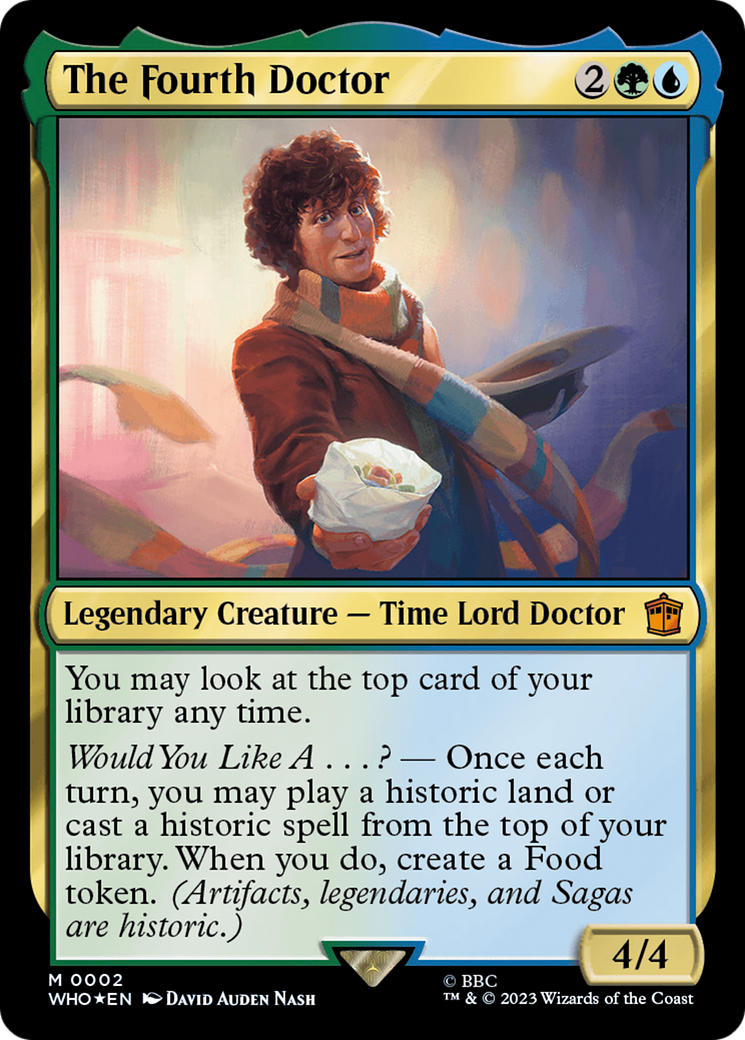
The Fourth Doctor
The Fourth Doctor
Legendary Creature — Time Lord Doctor
4/4
You may look at the top card of your library any time.
Would You Like A...? — Once each turn, you may play a historic land or cast a historic spell from the top of your library. When you do, create a Food token. (Artifacts, legendaries, and Sagas are historic.)
- Food is an artifact type. Even though it appears on some creatures, it's never a creature type.
- You can't sacrifice a Food to pay multiple costs. For example, you can't sacrifice a Food token to activate its own ability and also to activate Maraleaf Rider's ability.
- Whatever you do, don't eat the delicious cards.
- Neither "Time" nor "Lord" are creature types. Some older cards were printed with the subtype "Lord," but all of those cards have updated Oracle card text that removed that type.
- Essentially, The Fourth Doctor lets you play with the top card of your library revealed only to you. Knowing what that card is becomes part of the information you have access to, just like you can look at the cards in your hand. You may look at the top card of your library whenever you want, even if you don't have priority. This action doesn't use the stack.
- If an effect instructs you to choose a creature type, you may choose Time Lord.
- If the top card of your library changes during the process of casting a spell or activating an ability, you can't look at the new top card until the process of casting the spell or activating the ability ends (all targets are chosen, all costs are paid, and so on).
- Unlike other creature types in Magic that are each only one word, the two words "Time Lord" represent a single creature subtype. Time Lord is the only two-word creature type.
-
1
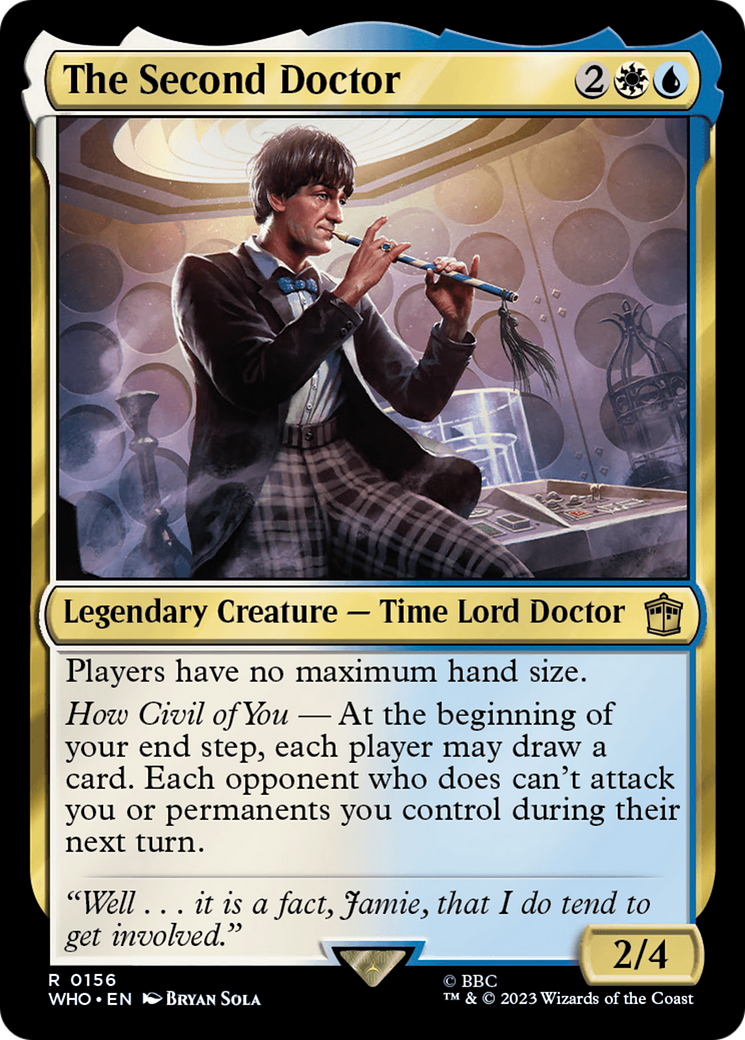
The Second Doctor
The Second Doctor
Legendary Creature — Time Lord Doctor
2/4
Players have no maximum hand size.
How Civil of You — At the beginning of your end step, each player may draw a card. Each opponent who does can't attack you or permanents you control during their next turn.
- Unlike other creature types in Magic that are each only one word, the two words "Time Lord" represent a single creature subtype. Time Lord is the only two-word creature type.
- Neither "Time" nor "Lord" are creature types. Some older cards were printed with the subtype "Lord," but all of those cards have updated Oracle card text that removed that type.
- If an effect instructs you to choose a creature type, you may choose Time Lord.
-
1
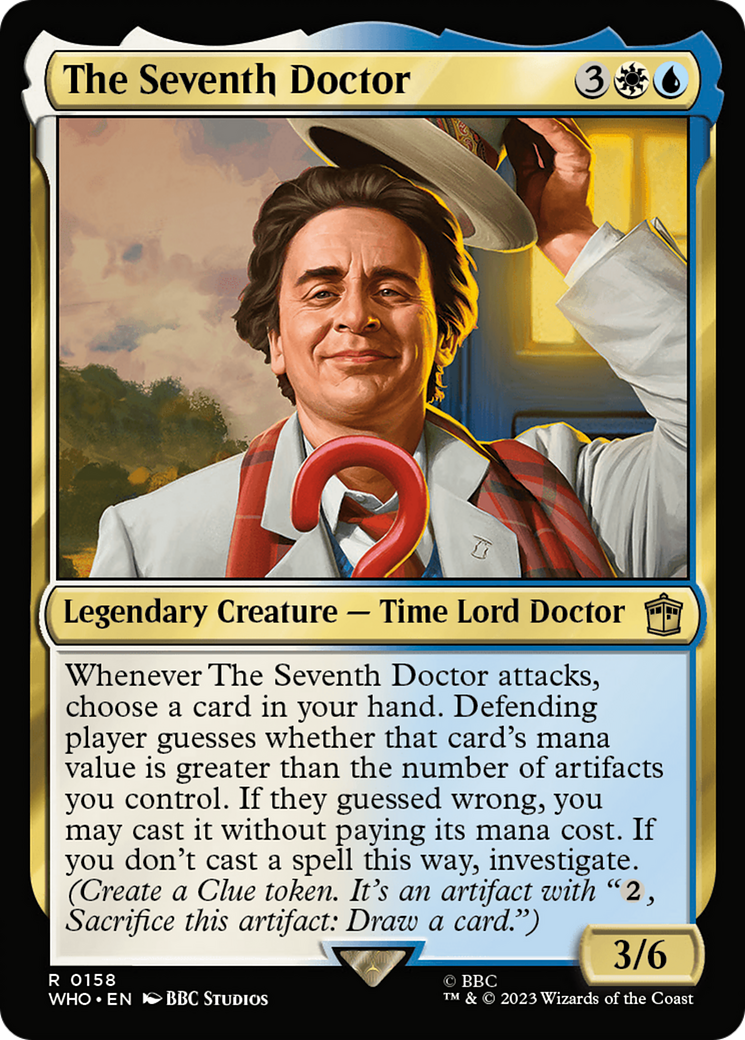
The Seventh Doctor
The Seventh Doctor
Legendary Creature — Time Lord Doctor
3/6
Whenever The Seventh Doctor attacks, choose a card in your hand. Defending player guesses whether that card's mana value is greater than the number of artifacts you control. If they guessed wrong, you may cast it without paying its mana cost. If you don't cast a spell this way, investigate. (Create a Clue token. It's an artifact with " , Sacrifice this token: Draw a card.")
- To choose a card in your hand for The Seventh Doctor's ability, take a card in your hand and separate it from the others, face down. Then the defending player guesses whether the mana value of that card is greater than the number of artifacts you control. You do not have to reveal whether they guess right or wrong unless you are casting the card.
- If the card you chose has an in its mana cost, the value of X is 0.
- Unlike other creature types in Magic that are each only one word, the two words "Time Lord" represent a single creature subtype. Time Lord is the only two-word creature type.
- Neither "Time" nor "Lord" are creature types. Some older cards were printed with the subtype "Lord," but all of those cards have updated Oracle card text that removed that type.
- If an effect instructs you to choose a creature type, you may choose Time Lord.
-
1
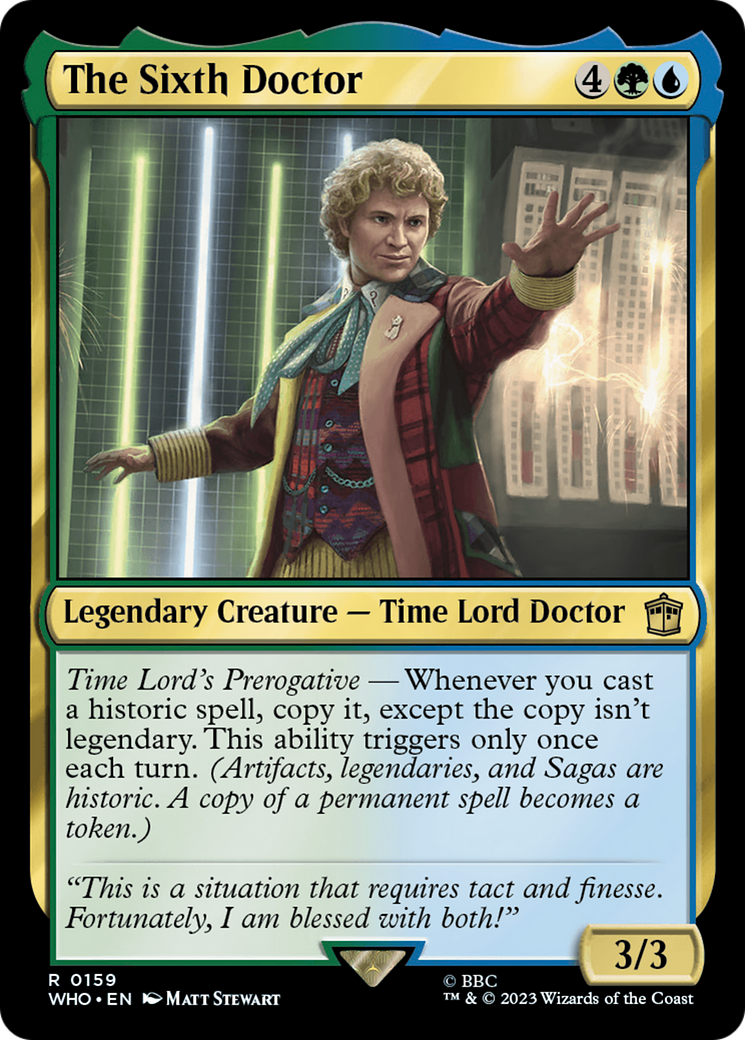
The Sixth Doctor
The Sixth Doctor
Legendary Creature — Time Lord Doctor
3/3
Time Lord's Prerogative — Whenever you cast a historic spell, copy it, except the copy isn't legendary. This ability triggers only once each turn. (Artifacts, legendaries, and Sagas are historic. A copy of a permanent spell becomes a token.)
- Usually, a historic spell won't have any targets. However, if it does have one or more targets, those targets will remain the same for the copy. You won't get to choose new targets.
- Unlike other creature types in Magic that are each only one word, the two words "Time Lord" represent a single creature subtype. Time Lord is the only two-word creature type.
- Neither "Time" nor "Lord" are creature types. Some older cards were printed with the subtype "Lord," but all of those cards have updated Oracle card text that removed that type.
- If an effect instructs you to choose a creature type, you may choose Time Lord.
-
1
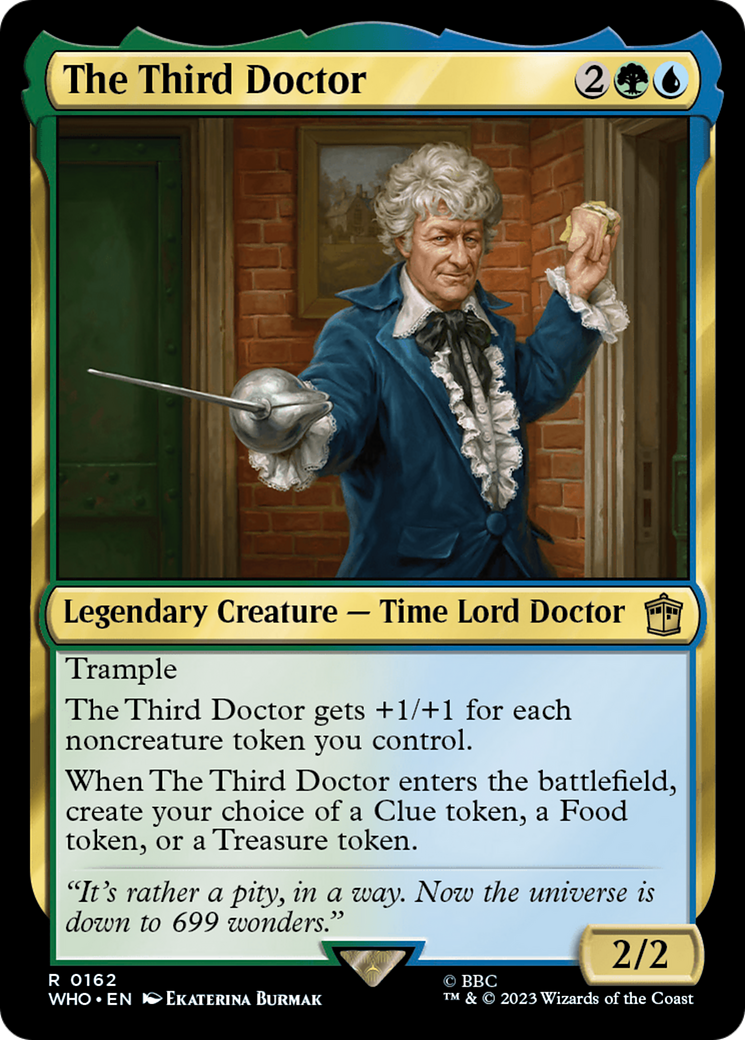
The Third Doctor
The Third Doctor
Legendary Creature — Time Lord Doctor
2/2
Trample
The Third Doctor gets +1/+1 for each noncreature token you control.
When The Third Doctor enters, create your choice of a Clue token, a Food token, or a Treasure token.
- Food is an artifact type. Even though it appears on some creatures, it's never a creature type.
- You can't sacrifice a Food to pay multiple costs. For example, you can't sacrifice a Food token to activate its own ability and also to activate Maraleaf Rider's ability.
- Whatever you do, don't eat the delicious cards.
- Unlike other creature types in Magic that are each only one word, the two words "Time Lord" represent a single creature subtype. Time Lord is the only two-word creature type.
- Neither "Time" nor "Lord" are creature types. Some older cards were printed with the subtype "Lord," but all of those cards have updated Oracle card text that removed that type.
- If an effect instructs you to choose a creature type, you may choose Time Lord.
-
1
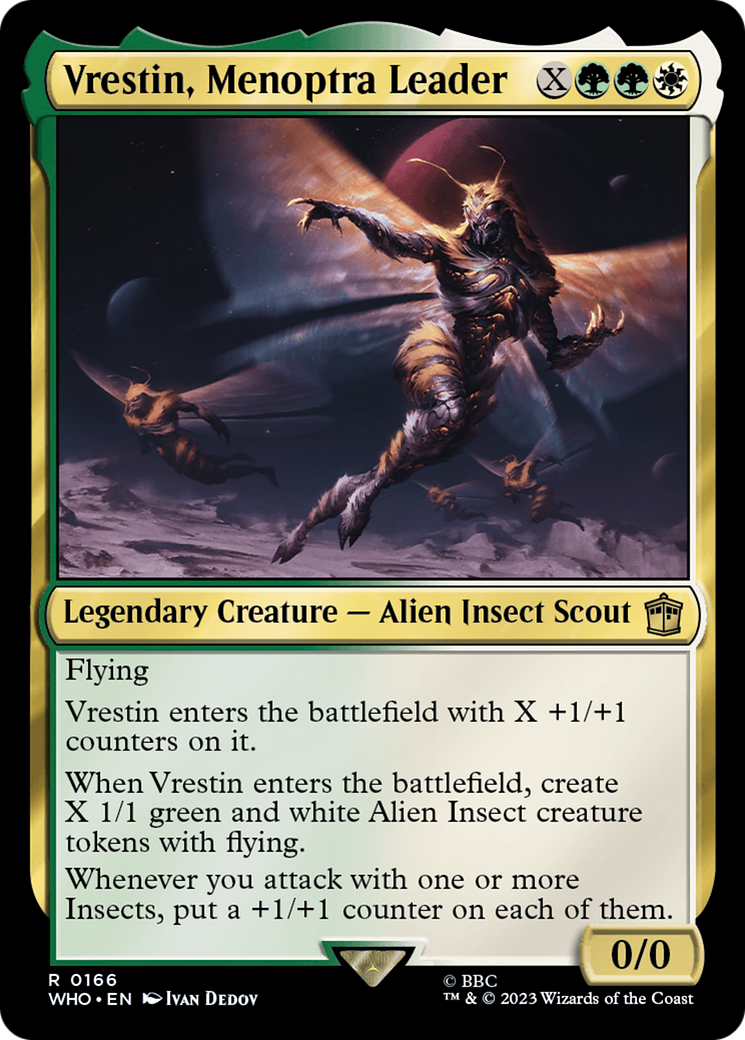
Vrestin, Menoptra Leader
Vrestin, Menoptra Leader
Legendary Creature — Alien Insect Scout
0/0
Flying
Vrestin enters with X +1/+1 counters on it.
When Vrestin enters, create X 1/1 green and white Alien Insect creature tokens with flying.
Whenever you attack with one or more Insects, put a +1/+1 counter on each of them.
Instants 6
-
1
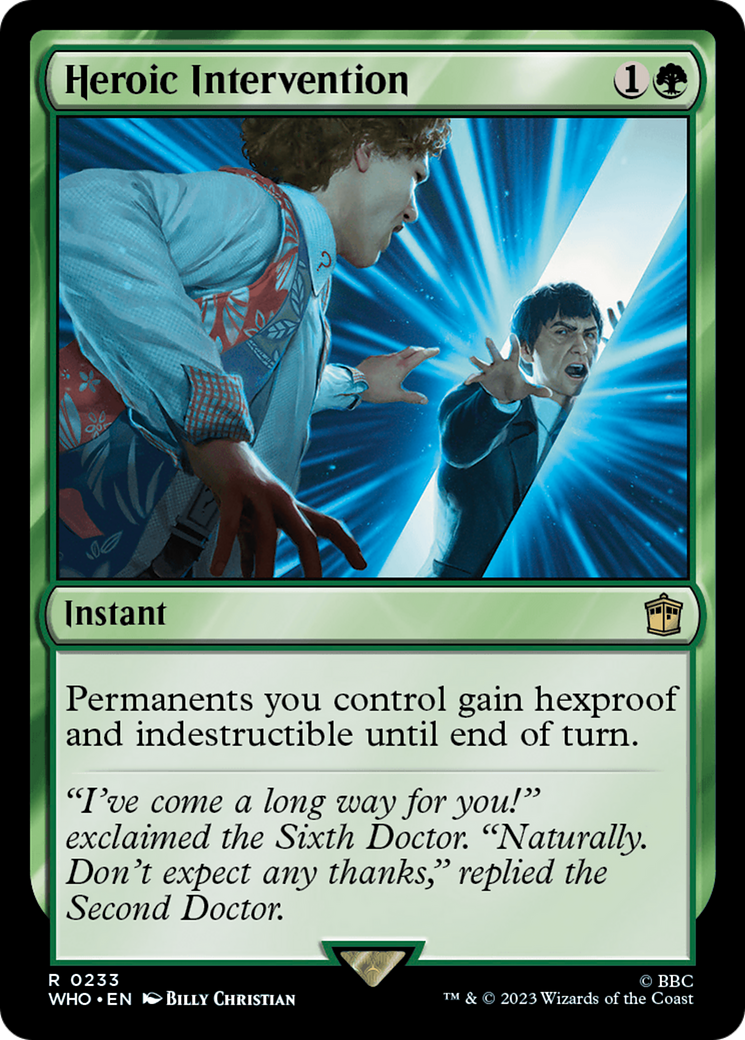
Heroic Intervention
Heroic Intervention
Instant
Permanents you control gain hexproof and indestructible until end of turn.
- A battle with indestructible still loses defense counters as it's dealt damage. If it's a Siege, it will still be exiled when the last defense counter is removed from it, and its controller may still cast it transformed without paying its mana cost.
- A planeswalker with indestructible still loses loyalty counters as it's dealt damage and will still be put into its owner's graveyard if its loyalty reaches 0.
- The set of permanents affected by Heroic Intervention is determined as the spell resolves. Permanents you begin to control later in the turn won't gain hexproof and indestructible.
-
1
Path to Exile
Path to Exile
Instant
Exile target creature. Its controller may search their library for a basic land card, put that card onto the battlefield tapped, then shuffle.
- The controller of the exiled creature isn't required to search their library for a basic land. If that player doesn't, the player won't shuffle their library.
- If the target creature is an illegal target by the time Path to Exile tries to resolve, it won't resolve and none of its effects will happen. The creature's controller won't search for a basic land card.
-
1
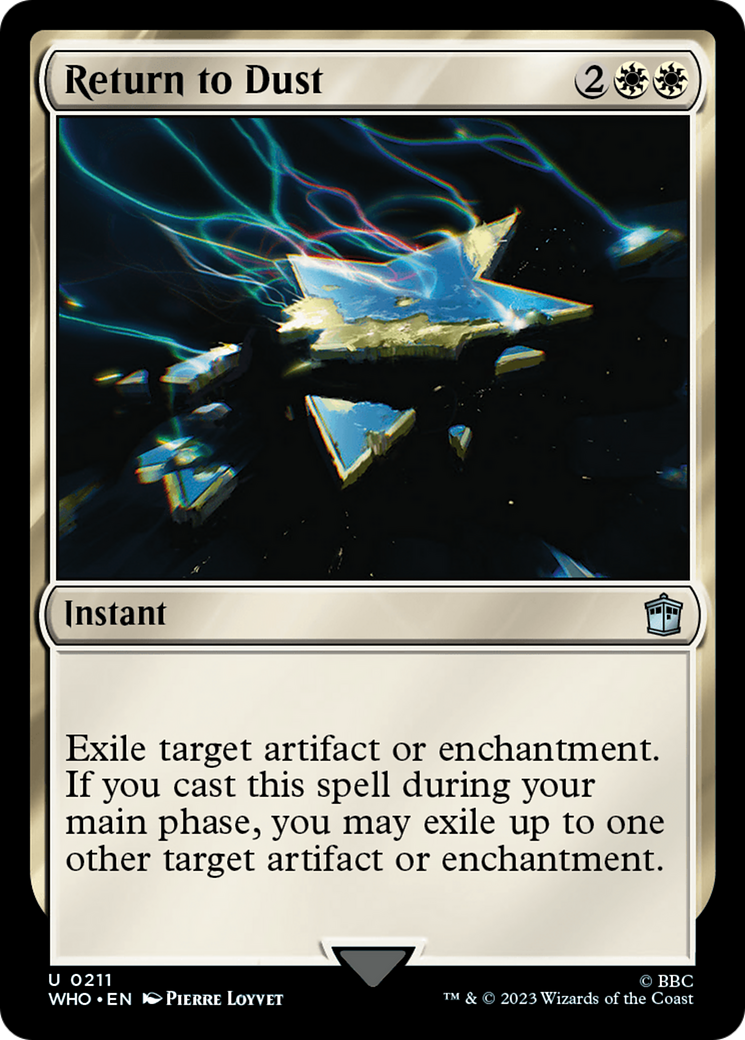
Return to Dust
Return to Dust
Instant
Exile target artifact or enchantment. If you cast this spell during your main phase, you may exile up to one other target artifact or enchantment.
- Return to Dust can always target a second artifact or enchantment; it just won't exile it if it's not your main phase when you cast Return to Dust.
- If a spell or ability copies Return to Dust, the copy exiles only the first target artifact or enchantment. This is because the copy wasn't cast at all.
-
1
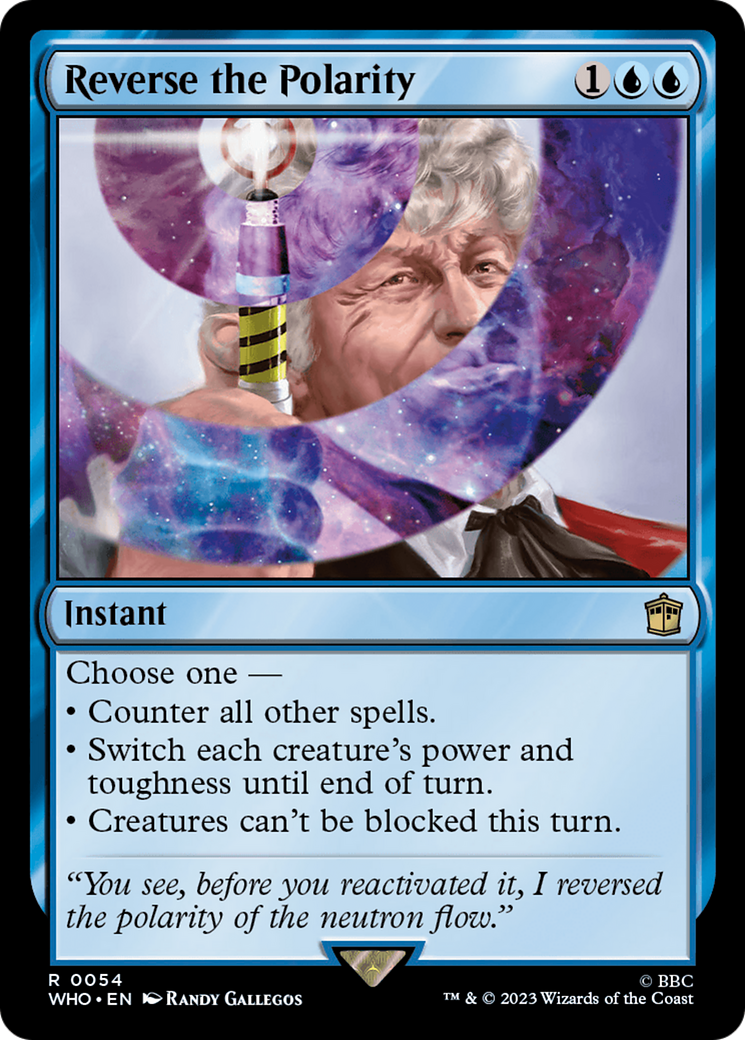
Reverse the Polarity
Reverse the Polarity
Instant
Choose one —
- Counter all other spells.
- Switch each creature's power and toughness until end of turn.
- Creatures can't be blocked this turn.
- Effects that switch a creature's power and toughness apply after all other effects, regardless of when those effects began to apply. For instance, if you switch a 2/4 creature's power and toughness and then give it +2/+0 later in the turn, it's a 4/4 creature, not a 6/2 creature.
- Because damage remains marked on a creature until the cleanup step or an effect removes that damage, nonlethal damage dealt to a creature may become lethal if you switch its power and toughness during that turn.
-
1
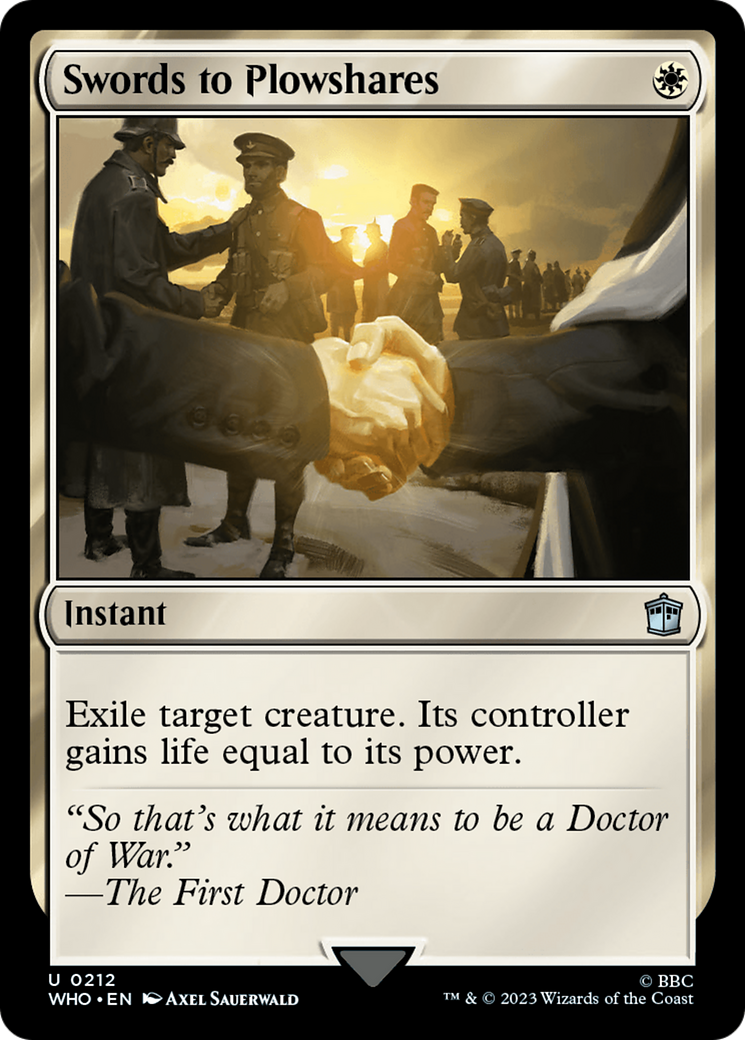
Swords to Plowshares
Swords to Plowshares
Instant
Exile target creature. Its controller gains life equal to its power.
- Use the power of the creature from when it was last on the battlefield to determine how much life is gained.
-
1
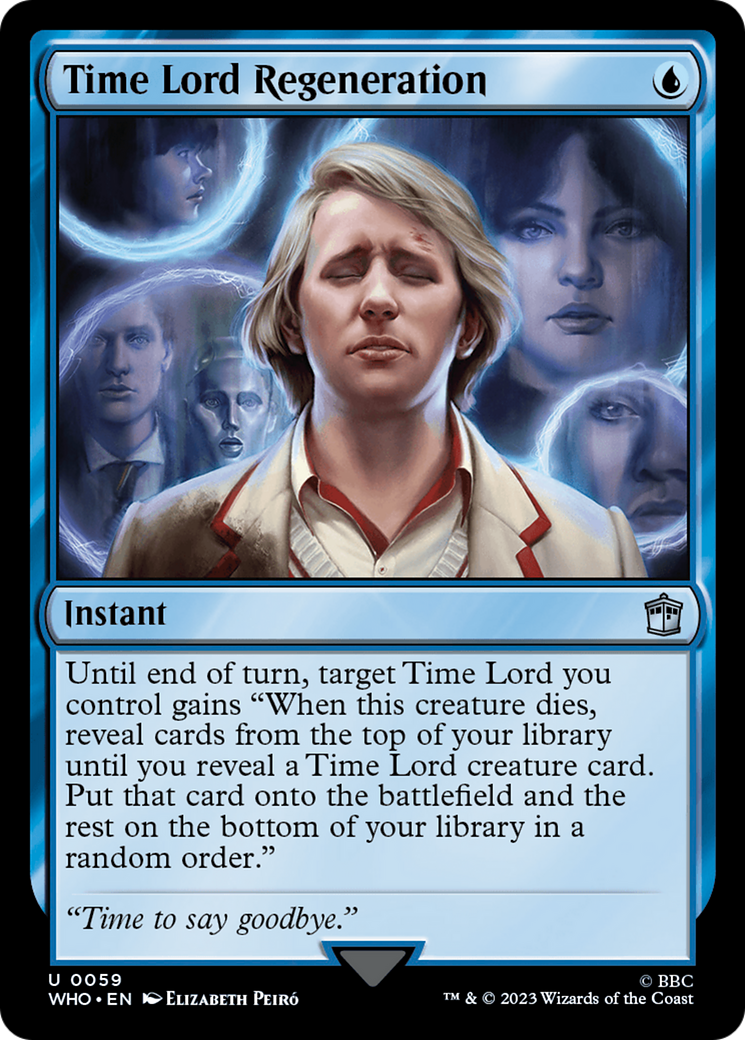
Time Lord Regeneration
Time Lord Regeneration
Instant
Until end of turn, target Time Lord you control gains "When this creature dies, reveal cards from the top of your library until you reveal a Time Lord creature card. Put that card onto the battlefield and the rest on the bottom of your library in a random order."
Sorceries 7
-
1
Crisis of Conscience
Crisis of Conscience
Sorcery
Choose one —
- Destroy all tokens.
- Destroy all nonland, nontoken permanents.
-
1
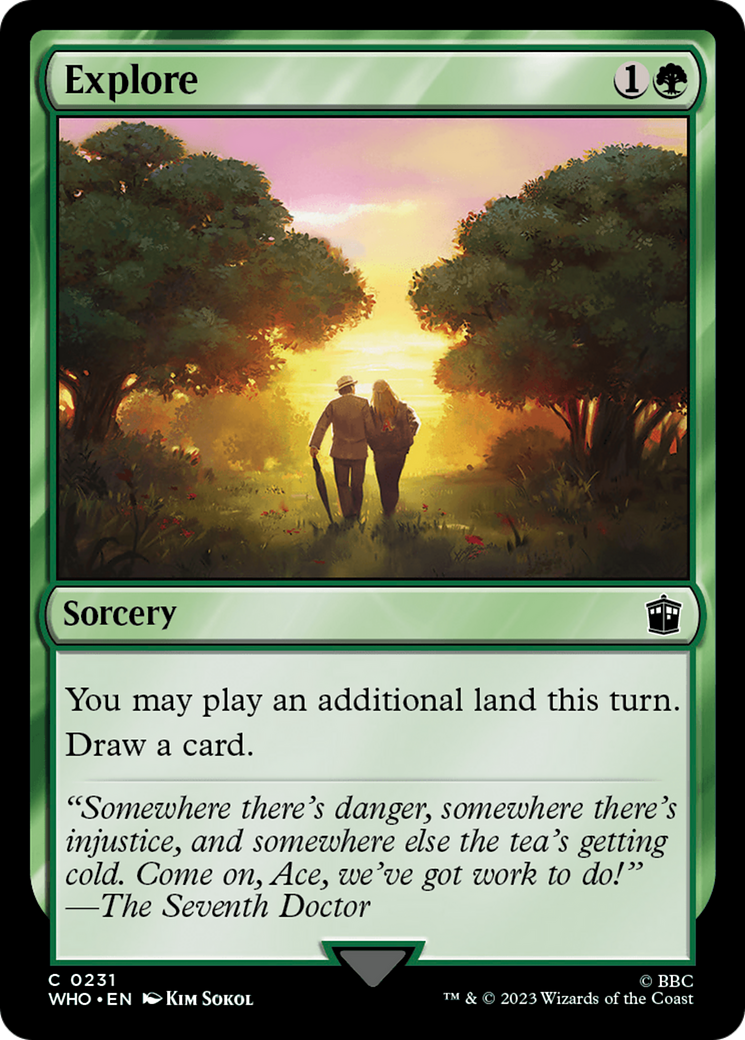
Explore
Explore
Sorcery
You may play an additional land this turn.
Draw a card.
- The effects of multiple Explores in the same turn are cumulative. They're also cumulative with other effects that let you play additional lands, such as the one from Urban Evolution.
- Explore's effect allows you to play an additional land during your main phase. Doing so follows the normal timing rules for playing lands. In particular, you don't get to play a land as Explore resolves; Explore fully resolves first and you draw a card, perhaps a land you'll play later.
- If you somehow manage to cast Explore when it's not your turn, you'll draw a card when it resolves, but you won't be able to play a land that turn.
-
1
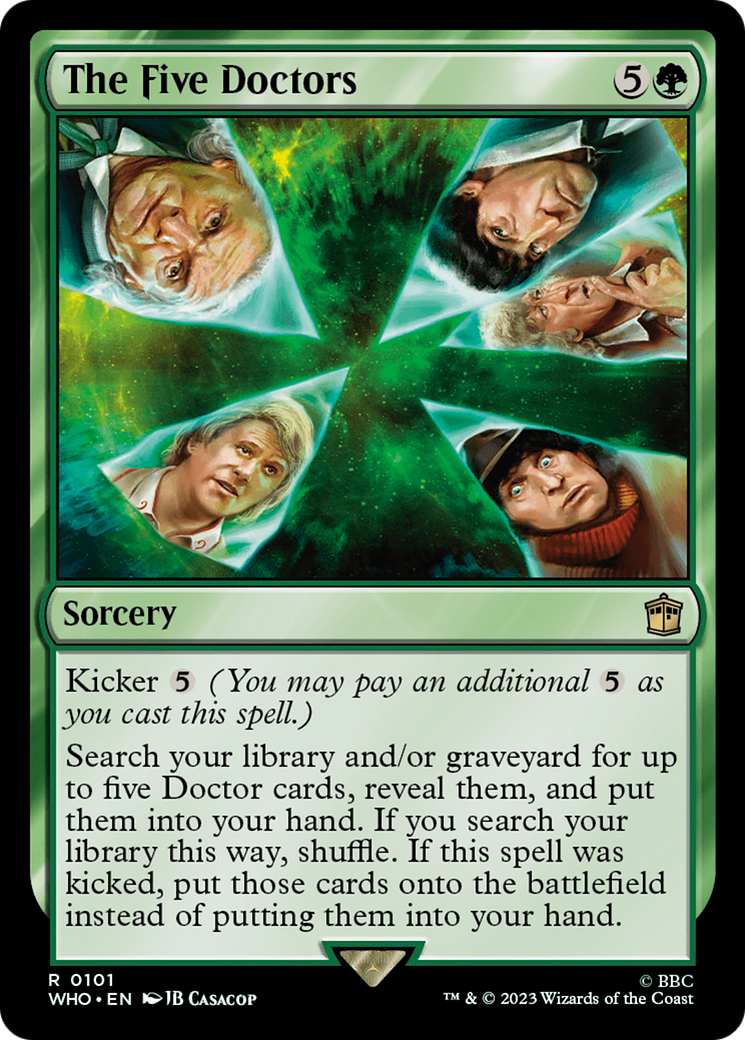
The Five Doctors
The Five Doctors
Sorcery
Kicker (You may pay an additional as you cast this spell.)
Search your library and/or graveyard for up to five Doctor cards, reveal them, and put them into your hand. If you search your library this way, shuffle. If this spell was kicked, put those cards onto the battlefield instead of putting them into your hand.
- If you put a permanent with a kicker ability onto the battlefield without casting it, you can't kick it.
- If a spell's kicker cost was paid, the spell is "kicked."
- The kicker ability doesn't let you pay a kicker cost more than once.
- To determine a spell's total cost, start with the mana cost (or an alternative cost if another card's effect allows you to pay one instead), add any cost increases (such as kicker), then apply any cost reductions. The spell's mana value remains unchanged, no matter what the total cost to cast it was.
- If you copy a kicked spell on the stack, the copy is also kicked. If the copied spell is a permanent spell, the token the copy of that spell becomes when it enters is also kicked.
- If a card or token enters as a copy of a permanent, the new permanent isn't kicked, even if the original was.
- The Five Doctors can find any card with the Doctor creature type, not cards with the word "Doctor" in the name.
-
1
Three Visits
Three Visits
Sorcery
Search your library for a Forest card, put it onto the battlefield, then shuffle.
- Three Visits allows you to search your library for any card with the land type Forest, not just a card with the name Forest.
- Because the "search" requires you to find a card with certain characteristics, you don't have to find the card if you don't want to.
-
1
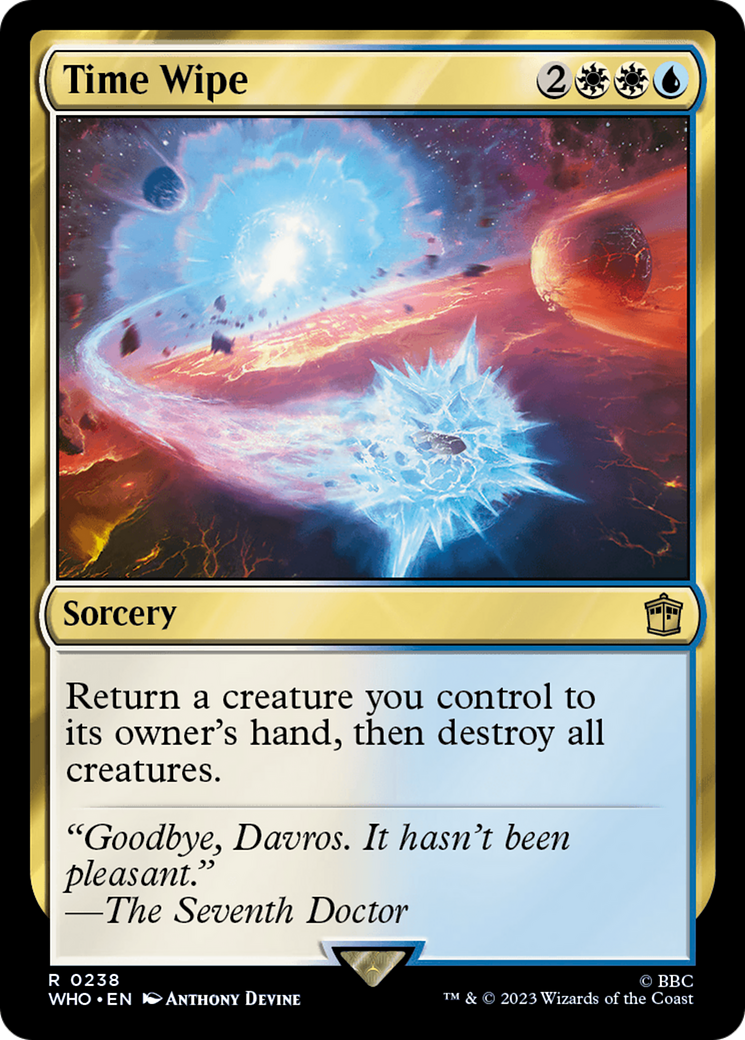
Time Wipe
Time Wipe
Sorcery
Return a creature you control to its owner's hand, then destroy all creatures.
- You chose which creature to return to its owner's hand while Time Wipe is resolving. No player may take any actions between the time you choose the creature to return and the time other creatures are destroyed.
- If you control no creatures, you simply destroy all creatures.
-
1
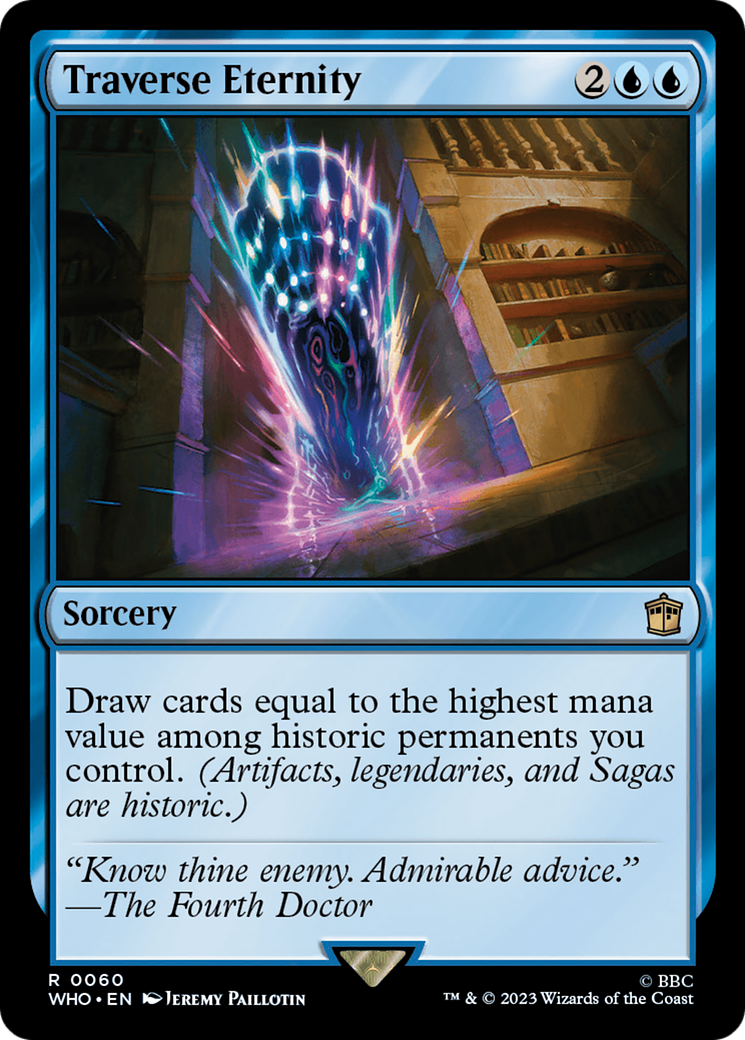
Traverse Eternity
Traverse Eternity
Sorcery
Draw cards equal to the greatest mana value among historic permanents you control. (Artifacts, legendaries, and Sagas are historic.)
- If a historic permanent has an in its mana cost, the value of is 0 when determining the mana value of that permanent.
-
1
Twice Upon a Time // Unlikely Meeting
//
Twice Upon a Time
Sorcery
- In every zone other than the stack, Twice Upon a Time uses only its non-Adventure characteristics, and you ignore its alternative characteristics in those cases. For example, while it's in your graveyard, its mana value is 6.
- When casting a spell as an Adventure, use the alternative characteristics and ignore all of the card's normal characteristics. The spell's color, mana cost, mana value, and so on are determined by only those alternative characteristics. If the spell leaves the stack, it immediately resumes using its normal characteristics.
- If you cast an adventurer card as an Adventure, use only its alternative characteristics to determine whether it's legal to cast that spell.
- If a spell is cast as an Adventure, its controller exiles it instead of putting it into its owner's graveyard as it resolves. For as long as it remains exiled, that player may cast it as a non-Adventure spell. If an Adventure spell leaves the stack in any way other than resolving (most likely by being countered or by failing to resolve because its targets have all become illegal), that card won't be exiled and the spell's controller won't be able to cast it as a permanent later.
- If an adventurer card ends up in exile for any other reason than by exiling itself while resolving, it won't give you permission to cast it as a non-Adventure spell.
- You must still follow any relevant timing rules for the non-Adventure spell you cast from exile. Normally, you'll be able to cast it only during your main phase while the stack is empty.
- If an effect copies an Adventure spell, that copy is exiled as it resolves. It ceases to exist as a state-based action; it's not possible to cast the copy from exile.
- An effect may refer to a card, spell, or permanent that "has an Adventure." This refers to a card, spell, or permanent that has an adventurer card's set of alternative characteristics, even if they're not being used and even if that card was never cast as an Adventure.
- If an effect instructs you to choose a card name, you may choose the alternative Adventure name. Consider only the alternative characteristics to determine whether that is an appropriate name to choose.
- Casting a card as an Adventure isn't casting it for an alternative cost. Effects that allow you to cast a spell for an alternative cost or without paying its mana cost may allow you to apply those to the Adventure.
Artifacts 13
-
1
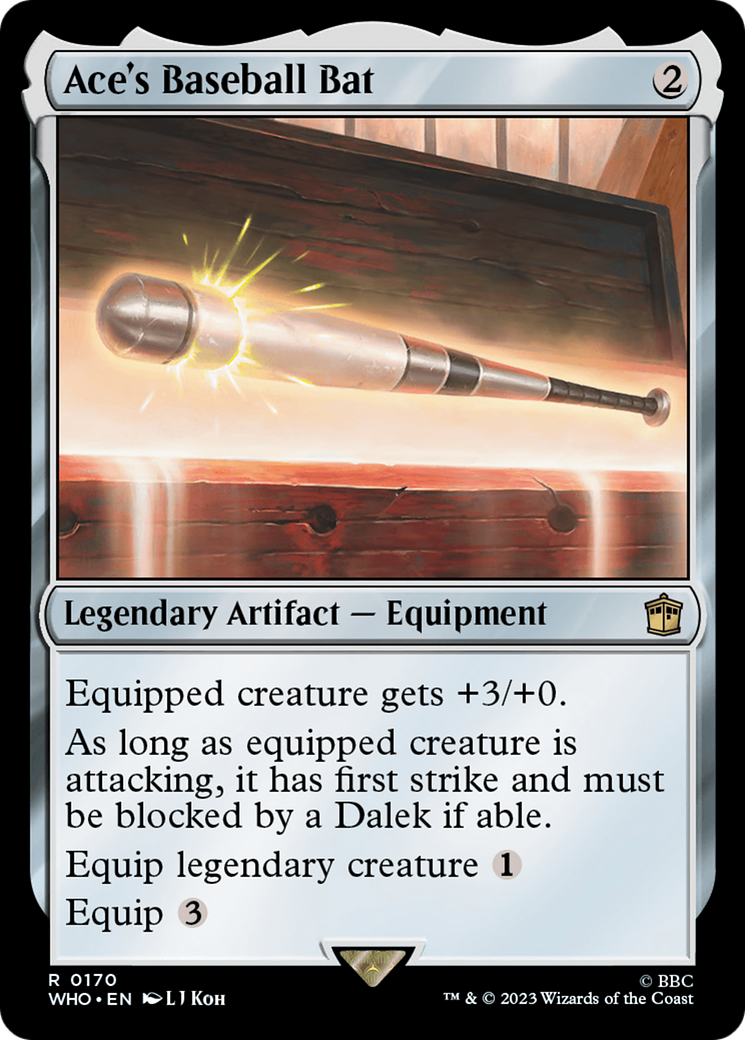
Ace's Baseball Bat
Ace's Baseball Bat
Legendary Artifact — Equipment
Equipped creature gets +3/+0.
As long as equipped creature is attacking, it has first strike and must be blocked by a Dalek if able.
Equip legendary creature
Equip
- Only one Dalek is required to block the equipped creature. Other Dalek and non-Dalek creatures may also block that creature and are free to block other creatures or not block at all.
- The defending player, not the attacking player, chooses which Dalek blocks the equipped creature.
- If each Dalek that could block the equipped creature is tapped or is affected by a spell or ability that says it can't block, then none of them block. If there's a cost associated with having each of those creatures block, its controller isn't forced to pay the cost, so they don't have to block in that case either.
- If one creature is somehow equipped with multiple Ace's Baseball Bats, that creature still requires only a single Dalek to block it.
-
1
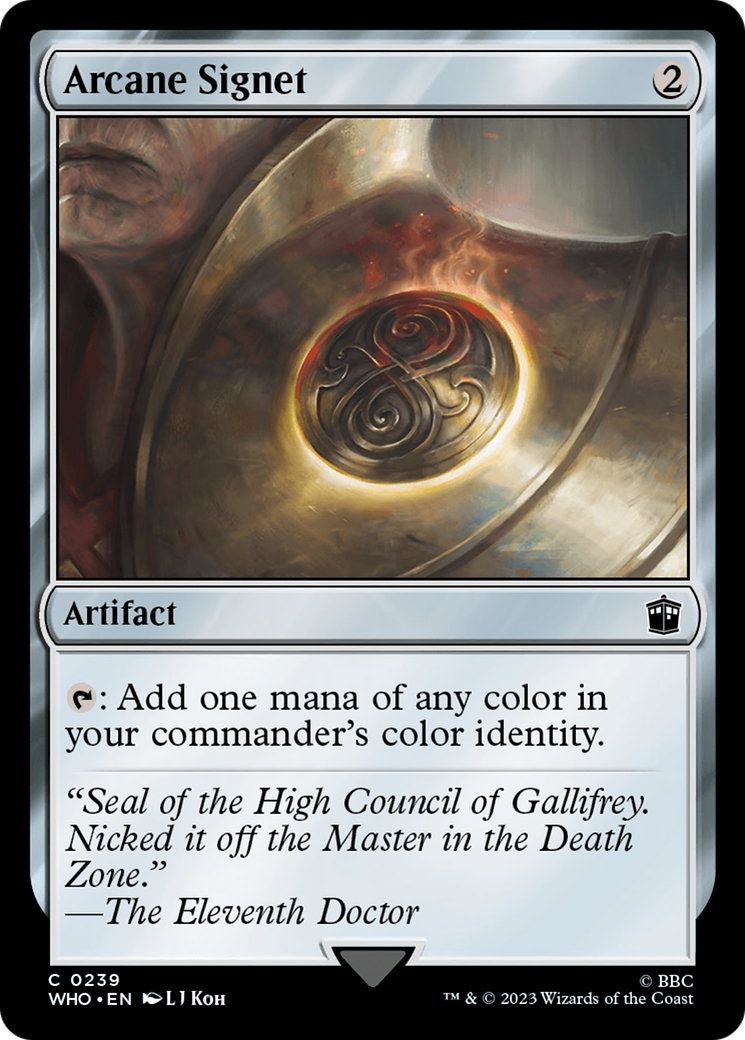
Arcane Signet
Arcane Signet
Artifact
: Add one mana of any color in your commander's color identity.
- If your commander is a card that has no colors in its color identity, Arcane Signet's ability produces no mana. It doesn't produce .
- If you have two commanders, the ability adds one mana of any color in their combined color identities.
- If you don't have a commander, Arcane Signet's ability produces no mana.
-
1
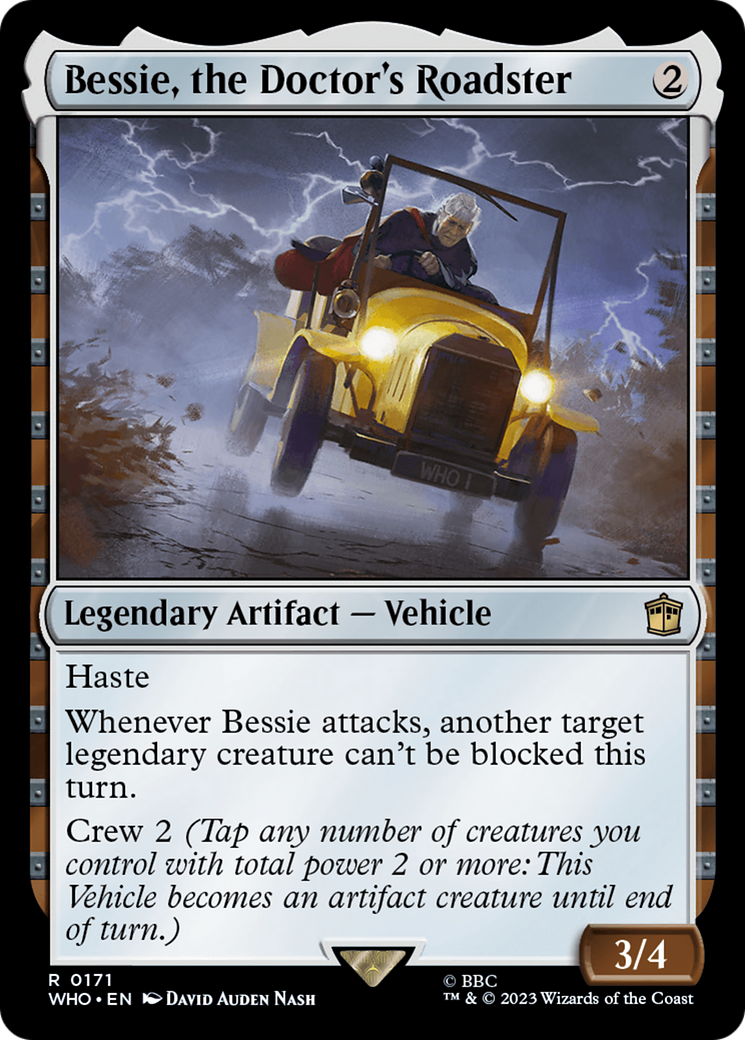
Bessie, the Doctor's Roadster
Bessie, the Doctor's Roadster
Legendary Artifact — Vehicle
3/4
Haste
Whenever Bessie attacks, another target legendary creature can't be blocked this turn.
Crew 2 (Tap any number of creatures you control with total power 2 or more: This Vehicle becomes an artifact creature until end of turn.)
-
1
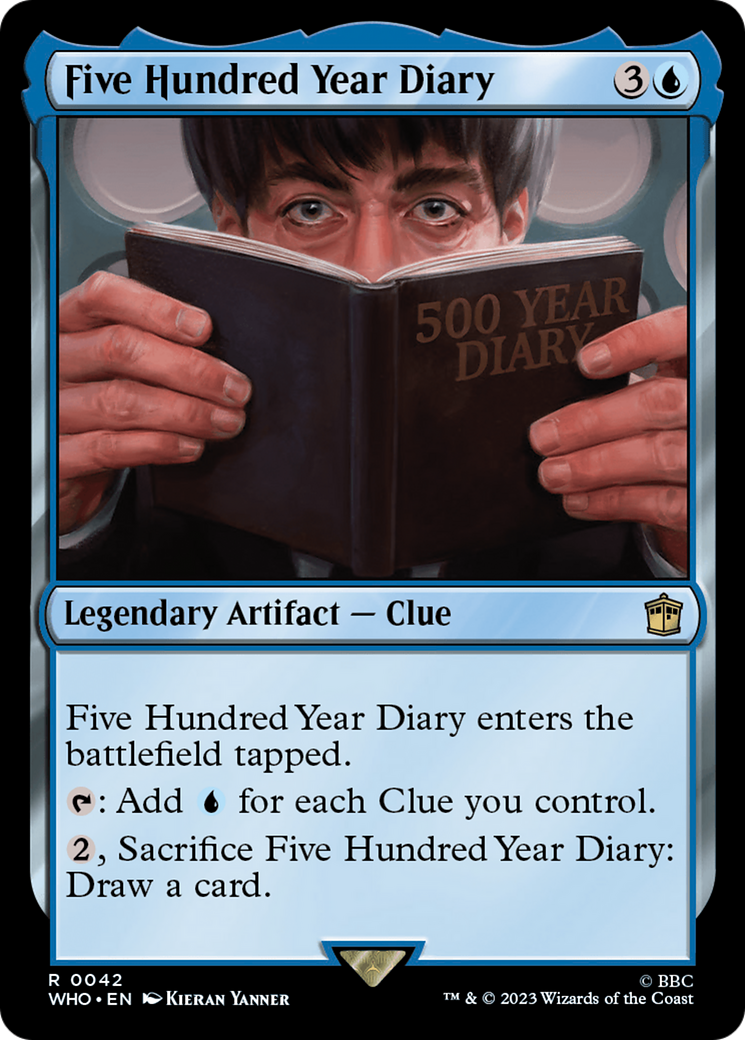
Five Hundred Year Diary
Five Hundred Year Diary
Legendary Artifact — Book Clue
Five Hundred Year Diary enters tapped.
: Add for each Clue you control.
, Sacrifice Five Hundred Year Diary: Draw a card.
- Five Hundred Year Diary counts itself for its second ability.
-
1
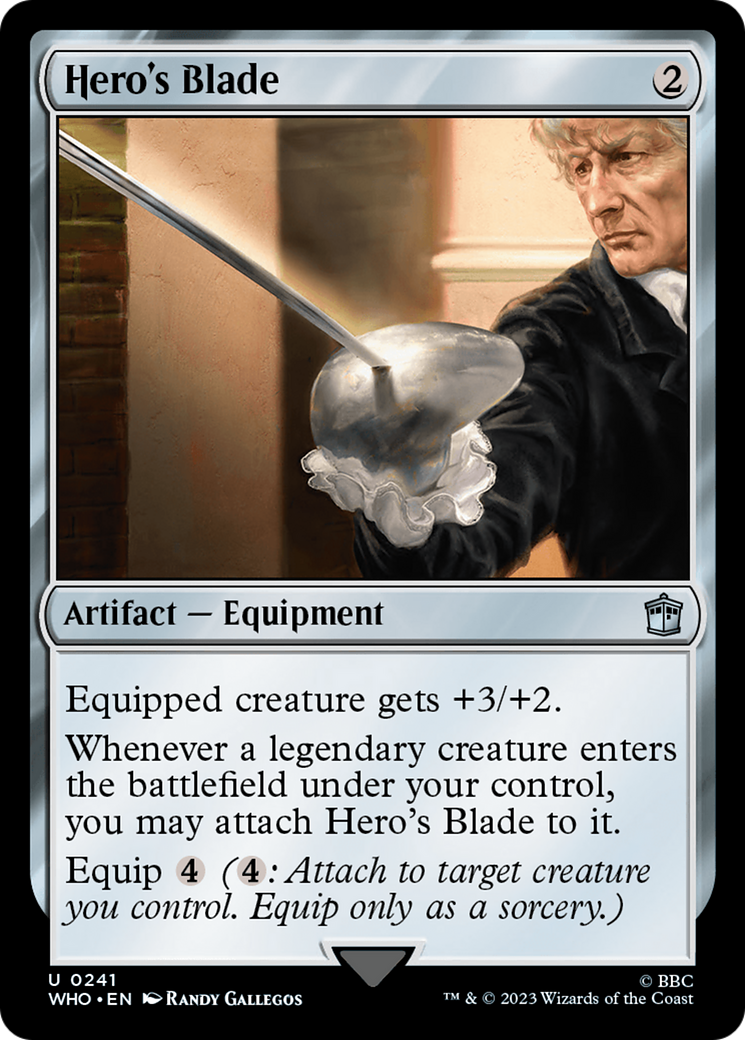
Hero's Blade
Hero's Blade
Artifact — Equipment
Equipped creature gets +3/+2.
Whenever a legendary creature you control enters, you may attach this Equipment to it.
Equip ( : Attach to target creature you control. Equip only as a sorcery.)
- If the legendary creature that entered the battlefield leaves the battlefield before Hero's Blade becomes attached, Hero's Blade stays as it was. If it's already attached to another creature, it remains attached to that creature.
- The triggered ability will trigger when one of the Gods from Theros block enters the battlefield only if your devotion is high enough that it's a creature when it enters. If Hero's Blade is attached to a God that stops being a creature (or any creature that stops being a creature), it will become unattached.
-
1
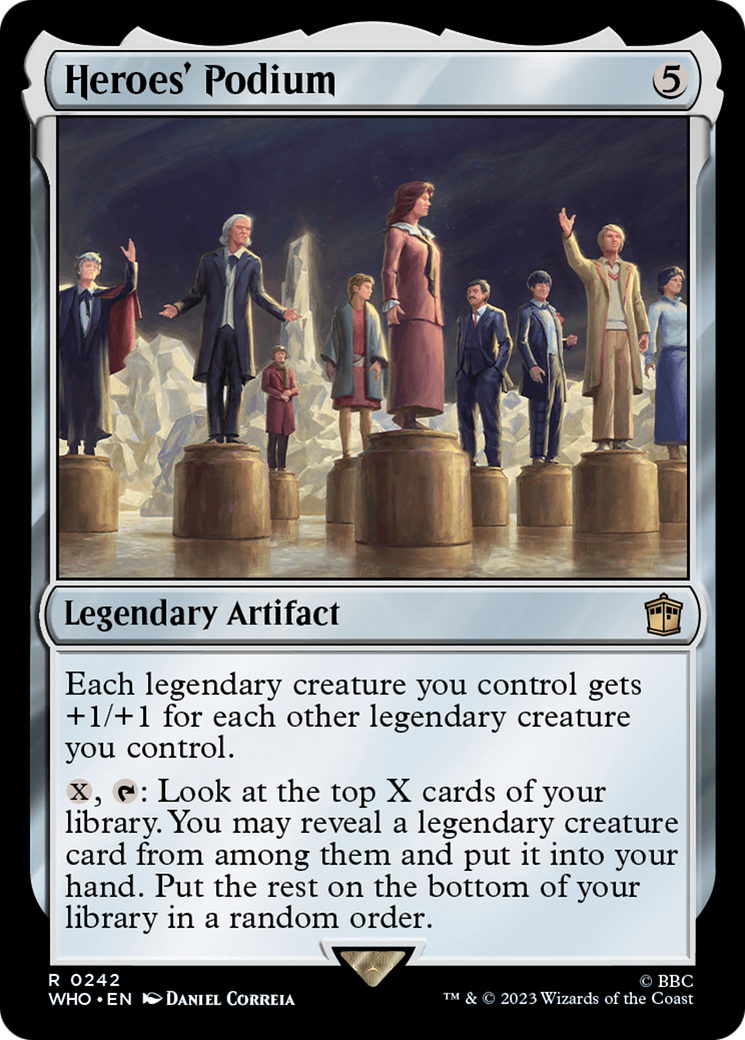
Heroes' Podium
Heroes' Podium
Legendary Artifact
Each legendary creature you control gets +1/+1 for each other legendary creature you control.
, : Look at the top X cards of your library. You may reveal a legendary creature card from among them and put it into your hand. Put the rest on the bottom of your library in a random order.
- The bonus given by Heroes' Podium counts only legendary creatures. It won't count itself unless some other effect causes it to be a creature in addition to being a land (in which case it will also get the bonus).
- Heroes' Podium will give a bonus to each legendary creature you control, even if gaining control of one causes the "legend rule" to apply. For example, if you control Brimaz, King of Oreskos (a 3/4 legendary creature), and gain control of another one, they'll each be 4/5 when you put one into its owner's graveyard. Then the remaining one will return to being 3/4.
-
1
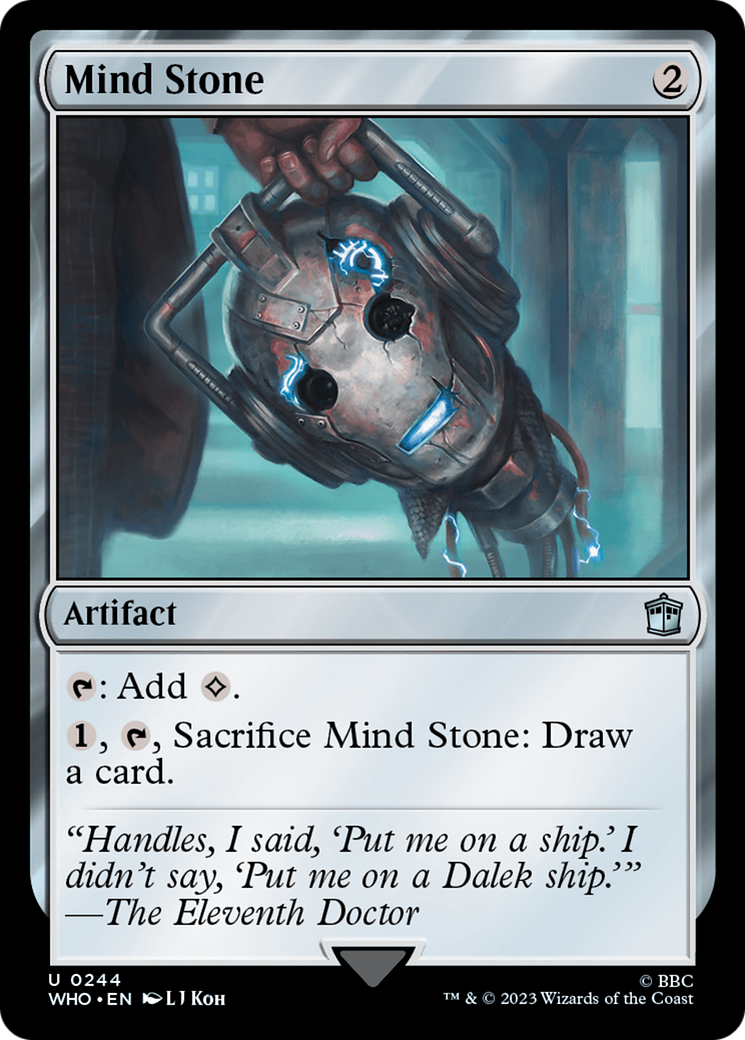
Mind Stone
Mind Stone
Artifact
: Add .
, , Sacrifice this artifact: Draw a card.
-
1
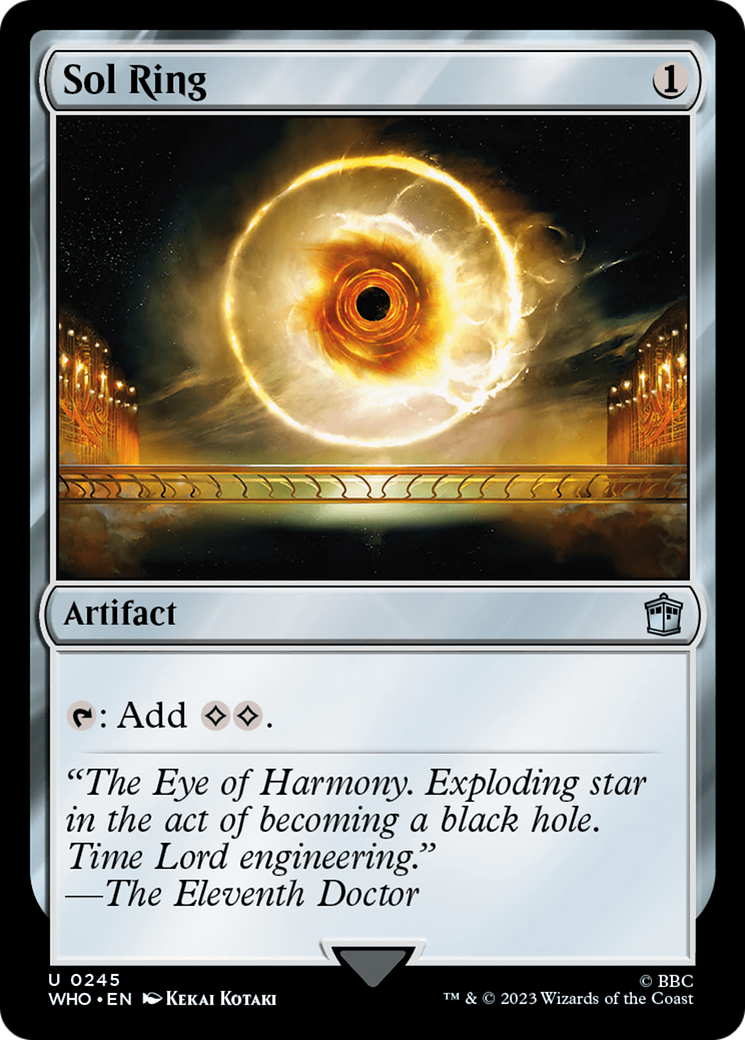
Sol Ring
Sol Ring
Artifact
: Add .
-
1
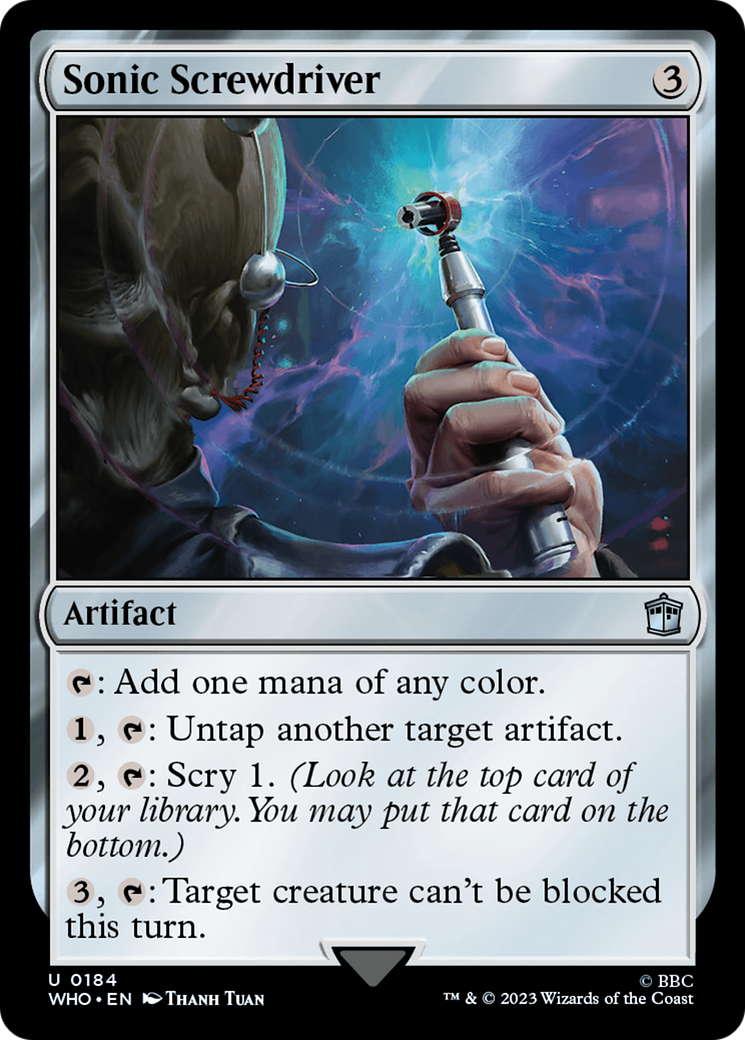
Sonic Screwdriver
Sonic Screwdriver
Artifact
: Add one mana of any color.
, : Untap another target artifact.
, : Scry 1. (Look at the top card of your library. You may put that card on the bottom.)
, : Target creature can't be blocked this turn.
-
1
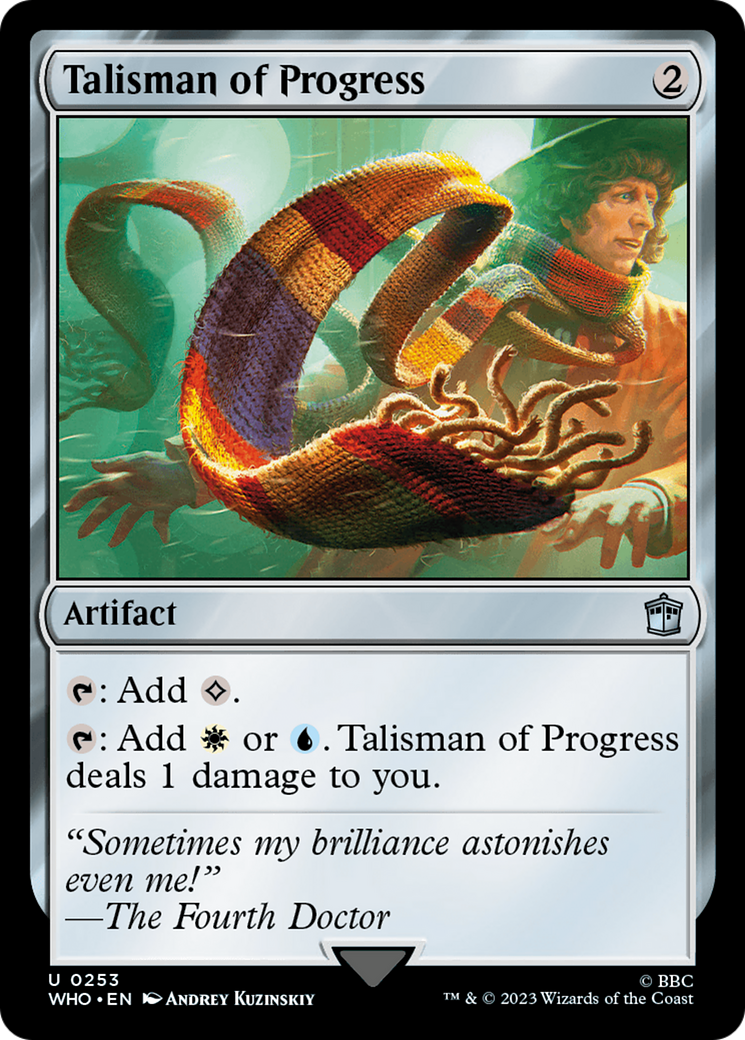
Talisman of Progress
Talisman of Progress
Artifact
: Add .
: Add or . This artifact deals 1 damage to you.
-
1
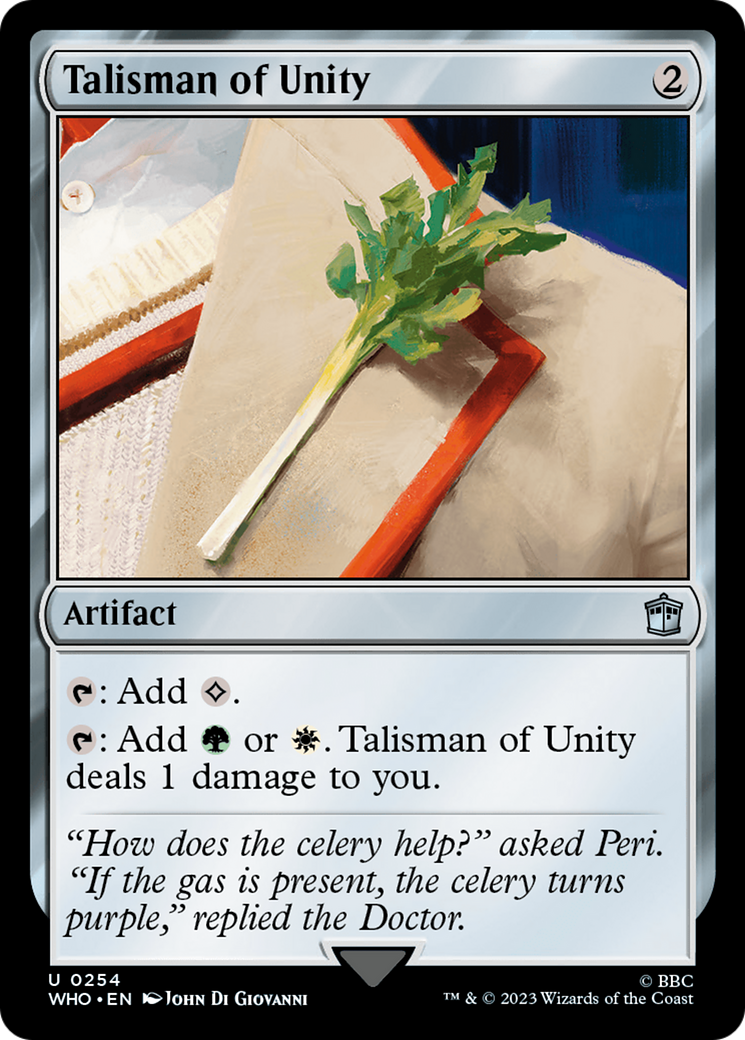
Talisman of Unity
Talisman of Unity
Artifact
: Add .
: Add or . This artifact deals 1 damage to you.
-
1
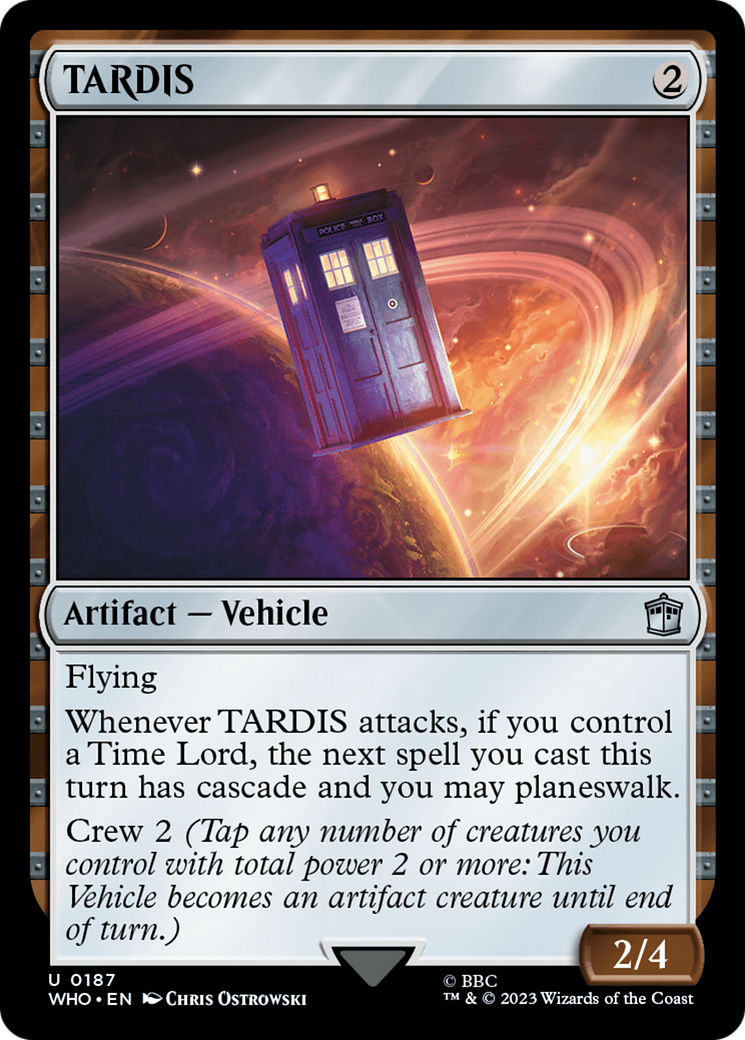
TARDIS
TARDIS
Artifact — Vehicle
2/4
Flying
Whenever this Vehicle attacks, if you control a Time Lord, the next spell you cast this turn has cascade and you may planeswalk.
Crew 2 (Tap any number of creatures you control with total power 2 or more: This Vehicle becomes an artifact creature until end of turn.)
- You may planeswalk at the time TARDIS's triggered ability resolves, not at the time you cast the next spell.
- You may planeswalk only in games using the Planechase variant. If you are instructed to planeswalk in any other game, nothing happens.
- A spell's mana value is determined only by its mana cost. Ignore any alternative costs, additional costs, cost increases, or cost reductions.
- Cascade triggers when you cast the spell, meaning that it resolves before that spell. If you end up casting the exiled card, it will go on the stack above the spell with cascade.
- When the cascade ability resolves, you must exile cards. The only optional part of the ability is whether or not you cast the last card exiled.
- If a spell with cascade is countered, the cascade ability will still resolve normally.
- You exile the cards face up. All players will be able to see them.
- If you cast a card "without paying its mana cost," you can't choose to cast it for any alternative costs. You can, however, pay additional costs. If the card has any mandatory additional costs, you must pay those to cast the card.
- If the card has in its mana cost, you must choose 0 as the value of X when casting it without paying its mana cost.
- Due to a 2021 rules change to cascade, not only do you stop exiling cards if you exile a nonland card with lesser mana value than the spell with cascade, but the resulting spell you cast must also have lesser mana value. Previously, in cases where a card's mana value differed from the resulting spell, such as with some modal double-faced cards or cards with an Adventure, you could cast a spell with a higher mana value than the exiled card.
- The mana value of a split card is determined by the combined mana cost of its two halves. If cascade allows you to cast a split card, you may cast either half but not both halves.
-
1
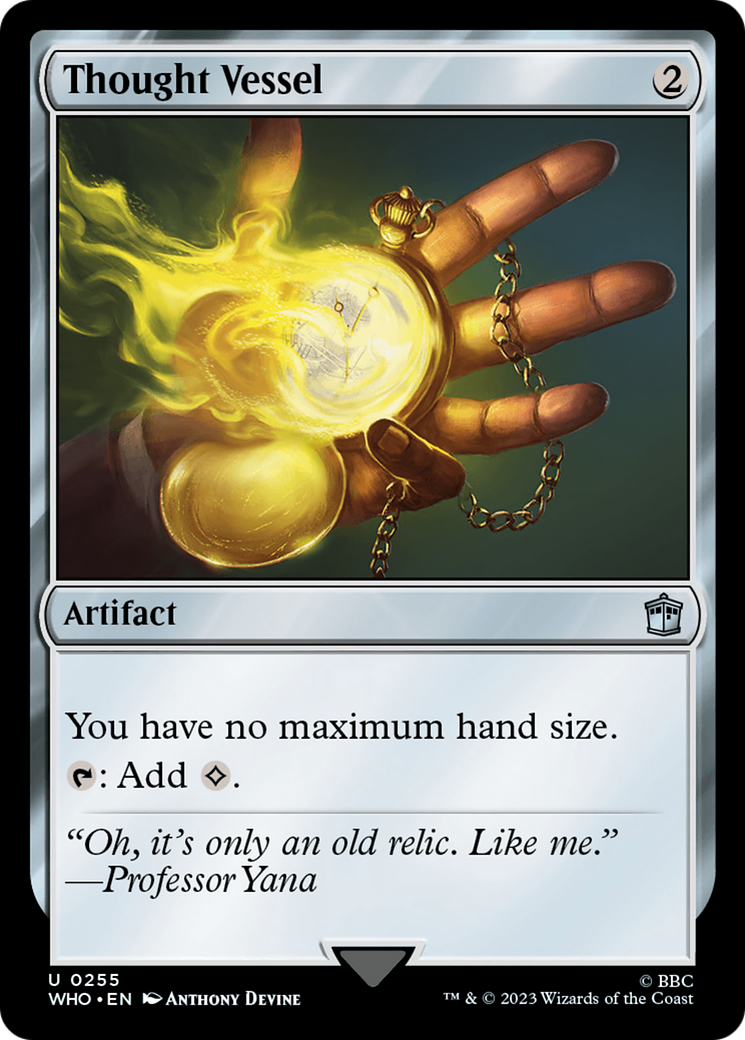
Thought Vessel
Thought Vessel
Artifact
You have no maximum hand size.
: Add .
Enchantments 11
-
1
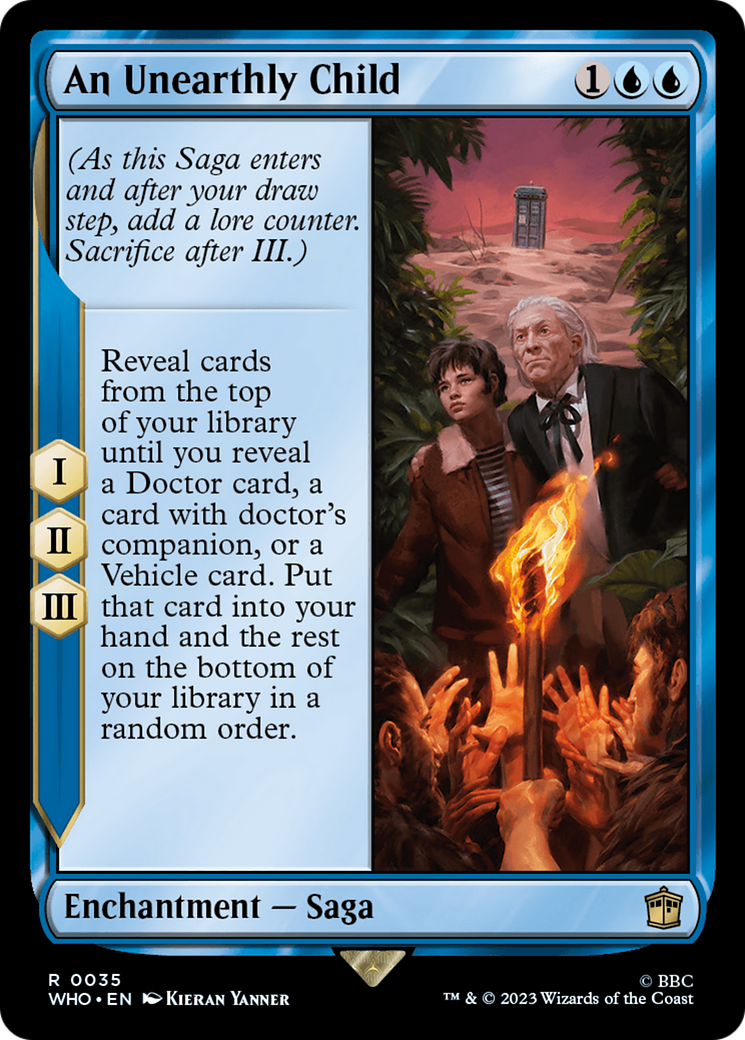
An Unearthly Child
An Unearthly Child
Enchantment — Saga
(As this Saga enters and after your draw step, add a lore counter. Sacrifice after III.)
I, II, III — Reveal cards from the top of your library until you reveal a Doctor card, a card with doctor's companion, or a Vehicle card. Put that card into your hand and the rest on the bottom of your library in a random order.
-
1
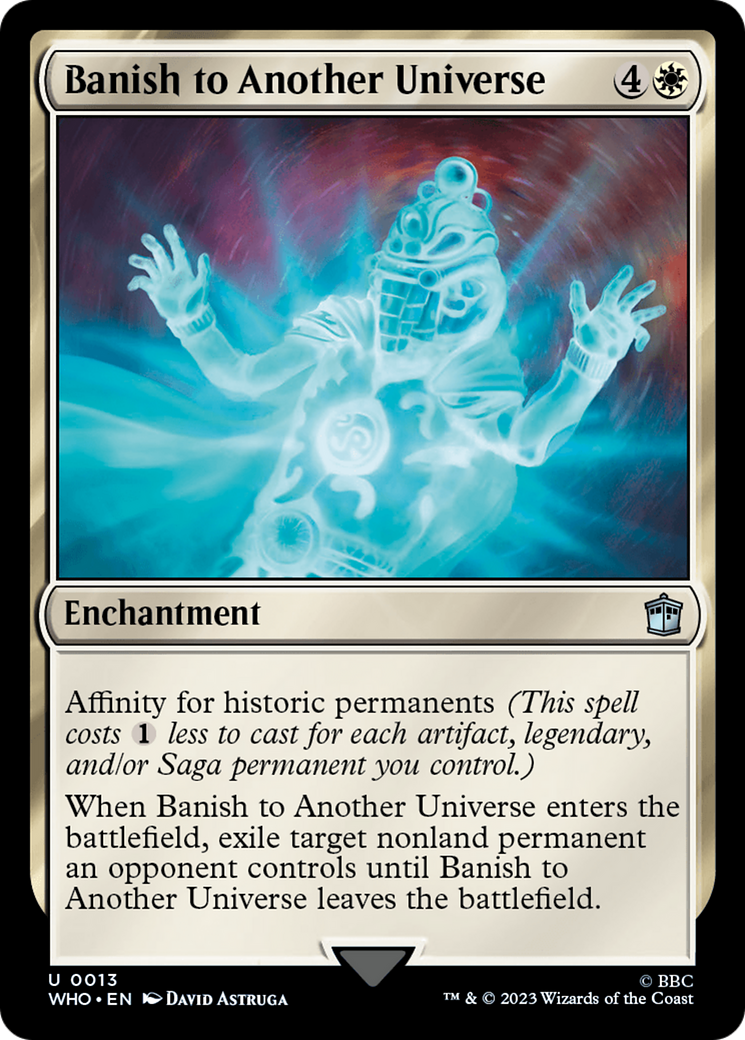
Banish to Another Universe
Banish to Another Universe
Enchantment
Affinity for historic permanents (This spell costs less to cast for each artifact, legendary, and/or Saga permanent you control.)
When this enchantment enters, exile target nonland permanent an opponent controls until this enchantment leaves the battlefield.
- If Banish to another Universe leaves the battlefield before its triggered ability resolves, the target permanent will not be exiled.
-
1
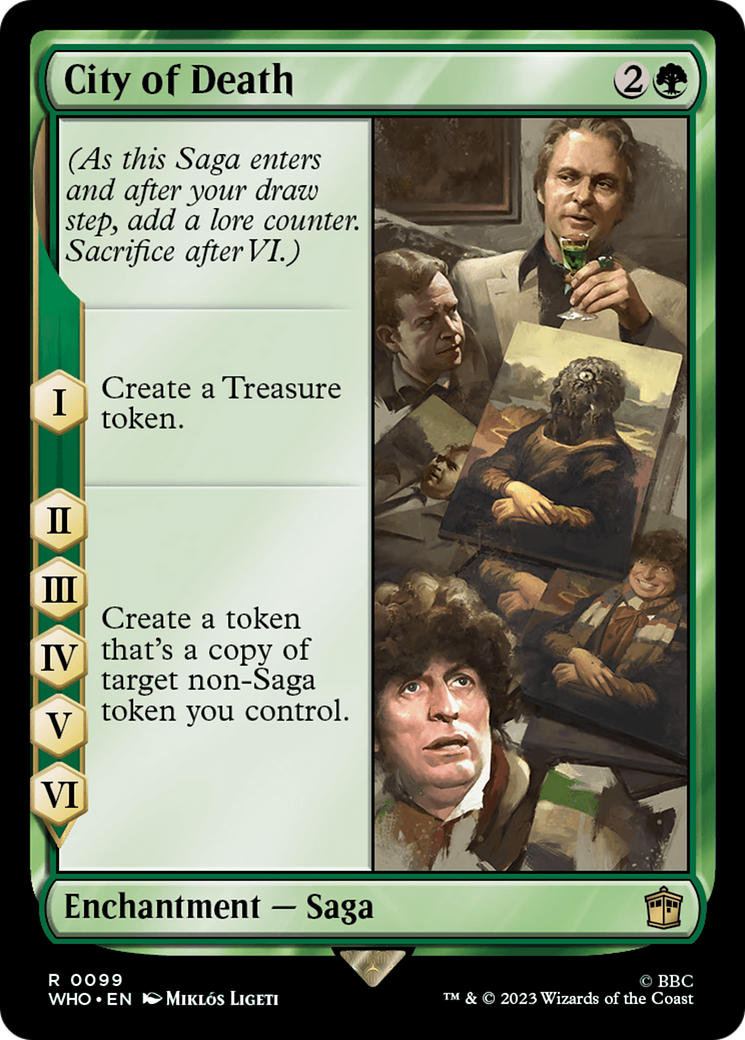
City of Death
City of Death
Enchantment — Saga
(As this Saga enters and after your draw step, add a lore counter. Sacrifice after VI.)
I — Create a Treasure token.
II, III, IV, V, VI — Create a token that's a copy of target non-Saga token you control.
- The token you create copies the original characteristics of the token as stated by the effect that created that token, (unless that token is copying something else; see below). It doesn't copy whether that token is tapped or untapped, whether it has any counters on it or Auras and Equipment attached to it, or any non-copy effects that have changed its power, toughness, types, color, or so on.
- If the copied token has in its mana cost, X is considered to be 0.
- If the copied token is copying something else (for example, if the copied token is one previously created by this ability), then the token enters the battlefield as whatever that token copied.
- Any enters-the-battlefield abilities of the copied token will trigger when the token enters the battlefield. Any "as [this permanent] enters the battlefield" or "[this permanent] enters the battlefield with" abilities of the chosen token will also work.
-
1
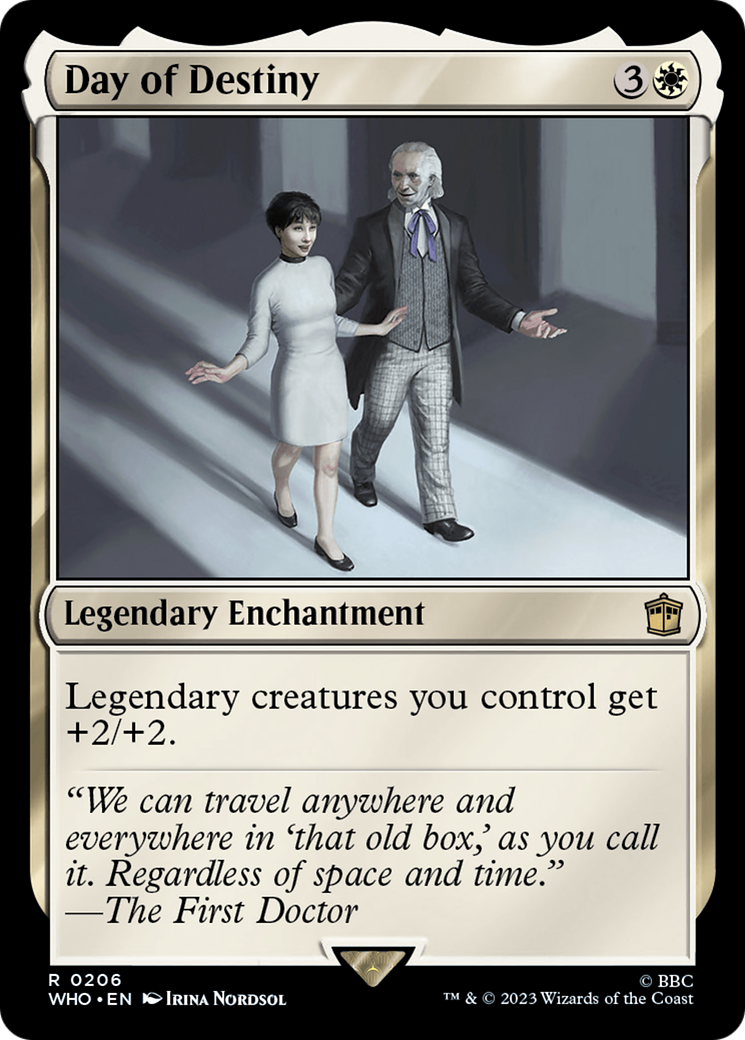
Day of Destiny
Day of Destiny
Legendary Enchantment
Legendary creatures you control get +2/+2.
-
1
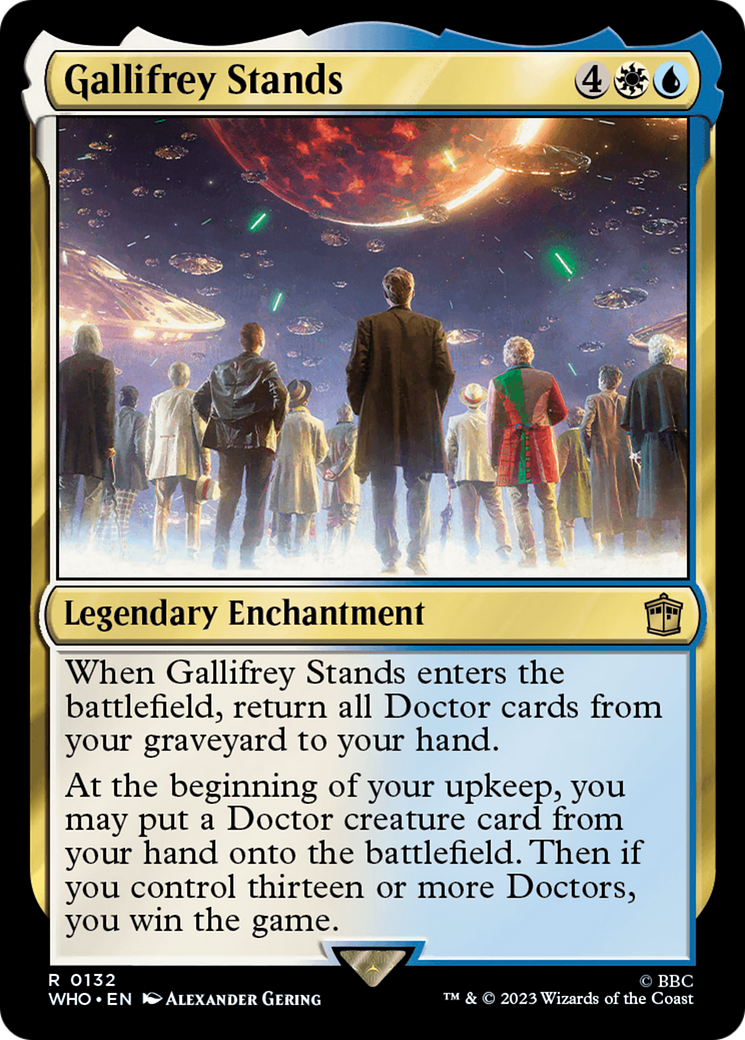
Gallifrey Stands
Gallifrey Stands
Legendary Enchantment
When Gallifrey Stands enters, return all Doctor cards from your graveyard to your hand.
At the beginning of your upkeep, you may put a Doctor creature card from your hand onto the battlefield. Then if you control thirteen or more Doctors, you win the game.
-
1
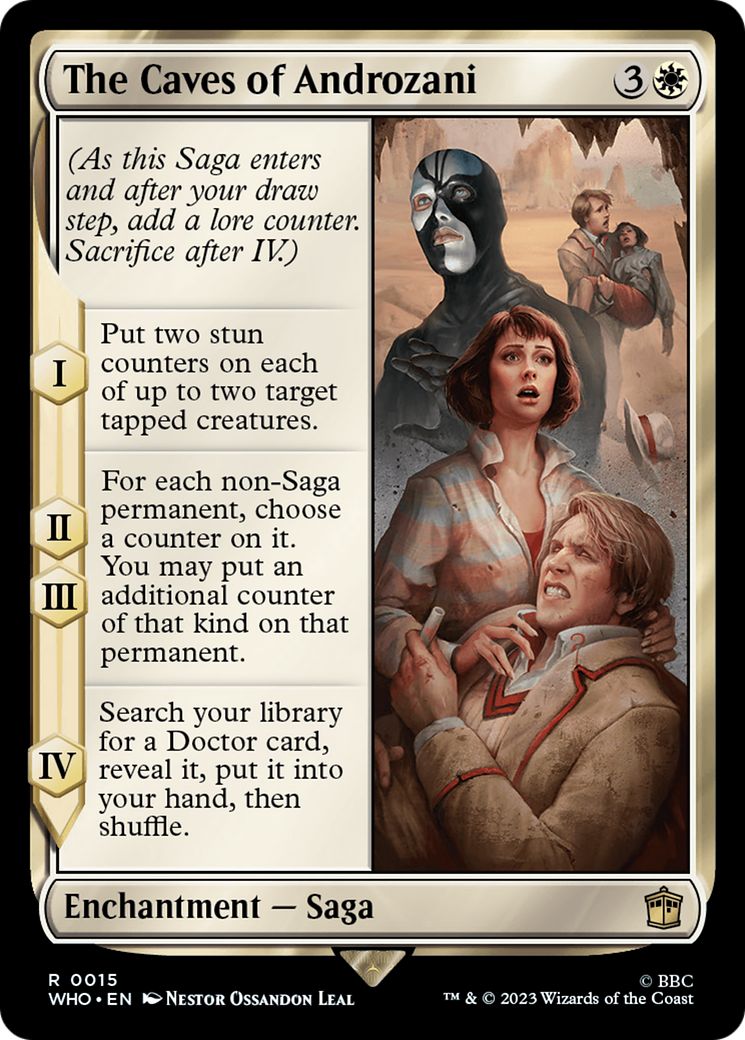
The Caves of Androzani
The Caves of Androzani
Enchantment — Saga
(As this Saga enters and after your draw step, add a lore counter. Sacrifice after IV.)
I — Put two stun counters on each of up to two target tapped creatures.
II, III — For each non-Saga permanent, choose a counter on it. You may put an additional counter of that kind on that permanent.
IV — Search your library for a Doctor card, reveal it, put it into your hand, then shuffle.
- The last ability of the Caves of Androzani can find any card with the Doctor creature type, not cards with the word "Doctor" in the name.
-
1
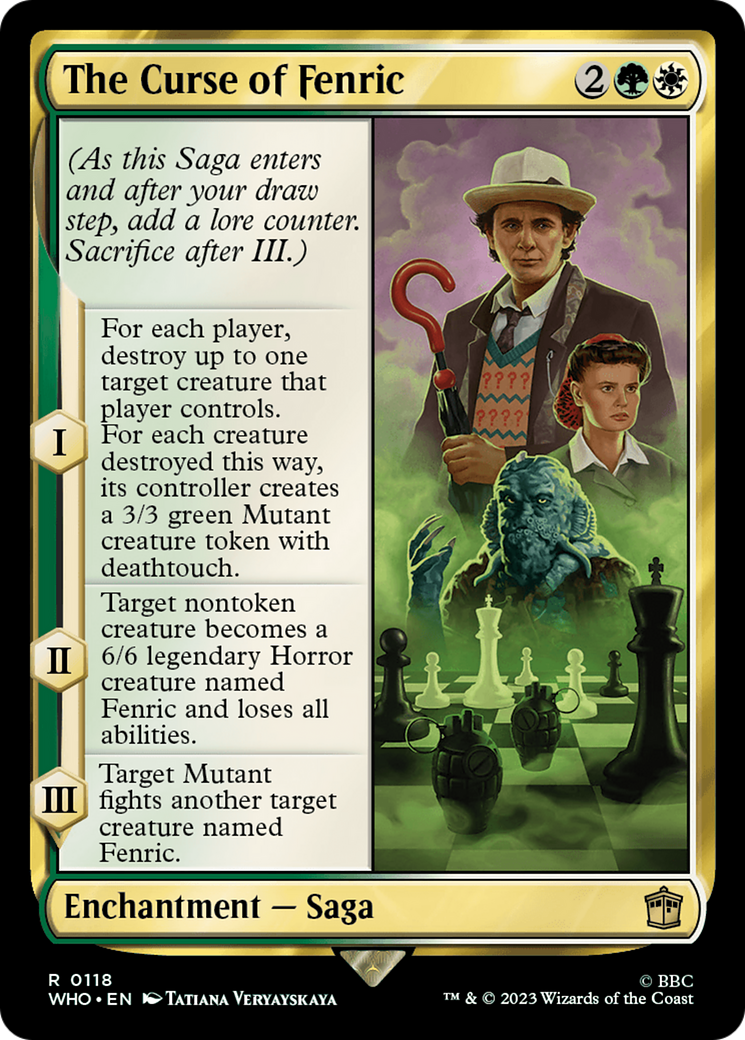
The Curse of Fenric
The Curse of Fenric
Enchantment — Saga
(As this Saga enters and after your draw step, add a lore counter. Sacrifice after III.)
I — For each player, destroy up to one target creature that player controls. For each creature destroyed this way, its controller creates a 3/3 green Mutant creature token with deathtouch.
II — Target nontoken creature becomes a 6/6 legendary Horror creature named Fenric and loses all abilities.
III — Target Mutant fights another target creature named Fenric.
-
1
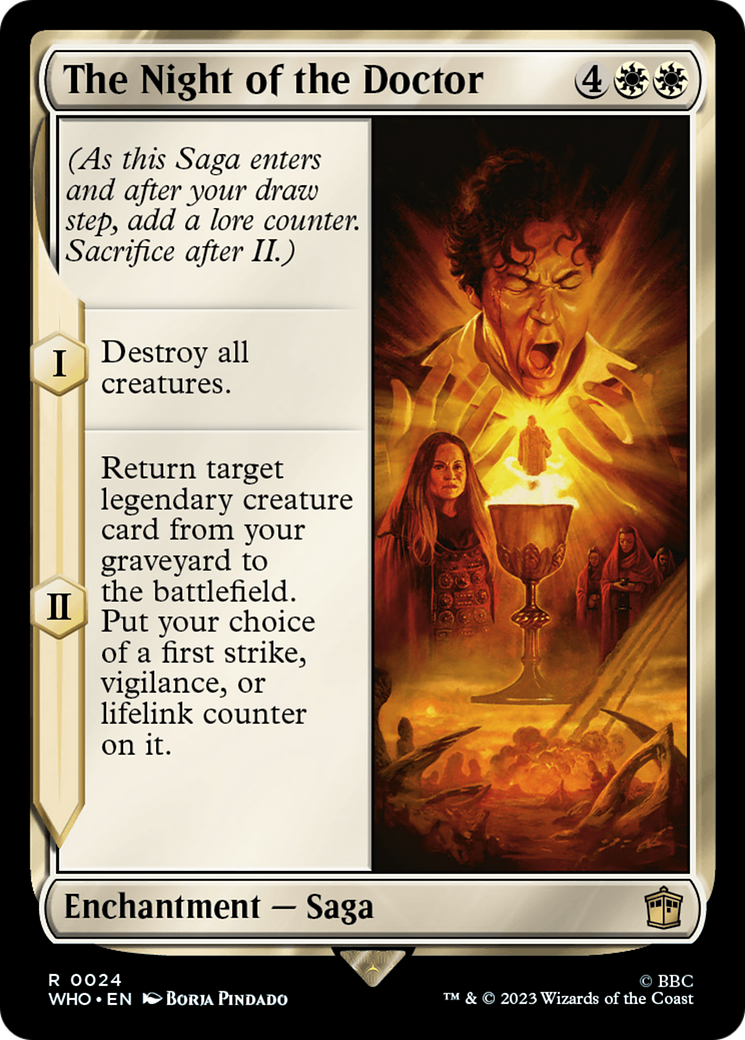
The Night of the Doctor
The Night of the Doctor
Enchantment — Saga
(As this Saga enters and after your draw step, add a lore counter. Sacrifice after II.)
I — Destroy all creatures.
II — Return target legendary creature card from your graveyard to the battlefield. Put your choice of a first strike, vigilance, or lifelink counter on it.
-
1
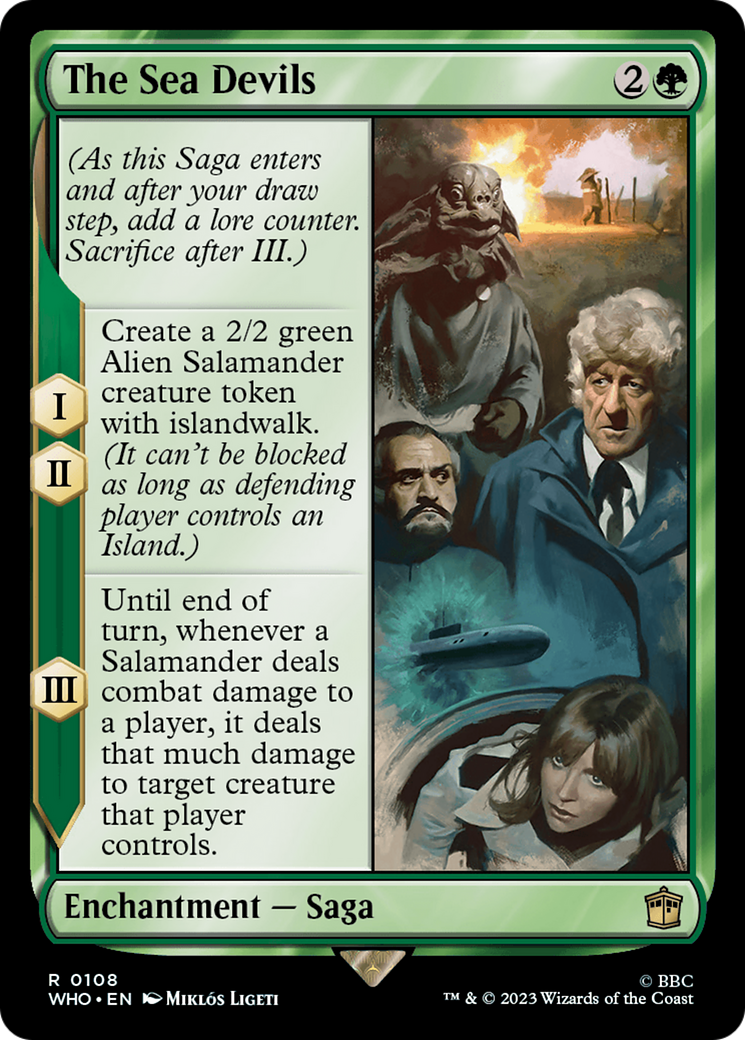
The Sea Devils
The Sea Devils
Enchantment — Saga
(As this Saga enters and after your draw step, add a lore counter. Sacrifice after III.)
I, II — Create a 2/2 green Alien Salamander creature token with islandwalk. (It can't be blocked as long as defending player controls an Island.)
III — Until end of turn, whenever a Salamander deals combat damage to a player, it deals that much damage to target creature that player controls.
-
1
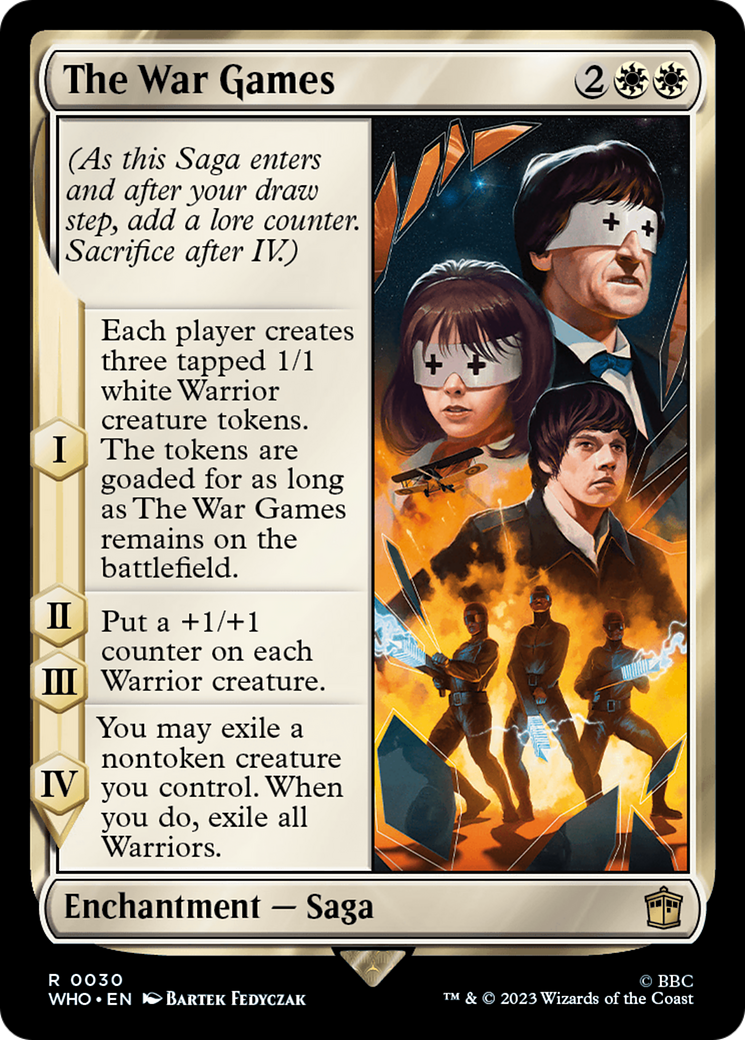
The War Games
The War Games
Enchantment — Saga
(As this Saga enters and after your draw step, add a lore counter. Sacrifice after IV.)
I — Each player creates three tapped 1/1 white Warrior creature tokens. The tokens are goaded for as long as this Saga remains on the battlefield.
II, III — Put a +1/+1 counter on each Warrior creature.
IV — You may exile a nontoken creature you control. When you do, exile all Warriors.
-
1
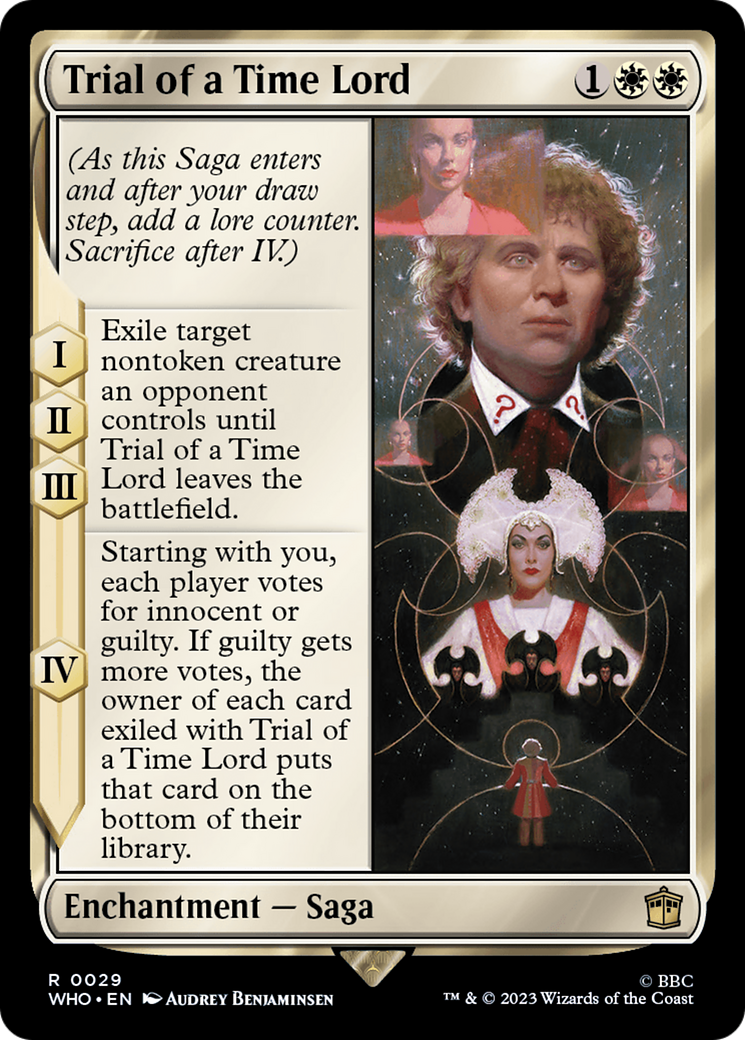
Trial of a Time Lord
Trial of a Time Lord
Enchantment — Saga
(As this Saga enters and after your draw step, add a lore counter. Sacrifice after IV.)
I, II, III — Exile target nontoken creature an opponent controls until this Saga leaves the battlefield.
IV — Starting with you, each player votes for innocent or guilty. If guilty gets more votes, the owner of each card exiled with this Saga puts that card on the bottom of their library.
- The cards that didn't get put on the bottom of their owners' libraries will return to the battlefield as Trial of a Time Lord leaves the battlefield.
Lands 36
-
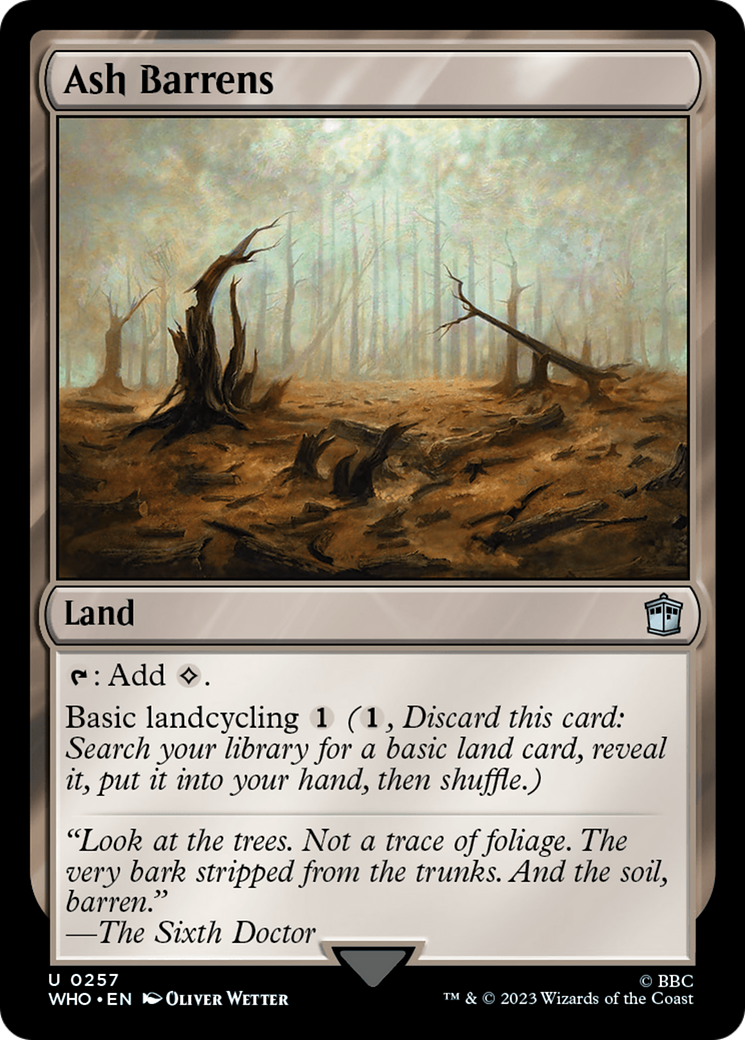
1
Ash Barrens
Ash Barrens
Land
: Add .
Basic landcycling ( , Discard this card: Search your library for a basic land card, reveal it, put it into your hand, then shuffle.)
-
1
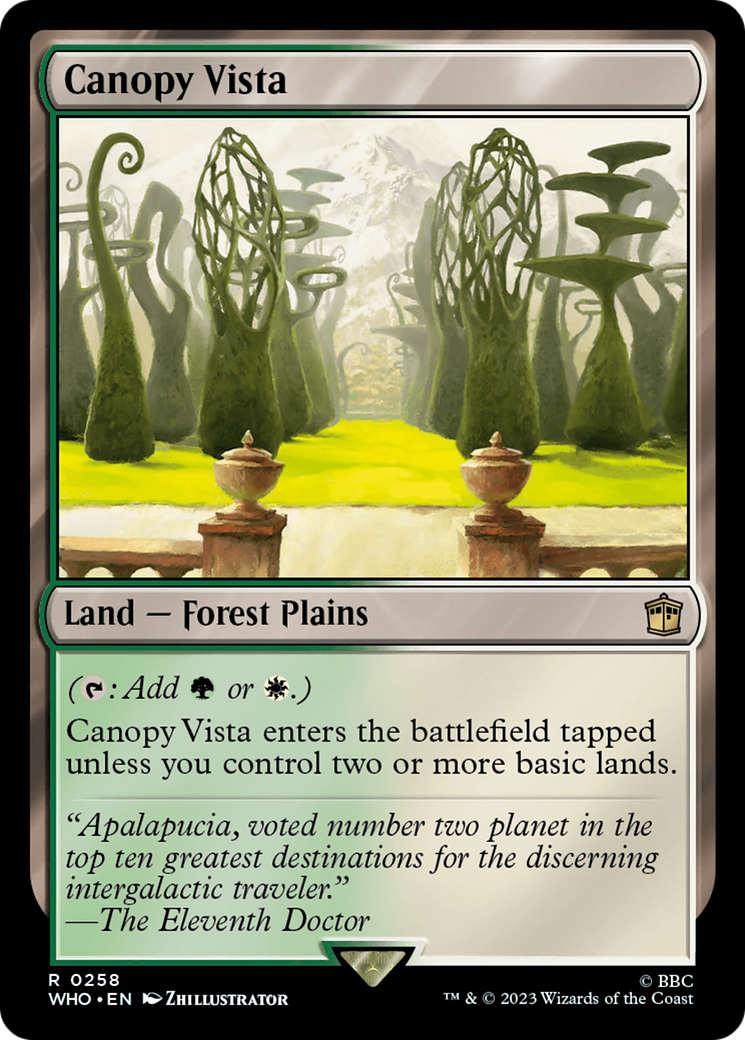
Canopy Vista
Canopy Vista
Land — Forest Plains
( : Add or .)
This land enters tapped unless you control two or more basic lands.
- Even though these lands have basic land types, they are not basic lands because "basic" doesn't appear on their type line. Notably, controlling two or more of them won't allow others to enter the battlefield untapped.
- If one of these lands enters the battlefield at the same time as any number of basic lands, those other lands are not counted when determining if this land enters the battlefield tapped or untapped.
- However, because these cards have basic land types, effects that specify a basic land type without also specifying that the land be basic can affect them. For example, a spell or ability that reads "Destroy target Forest" can target Canopy Vista, while one that reads "Destroy target basic Forest" cannot.
-
1
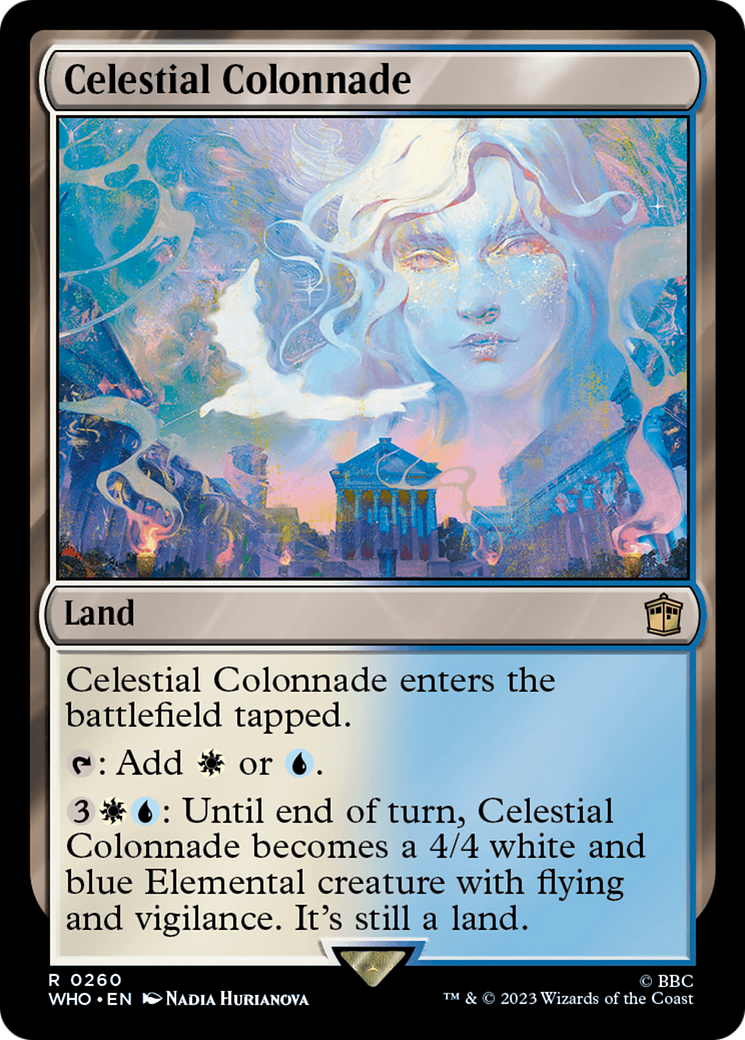
Celestial Colonnade
Celestial Colonnade
Land
This land enters tapped.
: Add or .
: Until end of turn, this land becomes a 4/4 white and blue Elemental creature with flying and vigilance. It's still a land.
- Once Celestial Colonnade has attacked, tapping it for mana won't remove it from combat.
- If Celestial Colonnade can't attack unless you pay a cost that includes a mana payment, you may attack with it and tap it to pay for that cost. It will still attack in this case.
- A land that becomes a creature may be affected by "summoning sickness." You can't attack with it or use any of its abilities (including its mana abilities) unless it began your most recent turn on the battlefield under your control. Note that summoning sickness cares about when that permanent came under your control, not when it became a creature.
- When a land becomes a creature, that doesn't count as having a creature enter. The permanent was already on the battlefield; it only changed its types. Abilities that trigger whenever a creature enters won't trigger.
-
1
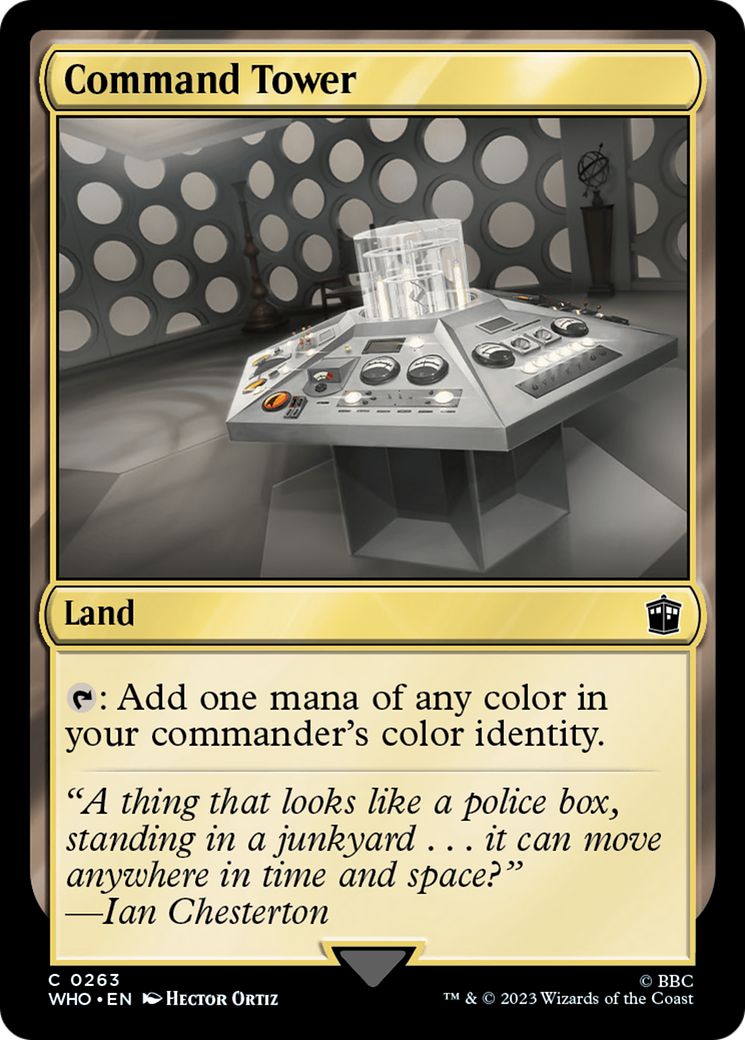
Command Tower
Command Tower
Land
: Add one mana of any color in your commander's color identity.
- If you don't have a commander, Command Tower's ability produces no mana.
- If your commander is a card that has no colors in its color identity, Command Tower's ability produces no mana. It doesn't produce .
- If you have two commanders, the ability adds one mana of any color in their combined color identities.
-
1
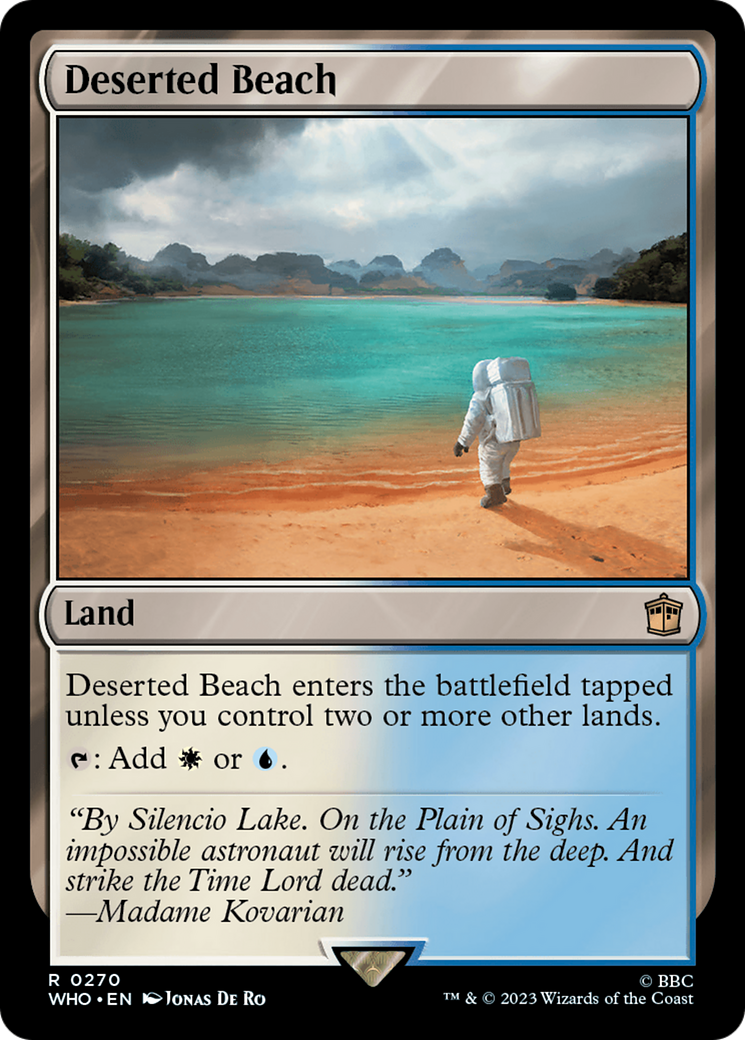
Deserted Beach
Deserted Beach
Land
This land enters tapped unless you control two or more other lands.
: Add or .
- If this land enters the battlefield at the same time as any number of other lands, those other lands are not counted when determining if this land enters the battlefield tapped or untapped.
-
1
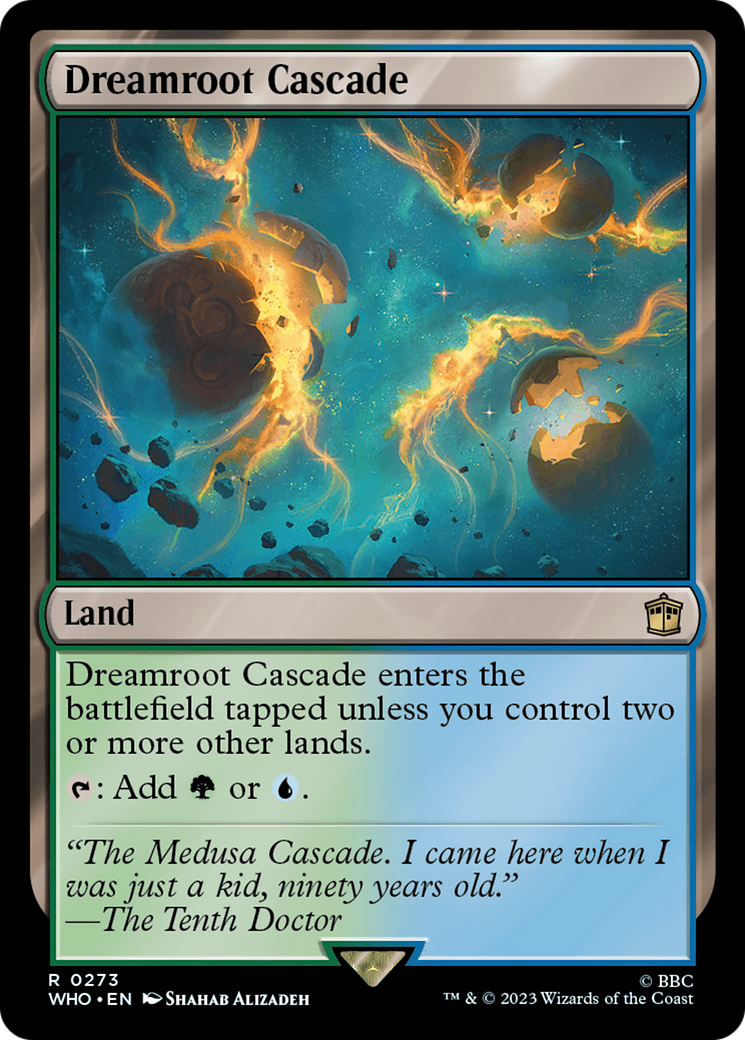
Dreamroot Cascade
Dreamroot Cascade
Land
This land enters tapped unless you control two or more other lands.
: Add or .
-
1
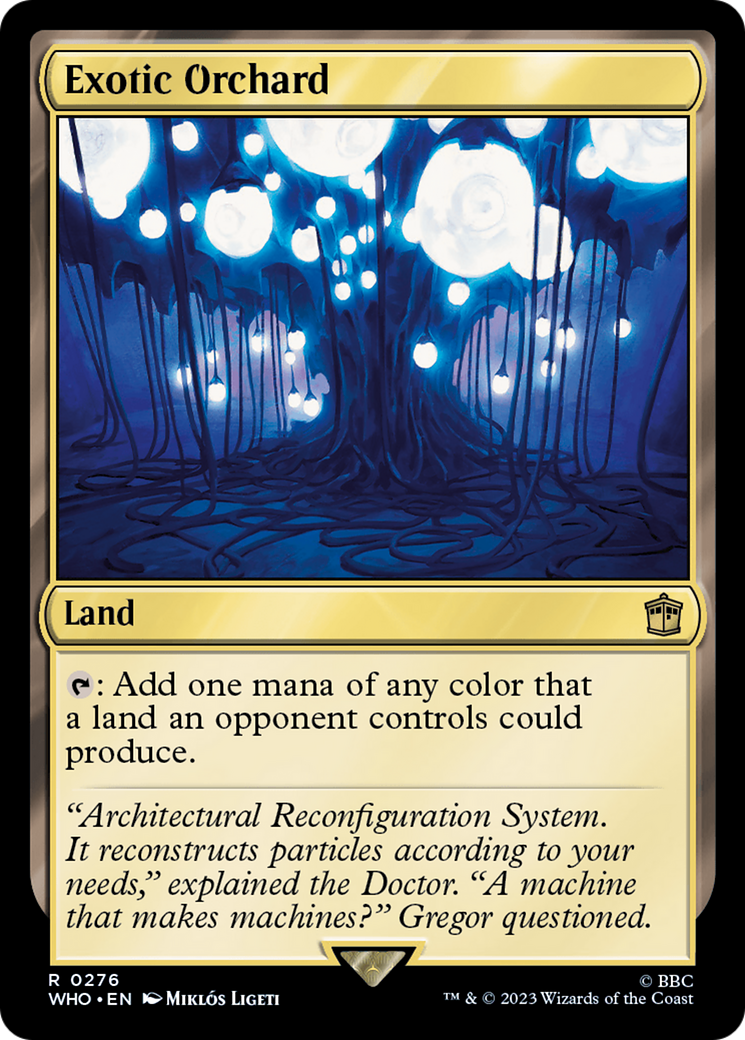
Exotic Orchard
Exotic Orchard
Land
: Add one mana of any color that a land an opponent controls could produce.
- Lands that produce mana based only on what other lands "could produce" won't help each other unless some other land allows one of them to actually produce some type of mana. For example, if you control an Exotic Orchard and your opponent controls an Exotic Orchard and a Reflecting Pool, none of those lands would produce mana if their mana abilities were activated. On the other hand, if you control a Forest and an Exotic Orchard, and your opponent controls an Exotic Orchard and a Reflecting Pool, then each of those lands can be tapped to produce . Your opponent's Exotic Orchard can produce because you control a Forest. Your Exotic Orchard and your opponent's Reflecting Pool can each produce because your opponent's Exotic Orchard can produce .
- When determining what colors of mana your opponents' lands could produce, Exotic Orchard takes into account any applicable replacement effects that would apply to those lands' mana abilities (such as Contamination's effect, for example). If there are more than one, consider them in any possible order.
- The colors of mana are white, blue, black, red, and green. Exotic Orchard can't be tapped for colorless mana, even if a land an opponent controls could produce colorless mana.
- Exotic Orchard doesn't care about any restrictions or riders your opponents' lands (such as Ancient Ziggurat or Hall of the Bandit Lord) put on the mana they produce. It just cares about colors of mana.
- Exotic Orchard checks the effects of all mana-producing abilities of lands your opponents control, but it doesn't check their costs. For example, Vivid Crag has the ability " , Remove a charge counter from Vivid Crag: Add one mana of any color." If an opponent controls Vivid Crag and you control Exotic Orchard, you can tap Exotic Orchard for any color of mana. It doesn't matter whether Vivid Crag has a charge counter on it, and it doesn't matter whether it's untapped.
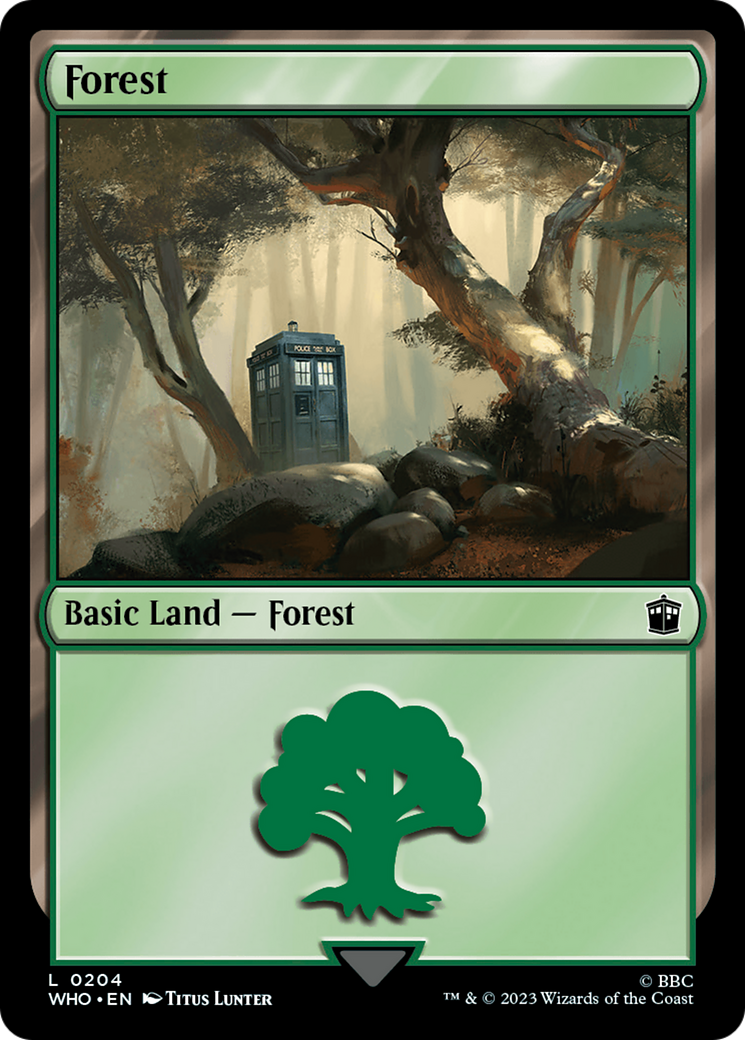
-
3
Forest
Forest
Basic Land — Forest
( : Add .)
-
1
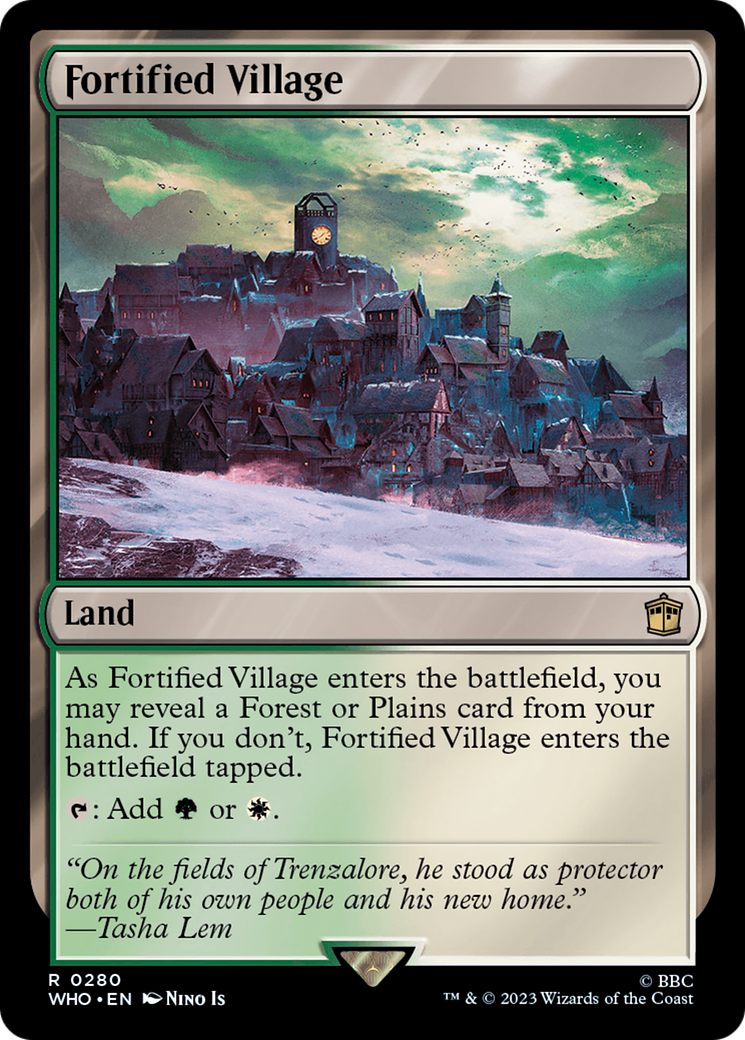
Fortified Village
Fortified Village
Land
As this land enters, you may reveal a Forest or Plains card from your hand. If you don't, this land enters tapped.
: Add or .
- If a Forest or Plains is entering the battlefield from your hand at the same time as Fortified Village, you may reveal the other land to have Fortified Village enter untapped.
- You may reveal any land card with either or both of the appropriate subtypes. It doesn't have to be a basic land. For example, you could reveal Prairie Stream from the Battle for Zendikar set to satisfy the ability of Fortified Village.
- Lands don't have a subtype just because they can produce mana of the corresponding color. Fortified Village itself is neither a Forest nor a Plains, even though it produces green and white mana, so you can't reveal one to satisfy the ability of another.
- If an effect instructs you to put Fortified Village onto the battlefield tapped, it will still enter the battlefield tapped even if you reveal a land card from your hand.
-
1
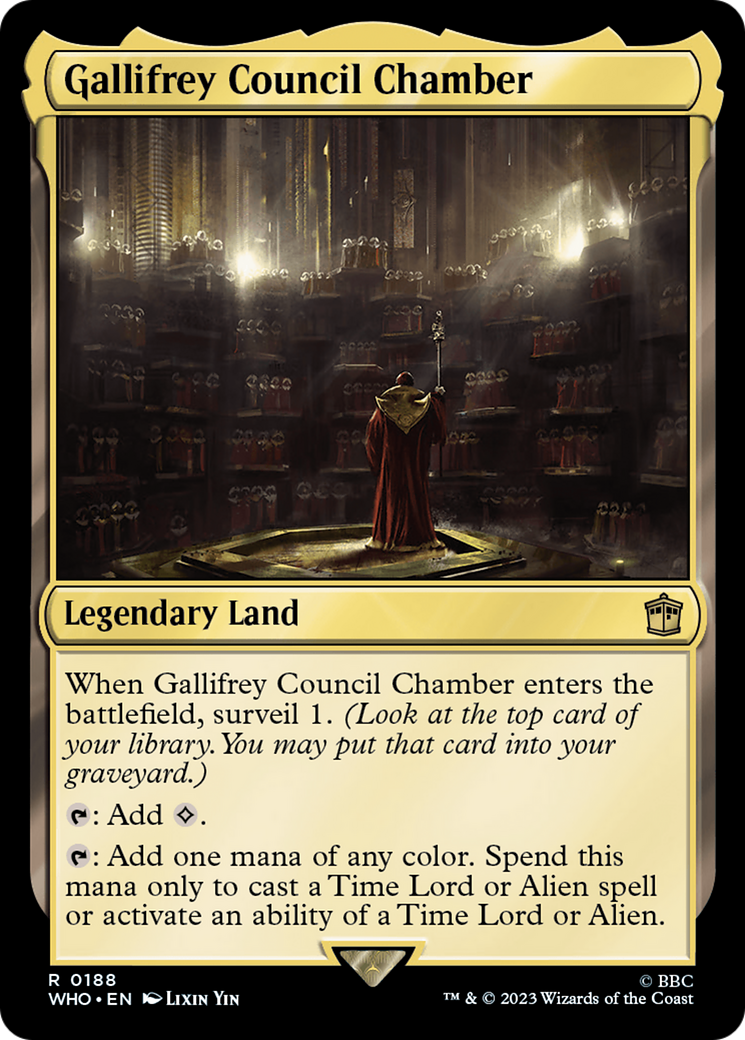
Gallifrey Council Chamber
Gallifrey Council Chamber
Legendary Land
When Gallifrey Council Chamber enters, surveil 1. (Look at the top card of your library. You may put that card into your graveyard.)
: Add .
: Add one mana of any color. Spend this mana only to cast a Time Lord or Alien spell or activate an ability of a Time Lord or Alien.
-
1
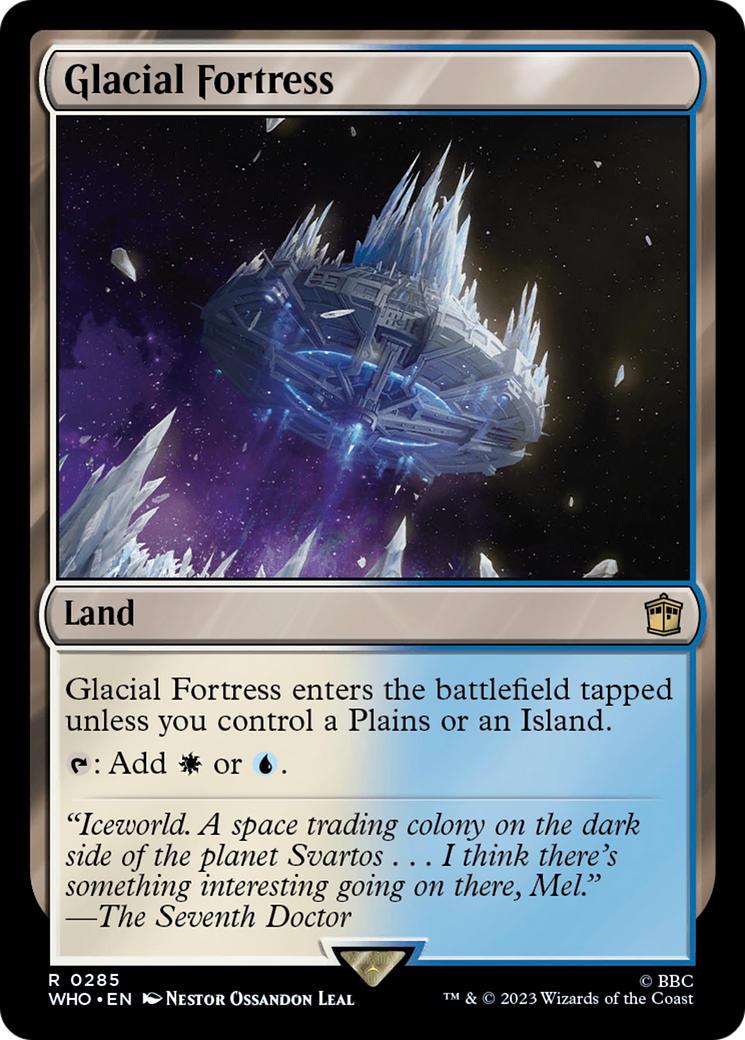
Glacial Fortress
Glacial Fortress
Land
This land enters tapped unless you control a Plains or an Island.
: Add or .
- This checks for lands you control with the land type Plains or Island, not for lands named Plains or Island. The lands it checks for don't have to be basic lands. For example, if you control Watery Grave (a nonbasic land with the land types Island and Swamp), Glacial Fortress will enter untapped.
- As this is entering, it checks for lands that are already on the battlefield. It won't see lands that are entering at the same time (due to Warp World, for example).
-
1
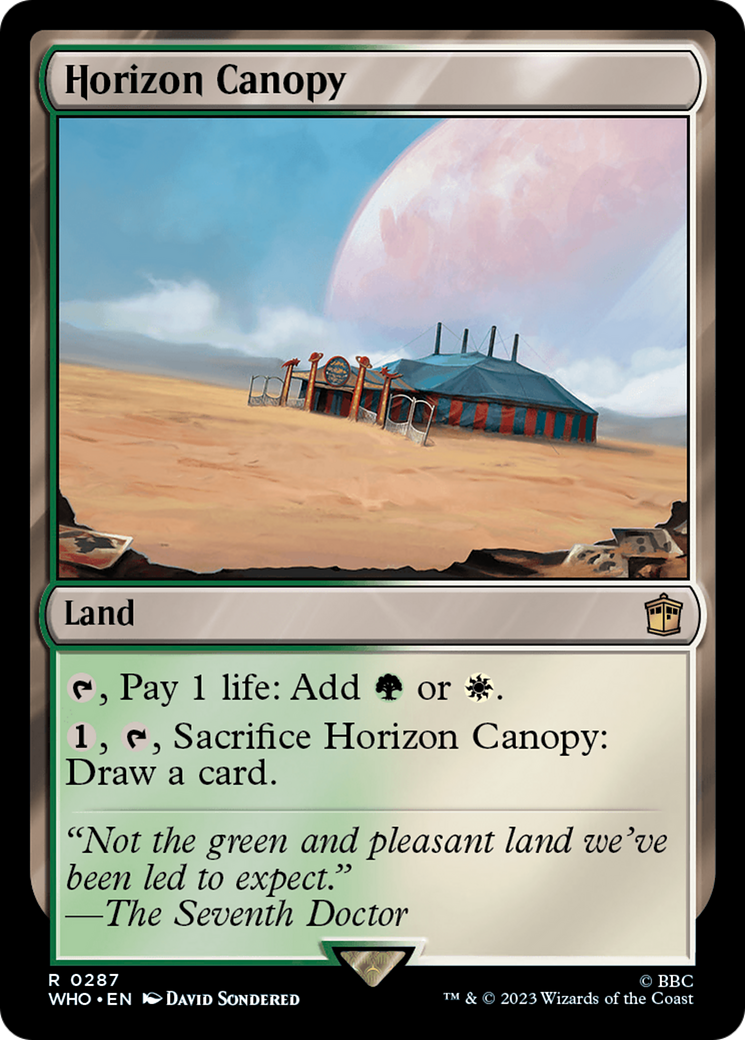
Horizon Canopy
Horizon Canopy
Land
, Pay 1 life: Add or .
, , Sacrifice this land: Draw a card.
-
1
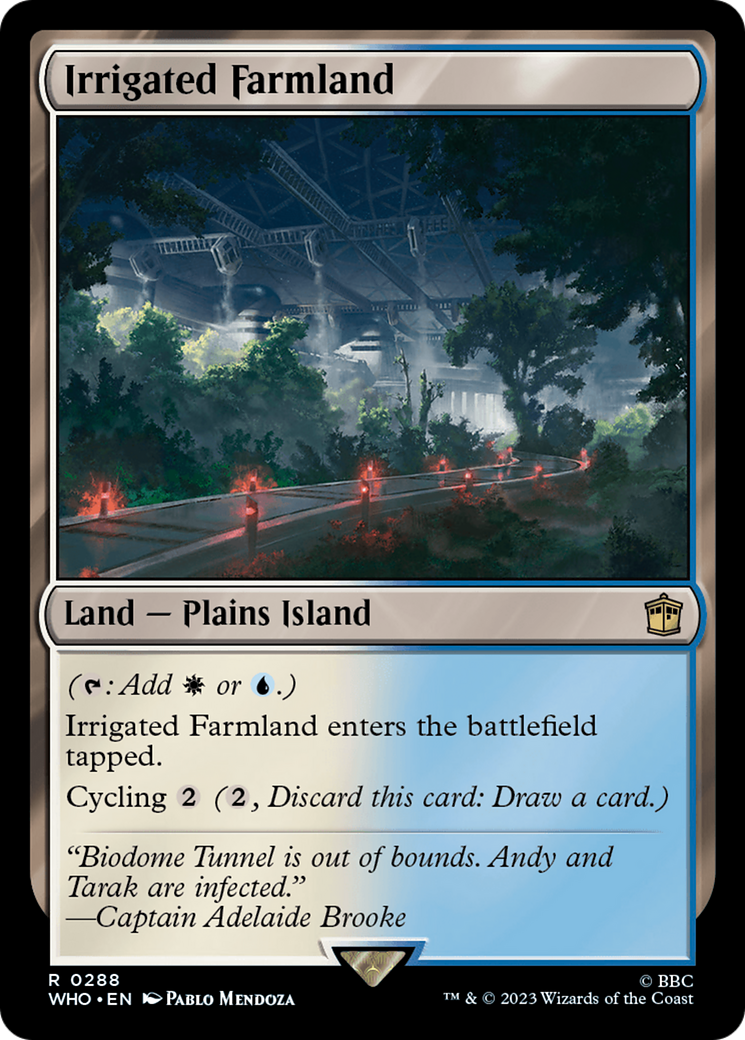
Irrigated Farmland
Irrigated Farmland
Land — Plains Island
( : Add or .)
This land enters tapped.
Cycling ( , Discard this card: Draw a card.)
-
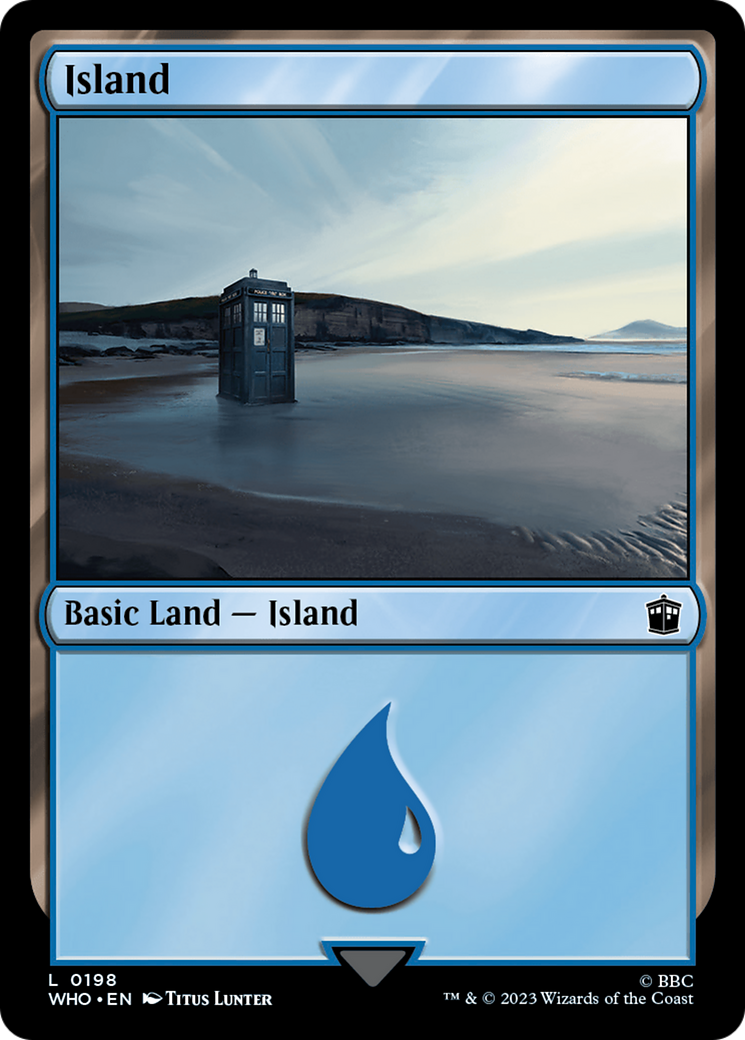
2
Island
Island
Basic Land — Island
( : Add .)
-
1
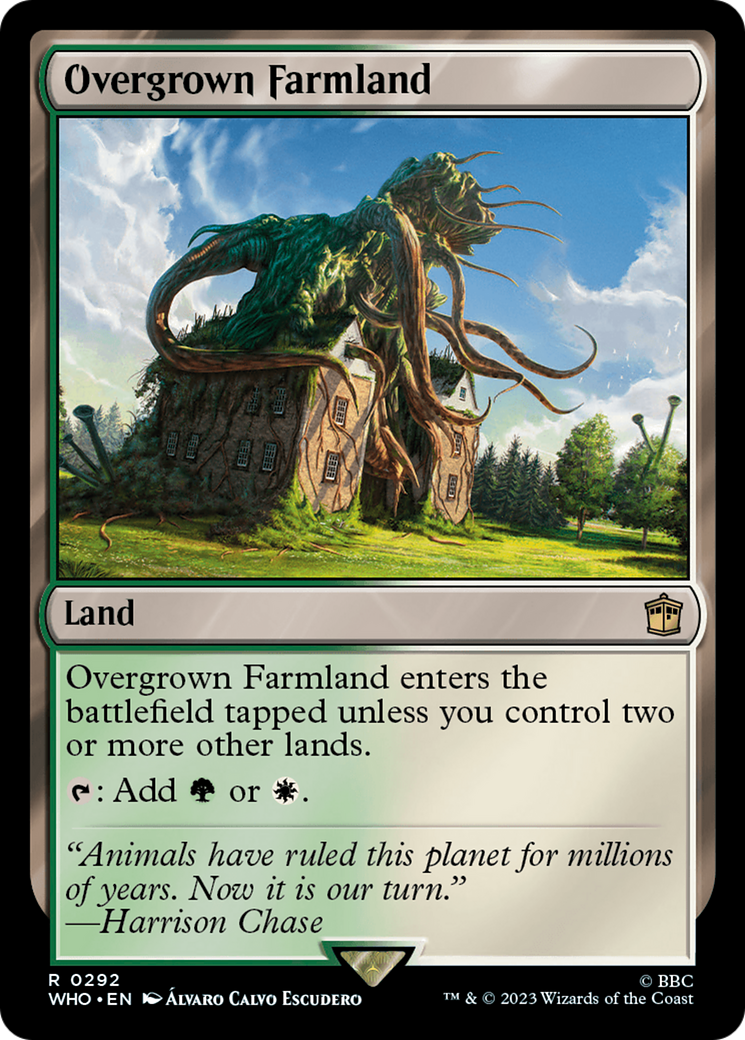
Overgrown Farmland
Overgrown Farmland
Land
This land enters tapped unless you control two or more other lands.
: Add or .
- If this land enters the battlefield at the same time as any number of other lands, those other lands are not counted when determining if this land enters the battlefield tapped or untapped.
-
1
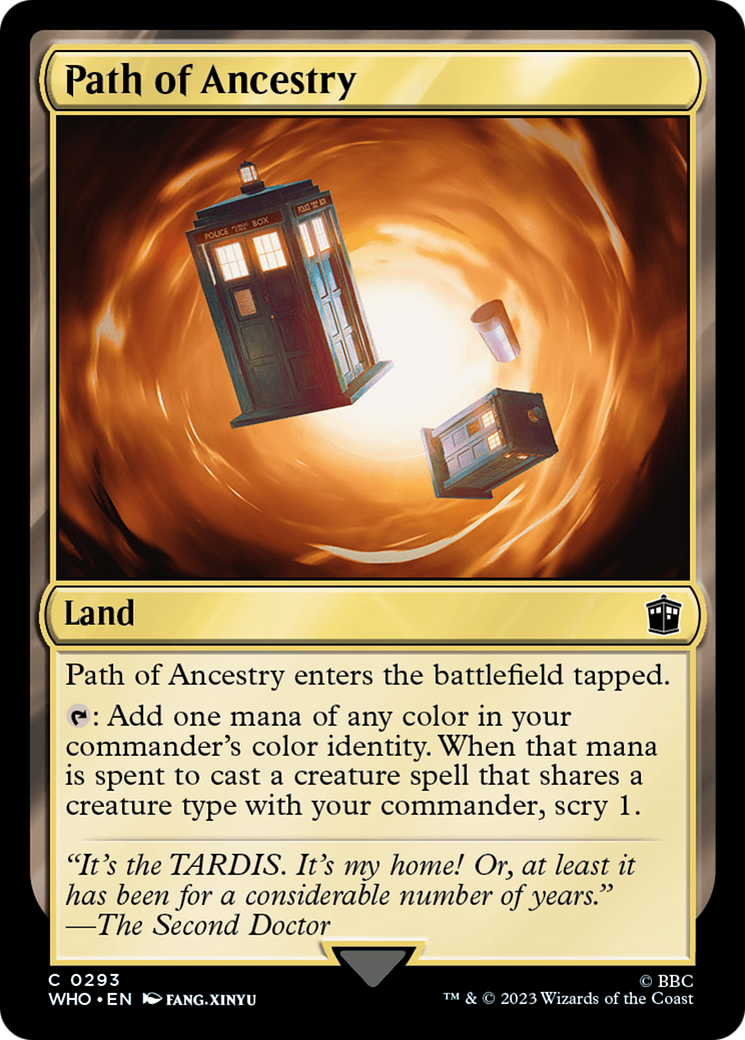
Path of Ancestry
Path of Ancestry
Land
This land enters tapped.
: Add one mana of any color in your commander's color identity. When that mana is spent to cast a creature spell that shares a creature type with your commander, scry 1. (Look at the top card of your library. You may put that card on the bottom.)
- Your commander's creature types are checked immediately after you cast a creature spell spending mana from Path of Ancestry's last ability. They aren't set before the game begins, and they may not be the same types your commander had when you activated that ability.
- If you have two commanders, the last ability adds one mana of any color in their combined color identities. When you spend that mana on a creature spell that shares a creature type with either of your commanders, you'll scry 1.
- If Path of Ancestry's last ability produces two mana (most likely due to Mana Reflection), spending those two mana to cast creature spells that share a creature type with your commander will cause two abilities to trigger. Each of those abilities will cause you to scry 1. You won't scry 2. This is true whether you spend the mana on one creature spell or two.
- If your commander has no creature types, it can't share a creature type with any spell that you cast.
- If you cast your commander with mana from Path of Ancestry, and your commander hasn't somehow lost all of its creature types while on the stack, you'll scry 1.
- If you don't have a commander, Path of Ancestry's ability produces no mana.
- If your commander is a card that has no colors in its color identity, Path of Ancestry's ability produces no mana. It doesn't produce .
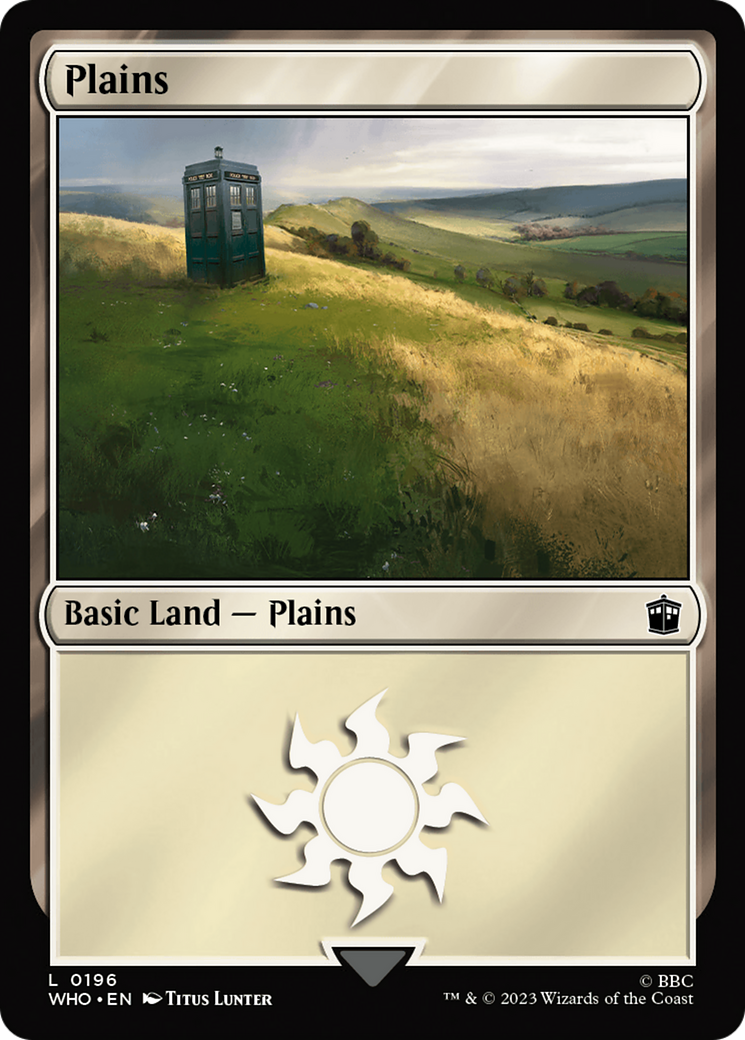
-
2
Plains
Plains
Basic Land — Plains
( : Add .)
-
1
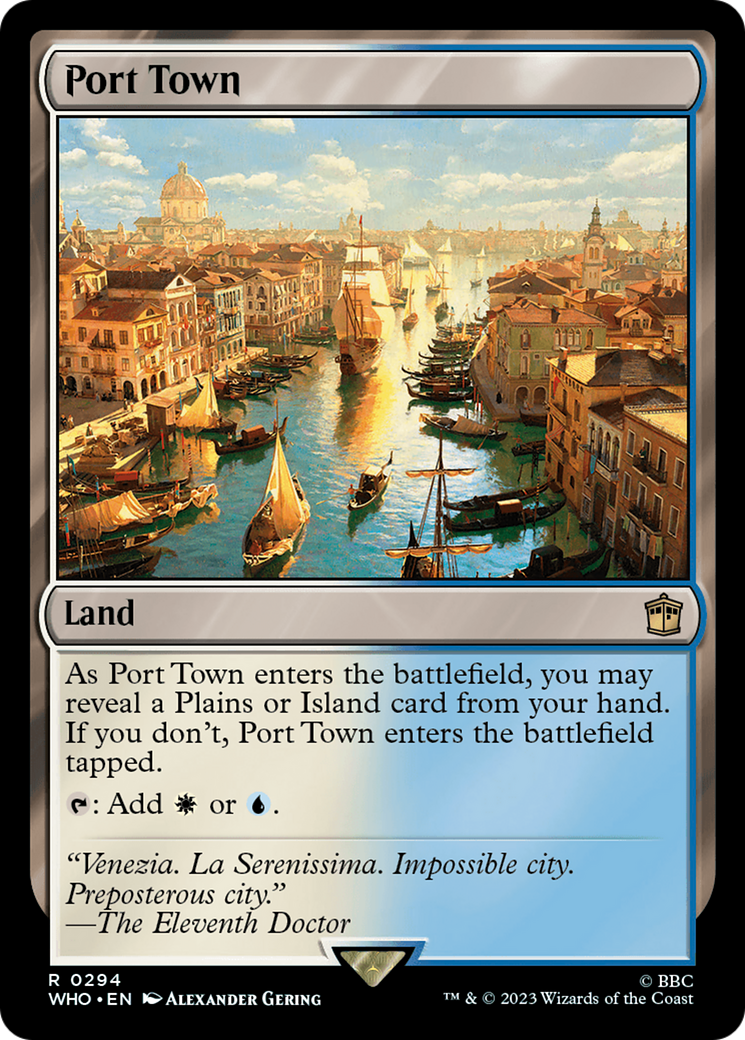
Port Town
Port Town
Land
As this land enters, you may reveal a Plains or Island card from your hand. If you don't, this land enters tapped.
: Add or .
- You may reveal any land card with either or both of the appropriate subtypes. It doesn't have to be a basic land. For example, you could reveal Canopy Vista from the Battle for Zendikar set to satisfy the ability of Port Town.
- Lands don't have a subtype just because they can produce mana of the corresponding color. Port Town itself is neither a Plains nor an Island, even though it produces white and blue mana, so you can't reveal one to satisfy the ability of another.
- If a Plains or Island is entering the battlefield from your hand at the same time as Port Town, you may reveal the other land to have Port Town enter untapped.
- If an effect instructs you to put Port Town onto the battlefield tapped, it will still enter the battlefield tapped even if you reveal a land card from your hand.
-
1
Prairie Stream
Prairie Stream
Land — Plains Island
( : Add or .)
This land enters tapped unless you control two or more basic lands.
- Even though these lands have basic land types, they are not basic lands because "basic" doesn't appear on their type line. Notably, controlling two or more of them won't allow others to enter the battlefield untapped.
- However, because these cards have basic land types, effects that specify a basic land type without also specifying that the land be basic can affect them. For example, a spell or ability that reads "Destroy target Forest" can target Canopy Vista, while one that reads "Destroy target basic Forest" cannot.
- If one of these lands enters the battlefield at the same time as any number of basic lands, those other lands are not counted when determining if this land enters the battlefield tapped or untapped.
-
1
Scattered Groves
Scattered Groves
Land — Forest Plains
( : Add or .)
This land enters tapped.
Cycling ( , Discard this card: Draw a card.)
-
1
Seaside Citadel
Seaside Citadel
Land
This land enters tapped.
: Add , , or .
-
1
Skycloud Expanse
Skycloud Expanse
Land
, : Add .
-
1
Sungrass Prairie
Sungrass Prairie
Land
, : Add .
-
1
Temple of Enlightenment
Temple of Enlightenment
Land
This land enters tapped.
When this land enters, scry 1. (Look at the top card of your library. You may put that card on the bottom.)
: Add or .
- When you scry, you may put all the cards you look at back on top of your library, you may put all of those cards on the bottom of your library, or you may put some of those cards on top and the rest of them on the bottom.
- You choose how to order cards returned to your library after scrying no matter where you put them.
- You perform the actions stated on a card in sequence. For some spells and abilities, that means you'll scry last. For others, that means you'll scry and then perform other actions.
- Scry appears on some spells and abilities with one or more targets. If all of the spell or ability's targets are illegal when it tries to resolve, it won't resolve and none of its effects will happen. You won't scry.
-
1
Temple of Mystery
Temple of Mystery
Land
This land enters tapped.
When this land enters, scry 1. (Look at the top card of your library. You may put that card on the bottom.)
: Add or .
- When you scry, you may put all the cards you look at back on top of your library, you may put all of those cards on the bottom of your library, or you may put some of those cards on top and the rest of them on the bottom.
- You choose how to order cards returned to your library after scrying no matter where you put them.
- You perform the actions stated on a card in sequence. For some spells and abilities, that means you'll scry last. For others, that means you'll scry and then perform other actions.
- Scry appears on some spells and abilities with one or more targets. If all of the spell or ability's targets are illegal when it tries to resolve, it won't resolve and none of its effects will happen. You won't scry.
-
1
Temple of Plenty
Temple of Plenty
Land
This land enters tapped.
When this land enters, scry 1. (Look at the top card of your library. You may put that card on the bottom.)
: Add or .
- You perform the actions stated on a card in sequence. For some spells and abilities, that means you'll scry last. For others, that means you'll scry and then perform other actions.
- You choose how to order cards returned to your library after scrying no matter where you put them.
- When you scry, you may put all the cards you look at back on top of your library, you may put all of those cards on the bottom of your library, or you may put some of those cards on top and the rest of them on the bottom.
- Scry appears on some spells and abilities with one or more targets. If all of the spell or ability's targets are illegal when it tries to resolve, it won't resolve and none of its effects will happen. You won't scry.
-
1
Thriving Grove
Thriving Grove
Land
This land enters tapped. As it enters, choose a color other than green.
: Add or one mana of the chosen color.
-
1
Thriving Heath
Thriving Heath
Land
This land enters tapped. As it enters, choose a color other than white.
: Add or one mana of the chosen color.
-
1
Thriving Isle
Thriving Isle
Land
This land enters tapped. As it enters, choose a color other than blue.
: Add or one mana of the chosen color.
-
1
Trenzalore Clocktower
Trenzalore Clocktower
Legendary Land
: Add . Put a time counter on Trenzalore Clocktower.
, , Remove twelve time counters from Trenzalore Clocktower and exile it: Shuffle your graveyard and hand into your library, then draw seven cards. Activate only if you control a Time Lord.
-
1
Vineglimmer Snarl
Vineglimmer Snarl
Land
As this land enters, you may reveal a Forest or Island card from your hand. If you don't, this land enters tapped.
: Add or .
- You may reveal any land card with either or both of the appropriate subtypes. It doesn't have to be a basic land card.
- The "Snarl" itself doesn't have any land subtypes. You can't reveal one to satisfy the ability of another.
- If a land card with an appropriate subtype is entering the battlefield from your hand at the same time as one of these lands, you may reveal the other land to have the "Snarl" enter untapped.
- If an effect instructs you to put one of these lands onto the battlefield tapped, it will still enter the battlefield tapped even if you reveal a land card from your hand.
-
1
Waterlogged Grove
Waterlogged Grove
Land
, Pay 1 life: Add or .
, , Sacrifice this land: Draw a card.
White 17
-
1
Banish to Another Universe
Banish to Another Universe
Enchantment
Affinity for historic permanents (This spell costs less to cast for each artifact, legendary, and/or Saga permanent you control.)
When this enchantment enters, exile target nonland permanent an opponent controls until this enchantment leaves the battlefield.
- If Banish to another Universe leaves the battlefield before its triggered ability resolves, the target permanent will not be exiled.
-
1
Barbara Wright
Barbara Wright
Legendary Creature — Human Advisor
1/3
History Teacher — Sagas you control have read ahead. (As a Saga enters, choose a chapter and start with that many lore counters. Skipped chapters don't trigger.)
Doctor's companion (You can have two commanders if the other is the Doctor.)
- As a Saga with read ahead enters the battlefield, its controller chooses a number from one to that Saga's greatest chapter number. The Saga enters the battlefield with the chosen number of lore counters. Neither choosing the number nor putting the counters on the Saga use the stack, and neither can be responded to.
- Having multiple instances of read ahead doesn't cause anything unusual to happen. It functions the same way as having one instance of read ahead.
- The Doctor's companion ability allows you to have two commanders if one has the ability and the other is a legendary creature that is a Time Lord Doctor and has no other creature types. Creatures with the changeling ability, for example, can't be a second commander this way.
- Although Doctor's companion is a new variant of the partner ability, the rules for partner have not otherwise changed. Notably, Time Lord Doctors and cards with Doctor's companion do not interact with cards which have another partner ability.
- If your Commander deck has two commanders, you can include only cards whose own color identities are also found in your commanders' combined color identities.
- Both commanders start in the command zone, and the remaining 98 cards (or 58 cards in a Commander Draft game) of your deck are shuffled to become your library.
- Once the game begins, your two commanders are tracked separately. If you cast one, you won't have to pay an additional the first time you cast the other. A player loses the game after having been dealt 21 combat damage from any one of them, not from both of them combined.
- If something refers to your commander while you have two commanders, it refers to one of them of your choice. If you are instructed to perform an action on your commander (e.g. put it from the command zone into your hand due to Command Beacon), you choose one of your commanders at the time the effect happens.
- An effect that checks whether you control your commander is satisfied if you control one or both of your two commanders.
-
1
Crisis of Conscience
Crisis of Conscience
Sorcery
Choose one —
- Destroy all tokens.
- Destroy all nonland, nontoken permanents.
-
1
Day of Destiny
Day of Destiny
Legendary Enchantment
Legendary creatures you control get +2/+2.
-
1
Ian Chesterton
Ian Chesterton
Legendary Creature — Human Scientist
2/3
Science Teacher — Each Saga spell you cast has replicate. The replicate cost is equal to its mana cost. (When you cast that Saga, copy it for each time you paid its replicate cost. Copies of Saga spells become tokens.)
Doctor's companion (You can have two commanders if the other is the Doctor.)
- The Doctor's companion ability allows you to have two commanders if one has the ability and the other is a legendary creature that is a Time Lord Doctor and has no other creature types. Creatures with the changeling ability, for example, can't be a second commander this way.
- Although Doctor's companion is a new variant of the partner ability, the rules for partner have not otherwise changed. Notably, Time Lord Doctors and cards with Doctor's companion do not interact with cards which have another partner ability.
- If your Commander deck has two commanders, you can include only cards whose own color identities are also found in your commanders' combined color identities.
- Both commanders start in the command zone, and the remaining 98 cards (or 58 cards in a Commander Draft game) of your deck are shuffled to become your library.
- Once the game begins, your two commanders are tracked separately. If you cast one, you won't have to pay an additional the first time you cast the other. A player loses the game after having been dealt 21 combat damage from any one of them, not from both of them combined.
- If something refers to your commander while you have two commanders, it refers to one of them of your choice. If you are instructed to perform an action on your commander (e.g. put it from the command zone into your hand due to Command Beacon), you choose one of your commanders at the time the effect happens.
- An effect that checks whether you control your commander is satisfied if you control one or both of your two commanders.
-
1
Jo Grant
Jo Grant
Legendary Creature — Human Soldier
3/2
Each historic card in your hand has cycling . ( , Discard that card: Draw a card.)
Whenever you cycle a card, put a +1/+1 counter on Jo Grant.
Doctor's companion (You can have two commanders if the other is the Doctor.)
- The Doctor's companion ability allows you to have two commanders if one has the ability and the other is a legendary creature that is a Time Lord Doctor and has no other creature types. Creatures with the changeling ability, for example, can't be a second commander this way.
- Although Doctor's companion is a new variant of the partner ability, the rules for partner have not otherwise changed. Notably, Time Lord Doctors and cards with Doctor's companion do not interact with cards which have another partner ability.
- If your Commander deck has two commanders, you can include only cards whose own color identities are also found in your commanders' combined color identities.
- Both commanders start in the command zone, and the remaining 98 cards (or 58 cards in a Commander Draft game) of your deck are shuffled to become your library.
- Once the game begins, your two commanders are tracked separately. If you cast one, you won't have to pay an additional the first time you cast the other. A player loses the game after having been dealt 21 combat damage from any one of them, not from both of them combined.
- If something refers to your commander while you have two commanders, it refers to one of them of your choice. If you are instructed to perform an action on your commander (e.g. put it from the command zone into your hand due to Command Beacon), you choose one of your commanders at the time the effect happens.
- An effect that checks whether you control your commander is satisfied if you control one or both of your two commanders.
-
1
Path to Exile
Path to Exile
Instant
Exile target creature. Its controller may search their library for a basic land card, put that card onto the battlefield tapped, then shuffle.
- The controller of the exiled creature isn't required to search their library for a basic land. If that player doesn't, the player won't shuffle their library.
- If the target creature is an illegal target by the time Path to Exile tries to resolve, it won't resolve and none of its effects will happen. The creature's controller won't search for a basic land card.
-
1
Peri Brown
Peri Brown
Legendary Creature — Human
2/3
The first historic spell you cast each turn has convoke. (Your creatures can help cast it. Each creature you tap while casting it pays for or one mana of that creature's color.)
Doctor's companion (You can have two commanders if the other is the Doctor.)
- You can tap any untapped creature you control to convoke a spell, even one you haven't controlled continuously since the beginning of your most recent turn.
- Tapping an untapped creature that's attacking or blocking to convoke a spell won't cause that creature to stop attacking or blocking.
- When calculating a spell's total cost, include any alternative costs, additional costs, or anything else that increases or reduces the cost to cast the spell. Convoke applies after the total cost is calculated. Convoke doesn't change a spell's mana cost or mana value.
- If a creature you control has a mana ability with in the cost, activating that ability while casting a spell with convoke will result in the creature being tapped before you pay the spell's costs. You won't be able to tap it again for convoke. Similarly, if you sacrifice a creature to activate a mana ability while casting a spell with convoke, that creature won't be on the battlefield when you pay the spell's costs, so you won't be able to tap it for convoke.
- Because convoke isn't an alternative cost, it can be used in conjunction with alternative costs.
- Tapping a multicolored creature using convoke will pay for or one mana of your choice of any of that creature's colors.
- The Doctor's companion ability allows you to have two commanders if one has the ability and the other is a legendary creature that is a Time Lord Doctor and has no other creature types. Creatures with the changeling ability, for example, can't be a second commander this way.
- An effect that checks whether you control your commander is satisfied if you control one or both of your two commanders.
- Although Doctor's companion is a new variant of the partner ability, the rules for partner have not otherwise changed. Notably, Time Lord Doctors and cards with Doctor's companion do not interact with cards which have another partner ability.
- If your Commander deck has two commanders, you can include only cards whose own color identities are also found in your commanders' combined color identities.
- Both commanders start in the command zone, and the remaining 98 cards (or 58 cards in a Commander Draft game) of your deck are shuffled to become your library.
- Once the game begins, your two commanders are tracked separately. If you cast one, you won't have to pay an additional the first time you cast the other. A player loses the game after having been dealt 21 combat damage from any one of them, not from both of them combined.
- If something refers to your commander while you have two commanders, it refers to one of them of your choice. If you are instructed to perform an action on your commander (e.g. put it from the command zone into your hand due to Command Beacon), you choose one of your commanders at the time the effect happens.
-
1
Return to Dust
Return to Dust
Instant
Exile target artifact or enchantment. If you cast this spell during your main phase, you may exile up to one other target artifact or enchantment.
- Return to Dust can always target a second artifact or enchantment; it just won't exile it if it's not your main phase when you cast Return to Dust.
- If a spell or ability copies Return to Dust, the copy exiles only the first target artifact or enchantment. This is because the copy wasn't cast at all.
-
1
Romana II
Romana II
Legendary Creature — Time Lord Scientist
3/3
Vigilance
, : Create a tapped token that's a copy of target token that entered this turn.
Doctor's companion (You can have two commanders if the other is the Doctor.)
- If an effect instructs you to choose a creature type, you may choose Time Lord.
- The token you create copies the original characteristics of the token as stated by the effect that created that token (unless that token is copying something else; see below). It doesn't copy whether that token is tapped or untapped, whether it has any counters on it or Auras and Equipment attached to it, or any non-copy effects that have changed its power, toughness, types, color, or so on.
- If the copied token has in its mana cost, X is considered to be 0.
- If the copied token is copying something else (for example, if the copied token is one previously created by this ability), then the token enters the battlefield as whatever that token copied.
- Any enters-the-battlefield abilities of the copied token will trigger when the token enters the battlefield. Any "as [this permanent] enters the battlefield" or "[this permanent] enters the battlefield with" abilities of the chosen token will also work.
- The Doctor's companion ability allows you to have two commanders if one has the ability and the other is a legendary creature that is a Time Lord Doctor and has no other creature types. Creatures with the changeling ability, for example, can't be a second commander this way.
- Although Doctor's companion is a new variant of the partner ability, the rules for partner have not otherwise changed. Notably, Time Lord Doctors and cards with Doctor's companion do not interact with cards which have another partner ability.
- If your Commander deck has two commanders, you can include only cards whose own color identities are also found in your commanders' combined color identities.
- Both commanders start in the command zone, and the remaining 98 cards (or 58 cards in a Commander Draft game) of your deck are shuffled to become your library.
- Once the game begins, your two commanders are tracked separately. If you cast one, you won't have to pay an additional the first time you cast the other. A player loses the game after having been dealt 21 combat damage from any one of them, not from both of them combined.
- If something refers to your commander while you have two commanders, it refers to one of them of your choice. If you are instructed to perform an action on your commander (e.g. put it from the command zone into your hand due to Command Beacon), you choose one of your commanders at the time the effect happens.
- An effect that checks whether you control your commander is satisfied if you control one or both of your two commanders.
- Unlike other creature types in Magic that are each only one word, the two words "Time Lord" represent a single creature subtype. Time Lord is the only two-word creature type.
- Neither "Time" nor "Lord" are creature types. Some older cards were printed with the subtype "Lord," but all of those cards have updated Oracle card text that removed that type.
-
1
Sarah Jane Smith
Sarah Jane Smith
Legendary Creature — Human Detective
2/1
Whenever you cast a historic spell, investigate. This ability triggers only once each turn. (Artifacts, legendaries, and Sagas are historic. To investigate, create a Clue token. It's an artifact with " , Sacrifice this token: Draw a card.")
Doctor's companion (You can have two commanders if the other is the Doctor.)
- The Doctor's companion ability allows you to have two commanders if one has the ability and the other is a legendary creature that is a Time Lord Doctor and has no other creature types. Creatures with the changeling ability, for example, can't be a second commander this way.
- Although Doctor's companion is a new variant of the partner ability, the rules for partner have not otherwise changed. Notably, Time Lord Doctors and cards with Doctor's companion do not interact with cards which have another partner ability.
- If your Commander deck has two commanders, you can include only cards whose own color identities are also found in your commanders' combined color identities.
- Both commanders start in the command zone, and the remaining 98 cards (or 58 cards in a Commander Draft game) of your deck are shuffled to become your library.
- Once the game begins, your two commanders are tracked separately. If you cast one, you won't have to pay an additional the first time you cast the other. A player loses the game after having been dealt 21 combat damage from any one of them, not from both of them combined.
- If something refers to your commander while you have two commanders, it refers to one of them of your choice. If you are instructed to perform an action on your commander (e.g. put it from the command zone into your hand due to Command Beacon), you choose one of your commanders at the time the effect happens.
- An effect that checks whether you control your commander is satisfied if you control one or both of your two commanders.
-
1
Swords to Plowshares
Swords to Plowshares
Instant
Exile target creature. Its controller gains life equal to its power.
- Use the power of the creature from when it was last on the battlefield to determine how much life is gained.
-
1
Tegan Jovanka
Tegan Jovanka
Legendary Creature — Human
2/2
Brave Heart — Whenever you attack, target attacking historic creature gets +1/+1 and gains indestructible until end of turn. (Artifacts, legendaries, and Sagas are historic.)
Doctor's companion (You can have two commanders if the other is the Doctor.)
- The Doctor's companion ability allows you to have two commanders if one has the ability and the other is a legendary creature that is a Time Lord Doctor and has no other creature types. Creatures with the changeling ability, for example, can't be a second commander this way.
- Although Doctor's companion is a new variant of the partner ability, the rules for partner have not otherwise changed. Notably, Time Lord Doctors and cards with Doctor's companion do not interact with cards which have another partner ability.
- If your Commander deck has two commanders, you can include only cards whose own color identities are also found in your commanders' combined color identities.
- Both commanders start in the command zone, and the remaining 98 cards (or 58 cards in a Commander Draft game) of your deck are shuffled to become your library.
- Once the game begins, your two commanders are tracked separately. If you cast one, you won't have to pay an additional the first time you cast the other. A player loses the game after having been dealt 21 combat damage from any one of them, not from both of them combined.
- If something refers to your commander while you have two commanders, it refers to one of them of your choice. If you are instructed to perform an action on your commander (e.g. put it from the command zone into your hand due to Command Beacon), you choose one of your commanders at the time the effect happens.
- An effect that checks whether you control your commander is satisfied if you control one or both of your two commanders.
-
1
The Caves of Androzani
The Caves of Androzani
Enchantment — Saga
(As this Saga enters and after your draw step, add a lore counter. Sacrifice after IV.)
I — Put two stun counters on each of up to two target tapped creatures.
II, III — For each non-Saga permanent, choose a counter on it. You may put an additional counter of that kind on that permanent.
IV — Search your library for a Doctor card, reveal it, put it into your hand, then shuffle.
- The last ability of the Caves of Androzani can find any card with the Doctor creature type, not cards with the word "Doctor" in the name.
-
1
The Night of the Doctor
The Night of the Doctor
Enchantment — Saga
(As this Saga enters and after your draw step, add a lore counter. Sacrifice after II.)
I — Destroy all creatures.
II — Return target legendary creature card from your graveyard to the battlefield. Put your choice of a first strike, vigilance, or lifelink counter on it.
-
1
The War Games
The War Games
Enchantment — Saga
(As this Saga enters and after your draw step, add a lore counter. Sacrifice after IV.)
I — Each player creates three tapped 1/1 white Warrior creature tokens. The tokens are goaded for as long as this Saga remains on the battlefield.
II, III — Put a +1/+1 counter on each Warrior creature.
IV — You may exile a nontoken creature you control. When you do, exile all Warriors.
-
1
Trial of a Time Lord
Trial of a Time Lord
Enchantment — Saga
(As this Saga enters and after your draw step, add a lore counter. Sacrifice after IV.)
I, II, III — Exile target nontoken creature an opponent controls until this Saga leaves the battlefield.
IV — Starting with you, each player votes for innocent or guilty. If guilty gets more votes, the owner of each card exiled with this Saga puts that card on the bottom of their library.
- The cards that didn't get put on the bottom of their owners' libraries will return to the battlefield as Trial of a Time Lord leaves the battlefield.
Blue 9
-
1
Adric, Mathematical Genius
Adric, Mathematical Genius
Legendary Creature — Human Artificer
1/1
, : Copy target activated or triggered ability you control. You may choose new targets for the copy.
Ultimate Sacrifice — , Sacrifice Adric: Counter target activated or triggered ability.
Doctor's companion (You can have two commanders if the other is the Doctor.)
- Adric, Mathematical Genius's first ability targets an activated or triggered ability that is on the stack and creates another instance of that ability on the stack. It doesn't cause any object to gain an ability.
- The source of the copy from Adric, Mathematical Genius's first ability is the same as the source of the original ability.
- Activated abilities contain a colon. They're generally written "[Cost]: [Effect]." Some keyword abilities (such as equip) are activated abilities and will have a colon in their reminder text.
- Triggered abilities use the word "when," "whenever," or "at." They're often written as "[Trigger condition], [effect]." Some keywords (such as prowess) are triggered abilities and will use "when," "whenever," or "at" in their reminder text.
- If an ability is linked to a second ability, copies of that first ability are also linked to that second ability. If the second ability refers to "the exiled card," it refers to all cards exiled by the first ability and the copy. For example, if Fiend Hunter's enters-the-battlefield ability is copied and two creatures are exiled, they both return when Fiend Hunter leaves the battlefield.
- Adric, Mathematical Genius can copy any activated or triggered ability on the stack, not just one with targets.
- The copy is created on the stack, so it's not "activated." Creating the copy won't cause abilities that trigger when a player activates an ability to trigger. Abilities that say that a triggered ability triggers additional times won't apply to copying a triggered ability.
- The copy will resolve before the original ability does.
- The copy will have the same targets as the ability it's copying unless you choose new ones. You may change any number of the targets, including all of them or none of them. If, for one of the targets, you can't choose a new legal target, then it remains unchanged (even if the current target is illegal).
- If the ability that's copied is modal (that is, it says "Choose one —" or the like), the copy will have the same mode. A different mode can't be chosen.
- If the ability that's copied has an X whose value was determined as it was activated, the copy will have the same value of X.
- If the ability has damage divided as it was put onto the stack, the division can't be changed, although the targets receiving that damage still can. The same is true of abilities that distribute counters.
- You can't choose to pay any activation costs for the copy. However, effects based on those costs that were paid for the original ability are copied as though those same costs were paid for the copy.
- Any choices made when the ability resolves won't have been made yet when it's copied. Any such choices will be made separately when the copy resolves. Most notably, if a triggered ability asks its controller to pay a cost, you pay that cost for the copy if you wish to have it paid.
- The Doctor's companion ability allows you to have two commanders if one has the ability and the other is a legendary creature that is a Time Lord Doctor and has no other creature types. Creatures with the changeling ability, for example, can't be a second commander this way.
- Although Doctor's companion is a new variant of the partner ability, the rules for partner have not otherwise changed. Notably, Time Lord Doctors and cards with Doctor's companion do not interact with cards which have another partner ability.
- If your Commander deck has two commanders, you can include only cards whose own color identities are also found in your commanders' combined color identities.
- Both commanders start in the command zone, and the remaining 98 cards (or 58 cards in a Commander Draft game) of your deck are shuffled to become your library.
- Once the game begins, your two commanders are tracked separately. If you cast one, you won't have to pay an additional the first time you cast the other. A player loses the game after having been dealt 21 combat damage from any one of them, not from both of them combined.
- If something refers to your commander while you have two commanders, it refers to one of them of your choice. If you are instructed to perform an action on your commander (e.g. put it from the command zone into your hand due to Command Beacon), you choose one of your commanders at the time the effect happens.
- An effect that checks whether you control your commander is satisfied if you control one or both of your two commanders.
-
1
An Unearthly Child
An Unearthly Child
Enchantment — Saga
(As this Saga enters and after your draw step, add a lore counter. Sacrifice after III.)
I, II, III — Reveal cards from the top of your library until you reveal a Doctor card, a card with doctor's companion, or a Vehicle card. Put that card into your hand and the rest on the bottom of your library in a random order.
-
1
Five Hundred Year Diary
Five Hundred Year Diary
Legendary Artifact — Book Clue
Five Hundred Year Diary enters tapped.
: Add for each Clue you control.
, Sacrifice Five Hundred Year Diary: Draw a card.
- Five Hundred Year Diary counts itself for its second ability.
-
1
K-9, Mark I
K-9, Mark I
Legendary Artifact Creature — Robot Dog
1/1
Negative — As long as K-9 is untapped, other legendary creatures you control have ward .
Affirmative — , : Target legendary creature can't be blocked this turn.
Doctor's companion (You can have two commanders if the other is the Doctor.)
- The Doctor's companion ability allows you to have two commanders if one has the ability and the other is a legendary creature that is a Time Lord Doctor and has no other creature types. Creatures with the changeling ability, for example, can't be a second commander this way.
- Although Doctor's companion is a new variant of the partner ability, the rules for partner have not otherwise changed. Notably, Time Lord Doctors and cards with Doctor's companion do not interact with cards which have another partner ability.
- If your Commander deck has two commanders, you can include only cards whose own color identities are also found in your commanders' combined color identities.
- Both commanders start in the command zone, and the remaining 98 cards (or 58 cards in a Commander Draft game) of your deck are shuffled to become your library.
- Once the game begins, your two commanders are tracked separately. If you cast one, you won't have to pay an additional the first time you cast the other. A player loses the game after having been dealt 21 combat damage from any one of them, not from both of them combined.
- If something refers to your commander while you have two commanders, it refers to one of them of your choice. If you are instructed to perform an action on your commander (e.g. put it from the command zone into your hand due to Command Beacon), you choose one of your commanders at the time the effect happens.
- An effect that checks whether you control your commander is satisfied if you control one or both of your two commanders.
-
1
Nyssa of Traken
Nyssa of Traken
Legendary Creature — Human Scientist
3/4
You have no maximum hand size.
Sonic Booster — Whenever Nyssa of Traken attacks, sacrifice any number of artifacts. When you sacrifice one or more artifacts this way, tap up to that many target creatures and draw that many cards.
Doctor's companion (You can have two commanders if the other is the Doctor.)
- You can choose fewer than X targets for Nyssa's reflexive triggered ability. The number of targets doesn't change the number of cards drawn.
- If you chose at least one target and all targets are illegal as the ability tries to resolve, the ability is removed from the stack and does nothing. You will not draw any cards in this case.
- The Doctor's companion ability allows you to have two commanders if one has the ability and the other is a legendary creature that is a Time Lord Doctor and has no other creature types. Creatures with the changeling ability, for example, can't be a second commander this way.
- Although Doctor's companion is a new variant of the partner ability, the rules for partner have not otherwise changed. Notably, Time Lord Doctors and cards with Doctor's companion do not interact with cards which have another partner ability.
- If your Commander deck has two commanders, you can include only cards whose own color identities are also found in your commanders' combined color identities.
- Both commanders start in the command zone, and the remaining 98 cards (or 58 cards in a Commander Draft game) of your deck are shuffled to become your library.
- Once the game begins, your two commanders are tracked separately. If you cast one, you won't have to pay an additional the first time you cast the other. A player loses the game after having been dealt 21 combat damage from any one of them, not from both of them combined.
- If something refers to your commander while you have two commanders, it refers to one of them of your choice. If you are instructed to perform an action on your commander (e.g. put it from the command zone into your hand due to Command Beacon), you choose one of your commanders at the time the effect happens.
- An effect that checks whether you control your commander is satisfied if you control one or both of your two commanders.
-
1
Reverse the Polarity
Reverse the Polarity
Instant
Choose one —
- Counter all other spells.
- Switch each creature's power and toughness until end of turn.
- Creatures can't be blocked this turn.
- Effects that switch a creature's power and toughness apply after all other effects, regardless of when those effects began to apply. For instance, if you switch a 2/4 creature's power and toughness and then give it +2/+0 later in the turn, it's a 4/4 creature, not a 6/2 creature.
- Because damage remains marked on a creature until the cleanup step or an effect removes that damage, nonlethal damage dealt to a creature may become lethal if you switch its power and toughness during that turn.
-
1
Time Lord Regeneration
Time Lord Regeneration
Instant
Until end of turn, target Time Lord you control gains "When this creature dies, reveal cards from the top of your library until you reveal a Time Lord creature card. Put that card onto the battlefield and the rest on the bottom of your library in a random order."
-
1
Traverse Eternity
Traverse Eternity
Sorcery
Draw cards equal to the greatest mana value among historic permanents you control. (Artifacts, legendaries, and Sagas are historic.)
- If a historic permanent has an in its mana cost, the value of is 0 when determining the mana value of that permanent.
-
1
Twice Upon a Time // Unlikely Meeting
//
Twice Upon a Time
Sorcery
- In every zone other than the stack, Twice Upon a Time uses only its non-Adventure characteristics, and you ignore its alternative characteristics in those cases. For example, while it's in your graveyard, its mana value is 6.
- When casting a spell as an Adventure, use the alternative characteristics and ignore all of the card's normal characteristics. The spell's color, mana cost, mana value, and so on are determined by only those alternative characteristics. If the spell leaves the stack, it immediately resumes using its normal characteristics.
- If you cast an adventurer card as an Adventure, use only its alternative characteristics to determine whether it's legal to cast that spell.
- If a spell is cast as an Adventure, its controller exiles it instead of putting it into its owner's graveyard as it resolves. For as long as it remains exiled, that player may cast it as a non-Adventure spell. If an Adventure spell leaves the stack in any way other than resolving (most likely by being countered or by failing to resolve because its targets have all become illegal), that card won't be exiled and the spell's controller won't be able to cast it as a permanent later.
- If an adventurer card ends up in exile for any other reason than by exiling itself while resolving, it won't give you permission to cast it as a non-Adventure spell.
- You must still follow any relevant timing rules for the non-Adventure spell you cast from exile. Normally, you'll be able to cast it only during your main phase while the stack is empty.
- If an effect copies an Adventure spell, that copy is exiled as it resolves. It ceases to exist as a state-based action; it's not possible to cast the copy from exile.
- An effect may refer to a card, spell, or permanent that "has an Adventure." This refers to a card, spell, or permanent that has an adventurer card's set of alternative characteristics, even if they're not being used and even if that card was never cast as an Adventure.
- If an effect instructs you to choose a card name, you may choose the alternative Adventure name. Consider only the alternative characteristics to determine whether that is an appropriate name to choose.
- Casting a card as an Adventure isn't casting it for an alternative cost. Effects that allow you to cast a spell for an alternative cost or without paying its mana cost may allow you to apply those to the Adventure.
Green 11
-
1
Ace, Fearless Rebel
Ace, Fearless Rebel
Legendary Creature — Human Rebel
2/2
Nitro-9 — Whenever Ace attacks, you may sacrifice an artifact. When you do, put a +1/+1 counter on Ace, then it fights up to one target creature defending player controls.
Doctor's companion (You can have two commanders if the other is the Doctor.)
- If you choose no target for Ace's Nitro-9 ability, you will put a +1/+1 counter on it. However, if you choose a target and it is an illegal target as the ability tries to resolve, you won't put a +1/+1 counter on Ace. In either case, no fight will happen and no creature will deal or be dealt damage.
- The Doctor's companion ability allows you to have two commanders if one has the ability and the other is a legendary creature that is a Time Lord Doctor and has no other creature types. Creatures with the changeling ability, for example, can't be a second commander this way.
- Although Doctor's companion is a new variant of the partner ability, the rules for partner have not otherwise changed. Notably, Time Lord Doctors and cards with Doctor's companion do not interact with cards which have another partner ability.
- If your Commander deck has two commanders, you can include only cards whose own color identities are also found in your commanders' combined color identities.
- Both commanders start in the command zone, and the remaining 98 cards (or 58 cards in a Commander Draft game) of your deck are shuffled to become your library.
- Once the game begins, your two commanders are tracked separately. If you cast one, you won't have to pay an additional the first time you cast the other. A player loses the game after having been dealt 21 combat damage from any one of them, not from both of them combined.
- If something refers to your commander while you have two commanders, it refers to one of them of your choice. If you are instructed to perform an action on your commander (e.g. put it from the command zone into your hand due to Command Beacon), you choose one of your commanders at the time the effect happens.
- An effect that checks whether you control your commander is satisfied if you control one or both of your two commanders.
-
1
City of Death
City of Death
Enchantment — Saga
(As this Saga enters and after your draw step, add a lore counter. Sacrifice after VI.)
I — Create a Treasure token.
II, III, IV, V, VI — Create a token that's a copy of target non-Saga token you control.
- The token you create copies the original characteristics of the token as stated by the effect that created that token, (unless that token is copying something else; see below). It doesn't copy whether that token is tapped or untapped, whether it has any counters on it or Auras and Equipment attached to it, or any non-copy effects that have changed its power, toughness, types, color, or so on.
- If the copied token has in its mana cost, X is considered to be 0.
- If the copied token is copying something else (for example, if the copied token is one previously created by this ability), then the token enters the battlefield as whatever that token copied.
- Any enters-the-battlefield abilities of the copied token will trigger when the token enters the battlefield. Any "as [this permanent] enters the battlefield" or "[this permanent] enters the battlefield with" abilities of the chosen token will also work.
-
1
Displaced Dinosaurs
Displaced Dinosaurs
Creature — Dinosaur
7/7
As a historic permanent you control enters, it becomes a 7/7 Dinosaur creature in addition to its other types. (Artifacts, legendaries, and Sagas are historic.)
- The permanent enters as a 7/7 Dinosaur creature that still has its other types and abilities; it doesn't enter and then become a 7/7 Dinosaur creature. Any triggered abilities that look for power, toughness, or creature types to determine whether or not they trigger will see those characteristics.
-
1
Explore
Explore
Sorcery
You may play an additional land this turn.
Draw a card.
- The effects of multiple Explores in the same turn are cumulative. They're also cumulative with other effects that let you play additional lands, such as the one from Urban Evolution.
- Explore's effect allows you to play an additional land during your main phase. Doing so follows the normal timing rules for playing lands. In particular, you don't get to play a land as Explore resolves; Explore fully resolves first and you draw a card, perhaps a land you'll play later.
- If you somehow manage to cast Explore when it's not your turn, you'll draw a card when it resolves, but you won't be able to play a land that turn.
-
1
Heroic Intervention
Heroic Intervention
Instant
Permanents you control gain hexproof and indestructible until end of turn.
- A battle with indestructible still loses defense counters as it's dealt damage. If it's a Siege, it will still be exiled when the last defense counter is removed from it, and its controller may still cast it transformed without paying its mana cost.
- A planeswalker with indestructible still loses loyalty counters as it's dealt damage and will still be put into its owner's graveyard if its loyalty reaches 0.
- The set of permanents affected by Heroic Intervention is determined as the spell resolves. Permanents you begin to control later in the turn won't gain hexproof and indestructible.
-
1
Jamie McCrimmon
Jamie McCrimmon
Legendary Creature — Human Warrior
2/2
Trample
Whenever you cast a historic spell, Jamie McCrimmon gets +X/+X until end of turn, where X is that spell's mana value. (Artifacts, legendaries, and Sagas are historic.)
Doctor's companion (You can have two commanders if the other is the Doctor.)
- The Doctor's companion ability allows you to have two commanders if one has the ability and the other is a legendary creature that is a Time Lord Doctor and has no other creature types. Creatures with the changeling ability, for example, can't be a second commander this way.
- Although Doctor's companion is a new variant of the partner ability, the rules for partner have not otherwise changed. Notably, Time Lord Doctors and cards with Doctor's companion do not interact with cards which have another partner ability.
- If your Commander deck has two commanders, you can include only cards whose own color identities are also found in your commanders' combined color identities.
- Both commanders start in the command zone, and the remaining 98 cards (or 58 cards in a Commander Draft game) of your deck are shuffled to become your library.
- Once the game begins, your two commanders are tracked separately. If you cast one, you won't have to pay an additional the first time you cast the other. A player loses the game after having been dealt 21 combat damage from any one of them, not from both of them combined.
- If something refers to your commander while you have two commanders, it refers to one of them of your choice. If you are instructed to perform an action on your commander (e.g. put it from the command zone into your hand due to Command Beacon), you choose one of your commanders at the time the effect happens.
- An effect that checks whether you control your commander is satisfied if you control one or both of your two commanders.
-
1
Leela, Sevateem Warrior
Leela, Sevateem Warrior
Legendary Creature — Human Warrior
3/3
Whenever an opponent draws a card except the first one they draw in each of their draw steps, put a +1/+1 counter on Leela.
Doctor's companion (You can have two commanders if the other is the Doctor.)
- The Doctor's companion ability allows you to have two commanders if one has the ability and the other is a legendary creature that is a Time Lord Doctor and has no other creature types. Creatures with the changeling ability, for example, can't be a second commander this way.
- Although Doctor's companion is a new variant of the partner ability, the rules for partner have not otherwise changed. Notably, Time Lord Doctors and cards with Doctor's companion do not interact with cards which have another partner ability.
- If your Commander deck has two commanders, you can include only cards whose own color identities are also found in your commanders' combined color identities.
- Both commanders start in the command zone, and the remaining 98 cards (or 58 cards in a Commander Draft game) of your deck are shuffled to become your library.
- Once the game begins, your two commanders are tracked separately. If you cast one, you won't have to pay an additional the first time you cast the other. A player loses the game after having been dealt 21 combat damage from any one of them, not from both of them combined.
- If something refers to your commander while you have two commanders, it refers to one of them of your choice. If you are instructed to perform an action on your commander (e.g. put it from the command zone into your hand due to Command Beacon), you choose one of your commanders at the time the effect happens.
- An effect that checks whether you control your commander is satisfied if you control one or both of your two commanders.
-
1
Susan Foreman
Susan Foreman
Legendary Creature — Time Lord
1/1
If you would planeswalk, instead look at the top two cards of your planar deck, put one on the bottom of your planar deck and the other on top, then planeswalk.
: Add .
Doctor's companion (You can have two commanders if the other is the Doctor.)
- The Doctor's companion ability allows you to have two commanders if one has the ability and the other is a legendary creature that is a Time Lord Doctor and has no other creature types. Creatures with the changeling ability, for example, can't be a second commander this way.
- Although Doctor's companion is a new variant of the partner ability, the rules for partner have not otherwise changed. Notably, Time Lord Doctors and cards with Doctor's companion do not interact with cards which have another partner ability.
- If your Commander deck has two commanders, you can include only cards whose own color identities are also found in your commanders' combined color identities.
- Both commanders start in the command zone, and the remaining 98 cards (or 58 cards in a Commander Draft game) of your deck are shuffled to become your library.
- Once the game begins, your two commanders are tracked separately. If you cast one, you won't have to pay an additional the first time you cast the other. A player loses the game after having been dealt 21 combat damage from any one of them, not from both of them combined.
- If something refers to your commander while you have two commanders, it refers to one of them of your choice. If you are instructed to perform an action on your commander (e.g. put it from the command zone into your hand due to Command Beacon), you choose one of your commanders at the time the effect happens.
- An effect that checks whether you control your commander is satisfied if you control one or both of your two commanders.
- Unlike other creature types in Magic that are each only one word, the two words "Time Lord" represent a single creature subtype. Time Lord is the only two-word creature type.
- Neither "Time" nor "Lord" are creature types. Some older cards were printed with the subtype "Lord," but all of those cards have updated Oracle card text that removed that type.
- If an effect instructs you to choose a creature type, you may choose Time Lord.
-
1
The Five Doctors
The Five Doctors
Sorcery
Kicker (You may pay an additional as you cast this spell.)
Search your library and/or graveyard for up to five Doctor cards, reveal them, and put them into your hand. If you search your library this way, shuffle. If this spell was kicked, put those cards onto the battlefield instead of putting them into your hand.
- If you put a permanent with a kicker ability onto the battlefield without casting it, you can't kick it.
- If a spell's kicker cost was paid, the spell is "kicked."
- The kicker ability doesn't let you pay a kicker cost more than once.
- To determine a spell's total cost, start with the mana cost (or an alternative cost if another card's effect allows you to pay one instead), add any cost increases (such as kicker), then apply any cost reductions. The spell's mana value remains unchanged, no matter what the total cost to cast it was.
- If you copy a kicked spell on the stack, the copy is also kicked. If the copied spell is a permanent spell, the token the copy of that spell becomes when it enters is also kicked.
- If a card or token enters as a copy of a permanent, the new permanent isn't kicked, even if the original was.
- The Five Doctors can find any card with the Doctor creature type, not cards with the word "Doctor" in the name.
-
1
The Sea Devils
The Sea Devils
Enchantment — Saga
(As this Saga enters and after your draw step, add a lore counter. Sacrifice after III.)
I, II — Create a 2/2 green Alien Salamander creature token with islandwalk. (It can't be blocked as long as defending player controls an Island.)
III — Until end of turn, whenever a Salamander deals combat damage to a player, it deals that much damage to target creature that player controls.
-
1
Three Visits
Three Visits
Sorcery
Search your library for a Forest card, put it onto the battlefield, then shuffle.
- Three Visits allows you to search your library for any card with the land type Forest, not just a card with the name Forest.
- Because the "search" requires you to find a card with certain characteristics, you don't have to find the card if you don't want to.
Multicolor 15
-
1
Alistair, the Brigadier
Alistair, the Brigadier
Legendary Creature — Human Soldier
3/3
Whenever you cast a historic spell, create a 1/1 white Soldier creature token. (Artifacts, legendaries, and Sagas are historic.)
Whenever Alistair attacks, you may pay . If you do, creatures you control get +X/+X until end of turn, where X is the number of historic permanents you control.
- You choose whether to pay as Alistair's second ability resolves. Notably, once it begins to resolve, none of your opponents may take actions that might change the result before it happens, such as casting a spell that destroys one of your historic permanents.
-
1
Duggan, Private Detective
Duggan, Private Detective
Legendary Creature — Human Detective
*/*
Duggan's power and toughness are each equal to the number of cards in your hand.
Whenever Duggan enters or attacks, investigate.
The Most Important Punch in History — , : Duggan deals damage equal to twice its power to another target creature. Activate only once.
- Duggan, Private Detective's last ability can be activated only once during the game. However, if Duggan leaves and later returns to the battlefield, he's considered a new permanent (with a new set of abilities) and it can be activated again.
-
1
Gallifrey Stands
Gallifrey Stands
Legendary Enchantment
When Gallifrey Stands enters, return all Doctor cards from your graveyard to your hand.
At the beginning of your upkeep, you may put a Doctor creature card from your hand onto the battlefield. Then if you control thirteen or more Doctors, you win the game.
-
1
Sergeant John Benton
Sergeant John Benton
Legendary Creature — Human Soldier
2/4
Trample, haste
Share Intelligence — Whenever Sergeant John Benton deals combat damage to a player, you and that player each draw that many cards.
-
1
The Curse of Fenric
The Curse of Fenric
Enchantment — Saga
(As this Saga enters and after your draw step, add a lore counter. Sacrifice after III.)
I — For each player, destroy up to one target creature that player controls. For each creature destroyed this way, its controller creates a 3/3 green Mutant creature token with deathtouch.
II — Target nontoken creature becomes a 6/6 legendary Horror creature named Fenric and loses all abilities.
III — Target Mutant fights another target creature named Fenric.
-
1
The Eighth Doctor
The Eighth Doctor
Legendary Creature — Time Lord Doctor
4/4
When The Eighth Doctor enters, mill three cards.
Once during each of your turns, you may play a historic land or cast a historic permanent spell from your graveyard. If you do, it gains "If this permanent would leave the battlefield, exile it instead of putting it anywhere else."
- Unlike other creature types in Magic that are each only one word, the two words "Time Lord" represent a single creature subtype. Time Lord is the only two-word creature type.
- Neither "Time" nor "Lord" are creature types. Some older cards were printed with the subtype "Lord," but all of those cards have updated Oracle card text that removed that type.
- If an effect instructs you to choose a creature type, you may choose Time Lord.
-
1
The Fifth Doctor
The Fifth Doctor
Legendary Creature — Time Lord Doctor
2/2
Peaceful Coexistence — At the beginning of your end step, put a +1/+1 counter on each creature you control that didn't attack or enter this turn. Untap those creatures.
- Unlike other creature types in Magic that are each only one word, the two words "Time Lord" represent a single creature subtype. Time Lord is the only two-word creature type.
- Neither "Time" nor "Lord" are creature types. Some older cards were printed with the subtype "Lord," but all of those cards have updated Oracle card text that removed that type.
- If an effect instructs you to choose a creature type, you may choose Time Lord.
-
1
The First Doctor
The First Doctor
Legendary Creature — Time Lord Doctor
2/2
When The First Doctor enters, search your library and/or graveyard for a card named TARDIS, reveal it, and put it into your hand. If you search your library this way, shuffle.
Whenever you cast a spell with cascade, put a +1/+1 counter on target artifact or creature.
- You choose the target for The First Doctor's last ability before revealing any cards for cascade.
- Unlike other creature types in Magic that are each only one word, the two words "Time Lord" represent a single creature subtype. Time Lord is the only two-word creature type.
- Neither "Time" nor "Lord" are creature types. Some older cards were printed with the subtype "Lord," but all of those cards have updated Oracle card text that removed that type.
- If an effect instructs you to choose a creature type, you may choose Time Lord.
-
1
The Fourth Doctor
The Fourth Doctor
Legendary Creature — Time Lord Doctor
4/4
You may look at the top card of your library any time.
Would You Like A...? — Once each turn, you may play a historic land or cast a historic spell from the top of your library. When you do, create a Food token. (Artifacts, legendaries, and Sagas are historic.)
- Food is an artifact type. Even though it appears on some creatures, it's never a creature type.
- You can't sacrifice a Food to pay multiple costs. For example, you can't sacrifice a Food token to activate its own ability and also to activate Maraleaf Rider's ability.
- Whatever you do, don't eat the delicious cards.
- Neither "Time" nor "Lord" are creature types. Some older cards were printed with the subtype "Lord," but all of those cards have updated Oracle card text that removed that type.
- Essentially, The Fourth Doctor lets you play with the top card of your library revealed only to you. Knowing what that card is becomes part of the information you have access to, just like you can look at the cards in your hand. You may look at the top card of your library whenever you want, even if you don't have priority. This action doesn't use the stack.
- If an effect instructs you to choose a creature type, you may choose Time Lord.
- If the top card of your library changes during the process of casting a spell or activating an ability, you can't look at the new top card until the process of casting the spell or activating the ability ends (all targets are chosen, all costs are paid, and so on).
- Unlike other creature types in Magic that are each only one word, the two words "Time Lord" represent a single creature subtype. Time Lord is the only two-word creature type.
-
1
The Second Doctor
The Second Doctor
Legendary Creature — Time Lord Doctor
2/4
Players have no maximum hand size.
How Civil of You — At the beginning of your end step, each player may draw a card. Each opponent who does can't attack you or permanents you control during their next turn.
- Unlike other creature types in Magic that are each only one word, the two words "Time Lord" represent a single creature subtype. Time Lord is the only two-word creature type.
- Neither "Time" nor "Lord" are creature types. Some older cards were printed with the subtype "Lord," but all of those cards have updated Oracle card text that removed that type.
- If an effect instructs you to choose a creature type, you may choose Time Lord.
-
1
The Seventh Doctor
The Seventh Doctor
Legendary Creature — Time Lord Doctor
3/6
Whenever The Seventh Doctor attacks, choose a card in your hand. Defending player guesses whether that card's mana value is greater than the number of artifacts you control. If they guessed wrong, you may cast it without paying its mana cost. If you don't cast a spell this way, investigate. (Create a Clue token. It's an artifact with " , Sacrifice this token: Draw a card.")
- To choose a card in your hand for The Seventh Doctor's ability, take a card in your hand and separate it from the others, face down. Then the defending player guesses whether the mana value of that card is greater than the number of artifacts you control. You do not have to reveal whether they guess right or wrong unless you are casting the card.
- If the card you chose has an in its mana cost, the value of X is 0.
- Unlike other creature types in Magic that are each only one word, the two words "Time Lord" represent a single creature subtype. Time Lord is the only two-word creature type.
- Neither "Time" nor "Lord" are creature types. Some older cards were printed with the subtype "Lord," but all of those cards have updated Oracle card text that removed that type.
- If an effect instructs you to choose a creature type, you may choose Time Lord.
-
1
The Sixth Doctor
The Sixth Doctor
Legendary Creature — Time Lord Doctor
3/3
Time Lord's Prerogative — Whenever you cast a historic spell, copy it, except the copy isn't legendary. This ability triggers only once each turn. (Artifacts, legendaries, and Sagas are historic. A copy of a permanent spell becomes a token.)
- Usually, a historic spell won't have any targets. However, if it does have one or more targets, those targets will remain the same for the copy. You won't get to choose new targets.
- Unlike other creature types in Magic that are each only one word, the two words "Time Lord" represent a single creature subtype. Time Lord is the only two-word creature type.
- Neither "Time" nor "Lord" are creature types. Some older cards were printed with the subtype "Lord," but all of those cards have updated Oracle card text that removed that type.
- If an effect instructs you to choose a creature type, you may choose Time Lord.
-
1
The Third Doctor
The Third Doctor
Legendary Creature — Time Lord Doctor
2/2
Trample
The Third Doctor gets +1/+1 for each noncreature token you control.
When The Third Doctor enters, create your choice of a Clue token, a Food token, or a Treasure token.
- Food is an artifact type. Even though it appears on some creatures, it's never a creature type.
- You can't sacrifice a Food to pay multiple costs. For example, you can't sacrifice a Food token to activate its own ability and also to activate Maraleaf Rider's ability.
- Whatever you do, don't eat the delicious cards.
- Unlike other creature types in Magic that are each only one word, the two words "Time Lord" represent a single creature subtype. Time Lord is the only two-word creature type.
- Neither "Time" nor "Lord" are creature types. Some older cards were printed with the subtype "Lord," but all of those cards have updated Oracle card text that removed that type.
- If an effect instructs you to choose a creature type, you may choose Time Lord.
-
1
Time Wipe
Time Wipe
Sorcery
Return a creature you control to its owner's hand, then destroy all creatures.
- You chose which creature to return to its owner's hand while Time Wipe is resolving. No player may take any actions between the time you choose the creature to return and the time other creatures are destroyed.
- If you control no creatures, you simply destroy all creatures.
-
1
Vrestin, Menoptra Leader
Vrestin, Menoptra Leader
Legendary Creature — Alien Insect Scout
0/0
Flying
Vrestin enters with X +1/+1 counters on it.
When Vrestin enters, create X 1/1 green and white Alien Insect creature tokens with flying.
Whenever you attack with one or more Insects, put a +1/+1 counter on each of them.
Colorless 12
-
1
Ace's Baseball Bat
Ace's Baseball Bat
Legendary Artifact — Equipment
Equipped creature gets +3/+0.
As long as equipped creature is attacking, it has first strike and must be blocked by a Dalek if able.
Equip legendary creature
Equip
- Only one Dalek is required to block the equipped creature. Other Dalek and non-Dalek creatures may also block that creature and are free to block other creatures or not block at all.
- The defending player, not the attacking player, chooses which Dalek blocks the equipped creature.
- If each Dalek that could block the equipped creature is tapped or is affected by a spell or ability that says it can't block, then none of them block. If there's a cost associated with having each of those creatures block, its controller isn't forced to pay the cost, so they don't have to block in that case either.
- If one creature is somehow equipped with multiple Ace's Baseball Bats, that creature still requires only a single Dalek to block it.
-
1
Arcane Signet
Arcane Signet
Artifact
: Add one mana of any color in your commander's color identity.
- If your commander is a card that has no colors in its color identity, Arcane Signet's ability produces no mana. It doesn't produce .
- If you have two commanders, the ability adds one mana of any color in their combined color identities.
- If you don't have a commander, Arcane Signet's ability produces no mana.
-
1
Bessie, the Doctor's Roadster
Bessie, the Doctor's Roadster
Legendary Artifact — Vehicle
3/4
Haste
Whenever Bessie attacks, another target legendary creature can't be blocked this turn.
Crew 2 (Tap any number of creatures you control with total power 2 or more: This Vehicle becomes an artifact creature until end of turn.)
-
1
Hero's Blade
Hero's Blade
Artifact — Equipment
Equipped creature gets +3/+2.
Whenever a legendary creature you control enters, you may attach this Equipment to it.
Equip ( : Attach to target creature you control. Equip only as a sorcery.)
- If the legendary creature that entered the battlefield leaves the battlefield before Hero's Blade becomes attached, Hero's Blade stays as it was. If it's already attached to another creature, it remains attached to that creature.
- The triggered ability will trigger when one of the Gods from Theros block enters the battlefield only if your devotion is high enough that it's a creature when it enters. If Hero's Blade is attached to a God that stops being a creature (or any creature that stops being a creature), it will become unattached.
-
1
Heroes' Podium
Heroes' Podium
Legendary Artifact
Each legendary creature you control gets +1/+1 for each other legendary creature you control.
, : Look at the top X cards of your library. You may reveal a legendary creature card from among them and put it into your hand. Put the rest on the bottom of your library in a random order.
- The bonus given by Heroes' Podium counts only legendary creatures. It won't count itself unless some other effect causes it to be a creature in addition to being a land (in which case it will also get the bonus).
- Heroes' Podium will give a bonus to each legendary creature you control, even if gaining control of one causes the "legend rule" to apply. For example, if you control Brimaz, King of Oreskos (a 3/4 legendary creature), and gain control of another one, they'll each be 4/5 when you put one into its owner's graveyard. Then the remaining one will return to being 3/4.
-
1
Mind Stone
Mind Stone
Artifact
: Add .
, , Sacrifice this artifact: Draw a card.
-
1
Sol Ring
Sol Ring
Artifact
: Add .
-
1
Sonic Screwdriver
Sonic Screwdriver
Artifact
: Add one mana of any color.
, : Untap another target artifact.
, : Scry 1. (Look at the top card of your library. You may put that card on the bottom.)
, : Target creature can't be blocked this turn.
-
1
Talisman of Progress
Talisman of Progress
Artifact
: Add .
: Add or . This artifact deals 1 damage to you.
-
1
Talisman of Unity
Talisman of Unity
Artifact
: Add .
: Add or . This artifact deals 1 damage to you.
-
1
TARDIS
TARDIS
Artifact — Vehicle
2/4
Flying
Whenever this Vehicle attacks, if you control a Time Lord, the next spell you cast this turn has cascade and you may planeswalk.
Crew 2 (Tap any number of creatures you control with total power 2 or more: This Vehicle becomes an artifact creature until end of turn.)
- You may planeswalk at the time TARDIS's triggered ability resolves, not at the time you cast the next spell.
- You may planeswalk only in games using the Planechase variant. If you are instructed to planeswalk in any other game, nothing happens.
- A spell's mana value is determined only by its mana cost. Ignore any alternative costs, additional costs, cost increases, or cost reductions.
- Cascade triggers when you cast the spell, meaning that it resolves before that spell. If you end up casting the exiled card, it will go on the stack above the spell with cascade.
- When the cascade ability resolves, you must exile cards. The only optional part of the ability is whether or not you cast the last card exiled.
- If a spell with cascade is countered, the cascade ability will still resolve normally.
- You exile the cards face up. All players will be able to see them.
- If you cast a card "without paying its mana cost," you can't choose to cast it for any alternative costs. You can, however, pay additional costs. If the card has any mandatory additional costs, you must pay those to cast the card.
- If the card has in its mana cost, you must choose 0 as the value of X when casting it without paying its mana cost.
- Due to a 2021 rules change to cascade, not only do you stop exiling cards if you exile a nonland card with lesser mana value than the spell with cascade, but the resulting spell you cast must also have lesser mana value. Previously, in cases where a card's mana value differed from the resulting spell, such as with some modal double-faced cards or cards with an Adventure, you could cast a spell with a higher mana value than the exiled card.
- The mana value of a split card is determined by the combined mana cost of its two halves. If cascade allows you to cast a split card, you may cast either half but not both halves.
-
1
Thought Vessel
Thought Vessel
Artifact
You have no maximum hand size.
: Add .
Lands 36
-
1
Ash Barrens
Ash Barrens
Land
: Add .
Basic landcycling ( , Discard this card: Search your library for a basic land card, reveal it, put it into your hand, then shuffle.)
-
1
Canopy Vista
Canopy Vista
Land — Forest Plains
( : Add or .)
This land enters tapped unless you control two or more basic lands.
- Even though these lands have basic land types, they are not basic lands because "basic" doesn't appear on their type line. Notably, controlling two or more of them won't allow others to enter the battlefield untapped.
- If one of these lands enters the battlefield at the same time as any number of basic lands, those other lands are not counted when determining if this land enters the battlefield tapped or untapped.
- However, because these cards have basic land types, effects that specify a basic land type without also specifying that the land be basic can affect them. For example, a spell or ability that reads "Destroy target Forest" can target Canopy Vista, while one that reads "Destroy target basic Forest" cannot.
-
1
Celestial Colonnade
Celestial Colonnade
Land
This land enters tapped.
: Add or .
: Until end of turn, this land becomes a 4/4 white and blue Elemental creature with flying and vigilance. It's still a land.
- Once Celestial Colonnade has attacked, tapping it for mana won't remove it from combat.
- If Celestial Colonnade can't attack unless you pay a cost that includes a mana payment, you may attack with it and tap it to pay for that cost. It will still attack in this case.
- A land that becomes a creature may be affected by "summoning sickness." You can't attack with it or use any of its abilities (including its mana abilities) unless it began your most recent turn on the battlefield under your control. Note that summoning sickness cares about when that permanent came under your control, not when it became a creature.
- When a land becomes a creature, that doesn't count as having a creature enter. The permanent was already on the battlefield; it only changed its types. Abilities that trigger whenever a creature enters won't trigger.
-
1
Command Tower
Command Tower
Land
: Add one mana of any color in your commander's color identity.
- If you don't have a commander, Command Tower's ability produces no mana.
- If your commander is a card that has no colors in its color identity, Command Tower's ability produces no mana. It doesn't produce .
- If you have two commanders, the ability adds one mana of any color in their combined color identities.
-
1
Deserted Beach
Deserted Beach
Land
This land enters tapped unless you control two or more other lands.
: Add or .
- If this land enters the battlefield at the same time as any number of other lands, those other lands are not counted when determining if this land enters the battlefield tapped or untapped.
-
1
Dreamroot Cascade
Dreamroot Cascade
Land
This land enters tapped unless you control two or more other lands.
: Add or .
-
1
Exotic Orchard
Exotic Orchard
Land
: Add one mana of any color that a land an opponent controls could produce.
- Lands that produce mana based only on what other lands "could produce" won't help each other unless some other land allows one of them to actually produce some type of mana. For example, if you control an Exotic Orchard and your opponent controls an Exotic Orchard and a Reflecting Pool, none of those lands would produce mana if their mana abilities were activated. On the other hand, if you control a Forest and an Exotic Orchard, and your opponent controls an Exotic Orchard and a Reflecting Pool, then each of those lands can be tapped to produce . Your opponent's Exotic Orchard can produce because you control a Forest. Your Exotic Orchard and your opponent's Reflecting Pool can each produce because your opponent's Exotic Orchard can produce .
- When determining what colors of mana your opponents' lands could produce, Exotic Orchard takes into account any applicable replacement effects that would apply to those lands' mana abilities (such as Contamination's effect, for example). If there are more than one, consider them in any possible order.
- The colors of mana are white, blue, black, red, and green. Exotic Orchard can't be tapped for colorless mana, even if a land an opponent controls could produce colorless mana.
- Exotic Orchard doesn't care about any restrictions or riders your opponents' lands (such as Ancient Ziggurat or Hall of the Bandit Lord) put on the mana they produce. It just cares about colors of mana.
- Exotic Orchard checks the effects of all mana-producing abilities of lands your opponents control, but it doesn't check their costs. For example, Vivid Crag has the ability " , Remove a charge counter from Vivid Crag: Add one mana of any color." If an opponent controls Vivid Crag and you control Exotic Orchard, you can tap Exotic Orchard for any color of mana. It doesn't matter whether Vivid Crag has a charge counter on it, and it doesn't matter whether it's untapped.
-
3
Forest
Forest
Basic Land — Forest
( : Add .)
-
1
Fortified Village
Fortified Village
Land
As this land enters, you may reveal a Forest or Plains card from your hand. If you don't, this land enters tapped.
: Add or .
- If a Forest or Plains is entering the battlefield from your hand at the same time as Fortified Village, you may reveal the other land to have Fortified Village enter untapped.
- You may reveal any land card with either or both of the appropriate subtypes. It doesn't have to be a basic land. For example, you could reveal Prairie Stream from the Battle for Zendikar set to satisfy the ability of Fortified Village.
- Lands don't have a subtype just because they can produce mana of the corresponding color. Fortified Village itself is neither a Forest nor a Plains, even though it produces green and white mana, so you can't reveal one to satisfy the ability of another.
- If an effect instructs you to put Fortified Village onto the battlefield tapped, it will still enter the battlefield tapped even if you reveal a land card from your hand.
-
1
Gallifrey Council Chamber
Gallifrey Council Chamber
Legendary Land
When Gallifrey Council Chamber enters, surveil 1. (Look at the top card of your library. You may put that card into your graveyard.)
: Add .
: Add one mana of any color. Spend this mana only to cast a Time Lord or Alien spell or activate an ability of a Time Lord or Alien.
-
1
Glacial Fortress
Glacial Fortress
Land
This land enters tapped unless you control a Plains or an Island.
: Add or .
- This checks for lands you control with the land type Plains or Island, not for lands named Plains or Island. The lands it checks for don't have to be basic lands. For example, if you control Watery Grave (a nonbasic land with the land types Island and Swamp), Glacial Fortress will enter untapped.
- As this is entering, it checks for lands that are already on the battlefield. It won't see lands that are entering at the same time (due to Warp World, for example).
-
1
Horizon Canopy
Horizon Canopy
Land
, Pay 1 life: Add or .
, , Sacrifice this land: Draw a card.
-
1
Irrigated Farmland
Irrigated Farmland
Land — Plains Island
( : Add or .)
This land enters tapped.
Cycling ( , Discard this card: Draw a card.)
-
2
Island
Island
Basic Land — Island
( : Add .)
-
1
Overgrown Farmland
Overgrown Farmland
Land
This land enters tapped unless you control two or more other lands.
: Add or .
- If this land enters the battlefield at the same time as any number of other lands, those other lands are not counted when determining if this land enters the battlefield tapped or untapped.
-
1
Path of Ancestry
Path of Ancestry
Land
This land enters tapped.
: Add one mana of any color in your commander's color identity. When that mana is spent to cast a creature spell that shares a creature type with your commander, scry 1. (Look at the top card of your library. You may put that card on the bottom.)
- Your commander's creature types are checked immediately after you cast a creature spell spending mana from Path of Ancestry's last ability. They aren't set before the game begins, and they may not be the same types your commander had when you activated that ability.
- If you have two commanders, the last ability adds one mana of any color in their combined color identities. When you spend that mana on a creature spell that shares a creature type with either of your commanders, you'll scry 1.
- If Path of Ancestry's last ability produces two mana (most likely due to Mana Reflection), spending those two mana to cast creature spells that share a creature type with your commander will cause two abilities to trigger. Each of those abilities will cause you to scry 1. You won't scry 2. This is true whether you spend the mana on one creature spell or two.
- If your commander has no creature types, it can't share a creature type with any spell that you cast.
- If you cast your commander with mana from Path of Ancestry, and your commander hasn't somehow lost all of its creature types while on the stack, you'll scry 1.
- If you don't have a commander, Path of Ancestry's ability produces no mana.
- If your commander is a card that has no colors in its color identity, Path of Ancestry's ability produces no mana. It doesn't produce .
-
2
Plains
Plains
Basic Land — Plains
( : Add .)
-
1
Port Town
Port Town
Land
As this land enters, you may reveal a Plains or Island card from your hand. If you don't, this land enters tapped.
: Add or .
- You may reveal any land card with either or both of the appropriate subtypes. It doesn't have to be a basic land. For example, you could reveal Canopy Vista from the Battle for Zendikar set to satisfy the ability of Port Town.
- Lands don't have a subtype just because they can produce mana of the corresponding color. Port Town itself is neither a Plains nor an Island, even though it produces white and blue mana, so you can't reveal one to satisfy the ability of another.
- If a Plains or Island is entering the battlefield from your hand at the same time as Port Town, you may reveal the other land to have Port Town enter untapped.
- If an effect instructs you to put Port Town onto the battlefield tapped, it will still enter the battlefield tapped even if you reveal a land card from your hand.
-
1
Prairie Stream
Prairie Stream
Land — Plains Island
( : Add or .)
This land enters tapped unless you control two or more basic lands.
- Even though these lands have basic land types, they are not basic lands because "basic" doesn't appear on their type line. Notably, controlling two or more of them won't allow others to enter the battlefield untapped.
- However, because these cards have basic land types, effects that specify a basic land type without also specifying that the land be basic can affect them. For example, a spell or ability that reads "Destroy target Forest" can target Canopy Vista, while one that reads "Destroy target basic Forest" cannot.
- If one of these lands enters the battlefield at the same time as any number of basic lands, those other lands are not counted when determining if this land enters the battlefield tapped or untapped.
-
1
Scattered Groves
Scattered Groves
Land — Forest Plains
( : Add or .)
This land enters tapped.
Cycling ( , Discard this card: Draw a card.)
-
1
Seaside Citadel
Seaside Citadel
Land
This land enters tapped.
: Add , , or .
-
1
Skycloud Expanse
Skycloud Expanse
Land
, : Add .
-
1
Sungrass Prairie
Sungrass Prairie
Land
, : Add .
-
1
Temple of Enlightenment
Temple of Enlightenment
Land
This land enters tapped.
When this land enters, scry 1. (Look at the top card of your library. You may put that card on the bottom.)
: Add or .
- When you scry, you may put all the cards you look at back on top of your library, you may put all of those cards on the bottom of your library, or you may put some of those cards on top and the rest of them on the bottom.
- You choose how to order cards returned to your library after scrying no matter where you put them.
- You perform the actions stated on a card in sequence. For some spells and abilities, that means you'll scry last. For others, that means you'll scry and then perform other actions.
- Scry appears on some spells and abilities with one or more targets. If all of the spell or ability's targets are illegal when it tries to resolve, it won't resolve and none of its effects will happen. You won't scry.
-
1
Temple of Mystery
Temple of Mystery
Land
This land enters tapped.
When this land enters, scry 1. (Look at the top card of your library. You may put that card on the bottom.)
: Add or .
- When you scry, you may put all the cards you look at back on top of your library, you may put all of those cards on the bottom of your library, or you may put some of those cards on top and the rest of them on the bottom.
- You choose how to order cards returned to your library after scrying no matter where you put them.
- You perform the actions stated on a card in sequence. For some spells and abilities, that means you'll scry last. For others, that means you'll scry and then perform other actions.
- Scry appears on some spells and abilities with one or more targets. If all of the spell or ability's targets are illegal when it tries to resolve, it won't resolve and none of its effects will happen. You won't scry.
-
1
Temple of Plenty
Temple of Plenty
Land
This land enters tapped.
When this land enters, scry 1. (Look at the top card of your library. You may put that card on the bottom.)
: Add or .
- You perform the actions stated on a card in sequence. For some spells and abilities, that means you'll scry last. For others, that means you'll scry and then perform other actions.
- You choose how to order cards returned to your library after scrying no matter where you put them.
- When you scry, you may put all the cards you look at back on top of your library, you may put all of those cards on the bottom of your library, or you may put some of those cards on top and the rest of them on the bottom.
- Scry appears on some spells and abilities with one or more targets. If all of the spell or ability's targets are illegal when it tries to resolve, it won't resolve and none of its effects will happen. You won't scry.
-
1
Thriving Grove
Thriving Grove
Land
This land enters tapped. As it enters, choose a color other than green.
: Add or one mana of the chosen color.
-
1
Thriving Heath
Thriving Heath
Land
This land enters tapped. As it enters, choose a color other than white.
: Add or one mana of the chosen color.
-
1
Thriving Isle
Thriving Isle
Land
This land enters tapped. As it enters, choose a color other than blue.
: Add or one mana of the chosen color.
-
1
Trenzalore Clocktower
Trenzalore Clocktower
Legendary Land
: Add . Put a time counter on Trenzalore Clocktower.
, , Remove twelve time counters from Trenzalore Clocktower and exile it: Shuffle your graveyard and hand into your library, then draw seven cards. Activate only if you control a Time Lord.
-
1
Vineglimmer Snarl
Vineglimmer Snarl
Land
As this land enters, you may reveal a Forest or Island card from your hand. If you don't, this land enters tapped.
: Add or .
- You may reveal any land card with either or both of the appropriate subtypes. It doesn't have to be a basic land card.
- The "Snarl" itself doesn't have any land subtypes. You can't reveal one to satisfy the ability of another.
- If a land card with an appropriate subtype is entering the battlefield from your hand at the same time as one of these lands, you may reveal the other land to have the "Snarl" enter untapped.
- If an effect instructs you to put one of these lands onto the battlefield tapped, it will still enter the battlefield tapped even if you reveal a land card from your hand.
-
1
Waterlogged Grove
Waterlogged Grove
Land
, Pay 1 life: Add or .
, , Sacrifice this land: Draw a card.
1 5
-
1
K-9, Mark I
K-9, Mark I
Legendary Artifact Creature — Robot Dog
1/1
Negative — As long as K-9 is untapped, other legendary creatures you control have ward .
Affirmative — , : Target legendary creature can't be blocked this turn.
Doctor's companion (You can have two commanders if the other is the Doctor.)
- The Doctor's companion ability allows you to have two commanders if one has the ability and the other is a legendary creature that is a Time Lord Doctor and has no other creature types. Creatures with the changeling ability, for example, can't be a second commander this way.
- Although Doctor's companion is a new variant of the partner ability, the rules for partner have not otherwise changed. Notably, Time Lord Doctors and cards with Doctor's companion do not interact with cards which have another partner ability.
- If your Commander deck has two commanders, you can include only cards whose own color identities are also found in your commanders' combined color identities.
- Both commanders start in the command zone, and the remaining 98 cards (or 58 cards in a Commander Draft game) of your deck are shuffled to become your library.
- Once the game begins, your two commanders are tracked separately. If you cast one, you won't have to pay an additional the first time you cast the other. A player loses the game after having been dealt 21 combat damage from any one of them, not from both of them combined.
- If something refers to your commander while you have two commanders, it refers to one of them of your choice. If you are instructed to perform an action on your commander (e.g. put it from the command zone into your hand due to Command Beacon), you choose one of your commanders at the time the effect happens.
- An effect that checks whether you control your commander is satisfied if you control one or both of your two commanders.
-
1
Path to Exile
Path to Exile
Instant
Exile target creature. Its controller may search their library for a basic land card, put that card onto the battlefield tapped, then shuffle.
- The controller of the exiled creature isn't required to search their library for a basic land. If that player doesn't, the player won't shuffle their library.
- If the target creature is an illegal target by the time Path to Exile tries to resolve, it won't resolve and none of its effects will happen. The creature's controller won't search for a basic land card.
-
1
Sol Ring
Sol Ring
Artifact
: Add .
-
1
Swords to Plowshares
Swords to Plowshares
Instant
Exile target creature. Its controller gains life equal to its power.
- Use the power of the creature from when it was last on the battlefield to determine how much life is gained.
-
1
Time Lord Regeneration
Time Lord Regeneration
Instant
Until end of turn, target Time Lord you control gains "When this creature dies, reveal cards from the top of your library until you reveal a Time Lord creature card. Put that card onto the battlefield and the rest on the bottom of your library in a random order."
2 16
-
1
Ace's Baseball Bat
Ace's Baseball Bat
Legendary Artifact — Equipment
Equipped creature gets +3/+0.
As long as equipped creature is attacking, it has first strike and must be blocked by a Dalek if able.
Equip legendary creature
Equip
- Only one Dalek is required to block the equipped creature. Other Dalek and non-Dalek creatures may also block that creature and are free to block other creatures or not block at all.
- The defending player, not the attacking player, chooses which Dalek blocks the equipped creature.
- If each Dalek that could block the equipped creature is tapped or is affected by a spell or ability that says it can't block, then none of them block. If there's a cost associated with having each of those creatures block, its controller isn't forced to pay the cost, so they don't have to block in that case either.
- If one creature is somehow equipped with multiple Ace's Baseball Bats, that creature still requires only a single Dalek to block it.
-
1
Adric, Mathematical Genius
Adric, Mathematical Genius
Legendary Creature — Human Artificer
1/1
, : Copy target activated or triggered ability you control. You may choose new targets for the copy.
Ultimate Sacrifice — , Sacrifice Adric: Counter target activated or triggered ability.
Doctor's companion (You can have two commanders if the other is the Doctor.)
- Adric, Mathematical Genius's first ability targets an activated or triggered ability that is on the stack and creates another instance of that ability on the stack. It doesn't cause any object to gain an ability.
- The source of the copy from Adric, Mathematical Genius's first ability is the same as the source of the original ability.
- Activated abilities contain a colon. They're generally written "[Cost]: [Effect]." Some keyword abilities (such as equip) are activated abilities and will have a colon in their reminder text.
- Triggered abilities use the word "when," "whenever," or "at." They're often written as "[Trigger condition], [effect]." Some keywords (such as prowess) are triggered abilities and will use "when," "whenever," or "at" in their reminder text.
- If an ability is linked to a second ability, copies of that first ability are also linked to that second ability. If the second ability refers to "the exiled card," it refers to all cards exiled by the first ability and the copy. For example, if Fiend Hunter's enters-the-battlefield ability is copied and two creatures are exiled, they both return when Fiend Hunter leaves the battlefield.
- Adric, Mathematical Genius can copy any activated or triggered ability on the stack, not just one with targets.
- The copy is created on the stack, so it's not "activated." Creating the copy won't cause abilities that trigger when a player activates an ability to trigger. Abilities that say that a triggered ability triggers additional times won't apply to copying a triggered ability.
- The copy will resolve before the original ability does.
- The copy will have the same targets as the ability it's copying unless you choose new ones. You may change any number of the targets, including all of them or none of them. If, for one of the targets, you can't choose a new legal target, then it remains unchanged (even if the current target is illegal).
- If the ability that's copied is modal (that is, it says "Choose one —" or the like), the copy will have the same mode. A different mode can't be chosen.
- If the ability that's copied has an X whose value was determined as it was activated, the copy will have the same value of X.
- If the ability has damage divided as it was put onto the stack, the division can't be changed, although the targets receiving that damage still can. The same is true of abilities that distribute counters.
- You can't choose to pay any activation costs for the copy. However, effects based on those costs that were paid for the original ability are copied as though those same costs were paid for the copy.
- Any choices made when the ability resolves won't have been made yet when it's copied. Any such choices will be made separately when the copy resolves. Most notably, if a triggered ability asks its controller to pay a cost, you pay that cost for the copy if you wish to have it paid.
- The Doctor's companion ability allows you to have two commanders if one has the ability and the other is a legendary creature that is a Time Lord Doctor and has no other creature types. Creatures with the changeling ability, for example, can't be a second commander this way.
- Although Doctor's companion is a new variant of the partner ability, the rules for partner have not otherwise changed. Notably, Time Lord Doctors and cards with Doctor's companion do not interact with cards which have another partner ability.
- If your Commander deck has two commanders, you can include only cards whose own color identities are also found in your commanders' combined color identities.
- Both commanders start in the command zone, and the remaining 98 cards (or 58 cards in a Commander Draft game) of your deck are shuffled to become your library.
- Once the game begins, your two commanders are tracked separately. If you cast one, you won't have to pay an additional the first time you cast the other. A player loses the game after having been dealt 21 combat damage from any one of them, not from both of them combined.
- If something refers to your commander while you have two commanders, it refers to one of them of your choice. If you are instructed to perform an action on your commander (e.g. put it from the command zone into your hand due to Command Beacon), you choose one of your commanders at the time the effect happens.
- An effect that checks whether you control your commander is satisfied if you control one or both of your two commanders.
-
1
Arcane Signet
Arcane Signet
Artifact
: Add one mana of any color in your commander's color identity.
- If your commander is a card that has no colors in its color identity, Arcane Signet's ability produces no mana. It doesn't produce .
- If you have two commanders, the ability adds one mana of any color in their combined color identities.
- If you don't have a commander, Arcane Signet's ability produces no mana.
-
1
Barbara Wright
Barbara Wright
Legendary Creature — Human Advisor
1/3
History Teacher — Sagas you control have read ahead. (As a Saga enters, choose a chapter and start with that many lore counters. Skipped chapters don't trigger.)
Doctor's companion (You can have two commanders if the other is the Doctor.)
- As a Saga with read ahead enters the battlefield, its controller chooses a number from one to that Saga's greatest chapter number. The Saga enters the battlefield with the chosen number of lore counters. Neither choosing the number nor putting the counters on the Saga use the stack, and neither can be responded to.
- Having multiple instances of read ahead doesn't cause anything unusual to happen. It functions the same way as having one instance of read ahead.
- The Doctor's companion ability allows you to have two commanders if one has the ability and the other is a legendary creature that is a Time Lord Doctor and has no other creature types. Creatures with the changeling ability, for example, can't be a second commander this way.
- Although Doctor's companion is a new variant of the partner ability, the rules for partner have not otherwise changed. Notably, Time Lord Doctors and cards with Doctor's companion do not interact with cards which have another partner ability.
- If your Commander deck has two commanders, you can include only cards whose own color identities are also found in your commanders' combined color identities.
- Both commanders start in the command zone, and the remaining 98 cards (or 58 cards in a Commander Draft game) of your deck are shuffled to become your library.
- Once the game begins, your two commanders are tracked separately. If you cast one, you won't have to pay an additional the first time you cast the other. A player loses the game after having been dealt 21 combat damage from any one of them, not from both of them combined.
- If something refers to your commander while you have two commanders, it refers to one of them of your choice. If you are instructed to perform an action on your commander (e.g. put it from the command zone into your hand due to Command Beacon), you choose one of your commanders at the time the effect happens.
- An effect that checks whether you control your commander is satisfied if you control one or both of your two commanders.
-
1
Bessie, the Doctor's Roadster
Bessie, the Doctor's Roadster
Legendary Artifact — Vehicle
3/4
Haste
Whenever Bessie attacks, another target legendary creature can't be blocked this turn.
Crew 2 (Tap any number of creatures you control with total power 2 or more: This Vehicle becomes an artifact creature until end of turn.)
-
1
Explore
Explore
Sorcery
You may play an additional land this turn.
Draw a card.
- The effects of multiple Explores in the same turn are cumulative. They're also cumulative with other effects that let you play additional lands, such as the one from Urban Evolution.
- Explore's effect allows you to play an additional land during your main phase. Doing so follows the normal timing rules for playing lands. In particular, you don't get to play a land as Explore resolves; Explore fully resolves first and you draw a card, perhaps a land you'll play later.
- If you somehow manage to cast Explore when it's not your turn, you'll draw a card when it resolves, but you won't be able to play a land that turn.
-
1
Hero's Blade
Hero's Blade
Artifact — Equipment
Equipped creature gets +3/+2.
Whenever a legendary creature you control enters, you may attach this Equipment to it.
Equip ( : Attach to target creature you control. Equip only as a sorcery.)
- If the legendary creature that entered the battlefield leaves the battlefield before Hero's Blade becomes attached, Hero's Blade stays as it was. If it's already attached to another creature, it remains attached to that creature.
- The triggered ability will trigger when one of the Gods from Theros block enters the battlefield only if your devotion is high enough that it's a creature when it enters. If Hero's Blade is attached to a God that stops being a creature (or any creature that stops being a creature), it will become unattached.
-
1
Heroic Intervention
Heroic Intervention
Instant
Permanents you control gain hexproof and indestructible until end of turn.
- A battle with indestructible still loses defense counters as it's dealt damage. If it's a Siege, it will still be exiled when the last defense counter is removed from it, and its controller may still cast it transformed without paying its mana cost.
- A planeswalker with indestructible still loses loyalty counters as it's dealt damage and will still be put into its owner's graveyard if its loyalty reaches 0.
- The set of permanents affected by Heroic Intervention is determined as the spell resolves. Permanents you begin to control later in the turn won't gain hexproof and indestructible.
-
1
Mind Stone
Mind Stone
Artifact
: Add .
, , Sacrifice this artifact: Draw a card.
-
1
Sarah Jane Smith
Sarah Jane Smith
Legendary Creature — Human Detective
2/1
Whenever you cast a historic spell, investigate. This ability triggers only once each turn. (Artifacts, legendaries, and Sagas are historic. To investigate, create a Clue token. It's an artifact with " , Sacrifice this token: Draw a card.")
Doctor's companion (You can have two commanders if the other is the Doctor.)
- The Doctor's companion ability allows you to have two commanders if one has the ability and the other is a legendary creature that is a Time Lord Doctor and has no other creature types. Creatures with the changeling ability, for example, can't be a second commander this way.
- Although Doctor's companion is a new variant of the partner ability, the rules for partner have not otherwise changed. Notably, Time Lord Doctors and cards with Doctor's companion do not interact with cards which have another partner ability.
- If your Commander deck has two commanders, you can include only cards whose own color identities are also found in your commanders' combined color identities.
- Both commanders start in the command zone, and the remaining 98 cards (or 58 cards in a Commander Draft game) of your deck are shuffled to become your library.
- Once the game begins, your two commanders are tracked separately. If you cast one, you won't have to pay an additional the first time you cast the other. A player loses the game after having been dealt 21 combat damage from any one of them, not from both of them combined.
- If something refers to your commander while you have two commanders, it refers to one of them of your choice. If you are instructed to perform an action on your commander (e.g. put it from the command zone into your hand due to Command Beacon), you choose one of your commanders at the time the effect happens.
- An effect that checks whether you control your commander is satisfied if you control one or both of your two commanders.
-
1
Susan Foreman
Susan Foreman
Legendary Creature — Time Lord
1/1
If you would planeswalk, instead look at the top two cards of your planar deck, put one on the bottom of your planar deck and the other on top, then planeswalk.
: Add .
Doctor's companion (You can have two commanders if the other is the Doctor.)
- The Doctor's companion ability allows you to have two commanders if one has the ability and the other is a legendary creature that is a Time Lord Doctor and has no other creature types. Creatures with the changeling ability, for example, can't be a second commander this way.
- Although Doctor's companion is a new variant of the partner ability, the rules for partner have not otherwise changed. Notably, Time Lord Doctors and cards with Doctor's companion do not interact with cards which have another partner ability.
- If your Commander deck has two commanders, you can include only cards whose own color identities are also found in your commanders' combined color identities.
- Both commanders start in the command zone, and the remaining 98 cards (or 58 cards in a Commander Draft game) of your deck are shuffled to become your library.
- Once the game begins, your two commanders are tracked separately. If you cast one, you won't have to pay an additional the first time you cast the other. A player loses the game after having been dealt 21 combat damage from any one of them, not from both of them combined.
- If something refers to your commander while you have two commanders, it refers to one of them of your choice. If you are instructed to perform an action on your commander (e.g. put it from the command zone into your hand due to Command Beacon), you choose one of your commanders at the time the effect happens.
- An effect that checks whether you control your commander is satisfied if you control one or both of your two commanders.
- Unlike other creature types in Magic that are each only one word, the two words "Time Lord" represent a single creature subtype. Time Lord is the only two-word creature type.
- Neither "Time" nor "Lord" are creature types. Some older cards were printed with the subtype "Lord," but all of those cards have updated Oracle card text that removed that type.
- If an effect instructs you to choose a creature type, you may choose Time Lord.
-
1
Talisman of Progress
Talisman of Progress
Artifact
: Add .
: Add or . This artifact deals 1 damage to you.
-
1
Talisman of Unity
Talisman of Unity
Artifact
: Add .
: Add or . This artifact deals 1 damage to you.
-
1
TARDIS
TARDIS
Artifact — Vehicle
2/4
Flying
Whenever this Vehicle attacks, if you control a Time Lord, the next spell you cast this turn has cascade and you may planeswalk.
Crew 2 (Tap any number of creatures you control with total power 2 or more: This Vehicle becomes an artifact creature until end of turn.)
- You may planeswalk at the time TARDIS's triggered ability resolves, not at the time you cast the next spell.
- You may planeswalk only in games using the Planechase variant. If you are instructed to planeswalk in any other game, nothing happens.
- A spell's mana value is determined only by its mana cost. Ignore any alternative costs, additional costs, cost increases, or cost reductions.
- Cascade triggers when you cast the spell, meaning that it resolves before that spell. If you end up casting the exiled card, it will go on the stack above the spell with cascade.
- When the cascade ability resolves, you must exile cards. The only optional part of the ability is whether or not you cast the last card exiled.
- If a spell with cascade is countered, the cascade ability will still resolve normally.
- You exile the cards face up. All players will be able to see them.
- If you cast a card "without paying its mana cost," you can't choose to cast it for any alternative costs. You can, however, pay additional costs. If the card has any mandatory additional costs, you must pay those to cast the card.
- If the card has in its mana cost, you must choose 0 as the value of X when casting it without paying its mana cost.
- Due to a 2021 rules change to cascade, not only do you stop exiling cards if you exile a nonland card with lesser mana value than the spell with cascade, but the resulting spell you cast must also have lesser mana value. Previously, in cases where a card's mana value differed from the resulting spell, such as with some modal double-faced cards or cards with an Adventure, you could cast a spell with a higher mana value than the exiled card.
- The mana value of a split card is determined by the combined mana cost of its two halves. If cascade allows you to cast a split card, you may cast either half but not both halves.
-
1
Thought Vessel
Thought Vessel
Artifact
You have no maximum hand size.
: Add .
-
1
Three Visits
Three Visits
Sorcery
Search your library for a Forest card, put it onto the battlefield, then shuffle.
- Three Visits allows you to search your library for any card with the land type Forest, not just a card with the name Forest.
- Because the "search" requires you to find a card with certain characteristics, you don't have to find the card if you don't want to.
3 13
-
1
An Unearthly Child
An Unearthly Child
Enchantment — Saga
(As this Saga enters and after your draw step, add a lore counter. Sacrifice after III.)
I, II, III — Reveal cards from the top of your library until you reveal a Doctor card, a card with doctor's companion, or a Vehicle card. Put that card into your hand and the rest on the bottom of your library in a random order.
-
1
City of Death
City of Death
Enchantment — Saga
(As this Saga enters and after your draw step, add a lore counter. Sacrifice after VI.)
I — Create a Treasure token.
II, III, IV, V, VI — Create a token that's a copy of target non-Saga token you control.
- The token you create copies the original characteristics of the token as stated by the effect that created that token, (unless that token is copying something else; see below). It doesn't copy whether that token is tapped or untapped, whether it has any counters on it or Auras and Equipment attached to it, or any non-copy effects that have changed its power, toughness, types, color, or so on.
- If the copied token has in its mana cost, X is considered to be 0.
- If the copied token is copying something else (for example, if the copied token is one previously created by this ability), then the token enters the battlefield as whatever that token copied.
- Any enters-the-battlefield abilities of the copied token will trigger when the token enters the battlefield. Any "as [this permanent] enters the battlefield" or "[this permanent] enters the battlefield with" abilities of the chosen token will also work.
-
1
Ian Chesterton
Ian Chesterton
Legendary Creature — Human Scientist
2/3
Science Teacher — Each Saga spell you cast has replicate. The replicate cost is equal to its mana cost. (When you cast that Saga, copy it for each time you paid its replicate cost. Copies of Saga spells become tokens.)
Doctor's companion (You can have two commanders if the other is the Doctor.)
- The Doctor's companion ability allows you to have two commanders if one has the ability and the other is a legendary creature that is a Time Lord Doctor and has no other creature types. Creatures with the changeling ability, for example, can't be a second commander this way.
- Although Doctor's companion is a new variant of the partner ability, the rules for partner have not otherwise changed. Notably, Time Lord Doctors and cards with Doctor's companion do not interact with cards which have another partner ability.
- If your Commander deck has two commanders, you can include only cards whose own color identities are also found in your commanders' combined color identities.
- Both commanders start in the command zone, and the remaining 98 cards (or 58 cards in a Commander Draft game) of your deck are shuffled to become your library.
- Once the game begins, your two commanders are tracked separately. If you cast one, you won't have to pay an additional the first time you cast the other. A player loses the game after having been dealt 21 combat damage from any one of them, not from both of them combined.
- If something refers to your commander while you have two commanders, it refers to one of them of your choice. If you are instructed to perform an action on your commander (e.g. put it from the command zone into your hand due to Command Beacon), you choose one of your commanders at the time the effect happens.
- An effect that checks whether you control your commander is satisfied if you control one or both of your two commanders.
-
1
Jamie McCrimmon
Jamie McCrimmon
Legendary Creature — Human Warrior
2/2
Trample
Whenever you cast a historic spell, Jamie McCrimmon gets +X/+X until end of turn, where X is that spell's mana value. (Artifacts, legendaries, and Sagas are historic.)
Doctor's companion (You can have two commanders if the other is the Doctor.)
- The Doctor's companion ability allows you to have two commanders if one has the ability and the other is a legendary creature that is a Time Lord Doctor and has no other creature types. Creatures with the changeling ability, for example, can't be a second commander this way.
- Although Doctor's companion is a new variant of the partner ability, the rules for partner have not otherwise changed. Notably, Time Lord Doctors and cards with Doctor's companion do not interact with cards which have another partner ability.
- If your Commander deck has two commanders, you can include only cards whose own color identities are also found in your commanders' combined color identities.
- Both commanders start in the command zone, and the remaining 98 cards (or 58 cards in a Commander Draft game) of your deck are shuffled to become your library.
- Once the game begins, your two commanders are tracked separately. If you cast one, you won't have to pay an additional the first time you cast the other. A player loses the game after having been dealt 21 combat damage from any one of them, not from both of them combined.
- If something refers to your commander while you have two commanders, it refers to one of them of your choice. If you are instructed to perform an action on your commander (e.g. put it from the command zone into your hand due to Command Beacon), you choose one of your commanders at the time the effect happens.
- An effect that checks whether you control your commander is satisfied if you control one or both of your two commanders.
-
1
Jo Grant
Jo Grant
Legendary Creature — Human Soldier
3/2
Each historic card in your hand has cycling . ( , Discard that card: Draw a card.)
Whenever you cycle a card, put a +1/+1 counter on Jo Grant.
Doctor's companion (You can have two commanders if the other is the Doctor.)
- The Doctor's companion ability allows you to have two commanders if one has the ability and the other is a legendary creature that is a Time Lord Doctor and has no other creature types. Creatures with the changeling ability, for example, can't be a second commander this way.
- Although Doctor's companion is a new variant of the partner ability, the rules for partner have not otherwise changed. Notably, Time Lord Doctors and cards with Doctor's companion do not interact with cards which have another partner ability.
- If your Commander deck has two commanders, you can include only cards whose own color identities are also found in your commanders' combined color identities.
- Both commanders start in the command zone, and the remaining 98 cards (or 58 cards in a Commander Draft game) of your deck are shuffled to become your library.
- Once the game begins, your two commanders are tracked separately. If you cast one, you won't have to pay an additional the first time you cast the other. A player loses the game after having been dealt 21 combat damage from any one of them, not from both of them combined.
- If something refers to your commander while you have two commanders, it refers to one of them of your choice. If you are instructed to perform an action on your commander (e.g. put it from the command zone into your hand due to Command Beacon), you choose one of your commanders at the time the effect happens.
- An effect that checks whether you control your commander is satisfied if you control one or both of your two commanders.
-
1
Reverse the Polarity
Reverse the Polarity
Instant
Choose one —
- Counter all other spells.
- Switch each creature's power and toughness until end of turn.
- Creatures can't be blocked this turn.
- Effects that switch a creature's power and toughness apply after all other effects, regardless of when those effects began to apply. For instance, if you switch a 2/4 creature's power and toughness and then give it +2/+0 later in the turn, it's a 4/4 creature, not a 6/2 creature.
- Because damage remains marked on a creature until the cleanup step or an effect removes that damage, nonlethal damage dealt to a creature may become lethal if you switch its power and toughness during that turn.
-
1
Sergeant John Benton
Sergeant John Benton
Legendary Creature — Human Soldier
2/4
Trample, haste
Share Intelligence — Whenever Sergeant John Benton deals combat damage to a player, you and that player each draw that many cards.
-
1
Sonic Screwdriver
Sonic Screwdriver
Artifact
: Add one mana of any color.
, : Untap another target artifact.
, : Scry 1. (Look at the top card of your library. You may put that card on the bottom.)
, : Target creature can't be blocked this turn.
-
1
Tegan Jovanka
Tegan Jovanka
Legendary Creature — Human
2/2
Brave Heart — Whenever you attack, target attacking historic creature gets +1/+1 and gains indestructible until end of turn. (Artifacts, legendaries, and Sagas are historic.)
Doctor's companion (You can have two commanders if the other is the Doctor.)
- The Doctor's companion ability allows you to have two commanders if one has the ability and the other is a legendary creature that is a Time Lord Doctor and has no other creature types. Creatures with the changeling ability, for example, can't be a second commander this way.
- Although Doctor's companion is a new variant of the partner ability, the rules for partner have not otherwise changed. Notably, Time Lord Doctors and cards with Doctor's companion do not interact with cards which have another partner ability.
- If your Commander deck has two commanders, you can include only cards whose own color identities are also found in your commanders' combined color identities.
- Both commanders start in the command zone, and the remaining 98 cards (or 58 cards in a Commander Draft game) of your deck are shuffled to become your library.
- Once the game begins, your two commanders are tracked separately. If you cast one, you won't have to pay an additional the first time you cast the other. A player loses the game after having been dealt 21 combat damage from any one of them, not from both of them combined.
- If something refers to your commander while you have two commanders, it refers to one of them of your choice. If you are instructed to perform an action on your commander (e.g. put it from the command zone into your hand due to Command Beacon), you choose one of your commanders at the time the effect happens.
- An effect that checks whether you control your commander is satisfied if you control one or both of your two commanders.
-
1
The First Doctor
The First Doctor
Legendary Creature — Time Lord Doctor
2/2
When The First Doctor enters, search your library and/or graveyard for a card named TARDIS, reveal it, and put it into your hand. If you search your library this way, shuffle.
Whenever you cast a spell with cascade, put a +1/+1 counter on target artifact or creature.
- You choose the target for The First Doctor's last ability before revealing any cards for cascade.
- Unlike other creature types in Magic that are each only one word, the two words "Time Lord" represent a single creature subtype. Time Lord is the only two-word creature type.
- Neither "Time" nor "Lord" are creature types. Some older cards were printed with the subtype "Lord," but all of those cards have updated Oracle card text that removed that type.
- If an effect instructs you to choose a creature type, you may choose Time Lord.
-
1
The Sea Devils
The Sea Devils
Enchantment — Saga
(As this Saga enters and after your draw step, add a lore counter. Sacrifice after III.)
I, II — Create a 2/2 green Alien Salamander creature token with islandwalk. (It can't be blocked as long as defending player controls an Island.)
III — Until end of turn, whenever a Salamander deals combat damage to a player, it deals that much damage to target creature that player controls.
-
1
Trial of a Time Lord
Trial of a Time Lord
Enchantment — Saga
(As this Saga enters and after your draw step, add a lore counter. Sacrifice after IV.)
I, II, III — Exile target nontoken creature an opponent controls until this Saga leaves the battlefield.
IV — Starting with you, each player votes for innocent or guilty. If guilty gets more votes, the owner of each card exiled with this Saga puts that card on the bottom of their library.
- The cards that didn't get put on the bottom of their owners' libraries will return to the battlefield as Trial of a Time Lord leaves the battlefield.
-
1
Vrestin, Menoptra Leader
Vrestin, Menoptra Leader
Legendary Creature — Alien Insect Scout
0/0
Flying
Vrestin enters with X +1/+1 counters on it.
When Vrestin enters, create X 1/1 green and white Alien Insect creature tokens with flying.
Whenever you attack with one or more Insects, put a +1/+1 counter on each of them.
4 18
-
1
Ace, Fearless Rebel
Ace, Fearless Rebel
Legendary Creature — Human Rebel
2/2
Nitro-9 — Whenever Ace attacks, you may sacrifice an artifact. When you do, put a +1/+1 counter on Ace, then it fights up to one target creature defending player controls.
Doctor's companion (You can have two commanders if the other is the Doctor.)
- If you choose no target for Ace's Nitro-9 ability, you will put a +1/+1 counter on it. However, if you choose a target and it is an illegal target as the ability tries to resolve, you won't put a +1/+1 counter on Ace. In either case, no fight will happen and no creature will deal or be dealt damage.
- The Doctor's companion ability allows you to have two commanders if one has the ability and the other is a legendary creature that is a Time Lord Doctor and has no other creature types. Creatures with the changeling ability, for example, can't be a second commander this way.
- Although Doctor's companion is a new variant of the partner ability, the rules for partner have not otherwise changed. Notably, Time Lord Doctors and cards with Doctor's companion do not interact with cards which have another partner ability.
- If your Commander deck has two commanders, you can include only cards whose own color identities are also found in your commanders' combined color identities.
- Both commanders start in the command zone, and the remaining 98 cards (or 58 cards in a Commander Draft game) of your deck are shuffled to become your library.
- Once the game begins, your two commanders are tracked separately. If you cast one, you won't have to pay an additional the first time you cast the other. A player loses the game after having been dealt 21 combat damage from any one of them, not from both of them combined.
- If something refers to your commander while you have two commanders, it refers to one of them of your choice. If you are instructed to perform an action on your commander (e.g. put it from the command zone into your hand due to Command Beacon), you choose one of your commanders at the time the effect happens.
- An effect that checks whether you control your commander is satisfied if you control one or both of your two commanders.
-
1
Alistair, the Brigadier
Alistair, the Brigadier
Legendary Creature — Human Soldier
3/3
Whenever you cast a historic spell, create a 1/1 white Soldier creature token. (Artifacts, legendaries, and Sagas are historic.)
Whenever Alistair attacks, you may pay . If you do, creatures you control get +X/+X until end of turn, where X is the number of historic permanents you control.
- You choose whether to pay as Alistair's second ability resolves. Notably, once it begins to resolve, none of your opponents may take actions that might change the result before it happens, such as casting a spell that destroys one of your historic permanents.
-
1
Day of Destiny
Day of Destiny
Legendary Enchantment
Legendary creatures you control get +2/+2.
-
1
Duggan, Private Detective
Duggan, Private Detective
Legendary Creature — Human Detective
*/*
Duggan's power and toughness are each equal to the number of cards in your hand.
Whenever Duggan enters or attacks, investigate.
The Most Important Punch in History — , : Duggan deals damage equal to twice its power to another target creature. Activate only once.
- Duggan, Private Detective's last ability can be activated only once during the game. However, if Duggan leaves and later returns to the battlefield, he's considered a new permanent (with a new set of abilities) and it can be activated again.
-
1
Five Hundred Year Diary
Five Hundred Year Diary
Legendary Artifact — Book Clue
Five Hundred Year Diary enters tapped.
: Add for each Clue you control.
, Sacrifice Five Hundred Year Diary: Draw a card.
- Five Hundred Year Diary counts itself for its second ability.
-
1
Leela, Sevateem Warrior
Leela, Sevateem Warrior
Legendary Creature — Human Warrior
3/3
Whenever an opponent draws a card except the first one they draw in each of their draw steps, put a +1/+1 counter on Leela.
Doctor's companion (You can have two commanders if the other is the Doctor.)
- The Doctor's companion ability allows you to have two commanders if one has the ability and the other is a legendary creature that is a Time Lord Doctor and has no other creature types. Creatures with the changeling ability, for example, can't be a second commander this way.
- Although Doctor's companion is a new variant of the partner ability, the rules for partner have not otherwise changed. Notably, Time Lord Doctors and cards with Doctor's companion do not interact with cards which have another partner ability.
- If your Commander deck has two commanders, you can include only cards whose own color identities are also found in your commanders' combined color identities.
- Both commanders start in the command zone, and the remaining 98 cards (or 58 cards in a Commander Draft game) of your deck are shuffled to become your library.
- Once the game begins, your two commanders are tracked separately. If you cast one, you won't have to pay an additional the first time you cast the other. A player loses the game after having been dealt 21 combat damage from any one of them, not from both of them combined.
- If something refers to your commander while you have two commanders, it refers to one of them of your choice. If you are instructed to perform an action on your commander (e.g. put it from the command zone into your hand due to Command Beacon), you choose one of your commanders at the time the effect happens.
- An effect that checks whether you control your commander is satisfied if you control one or both of your two commanders.
-
1
Nyssa of Traken
Nyssa of Traken
Legendary Creature — Human Scientist
3/4
You have no maximum hand size.
Sonic Booster — Whenever Nyssa of Traken attacks, sacrifice any number of artifacts. When you sacrifice one or more artifacts this way, tap up to that many target creatures and draw that many cards.
Doctor's companion (You can have two commanders if the other is the Doctor.)
- You can choose fewer than X targets for Nyssa's reflexive triggered ability. The number of targets doesn't change the number of cards drawn.
- If you chose at least one target and all targets are illegal as the ability tries to resolve, the ability is removed from the stack and does nothing. You will not draw any cards in this case.
- The Doctor's companion ability allows you to have two commanders if one has the ability and the other is a legendary creature that is a Time Lord Doctor and has no other creature types. Creatures with the changeling ability, for example, can't be a second commander this way.
- Although Doctor's companion is a new variant of the partner ability, the rules for partner have not otherwise changed. Notably, Time Lord Doctors and cards with Doctor's companion do not interact with cards which have another partner ability.
- If your Commander deck has two commanders, you can include only cards whose own color identities are also found in your commanders' combined color identities.
- Both commanders start in the command zone, and the remaining 98 cards (or 58 cards in a Commander Draft game) of your deck are shuffled to become your library.
- Once the game begins, your two commanders are tracked separately. If you cast one, you won't have to pay an additional the first time you cast the other. A player loses the game after having been dealt 21 combat damage from any one of them, not from both of them combined.
- If something refers to your commander while you have two commanders, it refers to one of them of your choice. If you are instructed to perform an action on your commander (e.g. put it from the command zone into your hand due to Command Beacon), you choose one of your commanders at the time the effect happens.
- An effect that checks whether you control your commander is satisfied if you control one or both of your two commanders.
-
1
Peri Brown
Peri Brown
Legendary Creature — Human
2/3
The first historic spell you cast each turn has convoke. (Your creatures can help cast it. Each creature you tap while casting it pays for or one mana of that creature's color.)
Doctor's companion (You can have two commanders if the other is the Doctor.)
- You can tap any untapped creature you control to convoke a spell, even one you haven't controlled continuously since the beginning of your most recent turn.
- Tapping an untapped creature that's attacking or blocking to convoke a spell won't cause that creature to stop attacking or blocking.
- When calculating a spell's total cost, include any alternative costs, additional costs, or anything else that increases or reduces the cost to cast the spell. Convoke applies after the total cost is calculated. Convoke doesn't change a spell's mana cost or mana value.
- If a creature you control has a mana ability with in the cost, activating that ability while casting a spell with convoke will result in the creature being tapped before you pay the spell's costs. You won't be able to tap it again for convoke. Similarly, if you sacrifice a creature to activate a mana ability while casting a spell with convoke, that creature won't be on the battlefield when you pay the spell's costs, so you won't be able to tap it for convoke.
- Because convoke isn't an alternative cost, it can be used in conjunction with alternative costs.
- Tapping a multicolored creature using convoke will pay for or one mana of your choice of any of that creature's colors.
- The Doctor's companion ability allows you to have two commanders if one has the ability and the other is a legendary creature that is a Time Lord Doctor and has no other creature types. Creatures with the changeling ability, for example, can't be a second commander this way.
- An effect that checks whether you control your commander is satisfied if you control one or both of your two commanders.
- Although Doctor's companion is a new variant of the partner ability, the rules for partner have not otherwise changed. Notably, Time Lord Doctors and cards with Doctor's companion do not interact with cards which have another partner ability.
- If your Commander deck has two commanders, you can include only cards whose own color identities are also found in your commanders' combined color identities.
- Both commanders start in the command zone, and the remaining 98 cards (or 58 cards in a Commander Draft game) of your deck are shuffled to become your library.
- Once the game begins, your two commanders are tracked separately. If you cast one, you won't have to pay an additional the first time you cast the other. A player loses the game after having been dealt 21 combat damage from any one of them, not from both of them combined.
- If something refers to your commander while you have two commanders, it refers to one of them of your choice. If you are instructed to perform an action on your commander (e.g. put it from the command zone into your hand due to Command Beacon), you choose one of your commanders at the time the effect happens.
-
1
Return to Dust
Return to Dust
Instant
Exile target artifact or enchantment. If you cast this spell during your main phase, you may exile up to one other target artifact or enchantment.
- Return to Dust can always target a second artifact or enchantment; it just won't exile it if it's not your main phase when you cast Return to Dust.
- If a spell or ability copies Return to Dust, the copy exiles only the first target artifact or enchantment. This is because the copy wasn't cast at all.
-
1
Romana II
Romana II
Legendary Creature — Time Lord Scientist
3/3
Vigilance
, : Create a tapped token that's a copy of target token that entered this turn.
Doctor's companion (You can have two commanders if the other is the Doctor.)
- If an effect instructs you to choose a creature type, you may choose Time Lord.
- The token you create copies the original characteristics of the token as stated by the effect that created that token (unless that token is copying something else; see below). It doesn't copy whether that token is tapped or untapped, whether it has any counters on it or Auras and Equipment attached to it, or any non-copy effects that have changed its power, toughness, types, color, or so on.
- If the copied token has in its mana cost, X is considered to be 0.
- If the copied token is copying something else (for example, if the copied token is one previously created by this ability), then the token enters the battlefield as whatever that token copied.
- Any enters-the-battlefield abilities of the copied token will trigger when the token enters the battlefield. Any "as [this permanent] enters the battlefield" or "[this permanent] enters the battlefield with" abilities of the chosen token will also work.
- The Doctor's companion ability allows you to have two commanders if one has the ability and the other is a legendary creature that is a Time Lord Doctor and has no other creature types. Creatures with the changeling ability, for example, can't be a second commander this way.
- Although Doctor's companion is a new variant of the partner ability, the rules for partner have not otherwise changed. Notably, Time Lord Doctors and cards with Doctor's companion do not interact with cards which have another partner ability.
- If your Commander deck has two commanders, you can include only cards whose own color identities are also found in your commanders' combined color identities.
- Both commanders start in the command zone, and the remaining 98 cards (or 58 cards in a Commander Draft game) of your deck are shuffled to become your library.
- Once the game begins, your two commanders are tracked separately. If you cast one, you won't have to pay an additional the first time you cast the other. A player loses the game after having been dealt 21 combat damage from any one of them, not from both of them combined.
- If something refers to your commander while you have two commanders, it refers to one of them of your choice. If you are instructed to perform an action on your commander (e.g. put it from the command zone into your hand due to Command Beacon), you choose one of your commanders at the time the effect happens.
- An effect that checks whether you control your commander is satisfied if you control one or both of your two commanders.
- Unlike other creature types in Magic that are each only one word, the two words "Time Lord" represent a single creature subtype. Time Lord is the only two-word creature type.
- Neither "Time" nor "Lord" are creature types. Some older cards were printed with the subtype "Lord," but all of those cards have updated Oracle card text that removed that type.
-
1
The Caves of Androzani
The Caves of Androzani
Enchantment — Saga
(As this Saga enters and after your draw step, add a lore counter. Sacrifice after IV.)
I — Put two stun counters on each of up to two target tapped creatures.
II, III — For each non-Saga permanent, choose a counter on it. You may put an additional counter of that kind on that permanent.
IV — Search your library for a Doctor card, reveal it, put it into your hand, then shuffle.
- The last ability of the Caves of Androzani can find any card with the Doctor creature type, not cards with the word "Doctor" in the name.
-
1
The Curse of Fenric
The Curse of Fenric
Enchantment — Saga
(As this Saga enters and after your draw step, add a lore counter. Sacrifice after III.)
I — For each player, destroy up to one target creature that player controls. For each creature destroyed this way, its controller creates a 3/3 green Mutant creature token with deathtouch.
II — Target nontoken creature becomes a 6/6 legendary Horror creature named Fenric and loses all abilities.
III — Target Mutant fights another target creature named Fenric.
-
1
The Fifth Doctor
The Fifth Doctor
Legendary Creature — Time Lord Doctor
2/2
Peaceful Coexistence — At the beginning of your end step, put a +1/+1 counter on each creature you control that didn't attack or enter this turn. Untap those creatures.
- Unlike other creature types in Magic that are each only one word, the two words "Time Lord" represent a single creature subtype. Time Lord is the only two-word creature type.
- Neither "Time" nor "Lord" are creature types. Some older cards were printed with the subtype "Lord," but all of those cards have updated Oracle card text that removed that type.
- If an effect instructs you to choose a creature type, you may choose Time Lord.
-
1
The Fourth Doctor
The Fourth Doctor
Legendary Creature — Time Lord Doctor
4/4
You may look at the top card of your library any time.
Would You Like A...? — Once each turn, you may play a historic land or cast a historic spell from the top of your library. When you do, create a Food token. (Artifacts, legendaries, and Sagas are historic.)
- Food is an artifact type. Even though it appears on some creatures, it's never a creature type.
- You can't sacrifice a Food to pay multiple costs. For example, you can't sacrifice a Food token to activate its own ability and also to activate Maraleaf Rider's ability.
- Whatever you do, don't eat the delicious cards.
- Neither "Time" nor "Lord" are creature types. Some older cards were printed with the subtype "Lord," but all of those cards have updated Oracle card text that removed that type.
- Essentially, The Fourth Doctor lets you play with the top card of your library revealed only to you. Knowing what that card is becomes part of the information you have access to, just like you can look at the cards in your hand. You may look at the top card of your library whenever you want, even if you don't have priority. This action doesn't use the stack.
- If an effect instructs you to choose a creature type, you may choose Time Lord.
- If the top card of your library changes during the process of casting a spell or activating an ability, you can't look at the new top card until the process of casting the spell or activating the ability ends (all targets are chosen, all costs are paid, and so on).
- Unlike other creature types in Magic that are each only one word, the two words "Time Lord" represent a single creature subtype. Time Lord is the only two-word creature type.
-
1
The Second Doctor
The Second Doctor
Legendary Creature — Time Lord Doctor
2/4
Players have no maximum hand size.
How Civil of You — At the beginning of your end step, each player may draw a card. Each opponent who does can't attack you or permanents you control during their next turn.
- Unlike other creature types in Magic that are each only one word, the two words "Time Lord" represent a single creature subtype. Time Lord is the only two-word creature type.
- Neither "Time" nor "Lord" are creature types. Some older cards were printed with the subtype "Lord," but all of those cards have updated Oracle card text that removed that type.
- If an effect instructs you to choose a creature type, you may choose Time Lord.
-
1
The Third Doctor
The Third Doctor
Legendary Creature — Time Lord Doctor
2/2
Trample
The Third Doctor gets +1/+1 for each noncreature token you control.
When The Third Doctor enters, create your choice of a Clue token, a Food token, or a Treasure token.
- Food is an artifact type. Even though it appears on some creatures, it's never a creature type.
- You can't sacrifice a Food to pay multiple costs. For example, you can't sacrifice a Food token to activate its own ability and also to activate Maraleaf Rider's ability.
- Whatever you do, don't eat the delicious cards.
- Unlike other creature types in Magic that are each only one word, the two words "Time Lord" represent a single creature subtype. Time Lord is the only two-word creature type.
- Neither "Time" nor "Lord" are creature types. Some older cards were printed with the subtype "Lord," but all of those cards have updated Oracle card text that removed that type.
- If an effect instructs you to choose a creature type, you may choose Time Lord.
-
1
The War Games
The War Games
Enchantment — Saga
(As this Saga enters and after your draw step, add a lore counter. Sacrifice after IV.)
I — Each player creates three tapped 1/1 white Warrior creature tokens. The tokens are goaded for as long as this Saga remains on the battlefield.
II, III — Put a +1/+1 counter on each Warrior creature.
IV — You may exile a nontoken creature you control. When you do, exile all Warriors.
-
1
Traverse Eternity
Traverse Eternity
Sorcery
Draw cards equal to the greatest mana value among historic permanents you control. (Artifacts, legendaries, and Sagas are historic.)
- If a historic permanent has an in its mana cost, the value of is 0 when determining the mana value of that permanent.
5 4
-
1
Banish to Another Universe
Banish to Another Universe
Enchantment
Affinity for historic permanents (This spell costs less to cast for each artifact, legendary, and/or Saga permanent you control.)
When this enchantment enters, exile target nonland permanent an opponent controls until this enchantment leaves the battlefield.
- If Banish to another Universe leaves the battlefield before its triggered ability resolves, the target permanent will not be exiled.
-
1
Heroes' Podium
Heroes' Podium
Legendary Artifact
Each legendary creature you control gets +1/+1 for each other legendary creature you control.
, : Look at the top X cards of your library. You may reveal a legendary creature card from among them and put it into your hand. Put the rest on the bottom of your library in a random order.
- The bonus given by Heroes' Podium counts only legendary creatures. It won't count itself unless some other effect causes it to be a creature in addition to being a land (in which case it will also get the bonus).
- Heroes' Podium will give a bonus to each legendary creature you control, even if gaining control of one causes the "legend rule" to apply. For example, if you control Brimaz, King of Oreskos (a 3/4 legendary creature), and gain control of another one, they'll each be 4/5 when you put one into its owner's graveyard. Then the remaining one will return to being 3/4.
-
1
The Seventh Doctor
The Seventh Doctor
Legendary Creature — Time Lord Doctor
3/6
Whenever The Seventh Doctor attacks, choose a card in your hand. Defending player guesses whether that card's mana value is greater than the number of artifacts you control. If they guessed wrong, you may cast it without paying its mana cost. If you don't cast a spell this way, investigate. (Create a Clue token. It's an artifact with " , Sacrifice this token: Draw a card.")
- To choose a card in your hand for The Seventh Doctor's ability, take a card in your hand and separate it from the others, face down. Then the defending player guesses whether the mana value of that card is greater than the number of artifacts you control. You do not have to reveal whether they guess right or wrong unless you are casting the card.
- If the card you chose has an in its mana cost, the value of X is 0.
- Unlike other creature types in Magic that are each only one word, the two words "Time Lord" represent a single creature subtype. Time Lord is the only two-word creature type.
- Neither "Time" nor "Lord" are creature types. Some older cards were printed with the subtype "Lord," but all of those cards have updated Oracle card text that removed that type.
- If an effect instructs you to choose a creature type, you may choose Time Lord.
-
1
Time Wipe
Time Wipe
Sorcery
Return a creature you control to its owner's hand, then destroy all creatures.
- You chose which creature to return to its owner's hand while Time Wipe is resolving. No player may take any actions between the time you choose the creature to return and the time other creatures are destroyed.
- If you control no creatures, you simply destroy all creatures.
6 7
-
1
Crisis of Conscience
Crisis of Conscience
Sorcery
Choose one —
- Destroy all tokens.
- Destroy all nonland, nontoken permanents.
-
1
Gallifrey Stands
Gallifrey Stands
Legendary Enchantment
When Gallifrey Stands enters, return all Doctor cards from your graveyard to your hand.
At the beginning of your upkeep, you may put a Doctor creature card from your hand onto the battlefield. Then if you control thirteen or more Doctors, you win the game.
-
1
The Eighth Doctor
The Eighth Doctor
Legendary Creature — Time Lord Doctor
4/4
When The Eighth Doctor enters, mill three cards.
Once during each of your turns, you may play a historic land or cast a historic permanent spell from your graveyard. If you do, it gains "If this permanent would leave the battlefield, exile it instead of putting it anywhere else."
- Unlike other creature types in Magic that are each only one word, the two words "Time Lord" represent a single creature subtype. Time Lord is the only two-word creature type.
- Neither "Time" nor "Lord" are creature types. Some older cards were printed with the subtype "Lord," but all of those cards have updated Oracle card text that removed that type.
- If an effect instructs you to choose a creature type, you may choose Time Lord.
-
1
The Five Doctors
The Five Doctors
Sorcery
Kicker (You may pay an additional as you cast this spell.)
Search your library and/or graveyard for up to five Doctor cards, reveal them, and put them into your hand. If you search your library this way, shuffle. If this spell was kicked, put those cards onto the battlefield instead of putting them into your hand.
- If you put a permanent with a kicker ability onto the battlefield without casting it, you can't kick it.
- If a spell's kicker cost was paid, the spell is "kicked."
- The kicker ability doesn't let you pay a kicker cost more than once.
- To determine a spell's total cost, start with the mana cost (or an alternative cost if another card's effect allows you to pay one instead), add any cost increases (such as kicker), then apply any cost reductions. The spell's mana value remains unchanged, no matter what the total cost to cast it was.
- If you copy a kicked spell on the stack, the copy is also kicked. If the copied spell is a permanent spell, the token the copy of that spell becomes when it enters is also kicked.
- If a card or token enters as a copy of a permanent, the new permanent isn't kicked, even if the original was.
- The Five Doctors can find any card with the Doctor creature type, not cards with the word "Doctor" in the name.
-
1
The Night of the Doctor
The Night of the Doctor
Enchantment — Saga
(As this Saga enters and after your draw step, add a lore counter. Sacrifice after II.)
I — Destroy all creatures.
II — Return target legendary creature card from your graveyard to the battlefield. Put your choice of a first strike, vigilance, or lifelink counter on it.
-
1
The Sixth Doctor
The Sixth Doctor
Legendary Creature — Time Lord Doctor
3/3
Time Lord's Prerogative — Whenever you cast a historic spell, copy it, except the copy isn't legendary. This ability triggers only once each turn. (Artifacts, legendaries, and Sagas are historic. A copy of a permanent spell becomes a token.)
- Usually, a historic spell won't have any targets. However, if it does have one or more targets, those targets will remain the same for the copy. You won't get to choose new targets.
- Unlike other creature types in Magic that are each only one word, the two words "Time Lord" represent a single creature subtype. Time Lord is the only two-word creature type.
- Neither "Time" nor "Lord" are creature types. Some older cards were printed with the subtype "Lord," but all of those cards have updated Oracle card text that removed that type.
- If an effect instructs you to choose a creature type, you may choose Time Lord.
-
1
Twice Upon a Time // Unlikely Meeting
//
Twice Upon a Time
Sorcery
- In every zone other than the stack, Twice Upon a Time uses only its non-Adventure characteristics, and you ignore its alternative characteristics in those cases. For example, while it's in your graveyard, its mana value is 6.
- When casting a spell as an Adventure, use the alternative characteristics and ignore all of the card's normal characteristics. The spell's color, mana cost, mana value, and so on are determined by only those alternative characteristics. If the spell leaves the stack, it immediately resumes using its normal characteristics.
- If you cast an adventurer card as an Adventure, use only its alternative characteristics to determine whether it's legal to cast that spell.
- If a spell is cast as an Adventure, its controller exiles it instead of putting it into its owner's graveyard as it resolves. For as long as it remains exiled, that player may cast it as a non-Adventure spell. If an Adventure spell leaves the stack in any way other than resolving (most likely by being countered or by failing to resolve because its targets have all become illegal), that card won't be exiled and the spell's controller won't be able to cast it as a permanent later.
- If an adventurer card ends up in exile for any other reason than by exiling itself while resolving, it won't give you permission to cast it as a non-Adventure spell.
- You must still follow any relevant timing rules for the non-Adventure spell you cast from exile. Normally, you'll be able to cast it only during your main phase while the stack is empty.
- If an effect copies an Adventure spell, that copy is exiled as it resolves. It ceases to exist as a state-based action; it's not possible to cast the copy from exile.
- An effect may refer to a card, spell, or permanent that "has an Adventure." This refers to a card, spell, or permanent that has an adventurer card's set of alternative characteristics, even if they're not being used and even if that card was never cast as an Adventure.
- If an effect instructs you to choose a card name, you may choose the alternative Adventure name. Consider only the alternative characteristics to determine whether that is an appropriate name to choose.
- Casting a card as an Adventure isn't casting it for an alternative cost. Effects that allow you to cast a spell for an alternative cost or without paying its mana cost may allow you to apply those to the Adventure.
Lands 36
-
1
Ash Barrens
Ash Barrens
Land
: Add .
Basic landcycling ( , Discard this card: Search your library for a basic land card, reveal it, put it into your hand, then shuffle.)
-
1
Canopy Vista
Canopy Vista
Land — Forest Plains
( : Add or .)
This land enters tapped unless you control two or more basic lands.
- Even though these lands have basic land types, they are not basic lands because "basic" doesn't appear on their type line. Notably, controlling two or more of them won't allow others to enter the battlefield untapped.
- If one of these lands enters the battlefield at the same time as any number of basic lands, those other lands are not counted when determining if this land enters the battlefield tapped or untapped.
- However, because these cards have basic land types, effects that specify a basic land type without also specifying that the land be basic can affect them. For example, a spell or ability that reads "Destroy target Forest" can target Canopy Vista, while one that reads "Destroy target basic Forest" cannot.
-
1
Celestial Colonnade
Celestial Colonnade
Land
This land enters tapped.
: Add or .
: Until end of turn, this land becomes a 4/4 white and blue Elemental creature with flying and vigilance. It's still a land.
- Once Celestial Colonnade has attacked, tapping it for mana won't remove it from combat.
- If Celestial Colonnade can't attack unless you pay a cost that includes a mana payment, you may attack with it and tap it to pay for that cost. It will still attack in this case.
- A land that becomes a creature may be affected by "summoning sickness." You can't attack with it or use any of its abilities (including its mana abilities) unless it began your most recent turn on the battlefield under your control. Note that summoning sickness cares about when that permanent came under your control, not when it became a creature.
- When a land becomes a creature, that doesn't count as having a creature enter. The permanent was already on the battlefield; it only changed its types. Abilities that trigger whenever a creature enters won't trigger.
-
1
Command Tower
Command Tower
Land
: Add one mana of any color in your commander's color identity.
- If you don't have a commander, Command Tower's ability produces no mana.
- If your commander is a card that has no colors in its color identity, Command Tower's ability produces no mana. It doesn't produce .
- If you have two commanders, the ability adds one mana of any color in their combined color identities.
-
1
Deserted Beach
Deserted Beach
Land
This land enters tapped unless you control two or more other lands.
: Add or .
- If this land enters the battlefield at the same time as any number of other lands, those other lands are not counted when determining if this land enters the battlefield tapped or untapped.
-
1
Dreamroot Cascade
Dreamroot Cascade
Land
This land enters tapped unless you control two or more other lands.
: Add or .
-
1
Exotic Orchard
Exotic Orchard
Land
: Add one mana of any color that a land an opponent controls could produce.
- Lands that produce mana based only on what other lands "could produce" won't help each other unless some other land allows one of them to actually produce some type of mana. For example, if you control an Exotic Orchard and your opponent controls an Exotic Orchard and a Reflecting Pool, none of those lands would produce mana if their mana abilities were activated. On the other hand, if you control a Forest and an Exotic Orchard, and your opponent controls an Exotic Orchard and a Reflecting Pool, then each of those lands can be tapped to produce . Your opponent's Exotic Orchard can produce because you control a Forest. Your Exotic Orchard and your opponent's Reflecting Pool can each produce because your opponent's Exotic Orchard can produce .
- When determining what colors of mana your opponents' lands could produce, Exotic Orchard takes into account any applicable replacement effects that would apply to those lands' mana abilities (such as Contamination's effect, for example). If there are more than one, consider them in any possible order.
- The colors of mana are white, blue, black, red, and green. Exotic Orchard can't be tapped for colorless mana, even if a land an opponent controls could produce colorless mana.
- Exotic Orchard doesn't care about any restrictions or riders your opponents' lands (such as Ancient Ziggurat or Hall of the Bandit Lord) put on the mana they produce. It just cares about colors of mana.
- Exotic Orchard checks the effects of all mana-producing abilities of lands your opponents control, but it doesn't check their costs. For example, Vivid Crag has the ability " , Remove a charge counter from Vivid Crag: Add one mana of any color." If an opponent controls Vivid Crag and you control Exotic Orchard, you can tap Exotic Orchard for any color of mana. It doesn't matter whether Vivid Crag has a charge counter on it, and it doesn't matter whether it's untapped.
-
3
Forest
Forest
Basic Land — Forest
( : Add .)
-
1
Fortified Village
Fortified Village
Land
As this land enters, you may reveal a Forest or Plains card from your hand. If you don't, this land enters tapped.
: Add or .
- If a Forest or Plains is entering the battlefield from your hand at the same time as Fortified Village, you may reveal the other land to have Fortified Village enter untapped.
- You may reveal any land card with either or both of the appropriate subtypes. It doesn't have to be a basic land. For example, you could reveal Prairie Stream from the Battle for Zendikar set to satisfy the ability of Fortified Village.
- Lands don't have a subtype just because they can produce mana of the corresponding color. Fortified Village itself is neither a Forest nor a Plains, even though it produces green and white mana, so you can't reveal one to satisfy the ability of another.
- If an effect instructs you to put Fortified Village onto the battlefield tapped, it will still enter the battlefield tapped even if you reveal a land card from your hand.
-
1
Gallifrey Council Chamber
Gallifrey Council Chamber
Legendary Land
When Gallifrey Council Chamber enters, surveil 1. (Look at the top card of your library. You may put that card into your graveyard.)
: Add .
: Add one mana of any color. Spend this mana only to cast a Time Lord or Alien spell or activate an ability of a Time Lord or Alien.
-
1
Glacial Fortress
Glacial Fortress
Land
This land enters tapped unless you control a Plains or an Island.
: Add or .
- This checks for lands you control with the land type Plains or Island, not for lands named Plains or Island. The lands it checks for don't have to be basic lands. For example, if you control Watery Grave (a nonbasic land with the land types Island and Swamp), Glacial Fortress will enter untapped.
- As this is entering, it checks for lands that are already on the battlefield. It won't see lands that are entering at the same time (due to Warp World, for example).
-
1
Horizon Canopy
Horizon Canopy
Land
, Pay 1 life: Add or .
, , Sacrifice this land: Draw a card.
-
1
Irrigated Farmland
Irrigated Farmland
Land — Plains Island
( : Add or .)
This land enters tapped.
Cycling ( , Discard this card: Draw a card.)
-
2
Island
Island
Basic Land — Island
( : Add .)
-
1
Overgrown Farmland
Overgrown Farmland
Land
This land enters tapped unless you control two or more other lands.
: Add or .
- If this land enters the battlefield at the same time as any number of other lands, those other lands are not counted when determining if this land enters the battlefield tapped or untapped.
-
1
Path of Ancestry
Path of Ancestry
Land
This land enters tapped.
: Add one mana of any color in your commander's color identity. When that mana is spent to cast a creature spell that shares a creature type with your commander, scry 1. (Look at the top card of your library. You may put that card on the bottom.)
- Your commander's creature types are checked immediately after you cast a creature spell spending mana from Path of Ancestry's last ability. They aren't set before the game begins, and they may not be the same types your commander had when you activated that ability.
- If you have two commanders, the last ability adds one mana of any color in their combined color identities. When you spend that mana on a creature spell that shares a creature type with either of your commanders, you'll scry 1.
- If Path of Ancestry's last ability produces two mana (most likely due to Mana Reflection), spending those two mana to cast creature spells that share a creature type with your commander will cause two abilities to trigger. Each of those abilities will cause you to scry 1. You won't scry 2. This is true whether you spend the mana on one creature spell or two.
- If your commander has no creature types, it can't share a creature type with any spell that you cast.
- If you cast your commander with mana from Path of Ancestry, and your commander hasn't somehow lost all of its creature types while on the stack, you'll scry 1.
- If you don't have a commander, Path of Ancestry's ability produces no mana.
- If your commander is a card that has no colors in its color identity, Path of Ancestry's ability produces no mana. It doesn't produce .
-
2
Plains
Plains
Basic Land — Plains
( : Add .)
-
1
Port Town
Port Town
Land
As this land enters, you may reveal a Plains or Island card from your hand. If you don't, this land enters tapped.
: Add or .
- You may reveal any land card with either or both of the appropriate subtypes. It doesn't have to be a basic land. For example, you could reveal Canopy Vista from the Battle for Zendikar set to satisfy the ability of Port Town.
- Lands don't have a subtype just because they can produce mana of the corresponding color. Port Town itself is neither a Plains nor an Island, even though it produces white and blue mana, so you can't reveal one to satisfy the ability of another.
- If a Plains or Island is entering the battlefield from your hand at the same time as Port Town, you may reveal the other land to have Port Town enter untapped.
- If an effect instructs you to put Port Town onto the battlefield tapped, it will still enter the battlefield tapped even if you reveal a land card from your hand.
-
1
Prairie Stream
Prairie Stream
Land — Plains Island
( : Add or .)
This land enters tapped unless you control two or more basic lands.
- Even though these lands have basic land types, they are not basic lands because "basic" doesn't appear on their type line. Notably, controlling two or more of them won't allow others to enter the battlefield untapped.
- However, because these cards have basic land types, effects that specify a basic land type without also specifying that the land be basic can affect them. For example, a spell or ability that reads "Destroy target Forest" can target Canopy Vista, while one that reads "Destroy target basic Forest" cannot.
- If one of these lands enters the battlefield at the same time as any number of basic lands, those other lands are not counted when determining if this land enters the battlefield tapped or untapped.
-
1
Scattered Groves
Scattered Groves
Land — Forest Plains
( : Add or .)
This land enters tapped.
Cycling ( , Discard this card: Draw a card.)
-
1
Seaside Citadel
Seaside Citadel
Land
This land enters tapped.
: Add , , or .
-
1
Skycloud Expanse
Skycloud Expanse
Land
, : Add .
-
1
Sungrass Prairie
Sungrass Prairie
Land
, : Add .
-
1
Temple of Enlightenment
Temple of Enlightenment
Land
This land enters tapped.
When this land enters, scry 1. (Look at the top card of your library. You may put that card on the bottom.)
: Add or .
- When you scry, you may put all the cards you look at back on top of your library, you may put all of those cards on the bottom of your library, or you may put some of those cards on top and the rest of them on the bottom.
- You choose how to order cards returned to your library after scrying no matter where you put them.
- You perform the actions stated on a card in sequence. For some spells and abilities, that means you'll scry last. For others, that means you'll scry and then perform other actions.
- Scry appears on some spells and abilities with one or more targets. If all of the spell or ability's targets are illegal when it tries to resolve, it won't resolve and none of its effects will happen. You won't scry.
-
1
Temple of Mystery
Temple of Mystery
Land
This land enters tapped.
When this land enters, scry 1. (Look at the top card of your library. You may put that card on the bottom.)
: Add or .
- When you scry, you may put all the cards you look at back on top of your library, you may put all of those cards on the bottom of your library, or you may put some of those cards on top and the rest of them on the bottom.
- You choose how to order cards returned to your library after scrying no matter where you put them.
- You perform the actions stated on a card in sequence. For some spells and abilities, that means you'll scry last. For others, that means you'll scry and then perform other actions.
- Scry appears on some spells and abilities with one or more targets. If all of the spell or ability's targets are illegal when it tries to resolve, it won't resolve and none of its effects will happen. You won't scry.
-
1
Temple of Plenty
Temple of Plenty
Land
This land enters tapped.
When this land enters, scry 1. (Look at the top card of your library. You may put that card on the bottom.)
: Add or .
- You perform the actions stated on a card in sequence. For some spells and abilities, that means you'll scry last. For others, that means you'll scry and then perform other actions.
- You choose how to order cards returned to your library after scrying no matter where you put them.
- When you scry, you may put all the cards you look at back on top of your library, you may put all of those cards on the bottom of your library, or you may put some of those cards on top and the rest of them on the bottom.
- Scry appears on some spells and abilities with one or more targets. If all of the spell or ability's targets are illegal when it tries to resolve, it won't resolve and none of its effects will happen. You won't scry.
-
1
Thriving Grove
Thriving Grove
Land
This land enters tapped. As it enters, choose a color other than green.
: Add or one mana of the chosen color.
-
1
Thriving Heath
Thriving Heath
Land
This land enters tapped. As it enters, choose a color other than white.
: Add or one mana of the chosen color.
-
1
Thriving Isle
Thriving Isle
Land
This land enters tapped. As it enters, choose a color other than blue.
: Add or one mana of the chosen color.
-
1
Trenzalore Clocktower
Trenzalore Clocktower
Legendary Land
: Add . Put a time counter on Trenzalore Clocktower.
, , Remove twelve time counters from Trenzalore Clocktower and exile it: Shuffle your graveyard and hand into your library, then draw seven cards. Activate only if you control a Time Lord.
-
1
Vineglimmer Snarl
Vineglimmer Snarl
Land
As this land enters, you may reveal a Forest or Island card from your hand. If you don't, this land enters tapped.
: Add or .
- You may reveal any land card with either or both of the appropriate subtypes. It doesn't have to be a basic land card.
- The "Snarl" itself doesn't have any land subtypes. You can't reveal one to satisfy the ability of another.
- If a land card with an appropriate subtype is entering the battlefield from your hand at the same time as one of these lands, you may reveal the other land to have the "Snarl" enter untapped.
- If an effect instructs you to put one of these lands onto the battlefield tapped, it will still enter the battlefield tapped even if you reveal a land card from your hand.
-
1
Waterlogged Grove
Waterlogged Grove
Land
, Pay 1 life: Add or .
, , Sacrifice this land: Draw a card.