Creatures 24
-
1
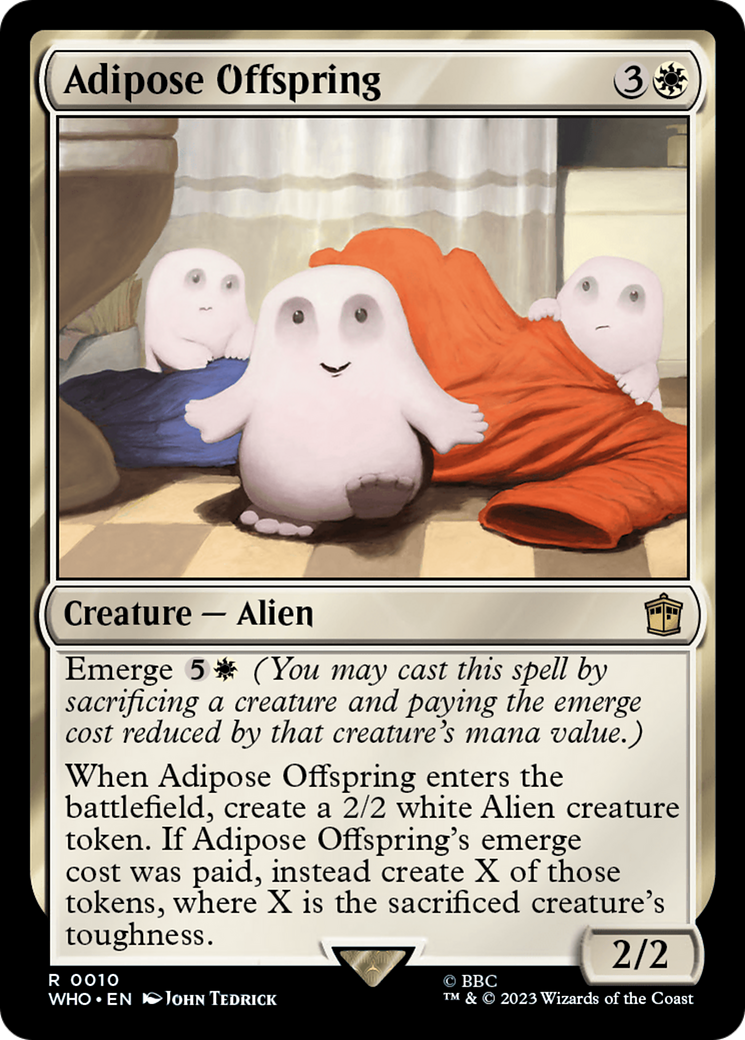
Adipose Offspring
Adipose Offspring
Creature — Alien
2/2
Emerge (You may cast this spell by sacrificing a creature and paying the emerge cost reduced by that creature's mana value.)
When this creature enters, create a 2/2 white Alien creature token. If this creature's emerge cost was paid, instead create X of those tokens, where X is the sacrificed creature's toughness.
- For Adipose Offspring's last ability, use the toughness of the sacrificed creature as it existed when it was last on the battlefield, which may be different from its toughness in the graveyard.
-
1
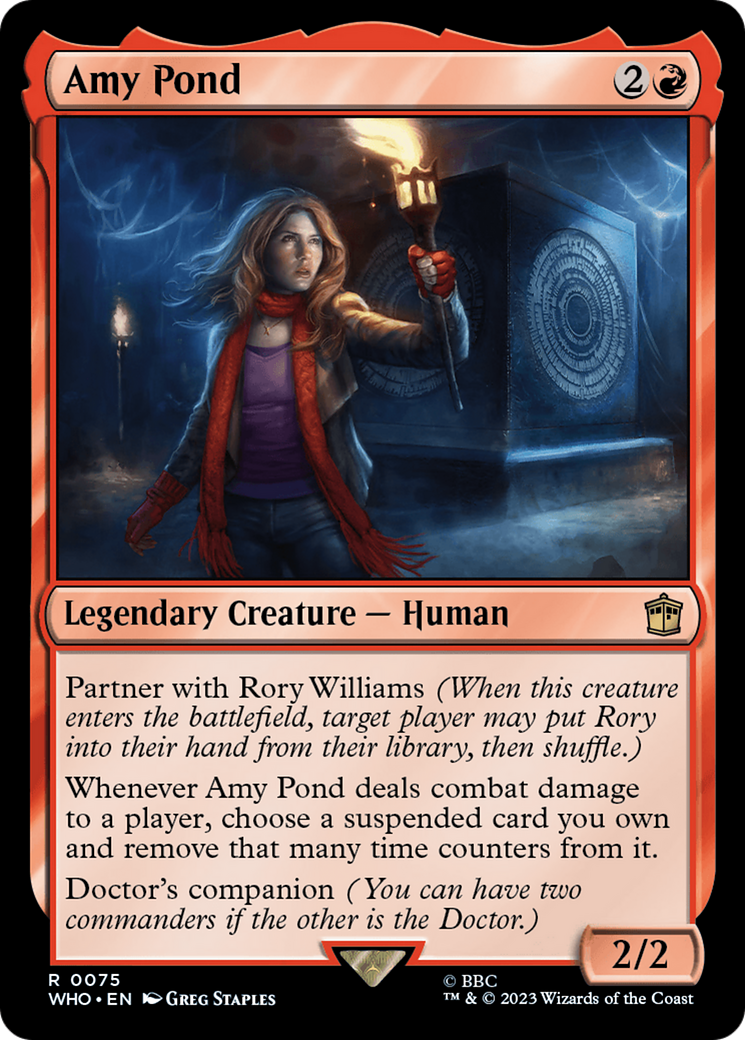
Amy Pond
Amy Pond
Legendary Creature — Human
2/2
Partner with Rory Williams (When this creature enters, target player may put Rory into their hand from their library, then shuffle.)
Whenever Amy Pond deals combat damage to a player, choose a suspended card you own and remove that many time counters from it.
Doctor's companion (You can have two commanders if the other is the Doctor.)
- A suspended card is a card that (1) has suspend, (2) is in exile, and (3) has one or more time counters on it.
- If you remove the last time counter from a suspended card this way, you will cast that card.
- Amy Pond has two different partner abilities, but you can't have Amy, Rory, and the Doctor as your commanders at the same time. Amy must choose one of the two. Even if your other commander is one of the Doctor cards, however, the "Partner with Rory Williams" ability can still search for Rory in a library.
- The Doctor's companion ability allows you to have two commanders if one has the ability and the other is a legendary creature that is a Time Lord Doctor and has no other creature types. Creatures with the changeling ability, for example, can't be a second commander this way.
- Although Doctor's companion is a new variant of the partner ability, the rules for partner have not otherwise changed. Notably, Time Lord Doctors and cards with Doctor's companion do not interact with cards which have another partner ability.
- If your Commander deck has two commanders, you can include only cards whose own color identities are also found in your commanders' combined color identities.
- Both commanders start in the command zone, and the remaining 98 cards (or 58 cards in a Commander Draft game) of your deck are shuffled to become your library.
- Once the game begins, your two commanders are tracked separately. If you cast one, you won't have to pay an additional the first time you cast the other. A player loses the game after having been dealt 21 combat damage from any one of them, not from both of them combined.
- If something refers to your commander while you have two commanders, it refers to one of them of your choice. If you are instructed to perform an action on your commander (e.g. put it from the command zone into your hand due to Command Beacon), you choose one of your commanders at the time the effect happens.
- An effect that checks whether you control your commander is satisfied if you control one or both of your two commanders.
- "Partner with [name]" represents two abilities. The first is a triggered ability: "When this permanent enters the battlefield, target player may search their library for a card named [name], reveal it, put it into their hand, then shuffle."
- The second ability represented by the "partner with [name]" keyword modifies the rules for deck construction in the Commander variant and has no function outside of that variant. If a legendary creature card with "partner with [name]" is designated as your commander, the named legendary creature card can also be designated as your commander.
- Note that the target player searches their library (which may be affected by effects such as that of Stranglehold) and that the card they find is revealed, even though these words aren't included in the ability's reminder text.
-
1
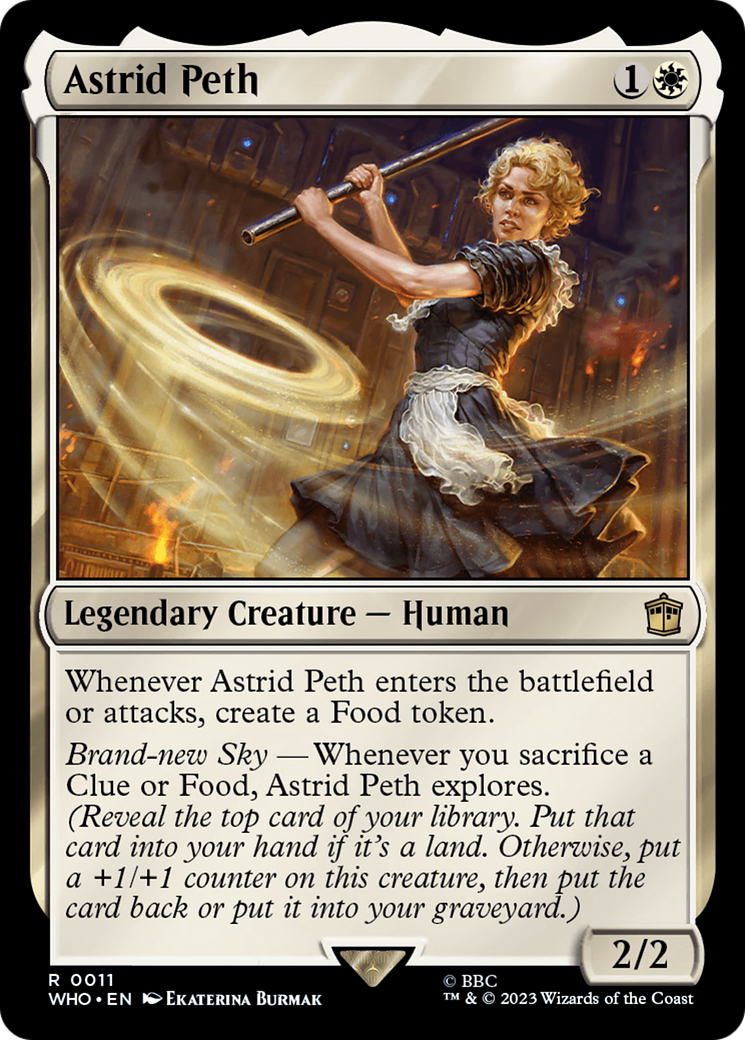
Astrid Peth
Astrid Peth
Legendary Creature — Human
2/2
Whenever Astrid Peth enters or attacks, create a Food token.
Brand-new Sky — Whenever you sacrifice a Clue or Food, Astrid Peth explores. (Reveal the top card of your library. Put that card into your hand if it's a land. Otherwise, put a +1/+1 counter on this creature, then put the card back or put it into your graveyard.)
- If an effect refers to a Food, it means any Food artifact, not just a Food artifact token. For example, you can sacrifice Tough Cookie (an Artifact Creature — Food Golem) to activate Maraleaf Rider's ability (an ability with "Sacrifice a Food" in its cost).
- Food is an artifact type. Even though it appears on some creatures, it's never a creature type.
- You can't sacrifice a Food to pay multiple costs. For example, you can't sacrifice a Food token to activate its own ability and also to activate Maraleaf Rider's ability.
- Whatever you do, don't eat the delicious cards.
- If no card is revealed, most likely because that player's library is empty, the exploring creature receives a +1/+1 counter.
- If a resolving spell or ability instructs a specific creature to explore but that creature has left the battlefield, the creature still explores. If you reveal a nonland card this way, you won't put a +1/+1 counter on anything, but you may put the revealed card into your graveyard. Effects that trigger "whenever a creature you control explores" trigger if appropriate.
- Once an ability that causes a creature to explore begins to resolve, no player may take any other actions until it's done. Notably, opponents can't try to remove the exploring creature after you reveal a nonland card but before it receives a counter.
-
1
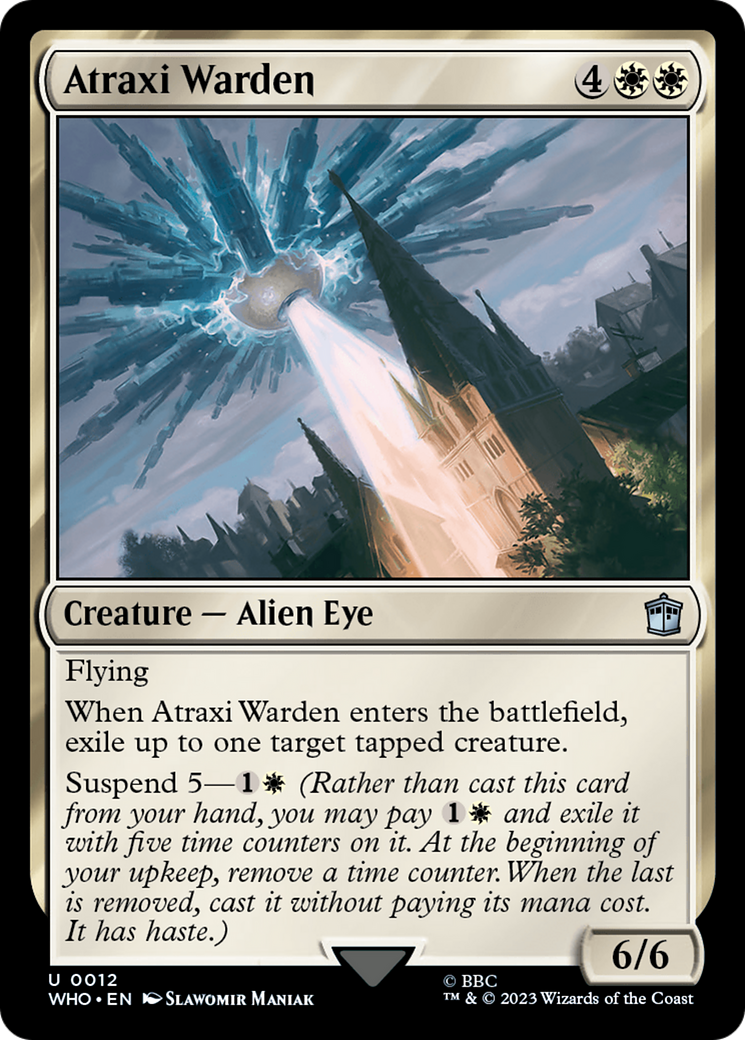
Atraxi Warden
Atraxi Warden
Creature — Alien Eye
6/6
Flying
When this creature enters, exile up to one target tapped creature.
Suspend 5— (Rather than cast this card from your hand, you may pay and exile it with five time counters on it. At the beginning of your upkeep, remove a time counter. When the last is removed, you may cast it without paying its mana cost. It has haste.)
- Suspend is a keyword that represents three abilities. The first is a static ability that allows you to exile the card from your hand with the specified number of time counters (the number before the dash) on it by paying its suspend cost (listed after the dash). The second is a triggered ability that removes a time counter from the suspended card at the beginning of each of your upkeeps. The third is a triggered ability that gives you the option to cast the card when the last time counter is removed.
- You can exile a card in your hand using suspend any time you could cast that card. Consider its card type, any effects that modify when you could cast it (such as flash) and any other effects that stop you from casting it (such as from Meddling Mage's ability) to determine if and when you can do this. Whether you could actually complete all steps in casting the card is irrelevant. For example, you can exile a card with suspend that has no mana cost or that requires a target even if no legal targets are available at that time.
- Cards exiled with suspend are exiled face up.
- Exiling a card with suspend isn't casting that card. This action doesn't use the stack and can't be responded to.
- If the spell requires any targets, those targets are chosen when the spell is finally cast, not when it's exiled.
- If an effect refers to a "suspended card," that means a card that (1) has suspend, (2) is in exile, and (3) has one or more time counters on it.
- If the first triggered ability of suspend (the one that removes time counters) is countered, no time counter is removed. The ability will trigger again at the beginning of the card's owner's next upkeep.
- When the last time counter is removed, the second triggered ability of suspend (the one that lets you cast the card) triggers. It doesn't matter why the last time counter was removed or what effect removed it.
- If the second triggered ability is countered, the card can't be cast. It remains exiled with no time counters on it, and it's no longer suspended.
- Due to a recent rules change to suspend, you are no longer required to cast the suspended card as the second triggered ability of suspend resolves. Instead, as the second triggered ability resolves, you may cast the card. Timing permissions based on the card's type are ignored. If you don't cast the card, it remains exiled with no time counters on it, and it's no longer suspended.
- If you cast a card "without paying its mana cost," such as with suspend, you can't choose to cast it for any alternative costs. You can, however, pay additional costs. If the card has any mandatory additional costs, you must pay those if you want to cast the card.
- If the card has in its mana cost, you must choose 0 as the value of X when casting it without paying its mana cost.
- The mana value of a spell cast without paying its mana cost is determined by its mana cost, even though that cost wasn't paid.
-
1
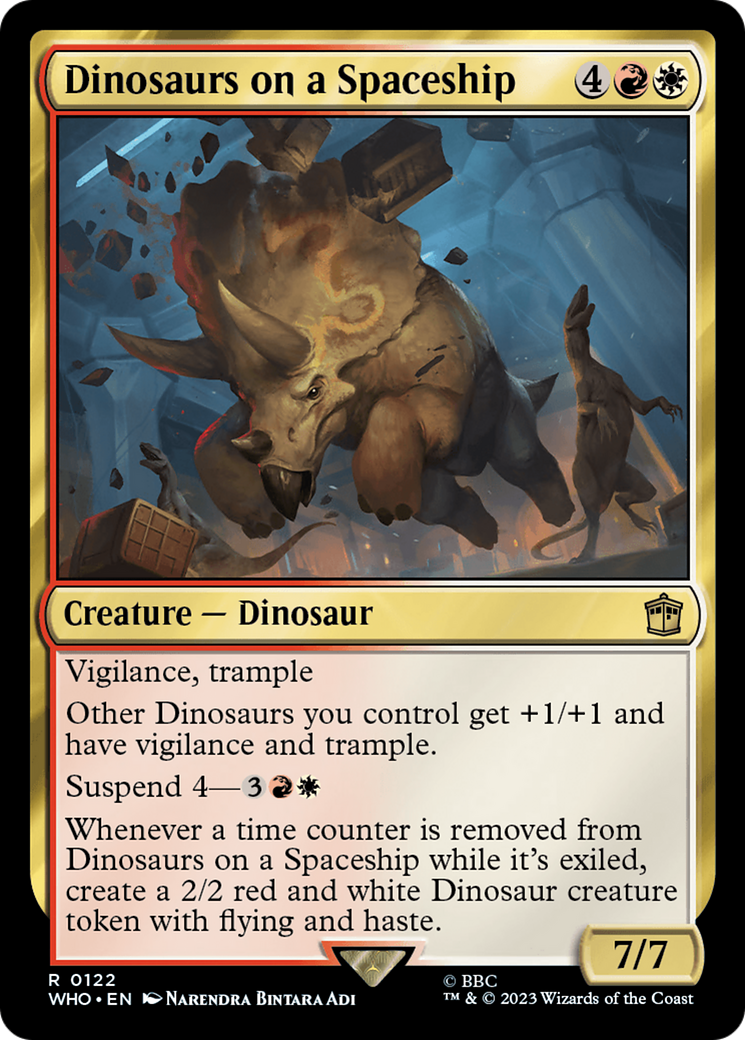
Dinosaurs on a Spaceship
Dinosaurs on a Spaceship
Creature — Dinosaur
7/7
Vigilance, trample
Other Dinosaurs you control get +1/+1 and have vigilance and trample.
Suspend 4—
Whenever a time counter is removed from this card while it's exiled, create a 2/2 red and white Dinosaur creature token with flying and haste.
- The mana value of a spell cast without paying its mana cost is determined by its mana cost, even though that cost wasn't paid.
- Suspend is a keyword that represents three abilities. The first is a static ability that allows you to exile the card from your hand with the specified number of time counters (the number before the dash) on it by paying its suspend cost (listed after the dash). The second is a triggered ability that removes a time counter from the suspended card at the beginning of each of your upkeeps. The third is a triggered ability that gives you the option to cast the card when the last time counter is removed.
- You can exile a card in your hand using suspend any time you could cast that card. Consider its card type, any effects that modify when you could cast it (such as flash) and any other effects that stop you from casting it (such as from Meddling Mage's ability) to determine if and when you can do this. Whether you could actually complete all steps in casting the card is irrelevant. For example, you can exile a card with suspend that has no mana cost or that requires a target even if no legal targets are available at that time.
- Cards exiled with suspend are exiled face up.
- Exiling a card with suspend isn't casting that card. This action doesn't use the stack and can't be responded to.
- If the spell requires any targets, those targets are chosen when the spell is finally cast, not when it's exiled.
- If an effect refers to a "suspended card," that means a card that (1) has suspend, (2) is in exile, and (3) has one or more time counters on it.
- If the first triggered ability of suspend (the one that removes time counters) is countered, no time counter is removed. The ability will trigger again at the beginning of the card's owner's next upkeep.
- When the last time counter is removed, the second triggered ability of suspend (the one that lets you cast the card) triggers. It doesn't matter why the last time counter was removed or what effect removed it.
- If the second triggered ability is countered, the card can't be cast. It remains exiled with no time counters on it, and it's no longer suspended.
- Due to a recent rules change to suspend, you are no longer required to cast the suspended card as the second triggered ability of suspend resolves. Instead, as the second triggered ability resolves, you may cast the card. Timing permissions based on the card's type are ignored. If you don't cast the card, it remains exiled with no time counters on it, and it's no longer suspended.
- If you cast a card "without paying its mana cost," such as with suspend, you can't choose to cast it for any alternative costs. You can, however, pay additional costs. If the card has any mandatory additional costs, you must pay those if you want to cast the card.
- If the card has in its mana cost, you must choose 0 as the value of X when casting it without paying its mana cost.
- If this card is suspended, then when the last time counter is removed from it, both its last ability and the "cast this spell" part of the suspend ability will trigger. They can be put on the stack in either order.
-
1
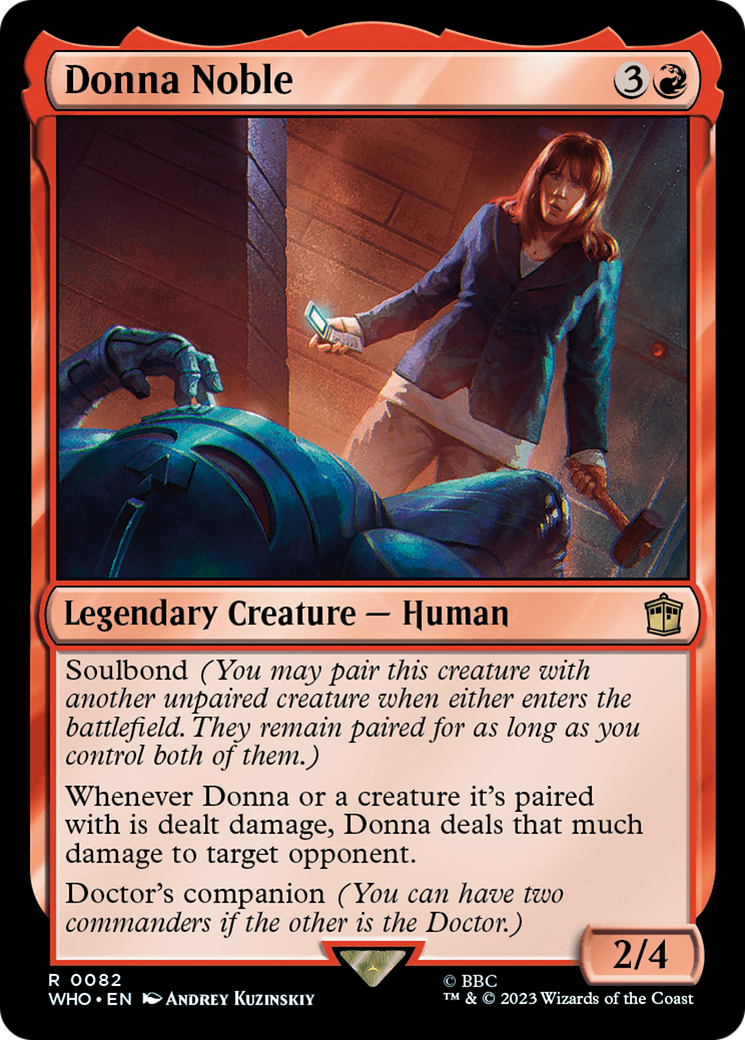
Donna Noble
Donna Noble
Legendary Creature — Human
2/4
Soulbond (You may pair this creature with another unpaired creature when either enters. They remain paired for as long as you control both of them.)
Whenever Donna Noble or a creature it's paired with is dealt damage, Donna Noble deals that much damage to target opponent.
Doctor's companion (You can have two commanders if the other is the Doctor.)
- If Donna is paired with another creature and they are both dealt damage at the same time, the second ability triggers twice.
- Donna's ability triggers when either creature is dealt damage even if one or both were dealt lethal damage.
- The Doctor's companion ability allows you to have two commanders if one has the ability and the other is a legendary creature that is a Time Lord Doctor and has no other creature types. Creatures with the changeling ability, for example, can't be a second commander this way.
- Although Doctor's companion is a new variant of the partner ability, the rules for partner have not otherwise changed. Notably, Time Lord Doctors and cards with Doctor's companion do not interact with cards which have another partner ability.
- If your Commander deck has two commanders, you can include only cards whose own color identities are also found in your commanders' combined color identities.
- Both commanders start in the command zone, and the remaining 98 cards (or 58 cards in a Commander Draft game) of your deck are shuffled to become your library.
- Once the game begins, your two commanders are tracked separately. If you cast one, you won't have to pay an additional the first time you cast the other. A player loses the game after having been dealt 21 combat damage from any one of them, not from both of them combined.
- If something refers to your commander while you have two commanders, it refers to one of them of your choice. If you are instructed to perform an action on your commander (e.g. put it from the command zone into your hand due to Command Beacon), you choose one of your commanders at the time the effect happens.
- An effect that checks whether you control your commander is satisfied if you control one or both of your two commanders.
-
1
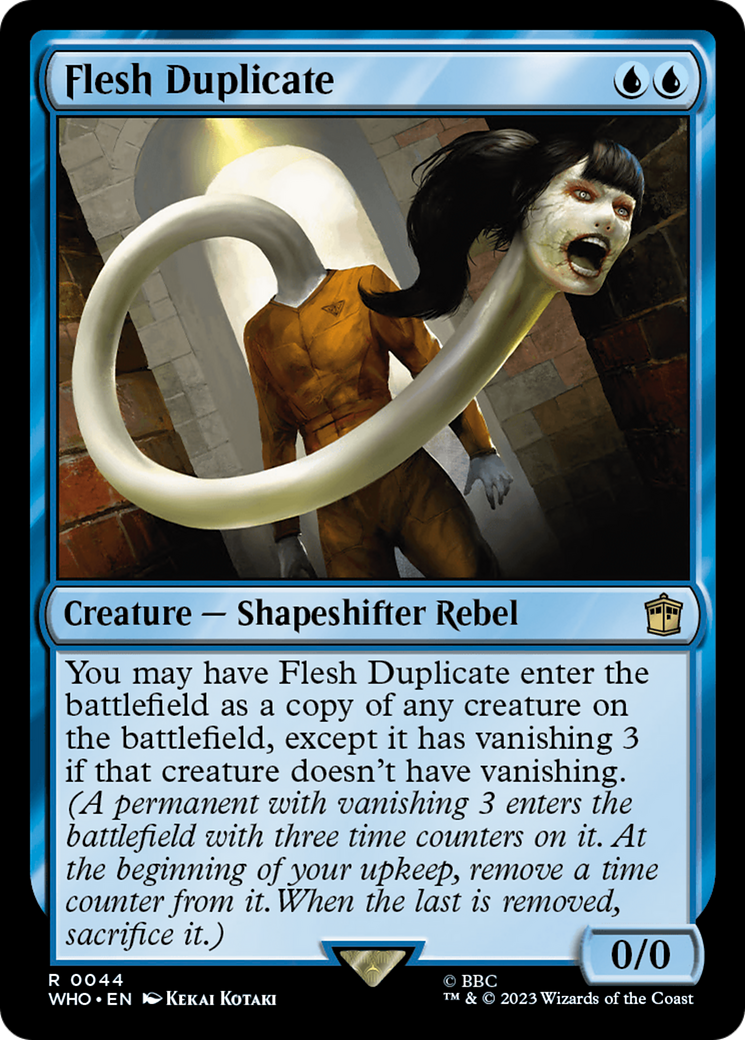
Flesh Duplicate
Flesh Duplicate
Creature — Shapeshifter Rebel
0/0
You may have this creature enter as a copy of any creature on the battlefield, except it has vanishing 3 if that creature doesn't have vanishing. (A permanent with vanishing 3 enters with three time counters on it. At the beginning of your upkeep, remove a time counter from it. When the last is removed, sacrifice it.)
-
1
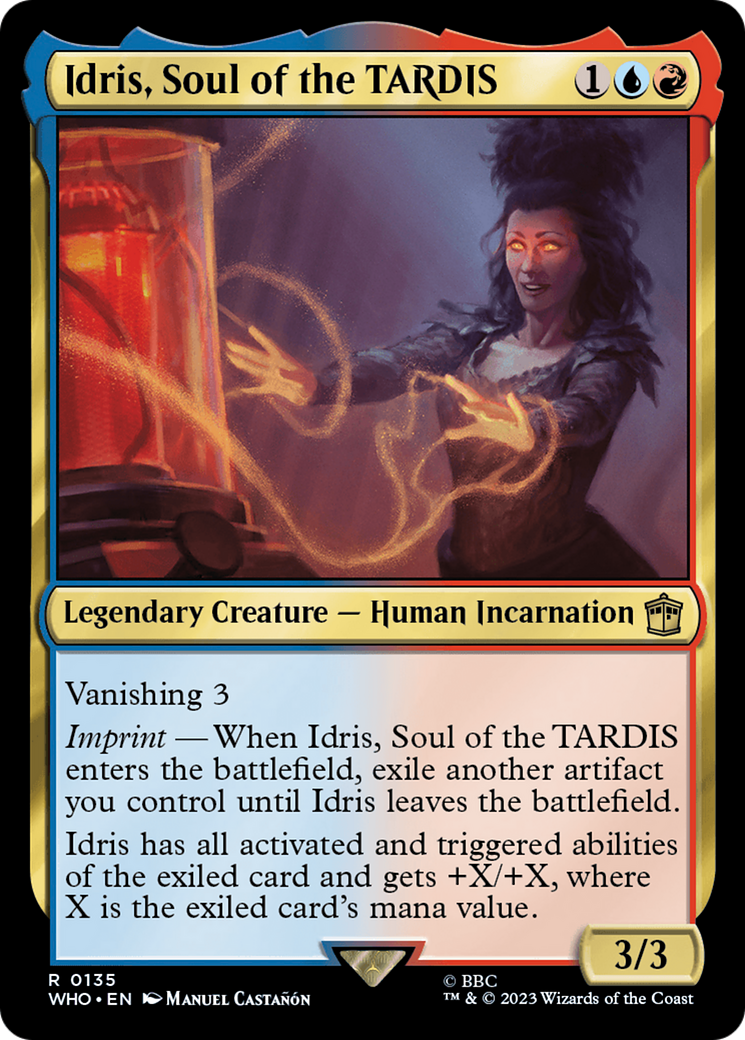
Idris, Soul of the TARDIS
Idris, Soul of the TARDIS
Legendary Creature — Human Incarnation
3/3
Vanishing 3
Imprint — When Idris enters, exile another artifact you control until Idris leaves the battlefield.
Idris has all activated and triggered abilities of the exiled card and gets +X/+X, where X is the exiled card's mana value.
- Activated abilities contain a colon. They're generally written "[Cost]: [Effect]." Some keyword abilities, like equip, are activated abilities and they have colons in their reminder text.
- Triggered abilities use the word "when," "whenever," or "at." They're often written as "[Trigger condition], [effect]." Some keyword abilities, such as prowess, are triggered abilities and will have "when," "whenever," or "at" in their reminder text.
- If the exiled card has an in its mana cost, the value of X is 0 when determining that card's mana value.
-
1
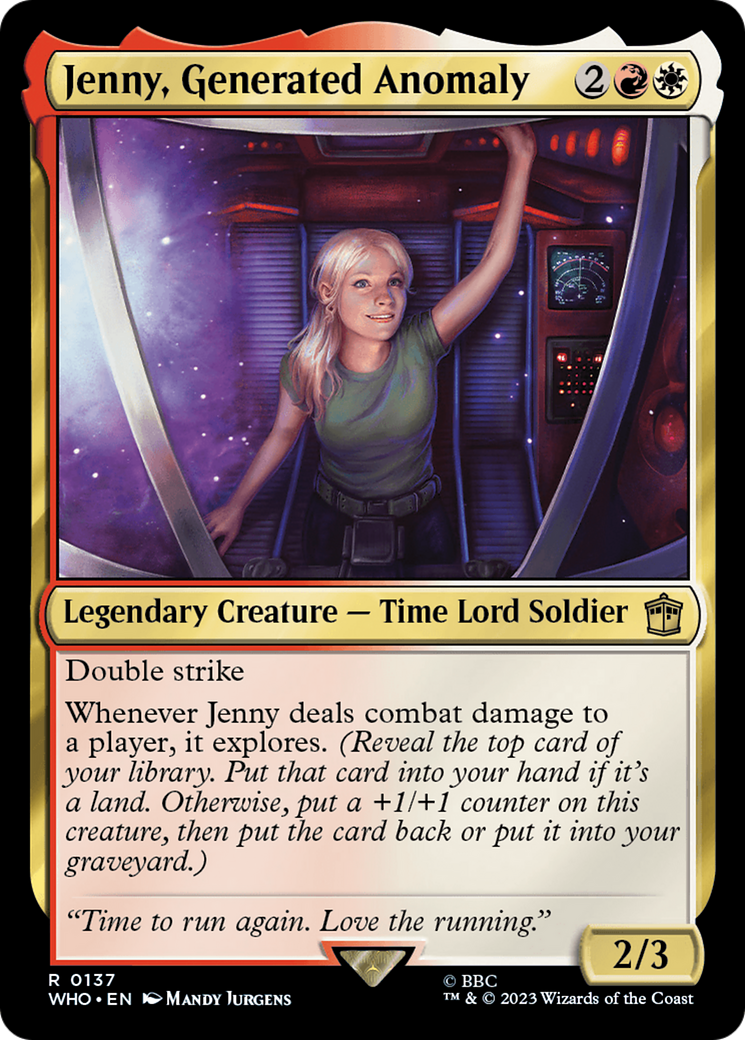
Jenny, Generated Anomaly
Jenny, Generated Anomaly
Legendary Creature — Time Lord Soldier
2/3
Double strike
Whenever Jenny deals combat damage to a player, it explores. (Reveal the top card of your library. Put that card into your hand if it's a land. Otherwise, put a +1/+1 counter on this creature, then put the card back or put it into your graveyard.)
- Once an ability that causes a creature to explore begins to resolve, no player may take any other actions until it's done. Notably, opponents can't try to remove the exploring creature after you reveal a nonland card but before it receives a counter.
- If no card is revealed, most likely because that player's library is empty, the exploring creature receives a +1/+1 counter.
- If a resolving spell or ability instructs a specific creature to explore but that creature has left the battlefield, the creature still explores. If you reveal a nonland card this way, you won't put a +1/+1 counter on anything, but you may put the revealed card into your graveyard. Effects that trigger "whenever a creature you control explores" trigger if appropriate.
- Unlike other creature types in Magic that are each only one word, the two words "Time Lord" represent a single creature subtype. Time Lord is the only two-word creature type.
- Neither "Time" nor "Lord" are creature types. Some older cards were printed with the subtype "Lord," but all of those cards have updated Oracle card text that removed that type.
- If an effect instructs you to choose a creature type, you may choose Time Lord.
-
1
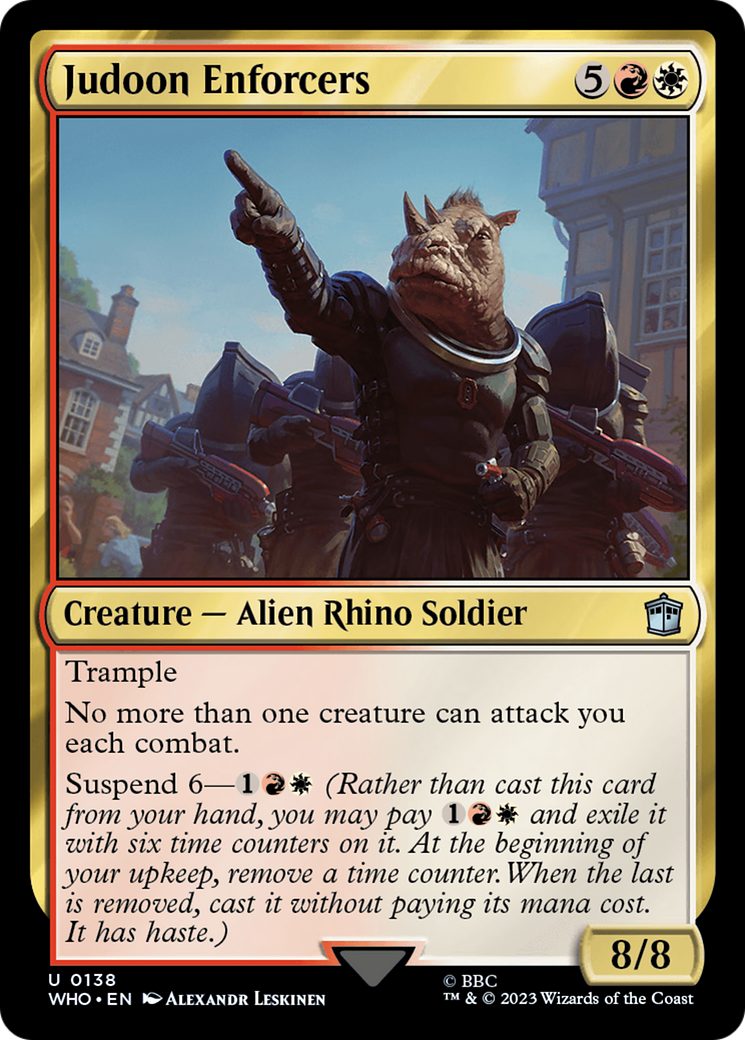
Judoon Enforcers
Judoon Enforcers
Creature — Alien Rhino Soldier
8/8
Trample
No more than one creature can attack you each combat.
Suspend 6— (Rather than cast this card from your hand, you may pay and exile it with six time counters on it. At the beginning of your upkeep, remove a time counter. When the last is removed, you may cast it without paying its mana cost. It has haste.)
- Suspend is a keyword that represents three abilities. The first is a static ability that allows you to exile the card from your hand with the specified number of time counters (the number before the dash) on it by paying its suspend cost (listed after the dash). The second is a triggered ability that removes a time counter from the suspended card at the beginning of each of your upkeeps. The third is a triggered ability that gives you the option to cast the card when the last time counter is removed.
- You can exile a card in your hand using suspend any time you could cast that card. Consider its card type, any effects that modify when you could cast it (such as flash) and any other effects that stop you from casting it (such as from Meddling Mage's ability) to determine if and when you can do this. Whether you could actually complete all steps in casting the card is irrelevant. For example, you can exile a card with suspend that has no mana cost or that requires a target even if no legal targets are available at that time.
- Cards exiled with suspend are exiled face up.
- Exiling a card with suspend isn't casting that card. This action doesn't use the stack and can't be responded to.
- If the spell requires any targets, those targets are chosen when the spell is finally cast, not when it's exiled.
- If an effect refers to a "suspended card," that means a card that (1) has suspend, (2) is in exile, and (3) has one or more time counters on it.
- If the first triggered ability of suspend (the one that removes time counters) is countered, no time counter is removed. The ability will trigger again at the beginning of the card's owner's next upkeep.
- When the last time counter is removed, the second triggered ability of suspend (the one that lets you cast the card) triggers. It doesn't matter why the last time counter was removed or what effect removed it.
- If the second triggered ability is countered, the card can't be cast. It remains exiled with no time counters on it, and it's no longer suspended.
- Due to a recent rules change to suspend, you are no longer required to cast the suspended card as the second triggered ability of suspend resolves. Instead, as the second triggered ability resolves, you may cast the card. Timing permissions based on the card's type are ignored. If you don't cast the card, it remains exiled with no time counters on it, and it's no longer suspended.
- If you cast a card "without paying its mana cost," such as with suspend, you can't choose to cast it for any alternative costs. You can, however, pay additional costs. If the card has any mandatory additional costs, you must pay those if you want to cast the card.
- If the card has in its mana cost, you must choose 0 as the value of X when casting it without paying its mana cost.
- The mana value of a spell cast without paying its mana cost is determined by its mana cost, even though that cost wasn't paid.
-
1
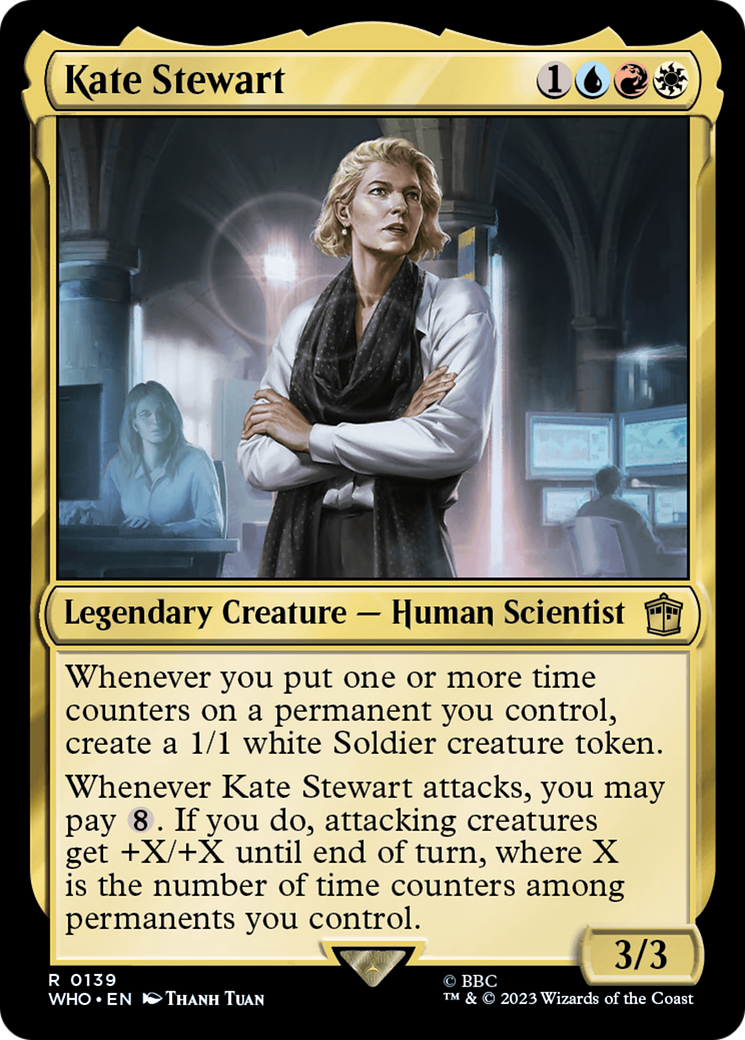
Kate Stewart
Kate Stewart
Legendary Creature — Human Scientist
3/3
Whenever you put one or more time counters on a permanent you control, create a 1/1 white Soldier creature token.
Whenever Kate Stewart attacks, you may pay . If you do, attacking creatures get +X/+X until end of turn, where X is the number of time counters among permanents you control.
- Kate Stewart's first ability triggers only when you put time counters on permanents. It does not trigger when you put time counters on cards in exile.
- Similarly, its last ability counts only time counters on permanents, not on cards you own in exile.
-
1
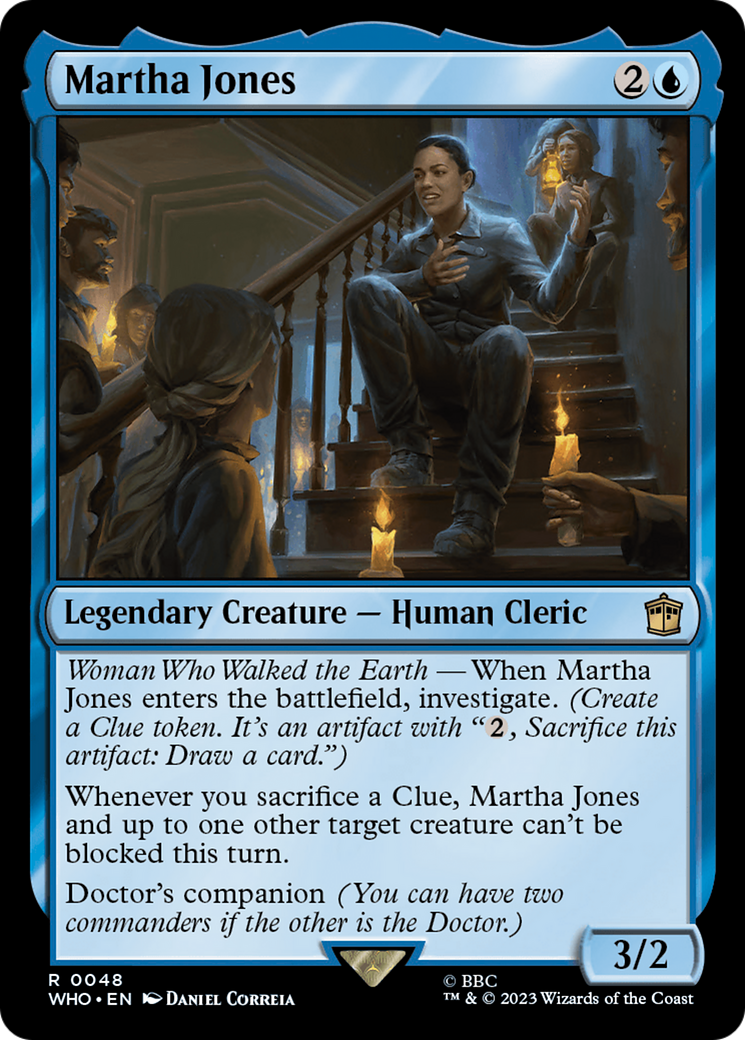
Martha Jones
Martha Jones
Legendary Creature — Human Cleric
3/2
Woman Who Walked the Earth — When Martha Jones enters, investigate. (Create a Clue token. It's an artifact with " , Sacrifice this token: Draw a card.")
Whenever you sacrifice a Clue, Martha Jones and up to one other target creature can't be blocked this turn.
Doctor's companion (You can have two commanders if the other is the Doctor.)
- The Doctor's companion ability allows you to have two commanders if one has the ability and the other is a legendary creature that is a Time Lord Doctor and has no other creature types. Creatures with the changeling ability, for example, can't be a second commander this way.
- Although Doctor's companion is a new variant of the partner ability, the rules for partner have not otherwise changed. Notably, Time Lord Doctors and cards with Doctor's companion do not interact with cards which have another partner ability.
- If your Commander deck has two commanders, you can include only cards whose own color identities are also found in your commanders' combined color identities.
- Both commanders start in the command zone, and the remaining 98 cards (or 58 cards in a Commander Draft game) of your deck are shuffled to become your library.
- Once the game begins, your two commanders are tracked separately. If you cast one, you won't have to pay an additional the first time you cast the other. A player loses the game after having been dealt 21 combat damage from any one of them, not from both of them combined.
- If something refers to your commander while you have two commanders, it refers to one of them of your choice. If you are instructed to perform an action on your commander (e.g. put it from the command zone into your hand due to Command Beacon), you choose one of your commanders at the time the effect happens.
- An effect that checks whether you control your commander is satisfied if you control one or both of your two commanders.
-
1
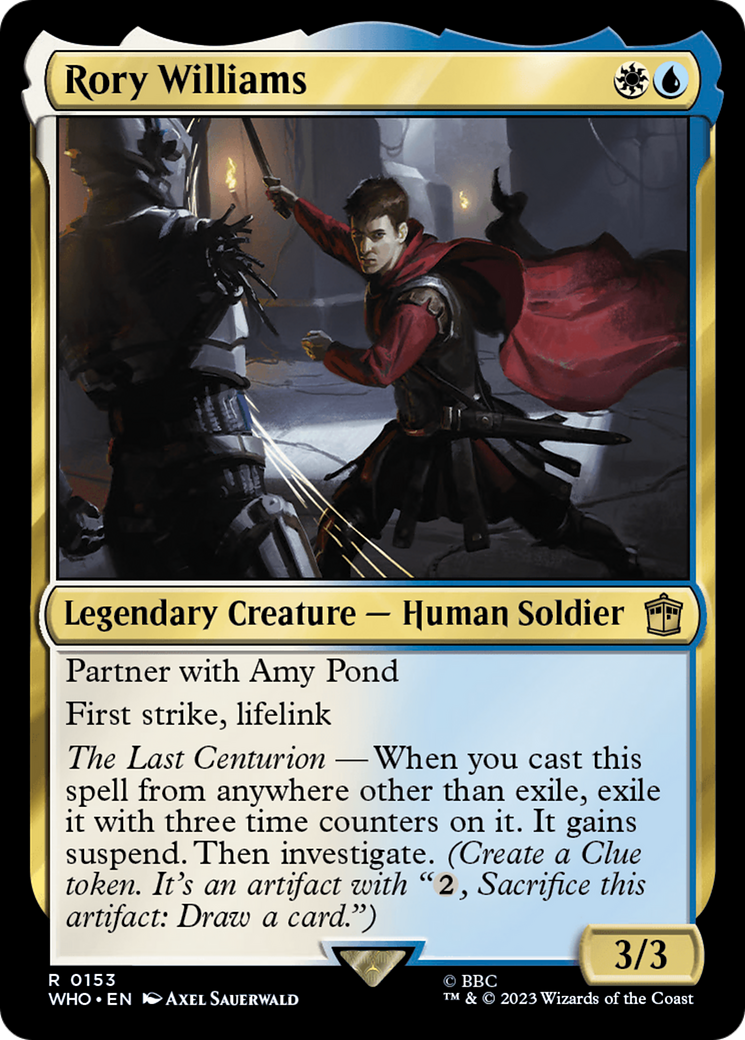
Rory Williams
Rory Williams
Legendary Creature — Human Soldier
3/3
Partner with Amy Pond
First strike, lifelink
The Last Centurion — When you cast this spell from anywhere other than exile, exile it with three time counters on it. It gains suspend. Then investigate. (Create a Clue token. It's an artifact with " , Sacrifice this token: Draw a card.")
- The mana value of a spell cast without paying its mana cost is determined by its mana cost, even though that cost wasn't paid.
- If the first triggered ability of suspend (the one that removes time counters) is countered, no time counter is removed. The ability will trigger again at the beginning of the card's owner's next upkeep.
- When the last time counter is removed, the second triggered ability of suspend (the one that lets you cast the card) triggers. It doesn't matter why the last time counter was removed or what effect removed it.
- If the second triggered ability is countered, the card can't be cast. It remains exiled with no time counters on it, and it's no longer suspended.
- Due to a recent rules change to suspend, you are no longer required to cast the suspended card as the second triggered ability of suspend resolves. Instead, as the second triggered ability resolves, you may cast the card. Timing permissions based on the card's type are ignored. If you don't cast the card, it remains exiled with no time counters on it, and it's no longer suspended.
- If you cast a card "without paying its mana cost," such as with suspend, you can't choose to cast it for any alternative costs. You can, however, pay additional costs. If the card has any mandatory additional costs, you must pay those if you want to cast the card.
- If the card has in its mana cost, you must choose 0 as the value of X when casting it without paying its mana cost.
- Suspend is a keyword that represents three abilities. The first is a static ability that allows you to exile the card from your hand with the specified number of time counters (the number before the dash) on it by paying its suspend cost (listed after the dash). The second is a triggered ability that removes a time counter from the suspended card at the beginning of each of your upkeeps. The third is a triggered ability that gives you the option to cast the card when the last time counter is removed.
- You can exile a card in your hand using suspend any time you could cast that card. Consider its card type, any effects that modify when you could cast it (such as flash) and any other effects that stop you from casting it (such as from Meddling Mage's ability) to determine if and when you can do this. Whether you could actually complete all steps in casting the card is irrelevant. For example, you can exile a card with suspend that has no mana cost or that requires a target even if no legal targets are available at that time.
- Cards exiled with suspend are exiled face up.
- Exiling a card with suspend isn't casting that card. This action doesn't use the stack and can't be responded to.
- If the spell requires any targets, those targets are chosen when the spell is finally cast, not when it's exiled.
- If an effect refers to a "suspended card," that means a card that (1) has suspend, (2) is in exile, and (3) has one or more time counters on it.
- If you somehow counter the ability that triggers when you cast Rory Williams, it will resolve normally and will not be exiled.
- Rory will resolve normally if cast from exile for any reason, not only if it was cast with its suspend ability.
- "Partner with [name]" represents two abilities. The first is a triggered ability: "When this permanent enters the battlefield, target player may search their library for a card named [name], reveal it, put it into their hand, then shuffle."
- The second ability represented by the "partner with [name]" keyword modifies the rules for deck construction in the Commander variant and has no function outside of that variant. If a legendary creature card with "partner with [name]" is designated as your commander, the named legendary creature card can also be designated as your commander.
- Note that the target player searches their library (which may be affected by effects such as that of Stranglehold) and that the card they find is revealed, even though these words aren't included in the ability's reminder text.
- For example, if you cast Rory Williams from your hand, the triggered ability will exile it and it will gain suspend. When you cast it from exile, it resolves normally.
-
1
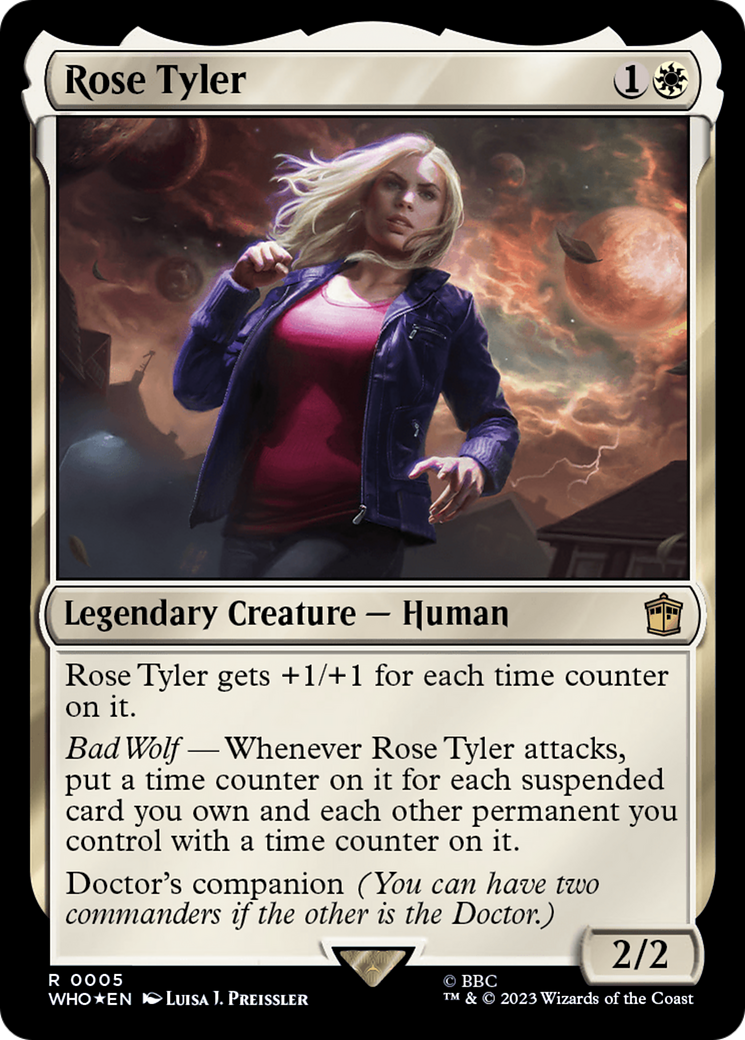
Rose Tyler
Rose Tyler
Legendary Creature — Human
2/2
Rose Tyler gets +1/+1 for each time counter on it.
Bad Wolf — Whenever Rose Tyler attacks, put a time counter on it for each suspended card you own and each other permanent you control with a time counter on it.
Doctor's companion (You can have two commanders if the other is the Doctor.)
- A suspended card is a card in exile with suspend that has at least one time counter on it. That includes any cards which were put there by an effect that says they "gain suspend" or similar.
- The Doctor's companion ability allows you to have two commanders if one has the ability and the other is a legendary creature that is a Time Lord Doctor and has no other creature types. Creatures with the changeling ability, for example, can't be a second commander this way.
- Although Doctor's companion is a new variant of the partner ability, the rules for partner have not otherwise changed. Notably, Time Lord Doctors and cards with Doctor's companion do not interact with cards which have another partner ability.
- If your Commander deck has two commanders, you can include only cards whose own color identities are also found in your commanders' combined color identities.
- Both commanders start in the command zone, and the remaining 98 cards (or 58 cards in a Commander Draft game) of your deck are shuffled to become your library.
- Once the game begins, your two commanders are tracked separately. If you cast one, you won't have to pay an additional the first time you cast the other. A player loses the game after having been dealt 21 combat damage from any one of them, not from both of them combined.
- If something refers to your commander while you have two commanders, it refers to one of them of your choice. If you are instructed to perform an action on your commander (e.g. put it from the command zone into your hand due to Command Beacon), you choose one of your commanders at the time the effect happens.
- An effect that checks whether you control your commander is satisfied if you control one or both of your two commanders.
-
1
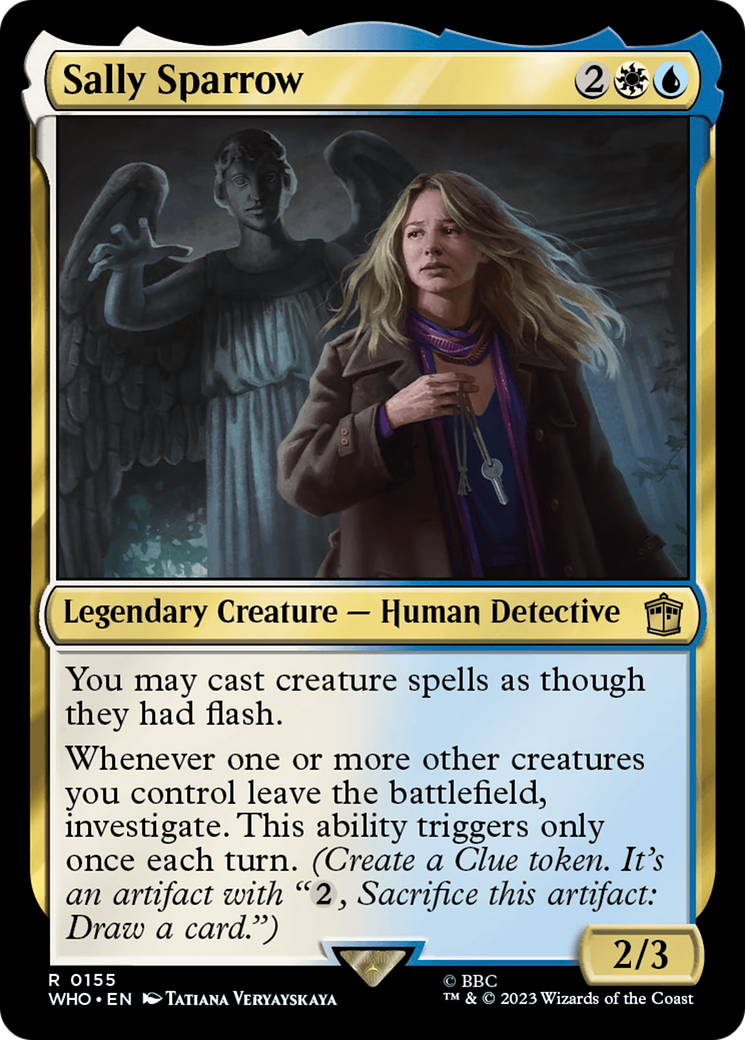
Sally Sparrow
Sally Sparrow
Legendary Creature — Human Detective
2/3
You may cast creature spells as though they had flash.
Whenever one or more other creatures you control leave the battlefield, investigate. This ability triggers only once each turn. (Create a Clue token. It's an artifact with " , Sacrifice this token: Draw a card.")
- If Sally Sparrow leaves the battlefield at the same time as the other creatures, its last ability will trigger.
-
1
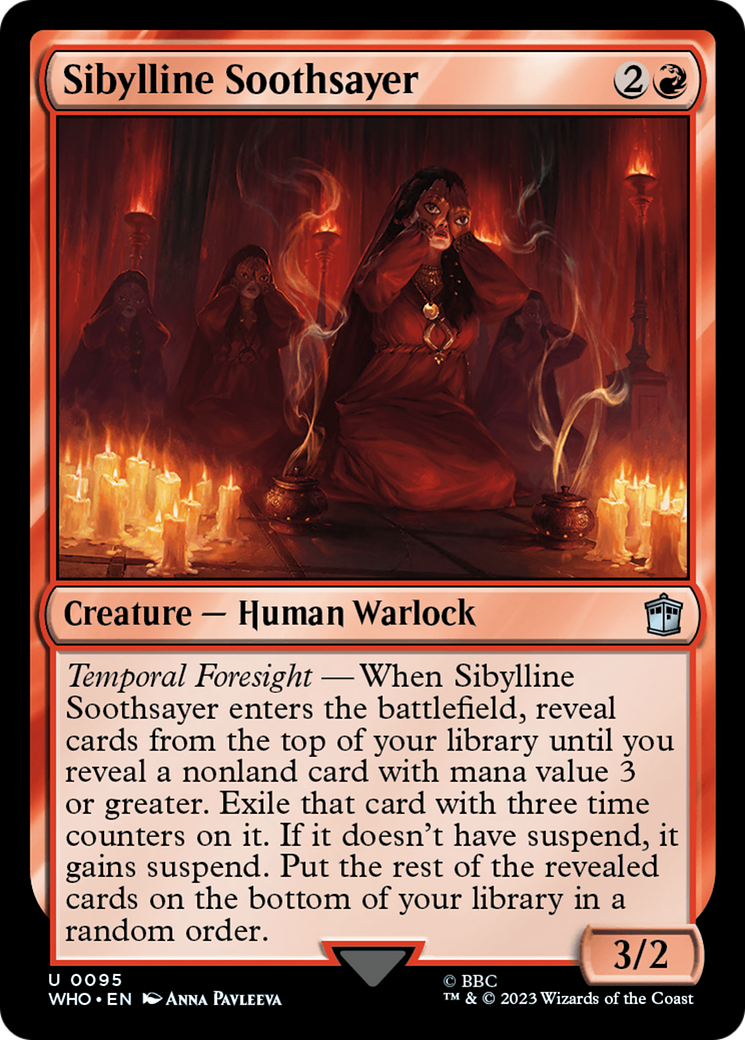
Sibylline Soothsayer
Sibylline Soothsayer
Creature — Human Warlock
3/2
Temporal Foresight — When this creature enters, reveal cards from the top of your library until you reveal a nonland card with mana value 3 or greater. Exile that card with three time counters on it. If it doesn't have suspend, it gains suspend. Put the rest of the revealed cards on the bottom of your library in a random order.
- Suspend is a keyword that represents three abilities. The first is a static ability that allows you to exile the card from your hand with the specified number of time counters (the number before the dash) on it by paying its suspend cost (listed after the dash). The second is a triggered ability that removes a time counter from the suspended card at the beginning of each of your upkeeps. The third is a triggered ability that gives you the option to cast the card when the last time counter is removed.
- You can exile a card in your hand using suspend any time you could cast that card. Consider its card type, any effects that modify when you could cast it (such as flash) and any other effects that stop you from casting it (such as from Meddling Mage's ability) to determine if and when you can do this. Whether you could actually complete all steps in casting the card is irrelevant. For example, you can exile a card with suspend that has no mana cost or that requires a target even if no legal targets are available at that time.
- Cards exiled with suspend are exiled face up.
- Exiling a card with suspend isn't casting that card. This action doesn't use the stack and can't be responded to.
- If the spell requires any targets, those targets are chosen when the spell is finally cast, not when it's exiled.
- If an effect refers to a "suspended card," that means a card that (1) has suspend, (2) is in exile, and (3) has one or more time counters on it.
- If the first triggered ability of suspend (the one that removes time counters) is countered, no time counter is removed. The ability will trigger again at the beginning of the card's owner's next upkeep.
- When the last time counter is removed, the second triggered ability of suspend (the one that lets you cast the card) triggers. It doesn't matter why the last time counter was removed or what effect removed it.
- If the second triggered ability is countered, the card can't be cast. It remains exiled with no time counters on it, and it's no longer suspended.
- Due to a recent rules change to suspend, you are no longer required to cast the suspended card as the second triggered ability of suspend resolves. Instead, as the second triggered ability resolves, you may cast the card. Timing permissions based on the card's type are ignored. If you don't cast the card, it remains exiled with no time counters on it, and it's no longer suspended.
- If you cast a card "without paying its mana cost," such as with suspend, you can't choose to cast it for any alternative costs. You can, however, pay additional costs. If the card has any mandatory additional costs, you must pay those if you want to cast the card.
- If the card has in its mana cost, you must choose 0 as the value of X when casting it without paying its mana cost.
- The mana value of a spell cast without paying its mana cost is determined by its mana cost, even though that cost wasn't paid.
-
1
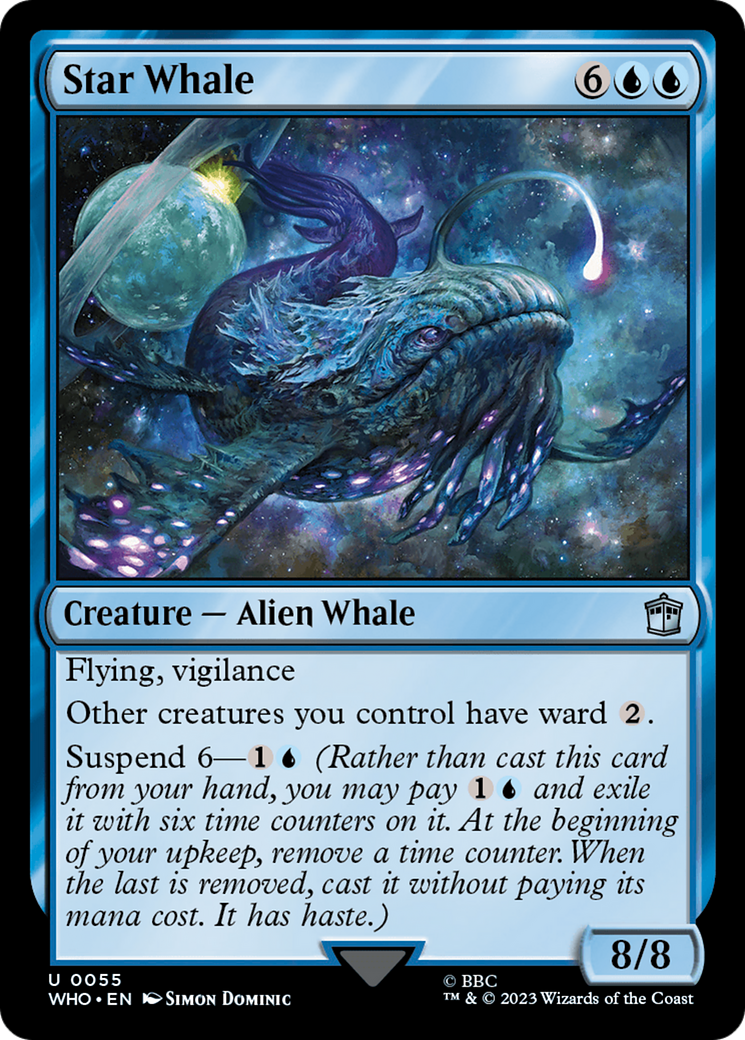
Star Whale
Star Whale
Creature — Alien Whale
8/8
Flying, vigilance
Other creatures you control have ward .
Suspend 6— (Rather than cast this card from your hand, you may pay and exile it with six time counters on it. At the beginning of your upkeep, remove a time counter. When the last is removed, you may cast it without paying its mana cost. It has haste.)
- Suspend is a keyword that represents three abilities. The first is a static ability that allows you to exile the card from your hand with the specified number of time counters (the number before the dash) on it by paying its suspend cost (listed after the dash). The second is a triggered ability that removes a time counter from the suspended card at the beginning of each of your upkeeps. The third is a triggered ability that gives you the option to cast the card when the last time counter is removed.
- You can exile a card in your hand using suspend any time you could cast that card. Consider its card type, any effects that modify when you could cast it (such as flash) and any other effects that stop you from casting it (such as from Meddling Mage's ability) to determine if and when you can do this. Whether you could actually complete all steps in casting the card is irrelevant. For example, you can exile a card with suspend that has no mana cost or that requires a target even if no legal targets are available at that time.
- Cards exiled with suspend are exiled face up.
- Exiling a card with suspend isn't casting that card. This action doesn't use the stack and can't be responded to.
- If the spell requires any targets, those targets are chosen when the spell is finally cast, not when it's exiled.
- If an effect refers to a "suspended card," that means a card that (1) has suspend, (2) is in exile, and (3) has one or more time counters on it.
- If the first triggered ability of suspend (the one that removes time counters) is countered, no time counter is removed. The ability will trigger again at the beginning of the card's owner's next upkeep.
- When the last time counter is removed, the second triggered ability of suspend (the one that lets you cast the card) triggers. It doesn't matter why the last time counter was removed or what effect removed it.
- If the second triggered ability is countered, the card can't be cast. It remains exiled with no time counters on it, and it's no longer suspended.
- Due to a recent rules change to suspend, you are no longer required to cast the suspended card as the second triggered ability of suspend resolves. Instead, as the second triggered ability resolves, you may cast the card. Timing permissions based on the card's type are ignored. If you don't cast the card, it remains exiled with no time counters on it, and it's no longer suspended.
- If you cast a card "without paying its mana cost," such as with suspend, you can't choose to cast it for any alternative costs. You can, however, pay additional costs. If the card has any mandatory additional costs, you must pay those if you want to cast the card.
- If the card has in its mana cost, you must choose 0 as the value of X when casting it without paying its mana cost.
- The mana value of a spell cast without paying its mana cost is determined by its mana cost, even though that cost wasn't paid.
-
1
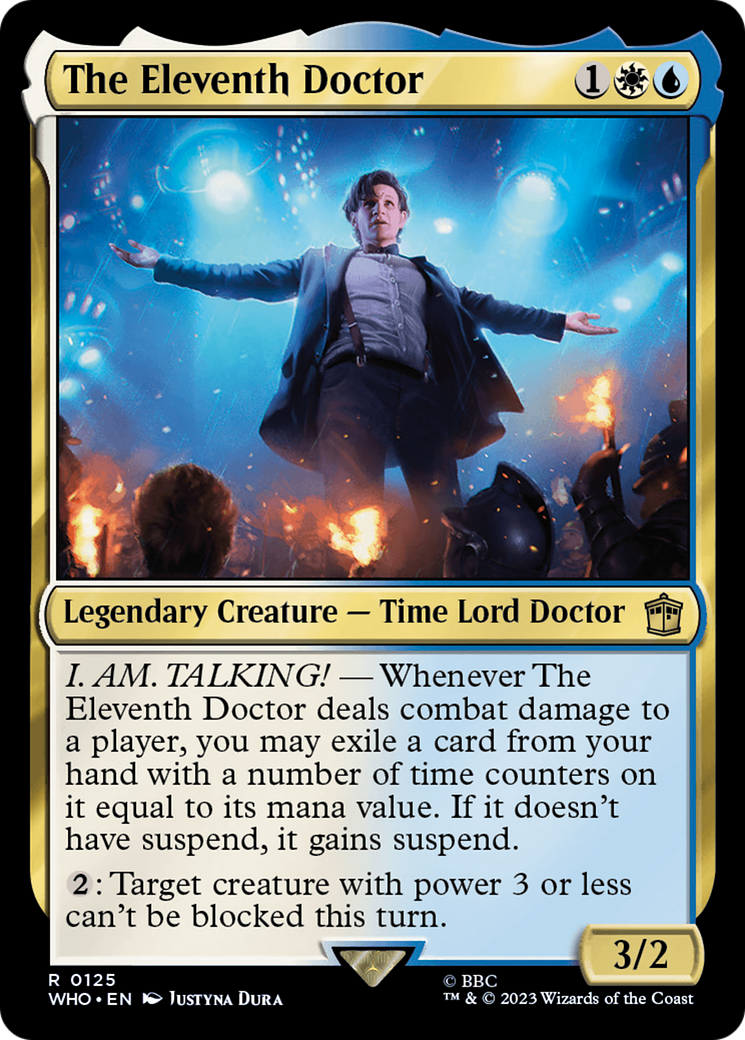
The Eleventh Doctor
The Eleventh Doctor
Legendary Creature — Time Lord Doctor
3/2
I. AM. TALKING! — Whenever The Eleventh Doctor deals combat damage to a player, you may exile a card from your hand with a number of time counters on it equal to its mana value. If it doesn't have suspend, it gains suspend.
: Target creature with power 3 or less can't be blocked this turn.
- The mana value of a spell cast without paying its mana cost is determined by its mana cost, even though that cost wasn't paid.
- If the second triggered ability is countered, the card can't be cast. It remains exiled with no time counters on it, and it's no longer suspended.
- Due to a recent rules change to suspend, you are no longer required to cast the suspended card as the second triggered ability of suspend resolves. Instead, as the second triggered ability resolves, you may cast the card. Timing permissions based on the card's type are ignored. If you don't cast the card, it remains exiled with no time counters on it, and it's no longer suspended.
- If you cast a card "without paying its mana cost," such as with suspend, you can't choose to cast it for any alternative costs. You can, however, pay additional costs. If the card has any mandatory additional costs, you must pay those if you want to cast the card.
- If the card has in its mana cost, you must choose 0 as the value of X when casting it without paying its mana cost.
- Suspend is a keyword that represents three abilities. The first is a static ability that allows you to exile the card from your hand with the specified number of time counters (the number before the dash) on it by paying its suspend cost (listed after the dash). The second is a triggered ability that removes a time counter from the suspended card at the beginning of each of your upkeeps. The third is a triggered ability that gives you the option to cast the card when the last time counter is removed.
- You can exile a card in your hand using suspend any time you could cast that card. Consider its card type, any effects that modify when you could cast it (such as flash) and any other effects that stop you from casting it (such as from Meddling Mage's ability) to determine if and when you can do this. Whether you could actually complete all steps in casting the card is irrelevant. For example, you can exile a card with suspend that has no mana cost or that requires a target even if no legal targets are available at that time.
- Cards exiled with suspend are exiled face up.
- Exiling a card with suspend isn't casting that card. This action doesn't use the stack and can't be responded to.
- If the spell requires any targets, those targets are chosen when the spell is finally cast, not when it's exiled.
- If an effect refers to a "suspended card," that means a card that (1) has suspend, (2) is in exile, and (3) has one or more time counters on it.
- If the first triggered ability of suspend (the one that removes time counters) is countered, no time counter is removed. The ability will trigger again at the beginning of the card's owner's next upkeep.
- When the last time counter is removed, the second triggered ability of suspend (the one that lets you cast the card) triggers. It doesn't matter why the last time counter was removed or what effect removed it.
- Unlike other creature types in Magic that are each only one word, the two words "Time Lord" represent a single creature subtype. Time Lord is the only two-word creature type.
- Neither "Time" nor "Lord" are creature types. Some older cards were printed with the subtype "Lord," but all of those cards have updated Oracle card text that removed that type.
- If an effect instructs you to choose a creature type, you may choose Time Lord.
- After The Eleventh Doctor's last ability resolves, that creature can't be blocked this turn even if its power later increases to greater than 3.
-
1
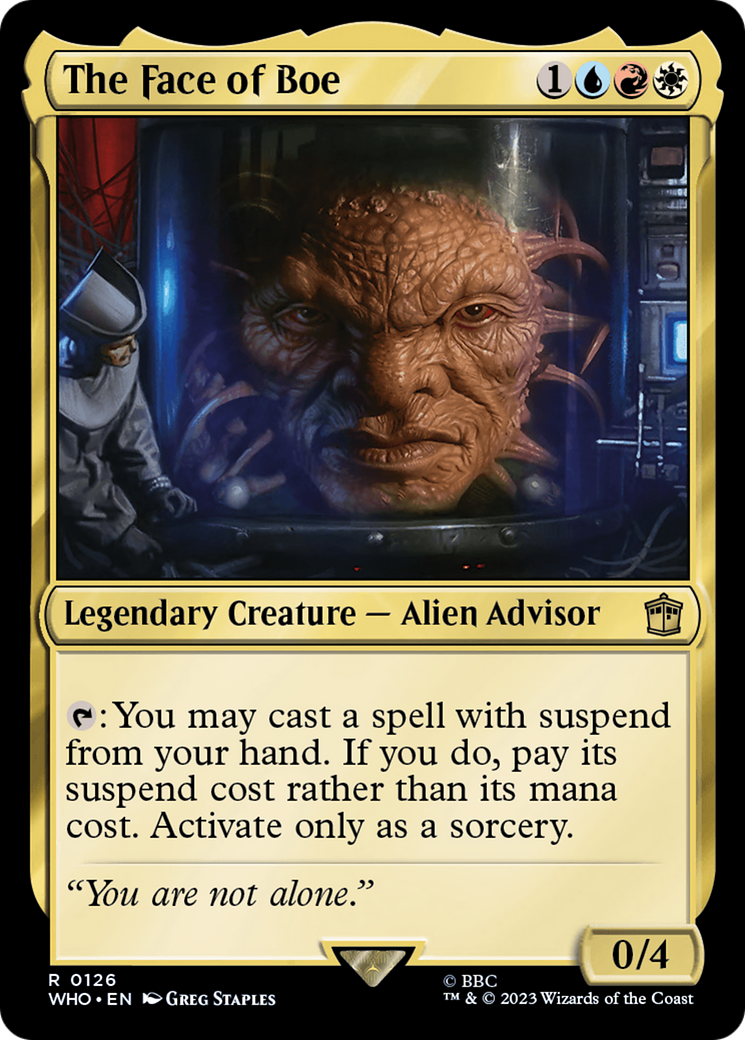
The Face of Boe
The Face of Boe
Legendary Creature — Alien Advisor
0/4
: You may cast a spell with suspend from your hand. If you do, pay its suspend cost rather than its mana cost. Activate only as a sorcery.
- You cast the spell immediately as The Face of Boe's ability resolves.
-
1
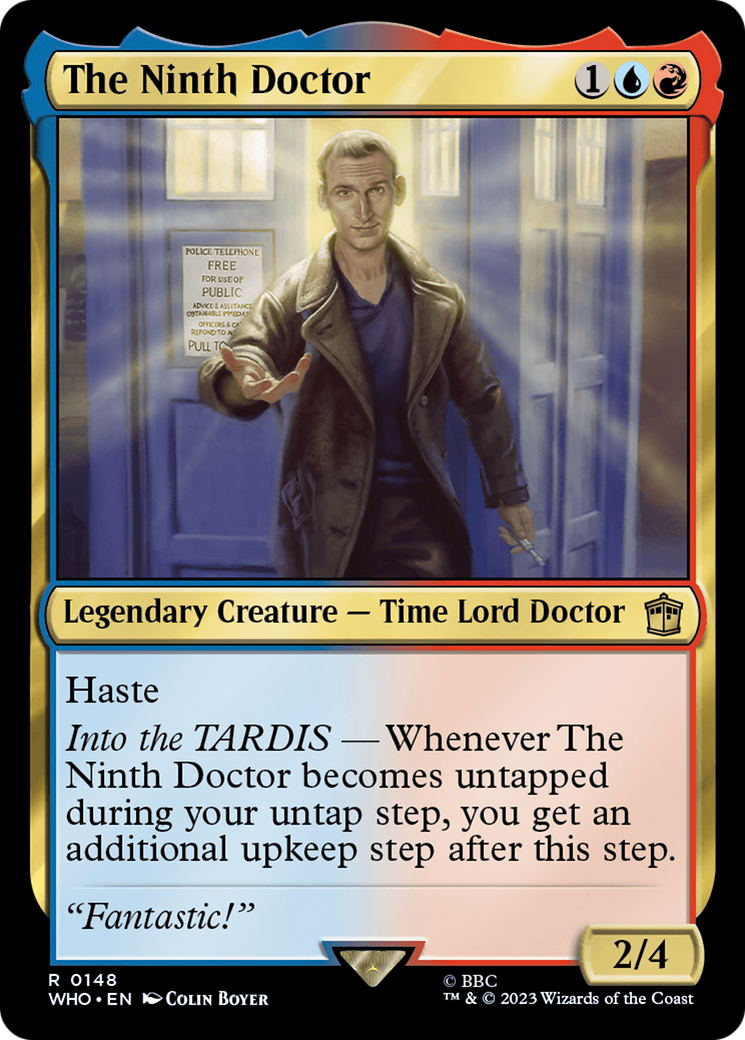
The Ninth Doctor
The Ninth Doctor
Legendary Creature — Time Lord Doctor
2/4
Haste
Into the TARDIS — Whenever The Ninth Doctor becomes untapped during your untap step, you get an additional upkeep step after this step.
- The Ninth Doctor's ability triggers during the untap step and goes onto the stack at the beginning of the next step (usually the upkeep). The additional upkeep is taken after that step, not after the untap step.
- Unlike other creature types in Magic that are each only one word, the two words "Time Lord" represent a single creature subtype. Time Lord is the only two-word creature type.
- Neither "Time" nor "Lord" are creature types. Some older cards were printed with the subtype "Lord," but all of those cards have updated Oracle card text that removed that type.
- If an effect instructs you to choose a creature type, you may choose Time Lord.
-
1
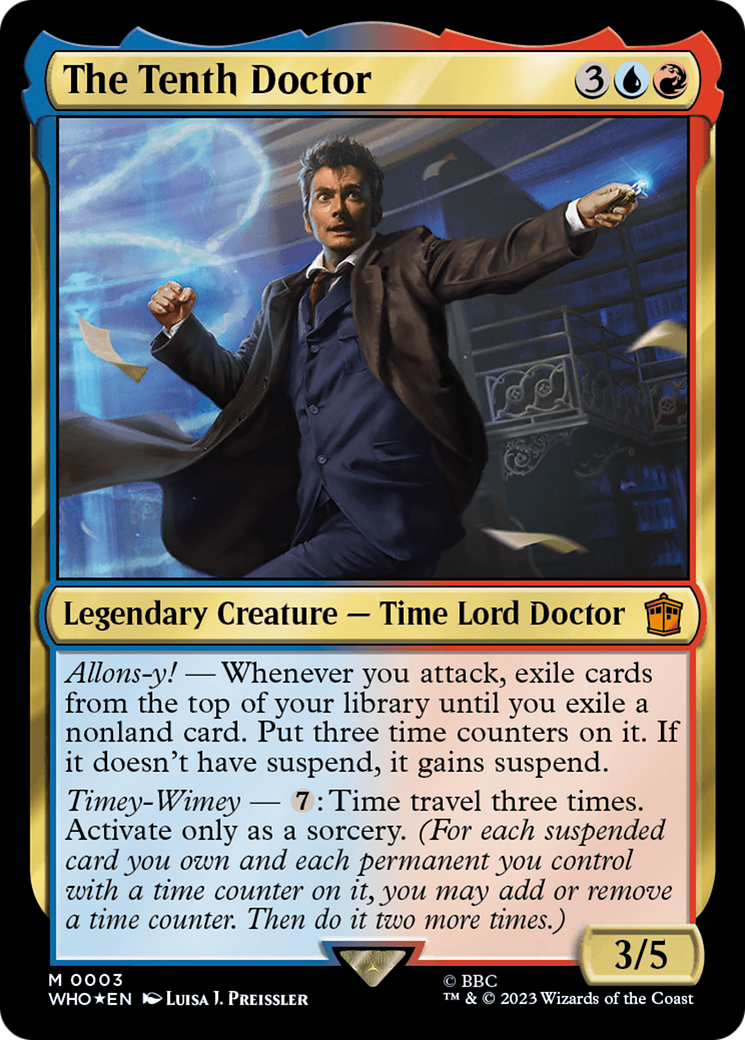
The Tenth Doctor
The Tenth Doctor
Legendary Creature — Time Lord Doctor
3/5
Allons-y! — Whenever you attack, exile cards from the top of your library until you exile a nonland card. Put three time counters on it. If it doesn't have suspend, it gains suspend.
Timey-Wimey — : Time travel three times. Activate only as a sorcery. (For each suspended card you own and each permanent you control with a time counter on it, you may add or remove a time counter. Then do it two more times.)
- The mana value of a spell cast without paying its mana cost is determined by its mana cost, even though that cost wasn't paid.
- If the first triggered ability of suspend (the one that removes time counters) is countered, no time counter is removed. The ability will trigger again at the beginning of the card's owner's next upkeep.
- When the last time counter is removed, the second triggered ability of suspend (the one that lets you cast the card) triggers. It doesn't matter why the last time counter was removed or what effect removed it.
- If the second triggered ability is countered, the card can't be cast. It remains exiled with no time counters on it, and it's no longer suspended.
- Due to a recent rules change to suspend, you are no longer required to cast the suspended card as the second triggered ability of suspend resolves. Instead, as the second triggered ability resolves, you may cast the card. Timing permissions based on the card's type are ignored. If you don't cast the card, it remains exiled with no time counters on it, and it's no longer suspended.
- If you cast a card "without paying its mana cost," such as with suspend, you can't choose to cast it for any alternative costs. You can, however, pay additional costs. If the card has any mandatory additional costs, you must pay those if you want to cast the card.
- If the card has in its mana cost, you must choose 0 as the value of X when casting it without paying its mana cost.
- Suspend is a keyword that represents three abilities. The first is a static ability that allows you to exile the card from your hand with the specified number of time counters (the number before the dash) on it by paying its suspend cost (listed after the dash). The second is a triggered ability that removes a time counter from the suspended card at the beginning of each of your upkeeps. The third is a triggered ability that gives you the option to cast the card when the last time counter is removed.
- You can exile a card in your hand using suspend any time you could cast that card. Consider its card type, any effects that modify when you could cast it (such as flash) and any other effects that stop you from casting it (such as from Meddling Mage's ability) to determine if and when you can do this. Whether you could actually complete all steps in casting the card is irrelevant. For example, you can exile a card with suspend that has no mana cost or that requires a target even if no legal targets are available at that time.
- Cards exiled with suspend are exiled face up.
- Exiling a card with suspend isn't casting that card. This action doesn't use the stack and can't be responded to.
- If the spell requires any targets, those targets are chosen when the spell is finally cast, not when it's exiled.
- If an effect refers to a "suspended card," that means a card that (1) has suspend, (2) is in exile, and (3) has one or more time counters on it.
- To time travel, look at each permanent you control with a time counter on it and each suspended card you own in exile with a time counter on it. For each of them, you choose whether you want to put a time counter on that card or permanent, remove a time counter from it, or do neither. Then those changes all happen simultaneously.
- Time counters are usually found on cards with suspend and vanishing, but may be found on other cards as well. Notably, Sagas use lore counters to track their progress, not time counters. You can't move a Saga's chapters forward and backward this way.
- Unlike other creature types in Magic that are each only one word, the two words "Time Lord" represent a single creature subtype. Time Lord is the only two-word creature type.
- Neither "Time" nor "Lord" are creature types. Some older cards were printed with the subtype "Lord," but all of those cards have updated Oracle card text that removed that type.
- If an effect instructs you to choose a creature type, you may choose Time Lord.
- Any land cards exiled with The Tenth Doctor's first ability will remain in exile.
-
1
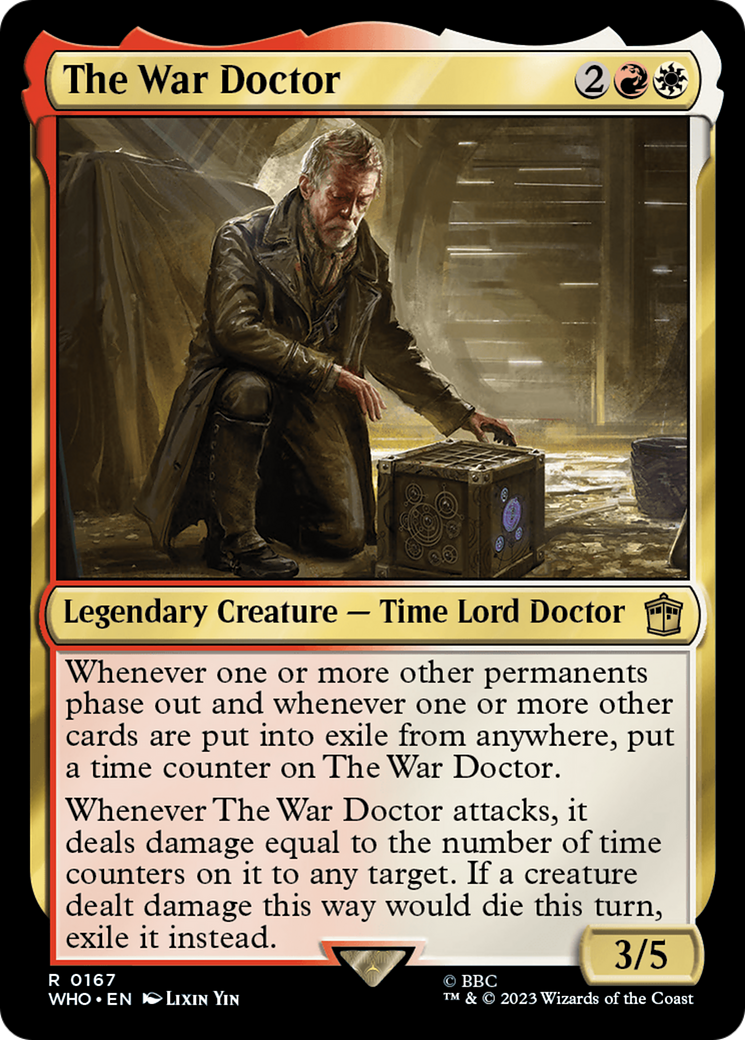
The War Doctor
The War Doctor
Legendary Creature — Time Lord Doctor
3/5
Whenever one or more other permanents phase out and whenever one or more other cards are put into exile from anywhere, put a time counter on The War Doctor.
Whenever The War Doctor attacks, it deals damage equal to the number of time counters on it to any target. If a creature dealt damage this way would die this turn, exile it instead.
- If The War Doctor phases out at the same time as any other permanents, its first ability won't trigger.
- You choose the target of the second ability as it attacks. The number of time counters is checked at the time the ability resolves. If The War Doctor has left the battlefield by that time, use the number of time counters it had on it the last time it was on the battlefield to determine how much damage it deals to that target.
- Unlike other creature types in Magic that are each only one word, the two words "Time Lord" represent a single creature subtype. Time Lord is the only two-word creature type.
- Neither "Time" nor "Lord" are creature types. Some older cards were printed with the subtype "Lord," but all of those cards have updated Oracle card text that removed that type.
- If an effect instructs you to choose a creature type, you may choose Time Lord.
-
1
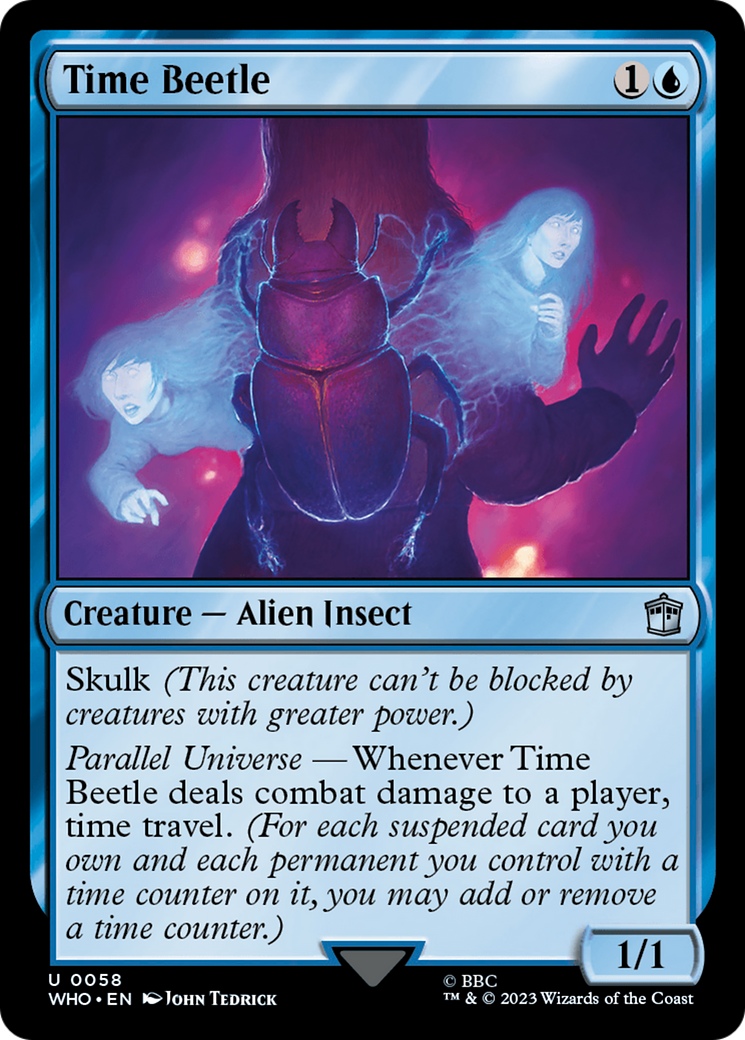
Time Beetle
Time Beetle
Creature — Alien Insect
1/1
Skulk (This creature can't be blocked by creatures with greater power.)
Parallel Universe — Whenever this creature deals combat damage to a player, time travel. (For each suspended card you own and each permanent you control with a time counter on it, you may add or remove a time counter.)
- To time travel, look at each permanent you control with a time counter on it and each suspended card you own in exile with a time counter on it. For each of them, you choose whether you want to put a time counter on that card or permanent, remove a time counter from it, or do neither. Then those changes all happen simultaneously.
- Time counters are usually found on cards with suspend and vanishing, but may be found on other cards as well. Notably, Sagas use lore counters to track their progress, not time counters. You can't move a Saga's chapters forward and backward this way.
-
1
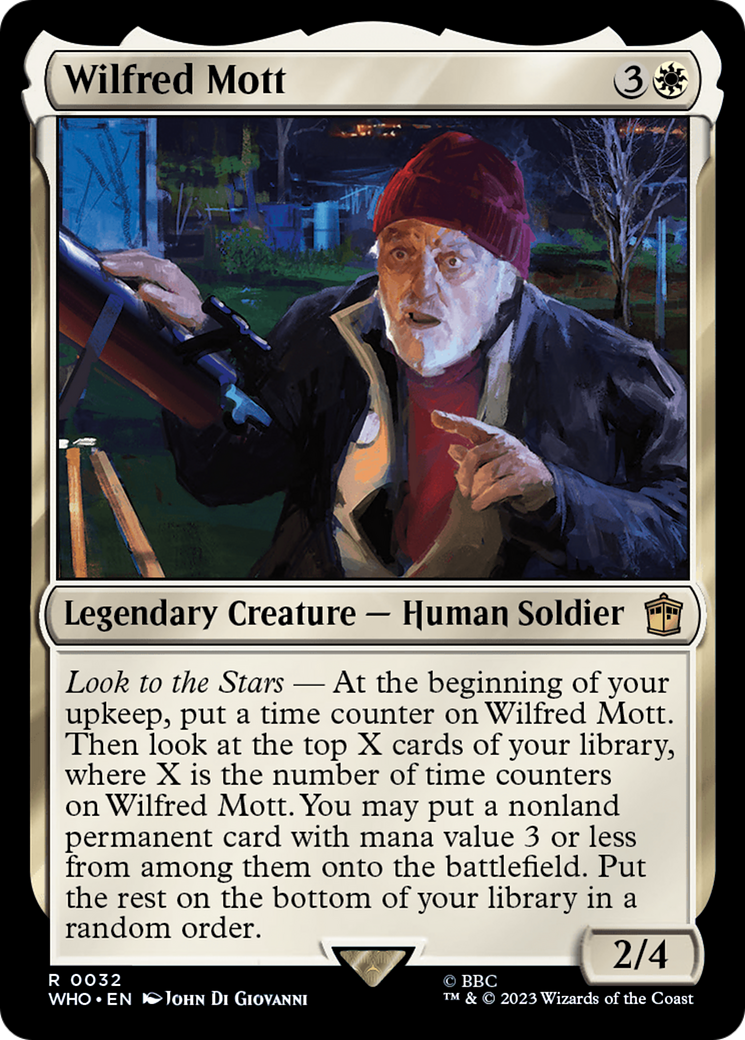
Wilfred Mott
Wilfred Mott
Legendary Creature — Human Soldier
2/4
Look to the Stars — At the beginning of your upkeep, put a time counter on Wilfred Mott. Then look at the top X cards of your library, where X is the number of time counters on Wilfred Mott. You may put a nonland permanent card with mana value 3 or less from among them onto the battlefield. Put the rest on the bottom of your library in a random order.
- If Wilfred Mott leaves the battlefield after its ability has triggered but before it resolves, use the number of time counters it had on it the last time it was on the battlefield to determine the value of X.
Instants 4
-
1
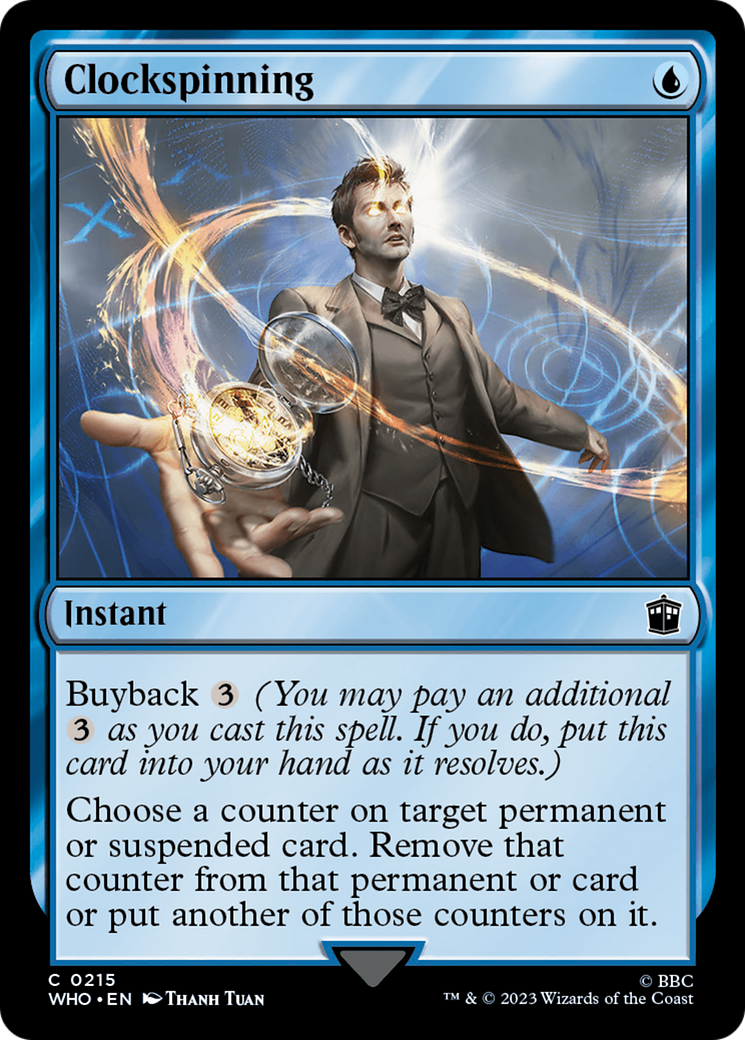
Clockspinning
Clockspinning
Instant
Buyback (You may pay an additional as you cast this spell. If you do, put this card into your hand as it resolves.)
Choose a counter on target permanent or suspended card. Remove that counter from that permanent or card or put another of those counters on it.
- The mana value of a spell cast without paying its mana cost is determined by its mana cost, even though that cost wasn't paid.
- If you cast a card "without paying its mana cost," such as with suspend, you can't choose to cast it for any alternative costs. You can, however, pay additional costs. If the card has any mandatory additional costs, you must pay those if you want to cast the card.
- If the card has in its mana cost, you must choose 0 as the value of X when casting it without paying its mana cost.
- Suspend is a keyword that represents three abilities. The first is a static ability that allows you to exile the card from your hand with the specified number of time counters (the number before the dash) on it by paying its suspend cost (listed after the dash). The second is a triggered ability that removes a time counter from the suspended card at the beginning of each of your upkeeps. The third is a triggered ability that gives you the option to cast the card when the last time counter is removed.
- You can exile a card in your hand using suspend any time you could cast that card. Consider its card type, any effects that modify when you could cast it (such as flash) and any other effects that stop you from casting it (such as from Meddling Mage's ability) to determine if and when you can do this. Whether you could actually complete all steps in casting the card is irrelevant. For example, you can exile a card with suspend that has no mana cost or that requires a target even if no legal targets are available at that time.
- Cards exiled with suspend are exiled face up.
- Exiling a card with suspend isn't casting that card. This action doesn't use the stack and can't be responded to.
- If the spell requires any targets, those targets are chosen when the spell is finally cast, not when it's exiled.
- If an effect refers to a "suspended card," that means a card that (1) has suspend, (2) is in exile, and (3) has one or more time counters on it.
- If the first triggered ability of suspend (the one that removes time counters) is countered, no time counter is removed. The ability will trigger again at the beginning of the card's owner's next upkeep.
- When the last time counter is removed, the second triggered ability of suspend (the one that lets you cast the card) triggers. It doesn't matter why the last time counter was removed or what effect removed it.
- If the second triggered ability is countered, the card can't be cast. It remains exiled with no time counters on it, and it's no longer suspended.
- Due to a recent rules change to suspend, you are no longer required to cast the suspended card as the second triggered ability of suspend resolves. Instead, as the second triggered ability resolves, you may cast the card. Timing permissions based on the card's type are ignored. If you don't cast the card, it remains exiled with no time counters on it, and it's no longer suspended.
- If the target is a permanent and it has no counter on it when Clockspinning resolves, nothing happens.
- Clockspinning can affect any kind of counter, not just a time counter. The type of counter isn't chosen until resolution. Whether to add or remove a counter isn't chosen until resolution.
-
1
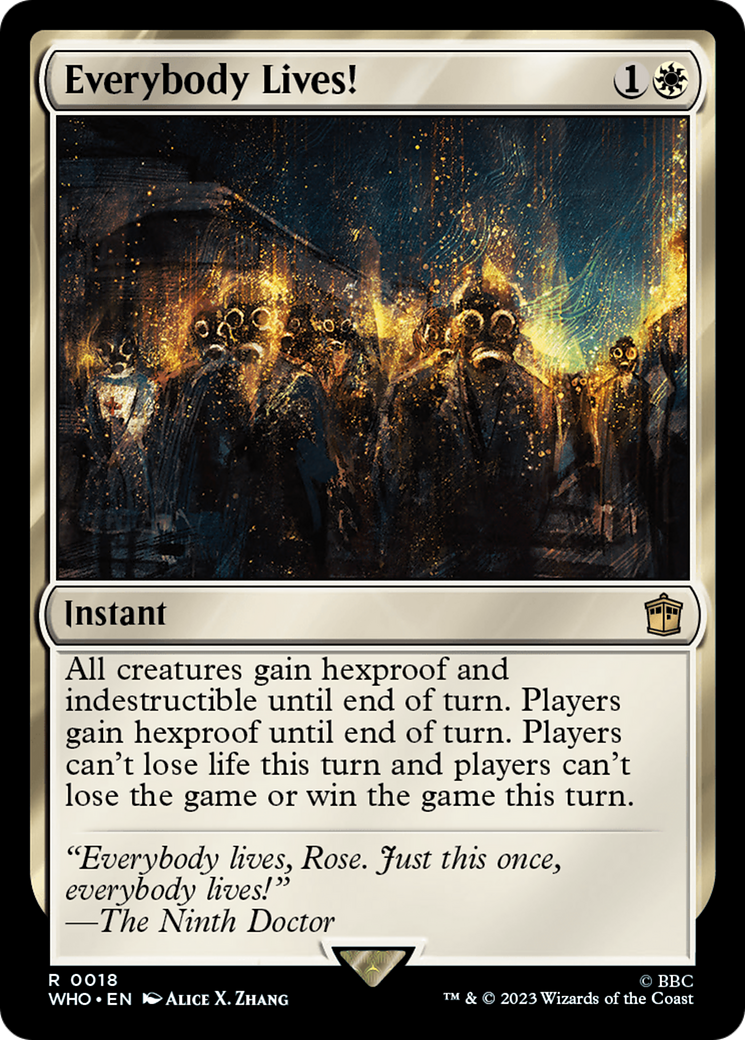
Everybody Lives!
Everybody Lives!
Instant
All creatures gain hexproof and indestructible until end of turn. Players gain hexproof until end of turn. Players can't lose life this turn and players can't lose the game or win the game this turn.
- Players can always concede from the game, even if they can't otherwise lose the game.
-
1
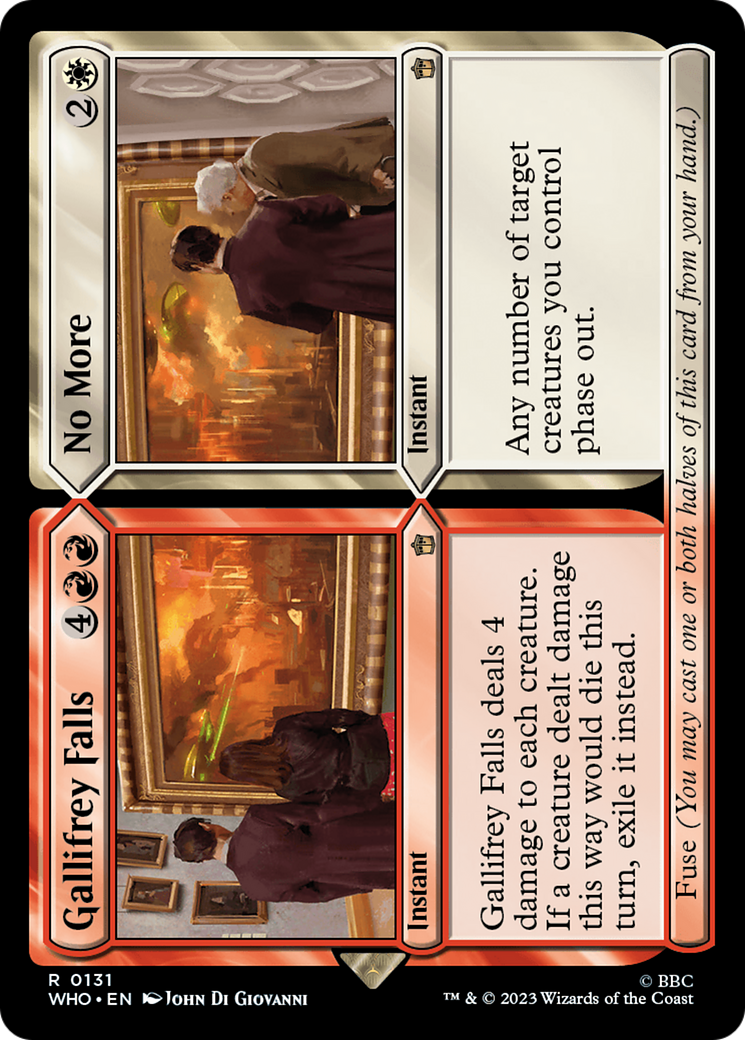
Gallifrey Falls // No More
//
Gallifrey Falls
Instant
- If you cast both halves of this spell fused, the targeted creatures will be dealt 4 damage first and then be phased out, even if they had less than 4 toughness. Any abilities that trigger based on those creatures being dealt damage will trigger.
- If you're casting a split card with fuse from any zone other than your hand, you can't cast both halves. You'll only be able to cast one half or the other.
- To cast a fused split spell, pay both of its mana costs. While the spell is on the stack, its mana value is the total amount of mana in both costs.
- When resolving a fused split spell with multiple targets, treat it as you would any spell with multiple targets. If all targets are illegal when the spell tries to resolve, the spell doesn't resolve and none of its effects happen. If at least one target is still legal at that time, the spell resolves, but an illegal target can't perform any actions or have any actions performed on it.
- When a fused split spell resolves, follow the instructions of the left half first, then the instructions on the right half.
- On the stack, a split spell that hasn't been fused has only that half's characteristics and mana value. The other half is treated as though it didn't exist.
- Some split cards with fuse have two monocolor halves of different colors. If such a card is cast as a fused split spell, the resulting spell is multicolored. If only one half is cast, the spell is the color of that half. While not on the stack, such a card is multicolored.
- Some split cards with fuse have two halves that are both multicolored. That card is multicolored no matter which half is cast, or if both halves are cast. It's also multicolored while not on the stack.
- If a player is instructed to choose a card name, the player may choose the name of either half of a split card, but not both. A split card has the chosen name if one of its two names matches the chosen name.
- If you cast a split card with fuse from your hand without paying its mana cost, you can choose to use its fuse ability and cast both halves without paying their mana costs.
-
1
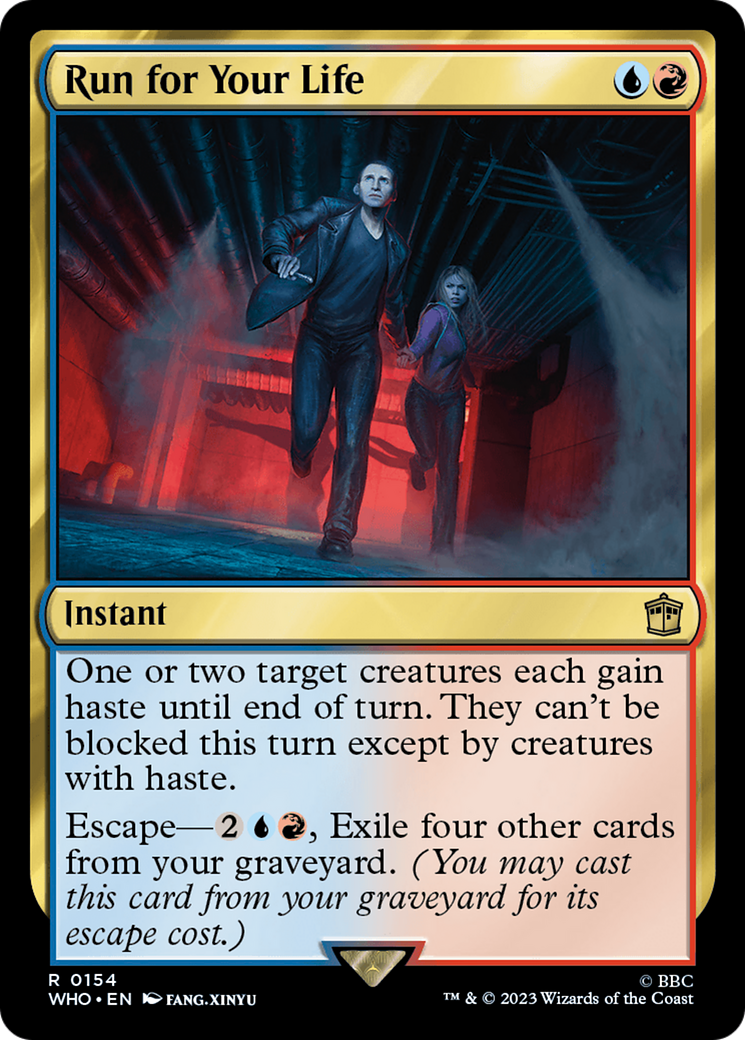
Run for Your Life
Run for Your Life
Instant
One or two target creatures each gain haste until end of turn. They can't be blocked this turn except by creatures with haste.
Escape— , Exile four other cards from your graveyard. (You may cast this card from your graveyard for its escape cost.)
- If a card has multiple abilities giving you permission to cast it, such as two escape abilities or an escape ability and a flashback ability, you choose which one to apply. The others have no effect.
- If you cast a spell with its escape permission, you can't choose to apply any other alternative costs or to cast it without paying its mana cost. If it has any additional costs, you must pay those.
- Once you begin casting a spell with escape, it immediately moves to the stack. Players can't take any other actions until you're done casting the spell.
- To determine the total cost of a spell, start with the mana cost or alternative cost you're paying (such as an escape cost), add any cost increases, then apply any cost reductions. The mana value of the spell remains unchanged, no matter what the total cost to cast it was and no matter whether an alternative cost was paid.
Sorceries 10
-
1
All of History, All at Once
All of History, All at Once
Sorcery
Time travel. (For each suspended card you own and each permanent you control with a time counter on it, you may add or remove a time counter.)
Storm (When you cast this spell, copy it for each spell cast before it this turn.)
- The copies are put directly onto the stack. They aren't cast and won't be counted by other spells with storm cast later in the turn.
- Spells cast from zones other than a player's hand and spells that were countered are counted by the storm ability.
- A copy of a spell can be countered like any other spell, but each copy must be countered individually. Countering a spell with storm won't affect the copies.
- The triggered ability that creates the copies can itself be countered by anything that can counter a triggered ability. If it is countered, no copies will be put onto the stack.
- To time travel, look at each permanent you control with a time counter on it and each suspended card you own in exile with a time counter on it. For each of them, you choose whether you want to put a time counter on that card or permanent, remove a time counter from it, or do neither. Then those changes all happen simultaneously.
- Time counters are usually found on cards with suspend and vanishing, but may be found on other cards as well. Notably, Sagas use lore counters to track their progress, not time counters. You can't move a Saga's chapters forward and backward this way.
-
1
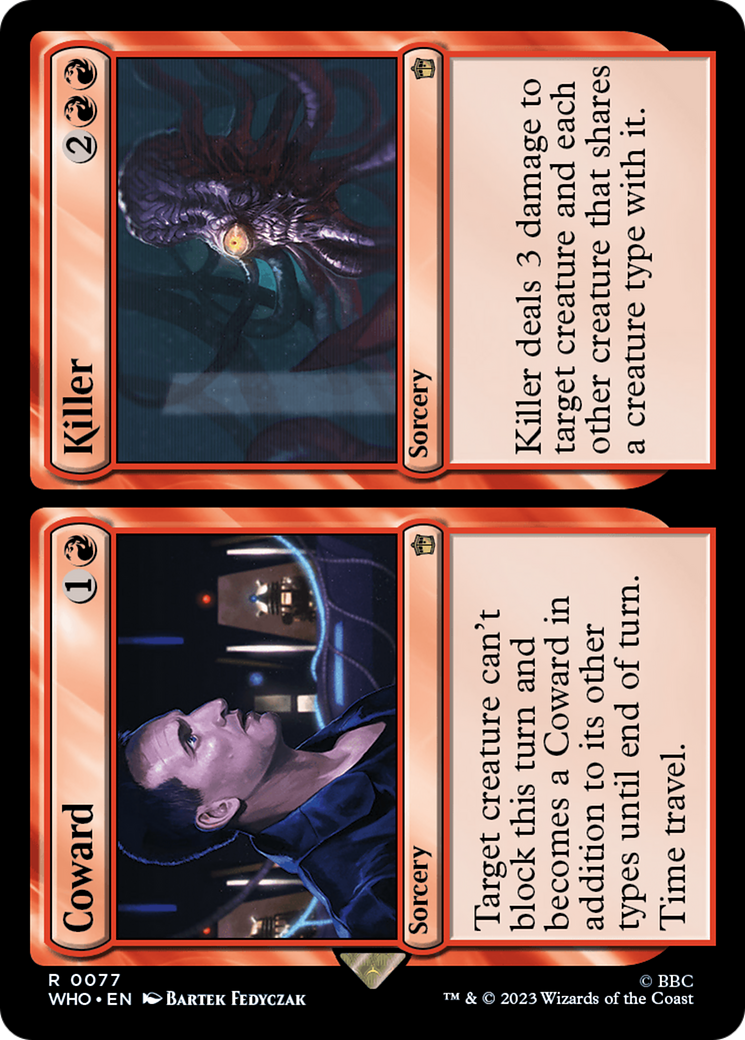
Coward // Killer
//
Coward
Sorcery
- Time counters are usually found on cards with suspend and vanishing, but may be found on other cards as well. Notably, Sagas use lore counters to track their progress, not time counters. You can't move a Saga's chapters forward and backward this way.
- If the target of Killer is illegal as the spell tries to resolve, it won't deal damage to any creatures.
- To time travel, look at each permanent you control with a time counter on it and each suspended card you own in exile with a time counter on it. For each of them, you choose whether you want to put a time counter on that card or permanent, remove a time counter from it, or do neither. Then those changes all happen simultaneously.
-
1
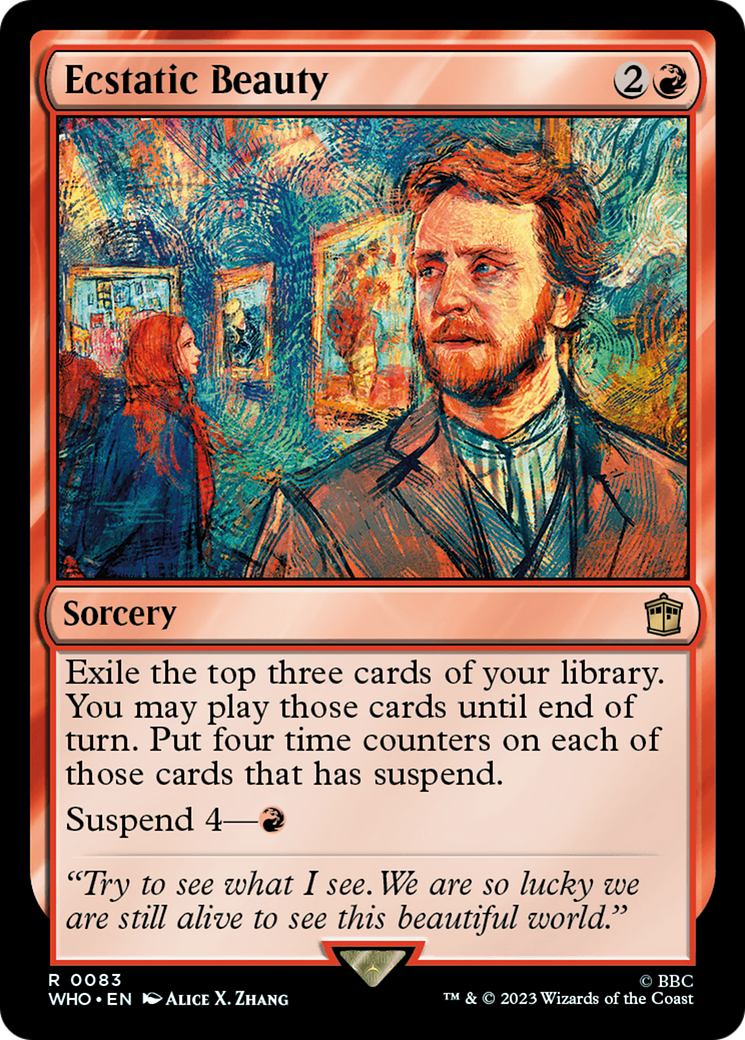
Ecstatic Beauty
Ecstatic Beauty
Sorcery
Exile the top three cards of your library. You may play those cards until end of turn. Put four time counters on each of those cards that has suspend.
Suspend 4—
- Suspend is a keyword that represents three abilities. The first is a static ability that allows you to exile the card from your hand with the specified number of time counters (the number before the dash) on it by paying its suspend cost (listed after the dash). The second is a triggered ability that removes a time counter from the suspended card at the beginning of each of your upkeeps. The third is a triggered ability that gives you the option to cast the card when the last time counter is removed.
- You can exile a card in your hand using suspend any time you could cast that card. Consider its card type, any effects that modify when you could cast it (such as flash) and any other effects that stop you from casting it (such as from Meddling Mage's ability) to determine if and when you can do this. Whether you could actually complete all steps in casting the card is irrelevant. For example, you can exile a card with suspend that has no mana cost or that requires a target even if no legal targets are available at that time.
- Cards exiled with suspend are exiled face up.
- Exiling a card with suspend isn't casting that card. This action doesn't use the stack and can't be responded to.
- If the spell requires any targets, those targets are chosen when the spell is finally cast, not when it's exiled.
- If an effect refers to a "suspended card," that means a card that (1) has suspend, (2) is in exile, and (3) has one or more time counters on it.
- If the first triggered ability of suspend (the one that removes time counters) is countered, no time counter is removed. The ability will trigger again at the beginning of the card's owner's next upkeep.
- When the last time counter is removed, the second triggered ability of suspend (the one that lets you cast the card) triggers. It doesn't matter why the last time counter was removed or what effect removed it.
- If the second triggered ability is countered, the card can't be cast. It remains exiled with no time counters on it, and it's no longer suspended.
- Due to a recent rules change to suspend, you are no longer required to cast the suspended card as the second triggered ability of suspend resolves. Instead, as the second triggered ability resolves, you may cast the card. Timing permissions based on the card's type are ignored. If you don't cast the card, it remains exiled with no time counters on it, and it's no longer suspended.
- If you cast a card "without paying its mana cost," such as with suspend, you can't choose to cast it for any alternative costs. You can, however, pay additional costs. If the card has any mandatory additional costs, you must pay those if you want to cast the card.
- If the card has in its mana cost, you must choose 0 as the value of X when casting it without paying its mana cost.
- The mana value of a spell cast without paying its mana cost is determined by its mana cost, even though that cost wasn't paid.
-
1
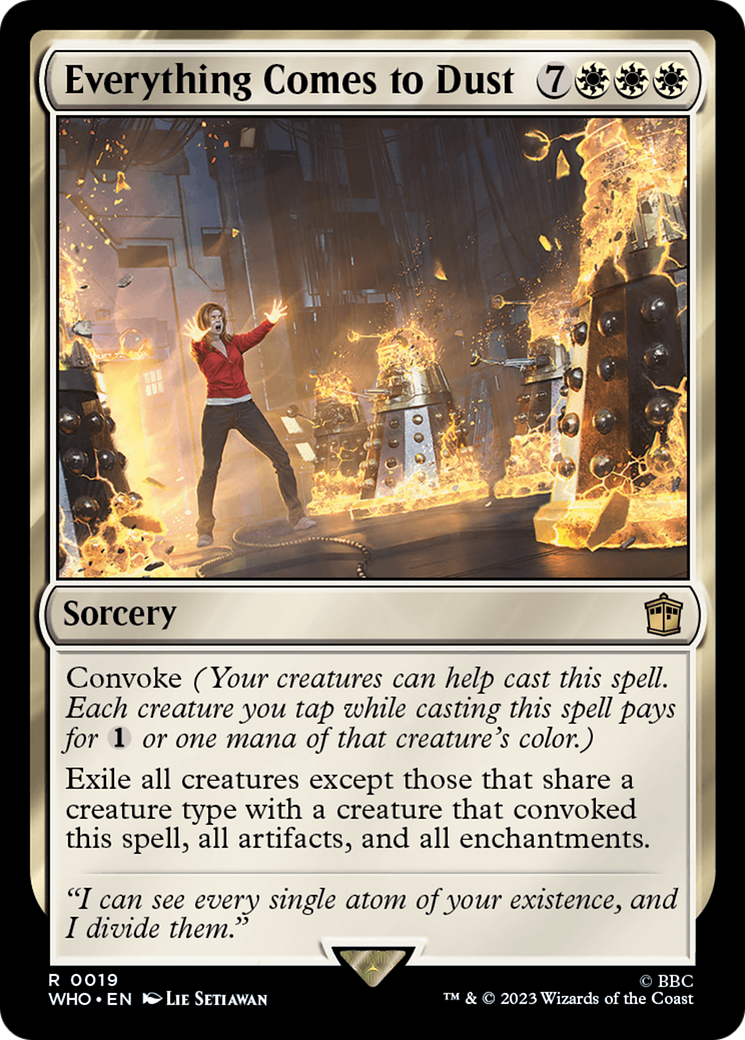
Everything Comes to Dust
Everything Comes to Dust
Sorcery
Convoke (Your creatures can help cast this spell. Each creature you tap while casting this spell pays for or one mana of that creature's color.)
Exile all creatures except those that share a creature type with a creature that convoked this spell, all artifacts, and all enchantments.
- You can tap any untapped creature you control to convoke a spell, even one you haven't controlled continuously since the beginning of your most recent turn.
- Tapping an untapped creature that's attacking or blocking to convoke a spell won't cause that creature to stop attacking or blocking.
- When calculating a spell's total cost, include any alternative costs, additional costs, or anything else that increases or reduces the cost to cast the spell. Convoke applies after the total cost is calculated. Convoke doesn't change a spell's mana cost or mana value.
- If a creature you control has a mana ability with in the cost, activating that ability while casting a spell with convoke will result in the creature being tapped before you pay the spell's costs. You won't be able to tap it again for convoke. Similarly, if you sacrifice a creature to activate a mana ability while casting a spell with convoke, that creature won't be on the battlefield when you pay the spell's costs, so you won't be able to tap it for convoke.
- Because convoke isn't an alternative cost, it can be used in conjunction with alternative costs.
- Tapping a multicolored creature using convoke will pay for or one mana of your choice of any of that creature's colors.
-
1
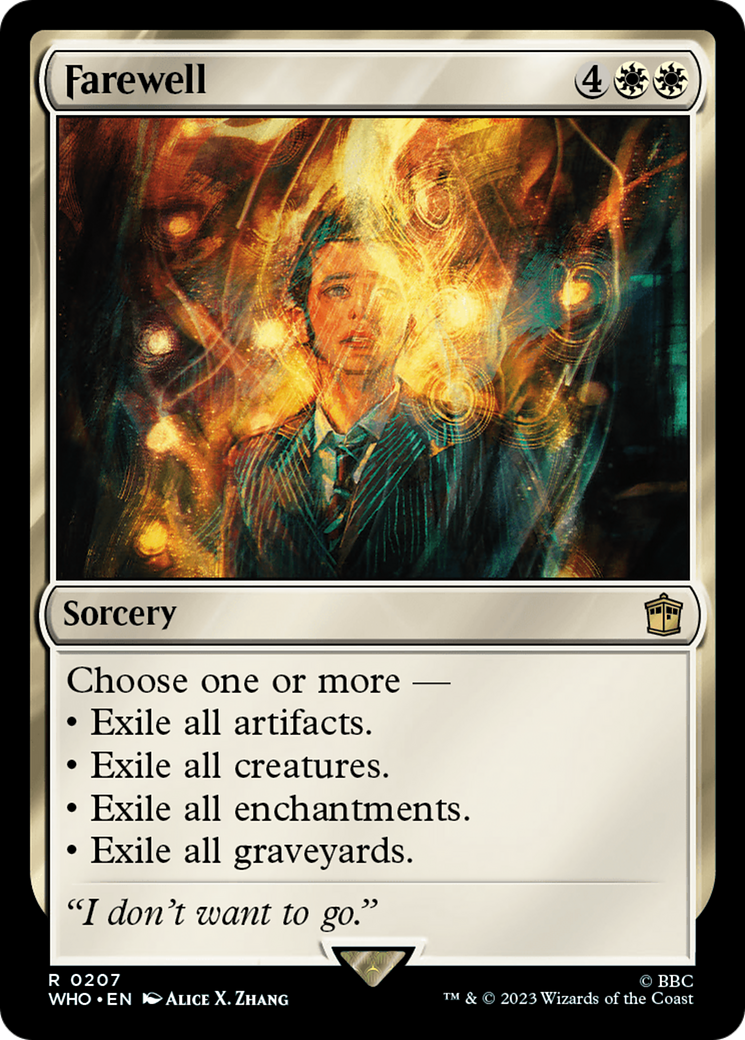
Farewell
Farewell
Sorcery
Choose one or more —
- Exile all artifacts.
- Exile all creatures.
- Exile all enchantments.
- Exile all graveyards.
- If you choose more than one mode for Farewell, you perform the actions in the order written.
-
1
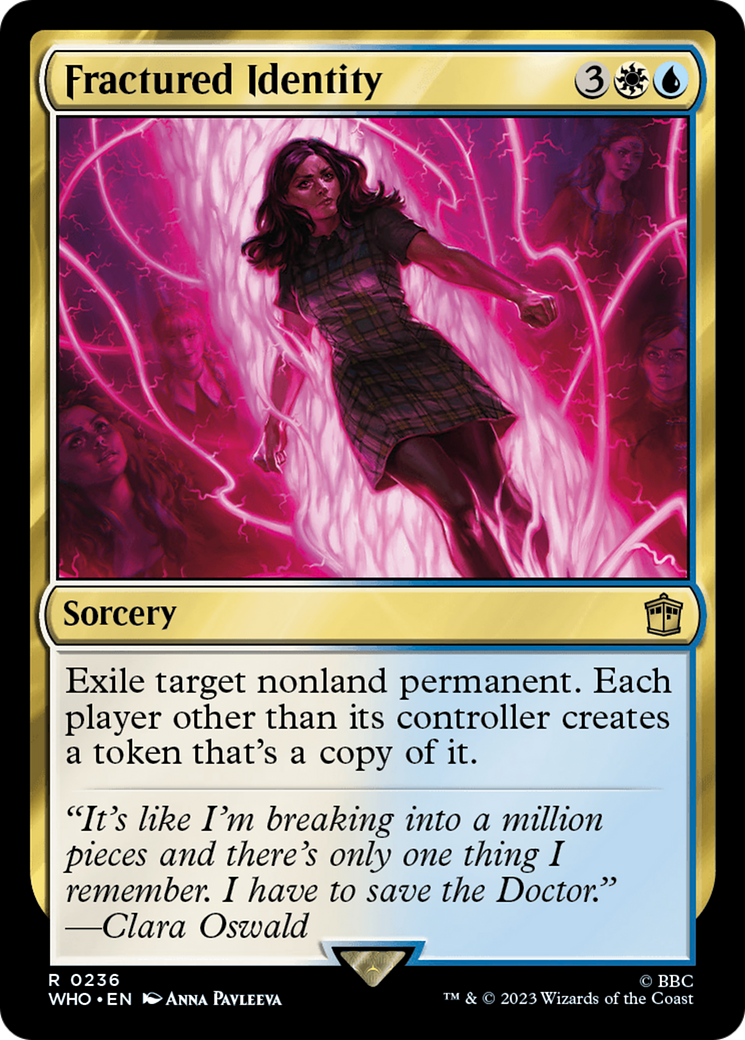
Fractured Identity
Fractured Identity
Sorcery
Exile target nonland permanent. Each player other than its controller creates a token that's a copy of it.
- The tokens copy exactly what was printed on the permanent and nothing else (unless that permanent was copying something else or was a token; see below). They don't copy whether that permanent was tapped or untapped, whether it had any counters on it or Auras and/or Equipment attached to it, or any non-copy effects that changed its power, toughness, types, color, and so on.
- If the copied permanent had in its mana cost, X is 0.
- If the copied permanent was copying something else, the tokens enter the battlefield as whatever that permanent was copying.
- If the copied permanent is a token, the tokens created by Fractured Identity copy the original characteristics of that token as stated by the effect that put it onto the battlefield.
- Any enters-the-battlefield abilities of the copied permanent will trigger when the tokens enter the battlefield. Any "As [this permanent] enters the battlefield" or "[This permanent] enters the battlefield with" abilities of the copied permanent will also work.
- If the exiled permanent was a commander, the tokens won't be commanders.
-
1
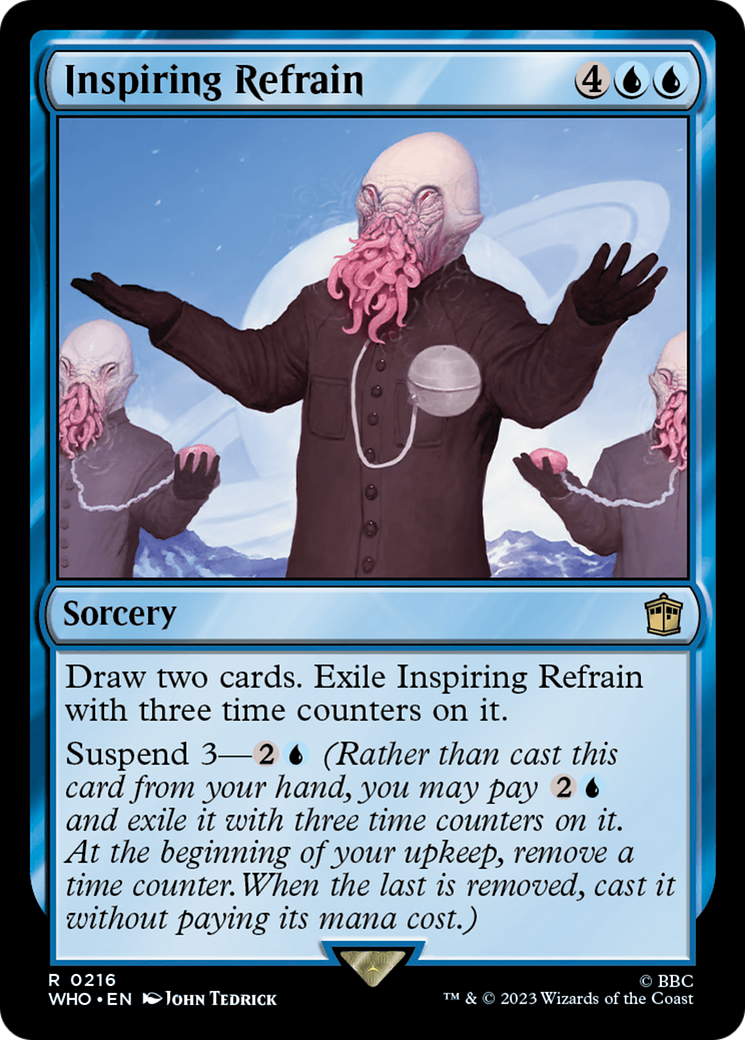
Inspiring Refrain
Inspiring Refrain
Sorcery
Draw two cards. Exile Inspiring Refrain with three time counters on it.
Suspend 3— (Rather than cast this card from your hand, you may pay and exile it with three time counters on it. At the beginning of your upkeep, remove a time counter. When the last is removed, you may cast it without paying its mana cost.)
- Suspend is a keyword that represents three abilities. The first is a static ability that allows you to exile the card from your hand with the specified number of time counters (the number before the dash) on it by paying its suspend cost (listed after the dash). The second is a triggered ability that removes a time counter from the suspended card at the beginning of each of your upkeeps. The third is a triggered ability that gives you the option to cast the card when the last time counter is removed.
- You can exile a card in your hand using suspend any time you could cast that card. Consider its card type, any effects that modify when you could cast it (such as flash) and any other effects that stop you from casting it (such as from Meddling Mage's ability) to determine if and when you can do this. Whether you could actually complete all steps in casting the card is irrelevant. For example, you can exile a card with suspend that has no mana cost or that requires a target even if no legal targets are available at that time.
- Cards exiled with suspend are exiled face up.
- Exiling a card with suspend isn't casting that card. This action doesn't use the stack and can't be responded to.
- If the spell requires any targets, those targets are chosen when the spell is finally cast, not when it's exiled.
- If an effect refers to a "suspended card," that means a card that (1) has suspend, (2) is in exile, and (3) has one or more time counters on it.
- If the first triggered ability of suspend (the one that removes time counters) is countered, no time counter is removed. The ability will trigger again at the beginning of the card's owner's next upkeep.
- When the last time counter is removed, the second triggered ability of suspend (the one that lets you cast the card) triggers. It doesn't matter why the last time counter was removed or what effect removed it.
- If the second triggered ability is countered, the card can't be cast. It remains exiled with no time counters on it, and it's no longer suspended.
- Due to a recent rules change to suspend, you are no longer required to cast the suspended card as the second triggered ability of suspend resolves. Instead, as the second triggered ability resolves, you may cast the card. Timing permissions based on the card's type are ignored. If you don't cast the card, it remains exiled with no time counters on it, and it's no longer suspended.
- If you cast a card "without paying its mana cost," such as with suspend, you can't choose to cast it for any alternative costs. You can, however, pay additional costs. If the card has any mandatory additional costs, you must pay those if you want to cast the card.
- If the card has in its mana cost, you must choose 0 as the value of X when casting it without paying its mana cost.
- The mana value of a spell cast without paying its mana cost is determined by its mana cost, even though that cost wasn't paid.
-
1
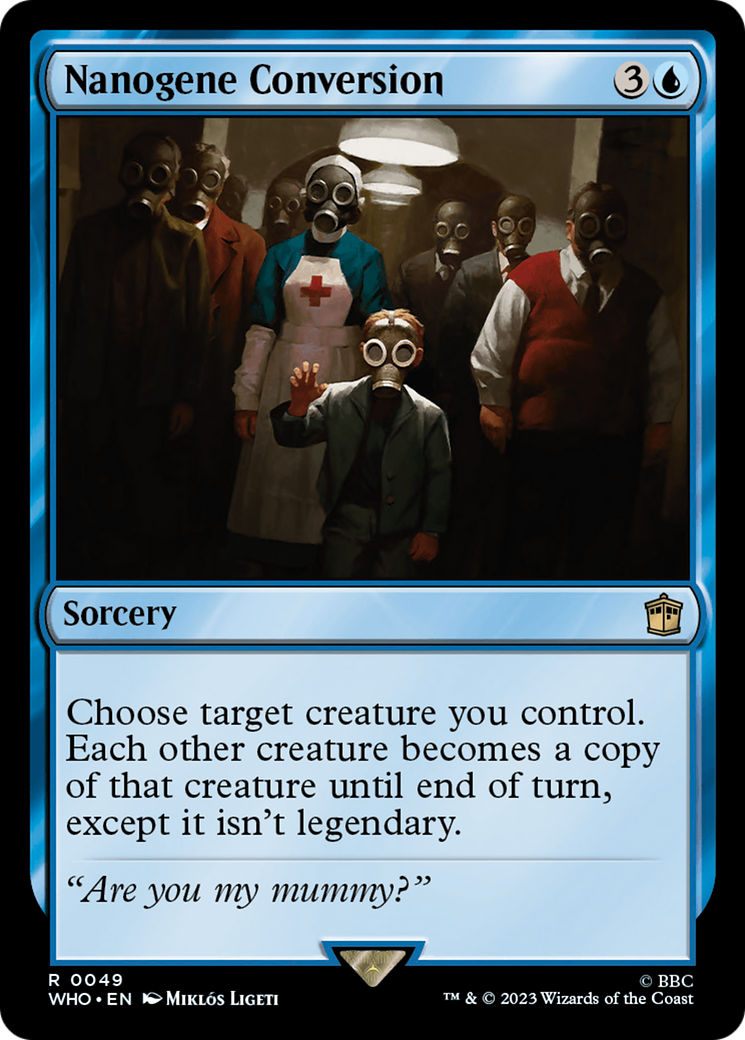
Nanogene Conversion
Nanogene Conversion
Sorcery
Choose target creature you control. Each other creature becomes a copy of that creature until end of turn, except it isn't legendary.
- Each other creature copies the printed values of the targeted creature, except that they aren't legendary. They won't copy other effects that have changed the targeted creature's power, toughness, types, color, or so on. They also won't copy counters on the targeted creature (they'll each just retain the counters they already have).
- If the targeted creature is itself copying a creature, each other creature will become whatever it's copying, as modified by that copy effect.
- This effect can cause each other creature to stop being a creature. For example, if you target an animated Vehicle, only the printed wording will be copied—the crew effect that is making it a creature until end of turn won't be copied. Each other creature will become an unanimated copy of that Vehicle.
- Non-copy effects that have already applied to the other creatures will continue to apply to them. For example, if Giant Growth had given one of them +3/+3 earlier in the turn, then Nanogene Conversion made it a copy of Bear Cub, it will be a 5/5 Bear Cub.
- If the targeted creature is a token, each other creature copies the original characteristics of that token as stated by the effect that created the token. Those creatures don't become tokens.
- As the turn ends, the other creatures revert to what they were before. If two Nanogene Conversions are cast on the same turn, they'll both wear off at the same time.
-
1
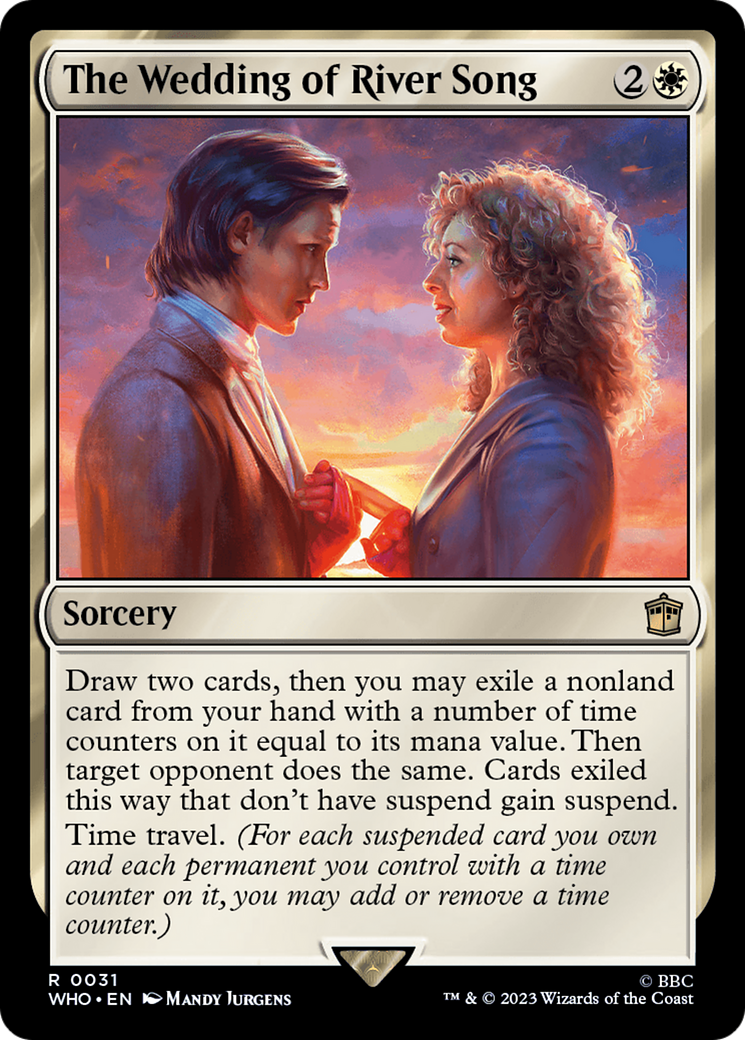
The Wedding of River Song
The Wedding of River Song
Sorcery
Draw two cards, then you may exile a nonland card from your hand with a number of time counters on it equal to its mana value. Then target opponent does the same. Cards exiled this way that don't have suspend gain suspend.
Time travel. (For each suspended card you own and each permanent you control with a time counter on it, you may add or remove a time counter.)
- The mana value of a spell cast without paying its mana cost is determined by its mana cost, even though that cost wasn't paid.
- Due to a recent rules change to suspend, you are no longer required to cast the suspended card as the second triggered ability of suspend resolves. Instead, as the second triggered ability resolves, you may cast the card. Timing permissions based on the card's type are ignored. If you don't cast the card, it remains exiled with no time counters on it, and it's no longer suspended.
- If you cast a card "without paying its mana cost," such as with suspend, you can't choose to cast it for any alternative costs. You can, however, pay additional costs. If the card has any mandatory additional costs, you must pay those if you want to cast the card.
- If the card has in its mana cost, you must choose 0 as the value of X when casting it without paying its mana cost.
- Suspend is a keyword that represents three abilities. The first is a static ability that allows you to exile the card from your hand with the specified number of time counters (the number before the dash) on it by paying its suspend cost (listed after the dash). The second is a triggered ability that removes a time counter from the suspended card at the beginning of each of your upkeeps. The third is a triggered ability that gives you the option to cast the card when the last time counter is removed.
- You can exile a card in your hand using suspend any time you could cast that card. Consider its card type, any effects that modify when you could cast it (such as flash) and any other effects that stop you from casting it (such as from Meddling Mage's ability) to determine if and when you can do this. Whether you could actually complete all steps in casting the card is irrelevant. For example, you can exile a card with suspend that has no mana cost or that requires a target even if no legal targets are available at that time.
- Cards exiled with suspend are exiled face up.
- Exiling a card with suspend isn't casting that card. This action doesn't use the stack and can't be responded to.
- If the spell requires any targets, those targets are chosen when the spell is finally cast, not when it's exiled.
- If an effect refers to a "suspended card," that means a card that (1) has suspend, (2) is in exile, and (3) has one or more time counters on it.
- If the first triggered ability of suspend (the one that removes time counters) is countered, no time counter is removed. The ability will trigger again at the beginning of the card's owner's next upkeep.
- When the last time counter is removed, the second triggered ability of suspend (the one that lets you cast the card) triggers. It doesn't matter why the last time counter was removed or what effect removed it.
- If the second triggered ability is countered, the card can't be cast. It remains exiled with no time counters on it, and it's no longer suspended.
- To time travel, look at each permanent you control with a time counter on it and each suspended card you own in exile with a time counter on it. For each of them, you choose whether you want to put a time counter on that card or permanent, remove a time counter from it, or do neither. Then those changes all happen simultaneously.
- Time counters are usually found on cards with suspend and vanishing, but may be found on other cards as well. Notably, Sagas use lore counters to track their progress, not time counters. You can't move a Saga's chapters forward and backward this way.
- If you exile a card with a mana value of 0, it will gain suspend, but no time counters will be placed on it. It can't be cast unless a time counter is later placed on it (and then, subsequently removed), and it isn't considered to be a "suspended card."
-
1
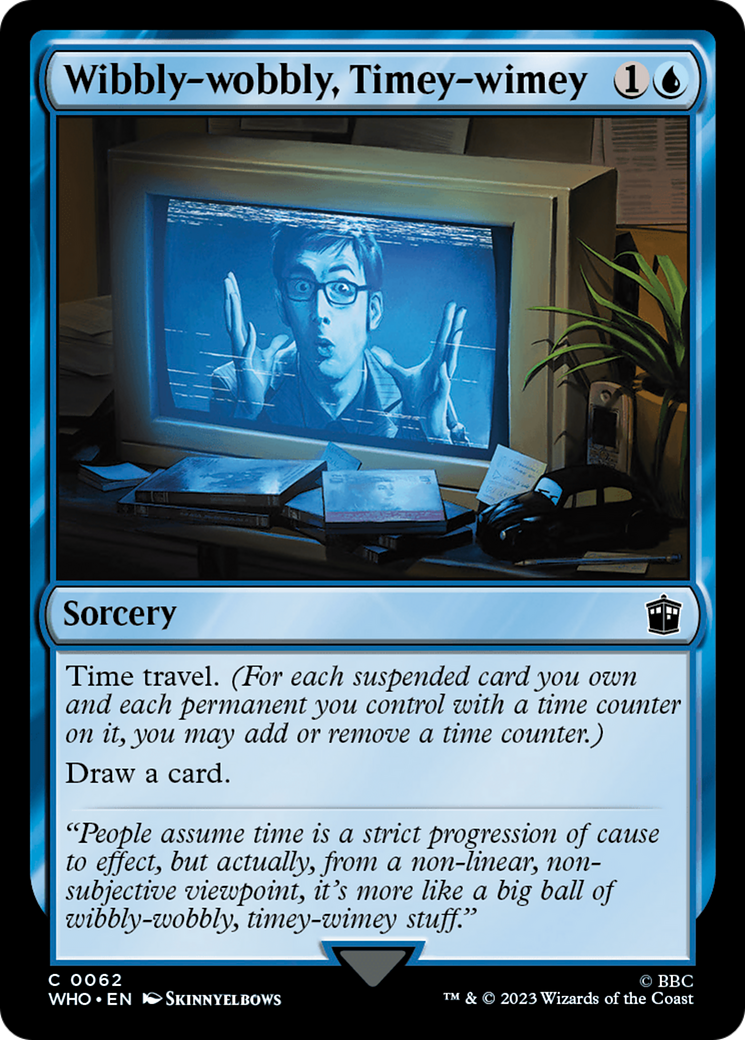
Wibbly-wobbly, Timey-wimey
Wibbly-wobbly, Timey-wimey
Sorcery
Time travel. (For each suspended card you own and each permanent you control with a time counter on it, you may add or remove a time counter.)
Draw a card.
- To time travel, look at each permanent you control with a time counter on it and each suspended card you own in exile with a time counter on it. For each of them, you choose whether you want to put a time counter on that card or permanent, remove a time counter from it, or do neither. Then those changes all happen simultaneously.
- Time counters are usually found on cards with suspend and vanishing, but may be found on other cards as well. Notably, Sagas use lore counters to track their progress, not time counters. You can't move a Saga's chapters forward and backward this way.
Artifacts 15
-
1
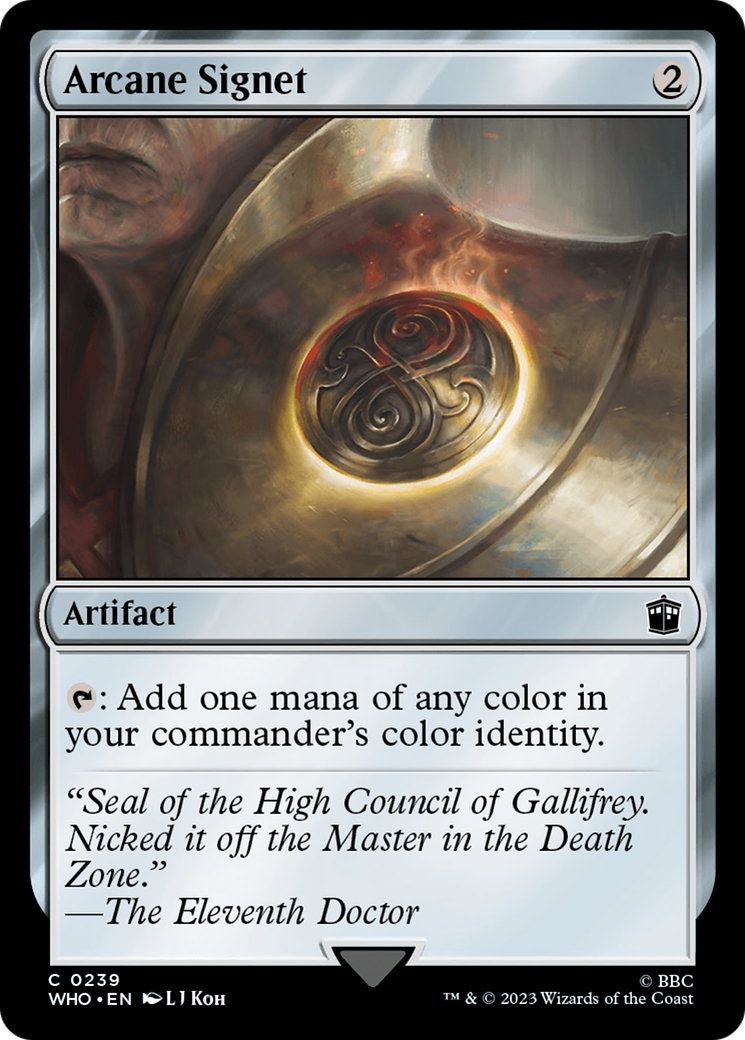
Arcane Signet
Arcane Signet
Artifact
: Add one mana of any color in your commander's color identity.
- If your commander is a card that has no colors in its color identity, Arcane Signet's ability produces no mana. It doesn't produce .
- If you have two commanders, the ability adds one mana of any color in their combined color identities.
- If you don't have a commander, Arcane Signet's ability produces no mana.
-
1
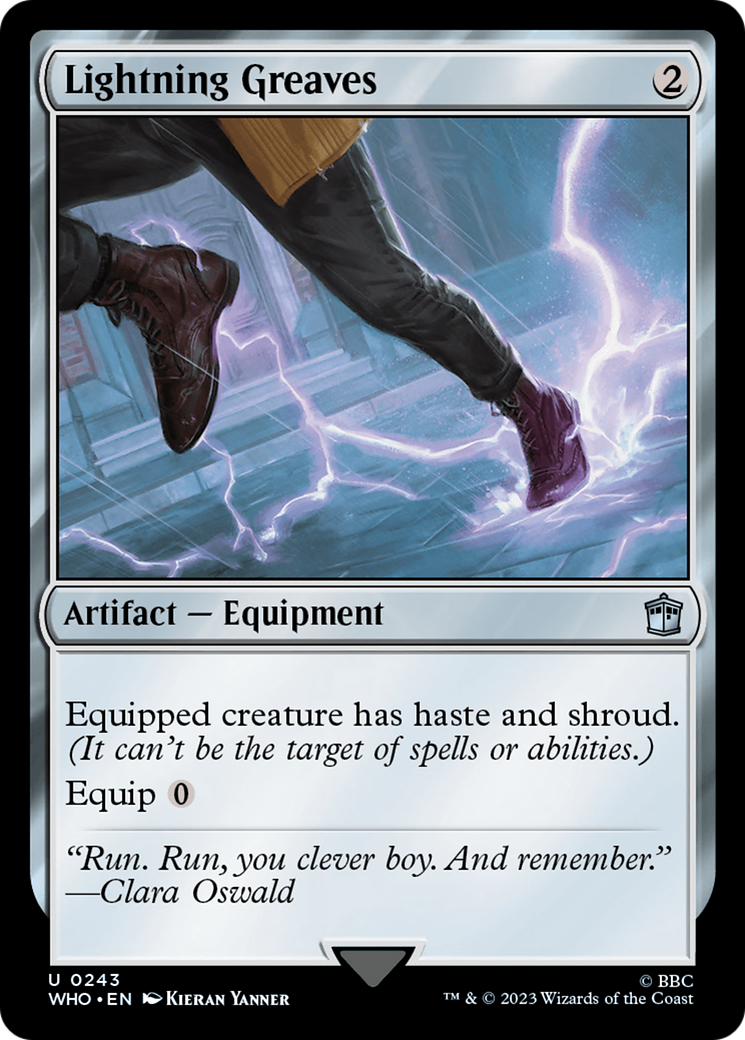
Lightning Greaves
Lightning Greaves
Artifact — Equipment
Equipped creature has haste and shroud. (It can't be the target of spells or abilities.)
Equip
- You can't simply unequip Equipment from a creature. If Lightning Greaves is attached to the only creature you control, you won't be able to attach other equipment to it (or target it with anything else) until you have another creature to which you can attach Lightning Greaves.
- If a creature enters the battlefield under your control and gains haste, but then loses it before attacking, it won't be able to attack that turn. This means that you can't use one Lightning Greaves to allow two new creatures to attack in the same turn.
-
1
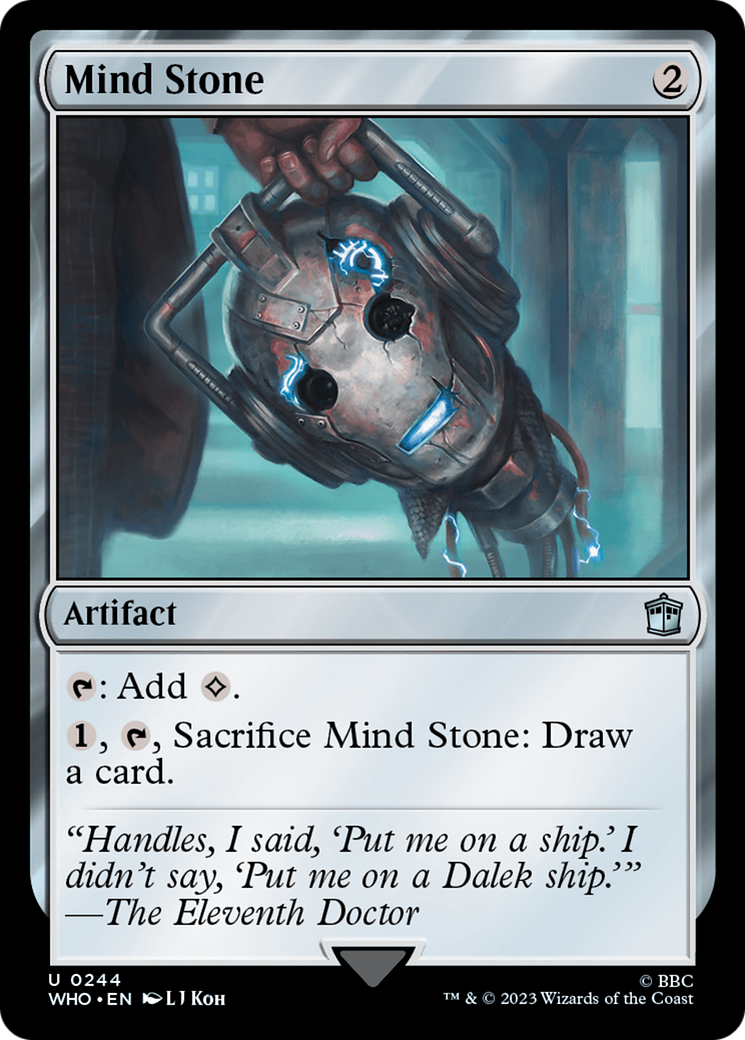
Mind Stone
Mind Stone
Artifact
: Add .
, , Sacrifice this artifact: Draw a card.
-
1
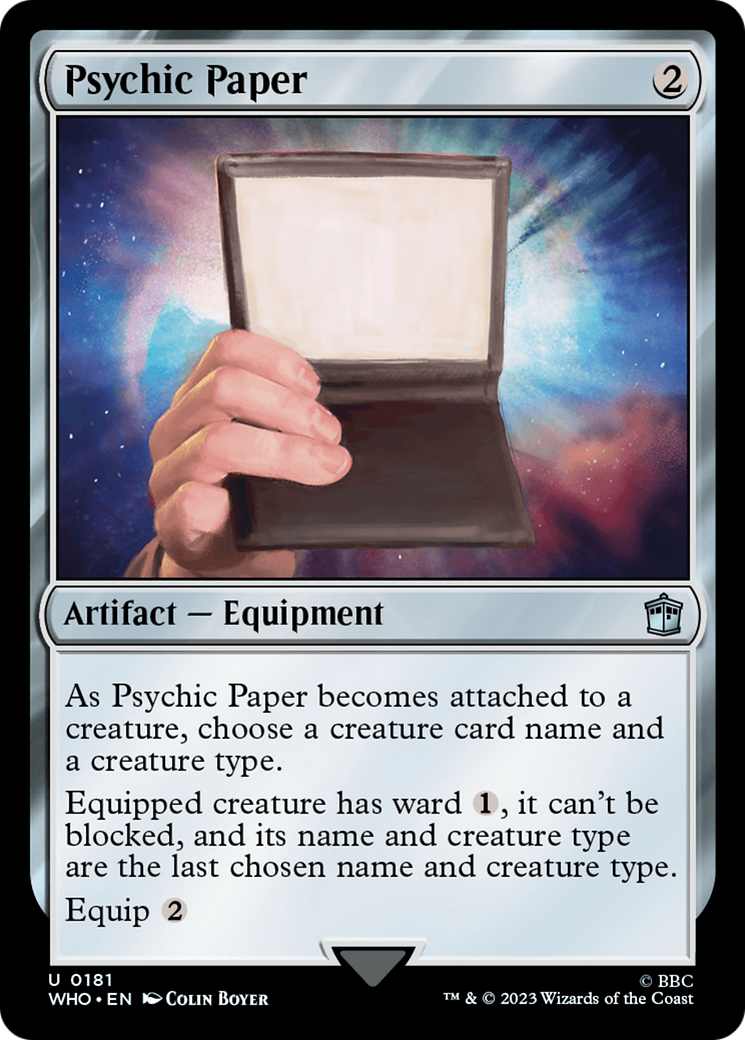
Psychic Paper
Psychic Paper
Artifact — Equipment
As this Equipment becomes attached to a creature, choose a creature card name and a creature type.
Equipped creature has ward , it can't be blocked, and its name and creature type are the last chosen name and creature type.
Equip
- You must choose an existing creature type, such as Time Lord, Vampire, or Warrior. Card types (such as artifact) and supertypes (such as legendary) can't be chosen.
-
1
RMS Titanic
RMS Titanic
Legendary Artifact — Vehicle
7/1
Flying, trample
When RMS Titanic deals combat damage to a player, sacrifice it and create that many Treasure tokens.
Crew 3 (Tap any number of creatures you control with total power 3 or more: This Vehicle becomes an artifact creature until end of turn.)
-
1
Rotating Fireplace
Rotating Fireplace
Artifact
This artifact enters tapped with a time counter on it.
: Add an amount of equal to the number of time counters on this artifact.
, : Time travel. Activate only as a sorcery. (For each suspended card you own and each permanent you control with a time counter on it, you may add or remove a time counter.)
- To time travel, look at each permanent you control with a time counter on it and each suspended card you own in exile with a time counter on it. For each of them, you choose whether you want to put a time counter on that card or permanent, remove a time counter from it, or do neither. Then those changes all happen simultaneously.
- Time counters are usually found on cards with suspend and vanishing, but may be found on other cards as well. Notably, Sagas use lore counters to track their progress, not time counters. You can't move a Saga's chapters forward and backward this way.
-
1
Sol Ring
Sol Ring
Artifact
: Add .
-
1
Sonic Screwdriver
Sonic Screwdriver
Artifact
: Add one mana of any color.
, : Untap another target artifact.
, : Scry 1. (Look at the top card of your library. You may put that card on the bottom.)
, : Target creature can't be blocked this turn.
-
1
Talisman of Conviction
Talisman of Conviction
Artifact
: Add .
: Add or . This artifact deals 1 damage to you.
-
1
Talisman of Creativity
Talisman of Creativity
Artifact
: Add .
: Add or . This artifact deals 1 damage to you.
-
1
TARDIS
TARDIS
Artifact — Vehicle
2/4
Flying
Whenever this Vehicle attacks, if you control a Time Lord, the next spell you cast this turn has cascade and you may planeswalk.
Crew 2 (Tap any number of creatures you control with total power 2 or more: This Vehicle becomes an artifact creature until end of turn.)
- You may planeswalk at the time TARDIS's triggered ability resolves, not at the time you cast the next spell.
- You may planeswalk only in games using the Planechase variant. If you are instructed to planeswalk in any other game, nothing happens.
- A spell's mana value is determined only by its mana cost. Ignore any alternative costs, additional costs, cost increases, or cost reductions.
- Cascade triggers when you cast the spell, meaning that it resolves before that spell. If you end up casting the exiled card, it will go on the stack above the spell with cascade.
- When the cascade ability resolves, you must exile cards. The only optional part of the ability is whether or not you cast the last card exiled.
- If a spell with cascade is countered, the cascade ability will still resolve normally.
- You exile the cards face up. All players will be able to see them.
- If you cast a card "without paying its mana cost," you can't choose to cast it for any alternative costs. You can, however, pay additional costs. If the card has any mandatory additional costs, you must pay those to cast the card.
- If the card has in its mana cost, you must choose 0 as the value of X when casting it without paying its mana cost.
- Due to a 2021 rules change to cascade, not only do you stop exiling cards if you exile a nonland card with lesser mana value than the spell with cascade, but the resulting spell you cast must also have lesser mana value. Previously, in cases where a card's mana value differed from the resulting spell, such as with some modal double-faced cards or cards with an Adventure, you could cast a spell with a higher mana value than the exiled card.
- The mana value of a split card is determined by the combined mana cost of its two halves. If cascade allows you to cast a split card, you may cast either half but not both halves.
-
1
The Moment
The Moment
Legendary Artifact
At the beginning of your upkeep, put a time counter on The Moment.
, : Untap target creature you control. It phases out until The Moment leaves the battlefield.
, : Destroy each nonland permanent with mana value less than or equal to the number of time counters on The Moment. Then sacrifice The Moment. Activate only as a sorcery.
- If The Moment leaves the battlefield before its first activated ability resolves, the target creature will be untapped, but won't phase out.
- The Moment's last ability will destroy itself before you can sacrifice it if there are two or more time counters on it as its last ability resolves. Effects that trigger when you sacrifice a permanent will not trigger when it is destroyed this way.
- While a permanent is phased out, it's treated as though it doesn't exist. It can't be the target of spells or abilities, its static abilities have no effect on the game, its triggered abilities can't trigger, it can't attack or block, and so on.
- An attacking or blocking creature that phases out is removed from combat.
- Phasing out doesn't cause any "leaves the battlefield" abilities to trigger. Similarly, phasing in won't cause any "enters the battlefield" abilities to trigger.
- Any one-shot effects that are waiting "until [this] leaves the battlefield," won't happen when a permanent phases out.
- Any continuous effects with a "for as long as" duration ignore phased-out objects. Any such effects will expire if their conditions are no longer met after ignoring the phased-out objects.
- Each Aura and Equipment attached to a permanent that's phasing out also phases out. They will phase in with that permanent and still be attached to it. Similarly, permanents that phase out with counters phase in with those counters.
- Choices made for permanents as they entered the battlefield are remembered when they phase in.
- A creature phased out by The Moment doesn't phase in during its controller's untap step as normal. Rather, it phases in immediately after The Moment leaves the battlefield.
- Abilities that trigger when a creature becomes tapped won't trigger when the creature phases in tapped.
-
1
The Pandorica
The Pandorica
Legendary Artifact
You may choose not to untap The Pandorica during your untap step.
, : Untap another target nonland permanent, then it phases out. It can't phase in for as long as The Pandorica remains tapped. When The Pandorica becomes untapped or leaves the battlefield, that permanent phases in. Activate only as a sorcery.
- While a permanent is phased out, it's treated as though it doesn't exist. It can't be the target of spells or abilities, its static abilities have no effect on the game, its triggered abilities can't trigger, it can't attack or block, and so on.
- Phasing out doesn't cause any "leaves the battlefield" abilities to trigger. Similarly, phasing in won't cause any "enters the battlefield" abilities to trigger.
- Any one-shot effects that are waiting "until [this] leaves the battlefield," won't happen when a permanent phases out.
- Any continuous effects with a "for as long as" duration ignore phased-out objects. Any such effects will expire if their conditions are no longer met after ignoring the phased-out objects.
- Each Aura and Equipment attached to a permanent that's phasing out also phases out. They will phase in with that permanent and still be attached to it. Similarly, permanents that phase out with counters phase in with those counters.
- Choices made for permanents as they entered the battlefield are remembered when they phase in.
- Abilities that trigger when a creature becomes tapped won't trigger when a creature phases in tapped. (This might happen if the creature in question has one or more stun counters on it.)
-
1
Thought Vessel
Thought Vessel
Artifact
You have no maximum hand size.
: Add .
-
1
Wedding Ring
Wedding Ring
Artifact
When this artifact enters, if it was cast, target opponent creates a token that's a copy of it.
Whenever an opponent who controls an artifact named Wedding Ring draws a card during their turn, you draw a card.
Whenever an opponent who controls an artifact named Wedding Ring gains life during their turn, you gain that much life.
- The trigger conditions of Wedding Ring's second and third abilities care about opponents who control any artifact named Wedding Ring, not just the token copy created by its first ability.
Enchantments 10
-
1
As Foretold
As Foretold
Enchantment
At the beginning of your upkeep, put a time counter on this enchantment.
Once each turn, you may pay rather than pay the mana cost for a spell you cast with mana value X or less, where X is the number of time counters on this enchantment.
- If you cast a spell for an alternative cost of , you can't pay any other alternative costs, such as emerge costs. You can, however, pay additional costs, such as bargain. If the spell has any mandatory additional costs, such as that of Tormenting Voice, you must pay those to cast the spell.
- If a spell has no mana cost, its mana value is 0. You can cast it with As Foretold's alternative cost.
- If you're casting a split card, only the mana value of the half you're casting is compared to the number of time counters on As Foretold. This is because only that half is on the stack at the time that you choose to apply the effect of As Foretold.
- A card's mana value is determined solely by the mana symbols printed in its upper right corner. The mana value is the total amount of mana in that cost, regardless of color. For example, a card with mana cost has mana value 3. Ignore any alternative costs, additional costs, cost increases, or cost reductions that could apply to it. A card with no mana cost has a mana value of 0.
- If you control multiple As Foretolds, you may cast one spell for each of them paying .
- All counters with the same name are indistinguishable from other counters with that name. Cards from the Time Spiral block that interact with time counters will interact with As Foretold.
- If the card has X in its mana cost, you must choose 0 as the value of X when casting it for another cost that doesn't include X. For example, if there are five time counters on As Foretold and you choose to use its effect to cast Pull from Tomorrow, X must be 0. X can't be 2, even though the spell's mana value would be 4.
-
1
Crack in Time
Crack in Time
Enchantment
Vanishing 3 (This enchantment enters with three time counters on it. At the beginning of your upkeep, remove a time counter from it. When the last is removed, sacrifice it.)
When this enchantment enters and at the beginning of your first main phase, exile target creature an opponent controls until this enchantment leaves the battlefield.
- If Crack in Time leaves the battlefield before its triggered ability resolves, the target creature won't be exiled.
-
1
Four Knocks
Four Knocks
Enchantment
Vanishing 4 (This enchantment enters with four time counters on it. At the beginning of your upkeep, remove a time counter from it. When the last is removed, sacrifice it.)
At the beginning of your first main phase, draw a card.
-
1
Grasp of Fate
Grasp of Fate
Enchantment
When this enchantment enters, for each opponent, exile up to one target nonland permanent that player controls until this enchantment leaves the battlefield. (Those permanents return under their owners' control.)
- If Grasp of Fate leaves the battlefield before its triggered ability resolves, no nonland permanents will be exiled.
- Auras attached to exiled nonland permanents will be put into their owners' graveyards. Equipment attached to exiled creatures will become unattached and remain on the battlefield. Any counters on exiled nonland permanents will cease to exist.
- If a token is exiled, it ceases to exist. It won't be returned to the battlefield.
- The exiled cards return to the battlefield immediately after Grasp of Fate leaves the battlefield. Nothing happens between the two events, including state-based actions.
- In a multiplayer game, if Grasp of Fate's owner leaves the game, the exiled cards will return to the battlefield. Because the one-shot effect that returns the cards isn't an ability that goes on the stack, it won't cease to exist along with the leaving player's spells and abilities on the stack.
-
1
Out of Time
Out of Time
Enchantment
When this enchantment enters, untap all creatures, then those creatures phase out until this enchantment leaves the battlefield. Put a time counter on this enchantment for each creature that phased out this way.
Vanishing (At the beginning of your upkeep, remove a time counter from this enchantment. When the last is removed, sacrifice it.)
- A creature phased out by Out of Time doesn't phase in during its controller's untap step as normal.
- If Out of Time happens to be a creature when its enter the battlefield trigger resolves, it will phase out along with all other creatures. You'll never remove the last counter since it's phased out, so all creatures will remain phased out indefinitely.
- If there are no creatures on the battlefield when Out of Time's triggered ability resolves, nothing phases out and Out of Time won't get any time counters. It will remain on the battlefield and won't be sacrificed, since the last time counter will never be removed.
- If Out of Time leaves the battlefield before its enter the battlefield trigger resolves, creatures will untap, but they won't phase out.
- While a permanent is phased out, it's treated as though it doesn't exist. It can't be the target of spells or abilities, its static abilities have no effect on the game, its triggered abilities can't trigger, it can't attack or block, and so on.
- Phasing out doesn't cause any "leaves the battlefield" abilities to trigger. Similarly, phasing in won't cause any "enters the battlefield" abilities to trigger.
- Any one-shot effects that are waiting "until [this] leaves the battlefield," such as that of Banisher Priest, won't happen when a permanent phases out.
- Any continuous effects with a "for as long as" duration, such as that of Tide Shaper, ignore phased-out objects. Any such effects will expire if their conditions are no longer met after ignoring the phased-out objects.
- Each Aura and Equipment attached to a permanent that's phasing out also phases out. They will phase in with that permanent and still be attached to it. Similarly, permanents that phase out with counters phase in with those counters.
- Choices made for permanents as they entered the battlefield are remembered when they phase in.
-
1
Regenerations Restored
Regenerations Restored
Enchantment
Vanishing 12 (This enchantment enters with twelve time counters on it. At the beginning of your upkeep, remove a time counter from it. When the last is removed, sacrifice it.)
Whenever one or more time counters are removed from this enchantment, scry 1 and you gain 1 life. Then if this enchantment has no time counters on it, exile it. When you do, take an extra turn after this one.
-
1
The Day of the Doctor
The Day of the Doctor
Enchantment — Saga
(As this Saga enters and after your draw step, add a lore counter. Sacrifice after IV.)
I, II, III — Exile cards from the top of your library until you exile a legendary card. You may play that card for as long as this Saga remains on the battlefield. Put the rest of those exiled cards on the bottom of your library in a random order.
IV — Choose up to three Doctors. You may exile all other creatures. If you do, this Saga deals 13 damage to you.
- As the last chapter ability resolves, you may choose to exile all other creatures even if you didn't choose any Doctors. In that case, all creatures are exiled.
-
1
The Eleventh Hour
The Eleventh Hour
Enchantment — Saga
(As this Saga enters and after your draw step, add a lore counter. Sacrifice after III.)
I — Search your library for a Doctor card, reveal it, put it into your hand, then shuffle.
II — Create a Food token and a 1/1 white Human creature token with "Doctor spells you cast cost less to cast."
III — Create a token that's a copy of target creature, except it's a legendary Alien named Prisoner Zero.
- Food is an artifact type. Even though it appears on some creatures, it's never a creature type.
- You can't sacrifice a Food to pay multiple costs. For example, you can't sacrifice a Food token to activate its own ability and also to activate Maraleaf Rider's ability.
- Whatever you do, don't eat the delicious cards.
- If the copied creature has in its mana cost, X is considered to be 0.
- If the copied creature is a token, the new token that's created copies the original characteristics of that token as stated by the effect that created that token, with the exceptions noted above.
- The Eleventh Hour's first ability can find any card with the Doctor creature type, not cards with the word "Doctor" in the name.
- Any enters-the-battlefield abilities of the copied creature will trigger when the token enters the battlefield. Any "as [this creature] enters the battlefield" or "[this creature] enters the battlefield with" abilities of the chosen creature will also work.
- The token will still have any card types it normally has, such as creature or artifact, but it will lose any non-Alien subtypes it has, such as Human or Vehicle.
- If the copied creature is copying something else, then the token enters the battlefield as whatever that creature copied, with the exceptions noted above.
- The same is true for reducing the cost of Doctor spells.
- Except for its name and types, the token copies exactly what was printed on the original creature and nothing else (unless that permanent is copying something else or it is a token; see below). It doesn't copy whether that creature is tapped or untapped, whether it has any counters on it or Auras and Equipment attached to it, and so on.
-
1
The Girl in the Fireplace
The Girl in the Fireplace
Enchantment — Saga
(As this Saga enters and after your draw step, add a lore counter. Sacrifice after III.)
I — Create a 1/1 white Human Noble creature token with vanishing 3 and "Prevent all damage that would be dealt to this token."
II — Create a 2/2 white Horse creature token with "Doctors you control have horsemanship." (They can't be blocked except by creatures with horsemanship.)
III — Whenever a creature you control deals combat damage to a player this turn, time travel.
- To time travel, look at each permanent you control with a time counter on it and each suspended card you own in exile with a time counter on it. For each of them, you choose whether you want to put a time counter on that card or permanent, remove a time counter from it, or do neither. Then those changes all happen simultaneously.
- Time counters are usually found on cards with suspend and vanishing, but may be found on other cards as well. Notably, Sagas use lore counters to track their progress, not time counters. You can't move a Saga's chapters forward and backward this way.
-
1
The Parting of the Ways
The Parting of the Ways
Enchantment — Saga
(As this Saga enters and after your draw step, add a lore counter. Sacrifice after III.)
I — Exile the top five cards of your library. For each nonland card exiled this way, put a number of time counters on that card equal to its mana value. If it doesn't have suspend, it gains suspend.
II — Time travel, then time travel.
III — For each opponent, destroy up to one target artifact that player controls.
- The mana value of a spell cast without paying its mana cost is determined by its mana cost, even though that cost wasn't paid.
- If you cast a card "without paying its mana cost," such as with suspend, you can't choose to cast it for any alternative costs. You can, however, pay additional costs. If the card has any mandatory additional costs, you must pay those if you want to cast the card.
- If the card has in its mana cost, you must choose 0 as the value of X when casting it without paying its mana cost.
- Suspend is a keyword that represents three abilities. The first is a static ability that allows you to exile the card from your hand with the specified number of time counters (the number before the dash) on it by paying its suspend cost (listed after the dash). The second is a triggered ability that removes a time counter from the suspended card at the beginning of each of your upkeeps. The third is a triggered ability that gives you the option to cast the card when the last time counter is removed.
- You can exile a card in your hand using suspend any time you could cast that card. Consider its card type, any effects that modify when you could cast it (such as flash) and any other effects that stop you from casting it (such as from Meddling Mage's ability) to determine if and when you can do this. Whether you could actually complete all steps in casting the card is irrelevant. For example, you can exile a card with suspend that has no mana cost or that requires a target even if no legal targets are available at that time.
- Cards exiled with suspend are exiled face up.
- Exiling a card with suspend isn't casting that card. This action doesn't use the stack and can't be responded to.
- If the spell requires any targets, those targets are chosen when the spell is finally cast, not when it's exiled.
- If an effect refers to a "suspended card," that means a card that (1) has suspend, (2) is in exile, and (3) has one or more time counters on it.
- If the first triggered ability of suspend (the one that removes time counters) is countered, no time counter is removed. The ability will trigger again at the beginning of the card's owner's next upkeep.
- When the last time counter is removed, the second triggered ability of suspend (the one that lets you cast the card) triggers. It doesn't matter why the last time counter was removed or what effect removed it.
- If the second triggered ability is countered, the card can't be cast. It remains exiled with no time counters on it, and it's no longer suspended.
- Due to a recent rules change to suspend, you are no longer required to cast the suspended card as the second triggered ability of suspend resolves. Instead, as the second triggered ability resolves, you may cast the card. Timing permissions based on the card's type are ignored. If you don't cast the card, it remains exiled with no time counters on it, and it's no longer suspended.
- Time counters are usually found on cards with suspend and vanishing, but may be found on other cards as well. Notably, Sagas use lore counters to track their progress, not time counters. You can't move a Saga's chapters forward and backward this way.
- To time travel, look at each permanent you control with a time counter on it and each suspended card you own in exile with a time counter on it. For each of them, you choose whether you want to put a time counter on that card or permanent, remove a time counter from it, or do neither. Then those changes all happen simultaneously.
Lands 37
-
1
Command Tower
Command Tower
Land
: Add one mana of any color in your commander's color identity.
- If you don't have a commander, Command Tower's ability produces no mana.
- If your commander is a card that has no colors in its color identity, Command Tower's ability produces no mana. It doesn't produce .
- If you have two commanders, the ability adds one mana of any color in their combined color identities.
-
1
Deserted Beach
Deserted Beach
Land
This land enters tapped unless you control two or more other lands.
: Add or .
- If this land enters the battlefield at the same time as any number of other lands, those other lands are not counted when determining if this land enters the battlefield tapped or untapped.
-
1
Evolving Wilds
Evolving Wilds
Land
, Sacrifice this land: Search your library for a basic land card, put it onto the battlefield tapped, then shuffle.
-
1
Exotic Orchard
Exotic Orchard
Land
: Add one mana of any color that a land an opponent controls could produce.
- Lands that produce mana based only on what other lands "could produce" won't help each other unless some other land allows one of them to actually produce some type of mana. For example, if you control an Exotic Orchard and your opponent controls an Exotic Orchard and a Reflecting Pool, none of those lands would produce mana if their mana abilities were activated. On the other hand, if you control a Forest and an Exotic Orchard, and your opponent controls an Exotic Orchard and a Reflecting Pool, then each of those lands can be tapped to produce . Your opponent's Exotic Orchard can produce because you control a Forest. Your Exotic Orchard and your opponent's Reflecting Pool can each produce because your opponent's Exotic Orchard can produce .
- When determining what colors of mana your opponents' lands could produce, Exotic Orchard takes into account any applicable replacement effects that would apply to those lands' mana abilities (such as Contamination's effect, for example). If there are more than one, consider them in any possible order.
- The colors of mana are white, blue, black, red, and green. Exotic Orchard can't be tapped for colorless mana, even if a land an opponent controls could produce colorless mana.
- Exotic Orchard doesn't care about any restrictions or riders your opponents' lands (such as Ancient Ziggurat or Hall of the Bandit Lord) put on the mana they produce. It just cares about colors of mana.
- Exotic Orchard checks the effects of all mana-producing abilities of lands your opponents control, but it doesn't check their costs. For example, Vivid Crag has the ability " , Remove a charge counter from Vivid Crag: Add one mana of any color." If an opponent controls Vivid Crag and you control Exotic Orchard, you can tap Exotic Orchard for any color of mana. It doesn't matter whether Vivid Crag has a charge counter on it, and it doesn't matter whether it's untapped.
-
1
Fiery Islet
Fiery Islet
Land
, Pay 1 life: Add or .
, , Sacrifice this land: Draw a card.
-
1
Frostboil Snarl
Frostboil Snarl
Land
As this land enters, you may reveal an Island or Mountain card from your hand. If you don't, this land enters tapped.
: Add or .
- The "Snarl" itself doesn't have any land subtypes. You can't reveal one to satisfy the ability of another.
- If a land card with an appropriate subtype is entering the battlefield from your hand at the same time as one of these lands, you may reveal the other land to have the "Snarl" enter untapped.
- If an effect instructs you to put one of these lands onto the battlefield tapped, it will still enter the battlefield tapped even if you reveal a land card from your hand.
- You may reveal any land card with either or both of the appropriate subtypes. It doesn't have to be a basic land card.
-
1
Furycalm Snarl
Furycalm Snarl
Land
As this land enters, you may reveal a Mountain or Plains card from your hand. If you don't, this land enters tapped.
: Add or .
- The "Snarl" itself doesn't have any land subtypes. You can't reveal one to satisfy the ability of another.
- If a land card with an appropriate subtype is entering the battlefield from your hand at the same time as one of these lands, you may reveal the other land to have the "Snarl" enter untapped.
- If an effect instructs you to put one of these lands onto the battlefield tapped, it will still enter the battlefield tapped even if you reveal a land card from your hand.
- You may reveal any land card with either or both of the appropriate subtypes. It doesn't have to be a basic land card.
-
1
Glacial Fortress
Glacial Fortress
Land
This land enters tapped unless you control a Plains or an Island.
: Add or .
- This checks for lands you control with the land type Plains or Island, not for lands named Plains or Island. The lands it checks for don't have to be basic lands. For example, if you control Watery Grave (a nonbasic land with the land types Island and Swamp), Glacial Fortress will enter untapped.
- As this is entering, it checks for lands that are already on the battlefield. It won't see lands that are entering at the same time (due to Warp World, for example).
-
1
Irrigated Farmland
Irrigated Farmland
Land — Plains Island
( : Add or .)
This land enters tapped.
Cycling ( , Discard this card: Draw a card.)
-
3
Island
Island
Basic Land — Island
( : Add .)
-
3
Mountain
Mountain
Basic Land — Mountain
( : Add .)
-
1
Myriad Landscape
Myriad Landscape
Land
This land enters tapped.
: Add .
, , Sacrifice this land: Search your library for up to two basic land cards that share a land type, put them onto the battlefield tapped, then shuffle.
- You can choose to find one basic land card with Myriad Landscape's last ability.
-
1
Mystic Monastery
Mystic Monastery
Land
This land enters tapped.
: Add , , or .
-
1
Ominous Cemetery
Ominous Cemetery
Land
: Add .
, , Exile this land: Target creature's owner shuffles it into their library.
-
1
Path of Ancestry
Path of Ancestry
Land
This land enters tapped.
: Add one mana of any color in your commander's color identity. When that mana is spent to cast a creature spell that shares a creature type with your commander, scry 1. (Look at the top card of your library. You may put that card on the bottom.)
- Your commander's creature types are checked immediately after you cast a creature spell spending mana from Path of Ancestry's last ability. They aren't set before the game begins, and they may not be the same types your commander had when you activated that ability.
- If you have two commanders, the last ability adds one mana of any color in their combined color identities. When you spend that mana on a creature spell that shares a creature type with either of your commanders, you'll scry 1.
- If Path of Ancestry's last ability produces two mana (most likely due to Mana Reflection), spending those two mana to cast creature spells that share a creature type with your commander will cause two abilities to trigger. Each of those abilities will cause you to scry 1. You won't scry 2. This is true whether you spend the mana on one creature spell or two.
- If your commander has no creature types, it can't share a creature type with any spell that you cast.
- If you cast your commander with mana from Path of Ancestry, and your commander hasn't somehow lost all of its creature types while on the stack, you'll scry 1.
- If you don't have a commander, Path of Ancestry's ability produces no mana.
- If your commander is a card that has no colors in its color identity, Path of Ancestry's ability produces no mana. It doesn't produce .
-
3
Plains
Plains
Basic Land — Plains
( : Add .)
-
1
Port Town
Port Town
Land
As this land enters, you may reveal a Plains or Island card from your hand. If you don't, this land enters tapped.
: Add or .
- You may reveal any land card with either or both of the appropriate subtypes. It doesn't have to be a basic land. For example, you could reveal Canopy Vista from the Battle for Zendikar set to satisfy the ability of Port Town.
- Lands don't have a subtype just because they can produce mana of the corresponding color. Port Town itself is neither a Plains nor an Island, even though it produces white and blue mana, so you can't reveal one to satisfy the ability of another.
- If a Plains or Island is entering the battlefield from your hand at the same time as Port Town, you may reveal the other land to have Port Town enter untapped.
- If an effect instructs you to put Port Town onto the battlefield tapped, it will still enter the battlefield tapped even if you reveal a land card from your hand.
-
1
Prairie Stream
Prairie Stream
Land — Plains Island
( : Add or .)
This land enters tapped unless you control two or more basic lands.
- Even though these lands have basic land types, they are not basic lands because "basic" doesn't appear on their type line. Notably, controlling two or more of them won't allow others to enter the battlefield untapped.
- However, because these cards have basic land types, effects that specify a basic land type without also specifying that the land be basic can affect them. For example, a spell or ability that reads "Destroy target Forest" can target Canopy Vista, while one that reads "Destroy target basic Forest" cannot.
- If one of these lands enters the battlefield at the same time as any number of basic lands, those other lands are not counted when determining if this land enters the battlefield tapped or untapped.
-
1
Rogue's Passage
Rogue's Passage
Land
: Add .
, : Target creature can't be blocked this turn.
- Activating the second ability of Rogue's Passage after a creature has become blocked won't cause that creature to become unblocked.
-
1
Skycloud Expanse
Skycloud Expanse
Land
, : Add .
-
1
Stormcarved Coast
Stormcarved Coast
Land
This land enters tapped unless you control two or more other lands.
: Add or .
-
1
Sunbaked Canyon
Sunbaked Canyon
Land
, Pay 1 life: Add or .
, , Sacrifice this land: Draw a card.
-
1
Sundown Pass
Sundown Pass
Land
This land enters tapped unless you control two or more other lands.
: Add or .
-
1
Temple of Enlightenment
Temple of Enlightenment
Land
This land enters tapped.
When this land enters, scry 1. (Look at the top card of your library. You may put that card on the bottom.)
: Add or .
- When you scry, you may put all the cards you look at back on top of your library, you may put all of those cards on the bottom of your library, or you may put some of those cards on top and the rest of them on the bottom.
- You choose how to order cards returned to your library after scrying no matter where you put them.
- You perform the actions stated on a card in sequence. For some spells and abilities, that means you'll scry last. For others, that means you'll scry and then perform other actions.
- Scry appears on some spells and abilities with one or more targets. If all of the spell or ability's targets are illegal when it tries to resolve, it won't resolve and none of its effects will happen. You won't scry.
-
1
Temple of Epiphany
Temple of Epiphany
Land
This land enters tapped.
When this land enters, scry 1. (Look at the top card of your library. You may put that card on the bottom.)
: Add or .
-
1
Temple of the False God
Temple of the False God
Land
: Add . Activate only if you control five or more lands.
-
1
Temple of Triumph
Temple of Triumph
Land
This land enters tapped.
When this land enters, scry 1. (Look at the top card of your library. You may put that card on the bottom.)
: Add or .
- When you scry, you may put all the cards you look at back on top of your library, you may put all of those cards on the bottom of your library, or you may put some of those cards on top and the rest of them on the bottom.
- You choose how to order cards returned to your library after scrying no matter where you put them.
- You perform the actions stated on a card in sequence. For some spells and abilities, that means you'll scry last. For others, that means you'll scry and then perform other actions.
- Scry appears on some spells and abilities with one or more targets. If all of the spell or ability's targets are illegal when it tries to resolve, it won't resolve and none of its effects will happen. You won't scry.
-
1
Thespian's Stage
Thespian's Stage
Land
: Add .
, : This land becomes a copy of target land, except it has this ability.
- The copy effect created by the last activated ability doesn't have a duration. It will last until Thespian's Stage leaves the battlefield or another copy effect overwrites it. The permanent will no longer have the first ability of Thespian's Stage.
- A land's copiable values are those printed on it, as modified by other copy effects. Counters and other effects aren't copied. Notably, if you copy a land that is also a creature because of a temporary effect (such as Celestial Colonnade), Thespian's Stage will become just the "unanimated" land.
- Thespian's Stage doesn't become untapped when it becomes a copy, even if the target land is untapped.
- No enters-the-battlefield abilities of the land Thespian's Stage is copying will trigger. Thespian's Stage was already on the battlefield. Similarly, no "as this land enters the battlefield" or "this land enters the battlefield with" effects, such as that of Dark Depths, will apply.
-
1
Thriving Bluff
Thriving Bluff
Land
This land enters tapped. As it enters, choose a color other than red.
: Add or one mana of the chosen color.
-
1
Trenzalore Clocktower
Trenzalore Clocktower
Legendary Land
: Add . Put a time counter on Trenzalore Clocktower.
, , Remove twelve time counters from Trenzalore Clocktower and exile it: Shuffle your graveyard and hand into your library, then draw seven cards. Activate only if you control a Time Lord.
-
1
War Room
War Room
Land
: Add .
, , Pay life equal to the number of colors in your commanders' color identity: Draw a card.
- Color identity is set before the game begins and doesn't change during the game, even if your commander is in a hidden zone (like the hand or library) or an effect changes your commander's color.
- If you don't have a commander, you can't activate War Room's last ability at all.
- If your commander has no colors in its color identity, you pay no life to activate War Room's last ability.
White 16
-
1
Adipose Offspring
Adipose Offspring
Creature — Alien
2/2
Emerge (You may cast this spell by sacrificing a creature and paying the emerge cost reduced by that creature's mana value.)
When this creature enters, create a 2/2 white Alien creature token. If this creature's emerge cost was paid, instead create X of those tokens, where X is the sacrificed creature's toughness.
- For Adipose Offspring's last ability, use the toughness of the sacrificed creature as it existed when it was last on the battlefield, which may be different from its toughness in the graveyard.
-
1
Astrid Peth
Astrid Peth
Legendary Creature — Human
2/2
Whenever Astrid Peth enters or attacks, create a Food token.
Brand-new Sky — Whenever you sacrifice a Clue or Food, Astrid Peth explores. (Reveal the top card of your library. Put that card into your hand if it's a land. Otherwise, put a +1/+1 counter on this creature, then put the card back or put it into your graveyard.)
- If an effect refers to a Food, it means any Food artifact, not just a Food artifact token. For example, you can sacrifice Tough Cookie (an Artifact Creature — Food Golem) to activate Maraleaf Rider's ability (an ability with "Sacrifice a Food" in its cost).
- Food is an artifact type. Even though it appears on some creatures, it's never a creature type.
- You can't sacrifice a Food to pay multiple costs. For example, you can't sacrifice a Food token to activate its own ability and also to activate Maraleaf Rider's ability.
- Whatever you do, don't eat the delicious cards.
- If no card is revealed, most likely because that player's library is empty, the exploring creature receives a +1/+1 counter.
- If a resolving spell or ability instructs a specific creature to explore but that creature has left the battlefield, the creature still explores. If you reveal a nonland card this way, you won't put a +1/+1 counter on anything, but you may put the revealed card into your graveyard. Effects that trigger "whenever a creature you control explores" trigger if appropriate.
- Once an ability that causes a creature to explore begins to resolve, no player may take any other actions until it's done. Notably, opponents can't try to remove the exploring creature after you reveal a nonland card but before it receives a counter.
-
1
Atraxi Warden
Atraxi Warden
Creature — Alien Eye
6/6
Flying
When this creature enters, exile up to one target tapped creature.
Suspend 5— (Rather than cast this card from your hand, you may pay and exile it with five time counters on it. At the beginning of your upkeep, remove a time counter. When the last is removed, you may cast it without paying its mana cost. It has haste.)
- Suspend is a keyword that represents three abilities. The first is a static ability that allows you to exile the card from your hand with the specified number of time counters (the number before the dash) on it by paying its suspend cost (listed after the dash). The second is a triggered ability that removes a time counter from the suspended card at the beginning of each of your upkeeps. The third is a triggered ability that gives you the option to cast the card when the last time counter is removed.
- You can exile a card in your hand using suspend any time you could cast that card. Consider its card type, any effects that modify when you could cast it (such as flash) and any other effects that stop you from casting it (such as from Meddling Mage's ability) to determine if and when you can do this. Whether you could actually complete all steps in casting the card is irrelevant. For example, you can exile a card with suspend that has no mana cost or that requires a target even if no legal targets are available at that time.
- Cards exiled with suspend are exiled face up.
- Exiling a card with suspend isn't casting that card. This action doesn't use the stack and can't be responded to.
- If the spell requires any targets, those targets are chosen when the spell is finally cast, not when it's exiled.
- If an effect refers to a "suspended card," that means a card that (1) has suspend, (2) is in exile, and (3) has one or more time counters on it.
- If the first triggered ability of suspend (the one that removes time counters) is countered, no time counter is removed. The ability will trigger again at the beginning of the card's owner's next upkeep.
- When the last time counter is removed, the second triggered ability of suspend (the one that lets you cast the card) triggers. It doesn't matter why the last time counter was removed or what effect removed it.
- If the second triggered ability is countered, the card can't be cast. It remains exiled with no time counters on it, and it's no longer suspended.
- Due to a recent rules change to suspend, you are no longer required to cast the suspended card as the second triggered ability of suspend resolves. Instead, as the second triggered ability resolves, you may cast the card. Timing permissions based on the card's type are ignored. If you don't cast the card, it remains exiled with no time counters on it, and it's no longer suspended.
- If you cast a card "without paying its mana cost," such as with suspend, you can't choose to cast it for any alternative costs. You can, however, pay additional costs. If the card has any mandatory additional costs, you must pay those if you want to cast the card.
- If the card has in its mana cost, you must choose 0 as the value of X when casting it without paying its mana cost.
- The mana value of a spell cast without paying its mana cost is determined by its mana cost, even though that cost wasn't paid.
-
1
Crack in Time
Crack in Time
Enchantment
Vanishing 3 (This enchantment enters with three time counters on it. At the beginning of your upkeep, remove a time counter from it. When the last is removed, sacrifice it.)
When this enchantment enters and at the beginning of your first main phase, exile target creature an opponent controls until this enchantment leaves the battlefield.
- If Crack in Time leaves the battlefield before its triggered ability resolves, the target creature won't be exiled.
-
1
Everybody Lives!
Everybody Lives!
Instant
All creatures gain hexproof and indestructible until end of turn. Players gain hexproof until end of turn. Players can't lose life this turn and players can't lose the game or win the game this turn.
- Players can always concede from the game, even if they can't otherwise lose the game.
-
1
Everything Comes to Dust
Everything Comes to Dust
Sorcery
Convoke (Your creatures can help cast this spell. Each creature you tap while casting this spell pays for or one mana of that creature's color.)
Exile all creatures except those that share a creature type with a creature that convoked this spell, all artifacts, and all enchantments.
- You can tap any untapped creature you control to convoke a spell, even one you haven't controlled continuously since the beginning of your most recent turn.
- Tapping an untapped creature that's attacking or blocking to convoke a spell won't cause that creature to stop attacking or blocking.
- When calculating a spell's total cost, include any alternative costs, additional costs, or anything else that increases or reduces the cost to cast the spell. Convoke applies after the total cost is calculated. Convoke doesn't change a spell's mana cost or mana value.
- If a creature you control has a mana ability with in the cost, activating that ability while casting a spell with convoke will result in the creature being tapped before you pay the spell's costs. You won't be able to tap it again for convoke. Similarly, if you sacrifice a creature to activate a mana ability while casting a spell with convoke, that creature won't be on the battlefield when you pay the spell's costs, so you won't be able to tap it for convoke.
- Because convoke isn't an alternative cost, it can be used in conjunction with alternative costs.
- Tapping a multicolored creature using convoke will pay for or one mana of your choice of any of that creature's colors.
-
1
Farewell
Farewell
Sorcery
Choose one or more —
- Exile all artifacts.
- Exile all creatures.
- Exile all enchantments.
- Exile all graveyards.
- If you choose more than one mode for Farewell, you perform the actions in the order written.
-
1
Four Knocks
Four Knocks
Enchantment
Vanishing 4 (This enchantment enters with four time counters on it. At the beginning of your upkeep, remove a time counter from it. When the last is removed, sacrifice it.)
At the beginning of your first main phase, draw a card.
-
1
Grasp of Fate
Grasp of Fate
Enchantment
When this enchantment enters, for each opponent, exile up to one target nonland permanent that player controls until this enchantment leaves the battlefield. (Those permanents return under their owners' control.)
- If Grasp of Fate leaves the battlefield before its triggered ability resolves, no nonland permanents will be exiled.
- Auras attached to exiled nonland permanents will be put into their owners' graveyards. Equipment attached to exiled creatures will become unattached and remain on the battlefield. Any counters on exiled nonland permanents will cease to exist.
- If a token is exiled, it ceases to exist. It won't be returned to the battlefield.
- The exiled cards return to the battlefield immediately after Grasp of Fate leaves the battlefield. Nothing happens between the two events, including state-based actions.
- In a multiplayer game, if Grasp of Fate's owner leaves the game, the exiled cards will return to the battlefield. Because the one-shot effect that returns the cards isn't an ability that goes on the stack, it won't cease to exist along with the leaving player's spells and abilities on the stack.
-
1
Out of Time
Out of Time
Enchantment
When this enchantment enters, untap all creatures, then those creatures phase out until this enchantment leaves the battlefield. Put a time counter on this enchantment for each creature that phased out this way.
Vanishing (At the beginning of your upkeep, remove a time counter from this enchantment. When the last is removed, sacrifice it.)
- A creature phased out by Out of Time doesn't phase in during its controller's untap step as normal.
- If Out of Time happens to be a creature when its enter the battlefield trigger resolves, it will phase out along with all other creatures. You'll never remove the last counter since it's phased out, so all creatures will remain phased out indefinitely.
- If there are no creatures on the battlefield when Out of Time's triggered ability resolves, nothing phases out and Out of Time won't get any time counters. It will remain on the battlefield and won't be sacrificed, since the last time counter will never be removed.
- If Out of Time leaves the battlefield before its enter the battlefield trigger resolves, creatures will untap, but they won't phase out.
- While a permanent is phased out, it's treated as though it doesn't exist. It can't be the target of spells or abilities, its static abilities have no effect on the game, its triggered abilities can't trigger, it can't attack or block, and so on.
- Phasing out doesn't cause any "leaves the battlefield" abilities to trigger. Similarly, phasing in won't cause any "enters the battlefield" abilities to trigger.
- Any one-shot effects that are waiting "until [this] leaves the battlefield," such as that of Banisher Priest, won't happen when a permanent phases out.
- Any continuous effects with a "for as long as" duration, such as that of Tide Shaper, ignore phased-out objects. Any such effects will expire if their conditions are no longer met after ignoring the phased-out objects.
- Each Aura and Equipment attached to a permanent that's phasing out also phases out. They will phase in with that permanent and still be attached to it. Similarly, permanents that phase out with counters phase in with those counters.
- Choices made for permanents as they entered the battlefield are remembered when they phase in.
-
1
Rose Tyler
Rose Tyler
Legendary Creature — Human
2/2
Rose Tyler gets +1/+1 for each time counter on it.
Bad Wolf — Whenever Rose Tyler attacks, put a time counter on it for each suspended card you own and each other permanent you control with a time counter on it.
Doctor's companion (You can have two commanders if the other is the Doctor.)
- A suspended card is a card in exile with suspend that has at least one time counter on it. That includes any cards which were put there by an effect that says they "gain suspend" or similar.
- The Doctor's companion ability allows you to have two commanders if one has the ability and the other is a legendary creature that is a Time Lord Doctor and has no other creature types. Creatures with the changeling ability, for example, can't be a second commander this way.
- Although Doctor's companion is a new variant of the partner ability, the rules for partner have not otherwise changed. Notably, Time Lord Doctors and cards with Doctor's companion do not interact with cards which have another partner ability.
- If your Commander deck has two commanders, you can include only cards whose own color identities are also found in your commanders' combined color identities.
- Both commanders start in the command zone, and the remaining 98 cards (or 58 cards in a Commander Draft game) of your deck are shuffled to become your library.
- Once the game begins, your two commanders are tracked separately. If you cast one, you won't have to pay an additional the first time you cast the other. A player loses the game after having been dealt 21 combat damage from any one of them, not from both of them combined.
- If something refers to your commander while you have two commanders, it refers to one of them of your choice. If you are instructed to perform an action on your commander (e.g. put it from the command zone into your hand due to Command Beacon), you choose one of your commanders at the time the effect happens.
- An effect that checks whether you control your commander is satisfied if you control one or both of your two commanders.
-
1
The Girl in the Fireplace
The Girl in the Fireplace
Enchantment — Saga
(As this Saga enters and after your draw step, add a lore counter. Sacrifice after III.)
I — Create a 1/1 white Human Noble creature token with vanishing 3 and "Prevent all damage that would be dealt to this token."
II — Create a 2/2 white Horse creature token with "Doctors you control have horsemanship." (They can't be blocked except by creatures with horsemanship.)
III — Whenever a creature you control deals combat damage to a player this turn, time travel.
- To time travel, look at each permanent you control with a time counter on it and each suspended card you own in exile with a time counter on it. For each of them, you choose whether you want to put a time counter on that card or permanent, remove a time counter from it, or do neither. Then those changes all happen simultaneously.
- Time counters are usually found on cards with suspend and vanishing, but may be found on other cards as well. Notably, Sagas use lore counters to track their progress, not time counters. You can't move a Saga's chapters forward and backward this way.
-
1
The Pandorica
The Pandorica
Legendary Artifact
You may choose not to untap The Pandorica during your untap step.
, : Untap another target nonland permanent, then it phases out. It can't phase in for as long as The Pandorica remains tapped. When The Pandorica becomes untapped or leaves the battlefield, that permanent phases in. Activate only as a sorcery.
- While a permanent is phased out, it's treated as though it doesn't exist. It can't be the target of spells or abilities, its static abilities have no effect on the game, its triggered abilities can't trigger, it can't attack or block, and so on.
- Phasing out doesn't cause any "leaves the battlefield" abilities to trigger. Similarly, phasing in won't cause any "enters the battlefield" abilities to trigger.
- Any one-shot effects that are waiting "until [this] leaves the battlefield," won't happen when a permanent phases out.
- Any continuous effects with a "for as long as" duration ignore phased-out objects. Any such effects will expire if their conditions are no longer met after ignoring the phased-out objects.
- Each Aura and Equipment attached to a permanent that's phasing out also phases out. They will phase in with that permanent and still be attached to it. Similarly, permanents that phase out with counters phase in with those counters.
- Choices made for permanents as they entered the battlefield are remembered when they phase in.
- Abilities that trigger when a creature becomes tapped won't trigger when a creature phases in tapped. (This might happen if the creature in question has one or more stun counters on it.)
-
1
The Wedding of River Song
The Wedding of River Song
Sorcery
Draw two cards, then you may exile a nonland card from your hand with a number of time counters on it equal to its mana value. Then target opponent does the same. Cards exiled this way that don't have suspend gain suspend.
Time travel. (For each suspended card you own and each permanent you control with a time counter on it, you may add or remove a time counter.)
- The mana value of a spell cast without paying its mana cost is determined by its mana cost, even though that cost wasn't paid.
- Due to a recent rules change to suspend, you are no longer required to cast the suspended card as the second triggered ability of suspend resolves. Instead, as the second triggered ability resolves, you may cast the card. Timing permissions based on the card's type are ignored. If you don't cast the card, it remains exiled with no time counters on it, and it's no longer suspended.
- If you cast a card "without paying its mana cost," such as with suspend, you can't choose to cast it for any alternative costs. You can, however, pay additional costs. If the card has any mandatory additional costs, you must pay those if you want to cast the card.
- If the card has in its mana cost, you must choose 0 as the value of X when casting it without paying its mana cost.
- Suspend is a keyword that represents three abilities. The first is a static ability that allows you to exile the card from your hand with the specified number of time counters (the number before the dash) on it by paying its suspend cost (listed after the dash). The second is a triggered ability that removes a time counter from the suspended card at the beginning of each of your upkeeps. The third is a triggered ability that gives you the option to cast the card when the last time counter is removed.
- You can exile a card in your hand using suspend any time you could cast that card. Consider its card type, any effects that modify when you could cast it (such as flash) and any other effects that stop you from casting it (such as from Meddling Mage's ability) to determine if and when you can do this. Whether you could actually complete all steps in casting the card is irrelevant. For example, you can exile a card with suspend that has no mana cost or that requires a target even if no legal targets are available at that time.
- Cards exiled with suspend are exiled face up.
- Exiling a card with suspend isn't casting that card. This action doesn't use the stack and can't be responded to.
- If the spell requires any targets, those targets are chosen when the spell is finally cast, not when it's exiled.
- If an effect refers to a "suspended card," that means a card that (1) has suspend, (2) is in exile, and (3) has one or more time counters on it.
- If the first triggered ability of suspend (the one that removes time counters) is countered, no time counter is removed. The ability will trigger again at the beginning of the card's owner's next upkeep.
- When the last time counter is removed, the second triggered ability of suspend (the one that lets you cast the card) triggers. It doesn't matter why the last time counter was removed or what effect removed it.
- If the second triggered ability is countered, the card can't be cast. It remains exiled with no time counters on it, and it's no longer suspended.
- To time travel, look at each permanent you control with a time counter on it and each suspended card you own in exile with a time counter on it. For each of them, you choose whether you want to put a time counter on that card or permanent, remove a time counter from it, or do neither. Then those changes all happen simultaneously.
- Time counters are usually found on cards with suspend and vanishing, but may be found on other cards as well. Notably, Sagas use lore counters to track their progress, not time counters. You can't move a Saga's chapters forward and backward this way.
- If you exile a card with a mana value of 0, it will gain suspend, but no time counters will be placed on it. It can't be cast unless a time counter is later placed on it (and then, subsequently removed), and it isn't considered to be a "suspended card."
-
1
Wedding Ring
Wedding Ring
Artifact
When this artifact enters, if it was cast, target opponent creates a token that's a copy of it.
Whenever an opponent who controls an artifact named Wedding Ring draws a card during their turn, you draw a card.
Whenever an opponent who controls an artifact named Wedding Ring gains life during their turn, you gain that much life.
- The trigger conditions of Wedding Ring's second and third abilities care about opponents who control any artifact named Wedding Ring, not just the token copy created by its first ability.
-
1
Wilfred Mott
Wilfred Mott
Legendary Creature — Human Soldier
2/4
Look to the Stars — At the beginning of your upkeep, put a time counter on Wilfred Mott. Then look at the top X cards of your library, where X is the number of time counters on Wilfred Mott. You may put a nonland permanent card with mana value 3 or less from among them onto the battlefield. Put the rest on the bottom of your library in a random order.
- If Wilfred Mott leaves the battlefield after its ability has triggered but before it resolves, use the number of time counters it had on it the last time it was on the battlefield to determine the value of X.
Blue 11
-
1
All of History, All at Once
All of History, All at Once
Sorcery
Time travel. (For each suspended card you own and each permanent you control with a time counter on it, you may add or remove a time counter.)
Storm (When you cast this spell, copy it for each spell cast before it this turn.)
- The copies are put directly onto the stack. They aren't cast and won't be counted by other spells with storm cast later in the turn.
- Spells cast from zones other than a player's hand and spells that were countered are counted by the storm ability.
- A copy of a spell can be countered like any other spell, but each copy must be countered individually. Countering a spell with storm won't affect the copies.
- The triggered ability that creates the copies can itself be countered by anything that can counter a triggered ability. If it is countered, no copies will be put onto the stack.
- To time travel, look at each permanent you control with a time counter on it and each suspended card you own in exile with a time counter on it. For each of them, you choose whether you want to put a time counter on that card or permanent, remove a time counter from it, or do neither. Then those changes all happen simultaneously.
- Time counters are usually found on cards with suspend and vanishing, but may be found on other cards as well. Notably, Sagas use lore counters to track their progress, not time counters. You can't move a Saga's chapters forward and backward this way.
-
1
As Foretold
As Foretold
Enchantment
At the beginning of your upkeep, put a time counter on this enchantment.
Once each turn, you may pay rather than pay the mana cost for a spell you cast with mana value X or less, where X is the number of time counters on this enchantment.
- If you cast a spell for an alternative cost of , you can't pay any other alternative costs, such as emerge costs. You can, however, pay additional costs, such as bargain. If the spell has any mandatory additional costs, such as that of Tormenting Voice, you must pay those to cast the spell.
- If a spell has no mana cost, its mana value is 0. You can cast it with As Foretold's alternative cost.
- If you're casting a split card, only the mana value of the half you're casting is compared to the number of time counters on As Foretold. This is because only that half is on the stack at the time that you choose to apply the effect of As Foretold.
- A card's mana value is determined solely by the mana symbols printed in its upper right corner. The mana value is the total amount of mana in that cost, regardless of color. For example, a card with mana cost has mana value 3. Ignore any alternative costs, additional costs, cost increases, or cost reductions that could apply to it. A card with no mana cost has a mana value of 0.
- If you control multiple As Foretolds, you may cast one spell for each of them paying .
- All counters with the same name are indistinguishable from other counters with that name. Cards from the Time Spiral block that interact with time counters will interact with As Foretold.
- If the card has X in its mana cost, you must choose 0 as the value of X when casting it for another cost that doesn't include X. For example, if there are five time counters on As Foretold and you choose to use its effect to cast Pull from Tomorrow, X must be 0. X can't be 2, even though the spell's mana value would be 4.
-
1
Clockspinning
Clockspinning
Instant
Buyback (You may pay an additional as you cast this spell. If you do, put this card into your hand as it resolves.)
Choose a counter on target permanent or suspended card. Remove that counter from that permanent or card or put another of those counters on it.
- The mana value of a spell cast without paying its mana cost is determined by its mana cost, even though that cost wasn't paid.
- If you cast a card "without paying its mana cost," such as with suspend, you can't choose to cast it for any alternative costs. You can, however, pay additional costs. If the card has any mandatory additional costs, you must pay those if you want to cast the card.
- If the card has in its mana cost, you must choose 0 as the value of X when casting it without paying its mana cost.
- Suspend is a keyword that represents three abilities. The first is a static ability that allows you to exile the card from your hand with the specified number of time counters (the number before the dash) on it by paying its suspend cost (listed after the dash). The second is a triggered ability that removes a time counter from the suspended card at the beginning of each of your upkeeps. The third is a triggered ability that gives you the option to cast the card when the last time counter is removed.
- You can exile a card in your hand using suspend any time you could cast that card. Consider its card type, any effects that modify when you could cast it (such as flash) and any other effects that stop you from casting it (such as from Meddling Mage's ability) to determine if and when you can do this. Whether you could actually complete all steps in casting the card is irrelevant. For example, you can exile a card with suspend that has no mana cost or that requires a target even if no legal targets are available at that time.
- Cards exiled with suspend are exiled face up.
- Exiling a card with suspend isn't casting that card. This action doesn't use the stack and can't be responded to.
- If the spell requires any targets, those targets are chosen when the spell is finally cast, not when it's exiled.
- If an effect refers to a "suspended card," that means a card that (1) has suspend, (2) is in exile, and (3) has one or more time counters on it.
- If the first triggered ability of suspend (the one that removes time counters) is countered, no time counter is removed. The ability will trigger again at the beginning of the card's owner's next upkeep.
- When the last time counter is removed, the second triggered ability of suspend (the one that lets you cast the card) triggers. It doesn't matter why the last time counter was removed or what effect removed it.
- If the second triggered ability is countered, the card can't be cast. It remains exiled with no time counters on it, and it's no longer suspended.
- Due to a recent rules change to suspend, you are no longer required to cast the suspended card as the second triggered ability of suspend resolves. Instead, as the second triggered ability resolves, you may cast the card. Timing permissions based on the card's type are ignored. If you don't cast the card, it remains exiled with no time counters on it, and it's no longer suspended.
- If the target is a permanent and it has no counter on it when Clockspinning resolves, nothing happens.
- Clockspinning can affect any kind of counter, not just a time counter. The type of counter isn't chosen until resolution. Whether to add or remove a counter isn't chosen until resolution.
-
1
Flesh Duplicate
Flesh Duplicate
Creature — Shapeshifter Rebel
0/0
You may have this creature enter as a copy of any creature on the battlefield, except it has vanishing 3 if that creature doesn't have vanishing. (A permanent with vanishing 3 enters with three time counters on it. At the beginning of your upkeep, remove a time counter from it. When the last is removed, sacrifice it.)
-
1
Inspiring Refrain
Inspiring Refrain
Sorcery
Draw two cards. Exile Inspiring Refrain with three time counters on it.
Suspend 3— (Rather than cast this card from your hand, you may pay and exile it with three time counters on it. At the beginning of your upkeep, remove a time counter. When the last is removed, you may cast it without paying its mana cost.)
- Suspend is a keyword that represents three abilities. The first is a static ability that allows you to exile the card from your hand with the specified number of time counters (the number before the dash) on it by paying its suspend cost (listed after the dash). The second is a triggered ability that removes a time counter from the suspended card at the beginning of each of your upkeeps. The third is a triggered ability that gives you the option to cast the card when the last time counter is removed.
- You can exile a card in your hand using suspend any time you could cast that card. Consider its card type, any effects that modify when you could cast it (such as flash) and any other effects that stop you from casting it (such as from Meddling Mage's ability) to determine if and when you can do this. Whether you could actually complete all steps in casting the card is irrelevant. For example, you can exile a card with suspend that has no mana cost or that requires a target even if no legal targets are available at that time.
- Cards exiled with suspend are exiled face up.
- Exiling a card with suspend isn't casting that card. This action doesn't use the stack and can't be responded to.
- If the spell requires any targets, those targets are chosen when the spell is finally cast, not when it's exiled.
- If an effect refers to a "suspended card," that means a card that (1) has suspend, (2) is in exile, and (3) has one or more time counters on it.
- If the first triggered ability of suspend (the one that removes time counters) is countered, no time counter is removed. The ability will trigger again at the beginning of the card's owner's next upkeep.
- When the last time counter is removed, the second triggered ability of suspend (the one that lets you cast the card) triggers. It doesn't matter why the last time counter was removed or what effect removed it.
- If the second triggered ability is countered, the card can't be cast. It remains exiled with no time counters on it, and it's no longer suspended.
- Due to a recent rules change to suspend, you are no longer required to cast the suspended card as the second triggered ability of suspend resolves. Instead, as the second triggered ability resolves, you may cast the card. Timing permissions based on the card's type are ignored. If you don't cast the card, it remains exiled with no time counters on it, and it's no longer suspended.
- If you cast a card "without paying its mana cost," such as with suspend, you can't choose to cast it for any alternative costs. You can, however, pay additional costs. If the card has any mandatory additional costs, you must pay those if you want to cast the card.
- If the card has in its mana cost, you must choose 0 as the value of X when casting it without paying its mana cost.
- The mana value of a spell cast without paying its mana cost is determined by its mana cost, even though that cost wasn't paid.
-
1
Martha Jones
Martha Jones
Legendary Creature — Human Cleric
3/2
Woman Who Walked the Earth — When Martha Jones enters, investigate. (Create a Clue token. It's an artifact with " , Sacrifice this token: Draw a card.")
Whenever you sacrifice a Clue, Martha Jones and up to one other target creature can't be blocked this turn.
Doctor's companion (You can have two commanders if the other is the Doctor.)
- The Doctor's companion ability allows you to have two commanders if one has the ability and the other is a legendary creature that is a Time Lord Doctor and has no other creature types. Creatures with the changeling ability, for example, can't be a second commander this way.
- Although Doctor's companion is a new variant of the partner ability, the rules for partner have not otherwise changed. Notably, Time Lord Doctors and cards with Doctor's companion do not interact with cards which have another partner ability.
- If your Commander deck has two commanders, you can include only cards whose own color identities are also found in your commanders' combined color identities.
- Both commanders start in the command zone, and the remaining 98 cards (or 58 cards in a Commander Draft game) of your deck are shuffled to become your library.
- Once the game begins, your two commanders are tracked separately. If you cast one, you won't have to pay an additional the first time you cast the other. A player loses the game after having been dealt 21 combat damage from any one of them, not from both of them combined.
- If something refers to your commander while you have two commanders, it refers to one of them of your choice. If you are instructed to perform an action on your commander (e.g. put it from the command zone into your hand due to Command Beacon), you choose one of your commanders at the time the effect happens.
- An effect that checks whether you control your commander is satisfied if you control one or both of your two commanders.
-
1
Nanogene Conversion
Nanogene Conversion
Sorcery
Choose target creature you control. Each other creature becomes a copy of that creature until end of turn, except it isn't legendary.
- Each other creature copies the printed values of the targeted creature, except that they aren't legendary. They won't copy other effects that have changed the targeted creature's power, toughness, types, color, or so on. They also won't copy counters on the targeted creature (they'll each just retain the counters they already have).
- If the targeted creature is itself copying a creature, each other creature will become whatever it's copying, as modified by that copy effect.
- This effect can cause each other creature to stop being a creature. For example, if you target an animated Vehicle, only the printed wording will be copied—the crew effect that is making it a creature until end of turn won't be copied. Each other creature will become an unanimated copy of that Vehicle.
- Non-copy effects that have already applied to the other creatures will continue to apply to them. For example, if Giant Growth had given one of them +3/+3 earlier in the turn, then Nanogene Conversion made it a copy of Bear Cub, it will be a 5/5 Bear Cub.
- If the targeted creature is a token, each other creature copies the original characteristics of that token as stated by the effect that created the token. Those creatures don't become tokens.
- As the turn ends, the other creatures revert to what they were before. If two Nanogene Conversions are cast on the same turn, they'll both wear off at the same time.
-
1
Star Whale
Star Whale
Creature — Alien Whale
8/8
Flying, vigilance
Other creatures you control have ward .
Suspend 6— (Rather than cast this card from your hand, you may pay and exile it with six time counters on it. At the beginning of your upkeep, remove a time counter. When the last is removed, you may cast it without paying its mana cost. It has haste.)
- Suspend is a keyword that represents three abilities. The first is a static ability that allows you to exile the card from your hand with the specified number of time counters (the number before the dash) on it by paying its suspend cost (listed after the dash). The second is a triggered ability that removes a time counter from the suspended card at the beginning of each of your upkeeps. The third is a triggered ability that gives you the option to cast the card when the last time counter is removed.
- You can exile a card in your hand using suspend any time you could cast that card. Consider its card type, any effects that modify when you could cast it (such as flash) and any other effects that stop you from casting it (such as from Meddling Mage's ability) to determine if and when you can do this. Whether you could actually complete all steps in casting the card is irrelevant. For example, you can exile a card with suspend that has no mana cost or that requires a target even if no legal targets are available at that time.
- Cards exiled with suspend are exiled face up.
- Exiling a card with suspend isn't casting that card. This action doesn't use the stack and can't be responded to.
- If the spell requires any targets, those targets are chosen when the spell is finally cast, not when it's exiled.
- If an effect refers to a "suspended card," that means a card that (1) has suspend, (2) is in exile, and (3) has one or more time counters on it.
- If the first triggered ability of suspend (the one that removes time counters) is countered, no time counter is removed. The ability will trigger again at the beginning of the card's owner's next upkeep.
- When the last time counter is removed, the second triggered ability of suspend (the one that lets you cast the card) triggers. It doesn't matter why the last time counter was removed or what effect removed it.
- If the second triggered ability is countered, the card can't be cast. It remains exiled with no time counters on it, and it's no longer suspended.
- Due to a recent rules change to suspend, you are no longer required to cast the suspended card as the second triggered ability of suspend resolves. Instead, as the second triggered ability resolves, you may cast the card. Timing permissions based on the card's type are ignored. If you don't cast the card, it remains exiled with no time counters on it, and it's no longer suspended.
- If you cast a card "without paying its mana cost," such as with suspend, you can't choose to cast it for any alternative costs. You can, however, pay additional costs. If the card has any mandatory additional costs, you must pay those if you want to cast the card.
- If the card has in its mana cost, you must choose 0 as the value of X when casting it without paying its mana cost.
- The mana value of a spell cast without paying its mana cost is determined by its mana cost, even though that cost wasn't paid.
-
1
The Eleventh Hour
The Eleventh Hour
Enchantment — Saga
(As this Saga enters and after your draw step, add a lore counter. Sacrifice after III.)
I — Search your library for a Doctor card, reveal it, put it into your hand, then shuffle.
II — Create a Food token and a 1/1 white Human creature token with "Doctor spells you cast cost less to cast."
III — Create a token that's a copy of target creature, except it's a legendary Alien named Prisoner Zero.
- Food is an artifact type. Even though it appears on some creatures, it's never a creature type.
- You can't sacrifice a Food to pay multiple costs. For example, you can't sacrifice a Food token to activate its own ability and also to activate Maraleaf Rider's ability.
- Whatever you do, don't eat the delicious cards.
- If the copied creature has in its mana cost, X is considered to be 0.
- If the copied creature is a token, the new token that's created copies the original characteristics of that token as stated by the effect that created that token, with the exceptions noted above.
- The Eleventh Hour's first ability can find any card with the Doctor creature type, not cards with the word "Doctor" in the name.
- Any enters-the-battlefield abilities of the copied creature will trigger when the token enters the battlefield. Any "as [this creature] enters the battlefield" or "[this creature] enters the battlefield with" abilities of the chosen creature will also work.
- The token will still have any card types it normally has, such as creature or artifact, but it will lose any non-Alien subtypes it has, such as Human or Vehicle.
- If the copied creature is copying something else, then the token enters the battlefield as whatever that creature copied, with the exceptions noted above.
- The same is true for reducing the cost of Doctor spells.
- Except for its name and types, the token copies exactly what was printed on the original creature and nothing else (unless that permanent is copying something else or it is a token; see below). It doesn't copy whether that creature is tapped or untapped, whether it has any counters on it or Auras and Equipment attached to it, and so on.
-
1
Time Beetle
Time Beetle
Creature — Alien Insect
1/1
Skulk (This creature can't be blocked by creatures with greater power.)
Parallel Universe — Whenever this creature deals combat damage to a player, time travel. (For each suspended card you own and each permanent you control with a time counter on it, you may add or remove a time counter.)
- To time travel, look at each permanent you control with a time counter on it and each suspended card you own in exile with a time counter on it. For each of them, you choose whether you want to put a time counter on that card or permanent, remove a time counter from it, or do neither. Then those changes all happen simultaneously.
- Time counters are usually found on cards with suspend and vanishing, but may be found on other cards as well. Notably, Sagas use lore counters to track their progress, not time counters. You can't move a Saga's chapters forward and backward this way.
-
1
Wibbly-wobbly, Timey-wimey
Wibbly-wobbly, Timey-wimey
Sorcery
Time travel. (For each suspended card you own and each permanent you control with a time counter on it, you may add or remove a time counter.)
Draw a card.
- To time travel, look at each permanent you control with a time counter on it and each suspended card you own in exile with a time counter on it. For each of them, you choose whether you want to put a time counter on that card or permanent, remove a time counter from it, or do neither. Then those changes all happen simultaneously.
- Time counters are usually found on cards with suspend and vanishing, but may be found on other cards as well. Notably, Sagas use lore counters to track their progress, not time counters. You can't move a Saga's chapters forward and backward this way.
Red 7
-
1
Amy Pond
Amy Pond
Legendary Creature — Human
2/2
Partner with Rory Williams (When this creature enters, target player may put Rory into their hand from their library, then shuffle.)
Whenever Amy Pond deals combat damage to a player, choose a suspended card you own and remove that many time counters from it.
Doctor's companion (You can have two commanders if the other is the Doctor.)
- A suspended card is a card that (1) has suspend, (2) is in exile, and (3) has one or more time counters on it.
- If you remove the last time counter from a suspended card this way, you will cast that card.
- Amy Pond has two different partner abilities, but you can't have Amy, Rory, and the Doctor as your commanders at the same time. Amy must choose one of the two. Even if your other commander is one of the Doctor cards, however, the "Partner with Rory Williams" ability can still search for Rory in a library.
- The Doctor's companion ability allows you to have two commanders if one has the ability and the other is a legendary creature that is a Time Lord Doctor and has no other creature types. Creatures with the changeling ability, for example, can't be a second commander this way.
- Although Doctor's companion is a new variant of the partner ability, the rules for partner have not otherwise changed. Notably, Time Lord Doctors and cards with Doctor's companion do not interact with cards which have another partner ability.
- If your Commander deck has two commanders, you can include only cards whose own color identities are also found in your commanders' combined color identities.
- Both commanders start in the command zone, and the remaining 98 cards (or 58 cards in a Commander Draft game) of your deck are shuffled to become your library.
- Once the game begins, your two commanders are tracked separately. If you cast one, you won't have to pay an additional the first time you cast the other. A player loses the game after having been dealt 21 combat damage from any one of them, not from both of them combined.
- If something refers to your commander while you have two commanders, it refers to one of them of your choice. If you are instructed to perform an action on your commander (e.g. put it from the command zone into your hand due to Command Beacon), you choose one of your commanders at the time the effect happens.
- An effect that checks whether you control your commander is satisfied if you control one or both of your two commanders.
- "Partner with [name]" represents two abilities. The first is a triggered ability: "When this permanent enters the battlefield, target player may search their library for a card named [name], reveal it, put it into their hand, then shuffle."
- The second ability represented by the "partner with [name]" keyword modifies the rules for deck construction in the Commander variant and has no function outside of that variant. If a legendary creature card with "partner with [name]" is designated as your commander, the named legendary creature card can also be designated as your commander.
- Note that the target player searches their library (which may be affected by effects such as that of Stranglehold) and that the card they find is revealed, even though these words aren't included in the ability's reminder text.
-
1
Coward // Killer
//
Coward
Sorcery
- Time counters are usually found on cards with suspend and vanishing, but may be found on other cards as well. Notably, Sagas use lore counters to track their progress, not time counters. You can't move a Saga's chapters forward and backward this way.
- If the target of Killer is illegal as the spell tries to resolve, it won't deal damage to any creatures.
- To time travel, look at each permanent you control with a time counter on it and each suspended card you own in exile with a time counter on it. For each of them, you choose whether you want to put a time counter on that card or permanent, remove a time counter from it, or do neither. Then those changes all happen simultaneously.
-
1
Donna Noble
Donna Noble
Legendary Creature — Human
2/4
Soulbond (You may pair this creature with another unpaired creature when either enters. They remain paired for as long as you control both of them.)
Whenever Donna Noble or a creature it's paired with is dealt damage, Donna Noble deals that much damage to target opponent.
Doctor's companion (You can have two commanders if the other is the Doctor.)
- If Donna is paired with another creature and they are both dealt damage at the same time, the second ability triggers twice.
- Donna's ability triggers when either creature is dealt damage even if one or both were dealt lethal damage.
- The Doctor's companion ability allows you to have two commanders if one has the ability and the other is a legendary creature that is a Time Lord Doctor and has no other creature types. Creatures with the changeling ability, for example, can't be a second commander this way.
- Although Doctor's companion is a new variant of the partner ability, the rules for partner have not otherwise changed. Notably, Time Lord Doctors and cards with Doctor's companion do not interact with cards which have another partner ability.
- If your Commander deck has two commanders, you can include only cards whose own color identities are also found in your commanders' combined color identities.
- Both commanders start in the command zone, and the remaining 98 cards (or 58 cards in a Commander Draft game) of your deck are shuffled to become your library.
- Once the game begins, your two commanders are tracked separately. If you cast one, you won't have to pay an additional the first time you cast the other. A player loses the game after having been dealt 21 combat damage from any one of them, not from both of them combined.
- If something refers to your commander while you have two commanders, it refers to one of them of your choice. If you are instructed to perform an action on your commander (e.g. put it from the command zone into your hand due to Command Beacon), you choose one of your commanders at the time the effect happens.
- An effect that checks whether you control your commander is satisfied if you control one or both of your two commanders.
-
1
Ecstatic Beauty
Ecstatic Beauty
Sorcery
Exile the top three cards of your library. You may play those cards until end of turn. Put four time counters on each of those cards that has suspend.
Suspend 4—
- Suspend is a keyword that represents three abilities. The first is a static ability that allows you to exile the card from your hand with the specified number of time counters (the number before the dash) on it by paying its suspend cost (listed after the dash). The second is a triggered ability that removes a time counter from the suspended card at the beginning of each of your upkeeps. The third is a triggered ability that gives you the option to cast the card when the last time counter is removed.
- You can exile a card in your hand using suspend any time you could cast that card. Consider its card type, any effects that modify when you could cast it (such as flash) and any other effects that stop you from casting it (such as from Meddling Mage's ability) to determine if and when you can do this. Whether you could actually complete all steps in casting the card is irrelevant. For example, you can exile a card with suspend that has no mana cost or that requires a target even if no legal targets are available at that time.
- Cards exiled with suspend are exiled face up.
- Exiling a card with suspend isn't casting that card. This action doesn't use the stack and can't be responded to.
- If the spell requires any targets, those targets are chosen when the spell is finally cast, not when it's exiled.
- If an effect refers to a "suspended card," that means a card that (1) has suspend, (2) is in exile, and (3) has one or more time counters on it.
- If the first triggered ability of suspend (the one that removes time counters) is countered, no time counter is removed. The ability will trigger again at the beginning of the card's owner's next upkeep.
- When the last time counter is removed, the second triggered ability of suspend (the one that lets you cast the card) triggers. It doesn't matter why the last time counter was removed or what effect removed it.
- If the second triggered ability is countered, the card can't be cast. It remains exiled with no time counters on it, and it's no longer suspended.
- Due to a recent rules change to suspend, you are no longer required to cast the suspended card as the second triggered ability of suspend resolves. Instead, as the second triggered ability resolves, you may cast the card. Timing permissions based on the card's type are ignored. If you don't cast the card, it remains exiled with no time counters on it, and it's no longer suspended.
- If you cast a card "without paying its mana cost," such as with suspend, you can't choose to cast it for any alternative costs. You can, however, pay additional costs. If the card has any mandatory additional costs, you must pay those if you want to cast the card.
- If the card has in its mana cost, you must choose 0 as the value of X when casting it without paying its mana cost.
- The mana value of a spell cast without paying its mana cost is determined by its mana cost, even though that cost wasn't paid.
-
1
RMS Titanic
RMS Titanic
Legendary Artifact — Vehicle
7/1
Flying, trample
When RMS Titanic deals combat damage to a player, sacrifice it and create that many Treasure tokens.
Crew 3 (Tap any number of creatures you control with total power 3 or more: This Vehicle becomes an artifact creature until end of turn.)
-
1
Sibylline Soothsayer
Sibylline Soothsayer
Creature — Human Warlock
3/2
Temporal Foresight — When this creature enters, reveal cards from the top of your library until you reveal a nonland card with mana value 3 or greater. Exile that card with three time counters on it. If it doesn't have suspend, it gains suspend. Put the rest of the revealed cards on the bottom of your library in a random order.
- Suspend is a keyword that represents three abilities. The first is a static ability that allows you to exile the card from your hand with the specified number of time counters (the number before the dash) on it by paying its suspend cost (listed after the dash). The second is a triggered ability that removes a time counter from the suspended card at the beginning of each of your upkeeps. The third is a triggered ability that gives you the option to cast the card when the last time counter is removed.
- You can exile a card in your hand using suspend any time you could cast that card. Consider its card type, any effects that modify when you could cast it (such as flash) and any other effects that stop you from casting it (such as from Meddling Mage's ability) to determine if and when you can do this. Whether you could actually complete all steps in casting the card is irrelevant. For example, you can exile a card with suspend that has no mana cost or that requires a target even if no legal targets are available at that time.
- Cards exiled with suspend are exiled face up.
- Exiling a card with suspend isn't casting that card. This action doesn't use the stack and can't be responded to.
- If the spell requires any targets, those targets are chosen when the spell is finally cast, not when it's exiled.
- If an effect refers to a "suspended card," that means a card that (1) has suspend, (2) is in exile, and (3) has one or more time counters on it.
- If the first triggered ability of suspend (the one that removes time counters) is countered, no time counter is removed. The ability will trigger again at the beginning of the card's owner's next upkeep.
- When the last time counter is removed, the second triggered ability of suspend (the one that lets you cast the card) triggers. It doesn't matter why the last time counter was removed or what effect removed it.
- If the second triggered ability is countered, the card can't be cast. It remains exiled with no time counters on it, and it's no longer suspended.
- Due to a recent rules change to suspend, you are no longer required to cast the suspended card as the second triggered ability of suspend resolves. Instead, as the second triggered ability resolves, you may cast the card. Timing permissions based on the card's type are ignored. If you don't cast the card, it remains exiled with no time counters on it, and it's no longer suspended.
- If you cast a card "without paying its mana cost," such as with suspend, you can't choose to cast it for any alternative costs. You can, however, pay additional costs. If the card has any mandatory additional costs, you must pay those if you want to cast the card.
- If the card has in its mana cost, you must choose 0 as the value of X when casting it without paying its mana cost.
- The mana value of a spell cast without paying its mana cost is determined by its mana cost, even though that cost wasn't paid.
-
1
The Parting of the Ways
The Parting of the Ways
Enchantment — Saga
(As this Saga enters and after your draw step, add a lore counter. Sacrifice after III.)
I — Exile the top five cards of your library. For each nonland card exiled this way, put a number of time counters on that card equal to its mana value. If it doesn't have suspend, it gains suspend.
II — Time travel, then time travel.
III — For each opponent, destroy up to one target artifact that player controls.
- The mana value of a spell cast without paying its mana cost is determined by its mana cost, even though that cost wasn't paid.
- If you cast a card "without paying its mana cost," such as with suspend, you can't choose to cast it for any alternative costs. You can, however, pay additional costs. If the card has any mandatory additional costs, you must pay those if you want to cast the card.
- If the card has in its mana cost, you must choose 0 as the value of X when casting it without paying its mana cost.
- Suspend is a keyword that represents three abilities. The first is a static ability that allows you to exile the card from your hand with the specified number of time counters (the number before the dash) on it by paying its suspend cost (listed after the dash). The second is a triggered ability that removes a time counter from the suspended card at the beginning of each of your upkeeps. The third is a triggered ability that gives you the option to cast the card when the last time counter is removed.
- You can exile a card in your hand using suspend any time you could cast that card. Consider its card type, any effects that modify when you could cast it (such as flash) and any other effects that stop you from casting it (such as from Meddling Mage's ability) to determine if and when you can do this. Whether you could actually complete all steps in casting the card is irrelevant. For example, you can exile a card with suspend that has no mana cost or that requires a target even if no legal targets are available at that time.
- Cards exiled with suspend are exiled face up.
- Exiling a card with suspend isn't casting that card. This action doesn't use the stack and can't be responded to.
- If the spell requires any targets, those targets are chosen when the spell is finally cast, not when it's exiled.
- If an effect refers to a "suspended card," that means a card that (1) has suspend, (2) is in exile, and (3) has one or more time counters on it.
- If the first triggered ability of suspend (the one that removes time counters) is countered, no time counter is removed. The ability will trigger again at the beginning of the card's owner's next upkeep.
- When the last time counter is removed, the second triggered ability of suspend (the one that lets you cast the card) triggers. It doesn't matter why the last time counter was removed or what effect removed it.
- If the second triggered ability is countered, the card can't be cast. It remains exiled with no time counters on it, and it's no longer suspended.
- Due to a recent rules change to suspend, you are no longer required to cast the suspended card as the second triggered ability of suspend resolves. Instead, as the second triggered ability resolves, you may cast the card. Timing permissions based on the card's type are ignored. If you don't cast the card, it remains exiled with no time counters on it, and it's no longer suspended.
- Time counters are usually found on cards with suspend and vanishing, but may be found on other cards as well. Notably, Sagas use lore counters to track their progress, not time counters. You can't move a Saga's chapters forward and backward this way.
- To time travel, look at each permanent you control with a time counter on it and each suspended card you own in exile with a time counter on it. For each of them, you choose whether you want to put a time counter on that card or permanent, remove a time counter from it, or do neither. Then those changes all happen simultaneously.
Multicolor 17
-
1
Dinosaurs on a Spaceship
Dinosaurs on a Spaceship
Creature — Dinosaur
7/7
Vigilance, trample
Other Dinosaurs you control get +1/+1 and have vigilance and trample.
Suspend 4—
Whenever a time counter is removed from this card while it's exiled, create a 2/2 red and white Dinosaur creature token with flying and haste.
- The mana value of a spell cast without paying its mana cost is determined by its mana cost, even though that cost wasn't paid.
- Suspend is a keyword that represents three abilities. The first is a static ability that allows you to exile the card from your hand with the specified number of time counters (the number before the dash) on it by paying its suspend cost (listed after the dash). The second is a triggered ability that removes a time counter from the suspended card at the beginning of each of your upkeeps. The third is a triggered ability that gives you the option to cast the card when the last time counter is removed.
- You can exile a card in your hand using suspend any time you could cast that card. Consider its card type, any effects that modify when you could cast it (such as flash) and any other effects that stop you from casting it (such as from Meddling Mage's ability) to determine if and when you can do this. Whether you could actually complete all steps in casting the card is irrelevant. For example, you can exile a card with suspend that has no mana cost or that requires a target even if no legal targets are available at that time.
- Cards exiled with suspend are exiled face up.
- Exiling a card with suspend isn't casting that card. This action doesn't use the stack and can't be responded to.
- If the spell requires any targets, those targets are chosen when the spell is finally cast, not when it's exiled.
- If an effect refers to a "suspended card," that means a card that (1) has suspend, (2) is in exile, and (3) has one or more time counters on it.
- If the first triggered ability of suspend (the one that removes time counters) is countered, no time counter is removed. The ability will trigger again at the beginning of the card's owner's next upkeep.
- When the last time counter is removed, the second triggered ability of suspend (the one that lets you cast the card) triggers. It doesn't matter why the last time counter was removed or what effect removed it.
- If the second triggered ability is countered, the card can't be cast. It remains exiled with no time counters on it, and it's no longer suspended.
- Due to a recent rules change to suspend, you are no longer required to cast the suspended card as the second triggered ability of suspend resolves. Instead, as the second triggered ability resolves, you may cast the card. Timing permissions based on the card's type are ignored. If you don't cast the card, it remains exiled with no time counters on it, and it's no longer suspended.
- If you cast a card "without paying its mana cost," such as with suspend, you can't choose to cast it for any alternative costs. You can, however, pay additional costs. If the card has any mandatory additional costs, you must pay those if you want to cast the card.
- If the card has in its mana cost, you must choose 0 as the value of X when casting it without paying its mana cost.
- If this card is suspended, then when the last time counter is removed from it, both its last ability and the "cast this spell" part of the suspend ability will trigger. They can be put on the stack in either order.
-
1
Fractured Identity
Fractured Identity
Sorcery
Exile target nonland permanent. Each player other than its controller creates a token that's a copy of it.
- The tokens copy exactly what was printed on the permanent and nothing else (unless that permanent was copying something else or was a token; see below). They don't copy whether that permanent was tapped or untapped, whether it had any counters on it or Auras and/or Equipment attached to it, or any non-copy effects that changed its power, toughness, types, color, and so on.
- If the copied permanent had in its mana cost, X is 0.
- If the copied permanent was copying something else, the tokens enter the battlefield as whatever that permanent was copying.
- If the copied permanent is a token, the tokens created by Fractured Identity copy the original characteristics of that token as stated by the effect that put it onto the battlefield.
- Any enters-the-battlefield abilities of the copied permanent will trigger when the tokens enter the battlefield. Any "As [this permanent] enters the battlefield" or "[This permanent] enters the battlefield with" abilities of the copied permanent will also work.
- If the exiled permanent was a commander, the tokens won't be commanders.
-
1
Gallifrey Falls // No More
//
Gallifrey Falls
Instant
- If you cast both halves of this spell fused, the targeted creatures will be dealt 4 damage first and then be phased out, even if they had less than 4 toughness. Any abilities that trigger based on those creatures being dealt damage will trigger.
- If you're casting a split card with fuse from any zone other than your hand, you can't cast both halves. You'll only be able to cast one half or the other.
- To cast a fused split spell, pay both of its mana costs. While the spell is on the stack, its mana value is the total amount of mana in both costs.
- When resolving a fused split spell with multiple targets, treat it as you would any spell with multiple targets. If all targets are illegal when the spell tries to resolve, the spell doesn't resolve and none of its effects happen. If at least one target is still legal at that time, the spell resolves, but an illegal target can't perform any actions or have any actions performed on it.
- When a fused split spell resolves, follow the instructions of the left half first, then the instructions on the right half.
- On the stack, a split spell that hasn't been fused has only that half's characteristics and mana value. The other half is treated as though it didn't exist.
- Some split cards with fuse have two monocolor halves of different colors. If such a card is cast as a fused split spell, the resulting spell is multicolored. If only one half is cast, the spell is the color of that half. While not on the stack, such a card is multicolored.
- Some split cards with fuse have two halves that are both multicolored. That card is multicolored no matter which half is cast, or if both halves are cast. It's also multicolored while not on the stack.
- If a player is instructed to choose a card name, the player may choose the name of either half of a split card, but not both. A split card has the chosen name if one of its two names matches the chosen name.
- If you cast a split card with fuse from your hand without paying its mana cost, you can choose to use its fuse ability and cast both halves without paying their mana costs.
-
1
Idris, Soul of the TARDIS
Idris, Soul of the TARDIS
Legendary Creature — Human Incarnation
3/3
Vanishing 3
Imprint — When Idris enters, exile another artifact you control until Idris leaves the battlefield.
Idris has all activated and triggered abilities of the exiled card and gets +X/+X, where X is the exiled card's mana value.
- Activated abilities contain a colon. They're generally written "[Cost]: [Effect]." Some keyword abilities, like equip, are activated abilities and they have colons in their reminder text.
- Triggered abilities use the word "when," "whenever," or "at." They're often written as "[Trigger condition], [effect]." Some keyword abilities, such as prowess, are triggered abilities and will have "when," "whenever," or "at" in their reminder text.
- If the exiled card has an in its mana cost, the value of X is 0 when determining that card's mana value.
-
1
Jenny, Generated Anomaly
Jenny, Generated Anomaly
Legendary Creature — Time Lord Soldier
2/3
Double strike
Whenever Jenny deals combat damage to a player, it explores. (Reveal the top card of your library. Put that card into your hand if it's a land. Otherwise, put a +1/+1 counter on this creature, then put the card back or put it into your graveyard.)
- Once an ability that causes a creature to explore begins to resolve, no player may take any other actions until it's done. Notably, opponents can't try to remove the exploring creature after you reveal a nonland card but before it receives a counter.
- If no card is revealed, most likely because that player's library is empty, the exploring creature receives a +1/+1 counter.
- If a resolving spell or ability instructs a specific creature to explore but that creature has left the battlefield, the creature still explores. If you reveal a nonland card this way, you won't put a +1/+1 counter on anything, but you may put the revealed card into your graveyard. Effects that trigger "whenever a creature you control explores" trigger if appropriate.
- Unlike other creature types in Magic that are each only one word, the two words "Time Lord" represent a single creature subtype. Time Lord is the only two-word creature type.
- Neither "Time" nor "Lord" are creature types. Some older cards were printed with the subtype "Lord," but all of those cards have updated Oracle card text that removed that type.
- If an effect instructs you to choose a creature type, you may choose Time Lord.
-
1
Judoon Enforcers
Judoon Enforcers
Creature — Alien Rhino Soldier
8/8
Trample
No more than one creature can attack you each combat.
Suspend 6— (Rather than cast this card from your hand, you may pay and exile it with six time counters on it. At the beginning of your upkeep, remove a time counter. When the last is removed, you may cast it without paying its mana cost. It has haste.)
- Suspend is a keyword that represents three abilities. The first is a static ability that allows you to exile the card from your hand with the specified number of time counters (the number before the dash) on it by paying its suspend cost (listed after the dash). The second is a triggered ability that removes a time counter from the suspended card at the beginning of each of your upkeeps. The third is a triggered ability that gives you the option to cast the card when the last time counter is removed.
- You can exile a card in your hand using suspend any time you could cast that card. Consider its card type, any effects that modify when you could cast it (such as flash) and any other effects that stop you from casting it (such as from Meddling Mage's ability) to determine if and when you can do this. Whether you could actually complete all steps in casting the card is irrelevant. For example, you can exile a card with suspend that has no mana cost or that requires a target even if no legal targets are available at that time.
- Cards exiled with suspend are exiled face up.
- Exiling a card with suspend isn't casting that card. This action doesn't use the stack and can't be responded to.
- If the spell requires any targets, those targets are chosen when the spell is finally cast, not when it's exiled.
- If an effect refers to a "suspended card," that means a card that (1) has suspend, (2) is in exile, and (3) has one or more time counters on it.
- If the first triggered ability of suspend (the one that removes time counters) is countered, no time counter is removed. The ability will trigger again at the beginning of the card's owner's next upkeep.
- When the last time counter is removed, the second triggered ability of suspend (the one that lets you cast the card) triggers. It doesn't matter why the last time counter was removed or what effect removed it.
- If the second triggered ability is countered, the card can't be cast. It remains exiled with no time counters on it, and it's no longer suspended.
- Due to a recent rules change to suspend, you are no longer required to cast the suspended card as the second triggered ability of suspend resolves. Instead, as the second triggered ability resolves, you may cast the card. Timing permissions based on the card's type are ignored. If you don't cast the card, it remains exiled with no time counters on it, and it's no longer suspended.
- If you cast a card "without paying its mana cost," such as with suspend, you can't choose to cast it for any alternative costs. You can, however, pay additional costs. If the card has any mandatory additional costs, you must pay those if you want to cast the card.
- If the card has in its mana cost, you must choose 0 as the value of X when casting it without paying its mana cost.
- The mana value of a spell cast without paying its mana cost is determined by its mana cost, even though that cost wasn't paid.
-
1
Kate Stewart
Kate Stewart
Legendary Creature — Human Scientist
3/3
Whenever you put one or more time counters on a permanent you control, create a 1/1 white Soldier creature token.
Whenever Kate Stewart attacks, you may pay . If you do, attacking creatures get +X/+X until end of turn, where X is the number of time counters among permanents you control.
- Kate Stewart's first ability triggers only when you put time counters on permanents. It does not trigger when you put time counters on cards in exile.
- Similarly, its last ability counts only time counters on permanents, not on cards you own in exile.
-
1
Regenerations Restored
Regenerations Restored
Enchantment
Vanishing 12 (This enchantment enters with twelve time counters on it. At the beginning of your upkeep, remove a time counter from it. When the last is removed, sacrifice it.)
Whenever one or more time counters are removed from this enchantment, scry 1 and you gain 1 life. Then if this enchantment has no time counters on it, exile it. When you do, take an extra turn after this one.
-
1
Rory Williams
Rory Williams
Legendary Creature — Human Soldier
3/3
Partner with Amy Pond
First strike, lifelink
The Last Centurion — When you cast this spell from anywhere other than exile, exile it with three time counters on it. It gains suspend. Then investigate. (Create a Clue token. It's an artifact with " , Sacrifice this token: Draw a card.")
- The mana value of a spell cast without paying its mana cost is determined by its mana cost, even though that cost wasn't paid.
- If the first triggered ability of suspend (the one that removes time counters) is countered, no time counter is removed. The ability will trigger again at the beginning of the card's owner's next upkeep.
- When the last time counter is removed, the second triggered ability of suspend (the one that lets you cast the card) triggers. It doesn't matter why the last time counter was removed or what effect removed it.
- If the second triggered ability is countered, the card can't be cast. It remains exiled with no time counters on it, and it's no longer suspended.
- Due to a recent rules change to suspend, you are no longer required to cast the suspended card as the second triggered ability of suspend resolves. Instead, as the second triggered ability resolves, you may cast the card. Timing permissions based on the card's type are ignored. If you don't cast the card, it remains exiled with no time counters on it, and it's no longer suspended.
- If you cast a card "without paying its mana cost," such as with suspend, you can't choose to cast it for any alternative costs. You can, however, pay additional costs. If the card has any mandatory additional costs, you must pay those if you want to cast the card.
- If the card has in its mana cost, you must choose 0 as the value of X when casting it without paying its mana cost.
- Suspend is a keyword that represents three abilities. The first is a static ability that allows you to exile the card from your hand with the specified number of time counters (the number before the dash) on it by paying its suspend cost (listed after the dash). The second is a triggered ability that removes a time counter from the suspended card at the beginning of each of your upkeeps. The third is a triggered ability that gives you the option to cast the card when the last time counter is removed.
- You can exile a card in your hand using suspend any time you could cast that card. Consider its card type, any effects that modify when you could cast it (such as flash) and any other effects that stop you from casting it (such as from Meddling Mage's ability) to determine if and when you can do this. Whether you could actually complete all steps in casting the card is irrelevant. For example, you can exile a card with suspend that has no mana cost or that requires a target even if no legal targets are available at that time.
- Cards exiled with suspend are exiled face up.
- Exiling a card with suspend isn't casting that card. This action doesn't use the stack and can't be responded to.
- If the spell requires any targets, those targets are chosen when the spell is finally cast, not when it's exiled.
- If an effect refers to a "suspended card," that means a card that (1) has suspend, (2) is in exile, and (3) has one or more time counters on it.
- If you somehow counter the ability that triggers when you cast Rory Williams, it will resolve normally and will not be exiled.
- Rory will resolve normally if cast from exile for any reason, not only if it was cast with its suspend ability.
- "Partner with [name]" represents two abilities. The first is a triggered ability: "When this permanent enters the battlefield, target player may search their library for a card named [name], reveal it, put it into their hand, then shuffle."
- The second ability represented by the "partner with [name]" keyword modifies the rules for deck construction in the Commander variant and has no function outside of that variant. If a legendary creature card with "partner with [name]" is designated as your commander, the named legendary creature card can also be designated as your commander.
- Note that the target player searches their library (which may be affected by effects such as that of Stranglehold) and that the card they find is revealed, even though these words aren't included in the ability's reminder text.
- For example, if you cast Rory Williams from your hand, the triggered ability will exile it and it will gain suspend. When you cast it from exile, it resolves normally.
-
1
Run for Your Life
Run for Your Life
Instant
One or two target creatures each gain haste until end of turn. They can't be blocked this turn except by creatures with haste.
Escape— , Exile four other cards from your graveyard. (You may cast this card from your graveyard for its escape cost.)
- If a card has multiple abilities giving you permission to cast it, such as two escape abilities or an escape ability and a flashback ability, you choose which one to apply. The others have no effect.
- If you cast a spell with its escape permission, you can't choose to apply any other alternative costs or to cast it without paying its mana cost. If it has any additional costs, you must pay those.
- Once you begin casting a spell with escape, it immediately moves to the stack. Players can't take any other actions until you're done casting the spell.
- To determine the total cost of a spell, start with the mana cost or alternative cost you're paying (such as an escape cost), add any cost increases, then apply any cost reductions. The mana value of the spell remains unchanged, no matter what the total cost to cast it was and no matter whether an alternative cost was paid.
-
1
Sally Sparrow
Sally Sparrow
Legendary Creature — Human Detective
2/3
You may cast creature spells as though they had flash.
Whenever one or more other creatures you control leave the battlefield, investigate. This ability triggers only once each turn. (Create a Clue token. It's an artifact with " , Sacrifice this token: Draw a card.")
- If Sally Sparrow leaves the battlefield at the same time as the other creatures, its last ability will trigger.
-
1
The Day of the Doctor
The Day of the Doctor
Enchantment — Saga
(As this Saga enters and after your draw step, add a lore counter. Sacrifice after IV.)
I, II, III — Exile cards from the top of your library until you exile a legendary card. You may play that card for as long as this Saga remains on the battlefield. Put the rest of those exiled cards on the bottom of your library in a random order.
IV — Choose up to three Doctors. You may exile all other creatures. If you do, this Saga deals 13 damage to you.
- As the last chapter ability resolves, you may choose to exile all other creatures even if you didn't choose any Doctors. In that case, all creatures are exiled.
-
1
The Eleventh Doctor
The Eleventh Doctor
Legendary Creature — Time Lord Doctor
3/2
I. AM. TALKING! — Whenever The Eleventh Doctor deals combat damage to a player, you may exile a card from your hand with a number of time counters on it equal to its mana value. If it doesn't have suspend, it gains suspend.
: Target creature with power 3 or less can't be blocked this turn.
- The mana value of a spell cast without paying its mana cost is determined by its mana cost, even though that cost wasn't paid.
- If the second triggered ability is countered, the card can't be cast. It remains exiled with no time counters on it, and it's no longer suspended.
- Due to a recent rules change to suspend, you are no longer required to cast the suspended card as the second triggered ability of suspend resolves. Instead, as the second triggered ability resolves, you may cast the card. Timing permissions based on the card's type are ignored. If you don't cast the card, it remains exiled with no time counters on it, and it's no longer suspended.
- If you cast a card "without paying its mana cost," such as with suspend, you can't choose to cast it for any alternative costs. You can, however, pay additional costs. If the card has any mandatory additional costs, you must pay those if you want to cast the card.
- If the card has in its mana cost, you must choose 0 as the value of X when casting it without paying its mana cost.
- Suspend is a keyword that represents three abilities. The first is a static ability that allows you to exile the card from your hand with the specified number of time counters (the number before the dash) on it by paying its suspend cost (listed after the dash). The second is a triggered ability that removes a time counter from the suspended card at the beginning of each of your upkeeps. The third is a triggered ability that gives you the option to cast the card when the last time counter is removed.
- You can exile a card in your hand using suspend any time you could cast that card. Consider its card type, any effects that modify when you could cast it (such as flash) and any other effects that stop you from casting it (such as from Meddling Mage's ability) to determine if and when you can do this. Whether you could actually complete all steps in casting the card is irrelevant. For example, you can exile a card with suspend that has no mana cost or that requires a target even if no legal targets are available at that time.
- Cards exiled with suspend are exiled face up.
- Exiling a card with suspend isn't casting that card. This action doesn't use the stack and can't be responded to.
- If the spell requires any targets, those targets are chosen when the spell is finally cast, not when it's exiled.
- If an effect refers to a "suspended card," that means a card that (1) has suspend, (2) is in exile, and (3) has one or more time counters on it.
- If the first triggered ability of suspend (the one that removes time counters) is countered, no time counter is removed. The ability will trigger again at the beginning of the card's owner's next upkeep.
- When the last time counter is removed, the second triggered ability of suspend (the one that lets you cast the card) triggers. It doesn't matter why the last time counter was removed or what effect removed it.
- Unlike other creature types in Magic that are each only one word, the two words "Time Lord" represent a single creature subtype. Time Lord is the only two-word creature type.
- Neither "Time" nor "Lord" are creature types. Some older cards were printed with the subtype "Lord," but all of those cards have updated Oracle card text that removed that type.
- If an effect instructs you to choose a creature type, you may choose Time Lord.
- After The Eleventh Doctor's last ability resolves, that creature can't be blocked this turn even if its power later increases to greater than 3.
-
1
The Face of Boe
The Face of Boe
Legendary Creature — Alien Advisor
0/4
: You may cast a spell with suspend from your hand. If you do, pay its suspend cost rather than its mana cost. Activate only as a sorcery.
- You cast the spell immediately as The Face of Boe's ability resolves.
-
1
The Ninth Doctor
The Ninth Doctor
Legendary Creature — Time Lord Doctor
2/4
Haste
Into the TARDIS — Whenever The Ninth Doctor becomes untapped during your untap step, you get an additional upkeep step after this step.
- The Ninth Doctor's ability triggers during the untap step and goes onto the stack at the beginning of the next step (usually the upkeep). The additional upkeep is taken after that step, not after the untap step.
- Unlike other creature types in Magic that are each only one word, the two words "Time Lord" represent a single creature subtype. Time Lord is the only two-word creature type.
- Neither "Time" nor "Lord" are creature types. Some older cards were printed with the subtype "Lord," but all of those cards have updated Oracle card text that removed that type.
- If an effect instructs you to choose a creature type, you may choose Time Lord.
-
1
The Tenth Doctor
The Tenth Doctor
Legendary Creature — Time Lord Doctor
3/5
Allons-y! — Whenever you attack, exile cards from the top of your library until you exile a nonland card. Put three time counters on it. If it doesn't have suspend, it gains suspend.
Timey-Wimey — : Time travel three times. Activate only as a sorcery. (For each suspended card you own and each permanent you control with a time counter on it, you may add or remove a time counter. Then do it two more times.)
- The mana value of a spell cast without paying its mana cost is determined by its mana cost, even though that cost wasn't paid.
- If the first triggered ability of suspend (the one that removes time counters) is countered, no time counter is removed. The ability will trigger again at the beginning of the card's owner's next upkeep.
- When the last time counter is removed, the second triggered ability of suspend (the one that lets you cast the card) triggers. It doesn't matter why the last time counter was removed or what effect removed it.
- If the second triggered ability is countered, the card can't be cast. It remains exiled with no time counters on it, and it's no longer suspended.
- Due to a recent rules change to suspend, you are no longer required to cast the suspended card as the second triggered ability of suspend resolves. Instead, as the second triggered ability resolves, you may cast the card. Timing permissions based on the card's type are ignored. If you don't cast the card, it remains exiled with no time counters on it, and it's no longer suspended.
- If you cast a card "without paying its mana cost," such as with suspend, you can't choose to cast it for any alternative costs. You can, however, pay additional costs. If the card has any mandatory additional costs, you must pay those if you want to cast the card.
- If the card has in its mana cost, you must choose 0 as the value of X when casting it without paying its mana cost.
- Suspend is a keyword that represents three abilities. The first is a static ability that allows you to exile the card from your hand with the specified number of time counters (the number before the dash) on it by paying its suspend cost (listed after the dash). The second is a triggered ability that removes a time counter from the suspended card at the beginning of each of your upkeeps. The third is a triggered ability that gives you the option to cast the card when the last time counter is removed.
- You can exile a card in your hand using suspend any time you could cast that card. Consider its card type, any effects that modify when you could cast it (such as flash) and any other effects that stop you from casting it (such as from Meddling Mage's ability) to determine if and when you can do this. Whether you could actually complete all steps in casting the card is irrelevant. For example, you can exile a card with suspend that has no mana cost or that requires a target even if no legal targets are available at that time.
- Cards exiled with suspend are exiled face up.
- Exiling a card with suspend isn't casting that card. This action doesn't use the stack and can't be responded to.
- If the spell requires any targets, those targets are chosen when the spell is finally cast, not when it's exiled.
- If an effect refers to a "suspended card," that means a card that (1) has suspend, (2) is in exile, and (3) has one or more time counters on it.
- To time travel, look at each permanent you control with a time counter on it and each suspended card you own in exile with a time counter on it. For each of them, you choose whether you want to put a time counter on that card or permanent, remove a time counter from it, or do neither. Then those changes all happen simultaneously.
- Time counters are usually found on cards with suspend and vanishing, but may be found on other cards as well. Notably, Sagas use lore counters to track their progress, not time counters. You can't move a Saga's chapters forward and backward this way.
- Unlike other creature types in Magic that are each only one word, the two words "Time Lord" represent a single creature subtype. Time Lord is the only two-word creature type.
- Neither "Time" nor "Lord" are creature types. Some older cards were printed with the subtype "Lord," but all of those cards have updated Oracle card text that removed that type.
- If an effect instructs you to choose a creature type, you may choose Time Lord.
- Any land cards exiled with The Tenth Doctor's first ability will remain in exile.
-
1
The War Doctor
The War Doctor
Legendary Creature — Time Lord Doctor
3/5
Whenever one or more other permanents phase out and whenever one or more other cards are put into exile from anywhere, put a time counter on The War Doctor.
Whenever The War Doctor attacks, it deals damage equal to the number of time counters on it to any target. If a creature dealt damage this way would die this turn, exile it instead.
- If The War Doctor phases out at the same time as any other permanents, its first ability won't trigger.
- You choose the target of the second ability as it attacks. The number of time counters is checked at the time the ability resolves. If The War Doctor has left the battlefield by that time, use the number of time counters it had on it the last time it was on the battlefield to determine how much damage it deals to that target.
- Unlike other creature types in Magic that are each only one word, the two words "Time Lord" represent a single creature subtype. Time Lord is the only two-word creature type.
- Neither "Time" nor "Lord" are creature types. Some older cards were printed with the subtype "Lord," but all of those cards have updated Oracle card text that removed that type.
- If an effect instructs you to choose a creature type, you may choose Time Lord.
Colorless 12
-
1
Arcane Signet
Arcane Signet
Artifact
: Add one mana of any color in your commander's color identity.
- If your commander is a card that has no colors in its color identity, Arcane Signet's ability produces no mana. It doesn't produce .
- If you have two commanders, the ability adds one mana of any color in their combined color identities.
- If you don't have a commander, Arcane Signet's ability produces no mana.
-
1
Lightning Greaves
Lightning Greaves
Artifact — Equipment
Equipped creature has haste and shroud. (It can't be the target of spells or abilities.)
Equip
- You can't simply unequip Equipment from a creature. If Lightning Greaves is attached to the only creature you control, you won't be able to attach other equipment to it (or target it with anything else) until you have another creature to which you can attach Lightning Greaves.
- If a creature enters the battlefield under your control and gains haste, but then loses it before attacking, it won't be able to attack that turn. This means that you can't use one Lightning Greaves to allow two new creatures to attack in the same turn.
-
1
Mind Stone
Mind Stone
Artifact
: Add .
, , Sacrifice this artifact: Draw a card.
-
1
Psychic Paper
Psychic Paper
Artifact — Equipment
As this Equipment becomes attached to a creature, choose a creature card name and a creature type.
Equipped creature has ward , it can't be blocked, and its name and creature type are the last chosen name and creature type.
Equip
- You must choose an existing creature type, such as Time Lord, Vampire, or Warrior. Card types (such as artifact) and supertypes (such as legendary) can't be chosen.
-
1
Rotating Fireplace
Rotating Fireplace
Artifact
This artifact enters tapped with a time counter on it.
: Add an amount of equal to the number of time counters on this artifact.
, : Time travel. Activate only as a sorcery. (For each suspended card you own and each permanent you control with a time counter on it, you may add or remove a time counter.)
- To time travel, look at each permanent you control with a time counter on it and each suspended card you own in exile with a time counter on it. For each of them, you choose whether you want to put a time counter on that card or permanent, remove a time counter from it, or do neither. Then those changes all happen simultaneously.
- Time counters are usually found on cards with suspend and vanishing, but may be found on other cards as well. Notably, Sagas use lore counters to track their progress, not time counters. You can't move a Saga's chapters forward and backward this way.
-
1
Sol Ring
Sol Ring
Artifact
: Add .
-
1
Sonic Screwdriver
Sonic Screwdriver
Artifact
: Add one mana of any color.
, : Untap another target artifact.
, : Scry 1. (Look at the top card of your library. You may put that card on the bottom.)
, : Target creature can't be blocked this turn.
-
1
Talisman of Conviction
Talisman of Conviction
Artifact
: Add .
: Add or . This artifact deals 1 damage to you.
-
1
Talisman of Creativity
Talisman of Creativity
Artifact
: Add .
: Add or . This artifact deals 1 damage to you.
-
1
TARDIS
TARDIS
Artifact — Vehicle
2/4
Flying
Whenever this Vehicle attacks, if you control a Time Lord, the next spell you cast this turn has cascade and you may planeswalk.
Crew 2 (Tap any number of creatures you control with total power 2 or more: This Vehicle becomes an artifact creature until end of turn.)
- You may planeswalk at the time TARDIS's triggered ability resolves, not at the time you cast the next spell.
- You may planeswalk only in games using the Planechase variant. If you are instructed to planeswalk in any other game, nothing happens.
- A spell's mana value is determined only by its mana cost. Ignore any alternative costs, additional costs, cost increases, or cost reductions.
- Cascade triggers when you cast the spell, meaning that it resolves before that spell. If you end up casting the exiled card, it will go on the stack above the spell with cascade.
- When the cascade ability resolves, you must exile cards. The only optional part of the ability is whether or not you cast the last card exiled.
- If a spell with cascade is countered, the cascade ability will still resolve normally.
- You exile the cards face up. All players will be able to see them.
- If you cast a card "without paying its mana cost," you can't choose to cast it for any alternative costs. You can, however, pay additional costs. If the card has any mandatory additional costs, you must pay those to cast the card.
- If the card has in its mana cost, you must choose 0 as the value of X when casting it without paying its mana cost.
- Due to a 2021 rules change to cascade, not only do you stop exiling cards if you exile a nonland card with lesser mana value than the spell with cascade, but the resulting spell you cast must also have lesser mana value. Previously, in cases where a card's mana value differed from the resulting spell, such as with some modal double-faced cards or cards with an Adventure, you could cast a spell with a higher mana value than the exiled card.
- The mana value of a split card is determined by the combined mana cost of its two halves. If cascade allows you to cast a split card, you may cast either half but not both halves.
-
1
The Moment
The Moment
Legendary Artifact
At the beginning of your upkeep, put a time counter on The Moment.
, : Untap target creature you control. It phases out until The Moment leaves the battlefield.
, : Destroy each nonland permanent with mana value less than or equal to the number of time counters on The Moment. Then sacrifice The Moment. Activate only as a sorcery.
- If The Moment leaves the battlefield before its first activated ability resolves, the target creature will be untapped, but won't phase out.
- The Moment's last ability will destroy itself before you can sacrifice it if there are two or more time counters on it as its last ability resolves. Effects that trigger when you sacrifice a permanent will not trigger when it is destroyed this way.
- While a permanent is phased out, it's treated as though it doesn't exist. It can't be the target of spells or abilities, its static abilities have no effect on the game, its triggered abilities can't trigger, it can't attack or block, and so on.
- An attacking or blocking creature that phases out is removed from combat.
- Phasing out doesn't cause any "leaves the battlefield" abilities to trigger. Similarly, phasing in won't cause any "enters the battlefield" abilities to trigger.
- Any one-shot effects that are waiting "until [this] leaves the battlefield," won't happen when a permanent phases out.
- Any continuous effects with a "for as long as" duration ignore phased-out objects. Any such effects will expire if their conditions are no longer met after ignoring the phased-out objects.
- Each Aura and Equipment attached to a permanent that's phasing out also phases out. They will phase in with that permanent and still be attached to it. Similarly, permanents that phase out with counters phase in with those counters.
- Choices made for permanents as they entered the battlefield are remembered when they phase in.
- A creature phased out by The Moment doesn't phase in during its controller's untap step as normal. Rather, it phases in immediately after The Moment leaves the battlefield.
- Abilities that trigger when a creature becomes tapped won't trigger when the creature phases in tapped.
-
1
Thought Vessel
Thought Vessel
Artifact
You have no maximum hand size.
: Add .
Lands 37
-
1
Command Tower
Command Tower
Land
: Add one mana of any color in your commander's color identity.
- If you don't have a commander, Command Tower's ability produces no mana.
- If your commander is a card that has no colors in its color identity, Command Tower's ability produces no mana. It doesn't produce .
- If you have two commanders, the ability adds one mana of any color in their combined color identities.
-
1
Deserted Beach
Deserted Beach
Land
This land enters tapped unless you control two or more other lands.
: Add or .
- If this land enters the battlefield at the same time as any number of other lands, those other lands are not counted when determining if this land enters the battlefield tapped or untapped.
-
1
Evolving Wilds
Evolving Wilds
Land
, Sacrifice this land: Search your library for a basic land card, put it onto the battlefield tapped, then shuffle.
-
1
Exotic Orchard
Exotic Orchard
Land
: Add one mana of any color that a land an opponent controls could produce.
- Lands that produce mana based only on what other lands "could produce" won't help each other unless some other land allows one of them to actually produce some type of mana. For example, if you control an Exotic Orchard and your opponent controls an Exotic Orchard and a Reflecting Pool, none of those lands would produce mana if their mana abilities were activated. On the other hand, if you control a Forest and an Exotic Orchard, and your opponent controls an Exotic Orchard and a Reflecting Pool, then each of those lands can be tapped to produce . Your opponent's Exotic Orchard can produce because you control a Forest. Your Exotic Orchard and your opponent's Reflecting Pool can each produce because your opponent's Exotic Orchard can produce .
- When determining what colors of mana your opponents' lands could produce, Exotic Orchard takes into account any applicable replacement effects that would apply to those lands' mana abilities (such as Contamination's effect, for example). If there are more than one, consider them in any possible order.
- The colors of mana are white, blue, black, red, and green. Exotic Orchard can't be tapped for colorless mana, even if a land an opponent controls could produce colorless mana.
- Exotic Orchard doesn't care about any restrictions or riders your opponents' lands (such as Ancient Ziggurat or Hall of the Bandit Lord) put on the mana they produce. It just cares about colors of mana.
- Exotic Orchard checks the effects of all mana-producing abilities of lands your opponents control, but it doesn't check their costs. For example, Vivid Crag has the ability " , Remove a charge counter from Vivid Crag: Add one mana of any color." If an opponent controls Vivid Crag and you control Exotic Orchard, you can tap Exotic Orchard for any color of mana. It doesn't matter whether Vivid Crag has a charge counter on it, and it doesn't matter whether it's untapped.
-
1
Fiery Islet
Fiery Islet
Land
, Pay 1 life: Add or .
, , Sacrifice this land: Draw a card.
-
1
Frostboil Snarl
Frostboil Snarl
Land
As this land enters, you may reveal an Island or Mountain card from your hand. If you don't, this land enters tapped.
: Add or .
- The "Snarl" itself doesn't have any land subtypes. You can't reveal one to satisfy the ability of another.
- If a land card with an appropriate subtype is entering the battlefield from your hand at the same time as one of these lands, you may reveal the other land to have the "Snarl" enter untapped.
- If an effect instructs you to put one of these lands onto the battlefield tapped, it will still enter the battlefield tapped even if you reveal a land card from your hand.
- You may reveal any land card with either or both of the appropriate subtypes. It doesn't have to be a basic land card.
-
1
Furycalm Snarl
Furycalm Snarl
Land
As this land enters, you may reveal a Mountain or Plains card from your hand. If you don't, this land enters tapped.
: Add or .
- The "Snarl" itself doesn't have any land subtypes. You can't reveal one to satisfy the ability of another.
- If a land card with an appropriate subtype is entering the battlefield from your hand at the same time as one of these lands, you may reveal the other land to have the "Snarl" enter untapped.
- If an effect instructs you to put one of these lands onto the battlefield tapped, it will still enter the battlefield tapped even if you reveal a land card from your hand.
- You may reveal any land card with either or both of the appropriate subtypes. It doesn't have to be a basic land card.
-
1
Glacial Fortress
Glacial Fortress
Land
This land enters tapped unless you control a Plains or an Island.
: Add or .
- This checks for lands you control with the land type Plains or Island, not for lands named Plains or Island. The lands it checks for don't have to be basic lands. For example, if you control Watery Grave (a nonbasic land with the land types Island and Swamp), Glacial Fortress will enter untapped.
- As this is entering, it checks for lands that are already on the battlefield. It won't see lands that are entering at the same time (due to Warp World, for example).
-
1
Irrigated Farmland
Irrigated Farmland
Land — Plains Island
( : Add or .)
This land enters tapped.
Cycling ( , Discard this card: Draw a card.)
-
3
Island
Island
Basic Land — Island
( : Add .)
-
3
Mountain
Mountain
Basic Land — Mountain
( : Add .)
-
1
Myriad Landscape
Myriad Landscape
Land
This land enters tapped.
: Add .
, , Sacrifice this land: Search your library for up to two basic land cards that share a land type, put them onto the battlefield tapped, then shuffle.
- You can choose to find one basic land card with Myriad Landscape's last ability.
-
1
Mystic Monastery
Mystic Monastery
Land
This land enters tapped.
: Add , , or .
-
1
Ominous Cemetery
Ominous Cemetery
Land
: Add .
, , Exile this land: Target creature's owner shuffles it into their library.
-
1
Path of Ancestry
Path of Ancestry
Land
This land enters tapped.
: Add one mana of any color in your commander's color identity. When that mana is spent to cast a creature spell that shares a creature type with your commander, scry 1. (Look at the top card of your library. You may put that card on the bottom.)
- Your commander's creature types are checked immediately after you cast a creature spell spending mana from Path of Ancestry's last ability. They aren't set before the game begins, and they may not be the same types your commander had when you activated that ability.
- If you have two commanders, the last ability adds one mana of any color in their combined color identities. When you spend that mana on a creature spell that shares a creature type with either of your commanders, you'll scry 1.
- If Path of Ancestry's last ability produces two mana (most likely due to Mana Reflection), spending those two mana to cast creature spells that share a creature type with your commander will cause two abilities to trigger. Each of those abilities will cause you to scry 1. You won't scry 2. This is true whether you spend the mana on one creature spell or two.
- If your commander has no creature types, it can't share a creature type with any spell that you cast.
- If you cast your commander with mana from Path of Ancestry, and your commander hasn't somehow lost all of its creature types while on the stack, you'll scry 1.
- If you don't have a commander, Path of Ancestry's ability produces no mana.
- If your commander is a card that has no colors in its color identity, Path of Ancestry's ability produces no mana. It doesn't produce .
-
3
Plains
Plains
Basic Land — Plains
( : Add .)
-
1
Port Town
Port Town
Land
As this land enters, you may reveal a Plains or Island card from your hand. If you don't, this land enters tapped.
: Add or .
- You may reveal any land card with either or both of the appropriate subtypes. It doesn't have to be a basic land. For example, you could reveal Canopy Vista from the Battle for Zendikar set to satisfy the ability of Port Town.
- Lands don't have a subtype just because they can produce mana of the corresponding color. Port Town itself is neither a Plains nor an Island, even though it produces white and blue mana, so you can't reveal one to satisfy the ability of another.
- If a Plains or Island is entering the battlefield from your hand at the same time as Port Town, you may reveal the other land to have Port Town enter untapped.
- If an effect instructs you to put Port Town onto the battlefield tapped, it will still enter the battlefield tapped even if you reveal a land card from your hand.
-
1
Prairie Stream
Prairie Stream
Land — Plains Island
( : Add or .)
This land enters tapped unless you control two or more basic lands.
- Even though these lands have basic land types, they are not basic lands because "basic" doesn't appear on their type line. Notably, controlling two or more of them won't allow others to enter the battlefield untapped.
- However, because these cards have basic land types, effects that specify a basic land type without also specifying that the land be basic can affect them. For example, a spell or ability that reads "Destroy target Forest" can target Canopy Vista, while one that reads "Destroy target basic Forest" cannot.
- If one of these lands enters the battlefield at the same time as any number of basic lands, those other lands are not counted when determining if this land enters the battlefield tapped or untapped.
-
1
Rogue's Passage
Rogue's Passage
Land
: Add .
, : Target creature can't be blocked this turn.
- Activating the second ability of Rogue's Passage after a creature has become blocked won't cause that creature to become unblocked.
-
1
Skycloud Expanse
Skycloud Expanse
Land
, : Add .
-
1
Stormcarved Coast
Stormcarved Coast
Land
This land enters tapped unless you control two or more other lands.
: Add or .
-
1
Sunbaked Canyon
Sunbaked Canyon
Land
, Pay 1 life: Add or .
, , Sacrifice this land: Draw a card.
-
1
Sundown Pass
Sundown Pass
Land
This land enters tapped unless you control two or more other lands.
: Add or .
-
1
Temple of Enlightenment
Temple of Enlightenment
Land
This land enters tapped.
When this land enters, scry 1. (Look at the top card of your library. You may put that card on the bottom.)
: Add or .
- When you scry, you may put all the cards you look at back on top of your library, you may put all of those cards on the bottom of your library, or you may put some of those cards on top and the rest of them on the bottom.
- You choose how to order cards returned to your library after scrying no matter where you put them.
- You perform the actions stated on a card in sequence. For some spells and abilities, that means you'll scry last. For others, that means you'll scry and then perform other actions.
- Scry appears on some spells and abilities with one or more targets. If all of the spell or ability's targets are illegal when it tries to resolve, it won't resolve and none of its effects will happen. You won't scry.
-
1
Temple of Epiphany
Temple of Epiphany
Land
This land enters tapped.
When this land enters, scry 1. (Look at the top card of your library. You may put that card on the bottom.)
: Add or .
-
1
Temple of the False God
Temple of the False God
Land
: Add . Activate only if you control five or more lands.
-
1
Temple of Triumph
Temple of Triumph
Land
This land enters tapped.
When this land enters, scry 1. (Look at the top card of your library. You may put that card on the bottom.)
: Add or .
- When you scry, you may put all the cards you look at back on top of your library, you may put all of those cards on the bottom of your library, or you may put some of those cards on top and the rest of them on the bottom.
- You choose how to order cards returned to your library after scrying no matter where you put them.
- You perform the actions stated on a card in sequence. For some spells and abilities, that means you'll scry last. For others, that means you'll scry and then perform other actions.
- Scry appears on some spells and abilities with one or more targets. If all of the spell or ability's targets are illegal when it tries to resolve, it won't resolve and none of its effects will happen. You won't scry.
-
1
Thespian's Stage
Thespian's Stage
Land
: Add .
, : This land becomes a copy of target land, except it has this ability.
- The copy effect created by the last activated ability doesn't have a duration. It will last until Thespian's Stage leaves the battlefield or another copy effect overwrites it. The permanent will no longer have the first ability of Thespian's Stage.
- A land's copiable values are those printed on it, as modified by other copy effects. Counters and other effects aren't copied. Notably, if you copy a land that is also a creature because of a temporary effect (such as Celestial Colonnade), Thespian's Stage will become just the "unanimated" land.
- Thespian's Stage doesn't become untapped when it becomes a copy, even if the target land is untapped.
- No enters-the-battlefield abilities of the land Thespian's Stage is copying will trigger. Thespian's Stage was already on the battlefield. Similarly, no "as this land enters the battlefield" or "this land enters the battlefield with" effects, such as that of Dark Depths, will apply.
-
1
Thriving Bluff
Thriving Bluff
Land
This land enters tapped. As it enters, choose a color other than red.
: Add or one mana of the chosen color.
-
1
Trenzalore Clocktower
Trenzalore Clocktower
Legendary Land
: Add . Put a time counter on Trenzalore Clocktower.
, , Remove twelve time counters from Trenzalore Clocktower and exile it: Shuffle your graveyard and hand into your library, then draw seven cards. Activate only if you control a Time Lord.
-
1
War Room
War Room
Land
: Add .
, , Pay life equal to the number of colors in your commanders' color identity: Draw a card.
- Color identity is set before the game begins and doesn't change during the game, even if your commander is in a hidden zone (like the hand or library) or an effect changes your commander's color.
- If you don't have a commander, you can't activate War Room's last ability at all.
- If your commander has no colors in its color identity, you pay no life to activate War Room's last ability.
1 2
-
1
Clockspinning
Clockspinning
Instant
Buyback (You may pay an additional as you cast this spell. If you do, put this card into your hand as it resolves.)
Choose a counter on target permanent or suspended card. Remove that counter from that permanent or card or put another of those counters on it.
- The mana value of a spell cast without paying its mana cost is determined by its mana cost, even though that cost wasn't paid.
- If you cast a card "without paying its mana cost," such as with suspend, you can't choose to cast it for any alternative costs. You can, however, pay additional costs. If the card has any mandatory additional costs, you must pay those if you want to cast the card.
- If the card has in its mana cost, you must choose 0 as the value of X when casting it without paying its mana cost.
- Suspend is a keyword that represents three abilities. The first is a static ability that allows you to exile the card from your hand with the specified number of time counters (the number before the dash) on it by paying its suspend cost (listed after the dash). The second is a triggered ability that removes a time counter from the suspended card at the beginning of each of your upkeeps. The third is a triggered ability that gives you the option to cast the card when the last time counter is removed.
- You can exile a card in your hand using suspend any time you could cast that card. Consider its card type, any effects that modify when you could cast it (such as flash) and any other effects that stop you from casting it (such as from Meddling Mage's ability) to determine if and when you can do this. Whether you could actually complete all steps in casting the card is irrelevant. For example, you can exile a card with suspend that has no mana cost or that requires a target even if no legal targets are available at that time.
- Cards exiled with suspend are exiled face up.
- Exiling a card with suspend isn't casting that card. This action doesn't use the stack and can't be responded to.
- If the spell requires any targets, those targets are chosen when the spell is finally cast, not when it's exiled.
- If an effect refers to a "suspended card," that means a card that (1) has suspend, (2) is in exile, and (3) has one or more time counters on it.
- If the first triggered ability of suspend (the one that removes time counters) is countered, no time counter is removed. The ability will trigger again at the beginning of the card's owner's next upkeep.
- When the last time counter is removed, the second triggered ability of suspend (the one that lets you cast the card) triggers. It doesn't matter why the last time counter was removed or what effect removed it.
- If the second triggered ability is countered, the card can't be cast. It remains exiled with no time counters on it, and it's no longer suspended.
- Due to a recent rules change to suspend, you are no longer required to cast the suspended card as the second triggered ability of suspend resolves. Instead, as the second triggered ability resolves, you may cast the card. Timing permissions based on the card's type are ignored. If you don't cast the card, it remains exiled with no time counters on it, and it's no longer suspended.
- If the target is a permanent and it has no counter on it when Clockspinning resolves, nothing happens.
- Clockspinning can affect any kind of counter, not just a time counter. The type of counter isn't chosen until resolution. Whether to add or remove a counter isn't chosen until resolution.
-
1
Sol Ring
Sol Ring
Artifact
: Add .
2 18
-
1
Arcane Signet
Arcane Signet
Artifact
: Add one mana of any color in your commander's color identity.
- If your commander is a card that has no colors in its color identity, Arcane Signet's ability produces no mana. It doesn't produce .
- If you have two commanders, the ability adds one mana of any color in their combined color identities.
- If you don't have a commander, Arcane Signet's ability produces no mana.
-
1
Astrid Peth
Astrid Peth
Legendary Creature — Human
2/2
Whenever Astrid Peth enters or attacks, create a Food token.
Brand-new Sky — Whenever you sacrifice a Clue or Food, Astrid Peth explores. (Reveal the top card of your library. Put that card into your hand if it's a land. Otherwise, put a +1/+1 counter on this creature, then put the card back or put it into your graveyard.)
- If an effect refers to a Food, it means any Food artifact, not just a Food artifact token. For example, you can sacrifice Tough Cookie (an Artifact Creature — Food Golem) to activate Maraleaf Rider's ability (an ability with "Sacrifice a Food" in its cost).
- Food is an artifact type. Even though it appears on some creatures, it's never a creature type.
- You can't sacrifice a Food to pay multiple costs. For example, you can't sacrifice a Food token to activate its own ability and also to activate Maraleaf Rider's ability.
- Whatever you do, don't eat the delicious cards.
- If no card is revealed, most likely because that player's library is empty, the exploring creature receives a +1/+1 counter.
- If a resolving spell or ability instructs a specific creature to explore but that creature has left the battlefield, the creature still explores. If you reveal a nonland card this way, you won't put a +1/+1 counter on anything, but you may put the revealed card into your graveyard. Effects that trigger "whenever a creature you control explores" trigger if appropriate.
- Once an ability that causes a creature to explore begins to resolve, no player may take any other actions until it's done. Notably, opponents can't try to remove the exploring creature after you reveal a nonland card but before it receives a counter.
-
1
Everybody Lives!
Everybody Lives!
Instant
All creatures gain hexproof and indestructible until end of turn. Players gain hexproof until end of turn. Players can't lose life this turn and players can't lose the game or win the game this turn.
- Players can always concede from the game, even if they can't otherwise lose the game.
-
1
Flesh Duplicate
Flesh Duplicate
Creature — Shapeshifter Rebel
0/0
You may have this creature enter as a copy of any creature on the battlefield, except it has vanishing 3 if that creature doesn't have vanishing. (A permanent with vanishing 3 enters with three time counters on it. At the beginning of your upkeep, remove a time counter from it. When the last is removed, sacrifice it.)
-
1
Lightning Greaves
Lightning Greaves
Artifact — Equipment
Equipped creature has haste and shroud. (It can't be the target of spells or abilities.)
Equip
- You can't simply unequip Equipment from a creature. If Lightning Greaves is attached to the only creature you control, you won't be able to attach other equipment to it (or target it with anything else) until you have another creature to which you can attach Lightning Greaves.
- If a creature enters the battlefield under your control and gains haste, but then loses it before attacking, it won't be able to attack that turn. This means that you can't use one Lightning Greaves to allow two new creatures to attack in the same turn.
-
1
Mind Stone
Mind Stone
Artifact
: Add .
, , Sacrifice this artifact: Draw a card.
-
1
Psychic Paper
Psychic Paper
Artifact — Equipment
As this Equipment becomes attached to a creature, choose a creature card name and a creature type.
Equipped creature has ward , it can't be blocked, and its name and creature type are the last chosen name and creature type.
Equip
- You must choose an existing creature type, such as Time Lord, Vampire, or Warrior. Card types (such as artifact) and supertypes (such as legendary) can't be chosen.
-
1
Regenerations Restored
Regenerations Restored
Enchantment
Vanishing 12 (This enchantment enters with twelve time counters on it. At the beginning of your upkeep, remove a time counter from it. When the last is removed, sacrifice it.)
Whenever one or more time counters are removed from this enchantment, scry 1 and you gain 1 life. Then if this enchantment has no time counters on it, exile it. When you do, take an extra turn after this one.
-
1
Rory Williams
Rory Williams
Legendary Creature — Human Soldier
3/3
Partner with Amy Pond
First strike, lifelink
The Last Centurion — When you cast this spell from anywhere other than exile, exile it with three time counters on it. It gains suspend. Then investigate. (Create a Clue token. It's an artifact with " , Sacrifice this token: Draw a card.")
- The mana value of a spell cast without paying its mana cost is determined by its mana cost, even though that cost wasn't paid.
- If the first triggered ability of suspend (the one that removes time counters) is countered, no time counter is removed. The ability will trigger again at the beginning of the card's owner's next upkeep.
- When the last time counter is removed, the second triggered ability of suspend (the one that lets you cast the card) triggers. It doesn't matter why the last time counter was removed or what effect removed it.
- If the second triggered ability is countered, the card can't be cast. It remains exiled with no time counters on it, and it's no longer suspended.
- Due to a recent rules change to suspend, you are no longer required to cast the suspended card as the second triggered ability of suspend resolves. Instead, as the second triggered ability resolves, you may cast the card. Timing permissions based on the card's type are ignored. If you don't cast the card, it remains exiled with no time counters on it, and it's no longer suspended.
- If you cast a card "without paying its mana cost," such as with suspend, you can't choose to cast it for any alternative costs. You can, however, pay additional costs. If the card has any mandatory additional costs, you must pay those if you want to cast the card.
- If the card has in its mana cost, you must choose 0 as the value of X when casting it without paying its mana cost.
- Suspend is a keyword that represents three abilities. The first is a static ability that allows you to exile the card from your hand with the specified number of time counters (the number before the dash) on it by paying its suspend cost (listed after the dash). The second is a triggered ability that removes a time counter from the suspended card at the beginning of each of your upkeeps. The third is a triggered ability that gives you the option to cast the card when the last time counter is removed.
- You can exile a card in your hand using suspend any time you could cast that card. Consider its card type, any effects that modify when you could cast it (such as flash) and any other effects that stop you from casting it (such as from Meddling Mage's ability) to determine if and when you can do this. Whether you could actually complete all steps in casting the card is irrelevant. For example, you can exile a card with suspend that has no mana cost or that requires a target even if no legal targets are available at that time.
- Cards exiled with suspend are exiled face up.
- Exiling a card with suspend isn't casting that card. This action doesn't use the stack and can't be responded to.
- If the spell requires any targets, those targets are chosen when the spell is finally cast, not when it's exiled.
- If an effect refers to a "suspended card," that means a card that (1) has suspend, (2) is in exile, and (3) has one or more time counters on it.
- If you somehow counter the ability that triggers when you cast Rory Williams, it will resolve normally and will not be exiled.
- Rory will resolve normally if cast from exile for any reason, not only if it was cast with its suspend ability.
- "Partner with [name]" represents two abilities. The first is a triggered ability: "When this permanent enters the battlefield, target player may search their library for a card named [name], reveal it, put it into their hand, then shuffle."
- The second ability represented by the "partner with [name]" keyword modifies the rules for deck construction in the Commander variant and has no function outside of that variant. If a legendary creature card with "partner with [name]" is designated as your commander, the named legendary creature card can also be designated as your commander.
- Note that the target player searches their library (which may be affected by effects such as that of Stranglehold) and that the card they find is revealed, even though these words aren't included in the ability's reminder text.
- For example, if you cast Rory Williams from your hand, the triggered ability will exile it and it will gain suspend. When you cast it from exile, it resolves normally.
-
1
Rose Tyler
Rose Tyler
Legendary Creature — Human
2/2
Rose Tyler gets +1/+1 for each time counter on it.
Bad Wolf — Whenever Rose Tyler attacks, put a time counter on it for each suspended card you own and each other permanent you control with a time counter on it.
Doctor's companion (You can have two commanders if the other is the Doctor.)
- A suspended card is a card in exile with suspend that has at least one time counter on it. That includes any cards which were put there by an effect that says they "gain suspend" or similar.
- The Doctor's companion ability allows you to have two commanders if one has the ability and the other is a legendary creature that is a Time Lord Doctor and has no other creature types. Creatures with the changeling ability, for example, can't be a second commander this way.
- Although Doctor's companion is a new variant of the partner ability, the rules for partner have not otherwise changed. Notably, Time Lord Doctors and cards with Doctor's companion do not interact with cards which have another partner ability.
- If your Commander deck has two commanders, you can include only cards whose own color identities are also found in your commanders' combined color identities.
- Both commanders start in the command zone, and the remaining 98 cards (or 58 cards in a Commander Draft game) of your deck are shuffled to become your library.
- Once the game begins, your two commanders are tracked separately. If you cast one, you won't have to pay an additional the first time you cast the other. A player loses the game after having been dealt 21 combat damage from any one of them, not from both of them combined.
- If something refers to your commander while you have two commanders, it refers to one of them of your choice. If you are instructed to perform an action on your commander (e.g. put it from the command zone into your hand due to Command Beacon), you choose one of your commanders at the time the effect happens.
- An effect that checks whether you control your commander is satisfied if you control one or both of your two commanders.
-
1
Run for Your Life
Run for Your Life
Instant
One or two target creatures each gain haste until end of turn. They can't be blocked this turn except by creatures with haste.
Escape— , Exile four other cards from your graveyard. (You may cast this card from your graveyard for its escape cost.)
- If a card has multiple abilities giving you permission to cast it, such as two escape abilities or an escape ability and a flashback ability, you choose which one to apply. The others have no effect.
- If you cast a spell with its escape permission, you can't choose to apply any other alternative costs or to cast it without paying its mana cost. If it has any additional costs, you must pay those.
- Once you begin casting a spell with escape, it immediately moves to the stack. Players can't take any other actions until you're done casting the spell.
- To determine the total cost of a spell, start with the mana cost or alternative cost you're paying (such as an escape cost), add any cost increases, then apply any cost reductions. The mana value of the spell remains unchanged, no matter what the total cost to cast it was and no matter whether an alternative cost was paid.
-
1
Talisman of Conviction
Talisman of Conviction
Artifact
: Add .
: Add or . This artifact deals 1 damage to you.
-
1
Talisman of Creativity
Talisman of Creativity
Artifact
: Add .
: Add or . This artifact deals 1 damage to you.
-
1
TARDIS
TARDIS
Artifact — Vehicle
2/4
Flying
Whenever this Vehicle attacks, if you control a Time Lord, the next spell you cast this turn has cascade and you may planeswalk.
Crew 2 (Tap any number of creatures you control with total power 2 or more: This Vehicle becomes an artifact creature until end of turn.)
- You may planeswalk at the time TARDIS's triggered ability resolves, not at the time you cast the next spell.
- You may planeswalk only in games using the Planechase variant. If you are instructed to planeswalk in any other game, nothing happens.
- A spell's mana value is determined only by its mana cost. Ignore any alternative costs, additional costs, cost increases, or cost reductions.
- Cascade triggers when you cast the spell, meaning that it resolves before that spell. If you end up casting the exiled card, it will go on the stack above the spell with cascade.
- When the cascade ability resolves, you must exile cards. The only optional part of the ability is whether or not you cast the last card exiled.
- If a spell with cascade is countered, the cascade ability will still resolve normally.
- You exile the cards face up. All players will be able to see them.
- If you cast a card "without paying its mana cost," you can't choose to cast it for any alternative costs. You can, however, pay additional costs. If the card has any mandatory additional costs, you must pay those to cast the card.
- If the card has in its mana cost, you must choose 0 as the value of X when casting it without paying its mana cost.
- Due to a 2021 rules change to cascade, not only do you stop exiling cards if you exile a nonland card with lesser mana value than the spell with cascade, but the resulting spell you cast must also have lesser mana value. Previously, in cases where a card's mana value differed from the resulting spell, such as with some modal double-faced cards or cards with an Adventure, you could cast a spell with a higher mana value than the exiled card.
- The mana value of a split card is determined by the combined mana cost of its two halves. If cascade allows you to cast a split card, you may cast either half but not both halves.
-
1
The Moment
The Moment
Legendary Artifact
At the beginning of your upkeep, put a time counter on The Moment.
, : Untap target creature you control. It phases out until The Moment leaves the battlefield.
, : Destroy each nonland permanent with mana value less than or equal to the number of time counters on The Moment. Then sacrifice The Moment. Activate only as a sorcery.
- If The Moment leaves the battlefield before its first activated ability resolves, the target creature will be untapped, but won't phase out.
- The Moment's last ability will destroy itself before you can sacrifice it if there are two or more time counters on it as its last ability resolves. Effects that trigger when you sacrifice a permanent will not trigger when it is destroyed this way.
- While a permanent is phased out, it's treated as though it doesn't exist. It can't be the target of spells or abilities, its static abilities have no effect on the game, its triggered abilities can't trigger, it can't attack or block, and so on.
- An attacking or blocking creature that phases out is removed from combat.
- Phasing out doesn't cause any "leaves the battlefield" abilities to trigger. Similarly, phasing in won't cause any "enters the battlefield" abilities to trigger.
- Any one-shot effects that are waiting "until [this] leaves the battlefield," won't happen when a permanent phases out.
- Any continuous effects with a "for as long as" duration ignore phased-out objects. Any such effects will expire if their conditions are no longer met after ignoring the phased-out objects.
- Each Aura and Equipment attached to a permanent that's phasing out also phases out. They will phase in with that permanent and still be attached to it. Similarly, permanents that phase out with counters phase in with those counters.
- Choices made for permanents as they entered the battlefield are remembered when they phase in.
- A creature phased out by The Moment doesn't phase in during its controller's untap step as normal. Rather, it phases in immediately after The Moment leaves the battlefield.
- Abilities that trigger when a creature becomes tapped won't trigger when the creature phases in tapped.
-
1
Thought Vessel
Thought Vessel
Artifact
You have no maximum hand size.
: Add .
-
1
Time Beetle
Time Beetle
Creature — Alien Insect
1/1
Skulk (This creature can't be blocked by creatures with greater power.)
Parallel Universe — Whenever this creature deals combat damage to a player, time travel. (For each suspended card you own and each permanent you control with a time counter on it, you may add or remove a time counter.)
- To time travel, look at each permanent you control with a time counter on it and each suspended card you own in exile with a time counter on it. For each of them, you choose whether you want to put a time counter on that card or permanent, remove a time counter from it, or do neither. Then those changes all happen simultaneously.
- Time counters are usually found on cards with suspend and vanishing, but may be found on other cards as well. Notably, Sagas use lore counters to track their progress, not time counters. You can't move a Saga's chapters forward and backward this way.
-
1
Wibbly-wobbly, Timey-wimey
Wibbly-wobbly, Timey-wimey
Sorcery
Time travel. (For each suspended card you own and each permanent you control with a time counter on it, you may add or remove a time counter.)
Draw a card.
- To time travel, look at each permanent you control with a time counter on it and each suspended card you own in exile with a time counter on it. For each of them, you choose whether you want to put a time counter on that card or permanent, remove a time counter from it, or do neither. Then those changes all happen simultaneously.
- Time counters are usually found on cards with suspend and vanishing, but may be found on other cards as well. Notably, Sagas use lore counters to track their progress, not time counters. You can't move a Saga's chapters forward and backward this way.
3 16
-
1
Amy Pond
Amy Pond
Legendary Creature — Human
2/2
Partner with Rory Williams (When this creature enters, target player may put Rory into their hand from their library, then shuffle.)
Whenever Amy Pond deals combat damage to a player, choose a suspended card you own and remove that many time counters from it.
Doctor's companion (You can have two commanders if the other is the Doctor.)
- A suspended card is a card that (1) has suspend, (2) is in exile, and (3) has one or more time counters on it.
- If you remove the last time counter from a suspended card this way, you will cast that card.
- Amy Pond has two different partner abilities, but you can't have Amy, Rory, and the Doctor as your commanders at the same time. Amy must choose one of the two. Even if your other commander is one of the Doctor cards, however, the "Partner with Rory Williams" ability can still search for Rory in a library.
- The Doctor's companion ability allows you to have two commanders if one has the ability and the other is a legendary creature that is a Time Lord Doctor and has no other creature types. Creatures with the changeling ability, for example, can't be a second commander this way.
- Although Doctor's companion is a new variant of the partner ability, the rules for partner have not otherwise changed. Notably, Time Lord Doctors and cards with Doctor's companion do not interact with cards which have another partner ability.
- If your Commander deck has two commanders, you can include only cards whose own color identities are also found in your commanders' combined color identities.
- Both commanders start in the command zone, and the remaining 98 cards (or 58 cards in a Commander Draft game) of your deck are shuffled to become your library.
- Once the game begins, your two commanders are tracked separately. If you cast one, you won't have to pay an additional the first time you cast the other. A player loses the game after having been dealt 21 combat damage from any one of them, not from both of them combined.
- If something refers to your commander while you have two commanders, it refers to one of them of your choice. If you are instructed to perform an action on your commander (e.g. put it from the command zone into your hand due to Command Beacon), you choose one of your commanders at the time the effect happens.
- An effect that checks whether you control your commander is satisfied if you control one or both of your two commanders.
- "Partner with [name]" represents two abilities. The first is a triggered ability: "When this permanent enters the battlefield, target player may search their library for a card named [name], reveal it, put it into their hand, then shuffle."
- The second ability represented by the "partner with [name]" keyword modifies the rules for deck construction in the Commander variant and has no function outside of that variant. If a legendary creature card with "partner with [name]" is designated as your commander, the named legendary creature card can also be designated as your commander.
- Note that the target player searches their library (which may be affected by effects such as that of Stranglehold) and that the card they find is revealed, even though these words aren't included in the ability's reminder text.
-
1
As Foretold
As Foretold
Enchantment
At the beginning of your upkeep, put a time counter on this enchantment.
Once each turn, you may pay rather than pay the mana cost for a spell you cast with mana value X or less, where X is the number of time counters on this enchantment.
- If you cast a spell for an alternative cost of , you can't pay any other alternative costs, such as emerge costs. You can, however, pay additional costs, such as bargain. If the spell has any mandatory additional costs, such as that of Tormenting Voice, you must pay those to cast the spell.
- If a spell has no mana cost, its mana value is 0. You can cast it with As Foretold's alternative cost.
- If you're casting a split card, only the mana value of the half you're casting is compared to the number of time counters on As Foretold. This is because only that half is on the stack at the time that you choose to apply the effect of As Foretold.
- A card's mana value is determined solely by the mana symbols printed in its upper right corner. The mana value is the total amount of mana in that cost, regardless of color. For example, a card with mana cost has mana value 3. Ignore any alternative costs, additional costs, cost increases, or cost reductions that could apply to it. A card with no mana cost has a mana value of 0.
- If you control multiple As Foretolds, you may cast one spell for each of them paying .
- All counters with the same name are indistinguishable from other counters with that name. Cards from the Time Spiral block that interact with time counters will interact with As Foretold.
- If the card has X in its mana cost, you must choose 0 as the value of X when casting it for another cost that doesn't include X. For example, if there are five time counters on As Foretold and you choose to use its effect to cast Pull from Tomorrow, X must be 0. X can't be 2, even though the spell's mana value would be 4.
-
1
Ecstatic Beauty
Ecstatic Beauty
Sorcery
Exile the top three cards of your library. You may play those cards until end of turn. Put four time counters on each of those cards that has suspend.
Suspend 4—
- Suspend is a keyword that represents three abilities. The first is a static ability that allows you to exile the card from your hand with the specified number of time counters (the number before the dash) on it by paying its suspend cost (listed after the dash). The second is a triggered ability that removes a time counter from the suspended card at the beginning of each of your upkeeps. The third is a triggered ability that gives you the option to cast the card when the last time counter is removed.
- You can exile a card in your hand using suspend any time you could cast that card. Consider its card type, any effects that modify when you could cast it (such as flash) and any other effects that stop you from casting it (such as from Meddling Mage's ability) to determine if and when you can do this. Whether you could actually complete all steps in casting the card is irrelevant. For example, you can exile a card with suspend that has no mana cost or that requires a target even if no legal targets are available at that time.
- Cards exiled with suspend are exiled face up.
- Exiling a card with suspend isn't casting that card. This action doesn't use the stack and can't be responded to.
- If the spell requires any targets, those targets are chosen when the spell is finally cast, not when it's exiled.
- If an effect refers to a "suspended card," that means a card that (1) has suspend, (2) is in exile, and (3) has one or more time counters on it.
- If the first triggered ability of suspend (the one that removes time counters) is countered, no time counter is removed. The ability will trigger again at the beginning of the card's owner's next upkeep.
- When the last time counter is removed, the second triggered ability of suspend (the one that lets you cast the card) triggers. It doesn't matter why the last time counter was removed or what effect removed it.
- If the second triggered ability is countered, the card can't be cast. It remains exiled with no time counters on it, and it's no longer suspended.
- Due to a recent rules change to suspend, you are no longer required to cast the suspended card as the second triggered ability of suspend resolves. Instead, as the second triggered ability resolves, you may cast the card. Timing permissions based on the card's type are ignored. If you don't cast the card, it remains exiled with no time counters on it, and it's no longer suspended.
- If you cast a card "without paying its mana cost," such as with suspend, you can't choose to cast it for any alternative costs. You can, however, pay additional costs. If the card has any mandatory additional costs, you must pay those if you want to cast the card.
- If the card has in its mana cost, you must choose 0 as the value of X when casting it without paying its mana cost.
- The mana value of a spell cast without paying its mana cost is determined by its mana cost, even though that cost wasn't paid.
-
1
Four Knocks
Four Knocks
Enchantment
Vanishing 4 (This enchantment enters with four time counters on it. At the beginning of your upkeep, remove a time counter from it. When the last is removed, sacrifice it.)
At the beginning of your first main phase, draw a card.
-
1
Grasp of Fate
Grasp of Fate
Enchantment
When this enchantment enters, for each opponent, exile up to one target nonland permanent that player controls until this enchantment leaves the battlefield. (Those permanents return under their owners' control.)
- If Grasp of Fate leaves the battlefield before its triggered ability resolves, no nonland permanents will be exiled.
- Auras attached to exiled nonland permanents will be put into their owners' graveyards. Equipment attached to exiled creatures will become unattached and remain on the battlefield. Any counters on exiled nonland permanents will cease to exist.
- If a token is exiled, it ceases to exist. It won't be returned to the battlefield.
- The exiled cards return to the battlefield immediately after Grasp of Fate leaves the battlefield. Nothing happens between the two events, including state-based actions.
- In a multiplayer game, if Grasp of Fate's owner leaves the game, the exiled cards will return to the battlefield. Because the one-shot effect that returns the cards isn't an ability that goes on the stack, it won't cease to exist along with the leaving player's spells and abilities on the stack.
-
1
Idris, Soul of the TARDIS
Idris, Soul of the TARDIS
Legendary Creature — Human Incarnation
3/3
Vanishing 3
Imprint — When Idris enters, exile another artifact you control until Idris leaves the battlefield.
Idris has all activated and triggered abilities of the exiled card and gets +X/+X, where X is the exiled card's mana value.
- Activated abilities contain a colon. They're generally written "[Cost]: [Effect]." Some keyword abilities, like equip, are activated abilities and they have colons in their reminder text.
- Triggered abilities use the word "when," "whenever," or "at." They're often written as "[Trigger condition], [effect]." Some keyword abilities, such as prowess, are triggered abilities and will have "when," "whenever," or "at" in their reminder text.
- If the exiled card has an in its mana cost, the value of X is 0 when determining that card's mana value.
-
1
Martha Jones
Martha Jones
Legendary Creature — Human Cleric
3/2
Woman Who Walked the Earth — When Martha Jones enters, investigate. (Create a Clue token. It's an artifact with " , Sacrifice this token: Draw a card.")
Whenever you sacrifice a Clue, Martha Jones and up to one other target creature can't be blocked this turn.
Doctor's companion (You can have two commanders if the other is the Doctor.)
- The Doctor's companion ability allows you to have two commanders if one has the ability and the other is a legendary creature that is a Time Lord Doctor and has no other creature types. Creatures with the changeling ability, for example, can't be a second commander this way.
- Although Doctor's companion is a new variant of the partner ability, the rules for partner have not otherwise changed. Notably, Time Lord Doctors and cards with Doctor's companion do not interact with cards which have another partner ability.
- If your Commander deck has two commanders, you can include only cards whose own color identities are also found in your commanders' combined color identities.
- Both commanders start in the command zone, and the remaining 98 cards (or 58 cards in a Commander Draft game) of your deck are shuffled to become your library.
- Once the game begins, your two commanders are tracked separately. If you cast one, you won't have to pay an additional the first time you cast the other. A player loses the game after having been dealt 21 combat damage from any one of them, not from both of them combined.
- If something refers to your commander while you have two commanders, it refers to one of them of your choice. If you are instructed to perform an action on your commander (e.g. put it from the command zone into your hand due to Command Beacon), you choose one of your commanders at the time the effect happens.
- An effect that checks whether you control your commander is satisfied if you control one or both of your two commanders.
-
1
Out of Time
Out of Time
Enchantment
When this enchantment enters, untap all creatures, then those creatures phase out until this enchantment leaves the battlefield. Put a time counter on this enchantment for each creature that phased out this way.
Vanishing (At the beginning of your upkeep, remove a time counter from this enchantment. When the last is removed, sacrifice it.)
- A creature phased out by Out of Time doesn't phase in during its controller's untap step as normal.
- If Out of Time happens to be a creature when its enter the battlefield trigger resolves, it will phase out along with all other creatures. You'll never remove the last counter since it's phased out, so all creatures will remain phased out indefinitely.
- If there are no creatures on the battlefield when Out of Time's triggered ability resolves, nothing phases out and Out of Time won't get any time counters. It will remain on the battlefield and won't be sacrificed, since the last time counter will never be removed.
- If Out of Time leaves the battlefield before its enter the battlefield trigger resolves, creatures will untap, but they won't phase out.
- While a permanent is phased out, it's treated as though it doesn't exist. It can't be the target of spells or abilities, its static abilities have no effect on the game, its triggered abilities can't trigger, it can't attack or block, and so on.
- Phasing out doesn't cause any "leaves the battlefield" abilities to trigger. Similarly, phasing in won't cause any "enters the battlefield" abilities to trigger.
- Any one-shot effects that are waiting "until [this] leaves the battlefield," such as that of Banisher Priest, won't happen when a permanent phases out.
- Any continuous effects with a "for as long as" duration, such as that of Tide Shaper, ignore phased-out objects. Any such effects will expire if their conditions are no longer met after ignoring the phased-out objects.
- Each Aura and Equipment attached to a permanent that's phasing out also phases out. They will phase in with that permanent and still be attached to it. Similarly, permanents that phase out with counters phase in with those counters.
- Choices made for permanents as they entered the battlefield are remembered when they phase in.
-
1
Rotating Fireplace
Rotating Fireplace
Artifact
This artifact enters tapped with a time counter on it.
: Add an amount of equal to the number of time counters on this artifact.
, : Time travel. Activate only as a sorcery. (For each suspended card you own and each permanent you control with a time counter on it, you may add or remove a time counter.)
- To time travel, look at each permanent you control with a time counter on it and each suspended card you own in exile with a time counter on it. For each of them, you choose whether you want to put a time counter on that card or permanent, remove a time counter from it, or do neither. Then those changes all happen simultaneously.
- Time counters are usually found on cards with suspend and vanishing, but may be found on other cards as well. Notably, Sagas use lore counters to track their progress, not time counters. You can't move a Saga's chapters forward and backward this way.
-
1
Sibylline Soothsayer
Sibylline Soothsayer
Creature — Human Warlock
3/2
Temporal Foresight — When this creature enters, reveal cards from the top of your library until you reveal a nonland card with mana value 3 or greater. Exile that card with three time counters on it. If it doesn't have suspend, it gains suspend. Put the rest of the revealed cards on the bottom of your library in a random order.
- Suspend is a keyword that represents three abilities. The first is a static ability that allows you to exile the card from your hand with the specified number of time counters (the number before the dash) on it by paying its suspend cost (listed after the dash). The second is a triggered ability that removes a time counter from the suspended card at the beginning of each of your upkeeps. The third is a triggered ability that gives you the option to cast the card when the last time counter is removed.
- You can exile a card in your hand using suspend any time you could cast that card. Consider its card type, any effects that modify when you could cast it (such as flash) and any other effects that stop you from casting it (such as from Meddling Mage's ability) to determine if and when you can do this. Whether you could actually complete all steps in casting the card is irrelevant. For example, you can exile a card with suspend that has no mana cost or that requires a target even if no legal targets are available at that time.
- Cards exiled with suspend are exiled face up.
- Exiling a card with suspend isn't casting that card. This action doesn't use the stack and can't be responded to.
- If the spell requires any targets, those targets are chosen when the spell is finally cast, not when it's exiled.
- If an effect refers to a "suspended card," that means a card that (1) has suspend, (2) is in exile, and (3) has one or more time counters on it.
- If the first triggered ability of suspend (the one that removes time counters) is countered, no time counter is removed. The ability will trigger again at the beginning of the card's owner's next upkeep.
- When the last time counter is removed, the second triggered ability of suspend (the one that lets you cast the card) triggers. It doesn't matter why the last time counter was removed or what effect removed it.
- If the second triggered ability is countered, the card can't be cast. It remains exiled with no time counters on it, and it's no longer suspended.
- Due to a recent rules change to suspend, you are no longer required to cast the suspended card as the second triggered ability of suspend resolves. Instead, as the second triggered ability resolves, you may cast the card. Timing permissions based on the card's type are ignored. If you don't cast the card, it remains exiled with no time counters on it, and it's no longer suspended.
- If you cast a card "without paying its mana cost," such as with suspend, you can't choose to cast it for any alternative costs. You can, however, pay additional costs. If the card has any mandatory additional costs, you must pay those if you want to cast the card.
- If the card has in its mana cost, you must choose 0 as the value of X when casting it without paying its mana cost.
- The mana value of a spell cast without paying its mana cost is determined by its mana cost, even though that cost wasn't paid.
-
1
Sonic Screwdriver
Sonic Screwdriver
Artifact
: Add one mana of any color.
, : Untap another target artifact.
, : Scry 1. (Look at the top card of your library. You may put that card on the bottom.)
, : Target creature can't be blocked this turn.
-
1
The Eleventh Doctor
The Eleventh Doctor
Legendary Creature — Time Lord Doctor
3/2
I. AM. TALKING! — Whenever The Eleventh Doctor deals combat damage to a player, you may exile a card from your hand with a number of time counters on it equal to its mana value. If it doesn't have suspend, it gains suspend.
: Target creature with power 3 or less can't be blocked this turn.
- The mana value of a spell cast without paying its mana cost is determined by its mana cost, even though that cost wasn't paid.
- If the second triggered ability is countered, the card can't be cast. It remains exiled with no time counters on it, and it's no longer suspended.
- Due to a recent rules change to suspend, you are no longer required to cast the suspended card as the second triggered ability of suspend resolves. Instead, as the second triggered ability resolves, you may cast the card. Timing permissions based on the card's type are ignored. If you don't cast the card, it remains exiled with no time counters on it, and it's no longer suspended.
- If you cast a card "without paying its mana cost," such as with suspend, you can't choose to cast it for any alternative costs. You can, however, pay additional costs. If the card has any mandatory additional costs, you must pay those if you want to cast the card.
- If the card has in its mana cost, you must choose 0 as the value of X when casting it without paying its mana cost.
- Suspend is a keyword that represents three abilities. The first is a static ability that allows you to exile the card from your hand with the specified number of time counters (the number before the dash) on it by paying its suspend cost (listed after the dash). The second is a triggered ability that removes a time counter from the suspended card at the beginning of each of your upkeeps. The third is a triggered ability that gives you the option to cast the card when the last time counter is removed.
- You can exile a card in your hand using suspend any time you could cast that card. Consider its card type, any effects that modify when you could cast it (such as flash) and any other effects that stop you from casting it (such as from Meddling Mage's ability) to determine if and when you can do this. Whether you could actually complete all steps in casting the card is irrelevant. For example, you can exile a card with suspend that has no mana cost or that requires a target even if no legal targets are available at that time.
- Cards exiled with suspend are exiled face up.
- Exiling a card with suspend isn't casting that card. This action doesn't use the stack and can't be responded to.
- If the spell requires any targets, those targets are chosen when the spell is finally cast, not when it's exiled.
- If an effect refers to a "suspended card," that means a card that (1) has suspend, (2) is in exile, and (3) has one or more time counters on it.
- If the first triggered ability of suspend (the one that removes time counters) is countered, no time counter is removed. The ability will trigger again at the beginning of the card's owner's next upkeep.
- When the last time counter is removed, the second triggered ability of suspend (the one that lets you cast the card) triggers. It doesn't matter why the last time counter was removed or what effect removed it.
- Unlike other creature types in Magic that are each only one word, the two words "Time Lord" represent a single creature subtype. Time Lord is the only two-word creature type.
- Neither "Time" nor "Lord" are creature types. Some older cards were printed with the subtype "Lord," but all of those cards have updated Oracle card text that removed that type.
- If an effect instructs you to choose a creature type, you may choose Time Lord.
- After The Eleventh Doctor's last ability resolves, that creature can't be blocked this turn even if its power later increases to greater than 3.
-
1
The Girl in the Fireplace
The Girl in the Fireplace
Enchantment — Saga
(As this Saga enters and after your draw step, add a lore counter. Sacrifice after III.)
I — Create a 1/1 white Human Noble creature token with vanishing 3 and "Prevent all damage that would be dealt to this token."
II — Create a 2/2 white Horse creature token with "Doctors you control have horsemanship." (They can't be blocked except by creatures with horsemanship.)
III — Whenever a creature you control deals combat damage to a player this turn, time travel.
- To time travel, look at each permanent you control with a time counter on it and each suspended card you own in exile with a time counter on it. For each of them, you choose whether you want to put a time counter on that card or permanent, remove a time counter from it, or do neither. Then those changes all happen simultaneously.
- Time counters are usually found on cards with suspend and vanishing, but may be found on other cards as well. Notably, Sagas use lore counters to track their progress, not time counters. You can't move a Saga's chapters forward and backward this way.
-
1
The Ninth Doctor
The Ninth Doctor
Legendary Creature — Time Lord Doctor
2/4
Haste
Into the TARDIS — Whenever The Ninth Doctor becomes untapped during your untap step, you get an additional upkeep step after this step.
- The Ninth Doctor's ability triggers during the untap step and goes onto the stack at the beginning of the next step (usually the upkeep). The additional upkeep is taken after that step, not after the untap step.
- Unlike other creature types in Magic that are each only one word, the two words "Time Lord" represent a single creature subtype. Time Lord is the only two-word creature type.
- Neither "Time" nor "Lord" are creature types. Some older cards were printed with the subtype "Lord," but all of those cards have updated Oracle card text that removed that type.
- If an effect instructs you to choose a creature type, you may choose Time Lord.
-
1
The Pandorica
The Pandorica
Legendary Artifact
You may choose not to untap The Pandorica during your untap step.
, : Untap another target nonland permanent, then it phases out. It can't phase in for as long as The Pandorica remains tapped. When The Pandorica becomes untapped or leaves the battlefield, that permanent phases in. Activate only as a sorcery.
- While a permanent is phased out, it's treated as though it doesn't exist. It can't be the target of spells or abilities, its static abilities have no effect on the game, its triggered abilities can't trigger, it can't attack or block, and so on.
- Phasing out doesn't cause any "leaves the battlefield" abilities to trigger. Similarly, phasing in won't cause any "enters the battlefield" abilities to trigger.
- Any one-shot effects that are waiting "until [this] leaves the battlefield," won't happen when a permanent phases out.
- Any continuous effects with a "for as long as" duration ignore phased-out objects. Any such effects will expire if their conditions are no longer met after ignoring the phased-out objects.
- Each Aura and Equipment attached to a permanent that's phasing out also phases out. They will phase in with that permanent and still be attached to it. Similarly, permanents that phase out with counters phase in with those counters.
- Choices made for permanents as they entered the battlefield are remembered when they phase in.
- Abilities that trigger when a creature becomes tapped won't trigger when a creature phases in tapped. (This might happen if the creature in question has one or more stun counters on it.)
-
1
The Wedding of River Song
The Wedding of River Song
Sorcery
Draw two cards, then you may exile a nonland card from your hand with a number of time counters on it equal to its mana value. Then target opponent does the same. Cards exiled this way that don't have suspend gain suspend.
Time travel. (For each suspended card you own and each permanent you control with a time counter on it, you may add or remove a time counter.)
- The mana value of a spell cast without paying its mana cost is determined by its mana cost, even though that cost wasn't paid.
- Due to a recent rules change to suspend, you are no longer required to cast the suspended card as the second triggered ability of suspend resolves. Instead, as the second triggered ability resolves, you may cast the card. Timing permissions based on the card's type are ignored. If you don't cast the card, it remains exiled with no time counters on it, and it's no longer suspended.
- If you cast a card "without paying its mana cost," such as with suspend, you can't choose to cast it for any alternative costs. You can, however, pay additional costs. If the card has any mandatory additional costs, you must pay those if you want to cast the card.
- If the card has in its mana cost, you must choose 0 as the value of X when casting it without paying its mana cost.
- Suspend is a keyword that represents three abilities. The first is a static ability that allows you to exile the card from your hand with the specified number of time counters (the number before the dash) on it by paying its suspend cost (listed after the dash). The second is a triggered ability that removes a time counter from the suspended card at the beginning of each of your upkeeps. The third is a triggered ability that gives you the option to cast the card when the last time counter is removed.
- You can exile a card in your hand using suspend any time you could cast that card. Consider its card type, any effects that modify when you could cast it (such as flash) and any other effects that stop you from casting it (such as from Meddling Mage's ability) to determine if and when you can do this. Whether you could actually complete all steps in casting the card is irrelevant. For example, you can exile a card with suspend that has no mana cost or that requires a target even if no legal targets are available at that time.
- Cards exiled with suspend are exiled face up.
- Exiling a card with suspend isn't casting that card. This action doesn't use the stack and can't be responded to.
- If the spell requires any targets, those targets are chosen when the spell is finally cast, not when it's exiled.
- If an effect refers to a "suspended card," that means a card that (1) has suspend, (2) is in exile, and (3) has one or more time counters on it.
- If the first triggered ability of suspend (the one that removes time counters) is countered, no time counter is removed. The ability will trigger again at the beginning of the card's owner's next upkeep.
- When the last time counter is removed, the second triggered ability of suspend (the one that lets you cast the card) triggers. It doesn't matter why the last time counter was removed or what effect removed it.
- If the second triggered ability is countered, the card can't be cast. It remains exiled with no time counters on it, and it's no longer suspended.
- To time travel, look at each permanent you control with a time counter on it and each suspended card you own in exile with a time counter on it. For each of them, you choose whether you want to put a time counter on that card or permanent, remove a time counter from it, or do neither. Then those changes all happen simultaneously.
- Time counters are usually found on cards with suspend and vanishing, but may be found on other cards as well. Notably, Sagas use lore counters to track their progress, not time counters. You can't move a Saga's chapters forward and backward this way.
- If you exile a card with a mana value of 0, it will gain suspend, but no time counters will be placed on it. It can't be cast unless a time counter is later placed on it (and then, subsequently removed), and it isn't considered to be a "suspended card."
4 14
-
1
Adipose Offspring
Adipose Offspring
Creature — Alien
2/2
Emerge (You may cast this spell by sacrificing a creature and paying the emerge cost reduced by that creature's mana value.)
When this creature enters, create a 2/2 white Alien creature token. If this creature's emerge cost was paid, instead create X of those tokens, where X is the sacrificed creature's toughness.
- For Adipose Offspring's last ability, use the toughness of the sacrificed creature as it existed when it was last on the battlefield, which may be different from its toughness in the graveyard.
-
1
All of History, All at Once
All of History, All at Once
Sorcery
Time travel. (For each suspended card you own and each permanent you control with a time counter on it, you may add or remove a time counter.)
Storm (When you cast this spell, copy it for each spell cast before it this turn.)
- The copies are put directly onto the stack. They aren't cast and won't be counted by other spells with storm cast later in the turn.
- Spells cast from zones other than a player's hand and spells that were countered are counted by the storm ability.
- A copy of a spell can be countered like any other spell, but each copy must be countered individually. Countering a spell with storm won't affect the copies.
- The triggered ability that creates the copies can itself be countered by anything that can counter a triggered ability. If it is countered, no copies will be put onto the stack.
- To time travel, look at each permanent you control with a time counter on it and each suspended card you own in exile with a time counter on it. For each of them, you choose whether you want to put a time counter on that card or permanent, remove a time counter from it, or do neither. Then those changes all happen simultaneously.
- Time counters are usually found on cards with suspend and vanishing, but may be found on other cards as well. Notably, Sagas use lore counters to track their progress, not time counters. You can't move a Saga's chapters forward and backward this way.
-
1
Crack in Time
Crack in Time
Enchantment
Vanishing 3 (This enchantment enters with three time counters on it. At the beginning of your upkeep, remove a time counter from it. When the last is removed, sacrifice it.)
When this enchantment enters and at the beginning of your first main phase, exile target creature an opponent controls until this enchantment leaves the battlefield.
- If Crack in Time leaves the battlefield before its triggered ability resolves, the target creature won't be exiled.
-
1
Donna Noble
Donna Noble
Legendary Creature — Human
2/4
Soulbond (You may pair this creature with another unpaired creature when either enters. They remain paired for as long as you control both of them.)
Whenever Donna Noble or a creature it's paired with is dealt damage, Donna Noble deals that much damage to target opponent.
Doctor's companion (You can have two commanders if the other is the Doctor.)
- If Donna is paired with another creature and they are both dealt damage at the same time, the second ability triggers twice.
- Donna's ability triggers when either creature is dealt damage even if one or both were dealt lethal damage.
- The Doctor's companion ability allows you to have two commanders if one has the ability and the other is a legendary creature that is a Time Lord Doctor and has no other creature types. Creatures with the changeling ability, for example, can't be a second commander this way.
- Although Doctor's companion is a new variant of the partner ability, the rules for partner have not otherwise changed. Notably, Time Lord Doctors and cards with Doctor's companion do not interact with cards which have another partner ability.
- If your Commander deck has two commanders, you can include only cards whose own color identities are also found in your commanders' combined color identities.
- Both commanders start in the command zone, and the remaining 98 cards (or 58 cards in a Commander Draft game) of your deck are shuffled to become your library.
- Once the game begins, your two commanders are tracked separately. If you cast one, you won't have to pay an additional the first time you cast the other. A player loses the game after having been dealt 21 combat damage from any one of them, not from both of them combined.
- If something refers to your commander while you have two commanders, it refers to one of them of your choice. If you are instructed to perform an action on your commander (e.g. put it from the command zone into your hand due to Command Beacon), you choose one of your commanders at the time the effect happens.
- An effect that checks whether you control your commander is satisfied if you control one or both of your two commanders.
-
1
Jenny, Generated Anomaly
Jenny, Generated Anomaly
Legendary Creature — Time Lord Soldier
2/3
Double strike
Whenever Jenny deals combat damage to a player, it explores. (Reveal the top card of your library. Put that card into your hand if it's a land. Otherwise, put a +1/+1 counter on this creature, then put the card back or put it into your graveyard.)
- Once an ability that causes a creature to explore begins to resolve, no player may take any other actions until it's done. Notably, opponents can't try to remove the exploring creature after you reveal a nonland card but before it receives a counter.
- If no card is revealed, most likely because that player's library is empty, the exploring creature receives a +1/+1 counter.
- If a resolving spell or ability instructs a specific creature to explore but that creature has left the battlefield, the creature still explores. If you reveal a nonland card this way, you won't put a +1/+1 counter on anything, but you may put the revealed card into your graveyard. Effects that trigger "whenever a creature you control explores" trigger if appropriate.
- Unlike other creature types in Magic that are each only one word, the two words "Time Lord" represent a single creature subtype. Time Lord is the only two-word creature type.
- Neither "Time" nor "Lord" are creature types. Some older cards were printed with the subtype "Lord," but all of those cards have updated Oracle card text that removed that type.
- If an effect instructs you to choose a creature type, you may choose Time Lord.
-
1
Kate Stewart
Kate Stewart
Legendary Creature — Human Scientist
3/3
Whenever you put one or more time counters on a permanent you control, create a 1/1 white Soldier creature token.
Whenever Kate Stewart attacks, you may pay . If you do, attacking creatures get +X/+X until end of turn, where X is the number of time counters among permanents you control.
- Kate Stewart's first ability triggers only when you put time counters on permanents. It does not trigger when you put time counters on cards in exile.
- Similarly, its last ability counts only time counters on permanents, not on cards you own in exile.
-
1
Nanogene Conversion
Nanogene Conversion
Sorcery
Choose target creature you control. Each other creature becomes a copy of that creature until end of turn, except it isn't legendary.
- Each other creature copies the printed values of the targeted creature, except that they aren't legendary. They won't copy other effects that have changed the targeted creature's power, toughness, types, color, or so on. They also won't copy counters on the targeted creature (they'll each just retain the counters they already have).
- If the targeted creature is itself copying a creature, each other creature will become whatever it's copying, as modified by that copy effect.
- This effect can cause each other creature to stop being a creature. For example, if you target an animated Vehicle, only the printed wording will be copied—the crew effect that is making it a creature until end of turn won't be copied. Each other creature will become an unanimated copy of that Vehicle.
- Non-copy effects that have already applied to the other creatures will continue to apply to them. For example, if Giant Growth had given one of them +3/+3 earlier in the turn, then Nanogene Conversion made it a copy of Bear Cub, it will be a 5/5 Bear Cub.
- If the targeted creature is a token, each other creature copies the original characteristics of that token as stated by the effect that created the token. Those creatures don't become tokens.
- As the turn ends, the other creatures revert to what they were before. If two Nanogene Conversions are cast on the same turn, they'll both wear off at the same time.
-
1
RMS Titanic
RMS Titanic
Legendary Artifact — Vehicle
7/1
Flying, trample
When RMS Titanic deals combat damage to a player, sacrifice it and create that many Treasure tokens.
Crew 3 (Tap any number of creatures you control with total power 3 or more: This Vehicle becomes an artifact creature until end of turn.)
-
1
Sally Sparrow
Sally Sparrow
Legendary Creature — Human Detective
2/3
You may cast creature spells as though they had flash.
Whenever one or more other creatures you control leave the battlefield, investigate. This ability triggers only once each turn. (Create a Clue token. It's an artifact with " , Sacrifice this token: Draw a card.")
- If Sally Sparrow leaves the battlefield at the same time as the other creatures, its last ability will trigger.
-
1
The Eleventh Hour
The Eleventh Hour
Enchantment — Saga
(As this Saga enters and after your draw step, add a lore counter. Sacrifice after III.)
I — Search your library for a Doctor card, reveal it, put it into your hand, then shuffle.
II — Create a Food token and a 1/1 white Human creature token with "Doctor spells you cast cost less to cast."
III — Create a token that's a copy of target creature, except it's a legendary Alien named Prisoner Zero.
- Food is an artifact type. Even though it appears on some creatures, it's never a creature type.
- You can't sacrifice a Food to pay multiple costs. For example, you can't sacrifice a Food token to activate its own ability and also to activate Maraleaf Rider's ability.
- Whatever you do, don't eat the delicious cards.
- If the copied creature has in its mana cost, X is considered to be 0.
- If the copied creature is a token, the new token that's created copies the original characteristics of that token as stated by the effect that created that token, with the exceptions noted above.
- The Eleventh Hour's first ability can find any card with the Doctor creature type, not cards with the word "Doctor" in the name.
- Any enters-the-battlefield abilities of the copied creature will trigger when the token enters the battlefield. Any "as [this creature] enters the battlefield" or "[this creature] enters the battlefield with" abilities of the chosen creature will also work.
- The token will still have any card types it normally has, such as creature or artifact, but it will lose any non-Alien subtypes it has, such as Human or Vehicle.
- If the copied creature is copying something else, then the token enters the battlefield as whatever that creature copied, with the exceptions noted above.
- The same is true for reducing the cost of Doctor spells.
- Except for its name and types, the token copies exactly what was printed on the original creature and nothing else (unless that permanent is copying something else or it is a token; see below). It doesn't copy whether that creature is tapped or untapped, whether it has any counters on it or Auras and Equipment attached to it, and so on.
-
1
The Face of Boe
The Face of Boe
Legendary Creature — Alien Advisor
0/4
: You may cast a spell with suspend from your hand. If you do, pay its suspend cost rather than its mana cost. Activate only as a sorcery.
- You cast the spell immediately as The Face of Boe's ability resolves.
-
1
The War Doctor
The War Doctor
Legendary Creature — Time Lord Doctor
3/5
Whenever one or more other permanents phase out and whenever one or more other cards are put into exile from anywhere, put a time counter on The War Doctor.
Whenever The War Doctor attacks, it deals damage equal to the number of time counters on it to any target. If a creature dealt damage this way would die this turn, exile it instead.
- If The War Doctor phases out at the same time as any other permanents, its first ability won't trigger.
- You choose the target of the second ability as it attacks. The number of time counters is checked at the time the ability resolves. If The War Doctor has left the battlefield by that time, use the number of time counters it had on it the last time it was on the battlefield to determine how much damage it deals to that target.
- Unlike other creature types in Magic that are each only one word, the two words "Time Lord" represent a single creature subtype. Time Lord is the only two-word creature type.
- Neither "Time" nor "Lord" are creature types. Some older cards were printed with the subtype "Lord," but all of those cards have updated Oracle card text that removed that type.
- If an effect instructs you to choose a creature type, you may choose Time Lord.
-
1
Wedding Ring
Wedding Ring
Artifact
When this artifact enters, if it was cast, target opponent creates a token that's a copy of it.
Whenever an opponent who controls an artifact named Wedding Ring draws a card during their turn, you draw a card.
Whenever an opponent who controls an artifact named Wedding Ring gains life during their turn, you gain that much life.
- The trigger conditions of Wedding Ring's second and third abilities care about opponents who control any artifact named Wedding Ring, not just the token copy created by its first ability.
-
1
Wilfred Mott
Wilfred Mott
Legendary Creature — Human Soldier
2/4
Look to the Stars — At the beginning of your upkeep, put a time counter on Wilfred Mott. Then look at the top X cards of your library, where X is the number of time counters on Wilfred Mott. You may put a nonland permanent card with mana value 3 or less from among them onto the battlefield. Put the rest on the bottom of your library in a random order.
- If Wilfred Mott leaves the battlefield after its ability has triggered but before it resolves, use the number of time counters it had on it the last time it was on the battlefield to determine the value of X.
5 3
-
1
Fractured Identity
Fractured Identity
Sorcery
Exile target nonland permanent. Each player other than its controller creates a token that's a copy of it.
- The tokens copy exactly what was printed on the permanent and nothing else (unless that permanent was copying something else or was a token; see below). They don't copy whether that permanent was tapped or untapped, whether it had any counters on it or Auras and/or Equipment attached to it, or any non-copy effects that changed its power, toughness, types, color, and so on.
- If the copied permanent had in its mana cost, X is 0.
- If the copied permanent was copying something else, the tokens enter the battlefield as whatever that permanent was copying.
- If the copied permanent is a token, the tokens created by Fractured Identity copy the original characteristics of that token as stated by the effect that put it onto the battlefield.
- Any enters-the-battlefield abilities of the copied permanent will trigger when the tokens enter the battlefield. Any "As [this permanent] enters the battlefield" or "[This permanent] enters the battlefield with" abilities of the copied permanent will also work.
- If the exiled permanent was a commander, the tokens won't be commanders.
-
1
The Day of the Doctor
The Day of the Doctor
Enchantment — Saga
(As this Saga enters and after your draw step, add a lore counter. Sacrifice after IV.)
I, II, III — Exile cards from the top of your library until you exile a legendary card. You may play that card for as long as this Saga remains on the battlefield. Put the rest of those exiled cards on the bottom of your library in a random order.
IV — Choose up to three Doctors. You may exile all other creatures. If you do, this Saga deals 13 damage to you.
- As the last chapter ability resolves, you may choose to exile all other creatures even if you didn't choose any Doctors. In that case, all creatures are exiled.
-
1
The Tenth Doctor
The Tenth Doctor
Legendary Creature — Time Lord Doctor
3/5
Allons-y! — Whenever you attack, exile cards from the top of your library until you exile a nonland card. Put three time counters on it. If it doesn't have suspend, it gains suspend.
Timey-Wimey — : Time travel three times. Activate only as a sorcery. (For each suspended card you own and each permanent you control with a time counter on it, you may add or remove a time counter. Then do it two more times.)
- The mana value of a spell cast without paying its mana cost is determined by its mana cost, even though that cost wasn't paid.
- If the first triggered ability of suspend (the one that removes time counters) is countered, no time counter is removed. The ability will trigger again at the beginning of the card's owner's next upkeep.
- When the last time counter is removed, the second triggered ability of suspend (the one that lets you cast the card) triggers. It doesn't matter why the last time counter was removed or what effect removed it.
- If the second triggered ability is countered, the card can't be cast. It remains exiled with no time counters on it, and it's no longer suspended.
- Due to a recent rules change to suspend, you are no longer required to cast the suspended card as the second triggered ability of suspend resolves. Instead, as the second triggered ability resolves, you may cast the card. Timing permissions based on the card's type are ignored. If you don't cast the card, it remains exiled with no time counters on it, and it's no longer suspended.
- If you cast a card "without paying its mana cost," such as with suspend, you can't choose to cast it for any alternative costs. You can, however, pay additional costs. If the card has any mandatory additional costs, you must pay those if you want to cast the card.
- If the card has in its mana cost, you must choose 0 as the value of X when casting it without paying its mana cost.
- Suspend is a keyword that represents three abilities. The first is a static ability that allows you to exile the card from your hand with the specified number of time counters (the number before the dash) on it by paying its suspend cost (listed after the dash). The second is a triggered ability that removes a time counter from the suspended card at the beginning of each of your upkeeps. The third is a triggered ability that gives you the option to cast the card when the last time counter is removed.
- You can exile a card in your hand using suspend any time you could cast that card. Consider its card type, any effects that modify when you could cast it (such as flash) and any other effects that stop you from casting it (such as from Meddling Mage's ability) to determine if and when you can do this. Whether you could actually complete all steps in casting the card is irrelevant. For example, you can exile a card with suspend that has no mana cost or that requires a target even if no legal targets are available at that time.
- Cards exiled with suspend are exiled face up.
- Exiling a card with suspend isn't casting that card. This action doesn't use the stack and can't be responded to.
- If the spell requires any targets, those targets are chosen when the spell is finally cast, not when it's exiled.
- If an effect refers to a "suspended card," that means a card that (1) has suspend, (2) is in exile, and (3) has one or more time counters on it.
- To time travel, look at each permanent you control with a time counter on it and each suspended card you own in exile with a time counter on it. For each of them, you choose whether you want to put a time counter on that card or permanent, remove a time counter from it, or do neither. Then those changes all happen simultaneously.
- Time counters are usually found on cards with suspend and vanishing, but may be found on other cards as well. Notably, Sagas use lore counters to track their progress, not time counters. You can't move a Saga's chapters forward and backward this way.
- Unlike other creature types in Magic that are each only one word, the two words "Time Lord" represent a single creature subtype. Time Lord is the only two-word creature type.
- Neither "Time" nor "Lord" are creature types. Some older cards were printed with the subtype "Lord," but all of those cards have updated Oracle card text that removed that type.
- If an effect instructs you to choose a creature type, you may choose Time Lord.
- Any land cards exiled with The Tenth Doctor's first ability will remain in exile.
6 6
-
1
Atraxi Warden
Atraxi Warden
Creature — Alien Eye
6/6
Flying
When this creature enters, exile up to one target tapped creature.
Suspend 5— (Rather than cast this card from your hand, you may pay and exile it with five time counters on it. At the beginning of your upkeep, remove a time counter. When the last is removed, you may cast it without paying its mana cost. It has haste.)
- Suspend is a keyword that represents three abilities. The first is a static ability that allows you to exile the card from your hand with the specified number of time counters (the number before the dash) on it by paying its suspend cost (listed after the dash). The second is a triggered ability that removes a time counter from the suspended card at the beginning of each of your upkeeps. The third is a triggered ability that gives you the option to cast the card when the last time counter is removed.
- You can exile a card in your hand using suspend any time you could cast that card. Consider its card type, any effects that modify when you could cast it (such as flash) and any other effects that stop you from casting it (such as from Meddling Mage's ability) to determine if and when you can do this. Whether you could actually complete all steps in casting the card is irrelevant. For example, you can exile a card with suspend that has no mana cost or that requires a target even if no legal targets are available at that time.
- Cards exiled with suspend are exiled face up.
- Exiling a card with suspend isn't casting that card. This action doesn't use the stack and can't be responded to.
- If the spell requires any targets, those targets are chosen when the spell is finally cast, not when it's exiled.
- If an effect refers to a "suspended card," that means a card that (1) has suspend, (2) is in exile, and (3) has one or more time counters on it.
- If the first triggered ability of suspend (the one that removes time counters) is countered, no time counter is removed. The ability will trigger again at the beginning of the card's owner's next upkeep.
- When the last time counter is removed, the second triggered ability of suspend (the one that lets you cast the card) triggers. It doesn't matter why the last time counter was removed or what effect removed it.
- If the second triggered ability is countered, the card can't be cast. It remains exiled with no time counters on it, and it's no longer suspended.
- Due to a recent rules change to suspend, you are no longer required to cast the suspended card as the second triggered ability of suspend resolves. Instead, as the second triggered ability resolves, you may cast the card. Timing permissions based on the card's type are ignored. If you don't cast the card, it remains exiled with no time counters on it, and it's no longer suspended.
- If you cast a card "without paying its mana cost," such as with suspend, you can't choose to cast it for any alternative costs. You can, however, pay additional costs. If the card has any mandatory additional costs, you must pay those if you want to cast the card.
- If the card has in its mana cost, you must choose 0 as the value of X when casting it without paying its mana cost.
- The mana value of a spell cast without paying its mana cost is determined by its mana cost, even though that cost wasn't paid.
-
1
Coward // Killer
//
Coward
Sorcery
- Time counters are usually found on cards with suspend and vanishing, but may be found on other cards as well. Notably, Sagas use lore counters to track their progress, not time counters. You can't move a Saga's chapters forward and backward this way.
- If the target of Killer is illegal as the spell tries to resolve, it won't deal damage to any creatures.
- To time travel, look at each permanent you control with a time counter on it and each suspended card you own in exile with a time counter on it. For each of them, you choose whether you want to put a time counter on that card or permanent, remove a time counter from it, or do neither. Then those changes all happen simultaneously.
-
1
Dinosaurs on a Spaceship
Dinosaurs on a Spaceship
Creature — Dinosaur
7/7
Vigilance, trample
Other Dinosaurs you control get +1/+1 and have vigilance and trample.
Suspend 4—
Whenever a time counter is removed from this card while it's exiled, create a 2/2 red and white Dinosaur creature token with flying and haste.
- The mana value of a spell cast without paying its mana cost is determined by its mana cost, even though that cost wasn't paid.
- Suspend is a keyword that represents three abilities. The first is a static ability that allows you to exile the card from your hand with the specified number of time counters (the number before the dash) on it by paying its suspend cost (listed after the dash). The second is a triggered ability that removes a time counter from the suspended card at the beginning of each of your upkeeps. The third is a triggered ability that gives you the option to cast the card when the last time counter is removed.
- You can exile a card in your hand using suspend any time you could cast that card. Consider its card type, any effects that modify when you could cast it (such as flash) and any other effects that stop you from casting it (such as from Meddling Mage's ability) to determine if and when you can do this. Whether you could actually complete all steps in casting the card is irrelevant. For example, you can exile a card with suspend that has no mana cost or that requires a target even if no legal targets are available at that time.
- Cards exiled with suspend are exiled face up.
- Exiling a card with suspend isn't casting that card. This action doesn't use the stack and can't be responded to.
- If the spell requires any targets, those targets are chosen when the spell is finally cast, not when it's exiled.
- If an effect refers to a "suspended card," that means a card that (1) has suspend, (2) is in exile, and (3) has one or more time counters on it.
- If the first triggered ability of suspend (the one that removes time counters) is countered, no time counter is removed. The ability will trigger again at the beginning of the card's owner's next upkeep.
- When the last time counter is removed, the second triggered ability of suspend (the one that lets you cast the card) triggers. It doesn't matter why the last time counter was removed or what effect removed it.
- If the second triggered ability is countered, the card can't be cast. It remains exiled with no time counters on it, and it's no longer suspended.
- Due to a recent rules change to suspend, you are no longer required to cast the suspended card as the second triggered ability of suspend resolves. Instead, as the second triggered ability resolves, you may cast the card. Timing permissions based on the card's type are ignored. If you don't cast the card, it remains exiled with no time counters on it, and it's no longer suspended.
- If you cast a card "without paying its mana cost," such as with suspend, you can't choose to cast it for any alternative costs. You can, however, pay additional costs. If the card has any mandatory additional costs, you must pay those if you want to cast the card.
- If the card has in its mana cost, you must choose 0 as the value of X when casting it without paying its mana cost.
- If this card is suspended, then when the last time counter is removed from it, both its last ability and the "cast this spell" part of the suspend ability will trigger. They can be put on the stack in either order.
-
1
Farewell
Farewell
Sorcery
Choose one or more —
- Exile all artifacts.
- Exile all creatures.
- Exile all enchantments.
- Exile all graveyards.
- If you choose more than one mode for Farewell, you perform the actions in the order written.
-
1
Inspiring Refrain
Inspiring Refrain
Sorcery
Draw two cards. Exile Inspiring Refrain with three time counters on it.
Suspend 3— (Rather than cast this card from your hand, you may pay and exile it with three time counters on it. At the beginning of your upkeep, remove a time counter. When the last is removed, you may cast it without paying its mana cost.)
- Suspend is a keyword that represents three abilities. The first is a static ability that allows you to exile the card from your hand with the specified number of time counters (the number before the dash) on it by paying its suspend cost (listed after the dash). The second is a triggered ability that removes a time counter from the suspended card at the beginning of each of your upkeeps. The third is a triggered ability that gives you the option to cast the card when the last time counter is removed.
- You can exile a card in your hand using suspend any time you could cast that card. Consider its card type, any effects that modify when you could cast it (such as flash) and any other effects that stop you from casting it (such as from Meddling Mage's ability) to determine if and when you can do this. Whether you could actually complete all steps in casting the card is irrelevant. For example, you can exile a card with suspend that has no mana cost or that requires a target even if no legal targets are available at that time.
- Cards exiled with suspend are exiled face up.
- Exiling a card with suspend isn't casting that card. This action doesn't use the stack and can't be responded to.
- If the spell requires any targets, those targets are chosen when the spell is finally cast, not when it's exiled.
- If an effect refers to a "suspended card," that means a card that (1) has suspend, (2) is in exile, and (3) has one or more time counters on it.
- If the first triggered ability of suspend (the one that removes time counters) is countered, no time counter is removed. The ability will trigger again at the beginning of the card's owner's next upkeep.
- When the last time counter is removed, the second triggered ability of suspend (the one that lets you cast the card) triggers. It doesn't matter why the last time counter was removed or what effect removed it.
- If the second triggered ability is countered, the card can't be cast. It remains exiled with no time counters on it, and it's no longer suspended.
- Due to a recent rules change to suspend, you are no longer required to cast the suspended card as the second triggered ability of suspend resolves. Instead, as the second triggered ability resolves, you may cast the card. Timing permissions based on the card's type are ignored. If you don't cast the card, it remains exiled with no time counters on it, and it's no longer suspended.
- If you cast a card "without paying its mana cost," such as with suspend, you can't choose to cast it for any alternative costs. You can, however, pay additional costs. If the card has any mandatory additional costs, you must pay those if you want to cast the card.
- If the card has in its mana cost, you must choose 0 as the value of X when casting it without paying its mana cost.
- The mana value of a spell cast without paying its mana cost is determined by its mana cost, even though that cost wasn't paid.
-
1
The Parting of the Ways
The Parting of the Ways
Enchantment — Saga
(As this Saga enters and after your draw step, add a lore counter. Sacrifice after III.)
I — Exile the top five cards of your library. For each nonland card exiled this way, put a number of time counters on that card equal to its mana value. If it doesn't have suspend, it gains suspend.
II — Time travel, then time travel.
III — For each opponent, destroy up to one target artifact that player controls.
- The mana value of a spell cast without paying its mana cost is determined by its mana cost, even though that cost wasn't paid.
- If you cast a card "without paying its mana cost," such as with suspend, you can't choose to cast it for any alternative costs. You can, however, pay additional costs. If the card has any mandatory additional costs, you must pay those if you want to cast the card.
- If the card has in its mana cost, you must choose 0 as the value of X when casting it without paying its mana cost.
- Suspend is a keyword that represents three abilities. The first is a static ability that allows you to exile the card from your hand with the specified number of time counters (the number before the dash) on it by paying its suspend cost (listed after the dash). The second is a triggered ability that removes a time counter from the suspended card at the beginning of each of your upkeeps. The third is a triggered ability that gives you the option to cast the card when the last time counter is removed.
- You can exile a card in your hand using suspend any time you could cast that card. Consider its card type, any effects that modify when you could cast it (such as flash) and any other effects that stop you from casting it (such as from Meddling Mage's ability) to determine if and when you can do this. Whether you could actually complete all steps in casting the card is irrelevant. For example, you can exile a card with suspend that has no mana cost or that requires a target even if no legal targets are available at that time.
- Cards exiled with suspend are exiled face up.
- Exiling a card with suspend isn't casting that card. This action doesn't use the stack and can't be responded to.
- If the spell requires any targets, those targets are chosen when the spell is finally cast, not when it's exiled.
- If an effect refers to a "suspended card," that means a card that (1) has suspend, (2) is in exile, and (3) has one or more time counters on it.
- If the first triggered ability of suspend (the one that removes time counters) is countered, no time counter is removed. The ability will trigger again at the beginning of the card's owner's next upkeep.
- When the last time counter is removed, the second triggered ability of suspend (the one that lets you cast the card) triggers. It doesn't matter why the last time counter was removed or what effect removed it.
- If the second triggered ability is countered, the card can't be cast. It remains exiled with no time counters on it, and it's no longer suspended.
- Due to a recent rules change to suspend, you are no longer required to cast the suspended card as the second triggered ability of suspend resolves. Instead, as the second triggered ability resolves, you may cast the card. Timing permissions based on the card's type are ignored. If you don't cast the card, it remains exiled with no time counters on it, and it's no longer suspended.
- Time counters are usually found on cards with suspend and vanishing, but may be found on other cards as well. Notably, Sagas use lore counters to track their progress, not time counters. You can't move a Saga's chapters forward and backward this way.
- To time travel, look at each permanent you control with a time counter on it and each suspended card you own in exile with a time counter on it. For each of them, you choose whether you want to put a time counter on that card or permanent, remove a time counter from it, or do neither. Then those changes all happen simultaneously.
7+ 4
-
1
Everything Comes to Dust
Everything Comes to Dust
Sorcery
Convoke (Your creatures can help cast this spell. Each creature you tap while casting this spell pays for or one mana of that creature's color.)
Exile all creatures except those that share a creature type with a creature that convoked this spell, all artifacts, and all enchantments.
- You can tap any untapped creature you control to convoke a spell, even one you haven't controlled continuously since the beginning of your most recent turn.
- Tapping an untapped creature that's attacking or blocking to convoke a spell won't cause that creature to stop attacking or blocking.
- When calculating a spell's total cost, include any alternative costs, additional costs, or anything else that increases or reduces the cost to cast the spell. Convoke applies after the total cost is calculated. Convoke doesn't change a spell's mana cost or mana value.
- If a creature you control has a mana ability with in the cost, activating that ability while casting a spell with convoke will result in the creature being tapped before you pay the spell's costs. You won't be able to tap it again for convoke. Similarly, if you sacrifice a creature to activate a mana ability while casting a spell with convoke, that creature won't be on the battlefield when you pay the spell's costs, so you won't be able to tap it for convoke.
- Because convoke isn't an alternative cost, it can be used in conjunction with alternative costs.
- Tapping a multicolored creature using convoke will pay for or one mana of your choice of any of that creature's colors.
-
1
Gallifrey Falls // No More
//
Gallifrey Falls
Instant
- If you cast both halves of this spell fused, the targeted creatures will be dealt 4 damage first and then be phased out, even if they had less than 4 toughness. Any abilities that trigger based on those creatures being dealt damage will trigger.
- If you're casting a split card with fuse from any zone other than your hand, you can't cast both halves. You'll only be able to cast one half or the other.
- To cast a fused split spell, pay both of its mana costs. While the spell is on the stack, its mana value is the total amount of mana in both costs.
- When resolving a fused split spell with multiple targets, treat it as you would any spell with multiple targets. If all targets are illegal when the spell tries to resolve, the spell doesn't resolve and none of its effects happen. If at least one target is still legal at that time, the spell resolves, but an illegal target can't perform any actions or have any actions performed on it.
- When a fused split spell resolves, follow the instructions of the left half first, then the instructions on the right half.
- On the stack, a split spell that hasn't been fused has only that half's characteristics and mana value. The other half is treated as though it didn't exist.
- Some split cards with fuse have two monocolor halves of different colors. If such a card is cast as a fused split spell, the resulting spell is multicolored. If only one half is cast, the spell is the color of that half. While not on the stack, such a card is multicolored.
- Some split cards with fuse have two halves that are both multicolored. That card is multicolored no matter which half is cast, or if both halves are cast. It's also multicolored while not on the stack.
- If a player is instructed to choose a card name, the player may choose the name of either half of a split card, but not both. A split card has the chosen name if one of its two names matches the chosen name.
- If you cast a split card with fuse from your hand without paying its mana cost, you can choose to use its fuse ability and cast both halves without paying their mana costs.
-
1
Judoon Enforcers
Judoon Enforcers
Creature — Alien Rhino Soldier
8/8
Trample
No more than one creature can attack you each combat.
Suspend 6— (Rather than cast this card from your hand, you may pay and exile it with six time counters on it. At the beginning of your upkeep, remove a time counter. When the last is removed, you may cast it without paying its mana cost. It has haste.)
- Suspend is a keyword that represents three abilities. The first is a static ability that allows you to exile the card from your hand with the specified number of time counters (the number before the dash) on it by paying its suspend cost (listed after the dash). The second is a triggered ability that removes a time counter from the suspended card at the beginning of each of your upkeeps. The third is a triggered ability that gives you the option to cast the card when the last time counter is removed.
- You can exile a card in your hand using suspend any time you could cast that card. Consider its card type, any effects that modify when you could cast it (such as flash) and any other effects that stop you from casting it (such as from Meddling Mage's ability) to determine if and when you can do this. Whether you could actually complete all steps in casting the card is irrelevant. For example, you can exile a card with suspend that has no mana cost or that requires a target even if no legal targets are available at that time.
- Cards exiled with suspend are exiled face up.
- Exiling a card with suspend isn't casting that card. This action doesn't use the stack and can't be responded to.
- If the spell requires any targets, those targets are chosen when the spell is finally cast, not when it's exiled.
- If an effect refers to a "suspended card," that means a card that (1) has suspend, (2) is in exile, and (3) has one or more time counters on it.
- If the first triggered ability of suspend (the one that removes time counters) is countered, no time counter is removed. The ability will trigger again at the beginning of the card's owner's next upkeep.
- When the last time counter is removed, the second triggered ability of suspend (the one that lets you cast the card) triggers. It doesn't matter why the last time counter was removed or what effect removed it.
- If the second triggered ability is countered, the card can't be cast. It remains exiled with no time counters on it, and it's no longer suspended.
- Due to a recent rules change to suspend, you are no longer required to cast the suspended card as the second triggered ability of suspend resolves. Instead, as the second triggered ability resolves, you may cast the card. Timing permissions based on the card's type are ignored. If you don't cast the card, it remains exiled with no time counters on it, and it's no longer suspended.
- If you cast a card "without paying its mana cost," such as with suspend, you can't choose to cast it for any alternative costs. You can, however, pay additional costs. If the card has any mandatory additional costs, you must pay those if you want to cast the card.
- If the card has in its mana cost, you must choose 0 as the value of X when casting it without paying its mana cost.
- The mana value of a spell cast without paying its mana cost is determined by its mana cost, even though that cost wasn't paid.
-
1
Star Whale
Star Whale
Creature — Alien Whale
8/8
Flying, vigilance
Other creatures you control have ward .
Suspend 6— (Rather than cast this card from your hand, you may pay and exile it with six time counters on it. At the beginning of your upkeep, remove a time counter. When the last is removed, you may cast it without paying its mana cost. It has haste.)
- Suspend is a keyword that represents three abilities. The first is a static ability that allows you to exile the card from your hand with the specified number of time counters (the number before the dash) on it by paying its suspend cost (listed after the dash). The second is a triggered ability that removes a time counter from the suspended card at the beginning of each of your upkeeps. The third is a triggered ability that gives you the option to cast the card when the last time counter is removed.
- You can exile a card in your hand using suspend any time you could cast that card. Consider its card type, any effects that modify when you could cast it (such as flash) and any other effects that stop you from casting it (such as from Meddling Mage's ability) to determine if and when you can do this. Whether you could actually complete all steps in casting the card is irrelevant. For example, you can exile a card with suspend that has no mana cost or that requires a target even if no legal targets are available at that time.
- Cards exiled with suspend are exiled face up.
- Exiling a card with suspend isn't casting that card. This action doesn't use the stack and can't be responded to.
- If the spell requires any targets, those targets are chosen when the spell is finally cast, not when it's exiled.
- If an effect refers to a "suspended card," that means a card that (1) has suspend, (2) is in exile, and (3) has one or more time counters on it.
- If the first triggered ability of suspend (the one that removes time counters) is countered, no time counter is removed. The ability will trigger again at the beginning of the card's owner's next upkeep.
- When the last time counter is removed, the second triggered ability of suspend (the one that lets you cast the card) triggers. It doesn't matter why the last time counter was removed or what effect removed it.
- If the second triggered ability is countered, the card can't be cast. It remains exiled with no time counters on it, and it's no longer suspended.
- Due to a recent rules change to suspend, you are no longer required to cast the suspended card as the second triggered ability of suspend resolves. Instead, as the second triggered ability resolves, you may cast the card. Timing permissions based on the card's type are ignored. If you don't cast the card, it remains exiled with no time counters on it, and it's no longer suspended.
- If you cast a card "without paying its mana cost," such as with suspend, you can't choose to cast it for any alternative costs. You can, however, pay additional costs. If the card has any mandatory additional costs, you must pay those if you want to cast the card.
- If the card has in its mana cost, you must choose 0 as the value of X when casting it without paying its mana cost.
- The mana value of a spell cast without paying its mana cost is determined by its mana cost, even though that cost wasn't paid.
Lands 37
-
1
Command Tower
Command Tower
Land
: Add one mana of any color in your commander's color identity.
- If you don't have a commander, Command Tower's ability produces no mana.
- If your commander is a card that has no colors in its color identity, Command Tower's ability produces no mana. It doesn't produce .
- If you have two commanders, the ability adds one mana of any color in their combined color identities.
-
1
Deserted Beach
Deserted Beach
Land
This land enters tapped unless you control two or more other lands.
: Add or .
- If this land enters the battlefield at the same time as any number of other lands, those other lands are not counted when determining if this land enters the battlefield tapped or untapped.
-
1
Evolving Wilds
Evolving Wilds
Land
, Sacrifice this land: Search your library for a basic land card, put it onto the battlefield tapped, then shuffle.
-
1
Exotic Orchard
Exotic Orchard
Land
: Add one mana of any color that a land an opponent controls could produce.
- Lands that produce mana based only on what other lands "could produce" won't help each other unless some other land allows one of them to actually produce some type of mana. For example, if you control an Exotic Orchard and your opponent controls an Exotic Orchard and a Reflecting Pool, none of those lands would produce mana if their mana abilities were activated. On the other hand, if you control a Forest and an Exotic Orchard, and your opponent controls an Exotic Orchard and a Reflecting Pool, then each of those lands can be tapped to produce . Your opponent's Exotic Orchard can produce because you control a Forest. Your Exotic Orchard and your opponent's Reflecting Pool can each produce because your opponent's Exotic Orchard can produce .
- When determining what colors of mana your opponents' lands could produce, Exotic Orchard takes into account any applicable replacement effects that would apply to those lands' mana abilities (such as Contamination's effect, for example). If there are more than one, consider them in any possible order.
- The colors of mana are white, blue, black, red, and green. Exotic Orchard can't be tapped for colorless mana, even if a land an opponent controls could produce colorless mana.
- Exotic Orchard doesn't care about any restrictions or riders your opponents' lands (such as Ancient Ziggurat or Hall of the Bandit Lord) put on the mana they produce. It just cares about colors of mana.
- Exotic Orchard checks the effects of all mana-producing abilities of lands your opponents control, but it doesn't check their costs. For example, Vivid Crag has the ability " , Remove a charge counter from Vivid Crag: Add one mana of any color." If an opponent controls Vivid Crag and you control Exotic Orchard, you can tap Exotic Orchard for any color of mana. It doesn't matter whether Vivid Crag has a charge counter on it, and it doesn't matter whether it's untapped.
-
1
Fiery Islet
Fiery Islet
Land
, Pay 1 life: Add or .
, , Sacrifice this land: Draw a card.
-
1
Frostboil Snarl
Frostboil Snarl
Land
As this land enters, you may reveal an Island or Mountain card from your hand. If you don't, this land enters tapped.
: Add or .
- The "Snarl" itself doesn't have any land subtypes. You can't reveal one to satisfy the ability of another.
- If a land card with an appropriate subtype is entering the battlefield from your hand at the same time as one of these lands, you may reveal the other land to have the "Snarl" enter untapped.
- If an effect instructs you to put one of these lands onto the battlefield tapped, it will still enter the battlefield tapped even if you reveal a land card from your hand.
- You may reveal any land card with either or both of the appropriate subtypes. It doesn't have to be a basic land card.
-
1
Furycalm Snarl
Furycalm Snarl
Land
As this land enters, you may reveal a Mountain or Plains card from your hand. If you don't, this land enters tapped.
: Add or .
- The "Snarl" itself doesn't have any land subtypes. You can't reveal one to satisfy the ability of another.
- If a land card with an appropriate subtype is entering the battlefield from your hand at the same time as one of these lands, you may reveal the other land to have the "Snarl" enter untapped.
- If an effect instructs you to put one of these lands onto the battlefield tapped, it will still enter the battlefield tapped even if you reveal a land card from your hand.
- You may reveal any land card with either or both of the appropriate subtypes. It doesn't have to be a basic land card.
-
1
Glacial Fortress
Glacial Fortress
Land
This land enters tapped unless you control a Plains or an Island.
: Add or .
- This checks for lands you control with the land type Plains or Island, not for lands named Plains or Island. The lands it checks for don't have to be basic lands. For example, if you control Watery Grave (a nonbasic land with the land types Island and Swamp), Glacial Fortress will enter untapped.
- As this is entering, it checks for lands that are already on the battlefield. It won't see lands that are entering at the same time (due to Warp World, for example).
-
1
Irrigated Farmland
Irrigated Farmland
Land — Plains Island
( : Add or .)
This land enters tapped.
Cycling ( , Discard this card: Draw a card.)
-
3
Island
Island
Basic Land — Island
( : Add .)
-
3
Mountain
Mountain
Basic Land — Mountain
( : Add .)
-
1
Myriad Landscape
Myriad Landscape
Land
This land enters tapped.
: Add .
, , Sacrifice this land: Search your library for up to two basic land cards that share a land type, put them onto the battlefield tapped, then shuffle.
- You can choose to find one basic land card with Myriad Landscape's last ability.
-
1
Mystic Monastery
Mystic Monastery
Land
This land enters tapped.
: Add , , or .
-
1
Ominous Cemetery
Ominous Cemetery
Land
: Add .
, , Exile this land: Target creature's owner shuffles it into their library.
-
1
Path of Ancestry
Path of Ancestry
Land
This land enters tapped.
: Add one mana of any color in your commander's color identity. When that mana is spent to cast a creature spell that shares a creature type with your commander, scry 1. (Look at the top card of your library. You may put that card on the bottom.)
- Your commander's creature types are checked immediately after you cast a creature spell spending mana from Path of Ancestry's last ability. They aren't set before the game begins, and they may not be the same types your commander had when you activated that ability.
- If you have two commanders, the last ability adds one mana of any color in their combined color identities. When you spend that mana on a creature spell that shares a creature type with either of your commanders, you'll scry 1.
- If Path of Ancestry's last ability produces two mana (most likely due to Mana Reflection), spending those two mana to cast creature spells that share a creature type with your commander will cause two abilities to trigger. Each of those abilities will cause you to scry 1. You won't scry 2. This is true whether you spend the mana on one creature spell or two.
- If your commander has no creature types, it can't share a creature type with any spell that you cast.
- If you cast your commander with mana from Path of Ancestry, and your commander hasn't somehow lost all of its creature types while on the stack, you'll scry 1.
- If you don't have a commander, Path of Ancestry's ability produces no mana.
- If your commander is a card that has no colors in its color identity, Path of Ancestry's ability produces no mana. It doesn't produce .
-
3
Plains
Plains
Basic Land — Plains
( : Add .)
-
1
Port Town
Port Town
Land
As this land enters, you may reveal a Plains or Island card from your hand. If you don't, this land enters tapped.
: Add or .
- You may reveal any land card with either or both of the appropriate subtypes. It doesn't have to be a basic land. For example, you could reveal Canopy Vista from the Battle for Zendikar set to satisfy the ability of Port Town.
- Lands don't have a subtype just because they can produce mana of the corresponding color. Port Town itself is neither a Plains nor an Island, even though it produces white and blue mana, so you can't reveal one to satisfy the ability of another.
- If a Plains or Island is entering the battlefield from your hand at the same time as Port Town, you may reveal the other land to have Port Town enter untapped.
- If an effect instructs you to put Port Town onto the battlefield tapped, it will still enter the battlefield tapped even if you reveal a land card from your hand.
-
1
Prairie Stream
Prairie Stream
Land — Plains Island
( : Add or .)
This land enters tapped unless you control two or more basic lands.
- Even though these lands have basic land types, they are not basic lands because "basic" doesn't appear on their type line. Notably, controlling two or more of them won't allow others to enter the battlefield untapped.
- However, because these cards have basic land types, effects that specify a basic land type without also specifying that the land be basic can affect them. For example, a spell or ability that reads "Destroy target Forest" can target Canopy Vista, while one that reads "Destroy target basic Forest" cannot.
- If one of these lands enters the battlefield at the same time as any number of basic lands, those other lands are not counted when determining if this land enters the battlefield tapped or untapped.
-
1
Rogue's Passage
Rogue's Passage
Land
: Add .
, : Target creature can't be blocked this turn.
- Activating the second ability of Rogue's Passage after a creature has become blocked won't cause that creature to become unblocked.
-
1
Skycloud Expanse
Skycloud Expanse
Land
, : Add .
-
1
Stormcarved Coast
Stormcarved Coast
Land
This land enters tapped unless you control two or more other lands.
: Add or .
-
1
Sunbaked Canyon
Sunbaked Canyon
Land
, Pay 1 life: Add or .
, , Sacrifice this land: Draw a card.
-
1
Sundown Pass
Sundown Pass
Land
This land enters tapped unless you control two or more other lands.
: Add or .
-
1
Temple of Enlightenment
Temple of Enlightenment
Land
This land enters tapped.
When this land enters, scry 1. (Look at the top card of your library. You may put that card on the bottom.)
: Add or .
- When you scry, you may put all the cards you look at back on top of your library, you may put all of those cards on the bottom of your library, or you may put some of those cards on top and the rest of them on the bottom.
- You choose how to order cards returned to your library after scrying no matter where you put them.
- You perform the actions stated on a card in sequence. For some spells and abilities, that means you'll scry last. For others, that means you'll scry and then perform other actions.
- Scry appears on some spells and abilities with one or more targets. If all of the spell or ability's targets are illegal when it tries to resolve, it won't resolve and none of its effects will happen. You won't scry.
-
1
Temple of Epiphany
Temple of Epiphany
Land
This land enters tapped.
When this land enters, scry 1. (Look at the top card of your library. You may put that card on the bottom.)
: Add or .
-
1
Temple of the False God
Temple of the False God
Land
: Add . Activate only if you control five or more lands.
-
1
Temple of Triumph
Temple of Triumph
Land
This land enters tapped.
When this land enters, scry 1. (Look at the top card of your library. You may put that card on the bottom.)
: Add or .
- When you scry, you may put all the cards you look at back on top of your library, you may put all of those cards on the bottom of your library, or you may put some of those cards on top and the rest of them on the bottom.
- You choose how to order cards returned to your library after scrying no matter where you put them.
- You perform the actions stated on a card in sequence. For some spells and abilities, that means you'll scry last. For others, that means you'll scry and then perform other actions.
- Scry appears on some spells and abilities with one or more targets. If all of the spell or ability's targets are illegal when it tries to resolve, it won't resolve and none of its effects will happen. You won't scry.
-
1
Thespian's Stage
Thespian's Stage
Land
: Add .
, : This land becomes a copy of target land, except it has this ability.
- The copy effect created by the last activated ability doesn't have a duration. It will last until Thespian's Stage leaves the battlefield or another copy effect overwrites it. The permanent will no longer have the first ability of Thespian's Stage.
- A land's copiable values are those printed on it, as modified by other copy effects. Counters and other effects aren't copied. Notably, if you copy a land that is also a creature because of a temporary effect (such as Celestial Colonnade), Thespian's Stage will become just the "unanimated" land.
- Thespian's Stage doesn't become untapped when it becomes a copy, even if the target land is untapped.
- No enters-the-battlefield abilities of the land Thespian's Stage is copying will trigger. Thespian's Stage was already on the battlefield. Similarly, no "as this land enters the battlefield" or "this land enters the battlefield with" effects, such as that of Dark Depths, will apply.
-
1
Thriving Bluff
Thriving Bluff
Land
This land enters tapped. As it enters, choose a color other than red.
: Add or one mana of the chosen color.
-
1
Trenzalore Clocktower
Trenzalore Clocktower
Legendary Land
: Add . Put a time counter on Trenzalore Clocktower.
, , Remove twelve time counters from Trenzalore Clocktower and exile it: Shuffle your graveyard and hand into your library, then draw seven cards. Activate only if you control a Time Lord.
-
1
War Room
War Room
Land
: Add .
, , Pay life equal to the number of colors in your commanders' color identity: Draw a card.
- Color identity is set before the game begins and doesn't change during the game, even if your commander is in a hidden zone (like the hand or library) or an effect changes your commander's color.
- If you don't have a commander, you can't activate War Room's last ability at all.
- If your commander has no colors in its color identity, you pay no life to activate War Room's last ability.