Creatures 40
-
1
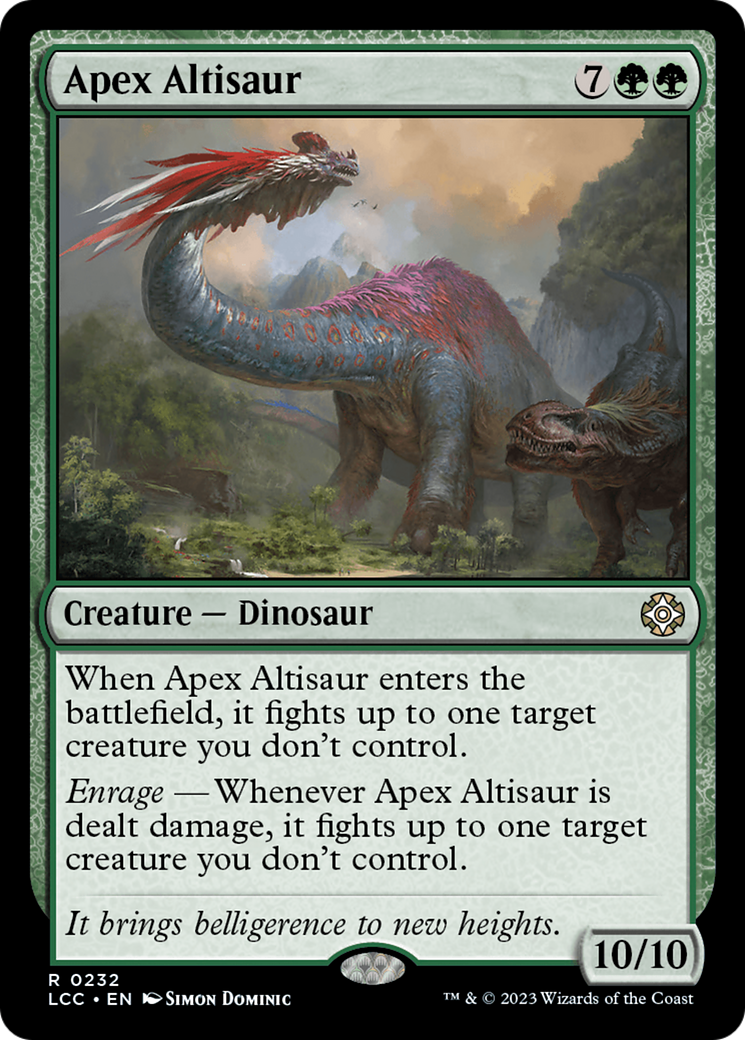
Apex Altisaur
Apex Altisaur
Creature — Dinosaur
10/10
When this creature enters, it fights up to one target creature you don't control.
Enrage — Whenever this creature is dealt damage, it fights up to one target creature you don't control.
- If Apex Altisaur fights a creature while either of its abilities is resolving, being dealt damage this way causes its second ability to trigger. It may fight several times in a row this way.
- If the target creature is an illegal target when Apex Altisaur's last ability tries to resolve, the ability doesn't resolve. If it's a legal target but Apex Altisaur is no longer on the battlefield when the ability resolves (perhaps because it has already died from picking too many fights) the target creature won't deal or be dealt damage.
-
1
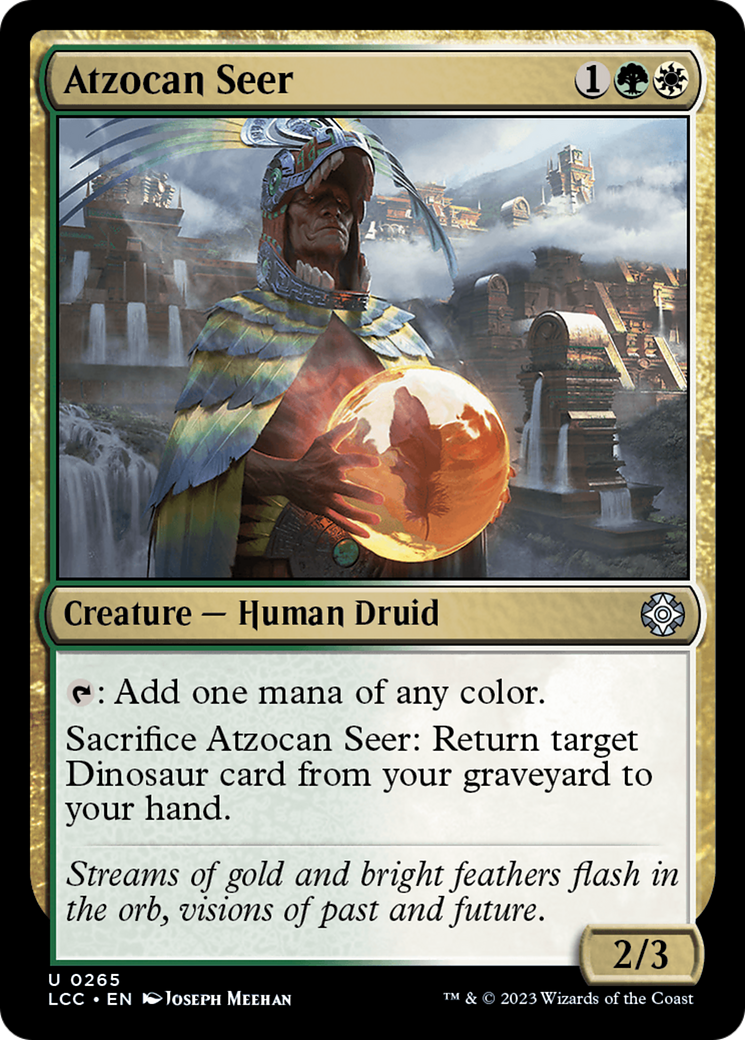
Atzocan Seer
Atzocan Seer
Creature — Human Druid
2/3
: Add one mana of any color.
Sacrifice this creature: Return target Dinosaur card from your graveyard to your hand.
- Atzocan Seer's second ability doesn't include the symbol. You can activate that ability even if it's already been tapped, perhaps because you activated its first ability.
- If an effect refers to a "[subtype] spell" or "[subtype] card," it refers only to a spell or card that has that subtype. For example, March of the Drowned is a card that benefits Pirates and features Pirates in its illustration, but it isn't a Pirate card.
-
1
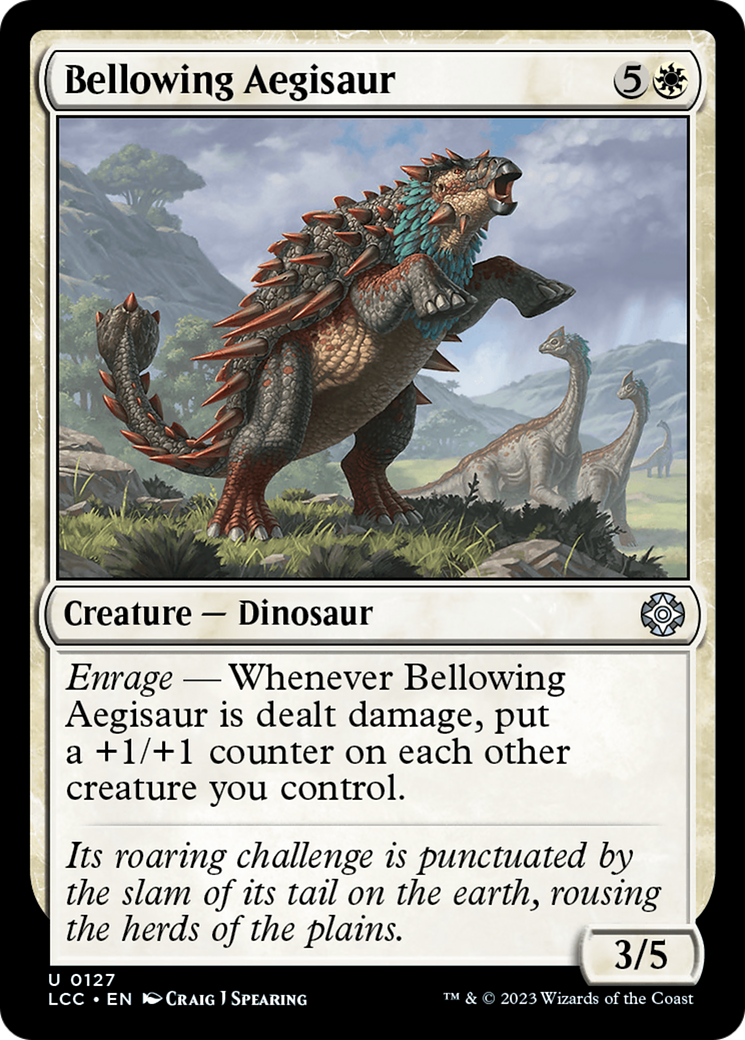
Bellowing Aegisaur
Bellowing Aegisaur
Creature — Dinosaur
3/5
Enrage — Whenever this creature is dealt damage, put a +1/+1 counter on each other creature you control.
- If multiple sources deal damage to a creature with an enrage ability at the same time, most likely because multiple creatures blocked that creature, the enrage ability triggers only once.
- If lethal damage is dealt to a creature with an enrage ability, that ability triggers. The creature with that enrage ability leaves the battlefield before that ability resolves, so it won't be affected by the resolving ability.
- If another creature you control is dealt lethal damage at the same time that Bellowing Aegisaur is dealt damage, the other creature won't be saved by the +1/+1 counter that would have been put on it.
-
1
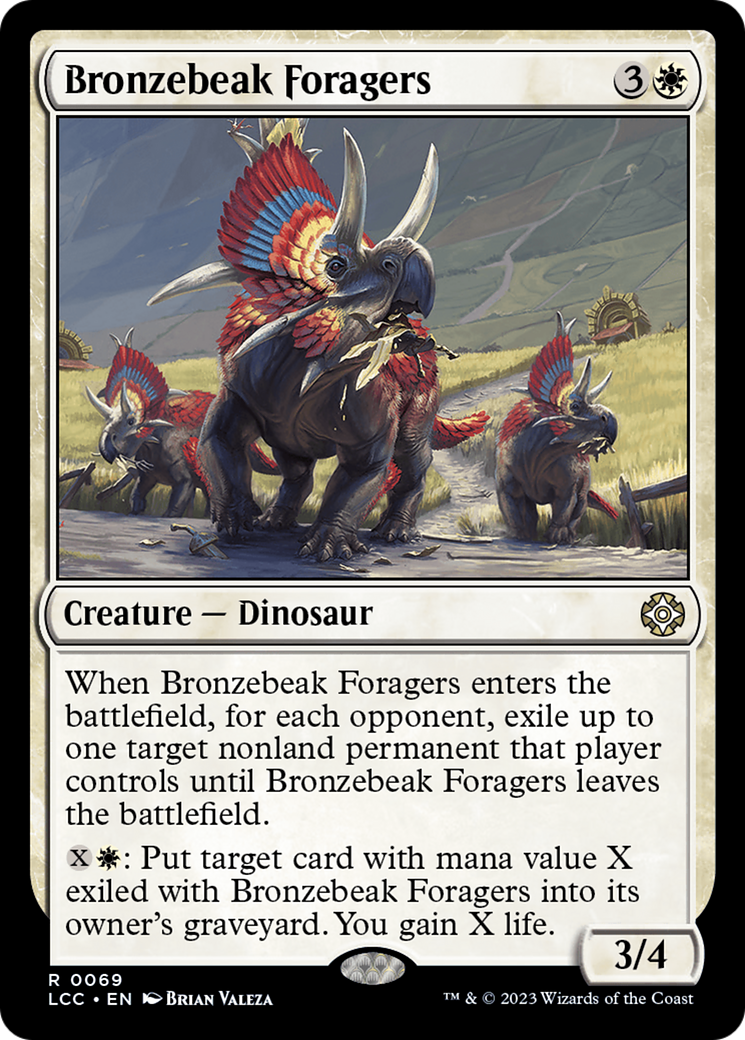
Bronzebeak Foragers
Bronzebeak Foragers
Creature — Dinosaur
3/4
When this creature enters, for each opponent, exile up to one target nonland permanent that player controls until this creature leaves the battlefield.
: Put target card with mana value X exiled with this creature into its owner's graveyard. You gain X life.
- If Bronzebeak Foragers leaves the battlefield before its first ability resolves, none of the target permanents will be exiled.
- Auras attached to the exiled permanents will be put into their owners' graveyards. Any Equipment will become unattached and remain on the battlefield. Any counters on the exiled permanents will cease to exist. When the cards return to the battlefield, they will be new objects with no connections to the cards that were exiled.
- If a token is exiled this way, it will cease to exist and won't return to the battlefield.
- If an exiled permanent card leaves exile, perhaps because of Bronzebeak Foragers's last ability, it won't return to the battlefield after Bronzebeak Foragers leaves the battlefield.
-
1
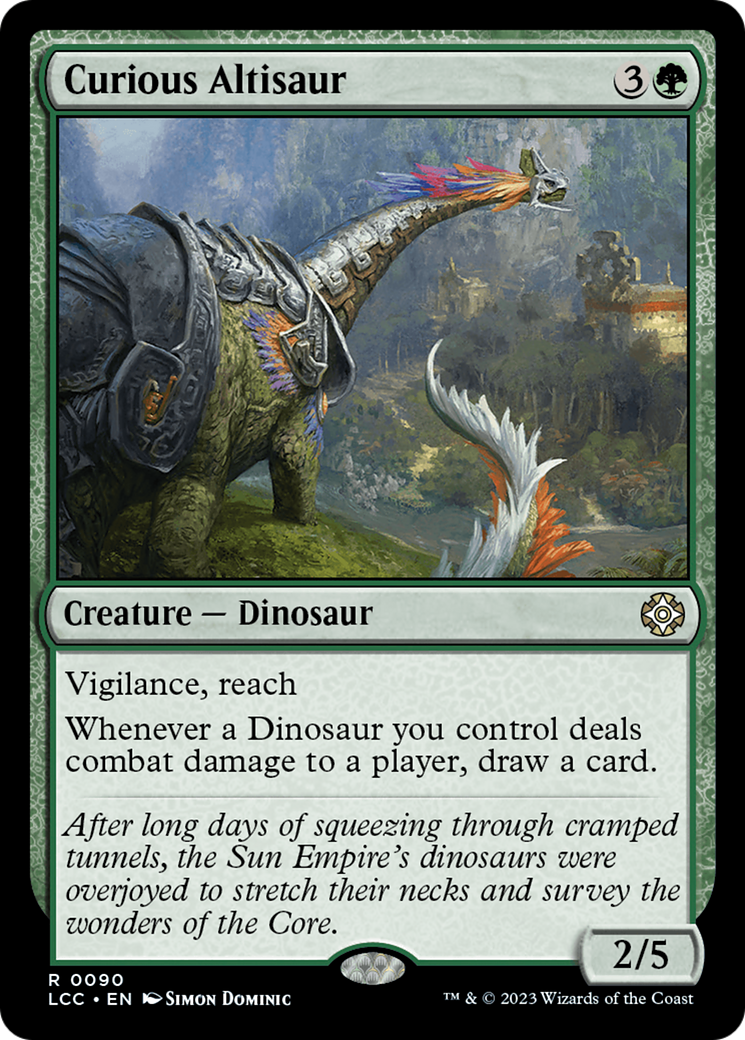
Curious Altisaur
Curious Altisaur
Creature — Dinosaur
2/5
Vigilance, reach
Whenever a Dinosaur you control deals combat damage to a player, draw a card.
-
1
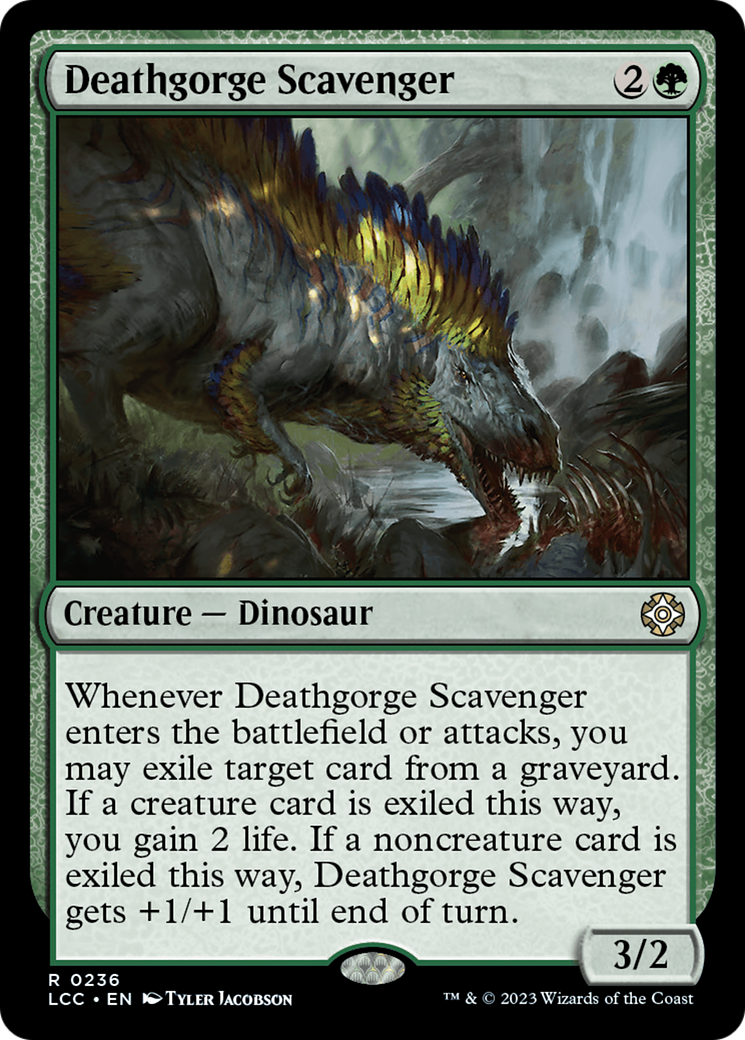
Deathgorge Scavenger
Deathgorge Scavenger
Creature — Dinosaur
3/2
Whenever this creature enters or attacks, you may exile target card from a graveyard. If a creature card is exiled this way, you gain 2 life. If a noncreature card is exiled this way, this creature gets +1/+1 until end of turn.
- There's no way to get both bonuses at once while Deathgorge Scavenger's ability is resolving. If an artifact creature card is exiled this way, it's a creature card and not a noncreature card.
-
1
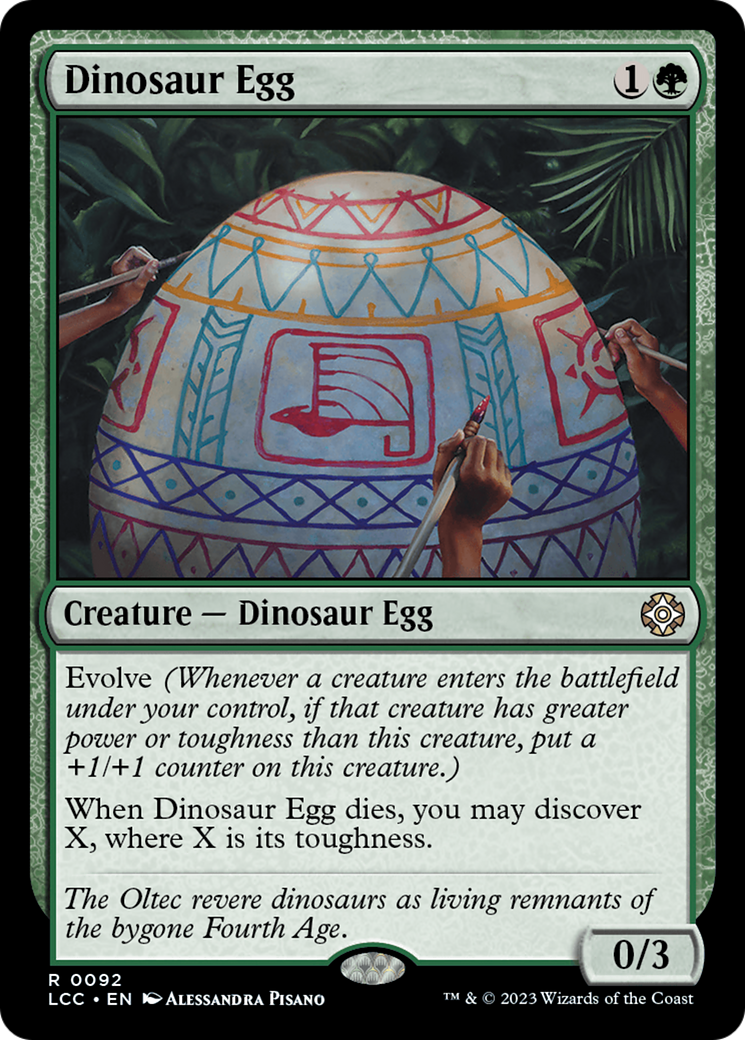
Dinosaur Egg
Dinosaur Egg
Creature — Dinosaur Egg
0/3
Evolve (Whenever a creature you control enters, if that creature has greater power or toughness than this creature, put a +1/+1 counter on this creature.)
When this creature dies, you may discover X, where X is its toughness.
- When comparing the stats of the two creature for evolve, you always compare power to power and toughness to toughness.
- Whenever a creature enters the battlefield under your control, check its power and toughness against the power and toughness of the creature with evolve. If neither stat of the new creature is greater, evolve won't trigger at all.
- If evolve triggers, the stat comparison will happen again when the ability tries to resolve. If neither stat of the new creature is greater, the ability will do nothing. If the creature that entered the battlefield leaves the battlefield before evolve tries to resolve, use its last known power and toughness to compare the stats.
- If multiple creatures enter the battlefield at the same time, evolve may trigger multiple times, although the stat comparison will take place each time one of those abilities tries to resolve. For example, if you control a 2/2 creature with evolve and two 3/3 creatures enter the battlefield, evolve will trigger twice. The first ability will resolve and put a +1/+1 counter on the creature with evolve. When the second ability tries to resolve, neither the power nor the toughness of the new creature is greater than that of the creature with evolve, so that ability does nothing.
- Multiple instances of evolve trigger separately and, similar to above, the stat comparison takes place for each one independently as they try to resolve.
- When comparing the stats as the evolve ability resolves, it's possible that the stat that's greater changes from power to toughness or vice versa. If this happens, the ability will still resolve and you'll put a +1/+1 counter on the creature with evolve. For example, if you control a 2/2 creature with evolve and a 1/3 creature enters the battlefield under your control, its toughness is greater so evolve will trigger. In response, the 1/3 creature gets +2/-2. When the evolve trigger tries to resolve, its power is greater. You'll put a +1/+1 counter on the creature with evolve.
- A spell's mana value is determined only by its mana cost. Ignore any alternative costs, additional costs, cost increases, or cost reductions.
- When you discover, you must exile cards. The only optional part of the ability is whether you cast the exiled card or put it into your hand.
- You exile the cards face up. All players will be able to see them.
- If you cast a spell "without paying its mana cost", you can't choose to cast it for any alternative costs. You can, however, pay additional costs. If the spell has any mandatory additional costs, you must pay those to cast it.
- If the discovered card has in its mana cost, you must choose 0 as the value of X when casting it without paying its mana cost.
- If you can't cast the discovered card (perhaps because there are no legal targets for the spell), you'll put it into your hand.
- Some spells and abilities that cause you to discover may require targets. If each target chosen is an illegal target as that spell or ability tries to resolve, it won't resolve and you won't discover.
- The mana value of a split card is determined by the combined mana cost of its two halves. If discover allows you to cast a split card, you may cast either half (as long as its mana value is less than or equal to the effect's discover value) but not both halves.
- If you discover an adventurer card, split card, or modal double-faced card, you might be able to cast that card with either set of characteristics depending on the effect's discover value. For example, if you discover 4 and reveal Galvanic Giant (an adventurer card from Wilds of Eldraine with a mana value of 4), you could cast Galvanic Giant, but not Storm Reading (its Adventure, which has a mana value of 7). If you discover 7 and reveal Galvanic Giant, you could cast either Galvanic Giant or Storm Reading.
-
1
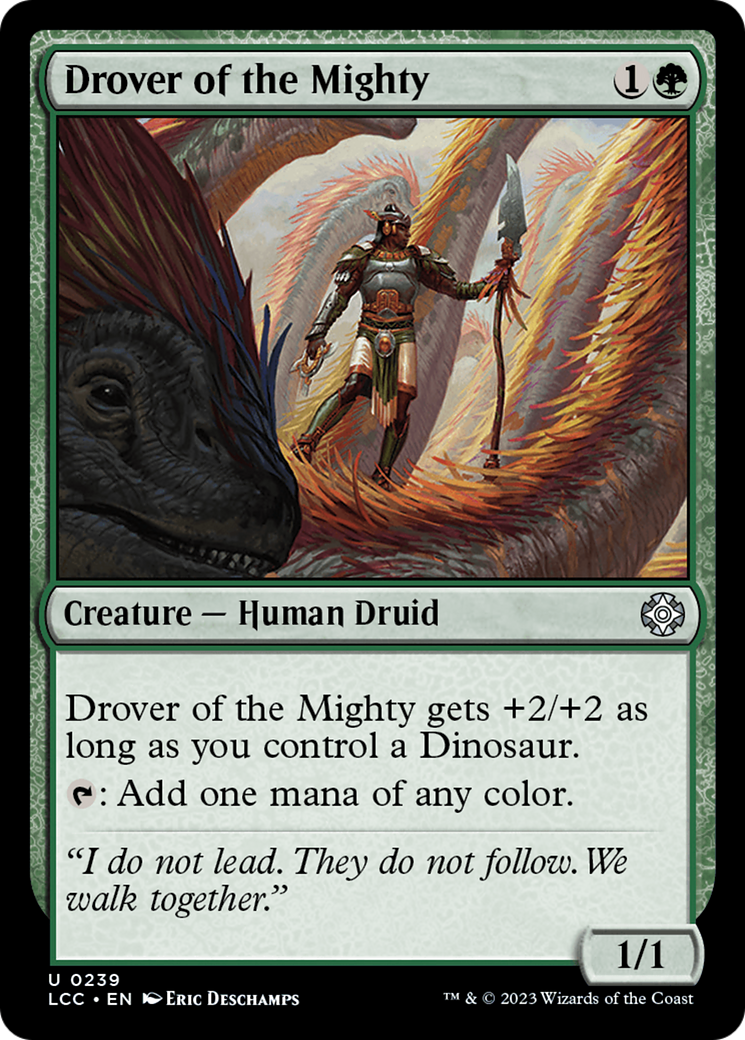
Drover of the Mighty
Drover of the Mighty
Creature — Human Druid
1/1
This creature gets +2/+2 as long as you control a Dinosaur.
: Add one mana of any color.
- Because damage remains marked on a creature until it's removed as the turn ends, the damage Drover of the Mighty takes during combat may become lethal if you no longer control a Dinosaur later in the turn.
-
1
Earthshaker Dreadmaw
Earthshaker Dreadmaw
Creature — Dinosaur
6/6
Trample
When this creature enters, draw a card for each other Dinosaur you control.
-
1
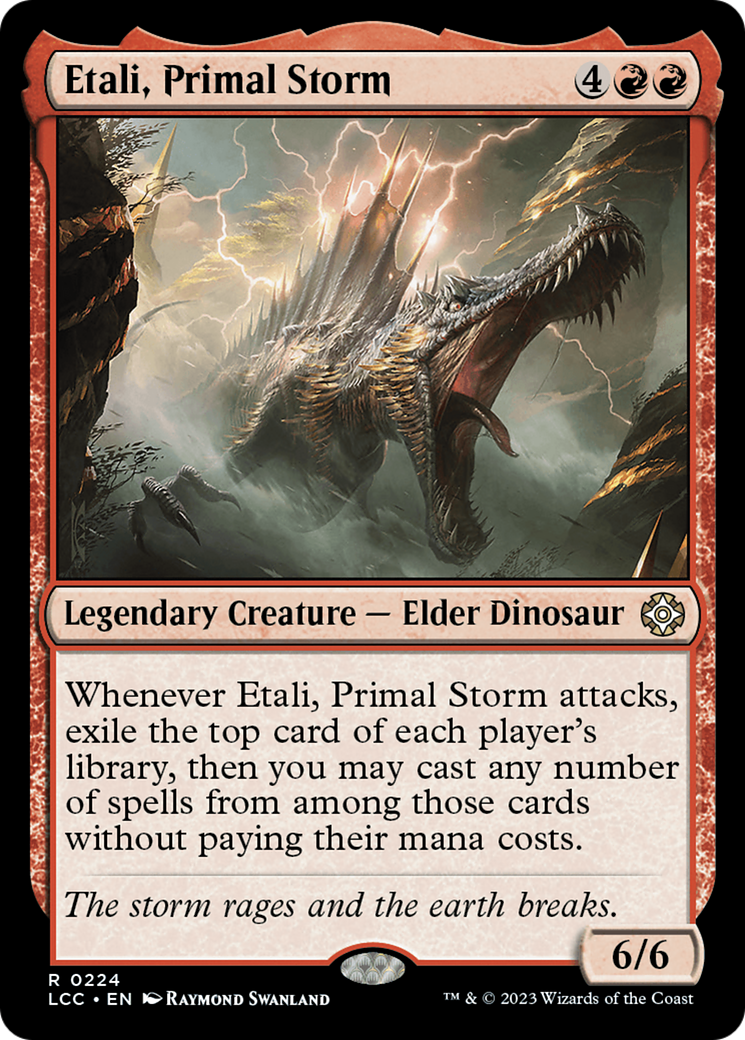
Etali, Primal Storm
Etali, Primal Storm
Legendary Creature — Elder Dinosaur
6/6
Whenever Etali attacks, exile the top card of each player's library, then you may cast any number of spells from among those cards without paying their mana costs.
- If an exiled card has in its mana cost, you must choose 0 as the value of X when casting it without paying its mana cost.
- If you cast any of the exiled cards, you do so as part of the resolution of the triggered ability. You can't wait to cast them later in the turn. Timing permissions based on a card's type are ignored, and the spells resolve before blockers are declared.
- If you cast a card "without paying its mana cost," you can't pay any alternative costs. You can, however, pay additional costs. If the card has any mandatory additional costs, those must be paid to cast the card.
- If you cast more than one of the exiled cards, you choose the order in which to cast them. A spell you cast this way can be the target of a later spell you cast this way. However, permanent spells cast this way won't resolve until you're done casting spells, so the permanents they become can't be the target of spells cast this way. For example, if you exile Twincast and Lightning Strike, you can cast Lightning Strike and then cast Twincast targeting it; but if you exile a creature card and an Aura card, you can't cast that Aura targeting that creature.
- Any cards not cast, including land cards, remain in exile. They can't be cast on later turns, even if Etali attacks again.
- Because all attacking creatures are chosen at once, a creature cast this way can't attack during the same combat as Etali, even if it has haste.
- In a multiplayer game, if a player leaves the game, all cards that player owns leave as well. If you leave the game, any spells or permanents you control from Etali's ability are exiled.
-
1
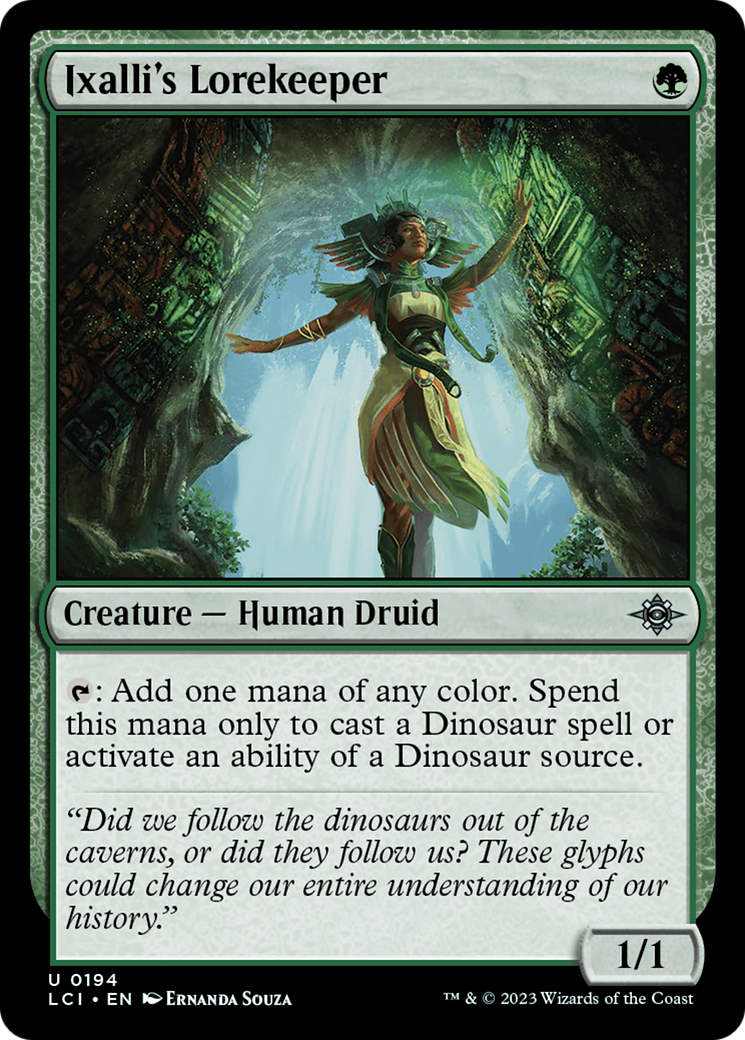
Ixalli's Lorekeeper
Ixalli's Lorekeeper
Creature — Human Druid
1/1
: Add one mana of any color. Spend this mana only to cast a Dinosaur spell or activate an ability of a Dinosaur source.
-
1
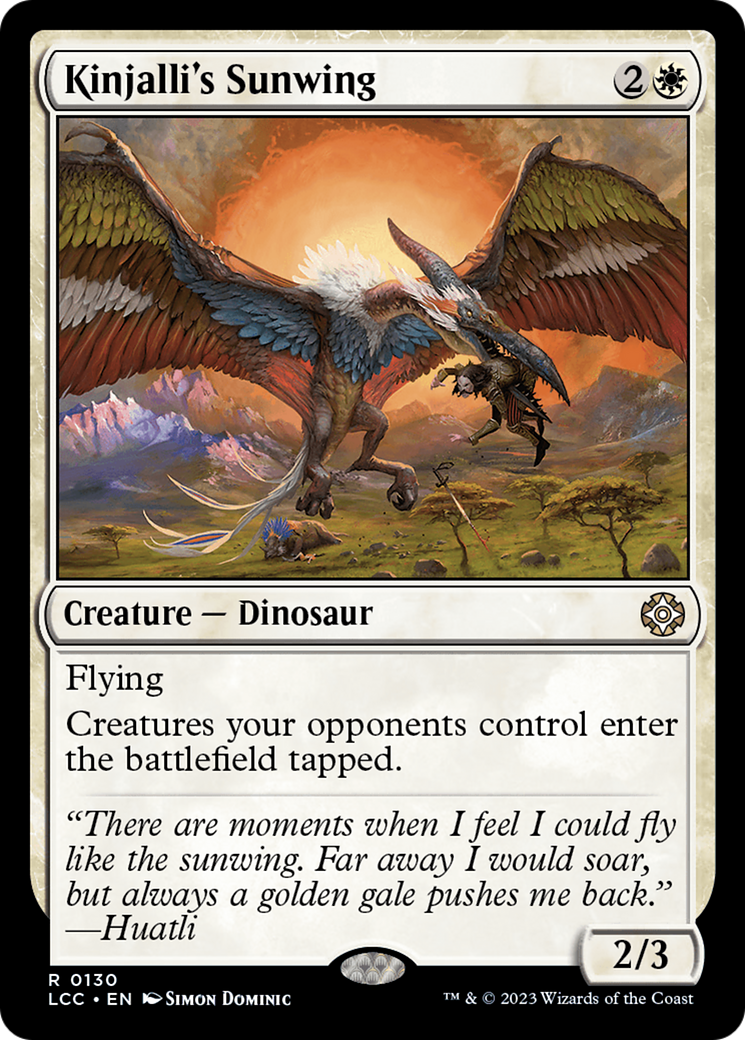
Kinjalli's Sunwing
Kinjalli's Sunwing
Creature — Dinosaur
2/3
Flying
Creatures your opponents control enter tapped.
- If a creature an opponent controls enters the battlefield at the same time that Kinjalli's Sunwing enters the battlefield under your control, Kinjalli's Sunwing's effect doesn't apply to your opponent's creature.
-
1
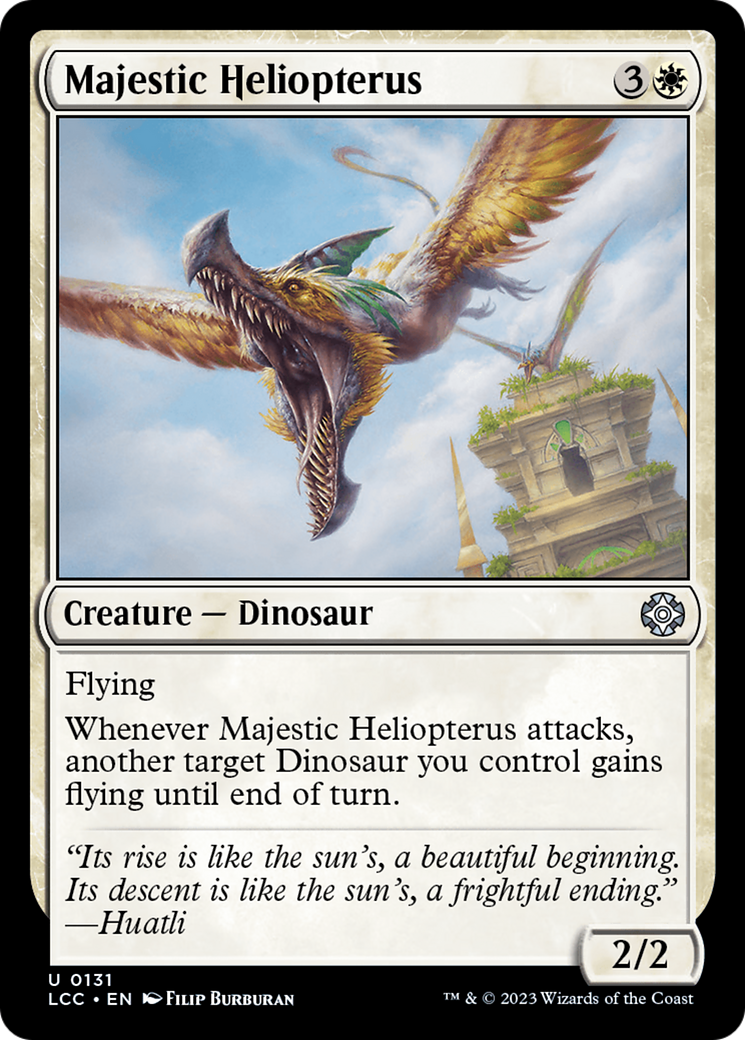
Majestic Heliopterus
Majestic Heliopterus
Creature — Dinosaur
2/2
Flying
Whenever this creature attacks, another target Dinosaur you control gains flying until end of turn.
-
1
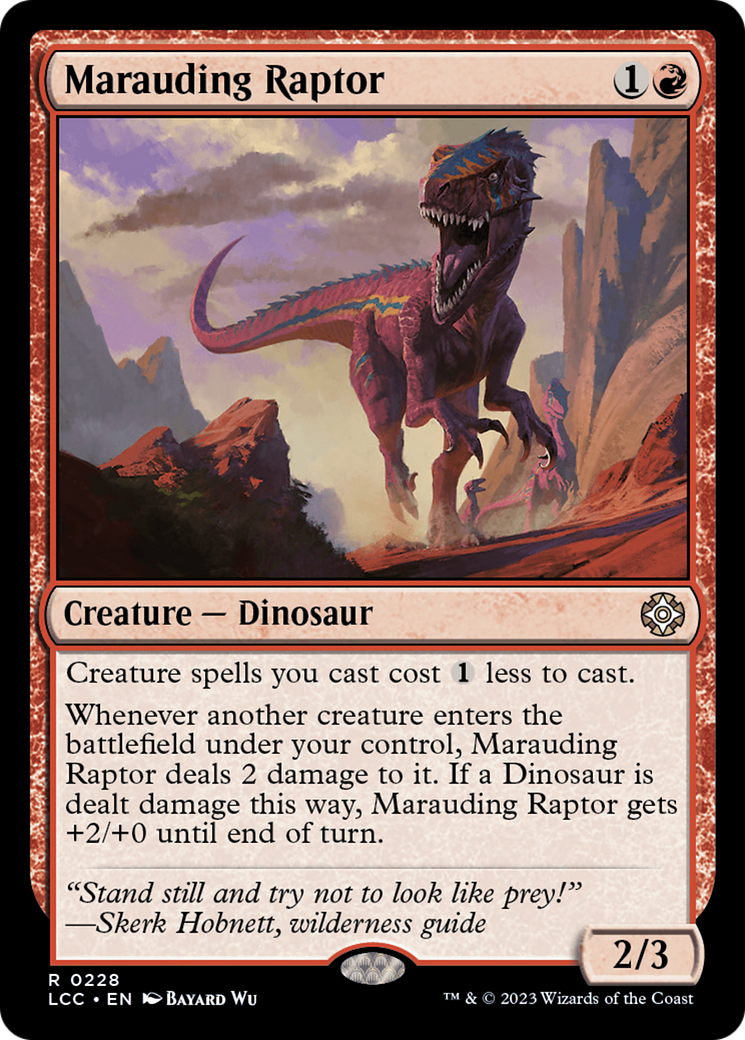
Marauding Raptor
Marauding Raptor
Creature — Dinosaur
2/3
Creature spells you cast cost less to cast.
Whenever another creature you control enters, this creature deals 2 damage to it. If a Dinosaur is dealt damage this way, this creature gets +2/+0 until end of turn.
- Effects that reduce the generic mana cost of a spell (such as that of Marauding Raptor) can't reduce that spell's colored mana requirements.
- Marauding Raptor's cost reduction doesn't affect itself.
-
1
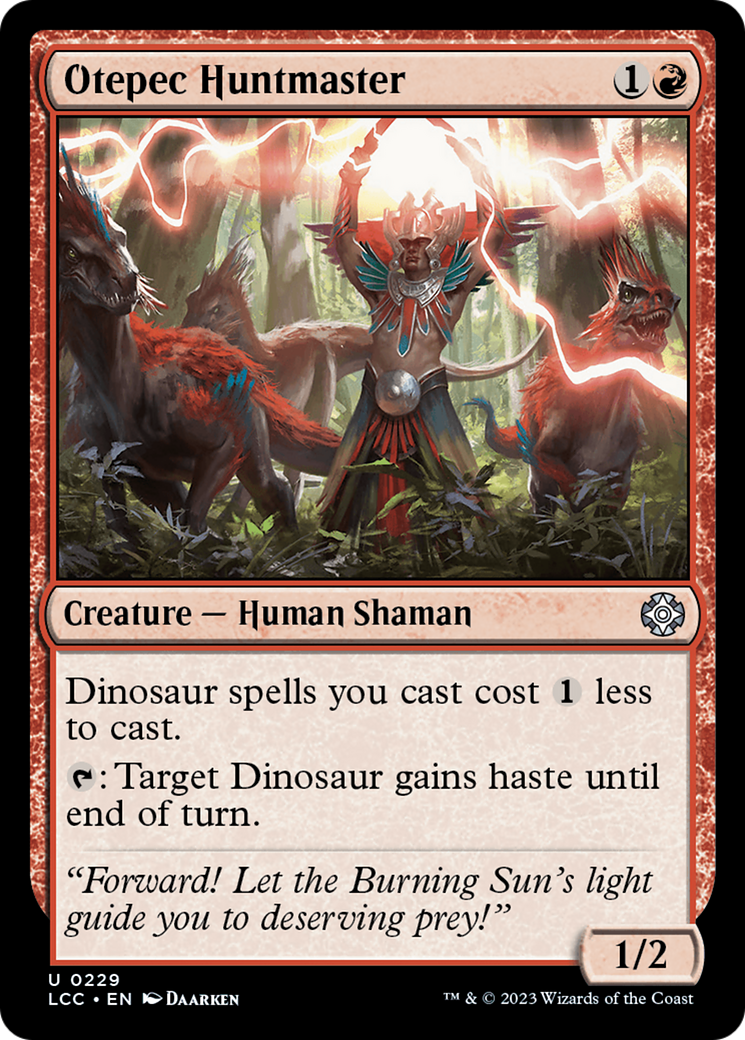
Otepec Huntmaster
Otepec Huntmaster
Creature — Human Shaman
1/2
Dinosaur spells you cast cost less to cast.
: Target Dinosaur gains haste until end of turn.
- If an effect refers to a "[subtype] spell" or "[subtype] card," it refers only to a spell or card that has that subtype. For example, March of the Drowned is a card that benefits Pirates and features Pirates in its illustration, but it isn't a Pirate card.
- To determine the total cost of a Dinosaur spell, start with the mana cost or alternative cost you're paying, add any cost increases, then apply any cost reductions. The mana value of the creature remains unchanged, no matter what the total cost to cast it was.
-
1
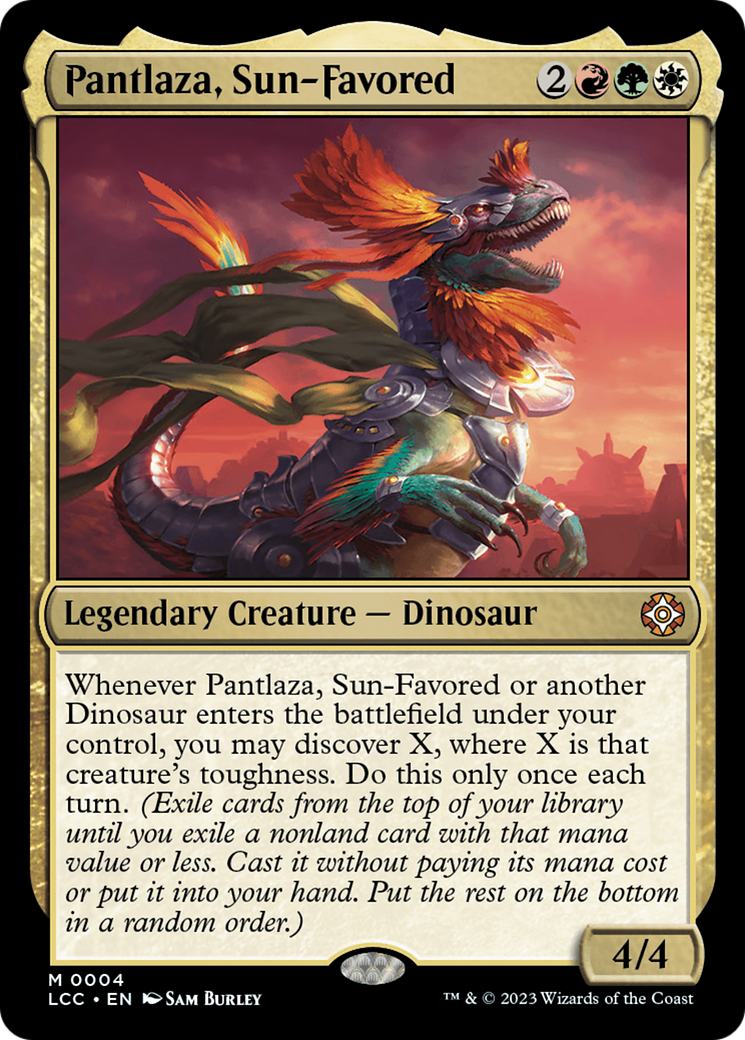
Pantlaza, Sun-Favored
Pantlaza, Sun-Favored
Legendary Creature — Dinosaur
4/4
Whenever Pantlaza or another Dinosaur you control enters, you may discover X, where X is that creature's toughness. Do this only once each turn. (Exile cards from the top of your library until you exile a nonland card with that mana value or less. Cast it without paying its mana cost or put it into your hand. Put the rest on the bottom in a random order.)
- The value of X is calculated only once, as the ability resolves. If the creature has left the battlefield, use its toughness as it last existed on the battlefield.
- Once you decide to discover using Pantlaza's ability, that ability will stop triggering for the duration of that turn.
- A spell's mana value is determined only by its mana cost. Ignore any alternative costs, additional costs, cost increases, or cost reductions.
- When you discover, you must exile cards. The only optional part of the ability is whether you cast the exiled card or put it into your hand.
- You exile the cards face up. All players will be able to see them.
- If you cast a spell "without paying its mana cost", you can't choose to cast it for any alternative costs. You can, however, pay additional costs. If the spell has any mandatory additional costs, you must pay those to cast it.
- If the discovered card has in its mana cost, you must choose 0 as the value of X when casting it without paying its mana cost.
- If you can't cast the discovered card (perhaps because there are no legal targets for the spell), you'll put it into your hand.
- Some spells and abilities that cause you to discover may require targets. If each target chosen is an illegal target as that spell or ability tries to resolve, it won't resolve and you won't discover.
- The mana value of a split card is determined by the combined mana cost of its two halves. If discover allows you to cast a split card, you may cast either half (as long as its mana value is less than or equal to the effect's discover value) but not both halves.
- If you discover an adventurer card, split card, or modal double-faced card, you might be able to cast that card with either set of characteristics depending on the effect's discover value. For example, if you discover 4 and reveal Galvanic Giant (an adventurer card from Wilds of Eldraine with a mana value of 4), you could cast Galvanic Giant, but not Storm Reading (its Adventure, which has a mana value of 7). If you discover 7 and reveal Galvanic Giant, you could cast either Galvanic Giant or Storm Reading.
-
1
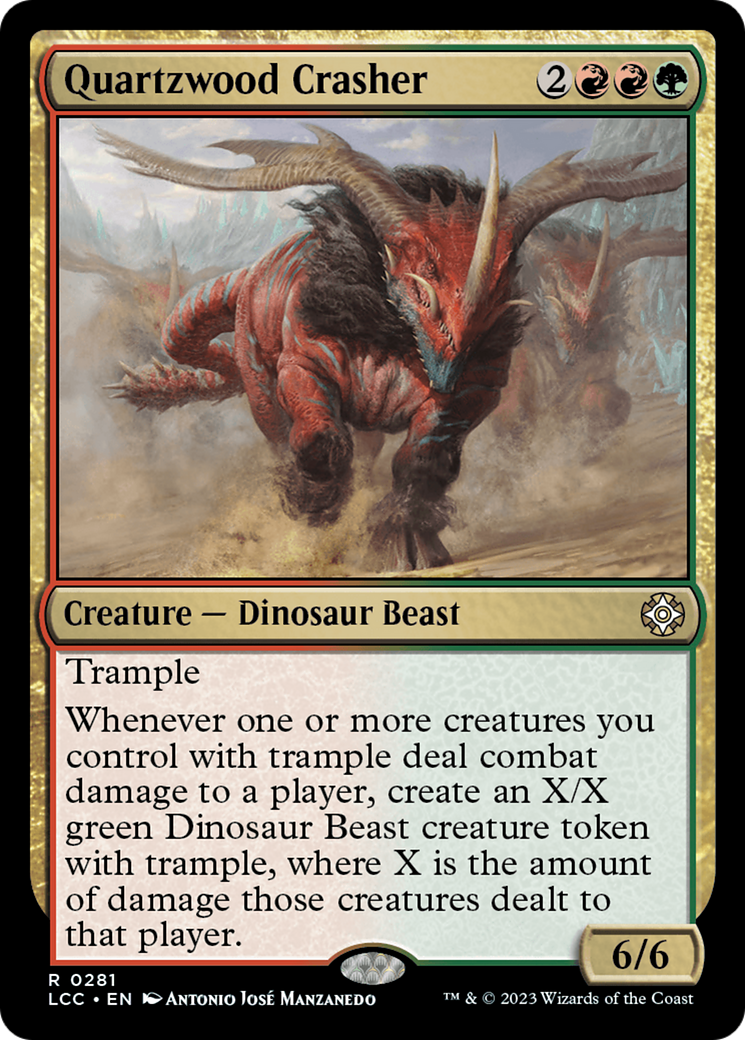
Quartzwood Crasher
Quartzwood Crasher
Creature — Dinosaur Beast
6/6
Trample
Whenever one or more creatures you control with trample deal combat damage to a player, create an X/X green Dinosaur Beast creature token with trample, where X is the amount of damage those creatures dealt to that player.
- Quartzwood Crasher's second ability includes damage dealt by Quartzwood Crasher itself as long as it still has trample.
- If a creature you control with trample is unblocked, the full amount of combat damage it deals to the defending player is counted by Quartzwood Crasher's last ability.
-
1
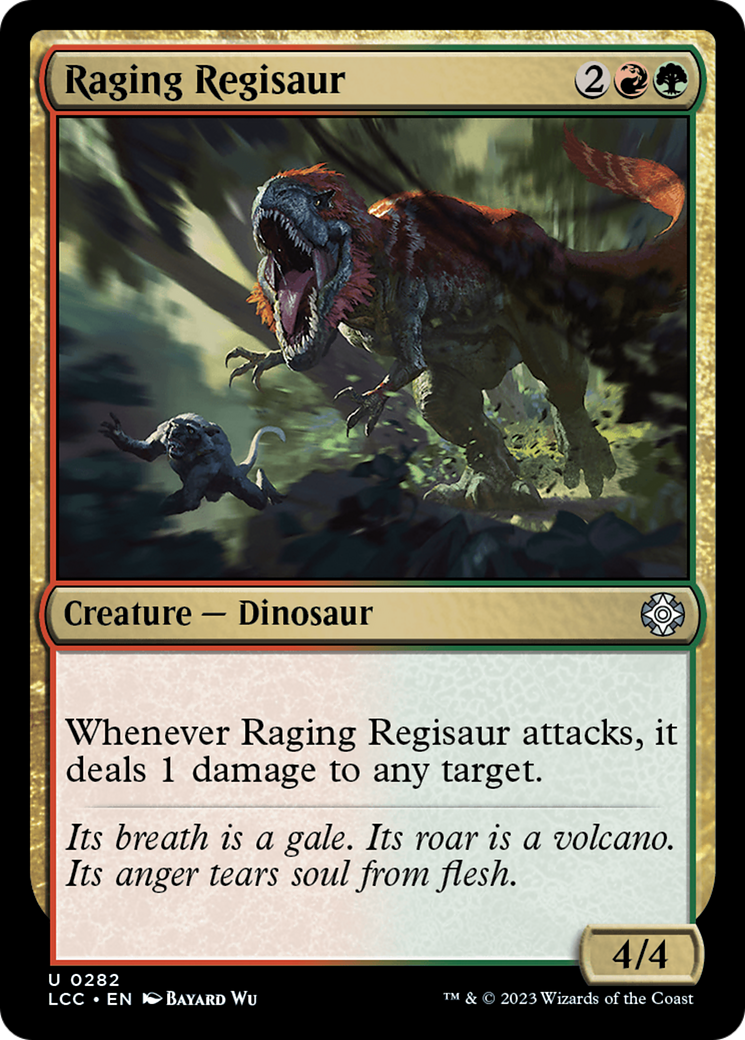
Raging Regisaur
Raging Regisaur
Creature — Dinosaur
4/4
Whenever this creature attacks, it deals 1 damage to any target.
- Damage dealt by Raging Regisaur's triggered ability isn't combat damage.
-
1
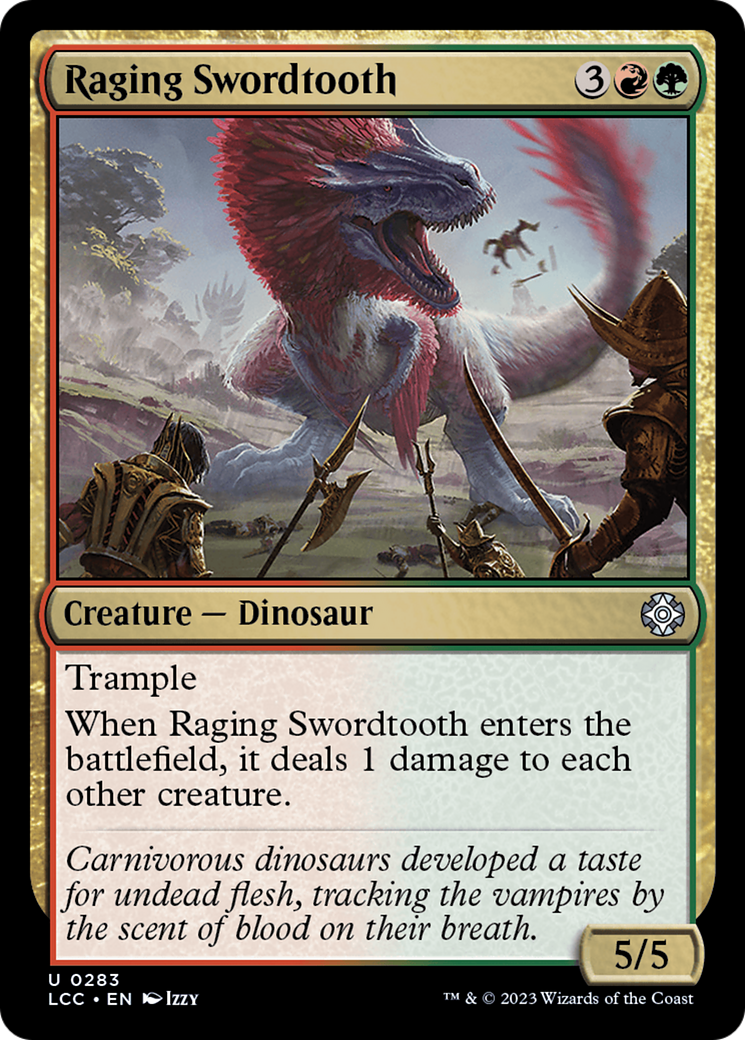
Raging Swordtooth
Raging Swordtooth
Creature — Dinosaur
5/5
Trample
When this creature enters, it deals 1 damage to each other creature.
-
1
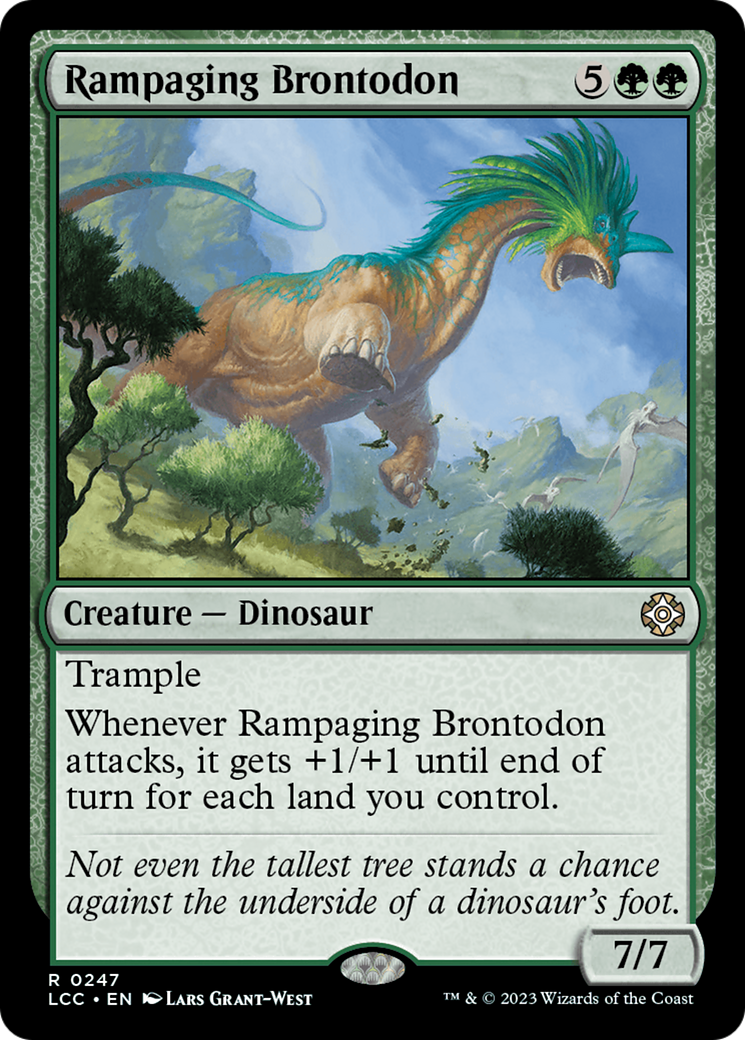
Rampaging Brontodon
Rampaging Brontodon
Creature — Dinosaur
7/7
Trample
Whenever this creature attacks, it gets +1/+1 until end of turn for each land you control.
-
1
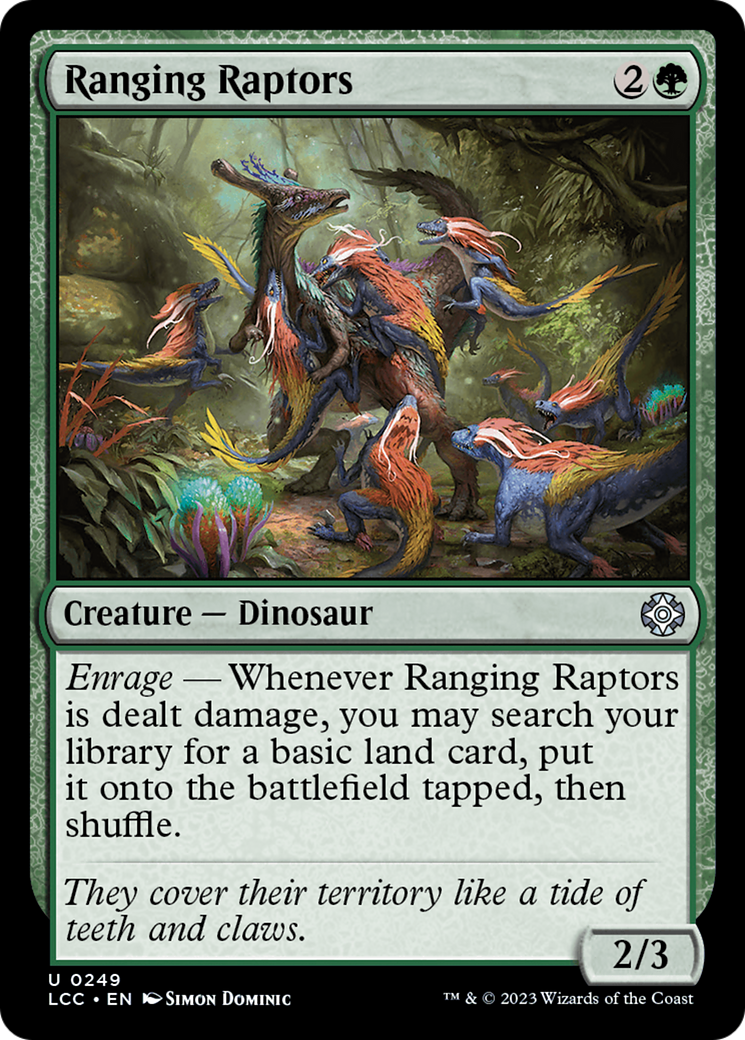
Ranging Raptors
Ranging Raptors
Creature — Dinosaur
2/3
Enrage — Whenever this creature is dealt damage, you may search your library for a basic land card, put it onto the battlefield tapped, then shuffle.
- If multiple sources deal damage to a creature with an enrage ability at the same time, most likely because multiple creatures blocked that creature, the enrage ability triggers only once.
- If lethal damage is dealt to a creature with an enrage ability, that ability triggers. The creature with that enrage ability leaves the battlefield before that ability resolves, so it won't be affected by the resolving ability.
-
1
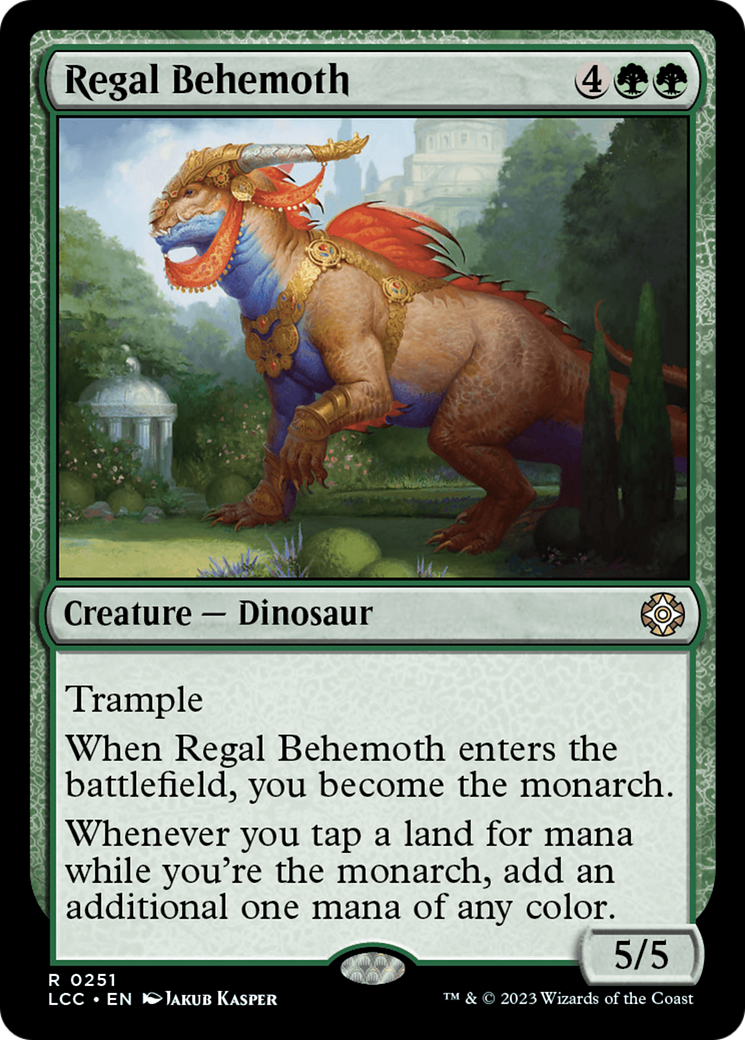
Regal Behemoth
Regal Behemoth
Creature — Dinosaur
5/5
Trample
When this creature enters, you become the monarch.
Whenever you tap a land for mana while you're the monarch, add an additional one mana of any color.
- Regal Behemoth's last ability is a triggered mana ability. It doesn't use the stack and can't be responded to.
- The game starts with no monarch. Once an effect makes one player the monarch, the game will have exactly one monarch from that point forward.
- Being the monarch carries two inherent triggered abilities. "At the beginning of the monarch's end step, that player draws a card" and "Whenever a creature deals combat damage to the monarch, its controller becomes the monarch."
- Abilities that trigger whenever you "become the monarch" trigger only if you aren't already the monarch. For example, if you are already the monarch as Custodi Lich enters the battlefield, its last ability won't trigger.
- If the triggered ability that causes the monarch to draw a card goes on the stack, and a different player becomes the monarch before that ability resolves, the first player will still draw the card.
-
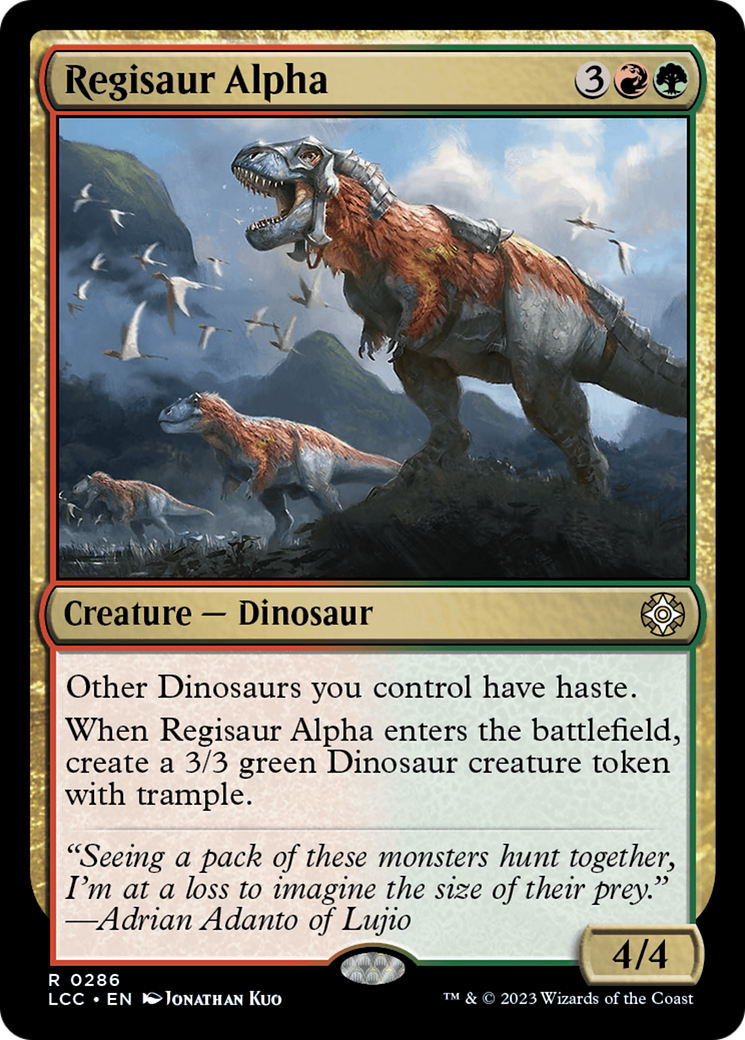
1
Regisaur Alpha
Regisaur Alpha
Creature — Dinosaur
4/4
Other Dinosaurs you control have haste.
When this creature enters, create a 3/3 green Dinosaur creature token with trample.
-
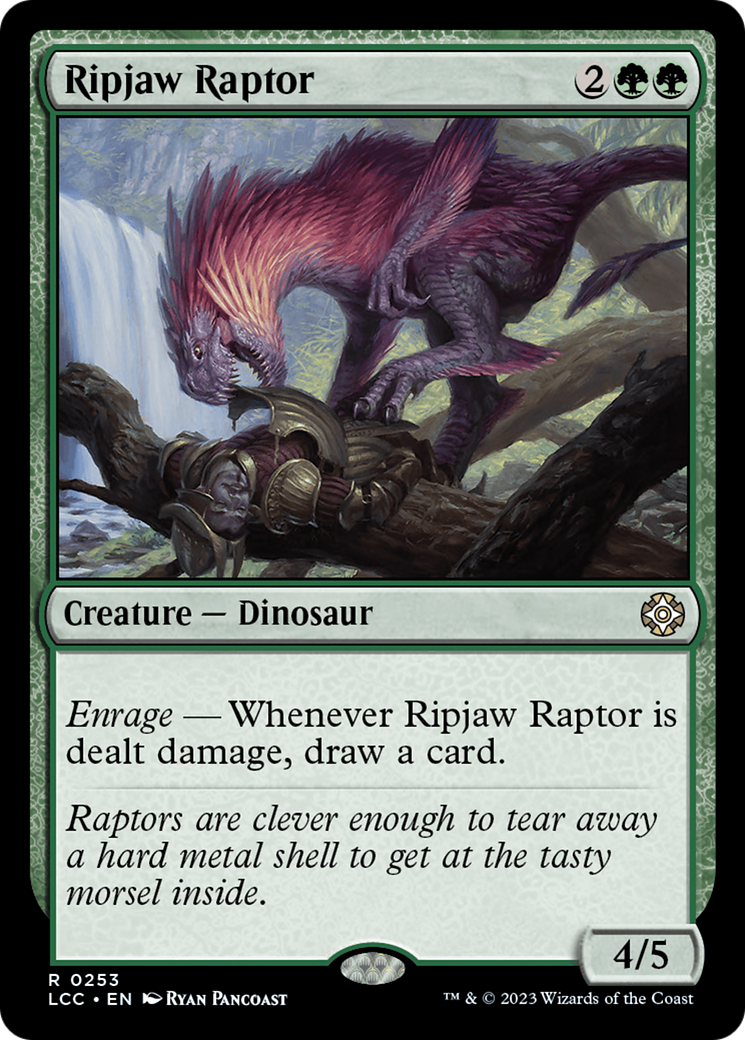
1
Ripjaw Raptor
Ripjaw Raptor
Creature — Dinosaur
4/5
Enrage — Whenever this creature is dealt damage, draw a card.
- If multiple sources deal damage to a creature with an enrage ability at the same time, most likely because multiple creatures blocked that creature, the enrage ability triggers only once.
- If lethal damage is dealt to a creature with an enrage ability, that ability triggers. The creature with that enrage ability leaves the battlefield before that ability resolves, so it won't be affected by the resolving ability.
-
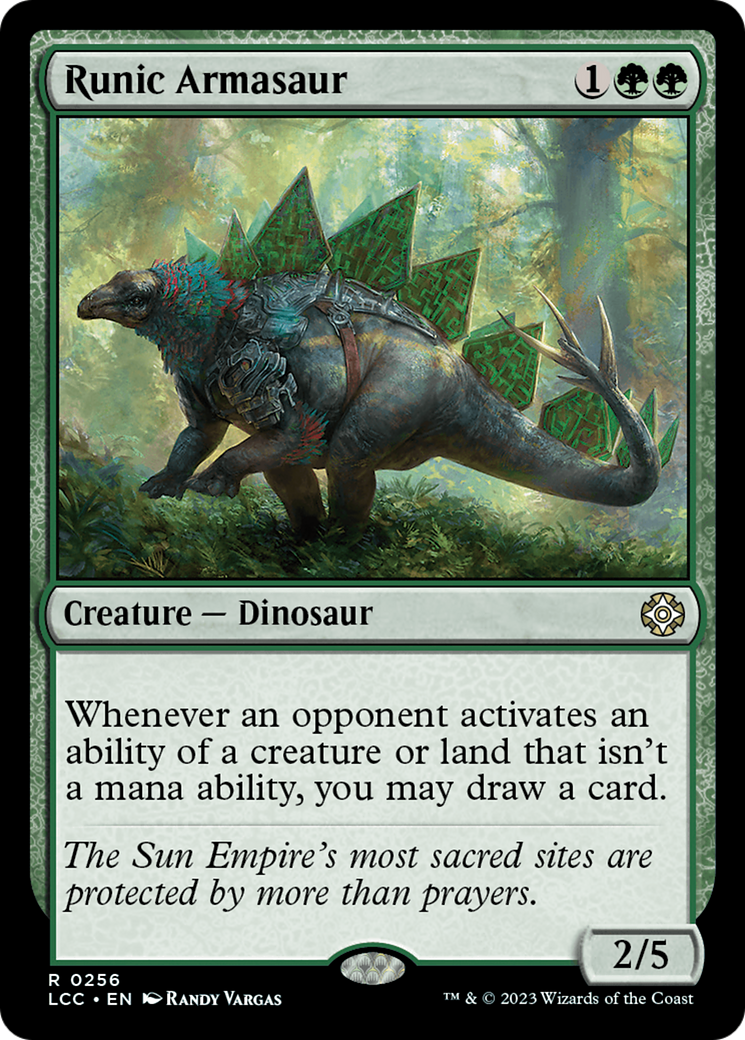
1
Runic Armasaur
Runic Armasaur
Creature — Dinosaur
2/5
Whenever an opponent activates an ability of a creature or land that isn't a mana ability, you may draw a card.
- Activated abilities contain a colon. They're generally written "[Cost]: [Effect]." Some keyword abilities are activated abilities and will have colons in their reminder text. An activated mana ability is one that produces mana as it resolves, not one that costs mana to activate.
- Runic Armasaur's ability doesn't trigger when an opponent activates an ability of a card in hand (such as a cycling ability from the Amonkhet block) or a card in a graveyard (such as that of Bone Dragon), even if that causes a card to be put onto the battlefield.
- Runic Armasaur's ability doesn't trigger when an opponent activates an ability of a noncreature, nonland permanent that causes it to become a creature (such as a crew ability of a Vehicle).
- Runic Armasaur's ability resolves before the ability that caused it to trigger. Players can cast spells and activate abilities after the triggered ability resolves but before the activated ability that caused it to trigger does.
-
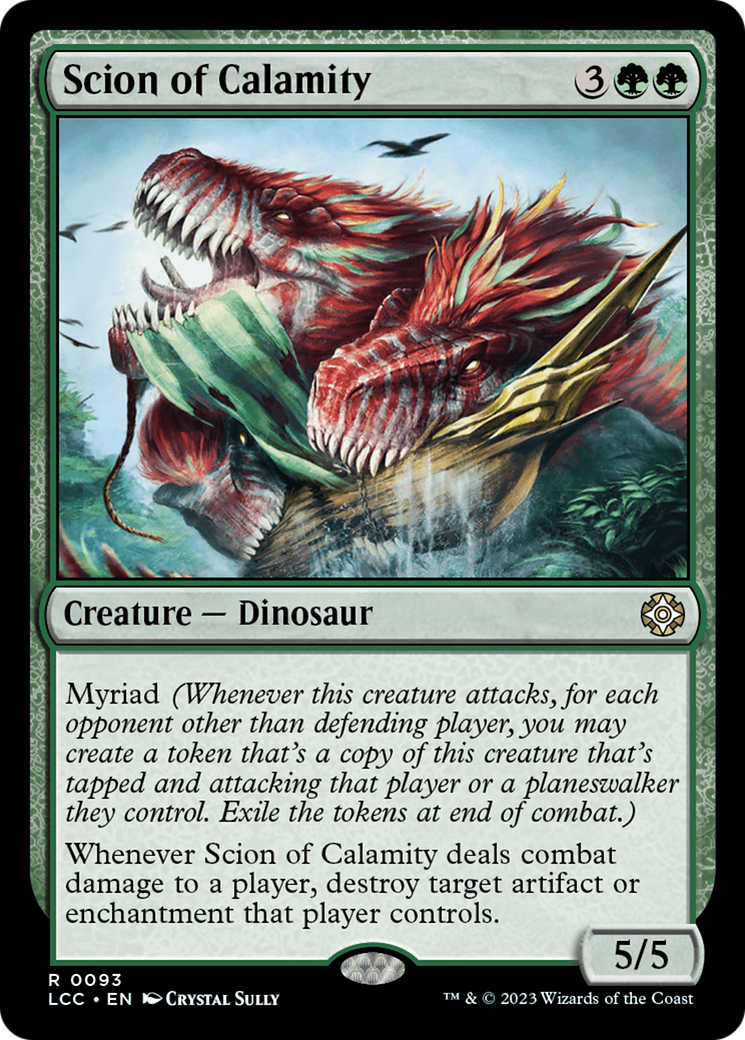
1
Scion of Calamity
Scion of Calamity
Creature — Dinosaur
5/5
Myriad (Whenever this creature attacks, for each opponent other than defending player, you may create a token copy that's tapped and attacking that player or a planeswalker they control. Exile the tokens at end of combat.)
Whenever this creature deals combat damage to a player, destroy target artifact or enchantment that player controls.
- The term "defending player" in the myriad rules (or any other ability of an attacking creature) refers to the player the creature with myriad was attacking, the controller of the planeswalker it was attacking, or the protector of the battle it was attacking at the time the ability resolves. If that creature is no longer attacking, it refers to the appropriate player based on who or what the creature was last attacking.
- If the defending player is your only opponent, no tokens are put onto the battlefield.
- You choose whether each token is attacking the player or a planeswalker they control as the token is created. If it's attacking a planeswalker, you choose which one. You can't have any of the tokens attack a battle.
- Although the tokens enter the battlefield attacking, they were never declared as attackers. Abilities that trigger whenever a creature attacks won't trigger, including the myriad ability of the tokens. If there are any costs to have a creature attack, those costs won't apply to the tokens.
- The tokens all enter the battlefield at the same time.
- Each token copies exactly what was printed on the original creature and nothing else. It doesn't copy whether that creature is tapped or untapped, whether it has any counters on it or Auras and Equipment attached to it, or any non-copy effects that have changed its power, toughness, types, color, and so on.
- Any enters-the-battlefield abilities of the copied creature will trigger when the tokens enter the battlefield. Any "as [this permanent] enters the battlefield" or "[this permanent] enters the battlefield with" abilities of the copied creature will also work.
- If myriad creates more than one token for any given player (due to an effect such as the one Doubling Season creates), you may choose separately for each token whether it's attacking the player or a planeswalker they control.
-
1
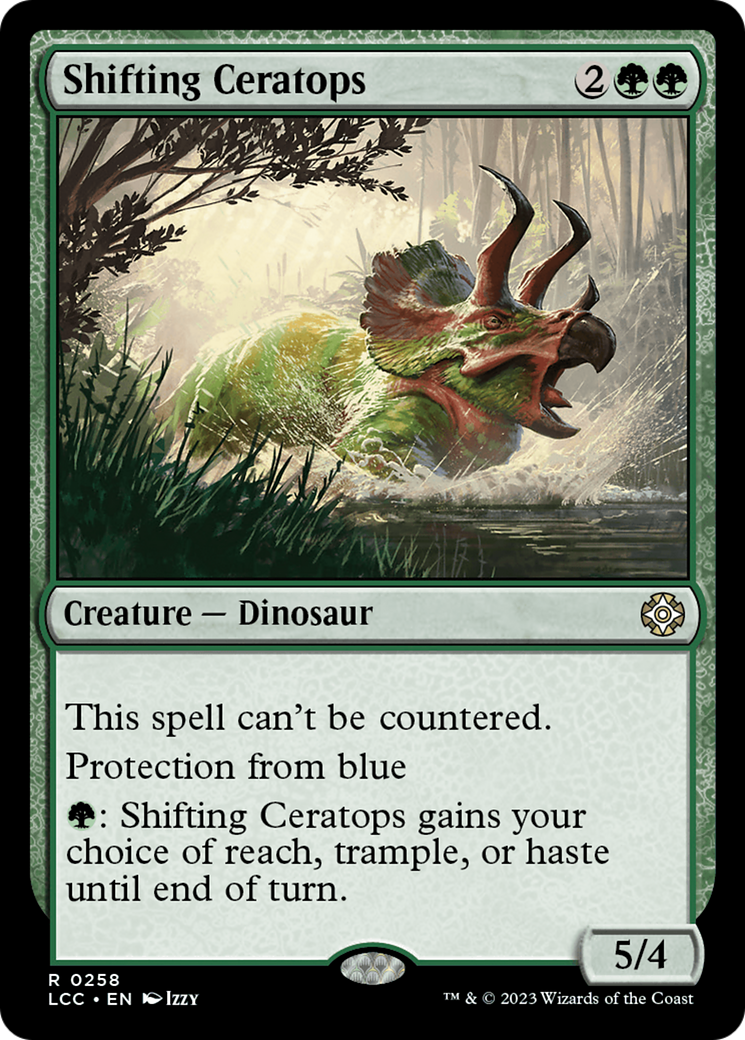
Shifting Ceratops
Shifting Ceratops
Creature — Dinosaur
5/4
This spell can't be countered.
Protection from blue (This creature can't be blocked, targeted, dealt damage, enchanted, or equipped by anything blue.)
: This creature gains your choice of reach, trample, or haste until end of turn.
- A spell or ability that counters spells can still target Shifting Ceratops. When that spell or ability resolves, Shifting Ceratops won't be countered, but any additional effects of that spell or ability will still happen.
- Multiple instances of reach, trample, and/or haste on the same creature are redundant.
-
1
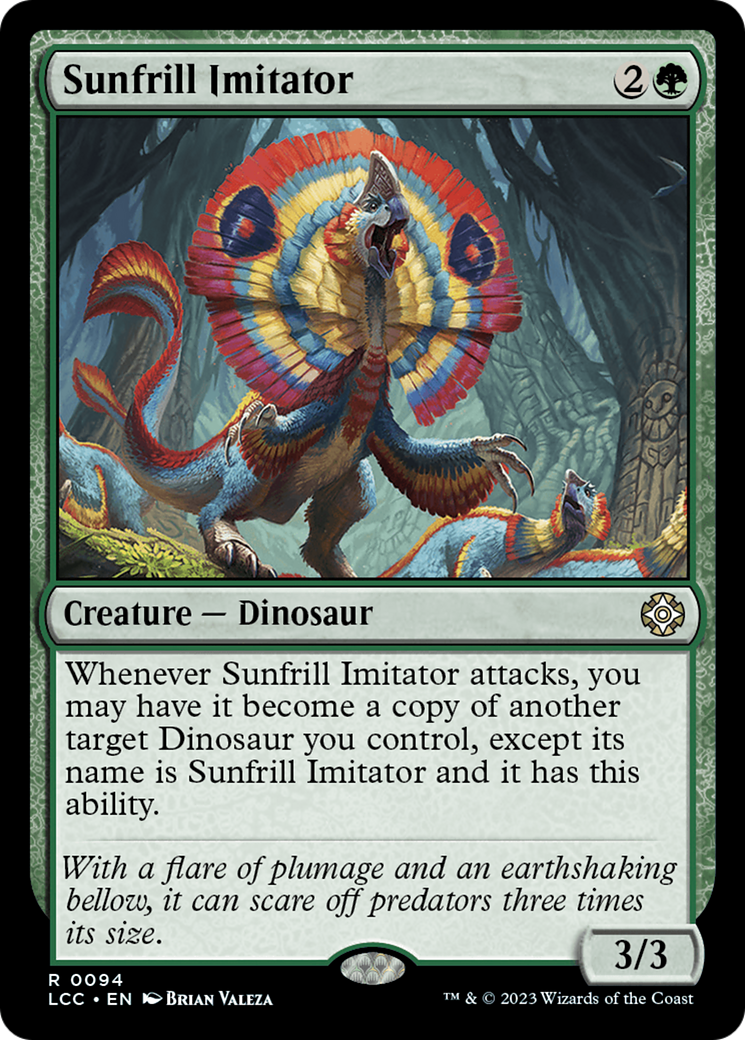
Sunfrill Imitator
Sunfrill Imitator
Creature — Dinosaur
3/3
Whenever this creature attacks, you may have it become a copy of another target Dinosaur you control, except its name is Sunfrill Imitator and it has this ability.
- Sunfrill Imitator copies exactly what was printed on the original creature, with the listed exceptions (unless that creature is copying something else or is a token; see below). It doesn't copy whether that creature is tapped or untapped, whether it has any counters on it or any Auras or Equipment attached to it, or any non-copy effects that have changed its types, color, power and toughness, and so on.
- If Sunfrill Imitator copies a legendary creature, Sunfrill Imitator will also be legendary, but because its name remains Sunfrill Imitator, the "legend rule" won't cause either of them to be put into the graveyard.
- If the copied creature has in its mana cost, X is 0.
- If the copied creature is copying something else, then Sunfrill Imitator becomes a copy of whatever that creature is copying.
- If the copied creature is a token, Sunfrill Imitator copies the original characteristics of that token as stated by the effect that created the token. Copying a token doesn't make Sunfrill Imitator a token. Similarly, if Sunfrill Imitator itself is a token, copying a nontoken permanent doesn't make it stop being a token.
-
1
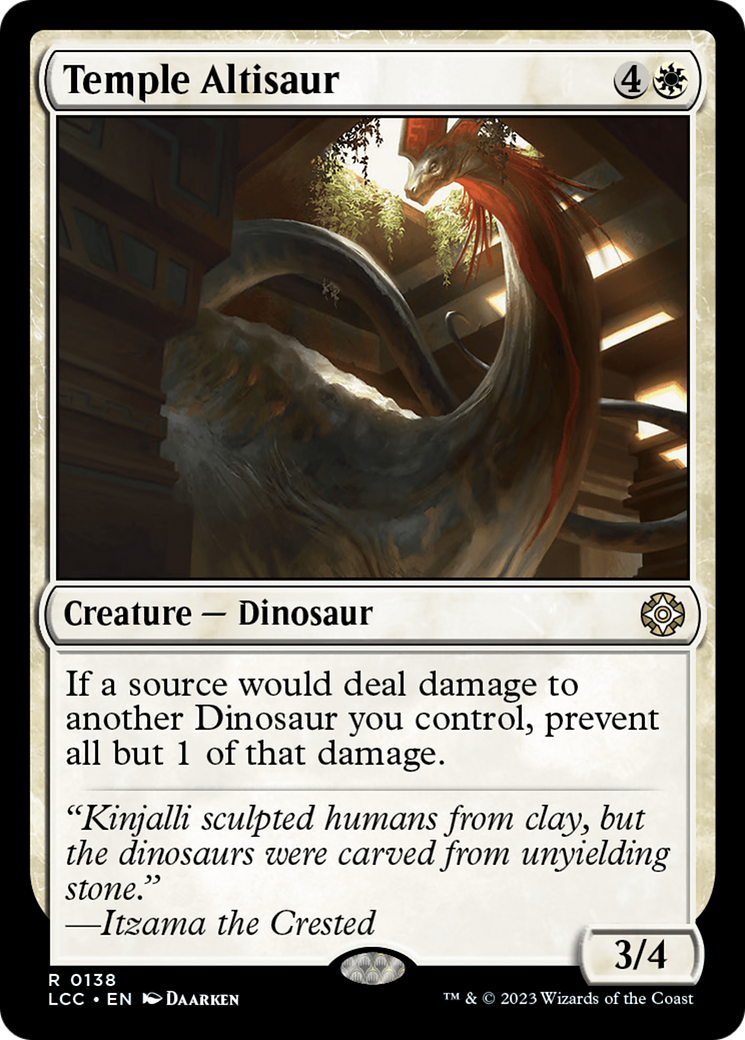
Temple Altisaur
Temple Altisaur
Creature — Dinosaur
3/4
If a source would deal damage to another Dinosaur you control, prevent all but 1 of that damage.
- Combat damage can be assigned to other Dinosaurs you control as normal, but most of that damage will be prevented. For example, if a 3/3 Dinosaur you control blocks a 5/5 creature with trample, the attacking player may assign 2 of that creature's combat damage to the player or planeswalker it's attacking and Temple Altisaur will prevent 2 of the 3 damage assigned to the defending Dinosaur.
- If multiple sources would deal damage to another Dinosaur you control, all but 1 damage from each of those sources is prevented.
- The effects of two Temple Altisaurs won't reduce the damage from one source below 1 damage.
- If multiple replacement and/or prevention effects could apply to a Dinosaur you control, you choose the order in which to apply those effects. For example, if another effect will prevent 1 damage that would be dealt to a Dinosaur, you may apply Temple Altisaur's effect to prevent all but 1 of that damage and then apply the other effect to prevent that 1 damage.
-
1
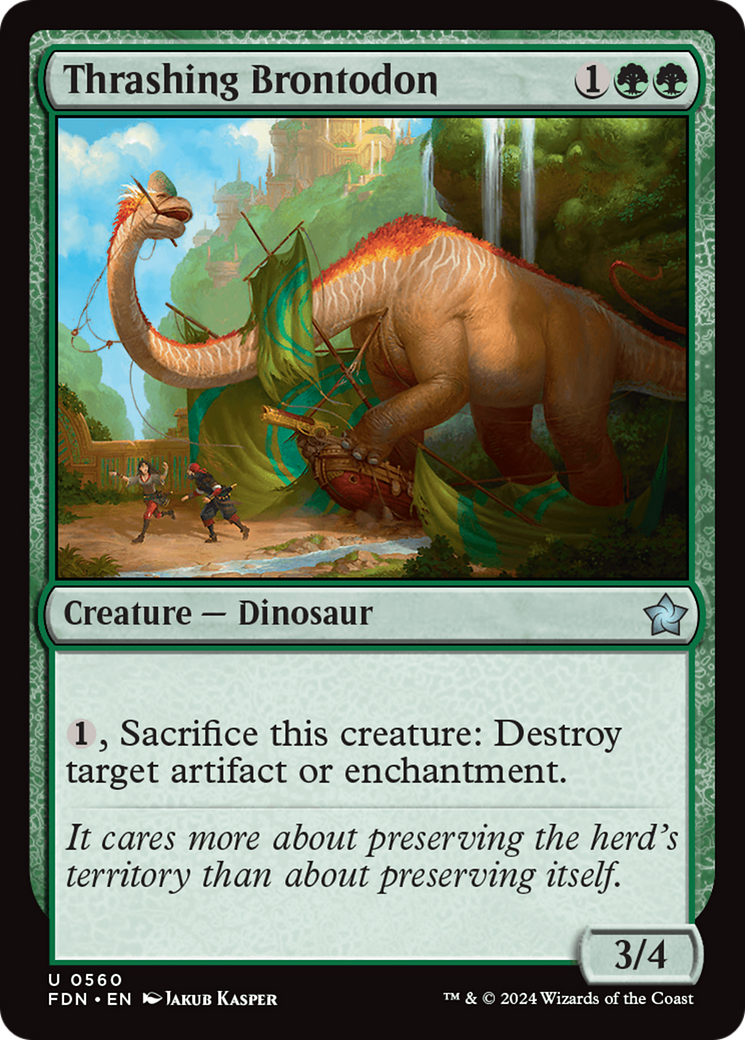
Thrashing Brontodon
Thrashing Brontodon
Creature — Dinosaur
3/4
, Sacrifice this creature: Destroy target artifact or enchantment.
-
1
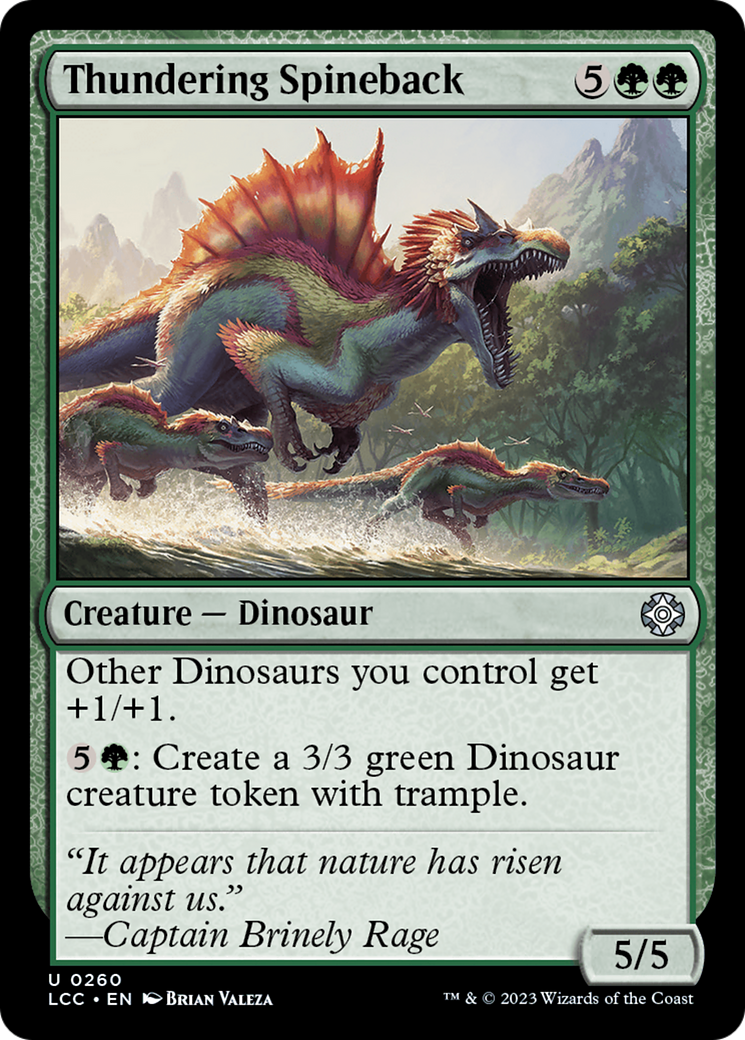
Thundering Spineback
Thundering Spineback
Creature — Dinosaur
5/5
Other Dinosaurs you control get +1/+1.
: Create a 3/3 green Dinosaur creature token with trample. (It can deal excess combat damage to the player or planeswalker it's attacking.)
-
1
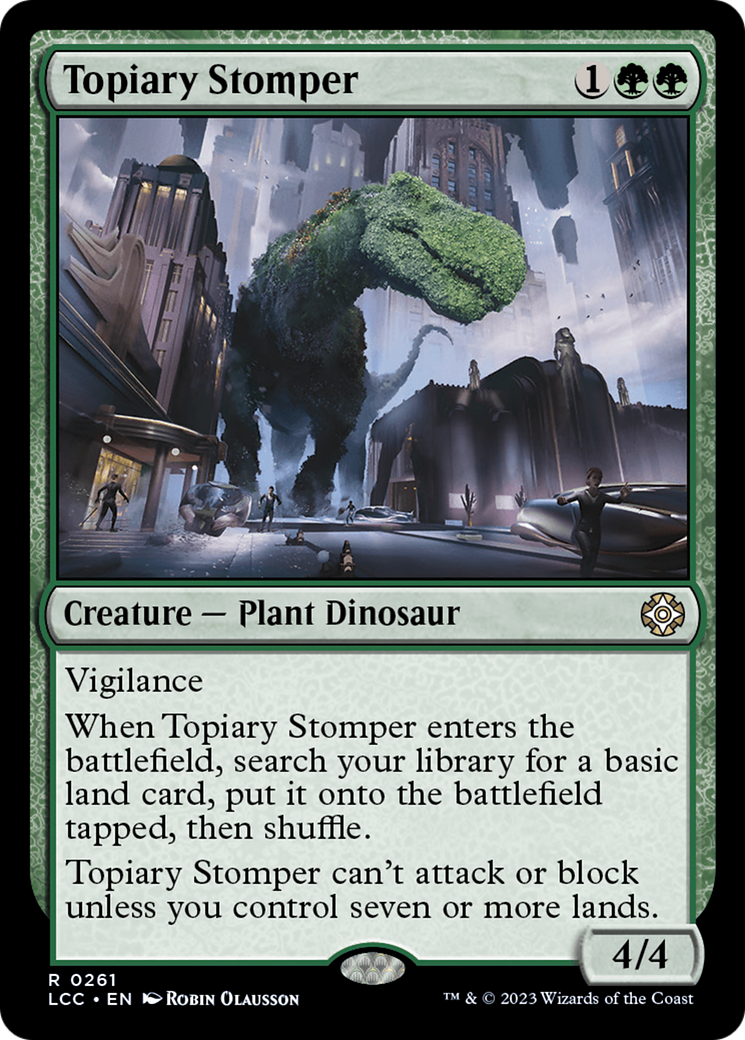
Topiary Stomper
Topiary Stomper
Creature — Plant Dinosaur
4/4
Vigilance (Attacking doesn't cause this creature to tap.)
When this creature enters, search your library for a basic land card, put it onto the battlefield tapped, then shuffle.
This creature can't attack or block unless you control seven or more lands.
-
1
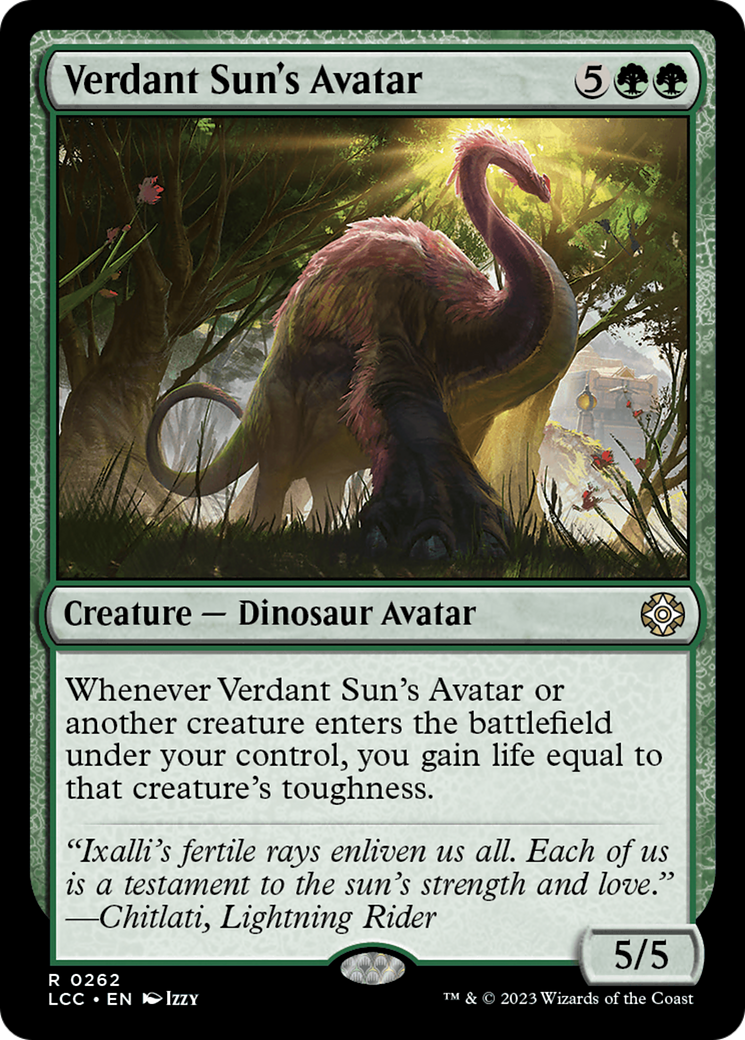
Verdant Sun's Avatar
Verdant Sun's Avatar
Creature — Dinosaur Avatar
5/5
Whenever this creature or another creature you control enters, you gain life equal to that creature's toughness.
- The entering creature's toughness is determined as the ability of Verdant Sun's Avatar resolves. If that creature has left the battlefield, use its toughness as it last existed on the battlefield. If the creature's toughness was less than 0, your life total won't change.
-
1
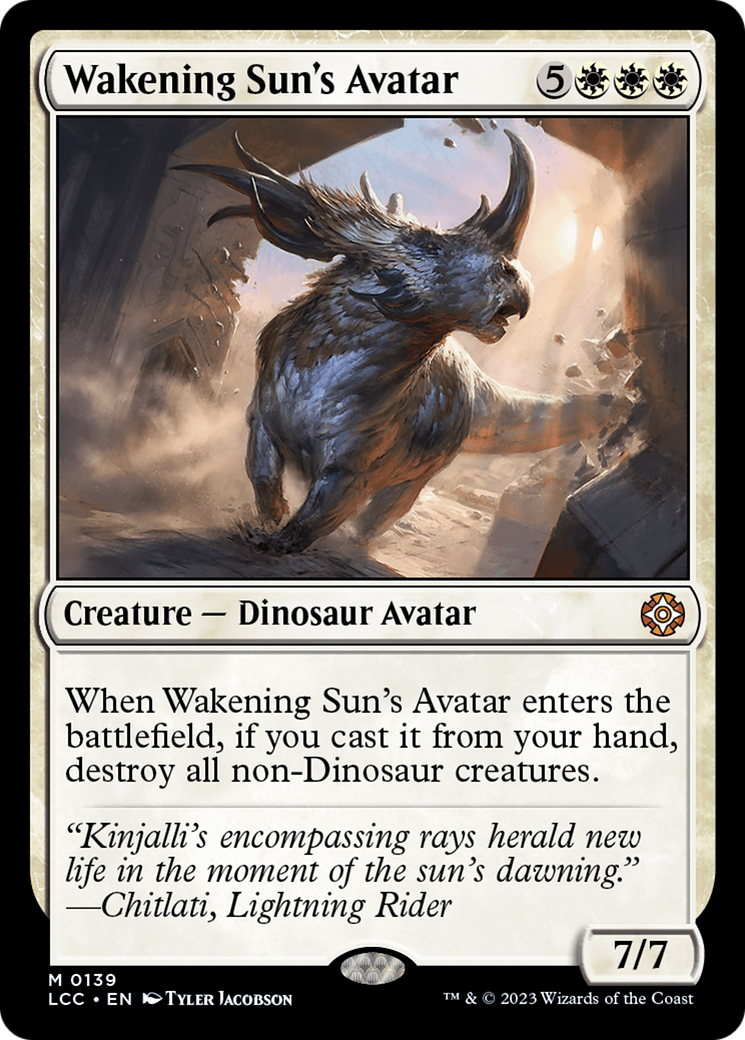
Wakening Sun's Avatar
Wakening Sun's Avatar
Creature — Dinosaur Avatar
7/7
When this creature enters, if you cast it from your hand, destroy all non-Dinosaur creatures.
- If you put Wakening Sun's Avatar onto the battlefield from your hand without casting it, its ability won't trigger.
- If you cast a creature spell that enters the battlefield as a copy of Wakening Sun's Avatar, such as Clone, the enters-the-battlefield ability will trigger.
-
1
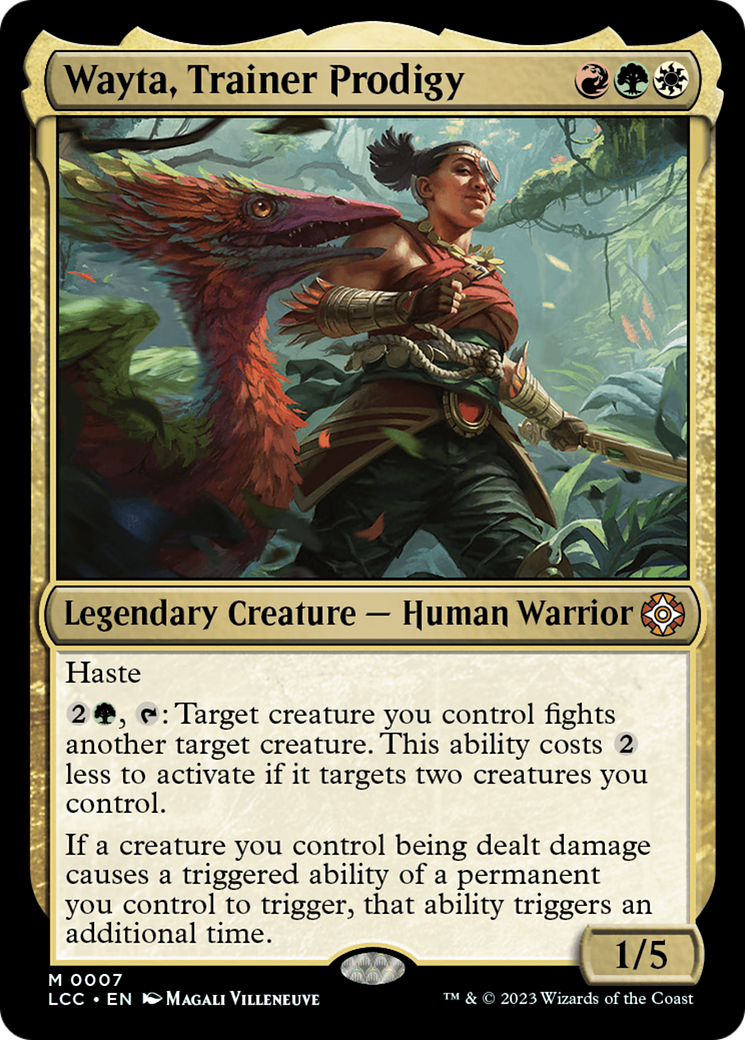
Wayta, Trainer Prodigy
Wayta, Trainer Prodigy
Legendary Creature — Human Warrior
1/5
Haste
, : Target creature you control fights another target creature. This ability costs less to activate if it targets two creatures you control.
If a creature you control being dealt damage causes a triggered ability of a permanent you control to trigger, that ability triggers an additional time.
- Wayta, Trainer Prodigy's last ability affects only triggered abilities whose trigger conditions refer specifically to damage being dealt, such as the ability granted by Mephidross Vampire or the last ability of Wrathful Raptors. It does not affect triggered abilities that would trigger because of the results of that damage. For example, if you control an Ajani's Pridemate ("Whenever you gain life, put a +1/+1 counter on Ajani's Pridemate") and you activate Wayta, Trainer Prodigy's second ability targeting a creature you control with lifelink and another creature you control, the triggered ability of Ajani's Pridemate will still trigger only once.
- Wayta, Trainer Prodigy's last ability doesn't copy the triggered ability; it just causes the ability to trigger twice. Any choices made as you put the ability onto the stack, such as modes and targets, are made separately for each instance of the ability. Any choices made on resolution, such as whether to put counters on a permanent, are also made individually.
- If you somehow control two copies of Wayta, Trainer Prodigy, a creature you control being dealt damage causes abilities to trigger three times, not four. A third Wayta, Trainer Prodigy causes abilities to trigger four times, a fourth causes abilities to trigger five times, and so on.
-
1
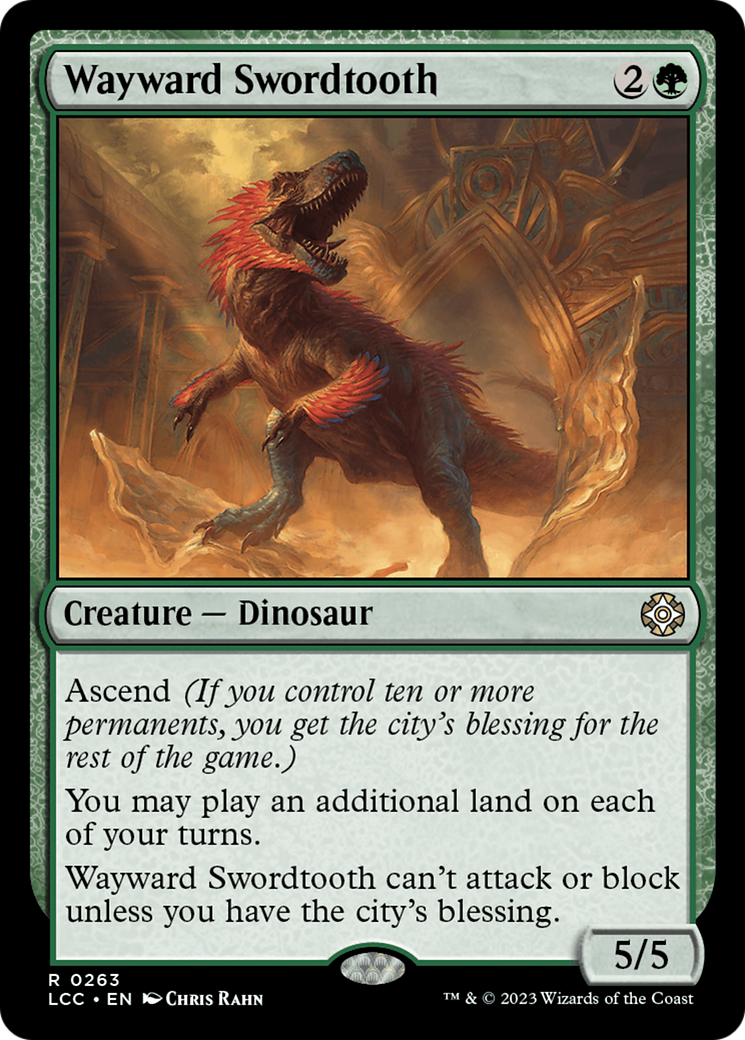
Wayward Swordtooth
Wayward Swordtooth
Creature — Dinosaur
5/5
Ascend (If you control ten or more permanents, you get the city's blessing for the rest of the game.)
You may play an additional land on each of your turns.
This creature can't attack or block unless you have the city's blessing.
- Wayward Swordtooth's middle ability is cumulative if you control more than one. It's also cumulative with other effects that let you play additional lands, such as the one from Enter the Unknown.
- Once you have the city's blessing, you have it for the rest of the game, even if you lose control of some or all of your permanents. The city's blessing isn't a permanent itself and can't be removed by any effect.
- A permanent is any object on the battlefield, including tokens and lands. Spells and emblems aren't permanents.
- If you cast a spell with ascend, you don't get the city's blessing until it resolves. Players may respond to that spell by trying to change whether you get the city's blessing.
- If you control ten permanents but don't control a permanent or resolving spell with ascend, you don't get the city's blessing. For example, if you control ten permanents, lose control of one, then cast Golden Demise, you won't have the city's blessing and the spell will affect creatures you control.
- If your tenth permanent enters the battlefield and then a permanent leaves the battlefield immediately afterwards (most likely due to the "Legend Rule" or due to being a creature with 0 toughness), you get the city's blessing before it leaves the battlefield.
- Ascend on a permanent isn't a triggered ability and doesn't use the stack. Players can respond to a spell that will give you your tenth permanent, but they can't respond to getting the city's blessing once you control that tenth permanent. This means that if your tenth permanent is a land you play, players can't respond before you get the city's blessing.
-
1
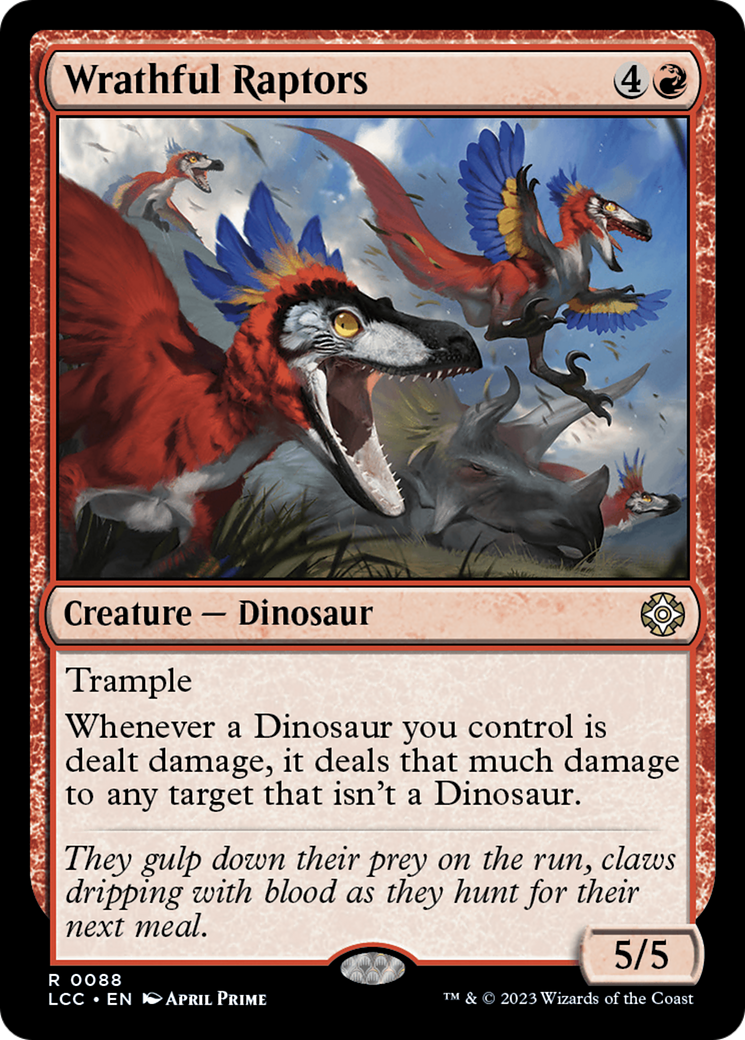
Wrathful Raptors
Wrathful Raptors
Creature — Dinosaur
5/5
Trample
Whenever a Dinosaur you control is dealt damage, it deals that much damage to any target that isn't a Dinosaur.
- "Any target that isn't a Dinosaur" means any non-Dinosaur creature, any planeswalker or battle, or any player (no matter how old they are).
- If multiple sources deal damage to a Dinosaur you control while you control Wrathful Raptors, most likely because multiple creatures blocked that Dinosaur, Wrathful Raptors's last ability triggers only once.
- If lethal damage is dealt to a Dinosaur you control while you control Wrathful Raptors, Wrathful Raptors's last ability still triggers.
- If Wrathful Raptors and one or more other Dinosaurs you control are dealt damage at the same time, Wrathful Raptors's ability triggers for itself and for each of those Dinosaurs, regardless of whether or not Wrathful Raptors was dealt lethal damage.
-
1
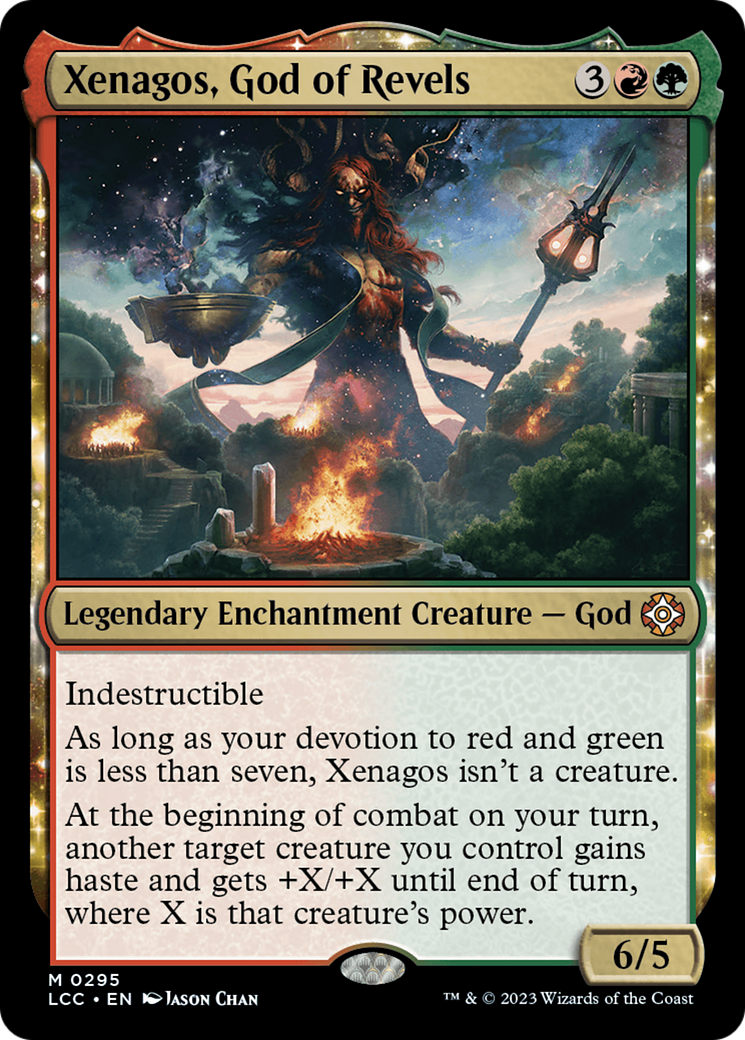
Xenagos, God of Revels
Xenagos, God of Revels
Legendary Enchantment Creature — God
6/5
Indestructible
As long as your devotion to red and green is less than seven, Xenagos isn't a creature.
At the beginning of combat on your turn, another target creature you control gains haste and gets +X/+X until end of turn, where X is that creature's power.
- If an effect causes Xenagos to lose all abilities, its ability that causes it to stop being a creature still applies if appropriate.
- When Xenagos enters the battlefield, your devotion to red and green will determine if a creature entered the battlefield or not for abilities that trigger whenever a creature enters the battlefield. The mana symbols in Xenagos's own mana cost are counted when determining this.
- If Xenagos stops being a creature, it loses the type creature and the creature type God. It continues to be a legendary enchantment.
- Xenagos's abilities function as long as it's on the battlefield, regardless of whether it's a creature.
- If Xenagos is attacking or blocking and it stops being a creature, it will be removed from combat. It won't rejoin combat if it resumes being a creature later during that combat.
- Counters put on Xenagos remain on it while it's not a creature, even if they have no effect.
- Your devotion to two colors is the number of mana symbols among mana costs of permanents you control that are the first color, the second, or both. If an effect counts your devotion to two colors, a hybrid symbol that is both of those colors is counted just once.
- The type-changing ability that can make Xenagos not be a creature functions only on the battlefield. It's always a creature card in other zones, regardless of your devotion to red and green. It's always a creature spell while it's on the stack.
- As Xenagos enters the battlefield, your devotion to red and green will determine whether any replacement effects that affect creatures entering the battlefield apply. Because replacement effects are considered before Xenagos is on the battlefield, the mana symbols in its mana cost won't be counted when determining this.
- The value of X is calculated only once, as the ability resolves.
- Mana symbols in the text boxes of permanents you control don't count toward your devotion to any color.
- Hybrid mana symbols, monocolored hybrid mana symbols, and Phyrexian mana symbols do count toward your devotion to their color(s).
- If an activated ability or triggered ability has an effect that depends on your devotion to a color, you count the number of mana symbols of that color among the mana costs of permanents you control as the ability resolves. The permanent with that ability will be counted if it's still on the battlefield at that time.
- Numeric mana symbols ( , , and so on) in mana costs of permanents you control don't count toward your devotion to any color.
-
1
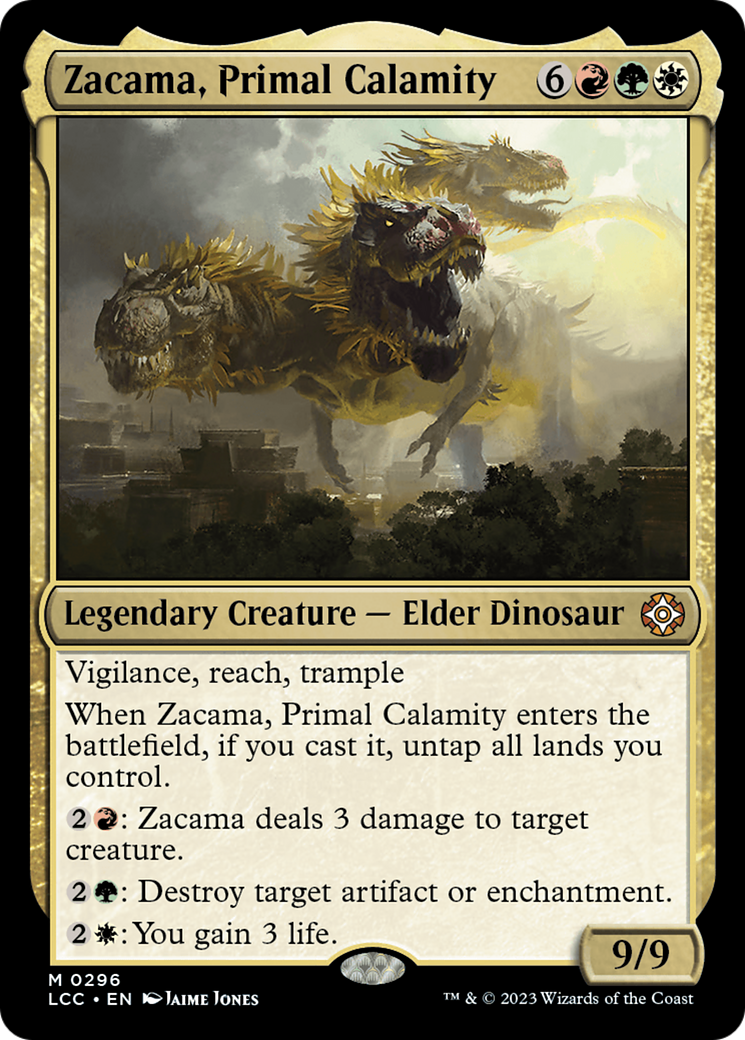
Zacama, Primal Calamity
Zacama, Primal Calamity
Legendary Creature — Elder Dinosaur
9/9
Vigilance, reach, trample
When Zacama enters, if you cast it, untap all lands you control.
: Zacama deals 3 damage to target creature.
: Destroy target artifact or enchantment.
: You gain 3 life.
- Zacama's damage-dealing ability can be activated during combat, perhaps targeting a creature blocking it. If all creatures blocking Zacama are destroyed, its combat damage is assigned to the player, planeswalker, or battle it's attacking because of trample. If the blocking creatures are dealt nonlethal damage, that damage is considered when assigning trample damage.
- Zacama's triggered ability triggers if you cast it from any zone. It doesn't trigger if you put Zacama onto the battlefield without casting it.
-
1
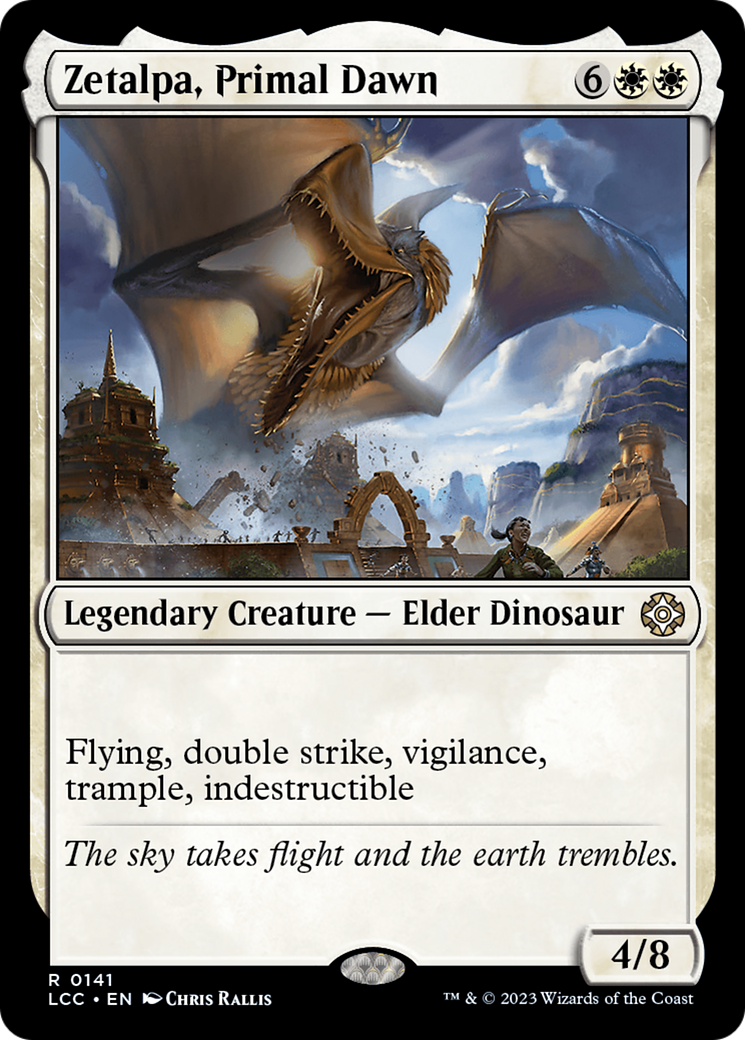
Zetalpa, Primal Dawn
Zetalpa, Primal Dawn
Legendary Creature — Elder Dinosaur
4/8
Flying, double strike, vigilance, trample, indestructible
- If an attacking creature with double strike and trample destroys all of its blocking creatures with first-strike combat damage, all of its normal combat damage is assigned to the player, planeswalker, or battle that creature's attacking.
Instants 4
-
1
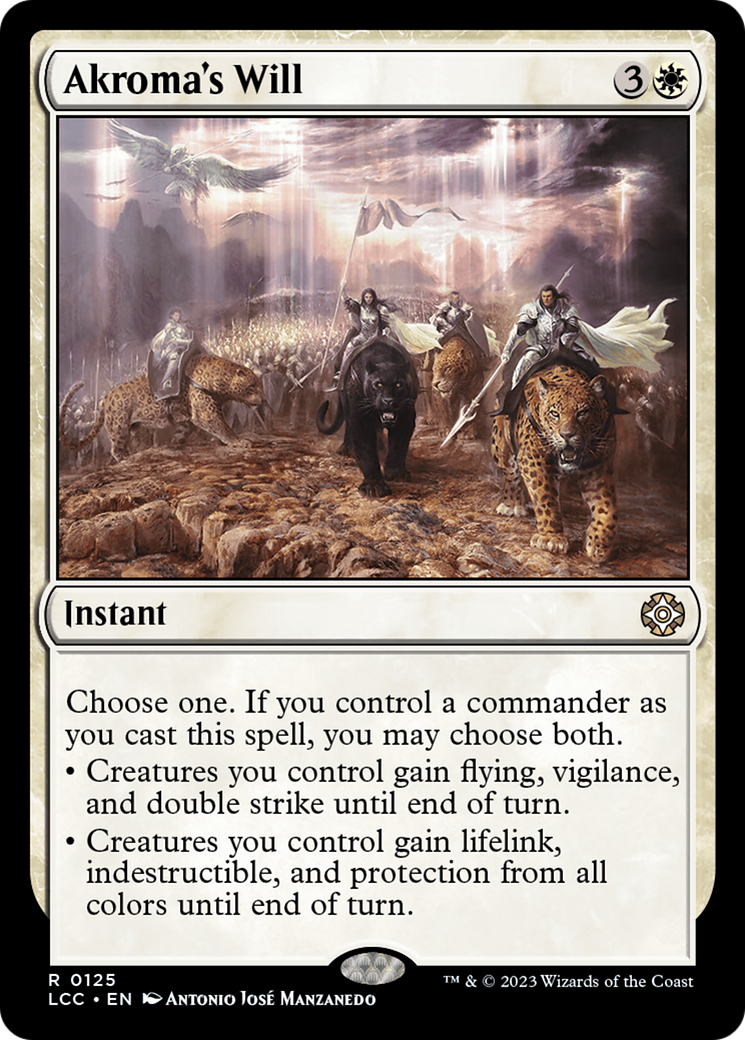
Akroma's Will
Akroma's Will
Instant
Choose one. If you control a commander as you cast this spell, you may choose both instead.
- Creatures you control gain flying, vigilance, and double strike until end of turn.
- Creatures you control gain lifelink, indestructible, and protection from each color until end of turn.
- "Protection from each color" is shorthand for protection from white, from blue, from black, from red, and from green. Colorless is not a color.
- There's no extra bonus if you control more than one commander.
- Once you've announced that you're casting a spell, players can't take any actions until you've finished doing so. Notably, opponents can't try to remove your commander to change how many modes you may choose.
- Even though the card is named after a specific character, controlling any commander will satisfy its condition.
- The commander you control doesn't have to be your commander.
- Once you've chosen both modes for the spell, it doesn't matter whether you continue to control a commander. This is true even if you somehow no longer control a commander as you finish casting the spell.
-
1
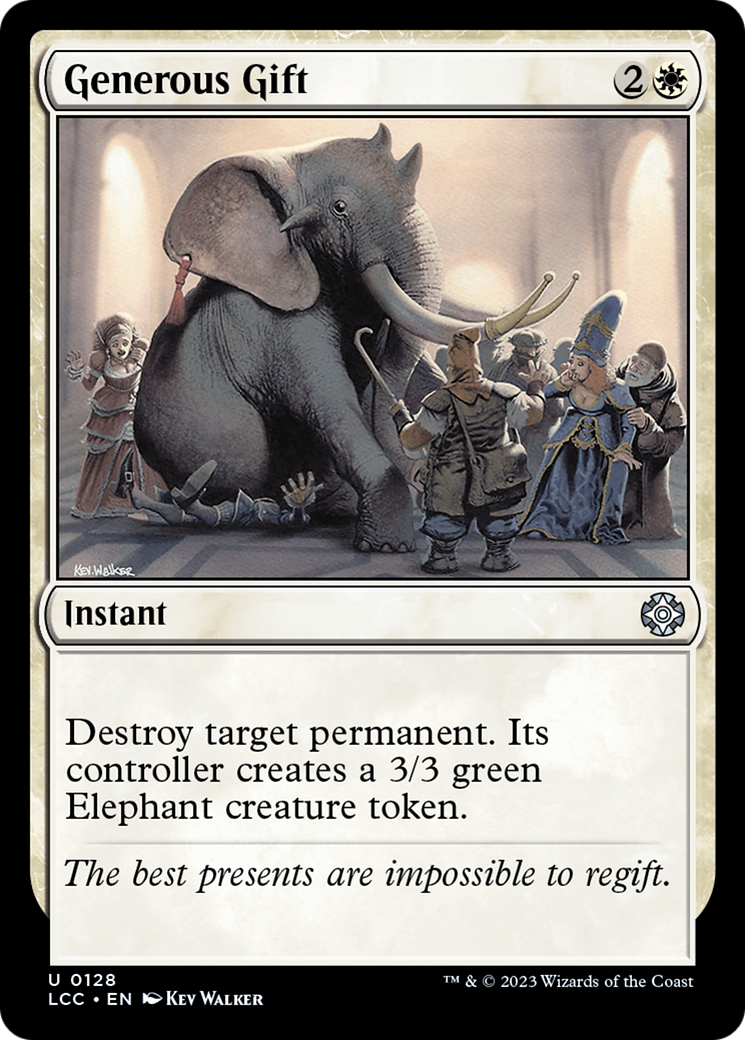
Generous Gift
Generous Gift
Instant
Destroy target permanent. Its controller creates a 3/3 green Elephant creature token.
- If the target permanent is an illegal target by the time Generous Gift tries to resolve, the spell doesn't resolve. No player creates an Elephant. If the target is legal but not destroyed (most likely because it has indestructible), its controller does create an Elephant.
-
1
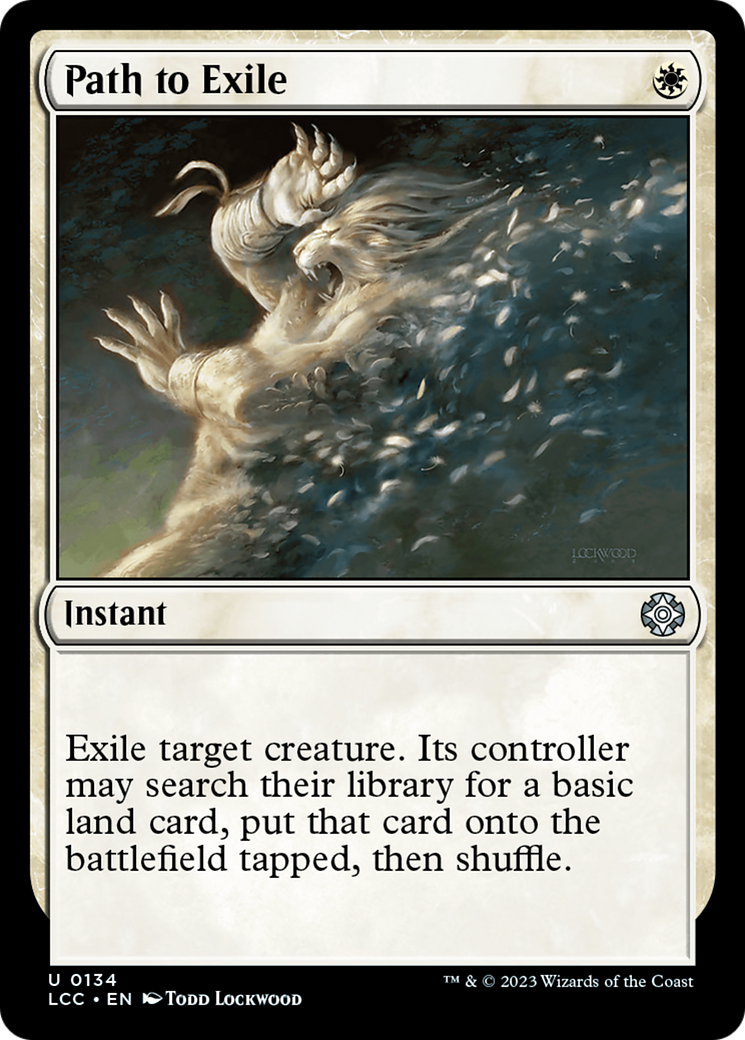
Path to Exile
Path to Exile
Instant
Exile target creature. Its controller may search their library for a basic land card, put that card onto the battlefield tapped, then shuffle.
- The controller of the exiled creature isn't required to search their library for a basic land. If that player doesn't, the player won't shuffle their library.
- If the target creature is an illegal target by the time Path to Exile tries to resolve, it won't resolve and none of its effects will happen. The creature's controller won't search for a basic land card.
-
1
Return of the Wildspeaker
Return of the Wildspeaker
Instant
Choose one —
- Draw cards equal to the greatest power among non-Human creatures you control.
- Non-Human creatures you control get +3/+3 until end of turn.
Sorceries 9
-
1
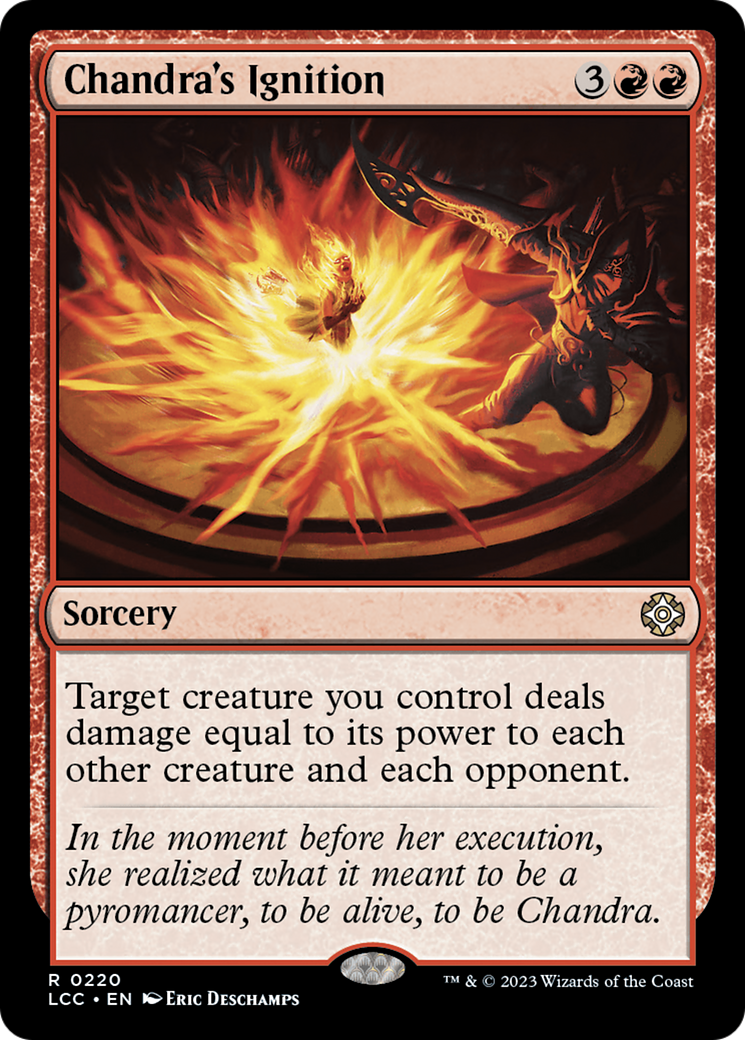
Chandra's Ignition
Chandra's Ignition
Sorcery
Target creature you control deals damage equal to its power to each other creature and each opponent.
- The creature is the source of the damage, not Chandra's Ignition. For example, Chandra's Ignition can have a white creature deal damage to a creature with protection from red.
- Use the power of the target creature as Chandra's Ignition resolves to determine how much damage it deals to each other creature and each opponent.
- If the creature becomes an illegal target by the time Chandra's Ignition tries to resolve (perhaps because another player controls it or it's left the battlefield), Chandra's Ignition won't resolve and none of its effects will happen. No damage will be dealt.
-
1
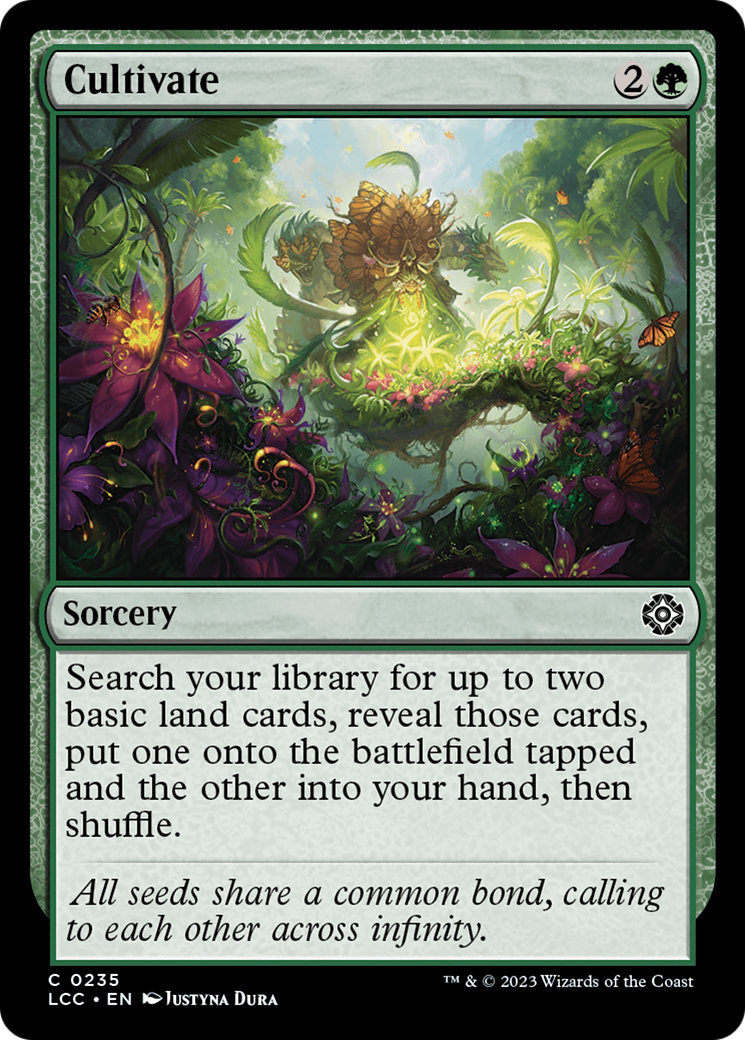
Cultivate
Cultivate
Sorcery
Search your library for up to two basic land cards, reveal those cards, put one onto the battlefield tapped and the other into your hand, then shuffle.
- If you choose to find only one basic land card, you put it onto the battlefield tapped.
-
1
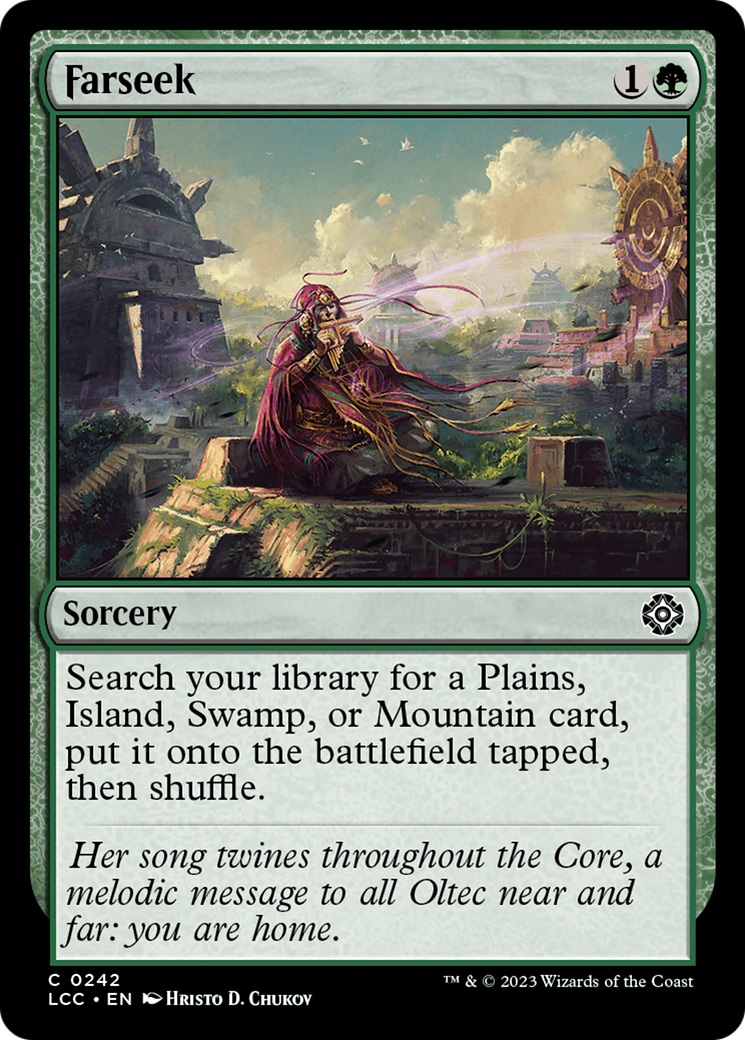
Farseek
Farseek
Sorcery
Search your library for a Plains, Island, Swamp, or Mountain card, put it onto the battlefield tapped, then shuffle.
- Farseek can find any land with any of the listed land types, including nonbasic ones, even if that land is a Forest in addition to one or more of those types.
-
1
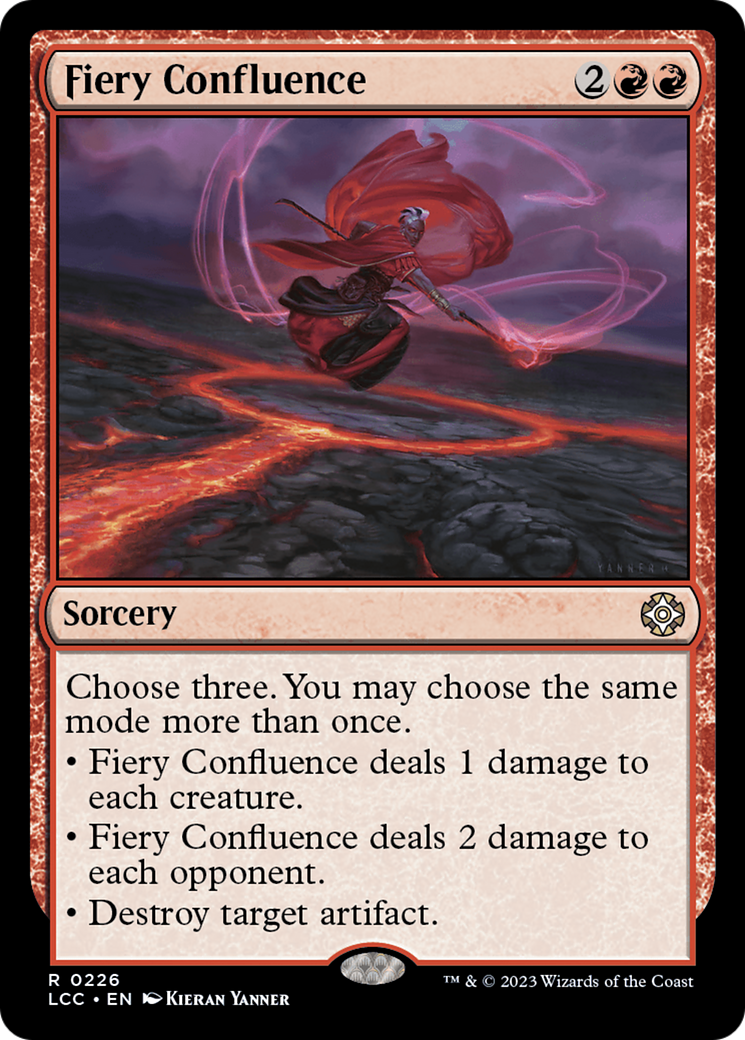
Fiery Confluence
Fiery Confluence
Sorcery
Choose three. You may choose the same mode more than once.
- Fiery Confluence deals 1 damage to each creature.
- Fiery Confluence deals 2 damage to each opponent.
- Destroy target artifact.
- No player can cast spells or activate abilities in between the modes of a resolving spell.
- You choose the modes as you cast the spell. Once modes are chosen, they can't be changed.
- If all targets for the chosen modes become illegal before the Confluence resolves, the spell won't resolve and none of its effects will happen. If at least one target is still legal, the spell will resolve but will have no effect on any illegal targets.
- If a mode requires a target, you can select that mode only if there's a legal target available. Ignore the targeting requirements for modes you don't choose. Each time you select that mode, you can choose a different target, or you can choose the same target.
- If the first or second modes are chosen multiple times, each of those modes represents a separate damage-dealing event. For example, if your opponent casts Fiery Confluence choosing the second mode three times, and you control Guardian Seraph (a creature with the ability "If a source an opponent controls would deal damage to you, prevent 1 of that damage"), you'll be dealt a total of 3 damage.
- If a Confluence is copied, the effect that creates the copy will usually allow you to choose new targets, but you can't choose new modes.
- No matter which combination of modes you choose, you always follow the instructions of a Confluence in the order they are written. If the same mode is chosen more than once, you choose their relative order as you cast the spell.
-
1
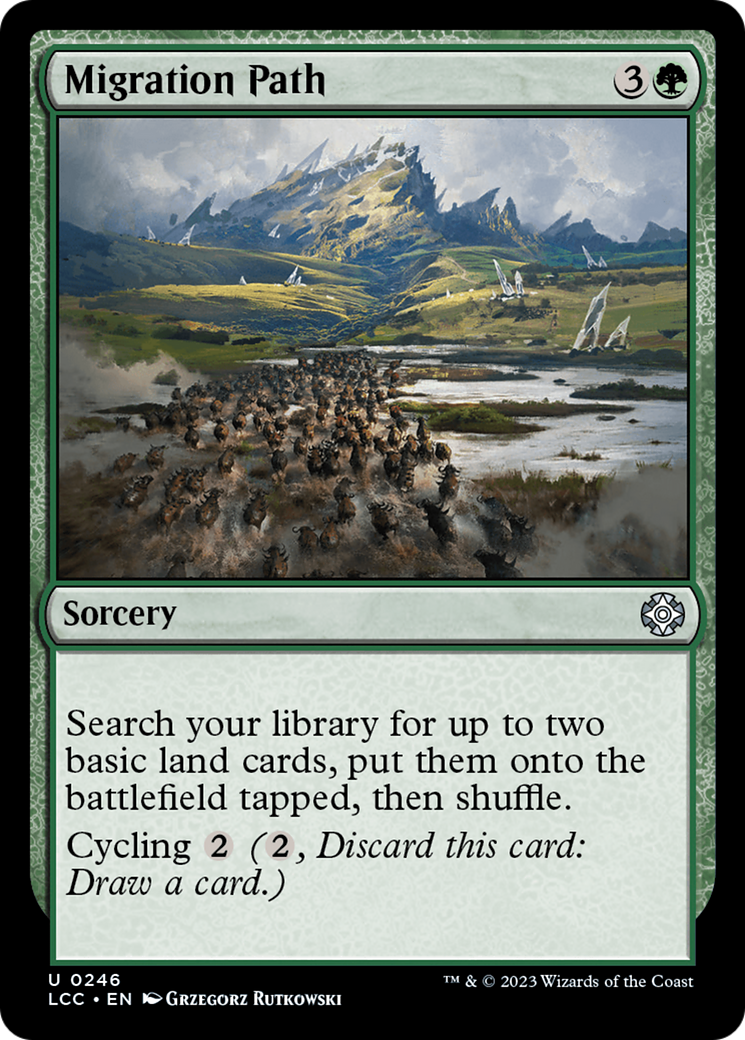
Migration Path
Migration Path
Sorcery
Search your library for up to two basic land cards, put them onto the battlefield tapped, then shuffle.
Cycling ( , Discard this card: Draw a card.)
-
1
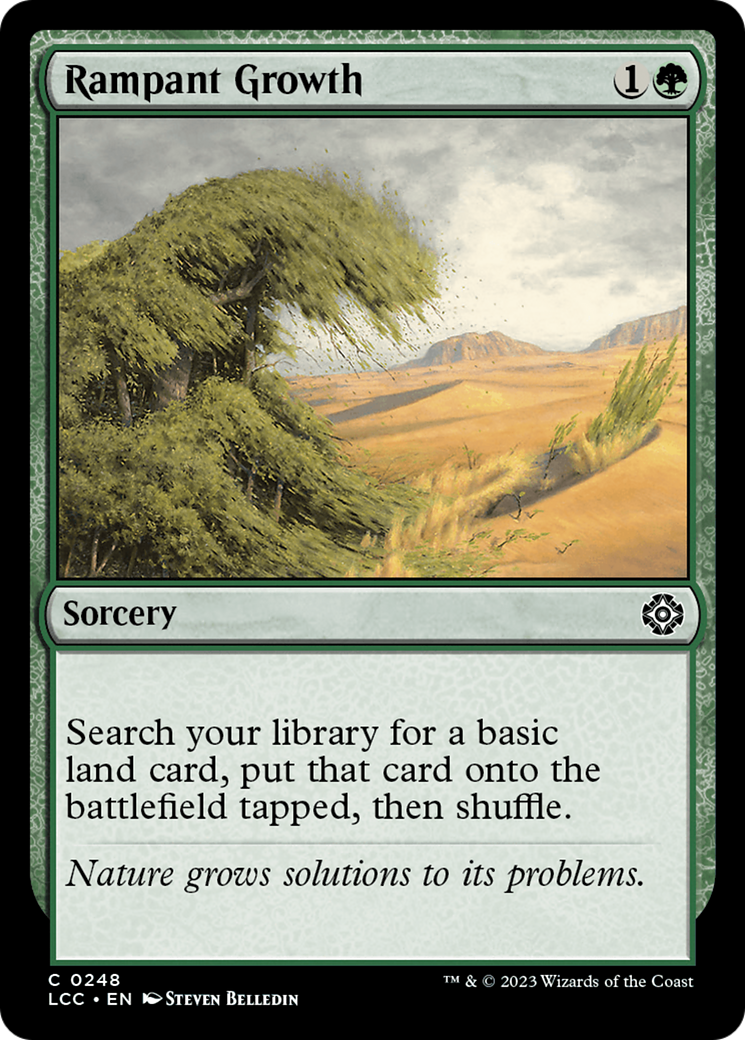
Rampant Growth
Rampant Growth
Sorcery
Search your library for a basic land card, put that card onto the battlefield tapped, then shuffle.
- The land does not count toward your one per turn limit because it was put onto the battlefield by an effect.
-
1
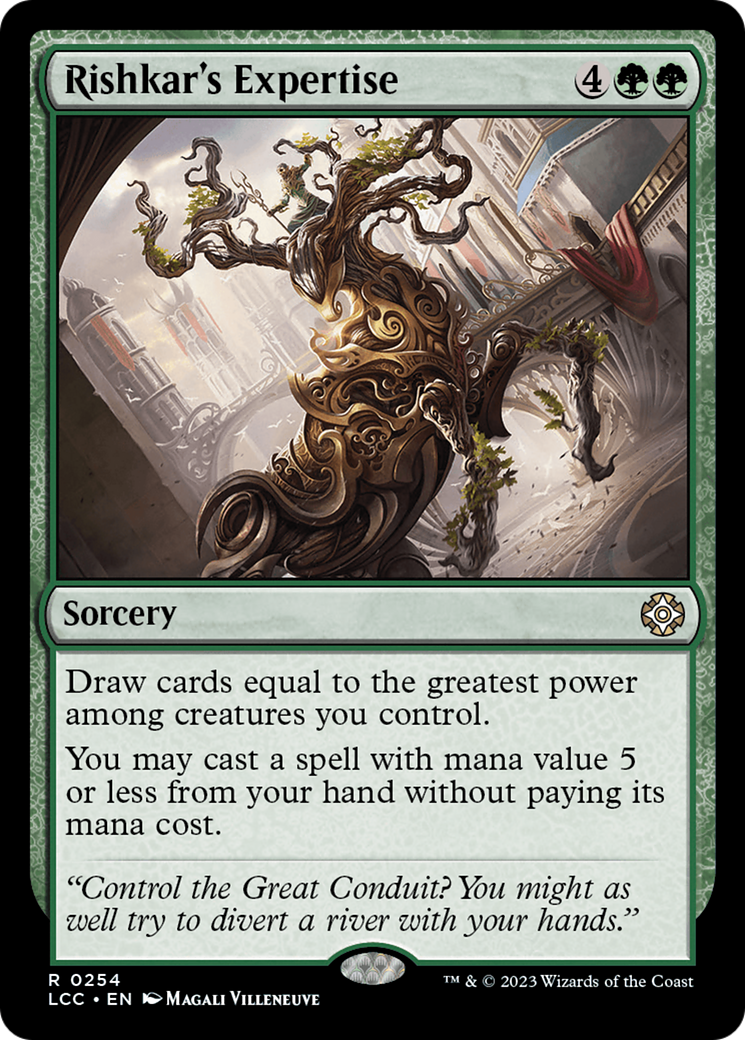
Rishkar's Expertise
Rishkar's Expertise
Sorcery
Draw cards equal to the greatest power among creatures you control.
You may cast a spell with mana value 5 or less from your hand without paying its mana cost.
- The mana value of a split card is determined by the combined mana cost of its two halves. If an expertise spell allows you to cast a split card, you may cast either half or, if that split card has fuse, both halves.
- If you control no creatures with power greater than 0 as Rishkar's Expertise resolves, you draw no cards, but you may cast a card with mana value 5 or less from your hand without paying its mana cost.
- You may cast one of the cards drawn by Rishkar's Expertise's first effect while performing its second effect.
- A card's mana value is determined solely by the mana symbols printed in its upper right corner. The mana value is the total amount of mana in that cost, regardless of color. For example, a card with mana cost has mana value 3. Ignore any alternative costs, additional costs, cost increases, or cost reductions that could apply to it. A card with no mana cost has a mana value of 0.
- If the card has in its mana cost, you must choose 0 as the value of X when casting it without paying its mana cost.
- The greatest power among creatures you control is determined as Rishkar's Expertise resolves.
- If you cast a card "without paying its mana cost," you can't choose to cast it for any alternative costs, such as emerge costs. You can, however, pay additional costs. If the card has any mandatory additional costs, such as that of Cathartic Reunion, you must pay those to cast the card.
- While you're casting your free spell, the Expertise spell is still on the stack. It will be put into its owner's graveyard after the free spell is cast. The free spell can't target the Expertise card in your graveyard. It can target the Expertise spell on the stack, but the Expertise spell will become an illegal target before the free spell resolves.
- Any triggered abilities that trigger while performing the Expertise spell's first effect won't be put onto the stack until after you're done casting your free spell. They're put onto the stack at the same time as any abilities that triggered while casting that spell regardless of the order in which those abilities triggered.
- Effects that allow you to "cast" a card don't allow you to play a land card.
-
1
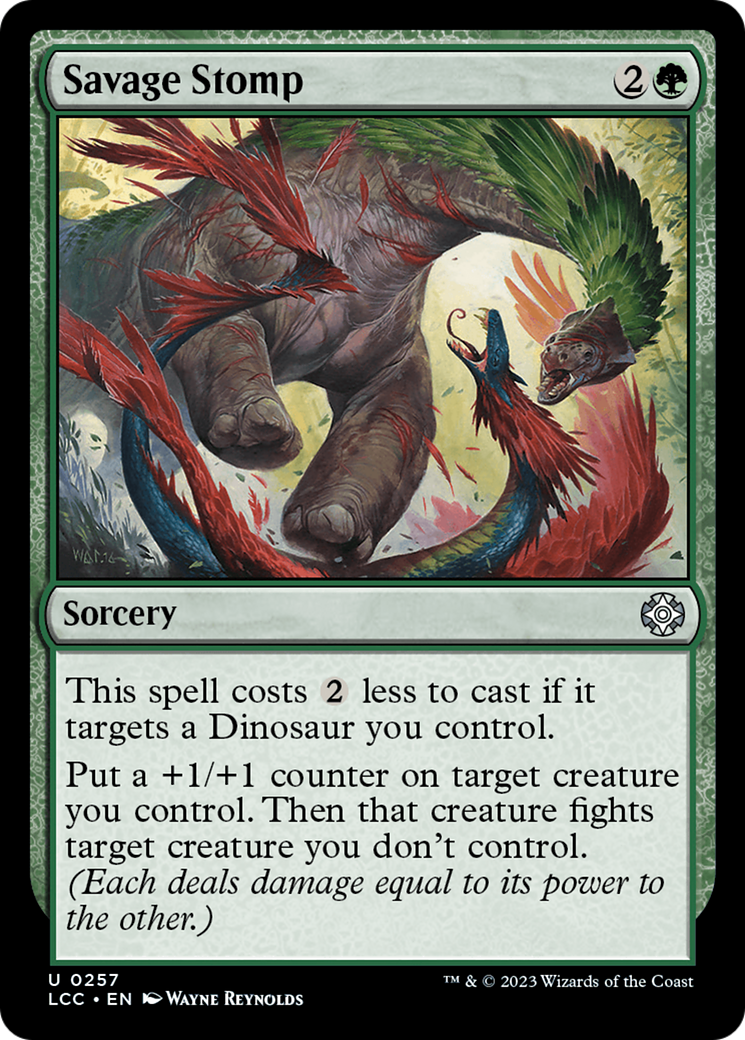
Savage Stomp
Savage Stomp
Sorcery
This spell costs less to cast if it targets a Dinosaur you control.
Put a +1/+1 counter on target creature you control. Then that creature fights target creature you don't control. (Each deals damage equal to its power to the other.)
- You can't cast Savage Stomp unless you choose both a creature you control and a creature you don't control as targets.
- If either target is an illegal target as Savage Stomp resolves, neither creature will deal or be dealt damage.
- If the creature you control is an illegal target as Savage Stomp tries to resolve, you won't put a +1/+1 counter on it. If that creature is a legal target but the other creature isn't, you'll still put the counter on the creature you control.
-
1
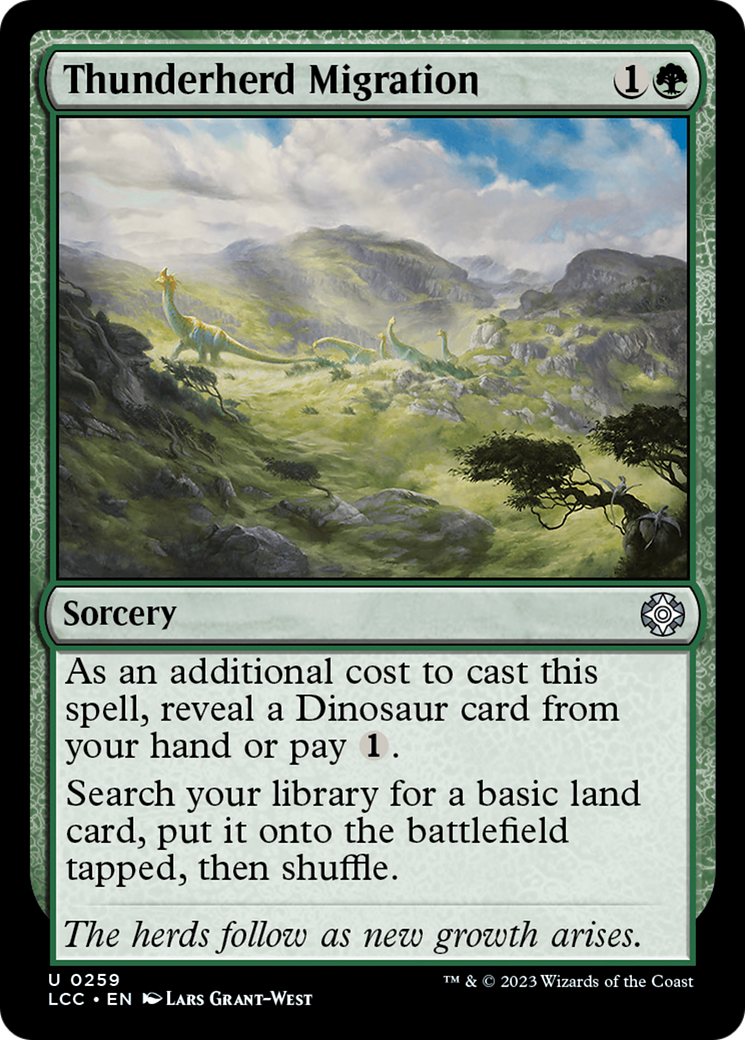
Thunderherd Migration
Thunderherd Migration
Sorcery
As an additional cost to cast this spell, reveal a Dinosaur card from your hand or pay .
Search your library for a basic land card, put it onto the battlefield tapped, then shuffle.
- If an effect refers to a "[subtype] spell" or "[subtype] card," it refers only to a spell or card that has that subtype. For example, March of the Drowned is a card that benefits Pirates and features Pirates in its illustration, but it isn't a Pirate card.
Artifacts 4
-
1
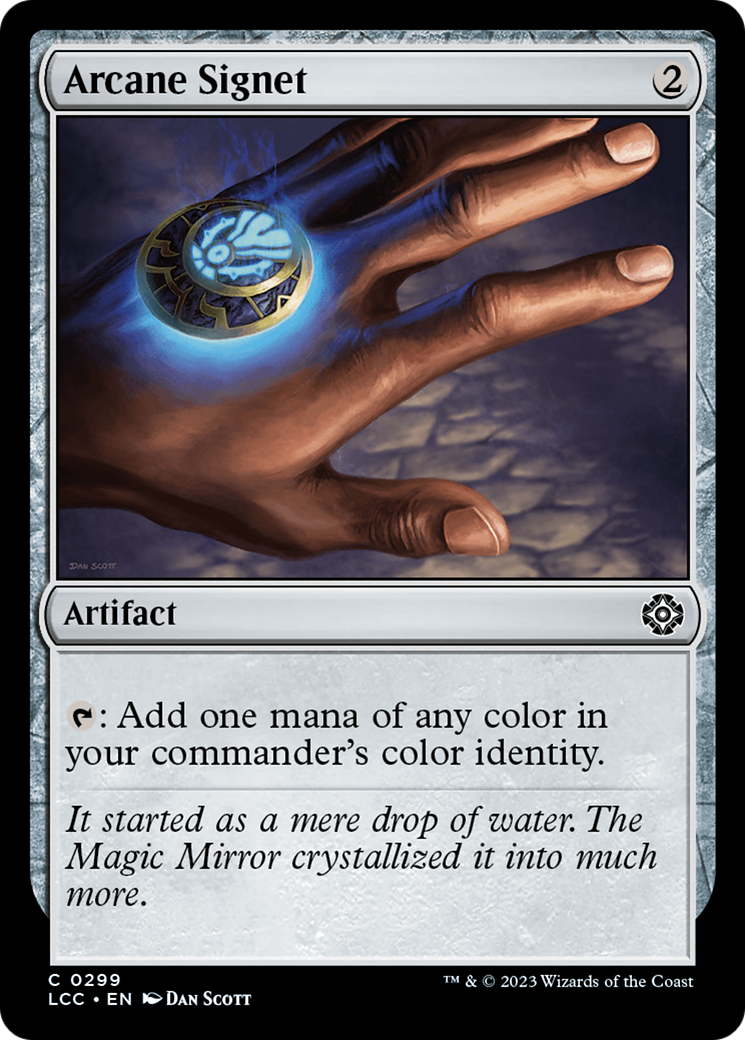
Arcane Signet
Arcane Signet
Artifact
: Add one mana of any color in your commander's color identity.
- If your commander is a card that has no colors in its color identity, Arcane Signet's ability produces no mana. It doesn't produce .
- If you have two commanders, the ability adds one mana of any color in their combined color identities.
- If you don't have a commander, Arcane Signet's ability produces no mana.
-
1
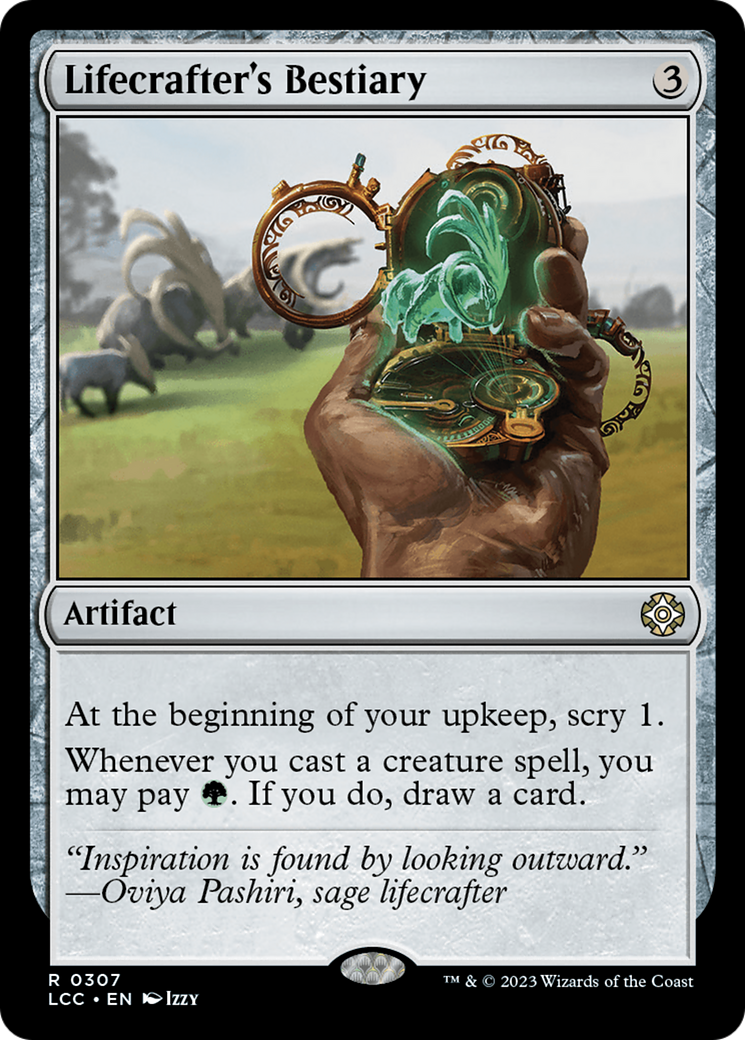
Lifecrafter's Bestiary
Lifecrafter's Bestiary
Artifact
At the beginning of your upkeep, scry 1.
Whenever you cast a creature spell, you may pay . If you do, draw a card.
- The draw step is after the upkeep step, so you'll scry 1 before you draw for the turn.
- Lifecrafter's Bestiary's second triggered ability resolves before the spell that caused it to trigger. The ability will resolve even if that spell is countered.
- While resolving Lifecrafter's Bestiary's second triggered ability, you can't pay multiple times to draw multiple cards.
-
1
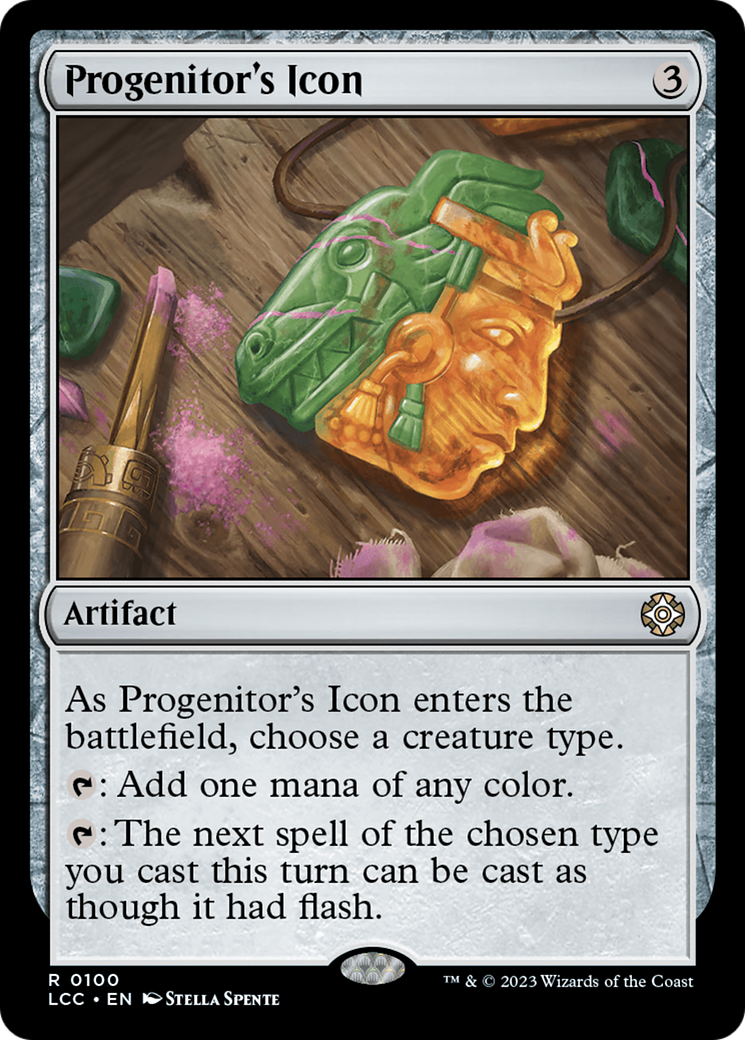
Progenitor's Icon
Progenitor's Icon
Artifact
As this artifact enters, choose a creature type.
: Add one mana of any color.
: The next spell of the chosen type you cast this turn can be cast as though it had flash.
- If Progenitor's Icon is somehow on the battlefield without a chosen type, its last ability won't do anything.
-
1
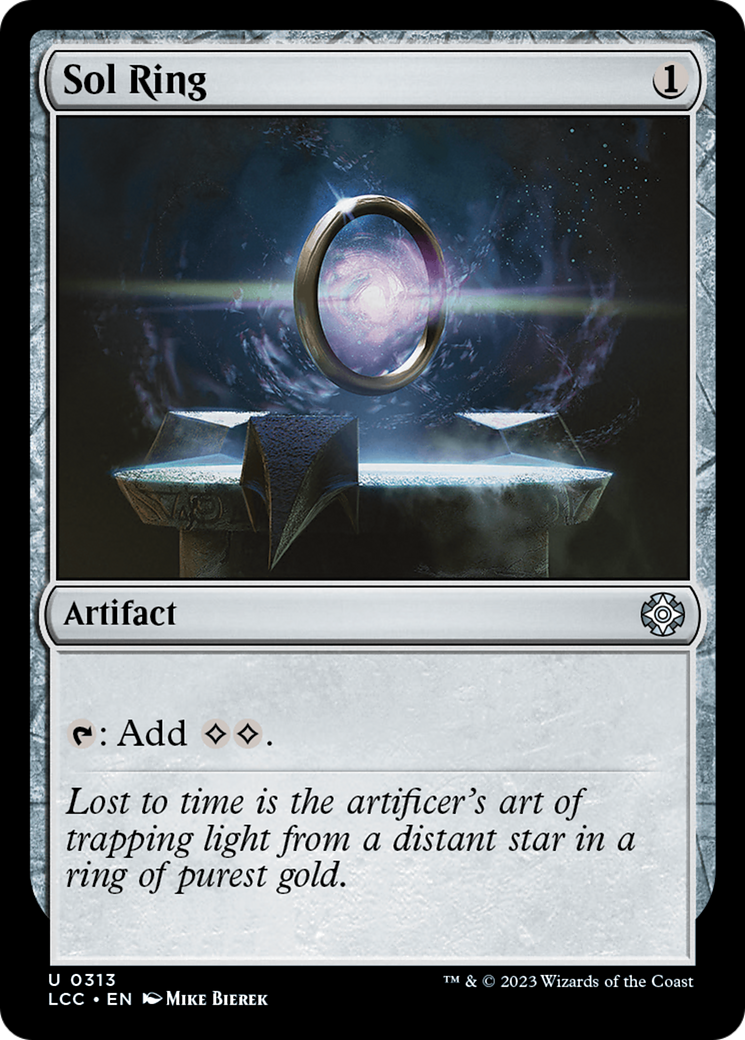
Sol Ring
Sol Ring
Artifact
: Add .
Enchantments 3
-
1
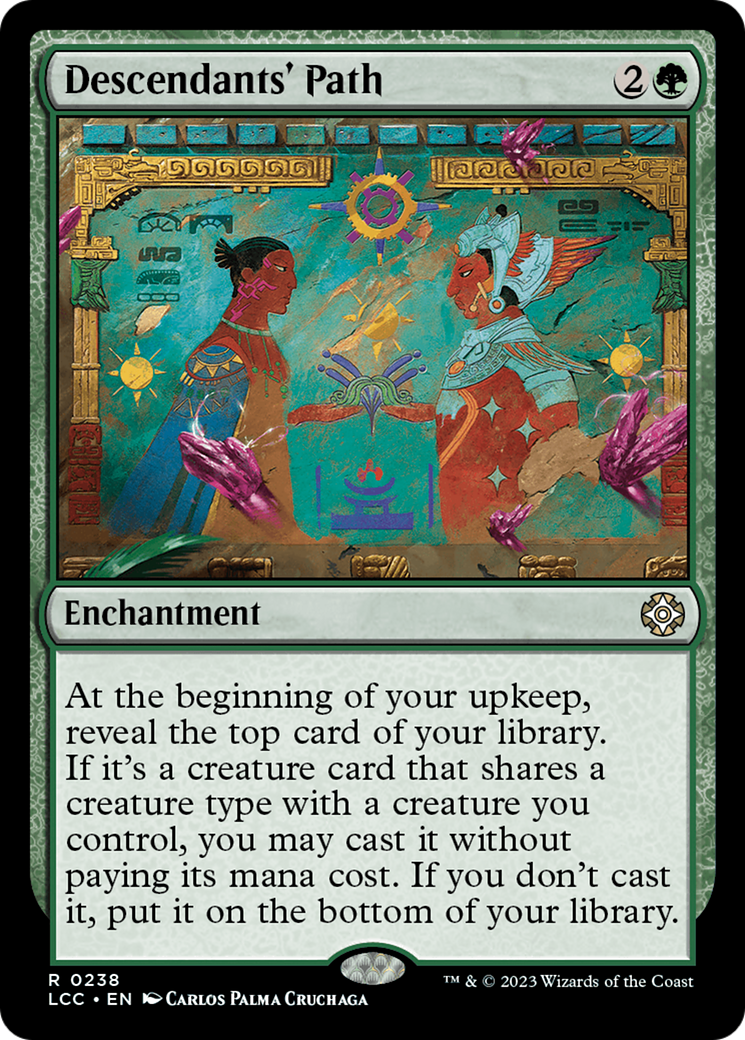
Descendants' Path
Descendants' Path
Enchantment
At the beginning of your upkeep, reveal the top card of your library. If it's a creature card that shares a creature type with a creature you control, you may cast it without paying its mana cost. If you don't cast it, put it on the bottom of your library.
- If the card has in its mana cost, you must choose 0 as its value.
- If the revealed card is a creature card that shares a creature type with a creature you control, but you choose not to cast it, it's put on the bottom of your library. (This is a recent change.)
- If you cast a card "without paying its mana cost," you can't pay any alternative costs. You can pay additional costs, such as kicker costs. If the card has mandatory additional costs, you must pay those.
-
1
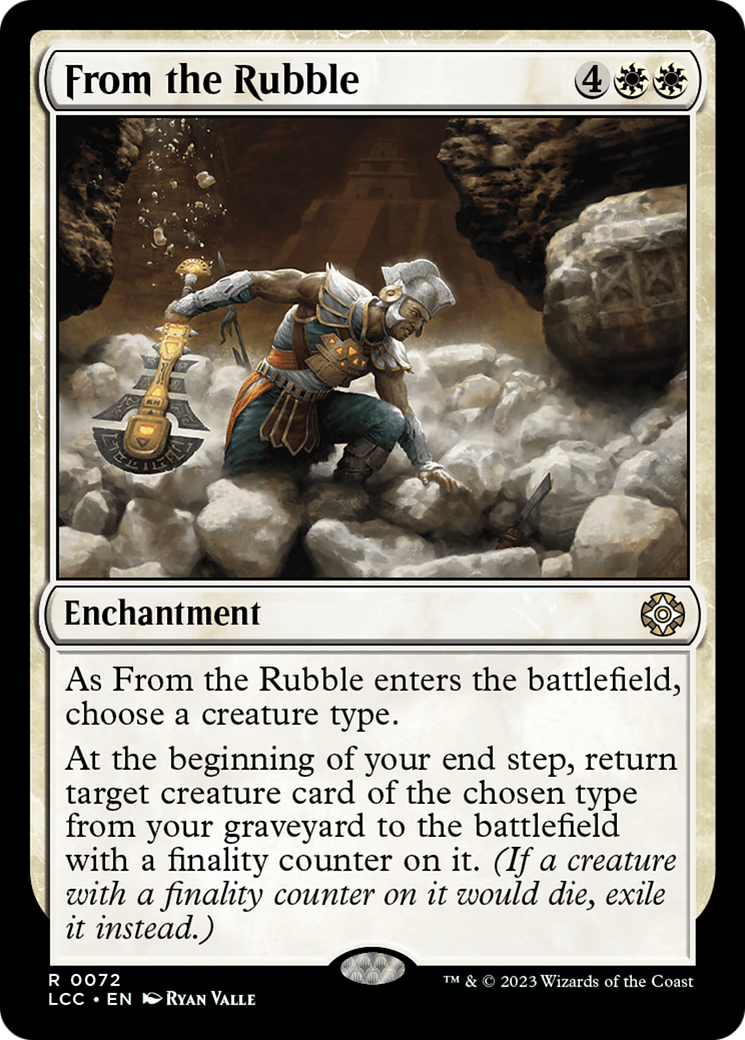
From the Rubble
From the Rubble
Enchantment
As this enchantment enters, choose a creature type.
At the beginning of your end step, return target creature card of the chosen type from your graveyard to the battlefield with a finality counter on it. (If a creature with a finality counter on it would die, exile it instead.)
- Finality counters work on any permanent, not only creatures. If a permanent with a finality counter on it would be put into a graveyard from the battlefield, exile it instead.
- Finality counters don't stop permanents from going to zones other than the graveyard from the battlefield. For example, if a permanent with a finality counter on it would be put into its owner's hand from the battlefield, it does so normally.
- Finality counters aren't keyword counters, and a finality counter doesn't give any abilities to the permanent it's on. If that permanent loses its abilities and then would go to a graveyard, it will still be exiled instead.
- Multiple finality counters on a single permanent are redundant.
-
1
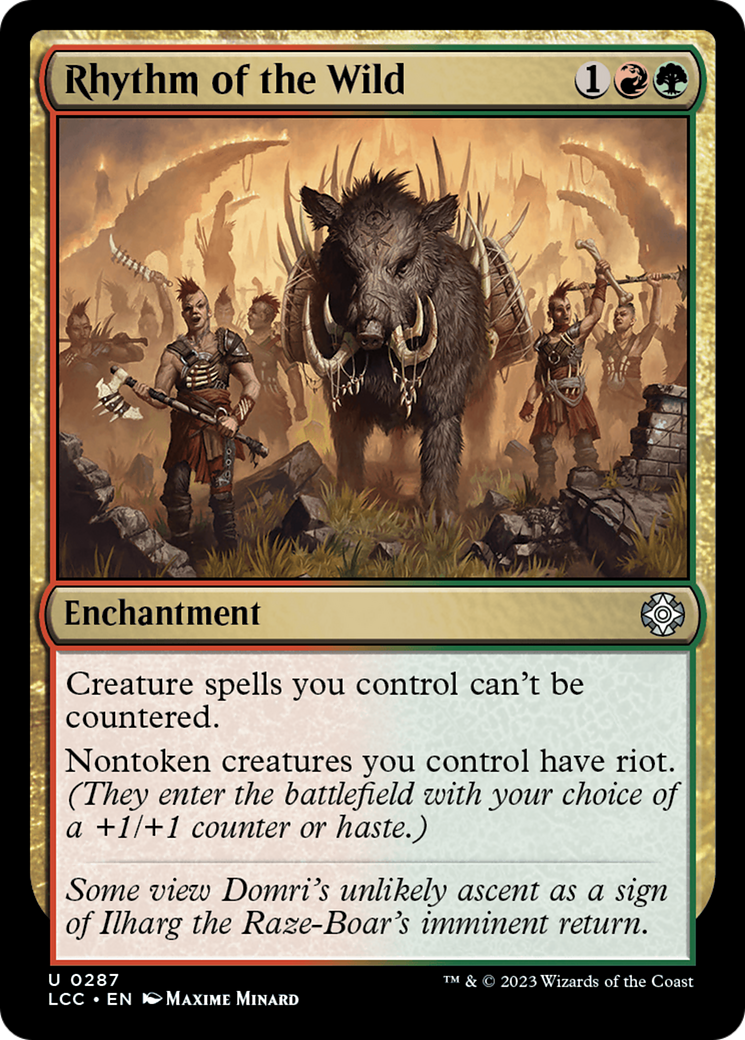
Rhythm of the Wild
Rhythm of the Wild
Enchantment
Creature spells you control can't be countered.
Nontoken creatures you control have riot. (They enter with your choice of a +1/+1 counter or haste.)
- If Rhythm of the Wild leaves the battlefield at the same time that a nontoken creature enters the battlefield (most likely because that creature has a replacement effect, such as that of Rescuer Sphinx), that creature still gets a +1/+1 counter or haste.
- A spell or ability that counters spells can still target a creature spell you control. When that spell or ability resolves, the creature spell won't be countered, but any additional effects of that spell or ability will still happen.
- If you choose for the creature to gain haste, it gains haste indefinitely. It won't lose it as the turn ends or as another player gains control of it.
- A noncreature card that happens to be entering the battlefield as a creature will have riot (for example, Rusted Relic while you control three other artifacts). Similarly, a creature card entering the battlefield as a noncreature permanent won't have riot (for example, Thassa, God of the Sea while your other permanents contribute only four to your devotion to blue).
- If a creature enters the battlefield with two instances of riot, you may choose to have it get two +1/+1 counters, one +1/+1 counter and haste, or two instances of haste. Multiple instances of haste on the same creature are redundant, but we're not going to tell the Gruul how to live their lives.
- Riot is a replacement effect. Players can't respond to your choice of +1/+1 counter or haste, and they can't take actions while the creature is on the battlefield without one or the other.
- If a nontoken, noncreature permanent becomes a creature after it's already on the battlefield, it will have riot but it will be too late for the replacement effect to have any effect.
- If a creature entering the battlefield has riot but can't have a +1/+1 counter put onto it, it gains haste.
- Once a creature with riot has entered the battlefield, it keeps its +1/+1 counter or haste even if it loses riot.
Lands 39
-
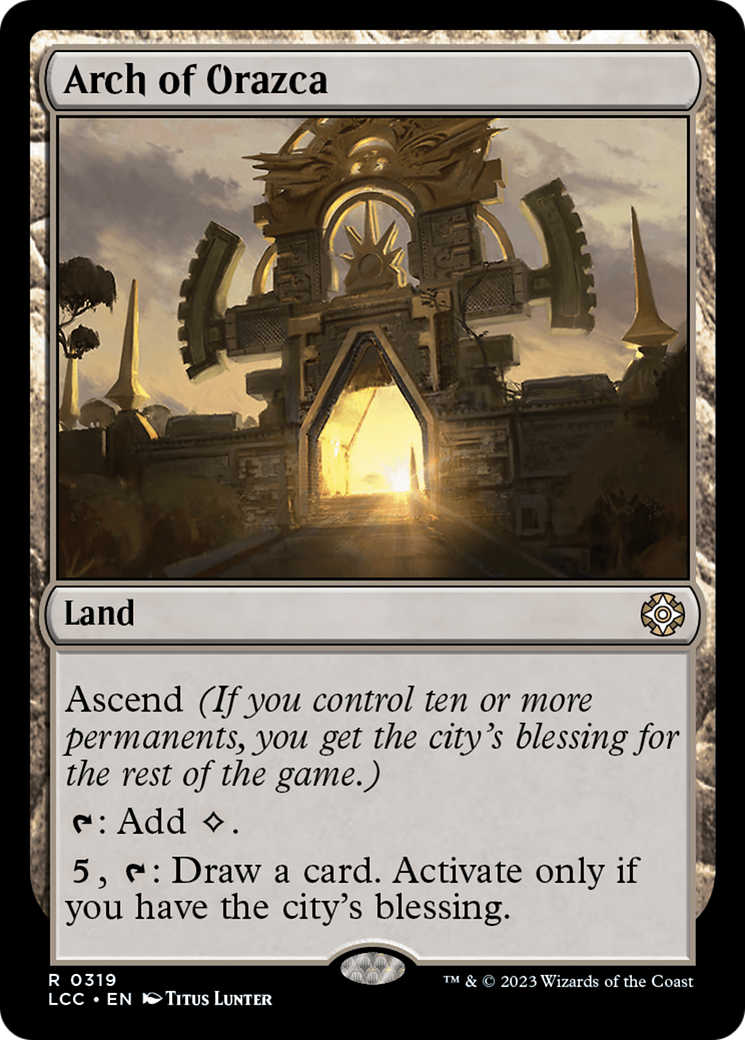
1
Arch of Orazca
Arch of Orazca
Land
Ascend (If you control ten or more permanents, you get the city's blessing for the rest of the game.)
: Add .
, : Draw a card. Activate only if you have the city's blessing.
- Once you have the city's blessing, you have it for the rest of the game, even if you lose control of some or all of your permanents. The city's blessing isn't a permanent itself and can't be removed by any effect.
- A permanent is any object on the battlefield, including tokens and lands. Spells and emblems aren't permanents.
- If you cast a spell with ascend, you don't get the city's blessing until it resolves. Players may respond to that spell by trying to change whether you get the city's blessing.
- If you control ten permanents but don't control a permanent or resolving spell with ascend, you don't get the city's blessing. For example, if you control ten permanents, lose control of one, then cast Golden Demise, you won't have the city's blessing and the spell will affect creatures you control.
- If your tenth permanent enters the battlefield and then a permanent leaves the battlefield immediately afterwards (most likely due to the "Legend Rule" or due to being a creature with 0 toughness), you get the city's blessing before it leaves the battlefield.
- Ascend on a permanent isn't a triggered ability and doesn't use the stack. Players can respond to a spell that will give you your tenth permanent, but they can't respond to getting the city's blessing once you control that tenth permanent. This means that if your tenth permanent is a land you play, players can't respond before you get the city's blessing.
-
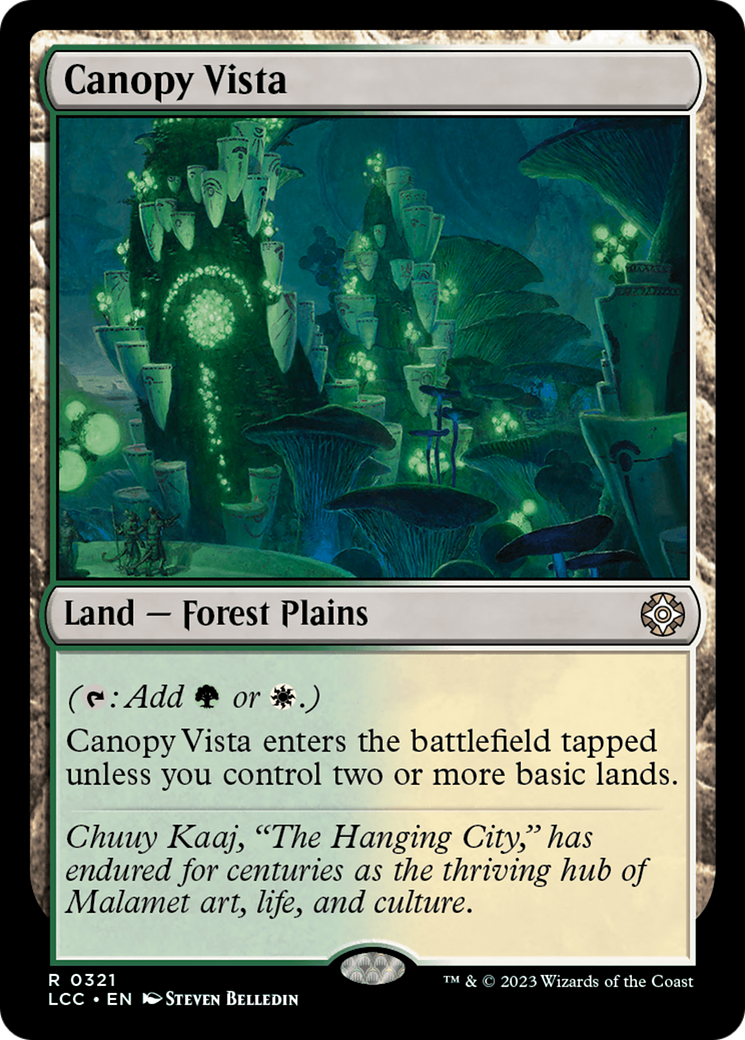
1
Canopy Vista
Canopy Vista
Land — Forest Plains
( : Add or .)
This land enters tapped unless you control two or more basic lands.
- Even though these lands have basic land types, they are not basic lands because "basic" doesn't appear on their type line. Notably, controlling two or more of them won't allow others to enter the battlefield untapped.
- If one of these lands enters the battlefield at the same time as any number of basic lands, those other lands are not counted when determining if this land enters the battlefield tapped or untapped.
- However, because these cards have basic land types, effects that specify a basic land type without also specifying that the land be basic can affect them. For example, a spell or ability that reads "Destroy target Forest" can target Canopy Vista, while one that reads "Destroy target basic Forest" cannot.
-
1
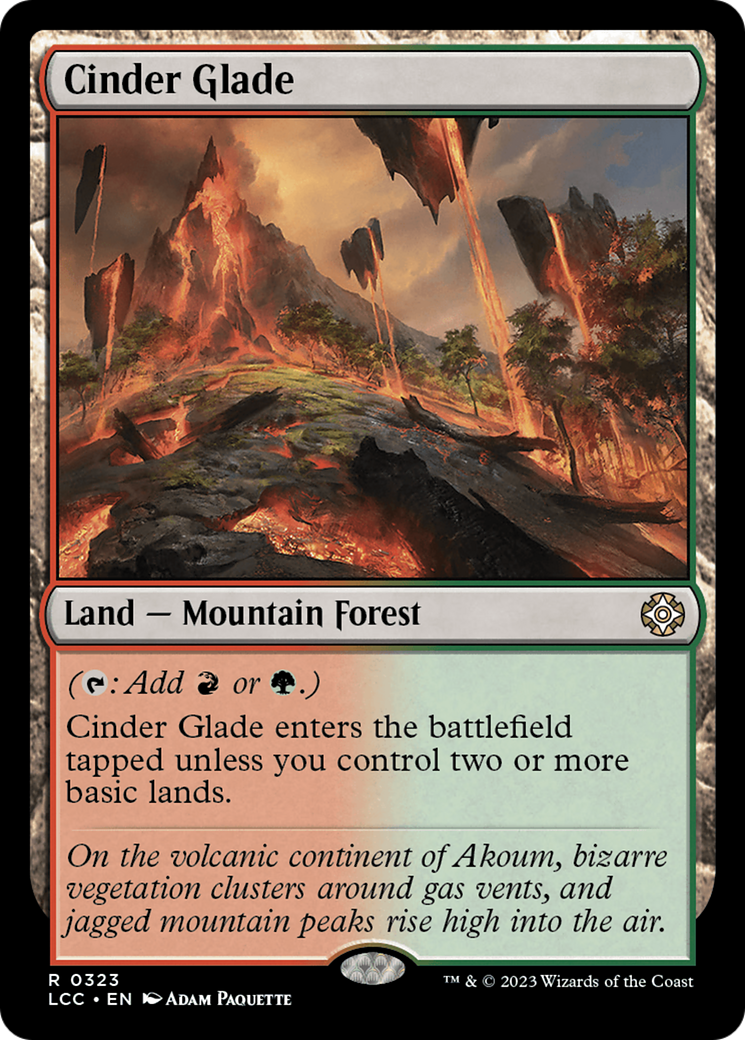
Cinder Glade
Cinder Glade
Land — Mountain Forest
( : Add or .)
This land enters tapped unless you control two or more basic lands.
- If one of these lands enters the battlefield at the same time as any number of basic lands, those other lands are not counted when determining if this land enters the battlefield tapped or untapped.
- However, because these cards have basic land types, effects that specify a basic land type without also specifying that the land be basic can affect them. For example, a spell or ability that reads "Destroy target Forest" can target Canopy Vista, while one that reads "Destroy target basic Forest" cannot.
- Even though these lands have basic land types, they are not basic lands because "basic" doesn't appear on their type line. Notably, controlling two or more of them won't allow others to enter the battlefield untapped.
-
1
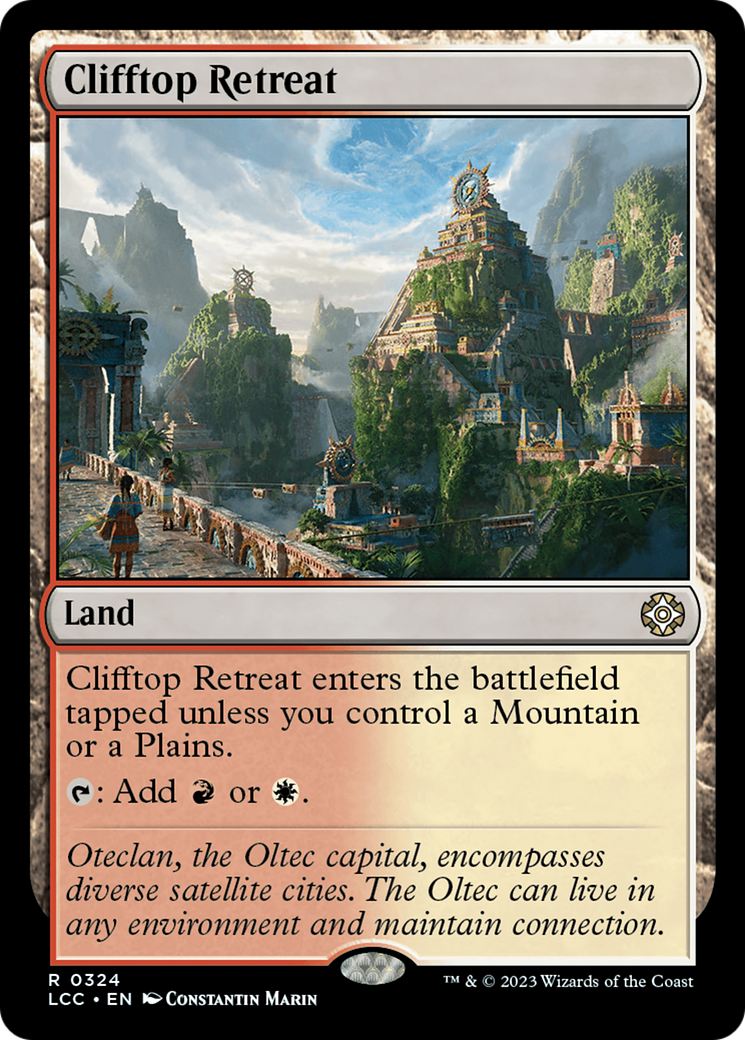
Clifftop Retreat
Clifftop Retreat
Land
This land enters tapped unless you control a Mountain or a Plains.
: Add or .
-
1
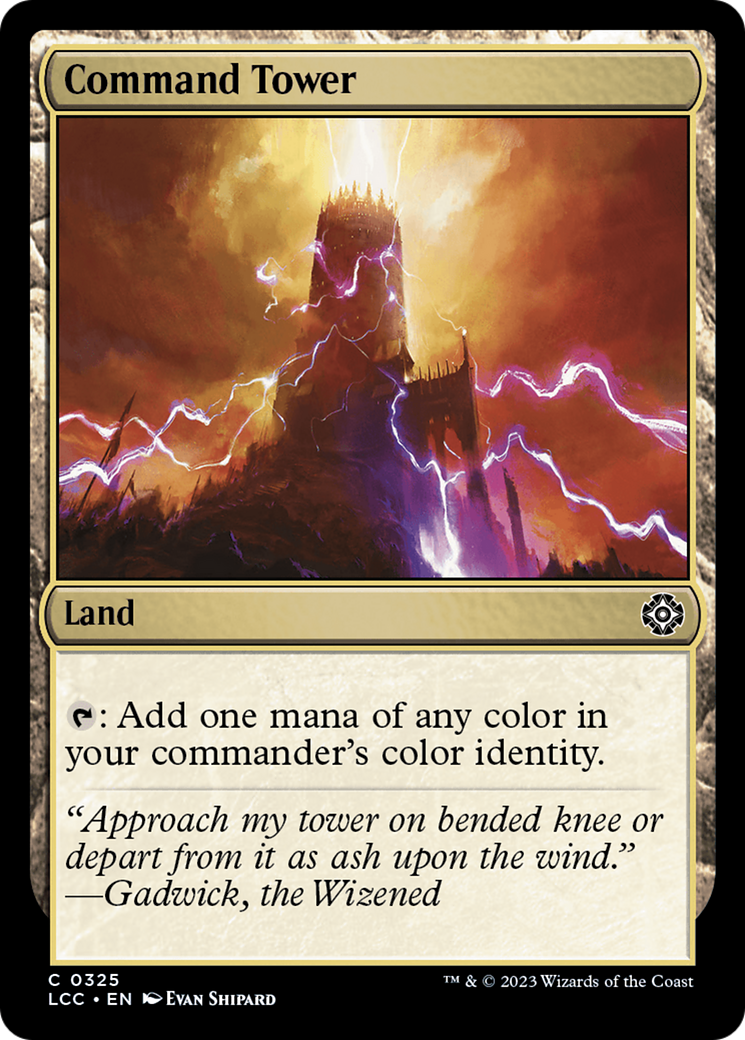
Command Tower
Command Tower
Land
: Add one mana of any color in your commander's color identity.
- If you don't have a commander, Command Tower's ability produces no mana.
- If your commander is a card that has no colors in its color identity, Command Tower's ability produces no mana. It doesn't produce .
- If you have two commanders, the ability adds one mana of any color in their combined color identities.
-
1
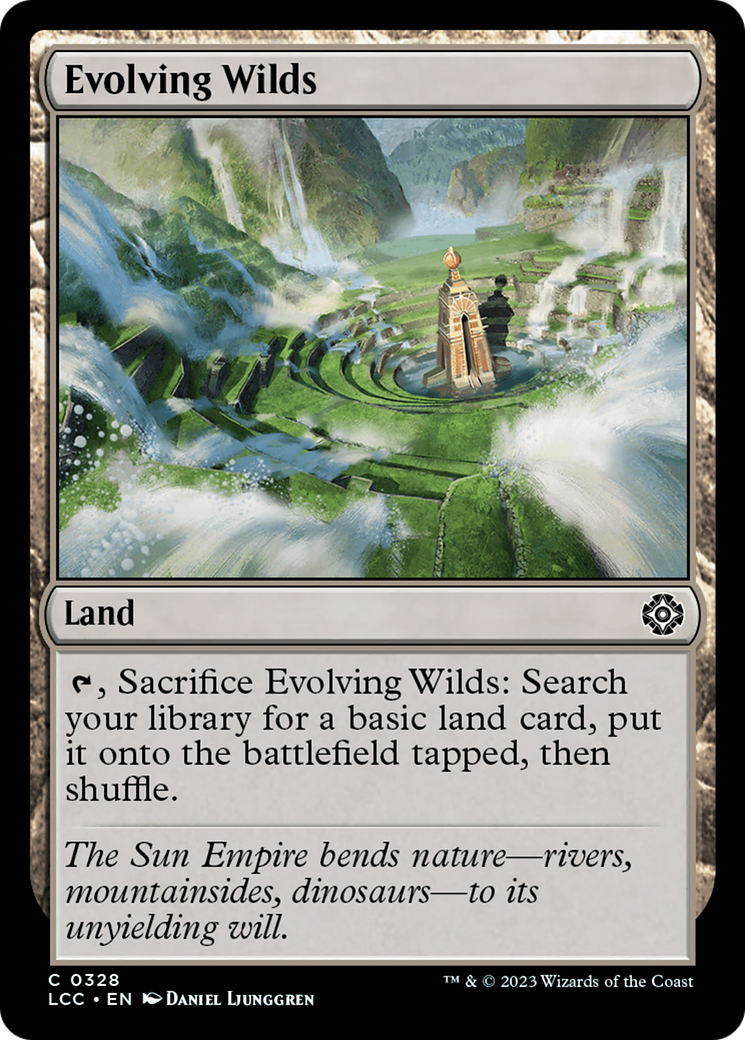
Evolving Wilds
Evolving Wilds
Land
, Sacrifice this land: Search your library for a basic land card, put it onto the battlefield tapped, then shuffle.
-
1
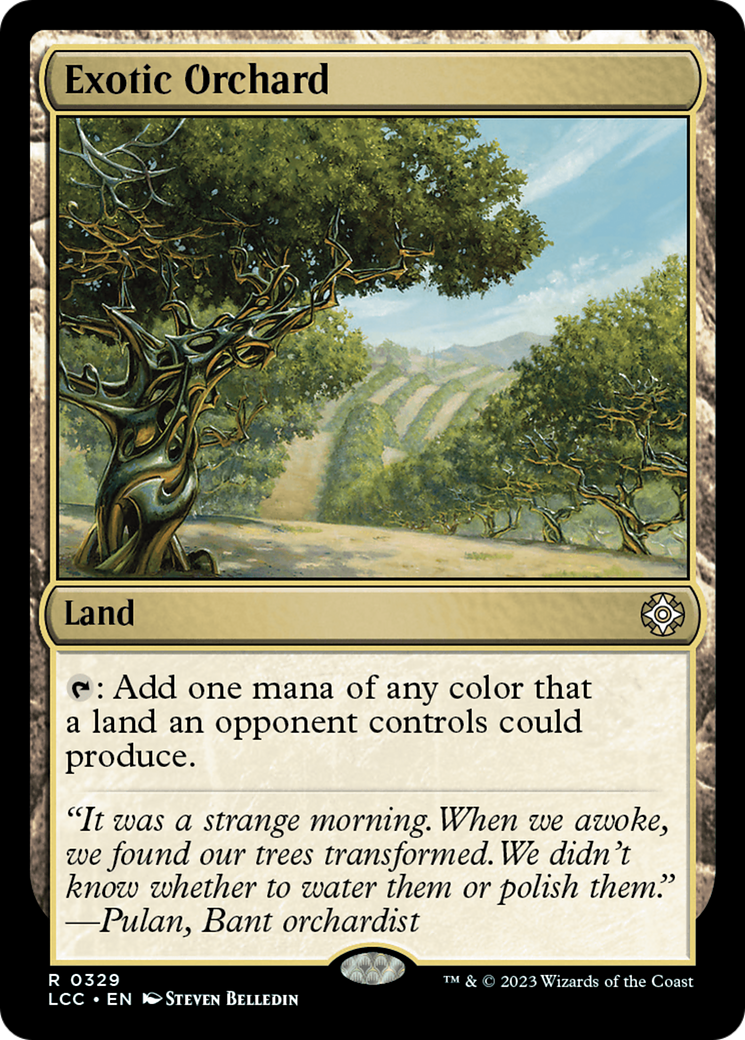
Exotic Orchard
Exotic Orchard
Land
: Add one mana of any color that a land an opponent controls could produce.
- Lands that produce mana based only on what other lands "could produce" won't help each other unless some other land allows one of them to actually produce some type of mana. For example, if you control an Exotic Orchard and your opponent controls an Exotic Orchard and a Reflecting Pool, none of those lands would produce mana if their mana abilities were activated. On the other hand, if you control a Forest and an Exotic Orchard, and your opponent controls an Exotic Orchard and a Reflecting Pool, then each of those lands can be tapped to produce . Your opponent's Exotic Orchard can produce because you control a Forest. Your Exotic Orchard and your opponent's Reflecting Pool can each produce because your opponent's Exotic Orchard can produce .
- When determining what colors of mana your opponents' lands could produce, Exotic Orchard takes into account any applicable replacement effects that would apply to those lands' mana abilities (such as Contamination's effect, for example). If there are more than one, consider them in any possible order.
- The colors of mana are white, blue, black, red, and green. Exotic Orchard can't be tapped for colorless mana, even if a land an opponent controls could produce colorless mana.
- Exotic Orchard doesn't care about any restrictions or riders your opponents' lands (such as Ancient Ziggurat or Hall of the Bandit Lord) put on the mana they produce. It just cares about colors of mana.
- Exotic Orchard checks the effects of all mana-producing abilities of lands your opponents control, but it doesn't check their costs. For example, Vivid Crag has the ability " , Remove a charge counter from Vivid Crag: Add one mana of any color." If an opponent controls Vivid Crag and you control Exotic Orchard, you can tap Exotic Orchard for any color of mana. It doesn't matter whether Vivid Crag has a charge counter on it, and it doesn't matter whether it's untapped.
-
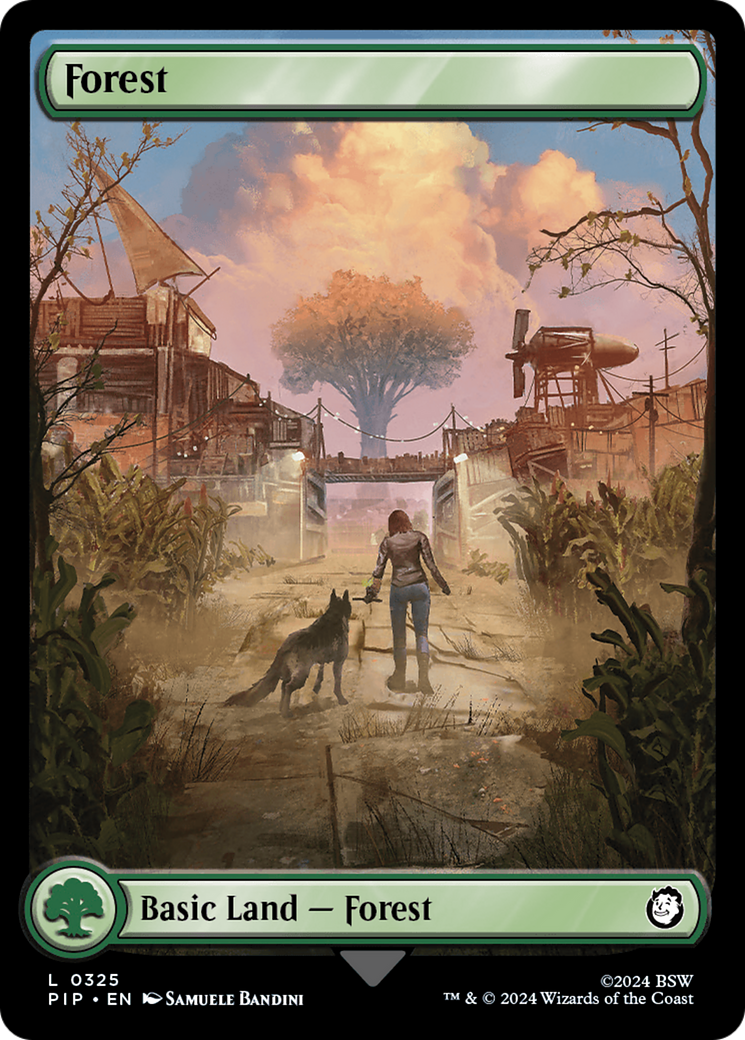
8
Forest
Forest
Basic Land — Forest
( : Add .)
-
1
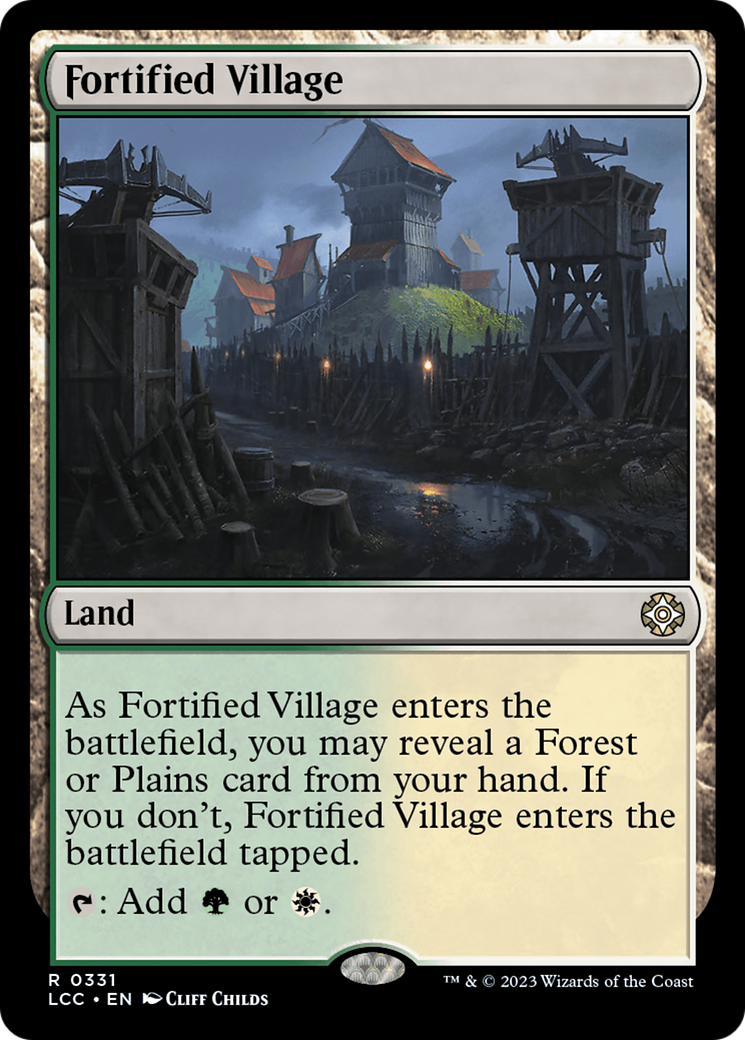
Fortified Village
Fortified Village
Land
As this land enters, you may reveal a Forest or Plains card from your hand. If you don't, this land enters tapped.
: Add or .
- If a Forest or Plains is entering the battlefield from your hand at the same time as Fortified Village, you may reveal the other land to have Fortified Village enter untapped.
- You may reveal any land card with either or both of the appropriate subtypes. It doesn't have to be a basic land. For example, you could reveal Prairie Stream from the Battle for Zendikar set to satisfy the ability of Fortified Village.
- Lands don't have a subtype just because they can produce mana of the corresponding color. Fortified Village itself is neither a Forest nor a Plains, even though it produces green and white mana, so you can't reveal one to satisfy the ability of another.
- If an effect instructs you to put Fortified Village onto the battlefield tapped, it will still enter the battlefield tapped even if you reveal a land card from your hand.
-
1
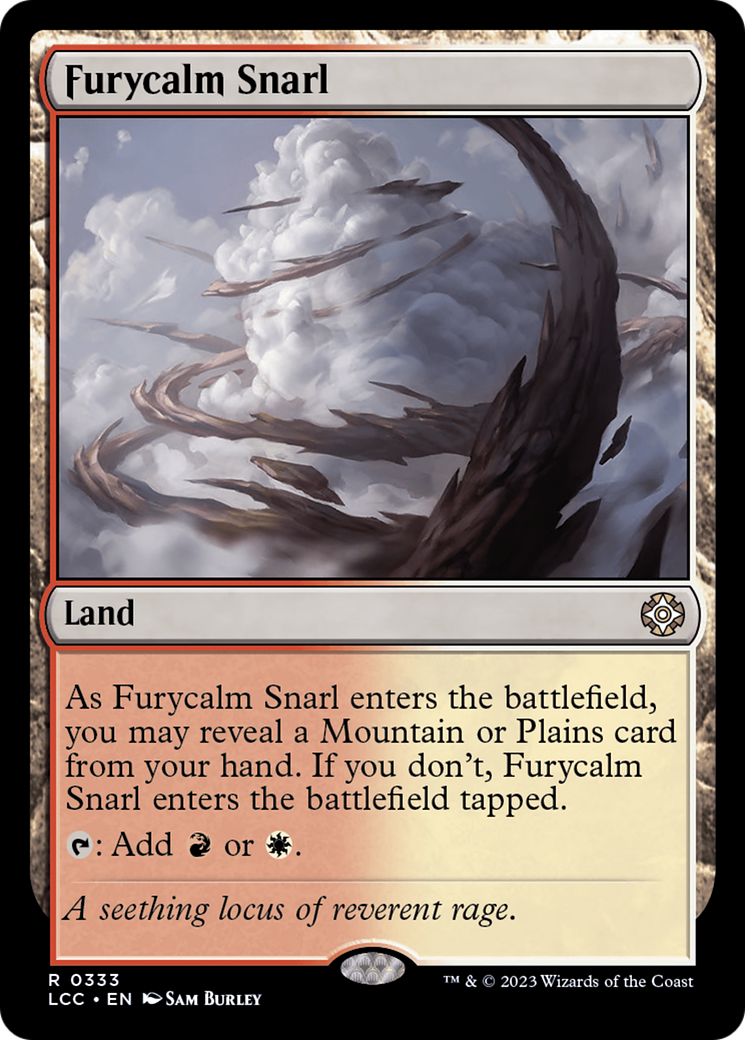
Furycalm Snarl
Furycalm Snarl
Land
As this land enters, you may reveal a Mountain or Plains card from your hand. If you don't, this land enters tapped.
: Add or .
- The "Snarl" itself doesn't have any land subtypes. You can't reveal one to satisfy the ability of another.
- If a land card with an appropriate subtype is entering the battlefield from your hand at the same time as one of these lands, you may reveal the other land to have the "Snarl" enter untapped.
- If an effect instructs you to put one of these lands onto the battlefield tapped, it will still enter the battlefield tapped even if you reveal a land card from your hand.
- You may reveal any land card with either or both of the appropriate subtypes. It doesn't have to be a basic land card.
-
1
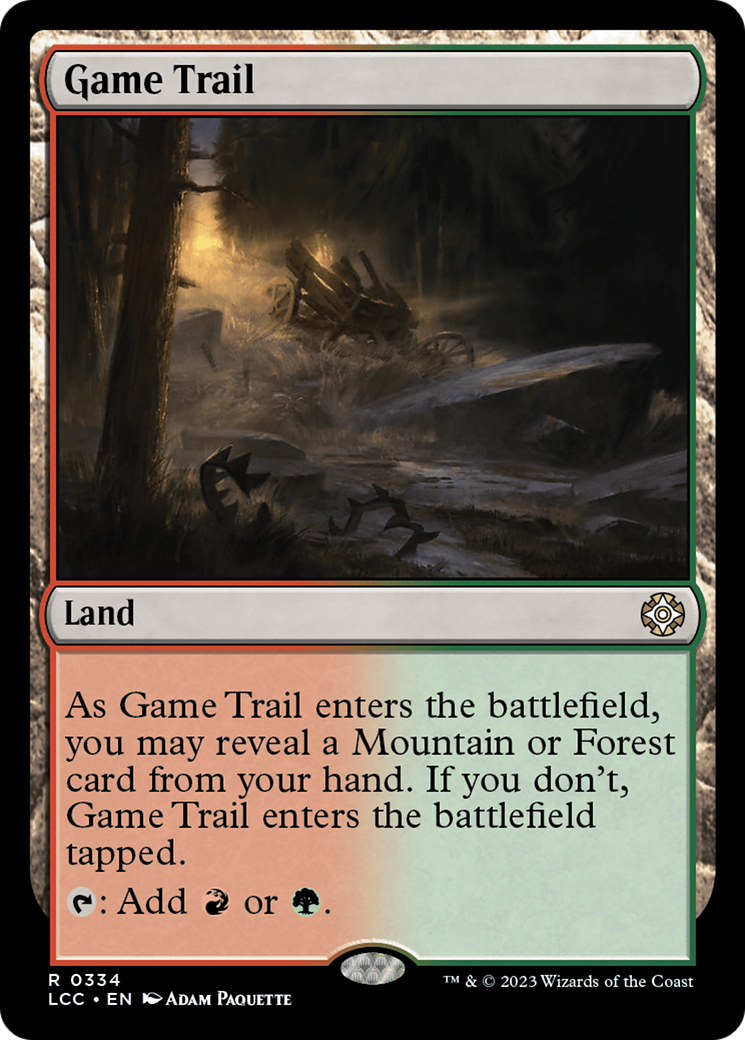
Game Trail
Game Trail
Land
As this land enters, you may reveal a Mountain or Forest card from your hand. If you don't, this land enters tapped.
: Add or .
- Lands don't have a subtype just because they can produce mana of the corresponding color. Game Trail itself is neither a Mountain nor a Forest, even though it produces red and green mana, so you can't reveal one to satisfy the ability of another.
- If an effect instructs you to put Game Trail onto the battlefield tapped, it will still enter the battlefield tapped even if you reveal a land card from your hand.
- You may reveal any land card with either or both of the appropriate subtypes. It doesn't have to be a basic land. For example, you could reveal Canopy Vista from the Battle for Zendikar set to satisfy the ability of Game Trail.
- If a Mountain or Forest is entering the battlefield from your hand at the same time as Game Trail, you may reveal the other land to have Game Trail enter untapped.
-
1
Jungle Shrine
Jungle Shrine
Land
This land enters tapped.
: Add , , or .
-
1
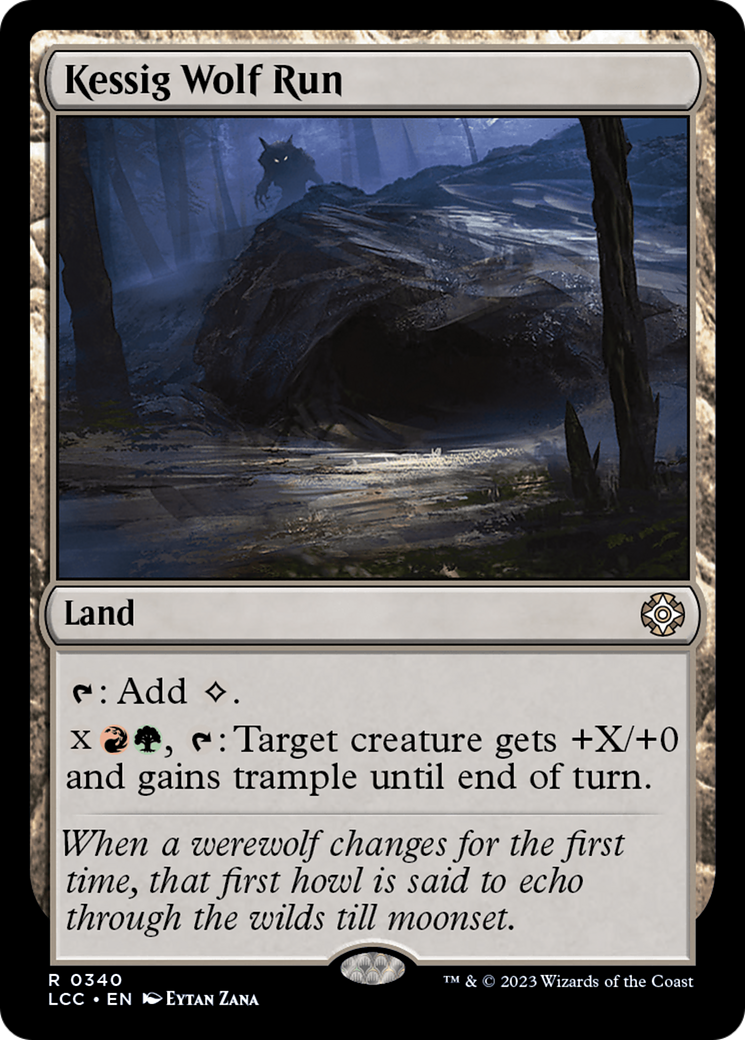
Kessig Wolf Run
Kessig Wolf Run
Land
: Add .
, : Target creature gets +X/+0 and gains trample until end of turn.
-
1
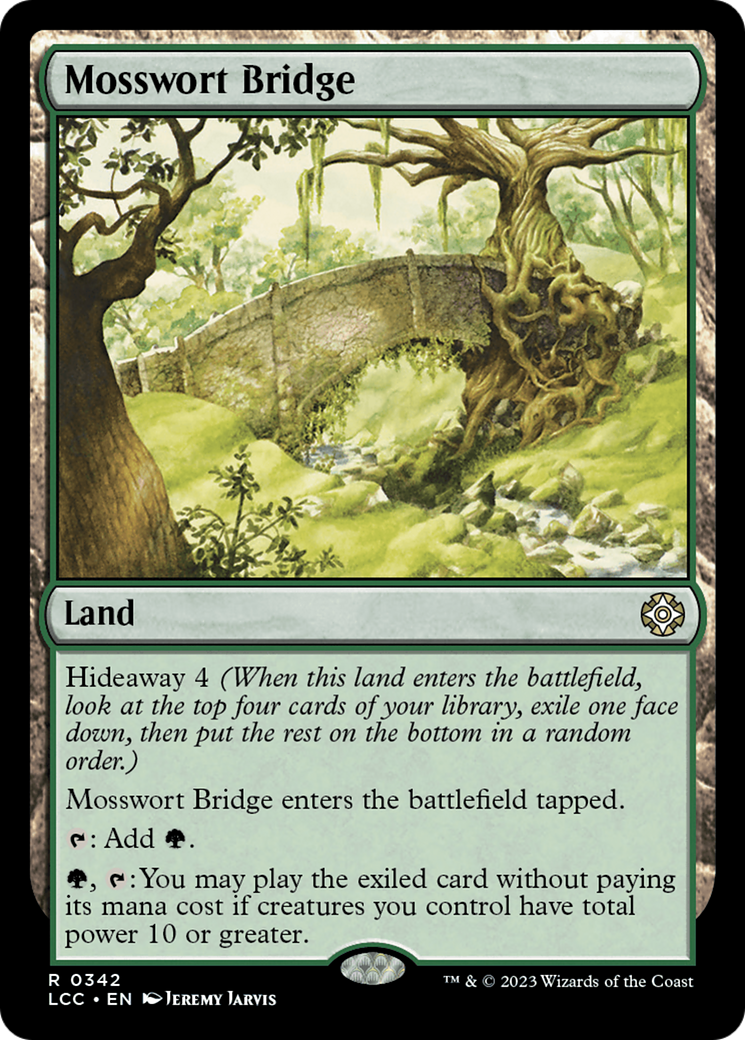
Mosswort Bridge
Mosswort Bridge
Land
Hideaway 4 (When this land enters, look at the top four cards of your library, exile one face down, then put the rest on the bottom in a random order.)
This land enters tapped.
: Add .
, : You may play the exiled card without paying its mana cost if creatures you control have total power 10 or greater.
- "Hideaway N" means "When this permanent enters the battlefield, look at the top N cards of your library. Exile one of them face down and put the rest on the bottom of your library in a random order. The exiled card gains 'The player who controls the permanent that exiled this card may look at this card in the exile zone.'"
- Any player who has controlled a permanent with a hideaway ability since a card was exiled with it may look at that card.
- Previously, permanents with hideaway entered the battlefield tapped. This ability has been removed from the definition of hideaway. Older cards have received errata to have an additional paragraph that reads "[This permanent] enters the battlefield tapped," and they now have hideaway 4.
- Hideaway now causes you to put the rest of the cards on the bottom of your library in a random order instead of any order.
-
4
Mountain
Mountain
Basic Land — Mountain
( : Add .)
-
1
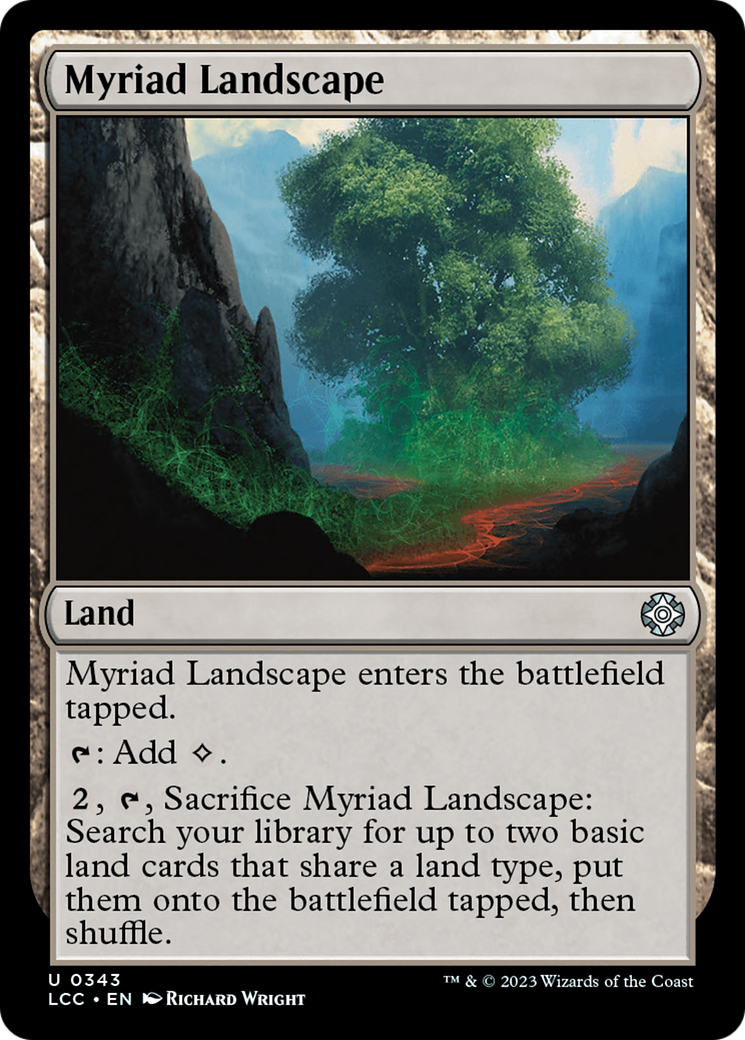
Myriad Landscape
Myriad Landscape
Land
This land enters tapped.
: Add .
, , Sacrifice this land: Search your library for up to two basic land cards that share a land type, put them onto the battlefield tapped, then shuffle.
- You can choose to find one basic land card with Myriad Landscape's last ability.
-
1
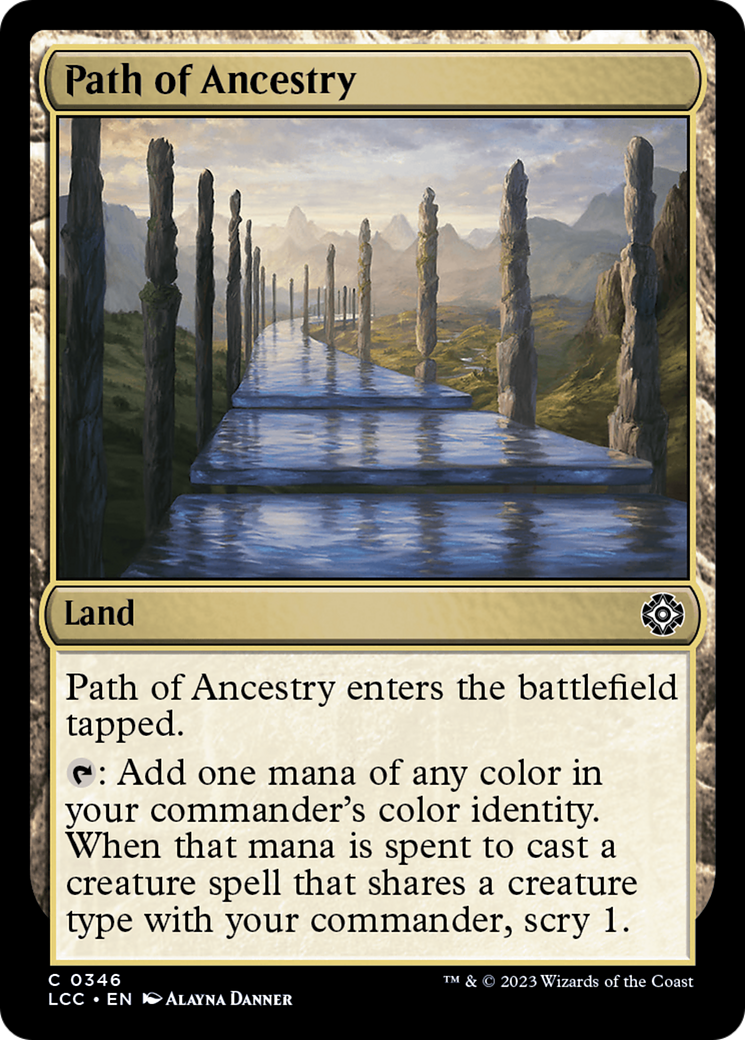
Path of Ancestry
Path of Ancestry
Land
This land enters tapped.
: Add one mana of any color in your commander's color identity. When that mana is spent to cast a creature spell that shares a creature type with your commander, scry 1. (Look at the top card of your library. You may put that card on the bottom.)
- Your commander's creature types are checked immediately after you cast a creature spell spending mana from Path of Ancestry's last ability. They aren't set before the game begins, and they may not be the same types your commander had when you activated that ability.
- If you have two commanders, the last ability adds one mana of any color in their combined color identities. When you spend that mana on a creature spell that shares a creature type with either of your commanders, you'll scry 1.
- If Path of Ancestry's last ability produces two mana (most likely due to Mana Reflection), spending those two mana to cast creature spells that share a creature type with your commander will cause two abilities to trigger. Each of those abilities will cause you to scry 1. You won't scry 2. This is true whether you spend the mana on one creature spell or two.
- If your commander has no creature types, it can't share a creature type with any spell that you cast.
- If you cast your commander with mana from Path of Ancestry, and your commander hasn't somehow lost all of its creature types while on the stack, you'll scry 1.
- If you don't have a commander, Path of Ancestry's ability produces no mana.
- If your commander is a card that has no colors in its color identity, Path of Ancestry's ability produces no mana. It doesn't produce .
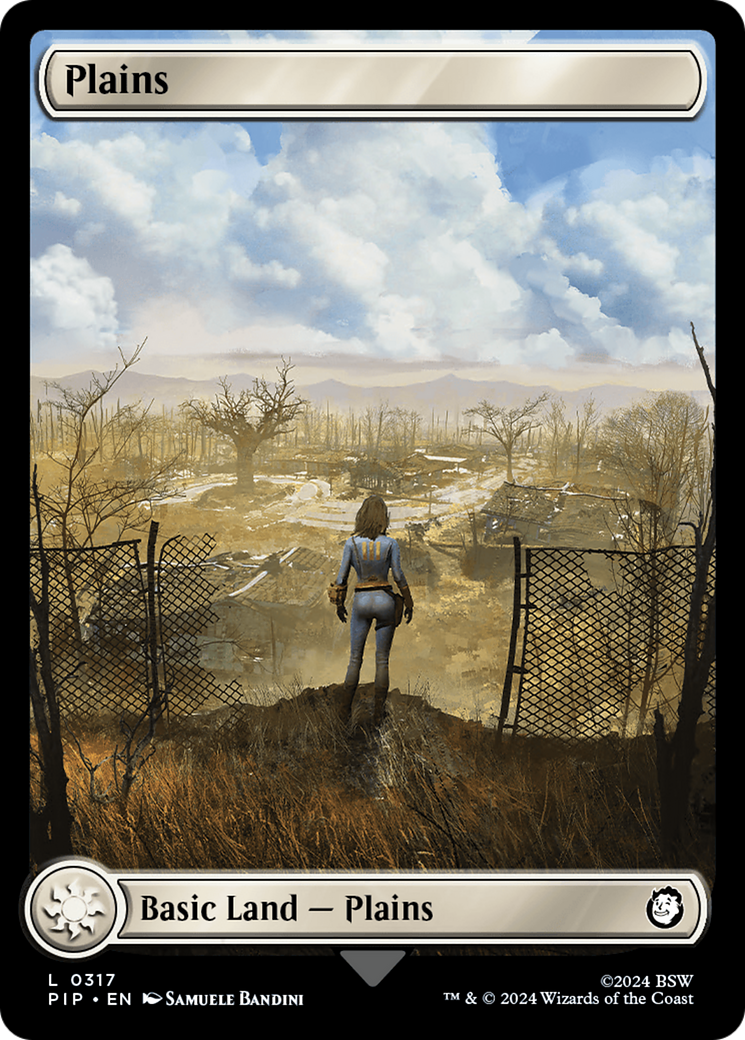
-
4
Plains
Plains
Basic Land — Plains
( : Add .)
-
1
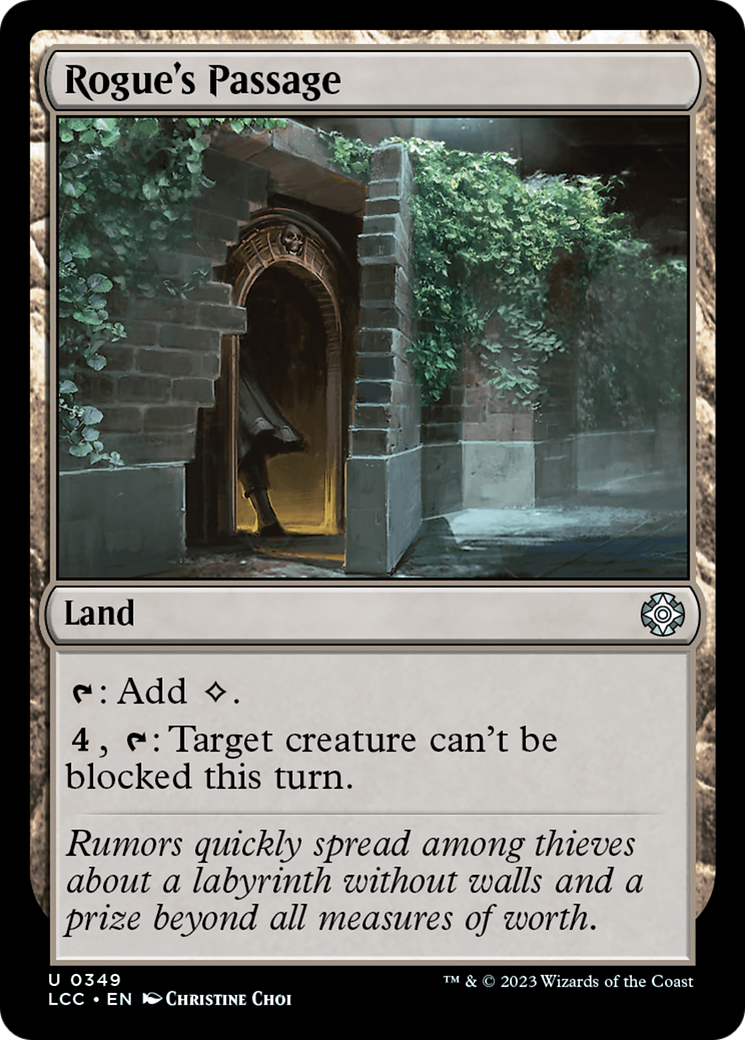
Rogue's Passage
Rogue's Passage
Land
: Add .
, : Target creature can't be blocked this turn.
- Activating the second ability of Rogue's Passage after a creature has become blocked won't cause that creature to become unblocked.
-
1
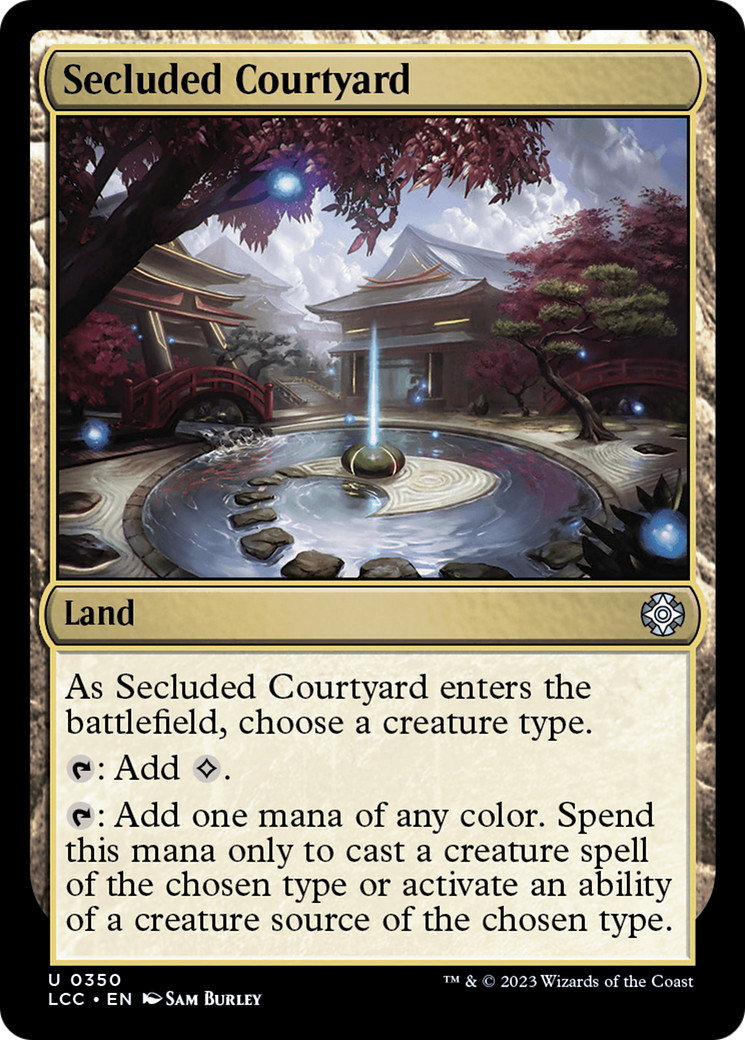
Secluded Courtyard
Secluded Courtyard
Land
As this land enters, choose a creature type.
: Add .
: Add one mana of any color. Spend this mana only to cast a creature spell of the chosen type or activate an ability of a creature source of the chosen type.
- If Secluded Courtyard is somehow on the battlefield without a chosen type, mana from its second mana ability can't be spent on anything.
-
1
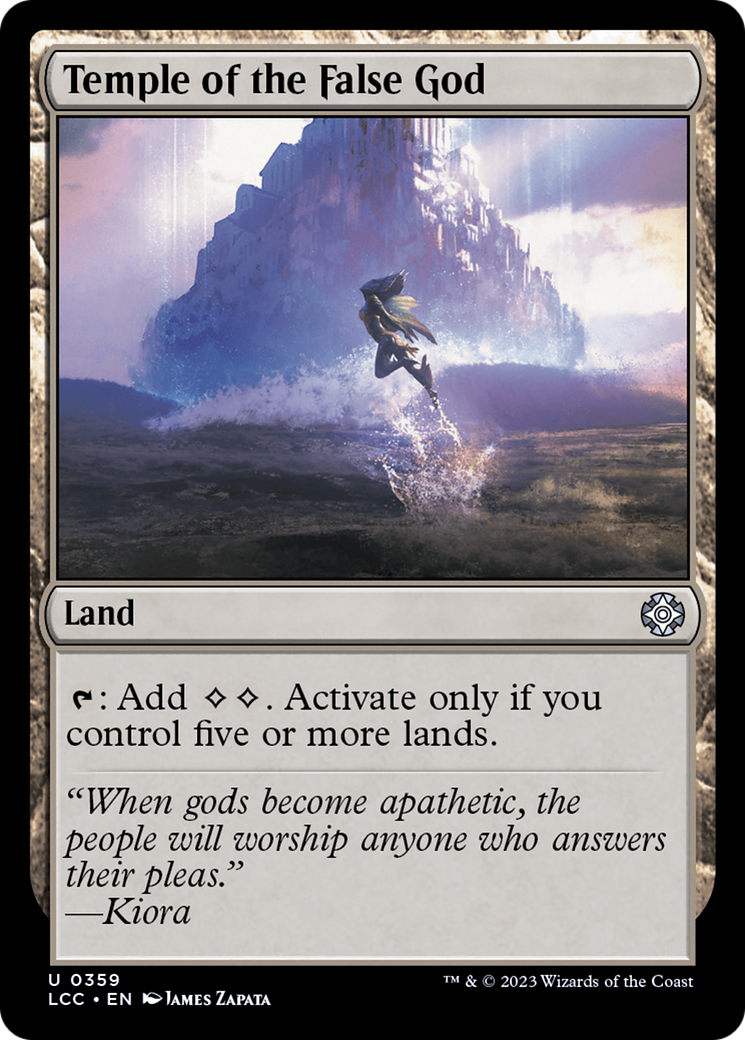
Temple of the False God
Temple of the False God
Land
: Add . Activate only if you control five or more lands.
-
1
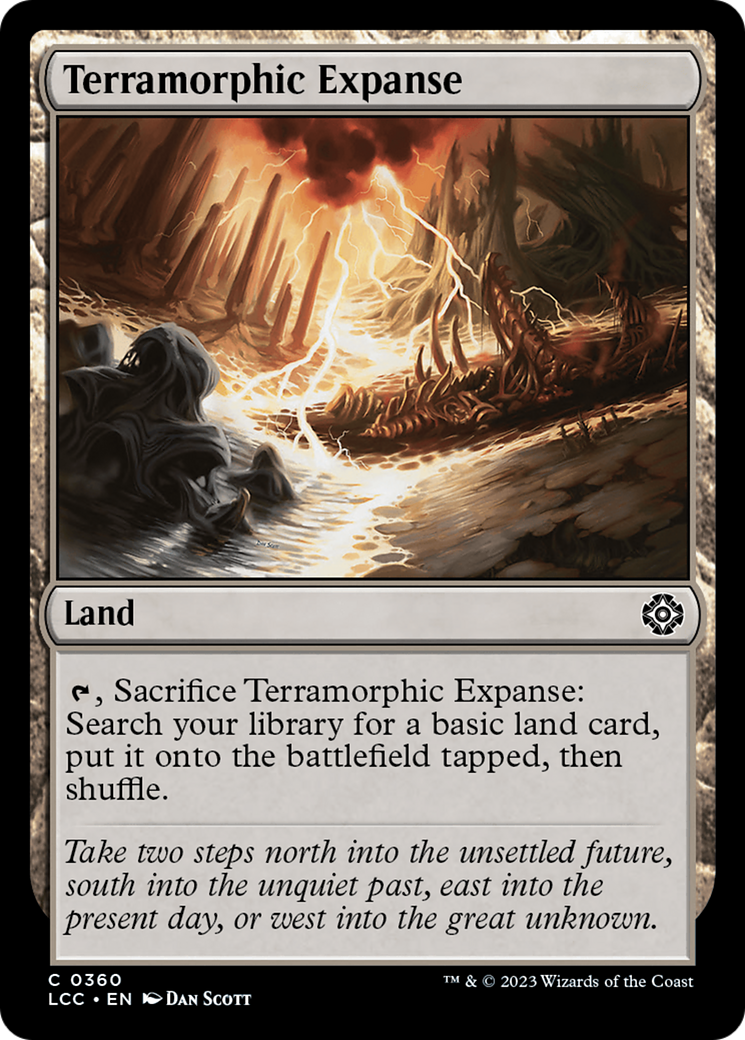
Terramorphic Expanse
Terramorphic Expanse
Land
, Sacrifice this land: Search your library for a basic land card, put it onto the battlefield tapped, then shuffle.
-
1
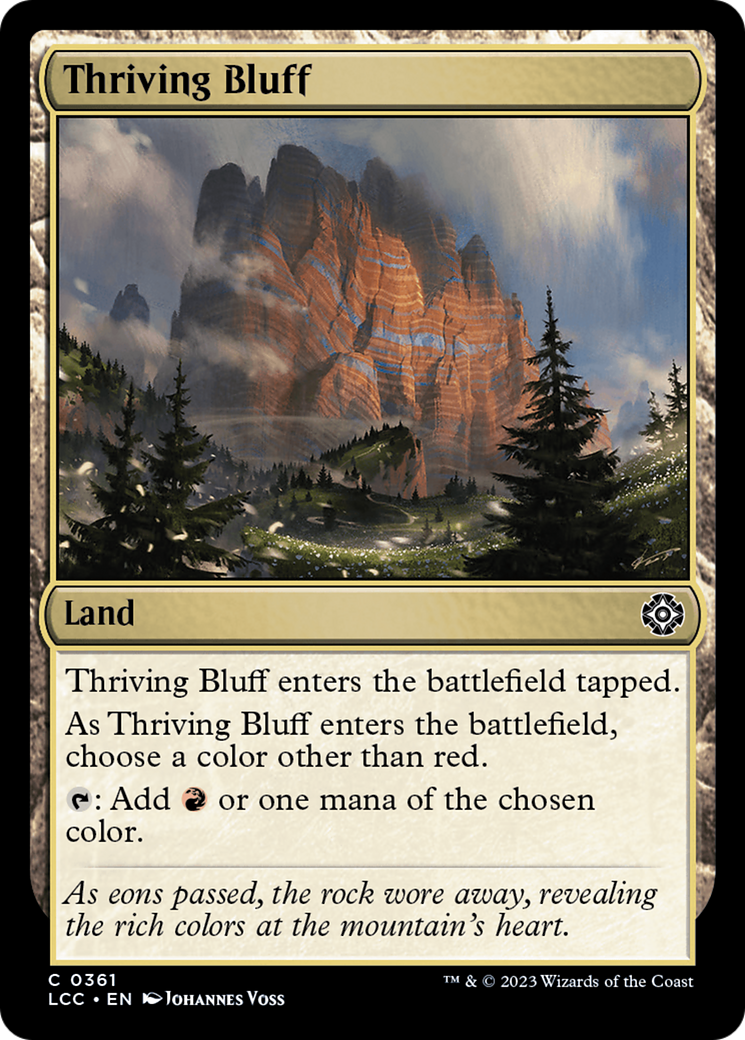
Thriving Bluff
Thriving Bluff
Land
This land enters tapped. As it enters, choose a color other than red.
: Add or one mana of the chosen color.
-
1
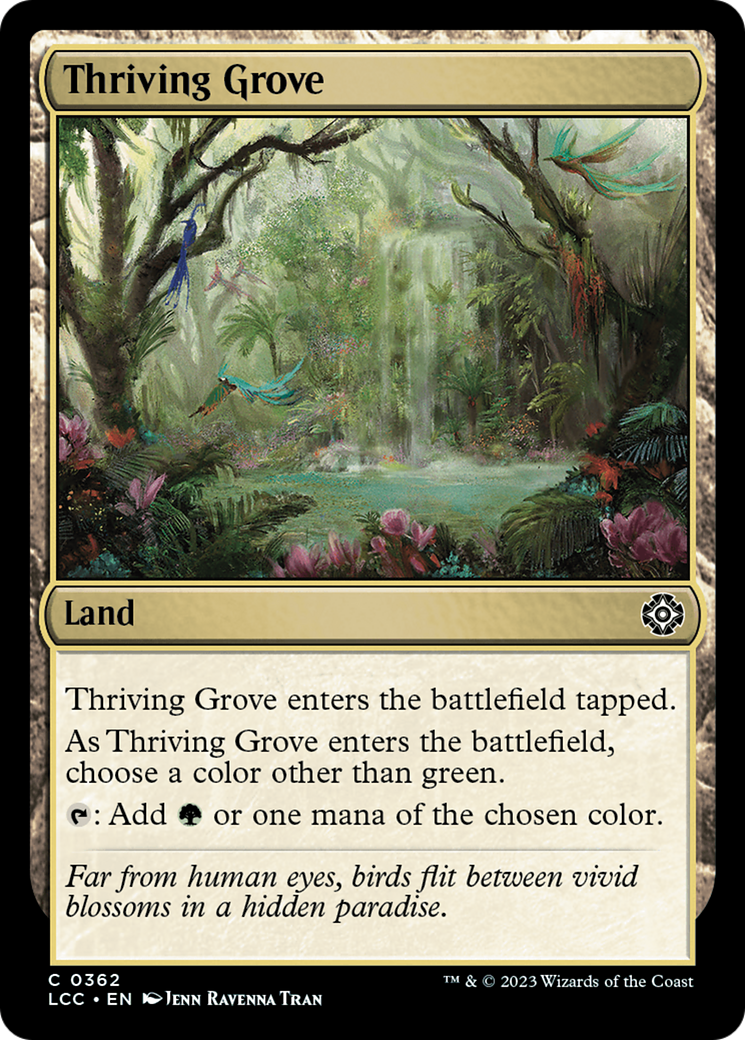
Thriving Grove
Thriving Grove
Land
This land enters tapped. As it enters, choose a color other than green.
: Add or one mana of the chosen color.
-
1
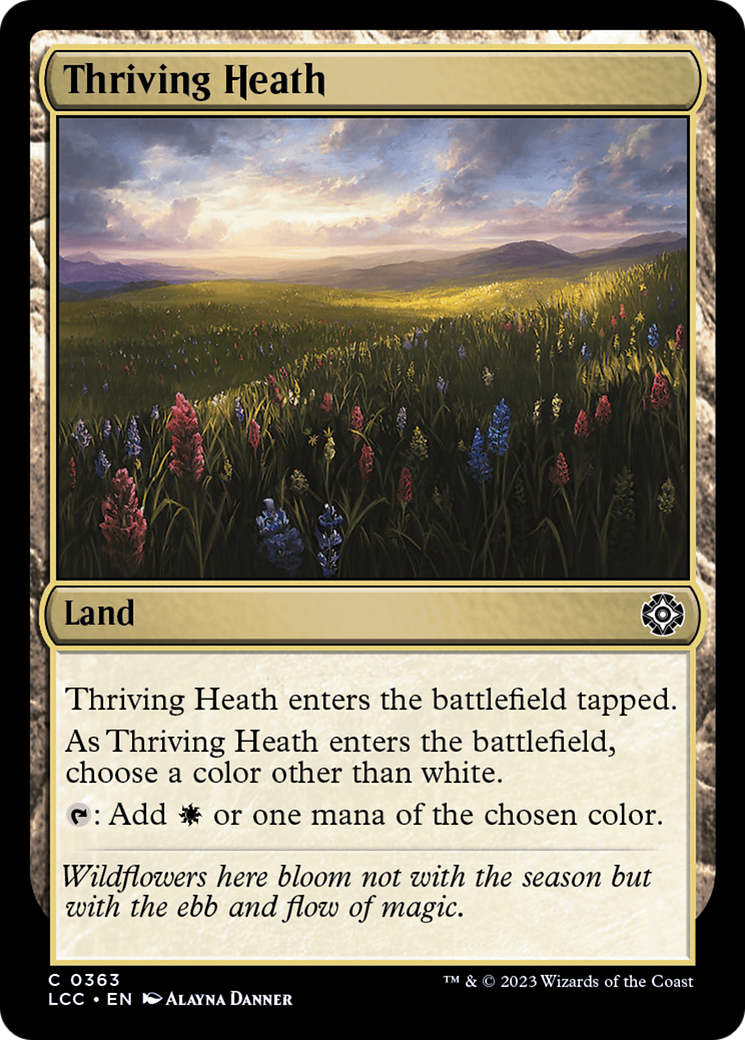
Thriving Heath
Thriving Heath
Land
This land enters tapped. As it enters, choose a color other than white.
: Add or one mana of the chosen color.
-
1
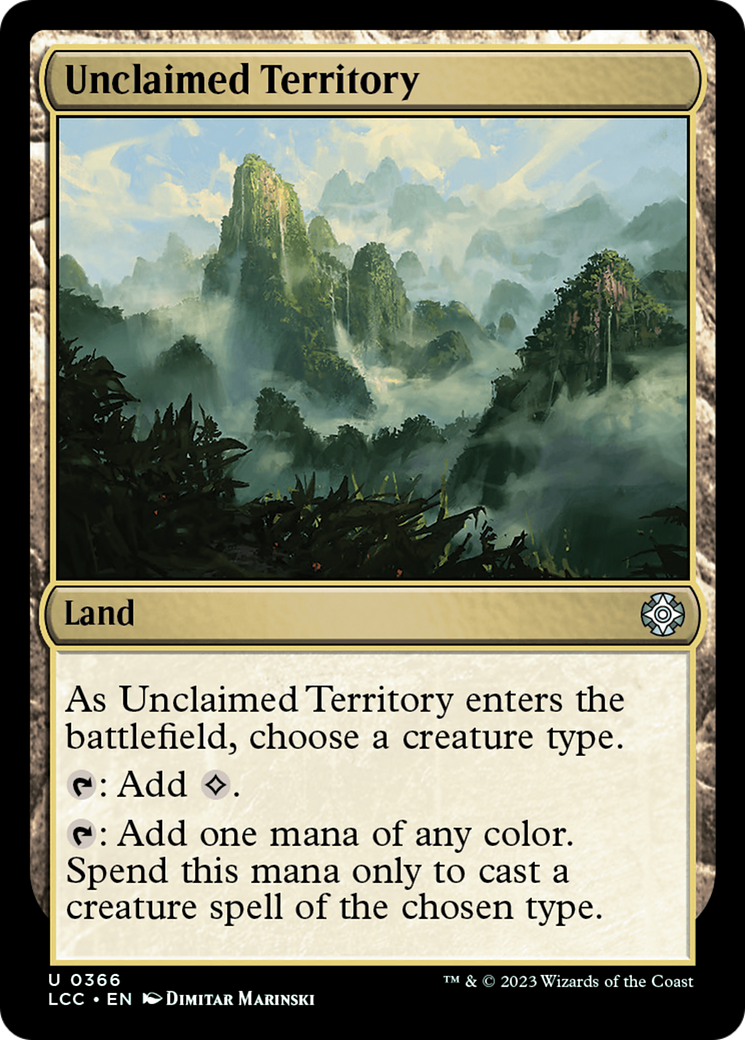
Unclaimed Territory
Unclaimed Territory
Land
As this land enters, choose a creature type.
: Add .
: Add one mana of any color. Spend this mana only to cast a creature spell of the chosen type.
- To choose a creature type, you must choose an existing creature type, such as Vampire or Knight. You can't choose multiple creature types, such as "Vampire Knight." Card types such as artifact can't be chosen, nor can subtypes that aren't creature types, such as Jace, Vehicle, or Treasure.
White 11
-
1
Akroma's Will
Akroma's Will
Instant
Choose one. If you control a commander as you cast this spell, you may choose both instead.
- Creatures you control gain flying, vigilance, and double strike until end of turn.
- Creatures you control gain lifelink, indestructible, and protection from each color until end of turn.
- "Protection from each color" is shorthand for protection from white, from blue, from black, from red, and from green. Colorless is not a color.
- There's no extra bonus if you control more than one commander.
- Once you've announced that you're casting a spell, players can't take any actions until you've finished doing so. Notably, opponents can't try to remove your commander to change how many modes you may choose.
- Even though the card is named after a specific character, controlling any commander will satisfy its condition.
- The commander you control doesn't have to be your commander.
- Once you've chosen both modes for the spell, it doesn't matter whether you continue to control a commander. This is true even if you somehow no longer control a commander as you finish casting the spell.
-
1
Bellowing Aegisaur
Bellowing Aegisaur
Creature — Dinosaur
3/5
Enrage — Whenever this creature is dealt damage, put a +1/+1 counter on each other creature you control.
- If multiple sources deal damage to a creature with an enrage ability at the same time, most likely because multiple creatures blocked that creature, the enrage ability triggers only once.
- If lethal damage is dealt to a creature with an enrage ability, that ability triggers. The creature with that enrage ability leaves the battlefield before that ability resolves, so it won't be affected by the resolving ability.
- If another creature you control is dealt lethal damage at the same time that Bellowing Aegisaur is dealt damage, the other creature won't be saved by the +1/+1 counter that would have been put on it.
-
1
Bronzebeak Foragers
Bronzebeak Foragers
Creature — Dinosaur
3/4
When this creature enters, for each opponent, exile up to one target nonland permanent that player controls until this creature leaves the battlefield.
: Put target card with mana value X exiled with this creature into its owner's graveyard. You gain X life.
- If Bronzebeak Foragers leaves the battlefield before its first ability resolves, none of the target permanents will be exiled.
- Auras attached to the exiled permanents will be put into their owners' graveyards. Any Equipment will become unattached and remain on the battlefield. Any counters on the exiled permanents will cease to exist. When the cards return to the battlefield, they will be new objects with no connections to the cards that were exiled.
- If a token is exiled this way, it will cease to exist and won't return to the battlefield.
- If an exiled permanent card leaves exile, perhaps because of Bronzebeak Foragers's last ability, it won't return to the battlefield after Bronzebeak Foragers leaves the battlefield.
-
1
From the Rubble
From the Rubble
Enchantment
As this enchantment enters, choose a creature type.
At the beginning of your end step, return target creature card of the chosen type from your graveyard to the battlefield with a finality counter on it. (If a creature with a finality counter on it would die, exile it instead.)
- Finality counters work on any permanent, not only creatures. If a permanent with a finality counter on it would be put into a graveyard from the battlefield, exile it instead.
- Finality counters don't stop permanents from going to zones other than the graveyard from the battlefield. For example, if a permanent with a finality counter on it would be put into its owner's hand from the battlefield, it does so normally.
- Finality counters aren't keyword counters, and a finality counter doesn't give any abilities to the permanent it's on. If that permanent loses its abilities and then would go to a graveyard, it will still be exiled instead.
- Multiple finality counters on a single permanent are redundant.
-
1
Generous Gift
Generous Gift
Instant
Destroy target permanent. Its controller creates a 3/3 green Elephant creature token.
- If the target permanent is an illegal target by the time Generous Gift tries to resolve, the spell doesn't resolve. No player creates an Elephant. If the target is legal but not destroyed (most likely because it has indestructible), its controller does create an Elephant.
-
1
Kinjalli's Sunwing
Kinjalli's Sunwing
Creature — Dinosaur
2/3
Flying
Creatures your opponents control enter tapped.
- If a creature an opponent controls enters the battlefield at the same time that Kinjalli's Sunwing enters the battlefield under your control, Kinjalli's Sunwing's effect doesn't apply to your opponent's creature.
-
1
Majestic Heliopterus
Majestic Heliopterus
Creature — Dinosaur
2/2
Flying
Whenever this creature attacks, another target Dinosaur you control gains flying until end of turn.
-
1
Path to Exile
Path to Exile
Instant
Exile target creature. Its controller may search their library for a basic land card, put that card onto the battlefield tapped, then shuffle.
- The controller of the exiled creature isn't required to search their library for a basic land. If that player doesn't, the player won't shuffle their library.
- If the target creature is an illegal target by the time Path to Exile tries to resolve, it won't resolve and none of its effects will happen. The creature's controller won't search for a basic land card.
-
1
Temple Altisaur
Temple Altisaur
Creature — Dinosaur
3/4
If a source would deal damage to another Dinosaur you control, prevent all but 1 of that damage.
- Combat damage can be assigned to other Dinosaurs you control as normal, but most of that damage will be prevented. For example, if a 3/3 Dinosaur you control blocks a 5/5 creature with trample, the attacking player may assign 2 of that creature's combat damage to the player or planeswalker it's attacking and Temple Altisaur will prevent 2 of the 3 damage assigned to the defending Dinosaur.
- If multiple sources would deal damage to another Dinosaur you control, all but 1 damage from each of those sources is prevented.
- The effects of two Temple Altisaurs won't reduce the damage from one source below 1 damage.
- If multiple replacement and/or prevention effects could apply to a Dinosaur you control, you choose the order in which to apply those effects. For example, if another effect will prevent 1 damage that would be dealt to a Dinosaur, you may apply Temple Altisaur's effect to prevent all but 1 of that damage and then apply the other effect to prevent that 1 damage.
-
1
Wakening Sun's Avatar
Wakening Sun's Avatar
Creature — Dinosaur Avatar
7/7
When this creature enters, if you cast it from your hand, destroy all non-Dinosaur creatures.
- If you put Wakening Sun's Avatar onto the battlefield from your hand without casting it, its ability won't trigger.
- If you cast a creature spell that enters the battlefield as a copy of Wakening Sun's Avatar, such as Clone, the enters-the-battlefield ability will trigger.
-
1
Zetalpa, Primal Dawn
Zetalpa, Primal Dawn
Legendary Creature — Elder Dinosaur
4/8
Flying, double strike, vigilance, trample, indestructible
- If an attacking creature with double strike and trample destroys all of its blocking creatures with first-strike combat damage, all of its normal combat damage is assigned to the player, planeswalker, or battle that creature's attacking.
Red 6
-
1
Chandra's Ignition
Chandra's Ignition
Sorcery
Target creature you control deals damage equal to its power to each other creature and each opponent.
- The creature is the source of the damage, not Chandra's Ignition. For example, Chandra's Ignition can have a white creature deal damage to a creature with protection from red.
- Use the power of the target creature as Chandra's Ignition resolves to determine how much damage it deals to each other creature and each opponent.
- If the creature becomes an illegal target by the time Chandra's Ignition tries to resolve (perhaps because another player controls it or it's left the battlefield), Chandra's Ignition won't resolve and none of its effects will happen. No damage will be dealt.
-
1
Etali, Primal Storm
Etali, Primal Storm
Legendary Creature — Elder Dinosaur
6/6
Whenever Etali attacks, exile the top card of each player's library, then you may cast any number of spells from among those cards without paying their mana costs.
- If an exiled card has in its mana cost, you must choose 0 as the value of X when casting it without paying its mana cost.
- If you cast any of the exiled cards, you do so as part of the resolution of the triggered ability. You can't wait to cast them later in the turn. Timing permissions based on a card's type are ignored, and the spells resolve before blockers are declared.
- If you cast a card "without paying its mana cost," you can't pay any alternative costs. You can, however, pay additional costs. If the card has any mandatory additional costs, those must be paid to cast the card.
- If you cast more than one of the exiled cards, you choose the order in which to cast them. A spell you cast this way can be the target of a later spell you cast this way. However, permanent spells cast this way won't resolve until you're done casting spells, so the permanents they become can't be the target of spells cast this way. For example, if you exile Twincast and Lightning Strike, you can cast Lightning Strike and then cast Twincast targeting it; but if you exile a creature card and an Aura card, you can't cast that Aura targeting that creature.
- Any cards not cast, including land cards, remain in exile. They can't be cast on later turns, even if Etali attacks again.
- Because all attacking creatures are chosen at once, a creature cast this way can't attack during the same combat as Etali, even if it has haste.
- In a multiplayer game, if a player leaves the game, all cards that player owns leave as well. If you leave the game, any spells or permanents you control from Etali's ability are exiled.
-
1
Fiery Confluence
Fiery Confluence
Sorcery
Choose three. You may choose the same mode more than once.
- Fiery Confluence deals 1 damage to each creature.
- Fiery Confluence deals 2 damage to each opponent.
- Destroy target artifact.
- No player can cast spells or activate abilities in between the modes of a resolving spell.
- You choose the modes as you cast the spell. Once modes are chosen, they can't be changed.
- If all targets for the chosen modes become illegal before the Confluence resolves, the spell won't resolve and none of its effects will happen. If at least one target is still legal, the spell will resolve but will have no effect on any illegal targets.
- If a mode requires a target, you can select that mode only if there's a legal target available. Ignore the targeting requirements for modes you don't choose. Each time you select that mode, you can choose a different target, or you can choose the same target.
- If the first or second modes are chosen multiple times, each of those modes represents a separate damage-dealing event. For example, if your opponent casts Fiery Confluence choosing the second mode three times, and you control Guardian Seraph (a creature with the ability "If a source an opponent controls would deal damage to you, prevent 1 of that damage"), you'll be dealt a total of 3 damage.
- If a Confluence is copied, the effect that creates the copy will usually allow you to choose new targets, but you can't choose new modes.
- No matter which combination of modes you choose, you always follow the instructions of a Confluence in the order they are written. If the same mode is chosen more than once, you choose their relative order as you cast the spell.
-
1
Marauding Raptor
Marauding Raptor
Creature — Dinosaur
2/3
Creature spells you cast cost less to cast.
Whenever another creature you control enters, this creature deals 2 damage to it. If a Dinosaur is dealt damage this way, this creature gets +2/+0 until end of turn.
- Effects that reduce the generic mana cost of a spell (such as that of Marauding Raptor) can't reduce that spell's colored mana requirements.
- Marauding Raptor's cost reduction doesn't affect itself.
-
1
Otepec Huntmaster
Otepec Huntmaster
Creature — Human Shaman
1/2
Dinosaur spells you cast cost less to cast.
: Target Dinosaur gains haste until end of turn.
- If an effect refers to a "[subtype] spell" or "[subtype] card," it refers only to a spell or card that has that subtype. For example, March of the Drowned is a card that benefits Pirates and features Pirates in its illustration, but it isn't a Pirate card.
- To determine the total cost of a Dinosaur spell, start with the mana cost or alternative cost you're paying, add any cost increases, then apply any cost reductions. The mana value of the creature remains unchanged, no matter what the total cost to cast it was.
-
1
Wrathful Raptors
Wrathful Raptors
Creature — Dinosaur
5/5
Trample
Whenever a Dinosaur you control is dealt damage, it deals that much damage to any target that isn't a Dinosaur.
- "Any target that isn't a Dinosaur" means any non-Dinosaur creature, any planeswalker or battle, or any player (no matter how old they are).
- If multiple sources deal damage to a Dinosaur you control while you control Wrathful Raptors, most likely because multiple creatures blocked that Dinosaur, Wrathful Raptors's last ability triggers only once.
- If lethal damage is dealt to a Dinosaur you control while you control Wrathful Raptors, Wrathful Raptors's last ability still triggers.
- If Wrathful Raptors and one or more other Dinosaurs you control are dealt damage at the same time, Wrathful Raptors's ability triggers for itself and for each of those Dinosaurs, regardless of whether or not Wrathful Raptors was dealt lethal damage.
Green 29
-
1
Apex Altisaur
Apex Altisaur
Creature — Dinosaur
10/10
When this creature enters, it fights up to one target creature you don't control.
Enrage — Whenever this creature is dealt damage, it fights up to one target creature you don't control.
- If Apex Altisaur fights a creature while either of its abilities is resolving, being dealt damage this way causes its second ability to trigger. It may fight several times in a row this way.
- If the target creature is an illegal target when Apex Altisaur's last ability tries to resolve, the ability doesn't resolve. If it's a legal target but Apex Altisaur is no longer on the battlefield when the ability resolves (perhaps because it has already died from picking too many fights) the target creature won't deal or be dealt damage.
-
1
Cultivate
Cultivate
Sorcery
Search your library for up to two basic land cards, reveal those cards, put one onto the battlefield tapped and the other into your hand, then shuffle.
- If you choose to find only one basic land card, you put it onto the battlefield tapped.
-
1
Curious Altisaur
Curious Altisaur
Creature — Dinosaur
2/5
Vigilance, reach
Whenever a Dinosaur you control deals combat damage to a player, draw a card.
-
1
Deathgorge Scavenger
Deathgorge Scavenger
Creature — Dinosaur
3/2
Whenever this creature enters or attacks, you may exile target card from a graveyard. If a creature card is exiled this way, you gain 2 life. If a noncreature card is exiled this way, this creature gets +1/+1 until end of turn.
- There's no way to get both bonuses at once while Deathgorge Scavenger's ability is resolving. If an artifact creature card is exiled this way, it's a creature card and not a noncreature card.
-
1
Descendants' Path
Descendants' Path
Enchantment
At the beginning of your upkeep, reveal the top card of your library. If it's a creature card that shares a creature type with a creature you control, you may cast it without paying its mana cost. If you don't cast it, put it on the bottom of your library.
- If the card has in its mana cost, you must choose 0 as its value.
- If the revealed card is a creature card that shares a creature type with a creature you control, but you choose not to cast it, it's put on the bottom of your library. (This is a recent change.)
- If you cast a card "without paying its mana cost," you can't pay any alternative costs. You can pay additional costs, such as kicker costs. If the card has mandatory additional costs, you must pay those.
-
1
Dinosaur Egg
Dinosaur Egg
Creature — Dinosaur Egg
0/3
Evolve (Whenever a creature you control enters, if that creature has greater power or toughness than this creature, put a +1/+1 counter on this creature.)
When this creature dies, you may discover X, where X is its toughness.
- When comparing the stats of the two creature for evolve, you always compare power to power and toughness to toughness.
- Whenever a creature enters the battlefield under your control, check its power and toughness against the power and toughness of the creature with evolve. If neither stat of the new creature is greater, evolve won't trigger at all.
- If evolve triggers, the stat comparison will happen again when the ability tries to resolve. If neither stat of the new creature is greater, the ability will do nothing. If the creature that entered the battlefield leaves the battlefield before evolve tries to resolve, use its last known power and toughness to compare the stats.
- If multiple creatures enter the battlefield at the same time, evolve may trigger multiple times, although the stat comparison will take place each time one of those abilities tries to resolve. For example, if you control a 2/2 creature with evolve and two 3/3 creatures enter the battlefield, evolve will trigger twice. The first ability will resolve and put a +1/+1 counter on the creature with evolve. When the second ability tries to resolve, neither the power nor the toughness of the new creature is greater than that of the creature with evolve, so that ability does nothing.
- Multiple instances of evolve trigger separately and, similar to above, the stat comparison takes place for each one independently as they try to resolve.
- When comparing the stats as the evolve ability resolves, it's possible that the stat that's greater changes from power to toughness or vice versa. If this happens, the ability will still resolve and you'll put a +1/+1 counter on the creature with evolve. For example, if you control a 2/2 creature with evolve and a 1/3 creature enters the battlefield under your control, its toughness is greater so evolve will trigger. In response, the 1/3 creature gets +2/-2. When the evolve trigger tries to resolve, its power is greater. You'll put a +1/+1 counter on the creature with evolve.
- A spell's mana value is determined only by its mana cost. Ignore any alternative costs, additional costs, cost increases, or cost reductions.
- When you discover, you must exile cards. The only optional part of the ability is whether you cast the exiled card or put it into your hand.
- You exile the cards face up. All players will be able to see them.
- If you cast a spell "without paying its mana cost", you can't choose to cast it for any alternative costs. You can, however, pay additional costs. If the spell has any mandatory additional costs, you must pay those to cast it.
- If the discovered card has in its mana cost, you must choose 0 as the value of X when casting it without paying its mana cost.
- If you can't cast the discovered card (perhaps because there are no legal targets for the spell), you'll put it into your hand.
- Some spells and abilities that cause you to discover may require targets. If each target chosen is an illegal target as that spell or ability tries to resolve, it won't resolve and you won't discover.
- The mana value of a split card is determined by the combined mana cost of its two halves. If discover allows you to cast a split card, you may cast either half (as long as its mana value is less than or equal to the effect's discover value) but not both halves.
- If you discover an adventurer card, split card, or modal double-faced card, you might be able to cast that card with either set of characteristics depending on the effect's discover value. For example, if you discover 4 and reveal Galvanic Giant (an adventurer card from Wilds of Eldraine with a mana value of 4), you could cast Galvanic Giant, but not Storm Reading (its Adventure, which has a mana value of 7). If you discover 7 and reveal Galvanic Giant, you could cast either Galvanic Giant or Storm Reading.
-
1
Drover of the Mighty
Drover of the Mighty
Creature — Human Druid
1/1
This creature gets +2/+2 as long as you control a Dinosaur.
: Add one mana of any color.
- Because damage remains marked on a creature until it's removed as the turn ends, the damage Drover of the Mighty takes during combat may become lethal if you no longer control a Dinosaur later in the turn.
-
1
Earthshaker Dreadmaw
Earthshaker Dreadmaw
Creature — Dinosaur
6/6
Trample
When this creature enters, draw a card for each other Dinosaur you control.
-
1
Farseek
Farseek
Sorcery
Search your library for a Plains, Island, Swamp, or Mountain card, put it onto the battlefield tapped, then shuffle.
- Farseek can find any land with any of the listed land types, including nonbasic ones, even if that land is a Forest in addition to one or more of those types.
-
1
Ixalli's Lorekeeper
Ixalli's Lorekeeper
Creature — Human Druid
1/1
: Add one mana of any color. Spend this mana only to cast a Dinosaur spell or activate an ability of a Dinosaur source.
-
1
Migration Path
Migration Path
Sorcery
Search your library for up to two basic land cards, put them onto the battlefield tapped, then shuffle.
Cycling ( , Discard this card: Draw a card.)
-
1
Rampaging Brontodon
Rampaging Brontodon
Creature — Dinosaur
7/7
Trample
Whenever this creature attacks, it gets +1/+1 until end of turn for each land you control.
-
1
Rampant Growth
Rampant Growth
Sorcery
Search your library for a basic land card, put that card onto the battlefield tapped, then shuffle.
- The land does not count toward your one per turn limit because it was put onto the battlefield by an effect.
-
1
Ranging Raptors
Ranging Raptors
Creature — Dinosaur
2/3
Enrage — Whenever this creature is dealt damage, you may search your library for a basic land card, put it onto the battlefield tapped, then shuffle.
- If multiple sources deal damage to a creature with an enrage ability at the same time, most likely because multiple creatures blocked that creature, the enrage ability triggers only once.
- If lethal damage is dealt to a creature with an enrage ability, that ability triggers. The creature with that enrage ability leaves the battlefield before that ability resolves, so it won't be affected by the resolving ability.
-
1
Regal Behemoth
Regal Behemoth
Creature — Dinosaur
5/5
Trample
When this creature enters, you become the monarch.
Whenever you tap a land for mana while you're the monarch, add an additional one mana of any color.
- Regal Behemoth's last ability is a triggered mana ability. It doesn't use the stack and can't be responded to.
- The game starts with no monarch. Once an effect makes one player the monarch, the game will have exactly one monarch from that point forward.
- Being the monarch carries two inherent triggered abilities. "At the beginning of the monarch's end step, that player draws a card" and "Whenever a creature deals combat damage to the monarch, its controller becomes the monarch."
- Abilities that trigger whenever you "become the monarch" trigger only if you aren't already the monarch. For example, if you are already the monarch as Custodi Lich enters the battlefield, its last ability won't trigger.
- If the triggered ability that causes the monarch to draw a card goes on the stack, and a different player becomes the monarch before that ability resolves, the first player will still draw the card.
-
1
Return of the Wildspeaker
Return of the Wildspeaker
Instant
Choose one —
- Draw cards equal to the greatest power among non-Human creatures you control.
- Non-Human creatures you control get +3/+3 until end of turn.
-
1
Ripjaw Raptor
Ripjaw Raptor
Creature — Dinosaur
4/5
Enrage — Whenever this creature is dealt damage, draw a card.
- If multiple sources deal damage to a creature with an enrage ability at the same time, most likely because multiple creatures blocked that creature, the enrage ability triggers only once.
- If lethal damage is dealt to a creature with an enrage ability, that ability triggers. The creature with that enrage ability leaves the battlefield before that ability resolves, so it won't be affected by the resolving ability.
-
1
Rishkar's Expertise
Rishkar's Expertise
Sorcery
Draw cards equal to the greatest power among creatures you control.
You may cast a spell with mana value 5 or less from your hand without paying its mana cost.
- The mana value of a split card is determined by the combined mana cost of its two halves. If an expertise spell allows you to cast a split card, you may cast either half or, if that split card has fuse, both halves.
- If you control no creatures with power greater than 0 as Rishkar's Expertise resolves, you draw no cards, but you may cast a card with mana value 5 or less from your hand without paying its mana cost.
- You may cast one of the cards drawn by Rishkar's Expertise's first effect while performing its second effect.
- A card's mana value is determined solely by the mana symbols printed in its upper right corner. The mana value is the total amount of mana in that cost, regardless of color. For example, a card with mana cost has mana value 3. Ignore any alternative costs, additional costs, cost increases, or cost reductions that could apply to it. A card with no mana cost has a mana value of 0.
- If the card has in its mana cost, you must choose 0 as the value of X when casting it without paying its mana cost.
- The greatest power among creatures you control is determined as Rishkar's Expertise resolves.
- If you cast a card "without paying its mana cost," you can't choose to cast it for any alternative costs, such as emerge costs. You can, however, pay additional costs. If the card has any mandatory additional costs, such as that of Cathartic Reunion, you must pay those to cast the card.
- While you're casting your free spell, the Expertise spell is still on the stack. It will be put into its owner's graveyard after the free spell is cast. The free spell can't target the Expertise card in your graveyard. It can target the Expertise spell on the stack, but the Expertise spell will become an illegal target before the free spell resolves.
- Any triggered abilities that trigger while performing the Expertise spell's first effect won't be put onto the stack until after you're done casting your free spell. They're put onto the stack at the same time as any abilities that triggered while casting that spell regardless of the order in which those abilities triggered.
- Effects that allow you to "cast" a card don't allow you to play a land card.
-
1
Runic Armasaur
Runic Armasaur
Creature — Dinosaur
2/5
Whenever an opponent activates an ability of a creature or land that isn't a mana ability, you may draw a card.
- Activated abilities contain a colon. They're generally written "[Cost]: [Effect]." Some keyword abilities are activated abilities and will have colons in their reminder text. An activated mana ability is one that produces mana as it resolves, not one that costs mana to activate.
- Runic Armasaur's ability doesn't trigger when an opponent activates an ability of a card in hand (such as a cycling ability from the Amonkhet block) or a card in a graveyard (such as that of Bone Dragon), even if that causes a card to be put onto the battlefield.
- Runic Armasaur's ability doesn't trigger when an opponent activates an ability of a noncreature, nonland permanent that causes it to become a creature (such as a crew ability of a Vehicle).
- Runic Armasaur's ability resolves before the ability that caused it to trigger. Players can cast spells and activate abilities after the triggered ability resolves but before the activated ability that caused it to trigger does.
-
1
Savage Stomp
Savage Stomp
Sorcery
This spell costs less to cast if it targets a Dinosaur you control.
Put a +1/+1 counter on target creature you control. Then that creature fights target creature you don't control. (Each deals damage equal to its power to the other.)
- You can't cast Savage Stomp unless you choose both a creature you control and a creature you don't control as targets.
- If either target is an illegal target as Savage Stomp resolves, neither creature will deal or be dealt damage.
- If the creature you control is an illegal target as Savage Stomp tries to resolve, you won't put a +1/+1 counter on it. If that creature is a legal target but the other creature isn't, you'll still put the counter on the creature you control.
-
1
Scion of Calamity
Scion of Calamity
Creature — Dinosaur
5/5
Myriad (Whenever this creature attacks, for each opponent other than defending player, you may create a token copy that's tapped and attacking that player or a planeswalker they control. Exile the tokens at end of combat.)
Whenever this creature deals combat damage to a player, destroy target artifact or enchantment that player controls.
- The term "defending player" in the myriad rules (or any other ability of an attacking creature) refers to the player the creature with myriad was attacking, the controller of the planeswalker it was attacking, or the protector of the battle it was attacking at the time the ability resolves. If that creature is no longer attacking, it refers to the appropriate player based on who or what the creature was last attacking.
- If the defending player is your only opponent, no tokens are put onto the battlefield.
- You choose whether each token is attacking the player or a planeswalker they control as the token is created. If it's attacking a planeswalker, you choose which one. You can't have any of the tokens attack a battle.
- Although the tokens enter the battlefield attacking, they were never declared as attackers. Abilities that trigger whenever a creature attacks won't trigger, including the myriad ability of the tokens. If there are any costs to have a creature attack, those costs won't apply to the tokens.
- The tokens all enter the battlefield at the same time.
- Each token copies exactly what was printed on the original creature and nothing else. It doesn't copy whether that creature is tapped or untapped, whether it has any counters on it or Auras and Equipment attached to it, or any non-copy effects that have changed its power, toughness, types, color, and so on.
- Any enters-the-battlefield abilities of the copied creature will trigger when the tokens enter the battlefield. Any "as [this permanent] enters the battlefield" or "[this permanent] enters the battlefield with" abilities of the copied creature will also work.
- If myriad creates more than one token for any given player (due to an effect such as the one Doubling Season creates), you may choose separately for each token whether it's attacking the player or a planeswalker they control.
-
1
Shifting Ceratops
Shifting Ceratops
Creature — Dinosaur
5/4
This spell can't be countered.
Protection from blue (This creature can't be blocked, targeted, dealt damage, enchanted, or equipped by anything blue.)
: This creature gains your choice of reach, trample, or haste until end of turn.
- A spell or ability that counters spells can still target Shifting Ceratops. When that spell or ability resolves, Shifting Ceratops won't be countered, but any additional effects of that spell or ability will still happen.
- Multiple instances of reach, trample, and/or haste on the same creature are redundant.
-
1
Sunfrill Imitator
Sunfrill Imitator
Creature — Dinosaur
3/3
Whenever this creature attacks, you may have it become a copy of another target Dinosaur you control, except its name is Sunfrill Imitator and it has this ability.
- Sunfrill Imitator copies exactly what was printed on the original creature, with the listed exceptions (unless that creature is copying something else or is a token; see below). It doesn't copy whether that creature is tapped or untapped, whether it has any counters on it or any Auras or Equipment attached to it, or any non-copy effects that have changed its types, color, power and toughness, and so on.
- If Sunfrill Imitator copies a legendary creature, Sunfrill Imitator will also be legendary, but because its name remains Sunfrill Imitator, the "legend rule" won't cause either of them to be put into the graveyard.
- If the copied creature has in its mana cost, X is 0.
- If the copied creature is copying something else, then Sunfrill Imitator becomes a copy of whatever that creature is copying.
- If the copied creature is a token, Sunfrill Imitator copies the original characteristics of that token as stated by the effect that created the token. Copying a token doesn't make Sunfrill Imitator a token. Similarly, if Sunfrill Imitator itself is a token, copying a nontoken permanent doesn't make it stop being a token.
-
1
Thrashing Brontodon
Thrashing Brontodon
Creature — Dinosaur
3/4
, Sacrifice this creature: Destroy target artifact or enchantment.
-
1
Thunderherd Migration
Thunderherd Migration
Sorcery
As an additional cost to cast this spell, reveal a Dinosaur card from your hand or pay .
Search your library for a basic land card, put it onto the battlefield tapped, then shuffle.
- If an effect refers to a "[subtype] spell" or "[subtype] card," it refers only to a spell or card that has that subtype. For example, March of the Drowned is a card that benefits Pirates and features Pirates in its illustration, but it isn't a Pirate card.
-
1
Thundering Spineback
Thundering Spineback
Creature — Dinosaur
5/5
Other Dinosaurs you control get +1/+1.
: Create a 3/3 green Dinosaur creature token with trample. (It can deal excess combat damage to the player or planeswalker it's attacking.)
-
1
Topiary Stomper
Topiary Stomper
Creature — Plant Dinosaur
4/4
Vigilance (Attacking doesn't cause this creature to tap.)
When this creature enters, search your library for a basic land card, put it onto the battlefield tapped, then shuffle.
This creature can't attack or block unless you control seven or more lands.
-
1
Verdant Sun's Avatar
Verdant Sun's Avatar
Creature — Dinosaur Avatar
5/5
Whenever this creature or another creature you control enters, you gain life equal to that creature's toughness.
- The entering creature's toughness is determined as the ability of Verdant Sun's Avatar resolves. If that creature has left the battlefield, use its toughness as it last existed on the battlefield. If the creature's toughness was less than 0, your life total won't change.
-
1
Wayward Swordtooth
Wayward Swordtooth
Creature — Dinosaur
5/5
Ascend (If you control ten or more permanents, you get the city's blessing for the rest of the game.)
You may play an additional land on each of your turns.
This creature can't attack or block unless you have the city's blessing.
- Wayward Swordtooth's middle ability is cumulative if you control more than one. It's also cumulative with other effects that let you play additional lands, such as the one from Enter the Unknown.
- Once you have the city's blessing, you have it for the rest of the game, even if you lose control of some or all of your permanents. The city's blessing isn't a permanent itself and can't be removed by any effect.
- A permanent is any object on the battlefield, including tokens and lands. Spells and emblems aren't permanents.
- If you cast a spell with ascend, you don't get the city's blessing until it resolves. Players may respond to that spell by trying to change whether you get the city's blessing.
- If you control ten permanents but don't control a permanent or resolving spell with ascend, you don't get the city's blessing. For example, if you control ten permanents, lose control of one, then cast Golden Demise, you won't have the city's blessing and the spell will affect creatures you control.
- If your tenth permanent enters the battlefield and then a permanent leaves the battlefield immediately afterwards (most likely due to the "Legend Rule" or due to being a creature with 0 toughness), you get the city's blessing before it leaves the battlefield.
- Ascend on a permanent isn't a triggered ability and doesn't use the stack. Players can respond to a spell that will give you your tenth permanent, but they can't respond to getting the city's blessing once you control that tenth permanent. This means that if your tenth permanent is a land you play, players can't respond before you get the city's blessing.
Multicolor 10
-
1
Atzocan Seer
Atzocan Seer
Creature — Human Druid
2/3
: Add one mana of any color.
Sacrifice this creature: Return target Dinosaur card from your graveyard to your hand.
- Atzocan Seer's second ability doesn't include the symbol. You can activate that ability even if it's already been tapped, perhaps because you activated its first ability.
- If an effect refers to a "[subtype] spell" or "[subtype] card," it refers only to a spell or card that has that subtype. For example, March of the Drowned is a card that benefits Pirates and features Pirates in its illustration, but it isn't a Pirate card.
-
1
Pantlaza, Sun-Favored
Pantlaza, Sun-Favored
Legendary Creature — Dinosaur
4/4
Whenever Pantlaza or another Dinosaur you control enters, you may discover X, where X is that creature's toughness. Do this only once each turn. (Exile cards from the top of your library until you exile a nonland card with that mana value or less. Cast it without paying its mana cost or put it into your hand. Put the rest on the bottom in a random order.)
- The value of X is calculated only once, as the ability resolves. If the creature has left the battlefield, use its toughness as it last existed on the battlefield.
- Once you decide to discover using Pantlaza's ability, that ability will stop triggering for the duration of that turn.
- A spell's mana value is determined only by its mana cost. Ignore any alternative costs, additional costs, cost increases, or cost reductions.
- When you discover, you must exile cards. The only optional part of the ability is whether you cast the exiled card or put it into your hand.
- You exile the cards face up. All players will be able to see them.
- If you cast a spell "without paying its mana cost", you can't choose to cast it for any alternative costs. You can, however, pay additional costs. If the spell has any mandatory additional costs, you must pay those to cast it.
- If the discovered card has in its mana cost, you must choose 0 as the value of X when casting it without paying its mana cost.
- If you can't cast the discovered card (perhaps because there are no legal targets for the spell), you'll put it into your hand.
- Some spells and abilities that cause you to discover may require targets. If each target chosen is an illegal target as that spell or ability tries to resolve, it won't resolve and you won't discover.
- The mana value of a split card is determined by the combined mana cost of its two halves. If discover allows you to cast a split card, you may cast either half (as long as its mana value is less than or equal to the effect's discover value) but not both halves.
- If you discover an adventurer card, split card, or modal double-faced card, you might be able to cast that card with either set of characteristics depending on the effect's discover value. For example, if you discover 4 and reveal Galvanic Giant (an adventurer card from Wilds of Eldraine with a mana value of 4), you could cast Galvanic Giant, but not Storm Reading (its Adventure, which has a mana value of 7). If you discover 7 and reveal Galvanic Giant, you could cast either Galvanic Giant or Storm Reading.
-
1
Quartzwood Crasher
Quartzwood Crasher
Creature — Dinosaur Beast
6/6
Trample
Whenever one or more creatures you control with trample deal combat damage to a player, create an X/X green Dinosaur Beast creature token with trample, where X is the amount of damage those creatures dealt to that player.
- Quartzwood Crasher's second ability includes damage dealt by Quartzwood Crasher itself as long as it still has trample.
- If a creature you control with trample is unblocked, the full amount of combat damage it deals to the defending player is counted by Quartzwood Crasher's last ability.
-
1
Raging Regisaur
Raging Regisaur
Creature — Dinosaur
4/4
Whenever this creature attacks, it deals 1 damage to any target.
- Damage dealt by Raging Regisaur's triggered ability isn't combat damage.
-
1
Raging Swordtooth
Raging Swordtooth
Creature — Dinosaur
5/5
Trample
When this creature enters, it deals 1 damage to each other creature.
-
1
Regisaur Alpha
Regisaur Alpha
Creature — Dinosaur
4/4
Other Dinosaurs you control have haste.
When this creature enters, create a 3/3 green Dinosaur creature token with trample.
-
1
Rhythm of the Wild
Rhythm of the Wild
Enchantment
Creature spells you control can't be countered.
Nontoken creatures you control have riot. (They enter with your choice of a +1/+1 counter or haste.)
- If Rhythm of the Wild leaves the battlefield at the same time that a nontoken creature enters the battlefield (most likely because that creature has a replacement effect, such as that of Rescuer Sphinx), that creature still gets a +1/+1 counter or haste.
- A spell or ability that counters spells can still target a creature spell you control. When that spell or ability resolves, the creature spell won't be countered, but any additional effects of that spell or ability will still happen.
- If you choose for the creature to gain haste, it gains haste indefinitely. It won't lose it as the turn ends or as another player gains control of it.
- A noncreature card that happens to be entering the battlefield as a creature will have riot (for example, Rusted Relic while you control three other artifacts). Similarly, a creature card entering the battlefield as a noncreature permanent won't have riot (for example, Thassa, God of the Sea while your other permanents contribute only four to your devotion to blue).
- If a creature enters the battlefield with two instances of riot, you may choose to have it get two +1/+1 counters, one +1/+1 counter and haste, or two instances of haste. Multiple instances of haste on the same creature are redundant, but we're not going to tell the Gruul how to live their lives.
- Riot is a replacement effect. Players can't respond to your choice of +1/+1 counter or haste, and they can't take actions while the creature is on the battlefield without one or the other.
- If a nontoken, noncreature permanent becomes a creature after it's already on the battlefield, it will have riot but it will be too late for the replacement effect to have any effect.
- If a creature entering the battlefield has riot but can't have a +1/+1 counter put onto it, it gains haste.
- Once a creature with riot has entered the battlefield, it keeps its +1/+1 counter or haste even if it loses riot.
-
1
Wayta, Trainer Prodigy
Wayta, Trainer Prodigy
Legendary Creature — Human Warrior
1/5
Haste
, : Target creature you control fights another target creature. This ability costs less to activate if it targets two creatures you control.
If a creature you control being dealt damage causes a triggered ability of a permanent you control to trigger, that ability triggers an additional time.
- Wayta, Trainer Prodigy's last ability affects only triggered abilities whose trigger conditions refer specifically to damage being dealt, such as the ability granted by Mephidross Vampire or the last ability of Wrathful Raptors. It does not affect triggered abilities that would trigger because of the results of that damage. For example, if you control an Ajani's Pridemate ("Whenever you gain life, put a +1/+1 counter on Ajani's Pridemate") and you activate Wayta, Trainer Prodigy's second ability targeting a creature you control with lifelink and another creature you control, the triggered ability of Ajani's Pridemate will still trigger only once.
- Wayta, Trainer Prodigy's last ability doesn't copy the triggered ability; it just causes the ability to trigger twice. Any choices made as you put the ability onto the stack, such as modes and targets, are made separately for each instance of the ability. Any choices made on resolution, such as whether to put counters on a permanent, are also made individually.
- If you somehow control two copies of Wayta, Trainer Prodigy, a creature you control being dealt damage causes abilities to trigger three times, not four. A third Wayta, Trainer Prodigy causes abilities to trigger four times, a fourth causes abilities to trigger five times, and so on.
-
1
Xenagos, God of Revels
Xenagos, God of Revels
Legendary Enchantment Creature — God
6/5
Indestructible
As long as your devotion to red and green is less than seven, Xenagos isn't a creature.
At the beginning of combat on your turn, another target creature you control gains haste and gets +X/+X until end of turn, where X is that creature's power.
- If an effect causes Xenagos to lose all abilities, its ability that causes it to stop being a creature still applies if appropriate.
- When Xenagos enters the battlefield, your devotion to red and green will determine if a creature entered the battlefield or not for abilities that trigger whenever a creature enters the battlefield. The mana symbols in Xenagos's own mana cost are counted when determining this.
- If Xenagos stops being a creature, it loses the type creature and the creature type God. It continues to be a legendary enchantment.
- Xenagos's abilities function as long as it's on the battlefield, regardless of whether it's a creature.
- If Xenagos is attacking or blocking and it stops being a creature, it will be removed from combat. It won't rejoin combat if it resumes being a creature later during that combat.
- Counters put on Xenagos remain on it while it's not a creature, even if they have no effect.
- Your devotion to two colors is the number of mana symbols among mana costs of permanents you control that are the first color, the second, or both. If an effect counts your devotion to two colors, a hybrid symbol that is both of those colors is counted just once.
- The type-changing ability that can make Xenagos not be a creature functions only on the battlefield. It's always a creature card in other zones, regardless of your devotion to red and green. It's always a creature spell while it's on the stack.
- As Xenagos enters the battlefield, your devotion to red and green will determine whether any replacement effects that affect creatures entering the battlefield apply. Because replacement effects are considered before Xenagos is on the battlefield, the mana symbols in its mana cost won't be counted when determining this.
- The value of X is calculated only once, as the ability resolves.
- Mana symbols in the text boxes of permanents you control don't count toward your devotion to any color.
- Hybrid mana symbols, monocolored hybrid mana symbols, and Phyrexian mana symbols do count toward your devotion to their color(s).
- If an activated ability or triggered ability has an effect that depends on your devotion to a color, you count the number of mana symbols of that color among the mana costs of permanents you control as the ability resolves. The permanent with that ability will be counted if it's still on the battlefield at that time.
- Numeric mana symbols ( , , and so on) in mana costs of permanents you control don't count toward your devotion to any color.
-
1
Zacama, Primal Calamity
Zacama, Primal Calamity
Legendary Creature — Elder Dinosaur
9/9
Vigilance, reach, trample
When Zacama enters, if you cast it, untap all lands you control.
: Zacama deals 3 damage to target creature.
: Destroy target artifact or enchantment.
: You gain 3 life.
- Zacama's damage-dealing ability can be activated during combat, perhaps targeting a creature blocking it. If all creatures blocking Zacama are destroyed, its combat damage is assigned to the player, planeswalker, or battle it's attacking because of trample. If the blocking creatures are dealt nonlethal damage, that damage is considered when assigning trample damage.
- Zacama's triggered ability triggers if you cast it from any zone. It doesn't trigger if you put Zacama onto the battlefield without casting it.
Colorless 4
-
1
Arcane Signet
Arcane Signet
Artifact
: Add one mana of any color in your commander's color identity.
- If your commander is a card that has no colors in its color identity, Arcane Signet's ability produces no mana. It doesn't produce .
- If you have two commanders, the ability adds one mana of any color in their combined color identities.
- If you don't have a commander, Arcane Signet's ability produces no mana.
-
1
Lifecrafter's Bestiary
Lifecrafter's Bestiary
Artifact
At the beginning of your upkeep, scry 1.
Whenever you cast a creature spell, you may pay . If you do, draw a card.
- The draw step is after the upkeep step, so you'll scry 1 before you draw for the turn.
- Lifecrafter's Bestiary's second triggered ability resolves before the spell that caused it to trigger. The ability will resolve even if that spell is countered.
- While resolving Lifecrafter's Bestiary's second triggered ability, you can't pay multiple times to draw multiple cards.
-
1
Progenitor's Icon
Progenitor's Icon
Artifact
As this artifact enters, choose a creature type.
: Add one mana of any color.
: The next spell of the chosen type you cast this turn can be cast as though it had flash.
- If Progenitor's Icon is somehow on the battlefield without a chosen type, its last ability won't do anything.
-
1
Sol Ring
Sol Ring
Artifact
: Add .
Lands 39
-
1
Arch of Orazca
Arch of Orazca
Land
Ascend (If you control ten or more permanents, you get the city's blessing for the rest of the game.)
: Add .
, : Draw a card. Activate only if you have the city's blessing.
- Once you have the city's blessing, you have it for the rest of the game, even if you lose control of some or all of your permanents. The city's blessing isn't a permanent itself and can't be removed by any effect.
- A permanent is any object on the battlefield, including tokens and lands. Spells and emblems aren't permanents.
- If you cast a spell with ascend, you don't get the city's blessing until it resolves. Players may respond to that spell by trying to change whether you get the city's blessing.
- If you control ten permanents but don't control a permanent or resolving spell with ascend, you don't get the city's blessing. For example, if you control ten permanents, lose control of one, then cast Golden Demise, you won't have the city's blessing and the spell will affect creatures you control.
- If your tenth permanent enters the battlefield and then a permanent leaves the battlefield immediately afterwards (most likely due to the "Legend Rule" or due to being a creature with 0 toughness), you get the city's blessing before it leaves the battlefield.
- Ascend on a permanent isn't a triggered ability and doesn't use the stack. Players can respond to a spell that will give you your tenth permanent, but they can't respond to getting the city's blessing once you control that tenth permanent. This means that if your tenth permanent is a land you play, players can't respond before you get the city's blessing.
-
1
Canopy Vista
Canopy Vista
Land — Forest Plains
( : Add or .)
This land enters tapped unless you control two or more basic lands.
- Even though these lands have basic land types, they are not basic lands because "basic" doesn't appear on their type line. Notably, controlling two or more of them won't allow others to enter the battlefield untapped.
- If one of these lands enters the battlefield at the same time as any number of basic lands, those other lands are not counted when determining if this land enters the battlefield tapped or untapped.
- However, because these cards have basic land types, effects that specify a basic land type without also specifying that the land be basic can affect them. For example, a spell or ability that reads "Destroy target Forest" can target Canopy Vista, while one that reads "Destroy target basic Forest" cannot.
-
1
Cinder Glade
Cinder Glade
Land — Mountain Forest
( : Add or .)
This land enters tapped unless you control two or more basic lands.
- If one of these lands enters the battlefield at the same time as any number of basic lands, those other lands are not counted when determining if this land enters the battlefield tapped or untapped.
- However, because these cards have basic land types, effects that specify a basic land type without also specifying that the land be basic can affect them. For example, a spell or ability that reads "Destroy target Forest" can target Canopy Vista, while one that reads "Destroy target basic Forest" cannot.
- Even though these lands have basic land types, they are not basic lands because "basic" doesn't appear on their type line. Notably, controlling two or more of them won't allow others to enter the battlefield untapped.
-
1
Clifftop Retreat
Clifftop Retreat
Land
This land enters tapped unless you control a Mountain or a Plains.
: Add or .
-
1
Command Tower
Command Tower
Land
: Add one mana of any color in your commander's color identity.
- If you don't have a commander, Command Tower's ability produces no mana.
- If your commander is a card that has no colors in its color identity, Command Tower's ability produces no mana. It doesn't produce .
- If you have two commanders, the ability adds one mana of any color in their combined color identities.
-
1
Evolving Wilds
Evolving Wilds
Land
, Sacrifice this land: Search your library for a basic land card, put it onto the battlefield tapped, then shuffle.
-
1
Exotic Orchard
Exotic Orchard
Land
: Add one mana of any color that a land an opponent controls could produce.
- Lands that produce mana based only on what other lands "could produce" won't help each other unless some other land allows one of them to actually produce some type of mana. For example, if you control an Exotic Orchard and your opponent controls an Exotic Orchard and a Reflecting Pool, none of those lands would produce mana if their mana abilities were activated. On the other hand, if you control a Forest and an Exotic Orchard, and your opponent controls an Exotic Orchard and a Reflecting Pool, then each of those lands can be tapped to produce . Your opponent's Exotic Orchard can produce because you control a Forest. Your Exotic Orchard and your opponent's Reflecting Pool can each produce because your opponent's Exotic Orchard can produce .
- When determining what colors of mana your opponents' lands could produce, Exotic Orchard takes into account any applicable replacement effects that would apply to those lands' mana abilities (such as Contamination's effect, for example). If there are more than one, consider them in any possible order.
- The colors of mana are white, blue, black, red, and green. Exotic Orchard can't be tapped for colorless mana, even if a land an opponent controls could produce colorless mana.
- Exotic Orchard doesn't care about any restrictions or riders your opponents' lands (such as Ancient Ziggurat or Hall of the Bandit Lord) put on the mana they produce. It just cares about colors of mana.
- Exotic Orchard checks the effects of all mana-producing abilities of lands your opponents control, but it doesn't check their costs. For example, Vivid Crag has the ability " , Remove a charge counter from Vivid Crag: Add one mana of any color." If an opponent controls Vivid Crag and you control Exotic Orchard, you can tap Exotic Orchard for any color of mana. It doesn't matter whether Vivid Crag has a charge counter on it, and it doesn't matter whether it's untapped.
-
8
Forest
Forest
Basic Land — Forest
( : Add .)
-
1
Fortified Village
Fortified Village
Land
As this land enters, you may reveal a Forest or Plains card from your hand. If you don't, this land enters tapped.
: Add or .
- If a Forest or Plains is entering the battlefield from your hand at the same time as Fortified Village, you may reveal the other land to have Fortified Village enter untapped.
- You may reveal any land card with either or both of the appropriate subtypes. It doesn't have to be a basic land. For example, you could reveal Prairie Stream from the Battle for Zendikar set to satisfy the ability of Fortified Village.
- Lands don't have a subtype just because they can produce mana of the corresponding color. Fortified Village itself is neither a Forest nor a Plains, even though it produces green and white mana, so you can't reveal one to satisfy the ability of another.
- If an effect instructs you to put Fortified Village onto the battlefield tapped, it will still enter the battlefield tapped even if you reveal a land card from your hand.
-
1
Furycalm Snarl
Furycalm Snarl
Land
As this land enters, you may reveal a Mountain or Plains card from your hand. If you don't, this land enters tapped.
: Add or .
- The "Snarl" itself doesn't have any land subtypes. You can't reveal one to satisfy the ability of another.
- If a land card with an appropriate subtype is entering the battlefield from your hand at the same time as one of these lands, you may reveal the other land to have the "Snarl" enter untapped.
- If an effect instructs you to put one of these lands onto the battlefield tapped, it will still enter the battlefield tapped even if you reveal a land card from your hand.
- You may reveal any land card with either or both of the appropriate subtypes. It doesn't have to be a basic land card.
-
1
Game Trail
Game Trail
Land
As this land enters, you may reveal a Mountain or Forest card from your hand. If you don't, this land enters tapped.
: Add or .
- Lands don't have a subtype just because they can produce mana of the corresponding color. Game Trail itself is neither a Mountain nor a Forest, even though it produces red and green mana, so you can't reveal one to satisfy the ability of another.
- If an effect instructs you to put Game Trail onto the battlefield tapped, it will still enter the battlefield tapped even if you reveal a land card from your hand.
- You may reveal any land card with either or both of the appropriate subtypes. It doesn't have to be a basic land. For example, you could reveal Canopy Vista from the Battle for Zendikar set to satisfy the ability of Game Trail.
- If a Mountain or Forest is entering the battlefield from your hand at the same time as Game Trail, you may reveal the other land to have Game Trail enter untapped.
-
1
Jungle Shrine
Jungle Shrine
Land
This land enters tapped.
: Add , , or .
-
1
Kessig Wolf Run
Kessig Wolf Run
Land
: Add .
, : Target creature gets +X/+0 and gains trample until end of turn.
-
1
Mosswort Bridge
Mosswort Bridge
Land
Hideaway 4 (When this land enters, look at the top four cards of your library, exile one face down, then put the rest on the bottom in a random order.)
This land enters tapped.
: Add .
, : You may play the exiled card without paying its mana cost if creatures you control have total power 10 or greater.
- "Hideaway N" means "When this permanent enters the battlefield, look at the top N cards of your library. Exile one of them face down and put the rest on the bottom of your library in a random order. The exiled card gains 'The player who controls the permanent that exiled this card may look at this card in the exile zone.'"
- Any player who has controlled a permanent with a hideaway ability since a card was exiled with it may look at that card.
- Previously, permanents with hideaway entered the battlefield tapped. This ability has been removed from the definition of hideaway. Older cards have received errata to have an additional paragraph that reads "[This permanent] enters the battlefield tapped," and they now have hideaway 4.
- Hideaway now causes you to put the rest of the cards on the bottom of your library in a random order instead of any order.
-
4
Mountain
Mountain
Basic Land — Mountain
( : Add .)
-
1
Myriad Landscape
Myriad Landscape
Land
This land enters tapped.
: Add .
, , Sacrifice this land: Search your library for up to two basic land cards that share a land type, put them onto the battlefield tapped, then shuffle.
- You can choose to find one basic land card with Myriad Landscape's last ability.
-
1
Path of Ancestry
Path of Ancestry
Land
This land enters tapped.
: Add one mana of any color in your commander's color identity. When that mana is spent to cast a creature spell that shares a creature type with your commander, scry 1. (Look at the top card of your library. You may put that card on the bottom.)
- Your commander's creature types are checked immediately after you cast a creature spell spending mana from Path of Ancestry's last ability. They aren't set before the game begins, and they may not be the same types your commander had when you activated that ability.
- If you have two commanders, the last ability adds one mana of any color in their combined color identities. When you spend that mana on a creature spell that shares a creature type with either of your commanders, you'll scry 1.
- If Path of Ancestry's last ability produces two mana (most likely due to Mana Reflection), spending those two mana to cast creature spells that share a creature type with your commander will cause two abilities to trigger. Each of those abilities will cause you to scry 1. You won't scry 2. This is true whether you spend the mana on one creature spell or two.
- If your commander has no creature types, it can't share a creature type with any spell that you cast.
- If you cast your commander with mana from Path of Ancestry, and your commander hasn't somehow lost all of its creature types while on the stack, you'll scry 1.
- If you don't have a commander, Path of Ancestry's ability produces no mana.
- If your commander is a card that has no colors in its color identity, Path of Ancestry's ability produces no mana. It doesn't produce .
-
4
Plains
Plains
Basic Land — Plains
( : Add .)
-
1
Rogue's Passage
Rogue's Passage
Land
: Add .
, : Target creature can't be blocked this turn.
- Activating the second ability of Rogue's Passage after a creature has become blocked won't cause that creature to become unblocked.
-
1
Secluded Courtyard
Secluded Courtyard
Land
As this land enters, choose a creature type.
: Add .
: Add one mana of any color. Spend this mana only to cast a creature spell of the chosen type or activate an ability of a creature source of the chosen type.
- If Secluded Courtyard is somehow on the battlefield without a chosen type, mana from its second mana ability can't be spent on anything.
-
1
Temple of the False God
Temple of the False God
Land
: Add . Activate only if you control five or more lands.
-
1
Terramorphic Expanse
Terramorphic Expanse
Land
, Sacrifice this land: Search your library for a basic land card, put it onto the battlefield tapped, then shuffle.
-
1
Thriving Bluff
Thriving Bluff
Land
This land enters tapped. As it enters, choose a color other than red.
: Add or one mana of the chosen color.
-
1
Thriving Grove
Thriving Grove
Land
This land enters tapped. As it enters, choose a color other than green.
: Add or one mana of the chosen color.
-
1
Thriving Heath
Thriving Heath
Land
This land enters tapped. As it enters, choose a color other than white.
: Add or one mana of the chosen color.
-
1
Unclaimed Territory
Unclaimed Territory
Land
As this land enters, choose a creature type.
: Add .
: Add one mana of any color. Spend this mana only to cast a creature spell of the chosen type.
- To choose a creature type, you must choose an existing creature type, such as Vampire or Knight. You can't choose multiple creature types, such as "Vampire Knight." Card types such as artifact can't be chosen, nor can subtypes that aren't creature types, such as Jace, Vehicle, or Treasure.
1 3
-
1
Ixalli's Lorekeeper
Ixalli's Lorekeeper
Creature — Human Druid
1/1
: Add one mana of any color. Spend this mana only to cast a Dinosaur spell or activate an ability of a Dinosaur source.
-
1
Path to Exile
Path to Exile
Instant
Exile target creature. Its controller may search their library for a basic land card, put that card onto the battlefield tapped, then shuffle.
- The controller of the exiled creature isn't required to search their library for a basic land. If that player doesn't, the player won't shuffle their library.
- If the target creature is an illegal target by the time Path to Exile tries to resolve, it won't resolve and none of its effects will happen. The creature's controller won't search for a basic land card.
-
1
Sol Ring
Sol Ring
Artifact
: Add .
2 8
-
1
Arcane Signet
Arcane Signet
Artifact
: Add one mana of any color in your commander's color identity.
- If your commander is a card that has no colors in its color identity, Arcane Signet's ability produces no mana. It doesn't produce .
- If you have two commanders, the ability adds one mana of any color in their combined color identities.
- If you don't have a commander, Arcane Signet's ability produces no mana.
-
1
Dinosaur Egg
Dinosaur Egg
Creature — Dinosaur Egg
0/3
Evolve (Whenever a creature you control enters, if that creature has greater power or toughness than this creature, put a +1/+1 counter on this creature.)
When this creature dies, you may discover X, where X is its toughness.
- When comparing the stats of the two creature for evolve, you always compare power to power and toughness to toughness.
- Whenever a creature enters the battlefield under your control, check its power and toughness against the power and toughness of the creature with evolve. If neither stat of the new creature is greater, evolve won't trigger at all.
- If evolve triggers, the stat comparison will happen again when the ability tries to resolve. If neither stat of the new creature is greater, the ability will do nothing. If the creature that entered the battlefield leaves the battlefield before evolve tries to resolve, use its last known power and toughness to compare the stats.
- If multiple creatures enter the battlefield at the same time, evolve may trigger multiple times, although the stat comparison will take place each time one of those abilities tries to resolve. For example, if you control a 2/2 creature with evolve and two 3/3 creatures enter the battlefield, evolve will trigger twice. The first ability will resolve and put a +1/+1 counter on the creature with evolve. When the second ability tries to resolve, neither the power nor the toughness of the new creature is greater than that of the creature with evolve, so that ability does nothing.
- Multiple instances of evolve trigger separately and, similar to above, the stat comparison takes place for each one independently as they try to resolve.
- When comparing the stats as the evolve ability resolves, it's possible that the stat that's greater changes from power to toughness or vice versa. If this happens, the ability will still resolve and you'll put a +1/+1 counter on the creature with evolve. For example, if you control a 2/2 creature with evolve and a 1/3 creature enters the battlefield under your control, its toughness is greater so evolve will trigger. In response, the 1/3 creature gets +2/-2. When the evolve trigger tries to resolve, its power is greater. You'll put a +1/+1 counter on the creature with evolve.
- A spell's mana value is determined only by its mana cost. Ignore any alternative costs, additional costs, cost increases, or cost reductions.
- When you discover, you must exile cards. The only optional part of the ability is whether you cast the exiled card or put it into your hand.
- You exile the cards face up. All players will be able to see them.
- If you cast a spell "without paying its mana cost", you can't choose to cast it for any alternative costs. You can, however, pay additional costs. If the spell has any mandatory additional costs, you must pay those to cast it.
- If the discovered card has in its mana cost, you must choose 0 as the value of X when casting it without paying its mana cost.
- If you can't cast the discovered card (perhaps because there are no legal targets for the spell), you'll put it into your hand.
- Some spells and abilities that cause you to discover may require targets. If each target chosen is an illegal target as that spell or ability tries to resolve, it won't resolve and you won't discover.
- The mana value of a split card is determined by the combined mana cost of its two halves. If discover allows you to cast a split card, you may cast either half (as long as its mana value is less than or equal to the effect's discover value) but not both halves.
- If you discover an adventurer card, split card, or modal double-faced card, you might be able to cast that card with either set of characteristics depending on the effect's discover value. For example, if you discover 4 and reveal Galvanic Giant (an adventurer card from Wilds of Eldraine with a mana value of 4), you could cast Galvanic Giant, but not Storm Reading (its Adventure, which has a mana value of 7). If you discover 7 and reveal Galvanic Giant, you could cast either Galvanic Giant or Storm Reading.
-
1
Drover of the Mighty
Drover of the Mighty
Creature — Human Druid
1/1
This creature gets +2/+2 as long as you control a Dinosaur.
: Add one mana of any color.
- Because damage remains marked on a creature until it's removed as the turn ends, the damage Drover of the Mighty takes during combat may become lethal if you no longer control a Dinosaur later in the turn.
-
1
Farseek
Farseek
Sorcery
Search your library for a Plains, Island, Swamp, or Mountain card, put it onto the battlefield tapped, then shuffle.
- Farseek can find any land with any of the listed land types, including nonbasic ones, even if that land is a Forest in addition to one or more of those types.
-
1
Marauding Raptor
Marauding Raptor
Creature — Dinosaur
2/3
Creature spells you cast cost less to cast.
Whenever another creature you control enters, this creature deals 2 damage to it. If a Dinosaur is dealt damage this way, this creature gets +2/+0 until end of turn.
- Effects that reduce the generic mana cost of a spell (such as that of Marauding Raptor) can't reduce that spell's colored mana requirements.
- Marauding Raptor's cost reduction doesn't affect itself.
-
1
Otepec Huntmaster
Otepec Huntmaster
Creature — Human Shaman
1/2
Dinosaur spells you cast cost less to cast.
: Target Dinosaur gains haste until end of turn.
- If an effect refers to a "[subtype] spell" or "[subtype] card," it refers only to a spell or card that has that subtype. For example, March of the Drowned is a card that benefits Pirates and features Pirates in its illustration, but it isn't a Pirate card.
- To determine the total cost of a Dinosaur spell, start with the mana cost or alternative cost you're paying, add any cost increases, then apply any cost reductions. The mana value of the creature remains unchanged, no matter what the total cost to cast it was.
-
1
Rampant Growth
Rampant Growth
Sorcery
Search your library for a basic land card, put that card onto the battlefield tapped, then shuffle.
- The land does not count toward your one per turn limit because it was put onto the battlefield by an effect.
-
1
Thunderherd Migration
Thunderherd Migration
Sorcery
As an additional cost to cast this spell, reveal a Dinosaur card from your hand or pay .
Search your library for a basic land card, put it onto the battlefield tapped, then shuffle.
- If an effect refers to a "[subtype] spell" or "[subtype] card," it refers only to a spell or card that has that subtype. For example, March of the Drowned is a card that benefits Pirates and features Pirates in its illustration, but it isn't a Pirate card.
3 17
-
1
Atzocan Seer
Atzocan Seer
Creature — Human Druid
2/3
: Add one mana of any color.
Sacrifice this creature: Return target Dinosaur card from your graveyard to your hand.
- Atzocan Seer's second ability doesn't include the symbol. You can activate that ability even if it's already been tapped, perhaps because you activated its first ability.
- If an effect refers to a "[subtype] spell" or "[subtype] card," it refers only to a spell or card that has that subtype. For example, March of the Drowned is a card that benefits Pirates and features Pirates in its illustration, but it isn't a Pirate card.
-
1
Cultivate
Cultivate
Sorcery
Search your library for up to two basic land cards, reveal those cards, put one onto the battlefield tapped and the other into your hand, then shuffle.
- If you choose to find only one basic land card, you put it onto the battlefield tapped.
-
1
Deathgorge Scavenger
Deathgorge Scavenger
Creature — Dinosaur
3/2
Whenever this creature enters or attacks, you may exile target card from a graveyard. If a creature card is exiled this way, you gain 2 life. If a noncreature card is exiled this way, this creature gets +1/+1 until end of turn.
- There's no way to get both bonuses at once while Deathgorge Scavenger's ability is resolving. If an artifact creature card is exiled this way, it's a creature card and not a noncreature card.
-
1
Descendants' Path
Descendants' Path
Enchantment
At the beginning of your upkeep, reveal the top card of your library. If it's a creature card that shares a creature type with a creature you control, you may cast it without paying its mana cost. If you don't cast it, put it on the bottom of your library.
- If the card has in its mana cost, you must choose 0 as its value.
- If the revealed card is a creature card that shares a creature type with a creature you control, but you choose not to cast it, it's put on the bottom of your library. (This is a recent change.)
- If you cast a card "without paying its mana cost," you can't pay any alternative costs. You can pay additional costs, such as kicker costs. If the card has mandatory additional costs, you must pay those.
-
1
Generous Gift
Generous Gift
Instant
Destroy target permanent. Its controller creates a 3/3 green Elephant creature token.
- If the target permanent is an illegal target by the time Generous Gift tries to resolve, the spell doesn't resolve. No player creates an Elephant. If the target is legal but not destroyed (most likely because it has indestructible), its controller does create an Elephant.
-
1
Kinjalli's Sunwing
Kinjalli's Sunwing
Creature — Dinosaur
2/3
Flying
Creatures your opponents control enter tapped.
- If a creature an opponent controls enters the battlefield at the same time that Kinjalli's Sunwing enters the battlefield under your control, Kinjalli's Sunwing's effect doesn't apply to your opponent's creature.
-
1
Lifecrafter's Bestiary
Lifecrafter's Bestiary
Artifact
At the beginning of your upkeep, scry 1.
Whenever you cast a creature spell, you may pay . If you do, draw a card.
- The draw step is after the upkeep step, so you'll scry 1 before you draw for the turn.
- Lifecrafter's Bestiary's second triggered ability resolves before the spell that caused it to trigger. The ability will resolve even if that spell is countered.
- While resolving Lifecrafter's Bestiary's second triggered ability, you can't pay multiple times to draw multiple cards.
-
1
Progenitor's Icon
Progenitor's Icon
Artifact
As this artifact enters, choose a creature type.
: Add one mana of any color.
: The next spell of the chosen type you cast this turn can be cast as though it had flash.
- If Progenitor's Icon is somehow on the battlefield without a chosen type, its last ability won't do anything.
-
1
Ranging Raptors
Ranging Raptors
Creature — Dinosaur
2/3
Enrage — Whenever this creature is dealt damage, you may search your library for a basic land card, put it onto the battlefield tapped, then shuffle.
- If multiple sources deal damage to a creature with an enrage ability at the same time, most likely because multiple creatures blocked that creature, the enrage ability triggers only once.
- If lethal damage is dealt to a creature with an enrage ability, that ability triggers. The creature with that enrage ability leaves the battlefield before that ability resolves, so it won't be affected by the resolving ability.
-
1
Rhythm of the Wild
Rhythm of the Wild
Enchantment
Creature spells you control can't be countered.
Nontoken creatures you control have riot. (They enter with your choice of a +1/+1 counter or haste.)
- If Rhythm of the Wild leaves the battlefield at the same time that a nontoken creature enters the battlefield (most likely because that creature has a replacement effect, such as that of Rescuer Sphinx), that creature still gets a +1/+1 counter or haste.
- A spell or ability that counters spells can still target a creature spell you control. When that spell or ability resolves, the creature spell won't be countered, but any additional effects of that spell or ability will still happen.
- If you choose for the creature to gain haste, it gains haste indefinitely. It won't lose it as the turn ends or as another player gains control of it.
- A noncreature card that happens to be entering the battlefield as a creature will have riot (for example, Rusted Relic while you control three other artifacts). Similarly, a creature card entering the battlefield as a noncreature permanent won't have riot (for example, Thassa, God of the Sea while your other permanents contribute only four to your devotion to blue).
- If a creature enters the battlefield with two instances of riot, you may choose to have it get two +1/+1 counters, one +1/+1 counter and haste, or two instances of haste. Multiple instances of haste on the same creature are redundant, but we're not going to tell the Gruul how to live their lives.
- Riot is a replacement effect. Players can't respond to your choice of +1/+1 counter or haste, and they can't take actions while the creature is on the battlefield without one or the other.
- If a nontoken, noncreature permanent becomes a creature after it's already on the battlefield, it will have riot but it will be too late for the replacement effect to have any effect.
- If a creature entering the battlefield has riot but can't have a +1/+1 counter put onto it, it gains haste.
- Once a creature with riot has entered the battlefield, it keeps its +1/+1 counter or haste even if it loses riot.
-
1
Runic Armasaur
Runic Armasaur
Creature — Dinosaur
2/5
Whenever an opponent activates an ability of a creature or land that isn't a mana ability, you may draw a card.
- Activated abilities contain a colon. They're generally written "[Cost]: [Effect]." Some keyword abilities are activated abilities and will have colons in their reminder text. An activated mana ability is one that produces mana as it resolves, not one that costs mana to activate.
- Runic Armasaur's ability doesn't trigger when an opponent activates an ability of a card in hand (such as a cycling ability from the Amonkhet block) or a card in a graveyard (such as that of Bone Dragon), even if that causes a card to be put onto the battlefield.
- Runic Armasaur's ability doesn't trigger when an opponent activates an ability of a noncreature, nonland permanent that causes it to become a creature (such as a crew ability of a Vehicle).
- Runic Armasaur's ability resolves before the ability that caused it to trigger. Players can cast spells and activate abilities after the triggered ability resolves but before the activated ability that caused it to trigger does.
-
1
Savage Stomp
Savage Stomp
Sorcery
This spell costs less to cast if it targets a Dinosaur you control.
Put a +1/+1 counter on target creature you control. Then that creature fights target creature you don't control. (Each deals damage equal to its power to the other.)
- You can't cast Savage Stomp unless you choose both a creature you control and a creature you don't control as targets.
- If either target is an illegal target as Savage Stomp resolves, neither creature will deal or be dealt damage.
- If the creature you control is an illegal target as Savage Stomp tries to resolve, you won't put a +1/+1 counter on it. If that creature is a legal target but the other creature isn't, you'll still put the counter on the creature you control.
-
1
Sunfrill Imitator
Sunfrill Imitator
Creature — Dinosaur
3/3
Whenever this creature attacks, you may have it become a copy of another target Dinosaur you control, except its name is Sunfrill Imitator and it has this ability.
- Sunfrill Imitator copies exactly what was printed on the original creature, with the listed exceptions (unless that creature is copying something else or is a token; see below). It doesn't copy whether that creature is tapped or untapped, whether it has any counters on it or any Auras or Equipment attached to it, or any non-copy effects that have changed its types, color, power and toughness, and so on.
- If Sunfrill Imitator copies a legendary creature, Sunfrill Imitator will also be legendary, but because its name remains Sunfrill Imitator, the "legend rule" won't cause either of them to be put into the graveyard.
- If the copied creature has in its mana cost, X is 0.
- If the copied creature is copying something else, then Sunfrill Imitator becomes a copy of whatever that creature is copying.
- If the copied creature is a token, Sunfrill Imitator copies the original characteristics of that token as stated by the effect that created the token. Copying a token doesn't make Sunfrill Imitator a token. Similarly, if Sunfrill Imitator itself is a token, copying a nontoken permanent doesn't make it stop being a token.
-
1
Thrashing Brontodon
Thrashing Brontodon
Creature — Dinosaur
3/4
, Sacrifice this creature: Destroy target artifact or enchantment.
-
1
Topiary Stomper
Topiary Stomper
Creature — Plant Dinosaur
4/4
Vigilance (Attacking doesn't cause this creature to tap.)
When this creature enters, search your library for a basic land card, put it onto the battlefield tapped, then shuffle.
This creature can't attack or block unless you control seven or more lands.
-
1
Wayta, Trainer Prodigy
Wayta, Trainer Prodigy
Legendary Creature — Human Warrior
1/5
Haste
, : Target creature you control fights another target creature. This ability costs less to activate if it targets two creatures you control.
If a creature you control being dealt damage causes a triggered ability of a permanent you control to trigger, that ability triggers an additional time.
- Wayta, Trainer Prodigy's last ability affects only triggered abilities whose trigger conditions refer specifically to damage being dealt, such as the ability granted by Mephidross Vampire or the last ability of Wrathful Raptors. It does not affect triggered abilities that would trigger because of the results of that damage. For example, if you control an Ajani's Pridemate ("Whenever you gain life, put a +1/+1 counter on Ajani's Pridemate") and you activate Wayta, Trainer Prodigy's second ability targeting a creature you control with lifelink and another creature you control, the triggered ability of Ajani's Pridemate will still trigger only once.
- Wayta, Trainer Prodigy's last ability doesn't copy the triggered ability; it just causes the ability to trigger twice. Any choices made as you put the ability onto the stack, such as modes and targets, are made separately for each instance of the ability. Any choices made on resolution, such as whether to put counters on a permanent, are also made individually.
- If you somehow control two copies of Wayta, Trainer Prodigy, a creature you control being dealt damage causes abilities to trigger three times, not four. A third Wayta, Trainer Prodigy causes abilities to trigger four times, a fourth causes abilities to trigger five times, and so on.
-
1
Wayward Swordtooth
Wayward Swordtooth
Creature — Dinosaur
5/5
Ascend (If you control ten or more permanents, you get the city's blessing for the rest of the game.)
You may play an additional land on each of your turns.
This creature can't attack or block unless you have the city's blessing.
- Wayward Swordtooth's middle ability is cumulative if you control more than one. It's also cumulative with other effects that let you play additional lands, such as the one from Enter the Unknown.
- Once you have the city's blessing, you have it for the rest of the game, even if you lose control of some or all of your permanents. The city's blessing isn't a permanent itself and can't be removed by any effect.
- A permanent is any object on the battlefield, including tokens and lands. Spells and emblems aren't permanents.
- If you cast a spell with ascend, you don't get the city's blessing until it resolves. Players may respond to that spell by trying to change whether you get the city's blessing.
- If you control ten permanents but don't control a permanent or resolving spell with ascend, you don't get the city's blessing. For example, if you control ten permanents, lose control of one, then cast Golden Demise, you won't have the city's blessing and the spell will affect creatures you control.
- If your tenth permanent enters the battlefield and then a permanent leaves the battlefield immediately afterwards (most likely due to the "Legend Rule" or due to being a creature with 0 toughness), you get the city's blessing before it leaves the battlefield.
- Ascend on a permanent isn't a triggered ability and doesn't use the stack. Players can respond to a spell that will give you your tenth permanent, but they can't respond to getting the city's blessing once you control that tenth permanent. This means that if your tenth permanent is a land you play, players can't respond before you get the city's blessing.
4 9
-
1
Akroma's Will
Akroma's Will
Instant
Choose one. If you control a commander as you cast this spell, you may choose both instead.
- Creatures you control gain flying, vigilance, and double strike until end of turn.
- Creatures you control gain lifelink, indestructible, and protection from each color until end of turn.
- "Protection from each color" is shorthand for protection from white, from blue, from black, from red, and from green. Colorless is not a color.
- There's no extra bonus if you control more than one commander.
- Once you've announced that you're casting a spell, players can't take any actions until you've finished doing so. Notably, opponents can't try to remove your commander to change how many modes you may choose.
- Even though the card is named after a specific character, controlling any commander will satisfy its condition.
- The commander you control doesn't have to be your commander.
- Once you've chosen both modes for the spell, it doesn't matter whether you continue to control a commander. This is true even if you somehow no longer control a commander as you finish casting the spell.
-
1
Bronzebeak Foragers
Bronzebeak Foragers
Creature — Dinosaur
3/4
When this creature enters, for each opponent, exile up to one target nonland permanent that player controls until this creature leaves the battlefield.
: Put target card with mana value X exiled with this creature into its owner's graveyard. You gain X life.
- If Bronzebeak Foragers leaves the battlefield before its first ability resolves, none of the target permanents will be exiled.
- Auras attached to the exiled permanents will be put into their owners' graveyards. Any Equipment will become unattached and remain on the battlefield. Any counters on the exiled permanents will cease to exist. When the cards return to the battlefield, they will be new objects with no connections to the cards that were exiled.
- If a token is exiled this way, it will cease to exist and won't return to the battlefield.
- If an exiled permanent card leaves exile, perhaps because of Bronzebeak Foragers's last ability, it won't return to the battlefield after Bronzebeak Foragers leaves the battlefield.
-
1
Curious Altisaur
Curious Altisaur
Creature — Dinosaur
2/5
Vigilance, reach
Whenever a Dinosaur you control deals combat damage to a player, draw a card.
-
1
Fiery Confluence
Fiery Confluence
Sorcery
Choose three. You may choose the same mode more than once.
- Fiery Confluence deals 1 damage to each creature.
- Fiery Confluence deals 2 damage to each opponent.
- Destroy target artifact.
- No player can cast spells or activate abilities in between the modes of a resolving spell.
- You choose the modes as you cast the spell. Once modes are chosen, they can't be changed.
- If all targets for the chosen modes become illegal before the Confluence resolves, the spell won't resolve and none of its effects will happen. If at least one target is still legal, the spell will resolve but will have no effect on any illegal targets.
- If a mode requires a target, you can select that mode only if there's a legal target available. Ignore the targeting requirements for modes you don't choose. Each time you select that mode, you can choose a different target, or you can choose the same target.
- If the first or second modes are chosen multiple times, each of those modes represents a separate damage-dealing event. For example, if your opponent casts Fiery Confluence choosing the second mode three times, and you control Guardian Seraph (a creature with the ability "If a source an opponent controls would deal damage to you, prevent 1 of that damage"), you'll be dealt a total of 3 damage.
- If a Confluence is copied, the effect that creates the copy will usually allow you to choose new targets, but you can't choose new modes.
- No matter which combination of modes you choose, you always follow the instructions of a Confluence in the order they are written. If the same mode is chosen more than once, you choose their relative order as you cast the spell.
-
1
Majestic Heliopterus
Majestic Heliopterus
Creature — Dinosaur
2/2
Flying
Whenever this creature attacks, another target Dinosaur you control gains flying until end of turn.
-
1
Migration Path
Migration Path
Sorcery
Search your library for up to two basic land cards, put them onto the battlefield tapped, then shuffle.
Cycling ( , Discard this card: Draw a card.)
-
1
Raging Regisaur
Raging Regisaur
Creature — Dinosaur
4/4
Whenever this creature attacks, it deals 1 damage to any target.
- Damage dealt by Raging Regisaur's triggered ability isn't combat damage.
-
1
Ripjaw Raptor
Ripjaw Raptor
Creature — Dinosaur
4/5
Enrage — Whenever this creature is dealt damage, draw a card.
- If multiple sources deal damage to a creature with an enrage ability at the same time, most likely because multiple creatures blocked that creature, the enrage ability triggers only once.
- If lethal damage is dealt to a creature with an enrage ability, that ability triggers. The creature with that enrage ability leaves the battlefield before that ability resolves, so it won't be affected by the resolving ability.
-
1
Shifting Ceratops
Shifting Ceratops
Creature — Dinosaur
5/4
This spell can't be countered.
Protection from blue (This creature can't be blocked, targeted, dealt damage, enchanted, or equipped by anything blue.)
: This creature gains your choice of reach, trample, or haste until end of turn.
- A spell or ability that counters spells can still target Shifting Ceratops. When that spell or ability resolves, Shifting Ceratops won't be countered, but any additional effects of that spell or ability will still happen.
- Multiple instances of reach, trample, and/or haste on the same creature are redundant.
5 10
-
1
Chandra's Ignition
Chandra's Ignition
Sorcery
Target creature you control deals damage equal to its power to each other creature and each opponent.
- The creature is the source of the damage, not Chandra's Ignition. For example, Chandra's Ignition can have a white creature deal damage to a creature with protection from red.
- Use the power of the target creature as Chandra's Ignition resolves to determine how much damage it deals to each other creature and each opponent.
- If the creature becomes an illegal target by the time Chandra's Ignition tries to resolve (perhaps because another player controls it or it's left the battlefield), Chandra's Ignition won't resolve and none of its effects will happen. No damage will be dealt.
-
1
Pantlaza, Sun-Favored
Pantlaza, Sun-Favored
Legendary Creature — Dinosaur
4/4
Whenever Pantlaza or another Dinosaur you control enters, you may discover X, where X is that creature's toughness. Do this only once each turn. (Exile cards from the top of your library until you exile a nonland card with that mana value or less. Cast it without paying its mana cost or put it into your hand. Put the rest on the bottom in a random order.)
- The value of X is calculated only once, as the ability resolves. If the creature has left the battlefield, use its toughness as it last existed on the battlefield.
- Once you decide to discover using Pantlaza's ability, that ability will stop triggering for the duration of that turn.
- A spell's mana value is determined only by its mana cost. Ignore any alternative costs, additional costs, cost increases, or cost reductions.
- When you discover, you must exile cards. The only optional part of the ability is whether you cast the exiled card or put it into your hand.
- You exile the cards face up. All players will be able to see them.
- If you cast a spell "without paying its mana cost", you can't choose to cast it for any alternative costs. You can, however, pay additional costs. If the spell has any mandatory additional costs, you must pay those to cast it.
- If the discovered card has in its mana cost, you must choose 0 as the value of X when casting it without paying its mana cost.
- If you can't cast the discovered card (perhaps because there are no legal targets for the spell), you'll put it into your hand.
- Some spells and abilities that cause you to discover may require targets. If each target chosen is an illegal target as that spell or ability tries to resolve, it won't resolve and you won't discover.
- The mana value of a split card is determined by the combined mana cost of its two halves. If discover allows you to cast a split card, you may cast either half (as long as its mana value is less than or equal to the effect's discover value) but not both halves.
- If you discover an adventurer card, split card, or modal double-faced card, you might be able to cast that card with either set of characteristics depending on the effect's discover value. For example, if you discover 4 and reveal Galvanic Giant (an adventurer card from Wilds of Eldraine with a mana value of 4), you could cast Galvanic Giant, but not Storm Reading (its Adventure, which has a mana value of 7). If you discover 7 and reveal Galvanic Giant, you could cast either Galvanic Giant or Storm Reading.
-
1
Quartzwood Crasher
Quartzwood Crasher
Creature — Dinosaur Beast
6/6
Trample
Whenever one or more creatures you control with trample deal combat damage to a player, create an X/X green Dinosaur Beast creature token with trample, where X is the amount of damage those creatures dealt to that player.
- Quartzwood Crasher's second ability includes damage dealt by Quartzwood Crasher itself as long as it still has trample.
- If a creature you control with trample is unblocked, the full amount of combat damage it deals to the defending player is counted by Quartzwood Crasher's last ability.
-
1
Raging Swordtooth
Raging Swordtooth
Creature — Dinosaur
5/5
Trample
When this creature enters, it deals 1 damage to each other creature.
-
1
Regisaur Alpha
Regisaur Alpha
Creature — Dinosaur
4/4
Other Dinosaurs you control have haste.
When this creature enters, create a 3/3 green Dinosaur creature token with trample.
-
1
Return of the Wildspeaker
Return of the Wildspeaker
Instant
Choose one —
- Draw cards equal to the greatest power among non-Human creatures you control.
- Non-Human creatures you control get +3/+3 until end of turn.
-
1
Scion of Calamity
Scion of Calamity
Creature — Dinosaur
5/5
Myriad (Whenever this creature attacks, for each opponent other than defending player, you may create a token copy that's tapped and attacking that player or a planeswalker they control. Exile the tokens at end of combat.)
Whenever this creature deals combat damage to a player, destroy target artifact or enchantment that player controls.
- The term "defending player" in the myriad rules (or any other ability of an attacking creature) refers to the player the creature with myriad was attacking, the controller of the planeswalker it was attacking, or the protector of the battle it was attacking at the time the ability resolves. If that creature is no longer attacking, it refers to the appropriate player based on who or what the creature was last attacking.
- If the defending player is your only opponent, no tokens are put onto the battlefield.
- You choose whether each token is attacking the player or a planeswalker they control as the token is created. If it's attacking a planeswalker, you choose which one. You can't have any of the tokens attack a battle.
- Although the tokens enter the battlefield attacking, they were never declared as attackers. Abilities that trigger whenever a creature attacks won't trigger, including the myriad ability of the tokens. If there are any costs to have a creature attack, those costs won't apply to the tokens.
- The tokens all enter the battlefield at the same time.
- Each token copies exactly what was printed on the original creature and nothing else. It doesn't copy whether that creature is tapped or untapped, whether it has any counters on it or Auras and Equipment attached to it, or any non-copy effects that have changed its power, toughness, types, color, and so on.
- Any enters-the-battlefield abilities of the copied creature will trigger when the tokens enter the battlefield. Any "as [this permanent] enters the battlefield" or "[this permanent] enters the battlefield with" abilities of the copied creature will also work.
- If myriad creates more than one token for any given player (due to an effect such as the one Doubling Season creates), you may choose separately for each token whether it's attacking the player or a planeswalker they control.
-
1
Temple Altisaur
Temple Altisaur
Creature — Dinosaur
3/4
If a source would deal damage to another Dinosaur you control, prevent all but 1 of that damage.
- Combat damage can be assigned to other Dinosaurs you control as normal, but most of that damage will be prevented. For example, if a 3/3 Dinosaur you control blocks a 5/5 creature with trample, the attacking player may assign 2 of that creature's combat damage to the player or planeswalker it's attacking and Temple Altisaur will prevent 2 of the 3 damage assigned to the defending Dinosaur.
- If multiple sources would deal damage to another Dinosaur you control, all but 1 damage from each of those sources is prevented.
- The effects of two Temple Altisaurs won't reduce the damage from one source below 1 damage.
- If multiple replacement and/or prevention effects could apply to a Dinosaur you control, you choose the order in which to apply those effects. For example, if another effect will prevent 1 damage that would be dealt to a Dinosaur, you may apply Temple Altisaur's effect to prevent all but 1 of that damage and then apply the other effect to prevent that 1 damage.
-
1
Wrathful Raptors
Wrathful Raptors
Creature — Dinosaur
5/5
Trample
Whenever a Dinosaur you control is dealt damage, it deals that much damage to any target that isn't a Dinosaur.
- "Any target that isn't a Dinosaur" means any non-Dinosaur creature, any planeswalker or battle, or any player (no matter how old they are).
- If multiple sources deal damage to a Dinosaur you control while you control Wrathful Raptors, most likely because multiple creatures blocked that Dinosaur, Wrathful Raptors's last ability triggers only once.
- If lethal damage is dealt to a Dinosaur you control while you control Wrathful Raptors, Wrathful Raptors's last ability still triggers.
- If Wrathful Raptors and one or more other Dinosaurs you control are dealt damage at the same time, Wrathful Raptors's ability triggers for itself and for each of those Dinosaurs, regardless of whether or not Wrathful Raptors was dealt lethal damage.
-
1
Xenagos, God of Revels
Xenagos, God of Revels
Legendary Enchantment Creature — God
6/5
Indestructible
As long as your devotion to red and green is less than seven, Xenagos isn't a creature.
At the beginning of combat on your turn, another target creature you control gains haste and gets +X/+X until end of turn, where X is that creature's power.
- If an effect causes Xenagos to lose all abilities, its ability that causes it to stop being a creature still applies if appropriate.
- When Xenagos enters the battlefield, your devotion to red and green will determine if a creature entered the battlefield or not for abilities that trigger whenever a creature enters the battlefield. The mana symbols in Xenagos's own mana cost are counted when determining this.
- If Xenagos stops being a creature, it loses the type creature and the creature type God. It continues to be a legendary enchantment.
- Xenagos's abilities function as long as it's on the battlefield, regardless of whether it's a creature.
- If Xenagos is attacking or blocking and it stops being a creature, it will be removed from combat. It won't rejoin combat if it resumes being a creature later during that combat.
- Counters put on Xenagos remain on it while it's not a creature, even if they have no effect.
- Your devotion to two colors is the number of mana symbols among mana costs of permanents you control that are the first color, the second, or both. If an effect counts your devotion to two colors, a hybrid symbol that is both of those colors is counted just once.
- The type-changing ability that can make Xenagos not be a creature functions only on the battlefield. It's always a creature card in other zones, regardless of your devotion to red and green. It's always a creature spell while it's on the stack.
- As Xenagos enters the battlefield, your devotion to red and green will determine whether any replacement effects that affect creatures entering the battlefield apply. Because replacement effects are considered before Xenagos is on the battlefield, the mana symbols in its mana cost won't be counted when determining this.
- The value of X is calculated only once, as the ability resolves.
- Mana symbols in the text boxes of permanents you control don't count toward your devotion to any color.
- Hybrid mana symbols, monocolored hybrid mana symbols, and Phyrexian mana symbols do count toward your devotion to their color(s).
- If an activated ability or triggered ability has an effect that depends on your devotion to a color, you count the number of mana symbols of that color among the mana costs of permanents you control as the ability resolves. The permanent with that ability will be counted if it's still on the battlefield at that time.
- Numeric mana symbols ( , , and so on) in mana costs of permanents you control don't count toward your devotion to any color.
6 6
-
1
Bellowing Aegisaur
Bellowing Aegisaur
Creature — Dinosaur
3/5
Enrage — Whenever this creature is dealt damage, put a +1/+1 counter on each other creature you control.
- If multiple sources deal damage to a creature with an enrage ability at the same time, most likely because multiple creatures blocked that creature, the enrage ability triggers only once.
- If lethal damage is dealt to a creature with an enrage ability, that ability triggers. The creature with that enrage ability leaves the battlefield before that ability resolves, so it won't be affected by the resolving ability.
- If another creature you control is dealt lethal damage at the same time that Bellowing Aegisaur is dealt damage, the other creature won't be saved by the +1/+1 counter that would have been put on it.
-
1
Earthshaker Dreadmaw
Earthshaker Dreadmaw
Creature — Dinosaur
6/6
Trample
When this creature enters, draw a card for each other Dinosaur you control.
-
1
Etali, Primal Storm
Etali, Primal Storm
Legendary Creature — Elder Dinosaur
6/6
Whenever Etali attacks, exile the top card of each player's library, then you may cast any number of spells from among those cards without paying their mana costs.
- If an exiled card has in its mana cost, you must choose 0 as the value of X when casting it without paying its mana cost.
- If you cast any of the exiled cards, you do so as part of the resolution of the triggered ability. You can't wait to cast them later in the turn. Timing permissions based on a card's type are ignored, and the spells resolve before blockers are declared.
- If you cast a card "without paying its mana cost," you can't pay any alternative costs. You can, however, pay additional costs. If the card has any mandatory additional costs, those must be paid to cast the card.
- If you cast more than one of the exiled cards, you choose the order in which to cast them. A spell you cast this way can be the target of a later spell you cast this way. However, permanent spells cast this way won't resolve until you're done casting spells, so the permanents they become can't be the target of spells cast this way. For example, if you exile Twincast and Lightning Strike, you can cast Lightning Strike and then cast Twincast targeting it; but if you exile a creature card and an Aura card, you can't cast that Aura targeting that creature.
- Any cards not cast, including land cards, remain in exile. They can't be cast on later turns, even if Etali attacks again.
- Because all attacking creatures are chosen at once, a creature cast this way can't attack during the same combat as Etali, even if it has haste.
- In a multiplayer game, if a player leaves the game, all cards that player owns leave as well. If you leave the game, any spells or permanents you control from Etali's ability are exiled.
-
1
From the Rubble
From the Rubble
Enchantment
As this enchantment enters, choose a creature type.
At the beginning of your end step, return target creature card of the chosen type from your graveyard to the battlefield with a finality counter on it. (If a creature with a finality counter on it would die, exile it instead.)
- Finality counters work on any permanent, not only creatures. If a permanent with a finality counter on it would be put into a graveyard from the battlefield, exile it instead.
- Finality counters don't stop permanents from going to zones other than the graveyard from the battlefield. For example, if a permanent with a finality counter on it would be put into its owner's hand from the battlefield, it does so normally.
- Finality counters aren't keyword counters, and a finality counter doesn't give any abilities to the permanent it's on. If that permanent loses its abilities and then would go to a graveyard, it will still be exiled instead.
- Multiple finality counters on a single permanent are redundant.
-
1
Regal Behemoth
Regal Behemoth
Creature — Dinosaur
5/5
Trample
When this creature enters, you become the monarch.
Whenever you tap a land for mana while you're the monarch, add an additional one mana of any color.
- Regal Behemoth's last ability is a triggered mana ability. It doesn't use the stack and can't be responded to.
- The game starts with no monarch. Once an effect makes one player the monarch, the game will have exactly one monarch from that point forward.
- Being the monarch carries two inherent triggered abilities. "At the beginning of the monarch's end step, that player draws a card" and "Whenever a creature deals combat damage to the monarch, its controller becomes the monarch."
- Abilities that trigger whenever you "become the monarch" trigger only if you aren't already the monarch. For example, if you are already the monarch as Custodi Lich enters the battlefield, its last ability won't trigger.
- If the triggered ability that causes the monarch to draw a card goes on the stack, and a different player becomes the monarch before that ability resolves, the first player will still draw the card.
-
1
Rishkar's Expertise
Rishkar's Expertise
Sorcery
Draw cards equal to the greatest power among creatures you control.
You may cast a spell with mana value 5 or less from your hand without paying its mana cost.
- The mana value of a split card is determined by the combined mana cost of its two halves. If an expertise spell allows you to cast a split card, you may cast either half or, if that split card has fuse, both halves.
- If you control no creatures with power greater than 0 as Rishkar's Expertise resolves, you draw no cards, but you may cast a card with mana value 5 or less from your hand without paying its mana cost.
- You may cast one of the cards drawn by Rishkar's Expertise's first effect while performing its second effect.
- A card's mana value is determined solely by the mana symbols printed in its upper right corner. The mana value is the total amount of mana in that cost, regardless of color. For example, a card with mana cost has mana value 3. Ignore any alternative costs, additional costs, cost increases, or cost reductions that could apply to it. A card with no mana cost has a mana value of 0.
- If the card has in its mana cost, you must choose 0 as the value of X when casting it without paying its mana cost.
- The greatest power among creatures you control is determined as Rishkar's Expertise resolves.
- If you cast a card "without paying its mana cost," you can't choose to cast it for any alternative costs, such as emerge costs. You can, however, pay additional costs. If the card has any mandatory additional costs, such as that of Cathartic Reunion, you must pay those to cast the card.
- While you're casting your free spell, the Expertise spell is still on the stack. It will be put into its owner's graveyard after the free spell is cast. The free spell can't target the Expertise card in your graveyard. It can target the Expertise spell on the stack, but the Expertise spell will become an illegal target before the free spell resolves.
- Any triggered abilities that trigger while performing the Expertise spell's first effect won't be put onto the stack until after you're done casting your free spell. They're put onto the stack at the same time as any abilities that triggered while casting that spell regardless of the order in which those abilities triggered.
- Effects that allow you to "cast" a card don't allow you to play a land card.
7+ 7
-
1
Apex Altisaur
Apex Altisaur
Creature — Dinosaur
10/10
When this creature enters, it fights up to one target creature you don't control.
Enrage — Whenever this creature is dealt damage, it fights up to one target creature you don't control.
- If Apex Altisaur fights a creature while either of its abilities is resolving, being dealt damage this way causes its second ability to trigger. It may fight several times in a row this way.
- If the target creature is an illegal target when Apex Altisaur's last ability tries to resolve, the ability doesn't resolve. If it's a legal target but Apex Altisaur is no longer on the battlefield when the ability resolves (perhaps because it has already died from picking too many fights) the target creature won't deal or be dealt damage.
-
1
Rampaging Brontodon
Rampaging Brontodon
Creature — Dinosaur
7/7
Trample
Whenever this creature attacks, it gets +1/+1 until end of turn for each land you control.
-
1
Thundering Spineback
Thundering Spineback
Creature — Dinosaur
5/5
Other Dinosaurs you control get +1/+1.
: Create a 3/3 green Dinosaur creature token with trample. (It can deal excess combat damage to the player or planeswalker it's attacking.)
-
1
Verdant Sun's Avatar
Verdant Sun's Avatar
Creature — Dinosaur Avatar
5/5
Whenever this creature or another creature you control enters, you gain life equal to that creature's toughness.
- The entering creature's toughness is determined as the ability of Verdant Sun's Avatar resolves. If that creature has left the battlefield, use its toughness as it last existed on the battlefield. If the creature's toughness was less than 0, your life total won't change.
-
1
Wakening Sun's Avatar
Wakening Sun's Avatar
Creature — Dinosaur Avatar
7/7
When this creature enters, if you cast it from your hand, destroy all non-Dinosaur creatures.
- If you put Wakening Sun's Avatar onto the battlefield from your hand without casting it, its ability won't trigger.
- If you cast a creature spell that enters the battlefield as a copy of Wakening Sun's Avatar, such as Clone, the enters-the-battlefield ability will trigger.
-
1
Zacama, Primal Calamity
Zacama, Primal Calamity
Legendary Creature — Elder Dinosaur
9/9
Vigilance, reach, trample
When Zacama enters, if you cast it, untap all lands you control.
: Zacama deals 3 damage to target creature.
: Destroy target artifact or enchantment.
: You gain 3 life.
- Zacama's damage-dealing ability can be activated during combat, perhaps targeting a creature blocking it. If all creatures blocking Zacama are destroyed, its combat damage is assigned to the player, planeswalker, or battle it's attacking because of trample. If the blocking creatures are dealt nonlethal damage, that damage is considered when assigning trample damage.
- Zacama's triggered ability triggers if you cast it from any zone. It doesn't trigger if you put Zacama onto the battlefield without casting it.
-
1
Zetalpa, Primal Dawn
Zetalpa, Primal Dawn
Legendary Creature — Elder Dinosaur
4/8
Flying, double strike, vigilance, trample, indestructible
- If an attacking creature with double strike and trample destroys all of its blocking creatures with first-strike combat damage, all of its normal combat damage is assigned to the player, planeswalker, or battle that creature's attacking.
Lands 39
-
1
Arch of Orazca
Arch of Orazca
Land
Ascend (If you control ten or more permanents, you get the city's blessing for the rest of the game.)
: Add .
, : Draw a card. Activate only if you have the city's blessing.
- Once you have the city's blessing, you have it for the rest of the game, even if you lose control of some or all of your permanents. The city's blessing isn't a permanent itself and can't be removed by any effect.
- A permanent is any object on the battlefield, including tokens and lands. Spells and emblems aren't permanents.
- If you cast a spell with ascend, you don't get the city's blessing until it resolves. Players may respond to that spell by trying to change whether you get the city's blessing.
- If you control ten permanents but don't control a permanent or resolving spell with ascend, you don't get the city's blessing. For example, if you control ten permanents, lose control of one, then cast Golden Demise, you won't have the city's blessing and the spell will affect creatures you control.
- If your tenth permanent enters the battlefield and then a permanent leaves the battlefield immediately afterwards (most likely due to the "Legend Rule" or due to being a creature with 0 toughness), you get the city's blessing before it leaves the battlefield.
- Ascend on a permanent isn't a triggered ability and doesn't use the stack. Players can respond to a spell that will give you your tenth permanent, but they can't respond to getting the city's blessing once you control that tenth permanent. This means that if your tenth permanent is a land you play, players can't respond before you get the city's blessing.
-
1
Canopy Vista
Canopy Vista
Land — Forest Plains
( : Add or .)
This land enters tapped unless you control two or more basic lands.
- Even though these lands have basic land types, they are not basic lands because "basic" doesn't appear on their type line. Notably, controlling two or more of them won't allow others to enter the battlefield untapped.
- If one of these lands enters the battlefield at the same time as any number of basic lands, those other lands are not counted when determining if this land enters the battlefield tapped or untapped.
- However, because these cards have basic land types, effects that specify a basic land type without also specifying that the land be basic can affect them. For example, a spell or ability that reads "Destroy target Forest" can target Canopy Vista, while one that reads "Destroy target basic Forest" cannot.
-
1
Cinder Glade
Cinder Glade
Land — Mountain Forest
( : Add or .)
This land enters tapped unless you control two or more basic lands.
- If one of these lands enters the battlefield at the same time as any number of basic lands, those other lands are not counted when determining if this land enters the battlefield tapped or untapped.
- However, because these cards have basic land types, effects that specify a basic land type without also specifying that the land be basic can affect them. For example, a spell or ability that reads "Destroy target Forest" can target Canopy Vista, while one that reads "Destroy target basic Forest" cannot.
- Even though these lands have basic land types, they are not basic lands because "basic" doesn't appear on their type line. Notably, controlling two or more of them won't allow others to enter the battlefield untapped.
-
1
Clifftop Retreat
Clifftop Retreat
Land
This land enters tapped unless you control a Mountain or a Plains.
: Add or .
-
1
Command Tower
Command Tower
Land
: Add one mana of any color in your commander's color identity.
- If you don't have a commander, Command Tower's ability produces no mana.
- If your commander is a card that has no colors in its color identity, Command Tower's ability produces no mana. It doesn't produce .
- If you have two commanders, the ability adds one mana of any color in their combined color identities.
-
1
Evolving Wilds
Evolving Wilds
Land
, Sacrifice this land: Search your library for a basic land card, put it onto the battlefield tapped, then shuffle.
-
1
Exotic Orchard
Exotic Orchard
Land
: Add one mana of any color that a land an opponent controls could produce.
- Lands that produce mana based only on what other lands "could produce" won't help each other unless some other land allows one of them to actually produce some type of mana. For example, if you control an Exotic Orchard and your opponent controls an Exotic Orchard and a Reflecting Pool, none of those lands would produce mana if their mana abilities were activated. On the other hand, if you control a Forest and an Exotic Orchard, and your opponent controls an Exotic Orchard and a Reflecting Pool, then each of those lands can be tapped to produce . Your opponent's Exotic Orchard can produce because you control a Forest. Your Exotic Orchard and your opponent's Reflecting Pool can each produce because your opponent's Exotic Orchard can produce .
- When determining what colors of mana your opponents' lands could produce, Exotic Orchard takes into account any applicable replacement effects that would apply to those lands' mana abilities (such as Contamination's effect, for example). If there are more than one, consider them in any possible order.
- The colors of mana are white, blue, black, red, and green. Exotic Orchard can't be tapped for colorless mana, even if a land an opponent controls could produce colorless mana.
- Exotic Orchard doesn't care about any restrictions or riders your opponents' lands (such as Ancient Ziggurat or Hall of the Bandit Lord) put on the mana they produce. It just cares about colors of mana.
- Exotic Orchard checks the effects of all mana-producing abilities of lands your opponents control, but it doesn't check their costs. For example, Vivid Crag has the ability " , Remove a charge counter from Vivid Crag: Add one mana of any color." If an opponent controls Vivid Crag and you control Exotic Orchard, you can tap Exotic Orchard for any color of mana. It doesn't matter whether Vivid Crag has a charge counter on it, and it doesn't matter whether it's untapped.
-
8
Forest
Forest
Basic Land — Forest
( : Add .)
-
1
Fortified Village
Fortified Village
Land
As this land enters, you may reveal a Forest or Plains card from your hand. If you don't, this land enters tapped.
: Add or .
- If a Forest or Plains is entering the battlefield from your hand at the same time as Fortified Village, you may reveal the other land to have Fortified Village enter untapped.
- You may reveal any land card with either or both of the appropriate subtypes. It doesn't have to be a basic land. For example, you could reveal Prairie Stream from the Battle for Zendikar set to satisfy the ability of Fortified Village.
- Lands don't have a subtype just because they can produce mana of the corresponding color. Fortified Village itself is neither a Forest nor a Plains, even though it produces green and white mana, so you can't reveal one to satisfy the ability of another.
- If an effect instructs you to put Fortified Village onto the battlefield tapped, it will still enter the battlefield tapped even if you reveal a land card from your hand.
-
1
Furycalm Snarl
Furycalm Snarl
Land
As this land enters, you may reveal a Mountain or Plains card from your hand. If you don't, this land enters tapped.
: Add or .
- The "Snarl" itself doesn't have any land subtypes. You can't reveal one to satisfy the ability of another.
- If a land card with an appropriate subtype is entering the battlefield from your hand at the same time as one of these lands, you may reveal the other land to have the "Snarl" enter untapped.
- If an effect instructs you to put one of these lands onto the battlefield tapped, it will still enter the battlefield tapped even if you reveal a land card from your hand.
- You may reveal any land card with either or both of the appropriate subtypes. It doesn't have to be a basic land card.
-
1
Game Trail
Game Trail
Land
As this land enters, you may reveal a Mountain or Forest card from your hand. If you don't, this land enters tapped.
: Add or .
- Lands don't have a subtype just because they can produce mana of the corresponding color. Game Trail itself is neither a Mountain nor a Forest, even though it produces red and green mana, so you can't reveal one to satisfy the ability of another.
- If an effect instructs you to put Game Trail onto the battlefield tapped, it will still enter the battlefield tapped even if you reveal a land card from your hand.
- You may reveal any land card with either or both of the appropriate subtypes. It doesn't have to be a basic land. For example, you could reveal Canopy Vista from the Battle for Zendikar set to satisfy the ability of Game Trail.
- If a Mountain or Forest is entering the battlefield from your hand at the same time as Game Trail, you may reveal the other land to have Game Trail enter untapped.
-
1
Jungle Shrine
Jungle Shrine
Land
This land enters tapped.
: Add , , or .
-
1
Kessig Wolf Run
Kessig Wolf Run
Land
: Add .
, : Target creature gets +X/+0 and gains trample until end of turn.
-
1
Mosswort Bridge
Mosswort Bridge
Land
Hideaway 4 (When this land enters, look at the top four cards of your library, exile one face down, then put the rest on the bottom in a random order.)
This land enters tapped.
: Add .
, : You may play the exiled card without paying its mana cost if creatures you control have total power 10 or greater.
- "Hideaway N" means "When this permanent enters the battlefield, look at the top N cards of your library. Exile one of them face down and put the rest on the bottom of your library in a random order. The exiled card gains 'The player who controls the permanent that exiled this card may look at this card in the exile zone.'"
- Any player who has controlled a permanent with a hideaway ability since a card was exiled with it may look at that card.
- Previously, permanents with hideaway entered the battlefield tapped. This ability has been removed from the definition of hideaway. Older cards have received errata to have an additional paragraph that reads "[This permanent] enters the battlefield tapped," and they now have hideaway 4.
- Hideaway now causes you to put the rest of the cards on the bottom of your library in a random order instead of any order.
-
4
Mountain
Mountain
Basic Land — Mountain
( : Add .)
-
1
Myriad Landscape
Myriad Landscape
Land
This land enters tapped.
: Add .
, , Sacrifice this land: Search your library for up to two basic land cards that share a land type, put them onto the battlefield tapped, then shuffle.
- You can choose to find one basic land card with Myriad Landscape's last ability.
-
1
Path of Ancestry
Path of Ancestry
Land
This land enters tapped.
: Add one mana of any color in your commander's color identity. When that mana is spent to cast a creature spell that shares a creature type with your commander, scry 1. (Look at the top card of your library. You may put that card on the bottom.)
- Your commander's creature types are checked immediately after you cast a creature spell spending mana from Path of Ancestry's last ability. They aren't set before the game begins, and they may not be the same types your commander had when you activated that ability.
- If you have two commanders, the last ability adds one mana of any color in their combined color identities. When you spend that mana on a creature spell that shares a creature type with either of your commanders, you'll scry 1.
- If Path of Ancestry's last ability produces two mana (most likely due to Mana Reflection), spending those two mana to cast creature spells that share a creature type with your commander will cause two abilities to trigger. Each of those abilities will cause you to scry 1. You won't scry 2. This is true whether you spend the mana on one creature spell or two.
- If your commander has no creature types, it can't share a creature type with any spell that you cast.
- If you cast your commander with mana from Path of Ancestry, and your commander hasn't somehow lost all of its creature types while on the stack, you'll scry 1.
- If you don't have a commander, Path of Ancestry's ability produces no mana.
- If your commander is a card that has no colors in its color identity, Path of Ancestry's ability produces no mana. It doesn't produce .
-
4
Plains
Plains
Basic Land — Plains
( : Add .)
-
1
Rogue's Passage
Rogue's Passage
Land
: Add .
, : Target creature can't be blocked this turn.
- Activating the second ability of Rogue's Passage after a creature has become blocked won't cause that creature to become unblocked.
-
1
Secluded Courtyard
Secluded Courtyard
Land
As this land enters, choose a creature type.
: Add .
: Add one mana of any color. Spend this mana only to cast a creature spell of the chosen type or activate an ability of a creature source of the chosen type.
- If Secluded Courtyard is somehow on the battlefield without a chosen type, mana from its second mana ability can't be spent on anything.
-
1
Temple of the False God
Temple of the False God
Land
: Add . Activate only if you control five or more lands.
-
1
Terramorphic Expanse
Terramorphic Expanse
Land
, Sacrifice this land: Search your library for a basic land card, put it onto the battlefield tapped, then shuffle.
-
1
Thriving Bluff
Thriving Bluff
Land
This land enters tapped. As it enters, choose a color other than red.
: Add or one mana of the chosen color.
-
1
Thriving Grove
Thriving Grove
Land
This land enters tapped. As it enters, choose a color other than green.
: Add or one mana of the chosen color.
-
1
Thriving Heath
Thriving Heath
Land
This land enters tapped. As it enters, choose a color other than white.
: Add or one mana of the chosen color.
-
1
Unclaimed Territory
Unclaimed Territory
Land
As this land enters, choose a creature type.
: Add .
: Add one mana of any color. Spend this mana only to cast a creature spell of the chosen type.
- To choose a creature type, you must choose an existing creature type, such as Vampire or Knight. You can't choose multiple creature types, such as "Vampire Knight." Card types such as artifact can't be chosen, nor can subtypes that aren't creature types, such as Jace, Vehicle, or Treasure.