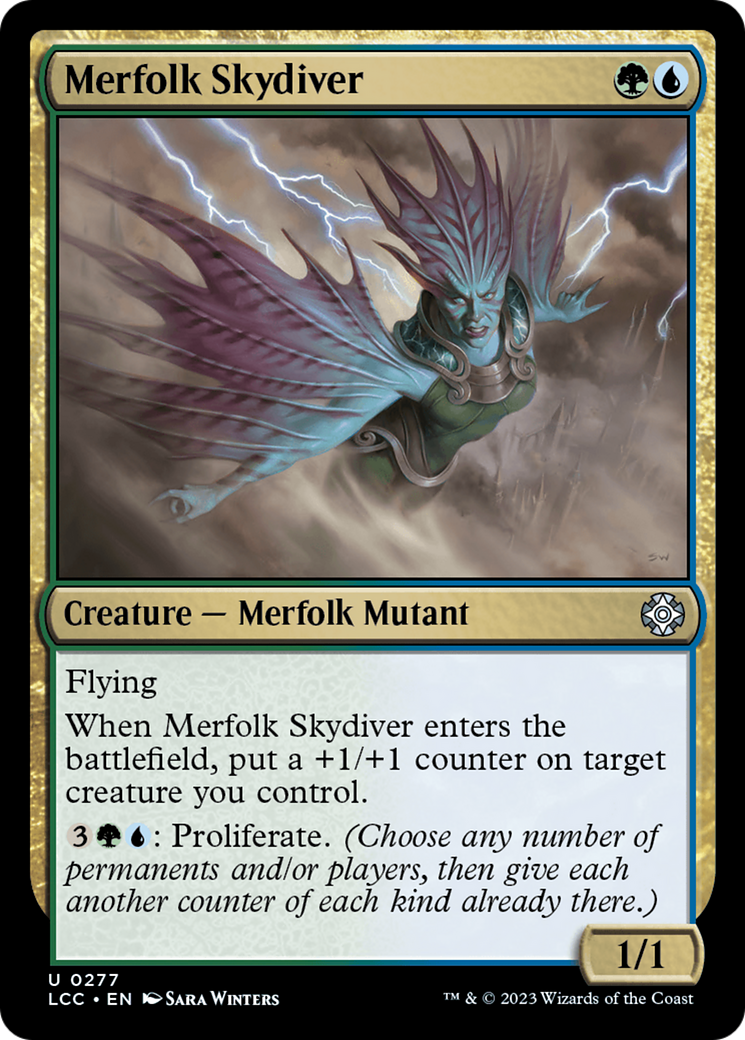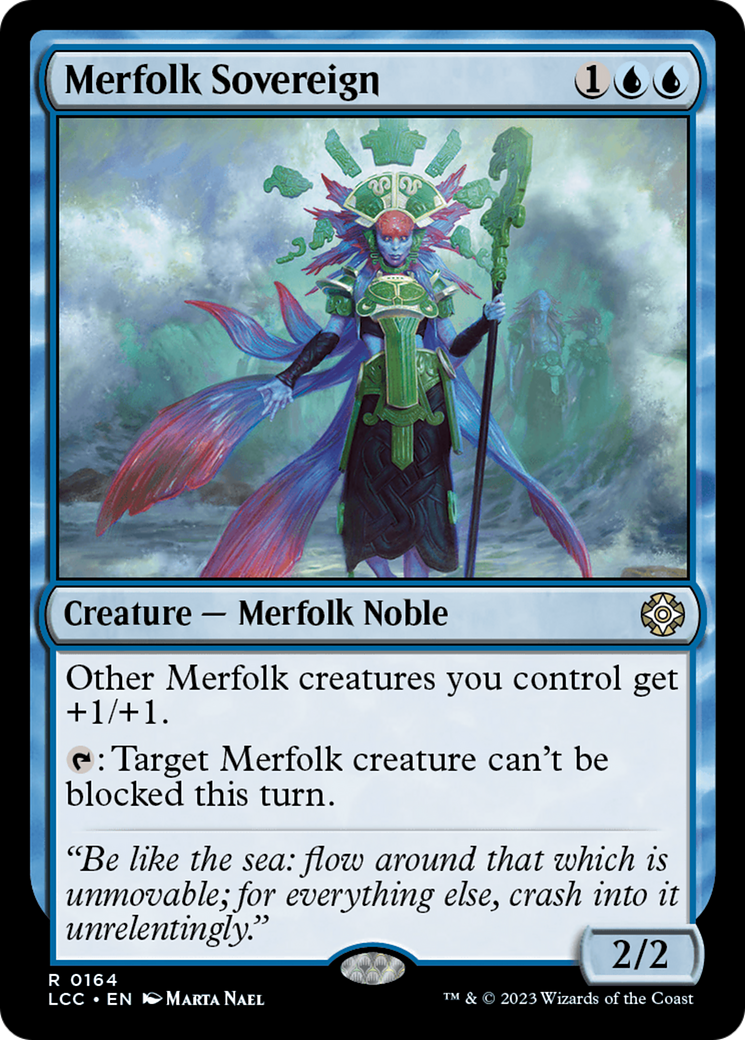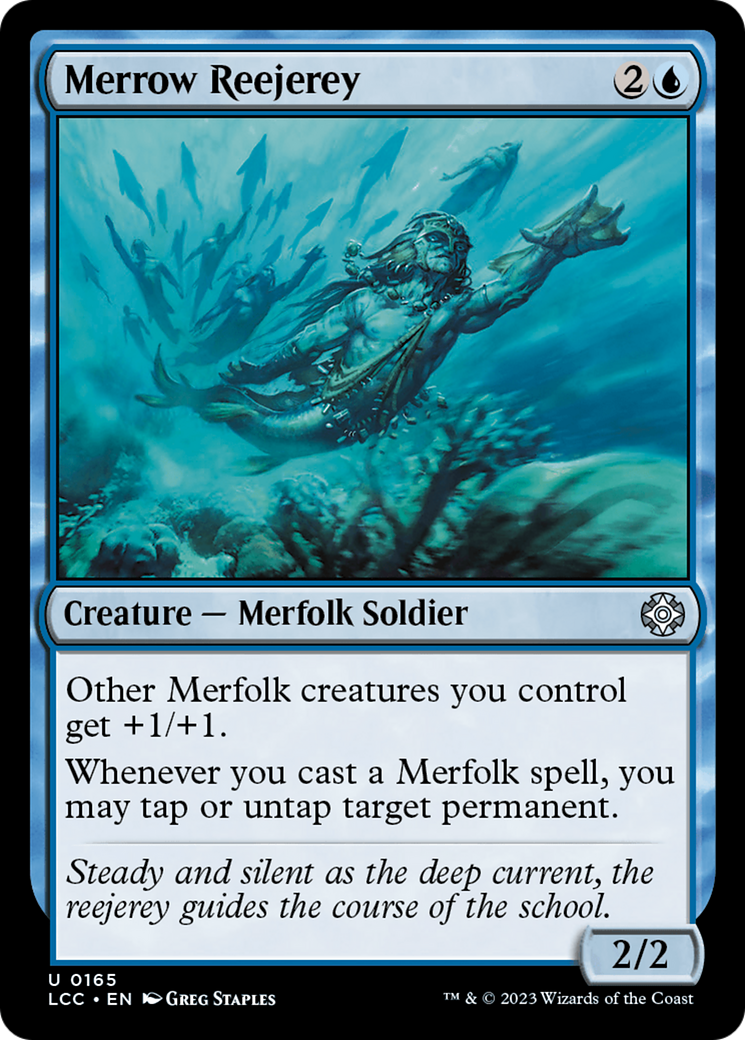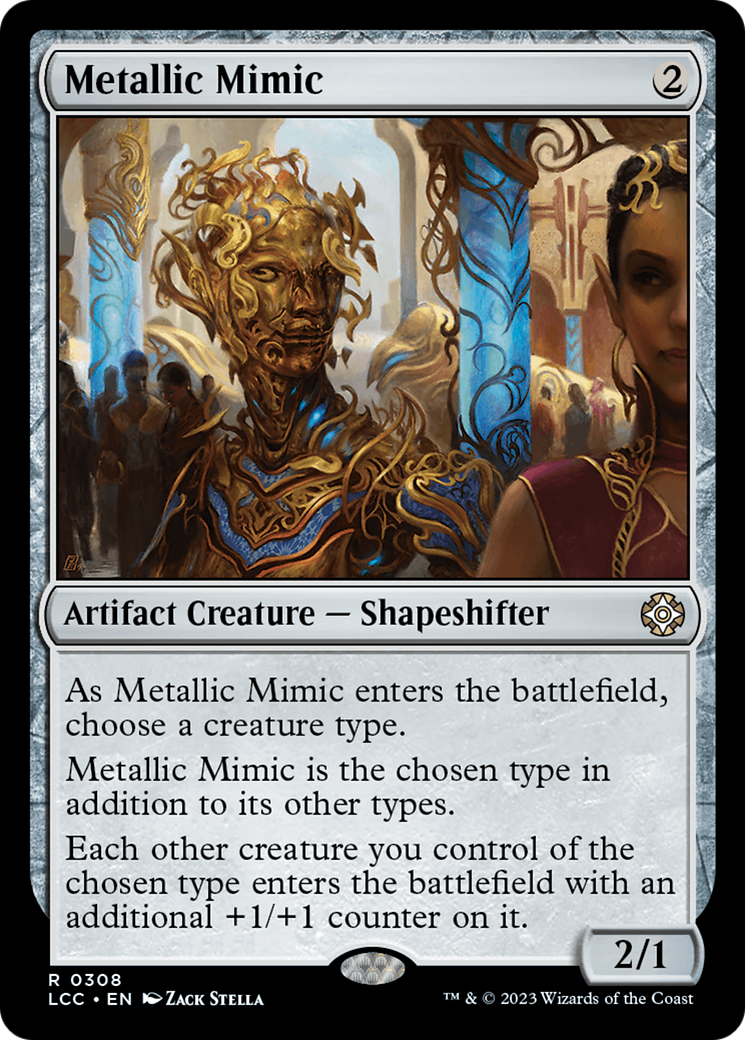
Creatures 38
-
1
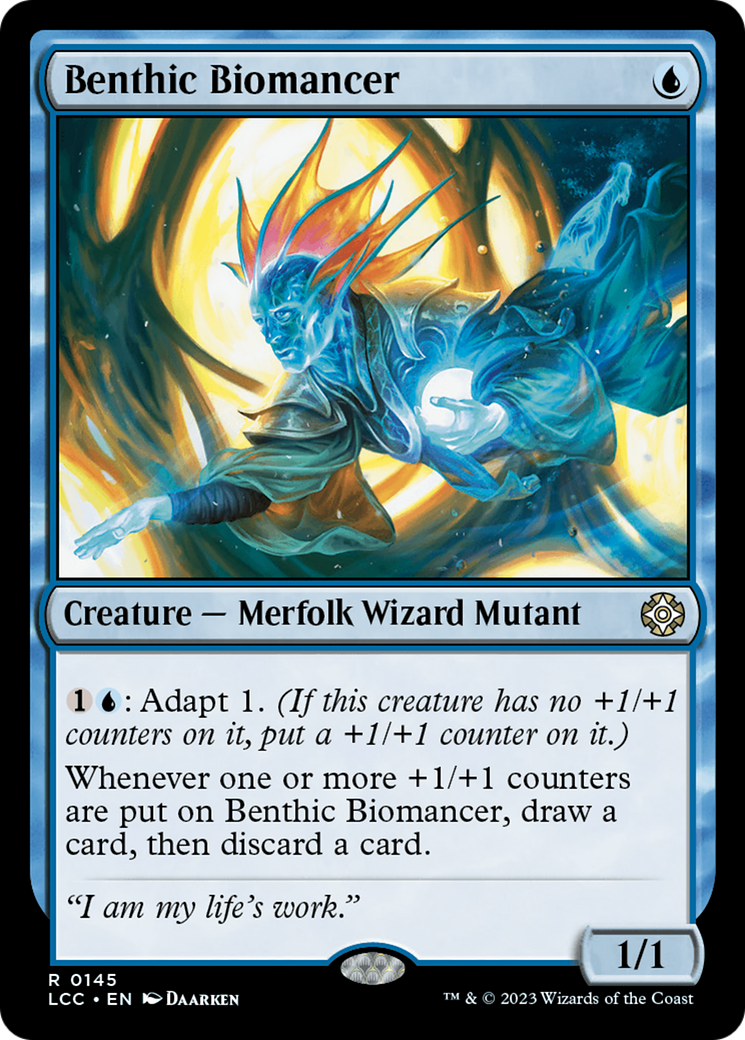
Benthic Biomancer
Benthic Biomancer
Creature — Merfolk Wizard Mutant
1/1
: Adapt 1. (If this creature has no +1/+1 counters on it, put a +1/+1 counter on it.)
Whenever one or more +1/+1 counters are put on this creature, draw a card, then discard a card.
- An ability that triggers when counters are put on a permanent will trigger if that permanent somehow enters the battlefield with those counters.
- You draw a card and discard a card all while Benthic Biomancer's triggered ability is resolving. Nothing can happen between the two, and no player may choose to take actions.
- You can always activate an ability that will cause a creature to adapt. As that ability resolves, if the creature has a +1/+1 counter on it for any reason, you simply won't put any +1/+1 counters on it.
- If a creature somehow loses all of its +1/+1 counters, it can adapt again and get more +1/+1 counters.
-
1
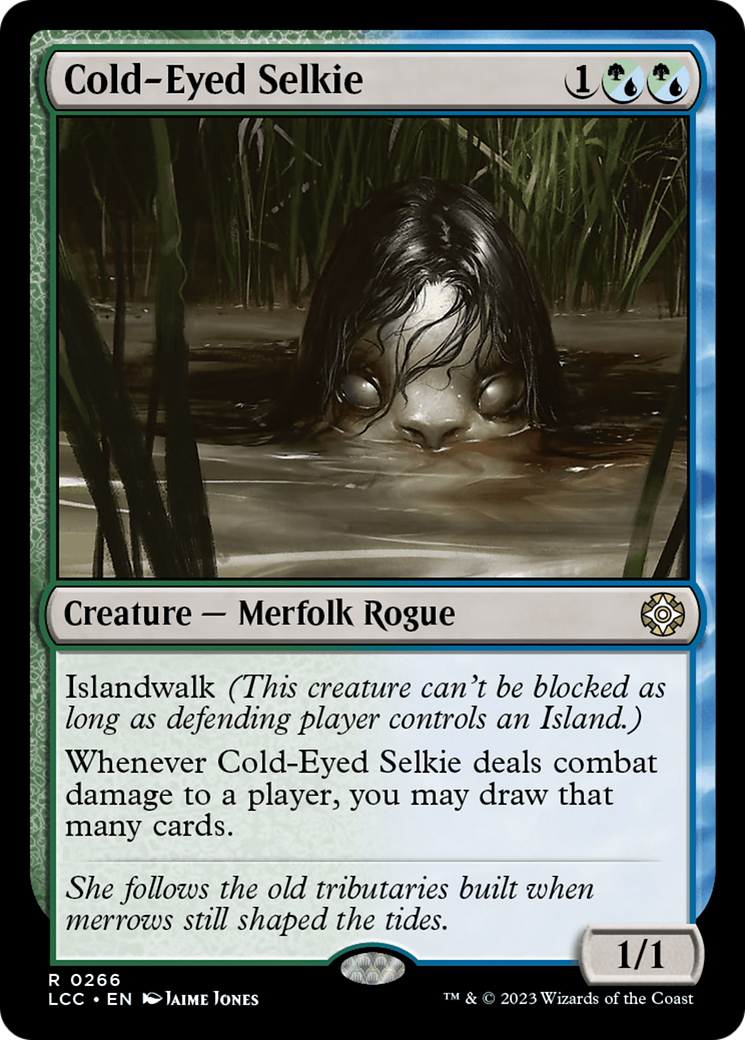
Cold-Eyed Selkie
Cold-Eyed Selkie
Creature — Merfolk Rogue
1/1
Islandwalk (This creature can't be blocked as long as defending player controls an Island.)
Whenever this creature deals combat damage to a player, you may draw that many cards.
-
1
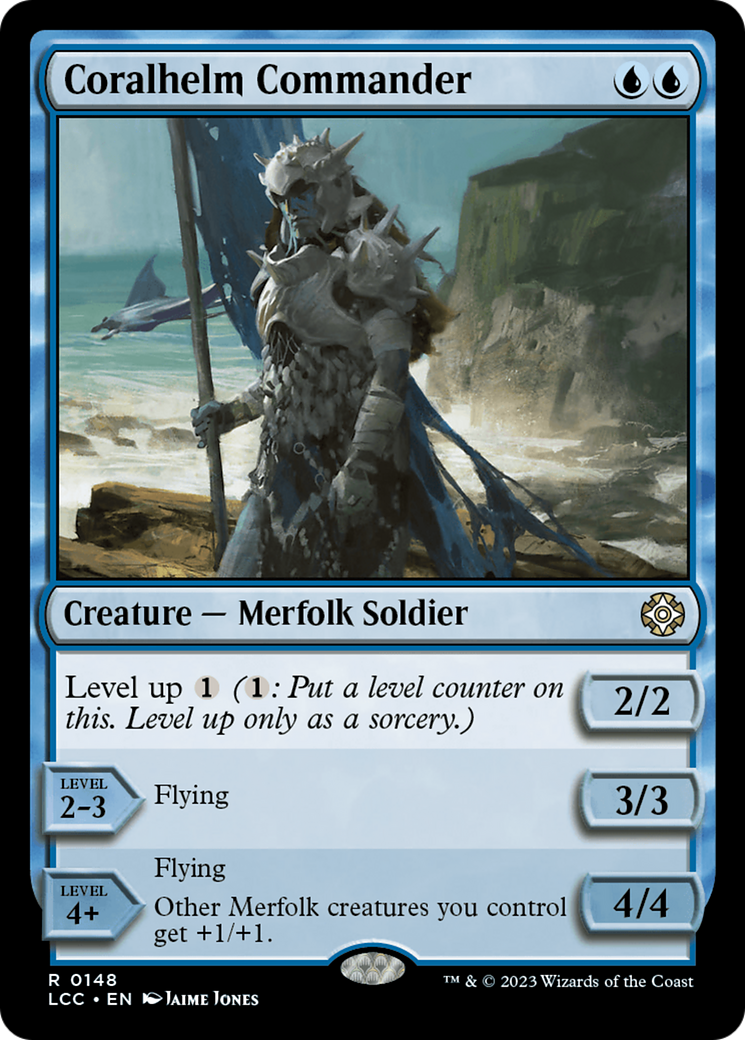
Coralhelm Commander
Coralhelm Commander
Creature — Merfolk Soldier
2/2
Level up ( : Put a level counter on this. Level up only as a sorcery.)
LEVEL 2-3
3/3
Flying
LEVEL 4+
4/4
Flying
Other Merfolk creatures you control get +1/+1.
- The abilities a leveler grants to itself don't overwrite any other abilities it may have. In particular, they don't overwrite the creature's level up ability; it always has that.
- Effects that set a leveler's power or toughness to a specific value, including the effects from a level symbol's ability, apply in timestamp order. The timestamp of each level symbol's ability is the same as the timestamp of the leveler itself, regardless of when the most recent level counter was put on it.
- Effects that modify a leveler's power or toughness, such as the effects of Giant Growth or Glorious Anthem, will apply to it no matter when they started to take effect. The same is true for counters that change the creature's power or toughness (such as +1/+1 counters) and effects that switch its power and toughness.
- If another creature becomes a copy of a leveler, all of the leveler's printed abilities — including those represented by level symbols — are copied. The current characteristics of the leveler, and the number of level counters on it, are not. The abilities, power, and toughness of the copy will be determined based on how many level counters are on the copy.
- A creature's level is based on how many level counters it has on it, not how many times its level up ability has been activated or has resolved. If a leveler gets level counters due to some other effect (such as Clockspinning) or loses level counters for some reason (such as Vampire Hexmage), its level is changed accordingly.
-
1
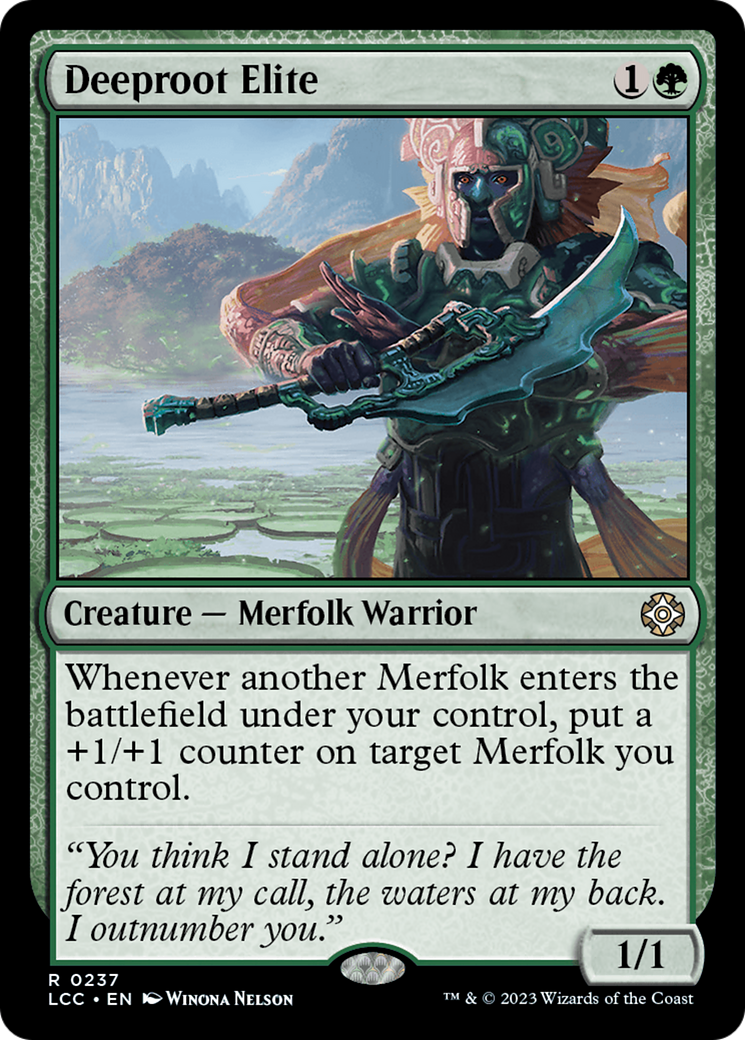
Deeproot Elite
Deeproot Elite
Creature — Merfolk Warrior
1/1
Whenever another Merfolk you control enters, put a +1/+1 counter on target Merfolk you control.
- Deeproot Elite's ability can target the Merfolk that caused it to trigger. It can also target Deeproot Elite itself.
-
1
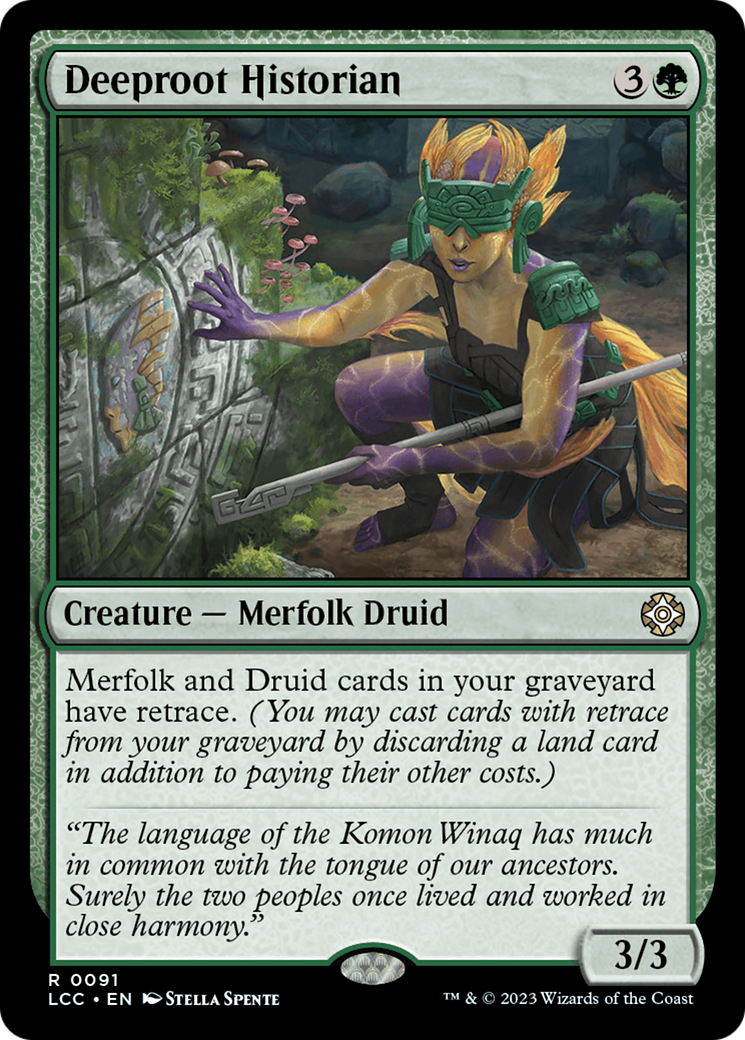
Deeproot Historian
Deeproot Historian
Creature — Merfolk Druid
3/3
Merfolk and Druid cards in your graveyard have retrace. (You may cast cards with retrace from your graveyard by discarding a land card in addition to paying their other costs.)
- If a spell you cast with retrace is countered, it's put back into your graveyard. You may use the retrace ability to cast it again.
-
1
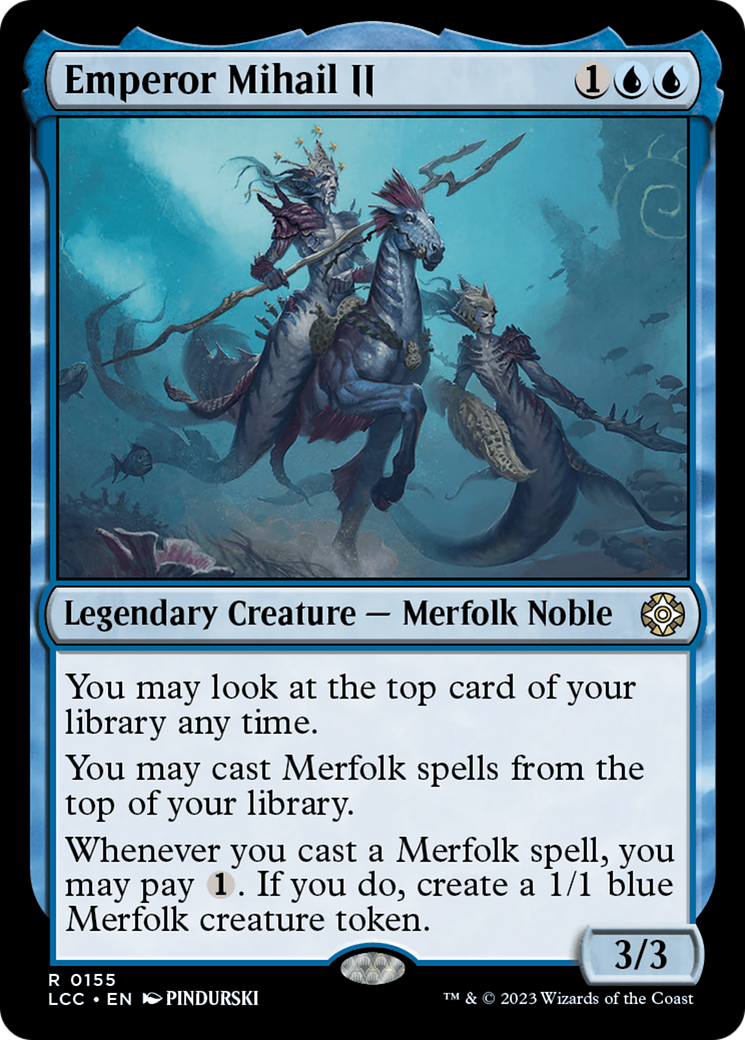
Emperor Mihail II
Emperor Mihail II
Legendary Creature — Merfolk Noble
3/3
You may look at the top card of your library any time.
You may cast Merfolk spells from the top of your library.
Whenever you cast a Merfolk spell, you may pay . If you do, create a 1/1 blue Merfolk creature token.
- Emperor Mihail II lets you look at the top card of your library whenever you want (with one restriction—see below), even if you don't have priority. This action doesn't use the stack. Knowing what that card is becomes part of the information you have access to, just like you can look at the cards in your hand.
- If the top card of your library changes while you're casting a spell, playing a land, or activating an ability, you can't look at the new top card until you finish doing so. This means that if you cast the top card of your library, you can't look at the next one until you're done paying for that spell.
- You must follow the normal timing permissions and restrictions of the cards you play from your library.
- The last ability triggers whenever you cast any Merfolk spell, not just when you cast a Merfolk spell from the top of your library. It will resolve before the spell that caused it to trigger, even if that spell has been countered or otherwise left the stack.
-
1
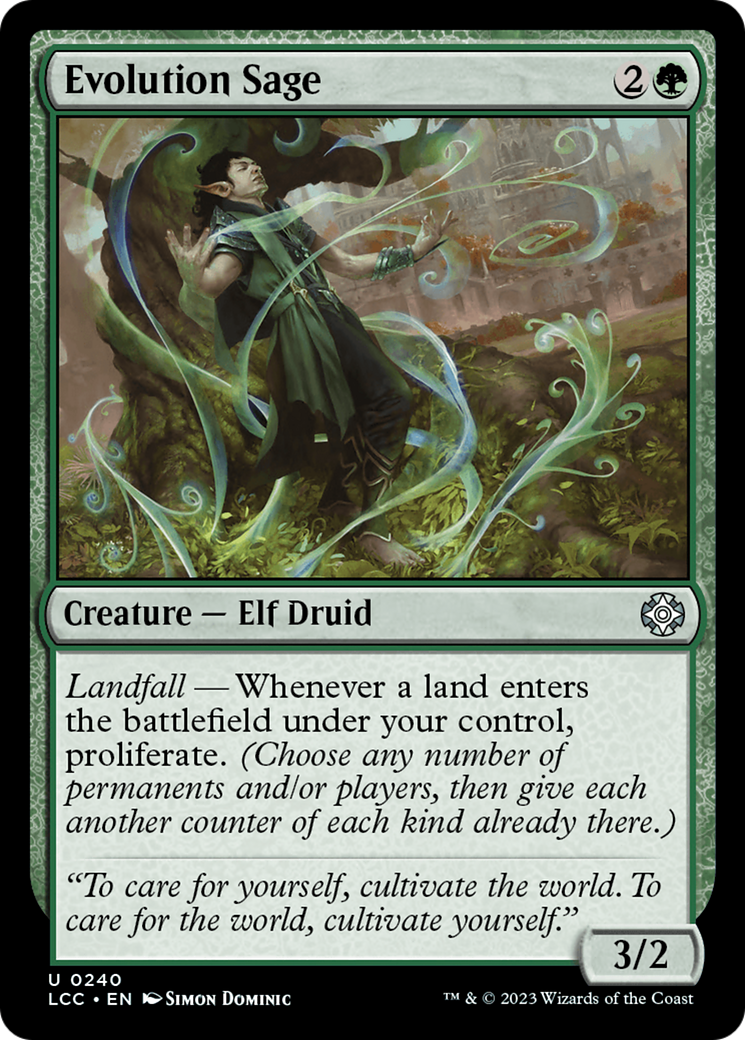
Evolution Sage
Evolution Sage
Creature — Elf Druid
3/2
Landfall — Whenever a land you control enters, proliferate. (Choose any number of permanents and/or players, then give each another counter of each kind already there.)
- A landfall ability triggers whenever a land you control enters for any reason. It triggers whenever you play a land, as well as whenever a spell or ability puts a land onto the battlefield under your control.
- A landfall ability doesn't trigger if a permanent already on the battlefield becomes a land.
- Whenever a land you control enters, each landfall ability of the permanents you control will trigger. You can put them on the stack in any order. The last ability you put on the stack will be the first one to resolve (As a result, you can have those abilities resolve in the order of your choosing.).
- An ability that triggers "Whenever you proliferate" triggers even if you chose no permanents or players while doing so.
- To proliferate, you can choose any permanent that has a counter, including ones controlled by opponents. You can choose any player who has a counter, including opponents. You can't choose cards in any zone other than the battlefield, even if they have counters on them.
- If a permanent ever has both +1/+1 counters and -1/-1 counters on it at the same time, they're removed in pairs as a state-based action so that the permanent has only one of those kinds of counters on it.
- Players can respond to a spell or ability whose effect includes proliferating. Once that spell or ability starts to resolve, however, and its controller chooses which permanents and players will get new counters, it's too late for anyone to respond.
- You don't have to choose every permanent or player that has a counter, only the ones you want to add another counter to. Since "any number" includes zero, you don't have to choose any permanents at all, and you don't have to choose any players at all.
- If a player or permanent has more than one kind of counter on it, and you choose for it to get additional counters, it must get one of each kind of counter it already has. You can't have it get just one kind of counter it already has and not the others.
-
1
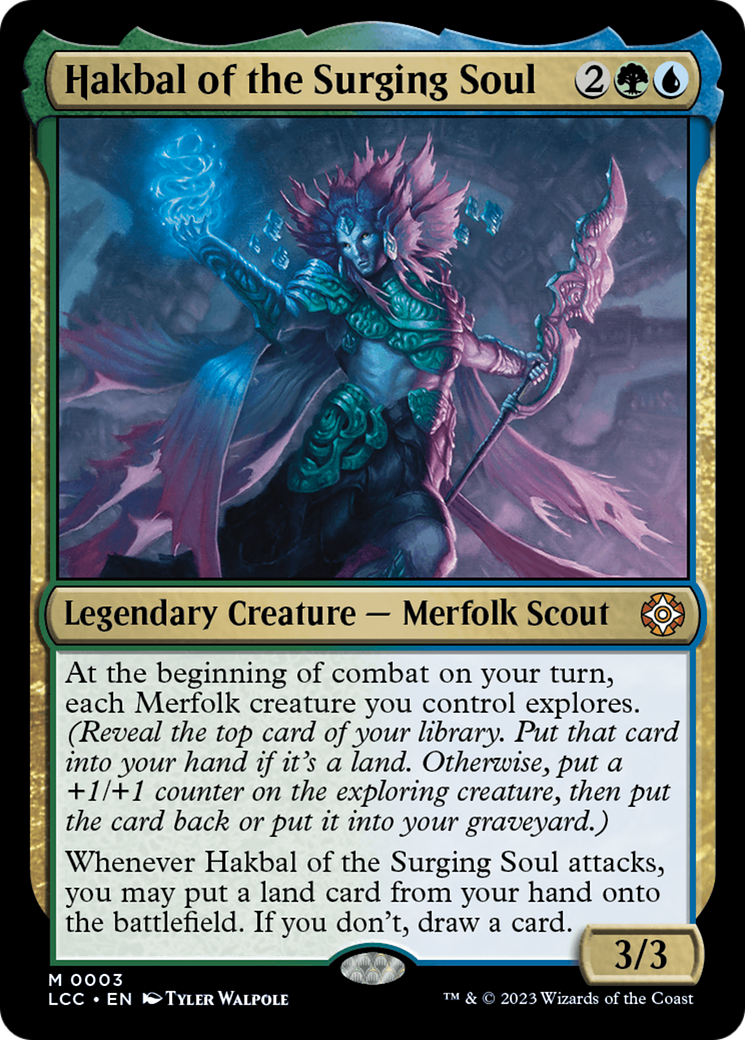
Hakbal of the Surging Soul
Hakbal of the Surging Soul
Legendary Creature — Merfolk Scout
3/3
At the beginning of combat on your turn, each Merfolk creature you control explores. (Reveal the top card of your library. Put that card into your hand if it's a land. Otherwise, put a +1/+1 counter on the exploring creature, then put the card back or put it into your graveyard.)
Whenever Hakbal attacks, you may put a land card from your hand onto the battlefield. If you don't, draw a card.
- Each of your Merfolk creatures will explore during the resolution of Hakbal of the Surging Soul's first ability. Players won't be able to respond between the explores.
- If you control multiple Merfolk, you choose the order in which they explore. Make sure it's clear which Merfolk is exploring before you reveal any cards.
- If an ability instructs a creature to explore, its controller reveals the top card of their library. If it's a land card, they'll put it into their hand. Otherwise, they'll put a +1/+1 counter on that creature, then choose to either leave that card on top of their library or put it into their graveyard.
- Once an ability that causes a creature to explore begins to resolve, no player may take any other actions until it's done. Notably, opponents can't try to remove the exploring creature after you reveal a nonland card but before it receives a counter.
- If no card is revealed, most likely because that player's library is empty, the exploring creature receives a +1/+1 counter.
- If a resolving spell or ability instructs a specific creature to explore but that creature has left the battlefield, the creature still explores. If you reveal a nonland card this way, you won't put a +1/+1 counter on anything, but you may put the revealed card into your graveyard. Effects that trigger "whenever a creature explores" trigger as appropriate.
- Some spells or abilities might cause a creature to explore multiple times in a row. If you reveal a nonland card when a creature explores and leave it on top of your library, then the creature explores again immediately afterwards, you'll reveal the same card again.
- In some unusual cases, noncreature permanents may explore. For example, if the creature card returned by Defossilize is somehow not a creature once it's on the battlefield, it can still explore. You'll take all the same actions, and you may end up putting a +1/+1 counter on the permanent. (Note that some effects target a creature, and those effects would still require a legal target to have it explore.)
-
1
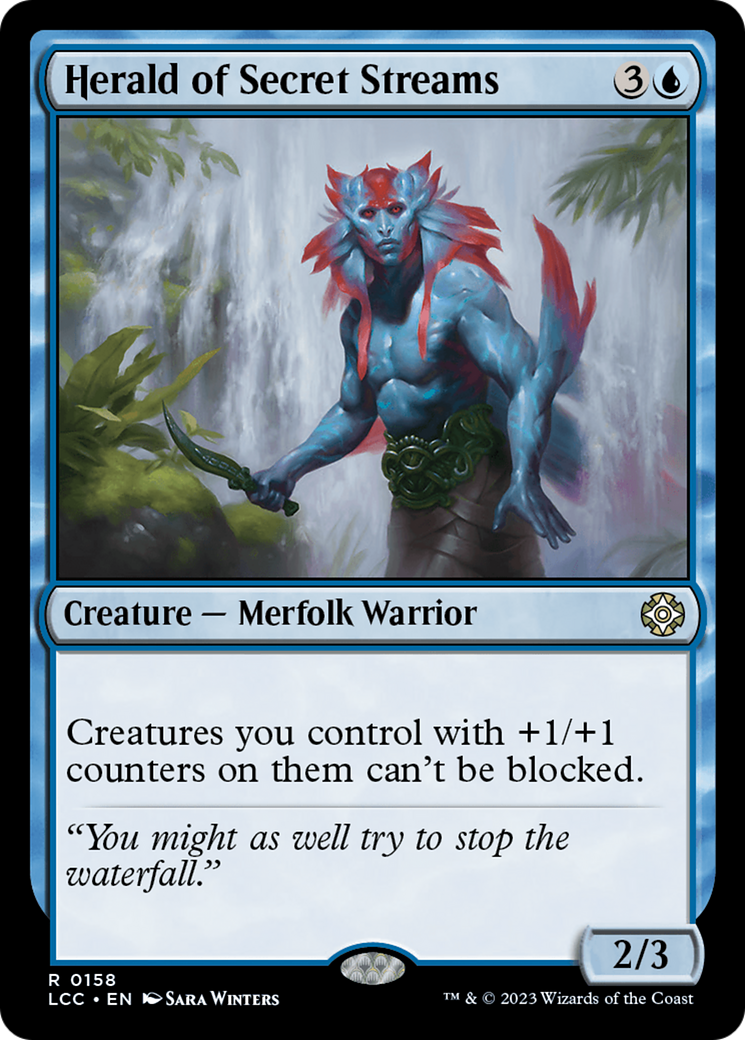
Herald of Secret Streams
Herald of Secret Streams
Creature — Merfolk Warrior
2/3
Creatures you control with +1/+1 counters on them can't be blocked.
- Once a creature you control has become blocked, putting a +1/+1 counter on it won't cause it to become unblocked.
-
1
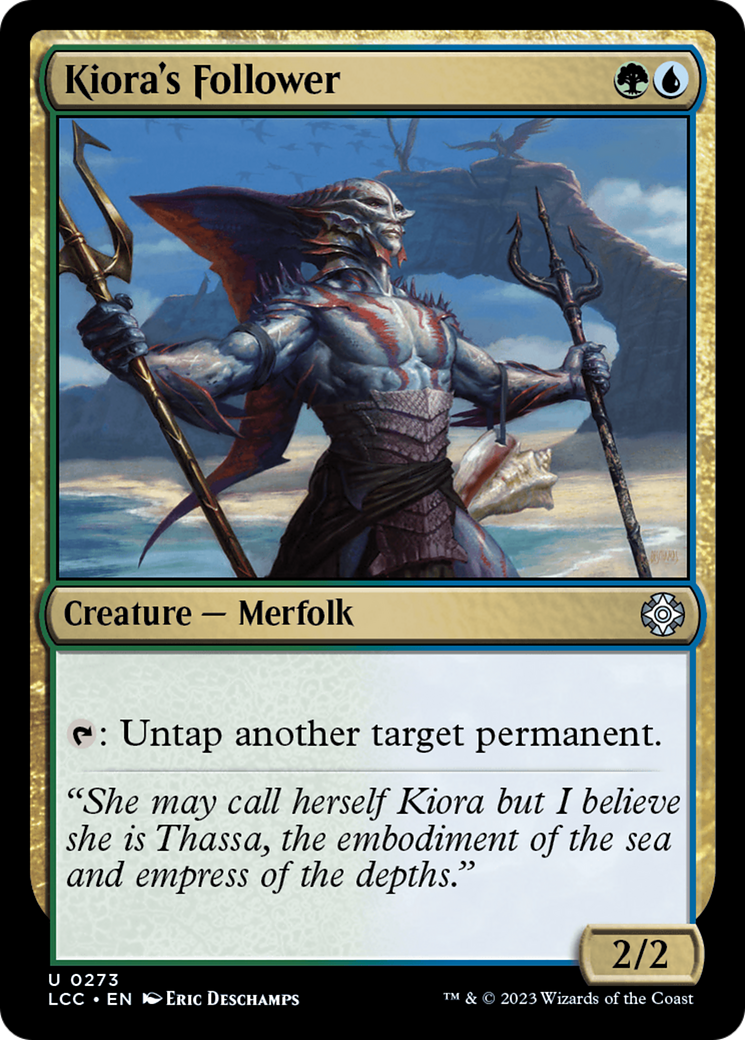
Kiora's Follower
Kiora's Follower
Creature — Merfolk
2/2
: Untap another target permanent.
-
1
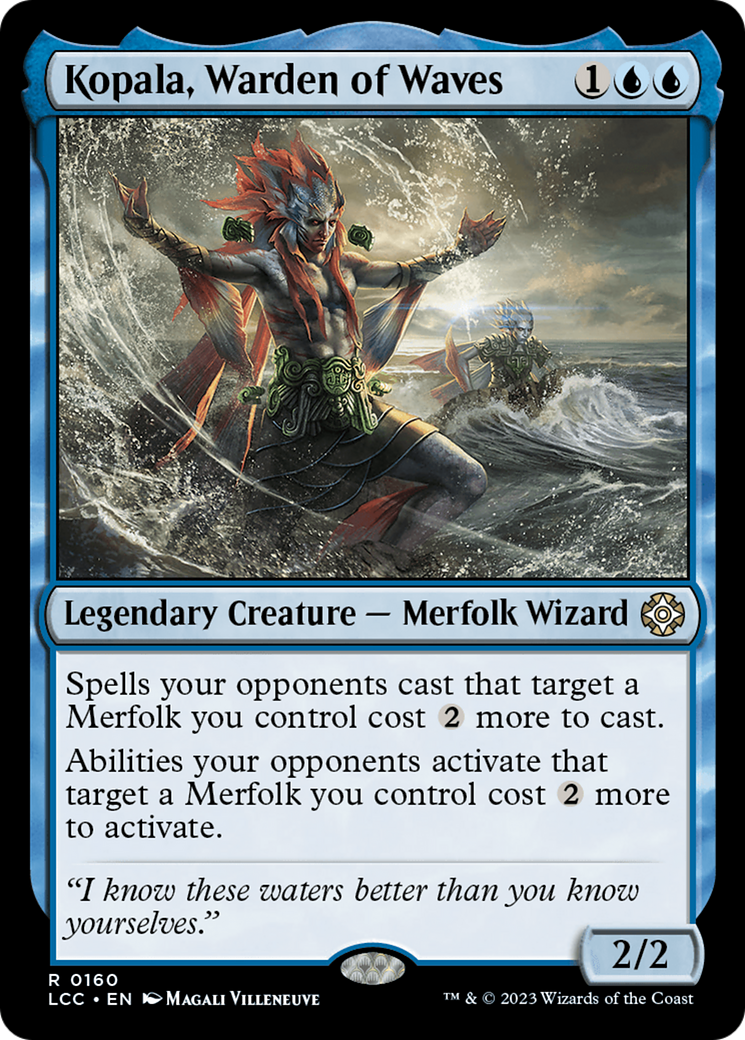
Kopala, Warden of Waves
Kopala, Warden of Waves
Legendary Creature — Merfolk Wizard
2/2
Spells your opponents cast that target a Merfolk you control cost more to cast.
Abilities your opponents activate that target a Merfolk you control cost more to activate.
- To determine the total cost of an opponent's spell that targets a Merfolk you control, start with the mana cost or alternative cost that player is paying, add any cost increases, then apply any cost reductions. The mana value of the spell remains unchanged, no matter what the total cost to cast it was.
- Activated abilities contain a colon. They're generally written "[Cost]: [Effect]."
- Kopala's abilities won't affect triggered abilities (starting with "when," "whenever," or "at") that target a Merfolk you control.
- Spells and abilities that target more than one Merfolk you control cost only more to cast or activate.
-
1
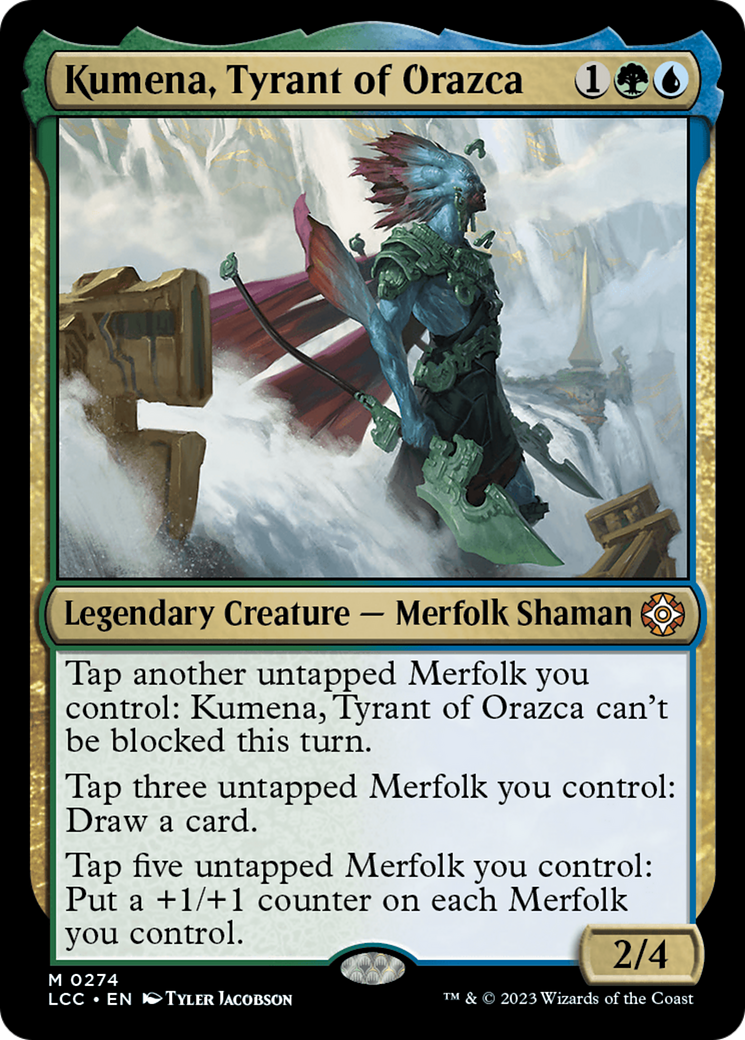
Kumena, Tyrant of Orazca
Kumena, Tyrant of Orazca
Legendary Creature — Merfolk Shaman
2/4
Tap another untapped Merfolk you control: Kumena can't be blocked this turn.
Tap three untapped Merfolk you control: Draw a card.
Tap five untapped Merfolk you control: Put a +1/+1 counter on each Merfolk you control.
- To activate Kumena's abilities, you may tap any untapped Merfolk you control, including one you haven't controlled continuously since the beginning of your most recent turn. (Note that tapping the creature doesn't use [the tap symbol].) For Kumena's second and third abilities, this includes Kumena itself.
- Activating Kumena's first ability after it has become blocked won't cause it to become unblocked.
-
1
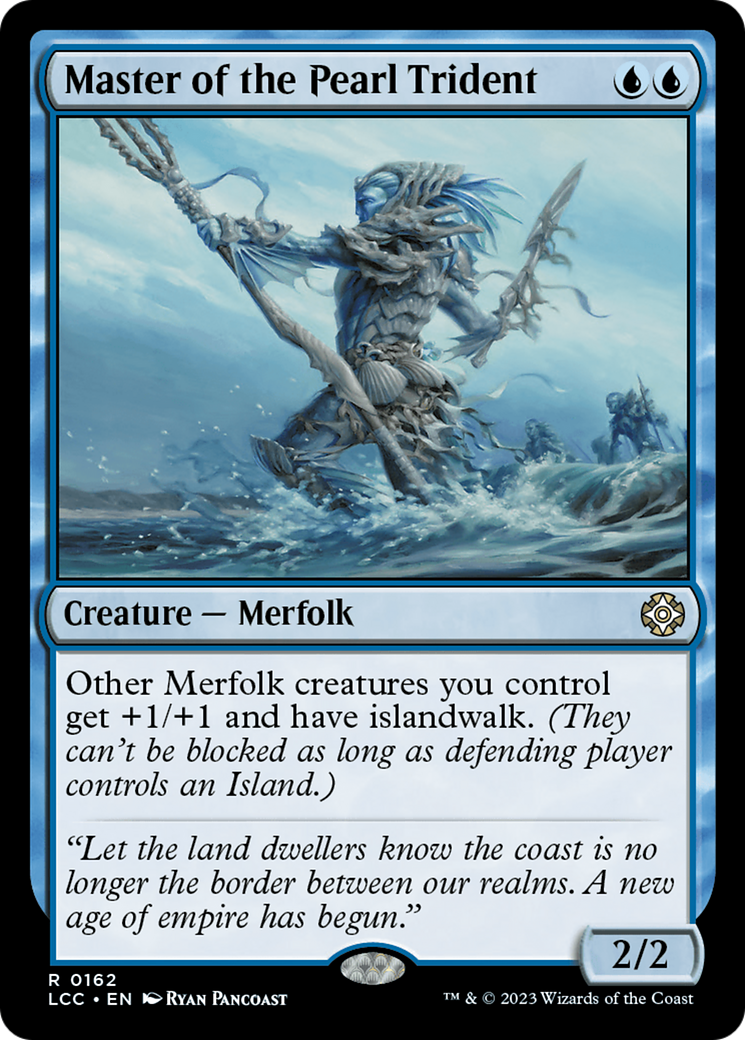
Master of the Pearl Trident
Master of the Pearl Trident
Creature — Merfolk
2/2
Other Merfolk creatures you control get +1/+1 and have islandwalk. (They can't be blocked as long as defending player controls an Island.)
- Because damage remains marked on a creature until the damage is removed as the turn ends, nonlethal damage dealt to a Merfolk you control may become lethal if Master of the Pearl Trident leaves the battlefield during that turn.
-
1
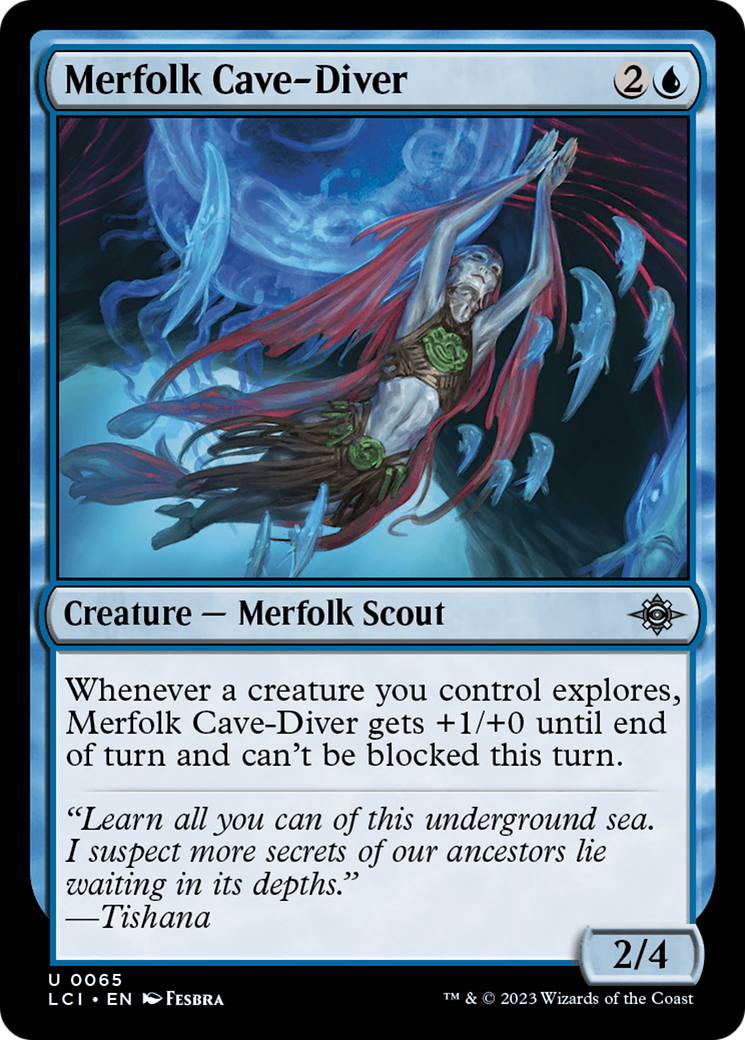
Merfolk Cave-Diver
Merfolk Cave-Diver
Creature — Merfolk Scout
2/4
Whenever a creature you control explores, this creature gets +1/+0 until end of turn and can't be blocked this turn.
-
1
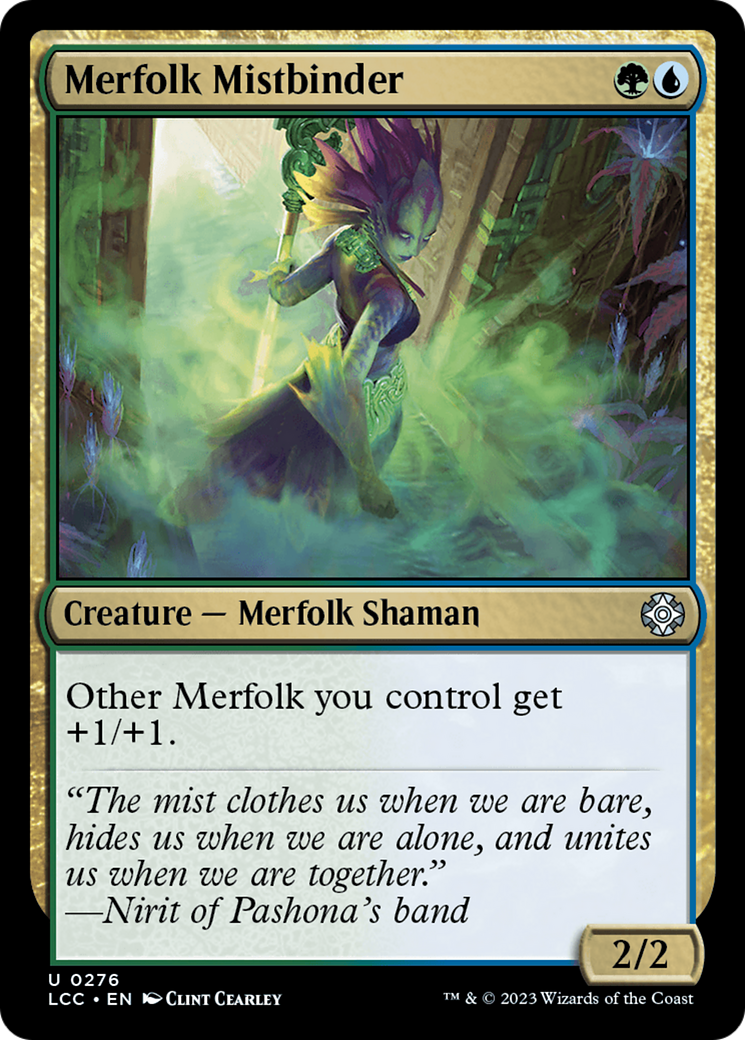
Merfolk Mistbinder
Merfolk Mistbinder
Creature — Merfolk Shaman
2/2
Other Merfolk you control get +1/+1.
- Because damage remains marked on a creature until it's removed as the turn ends, nonlethal damage dealt to another Merfolk you control may become lethal if Merfolk Mistbinder leaves the battlefield during that turn.
-
1
Merfolk Skydiver
Merfolk Skydiver
Creature — Merfolk Mutant
1/1
Flying
When this creature enters, put a +1/+1 counter on target creature you control.
: Proliferate. (Choose any number of permanents and/or players, then give each another counter of each kind already there.)
- If a player or permanent has more than one kind of counter on it, and you choose for it to get additional counters, it must get one of each kind of counter it already has. You can't have it get just one kind of counter it already has and not the others.
- To proliferate, you can choose any permanent that has a counter, including ones controlled by opponents. You can choose any player who has a counter, including opponents. You can't choose cards in any zone other than the battlefield, even if they have counters on them.
- You don't have to choose every permanent or player that has a counter, only the ones you want to add another counter to. Since "any number" includes zero, you don't have to choose any permanents at all, and you don't have to choose any players at all.
- If a permanent ever has both +1/+1 counters and -1/-1 counters on it at the same time, they're removed in pairs as a state-based action so that the permanent has only one of those kinds of counters on it.
- An ability that triggers "Whenever you proliferate" triggers even if you chose no permanents or players while doing so.
- Players can respond to a spell or ability whose effect includes proliferating. Once that spell or ability starts to resolve, however, and its controller chooses which permanents and players will get new counters, it's too late for anyone to respond.
- You may choose Merfolk Skydiver as the target of its own ability.
-
1
Merfolk Sovereign
Merfolk Sovereign
Creature — Merfolk Noble
2/2
Other Merfolk creatures you control get +1/+1.
: Target Merfolk creature can't be blocked this turn.
- To have any effect, Merfolk Sovereign's activated ability must be activated before the declare blockers step begins. Once a Merfolk has become blocked, activating Merfolk Sovereign's ability won't change that.
-
1
Merrow Reejerey
Merrow Reejerey
Creature — Merfolk Soldier
2/2
Other Merfolk creatures you control get +1/+1.
Whenever you cast a Merfolk spell, you may tap or untap target permanent.
-
1
Metallic Mimic
Metallic Mimic
Artifact Creature — Shapeshifter
2/1
As this creature enters, choose a creature type.
This creature is the chosen type in addition to its other types.
Each other creature you control of the chosen type enters with an additional +1/+1 counter on it.
- The choice of creature type is made as Metallic Mimic enters the battlefield. Players can't respond to this choice. Metallic Mimic's second ability starts applying immediately.
- Even though Metallic Mimic is a Shapeshifter, other Shapeshifter creatures you control won't get a +1/+1 counter unless you chose Shapeshifter as Metallic Mimic entered the battlefield. If you do, that creature must be entering the battlefield as a Shapeshifter to get a +1/+1 counter. It won't get a +1/+1 counter if it enters the battlefield as a copy of a non-Shapeshifter creature.
- You must choose an existing creature type. "Artifact" and "Vehicle" aren't creature types.
- Creatures of the chosen type that enter the battlefield at the same time as Metallic Mimic won't enter with an additional +1/+1 counter.
-
1
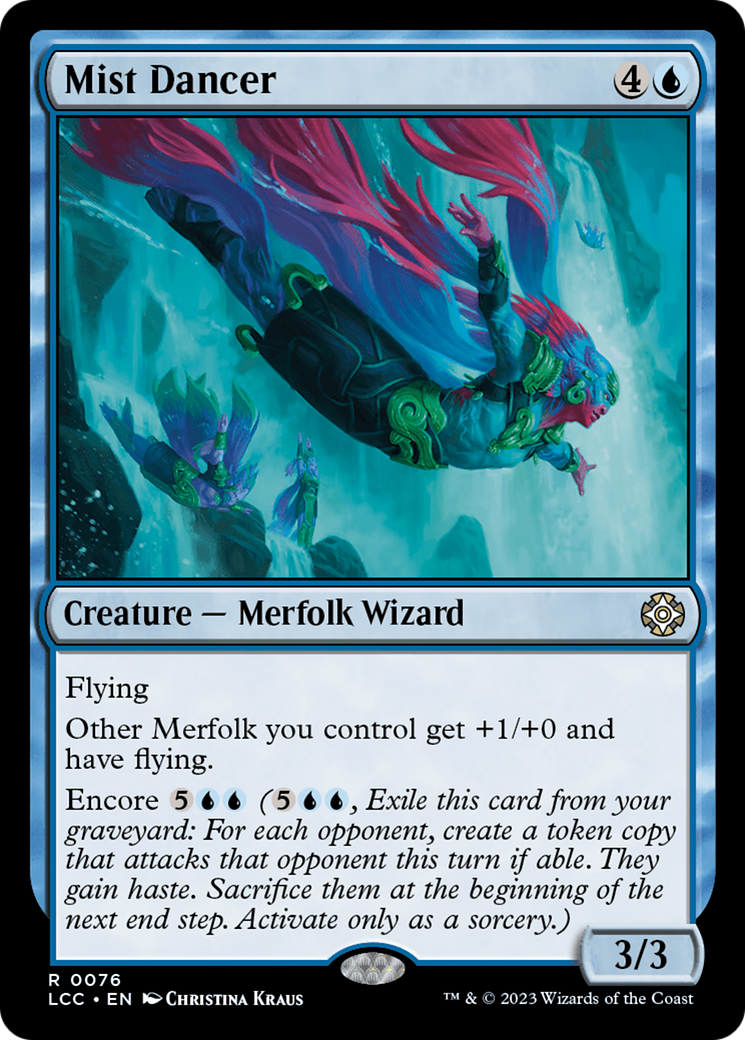
Mist Dancer
Mist Dancer
Creature — Merfolk Wizard
3/3
Flying
Other Merfolk you control get +1/+0 and have flying.
Encore ( , Exile this card from your graveyard: For each opponent, create a token copy that attacks that opponent this turn if able. They gain haste. Sacrifice them at the beginning of the next end step. Activate only as a sorcery.)
- Exiling the card with encore is a cost to activate the ability. Once you announce that you're activating it, no player may take actions until you've finished. They can't try to remove the card from your graveyard to stop you from paying the cost.
- Opponents who have left the game aren't counted when determining how many tokens to create.
- The tokens copy only what's on the original card. Effects that modified that creature when it was previously on the battlefield won't be copied.
- Each token must attack the appropriate player if able.
- If one of the tokens can't attack for any reason (such as being tapped), then it doesn't attack. If there's a cost associated with having it attack, you aren't forced to pay that cost, so it doesn't have to attack in that case either.
- If an effect stops a token from attacking a specific player, that token can attack any player, planeswalker, or battle, or not attack at all. If the effect stops the token from attacking a specific player unless a cost is paid, you don't have to pay that cost unless you want to attack that player.
- If one of the tokens somehow is under another player's control as the delayed triggered ability resolves, you can't sacrifice that token. It remains on the battlefield indefinitely, even if you regain control of it later.
-
1
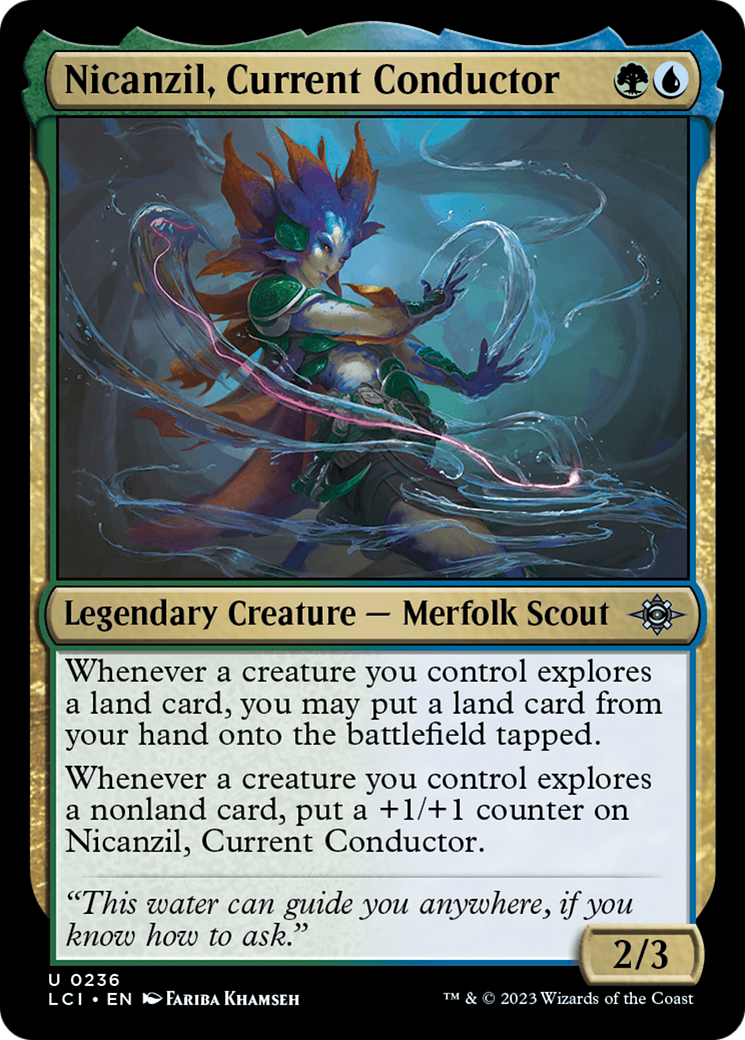
Nicanzil, Current Conductor
Nicanzil, Current Conductor
Legendary Creature — Merfolk Scout
2/3
Whenever a creature you control explores a land card, you may put a land card from your hand onto the battlefield tapped.
Whenever a creature you control explores a nonland card, put a +1/+1 counter on Nicanzil.
-
1
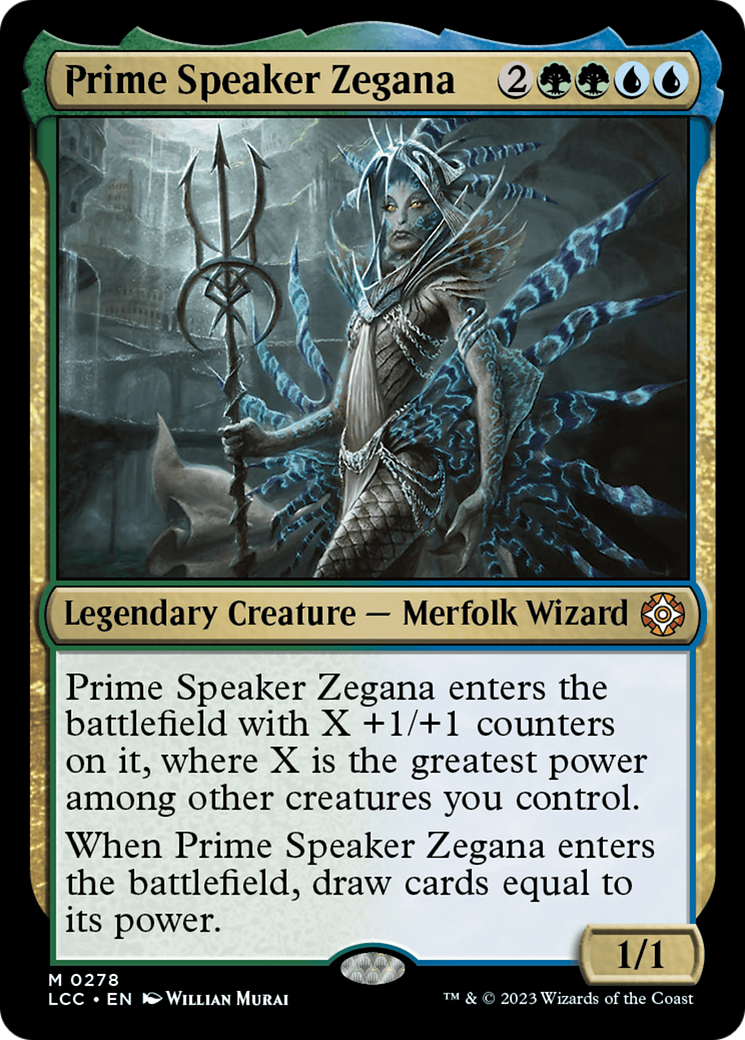
Prime Speaker Zegana
Prime Speaker Zegana
Legendary Creature — Merfolk Wizard
1/1
Prime Speaker Zegana enters with X +1/+1 counters on it, where X is the greatest power among other creatures you control.
When Prime Speaker Zegana enters, draw cards equal to its power.
- The value of X is calculated only once, as Prime Speaker Zegana's first ability resolves. If you control no other creatures at that time, X is 0.
- If Prime Speaker Zegana enters at the same time as another creature you control, you won't consider that creature when determining the greatest power among creatures you control.
- If Prime Speaker Zegana is no longer on the battlefield when its last ability resolves, use its power as it last existed on the battlefield to determine how many cards to draw.
-
1
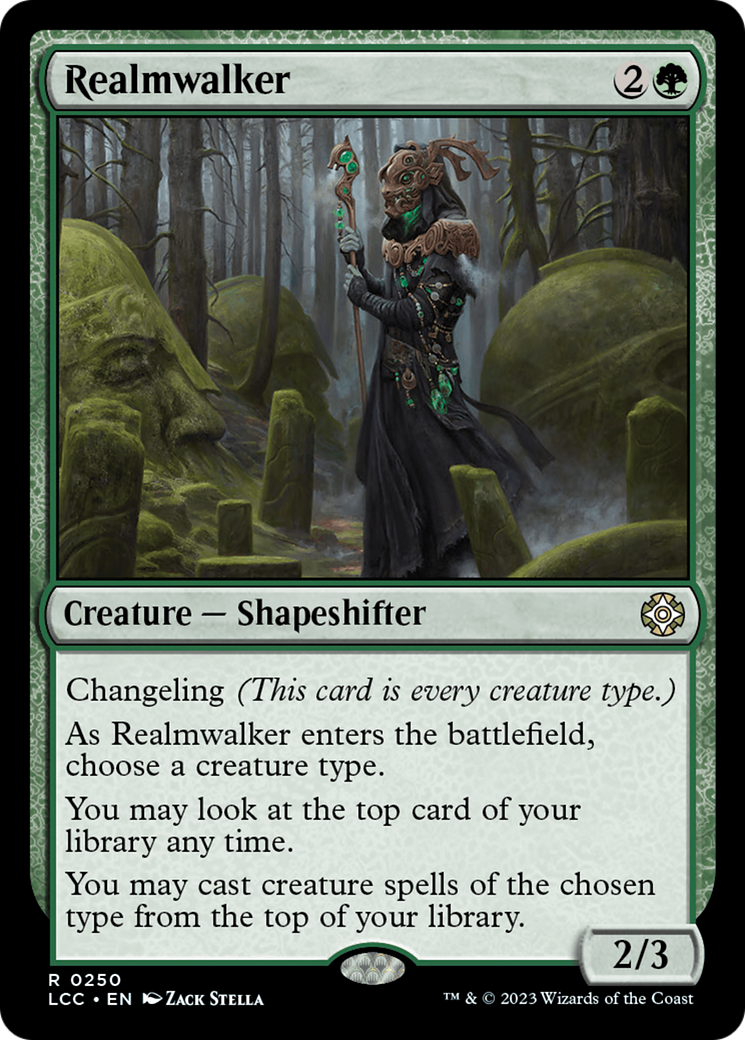
Realmwalker
Realmwalker
Creature — Shapeshifter
2/3
Changeling (This card is every creature type.)
As this creature enters, choose a creature type.
You may look at the top card of your library any time.
You may cast creature spells of the chosen type from the top of your library.
- The top card of your library isn't in your hand, so you can't foretell it, discard it, or activate any of its activated abilities.
- Realmwalker doesn't change when you can cast creature spells. Normally, this means during your main phase when the stack is empty, although flash may change this.
- If Realmwalker is somehow on the battlefield with no choice having been made for it, you may still look at the top card of your library any time. You won't be able to cast any creature spells from the top of your library, even if they have no creature types.
- You can look at the top card of your library whenever you want (with one restriction; see below), even if you don't have priority. This action doesn't use the stack. Knowing what that card is becomes part of the information you have access to, just like you can look at the cards in your hand.
- You must choose an existing creature type, such as Elk or Advisor. You can't choose card types (e.g., artifact) or supertypes (e.g., snow).
- You'll still pay all costs for the spell, including additional costs. You may also pay alternative costs if any are available.
- If the top card of your library changes while you're casting a spell, playing a land, or activating an ability, you can't look at the new top card until you finish doing so. This means that if you cast a spell from the top of your library, you can't look at the next one until you're done paying for that spell.
-
1
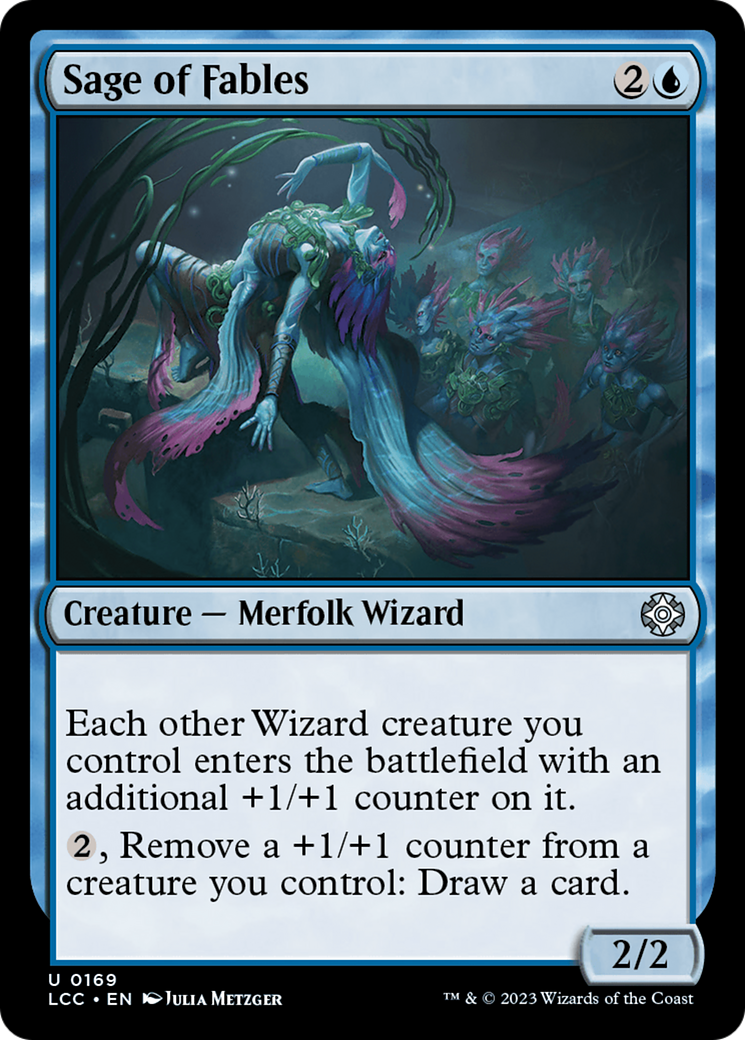
Sage of Fables
Sage of Fables
Creature — Merfolk Wizard
2/2
Each other Wizard creature you control enters with an additional +1/+1 counter on it.
, Remove a +1/+1 counter from a creature you control: Draw a card.
- If a Wizard would normally enter with a certain number of +1/+1 counters on it, it enters with that many +1/+1 counters plus one on it instead. If a Wizard would normally enter with no +1/+1 counters on it, it enters with one +1/+1 counter on it instead.
- The creature gets the counter if it would enter under your control. It doesn't matter who owns the creature or what zone it enters from (such as your opponent's graveyard, for example).
- The effects from more than one Sage of Fables are cumulative. That is, if you have two Sage of Fables on the battlefield, Wizard creatures you control enter with two additional +1/+1 counters on them.
- If Sage of Fables enters at the same time as another Wizard (due to Living End, for example), that creature doesn't get a +1/+1 counter.
-
1
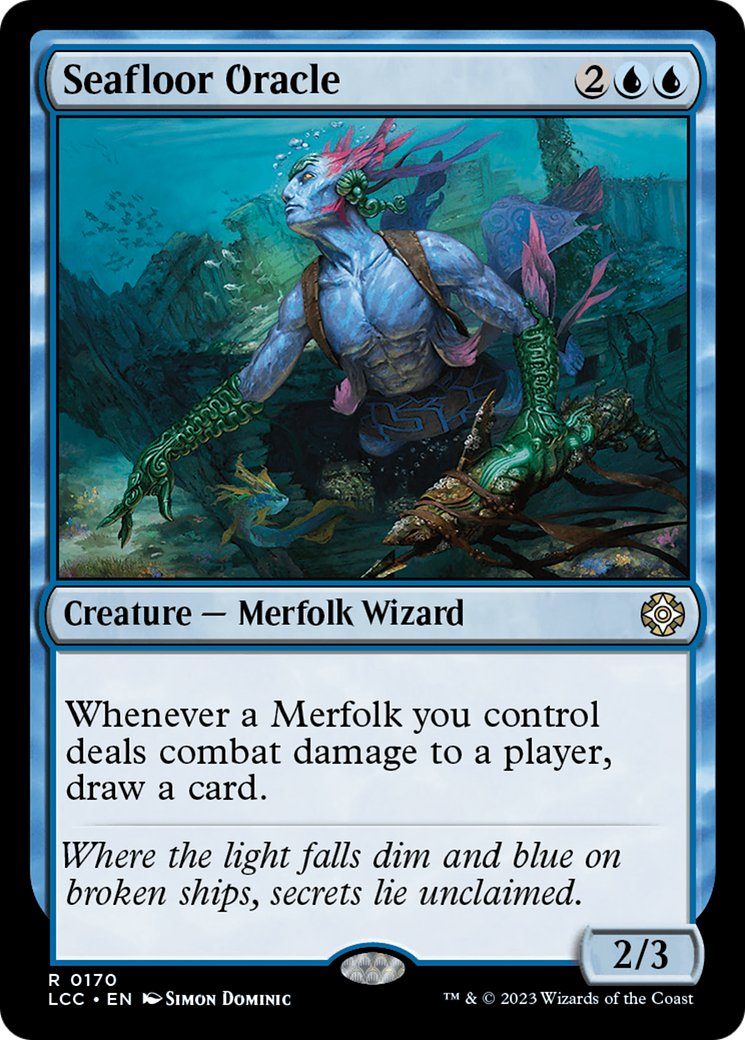
Seafloor Oracle
Seafloor Oracle
Creature — Merfolk Wizard
2/3
Whenever a Merfolk you control deals combat damage to a player, draw a card.
- If Seafloor Oracle is dealt lethal damage at the same time a Merfolk you control deals combat damage to a player, you'll draw a card.
-
1
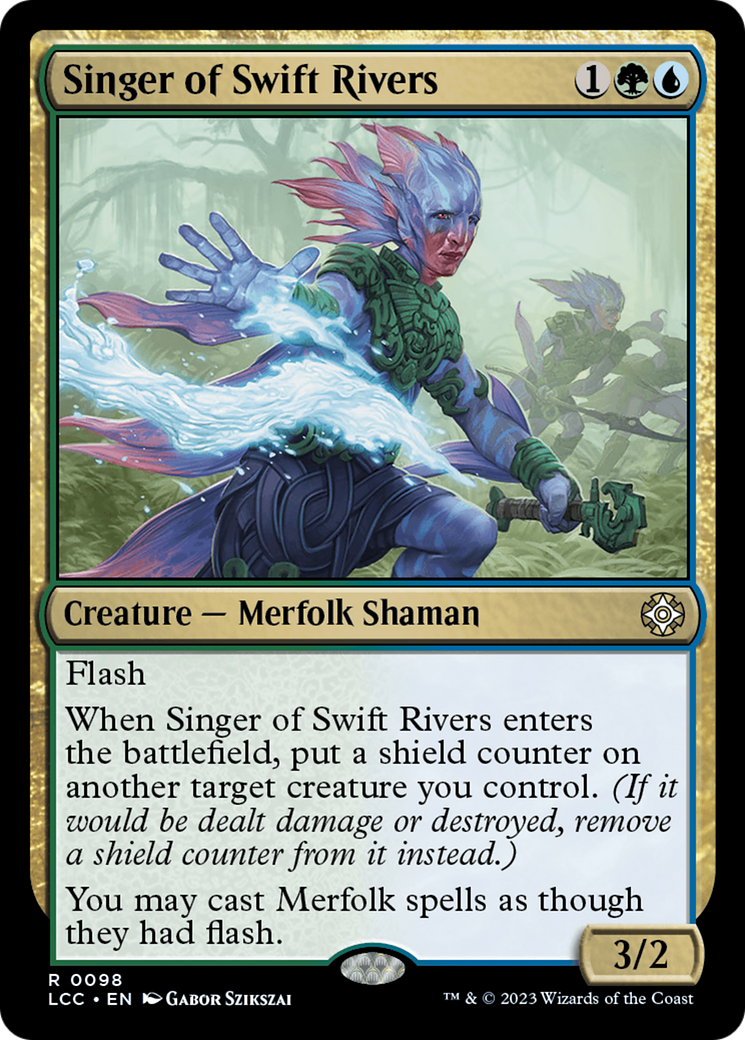
Singer of Swift Rivers
Singer of Swift Rivers
Creature — Merfolk Shaman
3/2
Flash
When this creature enters, put a shield counter on another target creature you control. (If it would be dealt damage or destroyed, remove a shield counter from it instead.)
You may cast Merfolk spells as though they had flash.
- Shield counters don't prevent players from sacrificing creatures.
- Removing a shield counter in this way isn't the same as regenerating a creature.
- If a permanent that would be dealt damage has more than one shield counter on it, that damage is prevented and only one shield counter is removed.
- If a permanent with a shield counter is dealt unpreventable damage, that damage will be dealt and a shield counter will still be removed.
- A creature with a shield counter on it may still be destroyed by state-based actions if it has damage marked on it equal to its toughness or has been dealt unpreventable damage by a source with deathtouch.
- "Shield" is not an ability that creatures have and shield counters are not keyword counters. If a creature with a shield counter loses its abilities, the shield counter will still protect it as normal.
-
1
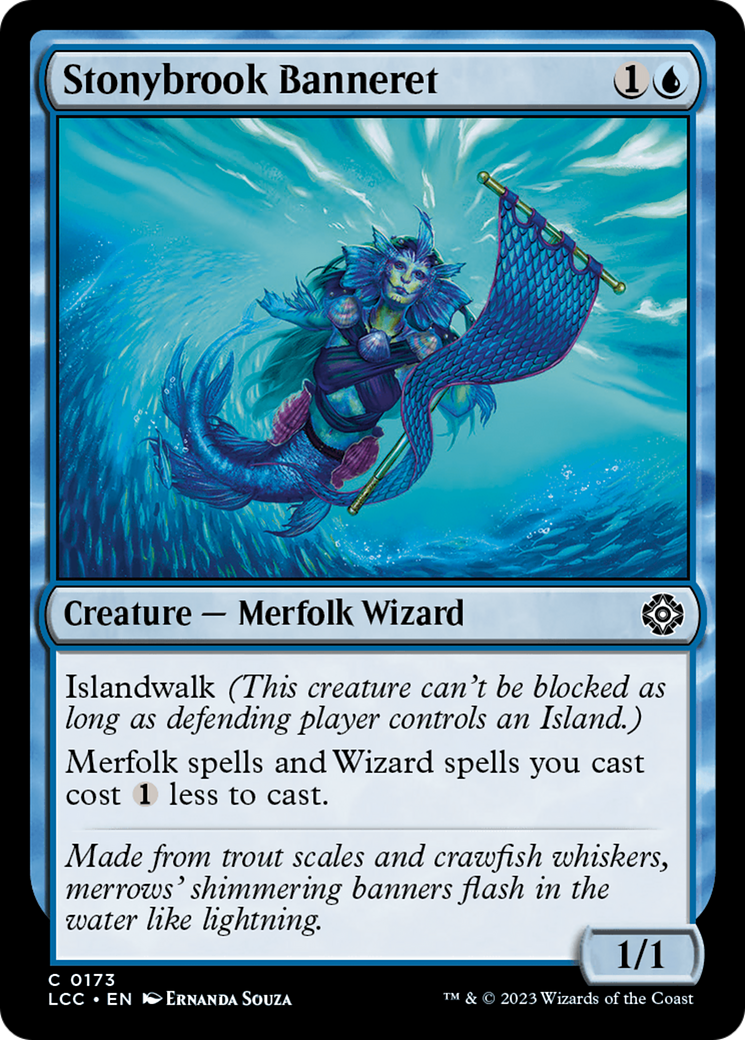
Stonybrook Banneret
Stonybrook Banneret
Creature — Merfolk Wizard
1/1
Islandwalk (This creature can't be blocked as long as defending player controls an Island.)
Merfolk spells and Wizard spells you cast cost less to cast.
- A spell you cast that's both creature types costs less to cast, not less.
- The effect reduces the total cost of the spell, regardless of whether you chose to pay additional or alternative costs. For example, if you cast a Rogue spell by paying its prowl cost, Frogtosser Banneret causes that spell to cost less.
-
1
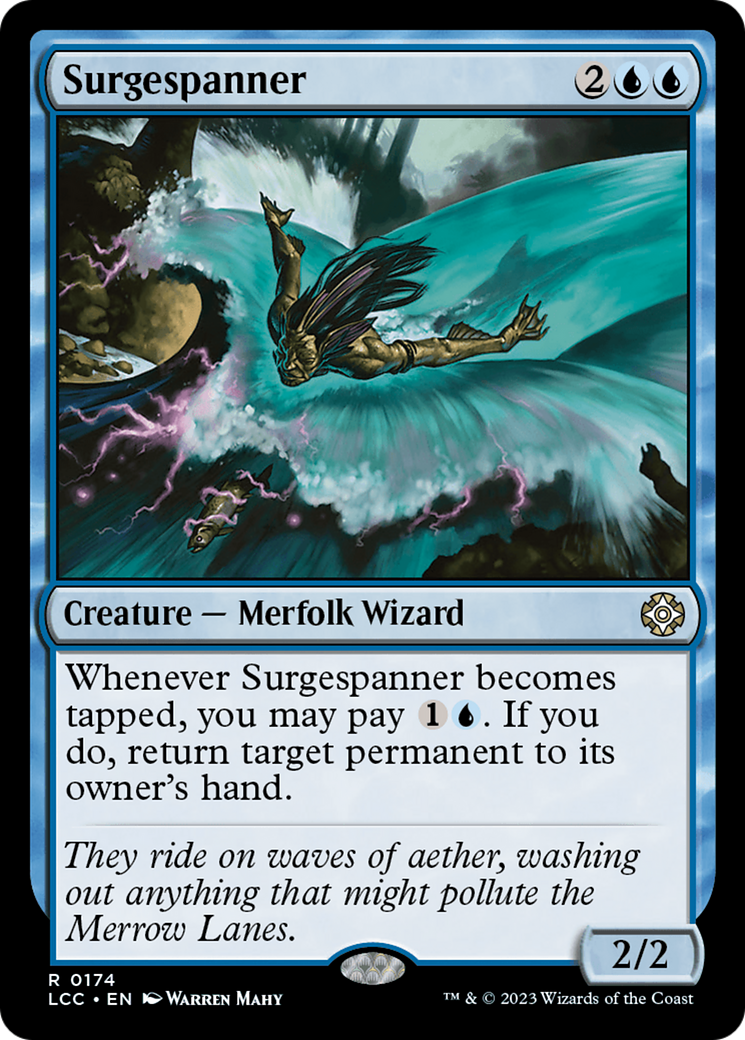
Surgespanner
Surgespanner
Creature — Merfolk Wizard
2/2
Whenever this creature becomes tapped, you may pay . If you do, return target permanent to its owner's hand.
- This is a triggered ability, not an activated ability. It doesn't allow you to tap the creature whenever you want; rather, you need some other way of tapping it, such as by attacking with the creature.
- For the ability to trigger, the creature has to actually change from untapped to tapped. If an effect attempts to tap the creature, but it was already tapped at the time, this ability won't trigger.
-
1
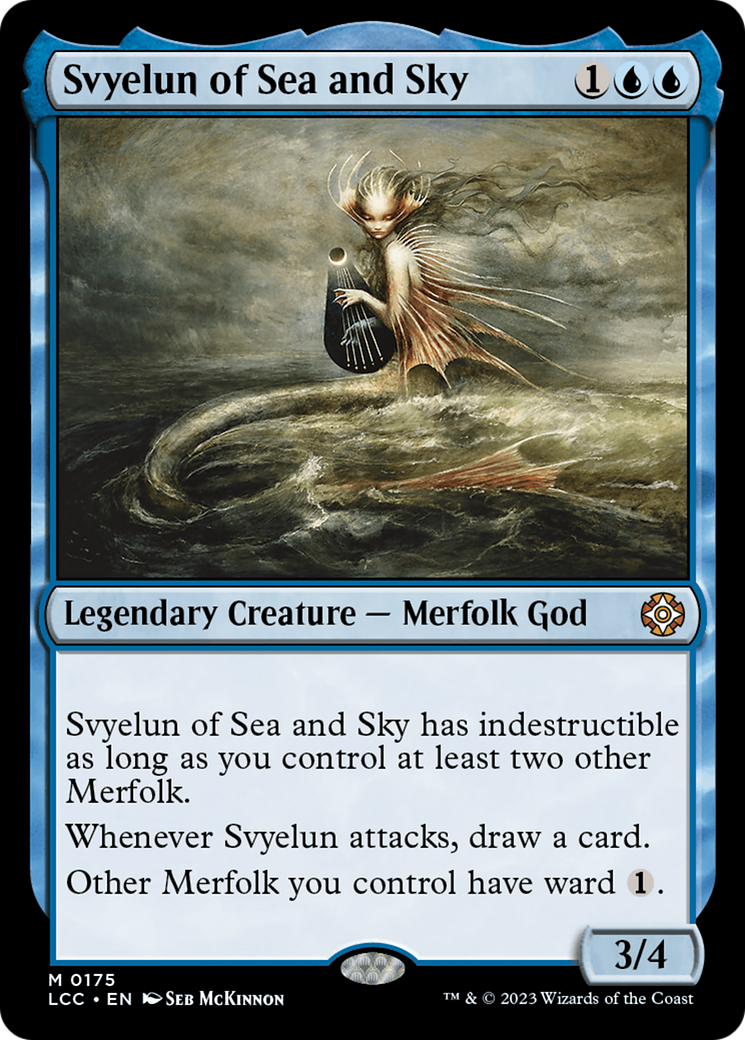
Svyelun of Sea and Sky
Svyelun of Sea and Sky
Legendary Creature — Merfolk God
3/4
Svyelun has indestructible as long as you control at least two other Merfolk.
Whenever Svyelun attacks, draw a card.
Other Merfolk you control have ward . (Whenever another Merfolk you control becomes the target of a spell or ability an opponent controls, counter it unless that player pays .)
- Damage dealt to creatures remains on those creatures until the cleanup step or until an effect removes that damage. If you control Svyelun of Sea and Sky with at least 4 damage and two other Merfolk and one of those Merfolk leaves the battlefield (or stops being a Merfolk), Svyelun will be destroyed.
- If a player casts a spell that targets multiple permanents their opponent controls with ward, each of those ward abilities will trigger. If that player doesn't pay for all of them, the spell will be countered.
-
1
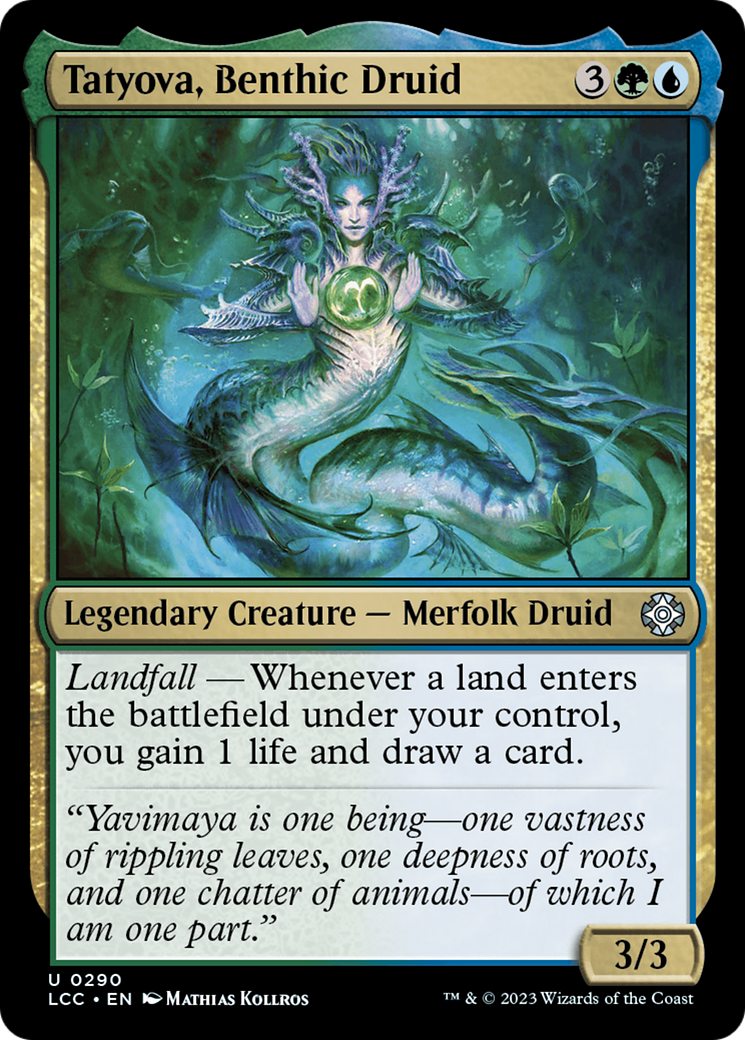
Tatyova, Benthic Druid
Tatyova, Benthic Druid
Legendary Creature — Merfolk Druid
3/3
Landfall — Whenever a land you control enters, you gain 1 life and draw a card.
- A landfall ability triggers whenever a land you control enters for any reason. It triggers whenever you play a land, as well as whenever a spell or ability puts a land onto the battlefield under your control.
- A landfall ability doesn't trigger if a permanent already on the battlefield becomes a land.
- Whenever a land you control enters, each landfall ability of the permanents you control will trigger. You can put them on the stack in any order. The last ability you put on the stack will be the first one to resolve (As a result, you can have those abilities resolve in the order of your choosing.).
-
1
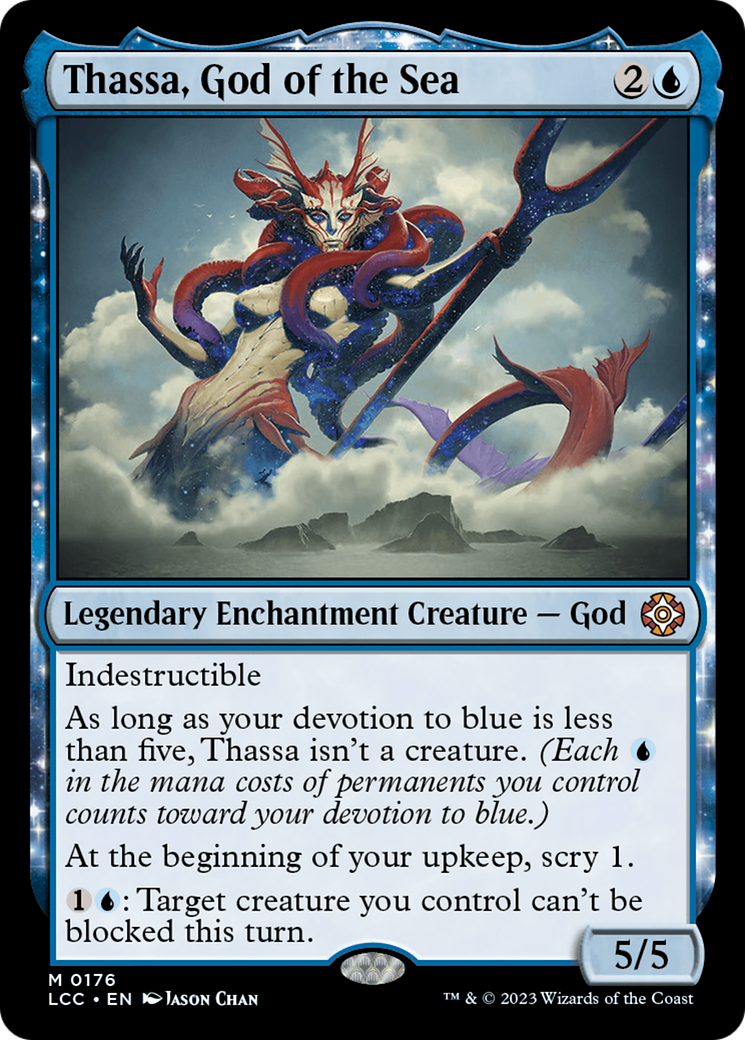
Thassa, God of the Sea
Thassa, God of the Sea
Legendary Enchantment Creature — God
5/5
Indestructible
As long as your devotion to blue is less than five, Thassa isn't a creature. (Each in the mana costs of permanents you control counts toward your devotion to blue.)
At the beginning of your upkeep, scry 1.
: Target creature you control can't be blocked this turn.
- The type-changing ability that can make a God not be a creature functions only on the battlefield. It's always a creature card in other zones, regardless of your devotion to its color. It's always a creature spell while it's on the stack.
- As a God enters the battlefield, your devotion to its color will determine whether any replacement effects that affect creatures entering the battlefield apply to that God. Because replacement effects are considered before the God is on the battlefield, the mana symbols in its mana cost won't be counted when determining this.
- When a God enters the battlefield, your devotion to its color (including the mana symbols in the mana cost of the God itself) will determine if a creature entered the battlefield or not for abilities that trigger whenever a creature enters the battlefield.
- If a God stops being a creature, it loses the type creature and the creature type God. It continues to be a legendary enchantment.
- The abilities of Gods function as long as they're on the battlefield, regardless of whether they're creatures.
- If a God is attacking or blocking and it stops being a creature, it will be removed from combat. It won't rejoin combat if it resumes being a creature later during that combat.
- Counters put on a God remain on it while it's not a creature, even if they have no effect.
- If an effect causes a God to lose all abilities, its ability that causes it to stop being a creature still applies if appropriate.
- Activating Thassa's last ability after the target creature has been blocked won't change or undo the block.
- Scry appears on some spells and abilities with one or more targets. If all of the spell or ability's targets are illegal when it tries to resolve, it won't resolve and none of its effects will happen. You won't scry.
- Numeric mana symbols ( , , and so on) in mana costs of permanents you control don't count toward your devotion to any color.
- Mana symbols in the text boxes of permanents you control don't count toward your devotion to any color.
- Hybrid mana symbols, monocolored hybrid mana symbols, and Phyrexian mana symbols do count toward your devotion to their color(s).
- If an activated ability or triggered ability has an effect that depends on your devotion to a color, you count the number of mana symbols of that color among the mana costs of permanents you control as the ability resolves. The permanent with that ability will be counted if it's still on the battlefield at that time.
- When you scry, you may put all the cards you look at back on top of your library, you may put all of those cards on the bottom of your library, or you may put some of those cards on top and the rest of them on the bottom.
- You choose how to order cards returned to your library after scrying no matter where you put them.
- You perform the actions stated on a card in sequence. For some spells and abilities, that means you'll scry last. For others, that means you'll scry and then perform other actions.
-
1
Thieving Skydiver
Thieving Skydiver
Creature — Merfolk Rogue
2/1
Kicker . X can't be 0. (You may pay an additional as you cast this spell.)
Flying
When this creature enters, if it was kicked, gain control of target artifact with mana value X or less. If that artifact is an Equipment, attach it to this creature.
- To determine a spell's total cost, start with the mana cost (or an alternative cost if another card's effect allows you to pay one instead), add any cost increases (such as kicker), then apply any cost reductions. The spell's mana value remains unchanged, no matter what the total cost to cast it was.
- If you put a permanent with a kicker ability onto the battlefield without casting it, you can't kick it.
- If you copy a kicked spell on the stack, the copy is also kicked. If the copied spell is a permanent spell, the token the copy of that spell becomes when it enters is also kicked.
- If a card or token enters as a copy of a permanent, the new permanent isn't kicked, even if the original was.
- If a spell's kicker cost was paid, the spell is "kicked."
- The kicker ability doesn't let you pay a kicker cost more than once.
- Thieving Skydiver's ability can target an artifact you already control. You'll attach it to Thieving Skydiver if it's an Equipment.
- The control-change effect of Thieving Skydiver lasts indefinitely. It doesn't wear off during the cleanup step, and it doesn't expire if Thieving Skydiver leaves the battlefield. In a multiplayer game, it does expire if you leave the game.
- If the Equipment can't be attached to Thieving Skydiver, most likely because Thieving Skydiver has left the battlefield before its triggered ability resolves, the Equipment remains attached to whatever it's currently attached to or remains unattached if attached to nothing.
-
1
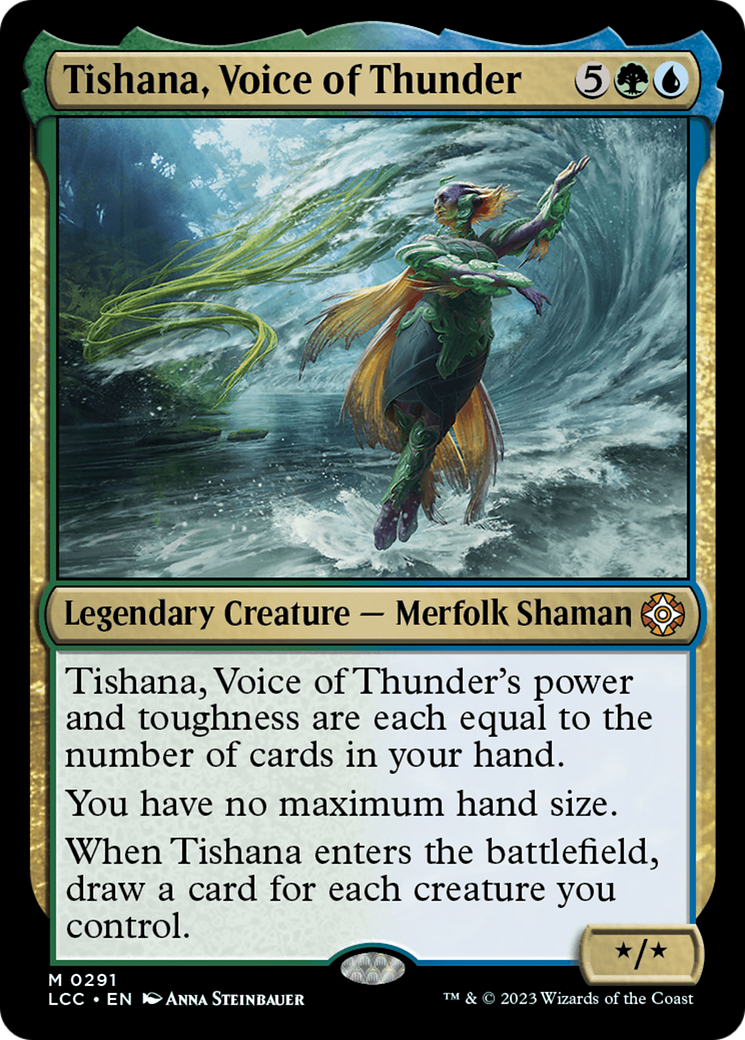
Tishana, Voice of Thunder
Tishana, Voice of Thunder
Legendary Creature — Merfolk Shaman
*/*
Tishana's power and toughness are each equal to the number of cards in your hand.
You have no maximum hand size.
When Tishana enters, draw a card for each creature you control.
- The number of creatures you control is counted only as Tishana's last ability resolves. If Tishana is still on the battlefield, it'll count itself.
- If Tishana enters the battlefield while you have no cards in hand, it will be put into your graveyard for having 0 toughness before its triggered ability resolves.
- Because damage remains marked on a creature until it's removed as the turn ends, the damage Tishana takes during combat may become lethal if cards leave your hand later in the turn, such as by casting them in your postcombat main phase.
-
1
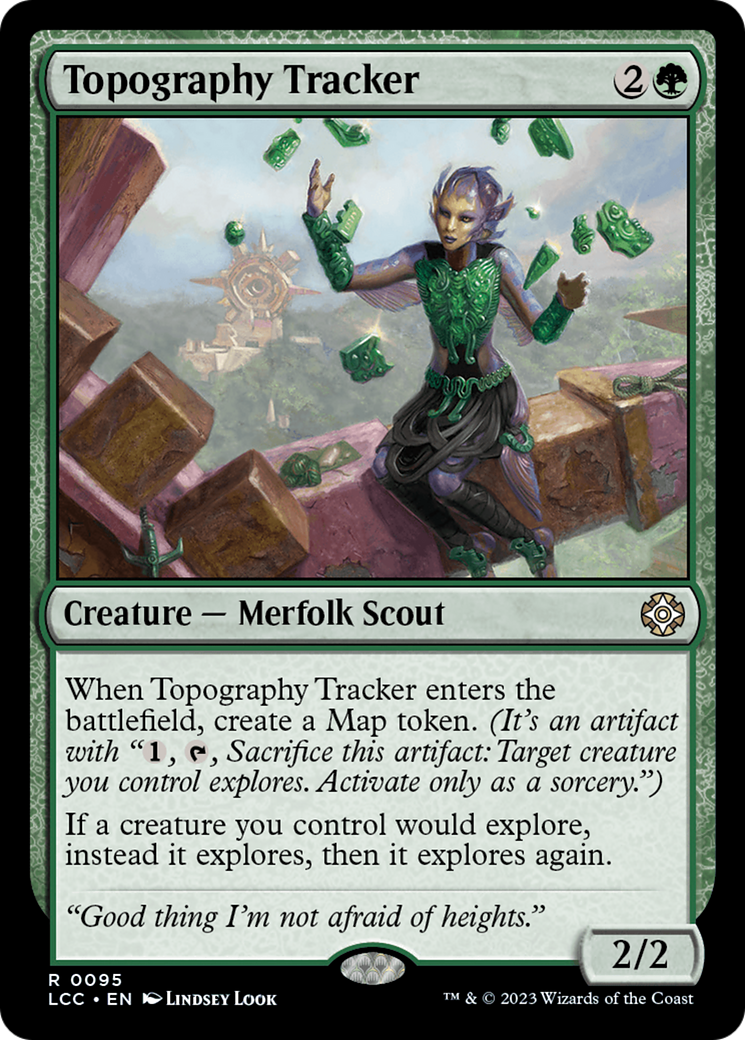
Topography Tracker
Topography Tracker
Creature — Merfolk Scout
2/2
When this creature enters, create a Map token. (It's an artifact with " , , Sacrifice this token: Target creature you control explores. Activate only as a sorcery.")
If a creature you control would explore, instead it explores, then it explores again.
- If an ability instructs a creature to explore, its controller reveals the top card of their library. If it's a land card, they'll put it into their hand. Otherwise, they'll put a +1/+1 counter on that creature, then choose to either leave that card on top of their library or put it into their graveyard.
- Once an ability that causes a creature to explore begins to resolve, no player may take any other actions until it's done. Notably, opponents can't try to remove the exploring creature after you reveal a nonland card but before it receives a counter.
- If no card is revealed, most likely because that player's library is empty, the exploring creature receives a +1/+1 counter.
- If a resolving spell or ability instructs a specific creature to explore but that creature has left the battlefield, the creature still explores. If you reveal a nonland card this way, you won't put a +1/+1 counter on anything, but you may put the revealed card into your graveyard. Effects that trigger "whenever a creature explores" trigger as appropriate.
- Some spells or abilities might cause a creature to explore multiple times in a row. If you reveal a nonland card when a creature explores and leave it on top of your library, then the creature explores again immediately afterwards, you'll reveal the same card again.
- In some unusual cases, noncreature permanents may explore. For example, if the creature card returned by Defossilize is somehow not a creature once it's on the battlefield, it can still explore. You'll take all the same actions, and you may end up putting a +1/+1 counter on the permanent. (Note that some effects target a creature, and those effects would still require a legal target to have it explore.)
- Map tokens are a kind of predefined token. Each one is a colorless artifact with the artifact subtype Map and the ability " , , Sacrifice this artifact: Target creature you control explores. Activate only as a sorcery."
-
1
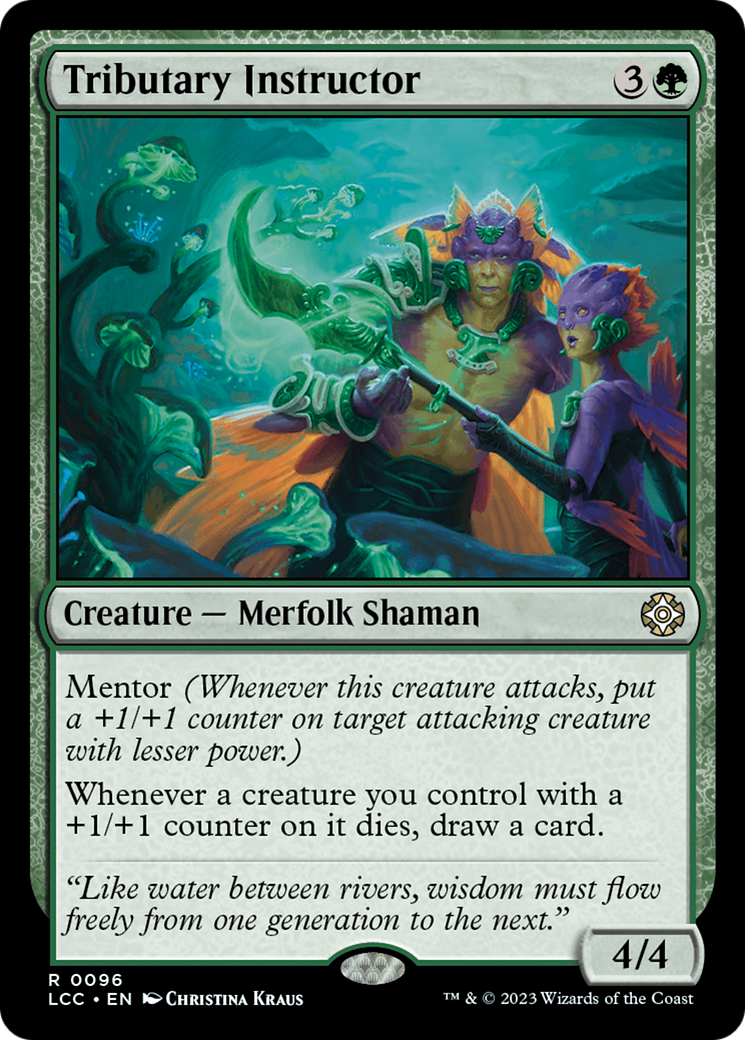
Tributary Instructor
Tributary Instructor
Creature — Merfolk Shaman
4/4
Mentor (Whenever this creature attacks, put a +1/+1 counter on target attacking creature with lesser power.)
Whenever a creature you control with a +1/+1 counter on it dies, draw a card.
- Mentor compares the power of the creature with mentor with that of the target creature at two different times: once as the triggered ability is put onto the stack, and once as the triggered ability resolves. If you wish to raise a creature's power so its mentor ability can target a bigger creature, the last chance you have to do so is during the beginning of combat step.
- If the target creature's power is no longer less than the attacking creature's power as the ability resolves, mentor doesn't add a +1/+1 counter. For example, if two 3/3 creatures with mentor attack and both mentor triggers target the same 2/2 creature, the first to resolve puts a +1/+1 counter on it and the second does nothing.
- If the creature with mentor leaves the battlefield with mentor on the stack, use its power as that creature last existed on the battlefield to determine whether the target creature has less power.
-
1
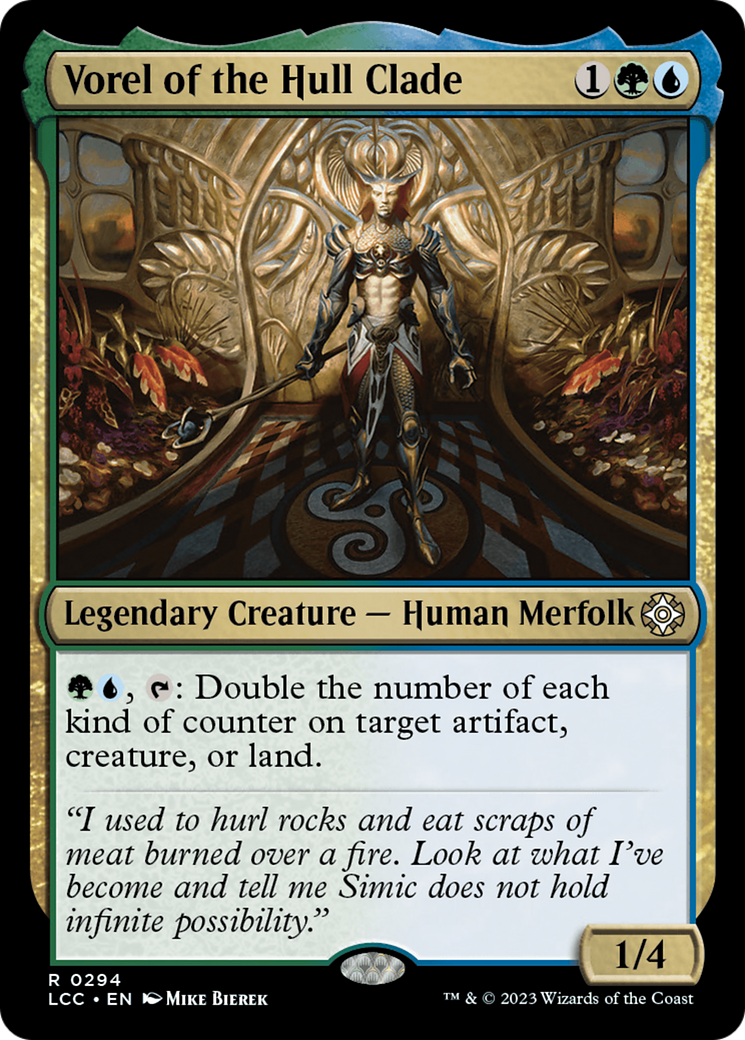
Vorel of the Hull Clade
Vorel of the Hull Clade
Legendary Creature — Human Merfolk
1/4
, : Double the number of each kind of counter on target artifact, creature, or land.
- The effect of Vorel's ability will essentially double the counters on the target artifact, creature, or land. For example, if a creature has three +1/+1 counters and a divinity counter on it before the ability resolves, it will have six +1/+1 counters and two divinity counters on it after the ability resolves.
-
1
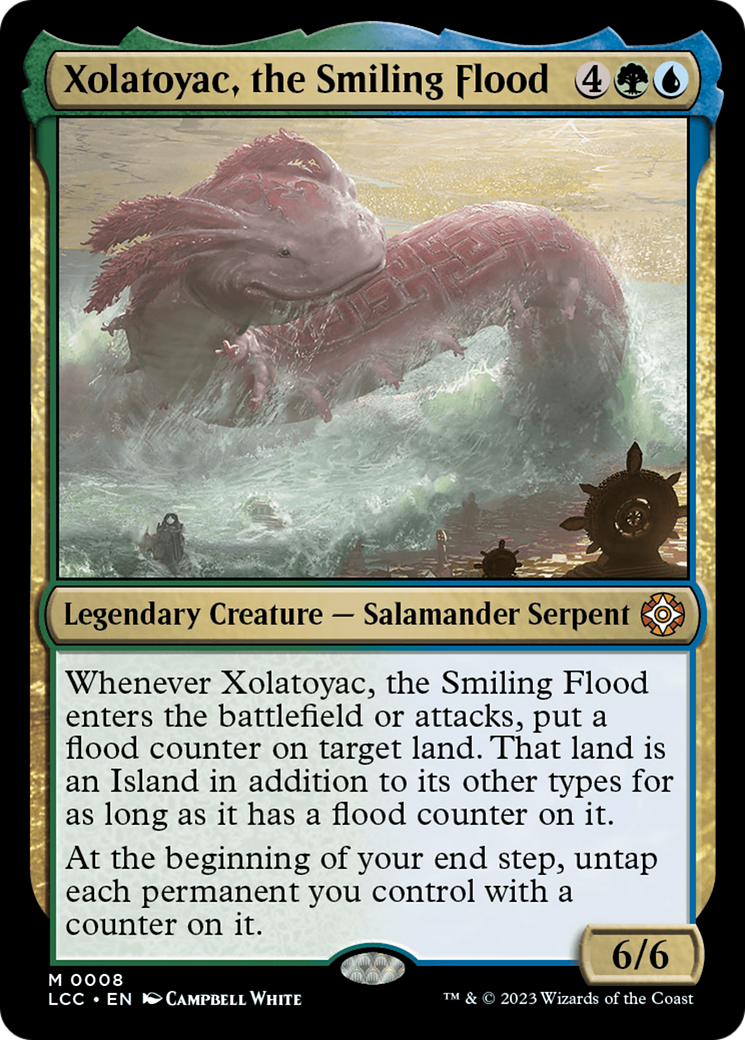
Xolatoyac, the Smiling Flood
Xolatoyac, the Smiling Flood
Legendary Creature — Salamander Serpent
6/6
Whenever Xolatoyac enters or attacks, put a flood counter on target land. That land is an Island in addition to its other types for as long as it has a flood counter on it.
At the beginning of your end step, untap each permanent you control with a counter on it.
- The land stays an Island until the flood counter is removed, even if Xolatoyac, the Smiling Flood leaves the battlefield.
- The land retains any land types and abilities it already had. An Island has the ability " : Add ."
-
1
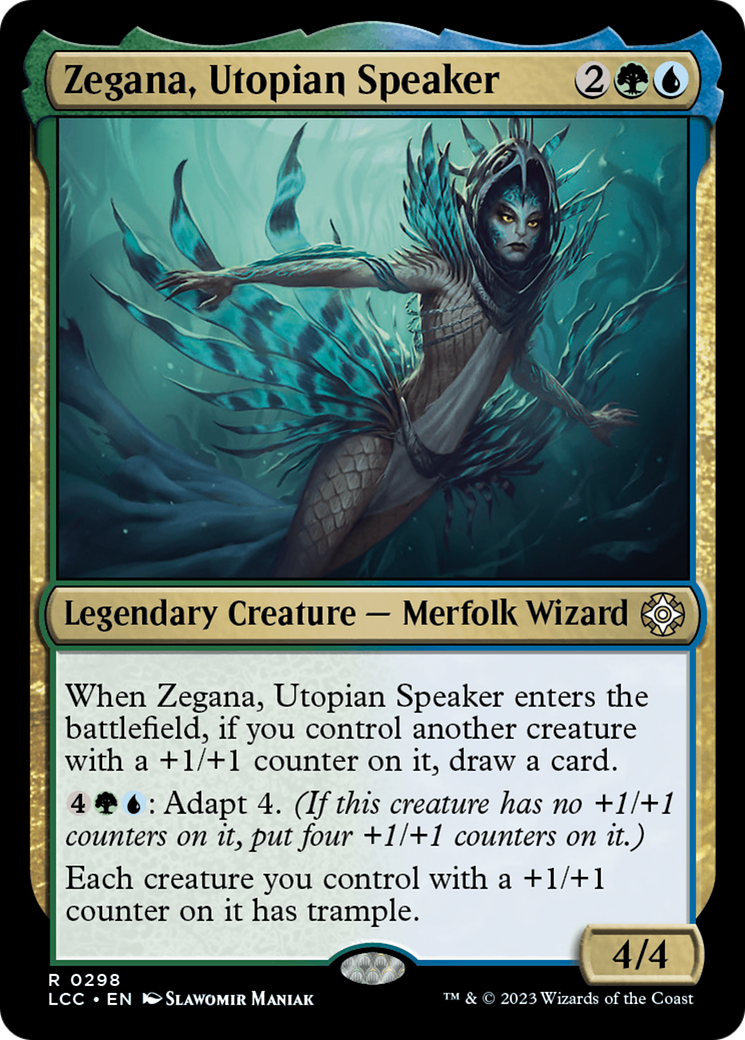
Zegana, Utopian Speaker
Zegana, Utopian Speaker
Legendary Creature — Merfolk Wizard
4/4
When Zegana enters, if you control another creature with a +1/+1 counter on it, draw a card.
: Adapt 4. (If this creature has no +1/+1 counters on it, put four +1/+1 counters on it.)
Each creature you control with a +1/+1 counter on it has trample.
- You can always activate an ability that will cause a creature to adapt. As that ability resolves, if the creature has a +1/+1 counter on it for any reason, you simply won't put any +1/+1 counters on it.
- If a creature somehow loses all of its +1/+1 counters, it can adapt again and get more +1/+1 counters.
Instants 9
-
1
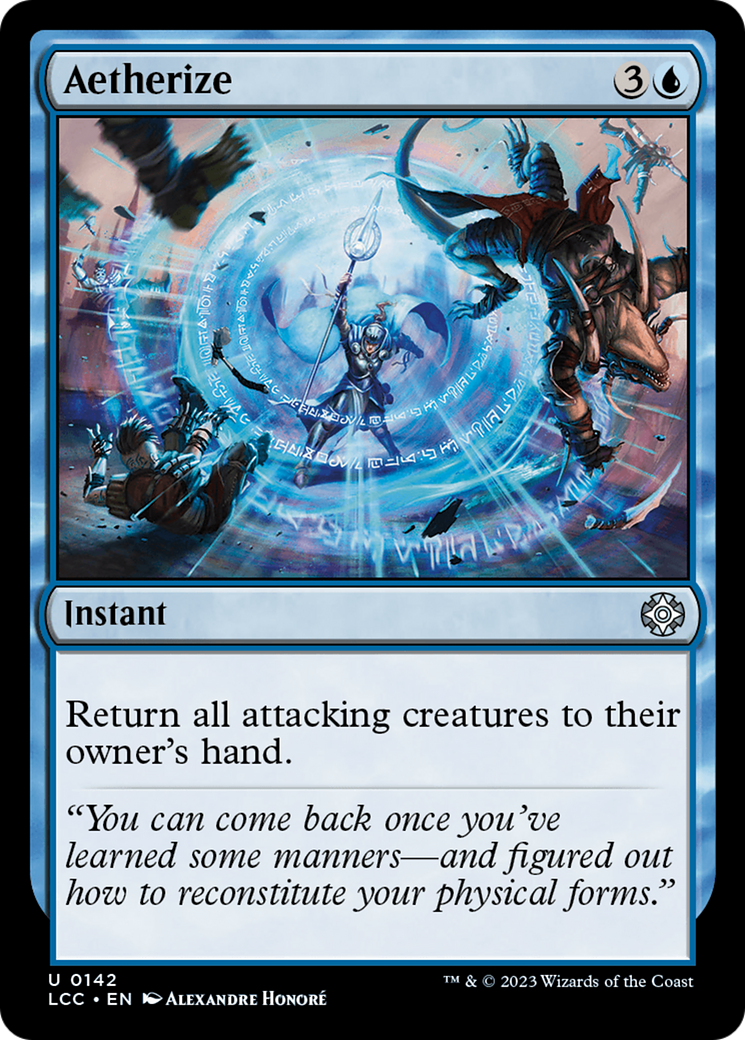
Aetherize
Aetherize
Instant
Return all attacking creatures to their owner's hand.
- An "attacking creature" is one that has been declared as an attacker this combat, or one that was put onto the battlefield attacking this combat. Unless that creature leaves combat, it continues to be an attacking creature through the end of combat step, even if the player it was attacking has left the game, or the planeswalker it was attacking has left combat. There's no such thing as an attacking creature outside of the combat phase.
-
1
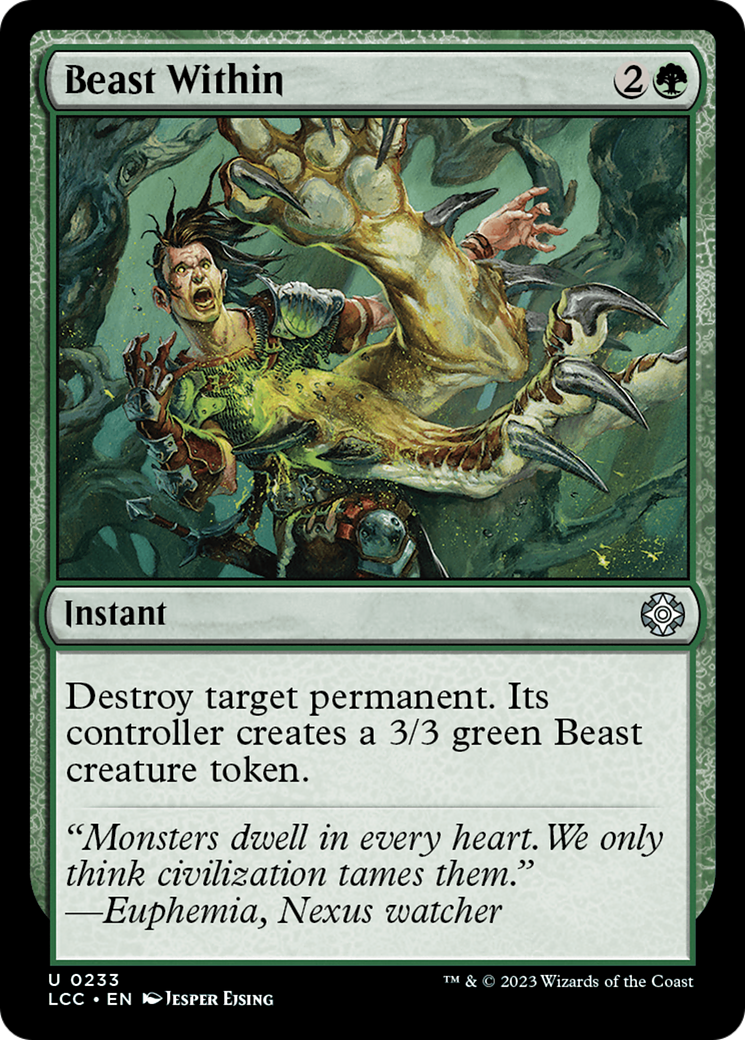
Beast Within
Beast Within
Instant
Destroy target permanent. Its controller creates a 3/3 green Beast creature token.
- If the target permanent is an illegal target by the time Beast Within tries to resolve, the spell won't resolve. No player creates a Beast token. If the target is legal but not destroyed (most likely because it has indestructible), its controller does create a Beast token.
-
1
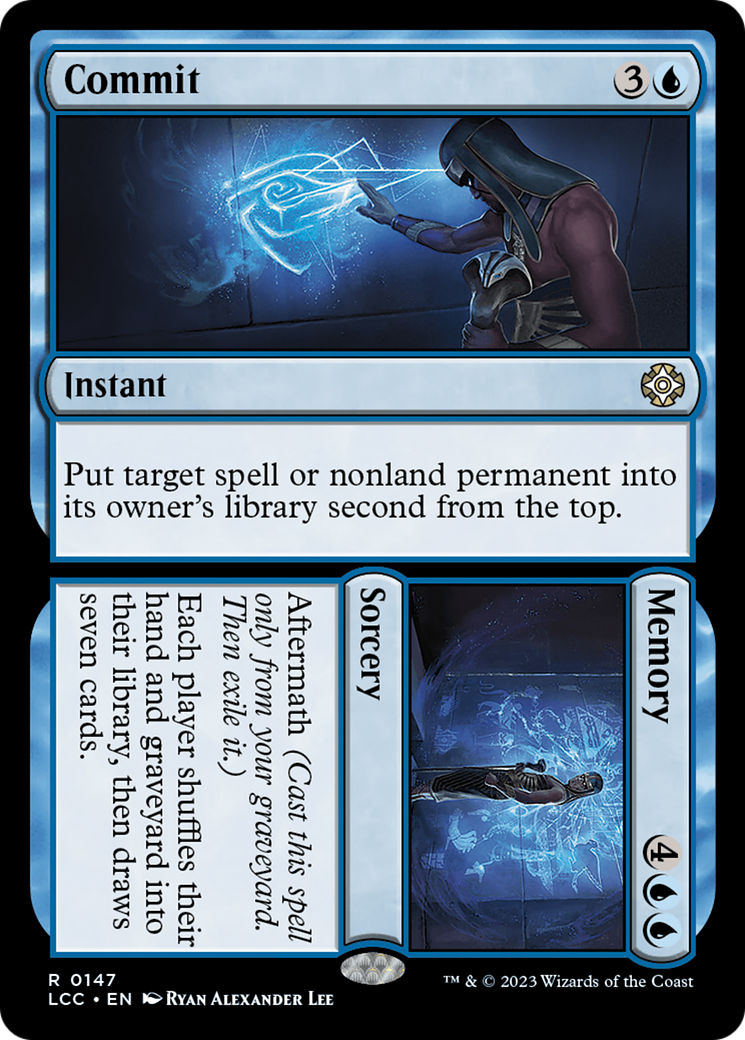
Commit // Memory
//
Commit
Instant
- Once you've started to cast a spell with aftermath from your graveyard, the card is immediately moved to the stack. Opponents can't try to stop the ability by exiling the card with an effect such as that of Crook of Condemnation.
- If a spell is put into its owner's library, it's removed from the stack and thus will not resolve. The spell isn't countered; it just no longer exists. This works against a spell that can't be countered.
- If a copy of a spell or a token is put into its owner's library, it's moved there, then it will cease to exist as a state-based action.
- Split cards with aftermath have a new frame treatment—the half you can cast from your hand is oriented the same as other cards you'd cast from your hand, while the half you can cast from your graveyard is a traditional split card half. This frame treatment is for your convenience and has no rules significance.
- All split cards have two card faces on a single card, and you put a split card onto the stack with only the half you're casting. The characteristics of the half of the card you didn't cast are ignored while the spell is on the stack. For example, if an effect prevents you from casting green spells, you can cast Destined of Destined // Lead, but not Lead.
- Each split card is a single card. For example, if you discard one, you've discarded one card, not two. If an effect counts the number of instant and sorcery cards in your graveyard, Destined // Lead counts once, not twice.
- If the target's owner's library contains no cards, the target spell or permanent will be put into that player's library as the only card.
- While not on the stack, the characteristics of a split card are the combination of its two halves. For example, Destined // Lead is a green and black card, it is both an instant card and a sorcery card, and its mana value is 6. This means that if an effect allows you to cast a card with mana value 2 from your hand, you can't cast Destined. This is a change from the previous rules for split cards.
- If you cast the first half of a split card with aftermath during your turn, you'll have priority immediately after it resolves. You can cast the half with aftermath from your graveyard before any player can take any other action if it's legal for you to do so.
- If another effect allows you to cast a split card with aftermath from any zone other than a graveyard, you can't cast the half with aftermath.
- If another effect allows you to cast a split card with aftermath from a graveyard, you may cast either half. If you cast the half that has aftermath, you'll exile the card if it would leave the stack.
- A spell with aftermath cast from a graveyard will always be exiled afterward, whether it resolves, it's countered, or it leaves the stack in some other way.
- Each split card has two names. If an effect instructs you to choose a card name, you may choose one, but not both.
-
1
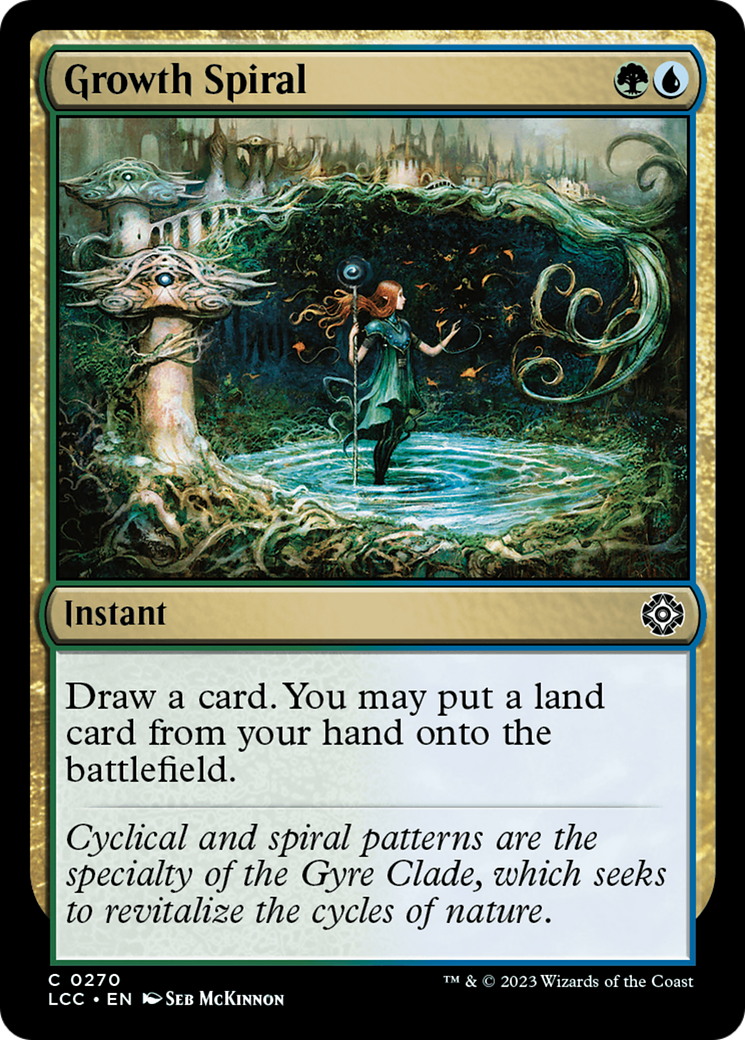
Growth Spiral
Growth Spiral
Instant
Draw a card. You may put a land card from your hand onto the battlefield.
- Growth Spiral's effect doesn't count as playing a land. It can put a land card onto the battlefield even if it's not your turn or if you've already played your land for the turn.
-
1
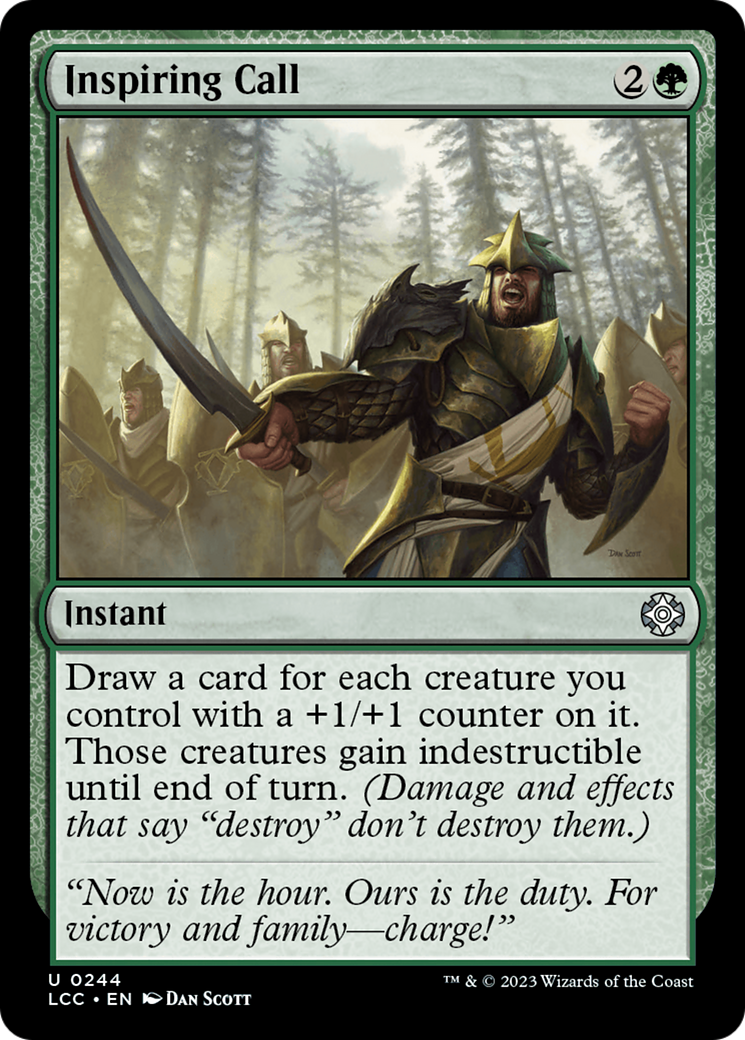
Inspiring Call
Inspiring Call
Instant
Draw a card for each creature you control with a +1/+1 counter on it. Those creatures gain indestructible until end of turn. (Damage and effects that say "destroy" don't destroy them.)
- Creatures you control that have +1/+1 counters put on them after Inspiring Call resolves won't gain indestructible.
- Once a creature gains indestructible, it will have it for the turn, even if it loses all its +1/+1 counters.
-
1
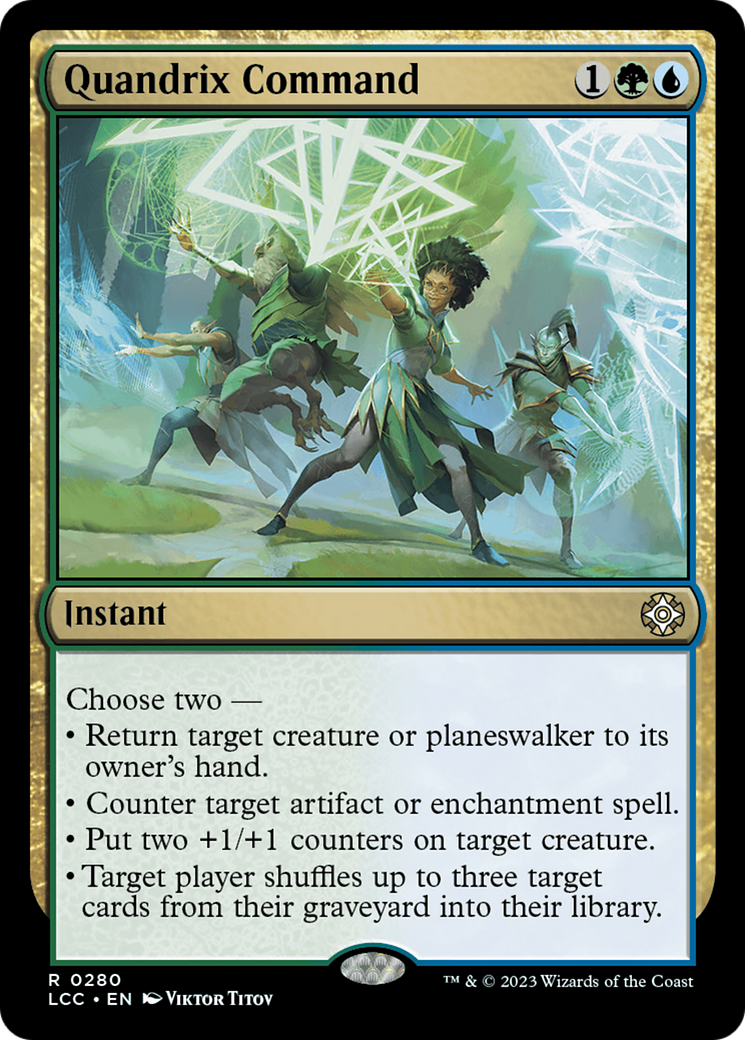
Quandrix Command
Quandrix Command
Instant
Choose two —
- Return target creature or planeswalker to its owner's hand.
- Counter target artifact or enchantment spell.
- Put two +1/+1 counters on target creature.
- Target player shuffles up to three target cards from their graveyard into their library.
- If at least one target is still legal as Quandrix Command tries to resolve, it will resolve and do as much as it can.
- As Quandrix Command tries to resolve, if the fourth mode is chosen and all of the target cards are illegal, but the target player is still legal, that player will still shuffle their library.
- If all of Quandrix Command's targets are illegal as it tries to resolve, it will do nothing.
-
1
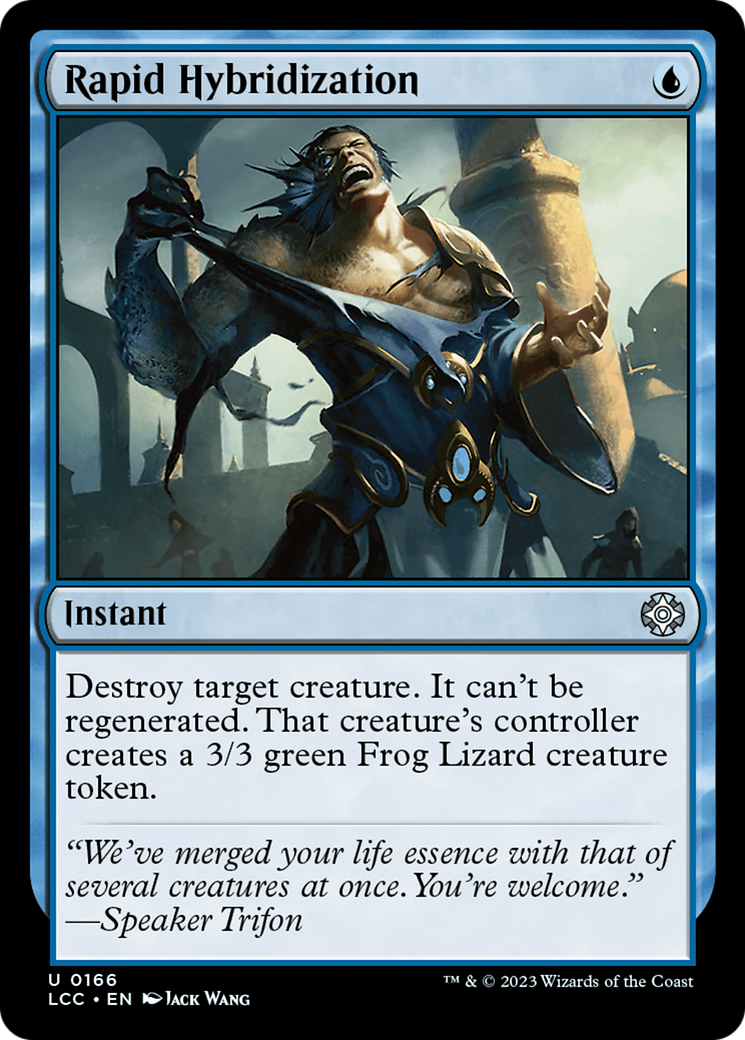
Rapid Hybridization
Rapid Hybridization
Instant
Destroy target creature. It can't be regenerated. That creature's controller creates a 3/3 green Frog Lizard creature token.
- If Rapid Hybridization resolves and the creature isn't destroyed (perhaps because it has indestructible), its controller will still get the Frog Lizard token.
- If the creature is an illegal target when Rapid Hybridization tries to resolve, it won't resolve and none of its effects will happen. No Frog Lizard token will be created.
-
1
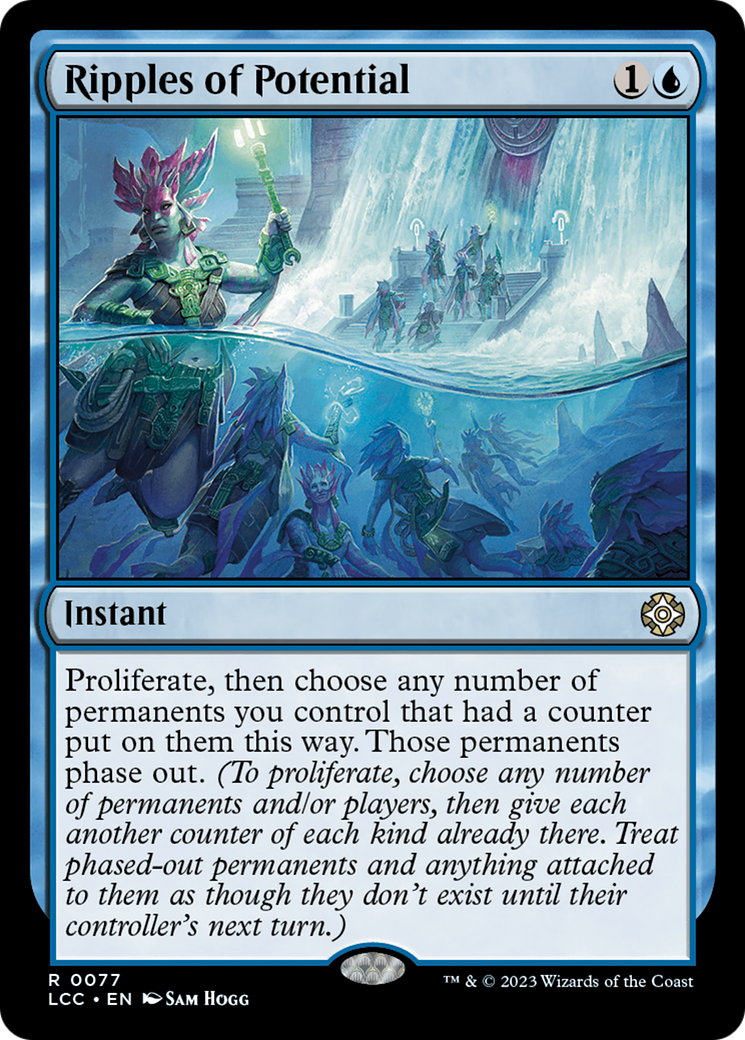
Ripples of Potential
Ripples of Potential
Instant
Proliferate, then choose any number of permanents you control that had a counter put on them this way. Those permanents phase out. (To proliferate, choose any number of permanents and/or players, then give each another counter of each kind already there. Treat phased-out permanents and anything attached to them as though they don't exist until their controller's next turn.)
- An ability that triggers "Whenever you proliferate" triggers even if you chose no permanents or players while doing so.
- A phased-out token will phase in at the beginning of its controller's untap step just like a nontoken permanent would.
- To proliferate, you can choose any permanent that has a counter, including ones controlled by opponents. You can choose any player who has a counter, including opponents. You can't choose cards in any zone other than the battlefield, even if they have counters on them.
- Players can respond to a spell or ability whose effect includes proliferating. Once that spell or ability starts to resolve, however, and its controller chooses which permanents and players will get new counters, it's too late for anyone to respond.
- You don't have to choose every permanent or player that has a counter, only the ones you want to add another counter to. Since "any number" includes zero, you don't have to choose any permanents at all, and you don't have to choose any players at all.
- Permanents phase back in during their controller's untap step, immediately before that player untaps their permanents. Creatures that phase in this way are able to attack and pay a cost of during that turn. If a permanent had counters on it when it phased out, it will have those counters when it phases back in.
- Phasing out doesn't cause any "leaves the battlefield" abilities to trigger. Similarly, phasing in won't cause any "enters the battlefield" abilities to trigger.
- Choices made for permanents as they entered the battlefield are remembered even after they phase in.
- If a player or permanent has more than one kind of counter on it, and you choose for it to get additional counters, it must get one of each kind of counter it already has. You can't have it get just one kind of counter it already has and not the others.
- Phased-out permanents are treated as though they don't exist. They can't be the target of spells or abilities, their static abilities have no effect on the game, their triggered abilities can't trigger, they can't attack or block, and so on.
- As a creature is phased out, Auras and Equipment attached to it also phase out at the same time. Those Auras and Equipment will phase in at the same time that creature does, and they'll phase in still attached to that creature.
- An attacking or blocking creature that phases out is removed from combat.
- Any continuous effects with a "for as long as" duration ignore phased-out objects. If ignoring those objects causes the effect's conditions to no longer be met, the duration will expire.
-
1
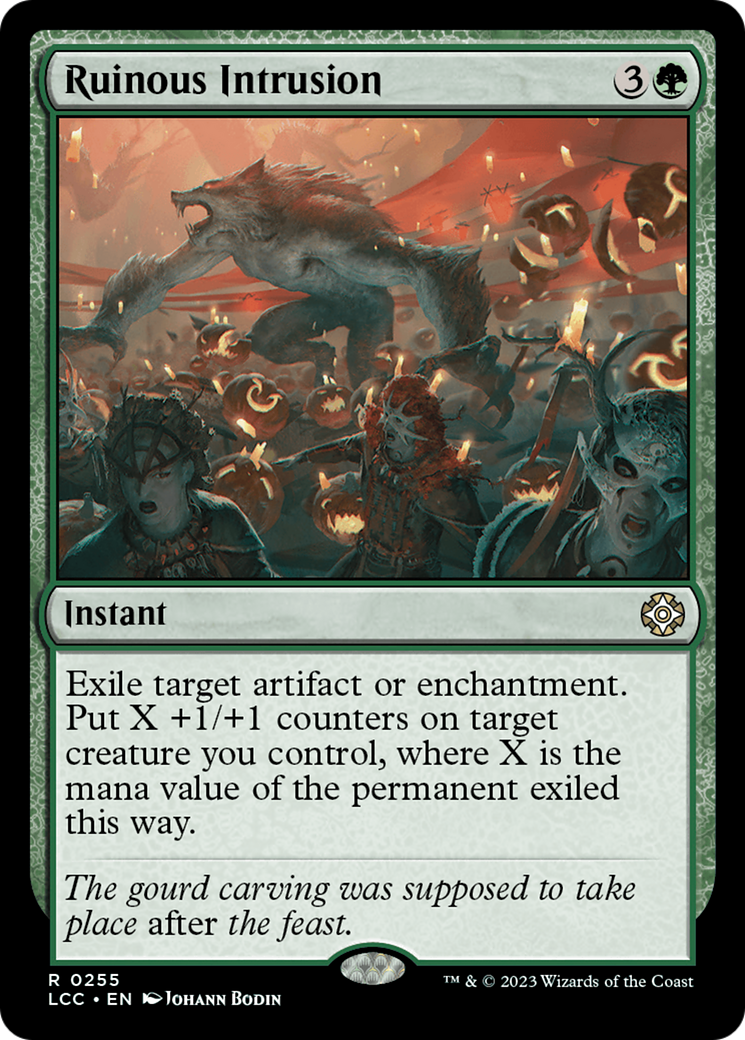
Ruinous Intrusion
Ruinous Intrusion
Instant
Exile target artifact or enchantment. Put X +1/+1 counters on target creature you control, where X is the mana value of the permanent exiled this way.
- Use the permanent's characteristics as it last existed on the battlefield to determine the value of X.
Sorceries 6
-
1
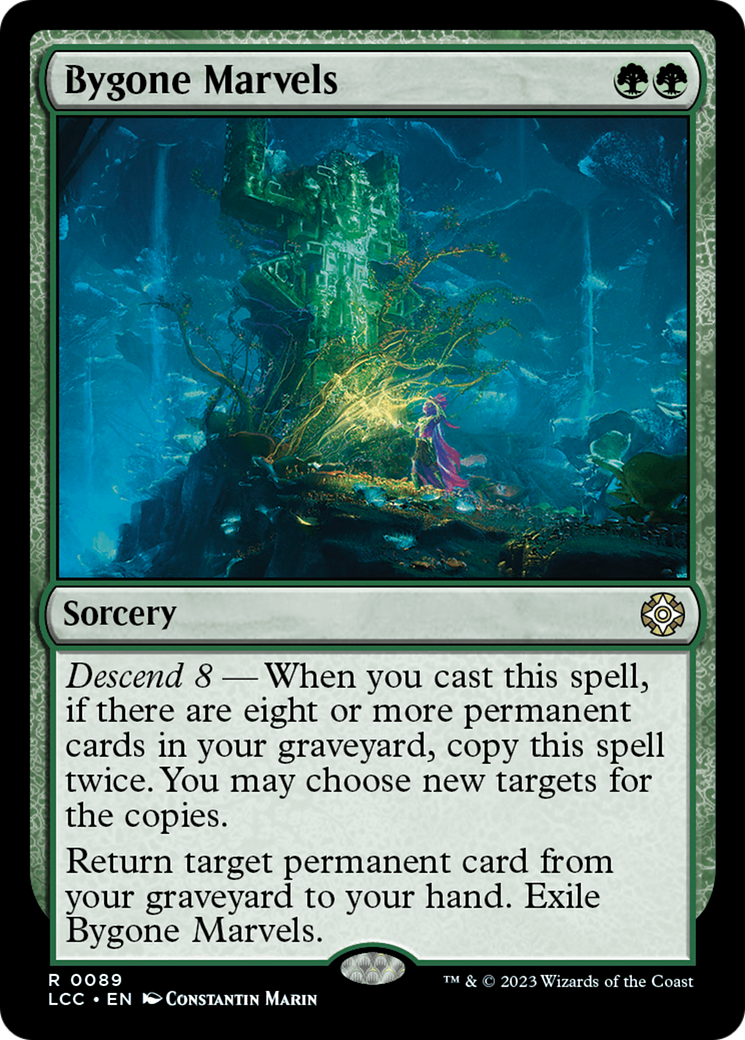
Bygone Marvels
Bygone Marvels
Sorcery
Descend 8 — When you cast this spell, if there are eight or more permanent cards in your graveyard, copy this spell twice. You may choose new targets for the copies.
Return target permanent card from your graveyard to your hand. Exile Bygone Marvels.
- The triggered ability will resolve before Bygone Marvels does. If Bygone Marvels is countered in response to its own triggered ability, you will still copy Bygone Marvels twice.
- Cards with the ability word "descend N" have abilities that care if you have at least N permanent cards in your graveyard.
- Some descend triggered abilities include intervening "if" clauses (i.e. "if you have [four or eight] permanent cards in your graveyard" in the middle of the ability). Each of these abilities checks your graveyard at the moment it would trigger to see if it does. If you don't have the required number of permanent cards in your graveyard at that time, the ability doesn't trigger at all. If it does trigger, it will check again as it tries to resolve. If you don't have the required number of permanent cards in your graveyard at that time, the ability won't resolve and none of its effects will happen.
-
1
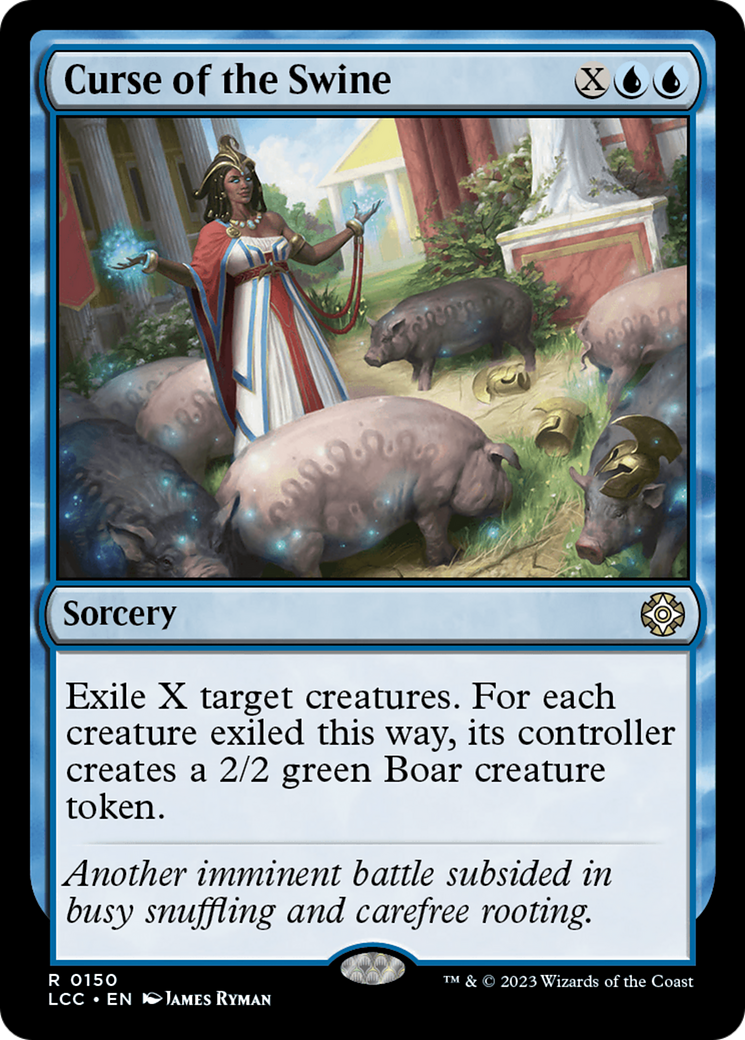
Curse of the Swine
Curse of the Swine
Sorcery
Exile X target creatures. For each creature exiled this way, its controller creates a 2/2 green Boar creature token.
-
1
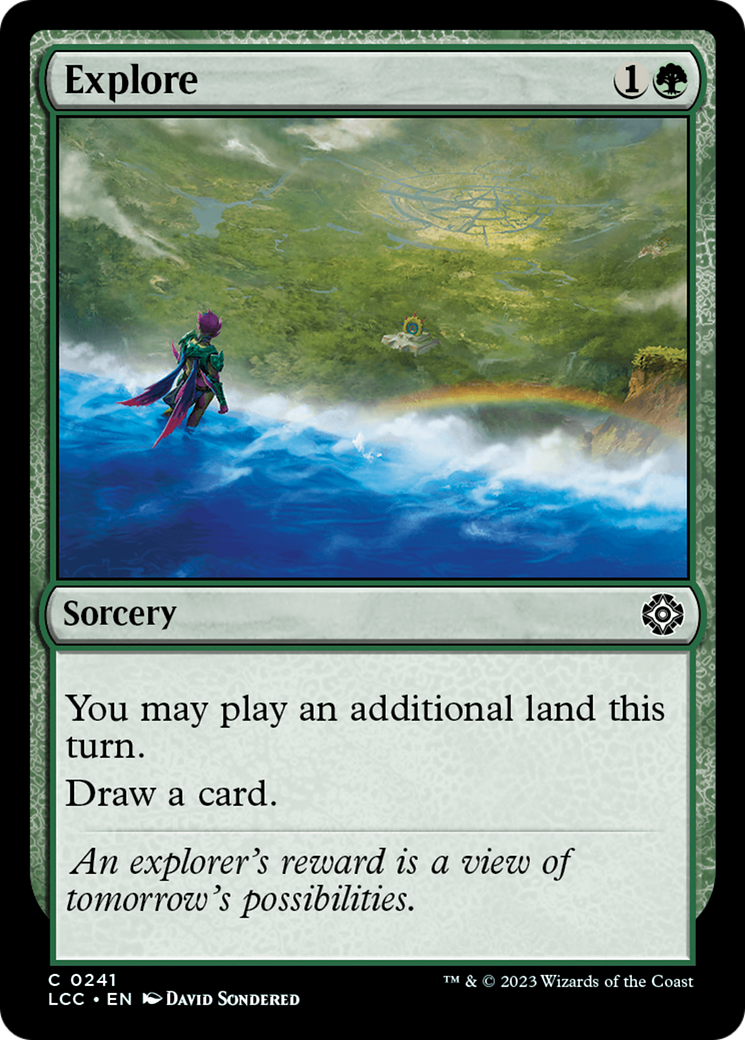
Explore
Explore
Sorcery
You may play an additional land this turn.
Draw a card.
- The effects of multiple Explores in the same turn are cumulative. They're also cumulative with other effects that let you play additional lands, such as the one from Urban Evolution.
- Explore's effect allows you to play an additional land during your main phase. Doing so follows the normal timing rules for playing lands. In particular, you don't get to play a land as Explore resolves; Explore fully resolves first and you draw a card, perhaps a land you'll play later.
- If you somehow manage to cast Explore when it's not your turn, you'll draw a card when it resolves, but you won't be able to play a land that turn.
-
1
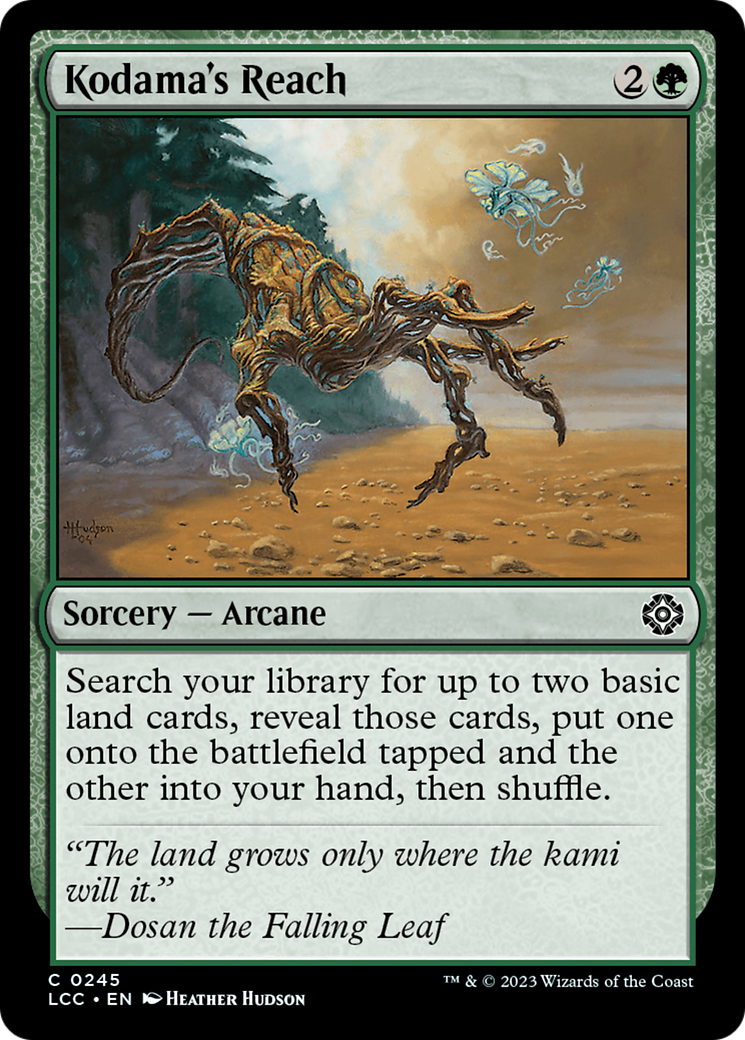
Kodama's Reach
Kodama's Reach
Sorcery — Arcane
Search your library for up to two basic land cards, reveal those cards, put one onto the battlefield tapped and the other into your hand, then shuffle.
- You can get just one basic land card if you wish (or even none at all). If you get only one land card, you put it onto the battlefield tapped.
-
1
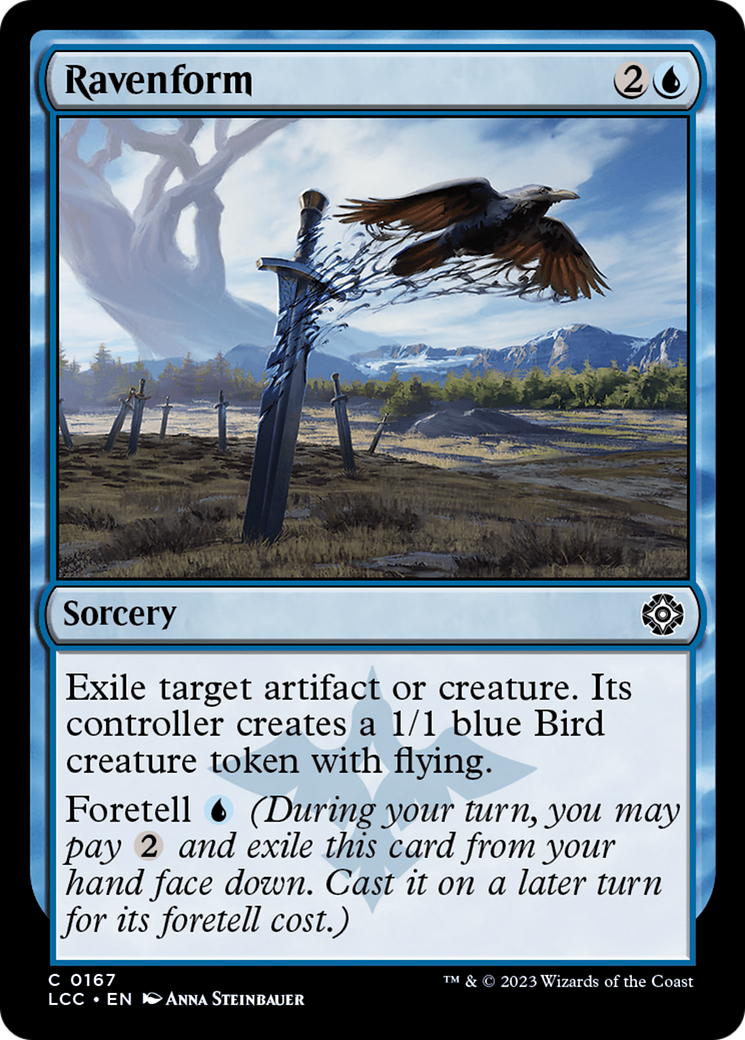
Ravenform
Ravenform
Sorcery
Exile target artifact or creature. Its controller creates a 1/1 blue Bird creature token with flying.
Foretell (During your turn, you may pay and exile this card from your hand face down. Cast it on a later turn for its foretell cost.)
- If the target artifact or creature is an illegal target as Ravenform tries to resolve, it won't resolve and none of its effects will happen. No player will create a Bird creature token.
- Because exiling a card with foretell from your hand is a special action, you can do so any time you have priority during your turn, including in response to spells and abilities. Once you announce you're taking the action, no other player can respond by trying to remove the card from your hand.
- Casting a foretold card from exile follows the timing rules for that card. If you foretell an instant card, you can cast it as soon as the next player's turn. In most cases, if you foretell a card that isn't an instant (or doesn't have flash), you'll have to wait until your next turn to cast it.
- If you're casting a foretold card from exile for its foretell cost, you can't choose to cast it for any other alternative costs. You can, however, pay additional costs, such as kicker costs. If the card has any mandatory additional costs, those must be paid to cast the spell.
-
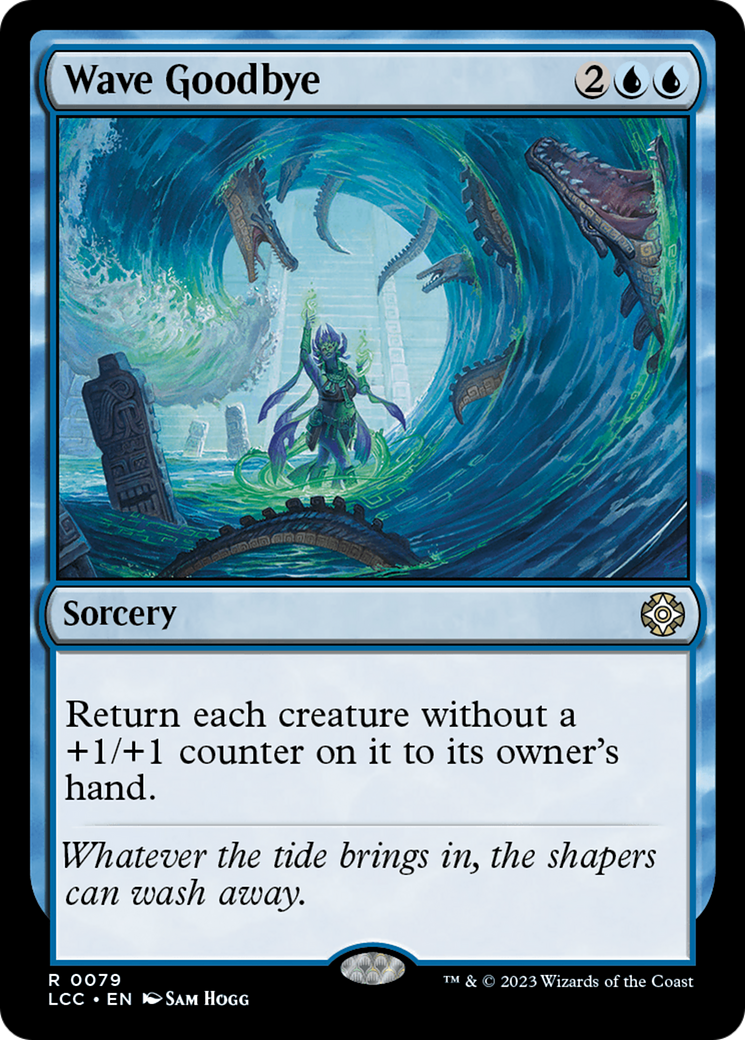
1
Wave Goodbye
Wave Goodbye
Sorcery
Return each creature without a +1/+1 counter on it to its owner's hand.
Artifacts 5
-
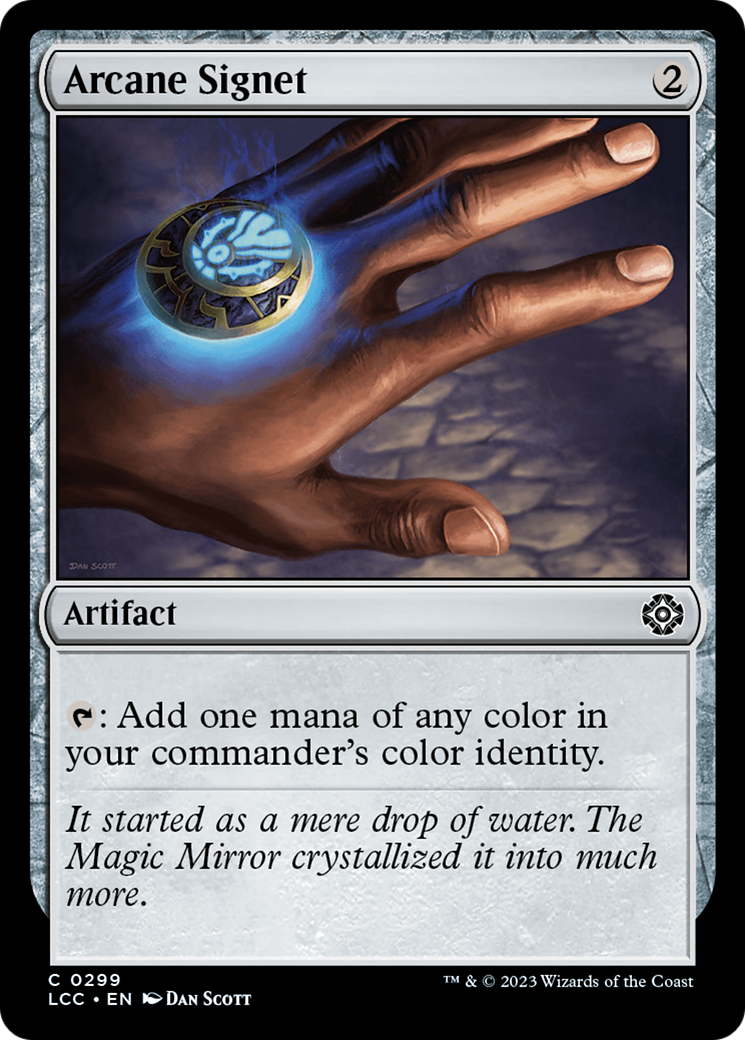
1
Arcane Signet
Arcane Signet
Artifact
: Add one mana of any color in your commander's color identity.
- If your commander is a card that has no colors in its color identity, Arcane Signet's ability produces no mana. It doesn't produce .
- If you have two commanders, the ability adds one mana of any color in their combined color identities.
- If you don't have a commander, Arcane Signet's ability produces no mana.
-
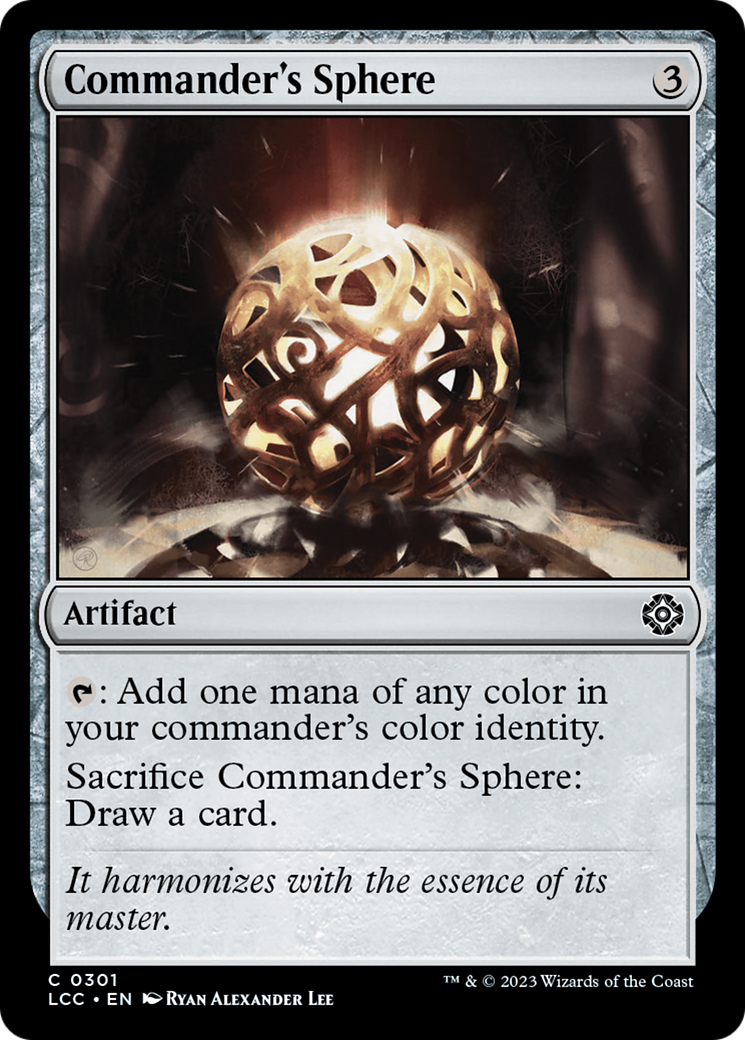
1
Commander's Sphere
Commander's Sphere
Artifact
: Add one mana of any color in your commander's color identity.
Sacrifice this artifact: Draw a card.
- If your commander is a card that has no colors in its color identity, Commander's Sphere's first ability produces no mana. It doesn't produce .
- If you don't have a commander, Commander's Sphere's first ability produces no mana.
- If you have two commanders, the ability adds one mana of any color in their combined color identities.
-
1
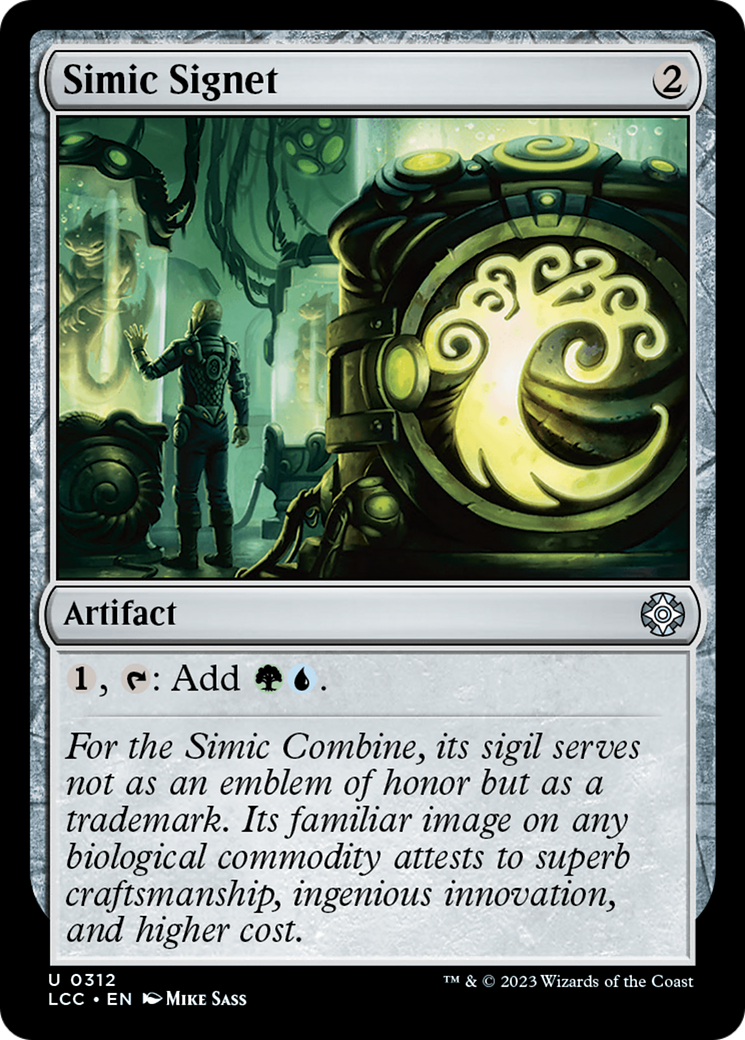
Simic Signet
Simic Signet
Artifact
, : Add .
-
1
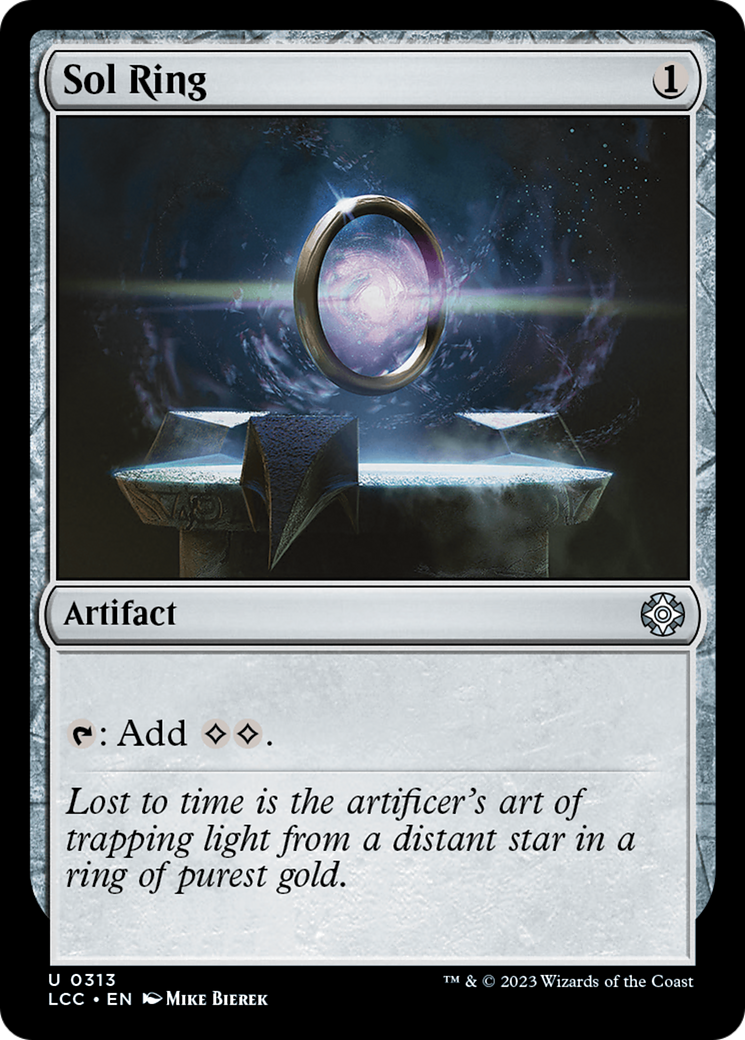
Sol Ring
Sol Ring
Artifact
: Add .
-
1
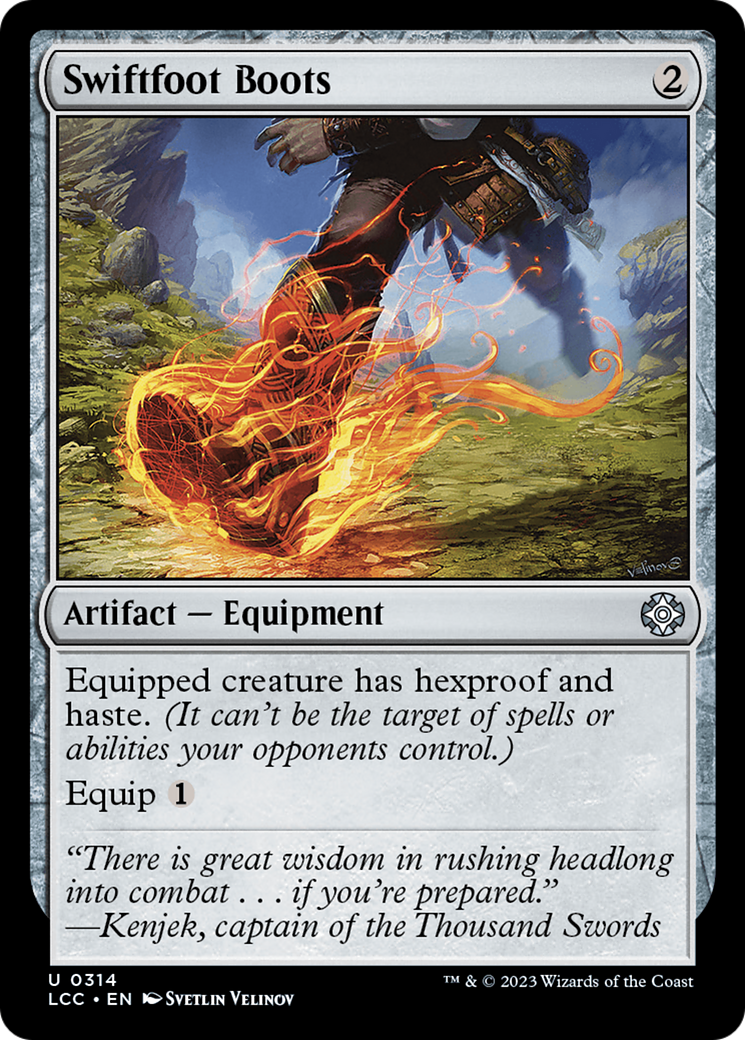
Swiftfoot Boots
Swiftfoot Boots
Artifact — Equipment
Equipped creature has hexproof and haste. (It can't be the target of spells or abilities your opponents control. It can attack and no matter when it came under your control.)
Equip ( : Attach to target creature you control. Equip only as a sorcery.)
- If a creature enters the battlefield under your control and gains haste, but then loses it before attacking, it won't be able to attack that turn. This means that you can't use one Swiftfoot Boots to allow two new creatures to attack in the same turn.
Enchantments 6
-
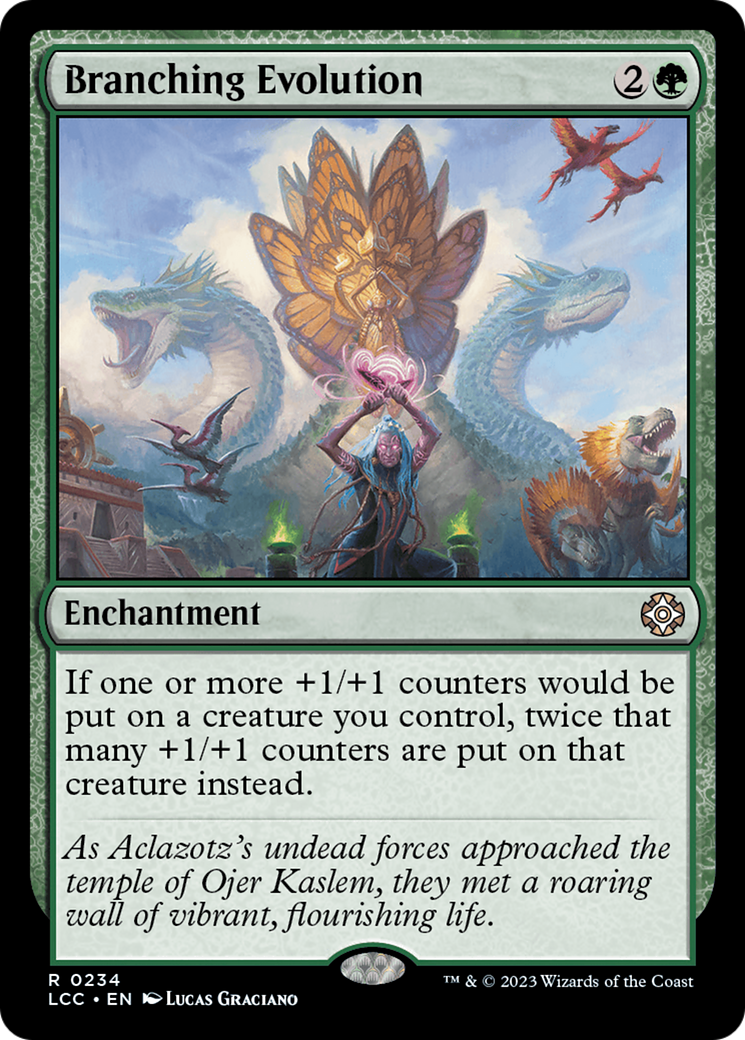
1
Branching Evolution
Branching Evolution
Enchantment
If one or more +1/+1 counters would be put on a creature you control, twice that many +1/+1 counters are put on that creature instead.
- If a creature you control would enter the battlefield with a number of +1/+1 counters on it, it enters with twice that many instead.
- If you control two Branching Evolutions, the number of +1/+1 counters put on a creature is four times the original number. Three Branching Evolutions multiplies the original number by eight, and so on.
- If two or more effects attempt to modify how many counters would be put onto a creature you control, you choose the order to apply those effects, no matter who controls the sources of those effects.
-
1
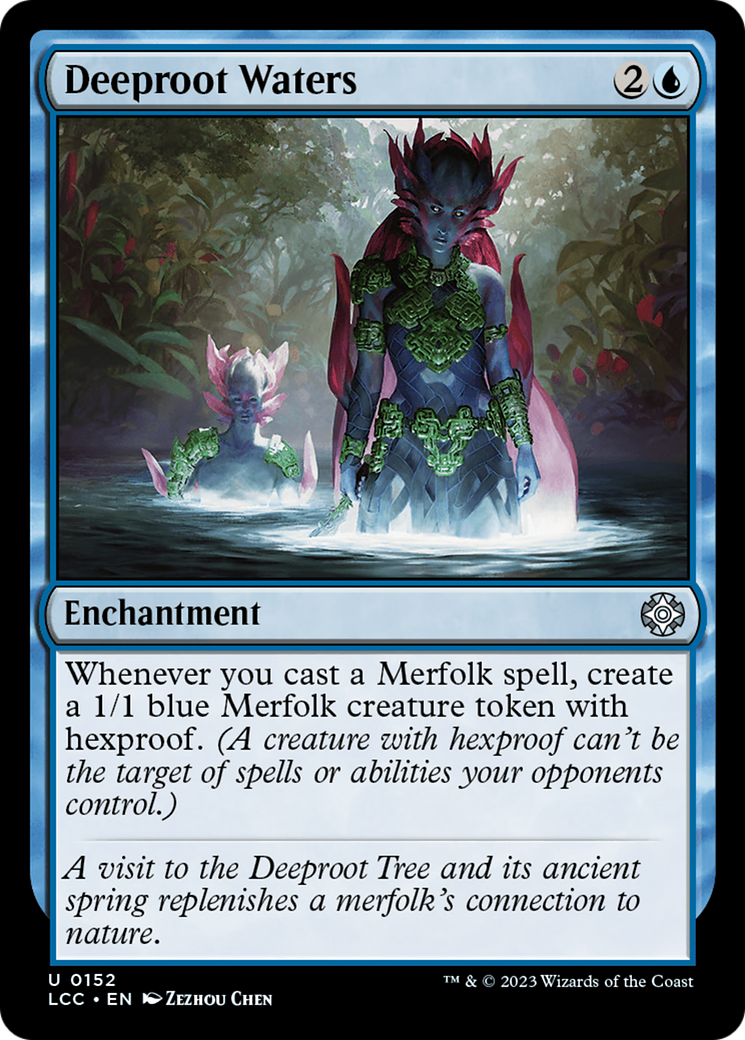
Deeproot Waters
Deeproot Waters
Enchantment
Whenever you cast a Merfolk spell, create a 1/1 blue Merfolk creature token with hexproof. (A creature with hexproof can't be the target of spells or abilities your opponents control.)
- If an effect refers to a "[subtype] spell" or "[subtype] card," it refers only to a spell or card that has that subtype. For example, March of the Drowned is a card that benefits Pirates and features Pirates in its illustration, but it isn't a Pirate card.
- The ability of Deeproot Waters resolves before the spell that caused it to trigger.
-
1
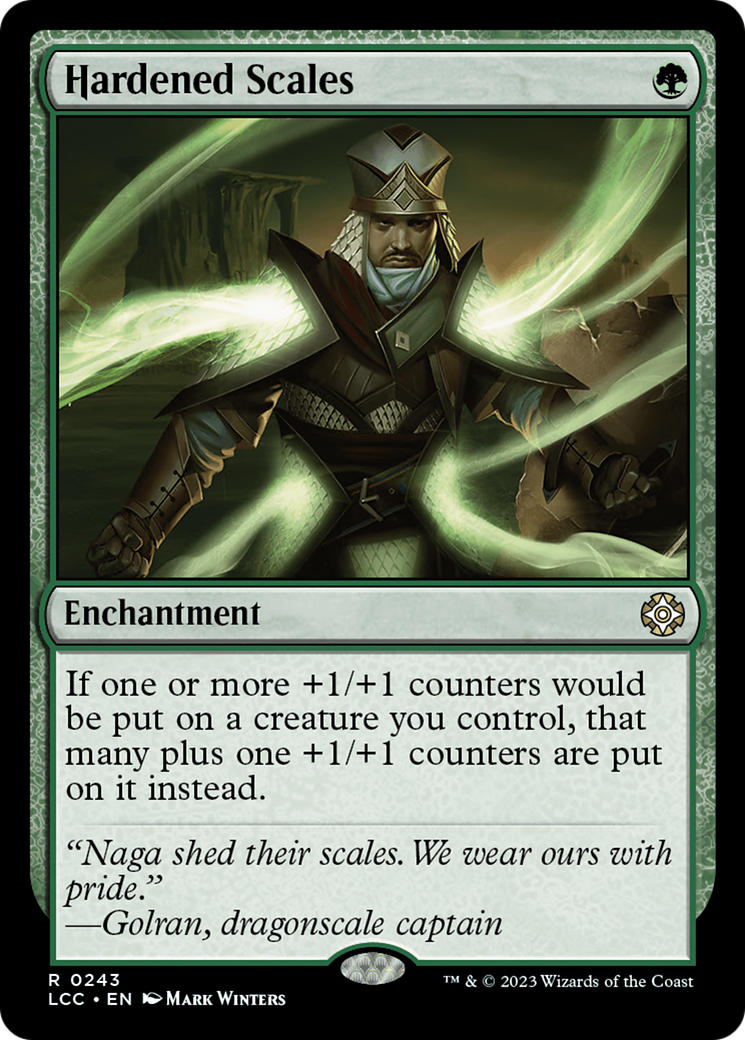
Hardened Scales
Hardened Scales
Enchantment
If one or more +1/+1 counters would be put on a creature you control, that many plus one +1/+1 counters are put on it instead.
- If a creature you control would enter the battlefield with a number of +1/+1 counters on it, it enters with that many plus one instead.
- If two or more effects attempt to modify how many counters would be put on a creature you control, you choose the order to apply those effects, no matter who controls the sources of those effects.
- Each additional Hardened Scales you control will increase the number of +1/+1 counters placed on a creature you control by one.
-
1
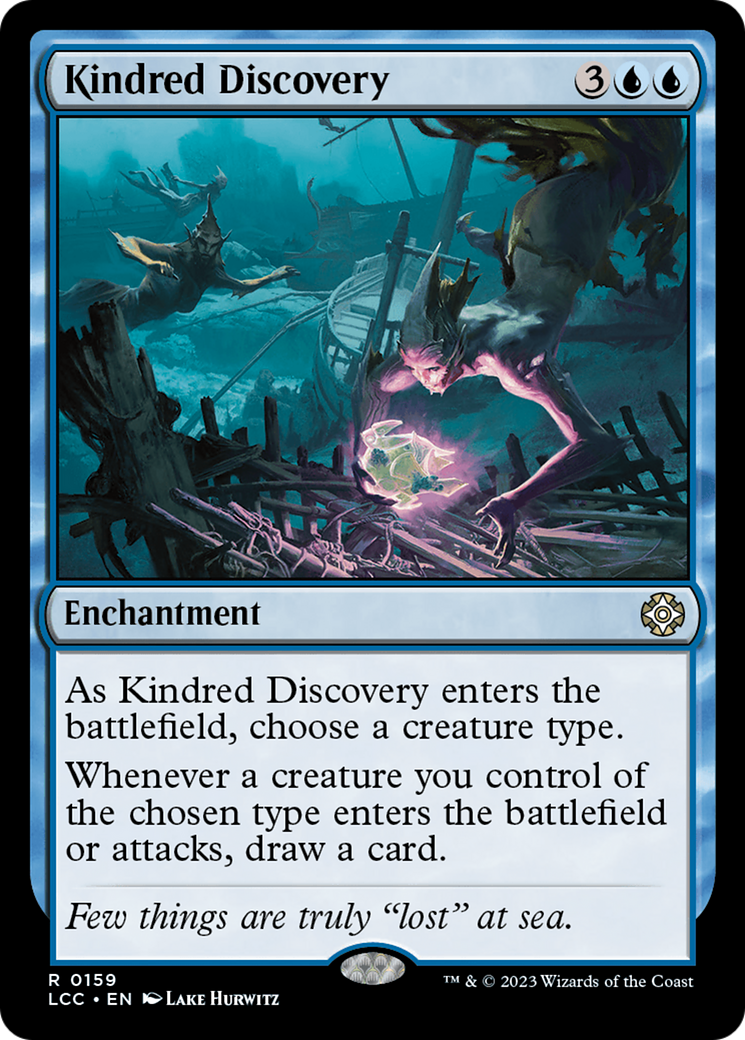
Kindred Discovery
Kindred Discovery
Enchantment
As this enchantment enters, choose a creature type.
Whenever a creature you control of the chosen type enters or attacks, draw a card.
- You can't choose multiple creature types, such as "Cat Warrior." A Cat Warrior is both a Cat and a Warrior. It's affected by anything that affects either type and unaffected by things that affect non-Cat or non-Warrior creatures.
- The choice of creature type is made as Kindred Discovery enters the battlefield. Players can't take any actions between the time the choice is made and the time it enters the battlefield. Notably, this means that if it is entering the battlefield at the same time as any creatures of the chosen type, its last ability will trigger.
- You must choose an existing creature type, such as Human or Warrior. Card types such as artifact and supertypes such as legendary can't be chosen.
- If you somehow control a Kindred Discovery with no chosen creature type, its last ability can't trigger, even if a creature with no creature types enters the battlefield or attacks.
-
1
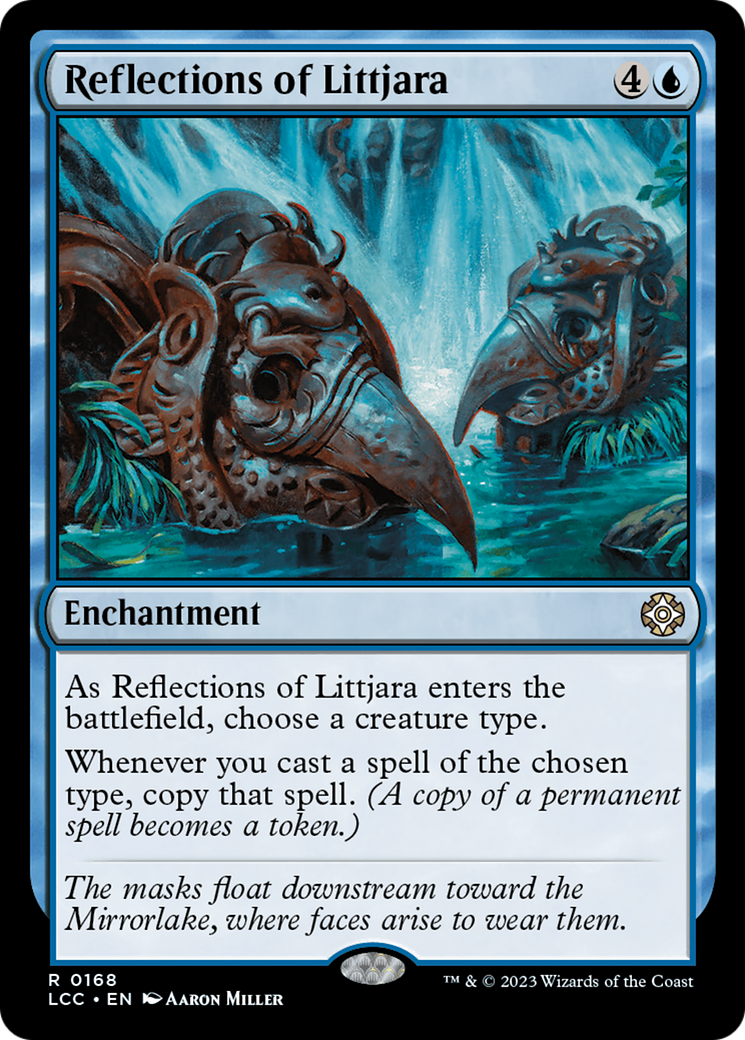
Reflections of Littjara
Reflections of Littjara
Enchantment
As this enchantment enters, choose a creature type.
Whenever you cast a spell of the chosen type, copy that spell. (A copy of a permanent spell becomes a token.)
- You must choose an existing creature type, such as Zombie or Angel. You can't choose card types (e.g., artifact) or supertypes (e.g., snow).
- The triggered ability and the copy it creates will resolve before the spell that caused the ability to trigger.
- As a copy of a permanent spell resolves, it's put onto the battlefield as a token rather than putting a copy of the spell onto the battlefield. The rules that apply to a permanent spell becoming a permanent apply to a copy of a spell becoming a token.
- The token that a resolving copy of a permanent spell becomes isn't "created." Abilities that refer to a copy being created won't interact with the copy resolving.
- If a spell has the kindred card type and the chosen creature type, Reflections of Littjara will copy it.
-
1
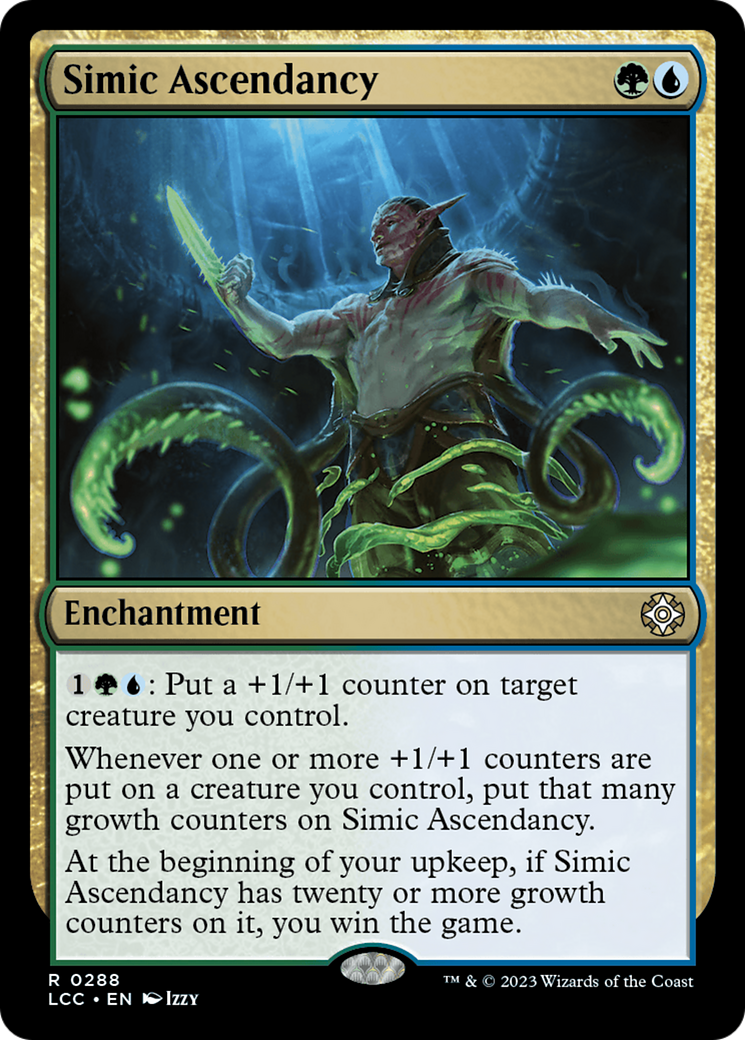
Simic Ascendancy
Simic Ascendancy
Enchantment
: Put a +1/+1 counter on target creature you control.
Whenever one or more +1/+1 counters are put on a creature you control, put that many growth counters on this enchantment.
At the beginning of your upkeep, if this enchantment has twenty or more growth counters on it, you win the game.
- An ability that triggers when counters are put on a permanent will trigger if that permanent somehow enters the battlefield with those counters.
- If Simic Ascendancy doesn't have twenty or more growth counters on it as your upkeep begins, its last ability won't trigger. You can't take any actions during your turn before your upkeep begins.
- If the last ability does trigger, but counters are removed from Simic Ascendancy so it has fewer than twenty remaining on it, you won't win the game.
- If the last ability does trigger, but Simic Ascendancy leaves the battlefield, use the number of counters it had on it immediately before it left the battlefield to determine whether you win the game.
Lands 36
-
1
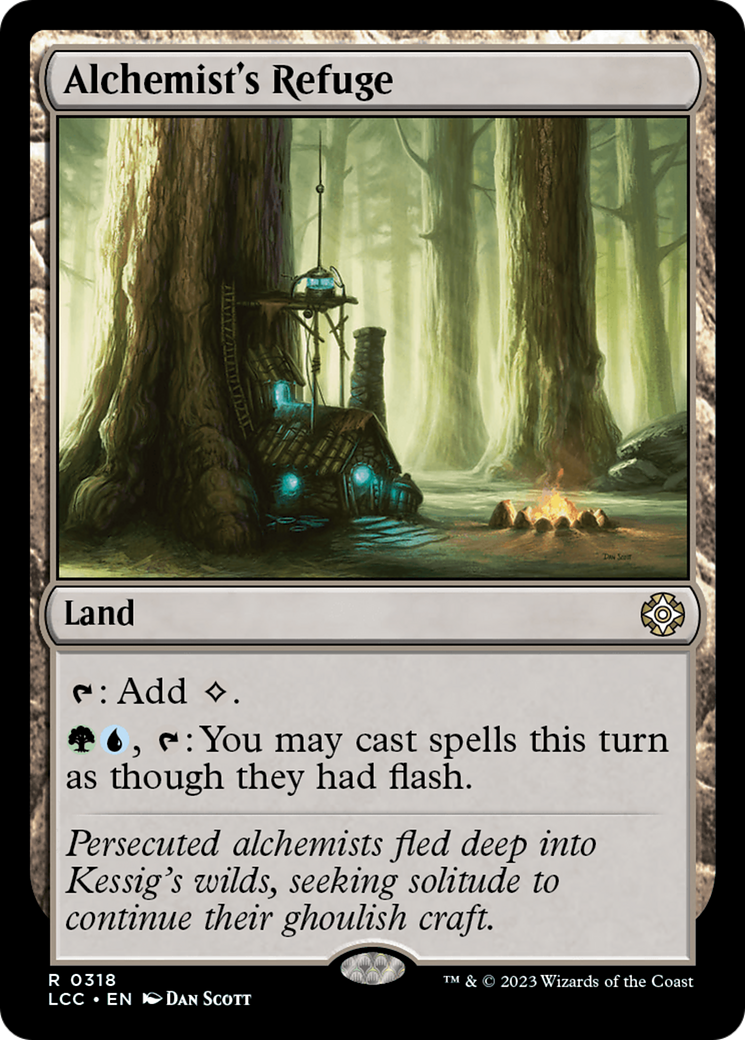
Alchemist's Refuge
Alchemist's Refuge
Land
: Add .
, : You may cast spells this turn as though they had flash.
- The last ability applies to nonland cards in any zone, provided something is allowing you to cast them. For example, you could cast a sorcery with flashback as though it had flash.
- You can cast a nonland card with flash any time you could cast an instant.
-
1
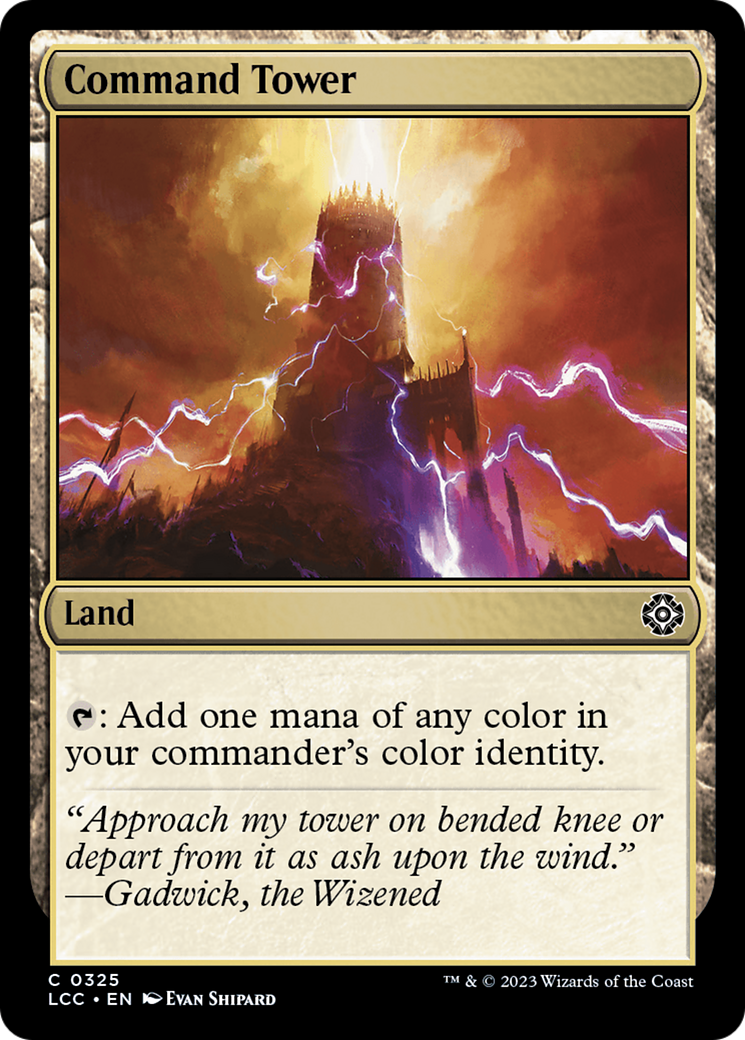
Command Tower
Command Tower
Land
: Add one mana of any color in your commander's color identity.
- If you don't have a commander, Command Tower's ability produces no mana.
- If your commander is a card that has no colors in its color identity, Command Tower's ability produces no mana. It doesn't produce .
- If you have two commanders, the ability adds one mana of any color in their combined color identities.
-
7
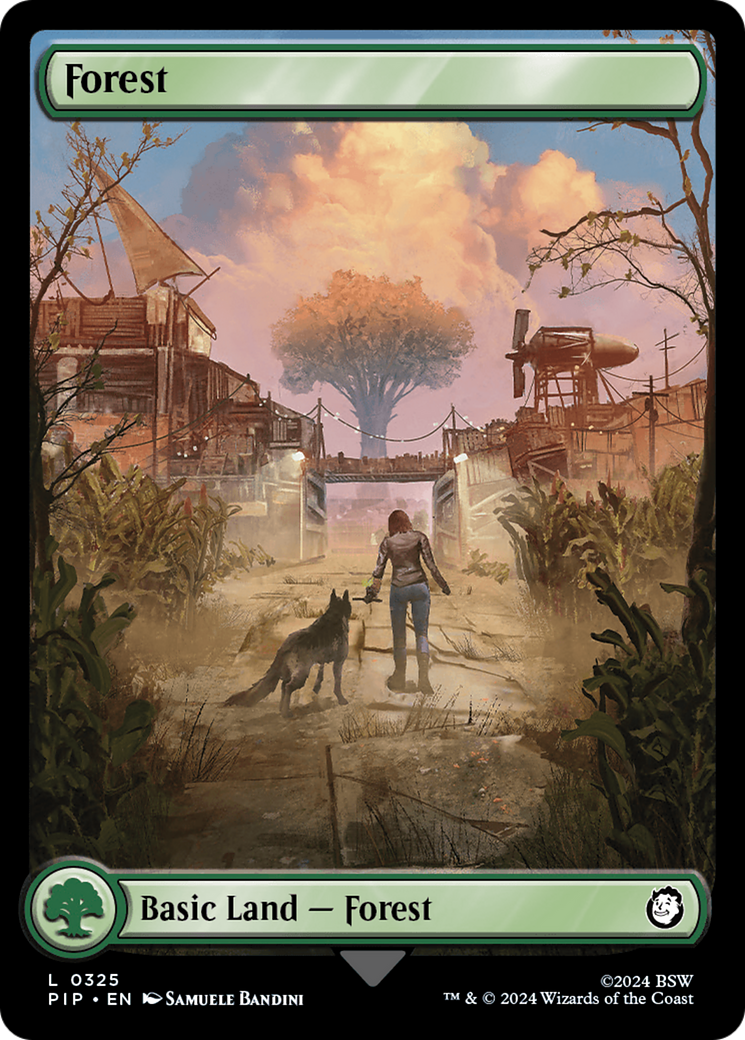
Forest
Forest
Basic Land — Forest
( : Add .)
-
1
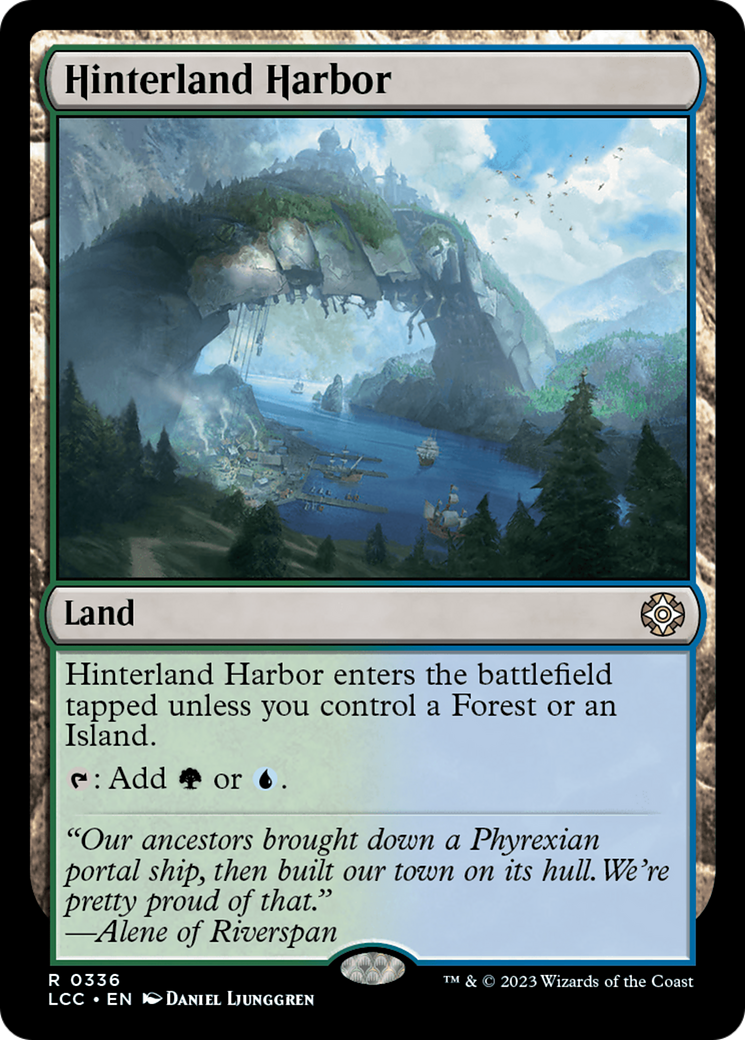
Hinterland Harbor
Hinterland Harbor
Land
This land enters tapped unless you control a Forest or an Island.
: Add or .
-
13
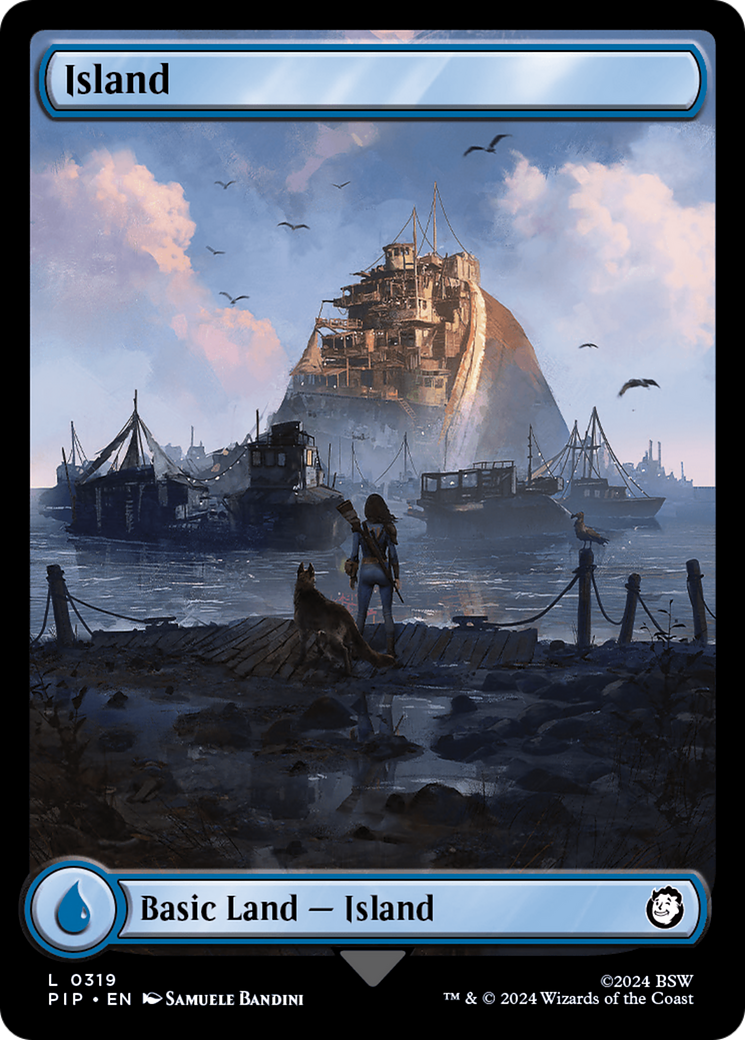
Island
Island
Basic Land — Island
( : Add .)
-
1
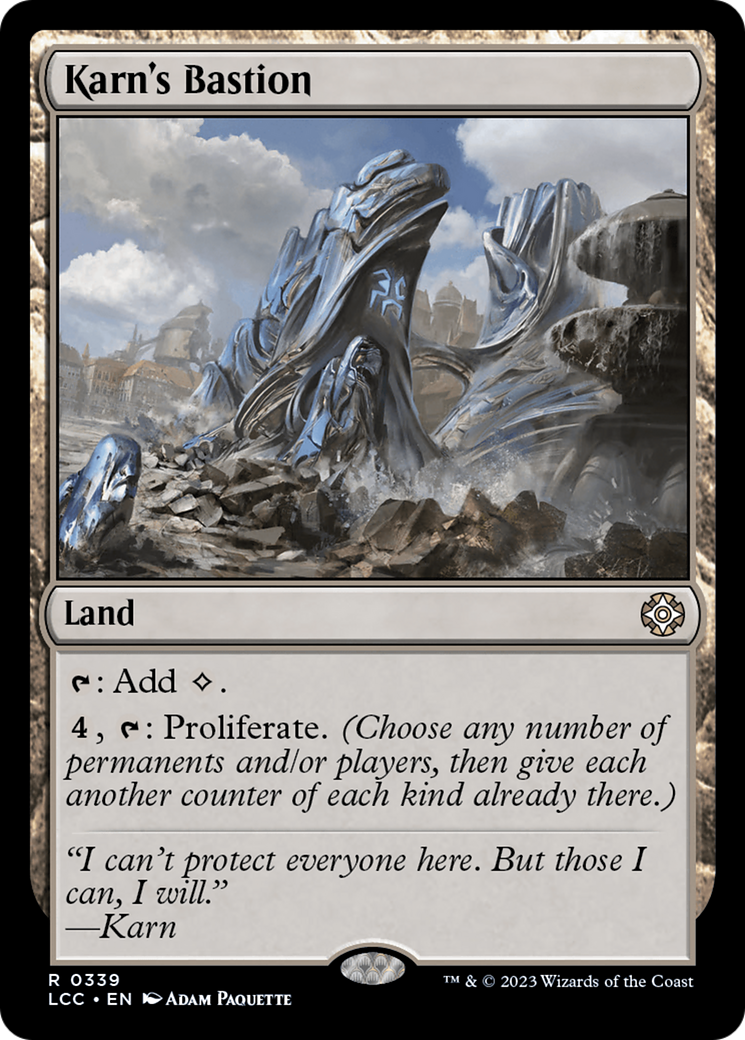
Karn's Bastion
Karn's Bastion
Land
: Add .
, : Proliferate. (Choose any number of permanents and/or players, then give each another counter of each kind already there.)
- To proliferate, you can choose any permanent that has a counter, including ones controlled by opponents. You can choose any player who has a counter, including opponents. You can't choose cards in any zone other than the battlefield, even if they have counters on them.
- You don't have to choose every permanent or player that has a counter, only the ones you want to add another counter to. Since "any number" includes zero, you don't have to choose any permanents at all, and you don't have to choose any players at all.
- If a player or permanent has more than one kind of counter on it, and you choose for it to get additional counters, it must get one of each kind of counter it already has. You can't have it get just one kind of counter it already has and not the others.
- An ability that triggers "Whenever you proliferate" triggers even if you chose no permanents or players while doing so.
- Players can respond to a spell or ability whose effect includes proliferating. Once that spell or ability starts to resolve, however, and its controller chooses which permanents and players will get new counters, it's too late for anyone to respond.
- If a permanent ever has both +1/+1 counters and -1/-1 counters on it at the same time, they're removed in pairs as a state-based action so that the permanent has only one of those kinds of counters on it.
-
1
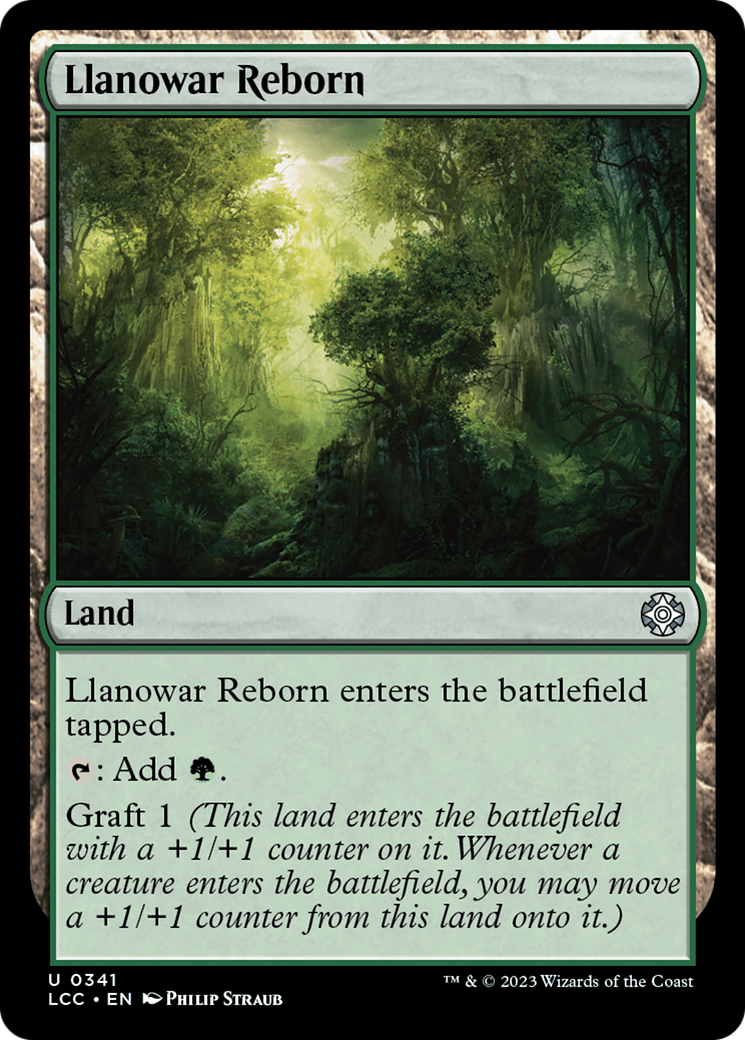
Llanowar Reborn
Llanowar Reborn
Land
This land enters tapped.
: Add .
Graft 1 (This land enters with a +1/+1 counter on it. Whenever a creature enters, you may move a +1/+1 counter from this land onto it.)
- The +1/+1 counter won't affect Llanowar Reborn in any way unless another effect turns it into a creature.
-
1
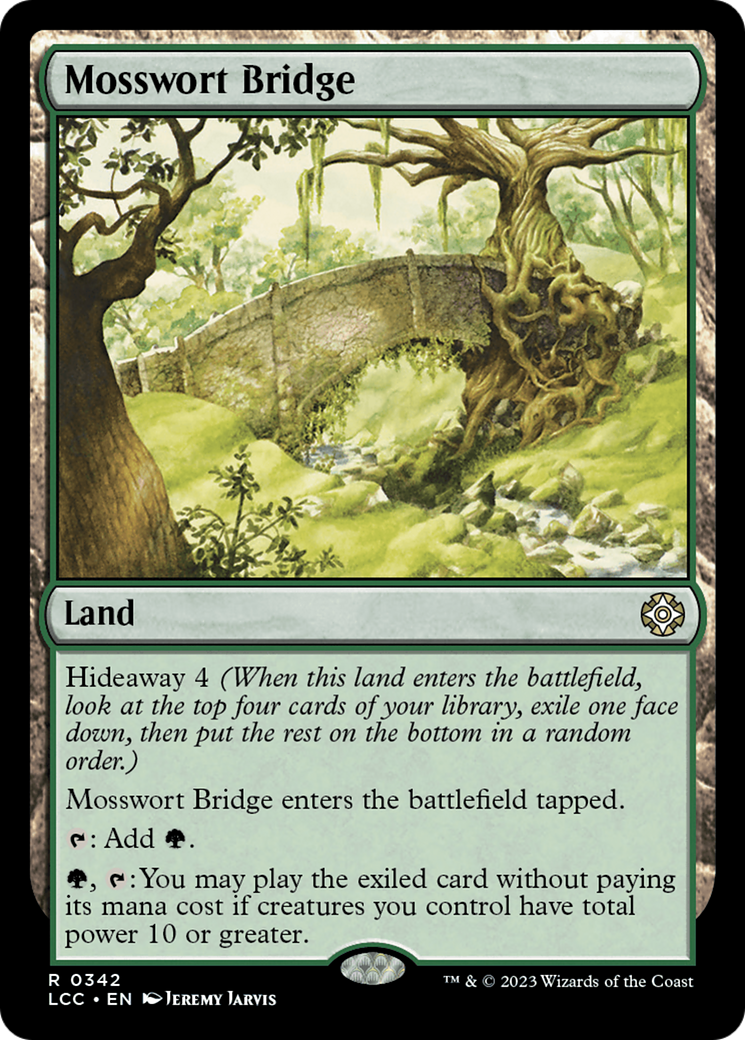
Mosswort Bridge
Mosswort Bridge
Land
Hideaway 4 (When this land enters, look at the top four cards of your library, exile one face down, then put the rest on the bottom in a random order.)
This land enters tapped.
: Add .
, : You may play the exiled card without paying its mana cost if creatures you control have total power 10 or greater.
- "Hideaway N" means "When this permanent enters the battlefield, look at the top N cards of your library. Exile one of them face down and put the rest on the bottom of your library in a random order. The exiled card gains 'The player who controls the permanent that exiled this card may look at this card in the exile zone.'"
- Any player who has controlled a permanent with a hideaway ability since a card was exiled with it may look at that card.
- Previously, permanents with hideaway entered the battlefield tapped. This ability has been removed from the definition of hideaway. Older cards have received errata to have an additional paragraph that reads "[This permanent] enters the battlefield tapped," and they now have hideaway 4.
- Hideaway now causes you to put the rest of the cards on the bottom of your library in a random order instead of any order.
-
1
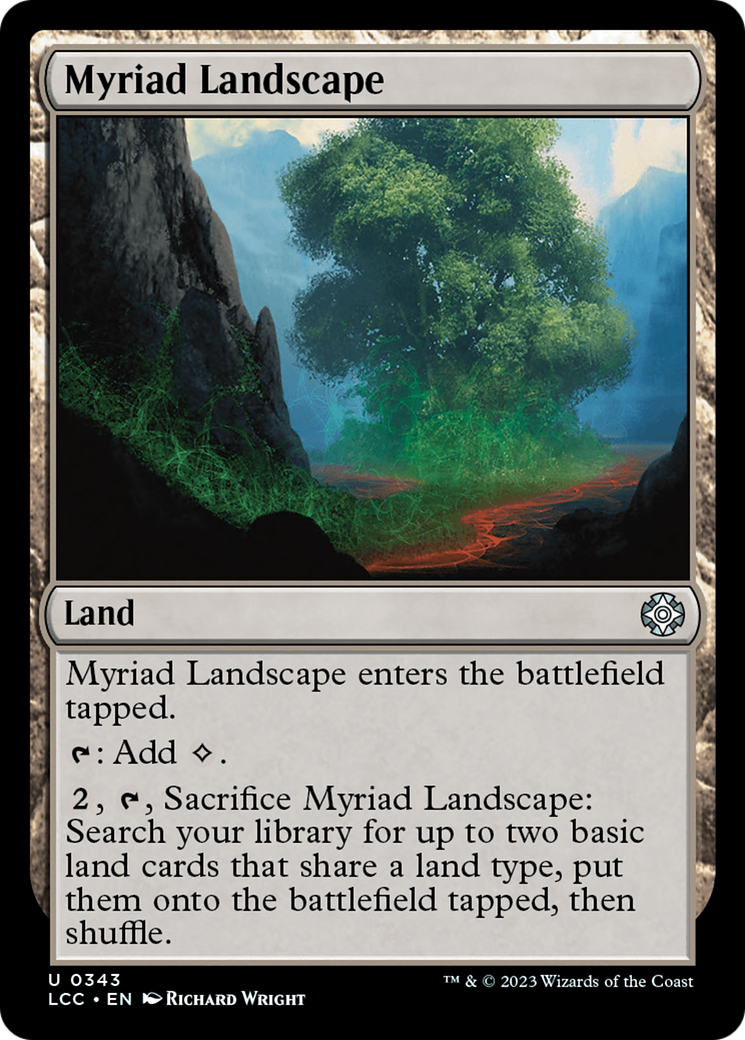
Myriad Landscape
Myriad Landscape
Land
This land enters tapped.
: Add .
, , Sacrifice this land: Search your library for up to two basic land cards that share a land type, put them onto the battlefield tapped, then shuffle.
- You can choose to find one basic land card with Myriad Landscape's last ability.
-
1
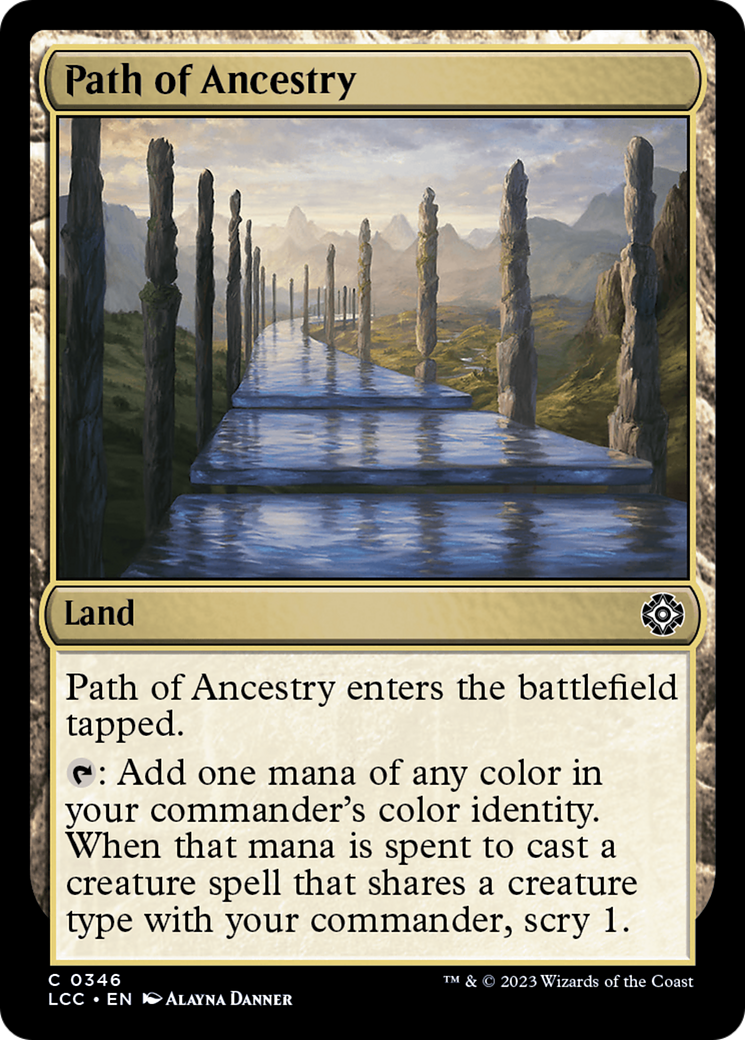
Path of Ancestry
Path of Ancestry
Land
This land enters tapped.
: Add one mana of any color in your commander's color identity. When that mana is spent to cast a creature spell that shares a creature type with your commander, scry 1. (Look at the top card of your library. You may put that card on the bottom.)
- Your commander's creature types are checked immediately after you cast a creature spell spending mana from Path of Ancestry's last ability. They aren't set before the game begins, and they may not be the same types your commander had when you activated that ability.
- If you have two commanders, the last ability adds one mana of any color in their combined color identities. When you spend that mana on a creature spell that shares a creature type with either of your commanders, you'll scry 1.
- If Path of Ancestry's last ability produces two mana (most likely due to Mana Reflection), spending those two mana to cast creature spells that share a creature type with your commander will cause two abilities to trigger. Each of those abilities will cause you to scry 1. You won't scry 2. This is true whether you spend the mana on one creature spell or two.
- If your commander has no creature types, it can't share a creature type with any spell that you cast.
- If you cast your commander with mana from Path of Ancestry, and your commander hasn't somehow lost all of its creature types while on the stack, you'll scry 1.
- If you don't have a commander, Path of Ancestry's ability produces no mana.
- If your commander is a card that has no colors in its color identity, Path of Ancestry's ability produces no mana. It doesn't produce .
-
1
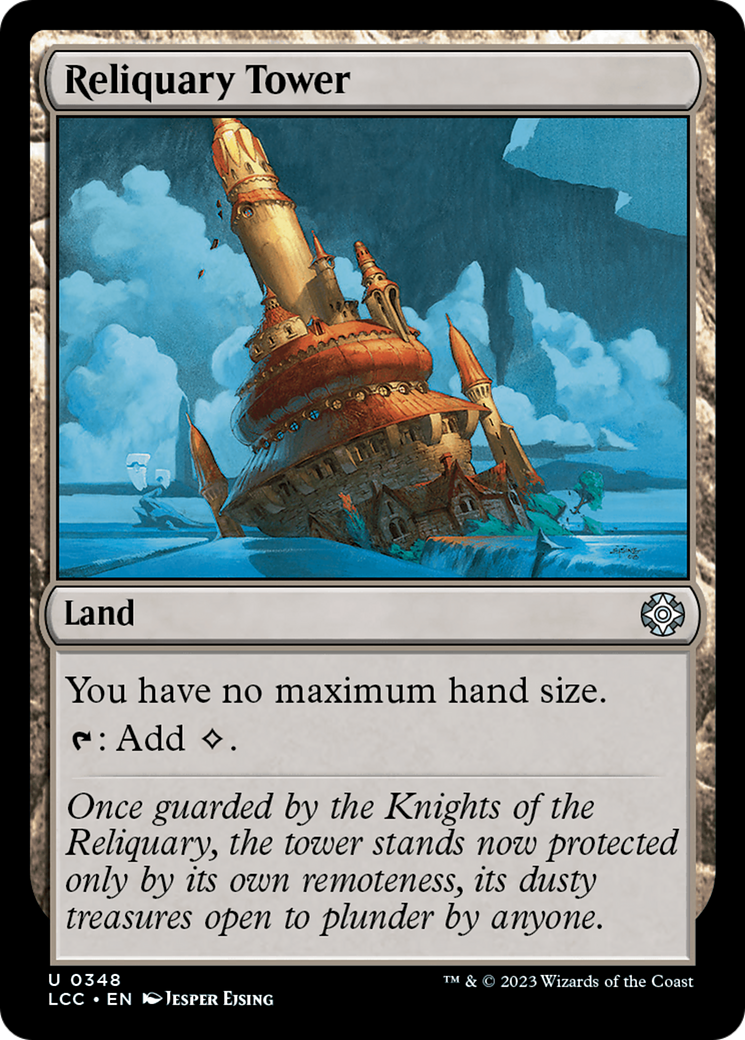
Reliquary Tower
Reliquary Tower
Land
You have no maximum hand size.
: Add .
- If multiple effects modify your hand size, apply them in timestamp order. For example, if you put Null Profusion (an enchantment that says your maximum hand size is two) onto the battlefield and then put Reliquary Tower onto the battlefield, you'll have no maximum hand size. However, if those permanents enter in the opposite order, your maximum hand size would be two.
-
1
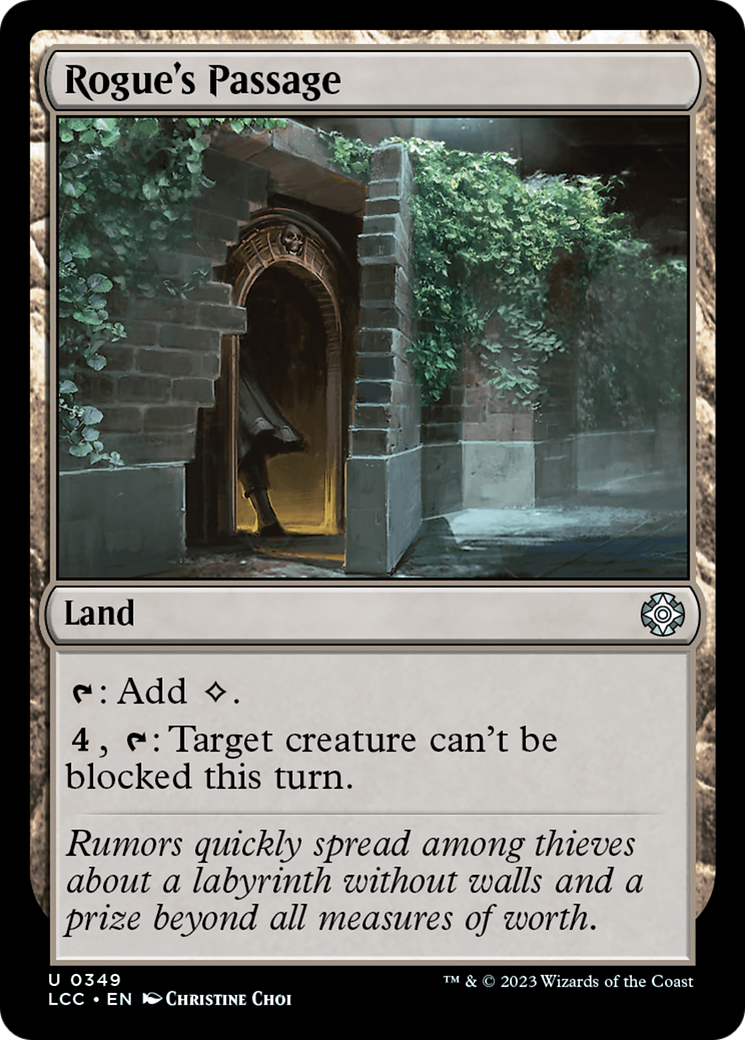
Rogue's Passage
Rogue's Passage
Land
: Add .
, : Target creature can't be blocked this turn.
- Activating the second ability of Rogue's Passage after a creature has become blocked won't cause that creature to become unblocked.
-
1
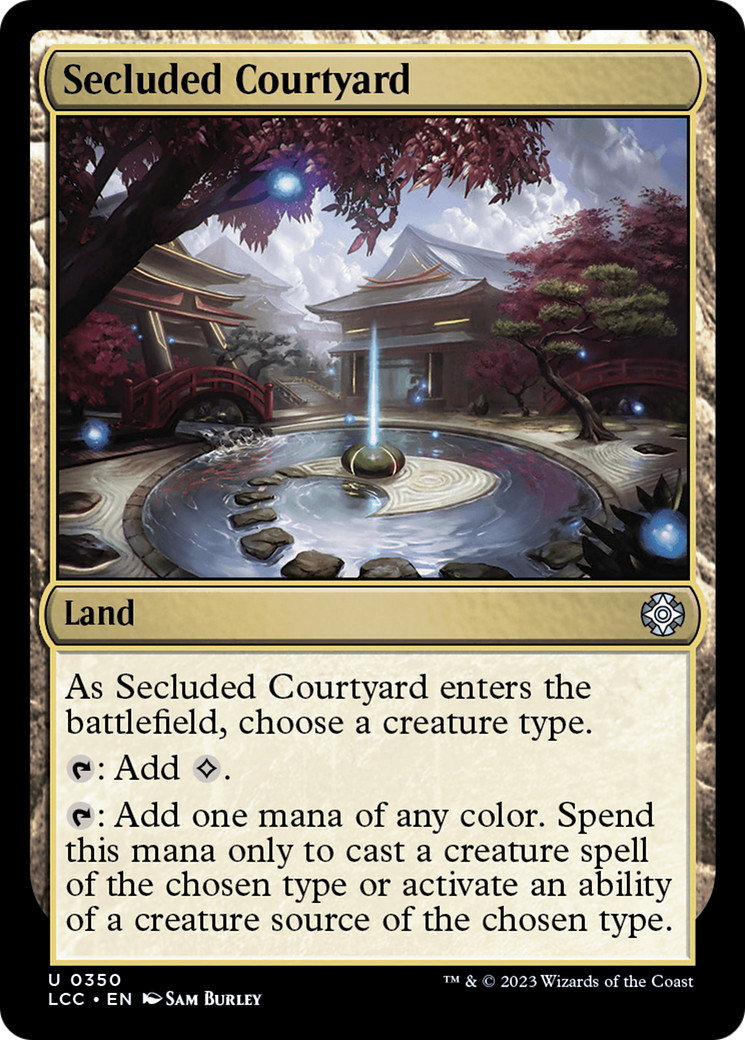
Secluded Courtyard
Secluded Courtyard
Land
As this land enters, choose a creature type.
: Add .
: Add one mana of any color. Spend this mana only to cast a creature spell of the chosen type or activate an ability of a creature source of the chosen type.
- If Secluded Courtyard is somehow on the battlefield without a chosen type, mana from its second mana ability can't be spent on anything.
-
1
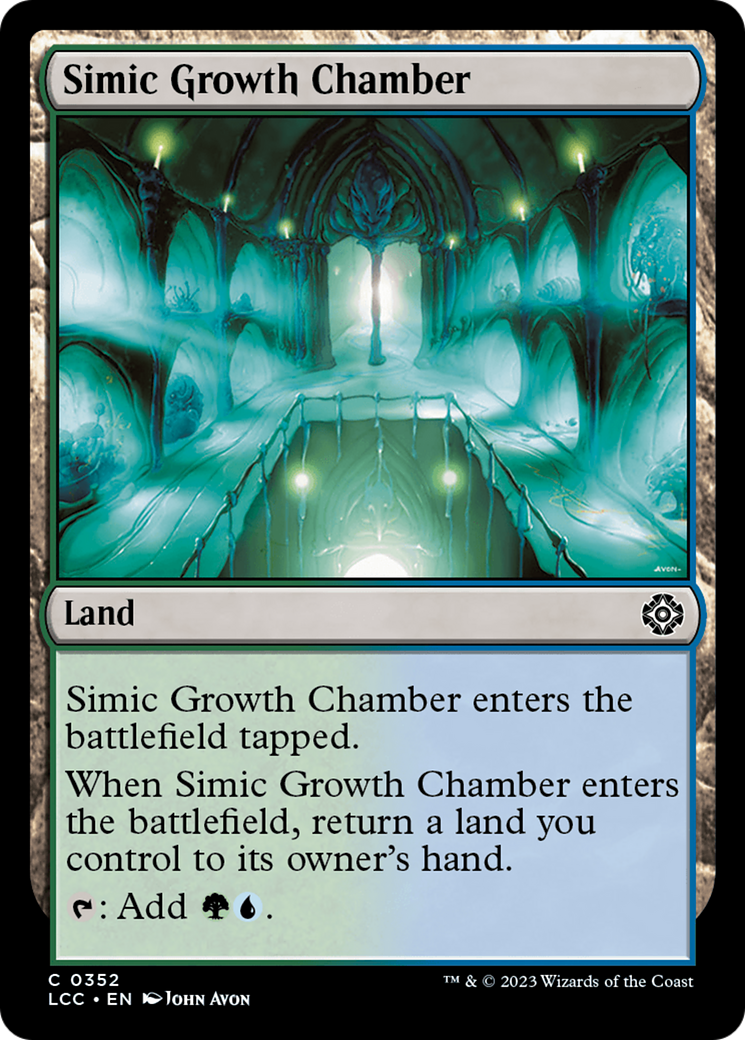
Simic Growth Chamber
Simic Growth Chamber
Land
This land enters tapped.
When this land enters, return a land you control to its owner's hand.
: Add .
- If this land enters the battlefield and you control no other lands, its ability will force you to return it to your hand.
-
1
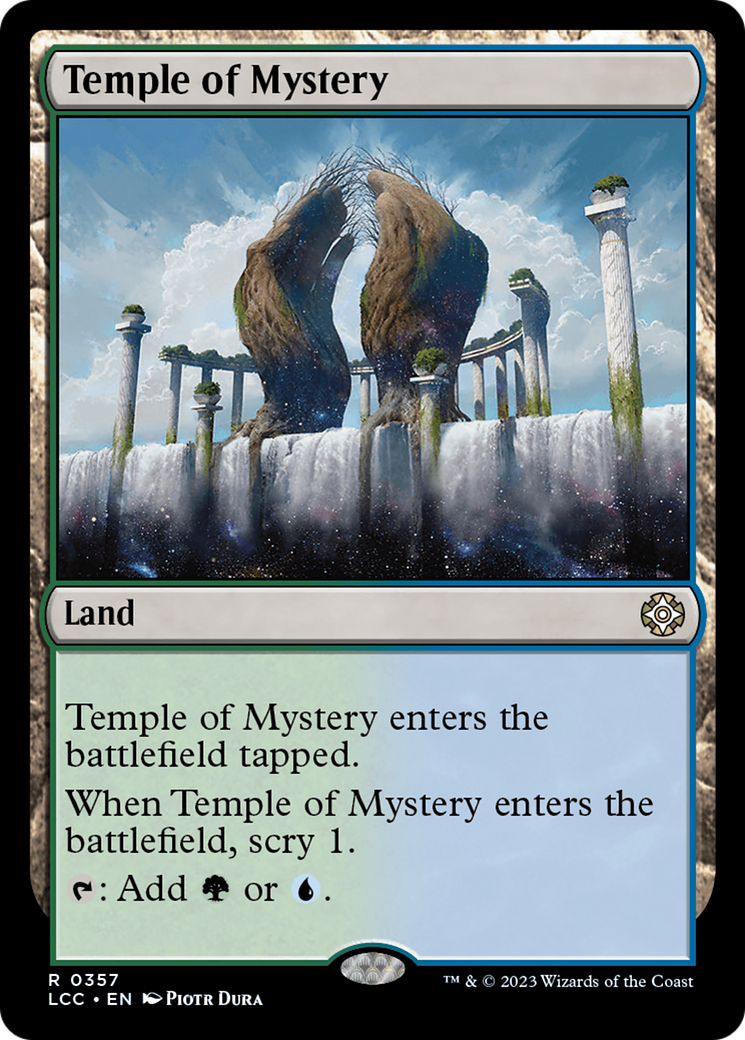
Temple of Mystery
Temple of Mystery
Land
This land enters tapped.
When this land enters, scry 1. (Look at the top card of your library. You may put that card on the bottom.)
: Add or .
- When you scry, you may put all the cards you look at back on top of your library, you may put all of those cards on the bottom of your library, or you may put some of those cards on top and the rest of them on the bottom.
- You choose how to order cards returned to your library after scrying no matter where you put them.
- You perform the actions stated on a card in sequence. For some spells and abilities, that means you'll scry last. For others, that means you'll scry and then perform other actions.
- Scry appears on some spells and abilities with one or more targets. If all of the spell or ability's targets are illegal when it tries to resolve, it won't resolve and none of its effects will happen. You won't scry.
-
1
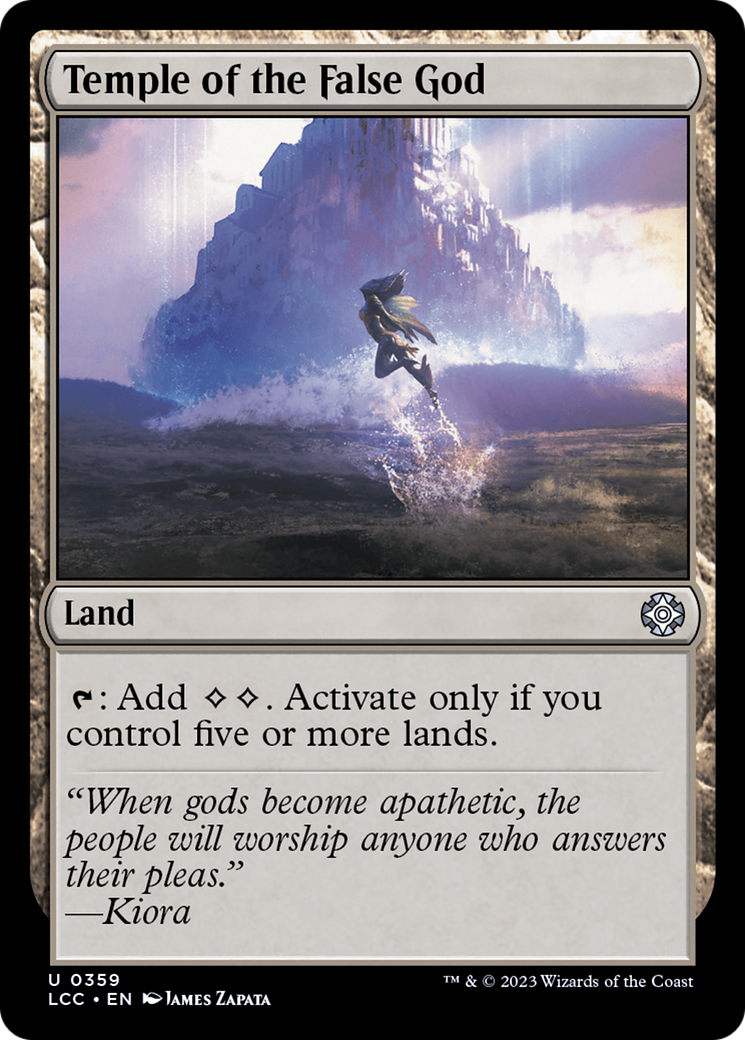
Temple of the False God
Temple of the False God
Land
: Add . Activate only if you control five or more lands.
-
1
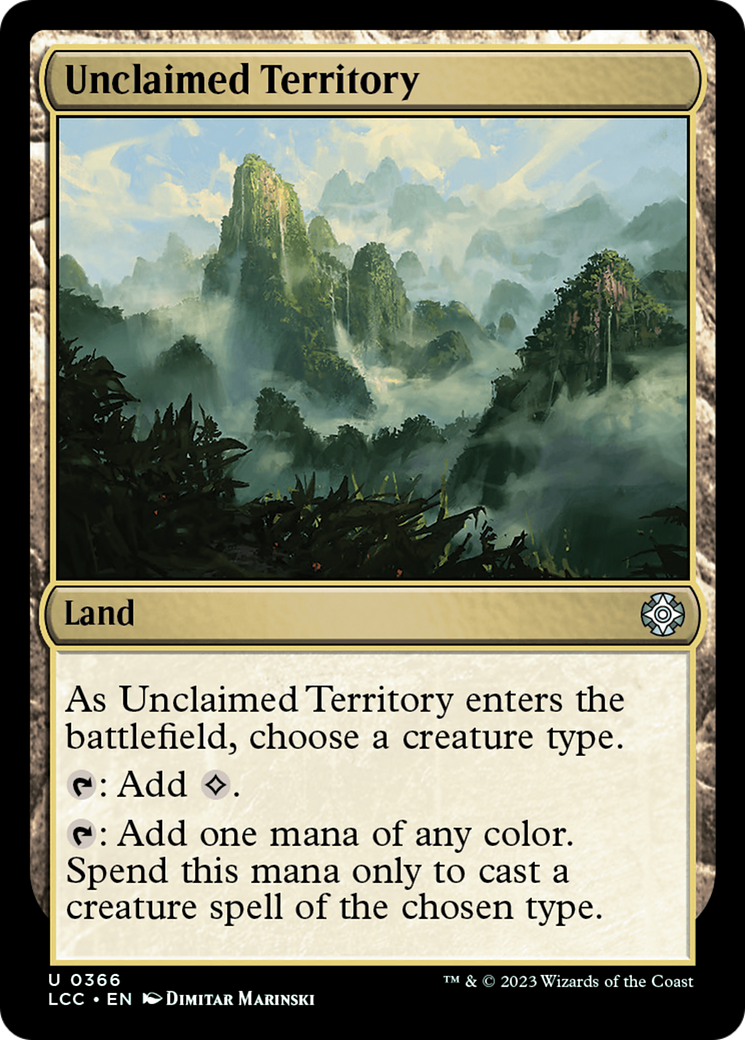
Unclaimed Territory
Unclaimed Territory
Land
As this land enters, choose a creature type.
: Add .
: Add one mana of any color. Spend this mana only to cast a creature spell of the chosen type.
- To choose a creature type, you must choose an existing creature type, such as Vampire or Knight. You can't choose multiple creature types, such as "Vampire Knight." Card types such as artifact can't be chosen, nor can subtypes that aren't creature types, such as Jace, Vehicle, or Treasure.
-
1
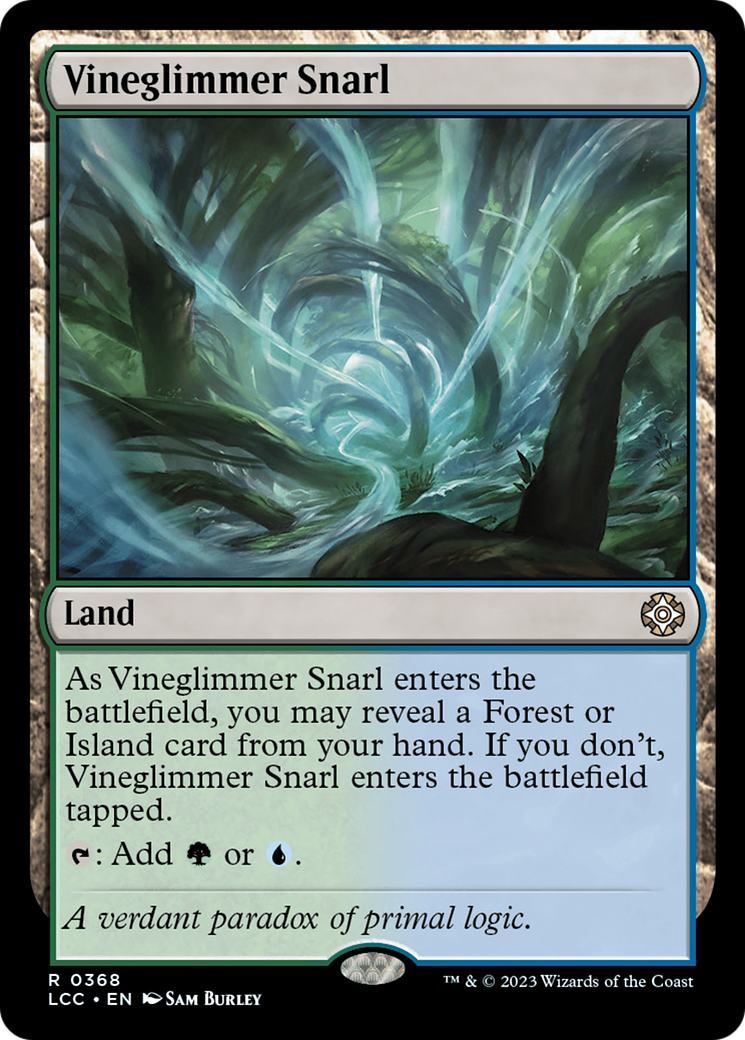
Vineglimmer Snarl
Vineglimmer Snarl
Land
As this land enters, you may reveal a Forest or Island card from your hand. If you don't, this land enters tapped.
: Add or .
- You may reveal any land card with either or both of the appropriate subtypes. It doesn't have to be a basic land card.
- The "Snarl" itself doesn't have any land subtypes. You can't reveal one to satisfy the ability of another.
- If a land card with an appropriate subtype is entering the battlefield from your hand at the same time as one of these lands, you may reveal the other land to have the "Snarl" enter untapped.
- If an effect instructs you to put one of these lands onto the battlefield tapped, it will still enter the battlefield tapped even if you reveal a land card from your hand.
Blue 27
-
1
Aetherize
Aetherize
Instant
Return all attacking creatures to their owner's hand.
- An "attacking creature" is one that has been declared as an attacker this combat, or one that was put onto the battlefield attacking this combat. Unless that creature leaves combat, it continues to be an attacking creature through the end of combat step, even if the player it was attacking has left the game, or the planeswalker it was attacking has left combat. There's no such thing as an attacking creature outside of the combat phase.
-
1
Benthic Biomancer
Benthic Biomancer
Creature — Merfolk Wizard Mutant
1/1
: Adapt 1. (If this creature has no +1/+1 counters on it, put a +1/+1 counter on it.)
Whenever one or more +1/+1 counters are put on this creature, draw a card, then discard a card.
- An ability that triggers when counters are put on a permanent will trigger if that permanent somehow enters the battlefield with those counters.
- You draw a card and discard a card all while Benthic Biomancer's triggered ability is resolving. Nothing can happen between the two, and no player may choose to take actions.
- You can always activate an ability that will cause a creature to adapt. As that ability resolves, if the creature has a +1/+1 counter on it for any reason, you simply won't put any +1/+1 counters on it.
- If a creature somehow loses all of its +1/+1 counters, it can adapt again and get more +1/+1 counters.
-
1
Commit // Memory
//
Commit
Instant
- Once you've started to cast a spell with aftermath from your graveyard, the card is immediately moved to the stack. Opponents can't try to stop the ability by exiling the card with an effect such as that of Crook of Condemnation.
- If a spell is put into its owner's library, it's removed from the stack and thus will not resolve. The spell isn't countered; it just no longer exists. This works against a spell that can't be countered.
- If a copy of a spell or a token is put into its owner's library, it's moved there, then it will cease to exist as a state-based action.
- Split cards with aftermath have a new frame treatment—the half you can cast from your hand is oriented the same as other cards you'd cast from your hand, while the half you can cast from your graveyard is a traditional split card half. This frame treatment is for your convenience and has no rules significance.
- All split cards have two card faces on a single card, and you put a split card onto the stack with only the half you're casting. The characteristics of the half of the card you didn't cast are ignored while the spell is on the stack. For example, if an effect prevents you from casting green spells, you can cast Destined of Destined // Lead, but not Lead.
- Each split card is a single card. For example, if you discard one, you've discarded one card, not two. If an effect counts the number of instant and sorcery cards in your graveyard, Destined // Lead counts once, not twice.
- If the target's owner's library contains no cards, the target spell or permanent will be put into that player's library as the only card.
- While not on the stack, the characteristics of a split card are the combination of its two halves. For example, Destined // Lead is a green and black card, it is both an instant card and a sorcery card, and its mana value is 6. This means that if an effect allows you to cast a card with mana value 2 from your hand, you can't cast Destined. This is a change from the previous rules for split cards.
- If you cast the first half of a split card with aftermath during your turn, you'll have priority immediately after it resolves. You can cast the half with aftermath from your graveyard before any player can take any other action if it's legal for you to do so.
- If another effect allows you to cast a split card with aftermath from any zone other than a graveyard, you can't cast the half with aftermath.
- If another effect allows you to cast a split card with aftermath from a graveyard, you may cast either half. If you cast the half that has aftermath, you'll exile the card if it would leave the stack.
- A spell with aftermath cast from a graveyard will always be exiled afterward, whether it resolves, it's countered, or it leaves the stack in some other way.
- Each split card has two names. If an effect instructs you to choose a card name, you may choose one, but not both.
-
1
Coralhelm Commander
Coralhelm Commander
Creature — Merfolk Soldier
2/2
Level up ( : Put a level counter on this. Level up only as a sorcery.)
LEVEL 2-3
3/3
Flying
LEVEL 4+
4/4
Flying
Other Merfolk creatures you control get +1/+1.
- The abilities a leveler grants to itself don't overwrite any other abilities it may have. In particular, they don't overwrite the creature's level up ability; it always has that.
- Effects that set a leveler's power or toughness to a specific value, including the effects from a level symbol's ability, apply in timestamp order. The timestamp of each level symbol's ability is the same as the timestamp of the leveler itself, regardless of when the most recent level counter was put on it.
- Effects that modify a leveler's power or toughness, such as the effects of Giant Growth or Glorious Anthem, will apply to it no matter when they started to take effect. The same is true for counters that change the creature's power or toughness (such as +1/+1 counters) and effects that switch its power and toughness.
- If another creature becomes a copy of a leveler, all of the leveler's printed abilities — including those represented by level symbols — are copied. The current characteristics of the leveler, and the number of level counters on it, are not. The abilities, power, and toughness of the copy will be determined based on how many level counters are on the copy.
- A creature's level is based on how many level counters it has on it, not how many times its level up ability has been activated or has resolved. If a leveler gets level counters due to some other effect (such as Clockspinning) or loses level counters for some reason (such as Vampire Hexmage), its level is changed accordingly.
-
1
Curse of the Swine
Curse of the Swine
Sorcery
Exile X target creatures. For each creature exiled this way, its controller creates a 2/2 green Boar creature token.
-
1
Deeproot Waters
Deeproot Waters
Enchantment
Whenever you cast a Merfolk spell, create a 1/1 blue Merfolk creature token with hexproof. (A creature with hexproof can't be the target of spells or abilities your opponents control.)
- If an effect refers to a "[subtype] spell" or "[subtype] card," it refers only to a spell or card that has that subtype. For example, March of the Drowned is a card that benefits Pirates and features Pirates in its illustration, but it isn't a Pirate card.
- The ability of Deeproot Waters resolves before the spell that caused it to trigger.
-
1
Emperor Mihail II
Emperor Mihail II
Legendary Creature — Merfolk Noble
3/3
You may look at the top card of your library any time.
You may cast Merfolk spells from the top of your library.
Whenever you cast a Merfolk spell, you may pay . If you do, create a 1/1 blue Merfolk creature token.
- Emperor Mihail II lets you look at the top card of your library whenever you want (with one restriction—see below), even if you don't have priority. This action doesn't use the stack. Knowing what that card is becomes part of the information you have access to, just like you can look at the cards in your hand.
- If the top card of your library changes while you're casting a spell, playing a land, or activating an ability, you can't look at the new top card until you finish doing so. This means that if you cast the top card of your library, you can't look at the next one until you're done paying for that spell.
- You must follow the normal timing permissions and restrictions of the cards you play from your library.
- The last ability triggers whenever you cast any Merfolk spell, not just when you cast a Merfolk spell from the top of your library. It will resolve before the spell that caused it to trigger, even if that spell has been countered or otherwise left the stack.
-
1
Herald of Secret Streams
Herald of Secret Streams
Creature — Merfolk Warrior
2/3
Creatures you control with +1/+1 counters on them can't be blocked.
- Once a creature you control has become blocked, putting a +1/+1 counter on it won't cause it to become unblocked.
-
1
Kindred Discovery
Kindred Discovery
Enchantment
As this enchantment enters, choose a creature type.
Whenever a creature you control of the chosen type enters or attacks, draw a card.
- You can't choose multiple creature types, such as "Cat Warrior." A Cat Warrior is both a Cat and a Warrior. It's affected by anything that affects either type and unaffected by things that affect non-Cat or non-Warrior creatures.
- The choice of creature type is made as Kindred Discovery enters the battlefield. Players can't take any actions between the time the choice is made and the time it enters the battlefield. Notably, this means that if it is entering the battlefield at the same time as any creatures of the chosen type, its last ability will trigger.
- You must choose an existing creature type, such as Human or Warrior. Card types such as artifact and supertypes such as legendary can't be chosen.
- If you somehow control a Kindred Discovery with no chosen creature type, its last ability can't trigger, even if a creature with no creature types enters the battlefield or attacks.
-
1
Kopala, Warden of Waves
Kopala, Warden of Waves
Legendary Creature — Merfolk Wizard
2/2
Spells your opponents cast that target a Merfolk you control cost more to cast.
Abilities your opponents activate that target a Merfolk you control cost more to activate.
- To determine the total cost of an opponent's spell that targets a Merfolk you control, start with the mana cost or alternative cost that player is paying, add any cost increases, then apply any cost reductions. The mana value of the spell remains unchanged, no matter what the total cost to cast it was.
- Activated abilities contain a colon. They're generally written "[Cost]: [Effect]."
- Kopala's abilities won't affect triggered abilities (starting with "when," "whenever," or "at") that target a Merfolk you control.
- Spells and abilities that target more than one Merfolk you control cost only more to cast or activate.
-
1
Master of the Pearl Trident
Master of the Pearl Trident
Creature — Merfolk
2/2
Other Merfolk creatures you control get +1/+1 and have islandwalk. (They can't be blocked as long as defending player controls an Island.)
- Because damage remains marked on a creature until the damage is removed as the turn ends, nonlethal damage dealt to a Merfolk you control may become lethal if Master of the Pearl Trident leaves the battlefield during that turn.
-
1
Merfolk Cave-Diver
Merfolk Cave-Diver
Creature — Merfolk Scout
2/4
Whenever a creature you control explores, this creature gets +1/+0 until end of turn and can't be blocked this turn.
-
1
Merfolk Sovereign
Merfolk Sovereign
Creature — Merfolk Noble
2/2
Other Merfolk creatures you control get +1/+1.
: Target Merfolk creature can't be blocked this turn.
- To have any effect, Merfolk Sovereign's activated ability must be activated before the declare blockers step begins. Once a Merfolk has become blocked, activating Merfolk Sovereign's ability won't change that.
-
1
Merrow Reejerey
Merrow Reejerey
Creature — Merfolk Soldier
2/2
Other Merfolk creatures you control get +1/+1.
Whenever you cast a Merfolk spell, you may tap or untap target permanent.
-
1
Mist Dancer
Mist Dancer
Creature — Merfolk Wizard
3/3
Flying
Other Merfolk you control get +1/+0 and have flying.
Encore ( , Exile this card from your graveyard: For each opponent, create a token copy that attacks that opponent this turn if able. They gain haste. Sacrifice them at the beginning of the next end step. Activate only as a sorcery.)
- Exiling the card with encore is a cost to activate the ability. Once you announce that you're activating it, no player may take actions until you've finished. They can't try to remove the card from your graveyard to stop you from paying the cost.
- Opponents who have left the game aren't counted when determining how many tokens to create.
- The tokens copy only what's on the original card. Effects that modified that creature when it was previously on the battlefield won't be copied.
- Each token must attack the appropriate player if able.
- If one of the tokens can't attack for any reason (such as being tapped), then it doesn't attack. If there's a cost associated with having it attack, you aren't forced to pay that cost, so it doesn't have to attack in that case either.
- If an effect stops a token from attacking a specific player, that token can attack any player, planeswalker, or battle, or not attack at all. If the effect stops the token from attacking a specific player unless a cost is paid, you don't have to pay that cost unless you want to attack that player.
- If one of the tokens somehow is under another player's control as the delayed triggered ability resolves, you can't sacrifice that token. It remains on the battlefield indefinitely, even if you regain control of it later.
-
1
Rapid Hybridization
Rapid Hybridization
Instant
Destroy target creature. It can't be regenerated. That creature's controller creates a 3/3 green Frog Lizard creature token.
- If Rapid Hybridization resolves and the creature isn't destroyed (perhaps because it has indestructible), its controller will still get the Frog Lizard token.
- If the creature is an illegal target when Rapid Hybridization tries to resolve, it won't resolve and none of its effects will happen. No Frog Lizard token will be created.
-
1
Ravenform
Ravenform
Sorcery
Exile target artifact or creature. Its controller creates a 1/1 blue Bird creature token with flying.
Foretell (During your turn, you may pay and exile this card from your hand face down. Cast it on a later turn for its foretell cost.)
- If the target artifact or creature is an illegal target as Ravenform tries to resolve, it won't resolve and none of its effects will happen. No player will create a Bird creature token.
- Because exiling a card with foretell from your hand is a special action, you can do so any time you have priority during your turn, including in response to spells and abilities. Once you announce you're taking the action, no other player can respond by trying to remove the card from your hand.
- Casting a foretold card from exile follows the timing rules for that card. If you foretell an instant card, you can cast it as soon as the next player's turn. In most cases, if you foretell a card that isn't an instant (or doesn't have flash), you'll have to wait until your next turn to cast it.
- If you're casting a foretold card from exile for its foretell cost, you can't choose to cast it for any other alternative costs. You can, however, pay additional costs, such as kicker costs. If the card has any mandatory additional costs, those must be paid to cast the spell.
-
1
Reflections of Littjara
Reflections of Littjara
Enchantment
As this enchantment enters, choose a creature type.
Whenever you cast a spell of the chosen type, copy that spell. (A copy of a permanent spell becomes a token.)
- You must choose an existing creature type, such as Zombie or Angel. You can't choose card types (e.g., artifact) or supertypes (e.g., snow).
- The triggered ability and the copy it creates will resolve before the spell that caused the ability to trigger.
- As a copy of a permanent spell resolves, it's put onto the battlefield as a token rather than putting a copy of the spell onto the battlefield. The rules that apply to a permanent spell becoming a permanent apply to a copy of a spell becoming a token.
- The token that a resolving copy of a permanent spell becomes isn't "created." Abilities that refer to a copy being created won't interact with the copy resolving.
- If a spell has the kindred card type and the chosen creature type, Reflections of Littjara will copy it.
-
1
Ripples of Potential
Ripples of Potential
Instant
Proliferate, then choose any number of permanents you control that had a counter put on them this way. Those permanents phase out. (To proliferate, choose any number of permanents and/or players, then give each another counter of each kind already there. Treat phased-out permanents and anything attached to them as though they don't exist until their controller's next turn.)
- An ability that triggers "Whenever you proliferate" triggers even if you chose no permanents or players while doing so.
- A phased-out token will phase in at the beginning of its controller's untap step just like a nontoken permanent would.
- To proliferate, you can choose any permanent that has a counter, including ones controlled by opponents. You can choose any player who has a counter, including opponents. You can't choose cards in any zone other than the battlefield, even if they have counters on them.
- Players can respond to a spell or ability whose effect includes proliferating. Once that spell or ability starts to resolve, however, and its controller chooses which permanents and players will get new counters, it's too late for anyone to respond.
- You don't have to choose every permanent or player that has a counter, only the ones you want to add another counter to. Since "any number" includes zero, you don't have to choose any permanents at all, and you don't have to choose any players at all.
- Permanents phase back in during their controller's untap step, immediately before that player untaps their permanents. Creatures that phase in this way are able to attack and pay a cost of during that turn. If a permanent had counters on it when it phased out, it will have those counters when it phases back in.
- Phasing out doesn't cause any "leaves the battlefield" abilities to trigger. Similarly, phasing in won't cause any "enters the battlefield" abilities to trigger.
- Choices made for permanents as they entered the battlefield are remembered even after they phase in.
- If a player or permanent has more than one kind of counter on it, and you choose for it to get additional counters, it must get one of each kind of counter it already has. You can't have it get just one kind of counter it already has and not the others.
- Phased-out permanents are treated as though they don't exist. They can't be the target of spells or abilities, their static abilities have no effect on the game, their triggered abilities can't trigger, they can't attack or block, and so on.
- As a creature is phased out, Auras and Equipment attached to it also phase out at the same time. Those Auras and Equipment will phase in at the same time that creature does, and they'll phase in still attached to that creature.
- An attacking or blocking creature that phases out is removed from combat.
- Any continuous effects with a "for as long as" duration ignore phased-out objects. If ignoring those objects causes the effect's conditions to no longer be met, the duration will expire.
-
1
Sage of Fables
Sage of Fables
Creature — Merfolk Wizard
2/2
Each other Wizard creature you control enters with an additional +1/+1 counter on it.
, Remove a +1/+1 counter from a creature you control: Draw a card.
- If a Wizard would normally enter with a certain number of +1/+1 counters on it, it enters with that many +1/+1 counters plus one on it instead. If a Wizard would normally enter with no +1/+1 counters on it, it enters with one +1/+1 counter on it instead.
- The creature gets the counter if it would enter under your control. It doesn't matter who owns the creature or what zone it enters from (such as your opponent's graveyard, for example).
- The effects from more than one Sage of Fables are cumulative. That is, if you have two Sage of Fables on the battlefield, Wizard creatures you control enter with two additional +1/+1 counters on them.
- If Sage of Fables enters at the same time as another Wizard (due to Living End, for example), that creature doesn't get a +1/+1 counter.
-
1
Seafloor Oracle
Seafloor Oracle
Creature — Merfolk Wizard
2/3
Whenever a Merfolk you control deals combat damage to a player, draw a card.
- If Seafloor Oracle is dealt lethal damage at the same time a Merfolk you control deals combat damage to a player, you'll draw a card.
-
1
Stonybrook Banneret
Stonybrook Banneret
Creature — Merfolk Wizard
1/1
Islandwalk (This creature can't be blocked as long as defending player controls an Island.)
Merfolk spells and Wizard spells you cast cost less to cast.
- A spell you cast that's both creature types costs less to cast, not less.
- The effect reduces the total cost of the spell, regardless of whether you chose to pay additional or alternative costs. For example, if you cast a Rogue spell by paying its prowl cost, Frogtosser Banneret causes that spell to cost less.
-
1
Surgespanner
Surgespanner
Creature — Merfolk Wizard
2/2
Whenever this creature becomes tapped, you may pay . If you do, return target permanent to its owner's hand.
- This is a triggered ability, not an activated ability. It doesn't allow you to tap the creature whenever you want; rather, you need some other way of tapping it, such as by attacking with the creature.
- For the ability to trigger, the creature has to actually change from untapped to tapped. If an effect attempts to tap the creature, but it was already tapped at the time, this ability won't trigger.
-
1
Svyelun of Sea and Sky
Svyelun of Sea and Sky
Legendary Creature — Merfolk God
3/4
Svyelun has indestructible as long as you control at least two other Merfolk.
Whenever Svyelun attacks, draw a card.
Other Merfolk you control have ward . (Whenever another Merfolk you control becomes the target of a spell or ability an opponent controls, counter it unless that player pays .)
- Damage dealt to creatures remains on those creatures until the cleanup step or until an effect removes that damage. If you control Svyelun of Sea and Sky with at least 4 damage and two other Merfolk and one of those Merfolk leaves the battlefield (or stops being a Merfolk), Svyelun will be destroyed.
- If a player casts a spell that targets multiple permanents their opponent controls with ward, each of those ward abilities will trigger. If that player doesn't pay for all of them, the spell will be countered.
-
1
Thassa, God of the Sea
Thassa, God of the Sea
Legendary Enchantment Creature — God
5/5
Indestructible
As long as your devotion to blue is less than five, Thassa isn't a creature. (Each in the mana costs of permanents you control counts toward your devotion to blue.)
At the beginning of your upkeep, scry 1.
: Target creature you control can't be blocked this turn.
- The type-changing ability that can make a God not be a creature functions only on the battlefield. It's always a creature card in other zones, regardless of your devotion to its color. It's always a creature spell while it's on the stack.
- As a God enters the battlefield, your devotion to its color will determine whether any replacement effects that affect creatures entering the battlefield apply to that God. Because replacement effects are considered before the God is on the battlefield, the mana symbols in its mana cost won't be counted when determining this.
- When a God enters the battlefield, your devotion to its color (including the mana symbols in the mana cost of the God itself) will determine if a creature entered the battlefield or not for abilities that trigger whenever a creature enters the battlefield.
- If a God stops being a creature, it loses the type creature and the creature type God. It continues to be a legendary enchantment.
- The abilities of Gods function as long as they're on the battlefield, regardless of whether they're creatures.
- If a God is attacking or blocking and it stops being a creature, it will be removed from combat. It won't rejoin combat if it resumes being a creature later during that combat.
- Counters put on a God remain on it while it's not a creature, even if they have no effect.
- If an effect causes a God to lose all abilities, its ability that causes it to stop being a creature still applies if appropriate.
- Activating Thassa's last ability after the target creature has been blocked won't change or undo the block.
- Scry appears on some spells and abilities with one or more targets. If all of the spell or ability's targets are illegal when it tries to resolve, it won't resolve and none of its effects will happen. You won't scry.
- Numeric mana symbols ( , , and so on) in mana costs of permanents you control don't count toward your devotion to any color.
- Mana symbols in the text boxes of permanents you control don't count toward your devotion to any color.
- Hybrid mana symbols, monocolored hybrid mana symbols, and Phyrexian mana symbols do count toward your devotion to their color(s).
- If an activated ability or triggered ability has an effect that depends on your devotion to a color, you count the number of mana symbols of that color among the mana costs of permanents you control as the ability resolves. The permanent with that ability will be counted if it's still on the battlefield at that time.
- When you scry, you may put all the cards you look at back on top of your library, you may put all of those cards on the bottom of your library, or you may put some of those cards on top and the rest of them on the bottom.
- You choose how to order cards returned to your library after scrying no matter where you put them.
- You perform the actions stated on a card in sequence. For some spells and abilities, that means you'll scry last. For others, that means you'll scry and then perform other actions.
-
1
Thieving Skydiver
Thieving Skydiver
Creature — Merfolk Rogue
2/1
Kicker . X can't be 0. (You may pay an additional as you cast this spell.)
Flying
When this creature enters, if it was kicked, gain control of target artifact with mana value X or less. If that artifact is an Equipment, attach it to this creature.
- To determine a spell's total cost, start with the mana cost (or an alternative cost if another card's effect allows you to pay one instead), add any cost increases (such as kicker), then apply any cost reductions. The spell's mana value remains unchanged, no matter what the total cost to cast it was.
- If you put a permanent with a kicker ability onto the battlefield without casting it, you can't kick it.
- If you copy a kicked spell on the stack, the copy is also kicked. If the copied spell is a permanent spell, the token the copy of that spell becomes when it enters is also kicked.
- If a card or token enters as a copy of a permanent, the new permanent isn't kicked, even if the original was.
- If a spell's kicker cost was paid, the spell is "kicked."
- The kicker ability doesn't let you pay a kicker cost more than once.
- Thieving Skydiver's ability can target an artifact you already control. You'll attach it to Thieving Skydiver if it's an Equipment.
- The control-change effect of Thieving Skydiver lasts indefinitely. It doesn't wear off during the cleanup step, and it doesn't expire if Thieving Skydiver leaves the battlefield. In a multiplayer game, it does expire if you leave the game.
- If the Equipment can't be attached to Thieving Skydiver, most likely because Thieving Skydiver has left the battlefield before its triggered ability resolves, the Equipment remains attached to whatever it's currently attached to or remains unattached if attached to nothing.
-
1
Wave Goodbye
Wave Goodbye
Sorcery
Return each creature without a +1/+1 counter on it to its owner's hand.
Green 14
-
1
Beast Within
Beast Within
Instant
Destroy target permanent. Its controller creates a 3/3 green Beast creature token.
- If the target permanent is an illegal target by the time Beast Within tries to resolve, the spell won't resolve. No player creates a Beast token. If the target is legal but not destroyed (most likely because it has indestructible), its controller does create a Beast token.
-
1
Branching Evolution
Branching Evolution
Enchantment
If one or more +1/+1 counters would be put on a creature you control, twice that many +1/+1 counters are put on that creature instead.
- If a creature you control would enter the battlefield with a number of +1/+1 counters on it, it enters with twice that many instead.
- If you control two Branching Evolutions, the number of +1/+1 counters put on a creature is four times the original number. Three Branching Evolutions multiplies the original number by eight, and so on.
- If two or more effects attempt to modify how many counters would be put onto a creature you control, you choose the order to apply those effects, no matter who controls the sources of those effects.
-
1
Bygone Marvels
Bygone Marvels
Sorcery
Descend 8 — When you cast this spell, if there are eight or more permanent cards in your graveyard, copy this spell twice. You may choose new targets for the copies.
Return target permanent card from your graveyard to your hand. Exile Bygone Marvels.
- The triggered ability will resolve before Bygone Marvels does. If Bygone Marvels is countered in response to its own triggered ability, you will still copy Bygone Marvels twice.
- Cards with the ability word "descend N" have abilities that care if you have at least N permanent cards in your graveyard.
- Some descend triggered abilities include intervening "if" clauses (i.e. "if you have [four or eight] permanent cards in your graveyard" in the middle of the ability). Each of these abilities checks your graveyard at the moment it would trigger to see if it does. If you don't have the required number of permanent cards in your graveyard at that time, the ability doesn't trigger at all. If it does trigger, it will check again as it tries to resolve. If you don't have the required number of permanent cards in your graveyard at that time, the ability won't resolve and none of its effects will happen.
-
1
Deeproot Elite
Deeproot Elite
Creature — Merfolk Warrior
1/1
Whenever another Merfolk you control enters, put a +1/+1 counter on target Merfolk you control.
- Deeproot Elite's ability can target the Merfolk that caused it to trigger. It can also target Deeproot Elite itself.
-
1
Deeproot Historian
Deeproot Historian
Creature — Merfolk Druid
3/3
Merfolk and Druid cards in your graveyard have retrace. (You may cast cards with retrace from your graveyard by discarding a land card in addition to paying their other costs.)
- If a spell you cast with retrace is countered, it's put back into your graveyard. You may use the retrace ability to cast it again.
-
1
Evolution Sage
Evolution Sage
Creature — Elf Druid
3/2
Landfall — Whenever a land you control enters, proliferate. (Choose any number of permanents and/or players, then give each another counter of each kind already there.)
- A landfall ability triggers whenever a land you control enters for any reason. It triggers whenever you play a land, as well as whenever a spell or ability puts a land onto the battlefield under your control.
- A landfall ability doesn't trigger if a permanent already on the battlefield becomes a land.
- Whenever a land you control enters, each landfall ability of the permanents you control will trigger. You can put them on the stack in any order. The last ability you put on the stack will be the first one to resolve (As a result, you can have those abilities resolve in the order of your choosing.).
- An ability that triggers "Whenever you proliferate" triggers even if you chose no permanents or players while doing so.
- To proliferate, you can choose any permanent that has a counter, including ones controlled by opponents. You can choose any player who has a counter, including opponents. You can't choose cards in any zone other than the battlefield, even if they have counters on them.
- If a permanent ever has both +1/+1 counters and -1/-1 counters on it at the same time, they're removed in pairs as a state-based action so that the permanent has only one of those kinds of counters on it.
- Players can respond to a spell or ability whose effect includes proliferating. Once that spell or ability starts to resolve, however, and its controller chooses which permanents and players will get new counters, it's too late for anyone to respond.
- You don't have to choose every permanent or player that has a counter, only the ones you want to add another counter to. Since "any number" includes zero, you don't have to choose any permanents at all, and you don't have to choose any players at all.
- If a player or permanent has more than one kind of counter on it, and you choose for it to get additional counters, it must get one of each kind of counter it already has. You can't have it get just one kind of counter it already has and not the others.
-
1
Explore
Explore
Sorcery
You may play an additional land this turn.
Draw a card.
- The effects of multiple Explores in the same turn are cumulative. They're also cumulative with other effects that let you play additional lands, such as the one from Urban Evolution.
- Explore's effect allows you to play an additional land during your main phase. Doing so follows the normal timing rules for playing lands. In particular, you don't get to play a land as Explore resolves; Explore fully resolves first and you draw a card, perhaps a land you'll play later.
- If you somehow manage to cast Explore when it's not your turn, you'll draw a card when it resolves, but you won't be able to play a land that turn.
-
1
Hardened Scales
Hardened Scales
Enchantment
If one or more +1/+1 counters would be put on a creature you control, that many plus one +1/+1 counters are put on it instead.
- If a creature you control would enter the battlefield with a number of +1/+1 counters on it, it enters with that many plus one instead.
- If two or more effects attempt to modify how many counters would be put on a creature you control, you choose the order to apply those effects, no matter who controls the sources of those effects.
- Each additional Hardened Scales you control will increase the number of +1/+1 counters placed on a creature you control by one.
-
1
Inspiring Call
Inspiring Call
Instant
Draw a card for each creature you control with a +1/+1 counter on it. Those creatures gain indestructible until end of turn. (Damage and effects that say "destroy" don't destroy them.)
- Creatures you control that have +1/+1 counters put on them after Inspiring Call resolves won't gain indestructible.
- Once a creature gains indestructible, it will have it for the turn, even if it loses all its +1/+1 counters.
-
1
Kodama's Reach
Kodama's Reach
Sorcery — Arcane
Search your library for up to two basic land cards, reveal those cards, put one onto the battlefield tapped and the other into your hand, then shuffle.
- You can get just one basic land card if you wish (or even none at all). If you get only one land card, you put it onto the battlefield tapped.
-
1
Realmwalker
Realmwalker
Creature — Shapeshifter
2/3
Changeling (This card is every creature type.)
As this creature enters, choose a creature type.
You may look at the top card of your library any time.
You may cast creature spells of the chosen type from the top of your library.
- The top card of your library isn't in your hand, so you can't foretell it, discard it, or activate any of its activated abilities.
- Realmwalker doesn't change when you can cast creature spells. Normally, this means during your main phase when the stack is empty, although flash may change this.
- If Realmwalker is somehow on the battlefield with no choice having been made for it, you may still look at the top card of your library any time. You won't be able to cast any creature spells from the top of your library, even if they have no creature types.
- You can look at the top card of your library whenever you want (with one restriction; see below), even if you don't have priority. This action doesn't use the stack. Knowing what that card is becomes part of the information you have access to, just like you can look at the cards in your hand.
- You must choose an existing creature type, such as Elk or Advisor. You can't choose card types (e.g., artifact) or supertypes (e.g., snow).
- You'll still pay all costs for the spell, including additional costs. You may also pay alternative costs if any are available.
- If the top card of your library changes while you're casting a spell, playing a land, or activating an ability, you can't look at the new top card until you finish doing so. This means that if you cast a spell from the top of your library, you can't look at the next one until you're done paying for that spell.
-
1
Ruinous Intrusion
Ruinous Intrusion
Instant
Exile target artifact or enchantment. Put X +1/+1 counters on target creature you control, where X is the mana value of the permanent exiled this way.
- Use the permanent's characteristics as it last existed on the battlefield to determine the value of X.
-
1
Topography Tracker
Topography Tracker
Creature — Merfolk Scout
2/2
When this creature enters, create a Map token. (It's an artifact with " , , Sacrifice this token: Target creature you control explores. Activate only as a sorcery.")
If a creature you control would explore, instead it explores, then it explores again.
- If an ability instructs a creature to explore, its controller reveals the top card of their library. If it's a land card, they'll put it into their hand. Otherwise, they'll put a +1/+1 counter on that creature, then choose to either leave that card on top of their library or put it into their graveyard.
- Once an ability that causes a creature to explore begins to resolve, no player may take any other actions until it's done. Notably, opponents can't try to remove the exploring creature after you reveal a nonland card but before it receives a counter.
- If no card is revealed, most likely because that player's library is empty, the exploring creature receives a +1/+1 counter.
- If a resolving spell or ability instructs a specific creature to explore but that creature has left the battlefield, the creature still explores. If you reveal a nonland card this way, you won't put a +1/+1 counter on anything, but you may put the revealed card into your graveyard. Effects that trigger "whenever a creature explores" trigger as appropriate.
- Some spells or abilities might cause a creature to explore multiple times in a row. If you reveal a nonland card when a creature explores and leave it on top of your library, then the creature explores again immediately afterwards, you'll reveal the same card again.
- In some unusual cases, noncreature permanents may explore. For example, if the creature card returned by Defossilize is somehow not a creature once it's on the battlefield, it can still explore. You'll take all the same actions, and you may end up putting a +1/+1 counter on the permanent. (Note that some effects target a creature, and those effects would still require a legal target to have it explore.)
- Map tokens are a kind of predefined token. Each one is a colorless artifact with the artifact subtype Map and the ability " , , Sacrifice this artifact: Target creature you control explores. Activate only as a sorcery."
-
1
Tributary Instructor
Tributary Instructor
Creature — Merfolk Shaman
4/4
Mentor (Whenever this creature attacks, put a +1/+1 counter on target attacking creature with lesser power.)
Whenever a creature you control with a +1/+1 counter on it dies, draw a card.
- Mentor compares the power of the creature with mentor with that of the target creature at two different times: once as the triggered ability is put onto the stack, and once as the triggered ability resolves. If you wish to raise a creature's power so its mentor ability can target a bigger creature, the last chance you have to do so is during the beginning of combat step.
- If the target creature's power is no longer less than the attacking creature's power as the ability resolves, mentor doesn't add a +1/+1 counter. For example, if two 3/3 creatures with mentor attack and both mentor triggers target the same 2/2 creature, the first to resolve puts a +1/+1 counter on it and the second does nothing.
- If the creature with mentor leaves the battlefield with mentor on the stack, use its power as that creature last existed on the battlefield to determine whether the target creature has less power.
Multicolor 16
-
1
Growth Spiral
Growth Spiral
Instant
Draw a card. You may put a land card from your hand onto the battlefield.
- Growth Spiral's effect doesn't count as playing a land. It can put a land card onto the battlefield even if it's not your turn or if you've already played your land for the turn.
-
1
Hakbal of the Surging Soul
Hakbal of the Surging Soul
Legendary Creature — Merfolk Scout
3/3
At the beginning of combat on your turn, each Merfolk creature you control explores. (Reveal the top card of your library. Put that card into your hand if it's a land. Otherwise, put a +1/+1 counter on the exploring creature, then put the card back or put it into your graveyard.)
Whenever Hakbal attacks, you may put a land card from your hand onto the battlefield. If you don't, draw a card.
- Each of your Merfolk creatures will explore during the resolution of Hakbal of the Surging Soul's first ability. Players won't be able to respond between the explores.
- If you control multiple Merfolk, you choose the order in which they explore. Make sure it's clear which Merfolk is exploring before you reveal any cards.
- If an ability instructs a creature to explore, its controller reveals the top card of their library. If it's a land card, they'll put it into their hand. Otherwise, they'll put a +1/+1 counter on that creature, then choose to either leave that card on top of their library or put it into their graveyard.
- Once an ability that causes a creature to explore begins to resolve, no player may take any other actions until it's done. Notably, opponents can't try to remove the exploring creature after you reveal a nonland card but before it receives a counter.
- If no card is revealed, most likely because that player's library is empty, the exploring creature receives a +1/+1 counter.
- If a resolving spell or ability instructs a specific creature to explore but that creature has left the battlefield, the creature still explores. If you reveal a nonland card this way, you won't put a +1/+1 counter on anything, but you may put the revealed card into your graveyard. Effects that trigger "whenever a creature explores" trigger as appropriate.
- Some spells or abilities might cause a creature to explore multiple times in a row. If you reveal a nonland card when a creature explores and leave it on top of your library, then the creature explores again immediately afterwards, you'll reveal the same card again.
- In some unusual cases, noncreature permanents may explore. For example, if the creature card returned by Defossilize is somehow not a creature once it's on the battlefield, it can still explore. You'll take all the same actions, and you may end up putting a +1/+1 counter on the permanent. (Note that some effects target a creature, and those effects would still require a legal target to have it explore.)
-
1
Kiora's Follower
Kiora's Follower
Creature — Merfolk
2/2
: Untap another target permanent.
-
1
Kumena, Tyrant of Orazca
Kumena, Tyrant of Orazca
Legendary Creature — Merfolk Shaman
2/4
Tap another untapped Merfolk you control: Kumena can't be blocked this turn.
Tap three untapped Merfolk you control: Draw a card.
Tap five untapped Merfolk you control: Put a +1/+1 counter on each Merfolk you control.
- To activate Kumena's abilities, you may tap any untapped Merfolk you control, including one you haven't controlled continuously since the beginning of your most recent turn. (Note that tapping the creature doesn't use [the tap symbol].) For Kumena's second and third abilities, this includes Kumena itself.
- Activating Kumena's first ability after it has become blocked won't cause it to become unblocked.
-
1
Merfolk Mistbinder
Merfolk Mistbinder
Creature — Merfolk Shaman
2/2
Other Merfolk you control get +1/+1.
- Because damage remains marked on a creature until it's removed as the turn ends, nonlethal damage dealt to another Merfolk you control may become lethal if Merfolk Mistbinder leaves the battlefield during that turn.
-
1
Merfolk Skydiver
Merfolk Skydiver
Creature — Merfolk Mutant
1/1
Flying
When this creature enters, put a +1/+1 counter on target creature you control.
: Proliferate. (Choose any number of permanents and/or players, then give each another counter of each kind already there.)
- If a player or permanent has more than one kind of counter on it, and you choose for it to get additional counters, it must get one of each kind of counter it already has. You can't have it get just one kind of counter it already has and not the others.
- To proliferate, you can choose any permanent that has a counter, including ones controlled by opponents. You can choose any player who has a counter, including opponents. You can't choose cards in any zone other than the battlefield, even if they have counters on them.
- You don't have to choose every permanent or player that has a counter, only the ones you want to add another counter to. Since "any number" includes zero, you don't have to choose any permanents at all, and you don't have to choose any players at all.
- If a permanent ever has both +1/+1 counters and -1/-1 counters on it at the same time, they're removed in pairs as a state-based action so that the permanent has only one of those kinds of counters on it.
- An ability that triggers "Whenever you proliferate" triggers even if you chose no permanents or players while doing so.
- Players can respond to a spell or ability whose effect includes proliferating. Once that spell or ability starts to resolve, however, and its controller chooses which permanents and players will get new counters, it's too late for anyone to respond.
- You may choose Merfolk Skydiver as the target of its own ability.
-
1
Nicanzil, Current Conductor
Nicanzil, Current Conductor
Legendary Creature — Merfolk Scout
2/3
Whenever a creature you control explores a land card, you may put a land card from your hand onto the battlefield tapped.
Whenever a creature you control explores a nonland card, put a +1/+1 counter on Nicanzil.
-
1
Prime Speaker Zegana
Prime Speaker Zegana
Legendary Creature — Merfolk Wizard
1/1
Prime Speaker Zegana enters with X +1/+1 counters on it, where X is the greatest power among other creatures you control.
When Prime Speaker Zegana enters, draw cards equal to its power.
- The value of X is calculated only once, as Prime Speaker Zegana's first ability resolves. If you control no other creatures at that time, X is 0.
- If Prime Speaker Zegana enters at the same time as another creature you control, you won't consider that creature when determining the greatest power among creatures you control.
- If Prime Speaker Zegana is no longer on the battlefield when its last ability resolves, use its power as it last existed on the battlefield to determine how many cards to draw.
-
1
Quandrix Command
Quandrix Command
Instant
Choose two —
- Return target creature or planeswalker to its owner's hand.
- Counter target artifact or enchantment spell.
- Put two +1/+1 counters on target creature.
- Target player shuffles up to three target cards from their graveyard into their library.
- If at least one target is still legal as Quandrix Command tries to resolve, it will resolve and do as much as it can.
- As Quandrix Command tries to resolve, if the fourth mode is chosen and all of the target cards are illegal, but the target player is still legal, that player will still shuffle their library.
- If all of Quandrix Command's targets are illegal as it tries to resolve, it will do nothing.
-
1
Simic Ascendancy
Simic Ascendancy
Enchantment
: Put a +1/+1 counter on target creature you control.
Whenever one or more +1/+1 counters are put on a creature you control, put that many growth counters on this enchantment.
At the beginning of your upkeep, if this enchantment has twenty or more growth counters on it, you win the game.
- An ability that triggers when counters are put on a permanent will trigger if that permanent somehow enters the battlefield with those counters.
- If Simic Ascendancy doesn't have twenty or more growth counters on it as your upkeep begins, its last ability won't trigger. You can't take any actions during your turn before your upkeep begins.
- If the last ability does trigger, but counters are removed from Simic Ascendancy so it has fewer than twenty remaining on it, you won't win the game.
- If the last ability does trigger, but Simic Ascendancy leaves the battlefield, use the number of counters it had on it immediately before it left the battlefield to determine whether you win the game.
-
1
Singer of Swift Rivers
Singer of Swift Rivers
Creature — Merfolk Shaman
3/2
Flash
When this creature enters, put a shield counter on another target creature you control. (If it would be dealt damage or destroyed, remove a shield counter from it instead.)
You may cast Merfolk spells as though they had flash.
- Shield counters don't prevent players from sacrificing creatures.
- Removing a shield counter in this way isn't the same as regenerating a creature.
- If a permanent that would be dealt damage has more than one shield counter on it, that damage is prevented and only one shield counter is removed.
- If a permanent with a shield counter is dealt unpreventable damage, that damage will be dealt and a shield counter will still be removed.
- A creature with a shield counter on it may still be destroyed by state-based actions if it has damage marked on it equal to its toughness or has been dealt unpreventable damage by a source with deathtouch.
- "Shield" is not an ability that creatures have and shield counters are not keyword counters. If a creature with a shield counter loses its abilities, the shield counter will still protect it as normal.
-
1
Tatyova, Benthic Druid
Tatyova, Benthic Druid
Legendary Creature — Merfolk Druid
3/3
Landfall — Whenever a land you control enters, you gain 1 life and draw a card.
- A landfall ability triggers whenever a land you control enters for any reason. It triggers whenever you play a land, as well as whenever a spell or ability puts a land onto the battlefield under your control.
- A landfall ability doesn't trigger if a permanent already on the battlefield becomes a land.
- Whenever a land you control enters, each landfall ability of the permanents you control will trigger. You can put them on the stack in any order. The last ability you put on the stack will be the first one to resolve (As a result, you can have those abilities resolve in the order of your choosing.).
-
1
Tishana, Voice of Thunder
Tishana, Voice of Thunder
Legendary Creature — Merfolk Shaman
*/*
Tishana's power and toughness are each equal to the number of cards in your hand.
You have no maximum hand size.
When Tishana enters, draw a card for each creature you control.
- The number of creatures you control is counted only as Tishana's last ability resolves. If Tishana is still on the battlefield, it'll count itself.
- If Tishana enters the battlefield while you have no cards in hand, it will be put into your graveyard for having 0 toughness before its triggered ability resolves.
- Because damage remains marked on a creature until it's removed as the turn ends, the damage Tishana takes during combat may become lethal if cards leave your hand later in the turn, such as by casting them in your postcombat main phase.
-
1
Vorel of the Hull Clade
Vorel of the Hull Clade
Legendary Creature — Human Merfolk
1/4
, : Double the number of each kind of counter on target artifact, creature, or land.
- The effect of Vorel's ability will essentially double the counters on the target artifact, creature, or land. For example, if a creature has three +1/+1 counters and a divinity counter on it before the ability resolves, it will have six +1/+1 counters and two divinity counters on it after the ability resolves.
-
1
Xolatoyac, the Smiling Flood
Xolatoyac, the Smiling Flood
Legendary Creature — Salamander Serpent
6/6
Whenever Xolatoyac enters or attacks, put a flood counter on target land. That land is an Island in addition to its other types for as long as it has a flood counter on it.
At the beginning of your end step, untap each permanent you control with a counter on it.
- The land stays an Island until the flood counter is removed, even if Xolatoyac, the Smiling Flood leaves the battlefield.
- The land retains any land types and abilities it already had. An Island has the ability " : Add ."
-
1
Zegana, Utopian Speaker
Zegana, Utopian Speaker
Legendary Creature — Merfolk Wizard
4/4
When Zegana enters, if you control another creature with a +1/+1 counter on it, draw a card.
: Adapt 4. (If this creature has no +1/+1 counters on it, put four +1/+1 counters on it.)
Each creature you control with a +1/+1 counter on it has trample.
- You can always activate an ability that will cause a creature to adapt. As that ability resolves, if the creature has a +1/+1 counter on it for any reason, you simply won't put any +1/+1 counters on it.
- If a creature somehow loses all of its +1/+1 counters, it can adapt again and get more +1/+1 counters.
Colorless 7
-
1
Arcane Signet
Arcane Signet
Artifact
: Add one mana of any color in your commander's color identity.
- If your commander is a card that has no colors in its color identity, Arcane Signet's ability produces no mana. It doesn't produce .
- If you have two commanders, the ability adds one mana of any color in their combined color identities.
- If you don't have a commander, Arcane Signet's ability produces no mana.
-
1
Cold-Eyed Selkie
Cold-Eyed Selkie
Creature — Merfolk Rogue
1/1
Islandwalk (This creature can't be blocked as long as defending player controls an Island.)
Whenever this creature deals combat damage to a player, you may draw that many cards.
-
1
Commander's Sphere
Commander's Sphere
Artifact
: Add one mana of any color in your commander's color identity.
Sacrifice this artifact: Draw a card.
- If your commander is a card that has no colors in its color identity, Commander's Sphere's first ability produces no mana. It doesn't produce .
- If you don't have a commander, Commander's Sphere's first ability produces no mana.
- If you have two commanders, the ability adds one mana of any color in their combined color identities.
-
1
Metallic Mimic
Metallic Mimic
Artifact Creature — Shapeshifter
2/1
As this creature enters, choose a creature type.
This creature is the chosen type in addition to its other types.
Each other creature you control of the chosen type enters with an additional +1/+1 counter on it.
- The choice of creature type is made as Metallic Mimic enters the battlefield. Players can't respond to this choice. Metallic Mimic's second ability starts applying immediately.
- Even though Metallic Mimic is a Shapeshifter, other Shapeshifter creatures you control won't get a +1/+1 counter unless you chose Shapeshifter as Metallic Mimic entered the battlefield. If you do, that creature must be entering the battlefield as a Shapeshifter to get a +1/+1 counter. It won't get a +1/+1 counter if it enters the battlefield as a copy of a non-Shapeshifter creature.
- You must choose an existing creature type. "Artifact" and "Vehicle" aren't creature types.
- Creatures of the chosen type that enter the battlefield at the same time as Metallic Mimic won't enter with an additional +1/+1 counter.
-
1
Simic Signet
Simic Signet
Artifact
, : Add .
-
1
Sol Ring
Sol Ring
Artifact
: Add .
-
1
Swiftfoot Boots
Swiftfoot Boots
Artifact — Equipment
Equipped creature has hexproof and haste. (It can't be the target of spells or abilities your opponents control. It can attack and no matter when it came under your control.)
Equip ( : Attach to target creature you control. Equip only as a sorcery.)
- If a creature enters the battlefield under your control and gains haste, but then loses it before attacking, it won't be able to attack that turn. This means that you can't use one Swiftfoot Boots to allow two new creatures to attack in the same turn.
Lands 36
-
1
Alchemist's Refuge
Alchemist's Refuge
Land
: Add .
, : You may cast spells this turn as though they had flash.
- The last ability applies to nonland cards in any zone, provided something is allowing you to cast them. For example, you could cast a sorcery with flashback as though it had flash.
- You can cast a nonland card with flash any time you could cast an instant.
-
1
Command Tower
Command Tower
Land
: Add one mana of any color in your commander's color identity.
- If you don't have a commander, Command Tower's ability produces no mana.
- If your commander is a card that has no colors in its color identity, Command Tower's ability produces no mana. It doesn't produce .
- If you have two commanders, the ability adds one mana of any color in their combined color identities.
-
7
Forest
Forest
Basic Land — Forest
( : Add .)
-
1
Hinterland Harbor
Hinterland Harbor
Land
This land enters tapped unless you control a Forest or an Island.
: Add or .
-
13
Island
Island
Basic Land — Island
( : Add .)
-
1
Karn's Bastion
Karn's Bastion
Land
: Add .
, : Proliferate. (Choose any number of permanents and/or players, then give each another counter of each kind already there.)
- To proliferate, you can choose any permanent that has a counter, including ones controlled by opponents. You can choose any player who has a counter, including opponents. You can't choose cards in any zone other than the battlefield, even if they have counters on them.
- You don't have to choose every permanent or player that has a counter, only the ones you want to add another counter to. Since "any number" includes zero, you don't have to choose any permanents at all, and you don't have to choose any players at all.
- If a player or permanent has more than one kind of counter on it, and you choose for it to get additional counters, it must get one of each kind of counter it already has. You can't have it get just one kind of counter it already has and not the others.
- An ability that triggers "Whenever you proliferate" triggers even if you chose no permanents or players while doing so.
- Players can respond to a spell or ability whose effect includes proliferating. Once that spell or ability starts to resolve, however, and its controller chooses which permanents and players will get new counters, it's too late for anyone to respond.
- If a permanent ever has both +1/+1 counters and -1/-1 counters on it at the same time, they're removed in pairs as a state-based action so that the permanent has only one of those kinds of counters on it.
-
1
Llanowar Reborn
Llanowar Reborn
Land
This land enters tapped.
: Add .
Graft 1 (This land enters with a +1/+1 counter on it. Whenever a creature enters, you may move a +1/+1 counter from this land onto it.)
- The +1/+1 counter won't affect Llanowar Reborn in any way unless another effect turns it into a creature.
-
1
Mosswort Bridge
Mosswort Bridge
Land
Hideaway 4 (When this land enters, look at the top four cards of your library, exile one face down, then put the rest on the bottom in a random order.)
This land enters tapped.
: Add .
, : You may play the exiled card without paying its mana cost if creatures you control have total power 10 or greater.
- "Hideaway N" means "When this permanent enters the battlefield, look at the top N cards of your library. Exile one of them face down and put the rest on the bottom of your library in a random order. The exiled card gains 'The player who controls the permanent that exiled this card may look at this card in the exile zone.'"
- Any player who has controlled a permanent with a hideaway ability since a card was exiled with it may look at that card.
- Previously, permanents with hideaway entered the battlefield tapped. This ability has been removed from the definition of hideaway. Older cards have received errata to have an additional paragraph that reads "[This permanent] enters the battlefield tapped," and they now have hideaway 4.
- Hideaway now causes you to put the rest of the cards on the bottom of your library in a random order instead of any order.
-
1
Myriad Landscape
Myriad Landscape
Land
This land enters tapped.
: Add .
, , Sacrifice this land: Search your library for up to two basic land cards that share a land type, put them onto the battlefield tapped, then shuffle.
- You can choose to find one basic land card with Myriad Landscape's last ability.
-
1
Path of Ancestry
Path of Ancestry
Land
This land enters tapped.
: Add one mana of any color in your commander's color identity. When that mana is spent to cast a creature spell that shares a creature type with your commander, scry 1. (Look at the top card of your library. You may put that card on the bottom.)
- Your commander's creature types are checked immediately after you cast a creature spell spending mana from Path of Ancestry's last ability. They aren't set before the game begins, and they may not be the same types your commander had when you activated that ability.
- If you have two commanders, the last ability adds one mana of any color in their combined color identities. When you spend that mana on a creature spell that shares a creature type with either of your commanders, you'll scry 1.
- If Path of Ancestry's last ability produces two mana (most likely due to Mana Reflection), spending those two mana to cast creature spells that share a creature type with your commander will cause two abilities to trigger. Each of those abilities will cause you to scry 1. You won't scry 2. This is true whether you spend the mana on one creature spell or two.
- If your commander has no creature types, it can't share a creature type with any spell that you cast.
- If you cast your commander with mana from Path of Ancestry, and your commander hasn't somehow lost all of its creature types while on the stack, you'll scry 1.
- If you don't have a commander, Path of Ancestry's ability produces no mana.
- If your commander is a card that has no colors in its color identity, Path of Ancestry's ability produces no mana. It doesn't produce .
-
1
Reliquary Tower
Reliquary Tower
Land
You have no maximum hand size.
: Add .
- If multiple effects modify your hand size, apply them in timestamp order. For example, if you put Null Profusion (an enchantment that says your maximum hand size is two) onto the battlefield and then put Reliquary Tower onto the battlefield, you'll have no maximum hand size. However, if those permanents enter in the opposite order, your maximum hand size would be two.
-
1
Rogue's Passage
Rogue's Passage
Land
: Add .
, : Target creature can't be blocked this turn.
- Activating the second ability of Rogue's Passage after a creature has become blocked won't cause that creature to become unblocked.
-
1
Secluded Courtyard
Secluded Courtyard
Land
As this land enters, choose a creature type.
: Add .
: Add one mana of any color. Spend this mana only to cast a creature spell of the chosen type or activate an ability of a creature source of the chosen type.
- If Secluded Courtyard is somehow on the battlefield without a chosen type, mana from its second mana ability can't be spent on anything.
-
1
Simic Growth Chamber
Simic Growth Chamber
Land
This land enters tapped.
When this land enters, return a land you control to its owner's hand.
: Add .
- If this land enters the battlefield and you control no other lands, its ability will force you to return it to your hand.
-
1
Temple of Mystery
Temple of Mystery
Land
This land enters tapped.
When this land enters, scry 1. (Look at the top card of your library. You may put that card on the bottom.)
: Add or .
- When you scry, you may put all the cards you look at back on top of your library, you may put all of those cards on the bottom of your library, or you may put some of those cards on top and the rest of them on the bottom.
- You choose how to order cards returned to your library after scrying no matter where you put them.
- You perform the actions stated on a card in sequence. For some spells and abilities, that means you'll scry last. For others, that means you'll scry and then perform other actions.
- Scry appears on some spells and abilities with one or more targets. If all of the spell or ability's targets are illegal when it tries to resolve, it won't resolve and none of its effects will happen. You won't scry.
-
1
Temple of the False God
Temple of the False God
Land
: Add . Activate only if you control five or more lands.
-
1
Unclaimed Territory
Unclaimed Territory
Land
As this land enters, choose a creature type.
: Add .
: Add one mana of any color. Spend this mana only to cast a creature spell of the chosen type.
- To choose a creature type, you must choose an existing creature type, such as Vampire or Knight. You can't choose multiple creature types, such as "Vampire Knight." Card types such as artifact can't be chosen, nor can subtypes that aren't creature types, such as Jace, Vehicle, or Treasure.
-
1
Vineglimmer Snarl
Vineglimmer Snarl
Land
As this land enters, you may reveal a Forest or Island card from your hand. If you don't, this land enters tapped.
: Add or .
- You may reveal any land card with either or both of the appropriate subtypes. It doesn't have to be a basic land card.
- The "Snarl" itself doesn't have any land subtypes. You can't reveal one to satisfy the ability of another.
- If a land card with an appropriate subtype is entering the battlefield from your hand at the same time as one of these lands, you may reveal the other land to have the "Snarl" enter untapped.
- If an effect instructs you to put one of these lands onto the battlefield tapped, it will still enter the battlefield tapped even if you reveal a land card from your hand.
1 4
-
1
Benthic Biomancer
Benthic Biomancer
Creature — Merfolk Wizard Mutant
1/1
: Adapt 1. (If this creature has no +1/+1 counters on it, put a +1/+1 counter on it.)
Whenever one or more +1/+1 counters are put on this creature, draw a card, then discard a card.
- An ability that triggers when counters are put on a permanent will trigger if that permanent somehow enters the battlefield with those counters.
- You draw a card and discard a card all while Benthic Biomancer's triggered ability is resolving. Nothing can happen between the two, and no player may choose to take actions.
- You can always activate an ability that will cause a creature to adapt. As that ability resolves, if the creature has a +1/+1 counter on it for any reason, you simply won't put any +1/+1 counters on it.
- If a creature somehow loses all of its +1/+1 counters, it can adapt again and get more +1/+1 counters.
-
1
Hardened Scales
Hardened Scales
Enchantment
If one or more +1/+1 counters would be put on a creature you control, that many plus one +1/+1 counters are put on it instead.
- If a creature you control would enter the battlefield with a number of +1/+1 counters on it, it enters with that many plus one instead.
- If two or more effects attempt to modify how many counters would be put on a creature you control, you choose the order to apply those effects, no matter who controls the sources of those effects.
- Each additional Hardened Scales you control will increase the number of +1/+1 counters placed on a creature you control by one.
-
1
Rapid Hybridization
Rapid Hybridization
Instant
Destroy target creature. It can't be regenerated. That creature's controller creates a 3/3 green Frog Lizard creature token.
- If Rapid Hybridization resolves and the creature isn't destroyed (perhaps because it has indestructible), its controller will still get the Frog Lizard token.
- If the creature is an illegal target when Rapid Hybridization tries to resolve, it won't resolve and none of its effects will happen. No Frog Lizard token will be created.
-
1
Sol Ring
Sol Ring
Artifact
: Add .
2 19
-
1
Arcane Signet
Arcane Signet
Artifact
: Add one mana of any color in your commander's color identity.
- If your commander is a card that has no colors in its color identity, Arcane Signet's ability produces no mana. It doesn't produce .
- If you have two commanders, the ability adds one mana of any color in their combined color identities.
- If you don't have a commander, Arcane Signet's ability produces no mana.
-
1
Bygone Marvels
Bygone Marvels
Sorcery
Descend 8 — When you cast this spell, if there are eight or more permanent cards in your graveyard, copy this spell twice. You may choose new targets for the copies.
Return target permanent card from your graveyard to your hand. Exile Bygone Marvels.
- The triggered ability will resolve before Bygone Marvels does. If Bygone Marvels is countered in response to its own triggered ability, you will still copy Bygone Marvels twice.
- Cards with the ability word "descend N" have abilities that care if you have at least N permanent cards in your graveyard.
- Some descend triggered abilities include intervening "if" clauses (i.e. "if you have [four or eight] permanent cards in your graveyard" in the middle of the ability). Each of these abilities checks your graveyard at the moment it would trigger to see if it does. If you don't have the required number of permanent cards in your graveyard at that time, the ability doesn't trigger at all. If it does trigger, it will check again as it tries to resolve. If you don't have the required number of permanent cards in your graveyard at that time, the ability won't resolve and none of its effects will happen.
-
1
Coralhelm Commander
Coralhelm Commander
Creature — Merfolk Soldier
2/2
Level up ( : Put a level counter on this. Level up only as a sorcery.)
LEVEL 2-3
3/3
Flying
LEVEL 4+
4/4
Flying
Other Merfolk creatures you control get +1/+1.
- The abilities a leveler grants to itself don't overwrite any other abilities it may have. In particular, they don't overwrite the creature's level up ability; it always has that.
- Effects that set a leveler's power or toughness to a specific value, including the effects from a level symbol's ability, apply in timestamp order. The timestamp of each level symbol's ability is the same as the timestamp of the leveler itself, regardless of when the most recent level counter was put on it.
- Effects that modify a leveler's power or toughness, such as the effects of Giant Growth or Glorious Anthem, will apply to it no matter when they started to take effect. The same is true for counters that change the creature's power or toughness (such as +1/+1 counters) and effects that switch its power and toughness.
- If another creature becomes a copy of a leveler, all of the leveler's printed abilities — including those represented by level symbols — are copied. The current characteristics of the leveler, and the number of level counters on it, are not. The abilities, power, and toughness of the copy will be determined based on how many level counters are on the copy.
- A creature's level is based on how many level counters it has on it, not how many times its level up ability has been activated or has resolved. If a leveler gets level counters due to some other effect (such as Clockspinning) or loses level counters for some reason (such as Vampire Hexmage), its level is changed accordingly.
-
1
Curse of the Swine
Curse of the Swine
Sorcery
Exile X target creatures. For each creature exiled this way, its controller creates a 2/2 green Boar creature token.
-
1
Deeproot Elite
Deeproot Elite
Creature — Merfolk Warrior
1/1
Whenever another Merfolk you control enters, put a +1/+1 counter on target Merfolk you control.
- Deeproot Elite's ability can target the Merfolk that caused it to trigger. It can also target Deeproot Elite itself.
-
1
Explore
Explore
Sorcery
You may play an additional land this turn.
Draw a card.
- The effects of multiple Explores in the same turn are cumulative. They're also cumulative with other effects that let you play additional lands, such as the one from Urban Evolution.
- Explore's effect allows you to play an additional land during your main phase. Doing so follows the normal timing rules for playing lands. In particular, you don't get to play a land as Explore resolves; Explore fully resolves first and you draw a card, perhaps a land you'll play later.
- If you somehow manage to cast Explore when it's not your turn, you'll draw a card when it resolves, but you won't be able to play a land that turn.
-
1
Growth Spiral
Growth Spiral
Instant
Draw a card. You may put a land card from your hand onto the battlefield.
- Growth Spiral's effect doesn't count as playing a land. It can put a land card onto the battlefield even if it's not your turn or if you've already played your land for the turn.
-
1
Kiora's Follower
Kiora's Follower
Creature — Merfolk
2/2
: Untap another target permanent.
-
1
Master of the Pearl Trident
Master of the Pearl Trident
Creature — Merfolk
2/2
Other Merfolk creatures you control get +1/+1 and have islandwalk. (They can't be blocked as long as defending player controls an Island.)
- Because damage remains marked on a creature until the damage is removed as the turn ends, nonlethal damage dealt to a Merfolk you control may become lethal if Master of the Pearl Trident leaves the battlefield during that turn.
-
1
Merfolk Mistbinder
Merfolk Mistbinder
Creature — Merfolk Shaman
2/2
Other Merfolk you control get +1/+1.
- Because damage remains marked on a creature until it's removed as the turn ends, nonlethal damage dealt to another Merfolk you control may become lethal if Merfolk Mistbinder leaves the battlefield during that turn.
-
1
Merfolk Skydiver
Merfolk Skydiver
Creature — Merfolk Mutant
1/1
Flying
When this creature enters, put a +1/+1 counter on target creature you control.
: Proliferate. (Choose any number of permanents and/or players, then give each another counter of each kind already there.)
- If a player or permanent has more than one kind of counter on it, and you choose for it to get additional counters, it must get one of each kind of counter it already has. You can't have it get just one kind of counter it already has and not the others.
- To proliferate, you can choose any permanent that has a counter, including ones controlled by opponents. You can choose any player who has a counter, including opponents. You can't choose cards in any zone other than the battlefield, even if they have counters on them.
- You don't have to choose every permanent or player that has a counter, only the ones you want to add another counter to. Since "any number" includes zero, you don't have to choose any permanents at all, and you don't have to choose any players at all.
- If a permanent ever has both +1/+1 counters and -1/-1 counters on it at the same time, they're removed in pairs as a state-based action so that the permanent has only one of those kinds of counters on it.
- An ability that triggers "Whenever you proliferate" triggers even if you chose no permanents or players while doing so.
- Players can respond to a spell or ability whose effect includes proliferating. Once that spell or ability starts to resolve, however, and its controller chooses which permanents and players will get new counters, it's too late for anyone to respond.
- You may choose Merfolk Skydiver as the target of its own ability.
-
1
Metallic Mimic
Metallic Mimic
Artifact Creature — Shapeshifter
2/1
As this creature enters, choose a creature type.
This creature is the chosen type in addition to its other types.
Each other creature you control of the chosen type enters with an additional +1/+1 counter on it.
- The choice of creature type is made as Metallic Mimic enters the battlefield. Players can't respond to this choice. Metallic Mimic's second ability starts applying immediately.
- Even though Metallic Mimic is a Shapeshifter, other Shapeshifter creatures you control won't get a +1/+1 counter unless you chose Shapeshifter as Metallic Mimic entered the battlefield. If you do, that creature must be entering the battlefield as a Shapeshifter to get a +1/+1 counter. It won't get a +1/+1 counter if it enters the battlefield as a copy of a non-Shapeshifter creature.
- You must choose an existing creature type. "Artifact" and "Vehicle" aren't creature types.
- Creatures of the chosen type that enter the battlefield at the same time as Metallic Mimic won't enter with an additional +1/+1 counter.
-
1
Nicanzil, Current Conductor
Nicanzil, Current Conductor
Legendary Creature — Merfolk Scout
2/3
Whenever a creature you control explores a land card, you may put a land card from your hand onto the battlefield tapped.
Whenever a creature you control explores a nonland card, put a +1/+1 counter on Nicanzil.
-
1
Ripples of Potential
Ripples of Potential
Instant
Proliferate, then choose any number of permanents you control that had a counter put on them this way. Those permanents phase out. (To proliferate, choose any number of permanents and/or players, then give each another counter of each kind already there. Treat phased-out permanents and anything attached to them as though they don't exist until their controller's next turn.)
- An ability that triggers "Whenever you proliferate" triggers even if you chose no permanents or players while doing so.
- A phased-out token will phase in at the beginning of its controller's untap step just like a nontoken permanent would.
- To proliferate, you can choose any permanent that has a counter, including ones controlled by opponents. You can choose any player who has a counter, including opponents. You can't choose cards in any zone other than the battlefield, even if they have counters on them.
- Players can respond to a spell or ability whose effect includes proliferating. Once that spell or ability starts to resolve, however, and its controller chooses which permanents and players will get new counters, it's too late for anyone to respond.
- You don't have to choose every permanent or player that has a counter, only the ones you want to add another counter to. Since "any number" includes zero, you don't have to choose any permanents at all, and you don't have to choose any players at all.
- Permanents phase back in during their controller's untap step, immediately before that player untaps their permanents. Creatures that phase in this way are able to attack and pay a cost of during that turn. If a permanent had counters on it when it phased out, it will have those counters when it phases back in.
- Phasing out doesn't cause any "leaves the battlefield" abilities to trigger. Similarly, phasing in won't cause any "enters the battlefield" abilities to trigger.
- Choices made for permanents as they entered the battlefield are remembered even after they phase in.
- If a player or permanent has more than one kind of counter on it, and you choose for it to get additional counters, it must get one of each kind of counter it already has. You can't have it get just one kind of counter it already has and not the others.
- Phased-out permanents are treated as though they don't exist. They can't be the target of spells or abilities, their static abilities have no effect on the game, their triggered abilities can't trigger, they can't attack or block, and so on.
- As a creature is phased out, Auras and Equipment attached to it also phase out at the same time. Those Auras and Equipment will phase in at the same time that creature does, and they'll phase in still attached to that creature.
- An attacking or blocking creature that phases out is removed from combat.
- Any continuous effects with a "for as long as" duration ignore phased-out objects. If ignoring those objects causes the effect's conditions to no longer be met, the duration will expire.
-
1
Simic Ascendancy
Simic Ascendancy
Enchantment
: Put a +1/+1 counter on target creature you control.
Whenever one or more +1/+1 counters are put on a creature you control, put that many growth counters on this enchantment.
At the beginning of your upkeep, if this enchantment has twenty or more growth counters on it, you win the game.
- An ability that triggers when counters are put on a permanent will trigger if that permanent somehow enters the battlefield with those counters.
- If Simic Ascendancy doesn't have twenty or more growth counters on it as your upkeep begins, its last ability won't trigger. You can't take any actions during your turn before your upkeep begins.
- If the last ability does trigger, but counters are removed from Simic Ascendancy so it has fewer than twenty remaining on it, you won't win the game.
- If the last ability does trigger, but Simic Ascendancy leaves the battlefield, use the number of counters it had on it immediately before it left the battlefield to determine whether you win the game.
-
1
Simic Signet
Simic Signet
Artifact
, : Add .
-
1
Stonybrook Banneret
Stonybrook Banneret
Creature — Merfolk Wizard
1/1
Islandwalk (This creature can't be blocked as long as defending player controls an Island.)
Merfolk spells and Wizard spells you cast cost less to cast.
- A spell you cast that's both creature types costs less to cast, not less.
- The effect reduces the total cost of the spell, regardless of whether you chose to pay additional or alternative costs. For example, if you cast a Rogue spell by paying its prowl cost, Frogtosser Banneret causes that spell to cost less.
-
1
Swiftfoot Boots
Swiftfoot Boots
Artifact — Equipment
Equipped creature has hexproof and haste. (It can't be the target of spells or abilities your opponents control. It can attack and no matter when it came under your control.)
Equip ( : Attach to target creature you control. Equip only as a sorcery.)
- If a creature enters the battlefield under your control and gains haste, but then loses it before attacking, it won't be able to attack that turn. This means that you can't use one Swiftfoot Boots to allow two new creatures to attack in the same turn.
-
1
Thieving Skydiver
Thieving Skydiver
Creature — Merfolk Rogue
2/1
Kicker . X can't be 0. (You may pay an additional as you cast this spell.)
Flying
When this creature enters, if it was kicked, gain control of target artifact with mana value X or less. If that artifact is an Equipment, attach it to this creature.
- To determine a spell's total cost, start with the mana cost (or an alternative cost if another card's effect allows you to pay one instead), add any cost increases (such as kicker), then apply any cost reductions. The spell's mana value remains unchanged, no matter what the total cost to cast it was.
- If you put a permanent with a kicker ability onto the battlefield without casting it, you can't kick it.
- If you copy a kicked spell on the stack, the copy is also kicked. If the copied spell is a permanent spell, the token the copy of that spell becomes when it enters is also kicked.
- If a card or token enters as a copy of a permanent, the new permanent isn't kicked, even if the original was.
- If a spell's kicker cost was paid, the spell is "kicked."
- The kicker ability doesn't let you pay a kicker cost more than once.
- Thieving Skydiver's ability can target an artifact you already control. You'll attach it to Thieving Skydiver if it's an Equipment.
- The control-change effect of Thieving Skydiver lasts indefinitely. It doesn't wear off during the cleanup step, and it doesn't expire if Thieving Skydiver leaves the battlefield. In a multiplayer game, it does expire if you leave the game.
- If the Equipment can't be attached to Thieving Skydiver, most likely because Thieving Skydiver has left the battlefield before its triggered ability resolves, the Equipment remains attached to whatever it's currently attached to or remains unattached if attached to nothing.
3 23
-
1
Beast Within
Beast Within
Instant
Destroy target permanent. Its controller creates a 3/3 green Beast creature token.
- If the target permanent is an illegal target by the time Beast Within tries to resolve, the spell won't resolve. No player creates a Beast token. If the target is legal but not destroyed (most likely because it has indestructible), its controller does create a Beast token.
-
1
Branching Evolution
Branching Evolution
Enchantment
If one or more +1/+1 counters would be put on a creature you control, twice that many +1/+1 counters are put on that creature instead.
- If a creature you control would enter the battlefield with a number of +1/+1 counters on it, it enters with twice that many instead.
- If you control two Branching Evolutions, the number of +1/+1 counters put on a creature is four times the original number. Three Branching Evolutions multiplies the original number by eight, and so on.
- If two or more effects attempt to modify how many counters would be put onto a creature you control, you choose the order to apply those effects, no matter who controls the sources of those effects.
-
1
Cold-Eyed Selkie
Cold-Eyed Selkie
Creature — Merfolk Rogue
1/1
Islandwalk (This creature can't be blocked as long as defending player controls an Island.)
Whenever this creature deals combat damage to a player, you may draw that many cards.
-
1
Commander's Sphere
Commander's Sphere
Artifact
: Add one mana of any color in your commander's color identity.
Sacrifice this artifact: Draw a card.
- If your commander is a card that has no colors in its color identity, Commander's Sphere's first ability produces no mana. It doesn't produce .
- If you don't have a commander, Commander's Sphere's first ability produces no mana.
- If you have two commanders, the ability adds one mana of any color in their combined color identities.
-
1
Deeproot Waters
Deeproot Waters
Enchantment
Whenever you cast a Merfolk spell, create a 1/1 blue Merfolk creature token with hexproof. (A creature with hexproof can't be the target of spells or abilities your opponents control.)
- If an effect refers to a "[subtype] spell" or "[subtype] card," it refers only to a spell or card that has that subtype. For example, March of the Drowned is a card that benefits Pirates and features Pirates in its illustration, but it isn't a Pirate card.
- The ability of Deeproot Waters resolves before the spell that caused it to trigger.
-
1
Emperor Mihail II
Emperor Mihail II
Legendary Creature — Merfolk Noble
3/3
You may look at the top card of your library any time.
You may cast Merfolk spells from the top of your library.
Whenever you cast a Merfolk spell, you may pay . If you do, create a 1/1 blue Merfolk creature token.
- Emperor Mihail II lets you look at the top card of your library whenever you want (with one restriction—see below), even if you don't have priority. This action doesn't use the stack. Knowing what that card is becomes part of the information you have access to, just like you can look at the cards in your hand.
- If the top card of your library changes while you're casting a spell, playing a land, or activating an ability, you can't look at the new top card until you finish doing so. This means that if you cast the top card of your library, you can't look at the next one until you're done paying for that spell.
- You must follow the normal timing permissions and restrictions of the cards you play from your library.
- The last ability triggers whenever you cast any Merfolk spell, not just when you cast a Merfolk spell from the top of your library. It will resolve before the spell that caused it to trigger, even if that spell has been countered or otherwise left the stack.
-
1
Evolution Sage
Evolution Sage
Creature — Elf Druid
3/2
Landfall — Whenever a land you control enters, proliferate. (Choose any number of permanents and/or players, then give each another counter of each kind already there.)
- A landfall ability triggers whenever a land you control enters for any reason. It triggers whenever you play a land, as well as whenever a spell or ability puts a land onto the battlefield under your control.
- A landfall ability doesn't trigger if a permanent already on the battlefield becomes a land.
- Whenever a land you control enters, each landfall ability of the permanents you control will trigger. You can put them on the stack in any order. The last ability you put on the stack will be the first one to resolve (As a result, you can have those abilities resolve in the order of your choosing.).
- An ability that triggers "Whenever you proliferate" triggers even if you chose no permanents or players while doing so.
- To proliferate, you can choose any permanent that has a counter, including ones controlled by opponents. You can choose any player who has a counter, including opponents. You can't choose cards in any zone other than the battlefield, even if they have counters on them.
- If a permanent ever has both +1/+1 counters and -1/-1 counters on it at the same time, they're removed in pairs as a state-based action so that the permanent has only one of those kinds of counters on it.
- Players can respond to a spell or ability whose effect includes proliferating. Once that spell or ability starts to resolve, however, and its controller chooses which permanents and players will get new counters, it's too late for anyone to respond.
- You don't have to choose every permanent or player that has a counter, only the ones you want to add another counter to. Since "any number" includes zero, you don't have to choose any permanents at all, and you don't have to choose any players at all.
- If a player or permanent has more than one kind of counter on it, and you choose for it to get additional counters, it must get one of each kind of counter it already has. You can't have it get just one kind of counter it already has and not the others.
-
1
Inspiring Call
Inspiring Call
Instant
Draw a card for each creature you control with a +1/+1 counter on it. Those creatures gain indestructible until end of turn. (Damage and effects that say "destroy" don't destroy them.)
- Creatures you control that have +1/+1 counters put on them after Inspiring Call resolves won't gain indestructible.
- Once a creature gains indestructible, it will have it for the turn, even if it loses all its +1/+1 counters.
-
1
Kodama's Reach
Kodama's Reach
Sorcery — Arcane
Search your library for up to two basic land cards, reveal those cards, put one onto the battlefield tapped and the other into your hand, then shuffle.
- You can get just one basic land card if you wish (or even none at all). If you get only one land card, you put it onto the battlefield tapped.
-
1
Kopala, Warden of Waves
Kopala, Warden of Waves
Legendary Creature — Merfolk Wizard
2/2
Spells your opponents cast that target a Merfolk you control cost more to cast.
Abilities your opponents activate that target a Merfolk you control cost more to activate.
- To determine the total cost of an opponent's spell that targets a Merfolk you control, start with the mana cost or alternative cost that player is paying, add any cost increases, then apply any cost reductions. The mana value of the spell remains unchanged, no matter what the total cost to cast it was.
- Activated abilities contain a colon. They're generally written "[Cost]: [Effect]."
- Kopala's abilities won't affect triggered abilities (starting with "when," "whenever," or "at") that target a Merfolk you control.
- Spells and abilities that target more than one Merfolk you control cost only more to cast or activate.
-
1
Kumena, Tyrant of Orazca
Kumena, Tyrant of Orazca
Legendary Creature — Merfolk Shaman
2/4
Tap another untapped Merfolk you control: Kumena can't be blocked this turn.
Tap three untapped Merfolk you control: Draw a card.
Tap five untapped Merfolk you control: Put a +1/+1 counter on each Merfolk you control.
- To activate Kumena's abilities, you may tap any untapped Merfolk you control, including one you haven't controlled continuously since the beginning of your most recent turn. (Note that tapping the creature doesn't use [the tap symbol].) For Kumena's second and third abilities, this includes Kumena itself.
- Activating Kumena's first ability after it has become blocked won't cause it to become unblocked.
-
1
Merfolk Cave-Diver
Merfolk Cave-Diver
Creature — Merfolk Scout
2/4
Whenever a creature you control explores, this creature gets +1/+0 until end of turn and can't be blocked this turn.
-
1
Merfolk Sovereign
Merfolk Sovereign
Creature — Merfolk Noble
2/2
Other Merfolk creatures you control get +1/+1.
: Target Merfolk creature can't be blocked this turn.
- To have any effect, Merfolk Sovereign's activated ability must be activated before the declare blockers step begins. Once a Merfolk has become blocked, activating Merfolk Sovereign's ability won't change that.
-
1
Merrow Reejerey
Merrow Reejerey
Creature — Merfolk Soldier
2/2
Other Merfolk creatures you control get +1/+1.
Whenever you cast a Merfolk spell, you may tap or untap target permanent.
-
1
Quandrix Command
Quandrix Command
Instant
Choose two —
- Return target creature or planeswalker to its owner's hand.
- Counter target artifact or enchantment spell.
- Put two +1/+1 counters on target creature.
- Target player shuffles up to three target cards from their graveyard into their library.
- If at least one target is still legal as Quandrix Command tries to resolve, it will resolve and do as much as it can.
- As Quandrix Command tries to resolve, if the fourth mode is chosen and all of the target cards are illegal, but the target player is still legal, that player will still shuffle their library.
- If all of Quandrix Command's targets are illegal as it tries to resolve, it will do nothing.
-
1
Ravenform
Ravenform
Sorcery
Exile target artifact or creature. Its controller creates a 1/1 blue Bird creature token with flying.
Foretell (During your turn, you may pay and exile this card from your hand face down. Cast it on a later turn for its foretell cost.)
- If the target artifact or creature is an illegal target as Ravenform tries to resolve, it won't resolve and none of its effects will happen. No player will create a Bird creature token.
- Because exiling a card with foretell from your hand is a special action, you can do so any time you have priority during your turn, including in response to spells and abilities. Once you announce you're taking the action, no other player can respond by trying to remove the card from your hand.
- Casting a foretold card from exile follows the timing rules for that card. If you foretell an instant card, you can cast it as soon as the next player's turn. In most cases, if you foretell a card that isn't an instant (or doesn't have flash), you'll have to wait until your next turn to cast it.
- If you're casting a foretold card from exile for its foretell cost, you can't choose to cast it for any other alternative costs. You can, however, pay additional costs, such as kicker costs. If the card has any mandatory additional costs, those must be paid to cast the spell.
-
1
Realmwalker
Realmwalker
Creature — Shapeshifter
2/3
Changeling (This card is every creature type.)
As this creature enters, choose a creature type.
You may look at the top card of your library any time.
You may cast creature spells of the chosen type from the top of your library.
- The top card of your library isn't in your hand, so you can't foretell it, discard it, or activate any of its activated abilities.
- Realmwalker doesn't change when you can cast creature spells. Normally, this means during your main phase when the stack is empty, although flash may change this.
- If Realmwalker is somehow on the battlefield with no choice having been made for it, you may still look at the top card of your library any time. You won't be able to cast any creature spells from the top of your library, even if they have no creature types.
- You can look at the top card of your library whenever you want (with one restriction; see below), even if you don't have priority. This action doesn't use the stack. Knowing what that card is becomes part of the information you have access to, just like you can look at the cards in your hand.
- You must choose an existing creature type, such as Elk or Advisor. You can't choose card types (e.g., artifact) or supertypes (e.g., snow).
- You'll still pay all costs for the spell, including additional costs. You may also pay alternative costs if any are available.
- If the top card of your library changes while you're casting a spell, playing a land, or activating an ability, you can't look at the new top card until you finish doing so. This means that if you cast a spell from the top of your library, you can't look at the next one until you're done paying for that spell.
-
1
Sage of Fables
Sage of Fables
Creature — Merfolk Wizard
2/2
Each other Wizard creature you control enters with an additional +1/+1 counter on it.
, Remove a +1/+1 counter from a creature you control: Draw a card.
- If a Wizard would normally enter with a certain number of +1/+1 counters on it, it enters with that many +1/+1 counters plus one on it instead. If a Wizard would normally enter with no +1/+1 counters on it, it enters with one +1/+1 counter on it instead.
- The creature gets the counter if it would enter under your control. It doesn't matter who owns the creature or what zone it enters from (such as your opponent's graveyard, for example).
- The effects from more than one Sage of Fables are cumulative. That is, if you have two Sage of Fables on the battlefield, Wizard creatures you control enter with two additional +1/+1 counters on them.
- If Sage of Fables enters at the same time as another Wizard (due to Living End, for example), that creature doesn't get a +1/+1 counter.
-
1
Singer of Swift Rivers
Singer of Swift Rivers
Creature — Merfolk Shaman
3/2
Flash
When this creature enters, put a shield counter on another target creature you control. (If it would be dealt damage or destroyed, remove a shield counter from it instead.)
You may cast Merfolk spells as though they had flash.
- Shield counters don't prevent players from sacrificing creatures.
- Removing a shield counter in this way isn't the same as regenerating a creature.
- If a permanent that would be dealt damage has more than one shield counter on it, that damage is prevented and only one shield counter is removed.
- If a permanent with a shield counter is dealt unpreventable damage, that damage will be dealt and a shield counter will still be removed.
- A creature with a shield counter on it may still be destroyed by state-based actions if it has damage marked on it equal to its toughness or has been dealt unpreventable damage by a source with deathtouch.
- "Shield" is not an ability that creatures have and shield counters are not keyword counters. If a creature with a shield counter loses its abilities, the shield counter will still protect it as normal.
-
1
Svyelun of Sea and Sky
Svyelun of Sea and Sky
Legendary Creature — Merfolk God
3/4
Svyelun has indestructible as long as you control at least two other Merfolk.
Whenever Svyelun attacks, draw a card.
Other Merfolk you control have ward . (Whenever another Merfolk you control becomes the target of a spell or ability an opponent controls, counter it unless that player pays .)
- Damage dealt to creatures remains on those creatures until the cleanup step or until an effect removes that damage. If you control Svyelun of Sea and Sky with at least 4 damage and two other Merfolk and one of those Merfolk leaves the battlefield (or stops being a Merfolk), Svyelun will be destroyed.
- If a player casts a spell that targets multiple permanents their opponent controls with ward, each of those ward abilities will trigger. If that player doesn't pay for all of them, the spell will be countered.
-
1
Thassa, God of the Sea
Thassa, God of the Sea
Legendary Enchantment Creature — God
5/5
Indestructible
As long as your devotion to blue is less than five, Thassa isn't a creature. (Each in the mana costs of permanents you control counts toward your devotion to blue.)
At the beginning of your upkeep, scry 1.
: Target creature you control can't be blocked this turn.
- The type-changing ability that can make a God not be a creature functions only on the battlefield. It's always a creature card in other zones, regardless of your devotion to its color. It's always a creature spell while it's on the stack.
- As a God enters the battlefield, your devotion to its color will determine whether any replacement effects that affect creatures entering the battlefield apply to that God. Because replacement effects are considered before the God is on the battlefield, the mana symbols in its mana cost won't be counted when determining this.
- When a God enters the battlefield, your devotion to its color (including the mana symbols in the mana cost of the God itself) will determine if a creature entered the battlefield or not for abilities that trigger whenever a creature enters the battlefield.
- If a God stops being a creature, it loses the type creature and the creature type God. It continues to be a legendary enchantment.
- The abilities of Gods function as long as they're on the battlefield, regardless of whether they're creatures.
- If a God is attacking or blocking and it stops being a creature, it will be removed from combat. It won't rejoin combat if it resumes being a creature later during that combat.
- Counters put on a God remain on it while it's not a creature, even if they have no effect.
- If an effect causes a God to lose all abilities, its ability that causes it to stop being a creature still applies if appropriate.
- Activating Thassa's last ability after the target creature has been blocked won't change or undo the block.
- Scry appears on some spells and abilities with one or more targets. If all of the spell or ability's targets are illegal when it tries to resolve, it won't resolve and none of its effects will happen. You won't scry.
- Numeric mana symbols ( , , and so on) in mana costs of permanents you control don't count toward your devotion to any color.
- Mana symbols in the text boxes of permanents you control don't count toward your devotion to any color.
- Hybrid mana symbols, monocolored hybrid mana symbols, and Phyrexian mana symbols do count toward your devotion to their color(s).
- If an activated ability or triggered ability has an effect that depends on your devotion to a color, you count the number of mana symbols of that color among the mana costs of permanents you control as the ability resolves. The permanent with that ability will be counted if it's still on the battlefield at that time.
- When you scry, you may put all the cards you look at back on top of your library, you may put all of those cards on the bottom of your library, or you may put some of those cards on top and the rest of them on the bottom.
- You choose how to order cards returned to your library after scrying no matter where you put them.
- You perform the actions stated on a card in sequence. For some spells and abilities, that means you'll scry last. For others, that means you'll scry and then perform other actions.
-
1
Topography Tracker
Topography Tracker
Creature — Merfolk Scout
2/2
When this creature enters, create a Map token. (It's an artifact with " , , Sacrifice this token: Target creature you control explores. Activate only as a sorcery.")
If a creature you control would explore, instead it explores, then it explores again.
- If an ability instructs a creature to explore, its controller reveals the top card of their library. If it's a land card, they'll put it into their hand. Otherwise, they'll put a +1/+1 counter on that creature, then choose to either leave that card on top of their library or put it into their graveyard.
- Once an ability that causes a creature to explore begins to resolve, no player may take any other actions until it's done. Notably, opponents can't try to remove the exploring creature after you reveal a nonland card but before it receives a counter.
- If no card is revealed, most likely because that player's library is empty, the exploring creature receives a +1/+1 counter.
- If a resolving spell or ability instructs a specific creature to explore but that creature has left the battlefield, the creature still explores. If you reveal a nonland card this way, you won't put a +1/+1 counter on anything, but you may put the revealed card into your graveyard. Effects that trigger "whenever a creature explores" trigger as appropriate.
- Some spells or abilities might cause a creature to explore multiple times in a row. If you reveal a nonland card when a creature explores and leave it on top of your library, then the creature explores again immediately afterwards, you'll reveal the same card again.
- In some unusual cases, noncreature permanents may explore. For example, if the creature card returned by Defossilize is somehow not a creature once it's on the battlefield, it can still explore. You'll take all the same actions, and you may end up putting a +1/+1 counter on the permanent. (Note that some effects target a creature, and those effects would still require a legal target to have it explore.)
- Map tokens are a kind of predefined token. Each one is a colorless artifact with the artifact subtype Map and the ability " , , Sacrifice this artifact: Target creature you control explores. Activate only as a sorcery."
-
1
Vorel of the Hull Clade
Vorel of the Hull Clade
Legendary Creature — Human Merfolk
1/4
, : Double the number of each kind of counter on target artifact, creature, or land.
- The effect of Vorel's ability will essentially double the counters on the target artifact, creature, or land. For example, if a creature has three +1/+1 counters and a divinity counter on it before the ability resolves, it will have six +1/+1 counters and two divinity counters on it after the ability resolves.
4 10
-
1
Aetherize
Aetherize
Instant
Return all attacking creatures to their owner's hand.
- An "attacking creature" is one that has been declared as an attacker this combat, or one that was put onto the battlefield attacking this combat. Unless that creature leaves combat, it continues to be an attacking creature through the end of combat step, even if the player it was attacking has left the game, or the planeswalker it was attacking has left combat. There's no such thing as an attacking creature outside of the combat phase.
-
1
Deeproot Historian
Deeproot Historian
Creature — Merfolk Druid
3/3
Merfolk and Druid cards in your graveyard have retrace. (You may cast cards with retrace from your graveyard by discarding a land card in addition to paying their other costs.)
- If a spell you cast with retrace is countered, it's put back into your graveyard. You may use the retrace ability to cast it again.
-
1
Hakbal of the Surging Soul
Hakbal of the Surging Soul
Legendary Creature — Merfolk Scout
3/3
At the beginning of combat on your turn, each Merfolk creature you control explores. (Reveal the top card of your library. Put that card into your hand if it's a land. Otherwise, put a +1/+1 counter on the exploring creature, then put the card back or put it into your graveyard.)
Whenever Hakbal attacks, you may put a land card from your hand onto the battlefield. If you don't, draw a card.
- Each of your Merfolk creatures will explore during the resolution of Hakbal of the Surging Soul's first ability. Players won't be able to respond between the explores.
- If you control multiple Merfolk, you choose the order in which they explore. Make sure it's clear which Merfolk is exploring before you reveal any cards.
- If an ability instructs a creature to explore, its controller reveals the top card of their library. If it's a land card, they'll put it into their hand. Otherwise, they'll put a +1/+1 counter on that creature, then choose to either leave that card on top of their library or put it into their graveyard.
- Once an ability that causes a creature to explore begins to resolve, no player may take any other actions until it's done. Notably, opponents can't try to remove the exploring creature after you reveal a nonland card but before it receives a counter.
- If no card is revealed, most likely because that player's library is empty, the exploring creature receives a +1/+1 counter.
- If a resolving spell or ability instructs a specific creature to explore but that creature has left the battlefield, the creature still explores. If you reveal a nonland card this way, you won't put a +1/+1 counter on anything, but you may put the revealed card into your graveyard. Effects that trigger "whenever a creature explores" trigger as appropriate.
- Some spells or abilities might cause a creature to explore multiple times in a row. If you reveal a nonland card when a creature explores and leave it on top of your library, then the creature explores again immediately afterwards, you'll reveal the same card again.
- In some unusual cases, noncreature permanents may explore. For example, if the creature card returned by Defossilize is somehow not a creature once it's on the battlefield, it can still explore. You'll take all the same actions, and you may end up putting a +1/+1 counter on the permanent. (Note that some effects target a creature, and those effects would still require a legal target to have it explore.)
-
1
Herald of Secret Streams
Herald of Secret Streams
Creature — Merfolk Warrior
2/3
Creatures you control with +1/+1 counters on them can't be blocked.
- Once a creature you control has become blocked, putting a +1/+1 counter on it won't cause it to become unblocked.
-
1
Ruinous Intrusion
Ruinous Intrusion
Instant
Exile target artifact or enchantment. Put X +1/+1 counters on target creature you control, where X is the mana value of the permanent exiled this way.
- Use the permanent's characteristics as it last existed on the battlefield to determine the value of X.
-
1
Seafloor Oracle
Seafloor Oracle
Creature — Merfolk Wizard
2/3
Whenever a Merfolk you control deals combat damage to a player, draw a card.
- If Seafloor Oracle is dealt lethal damage at the same time a Merfolk you control deals combat damage to a player, you'll draw a card.
-
1
Surgespanner
Surgespanner
Creature — Merfolk Wizard
2/2
Whenever this creature becomes tapped, you may pay . If you do, return target permanent to its owner's hand.
- This is a triggered ability, not an activated ability. It doesn't allow you to tap the creature whenever you want; rather, you need some other way of tapping it, such as by attacking with the creature.
- For the ability to trigger, the creature has to actually change from untapped to tapped. If an effect attempts to tap the creature, but it was already tapped at the time, this ability won't trigger.
-
1
Tributary Instructor
Tributary Instructor
Creature — Merfolk Shaman
4/4
Mentor (Whenever this creature attacks, put a +1/+1 counter on target attacking creature with lesser power.)
Whenever a creature you control with a +1/+1 counter on it dies, draw a card.
- Mentor compares the power of the creature with mentor with that of the target creature at two different times: once as the triggered ability is put onto the stack, and once as the triggered ability resolves. If you wish to raise a creature's power so its mentor ability can target a bigger creature, the last chance you have to do so is during the beginning of combat step.
- If the target creature's power is no longer less than the attacking creature's power as the ability resolves, mentor doesn't add a +1/+1 counter. For example, if two 3/3 creatures with mentor attack and both mentor triggers target the same 2/2 creature, the first to resolve puts a +1/+1 counter on it and the second does nothing.
- If the creature with mentor leaves the battlefield with mentor on the stack, use its power as that creature last existed on the battlefield to determine whether the target creature has less power.
-
1
Wave Goodbye
Wave Goodbye
Sorcery
Return each creature without a +1/+1 counter on it to its owner's hand.
-
1
Zegana, Utopian Speaker
Zegana, Utopian Speaker
Legendary Creature — Merfolk Wizard
4/4
When Zegana enters, if you control another creature with a +1/+1 counter on it, draw a card.
: Adapt 4. (If this creature has no +1/+1 counters on it, put four +1/+1 counters on it.)
Each creature you control with a +1/+1 counter on it has trample.
- You can always activate an ability that will cause a creature to adapt. As that ability resolves, if the creature has a +1/+1 counter on it for any reason, you simply won't put any +1/+1 counters on it.
- If a creature somehow loses all of its +1/+1 counters, it can adapt again and get more +1/+1 counters.
5 4
-
1
Kindred Discovery
Kindred Discovery
Enchantment
As this enchantment enters, choose a creature type.
Whenever a creature you control of the chosen type enters or attacks, draw a card.
- You can't choose multiple creature types, such as "Cat Warrior." A Cat Warrior is both a Cat and a Warrior. It's affected by anything that affects either type and unaffected by things that affect non-Cat or non-Warrior creatures.
- The choice of creature type is made as Kindred Discovery enters the battlefield. Players can't take any actions between the time the choice is made and the time it enters the battlefield. Notably, this means that if it is entering the battlefield at the same time as any creatures of the chosen type, its last ability will trigger.
- You must choose an existing creature type, such as Human or Warrior. Card types such as artifact and supertypes such as legendary can't be chosen.
- If you somehow control a Kindred Discovery with no chosen creature type, its last ability can't trigger, even if a creature with no creature types enters the battlefield or attacks.
-
1
Mist Dancer
Mist Dancer
Creature — Merfolk Wizard
3/3
Flying
Other Merfolk you control get +1/+0 and have flying.
Encore ( , Exile this card from your graveyard: For each opponent, create a token copy that attacks that opponent this turn if able. They gain haste. Sacrifice them at the beginning of the next end step. Activate only as a sorcery.)
- Exiling the card with encore is a cost to activate the ability. Once you announce that you're activating it, no player may take actions until you've finished. They can't try to remove the card from your graveyard to stop you from paying the cost.
- Opponents who have left the game aren't counted when determining how many tokens to create.
- The tokens copy only what's on the original card. Effects that modified that creature when it was previously on the battlefield won't be copied.
- Each token must attack the appropriate player if able.
- If one of the tokens can't attack for any reason (such as being tapped), then it doesn't attack. If there's a cost associated with having it attack, you aren't forced to pay that cost, so it doesn't have to attack in that case either.
- If an effect stops a token from attacking a specific player, that token can attack any player, planeswalker, or battle, or not attack at all. If the effect stops the token from attacking a specific player unless a cost is paid, you don't have to pay that cost unless you want to attack that player.
- If one of the tokens somehow is under another player's control as the delayed triggered ability resolves, you can't sacrifice that token. It remains on the battlefield indefinitely, even if you regain control of it later.
-
1
Reflections of Littjara
Reflections of Littjara
Enchantment
As this enchantment enters, choose a creature type.
Whenever you cast a spell of the chosen type, copy that spell. (A copy of a permanent spell becomes a token.)
- You must choose an existing creature type, such as Zombie or Angel. You can't choose card types (e.g., artifact) or supertypes (e.g., snow).
- The triggered ability and the copy it creates will resolve before the spell that caused the ability to trigger.
- As a copy of a permanent spell resolves, it's put onto the battlefield as a token rather than putting a copy of the spell onto the battlefield. The rules that apply to a permanent spell becoming a permanent apply to a copy of a spell becoming a token.
- The token that a resolving copy of a permanent spell becomes isn't "created." Abilities that refer to a copy being created won't interact with the copy resolving.
- If a spell has the kindred card type and the chosen creature type, Reflections of Littjara will copy it.
-
1
Tatyova, Benthic Druid
Tatyova, Benthic Druid
Legendary Creature — Merfolk Druid
3/3
Landfall — Whenever a land you control enters, you gain 1 life and draw a card.
- A landfall ability triggers whenever a land you control enters for any reason. It triggers whenever you play a land, as well as whenever a spell or ability puts a land onto the battlefield under your control.
- A landfall ability doesn't trigger if a permanent already on the battlefield becomes a land.
- Whenever a land you control enters, each landfall ability of the permanents you control will trigger. You can put them on the stack in any order. The last ability you put on the stack will be the first one to resolve (As a result, you can have those abilities resolve in the order of your choosing.).
6 2
-
1
Prime Speaker Zegana
Prime Speaker Zegana
Legendary Creature — Merfolk Wizard
1/1
Prime Speaker Zegana enters with X +1/+1 counters on it, where X is the greatest power among other creatures you control.
When Prime Speaker Zegana enters, draw cards equal to its power.
- The value of X is calculated only once, as Prime Speaker Zegana's first ability resolves. If you control no other creatures at that time, X is 0.
- If Prime Speaker Zegana enters at the same time as another creature you control, you won't consider that creature when determining the greatest power among creatures you control.
- If Prime Speaker Zegana is no longer on the battlefield when its last ability resolves, use its power as it last existed on the battlefield to determine how many cards to draw.
-
1
Xolatoyac, the Smiling Flood
Xolatoyac, the Smiling Flood
Legendary Creature — Salamander Serpent
6/6
Whenever Xolatoyac enters or attacks, put a flood counter on target land. That land is an Island in addition to its other types for as long as it has a flood counter on it.
At the beginning of your end step, untap each permanent you control with a counter on it.
- The land stays an Island until the flood counter is removed, even if Xolatoyac, the Smiling Flood leaves the battlefield.
- The land retains any land types and abilities it already had. An Island has the ability " : Add ."
7+ 2
-
1
Commit // Memory
//
Commit
Instant
- Once you've started to cast a spell with aftermath from your graveyard, the card is immediately moved to the stack. Opponents can't try to stop the ability by exiling the card with an effect such as that of Crook of Condemnation.
- If a spell is put into its owner's library, it's removed from the stack and thus will not resolve. The spell isn't countered; it just no longer exists. This works against a spell that can't be countered.
- If a copy of a spell or a token is put into its owner's library, it's moved there, then it will cease to exist as a state-based action.
- Split cards with aftermath have a new frame treatment—the half you can cast from your hand is oriented the same as other cards you'd cast from your hand, while the half you can cast from your graveyard is a traditional split card half. This frame treatment is for your convenience and has no rules significance.
- All split cards have two card faces on a single card, and you put a split card onto the stack with only the half you're casting. The characteristics of the half of the card you didn't cast are ignored while the spell is on the stack. For example, if an effect prevents you from casting green spells, you can cast Destined of Destined // Lead, but not Lead.
- Each split card is a single card. For example, if you discard one, you've discarded one card, not two. If an effect counts the number of instant and sorcery cards in your graveyard, Destined // Lead counts once, not twice.
- If the target's owner's library contains no cards, the target spell or permanent will be put into that player's library as the only card.
- While not on the stack, the characteristics of a split card are the combination of its two halves. For example, Destined // Lead is a green and black card, it is both an instant card and a sorcery card, and its mana value is 6. This means that if an effect allows you to cast a card with mana value 2 from your hand, you can't cast Destined. This is a change from the previous rules for split cards.
- If you cast the first half of a split card with aftermath during your turn, you'll have priority immediately after it resolves. You can cast the half with aftermath from your graveyard before any player can take any other action if it's legal for you to do so.
- If another effect allows you to cast a split card with aftermath from any zone other than a graveyard, you can't cast the half with aftermath.
- If another effect allows you to cast a split card with aftermath from a graveyard, you may cast either half. If you cast the half that has aftermath, you'll exile the card if it would leave the stack.
- A spell with aftermath cast from a graveyard will always be exiled afterward, whether it resolves, it's countered, or it leaves the stack in some other way.
- Each split card has two names. If an effect instructs you to choose a card name, you may choose one, but not both.
-
1
Tishana, Voice of Thunder
Tishana, Voice of Thunder
Legendary Creature — Merfolk Shaman
*/*
Tishana's power and toughness are each equal to the number of cards in your hand.
You have no maximum hand size.
When Tishana enters, draw a card for each creature you control.
- The number of creatures you control is counted only as Tishana's last ability resolves. If Tishana is still on the battlefield, it'll count itself.
- If Tishana enters the battlefield while you have no cards in hand, it will be put into your graveyard for having 0 toughness before its triggered ability resolves.
- Because damage remains marked on a creature until it's removed as the turn ends, the damage Tishana takes during combat may become lethal if cards leave your hand later in the turn, such as by casting them in your postcombat main phase.
Lands 36
-
1
Alchemist's Refuge
Alchemist's Refuge
Land
: Add .
, : You may cast spells this turn as though they had flash.
- The last ability applies to nonland cards in any zone, provided something is allowing you to cast them. For example, you could cast a sorcery with flashback as though it had flash.
- You can cast a nonland card with flash any time you could cast an instant.
-
1
Command Tower
Command Tower
Land
: Add one mana of any color in your commander's color identity.
- If you don't have a commander, Command Tower's ability produces no mana.
- If your commander is a card that has no colors in its color identity, Command Tower's ability produces no mana. It doesn't produce .
- If you have two commanders, the ability adds one mana of any color in their combined color identities.
-
7
Forest
Forest
Basic Land — Forest
( : Add .)
-
1
Hinterland Harbor
Hinterland Harbor
Land
This land enters tapped unless you control a Forest or an Island.
: Add or .
-
13
Island
Island
Basic Land — Island
( : Add .)
-
1
Karn's Bastion
Karn's Bastion
Land
: Add .
, : Proliferate. (Choose any number of permanents and/or players, then give each another counter of each kind already there.)
- To proliferate, you can choose any permanent that has a counter, including ones controlled by opponents. You can choose any player who has a counter, including opponents. You can't choose cards in any zone other than the battlefield, even if they have counters on them.
- You don't have to choose every permanent or player that has a counter, only the ones you want to add another counter to. Since "any number" includes zero, you don't have to choose any permanents at all, and you don't have to choose any players at all.
- If a player or permanent has more than one kind of counter on it, and you choose for it to get additional counters, it must get one of each kind of counter it already has. You can't have it get just one kind of counter it already has and not the others.
- An ability that triggers "Whenever you proliferate" triggers even if you chose no permanents or players while doing so.
- Players can respond to a spell or ability whose effect includes proliferating. Once that spell or ability starts to resolve, however, and its controller chooses which permanents and players will get new counters, it's too late for anyone to respond.
- If a permanent ever has both +1/+1 counters and -1/-1 counters on it at the same time, they're removed in pairs as a state-based action so that the permanent has only one of those kinds of counters on it.
-
1
Llanowar Reborn
Llanowar Reborn
Land
This land enters tapped.
: Add .
Graft 1 (This land enters with a +1/+1 counter on it. Whenever a creature enters, you may move a +1/+1 counter from this land onto it.)
- The +1/+1 counter won't affect Llanowar Reborn in any way unless another effect turns it into a creature.
-
1
Mosswort Bridge
Mosswort Bridge
Land
Hideaway 4 (When this land enters, look at the top four cards of your library, exile one face down, then put the rest on the bottom in a random order.)
This land enters tapped.
: Add .
, : You may play the exiled card without paying its mana cost if creatures you control have total power 10 or greater.
- "Hideaway N" means "When this permanent enters the battlefield, look at the top N cards of your library. Exile one of them face down and put the rest on the bottom of your library in a random order. The exiled card gains 'The player who controls the permanent that exiled this card may look at this card in the exile zone.'"
- Any player who has controlled a permanent with a hideaway ability since a card was exiled with it may look at that card.
- Previously, permanents with hideaway entered the battlefield tapped. This ability has been removed from the definition of hideaway. Older cards have received errata to have an additional paragraph that reads "[This permanent] enters the battlefield tapped," and they now have hideaway 4.
- Hideaway now causes you to put the rest of the cards on the bottom of your library in a random order instead of any order.
-
1
Myriad Landscape
Myriad Landscape
Land
This land enters tapped.
: Add .
, , Sacrifice this land: Search your library for up to two basic land cards that share a land type, put them onto the battlefield tapped, then shuffle.
- You can choose to find one basic land card with Myriad Landscape's last ability.
-
1
Path of Ancestry
Path of Ancestry
Land
This land enters tapped.
: Add one mana of any color in your commander's color identity. When that mana is spent to cast a creature spell that shares a creature type with your commander, scry 1. (Look at the top card of your library. You may put that card on the bottom.)
- Your commander's creature types are checked immediately after you cast a creature spell spending mana from Path of Ancestry's last ability. They aren't set before the game begins, and they may not be the same types your commander had when you activated that ability.
- If you have two commanders, the last ability adds one mana of any color in their combined color identities. When you spend that mana on a creature spell that shares a creature type with either of your commanders, you'll scry 1.
- If Path of Ancestry's last ability produces two mana (most likely due to Mana Reflection), spending those two mana to cast creature spells that share a creature type with your commander will cause two abilities to trigger. Each of those abilities will cause you to scry 1. You won't scry 2. This is true whether you spend the mana on one creature spell or two.
- If your commander has no creature types, it can't share a creature type with any spell that you cast.
- If you cast your commander with mana from Path of Ancestry, and your commander hasn't somehow lost all of its creature types while on the stack, you'll scry 1.
- If you don't have a commander, Path of Ancestry's ability produces no mana.
- If your commander is a card that has no colors in its color identity, Path of Ancestry's ability produces no mana. It doesn't produce .
-
1
Reliquary Tower
Reliquary Tower
Land
You have no maximum hand size.
: Add .
- If multiple effects modify your hand size, apply them in timestamp order. For example, if you put Null Profusion (an enchantment that says your maximum hand size is two) onto the battlefield and then put Reliquary Tower onto the battlefield, you'll have no maximum hand size. However, if those permanents enter in the opposite order, your maximum hand size would be two.
-
1
Rogue's Passage
Rogue's Passage
Land
: Add .
, : Target creature can't be blocked this turn.
- Activating the second ability of Rogue's Passage after a creature has become blocked won't cause that creature to become unblocked.
-
1
Secluded Courtyard
Secluded Courtyard
Land
As this land enters, choose a creature type.
: Add .
: Add one mana of any color. Spend this mana only to cast a creature spell of the chosen type or activate an ability of a creature source of the chosen type.
- If Secluded Courtyard is somehow on the battlefield without a chosen type, mana from its second mana ability can't be spent on anything.
-
1
Simic Growth Chamber
Simic Growth Chamber
Land
This land enters tapped.
When this land enters, return a land you control to its owner's hand.
: Add .
- If this land enters the battlefield and you control no other lands, its ability will force you to return it to your hand.
-
1
Temple of Mystery
Temple of Mystery
Land
This land enters tapped.
When this land enters, scry 1. (Look at the top card of your library. You may put that card on the bottom.)
: Add or .
- When you scry, you may put all the cards you look at back on top of your library, you may put all of those cards on the bottom of your library, or you may put some of those cards on top and the rest of them on the bottom.
- You choose how to order cards returned to your library after scrying no matter where you put them.
- You perform the actions stated on a card in sequence. For some spells and abilities, that means you'll scry last. For others, that means you'll scry and then perform other actions.
- Scry appears on some spells and abilities with one or more targets. If all of the spell or ability's targets are illegal when it tries to resolve, it won't resolve and none of its effects will happen. You won't scry.
-
1
Temple of the False God
Temple of the False God
Land
: Add . Activate only if you control five or more lands.
-
1
Unclaimed Territory
Unclaimed Territory
Land
As this land enters, choose a creature type.
: Add .
: Add one mana of any color. Spend this mana only to cast a creature spell of the chosen type.
- To choose a creature type, you must choose an existing creature type, such as Vampire or Knight. You can't choose multiple creature types, such as "Vampire Knight." Card types such as artifact can't be chosen, nor can subtypes that aren't creature types, such as Jace, Vehicle, or Treasure.
-
1
Vineglimmer Snarl
Vineglimmer Snarl
Land
As this land enters, you may reveal a Forest or Island card from your hand. If you don't, this land enters tapped.
: Add or .
- You may reveal any land card with either or both of the appropriate subtypes. It doesn't have to be a basic land card.
- The "Snarl" itself doesn't have any land subtypes. You can't reveal one to satisfy the ability of another.
- If a land card with an appropriate subtype is entering the battlefield from your hand at the same time as one of these lands, you may reveal the other land to have the "Snarl" enter untapped.
- If an effect instructs you to put one of these lands onto the battlefield tapped, it will still enter the battlefield tapped even if you reveal a land card from your hand.