Creatures 36
-
1
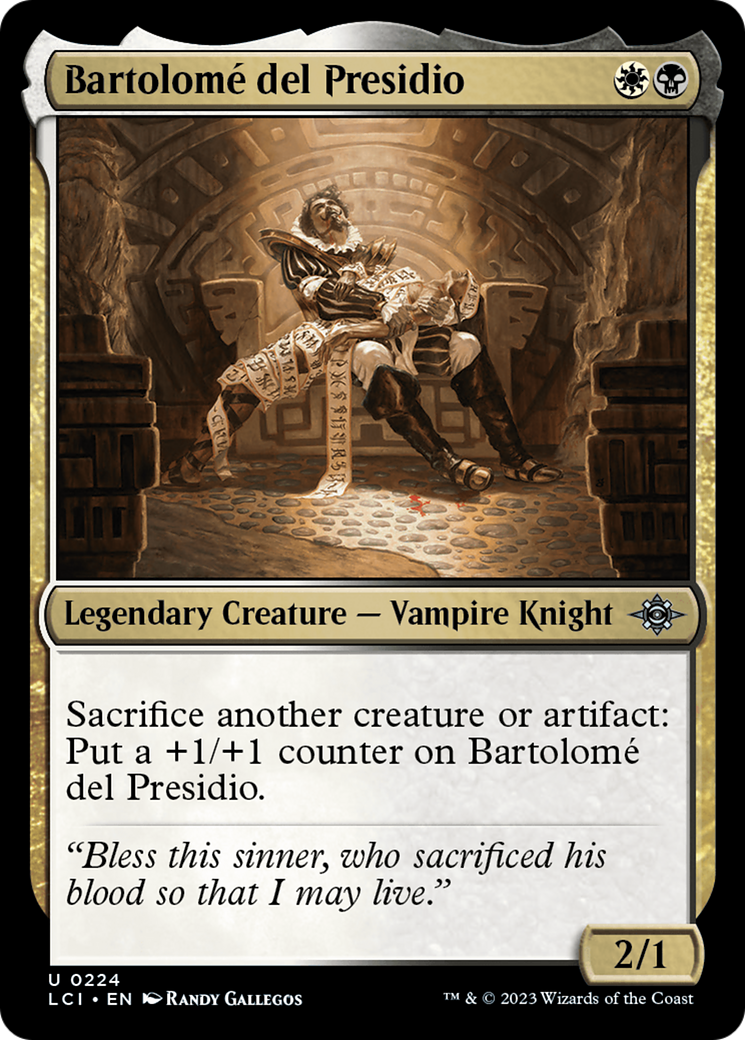
Bartolomé del Presidio
Bartolomé del Presidio
Legendary Creature — Vampire Knight
2/1
Sacrifice another creature or artifact: Put a +1/+1 counter on Bartolomé del Presidio.
-
1
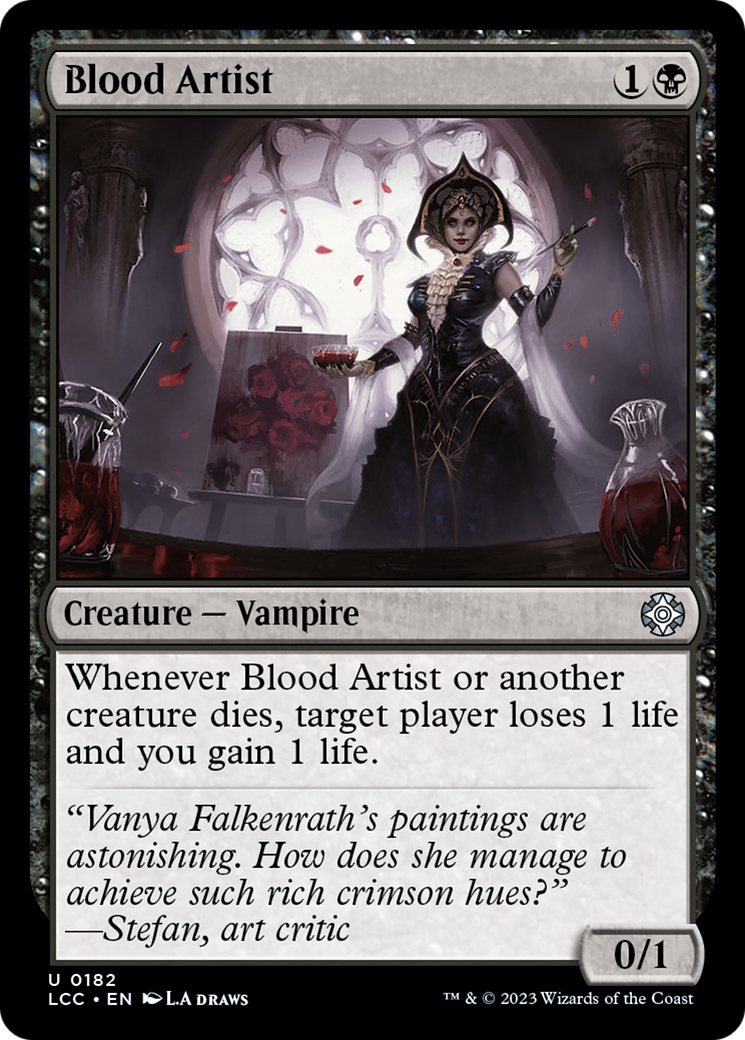
Blood Artist
Blood Artist
Creature — Vampire
0/1
Whenever this creature or another creature dies, target player loses 1 life and you gain 1 life.
- If Blood Artist and one or more other creatures die at the same time, its ability will trigger for each of those creatures.
-
1
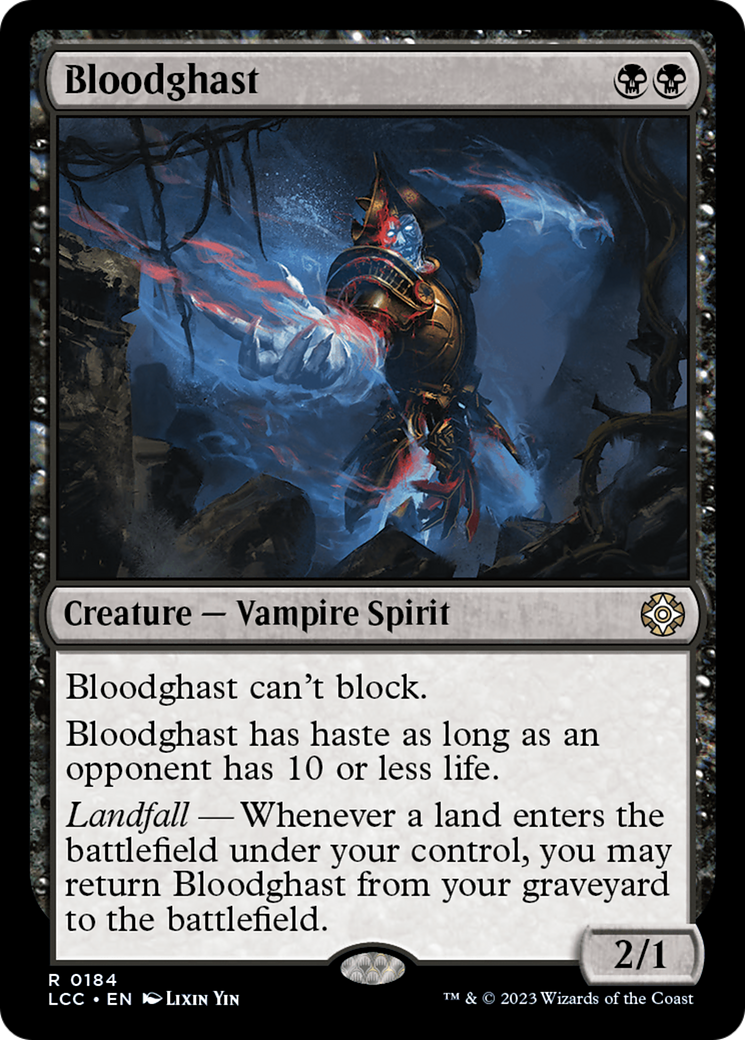
Bloodghast
Bloodghast
Creature — Vampire Spirit
2/1
This creature can't block.
This creature has haste as long as an opponent has 10 or less life.
Landfall — Whenever a land you control enters, you may return this card from your graveyard to the battlefield.
- Whenever a land you control enters, each landfall ability of permanents you control will trigger. You can put them on the stack in any order. The last ability you put on the stack will be the first one to resolve. As a result, you can have those abilities resolve in the order of your choosing.
- A landfall ability triggers whenever a land you control enters for any reason. It triggers whenever you play a land, as well as whenever a spell or ability puts a land onto the battlefield under your control.
- A landfall ability doesn't trigger if a permanent already on the battlefield becomes a land.
- Bloodghast's landfall ability triggers only if it's already in your graveyard at the time a land enters under your control.
-
1
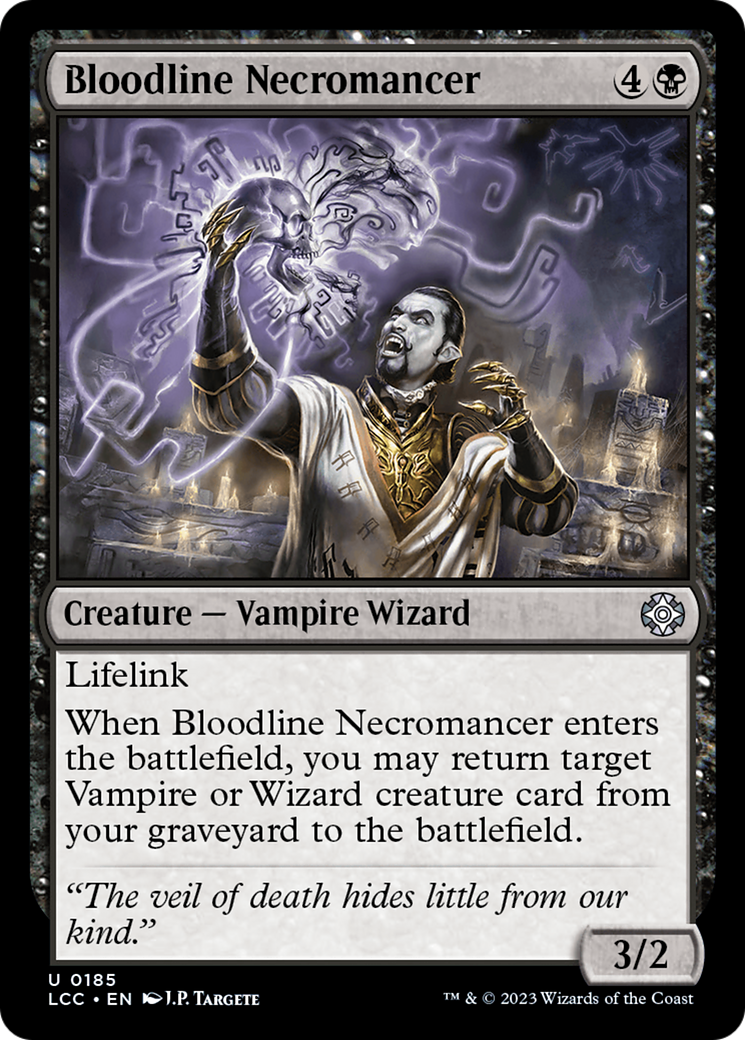
Bloodline Necromancer
Bloodline Necromancer
Creature — Vampire Wizard
3/2
Lifelink
When this creature enters, you may return target Vampire or Wizard creature card from your graveyard to the battlefield.
-
1
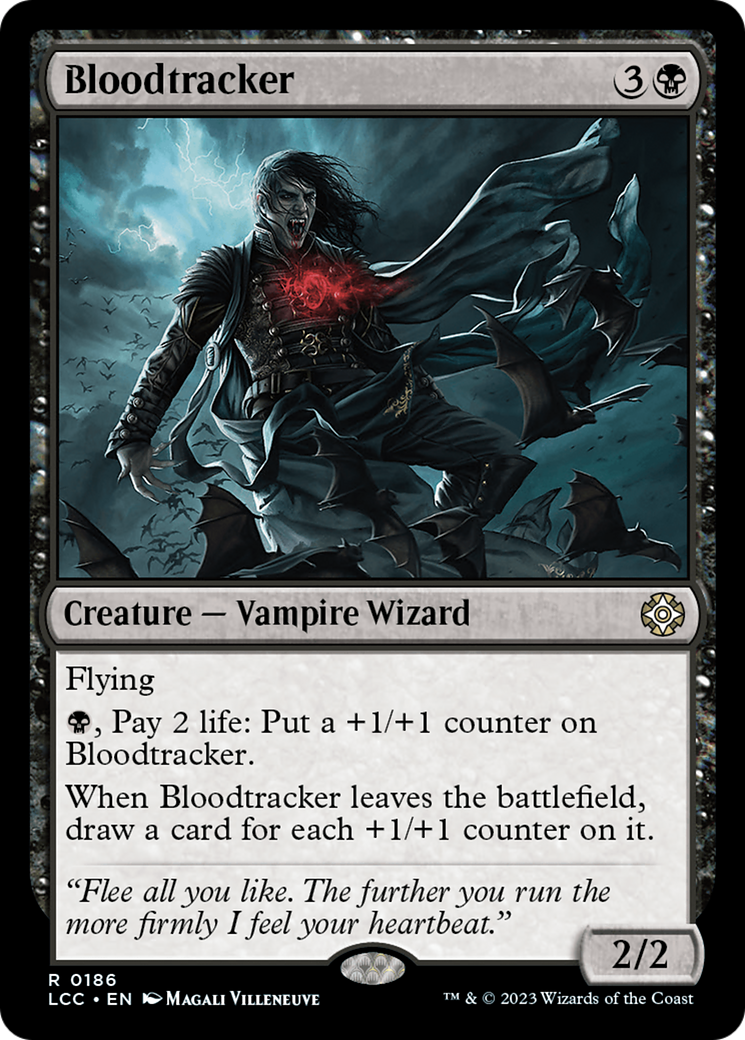
Bloodtracker
Bloodtracker
Creature — Vampire Wizard
2/2
Flying
, Pay 2 life: Put a +1/+1 counter on this creature.
When this creature leaves the battlefield, draw a card for each +1/+1 counter on it.
- If enough -1/-1 counters are put on Bloodtracker at the same time to make its toughness 0 or less, the number of +1/+1 counters on it before it got any -1/-1 counters will be used to determine how many cards you draw. For example, if there are three +1/+1 counters on Bloodtracker and it gets six -1/-1 counters, you'll draw three cards. That's because Bloodtracker's triggered ability checks the creature's existence just before it leaves the battlefield, and it still has all those counters on it at that point.
-
1
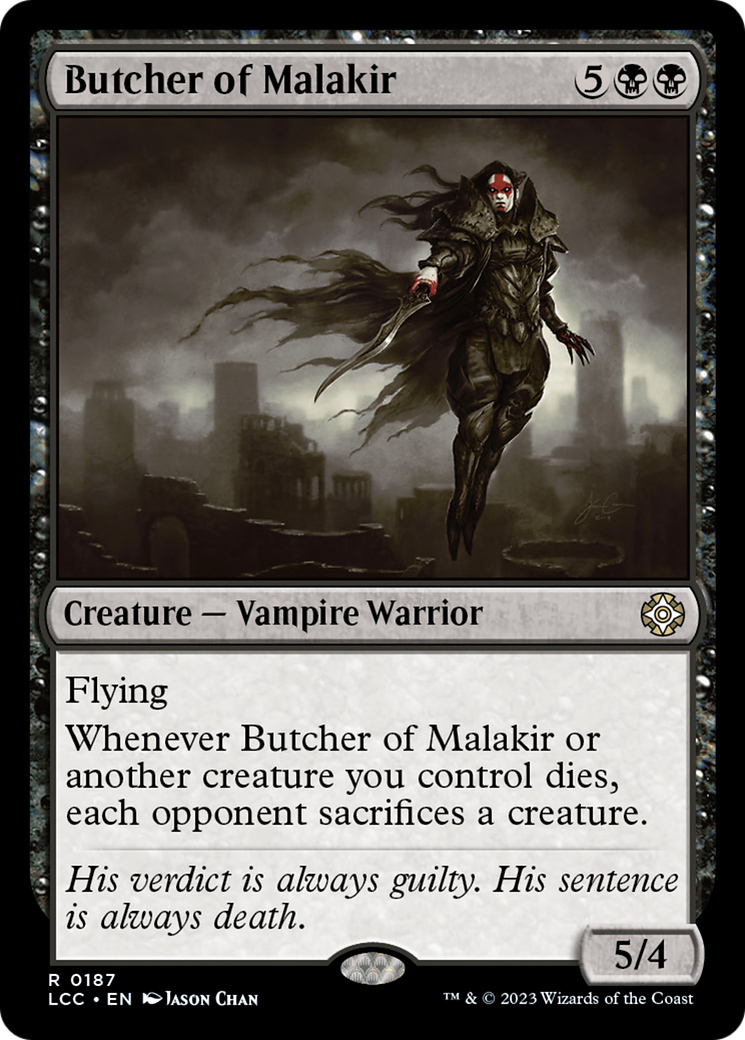
Butcher of Malakir
Butcher of Malakir
Creature — Vampire Warrior
5/4
Flying
Whenever this creature or another creature you control dies, each opponent sacrifices a creature of their choice.
- When the triggered ability resolves, first the player whose turn it is (if that player is an opponent) chooses which creature they will sacrifice, then each other opponent in turn order does the same, then all chosen creatures are sacrificed at the same time.
- If multiple creatures you control (possibly including Butcher of Malakir itself) are put into their owners' graveyards at the same time, Butcher of Malakir's triggered ability will trigger that many times.
- If you control more than one Butcher of Malakir and a creature you control is put into a graveyard, each of those Butchers' abilities will trigger. Each opponent will sacrifice a creature each time one of those abilities resolves.
- If you and an opponent each control a Butcher of Malakir and a creature is put into a graveyard, a chain reaction happens. First the ability of one player's Butcher will trigger, causing each opponent to sacrifice a creature. That sacrifice causes the ability of the other player's Butcher to trigger, and so on.
-
1
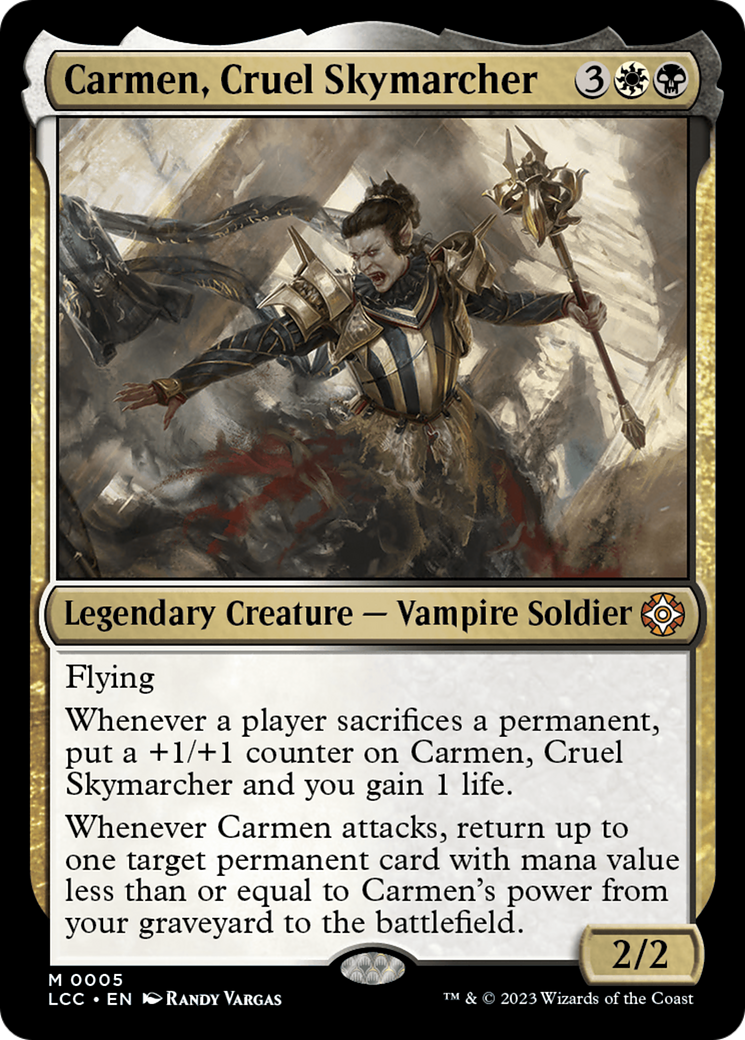
Carmen, Cruel Skymarcher
Carmen, Cruel Skymarcher
Legendary Creature — Vampire Soldier
2/2
Flying
Whenever a player sacrifices a permanent, put a +1/+1 counter on Carmen and you gain 1 life.
Whenever Carmen attacks, return up to one target permanent card with mana value less than or equal to Carmen's power from your graveyard to the battlefield.
- If a permanent is sacrificed to pay a cost of a spell or ability, Carmen, Cruel Skymarcher's second ability will resolve before that spell or ability. Conversely, if a permanent is sacrificed during the resolution of a spell or ability, that spell or ability will finish resolving before Carmen, Cruel Skymarcher's second ability is put onto the stack.
- If you sacrifice Carmen, Cruel Skymarcher, its second ability will still trigger.
- If another effect causes Carmen, Cruel Skymarcher's power to be less than the mana value of the target card as its last ability tries to resolve, the target is illegal. You won't return the target card to the battlefield.
-
1
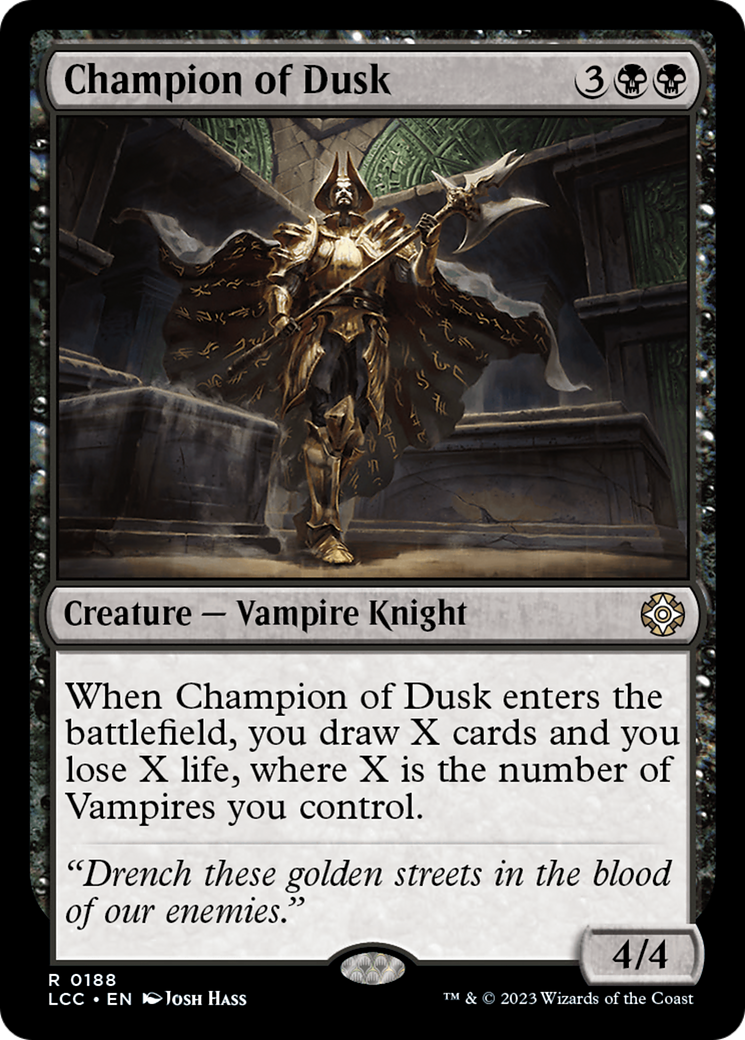
Champion of Dusk
Champion of Dusk
Creature — Vampire Knight
4/4
When this creature enters, you draw X cards and you lose X life, where X is the number of Vampires you control.
- The number of Vampires you control is counted only as Champion of Dusk's ability resolves. If Champion of Dusk is still on the battlefield, it'll count itself.
-
1
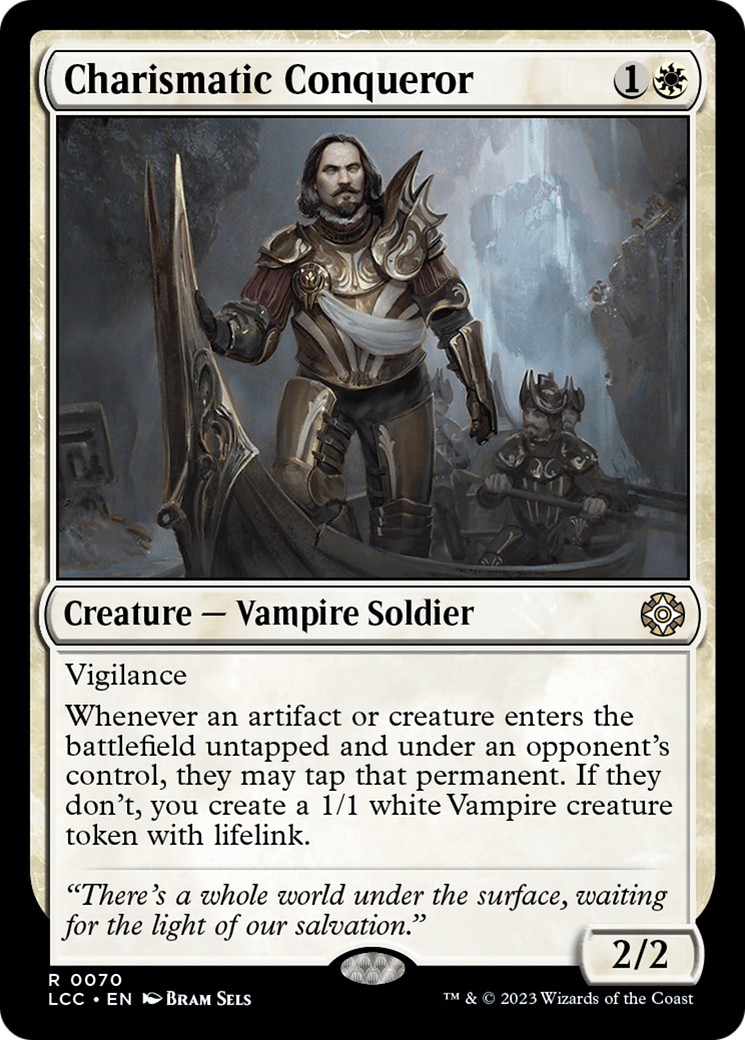
Charismatic Conqueror
Charismatic Conqueror
Creature — Vampire Soldier
2/2
Vigilance
Whenever an artifact or creature an opponent controls enters untapped, they may tap that permanent. If they don't, you create a 1/1 white Vampire creature token with lifelink.
- If the permanent is tapped as the ability resolves, the opponent can't choose to tap it, so you'll create a Vampire token. Similarly, if it's no longer on the battlefield as the ability resolves, they can't choose to tap it, and you'll create a Vampire token.
-
1
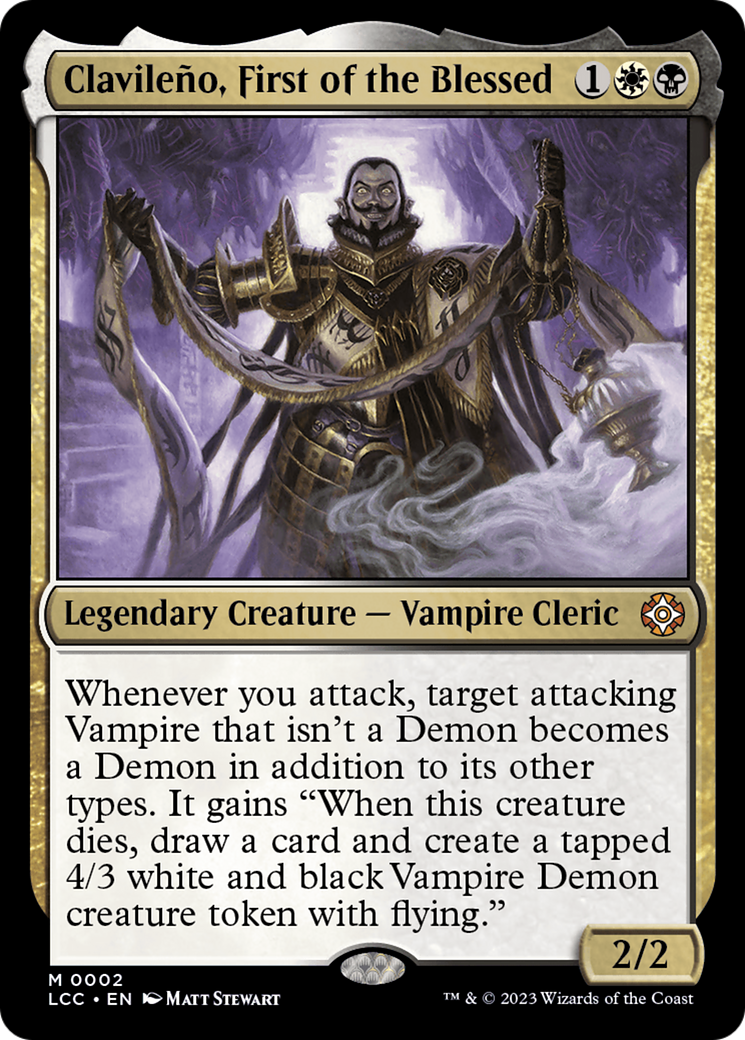
Clavileño, First of the Blessed
Clavileño, First of the Blessed
Legendary Creature — Vampire Cleric
2/2
Whenever you attack, target attacking Vampire that isn't a Demon becomes a Demon in addition to its other types. It gains "When this creature dies, draw a card and create a tapped 4/3 white and black Vampire Demon creature token with flying."
-
1
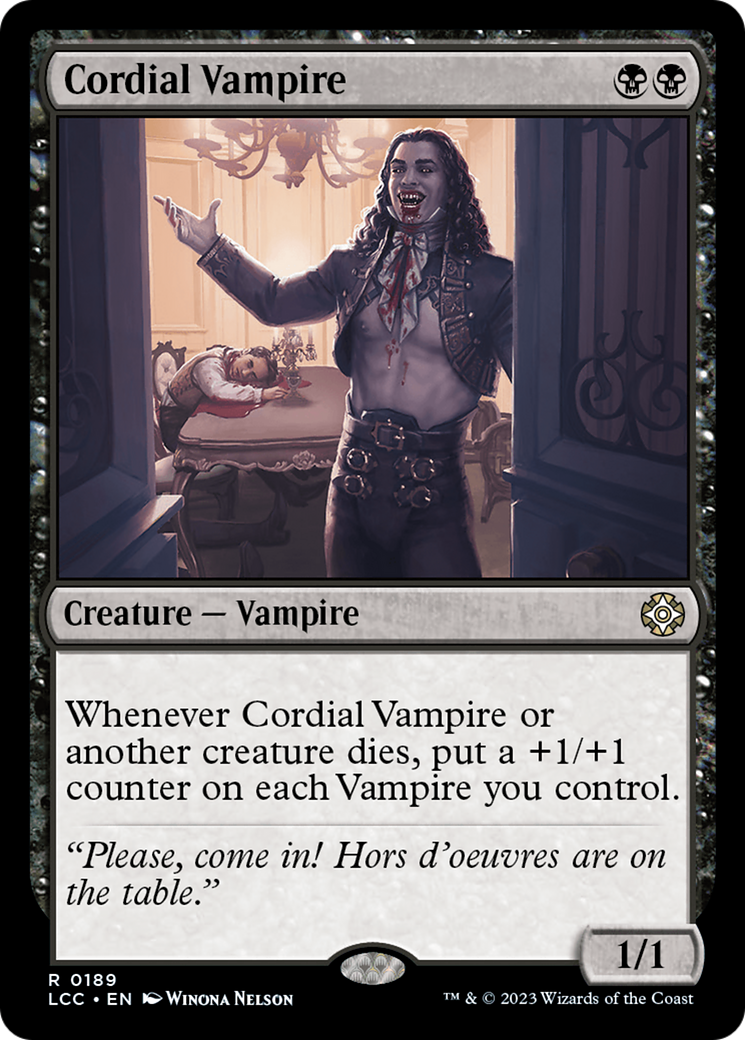
Cordial Vampire
Cordial Vampire
Creature — Vampire
1/1
Whenever this creature or another creature dies, put a +1/+1 counter on each Vampire you control.
- If Cordial Vampire dies at the same time as one or more other creatures, its ability triggers for each of them.
- If a Vampire you control is dealt lethal damage at the same time as another creature, they die at the same time. That Vampire can't receive a counter from Cordial Vampire's ability in time to save it.
-
1
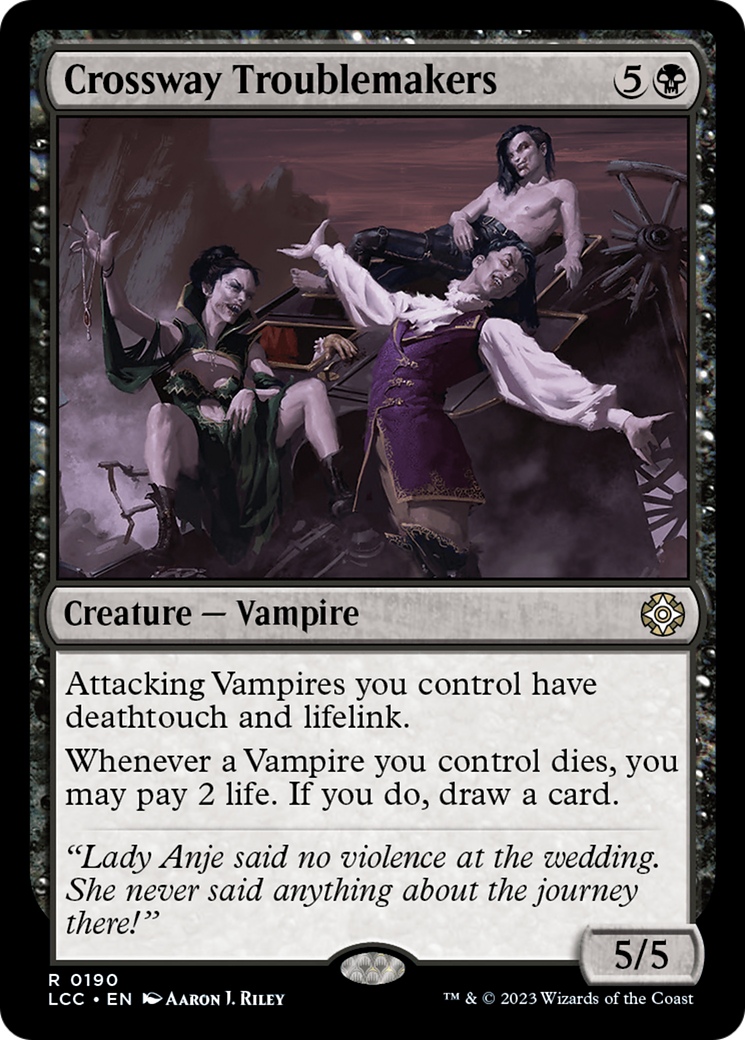
Crossway Troublemakers
Crossway Troublemakers
Creature — Vampire
5/5
Attacking Vampires you control have deathtouch and lifelink. (Any amount of damage they deal to a creature is enough to destroy it. Damage dealt by those creatures also causes their controller to gain that much life.)
Whenever a Vampire you control dies, you may pay 2 life. If you do, draw a card.
- You may pay 2 life only once for each Vampire that dies. You can't pay multiple times for the same triggered ability and draw multiple cards.
-
1
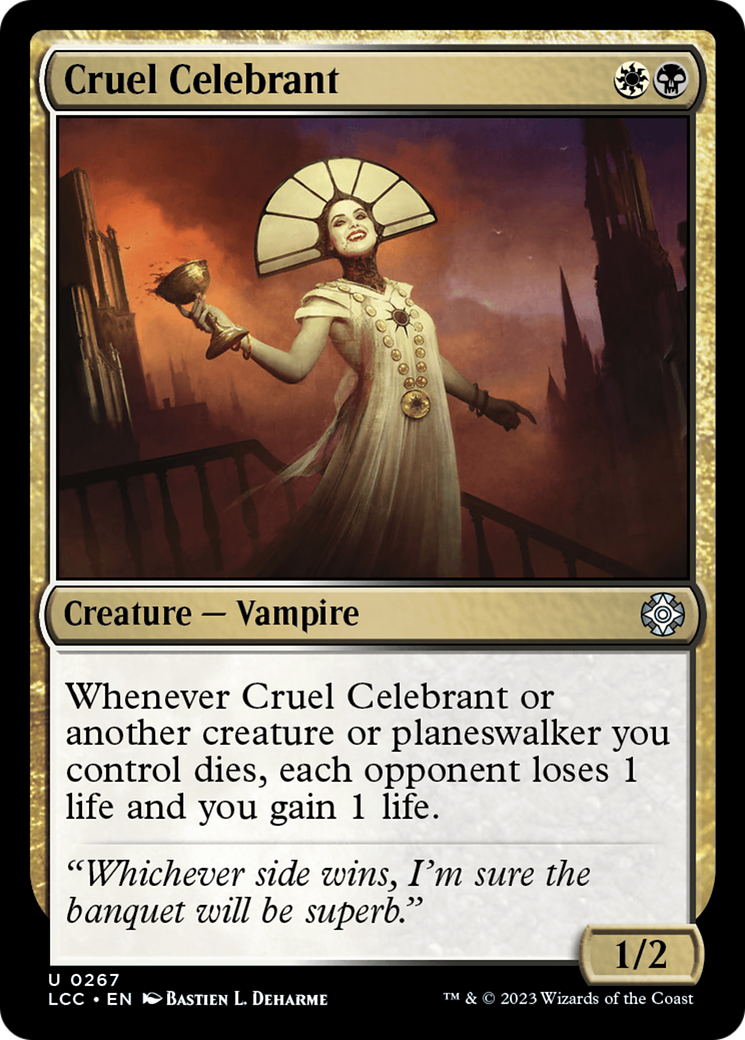
Cruel Celebrant
Cruel Celebrant
Creature — Vampire
1/2
Whenever this creature or another creature or planeswalker you control dies, each opponent loses 1 life and you gain 1 life.
- If Cruel Celebrant dies at the same time as one or more other creatures and/or planeswalkers you control, its ability triggers for each of them.
- If a planeswalker that's also a creature dies, Cruel Celebrant's ability triggers only once.
- In a Two-Headed Giant game, Cruel Celebrant's ability causes the opposing team to lose 2 life and you gain 1 life.
-
1
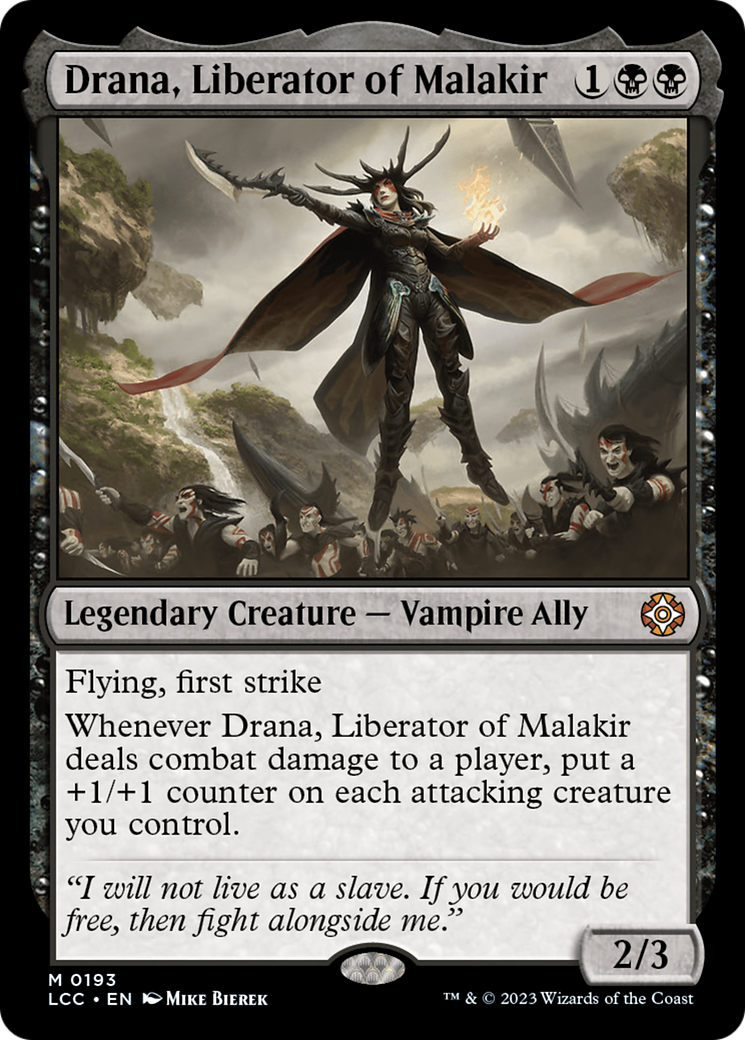
Drana, Liberator of Malakir
Drana, Liberator of Malakir
Legendary Creature — Vampire Ally
2/3
Flying, first strike
Whenever Drana deals combat damage to a player, put a +1/+1 counter on each attacking creature you control.
- Drana's last ability triggers after combat damage has been dealt, so only attacking creatures that survive the combat damage step in which Drana deals combat damage will have +1/+1 counters put on them.
- The +1/+1 counter won't change how much damage Drana or any other attacking creature with first strike or double strike deals during that combat damage step. However, the +1/+1 counters that are put on attacking creatures without first strike will affect the damage those creatures deal during the regular combat damage step.
-
1
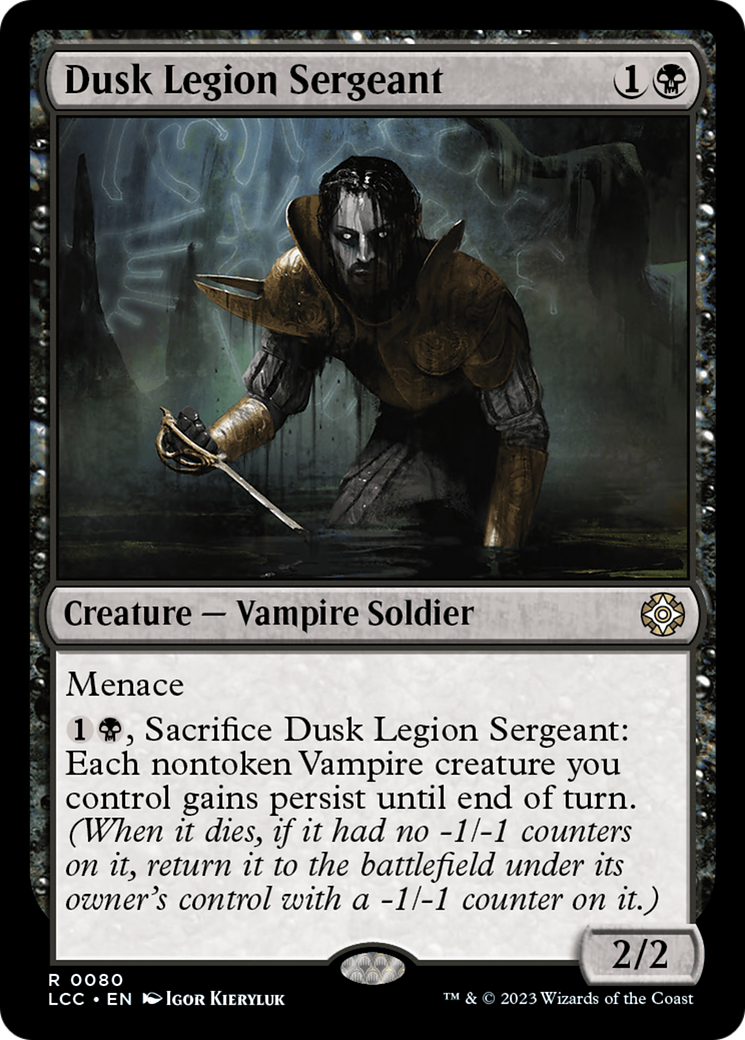
Dusk Legion Sergeant
Dusk Legion Sergeant
Creature — Vampire Soldier
2/2
Menace
, Sacrifice this creature: Each nontoken Vampire creature you control gains persist until end of turn. (When it dies, if it had no -1/-1 counters on it, return it to the battlefield under its owner's control with a -1/-1 counter on it.)
- If a card with persist is removed from the graveyard after it dies but before the ability trigger resolves, it won't be returned to the battlefield.
- Once persist returns the creature, it's considered a new object with no relation to the object that it was. Auras that were attached to it won't return to the battlefield. Equipment that was attached to it will remain unattached. Any counters that were on it won't be put on the new creature.
- If a creature has +1/+1 counters and -1/-1 counters on it, state-based actions remove the same number of each so that it has only one kind of those counters on it. A creature's persist ability can bring it back again if its -1/-1 counters are removed this way.
- If a creature with persist that has +1/+1 counters on it receives enough -1/-1 counters to cause it to be destroyed by lethal damage or put into its owner's graveyard for having 0 or less toughness, persist won't trigger and the card won't return to the battlefield. That's because persist checks the creature as it last existed on the battlefield, and it still had -1/-1 counters on it at that point.
-
1
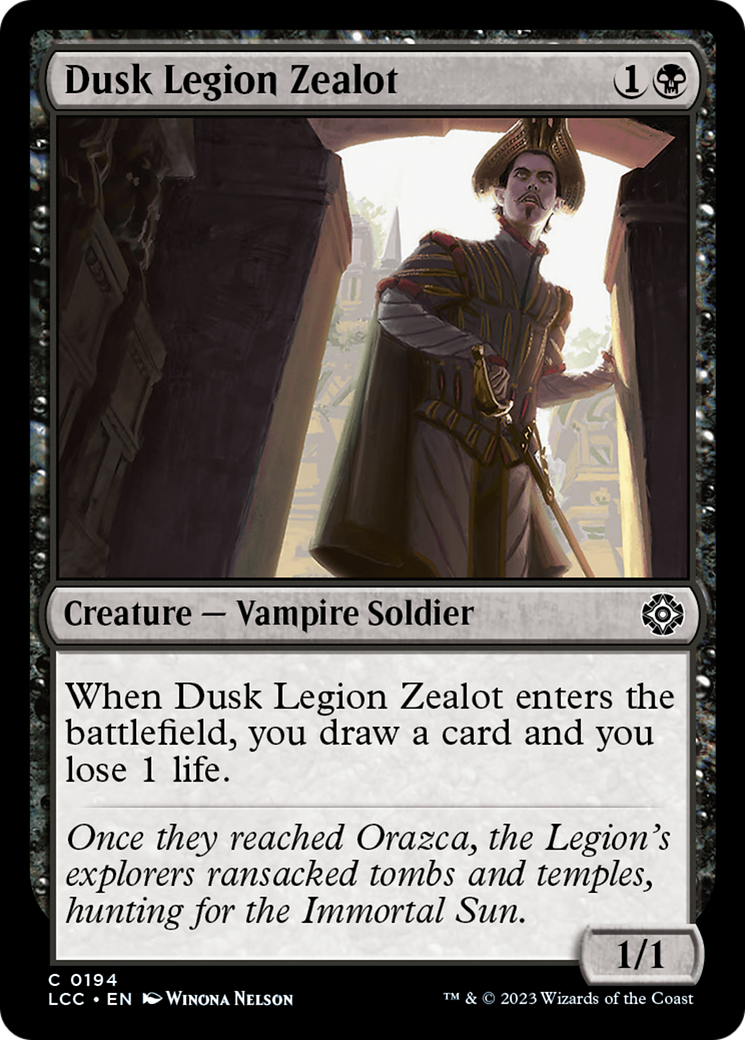
Dusk Legion Zealot
Dusk Legion Zealot
Creature — Vampire Soldier
1/1
When this creature enters, you draw a card and you lose 1 life.
-
1
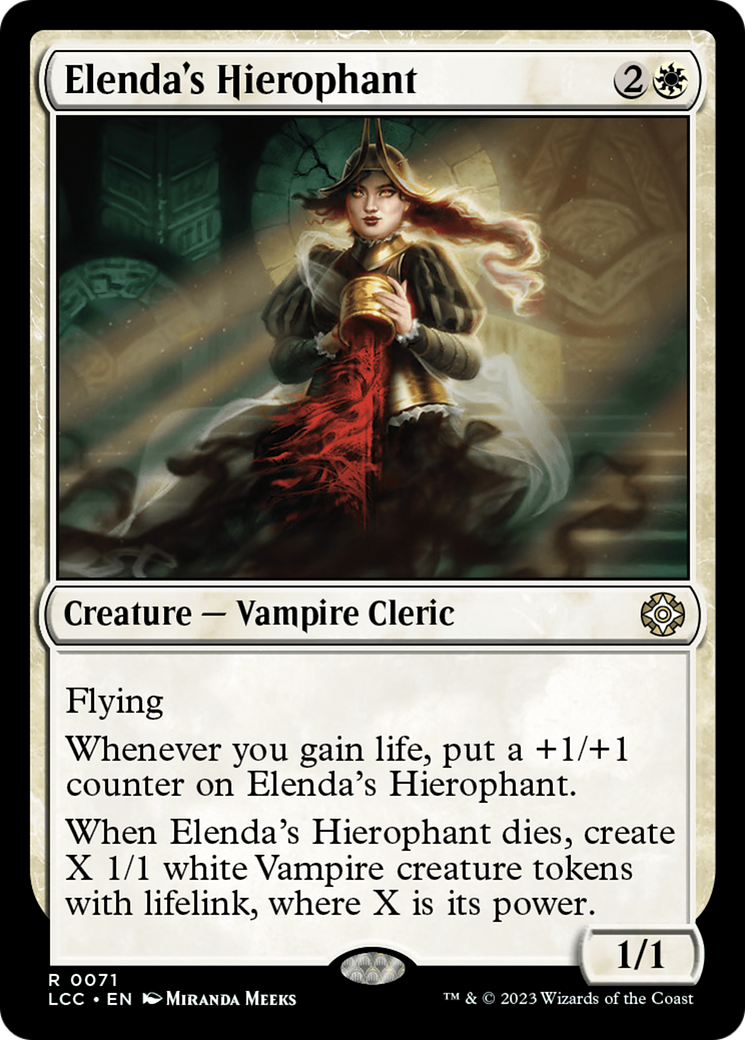
Elenda's Hierophant
Elenda's Hierophant
Creature — Vampire Cleric
1/1
Flying
Whenever you gain life, put a +1/+1 counter on this creature.
When this creature dies, create X 1/1 white Vampire creature tokens with lifelink, where X is its power.
- The second ability of Elenda's Hierophant triggers just once for each life-gaining event, no matter how much life was gained.
- If Elenda's Hierophant is dealt lethal damage at the same time that you gain life, it won't receive a counter from its second ability in time to save it.
- Each creature with lifelink dealing combat damage causes a separate life-gaining event. For example, if two creatures you control with lifelink deal combat damage at the same time, Elenda's Hierophant's second ability will trigger twice. However, if a single creature you control with lifelink deals combat damage to multiple creatures, players, and/or planeswalkers at the same time (perhaps because it has trample or was blocked by more than one creature), the ability will trigger only once.
- If you gain an amount of life "for each" of something, that life is gained as one event and the second ability of Elenda's Hierophant triggers only once.
- In a Two-Headed Giant game, life gained by your teammate won't cause the second ability of Elenda's Hierophant to trigger even though it caused your team's life total to increase.
-
1
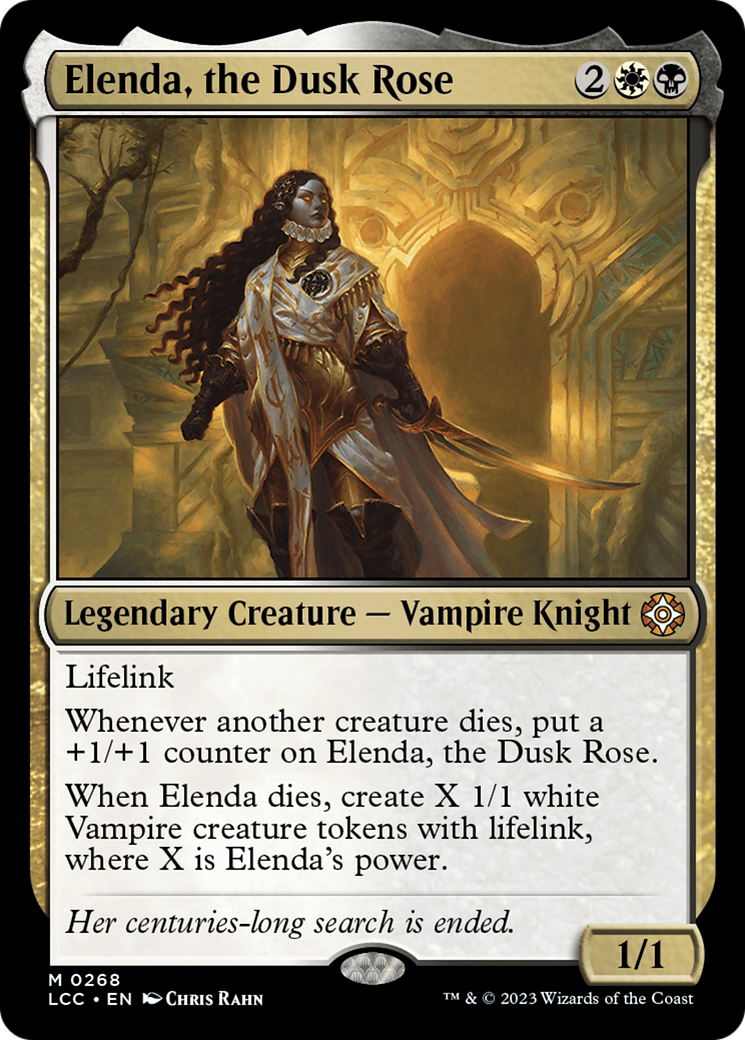
Elenda, the Dusk Rose
Elenda, the Dusk Rose
Legendary Creature — Vampire Knight
1/1
Lifelink
Whenever another creature dies, put a +1/+1 counter on Elenda.
When Elenda dies, create X 1/1 white Vampire creature tokens with lifelink, where X is Elenda's power.
- If Elenda dies at the same time as another creature, both of its triggered abilities trigger. However, the first one won't do anything since you can't put a +1/+1 counter on Elenda.
- To determine how many Vampire tokens are created, use Elenda's power as it last existed on the battlefield.
-
1
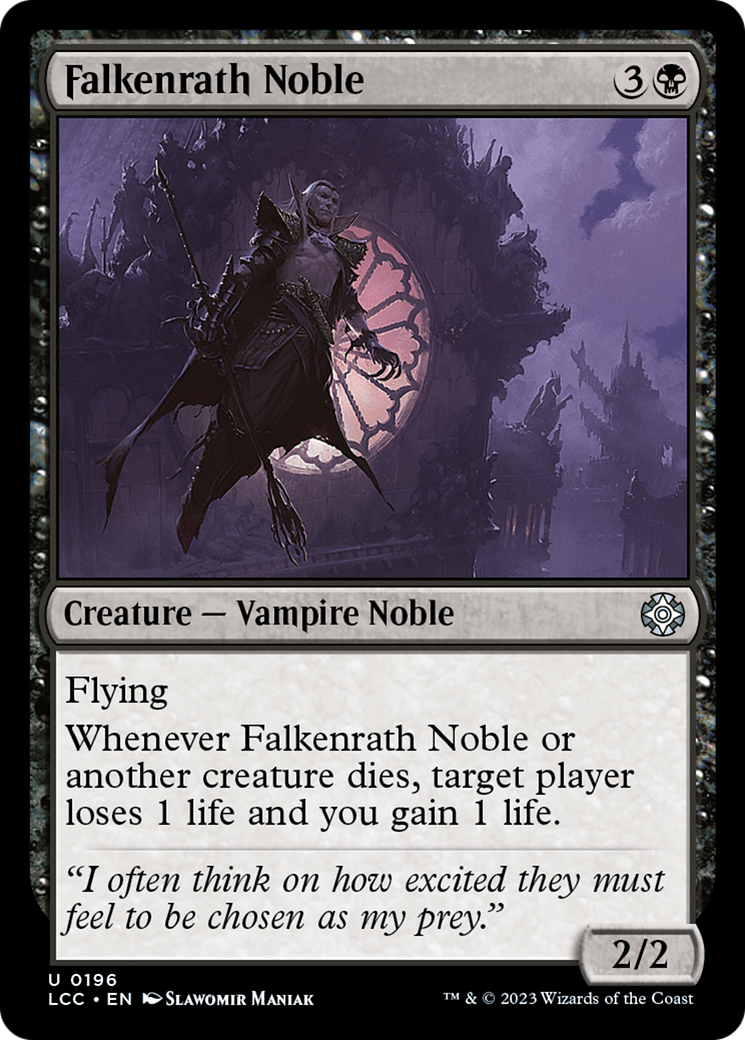
Falkenrath Noble
Falkenrath Noble
Creature — Vampire Noble
2/2
Flying
Whenever this creature or another creature dies, target player loses 1 life and you gain 1 life.
- If Falkenrath Noble and another creature die at the same time, Falkenrath Noble's triggered ability will trigger for each of them.
-
1
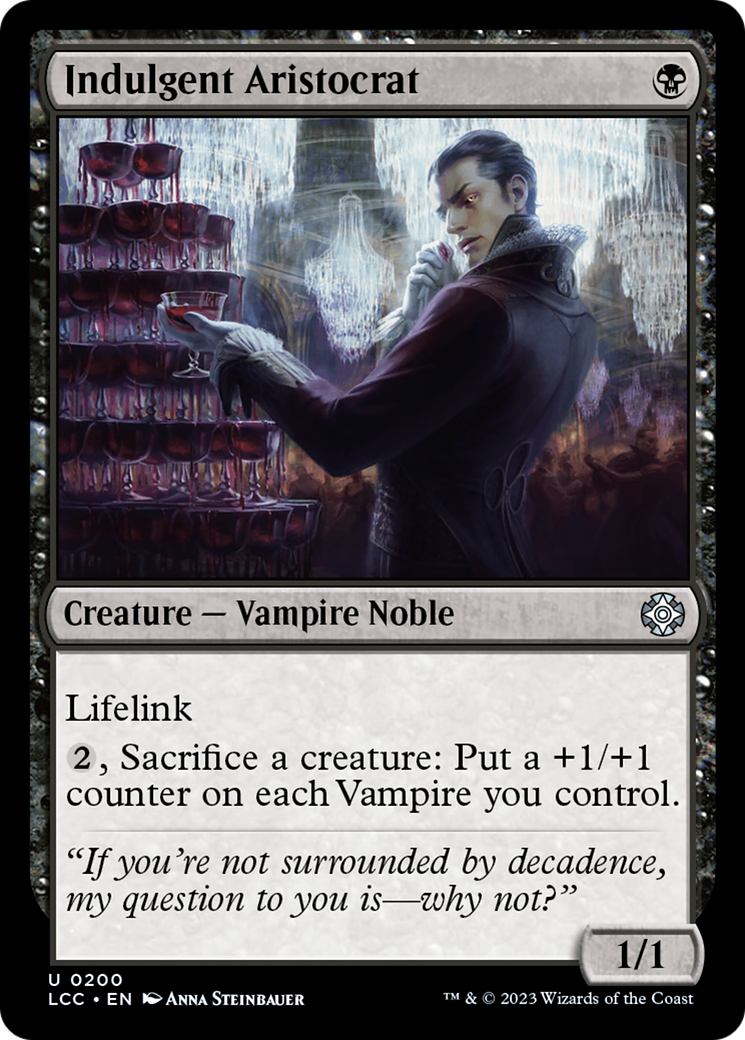
Indulgent Aristocrat
Indulgent Aristocrat
Creature — Vampire Noble
1/1
Lifelink
, Sacrifice a creature: Put a +1/+1 counter on each Vampire you control.
- You can sacrifice Indulgent Aristocrat to pay the cost of its own activated ability.
-
1
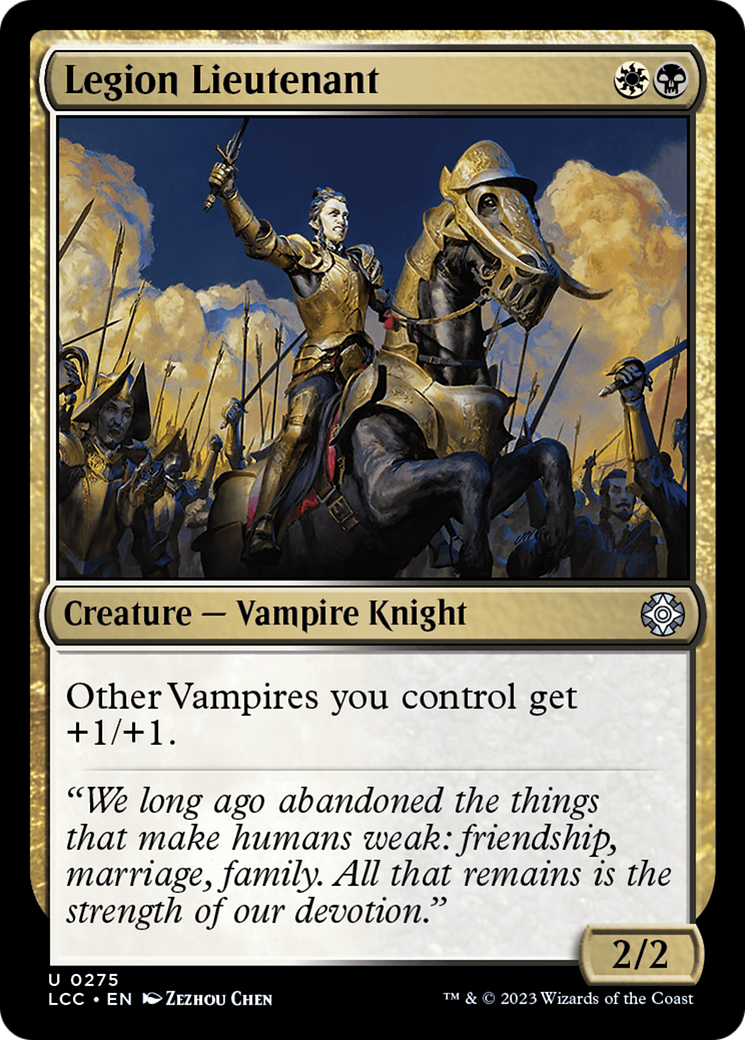
Legion Lieutenant
Legion Lieutenant
Creature — Vampire Knight
2/2
Other Vampires you control get +1/+1.
- Because damage remains marked on a creature until it's removed as the turn ends, nonlethal damage dealt to another Vampire you control may become lethal if Legion Lieutenant leaves the battlefield during that turn.
-
1
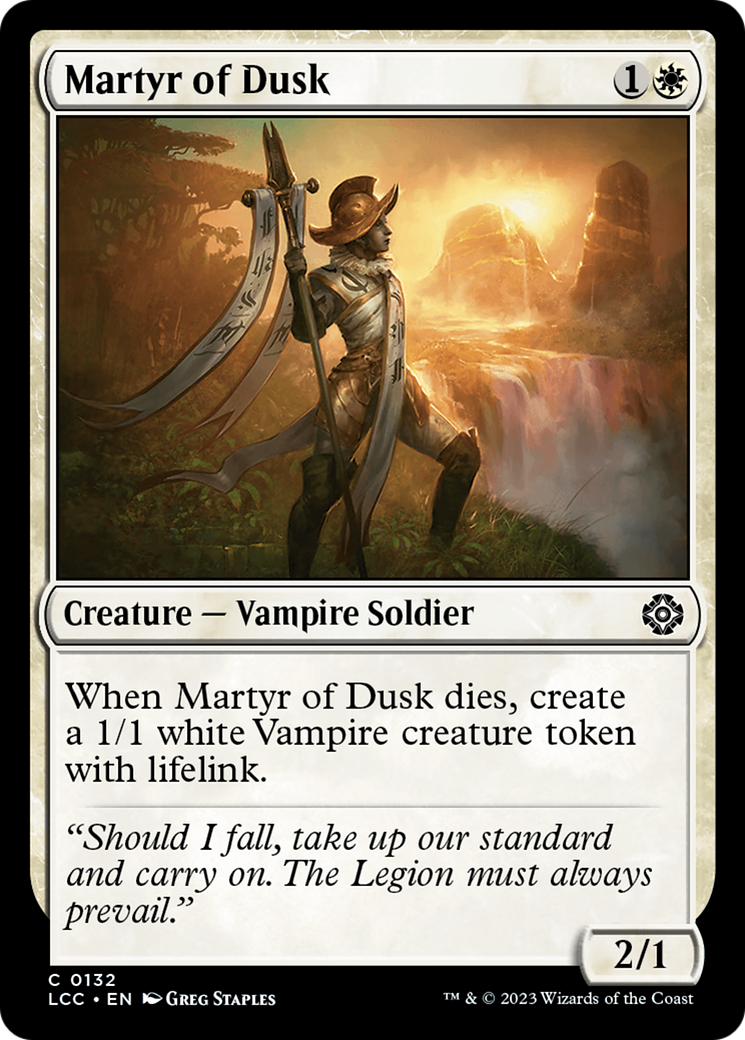
Martyr of Dusk
Martyr of Dusk
Creature — Vampire Soldier
2/1
When this creature dies, create a 1/1 white Vampire creature token with lifelink.
-
1
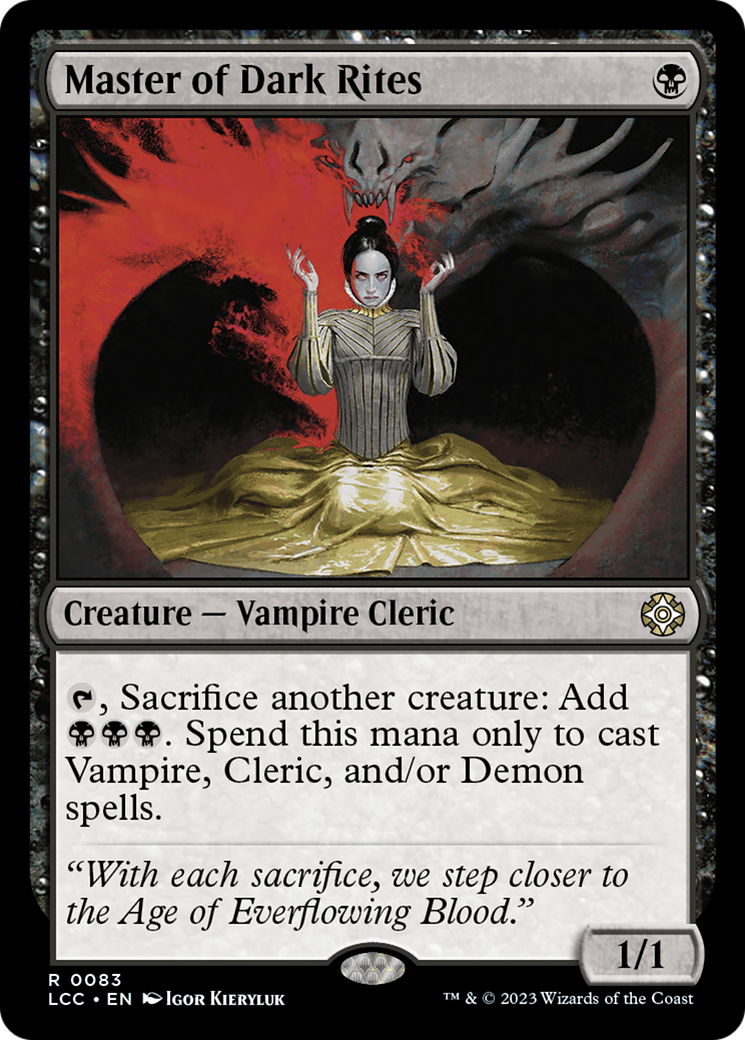
Master of Dark Rites
Master of Dark Rites
Creature — Vampire Cleric
1/1
, Sacrifice another creature: Add . Spend this mana only to cast Vampire, Cleric, and/or Demon spells.
-
1
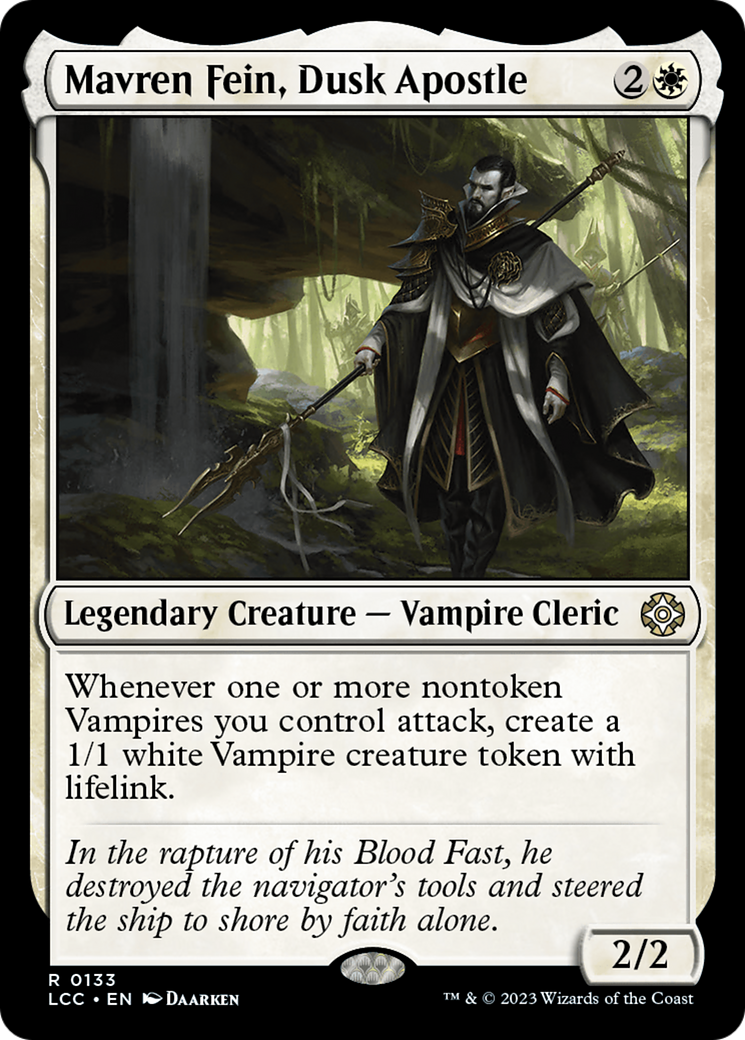
Mavren Fein, Dusk Apostle
Mavren Fein, Dusk Apostle
Legendary Creature — Vampire Cleric
2/2
Whenever one or more nontoken Vampires you control attack, create a 1/1 white Vampire creature token with lifelink.
- Once you attack with one or more nontoken Vampires, Mavren Fein's ability will create a Vampire token even if some or all of those Vampires leave the battlefield or are removed from combat.
-
1
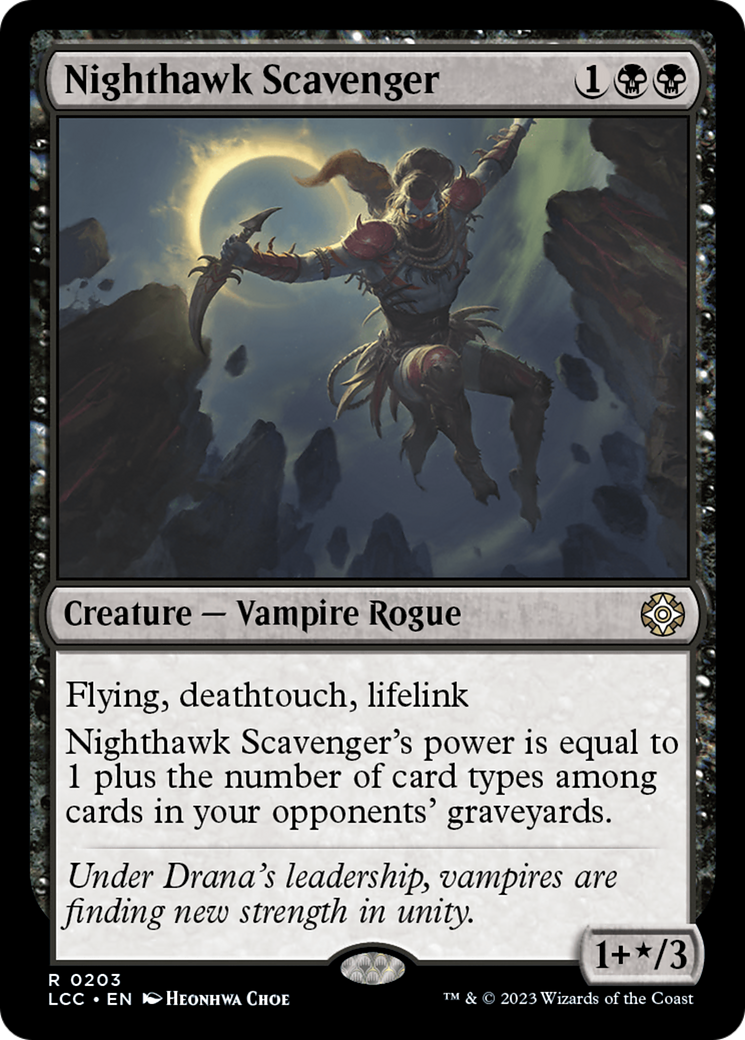
Nighthawk Scavenger
Nighthawk Scavenger
Creature — Vampire Rogue
1+*/3
Flying, deathtouch, lifelink
Nighthawk Scavenger's power is equal to 1 plus the number of card types among cards in your opponents' graveyards.
- The ability that defines Nighthawk Scavenger's power applies in all zones, not just the battlefield.
- Nighthawk Scavenger counts card types, not cards. If the only card in your opponents' graveyards is a single artifact creature card, Nighthawk Scavenger will be 3/3. If the only cards in those graveyards are ten artifact cards and ten creature cards, Nighthawk Scavenger will still be 3/3.
- Card types that can appear on cards in a graveyard include artifact, creature, enchantment, instant, land, planeswalker, and sorcery. Legendary, basic, and snow are supertypes, not card types; Vampire and Rogue are subtypes, not card types.
-
1
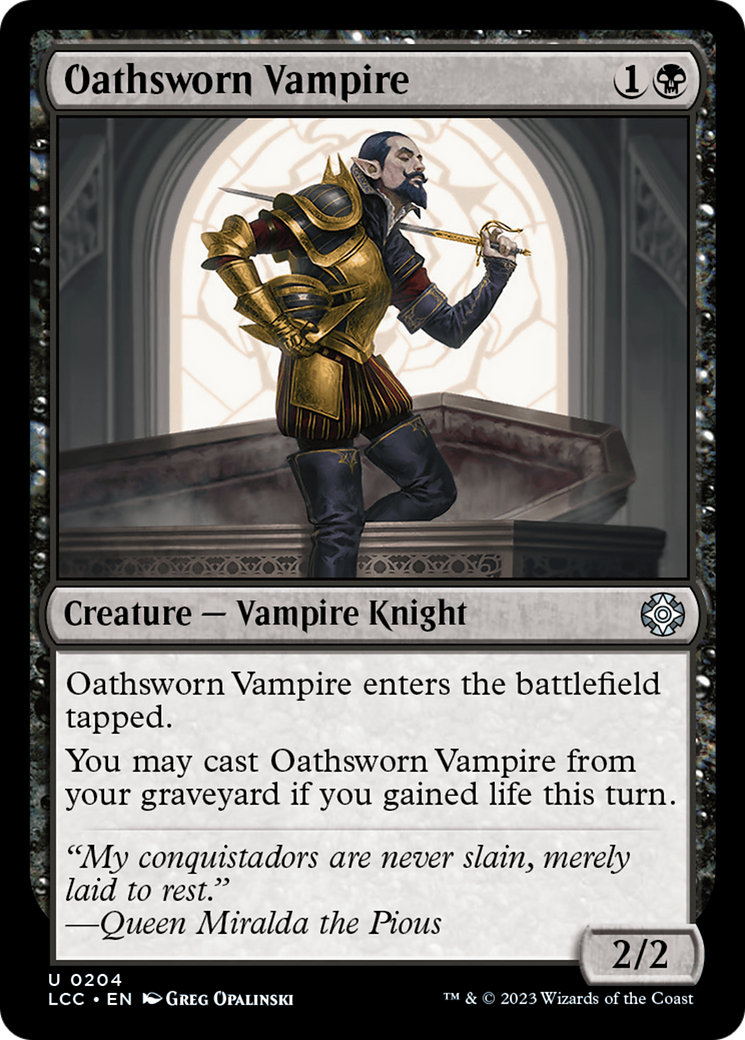
Oathsworn Vampire
Oathsworn Vampire
Creature — Vampire Knight
2/2
This creature enters tapped.
You may cast this card from your graveyard if you gained life this turn.
- Oathsworn Vampire's last ability cares only whether you gained life in the turn, even if Oathsworn Vampire wasn't in your graveyard when that happened. It doesn't care how much you gained, whether you also lost life, or even whether you lost more life than you gained.
- Casting Oathsworn Vampire from your graveyard follows the normal rules for casting that card. You must pay its costs, and you must follow all applicable timing rules.
-
1
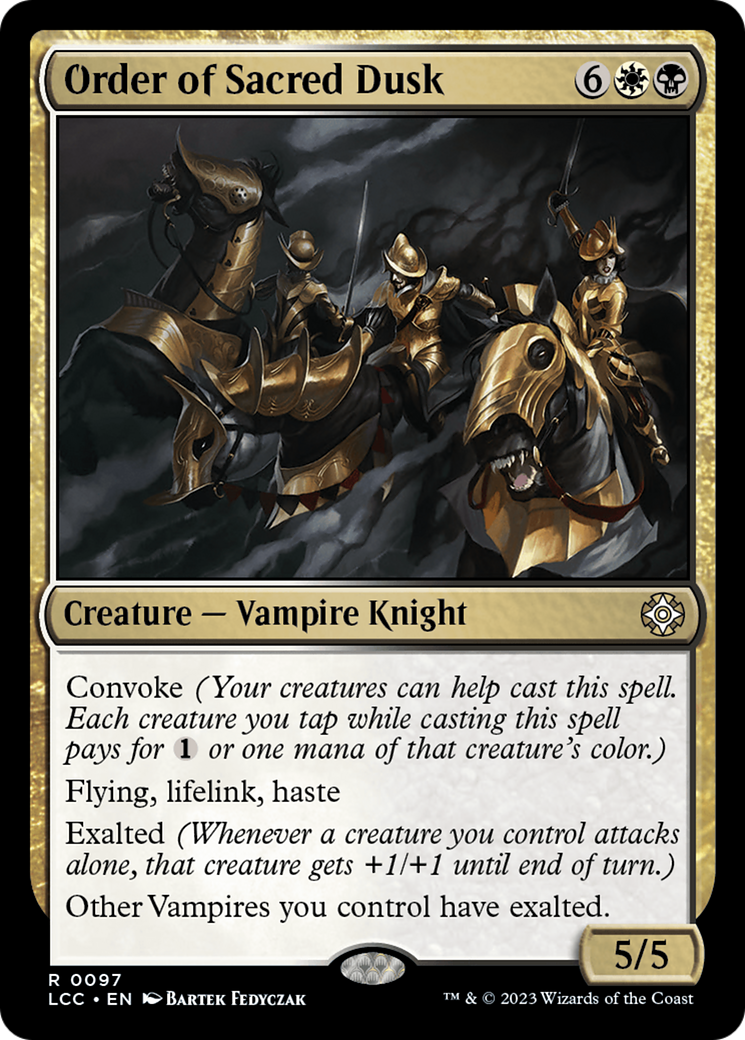
Order of Sacred Dusk
Order of Sacred Dusk
Creature — Vampire Knight
5/5
Convoke (Your creatures can help cast this spell. Each creature you tap while casting this spell pays for or one mana of that creature's color.)
Flying, lifelink, haste
Exalted (Whenever a creature you control attacks alone, that creature gets +1/+1 until end of turn.)
Other Vampires you control have exalted.
- When calculating a spell's total cost, include any alternative costs, additional costs, or anything else that increases or reduces the cost to cast the spell. Convoke applies after the total cost is calculated. Convoke doesn't change a spell's mana cost or mana value.
- You can tap any untapped creature you control to convoke a spell, even one you haven't controlled continuously since the beginning of your most recent turn.
- Tapping an untapped creature that's attacking or blocking to convoke a spell won't cause that creature to stop attacking or blocking.
- Tapping a multicolored creature using convoke will pay for or one mana of your choice of any of that creature's colors.
- If a creature you control has a mana ability with in the cost, activating that ability while casting a spell with convoke will result in the creature being tapped before you pay the spell's costs. You won't be able to tap it again for convoke. Similarly, if you sacrifice a creature to activate a mana ability while casting a spell with convoke, that creature won't be on the battlefield when you pay the spell's costs, so you won't be able to tap it for convoke.
- Because convoke isn't an alternative cost, it can be used in conjunction with alternative costs.
- A creature attacks alone if it's the only creature declared as an attacker during the declare attackers step (including creatures controlled by your teammates, if applicable). For example, exalted won't trigger if you attack with multiple creatures and all but one of them are removed from combat.
-
1
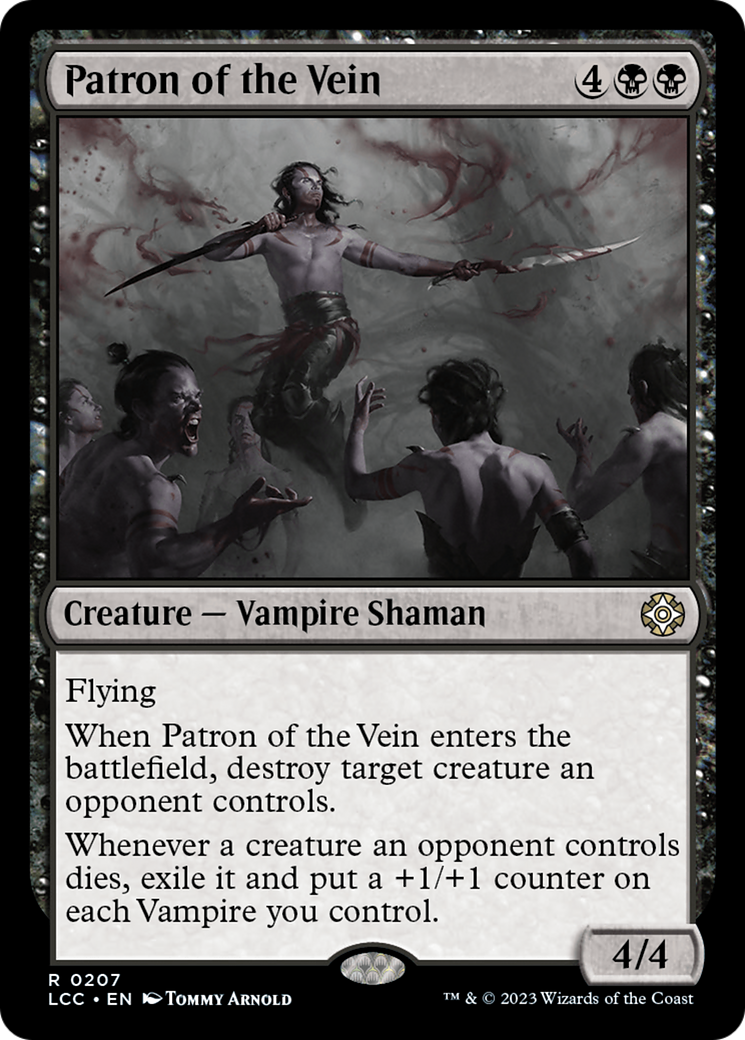
Patron of the Vein
Patron of the Vein
Creature — Vampire Shaman
4/4
Flying
When this creature enters, destroy target creature an opponent controls.
Whenever a creature an opponent controls dies, exile it and put a +1/+1 counter on each Vampire you control.
- Destroying a creature with Patron of the Vein's first ability causes its last ability to trigger if Patron of the Vein is still on the battlefield.
- Patron of the Vein's last ability puts a +1/+1 counter on each Vampire you control, including itself, even if the creature that died can't be exiled (most likely because it was a token).
- If Patron of the Vein and a creature an opponent controls die simultaneously (perhaps because they fought or were in combat together), Patron of the Vein's last ability triggers, but Patron of the Vein won't be on the battlefield as that ability resolves. It can't be saved by the +1/+1 counter that would have been put on it. The same is true of any other Vampires you control that die at the same time. Your remaining Vampires will each get a +1/+1 counter.
-
1
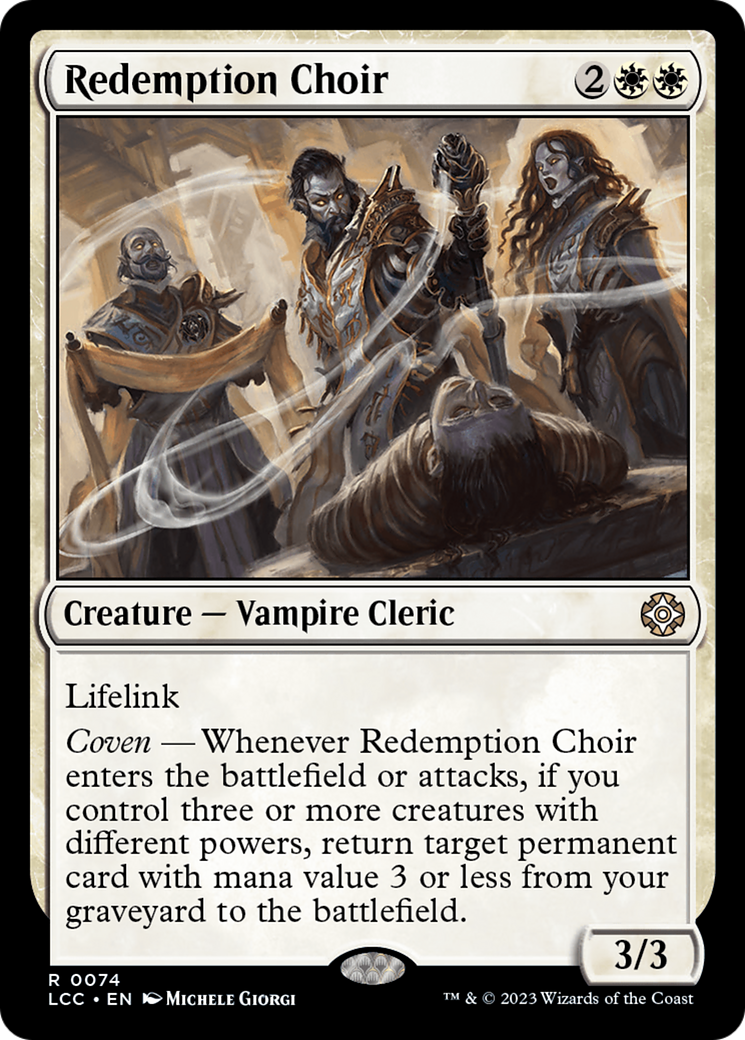
Redemption Choir
Redemption Choir
Creature — Vampire Cleric
3/3
Lifelink
Coven — Whenever this creature enters or attacks, if you control three or more creatures with different powers, return target permanent card with mana value 3 or less from your graveyard to the battlefield.
- For three creatures to have different powers from one another, each of their powers needs to be different. A 1/1 creature, a 2/1 creature, and another 2/1 creature aren't three creatures with different powers, even though both 2/1 creatures have different power than the 1/1 creature.
- You must control three or more creatures with different powers at the time the coven ability triggers and at the time the ability tries to resolve. They do not, however, need to be the same set of creatures in both cases.
-
1
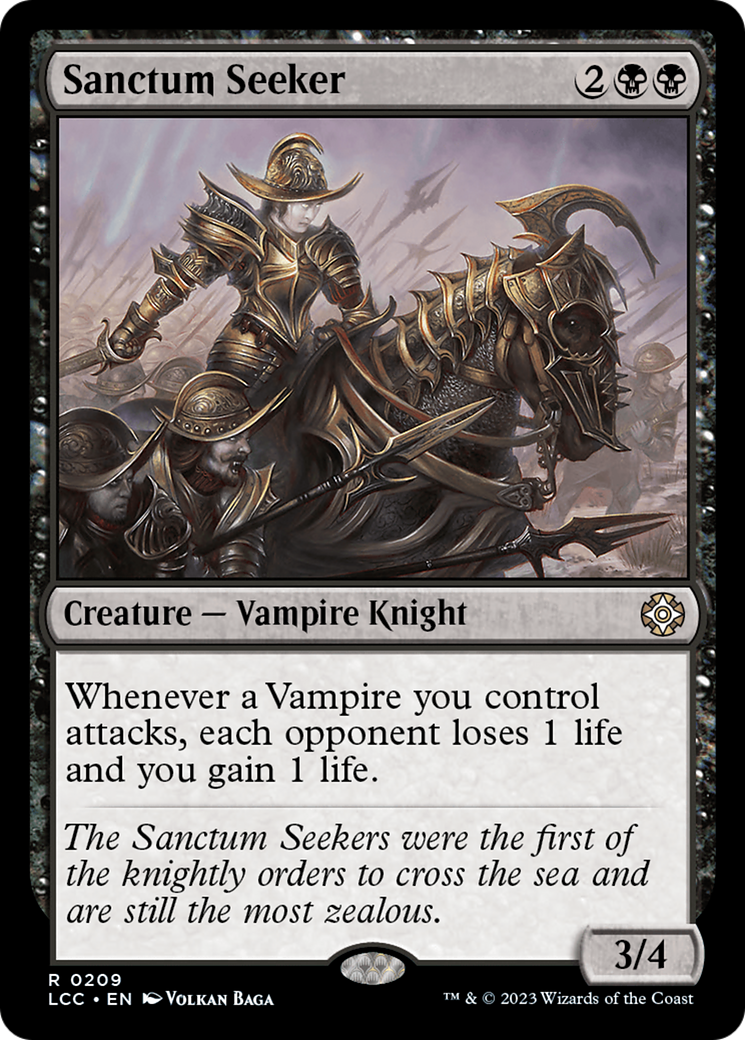
Sanctum Seeker
Sanctum Seeker
Creature — Vampire Knight
3/4
Whenever a Vampire you control attacks, each opponent loses 1 life and you gain 1 life.
- In a Two-Headed Giant game, Sanctum Seeker's ability causes the opposing team to lose 2 life and you to gain 1 life.
-
1
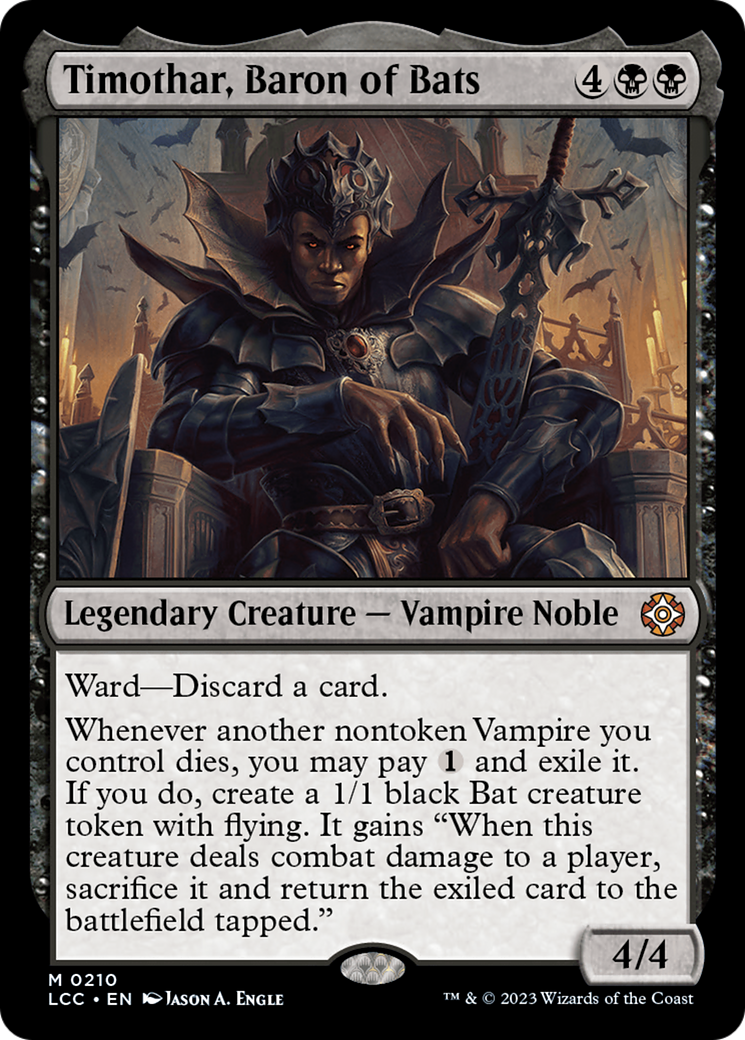
Timothar, Baron of Bats
Timothar, Baron of Bats
Legendary Creature — Vampire Noble
4/4
Ward—Discard a card.
Whenever another nontoken Vampire you control dies, you may pay and exile it. If you do, create a 1/1 black Bat creature token with flying. It gains "When this token deals combat damage to a player, sacrifice it and return the exiled card to the battlefield tapped."
- Timothar's last ability is linked to the ability it grants the Bat token. If a replacement effect causes you to create more than one Bat token with this effect, they will all have that linked ability, and the exiled card will be returned to the battlefield if any of them deals combat damage to a player.
- If the exiled card is somehow no longer in exile when the Bat token's triggered ability resolves, you will still sacrifice the Bat token.
- If another creature enters the battlefield as a copy of the Bat token or another effect creates a copy of the Bat token, it will not have the triggered ability granted by Timothar.
- The ability of each Bat token you create refers only to the card you exile during the resolution of the ability that created that token. When it deals combat damage to a player, you return only that card to the battlefield, not any other card exiled by Timothar.
- If you can't exile the card, perhaps because another effect moved the card before the triggered ability started resolving, you can't pay and won't create a token.
- Timothar's last ability triggers when any nontoken Vampire you control dies, not just nontoken Vampires you own. If you control Timothar and another player's nontoken Vampire and that Vampire dies, you may pay to exile that card from their graveyard.
- The controller of the Bat token as it deals combat damage to a player will be the controller of its triggered ability, and the exiled card will be returned to the battlefield under that player's control.
-
1
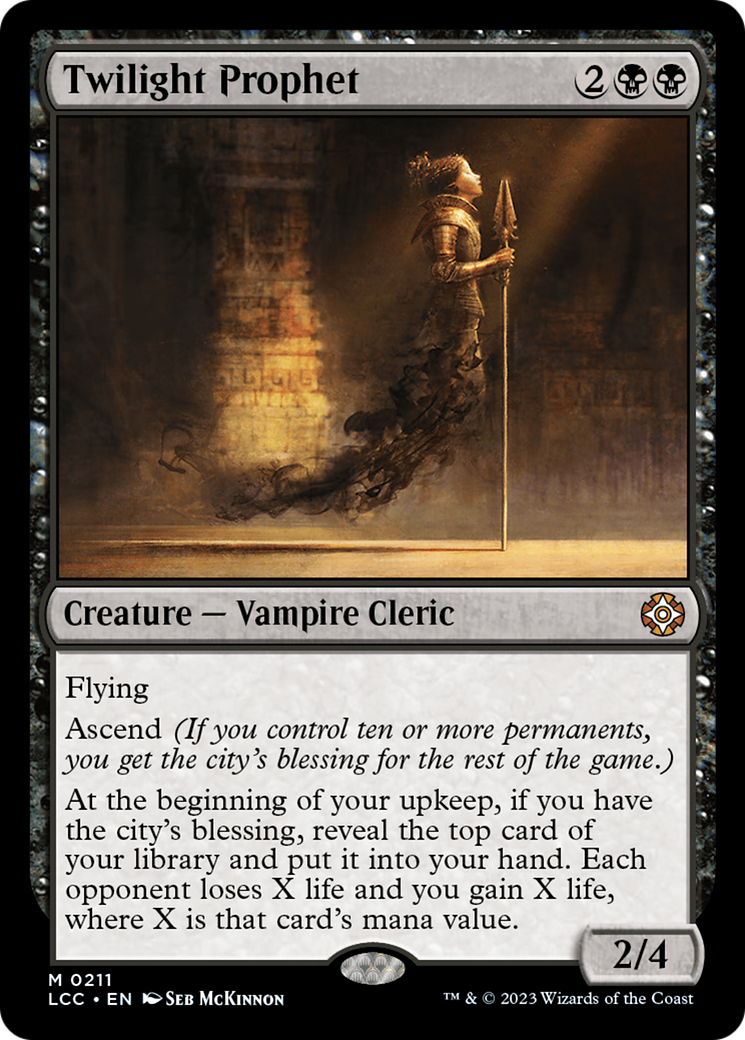
Twilight Prophet
Twilight Prophet
Creature — Vampire Cleric
2/4
Flying
Ascend (If you control ten or more permanents, you get the city's blessing for the rest of the game.)
At the beginning of your upkeep, if you have the city's blessing, reveal the top card of your library and put it into your hand. Each opponent loses X life and you gain X life, where X is that card's mana value.
- If the mana cost of the revealed card includes , X is considered to be 0.
- If the revealed card doesn't have a mana cost (because it's a land card, for example), its mana value is 0.
- The mana value of a split card, such as cards with aftermath from the Amonkhet block, is based on the combined mana cost of its two halves.
- In a Two-Headed Giant game, Twilight Prophet's last ability causes the opposing team to lose twice X life and you gain X life.
- Once you have the city's blessing, you have it for the rest of the game, even if you lose control of some or all of your permanents. The city's blessing isn't a permanent itself and can't be removed by any effect.
- A permanent is any object on the battlefield, including tokens and lands. Spells and emblems aren't permanents.
- If you cast a spell with ascend, you don't get the city's blessing until it resolves. Players may respond to that spell by trying to change whether you get the city's blessing.
- If you control ten permanents but don't control a permanent or resolving spell with ascend, you don't get the city's blessing. For example, if you control ten permanents, lose control of one, then cast Golden Demise, you won't have the city's blessing and the spell will affect creatures you control.
- If your tenth permanent enters the battlefield and then a permanent leaves the battlefield immediately afterwards (most likely due to the "Legend Rule" or due to being a creature with 0 toughness), you get the city's blessing before it leaves the battlefield.
- Ascend on a permanent isn't a triggered ability and doesn't use the stack. Players can respond to a spell that will give you your tenth permanent, but they can't respond to getting the city's blessing once you control that tenth permanent. This means that if your tenth permanent is a land you play, players can't respond before you get the city's blessing.
- Some cards have triggered abilities with an intervening "if" clause that checks whether you have the city's blessing. These are worded "[Trigger condition], if you have the city's blessing, [effect]." You must already have the city's blessing in order for these abilities to trigger; otherwise they do nothing. In other words, there's no way to have the ability trigger if you don't have the city's blessing, even if you intend to get it in response to the triggered ability.
-
1
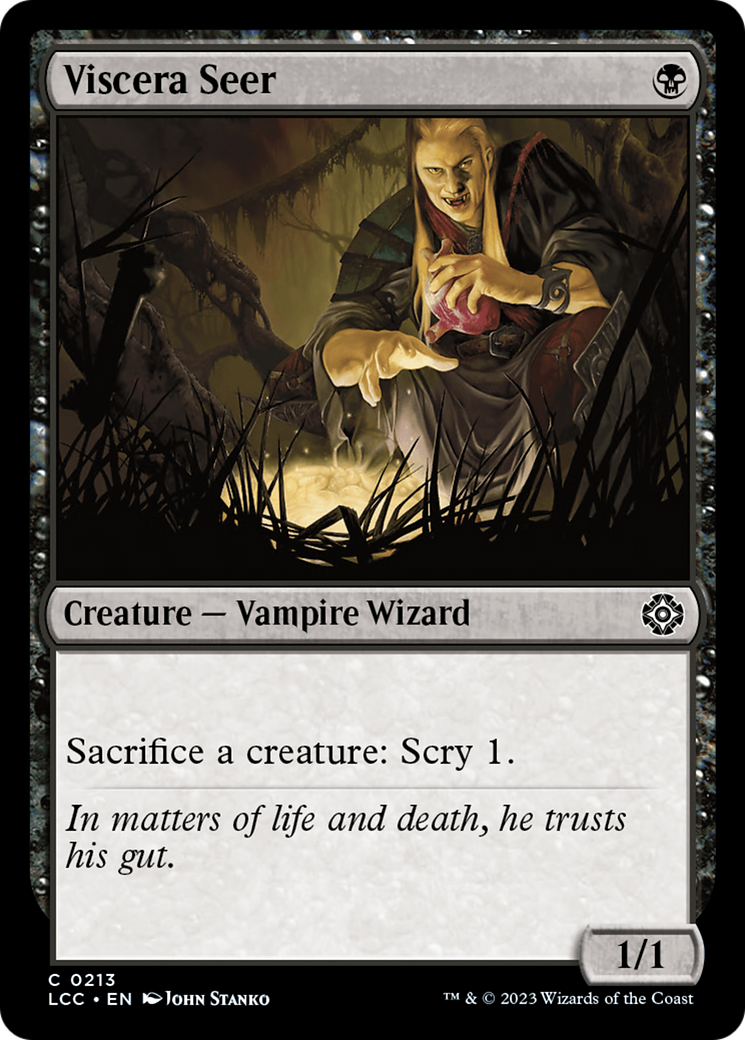
Viscera Seer
Viscera Seer
Creature — Vampire Wizard
1/1
Sacrifice a creature: Scry 1. (Look at the top card of your library. You may put that card on the bottom.)
- You can sacrifice Viscera Seer to activate its own ability.
- If you sacrifice an attacking or blocking creature during the declare blockers step, it won't deal combat damage. If you wait until the combat damage step, but that creature is dealt lethal damage, it'll be destroyed before you get a chance to sacrifice it.
-
1
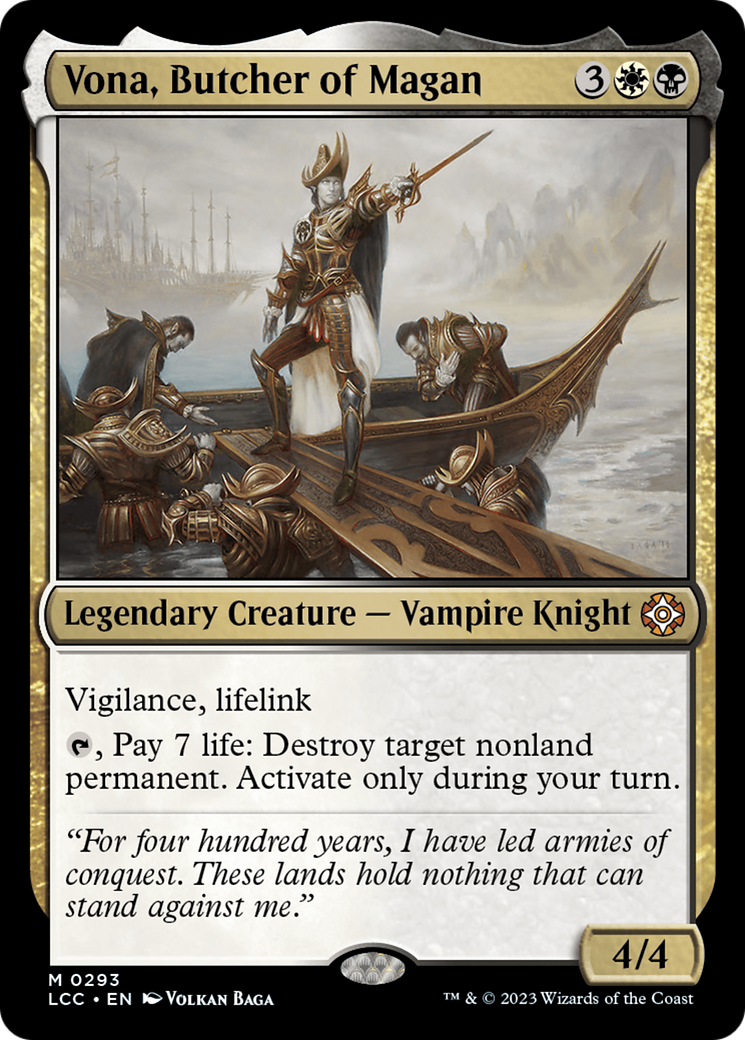
Vona, Butcher of Magan
Vona, Butcher of Magan
Legendary Creature — Vampire Knight
4/4
Vigilance, lifelink
, Pay 7 life: Destroy target nonland permanent. Activate only during your turn.
- Vona's last ability can be activated during any step or phase of your turn, including the combat phase. It's possible to attack with Vona and then activate its ability before blockers are declared. Doing so won't remove Vona from combat.
-
1
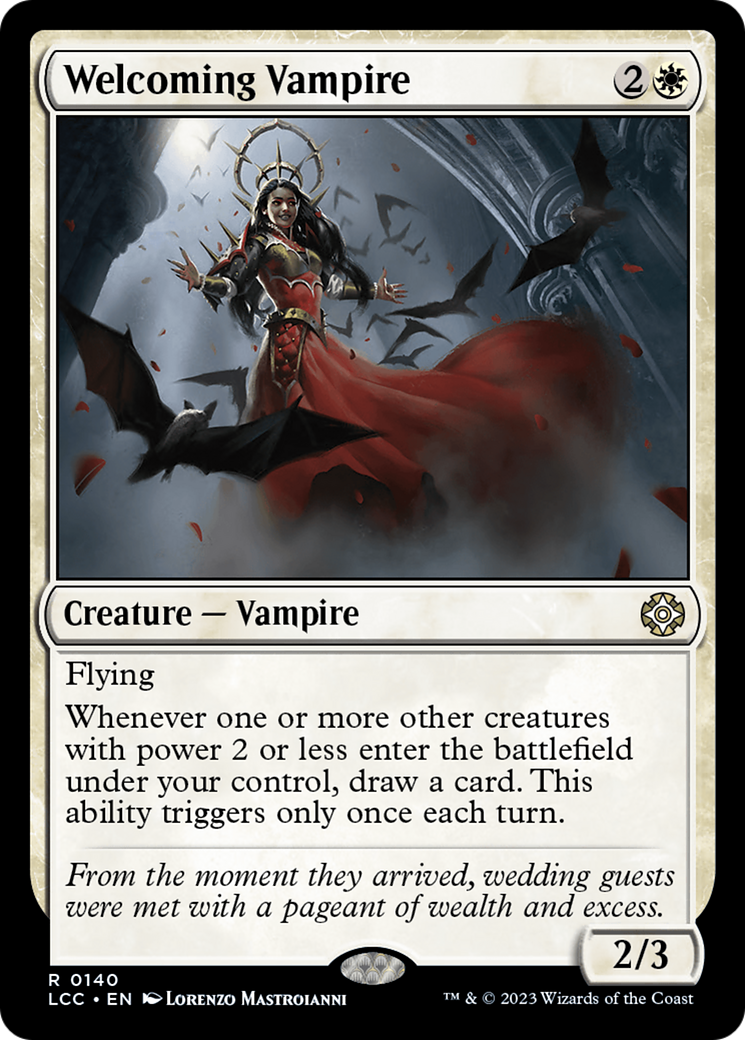
Welcoming Vampire
Welcoming Vampire
Creature — Vampire
2/3
Flying
Whenever one or more other creatures you control with power 2 or less enter, draw a card. This ability triggers only once each turn.
- Welcoming Vampire's ability checks the power of the other creatures only as they enter the battlefield. If one of those creatures has power 2 or less, the ability will trigger. Once the ability triggers, raising that creature's power above 2 won't affect that ability. Similarly, reducing a creature's power to 2 or less after it enters the battlefield won't cause the ability to trigger.
- If creatures enter the battlefield with +1/+1 counters or a continuous effect such as that of Wedding Festivity will apply to the creatures on the battlefield, those effects apply when checking to see if Welcoming Vampire's ability will trigger.
-
1
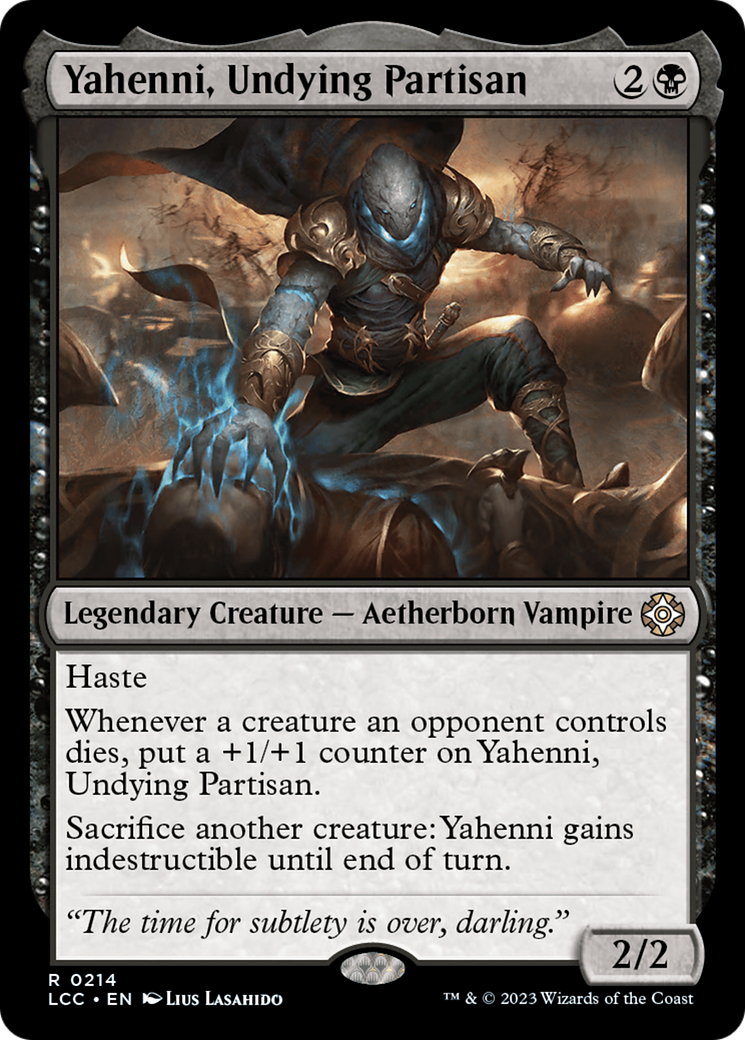
Yahenni, Undying Partisan
Yahenni, Undying Partisan
Legendary Creature — Aetherborn Vampire
2/2
Haste
Whenever a creature an opponent controls dies, put a +1/+1 counter on Yahenni.
Sacrifice another creature: Yahenni gains indestructible until end of turn.
- If Yahenni and a creature an opponent controls die simultaneously (perhaps because they fought or were in combat together), Yahenni won't be on the battlefield as its triggered ability resolves. It can't be saved by the +1/+1 counter that would have been put on it.
Instants 4
-
1
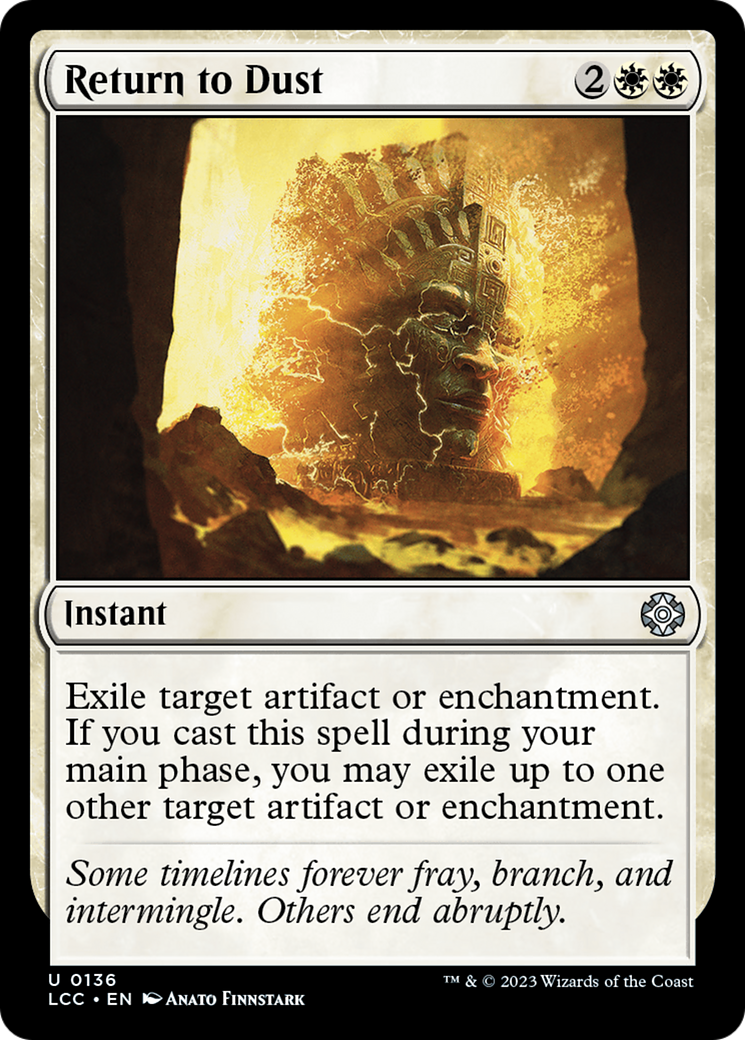
Return to Dust
Return to Dust
Instant
Exile target artifact or enchantment. If you cast this spell during your main phase, you may exile up to one other target artifact or enchantment.
- Return to Dust can always target a second artifact or enchantment; it just won't exile it if it's not your main phase when you cast Return to Dust.
- If a spell or ability copies Return to Dust, the copy exiles only the first target artifact or enchantment. This is because the copy wasn't cast at all.
-
1
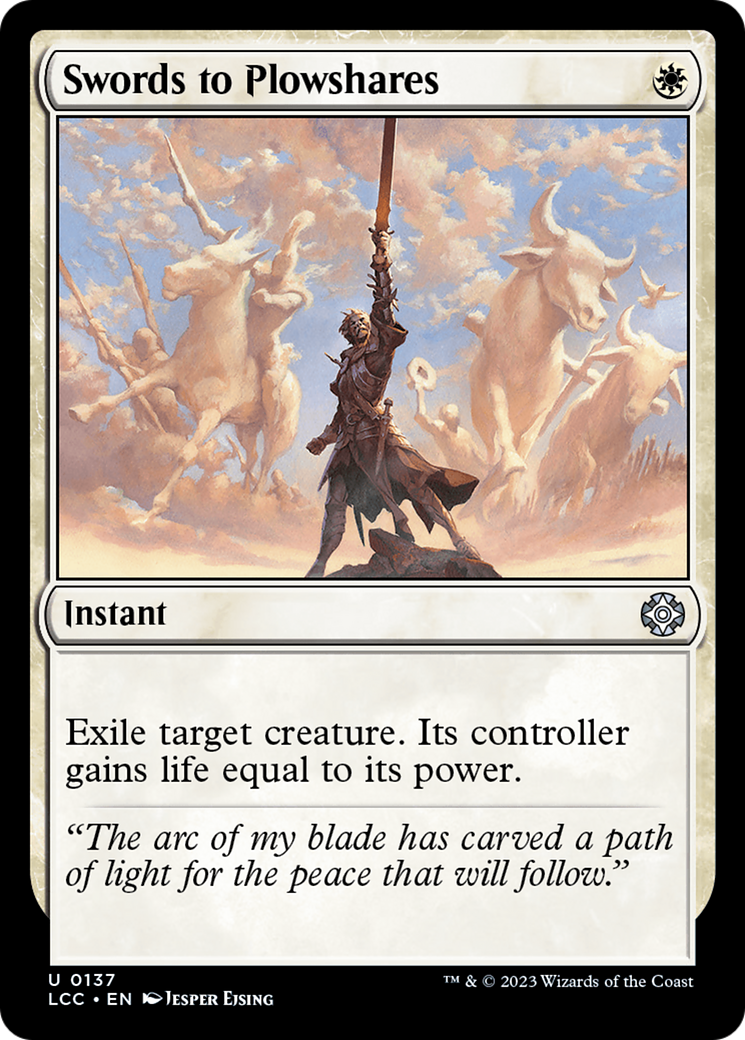
Swords to Plowshares
Swords to Plowshares
Instant
Exile target creature. Its controller gains life equal to its power.
- Use the power of the creature from when it was last on the battlefield to determine how much life is gained.
-
1
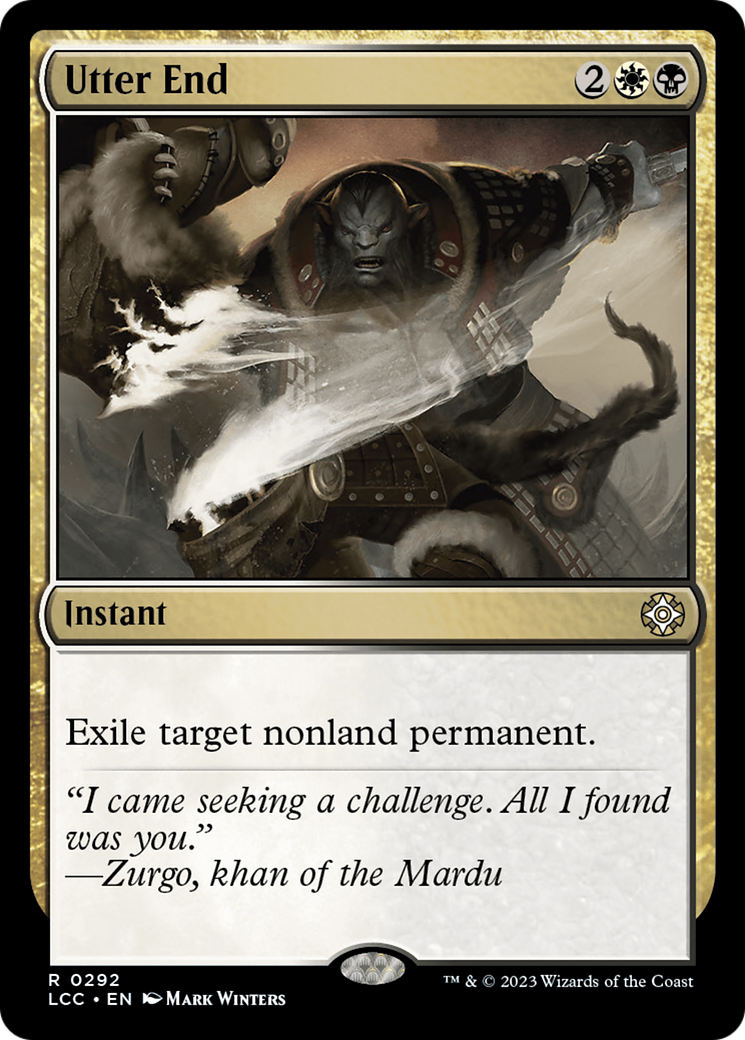
Utter End
Utter End
Instant
Exile target nonland permanent.
-
1
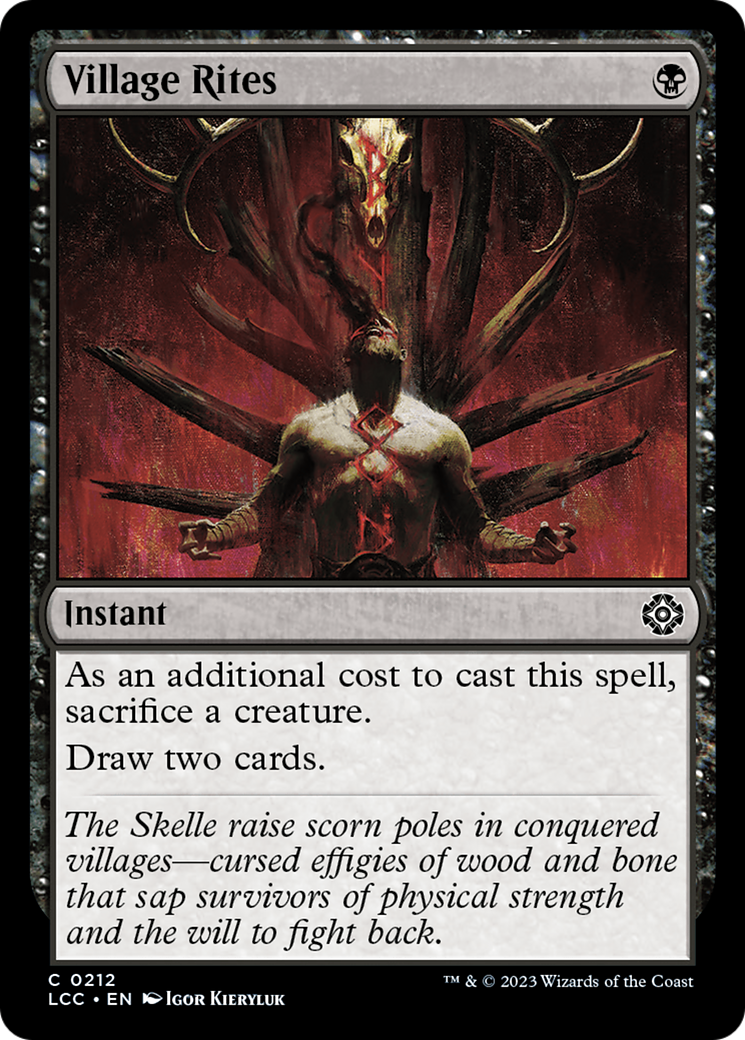
Village Rites
Village Rites
Instant
As an additional cost to cast this spell, sacrifice a creature.
Draw two cards.
- You must sacrifice exactly one creature to cast this spell; you can't cast it without sacrificing a creature, and you can't sacrifice additional creatures.
Sorceries 6
-
1
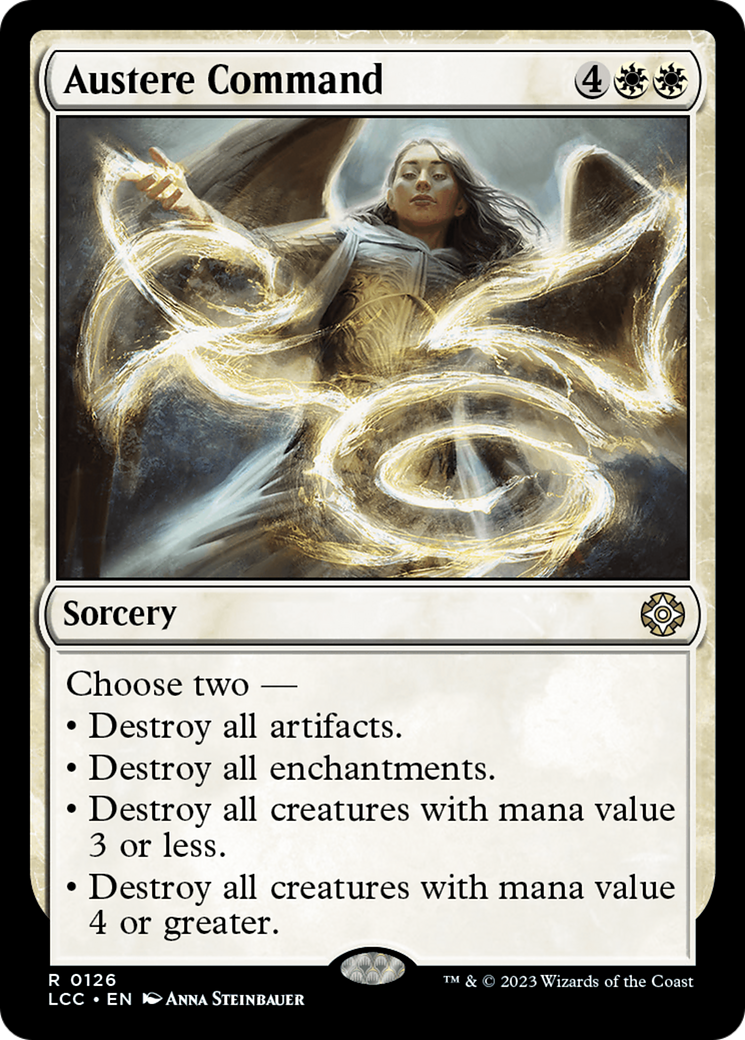
Austere Command
Austere Command
Sorcery
Choose two —
- Destroy all artifacts.
- Destroy all enchantments.
- Destroy all creatures with mana value 3 or less.
- Destroy all creatures with mana value 4 or greater.
- Each of the chosen modes happens sequentially. If a permanent has an ability that triggers whenever it or another permanent is destroyed, it will see permanents destroyed at the same time as it or before it, but not permanents destroyed by later modes.
- If a card is exiled "until" another permanent leaves the battlefield, the exiled card returns to the battlefield immediately after that permanent leaves the battlefield during Austere Command's resolution, and it may be destroyed by a later mode.
- If the first and last modes are chosen, an artifact creature with mana value 4 or greater will have to be regenerated twice to survive. This is because the modes happen sequentially, and the regeneration "shield" is used up by the first one. The same is true with any other combination of modes that covers one permanent twice.
-
1
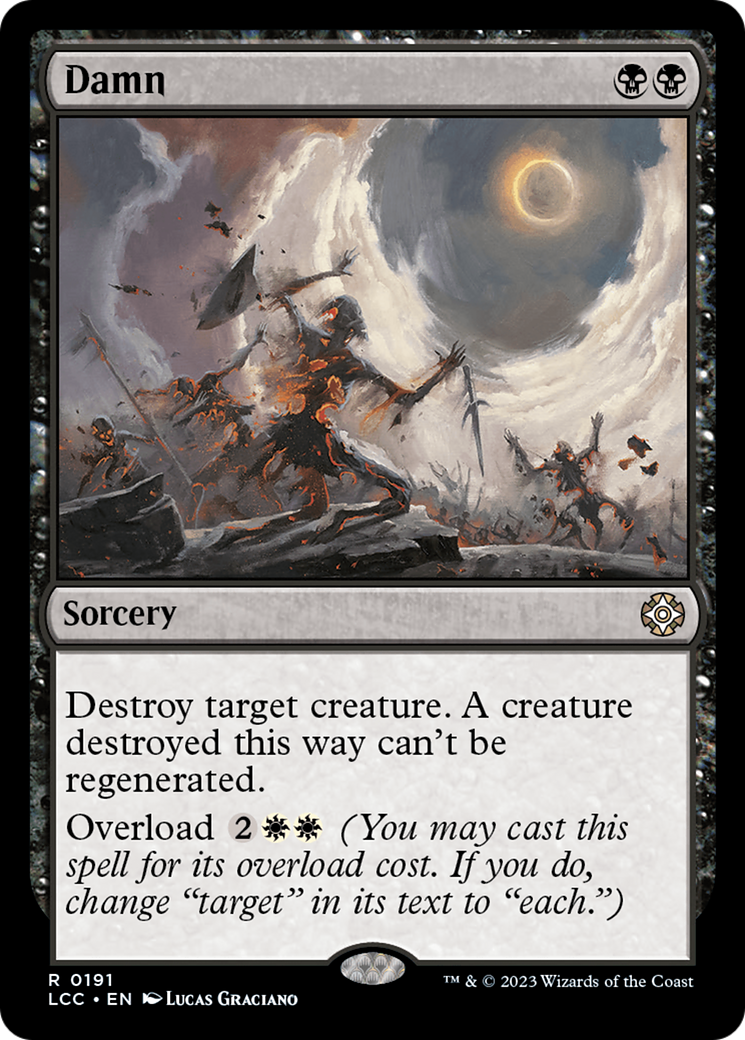
Damn
Damn
Sorcery
Destroy target creature. A creature destroyed this way can't be regenerated.
Overload (You may cast this spell for its overload cost. If you do, change "target" in its text to "each.")
- If you don't pay the overload cost of a spell with overload, that spell will have a single target. If you pay the overload cost, the spell won't have any targets.
- Because a spell with overload doesn't target when its overload cost is paid, it may affect permanents with hexproof or with protection from the appropriate color.
- To determine the total cost of a spell, start with the mana cost or alternative cost you're paying (such as an overload cost), add any cost increases, then apply any cost reductions. The mana value of the spell remains unchanged, no matter what the total cost to cast it was.
- If you are instructed to cast a spell with overload "without paying its mana cost," you can't choose to pay its overload cost instead.
-
1
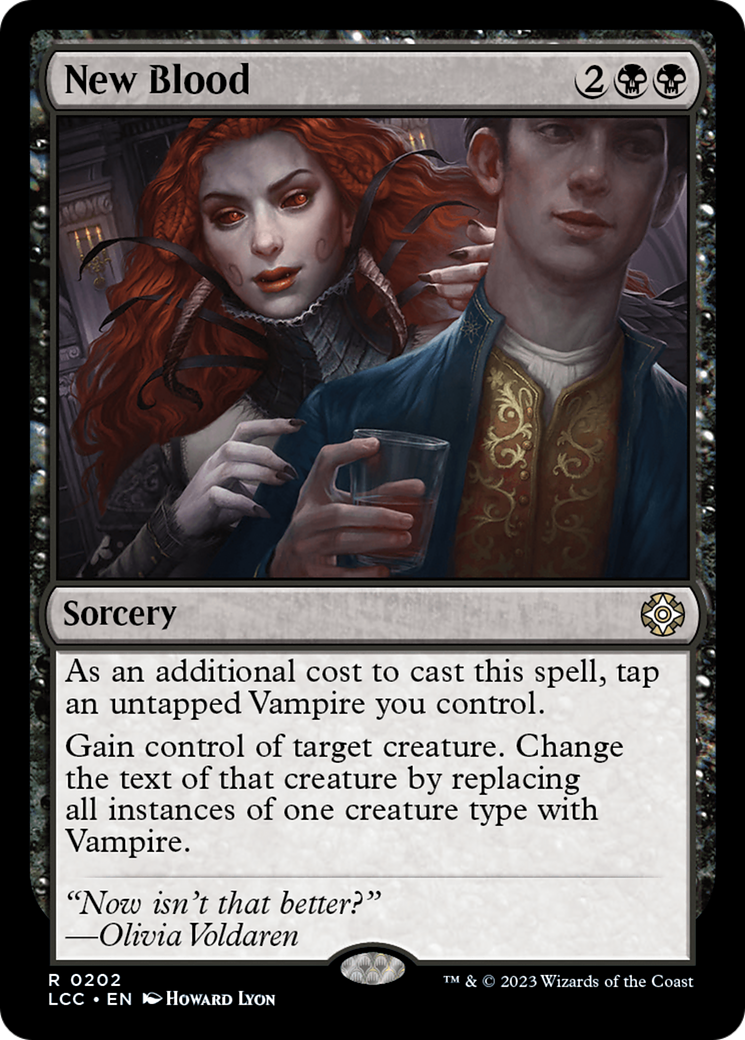
New Blood
New Blood
Sorcery
As an additional cost to cast this spell, tap an untapped Vampire you control.
Gain control of target creature. Change the text of that creature by replacing all instances of one creature type with Vampire.
- To pay the additional cost of New Blood, you may tap any untapped Vampire you control, including one you haven't controlled continuously since the beginning of your most recent turn. (Note that tapping the creature doesn't use [the tap symbol].)
- New Blood changes the creature type each time it appears in the creature's type line and/or rules text. It doesn't change the name of the card or any instances of the word being used as part of a card's name.
- You choose what word you're changing as New Blood resolves. You don't have to choose a word that appears in the creature's text.
- The creature you gain control of won't be a Vampire if you don't choose a creature type in that creature's type line as one to replace.
- New Blood's effect changes only the text printed on the creature. It can't change words found in abilities it's been granted. For example, if you change Rat to Vampire on Hungry Lynx, your Cats will have protection from Vampires; but if instead you change Rat to Vampire on Phantom Nishoba while you control a Hungry Lynx, Phantom Nishoba will have protection from Rats.
- The type-changing effect can change part of a word (such as "non-Human") if the part of the word is being used to refer to a creature type.
- You must choose an existing creature type, such as Vampire or Cat. Card types such as "artifact" can't be chosen.
- You can't choose multiple creature types, such as "Cat Warrior." A Cat Warrior is both a Cat and a Warrior. It's affected by anything that affects either type and unaffected by things that affect non-Cat or non-Warrior creatures.
-
1
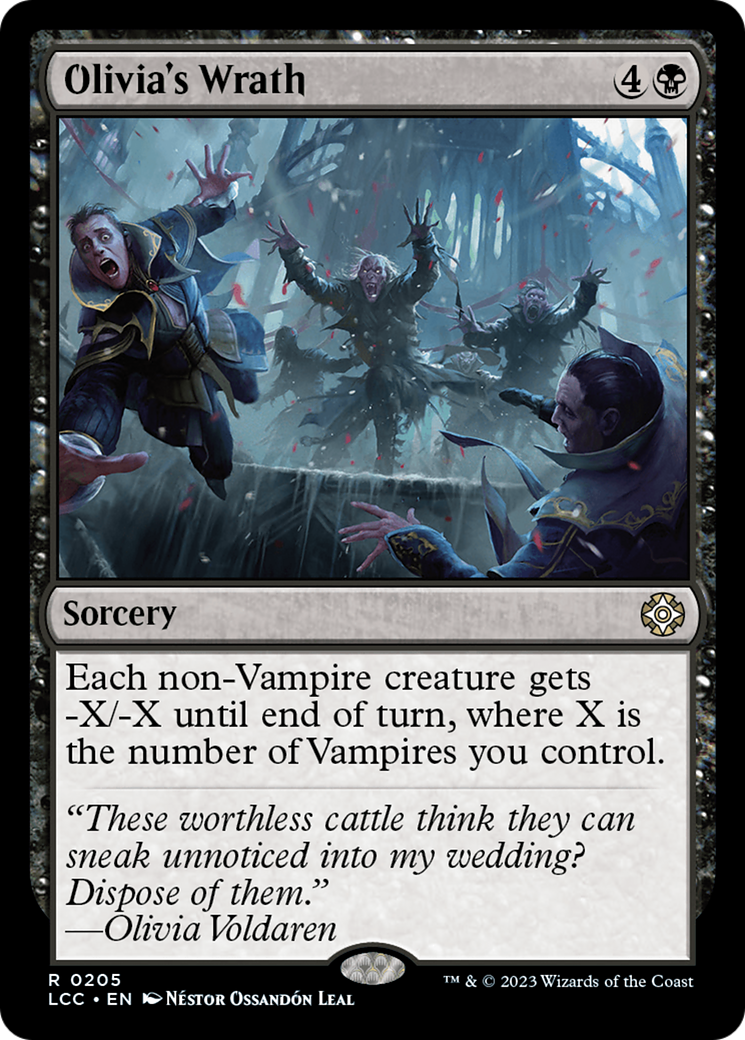
Olivia's Wrath
Olivia's Wrath
Sorcery
Each non-Vampire creature gets -X/-X until end of turn, where X is the number of Vampires you control.
-
1
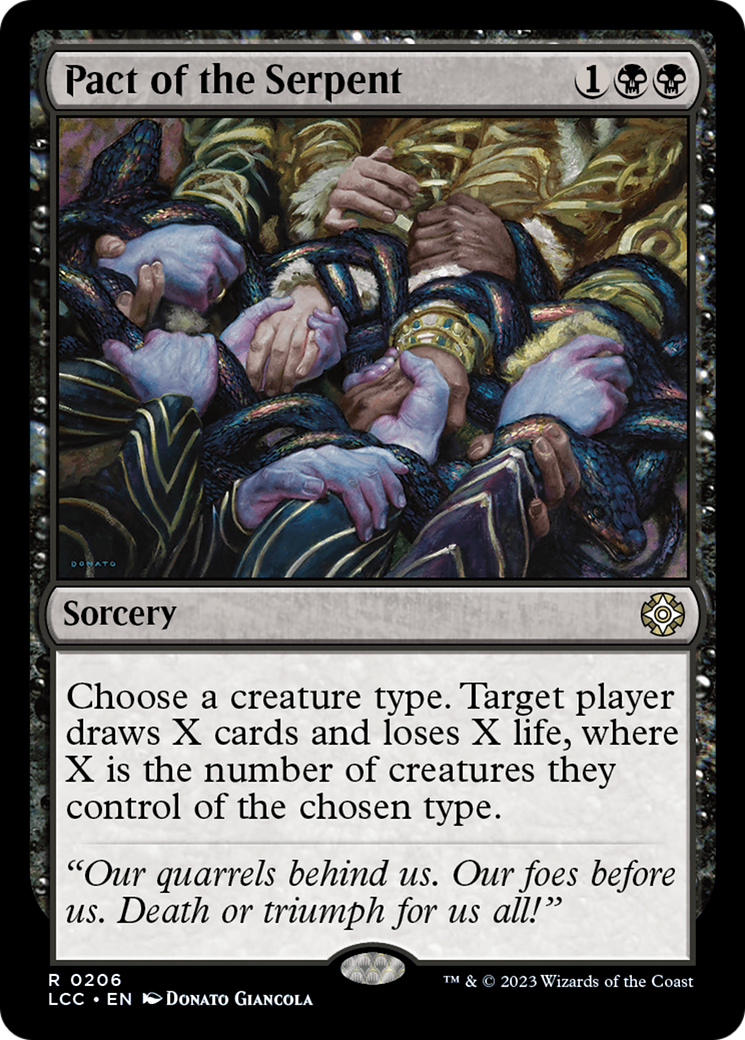
Pact of the Serpent
Pact of the Serpent
Sorcery
Choose a creature type. Target player draws X cards and loses X life, where X is the number of creatures they control of the chosen type.
- You choose the target player as you cast Pact of the Serpent, but you don't choose the creature type until the spell resolves.
- You must choose an existing creature type, such as Squirrel or Knight. You can't choose card types (e.g., artifact) or supertypes (e.g., snow).
- The value of X is based on the number of creatures the player controls of the chosen type as Pact of the Serpent resolves.
-
1
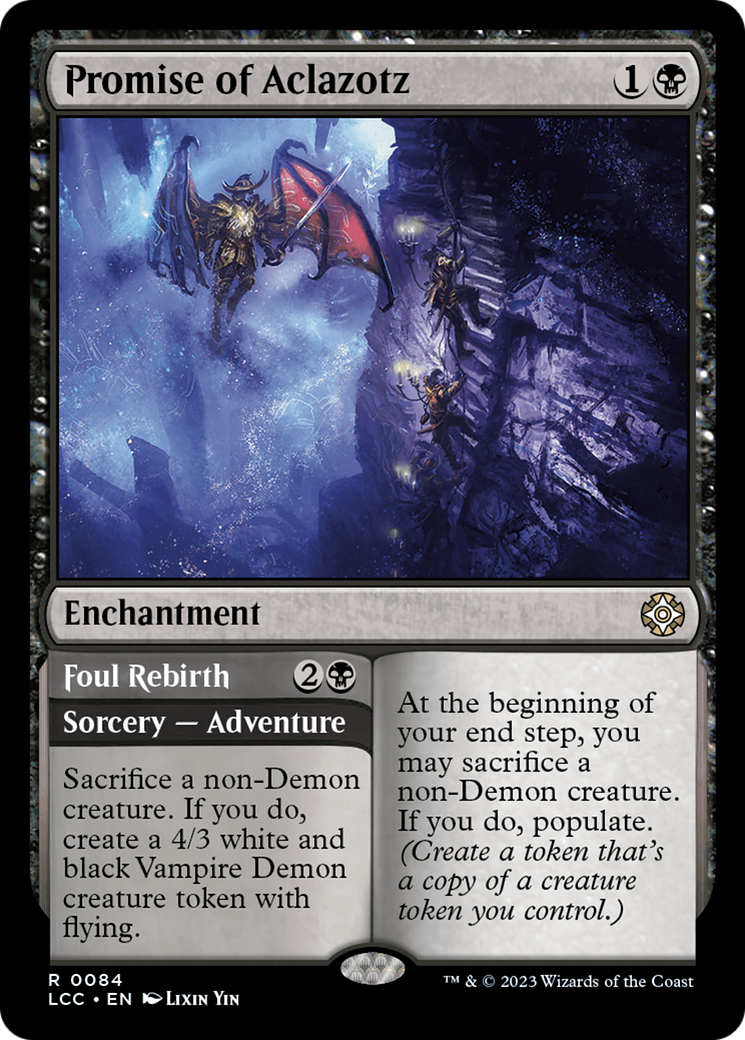
Promise of Aclazotz // Foul Rebirth
//
Promise of Aclazotz
Enchantment
- Populate doesn't target the creature token you're copying. You choose that creature token as you're taking the populate action. You can choose any creature token you control. If a spell or ability causes you to create a creature token and then instructs you to populate, you may choose to copy the token you just created, or you may choose to copy another creature token you control.
- If you choose to copy a creature token that's a copy of another creature, the new creature token will copy the characteristics of whatever the original token is copying.
- The new creature token copies the characteristics of the original token as stated by the effect that created the original token.
- The new token doesn't copy whether the original token is tapped or untapped, whether it has any counters on it or Auras and Equipment attached to it, or any noncopy effects that have changed its power, toughness, color, and so on.
- Any enters-the-battlefield abilities of the copied token will trigger when the new token enters the battlefield. Any "as [this creature] enters the battlefield" or "[this creature] enters the battlefield with" abilities of the copied token will also work.
- If you control no creature tokens when you populate, nothing will happen.
- If an effect copies an Adventure spell, that copy is exiled as it resolves. It ceases to exist as a state-based action; it's not possible to cast the copy as a permanent.
- An effect may refer to a card, spell, or permanent that "has an Adventure." This refers to a card, spell, or permanent that has an adventurer card's set of alternative characteristics, even if they're not being used and even if that card was never cast as an Adventure.
- If an effect refers to a card, spell, or permanent that has an Adventure, it won't find an instant or sorcery spell on the stack that's been cast as an Adventure.
- An adventurer card is a permanent card in every zone except the stack, as well as while on the stack if not cast as an Adventure. Ignore its alternative characteristics in those cases. For example, while it's in your graveyard, Promise of Aclazotz is a black enchantment card whose mana value is 2. While there, it can't be the target of a spell or ability that targets only instant or sorcery cards.
- If an effect instructs you to choose a card name, you may choose the alternative Adventure name. Consider only the alternative characteristics to determine whether that is an appropriate name to choose.
- Casting a card as an Adventure isn't casting it for an alternative cost. Effects that allow you to cast a spell for an alternative cost or without paying its mana cost may allow you to apply those to the Adventure.
- If an object becomes a copy of an object that has an Adventure, the copy also has an Adventure. If it changes zones, it will either cease to exist (if it's a token) or cease to be a copy (if it's a nontoken permanent), and so you won't be able to cast it as an Adventure.
- When casting a spell as an Adventure, use the alternative characteristics and ignore all of the card's normal characteristics. The spell's color, mana cost, mana value, and so on are determined by only those alternative characteristics. If the spell leaves the stack, it immediately resumes using its normal characteristics.
- If you cast an adventurer card as an Adventure, use only its alternative characteristics to determine whether it's legal to cast that spell. For example, if you control Johann, Apprentice Sorcerer ("Once each turn, you may cast an instant or sorcery spell from the top of your library") and Promise of Aclazotz is on top of your library, you can cast Foul Rebirth, but not Promise of Aclazotz.
- If a spell is cast as an Adventure, its controller exiles it instead of putting it into its owner's graveyard as it resolves. For as long as it remains exiled, that player may cast it as a permanent spell. If an Adventure spell leaves the stack in any way other than resolving (most likely by being countered or by failing to resolve because its targets have all become illegal), that card won't be exiled and the spell's controller won't be able to cast it as a permanent later.
- If an adventurer card ends up in exile for any other reason than by exiling itself while resolving, it won't give you permission to cast it as a permanent spell.
- You must still follow any timing restrictions and permissions for the permanent spell you cast from exile. Normally, you'll be able to cast it only during your main phase while the stack is empty.
Artifacts 11
-
1
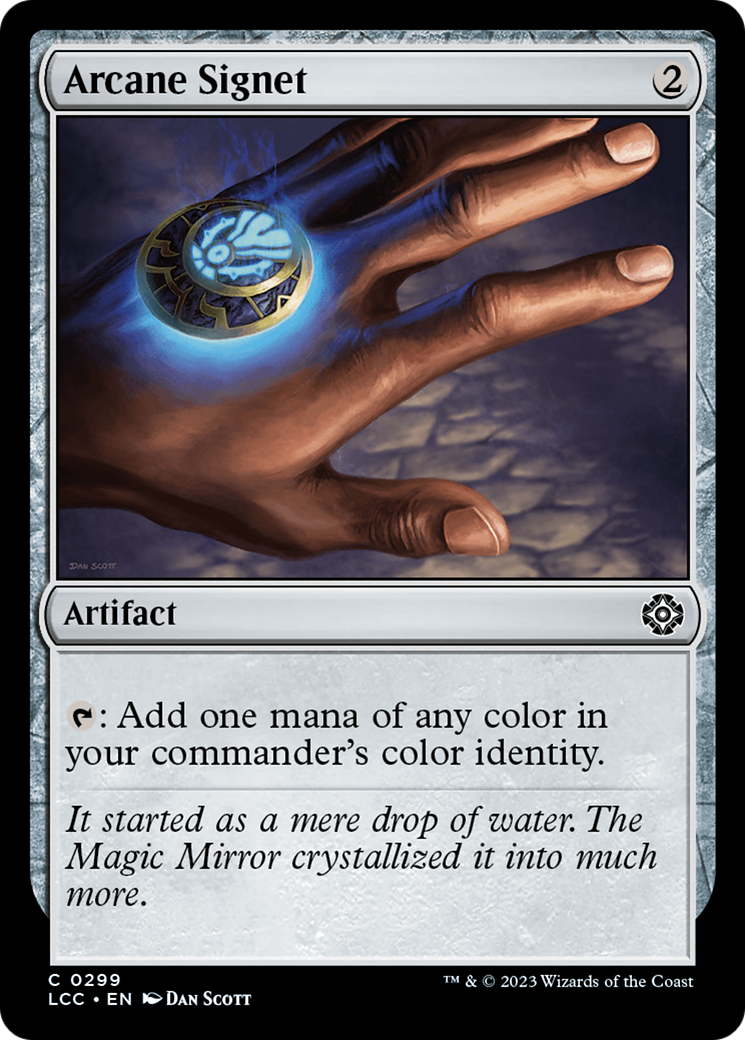
Arcane Signet
Arcane Signet
Artifact
: Add one mana of any color in your commander's color identity.
- If your commander is a card that has no colors in its color identity, Arcane Signet's ability produces no mana. It doesn't produce .
- If you have two commanders, the ability adds one mana of any color in their combined color identities.
- If you don't have a commander, Arcane Signet's ability produces no mana.
-
1
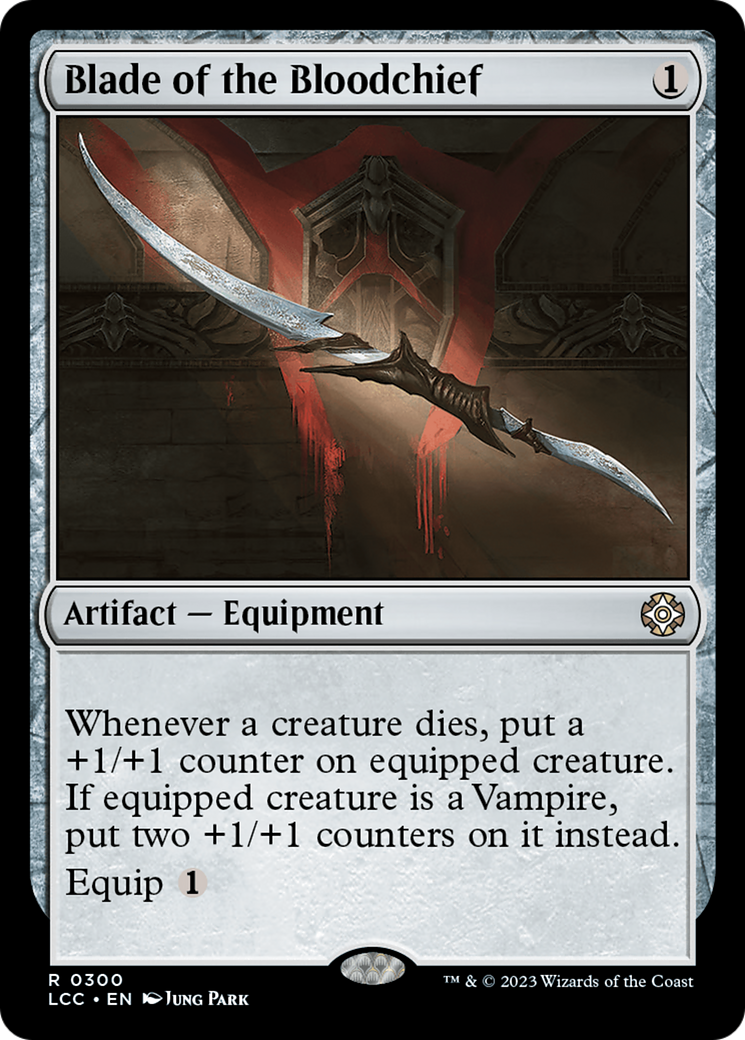
Blade of the Bloodchief
Blade of the Bloodchief
Artifact — Equipment
Whenever a creature dies, put a +1/+1 counter on equipped creature. If equipped creature is a Vampire, put two +1/+1 counters on it instead.
Equip
- Blade of the Bloodchief's ability triggers regardless of who controlled the creature and whose graveyard it was put into.
- The +1/+1 counters are put on the equipped creature, not Blade of the Bloodchief. If Blade of the Bloodchief is moved to a different creature, the +1/+1 counters will stay where they are.
- The creature that gets the counters is the one that's equipped by Blade of the Bloodchief at the time the ability resolves. It doesn't matter what creature Blade of the Bloodchief was attached to (if any) when it triggered.
- If Blade of the Bloodchief leaves the battlefield before its triggered ability resolves, the counters are put on the creature it was attached to at the time it left the battlefield. If it wasn't attached to a creature at that time, nothing gets the counters.
- If the equipped creature itself is put into a graveyard, Blade of the Bloodchief's ability will trigger. However, it won't do anything when it resolves unless a spell or ability has caused it to become attached to another creature by that time. (Remember that you may activate an equip ability only as a sorcery.)
- If the equipped creature and another creature are dealt lethal damage at the same time, the equipped creature will be put into a graveyard before it would receive any counters.
-
1
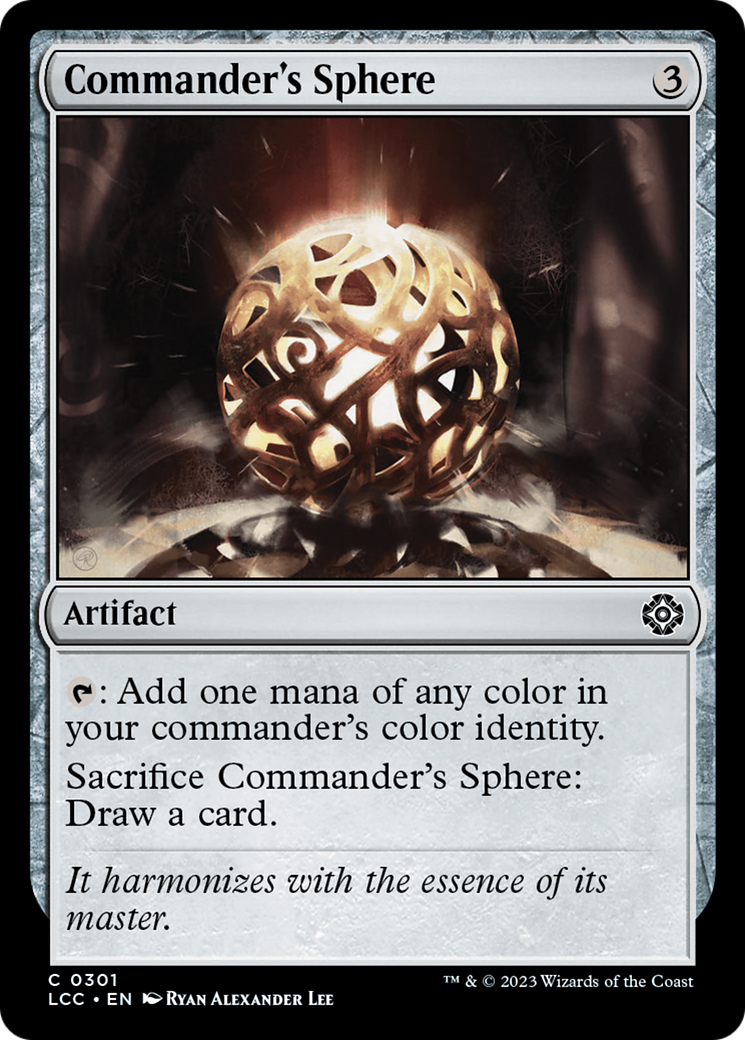
Commander's Sphere
Commander's Sphere
Artifact
: Add one mana of any color in your commander's color identity.
Sacrifice this artifact: Draw a card.
- If your commander is a card that has no colors in its color identity, Commander's Sphere's first ability produces no mana. It doesn't produce .
- If you don't have a commander, Commander's Sphere's first ability produces no mana.
- If you have two commanders, the ability adds one mana of any color in their combined color identities.
-
1
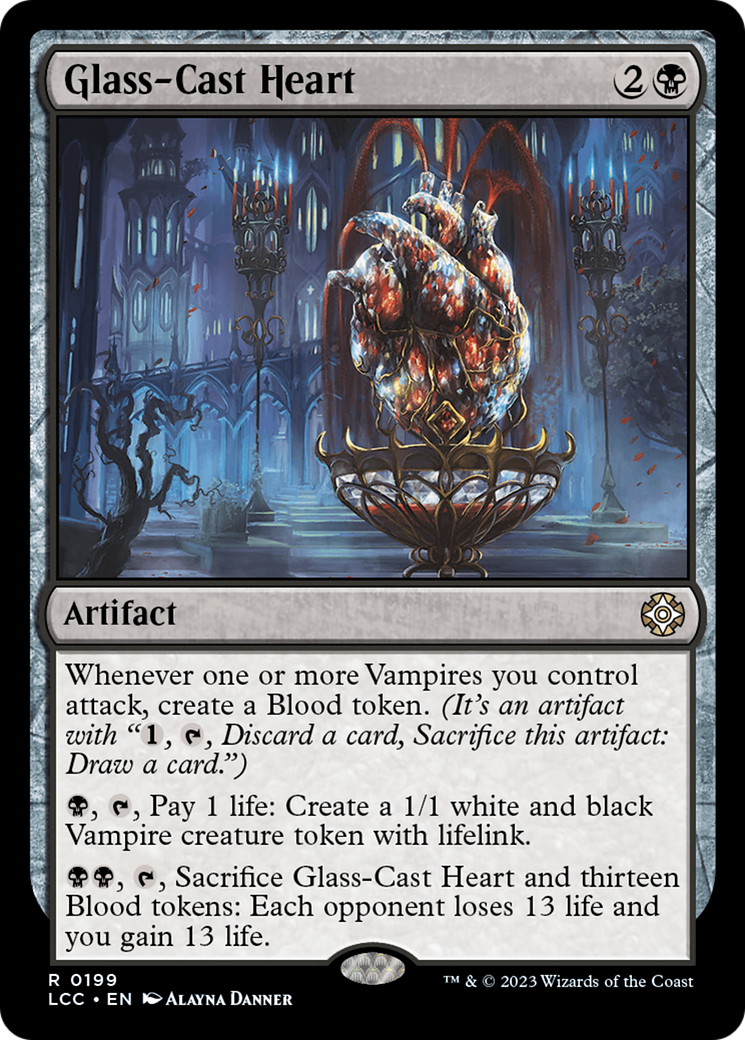
Glass-Cast Heart
Glass-Cast Heart
Artifact
Whenever one or more Vampires you control attack, create a Blood token. (It's an artifact with " , , Discard a card, Sacrifice this token: Draw a card.")
, , Pay 1 life: Create a 1/1 white and black Vampire creature token with lifelink.
, , Sacrifice this artifact and thirteen Blood tokens: Each opponent loses 13 life and you gain 13 life.
- If an effect refers to a Blood token, it means any artifact token with the subtype Blood, even if it has gained other subtypes.
- You can't sacrifice a Blood token to pay multiple costs.
- Some triggered abilities trigger "whenever you sacrifice a Blood token." These abilities trigger regardless of why you sacrificed that Blood token.
-
1
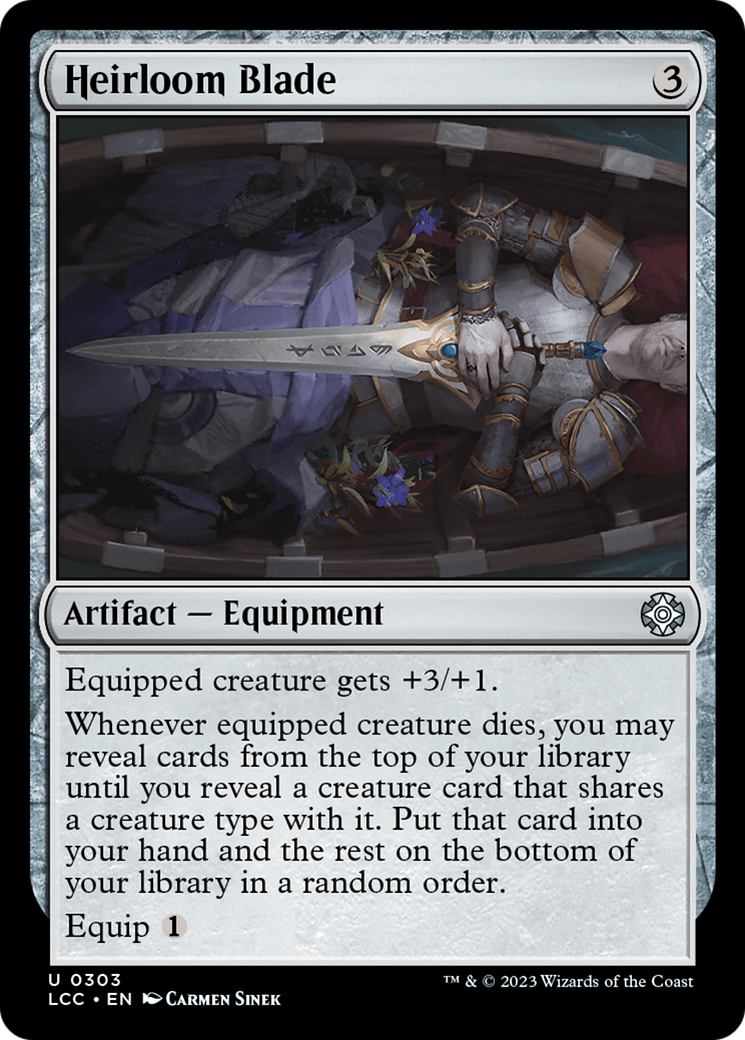
Heirloom Blade
Heirloom Blade
Artifact — Equipment
Equipped creature gets +3/+1.
Whenever equipped creature dies, you may reveal cards from the top of your library until you reveal a creature card that shares a creature type with it. Put that card into your hand and the rest on the bottom of your library in a random order.
Equip
- If you don't reveal a creature card that shares a type with the creature that died, you'll just reveal and randomize your library.
- If the equipped creature has no creature type, no card can share a creature type with it.
- You'll reveal cards until you find one that shares at least one creature type with the creature that died. For example, if a Cat Wizard dies, you'll stop if you reveal a Human Wizard or Cat Soldier.
- Compare the revealed cards to the creature as it last existed before it died, not to the creature card as it exists in its owner's graveyard, to determine which one you put into your hand.
- "Artifact" isn't a creature type.
- If Heirloom Blade leaves the battlefield at the same time that the equipped creature dies, its triggered ability triggers.
-
1
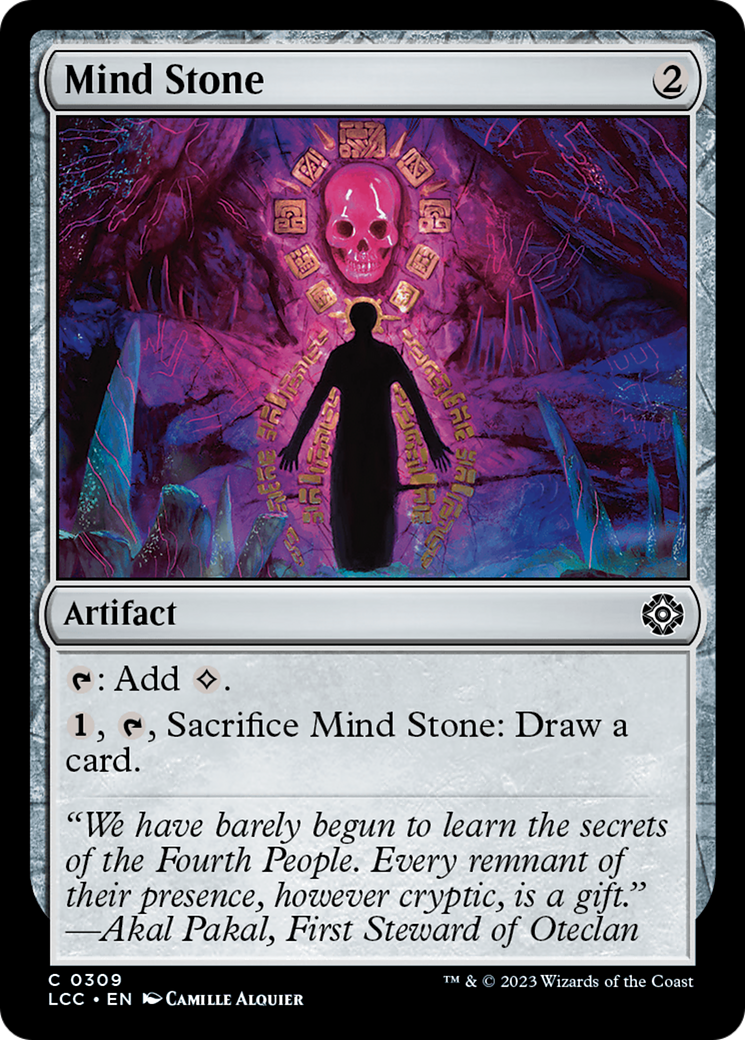
Mind Stone
Mind Stone
Artifact
: Add .
, , Sacrifice this artifact: Draw a card.
-
1
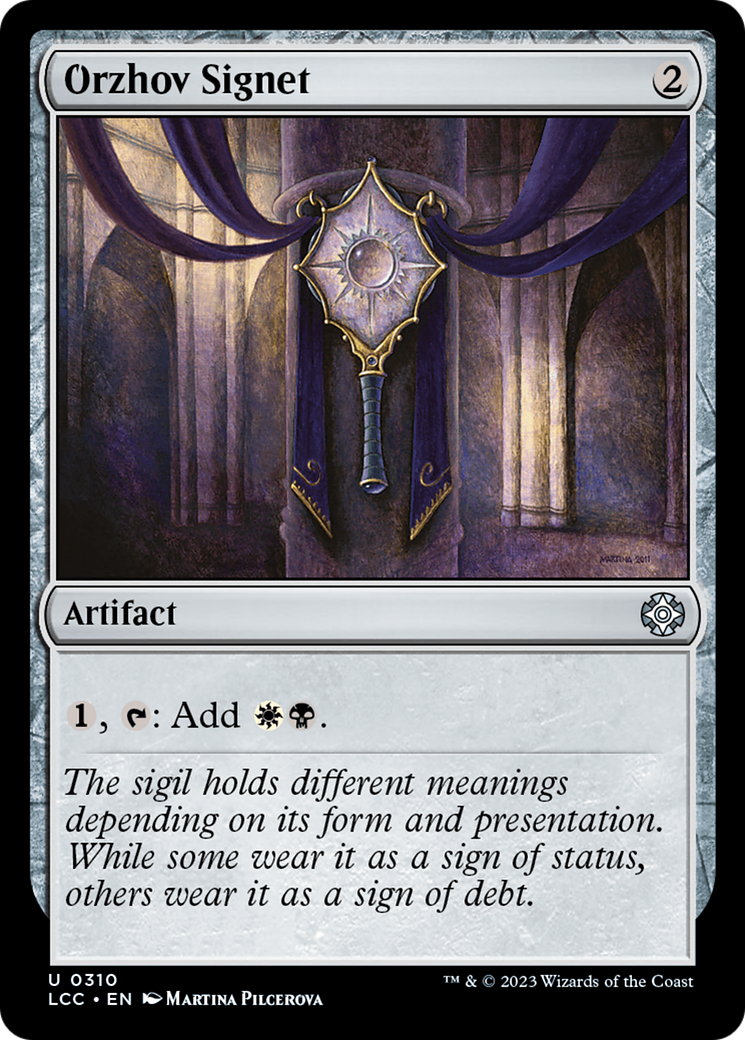
Orzhov Signet
Orzhov Signet
Artifact
, : Add .
-
1
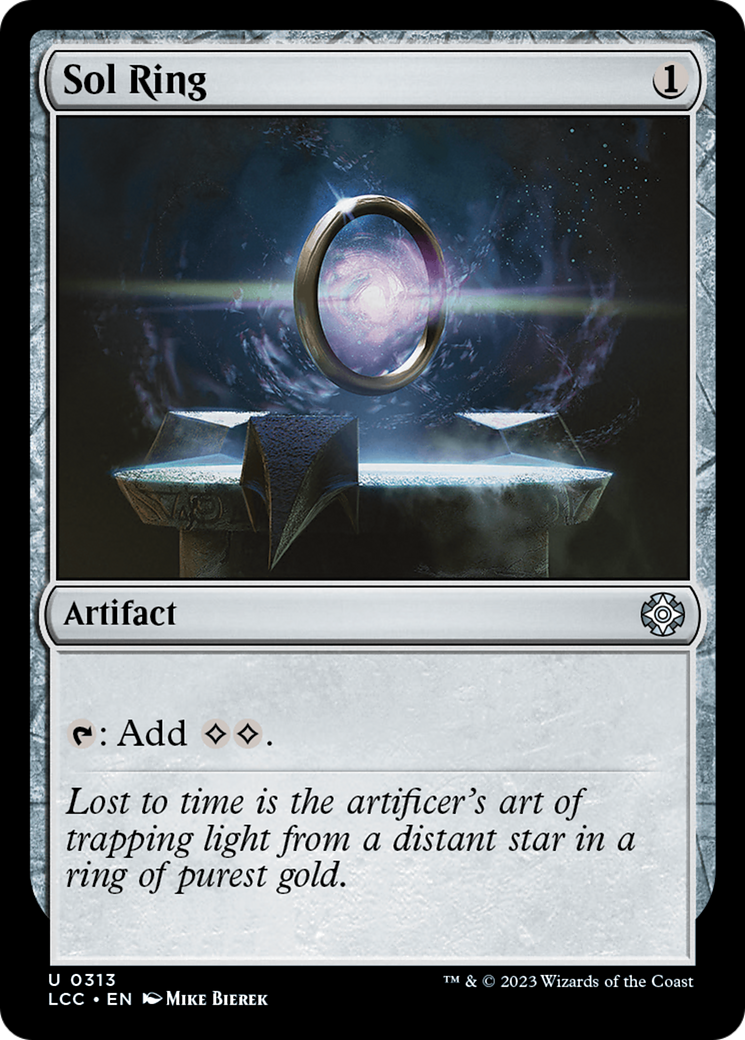
Sol Ring
Sol Ring
Artifact
: Add .
-
1
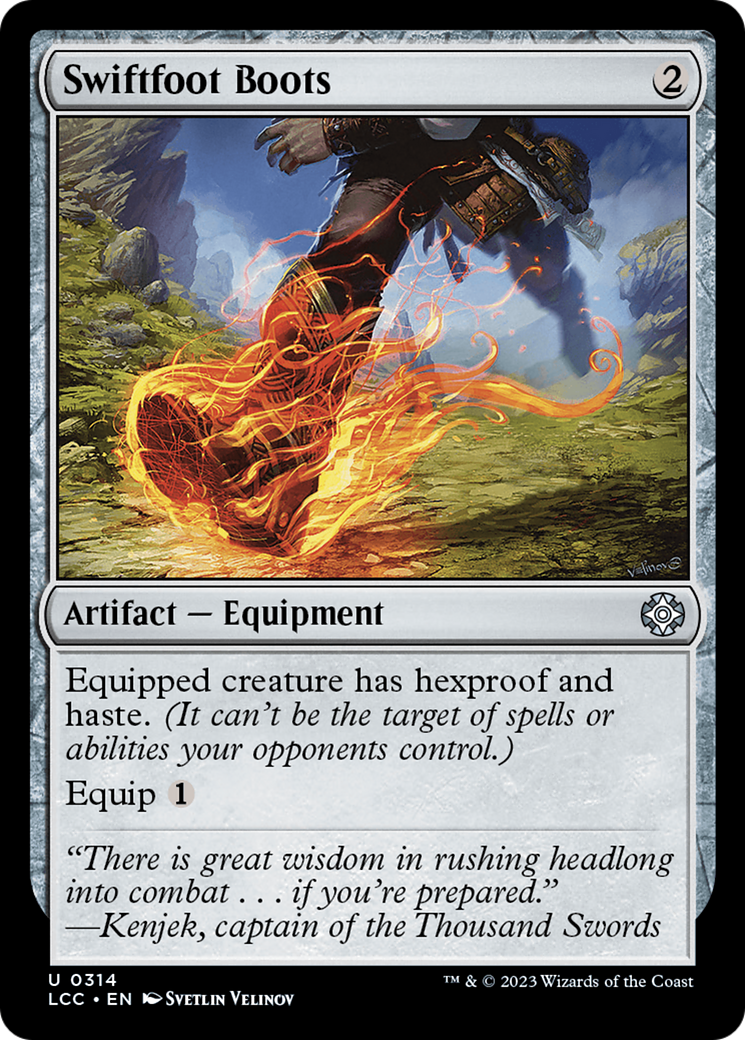
Swiftfoot Boots
Swiftfoot Boots
Artifact — Equipment
Equipped creature has hexproof and haste. (It can't be the target of spells or abilities your opponents control. It can attack and no matter when it came under your control.)
Equip ( : Attach to target creature you control. Equip only as a sorcery.)
- If a creature enters the battlefield under your control and gains haste, but then loses it before attacking, it won't be able to attack that turn. This means that you can't use one Swiftfoot Boots to allow two new creatures to attack in the same turn.
-
1
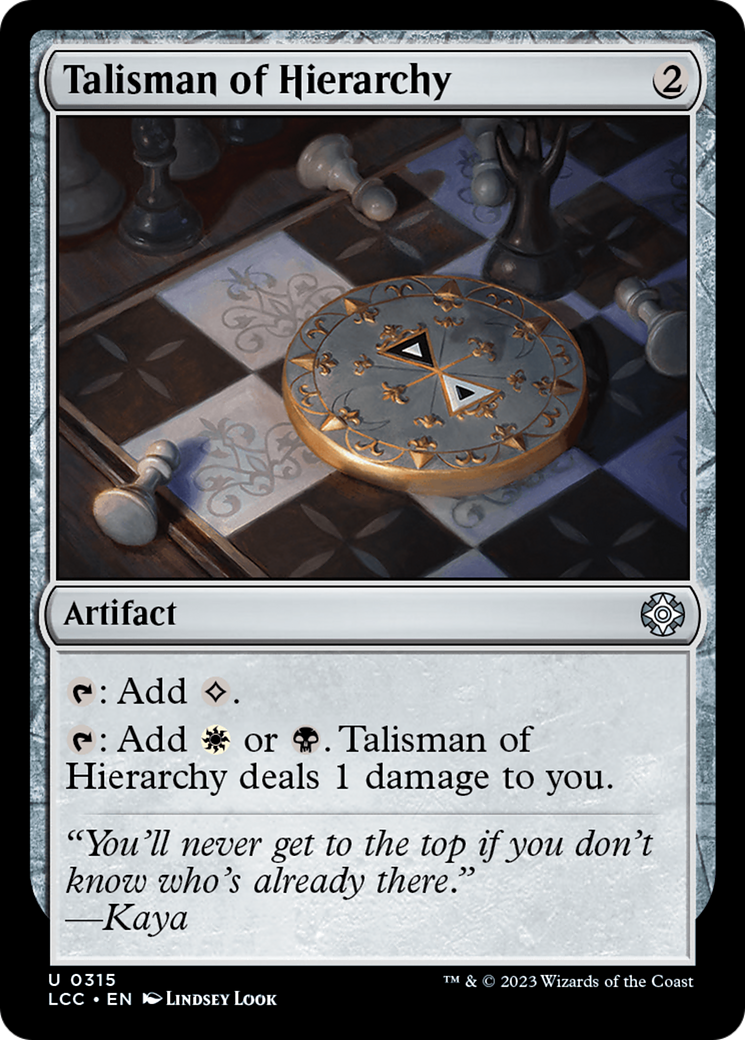
Talisman of Hierarchy
Talisman of Hierarchy
Artifact
: Add .
: Add or . This artifact deals 1 damage to you.
-
1
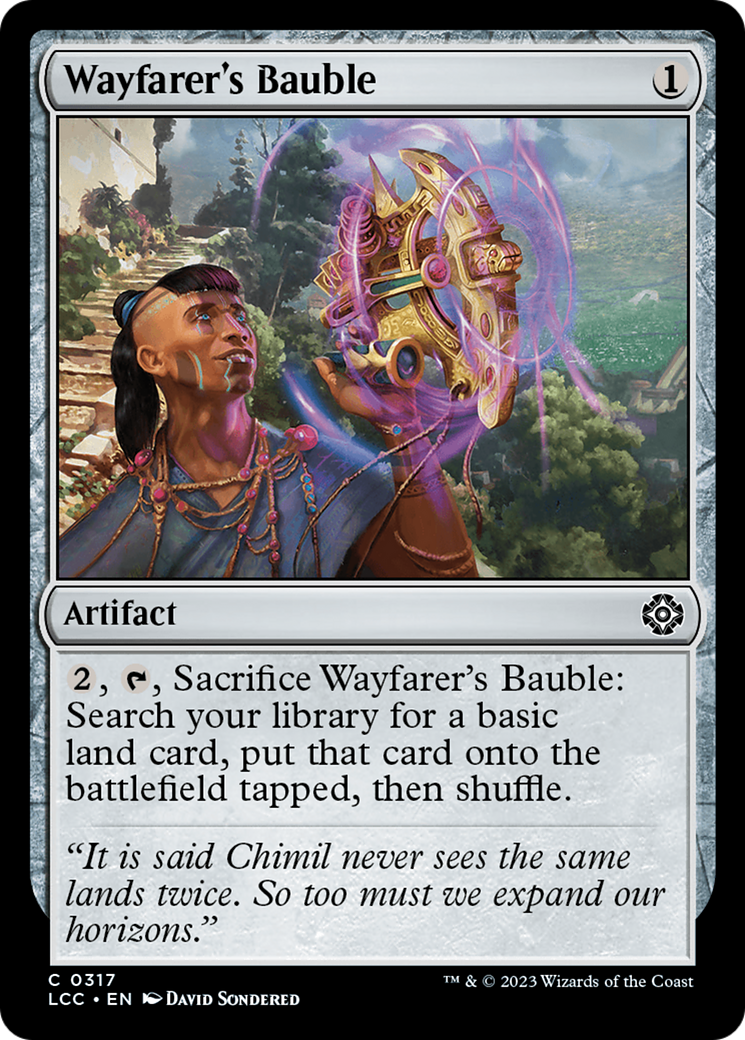
Wayfarer's Bauble
Wayfarer's Bauble
Artifact
, , Sacrifice this artifact: Search your library for a basic land card, put that card onto the battlefield tapped, then shuffle.
Enchantments 5
-
1
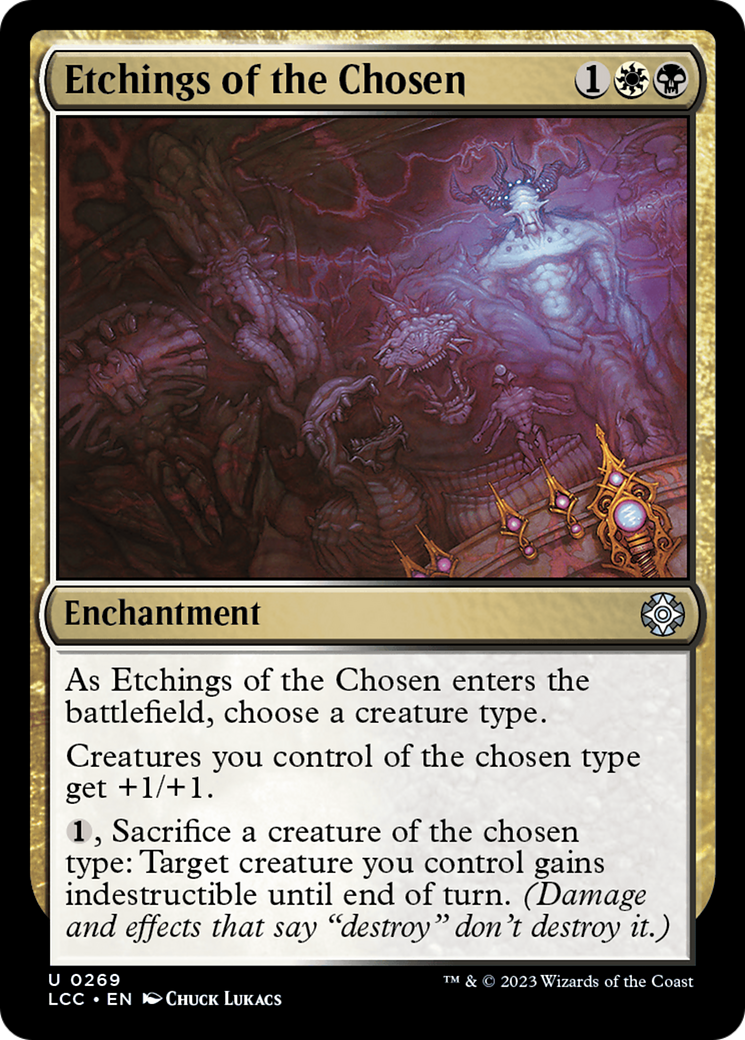
Etchings of the Chosen
Etchings of the Chosen
Enchantment
As this enchantment enters, choose a creature type.
Creatures you control of the chosen type get +1/+1.
, Sacrifice a creature of the chosen type: Target creature you control gains indestructible until end of turn. (Damage and effects that say "destroy" don't destroy it.)
- You must choose an existing creature type, such as Sliver or Warrior. Card types such as artifact, and supertypes such as legendary or snow, can't be chosen.
- The last ability of Etchings of the Chosen can target any creature you control, not just one of the chosen type.
-
1
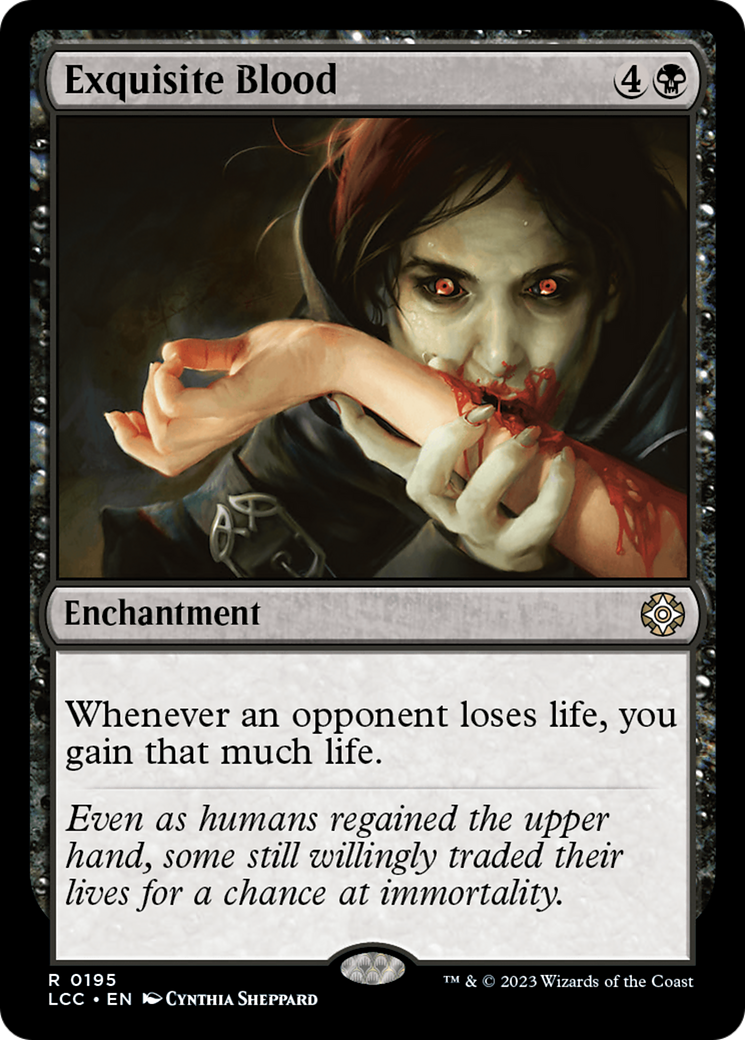
Exquisite Blood
Exquisite Blood
Enchantment
Whenever an opponent loses life, you gain that much life.
- Damage dealt to an opponent usually causes that opponent to lose life. An opponent paying life also causes loss of life.
- If you and an opponent both lose life simultaneously, and this causes your life total to become 0 or less, you'll lose the game before Exquisite Blood's triggered ability can resolve.
-
1
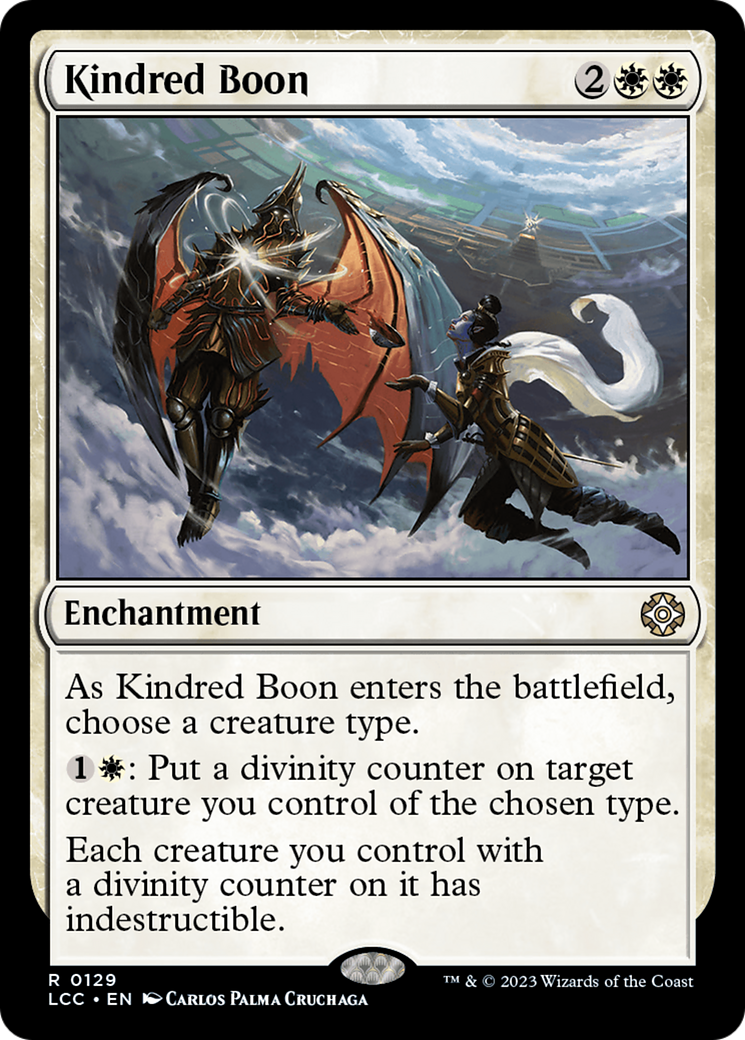
Kindred Boon
Kindred Boon
Enchantment
As this enchantment enters, choose a creature type.
: Put a divinity counter on target creature you control of the chosen type.
Each creature you control with a divinity counter on it has indestructible.
- If a creature that isn't of the chosen type somehow gets a divinity counter on it, that creature will have indestructible.
- If a creature has been dealt damage, that damage remains marked on it until the cleanup step. If a creature with a divinity counter on it has been dealt lethal damage, and later in the turn Kindred Boon leaves the battlefield or the counter is removed from that creature, that creature will be destroyed.
- If you somehow control a Kindred Boon with no chosen creature type, its activated ability can't be activated.
- You must choose an existing creature type, such as Vampire or Cat. Card types such as "artifact" can't be chosen.
- You can't choose multiple creature types, such as "Cat Warrior." A Cat Warrior is both a Cat and a Warrior. It's affected by anything that affects either type and unaffected by things that affect non-Cat or non-Warrior creatures.
-
1
March of the Canonized
March of the Canonized
Enchantment
When this enchantment enters, create X 1/1 white Vampire creature tokens with lifelink.
At the beginning of your upkeep, if your devotion to white and black is seven or greater, create a 4/3 white and black Vampire Demon creature token with flying.
- Your devotion to two colors is the number of mana symbols among mana costs of permanents you control that are the first color, the second, or both. If an effect counts your devotion to two colors, a hybrid symbol that is both of those colors is counted just once.
- March of the Canonized's last ability will trigger only if your devotion to white and black is seven or greater at the beginning of your upkeep. As the triggered ability tries to resolve, if your devotion to white and black is no longer at least seven, the ability won't do anything.
- Colorless and generic mana symbols ( , , , , , and so on) in mana costs of permanents you control don't count toward your devotion to any color.
- Mana symbols in the text boxes of permanents you control don't count toward your devotion to any color.
- Hybrid mana symbols, monocolored hybrid mana symbols, and Phyrexian mana symbols do count toward your devotion to their color(s).
- If you put an Aura on an opponent's permanent, you still control the Aura, and mana symbols in its mana cost count toward your devotion.
- The back face of a transforming double-faced permanent has no mana cost. Mana symbols on a transforming double-faced permanent's front face don't count toward your devotion to any color while it's on the battlefield with its back face up.
-
1
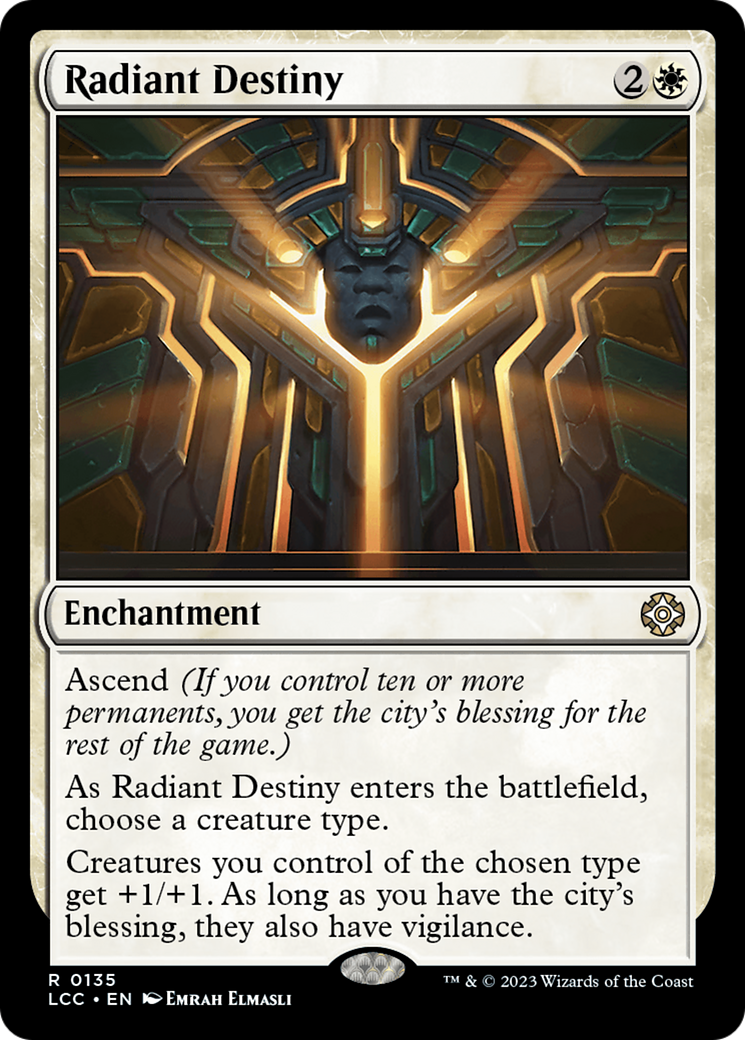
Radiant Destiny
Radiant Destiny
Enchantment
Ascend (If you control ten or more permanents, you get the city's blessing for the rest of the game.)
As this enchantment enters, choose a creature type.
Creatures you control of the chosen type get +1/+1. As long as you have the city's blessing, they also have vigilance.
- Gaining vigilance any time after the moment you choose to attack with a creature won't cause that creature to become untapped, and losing vigilance after that time won't cause it to become tapped.
- Once you have the city's blessing, you have it for the rest of the game, even if you lose control of some or all of your permanents. The city's blessing isn't a permanent itself and can't be removed by any effect.
- A permanent is any object on the battlefield, including tokens and lands. Spells and emblems aren't permanents.
- If you cast a spell with ascend, you don't get the city's blessing until it resolves. Players may respond to that spell by trying to change whether you get the city's blessing.
- If you control ten permanents but don't control a permanent or resolving spell with ascend, you don't get the city's blessing. For example, if you control ten permanents, lose control of one, then cast Golden Demise, you won't have the city's blessing and the spell will affect creatures you control.
- If your tenth permanent enters the battlefield and then a permanent leaves the battlefield immediately afterwards (most likely due to the "Legend Rule" or due to being a creature with 0 toughness), you get the city's blessing before it leaves the battlefield.
- Ascend on a permanent isn't a triggered ability and doesn't use the stack. Players can respond to a spell that will give you your tenth permanent, but they can't respond to getting the city's blessing once you control that tenth permanent. This means that if your tenth permanent is a land you play, players can't respond before you get the city's blessing.
- Some cards get power, toughness, and/or abilities once you have the city's blessing. If another card has an ability that triggers when creatures with certain characteristics enter the battlefield (such as Mentor of the Meek or Elemental Bond do), use the entering permanent's characteristics after you have the city's blessing to determine whether those abilities trigger. This is true even if the entering permanent is your tenth permanent.
- To choose a creature type, you must choose an existing creature type, such as Vampire or Knight. You can't choose multiple creature types, such as "Vampire Knight." Card types such as artifact can't be chosen, nor can subtypes that aren't creature types, such as Jace, Vehicle, or Treasure.
Lands 37
-
1
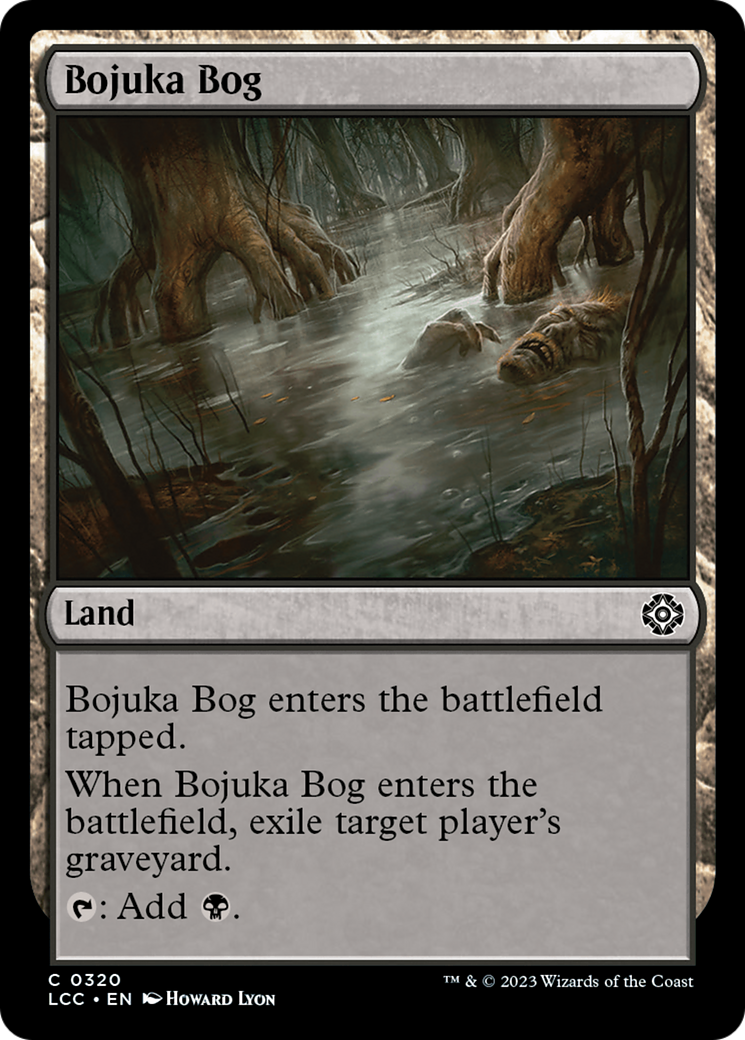
Bojuka Bog
Bojuka Bog
Land
This land enters tapped.
When this land enters, exile target player's graveyard.
: Add .
-
1
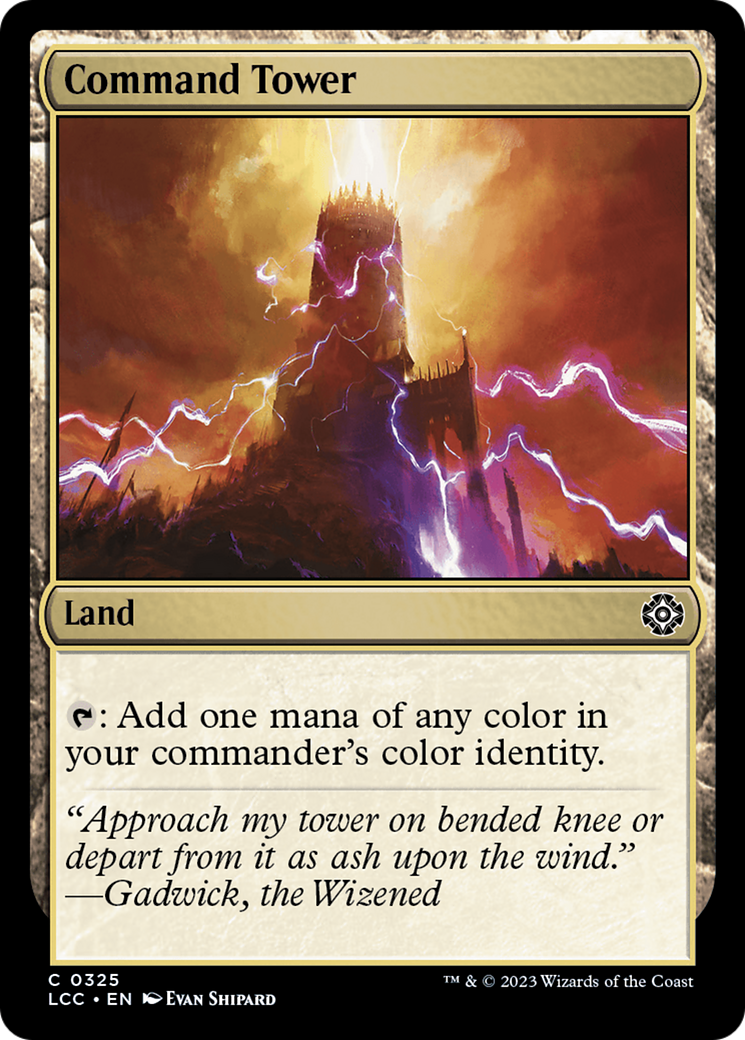
Command Tower
Command Tower
Land
: Add one mana of any color in your commander's color identity.
- If you don't have a commander, Command Tower's ability produces no mana.
- If your commander is a card that has no colors in its color identity, Command Tower's ability produces no mana. It doesn't produce .
- If you have two commanders, the ability adds one mana of any color in their combined color identities.
-
1
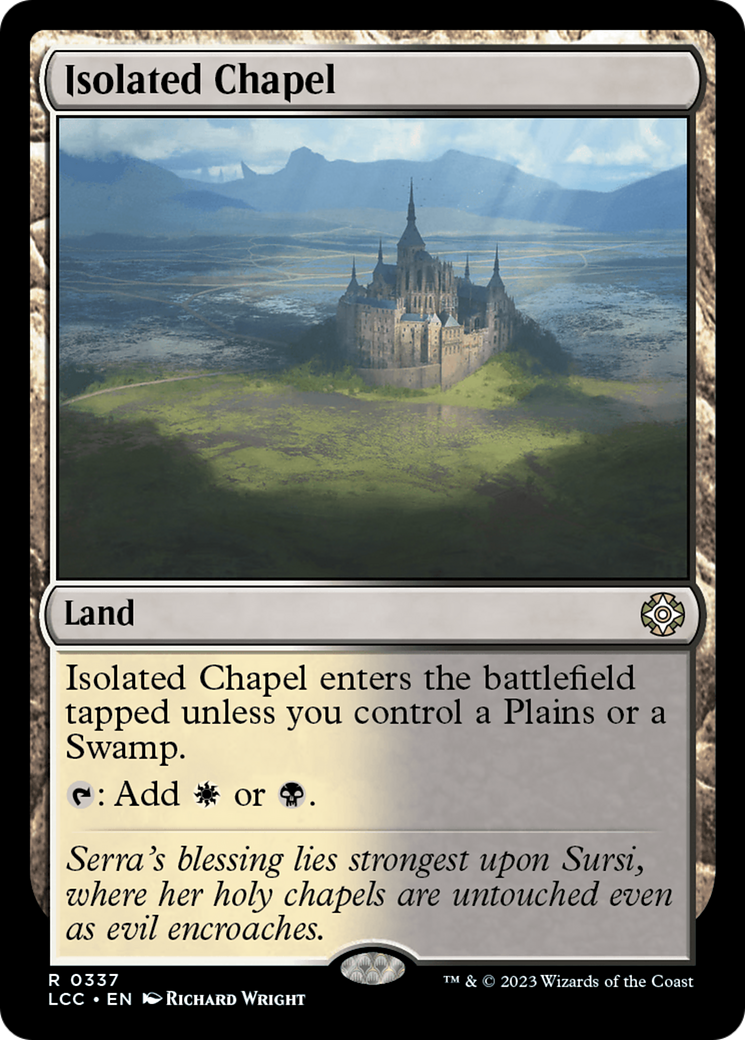
Isolated Chapel
Isolated Chapel
Land
This land enters tapped unless you control a Plains or a Swamp.
: Add or .
-
1
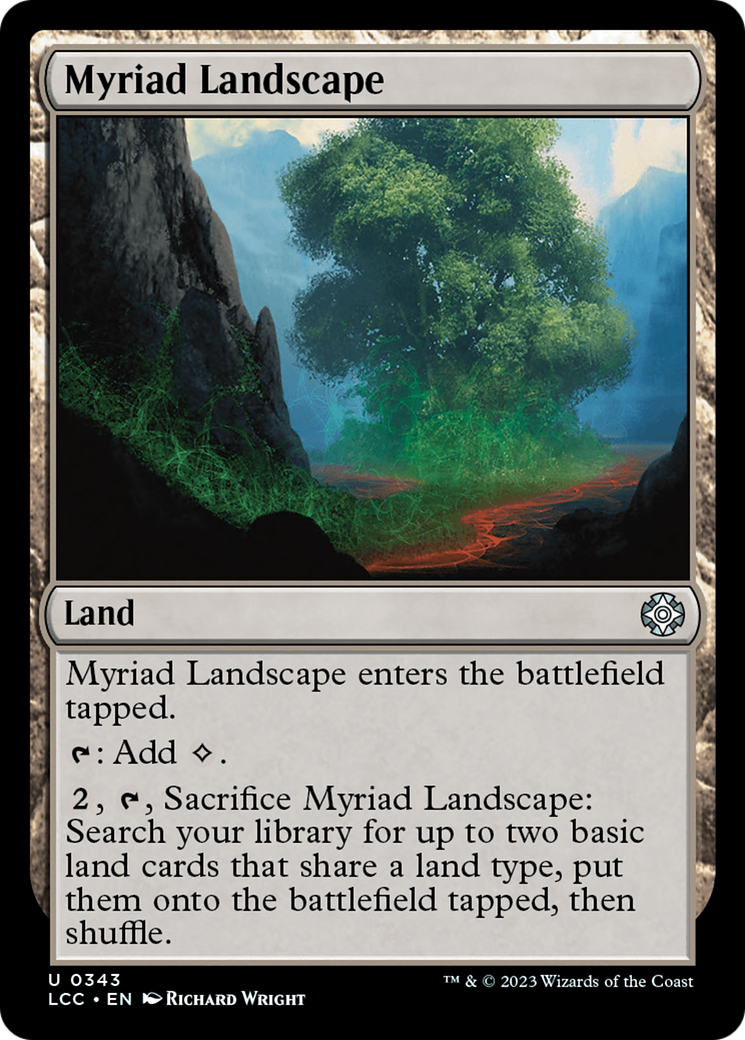
Myriad Landscape
Myriad Landscape
Land
This land enters tapped.
: Add .
, , Sacrifice this land: Search your library for up to two basic land cards that share a land type, put them onto the battlefield tapped, then shuffle.
- You can choose to find one basic land card with Myriad Landscape's last ability.
-
1
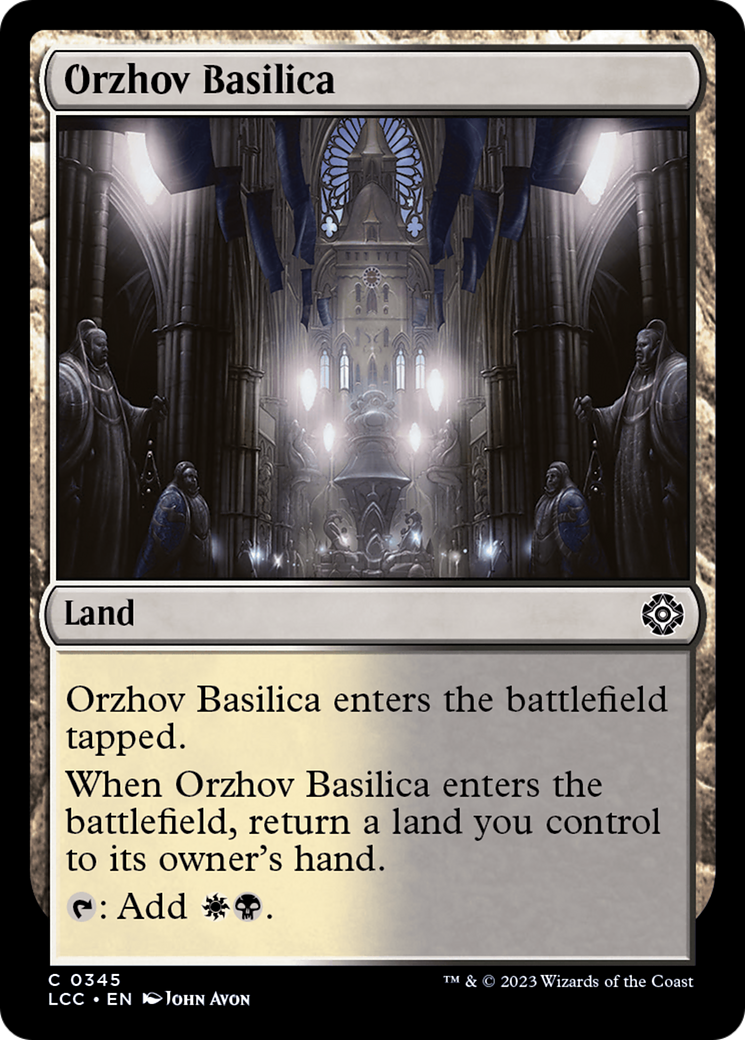
Orzhov Basilica
Orzhov Basilica
Land
This land enters tapped.
When this land enters, return a land you control to its owner's hand.
: Add .
- If this land enters the battlefield and you control no other lands, its ability will force you to return it to your hand.
-
1
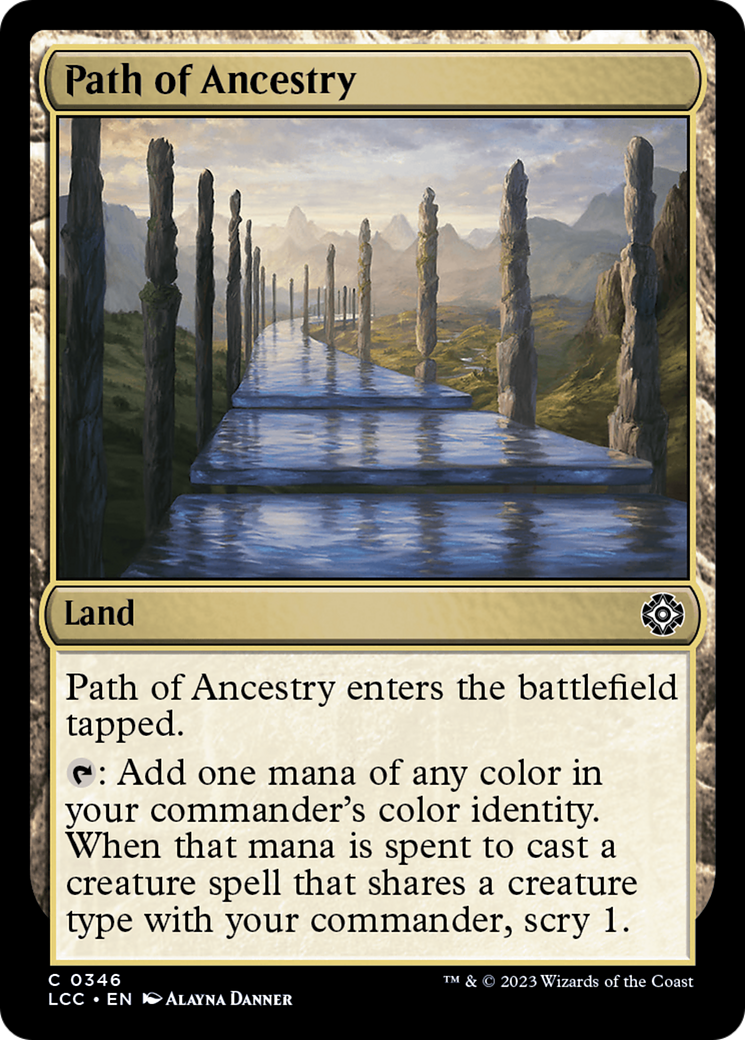
Path of Ancestry
Path of Ancestry
Land
This land enters tapped.
: Add one mana of any color in your commander's color identity. When that mana is spent to cast a creature spell that shares a creature type with your commander, scry 1. (Look at the top card of your library. You may put that card on the bottom.)
- Your commander's creature types are checked immediately after you cast a creature spell spending mana from Path of Ancestry's last ability. They aren't set before the game begins, and they may not be the same types your commander had when you activated that ability.
- If you have two commanders, the last ability adds one mana of any color in their combined color identities. When you spend that mana on a creature spell that shares a creature type with either of your commanders, you'll scry 1.
- If Path of Ancestry's last ability produces two mana (most likely due to Mana Reflection), spending those two mana to cast creature spells that share a creature type with your commander will cause two abilities to trigger. Each of those abilities will cause you to scry 1. You won't scry 2. This is true whether you spend the mana on one creature spell or two.
- If your commander has no creature types, it can't share a creature type with any spell that you cast.
- If you cast your commander with mana from Path of Ancestry, and your commander hasn't somehow lost all of its creature types while on the stack, you'll scry 1.
- If you don't have a commander, Path of Ancestry's ability produces no mana.
- If your commander is a card that has no colors in its color identity, Path of Ancestry's ability produces no mana. It doesn't produce .
-
8
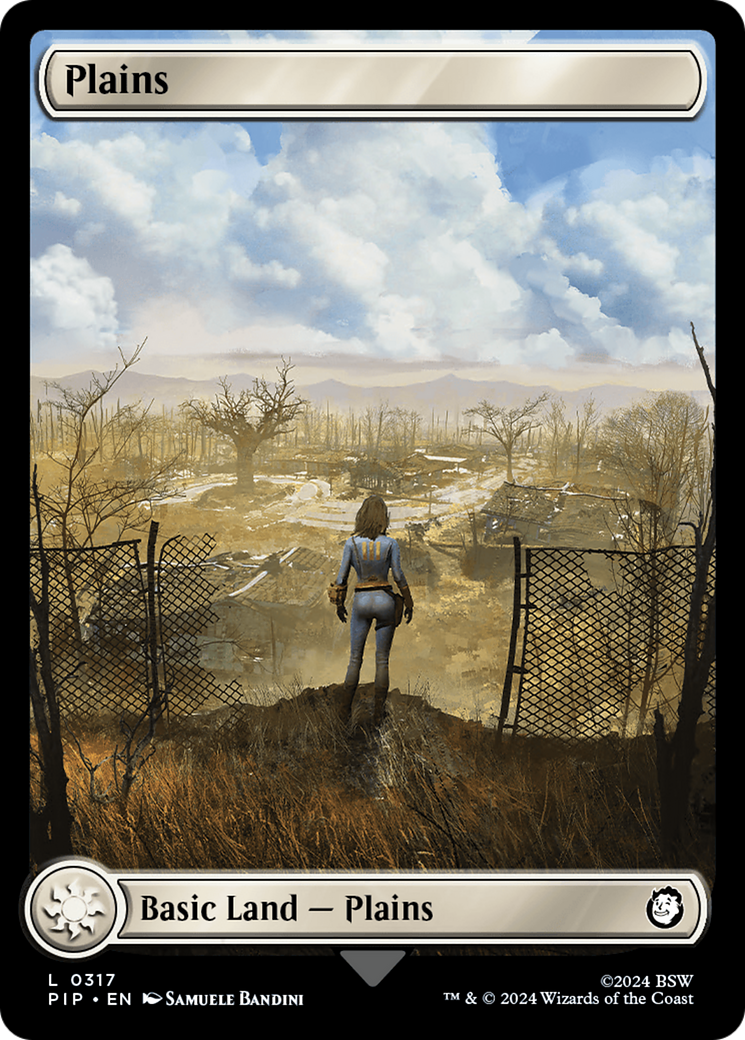
Plains
Plains
Basic Land — Plains
( : Add .)
-
1
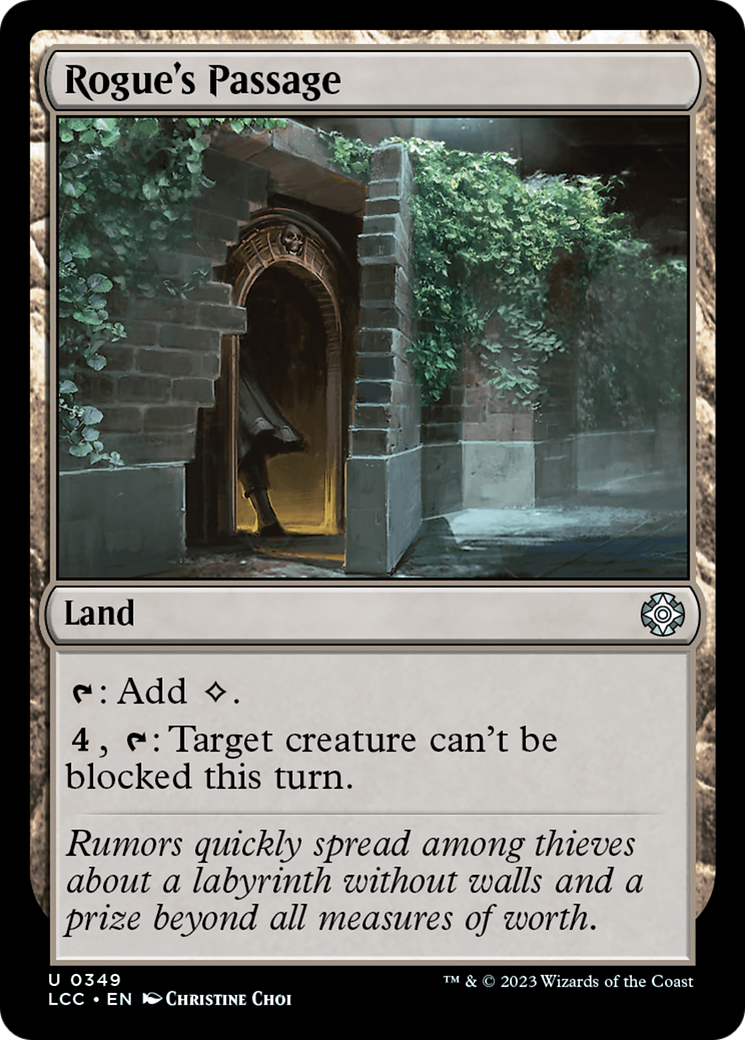
Rogue's Passage
Rogue's Passage
Land
: Add .
, : Target creature can't be blocked this turn.
- Activating the second ability of Rogue's Passage after a creature has become blocked won't cause that creature to become unblocked.
-
1
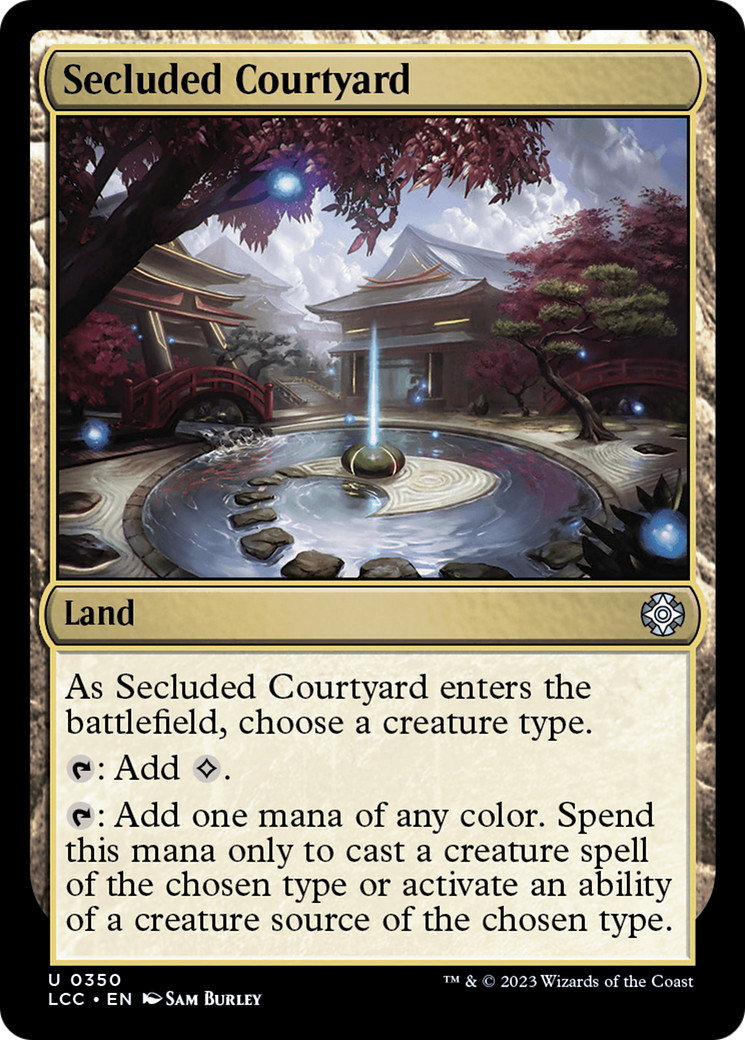
Secluded Courtyard
Secluded Courtyard
Land
As this land enters, choose a creature type.
: Add .
: Add one mana of any color. Spend this mana only to cast a creature spell of the chosen type or activate an ability of a creature source of the chosen type.
- If Secluded Courtyard is somehow on the battlefield without a chosen type, mana from its second mana ability can't be spent on anything.
-
1
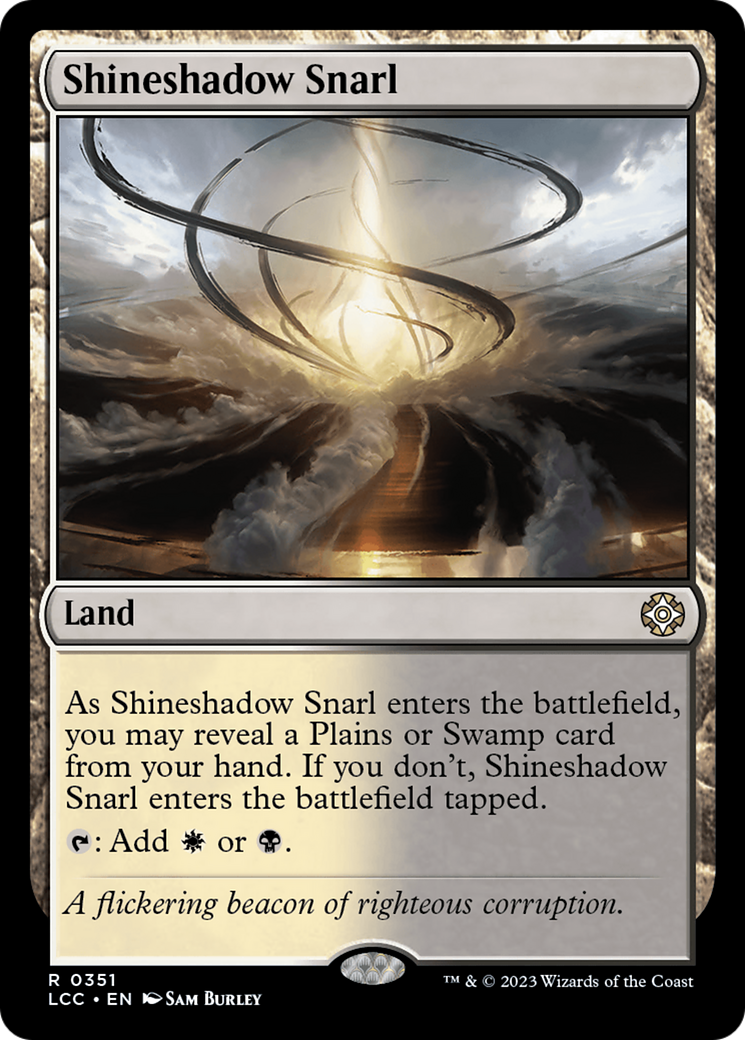
Shineshadow Snarl
Shineshadow Snarl
Land
As this land enters, you may reveal a Plains or Swamp card from your hand. If you don't, this land enters tapped.
: Add or .
- If a land card with an appropriate subtype is entering the battlefield from your hand at the same time as one of these lands, you may reveal the other land to have the "Snarl" enter untapped.
- If an effect instructs you to put one of these lands onto the battlefield tapped, it will still enter the battlefield tapped even if you reveal a land card from your hand.
- The "Snarl" itself doesn't have any land subtypes. You can't reveal one to satisfy the ability of another.
- You may reveal any land card with either or both of the appropriate subtypes. It doesn't have to be a basic land card.
-
13
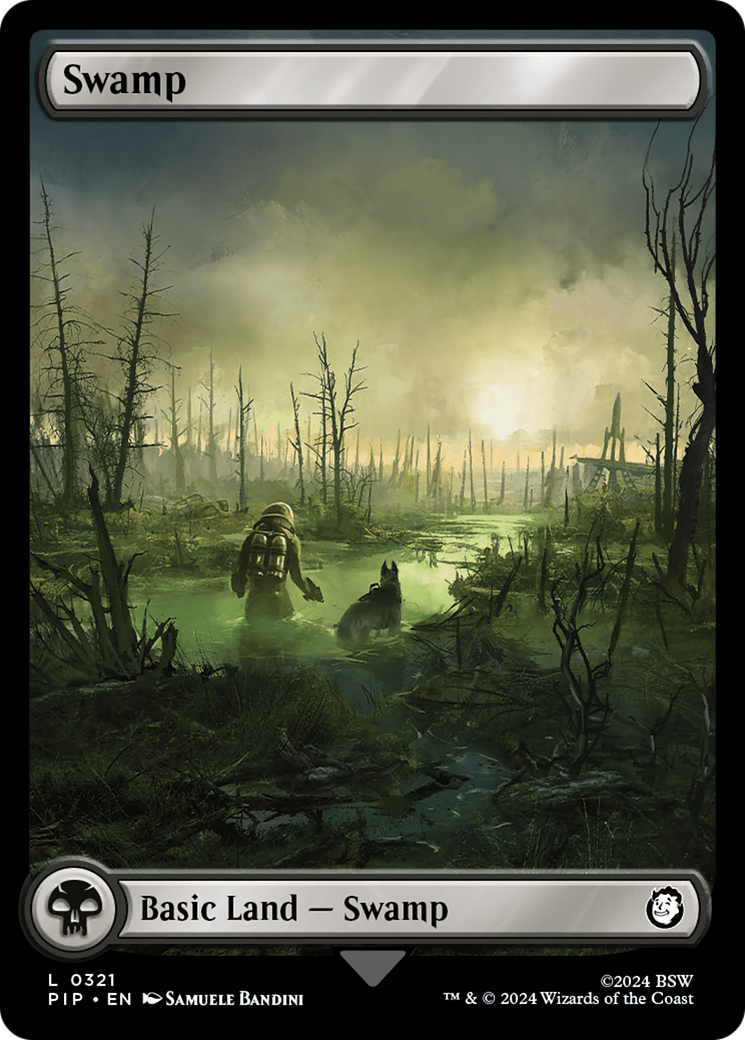
Swamp
Swamp
Basic Land — Swamp
( : Add .)
-
1
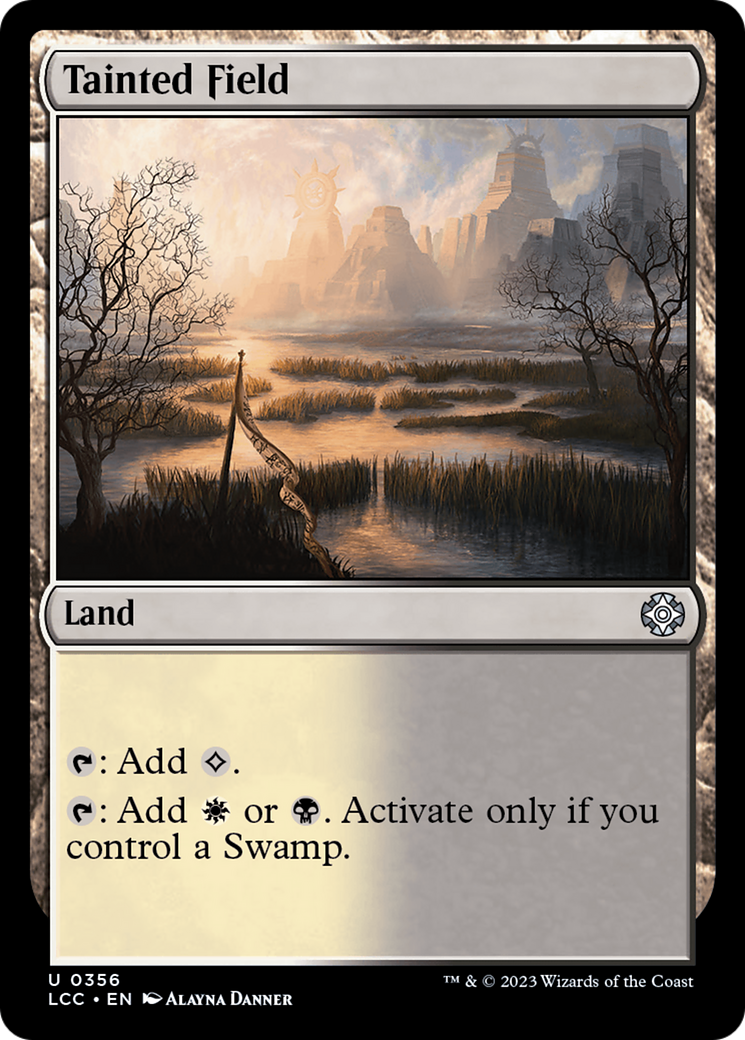
Tainted Field
Tainted Field
Land
: Add .
: Add or . Activate only if you control a Swamp.
-
1
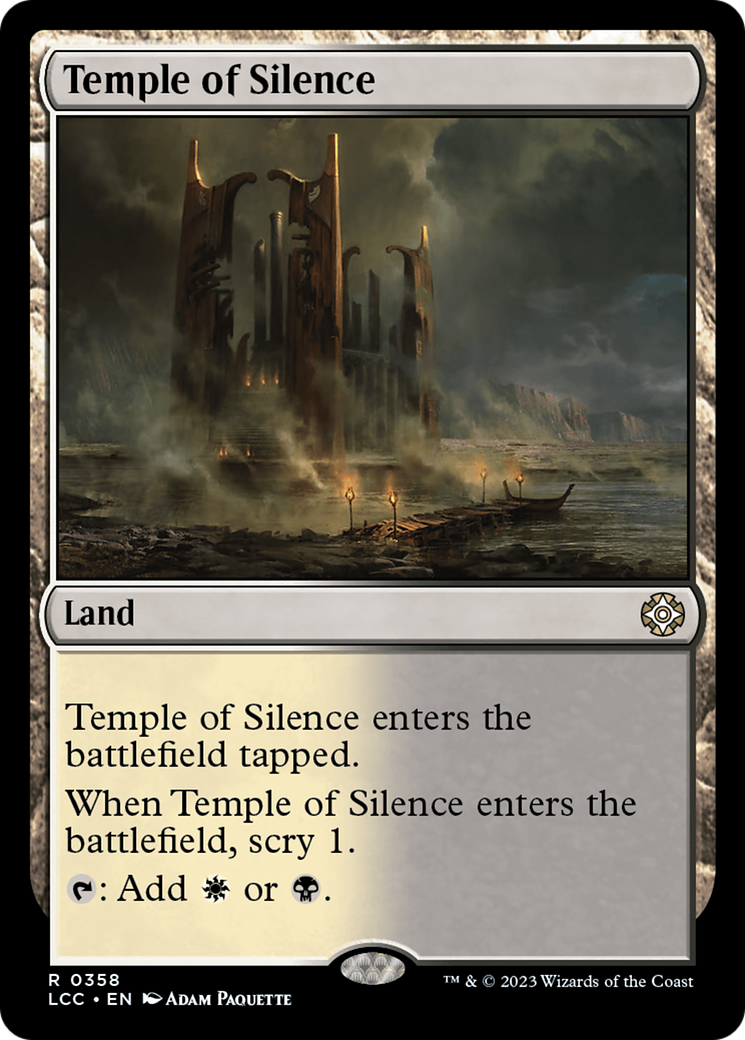
Temple of Silence
Temple of Silence
Land
This land enters tapped.
When this land enters, scry 1. (Look at the top card of your library. You may put that card on the bottom.)
: Add or .
- When you scry, you may put all the cards you look at back on top of your library, you may put all of those cards on the bottom of your library, or you may put some of those cards on top and the rest of them on the bottom.
- You choose how to order cards returned to your library after scrying no matter where you put them.
- You perform the actions stated on a card in sequence. For some spells and abilities, that means you'll scry last. For others, that means you'll scry and then perform other actions.
- Scry appears on some spells and abilities with one or more targets. If all of the spell or ability's targets are illegal when it tries to resolve, it won't resolve and none of its effects will happen. You won't scry.
-
1
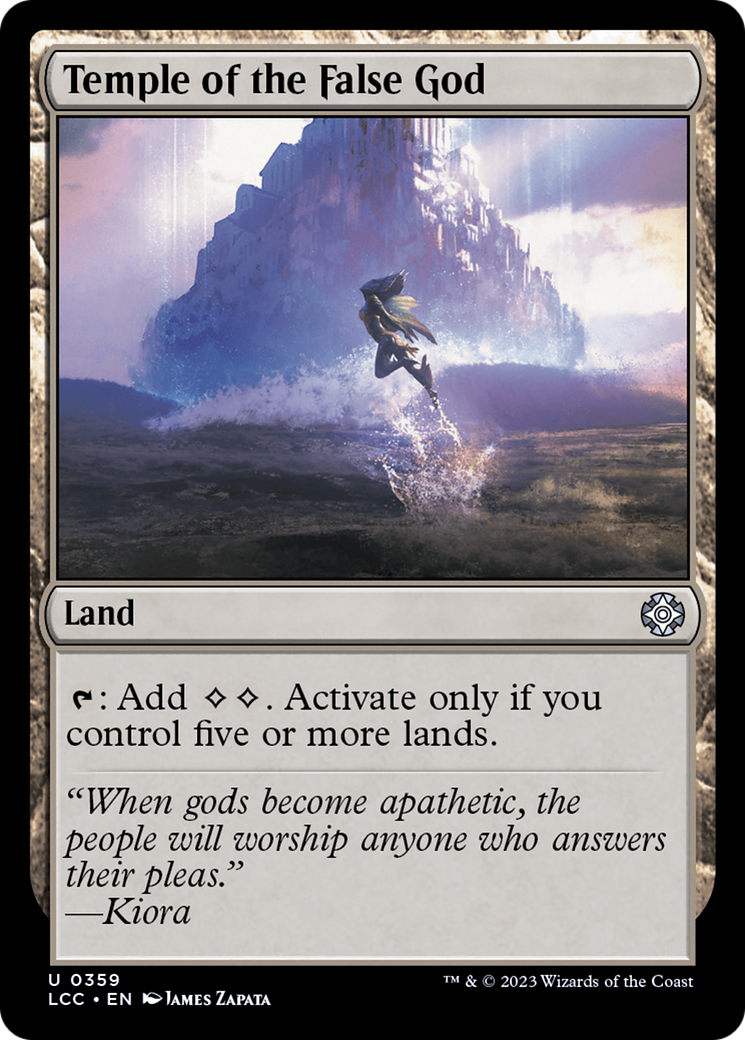
Temple of the False God
Temple of the False God
Land
: Add . Activate only if you control five or more lands.
-
1
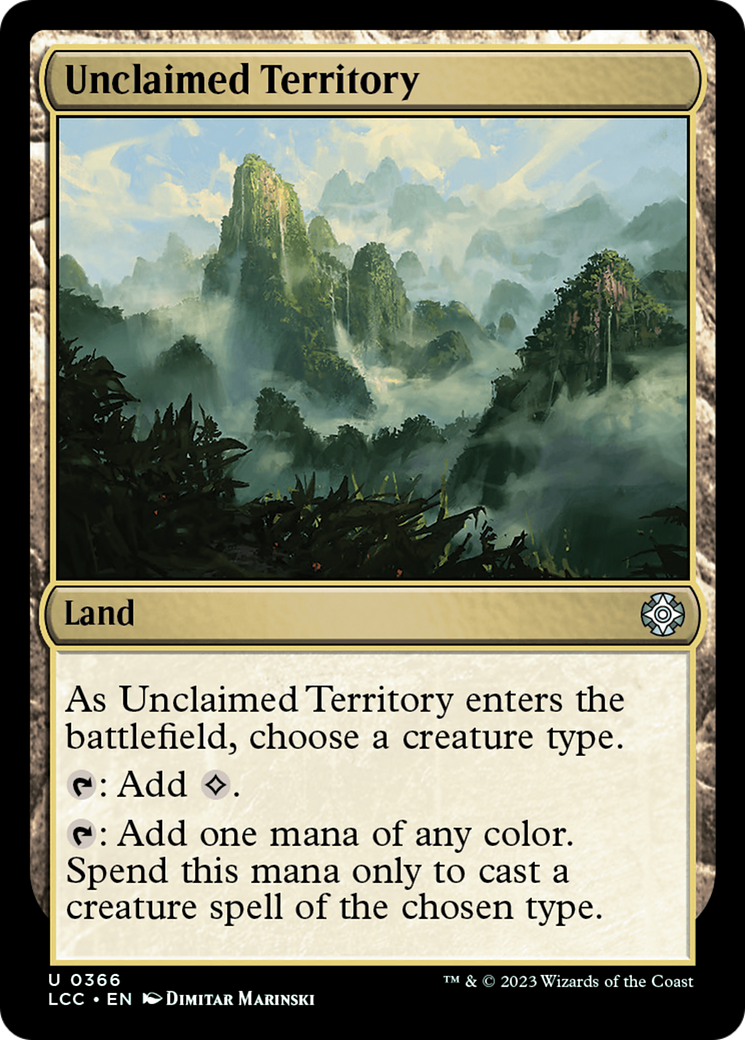
Unclaimed Territory
Unclaimed Territory
Land
As this land enters, choose a creature type.
: Add .
: Add one mana of any color. Spend this mana only to cast a creature spell of the chosen type.
- To choose a creature type, you must choose an existing creature type, such as Vampire or Knight. You can't choose multiple creature types, such as "Vampire Knight." Card types such as artifact can't be chosen, nor can subtypes that aren't creature types, such as Jace, Vehicle, or Treasure.
-
1
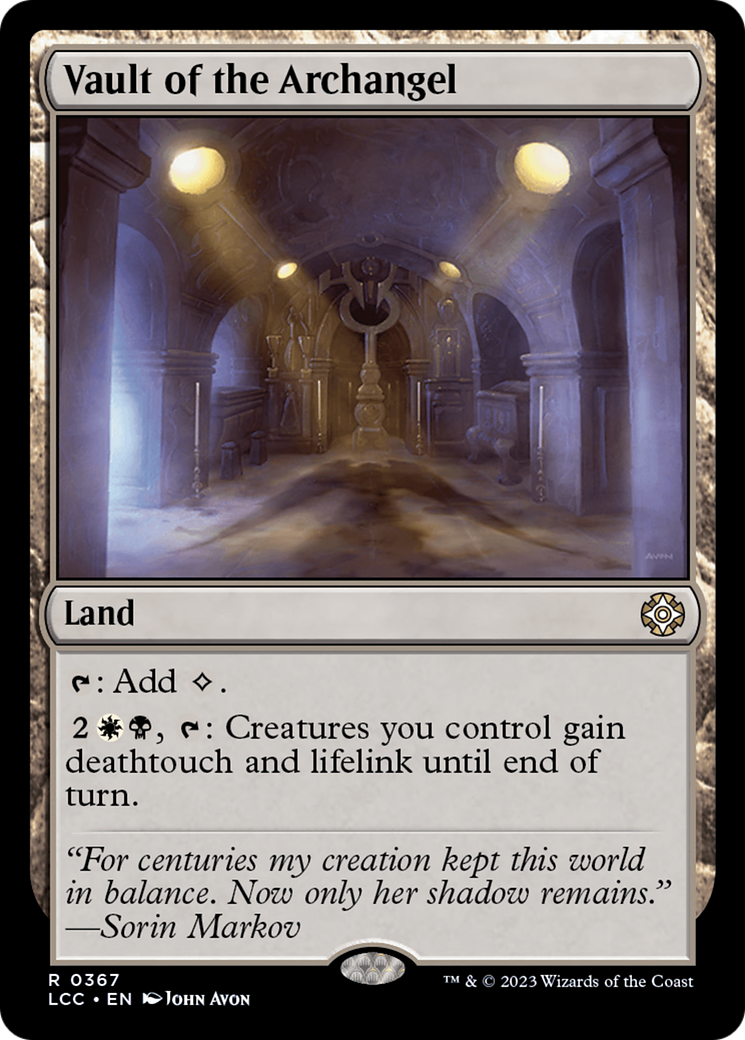
Vault of the Archangel
Vault of the Archangel
Land
: Add .
, : Creatures you control gain deathtouch and lifelink until end of turn.
- Multiple instances of deathtouch or lifelink on the same creature are redundant.
- Vault of the Archangel's last ability affects only creatures you control when that ability resolves. It won't affect creatures that come under your control later in the turn.
-
1
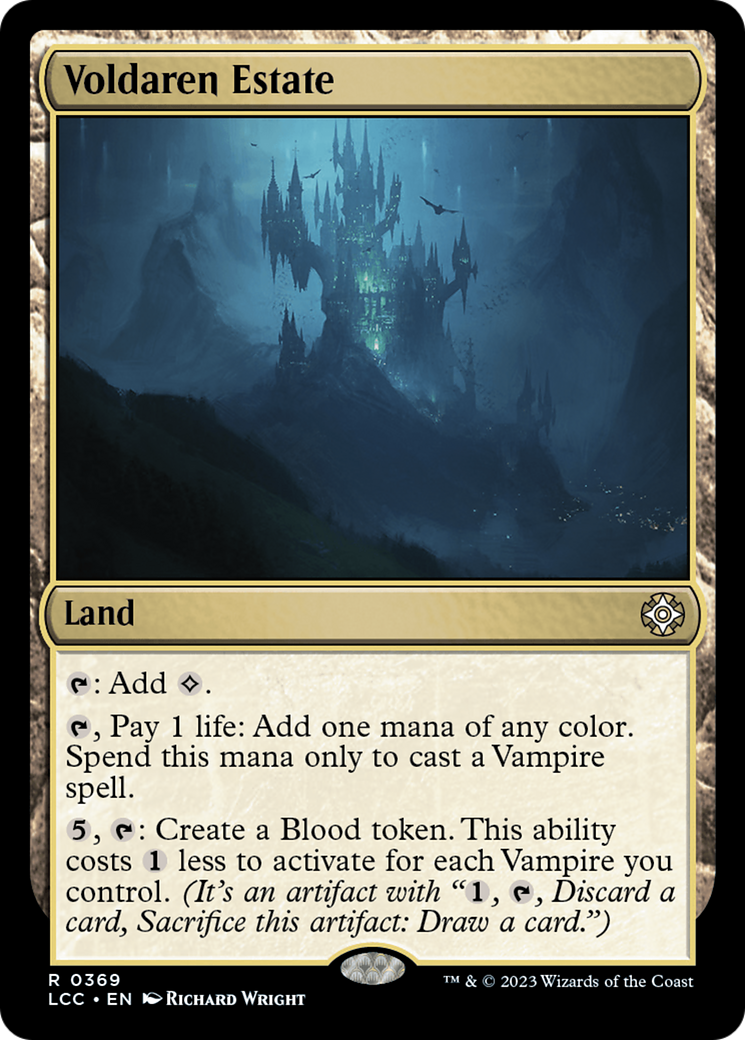
Voldaren Estate
Voldaren Estate
Land
: Add .
, Pay 1 life: Add one mana of any color. Spend this mana only to cast a Vampire spell.
, : Create a Blood token. This ability costs less to activate for each Vampire you control. (It's an artifact with " , , Discard a card, Sacrifice this token: Draw a card.")
- If an effect refers to a Blood token, it means any artifact token with the subtype Blood, even if it has gained other subtypes.
- You can't sacrifice a Blood token to pay multiple costs.
- Some triggered abilities trigger "whenever you sacrifice a Blood token." These abilities trigger regardless of why you sacrificed that Blood token.
- A Vampire spell is a spell with the creature type Vampire on its type line, regardless of whether the word "Vampire" is in its name.
-
1
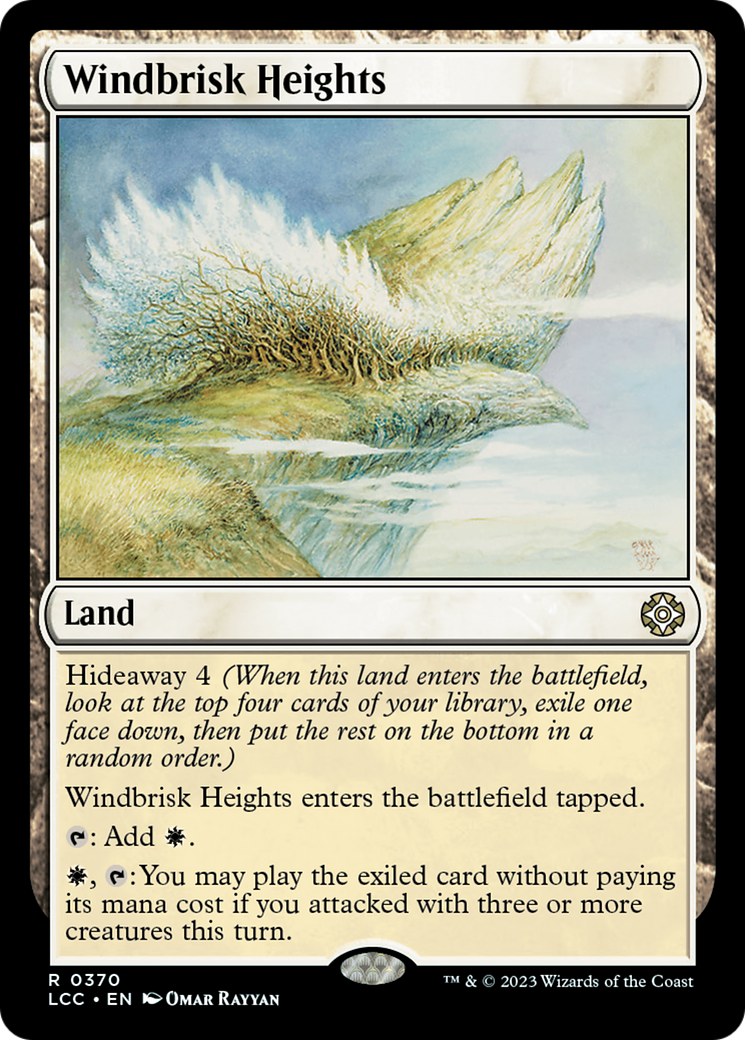
Windbrisk Heights
Windbrisk Heights
Land
Hideaway 4 (When this land enters, look at the top four cards of your library, exile one face down, then put the rest on the bottom in a random order.)
This land enters tapped.
: Add .
, : You may play the exiled card without paying its mana cost if you attacked with three or more creatures this turn.
- "Hideaway N" means "When this permanent enters the battlefield, look at the top N cards of your library. Exile one of them face down and put the rest on the bottom of your library in a random order. The exiled card gains 'The player who controls the permanent that exiled this card may look at this card in the exile zone.'"
- Any player who has controlled a permanent with a hideaway ability since a card was exiled with it may look at that card.
- Previously, permanents with hideaway entered the battlefield tapped. This ability has been removed from the definition of hideaway. Older cards have received errata to have an additional paragraph that reads "[This permanent] enters the battlefield tapped," and they now have hideaway 4.
- Hideaway now causes you to put the rest of the cards on the bottom of your library in a random order instead of any order.
- At the time the ability resolves, you'll get to play the card if you declared three different creatures as attackers at any point in the turn. A creature declared as an attacker in two different attack phases counts only once. A creature that entered attacking (such as a token created by Militia's Pride) doesn't count because you never attacked with it.
White 12
-
1
Austere Command
Austere Command
Sorcery
Choose two —
- Destroy all artifacts.
- Destroy all enchantments.
- Destroy all creatures with mana value 3 or less.
- Destroy all creatures with mana value 4 or greater.
- Each of the chosen modes happens sequentially. If a permanent has an ability that triggers whenever it or another permanent is destroyed, it will see permanents destroyed at the same time as it or before it, but not permanents destroyed by later modes.
- If a card is exiled "until" another permanent leaves the battlefield, the exiled card returns to the battlefield immediately after that permanent leaves the battlefield during Austere Command's resolution, and it may be destroyed by a later mode.
- If the first and last modes are chosen, an artifact creature with mana value 4 or greater will have to be regenerated twice to survive. This is because the modes happen sequentially, and the regeneration "shield" is used up by the first one. The same is true with any other combination of modes that covers one permanent twice.
-
1
Charismatic Conqueror
Charismatic Conqueror
Creature — Vampire Soldier
2/2
Vigilance
Whenever an artifact or creature an opponent controls enters untapped, they may tap that permanent. If they don't, you create a 1/1 white Vampire creature token with lifelink.
- If the permanent is tapped as the ability resolves, the opponent can't choose to tap it, so you'll create a Vampire token. Similarly, if it's no longer on the battlefield as the ability resolves, they can't choose to tap it, and you'll create a Vampire token.
-
1
Elenda's Hierophant
Elenda's Hierophant
Creature — Vampire Cleric
1/1
Flying
Whenever you gain life, put a +1/+1 counter on this creature.
When this creature dies, create X 1/1 white Vampire creature tokens with lifelink, where X is its power.
- The second ability of Elenda's Hierophant triggers just once for each life-gaining event, no matter how much life was gained.
- If Elenda's Hierophant is dealt lethal damage at the same time that you gain life, it won't receive a counter from its second ability in time to save it.
- Each creature with lifelink dealing combat damage causes a separate life-gaining event. For example, if two creatures you control with lifelink deal combat damage at the same time, Elenda's Hierophant's second ability will trigger twice. However, if a single creature you control with lifelink deals combat damage to multiple creatures, players, and/or planeswalkers at the same time (perhaps because it has trample or was blocked by more than one creature), the ability will trigger only once.
- If you gain an amount of life "for each" of something, that life is gained as one event and the second ability of Elenda's Hierophant triggers only once.
- In a Two-Headed Giant game, life gained by your teammate won't cause the second ability of Elenda's Hierophant to trigger even though it caused your team's life total to increase.
-
1
Kindred Boon
Kindred Boon
Enchantment
As this enchantment enters, choose a creature type.
: Put a divinity counter on target creature you control of the chosen type.
Each creature you control with a divinity counter on it has indestructible.
- If a creature that isn't of the chosen type somehow gets a divinity counter on it, that creature will have indestructible.
- If a creature has been dealt damage, that damage remains marked on it until the cleanup step. If a creature with a divinity counter on it has been dealt lethal damage, and later in the turn Kindred Boon leaves the battlefield or the counter is removed from that creature, that creature will be destroyed.
- If you somehow control a Kindred Boon with no chosen creature type, its activated ability can't be activated.
- You must choose an existing creature type, such as Vampire or Cat. Card types such as "artifact" can't be chosen.
- You can't choose multiple creature types, such as "Cat Warrior." A Cat Warrior is both a Cat and a Warrior. It's affected by anything that affects either type and unaffected by things that affect non-Cat or non-Warrior creatures.
-
1
March of the Canonized
March of the Canonized
Enchantment
When this enchantment enters, create X 1/1 white Vampire creature tokens with lifelink.
At the beginning of your upkeep, if your devotion to white and black is seven or greater, create a 4/3 white and black Vampire Demon creature token with flying.
- Your devotion to two colors is the number of mana symbols among mana costs of permanents you control that are the first color, the second, or both. If an effect counts your devotion to two colors, a hybrid symbol that is both of those colors is counted just once.
- March of the Canonized's last ability will trigger only if your devotion to white and black is seven or greater at the beginning of your upkeep. As the triggered ability tries to resolve, if your devotion to white and black is no longer at least seven, the ability won't do anything.
- Colorless and generic mana symbols ( , , , , , and so on) in mana costs of permanents you control don't count toward your devotion to any color.
- Mana symbols in the text boxes of permanents you control don't count toward your devotion to any color.
- Hybrid mana symbols, monocolored hybrid mana symbols, and Phyrexian mana symbols do count toward your devotion to their color(s).
- If you put an Aura on an opponent's permanent, you still control the Aura, and mana symbols in its mana cost count toward your devotion.
- The back face of a transforming double-faced permanent has no mana cost. Mana symbols on a transforming double-faced permanent's front face don't count toward your devotion to any color while it's on the battlefield with its back face up.
-
1
Martyr of Dusk
Martyr of Dusk
Creature — Vampire Soldier
2/1
When this creature dies, create a 1/1 white Vampire creature token with lifelink.
-
1
Mavren Fein, Dusk Apostle
Mavren Fein, Dusk Apostle
Legendary Creature — Vampire Cleric
2/2
Whenever one or more nontoken Vampires you control attack, create a 1/1 white Vampire creature token with lifelink.
- Once you attack with one or more nontoken Vampires, Mavren Fein's ability will create a Vampire token even if some or all of those Vampires leave the battlefield or are removed from combat.
-
1
Radiant Destiny
Radiant Destiny
Enchantment
Ascend (If you control ten or more permanents, you get the city's blessing for the rest of the game.)
As this enchantment enters, choose a creature type.
Creatures you control of the chosen type get +1/+1. As long as you have the city's blessing, they also have vigilance.
- Gaining vigilance any time after the moment you choose to attack with a creature won't cause that creature to become untapped, and losing vigilance after that time won't cause it to become tapped.
- Once you have the city's blessing, you have it for the rest of the game, even if you lose control of some or all of your permanents. The city's blessing isn't a permanent itself and can't be removed by any effect.
- A permanent is any object on the battlefield, including tokens and lands. Spells and emblems aren't permanents.
- If you cast a spell with ascend, you don't get the city's blessing until it resolves. Players may respond to that spell by trying to change whether you get the city's blessing.
- If you control ten permanents but don't control a permanent or resolving spell with ascend, you don't get the city's blessing. For example, if you control ten permanents, lose control of one, then cast Golden Demise, you won't have the city's blessing and the spell will affect creatures you control.
- If your tenth permanent enters the battlefield and then a permanent leaves the battlefield immediately afterwards (most likely due to the "Legend Rule" or due to being a creature with 0 toughness), you get the city's blessing before it leaves the battlefield.
- Ascend on a permanent isn't a triggered ability and doesn't use the stack. Players can respond to a spell that will give you your tenth permanent, but they can't respond to getting the city's blessing once you control that tenth permanent. This means that if your tenth permanent is a land you play, players can't respond before you get the city's blessing.
- Some cards get power, toughness, and/or abilities once you have the city's blessing. If another card has an ability that triggers when creatures with certain characteristics enter the battlefield (such as Mentor of the Meek or Elemental Bond do), use the entering permanent's characteristics after you have the city's blessing to determine whether those abilities trigger. This is true even if the entering permanent is your tenth permanent.
- To choose a creature type, you must choose an existing creature type, such as Vampire or Knight. You can't choose multiple creature types, such as "Vampire Knight." Card types such as artifact can't be chosen, nor can subtypes that aren't creature types, such as Jace, Vehicle, or Treasure.
-
1
Redemption Choir
Redemption Choir
Creature — Vampire Cleric
3/3
Lifelink
Coven — Whenever this creature enters or attacks, if you control three or more creatures with different powers, return target permanent card with mana value 3 or less from your graveyard to the battlefield.
- For three creatures to have different powers from one another, each of their powers needs to be different. A 1/1 creature, a 2/1 creature, and another 2/1 creature aren't three creatures with different powers, even though both 2/1 creatures have different power than the 1/1 creature.
- You must control three or more creatures with different powers at the time the coven ability triggers and at the time the ability tries to resolve. They do not, however, need to be the same set of creatures in both cases.
-
1
Return to Dust
Return to Dust
Instant
Exile target artifact or enchantment. If you cast this spell during your main phase, you may exile up to one other target artifact or enchantment.
- Return to Dust can always target a second artifact or enchantment; it just won't exile it if it's not your main phase when you cast Return to Dust.
- If a spell or ability copies Return to Dust, the copy exiles only the first target artifact or enchantment. This is because the copy wasn't cast at all.
-
1
Swords to Plowshares
Swords to Plowshares
Instant
Exile target creature. Its controller gains life equal to its power.
- Use the power of the creature from when it was last on the battlefield to determine how much life is gained.
-
1
Welcoming Vampire
Welcoming Vampire
Creature — Vampire
2/3
Flying
Whenever one or more other creatures you control with power 2 or less enter, draw a card. This ability triggers only once each turn.
- Welcoming Vampire's ability checks the power of the other creatures only as they enter the battlefield. If one of those creatures has power 2 or less, the ability will trigger. Once the ability triggers, raising that creature's power above 2 won't affect that ability. Similarly, reducing a creature's power to 2 or less after it enters the battlefield won't cause the ability to trigger.
- If creatures enter the battlefield with +1/+1 counters or a continuous effect such as that of Wedding Festivity will apply to the creatures on the battlefield, those effects apply when checking to see if Welcoming Vampire's ability will trigger.
Black 30
-
1
Blood Artist
Blood Artist
Creature — Vampire
0/1
Whenever this creature or another creature dies, target player loses 1 life and you gain 1 life.
- If Blood Artist and one or more other creatures die at the same time, its ability will trigger for each of those creatures.
-
1
Bloodghast
Bloodghast
Creature — Vampire Spirit
2/1
This creature can't block.
This creature has haste as long as an opponent has 10 or less life.
Landfall — Whenever a land you control enters, you may return this card from your graveyard to the battlefield.
- Whenever a land you control enters, each landfall ability of permanents you control will trigger. You can put them on the stack in any order. The last ability you put on the stack will be the first one to resolve. As a result, you can have those abilities resolve in the order of your choosing.
- A landfall ability triggers whenever a land you control enters for any reason. It triggers whenever you play a land, as well as whenever a spell or ability puts a land onto the battlefield under your control.
- A landfall ability doesn't trigger if a permanent already on the battlefield becomes a land.
- Bloodghast's landfall ability triggers only if it's already in your graveyard at the time a land enters under your control.
-
1
Bloodline Necromancer
Bloodline Necromancer
Creature — Vampire Wizard
3/2
Lifelink
When this creature enters, you may return target Vampire or Wizard creature card from your graveyard to the battlefield.
-
1
Bloodtracker
Bloodtracker
Creature — Vampire Wizard
2/2
Flying
, Pay 2 life: Put a +1/+1 counter on this creature.
When this creature leaves the battlefield, draw a card for each +1/+1 counter on it.
- If enough -1/-1 counters are put on Bloodtracker at the same time to make its toughness 0 or less, the number of +1/+1 counters on it before it got any -1/-1 counters will be used to determine how many cards you draw. For example, if there are three +1/+1 counters on Bloodtracker and it gets six -1/-1 counters, you'll draw three cards. That's because Bloodtracker's triggered ability checks the creature's existence just before it leaves the battlefield, and it still has all those counters on it at that point.
-
1
Butcher of Malakir
Butcher of Malakir
Creature — Vampire Warrior
5/4
Flying
Whenever this creature or another creature you control dies, each opponent sacrifices a creature of their choice.
- When the triggered ability resolves, first the player whose turn it is (if that player is an opponent) chooses which creature they will sacrifice, then each other opponent in turn order does the same, then all chosen creatures are sacrificed at the same time.
- If multiple creatures you control (possibly including Butcher of Malakir itself) are put into their owners' graveyards at the same time, Butcher of Malakir's triggered ability will trigger that many times.
- If you control more than one Butcher of Malakir and a creature you control is put into a graveyard, each of those Butchers' abilities will trigger. Each opponent will sacrifice a creature each time one of those abilities resolves.
- If you and an opponent each control a Butcher of Malakir and a creature is put into a graveyard, a chain reaction happens. First the ability of one player's Butcher will trigger, causing each opponent to sacrifice a creature. That sacrifice causes the ability of the other player's Butcher to trigger, and so on.
-
1
Champion of Dusk
Champion of Dusk
Creature — Vampire Knight
4/4
When this creature enters, you draw X cards and you lose X life, where X is the number of Vampires you control.
- The number of Vampires you control is counted only as Champion of Dusk's ability resolves. If Champion of Dusk is still on the battlefield, it'll count itself.
-
1
Cordial Vampire
Cordial Vampire
Creature — Vampire
1/1
Whenever this creature or another creature dies, put a +1/+1 counter on each Vampire you control.
- If Cordial Vampire dies at the same time as one or more other creatures, its ability triggers for each of them.
- If a Vampire you control is dealt lethal damage at the same time as another creature, they die at the same time. That Vampire can't receive a counter from Cordial Vampire's ability in time to save it.
-
1
Crossway Troublemakers
Crossway Troublemakers
Creature — Vampire
5/5
Attacking Vampires you control have deathtouch and lifelink. (Any amount of damage they deal to a creature is enough to destroy it. Damage dealt by those creatures also causes their controller to gain that much life.)
Whenever a Vampire you control dies, you may pay 2 life. If you do, draw a card.
- You may pay 2 life only once for each Vampire that dies. You can't pay multiple times for the same triggered ability and draw multiple cards.
-
1
Damn
Damn
Sorcery
Destroy target creature. A creature destroyed this way can't be regenerated.
Overload (You may cast this spell for its overload cost. If you do, change "target" in its text to "each.")
- If you don't pay the overload cost of a spell with overload, that spell will have a single target. If you pay the overload cost, the spell won't have any targets.
- Because a spell with overload doesn't target when its overload cost is paid, it may affect permanents with hexproof or with protection from the appropriate color.
- To determine the total cost of a spell, start with the mana cost or alternative cost you're paying (such as an overload cost), add any cost increases, then apply any cost reductions. The mana value of the spell remains unchanged, no matter what the total cost to cast it was.
- If you are instructed to cast a spell with overload "without paying its mana cost," you can't choose to pay its overload cost instead.
-
1
Drana, Liberator of Malakir
Drana, Liberator of Malakir
Legendary Creature — Vampire Ally
2/3
Flying, first strike
Whenever Drana deals combat damage to a player, put a +1/+1 counter on each attacking creature you control.
- Drana's last ability triggers after combat damage has been dealt, so only attacking creatures that survive the combat damage step in which Drana deals combat damage will have +1/+1 counters put on them.
- The +1/+1 counter won't change how much damage Drana or any other attacking creature with first strike or double strike deals during that combat damage step. However, the +1/+1 counters that are put on attacking creatures without first strike will affect the damage those creatures deal during the regular combat damage step.
-
1
Dusk Legion Sergeant
Dusk Legion Sergeant
Creature — Vampire Soldier
2/2
Menace
, Sacrifice this creature: Each nontoken Vampire creature you control gains persist until end of turn. (When it dies, if it had no -1/-1 counters on it, return it to the battlefield under its owner's control with a -1/-1 counter on it.)
- If a card with persist is removed from the graveyard after it dies but before the ability trigger resolves, it won't be returned to the battlefield.
- Once persist returns the creature, it's considered a new object with no relation to the object that it was. Auras that were attached to it won't return to the battlefield. Equipment that was attached to it will remain unattached. Any counters that were on it won't be put on the new creature.
- If a creature has +1/+1 counters and -1/-1 counters on it, state-based actions remove the same number of each so that it has only one kind of those counters on it. A creature's persist ability can bring it back again if its -1/-1 counters are removed this way.
- If a creature with persist that has +1/+1 counters on it receives enough -1/-1 counters to cause it to be destroyed by lethal damage or put into its owner's graveyard for having 0 or less toughness, persist won't trigger and the card won't return to the battlefield. That's because persist checks the creature as it last existed on the battlefield, and it still had -1/-1 counters on it at that point.
-
1
Dusk Legion Zealot
Dusk Legion Zealot
Creature — Vampire Soldier
1/1
When this creature enters, you draw a card and you lose 1 life.
-
1
Exquisite Blood
Exquisite Blood
Enchantment
Whenever an opponent loses life, you gain that much life.
- Damage dealt to an opponent usually causes that opponent to lose life. An opponent paying life also causes loss of life.
- If you and an opponent both lose life simultaneously, and this causes your life total to become 0 or less, you'll lose the game before Exquisite Blood's triggered ability can resolve.
-
1
Falkenrath Noble
Falkenrath Noble
Creature — Vampire Noble
2/2
Flying
Whenever this creature or another creature dies, target player loses 1 life and you gain 1 life.
- If Falkenrath Noble and another creature die at the same time, Falkenrath Noble's triggered ability will trigger for each of them.
-
1
Glass-Cast Heart
Glass-Cast Heart
Artifact
Whenever one or more Vampires you control attack, create a Blood token. (It's an artifact with " , , Discard a card, Sacrifice this token: Draw a card.")
, , Pay 1 life: Create a 1/1 white and black Vampire creature token with lifelink.
, , Sacrifice this artifact and thirteen Blood tokens: Each opponent loses 13 life and you gain 13 life.
- If an effect refers to a Blood token, it means any artifact token with the subtype Blood, even if it has gained other subtypes.
- You can't sacrifice a Blood token to pay multiple costs.
- Some triggered abilities trigger "whenever you sacrifice a Blood token." These abilities trigger regardless of why you sacrificed that Blood token.
-
1
Indulgent Aristocrat
Indulgent Aristocrat
Creature — Vampire Noble
1/1
Lifelink
, Sacrifice a creature: Put a +1/+1 counter on each Vampire you control.
- You can sacrifice Indulgent Aristocrat to pay the cost of its own activated ability.
-
1
Master of Dark Rites
Master of Dark Rites
Creature — Vampire Cleric
1/1
, Sacrifice another creature: Add . Spend this mana only to cast Vampire, Cleric, and/or Demon spells.
-
1
New Blood
New Blood
Sorcery
As an additional cost to cast this spell, tap an untapped Vampire you control.
Gain control of target creature. Change the text of that creature by replacing all instances of one creature type with Vampire.
- To pay the additional cost of New Blood, you may tap any untapped Vampire you control, including one you haven't controlled continuously since the beginning of your most recent turn. (Note that tapping the creature doesn't use [the tap symbol].)
- New Blood changes the creature type each time it appears in the creature's type line and/or rules text. It doesn't change the name of the card or any instances of the word being used as part of a card's name.
- You choose what word you're changing as New Blood resolves. You don't have to choose a word that appears in the creature's text.
- The creature you gain control of won't be a Vampire if you don't choose a creature type in that creature's type line as one to replace.
- New Blood's effect changes only the text printed on the creature. It can't change words found in abilities it's been granted. For example, if you change Rat to Vampire on Hungry Lynx, your Cats will have protection from Vampires; but if instead you change Rat to Vampire on Phantom Nishoba while you control a Hungry Lynx, Phantom Nishoba will have protection from Rats.
- The type-changing effect can change part of a word (such as "non-Human") if the part of the word is being used to refer to a creature type.
- You must choose an existing creature type, such as Vampire or Cat. Card types such as "artifact" can't be chosen.
- You can't choose multiple creature types, such as "Cat Warrior." A Cat Warrior is both a Cat and a Warrior. It's affected by anything that affects either type and unaffected by things that affect non-Cat or non-Warrior creatures.
-
1
Nighthawk Scavenger
Nighthawk Scavenger
Creature — Vampire Rogue
1+*/3
Flying, deathtouch, lifelink
Nighthawk Scavenger's power is equal to 1 plus the number of card types among cards in your opponents' graveyards.
- The ability that defines Nighthawk Scavenger's power applies in all zones, not just the battlefield.
- Nighthawk Scavenger counts card types, not cards. If the only card in your opponents' graveyards is a single artifact creature card, Nighthawk Scavenger will be 3/3. If the only cards in those graveyards are ten artifact cards and ten creature cards, Nighthawk Scavenger will still be 3/3.
- Card types that can appear on cards in a graveyard include artifact, creature, enchantment, instant, land, planeswalker, and sorcery. Legendary, basic, and snow are supertypes, not card types; Vampire and Rogue are subtypes, not card types.
-
1
Oathsworn Vampire
Oathsworn Vampire
Creature — Vampire Knight
2/2
This creature enters tapped.
You may cast this card from your graveyard if you gained life this turn.
- Oathsworn Vampire's last ability cares only whether you gained life in the turn, even if Oathsworn Vampire wasn't in your graveyard when that happened. It doesn't care how much you gained, whether you also lost life, or even whether you lost more life than you gained.
- Casting Oathsworn Vampire from your graveyard follows the normal rules for casting that card. You must pay its costs, and you must follow all applicable timing rules.
-
1
Olivia's Wrath
Olivia's Wrath
Sorcery
Each non-Vampire creature gets -X/-X until end of turn, where X is the number of Vampires you control.
-
1
Pact of the Serpent
Pact of the Serpent
Sorcery
Choose a creature type. Target player draws X cards and loses X life, where X is the number of creatures they control of the chosen type.
- You choose the target player as you cast Pact of the Serpent, but you don't choose the creature type until the spell resolves.
- You must choose an existing creature type, such as Squirrel or Knight. You can't choose card types (e.g., artifact) or supertypes (e.g., snow).
- The value of X is based on the number of creatures the player controls of the chosen type as Pact of the Serpent resolves.
-
1
Patron of the Vein
Patron of the Vein
Creature — Vampire Shaman
4/4
Flying
When this creature enters, destroy target creature an opponent controls.
Whenever a creature an opponent controls dies, exile it and put a +1/+1 counter on each Vampire you control.
- Destroying a creature with Patron of the Vein's first ability causes its last ability to trigger if Patron of the Vein is still on the battlefield.
- Patron of the Vein's last ability puts a +1/+1 counter on each Vampire you control, including itself, even if the creature that died can't be exiled (most likely because it was a token).
- If Patron of the Vein and a creature an opponent controls die simultaneously (perhaps because they fought or were in combat together), Patron of the Vein's last ability triggers, but Patron of the Vein won't be on the battlefield as that ability resolves. It can't be saved by the +1/+1 counter that would have been put on it. The same is true of any other Vampires you control that die at the same time. Your remaining Vampires will each get a +1/+1 counter.
-
1
Promise of Aclazotz // Foul Rebirth
//
Promise of Aclazotz
Enchantment
- Populate doesn't target the creature token you're copying. You choose that creature token as you're taking the populate action. You can choose any creature token you control. If a spell or ability causes you to create a creature token and then instructs you to populate, you may choose to copy the token you just created, or you may choose to copy another creature token you control.
- If you choose to copy a creature token that's a copy of another creature, the new creature token will copy the characteristics of whatever the original token is copying.
- The new creature token copies the characteristics of the original token as stated by the effect that created the original token.
- The new token doesn't copy whether the original token is tapped or untapped, whether it has any counters on it or Auras and Equipment attached to it, or any noncopy effects that have changed its power, toughness, color, and so on.
- Any enters-the-battlefield abilities of the copied token will trigger when the new token enters the battlefield. Any "as [this creature] enters the battlefield" or "[this creature] enters the battlefield with" abilities of the copied token will also work.
- If you control no creature tokens when you populate, nothing will happen.
- If an effect copies an Adventure spell, that copy is exiled as it resolves. It ceases to exist as a state-based action; it's not possible to cast the copy as a permanent.
- An effect may refer to a card, spell, or permanent that "has an Adventure." This refers to a card, spell, or permanent that has an adventurer card's set of alternative characteristics, even if they're not being used and even if that card was never cast as an Adventure.
- If an effect refers to a card, spell, or permanent that has an Adventure, it won't find an instant or sorcery spell on the stack that's been cast as an Adventure.
- An adventurer card is a permanent card in every zone except the stack, as well as while on the stack if not cast as an Adventure. Ignore its alternative characteristics in those cases. For example, while it's in your graveyard, Promise of Aclazotz is a black enchantment card whose mana value is 2. While there, it can't be the target of a spell or ability that targets only instant or sorcery cards.
- If an effect instructs you to choose a card name, you may choose the alternative Adventure name. Consider only the alternative characteristics to determine whether that is an appropriate name to choose.
- Casting a card as an Adventure isn't casting it for an alternative cost. Effects that allow you to cast a spell for an alternative cost or without paying its mana cost may allow you to apply those to the Adventure.
- If an object becomes a copy of an object that has an Adventure, the copy also has an Adventure. If it changes zones, it will either cease to exist (if it's a token) or cease to be a copy (if it's a nontoken permanent), and so you won't be able to cast it as an Adventure.
- When casting a spell as an Adventure, use the alternative characteristics and ignore all of the card's normal characteristics. The spell's color, mana cost, mana value, and so on are determined by only those alternative characteristics. If the spell leaves the stack, it immediately resumes using its normal characteristics.
- If you cast an adventurer card as an Adventure, use only its alternative characteristics to determine whether it's legal to cast that spell. For example, if you control Johann, Apprentice Sorcerer ("Once each turn, you may cast an instant or sorcery spell from the top of your library") and Promise of Aclazotz is on top of your library, you can cast Foul Rebirth, but not Promise of Aclazotz.
- If a spell is cast as an Adventure, its controller exiles it instead of putting it into its owner's graveyard as it resolves. For as long as it remains exiled, that player may cast it as a permanent spell. If an Adventure spell leaves the stack in any way other than resolving (most likely by being countered or by failing to resolve because its targets have all become illegal), that card won't be exiled and the spell's controller won't be able to cast it as a permanent later.
- If an adventurer card ends up in exile for any other reason than by exiling itself while resolving, it won't give you permission to cast it as a permanent spell.
- You must still follow any timing restrictions and permissions for the permanent spell you cast from exile. Normally, you'll be able to cast it only during your main phase while the stack is empty.
-
1
Sanctum Seeker
Sanctum Seeker
Creature — Vampire Knight
3/4
Whenever a Vampire you control attacks, each opponent loses 1 life and you gain 1 life.
- In a Two-Headed Giant game, Sanctum Seeker's ability causes the opposing team to lose 2 life and you to gain 1 life.
-
1
Timothar, Baron of Bats
Timothar, Baron of Bats
Legendary Creature — Vampire Noble
4/4
Ward—Discard a card.
Whenever another nontoken Vampire you control dies, you may pay and exile it. If you do, create a 1/1 black Bat creature token with flying. It gains "When this token deals combat damage to a player, sacrifice it and return the exiled card to the battlefield tapped."
- Timothar's last ability is linked to the ability it grants the Bat token. If a replacement effect causes you to create more than one Bat token with this effect, they will all have that linked ability, and the exiled card will be returned to the battlefield if any of them deals combat damage to a player.
- If the exiled card is somehow no longer in exile when the Bat token's triggered ability resolves, you will still sacrifice the Bat token.
- If another creature enters the battlefield as a copy of the Bat token or another effect creates a copy of the Bat token, it will not have the triggered ability granted by Timothar.
- The ability of each Bat token you create refers only to the card you exile during the resolution of the ability that created that token. When it deals combat damage to a player, you return only that card to the battlefield, not any other card exiled by Timothar.
- If you can't exile the card, perhaps because another effect moved the card before the triggered ability started resolving, you can't pay and won't create a token.
- Timothar's last ability triggers when any nontoken Vampire you control dies, not just nontoken Vampires you own. If you control Timothar and another player's nontoken Vampire and that Vampire dies, you may pay to exile that card from their graveyard.
- The controller of the Bat token as it deals combat damage to a player will be the controller of its triggered ability, and the exiled card will be returned to the battlefield under that player's control.
-
1
Twilight Prophet
Twilight Prophet
Creature — Vampire Cleric
2/4
Flying
Ascend (If you control ten or more permanents, you get the city's blessing for the rest of the game.)
At the beginning of your upkeep, if you have the city's blessing, reveal the top card of your library and put it into your hand. Each opponent loses X life and you gain X life, where X is that card's mana value.
- If the mana cost of the revealed card includes , X is considered to be 0.
- If the revealed card doesn't have a mana cost (because it's a land card, for example), its mana value is 0.
- The mana value of a split card, such as cards with aftermath from the Amonkhet block, is based on the combined mana cost of its two halves.
- In a Two-Headed Giant game, Twilight Prophet's last ability causes the opposing team to lose twice X life and you gain X life.
- Once you have the city's blessing, you have it for the rest of the game, even if you lose control of some or all of your permanents. The city's blessing isn't a permanent itself and can't be removed by any effect.
- A permanent is any object on the battlefield, including tokens and lands. Spells and emblems aren't permanents.
- If you cast a spell with ascend, you don't get the city's blessing until it resolves. Players may respond to that spell by trying to change whether you get the city's blessing.
- If you control ten permanents but don't control a permanent or resolving spell with ascend, you don't get the city's blessing. For example, if you control ten permanents, lose control of one, then cast Golden Demise, you won't have the city's blessing and the spell will affect creatures you control.
- If your tenth permanent enters the battlefield and then a permanent leaves the battlefield immediately afterwards (most likely due to the "Legend Rule" or due to being a creature with 0 toughness), you get the city's blessing before it leaves the battlefield.
- Ascend on a permanent isn't a triggered ability and doesn't use the stack. Players can respond to a spell that will give you your tenth permanent, but they can't respond to getting the city's blessing once you control that tenth permanent. This means that if your tenth permanent is a land you play, players can't respond before you get the city's blessing.
- Some cards have triggered abilities with an intervening "if" clause that checks whether you have the city's blessing. These are worded "[Trigger condition], if you have the city's blessing, [effect]." You must already have the city's blessing in order for these abilities to trigger; otherwise they do nothing. In other words, there's no way to have the ability trigger if you don't have the city's blessing, even if you intend to get it in response to the triggered ability.
-
1
Village Rites
Village Rites
Instant
As an additional cost to cast this spell, sacrifice a creature.
Draw two cards.
- You must sacrifice exactly one creature to cast this spell; you can't cast it without sacrificing a creature, and you can't sacrifice additional creatures.
-
1
Viscera Seer
Viscera Seer
Creature — Vampire Wizard
1/1
Sacrifice a creature: Scry 1. (Look at the top card of your library. You may put that card on the bottom.)
- You can sacrifice Viscera Seer to activate its own ability.
- If you sacrifice an attacking or blocking creature during the declare blockers step, it won't deal combat damage. If you wait until the combat damage step, but that creature is dealt lethal damage, it'll be destroyed before you get a chance to sacrifice it.
-
1
Yahenni, Undying Partisan
Yahenni, Undying Partisan
Legendary Creature — Aetherborn Vampire
2/2
Haste
Whenever a creature an opponent controls dies, put a +1/+1 counter on Yahenni.
Sacrifice another creature: Yahenni gains indestructible until end of turn.
- If Yahenni and a creature an opponent controls die simultaneously (perhaps because they fought or were in combat together), Yahenni won't be on the battlefield as its triggered ability resolves. It can't be saved by the +1/+1 counter that would have been put on it.
Multicolor 11
-
1
Bartolomé del Presidio
Bartolomé del Presidio
Legendary Creature — Vampire Knight
2/1
Sacrifice another creature or artifact: Put a +1/+1 counter on Bartolomé del Presidio.
-
1
Carmen, Cruel Skymarcher
Carmen, Cruel Skymarcher
Legendary Creature — Vampire Soldier
2/2
Flying
Whenever a player sacrifices a permanent, put a +1/+1 counter on Carmen and you gain 1 life.
Whenever Carmen attacks, return up to one target permanent card with mana value less than or equal to Carmen's power from your graveyard to the battlefield.
- If a permanent is sacrificed to pay a cost of a spell or ability, Carmen, Cruel Skymarcher's second ability will resolve before that spell or ability. Conversely, if a permanent is sacrificed during the resolution of a spell or ability, that spell or ability will finish resolving before Carmen, Cruel Skymarcher's second ability is put onto the stack.
- If you sacrifice Carmen, Cruel Skymarcher, its second ability will still trigger.
- If another effect causes Carmen, Cruel Skymarcher's power to be less than the mana value of the target card as its last ability tries to resolve, the target is illegal. You won't return the target card to the battlefield.
-
1
Clavileño, First of the Blessed
Clavileño, First of the Blessed
Legendary Creature — Vampire Cleric
2/2
Whenever you attack, target attacking Vampire that isn't a Demon becomes a Demon in addition to its other types. It gains "When this creature dies, draw a card and create a tapped 4/3 white and black Vampire Demon creature token with flying."
-
1
Cruel Celebrant
Cruel Celebrant
Creature — Vampire
1/2
Whenever this creature or another creature or planeswalker you control dies, each opponent loses 1 life and you gain 1 life.
- If Cruel Celebrant dies at the same time as one or more other creatures and/or planeswalkers you control, its ability triggers for each of them.
- If a planeswalker that's also a creature dies, Cruel Celebrant's ability triggers only once.
- In a Two-Headed Giant game, Cruel Celebrant's ability causes the opposing team to lose 2 life and you gain 1 life.
-
1
Elenda, the Dusk Rose
Elenda, the Dusk Rose
Legendary Creature — Vampire Knight
1/1
Lifelink
Whenever another creature dies, put a +1/+1 counter on Elenda.
When Elenda dies, create X 1/1 white Vampire creature tokens with lifelink, where X is Elenda's power.
- If Elenda dies at the same time as another creature, both of its triggered abilities trigger. However, the first one won't do anything since you can't put a +1/+1 counter on Elenda.
- To determine how many Vampire tokens are created, use Elenda's power as it last existed on the battlefield.
-
1
Etchings of the Chosen
Etchings of the Chosen
Enchantment
As this enchantment enters, choose a creature type.
Creatures you control of the chosen type get +1/+1.
, Sacrifice a creature of the chosen type: Target creature you control gains indestructible until end of turn. (Damage and effects that say "destroy" don't destroy it.)
- You must choose an existing creature type, such as Sliver or Warrior. Card types such as artifact, and supertypes such as legendary or snow, can't be chosen.
- The last ability of Etchings of the Chosen can target any creature you control, not just one of the chosen type.
-
1
Legion Lieutenant
Legion Lieutenant
Creature — Vampire Knight
2/2
Other Vampires you control get +1/+1.
- Because damage remains marked on a creature until it's removed as the turn ends, nonlethal damage dealt to another Vampire you control may become lethal if Legion Lieutenant leaves the battlefield during that turn.
-
1
Order of Sacred Dusk
Order of Sacred Dusk
Creature — Vampire Knight
5/5
Convoke (Your creatures can help cast this spell. Each creature you tap while casting this spell pays for or one mana of that creature's color.)
Flying, lifelink, haste
Exalted (Whenever a creature you control attacks alone, that creature gets +1/+1 until end of turn.)
Other Vampires you control have exalted.
- When calculating a spell's total cost, include any alternative costs, additional costs, or anything else that increases or reduces the cost to cast the spell. Convoke applies after the total cost is calculated. Convoke doesn't change a spell's mana cost or mana value.
- You can tap any untapped creature you control to convoke a spell, even one you haven't controlled continuously since the beginning of your most recent turn.
- Tapping an untapped creature that's attacking or blocking to convoke a spell won't cause that creature to stop attacking or blocking.
- Tapping a multicolored creature using convoke will pay for or one mana of your choice of any of that creature's colors.
- If a creature you control has a mana ability with in the cost, activating that ability while casting a spell with convoke will result in the creature being tapped before you pay the spell's costs. You won't be able to tap it again for convoke. Similarly, if you sacrifice a creature to activate a mana ability while casting a spell with convoke, that creature won't be on the battlefield when you pay the spell's costs, so you won't be able to tap it for convoke.
- Because convoke isn't an alternative cost, it can be used in conjunction with alternative costs.
- A creature attacks alone if it's the only creature declared as an attacker during the declare attackers step (including creatures controlled by your teammates, if applicable). For example, exalted won't trigger if you attack with multiple creatures and all but one of them are removed from combat.
-
1
Sorin, Lord of Innistrad
Sorin, Lord of Innistrad
Legendary Planeswalker — Sorin
+1: Create a 1/1 black Vampire creature token with lifelink.
−2: You get an emblem with "Creatures you control get +1/+0."
−6: Destroy up to three target creatures and/or other planeswalkers. Return each card put into a graveyard this way to the battlefield under your control.
- The emblems are cumulative. If you get two of them, creatures you control will get +2/+0.
- You can target a token creature with Sorin, Lord of Innistrad's third ability, but it won't return to the battlefield.
- If a creature with undying is destroyed by Sorin, Lord of Innistrad's third ability, the undying ability will trigger, but the creature will already have been returned to the battlefield by Sorin. The undying ability won't do anything when it resolves.
- If Sorin, Lord of Innistrad somehow becomes a creature, it can be chosen as a target of its own third ability. If Sorin, Lord of Innistrad is still on the battlefield when that ability resolves, it will then destroy Sorin and return him to the battlefield under your control.
-
1
Utter End
Utter End
Instant
Exile target nonland permanent.
-
1
Vona, Butcher of Magan
Vona, Butcher of Magan
Legendary Creature — Vampire Knight
4/4
Vigilance, lifelink
, Pay 7 life: Destroy target nonland permanent. Activate only during your turn.
- Vona's last ability can be activated during any step or phase of your turn, including the combat phase. It's possible to attack with Vona and then activate its ability before blockers are declared. Doing so won't remove Vona from combat.
Colorless 10
-
1
Arcane Signet
Arcane Signet
Artifact
: Add one mana of any color in your commander's color identity.
- If your commander is a card that has no colors in its color identity, Arcane Signet's ability produces no mana. It doesn't produce .
- If you have two commanders, the ability adds one mana of any color in their combined color identities.
- If you don't have a commander, Arcane Signet's ability produces no mana.
-
1
Blade of the Bloodchief
Blade of the Bloodchief
Artifact — Equipment
Whenever a creature dies, put a +1/+1 counter on equipped creature. If equipped creature is a Vampire, put two +1/+1 counters on it instead.
Equip
- Blade of the Bloodchief's ability triggers regardless of who controlled the creature and whose graveyard it was put into.
- The +1/+1 counters are put on the equipped creature, not Blade of the Bloodchief. If Blade of the Bloodchief is moved to a different creature, the +1/+1 counters will stay where they are.
- The creature that gets the counters is the one that's equipped by Blade of the Bloodchief at the time the ability resolves. It doesn't matter what creature Blade of the Bloodchief was attached to (if any) when it triggered.
- If Blade of the Bloodchief leaves the battlefield before its triggered ability resolves, the counters are put on the creature it was attached to at the time it left the battlefield. If it wasn't attached to a creature at that time, nothing gets the counters.
- If the equipped creature itself is put into a graveyard, Blade of the Bloodchief's ability will trigger. However, it won't do anything when it resolves unless a spell or ability has caused it to become attached to another creature by that time. (Remember that you may activate an equip ability only as a sorcery.)
- If the equipped creature and another creature are dealt lethal damage at the same time, the equipped creature will be put into a graveyard before it would receive any counters.
-
1
Commander's Sphere
Commander's Sphere
Artifact
: Add one mana of any color in your commander's color identity.
Sacrifice this artifact: Draw a card.
- If your commander is a card that has no colors in its color identity, Commander's Sphere's first ability produces no mana. It doesn't produce .
- If you don't have a commander, Commander's Sphere's first ability produces no mana.
- If you have two commanders, the ability adds one mana of any color in their combined color identities.
-
1
Heirloom Blade
Heirloom Blade
Artifact — Equipment
Equipped creature gets +3/+1.
Whenever equipped creature dies, you may reveal cards from the top of your library until you reveal a creature card that shares a creature type with it. Put that card into your hand and the rest on the bottom of your library in a random order.
Equip
- If you don't reveal a creature card that shares a type with the creature that died, you'll just reveal and randomize your library.
- If the equipped creature has no creature type, no card can share a creature type with it.
- You'll reveal cards until you find one that shares at least one creature type with the creature that died. For example, if a Cat Wizard dies, you'll stop if you reveal a Human Wizard or Cat Soldier.
- Compare the revealed cards to the creature as it last existed before it died, not to the creature card as it exists in its owner's graveyard, to determine which one you put into your hand.
- "Artifact" isn't a creature type.
- If Heirloom Blade leaves the battlefield at the same time that the equipped creature dies, its triggered ability triggers.
-
1
Mind Stone
Mind Stone
Artifact
: Add .
, , Sacrifice this artifact: Draw a card.
-
1
Orzhov Signet
Orzhov Signet
Artifact
, : Add .
-
1
Sol Ring
Sol Ring
Artifact
: Add .
-
1
Swiftfoot Boots
Swiftfoot Boots
Artifact — Equipment
Equipped creature has hexproof and haste. (It can't be the target of spells or abilities your opponents control. It can attack and no matter when it came under your control.)
Equip ( : Attach to target creature you control. Equip only as a sorcery.)
- If a creature enters the battlefield under your control and gains haste, but then loses it before attacking, it won't be able to attack that turn. This means that you can't use one Swiftfoot Boots to allow two new creatures to attack in the same turn.
-
1
Talisman of Hierarchy
Talisman of Hierarchy
Artifact
: Add .
: Add or . This artifact deals 1 damage to you.
-
1
Wayfarer's Bauble
Wayfarer's Bauble
Artifact
, , Sacrifice this artifact: Search your library for a basic land card, put that card onto the battlefield tapped, then shuffle.
Lands 37
-
1
Bojuka Bog
Bojuka Bog
Land
This land enters tapped.
When this land enters, exile target player's graveyard.
: Add .
-
1
Command Tower
Command Tower
Land
: Add one mana of any color in your commander's color identity.
- If you don't have a commander, Command Tower's ability produces no mana.
- If your commander is a card that has no colors in its color identity, Command Tower's ability produces no mana. It doesn't produce .
- If you have two commanders, the ability adds one mana of any color in their combined color identities.
-
1
Isolated Chapel
Isolated Chapel
Land
This land enters tapped unless you control a Plains or a Swamp.
: Add or .
-
1
Myriad Landscape
Myriad Landscape
Land
This land enters tapped.
: Add .
, , Sacrifice this land: Search your library for up to two basic land cards that share a land type, put them onto the battlefield tapped, then shuffle.
- You can choose to find one basic land card with Myriad Landscape's last ability.
-
1
Orzhov Basilica
Orzhov Basilica
Land
This land enters tapped.
When this land enters, return a land you control to its owner's hand.
: Add .
- If this land enters the battlefield and you control no other lands, its ability will force you to return it to your hand.
-
1
Path of Ancestry
Path of Ancestry
Land
This land enters tapped.
: Add one mana of any color in your commander's color identity. When that mana is spent to cast a creature spell that shares a creature type with your commander, scry 1. (Look at the top card of your library. You may put that card on the bottom.)
- Your commander's creature types are checked immediately after you cast a creature spell spending mana from Path of Ancestry's last ability. They aren't set before the game begins, and they may not be the same types your commander had when you activated that ability.
- If you have two commanders, the last ability adds one mana of any color in their combined color identities. When you spend that mana on a creature spell that shares a creature type with either of your commanders, you'll scry 1.
- If Path of Ancestry's last ability produces two mana (most likely due to Mana Reflection), spending those two mana to cast creature spells that share a creature type with your commander will cause two abilities to trigger. Each of those abilities will cause you to scry 1. You won't scry 2. This is true whether you spend the mana on one creature spell or two.
- If your commander has no creature types, it can't share a creature type with any spell that you cast.
- If you cast your commander with mana from Path of Ancestry, and your commander hasn't somehow lost all of its creature types while on the stack, you'll scry 1.
- If you don't have a commander, Path of Ancestry's ability produces no mana.
- If your commander is a card that has no colors in its color identity, Path of Ancestry's ability produces no mana. It doesn't produce .
-
8
Plains
Plains
Basic Land — Plains
( : Add .)
-
1
Rogue's Passage
Rogue's Passage
Land
: Add .
, : Target creature can't be blocked this turn.
- Activating the second ability of Rogue's Passage after a creature has become blocked won't cause that creature to become unblocked.
-
1
Secluded Courtyard
Secluded Courtyard
Land
As this land enters, choose a creature type.
: Add .
: Add one mana of any color. Spend this mana only to cast a creature spell of the chosen type or activate an ability of a creature source of the chosen type.
- If Secluded Courtyard is somehow on the battlefield without a chosen type, mana from its second mana ability can't be spent on anything.
-
1
Shineshadow Snarl
Shineshadow Snarl
Land
As this land enters, you may reveal a Plains or Swamp card from your hand. If you don't, this land enters tapped.
: Add or .
- If a land card with an appropriate subtype is entering the battlefield from your hand at the same time as one of these lands, you may reveal the other land to have the "Snarl" enter untapped.
- If an effect instructs you to put one of these lands onto the battlefield tapped, it will still enter the battlefield tapped even if you reveal a land card from your hand.
- The "Snarl" itself doesn't have any land subtypes. You can't reveal one to satisfy the ability of another.
- You may reveal any land card with either or both of the appropriate subtypes. It doesn't have to be a basic land card.
-
13
Swamp
Swamp
Basic Land — Swamp
( : Add .)
-
1
Tainted Field
Tainted Field
Land
: Add .
: Add or . Activate only if you control a Swamp.
-
1
Temple of Silence
Temple of Silence
Land
This land enters tapped.
When this land enters, scry 1. (Look at the top card of your library. You may put that card on the bottom.)
: Add or .
- When you scry, you may put all the cards you look at back on top of your library, you may put all of those cards on the bottom of your library, or you may put some of those cards on top and the rest of them on the bottom.
- You choose how to order cards returned to your library after scrying no matter where you put them.
- You perform the actions stated on a card in sequence. For some spells and abilities, that means you'll scry last. For others, that means you'll scry and then perform other actions.
- Scry appears on some spells and abilities with one or more targets. If all of the spell or ability's targets are illegal when it tries to resolve, it won't resolve and none of its effects will happen. You won't scry.
-
1
Temple of the False God
Temple of the False God
Land
: Add . Activate only if you control five or more lands.
-
1
Unclaimed Territory
Unclaimed Territory
Land
As this land enters, choose a creature type.
: Add .
: Add one mana of any color. Spend this mana only to cast a creature spell of the chosen type.
- To choose a creature type, you must choose an existing creature type, such as Vampire or Knight. You can't choose multiple creature types, such as "Vampire Knight." Card types such as artifact can't be chosen, nor can subtypes that aren't creature types, such as Jace, Vehicle, or Treasure.
-
1
Vault of the Archangel
Vault of the Archangel
Land
: Add .
, : Creatures you control gain deathtouch and lifelink until end of turn.
- Multiple instances of deathtouch or lifelink on the same creature are redundant.
- Vault of the Archangel's last ability affects only creatures you control when that ability resolves. It won't affect creatures that come under your control later in the turn.
-
1
Voldaren Estate
Voldaren Estate
Land
: Add .
, Pay 1 life: Add one mana of any color. Spend this mana only to cast a Vampire spell.
, : Create a Blood token. This ability costs less to activate for each Vampire you control. (It's an artifact with " , , Discard a card, Sacrifice this token: Draw a card.")
- If an effect refers to a Blood token, it means any artifact token with the subtype Blood, even if it has gained other subtypes.
- You can't sacrifice a Blood token to pay multiple costs.
- Some triggered abilities trigger "whenever you sacrifice a Blood token." These abilities trigger regardless of why you sacrificed that Blood token.
- A Vampire spell is a spell with the creature type Vampire on its type line, regardless of whether the word "Vampire" is in its name.
-
1
Windbrisk Heights
Windbrisk Heights
Land
Hideaway 4 (When this land enters, look at the top four cards of your library, exile one face down, then put the rest on the bottom in a random order.)
This land enters tapped.
: Add .
, : You may play the exiled card without paying its mana cost if you attacked with three or more creatures this turn.
- "Hideaway N" means "When this permanent enters the battlefield, look at the top N cards of your library. Exile one of them face down and put the rest on the bottom of your library in a random order. The exiled card gains 'The player who controls the permanent that exiled this card may look at this card in the exile zone.'"
- Any player who has controlled a permanent with a hideaway ability since a card was exiled with it may look at that card.
- Previously, permanents with hideaway entered the battlefield tapped. This ability has been removed from the definition of hideaway. Older cards have received errata to have an additional paragraph that reads "[This permanent] enters the battlefield tapped," and they now have hideaway 4.
- Hideaway now causes you to put the rest of the cards on the bottom of your library in a random order instead of any order.
- At the time the ability resolves, you'll get to play the card if you declared three different creatures as attackers at any point in the turn. A creature declared as an attacker in two different attack phases counts only once. A creature that entered attacking (such as a token created by Militia's Pride) doesn't count because you never attacked with it.
1 8
-
1
Blade of the Bloodchief
Blade of the Bloodchief
Artifact — Equipment
Whenever a creature dies, put a +1/+1 counter on equipped creature. If equipped creature is a Vampire, put two +1/+1 counters on it instead.
Equip
- Blade of the Bloodchief's ability triggers regardless of who controlled the creature and whose graveyard it was put into.
- The +1/+1 counters are put on the equipped creature, not Blade of the Bloodchief. If Blade of the Bloodchief is moved to a different creature, the +1/+1 counters will stay where they are.
- The creature that gets the counters is the one that's equipped by Blade of the Bloodchief at the time the ability resolves. It doesn't matter what creature Blade of the Bloodchief was attached to (if any) when it triggered.
- If Blade of the Bloodchief leaves the battlefield before its triggered ability resolves, the counters are put on the creature it was attached to at the time it left the battlefield. If it wasn't attached to a creature at that time, nothing gets the counters.
- If the equipped creature itself is put into a graveyard, Blade of the Bloodchief's ability will trigger. However, it won't do anything when it resolves unless a spell or ability has caused it to become attached to another creature by that time. (Remember that you may activate an equip ability only as a sorcery.)
- If the equipped creature and another creature are dealt lethal damage at the same time, the equipped creature will be put into a graveyard before it would receive any counters.
-
1
Indulgent Aristocrat
Indulgent Aristocrat
Creature — Vampire Noble
1/1
Lifelink
, Sacrifice a creature: Put a +1/+1 counter on each Vampire you control.
- You can sacrifice Indulgent Aristocrat to pay the cost of its own activated ability.
-
1
Master of Dark Rites
Master of Dark Rites
Creature — Vampire Cleric
1/1
, Sacrifice another creature: Add . Spend this mana only to cast Vampire, Cleric, and/or Demon spells.
-
1
Sol Ring
Sol Ring
Artifact
: Add .
-
1
Swords to Plowshares
Swords to Plowshares
Instant
Exile target creature. Its controller gains life equal to its power.
- Use the power of the creature from when it was last on the battlefield to determine how much life is gained.
-
1
Village Rites
Village Rites
Instant
As an additional cost to cast this spell, sacrifice a creature.
Draw two cards.
- You must sacrifice exactly one creature to cast this spell; you can't cast it without sacrificing a creature, and you can't sacrifice additional creatures.
-
1
Viscera Seer
Viscera Seer
Creature — Vampire Wizard
1/1
Sacrifice a creature: Scry 1. (Look at the top card of your library. You may put that card on the bottom.)
- You can sacrifice Viscera Seer to activate its own ability.
- If you sacrifice an attacking or blocking creature during the declare blockers step, it won't deal combat damage. If you wait until the combat damage step, but that creature is dealt lethal damage, it'll be destroyed before you get a chance to sacrifice it.
-
1
Wayfarer's Bauble
Wayfarer's Bauble
Artifact
, , Sacrifice this artifact: Search your library for a basic land card, put that card onto the battlefield tapped, then shuffle.
2 19
-
1
Arcane Signet
Arcane Signet
Artifact
: Add one mana of any color in your commander's color identity.
- If your commander is a card that has no colors in its color identity, Arcane Signet's ability produces no mana. It doesn't produce .
- If you have two commanders, the ability adds one mana of any color in their combined color identities.
- If you don't have a commander, Arcane Signet's ability produces no mana.
-
1
Bartolomé del Presidio
Bartolomé del Presidio
Legendary Creature — Vampire Knight
2/1
Sacrifice another creature or artifact: Put a +1/+1 counter on Bartolomé del Presidio.
-
1
Blood Artist
Blood Artist
Creature — Vampire
0/1
Whenever this creature or another creature dies, target player loses 1 life and you gain 1 life.
- If Blood Artist and one or more other creatures die at the same time, its ability will trigger for each of those creatures.
-
1
Bloodghast
Bloodghast
Creature — Vampire Spirit
2/1
This creature can't block.
This creature has haste as long as an opponent has 10 or less life.
Landfall — Whenever a land you control enters, you may return this card from your graveyard to the battlefield.
- Whenever a land you control enters, each landfall ability of permanents you control will trigger. You can put them on the stack in any order. The last ability you put on the stack will be the first one to resolve. As a result, you can have those abilities resolve in the order of your choosing.
- A landfall ability triggers whenever a land you control enters for any reason. It triggers whenever you play a land, as well as whenever a spell or ability puts a land onto the battlefield under your control.
- A landfall ability doesn't trigger if a permanent already on the battlefield becomes a land.
- Bloodghast's landfall ability triggers only if it's already in your graveyard at the time a land enters under your control.
-
1
Charismatic Conqueror
Charismatic Conqueror
Creature — Vampire Soldier
2/2
Vigilance
Whenever an artifact or creature an opponent controls enters untapped, they may tap that permanent. If they don't, you create a 1/1 white Vampire creature token with lifelink.
- If the permanent is tapped as the ability resolves, the opponent can't choose to tap it, so you'll create a Vampire token. Similarly, if it's no longer on the battlefield as the ability resolves, they can't choose to tap it, and you'll create a Vampire token.
-
1
Cordial Vampire
Cordial Vampire
Creature — Vampire
1/1
Whenever this creature or another creature dies, put a +1/+1 counter on each Vampire you control.
- If Cordial Vampire dies at the same time as one or more other creatures, its ability triggers for each of them.
- If a Vampire you control is dealt lethal damage at the same time as another creature, they die at the same time. That Vampire can't receive a counter from Cordial Vampire's ability in time to save it.
-
1
Cruel Celebrant
Cruel Celebrant
Creature — Vampire
1/2
Whenever this creature or another creature or planeswalker you control dies, each opponent loses 1 life and you gain 1 life.
- If Cruel Celebrant dies at the same time as one or more other creatures and/or planeswalkers you control, its ability triggers for each of them.
- If a planeswalker that's also a creature dies, Cruel Celebrant's ability triggers only once.
- In a Two-Headed Giant game, Cruel Celebrant's ability causes the opposing team to lose 2 life and you gain 1 life.
-
1
Damn
Damn
Sorcery
Destroy target creature. A creature destroyed this way can't be regenerated.
Overload (You may cast this spell for its overload cost. If you do, change "target" in its text to "each.")
- If you don't pay the overload cost of a spell with overload, that spell will have a single target. If you pay the overload cost, the spell won't have any targets.
- Because a spell with overload doesn't target when its overload cost is paid, it may affect permanents with hexproof or with protection from the appropriate color.
- To determine the total cost of a spell, start with the mana cost or alternative cost you're paying (such as an overload cost), add any cost increases, then apply any cost reductions. The mana value of the spell remains unchanged, no matter what the total cost to cast it was.
- If you are instructed to cast a spell with overload "without paying its mana cost," you can't choose to pay its overload cost instead.
-
1
Dusk Legion Sergeant
Dusk Legion Sergeant
Creature — Vampire Soldier
2/2
Menace
, Sacrifice this creature: Each nontoken Vampire creature you control gains persist until end of turn. (When it dies, if it had no -1/-1 counters on it, return it to the battlefield under its owner's control with a -1/-1 counter on it.)
- If a card with persist is removed from the graveyard after it dies but before the ability trigger resolves, it won't be returned to the battlefield.
- Once persist returns the creature, it's considered a new object with no relation to the object that it was. Auras that were attached to it won't return to the battlefield. Equipment that was attached to it will remain unattached. Any counters that were on it won't be put on the new creature.
- If a creature has +1/+1 counters and -1/-1 counters on it, state-based actions remove the same number of each so that it has only one kind of those counters on it. A creature's persist ability can bring it back again if its -1/-1 counters are removed this way.
- If a creature with persist that has +1/+1 counters on it receives enough -1/-1 counters to cause it to be destroyed by lethal damage or put into its owner's graveyard for having 0 or less toughness, persist won't trigger and the card won't return to the battlefield. That's because persist checks the creature as it last existed on the battlefield, and it still had -1/-1 counters on it at that point.
-
1
Dusk Legion Zealot
Dusk Legion Zealot
Creature — Vampire Soldier
1/1
When this creature enters, you draw a card and you lose 1 life.
-
1
Legion Lieutenant
Legion Lieutenant
Creature — Vampire Knight
2/2
Other Vampires you control get +1/+1.
- Because damage remains marked on a creature until it's removed as the turn ends, nonlethal damage dealt to another Vampire you control may become lethal if Legion Lieutenant leaves the battlefield during that turn.
-
1
March of the Canonized
March of the Canonized
Enchantment
When this enchantment enters, create X 1/1 white Vampire creature tokens with lifelink.
At the beginning of your upkeep, if your devotion to white and black is seven or greater, create a 4/3 white and black Vampire Demon creature token with flying.
- Your devotion to two colors is the number of mana symbols among mana costs of permanents you control that are the first color, the second, or both. If an effect counts your devotion to two colors, a hybrid symbol that is both of those colors is counted just once.
- March of the Canonized's last ability will trigger only if your devotion to white and black is seven or greater at the beginning of your upkeep. As the triggered ability tries to resolve, if your devotion to white and black is no longer at least seven, the ability won't do anything.
- Colorless and generic mana symbols ( , , , , , and so on) in mana costs of permanents you control don't count toward your devotion to any color.
- Mana symbols in the text boxes of permanents you control don't count toward your devotion to any color.
- Hybrid mana symbols, monocolored hybrid mana symbols, and Phyrexian mana symbols do count toward your devotion to their color(s).
- If you put an Aura on an opponent's permanent, you still control the Aura, and mana symbols in its mana cost count toward your devotion.
- The back face of a transforming double-faced permanent has no mana cost. Mana symbols on a transforming double-faced permanent's front face don't count toward your devotion to any color while it's on the battlefield with its back face up.
-
1
Martyr of Dusk
Martyr of Dusk
Creature — Vampire Soldier
2/1
When this creature dies, create a 1/1 white Vampire creature token with lifelink.
-
1
Mind Stone
Mind Stone
Artifact
: Add .
, , Sacrifice this artifact: Draw a card.
-
1
Oathsworn Vampire
Oathsworn Vampire
Creature — Vampire Knight
2/2
This creature enters tapped.
You may cast this card from your graveyard if you gained life this turn.
- Oathsworn Vampire's last ability cares only whether you gained life in the turn, even if Oathsworn Vampire wasn't in your graveyard when that happened. It doesn't care how much you gained, whether you also lost life, or even whether you lost more life than you gained.
- Casting Oathsworn Vampire from your graveyard follows the normal rules for casting that card. You must pay its costs, and you must follow all applicable timing rules.
-
1
Orzhov Signet
Orzhov Signet
Artifact
, : Add .
-
1
Promise of Aclazotz // Foul Rebirth
//
Promise of Aclazotz
Enchantment
- Populate doesn't target the creature token you're copying. You choose that creature token as you're taking the populate action. You can choose any creature token you control. If a spell or ability causes you to create a creature token and then instructs you to populate, you may choose to copy the token you just created, or you may choose to copy another creature token you control.
- If you choose to copy a creature token that's a copy of another creature, the new creature token will copy the characteristics of whatever the original token is copying.
- The new creature token copies the characteristics of the original token as stated by the effect that created the original token.
- The new token doesn't copy whether the original token is tapped or untapped, whether it has any counters on it or Auras and Equipment attached to it, or any noncopy effects that have changed its power, toughness, color, and so on.
- Any enters-the-battlefield abilities of the copied token will trigger when the new token enters the battlefield. Any "as [this creature] enters the battlefield" or "[this creature] enters the battlefield with" abilities of the copied token will also work.
- If you control no creature tokens when you populate, nothing will happen.
- If an effect copies an Adventure spell, that copy is exiled as it resolves. It ceases to exist as a state-based action; it's not possible to cast the copy as a permanent.
- An effect may refer to a card, spell, or permanent that "has an Adventure." This refers to a card, spell, or permanent that has an adventurer card's set of alternative characteristics, even if they're not being used and even if that card was never cast as an Adventure.
- If an effect refers to a card, spell, or permanent that has an Adventure, it won't find an instant or sorcery spell on the stack that's been cast as an Adventure.
- An adventurer card is a permanent card in every zone except the stack, as well as while on the stack if not cast as an Adventure. Ignore its alternative characteristics in those cases. For example, while it's in your graveyard, Promise of Aclazotz is a black enchantment card whose mana value is 2. While there, it can't be the target of a spell or ability that targets only instant or sorcery cards.
- If an effect instructs you to choose a card name, you may choose the alternative Adventure name. Consider only the alternative characteristics to determine whether that is an appropriate name to choose.
- Casting a card as an Adventure isn't casting it for an alternative cost. Effects that allow you to cast a spell for an alternative cost or without paying its mana cost may allow you to apply those to the Adventure.
- If an object becomes a copy of an object that has an Adventure, the copy also has an Adventure. If it changes zones, it will either cease to exist (if it's a token) or cease to be a copy (if it's a nontoken permanent), and so you won't be able to cast it as an Adventure.
- When casting a spell as an Adventure, use the alternative characteristics and ignore all of the card's normal characteristics. The spell's color, mana cost, mana value, and so on are determined by only those alternative characteristics. If the spell leaves the stack, it immediately resumes using its normal characteristics.
- If you cast an adventurer card as an Adventure, use only its alternative characteristics to determine whether it's legal to cast that spell. For example, if you control Johann, Apprentice Sorcerer ("Once each turn, you may cast an instant or sorcery spell from the top of your library") and Promise of Aclazotz is on top of your library, you can cast Foul Rebirth, but not Promise of Aclazotz.
- If a spell is cast as an Adventure, its controller exiles it instead of putting it into its owner's graveyard as it resolves. For as long as it remains exiled, that player may cast it as a permanent spell. If an Adventure spell leaves the stack in any way other than resolving (most likely by being countered or by failing to resolve because its targets have all become illegal), that card won't be exiled and the spell's controller won't be able to cast it as a permanent later.
- If an adventurer card ends up in exile for any other reason than by exiling itself while resolving, it won't give you permission to cast it as a permanent spell.
- You must still follow any timing restrictions and permissions for the permanent spell you cast from exile. Normally, you'll be able to cast it only during your main phase while the stack is empty.
-
1
Swiftfoot Boots
Swiftfoot Boots
Artifact — Equipment
Equipped creature has hexproof and haste. (It can't be the target of spells or abilities your opponents control. It can attack and no matter when it came under your control.)
Equip ( : Attach to target creature you control. Equip only as a sorcery.)
- If a creature enters the battlefield under your control and gains haste, but then loses it before attacking, it won't be able to attack that turn. This means that you can't use one Swiftfoot Boots to allow two new creatures to attack in the same turn.
-
1
Talisman of Hierarchy
Talisman of Hierarchy
Artifact
: Add .
: Add or . This artifact deals 1 damage to you.
3 13
-
1
Clavileño, First of the Blessed
Clavileño, First of the Blessed
Legendary Creature — Vampire Cleric
2/2
Whenever you attack, target attacking Vampire that isn't a Demon becomes a Demon in addition to its other types. It gains "When this creature dies, draw a card and create a tapped 4/3 white and black Vampire Demon creature token with flying."
-
1
Commander's Sphere
Commander's Sphere
Artifact
: Add one mana of any color in your commander's color identity.
Sacrifice this artifact: Draw a card.
- If your commander is a card that has no colors in its color identity, Commander's Sphere's first ability produces no mana. It doesn't produce .
- If you don't have a commander, Commander's Sphere's first ability produces no mana.
- If you have two commanders, the ability adds one mana of any color in their combined color identities.
-
1
Drana, Liberator of Malakir
Drana, Liberator of Malakir
Legendary Creature — Vampire Ally
2/3
Flying, first strike
Whenever Drana deals combat damage to a player, put a +1/+1 counter on each attacking creature you control.
- Drana's last ability triggers after combat damage has been dealt, so only attacking creatures that survive the combat damage step in which Drana deals combat damage will have +1/+1 counters put on them.
- The +1/+1 counter won't change how much damage Drana or any other attacking creature with first strike or double strike deals during that combat damage step. However, the +1/+1 counters that are put on attacking creatures without first strike will affect the damage those creatures deal during the regular combat damage step.
-
1
Elenda's Hierophant
Elenda's Hierophant
Creature — Vampire Cleric
1/1
Flying
Whenever you gain life, put a +1/+1 counter on this creature.
When this creature dies, create X 1/1 white Vampire creature tokens with lifelink, where X is its power.
- The second ability of Elenda's Hierophant triggers just once for each life-gaining event, no matter how much life was gained.
- If Elenda's Hierophant is dealt lethal damage at the same time that you gain life, it won't receive a counter from its second ability in time to save it.
- Each creature with lifelink dealing combat damage causes a separate life-gaining event. For example, if two creatures you control with lifelink deal combat damage at the same time, Elenda's Hierophant's second ability will trigger twice. However, if a single creature you control with lifelink deals combat damage to multiple creatures, players, and/or planeswalkers at the same time (perhaps because it has trample or was blocked by more than one creature), the ability will trigger only once.
- If you gain an amount of life "for each" of something, that life is gained as one event and the second ability of Elenda's Hierophant triggers only once.
- In a Two-Headed Giant game, life gained by your teammate won't cause the second ability of Elenda's Hierophant to trigger even though it caused your team's life total to increase.
-
1
Etchings of the Chosen
Etchings of the Chosen
Enchantment
As this enchantment enters, choose a creature type.
Creatures you control of the chosen type get +1/+1.
, Sacrifice a creature of the chosen type: Target creature you control gains indestructible until end of turn. (Damage and effects that say "destroy" don't destroy it.)
- You must choose an existing creature type, such as Sliver or Warrior. Card types such as artifact, and supertypes such as legendary or snow, can't be chosen.
- The last ability of Etchings of the Chosen can target any creature you control, not just one of the chosen type.
-
1
Glass-Cast Heart
Glass-Cast Heart
Artifact
Whenever one or more Vampires you control attack, create a Blood token. (It's an artifact with " , , Discard a card, Sacrifice this token: Draw a card.")
, , Pay 1 life: Create a 1/1 white and black Vampire creature token with lifelink.
, , Sacrifice this artifact and thirteen Blood tokens: Each opponent loses 13 life and you gain 13 life.
- If an effect refers to a Blood token, it means any artifact token with the subtype Blood, even if it has gained other subtypes.
- You can't sacrifice a Blood token to pay multiple costs.
- Some triggered abilities trigger "whenever you sacrifice a Blood token." These abilities trigger regardless of why you sacrificed that Blood token.
-
1
Heirloom Blade
Heirloom Blade
Artifact — Equipment
Equipped creature gets +3/+1.
Whenever equipped creature dies, you may reveal cards from the top of your library until you reveal a creature card that shares a creature type with it. Put that card into your hand and the rest on the bottom of your library in a random order.
Equip
- If you don't reveal a creature card that shares a type with the creature that died, you'll just reveal and randomize your library.
- If the equipped creature has no creature type, no card can share a creature type with it.
- You'll reveal cards until you find one that shares at least one creature type with the creature that died. For example, if a Cat Wizard dies, you'll stop if you reveal a Human Wizard or Cat Soldier.
- Compare the revealed cards to the creature as it last existed before it died, not to the creature card as it exists in its owner's graveyard, to determine which one you put into your hand.
- "Artifact" isn't a creature type.
- If Heirloom Blade leaves the battlefield at the same time that the equipped creature dies, its triggered ability triggers.
-
1
Mavren Fein, Dusk Apostle
Mavren Fein, Dusk Apostle
Legendary Creature — Vampire Cleric
2/2
Whenever one or more nontoken Vampires you control attack, create a 1/1 white Vampire creature token with lifelink.
- Once you attack with one or more nontoken Vampires, Mavren Fein's ability will create a Vampire token even if some or all of those Vampires leave the battlefield or are removed from combat.
-
1
Nighthawk Scavenger
Nighthawk Scavenger
Creature — Vampire Rogue
1+*/3
Flying, deathtouch, lifelink
Nighthawk Scavenger's power is equal to 1 plus the number of card types among cards in your opponents' graveyards.
- The ability that defines Nighthawk Scavenger's power applies in all zones, not just the battlefield.
- Nighthawk Scavenger counts card types, not cards. If the only card in your opponents' graveyards is a single artifact creature card, Nighthawk Scavenger will be 3/3. If the only cards in those graveyards are ten artifact cards and ten creature cards, Nighthawk Scavenger will still be 3/3.
- Card types that can appear on cards in a graveyard include artifact, creature, enchantment, instant, land, planeswalker, and sorcery. Legendary, basic, and snow are supertypes, not card types; Vampire and Rogue are subtypes, not card types.
-
1
Pact of the Serpent
Pact of the Serpent
Sorcery
Choose a creature type. Target player draws X cards and loses X life, where X is the number of creatures they control of the chosen type.
- You choose the target player as you cast Pact of the Serpent, but you don't choose the creature type until the spell resolves.
- You must choose an existing creature type, such as Squirrel or Knight. You can't choose card types (e.g., artifact) or supertypes (e.g., snow).
- The value of X is based on the number of creatures the player controls of the chosen type as Pact of the Serpent resolves.
-
1
Radiant Destiny
Radiant Destiny
Enchantment
Ascend (If you control ten or more permanents, you get the city's blessing for the rest of the game.)
As this enchantment enters, choose a creature type.
Creatures you control of the chosen type get +1/+1. As long as you have the city's blessing, they also have vigilance.
- Gaining vigilance any time after the moment you choose to attack with a creature won't cause that creature to become untapped, and losing vigilance after that time won't cause it to become tapped.
- Once you have the city's blessing, you have it for the rest of the game, even if you lose control of some or all of your permanents. The city's blessing isn't a permanent itself and can't be removed by any effect.
- A permanent is any object on the battlefield, including tokens and lands. Spells and emblems aren't permanents.
- If you cast a spell with ascend, you don't get the city's blessing until it resolves. Players may respond to that spell by trying to change whether you get the city's blessing.
- If you control ten permanents but don't control a permanent or resolving spell with ascend, you don't get the city's blessing. For example, if you control ten permanents, lose control of one, then cast Golden Demise, you won't have the city's blessing and the spell will affect creatures you control.
- If your tenth permanent enters the battlefield and then a permanent leaves the battlefield immediately afterwards (most likely due to the "Legend Rule" or due to being a creature with 0 toughness), you get the city's blessing before it leaves the battlefield.
- Ascend on a permanent isn't a triggered ability and doesn't use the stack. Players can respond to a spell that will give you your tenth permanent, but they can't respond to getting the city's blessing once you control that tenth permanent. This means that if your tenth permanent is a land you play, players can't respond before you get the city's blessing.
- Some cards get power, toughness, and/or abilities once you have the city's blessing. If another card has an ability that triggers when creatures with certain characteristics enter the battlefield (such as Mentor of the Meek or Elemental Bond do), use the entering permanent's characteristics after you have the city's blessing to determine whether those abilities trigger. This is true even if the entering permanent is your tenth permanent.
- To choose a creature type, you must choose an existing creature type, such as Vampire or Knight. You can't choose multiple creature types, such as "Vampire Knight." Card types such as artifact can't be chosen, nor can subtypes that aren't creature types, such as Jace, Vehicle, or Treasure.
-
1
Welcoming Vampire
Welcoming Vampire
Creature — Vampire
2/3
Flying
Whenever one or more other creatures you control with power 2 or less enter, draw a card. This ability triggers only once each turn.
- Welcoming Vampire's ability checks the power of the other creatures only as they enter the battlefield. If one of those creatures has power 2 or less, the ability will trigger. Once the ability triggers, raising that creature's power above 2 won't affect that ability. Similarly, reducing a creature's power to 2 or less after it enters the battlefield won't cause the ability to trigger.
- If creatures enter the battlefield with +1/+1 counters or a continuous effect such as that of Wedding Festivity will apply to the creatures on the battlefield, those effects apply when checking to see if Welcoming Vampire's ability will trigger.
-
1
Yahenni, Undying Partisan
Yahenni, Undying Partisan
Legendary Creature — Aetherborn Vampire
2/2
Haste
Whenever a creature an opponent controls dies, put a +1/+1 counter on Yahenni.
Sacrifice another creature: Yahenni gains indestructible until end of turn.
- If Yahenni and a creature an opponent controls die simultaneously (perhaps because they fought or were in combat together), Yahenni won't be on the battlefield as its triggered ability resolves. It can't be saved by the +1/+1 counter that would have been put on it.
4 11
-
1
Bloodtracker
Bloodtracker
Creature — Vampire Wizard
2/2
Flying
, Pay 2 life: Put a +1/+1 counter on this creature.
When this creature leaves the battlefield, draw a card for each +1/+1 counter on it.
- If enough -1/-1 counters are put on Bloodtracker at the same time to make its toughness 0 or less, the number of +1/+1 counters on it before it got any -1/-1 counters will be used to determine how many cards you draw. For example, if there are three +1/+1 counters on Bloodtracker and it gets six -1/-1 counters, you'll draw three cards. That's because Bloodtracker's triggered ability checks the creature's existence just before it leaves the battlefield, and it still has all those counters on it at that point.
-
1
Elenda, the Dusk Rose
Elenda, the Dusk Rose
Legendary Creature — Vampire Knight
1/1
Lifelink
Whenever another creature dies, put a +1/+1 counter on Elenda.
When Elenda dies, create X 1/1 white Vampire creature tokens with lifelink, where X is Elenda's power.
- If Elenda dies at the same time as another creature, both of its triggered abilities trigger. However, the first one won't do anything since you can't put a +1/+1 counter on Elenda.
- To determine how many Vampire tokens are created, use Elenda's power as it last existed on the battlefield.
-
1
Falkenrath Noble
Falkenrath Noble
Creature — Vampire Noble
2/2
Flying
Whenever this creature or another creature dies, target player loses 1 life and you gain 1 life.
- If Falkenrath Noble and another creature die at the same time, Falkenrath Noble's triggered ability will trigger for each of them.
-
1
Kindred Boon
Kindred Boon
Enchantment
As this enchantment enters, choose a creature type.
: Put a divinity counter on target creature you control of the chosen type.
Each creature you control with a divinity counter on it has indestructible.
- If a creature that isn't of the chosen type somehow gets a divinity counter on it, that creature will have indestructible.
- If a creature has been dealt damage, that damage remains marked on it until the cleanup step. If a creature with a divinity counter on it has been dealt lethal damage, and later in the turn Kindred Boon leaves the battlefield or the counter is removed from that creature, that creature will be destroyed.
- If you somehow control a Kindred Boon with no chosen creature type, its activated ability can't be activated.
- You must choose an existing creature type, such as Vampire or Cat. Card types such as "artifact" can't be chosen.
- You can't choose multiple creature types, such as "Cat Warrior." A Cat Warrior is both a Cat and a Warrior. It's affected by anything that affects either type and unaffected by things that affect non-Cat or non-Warrior creatures.
-
1
New Blood
New Blood
Sorcery
As an additional cost to cast this spell, tap an untapped Vampire you control.
Gain control of target creature. Change the text of that creature by replacing all instances of one creature type with Vampire.
- To pay the additional cost of New Blood, you may tap any untapped Vampire you control, including one you haven't controlled continuously since the beginning of your most recent turn. (Note that tapping the creature doesn't use [the tap symbol].)
- New Blood changes the creature type each time it appears in the creature's type line and/or rules text. It doesn't change the name of the card or any instances of the word being used as part of a card's name.
- You choose what word you're changing as New Blood resolves. You don't have to choose a word that appears in the creature's text.
- The creature you gain control of won't be a Vampire if you don't choose a creature type in that creature's type line as one to replace.
- New Blood's effect changes only the text printed on the creature. It can't change words found in abilities it's been granted. For example, if you change Rat to Vampire on Hungry Lynx, your Cats will have protection from Vampires; but if instead you change Rat to Vampire on Phantom Nishoba while you control a Hungry Lynx, Phantom Nishoba will have protection from Rats.
- The type-changing effect can change part of a word (such as "non-Human") if the part of the word is being used to refer to a creature type.
- You must choose an existing creature type, such as Vampire or Cat. Card types such as "artifact" can't be chosen.
- You can't choose multiple creature types, such as "Cat Warrior." A Cat Warrior is both a Cat and a Warrior. It's affected by anything that affects either type and unaffected by things that affect non-Cat or non-Warrior creatures.
-
1
Redemption Choir
Redemption Choir
Creature — Vampire Cleric
3/3
Lifelink
Coven — Whenever this creature enters or attacks, if you control three or more creatures with different powers, return target permanent card with mana value 3 or less from your graveyard to the battlefield.
- For three creatures to have different powers from one another, each of their powers needs to be different. A 1/1 creature, a 2/1 creature, and another 2/1 creature aren't three creatures with different powers, even though both 2/1 creatures have different power than the 1/1 creature.
- You must control three or more creatures with different powers at the time the coven ability triggers and at the time the ability tries to resolve. They do not, however, need to be the same set of creatures in both cases.
-
1
Return to Dust
Return to Dust
Instant
Exile target artifact or enchantment. If you cast this spell during your main phase, you may exile up to one other target artifact or enchantment.
- Return to Dust can always target a second artifact or enchantment; it just won't exile it if it's not your main phase when you cast Return to Dust.
- If a spell or ability copies Return to Dust, the copy exiles only the first target artifact or enchantment. This is because the copy wasn't cast at all.
-
1
Sanctum Seeker
Sanctum Seeker
Creature — Vampire Knight
3/4
Whenever a Vampire you control attacks, each opponent loses 1 life and you gain 1 life.
- In a Two-Headed Giant game, Sanctum Seeker's ability causes the opposing team to lose 2 life and you to gain 1 life.
-
1
Sorin, Lord of Innistrad
Sorin, Lord of Innistrad
Legendary Planeswalker — Sorin
+1: Create a 1/1 black Vampire creature token with lifelink.
−2: You get an emblem with "Creatures you control get +1/+0."
−6: Destroy up to three target creatures and/or other planeswalkers. Return each card put into a graveyard this way to the battlefield under your control.
- The emblems are cumulative. If you get two of them, creatures you control will get +2/+0.
- You can target a token creature with Sorin, Lord of Innistrad's third ability, but it won't return to the battlefield.
- If a creature with undying is destroyed by Sorin, Lord of Innistrad's third ability, the undying ability will trigger, but the creature will already have been returned to the battlefield by Sorin. The undying ability won't do anything when it resolves.
- If Sorin, Lord of Innistrad somehow becomes a creature, it can be chosen as a target of its own third ability. If Sorin, Lord of Innistrad is still on the battlefield when that ability resolves, it will then destroy Sorin and return him to the battlefield under your control.
-
1
Twilight Prophet
Twilight Prophet
Creature — Vampire Cleric
2/4
Flying
Ascend (If you control ten or more permanents, you get the city's blessing for the rest of the game.)
At the beginning of your upkeep, if you have the city's blessing, reveal the top card of your library and put it into your hand. Each opponent loses X life and you gain X life, where X is that card's mana value.
- If the mana cost of the revealed card includes , X is considered to be 0.
- If the revealed card doesn't have a mana cost (because it's a land card, for example), its mana value is 0.
- The mana value of a split card, such as cards with aftermath from the Amonkhet block, is based on the combined mana cost of its two halves.
- In a Two-Headed Giant game, Twilight Prophet's last ability causes the opposing team to lose twice X life and you gain X life.
- Once you have the city's blessing, you have it for the rest of the game, even if you lose control of some or all of your permanents. The city's blessing isn't a permanent itself and can't be removed by any effect.
- A permanent is any object on the battlefield, including tokens and lands. Spells and emblems aren't permanents.
- If you cast a spell with ascend, you don't get the city's blessing until it resolves. Players may respond to that spell by trying to change whether you get the city's blessing.
- If you control ten permanents but don't control a permanent or resolving spell with ascend, you don't get the city's blessing. For example, if you control ten permanents, lose control of one, then cast Golden Demise, you won't have the city's blessing and the spell will affect creatures you control.
- If your tenth permanent enters the battlefield and then a permanent leaves the battlefield immediately afterwards (most likely due to the "Legend Rule" or due to being a creature with 0 toughness), you get the city's blessing before it leaves the battlefield.
- Ascend on a permanent isn't a triggered ability and doesn't use the stack. Players can respond to a spell that will give you your tenth permanent, but they can't respond to getting the city's blessing once you control that tenth permanent. This means that if your tenth permanent is a land you play, players can't respond before you get the city's blessing.
- Some cards have triggered abilities with an intervening "if" clause that checks whether you have the city's blessing. These are worded "[Trigger condition], if you have the city's blessing, [effect]." You must already have the city's blessing in order for these abilities to trigger; otherwise they do nothing. In other words, there's no way to have the ability trigger if you don't have the city's blessing, even if you intend to get it in response to the triggered ability.
-
1
Utter End
Utter End
Instant
Exile target nonland permanent.
5 6
-
1
Bloodline Necromancer
Bloodline Necromancer
Creature — Vampire Wizard
3/2
Lifelink
When this creature enters, you may return target Vampire or Wizard creature card from your graveyard to the battlefield.
-
1
Carmen, Cruel Skymarcher
Carmen, Cruel Skymarcher
Legendary Creature — Vampire Soldier
2/2
Flying
Whenever a player sacrifices a permanent, put a +1/+1 counter on Carmen and you gain 1 life.
Whenever Carmen attacks, return up to one target permanent card with mana value less than or equal to Carmen's power from your graveyard to the battlefield.
- If a permanent is sacrificed to pay a cost of a spell or ability, Carmen, Cruel Skymarcher's second ability will resolve before that spell or ability. Conversely, if a permanent is sacrificed during the resolution of a spell or ability, that spell or ability will finish resolving before Carmen, Cruel Skymarcher's second ability is put onto the stack.
- If you sacrifice Carmen, Cruel Skymarcher, its second ability will still trigger.
- If another effect causes Carmen, Cruel Skymarcher's power to be less than the mana value of the target card as its last ability tries to resolve, the target is illegal. You won't return the target card to the battlefield.
-
1
Champion of Dusk
Champion of Dusk
Creature — Vampire Knight
4/4
When this creature enters, you draw X cards and you lose X life, where X is the number of Vampires you control.
- The number of Vampires you control is counted only as Champion of Dusk's ability resolves. If Champion of Dusk is still on the battlefield, it'll count itself.
-
1
Exquisite Blood
Exquisite Blood
Enchantment
Whenever an opponent loses life, you gain that much life.
- Damage dealt to an opponent usually causes that opponent to lose life. An opponent paying life also causes loss of life.
- If you and an opponent both lose life simultaneously, and this causes your life total to become 0 or less, you'll lose the game before Exquisite Blood's triggered ability can resolve.
-
1
Olivia's Wrath
Olivia's Wrath
Sorcery
Each non-Vampire creature gets -X/-X until end of turn, where X is the number of Vampires you control.
-
1
Vona, Butcher of Magan
Vona, Butcher of Magan
Legendary Creature — Vampire Knight
4/4
Vigilance, lifelink
, Pay 7 life: Destroy target nonland permanent. Activate only during your turn.
- Vona's last ability can be activated during any step or phase of your turn, including the combat phase. It's possible to attack with Vona and then activate its ability before blockers are declared. Doing so won't remove Vona from combat.
6 4
-
1
Austere Command
Austere Command
Sorcery
Choose two —
- Destroy all artifacts.
- Destroy all enchantments.
- Destroy all creatures with mana value 3 or less.
- Destroy all creatures with mana value 4 or greater.
- Each of the chosen modes happens sequentially. If a permanent has an ability that triggers whenever it or another permanent is destroyed, it will see permanents destroyed at the same time as it or before it, but not permanents destroyed by later modes.
- If a card is exiled "until" another permanent leaves the battlefield, the exiled card returns to the battlefield immediately after that permanent leaves the battlefield during Austere Command's resolution, and it may be destroyed by a later mode.
- If the first and last modes are chosen, an artifact creature with mana value 4 or greater will have to be regenerated twice to survive. This is because the modes happen sequentially, and the regeneration "shield" is used up by the first one. The same is true with any other combination of modes that covers one permanent twice.
-
1
Crossway Troublemakers
Crossway Troublemakers
Creature — Vampire
5/5
Attacking Vampires you control have deathtouch and lifelink. (Any amount of damage they deal to a creature is enough to destroy it. Damage dealt by those creatures also causes their controller to gain that much life.)
Whenever a Vampire you control dies, you may pay 2 life. If you do, draw a card.
- You may pay 2 life only once for each Vampire that dies. You can't pay multiple times for the same triggered ability and draw multiple cards.
-
1
Patron of the Vein
Patron of the Vein
Creature — Vampire Shaman
4/4
Flying
When this creature enters, destroy target creature an opponent controls.
Whenever a creature an opponent controls dies, exile it and put a +1/+1 counter on each Vampire you control.
- Destroying a creature with Patron of the Vein's first ability causes its last ability to trigger if Patron of the Vein is still on the battlefield.
- Patron of the Vein's last ability puts a +1/+1 counter on each Vampire you control, including itself, even if the creature that died can't be exiled (most likely because it was a token).
- If Patron of the Vein and a creature an opponent controls die simultaneously (perhaps because they fought or were in combat together), Patron of the Vein's last ability triggers, but Patron of the Vein won't be on the battlefield as that ability resolves. It can't be saved by the +1/+1 counter that would have been put on it. The same is true of any other Vampires you control that die at the same time. Your remaining Vampires will each get a +1/+1 counter.
-
1
Timothar, Baron of Bats
Timothar, Baron of Bats
Legendary Creature — Vampire Noble
4/4
Ward—Discard a card.
Whenever another nontoken Vampire you control dies, you may pay and exile it. If you do, create a 1/1 black Bat creature token with flying. It gains "When this token deals combat damage to a player, sacrifice it and return the exiled card to the battlefield tapped."
- Timothar's last ability is linked to the ability it grants the Bat token. If a replacement effect causes you to create more than one Bat token with this effect, they will all have that linked ability, and the exiled card will be returned to the battlefield if any of them deals combat damage to a player.
- If the exiled card is somehow no longer in exile when the Bat token's triggered ability resolves, you will still sacrifice the Bat token.
- If another creature enters the battlefield as a copy of the Bat token or another effect creates a copy of the Bat token, it will not have the triggered ability granted by Timothar.
- The ability of each Bat token you create refers only to the card you exile during the resolution of the ability that created that token. When it deals combat damage to a player, you return only that card to the battlefield, not any other card exiled by Timothar.
- If you can't exile the card, perhaps because another effect moved the card before the triggered ability started resolving, you can't pay and won't create a token.
- Timothar's last ability triggers when any nontoken Vampire you control dies, not just nontoken Vampires you own. If you control Timothar and another player's nontoken Vampire and that Vampire dies, you may pay to exile that card from their graveyard.
- The controller of the Bat token as it deals combat damage to a player will be the controller of its triggered ability, and the exiled card will be returned to the battlefield under that player's control.
7+ 2
-
1
Butcher of Malakir
Butcher of Malakir
Creature — Vampire Warrior
5/4
Flying
Whenever this creature or another creature you control dies, each opponent sacrifices a creature of their choice.
- When the triggered ability resolves, first the player whose turn it is (if that player is an opponent) chooses which creature they will sacrifice, then each other opponent in turn order does the same, then all chosen creatures are sacrificed at the same time.
- If multiple creatures you control (possibly including Butcher of Malakir itself) are put into their owners' graveyards at the same time, Butcher of Malakir's triggered ability will trigger that many times.
- If you control more than one Butcher of Malakir and a creature you control is put into a graveyard, each of those Butchers' abilities will trigger. Each opponent will sacrifice a creature each time one of those abilities resolves.
- If you and an opponent each control a Butcher of Malakir and a creature is put into a graveyard, a chain reaction happens. First the ability of one player's Butcher will trigger, causing each opponent to sacrifice a creature. That sacrifice causes the ability of the other player's Butcher to trigger, and so on.
-
1
Order of Sacred Dusk
Order of Sacred Dusk
Creature — Vampire Knight
5/5
Convoke (Your creatures can help cast this spell. Each creature you tap while casting this spell pays for or one mana of that creature's color.)
Flying, lifelink, haste
Exalted (Whenever a creature you control attacks alone, that creature gets +1/+1 until end of turn.)
Other Vampires you control have exalted.
- When calculating a spell's total cost, include any alternative costs, additional costs, or anything else that increases or reduces the cost to cast the spell. Convoke applies after the total cost is calculated. Convoke doesn't change a spell's mana cost or mana value.
- You can tap any untapped creature you control to convoke a spell, even one you haven't controlled continuously since the beginning of your most recent turn.
- Tapping an untapped creature that's attacking or blocking to convoke a spell won't cause that creature to stop attacking or blocking.
- Tapping a multicolored creature using convoke will pay for or one mana of your choice of any of that creature's colors.
- If a creature you control has a mana ability with in the cost, activating that ability while casting a spell with convoke will result in the creature being tapped before you pay the spell's costs. You won't be able to tap it again for convoke. Similarly, if you sacrifice a creature to activate a mana ability while casting a spell with convoke, that creature won't be on the battlefield when you pay the spell's costs, so you won't be able to tap it for convoke.
- Because convoke isn't an alternative cost, it can be used in conjunction with alternative costs.
- A creature attacks alone if it's the only creature declared as an attacker during the declare attackers step (including creatures controlled by your teammates, if applicable). For example, exalted won't trigger if you attack with multiple creatures and all but one of them are removed from combat.
Lands 37
-
1
Bojuka Bog
Bojuka Bog
Land
This land enters tapped.
When this land enters, exile target player's graveyard.
: Add .
-
1
Command Tower
Command Tower
Land
: Add one mana of any color in your commander's color identity.
- If you don't have a commander, Command Tower's ability produces no mana.
- If your commander is a card that has no colors in its color identity, Command Tower's ability produces no mana. It doesn't produce .
- If you have two commanders, the ability adds one mana of any color in their combined color identities.
-
1
Isolated Chapel
Isolated Chapel
Land
This land enters tapped unless you control a Plains or a Swamp.
: Add or .
-
1
Myriad Landscape
Myriad Landscape
Land
This land enters tapped.
: Add .
, , Sacrifice this land: Search your library for up to two basic land cards that share a land type, put them onto the battlefield tapped, then shuffle.
- You can choose to find one basic land card with Myriad Landscape's last ability.
-
1
Orzhov Basilica
Orzhov Basilica
Land
This land enters tapped.
When this land enters, return a land you control to its owner's hand.
: Add .
- If this land enters the battlefield and you control no other lands, its ability will force you to return it to your hand.
-
1
Path of Ancestry
Path of Ancestry
Land
This land enters tapped.
: Add one mana of any color in your commander's color identity. When that mana is spent to cast a creature spell that shares a creature type with your commander, scry 1. (Look at the top card of your library. You may put that card on the bottom.)
- Your commander's creature types are checked immediately after you cast a creature spell spending mana from Path of Ancestry's last ability. They aren't set before the game begins, and they may not be the same types your commander had when you activated that ability.
- If you have two commanders, the last ability adds one mana of any color in their combined color identities. When you spend that mana on a creature spell that shares a creature type with either of your commanders, you'll scry 1.
- If Path of Ancestry's last ability produces two mana (most likely due to Mana Reflection), spending those two mana to cast creature spells that share a creature type with your commander will cause two abilities to trigger. Each of those abilities will cause you to scry 1. You won't scry 2. This is true whether you spend the mana on one creature spell or two.
- If your commander has no creature types, it can't share a creature type with any spell that you cast.
- If you cast your commander with mana from Path of Ancestry, and your commander hasn't somehow lost all of its creature types while on the stack, you'll scry 1.
- If you don't have a commander, Path of Ancestry's ability produces no mana.
- If your commander is a card that has no colors in its color identity, Path of Ancestry's ability produces no mana. It doesn't produce .
-
8
Plains
Plains
Basic Land — Plains
( : Add .)
-
1
Rogue's Passage
Rogue's Passage
Land
: Add .
, : Target creature can't be blocked this turn.
- Activating the second ability of Rogue's Passage after a creature has become blocked won't cause that creature to become unblocked.
-
1
Secluded Courtyard
Secluded Courtyard
Land
As this land enters, choose a creature type.
: Add .
: Add one mana of any color. Spend this mana only to cast a creature spell of the chosen type or activate an ability of a creature source of the chosen type.
- If Secluded Courtyard is somehow on the battlefield without a chosen type, mana from its second mana ability can't be spent on anything.
-
1
Shineshadow Snarl
Shineshadow Snarl
Land
As this land enters, you may reveal a Plains or Swamp card from your hand. If you don't, this land enters tapped.
: Add or .
- If a land card with an appropriate subtype is entering the battlefield from your hand at the same time as one of these lands, you may reveal the other land to have the "Snarl" enter untapped.
- If an effect instructs you to put one of these lands onto the battlefield tapped, it will still enter the battlefield tapped even if you reveal a land card from your hand.
- The "Snarl" itself doesn't have any land subtypes. You can't reveal one to satisfy the ability of another.
- You may reveal any land card with either or both of the appropriate subtypes. It doesn't have to be a basic land card.
-
13
Swamp
Swamp
Basic Land — Swamp
( : Add .)
-
1
Tainted Field
Tainted Field
Land
: Add .
: Add or . Activate only if you control a Swamp.
-
1
Temple of Silence
Temple of Silence
Land
This land enters tapped.
When this land enters, scry 1. (Look at the top card of your library. You may put that card on the bottom.)
: Add or .
- When you scry, you may put all the cards you look at back on top of your library, you may put all of those cards on the bottom of your library, or you may put some of those cards on top and the rest of them on the bottom.
- You choose how to order cards returned to your library after scrying no matter where you put them.
- You perform the actions stated on a card in sequence. For some spells and abilities, that means you'll scry last. For others, that means you'll scry and then perform other actions.
- Scry appears on some spells and abilities with one or more targets. If all of the spell or ability's targets are illegal when it tries to resolve, it won't resolve and none of its effects will happen. You won't scry.
-
1
Temple of the False God
Temple of the False God
Land
: Add . Activate only if you control five or more lands.
-
1
Unclaimed Territory
Unclaimed Territory
Land
As this land enters, choose a creature type.
: Add .
: Add one mana of any color. Spend this mana only to cast a creature spell of the chosen type.
- To choose a creature type, you must choose an existing creature type, such as Vampire or Knight. You can't choose multiple creature types, such as "Vampire Knight." Card types such as artifact can't be chosen, nor can subtypes that aren't creature types, such as Jace, Vehicle, or Treasure.
-
1
Vault of the Archangel
Vault of the Archangel
Land
: Add .
, : Creatures you control gain deathtouch and lifelink until end of turn.
- Multiple instances of deathtouch or lifelink on the same creature are redundant.
- Vault of the Archangel's last ability affects only creatures you control when that ability resolves. It won't affect creatures that come under your control later in the turn.
-
1
Voldaren Estate
Voldaren Estate
Land
: Add .
, Pay 1 life: Add one mana of any color. Spend this mana only to cast a Vampire spell.
, : Create a Blood token. This ability costs less to activate for each Vampire you control. (It's an artifact with " , , Discard a card, Sacrifice this token: Draw a card.")
- If an effect refers to a Blood token, it means any artifact token with the subtype Blood, even if it has gained other subtypes.
- You can't sacrifice a Blood token to pay multiple costs.
- Some triggered abilities trigger "whenever you sacrifice a Blood token." These abilities trigger regardless of why you sacrificed that Blood token.
- A Vampire spell is a spell with the creature type Vampire on its type line, regardless of whether the word "Vampire" is in its name.
-
1
Windbrisk Heights
Windbrisk Heights
Land
Hideaway 4 (When this land enters, look at the top four cards of your library, exile one face down, then put the rest on the bottom in a random order.)
This land enters tapped.
: Add .
, : You may play the exiled card without paying its mana cost if you attacked with three or more creatures this turn.
- "Hideaway N" means "When this permanent enters the battlefield, look at the top N cards of your library. Exile one of them face down and put the rest on the bottom of your library in a random order. The exiled card gains 'The player who controls the permanent that exiled this card may look at this card in the exile zone.'"
- Any player who has controlled a permanent with a hideaway ability since a card was exiled with it may look at that card.
- Previously, permanents with hideaway entered the battlefield tapped. This ability has been removed from the definition of hideaway. Older cards have received errata to have an additional paragraph that reads "[This permanent] enters the battlefield tapped," and they now have hideaway 4.
- Hideaway now causes you to put the rest of the cards on the bottom of your library in a random order instead of any order.
- At the time the ability resolves, you'll get to play the card if you declared three different creatures as attackers at any point in the turn. A creature declared as an attacker in two different attack phases counts only once. A creature that entered attacking (such as a token created by Militia's Pride) doesn't count because you never attacked with it.