Creatures 36
-
1
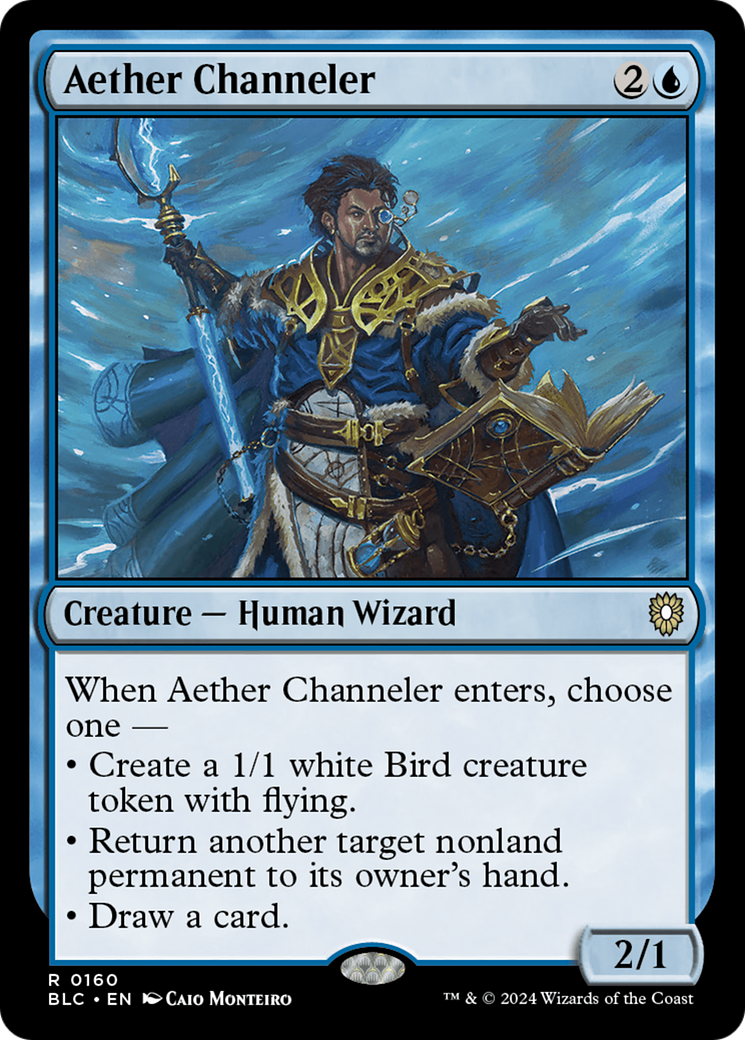
Aether Channeler
Aether Channeler
Creature — Human Wizard
2/1
When this creature enters, choose one —
- Create a 1/1 white Bird creature token with flying.
- Return another target nonland permanent to its owner's hand.
- Draw a card.
-
1
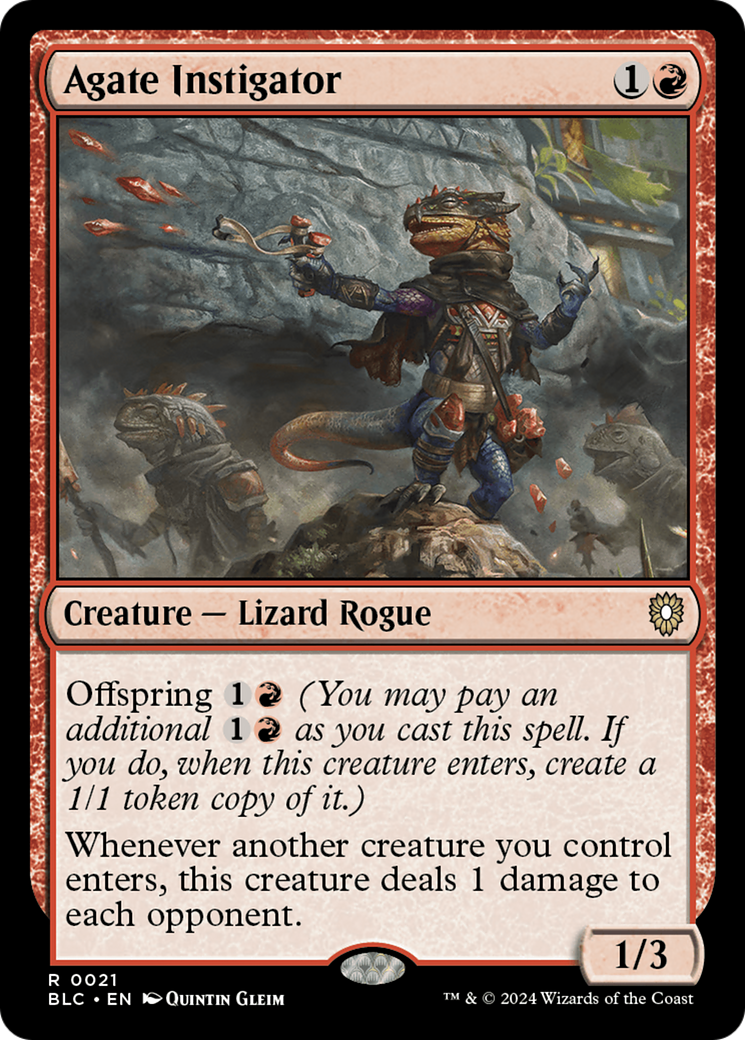
Agate Instigator
Agate Instigator
Creature — Lizard Rogue
1/3
Offspring (You may pay an additional as you cast this spell. If you do, when this creature enters, create a 1/1 token copy of it.)
Whenever another creature you control enters, this creature deals 1 damage to each opponent.
- You can pay an offspring cost only once as you cast a spell with offspring. You can't try to pay it multiple times to get more token copies.
- If the spell is countered, the offspring ability will not trigger, and no token will be created.
- If the spell resolves but the creature with offspring leaves the battlefield before the offspring ability resolves, you'll still create a token copy of it.
- The token copies exactly what was printed on the original creature and nothing else, except it's a 1/1 (unless that creature is copying something else; see below). It doesn't copy whether that creature is tapped or untapped, whether it has any counters on it or Auras and Equipment attached to it, or any non-copy effects that have changed its types, color, or so on.
- In the rare case where the original creature is copying something else when the offspring ability resolves, the token enters as whatever that creature copied, except it's a 1/1.
- Many creatures with offspring abilities have other abilities that refer to them as "this creature" rather than referring to them by name. This difference is for clarity purposes and does not change the function of any of these abilities.
- Any "enters" abilities of the copied creature will trigger when the token enters. Any "as [this creature] enters" or "[this creature] enters with" abilities of the copied creature will also work.
- The token created by the offspring ability isn't "cast", so abilities that trigger when a creature spell is cast won't trigger for the copy.
- In the rare case where the creature doesn't have the offspring ability when it enters, the ability won't trigger even if you paid the offspring cost.
-
1
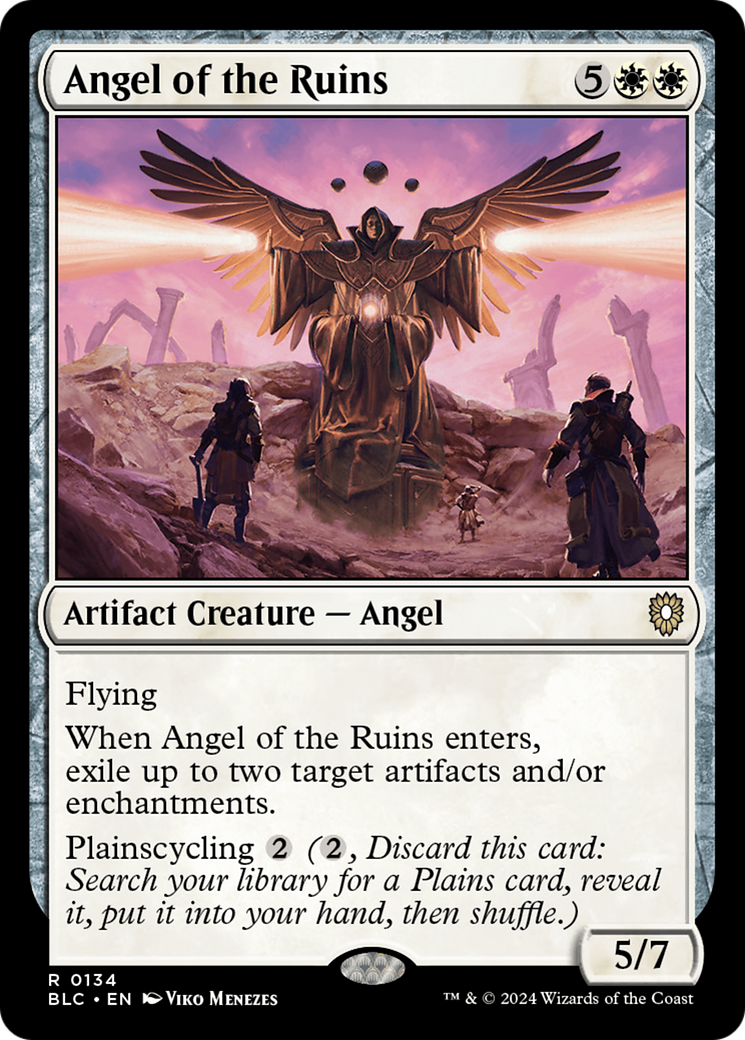
Angel of the Ruins
Angel of the Ruins
Artifact Creature — Angel
5/7
Flying
When this creature enters, exile up to two target artifacts and/or enchantments.
Plainscycling ( , Discard this card: Search your library for a Plains card, reveal it, put it into your hand, then shuffle.)
-
1
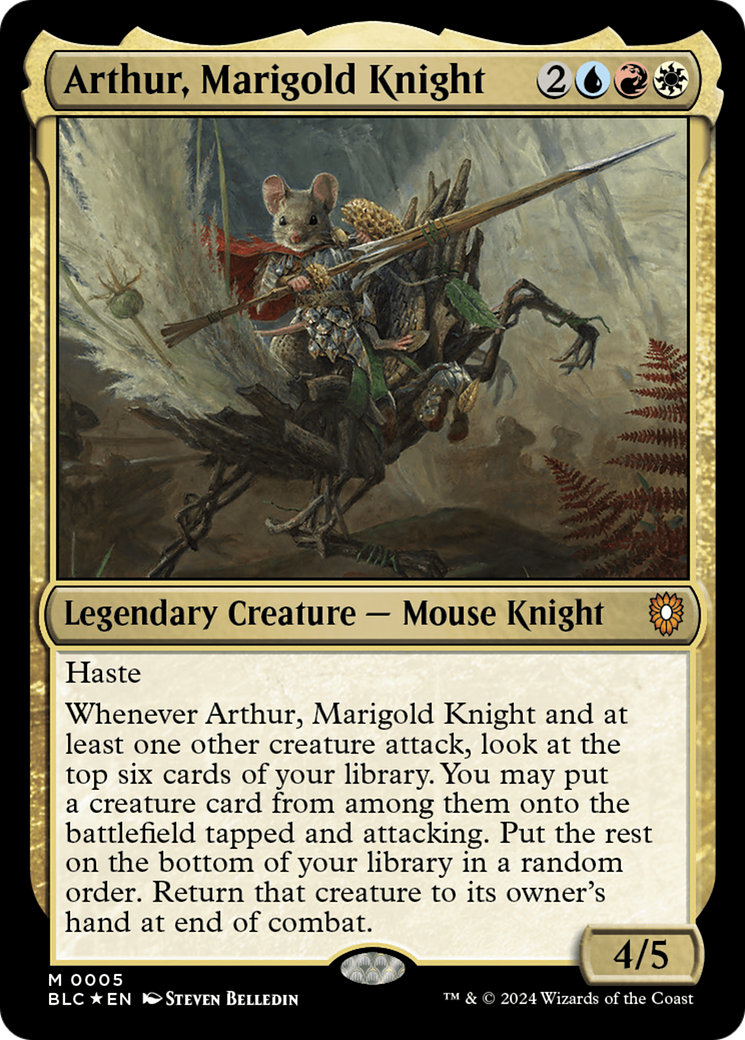
Arthur, Marigold Knight
Arthur, Marigold Knight
Legendary Creature — Mouse Knight
4/5
Haste
Whenever Arthur and at least one other creature attack, look at the top six cards of your library. You may put a creature card from among them onto the battlefield tapped and attacking. Put the rest on the bottom of your library in a random order. Return that creature to its owner's hand at end of combat.
- You choose the player, planeswalker, or battle the creature you put onto the battlefield is attacking. It doesn't have to be the same player, planeswalker, or battle that Arthur or any other attacking creatures are attacking.
- Although the creature you put onto the battlefield is attacking, it was never declared as an attacking creature. Abilities that trigger whenever a creature attacks won't trigger when that creature enters attacking.
-
1
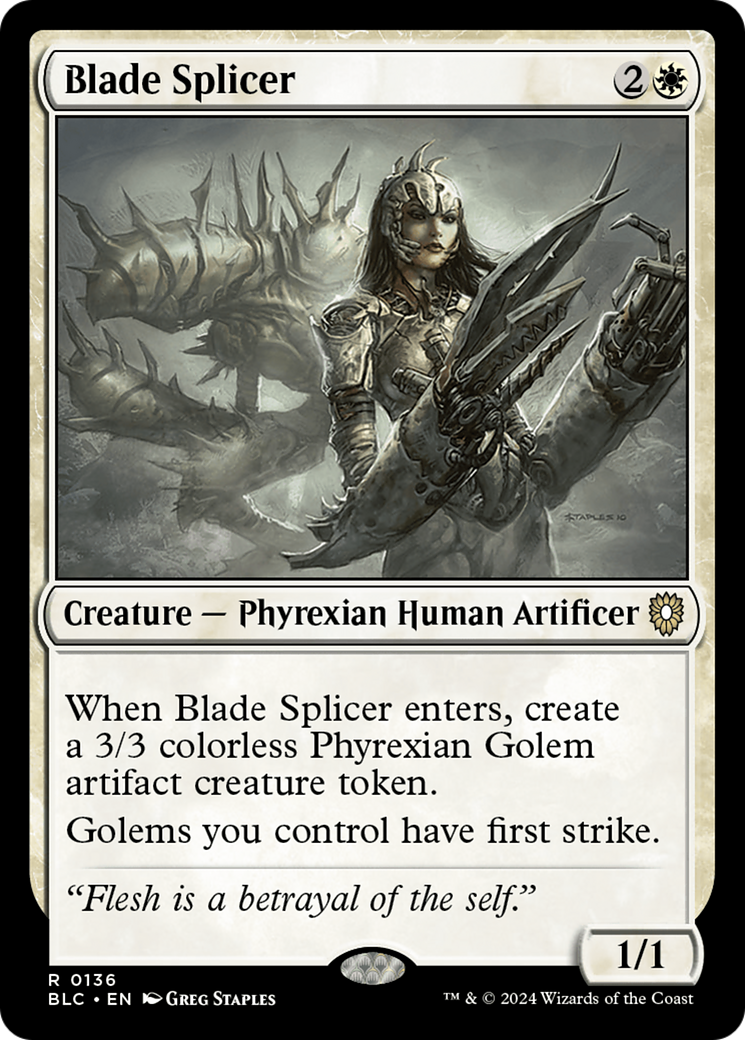
Blade Splicer
Blade Splicer
Creature — Phyrexian Human Artificer
1/1
When this creature enters, create a 3/3 colorless Phyrexian Golem artifact creature token.
Golems you control have first strike.
-
1
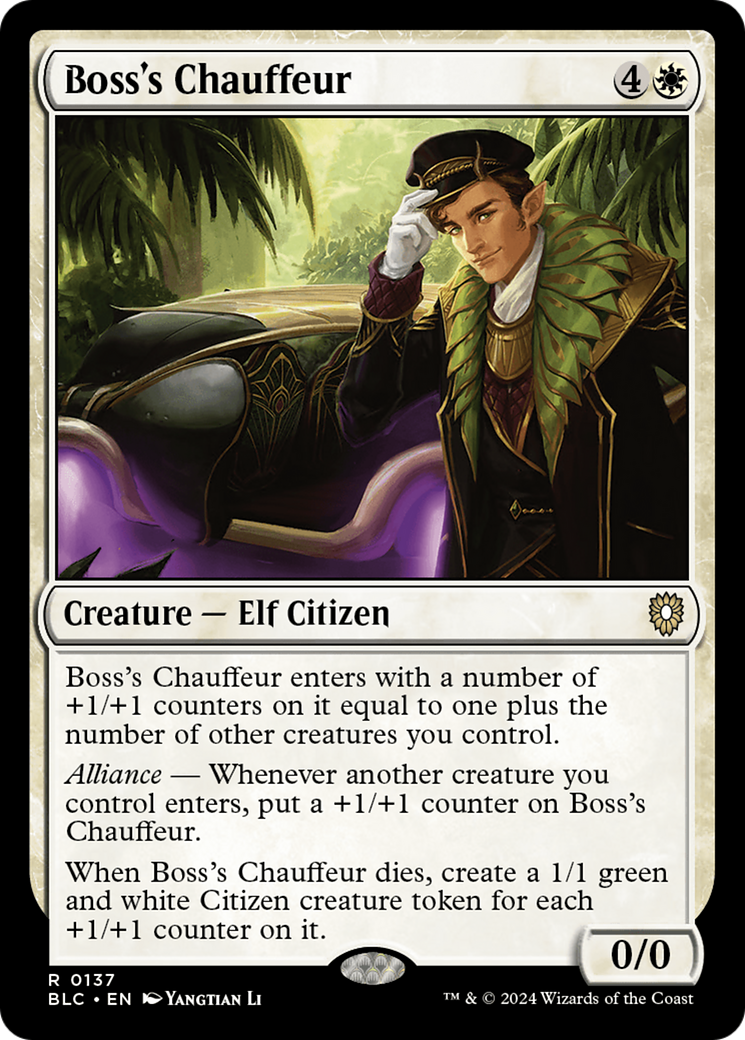
Boss's Chauffeur
Boss's Chauffeur
Creature — Elf Citizen
0/0
This creature enters with a number of +1/+1 counters on it equal to one plus the number of other creatures you control.
Alliance — Whenever another creature you control enters, put a +1/+1 counter on this creature.
When this creature dies, create a 1/1 green and white Citizen creature token for each +1/+1 counter on it.
-
1
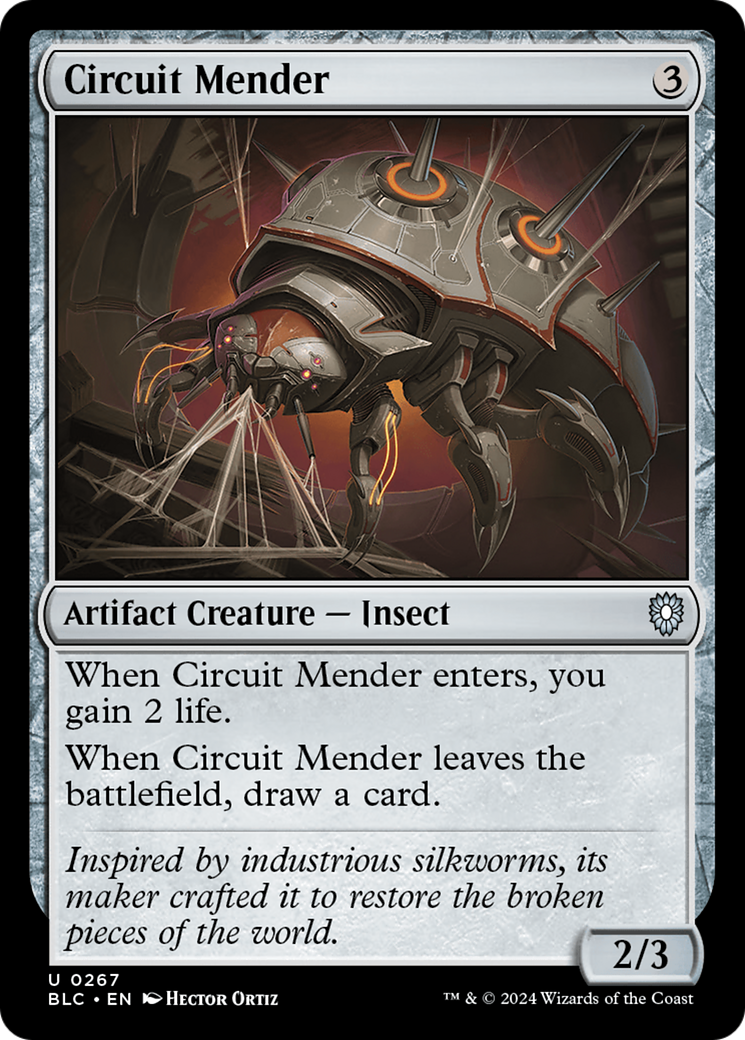
Circuit Mender
Circuit Mender
Artifact Creature — Insect
2/3
When this creature enters, you gain 2 life.
When this creature leaves the battlefield, draw a card.
-
1
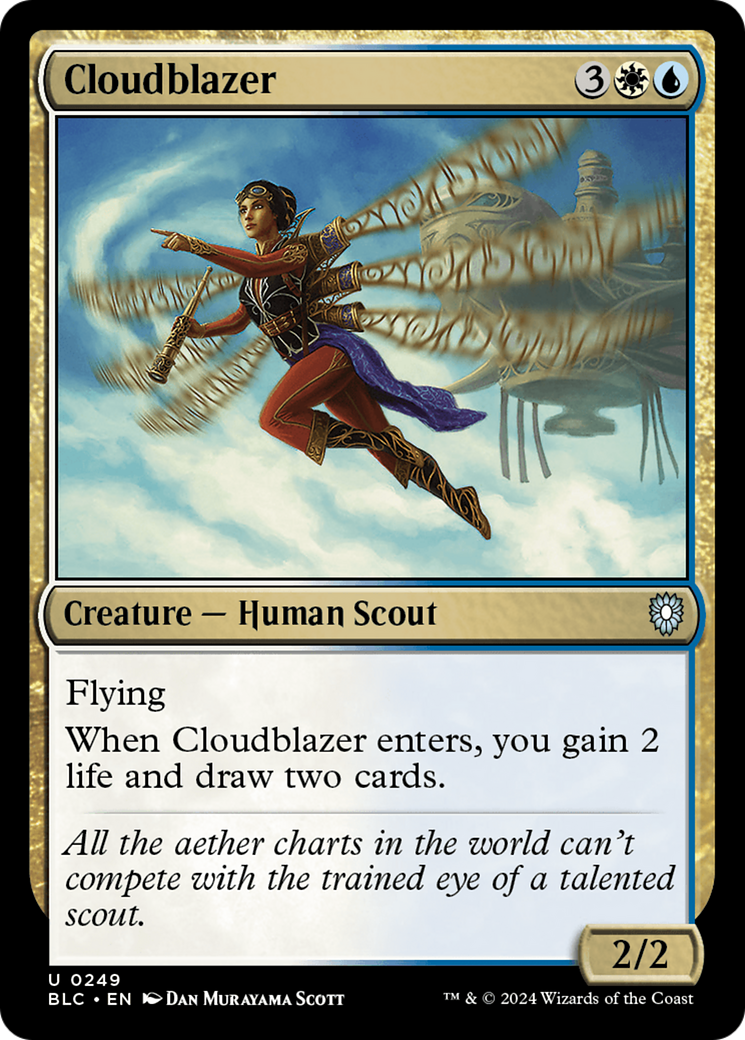
Cloudblazer
Cloudblazer
Creature — Human Scout
2/2
Flying
When this creature enters, you gain 2 life and draw two cards.
-
1
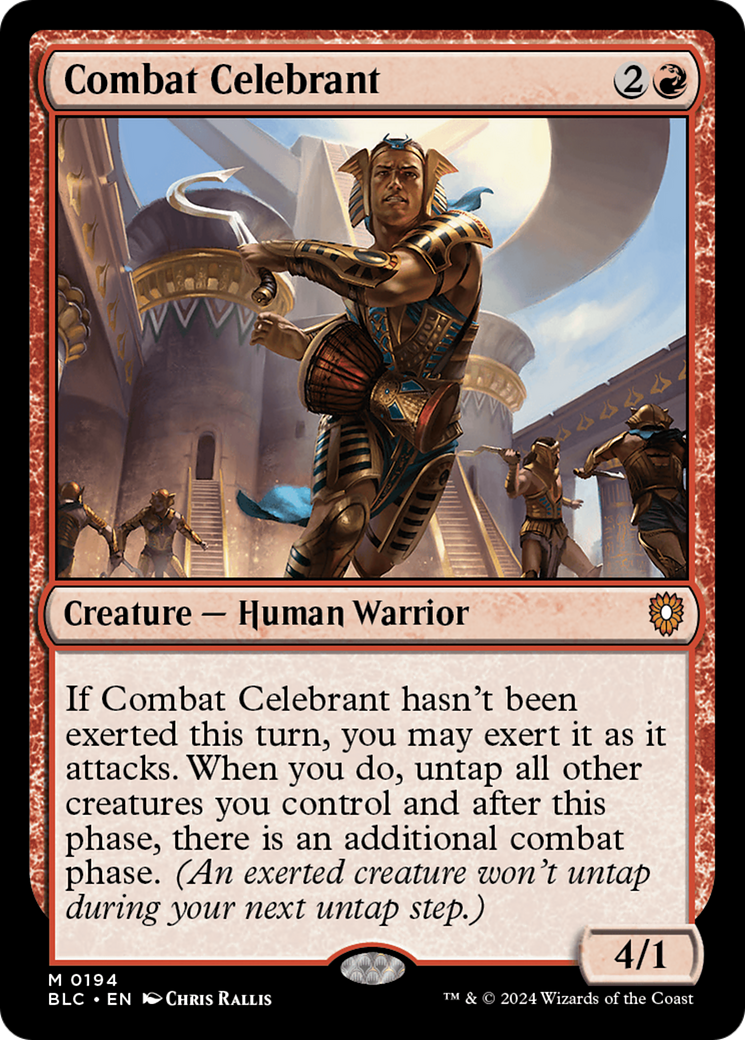
Combat Celebrant
Combat Celebrant
Creature — Human Warrior
4/1
If this creature hasn't been exerted this turn, you may exert it as it attacks. When you do, untap all other creatures you control and after this phase, there is an additional combat phase. (An exerted creature won't untap during your next untap step.)
- Combat Celebrant's ability untaps all of your creatures, not just the ones that are attacking.
- Untapping an attacking creature doesn't remove it from combat.
- There's no main phase between your combat phases, so you'll have no opportunity to cast spells or activate abilities that could only be cast any time you could cast a sorcery. For example, you won't be able to cast another creature or equip Equipment between combats.
- If you exert Combat Celebrant, you get an additional combat phase even if Combat Celebrant doesn't survive the first combat phase.
- If you exert multiple Combat Celebrants in one combat phase, you'll have that many additional combat phases, but all of your creatures are untapped only during the current combat phase. You'll need to exert the Combat Celebrants one at a time, in multiple combat phases, to untap your attacking creatures and attack with them in each combat step.
- You can't exert a creature unless an effect allows you to do so. Similar effects that "tap and freeze" a creature (such as that of Decision Paralysis) don't exert that creature.
- If an exerted creature is already untapped during your next untap step (most likely because it had vigilance or an effect untapped it), exert's effect preventing it from untapping expires without having done anything.
- If you gain control of another player's creature until end of turn and exert it, it will untap during that player's untap step.
- All cards in the Amonkhet set that let you exert a creature let you do so as you declare it as an attacking creature, as do some of the cards in the Hour of Devastation set. You can't do so later in combat, and creatures put onto the battlefield attacking can't be exerted. Any abilities that trigger on exerting an attacking creature will resolve before blockers are declared.
-
1
Curiosity Crafter
Curiosity Crafter
Creature — Bird Wizard
3/3
Flying
You have no maximum hand size.
Whenever a creature token you control deals combat damage to a player, draw a card.
-
1
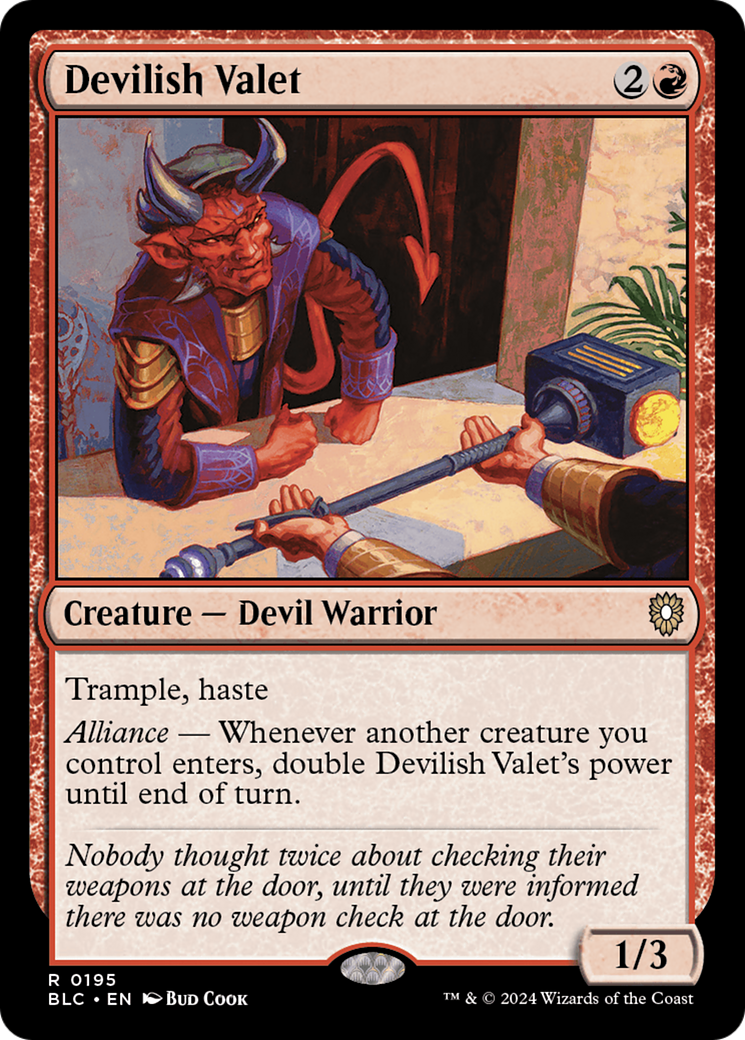
Devilish Valet
Devilish Valet
Creature — Devil Warrior
1/3
Trample, haste
Alliance — Whenever another creature you control enters, double this creature's power until end of turn.
- To double a creature's power means that creature gets +X/+0, where X is its power as the ability resolves.
-
1
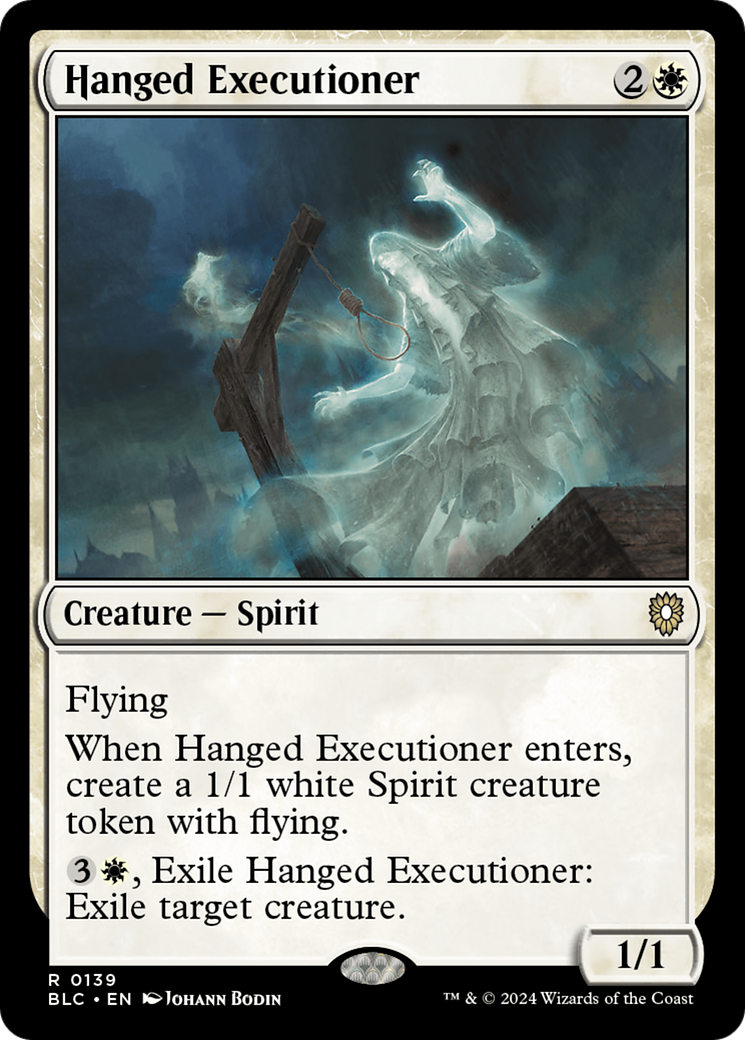
Hanged Executioner
Hanged Executioner
Creature — Spirit
1/1
Flying
When this creature enters, create a 1/1 white Spirit creature token with flying.
, Exile this creature: Exile target creature.
-
1
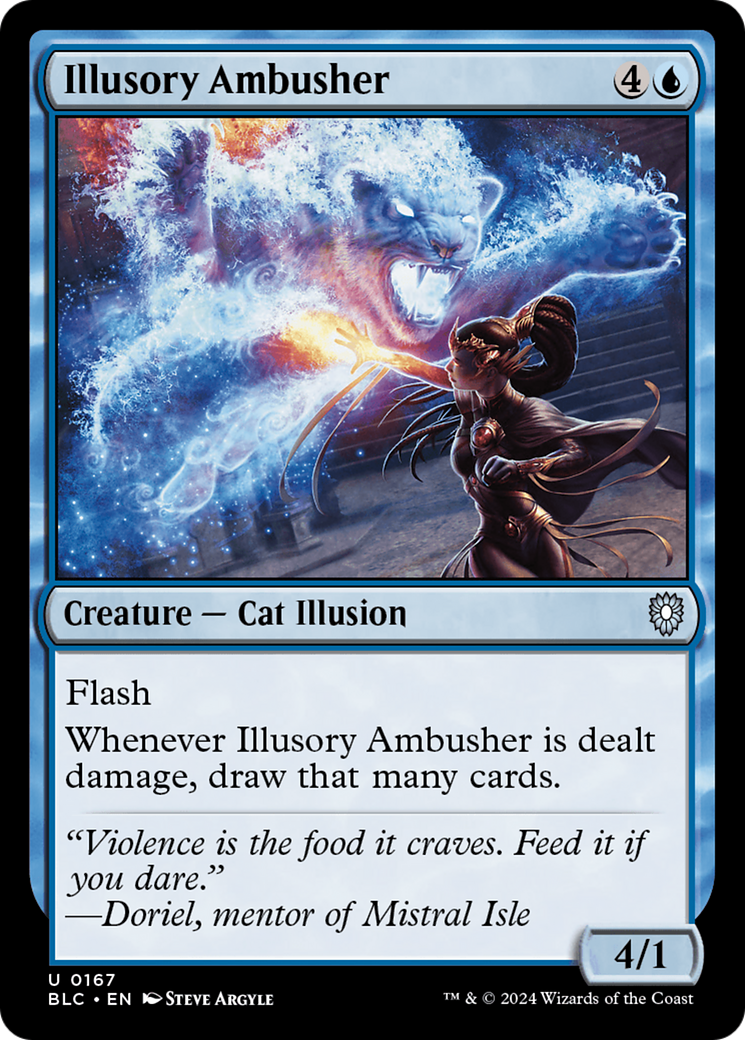
Illusory Ambusher
Illusory Ambusher
Creature — Cat Illusion
4/1
Flash (You may cast this spell any time you could cast an instant.)
Whenever this creature is dealt damage, draw that many cards.
- Creatures may be dealt damage greater than their toughness. For example, if a source deals 5 damage to Illusory Ambusher, you'll draw five cards.
- If Illusory Ambusher blocks a creature with trample, that creature's controller can assign any amount of damage from 1 to that creature's power to Illusory Ambusher. Excess damage doesn't have to be assigned to the defending player.
-
1
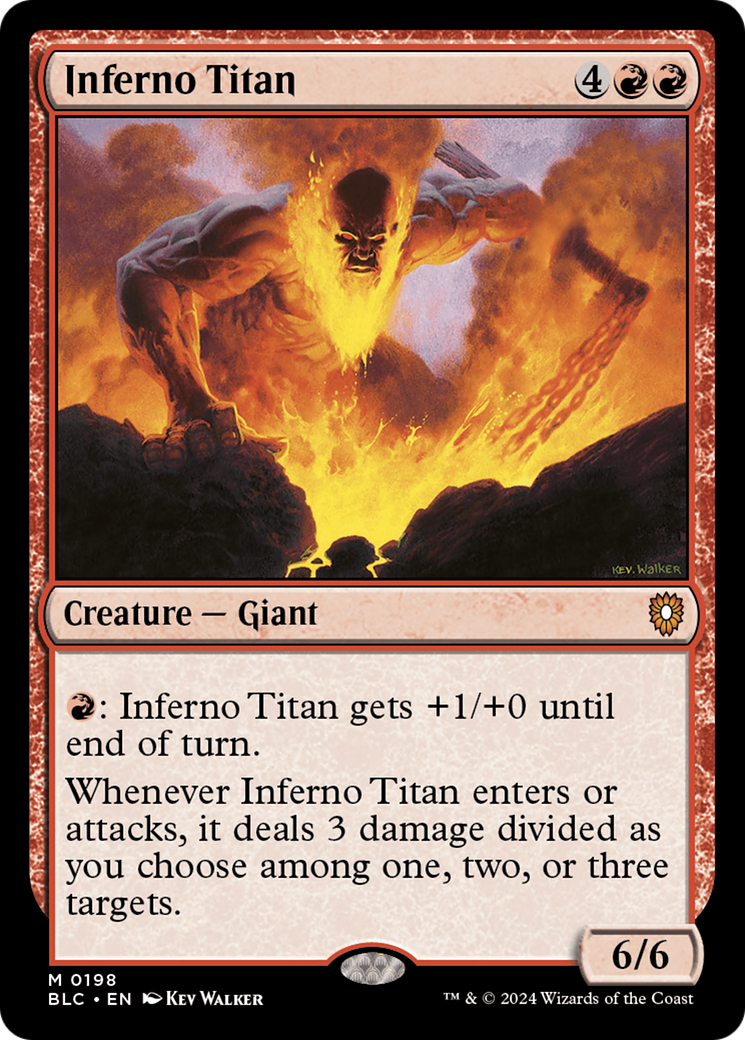
Inferno Titan
Inferno Titan
Creature — Giant
6/6
: This creature gets +1/+0 until end of turn.
Whenever this creature enters or attacks, it deals 3 damage divided as you choose among one, two, or three targets.
- You divide the damage as you put Inferno Titan's triggered ability on the stack, not as it resolves. Each target must be assigned at least 1 damage. (In other words, as you put the ability on the stack, you choose whether to have it deal 3 damage to a single target, 2 damage to one target and 1 damage to another target, or 1 damage to each of three targets.)
-
1
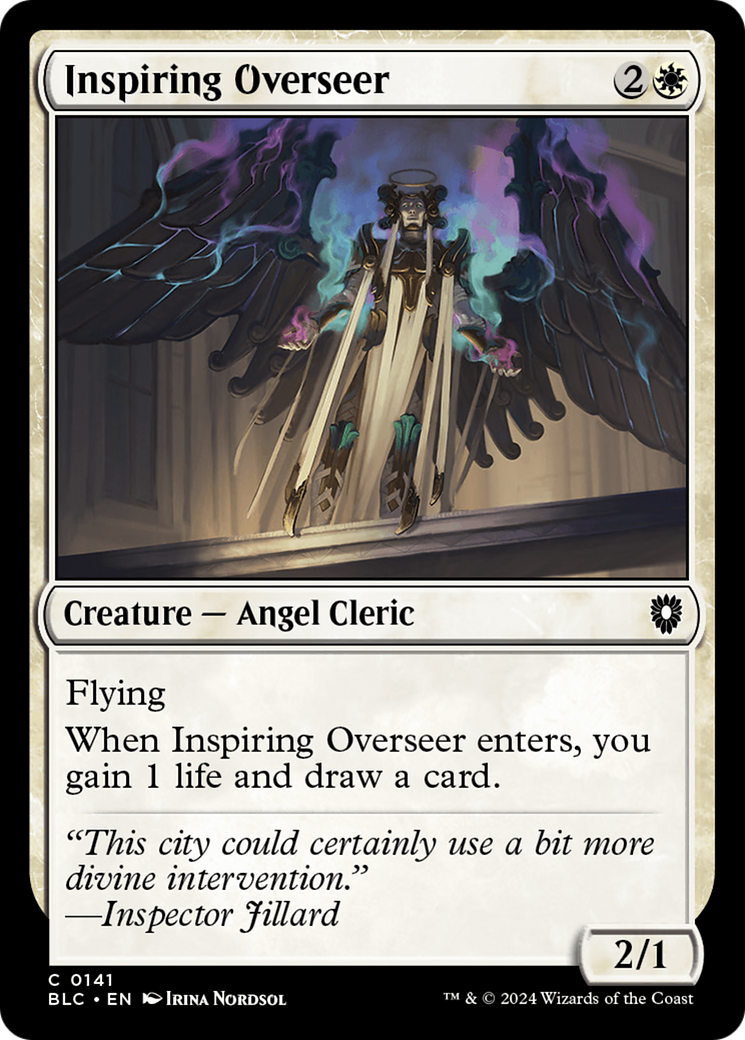
Inspiring Overseer
Inspiring Overseer
Creature — Angel Cleric
2/1
Flying
When this creature enters, you gain 1 life and draw a card.
-
1
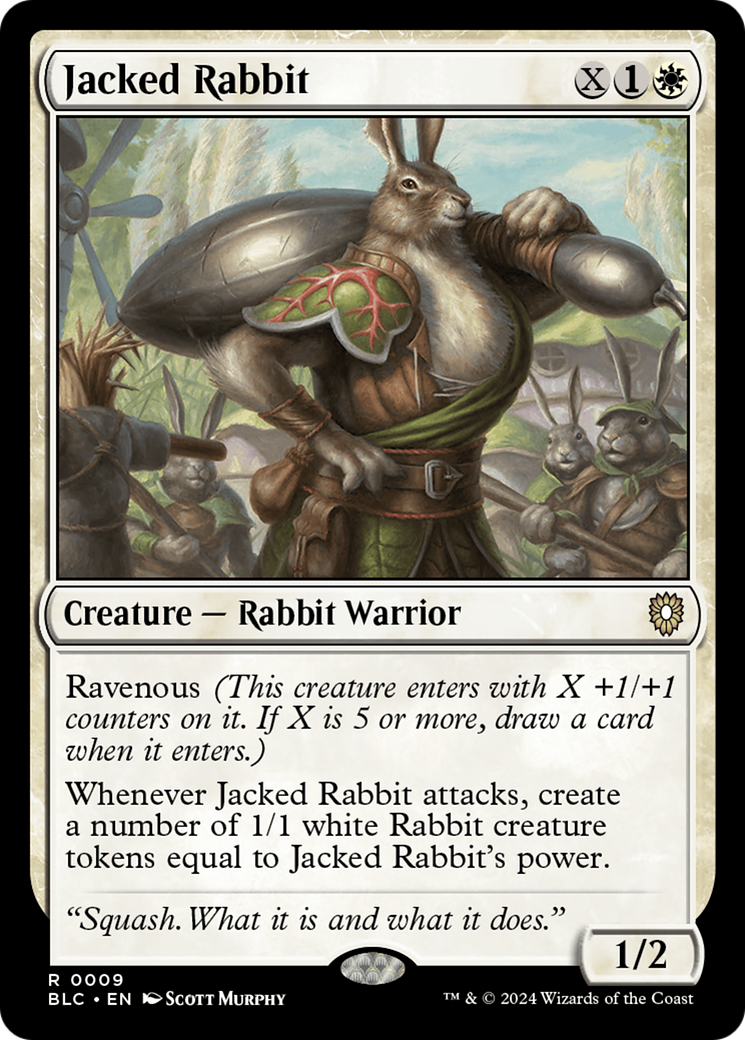
Jacked Rabbit
Jacked Rabbit
Creature — Rabbit Warrior
1/2
Ravenous (This creature enters with X +1/+1 counters on it. If X is 5 or more, draw a card when it enters.)
Whenever this creature attacks, create a number of 1/1 white Rabbit creature tokens equal to this creature's power.
- A creature with ravenous gets its counters as it enters. It doesn't enter first and then get its counters. Any triggered ability that looks for a creature with a certain power or toughness entering will see the counters when it checks to see if it should trigger.
- The triggered ability that checks to see if X is 5 or greater refers to the value of X that was chosen as the spell was cast, which may be different from the number of counters it entered with if there are replacement effects involved. This is also true for any other ability that it has which refers to X and triggers when it enters.
- If another permanent enters as a copy of a creature with ravenous, it will not enter with any counters from the ravenous ability.
- If a permanent spell with ravenous is copied, the copy will have the same value for X, and the token permanent that the spell becomes as it enters will enter with X counters.
- If Jacked Rabbit leaves the battlefield while its last ability is on the stack, use its power as it last existed on the battlefield to determine how many Rabbit tokens to create.
-
1
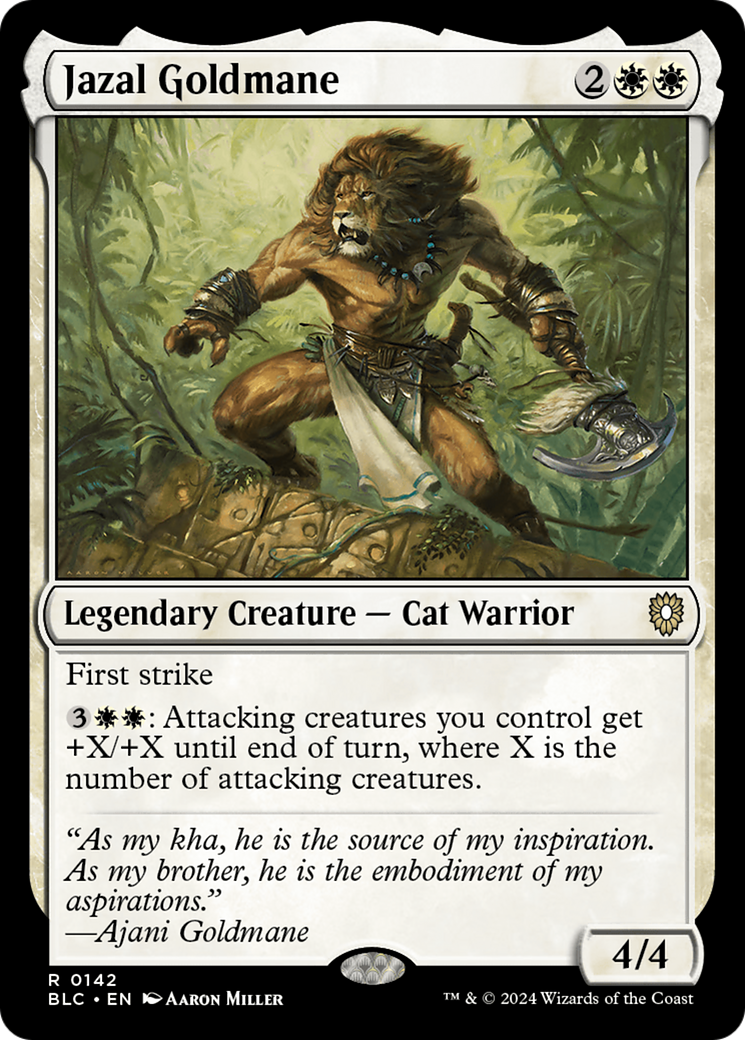
Jazal Goldmane
Jazal Goldmane
Legendary Creature — Cat Warrior
4/4
First strike (This creature deals combat damage before creatures without first strike.)
: Attacking creatures you control get +X/+X until end of turn, where X is the number of attacking creatures.
-
1
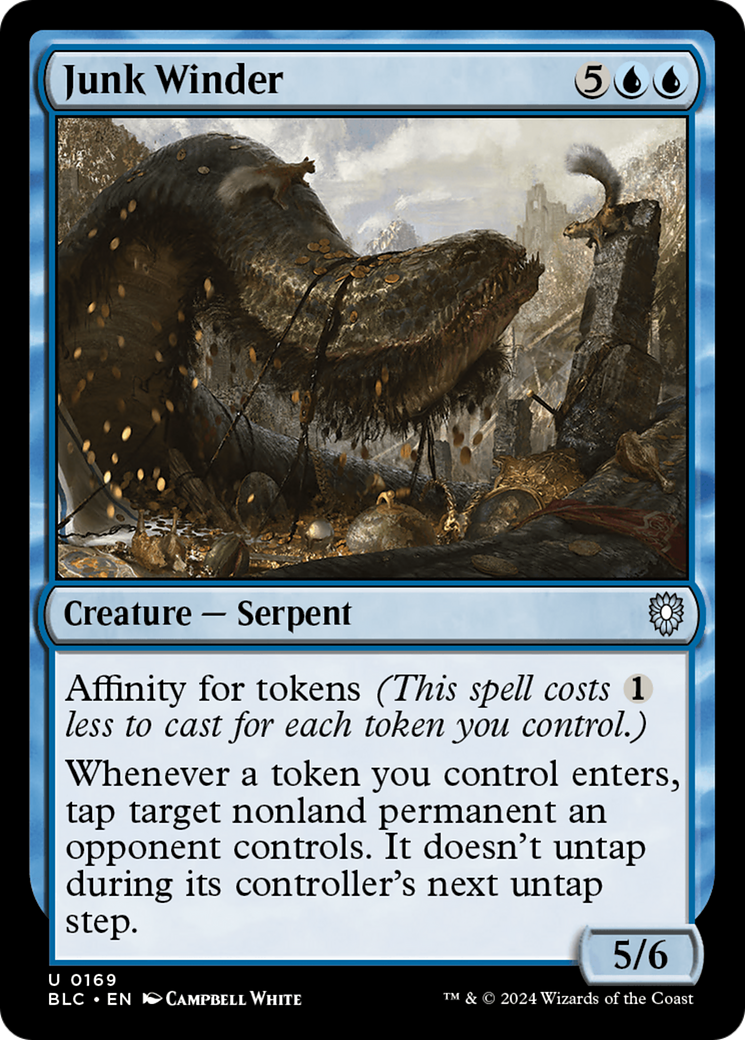
Junk Winder
Junk Winder
Creature — Serpent
5/6
Affinity for tokens (This spell costs less to cast for each token you control.)
Whenever a token you control enters, tap target nonland permanent an opponent controls. It doesn't untap during its controller's next untap step.
-
1
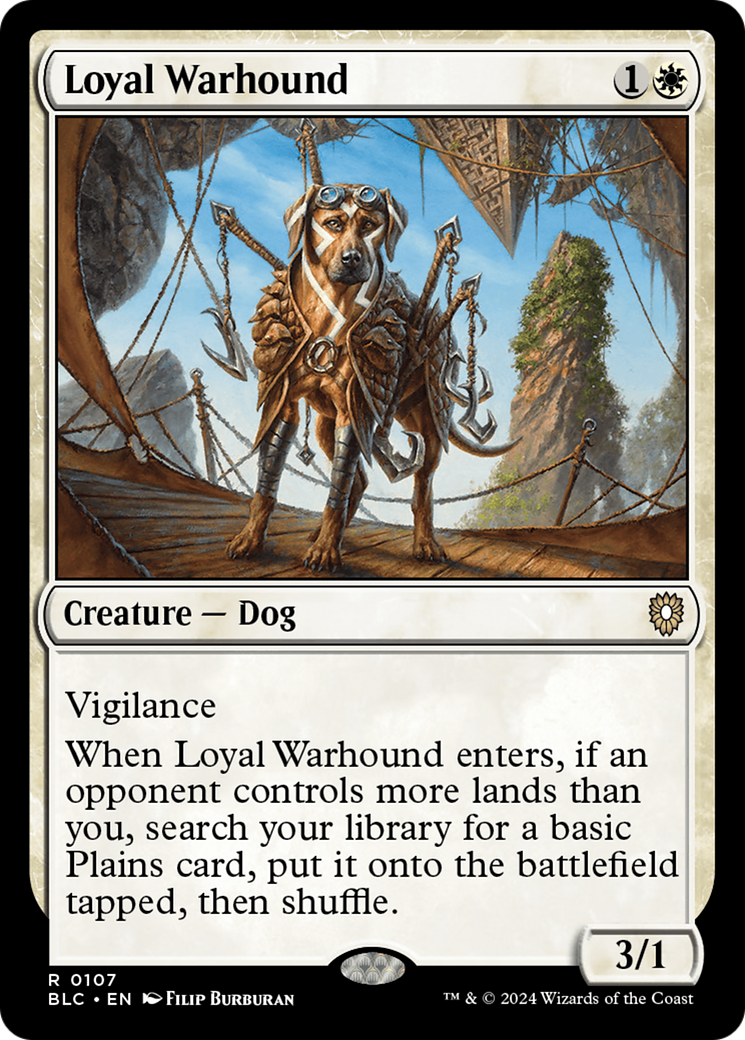
Loyal Warhound
Loyal Warhound
Creature — Dog
3/1
Vigilance
When this creature enters, if an opponent controls more lands than you, search your library for a basic Plains card, put it onto the battlefield tapped, then shuffle.
-
1
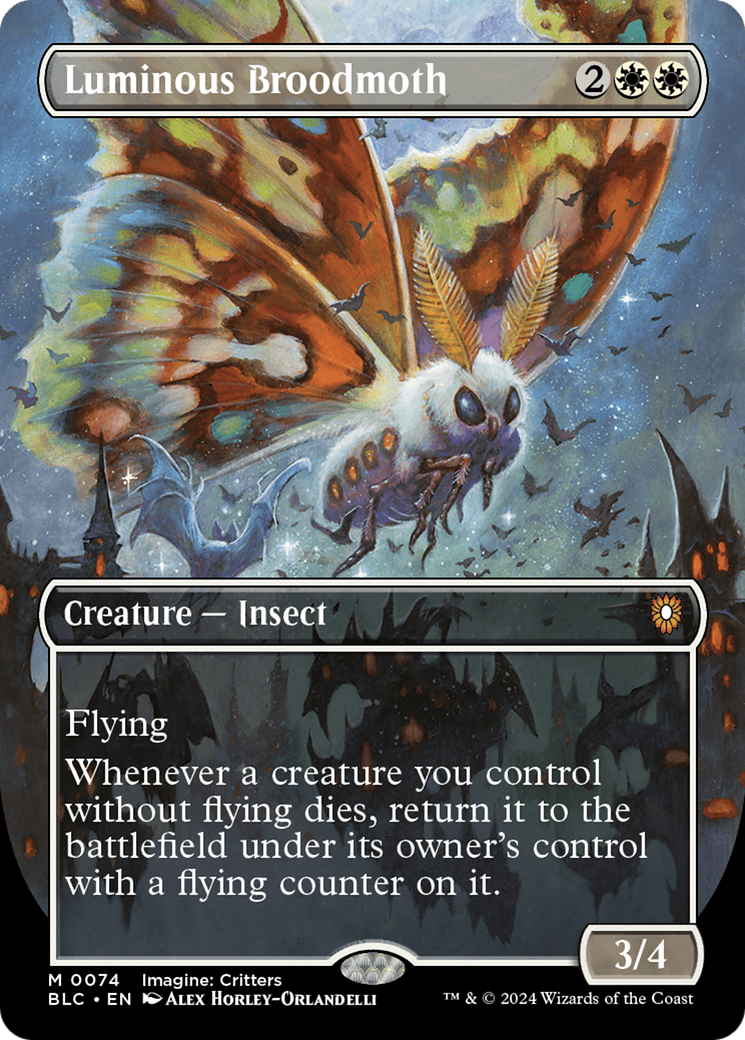
Luminous Broodmoth
Luminous Broodmoth
Creature — Insect
3/4
Flying
Whenever a creature you control without flying dies, return it to the battlefield under its owner's control with a flying counter on it.
- If Luminous Broodmoth dies at the same time as a creature without flying, its ability triggers for that creature.
- If Luminous Broodmoth dies after losing flying but not losing its triggered ability, its ability will trigger for itself.
- If a merged creature dies and that creature didn't have flying, each card that was part of that merged creature is returned to the battlefield. Each one has a flying counter on it.
- Luminous Broodmoth's ability triggers if a token creature without flying dies, but the token won't be returned to the battlefield. If that token was a merged creature, any cards that were part of it will be returned to the battlefield.
-
1
Ornithopter of Paradise
Ornithopter of Paradise
Artifact Creature — Thopter
0/2
Flying
: Add one mana of any color.
-
1
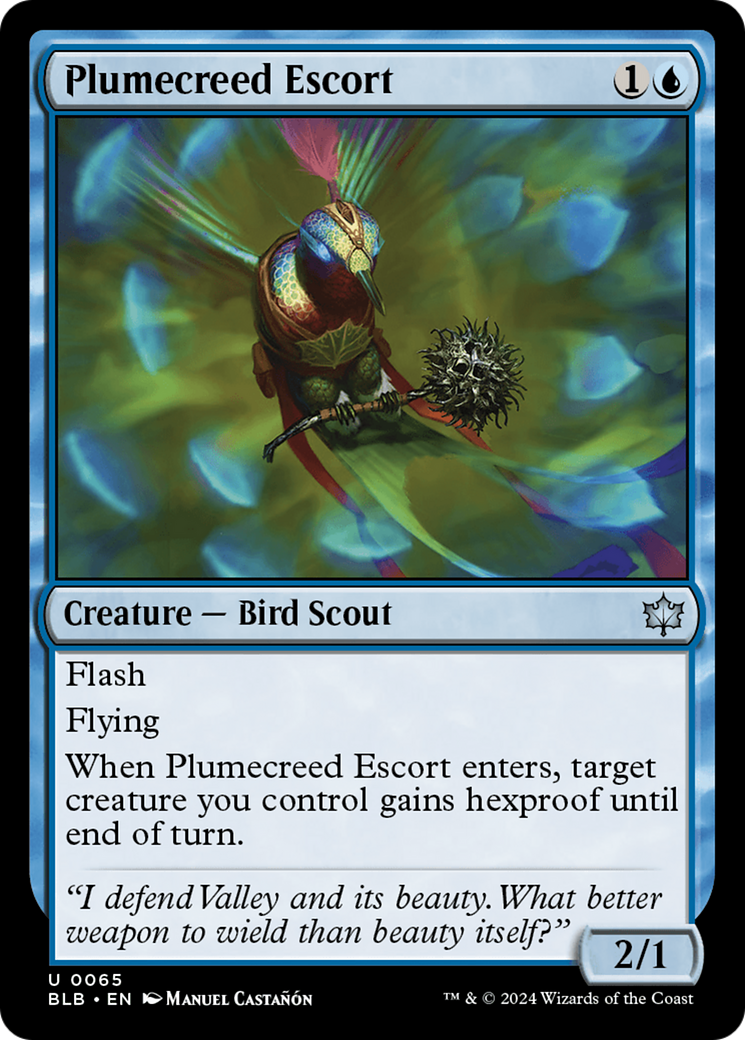
Plumecreed Escort
Plumecreed Escort
Creature — Bird Scout
2/1
Flash
Flying
When this creature enters, target creature you control gains hexproof until end of turn.
-
1
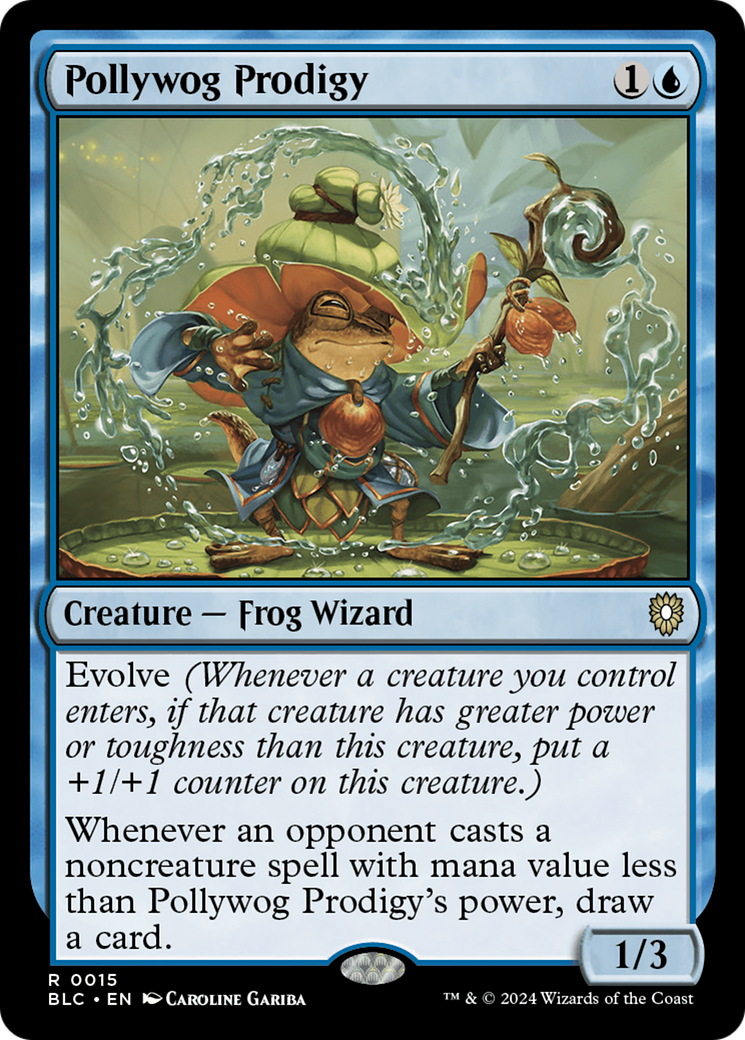
Pollywog Prodigy
Pollywog Prodigy
Creature — Frog Wizard
1/3
Evolve (Whenever a creature you control enters, if that creature has greater power or toughness than this creature, put a +1/+1 counter on this creature.)
Whenever an opponent casts a noncreature spell with mana value less than this creature's power, draw a card.
- When comparing the stats of the two creatures for evolve, you always compare power to power and toughness to toughness.
- Whenever a creature you control enters check its power and toughness against the power and toughness of the creature with evolve. If neither stat of the new creature is greater, evolve won't trigger at all.
- If evolve triggers, the stat comparison will happen again when the ability tries to resolve. If neither stat of the new creature is greater, the ability will do nothing. If the creature that entered the battlefield leaves the battlefield before evolve tries to resolve, use its last known power and toughness to compare the stats.
- If a creature enters with +1/+1 counters on it, consider those counters when determining if evolve will trigger. For example, a 1/1 creature that enters with two +1/+1 counters on it will cause the evolve ability of a 2/2 creature to trigger.
- If multiple creatures enter at the same time, evolve may trigger multiple times, although the stat comparison will take place each time one of those abilities tries to resolve. For example, if you control a 2/2 creature with evolve and two 3/3 creatures you control enter, evolve will trigger twice. The first ability will resolve and put a +1/+1 counter on the creature with evolve. When the second ability tries to resolve, neither the power nor the toughness of the new creature is greater than that of the creature with evolve, so that ability does nothing.
- When comparing the stats as the evolve ability resolves, it's possible that the stat that's greater changes from power to toughness or vice versa. If this happens, the ability will still resolve and you'll put a +1/+1 counter on the creature with evolve. For example, if you control a 2/2 creature with evolve and a 1/3 creature you control enters , its toughness is greater, so evolve will trigger. In response, the 1/3 creature gets +2/-2. When the evolve trigger tries to resolve, its power is greater. You'll put a +1/+1 counter on the creature with evolve.
- Pollywog Prodigy's last ability resolves before the spell that caused it to trigger. It resolves even if that spell is countered.
- Once Pollywog Prodigy's last ability has triggered, it doesn't matter what happens to Pollywog Prodigy after that. Reducing its power or removing it from the battlefield won't stop the ability from resolving.
-
1
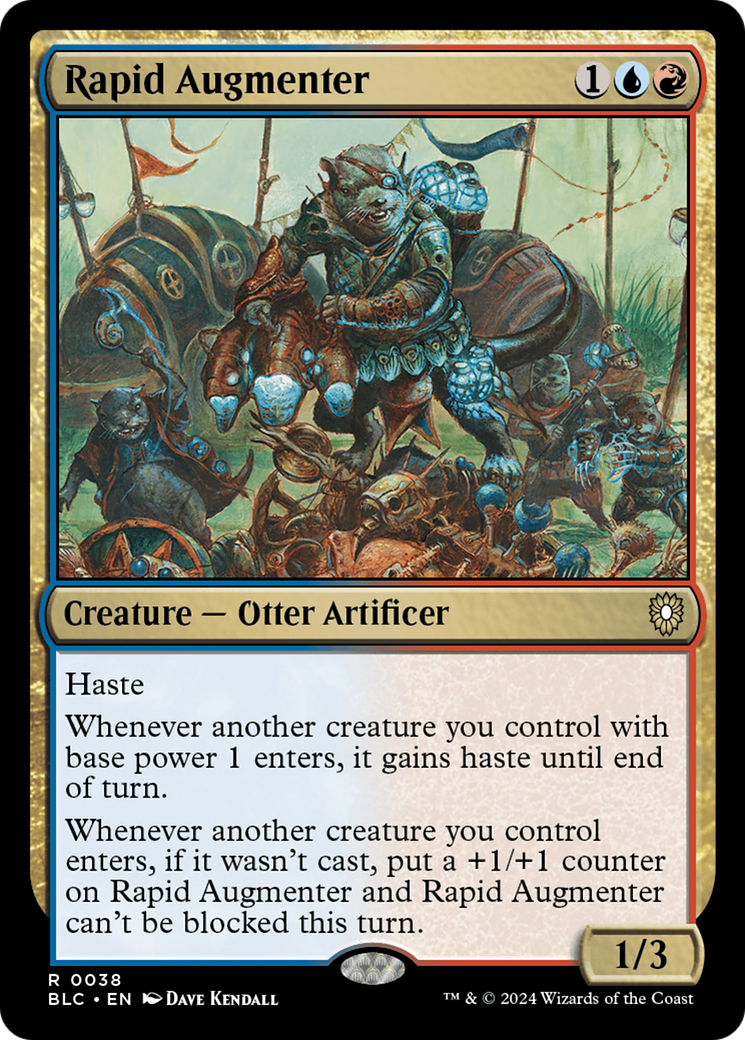
Rapid Augmenter
Rapid Augmenter
Creature — Otter Artificer
1/3
Haste
Whenever another creature you control with base power 1 enters, it gains haste until end of turn.
Whenever another creature you control enters, if it wasn't cast, put a +1/+1 counter on this creature and this creature can't be blocked this turn.
- Normally, a creature's base power is the power printed on the card or, for a token, the power set by the effect that created it. If an effect modifies a creature's power without setting it, that is not included when determining its base power.
- If a creature has a characteristic-defining ability that sets its power, indicated with a */* or similar in the power and toughness box, that ability is taken into account when determining its base power.
- Some creatures have base power and toughness 0/0 and an ability that gives them a bonus based on some criteria. Those are not characteristic-defining abilities, and that ability doesn't change its base power.
-
1
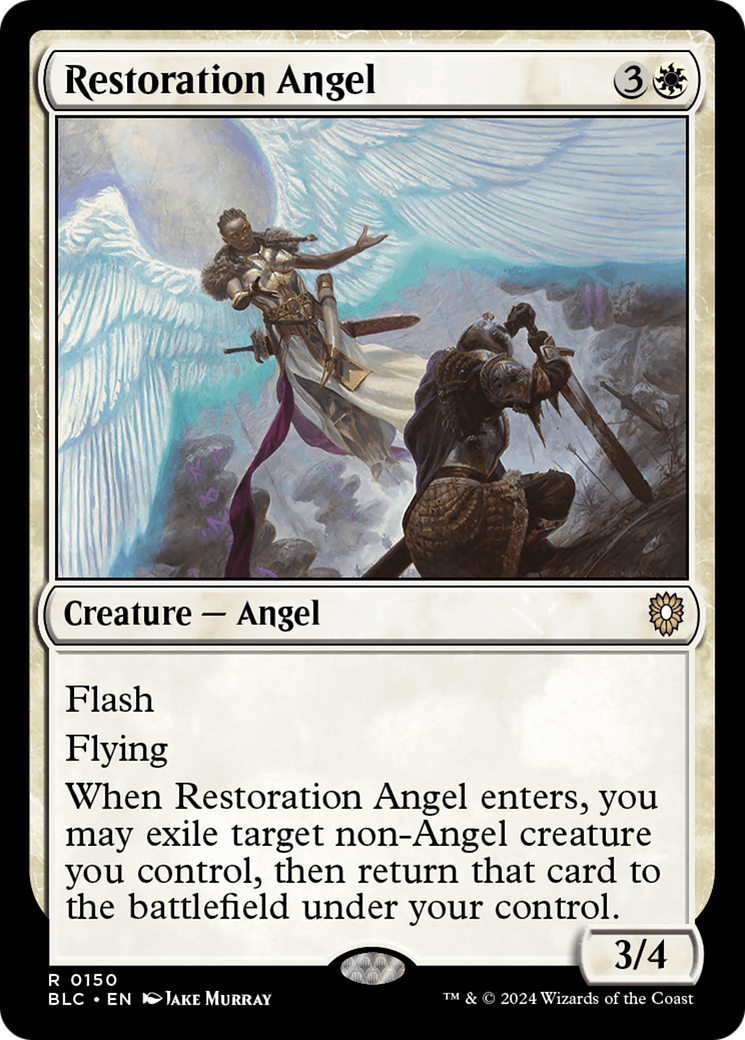
Restoration Angel
Restoration Angel
Creature — Angel
3/4
Flash
Flying
When this creature enters, you may exile target non-Angel creature you control, then return that card to the battlefield under your control.
- Once the exiled creature returns, it's considered a new object with no relation to the object that it was. Auras attached to the exiled creature will be put into their owners' graveyards. Equipment attached to the exiled creature will become unattached and remain on the battlefield. Any counters on the exiled creature will cease to exist.
- If a token is exiled this way, it will cease to exist and won't return to the battlefield.
- When an effect returns the exiled card "under your control," you control it indefinitely after that. If you had temporarily gained control of a creature, it won't return to its previous controller. In a multiplayer game, if a player leaves the game, all cards that player owns leave as well. If you leave the game, a creature you took with Restoration Angel's effect is exiled.
-
1
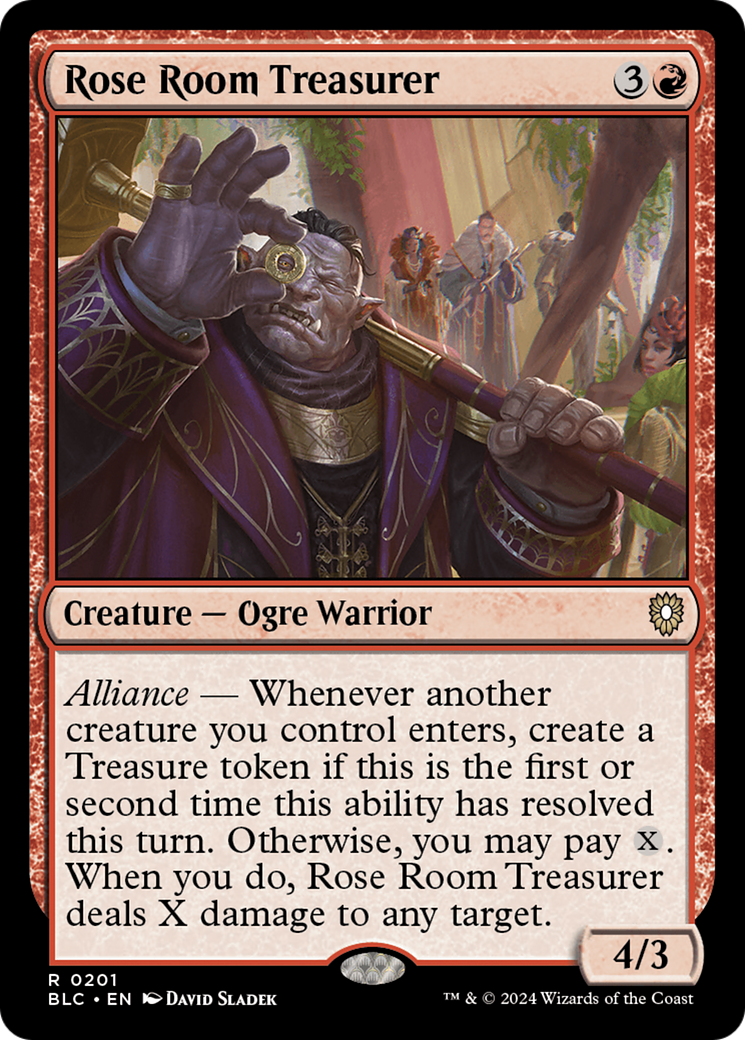
Rose Room Treasurer
Rose Room Treasurer
Creature — Ogre Warrior
4/3
Alliance — Whenever another creature you control enters, create a Treasure token if this is the first or second time this ability has resolved this turn. Otherwise, you may pay . When you do, this creature deals X damage to any target.
-
1
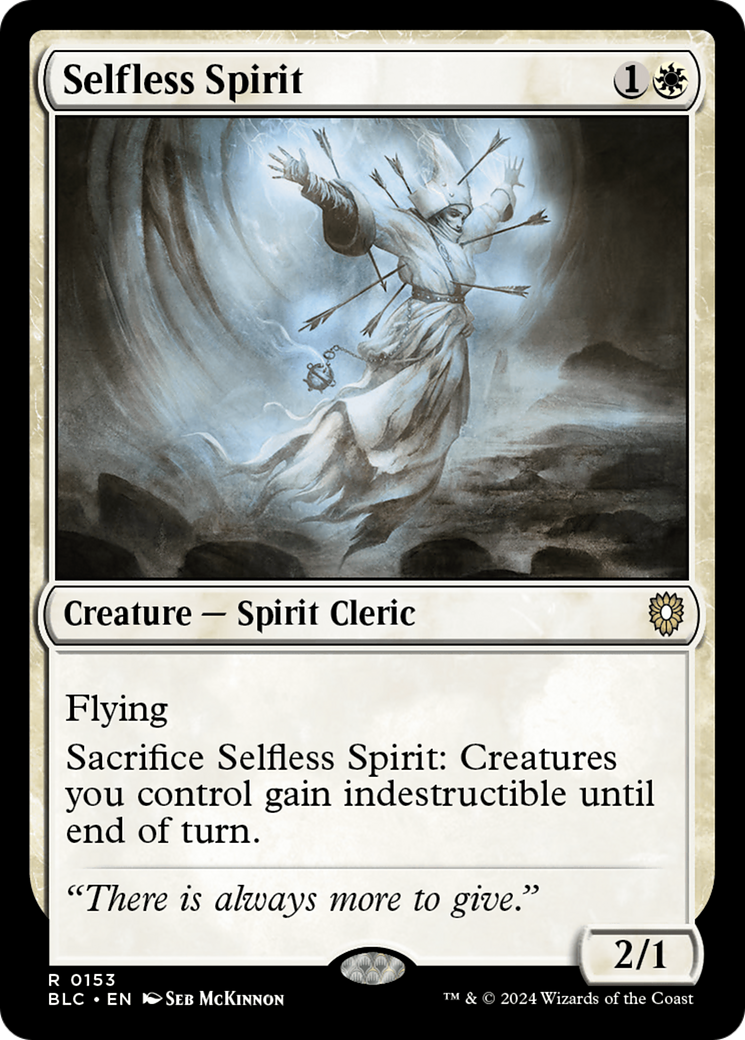
Selfless Spirit
Selfless Spirit
Creature — Spirit Cleric
2/1
Flying
Sacrifice this creature: Creatures you control gain indestructible until end of turn.
- The set of creatures affected by Selfless Spirit's last ability is determined as the ability resolves. Creatures you begin to control later in the turn won't gain indestructible.
-
1
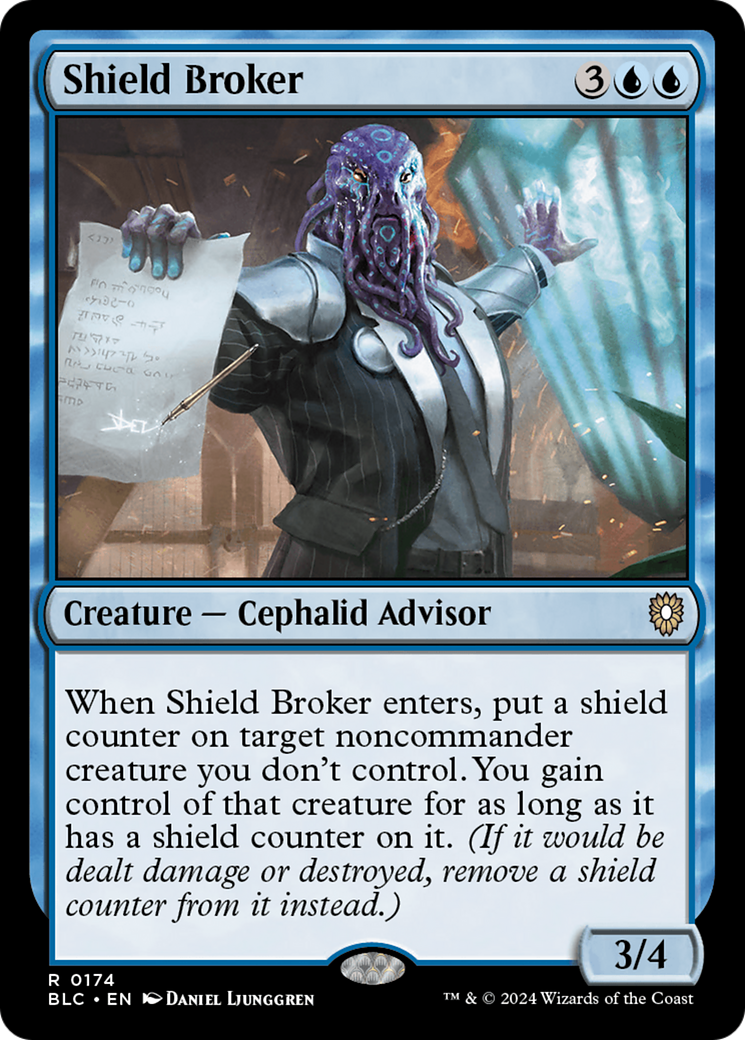
Shield Broker
Shield Broker
Creature — Octopus Advisor
3/4
When this creature enters, put a shield counter on target noncommander creature you don't control. You gain control of that creature for as long as it has a shield counter on it. (If it would be dealt damage or destroyed, remove a shield counter from it instead.)
- If the creature loses its shield counter during combat, it will be removed from combat when it changes controllers. If it hasn't already assigned combat damage by that time, it won't get to deal combat damage.
- Shield counters don't prevent players from sacrificing creatures.
- Removing a shield counter in this way isn't the same as regenerating a creature.
- If a permanent that would be dealt damage has more than one shield counter on it, that damage is prevented and only one shield counter is removed.
- If a permanent with a shield counter is dealt unpreventable damage, that damage will be dealt and a shield counter will still be removed.
- A creature with a shield counter on it may still be destroyed by state-based actions if it has damage marked on it equal to its toughness or has been dealt unpreventable damage by a source with deathtouch.
- "Shield" is not an ability that creatures have and shield counters are not keyword counters. If a creature with a shield counter loses its abilities, the shield counter will still protect it as normal.
-
1
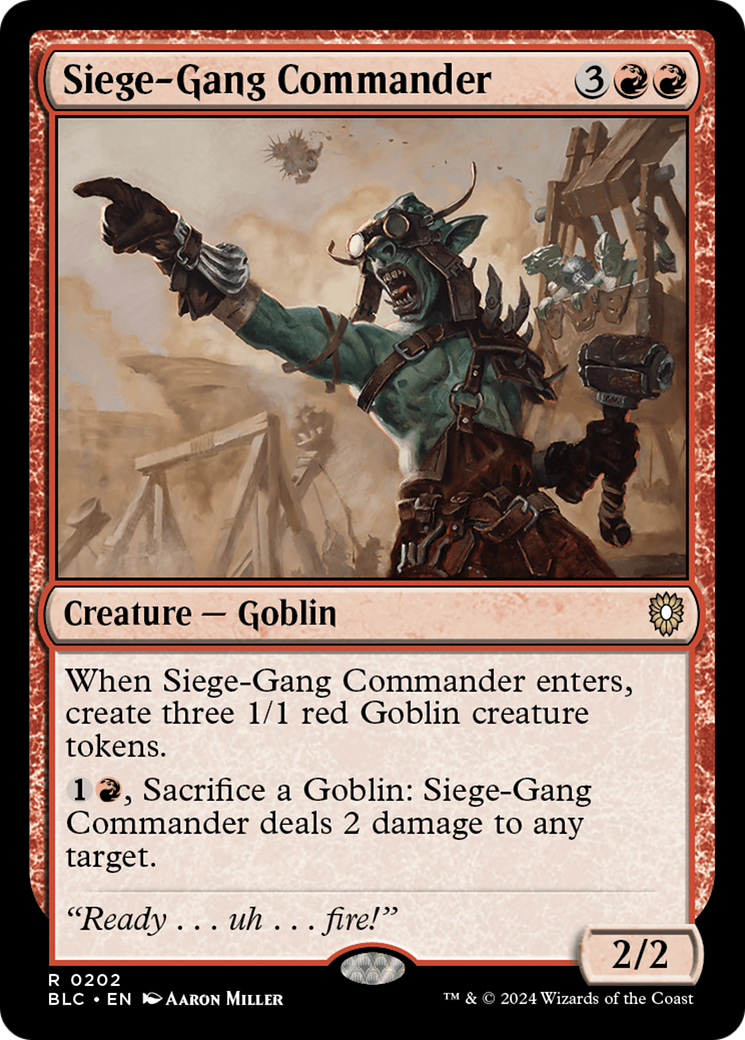
Siege-Gang Commander
Siege-Gang Commander
Creature — Goblin
2/2
When this creature enters, create three 1/1 red Goblin creature tokens.
, Sacrifice a Goblin: This creature deals 2 damage to any target.
- You can sacrifice any Goblin you control to activate Siege-Gang Commander's activated ability, including Siege-Gang Commander itself.
-
1
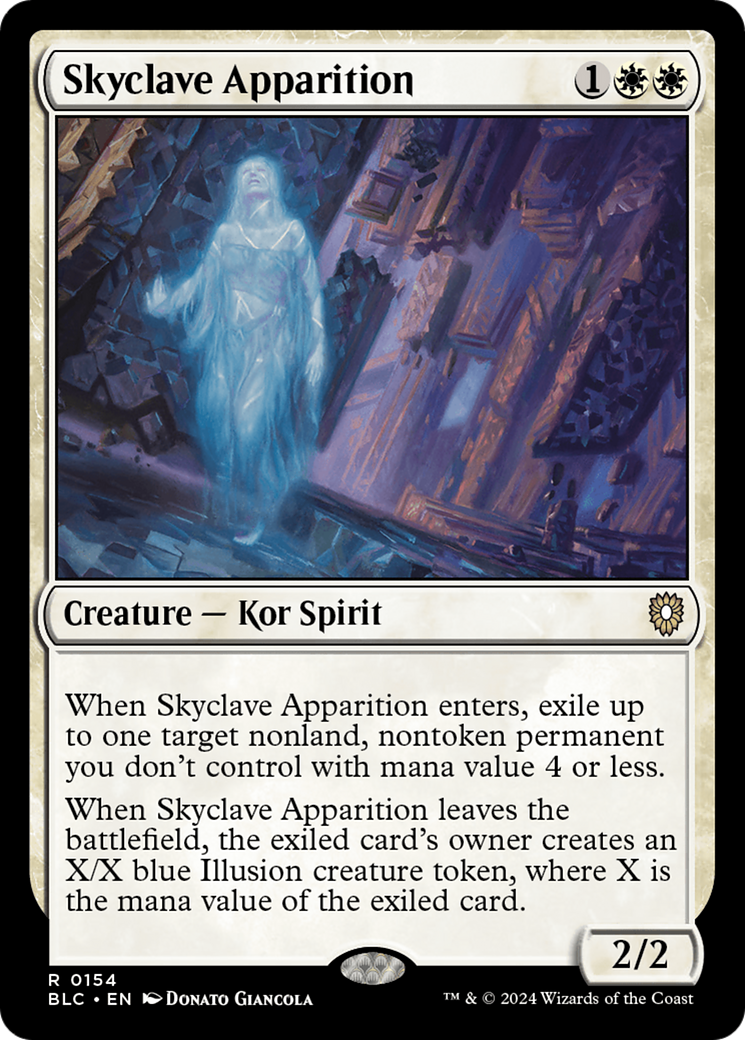
Skyclave Apparition
Skyclave Apparition
Creature — Kor Spirit
2/2
When this creature enters, exile up to one target nonland, nontoken permanent you don't control with mana value 4 or less.
When this creature leaves the battlefield, the exiled card's owner creates an X/X blue Illusion creature token, where X is the mana value of the exiled card.
- If a creature on the battlefield has in its mana cost, X is considered to be 0.
- If Skyclave Apparition leaves the battlefield before its first ability resolves, the ability still exiles the target permanent.
- If there's no exiled card when Skyclave Apparition leaves the battlefield (most likely because its first ability hasn't resolved yet), no player creates a token.
- If Skyclave Apparition's first ability exiled more than one card owned by a single player, that player creates a token with power and toughness equal to the sum of those cards' mana values. If the first ability exiled cards owned by more than one player, each of those players creates a token with power and toughness equal to the sum of the mana values of all cards exiled by the first ability.
-
1
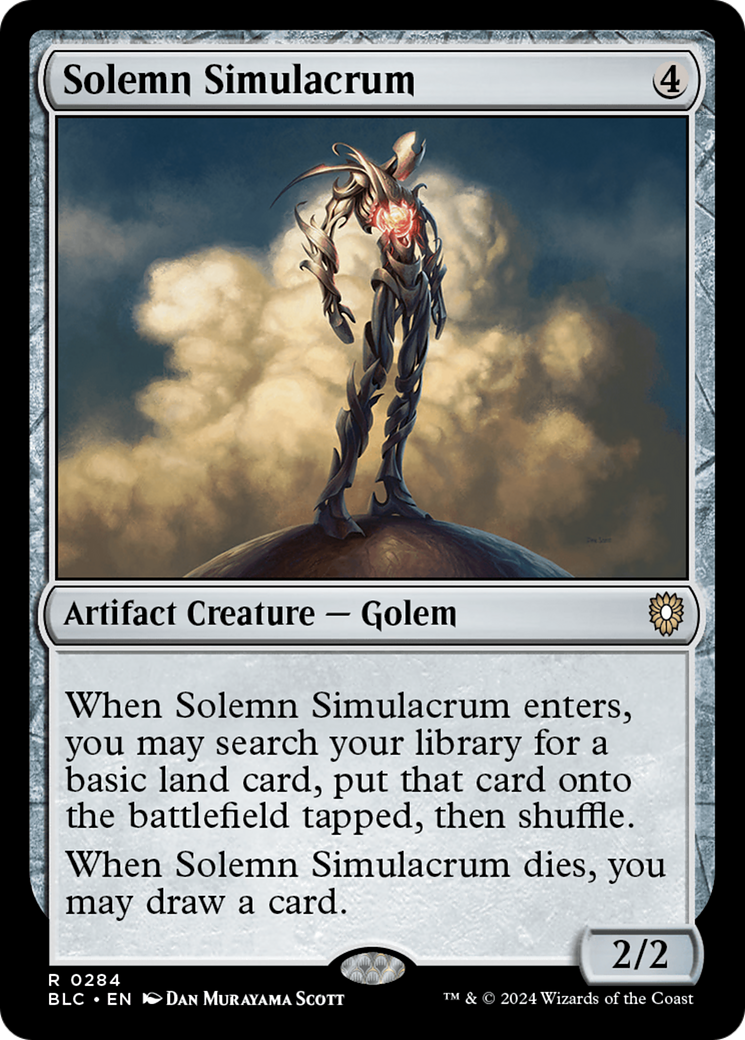
Solemn Simulacrum
Solemn Simulacrum
Artifact Creature — Golem
2/2
When this creature enters, you may search your library for a basic land card, put that card onto the battlefield tapped, then shuffle.
When this creature dies, you may draw a card.
-
1
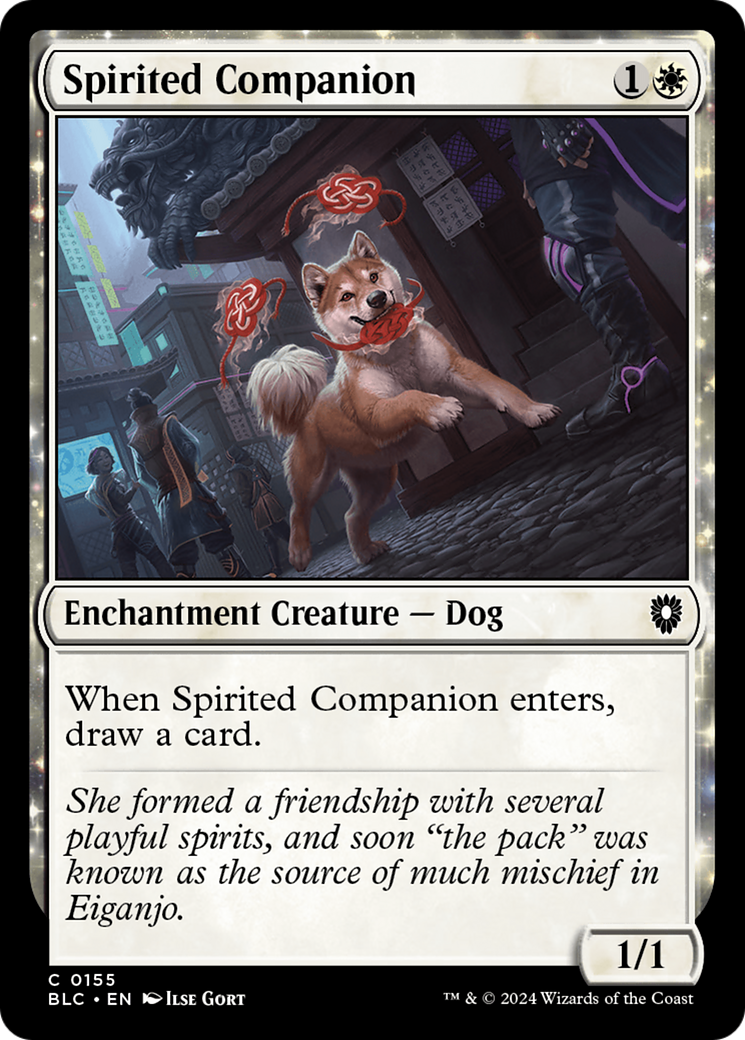
Spirited Companion
Spirited Companion
Enchantment Creature — Dog
1/1
When this creature enters, draw a card.
-
1
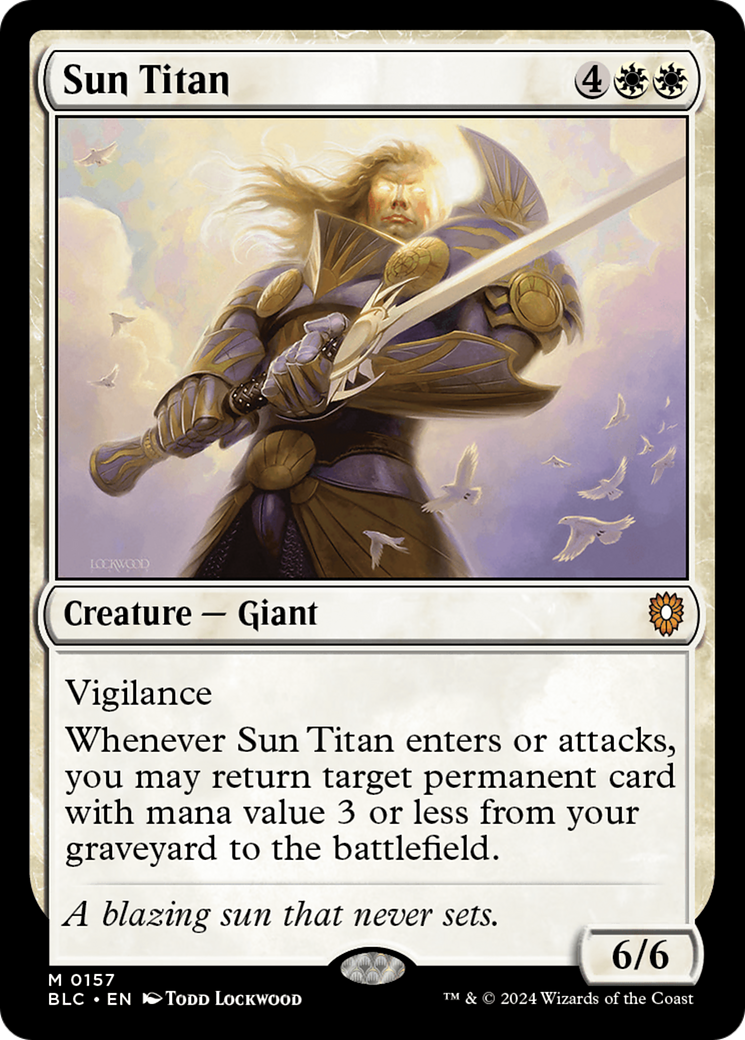
Sun Titan
Sun Titan
Creature — Giant
6/6
Vigilance
Whenever this creature enters or attacks, you may return target permanent card with mana value 3 or less from your graveyard to the battlefield.
- If a card in your graveyard has no mana symbols in its upper right corner (because it's a land card, for example), its mana value is 0.
- If the mana cost of a card in your graveyard includes , X is considered to be 0.
- A permanent card is an artifact, creature, enchantment, land, or planeswalker card.
- The mana value of a card in your graveyard is determined solely by the mana symbols printed in its upper right corner. The mana value is the total amount of mana in that cost, regardless of color. For example, a card with mana cost has mana value 5.
-
1
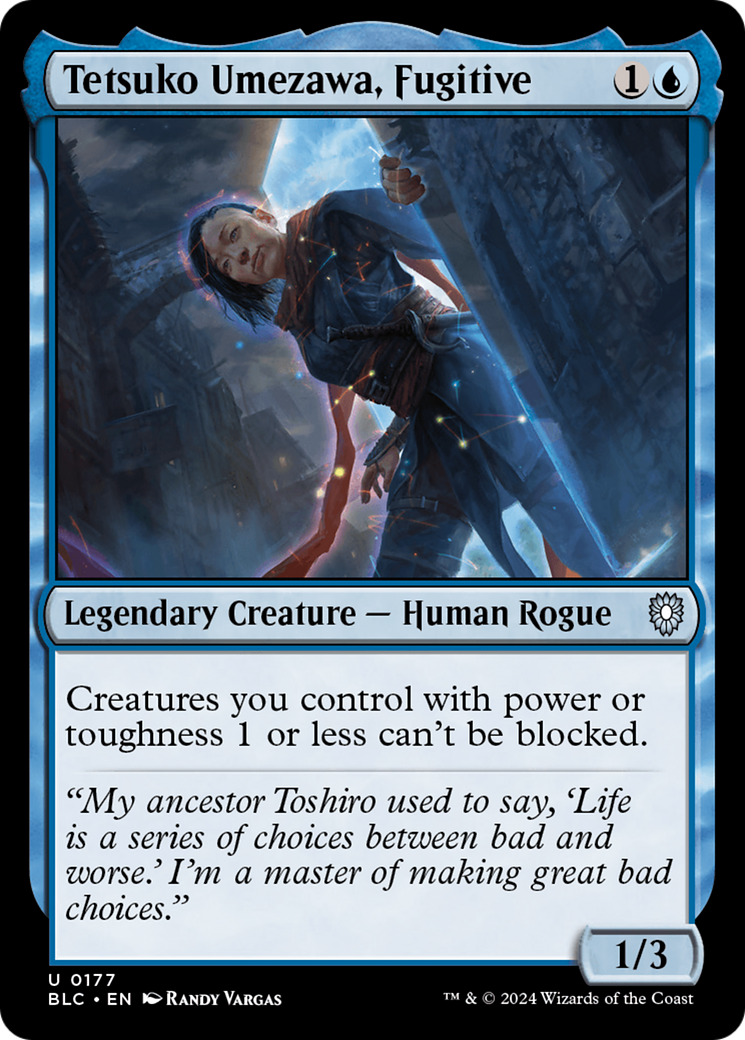
Tetsuko Umezawa, Fugitive
Tetsuko Umezawa, Fugitive
Legendary Creature — Human Rogue
1/3
Creatures you control with power or toughness 1 or less can't be blocked.
- Once a creature you control has been blocked, changing its power to 1 or less won't cause it to become unblocked. Changing its toughness to 1 won't cause it to become unblocked, and changing its toughness to less than 1 will cause it to die.
-
1
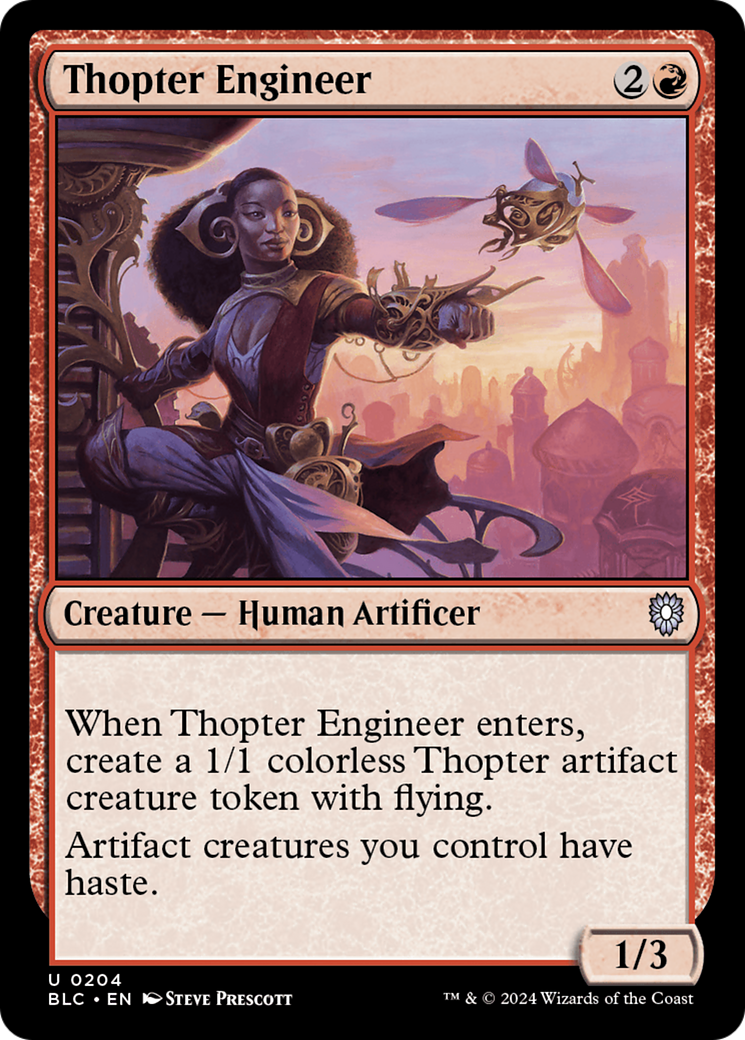
Thopter Engineer
Thopter Engineer
Creature — Human Artificer
1/3
When this creature enters, create a 1/1 colorless Thopter artifact creature token with flying.
Artifact creatures you control have haste. (They can attack and as soon as they come under your control.)
-
1
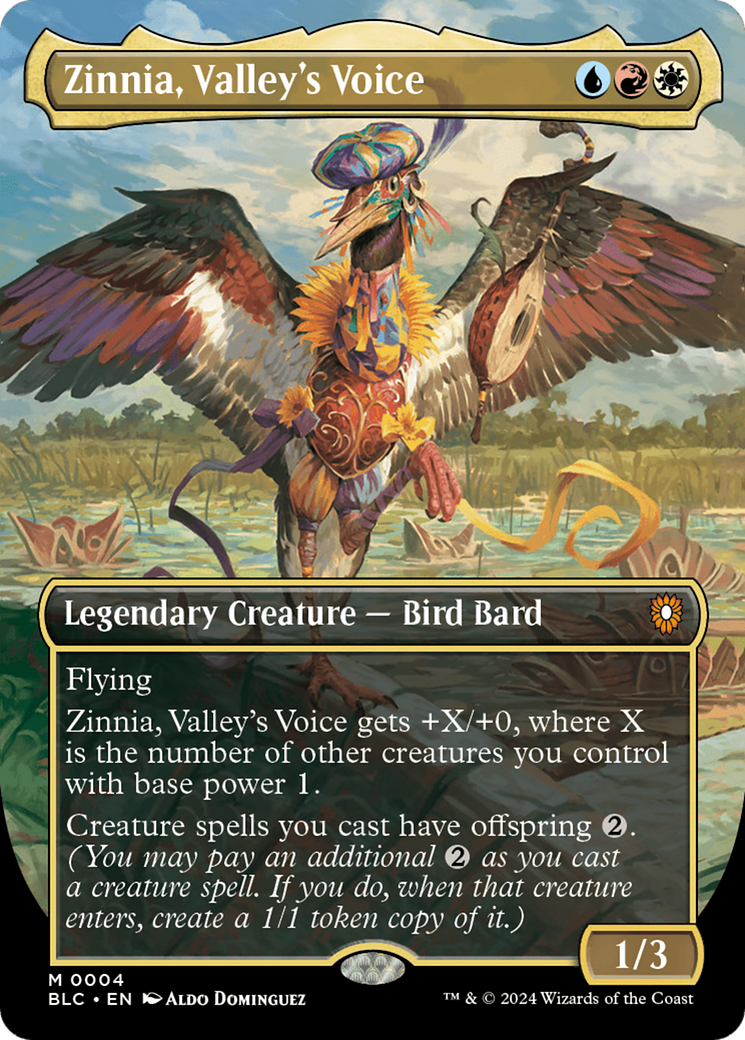
Zinnia, Valley's Voice
Zinnia, Valley's Voice
Legendary Creature — Bird Bard
1/3
Flying
Zinnia gets +X/+0, where X is the number of other creatures you control with base power 1.
Creature spells you cast have offspring . (You may pay an additional as you cast a creature spell. If you do, when that creature enters, create a 1/1 token copy of it.)
- If Zinnia leaves the battlefield after you've cast a creature spell and paid its offspring cost but before that spell resolves, the permanent that spell becomes won't have offspring when it enters. As such, you won't create a 1/1 token copy of it.
- Normally, a creature's base power is the power printed on the card or, for a token, the power set by the effect that created it. If another effect sets a creature's power to a specific number or value, those become its base power. If an effect modifies a creature's power without setting it, that is not included when determining its base power.
- If a creature has a characteristic-defining ability that sets its power, indicated with a */* or similar in the power and toughness box, that ability is taken into account when determining its base power.
- Some creatures have base power and toughness 0/0 and an ability that gives them a bonus based on some criteria. Those are not characteristic-defining abilities, and that ability doesn't change its base power.
- You can pay an offspring cost only once as you cast a spell with offspring. You can't try to pay it multiple times to get more token copies.
- If the spell is countered, the offspring ability will not trigger, and no token will be created.
- If the spell resolves but the creature with offspring leaves the battlefield before the offspring ability resolves, you'll still create a token copy of it.
- The token copies exactly what was printed on the original creature and nothing else, except it's a 1/1 (unless that creature is copying something else; see below). It doesn't copy whether that creature is tapped or untapped, whether it has any counters on it or Auras and Equipment attached to it, or any non-copy effects that have changed its types, color, or so on.
- In the rare case where the original creature is copying something else when the offspring ability resolves, the token enters as whatever that creature copied, except it's a 1/1.
- Many creatures with offspring abilities have other abilities that refer to them as "this creature" rather than referring to them by name. This difference is for clarity purposes and does not change the function of any of these abilities.
- Any "enters" abilities of the copied creature will trigger when the token enters. Any "as [this creature] enters" or "[this creature] enters with" abilities of the copied creature will also work.
- The token created by the offspring ability isn't "cast", so abilities that trigger when a creature spell is cast won't trigger for the copy.
- In the rare case where the creature doesn't have the offspring ability when it enters, the ability won't trigger even if you paid the offspring cost.
Instants 5
-
1
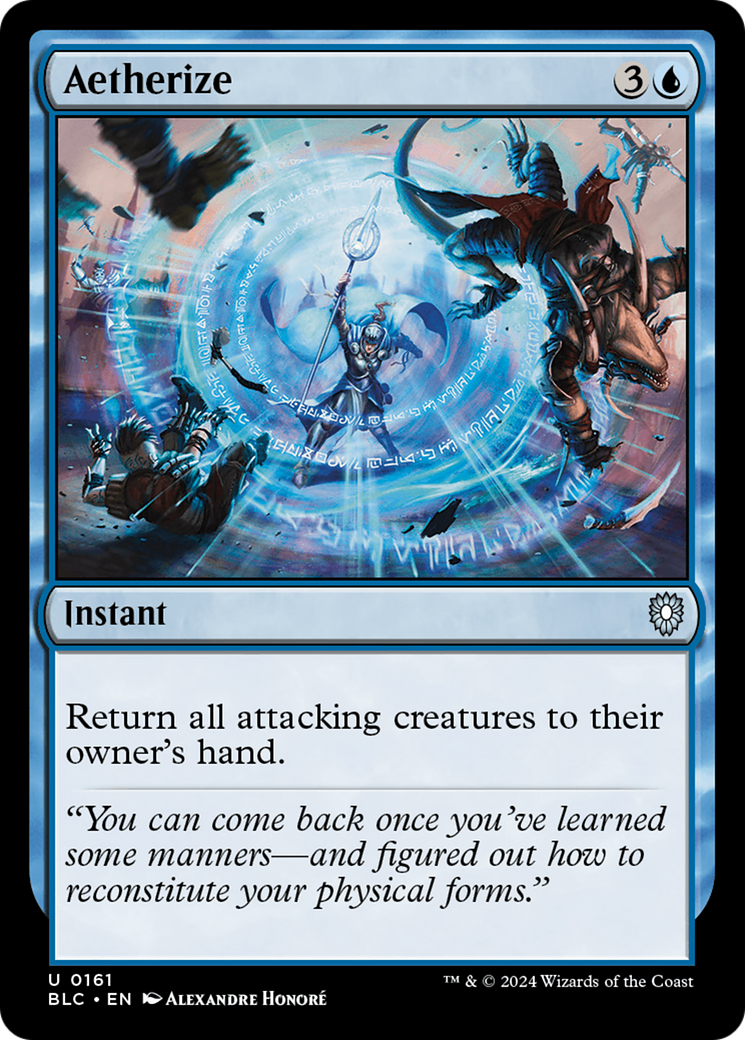
Aetherize
Aetherize
Instant
Return all attacking creatures to their owner's hand.
- An "attacking creature" is one that has been declared as an attacker this combat, or one that was put onto the battlefield attacking this combat. Unless that creature leaves combat, it continues to be an attacking creature through the end of combat step, even if the player it was attacking has left the game, or the planeswalker it was attacking has left combat. There's no such thing as an attacking creature outside of the combat phase.
-
1
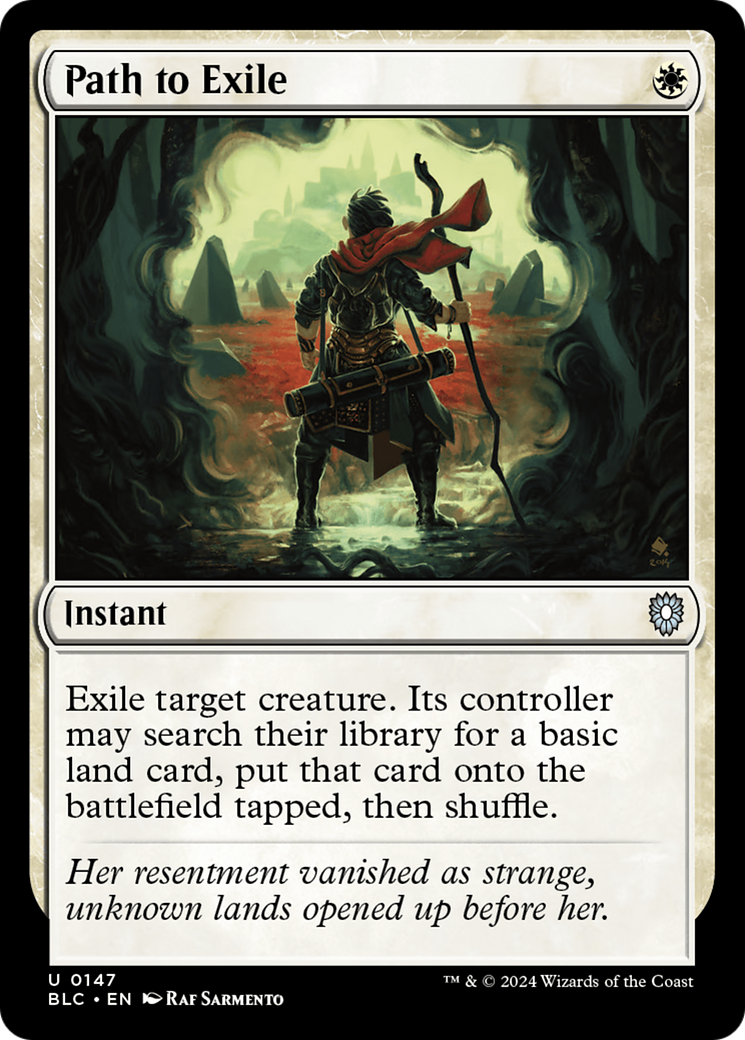
Path to Exile
Path to Exile
Instant
Exile target creature. Its controller may search their library for a basic land card, put that card onto the battlefield tapped, then shuffle.
- If the target creature is an illegal target by the time Path to Exile tries to resolve, the spell won't resolve. The creature's controller won't search for a basic land card.
- The controller of the exiled creature isn't required to search their library for a basic land. If that player doesn't, the player won't shuffle their library.
-
1
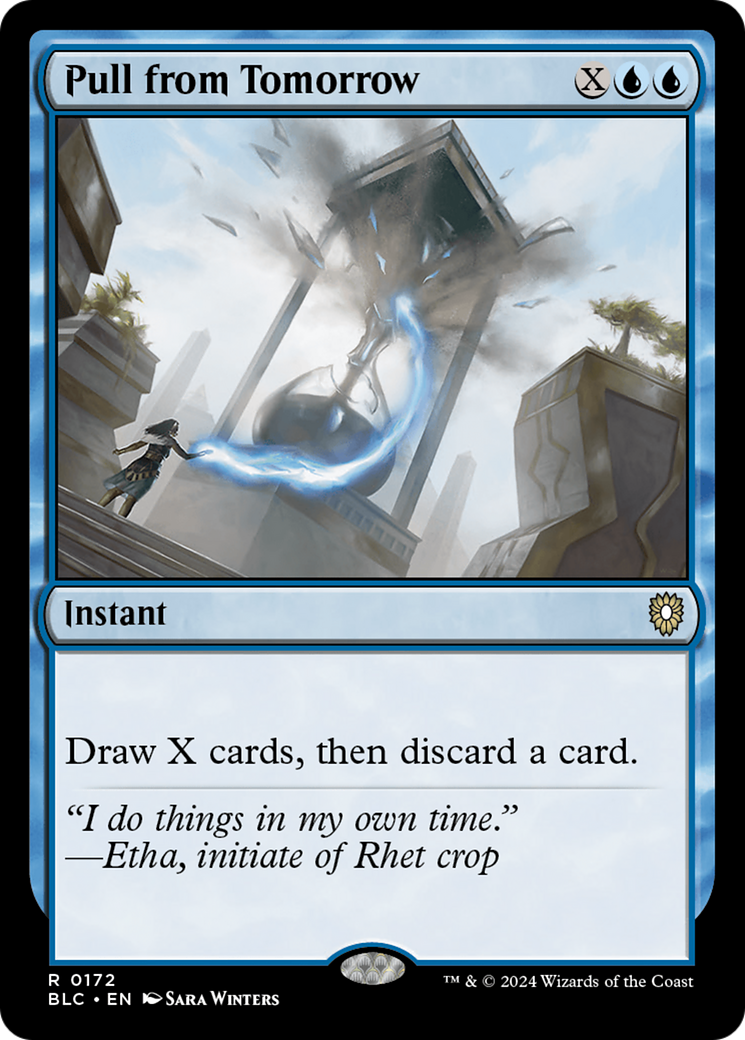
Pull from Tomorrow
Pull from Tomorrow
Instant
Draw X cards, then discard a card.
-
1
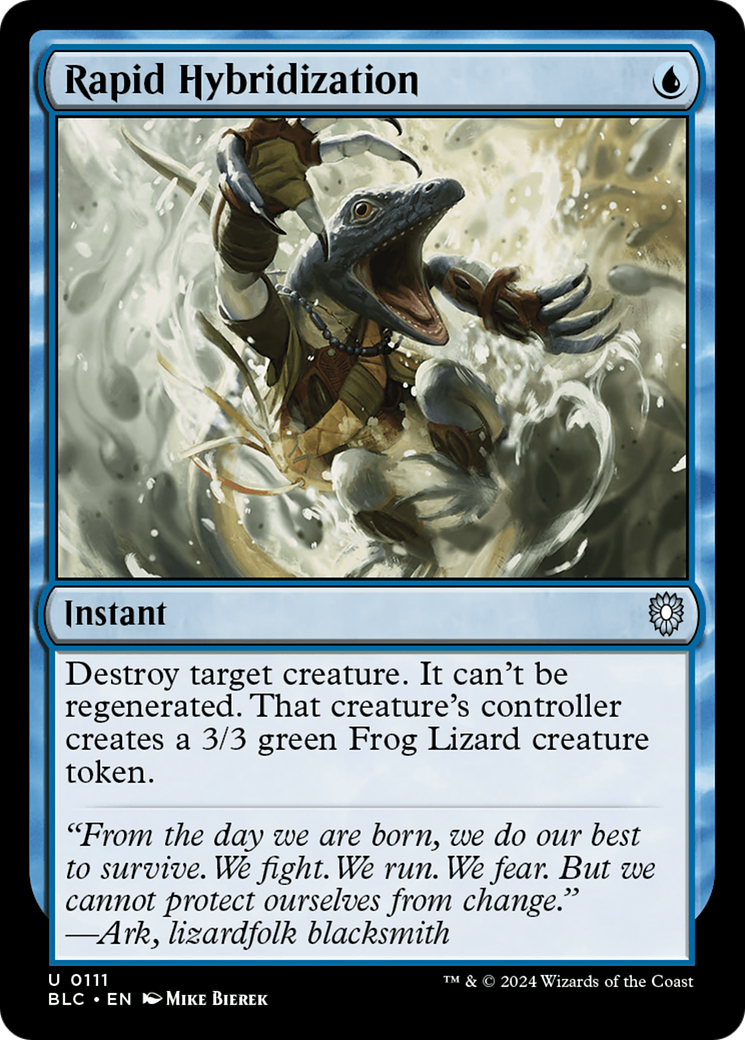
Rapid Hybridization
Rapid Hybridization
Instant
Destroy target creature. It can't be regenerated. That creature's controller creates a 3/3 green Frog Lizard creature token.
- If Rapid Hybridization resolves and the creature isn't destroyed (perhaps because it has indestructible), its controller will still get the Frog Lizard token.
- If the creature is an illegal target when Rapid Hybridization tries to resolve, it won't resolve and none of its effects will happen. No Frog Lizard token will be created.
-
1
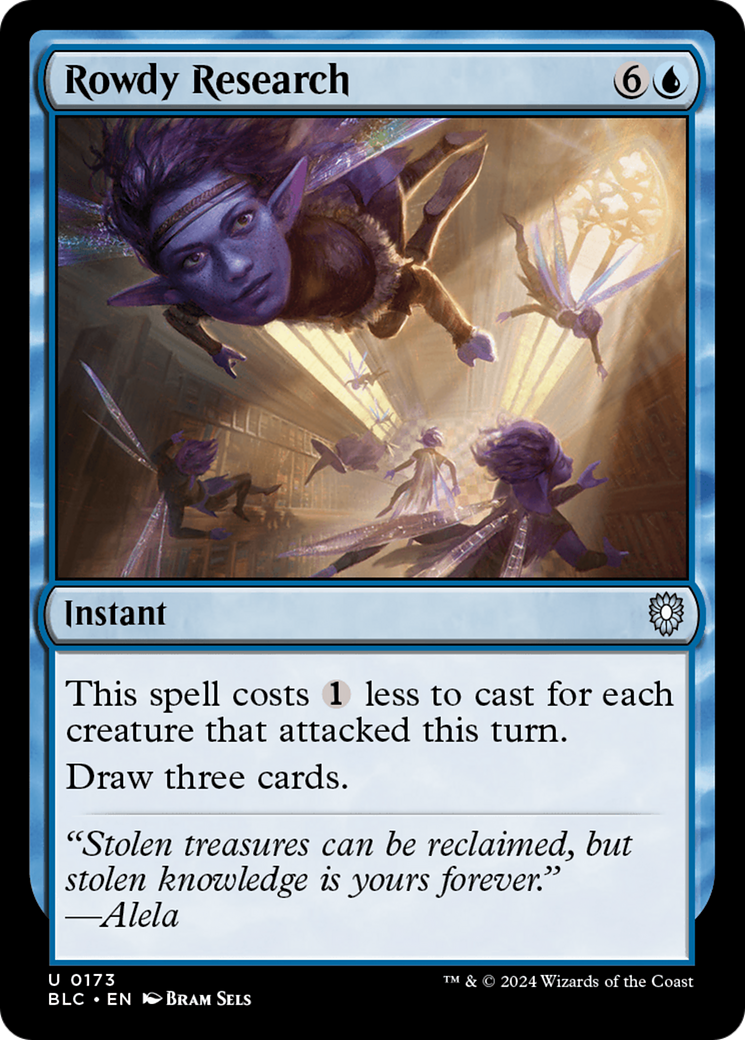
Rowdy Research
Rowdy Research
Instant
This spell costs less to cast for each creature that attacked this turn.
Draw three cards.
Sorceries 8
-
1
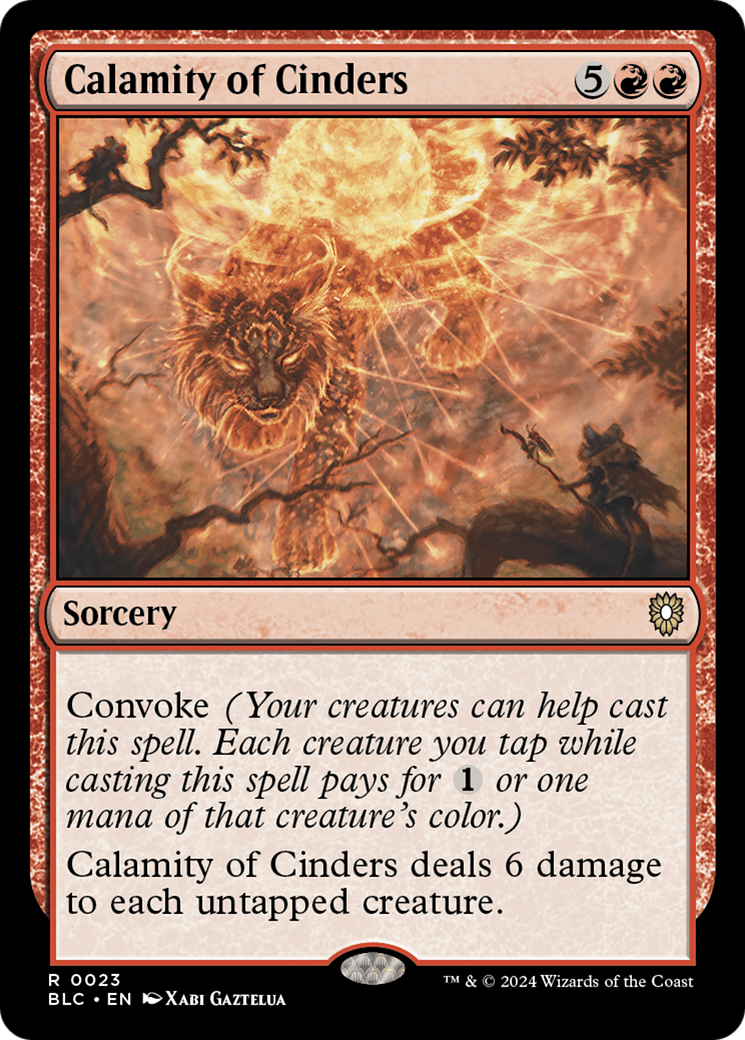
Calamity of Cinders
Calamity of Cinders
Sorcery
Convoke (Your creatures can help cast this spell. Each creature you tap while casting this spell pays for or one mana of that creature's color.)
Calamity of Cinders deals 6 damage to each untapped creature.
- You can tap any untapped creature you control to convoke a spell, even one you haven't controlled continuously since the beginning of your most recent turn.
- If tapping a creature using convoke wouldn't pay for any mana in that spell's cost (because you've already paid for all of the mana in the spell's cost by tapping other creatures or because you've already paid for all of the generic mana in the cost by tapping other creatures and the creature you want to tap doesn't share a color with any of the remaining mana symbols in the spell's cost), you can't use convoke to tap that creature. Effects that increase or reduce the cost of a spell with convoke apply before costs are paid and will increase or decrease the total amount of creatures you can tap.
- When calculating a spell's total cost, include any alternative costs, additional costs, or anything else that increases or reduces the cost to cast the spell. Convoke applies after the total cost is calculated. Convoke doesn't change a spell's mana cost or mana value.
- If a creature you control has a mana ability with in the cost, activating that ability while casting a spell with convoke will result in the creature being tapped before you pay the spell's costs. You won't be able to tap it again for convoke. Similarly, if you sacrifice a creature to activate a mana ability while casting a spell with convoke, that creature won't be on the battlefield when you pay the spell's costs, so you won't be able to tap it for convoke.
- Because convoke isn't an alternative cost, it can be used in conjunction with alternative costs.
- Tapping a multicolored creature using convoke will pay for or one mana of your choice of any of that creature's colors.
-
1
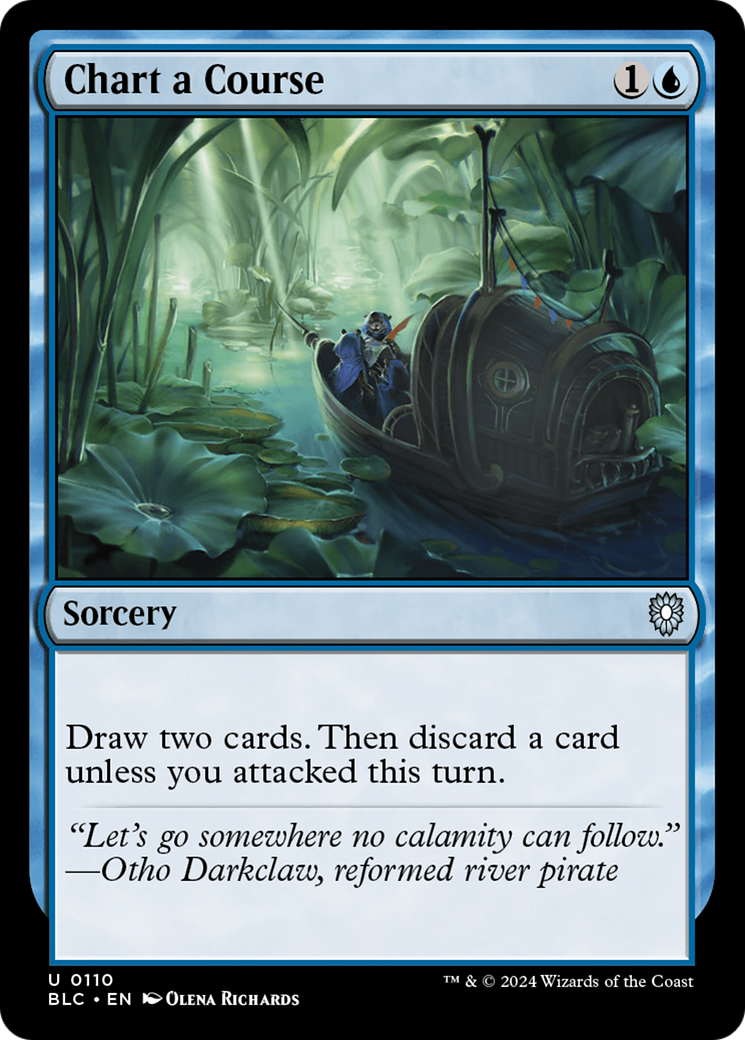
Chart a Course
Chart a Course
Sorcery
Draw two cards. Then discard a card unless you attacked this turn.
-
1
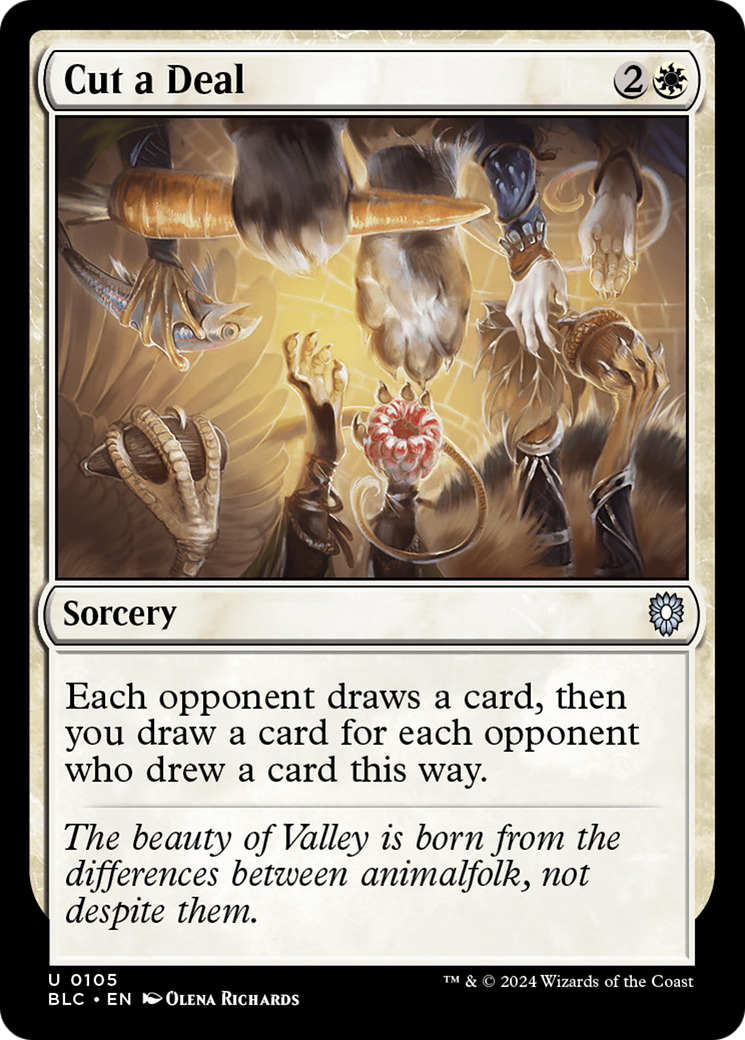
Cut a Deal
Cut a Deal
Sorcery
Each opponent draws a card, then you draw a card for each opponent who drew a card this way.
- Although the draws are not optional, if an opponent doesn't draw a card, perhaps because a replacement effect replaced the draw with another effect, that player is not counted when determining how many cards you draw.
- If an opponent drew more than one card this way due to a replacement effect, you still draw only one card for that player.
-
1
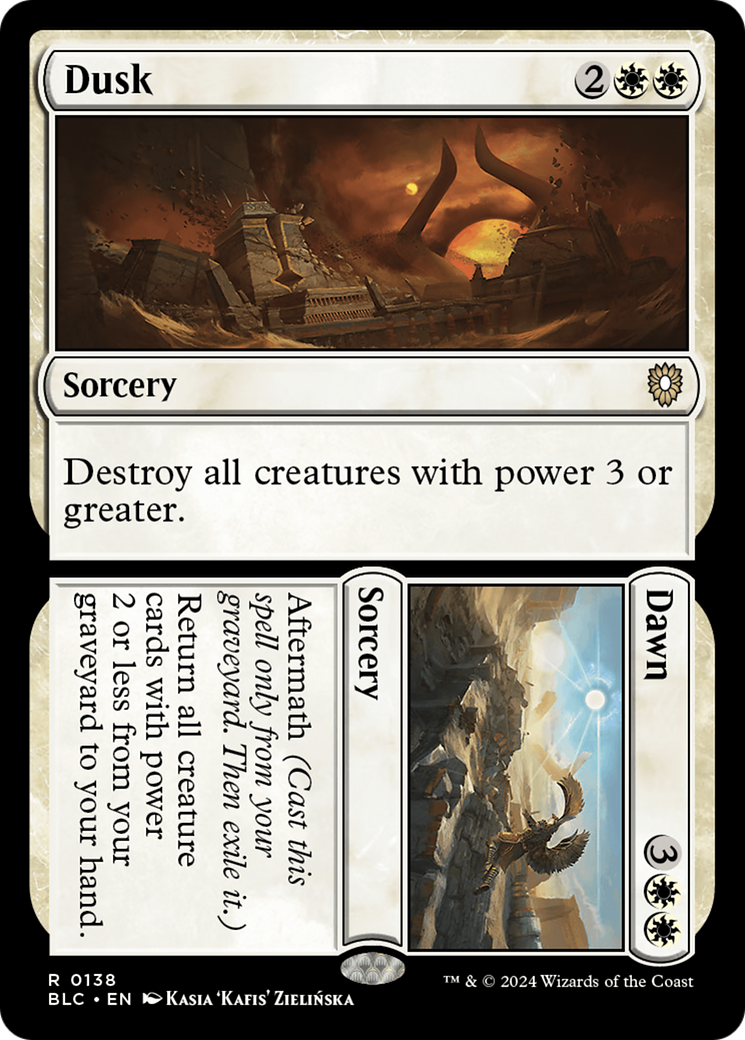
Dusk // Dawn
//
Dusk
Sorcery
- Once you've started to cast a spell with aftermath from your graveyard, the card is immediately moved to the stack. Opponents can't try to stop the ability by exiling the card with an effect such as that of Crook of Condemnation.
- All split cards have two card faces on a single card, and you put a split card onto the stack with only the half you're casting. The characteristics of the half of the card you didn't cast are ignored while the spell is on the stack. For example, if an effect prevents you from casting green spells, you can cast Destined of Destined // Lead, but not Lead.
- Each split card is a single card. For example, if you discard one, you've discarded one card, not two. If an effect counts the number of instant and sorcery cards in your graveyard, Destined // Lead counts once, not twice.
- Each split card has two names. If an effect instructs you to choose a card name, you may choose one, but not both.
- While not on the stack, the characteristics of a split card are the combination of its two halves. For example, Destined // Lead is a green and black card, it is both an instant card and a sorcery card, and its mana value is 6. This means that if an effect allows you to cast a card with mana value 2 from your hand, you can't cast Destined. This is a change from the previous rules for split cards.
- Split cards with aftermath have a new frame treatment—the half you can cast from your hand is oriented the same as other cards you'd cast from your hand, while the half you can cast from your graveyard is a traditional split card half. This frame treatment is for your convenience and has no rules significance.
- If another effect allows you to cast a split card with aftermath from any zone other than a graveyard, you can't cast the half with aftermath.
- If another effect allows you to cast a split card with aftermath from a graveyard, you may cast either half. If you cast the half that has aftermath, you'll exile the card if it would leave the stack.
- A spell with aftermath cast from a graveyard will always be exiled afterward, whether it resolves, it's countered, or it leaves the stack in some other way.
- If you cast the first half of a split card with aftermath during your turn, you'll have priority immediately after it resolves. You can cast the half with aftermath from your graveyard before any player can take any other action if it's legal for you to do so.
-
1
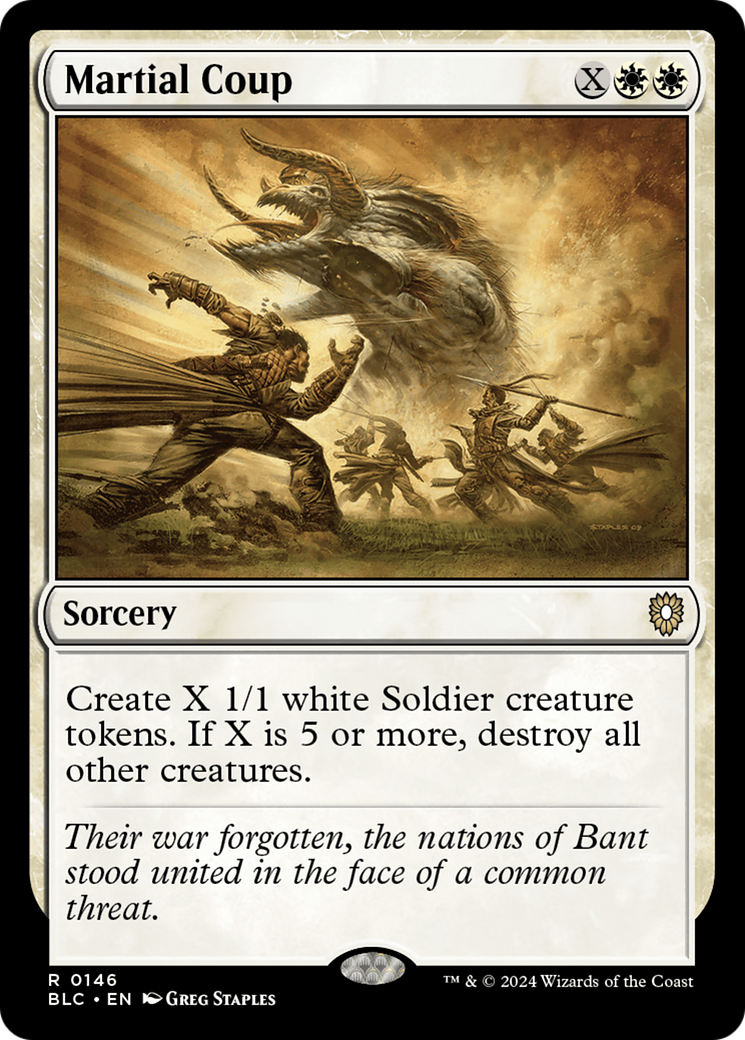
Martial Coup
Martial Coup
Sorcery
Create X 1/1 white Soldier creature tokens. If X is 5 or more, destroy all other creatures.
- Martial Coup checks the number you chose for X, not the amount of mana you actually spent.
- You do what the spell says in order. If X is 5 or more, you'll put the Soldier tokens onto the battlefield, then you'll destroy all other creatures.
- No one can cast spells or activate abilities between the time the Soldier tokens are put onto the battlefield and the time all other creatures are destroyed. For example, you can't sacrifice one of those Soldier tokens to regenerate a Skeletal Kathari.
-
1
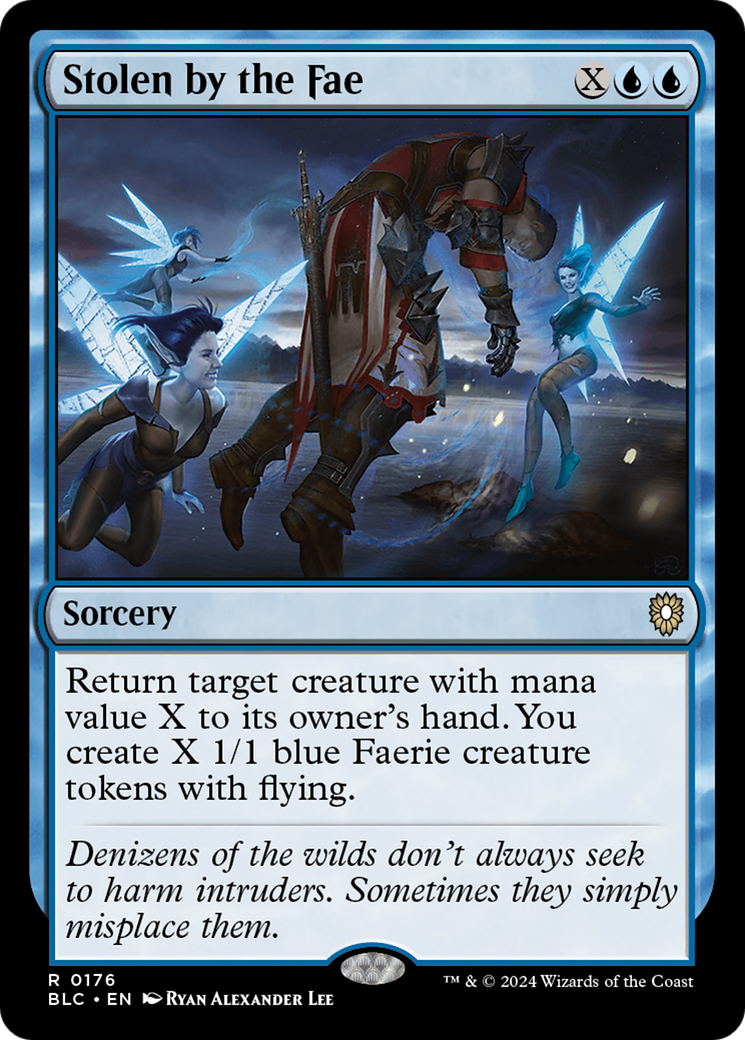
Stolen by the Fae
Stolen by the Fae
Sorcery
Return target creature with mana value X to its owner's hand. You create X 1/1 blue Faerie creature tokens with flying.
- If a creature on the battlefield has in its mana cost, X is considered to be 0.
- If the target creature is an illegal target by the time Stolen by the Fae tries to resolve, the spell won't resolve. You won't create any Faerie tokens.
-
1
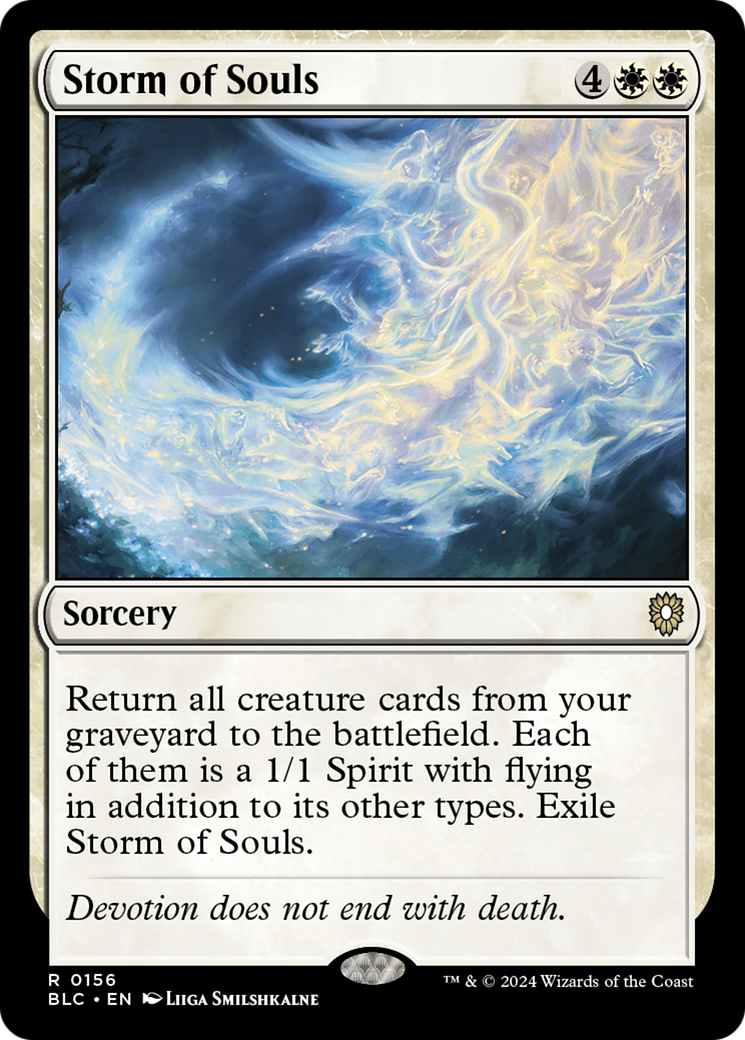
Storm of Souls
Storm of Souls
Sorcery
Return all creature cards from your graveyard to the battlefield. Each of them is a 1/1 Spirit with flying in addition to its other types. Exile Storm of Souls.
-
1
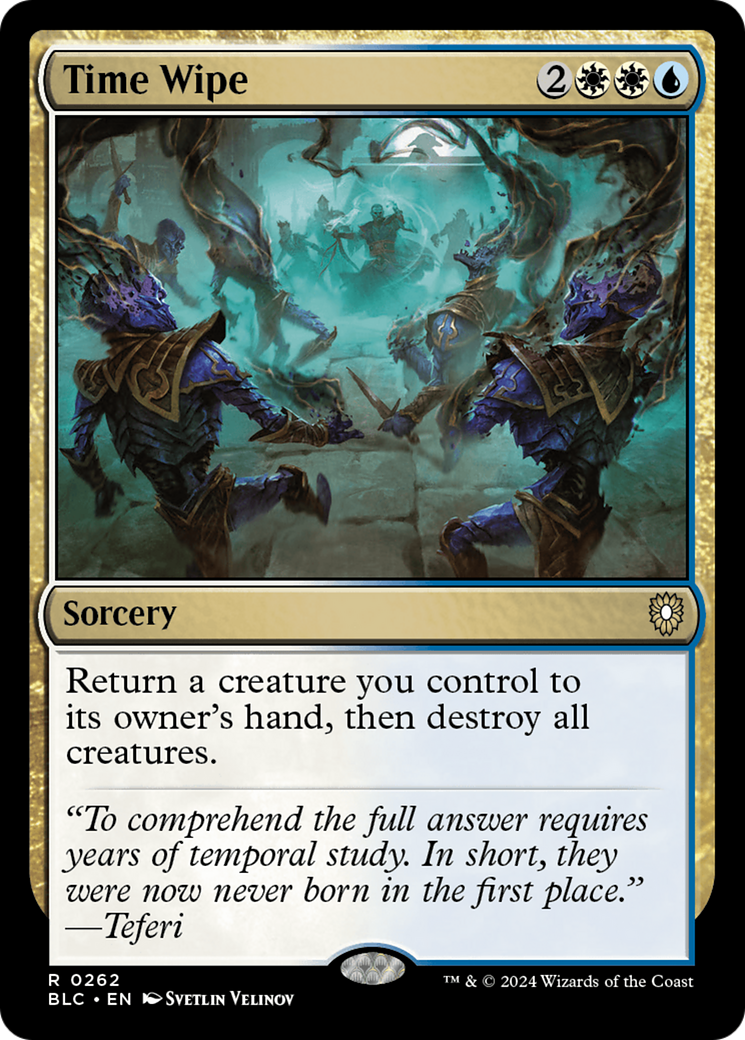
Time Wipe
Time Wipe
Sorcery
Return a creature you control to its owner's hand, then destroy all creatures.
- You chose which creature to return to its owner's hand while Time Wipe is resolving. No player may take any actions between the time you choose the creature to return and the time other creatures are destroyed.
- If you control no creatures, you simply destroy all creatures.
Artifacts 9
-
1
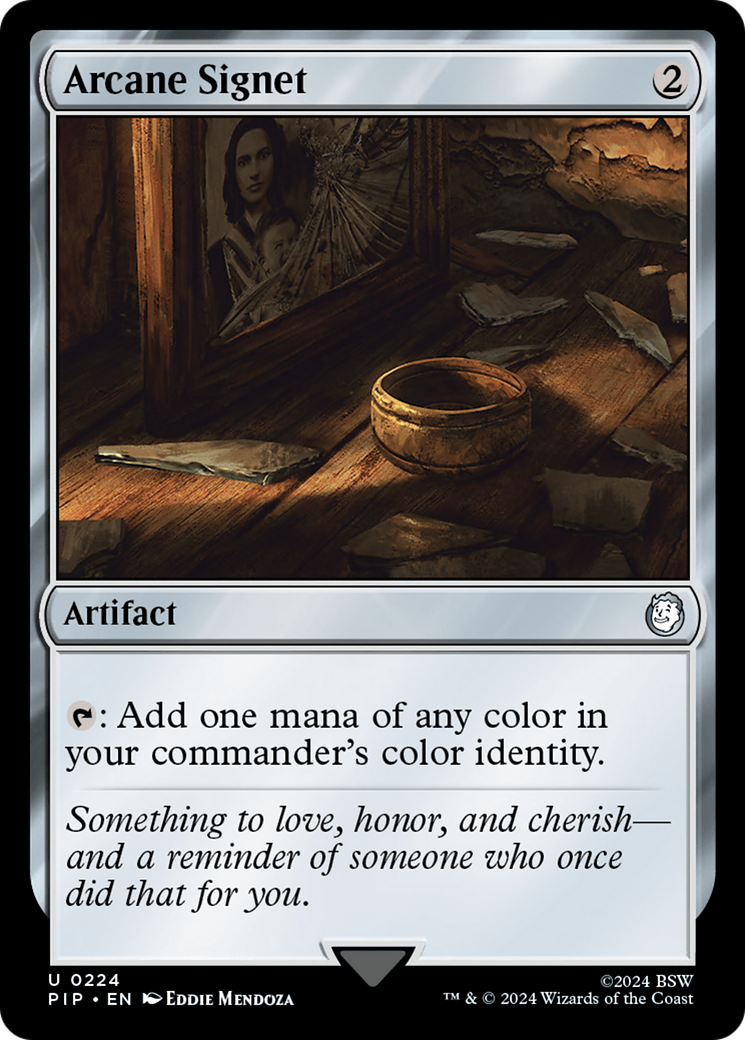
Arcane Signet
Arcane Signet
Artifact
: Add one mana of any color in your commander's color identity.
- If your commander is a card that has no colors in its color identity, Arcane Signet's ability produces no mana. It doesn't produce .
- If you have two commanders, the ability adds one mana of any color in their combined color identities.
- If you don't have a commander, Arcane Signet's ability produces no mana.
-
1
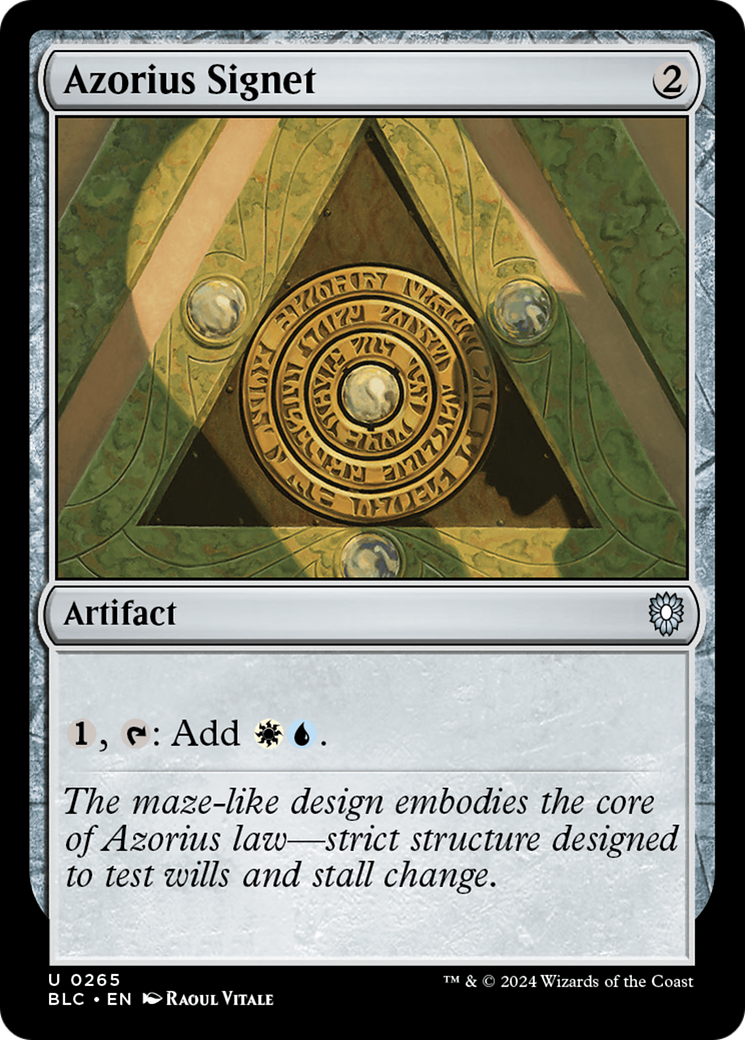
Azorius Signet
Azorius Signet
Artifact
, : Add .
-
1
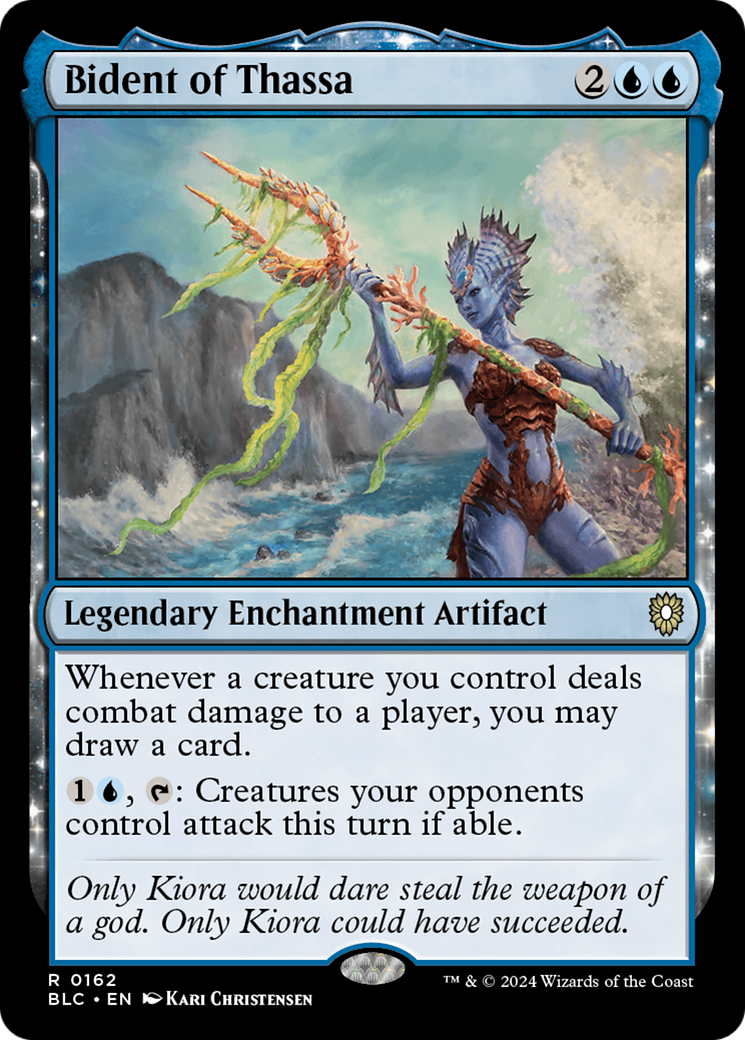
Bident of Thassa
Bident of Thassa
Legendary Enchantment Artifact
Whenever a creature you control deals combat damage to a player, you may draw a card.
, : Creatures your opponents control attack this turn if able.
- The controller of each attacking creature still chooses which player or planeswalker that creature attacks.
- If a creature can't attack for any reason (such as being tapped or having come under that player's control that turn), then it doesn't attack. If there's a cost associated with having a creature attack, the player isn't forced to pay that cost, so it doesn't have to attack in that case either.
-
1
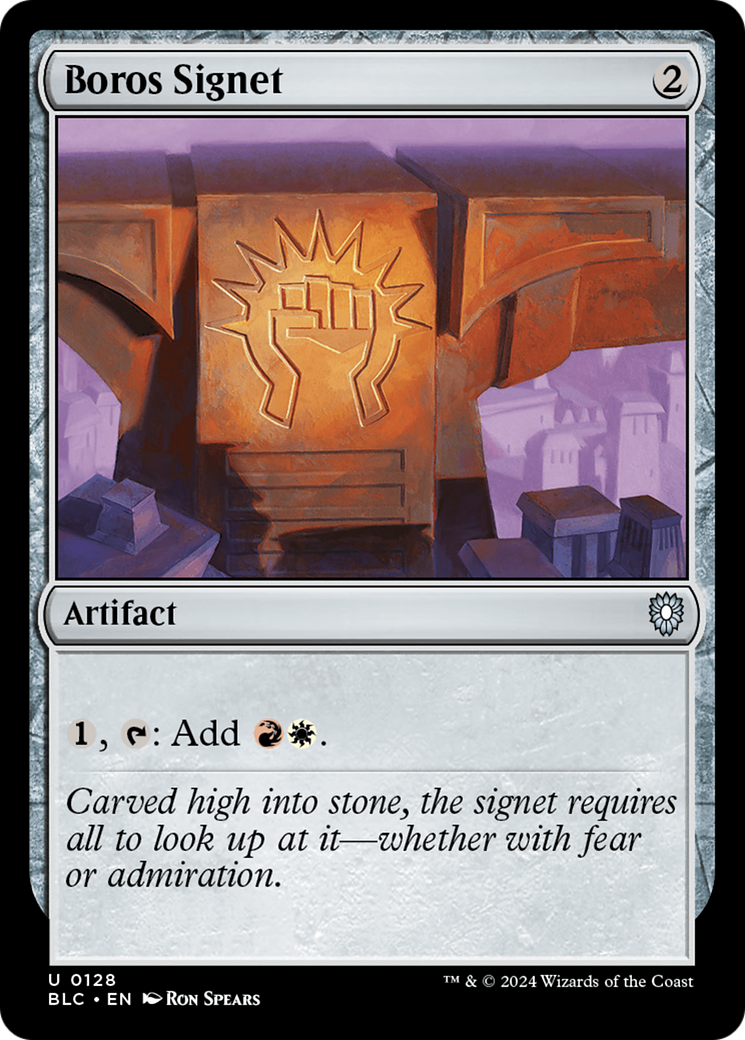
Boros Signet
Boros Signet
Artifact
, : Add .
-
1
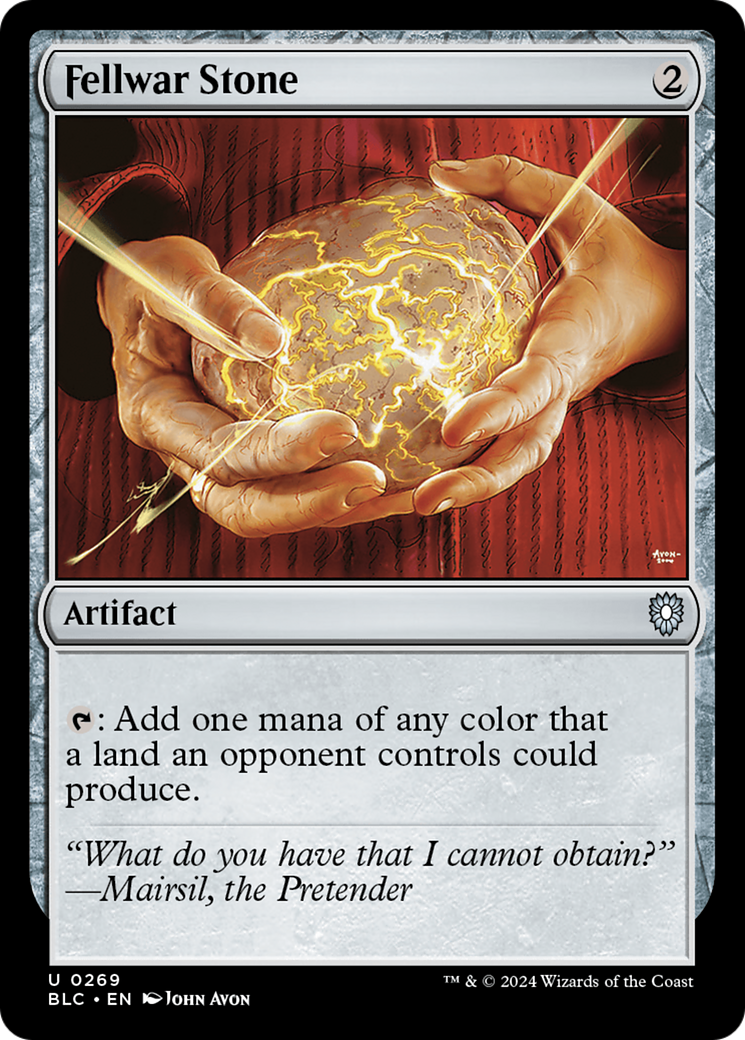
Fellwar Stone
Fellwar Stone
Artifact
: Add one mana of any color that a land an opponent controls could produce.
- The colors of mana are white, blue, black, red, and green. Fellwar Stone can't be tapped for colorless mana, even if a land an opponent controls could produce colorless mana.
- Fellwar Stone checks the effects of all mana-producing abilities of lands your opponents control, but it doesn't check their costs. For example, Vivid Crag has the ability " , Remove a charge counter from Vivid Crag: Add one mana of any color." If an opponent controls Vivid Crag and you control Fellwar Stone, you can tap Fellwar Stone for any color of mana. It doesn't matter whether Vivid Crag has a charge counter on it, and it doesn't matter whether it's untapped.
- When determining what colors of mana your opponents' lands could produce, take into account any applicable replacement effects that would apply to those lands' mana abilities (such as Contamination's effect, for example). If there is more than one, consider them in any possible order.
- Fellwar Stone doesn't care about any restrictions or riders your opponents' lands (such as Ancient Ziggurat or Hall of the Bandit Lord) put on the mana they produce. It just cares about colors of mana.
- This works even if the opponent's lands are tapped. It only checks what kinds of mana can be produced, not if the abilities that produce them are usable right now.
- The ability can be activated if the opponent has no lands that produce mana, but the effect will not be able to generate any mana.
- It only produces one mana even if the land can produce more than one.
-
1
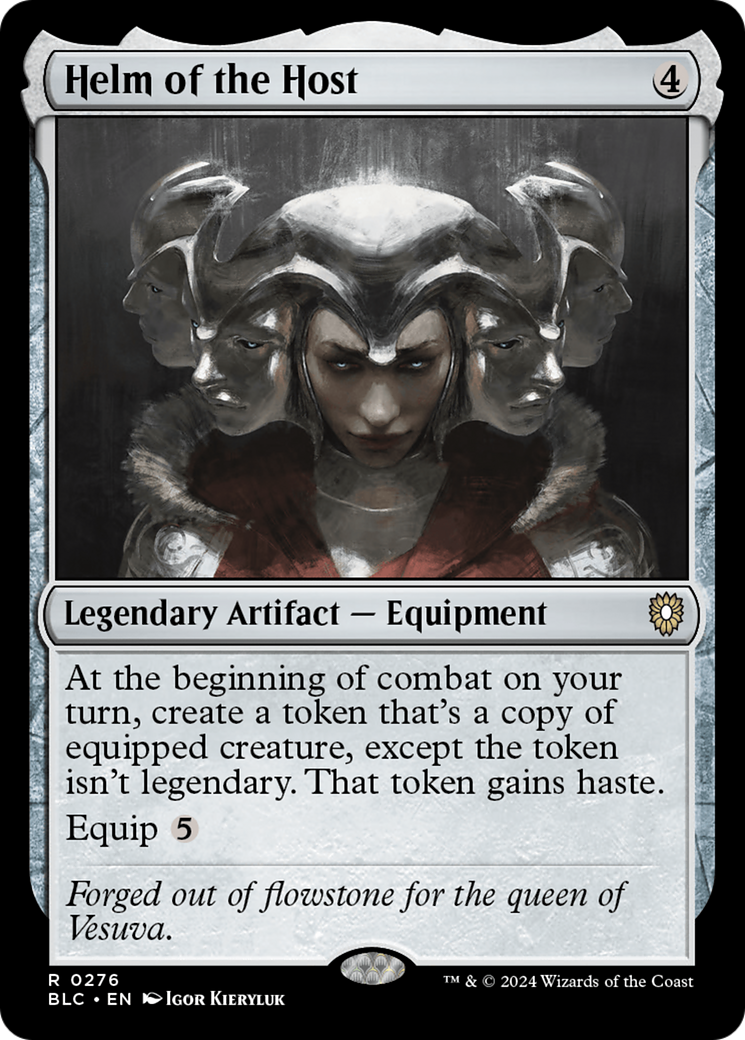
Helm of the Host
Helm of the Host
Legendary Artifact — Equipment
At the beginning of combat on your turn, create a token that's a copy of equipped creature, except the token isn't legendary. That token gains haste.
Equip
- If the copied creature is a token, the token that's created copies the original characteristics of that token as stated by the effect that created that token.
- If the copied creature is copying something else (for example, if the copied creature is a Clone), then the token enters the battlefield as whatever that creature copied.
- The token copies exactly what was printed on the original creature and nothing else (unless that creature is copying something else or is a token; see below). It doesn't copy whether that creature is tapped or untapped, whether it has any counters on it or Auras and Equipment attached to it, or any non-copy effects that have changed its power, toughness, types, color, and so on.
- The token isn't legendary, and this exception is copiable. If something else copies the token later, that copy also won't be legendary. If you control two or more permanents with the same name but only one is legendary, the "legend rule" doesn't apply.
- The token gains haste indefinitely, and this effect isn't copiable. If something else copies the token later, that copy won't have haste.
- If the copied creature has in its mana cost, X is considered to be 0.
- Any enters-the-battlefield abilities of the copied creature will trigger when the token enters the battlefield. Any "as [this creature] enters the battlefield" or "[this creature] enters the battlefield with" abilities of the chosen creature will also work.
- If the equipped creature leaves the battlefield before the triggered ability of Helm of the Host resolves, or if there is no equipped creature, no token is created. However, if Helm of the Host leaves the battlefield while its triggered ability is on the stack, a token will be created of the creature it last equipped. If that creature has also left the battlefield, its last known information is used to determine what the token looks like.
-
1
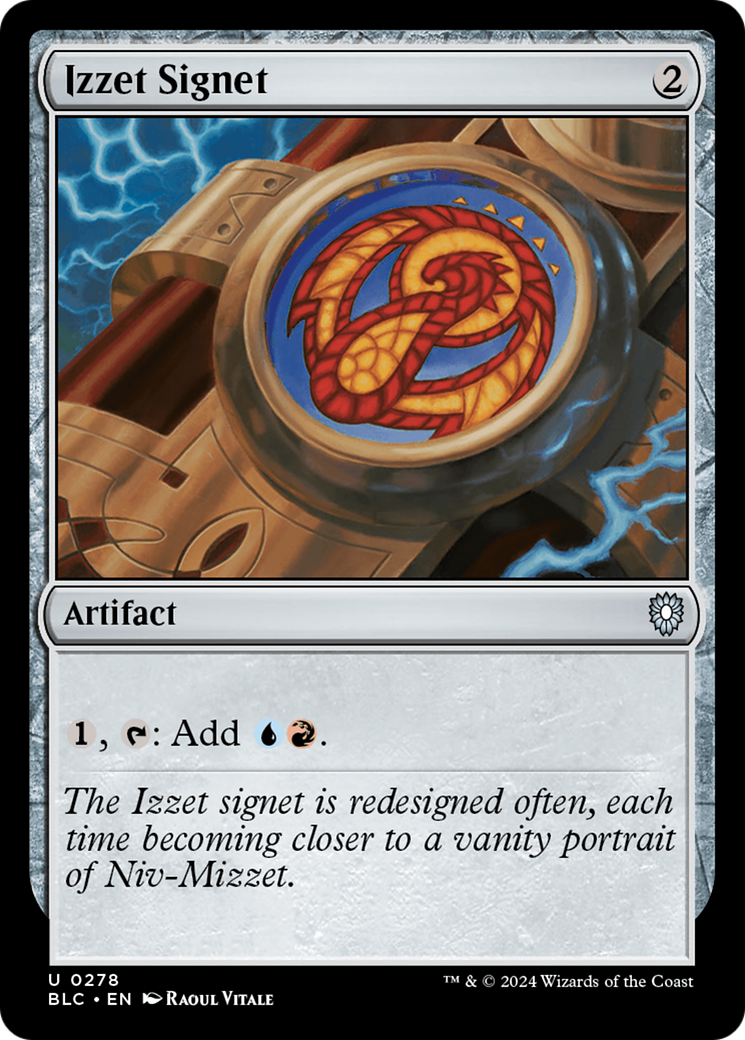
Izzet Signet
Izzet Signet
Artifact
, : Add .
-
1
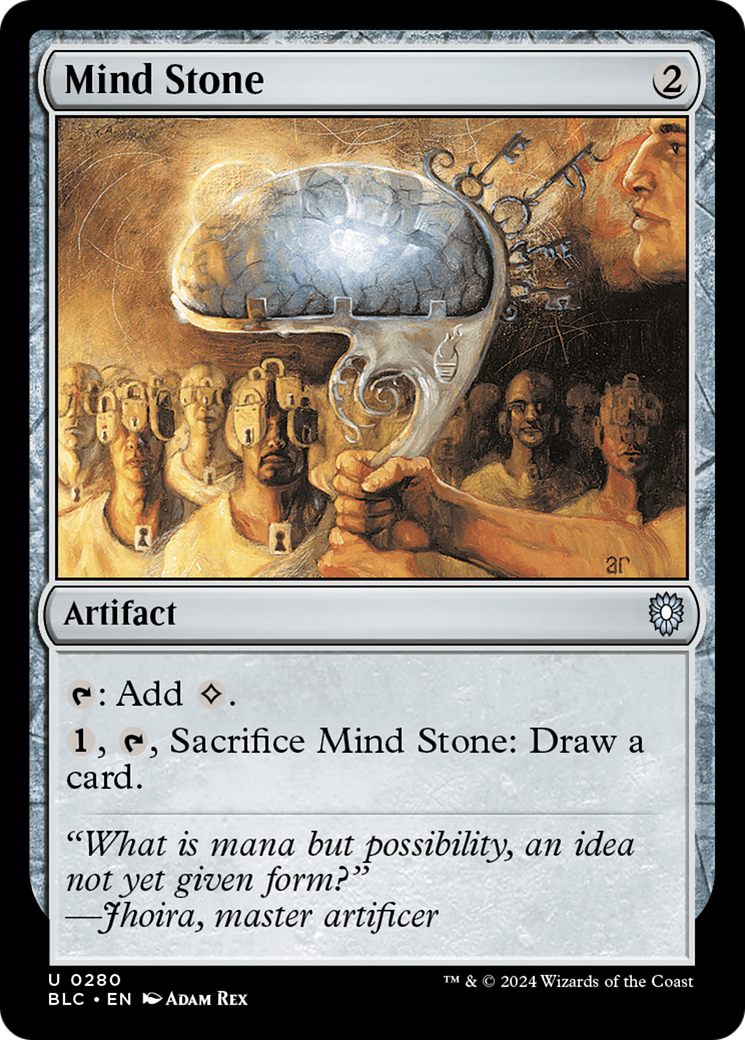
Mind Stone
Mind Stone
Artifact
: Add .
, , Sacrifice this artifact: Draw a card.
-
1
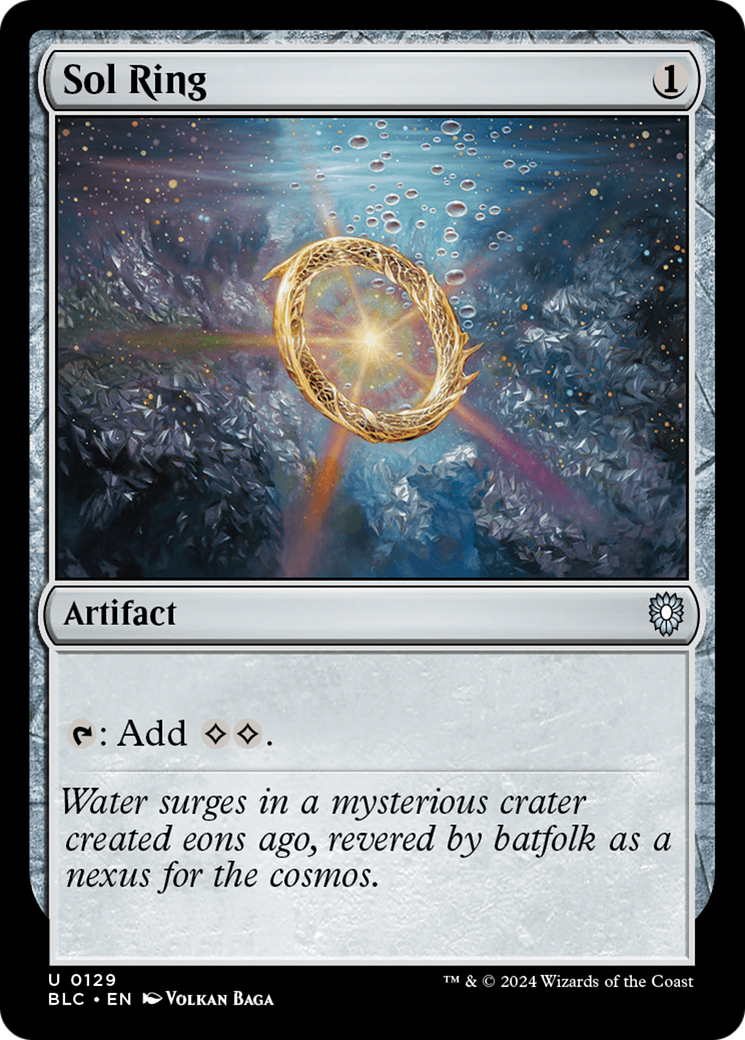
Sol Ring
Sol Ring
Artifact
: Add .
Enchantments 3
-
1
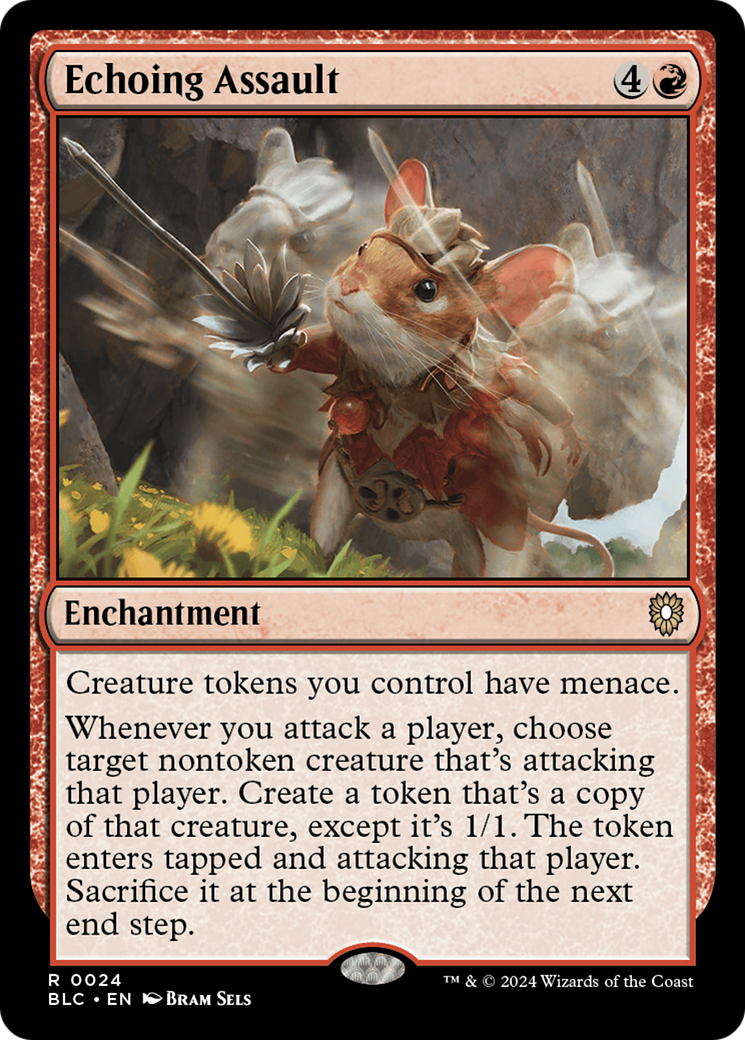
Echoing Assault
Echoing Assault
Enchantment
Creature tokens you control have menace.
Whenever you attack a player, choose target nontoken creature that's attacking that player. Create a token that's a copy of that creature, except it's 1/1. The token enters tapped and attacking that player. Sacrifice it at the beginning of the next end step.
- If you attack multiple players in the same declare attackers step, Echoing Assault's last ability triggers once for each player you attacked.
- The token copies exactly what was printed on the original creature and nothing else, except it's a 1/1 (unless that creature is copying something else; see below). It doesn't copy whether that creature is tapped or untapped, whether it has any counters on it or Auras and Equipment attached to it, or any non-copy effects that have changed its types, color, or so on.
- In the case where the target creature is copying something else when Echoing Assault's second ability resolves, then the token enters as whatever that creature copied, except it's a 1/1.
- Any "enters" abilities of the copied creature will trigger when the token enters. Any "as [this creature] enters" or "[this creature] enters with" abilities of the copied creature will also work.
- Although the token enters attacking, it was never declared as an attacking creature. Abilities that trigger whenever a creature attacks won't trigger when that creature enters attacking.
-
1
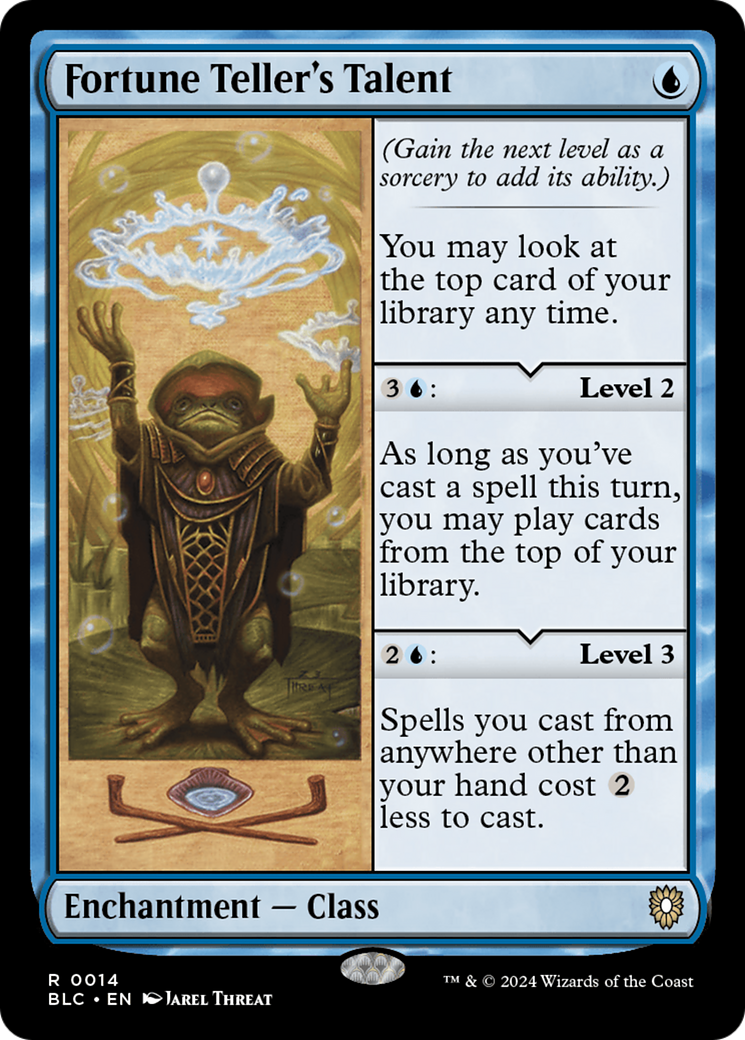
Fortune Teller's Talent
Fortune Teller's Talent
Enchantment — Class
(Gain the next level as a sorcery to add its ability.)
You may look at the top card of your library any time.
: Level 2
As long as you've cast a spell this turn, you may play cards from the top of your library.
: Level 3
Spells you cast from anywhere other than your hand cost less to cast.
- You can look at the top card of your library whenever you want (with one restriction; see below), even if you don't have priority. This action doesn't use the stack. Knowing what that card is becomes part of the information you have access to, just like you can look at the cards in your hand.
- If the top card of your library changes while you're casting a spell, playing a land, or activating an ability, you can't look at the new top card until you finish doing so. This means that if you cast a spell from the top of your library, you can't look at the next one until you're done paying for that spell.
- You must pay all costs and follow all timing rules for lands played and spells cast from the top of your library this way.
- The cost reduction applies only to generic mana in the total cost of spells you cast from anywhere other than your hand.
- To determine the total cost of a spell, start with the mana cost or alternative cost you're paying (such as a flashback cost), add any cost increases (such as kicker costs), then apply any cost reductions (such as that of this ability). The mana value of the spell is determined by only its mana cost, no matter what the total cost to cast that spell was.
- Each Class has five abilities. The three in the major sections of its text box are class abilities. Class abilities can be static, activated, or triggered abilities. The other two are level abilities, one activated ability to advance the Class to level 2 and another to advance the Class to level 3.
- Each Class starts with only the first of its three class abilities. As the first level ability resolves, the Class becomes level 2 and gains the second class ability. As the second level ability resolves, the Class becomes level 3 and gains the third class ability.
- Gaining a level won't remove abilities that a Class had at a previous level.
- Gaining a level is a normal activated ability. It uses the stack and can be responded to.
- You can't activate the first level ability of a Class unless that Class is level 1. Similarly, you can't activate the second level ability of a Class unless that Class is level 2.
- There's no restriction on how many Class permanents you can control, whether they're the same or different classes. Each Class permanent tracks its own level separately.
-
1
Murmuration
Murmuration
Enchantment
Birds you control get +1/+1 and have vigilance.
At the beginning of your end step, for each spell you've cast this turn, create a 1/2 blue Bird creature token with flying named Storm Crow.
- Murmuration's last ability counts spells you cast earlier in the turn even if you didn't control Murmuration as you cast them and even if those spells were countered or otherwise didn't resolve.
- The number of spells you've cast is counted only as Murmuration's last ability resolves. For example, say you've cast two spells this turn, and with Murmuration's last ability on the stack, you cast a Blizzard Strix (a Bird creature spell with flash that may have been chosen for this example due to being an adorable owl). When Murmuration's ability resolves, you'll have cast three spells so far this turn, so you'll create three Storm Crow tokens. Caw!
Lands 38
-
1
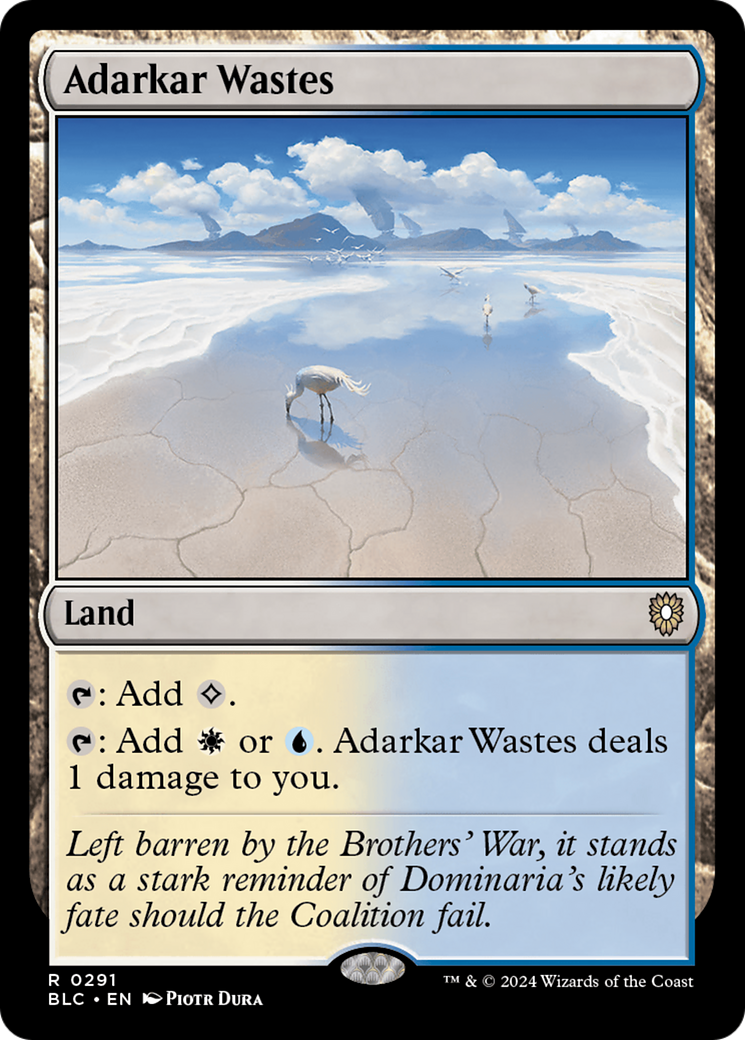
Adarkar Wastes
Adarkar Wastes
Land
: Add .
: Add or . This land deals 1 damage to you.
-
1
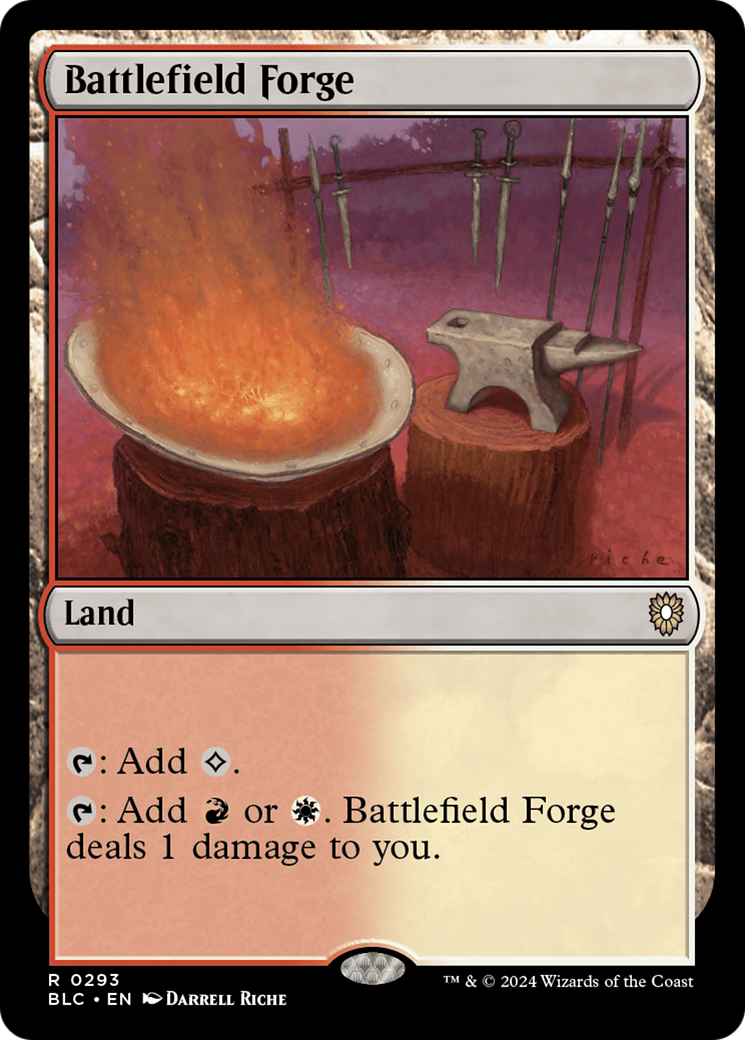
Battlefield Forge
Battlefield Forge
Land
: Add .
: Add or . This land deals 1 damage to you.
- The damage dealt to you is part of the second mana ability. It doesn't use the stack and can't be responded to.
- Like most lands, each land in this cycle is colorless. The damage dealt to you is dealt by a colorless source.
-
1
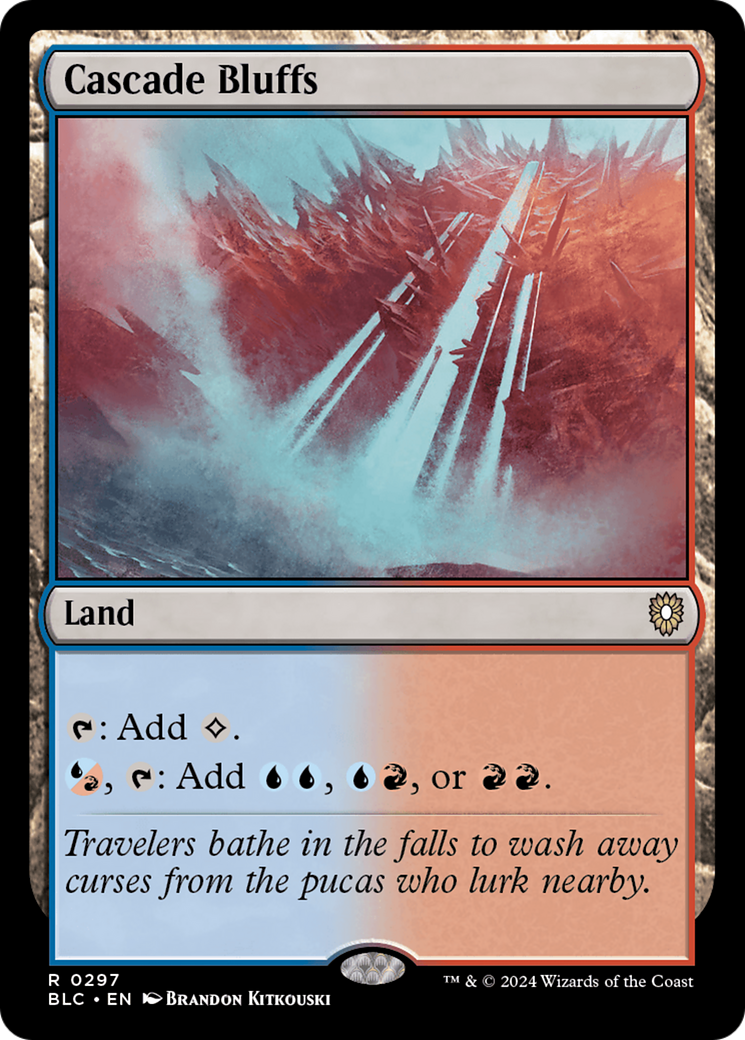
Cascade Bluffs
Cascade Bluffs
Land
: Add .
, : Add , , or .
-
1
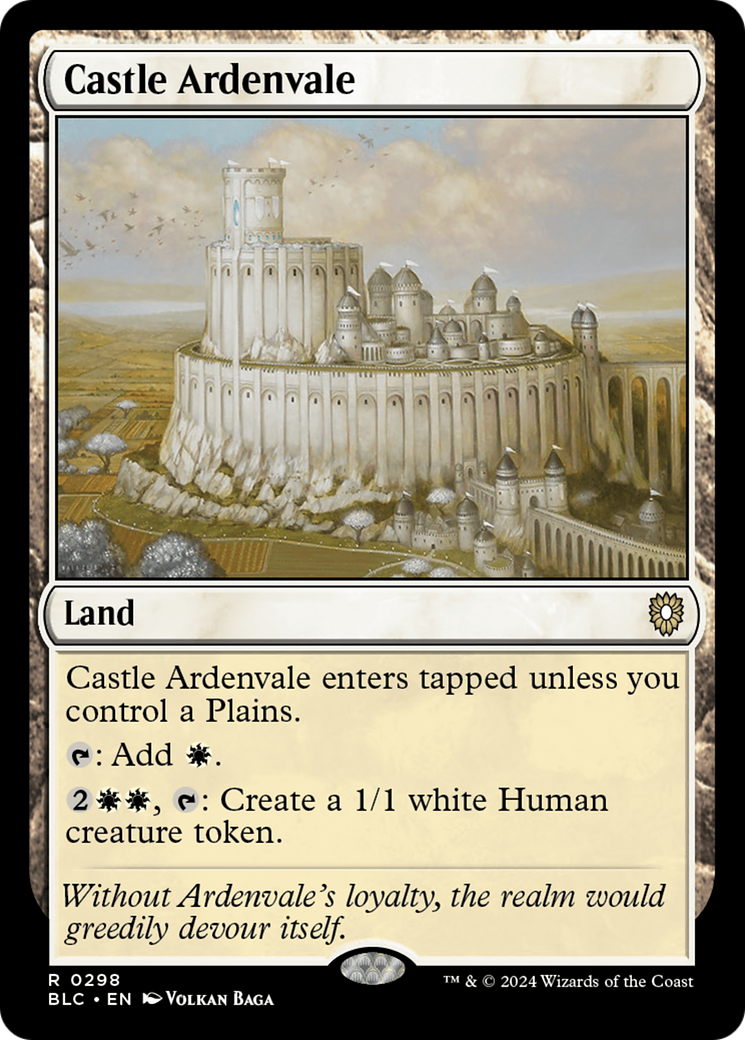
Castle Ardenvale
Castle Ardenvale
Land
This land enters tapped unless you control a Plains.
: Add .
, : Create a 1/1 white Human creature token.
- Once the common lands (such as Mystic Sanctuary) enter the battlefield tapped, there's no way to untap them with a spell or ability to make their last ability trigger.
- Although the common lands have basic land types, they aren't basic lands.
-
1
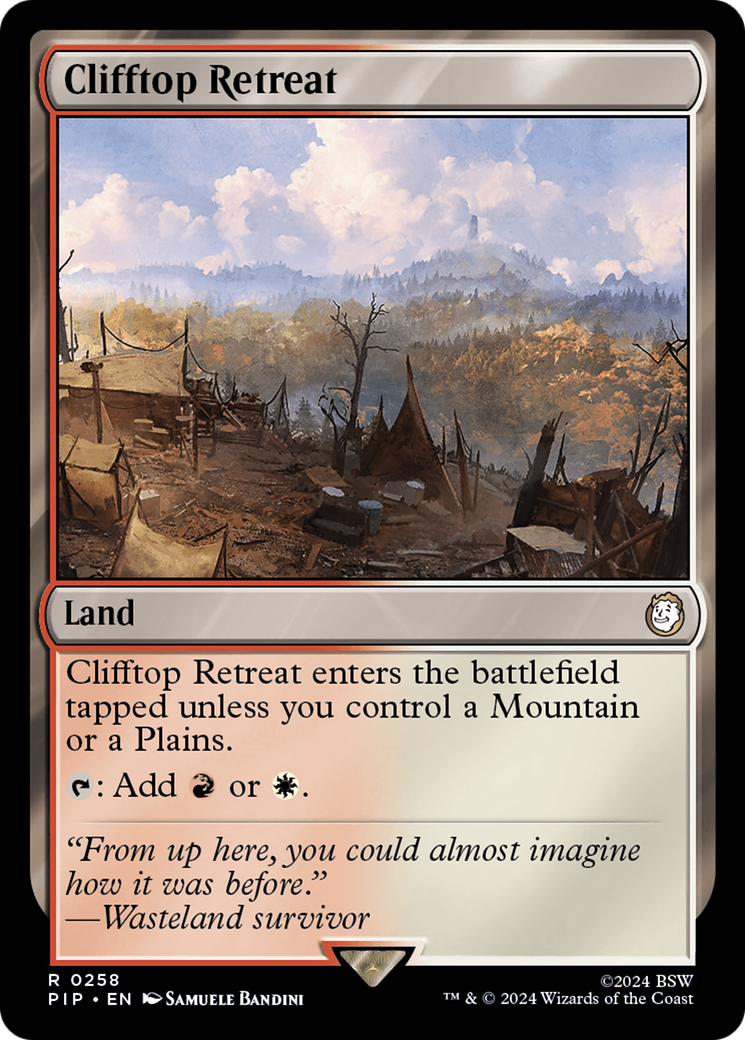
Clifftop Retreat
Clifftop Retreat
Land
This land enters tapped unless you control a Mountain or a Plains.
: Add or .
-
1
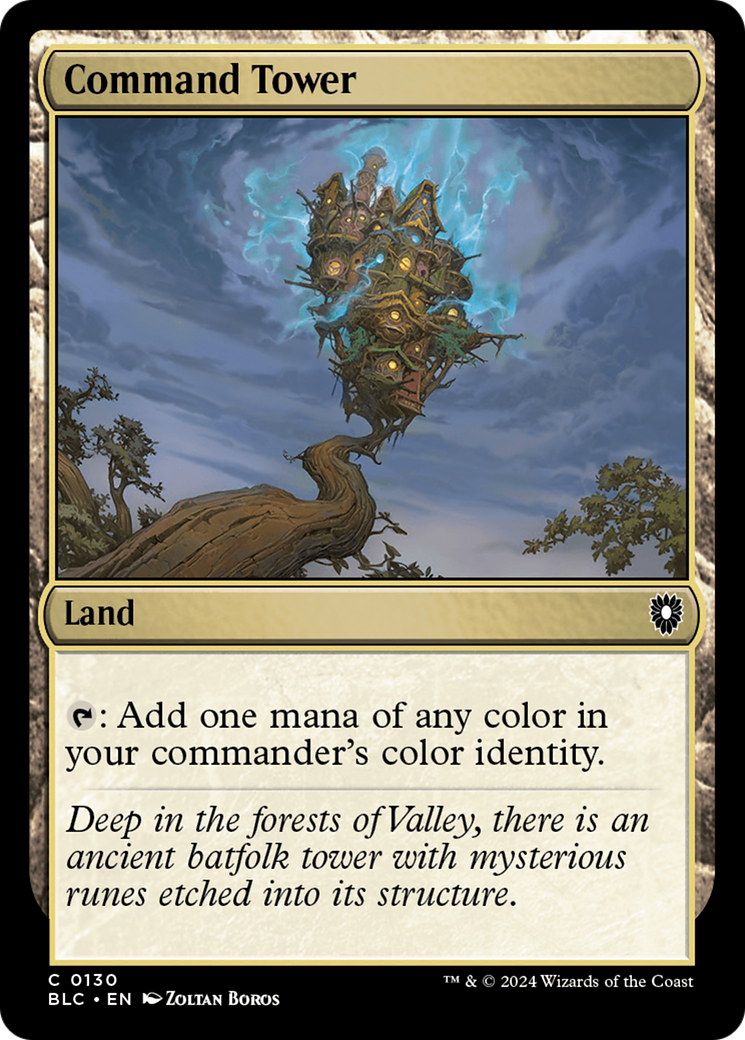
Command Tower
Command Tower
Land
: Add one mana of any color in your commander's color identity.
- If you have two commanders, the ability adds one mana of any color in their combined color identities.
- If your commander is a card that has no colors in its color identity, Command Tower's ability produces no mana. It doesn't produce .
- If you don't have a commander, Command Tower's ability produces no mana.
-
1
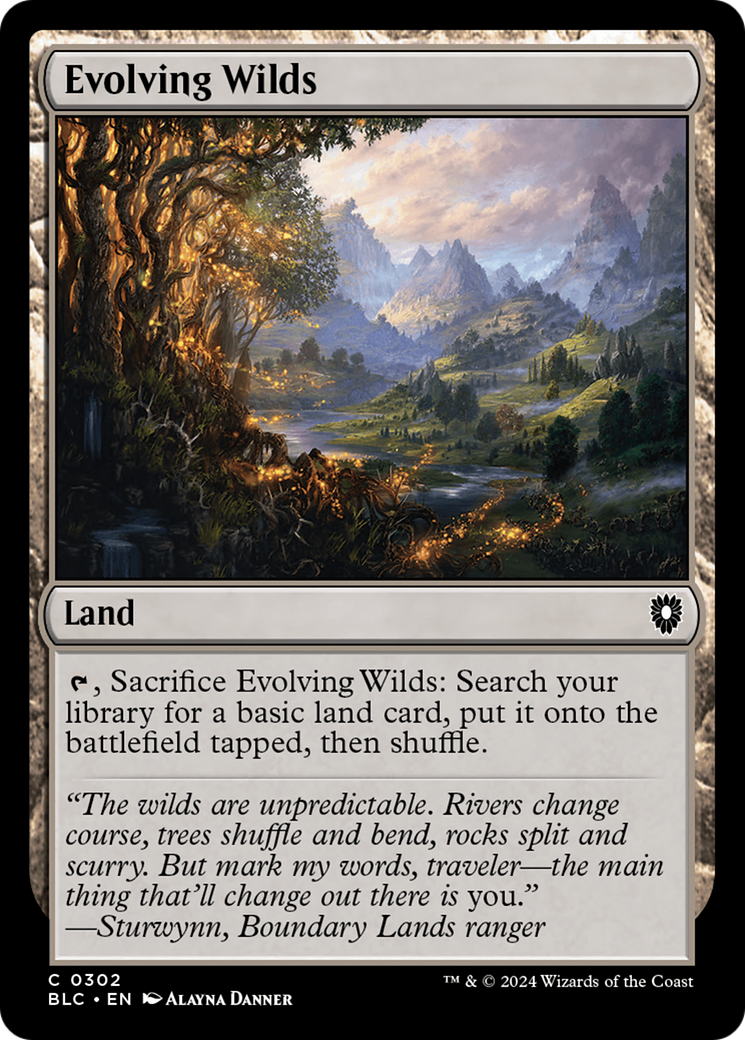
Evolving Wilds
Evolving Wilds
Land
, Sacrifice this land: Search your library for a basic land card, put it onto the battlefield tapped, then shuffle.
-
1
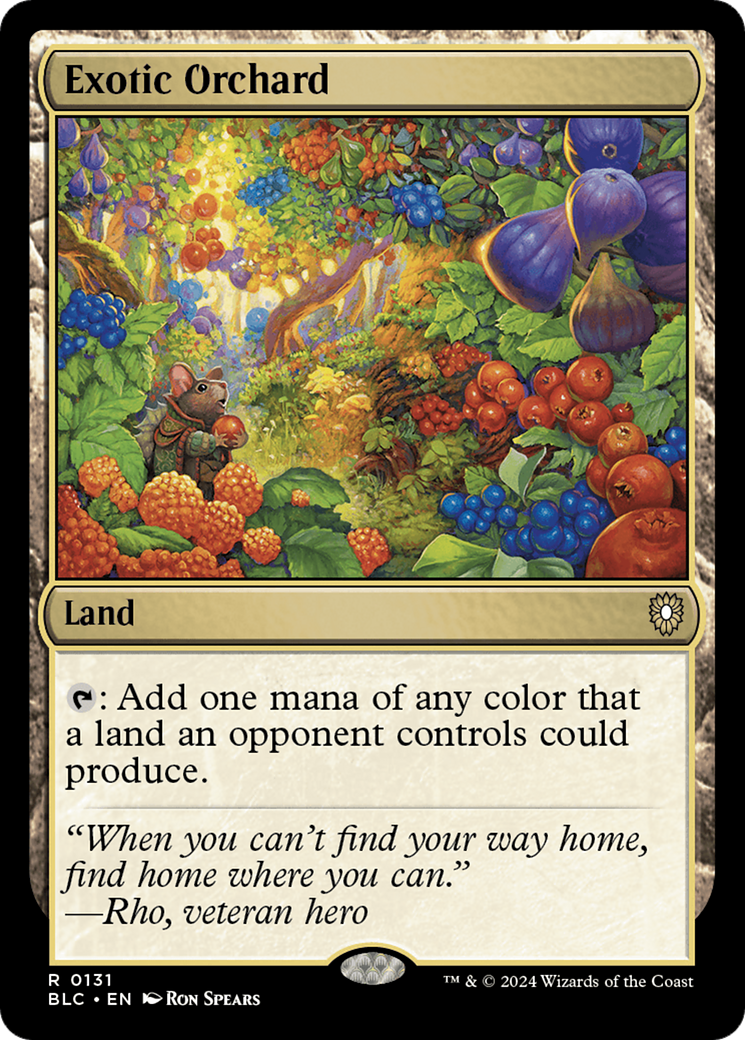
Exotic Orchard
Exotic Orchard
Land
: Add one mana of any color that a land an opponent controls could produce.
- The colors of mana are white, blue, black, red, and green. Exotic Orchard can't be tapped for colorless mana, even if a land an opponent controls could produce colorless mana.
- Exotic Orchard checks the effects of all mana-producing abilities of lands your opponents control, but it doesn't check their costs. For example, Vivid Crag has the ability " , Remove a charge counter from Vivid Crag: Add one mana of any color." If an opponent controls Vivid Crag and you control Exotic Orchard, you can tap Exotic Orchard for any color of mana. It doesn't matter whether Vivid Crag has a charge counter on it, and it doesn't matter whether it's untapped.
- When determining what colors of mana your opponents' lands could produce, Exotic Orchard takes into account any applicable replacement effects that would apply to those lands' mana abilities (such as Contamination's effect, for example). If there are more than one, consider them in any possible order.
- Exotic Orchard doesn't care about any restrictions or riders your opponents' lands (such as Ancient Ziggurat or Hall of the Bandit Lord) put on the mana they produce. It just cares about colors of mana.
- Lands that produce mana based only on what other lands "could produce" won't help each other unless some other land allows one of them to actually produce some type of mana. For example, if you control an Exotic Orchard and your opponent controls an Exotic Orchard and a Reflecting Pool, none of those lands would produce mana if their mana abilities were activated. On the other hand, if you control a Forest and an Exotic Orchard, and your opponent controls an Exotic Orchard and a Reflecting Pool, then each of those lands can be tapped to produce . Your opponent's Exotic Orchard can produce because you control a Forest. Your Exotic Orchard and your opponent's Reflecting Pool can each produce because your opponent's Exotic Orchard can produce .
-
1
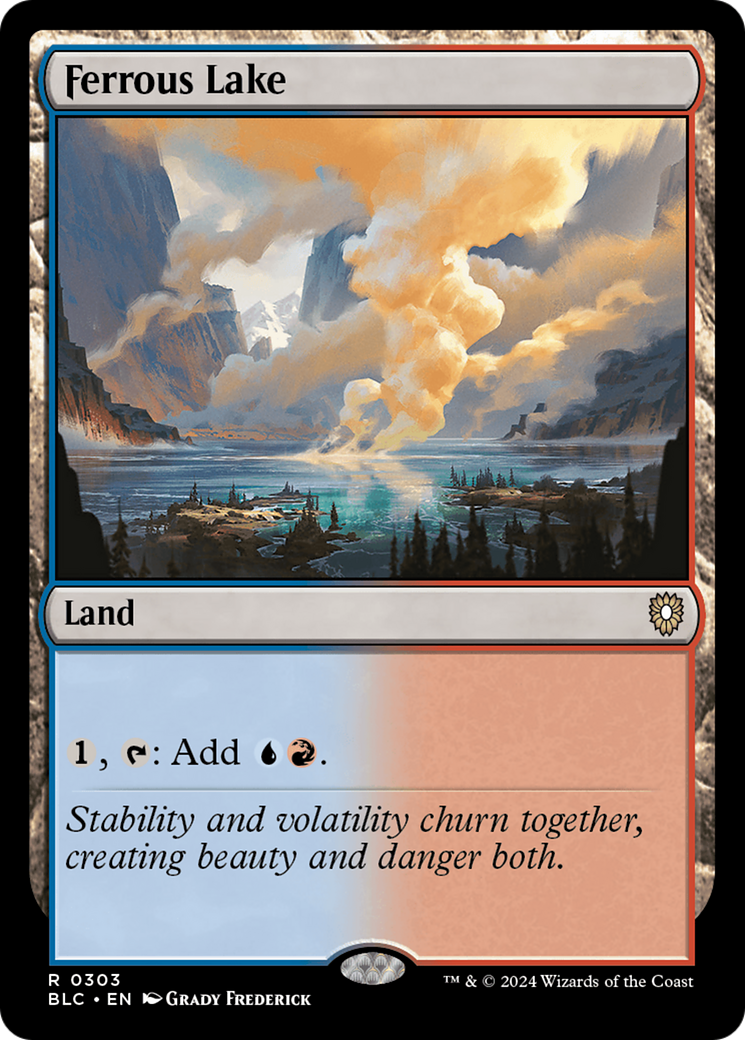
Ferrous Lake
Ferrous Lake
Land
, : Add .
-
1
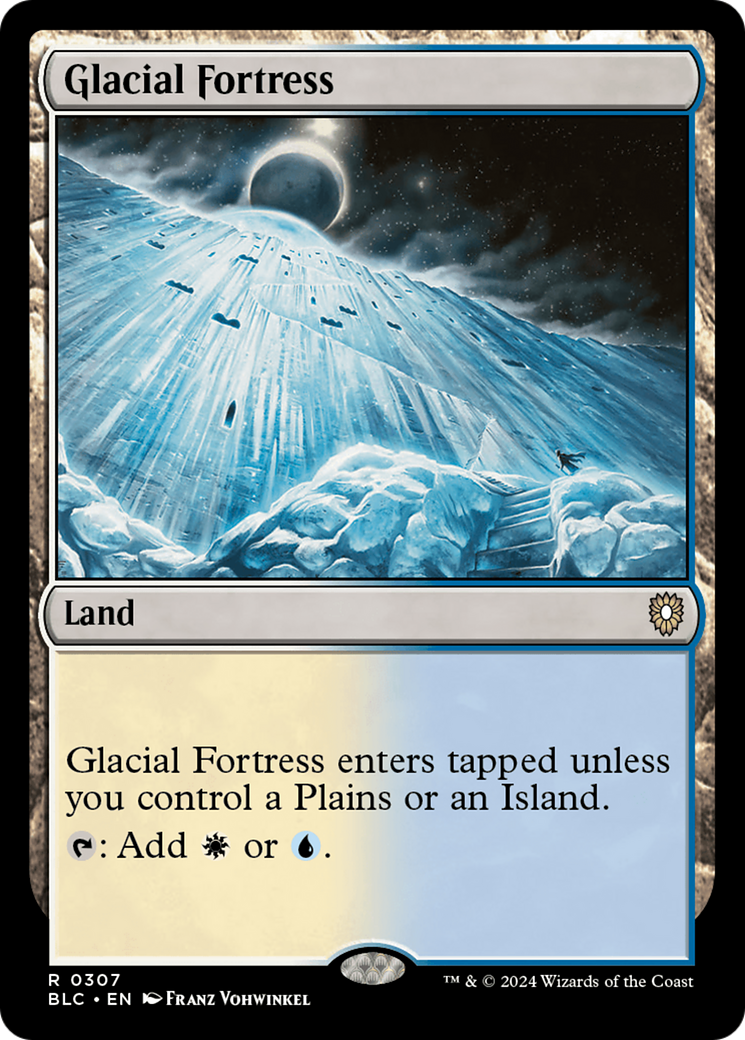
Glacial Fortress
Glacial Fortress
Land
This land enters tapped unless you control a Plains or an Island.
: Add or .
- This checks for lands you control with the land type Plains or Island, not for lands named Plains or Island. The lands it checks for don't have to be basic lands. For example, if you control Watery Grave (a nonbasic land with the land types Island and Swamp), Glacial Fortress will enter untapped.
- As this is entering, it checks for lands that are already on the battlefield. It won't see lands that are entering at the same time (due to Warp World, for example).
-
4
Mountain
Mountain
Basic Land — Mountain
( : Add .)
-
1
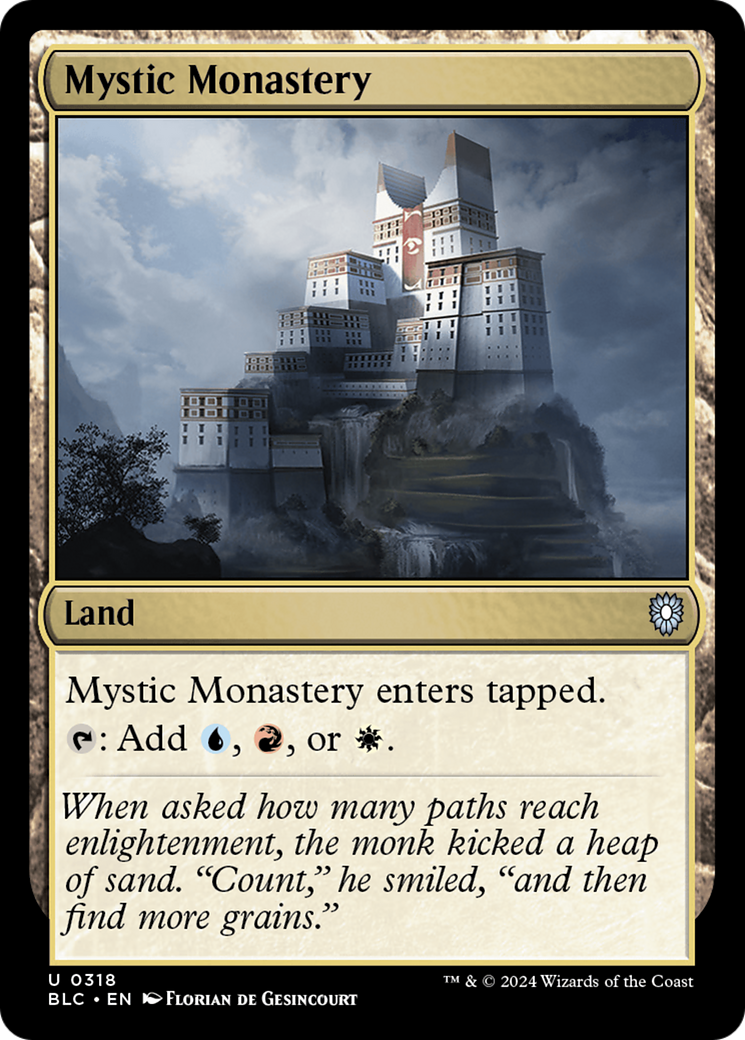
Mystic Monastery
Mystic Monastery
Land
This land enters tapped.
: Add , , or .
-
1
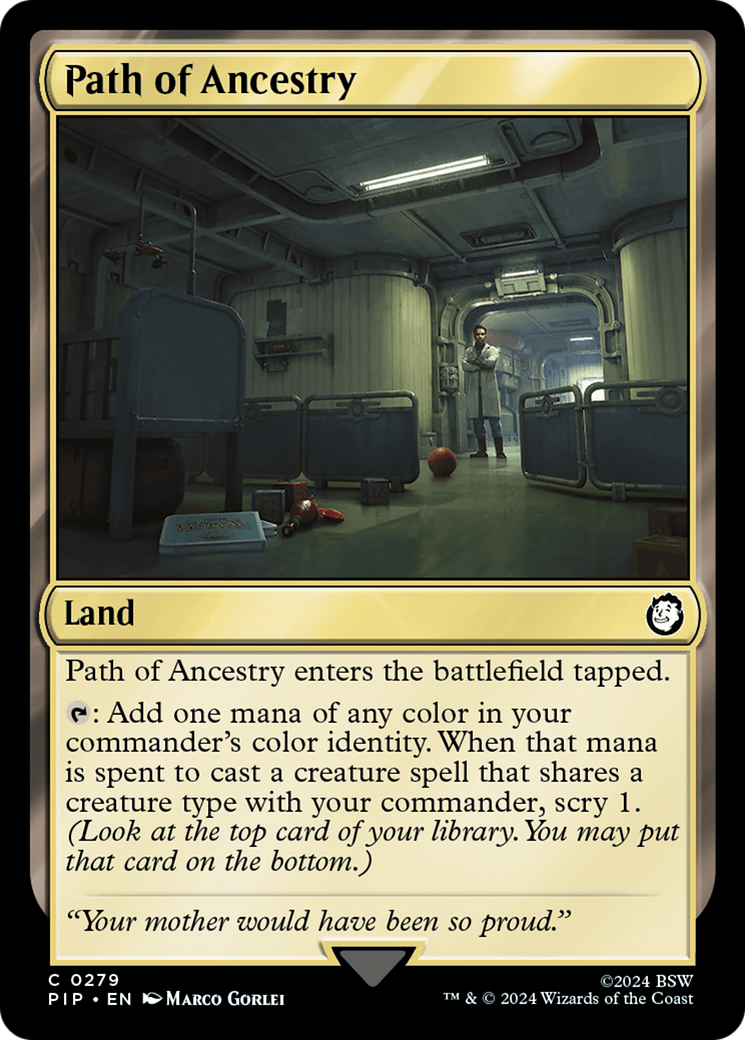
Path of Ancestry
Path of Ancestry
Land
This land enters tapped.
: Add one mana of any color in your commander's color identity. When that mana is spent to cast a creature spell that shares a creature type with your commander, scry 1. (Look at the top card of your library. You may put that card on the bottom.)
- Your commander's creature types are checked immediately after you cast a creature spell spending mana from Path of Ancestry's last ability. They aren't set before the game begins, and they may not be the same types your commander had when you activated that ability.
- If you have two commanders, the last ability adds one mana of any color in their combined color identities. When you spend that mana on a creature spell that shares a creature type with either of your commanders, you'll scry 1.
- If Path of Ancestry's last ability produces two mana (most likely due to Mana Reflection), spending those two mana to cast creature spells that share a creature type with your commander will cause two abilities to trigger. Each of those abilities will cause you to scry 1. You won't scry 2. This is true whether you spend the mana on one creature spell or two.
- If your commander has no creature types, it can't share a creature type with any spell that you cast.
- If you cast your commander with mana from Path of Ancestry, and your commander hasn't somehow lost all of its creature types while on the stack, you'll scry 1.
- If you don't have a commander, Path of Ancestry's ability produces no mana.
- If your commander is a card that has no colors in its color identity, Path of Ancestry's ability produces no mana. It doesn't produce .
-
9
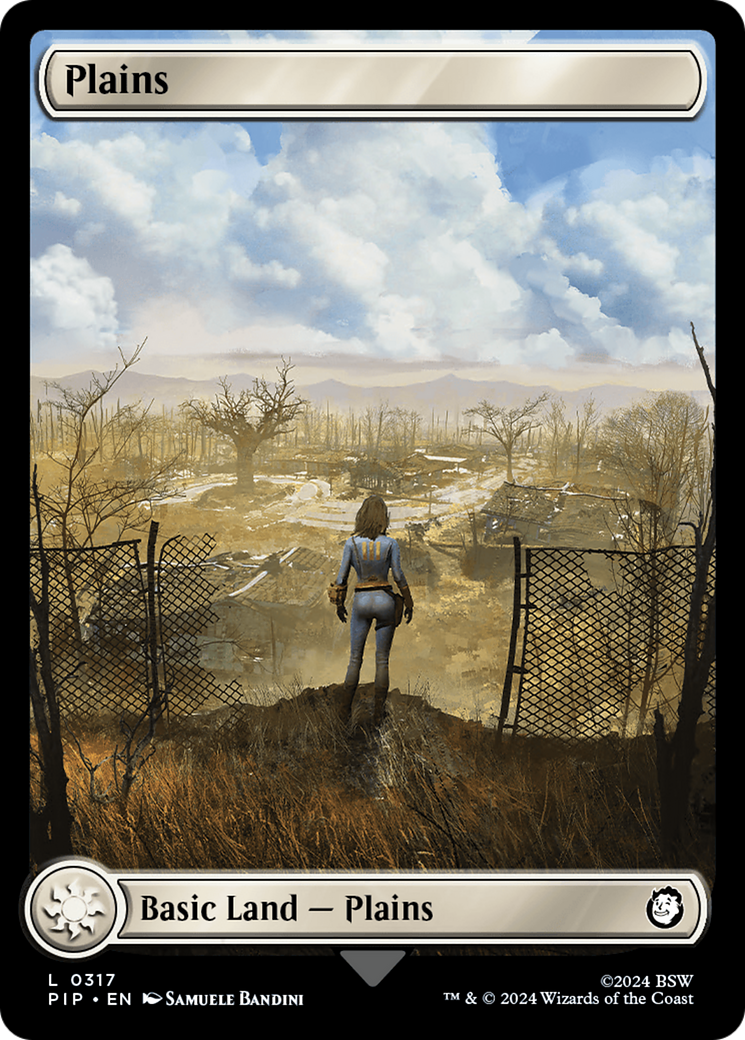
Plains
Plains
Basic Land — Plains
( : Add .)
-
1
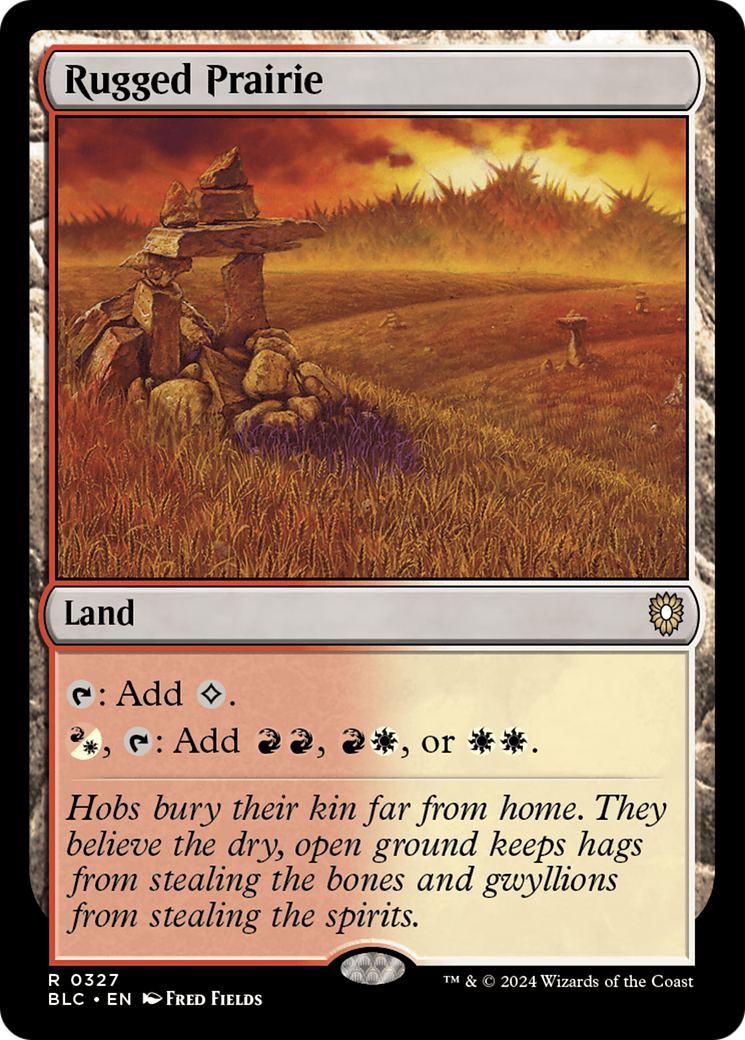
Rugged Prairie
Rugged Prairie
Land
: Add .
, : Add , , or .
-
1
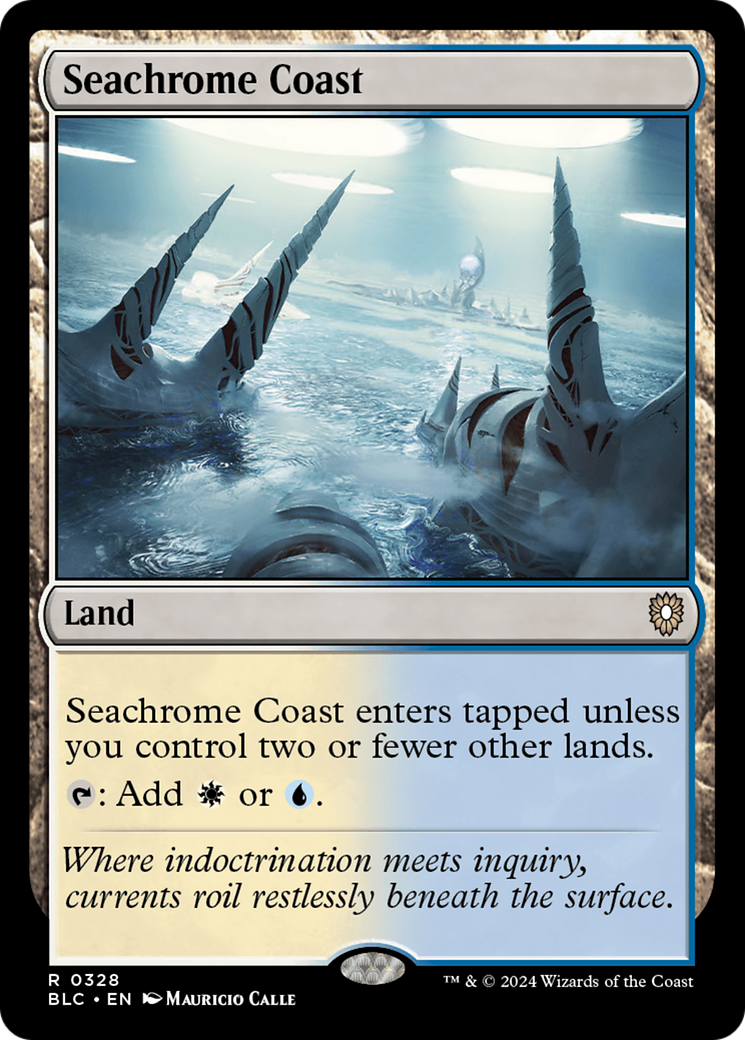
Seachrome Coast
Seachrome Coast
Land
This land enters tapped unless you control two or fewer other lands.
: Add or .
- If one of these lands enters the battlefield under your control and you control zero, one, or two other lands, it enters the battlefield untapped. If you control three or more other lands, however, it enters the battlefield tapped.
- If one of these lands enters the battlefield at the same time as one or more other lands (due to Oblivion Sower or Warp World, perhaps), it doesn't take those lands into consideration when determining how many other lands you control.
-
1
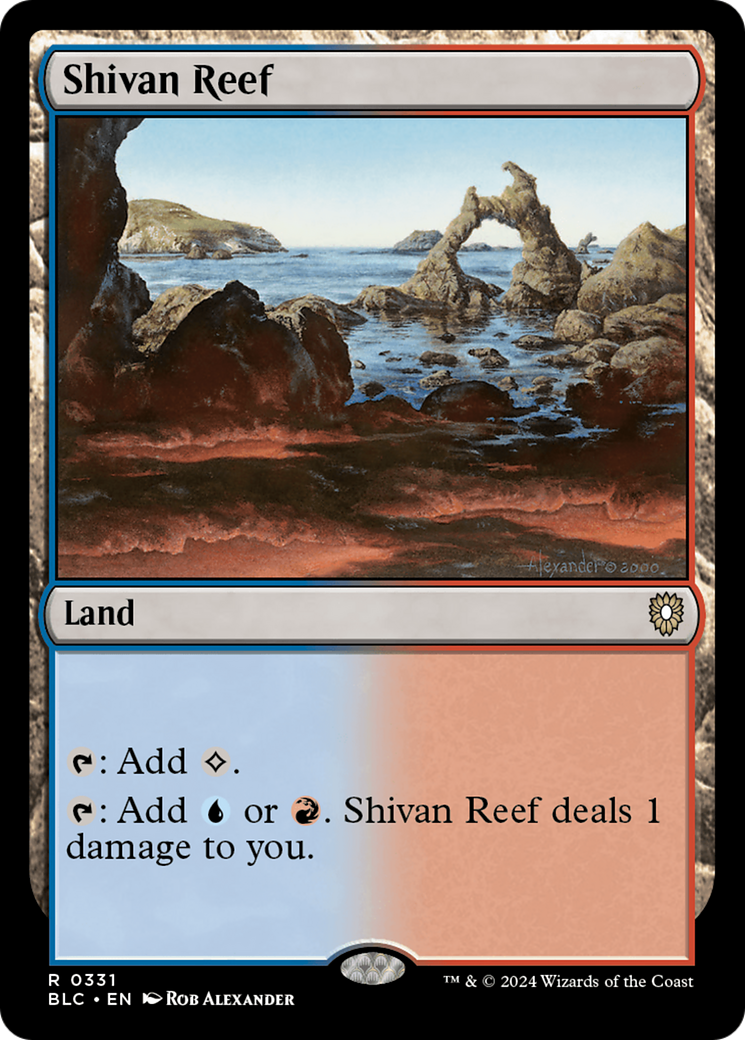
Shivan Reef
Shivan Reef
Land
: Add .
: Add or . This land deals 1 damage to you.
- The damage dealt to you is part of the second mana ability. It doesn't use the stack and can't be responded to.
- Like most lands, each land in this cycle is colorless. The damage dealt to you is dealt by a colorless source.
-
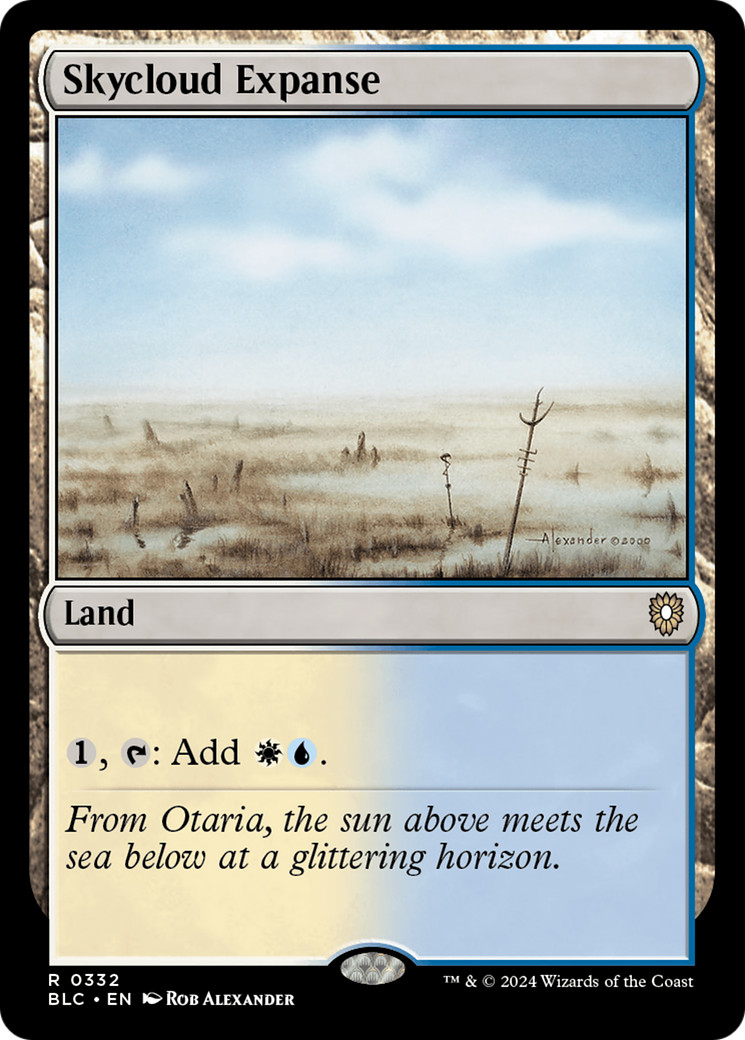
1
Skycloud Expanse
Skycloud Expanse
Land
, : Add .
-
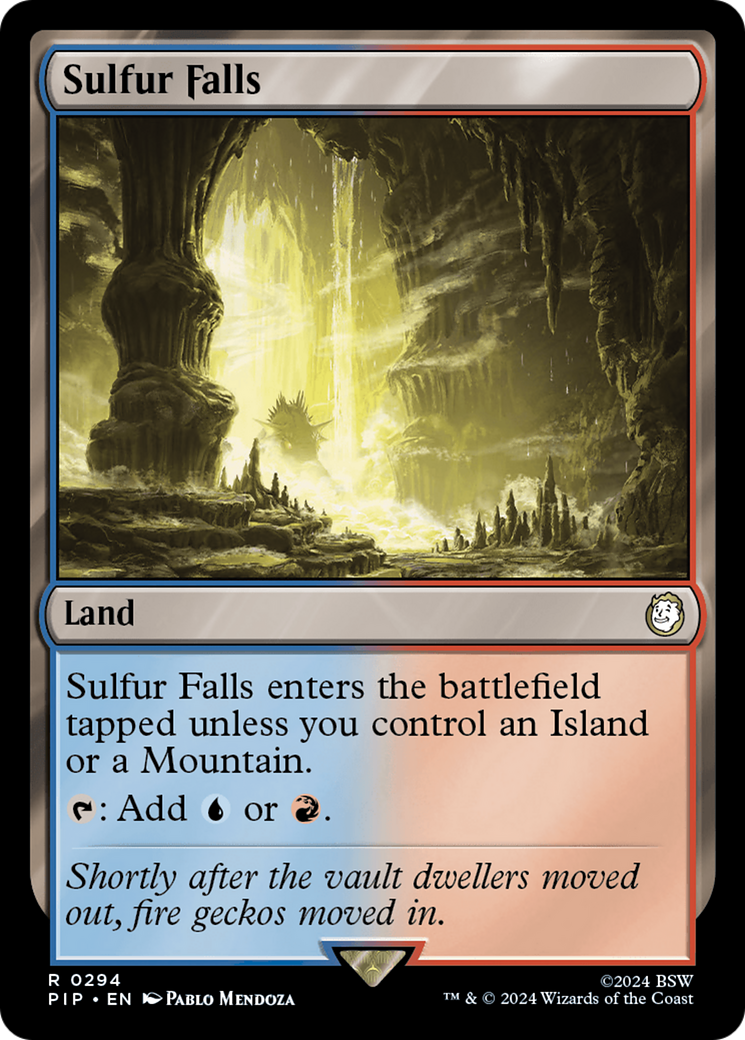
1
Sulfur Falls
Sulfur Falls
Land
This land enters tapped unless you control an Island or a Mountain.
: Add or .
-
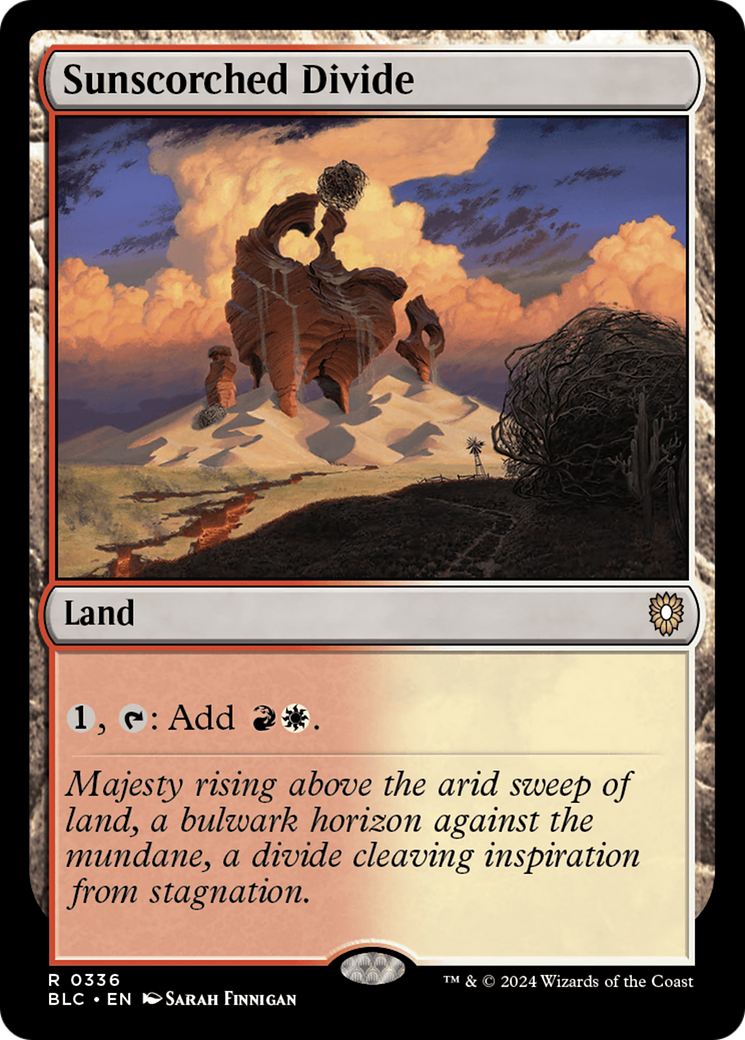
1
Sunscorched Divide
Sunscorched Divide
Land
, : Add .
-
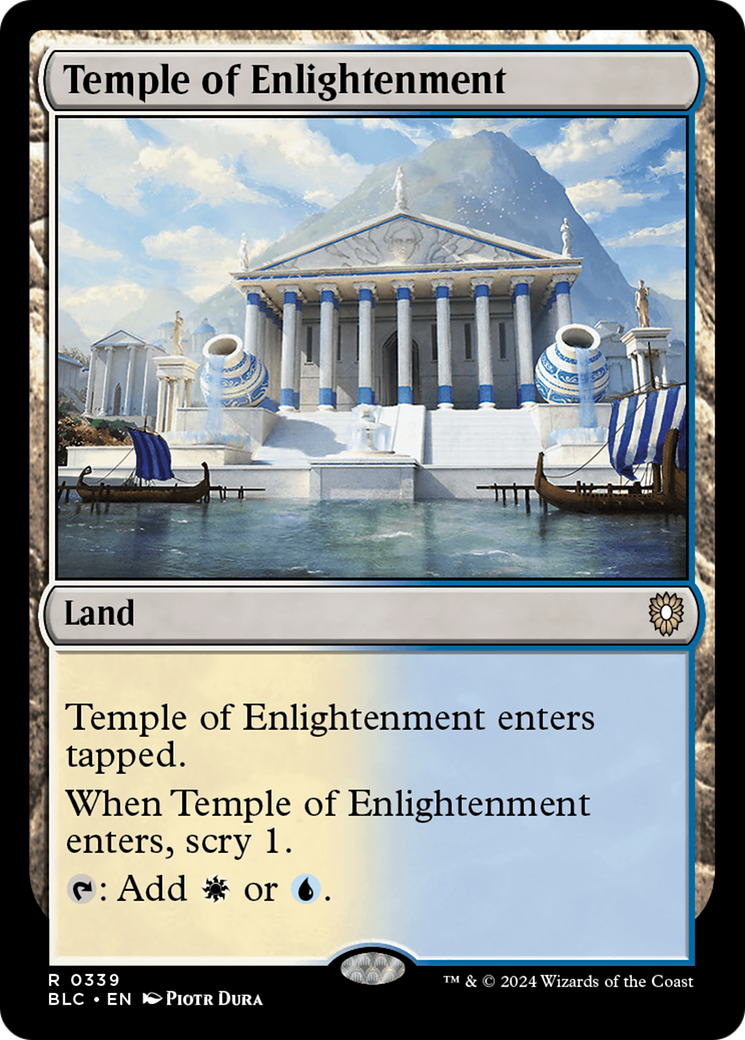
1
Temple of Enlightenment
Temple of Enlightenment
Land
This land enters tapped.
When this land enters, scry 1. (Look at the top card of your library. You may put that card on the bottom.)
: Add or .
- When you scry, you may put all the cards you look at back on top of your library, you may put all of those cards on the bottom of your library, or you may put some of those cards on top and the rest of them on the bottom.
- You choose how to order cards returned to your library after scrying no matter where you put them.
- You perform the actions stated on a card in sequence. For some spells and abilities, that means you'll scry last. For others, that means you'll scry and then perform other actions.
- Scry appears on some spells and abilities with one or more targets. If all of the spell or ability's targets are illegal when it tries to resolve, it won't resolve and none of its effects will happen. You won't scry.
-
1
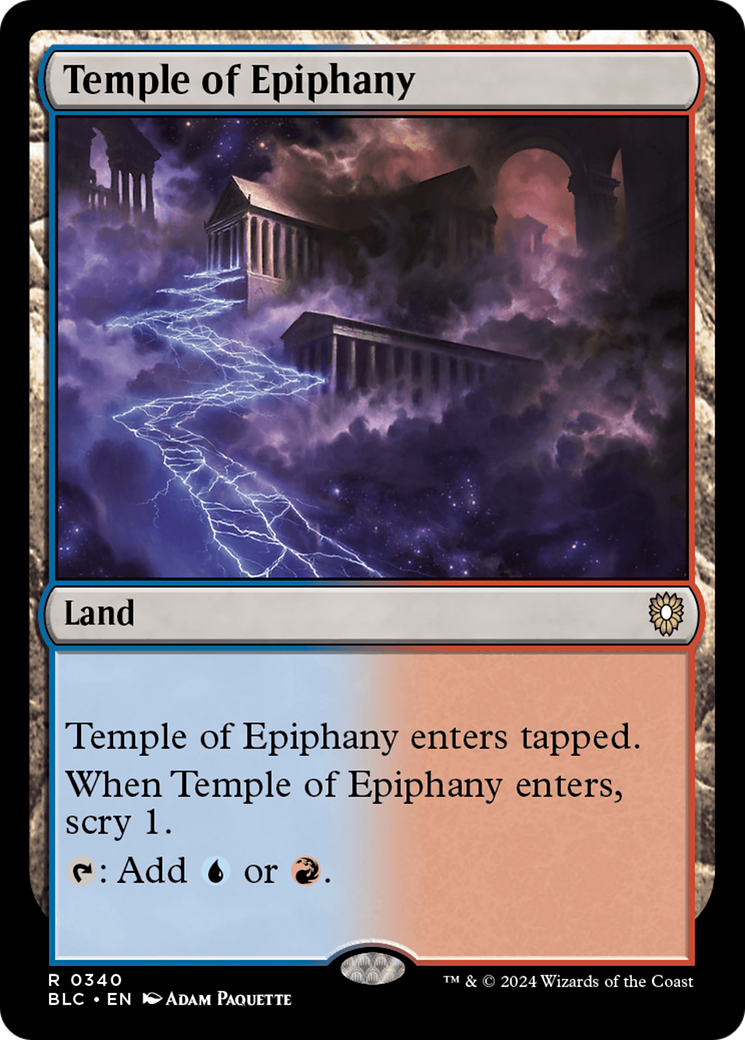
Temple of Epiphany
Temple of Epiphany
Land
This land enters tapped.
When this land enters, scry 1. (Look at the top card of your library. You may put that card on the bottom.)
: Add or .
-
1
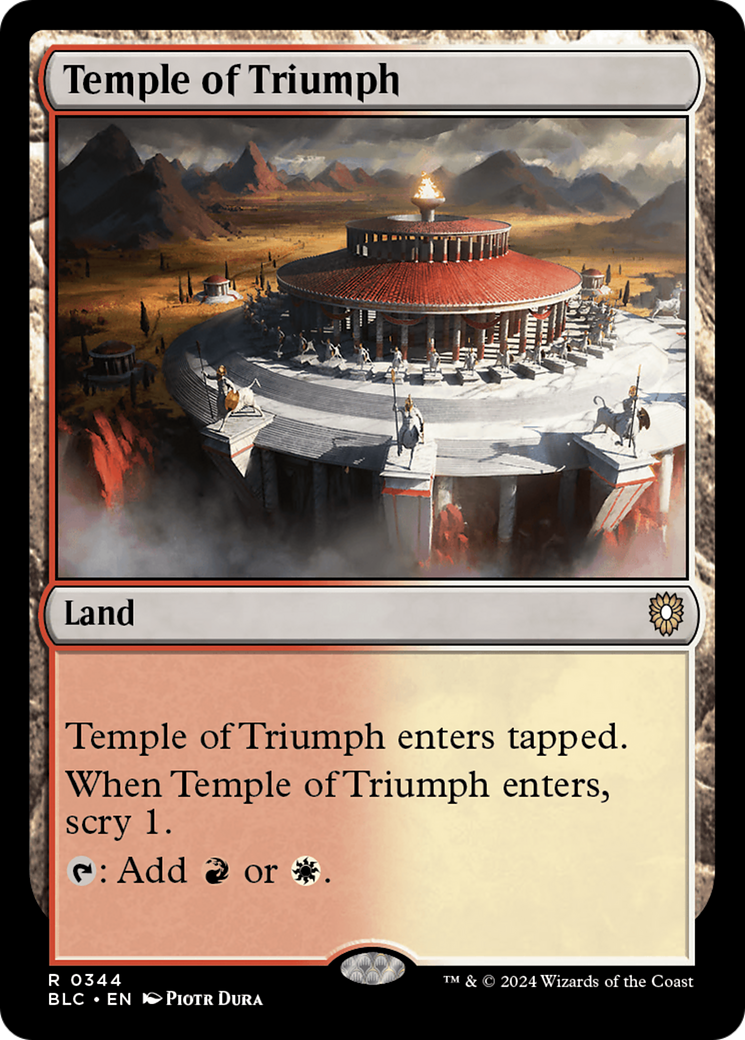
Temple of Triumph
Temple of Triumph
Land
This land enters tapped.
When this land enters, scry 1. (Look at the top card of your library. You may put that card on the bottom.)
: Add or .
- When you scry, you may put all the cards you look at back on top of your library, you may put all of those cards on the bottom of your library, or you may put some of those cards on top and the rest of them on the bottom.
- You choose how to order cards returned to your library after scrying no matter where you put them.
- You perform the actions stated on a card in sequence. For some spells and abilities, that means you'll scry last. For others, that means you'll scry and then perform other actions.
- Scry appears on some spells and abilities with one or more targets. If all of the spell or ability's targets are illegal when it tries to resolve, it won't resolve and none of its effects will happen. You won't scry.
-
1
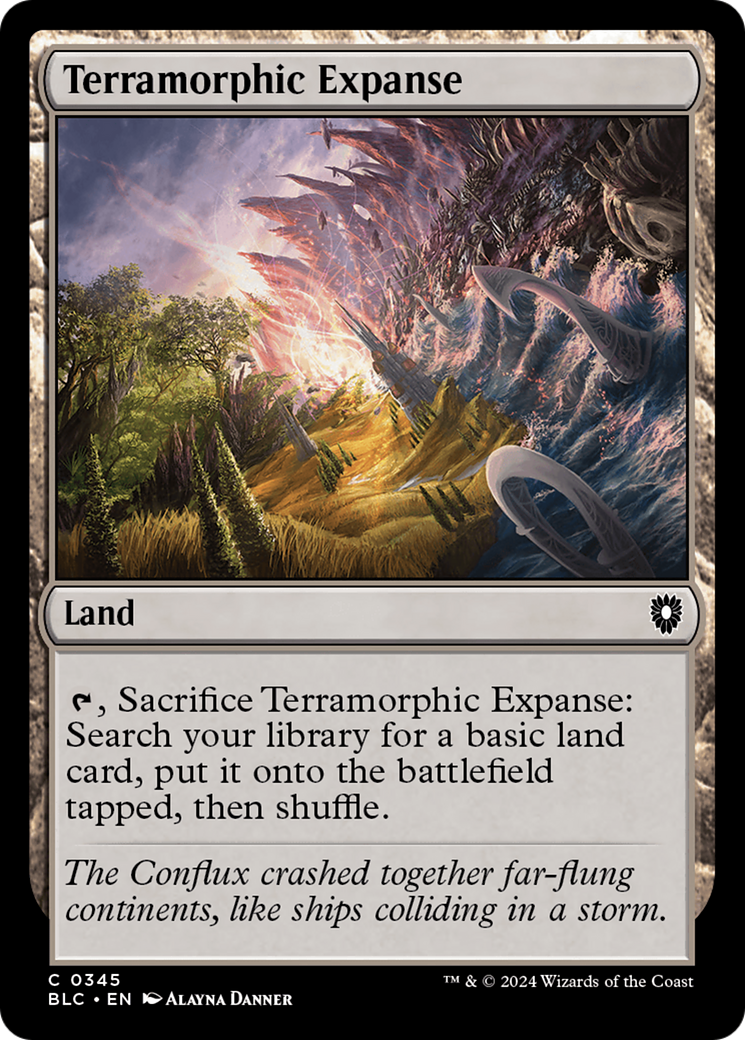
Terramorphic Expanse
Terramorphic Expanse
Land
, Sacrifice this land: Search your library for a basic land card, put it onto the battlefield tapped, then shuffle.
-
1
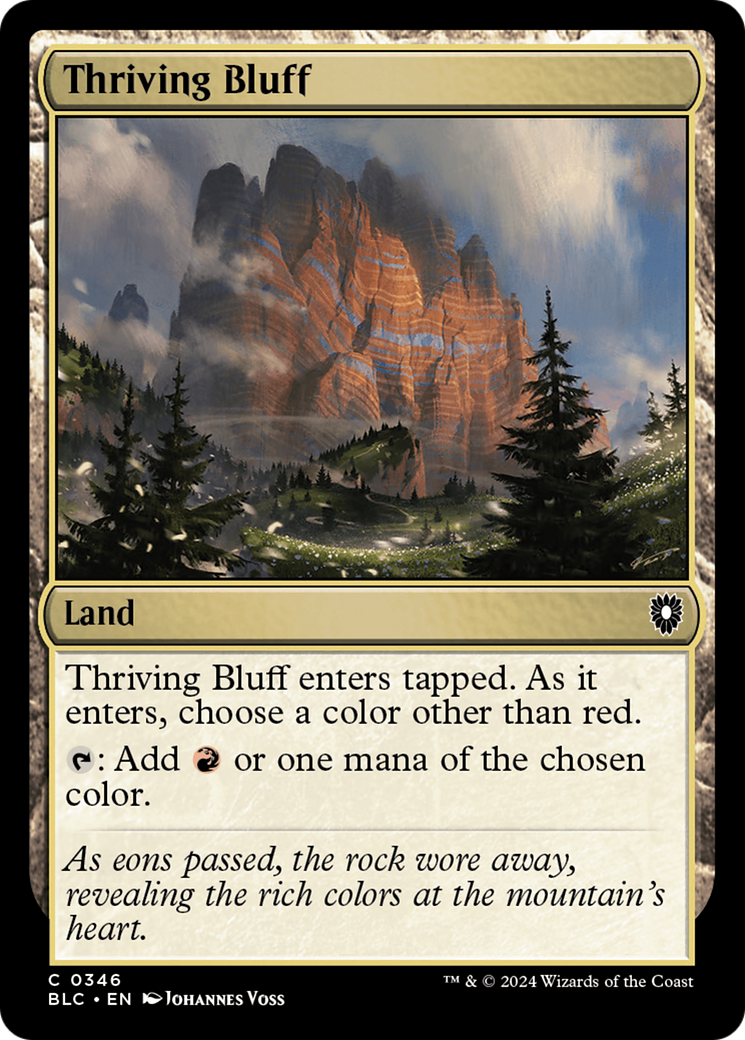
Thriving Bluff
Thriving Bluff
Land
This land enters tapped. As it enters, choose a color other than red.
: Add or one mana of the chosen color.
-
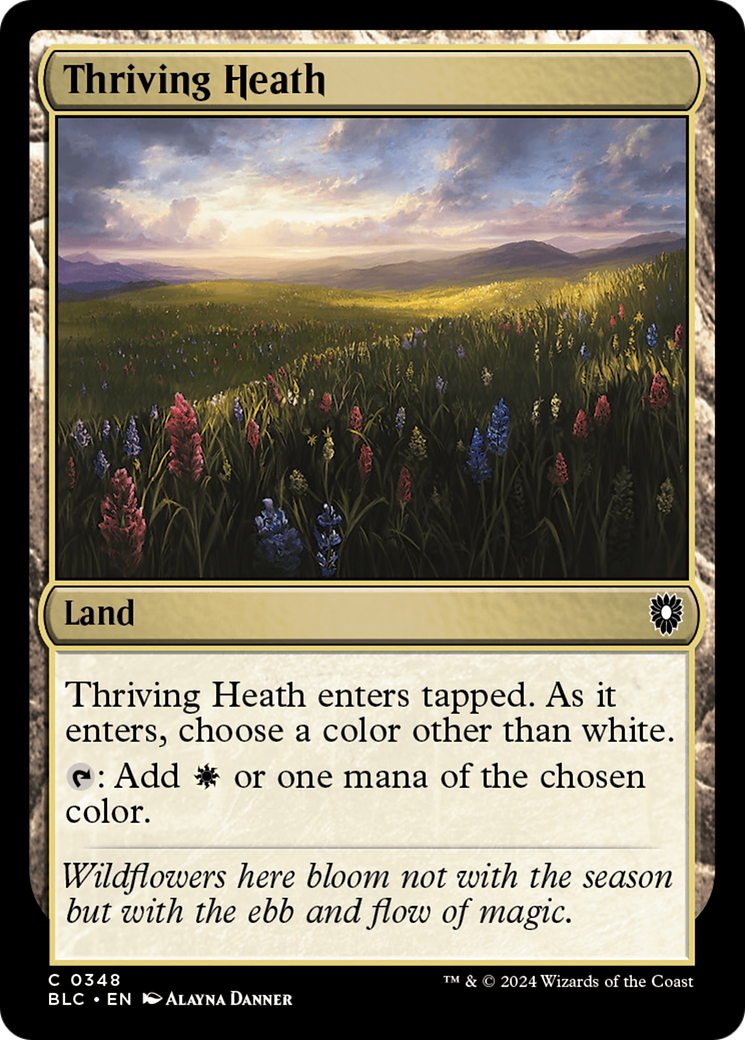
1
Thriving Heath
Thriving Heath
Land
This land enters tapped. As it enters, choose a color other than white.
: Add or one mana of the chosen color.
-
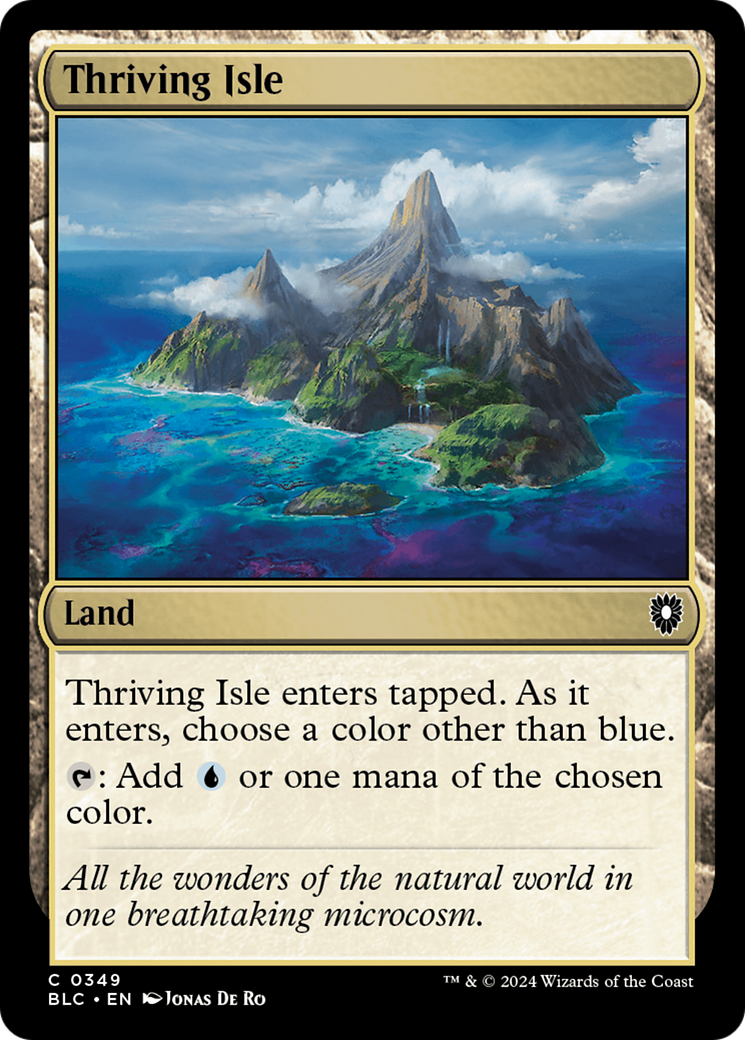
1
Thriving Isle
Thriving Isle
Land
This land enters tapped. As it enters, choose a color other than blue.
: Add or one mana of the chosen color.
White 21
-
1
Angel of the Ruins
Angel of the Ruins
Artifact Creature — Angel
5/7
Flying
When this creature enters, exile up to two target artifacts and/or enchantments.
Plainscycling ( , Discard this card: Search your library for a Plains card, reveal it, put it into your hand, then shuffle.)
-
1
Blade Splicer
Blade Splicer
Creature — Phyrexian Human Artificer
1/1
When this creature enters, create a 3/3 colorless Phyrexian Golem artifact creature token.
Golems you control have first strike.
-
1
Boss's Chauffeur
Boss's Chauffeur
Creature — Elf Citizen
0/0
This creature enters with a number of +1/+1 counters on it equal to one plus the number of other creatures you control.
Alliance — Whenever another creature you control enters, put a +1/+1 counter on this creature.
When this creature dies, create a 1/1 green and white Citizen creature token for each +1/+1 counter on it.
-
1
Cut a Deal
Cut a Deal
Sorcery
Each opponent draws a card, then you draw a card for each opponent who drew a card this way.
- Although the draws are not optional, if an opponent doesn't draw a card, perhaps because a replacement effect replaced the draw with another effect, that player is not counted when determining how many cards you draw.
- If an opponent drew more than one card this way due to a replacement effect, you still draw only one card for that player.
-
1
Dusk // Dawn
//
Dusk
Sorcery
- Once you've started to cast a spell with aftermath from your graveyard, the card is immediately moved to the stack. Opponents can't try to stop the ability by exiling the card with an effect such as that of Crook of Condemnation.
- All split cards have two card faces on a single card, and you put a split card onto the stack with only the half you're casting. The characteristics of the half of the card you didn't cast are ignored while the spell is on the stack. For example, if an effect prevents you from casting green spells, you can cast Destined of Destined // Lead, but not Lead.
- Each split card is a single card. For example, if you discard one, you've discarded one card, not two. If an effect counts the number of instant and sorcery cards in your graveyard, Destined // Lead counts once, not twice.
- Each split card has two names. If an effect instructs you to choose a card name, you may choose one, but not both.
- While not on the stack, the characteristics of a split card are the combination of its two halves. For example, Destined // Lead is a green and black card, it is both an instant card and a sorcery card, and its mana value is 6. This means that if an effect allows you to cast a card with mana value 2 from your hand, you can't cast Destined. This is a change from the previous rules for split cards.
- Split cards with aftermath have a new frame treatment—the half you can cast from your hand is oriented the same as other cards you'd cast from your hand, while the half you can cast from your graveyard is a traditional split card half. This frame treatment is for your convenience and has no rules significance.
- If another effect allows you to cast a split card with aftermath from any zone other than a graveyard, you can't cast the half with aftermath.
- If another effect allows you to cast a split card with aftermath from a graveyard, you may cast either half. If you cast the half that has aftermath, you'll exile the card if it would leave the stack.
- A spell with aftermath cast from a graveyard will always be exiled afterward, whether it resolves, it's countered, or it leaves the stack in some other way.
- If you cast the first half of a split card with aftermath during your turn, you'll have priority immediately after it resolves. You can cast the half with aftermath from your graveyard before any player can take any other action if it's legal for you to do so.
-
1
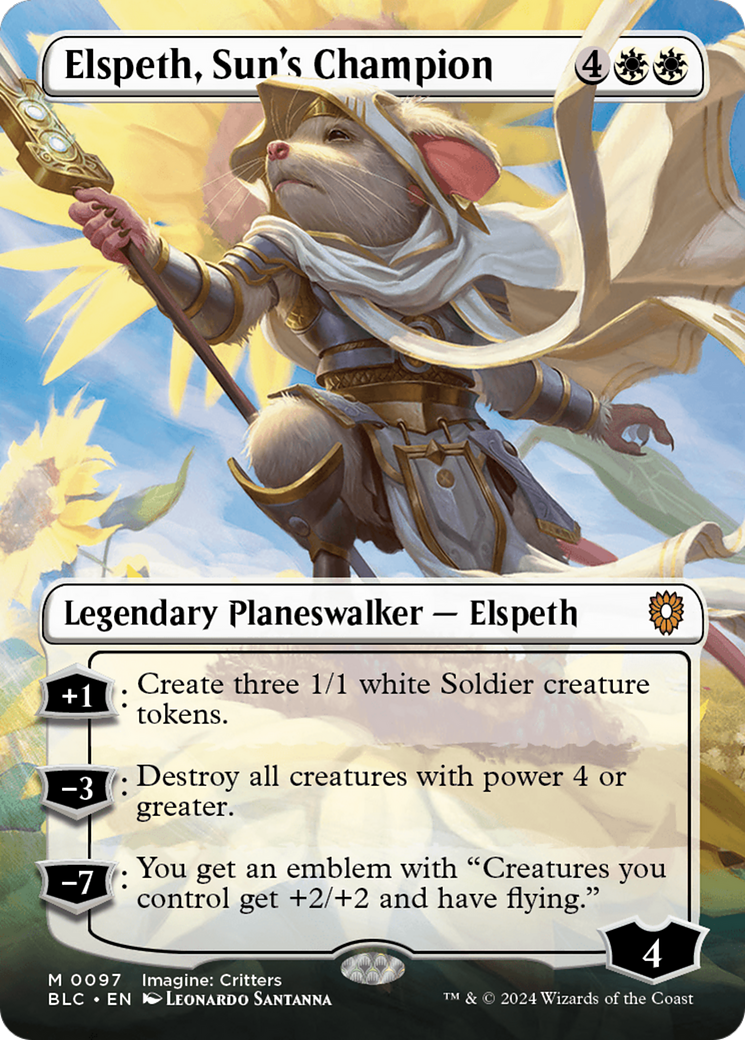
Elspeth, Sun's Champion
Elspeth, Sun's Champion
Legendary Planeswalker — Elspeth
+1: Create three 1/1 white Soldier creature tokens.
−3: Destroy all creatures with power 4 or greater.
−7: You get an emblem with "Creatures you control get +2/+2 and have flying."
-
1
Hanged Executioner
Hanged Executioner
Creature — Spirit
1/1
Flying
When this creature enters, create a 1/1 white Spirit creature token with flying.
, Exile this creature: Exile target creature.
-
1
Inspiring Overseer
Inspiring Overseer
Creature — Angel Cleric
2/1
Flying
When this creature enters, you gain 1 life and draw a card.
-
1
Jacked Rabbit
Jacked Rabbit
Creature — Rabbit Warrior
1/2
Ravenous (This creature enters with X +1/+1 counters on it. If X is 5 or more, draw a card when it enters.)
Whenever this creature attacks, create a number of 1/1 white Rabbit creature tokens equal to this creature's power.
- A creature with ravenous gets its counters as it enters. It doesn't enter first and then get its counters. Any triggered ability that looks for a creature with a certain power or toughness entering will see the counters when it checks to see if it should trigger.
- The triggered ability that checks to see if X is 5 or greater refers to the value of X that was chosen as the spell was cast, which may be different from the number of counters it entered with if there are replacement effects involved. This is also true for any other ability that it has which refers to X and triggers when it enters.
- If another permanent enters as a copy of a creature with ravenous, it will not enter with any counters from the ravenous ability.
- If a permanent spell with ravenous is copied, the copy will have the same value for X, and the token permanent that the spell becomes as it enters will enter with X counters.
- If Jacked Rabbit leaves the battlefield while its last ability is on the stack, use its power as it last existed on the battlefield to determine how many Rabbit tokens to create.
-
1
Jazal Goldmane
Jazal Goldmane
Legendary Creature — Cat Warrior
4/4
First strike (This creature deals combat damage before creatures without first strike.)
: Attacking creatures you control get +X/+X until end of turn, where X is the number of attacking creatures.
-
1
Loyal Warhound
Loyal Warhound
Creature — Dog
3/1
Vigilance
When this creature enters, if an opponent controls more lands than you, search your library for a basic Plains card, put it onto the battlefield tapped, then shuffle.
-
1
Luminous Broodmoth
Luminous Broodmoth
Creature — Insect
3/4
Flying
Whenever a creature you control without flying dies, return it to the battlefield under its owner's control with a flying counter on it.
- If Luminous Broodmoth dies at the same time as a creature without flying, its ability triggers for that creature.
- If Luminous Broodmoth dies after losing flying but not losing its triggered ability, its ability will trigger for itself.
- If a merged creature dies and that creature didn't have flying, each card that was part of that merged creature is returned to the battlefield. Each one has a flying counter on it.
- Luminous Broodmoth's ability triggers if a token creature without flying dies, but the token won't be returned to the battlefield. If that token was a merged creature, any cards that were part of it will be returned to the battlefield.
-
1
Martial Coup
Martial Coup
Sorcery
Create X 1/1 white Soldier creature tokens. If X is 5 or more, destroy all other creatures.
- Martial Coup checks the number you chose for X, not the amount of mana you actually spent.
- You do what the spell says in order. If X is 5 or more, you'll put the Soldier tokens onto the battlefield, then you'll destroy all other creatures.
- No one can cast spells or activate abilities between the time the Soldier tokens are put onto the battlefield and the time all other creatures are destroyed. For example, you can't sacrifice one of those Soldier tokens to regenerate a Skeletal Kathari.
-
1
Murmuration
Murmuration
Enchantment
Birds you control get +1/+1 and have vigilance.
At the beginning of your end step, for each spell you've cast this turn, create a 1/2 blue Bird creature token with flying named Storm Crow.
- Murmuration's last ability counts spells you cast earlier in the turn even if you didn't control Murmuration as you cast them and even if those spells were countered or otherwise didn't resolve.
- The number of spells you've cast is counted only as Murmuration's last ability resolves. For example, say you've cast two spells this turn, and with Murmuration's last ability on the stack, you cast a Blizzard Strix (a Bird creature spell with flash that may have been chosen for this example due to being an adorable owl). When Murmuration's ability resolves, you'll have cast three spells so far this turn, so you'll create three Storm Crow tokens. Caw!
-
1
Path to Exile
Path to Exile
Instant
Exile target creature. Its controller may search their library for a basic land card, put that card onto the battlefield tapped, then shuffle.
- If the target creature is an illegal target by the time Path to Exile tries to resolve, the spell won't resolve. The creature's controller won't search for a basic land card.
- The controller of the exiled creature isn't required to search their library for a basic land. If that player doesn't, the player won't shuffle their library.
-
1
Restoration Angel
Restoration Angel
Creature — Angel
3/4
Flash
Flying
When this creature enters, you may exile target non-Angel creature you control, then return that card to the battlefield under your control.
- Once the exiled creature returns, it's considered a new object with no relation to the object that it was. Auras attached to the exiled creature will be put into their owners' graveyards. Equipment attached to the exiled creature will become unattached and remain on the battlefield. Any counters on the exiled creature will cease to exist.
- If a token is exiled this way, it will cease to exist and won't return to the battlefield.
- When an effect returns the exiled card "under your control," you control it indefinitely after that. If you had temporarily gained control of a creature, it won't return to its previous controller. In a multiplayer game, if a player leaves the game, all cards that player owns leave as well. If you leave the game, a creature you took with Restoration Angel's effect is exiled.
-
1
Selfless Spirit
Selfless Spirit
Creature — Spirit Cleric
2/1
Flying
Sacrifice this creature: Creatures you control gain indestructible until end of turn.
- The set of creatures affected by Selfless Spirit's last ability is determined as the ability resolves. Creatures you begin to control later in the turn won't gain indestructible.
-
1
Skyclave Apparition
Skyclave Apparition
Creature — Kor Spirit
2/2
When this creature enters, exile up to one target nonland, nontoken permanent you don't control with mana value 4 or less.
When this creature leaves the battlefield, the exiled card's owner creates an X/X blue Illusion creature token, where X is the mana value of the exiled card.
- If a creature on the battlefield has in its mana cost, X is considered to be 0.
- If Skyclave Apparition leaves the battlefield before its first ability resolves, the ability still exiles the target permanent.
- If there's no exiled card when Skyclave Apparition leaves the battlefield (most likely because its first ability hasn't resolved yet), no player creates a token.
- If Skyclave Apparition's first ability exiled more than one card owned by a single player, that player creates a token with power and toughness equal to the sum of those cards' mana values. If the first ability exiled cards owned by more than one player, each of those players creates a token with power and toughness equal to the sum of the mana values of all cards exiled by the first ability.
-
1
Spirited Companion
Spirited Companion
Enchantment Creature — Dog
1/1
When this creature enters, draw a card.
-
1
Storm of Souls
Storm of Souls
Sorcery
Return all creature cards from your graveyard to the battlefield. Each of them is a 1/1 Spirit with flying in addition to its other types. Exile Storm of Souls.
-
1
Sun Titan
Sun Titan
Creature — Giant
6/6
Vigilance
Whenever this creature enters or attacks, you may return target permanent card with mana value 3 or less from your graveyard to the battlefield.
- If a card in your graveyard has no mana symbols in its upper right corner (because it's a land card, for example), its mana value is 0.
- If the mana cost of a card in your graveyard includes , X is considered to be 0.
- A permanent card is an artifact, creature, enchantment, land, or planeswalker card.
- The mana value of a card in your graveyard is determined solely by the mana symbols printed in its upper right corner. The mana value is the total amount of mana in that cost, regardless of color. For example, a card with mana cost has mana value 5.
Blue 16
-
1
Aether Channeler
Aether Channeler
Creature — Human Wizard
2/1
When this creature enters, choose one —
- Create a 1/1 white Bird creature token with flying.
- Return another target nonland permanent to its owner's hand.
- Draw a card.
-
1
Aetherize
Aetherize
Instant
Return all attacking creatures to their owner's hand.
- An "attacking creature" is one that has been declared as an attacker this combat, or one that was put onto the battlefield attacking this combat. Unless that creature leaves combat, it continues to be an attacking creature through the end of combat step, even if the player it was attacking has left the game, or the planeswalker it was attacking has left combat. There's no such thing as an attacking creature outside of the combat phase.
-
1
Bident of Thassa
Bident of Thassa
Legendary Enchantment Artifact
Whenever a creature you control deals combat damage to a player, you may draw a card.
, : Creatures your opponents control attack this turn if able.
- The controller of each attacking creature still chooses which player or planeswalker that creature attacks.
- If a creature can't attack for any reason (such as being tapped or having come under that player's control that turn), then it doesn't attack. If there's a cost associated with having a creature attack, the player isn't forced to pay that cost, so it doesn't have to attack in that case either.
-
1
Chart a Course
Chart a Course
Sorcery
Draw two cards. Then discard a card unless you attacked this turn.
-
1
Curiosity Crafter
Curiosity Crafter
Creature — Bird Wizard
3/3
Flying
You have no maximum hand size.
Whenever a creature token you control deals combat damage to a player, draw a card.
-
1
Fortune Teller's Talent
Fortune Teller's Talent
Enchantment — Class
(Gain the next level as a sorcery to add its ability.)
You may look at the top card of your library any time.
: Level 2
As long as you've cast a spell this turn, you may play cards from the top of your library.
: Level 3
Spells you cast from anywhere other than your hand cost less to cast.
- You can look at the top card of your library whenever you want (with one restriction; see below), even if you don't have priority. This action doesn't use the stack. Knowing what that card is becomes part of the information you have access to, just like you can look at the cards in your hand.
- If the top card of your library changes while you're casting a spell, playing a land, or activating an ability, you can't look at the new top card until you finish doing so. This means that if you cast a spell from the top of your library, you can't look at the next one until you're done paying for that spell.
- You must pay all costs and follow all timing rules for lands played and spells cast from the top of your library this way.
- The cost reduction applies only to generic mana in the total cost of spells you cast from anywhere other than your hand.
- To determine the total cost of a spell, start with the mana cost or alternative cost you're paying (such as a flashback cost), add any cost increases (such as kicker costs), then apply any cost reductions (such as that of this ability). The mana value of the spell is determined by only its mana cost, no matter what the total cost to cast that spell was.
- Each Class has five abilities. The three in the major sections of its text box are class abilities. Class abilities can be static, activated, or triggered abilities. The other two are level abilities, one activated ability to advance the Class to level 2 and another to advance the Class to level 3.
- Each Class starts with only the first of its three class abilities. As the first level ability resolves, the Class becomes level 2 and gains the second class ability. As the second level ability resolves, the Class becomes level 3 and gains the third class ability.
- Gaining a level won't remove abilities that a Class had at a previous level.
- Gaining a level is a normal activated ability. It uses the stack and can be responded to.
- You can't activate the first level ability of a Class unless that Class is level 1. Similarly, you can't activate the second level ability of a Class unless that Class is level 2.
- There's no restriction on how many Class permanents you can control, whether they're the same or different classes. Each Class permanent tracks its own level separately.
-
1
Illusory Ambusher
Illusory Ambusher
Creature — Cat Illusion
4/1
Flash (You may cast this spell any time you could cast an instant.)
Whenever this creature is dealt damage, draw that many cards.
- Creatures may be dealt damage greater than their toughness. For example, if a source deals 5 damage to Illusory Ambusher, you'll draw five cards.
- If Illusory Ambusher blocks a creature with trample, that creature's controller can assign any amount of damage from 1 to that creature's power to Illusory Ambusher. Excess damage doesn't have to be assigned to the defending player.
-
1
Junk Winder
Junk Winder
Creature — Serpent
5/6
Affinity for tokens (This spell costs less to cast for each token you control.)
Whenever a token you control enters, tap target nonland permanent an opponent controls. It doesn't untap during its controller's next untap step.
-
1
Plumecreed Escort
Plumecreed Escort
Creature — Bird Scout
2/1
Flash
Flying
When this creature enters, target creature you control gains hexproof until end of turn.
-
1
Pollywog Prodigy
Pollywog Prodigy
Creature — Frog Wizard
1/3
Evolve (Whenever a creature you control enters, if that creature has greater power or toughness than this creature, put a +1/+1 counter on this creature.)
Whenever an opponent casts a noncreature spell with mana value less than this creature's power, draw a card.
- When comparing the stats of the two creatures for evolve, you always compare power to power and toughness to toughness.
- Whenever a creature you control enters check its power and toughness against the power and toughness of the creature with evolve. If neither stat of the new creature is greater, evolve won't trigger at all.
- If evolve triggers, the stat comparison will happen again when the ability tries to resolve. If neither stat of the new creature is greater, the ability will do nothing. If the creature that entered the battlefield leaves the battlefield before evolve tries to resolve, use its last known power and toughness to compare the stats.
- If a creature enters with +1/+1 counters on it, consider those counters when determining if evolve will trigger. For example, a 1/1 creature that enters with two +1/+1 counters on it will cause the evolve ability of a 2/2 creature to trigger.
- If multiple creatures enter at the same time, evolve may trigger multiple times, although the stat comparison will take place each time one of those abilities tries to resolve. For example, if you control a 2/2 creature with evolve and two 3/3 creatures you control enter, evolve will trigger twice. The first ability will resolve and put a +1/+1 counter on the creature with evolve. When the second ability tries to resolve, neither the power nor the toughness of the new creature is greater than that of the creature with evolve, so that ability does nothing.
- When comparing the stats as the evolve ability resolves, it's possible that the stat that's greater changes from power to toughness or vice versa. If this happens, the ability will still resolve and you'll put a +1/+1 counter on the creature with evolve. For example, if you control a 2/2 creature with evolve and a 1/3 creature you control enters , its toughness is greater, so evolve will trigger. In response, the 1/3 creature gets +2/-2. When the evolve trigger tries to resolve, its power is greater. You'll put a +1/+1 counter on the creature with evolve.
- Pollywog Prodigy's last ability resolves before the spell that caused it to trigger. It resolves even if that spell is countered.
- Once Pollywog Prodigy's last ability has triggered, it doesn't matter what happens to Pollywog Prodigy after that. Reducing its power or removing it from the battlefield won't stop the ability from resolving.
-
1
Pull from Tomorrow
Pull from Tomorrow
Instant
Draw X cards, then discard a card.
-
1
Rapid Hybridization
Rapid Hybridization
Instant
Destroy target creature. It can't be regenerated. That creature's controller creates a 3/3 green Frog Lizard creature token.
- If Rapid Hybridization resolves and the creature isn't destroyed (perhaps because it has indestructible), its controller will still get the Frog Lizard token.
- If the creature is an illegal target when Rapid Hybridization tries to resolve, it won't resolve and none of its effects will happen. No Frog Lizard token will be created.
-
1
Rowdy Research
Rowdy Research
Instant
This spell costs less to cast for each creature that attacked this turn.
Draw three cards.
-
1
Shield Broker
Shield Broker
Creature — Octopus Advisor
3/4
When this creature enters, put a shield counter on target noncommander creature you don't control. You gain control of that creature for as long as it has a shield counter on it. (If it would be dealt damage or destroyed, remove a shield counter from it instead.)
- If the creature loses its shield counter during combat, it will be removed from combat when it changes controllers. If it hasn't already assigned combat damage by that time, it won't get to deal combat damage.
- Shield counters don't prevent players from sacrificing creatures.
- Removing a shield counter in this way isn't the same as regenerating a creature.
- If a permanent that would be dealt damage has more than one shield counter on it, that damage is prevented and only one shield counter is removed.
- If a permanent with a shield counter is dealt unpreventable damage, that damage will be dealt and a shield counter will still be removed.
- A creature with a shield counter on it may still be destroyed by state-based actions if it has damage marked on it equal to its toughness or has been dealt unpreventable damage by a source with deathtouch.
- "Shield" is not an ability that creatures have and shield counters are not keyword counters. If a creature with a shield counter loses its abilities, the shield counter will still protect it as normal.
-
1
Stolen by the Fae
Stolen by the Fae
Sorcery
Return target creature with mana value X to its owner's hand. You create X 1/1 blue Faerie creature tokens with flying.
- If a creature on the battlefield has in its mana cost, X is considered to be 0.
- If the target creature is an illegal target by the time Stolen by the Fae tries to resolve, the spell won't resolve. You won't create any Faerie tokens.
-
1
Tetsuko Umezawa, Fugitive
Tetsuko Umezawa, Fugitive
Legendary Creature — Human Rogue
1/3
Creatures you control with power or toughness 1 or less can't be blocked.
- Once a creature you control has been blocked, changing its power to 1 or less won't cause it to become unblocked. Changing its toughness to 1 won't cause it to become unblocked, and changing its toughness to less than 1 will cause it to die.
Red 9
-
1
Agate Instigator
Agate Instigator
Creature — Lizard Rogue
1/3
Offspring (You may pay an additional as you cast this spell. If you do, when this creature enters, create a 1/1 token copy of it.)
Whenever another creature you control enters, this creature deals 1 damage to each opponent.
- You can pay an offspring cost only once as you cast a spell with offspring. You can't try to pay it multiple times to get more token copies.
- If the spell is countered, the offspring ability will not trigger, and no token will be created.
- If the spell resolves but the creature with offspring leaves the battlefield before the offspring ability resolves, you'll still create a token copy of it.
- The token copies exactly what was printed on the original creature and nothing else, except it's a 1/1 (unless that creature is copying something else; see below). It doesn't copy whether that creature is tapped or untapped, whether it has any counters on it or Auras and Equipment attached to it, or any non-copy effects that have changed its types, color, or so on.
- In the rare case where the original creature is copying something else when the offspring ability resolves, the token enters as whatever that creature copied, except it's a 1/1.
- Many creatures with offspring abilities have other abilities that refer to them as "this creature" rather than referring to them by name. This difference is for clarity purposes and does not change the function of any of these abilities.
- Any "enters" abilities of the copied creature will trigger when the token enters. Any "as [this creature] enters" or "[this creature] enters with" abilities of the copied creature will also work.
- The token created by the offspring ability isn't "cast", so abilities that trigger when a creature spell is cast won't trigger for the copy.
- In the rare case where the creature doesn't have the offspring ability when it enters, the ability won't trigger even if you paid the offspring cost.
-
1
Calamity of Cinders
Calamity of Cinders
Sorcery
Convoke (Your creatures can help cast this spell. Each creature you tap while casting this spell pays for or one mana of that creature's color.)
Calamity of Cinders deals 6 damage to each untapped creature.
- You can tap any untapped creature you control to convoke a spell, even one you haven't controlled continuously since the beginning of your most recent turn.
- If tapping a creature using convoke wouldn't pay for any mana in that spell's cost (because you've already paid for all of the mana in the spell's cost by tapping other creatures or because you've already paid for all of the generic mana in the cost by tapping other creatures and the creature you want to tap doesn't share a color with any of the remaining mana symbols in the spell's cost), you can't use convoke to tap that creature. Effects that increase or reduce the cost of a spell with convoke apply before costs are paid and will increase or decrease the total amount of creatures you can tap.
- When calculating a spell's total cost, include any alternative costs, additional costs, or anything else that increases or reduces the cost to cast the spell. Convoke applies after the total cost is calculated. Convoke doesn't change a spell's mana cost or mana value.
- If a creature you control has a mana ability with in the cost, activating that ability while casting a spell with convoke will result in the creature being tapped before you pay the spell's costs. You won't be able to tap it again for convoke. Similarly, if you sacrifice a creature to activate a mana ability while casting a spell with convoke, that creature won't be on the battlefield when you pay the spell's costs, so you won't be able to tap it for convoke.
- Because convoke isn't an alternative cost, it can be used in conjunction with alternative costs.
- Tapping a multicolored creature using convoke will pay for or one mana of your choice of any of that creature's colors.
-
1
Combat Celebrant
Combat Celebrant
Creature — Human Warrior
4/1
If this creature hasn't been exerted this turn, you may exert it as it attacks. When you do, untap all other creatures you control and after this phase, there is an additional combat phase. (An exerted creature won't untap during your next untap step.)
- Combat Celebrant's ability untaps all of your creatures, not just the ones that are attacking.
- Untapping an attacking creature doesn't remove it from combat.
- There's no main phase between your combat phases, so you'll have no opportunity to cast spells or activate abilities that could only be cast any time you could cast a sorcery. For example, you won't be able to cast another creature or equip Equipment between combats.
- If you exert Combat Celebrant, you get an additional combat phase even if Combat Celebrant doesn't survive the first combat phase.
- If you exert multiple Combat Celebrants in one combat phase, you'll have that many additional combat phases, but all of your creatures are untapped only during the current combat phase. You'll need to exert the Combat Celebrants one at a time, in multiple combat phases, to untap your attacking creatures and attack with them in each combat step.
- You can't exert a creature unless an effect allows you to do so. Similar effects that "tap and freeze" a creature (such as that of Decision Paralysis) don't exert that creature.
- If an exerted creature is already untapped during your next untap step (most likely because it had vigilance or an effect untapped it), exert's effect preventing it from untapping expires without having done anything.
- If you gain control of another player's creature until end of turn and exert it, it will untap during that player's untap step.
- All cards in the Amonkhet set that let you exert a creature let you do so as you declare it as an attacking creature, as do some of the cards in the Hour of Devastation set. You can't do so later in combat, and creatures put onto the battlefield attacking can't be exerted. Any abilities that trigger on exerting an attacking creature will resolve before blockers are declared.
-
1
Devilish Valet
Devilish Valet
Creature — Devil Warrior
1/3
Trample, haste
Alliance — Whenever another creature you control enters, double this creature's power until end of turn.
- To double a creature's power means that creature gets +X/+0, where X is its power as the ability resolves.
-
1
Echoing Assault
Echoing Assault
Enchantment
Creature tokens you control have menace.
Whenever you attack a player, choose target nontoken creature that's attacking that player. Create a token that's a copy of that creature, except it's 1/1. The token enters tapped and attacking that player. Sacrifice it at the beginning of the next end step.
- If you attack multiple players in the same declare attackers step, Echoing Assault's last ability triggers once for each player you attacked.
- The token copies exactly what was printed on the original creature and nothing else, except it's a 1/1 (unless that creature is copying something else; see below). It doesn't copy whether that creature is tapped or untapped, whether it has any counters on it or Auras and Equipment attached to it, or any non-copy effects that have changed its types, color, or so on.
- In the case where the target creature is copying something else when Echoing Assault's second ability resolves, then the token enters as whatever that creature copied, except it's a 1/1.
- Any "enters" abilities of the copied creature will trigger when the token enters. Any "as [this creature] enters" or "[this creature] enters with" abilities of the copied creature will also work.
- Although the token enters attacking, it was never declared as an attacking creature. Abilities that trigger whenever a creature attacks won't trigger when that creature enters attacking.
-
1
Inferno Titan
Inferno Titan
Creature — Giant
6/6
: This creature gets +1/+0 until end of turn.
Whenever this creature enters or attacks, it deals 3 damage divided as you choose among one, two, or three targets.
- You divide the damage as you put Inferno Titan's triggered ability on the stack, not as it resolves. Each target must be assigned at least 1 damage. (In other words, as you put the ability on the stack, you choose whether to have it deal 3 damage to a single target, 2 damage to one target and 1 damage to another target, or 1 damage to each of three targets.)
-
1
Rose Room Treasurer
Rose Room Treasurer
Creature — Ogre Warrior
4/3
Alliance — Whenever another creature you control enters, create a Treasure token if this is the first or second time this ability has resolved this turn. Otherwise, you may pay . When you do, this creature deals X damage to any target.
-
1
Siege-Gang Commander
Siege-Gang Commander
Creature — Goblin
2/2
When this creature enters, create three 1/1 red Goblin creature tokens.
, Sacrifice a Goblin: This creature deals 2 damage to any target.
- You can sacrifice any Goblin you control to activate Siege-Gang Commander's activated ability, including Siege-Gang Commander itself.
-
1
Thopter Engineer
Thopter Engineer
Creature — Human Artificer
1/3
When this creature enters, create a 1/1 colorless Thopter artifact creature token with flying.
Artifact creatures you control have haste. (They can attack and as soon as they come under your control.)
Multicolor 5
-
1
Arthur, Marigold Knight
Arthur, Marigold Knight
Legendary Creature — Mouse Knight
4/5
Haste
Whenever Arthur and at least one other creature attack, look at the top six cards of your library. You may put a creature card from among them onto the battlefield tapped and attacking. Put the rest on the bottom of your library in a random order. Return that creature to its owner's hand at end of combat.
- You choose the player, planeswalker, or battle the creature you put onto the battlefield is attacking. It doesn't have to be the same player, planeswalker, or battle that Arthur or any other attacking creatures are attacking.
- Although the creature you put onto the battlefield is attacking, it was never declared as an attacking creature. Abilities that trigger whenever a creature attacks won't trigger when that creature enters attacking.
-
1
Cloudblazer
Cloudblazer
Creature — Human Scout
2/2
Flying
When this creature enters, you gain 2 life and draw two cards.
-
1
Rapid Augmenter
Rapid Augmenter
Creature — Otter Artificer
1/3
Haste
Whenever another creature you control with base power 1 enters, it gains haste until end of turn.
Whenever another creature you control enters, if it wasn't cast, put a +1/+1 counter on this creature and this creature can't be blocked this turn.
- Normally, a creature's base power is the power printed on the card or, for a token, the power set by the effect that created it. If an effect modifies a creature's power without setting it, that is not included when determining its base power.
- If a creature has a characteristic-defining ability that sets its power, indicated with a */* or similar in the power and toughness box, that ability is taken into account when determining its base power.
- Some creatures have base power and toughness 0/0 and an ability that gives them a bonus based on some criteria. Those are not characteristic-defining abilities, and that ability doesn't change its base power.
-
1
Time Wipe
Time Wipe
Sorcery
Return a creature you control to its owner's hand, then destroy all creatures.
- You chose which creature to return to its owner's hand while Time Wipe is resolving. No player may take any actions between the time you choose the creature to return and the time other creatures are destroyed.
- If you control no creatures, you simply destroy all creatures.
-
1
Zinnia, Valley's Voice
Zinnia, Valley's Voice
Legendary Creature — Bird Bard
1/3
Flying
Zinnia gets +X/+0, where X is the number of other creatures you control with base power 1.
Creature spells you cast have offspring . (You may pay an additional as you cast a creature spell. If you do, when that creature enters, create a 1/1 token copy of it.)
- If Zinnia leaves the battlefield after you've cast a creature spell and paid its offspring cost but before that spell resolves, the permanent that spell becomes won't have offspring when it enters. As such, you won't create a 1/1 token copy of it.
- Normally, a creature's base power is the power printed on the card or, for a token, the power set by the effect that created it. If another effect sets a creature's power to a specific number or value, those become its base power. If an effect modifies a creature's power without setting it, that is not included when determining its base power.
- If a creature has a characteristic-defining ability that sets its power, indicated with a */* or similar in the power and toughness box, that ability is taken into account when determining its base power.
- Some creatures have base power and toughness 0/0 and an ability that gives them a bonus based on some criteria. Those are not characteristic-defining abilities, and that ability doesn't change its base power.
- You can pay an offspring cost only once as you cast a spell with offspring. You can't try to pay it multiple times to get more token copies.
- If the spell is countered, the offspring ability will not trigger, and no token will be created.
- If the spell resolves but the creature with offspring leaves the battlefield before the offspring ability resolves, you'll still create a token copy of it.
- The token copies exactly what was printed on the original creature and nothing else, except it's a 1/1 (unless that creature is copying something else; see below). It doesn't copy whether that creature is tapped or untapped, whether it has any counters on it or Auras and Equipment attached to it, or any non-copy effects that have changed its types, color, or so on.
- In the rare case where the original creature is copying something else when the offspring ability resolves, the token enters as whatever that creature copied, except it's a 1/1.
- Many creatures with offspring abilities have other abilities that refer to them as "this creature" rather than referring to them by name. This difference is for clarity purposes and does not change the function of any of these abilities.
- Any "enters" abilities of the copied creature will trigger when the token enters. Any "as [this creature] enters" or "[this creature] enters with" abilities of the copied creature will also work.
- The token created by the offspring ability isn't "cast", so abilities that trigger when a creature spell is cast won't trigger for the copy.
- In the rare case where the creature doesn't have the offspring ability when it enters, the ability won't trigger even if you paid the offspring cost.
Colorless 11
-
1
Arcane Signet
Arcane Signet
Artifact
: Add one mana of any color in your commander's color identity.
- If your commander is a card that has no colors in its color identity, Arcane Signet's ability produces no mana. It doesn't produce .
- If you have two commanders, the ability adds one mana of any color in their combined color identities.
- If you don't have a commander, Arcane Signet's ability produces no mana.
-
1
Azorius Signet
Azorius Signet
Artifact
, : Add .
-
1
Boros Signet
Boros Signet
Artifact
, : Add .
-
1
Circuit Mender
Circuit Mender
Artifact Creature — Insect
2/3
When this creature enters, you gain 2 life.
When this creature leaves the battlefield, draw a card.
-
1
Fellwar Stone
Fellwar Stone
Artifact
: Add one mana of any color that a land an opponent controls could produce.
- The colors of mana are white, blue, black, red, and green. Fellwar Stone can't be tapped for colorless mana, even if a land an opponent controls could produce colorless mana.
- Fellwar Stone checks the effects of all mana-producing abilities of lands your opponents control, but it doesn't check their costs. For example, Vivid Crag has the ability " , Remove a charge counter from Vivid Crag: Add one mana of any color." If an opponent controls Vivid Crag and you control Fellwar Stone, you can tap Fellwar Stone for any color of mana. It doesn't matter whether Vivid Crag has a charge counter on it, and it doesn't matter whether it's untapped.
- When determining what colors of mana your opponents' lands could produce, take into account any applicable replacement effects that would apply to those lands' mana abilities (such as Contamination's effect, for example). If there is more than one, consider them in any possible order.
- Fellwar Stone doesn't care about any restrictions or riders your opponents' lands (such as Ancient Ziggurat or Hall of the Bandit Lord) put on the mana they produce. It just cares about colors of mana.
- This works even if the opponent's lands are tapped. It only checks what kinds of mana can be produced, not if the abilities that produce them are usable right now.
- The ability can be activated if the opponent has no lands that produce mana, but the effect will not be able to generate any mana.
- It only produces one mana even if the land can produce more than one.
-
1
Helm of the Host
Helm of the Host
Legendary Artifact — Equipment
At the beginning of combat on your turn, create a token that's a copy of equipped creature, except the token isn't legendary. That token gains haste.
Equip
- If the copied creature is a token, the token that's created copies the original characteristics of that token as stated by the effect that created that token.
- If the copied creature is copying something else (for example, if the copied creature is a Clone), then the token enters the battlefield as whatever that creature copied.
- The token copies exactly what was printed on the original creature and nothing else (unless that creature is copying something else or is a token; see below). It doesn't copy whether that creature is tapped or untapped, whether it has any counters on it or Auras and Equipment attached to it, or any non-copy effects that have changed its power, toughness, types, color, and so on.
- The token isn't legendary, and this exception is copiable. If something else copies the token later, that copy also won't be legendary. If you control two or more permanents with the same name but only one is legendary, the "legend rule" doesn't apply.
- The token gains haste indefinitely, and this effect isn't copiable. If something else copies the token later, that copy won't have haste.
- If the copied creature has in its mana cost, X is considered to be 0.
- Any enters-the-battlefield abilities of the copied creature will trigger when the token enters the battlefield. Any "as [this creature] enters the battlefield" or "[this creature] enters the battlefield with" abilities of the chosen creature will also work.
- If the equipped creature leaves the battlefield before the triggered ability of Helm of the Host resolves, or if there is no equipped creature, no token is created. However, if Helm of the Host leaves the battlefield while its triggered ability is on the stack, a token will be created of the creature it last equipped. If that creature has also left the battlefield, its last known information is used to determine what the token looks like.
-
1
Izzet Signet
Izzet Signet
Artifact
, : Add .
-
1
Mind Stone
Mind Stone
Artifact
: Add .
, , Sacrifice this artifact: Draw a card.
-
1
Ornithopter of Paradise
Ornithopter of Paradise
Artifact Creature — Thopter
0/2
Flying
: Add one mana of any color.
-
1
Sol Ring
Sol Ring
Artifact
: Add .
-
1
Solemn Simulacrum
Solemn Simulacrum
Artifact Creature — Golem
2/2
When this creature enters, you may search your library for a basic land card, put that card onto the battlefield tapped, then shuffle.
When this creature dies, you may draw a card.
Lands 38
-
1
Adarkar Wastes
Adarkar Wastes
Land
: Add .
: Add or . This land deals 1 damage to you.
-
1
Battlefield Forge
Battlefield Forge
Land
: Add .
: Add or . This land deals 1 damage to you.
- The damage dealt to you is part of the second mana ability. It doesn't use the stack and can't be responded to.
- Like most lands, each land in this cycle is colorless. The damage dealt to you is dealt by a colorless source.
-
1
Cascade Bluffs
Cascade Bluffs
Land
: Add .
, : Add , , or .
-
1
Castle Ardenvale
Castle Ardenvale
Land
This land enters tapped unless you control a Plains.
: Add .
, : Create a 1/1 white Human creature token.
- Once the common lands (such as Mystic Sanctuary) enter the battlefield tapped, there's no way to untap them with a spell or ability to make their last ability trigger.
- Although the common lands have basic land types, they aren't basic lands.
-
1
Clifftop Retreat
Clifftop Retreat
Land
This land enters tapped unless you control a Mountain or a Plains.
: Add or .
-
1
Command Tower
Command Tower
Land
: Add one mana of any color in your commander's color identity.
- If you have two commanders, the ability adds one mana of any color in their combined color identities.
- If your commander is a card that has no colors in its color identity, Command Tower's ability produces no mana. It doesn't produce .
- If you don't have a commander, Command Tower's ability produces no mana.
-
1
Evolving Wilds
Evolving Wilds
Land
, Sacrifice this land: Search your library for a basic land card, put it onto the battlefield tapped, then shuffle.
-
1
Exotic Orchard
Exotic Orchard
Land
: Add one mana of any color that a land an opponent controls could produce.
- The colors of mana are white, blue, black, red, and green. Exotic Orchard can't be tapped for colorless mana, even if a land an opponent controls could produce colorless mana.
- Exotic Orchard checks the effects of all mana-producing abilities of lands your opponents control, but it doesn't check their costs. For example, Vivid Crag has the ability " , Remove a charge counter from Vivid Crag: Add one mana of any color." If an opponent controls Vivid Crag and you control Exotic Orchard, you can tap Exotic Orchard for any color of mana. It doesn't matter whether Vivid Crag has a charge counter on it, and it doesn't matter whether it's untapped.
- When determining what colors of mana your opponents' lands could produce, Exotic Orchard takes into account any applicable replacement effects that would apply to those lands' mana abilities (such as Contamination's effect, for example). If there are more than one, consider them in any possible order.
- Exotic Orchard doesn't care about any restrictions or riders your opponents' lands (such as Ancient Ziggurat or Hall of the Bandit Lord) put on the mana they produce. It just cares about colors of mana.
- Lands that produce mana based only on what other lands "could produce" won't help each other unless some other land allows one of them to actually produce some type of mana. For example, if you control an Exotic Orchard and your opponent controls an Exotic Orchard and a Reflecting Pool, none of those lands would produce mana if their mana abilities were activated. On the other hand, if you control a Forest and an Exotic Orchard, and your opponent controls an Exotic Orchard and a Reflecting Pool, then each of those lands can be tapped to produce . Your opponent's Exotic Orchard can produce because you control a Forest. Your Exotic Orchard and your opponent's Reflecting Pool can each produce because your opponent's Exotic Orchard can produce .
-
1
Ferrous Lake
Ferrous Lake
Land
, : Add .
-
1
Glacial Fortress
Glacial Fortress
Land
This land enters tapped unless you control a Plains or an Island.
: Add or .
- This checks for lands you control with the land type Plains or Island, not for lands named Plains or Island. The lands it checks for don't have to be basic lands. For example, if you control Watery Grave (a nonbasic land with the land types Island and Swamp), Glacial Fortress will enter untapped.
- As this is entering, it checks for lands that are already on the battlefield. It won't see lands that are entering at the same time (due to Warp World, for example).
-
4
Mountain
Mountain
Basic Land — Mountain
( : Add .)
-
1
Mystic Monastery
Mystic Monastery
Land
This land enters tapped.
: Add , , or .
-
1
Path of Ancestry
Path of Ancestry
Land
This land enters tapped.
: Add one mana of any color in your commander's color identity. When that mana is spent to cast a creature spell that shares a creature type with your commander, scry 1. (Look at the top card of your library. You may put that card on the bottom.)
- Your commander's creature types are checked immediately after you cast a creature spell spending mana from Path of Ancestry's last ability. They aren't set before the game begins, and they may not be the same types your commander had when you activated that ability.
- If you have two commanders, the last ability adds one mana of any color in their combined color identities. When you spend that mana on a creature spell that shares a creature type with either of your commanders, you'll scry 1.
- If Path of Ancestry's last ability produces two mana (most likely due to Mana Reflection), spending those two mana to cast creature spells that share a creature type with your commander will cause two abilities to trigger. Each of those abilities will cause you to scry 1. You won't scry 2. This is true whether you spend the mana on one creature spell or two.
- If your commander has no creature types, it can't share a creature type with any spell that you cast.
- If you cast your commander with mana from Path of Ancestry, and your commander hasn't somehow lost all of its creature types while on the stack, you'll scry 1.
- If you don't have a commander, Path of Ancestry's ability produces no mana.
- If your commander is a card that has no colors in its color identity, Path of Ancestry's ability produces no mana. It doesn't produce .
-
9
Plains
Plains
Basic Land — Plains
( : Add .)
-
1
Rugged Prairie
Rugged Prairie
Land
: Add .
, : Add , , or .
-
1
Seachrome Coast
Seachrome Coast
Land
This land enters tapped unless you control two or fewer other lands.
: Add or .
- If one of these lands enters the battlefield under your control and you control zero, one, or two other lands, it enters the battlefield untapped. If you control three or more other lands, however, it enters the battlefield tapped.
- If one of these lands enters the battlefield at the same time as one or more other lands (due to Oblivion Sower or Warp World, perhaps), it doesn't take those lands into consideration when determining how many other lands you control.
-
1
Shivan Reef
Shivan Reef
Land
: Add .
: Add or . This land deals 1 damage to you.
- The damage dealt to you is part of the second mana ability. It doesn't use the stack and can't be responded to.
- Like most lands, each land in this cycle is colorless. The damage dealt to you is dealt by a colorless source.
-
1
Skycloud Expanse
Skycloud Expanse
Land
, : Add .
-
1
Sulfur Falls
Sulfur Falls
Land
This land enters tapped unless you control an Island or a Mountain.
: Add or .
-
1
Sunscorched Divide
Sunscorched Divide
Land
, : Add .
-
1
Temple of Enlightenment
Temple of Enlightenment
Land
This land enters tapped.
When this land enters, scry 1. (Look at the top card of your library. You may put that card on the bottom.)
: Add or .
- When you scry, you may put all the cards you look at back on top of your library, you may put all of those cards on the bottom of your library, or you may put some of those cards on top and the rest of them on the bottom.
- You choose how to order cards returned to your library after scrying no matter where you put them.
- You perform the actions stated on a card in sequence. For some spells and abilities, that means you'll scry last. For others, that means you'll scry and then perform other actions.
- Scry appears on some spells and abilities with one or more targets. If all of the spell or ability's targets are illegal when it tries to resolve, it won't resolve and none of its effects will happen. You won't scry.
-
1
Temple of Epiphany
Temple of Epiphany
Land
This land enters tapped.
When this land enters, scry 1. (Look at the top card of your library. You may put that card on the bottom.)
: Add or .
-
1
Temple of Triumph
Temple of Triumph
Land
This land enters tapped.
When this land enters, scry 1. (Look at the top card of your library. You may put that card on the bottom.)
: Add or .
- When you scry, you may put all the cards you look at back on top of your library, you may put all of those cards on the bottom of your library, or you may put some of those cards on top and the rest of them on the bottom.
- You choose how to order cards returned to your library after scrying no matter where you put them.
- You perform the actions stated on a card in sequence. For some spells and abilities, that means you'll scry last. For others, that means you'll scry and then perform other actions.
- Scry appears on some spells and abilities with one or more targets. If all of the spell or ability's targets are illegal when it tries to resolve, it won't resolve and none of its effects will happen. You won't scry.
-
1
Terramorphic Expanse
Terramorphic Expanse
Land
, Sacrifice this land: Search your library for a basic land card, put it onto the battlefield tapped, then shuffle.
-
1
Thriving Bluff
Thriving Bluff
Land
This land enters tapped. As it enters, choose a color other than red.
: Add or one mana of the chosen color.
-
1
Thriving Heath
Thriving Heath
Land
This land enters tapped. As it enters, choose a color other than white.
: Add or one mana of the chosen color.
-
1
Thriving Isle
Thriving Isle
Land
This land enters tapped. As it enters, choose a color other than blue.
: Add or one mana of the chosen color.
1 4
-
1
Fortune Teller's Talent
Fortune Teller's Talent
Enchantment — Class
(Gain the next level as a sorcery to add its ability.)
You may look at the top card of your library any time.
: Level 2
As long as you've cast a spell this turn, you may play cards from the top of your library.
: Level 3
Spells you cast from anywhere other than your hand cost less to cast.
- You can look at the top card of your library whenever you want (with one restriction; see below), even if you don't have priority. This action doesn't use the stack. Knowing what that card is becomes part of the information you have access to, just like you can look at the cards in your hand.
- If the top card of your library changes while you're casting a spell, playing a land, or activating an ability, you can't look at the new top card until you finish doing so. This means that if you cast a spell from the top of your library, you can't look at the next one until you're done paying for that spell.
- You must pay all costs and follow all timing rules for lands played and spells cast from the top of your library this way.
- The cost reduction applies only to generic mana in the total cost of spells you cast from anywhere other than your hand.
- To determine the total cost of a spell, start with the mana cost or alternative cost you're paying (such as a flashback cost), add any cost increases (such as kicker costs), then apply any cost reductions (such as that of this ability). The mana value of the spell is determined by only its mana cost, no matter what the total cost to cast that spell was.
- Each Class has five abilities. The three in the major sections of its text box are class abilities. Class abilities can be static, activated, or triggered abilities. The other two are level abilities, one activated ability to advance the Class to level 2 and another to advance the Class to level 3.
- Each Class starts with only the first of its three class abilities. As the first level ability resolves, the Class becomes level 2 and gains the second class ability. As the second level ability resolves, the Class becomes level 3 and gains the third class ability.
- Gaining a level won't remove abilities that a Class had at a previous level.
- Gaining a level is a normal activated ability. It uses the stack and can be responded to.
- You can't activate the first level ability of a Class unless that Class is level 1. Similarly, you can't activate the second level ability of a Class unless that Class is level 2.
- There's no restriction on how many Class permanents you can control, whether they're the same or different classes. Each Class permanent tracks its own level separately.
-
1
Path to Exile
Path to Exile
Instant
Exile target creature. Its controller may search their library for a basic land card, put that card onto the battlefield tapped, then shuffle.
- If the target creature is an illegal target by the time Path to Exile tries to resolve, the spell won't resolve. The creature's controller won't search for a basic land card.
- The controller of the exiled creature isn't required to search their library for a basic land. If that player doesn't, the player won't shuffle their library.
-
1
Rapid Hybridization
Rapid Hybridization
Instant
Destroy target creature. It can't be regenerated. That creature's controller creates a 3/3 green Frog Lizard creature token.
- If Rapid Hybridization resolves and the creature isn't destroyed (perhaps because it has indestructible), its controller will still get the Frog Lizard token.
- If the creature is an illegal target when Rapid Hybridization tries to resolve, it won't resolve and none of its effects will happen. No Frog Lizard token will be created.
-
1
Sol Ring
Sol Ring
Artifact
: Add .
2 19
-
1
Agate Instigator
Agate Instigator
Creature — Lizard Rogue
1/3
Offspring (You may pay an additional as you cast this spell. If you do, when this creature enters, create a 1/1 token copy of it.)
Whenever another creature you control enters, this creature deals 1 damage to each opponent.
- You can pay an offspring cost only once as you cast a spell with offspring. You can't try to pay it multiple times to get more token copies.
- If the spell is countered, the offspring ability will not trigger, and no token will be created.
- If the spell resolves but the creature with offspring leaves the battlefield before the offspring ability resolves, you'll still create a token copy of it.
- The token copies exactly what was printed on the original creature and nothing else, except it's a 1/1 (unless that creature is copying something else; see below). It doesn't copy whether that creature is tapped or untapped, whether it has any counters on it or Auras and Equipment attached to it, or any non-copy effects that have changed its types, color, or so on.
- In the rare case where the original creature is copying something else when the offspring ability resolves, the token enters as whatever that creature copied, except it's a 1/1.
- Many creatures with offspring abilities have other abilities that refer to them as "this creature" rather than referring to them by name. This difference is for clarity purposes and does not change the function of any of these abilities.
- Any "enters" abilities of the copied creature will trigger when the token enters. Any "as [this creature] enters" or "[this creature] enters with" abilities of the copied creature will also work.
- The token created by the offspring ability isn't "cast", so abilities that trigger when a creature spell is cast won't trigger for the copy.
- In the rare case where the creature doesn't have the offspring ability when it enters, the ability won't trigger even if you paid the offspring cost.
-
1
Arcane Signet
Arcane Signet
Artifact
: Add one mana of any color in your commander's color identity.
- If your commander is a card that has no colors in its color identity, Arcane Signet's ability produces no mana. It doesn't produce .
- If you have two commanders, the ability adds one mana of any color in their combined color identities.
- If you don't have a commander, Arcane Signet's ability produces no mana.
-
1
Azorius Signet
Azorius Signet
Artifact
, : Add .
-
1
Boros Signet
Boros Signet
Artifact
, : Add .
-
1
Chart a Course
Chart a Course
Sorcery
Draw two cards. Then discard a card unless you attacked this turn.
-
1
Fellwar Stone
Fellwar Stone
Artifact
: Add one mana of any color that a land an opponent controls could produce.
- The colors of mana are white, blue, black, red, and green. Fellwar Stone can't be tapped for colorless mana, even if a land an opponent controls could produce colorless mana.
- Fellwar Stone checks the effects of all mana-producing abilities of lands your opponents control, but it doesn't check their costs. For example, Vivid Crag has the ability " , Remove a charge counter from Vivid Crag: Add one mana of any color." If an opponent controls Vivid Crag and you control Fellwar Stone, you can tap Fellwar Stone for any color of mana. It doesn't matter whether Vivid Crag has a charge counter on it, and it doesn't matter whether it's untapped.
- When determining what colors of mana your opponents' lands could produce, take into account any applicable replacement effects that would apply to those lands' mana abilities (such as Contamination's effect, for example). If there is more than one, consider them in any possible order.
- Fellwar Stone doesn't care about any restrictions or riders your opponents' lands (such as Ancient Ziggurat or Hall of the Bandit Lord) put on the mana they produce. It just cares about colors of mana.
- This works even if the opponent's lands are tapped. It only checks what kinds of mana can be produced, not if the abilities that produce them are usable right now.
- The ability can be activated if the opponent has no lands that produce mana, but the effect will not be able to generate any mana.
- It only produces one mana even if the land can produce more than one.
-
1
Izzet Signet
Izzet Signet
Artifact
, : Add .
-
1
Jacked Rabbit
Jacked Rabbit
Creature — Rabbit Warrior
1/2
Ravenous (This creature enters with X +1/+1 counters on it. If X is 5 or more, draw a card when it enters.)
Whenever this creature attacks, create a number of 1/1 white Rabbit creature tokens equal to this creature's power.
- A creature with ravenous gets its counters as it enters. It doesn't enter first and then get its counters. Any triggered ability that looks for a creature with a certain power or toughness entering will see the counters when it checks to see if it should trigger.
- The triggered ability that checks to see if X is 5 or greater refers to the value of X that was chosen as the spell was cast, which may be different from the number of counters it entered with if there are replacement effects involved. This is also true for any other ability that it has which refers to X and triggers when it enters.
- If another permanent enters as a copy of a creature with ravenous, it will not enter with any counters from the ravenous ability.
- If a permanent spell with ravenous is copied, the copy will have the same value for X, and the token permanent that the spell becomes as it enters will enter with X counters.
- If Jacked Rabbit leaves the battlefield while its last ability is on the stack, use its power as it last existed on the battlefield to determine how many Rabbit tokens to create.
-
1
Loyal Warhound
Loyal Warhound
Creature — Dog
3/1
Vigilance
When this creature enters, if an opponent controls more lands than you, search your library for a basic Plains card, put it onto the battlefield tapped, then shuffle.
-
1
Martial Coup
Martial Coup
Sorcery
Create X 1/1 white Soldier creature tokens. If X is 5 or more, destroy all other creatures.
- Martial Coup checks the number you chose for X, not the amount of mana you actually spent.
- You do what the spell says in order. If X is 5 or more, you'll put the Soldier tokens onto the battlefield, then you'll destroy all other creatures.
- No one can cast spells or activate abilities between the time the Soldier tokens are put onto the battlefield and the time all other creatures are destroyed. For example, you can't sacrifice one of those Soldier tokens to regenerate a Skeletal Kathari.
-
1
Mind Stone
Mind Stone
Artifact
: Add .
, , Sacrifice this artifact: Draw a card.
-
1
Ornithopter of Paradise
Ornithopter of Paradise
Artifact Creature — Thopter
0/2
Flying
: Add one mana of any color.
-
1
Plumecreed Escort
Plumecreed Escort
Creature — Bird Scout
2/1
Flash
Flying
When this creature enters, target creature you control gains hexproof until end of turn.
-
1
Pollywog Prodigy
Pollywog Prodigy
Creature — Frog Wizard
1/3
Evolve (Whenever a creature you control enters, if that creature has greater power or toughness than this creature, put a +1/+1 counter on this creature.)
Whenever an opponent casts a noncreature spell with mana value less than this creature's power, draw a card.
- When comparing the stats of the two creatures for evolve, you always compare power to power and toughness to toughness.
- Whenever a creature you control enters check its power and toughness against the power and toughness of the creature with evolve. If neither stat of the new creature is greater, evolve won't trigger at all.
- If evolve triggers, the stat comparison will happen again when the ability tries to resolve. If neither stat of the new creature is greater, the ability will do nothing. If the creature that entered the battlefield leaves the battlefield before evolve tries to resolve, use its last known power and toughness to compare the stats.
- If a creature enters with +1/+1 counters on it, consider those counters when determining if evolve will trigger. For example, a 1/1 creature that enters with two +1/+1 counters on it will cause the evolve ability of a 2/2 creature to trigger.
- If multiple creatures enter at the same time, evolve may trigger multiple times, although the stat comparison will take place each time one of those abilities tries to resolve. For example, if you control a 2/2 creature with evolve and two 3/3 creatures you control enter, evolve will trigger twice. The first ability will resolve and put a +1/+1 counter on the creature with evolve. When the second ability tries to resolve, neither the power nor the toughness of the new creature is greater than that of the creature with evolve, so that ability does nothing.
- When comparing the stats as the evolve ability resolves, it's possible that the stat that's greater changes from power to toughness or vice versa. If this happens, the ability will still resolve and you'll put a +1/+1 counter on the creature with evolve. For example, if you control a 2/2 creature with evolve and a 1/3 creature you control enters , its toughness is greater, so evolve will trigger. In response, the 1/3 creature gets +2/-2. When the evolve trigger tries to resolve, its power is greater. You'll put a +1/+1 counter on the creature with evolve.
- Pollywog Prodigy's last ability resolves before the spell that caused it to trigger. It resolves even if that spell is countered.
- Once Pollywog Prodigy's last ability has triggered, it doesn't matter what happens to Pollywog Prodigy after that. Reducing its power or removing it from the battlefield won't stop the ability from resolving.
-
1
Pull from Tomorrow
Pull from Tomorrow
Instant
Draw X cards, then discard a card.
-
1
Selfless Spirit
Selfless Spirit
Creature — Spirit Cleric
2/1
Flying
Sacrifice this creature: Creatures you control gain indestructible until end of turn.
- The set of creatures affected by Selfless Spirit's last ability is determined as the ability resolves. Creatures you begin to control later in the turn won't gain indestructible.
-
1
Spirited Companion
Spirited Companion
Enchantment Creature — Dog
1/1
When this creature enters, draw a card.
-
1
Stolen by the Fae
Stolen by the Fae
Sorcery
Return target creature with mana value X to its owner's hand. You create X 1/1 blue Faerie creature tokens with flying.
- If a creature on the battlefield has in its mana cost, X is considered to be 0.
- If the target creature is an illegal target by the time Stolen by the Fae tries to resolve, the spell won't resolve. You won't create any Faerie tokens.
-
1
Tetsuko Umezawa, Fugitive
Tetsuko Umezawa, Fugitive
Legendary Creature — Human Rogue
1/3
Creatures you control with power or toughness 1 or less can't be blocked.
- Once a creature you control has been blocked, changing its power to 1 or less won't cause it to become unblocked. Changing its toughness to 1 won't cause it to become unblocked, and changing its toughness to less than 1 will cause it to die.
3 12
-
1
Aether Channeler
Aether Channeler
Creature — Human Wizard
2/1
When this creature enters, choose one —
- Create a 1/1 white Bird creature token with flying.
- Return another target nonland permanent to its owner's hand.
- Draw a card.
-
1
Blade Splicer
Blade Splicer
Creature — Phyrexian Human Artificer
1/1
When this creature enters, create a 3/3 colorless Phyrexian Golem artifact creature token.
Golems you control have first strike.
-
1
Circuit Mender
Circuit Mender
Artifact Creature — Insect
2/3
When this creature enters, you gain 2 life.
When this creature leaves the battlefield, draw a card.
-
1
Combat Celebrant
Combat Celebrant
Creature — Human Warrior
4/1
If this creature hasn't been exerted this turn, you may exert it as it attacks. When you do, untap all other creatures you control and after this phase, there is an additional combat phase. (An exerted creature won't untap during your next untap step.)
- Combat Celebrant's ability untaps all of your creatures, not just the ones that are attacking.
- Untapping an attacking creature doesn't remove it from combat.
- There's no main phase between your combat phases, so you'll have no opportunity to cast spells or activate abilities that could only be cast any time you could cast a sorcery. For example, you won't be able to cast another creature or equip Equipment between combats.
- If you exert Combat Celebrant, you get an additional combat phase even if Combat Celebrant doesn't survive the first combat phase.
- If you exert multiple Combat Celebrants in one combat phase, you'll have that many additional combat phases, but all of your creatures are untapped only during the current combat phase. You'll need to exert the Combat Celebrants one at a time, in multiple combat phases, to untap your attacking creatures and attack with them in each combat step.
- You can't exert a creature unless an effect allows you to do so. Similar effects that "tap and freeze" a creature (such as that of Decision Paralysis) don't exert that creature.
- If an exerted creature is already untapped during your next untap step (most likely because it had vigilance or an effect untapped it), exert's effect preventing it from untapping expires without having done anything.
- If you gain control of another player's creature until end of turn and exert it, it will untap during that player's untap step.
- All cards in the Amonkhet set that let you exert a creature let you do so as you declare it as an attacking creature, as do some of the cards in the Hour of Devastation set. You can't do so later in combat, and creatures put onto the battlefield attacking can't be exerted. Any abilities that trigger on exerting an attacking creature will resolve before blockers are declared.
-
1
Cut a Deal
Cut a Deal
Sorcery
Each opponent draws a card, then you draw a card for each opponent who drew a card this way.
- Although the draws are not optional, if an opponent doesn't draw a card, perhaps because a replacement effect replaced the draw with another effect, that player is not counted when determining how many cards you draw.
- If an opponent drew more than one card this way due to a replacement effect, you still draw only one card for that player.
-
1
Devilish Valet
Devilish Valet
Creature — Devil Warrior
1/3
Trample, haste
Alliance — Whenever another creature you control enters, double this creature's power until end of turn.
- To double a creature's power means that creature gets +X/+0, where X is its power as the ability resolves.
-
1
Hanged Executioner
Hanged Executioner
Creature — Spirit
1/1
Flying
When this creature enters, create a 1/1 white Spirit creature token with flying.
, Exile this creature: Exile target creature.
-
1
Inspiring Overseer
Inspiring Overseer
Creature — Angel Cleric
2/1
Flying
When this creature enters, you gain 1 life and draw a card.
-
1
Rapid Augmenter
Rapid Augmenter
Creature — Otter Artificer
1/3
Haste
Whenever another creature you control with base power 1 enters, it gains haste until end of turn.
Whenever another creature you control enters, if it wasn't cast, put a +1/+1 counter on this creature and this creature can't be blocked this turn.
- Normally, a creature's base power is the power printed on the card or, for a token, the power set by the effect that created it. If an effect modifies a creature's power without setting it, that is not included when determining its base power.
- If a creature has a characteristic-defining ability that sets its power, indicated with a */* or similar in the power and toughness box, that ability is taken into account when determining its base power.
- Some creatures have base power and toughness 0/0 and an ability that gives them a bonus based on some criteria. Those are not characteristic-defining abilities, and that ability doesn't change its base power.
-
1
Skyclave Apparition
Skyclave Apparition
Creature — Kor Spirit
2/2
When this creature enters, exile up to one target nonland, nontoken permanent you don't control with mana value 4 or less.
When this creature leaves the battlefield, the exiled card's owner creates an X/X blue Illusion creature token, where X is the mana value of the exiled card.
- If a creature on the battlefield has in its mana cost, X is considered to be 0.
- If Skyclave Apparition leaves the battlefield before its first ability resolves, the ability still exiles the target permanent.
- If there's no exiled card when Skyclave Apparition leaves the battlefield (most likely because its first ability hasn't resolved yet), no player creates a token.
- If Skyclave Apparition's first ability exiled more than one card owned by a single player, that player creates a token with power and toughness equal to the sum of those cards' mana values. If the first ability exiled cards owned by more than one player, each of those players creates a token with power and toughness equal to the sum of the mana values of all cards exiled by the first ability.
-
1
Thopter Engineer
Thopter Engineer
Creature — Human Artificer
1/3
When this creature enters, create a 1/1 colorless Thopter artifact creature token with flying.
Artifact creatures you control have haste. (They can attack and as soon as they come under your control.)
-
1
Zinnia, Valley's Voice
Zinnia, Valley's Voice
Legendary Creature — Bird Bard
1/3
Flying
Zinnia gets +X/+0, where X is the number of other creatures you control with base power 1.
Creature spells you cast have offspring . (You may pay an additional as you cast a creature spell. If you do, when that creature enters, create a 1/1 token copy of it.)
- If Zinnia leaves the battlefield after you've cast a creature spell and paid its offspring cost but before that spell resolves, the permanent that spell becomes won't have offspring when it enters. As such, you won't create a 1/1 token copy of it.
- Normally, a creature's base power is the power printed on the card or, for a token, the power set by the effect that created it. If another effect sets a creature's power to a specific number or value, those become its base power. If an effect modifies a creature's power without setting it, that is not included when determining its base power.
- If a creature has a characteristic-defining ability that sets its power, indicated with a */* or similar in the power and toughness box, that ability is taken into account when determining its base power.
- Some creatures have base power and toughness 0/0 and an ability that gives them a bonus based on some criteria. Those are not characteristic-defining abilities, and that ability doesn't change its base power.
- You can pay an offspring cost only once as you cast a spell with offspring. You can't try to pay it multiple times to get more token copies.
- If the spell is countered, the offspring ability will not trigger, and no token will be created.
- If the spell resolves but the creature with offspring leaves the battlefield before the offspring ability resolves, you'll still create a token copy of it.
- The token copies exactly what was printed on the original creature and nothing else, except it's a 1/1 (unless that creature is copying something else; see below). It doesn't copy whether that creature is tapped or untapped, whether it has any counters on it or Auras and Equipment attached to it, or any non-copy effects that have changed its types, color, or so on.
- In the rare case where the original creature is copying something else when the offspring ability resolves, the token enters as whatever that creature copied, except it's a 1/1.
- Many creatures with offspring abilities have other abilities that refer to them as "this creature" rather than referring to them by name. This difference is for clarity purposes and does not change the function of any of these abilities.
- Any "enters" abilities of the copied creature will trigger when the token enters. Any "as [this creature] enters" or "[this creature] enters with" abilities of the copied creature will also work.
- The token created by the offspring ability isn't "cast", so abilities that trigger when a creature spell is cast won't trigger for the copy.
- In the rare case where the creature doesn't have the offspring ability when it enters, the ability won't trigger even if you paid the offspring cost.
4 9
-
1
Aetherize
Aetherize
Instant
Return all attacking creatures to their owner's hand.
- An "attacking creature" is one that has been declared as an attacker this combat, or one that was put onto the battlefield attacking this combat. Unless that creature leaves combat, it continues to be an attacking creature through the end of combat step, even if the player it was attacking has left the game, or the planeswalker it was attacking has left combat. There's no such thing as an attacking creature outside of the combat phase.
-
1
Bident of Thassa
Bident of Thassa
Legendary Enchantment Artifact
Whenever a creature you control deals combat damage to a player, you may draw a card.
, : Creatures your opponents control attack this turn if able.
- The controller of each attacking creature still chooses which player or planeswalker that creature attacks.
- If a creature can't attack for any reason (such as being tapped or having come under that player's control that turn), then it doesn't attack. If there's a cost associated with having a creature attack, the player isn't forced to pay that cost, so it doesn't have to attack in that case either.
-
1
Curiosity Crafter
Curiosity Crafter
Creature — Bird Wizard
3/3
Flying
You have no maximum hand size.
Whenever a creature token you control deals combat damage to a player, draw a card.
-
1
Helm of the Host
Helm of the Host
Legendary Artifact — Equipment
At the beginning of combat on your turn, create a token that's a copy of equipped creature, except the token isn't legendary. That token gains haste.
Equip
- If the copied creature is a token, the token that's created copies the original characteristics of that token as stated by the effect that created that token.
- If the copied creature is copying something else (for example, if the copied creature is a Clone), then the token enters the battlefield as whatever that creature copied.
- The token copies exactly what was printed on the original creature and nothing else (unless that creature is copying something else or is a token; see below). It doesn't copy whether that creature is tapped or untapped, whether it has any counters on it or Auras and Equipment attached to it, or any non-copy effects that have changed its power, toughness, types, color, and so on.
- The token isn't legendary, and this exception is copiable. If something else copies the token later, that copy also won't be legendary. If you control two or more permanents with the same name but only one is legendary, the "legend rule" doesn't apply.
- The token gains haste indefinitely, and this effect isn't copiable. If something else copies the token later, that copy won't have haste.
- If the copied creature has in its mana cost, X is considered to be 0.
- Any enters-the-battlefield abilities of the copied creature will trigger when the token enters the battlefield. Any "as [this creature] enters the battlefield" or "[this creature] enters the battlefield with" abilities of the chosen creature will also work.
- If the equipped creature leaves the battlefield before the triggered ability of Helm of the Host resolves, or if there is no equipped creature, no token is created. However, if Helm of the Host leaves the battlefield while its triggered ability is on the stack, a token will be created of the creature it last equipped. If that creature has also left the battlefield, its last known information is used to determine what the token looks like.
-
1
Jazal Goldmane
Jazal Goldmane
Legendary Creature — Cat Warrior
4/4
First strike (This creature deals combat damage before creatures without first strike.)
: Attacking creatures you control get +X/+X until end of turn, where X is the number of attacking creatures.
-
1
Luminous Broodmoth
Luminous Broodmoth
Creature — Insect
3/4
Flying
Whenever a creature you control without flying dies, return it to the battlefield under its owner's control with a flying counter on it.
- If Luminous Broodmoth dies at the same time as a creature without flying, its ability triggers for that creature.
- If Luminous Broodmoth dies after losing flying but not losing its triggered ability, its ability will trigger for itself.
- If a merged creature dies and that creature didn't have flying, each card that was part of that merged creature is returned to the battlefield. Each one has a flying counter on it.
- Luminous Broodmoth's ability triggers if a token creature without flying dies, but the token won't be returned to the battlefield. If that token was a merged creature, any cards that were part of it will be returned to the battlefield.
-
1
Restoration Angel
Restoration Angel
Creature — Angel
3/4
Flash
Flying
When this creature enters, you may exile target non-Angel creature you control, then return that card to the battlefield under your control.
- Once the exiled creature returns, it's considered a new object with no relation to the object that it was. Auras attached to the exiled creature will be put into their owners' graveyards. Equipment attached to the exiled creature will become unattached and remain on the battlefield. Any counters on the exiled creature will cease to exist.
- If a token is exiled this way, it will cease to exist and won't return to the battlefield.
- When an effect returns the exiled card "under your control," you control it indefinitely after that. If you had temporarily gained control of a creature, it won't return to its previous controller. In a multiplayer game, if a player leaves the game, all cards that player owns leave as well. If you leave the game, a creature you took with Restoration Angel's effect is exiled.
-
1
Rose Room Treasurer
Rose Room Treasurer
Creature — Ogre Warrior
4/3
Alliance — Whenever another creature you control enters, create a Treasure token if this is the first or second time this ability has resolved this turn. Otherwise, you may pay . When you do, this creature deals X damage to any target.
-
1
Solemn Simulacrum
Solemn Simulacrum
Artifact Creature — Golem
2/2
When this creature enters, you may search your library for a basic land card, put that card onto the battlefield tapped, then shuffle.
When this creature dies, you may draw a card.
5 9
-
1
Arthur, Marigold Knight
Arthur, Marigold Knight
Legendary Creature — Mouse Knight
4/5
Haste
Whenever Arthur and at least one other creature attack, look at the top six cards of your library. You may put a creature card from among them onto the battlefield tapped and attacking. Put the rest on the bottom of your library in a random order. Return that creature to its owner's hand at end of combat.
- You choose the player, planeswalker, or battle the creature you put onto the battlefield is attacking. It doesn't have to be the same player, planeswalker, or battle that Arthur or any other attacking creatures are attacking.
- Although the creature you put onto the battlefield is attacking, it was never declared as an attacking creature. Abilities that trigger whenever a creature attacks won't trigger when that creature enters attacking.
-
1
Boss's Chauffeur
Boss's Chauffeur
Creature — Elf Citizen
0/0
This creature enters with a number of +1/+1 counters on it equal to one plus the number of other creatures you control.
Alliance — Whenever another creature you control enters, put a +1/+1 counter on this creature.
When this creature dies, create a 1/1 green and white Citizen creature token for each +1/+1 counter on it.
-
1
Cloudblazer
Cloudblazer
Creature — Human Scout
2/2
Flying
When this creature enters, you gain 2 life and draw two cards.
-
1
Echoing Assault
Echoing Assault
Enchantment
Creature tokens you control have menace.
Whenever you attack a player, choose target nontoken creature that's attacking that player. Create a token that's a copy of that creature, except it's 1/1. The token enters tapped and attacking that player. Sacrifice it at the beginning of the next end step.
- If you attack multiple players in the same declare attackers step, Echoing Assault's last ability triggers once for each player you attacked.
- The token copies exactly what was printed on the original creature and nothing else, except it's a 1/1 (unless that creature is copying something else; see below). It doesn't copy whether that creature is tapped or untapped, whether it has any counters on it or Auras and Equipment attached to it, or any non-copy effects that have changed its types, color, or so on.
- In the case where the target creature is copying something else when Echoing Assault's second ability resolves, then the token enters as whatever that creature copied, except it's a 1/1.
- Any "enters" abilities of the copied creature will trigger when the token enters. Any "as [this creature] enters" or "[this creature] enters with" abilities of the copied creature will also work.
- Although the token enters attacking, it was never declared as an attacking creature. Abilities that trigger whenever a creature attacks won't trigger when that creature enters attacking.
-
1
Illusory Ambusher
Illusory Ambusher
Creature — Cat Illusion
4/1
Flash (You may cast this spell any time you could cast an instant.)
Whenever this creature is dealt damage, draw that many cards.
- Creatures may be dealt damage greater than their toughness. For example, if a source deals 5 damage to Illusory Ambusher, you'll draw five cards.
- If Illusory Ambusher blocks a creature with trample, that creature's controller can assign any amount of damage from 1 to that creature's power to Illusory Ambusher. Excess damage doesn't have to be assigned to the defending player.
-
1
Murmuration
Murmuration
Enchantment
Birds you control get +1/+1 and have vigilance.
At the beginning of your end step, for each spell you've cast this turn, create a 1/2 blue Bird creature token with flying named Storm Crow.
- Murmuration's last ability counts spells you cast earlier in the turn even if you didn't control Murmuration as you cast them and even if those spells were countered or otherwise didn't resolve.
- The number of spells you've cast is counted only as Murmuration's last ability resolves. For example, say you've cast two spells this turn, and with Murmuration's last ability on the stack, you cast a Blizzard Strix (a Bird creature spell with flash that may have been chosen for this example due to being an adorable owl). When Murmuration's ability resolves, you'll have cast three spells so far this turn, so you'll create three Storm Crow tokens. Caw!
-
1
Shield Broker
Shield Broker
Creature — Octopus Advisor
3/4
When this creature enters, put a shield counter on target noncommander creature you don't control. You gain control of that creature for as long as it has a shield counter on it. (If it would be dealt damage or destroyed, remove a shield counter from it instead.)
- If the creature loses its shield counter during combat, it will be removed from combat when it changes controllers. If it hasn't already assigned combat damage by that time, it won't get to deal combat damage.
- Shield counters don't prevent players from sacrificing creatures.
- Removing a shield counter in this way isn't the same as regenerating a creature.
- If a permanent that would be dealt damage has more than one shield counter on it, that damage is prevented and only one shield counter is removed.
- If a permanent with a shield counter is dealt unpreventable damage, that damage will be dealt and a shield counter will still be removed.
- A creature with a shield counter on it may still be destroyed by state-based actions if it has damage marked on it equal to its toughness or has been dealt unpreventable damage by a source with deathtouch.
- "Shield" is not an ability that creatures have and shield counters are not keyword counters. If a creature with a shield counter loses its abilities, the shield counter will still protect it as normal.
-
1
Siege-Gang Commander
Siege-Gang Commander
Creature — Goblin
2/2
When this creature enters, create three 1/1 red Goblin creature tokens.
, Sacrifice a Goblin: This creature deals 2 damage to any target.
- You can sacrifice any Goblin you control to activate Siege-Gang Commander's activated ability, including Siege-Gang Commander itself.
-
1
Time Wipe
Time Wipe
Sorcery
Return a creature you control to its owner's hand, then destroy all creatures.
- You chose which creature to return to its owner's hand while Time Wipe is resolving. No player may take any actions between the time you choose the creature to return and the time other creatures are destroyed.
- If you control no creatures, you simply destroy all creatures.
6 4
-
1
Elspeth, Sun's Champion
Elspeth, Sun's Champion
Legendary Planeswalker — Elspeth
+1: Create three 1/1 white Soldier creature tokens.
−3: Destroy all creatures with power 4 or greater.
−7: You get an emblem with "Creatures you control get +2/+2 and have flying."
-
1
Inferno Titan
Inferno Titan
Creature — Giant
6/6
: This creature gets +1/+0 until end of turn.
Whenever this creature enters or attacks, it deals 3 damage divided as you choose among one, two, or three targets.
- You divide the damage as you put Inferno Titan's triggered ability on the stack, not as it resolves. Each target must be assigned at least 1 damage. (In other words, as you put the ability on the stack, you choose whether to have it deal 3 damage to a single target, 2 damage to one target and 1 damage to another target, or 1 damage to each of three targets.)
-
1
Storm of Souls
Storm of Souls
Sorcery
Return all creature cards from your graveyard to the battlefield. Each of them is a 1/1 Spirit with flying in addition to its other types. Exile Storm of Souls.
-
1
Sun Titan
Sun Titan
Creature — Giant
6/6
Vigilance
Whenever this creature enters or attacks, you may return target permanent card with mana value 3 or less from your graveyard to the battlefield.
- If a card in your graveyard has no mana symbols in its upper right corner (because it's a land card, for example), its mana value is 0.
- If the mana cost of a card in your graveyard includes , X is considered to be 0.
- A permanent card is an artifact, creature, enchantment, land, or planeswalker card.
- The mana value of a card in your graveyard is determined solely by the mana symbols printed in its upper right corner. The mana value is the total amount of mana in that cost, regardless of color. For example, a card with mana cost has mana value 5.
7+ 5
-
1
Angel of the Ruins
Angel of the Ruins
Artifact Creature — Angel
5/7
Flying
When this creature enters, exile up to two target artifacts and/or enchantments.
Plainscycling ( , Discard this card: Search your library for a Plains card, reveal it, put it into your hand, then shuffle.)
-
1
Calamity of Cinders
Calamity of Cinders
Sorcery
Convoke (Your creatures can help cast this spell. Each creature you tap while casting this spell pays for or one mana of that creature's color.)
Calamity of Cinders deals 6 damage to each untapped creature.
- You can tap any untapped creature you control to convoke a spell, even one you haven't controlled continuously since the beginning of your most recent turn.
- If tapping a creature using convoke wouldn't pay for any mana in that spell's cost (because you've already paid for all of the mana in the spell's cost by tapping other creatures or because you've already paid for all of the generic mana in the cost by tapping other creatures and the creature you want to tap doesn't share a color with any of the remaining mana symbols in the spell's cost), you can't use convoke to tap that creature. Effects that increase or reduce the cost of a spell with convoke apply before costs are paid and will increase or decrease the total amount of creatures you can tap.
- When calculating a spell's total cost, include any alternative costs, additional costs, or anything else that increases or reduces the cost to cast the spell. Convoke applies after the total cost is calculated. Convoke doesn't change a spell's mana cost or mana value.
- If a creature you control has a mana ability with in the cost, activating that ability while casting a spell with convoke will result in the creature being tapped before you pay the spell's costs. You won't be able to tap it again for convoke. Similarly, if you sacrifice a creature to activate a mana ability while casting a spell with convoke, that creature won't be on the battlefield when you pay the spell's costs, so you won't be able to tap it for convoke.
- Because convoke isn't an alternative cost, it can be used in conjunction with alternative costs.
- Tapping a multicolored creature using convoke will pay for or one mana of your choice of any of that creature's colors.
-
1
Dusk // Dawn
//
Dusk
Sorcery
- Once you've started to cast a spell with aftermath from your graveyard, the card is immediately moved to the stack. Opponents can't try to stop the ability by exiling the card with an effect such as that of Crook of Condemnation.
- All split cards have two card faces on a single card, and you put a split card onto the stack with only the half you're casting. The characteristics of the half of the card you didn't cast are ignored while the spell is on the stack. For example, if an effect prevents you from casting green spells, you can cast Destined of Destined // Lead, but not Lead.
- Each split card is a single card. For example, if you discard one, you've discarded one card, not two. If an effect counts the number of instant and sorcery cards in your graveyard, Destined // Lead counts once, not twice.
- Each split card has two names. If an effect instructs you to choose a card name, you may choose one, but not both.
- While not on the stack, the characteristics of a split card are the combination of its two halves. For example, Destined // Lead is a green and black card, it is both an instant card and a sorcery card, and its mana value is 6. This means that if an effect allows you to cast a card with mana value 2 from your hand, you can't cast Destined. This is a change from the previous rules for split cards.
- Split cards with aftermath have a new frame treatment—the half you can cast from your hand is oriented the same as other cards you'd cast from your hand, while the half you can cast from your graveyard is a traditional split card half. This frame treatment is for your convenience and has no rules significance.
- If another effect allows you to cast a split card with aftermath from any zone other than a graveyard, you can't cast the half with aftermath.
- If another effect allows you to cast a split card with aftermath from a graveyard, you may cast either half. If you cast the half that has aftermath, you'll exile the card if it would leave the stack.
- A spell with aftermath cast from a graveyard will always be exiled afterward, whether it resolves, it's countered, or it leaves the stack in some other way.
- If you cast the first half of a split card with aftermath during your turn, you'll have priority immediately after it resolves. You can cast the half with aftermath from your graveyard before any player can take any other action if it's legal for you to do so.
-
1
Junk Winder
Junk Winder
Creature — Serpent
5/6
Affinity for tokens (This spell costs less to cast for each token you control.)
Whenever a token you control enters, tap target nonland permanent an opponent controls. It doesn't untap during its controller's next untap step.
-
1
Rowdy Research
Rowdy Research
Instant
This spell costs less to cast for each creature that attacked this turn.
Draw three cards.
Lands 38
-
1
Adarkar Wastes
Adarkar Wastes
Land
: Add .
: Add or . This land deals 1 damage to you.
-
1
Battlefield Forge
Battlefield Forge
Land
: Add .
: Add or . This land deals 1 damage to you.
- The damage dealt to you is part of the second mana ability. It doesn't use the stack and can't be responded to.
- Like most lands, each land in this cycle is colorless. The damage dealt to you is dealt by a colorless source.
-
1
Cascade Bluffs
Cascade Bluffs
Land
: Add .
, : Add , , or .
-
1
Castle Ardenvale
Castle Ardenvale
Land
This land enters tapped unless you control a Plains.
: Add .
, : Create a 1/1 white Human creature token.
- Once the common lands (such as Mystic Sanctuary) enter the battlefield tapped, there's no way to untap them with a spell or ability to make their last ability trigger.
- Although the common lands have basic land types, they aren't basic lands.
-
1
Clifftop Retreat
Clifftop Retreat
Land
This land enters tapped unless you control a Mountain or a Plains.
: Add or .
-
1
Command Tower
Command Tower
Land
: Add one mana of any color in your commander's color identity.
- If you have two commanders, the ability adds one mana of any color in their combined color identities.
- If your commander is a card that has no colors in its color identity, Command Tower's ability produces no mana. It doesn't produce .
- If you don't have a commander, Command Tower's ability produces no mana.
-
1
Evolving Wilds
Evolving Wilds
Land
, Sacrifice this land: Search your library for a basic land card, put it onto the battlefield tapped, then shuffle.
-
1
Exotic Orchard
Exotic Orchard
Land
: Add one mana of any color that a land an opponent controls could produce.
- The colors of mana are white, blue, black, red, and green. Exotic Orchard can't be tapped for colorless mana, even if a land an opponent controls could produce colorless mana.
- Exotic Orchard checks the effects of all mana-producing abilities of lands your opponents control, but it doesn't check their costs. For example, Vivid Crag has the ability " , Remove a charge counter from Vivid Crag: Add one mana of any color." If an opponent controls Vivid Crag and you control Exotic Orchard, you can tap Exotic Orchard for any color of mana. It doesn't matter whether Vivid Crag has a charge counter on it, and it doesn't matter whether it's untapped.
- When determining what colors of mana your opponents' lands could produce, Exotic Orchard takes into account any applicable replacement effects that would apply to those lands' mana abilities (such as Contamination's effect, for example). If there are more than one, consider them in any possible order.
- Exotic Orchard doesn't care about any restrictions or riders your opponents' lands (such as Ancient Ziggurat or Hall of the Bandit Lord) put on the mana they produce. It just cares about colors of mana.
- Lands that produce mana based only on what other lands "could produce" won't help each other unless some other land allows one of them to actually produce some type of mana. For example, if you control an Exotic Orchard and your opponent controls an Exotic Orchard and a Reflecting Pool, none of those lands would produce mana if their mana abilities were activated. On the other hand, if you control a Forest and an Exotic Orchard, and your opponent controls an Exotic Orchard and a Reflecting Pool, then each of those lands can be tapped to produce . Your opponent's Exotic Orchard can produce because you control a Forest. Your Exotic Orchard and your opponent's Reflecting Pool can each produce because your opponent's Exotic Orchard can produce .
-
1
Ferrous Lake
Ferrous Lake
Land
, : Add .
-
1
Glacial Fortress
Glacial Fortress
Land
This land enters tapped unless you control a Plains or an Island.
: Add or .
- This checks for lands you control with the land type Plains or Island, not for lands named Plains or Island. The lands it checks for don't have to be basic lands. For example, if you control Watery Grave (a nonbasic land with the land types Island and Swamp), Glacial Fortress will enter untapped.
- As this is entering, it checks for lands that are already on the battlefield. It won't see lands that are entering at the same time (due to Warp World, for example).
-
4
Mountain
Mountain
Basic Land — Mountain
( : Add .)
-
1
Mystic Monastery
Mystic Monastery
Land
This land enters tapped.
: Add , , or .
-
1
Path of Ancestry
Path of Ancestry
Land
This land enters tapped.
: Add one mana of any color in your commander's color identity. When that mana is spent to cast a creature spell that shares a creature type with your commander, scry 1. (Look at the top card of your library. You may put that card on the bottom.)
- Your commander's creature types are checked immediately after you cast a creature spell spending mana from Path of Ancestry's last ability. They aren't set before the game begins, and they may not be the same types your commander had when you activated that ability.
- If you have two commanders, the last ability adds one mana of any color in their combined color identities. When you spend that mana on a creature spell that shares a creature type with either of your commanders, you'll scry 1.
- If Path of Ancestry's last ability produces two mana (most likely due to Mana Reflection), spending those two mana to cast creature spells that share a creature type with your commander will cause two abilities to trigger. Each of those abilities will cause you to scry 1. You won't scry 2. This is true whether you spend the mana on one creature spell or two.
- If your commander has no creature types, it can't share a creature type with any spell that you cast.
- If you cast your commander with mana from Path of Ancestry, and your commander hasn't somehow lost all of its creature types while on the stack, you'll scry 1.
- If you don't have a commander, Path of Ancestry's ability produces no mana.
- If your commander is a card that has no colors in its color identity, Path of Ancestry's ability produces no mana. It doesn't produce .
-
9
Plains
Plains
Basic Land — Plains
( : Add .)
-
1
Rugged Prairie
Rugged Prairie
Land
: Add .
, : Add , , or .
-
1
Seachrome Coast
Seachrome Coast
Land
This land enters tapped unless you control two or fewer other lands.
: Add or .
- If one of these lands enters the battlefield under your control and you control zero, one, or two other lands, it enters the battlefield untapped. If you control three or more other lands, however, it enters the battlefield tapped.
- If one of these lands enters the battlefield at the same time as one or more other lands (due to Oblivion Sower or Warp World, perhaps), it doesn't take those lands into consideration when determining how many other lands you control.
-
1
Shivan Reef
Shivan Reef
Land
: Add .
: Add or . This land deals 1 damage to you.
- The damage dealt to you is part of the second mana ability. It doesn't use the stack and can't be responded to.
- Like most lands, each land in this cycle is colorless. The damage dealt to you is dealt by a colorless source.
-
1
Skycloud Expanse
Skycloud Expanse
Land
, : Add .
-
1
Sulfur Falls
Sulfur Falls
Land
This land enters tapped unless you control an Island or a Mountain.
: Add or .
-
1
Sunscorched Divide
Sunscorched Divide
Land
, : Add .
-
1
Temple of Enlightenment
Temple of Enlightenment
Land
This land enters tapped.
When this land enters, scry 1. (Look at the top card of your library. You may put that card on the bottom.)
: Add or .
- When you scry, you may put all the cards you look at back on top of your library, you may put all of those cards on the bottom of your library, or you may put some of those cards on top and the rest of them on the bottom.
- You choose how to order cards returned to your library after scrying no matter where you put them.
- You perform the actions stated on a card in sequence. For some spells and abilities, that means you'll scry last. For others, that means you'll scry and then perform other actions.
- Scry appears on some spells and abilities with one or more targets. If all of the spell or ability's targets are illegal when it tries to resolve, it won't resolve and none of its effects will happen. You won't scry.
-
1
Temple of Epiphany
Temple of Epiphany
Land
This land enters tapped.
When this land enters, scry 1. (Look at the top card of your library. You may put that card on the bottom.)
: Add or .
-
1
Temple of Triumph
Temple of Triumph
Land
This land enters tapped.
When this land enters, scry 1. (Look at the top card of your library. You may put that card on the bottom.)
: Add or .
- When you scry, you may put all the cards you look at back on top of your library, you may put all of those cards on the bottom of your library, or you may put some of those cards on top and the rest of them on the bottom.
- You choose how to order cards returned to your library after scrying no matter where you put them.
- You perform the actions stated on a card in sequence. For some spells and abilities, that means you'll scry last. For others, that means you'll scry and then perform other actions.
- Scry appears on some spells and abilities with one or more targets. If all of the spell or ability's targets are illegal when it tries to resolve, it won't resolve and none of its effects will happen. You won't scry.
-
1
Terramorphic Expanse
Terramorphic Expanse
Land
, Sacrifice this land: Search your library for a basic land card, put it onto the battlefield tapped, then shuffle.
-
1
Thriving Bluff
Thriving Bluff
Land
This land enters tapped. As it enters, choose a color other than red.
: Add or one mana of the chosen color.
-
1
Thriving Heath
Thriving Heath
Land
This land enters tapped. As it enters, choose a color other than white.
: Add or one mana of the chosen color.
-
1
Thriving Isle
Thriving Isle
Land
This land enters tapped. As it enters, choose a color other than blue.
: Add or one mana of the chosen color.