Creatures 35
-
1
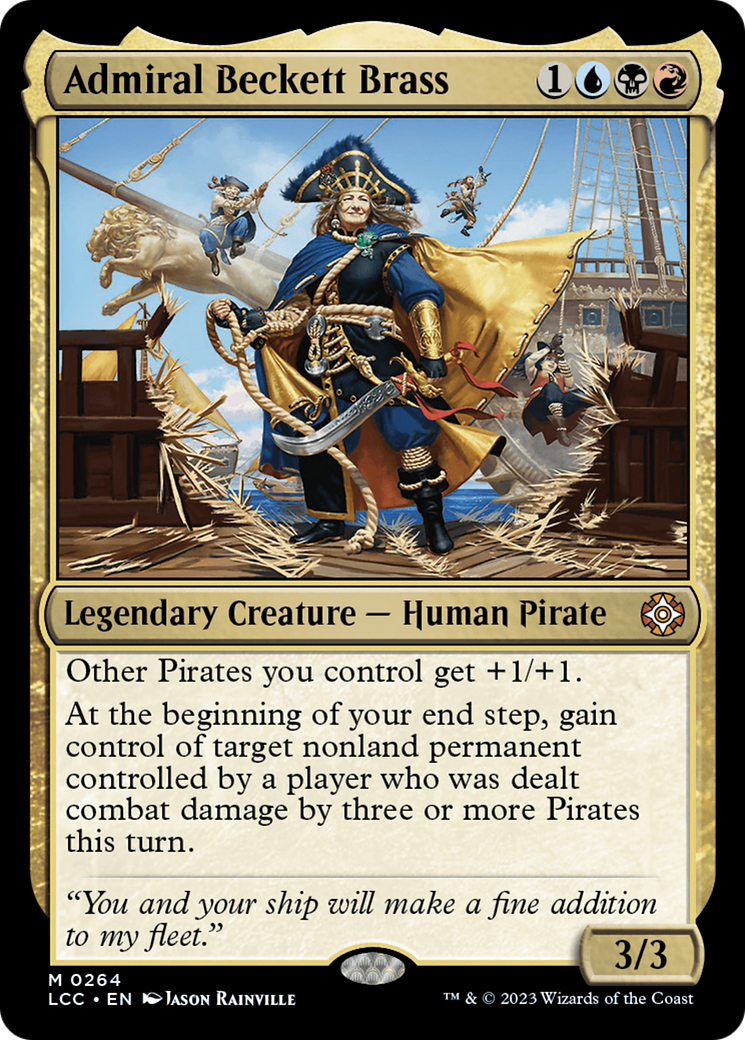
Admiral Beckett Brass
Admiral Beckett Brass
Legendary Creature — Human Pirate
3/3
Other Pirates you control get +1/+1.
At the beginning of your end step, gain control of target nonland permanent controlled by a player who was dealt combat damage by three or more Pirates this turn.
- Admiral Beckett Brass's triggered ability checks what happened earlier in the turn. It doesn't care whether Admiral Beckett Brass was on the battlefield when those Pirates dealt combat damage, whether those creatures are still on the battlefield, or whether they're still Pirates.
- If one Pirate deals combat damage multiple times, most likely because it has double strike, it counts as only one of the three Pirates for Admiral Beckett Brass's triggered ability.
- If more than one player was dealt combat damage by three Pirates, you target only one permanent. It may be controlled by either of those players.
- The control-change effect of Admiral Beckett Brass's triggered ability lasts indefinitely. It doesn't wear off during the cleanup step or when you lose control of Admiral Beckett Brass.
- In a multiplayer game, if a player leaves the game, all cards that player owns leave as well, and any effects that give the player control of permanents immediately end.
- In a Two-Headed Giant game, combat damage dealt by Pirates your teammate controls will count when checking for Admiral Beckett Brass's ability.
-
1
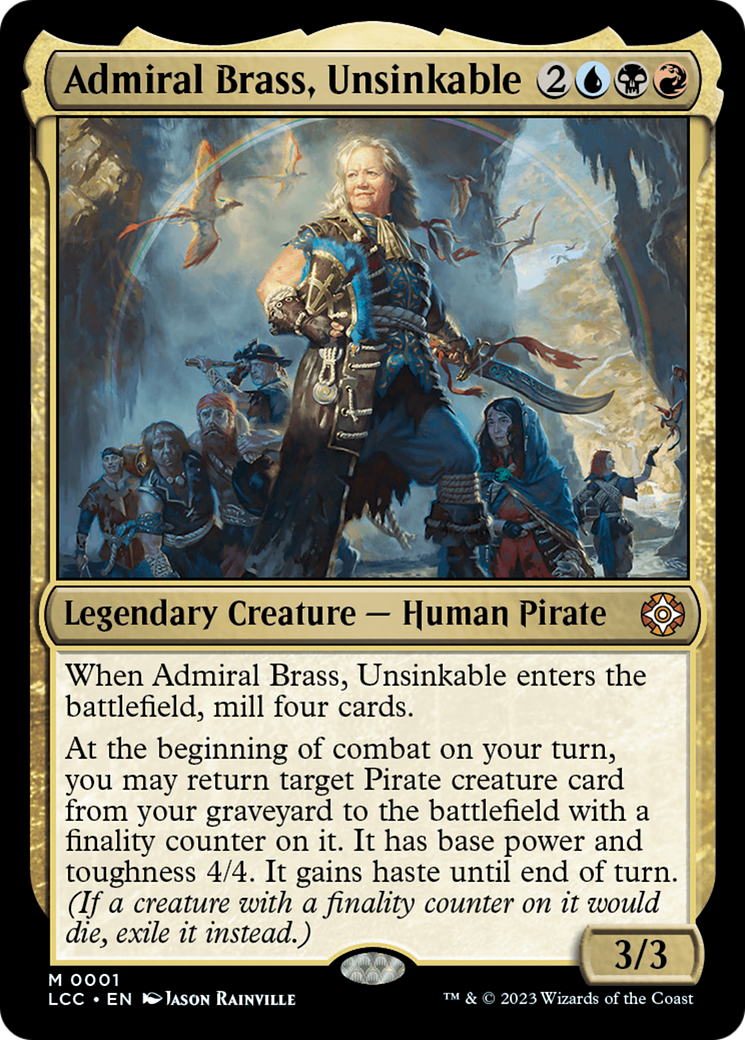
Admiral Brass, Unsinkable
Admiral Brass, Unsinkable
Legendary Creature — Human Pirate
3/3
When Admiral Brass enters, mill four cards.
At the beginning of combat on your turn, you may return target Pirate creature card from your graveyard to the battlefield with a finality counter on it. It has base power and toughness 4/4. It gains haste until end of turn. (If a creature with a finality counter on it would die, exile it instead.)
- Admiral Brass, Unsinkable's effect will overwrite any previous effects that set the returned creature's power and toughness to specific numbers. Effects that otherwise modify the returned creature's power and toughness will still apply no matter when they took effect. The same is true for +1/+1 counters.
- Finality counters work on any permanent, not only creatures. If a permanent with a finality counter on it would be put into a graveyard from the battlefield, exile it instead.
- Finality counters don't stop permanents from going to zones other than the graveyard from the battlefield. For example, if a permanent with a finality counter on it would be put into its owner's hand from the battlefield, it does so normally.
- Finality counters aren't keyword counters, and a finality counter doesn't give any abilities to the permanent it's on. If that permanent loses its abilities and then would go to a graveyard, it will still be exiled instead.
- Multiple finality counters on a single permanent are redundant.
-
1
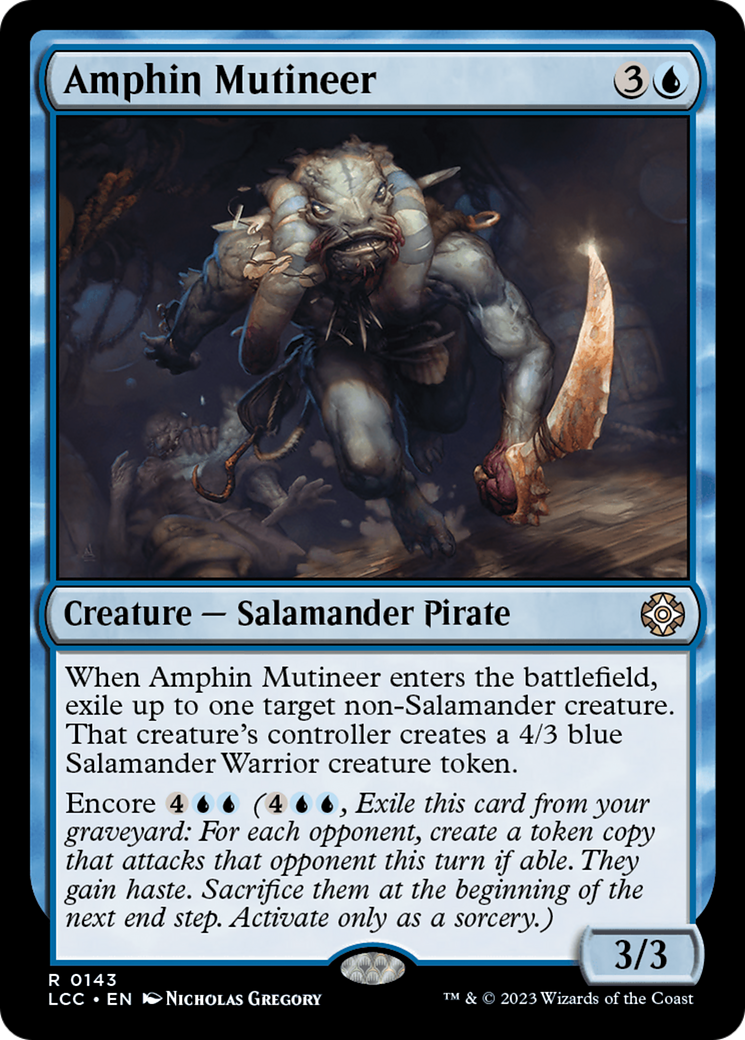
Amphin Mutineer
Amphin Mutineer
Creature — Salamander Pirate
3/3
When this creature enters, exile up to one target non-Salamander creature. That creature's controller creates a 4/3 blue Salamander Warrior creature token.
Encore ( , Exile this card from your graveyard: For each opponent, create a token copy that attacks that opponent this turn if able. They gain haste. Sacrifice them at the beginning of the next end step. Activate only as a sorcery.)
- If an effect stops a token from attacking a specific player, that token can attack any player, planeswalker, or battle, or not attack at all. If the effect stops the token from attacking a specific player unless a cost is paid, you don't have to pay that cost unless you want to attack that player.
- Exiling the card with encore is a cost to activate the ability. Once you announce that you're activating it, no player may take actions until you've finished. They can't try to remove the card from your graveyard to stop you from paying the cost.
- Opponents who have left the game aren't counted when determining how many tokens to create.
- The tokens copy only what's on the original card. Effects that modified that creature when it was previously on the battlefield won't be copied.
- If the target non-Salamander creature is an illegal target by the time Amphin Mutineer's ability tries to resolve, the ability doesn't resolve. No player creates a Salamander Warrior token.
- If one of the tokens can't attack for any reason (such as being tapped), then it doesn't attack. If there's a cost associated with having it attack, you aren't forced to pay that cost, so it doesn't have to attack in that case either.
- If one of the tokens somehow is under another player's control as the delayed triggered ability resolves, you can't sacrifice that token. It remains on the battlefield indefinitely, even if you regain control of it later.
- Each token must attack the appropriate player if able.
-
1
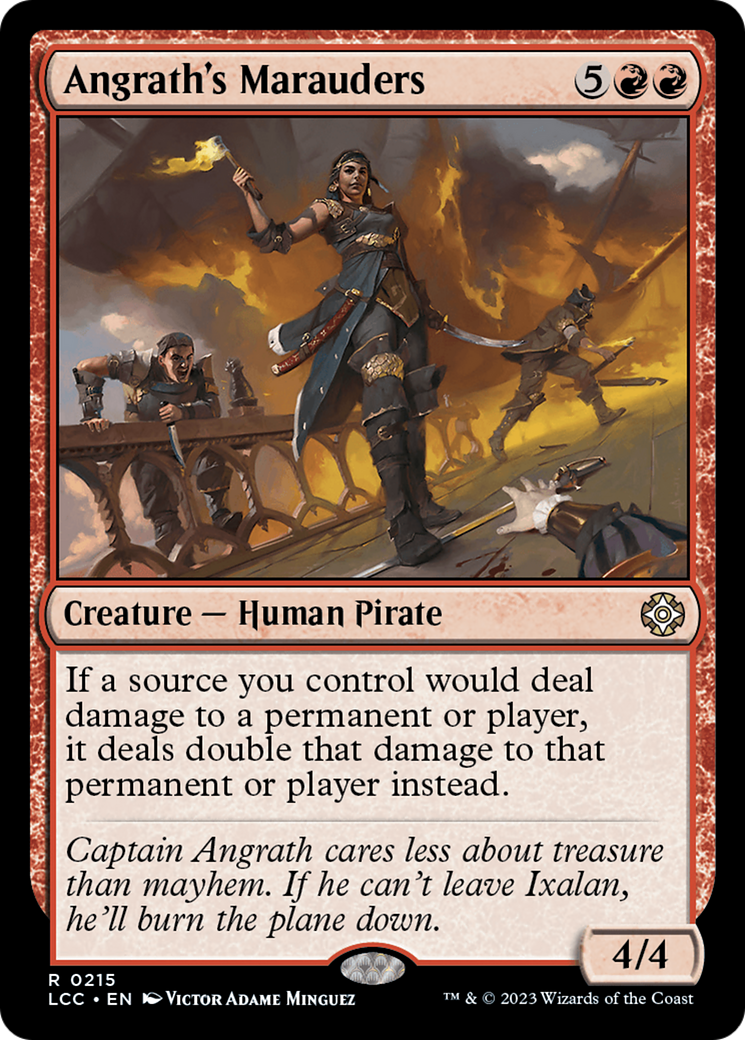
Angrath's Marauders
Angrath's Marauders
Creature — Human Pirate
4/4
If a source you control would deal damage to a permanent or player, it deals double that damage to that permanent or player instead.
- If a creature with trample you control would deal combat damage to a blocking creature while you control Angrath's Marauders, you must assign its unmodified damage. For example, a 3/3 creature with trample blocked by a 2/2 creature can have at most 1 damage assigned to the defending player. It will then deal 4 damage to the blocking creature and 2 damage to the defending player.
- If an effect such as that of Chandra's Pyrohelix asks you to divide damage among targets, you must divide the unmodified damage before doubling it.
- If you control a second Angrath's Marauders, damage dealt by sources you control will be multiplied by 4. If you control a third, it will be multiplied by 8, and so on.
-
1
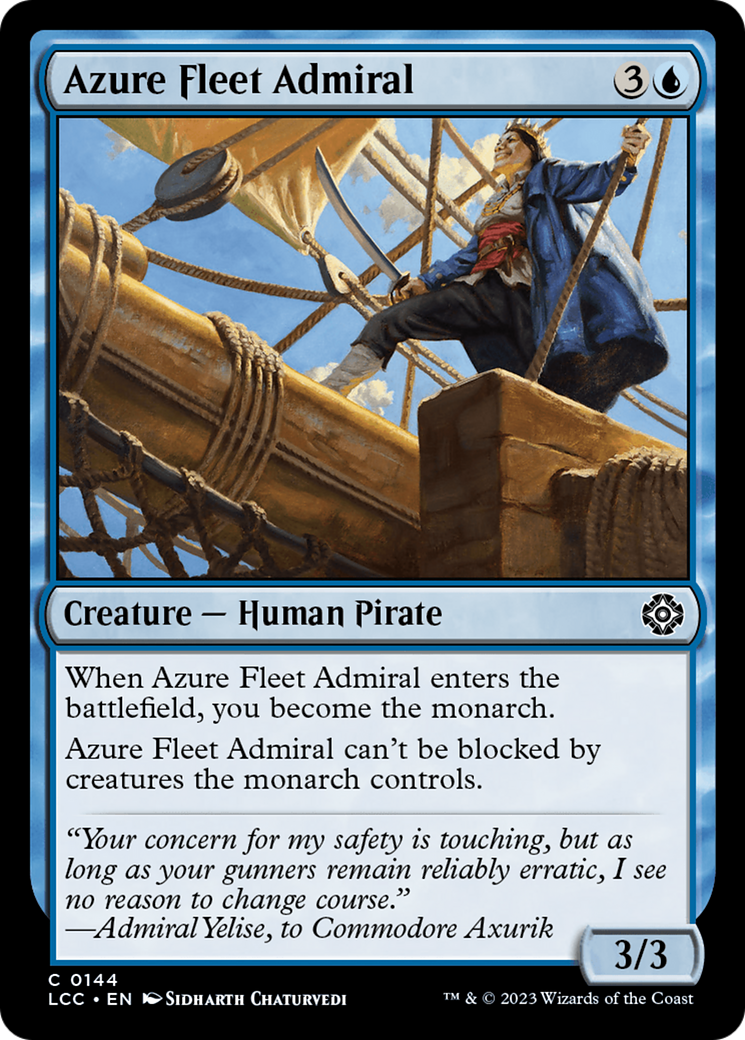
Azure Fleet Admiral
Azure Fleet Admiral
Creature — Human Pirate
3/3
When this creature enters, you become the monarch.
This creature can't be blocked by creatures the monarch controls.
- Azure Fleet Admiral's last ability normally means that it can't be blocked while attacking the monarch or a planeswalker the monarch controls. In some variants with shared team turns, such as Two-Headed Giant, creatures controlled by the monarch's teammate can block Azure Fleet Admiral, even if it's attacking the monarch.
- The game starts with no monarch. Once an effect makes one player the monarch, the game will have exactly one monarch from that point forward. As a player becomes the monarch, the current monarch (if any) ceases being the monarch.
- There are two inherent triggered abilities associated with being the monarch. These triggered abilities have no source and are controlled by the player who was the monarch at the time the abilities triggered. The full texts of these abilities are "At the beginning of the monarch's end step, that player draws a card" and "Whenever a creature deals combat damage to the monarch, its controller becomes the monarch."
- If the triggered ability that causes the monarch to draw a card goes on the stack and a different player becomes the monarch before that ability resolves, the first player will still draw the card.
- If the monarch leaves the game during another player's turn, that player becomes the monarch. If the monarch leaves the game during their turn, the next player in turn order becomes the monarch.
- If combat damage dealt to the monarch causes that player to lose the game, the triggered ability that causes the controller of the attacking creature to become the monarch doesn't resolve. In most cases, the controller of the attacking creature will still become the monarch as it is likely their turn.
-
1
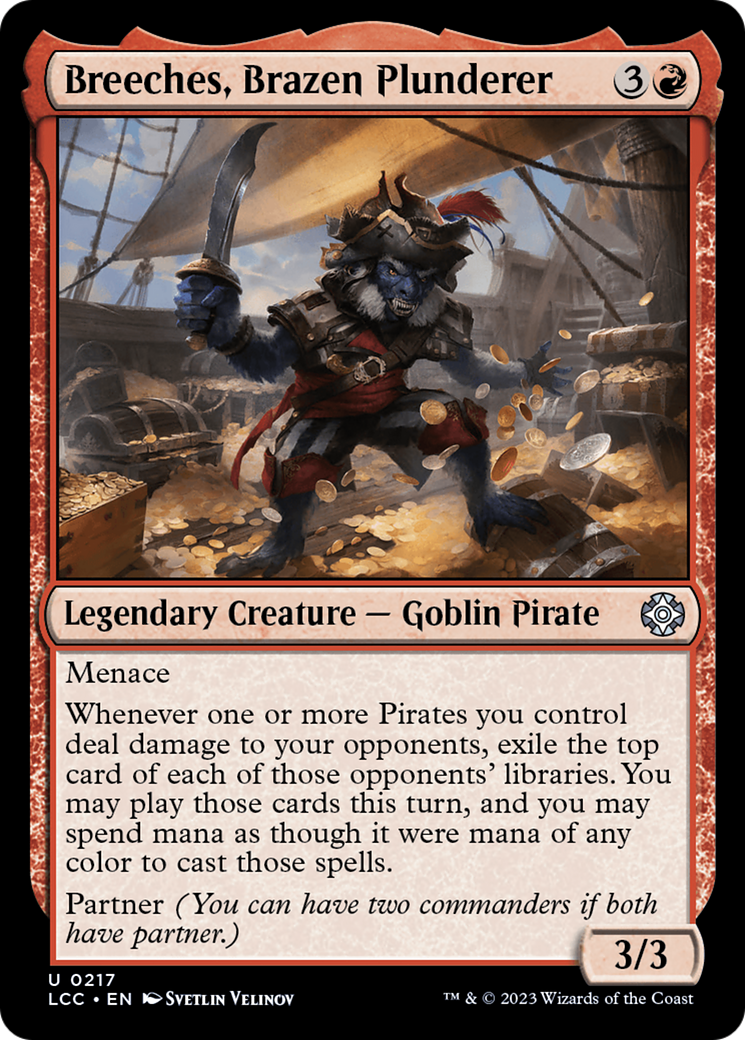
Breeches, Brazen Plunderer
Breeches, Brazen Plunderer
Legendary Creature — Goblin Pirate
3/3
Menace
Whenever one or more Pirates you control deal damage to your opponents, exile the top card of each of those opponents' libraries. You may play those cards this turn, and you may spend mana as though it were mana of any color to cast those spells.
Partner (You can have two commanders if both have partner.)
- You'll exile a card from each opponent who was dealt damage, not from all of your opponents.
- You must follow the normal timing permissions and restrictions for each exiled card. If one is a land, you can't play it unless you have land plays available.
- You'll still pay all costs for a spell cast this way, including additional costs. You may also pay alternative costs if any are available.
- If you don't play one of the exiled cards, it remains exiled. It won't be available to be played on future turns.
- In a multiplayer game, if a player leaves the game, all cards that player owns leave as well. If you leave the game, any spells and/or permanents you control from Breeches's brazen thievery are exiled.
- If your Commander deck has two commanders, you can only include cards whose own color identities are also found in your commanders' combined color identities. If Falthis and Kediss are your commanders, your deck may contain cards with black and/or red in their color identity, but not cards with green, white, or blue.
- Both commanders start in the command zone, and the remaining 98 cards (or 58 cards in a Commander Draft game) of your deck are shuffled to become your library.
- To have two commanders, both must have the partner ability as the game begins. Losing the ability during the game doesn't cause either to cease to be your commander.
- Once the game begins, your two commanders are tracked separately. If you cast one, you won't have to pay an additional the first time you cast the other. A player loses the game after having been dealt 21 damage from any one of them, not from both of them combined.
- If something refers to your commander while you have two commanders, it refers to one of them of your choice. If you are instructed to perform an action on your commander (e.g. put it from the command zone into your hand due to Command Beacon), you choose one of your commanders at the time the effect happens.
- An effect that checks whether you control your commander is satisfied if you control one or both of your two commanders.
- You can choose two commanders with partner that are the same color or colors. In Commander Draft, you can even choose two of the same commander with partner if you drafted them. If you do this, make sure you keep the number of times you've cast each from the command zone clear for "commander tax" purposes.
-
1
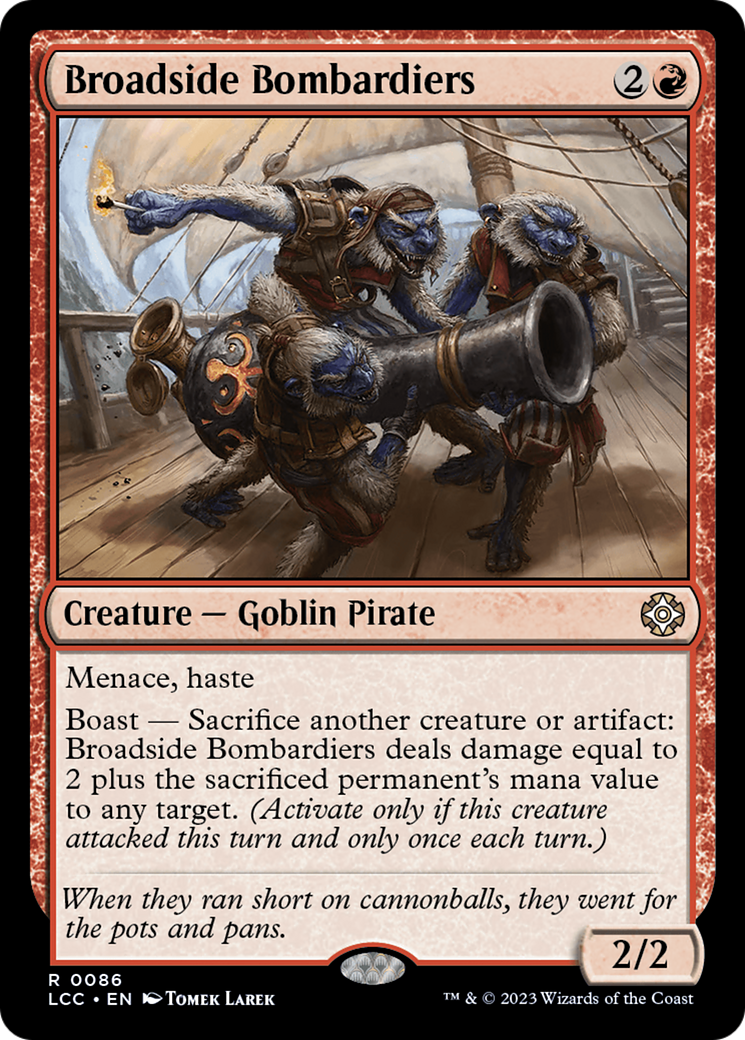
Broadside Bombardiers
Broadside Bombardiers
Creature — Goblin Pirate
2/2
Menace, haste
Boast — Sacrifice another creature or artifact: This creature deals damage equal to 2 plus the sacrificed permanent's mana value to any target. (Activate only if this creature attacked this turn and only once each turn.)
- A boast ability can be activated at any point after the creature with that ability has been declared as an attacker. This can be before blockers are declared, after blockers are declared but before combat damage is dealt, during combat after combat damage is dealt, during the postcombat main phase, during the end step, or, in some unusual cases, during the cleanup step.
- If it's not your turn and you gain control of a creature with a boast ability after that creature attacked, you can activate that creature's boast ability if it hasn't been activated yet that turn.
- If a creature with a boast ability is put onto the battlefield attacking, it was never declared as an attacker. Its boast ability can't be activated that turn.
- If an effect adds additional combat phases to a turn and a creature with a boast ability attacks more than once during that turn, its boast ability can still be activated only once.
- The back face of a double-faced card doesn't have a mana cost. A double-faced permanent with its back face up has a mana value equal to the mana value of its front face.
-
1
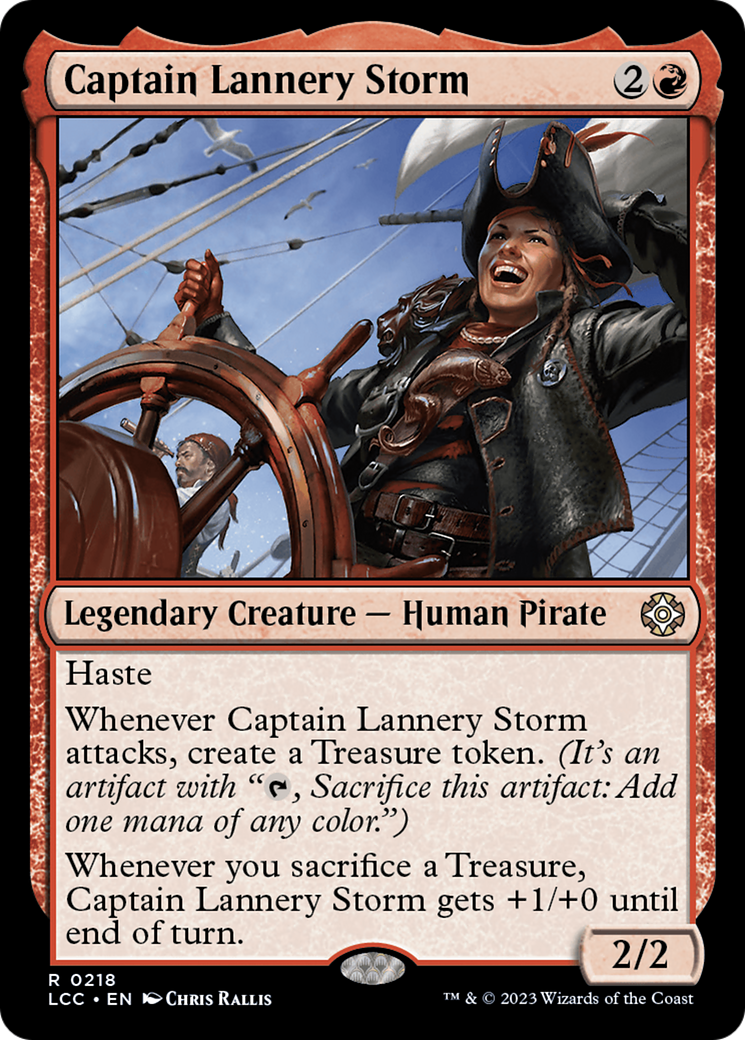
Captain Lannery Storm
Captain Lannery Storm
Legendary Creature — Human Pirate
2/2
Haste
Whenever Captain Lannery Storm attacks, create a Treasure token. (It's an artifact with " , Sacrifice this token: Add one mana of any color.")
Whenever you sacrifice a Treasure, Captain Lannery Storm gets +1/+0 until end of turn.
- You can activate the mana ability of a Treasure even if you have nothing to spend that mana on.
- Captain Lannery Storm's last ability triggers whenever you sacrifice a Treasure for any reason, not just to activate a Treasure's mana ability.
- If you sacrifice Treasures to cast Captain Lannery Storm, its last ability won't trigger for those Treasures.
-
1
Captivating Crew
Captivating Crew
Creature — Human Pirate
4/3
: Gain control of target creature an opponent controls until end of turn. Untap that creature. It gains haste until end of turn. Activate only as a sorcery.
- You can target and gain control of an untapped creature this way.
-
1
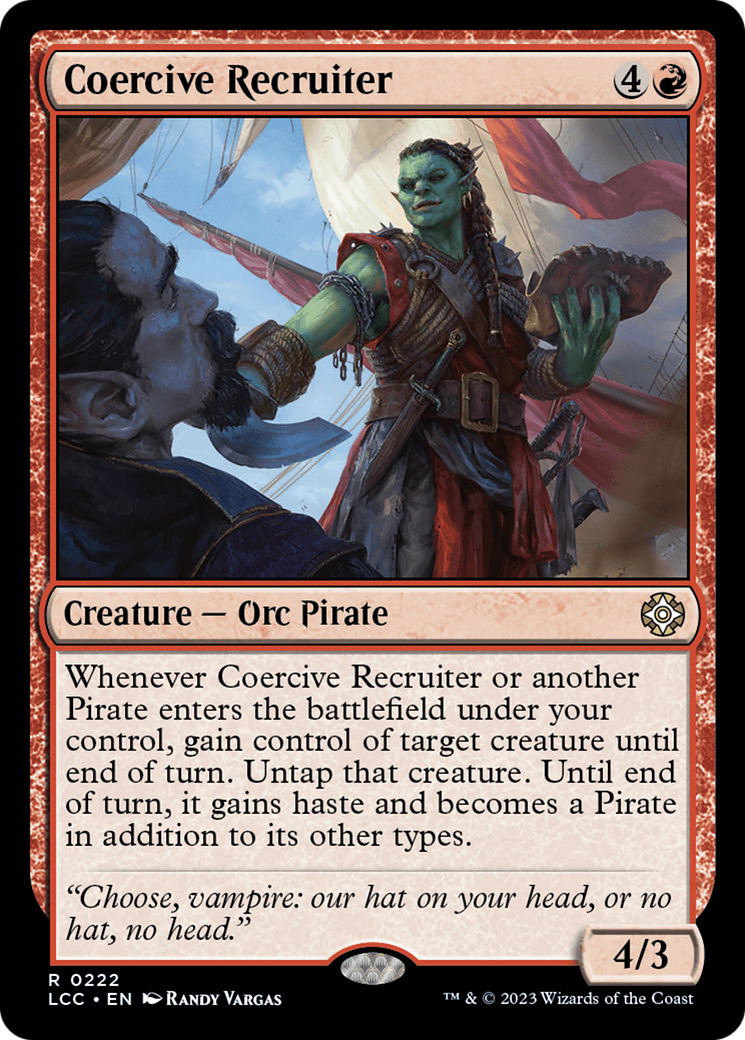
Coercive Recruiter
Coercive Recruiter
Creature — Orc Pirate
4/3
Whenever this creature or another Pirate you control enters, gain control of target creature until end of turn. Untap that creature. Until end of turn, it gains haste and becomes a Pirate in addition to its other types.
- Coercive Recruiter's ability can target any creature, even one that's untapped or one you already control. It can even target itself or the creature that caused the ability to trigger.
- Gaining control of a creature doesn't cause you to gain control of any Auras or Equipment attached to it.
-
1
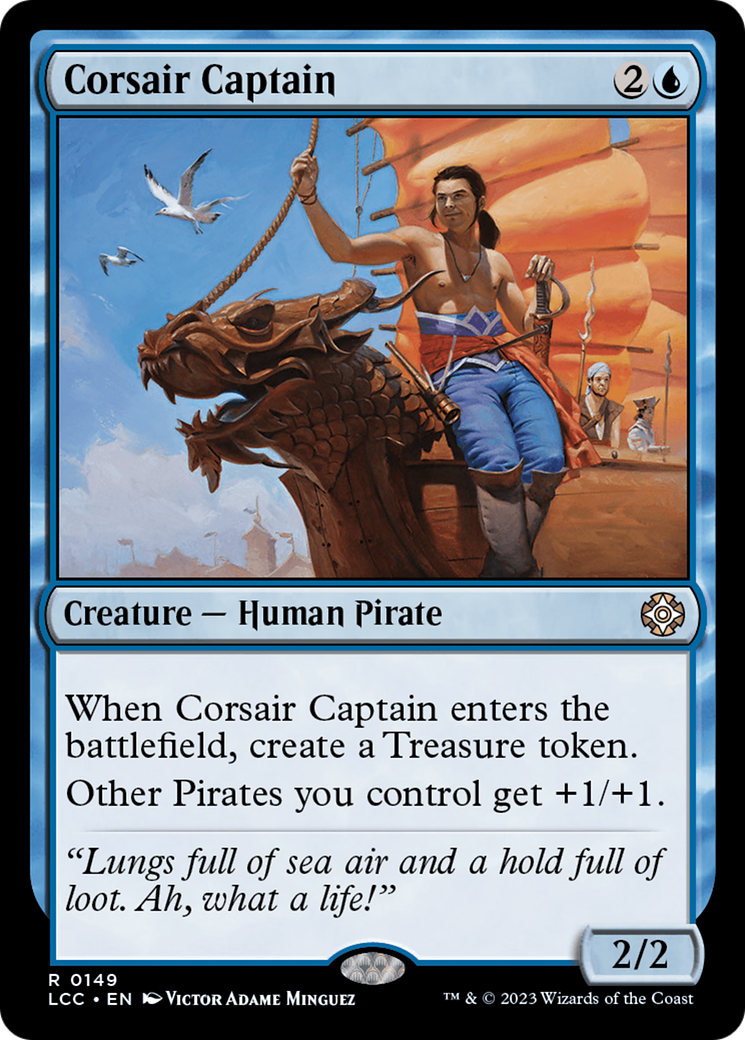
Corsair Captain
Corsair Captain
Creature — Human Pirate
2/2
When this creature enters, create a Treasure token. (It's an artifact with " , Sacrifice this token: Add one mana of any color.")
Other Pirates you control get +1/+1.
- Because damage remains marked on a creature until the damage is removed as the turn ends, nonlethal damage dealt to Pirates you control may become lethal if Corsair Captain leaves the battlefield during that turn.
-
1
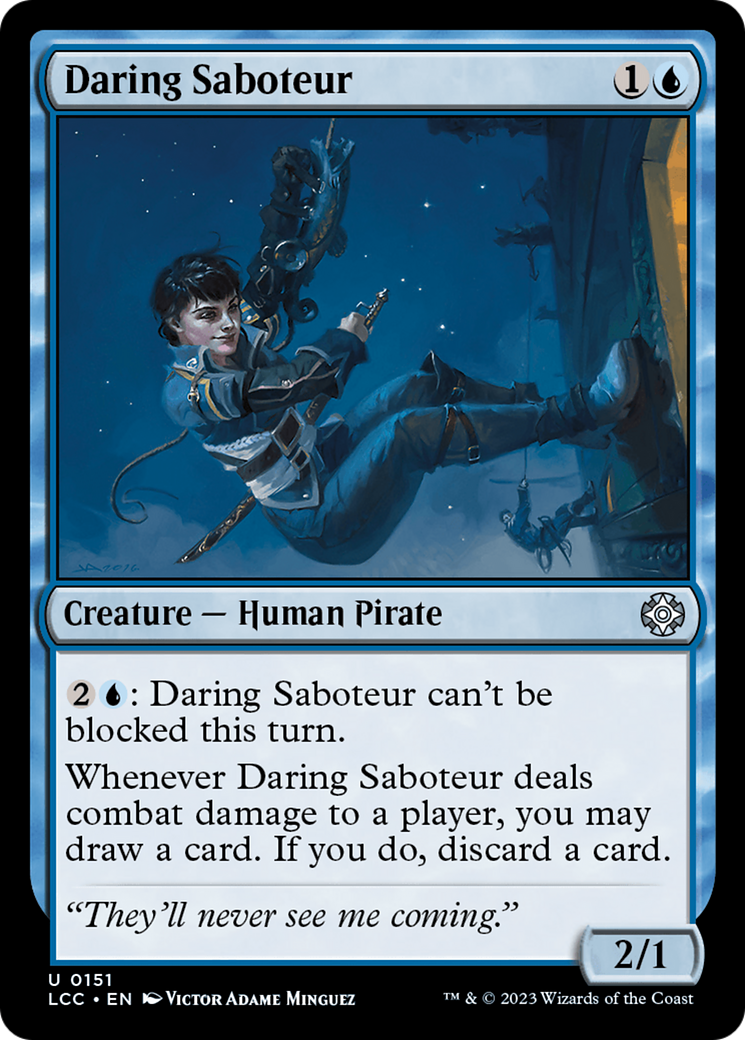
Daring Saboteur
Daring Saboteur
Creature — Human Pirate
2/1
: This creature can't be blocked this turn.
Whenever this creature deals combat damage to a player, you may draw a card. If you do, discard a card.
- Activating the first ability of Daring Saboteur after it has become blocked won't cause it to become unblocked.
-
1
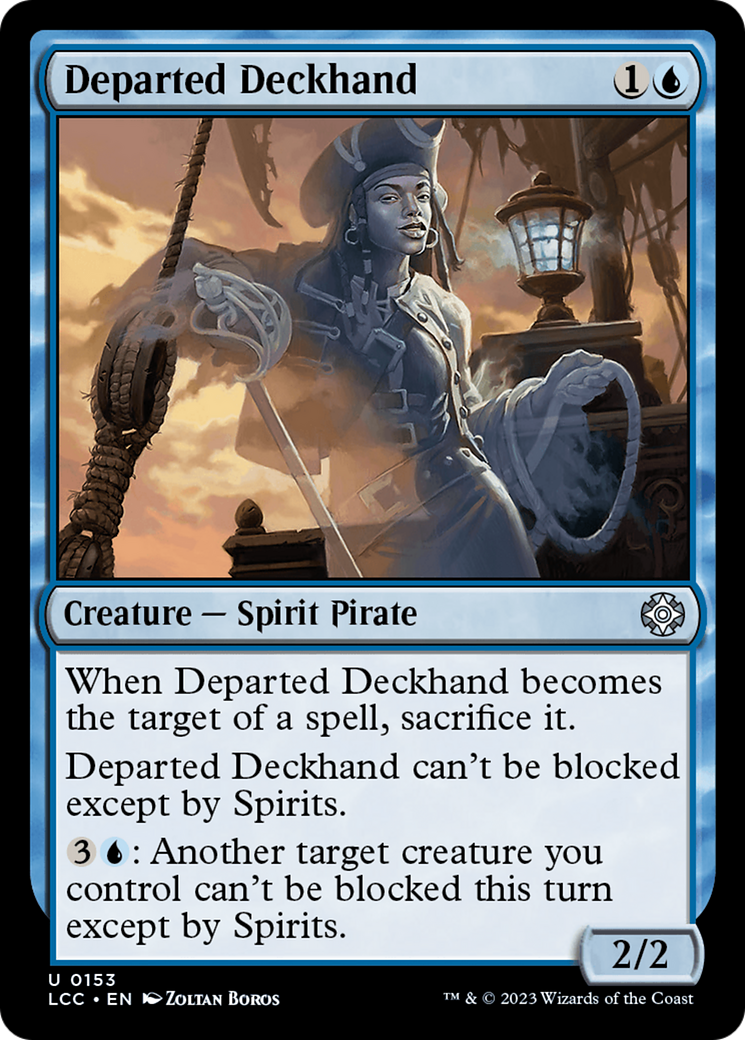
Departed Deckhand
Departed Deckhand
Creature — Spirit Pirate
2/2
When this creature becomes the target of a spell, sacrifice it.
This creature can't be blocked except by Spirits.
: Another target creature you control can't be blocked this turn except by Spirits.
- You'll sacrifice Departed Deckhand even if you counter the spell that targets it.
- If the spell that targets Departed Deckhand has no other targets, it won't resolve (because it no longer has a legal target after Departed Deckhand is sacrificed).
- Activating Departed Deckhand's last ability after a creature has become blocked by a non-Spirit creature won't cause that creature to become unblocked.
-
1
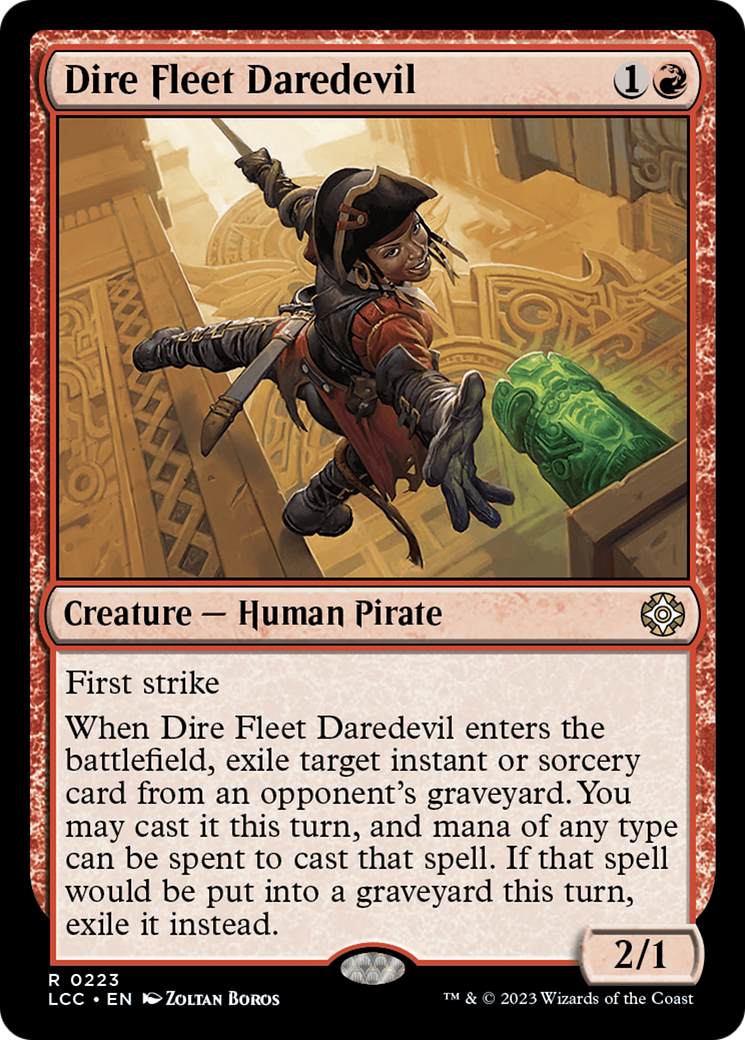
Dire Fleet Daredevil
Dire Fleet Daredevil
Creature — Human Pirate
2/1
First strike
When this creature enters, exile target instant or sorcery card from an opponent's graveyard. You may cast it this turn, and mana of any type can be spent to cast that spell. If that spell would be put into a graveyard, exile it instead.
- Casting an exiled card causes it to leave exile. You can't cast it multiple times.
- The effect of Dire Fleet Daredevil doesn't change when you can cast the exiled card. For example, if you exile a sorcery card, you can cast it only during your main phase when the stack is empty.
-
1
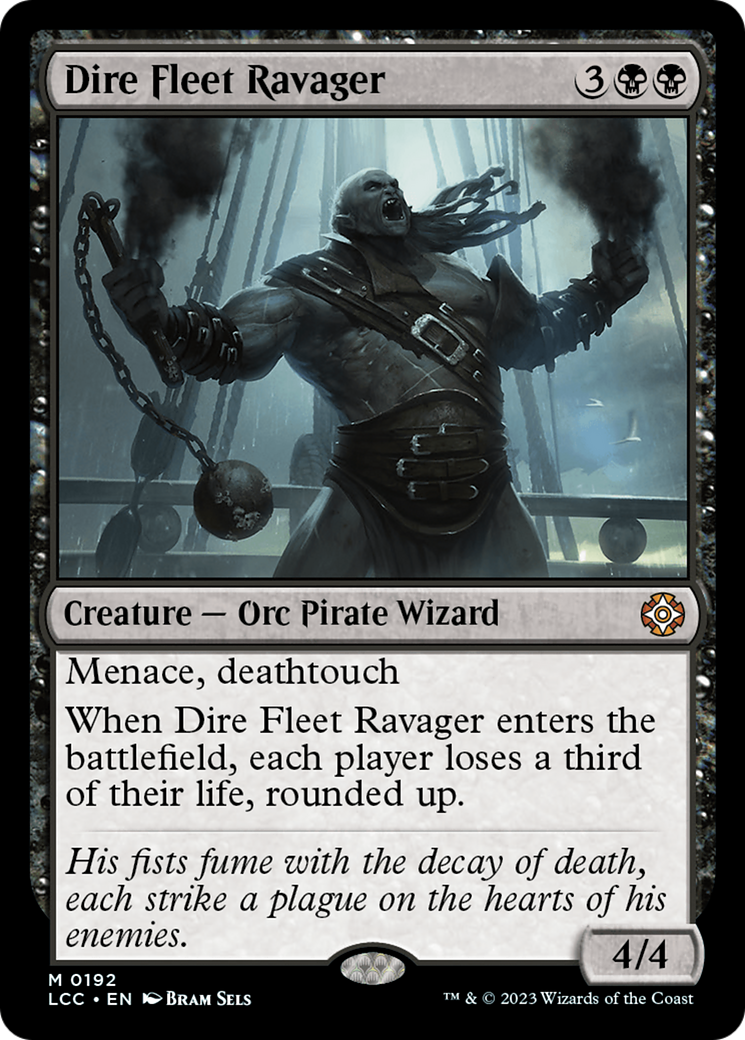
Dire Fleet Ravager
Dire Fleet Ravager
Creature — Orc Pirate Wizard
4/4
Menace, deathtouch
When this creature enters, each player loses a third of their life, rounded up.
- For example, if you have 13 life, you'll lose 5 life.
- If a player has 1 life, that player loses 1 life. If each player has 0 life after that, the game's a draw.
- In a Two-Headed Giant game, each player loses a third of the team's life total rounded up. For example, if a team has 13 life, each player on that team loses 5 life and the team loses 10 life total.
-
1
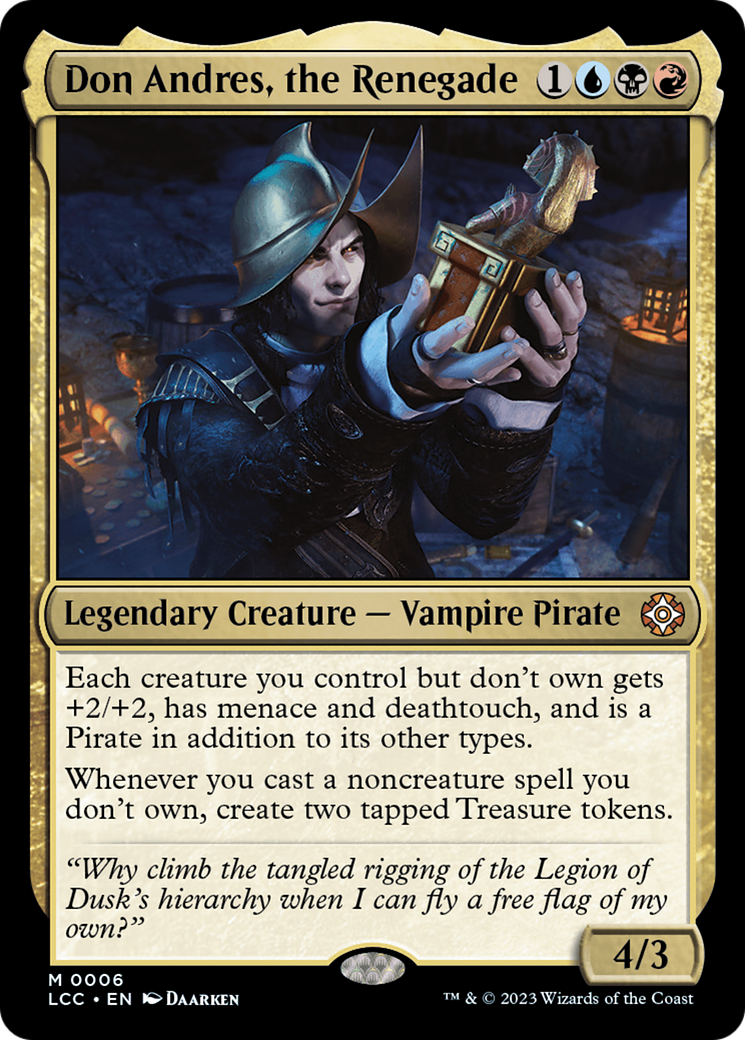
Don Andres, the Renegade
Don Andres, the Renegade
Legendary Creature — Vampire Pirate
4/3
Each creature you control but don't own gets +2/+2, has menace and deathtouch, and is a Pirate in addition to its other types.
Whenever you cast a noncreature spell you don't own, create two tapped Treasure tokens.
- The player who creates a token is its owner.
- The owner of a copy of a spell is the player under whose control it was put onto the stack.
-
1
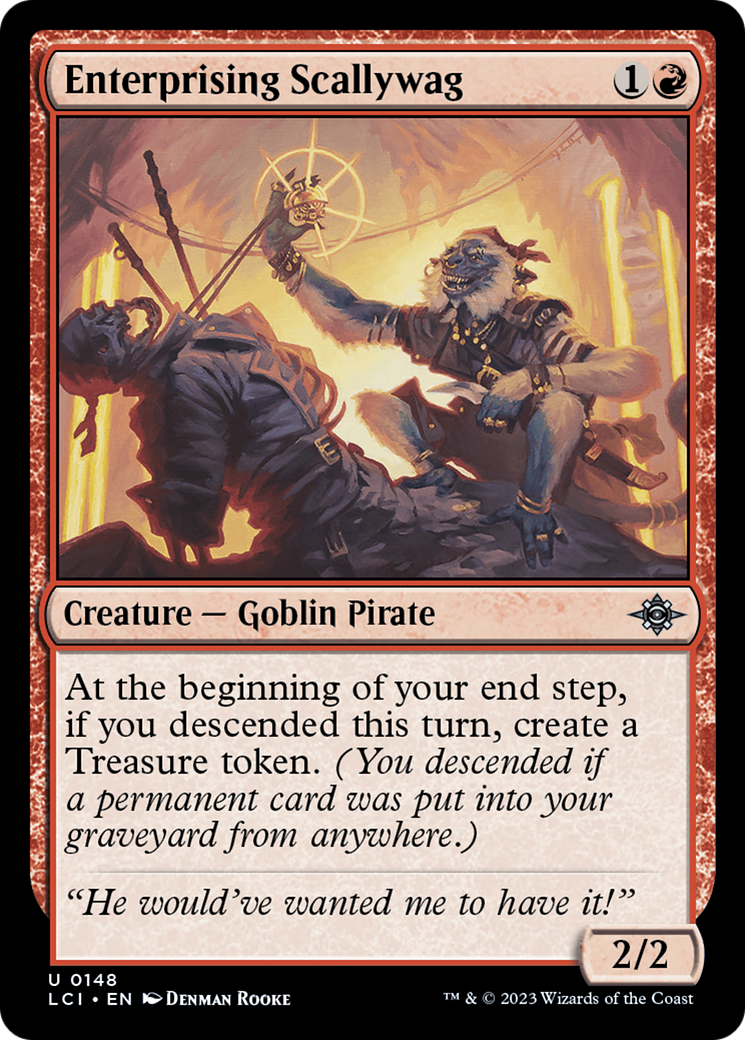
Enterprising Scallywag
Enterprising Scallywag
Creature — Goblin Pirate
2/2
At the beginning of your end step, if you descended this turn, create a Treasure token. (You descended if a permanent card was put into your graveyard from anywhere.)
-
1
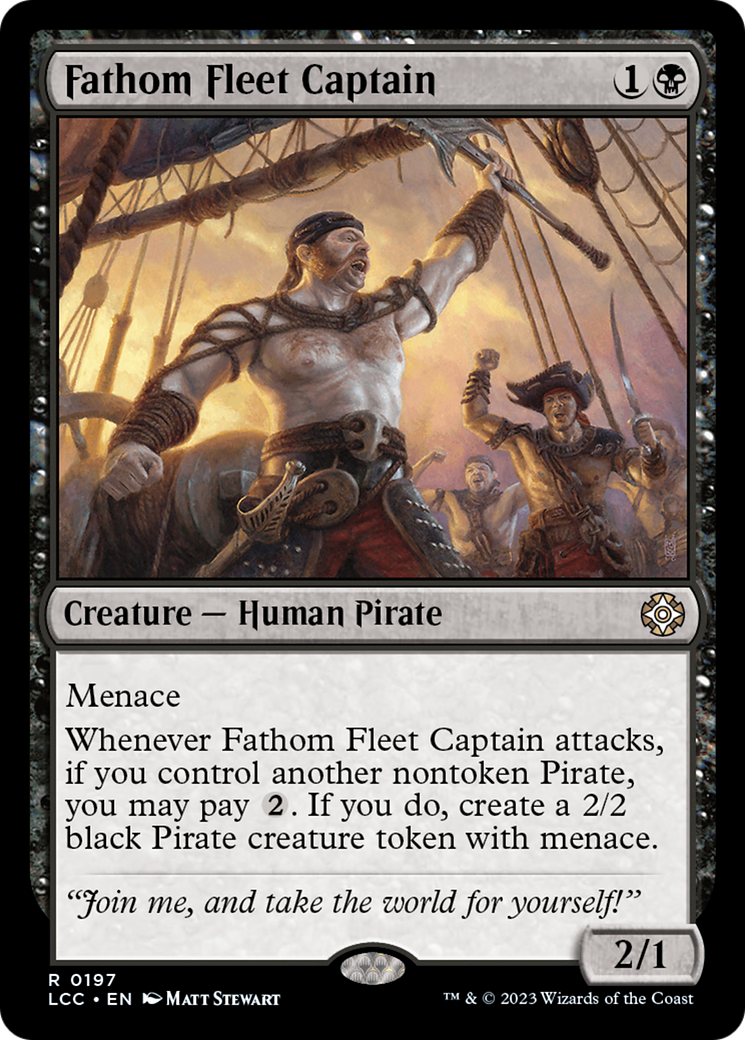
Fathom Fleet Captain
Fathom Fleet Captain
Creature — Human Pirate
2/1
Menace
Whenever this creature attacks, if you control another nontoken Pirate, you may pay . If you do, create a 2/2 black Pirate creature token with menace.
- While resolving Fathom Fleet Captain's triggered ability, you can't pay multiple times to create more than one Pirate token.
- If you don't control another nontoken Pirate at the moment Fathom Fleet Captain attacks, its triggered ability won't trigger. If you don't control another nontoken Pirate as that ability resolves, you can't pay .
-
1
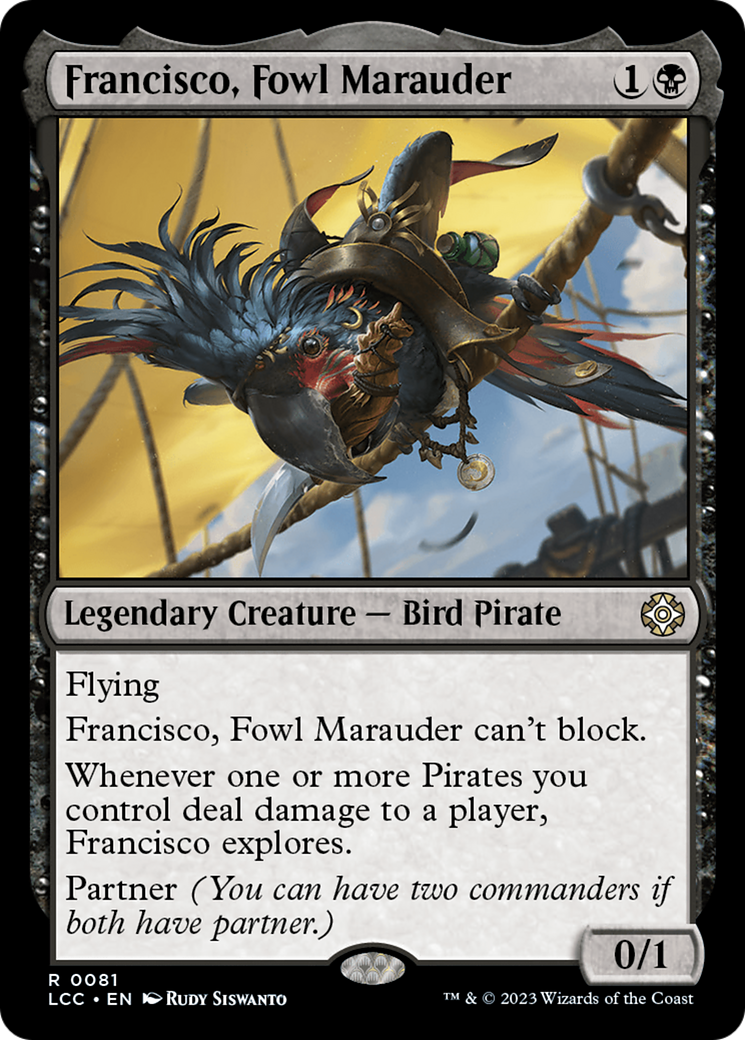
Francisco, Fowl Marauder
Francisco, Fowl Marauder
Legendary Creature — Bird Pirate
0/1
Flying
Francisco can't block.
Whenever one or more Pirates you control deal damage to a player, Francisco explores.
Partner (You can have two commanders if both have partner.)
- If one or more Pirates you control deal damage to multiple players at once (for example, in combat, or with an ability such as that of Lightning-Rig Crew), Francisco, Fowl Marauder's ability triggers once for each of those players.
- If your Commander deck has two commanders, you can only include cards whose own color identities are also found in your commanders' combined color identities.
- Both commanders start in the command zone, and the remaining 98 cards (or 58 cards in a Commander Draft game) of your deck are shuffled to become your library.
- To have two commanders, both must have the partner ability as the game begins. Losing the ability during the game doesn't cause either to cease to be your commander.
- Once the game begins, your two commanders are tracked separately. If you cast one, you won't have to pay an additional the first time you cast the other. A player loses the game after having been dealt 21 damage from any one of them, not from both of them combined.
- If something refers to your commander while you have two commanders, it refers to one of them of your choice. If you are instructed to perform an action on your commander (e.g. put it from the command zone into your hand due to Command Beacon), you choose one of your commanders at the time the effect happens.
- An effect that checks whether you control your commander is satisfied if you control one or both of your two commanders.
- You can choose two commanders with partner that are the same color or colors. In Commander Draft, you can even choose two of the same commander with partner if you drafted them. If you do this, make sure you keep the number of times you've cast each from the command zone clear for "commander tax" purposes.
- If an ability instructs a creature to explore, its controller reveals the top card of their library. If it's a land card, they'll put it into their hand. Otherwise, they'll put a +1/+1 counter on that creature, then choose to either leave that card on top of their library or put it into their graveyard.
- Once an ability that causes a creature to explore begins to resolve, no player may take any other actions until it's done. Notably, opponents can't try to remove the exploring creature after you reveal a nonland card but before it receives a counter.
- If no card is revealed, most likely because that player's library is empty, the exploring creature receives a +1/+1 counter.
- If a resolving spell or ability instructs a specific creature to explore but that creature has left the battlefield, the creature still explores. If you reveal a nonland card this way, you won't put a +1/+1 counter on anything, but you may put the revealed card into your graveyard. Effects that trigger "whenever a creature explores" trigger as appropriate.
- Some spells or abilities might cause a creature to explore multiple times in a row. If you reveal a nonland card when a creature explores and leave it on top of your library, then the creature explores again immediately afterwards, you'll reveal the same card again.
- In some unusual cases, noncreature permanents may explore. For example, if the creature card returned by Defossilize is somehow not a creature once it's on the battlefield, it can still explore. You'll take all the same actions, and you may end up putting a +1/+1 counter on the permanent. (Note that some effects target a creature, and those effects would still require a legal target to have it explore.)
-
1
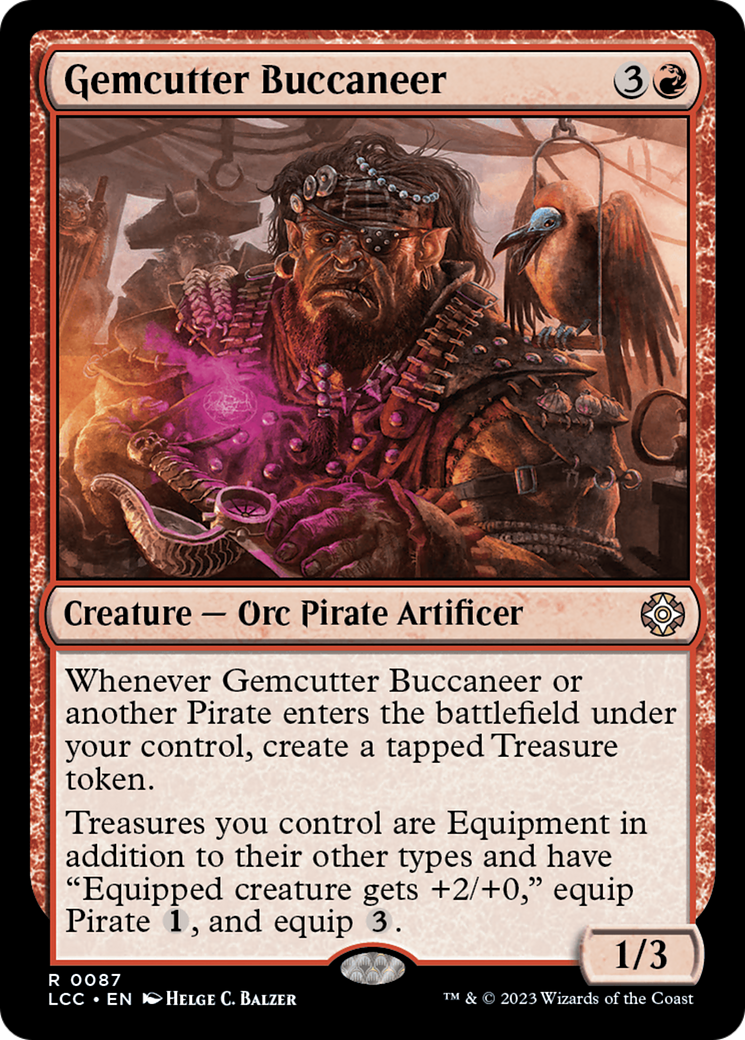
Gemcutter Buccaneer
Gemcutter Buccaneer
Creature — Orc Pirate Artificer
1/3
Whenever this creature or another Pirate you control enters, create a tapped Treasure token.
Treasures you control are Equipment in addition to their other types and have "Equipped creature gets +2/+0," equip Pirate , and equip .
-
1
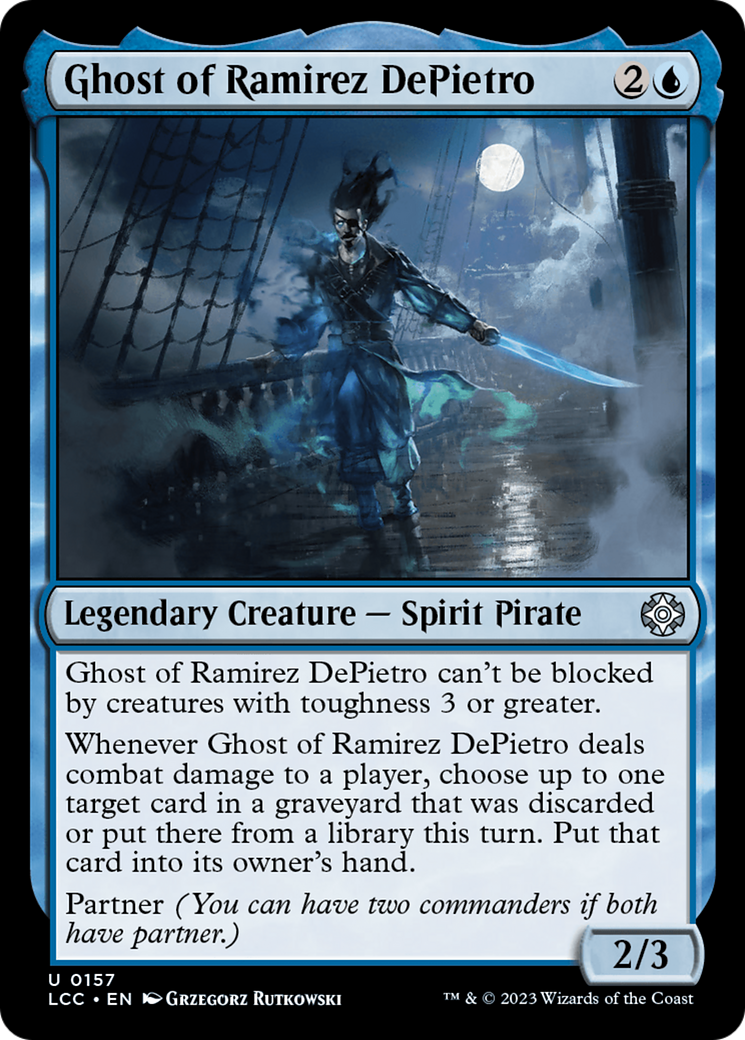
Ghost of Ramirez DePietro
Ghost of Ramirez DePietro
Legendary Creature — Spirit Pirate
2/3
Ghost of Ramirez DePietro can't be blocked by creatures with toughness 3 or greater.
Whenever Ghost of Ramirez DePietro deals combat damage to a player, choose up to one target card in a graveyard that was discarded or put there from a library this turn. Put that card into its owner's hand.
Partner (You can have two commanders if both have partner.)
- Once a creature with toughness 2 or less has blocked this creature, changing the toughness of the blocking creature won't cause this creature to become unblocked.
- The middle ability can't target cards that were discarded on previous turns or put into the graveyard from a library on previous turns.
- If your Commander deck has two commanders, you can only include cards whose own color identities are also found in your commanders' combined color identities. If Falthis and Kediss are your commanders, your deck may contain cards with black and/or red in their color identity, but not cards with green, white, or blue.
- Both commanders start in the command zone, and the remaining 98 cards (or 58 cards in a Commander Draft game) of your deck are shuffled to become your library.
- To have two commanders, both must have the partner ability as the game begins. Losing the ability during the game doesn't cause either to cease to be your commander.
- Once the game begins, your two commanders are tracked separately. If you cast one, you won't have to pay an additional the first time you cast the other. A player loses the game after having been dealt 21 damage from any one of them, not from both of them combined.
- If something refers to your commander while you have two commanders, it refers to one of them of your choice. If you are instructed to perform an action on your commander (e.g. put it from the command zone into your hand due to Command Beacon), you choose one of your commanders at the time the effect happens.
- An effect that checks whether you control your commander is satisfied if you control one or both of your two commanders.
- You can choose two commanders with partner that are the same color or colors. In Commander Draft, you can even choose two of the same commander with partner if you drafted them. If you do this, make sure you keep the number of times you've cast each from the command zone clear for "commander tax" purposes.
-
1
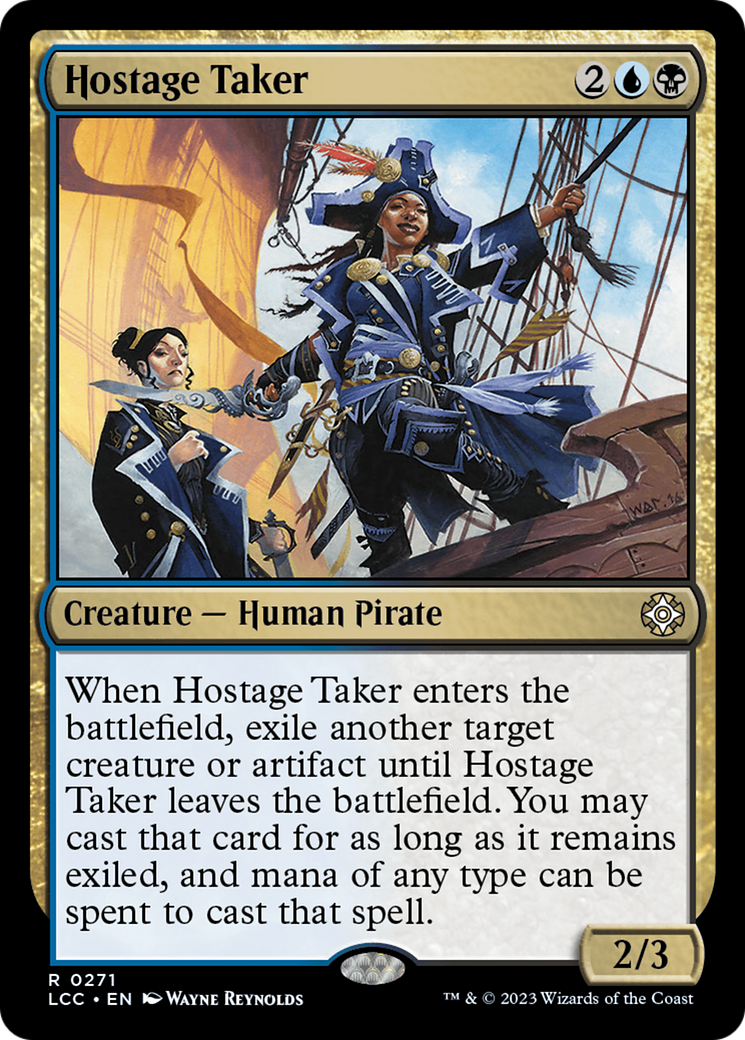
Hostage Taker
Hostage Taker
Creature — Human Pirate
2/3
When this creature enters, exile another target creature or artifact until this creature leaves the battlefield. You may cast that card for as long as it remains exiled, and mana of any type can be spent to cast that spell.
- Hostage Taker has received errata to prevent it from targeting itself. The correct Oracle wording appears above.
- If Hostage Taker leaves the battlefield before its triggered ability resolves, the target permanent won't be exiled.
- Auras attached to the exiled permanent will be put into their owners' graveyards. Any Equipment will become unattached and remain on the battlefield. Any counters on the exiled permanent will cease to exist.
- If a token is exiled this way, it will cease to exist and won't return to the battlefield. You can't cast it.
- Once you begin to cast the exiled card, it's considered a new object. You'll control that spell and the permanent that spell becomes even if Hostage Taker leaves the battlefield.
- If it's still in exile, the exiled card returns to the battlefield immediately after Hostage Taker leaves the battlefield. Nothing happens between the two events, including state-based actions.
- In a multiplayer game, if Hostage Taker's owner leaves the game while the card is still exiled and another player owns that card, the exiled card will return to the battlefield under its owner's control. Because the one-shot effect that returns the card isn't an ability that goes on the stack, it won't cease to exist along with the leaving player's spells and abilities on the stack.
- In a multiplayer game, if a player leaves the game, all cards that player owns leave as well. If you leave the game, any spell or permanent cards you control from Hostage Taker's ability are exiled.
-
1
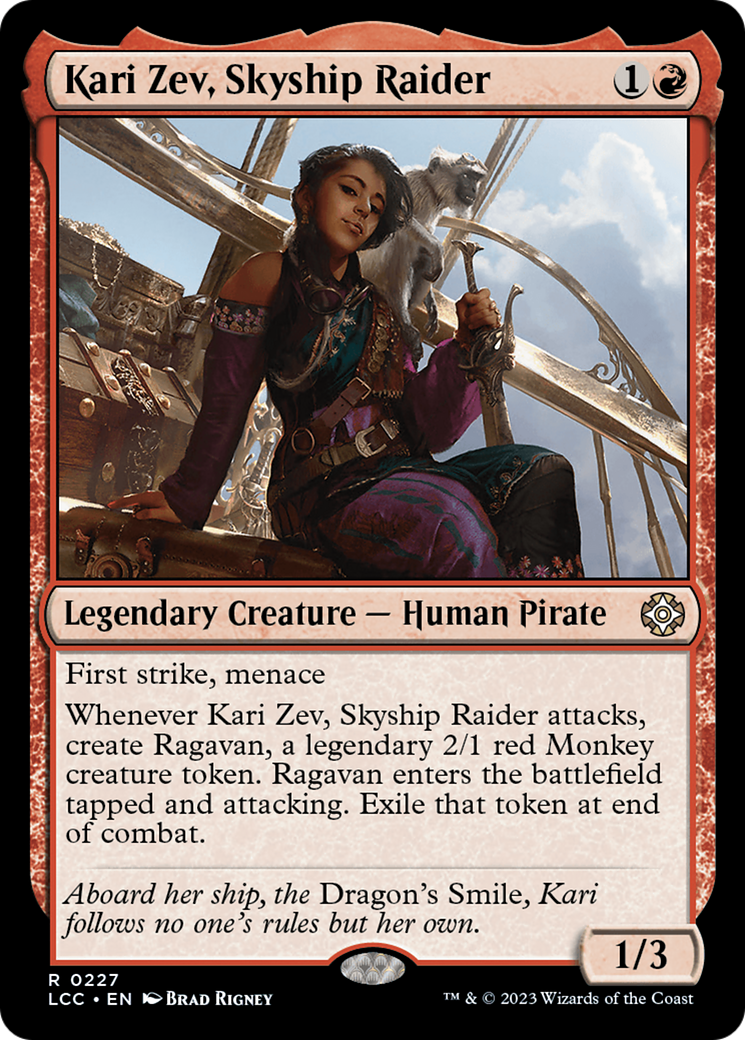
Kari Zev, Skyship Raider
Kari Zev, Skyship Raider
Legendary Creature — Human Pirate
1/3
First strike, menace
Whenever Kari Zev attacks, create Ragavan, a legendary 2/1 red Monkey creature token. Ragavan enters tapped and attacking. Exile that token at end of combat.
- You choose which opponent or opposing planeswalker Ragavan is attacking as you create the token. It doesn't have to be the same player or planeswalker Kari Zev is attacking.
- Although Ragavan is attacking, it was never declared as an attacking creature (for the purposes of abilities that trigger whenever a creature attacks, for example).
- The delayed triggered ability that exiles Ragavan triggers at end of combat even if Kari Zev is no longer on the battlefield.
-
1
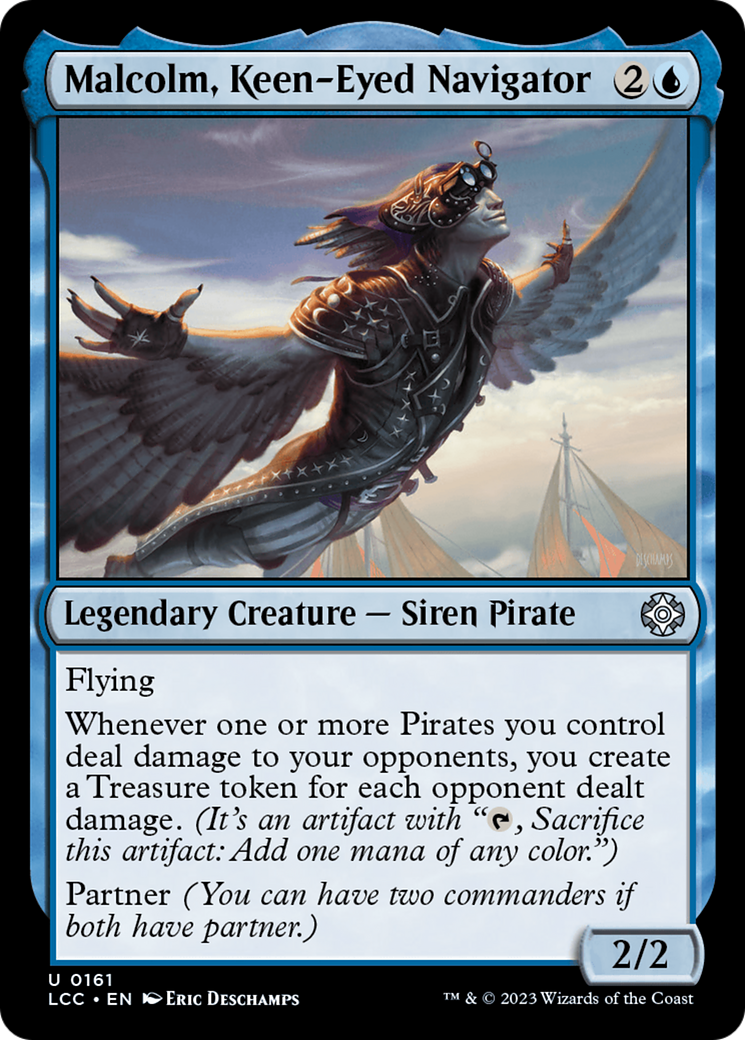
Malcolm, Keen-Eyed Navigator
Malcolm, Keen-Eyed Navigator
Legendary Creature — Siren Pirate
2/2
Flying
Whenever one or more Pirates you control deal damage to your opponents, you create a Treasure token for each opponent dealt damage. (It's an artifact with " , Sacrifice this token: Add one mana of any color.")
Partner (You can have two commanders if both have partner.)
- Malcolm's triggered ability will trigger even if Pirates you control deal damage to only a single opponent. A single Treasure for you. Yarrr.
- Malcolm's triggered ability considers all damage dealt by Pirates you control to opponents, not just combat damage.
- If your Commander deck has two commanders, you can only include cards whose own color identities are also found in your commanders' combined color identities. If Falthis and Kediss are your commanders, your deck may contain cards with black and/or red in their color identity, but not cards with green, white, or blue.
- Both commanders start in the command zone, and the remaining 98 cards (or 58 cards in a Commander Draft game) of your deck are shuffled to become your library.
- To have two commanders, both must have the partner ability as the game begins. Losing the ability during the game doesn't cause either to cease to be your commander.
- Once the game begins, your two commanders are tracked separately. If you cast one, you won't have to pay an additional the first time you cast the other. A player loses the game after having been dealt 21 damage from any one of them, not from both of them combined.
- If something refers to your commander while you have two commanders, it refers to one of them of your choice. If you are instructed to perform an action on your commander (e.g. put it from the command zone into your hand due to Command Beacon), you choose one of your commanders at the time the effect happens.
- An effect that checks whether you control your commander is satisfied if you control one or both of your two commanders.
- You can choose two commanders with partner that are the same color or colors. In Commander Draft, you can even choose two of the same commander with partner if you drafted them. If you do this, make sure you keep the number of times you've cast each from the command zone clear for "commander tax" purposes.
-
1
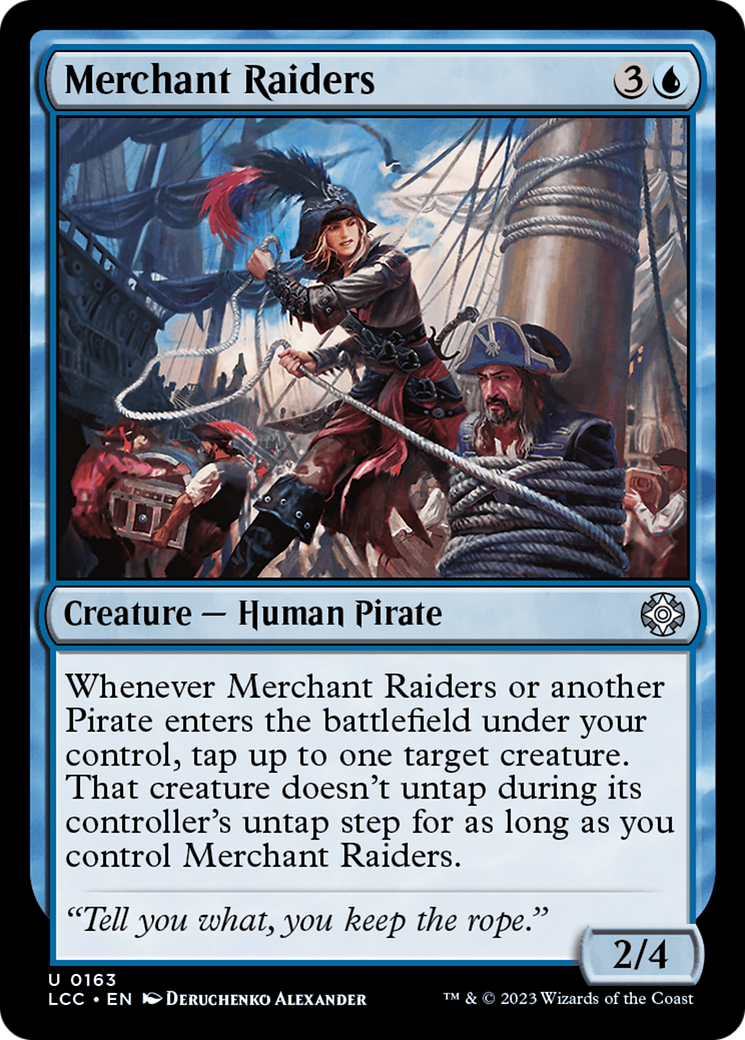
Merchant Raiders
Merchant Raiders
Creature — Human Pirate
2/4
Whenever this creature or another Pirate you control enters, tap up to one target creature. That creature doesn't untap during its controller's untap step for as long as you control this creature.
- The triggered ability can target any creature, including one that is already tapped. In that case, the creature stays tapped and won't untap during its controller's untap step.
- If another player gains control of Merchant Raiders, the creature will no longer be affected by the ability stopping it from untapping, even if you later regain control of Merchant Raiders.
- The ability stopping the creature from untapping will continue to apply to it even if the creature changes controllers.
-
1
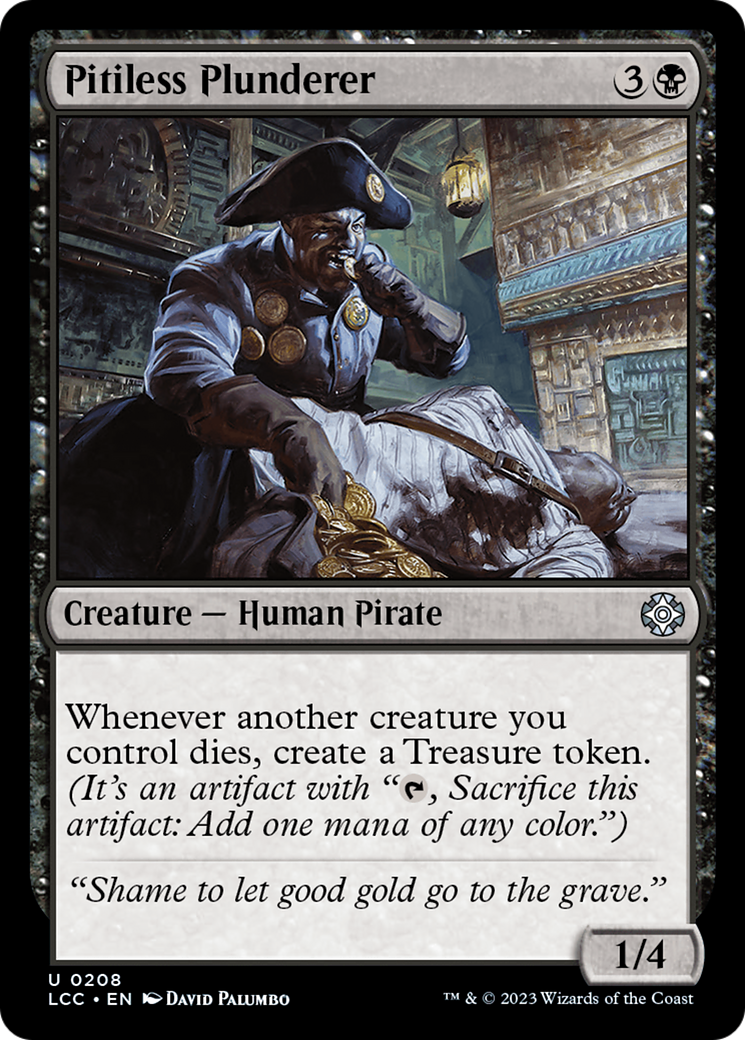
Pitiless Plunderer
Pitiless Plunderer
Creature — Human Pirate
1/4
Whenever another creature you control dies, create a Treasure token. (It's an artifact with " , Sacrifice this token: Add one mana of any color.")
- If Pitiless Plunderer dies at the same time as one or more other creatures you control, its ability will still trigger for each of those other creatures.
-
1
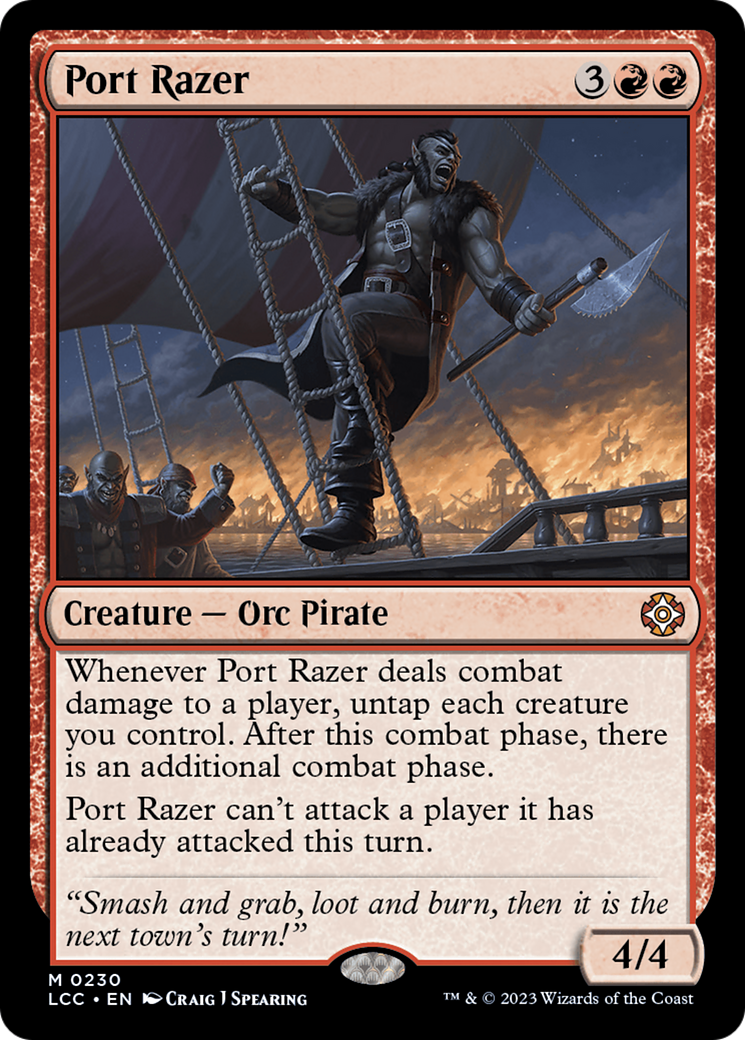
Port Razer
Port Razer
Creature — Orc Pirate
4/4
Whenever this creature deals combat damage to a player, untap each creature you control. After this phase, there is an additional combat phase.
This creature can't attack a player it has already attacked this turn.
- Port Razer's last ability doesn't stop it from attacking a planeswalker or battle during any combat.
- Port Razer doesn't have to attack in any additional combat it creates (or any other time for that matter).
-
1
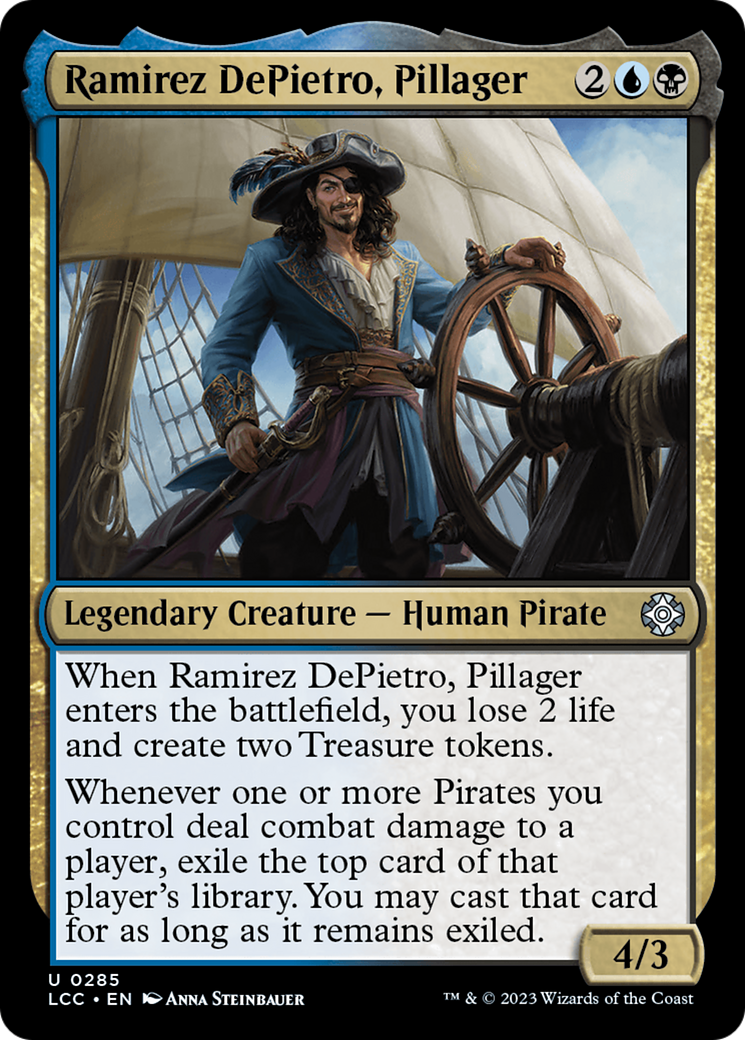
Ramirez DePietro, Pillager
Ramirez DePietro, Pillager
Legendary Creature — Human Pirate
4/3
When Ramirez DePietro enters, you lose 2 life and create two Treasure tokens.
Whenever one or more Pirates you control deal combat damage to a player, exile the top card of that player's library. You may cast that card for as long as it remains exiled.
- You must pay all costs and follow all normal timing rules for spells cast with Ramirez DePietro, Pillager's last ability.
- You may not play lands exiled with the last ability.
-
1
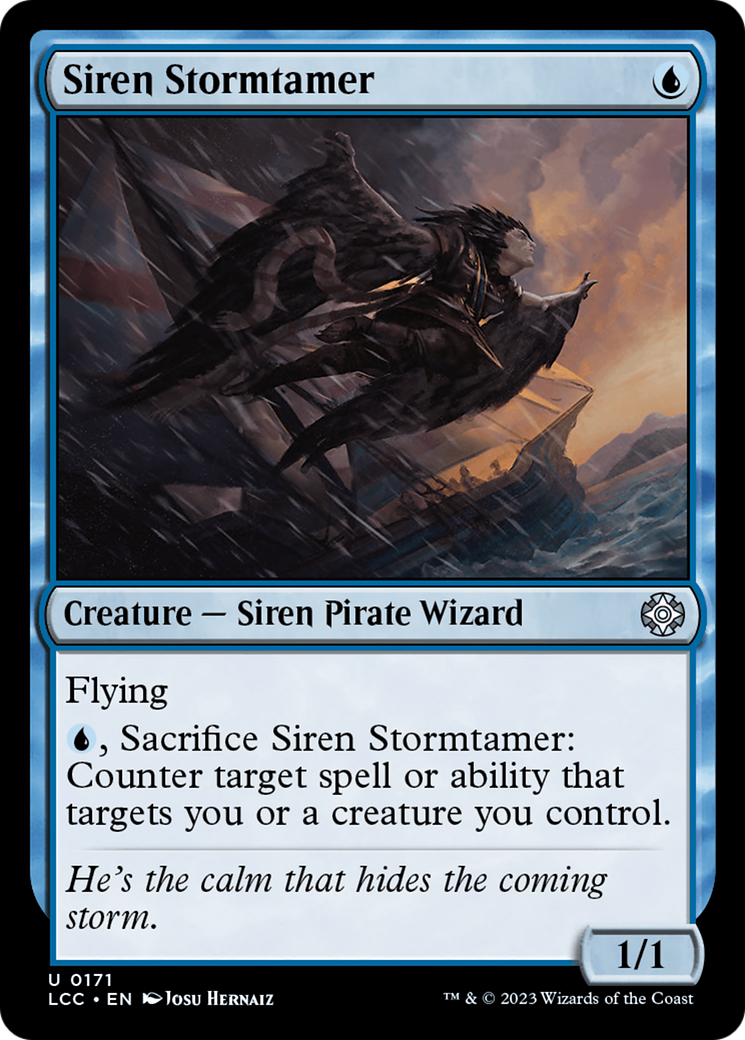
Siren Stormtamer
Siren Stormtamer
Creature — Siren Pirate Wizard
1/1
Flying
, Sacrifice this creature: Counter target spell or ability that targets you or a creature you control.
- Siren Stormtamer's activated ability can target a spell or ability that has multiple targets, as long as at least one of those targets is you or a creature you control.
- If the creature you control targeted by the target spell or ability leaves the battlefield, that spell or ability is no longer a legal target for Siren Stormtamer's ability. On the other hand, if that targeted creature becomes an illegal target for the target spell but remains on the battlefield under your control, the target spell or ability is still a legal target for Siren Stormtamer's ability.
-
1
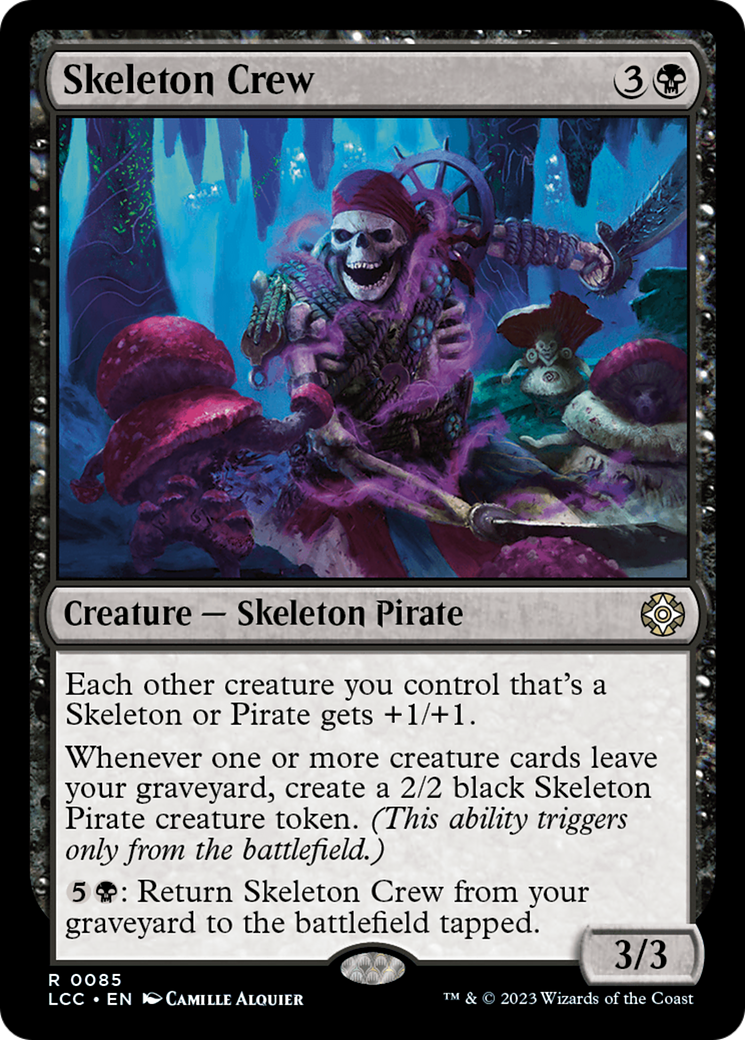
Skeleton Crew
Skeleton Crew
Creature — Skeleton Pirate
3/3
Each other creature you control that's a Skeleton or Pirate gets +1/+1.
Whenever one or more creature cards leave your graveyard, create a 2/2 black Skeleton Pirate creature token. (This ability triggers only from the battlefield.)
: Return this card from your graveyard to the battlefield tapped.
- If two or more creature cards leave your graveyard as a single event, Skeleton Crew's second ability will trigger once. If they leave your graveyard as separate events, it will trigger once for each event.
- Resolving Skeleton Crew's last ability won't cause its second ability to trigger.
-
1
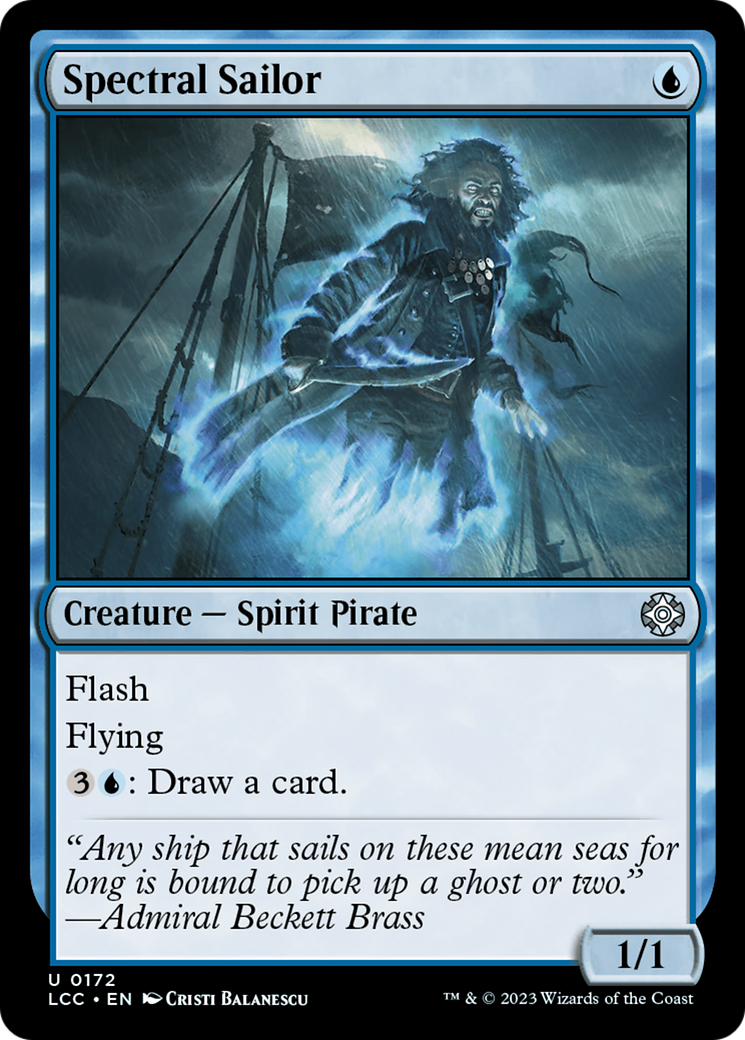
Spectral Sailor
Spectral Sailor
Creature — Spirit Pirate
1/1
Flash (You may cast this spell any time you could cast an instant.)
Flying
: Draw a card.
-
1
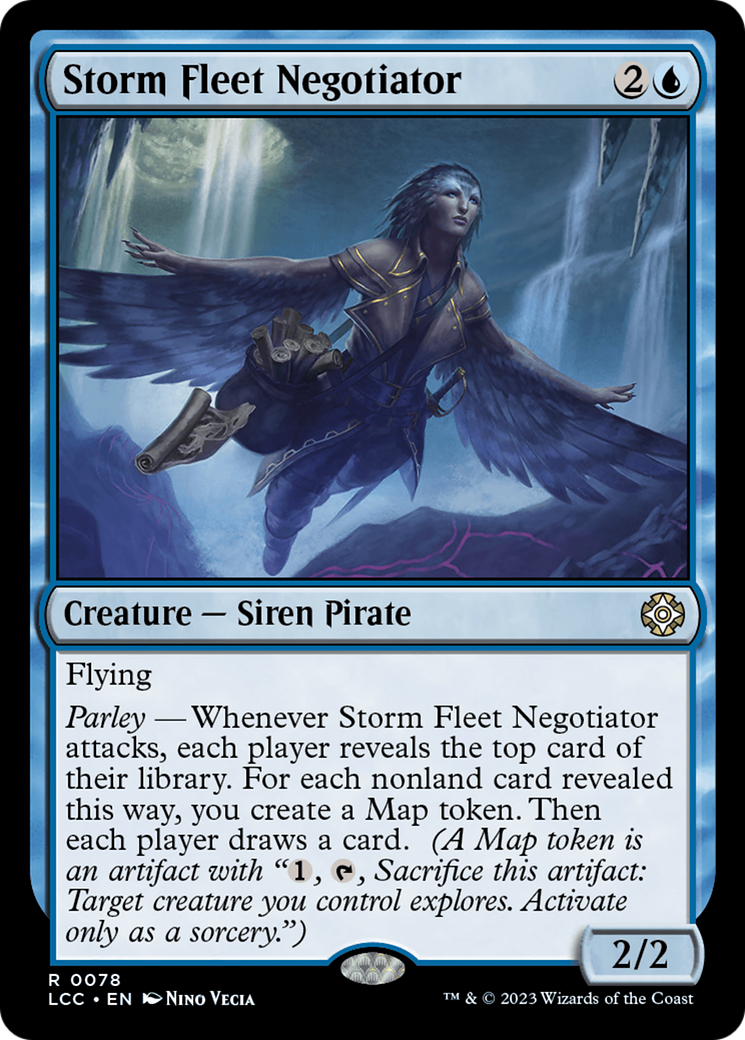
Storm Fleet Negotiator
Storm Fleet Negotiator
Creature — Siren Pirate
2/2
Flying
Parley — Whenever this creature attacks, each player reveals the top card of their library. For each nonland card revealed this way, you create a Map token. Then each player draws a card. (A Map token is an artifact with " , , Sacrifice this token: Target creature you control explores. Activate only as a sorcery.")
- Except in some very unusual cases, the card each player reveals is the one they'll draw.
- If an ability instructs a creature to explore, its controller reveals the top card of their library. If it's a land card, they'll put it into their hand. Otherwise, they'll put a +1/+1 counter on that creature, then choose to either leave that card on top of their library or put it into their graveyard.
- Once an ability that causes a creature to explore begins to resolve, no player may take any other actions until it's done. Notably, opponents can't try to remove the exploring creature after you reveal a nonland card but before it receives a counter.
- If no card is revealed, most likely because that player's library is empty, the exploring creature receives a +1/+1 counter.
- If a resolving spell or ability instructs a specific creature to explore but that creature has left the battlefield, the creature still explores. If you reveal a nonland card this way, you won't put a +1/+1 counter on anything, but you may put the revealed card into your graveyard. Effects that trigger "whenever a creature explores" trigger as appropriate.
- Some spells or abilities might cause a creature to explore multiple times in a row. If you reveal a nonland card when a creature explores and leave it on top of your library, then the creature explores again immediately afterwards, you'll reveal the same card again.
- In some unusual cases, noncreature permanents may explore. For example, if the creature card returned by Defossilize is somehow not a creature once it's on the battlefield, it can still explore. You'll take all the same actions, and you may end up putting a +1/+1 counter on the permanent. (Note that some effects target a creature, and those effects would still require a legal target to have it explore.)
- Map tokens are a kind of predefined token. Each one is a colorless artifact with the artifact subtype Map and the ability " , , Sacrifice this artifact: Target creature you control explores. Activate only as a sorcery."
-
1
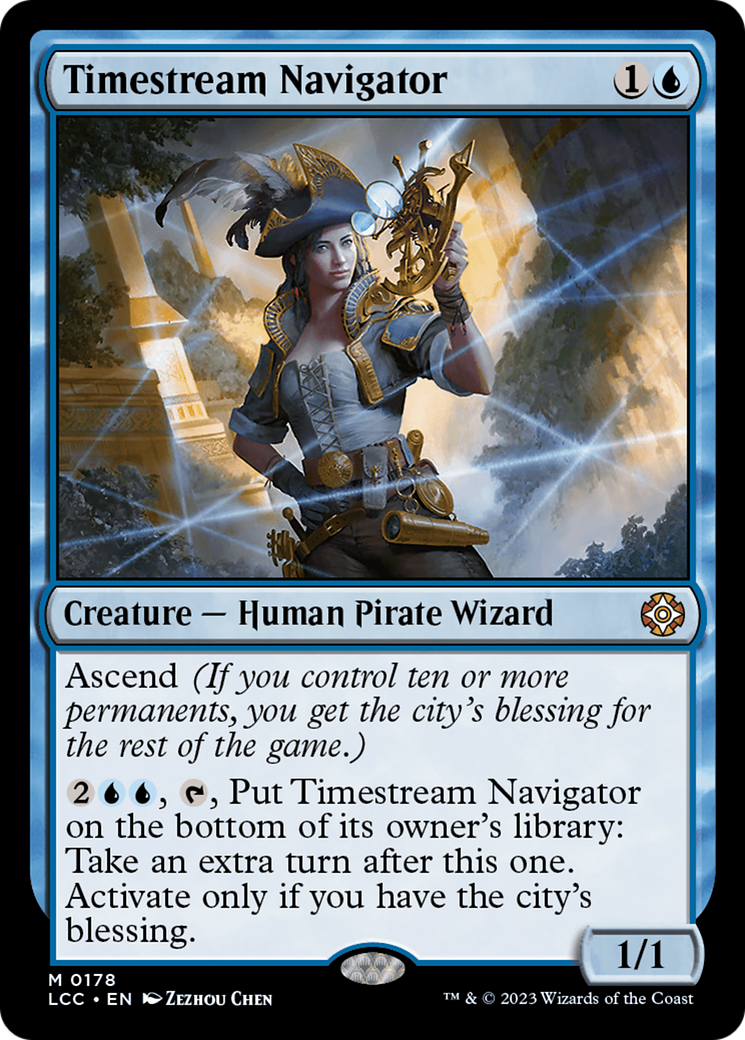
Timestream Navigator
Timestream Navigator
Creature — Human Pirate Wizard
1/1
Ascend (If you control ten or more permanents, you get the city's blessing for the rest of the game.)
, , Put this creature on the bottom of its owner's library: Take an extra turn after this one. Activate only if you have the city's blessing.
- Once you have the city's blessing, you have it for the rest of the game, even if you lose control of some or all of your permanents. The city's blessing isn't a permanent itself and can't be removed by any effect.
- A permanent is any object on the battlefield, including tokens and lands. Spells and emblems aren't permanents.
- If you cast a spell with ascend, you don't get the city's blessing until it resolves. Players may respond to that spell by trying to change whether you get the city's blessing.
- If you control ten permanents but don't control a permanent or resolving spell with ascend, you don't get the city's blessing. For example, if you control ten permanents, lose control of one, then cast Golden Demise, you won't have the city's blessing and the spell will affect creatures you control.
- If your tenth permanent enters the battlefield and then a permanent leaves the battlefield immediately afterwards (most likely due to the "Legend Rule" or due to being a creature with 0 toughness), you get the city's blessing before it leaves the battlefield.
- Ascend on a permanent isn't a triggered ability and doesn't use the stack. Players can respond to a spell that will give you your tenth permanent, but they can't respond to getting the city's blessing once you control that tenth permanent. This means that if your tenth permanent is a land you play, players can't respond before you get the city's blessing.
-
1
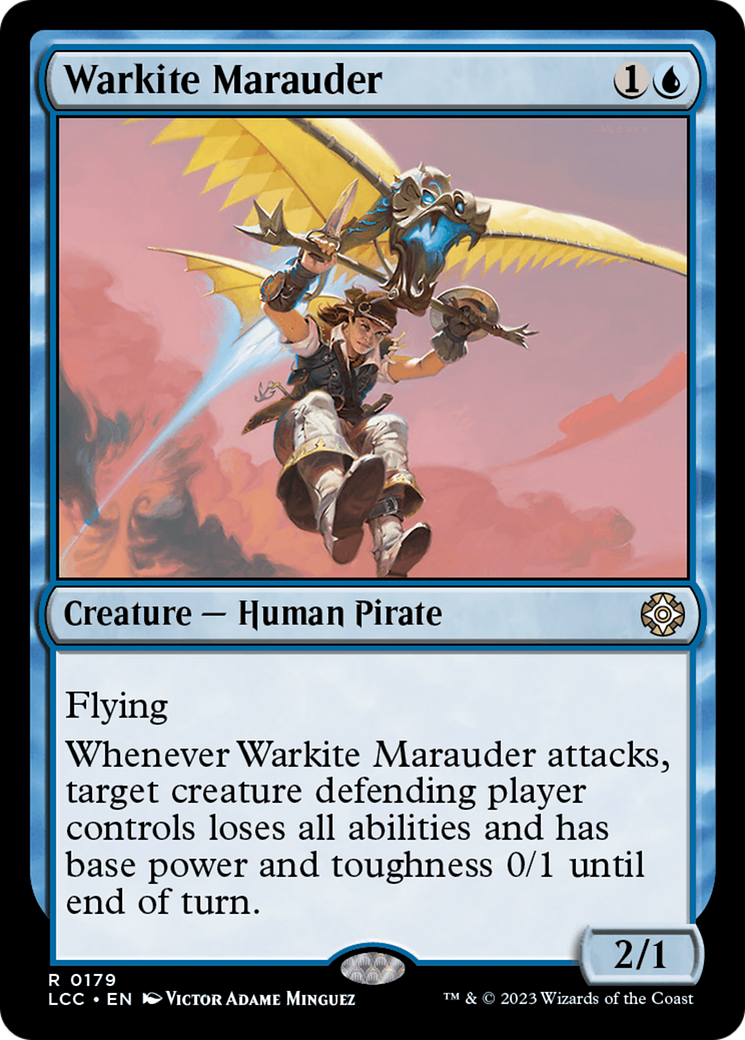
Warkite Marauder
Warkite Marauder
Creature — Human Pirate
2/1
Flying
Whenever this creature attacks, target creature defending player controls loses all abilities and has base power and toughness 0/1 until end of turn.
- Warkite Marauder's ability overwrites all previous effects that set the creature's base power and toughness to specific values. Any power- or toughness-setting effects that start to apply after the ability resolves will overwrite this effect.
- If the affected creature gains an ability after Warkite Marauder's ability resolves, it will keep that ability. If the affected creature has an ability that grants abilities to other objects, Warkite Marauder's effect will stop it from doing so.
- Effects that modify a creature's power and/or toughness, such as the effect of Titanic Growth, will apply to the creature no matter when they started to take effect. The same is true for any counters that change its power and/or toughness and effects that switch its power and toughness.
-
1
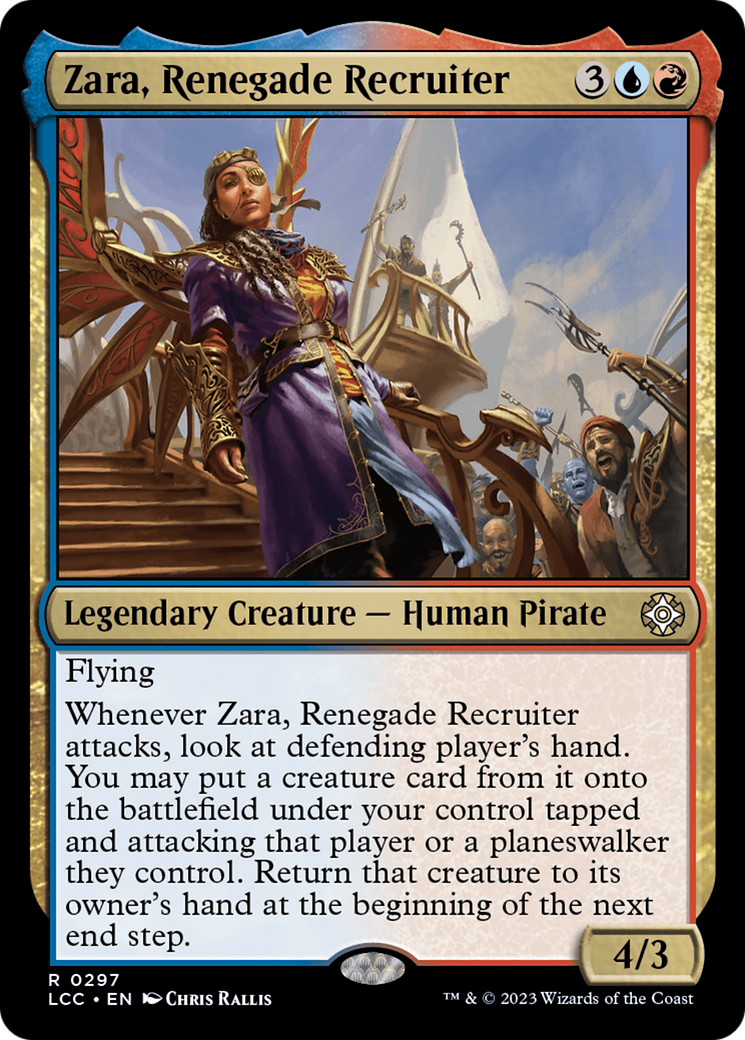
Zara, Renegade Recruiter
Zara, Renegade Recruiter
Legendary Creature — Human Pirate
4/3
Flying
Whenever Zara attacks, look at defending player's hand. You may put a creature card from it onto the battlefield under your control tapped and attacking that player or a planeswalker they control. Return that creature to its owner's hand at the beginning of the next end step.
- If a creature is attacking a planeswalker, that planeswalker's controller is the defending player.
- Although the creature is attacking, it was never declared as an attacking creature. This means that abilities that trigger whenever a creature attacks won't trigger when the creature enters the battlefield attacking.
- Any effects that say the creature can't attack affect only the declaration of attackers. They won't stop the creature from entering the battlefield attacking. For example, you could put a creature card with defender onto the battlefield tapped and attacking this way.
- The creature is returned to its owner's hand only if it's still on the battlefield as the delayed triggered ability resolves. If it's somewhere else at that time, it stays where it is.
- If you lose the game before the creature put onto the battlefield under your control returns to its owner's hand, that creature is exiled. If that creature's owner loses the game while you control the creature, the creature leaves the game with them.
Instants 5
-
1
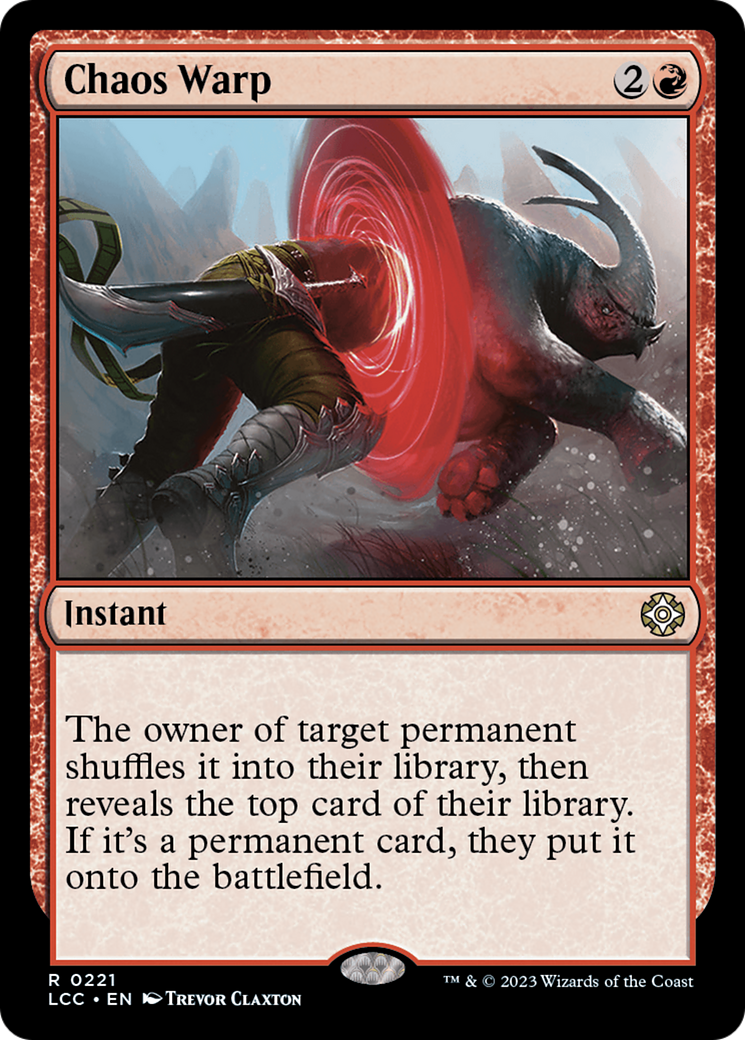
Chaos Warp
Chaos Warp
Instant
The owner of target permanent shuffles it into their library, then reveals the top card of their library. If it's a permanent card, they put it onto the battlefield.
- A permanent card is a card with one or more of the following card types: artifact, creature, enchantment, land, or planeswalker.
- The owner of a token is the player under whose control the token was put onto the battlefield. If a token is shuffled into a player's library this way, that player shuffles before revealing the top card of that library.
- If the revealed card is not a permanent card, it remains on top of that library.
- If the permanent is an illegal target by the time Chaos Warp tries to resolve, it won't resolve and none of its effects will occur. No library will be shuffled and no card will be revealed.
- If the revealed card is a permanent card but can't enter (perhaps because it's an Aura with nothing to enchant), it remains on top of that library.
-
1
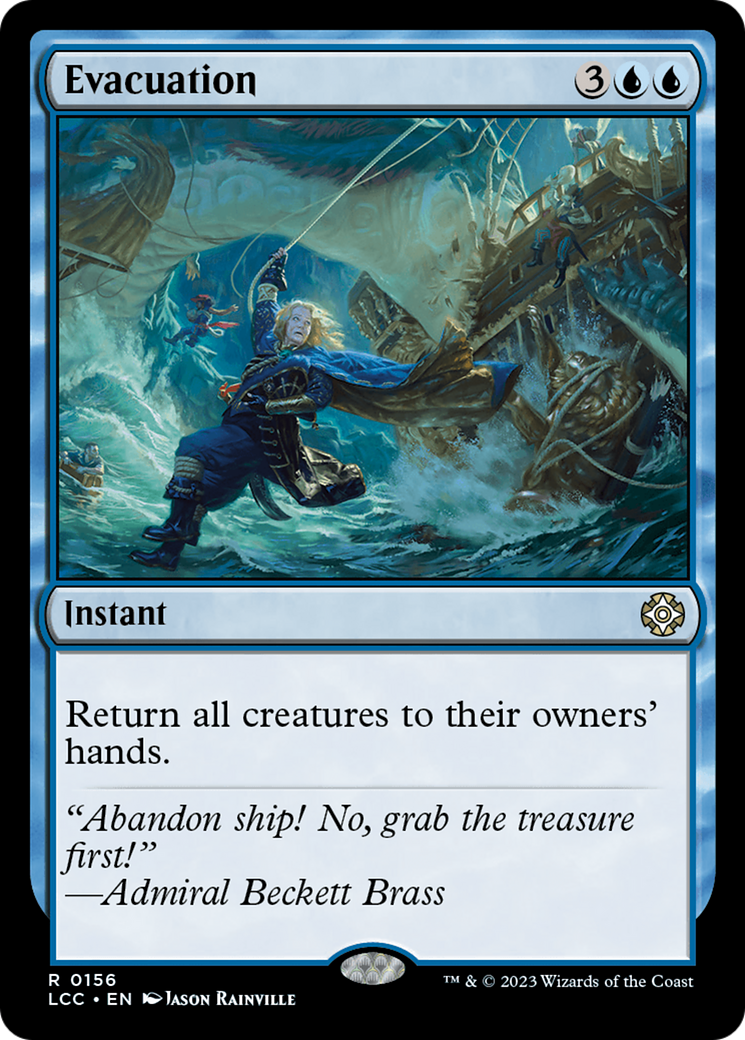
Evacuation
Evacuation
Instant
Return all creatures to their owners' hands.
-
1
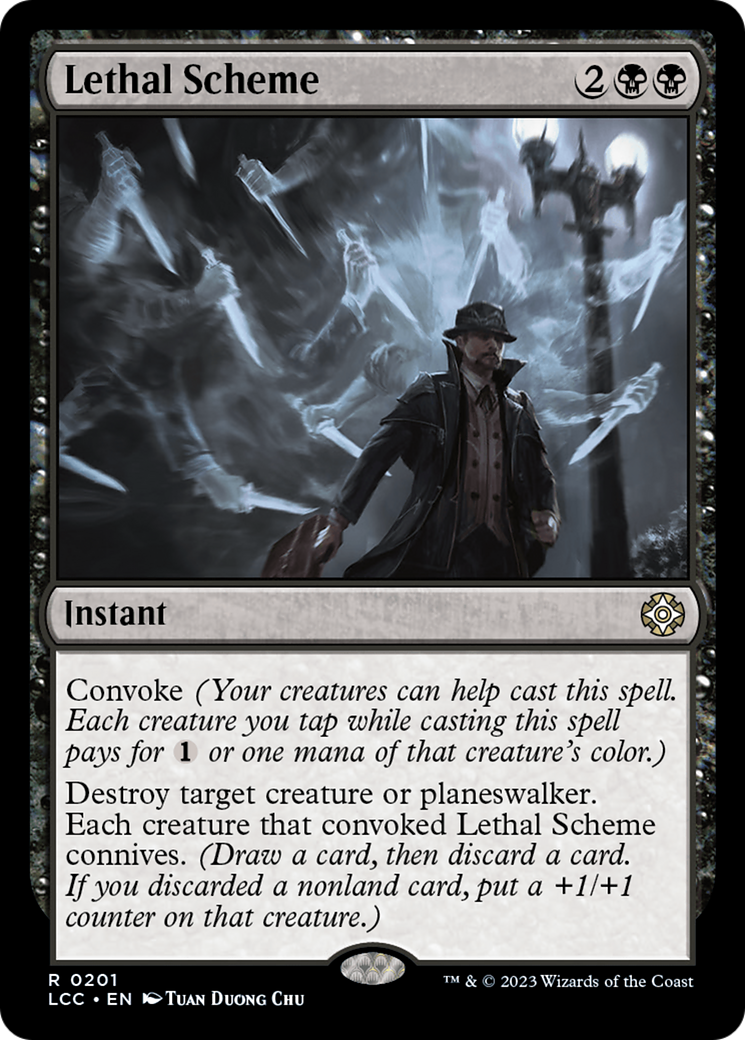
Lethal Scheme
Lethal Scheme
Instant
Convoke (Your creatures can help cast this spell. Each creature you tap while casting this spell pays for or one mana of that creature's color.)
Destroy target creature or planeswalker. Each creature that convoked Lethal Scheme connives. (Draw a card, then discard a card. If you discarded a nonland card, put a +1/+1 counter on that creature.)
- When multiple creatures are instructed to connive simultaneously, they connive one at a time in the order of their controller's choice.
- You can't tap more creatures to convoke Lethal Scheme than it takes to pay for its total cost. This means that normally no more than four creatures can convoke it.
-
1
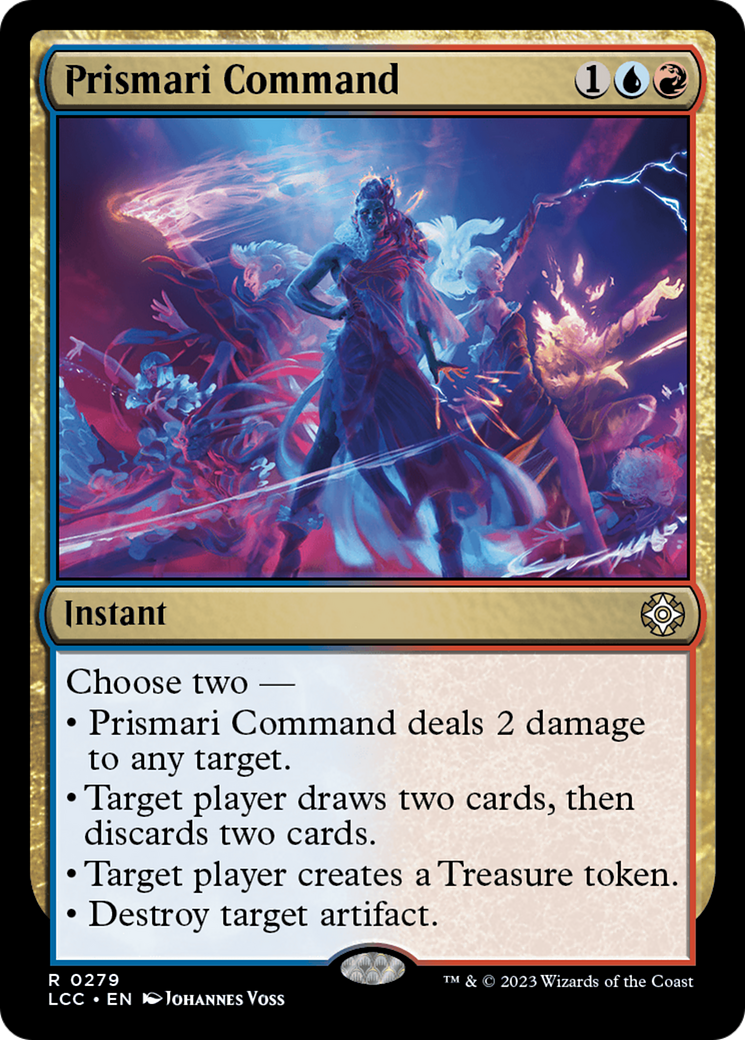
Prismari Command
Prismari Command
Instant
Choose two —
- Prismari Command deals 2 damage to any target.
- Target player draws two cards, then discards two cards.
- Target player creates a Treasure token.
- Destroy target artifact.
- If all of Prismari Command's targets are illegal as it tries to resolve, it will do nothing.
- If at least one target is still legal as Prismari Command tries to resolve, it will resolve and do as much as it can.
-
1
Rakdos Charm
Rakdos Charm
Instant
Choose one —
- Exile target player's graveyard.
- Destroy target artifact.
- Each creature deals 1 damage to its controller.
Sorceries 6
-
1
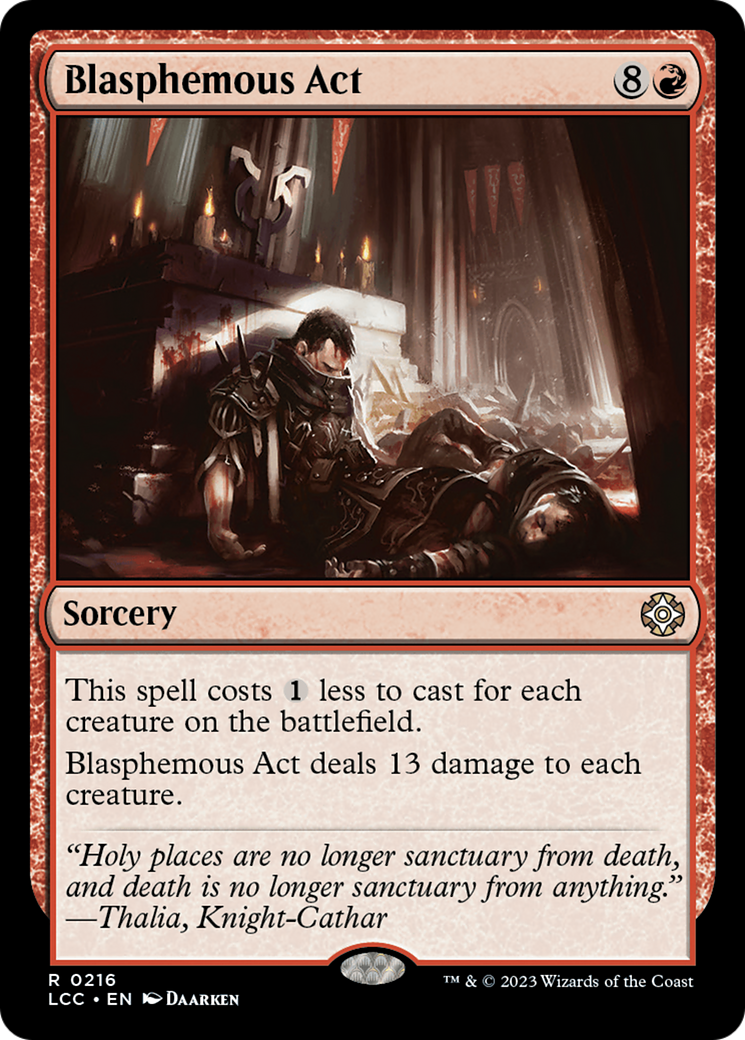
Blasphemous Act
Blasphemous Act
Sorcery
This spell costs less to cast for each creature on the battlefield.
Blasphemous Act deals 13 damage to each creature.
- Although players may respond to Blasphemous Act once it's been cast, once it's announced, they can't respond before the cost is calculated and paid.
- Blasphemous Act's ability can't reduce the total cost to cast the spell below .
- The total cost to cast Blasphemous Act is locked in before you pay that cost. For example, if there are three creatures on the battlefield, including one you can sacrifice to add , the total cost of Blasphemous Act is . Then you can sacrifice the creature when you activate mana abilities just before paying the cost.
- To determine the total cost of a spell, start with the mana cost or alternative cost you're paying, add any cost increases, then apply any cost reductions (such as that of Blasphemous Act). The mana value of the spell is determined only by its mana cost, no matter what the total cost to cast the spell was.
-
1
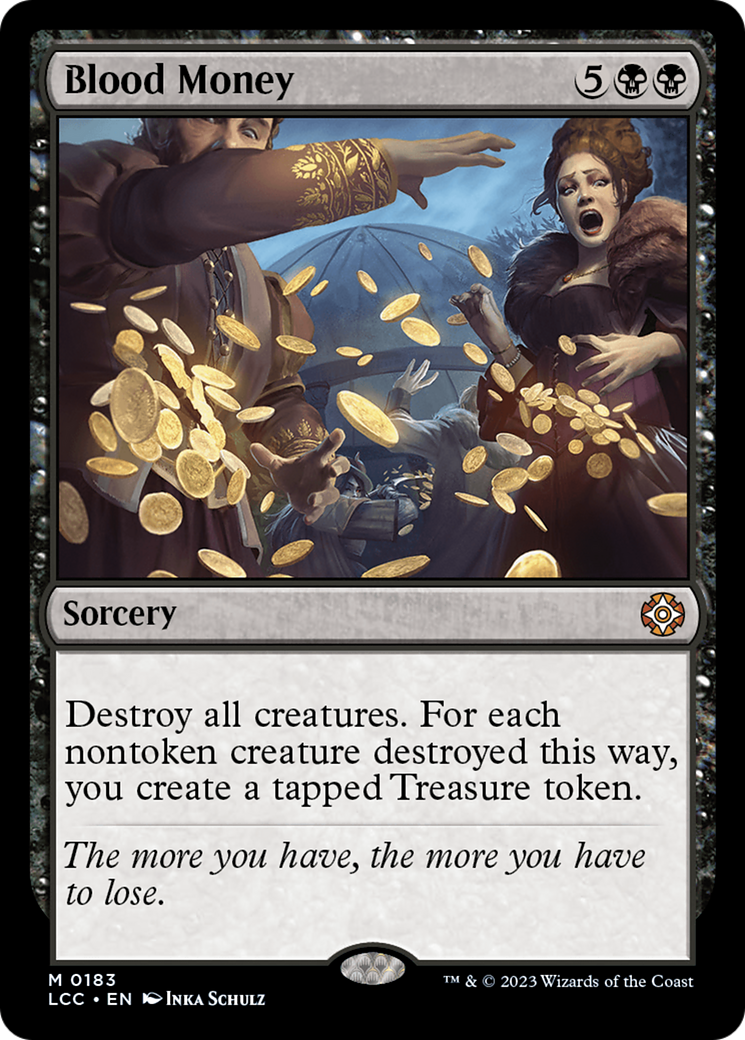
Blood Money
Blood Money
Sorcery
Destroy all creatures. For each nontoken creature destroyed this way, you create a tapped Treasure token.
- If a creature isn't destroyed this way for some reason, such as having indestructible or being regenerated, Blood Money's controller will not create a Treasure token for it.
-
1
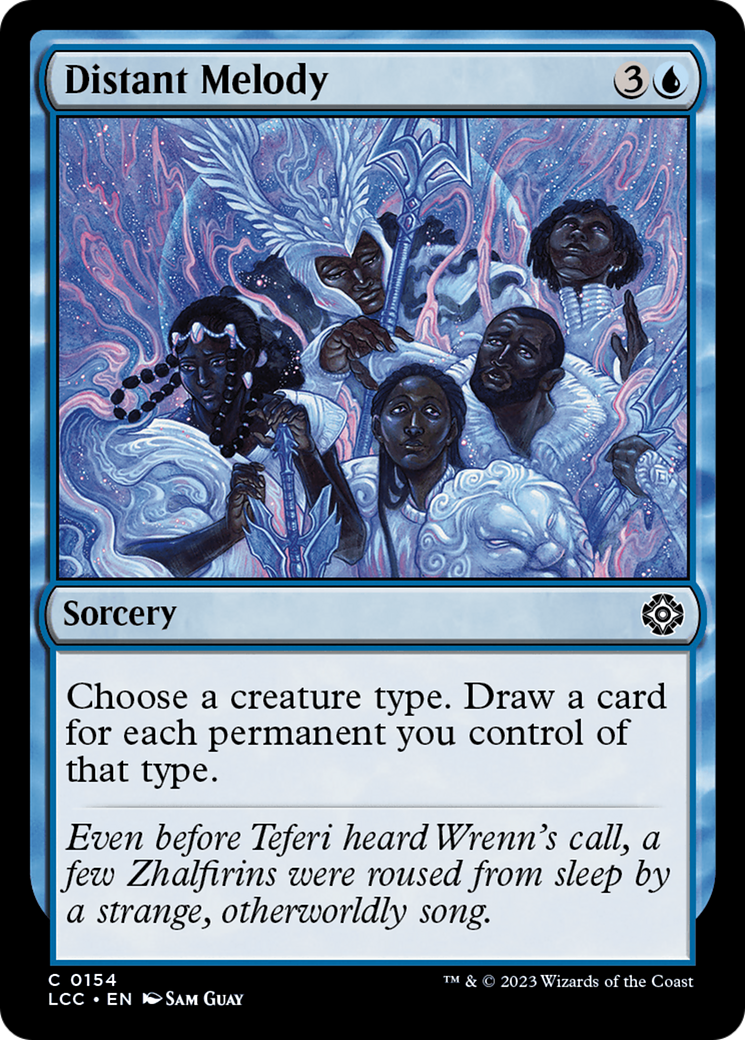
Distant Melody
Distant Melody
Sorcery
Choose a creature type. Draw a card for each permanent you control of that type.
- Note that this spell counts the number of permanents you control of the chosen type, not just the number of creatures you control. It will also take your kindred permanents of the chosen type into account.
-
1
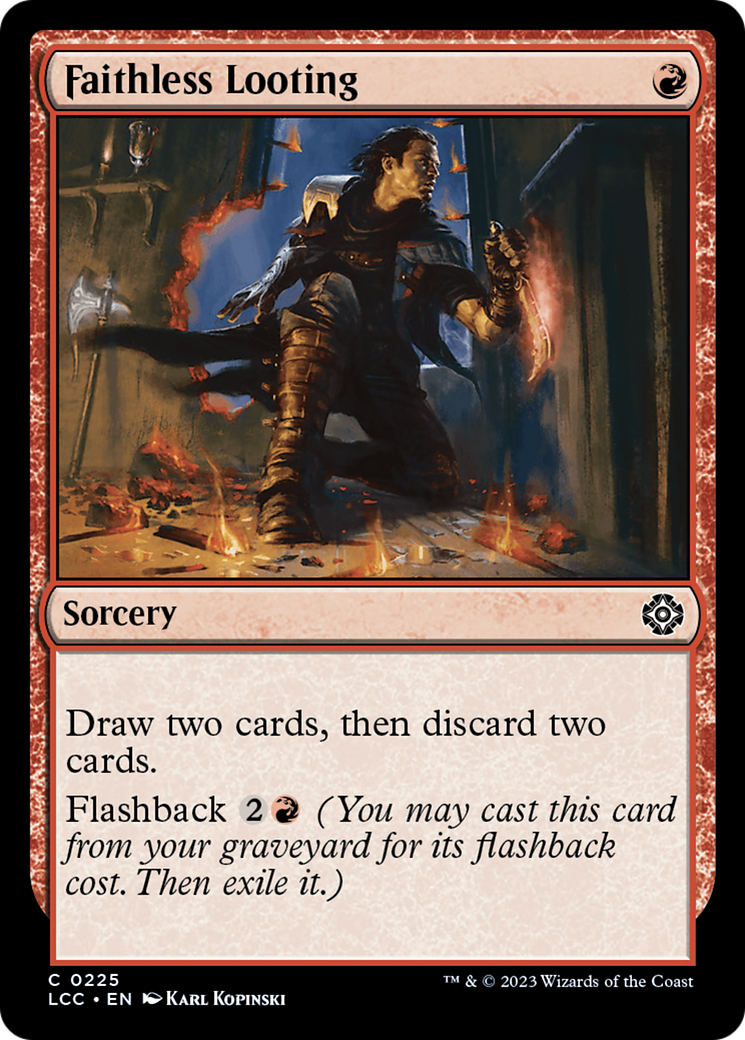
Faithless Looting
Faithless Looting
Sorcery
Draw two cards, then discard two cards.
Flashback (You may cast this card from your graveyard for its flashback cost. Then exile it.)
- To determine the total cost of a spell, start with the mana cost or alternative cost (such as a flashback cost) you're paying, add any cost increases, then apply any cost reductions. The mana value of the spell is determined only by its mana cost, no matter what the total cost to cast the spell was.
- A spell cast using flashback will always be exiled afterward, whether it resolves, is countered, or leaves the stack in some other way.
- "Flashback [cost]" means "You may cast this card from your graveyard if the resulting spell is an instant or sorcery spell by paying [cost] rather than paying its mana cost" and "If the flashback cost was paid, exile this card instead of putting it anywhere else any time it would leave the stack."
- If a card with flashback is put into your graveyard during your turn, you can cast it if it's legal to do so before any other player can take any actions.
- You can cast a spell using flashback even if it was somehow put into your graveyard without having been cast.
- You must still follow any timing restrictions and permissions, including those based on the card's type. For instance, you can cast a sorcery using flashback only when you could normally cast a sorcery.
- You draw two cards and discard two cards all while Faithless Looting is resolving. Nothing can happen between the two, and no player may choose to take actions.
-
1
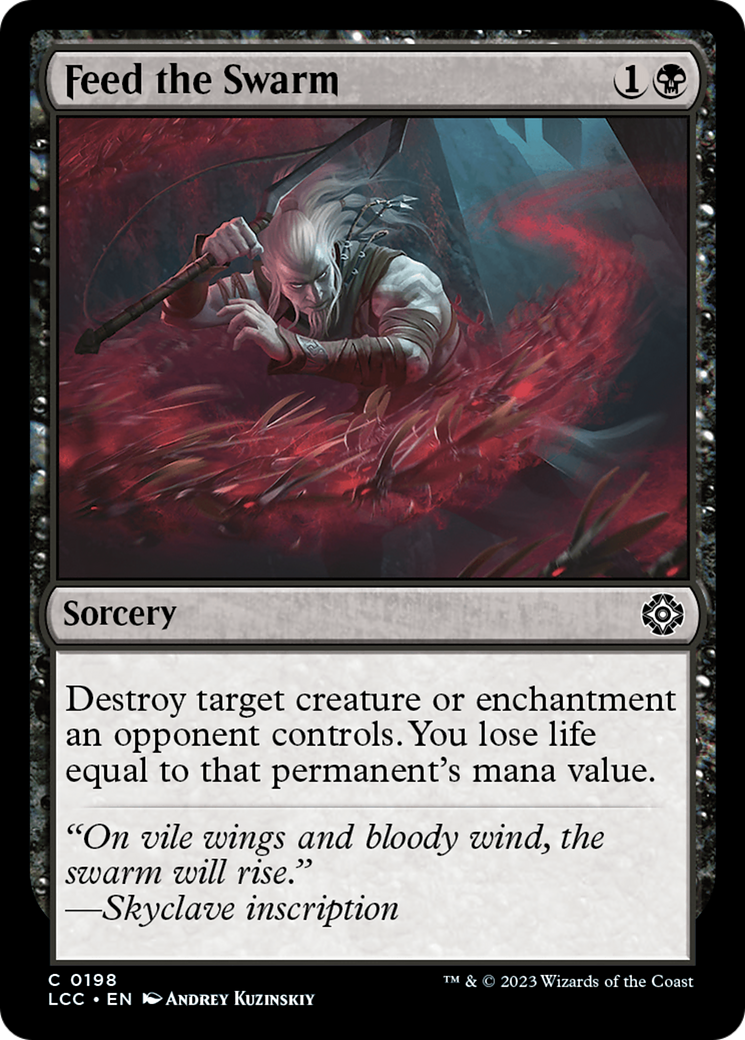
Feed the Swarm
Feed the Swarm
Sorcery
Destroy target creature or enchantment an opponent controls. You lose life equal to that permanent's mana value.
- The amount of life you lose is determined by the permanent's mana value as it last existed on the battlefield.
- If the target permanent is an illegal target by the time Feed the Swarm tries to resolve, the spell doesn't resolve. You don't lose any life. If the target is legal but not destroyed (most likely because it has indestructible), you do lose life.
- If a permanent on the battlefield has in its mana cost, X is 0 for the purpose of determining its mana value.
-
1
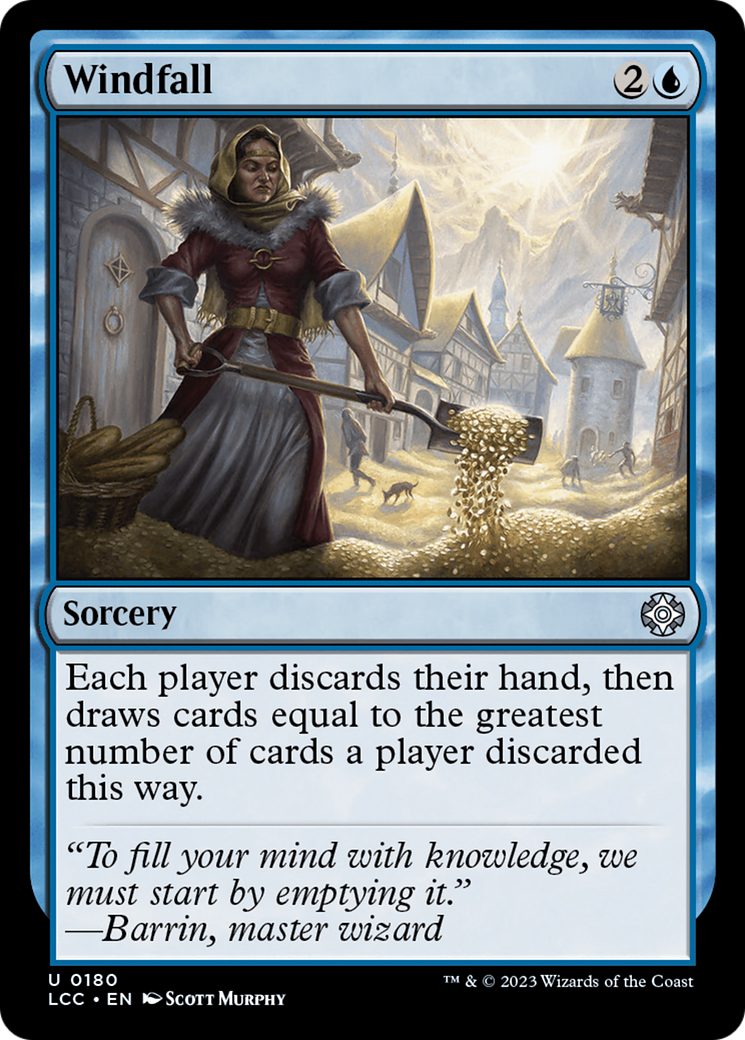
Windfall
Windfall
Sorcery
Each player discards their hand, then draws cards equal to the greatest number of cards a player discarded this way.
Artifacts 14
-
1
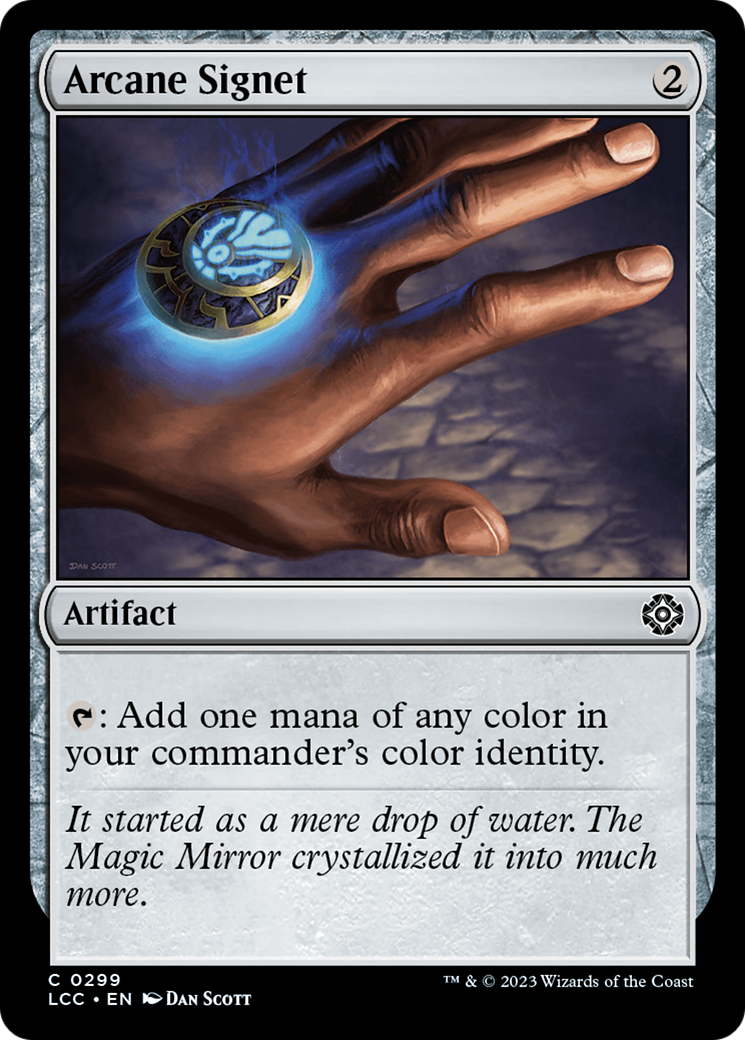
Arcane Signet
Arcane Signet
Artifact
: Add one mana of any color in your commander's color identity.
- If your commander is a card that has no colors in its color identity, Arcane Signet's ability produces no mana. It doesn't produce .
- If you have two commanders, the ability adds one mana of any color in their combined color identities.
- If you don't have a commander, Arcane Signet's ability produces no mana.
-
1
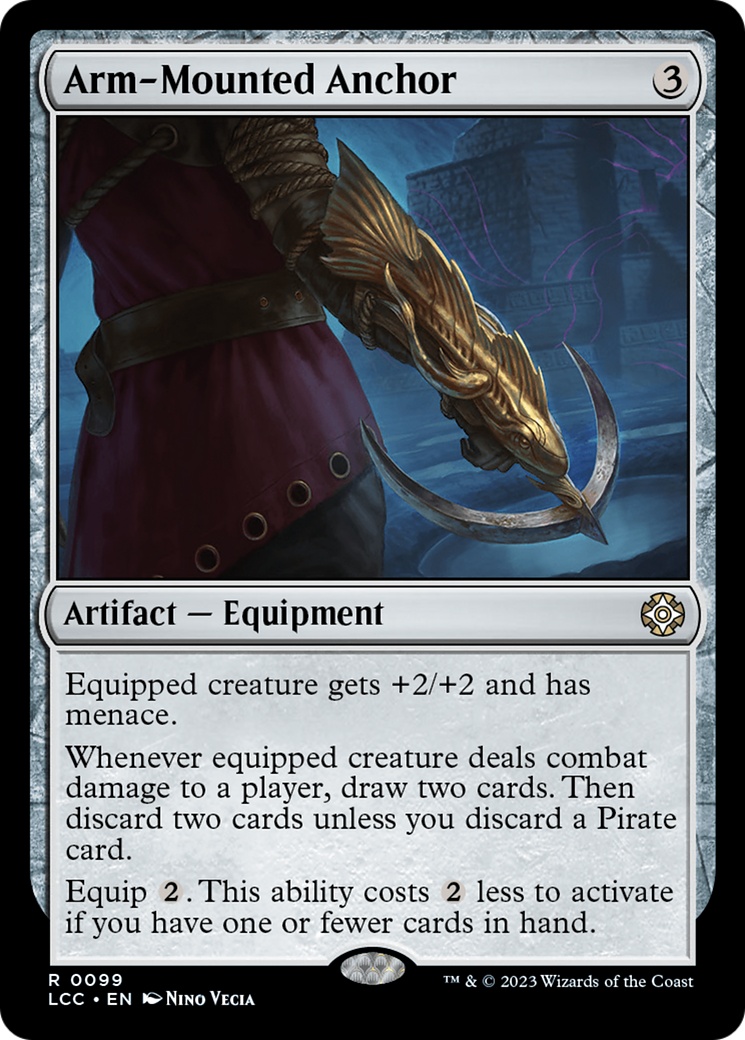
Arm-Mounted Anchor
Arm-Mounted Anchor
Artifact — Equipment
Equipped creature gets +2/+2 and has menace.
Whenever equipped creature deals combat damage to a player, draw two cards. Then discard two cards unless you discard a Pirate card.
Equip . This ability costs less to activate if you have one or fewer cards in hand.
- You can discard either one Pirate card or two cards which may or may not be Pirates. If you really want to, you can discard two Pirate cards. (Admiral Brass will remember this.)
-
1
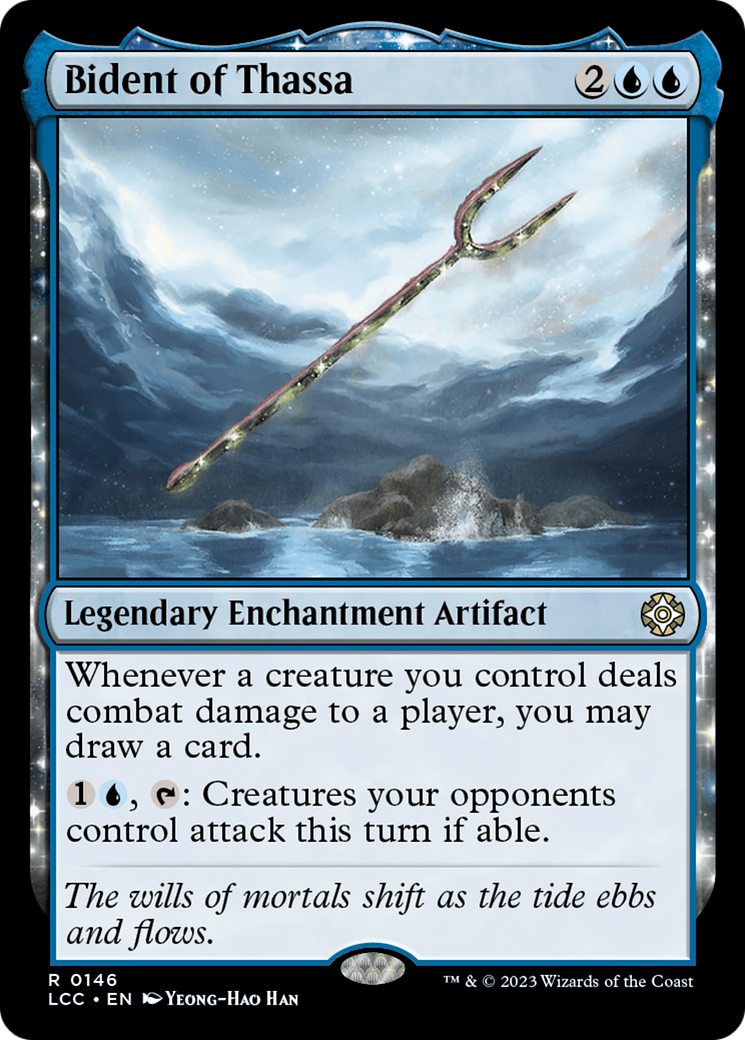
Bident of Thassa
Bident of Thassa
Legendary Enchantment Artifact
Whenever a creature you control deals combat damage to a player, you may draw a card.
, : Creatures your opponents control attack this turn if able.
- The controller of each attacking creature still chooses which player or planeswalker that creature attacks.
- If a creature can't attack for any reason (such as being tapped or having come under that player's control that turn), then it doesn't attack. If there's a cost associated with having a creature attack, the player isn't forced to pay that cost, so it doesn't have to attack in that case either.
-
1
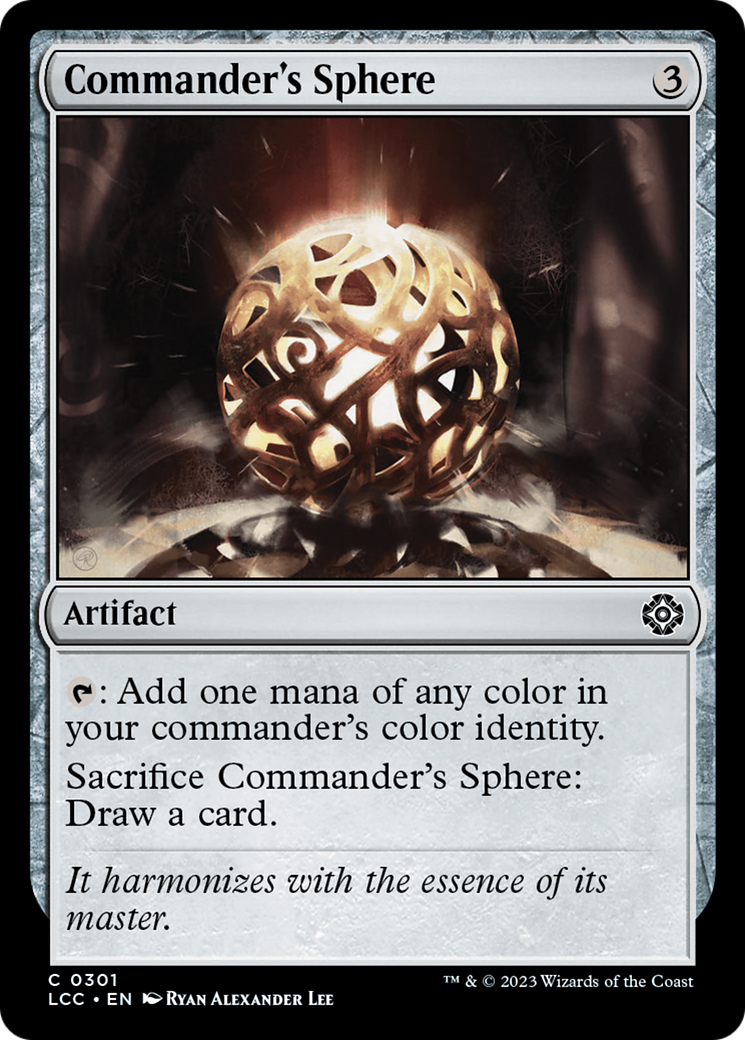
Commander's Sphere
Commander's Sphere
Artifact
: Add one mana of any color in your commander's color identity.
Sacrifice this artifact: Draw a card.
- If your commander is a card that has no colors in its color identity, Commander's Sphere's first ability produces no mana. It doesn't produce .
- If you don't have a commander, Commander's Sphere's first ability produces no mana.
- If you have two commanders, the ability adds one mana of any color in their combined color identities.
-
1
Dimir Signet
Dimir Signet
Artifact
, : Add .
-
1
Herald's Horn
Herald's Horn
Artifact
As this artifact enters, choose a creature type.
Creature spells you cast of the chosen type cost less to cast.
At the beginning of your upkeep, look at the top card of your library. If it's a creature card of the chosen type, you may reveal it and put it into your hand.
- If you somehow control a Herald's Horn with no chosen creature type, no spells will cost less to cast, not even creature spells with no creature type. You'll be able to look at the top card of your library at the beginning of each of your upkeeps, but you can never put it into your hand this way, even if it's a creature card with no creature type.
- The effect of Herald's Horn reduces only generic mana in a spell's cost. If that cost has no generic mana, the cost isn't reduced.
- To determine the total cost of a spell, start with the mana cost or alternative cost you're paying, add any cost increases, then apply any cost reductions. The mana value of the spell remains unchanged, no matter what the total cost to cast it was.
- If you don't put the top card of your library into your hand, you put it back on top of your library without revealing it. You'll draw it in that turn's draw step.
-
1
Icon of Ancestry
Icon of Ancestry
Artifact
As this artifact enters, choose a creature type.
Creatures you control of the chosen type get +1/+1.
, : Look at the top three cards of your library. You may reveal a creature card of the chosen type from among them and put it into your hand. Put the rest on the bottom of your library in a random order.
- You must choose an existing creature type, such as Vampire or Warrior. Card types (such as artifact) and supertypes (such as legendary) can't be chosen.
-
1
Izzet Signet
Izzet Signet
Artifact
, : Add .
-
1
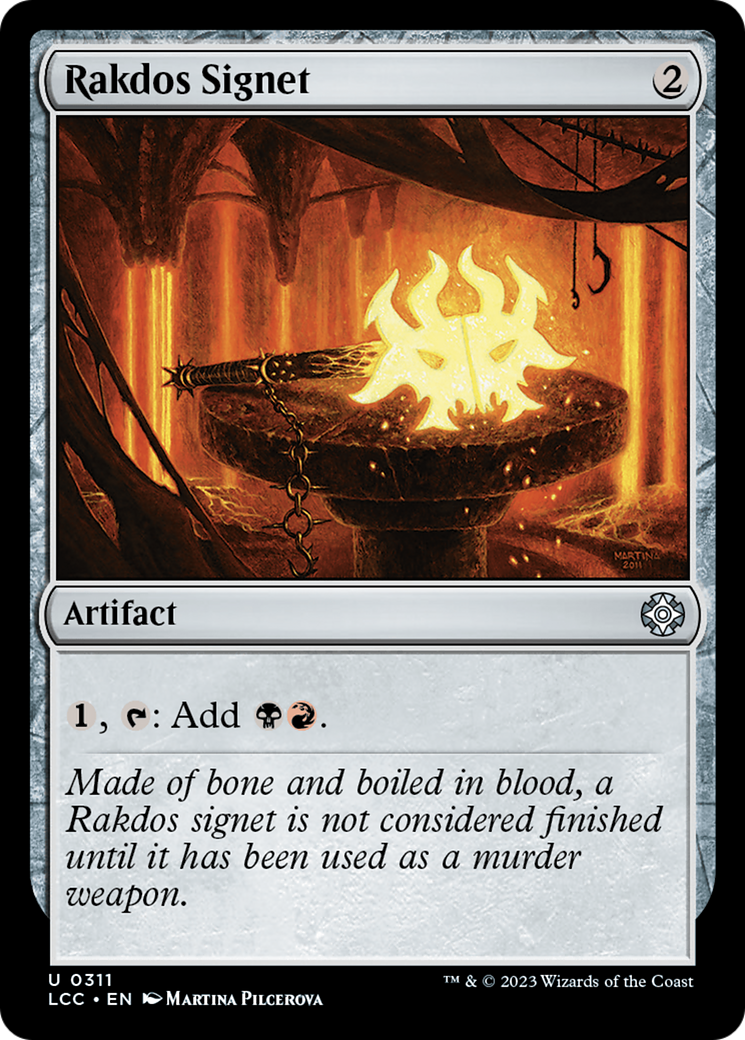
Rakdos Signet
Rakdos Signet
Artifact
, : Add .
-
1
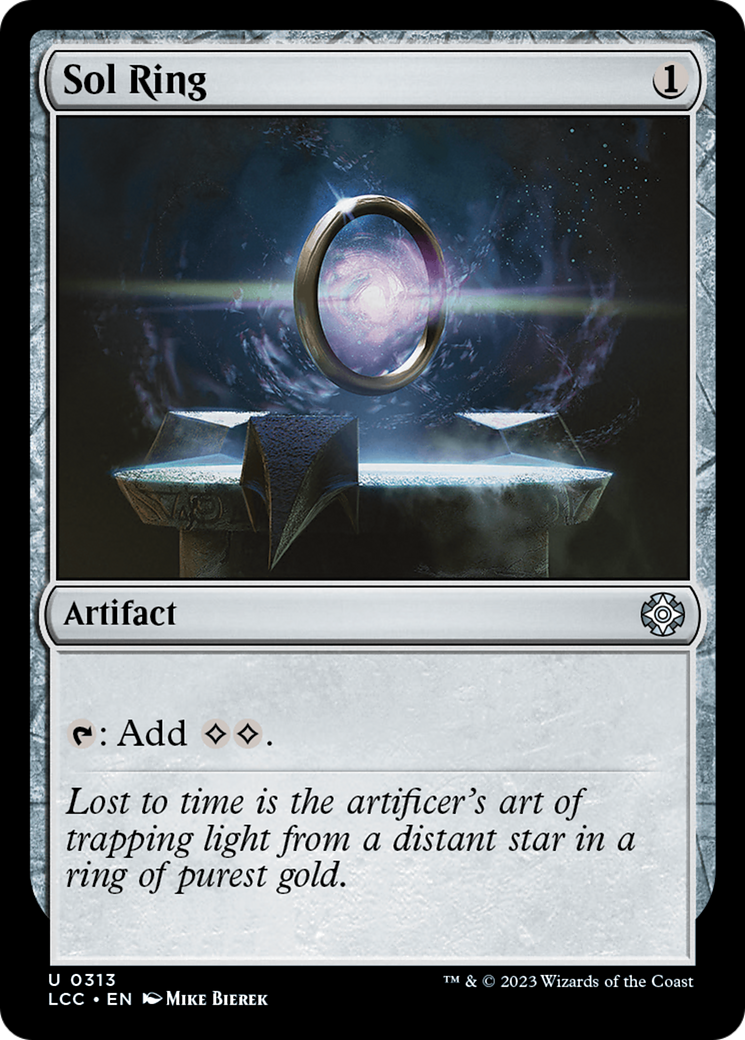
Sol Ring
Sol Ring
Artifact
: Add .
-
1
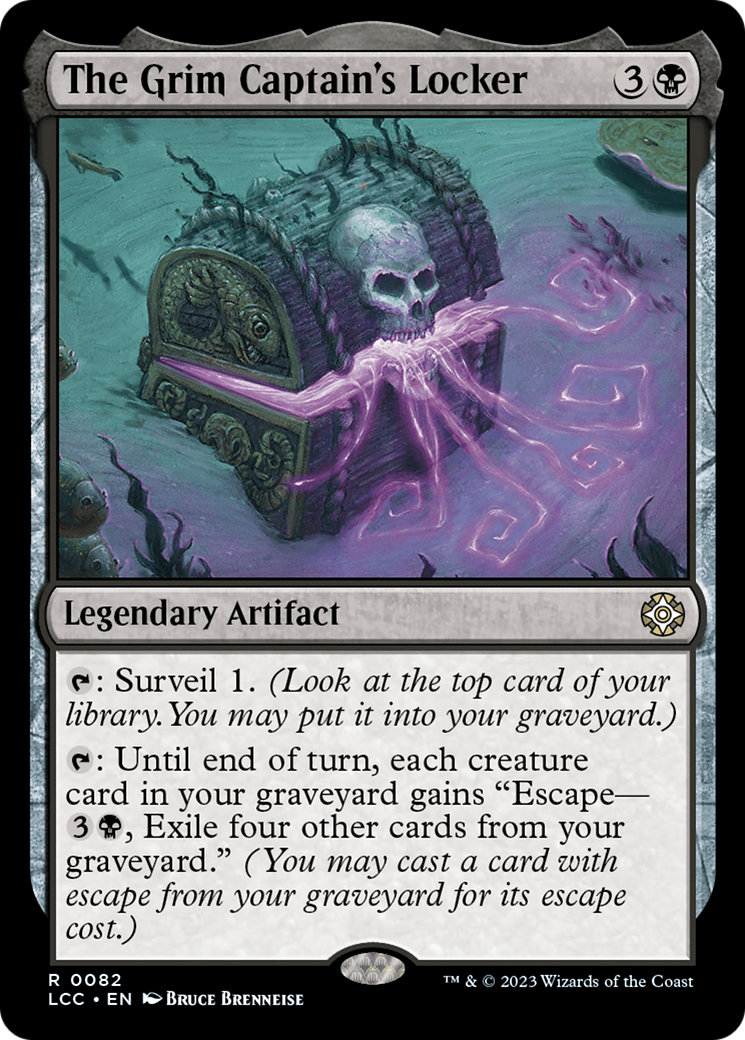
The Grim Captain's Locker
The Grim Captain's Locker
Legendary Artifact
: Surveil 1. (Look at the top card of your library. You may put it into your graveyard.)
: Until end of turn, each creature card in your graveyard gains "Escape— , Exile four other cards from your graveyard." (You may cast a card with escape from your graveyard for its escape cost.)
- Escape's permission doesn't change when you may cast the spell from your graveyard.
- To determine the total cost of a spell, start with the mana cost or alternative cost you're paying (such as an escape cost), add any cost increases, then apply any cost reductions. The mana value of the spell remains unchanged, no matter what the total cost to cast it was and no matter whether an alternative cost was paid.
- If a card has multiple abilities giving you permission to cast it, such as two escape abilities or an escape ability and a flashback ability, you choose which one to apply. The others have no effect.
- If you cast a spell with its escape permission, you can't choose to apply any other alternative costs or to cast it without paying its mana cost. If it has any additional costs, you must pay those.
- Once you begin casting a spell with escape, it immediately moves to the stack. Players can't take any other actions until you're done casting the spell.
-
1
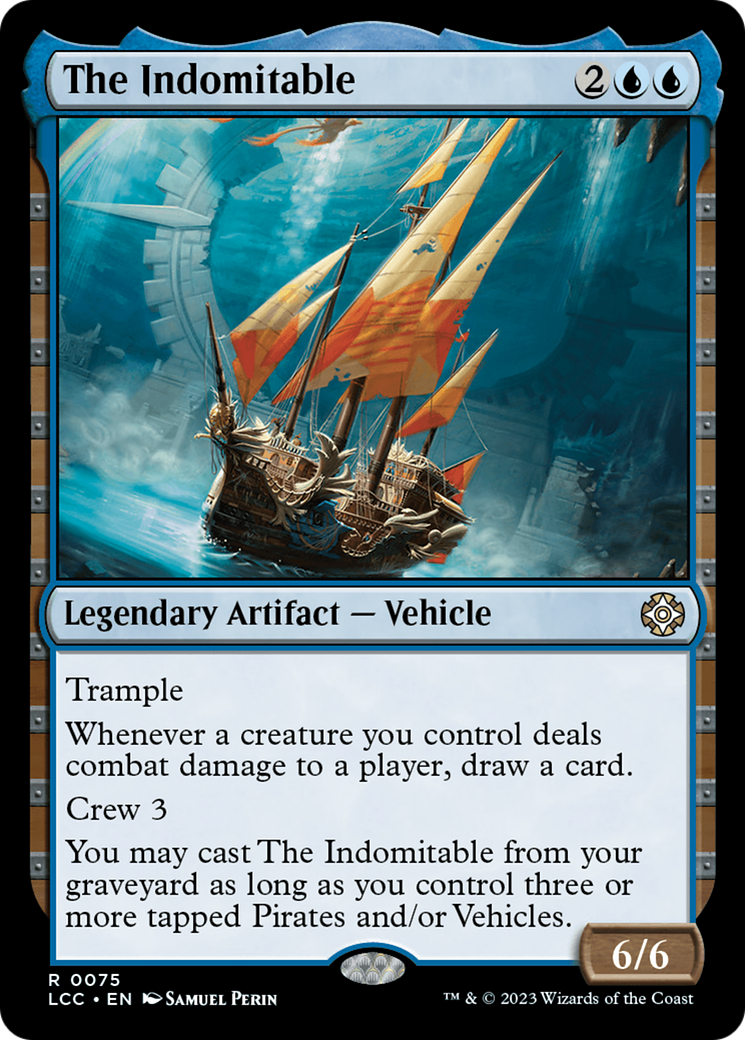
The Indomitable
The Indomitable
Legendary Artifact — Vehicle
6/6
Trample
Whenever a creature you control deals combat damage to a player, draw a card.
Crew 3
You may cast this card from your graveyard as long as you control three or more tapped Pirates and/or Vehicles.
- The casting permission granted by The Indomitable's last ability doesn't change when you may cast it from your graveyard.
- You still pay The Indomitable's costs when casting it from your graveyard.
- If The Indomitable is countered or dies after being cast from your graveyard, it returns to the graveyard. It may be cast this way again later.
- Once you begin casting a spell from your graveyard, it immediately moves to the stack. Players can't take any actions until you've finished casting the spell.
- Only tapped Pirates and tapped Vehicles count toward the casting permission from The Indomitable's last ability.
- The Indomitable checks if you control three or more tapped Pirates and/or Vehicles only as you begin to cast it. Once you begin to cast The Indomitable from your graveyard, it doesn't matter what happens to the tapped Pirates and/or Vehicles you control.
-
1
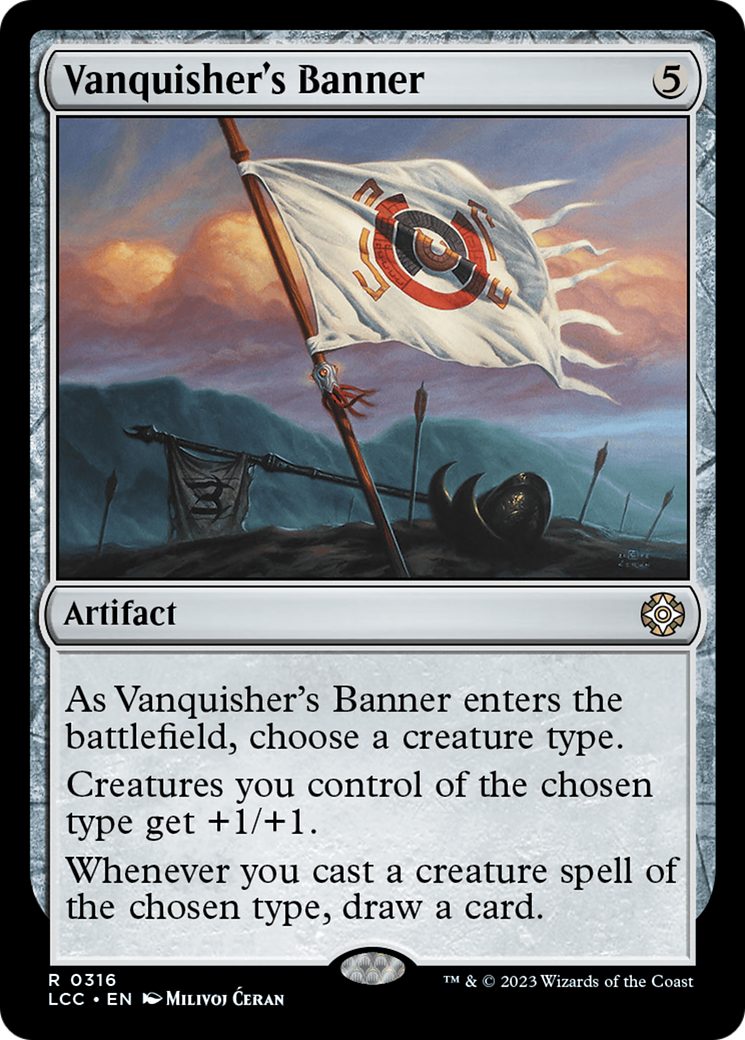
Vanquisher's Banner
Vanquisher's Banner
Artifact
As this artifact enters, choose a creature type.
Creatures you control of the chosen type get +1/+1.
Whenever you cast a creature spell of the chosen type, draw a card.
- The choice of creature type is made as Vanquisher's Banner enters the battlefield. Players can't respond to this choice. The bonus starts applying immediately.
- The last ability of Vanquisher's Banner resolves before the spell that caused it to trigger. The ability will resolve even if the creature spell is countered.
- To choose a creature type, you must choose an existing creature type, such as Fungus or Sliver. You can't choose multiple creature types, such as Fungus Sliver. Card types such as artifact can't be chosen, nor can subtypes that aren't creature types, such as Jace, Vehicle, or Treasure.
- Because damage remains marked on a creature until the damage is removed as the turn ends, nonlethal damage dealt to a creature you control of the chosen type may become lethal if Vanquisher's Banner leaves the battlefield during that turn.
- The choice of creature type is made as Vanquisher's Banner enters the battlefield. Players can't respond to this choice. The bonus starts applying immediately.
- The last ability of Vanquisher's Banner resolves before the spell that caused it to trigger. The ability will resolve even if the creature spell is countered.
-
1
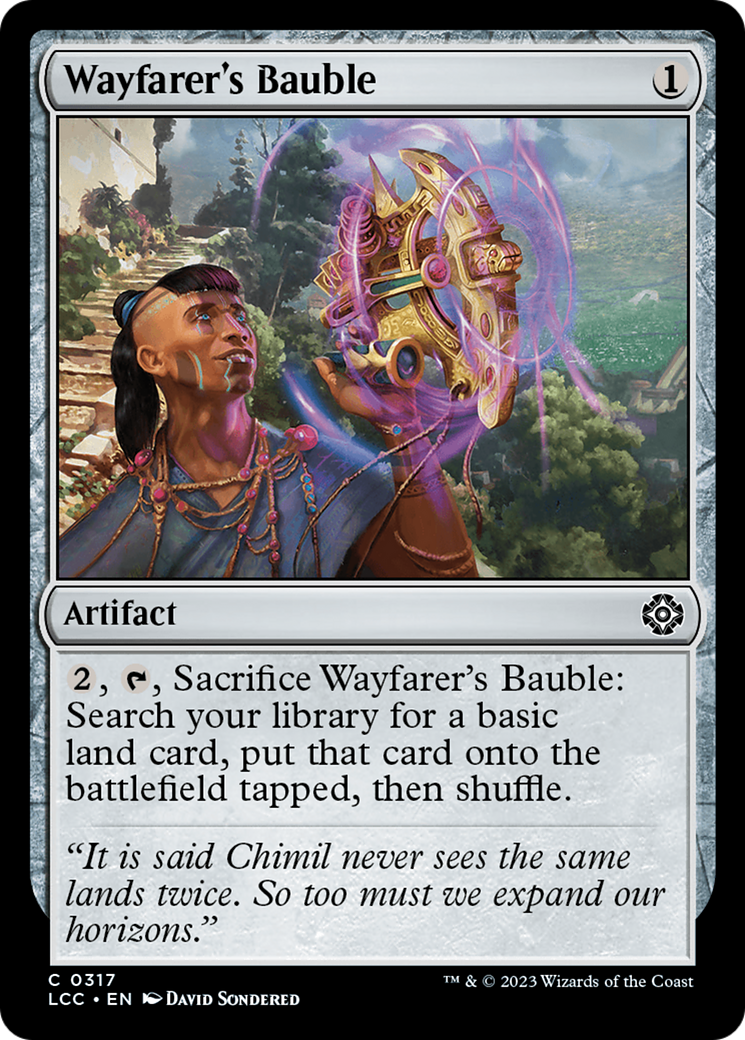
Wayfarer's Bauble
Wayfarer's Bauble
Artifact
, , Sacrifice this artifact: Search your library for a basic land card, put that card onto the battlefield tapped, then shuffle.
Enchantments 3
-
1
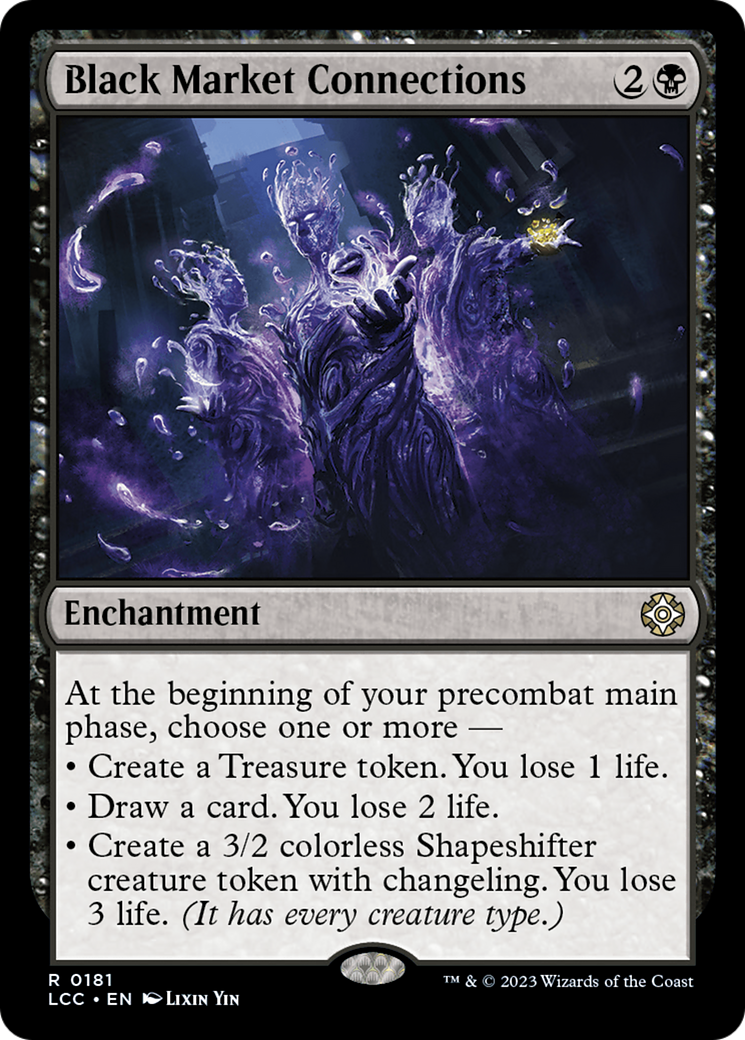
Black Market Connections
Black Market Connections
Enchantment
At the beginning of your first main phase, choose one or more —
- Sell Contraband — Create a Treasure token. You lose 1 life.
- Buy Information — Draw a card. You lose 2 life.
- Hire a Mercenary — Create a 3/2 colorless Shapeshifter creature token with changeling. You lose 3 life. (It has every creature type.)
-
1
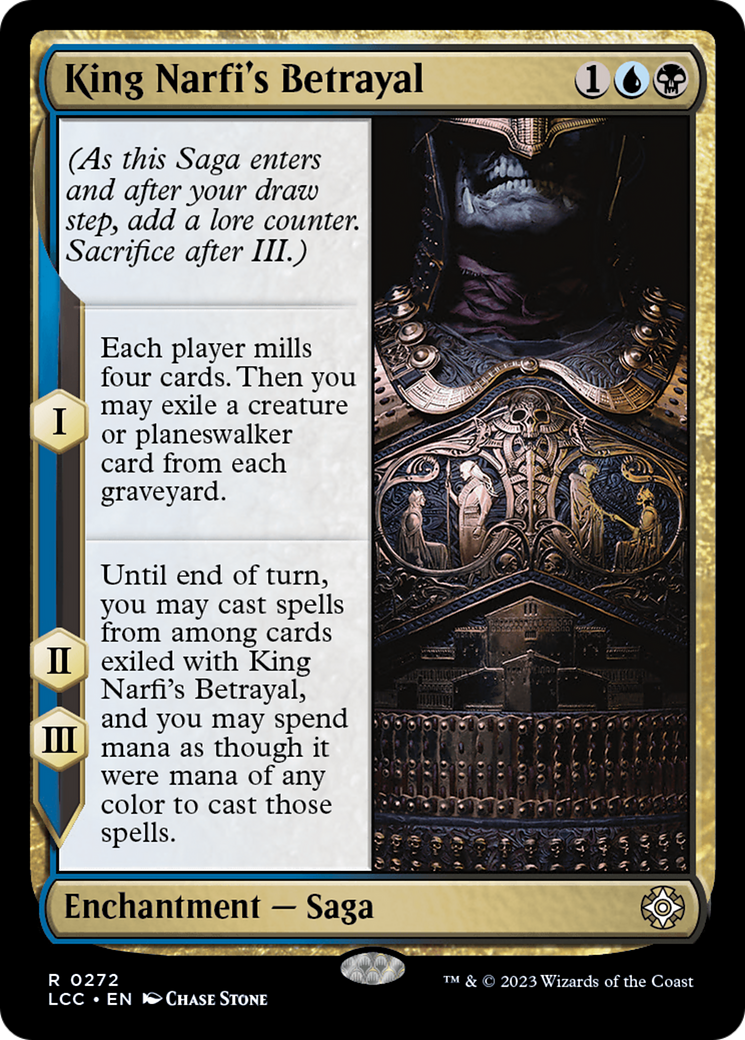
King Narfi's Betrayal
King Narfi's Betrayal
Enchantment — Saga
(As this Saga enters and after your draw step, add a lore counter. Sacrifice after III.)
I — Each player mills four cards. Then you may exile a creature or planeswalker card from each graveyard.
II, III — Until end of turn, you may cast spells from among cards exiled with this Saga, and you may spend mana as though it were mana of any color to cast those spells.
- The chapter I ability doesn't target any cards in graveyards. For each graveyard, you may exile a creature or planeswalker card that was just milled or one that was already there. You choose which cards are exiled.
- The chapter II/III ability doesn't change when you can cast the exiled cards. In most cases, this means during your main phase while the stack is empty, although flash may change this.
- If you cast a spell with the chapter II/III ability, it becomes a new object. If it returns to exile, it's no longer exiled with King Narfi's Betrayal, and you won't be able to cast it again this way.
- The "cards exiled with King Narfi's Betrayal" are only the cards exiled by that particular King Narfi's Betrayal, not any other Betrayals that you previously controlled.
- As a Saga enters the battlefield, its controller puts a lore counter on it. As your precombat main phase begins (immediately after your draw step), you put another lore counter on each Saga you control. Putting a lore counter on a Saga in either of these ways doesn't use the stack.
- Each symbol on the left of a Saga's text box represents a chapter ability. A chapter ability is a triggered ability that triggers when a lore counter that is put on the Saga causes the number of lore counters on the Saga to become equal to or greater than the ability's chapter number. Chapter abilities are put onto the stack and may be responded to.
- A chapter ability doesn't trigger if a lore counter is put on a Saga that already had a number of lore counters greater than or equal to that chapter's number. For example, the third lore counter put on a Saga causes the chapter III ability to trigger, but chapters I and II won't trigger again.
- Once a chapter ability has triggered, the ability on the stack won't be affected if the Saga gains or loses counters, or if it leaves the battlefield.
- If multiple chapter abilities trigger at the same time, their controller puts them on the stack in any order. If any of them require targets, those targets are chosen as you put the abilities on the stack, before any of those abilities resolve.
- Removing lore counters won't cause a previous chapter ability to trigger. If lore counters are removed from a Saga, the appropriate chapter abilities will trigger again when the Saga receives more lore counters.
- Once the number of lore counters on a Saga is greater than or equal to the greatest number among its chapter abilities, the Saga's controller sacrifices it as soon as its chapter ability has left the stack, most likely by resolving or being countered. This state-based action doesn't use the stack.
-
1
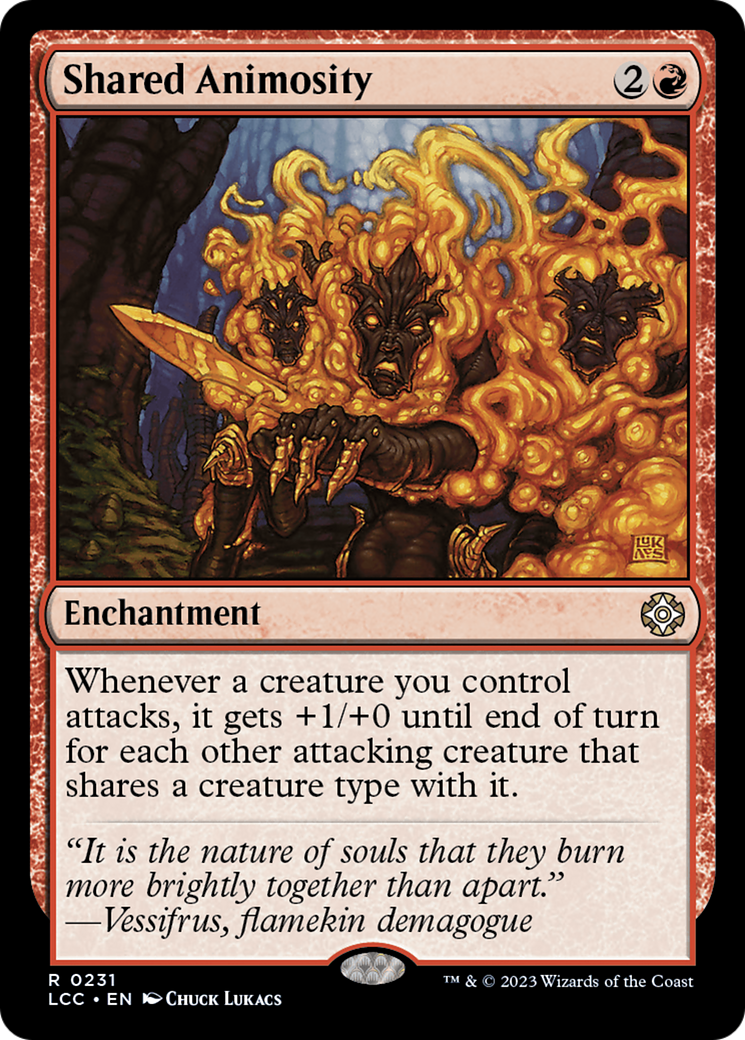
Shared Animosity
Shared Animosity
Enchantment
Whenever a creature you control attacks, it gets +1/+0 until end of turn for each other attacking creature that shares a creature type with it.
- This ability counts creatures, not creature types. For example, if you attack with five creatures — an Elf Shaman, an Elf Warrior, a Goblin Shaman, an Elemental, and a creature with all creature types — the ability will trigger five times. Those creatures will get +3/+0, +2/+0, +2/+0, +1/+0, and +4/+0, respectively.
- In a Two-Headed Giant game, only creatures you control trigger the ability and get the bonus, but your teammate's attacking creatures are included in the calculation of those bonuses.
Lands 37
-
1
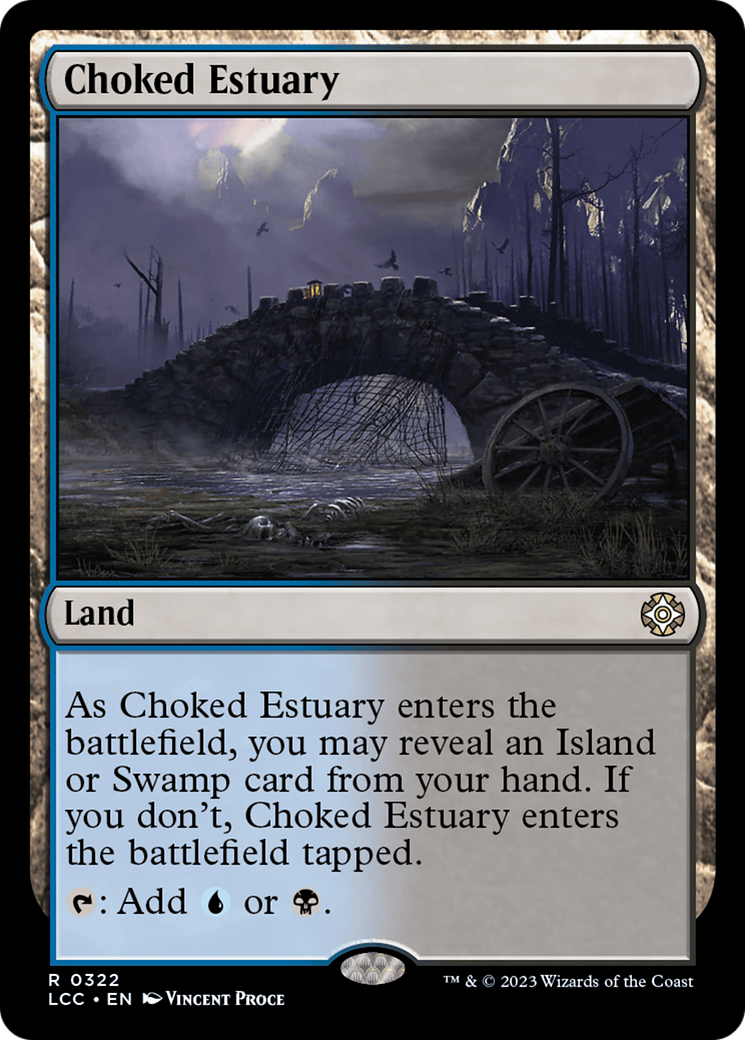
Choked Estuary
Choked Estuary
Land
As this land enters, you may reveal an Island or Swamp card from your hand. If you don't, this land enters tapped.
: Add or .
- Lands don't have a subtype just because they can produce mana of the corresponding color. Choked Estuary itself is neither an Island nor a Swamp, even though it produces blue and black mana, so you can't reveal one to satisfy the ability of another.
- If an effect instructs you to put Choked Estuary onto the battlefield tapped, it will still enter the battlefield tapped even if you reveal a land card from your hand.
- You may reveal any land card with either or both of the appropriate subtypes. It doesn't have to be a basic land. For example, you could reveal Prairie Stream from the Battle for Zendikar set to satisfy the ability of Choked Estuary.
- If an Island or Swamp is entering the battlefield from your hand at the same time as Choked Estuary, you may reveal the other land to have Choked Estuary enter untapped.
-
1
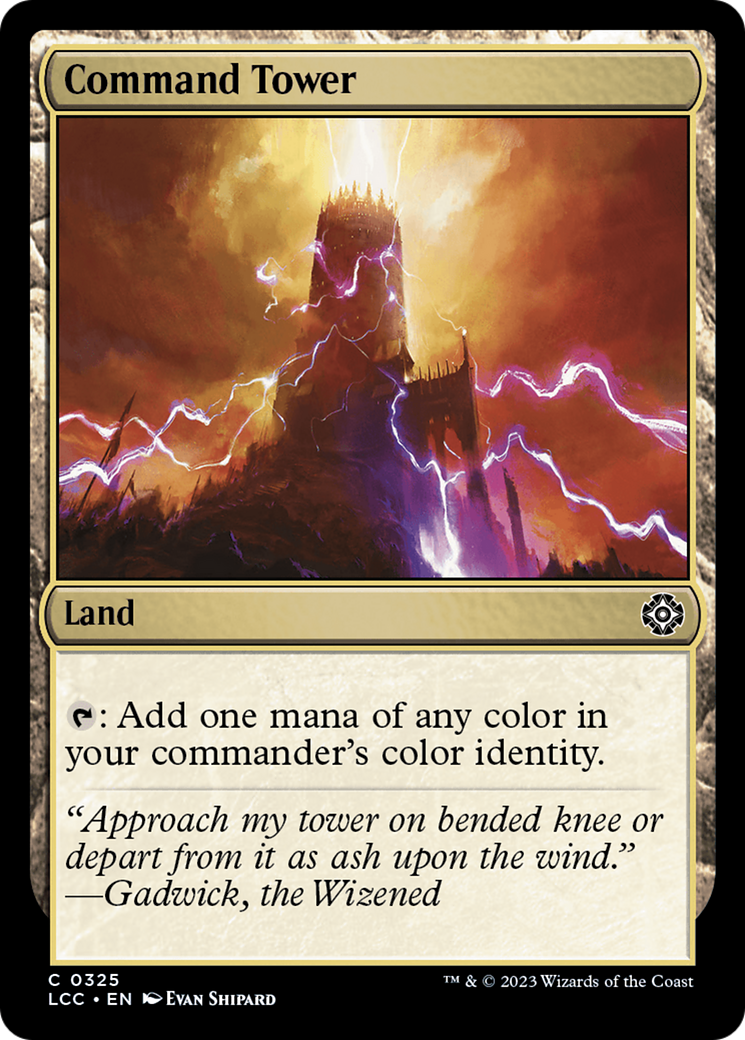
Command Tower
Command Tower
Land
: Add one mana of any color in your commander's color identity.
- If you don't have a commander, Command Tower's ability produces no mana.
- If your commander is a card that has no colors in its color identity, Command Tower's ability produces no mana. It doesn't produce .
- If you have two commanders, the ability adds one mana of any color in their combined color identities.
-
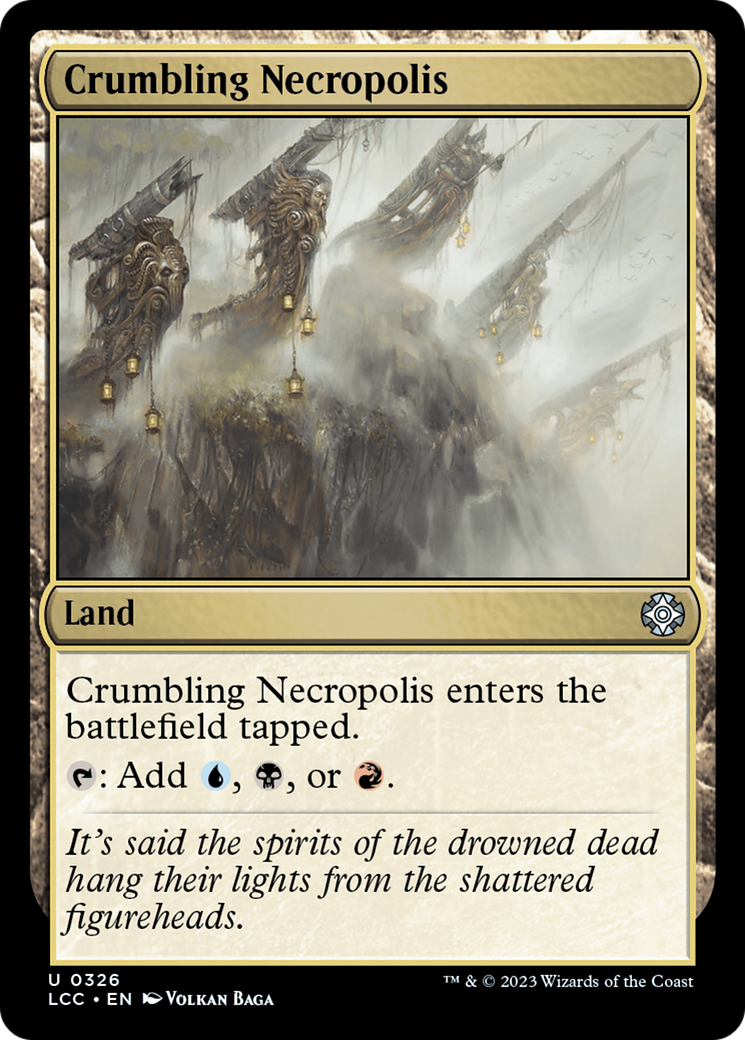
1
Crumbling Necropolis
Crumbling Necropolis
Land
This land enters tapped.
: Add , , or .
-
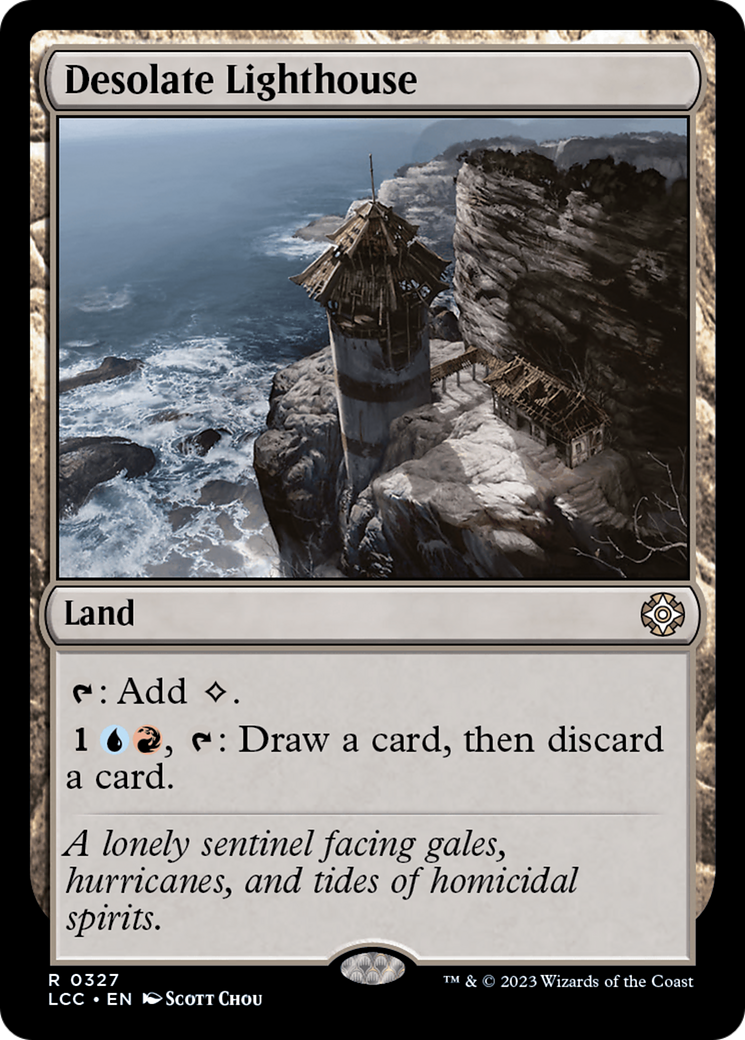
1
Desolate Lighthouse
Desolate Lighthouse
Land
: Add .
, : Draw a card, then discard a card.
-
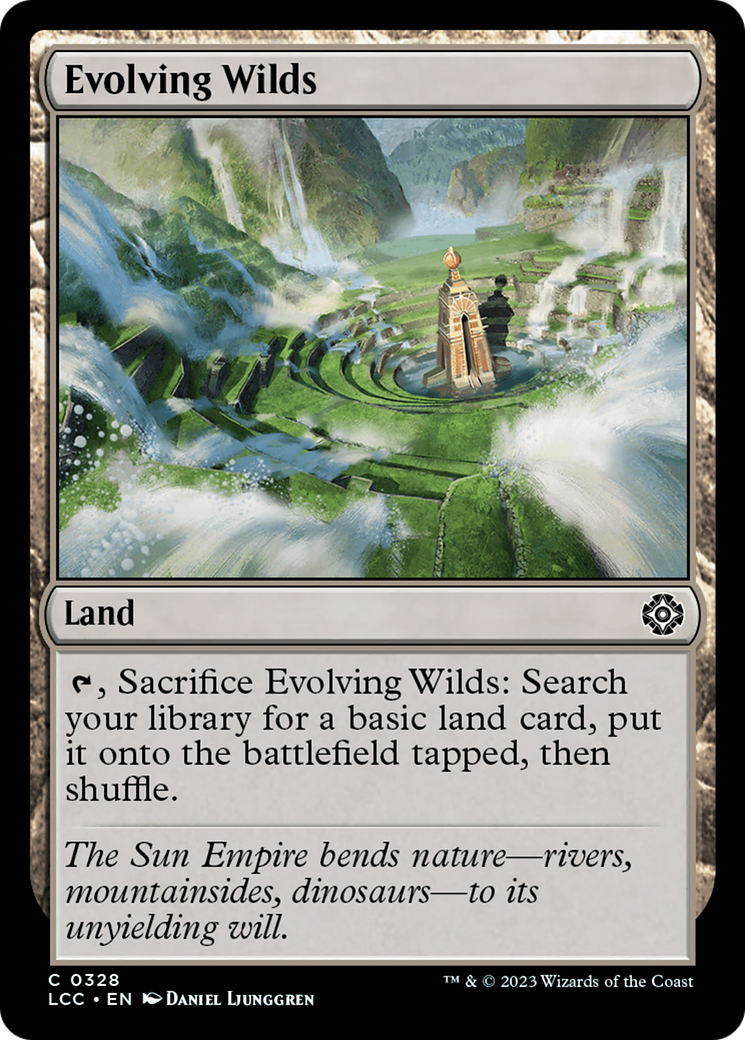
1
Evolving Wilds
Evolving Wilds
Land
, Sacrifice this land: Search your library for a basic land card, put it onto the battlefield tapped, then shuffle.
-
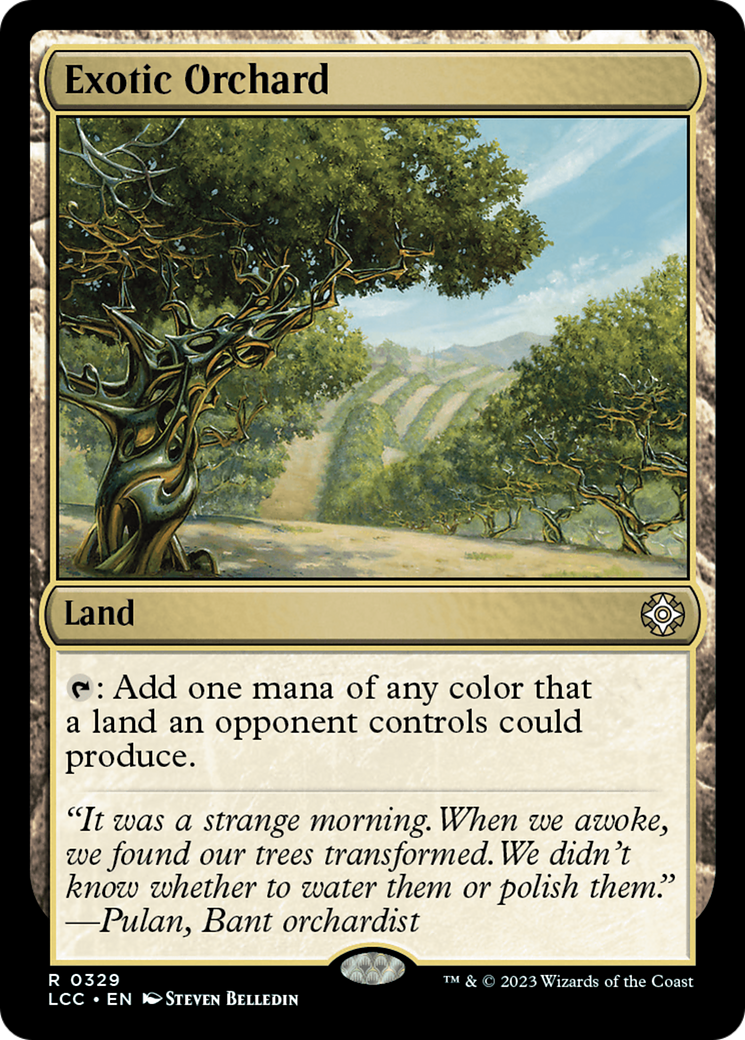
1
Exotic Orchard
Exotic Orchard
Land
: Add one mana of any color that a land an opponent controls could produce.
- Lands that produce mana based only on what other lands "could produce" won't help each other unless some other land allows one of them to actually produce some type of mana. For example, if you control an Exotic Orchard and your opponent controls an Exotic Orchard and a Reflecting Pool, none of those lands would produce mana if their mana abilities were activated. On the other hand, if you control a Forest and an Exotic Orchard, and your opponent controls an Exotic Orchard and a Reflecting Pool, then each of those lands can be tapped to produce . Your opponent's Exotic Orchard can produce because you control a Forest. Your Exotic Orchard and your opponent's Reflecting Pool can each produce because your opponent's Exotic Orchard can produce .
- When determining what colors of mana your opponents' lands could produce, Exotic Orchard takes into account any applicable replacement effects that would apply to those lands' mana abilities (such as Contamination's effect, for example). If there are more than one, consider them in any possible order.
- The colors of mana are white, blue, black, red, and green. Exotic Orchard can't be tapped for colorless mana, even if a land an opponent controls could produce colorless mana.
- Exotic Orchard doesn't care about any restrictions or riders your opponents' lands (such as Ancient Ziggurat or Hall of the Bandit Lord) put on the mana they produce. It just cares about colors of mana.
- Exotic Orchard checks the effects of all mana-producing abilities of lands your opponents control, but it doesn't check their costs. For example, Vivid Crag has the ability " , Remove a charge counter from Vivid Crag: Add one mana of any color." If an opponent controls Vivid Crag and you control Exotic Orchard, you can tap Exotic Orchard for any color of mana. It doesn't matter whether Vivid Crag has a charge counter on it, and it doesn't matter whether it's untapped.
-
1
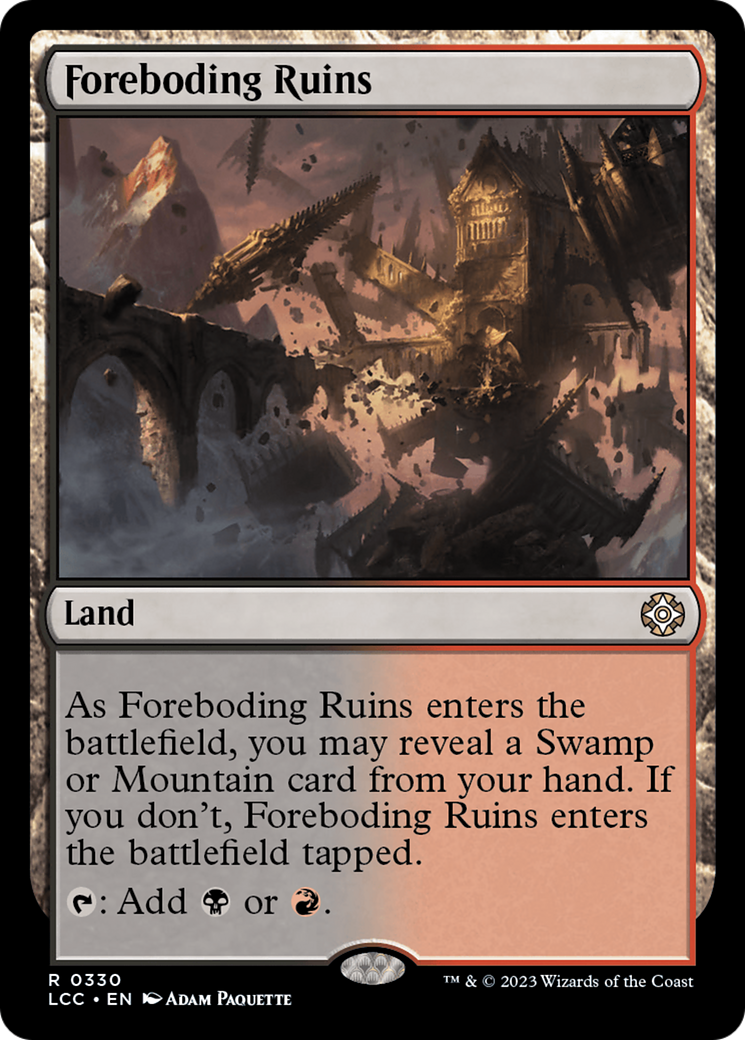
Foreboding Ruins
Foreboding Ruins
Land
As this land enters, you may reveal a Swamp or Mountain card from your hand. If you don't, this land enters tapped.
: Add or .
- You may reveal any land card with either or both of the appropriate subtypes. It doesn't have to be a basic land. For example, you could reveal Sunken Hollow from the Battle for Zendikar set to satisfy the ability of Foreboding Ruins.
- If a Swamp or Mountain is entering the battlefield from your hand at the same time as Foreboding Ruins, you may reveal the other land to have Foreboding Ruins enter untapped.
- Lands don't have a subtype just because they can produce mana of the corresponding color. Foreboding Ruins itself is neither a Swamp nor a Mountain, even though it produces black and red mana, so you can't reveal one to satisfy the ability of another.
- If an effect instructs you to put Foreboding Ruins onto the battlefield tapped, it will still enter the battlefield tapped even if you reveal a land card from your hand.
-
1
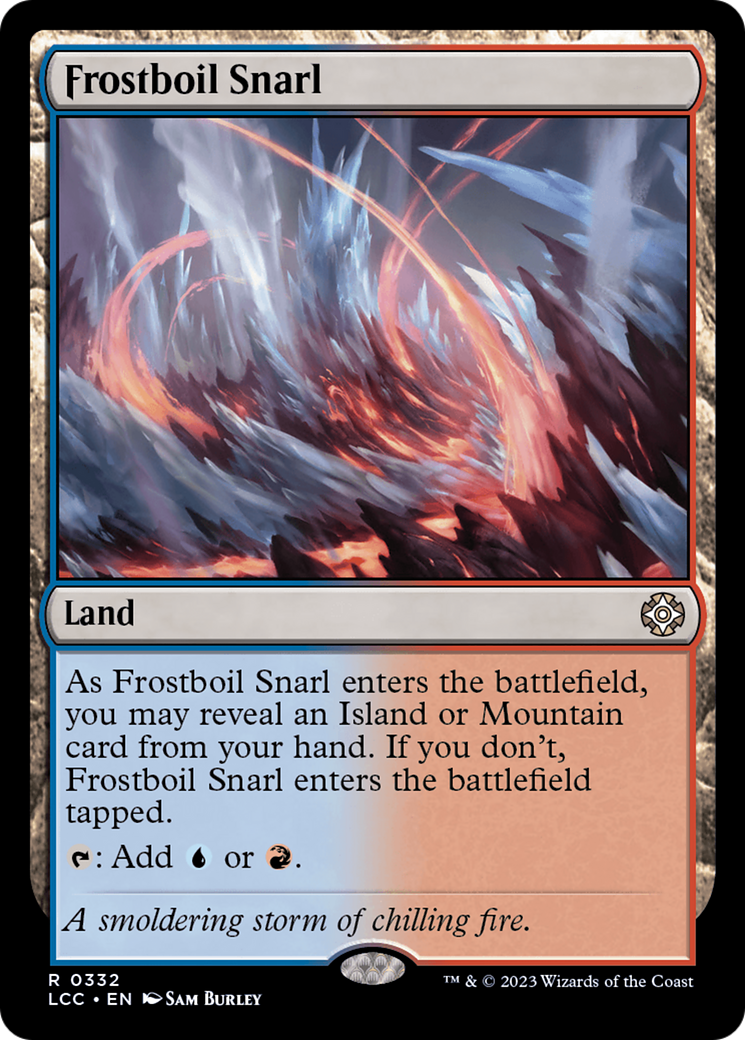
Frostboil Snarl
Frostboil Snarl
Land
As this land enters, you may reveal an Island or Mountain card from your hand. If you don't, this land enters tapped.
: Add or .
- The "Snarl" itself doesn't have any land subtypes. You can't reveal one to satisfy the ability of another.
- If a land card with an appropriate subtype is entering the battlefield from your hand at the same time as one of these lands, you may reveal the other land to have the "Snarl" enter untapped.
- If an effect instructs you to put one of these lands onto the battlefield tapped, it will still enter the battlefield tapped even if you reveal a land card from your hand.
- You may reveal any land card with either or both of the appropriate subtypes. It doesn't have to be a basic land card.
-
1
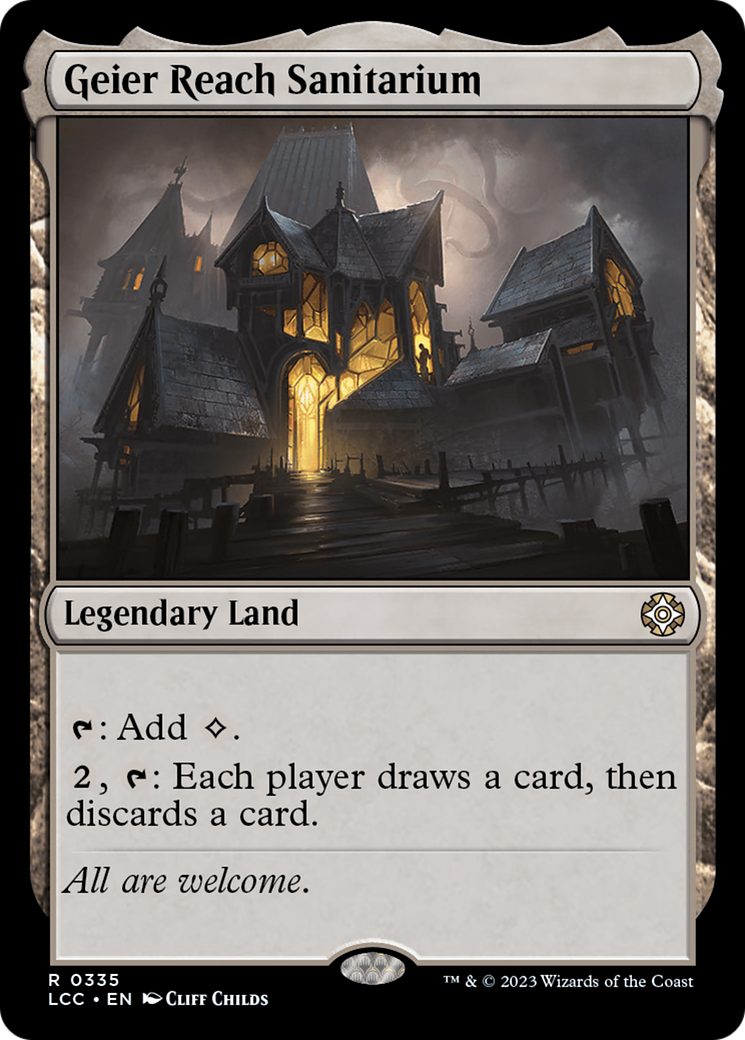
Geier Reach Sanitarium
Geier Reach Sanitarium
Legendary Land
: Add .
, : Each player draws a card, then discards a card.
- When you activate Geier Reach Sanitarium's last ability, first each player draws a card. Then the player whose turn it is selects a card from their hand and sets it aside without revealing it; proceeding in turn order, each other player does the same. Then the cards that were set aside are discarded at once.
- If more than one player discards a card with madness simultaneously, the player whose turn it is puts their madness abilities onto the stack first, then each other player does the same in turn order. The last one put onto the stack resolves first, and a spell cast this way will resolve before resolving the next madness ability.
-
6
Island
Island
Basic Land — Island
( : Add .)
-
5
Mountain
Mountain
Basic Land — Mountain
( : Add .)
-
1
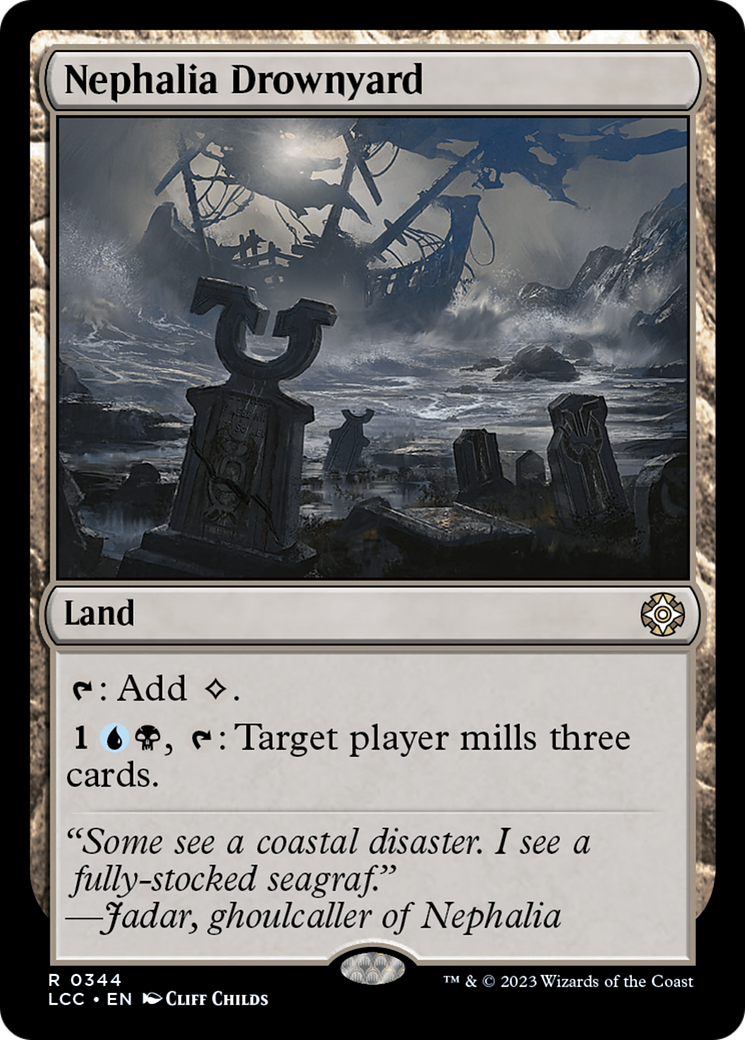
Nephalia Drownyard
Nephalia Drownyard
Land
: Add .
, : Target player mills three cards.
-
1
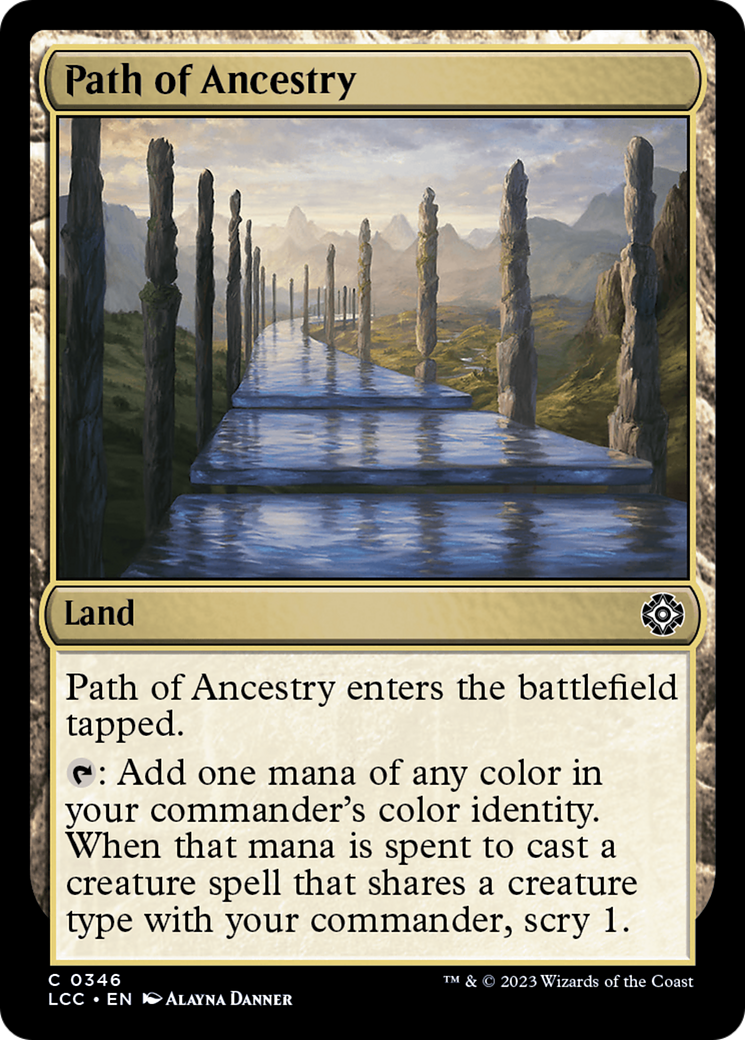
Path of Ancestry
Path of Ancestry
Land
This land enters tapped.
: Add one mana of any color in your commander's color identity. When that mana is spent to cast a creature spell that shares a creature type with your commander, scry 1. (Look at the top card of your library. You may put that card on the bottom.)
- Your commander's creature types are checked immediately after you cast a creature spell spending mana from Path of Ancestry's last ability. They aren't set before the game begins, and they may not be the same types your commander had when you activated that ability.
- If you have two commanders, the last ability adds one mana of any color in their combined color identities. When you spend that mana on a creature spell that shares a creature type with either of your commanders, you'll scry 1.
- If Path of Ancestry's last ability produces two mana (most likely due to Mana Reflection), spending those two mana to cast creature spells that share a creature type with your commander will cause two abilities to trigger. Each of those abilities will cause you to scry 1. You won't scry 2. This is true whether you spend the mana on one creature spell or two.
- If your commander has no creature types, it can't share a creature type with any spell that you cast.
- If you cast your commander with mana from Path of Ancestry, and your commander hasn't somehow lost all of its creature types while on the stack, you'll scry 1.
- If you don't have a commander, Path of Ancestry's ability produces no mana.
- If your commander is a card that has no colors in its color identity, Path of Ancestry's ability produces no mana. It doesn't produce .
-
1
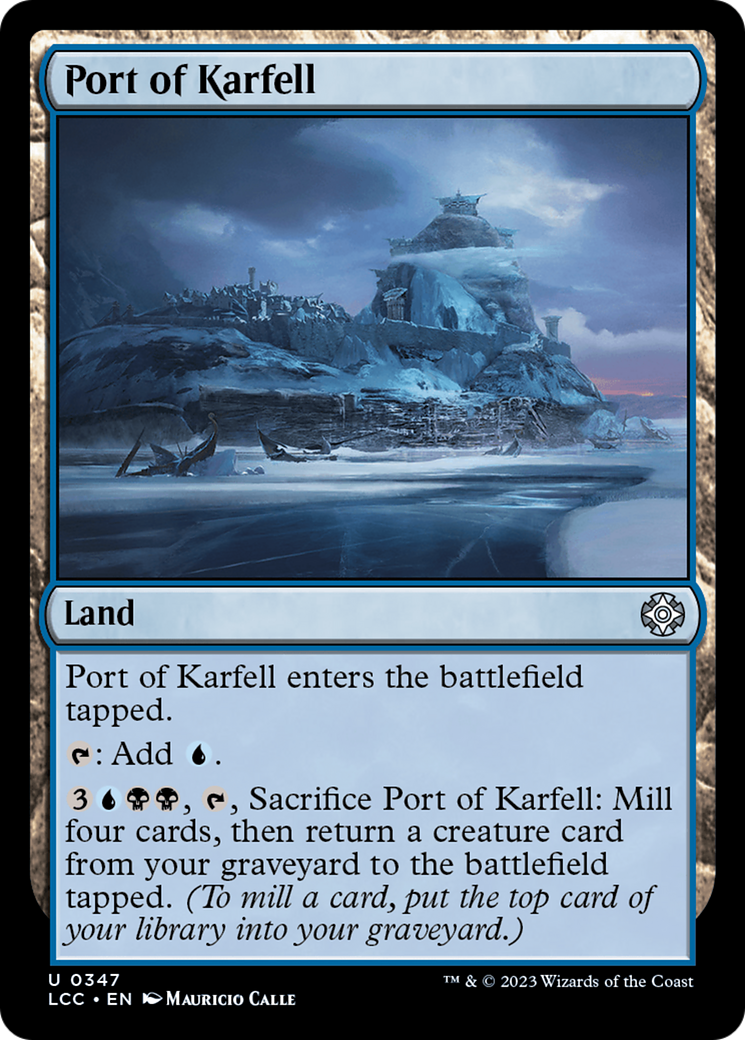
Port of Karfell
Port of Karfell
Land
This land enters tapped.
: Add .
, , Sacrifice this land: Mill four cards, then return a creature card from your graveyard to the battlefield tapped. (To mill a card, put the top card of your library into your graveyard.)
- The last activated ability doesn't target any creature cards in graveyards. You may return a creature card that was just milled or one that was already there.
-
1
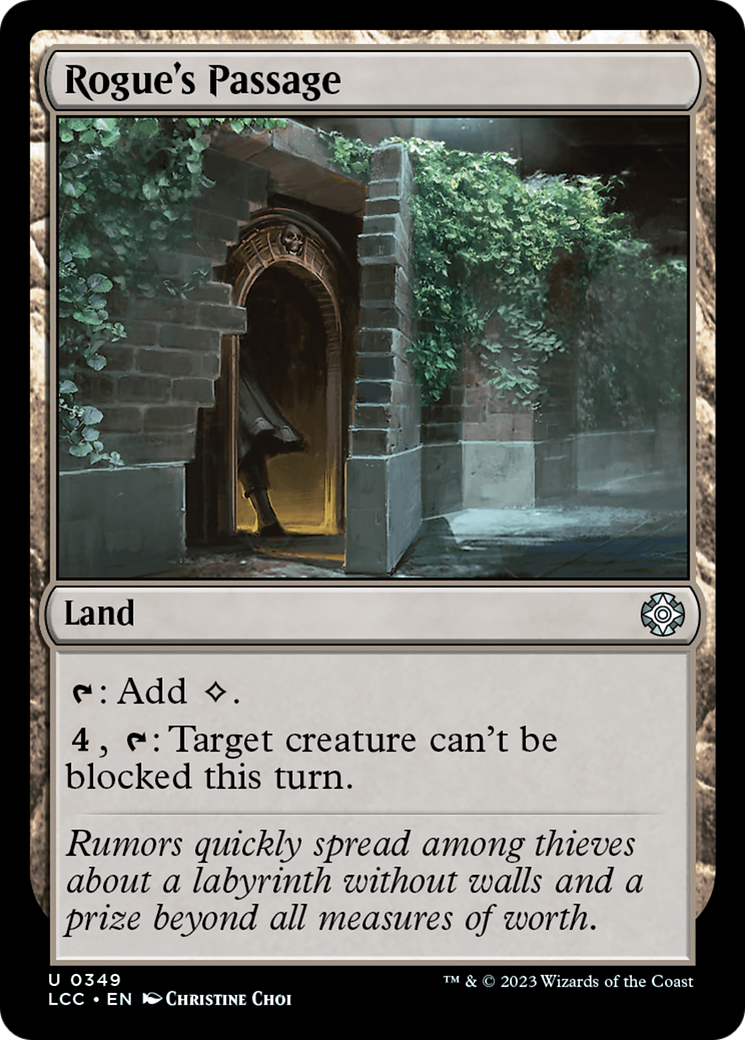
Rogue's Passage
Rogue's Passage
Land
: Add .
, : Target creature can't be blocked this turn.
- Activating the second ability of Rogue's Passage after a creature has become blocked won't cause that creature to become unblocked.
-
1
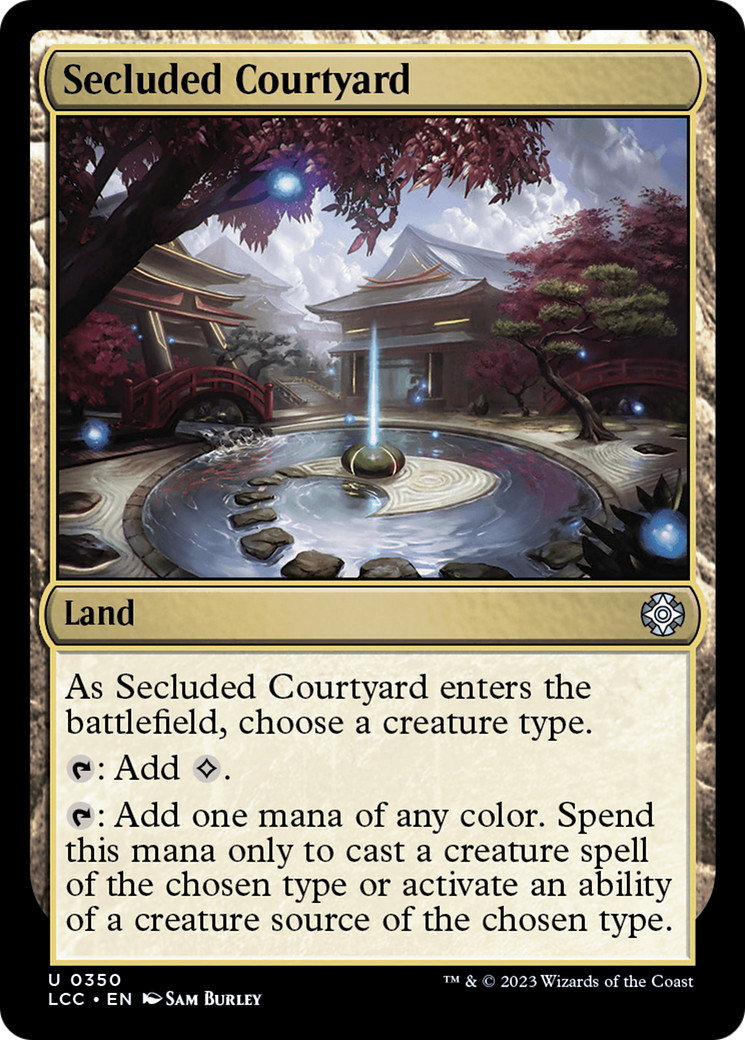
Secluded Courtyard
Secluded Courtyard
Land
As this land enters, choose a creature type.
: Add .
: Add one mana of any color. Spend this mana only to cast a creature spell of the chosen type or activate an ability of a creature source of the chosen type.
- If Secluded Courtyard is somehow on the battlefield without a chosen type, mana from its second mana ability can't be spent on anything.
-
1
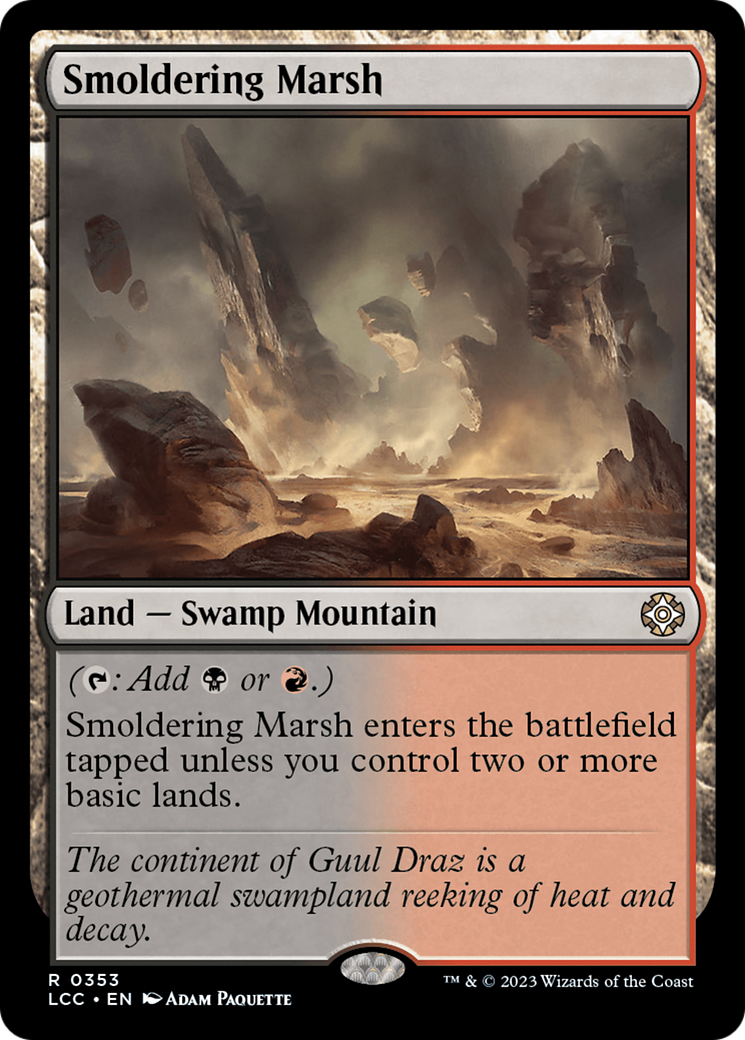
Smoldering Marsh
Smoldering Marsh
Land — Swamp Mountain
( : Add or .)
This land enters tapped unless you control two or more basic lands.
- However, because these cards have basic land types, effects that specify a basic land type without also specifying that the land be basic can affect them. For example, a spell or ability that reads "Destroy target Forest" can target Canopy Vista, while one that reads "Destroy target basic Forest" cannot.
- Even though these lands have basic land types, they are not basic lands because "basic" doesn't appear on their type line. Notably, controlling two or more of them won't allow others to enter the battlefield untapped.
- If one of these lands enters the battlefield at the same time as any number of basic lands, those other lands are not counted when determining if this land enters the battlefield tapped or untapped.
-
1
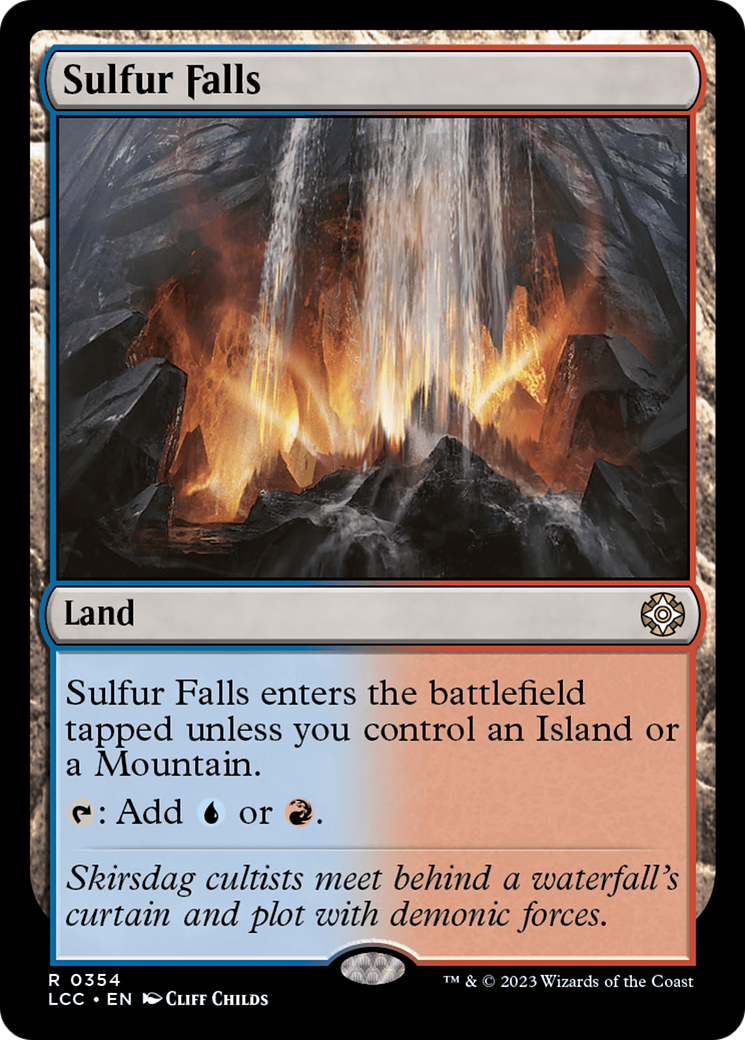
Sulfur Falls
Sulfur Falls
Land
This land enters tapped unless you control an Island or a Mountain.
: Add or .
-
1
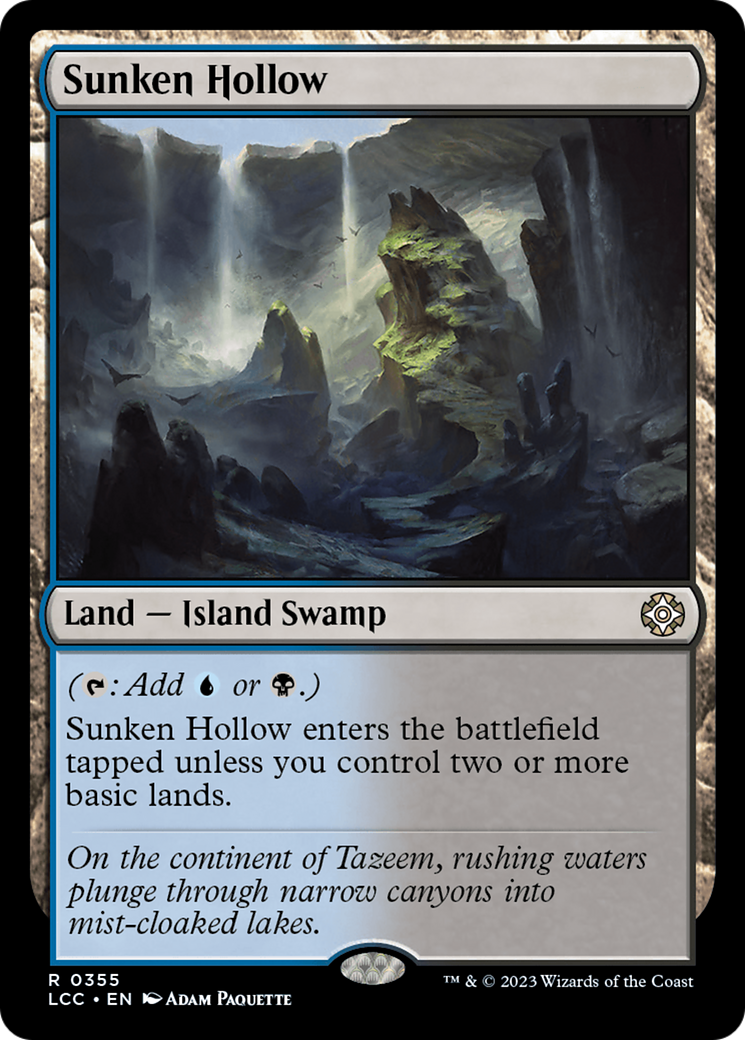
Sunken Hollow
Sunken Hollow
Land — Island Swamp
( : Add or .)
This land enters tapped unless you control two or more basic lands.
- Even though these lands have basic land types, they are not basic lands because "basic" doesn't appear on their type line. Notably, controlling two or more of them won't allow others to enter the battlefield untapped.
- However, because these cards have basic land types, effects that specify a basic land type without also specifying that the land be basic can affect them. For example, a spell or ability that reads "Destroy target Forest" can target Canopy Vista, while one that reads "Destroy target basic Forest" cannot.
- If one of these lands enters the battlefield at the same time as any number of basic lands, those other lands are not counted when determining if this land enters the battlefield tapped or untapped.
-
4
Swamp
Swamp
Basic Land — Swamp
( : Add .)
-
1
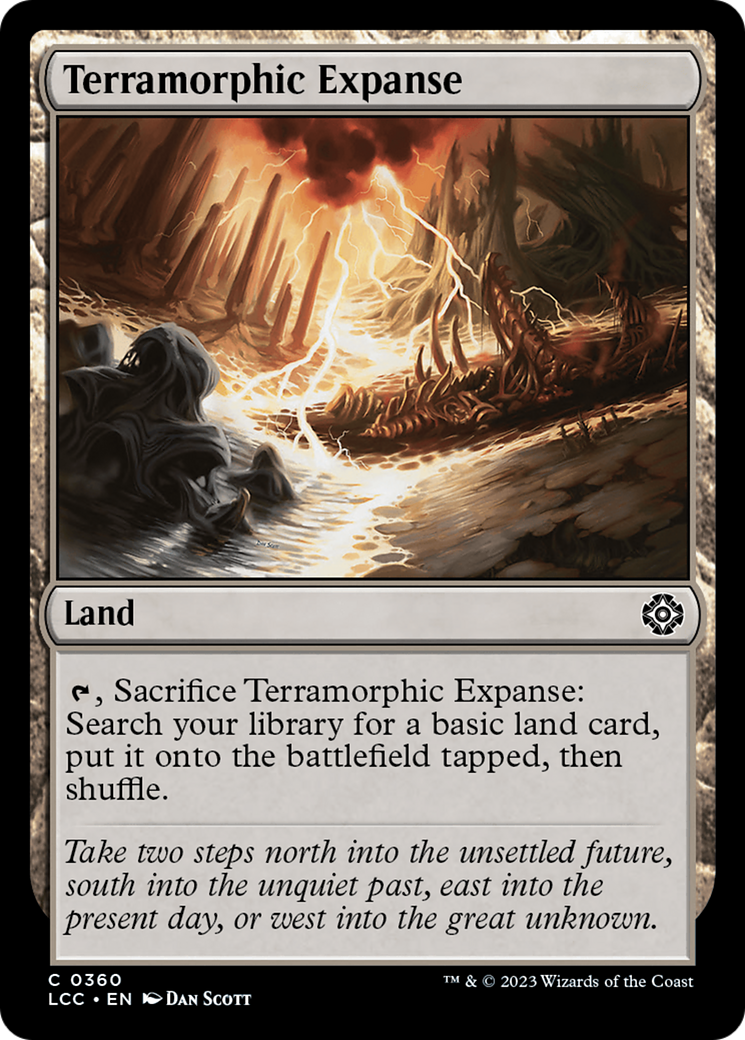
Terramorphic Expanse
Terramorphic Expanse
Land
, Sacrifice this land: Search your library for a basic land card, put it onto the battlefield tapped, then shuffle.
-
1
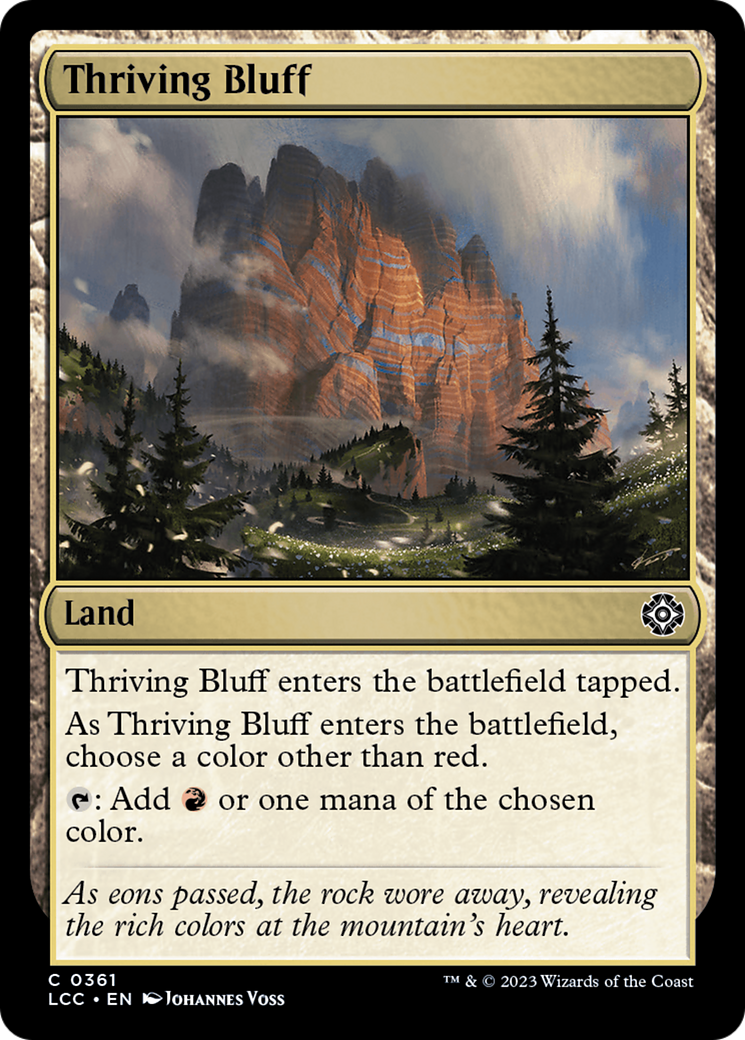
Thriving Bluff
Thriving Bluff
Land
This land enters tapped. As it enters, choose a color other than red.
: Add or one mana of the chosen color.
-
1
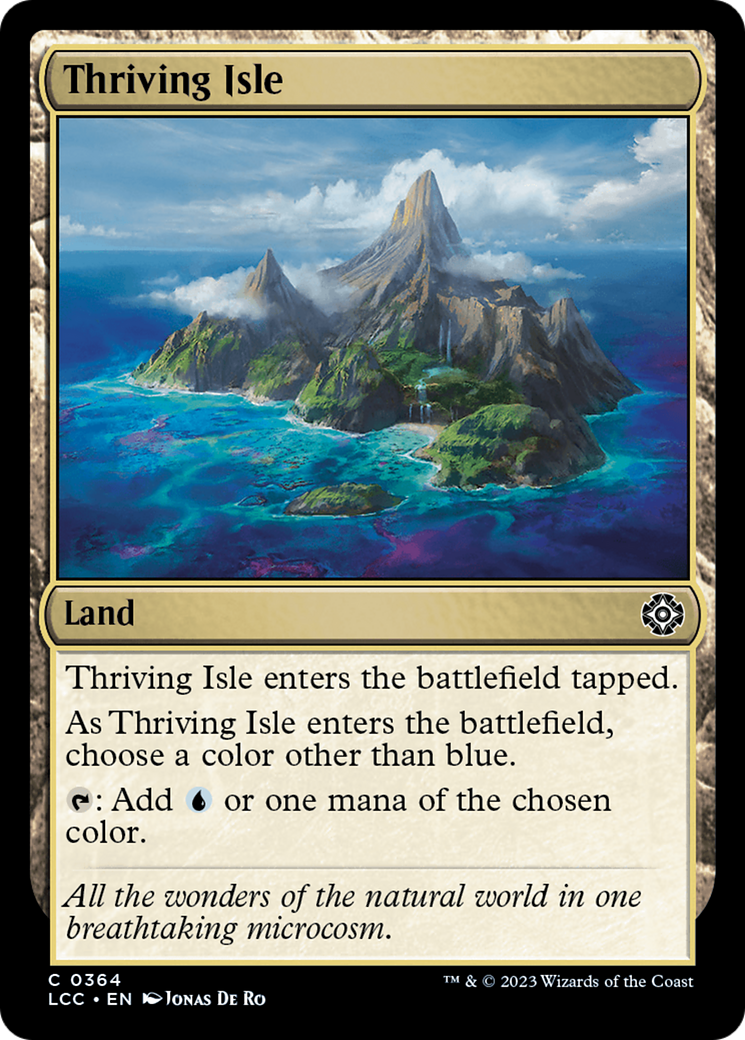
Thriving Isle
Thriving Isle
Land
This land enters tapped. As it enters, choose a color other than blue.
: Add or one mana of the chosen color.
-
1
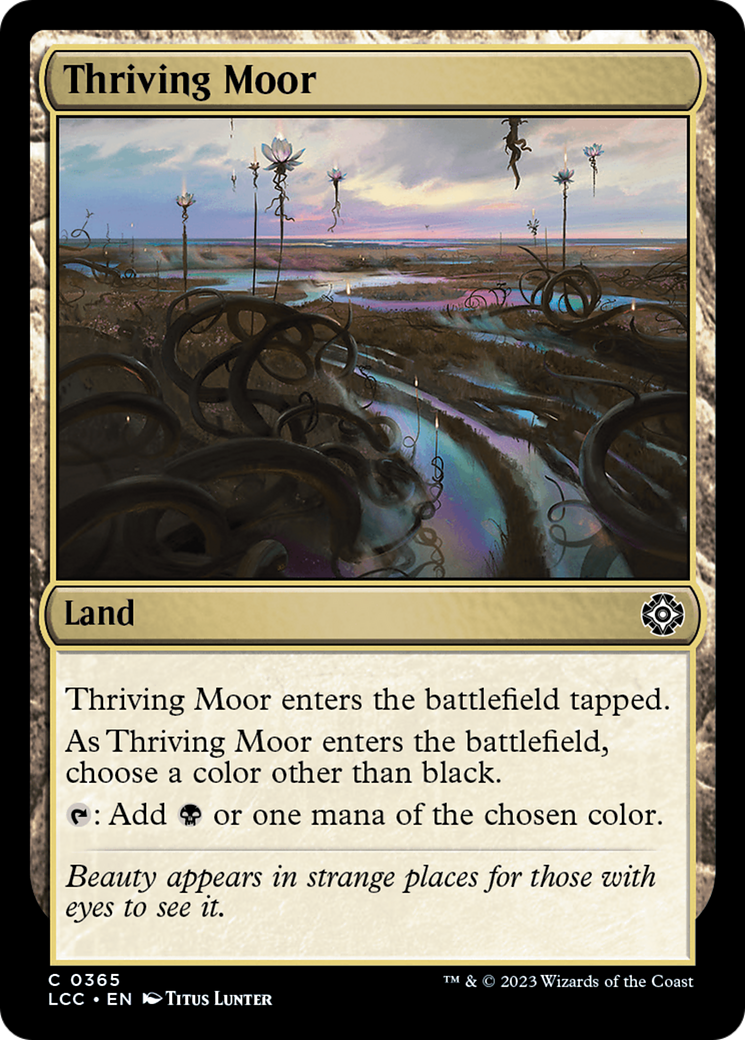
Thriving Moor
Thriving Moor
Land
This land enters tapped. As it enters, choose a color other than black.
: Add or one mana of the chosen color.
-
1
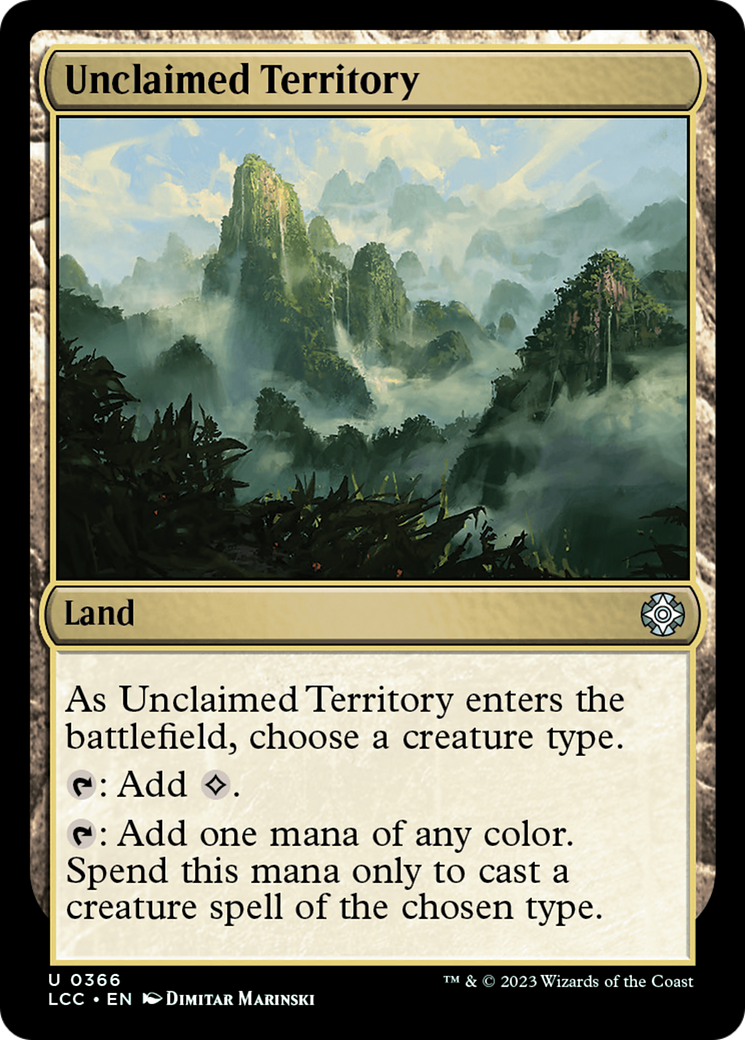
Unclaimed Territory
Unclaimed Territory
Land
As this land enters, choose a creature type.
: Add .
: Add one mana of any color. Spend this mana only to cast a creature spell of the chosen type.
- To choose a creature type, you must choose an existing creature type, such as Vampire or Knight. You can't choose multiple creature types, such as "Vampire Knight." Card types such as artifact can't be chosen, nor can subtypes that aren't creature types, such as Jace, Vehicle, or Treasure.
Blue 18
-
1
Amphin Mutineer
Amphin Mutineer
Creature — Salamander Pirate
3/3
When this creature enters, exile up to one target non-Salamander creature. That creature's controller creates a 4/3 blue Salamander Warrior creature token.
Encore ( , Exile this card from your graveyard: For each opponent, create a token copy that attacks that opponent this turn if able. They gain haste. Sacrifice them at the beginning of the next end step. Activate only as a sorcery.)
- If an effect stops a token from attacking a specific player, that token can attack any player, planeswalker, or battle, or not attack at all. If the effect stops the token from attacking a specific player unless a cost is paid, you don't have to pay that cost unless you want to attack that player.
- Exiling the card with encore is a cost to activate the ability. Once you announce that you're activating it, no player may take actions until you've finished. They can't try to remove the card from your graveyard to stop you from paying the cost.
- Opponents who have left the game aren't counted when determining how many tokens to create.
- The tokens copy only what's on the original card. Effects that modified that creature when it was previously on the battlefield won't be copied.
- If the target non-Salamander creature is an illegal target by the time Amphin Mutineer's ability tries to resolve, the ability doesn't resolve. No player creates a Salamander Warrior token.
- If one of the tokens can't attack for any reason (such as being tapped), then it doesn't attack. If there's a cost associated with having it attack, you aren't forced to pay that cost, so it doesn't have to attack in that case either.
- If one of the tokens somehow is under another player's control as the delayed triggered ability resolves, you can't sacrifice that token. It remains on the battlefield indefinitely, even if you regain control of it later.
- Each token must attack the appropriate player if able.
-
1
Azure Fleet Admiral
Azure Fleet Admiral
Creature — Human Pirate
3/3
When this creature enters, you become the monarch.
This creature can't be blocked by creatures the monarch controls.
- Azure Fleet Admiral's last ability normally means that it can't be blocked while attacking the monarch or a planeswalker the monarch controls. In some variants with shared team turns, such as Two-Headed Giant, creatures controlled by the monarch's teammate can block Azure Fleet Admiral, even if it's attacking the monarch.
- The game starts with no monarch. Once an effect makes one player the monarch, the game will have exactly one monarch from that point forward. As a player becomes the monarch, the current monarch (if any) ceases being the monarch.
- There are two inherent triggered abilities associated with being the monarch. These triggered abilities have no source and are controlled by the player who was the monarch at the time the abilities triggered. The full texts of these abilities are "At the beginning of the monarch's end step, that player draws a card" and "Whenever a creature deals combat damage to the monarch, its controller becomes the monarch."
- If the triggered ability that causes the monarch to draw a card goes on the stack and a different player becomes the monarch before that ability resolves, the first player will still draw the card.
- If the monarch leaves the game during another player's turn, that player becomes the monarch. If the monarch leaves the game during their turn, the next player in turn order becomes the monarch.
- If combat damage dealt to the monarch causes that player to lose the game, the triggered ability that causes the controller of the attacking creature to become the monarch doesn't resolve. In most cases, the controller of the attacking creature will still become the monarch as it is likely their turn.
-
1
Bident of Thassa
Bident of Thassa
Legendary Enchantment Artifact
Whenever a creature you control deals combat damage to a player, you may draw a card.
, : Creatures your opponents control attack this turn if able.
- The controller of each attacking creature still chooses which player or planeswalker that creature attacks.
- If a creature can't attack for any reason (such as being tapped or having come under that player's control that turn), then it doesn't attack. If there's a cost associated with having a creature attack, the player isn't forced to pay that cost, so it doesn't have to attack in that case either.
-
1
Corsair Captain
Corsair Captain
Creature — Human Pirate
2/2
When this creature enters, create a Treasure token. (It's an artifact with " , Sacrifice this token: Add one mana of any color.")
Other Pirates you control get +1/+1.
- Because damage remains marked on a creature until the damage is removed as the turn ends, nonlethal damage dealt to Pirates you control may become lethal if Corsair Captain leaves the battlefield during that turn.
-
1
Daring Saboteur
Daring Saboteur
Creature — Human Pirate
2/1
: This creature can't be blocked this turn.
Whenever this creature deals combat damage to a player, you may draw a card. If you do, discard a card.
- Activating the first ability of Daring Saboteur after it has become blocked won't cause it to become unblocked.
-
1
Departed Deckhand
Departed Deckhand
Creature — Spirit Pirate
2/2
When this creature becomes the target of a spell, sacrifice it.
This creature can't be blocked except by Spirits.
: Another target creature you control can't be blocked this turn except by Spirits.
- You'll sacrifice Departed Deckhand even if you counter the spell that targets it.
- If the spell that targets Departed Deckhand has no other targets, it won't resolve (because it no longer has a legal target after Departed Deckhand is sacrificed).
- Activating Departed Deckhand's last ability after a creature has become blocked by a non-Spirit creature won't cause that creature to become unblocked.
-
1
Distant Melody
Distant Melody
Sorcery
Choose a creature type. Draw a card for each permanent you control of that type.
- Note that this spell counts the number of permanents you control of the chosen type, not just the number of creatures you control. It will also take your kindred permanents of the chosen type into account.
-
1
Evacuation
Evacuation
Instant
Return all creatures to their owners' hands.
-
1
Ghost of Ramirez DePietro
Ghost of Ramirez DePietro
Legendary Creature — Spirit Pirate
2/3
Ghost of Ramirez DePietro can't be blocked by creatures with toughness 3 or greater.
Whenever Ghost of Ramirez DePietro deals combat damage to a player, choose up to one target card in a graveyard that was discarded or put there from a library this turn. Put that card into its owner's hand.
Partner (You can have two commanders if both have partner.)
- Once a creature with toughness 2 or less has blocked this creature, changing the toughness of the blocking creature won't cause this creature to become unblocked.
- The middle ability can't target cards that were discarded on previous turns or put into the graveyard from a library on previous turns.
- If your Commander deck has two commanders, you can only include cards whose own color identities are also found in your commanders' combined color identities. If Falthis and Kediss are your commanders, your deck may contain cards with black and/or red in their color identity, but not cards with green, white, or blue.
- Both commanders start in the command zone, and the remaining 98 cards (or 58 cards in a Commander Draft game) of your deck are shuffled to become your library.
- To have two commanders, both must have the partner ability as the game begins. Losing the ability during the game doesn't cause either to cease to be your commander.
- Once the game begins, your two commanders are tracked separately. If you cast one, you won't have to pay an additional the first time you cast the other. A player loses the game after having been dealt 21 damage from any one of them, not from both of them combined.
- If something refers to your commander while you have two commanders, it refers to one of them of your choice. If you are instructed to perform an action on your commander (e.g. put it from the command zone into your hand due to Command Beacon), you choose one of your commanders at the time the effect happens.
- An effect that checks whether you control your commander is satisfied if you control one or both of your two commanders.
- You can choose two commanders with partner that are the same color or colors. In Commander Draft, you can even choose two of the same commander with partner if you drafted them. If you do this, make sure you keep the number of times you've cast each from the command zone clear for "commander tax" purposes.
-
1
Malcolm, Keen-Eyed Navigator
Malcolm, Keen-Eyed Navigator
Legendary Creature — Siren Pirate
2/2
Flying
Whenever one or more Pirates you control deal damage to your opponents, you create a Treasure token for each opponent dealt damage. (It's an artifact with " , Sacrifice this token: Add one mana of any color.")
Partner (You can have two commanders if both have partner.)
- Malcolm's triggered ability will trigger even if Pirates you control deal damage to only a single opponent. A single Treasure for you. Yarrr.
- Malcolm's triggered ability considers all damage dealt by Pirates you control to opponents, not just combat damage.
- If your Commander deck has two commanders, you can only include cards whose own color identities are also found in your commanders' combined color identities. If Falthis and Kediss are your commanders, your deck may contain cards with black and/or red in their color identity, but not cards with green, white, or blue.
- Both commanders start in the command zone, and the remaining 98 cards (or 58 cards in a Commander Draft game) of your deck are shuffled to become your library.
- To have two commanders, both must have the partner ability as the game begins. Losing the ability during the game doesn't cause either to cease to be your commander.
- Once the game begins, your two commanders are tracked separately. If you cast one, you won't have to pay an additional the first time you cast the other. A player loses the game after having been dealt 21 damage from any one of them, not from both of them combined.
- If something refers to your commander while you have two commanders, it refers to one of them of your choice. If you are instructed to perform an action on your commander (e.g. put it from the command zone into your hand due to Command Beacon), you choose one of your commanders at the time the effect happens.
- An effect that checks whether you control your commander is satisfied if you control one or both of your two commanders.
- You can choose two commanders with partner that are the same color or colors. In Commander Draft, you can even choose two of the same commander with partner if you drafted them. If you do this, make sure you keep the number of times you've cast each from the command zone clear for "commander tax" purposes.
-
1
Merchant Raiders
Merchant Raiders
Creature — Human Pirate
2/4
Whenever this creature or another Pirate you control enters, tap up to one target creature. That creature doesn't untap during its controller's untap step for as long as you control this creature.
- The triggered ability can target any creature, including one that is already tapped. In that case, the creature stays tapped and won't untap during its controller's untap step.
- If another player gains control of Merchant Raiders, the creature will no longer be affected by the ability stopping it from untapping, even if you later regain control of Merchant Raiders.
- The ability stopping the creature from untapping will continue to apply to it even if the creature changes controllers.
-
1
Siren Stormtamer
Siren Stormtamer
Creature — Siren Pirate Wizard
1/1
Flying
, Sacrifice this creature: Counter target spell or ability that targets you or a creature you control.
- Siren Stormtamer's activated ability can target a spell or ability that has multiple targets, as long as at least one of those targets is you or a creature you control.
- If the creature you control targeted by the target spell or ability leaves the battlefield, that spell or ability is no longer a legal target for Siren Stormtamer's ability. On the other hand, if that targeted creature becomes an illegal target for the target spell but remains on the battlefield under your control, the target spell or ability is still a legal target for Siren Stormtamer's ability.
-
1
Spectral Sailor
Spectral Sailor
Creature — Spirit Pirate
1/1
Flash (You may cast this spell any time you could cast an instant.)
Flying
: Draw a card.
-
1
Storm Fleet Negotiator
Storm Fleet Negotiator
Creature — Siren Pirate
2/2
Flying
Parley — Whenever this creature attacks, each player reveals the top card of their library. For each nonland card revealed this way, you create a Map token. Then each player draws a card. (A Map token is an artifact with " , , Sacrifice this token: Target creature you control explores. Activate only as a sorcery.")
- Except in some very unusual cases, the card each player reveals is the one they'll draw.
- If an ability instructs a creature to explore, its controller reveals the top card of their library. If it's a land card, they'll put it into their hand. Otherwise, they'll put a +1/+1 counter on that creature, then choose to either leave that card on top of their library or put it into their graveyard.
- Once an ability that causes a creature to explore begins to resolve, no player may take any other actions until it's done. Notably, opponents can't try to remove the exploring creature after you reveal a nonland card but before it receives a counter.
- If no card is revealed, most likely because that player's library is empty, the exploring creature receives a +1/+1 counter.
- If a resolving spell or ability instructs a specific creature to explore but that creature has left the battlefield, the creature still explores. If you reveal a nonland card this way, you won't put a +1/+1 counter on anything, but you may put the revealed card into your graveyard. Effects that trigger "whenever a creature explores" trigger as appropriate.
- Some spells or abilities might cause a creature to explore multiple times in a row. If you reveal a nonland card when a creature explores and leave it on top of your library, then the creature explores again immediately afterwards, you'll reveal the same card again.
- In some unusual cases, noncreature permanents may explore. For example, if the creature card returned by Defossilize is somehow not a creature once it's on the battlefield, it can still explore. You'll take all the same actions, and you may end up putting a +1/+1 counter on the permanent. (Note that some effects target a creature, and those effects would still require a legal target to have it explore.)
- Map tokens are a kind of predefined token. Each one is a colorless artifact with the artifact subtype Map and the ability " , , Sacrifice this artifact: Target creature you control explores. Activate only as a sorcery."
-
1
The Indomitable
The Indomitable
Legendary Artifact — Vehicle
6/6
Trample
Whenever a creature you control deals combat damage to a player, draw a card.
Crew 3
You may cast this card from your graveyard as long as you control three or more tapped Pirates and/or Vehicles.
- The casting permission granted by The Indomitable's last ability doesn't change when you may cast it from your graveyard.
- You still pay The Indomitable's costs when casting it from your graveyard.
- If The Indomitable is countered or dies after being cast from your graveyard, it returns to the graveyard. It may be cast this way again later.
- Once you begin casting a spell from your graveyard, it immediately moves to the stack. Players can't take any actions until you've finished casting the spell.
- Only tapped Pirates and tapped Vehicles count toward the casting permission from The Indomitable's last ability.
- The Indomitable checks if you control three or more tapped Pirates and/or Vehicles only as you begin to cast it. Once you begin to cast The Indomitable from your graveyard, it doesn't matter what happens to the tapped Pirates and/or Vehicles you control.
-
1
Timestream Navigator
Timestream Navigator
Creature — Human Pirate Wizard
1/1
Ascend (If you control ten or more permanents, you get the city's blessing for the rest of the game.)
, , Put this creature on the bottom of its owner's library: Take an extra turn after this one. Activate only if you have the city's blessing.
- Once you have the city's blessing, you have it for the rest of the game, even if you lose control of some or all of your permanents. The city's blessing isn't a permanent itself and can't be removed by any effect.
- A permanent is any object on the battlefield, including tokens and lands. Spells and emblems aren't permanents.
- If you cast a spell with ascend, you don't get the city's blessing until it resolves. Players may respond to that spell by trying to change whether you get the city's blessing.
- If you control ten permanents but don't control a permanent or resolving spell with ascend, you don't get the city's blessing. For example, if you control ten permanents, lose control of one, then cast Golden Demise, you won't have the city's blessing and the spell will affect creatures you control.
- If your tenth permanent enters the battlefield and then a permanent leaves the battlefield immediately afterwards (most likely due to the "Legend Rule" or due to being a creature with 0 toughness), you get the city's blessing before it leaves the battlefield.
- Ascend on a permanent isn't a triggered ability and doesn't use the stack. Players can respond to a spell that will give you your tenth permanent, but they can't respond to getting the city's blessing once you control that tenth permanent. This means that if your tenth permanent is a land you play, players can't respond before you get the city's blessing.
-
1
Warkite Marauder
Warkite Marauder
Creature — Human Pirate
2/1
Flying
Whenever this creature attacks, target creature defending player controls loses all abilities and has base power and toughness 0/1 until end of turn.
- Warkite Marauder's ability overwrites all previous effects that set the creature's base power and toughness to specific values. Any power- or toughness-setting effects that start to apply after the ability resolves will overwrite this effect.
- If the affected creature gains an ability after Warkite Marauder's ability resolves, it will keep that ability. If the affected creature has an ability that grants abilities to other objects, Warkite Marauder's effect will stop it from doing so.
- Effects that modify a creature's power and/or toughness, such as the effect of Titanic Growth, will apply to the creature no matter when they started to take effect. The same is true for any counters that change its power and/or toughness and effects that switch its power and toughness.
-
1
Windfall
Windfall
Sorcery
Each player discards their hand, then draws cards equal to the greatest number of cards a player discarded this way.
Black 10
-
1
Black Market Connections
Black Market Connections
Enchantment
At the beginning of your first main phase, choose one or more —
- Sell Contraband — Create a Treasure token. You lose 1 life.
- Buy Information — Draw a card. You lose 2 life.
- Hire a Mercenary — Create a 3/2 colorless Shapeshifter creature token with changeling. You lose 3 life. (It has every creature type.)
-
1
Blood Money
Blood Money
Sorcery
Destroy all creatures. For each nontoken creature destroyed this way, you create a tapped Treasure token.
- If a creature isn't destroyed this way for some reason, such as having indestructible or being regenerated, Blood Money's controller will not create a Treasure token for it.
-
1
Dire Fleet Ravager
Dire Fleet Ravager
Creature — Orc Pirate Wizard
4/4
Menace, deathtouch
When this creature enters, each player loses a third of their life, rounded up.
- For example, if you have 13 life, you'll lose 5 life.
- If a player has 1 life, that player loses 1 life. If each player has 0 life after that, the game's a draw.
- In a Two-Headed Giant game, each player loses a third of the team's life total rounded up. For example, if a team has 13 life, each player on that team loses 5 life and the team loses 10 life total.
-
1
Fathom Fleet Captain
Fathom Fleet Captain
Creature — Human Pirate
2/1
Menace
Whenever this creature attacks, if you control another nontoken Pirate, you may pay . If you do, create a 2/2 black Pirate creature token with menace.
- While resolving Fathom Fleet Captain's triggered ability, you can't pay multiple times to create more than one Pirate token.
- If you don't control another nontoken Pirate at the moment Fathom Fleet Captain attacks, its triggered ability won't trigger. If you don't control another nontoken Pirate as that ability resolves, you can't pay .
-
1
Feed the Swarm
Feed the Swarm
Sorcery
Destroy target creature or enchantment an opponent controls. You lose life equal to that permanent's mana value.
- The amount of life you lose is determined by the permanent's mana value as it last existed on the battlefield.
- If the target permanent is an illegal target by the time Feed the Swarm tries to resolve, the spell doesn't resolve. You don't lose any life. If the target is legal but not destroyed (most likely because it has indestructible), you do lose life.
- If a permanent on the battlefield has in its mana cost, X is 0 for the purpose of determining its mana value.
-
1
Francisco, Fowl Marauder
Francisco, Fowl Marauder
Legendary Creature — Bird Pirate
0/1
Flying
Francisco can't block.
Whenever one or more Pirates you control deal damage to a player, Francisco explores.
Partner (You can have two commanders if both have partner.)
- If one or more Pirates you control deal damage to multiple players at once (for example, in combat, or with an ability such as that of Lightning-Rig Crew), Francisco, Fowl Marauder's ability triggers once for each of those players.
- If your Commander deck has two commanders, you can only include cards whose own color identities are also found in your commanders' combined color identities.
- Both commanders start in the command zone, and the remaining 98 cards (or 58 cards in a Commander Draft game) of your deck are shuffled to become your library.
- To have two commanders, both must have the partner ability as the game begins. Losing the ability during the game doesn't cause either to cease to be your commander.
- Once the game begins, your two commanders are tracked separately. If you cast one, you won't have to pay an additional the first time you cast the other. A player loses the game after having been dealt 21 damage from any one of them, not from both of them combined.
- If something refers to your commander while you have two commanders, it refers to one of them of your choice. If you are instructed to perform an action on your commander (e.g. put it from the command zone into your hand due to Command Beacon), you choose one of your commanders at the time the effect happens.
- An effect that checks whether you control your commander is satisfied if you control one or both of your two commanders.
- You can choose two commanders with partner that are the same color or colors. In Commander Draft, you can even choose two of the same commander with partner if you drafted them. If you do this, make sure you keep the number of times you've cast each from the command zone clear for "commander tax" purposes.
- If an ability instructs a creature to explore, its controller reveals the top card of their library. If it's a land card, they'll put it into their hand. Otherwise, they'll put a +1/+1 counter on that creature, then choose to either leave that card on top of their library or put it into their graveyard.
- Once an ability that causes a creature to explore begins to resolve, no player may take any other actions until it's done. Notably, opponents can't try to remove the exploring creature after you reveal a nonland card but before it receives a counter.
- If no card is revealed, most likely because that player's library is empty, the exploring creature receives a +1/+1 counter.
- If a resolving spell or ability instructs a specific creature to explore but that creature has left the battlefield, the creature still explores. If you reveal a nonland card this way, you won't put a +1/+1 counter on anything, but you may put the revealed card into your graveyard. Effects that trigger "whenever a creature explores" trigger as appropriate.
- Some spells or abilities might cause a creature to explore multiple times in a row. If you reveal a nonland card when a creature explores and leave it on top of your library, then the creature explores again immediately afterwards, you'll reveal the same card again.
- In some unusual cases, noncreature permanents may explore. For example, if the creature card returned by Defossilize is somehow not a creature once it's on the battlefield, it can still explore. You'll take all the same actions, and you may end up putting a +1/+1 counter on the permanent. (Note that some effects target a creature, and those effects would still require a legal target to have it explore.)
-
1
Lethal Scheme
Lethal Scheme
Instant
Convoke (Your creatures can help cast this spell. Each creature you tap while casting this spell pays for or one mana of that creature's color.)
Destroy target creature or planeswalker. Each creature that convoked Lethal Scheme connives. (Draw a card, then discard a card. If you discarded a nonland card, put a +1/+1 counter on that creature.)
- When multiple creatures are instructed to connive simultaneously, they connive one at a time in the order of their controller's choice.
- You can't tap more creatures to convoke Lethal Scheme than it takes to pay for its total cost. This means that normally no more than four creatures can convoke it.
-
1
Pitiless Plunderer
Pitiless Plunderer
Creature — Human Pirate
1/4
Whenever another creature you control dies, create a Treasure token. (It's an artifact with " , Sacrifice this token: Add one mana of any color.")
- If Pitiless Plunderer dies at the same time as one or more other creatures you control, its ability will still trigger for each of those other creatures.
-
1
Skeleton Crew
Skeleton Crew
Creature — Skeleton Pirate
3/3
Each other creature you control that's a Skeleton or Pirate gets +1/+1.
Whenever one or more creature cards leave your graveyard, create a 2/2 black Skeleton Pirate creature token. (This ability triggers only from the battlefield.)
: Return this card from your graveyard to the battlefield tapped.
- If two or more creature cards leave your graveyard as a single event, Skeleton Crew's second ability will trigger once. If they leave your graveyard as separate events, it will trigger once for each event.
- Resolving Skeleton Crew's last ability won't cause its second ability to trigger.
-
1
The Grim Captain's Locker
The Grim Captain's Locker
Legendary Artifact
: Surveil 1. (Look at the top card of your library. You may put it into your graveyard.)
: Until end of turn, each creature card in your graveyard gains "Escape— , Exile four other cards from your graveyard." (You may cast a card with escape from your graveyard for its escape cost.)
- Escape's permission doesn't change when you may cast the spell from your graveyard.
- To determine the total cost of a spell, start with the mana cost or alternative cost you're paying (such as an escape cost), add any cost increases, then apply any cost reductions. The mana value of the spell remains unchanged, no matter what the total cost to cast it was and no matter whether an alternative cost was paid.
- If a card has multiple abilities giving you permission to cast it, such as two escape abilities or an escape ability and a flashback ability, you choose which one to apply. The others have no effect.
- If you cast a spell with its escape permission, you can't choose to apply any other alternative costs or to cast it without paying its mana cost. If it has any additional costs, you must pay those.
- Once you begin casting a spell with escape, it immediately moves to the stack. Players can't take any other actions until you're done casting the spell.
Red 15
-
1
Angrath's Marauders
Angrath's Marauders
Creature — Human Pirate
4/4
If a source you control would deal damage to a permanent or player, it deals double that damage to that permanent or player instead.
- If a creature with trample you control would deal combat damage to a blocking creature while you control Angrath's Marauders, you must assign its unmodified damage. For example, a 3/3 creature with trample blocked by a 2/2 creature can have at most 1 damage assigned to the defending player. It will then deal 4 damage to the blocking creature and 2 damage to the defending player.
- If an effect such as that of Chandra's Pyrohelix asks you to divide damage among targets, you must divide the unmodified damage before doubling it.
- If you control a second Angrath's Marauders, damage dealt by sources you control will be multiplied by 4. If you control a third, it will be multiplied by 8, and so on.
-
1
Blasphemous Act
Blasphemous Act
Sorcery
This spell costs less to cast for each creature on the battlefield.
Blasphemous Act deals 13 damage to each creature.
- Although players may respond to Blasphemous Act once it's been cast, once it's announced, they can't respond before the cost is calculated and paid.
- Blasphemous Act's ability can't reduce the total cost to cast the spell below .
- The total cost to cast Blasphemous Act is locked in before you pay that cost. For example, if there are three creatures on the battlefield, including one you can sacrifice to add , the total cost of Blasphemous Act is . Then you can sacrifice the creature when you activate mana abilities just before paying the cost.
- To determine the total cost of a spell, start with the mana cost or alternative cost you're paying, add any cost increases, then apply any cost reductions (such as that of Blasphemous Act). The mana value of the spell is determined only by its mana cost, no matter what the total cost to cast the spell was.
-
1
Breeches, Brazen Plunderer
Breeches, Brazen Plunderer
Legendary Creature — Goblin Pirate
3/3
Menace
Whenever one or more Pirates you control deal damage to your opponents, exile the top card of each of those opponents' libraries. You may play those cards this turn, and you may spend mana as though it were mana of any color to cast those spells.
Partner (You can have two commanders if both have partner.)
- You'll exile a card from each opponent who was dealt damage, not from all of your opponents.
- You must follow the normal timing permissions and restrictions for each exiled card. If one is a land, you can't play it unless you have land plays available.
- You'll still pay all costs for a spell cast this way, including additional costs. You may also pay alternative costs if any are available.
- If you don't play one of the exiled cards, it remains exiled. It won't be available to be played on future turns.
- In a multiplayer game, if a player leaves the game, all cards that player owns leave as well. If you leave the game, any spells and/or permanents you control from Breeches's brazen thievery are exiled.
- If your Commander deck has two commanders, you can only include cards whose own color identities are also found in your commanders' combined color identities. If Falthis and Kediss are your commanders, your deck may contain cards with black and/or red in their color identity, but not cards with green, white, or blue.
- Both commanders start in the command zone, and the remaining 98 cards (or 58 cards in a Commander Draft game) of your deck are shuffled to become your library.
- To have two commanders, both must have the partner ability as the game begins. Losing the ability during the game doesn't cause either to cease to be your commander.
- Once the game begins, your two commanders are tracked separately. If you cast one, you won't have to pay an additional the first time you cast the other. A player loses the game after having been dealt 21 damage from any one of them, not from both of them combined.
- If something refers to your commander while you have two commanders, it refers to one of them of your choice. If you are instructed to perform an action on your commander (e.g. put it from the command zone into your hand due to Command Beacon), you choose one of your commanders at the time the effect happens.
- An effect that checks whether you control your commander is satisfied if you control one or both of your two commanders.
- You can choose two commanders with partner that are the same color or colors. In Commander Draft, you can even choose two of the same commander with partner if you drafted them. If you do this, make sure you keep the number of times you've cast each from the command zone clear for "commander tax" purposes.
-
1
Broadside Bombardiers
Broadside Bombardiers
Creature — Goblin Pirate
2/2
Menace, haste
Boast — Sacrifice another creature or artifact: This creature deals damage equal to 2 plus the sacrificed permanent's mana value to any target. (Activate only if this creature attacked this turn and only once each turn.)
- A boast ability can be activated at any point after the creature with that ability has been declared as an attacker. This can be before blockers are declared, after blockers are declared but before combat damage is dealt, during combat after combat damage is dealt, during the postcombat main phase, during the end step, or, in some unusual cases, during the cleanup step.
- If it's not your turn and you gain control of a creature with a boast ability after that creature attacked, you can activate that creature's boast ability if it hasn't been activated yet that turn.
- If a creature with a boast ability is put onto the battlefield attacking, it was never declared as an attacker. Its boast ability can't be activated that turn.
- If an effect adds additional combat phases to a turn and a creature with a boast ability attacks more than once during that turn, its boast ability can still be activated only once.
- The back face of a double-faced card doesn't have a mana cost. A double-faced permanent with its back face up has a mana value equal to the mana value of its front face.
-
1
Captain Lannery Storm
Captain Lannery Storm
Legendary Creature — Human Pirate
2/2
Haste
Whenever Captain Lannery Storm attacks, create a Treasure token. (It's an artifact with " , Sacrifice this token: Add one mana of any color.")
Whenever you sacrifice a Treasure, Captain Lannery Storm gets +1/+0 until end of turn.
- You can activate the mana ability of a Treasure even if you have nothing to spend that mana on.
- Captain Lannery Storm's last ability triggers whenever you sacrifice a Treasure for any reason, not just to activate a Treasure's mana ability.
- If you sacrifice Treasures to cast Captain Lannery Storm, its last ability won't trigger for those Treasures.
-
1
Captivating Crew
Captivating Crew
Creature — Human Pirate
4/3
: Gain control of target creature an opponent controls until end of turn. Untap that creature. It gains haste until end of turn. Activate only as a sorcery.
- You can target and gain control of an untapped creature this way.
-
1
Chaos Warp
Chaos Warp
Instant
The owner of target permanent shuffles it into their library, then reveals the top card of their library. If it's a permanent card, they put it onto the battlefield.
- A permanent card is a card with one or more of the following card types: artifact, creature, enchantment, land, or planeswalker.
- The owner of a token is the player under whose control the token was put onto the battlefield. If a token is shuffled into a player's library this way, that player shuffles before revealing the top card of that library.
- If the revealed card is not a permanent card, it remains on top of that library.
- If the permanent is an illegal target by the time Chaos Warp tries to resolve, it won't resolve and none of its effects will occur. No library will be shuffled and no card will be revealed.
- If the revealed card is a permanent card but can't enter (perhaps because it's an Aura with nothing to enchant), it remains on top of that library.
-
1
Coercive Recruiter
Coercive Recruiter
Creature — Orc Pirate
4/3
Whenever this creature or another Pirate you control enters, gain control of target creature until end of turn. Untap that creature. Until end of turn, it gains haste and becomes a Pirate in addition to its other types.
- Coercive Recruiter's ability can target any creature, even one that's untapped or one you already control. It can even target itself or the creature that caused the ability to trigger.
- Gaining control of a creature doesn't cause you to gain control of any Auras or Equipment attached to it.
-
1
Dire Fleet Daredevil
Dire Fleet Daredevil
Creature — Human Pirate
2/1
First strike
When this creature enters, exile target instant or sorcery card from an opponent's graveyard. You may cast it this turn, and mana of any type can be spent to cast that spell. If that spell would be put into a graveyard, exile it instead.
- Casting an exiled card causes it to leave exile. You can't cast it multiple times.
- The effect of Dire Fleet Daredevil doesn't change when you can cast the exiled card. For example, if you exile a sorcery card, you can cast it only during your main phase when the stack is empty.
-
1
Enterprising Scallywag
Enterprising Scallywag
Creature — Goblin Pirate
2/2
At the beginning of your end step, if you descended this turn, create a Treasure token. (You descended if a permanent card was put into your graveyard from anywhere.)
-
1
Faithless Looting
Faithless Looting
Sorcery
Draw two cards, then discard two cards.
Flashback (You may cast this card from your graveyard for its flashback cost. Then exile it.)
- To determine the total cost of a spell, start with the mana cost or alternative cost (such as a flashback cost) you're paying, add any cost increases, then apply any cost reductions. The mana value of the spell is determined only by its mana cost, no matter what the total cost to cast the spell was.
- A spell cast using flashback will always be exiled afterward, whether it resolves, is countered, or leaves the stack in some other way.
- "Flashback [cost]" means "You may cast this card from your graveyard if the resulting spell is an instant or sorcery spell by paying [cost] rather than paying its mana cost" and "If the flashback cost was paid, exile this card instead of putting it anywhere else any time it would leave the stack."
- If a card with flashback is put into your graveyard during your turn, you can cast it if it's legal to do so before any other player can take any actions.
- You can cast a spell using flashback even if it was somehow put into your graveyard without having been cast.
- You must still follow any timing restrictions and permissions, including those based on the card's type. For instance, you can cast a sorcery using flashback only when you could normally cast a sorcery.
- You draw two cards and discard two cards all while Faithless Looting is resolving. Nothing can happen between the two, and no player may choose to take actions.
-
1
Gemcutter Buccaneer
Gemcutter Buccaneer
Creature — Orc Pirate Artificer
1/3
Whenever this creature or another Pirate you control enters, create a tapped Treasure token.
Treasures you control are Equipment in addition to their other types and have "Equipped creature gets +2/+0," equip Pirate , and equip .
-
1
Kari Zev, Skyship Raider
Kari Zev, Skyship Raider
Legendary Creature — Human Pirate
1/3
First strike, menace
Whenever Kari Zev attacks, create Ragavan, a legendary 2/1 red Monkey creature token. Ragavan enters tapped and attacking. Exile that token at end of combat.
- You choose which opponent or opposing planeswalker Ragavan is attacking as you create the token. It doesn't have to be the same player or planeswalker Kari Zev is attacking.
- Although Ragavan is attacking, it was never declared as an attacking creature (for the purposes of abilities that trigger whenever a creature attacks, for example).
- The delayed triggered ability that exiles Ragavan triggers at end of combat even if Kari Zev is no longer on the battlefield.
-
1
Port Razer
Port Razer
Creature — Orc Pirate
4/4
Whenever this creature deals combat damage to a player, untap each creature you control. After this phase, there is an additional combat phase.
This creature can't attack a player it has already attacked this turn.
- Port Razer's last ability doesn't stop it from attacking a planeswalker or battle during any combat.
- Port Razer doesn't have to attack in any additional combat it creates (or any other time for that matter).
-
1
Shared Animosity
Shared Animosity
Enchantment
Whenever a creature you control attacks, it gets +1/+0 until end of turn for each other attacking creature that shares a creature type with it.
- This ability counts creatures, not creature types. For example, if you attack with five creatures — an Elf Shaman, an Elf Warrior, a Goblin Shaman, an Elemental, and a creature with all creature types — the ability will trigger five times. Those creatures will get +3/+0, +2/+0, +2/+0, +1/+0, and +4/+0, respectively.
- In a Two-Headed Giant game, only creatures you control trigger the ability and get the bonus, but your teammate's attacking creatures are included in the calculation of those bonuses.
Multicolor 9
-
1
Admiral Beckett Brass
Admiral Beckett Brass
Legendary Creature — Human Pirate
3/3
Other Pirates you control get +1/+1.
At the beginning of your end step, gain control of target nonland permanent controlled by a player who was dealt combat damage by three or more Pirates this turn.
- Admiral Beckett Brass's triggered ability checks what happened earlier in the turn. It doesn't care whether Admiral Beckett Brass was on the battlefield when those Pirates dealt combat damage, whether those creatures are still on the battlefield, or whether they're still Pirates.
- If one Pirate deals combat damage multiple times, most likely because it has double strike, it counts as only one of the three Pirates for Admiral Beckett Brass's triggered ability.
- If more than one player was dealt combat damage by three Pirates, you target only one permanent. It may be controlled by either of those players.
- The control-change effect of Admiral Beckett Brass's triggered ability lasts indefinitely. It doesn't wear off during the cleanup step or when you lose control of Admiral Beckett Brass.
- In a multiplayer game, if a player leaves the game, all cards that player owns leave as well, and any effects that give the player control of permanents immediately end.
- In a Two-Headed Giant game, combat damage dealt by Pirates your teammate controls will count when checking for Admiral Beckett Brass's ability.
-
1
Admiral Brass, Unsinkable
Admiral Brass, Unsinkable
Legendary Creature — Human Pirate
3/3
When Admiral Brass enters, mill four cards.
At the beginning of combat on your turn, you may return target Pirate creature card from your graveyard to the battlefield with a finality counter on it. It has base power and toughness 4/4. It gains haste until end of turn. (If a creature with a finality counter on it would die, exile it instead.)
- Admiral Brass, Unsinkable's effect will overwrite any previous effects that set the returned creature's power and toughness to specific numbers. Effects that otherwise modify the returned creature's power and toughness will still apply no matter when they took effect. The same is true for +1/+1 counters.
- Finality counters work on any permanent, not only creatures. If a permanent with a finality counter on it would be put into a graveyard from the battlefield, exile it instead.
- Finality counters don't stop permanents from going to zones other than the graveyard from the battlefield. For example, if a permanent with a finality counter on it would be put into its owner's hand from the battlefield, it does so normally.
- Finality counters aren't keyword counters, and a finality counter doesn't give any abilities to the permanent it's on. If that permanent loses its abilities and then would go to a graveyard, it will still be exiled instead.
- Multiple finality counters on a single permanent are redundant.
-
1
Don Andres, the Renegade
Don Andres, the Renegade
Legendary Creature — Vampire Pirate
4/3
Each creature you control but don't own gets +2/+2, has menace and deathtouch, and is a Pirate in addition to its other types.
Whenever you cast a noncreature spell you don't own, create two tapped Treasure tokens.
- The player who creates a token is its owner.
- The owner of a copy of a spell is the player under whose control it was put onto the stack.
-
1
Hostage Taker
Hostage Taker
Creature — Human Pirate
2/3
When this creature enters, exile another target creature or artifact until this creature leaves the battlefield. You may cast that card for as long as it remains exiled, and mana of any type can be spent to cast that spell.
- Hostage Taker has received errata to prevent it from targeting itself. The correct Oracle wording appears above.
- If Hostage Taker leaves the battlefield before its triggered ability resolves, the target permanent won't be exiled.
- Auras attached to the exiled permanent will be put into their owners' graveyards. Any Equipment will become unattached and remain on the battlefield. Any counters on the exiled permanent will cease to exist.
- If a token is exiled this way, it will cease to exist and won't return to the battlefield. You can't cast it.
- Once you begin to cast the exiled card, it's considered a new object. You'll control that spell and the permanent that spell becomes even if Hostage Taker leaves the battlefield.
- If it's still in exile, the exiled card returns to the battlefield immediately after Hostage Taker leaves the battlefield. Nothing happens between the two events, including state-based actions.
- In a multiplayer game, if Hostage Taker's owner leaves the game while the card is still exiled and another player owns that card, the exiled card will return to the battlefield under its owner's control. Because the one-shot effect that returns the card isn't an ability that goes on the stack, it won't cease to exist along with the leaving player's spells and abilities on the stack.
- In a multiplayer game, if a player leaves the game, all cards that player owns leave as well. If you leave the game, any spell or permanent cards you control from Hostage Taker's ability are exiled.
-
1
King Narfi's Betrayal
King Narfi's Betrayal
Enchantment — Saga
(As this Saga enters and after your draw step, add a lore counter. Sacrifice after III.)
I — Each player mills four cards. Then you may exile a creature or planeswalker card from each graveyard.
II, III — Until end of turn, you may cast spells from among cards exiled with this Saga, and you may spend mana as though it were mana of any color to cast those spells.
- The chapter I ability doesn't target any cards in graveyards. For each graveyard, you may exile a creature or planeswalker card that was just milled or one that was already there. You choose which cards are exiled.
- The chapter II/III ability doesn't change when you can cast the exiled cards. In most cases, this means during your main phase while the stack is empty, although flash may change this.
- If you cast a spell with the chapter II/III ability, it becomes a new object. If it returns to exile, it's no longer exiled with King Narfi's Betrayal, and you won't be able to cast it again this way.
- The "cards exiled with King Narfi's Betrayal" are only the cards exiled by that particular King Narfi's Betrayal, not any other Betrayals that you previously controlled.
- As a Saga enters the battlefield, its controller puts a lore counter on it. As your precombat main phase begins (immediately after your draw step), you put another lore counter on each Saga you control. Putting a lore counter on a Saga in either of these ways doesn't use the stack.
- Each symbol on the left of a Saga's text box represents a chapter ability. A chapter ability is a triggered ability that triggers when a lore counter that is put on the Saga causes the number of lore counters on the Saga to become equal to or greater than the ability's chapter number. Chapter abilities are put onto the stack and may be responded to.
- A chapter ability doesn't trigger if a lore counter is put on a Saga that already had a number of lore counters greater than or equal to that chapter's number. For example, the third lore counter put on a Saga causes the chapter III ability to trigger, but chapters I and II won't trigger again.
- Once a chapter ability has triggered, the ability on the stack won't be affected if the Saga gains or loses counters, or if it leaves the battlefield.
- If multiple chapter abilities trigger at the same time, their controller puts them on the stack in any order. If any of them require targets, those targets are chosen as you put the abilities on the stack, before any of those abilities resolve.
- Removing lore counters won't cause a previous chapter ability to trigger. If lore counters are removed from a Saga, the appropriate chapter abilities will trigger again when the Saga receives more lore counters.
- Once the number of lore counters on a Saga is greater than or equal to the greatest number among its chapter abilities, the Saga's controller sacrifices it as soon as its chapter ability has left the stack, most likely by resolving or being countered. This state-based action doesn't use the stack.
-
1
Prismari Command
Prismari Command
Instant
Choose two —
- Prismari Command deals 2 damage to any target.
- Target player draws two cards, then discards two cards.
- Target player creates a Treasure token.
- Destroy target artifact.
- If all of Prismari Command's targets are illegal as it tries to resolve, it will do nothing.
- If at least one target is still legal as Prismari Command tries to resolve, it will resolve and do as much as it can.
-
1
Rakdos Charm
Rakdos Charm
Instant
Choose one —
- Exile target player's graveyard.
- Destroy target artifact.
- Each creature deals 1 damage to its controller.
-
1
Ramirez DePietro, Pillager
Ramirez DePietro, Pillager
Legendary Creature — Human Pirate
4/3
When Ramirez DePietro enters, you lose 2 life and create two Treasure tokens.
Whenever one or more Pirates you control deal combat damage to a player, exile the top card of that player's library. You may cast that card for as long as it remains exiled.
- You must pay all costs and follow all normal timing rules for spells cast with Ramirez DePietro, Pillager's last ability.
- You may not play lands exiled with the last ability.
-
1
Zara, Renegade Recruiter
Zara, Renegade Recruiter
Legendary Creature — Human Pirate
4/3
Flying
Whenever Zara attacks, look at defending player's hand. You may put a creature card from it onto the battlefield under your control tapped and attacking that player or a planeswalker they control. Return that creature to its owner's hand at the beginning of the next end step.
- If a creature is attacking a planeswalker, that planeswalker's controller is the defending player.
- Although the creature is attacking, it was never declared as an attacking creature. This means that abilities that trigger whenever a creature attacks won't trigger when the creature enters the battlefield attacking.
- Any effects that say the creature can't attack affect only the declaration of attackers. They won't stop the creature from entering the battlefield attacking. For example, you could put a creature card with defender onto the battlefield tapped and attacking this way.
- The creature is returned to its owner's hand only if it's still on the battlefield as the delayed triggered ability resolves. If it's somewhere else at that time, it stays where it is.
- If you lose the game before the creature put onto the battlefield under your control returns to its owner's hand, that creature is exiled. If that creature's owner loses the game while you control the creature, the creature leaves the game with them.
Colorless 11
-
1
Arcane Signet
Arcane Signet
Artifact
: Add one mana of any color in your commander's color identity.
- If your commander is a card that has no colors in its color identity, Arcane Signet's ability produces no mana. It doesn't produce .
- If you have two commanders, the ability adds one mana of any color in their combined color identities.
- If you don't have a commander, Arcane Signet's ability produces no mana.
-
1
Arm-Mounted Anchor
Arm-Mounted Anchor
Artifact — Equipment
Equipped creature gets +2/+2 and has menace.
Whenever equipped creature deals combat damage to a player, draw two cards. Then discard two cards unless you discard a Pirate card.
Equip . This ability costs less to activate if you have one or fewer cards in hand.
- You can discard either one Pirate card or two cards which may or may not be Pirates. If you really want to, you can discard two Pirate cards. (Admiral Brass will remember this.)
-
1
Commander's Sphere
Commander's Sphere
Artifact
: Add one mana of any color in your commander's color identity.
Sacrifice this artifact: Draw a card.
- If your commander is a card that has no colors in its color identity, Commander's Sphere's first ability produces no mana. It doesn't produce .
- If you don't have a commander, Commander's Sphere's first ability produces no mana.
- If you have two commanders, the ability adds one mana of any color in their combined color identities.
-
1
Dimir Signet
Dimir Signet
Artifact
, : Add .
-
1
Herald's Horn
Herald's Horn
Artifact
As this artifact enters, choose a creature type.
Creature spells you cast of the chosen type cost less to cast.
At the beginning of your upkeep, look at the top card of your library. If it's a creature card of the chosen type, you may reveal it and put it into your hand.
- If you somehow control a Herald's Horn with no chosen creature type, no spells will cost less to cast, not even creature spells with no creature type. You'll be able to look at the top card of your library at the beginning of each of your upkeeps, but you can never put it into your hand this way, even if it's a creature card with no creature type.
- The effect of Herald's Horn reduces only generic mana in a spell's cost. If that cost has no generic mana, the cost isn't reduced.
- To determine the total cost of a spell, start with the mana cost or alternative cost you're paying, add any cost increases, then apply any cost reductions. The mana value of the spell remains unchanged, no matter what the total cost to cast it was.
- If you don't put the top card of your library into your hand, you put it back on top of your library without revealing it. You'll draw it in that turn's draw step.
-
1
Icon of Ancestry
Icon of Ancestry
Artifact
As this artifact enters, choose a creature type.
Creatures you control of the chosen type get +1/+1.
, : Look at the top three cards of your library. You may reveal a creature card of the chosen type from among them and put it into your hand. Put the rest on the bottom of your library in a random order.
- You must choose an existing creature type, such as Vampire or Warrior. Card types (such as artifact) and supertypes (such as legendary) can't be chosen.
-
1
Izzet Signet
Izzet Signet
Artifact
, : Add .
-
1
Rakdos Signet
Rakdos Signet
Artifact
, : Add .
-
1
Sol Ring
Sol Ring
Artifact
: Add .
-
1
Vanquisher's Banner
Vanquisher's Banner
Artifact
As this artifact enters, choose a creature type.
Creatures you control of the chosen type get +1/+1.
Whenever you cast a creature spell of the chosen type, draw a card.
- The choice of creature type is made as Vanquisher's Banner enters the battlefield. Players can't respond to this choice. The bonus starts applying immediately.
- The last ability of Vanquisher's Banner resolves before the spell that caused it to trigger. The ability will resolve even if the creature spell is countered.
- To choose a creature type, you must choose an existing creature type, such as Fungus or Sliver. You can't choose multiple creature types, such as Fungus Sliver. Card types such as artifact can't be chosen, nor can subtypes that aren't creature types, such as Jace, Vehicle, or Treasure.
- Because damage remains marked on a creature until the damage is removed as the turn ends, nonlethal damage dealt to a creature you control of the chosen type may become lethal if Vanquisher's Banner leaves the battlefield during that turn.
- The choice of creature type is made as Vanquisher's Banner enters the battlefield. Players can't respond to this choice. The bonus starts applying immediately.
- The last ability of Vanquisher's Banner resolves before the spell that caused it to trigger. The ability will resolve even if the creature spell is countered.
-
1
Wayfarer's Bauble
Wayfarer's Bauble
Artifact
, , Sacrifice this artifact: Search your library for a basic land card, put that card onto the battlefield tapped, then shuffle.
Lands 37
-
1
Choked Estuary
Choked Estuary
Land
As this land enters, you may reveal an Island or Swamp card from your hand. If you don't, this land enters tapped.
: Add or .
- Lands don't have a subtype just because they can produce mana of the corresponding color. Choked Estuary itself is neither an Island nor a Swamp, even though it produces blue and black mana, so you can't reveal one to satisfy the ability of another.
- If an effect instructs you to put Choked Estuary onto the battlefield tapped, it will still enter the battlefield tapped even if you reveal a land card from your hand.
- You may reveal any land card with either or both of the appropriate subtypes. It doesn't have to be a basic land. For example, you could reveal Prairie Stream from the Battle for Zendikar set to satisfy the ability of Choked Estuary.
- If an Island or Swamp is entering the battlefield from your hand at the same time as Choked Estuary, you may reveal the other land to have Choked Estuary enter untapped.
-
1
Command Tower
Command Tower
Land
: Add one mana of any color in your commander's color identity.
- If you don't have a commander, Command Tower's ability produces no mana.
- If your commander is a card that has no colors in its color identity, Command Tower's ability produces no mana. It doesn't produce .
- If you have two commanders, the ability adds one mana of any color in their combined color identities.
-
1
Crumbling Necropolis
Crumbling Necropolis
Land
This land enters tapped.
: Add , , or .
-
1
Desolate Lighthouse
Desolate Lighthouse
Land
: Add .
, : Draw a card, then discard a card.
-
1
Evolving Wilds
Evolving Wilds
Land
, Sacrifice this land: Search your library for a basic land card, put it onto the battlefield tapped, then shuffle.
-
1
Exotic Orchard
Exotic Orchard
Land
: Add one mana of any color that a land an opponent controls could produce.
- Lands that produce mana based only on what other lands "could produce" won't help each other unless some other land allows one of them to actually produce some type of mana. For example, if you control an Exotic Orchard and your opponent controls an Exotic Orchard and a Reflecting Pool, none of those lands would produce mana if their mana abilities were activated. On the other hand, if you control a Forest and an Exotic Orchard, and your opponent controls an Exotic Orchard and a Reflecting Pool, then each of those lands can be tapped to produce . Your opponent's Exotic Orchard can produce because you control a Forest. Your Exotic Orchard and your opponent's Reflecting Pool can each produce because your opponent's Exotic Orchard can produce .
- When determining what colors of mana your opponents' lands could produce, Exotic Orchard takes into account any applicable replacement effects that would apply to those lands' mana abilities (such as Contamination's effect, for example). If there are more than one, consider them in any possible order.
- The colors of mana are white, blue, black, red, and green. Exotic Orchard can't be tapped for colorless mana, even if a land an opponent controls could produce colorless mana.
- Exotic Orchard doesn't care about any restrictions or riders your opponents' lands (such as Ancient Ziggurat or Hall of the Bandit Lord) put on the mana they produce. It just cares about colors of mana.
- Exotic Orchard checks the effects of all mana-producing abilities of lands your opponents control, but it doesn't check their costs. For example, Vivid Crag has the ability " , Remove a charge counter from Vivid Crag: Add one mana of any color." If an opponent controls Vivid Crag and you control Exotic Orchard, you can tap Exotic Orchard for any color of mana. It doesn't matter whether Vivid Crag has a charge counter on it, and it doesn't matter whether it's untapped.
-
1
Foreboding Ruins
Foreboding Ruins
Land
As this land enters, you may reveal a Swamp or Mountain card from your hand. If you don't, this land enters tapped.
: Add or .
- You may reveal any land card with either or both of the appropriate subtypes. It doesn't have to be a basic land. For example, you could reveal Sunken Hollow from the Battle for Zendikar set to satisfy the ability of Foreboding Ruins.
- If a Swamp or Mountain is entering the battlefield from your hand at the same time as Foreboding Ruins, you may reveal the other land to have Foreboding Ruins enter untapped.
- Lands don't have a subtype just because they can produce mana of the corresponding color. Foreboding Ruins itself is neither a Swamp nor a Mountain, even though it produces black and red mana, so you can't reveal one to satisfy the ability of another.
- If an effect instructs you to put Foreboding Ruins onto the battlefield tapped, it will still enter the battlefield tapped even if you reveal a land card from your hand.
-
1
Frostboil Snarl
Frostboil Snarl
Land
As this land enters, you may reveal an Island or Mountain card from your hand. If you don't, this land enters tapped.
: Add or .
- The "Snarl" itself doesn't have any land subtypes. You can't reveal one to satisfy the ability of another.
- If a land card with an appropriate subtype is entering the battlefield from your hand at the same time as one of these lands, you may reveal the other land to have the "Snarl" enter untapped.
- If an effect instructs you to put one of these lands onto the battlefield tapped, it will still enter the battlefield tapped even if you reveal a land card from your hand.
- You may reveal any land card with either or both of the appropriate subtypes. It doesn't have to be a basic land card.
-
1
Geier Reach Sanitarium
Geier Reach Sanitarium
Legendary Land
: Add .
, : Each player draws a card, then discards a card.
- When you activate Geier Reach Sanitarium's last ability, first each player draws a card. Then the player whose turn it is selects a card from their hand and sets it aside without revealing it; proceeding in turn order, each other player does the same. Then the cards that were set aside are discarded at once.
- If more than one player discards a card with madness simultaneously, the player whose turn it is puts their madness abilities onto the stack first, then each other player does the same in turn order. The last one put onto the stack resolves first, and a spell cast this way will resolve before resolving the next madness ability.
-
6
Island
Island
Basic Land — Island
( : Add .)
-
5
Mountain
Mountain
Basic Land — Mountain
( : Add .)
-
1
Nephalia Drownyard
Nephalia Drownyard
Land
: Add .
, : Target player mills three cards.
-
1
Path of Ancestry
Path of Ancestry
Land
This land enters tapped.
: Add one mana of any color in your commander's color identity. When that mana is spent to cast a creature spell that shares a creature type with your commander, scry 1. (Look at the top card of your library. You may put that card on the bottom.)
- Your commander's creature types are checked immediately after you cast a creature spell spending mana from Path of Ancestry's last ability. They aren't set before the game begins, and they may not be the same types your commander had when you activated that ability.
- If you have two commanders, the last ability adds one mana of any color in their combined color identities. When you spend that mana on a creature spell that shares a creature type with either of your commanders, you'll scry 1.
- If Path of Ancestry's last ability produces two mana (most likely due to Mana Reflection), spending those two mana to cast creature spells that share a creature type with your commander will cause two abilities to trigger. Each of those abilities will cause you to scry 1. You won't scry 2. This is true whether you spend the mana on one creature spell or two.
- If your commander has no creature types, it can't share a creature type with any spell that you cast.
- If you cast your commander with mana from Path of Ancestry, and your commander hasn't somehow lost all of its creature types while on the stack, you'll scry 1.
- If you don't have a commander, Path of Ancestry's ability produces no mana.
- If your commander is a card that has no colors in its color identity, Path of Ancestry's ability produces no mana. It doesn't produce .
-
1
Port of Karfell
Port of Karfell
Land
This land enters tapped.
: Add .
, , Sacrifice this land: Mill four cards, then return a creature card from your graveyard to the battlefield tapped. (To mill a card, put the top card of your library into your graveyard.)
- The last activated ability doesn't target any creature cards in graveyards. You may return a creature card that was just milled or one that was already there.
-
1
Rogue's Passage
Rogue's Passage
Land
: Add .
, : Target creature can't be blocked this turn.
- Activating the second ability of Rogue's Passage after a creature has become blocked won't cause that creature to become unblocked.
-
1
Secluded Courtyard
Secluded Courtyard
Land
As this land enters, choose a creature type.
: Add .
: Add one mana of any color. Spend this mana only to cast a creature spell of the chosen type or activate an ability of a creature source of the chosen type.
- If Secluded Courtyard is somehow on the battlefield without a chosen type, mana from its second mana ability can't be spent on anything.
-
1
Smoldering Marsh
Smoldering Marsh
Land — Swamp Mountain
( : Add or .)
This land enters tapped unless you control two or more basic lands.
- However, because these cards have basic land types, effects that specify a basic land type without also specifying that the land be basic can affect them. For example, a spell or ability that reads "Destroy target Forest" can target Canopy Vista, while one that reads "Destroy target basic Forest" cannot.
- Even though these lands have basic land types, they are not basic lands because "basic" doesn't appear on their type line. Notably, controlling two or more of them won't allow others to enter the battlefield untapped.
- If one of these lands enters the battlefield at the same time as any number of basic lands, those other lands are not counted when determining if this land enters the battlefield tapped or untapped.
-
1
Sulfur Falls
Sulfur Falls
Land
This land enters tapped unless you control an Island or a Mountain.
: Add or .
-
1
Sunken Hollow
Sunken Hollow
Land — Island Swamp
( : Add or .)
This land enters tapped unless you control two or more basic lands.
- Even though these lands have basic land types, they are not basic lands because "basic" doesn't appear on their type line. Notably, controlling two or more of them won't allow others to enter the battlefield untapped.
- However, because these cards have basic land types, effects that specify a basic land type without also specifying that the land be basic can affect them. For example, a spell or ability that reads "Destroy target Forest" can target Canopy Vista, while one that reads "Destroy target basic Forest" cannot.
- If one of these lands enters the battlefield at the same time as any number of basic lands, those other lands are not counted when determining if this land enters the battlefield tapped or untapped.
-
4
Swamp
Swamp
Basic Land — Swamp
( : Add .)
-
1
Terramorphic Expanse
Terramorphic Expanse
Land
, Sacrifice this land: Search your library for a basic land card, put it onto the battlefield tapped, then shuffle.
-
1
Thriving Bluff
Thriving Bluff
Land
This land enters tapped. As it enters, choose a color other than red.
: Add or one mana of the chosen color.
-
1
Thriving Isle
Thriving Isle
Land
This land enters tapped. As it enters, choose a color other than blue.
: Add or one mana of the chosen color.
-
1
Thriving Moor
Thriving Moor
Land
This land enters tapped. As it enters, choose a color other than black.
: Add or one mana of the chosen color.
-
1
Unclaimed Territory
Unclaimed Territory
Land
As this land enters, choose a creature type.
: Add .
: Add one mana of any color. Spend this mana only to cast a creature spell of the chosen type.
- To choose a creature type, you must choose an existing creature type, such as Vampire or Knight. You can't choose multiple creature types, such as "Vampire Knight." Card types such as artifact can't be chosen, nor can subtypes that aren't creature types, such as Jace, Vehicle, or Treasure.
1 5
-
1
Faithless Looting
Faithless Looting
Sorcery
Draw two cards, then discard two cards.
Flashback (You may cast this card from your graveyard for its flashback cost. Then exile it.)
- To determine the total cost of a spell, start with the mana cost or alternative cost (such as a flashback cost) you're paying, add any cost increases, then apply any cost reductions. The mana value of the spell is determined only by its mana cost, no matter what the total cost to cast the spell was.
- A spell cast using flashback will always be exiled afterward, whether it resolves, is countered, or leaves the stack in some other way.
- "Flashback [cost]" means "You may cast this card from your graveyard if the resulting spell is an instant or sorcery spell by paying [cost] rather than paying its mana cost" and "If the flashback cost was paid, exile this card instead of putting it anywhere else any time it would leave the stack."
- If a card with flashback is put into your graveyard during your turn, you can cast it if it's legal to do so before any other player can take any actions.
- You can cast a spell using flashback even if it was somehow put into your graveyard without having been cast.
- You must still follow any timing restrictions and permissions, including those based on the card's type. For instance, you can cast a sorcery using flashback only when you could normally cast a sorcery.
- You draw two cards and discard two cards all while Faithless Looting is resolving. Nothing can happen between the two, and no player may choose to take actions.
-
1
Siren Stormtamer
Siren Stormtamer
Creature — Siren Pirate Wizard
1/1
Flying
, Sacrifice this creature: Counter target spell or ability that targets you or a creature you control.
- Siren Stormtamer's activated ability can target a spell or ability that has multiple targets, as long as at least one of those targets is you or a creature you control.
- If the creature you control targeted by the target spell or ability leaves the battlefield, that spell or ability is no longer a legal target for Siren Stormtamer's ability. On the other hand, if that targeted creature becomes an illegal target for the target spell but remains on the battlefield under your control, the target spell or ability is still a legal target for Siren Stormtamer's ability.
-
1
Sol Ring
Sol Ring
Artifact
: Add .
-
1
Spectral Sailor
Spectral Sailor
Creature — Spirit Pirate
1/1
Flash (You may cast this spell any time you could cast an instant.)
Flying
: Draw a card.
-
1
Wayfarer's Bauble
Wayfarer's Bauble
Artifact
, , Sacrifice this artifact: Search your library for a basic land card, put that card onto the battlefield tapped, then shuffle.
2 15
-
1
Arcane Signet
Arcane Signet
Artifact
: Add one mana of any color in your commander's color identity.
- If your commander is a card that has no colors in its color identity, Arcane Signet's ability produces no mana. It doesn't produce .
- If you have two commanders, the ability adds one mana of any color in their combined color identities.
- If you don't have a commander, Arcane Signet's ability produces no mana.
-
1
Daring Saboteur
Daring Saboteur
Creature — Human Pirate
2/1
: This creature can't be blocked this turn.
Whenever this creature deals combat damage to a player, you may draw a card. If you do, discard a card.
- Activating the first ability of Daring Saboteur after it has become blocked won't cause it to become unblocked.
-
1
Departed Deckhand
Departed Deckhand
Creature — Spirit Pirate
2/2
When this creature becomes the target of a spell, sacrifice it.
This creature can't be blocked except by Spirits.
: Another target creature you control can't be blocked this turn except by Spirits.
- You'll sacrifice Departed Deckhand even if you counter the spell that targets it.
- If the spell that targets Departed Deckhand has no other targets, it won't resolve (because it no longer has a legal target after Departed Deckhand is sacrificed).
- Activating Departed Deckhand's last ability after a creature has become blocked by a non-Spirit creature won't cause that creature to become unblocked.
-
1
Dimir Signet
Dimir Signet
Artifact
, : Add .
-
1
Dire Fleet Daredevil
Dire Fleet Daredevil
Creature — Human Pirate
2/1
First strike
When this creature enters, exile target instant or sorcery card from an opponent's graveyard. You may cast it this turn, and mana of any type can be spent to cast that spell. If that spell would be put into a graveyard, exile it instead.
- Casting an exiled card causes it to leave exile. You can't cast it multiple times.
- The effect of Dire Fleet Daredevil doesn't change when you can cast the exiled card. For example, if you exile a sorcery card, you can cast it only during your main phase when the stack is empty.
-
1
Enterprising Scallywag
Enterprising Scallywag
Creature — Goblin Pirate
2/2
At the beginning of your end step, if you descended this turn, create a Treasure token. (You descended if a permanent card was put into your graveyard from anywhere.)
-
1
Fathom Fleet Captain
Fathom Fleet Captain
Creature — Human Pirate
2/1
Menace
Whenever this creature attacks, if you control another nontoken Pirate, you may pay . If you do, create a 2/2 black Pirate creature token with menace.
- While resolving Fathom Fleet Captain's triggered ability, you can't pay multiple times to create more than one Pirate token.
- If you don't control another nontoken Pirate at the moment Fathom Fleet Captain attacks, its triggered ability won't trigger. If you don't control another nontoken Pirate as that ability resolves, you can't pay .
-
1
Feed the Swarm
Feed the Swarm
Sorcery
Destroy target creature or enchantment an opponent controls. You lose life equal to that permanent's mana value.
- The amount of life you lose is determined by the permanent's mana value as it last existed on the battlefield.
- If the target permanent is an illegal target by the time Feed the Swarm tries to resolve, the spell doesn't resolve. You don't lose any life. If the target is legal but not destroyed (most likely because it has indestructible), you do lose life.
- If a permanent on the battlefield has in its mana cost, X is 0 for the purpose of determining its mana value.
-
1
Francisco, Fowl Marauder
Francisco, Fowl Marauder
Legendary Creature — Bird Pirate
0/1
Flying
Francisco can't block.
Whenever one or more Pirates you control deal damage to a player, Francisco explores.
Partner (You can have two commanders if both have partner.)
- If one or more Pirates you control deal damage to multiple players at once (for example, in combat, or with an ability such as that of Lightning-Rig Crew), Francisco, Fowl Marauder's ability triggers once for each of those players.
- If your Commander deck has two commanders, you can only include cards whose own color identities are also found in your commanders' combined color identities.
- Both commanders start in the command zone, and the remaining 98 cards (or 58 cards in a Commander Draft game) of your deck are shuffled to become your library.
- To have two commanders, both must have the partner ability as the game begins. Losing the ability during the game doesn't cause either to cease to be your commander.
- Once the game begins, your two commanders are tracked separately. If you cast one, you won't have to pay an additional the first time you cast the other. A player loses the game after having been dealt 21 damage from any one of them, not from both of them combined.
- If something refers to your commander while you have two commanders, it refers to one of them of your choice. If you are instructed to perform an action on your commander (e.g. put it from the command zone into your hand due to Command Beacon), you choose one of your commanders at the time the effect happens.
- An effect that checks whether you control your commander is satisfied if you control one or both of your two commanders.
- You can choose two commanders with partner that are the same color or colors. In Commander Draft, you can even choose two of the same commander with partner if you drafted them. If you do this, make sure you keep the number of times you've cast each from the command zone clear for "commander tax" purposes.
- If an ability instructs a creature to explore, its controller reveals the top card of their library. If it's a land card, they'll put it into their hand. Otherwise, they'll put a +1/+1 counter on that creature, then choose to either leave that card on top of their library or put it into their graveyard.
- Once an ability that causes a creature to explore begins to resolve, no player may take any other actions until it's done. Notably, opponents can't try to remove the exploring creature after you reveal a nonland card but before it receives a counter.
- If no card is revealed, most likely because that player's library is empty, the exploring creature receives a +1/+1 counter.
- If a resolving spell or ability instructs a specific creature to explore but that creature has left the battlefield, the creature still explores. If you reveal a nonland card this way, you won't put a +1/+1 counter on anything, but you may put the revealed card into your graveyard. Effects that trigger "whenever a creature explores" trigger as appropriate.
- Some spells or abilities might cause a creature to explore multiple times in a row. If you reveal a nonland card when a creature explores and leave it on top of your library, then the creature explores again immediately afterwards, you'll reveal the same card again.
- In some unusual cases, noncreature permanents may explore. For example, if the creature card returned by Defossilize is somehow not a creature once it's on the battlefield, it can still explore. You'll take all the same actions, and you may end up putting a +1/+1 counter on the permanent. (Note that some effects target a creature, and those effects would still require a legal target to have it explore.)
-
1
Izzet Signet
Izzet Signet
Artifact
, : Add .
-
1
Kari Zev, Skyship Raider
Kari Zev, Skyship Raider
Legendary Creature — Human Pirate
1/3
First strike, menace
Whenever Kari Zev attacks, create Ragavan, a legendary 2/1 red Monkey creature token. Ragavan enters tapped and attacking. Exile that token at end of combat.
- You choose which opponent or opposing planeswalker Ragavan is attacking as you create the token. It doesn't have to be the same player or planeswalker Kari Zev is attacking.
- Although Ragavan is attacking, it was never declared as an attacking creature (for the purposes of abilities that trigger whenever a creature attacks, for example).
- The delayed triggered ability that exiles Ragavan triggers at end of combat even if Kari Zev is no longer on the battlefield.
-
1
Rakdos Charm
Rakdos Charm
Instant
Choose one —
- Exile target player's graveyard.
- Destroy target artifact.
- Each creature deals 1 damage to its controller.
-
1
Rakdos Signet
Rakdos Signet
Artifact
, : Add .
-
1
Timestream Navigator
Timestream Navigator
Creature — Human Pirate Wizard
1/1
Ascend (If you control ten or more permanents, you get the city's blessing for the rest of the game.)
, , Put this creature on the bottom of its owner's library: Take an extra turn after this one. Activate only if you have the city's blessing.
- Once you have the city's blessing, you have it for the rest of the game, even if you lose control of some or all of your permanents. The city's blessing isn't a permanent itself and can't be removed by any effect.
- A permanent is any object on the battlefield, including tokens and lands. Spells and emblems aren't permanents.
- If you cast a spell with ascend, you don't get the city's blessing until it resolves. Players may respond to that spell by trying to change whether you get the city's blessing.
- If you control ten permanents but don't control a permanent or resolving spell with ascend, you don't get the city's blessing. For example, if you control ten permanents, lose control of one, then cast Golden Demise, you won't have the city's blessing and the spell will affect creatures you control.
- If your tenth permanent enters the battlefield and then a permanent leaves the battlefield immediately afterwards (most likely due to the "Legend Rule" or due to being a creature with 0 toughness), you get the city's blessing before it leaves the battlefield.
- Ascend on a permanent isn't a triggered ability and doesn't use the stack. Players can respond to a spell that will give you your tenth permanent, but they can't respond to getting the city's blessing once you control that tenth permanent. This means that if your tenth permanent is a land you play, players can't respond before you get the city's blessing.
-
1
Warkite Marauder
Warkite Marauder
Creature — Human Pirate
2/1
Flying
Whenever this creature attacks, target creature defending player controls loses all abilities and has base power and toughness 0/1 until end of turn.
- Warkite Marauder's ability overwrites all previous effects that set the creature's base power and toughness to specific values. Any power- or toughness-setting effects that start to apply after the ability resolves will overwrite this effect.
- If the affected creature gains an ability after Warkite Marauder's ability resolves, it will keep that ability. If the affected creature has an ability that grants abilities to other objects, Warkite Marauder's effect will stop it from doing so.
- Effects that modify a creature's power and/or toughness, such as the effect of Titanic Growth, will apply to the creature no matter when they started to take effect. The same is true for any counters that change its power and/or toughness and effects that switch its power and toughness.
3 16
-
1
Arm-Mounted Anchor
Arm-Mounted Anchor
Artifact — Equipment
Equipped creature gets +2/+2 and has menace.
Whenever equipped creature deals combat damage to a player, draw two cards. Then discard two cards unless you discard a Pirate card.
Equip . This ability costs less to activate if you have one or fewer cards in hand.
- You can discard either one Pirate card or two cards which may or may not be Pirates. If you really want to, you can discard two Pirate cards. (Admiral Brass will remember this.)
-
1
Black Market Connections
Black Market Connections
Enchantment
At the beginning of your first main phase, choose one or more —
- Sell Contraband — Create a Treasure token. You lose 1 life.
- Buy Information — Draw a card. You lose 2 life.
- Hire a Mercenary — Create a 3/2 colorless Shapeshifter creature token with changeling. You lose 3 life. (It has every creature type.)
-
1
Broadside Bombardiers
Broadside Bombardiers
Creature — Goblin Pirate
2/2
Menace, haste
Boast — Sacrifice another creature or artifact: This creature deals damage equal to 2 plus the sacrificed permanent's mana value to any target. (Activate only if this creature attacked this turn and only once each turn.)
- A boast ability can be activated at any point after the creature with that ability has been declared as an attacker. This can be before blockers are declared, after blockers are declared but before combat damage is dealt, during combat after combat damage is dealt, during the postcombat main phase, during the end step, or, in some unusual cases, during the cleanup step.
- If it's not your turn and you gain control of a creature with a boast ability after that creature attacked, you can activate that creature's boast ability if it hasn't been activated yet that turn.
- If a creature with a boast ability is put onto the battlefield attacking, it was never declared as an attacker. Its boast ability can't be activated that turn.
- If an effect adds additional combat phases to a turn and a creature with a boast ability attacks more than once during that turn, its boast ability can still be activated only once.
- The back face of a double-faced card doesn't have a mana cost. A double-faced permanent with its back face up has a mana value equal to the mana value of its front face.
-
1
Captain Lannery Storm
Captain Lannery Storm
Legendary Creature — Human Pirate
2/2
Haste
Whenever Captain Lannery Storm attacks, create a Treasure token. (It's an artifact with " , Sacrifice this token: Add one mana of any color.")
Whenever you sacrifice a Treasure, Captain Lannery Storm gets +1/+0 until end of turn.
- You can activate the mana ability of a Treasure even if you have nothing to spend that mana on.
- Captain Lannery Storm's last ability triggers whenever you sacrifice a Treasure for any reason, not just to activate a Treasure's mana ability.
- If you sacrifice Treasures to cast Captain Lannery Storm, its last ability won't trigger for those Treasures.
-
1
Chaos Warp
Chaos Warp
Instant
The owner of target permanent shuffles it into their library, then reveals the top card of their library. If it's a permanent card, they put it onto the battlefield.
- A permanent card is a card with one or more of the following card types: artifact, creature, enchantment, land, or planeswalker.
- The owner of a token is the player under whose control the token was put onto the battlefield. If a token is shuffled into a player's library this way, that player shuffles before revealing the top card of that library.
- If the revealed card is not a permanent card, it remains on top of that library.
- If the permanent is an illegal target by the time Chaos Warp tries to resolve, it won't resolve and none of its effects will occur. No library will be shuffled and no card will be revealed.
- If the revealed card is a permanent card but can't enter (perhaps because it's an Aura with nothing to enchant), it remains on top of that library.
-
1
Commander's Sphere
Commander's Sphere
Artifact
: Add one mana of any color in your commander's color identity.
Sacrifice this artifact: Draw a card.
- If your commander is a card that has no colors in its color identity, Commander's Sphere's first ability produces no mana. It doesn't produce .
- If you don't have a commander, Commander's Sphere's first ability produces no mana.
- If you have two commanders, the ability adds one mana of any color in their combined color identities.
-
1
Corsair Captain
Corsair Captain
Creature — Human Pirate
2/2
When this creature enters, create a Treasure token. (It's an artifact with " , Sacrifice this token: Add one mana of any color.")
Other Pirates you control get +1/+1.
- Because damage remains marked on a creature until the damage is removed as the turn ends, nonlethal damage dealt to Pirates you control may become lethal if Corsair Captain leaves the battlefield during that turn.
-
1
Ghost of Ramirez DePietro
Ghost of Ramirez DePietro
Legendary Creature — Spirit Pirate
2/3
Ghost of Ramirez DePietro can't be blocked by creatures with toughness 3 or greater.
Whenever Ghost of Ramirez DePietro deals combat damage to a player, choose up to one target card in a graveyard that was discarded or put there from a library this turn. Put that card into its owner's hand.
Partner (You can have two commanders if both have partner.)
- Once a creature with toughness 2 or less has blocked this creature, changing the toughness of the blocking creature won't cause this creature to become unblocked.
- The middle ability can't target cards that were discarded on previous turns or put into the graveyard from a library on previous turns.
- If your Commander deck has two commanders, you can only include cards whose own color identities are also found in your commanders' combined color identities. If Falthis and Kediss are your commanders, your deck may contain cards with black and/or red in their color identity, but not cards with green, white, or blue.
- Both commanders start in the command zone, and the remaining 98 cards (or 58 cards in a Commander Draft game) of your deck are shuffled to become your library.
- To have two commanders, both must have the partner ability as the game begins. Losing the ability during the game doesn't cause either to cease to be your commander.
- Once the game begins, your two commanders are tracked separately. If you cast one, you won't have to pay an additional the first time you cast the other. A player loses the game after having been dealt 21 damage from any one of them, not from both of them combined.
- If something refers to your commander while you have two commanders, it refers to one of them of your choice. If you are instructed to perform an action on your commander (e.g. put it from the command zone into your hand due to Command Beacon), you choose one of your commanders at the time the effect happens.
- An effect that checks whether you control your commander is satisfied if you control one or both of your two commanders.
- You can choose two commanders with partner that are the same color or colors. In Commander Draft, you can even choose two of the same commander with partner if you drafted them. If you do this, make sure you keep the number of times you've cast each from the command zone clear for "commander tax" purposes.
-
1
Herald's Horn
Herald's Horn
Artifact
As this artifact enters, choose a creature type.
Creature spells you cast of the chosen type cost less to cast.
At the beginning of your upkeep, look at the top card of your library. If it's a creature card of the chosen type, you may reveal it and put it into your hand.
- If you somehow control a Herald's Horn with no chosen creature type, no spells will cost less to cast, not even creature spells with no creature type. You'll be able to look at the top card of your library at the beginning of each of your upkeeps, but you can never put it into your hand this way, even if it's a creature card with no creature type.
- The effect of Herald's Horn reduces only generic mana in a spell's cost. If that cost has no generic mana, the cost isn't reduced.
- To determine the total cost of a spell, start with the mana cost or alternative cost you're paying, add any cost increases, then apply any cost reductions. The mana value of the spell remains unchanged, no matter what the total cost to cast it was.
- If you don't put the top card of your library into your hand, you put it back on top of your library without revealing it. You'll draw it in that turn's draw step.
-
1
Icon of Ancestry
Icon of Ancestry
Artifact
As this artifact enters, choose a creature type.
Creatures you control of the chosen type get +1/+1.
, : Look at the top three cards of your library. You may reveal a creature card of the chosen type from among them and put it into your hand. Put the rest on the bottom of your library in a random order.
- You must choose an existing creature type, such as Vampire or Warrior. Card types (such as artifact) and supertypes (such as legendary) can't be chosen.
-
1
King Narfi's Betrayal
King Narfi's Betrayal
Enchantment — Saga
(As this Saga enters and after your draw step, add a lore counter. Sacrifice after III.)
I — Each player mills four cards. Then you may exile a creature or planeswalker card from each graveyard.
II, III — Until end of turn, you may cast spells from among cards exiled with this Saga, and you may spend mana as though it were mana of any color to cast those spells.
- The chapter I ability doesn't target any cards in graveyards. For each graveyard, you may exile a creature or planeswalker card that was just milled or one that was already there. You choose which cards are exiled.
- The chapter II/III ability doesn't change when you can cast the exiled cards. In most cases, this means during your main phase while the stack is empty, although flash may change this.
- If you cast a spell with the chapter II/III ability, it becomes a new object. If it returns to exile, it's no longer exiled with King Narfi's Betrayal, and you won't be able to cast it again this way.
- The "cards exiled with King Narfi's Betrayal" are only the cards exiled by that particular King Narfi's Betrayal, not any other Betrayals that you previously controlled.
- As a Saga enters the battlefield, its controller puts a lore counter on it. As your precombat main phase begins (immediately after your draw step), you put another lore counter on each Saga you control. Putting a lore counter on a Saga in either of these ways doesn't use the stack.
- Each symbol on the left of a Saga's text box represents a chapter ability. A chapter ability is a triggered ability that triggers when a lore counter that is put on the Saga causes the number of lore counters on the Saga to become equal to or greater than the ability's chapter number. Chapter abilities are put onto the stack and may be responded to.
- A chapter ability doesn't trigger if a lore counter is put on a Saga that already had a number of lore counters greater than or equal to that chapter's number. For example, the third lore counter put on a Saga causes the chapter III ability to trigger, but chapters I and II won't trigger again.
- Once a chapter ability has triggered, the ability on the stack won't be affected if the Saga gains or loses counters, or if it leaves the battlefield.
- If multiple chapter abilities trigger at the same time, their controller puts them on the stack in any order. If any of them require targets, those targets are chosen as you put the abilities on the stack, before any of those abilities resolve.
- Removing lore counters won't cause a previous chapter ability to trigger. If lore counters are removed from a Saga, the appropriate chapter abilities will trigger again when the Saga receives more lore counters.
- Once the number of lore counters on a Saga is greater than or equal to the greatest number among its chapter abilities, the Saga's controller sacrifices it as soon as its chapter ability has left the stack, most likely by resolving or being countered. This state-based action doesn't use the stack.
-
1
Malcolm, Keen-Eyed Navigator
Malcolm, Keen-Eyed Navigator
Legendary Creature — Siren Pirate
2/2
Flying
Whenever one or more Pirates you control deal damage to your opponents, you create a Treasure token for each opponent dealt damage. (It's an artifact with " , Sacrifice this token: Add one mana of any color.")
Partner (You can have two commanders if both have partner.)
- Malcolm's triggered ability will trigger even if Pirates you control deal damage to only a single opponent. A single Treasure for you. Yarrr.
- Malcolm's triggered ability considers all damage dealt by Pirates you control to opponents, not just combat damage.
- If your Commander deck has two commanders, you can only include cards whose own color identities are also found in your commanders' combined color identities. If Falthis and Kediss are your commanders, your deck may contain cards with black and/or red in their color identity, but not cards with green, white, or blue.
- Both commanders start in the command zone, and the remaining 98 cards (or 58 cards in a Commander Draft game) of your deck are shuffled to become your library.
- To have two commanders, both must have the partner ability as the game begins. Losing the ability during the game doesn't cause either to cease to be your commander.
- Once the game begins, your two commanders are tracked separately. If you cast one, you won't have to pay an additional the first time you cast the other. A player loses the game after having been dealt 21 damage from any one of them, not from both of them combined.
- If something refers to your commander while you have two commanders, it refers to one of them of your choice. If you are instructed to perform an action on your commander (e.g. put it from the command zone into your hand due to Command Beacon), you choose one of your commanders at the time the effect happens.
- An effect that checks whether you control your commander is satisfied if you control one or both of your two commanders.
- You can choose two commanders with partner that are the same color or colors. In Commander Draft, you can even choose two of the same commander with partner if you drafted them. If you do this, make sure you keep the number of times you've cast each from the command zone clear for "commander tax" purposes.
-
1
Prismari Command
Prismari Command
Instant
Choose two —
- Prismari Command deals 2 damage to any target.
- Target player draws two cards, then discards two cards.
- Target player creates a Treasure token.
- Destroy target artifact.
- If all of Prismari Command's targets are illegal as it tries to resolve, it will do nothing.
- If at least one target is still legal as Prismari Command tries to resolve, it will resolve and do as much as it can.
-
1
Shared Animosity
Shared Animosity
Enchantment
Whenever a creature you control attacks, it gets +1/+0 until end of turn for each other attacking creature that shares a creature type with it.
- This ability counts creatures, not creature types. For example, if you attack with five creatures — an Elf Shaman, an Elf Warrior, a Goblin Shaman, an Elemental, and a creature with all creature types — the ability will trigger five times. Those creatures will get +3/+0, +2/+0, +2/+0, +1/+0, and +4/+0, respectively.
- In a Two-Headed Giant game, only creatures you control trigger the ability and get the bonus, but your teammate's attacking creatures are included in the calculation of those bonuses.
-
1
Storm Fleet Negotiator
Storm Fleet Negotiator
Creature — Siren Pirate
2/2
Flying
Parley — Whenever this creature attacks, each player reveals the top card of their library. For each nonland card revealed this way, you create a Map token. Then each player draws a card. (A Map token is an artifact with " , , Sacrifice this token: Target creature you control explores. Activate only as a sorcery.")
- Except in some very unusual cases, the card each player reveals is the one they'll draw.
- If an ability instructs a creature to explore, its controller reveals the top card of their library. If it's a land card, they'll put it into their hand. Otherwise, they'll put a +1/+1 counter on that creature, then choose to either leave that card on top of their library or put it into their graveyard.
- Once an ability that causes a creature to explore begins to resolve, no player may take any other actions until it's done. Notably, opponents can't try to remove the exploring creature after you reveal a nonland card but before it receives a counter.
- If no card is revealed, most likely because that player's library is empty, the exploring creature receives a +1/+1 counter.
- If a resolving spell or ability instructs a specific creature to explore but that creature has left the battlefield, the creature still explores. If you reveal a nonland card this way, you won't put a +1/+1 counter on anything, but you may put the revealed card into your graveyard. Effects that trigger "whenever a creature explores" trigger as appropriate.
- Some spells or abilities might cause a creature to explore multiple times in a row. If you reveal a nonland card when a creature explores and leave it on top of your library, then the creature explores again immediately afterwards, you'll reveal the same card again.
- In some unusual cases, noncreature permanents may explore. For example, if the creature card returned by Defossilize is somehow not a creature once it's on the battlefield, it can still explore. You'll take all the same actions, and you may end up putting a +1/+1 counter on the permanent. (Note that some effects target a creature, and those effects would still require a legal target to have it explore.)
- Map tokens are a kind of predefined token. Each one is a colorless artifact with the artifact subtype Map and the ability " , , Sacrifice this artifact: Target creature you control explores. Activate only as a sorcery."
-
1
Windfall
Windfall
Sorcery
Each player discards their hand, then draws cards equal to the greatest number of cards a player discarded this way.
4 17
-
1
Admiral Beckett Brass
Admiral Beckett Brass
Legendary Creature — Human Pirate
3/3
Other Pirates you control get +1/+1.
At the beginning of your end step, gain control of target nonland permanent controlled by a player who was dealt combat damage by three or more Pirates this turn.
- Admiral Beckett Brass's triggered ability checks what happened earlier in the turn. It doesn't care whether Admiral Beckett Brass was on the battlefield when those Pirates dealt combat damage, whether those creatures are still on the battlefield, or whether they're still Pirates.
- If one Pirate deals combat damage multiple times, most likely because it has double strike, it counts as only one of the three Pirates for Admiral Beckett Brass's triggered ability.
- If more than one player was dealt combat damage by three Pirates, you target only one permanent. It may be controlled by either of those players.
- The control-change effect of Admiral Beckett Brass's triggered ability lasts indefinitely. It doesn't wear off during the cleanup step or when you lose control of Admiral Beckett Brass.
- In a multiplayer game, if a player leaves the game, all cards that player owns leave as well, and any effects that give the player control of permanents immediately end.
- In a Two-Headed Giant game, combat damage dealt by Pirates your teammate controls will count when checking for Admiral Beckett Brass's ability.
-
1
Amphin Mutineer
Amphin Mutineer
Creature — Salamander Pirate
3/3
When this creature enters, exile up to one target non-Salamander creature. That creature's controller creates a 4/3 blue Salamander Warrior creature token.
Encore ( , Exile this card from your graveyard: For each opponent, create a token copy that attacks that opponent this turn if able. They gain haste. Sacrifice them at the beginning of the next end step. Activate only as a sorcery.)
- If an effect stops a token from attacking a specific player, that token can attack any player, planeswalker, or battle, or not attack at all. If the effect stops the token from attacking a specific player unless a cost is paid, you don't have to pay that cost unless you want to attack that player.
- Exiling the card with encore is a cost to activate the ability. Once you announce that you're activating it, no player may take actions until you've finished. They can't try to remove the card from your graveyard to stop you from paying the cost.
- Opponents who have left the game aren't counted when determining how many tokens to create.
- The tokens copy only what's on the original card. Effects that modified that creature when it was previously on the battlefield won't be copied.
- If the target non-Salamander creature is an illegal target by the time Amphin Mutineer's ability tries to resolve, the ability doesn't resolve. No player creates a Salamander Warrior token.
- If one of the tokens can't attack for any reason (such as being tapped), then it doesn't attack. If there's a cost associated with having it attack, you aren't forced to pay that cost, so it doesn't have to attack in that case either.
- If one of the tokens somehow is under another player's control as the delayed triggered ability resolves, you can't sacrifice that token. It remains on the battlefield indefinitely, even if you regain control of it later.
- Each token must attack the appropriate player if able.
-
1
Azure Fleet Admiral
Azure Fleet Admiral
Creature — Human Pirate
3/3
When this creature enters, you become the monarch.
This creature can't be blocked by creatures the monarch controls.
- Azure Fleet Admiral's last ability normally means that it can't be blocked while attacking the monarch or a planeswalker the monarch controls. In some variants with shared team turns, such as Two-Headed Giant, creatures controlled by the monarch's teammate can block Azure Fleet Admiral, even if it's attacking the monarch.
- The game starts with no monarch. Once an effect makes one player the monarch, the game will have exactly one monarch from that point forward. As a player becomes the monarch, the current monarch (if any) ceases being the monarch.
- There are two inherent triggered abilities associated with being the monarch. These triggered abilities have no source and are controlled by the player who was the monarch at the time the abilities triggered. The full texts of these abilities are "At the beginning of the monarch's end step, that player draws a card" and "Whenever a creature deals combat damage to the monarch, its controller becomes the monarch."
- If the triggered ability that causes the monarch to draw a card goes on the stack and a different player becomes the monarch before that ability resolves, the first player will still draw the card.
- If the monarch leaves the game during another player's turn, that player becomes the monarch. If the monarch leaves the game during their turn, the next player in turn order becomes the monarch.
- If combat damage dealt to the monarch causes that player to lose the game, the triggered ability that causes the controller of the attacking creature to become the monarch doesn't resolve. In most cases, the controller of the attacking creature will still become the monarch as it is likely their turn.
-
1
Bident of Thassa
Bident of Thassa
Legendary Enchantment Artifact
Whenever a creature you control deals combat damage to a player, you may draw a card.
, : Creatures your opponents control attack this turn if able.
- The controller of each attacking creature still chooses which player or planeswalker that creature attacks.
- If a creature can't attack for any reason (such as being tapped or having come under that player's control that turn), then it doesn't attack. If there's a cost associated with having a creature attack, the player isn't forced to pay that cost, so it doesn't have to attack in that case either.
-
1
Breeches, Brazen Plunderer
Breeches, Brazen Plunderer
Legendary Creature — Goblin Pirate
3/3
Menace
Whenever one or more Pirates you control deal damage to your opponents, exile the top card of each of those opponents' libraries. You may play those cards this turn, and you may spend mana as though it were mana of any color to cast those spells.
Partner (You can have two commanders if both have partner.)
- You'll exile a card from each opponent who was dealt damage, not from all of your opponents.
- You must follow the normal timing permissions and restrictions for each exiled card. If one is a land, you can't play it unless you have land plays available.
- You'll still pay all costs for a spell cast this way, including additional costs. You may also pay alternative costs if any are available.
- If you don't play one of the exiled cards, it remains exiled. It won't be available to be played on future turns.
- In a multiplayer game, if a player leaves the game, all cards that player owns leave as well. If you leave the game, any spells and/or permanents you control from Breeches's brazen thievery are exiled.
- If your Commander deck has two commanders, you can only include cards whose own color identities are also found in your commanders' combined color identities. If Falthis and Kediss are your commanders, your deck may contain cards with black and/or red in their color identity, but not cards with green, white, or blue.
- Both commanders start in the command zone, and the remaining 98 cards (or 58 cards in a Commander Draft game) of your deck are shuffled to become your library.
- To have two commanders, both must have the partner ability as the game begins. Losing the ability during the game doesn't cause either to cease to be your commander.
- Once the game begins, your two commanders are tracked separately. If you cast one, you won't have to pay an additional the first time you cast the other. A player loses the game after having been dealt 21 damage from any one of them, not from both of them combined.
- If something refers to your commander while you have two commanders, it refers to one of them of your choice. If you are instructed to perform an action on your commander (e.g. put it from the command zone into your hand due to Command Beacon), you choose one of your commanders at the time the effect happens.
- An effect that checks whether you control your commander is satisfied if you control one or both of your two commanders.
- You can choose two commanders with partner that are the same color or colors. In Commander Draft, you can even choose two of the same commander with partner if you drafted them. If you do this, make sure you keep the number of times you've cast each from the command zone clear for "commander tax" purposes.
-
1
Captivating Crew
Captivating Crew
Creature — Human Pirate
4/3
: Gain control of target creature an opponent controls until end of turn. Untap that creature. It gains haste until end of turn. Activate only as a sorcery.
- You can target and gain control of an untapped creature this way.
-
1
Distant Melody
Distant Melody
Sorcery
Choose a creature type. Draw a card for each permanent you control of that type.
- Note that this spell counts the number of permanents you control of the chosen type, not just the number of creatures you control. It will also take your kindred permanents of the chosen type into account.
-
1
Don Andres, the Renegade
Don Andres, the Renegade
Legendary Creature — Vampire Pirate
4/3
Each creature you control but don't own gets +2/+2, has menace and deathtouch, and is a Pirate in addition to its other types.
Whenever you cast a noncreature spell you don't own, create two tapped Treasure tokens.
- The player who creates a token is its owner.
- The owner of a copy of a spell is the player under whose control it was put onto the stack.
-
1
Gemcutter Buccaneer
Gemcutter Buccaneer
Creature — Orc Pirate Artificer
1/3
Whenever this creature or another Pirate you control enters, create a tapped Treasure token.
Treasures you control are Equipment in addition to their other types and have "Equipped creature gets +2/+0," equip Pirate , and equip .
-
1
Hostage Taker
Hostage Taker
Creature — Human Pirate
2/3
When this creature enters, exile another target creature or artifact until this creature leaves the battlefield. You may cast that card for as long as it remains exiled, and mana of any type can be spent to cast that spell.
- Hostage Taker has received errata to prevent it from targeting itself. The correct Oracle wording appears above.
- If Hostage Taker leaves the battlefield before its triggered ability resolves, the target permanent won't be exiled.
- Auras attached to the exiled permanent will be put into their owners' graveyards. Any Equipment will become unattached and remain on the battlefield. Any counters on the exiled permanent will cease to exist.
- If a token is exiled this way, it will cease to exist and won't return to the battlefield. You can't cast it.
- Once you begin to cast the exiled card, it's considered a new object. You'll control that spell and the permanent that spell becomes even if Hostage Taker leaves the battlefield.
- If it's still in exile, the exiled card returns to the battlefield immediately after Hostage Taker leaves the battlefield. Nothing happens between the two events, including state-based actions.
- In a multiplayer game, if Hostage Taker's owner leaves the game while the card is still exiled and another player owns that card, the exiled card will return to the battlefield under its owner's control. Because the one-shot effect that returns the card isn't an ability that goes on the stack, it won't cease to exist along with the leaving player's spells and abilities on the stack.
- In a multiplayer game, if a player leaves the game, all cards that player owns leave as well. If you leave the game, any spell or permanent cards you control from Hostage Taker's ability are exiled.
-
1
Lethal Scheme
Lethal Scheme
Instant
Convoke (Your creatures can help cast this spell. Each creature you tap while casting this spell pays for or one mana of that creature's color.)
Destroy target creature or planeswalker. Each creature that convoked Lethal Scheme connives. (Draw a card, then discard a card. If you discarded a nonland card, put a +1/+1 counter on that creature.)
- When multiple creatures are instructed to connive simultaneously, they connive one at a time in the order of their controller's choice.
- You can't tap more creatures to convoke Lethal Scheme than it takes to pay for its total cost. This means that normally no more than four creatures can convoke it.
-
1
Merchant Raiders
Merchant Raiders
Creature — Human Pirate
2/4
Whenever this creature or another Pirate you control enters, tap up to one target creature. That creature doesn't untap during its controller's untap step for as long as you control this creature.
- The triggered ability can target any creature, including one that is already tapped. In that case, the creature stays tapped and won't untap during its controller's untap step.
- If another player gains control of Merchant Raiders, the creature will no longer be affected by the ability stopping it from untapping, even if you later regain control of Merchant Raiders.
- The ability stopping the creature from untapping will continue to apply to it even if the creature changes controllers.
-
1
Pitiless Plunderer
Pitiless Plunderer
Creature — Human Pirate
1/4
Whenever another creature you control dies, create a Treasure token. (It's an artifact with " , Sacrifice this token: Add one mana of any color.")
- If Pitiless Plunderer dies at the same time as one or more other creatures you control, its ability will still trigger for each of those other creatures.
-
1
Ramirez DePietro, Pillager
Ramirez DePietro, Pillager
Legendary Creature — Human Pirate
4/3
When Ramirez DePietro enters, you lose 2 life and create two Treasure tokens.
Whenever one or more Pirates you control deal combat damage to a player, exile the top card of that player's library. You may cast that card for as long as it remains exiled.
- You must pay all costs and follow all normal timing rules for spells cast with Ramirez DePietro, Pillager's last ability.
- You may not play lands exiled with the last ability.
-
1
Skeleton Crew
Skeleton Crew
Creature — Skeleton Pirate
3/3
Each other creature you control that's a Skeleton or Pirate gets +1/+1.
Whenever one or more creature cards leave your graveyard, create a 2/2 black Skeleton Pirate creature token. (This ability triggers only from the battlefield.)
: Return this card from your graveyard to the battlefield tapped.
- If two or more creature cards leave your graveyard as a single event, Skeleton Crew's second ability will trigger once. If they leave your graveyard as separate events, it will trigger once for each event.
- Resolving Skeleton Crew's last ability won't cause its second ability to trigger.
-
1
The Grim Captain's Locker
The Grim Captain's Locker
Legendary Artifact
: Surveil 1. (Look at the top card of your library. You may put it into your graveyard.)
: Until end of turn, each creature card in your graveyard gains "Escape— , Exile four other cards from your graveyard." (You may cast a card with escape from your graveyard for its escape cost.)
- Escape's permission doesn't change when you may cast the spell from your graveyard.
- To determine the total cost of a spell, start with the mana cost or alternative cost you're paying (such as an escape cost), add any cost increases, then apply any cost reductions. The mana value of the spell remains unchanged, no matter what the total cost to cast it was and no matter whether an alternative cost was paid.
- If a card has multiple abilities giving you permission to cast it, such as two escape abilities or an escape ability and a flashback ability, you choose which one to apply. The others have no effect.
- If you cast a spell with its escape permission, you can't choose to apply any other alternative costs or to cast it without paying its mana cost. If it has any additional costs, you must pay those.
- Once you begin casting a spell with escape, it immediately moves to the stack. Players can't take any other actions until you're done casting the spell.
-
1
The Indomitable
The Indomitable
Legendary Artifact — Vehicle
6/6
Trample
Whenever a creature you control deals combat damage to a player, draw a card.
Crew 3
You may cast this card from your graveyard as long as you control three or more tapped Pirates and/or Vehicles.
- The casting permission granted by The Indomitable's last ability doesn't change when you may cast it from your graveyard.
- You still pay The Indomitable's costs when casting it from your graveyard.
- If The Indomitable is countered or dies after being cast from your graveyard, it returns to the graveyard. It may be cast this way again later.
- Once you begin casting a spell from your graveyard, it immediately moves to the stack. Players can't take any actions until you've finished casting the spell.
- Only tapped Pirates and tapped Vehicles count toward the casting permission from The Indomitable's last ability.
- The Indomitable checks if you control three or more tapped Pirates and/or Vehicles only as you begin to cast it. Once you begin to cast The Indomitable from your graveyard, it doesn't matter what happens to the tapped Pirates and/or Vehicles you control.
5 7
-
1
Admiral Brass, Unsinkable
Admiral Brass, Unsinkable
Legendary Creature — Human Pirate
3/3
When Admiral Brass enters, mill four cards.
At the beginning of combat on your turn, you may return target Pirate creature card from your graveyard to the battlefield with a finality counter on it. It has base power and toughness 4/4. It gains haste until end of turn. (If a creature with a finality counter on it would die, exile it instead.)
- Admiral Brass, Unsinkable's effect will overwrite any previous effects that set the returned creature's power and toughness to specific numbers. Effects that otherwise modify the returned creature's power and toughness will still apply no matter when they took effect. The same is true for +1/+1 counters.
- Finality counters work on any permanent, not only creatures. If a permanent with a finality counter on it would be put into a graveyard from the battlefield, exile it instead.
- Finality counters don't stop permanents from going to zones other than the graveyard from the battlefield. For example, if a permanent with a finality counter on it would be put into its owner's hand from the battlefield, it does so normally.
- Finality counters aren't keyword counters, and a finality counter doesn't give any abilities to the permanent it's on. If that permanent loses its abilities and then would go to a graveyard, it will still be exiled instead.
- Multiple finality counters on a single permanent are redundant.
-
1
Coercive Recruiter
Coercive Recruiter
Creature — Orc Pirate
4/3
Whenever this creature or another Pirate you control enters, gain control of target creature until end of turn. Untap that creature. Until end of turn, it gains haste and becomes a Pirate in addition to its other types.
- Coercive Recruiter's ability can target any creature, even one that's untapped or one you already control. It can even target itself or the creature that caused the ability to trigger.
- Gaining control of a creature doesn't cause you to gain control of any Auras or Equipment attached to it.
-
1
Dire Fleet Ravager
Dire Fleet Ravager
Creature — Orc Pirate Wizard
4/4
Menace, deathtouch
When this creature enters, each player loses a third of their life, rounded up.
- For example, if you have 13 life, you'll lose 5 life.
- If a player has 1 life, that player loses 1 life. If each player has 0 life after that, the game's a draw.
- In a Two-Headed Giant game, each player loses a third of the team's life total rounded up. For example, if a team has 13 life, each player on that team loses 5 life and the team loses 10 life total.
-
1
Evacuation
Evacuation
Instant
Return all creatures to their owners' hands.
-
1
Port Razer
Port Razer
Creature — Orc Pirate
4/4
Whenever this creature deals combat damage to a player, untap each creature you control. After this phase, there is an additional combat phase.
This creature can't attack a player it has already attacked this turn.
- Port Razer's last ability doesn't stop it from attacking a planeswalker or battle during any combat.
- Port Razer doesn't have to attack in any additional combat it creates (or any other time for that matter).
-
1
Vanquisher's Banner
Vanquisher's Banner
Artifact
As this artifact enters, choose a creature type.
Creatures you control of the chosen type get +1/+1.
Whenever you cast a creature spell of the chosen type, draw a card.
- The choice of creature type is made as Vanquisher's Banner enters the battlefield. Players can't respond to this choice. The bonus starts applying immediately.
- The last ability of Vanquisher's Banner resolves before the spell that caused it to trigger. The ability will resolve even if the creature spell is countered.
- To choose a creature type, you must choose an existing creature type, such as Fungus or Sliver. You can't choose multiple creature types, such as Fungus Sliver. Card types such as artifact can't be chosen, nor can subtypes that aren't creature types, such as Jace, Vehicle, or Treasure.
- Because damage remains marked on a creature until the damage is removed as the turn ends, nonlethal damage dealt to a creature you control of the chosen type may become lethal if Vanquisher's Banner leaves the battlefield during that turn.
- The choice of creature type is made as Vanquisher's Banner enters the battlefield. Players can't respond to this choice. The bonus starts applying immediately.
- The last ability of Vanquisher's Banner resolves before the spell that caused it to trigger. The ability will resolve even if the creature spell is countered.
-
1
Zara, Renegade Recruiter
Zara, Renegade Recruiter
Legendary Creature — Human Pirate
4/3
Flying
Whenever Zara attacks, look at defending player's hand. You may put a creature card from it onto the battlefield under your control tapped and attacking that player or a planeswalker they control. Return that creature to its owner's hand at the beginning of the next end step.
- If a creature is attacking a planeswalker, that planeswalker's controller is the defending player.
- Although the creature is attacking, it was never declared as an attacking creature. This means that abilities that trigger whenever a creature attacks won't trigger when the creature enters the battlefield attacking.
- Any effects that say the creature can't attack affect only the declaration of attackers. They won't stop the creature from entering the battlefield attacking. For example, you could put a creature card with defender onto the battlefield tapped and attacking this way.
- The creature is returned to its owner's hand only if it's still on the battlefield as the delayed triggered ability resolves. If it's somewhere else at that time, it stays where it is.
- If you lose the game before the creature put onto the battlefield under your control returns to its owner's hand, that creature is exiled. If that creature's owner loses the game while you control the creature, the creature leaves the game with them.
7+ 3
-
1
Angrath's Marauders
Angrath's Marauders
Creature — Human Pirate
4/4
If a source you control would deal damage to a permanent or player, it deals double that damage to that permanent or player instead.
- If a creature with trample you control would deal combat damage to a blocking creature while you control Angrath's Marauders, you must assign its unmodified damage. For example, a 3/3 creature with trample blocked by a 2/2 creature can have at most 1 damage assigned to the defending player. It will then deal 4 damage to the blocking creature and 2 damage to the defending player.
- If an effect such as that of Chandra's Pyrohelix asks you to divide damage among targets, you must divide the unmodified damage before doubling it.
- If you control a second Angrath's Marauders, damage dealt by sources you control will be multiplied by 4. If you control a third, it will be multiplied by 8, and so on.
-
1
Blasphemous Act
Blasphemous Act
Sorcery
This spell costs less to cast for each creature on the battlefield.
Blasphemous Act deals 13 damage to each creature.
- Although players may respond to Blasphemous Act once it's been cast, once it's announced, they can't respond before the cost is calculated and paid.
- Blasphemous Act's ability can't reduce the total cost to cast the spell below .
- The total cost to cast Blasphemous Act is locked in before you pay that cost. For example, if there are three creatures on the battlefield, including one you can sacrifice to add , the total cost of Blasphemous Act is . Then you can sacrifice the creature when you activate mana abilities just before paying the cost.
- To determine the total cost of a spell, start with the mana cost or alternative cost you're paying, add any cost increases, then apply any cost reductions (such as that of Blasphemous Act). The mana value of the spell is determined only by its mana cost, no matter what the total cost to cast the spell was.
-
1
Blood Money
Blood Money
Sorcery
Destroy all creatures. For each nontoken creature destroyed this way, you create a tapped Treasure token.
- If a creature isn't destroyed this way for some reason, such as having indestructible or being regenerated, Blood Money's controller will not create a Treasure token for it.
Lands 37
-
1
Choked Estuary
Choked Estuary
Land
As this land enters, you may reveal an Island or Swamp card from your hand. If you don't, this land enters tapped.
: Add or .
- Lands don't have a subtype just because they can produce mana of the corresponding color. Choked Estuary itself is neither an Island nor a Swamp, even though it produces blue and black mana, so you can't reveal one to satisfy the ability of another.
- If an effect instructs you to put Choked Estuary onto the battlefield tapped, it will still enter the battlefield tapped even if you reveal a land card from your hand.
- You may reveal any land card with either or both of the appropriate subtypes. It doesn't have to be a basic land. For example, you could reveal Prairie Stream from the Battle for Zendikar set to satisfy the ability of Choked Estuary.
- If an Island or Swamp is entering the battlefield from your hand at the same time as Choked Estuary, you may reveal the other land to have Choked Estuary enter untapped.
-
1
Command Tower
Command Tower
Land
: Add one mana of any color in your commander's color identity.
- If you don't have a commander, Command Tower's ability produces no mana.
- If your commander is a card that has no colors in its color identity, Command Tower's ability produces no mana. It doesn't produce .
- If you have two commanders, the ability adds one mana of any color in their combined color identities.
-
1
Crumbling Necropolis
Crumbling Necropolis
Land
This land enters tapped.
: Add , , or .
-
1
Desolate Lighthouse
Desolate Lighthouse
Land
: Add .
, : Draw a card, then discard a card.
-
1
Evolving Wilds
Evolving Wilds
Land
, Sacrifice this land: Search your library for a basic land card, put it onto the battlefield tapped, then shuffle.
-
1
Exotic Orchard
Exotic Orchard
Land
: Add one mana of any color that a land an opponent controls could produce.
- Lands that produce mana based only on what other lands "could produce" won't help each other unless some other land allows one of them to actually produce some type of mana. For example, if you control an Exotic Orchard and your opponent controls an Exotic Orchard and a Reflecting Pool, none of those lands would produce mana if their mana abilities were activated. On the other hand, if you control a Forest and an Exotic Orchard, and your opponent controls an Exotic Orchard and a Reflecting Pool, then each of those lands can be tapped to produce . Your opponent's Exotic Orchard can produce because you control a Forest. Your Exotic Orchard and your opponent's Reflecting Pool can each produce because your opponent's Exotic Orchard can produce .
- When determining what colors of mana your opponents' lands could produce, Exotic Orchard takes into account any applicable replacement effects that would apply to those lands' mana abilities (such as Contamination's effect, for example). If there are more than one, consider them in any possible order.
- The colors of mana are white, blue, black, red, and green. Exotic Orchard can't be tapped for colorless mana, even if a land an opponent controls could produce colorless mana.
- Exotic Orchard doesn't care about any restrictions or riders your opponents' lands (such as Ancient Ziggurat or Hall of the Bandit Lord) put on the mana they produce. It just cares about colors of mana.
- Exotic Orchard checks the effects of all mana-producing abilities of lands your opponents control, but it doesn't check their costs. For example, Vivid Crag has the ability " , Remove a charge counter from Vivid Crag: Add one mana of any color." If an opponent controls Vivid Crag and you control Exotic Orchard, you can tap Exotic Orchard for any color of mana. It doesn't matter whether Vivid Crag has a charge counter on it, and it doesn't matter whether it's untapped.
-
1
Foreboding Ruins
Foreboding Ruins
Land
As this land enters, you may reveal a Swamp or Mountain card from your hand. If you don't, this land enters tapped.
: Add or .
- You may reveal any land card with either or both of the appropriate subtypes. It doesn't have to be a basic land. For example, you could reveal Sunken Hollow from the Battle for Zendikar set to satisfy the ability of Foreboding Ruins.
- If a Swamp or Mountain is entering the battlefield from your hand at the same time as Foreboding Ruins, you may reveal the other land to have Foreboding Ruins enter untapped.
- Lands don't have a subtype just because they can produce mana of the corresponding color. Foreboding Ruins itself is neither a Swamp nor a Mountain, even though it produces black and red mana, so you can't reveal one to satisfy the ability of another.
- If an effect instructs you to put Foreboding Ruins onto the battlefield tapped, it will still enter the battlefield tapped even if you reveal a land card from your hand.
-
1
Frostboil Snarl
Frostboil Snarl
Land
As this land enters, you may reveal an Island or Mountain card from your hand. If you don't, this land enters tapped.
: Add or .
- The "Snarl" itself doesn't have any land subtypes. You can't reveal one to satisfy the ability of another.
- If a land card with an appropriate subtype is entering the battlefield from your hand at the same time as one of these lands, you may reveal the other land to have the "Snarl" enter untapped.
- If an effect instructs you to put one of these lands onto the battlefield tapped, it will still enter the battlefield tapped even if you reveal a land card from your hand.
- You may reveal any land card with either or both of the appropriate subtypes. It doesn't have to be a basic land card.
-
1
Geier Reach Sanitarium
Geier Reach Sanitarium
Legendary Land
: Add .
, : Each player draws a card, then discards a card.
- When you activate Geier Reach Sanitarium's last ability, first each player draws a card. Then the player whose turn it is selects a card from their hand and sets it aside without revealing it; proceeding in turn order, each other player does the same. Then the cards that were set aside are discarded at once.
- If more than one player discards a card with madness simultaneously, the player whose turn it is puts their madness abilities onto the stack first, then each other player does the same in turn order. The last one put onto the stack resolves first, and a spell cast this way will resolve before resolving the next madness ability.
-
6
Island
Island
Basic Land — Island
( : Add .)
-
5
Mountain
Mountain
Basic Land — Mountain
( : Add .)
-
1
Nephalia Drownyard
Nephalia Drownyard
Land
: Add .
, : Target player mills three cards.
-
1
Path of Ancestry
Path of Ancestry
Land
This land enters tapped.
: Add one mana of any color in your commander's color identity. When that mana is spent to cast a creature spell that shares a creature type with your commander, scry 1. (Look at the top card of your library. You may put that card on the bottom.)
- Your commander's creature types are checked immediately after you cast a creature spell spending mana from Path of Ancestry's last ability. They aren't set before the game begins, and they may not be the same types your commander had when you activated that ability.
- If you have two commanders, the last ability adds one mana of any color in their combined color identities. When you spend that mana on a creature spell that shares a creature type with either of your commanders, you'll scry 1.
- If Path of Ancestry's last ability produces two mana (most likely due to Mana Reflection), spending those two mana to cast creature spells that share a creature type with your commander will cause two abilities to trigger. Each of those abilities will cause you to scry 1. You won't scry 2. This is true whether you spend the mana on one creature spell or two.
- If your commander has no creature types, it can't share a creature type with any spell that you cast.
- If you cast your commander with mana from Path of Ancestry, and your commander hasn't somehow lost all of its creature types while on the stack, you'll scry 1.
- If you don't have a commander, Path of Ancestry's ability produces no mana.
- If your commander is a card that has no colors in its color identity, Path of Ancestry's ability produces no mana. It doesn't produce .
-
1
Port of Karfell
Port of Karfell
Land
This land enters tapped.
: Add .
, , Sacrifice this land: Mill four cards, then return a creature card from your graveyard to the battlefield tapped. (To mill a card, put the top card of your library into your graveyard.)
- The last activated ability doesn't target any creature cards in graveyards. You may return a creature card that was just milled or one that was already there.
-
1
Rogue's Passage
Rogue's Passage
Land
: Add .
, : Target creature can't be blocked this turn.
- Activating the second ability of Rogue's Passage after a creature has become blocked won't cause that creature to become unblocked.
-
1
Secluded Courtyard
Secluded Courtyard
Land
As this land enters, choose a creature type.
: Add .
: Add one mana of any color. Spend this mana only to cast a creature spell of the chosen type or activate an ability of a creature source of the chosen type.
- If Secluded Courtyard is somehow on the battlefield without a chosen type, mana from its second mana ability can't be spent on anything.
-
1
Smoldering Marsh
Smoldering Marsh
Land — Swamp Mountain
( : Add or .)
This land enters tapped unless you control two or more basic lands.
- However, because these cards have basic land types, effects that specify a basic land type without also specifying that the land be basic can affect them. For example, a spell or ability that reads "Destroy target Forest" can target Canopy Vista, while one that reads "Destroy target basic Forest" cannot.
- Even though these lands have basic land types, they are not basic lands because "basic" doesn't appear on their type line. Notably, controlling two or more of them won't allow others to enter the battlefield untapped.
- If one of these lands enters the battlefield at the same time as any number of basic lands, those other lands are not counted when determining if this land enters the battlefield tapped or untapped.
-
1
Sulfur Falls
Sulfur Falls
Land
This land enters tapped unless you control an Island or a Mountain.
: Add or .
-
1
Sunken Hollow
Sunken Hollow
Land — Island Swamp
( : Add or .)
This land enters tapped unless you control two or more basic lands.
- Even though these lands have basic land types, they are not basic lands because "basic" doesn't appear on their type line. Notably, controlling two or more of them won't allow others to enter the battlefield untapped.
- However, because these cards have basic land types, effects that specify a basic land type without also specifying that the land be basic can affect them. For example, a spell or ability that reads "Destroy target Forest" can target Canopy Vista, while one that reads "Destroy target basic Forest" cannot.
- If one of these lands enters the battlefield at the same time as any number of basic lands, those other lands are not counted when determining if this land enters the battlefield tapped or untapped.
-
4
Swamp
Swamp
Basic Land — Swamp
( : Add .)
-
1
Terramorphic Expanse
Terramorphic Expanse
Land
, Sacrifice this land: Search your library for a basic land card, put it onto the battlefield tapped, then shuffle.
-
1
Thriving Bluff
Thriving Bluff
Land
This land enters tapped. As it enters, choose a color other than red.
: Add or one mana of the chosen color.
-
1
Thriving Isle
Thriving Isle
Land
This land enters tapped. As it enters, choose a color other than blue.
: Add or one mana of the chosen color.
-
1
Thriving Moor
Thriving Moor
Land
This land enters tapped. As it enters, choose a color other than black.
: Add or one mana of the chosen color.
-
1
Unclaimed Territory
Unclaimed Territory
Land
As this land enters, choose a creature type.
: Add .
: Add one mana of any color. Spend this mana only to cast a creature spell of the chosen type.
- To choose a creature type, you must choose an existing creature type, such as Vampire or Knight. You can't choose multiple creature types, such as "Vampire Knight." Card types such as artifact can't be chosen, nor can subtypes that aren't creature types, such as Jace, Vehicle, or Treasure.