Creatures 34
-
1
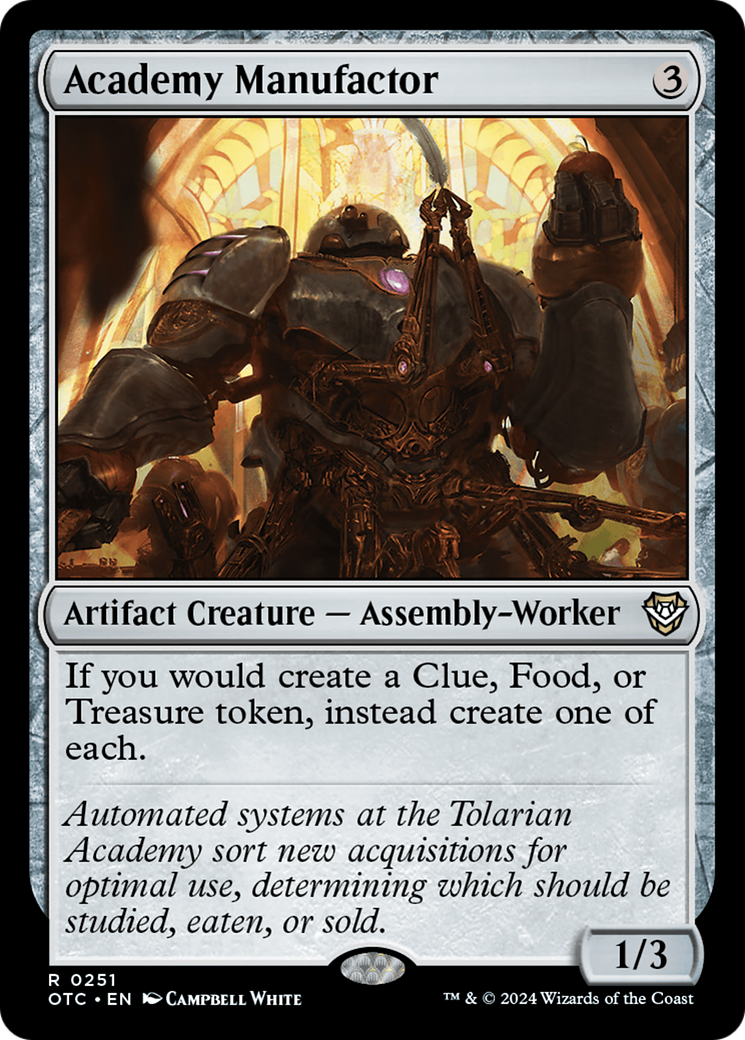
Academy Manufactor
Academy Manufactor
Artifact Creature — Assembly-Worker
1/3
If you would create a Clue, Food, or Treasure token, instead create one of each.
- If you control one Academy Manufactor and would create some number of Clue, Food, or Treasure tokens, you will instead create that many Clue tokens, that many Food tokens, and that many Treasure tokens.
- If you control two Academy Manufactors and would create some number of Clue, Food, or Treasure tokens, you will instead create three times that many Clue tokens, three times that many Food tokens, and three times that many Treasure tokens.
- If you control eighteen Academy Manufactors (I don't know, you figure it out) and would create some number of Clue, Food, or Treasure tokens, you will instead create 129,140,163 times that many Clue tokens, 129,140,163 times that many Food tokens, and 129,140,163 times that many Treasure tokens.
- Creating a Clue token this way isn't the same thing as investigating. Notably, an ability that triggers whenever you investigate won't trigger because you created a Clue token due to this replacement effect. If the original token creation was because you investigated once, those abilities will still each trigger once, no matter how many Clue tokens you end up creating.
-
1
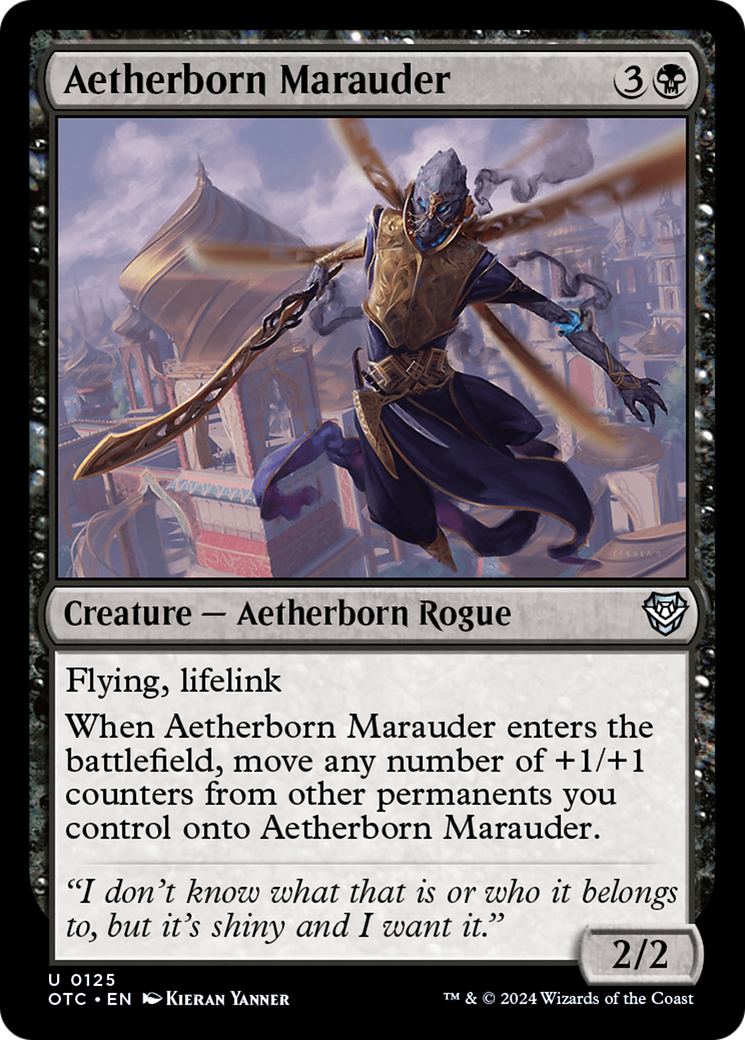
Aetherborn Marauder
Aetherborn Marauder
Creature — Aetherborn Rogue
2/2
Flying, lifelink
When this creature enters, move any number of +1/+1 counters from other permanents you control onto this creature.
- You may move +1/+1 counters from any number of other permanents you control, not just from one.
- You choose which counters to move as Aetherborn Marauder's triggered ability resolves.
- You may choose to move zero +1/+1 counters.
- If a creature has been dealt damage, that damage remains marked on it until the cleanup step. If Aetherborn Marauder takes counters from a creature that has been dealt damage, that creature will be destroyed if the damage is now lethal.
-
1
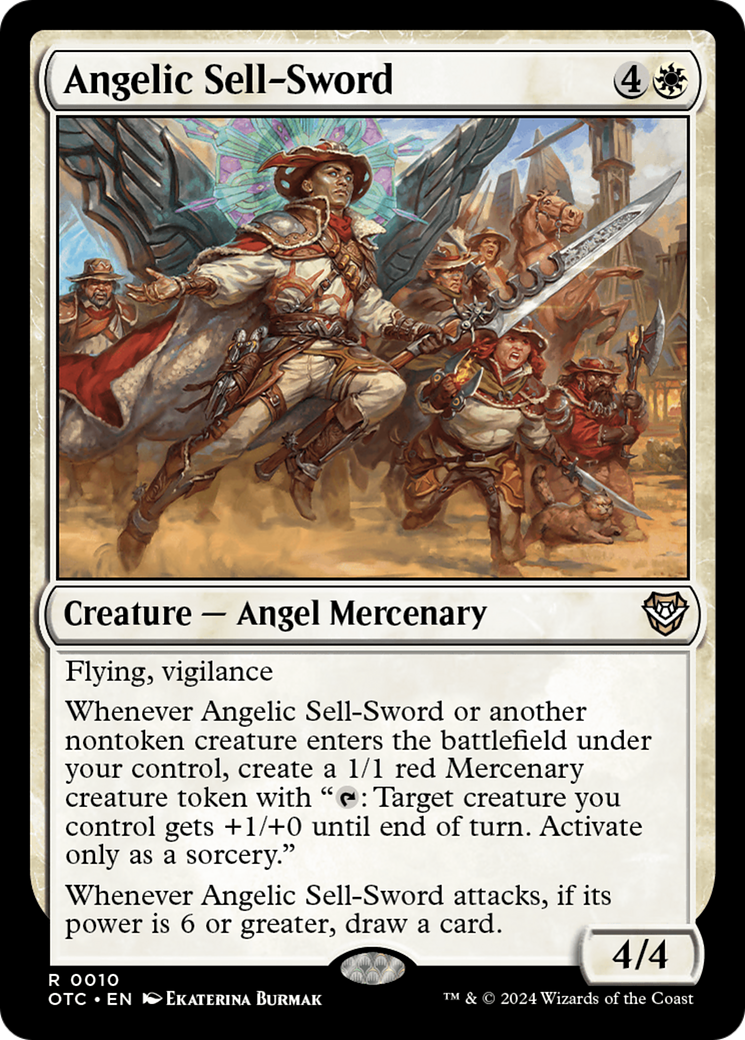
Angelic Sell-Sword
Angelic Sell-Sword
Creature — Angel Mercenary
4/4
Flying, vigilance
Whenever this creature or another nontoken creature you control enters, create a 1/1 red Mercenary creature token with " : Target creature you control gets +1/+0 until end of turn. Activate only as a sorcery."
Whenever this creature attacks, if its power is 6 or greater, draw a card.
-
1
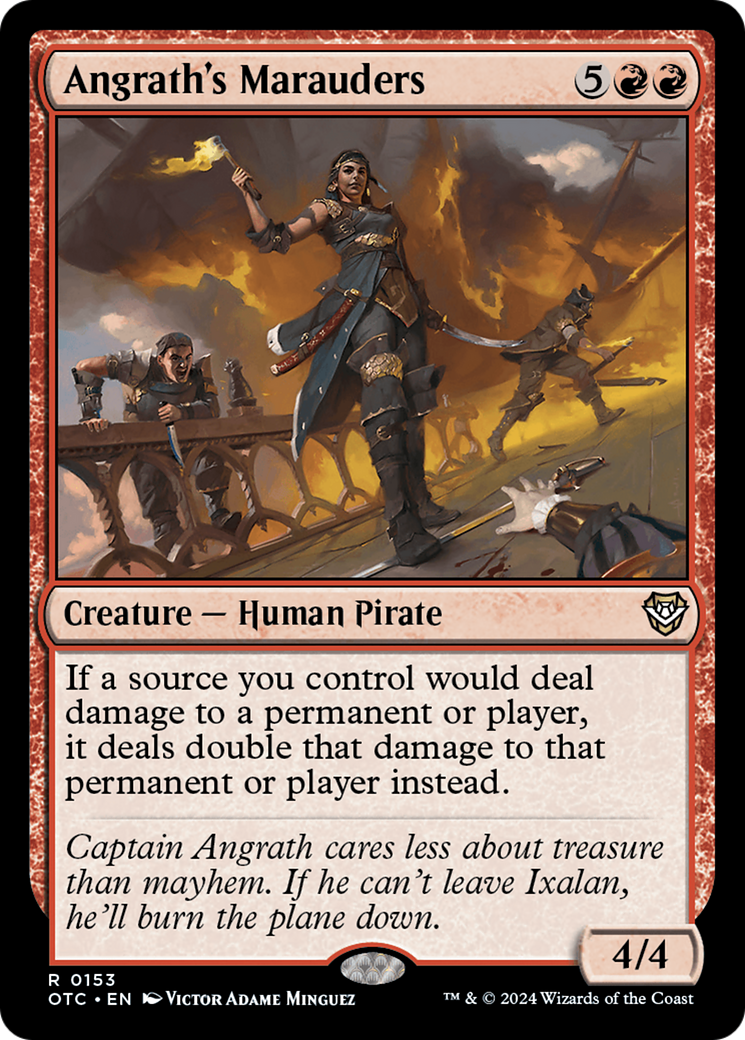
Angrath's Marauders
Angrath's Marauders
Creature — Human Pirate
4/4
If a source you control would deal damage to a permanent or player, it deals double that damage to that permanent or player instead.
- If a creature with trample you control would deal combat damage to a blocking creature while you control Angrath's Marauders, you must assign its unmodified damage. For example, a 3/3 creature with trample blocked by a 2/2 creature can have at most 1 damage assigned to the defending player. It will then deal 4 damage to the blocking creature and 2 damage to the defending player.
- If an effect such as that of Chandra's Pyrohelix asks you to divide damage among targets, you must divide the unmodified damage before doubling it.
- If you control a second Angrath's Marauders, damage dealt by sources you control will be multiplied by 4. If you control a third, it will be multiplied by 8, and so on.
-
1
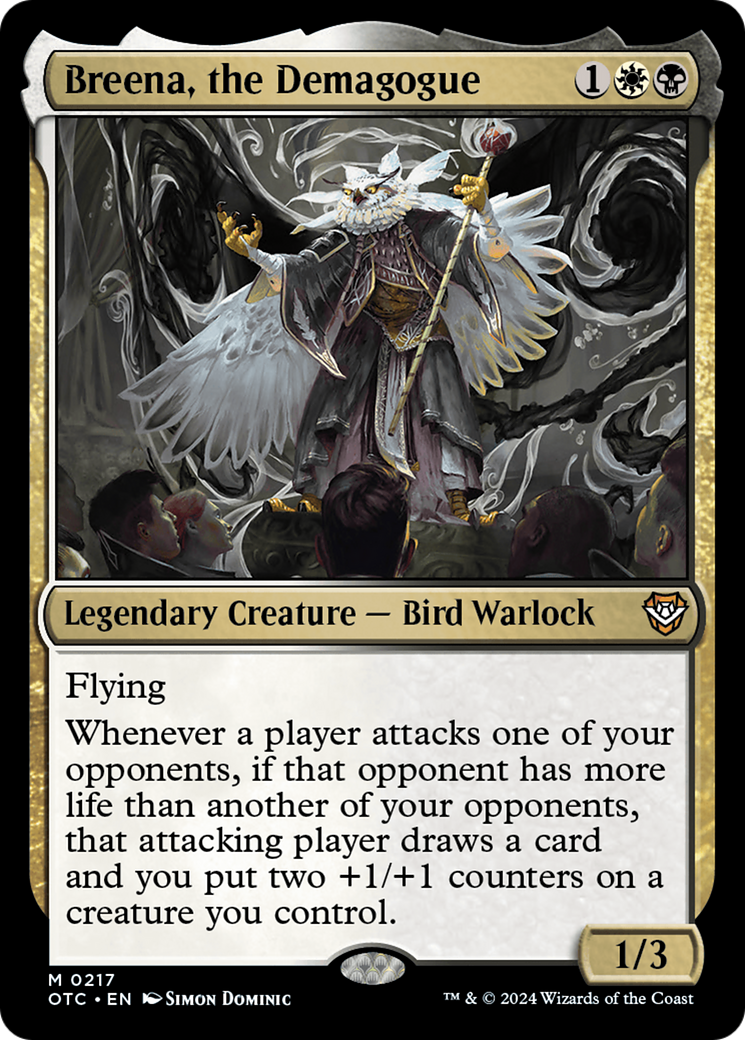
Breena, the Demagogue
Breena, the Demagogue
Legendary Creature — Bird Warlock
1/3
Flying
Whenever a player attacks one of your opponents, if that opponent has more life than another of your opponents, that attacking player draws a card and you put two +1/+1 counters on a creature you control.
- Breena's triggered ability will trigger even if you control no creatures.
- If the attacking player is one of your opponents and has less life than the player being attacked, then the condition is satisfied.
- You choose which creature to put +1/+1 counters on as the ability is resolving. Once you make the choice, no player may take actions until the counters are placed.
-
1
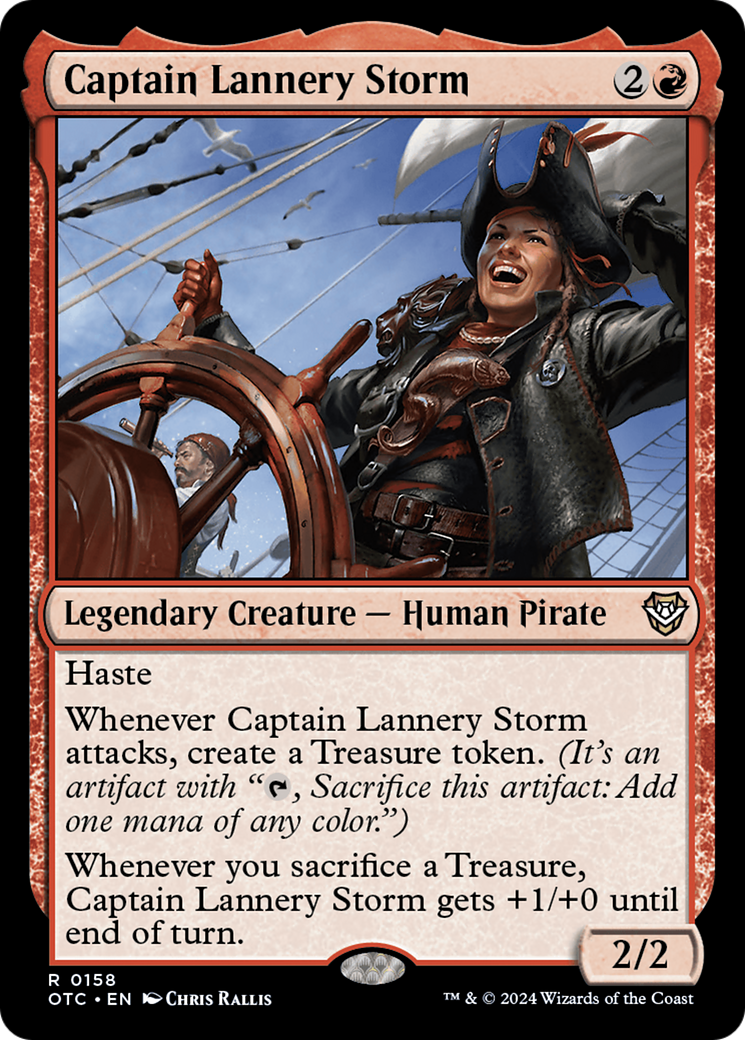
Captain Lannery Storm
Captain Lannery Storm
Legendary Creature — Human Pirate
2/2
Haste
Whenever Captain Lannery Storm attacks, create a Treasure token. (It's an artifact with " , Sacrifice this token: Add one mana of any color.")
Whenever you sacrifice a Treasure, Captain Lannery Storm gets +1/+0 until end of turn.
- You can activate the mana ability of a Treasure even if you have nothing to spend that mana on.
- Captain Lannery Storm's last ability triggers whenever you sacrifice a Treasure for any reason, not just to activate a Treasure's mana ability.
- If you sacrifice Treasures to cast Captain Lannery Storm, its last ability won't trigger for those Treasures.
-
1
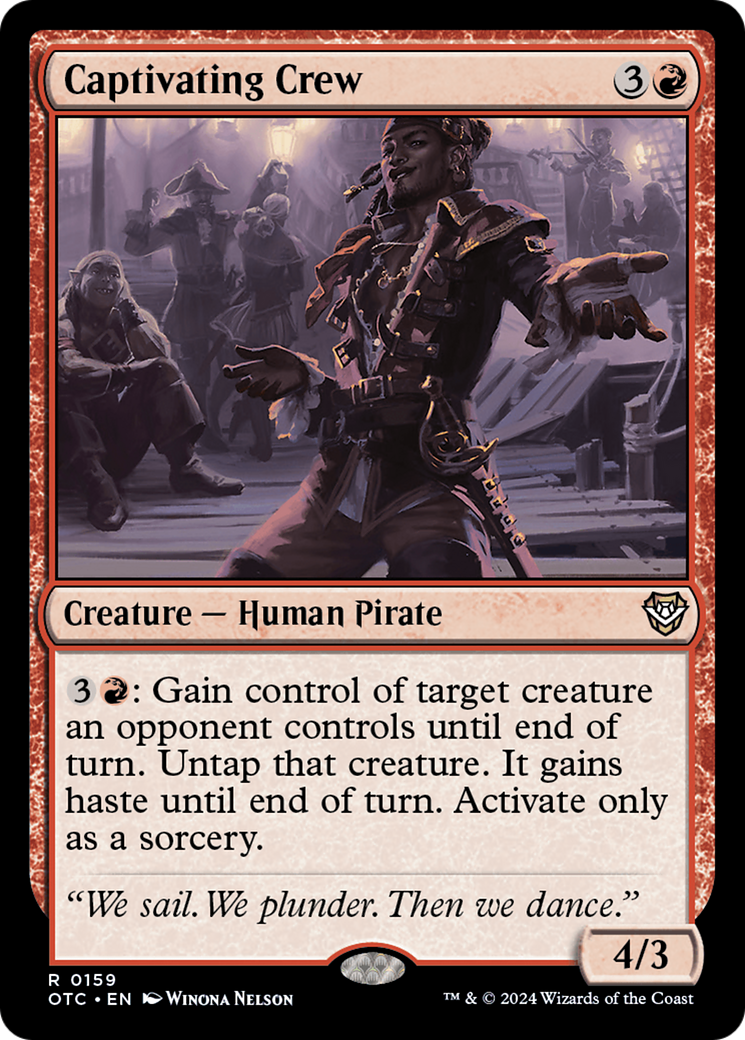
Captivating Crew
Captivating Crew
Creature — Human Pirate
4/3
: Gain control of target creature an opponent controls until end of turn. Untap that creature. It gains haste until end of turn. Activate only as a sorcery.
- You can target and gain control of an untapped creature this way.
-
1
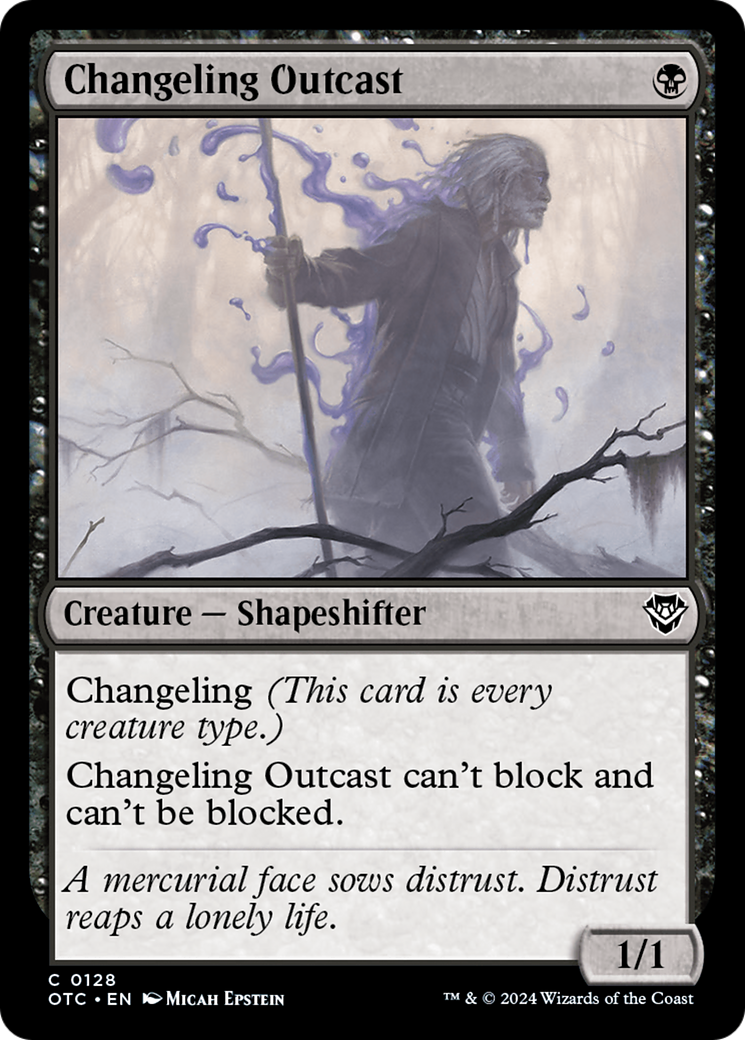
Changeling Outcast
Changeling Outcast
Creature — Shapeshifter
1/1
Changeling (This card is every creature type.)
This creature can't block and can't be blocked.
-
1
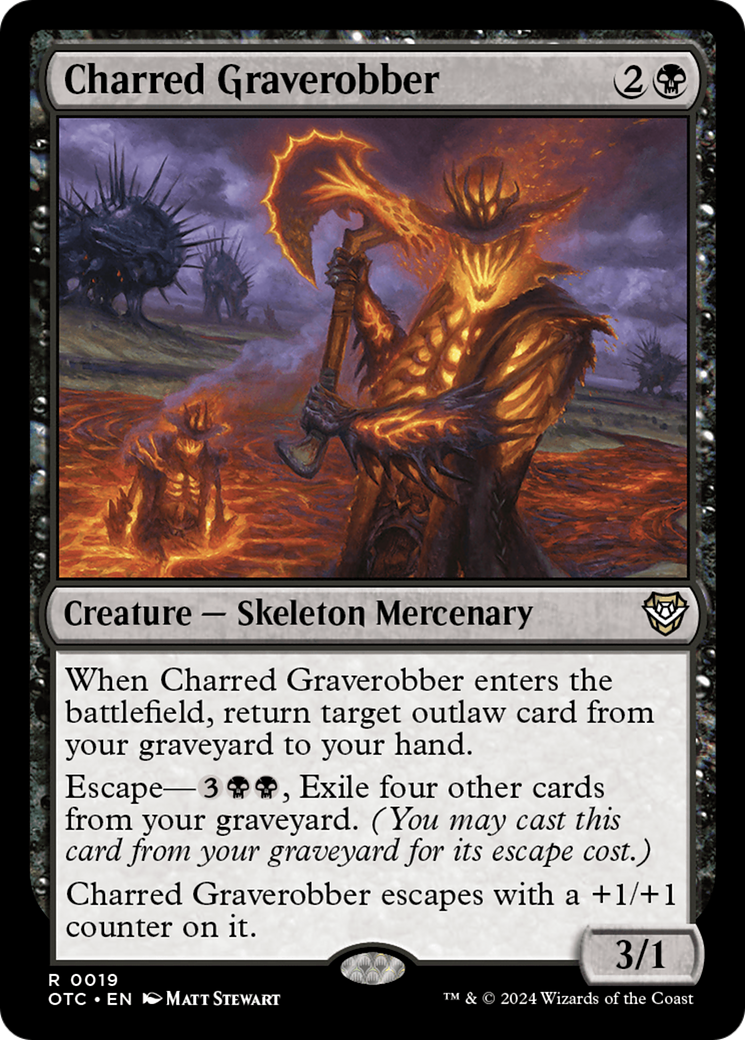
Charred Graverobber
Charred Graverobber
Creature — Skeleton Mercenary
3/1
When this creature enters, return target outlaw card from your graveyard to your hand.
Escape— , Exile four other cards from your graveyard. (You may cast this card from your graveyard for its escape cost.)
This creature escapes with a +1/+1 counter on it.
- Escape's permission doesn't change when you may cast the spell from your graveyard.
- To determine the total cost of a spell, start with the mana cost or alternative cost you're paying (such as an escape cost), add any cost increases, then apply any cost reductions. The mana value of the spell remains unchanged, no matter what the total cost to cast it was and no matter whether an alternative cost was paid.
- After an escaped spell resolves, it returns to its owner's graveyard if it's not a permanent spell. If it is a permanent spell, it enters the battlefield and will return to its owner's graveyard if it dies later. Perhaps it will escape again—good underworld security is so hard to come by these days.
- If a card has multiple abilities giving you permission to cast it, such as two escape abilities or an escape ability and a flashback ability, you choose which one to apply. The others have no effect.
- If you cast a spell with its escape permission, you can't choose to apply any other alternative costs or to cast it without paying its mana cost. If it has any additional costs, you must pay those.
- If a card with escape is put into your graveyard during your turn, you'll be able to cast it right away if it's legal to do so, before an opponent can take any actions.
- Once you begin casting a spell with escape, it immediately moves to the stack. Players can't take any other actions until you're done casting the spell.
- A card, spell, or permanent is an outlaw if it has the Assassin, Mercenary, Pirate, Rogue, or Warlock creature type. It doesn't matter if it has more than one of those creature types; as long as it has at least one, it's an outlaw.
- Outlaw is not a creature type. If an effect asks you to choose a creature type, you can't choose outlaw.
- If an ability refers to an outlaw or whether a player controls an outlaw, it's referring only to permanents with one or more of the creature types specified above. Notably, it's not referring to any spell or card not on the battlefield. However, other abilities may refer to an "outlaw spell" or "outlaw card" in a zone other than the battlefield. Those abilities refer to spells and cards with one or more of the specified creature types.
-
1
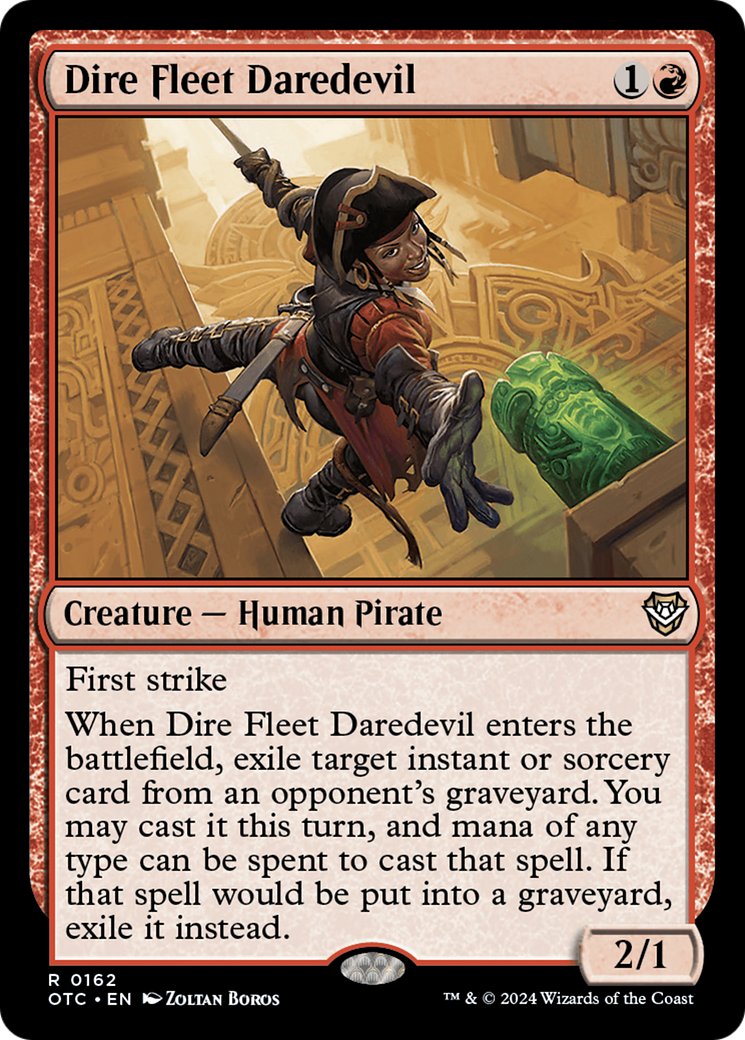
Dire Fleet Daredevil
Dire Fleet Daredevil
Creature — Human Pirate
2/1
First strike
When this creature enters, exile target instant or sorcery card from an opponent's graveyard. You may cast it this turn, and mana of any type can be spent to cast that spell. If that spell would be put into a graveyard, exile it instead.
- Casting an exiled card causes it to leave exile. You can't cast it multiple times.
- The effect of Dire Fleet Daredevil doesn't change when you can cast the exiled card. For example, if you exile a sorcery card, you can cast it only during your main phase when the stack is empty.
-
1
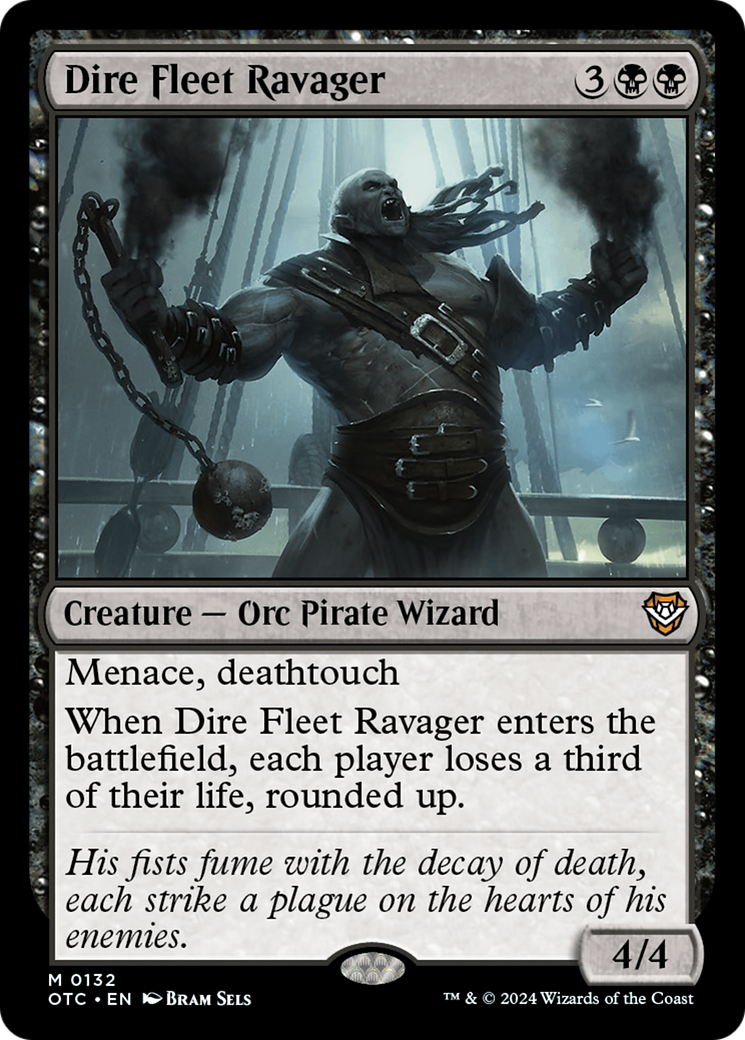
Dire Fleet Ravager
Dire Fleet Ravager
Creature — Orc Pirate Wizard
4/4
Menace, deathtouch
When this creature enters, each player loses a third of their life, rounded up.
- For example, if you have 13 life, you'll lose 5 life.
- If a player has 1 life, that player loses 1 life. If each player has 0 life after that, the game's a draw.
- In a Two-Headed Giant game, each player loses a third of the team's life total rounded up. For example, if a team has 13 life, each player on that team loses 5 life and the team loses 10 life total.
-
1
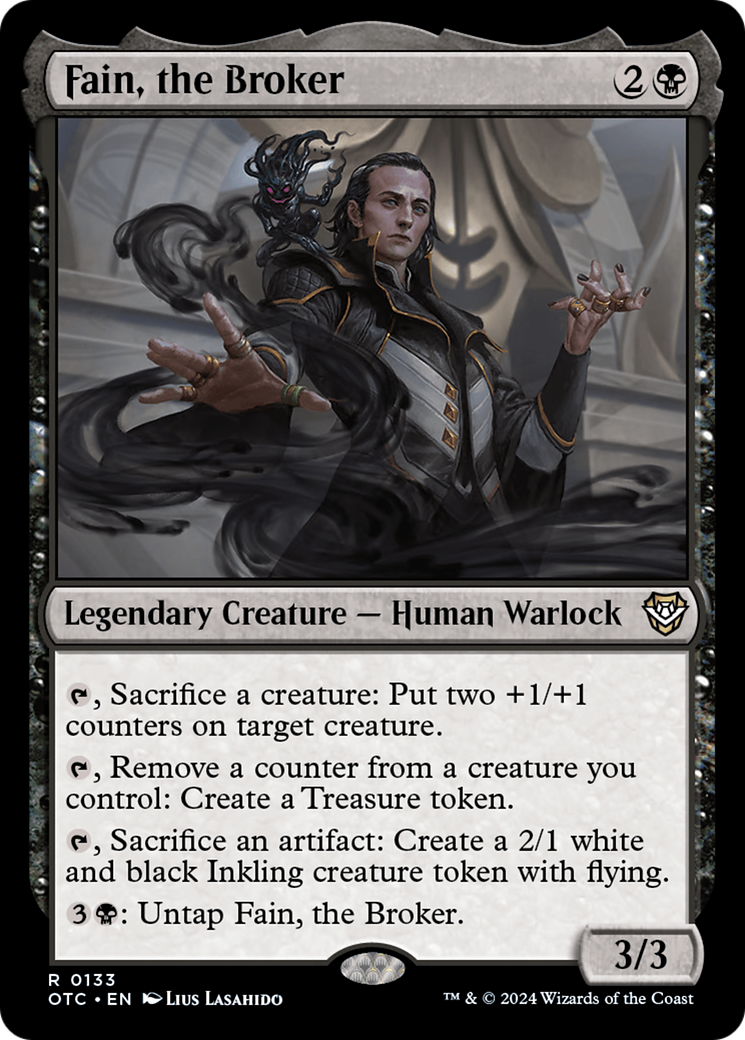
Fain, the Broker
Fain, the Broker
Legendary Creature — Human Warlock
3/3
, Sacrifice a creature: Put two +1/+1 counters on target creature.
, Remove a counter from a creature you control: Create a Treasure token.
, Sacrifice an artifact: Create a 2/1 white and black Inkling creature token with flying.
: Untap Fain.
-
1
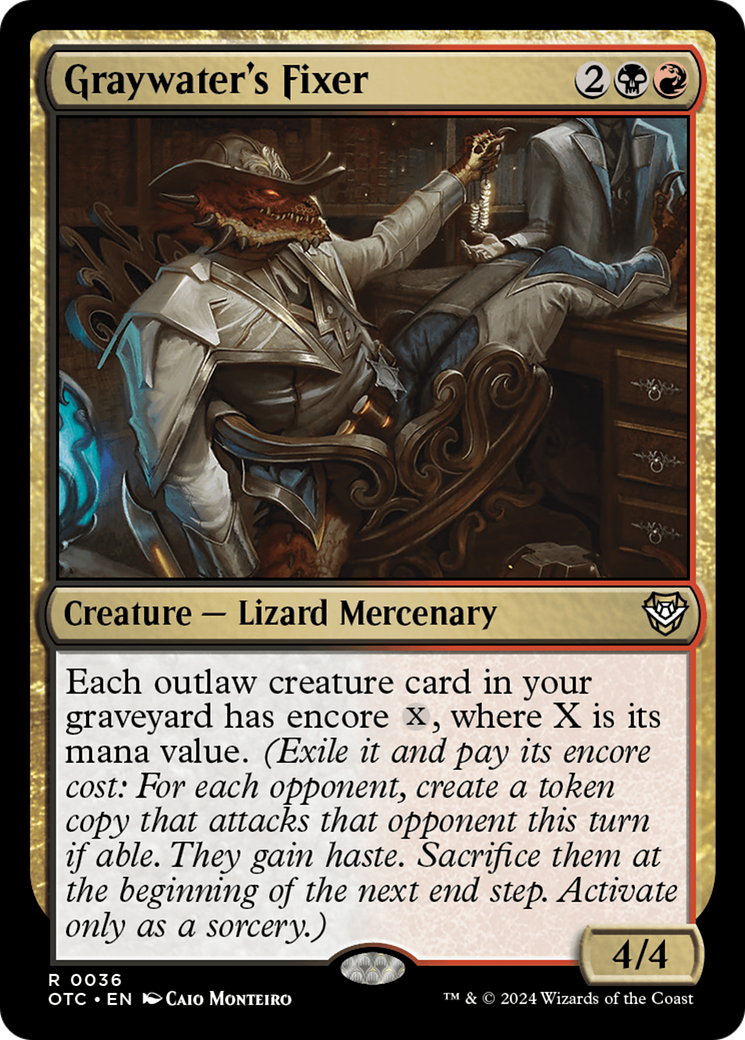
Graywater's Fixer
Graywater's Fixer
Creature — Lizard Mercenary
4/4
Each outlaw creature card in your graveyard has encore , where X is its mana value. (Exile it and pay its encore cost: For each opponent, create a token copy that attacks that opponent this turn if able. They gain haste. Sacrifice them at the beginning of the next end step. Activate only as a sorcery.)
- Graywater's Fixer itself doesn't have encore. Its ability applies only while it's on the battlefield.
- If the mana cost of a card in your graveyard includes , X is 0 for the purpose of determining its mana value.
- Exiling the card with encore is a cost to activate the ability. Once you announce that you're activating it, no player may take actions until you've finished. They can't try to remove the card from your graveyard to stop you from paying the cost.
- Opponents who have left the game aren't counted when determining how many tokens to create.
- The tokens copy only what's on the original card. Effects that modified that creature when it was previously on the battlefield won't be copied.
- Each token must attack the appropriate player if able.
- If one of the tokens can't attack for any reason (such as being tapped), then it doesn't attack. If there's a cost associated with having it attack, you aren't forced to pay that cost, so it doesn't have to attack in that case either.
- If an effect stops a token from attacking a specific player, that token can attack any player, planeswalker, or battle, or not attack at all. If the effect stops the token from attacking a specific player unless a cost is paid, you don't have to pay that cost unless you want to attack that player.
- If one of the tokens somehow is under another player's control as the delayed triggered ability resolves, you can't sacrifice that token. It remains on the battlefield indefinitely, even if you regain control of it later.
- A card, spell, or permanent is an outlaw if it has the Assassin, Mercenary, Pirate, Rogue, or Warlock creature type. It doesn't matter if it has more than one of those creature types; as long as it has at least one, it's an outlaw.
- Outlaw is not a creature type. If an effect asks you to choose a creature type, you can't choose outlaw.
- If an ability refers to an outlaw or whether a player controls an outlaw, it's referring only to permanents with one or more of the creature types specified above. Notably, it's not referring to any spell or card not on the battlefield. However, other abilities may refer to an "outlaw spell" or "outlaw card" in a zone other than the battlefield. Those abilities refer to spells and cards with one or more of the specified creature types.
-
1
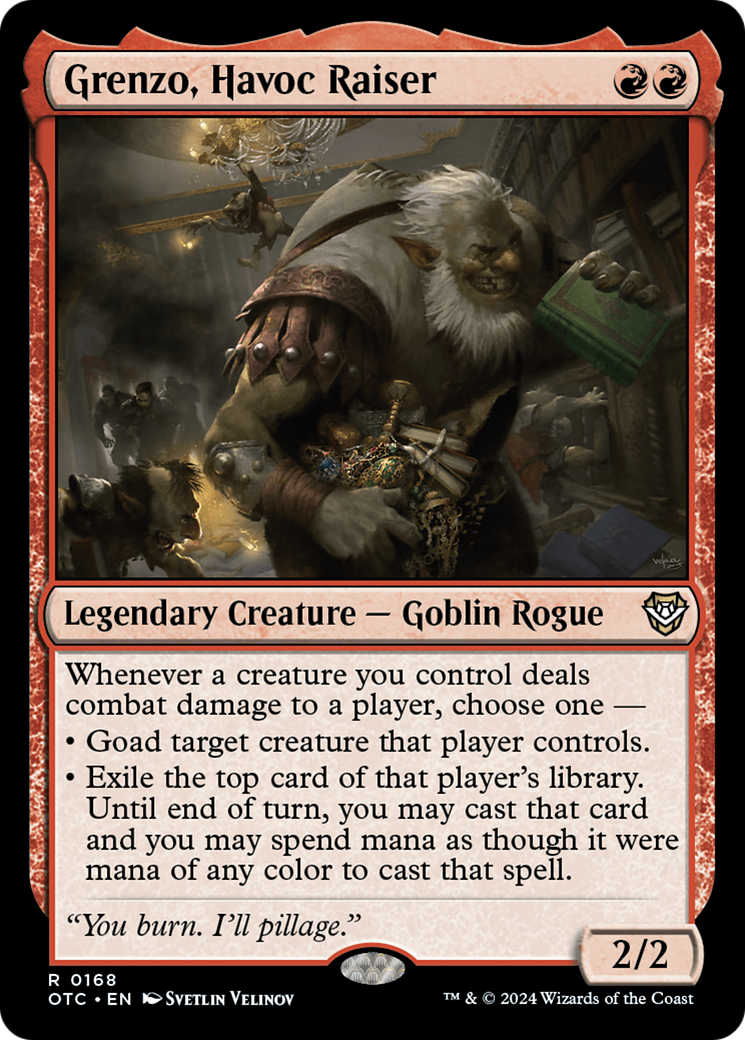
Grenzo, Havoc Raiser
Grenzo, Havoc Raiser
Legendary Creature — Goblin Rogue
2/2
Whenever a creature you control deals combat damage to a player, choose one —
- Goad target creature that player controls.
- Exile the top card of that player's library. Until end of turn, you may cast that card and you may spend mana as though it were mana of any color to cast that spell.
- If a creature you control has been goaded by multiple opponents, it must attack one of your opponents that hasn't goaded it, as that fulfills the maximum number of goad requirements. If a creature you control has been goaded by each of your opponents, the creature must attack an opponent (rather than a planeswalker or battle), but you choose which opponent it attacks.
- If, during a player's declare attackers step, a creature that player controls that's been goaded is tapped, is affected by a spell or ability that says it can't attack, or hasn't been under that player's control continuously since the turn began (and doesn't have haste), then it doesn't attack. If there's a cost associated with having a creature attack a player, its controller isn't forced to pay that cost, so it doesn't have to attack that player.
- If the creature doesn't meet any of the above exceptions and can attack, it must attack a player other than the controller of the spell or ability that goaded it if able. If the creature can't attack any of those players but could otherwise attack, it must attack a planeswalker an opponent controls, a battle an opponent controls, or a player who goaded it.
- Being goaded isn't an ability the creature has. Once it's been goaded, it must attack as detailed above even if it loses all abilities.
- Attacking with a goaded creature doesn't cause it to stop being goaded. If there is an additional combat phase that turn, or if another player gains control of it before it stops being goaded, it must attack again if able.
- If you exile a land card this way, you can't play it.
- Casting the exiled card follows the normal rules for casting that card. You must pay its costs, and you must follow all applicable timing rules. For example, if you exile a creature card this way, you must wait until your main phase to cast it.
- If you don't cast the card, it will remain in exile.
- The card exiled by the second mode is exiled face up.
-
1
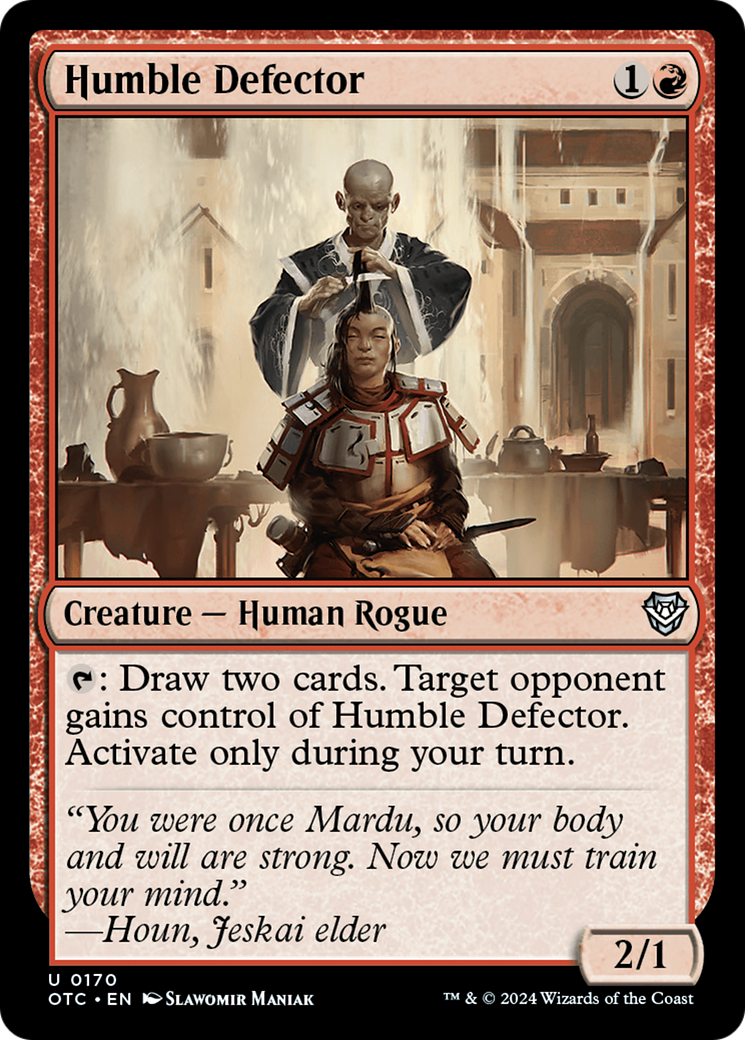
Humble Defector
Humble Defector
Creature — Human Rogue
2/1
: Draw two cards. Target opponent gains control of this creature. Activate only during your turn.
- If Humble Defector isn't on the battlefield as its ability resolves, but the target player is still a legal target, the ability will resolve. You'll draw two cards, even though the player doesn't gain control of Humble Defector.
- If Humble Defector's owner leaves the game, Humble Defector humbly leaves the game along with that player.
- Humble Defector's ability can be activated any time during your turn, including in response to a spell or ability.
- If Humble Defector is controlled by a player other than its owner, and its controller leaves the game, the effect giving that player control of Humble Defector ends. Humble Defector will return to the control of the player still in the game who most recently controlled it.
-
1
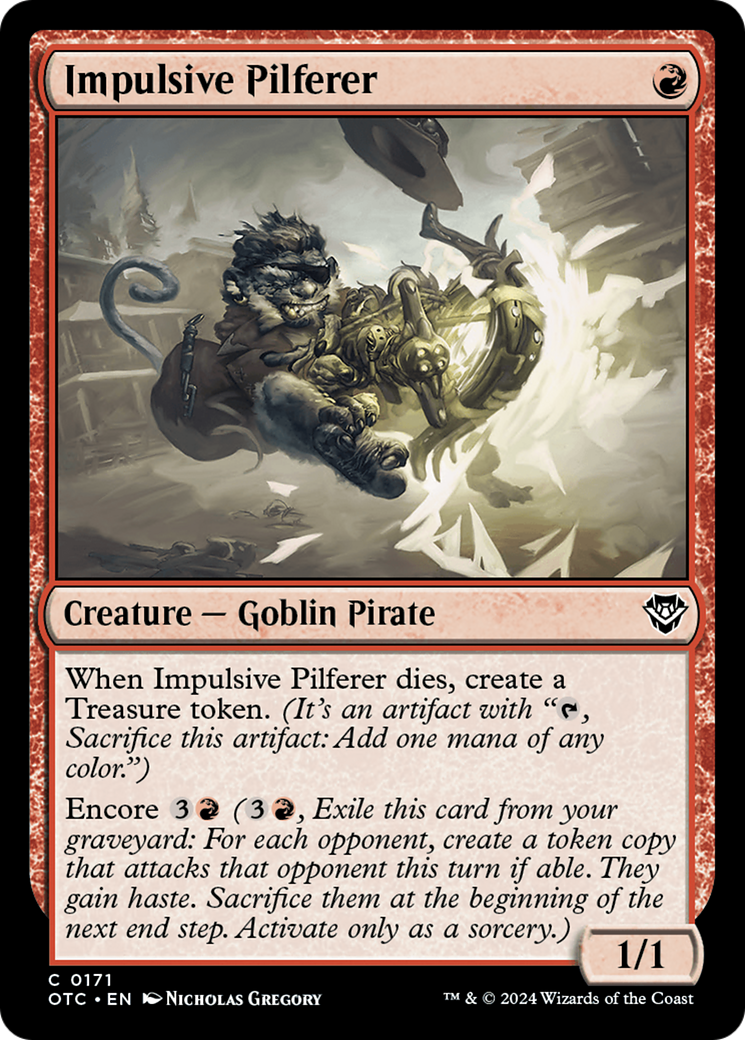
Impulsive Pilferer
Impulsive Pilferer
Creature — Goblin Pirate
1/1
When this creature dies, create a Treasure token. (It's an artifact with " , Sacrifice this token: Add one mana of any color.")
Encore ( , Exile this card from your graveyard: For each opponent, create a token copy that attacks that opponent this turn if able. They gain haste. Sacrifice them at the beginning of the next end step. Activate only as a sorcery.)
- If an effect stops a token from attacking a specific player, that token can attack any player, planeswalker, or battle, or not attack at all. If the effect stops the token from attacking a specific player unless a cost is paid, you don't have to pay that cost unless you want to attack that player.
- Opponents who have left the game aren't counted when determining how many tokens to create.
- The tokens copy only what's on the original card. Effects that modified that creature when it was previously on the battlefield won't be copied.
- Exiling the card with encore is a cost to activate the ability. Once you announce that you're activating it, no player may take actions until you've finished. They can't try to remove the card from your graveyard to stop you from paying the cost.
- If one of the tokens can't attack for any reason (such as being tapped), then it doesn't attack. If there's a cost associated with having it attack, you aren't forced to pay that cost, so it doesn't have to attack in that case either.
- If one of the tokens somehow is under another player's control as the delayed triggered ability resolves, you can't sacrifice that token. It remains on the battlefield indefinitely, even if you regain control of it later.
- Each token must attack the appropriate player if able.
-
1
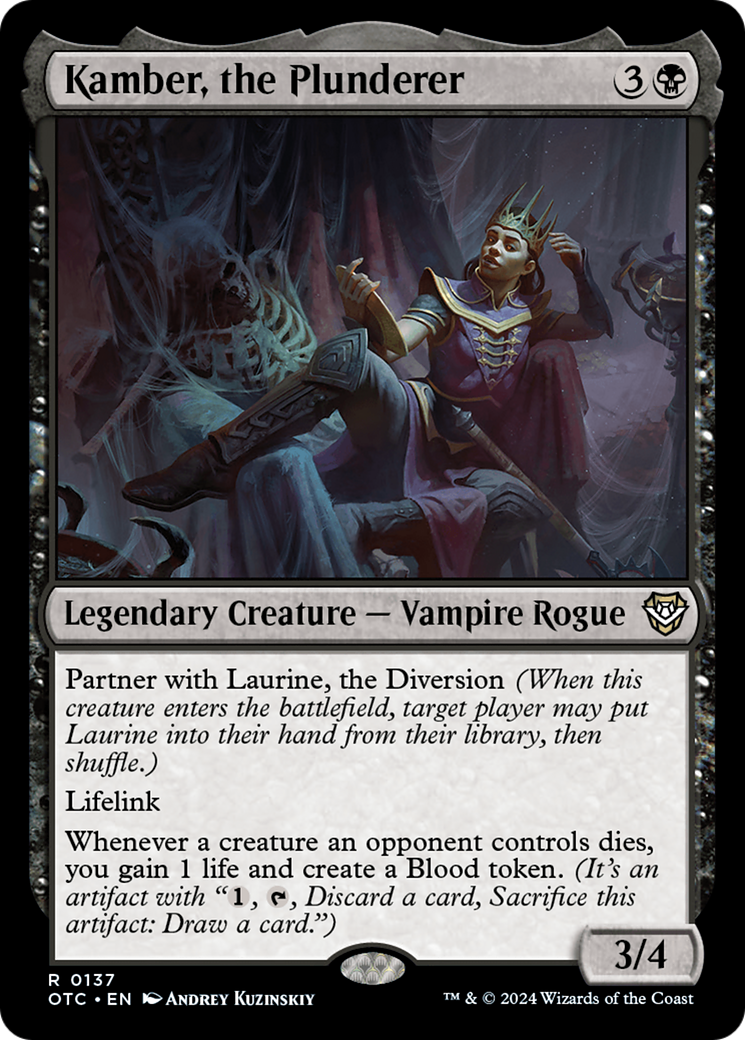
Kamber, the Plunderer
Kamber, the Plunderer
Legendary Creature — Vampire Rogue
3/4
Partner with Laurine, the Diversion (When this creature enters, target player may put Laurine into their hand from their library, then shuffle.)
Lifelink
Whenever a creature an opponent controls dies, you gain 1 life and create a Blood token. (It's an artifact with " , , Discard a card, Sacrifice this token: Draw a card.")
- If an effect refers to a Blood token, it means any artifact token with the subtype Blood, even if it has gained other subtypes.
- You can't sacrifice a Blood token to pay multiple costs.
- Some triggered abilities trigger "whenever you sacrifice a Blood token." These abilities trigger regardless of why you sacrificed that Blood token.
-
1
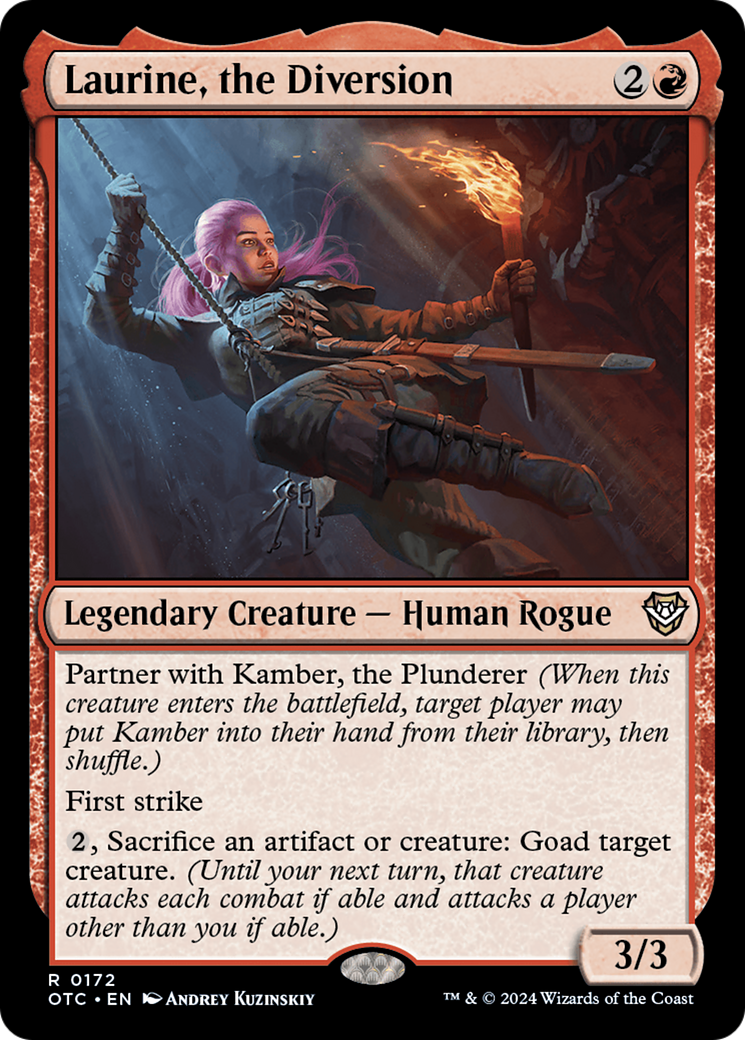
Laurine, the Diversion
Laurine, the Diversion
Legendary Creature — Human Rogue
3/3
Partner with Kamber, the Plunderer (When this creature enters, target player may put Kamber into their hand from their library, then shuffle.)
First strike
, Sacrifice an artifact or creature: Goad target creature. (Until your next turn, that creature attacks each combat if able and attacks a player other than you if able.)
-
1
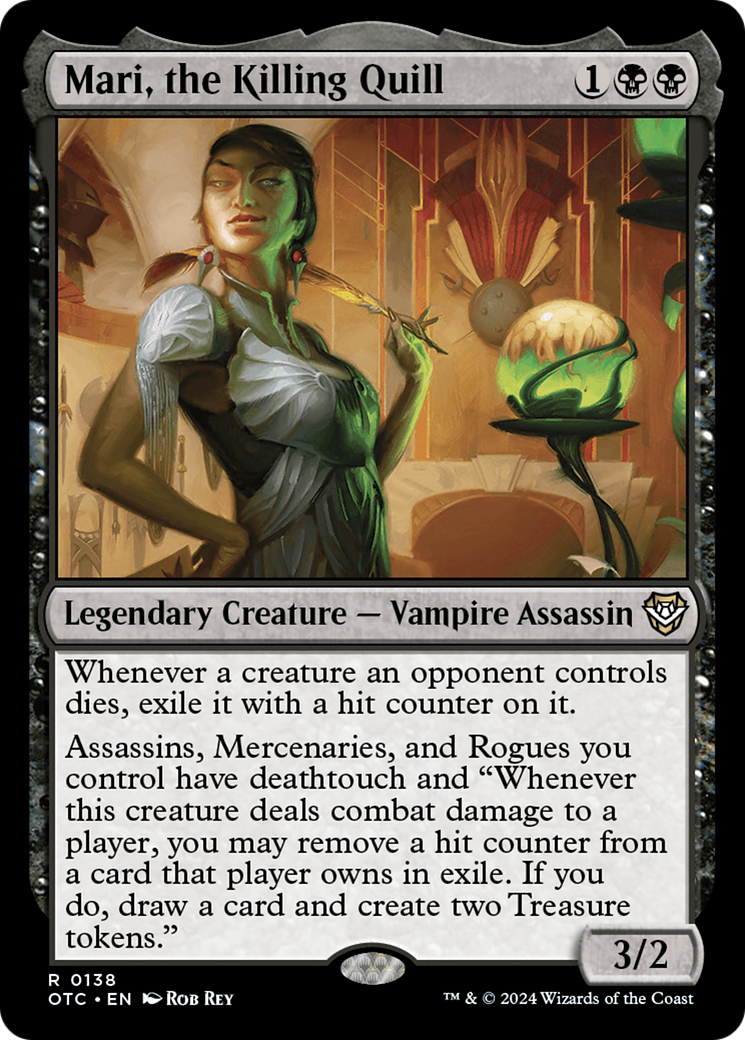
Mari, the Killing Quill
Mari, the Killing Quill
Legendary Creature — Vampire Assassin
3/2
Whenever a creature an opponent controls dies, exile it with a hit counter on it.
Assassins, Mercenaries, and Rogues you control have deathtouch and "Whenever this creature deals combat damage to a player, you may remove a hit counter from a card that player owns in exile. If you do, draw a card and create two Treasure tokens."
-
1
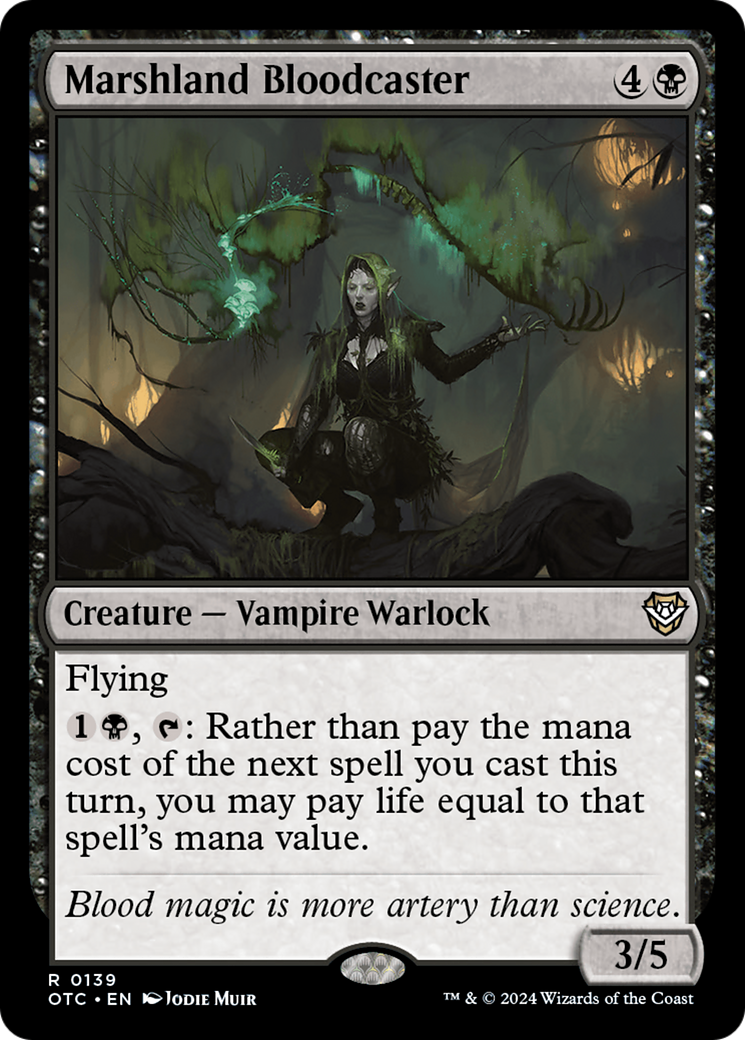
Marshland Bloodcaster
Marshland Bloodcaster
Creature — Vampire Warlock
3/5
Flying
, : Rather than pay the mana cost of the next spell you cast this turn, you may pay life equal to that spell's mana value.
- If you cast a spell for another cost "rather than pay its mana cost," you can't choose to cast it for any alternative costs. You can, however, pay additional costs. If the card has any mandatory additional costs, such as that of Draconic Intervention, those must be paid to cast the card.
- If the next spell you cast has in its mana cost, you must choose 0 as the value of X if you pay life rather than pay its mana cost.
- Marshland Bloodcaster's ability affects the next spell you cast after the ability has resolved. If you cast any spells in response to the ability, those spells are cast as normal.
- Even after the ability resolves, you may choose to not pay life rather than pay mana cost of the next spell you cast that turn. However, if you do this, you won't have the opportunity to pay life for any other spells you cast that turn (unless you activate the ability again).
-
1
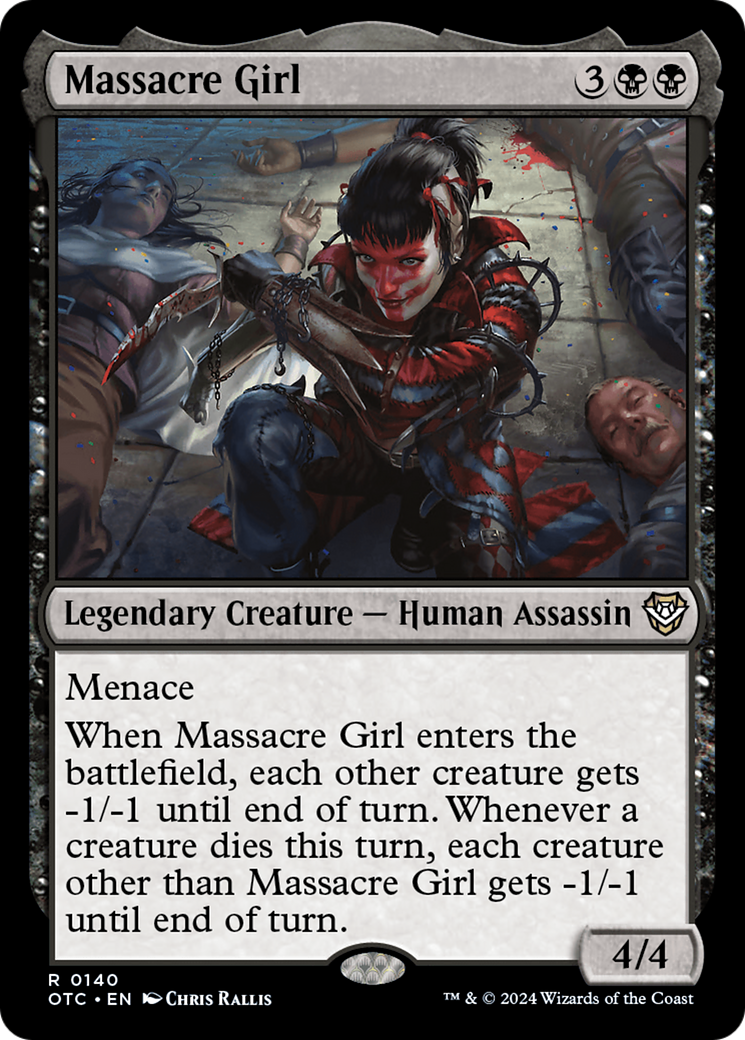
Massacre Girl
Massacre Girl
Legendary Creature — Human Assassin
4/4
Menace
When Massacre Girl enters, each other creature gets -1/-1 until end of turn. Whenever a creature dies this turn, each creature other than Massacre Girl gets -1/-1 until end of turn.
- Massacre Girl's enters-the-battlefield triggered ability and its delayed triggered ability each affect only creatures on the battlefield at the time that those abilities resolve. Creatures that enter the battlefield or become creatures later in the turn won't get -1/-1 unless the delayed triggered ability triggers and resolves again later.
- Once Massacre Girl's enters-the-battlefield ability has triggered, it doesn't matter whether Massacre Girl remains on the battlefield. The delayed triggered ability will be created as the enters-the-battlefield ability resolves.
- Creatures that die while Massacre Girl's triggered ability is still on the stack won't cause its delayed triggered ability to trigger since that delayed triggered ability hasn't been created yet.
- A creature with 0 toughness doesn't die immediately. Rather, the creature dies the next time a player would receive priority. This means that any creatures whose toughness becomes 0 as Massacre Girl's enters-the-battlefield ability resolves will remain on the battlefield until just after the delayed triggered ability has been created.
- If more than one creature dies at once, Massacre Girl's delayed triggered ability triggers that many times.
-
1
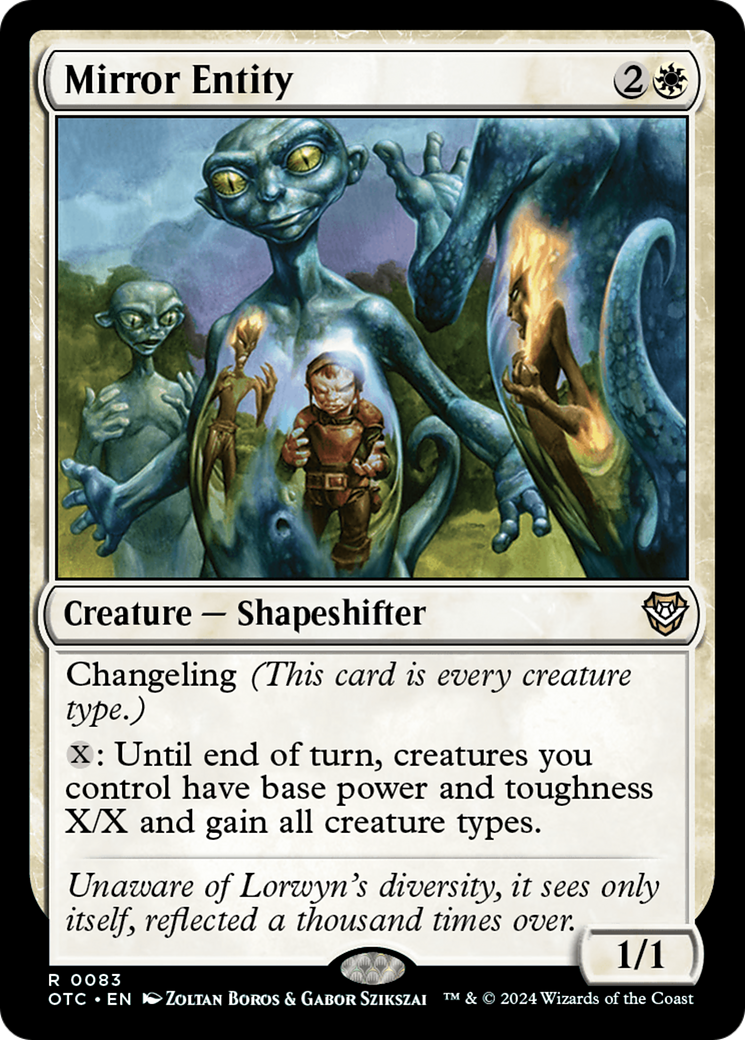
Mirror Entity
Mirror Entity
Creature — Shapeshifter
1/1
Changeling (This card is every creature type.)
: Until end of turn, creatures you control have base power and toughness X/X and gain all creature types.
- Changeling applies in all zones, not just the battlefield.
- Mirror Entity's ability overwrites any effects that previously set a creature's base power and/or toughness. Any existing effects or counters that raise or lower a creature's power and/or toughness continue to apply to the creature's newly-set power and toughness.
- Activating the ability with X = 0 will cause all creatures you control to become 0/0 and be put into the graveyard.
-
1
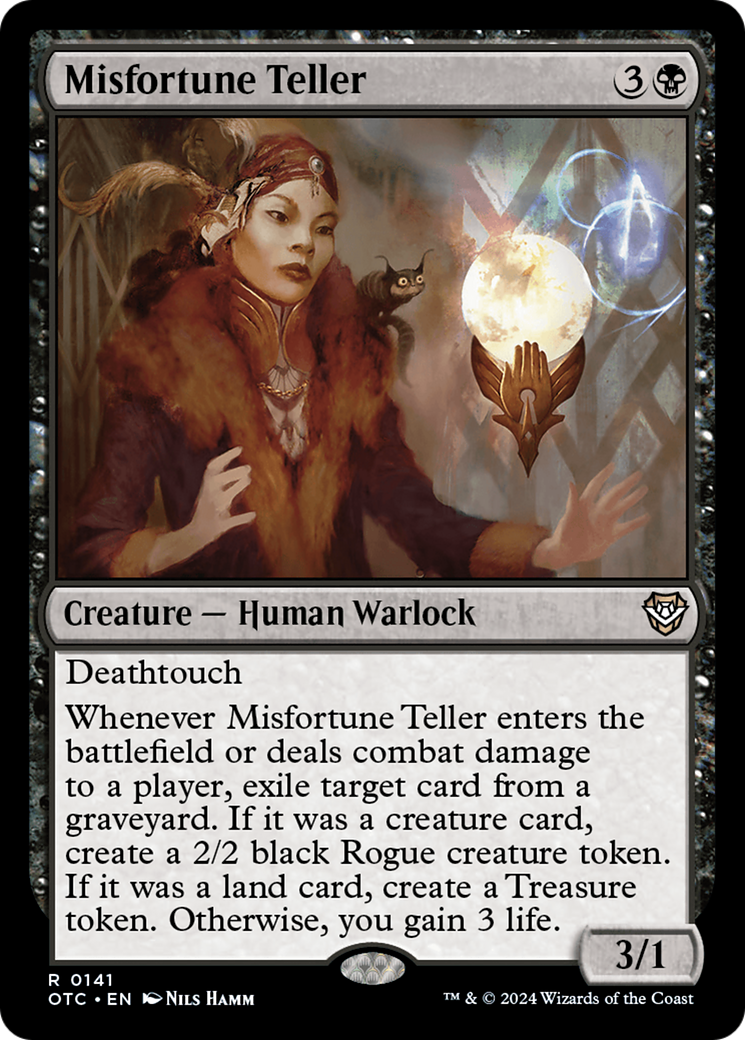
Misfortune Teller
Misfortune Teller
Creature — Human Warlock
3/1
Deathtouch
Whenever this creature enters or deals combat damage to a player, exile target card from a graveyard. If it was a creature card, create a 2/2 black Rogue creature token. If it was a land card, create a Treasure token. Otherwise, you gain 3 life.
- If the card was both a land and a creature (such as Dryad Arbor), you will create both a Rogue token and a Treasure token.
-
1
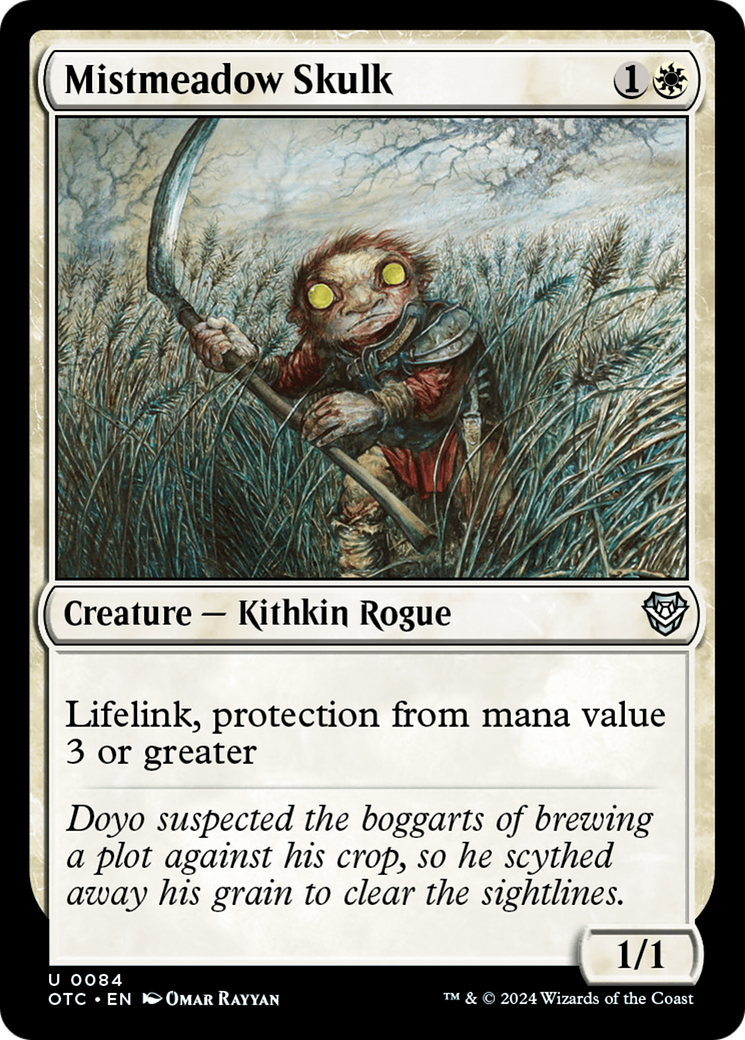
Mistmeadow Skulk
Mistmeadow Skulk
Creature — Kithkin Rogue
1/1
Lifelink, protection from mana value 3 or greater
- The protection ability means the following: - Mistmeadow Skulk can't be blocked by creatures with mana value 3 or greater. - Mistmeadow Skulk can't be enchanted by Auras with mana value 3 or greater. It also can't be equipped by Equipment with mana value 3 or greater. - Mistmeadow Skulk can't be targeted by spells with mana value 3 or greater. It also can't be targeted by abilities from sources with mana value 3 or greater. - All damage that would be dealt to Mistmeadow Skulk by sources with mana value 3 or greater is prevented.
- While a spell with X in its cost is on the stack, its mana value takes the chosen value of X into account. Mistmeadow Skulk can be chosen as a target for a Blaze (which has mana cost ) if X is 0 or 1, for example, but it can't be chosen as a target for a Blaze if X is 2 or more.
- A face-down creature has a mana value of 0, so Mistmeadow Skulk doesn't have protection from it .
-
1
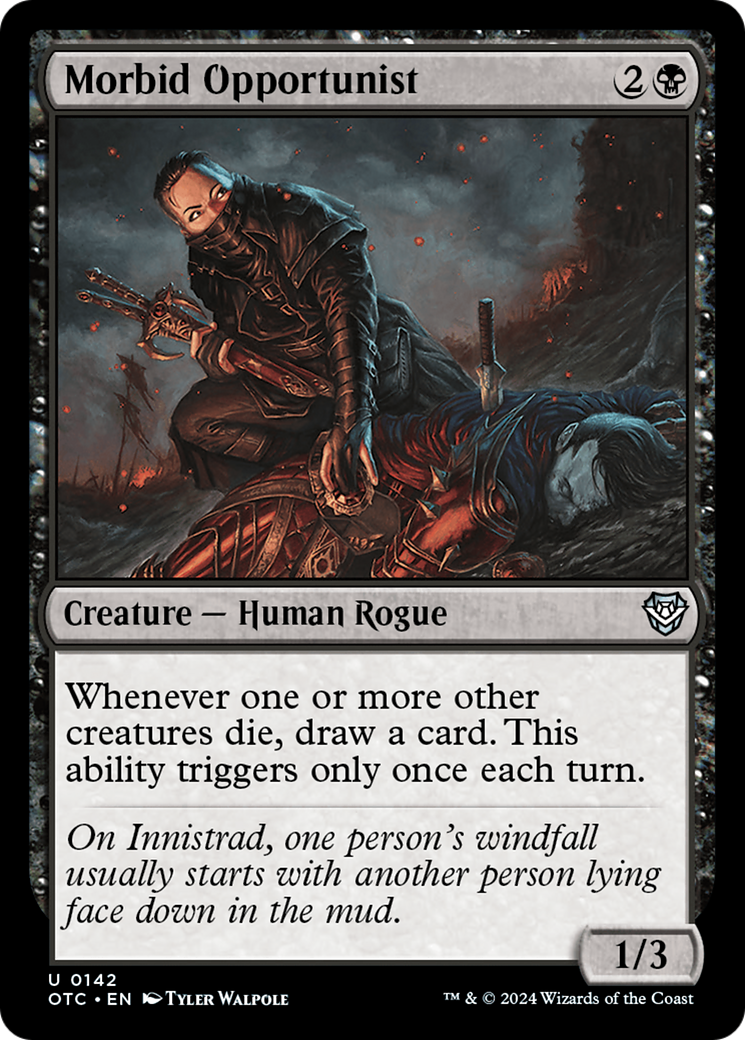
Morbid Opportunist
Morbid Opportunist
Creature — Human Rogue
1/3
Whenever one or more other creatures die, draw a card. This ability triggers only once each turn.
- If Morbid Opportunist dies at the same time as one or more other creatures, Morbid Opportunist's ability still triggers.
-
1
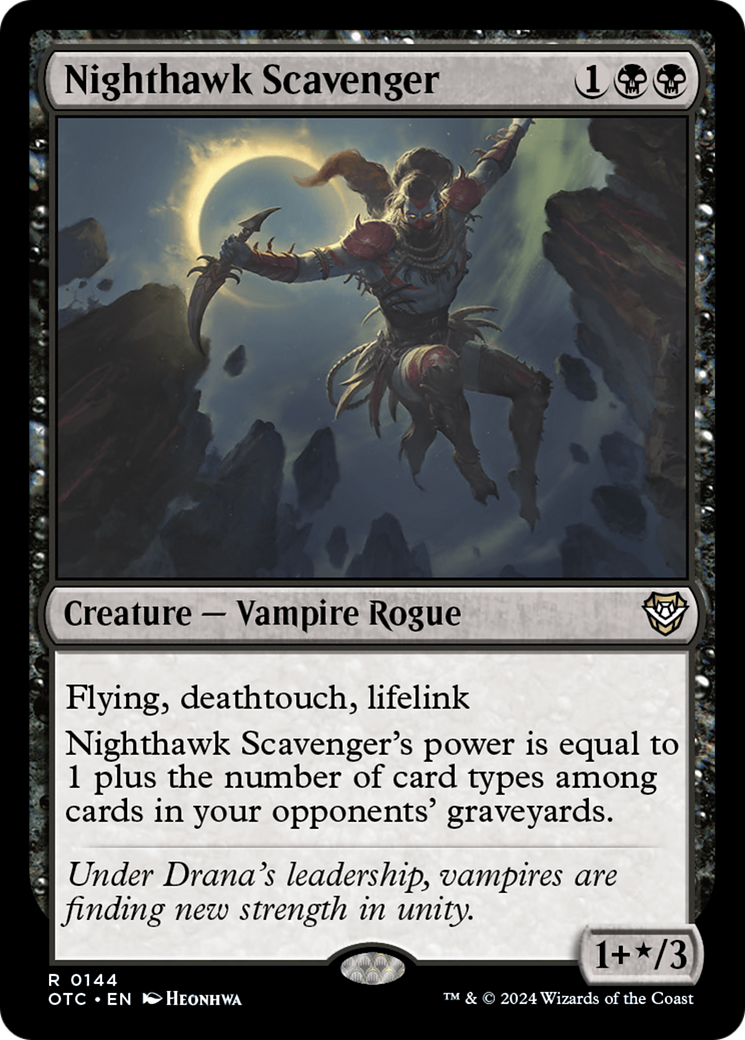
Nighthawk Scavenger
Nighthawk Scavenger
Creature — Vampire Rogue
1+*/3
Flying, deathtouch, lifelink
Nighthawk Scavenger's power is equal to 1 plus the number of card types among cards in your opponents' graveyards.
- The ability that defines Nighthawk Scavenger's power applies in all zones, not just the battlefield.
- Nighthawk Scavenger counts card types, not cards. If the only card in your opponents' graveyards is a single artifact creature card, Nighthawk Scavenger will be 3/3. If the only cards in those graveyards are ten artifact cards and ten creature cards, Nighthawk Scavenger will still be 3/3.
- Card types that can appear on cards in a graveyard include artifact, creature, enchantment, instant, land, planeswalker, and sorcery. Legendary, basic, and snow are supertypes, not card types; Vampire and Rogue are subtypes, not card types.
-
1
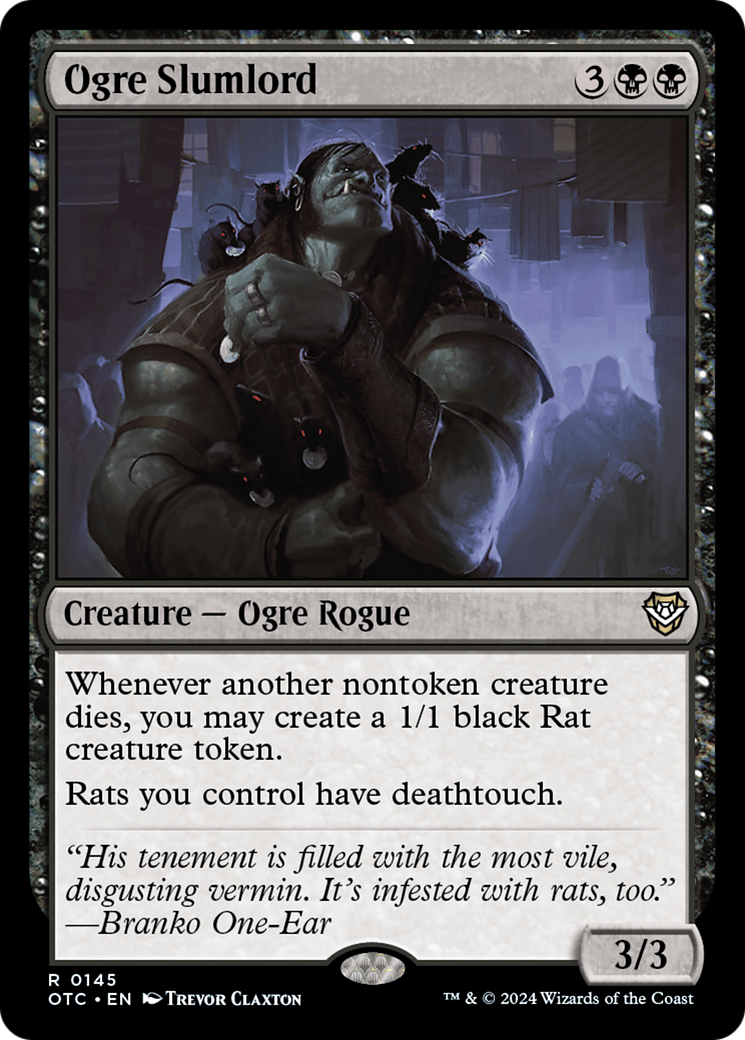
Ogre Slumlord
Ogre Slumlord
Creature — Ogre Rogue
3/3
Whenever another nontoken creature dies, you may create a 1/1 black Rat creature token.
Rats you control have deathtouch.
- All Rats you control have deathtouch while Ogre Slumlord is on the battlefield, not just the ones created by Ogre Slumlord.
-
1
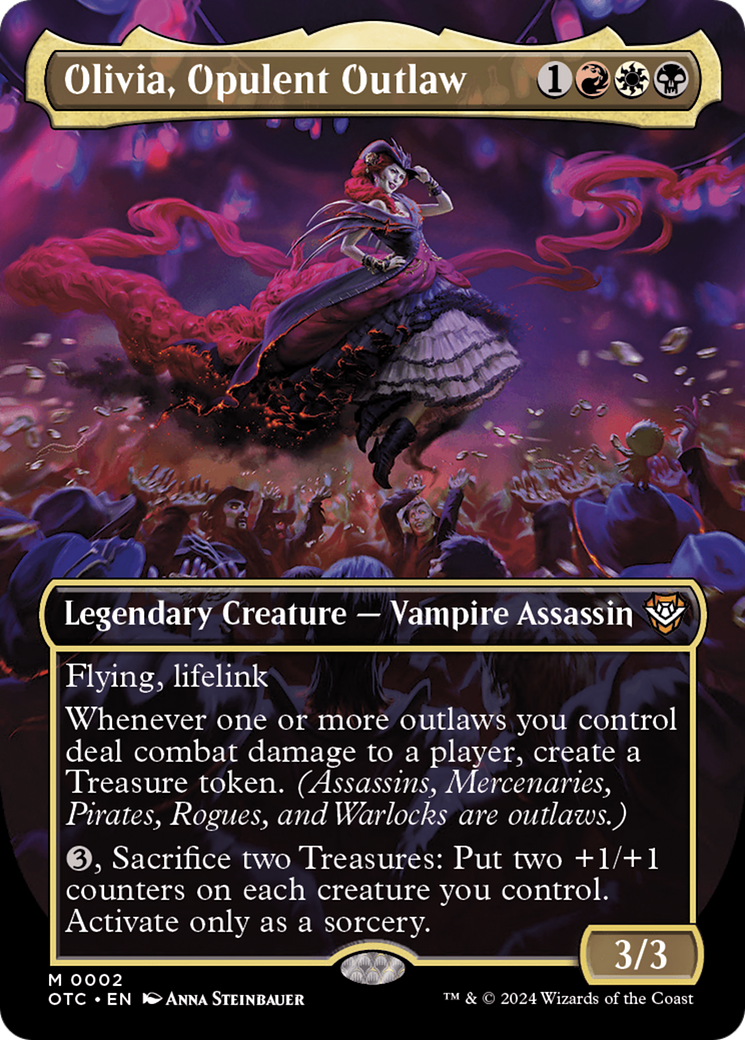
Olivia, Opulent Outlaw
Olivia, Opulent Outlaw
Legendary Creature — Vampire Assassin
3/3
Flying, lifelink
Whenever one or more outlaws you control deal combat damage to a player, create a Treasure token. (Assassins, Mercenaries, Pirates, Rogues, and Warlocks are outlaws.)
, Sacrifice two Treasures: Put two +1/+1 counters on each creature you control. Activate only as a sorcery.
- A card, spell, or permanent is an outlaw if it has the Assassin, Mercenary, Pirate, Rogue, or Warlock creature type. It doesn’t matter if it has more than one of those creature types; as long as it has at least one, it’s an outlaw.
- Outlaw is not a creature type. If an effect asks you to choose a creature type, you can’t choose outlaw.
- If an ability refers to an outlaw or whether a player controls an outlaw, it’s referring only to permanents with one or more of the creature types specified above. Notably, it’s not referring to any spell or card not on the battlefield. However, other abilities may refer to an “outlaw spell” or “outlaw card” in a zone other than the battlefield. Those abilities refer to spells and cards with one or more of the specified creature types.
-
1
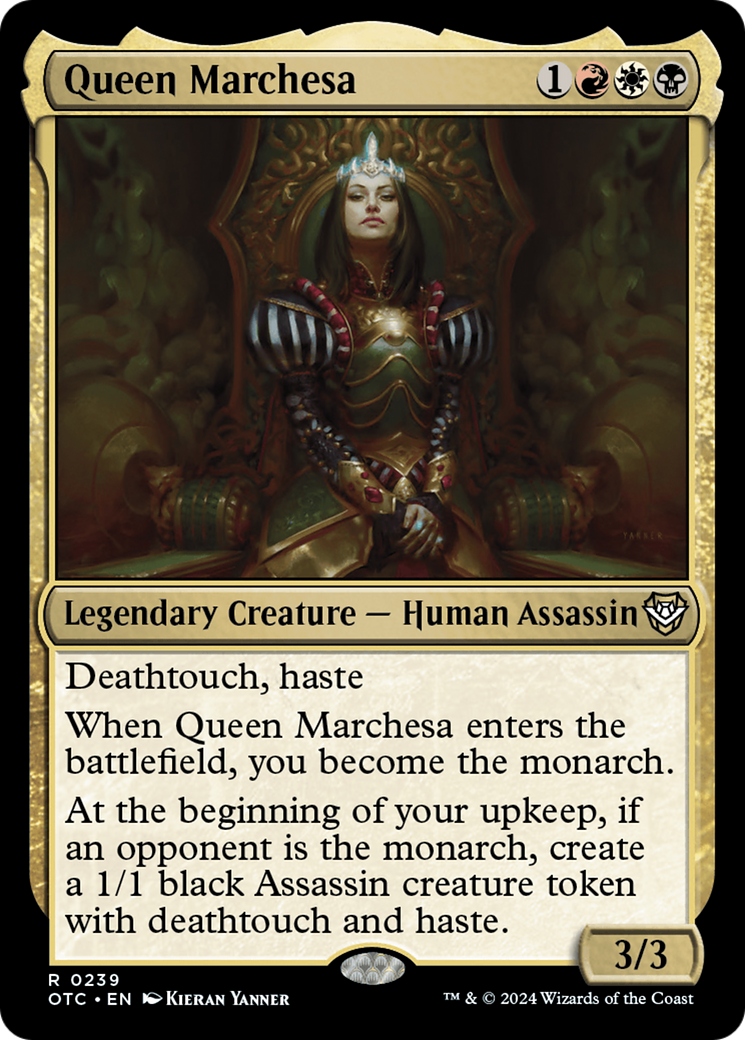
Queen Marchesa
Queen Marchesa
Legendary Creature — Human Assassin
3/3
Deathtouch, haste
When Queen Marchesa enters, you become the monarch.
At the beginning of your upkeep, if an opponent is the monarch, create a 1/1 black Assassin creature token with deathtouch and haste.
- The last ability of Queen Marchesa (long may she reign) checks to see if an opponent is the monarch as your upkeep begins. If no opponent is the monarch, Queen Marchesa's (long may she reign) ability won't trigger at all. Queen Marchesa's (long may she reign) ability will also check to see if an opponent is the monarch as it tries to resolve. If no opponent is the monarch at that time, Queen Marchesa's (long may she reign) ability will have no effect.
- The game starts with no monarch. Once an effect makes one player the monarch, the game will have exactly one monarch from that point forward.
- Being the monarch carries two inherent triggered abilities. "At the beginning of the monarch's end step, that player draws a card" and "Whenever a creature deals combat damage to the monarch, its controller becomes the monarch."
- Abilities that trigger whenever you "become the monarch" trigger only if you aren't already the monarch. For example, if you are already the monarch as Custodi Lich enters the battlefield, its last ability won't trigger.
- If the triggered ability that causes the monarch to draw a card goes on the stack, and a different player becomes the monarch before that ability resolves, the first player will still draw the card.
-
1
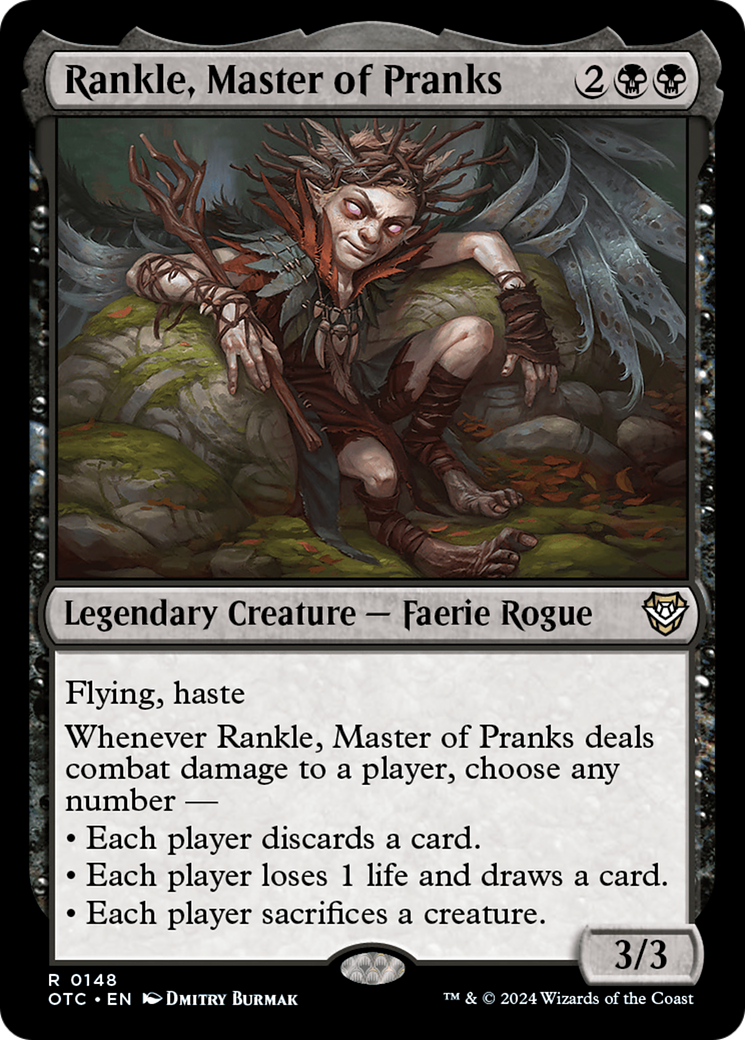
Rankle, Master of Pranks
Rankle, Master of Pranks
Legendary Creature — Faerie Rogue
3/3
Flying, haste
Whenever Rankle deals combat damage to a player, choose any number —
- Each player discards a card.
- Each player loses 1 life and draws a card.
- Each player sacrifices a creature of their choice.
- If you really want, you can choose zero modes for Rankle's triggered ability, but carefully consider the hidden costs in not entertaining someone titled Master of Pranks.
- You can't choose a mode more than once.
- You can choose a mode even if some or all players will be unaffected.
- For each chosen mode, perform that mode in its entirety before continuing on to the next chosen mode in the order printed.
- As the first mode is performed, first the player whose turn it is chooses a card in hand without revealing it, then each other player in turn order does the same. Then all the chosen cards are discarded at the same time.
- As the third mode is performed, first the player whose turn it chooses a creature they control, then each other player in turn order does the same, knowing the choices made before them. Then all the chosen creatures are sacrificed at the same time.
- In a Two-Headed Giant game, Rankle's second mode causes each team to lose 1 life twice.
-
1
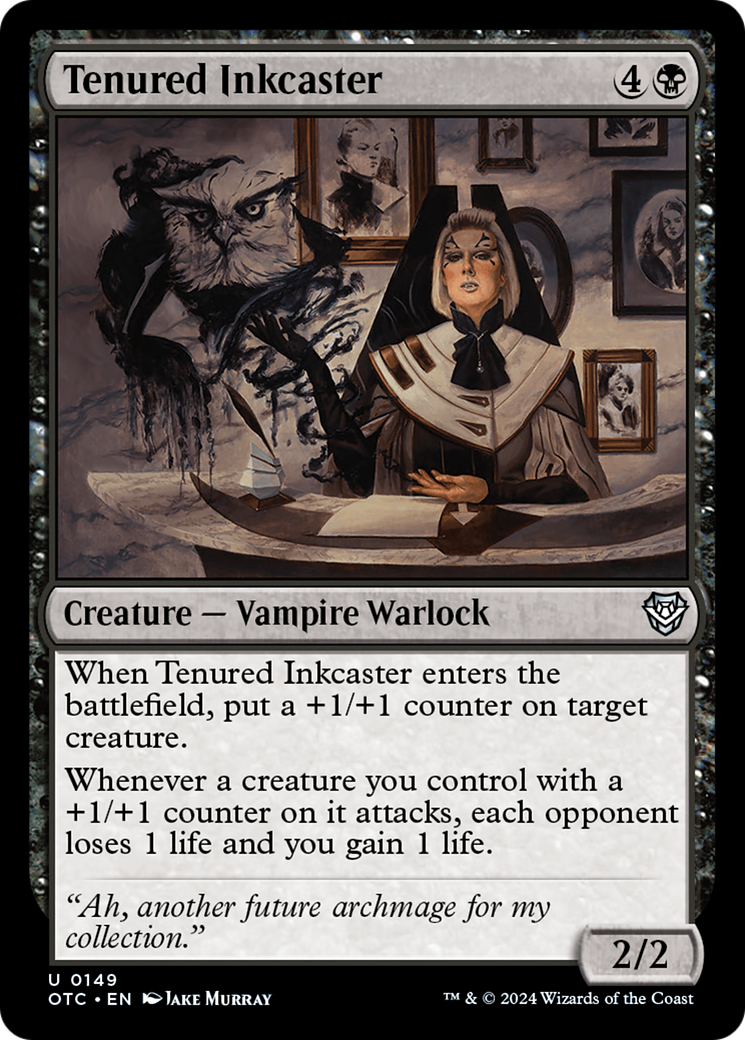
Tenured Inkcaster
Tenured Inkcaster
Creature — Vampire Warlock
2/2
When this creature enters, put a +1/+1 counter on target creature.
Whenever a creature you control with a +1/+1 counter on it attacks, each opponent loses 1 life and you gain 1 life.
-
1
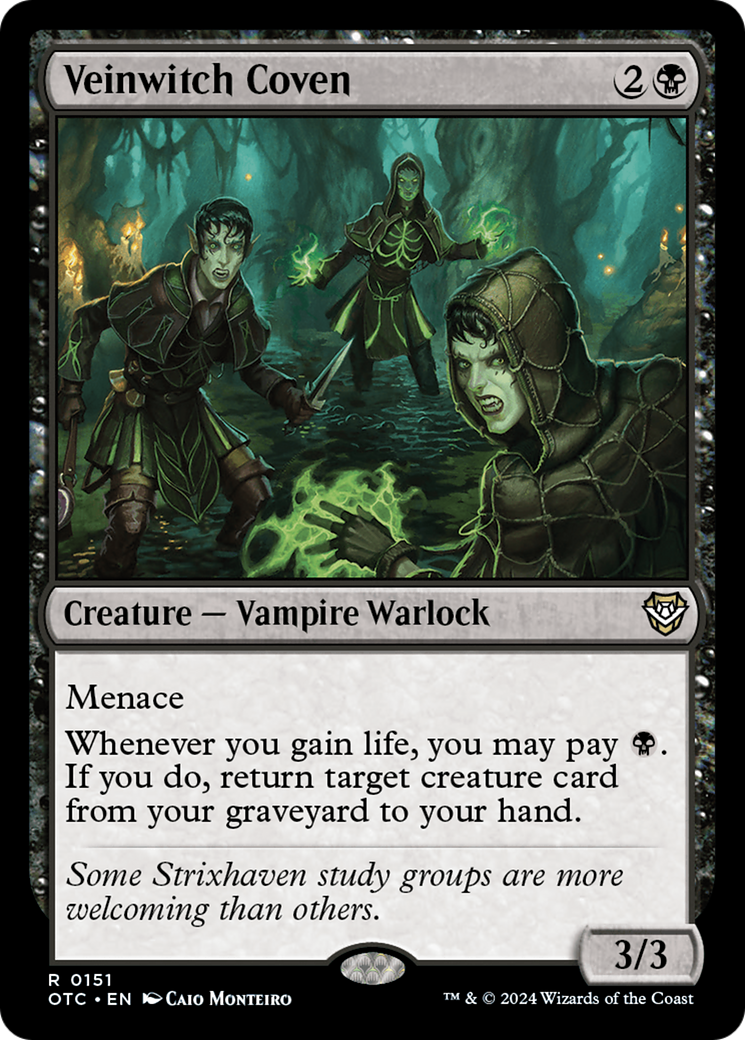
Veinwitch Coven
Veinwitch Coven
Creature — Vampire Warlock
3/3
Menace
Whenever you gain life, you may pay . If you do, return target creature card from your graveyard to your hand.
- An ability that triggers "whenever you gain life" triggers just once for each life-gaining event, no matter how much life you gain.
- You may only pay once for each life gain event.
- Each creature with lifelink dealing combat damage causes a separate life-gaining event. For example, if two creatures you control with lifelink deal combat damage at the same time, a "whenever you gain life" ability will trigger twice. However, if a single creature you control with lifelink deals combat damage to multiple creatures, players, and/or planeswalkers at the same time (perhaps because it has trample or was blocked by more than one creature), the ability will trigger only once.
- If you gain an amount of life "for each" of something, that life is gained as one event and the ability will trigger only once.
-
1
Vihaan, Goldwaker
Vihaan, Goldwaker
Legendary Creature — Dwarf Warlock
3/3
Other outlaws you control have vigilance and haste. (Assassins, Mercenaries, Pirates, Rogues, and Warlocks are outlaws.)
At the beginning of combat on your turn, you may have Treasures you control become 3/3 Construct Assassin artifact creatures in addition to their other types until end of turn.
- If a Treasure you control is already a creature when Vihaan’s second ability resolves and you choose to apply its effect to all Treasures you control, that effect will overwrite any previous effects that set that creature’s power and toughness to specific numbers. Effects that otherwise modify its power and toughness will still apply no matter when they took effect. The same is true for +1/+1 counters.
- Treasures you control will keep any abilities they previously had while they’re creatures.
- A card, spell, or permanent is an outlaw if it has the Assassin, Mercenary, Pirate, Rogue, or Warlock creature type. It doesn’t matter if it has more than one of those creature types; as long as it has at least one, it’s an outlaw.
- Outlaw is not a creature type. If an effect asks you to choose a creature type, you can’t choose outlaw.
- If an ability refers to an outlaw or whether a player controls an outlaw, it’s referring only to permanents with one or more of the creature types specified above. Notably, it’s not referring to any spell or card not on the battlefield. However, other abilities may refer to an “outlaw spell” or “outlaw card” in a zone other than the battlefield. Those abilities refer to spells and cards with one or more of the specified creature types.
-
1
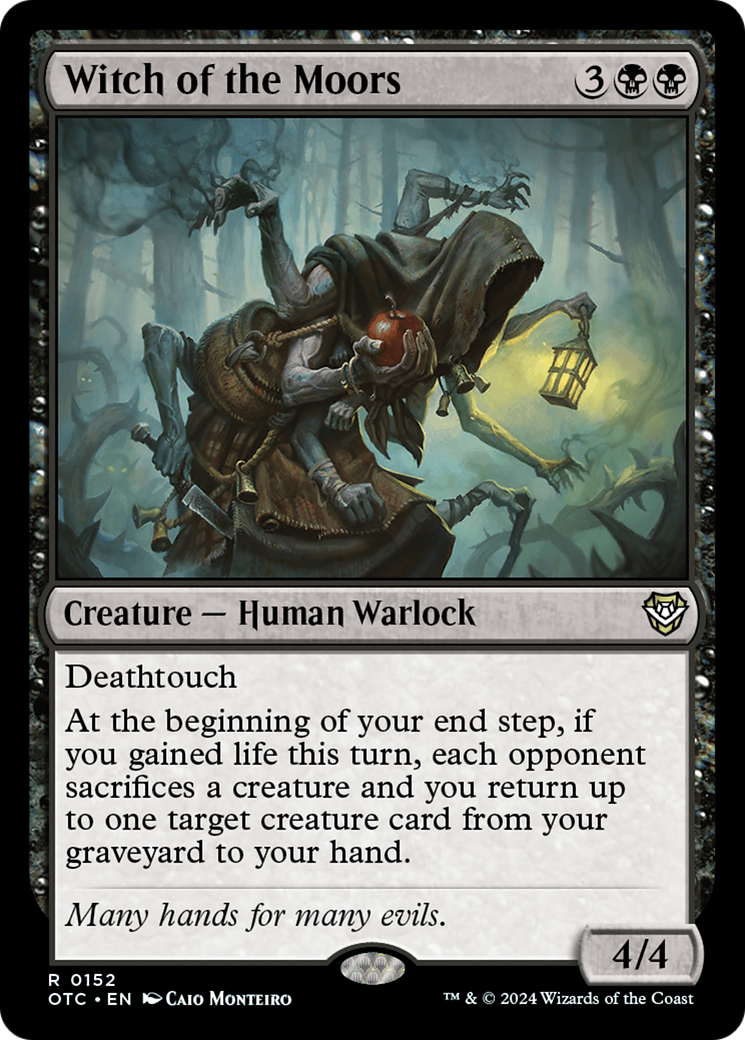
Witch of the Moors
Witch of the Moors
Creature — Human Warlock
4/4
Deathtouch
At the beginning of your end step, if you gained life this turn, each opponent sacrifices a creature of their choice and you return up to one target creature card from your graveyard to your hand.
- The triggered ability triggers just once, no matter how much life you've gained.
- You don't have to choose a target creature card at all. If you do and the target card is an illegal target by the time the ability tries to resolve, the ability won't resolve. Your opponents won't sacrifice creatures.
- As the triggered ability resolves, first the next opponent in turn order chooses a creature they control, then each other opponent in turn order does the same knowing the choices made before them. Then all the chosen creatures are sacrificed at the same time.
- If you haven't gained life by the time your end step begins, the triggered ability won't trigger at all.
- The triggered ability looks at whether you've gained life in the turn, even if Witch of the Moors wasn't on the battlefield when you gained life. It doesn't care if you also lost life, even if you lost more life than you gained.
Instants 6
-
1
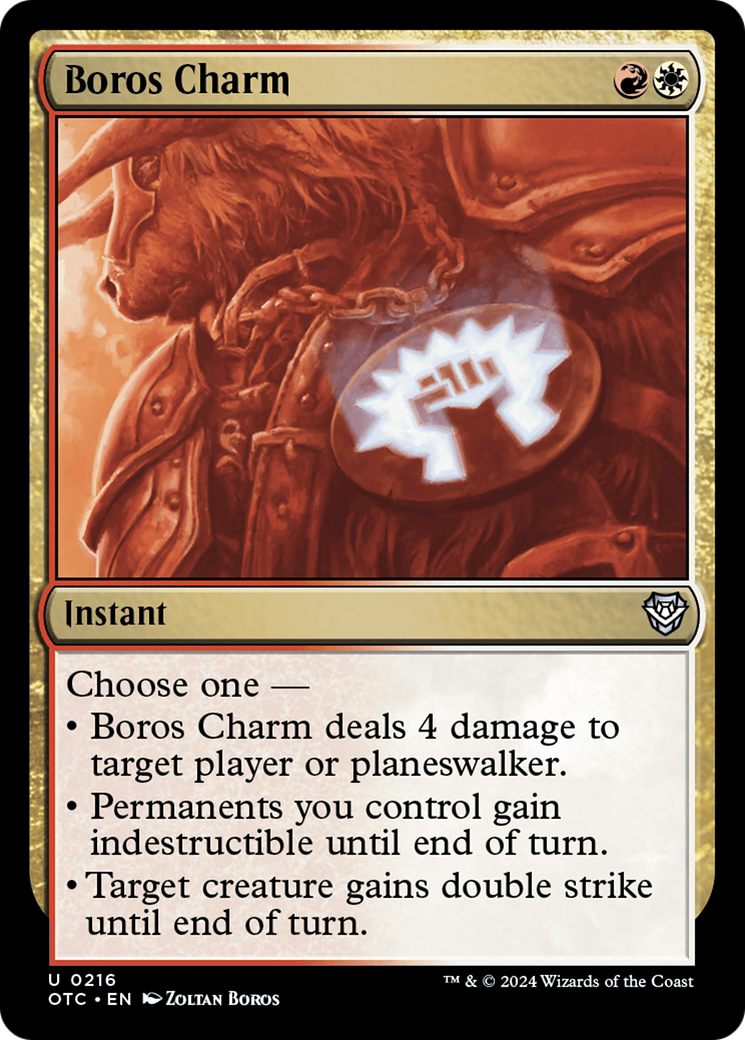
Boros Charm
Boros Charm
Instant
Choose one —
- Boros Charm deals 4 damage to target player or planeswalker.
- Permanents you control gain indestructible until end of turn.
- Target creature gains double strike until end of turn.
- Boros Charm's second mode affects only permanents you control at the time it resolves. It won't affect permanents that come under your control later in the turn.
- Planeswalkers with indestructible will still have loyalty counters removed from them as they are dealt damage. If a planeswalker with indestructible has no loyalty counters, it will still be put into its owner's graveyard, as the rule that does this doesn't destroy the planeswalker.
-
1
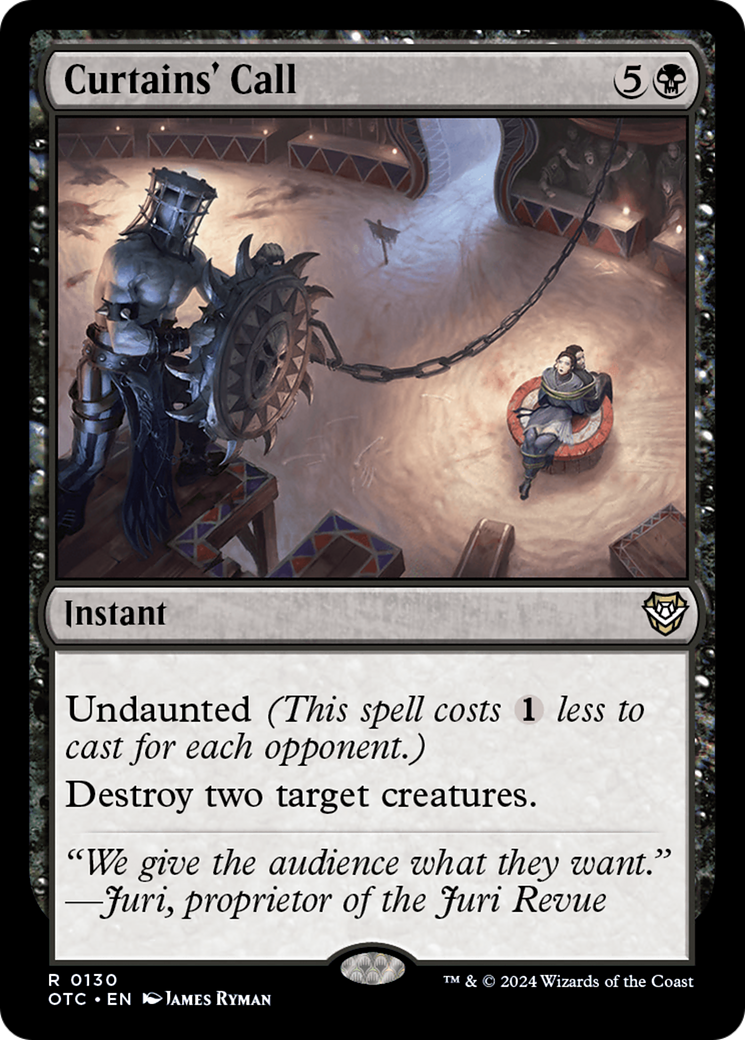
Curtains' Call
Curtains' Call
Instant
Undaunted (This spell costs less to cast for each opponent.)
Destroy two target creatures.
- You can't cast Curtains' Call without two creatures to target. If one becomes an illegal target after you've cast Curtains' Call, the other will still be destroyed.
- Causing an opponent to lose the game after you've announced that you're casting a spell with undaunted and determined its total cost won't cause you to have to pay more mana.
- Effects that reduce what you pay to cast a spell don't affect its mana value.
-
1
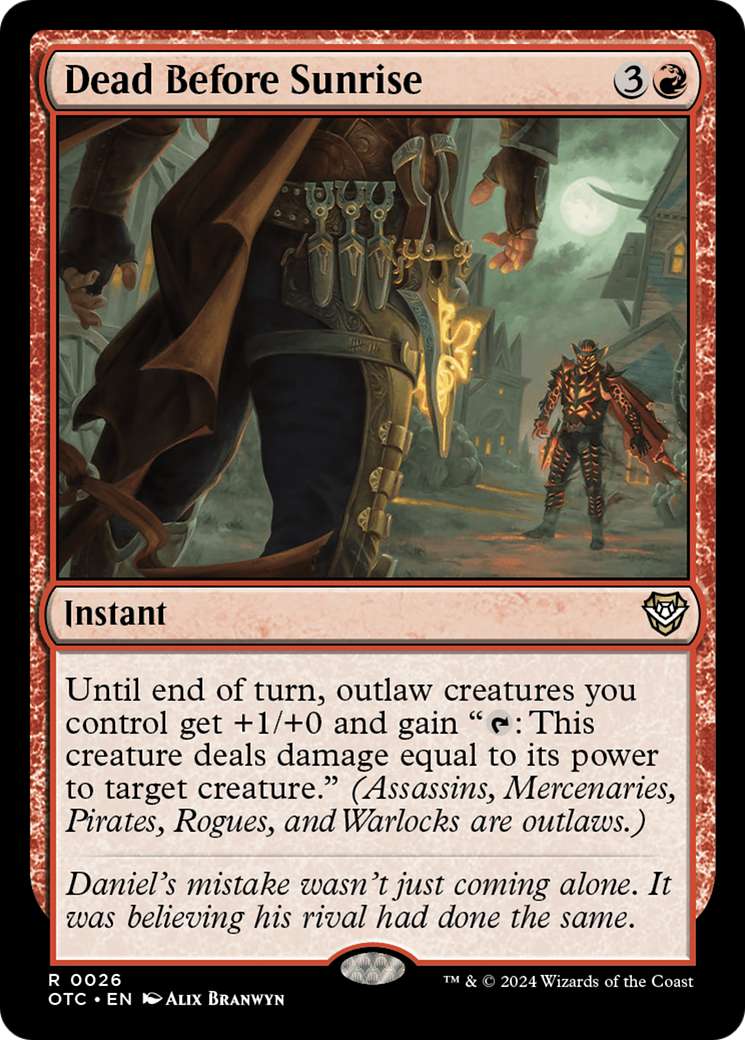
Dead Before Sunrise
Dead Before Sunrise
Instant
Until end of turn, outlaw creatures you control get +1/+0 and gain " : This creature deals damage equal to its power to target creature." (Assassins, Mercenaries, Pirates, Rogues, and Warlocks are outlaws.)
- If a creature leaves the battlefield while the ability granted to it by Dead Before Sunrise is still on the stack, use that creature’s power as it last existed on the battlefield to determine how much damage to deal.
- A card, spell, or permanent is an outlaw if it has the Assassin, Mercenary, Pirate, Rogue, or Warlock creature type. It doesn’t matter if it has more than one of those creature types; as long as it has at least one, it’s an outlaw.
- Outlaw is not a creature type. If an effect asks you to choose a creature type, you can’t choose outlaw.
- If an ability refers to an outlaw or whether a player controls an outlaw, it’s referring only to permanents with one or more of the creature types specified above. Notably, it’s not referring to any spell or card not on the battlefield. However, other abilities may refer to an “outlaw spell” or “outlaw card” in a zone other than the battlefield. Those abilities refer to spells and cards with one or more of the specified creature types.
-
1
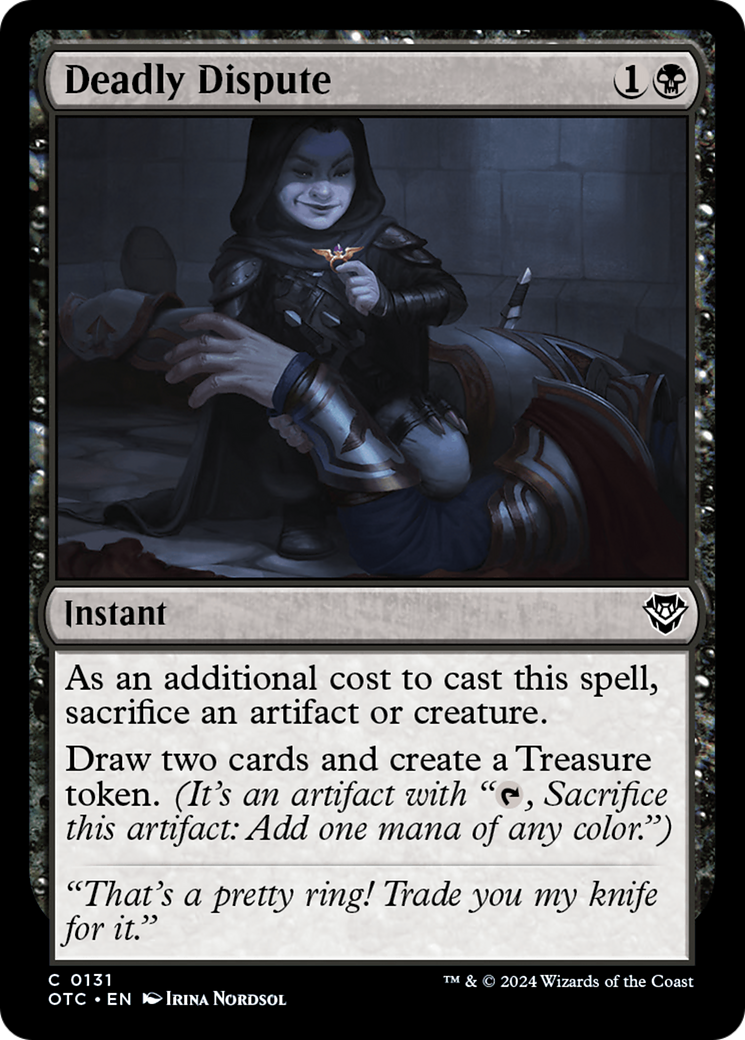
Deadly Dispute
Deadly Dispute
Instant
As an additional cost to cast this spell, sacrifice an artifact or creature.
Draw two cards and create a Treasure token. (It's an artifact with " , Sacrifice this token: Add one mana of any color.")
-
1
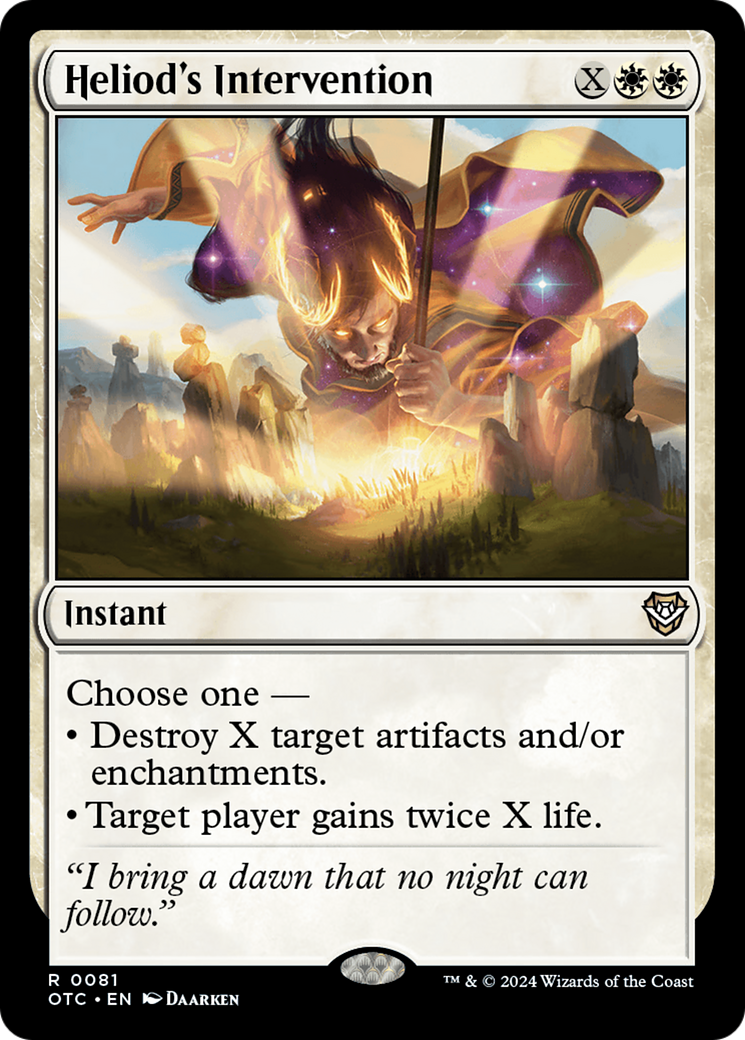
Heliod's Intervention
Heliod's Intervention
Instant
Choose one —
- Destroy X target artifacts and/or enchantments.
- Target player gains twice X life.
- The second mode of Heliod's Intervention causes the player to gain one amount of life equal to twice X. It doesn't cause the player to gain X life then gain X life again.
-
1
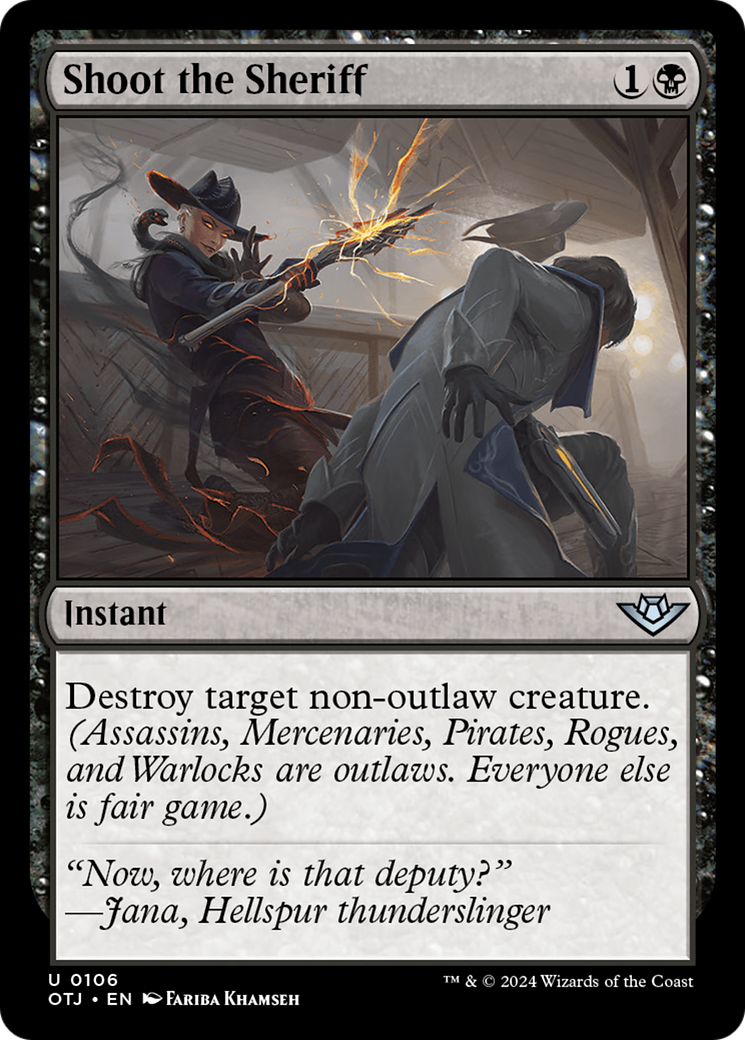
Shoot the Sheriff
Shoot the Sheriff
Instant
Destroy target non-outlaw creature. (Assassins, Mercenaries, Pirates, Rogues, and Warlocks are outlaws. Everyone else is fair game.)
Sorceries 8
-
1
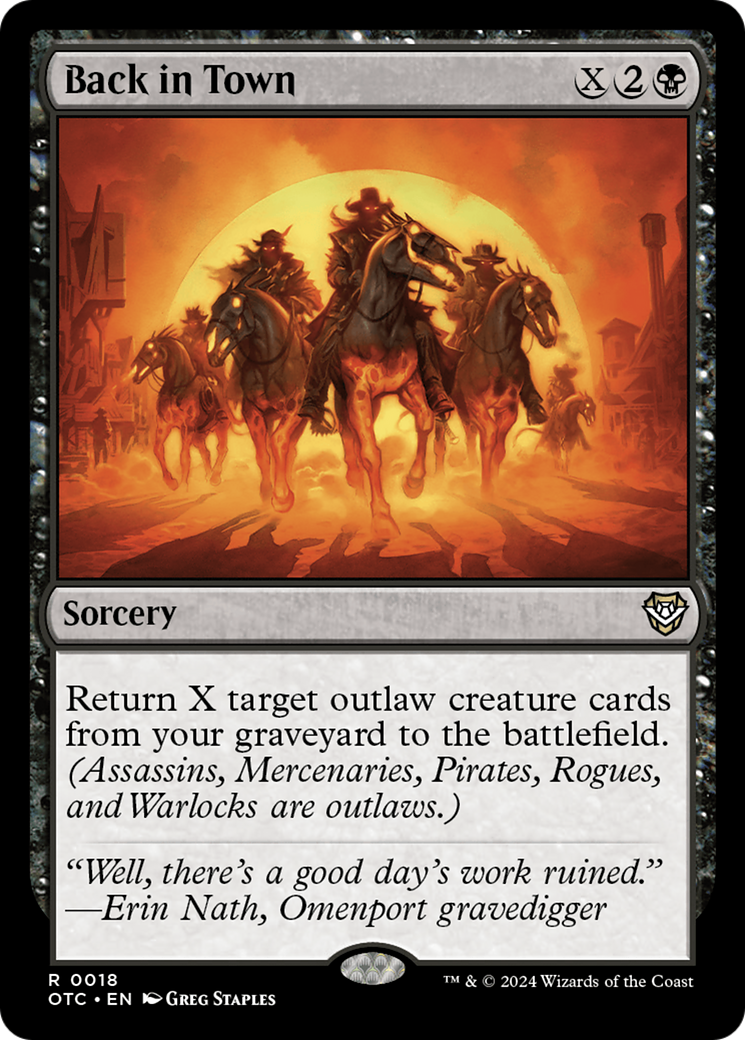
Back in Town
Back in Town
Sorcery
Return X target outlaw creature cards from your graveyard to the battlefield. (Assassins, Mercenaries, Pirates, Rogues, and Warlocks are outlaws.)
- A card, spell, or permanent is an outlaw if it has the Assassin, Mercenary, Pirate, Rogue, or Warlock creature type. It doesn’t matter if it has more than one of those creature types; as long as it has at least one, it’s an outlaw.
- Outlaw is not a creature type. If an effect asks you to choose a creature type, you can’t choose outlaw.
- If an ability refers to an outlaw or whether a player controls an outlaw, it’s referring only to permanents with one or more of the creature types specified above. Notably, it’s not referring to any spell or card not on the battlefield. However, other abilities may refer to an “outlaw spell” or “outlaw card” in a zone other than the battlefield. Those abilities refer to spells and cards with one or more of the specified creature types.
-
1
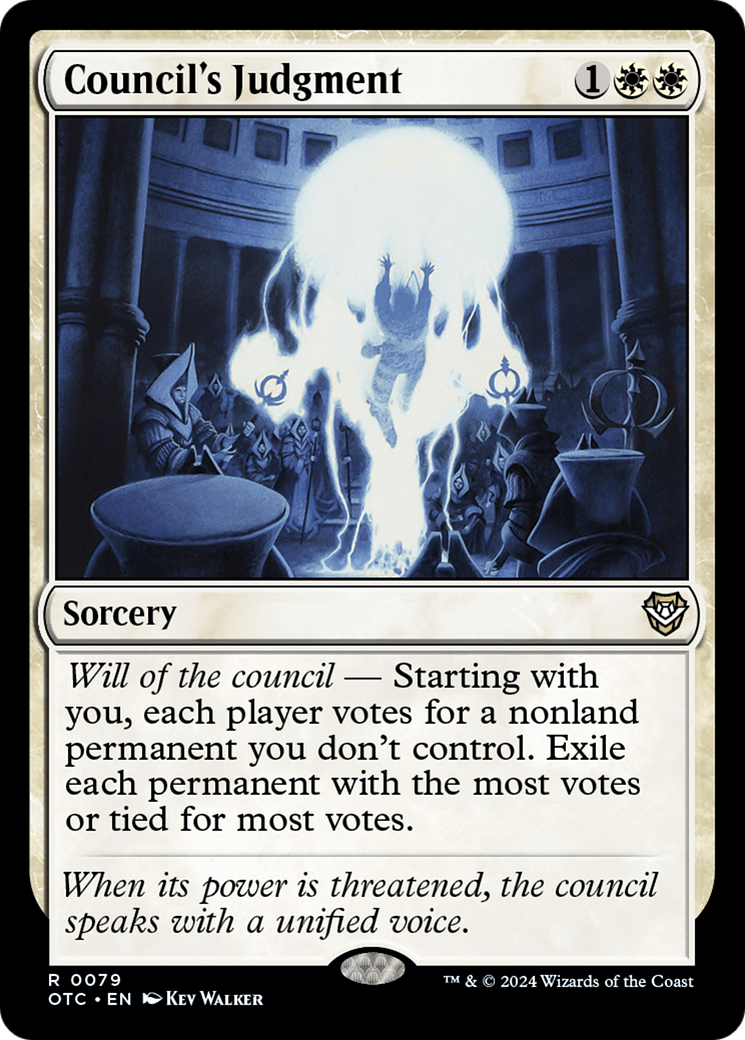
Council's Judgment
Council's Judgment
Sorcery
Will of the council — Starting with you, each player votes for a nonland permanent you don't control. Exile each permanent with the most votes or tied for most votes.
- Because the votes are cast in turn order, each player will know the votes of players who voted beforehand.
- Each player must vote for one of the candidate permanents. They can't abstain.
- No player votes until the spell or ability resolves. Any responses to that spell or ability must be made without knowing the outcome of the vote.
- None of the candidate permanents are targeted. Players may vote for a permanent with protection from white, for example.
- Players can't do anything after they finishing voting but before the "winning" permanent or permanents are exiled.
- In the unusual case that no permanents have any votes, nothing is exiled.
-
1
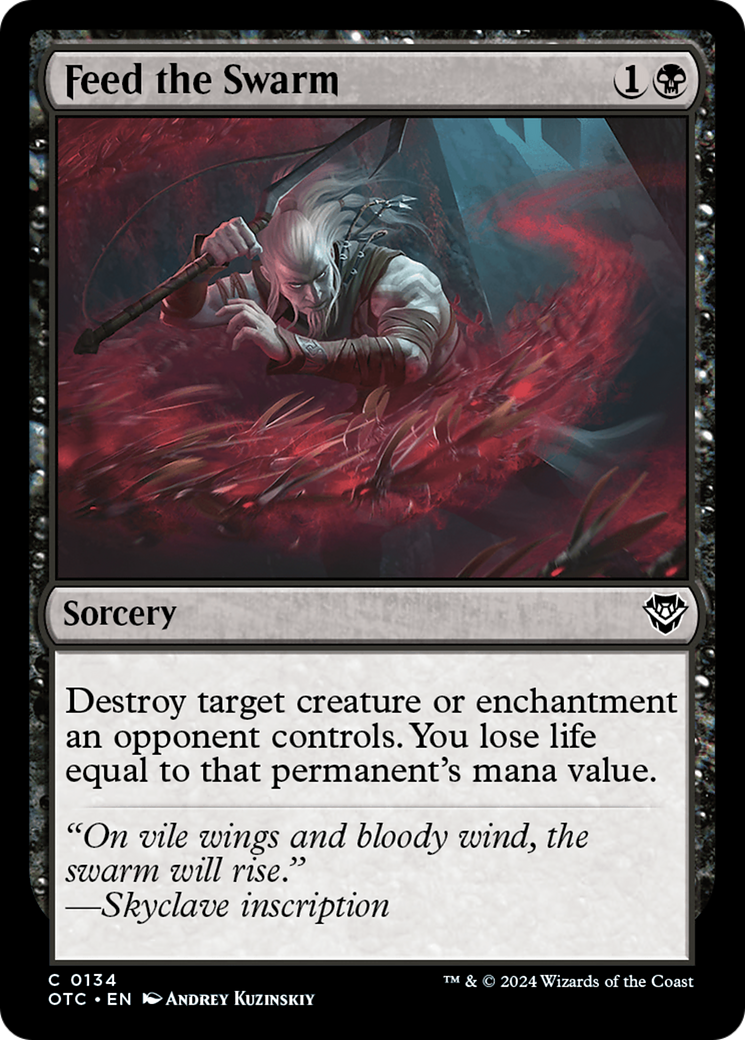
Feed the Swarm
Feed the Swarm
Sorcery
Destroy target creature or enchantment an opponent controls. You lose life equal to that permanent's mana value.
- The amount of life you lose is determined by the permanent's mana value as it last existed on the battlefield.
- If the target permanent is an illegal target by the time Feed the Swarm tries to resolve, the spell doesn't resolve. You don't lose any life. If the target is legal but not destroyed (most likely because it has indestructible), you do lose life.
- If a permanent on the battlefield has in its mana cost, X is 0 for the purpose of determining its mana value.
-
1
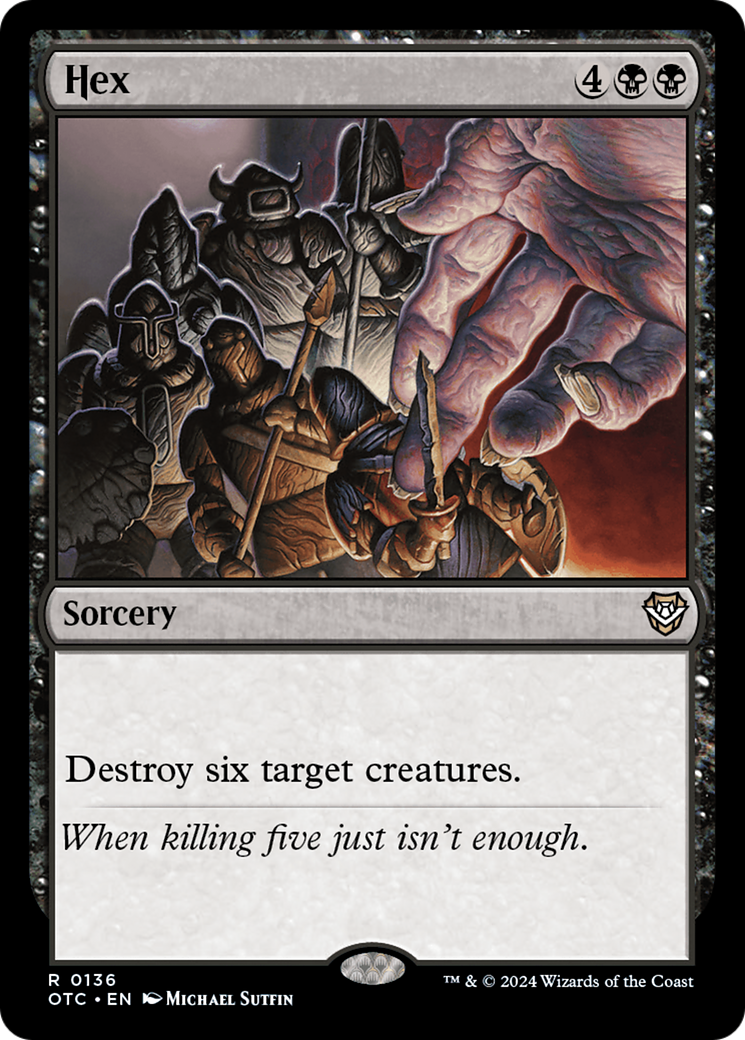
Hex
Hex
Sorcery
Destroy six target creatures.
- You must target six different creatures. If you can't, you can't cast Hex. If some of the creatures become illegal targets before the spell resolves, Hex will still destroy the rest of them.
-
1
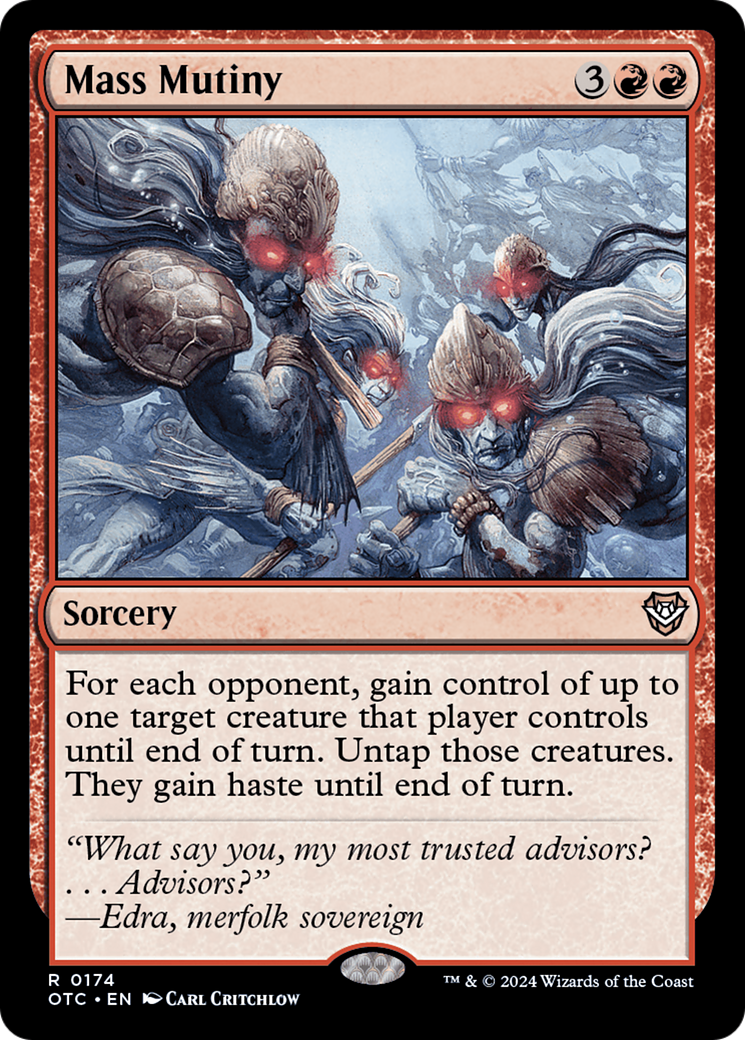
Mass Mutiny
Mass Mutiny
Sorcery
For each opponent, gain control of up to one target creature that player controls until end of turn. Untap those creatures. They gain haste until end of turn.
- The phrase "up to one" was inadvertently omitted from Mass Mutiny's rules text. The card has received errata to correct this.
- You can cast Mass Mutiny even if an opponent doesn't control any creatures. You simply won't choose a target for that opponent.
- Mass Mutiny can target untapped creatures.
- Gaining control of a creature doesn't cause you to gain control of any Auras or Equipment attached to it. However, if you gain control of a creature enchanted by an Aura with umbra armor and that creature would be destroyed that turn, instead the Aura will be destroyed and the creature will survive.
-
1
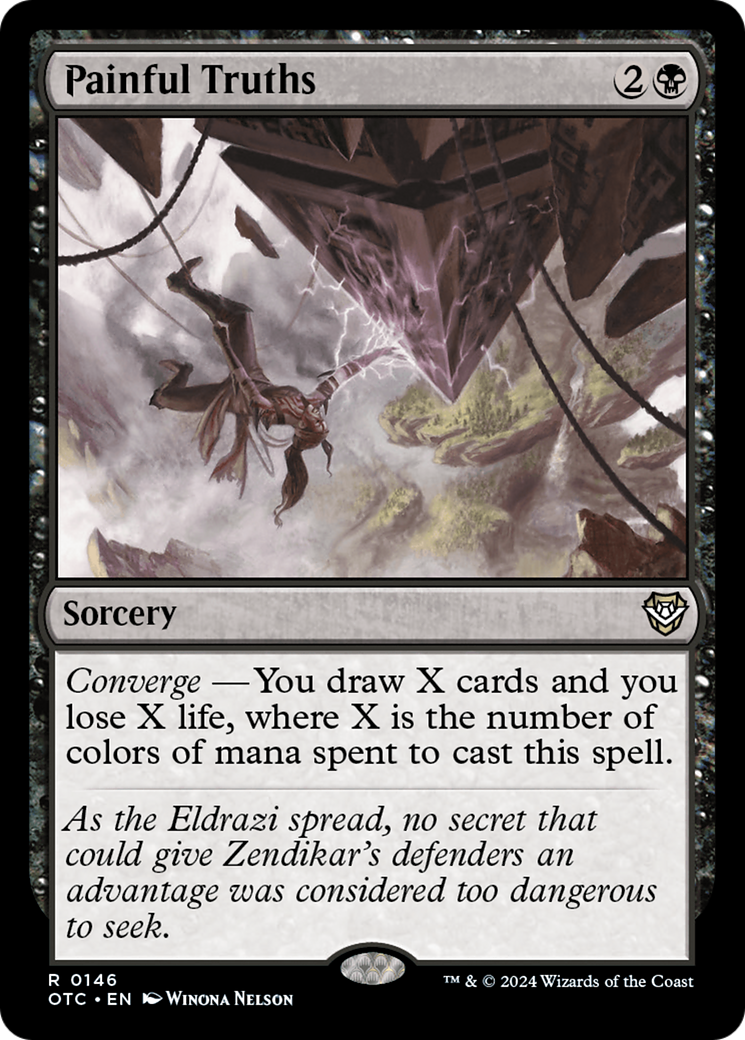
Painful Truths
Painful Truths
Sorcery
Converge — You draw X cards and lose X life, where X is the number of colors of mana spent to cast this spell.
- The maximum number of colors of mana you can spend to cast a spell is five. Colorless is not a color. Note that the cost of a spell with converge may limit how many colors of mana you can spend.
- Unless a spell or ability allows you to, you can't choose to pay more mana for a spell with a converge ability just to spend more colors of mana. Likewise, if a spell or ability reduces the amount of mana it costs you to cast a spell with converge, you can't ignore that cost reduction in order to spend more colors of mana.
- If there are any alternative or additional costs to cast a spell with a converge ability, the mana spent to pay those costs will count. For example, if an effect makes sorcery spells cost more to cast, you could pay to cast Radiant Flames and deal 4 damage to each creature.
- If you cast a spell with converge without spending any mana to cast it (perhaps because an effect allowed you to cast it without paying its mana cost), then the number of colors spent to cast it will be zero.
- If a spell with a converge ability is copied, no mana was spent to cast the copy, so the number of colors of mana spent to cast the spell will be zero. The number of colors spent to cast the original spell is not copied.
-
1
Requisition Raid
Requisition Raid
Sorcery
Spree (Choose one or more additional costs.)
+ — Destroy target artifact.
+ — Destroy target enchantment.
+ — Put a +1/+1 counter on each creature target player controls.
- Spells with spree have a + (plus sign) indicator in the upper right corner of the card frame. This has no rules meaning and serves only to remind players that at least one additional cost is required to cast the spell.
- If a mode requires a target, you can select that mode only if there's a legal target available. Ignore the targeting requirements for modes you don't choose.
- Each additional cost and associated mode in the text box is also preceded with a + indicator. These symbols also have no rules meaning and serve only to remind players that the listed costs are additional costs.
- No matter which modes you choose, you always follow the instructions in the order they are written.
- You must choose at least one of the listed modes and pay its associated additional cost in order to cast a spell with spree.
- The mana value of a spell with spree is determined only by its mana cost (in the upper right corner of the card). It doesn't matter which modes you choose or which additional costs you pay, including any additional costs imposed by other effects.
- No player can cast spells or activate abilities in between the modes of a resolving spell. Any abilities that trigger won't be put onto the stack until the spell is done resolving.
- You choose the modes as you cast the spell with spree. Once modes are chosen, they can't be changed.
- You can't choose the same mode more than once.
- If a spell with spree is copied, the effect that creates the copy may allow you to choose new targets. You cannot choose new modes.
- If all targets for the chosen modes become illegal before a spell with spree resolves, the spell won't resolve and none of its effects will happen. If at least one target is still legal, the spell will resolve but will have no effect on any illegal targets.
- If an effect allows you to cast a spell with spree "without paying its mana cost," you must still choose at least one mode and pay the associated additional costs.
-
1
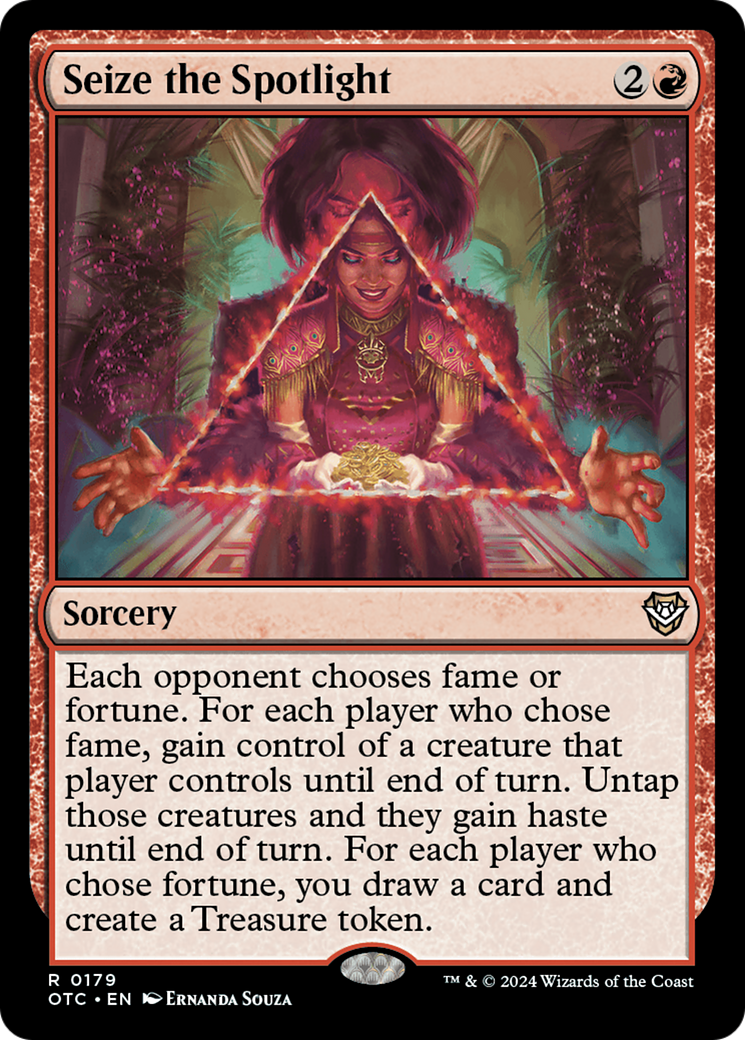
Seize the Spotlight
Seize the Spotlight
Sorcery
Each opponent chooses fame or fortune. For each player who chose fame, gain control of a creature that player controls until end of turn. Untap those creatures and they gain haste until end of turn. For each player who chose fortune, you draw a card and create a Treasure token.
Artifacts 10
-
1
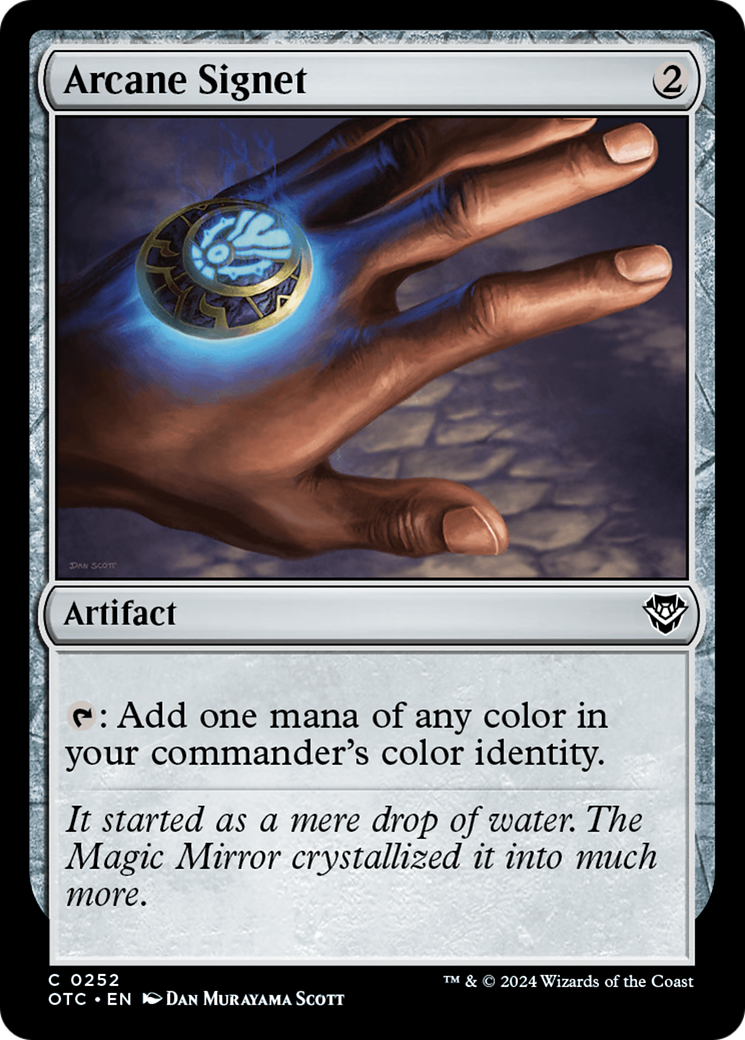
Arcane Signet
Arcane Signet
Artifact
: Add one mana of any color in your commander's color identity.
- If your commander is a card that has no colors in its color identity, Arcane Signet's ability produces no mana. It doesn't produce .
- If you have two commanders, the ability adds one mana of any color in their combined color identities.
- If you don't have a commander, Arcane Signet's ability produces no mana.
-
1
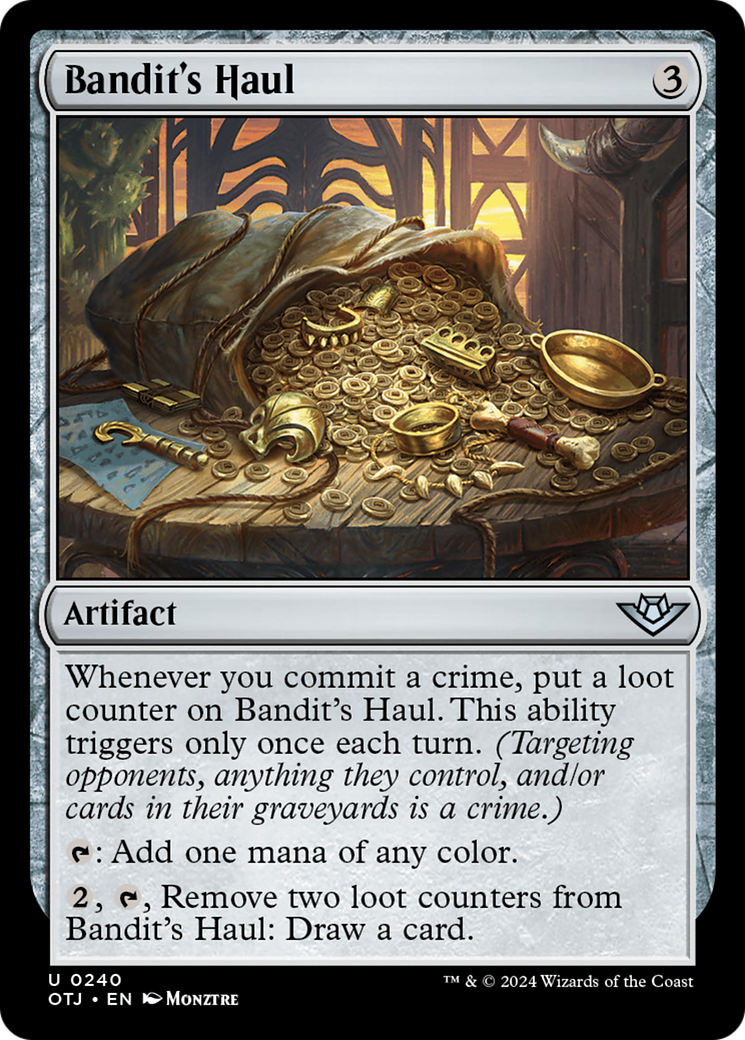
Bandit's Haul
Bandit's Haul
Artifact
Whenever you commit a crime, put a loot counter on this artifact. This ability triggers only once each turn. (Targeting opponents, anything they control, and/or cards in their graveyards is a crime.)
: Add one mana of any color.
, , Remove two loot counters from this artifact: Draw a card.
-
1
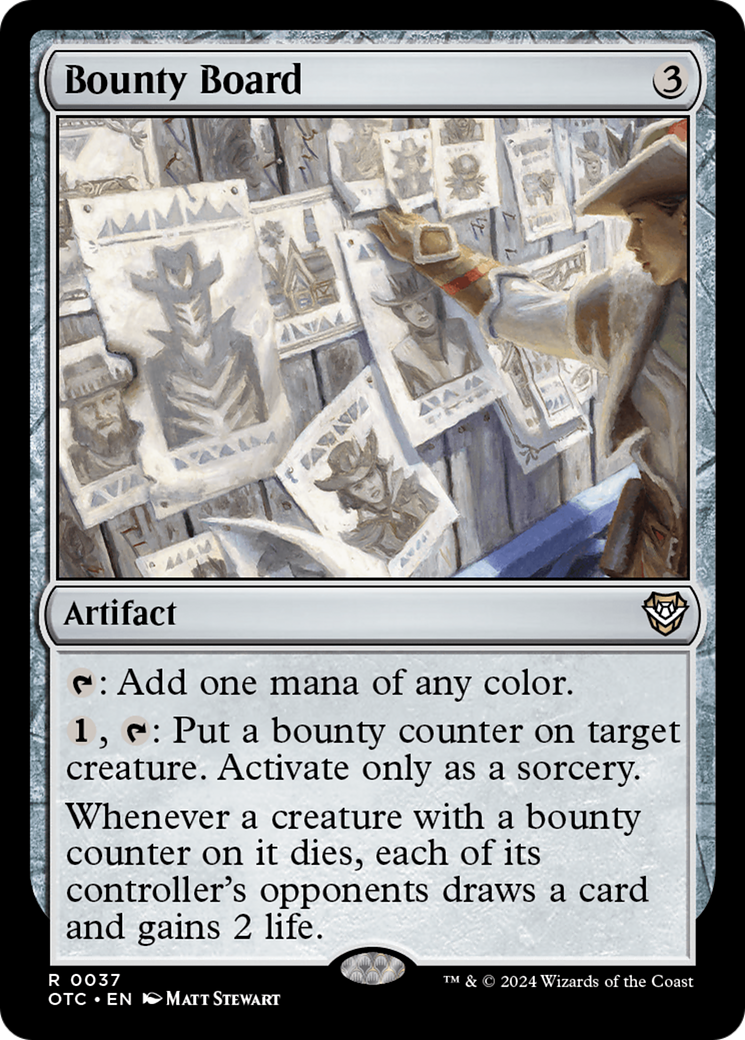
Bounty Board
Bounty Board
Artifact
: Add one mana of any color.
, : Put a bounty counter on target creature. Activate only as a sorcery.
Whenever a creature with a bounty counter on it dies, each of its controller's opponents draws a card and gains 2 life.
- Bounty Board’s last ability looks for any bounty counter on any creature, not just one from that Bounty Board. For example, say players A and B each control a Bounty Board and player C controls a creature with a bounty counter on it (no matter how that bounty counter got there). When that creature dies, the ability each Bounty Board will trigger. Each of those abilities will cause players A and B to draw a card and gain 2 life, for a total of two cards and 4 life for each of them. Player C is left only with a creature to mourn and revenge on their mind.
-
1
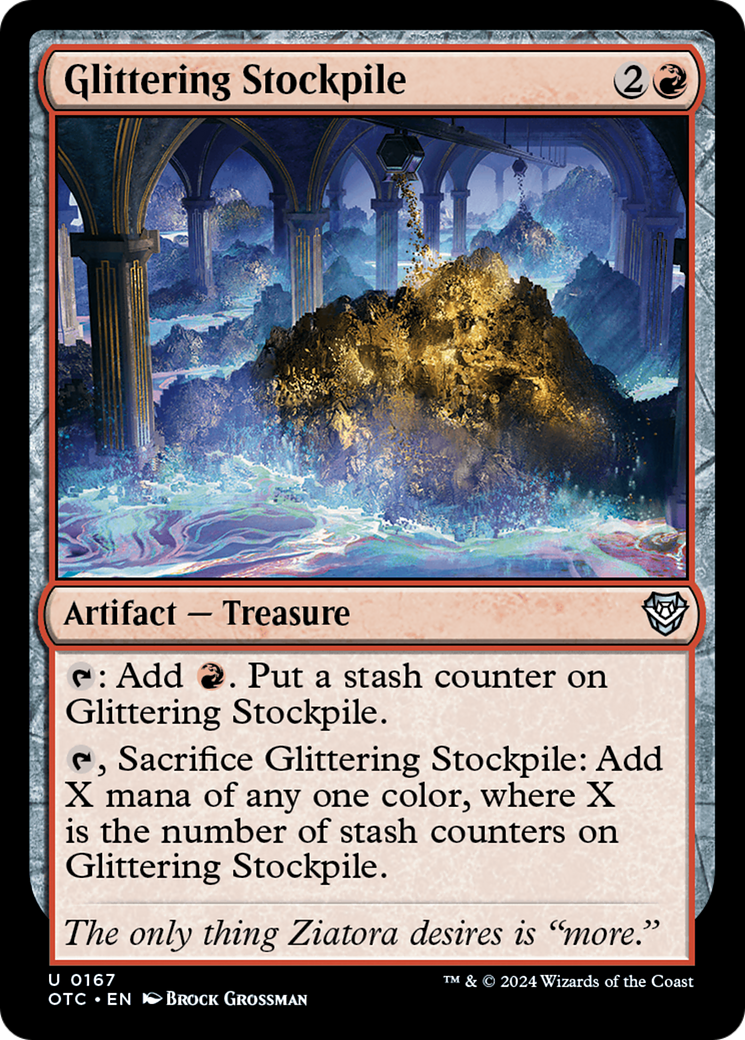
Glittering Stockpile
Glittering Stockpile
Artifact — Treasure
: Add . Put a stash counter on this artifact.
, Sacrifice this artifact: Add X mana of any one color, where X is the number of stash counters on this artifact.
-
1
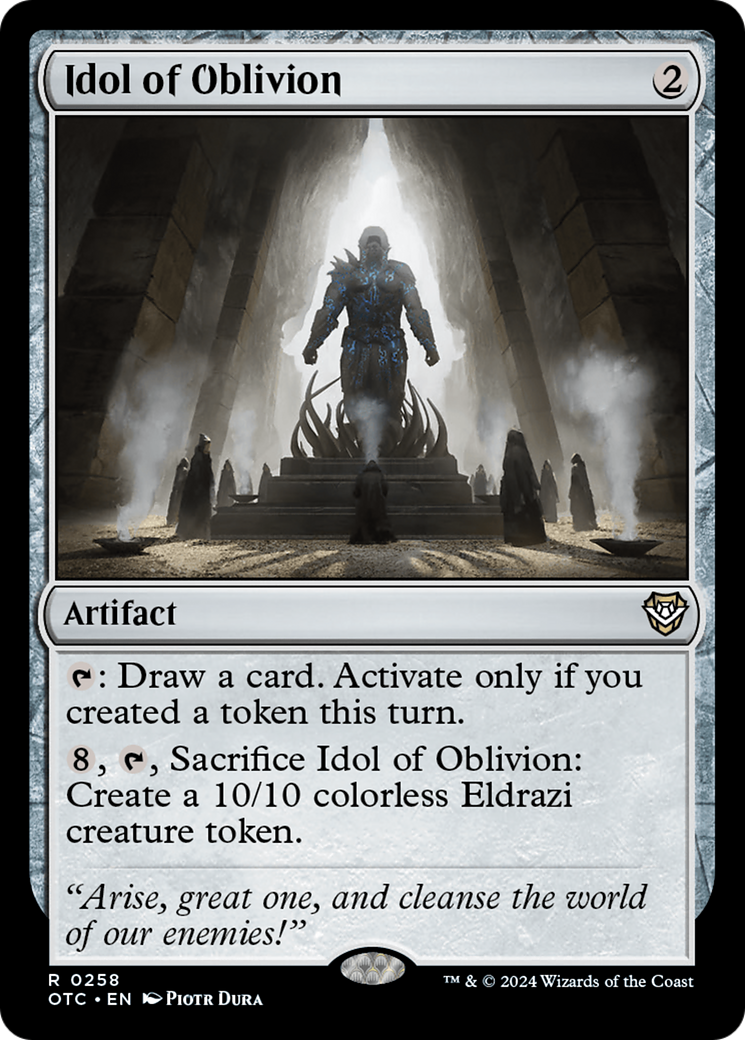
Idol of Oblivion
Idol of Oblivion
Artifact
: Draw a card. Activate only if you created a token this turn.
, , Sacrifice this artifact: Create a 10/10 colorless Eldrazi creature token.
- You can activate Idol of Oblivion's first ability even if the token you've created was created before Idol of Oblivion entered the battlefield or if the token has left the battlefield.
-
1
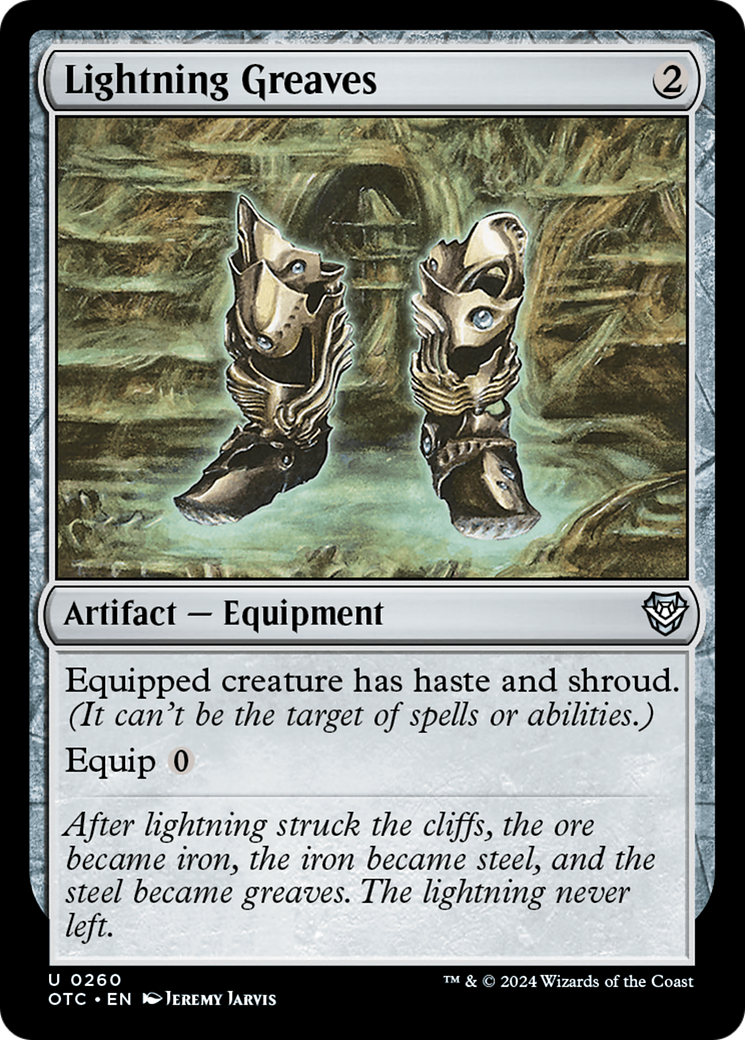
Lightning Greaves
Lightning Greaves
Artifact — Equipment
Equipped creature has haste and shroud. (It can't be the target of spells or abilities.)
Equip
- You can't simply unequip Equipment from a creature. If Lightning Greaves is attached to the only creature you control, you won't be able to attach other equipment to it (or target it with anything else) until you have another creature to which you can attach Lightning Greaves.
- If a creature enters the battlefield under your control and gains haste, but then loses it before attacking, it won't be able to attack that turn. This means that you can't use one Lightning Greaves to allow two new creatures to attack in the same turn.
-
1
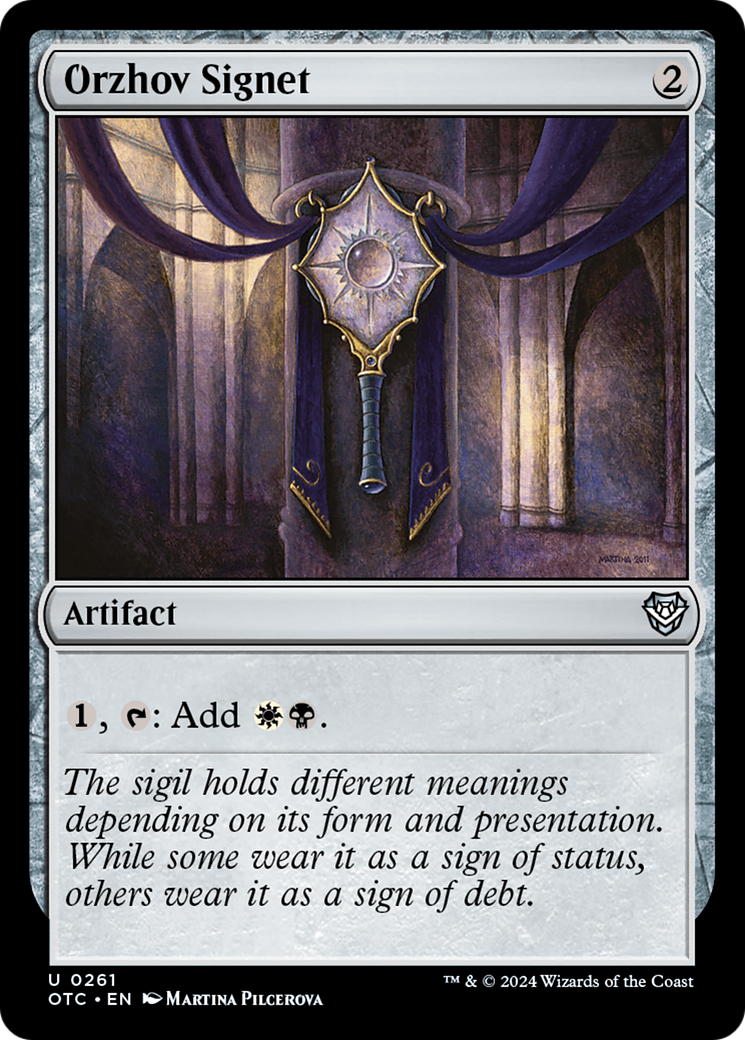
Orzhov Signet
Orzhov Signet
Artifact
, : Add .
-
1
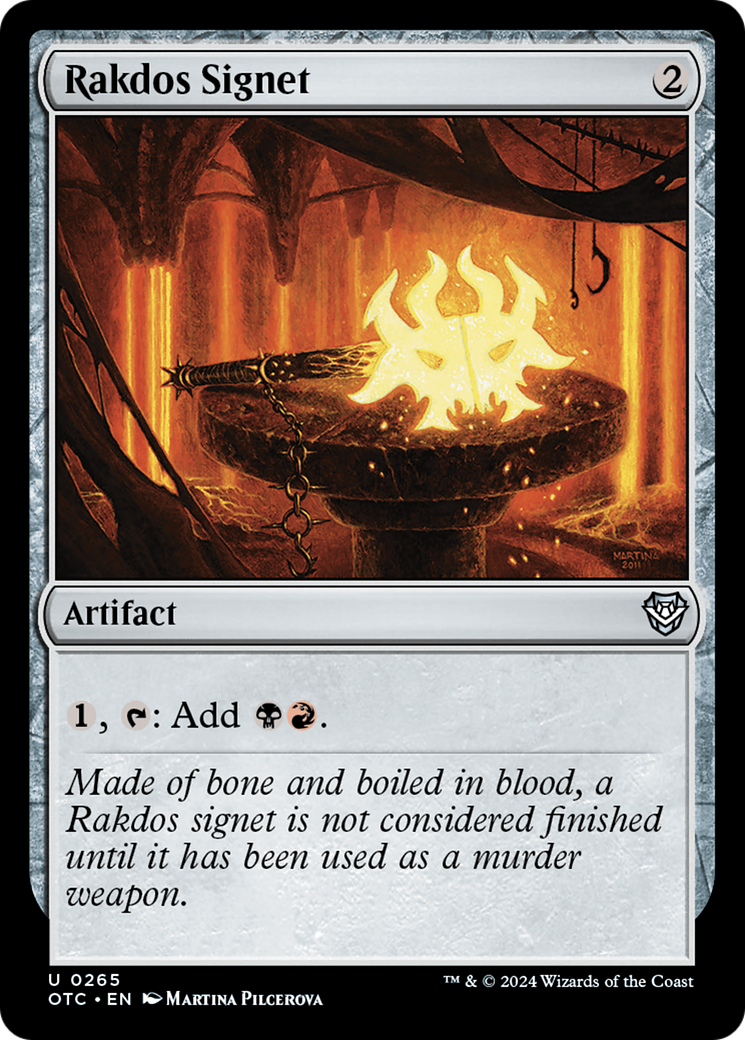
Rakdos Signet
Rakdos Signet
Artifact
, : Add .
-
1
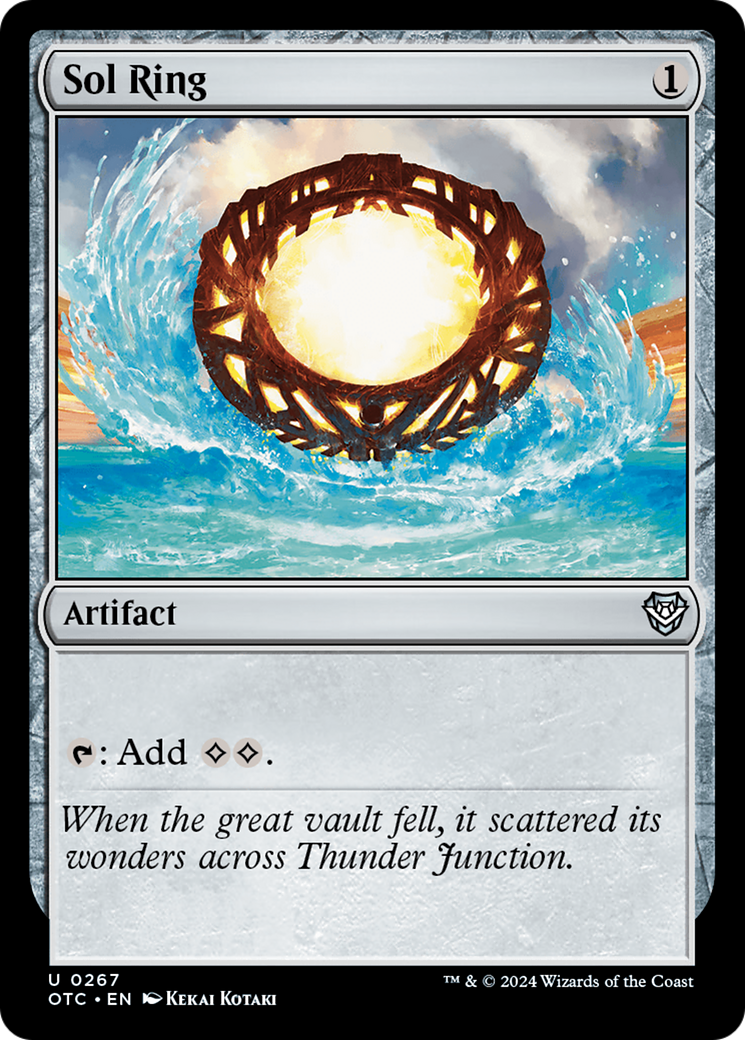
Sol Ring
Sol Ring
Artifact
: Add .
-
1
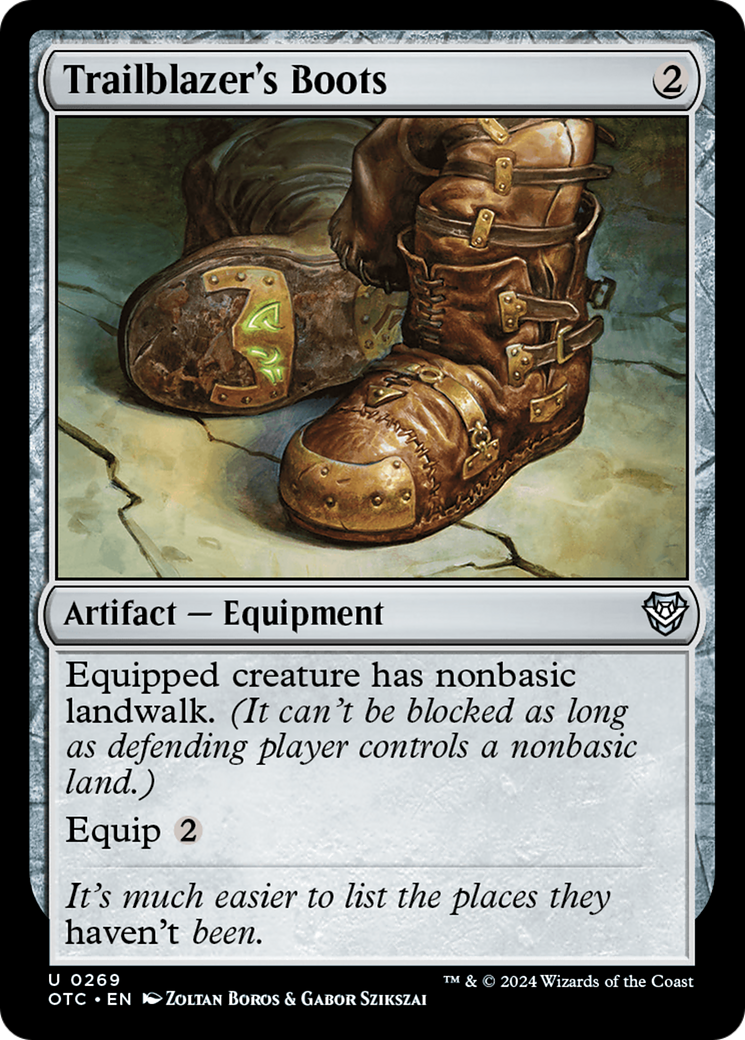
Trailblazer's Boots
Trailblazer's Boots
Artifact — Equipment
Equipped creature has nonbasic landwalk. (It can't be blocked as long as defending player controls a nonbasic land.)
Equip
Enchantments 5
-
1
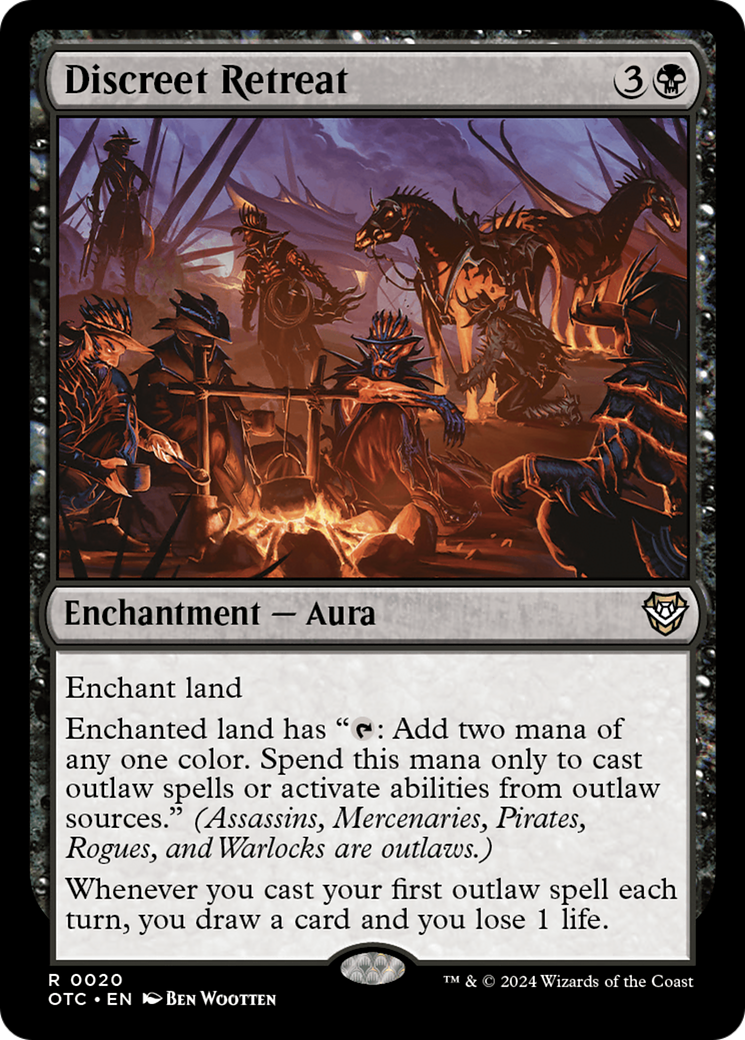
Discreet Retreat
Discreet Retreat
Enchantment — Aura
Enchant land
Enchanted land has " : Add two mana of any one color. Spend this mana only to cast outlaw spells or activate abilities of outlaw sources." (Assassins, Mercenaries, Pirates, Rogues, and Warlocks are outlaws.)
Whenever you cast your first outlaw spell each turn, you draw a card and you lose 1 life.
- “Outlaw sources” include any objects with at least one of the Assassin, Mercenary, Pirate, Rogue, or Warlock creature types. This means you could spend the mana to activate the ability of an outlaw creature you control or an outlaw card in your hand or graveyard, for example.
- You may spend the two mana added by the ability granted by Discreet Retreat on the same spell or activated ability or two different spells and/or activated abilities.
- A card, spell, or permanent is an outlaw if it has the Assassin, Mercenary, Pirate, Rogue, or Warlock creature type. It doesn’t matter if it has more than one of those creature types; as long as it has at least one, it’s an outlaw.
- Outlaw is not a creature type. If an effect asks you to choose a creature type, you can’t choose outlaw.
- If an ability refers to an outlaw or whether a player controls an outlaw, it’s referring only to permanents with one or more of the creature types specified above. Notably, it’s not referring to any spell or card not on the battlefield. However, other abilities may refer to an “outlaw spell” or “outlaw card” in a zone other than the battlefield. Those abilities refer to spells and cards with one or more of the specified creature types.
-
1
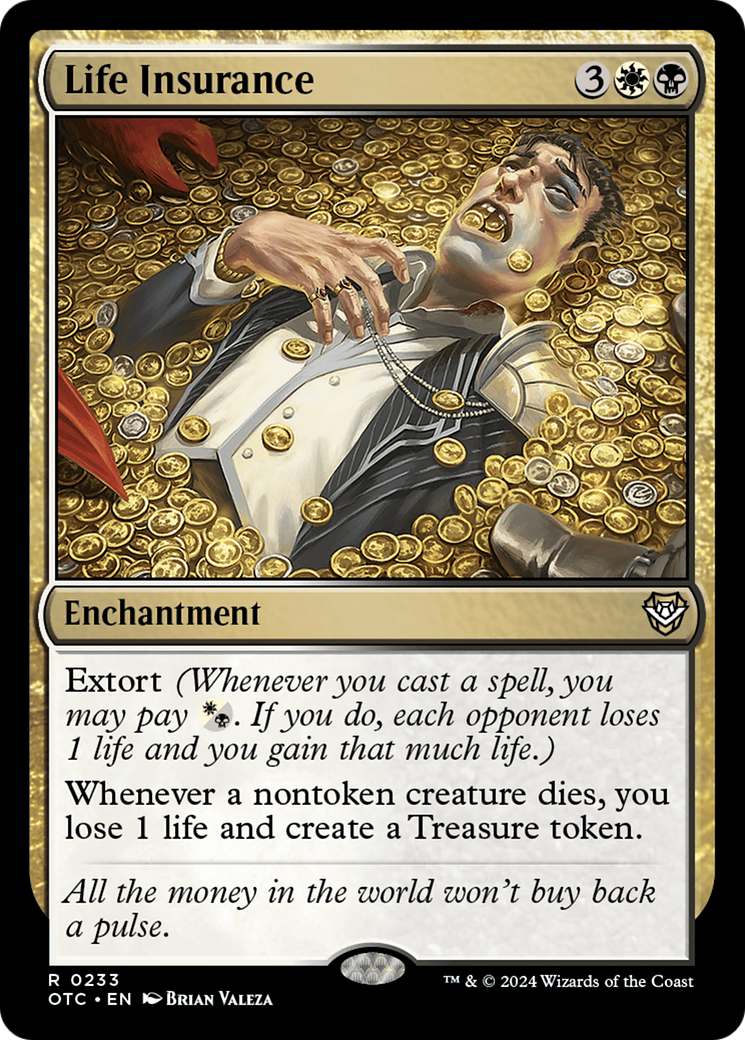
Life Insurance
Life Insurance
Enchantment
Extort (Whenever you cast a spell, you may pay . If you do, each opponent loses 1 life and you gain that much life.)
Whenever a nontoken creature dies, you lose 1 life and create a Treasure token.
- You may pay a maximum of one time for each extort triggered ability. You decide whether to pay when the ability resolves.
- The amount of life you gain from extort is based on the total amount of life lost, not necessarily the number of opponents you have. For example, if your opponent's life total can't change (perhaps because that player controls Platinum Emperion), you won't gain any life.
- The extort ability doesn't target any player.
- The extort ability resolves before the spell that caused it to trigger. The ability resolves even if that spell is countered.
-
1
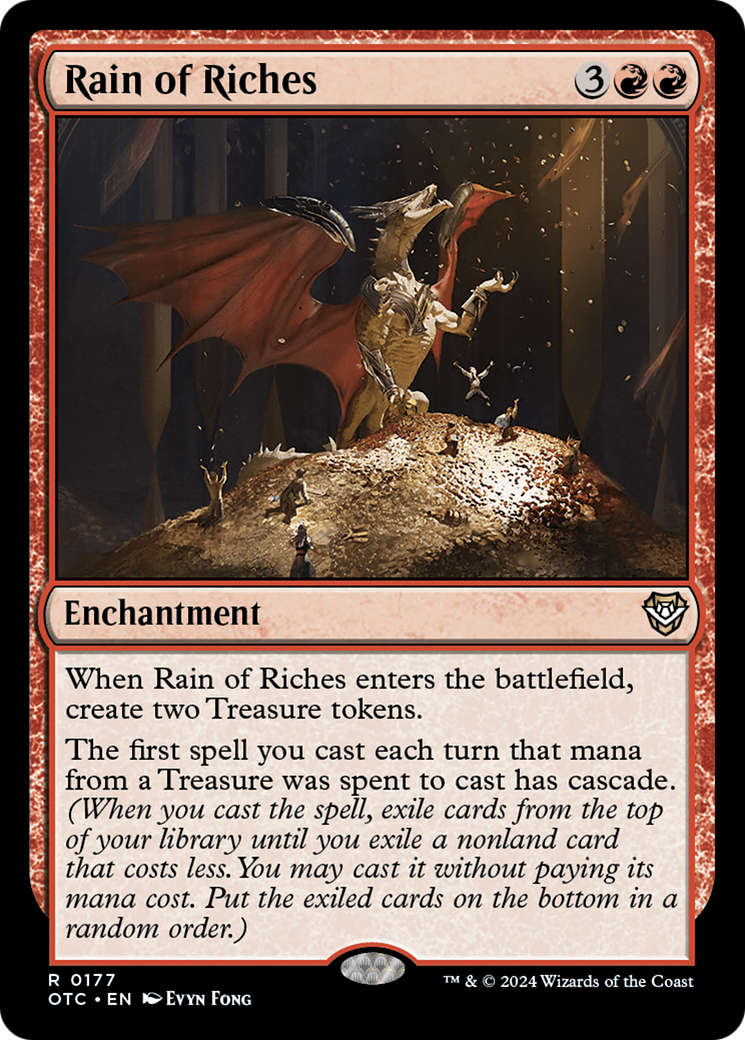
Rain of Riches
Rain of Riches
Enchantment
When this enchantment enters, create two Treasure tokens.
The first spell you cast each turn that mana from a Treasure was spent to cast has cascade. (When you cast the spell, exile cards from the top of your library until you exile a nonland card that costs less. You may cast it without paying its mana cost. Put the exiled cards on the bottom in a random order.)
-
1
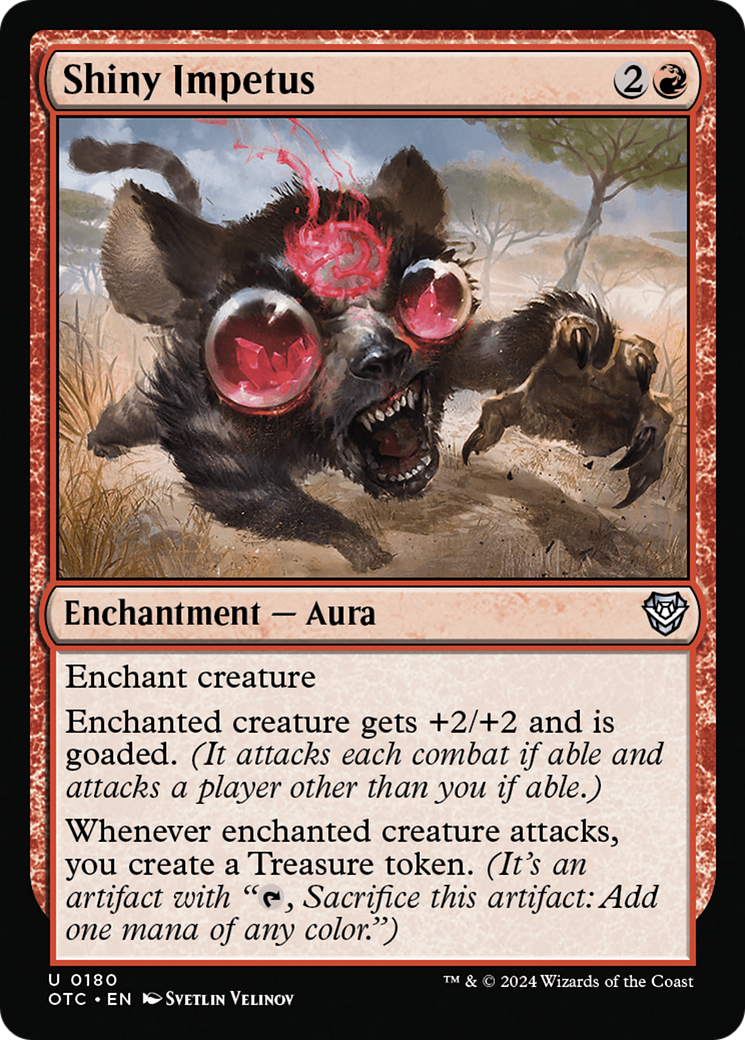
Shiny Impetus
Shiny Impetus
Enchantment — Aura
Enchant creature
Enchanted creature gets +2/+2 and is goaded. (It attacks each combat if able and attacks a player other than you if able.)
Whenever enchanted creature attacks, you create a Treasure token. (It's an artifact with " , Sacrifice this token: Add one mana of any color.")
- If, during a player's declare attackers step, a creature that player controls that's been goaded is tapped, is affected by a spell or ability that says it can't attack, or hasn't been under that player's control continuously since the turn began (and doesn't have haste), then it doesn't attack. If there's a cost associated with having a creature attack a player, its controller isn't forced to pay that cost, so it doesn't have to attack that player.
- If the creature doesn't meet any of the above exceptions and can attack, it must attack a player other than the controller of the spell or ability that goaded it if able. If the creature can't attack any of those players but could otherwise attack, it must attack a planeswalker an opponent controls, a battle an opponent controls, or a player who goaded it.
- Being goaded isn't an ability the creature has. Once it's been goaded, it must attack as detailed above even if it loses all abilities.
- Attacking with a goaded creature doesn't cause it to stop being goaded. If there is an additional combat phase that turn, or if another player gains control of it before it stops being goaded, it must attack again if able.
- If a creature you control has been goaded by multiple opponents, it must attack one of your opponents that hasn't goaded it, as that fulfills the maximum number of goad requirements. If a creature you control has been goaded by each of your opponents, the creature must attack an opponent (rather than a planeswalker or battle), but you choose which opponent it attacks.
- Shiny Impetus causes you to create a Treasure token, not the attacking creature's controller.
-
1
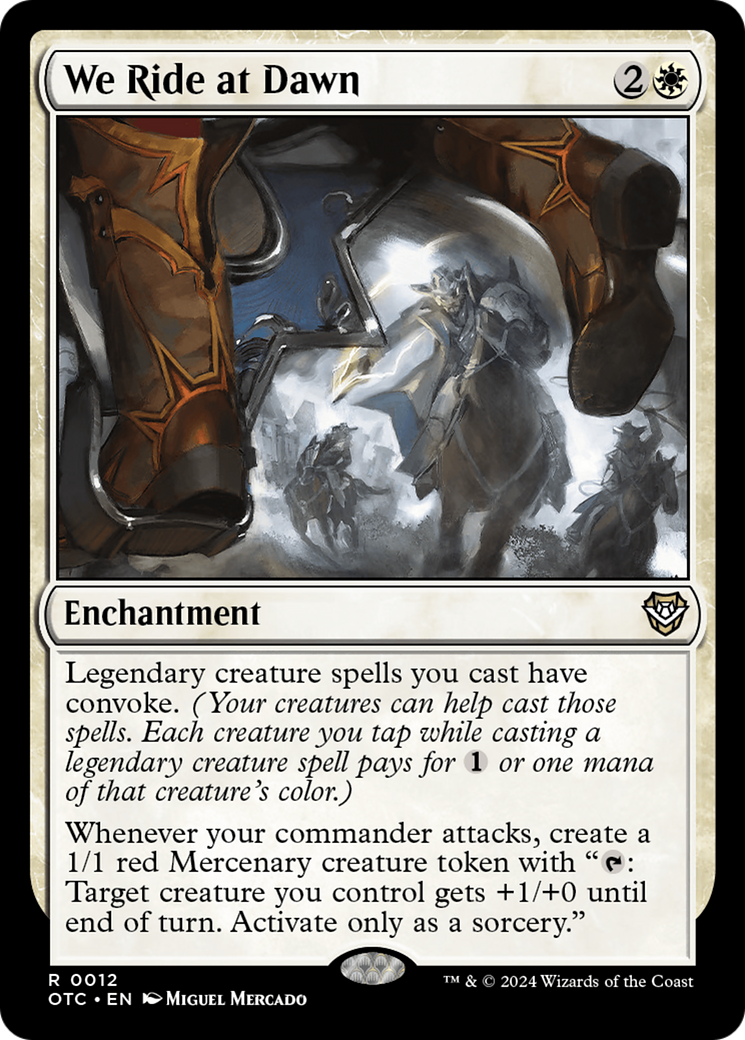
We Ride at Dawn
We Ride at Dawn
Enchantment
Legendary creature spells you cast have convoke. (Your creatures can help cast those spells. Each creature you tap while casting a legendary creature spell pays for or one mana of that creature's color.)
Whenever your commander attacks, create a 1/1 red Mercenary creature token with " : Target creature you control gets +1/+0 until end of turn. Activate only as a sorcery."
- You can tap any untapped creature you control to convoke a spell, even one you haven’t controlled continuously since the beginning of your most recent turn.
- When calculating a spell’s total cost, include any alternative costs, additional costs, or anything else that increases or reduces the cost to cast the spell. Convoke applies after the total cost is calculated. Convoke doesn’t change a spell’s mana cost or mana value.
- If a creature you control has a mana ability with in the cost, activating that ability while casting a spell with convoke will result in the creature being tapped before you pay the spell’s costs. You won’t be able to tap it again for convoke. Similarly, if you sacrifice a creature to activate a mana ability while casting a spell with convoke, that creature won’t be on the battlefield when you pay the spell’s costs, so you won’t be able to tap it for convoke.
- If you control another player’s commander, you won’t create a Mercenary when you attack with that creature. However, if another player controls your commander, you’ll create a Mercenary when it attacks.
- If you have two commanders and they’re both declared as attackers, We Ride at Dawn’s last ability will trigger twice.
Lands 37
-
1
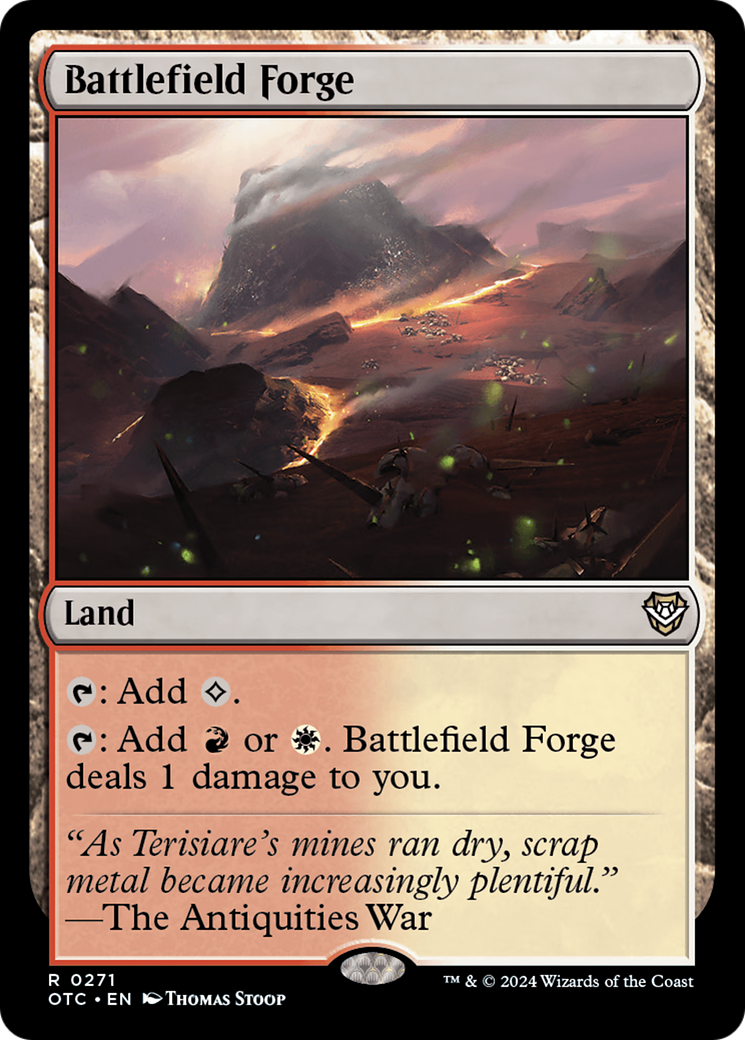
Battlefield Forge
Battlefield Forge
Land
: Add .
: Add or . This land deals 1 damage to you.
- Like most lands, each land in this cycle is colorless. The damage dealt to you is dealt by a colorless source.
- The damage dealt to you is part of the second mana ability. It doesn't use the stack and can't be responded to.
-
1
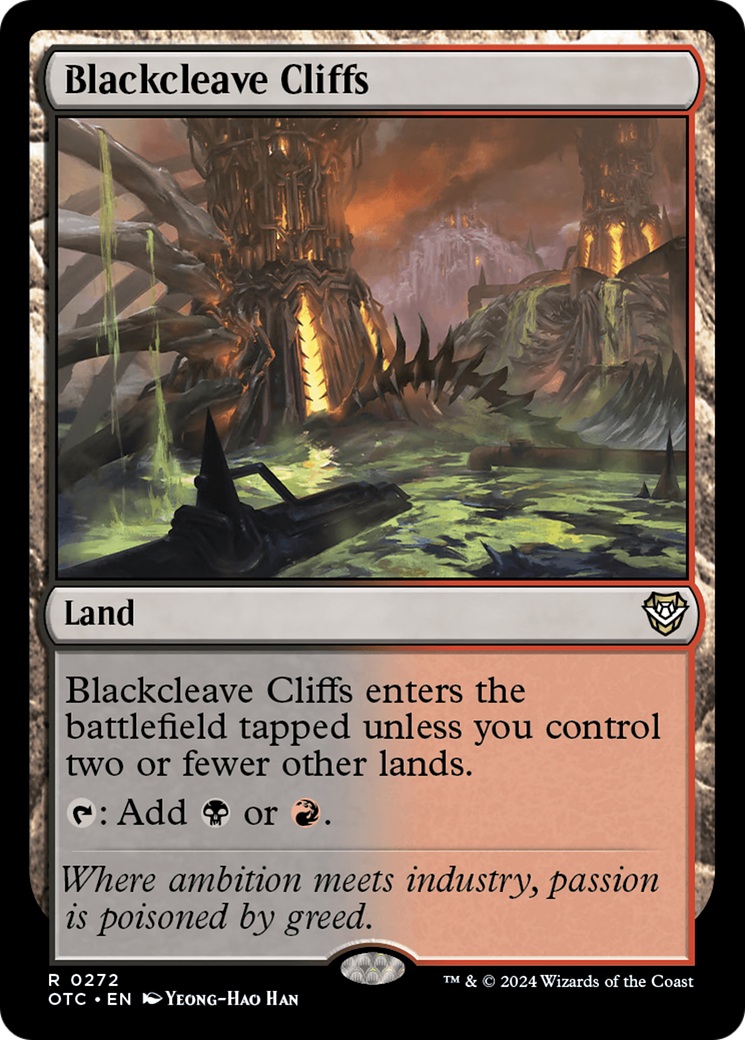
Blackcleave Cliffs
Blackcleave Cliffs
Land
This land enters tapped unless you control two or fewer other lands.
: Add or .
- If one of these lands enters the battlefield under your control and you control zero, one, or two other lands, it enters the battlefield untapped. If you control three or more other lands, it enters the battlefield tapped.
- If one of these lands enters the battlefield at the same time as one or more other lands (due to Oblivion Sower or Warp World, perhaps), it doesn't take those lands into consideration when determining how many other lands you control.
-
1
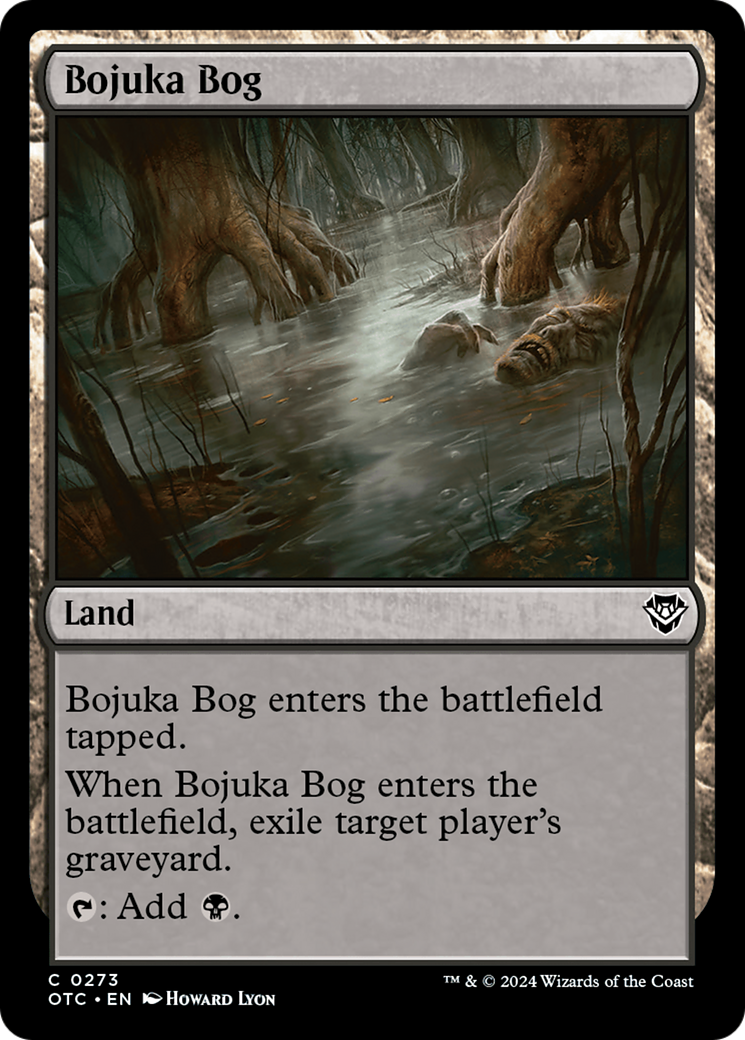
Bojuka Bog
Bojuka Bog
Land
This land enters tapped.
When this land enters, exile target player's graveyard.
: Add .
-
1
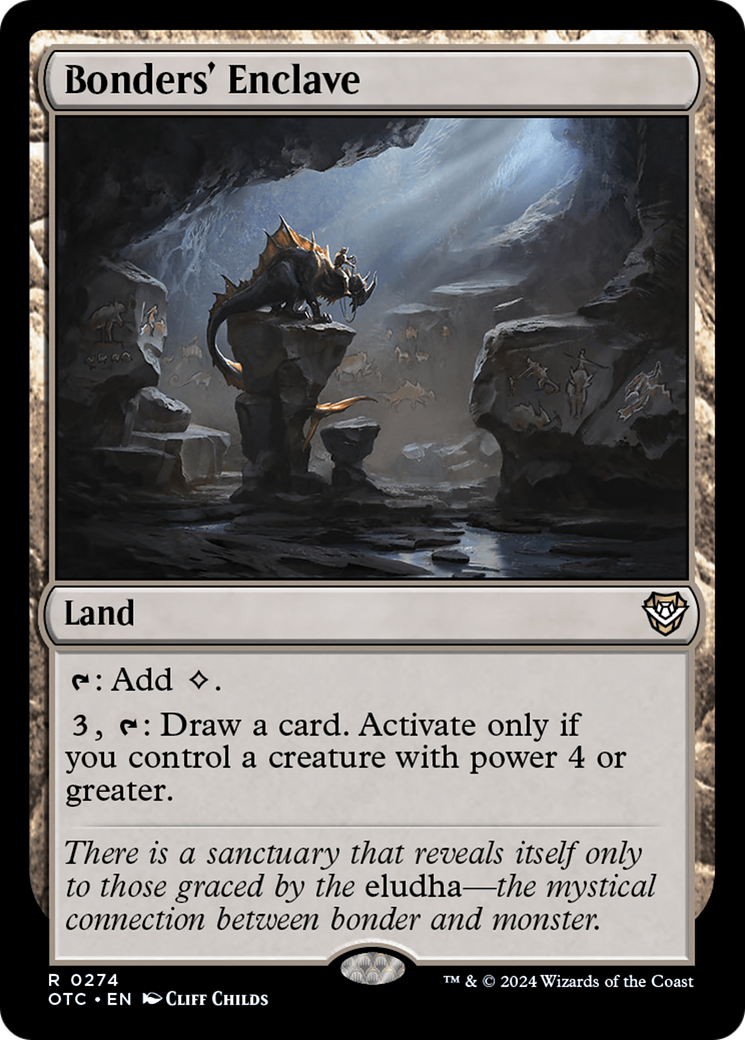
Bonders' Enclave
Bonders' Enclave
Land
: Add .
, : Draw a card. Activate only if you control a creature with power 4 or greater.
- Once you've activated the last ability of Bonders' Enclave, it doesn't check again at any point whether you control a creature with power 4 or greater.
- Once you announce that you're activating the last ability of Bonders' Enclave, no player may take actions until you've finished activating it. Notably, opponents can't try to change whether you control a creature with power 4 or greater.
-
1
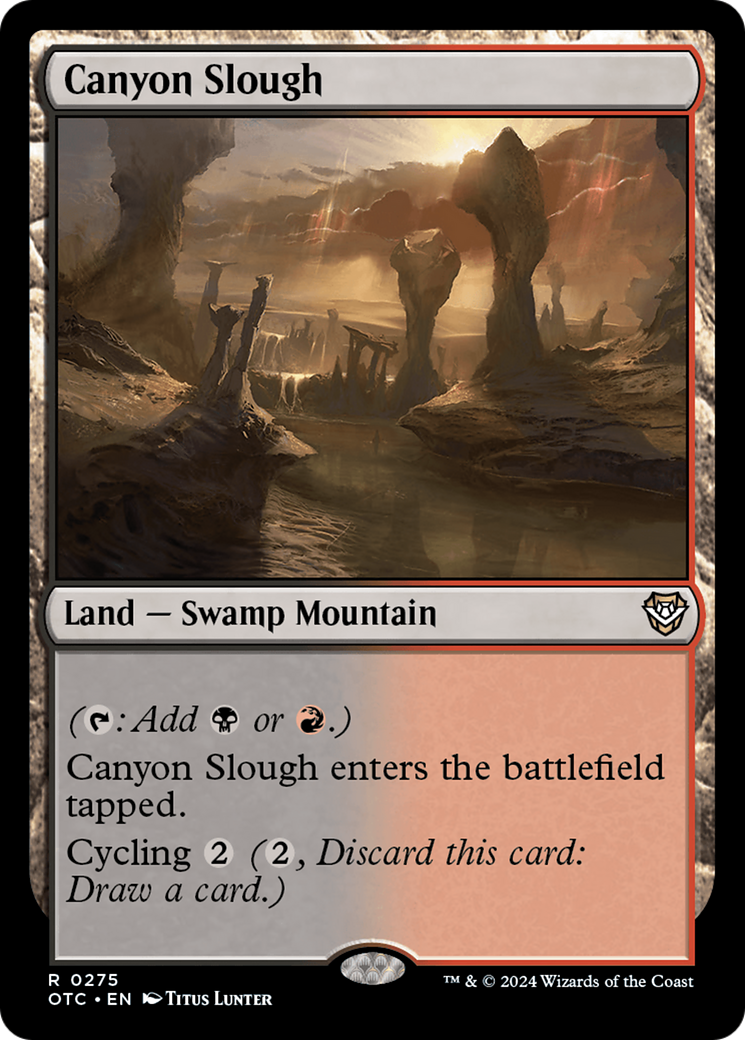
Canyon Slough
Canyon Slough
Land — Swamp Mountain
( : Add or .)
This land enters tapped.
Cycling ( , Discard this card: Draw a card.)
-
1
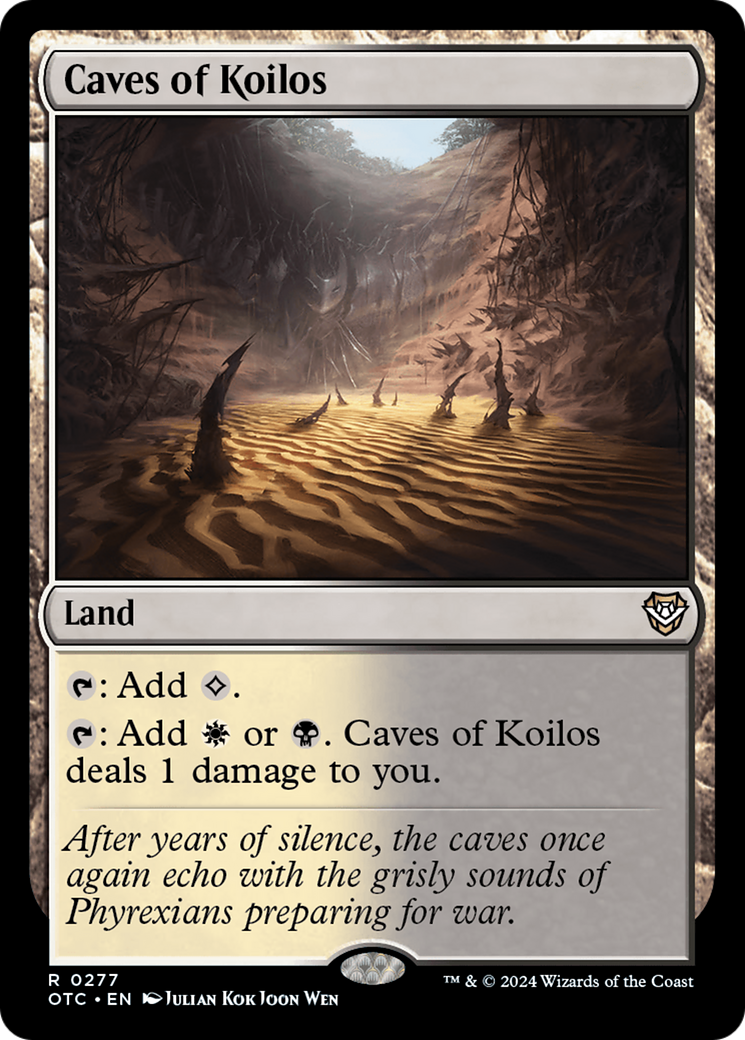
Caves of Koilos
Caves of Koilos
Land
: Add .
: Add or . This land deals 1 damage to you.
- The damage dealt to you is part of the second mana ability. It doesn't use the stack and can't be responded to.
- Like most lands, each land in this cycle is colorless. The damage dealt to you is dealt by a colorless source.
-
1
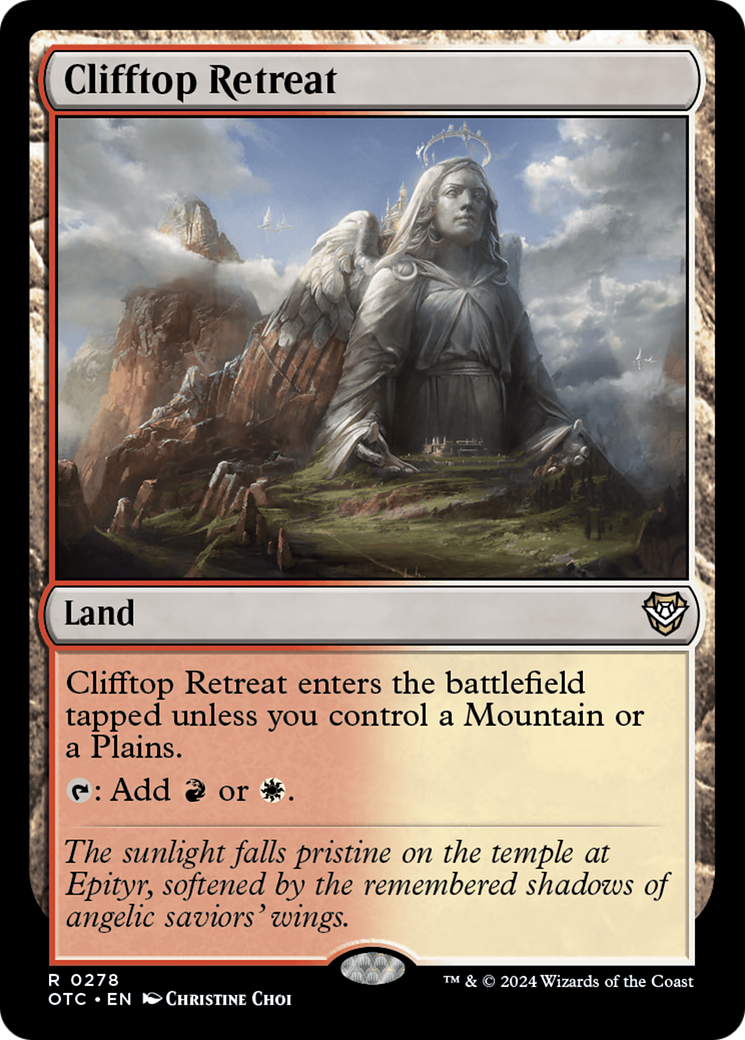
Clifftop Retreat
Clifftop Retreat
Land
This land enters tapped unless you control a Mountain or a Plains.
: Add or .
-
1
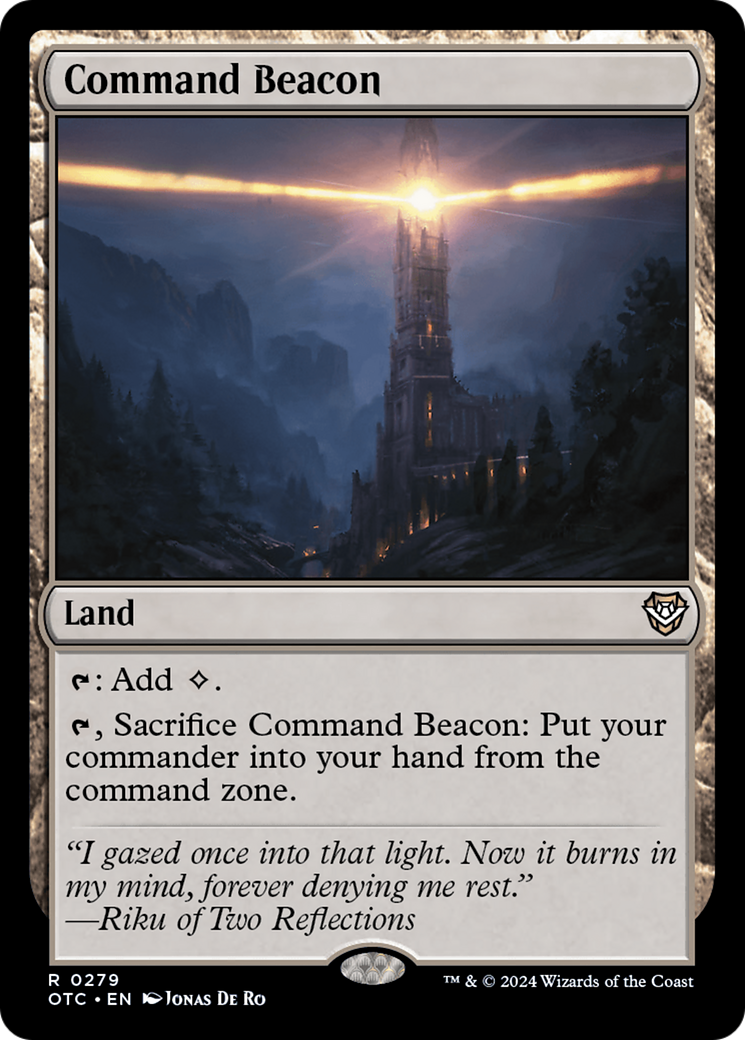
Command Beacon
Command Beacon
Land
: Add .
, Sacrifice this land: Put your commander into your hand from the command zone.
- If you cast a commander from your hand, the commander tax doesn't apply. Additionally, that casting won't add to commander tax if you later cast the commander from the command zone.
- If your commander isn't in the command zone (or you don't have a commander) as the last ability resolves, nothing happens.
- If you have two commanders with the partner ability in the command zone, Command Beacon's effect puts one of your choice into your hand, not both.
- If you have two commanders with the partner ability in the command zone, Command Beacon's effect puts one of your choice into your hand, not both.
- If you cast a commander from your hand, the additional cost based on the number of times you've cast it from your command zone (sometimes referred to as the "commander tax") doesn't apply. Additionally, that casting won't add to the tax if you later cast the commander from the command zone.
- If your commander isn't in the command zone (or you're not playing Commander) as the last ability resolves, nothing happens.
-
1
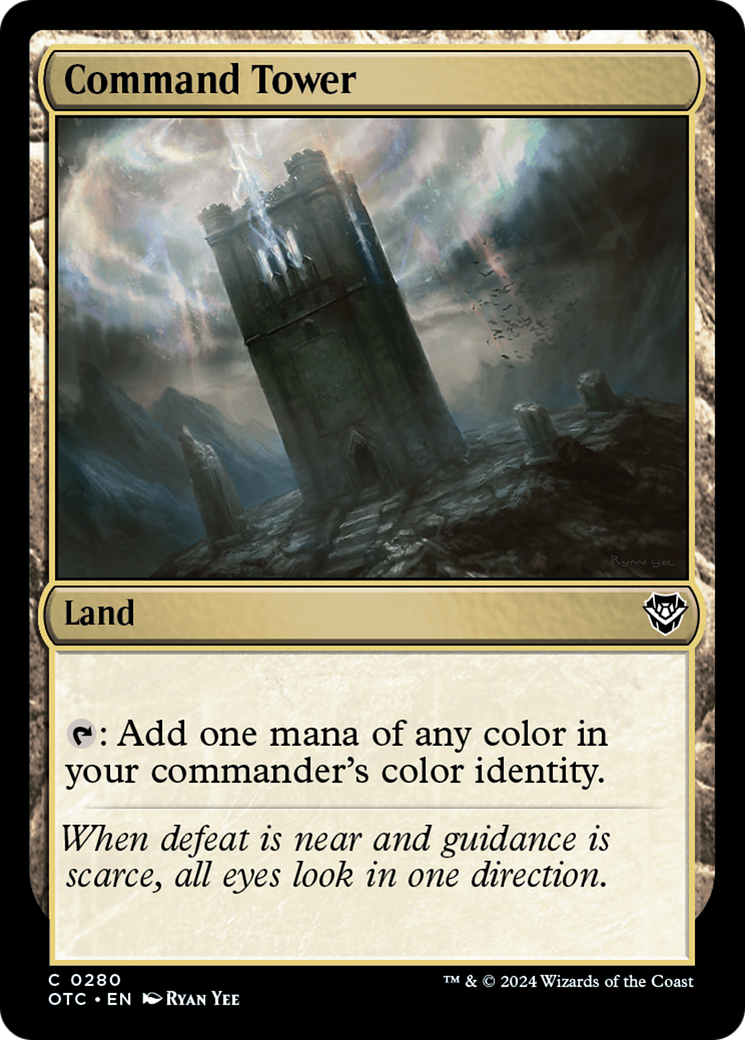
Command Tower
Command Tower
Land
: Add one mana of any color in your commander's color identity.
- If you don't have a commander, Command Tower's ability produces no mana.
- If your commander is a card that has no colors in its color identity, Command Tower's ability produces no mana. It doesn't produce .
- If you have two commanders, the ability adds one mana of any color in their combined color identities.
-
1
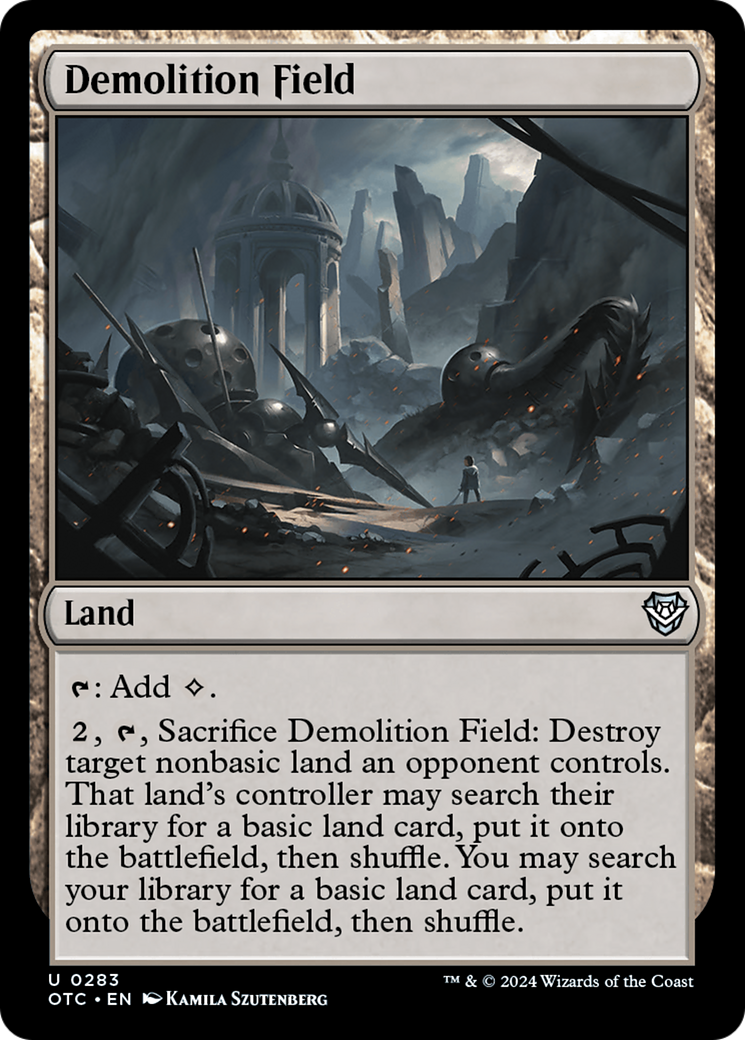
Demolition Field
Demolition Field
Land
: Add .
, , Sacrifice this land: Destroy target nonbasic land an opponent controls. That land's controller may search their library for a basic land card, put it onto the battlefield, then shuffle. You may search your library for a basic land card, put it onto the battlefield, then shuffle.
- The target land's controller gets to search for a basic land card even if that land wasn't destroyed by Demolition Field's ability. This may happen because the land has indestructible.
- If the targeted land is an illegal target by the time Demolition Field's ability resolves, it won't resolve and none of its effects will happen. Neither player will get to search for a basic land card.
-
1
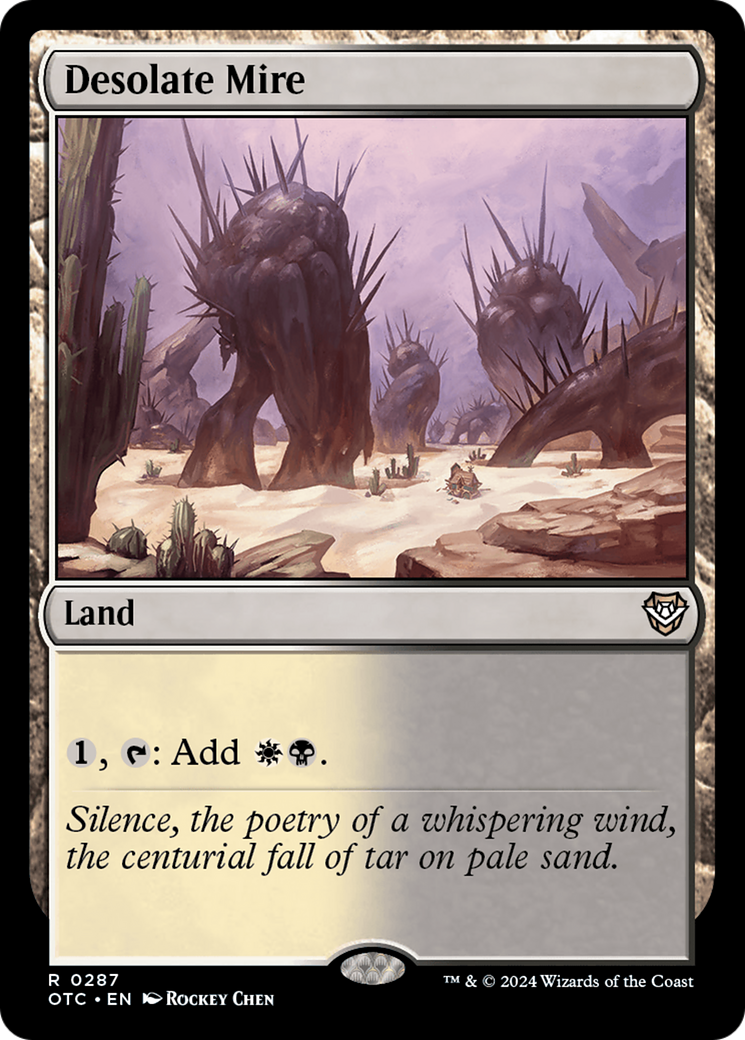
Desolate Mire
Desolate Mire
Land
, : Add .
-
1
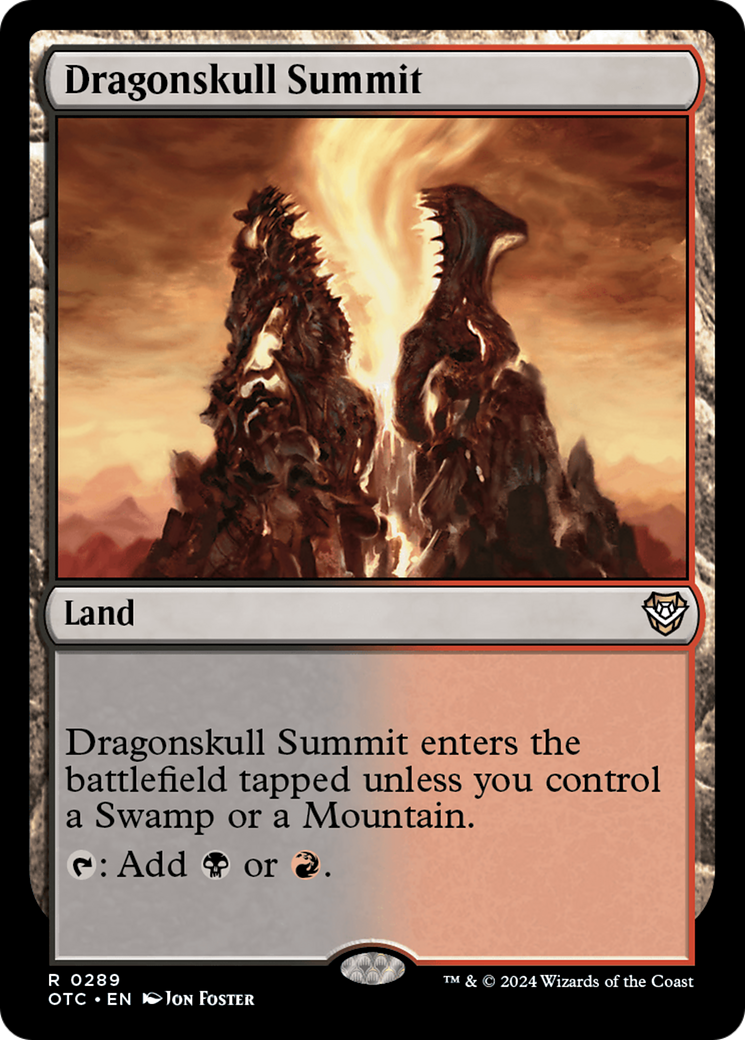
Dragonskull Summit
Dragonskull Summit
Land
This land enters tapped unless you control a Swamp or a Mountain.
: Add or .
- This checks for lands you control with the land type Swamp or Mountain, not for lands named Swamp or Mountain. The lands it checks for don't have to be basic lands. For example, if you control Stomping Ground (a nonbasic land with the land types Mountain and Forest), Dragonskull Summit will enter untapped.
- As this is entering, it checks for lands that are already on the battlefield. It won't see lands that are entering at the same time (due to Warp World, for example).
-
1
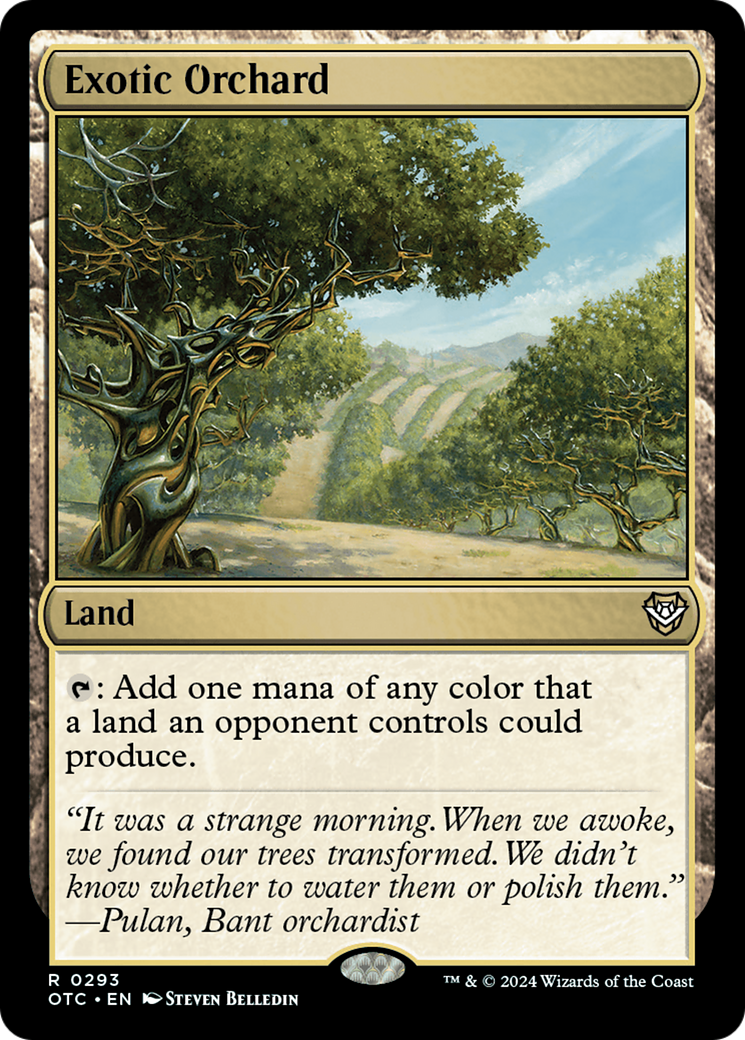
Exotic Orchard
Exotic Orchard
Land
: Add one mana of any color that a land an opponent controls could produce.
- Lands that produce mana based only on what other lands "could produce" won't help each other unless some other land allows one of them to actually produce some type of mana. For example, if you control an Exotic Orchard and your opponent controls an Exotic Orchard and a Reflecting Pool, none of those lands would produce mana if their mana abilities were activated. On the other hand, if you control a Forest and an Exotic Orchard, and your opponent controls an Exotic Orchard and a Reflecting Pool, then each of those lands can be tapped to produce . Your opponent's Exotic Orchard can produce because you control a Forest. Your Exotic Orchard and your opponent's Reflecting Pool can each produce because your opponent's Exotic Orchard can produce .
- When determining what colors of mana your opponents' lands could produce, Exotic Orchard takes into account any applicable replacement effects that would apply to those lands' mana abilities (such as Contamination's effect, for example). If there are more than one, consider them in any possible order.
- The colors of mana are white, blue, black, red, and green. Exotic Orchard can't be tapped for colorless mana, even if a land an opponent controls could produce colorless mana.
- Exotic Orchard doesn't care about any restrictions or riders your opponents' lands (such as Ancient Ziggurat or Hall of the Bandit Lord) put on the mana they produce. It just cares about colors of mana.
- Exotic Orchard checks the effects of all mana-producing abilities of lands your opponents control, but it doesn't check their costs. For example, Vivid Crag has the ability " , Remove a charge counter from Vivid Crag: Add one mana of any color." If an opponent controls Vivid Crag and you control Exotic Orchard, you can tap Exotic Orchard for any color of mana. It doesn't matter whether Vivid Crag has a charge counter on it, and it doesn't matter whether it's untapped.
-
1
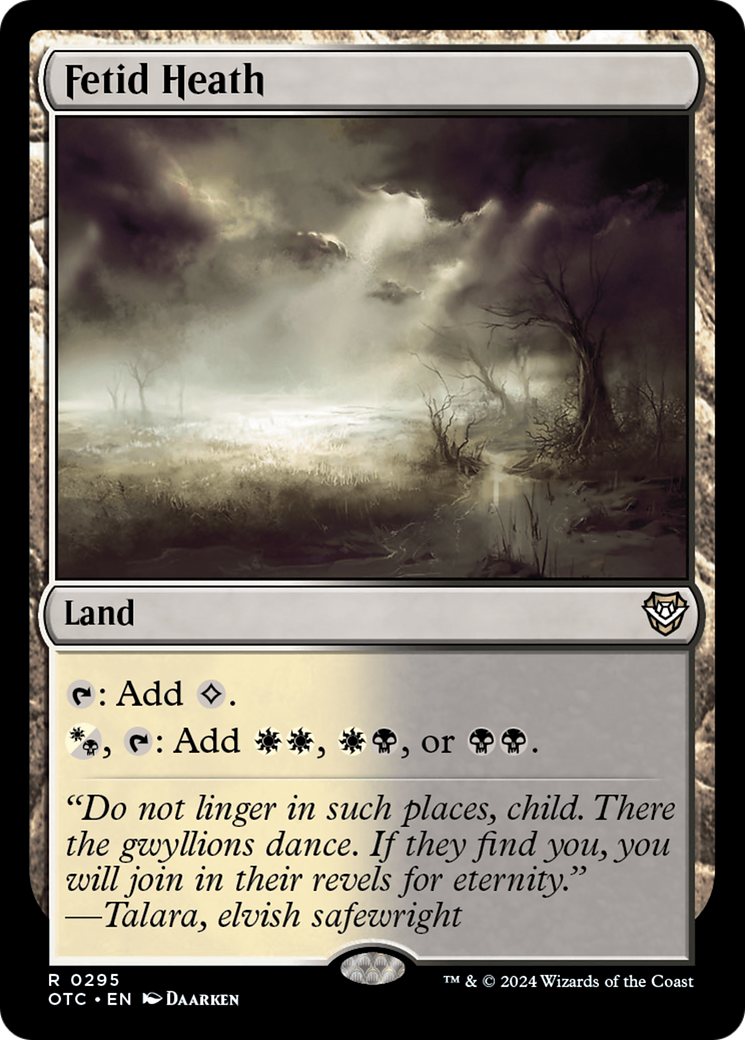
Fetid Heath
Fetid Heath
Land
: Add .
, : Add , , or .
-
1
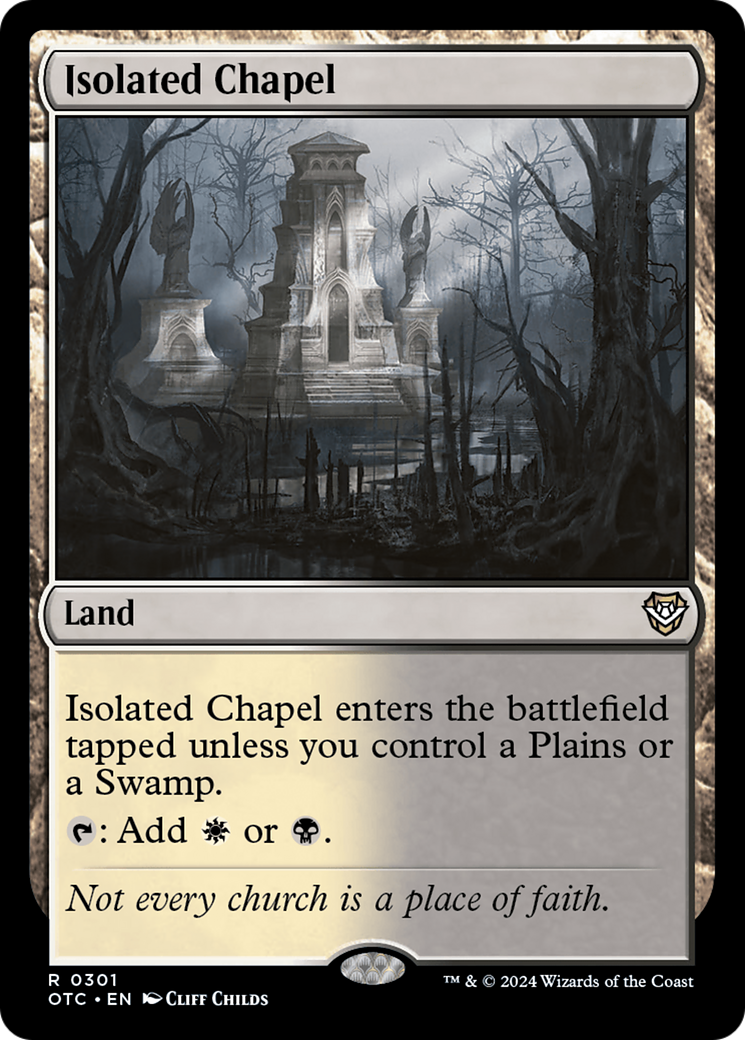
Isolated Chapel
Isolated Chapel
Land
This land enters tapped unless you control a Plains or a Swamp.
: Add or .
-
2
Mountain
Mountain
Basic Land — Mountain
( : Add .)
-
1
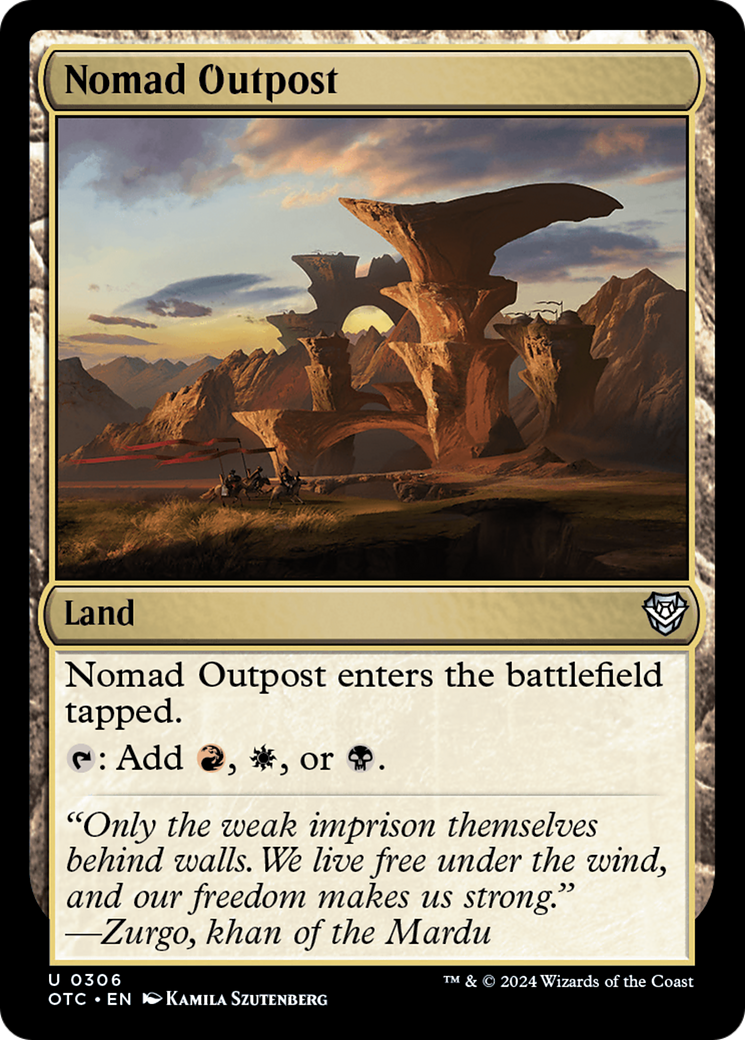
Nomad Outpost
Nomad Outpost
Land
This land enters tapped.
: Add , , or .
-
1
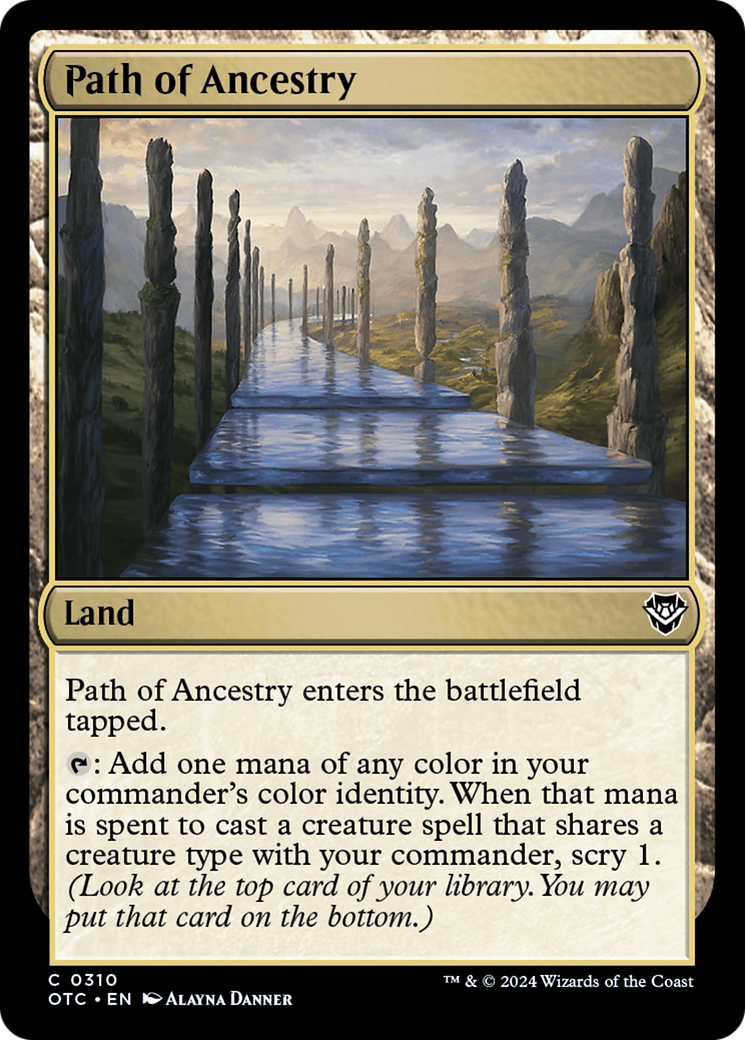
Path of Ancestry
Path of Ancestry
Land
This land enters tapped.
: Add one mana of any color in your commander's color identity. When that mana is spent to cast a creature spell that shares a creature type with your commander, scry 1. (Look at the top card of your library. You may put that card on the bottom.)
- Your commander's creature types are checked immediately after you cast a creature spell spending mana from Path of Ancestry's last ability. They aren't set before the game begins, and they may not be the same types your commander had when you activated that ability.
- If you have two commanders, the last ability adds one mana of any color in their combined color identities. When you spend that mana on a creature spell that shares a creature type with either of your commanders, you'll scry 1.
- If Path of Ancestry's last ability produces two mana (most likely due to Mana Reflection), spending those two mana to cast creature spells that share a creature type with your commander will cause two abilities to trigger. Each of those abilities will cause you to scry 1. You won't scry 2. This is true whether you spend the mana on one creature spell or two.
- If your commander has no creature types, it can't share a creature type with any spell that you cast.
- If you cast your commander with mana from Path of Ancestry, and your commander hasn't somehow lost all of its creature types while on the stack, you'll scry 1.
- If you don't have a commander, Path of Ancestry's ability produces no mana.
- If your commander is a card that has no colors in its color identity, Path of Ancestry's ability produces no mana. It doesn't produce .
-
2
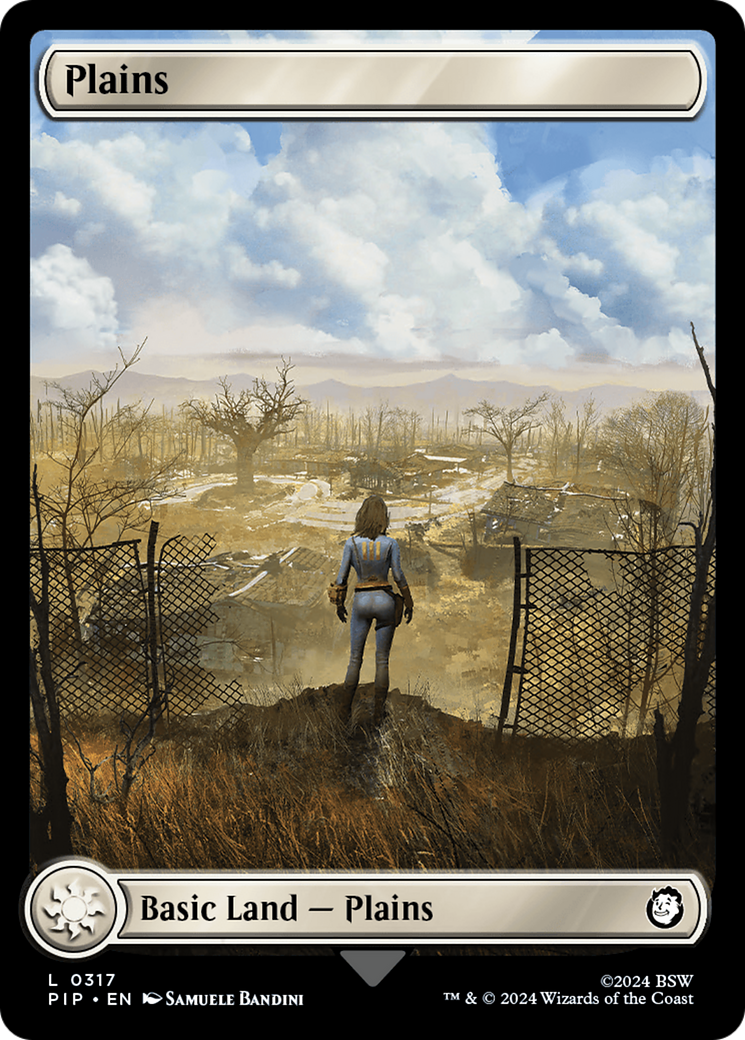
Plains
Plains
Basic Land — Plains
( : Add .)
-
1
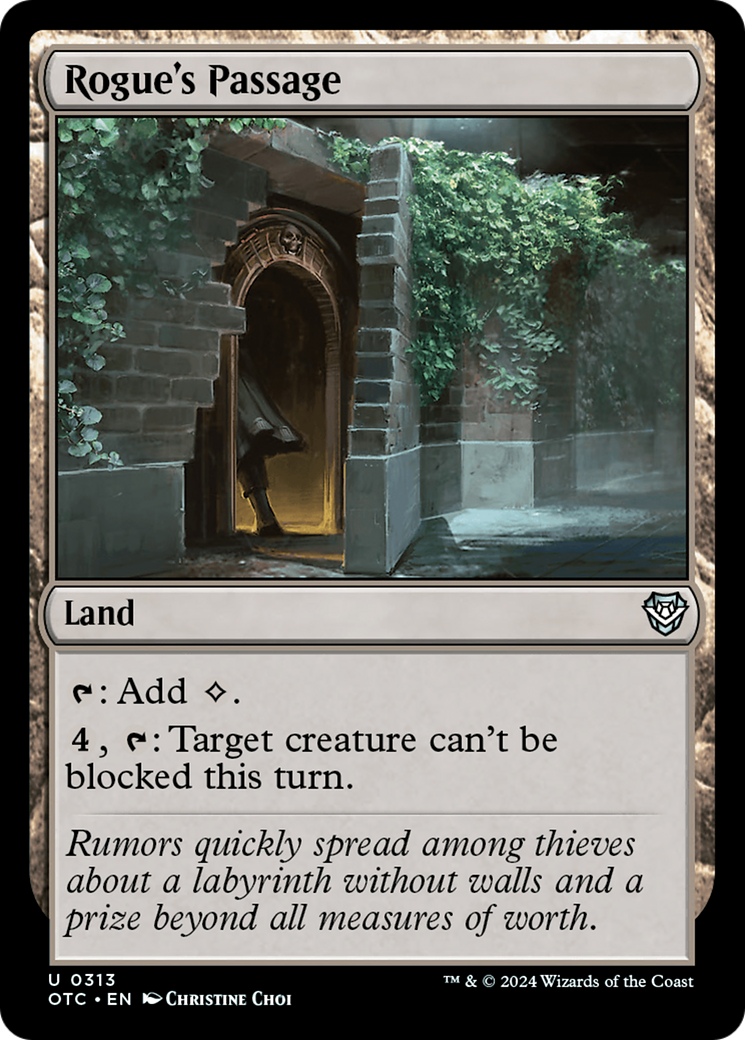
Rogue's Passage
Rogue's Passage
Land
: Add .
, : Target creature can't be blocked this turn.
- Activating the second ability of Rogue's Passage after a creature has become blocked won't cause that creature to become unblocked.
-
1
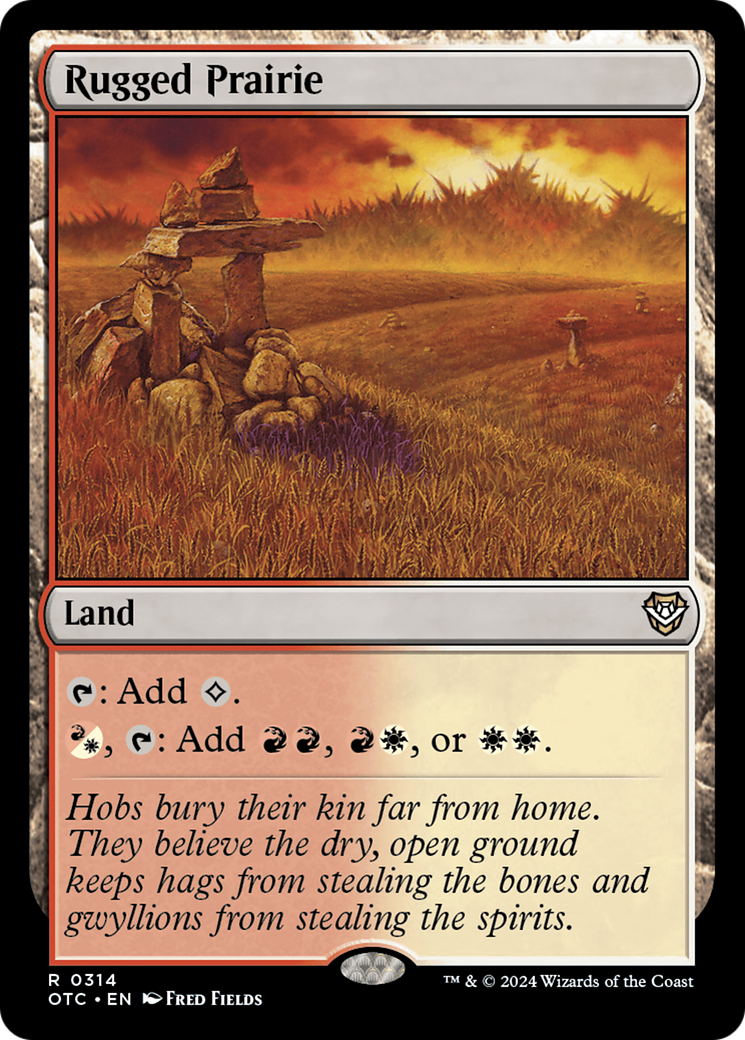
Rugged Prairie
Rugged Prairie
Land
: Add .
, : Add , , or .
-
1
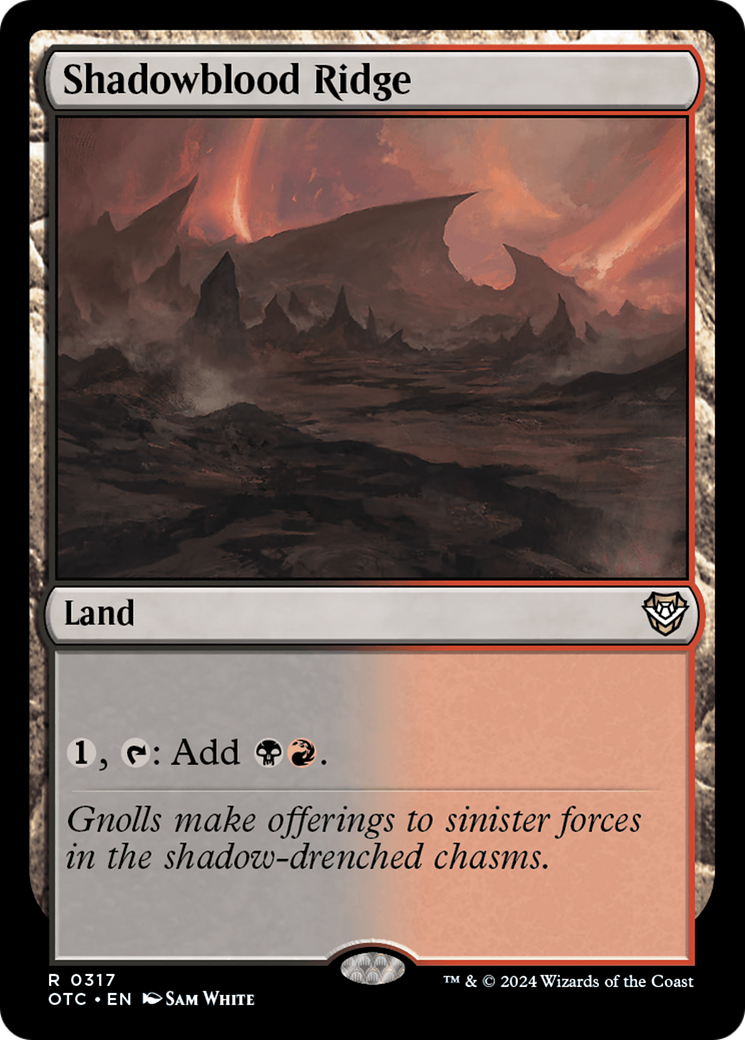
Shadowblood Ridge
Shadowblood Ridge
Land
, : Add .
-
1
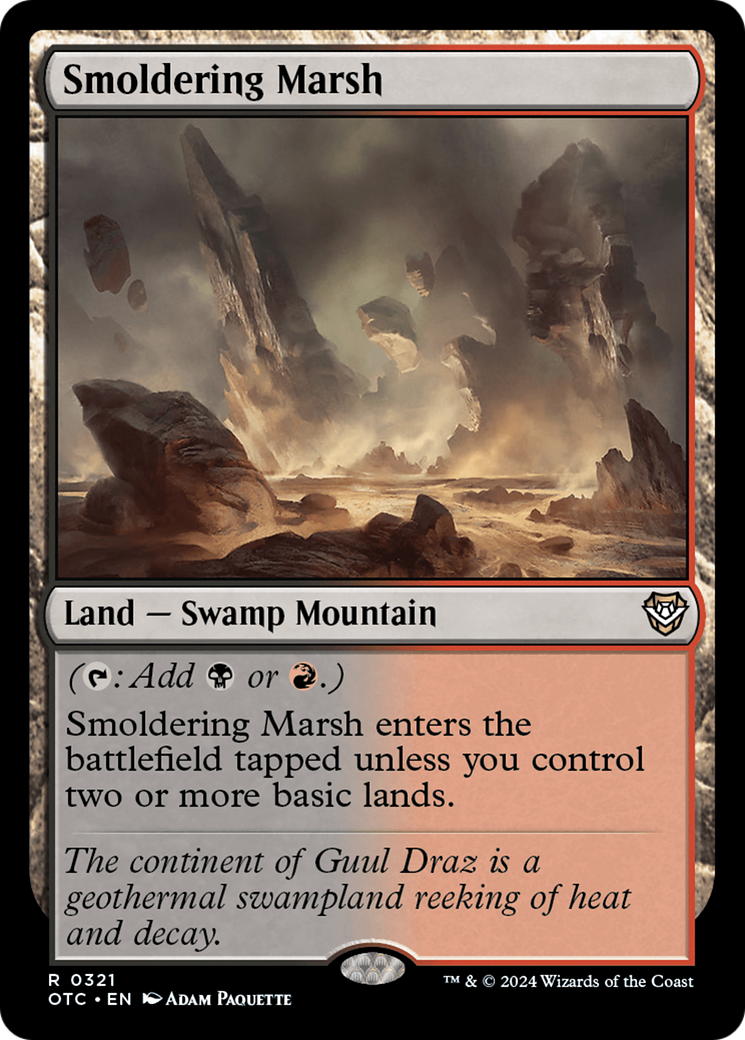
Smoldering Marsh
Smoldering Marsh
Land — Swamp Mountain
( : Add or .)
This land enters tapped unless you control two or more basic lands.
- However, because these cards have basic land types, effects that specify a basic land type without also specifying that the land be basic can affect them. For example, a spell or ability that reads "Destroy target Forest" can target Canopy Vista, while one that reads "Destroy target basic Forest" cannot.
- Even though these lands have basic land types, they are not basic lands because "basic" doesn't appear on their type line. Notably, controlling two or more of them won't allow others to enter the battlefield untapped.
- If one of these lands enters the battlefield at the same time as any number of basic lands, those other lands are not counted when determining if this land enters the battlefield tapped or untapped.
-
1
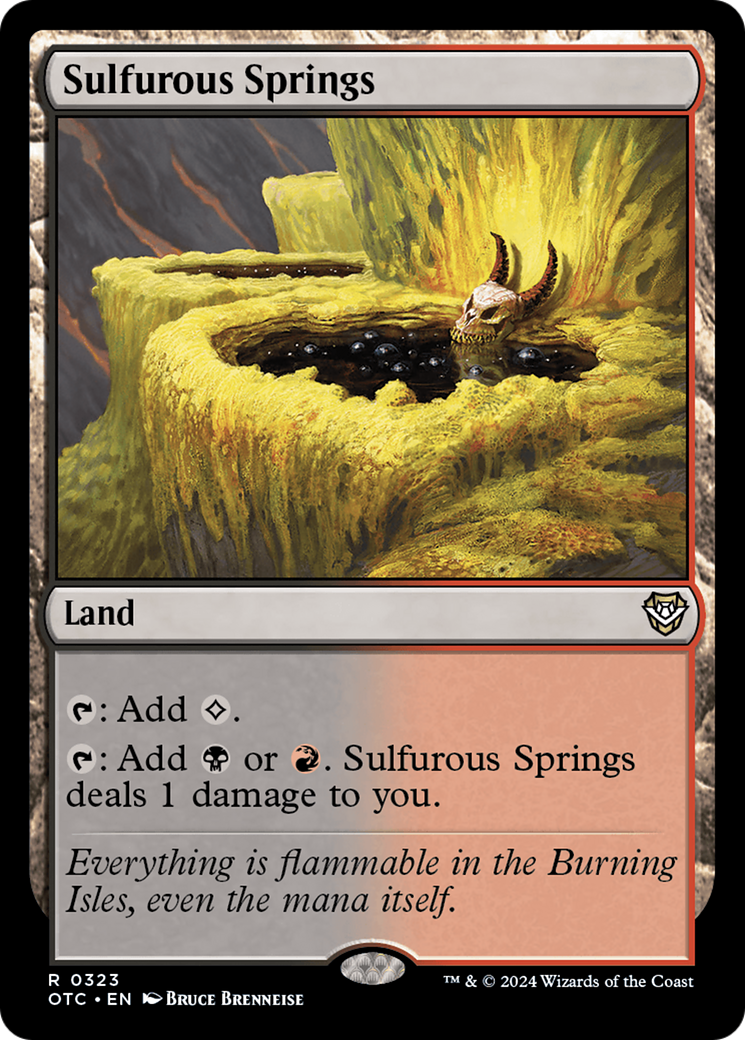
Sulfurous Springs
Sulfurous Springs
Land
: Add .
: Add or . This land deals 1 damage to you.
-
1
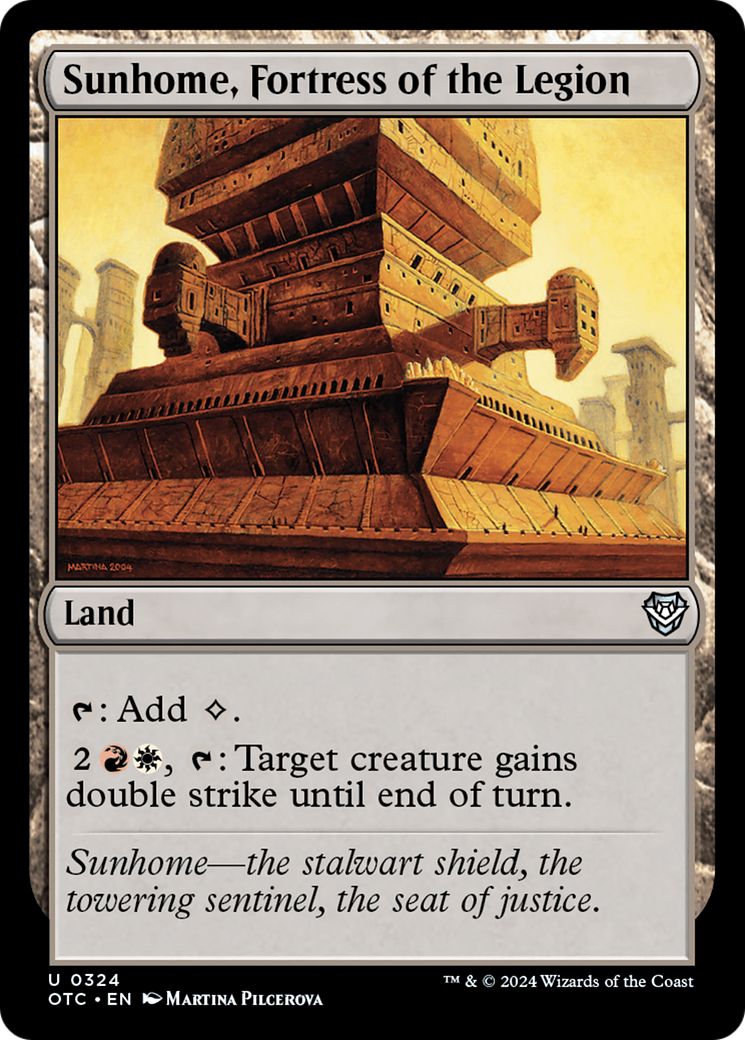
Sunhome, Fortress of the Legion
Sunhome, Fortress of the Legion
Land
: Add .
, : Target creature gains double strike until end of turn.
- If you give double strike to a creature with first strike after first-strike combat damage has been dealt, that creature will also deal damage during the normal combat damage step.
- If you give double strike to a creature after either first-strike or normal combat damage has been dealt, it won't help that creature deal any additional combat damage.
-
4
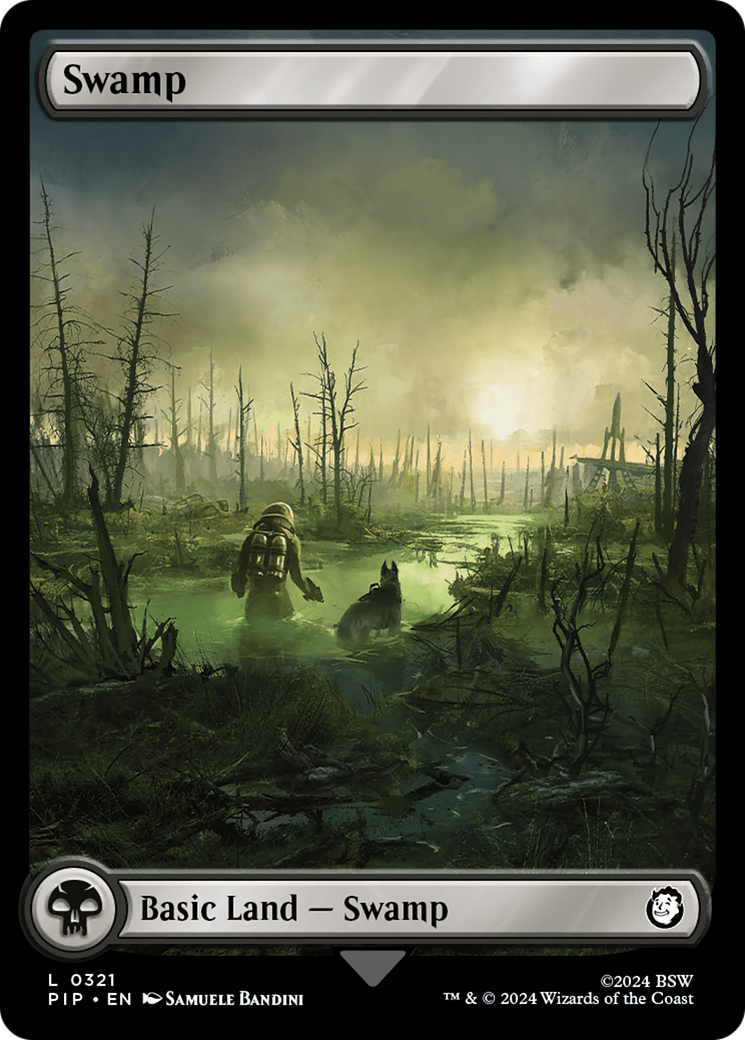
Swamp
Swamp
Basic Land — Swamp
( : Add .)
-
1
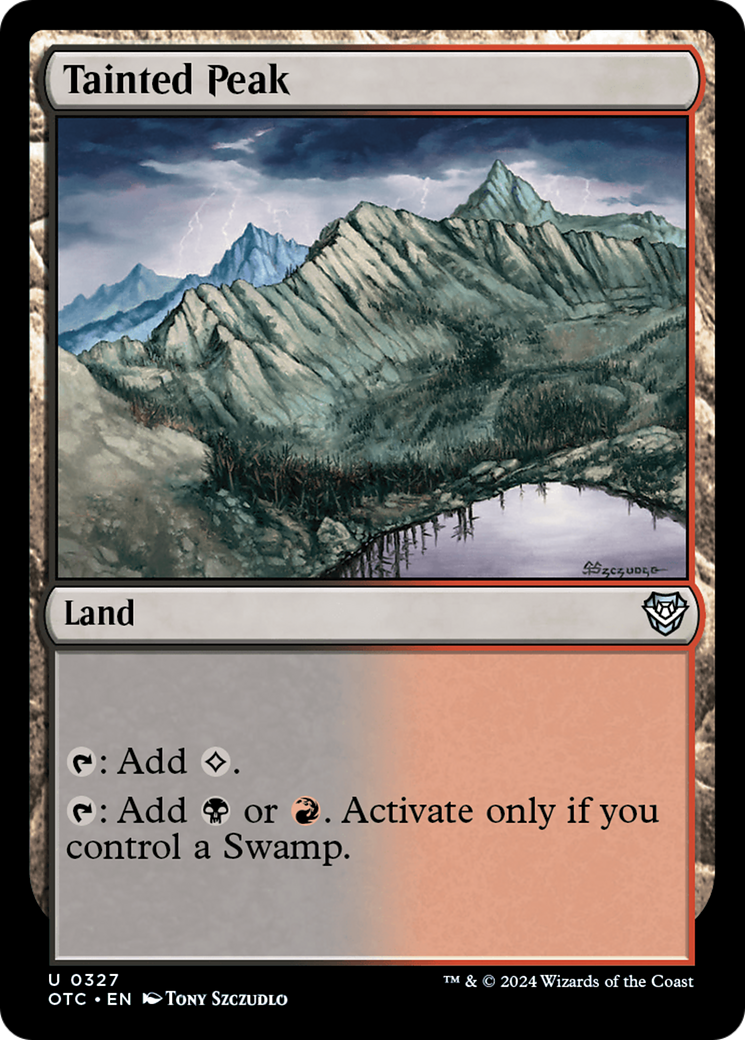
Tainted Peak
Tainted Peak
Land
: Add .
: Add or . Activate only if you control a Swamp.
-
1
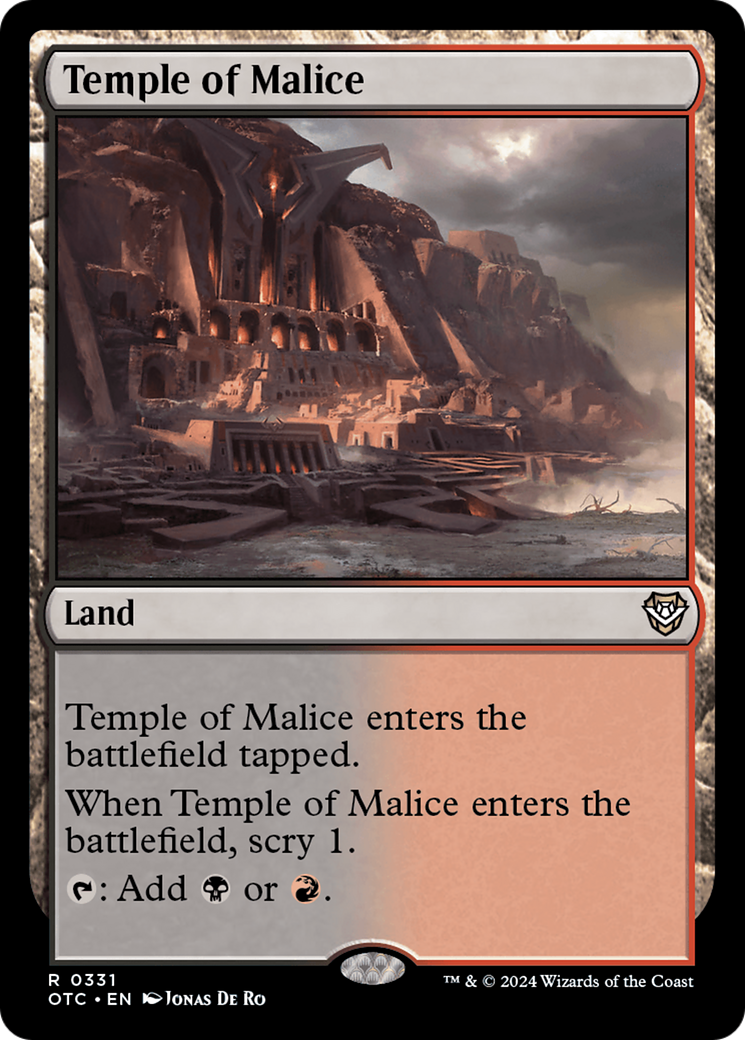
Temple of Malice
Temple of Malice
Land
This land enters tapped.
When this land enters, scry 1. (Look at the top card of your library. You may put that card on the bottom.)
: Add or .
- When you scry, you may put all the cards you look at back on top of your library, you may put all of those cards on the bottom of your library, or you may put some of those cards on top and the rest of them on the bottom.
- You choose how to order cards returned to your library after scrying no matter where you put them.
- You perform the actions stated on a card in sequence. For some spells and abilities, that means you'll scry last. For others, that means you'll scry and then perform other actions.
- Scry appears on some spells and abilities with one or more targets. If all of the spell or ability's targets are illegal when it tries to resolve, it won't resolve and none of its effects will happen. You won't scry.
-
1
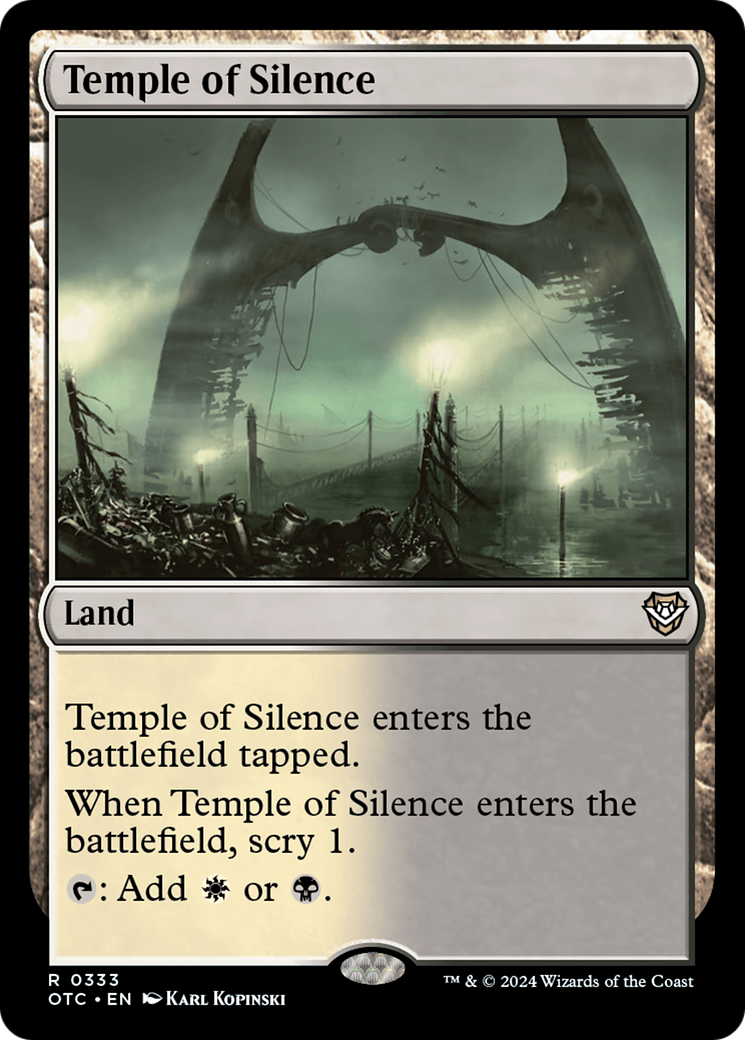
Temple of Silence
Temple of Silence
Land
This land enters tapped.
When this land enters, scry 1. (Look at the top card of your library. You may put that card on the bottom.)
: Add or .
- When you scry, you may put all the cards you look at back on top of your library, you may put all of those cards on the bottom of your library, or you may put some of those cards on top and the rest of them on the bottom.
- You choose how to order cards returned to your library after scrying no matter where you put them.
- You perform the actions stated on a card in sequence. For some spells and abilities, that means you'll scry last. For others, that means you'll scry and then perform other actions.
- Scry appears on some spells and abilities with one or more targets. If all of the spell or ability's targets are illegal when it tries to resolve, it won't resolve and none of its effects will happen. You won't scry.
-
1
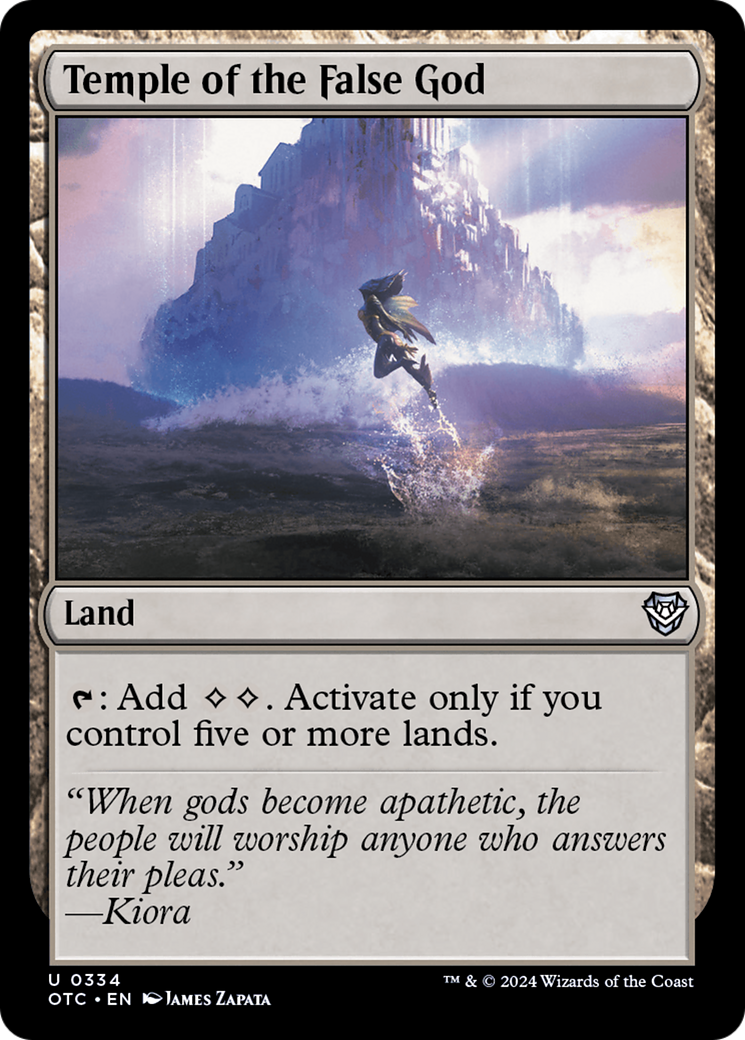
Temple of the False God
Temple of the False God
Land
: Add . Activate only if you control five or more lands.
-
1
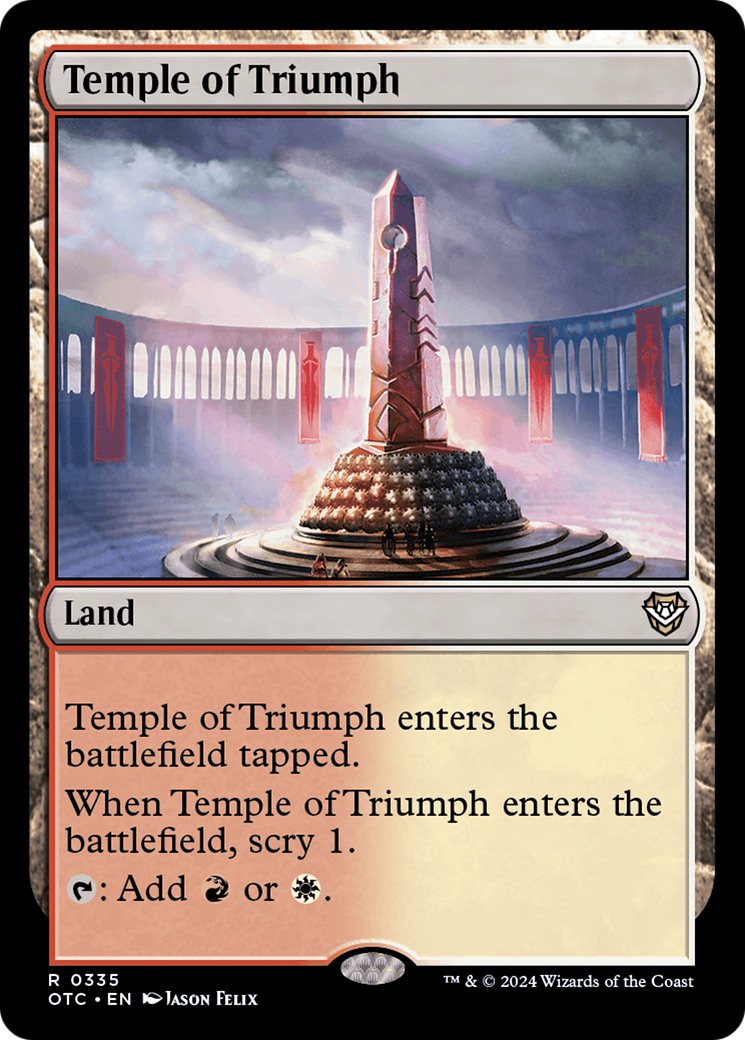
Temple of Triumph
Temple of Triumph
Land
This land enters tapped.
When this land enters, scry 1. (Look at the top card of your library. You may put that card on the bottom.)
: Add or .
- When you scry, you may put all the cards you look at back on top of your library, you may put all of those cards on the bottom of your library, or you may put some of those cards on top and the rest of them on the bottom.
- You choose how to order cards returned to your library after scrying no matter where you put them.
- You perform the actions stated on a card in sequence. For some spells and abilities, that means you'll scry last. For others, that means you'll scry and then perform other actions.
- Scry appears on some spells and abilities with one or more targets. If all of the spell or ability's targets are illegal when it tries to resolve, it won't resolve and none of its effects will happen. You won't scry.
-
1
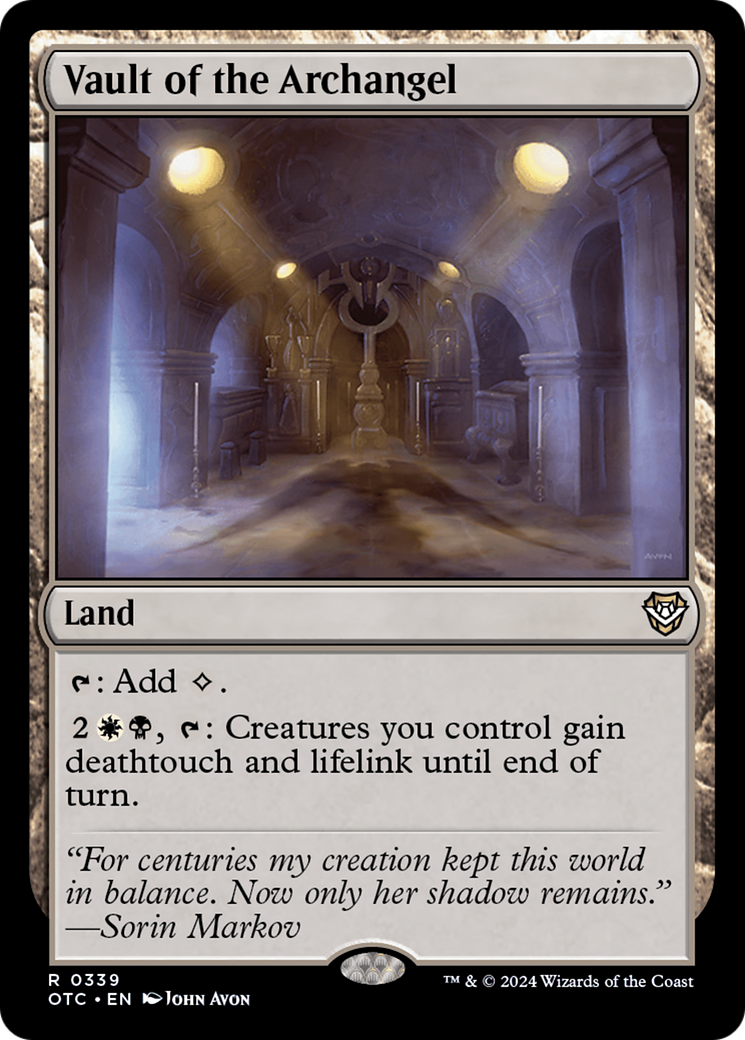
Vault of the Archangel
Vault of the Archangel
Land
: Add .
, : Creatures you control gain deathtouch and lifelink until end of turn.
- Multiple instances of deathtouch or lifelink on the same creature are redundant.
- Vault of the Archangel's last ability affects only creatures you control when that ability resolves. It won't affect creatures that come under your control later in the turn.
White 7
-
1
Angelic Sell-Sword
Angelic Sell-Sword
Creature — Angel Mercenary
4/4
Flying, vigilance
Whenever this creature or another nontoken creature you control enters, create a 1/1 red Mercenary creature token with " : Target creature you control gets +1/+0 until end of turn. Activate only as a sorcery."
Whenever this creature attacks, if its power is 6 or greater, draw a card.
-
1
Council's Judgment
Council's Judgment
Sorcery
Will of the council — Starting with you, each player votes for a nonland permanent you don't control. Exile each permanent with the most votes or tied for most votes.
- Because the votes are cast in turn order, each player will know the votes of players who voted beforehand.
- Each player must vote for one of the candidate permanents. They can't abstain.
- No player votes until the spell or ability resolves. Any responses to that spell or ability must be made without knowing the outcome of the vote.
- None of the candidate permanents are targeted. Players may vote for a permanent with protection from white, for example.
- Players can't do anything after they finishing voting but before the "winning" permanent or permanents are exiled.
- In the unusual case that no permanents have any votes, nothing is exiled.
-
1
Heliod's Intervention
Heliod's Intervention
Instant
Choose one —
- Destroy X target artifacts and/or enchantments.
- Target player gains twice X life.
- The second mode of Heliod's Intervention causes the player to gain one amount of life equal to twice X. It doesn't cause the player to gain X life then gain X life again.
-
1
Mirror Entity
Mirror Entity
Creature — Shapeshifter
1/1
Changeling (This card is every creature type.)
: Until end of turn, creatures you control have base power and toughness X/X and gain all creature types.
- Changeling applies in all zones, not just the battlefield.
- Mirror Entity's ability overwrites any effects that previously set a creature's base power and/or toughness. Any existing effects or counters that raise or lower a creature's power and/or toughness continue to apply to the creature's newly-set power and toughness.
- Activating the ability with X = 0 will cause all creatures you control to become 0/0 and be put into the graveyard.
-
1
Mistmeadow Skulk
Mistmeadow Skulk
Creature — Kithkin Rogue
1/1
Lifelink, protection from mana value 3 or greater
- The protection ability means the following: - Mistmeadow Skulk can't be blocked by creatures with mana value 3 or greater. - Mistmeadow Skulk can't be enchanted by Auras with mana value 3 or greater. It also can't be equipped by Equipment with mana value 3 or greater. - Mistmeadow Skulk can't be targeted by spells with mana value 3 or greater. It also can't be targeted by abilities from sources with mana value 3 or greater. - All damage that would be dealt to Mistmeadow Skulk by sources with mana value 3 or greater is prevented.
- While a spell with X in its cost is on the stack, its mana value takes the chosen value of X into account. Mistmeadow Skulk can be chosen as a target for a Blaze (which has mana cost ) if X is 0 or 1, for example, but it can't be chosen as a target for a Blaze if X is 2 or more.
- A face-down creature has a mana value of 0, so Mistmeadow Skulk doesn't have protection from it .
-
1
Requisition Raid
Requisition Raid
Sorcery
Spree (Choose one or more additional costs.)
+ — Destroy target artifact.
+ — Destroy target enchantment.
+ — Put a +1/+1 counter on each creature target player controls.
- Spells with spree have a + (plus sign) indicator in the upper right corner of the card frame. This has no rules meaning and serves only to remind players that at least one additional cost is required to cast the spell.
- If a mode requires a target, you can select that mode only if there's a legal target available. Ignore the targeting requirements for modes you don't choose.
- Each additional cost and associated mode in the text box is also preceded with a + indicator. These symbols also have no rules meaning and serve only to remind players that the listed costs are additional costs.
- No matter which modes you choose, you always follow the instructions in the order they are written.
- You must choose at least one of the listed modes and pay its associated additional cost in order to cast a spell with spree.
- The mana value of a spell with spree is determined only by its mana cost (in the upper right corner of the card). It doesn't matter which modes you choose or which additional costs you pay, including any additional costs imposed by other effects.
- No player can cast spells or activate abilities in between the modes of a resolving spell. Any abilities that trigger won't be put onto the stack until the spell is done resolving.
- You choose the modes as you cast the spell with spree. Once modes are chosen, they can't be changed.
- You can't choose the same mode more than once.
- If a spell with spree is copied, the effect that creates the copy may allow you to choose new targets. You cannot choose new modes.
- If all targets for the chosen modes become illegal before a spell with spree resolves, the spell won't resolve and none of its effects will happen. If at least one target is still legal, the spell will resolve but will have no effect on any illegal targets.
- If an effect allows you to cast a spell with spree "without paying its mana cost," you must still choose at least one mode and pay the associated additional costs.
-
1
We Ride at Dawn
We Ride at Dawn
Enchantment
Legendary creature spells you cast have convoke. (Your creatures can help cast those spells. Each creature you tap while casting a legendary creature spell pays for or one mana of that creature's color.)
Whenever your commander attacks, create a 1/1 red Mercenary creature token with " : Target creature you control gets +1/+0 until end of turn. Activate only as a sorcery."
- You can tap any untapped creature you control to convoke a spell, even one you haven’t controlled continuously since the beginning of your most recent turn.
- When calculating a spell’s total cost, include any alternative costs, additional costs, or anything else that increases or reduces the cost to cast the spell. Convoke applies after the total cost is calculated. Convoke doesn’t change a spell’s mana cost or mana value.
- If a creature you control has a mana ability with in the cost, activating that ability while casting a spell with convoke will result in the creature being tapped before you pay the spell’s costs. You won’t be able to tap it again for convoke. Similarly, if you sacrifice a creature to activate a mana ability while casting a spell with convoke, that creature won’t be on the battlefield when you pay the spell’s costs, so you won’t be able to tap it for convoke.
- If you control another player’s commander, you won’t create a Mercenary when you attack with that creature. However, if another player controls your commander, you’ll create a Mercenary when it attacks.
- If you have two commanders and they’re both declared as attackers, We Ride at Dawn’s last ability will trigger twice.
Black 25
-
1
Aetherborn Marauder
Aetherborn Marauder
Creature — Aetherborn Rogue
2/2
Flying, lifelink
When this creature enters, move any number of +1/+1 counters from other permanents you control onto this creature.
- You may move +1/+1 counters from any number of other permanents you control, not just from one.
- You choose which counters to move as Aetherborn Marauder's triggered ability resolves.
- You may choose to move zero +1/+1 counters.
- If a creature has been dealt damage, that damage remains marked on it until the cleanup step. If Aetherborn Marauder takes counters from a creature that has been dealt damage, that creature will be destroyed if the damage is now lethal.
-
1
Back in Town
Back in Town
Sorcery
Return X target outlaw creature cards from your graveyard to the battlefield. (Assassins, Mercenaries, Pirates, Rogues, and Warlocks are outlaws.)
- A card, spell, or permanent is an outlaw if it has the Assassin, Mercenary, Pirate, Rogue, or Warlock creature type. It doesn’t matter if it has more than one of those creature types; as long as it has at least one, it’s an outlaw.
- Outlaw is not a creature type. If an effect asks you to choose a creature type, you can’t choose outlaw.
- If an ability refers to an outlaw or whether a player controls an outlaw, it’s referring only to permanents with one or more of the creature types specified above. Notably, it’s not referring to any spell or card not on the battlefield. However, other abilities may refer to an “outlaw spell” or “outlaw card” in a zone other than the battlefield. Those abilities refer to spells and cards with one or more of the specified creature types.
-
1
Changeling Outcast
Changeling Outcast
Creature — Shapeshifter
1/1
Changeling (This card is every creature type.)
This creature can't block and can't be blocked.
-
1
Charred Graverobber
Charred Graverobber
Creature — Skeleton Mercenary
3/1
When this creature enters, return target outlaw card from your graveyard to your hand.
Escape— , Exile four other cards from your graveyard. (You may cast this card from your graveyard for its escape cost.)
This creature escapes with a +1/+1 counter on it.
- Escape's permission doesn't change when you may cast the spell from your graveyard.
- To determine the total cost of a spell, start with the mana cost or alternative cost you're paying (such as an escape cost), add any cost increases, then apply any cost reductions. The mana value of the spell remains unchanged, no matter what the total cost to cast it was and no matter whether an alternative cost was paid.
- After an escaped spell resolves, it returns to its owner's graveyard if it's not a permanent spell. If it is a permanent spell, it enters the battlefield and will return to its owner's graveyard if it dies later. Perhaps it will escape again—good underworld security is so hard to come by these days.
- If a card has multiple abilities giving you permission to cast it, such as two escape abilities or an escape ability and a flashback ability, you choose which one to apply. The others have no effect.
- If you cast a spell with its escape permission, you can't choose to apply any other alternative costs or to cast it without paying its mana cost. If it has any additional costs, you must pay those.
- If a card with escape is put into your graveyard during your turn, you'll be able to cast it right away if it's legal to do so, before an opponent can take any actions.
- Once you begin casting a spell with escape, it immediately moves to the stack. Players can't take any other actions until you're done casting the spell.
- A card, spell, or permanent is an outlaw if it has the Assassin, Mercenary, Pirate, Rogue, or Warlock creature type. It doesn't matter if it has more than one of those creature types; as long as it has at least one, it's an outlaw.
- Outlaw is not a creature type. If an effect asks you to choose a creature type, you can't choose outlaw.
- If an ability refers to an outlaw or whether a player controls an outlaw, it's referring only to permanents with one or more of the creature types specified above. Notably, it's not referring to any spell or card not on the battlefield. However, other abilities may refer to an "outlaw spell" or "outlaw card" in a zone other than the battlefield. Those abilities refer to spells and cards with one or more of the specified creature types.
-
1
Curtains' Call
Curtains' Call
Instant
Undaunted (This spell costs less to cast for each opponent.)
Destroy two target creatures.
- You can't cast Curtains' Call without two creatures to target. If one becomes an illegal target after you've cast Curtains' Call, the other will still be destroyed.
- Causing an opponent to lose the game after you've announced that you're casting a spell with undaunted and determined its total cost won't cause you to have to pay more mana.
- Effects that reduce what you pay to cast a spell don't affect its mana value.
-
1
Deadly Dispute
Deadly Dispute
Instant
As an additional cost to cast this spell, sacrifice an artifact or creature.
Draw two cards and create a Treasure token. (It's an artifact with " , Sacrifice this token: Add one mana of any color.")
-
1
Dire Fleet Ravager
Dire Fleet Ravager
Creature — Orc Pirate Wizard
4/4
Menace, deathtouch
When this creature enters, each player loses a third of their life, rounded up.
- For example, if you have 13 life, you'll lose 5 life.
- If a player has 1 life, that player loses 1 life. If each player has 0 life after that, the game's a draw.
- In a Two-Headed Giant game, each player loses a third of the team's life total rounded up. For example, if a team has 13 life, each player on that team loses 5 life and the team loses 10 life total.
-
1
Discreet Retreat
Discreet Retreat
Enchantment — Aura
Enchant land
Enchanted land has " : Add two mana of any one color. Spend this mana only to cast outlaw spells or activate abilities of outlaw sources." (Assassins, Mercenaries, Pirates, Rogues, and Warlocks are outlaws.)
Whenever you cast your first outlaw spell each turn, you draw a card and you lose 1 life.
- “Outlaw sources” include any objects with at least one of the Assassin, Mercenary, Pirate, Rogue, or Warlock creature types. This means you could spend the mana to activate the ability of an outlaw creature you control or an outlaw card in your hand or graveyard, for example.
- You may spend the two mana added by the ability granted by Discreet Retreat on the same spell or activated ability or two different spells and/or activated abilities.
- A card, spell, or permanent is an outlaw if it has the Assassin, Mercenary, Pirate, Rogue, or Warlock creature type. It doesn’t matter if it has more than one of those creature types; as long as it has at least one, it’s an outlaw.
- Outlaw is not a creature type. If an effect asks you to choose a creature type, you can’t choose outlaw.
- If an ability refers to an outlaw or whether a player controls an outlaw, it’s referring only to permanents with one or more of the creature types specified above. Notably, it’s not referring to any spell or card not on the battlefield. However, other abilities may refer to an “outlaw spell” or “outlaw card” in a zone other than the battlefield. Those abilities refer to spells and cards with one or more of the specified creature types.
-
1
Fain, the Broker
Fain, the Broker
Legendary Creature — Human Warlock
3/3
, Sacrifice a creature: Put two +1/+1 counters on target creature.
, Remove a counter from a creature you control: Create a Treasure token.
, Sacrifice an artifact: Create a 2/1 white and black Inkling creature token with flying.
: Untap Fain.
-
1
Feed the Swarm
Feed the Swarm
Sorcery
Destroy target creature or enchantment an opponent controls. You lose life equal to that permanent's mana value.
- The amount of life you lose is determined by the permanent's mana value as it last existed on the battlefield.
- If the target permanent is an illegal target by the time Feed the Swarm tries to resolve, the spell doesn't resolve. You don't lose any life. If the target is legal but not destroyed (most likely because it has indestructible), you do lose life.
- If a permanent on the battlefield has in its mana cost, X is 0 for the purpose of determining its mana value.
-
1
Hex
Hex
Sorcery
Destroy six target creatures.
- You must target six different creatures. If you can't, you can't cast Hex. If some of the creatures become illegal targets before the spell resolves, Hex will still destroy the rest of them.
-
1
Kamber, the Plunderer
Kamber, the Plunderer
Legendary Creature — Vampire Rogue
3/4
Partner with Laurine, the Diversion (When this creature enters, target player may put Laurine into their hand from their library, then shuffle.)
Lifelink
Whenever a creature an opponent controls dies, you gain 1 life and create a Blood token. (It's an artifact with " , , Discard a card, Sacrifice this token: Draw a card.")
- If an effect refers to a Blood token, it means any artifact token with the subtype Blood, even if it has gained other subtypes.
- You can't sacrifice a Blood token to pay multiple costs.
- Some triggered abilities trigger "whenever you sacrifice a Blood token." These abilities trigger regardless of why you sacrificed that Blood token.
-
1
Mari, the Killing Quill
Mari, the Killing Quill
Legendary Creature — Vampire Assassin
3/2
Whenever a creature an opponent controls dies, exile it with a hit counter on it.
Assassins, Mercenaries, and Rogues you control have deathtouch and "Whenever this creature deals combat damage to a player, you may remove a hit counter from a card that player owns in exile. If you do, draw a card and create two Treasure tokens."
-
1
Marshland Bloodcaster
Marshland Bloodcaster
Creature — Vampire Warlock
3/5
Flying
, : Rather than pay the mana cost of the next spell you cast this turn, you may pay life equal to that spell's mana value.
- If you cast a spell for another cost "rather than pay its mana cost," you can't choose to cast it for any alternative costs. You can, however, pay additional costs. If the card has any mandatory additional costs, such as that of Draconic Intervention, those must be paid to cast the card.
- If the next spell you cast has in its mana cost, you must choose 0 as the value of X if you pay life rather than pay its mana cost.
- Marshland Bloodcaster's ability affects the next spell you cast after the ability has resolved. If you cast any spells in response to the ability, those spells are cast as normal.
- Even after the ability resolves, you may choose to not pay life rather than pay mana cost of the next spell you cast that turn. However, if you do this, you won't have the opportunity to pay life for any other spells you cast that turn (unless you activate the ability again).
-
1
Massacre Girl
Massacre Girl
Legendary Creature — Human Assassin
4/4
Menace
When Massacre Girl enters, each other creature gets -1/-1 until end of turn. Whenever a creature dies this turn, each creature other than Massacre Girl gets -1/-1 until end of turn.
- Massacre Girl's enters-the-battlefield triggered ability and its delayed triggered ability each affect only creatures on the battlefield at the time that those abilities resolve. Creatures that enter the battlefield or become creatures later in the turn won't get -1/-1 unless the delayed triggered ability triggers and resolves again later.
- Once Massacre Girl's enters-the-battlefield ability has triggered, it doesn't matter whether Massacre Girl remains on the battlefield. The delayed triggered ability will be created as the enters-the-battlefield ability resolves.
- Creatures that die while Massacre Girl's triggered ability is still on the stack won't cause its delayed triggered ability to trigger since that delayed triggered ability hasn't been created yet.
- A creature with 0 toughness doesn't die immediately. Rather, the creature dies the next time a player would receive priority. This means that any creatures whose toughness becomes 0 as Massacre Girl's enters-the-battlefield ability resolves will remain on the battlefield until just after the delayed triggered ability has been created.
- If more than one creature dies at once, Massacre Girl's delayed triggered ability triggers that many times.
-
1
Misfortune Teller
Misfortune Teller
Creature — Human Warlock
3/1
Deathtouch
Whenever this creature enters or deals combat damage to a player, exile target card from a graveyard. If it was a creature card, create a 2/2 black Rogue creature token. If it was a land card, create a Treasure token. Otherwise, you gain 3 life.
- If the card was both a land and a creature (such as Dryad Arbor), you will create both a Rogue token and a Treasure token.
-
1
Morbid Opportunist
Morbid Opportunist
Creature — Human Rogue
1/3
Whenever one or more other creatures die, draw a card. This ability triggers only once each turn.
- If Morbid Opportunist dies at the same time as one or more other creatures, Morbid Opportunist's ability still triggers.
-
1
Nighthawk Scavenger
Nighthawk Scavenger
Creature — Vampire Rogue
1+*/3
Flying, deathtouch, lifelink
Nighthawk Scavenger's power is equal to 1 plus the number of card types among cards in your opponents' graveyards.
- The ability that defines Nighthawk Scavenger's power applies in all zones, not just the battlefield.
- Nighthawk Scavenger counts card types, not cards. If the only card in your opponents' graveyards is a single artifact creature card, Nighthawk Scavenger will be 3/3. If the only cards in those graveyards are ten artifact cards and ten creature cards, Nighthawk Scavenger will still be 3/3.
- Card types that can appear on cards in a graveyard include artifact, creature, enchantment, instant, land, planeswalker, and sorcery. Legendary, basic, and snow are supertypes, not card types; Vampire and Rogue are subtypes, not card types.
-
1
Ogre Slumlord
Ogre Slumlord
Creature — Ogre Rogue
3/3
Whenever another nontoken creature dies, you may create a 1/1 black Rat creature token.
Rats you control have deathtouch.
- All Rats you control have deathtouch while Ogre Slumlord is on the battlefield, not just the ones created by Ogre Slumlord.
-
1
Painful Truths
Painful Truths
Sorcery
Converge — You draw X cards and lose X life, where X is the number of colors of mana spent to cast this spell.
- The maximum number of colors of mana you can spend to cast a spell is five. Colorless is not a color. Note that the cost of a spell with converge may limit how many colors of mana you can spend.
- Unless a spell or ability allows you to, you can't choose to pay more mana for a spell with a converge ability just to spend more colors of mana. Likewise, if a spell or ability reduces the amount of mana it costs you to cast a spell with converge, you can't ignore that cost reduction in order to spend more colors of mana.
- If there are any alternative or additional costs to cast a spell with a converge ability, the mana spent to pay those costs will count. For example, if an effect makes sorcery spells cost more to cast, you could pay to cast Radiant Flames and deal 4 damage to each creature.
- If you cast a spell with converge without spending any mana to cast it (perhaps because an effect allowed you to cast it without paying its mana cost), then the number of colors spent to cast it will be zero.
- If a spell with a converge ability is copied, no mana was spent to cast the copy, so the number of colors of mana spent to cast the spell will be zero. The number of colors spent to cast the original spell is not copied.
-
1
Rankle, Master of Pranks
Rankle, Master of Pranks
Legendary Creature — Faerie Rogue
3/3
Flying, haste
Whenever Rankle deals combat damage to a player, choose any number —
- Each player discards a card.
- Each player loses 1 life and draws a card.
- Each player sacrifices a creature of their choice.
- If you really want, you can choose zero modes for Rankle's triggered ability, but carefully consider the hidden costs in not entertaining someone titled Master of Pranks.
- You can't choose a mode more than once.
- You can choose a mode even if some or all players will be unaffected.
- For each chosen mode, perform that mode in its entirety before continuing on to the next chosen mode in the order printed.
- As the first mode is performed, first the player whose turn it is chooses a card in hand without revealing it, then each other player in turn order does the same. Then all the chosen cards are discarded at the same time.
- As the third mode is performed, first the player whose turn it chooses a creature they control, then each other player in turn order does the same, knowing the choices made before them. Then all the chosen creatures are sacrificed at the same time.
- In a Two-Headed Giant game, Rankle's second mode causes each team to lose 1 life twice.
-
1
Shoot the Sheriff
Shoot the Sheriff
Instant
Destroy target non-outlaw creature. (Assassins, Mercenaries, Pirates, Rogues, and Warlocks are outlaws. Everyone else is fair game.)
-
1
Tenured Inkcaster
Tenured Inkcaster
Creature — Vampire Warlock
2/2
When this creature enters, put a +1/+1 counter on target creature.
Whenever a creature you control with a +1/+1 counter on it attacks, each opponent loses 1 life and you gain 1 life.
-
1
Veinwitch Coven
Veinwitch Coven
Creature — Vampire Warlock
3/3
Menace
Whenever you gain life, you may pay . If you do, return target creature card from your graveyard to your hand.
- An ability that triggers "whenever you gain life" triggers just once for each life-gaining event, no matter how much life you gain.
- You may only pay once for each life gain event.
- Each creature with lifelink dealing combat damage causes a separate life-gaining event. For example, if two creatures you control with lifelink deal combat damage at the same time, a "whenever you gain life" ability will trigger twice. However, if a single creature you control with lifelink deals combat damage to multiple creatures, players, and/or planeswalkers at the same time (perhaps because it has trample or was blocked by more than one creature), the ability will trigger only once.
- If you gain an amount of life "for each" of something, that life is gained as one event and the ability will trigger only once.
-
1
Witch of the Moors
Witch of the Moors
Creature — Human Warlock
4/4
Deathtouch
At the beginning of your end step, if you gained life this turn, each opponent sacrifices a creature of their choice and you return up to one target creature card from your graveyard to your hand.
- The triggered ability triggers just once, no matter how much life you've gained.
- You don't have to choose a target creature card at all. If you do and the target card is an illegal target by the time the ability tries to resolve, the ability won't resolve. Your opponents won't sacrifice creatures.
- As the triggered ability resolves, first the next opponent in turn order chooses a creature they control, then each other opponent in turn order does the same knowing the choices made before them. Then all the chosen creatures are sacrificed at the same time.
- If you haven't gained life by the time your end step begins, the triggered ability won't trigger at all.
- The triggered ability looks at whether you've gained life in the turn, even if Witch of the Moors wasn't on the battlefield when you gained life. It doesn't care if you also lost life, even if you lost more life than you gained.
Red 14
-
1
Angrath's Marauders
Angrath's Marauders
Creature — Human Pirate
4/4
If a source you control would deal damage to a permanent or player, it deals double that damage to that permanent or player instead.
- If a creature with trample you control would deal combat damage to a blocking creature while you control Angrath's Marauders, you must assign its unmodified damage. For example, a 3/3 creature with trample blocked by a 2/2 creature can have at most 1 damage assigned to the defending player. It will then deal 4 damage to the blocking creature and 2 damage to the defending player.
- If an effect such as that of Chandra's Pyrohelix asks you to divide damage among targets, you must divide the unmodified damage before doubling it.
- If you control a second Angrath's Marauders, damage dealt by sources you control will be multiplied by 4. If you control a third, it will be multiplied by 8, and so on.
-
1
Captain Lannery Storm
Captain Lannery Storm
Legendary Creature — Human Pirate
2/2
Haste
Whenever Captain Lannery Storm attacks, create a Treasure token. (It's an artifact with " , Sacrifice this token: Add one mana of any color.")
Whenever you sacrifice a Treasure, Captain Lannery Storm gets +1/+0 until end of turn.
- You can activate the mana ability of a Treasure even if you have nothing to spend that mana on.
- Captain Lannery Storm's last ability triggers whenever you sacrifice a Treasure for any reason, not just to activate a Treasure's mana ability.
- If you sacrifice Treasures to cast Captain Lannery Storm, its last ability won't trigger for those Treasures.
-
1
Captivating Crew
Captivating Crew
Creature — Human Pirate
4/3
: Gain control of target creature an opponent controls until end of turn. Untap that creature. It gains haste until end of turn. Activate only as a sorcery.
- You can target and gain control of an untapped creature this way.
-
1
Dead Before Sunrise
Dead Before Sunrise
Instant
Until end of turn, outlaw creatures you control get +1/+0 and gain " : This creature deals damage equal to its power to target creature." (Assassins, Mercenaries, Pirates, Rogues, and Warlocks are outlaws.)
- If a creature leaves the battlefield while the ability granted to it by Dead Before Sunrise is still on the stack, use that creature’s power as it last existed on the battlefield to determine how much damage to deal.
- A card, spell, or permanent is an outlaw if it has the Assassin, Mercenary, Pirate, Rogue, or Warlock creature type. It doesn’t matter if it has more than one of those creature types; as long as it has at least one, it’s an outlaw.
- Outlaw is not a creature type. If an effect asks you to choose a creature type, you can’t choose outlaw.
- If an ability refers to an outlaw or whether a player controls an outlaw, it’s referring only to permanents with one or more of the creature types specified above. Notably, it’s not referring to any spell or card not on the battlefield. However, other abilities may refer to an “outlaw spell” or “outlaw card” in a zone other than the battlefield. Those abilities refer to spells and cards with one or more of the specified creature types.
-
1
Dire Fleet Daredevil
Dire Fleet Daredevil
Creature — Human Pirate
2/1
First strike
When this creature enters, exile target instant or sorcery card from an opponent's graveyard. You may cast it this turn, and mana of any type can be spent to cast that spell. If that spell would be put into a graveyard, exile it instead.
- Casting an exiled card causes it to leave exile. You can't cast it multiple times.
- The effect of Dire Fleet Daredevil doesn't change when you can cast the exiled card. For example, if you exile a sorcery card, you can cast it only during your main phase when the stack is empty.
-
1
Glittering Stockpile
Glittering Stockpile
Artifact — Treasure
: Add . Put a stash counter on this artifact.
, Sacrifice this artifact: Add X mana of any one color, where X is the number of stash counters on this artifact.
-
1
Grenzo, Havoc Raiser
Grenzo, Havoc Raiser
Legendary Creature — Goblin Rogue
2/2
Whenever a creature you control deals combat damage to a player, choose one —
- Goad target creature that player controls.
- Exile the top card of that player's library. Until end of turn, you may cast that card and you may spend mana as though it were mana of any color to cast that spell.
- If a creature you control has been goaded by multiple opponents, it must attack one of your opponents that hasn't goaded it, as that fulfills the maximum number of goad requirements. If a creature you control has been goaded by each of your opponents, the creature must attack an opponent (rather than a planeswalker or battle), but you choose which opponent it attacks.
- If, during a player's declare attackers step, a creature that player controls that's been goaded is tapped, is affected by a spell or ability that says it can't attack, or hasn't been under that player's control continuously since the turn began (and doesn't have haste), then it doesn't attack. If there's a cost associated with having a creature attack a player, its controller isn't forced to pay that cost, so it doesn't have to attack that player.
- If the creature doesn't meet any of the above exceptions and can attack, it must attack a player other than the controller of the spell or ability that goaded it if able. If the creature can't attack any of those players but could otherwise attack, it must attack a planeswalker an opponent controls, a battle an opponent controls, or a player who goaded it.
- Being goaded isn't an ability the creature has. Once it's been goaded, it must attack as detailed above even if it loses all abilities.
- Attacking with a goaded creature doesn't cause it to stop being goaded. If there is an additional combat phase that turn, or if another player gains control of it before it stops being goaded, it must attack again if able.
- If you exile a land card this way, you can't play it.
- Casting the exiled card follows the normal rules for casting that card. You must pay its costs, and you must follow all applicable timing rules. For example, if you exile a creature card this way, you must wait until your main phase to cast it.
- If you don't cast the card, it will remain in exile.
- The card exiled by the second mode is exiled face up.
-
1
Humble Defector
Humble Defector
Creature — Human Rogue
2/1
: Draw two cards. Target opponent gains control of this creature. Activate only during your turn.
- If Humble Defector isn't on the battlefield as its ability resolves, but the target player is still a legal target, the ability will resolve. You'll draw two cards, even though the player doesn't gain control of Humble Defector.
- If Humble Defector's owner leaves the game, Humble Defector humbly leaves the game along with that player.
- Humble Defector's ability can be activated any time during your turn, including in response to a spell or ability.
- If Humble Defector is controlled by a player other than its owner, and its controller leaves the game, the effect giving that player control of Humble Defector ends. Humble Defector will return to the control of the player still in the game who most recently controlled it.
-
1
Impulsive Pilferer
Impulsive Pilferer
Creature — Goblin Pirate
1/1
When this creature dies, create a Treasure token. (It's an artifact with " , Sacrifice this token: Add one mana of any color.")
Encore ( , Exile this card from your graveyard: For each opponent, create a token copy that attacks that opponent this turn if able. They gain haste. Sacrifice them at the beginning of the next end step. Activate only as a sorcery.)
- If an effect stops a token from attacking a specific player, that token can attack any player, planeswalker, or battle, or not attack at all. If the effect stops the token from attacking a specific player unless a cost is paid, you don't have to pay that cost unless you want to attack that player.
- Opponents who have left the game aren't counted when determining how many tokens to create.
- The tokens copy only what's on the original card. Effects that modified that creature when it was previously on the battlefield won't be copied.
- Exiling the card with encore is a cost to activate the ability. Once you announce that you're activating it, no player may take actions until you've finished. They can't try to remove the card from your graveyard to stop you from paying the cost.
- If one of the tokens can't attack for any reason (such as being tapped), then it doesn't attack. If there's a cost associated with having it attack, you aren't forced to pay that cost, so it doesn't have to attack in that case either.
- If one of the tokens somehow is under another player's control as the delayed triggered ability resolves, you can't sacrifice that token. It remains on the battlefield indefinitely, even if you regain control of it later.
- Each token must attack the appropriate player if able.
-
1
Laurine, the Diversion
Laurine, the Diversion
Legendary Creature — Human Rogue
3/3
Partner with Kamber, the Plunderer (When this creature enters, target player may put Kamber into their hand from their library, then shuffle.)
First strike
, Sacrifice an artifact or creature: Goad target creature. (Until your next turn, that creature attacks each combat if able and attacks a player other than you if able.)
-
1
Mass Mutiny
Mass Mutiny
Sorcery
For each opponent, gain control of up to one target creature that player controls until end of turn. Untap those creatures. They gain haste until end of turn.
- The phrase "up to one" was inadvertently omitted from Mass Mutiny's rules text. The card has received errata to correct this.
- You can cast Mass Mutiny even if an opponent doesn't control any creatures. You simply won't choose a target for that opponent.
- Mass Mutiny can target untapped creatures.
- Gaining control of a creature doesn't cause you to gain control of any Auras or Equipment attached to it. However, if you gain control of a creature enchanted by an Aura with umbra armor and that creature would be destroyed that turn, instead the Aura will be destroyed and the creature will survive.
-
1
Rain of Riches
Rain of Riches
Enchantment
When this enchantment enters, create two Treasure tokens.
The first spell you cast each turn that mana from a Treasure was spent to cast has cascade. (When you cast the spell, exile cards from the top of your library until you exile a nonland card that costs less. You may cast it without paying its mana cost. Put the exiled cards on the bottom in a random order.)
-
1
Seize the Spotlight
Seize the Spotlight
Sorcery
Each opponent chooses fame or fortune. For each player who chose fame, gain control of a creature that player controls until end of turn. Untap those creatures and they gain haste until end of turn. For each player who chose fortune, you draw a card and create a Treasure token.
-
1
Shiny Impetus
Shiny Impetus
Enchantment — Aura
Enchant creature
Enchanted creature gets +2/+2 and is goaded. (It attacks each combat if able and attacks a player other than you if able.)
Whenever enchanted creature attacks, you create a Treasure token. (It's an artifact with " , Sacrifice this token: Add one mana of any color.")
- If, during a player's declare attackers step, a creature that player controls that's been goaded is tapped, is affected by a spell or ability that says it can't attack, or hasn't been under that player's control continuously since the turn began (and doesn't have haste), then it doesn't attack. If there's a cost associated with having a creature attack a player, its controller isn't forced to pay that cost, so it doesn't have to attack that player.
- If the creature doesn't meet any of the above exceptions and can attack, it must attack a player other than the controller of the spell or ability that goaded it if able. If the creature can't attack any of those players but could otherwise attack, it must attack a planeswalker an opponent controls, a battle an opponent controls, or a player who goaded it.
- Being goaded isn't an ability the creature has. Once it's been goaded, it must attack as detailed above even if it loses all abilities.
- Attacking with a goaded creature doesn't cause it to stop being goaded. If there is an additional combat phase that turn, or if another player gains control of it before it stops being goaded, it must attack again if able.
- If a creature you control has been goaded by multiple opponents, it must attack one of your opponents that hasn't goaded it, as that fulfills the maximum number of goad requirements. If a creature you control has been goaded by each of your opponents, the creature must attack an opponent (rather than a planeswalker or battle), but you choose which opponent it attacks.
- Shiny Impetus causes you to create a Treasure token, not the attacking creature's controller.
Multicolor 7
-
1
Boros Charm
Boros Charm
Instant
Choose one —
- Boros Charm deals 4 damage to target player or planeswalker.
- Permanents you control gain indestructible until end of turn.
- Target creature gains double strike until end of turn.
- Boros Charm's second mode affects only permanents you control at the time it resolves. It won't affect permanents that come under your control later in the turn.
- Planeswalkers with indestructible will still have loyalty counters removed from them as they are dealt damage. If a planeswalker with indestructible has no loyalty counters, it will still be put into its owner's graveyard, as the rule that does this doesn't destroy the planeswalker.
-
1
Breena, the Demagogue
Breena, the Demagogue
Legendary Creature — Bird Warlock
1/3
Flying
Whenever a player attacks one of your opponents, if that opponent has more life than another of your opponents, that attacking player draws a card and you put two +1/+1 counters on a creature you control.
- Breena's triggered ability will trigger even if you control no creatures.
- If the attacking player is one of your opponents and has less life than the player being attacked, then the condition is satisfied.
- You choose which creature to put +1/+1 counters on as the ability is resolving. Once you make the choice, no player may take actions until the counters are placed.
-
1
Graywater's Fixer
Graywater's Fixer
Creature — Lizard Mercenary
4/4
Each outlaw creature card in your graveyard has encore , where X is its mana value. (Exile it and pay its encore cost: For each opponent, create a token copy that attacks that opponent this turn if able. They gain haste. Sacrifice them at the beginning of the next end step. Activate only as a sorcery.)
- Graywater's Fixer itself doesn't have encore. Its ability applies only while it's on the battlefield.
- If the mana cost of a card in your graveyard includes , X is 0 for the purpose of determining its mana value.
- Exiling the card with encore is a cost to activate the ability. Once you announce that you're activating it, no player may take actions until you've finished. They can't try to remove the card from your graveyard to stop you from paying the cost.
- Opponents who have left the game aren't counted when determining how many tokens to create.
- The tokens copy only what's on the original card. Effects that modified that creature when it was previously on the battlefield won't be copied.
- Each token must attack the appropriate player if able.
- If one of the tokens can't attack for any reason (such as being tapped), then it doesn't attack. If there's a cost associated with having it attack, you aren't forced to pay that cost, so it doesn't have to attack in that case either.
- If an effect stops a token from attacking a specific player, that token can attack any player, planeswalker, or battle, or not attack at all. If the effect stops the token from attacking a specific player unless a cost is paid, you don't have to pay that cost unless you want to attack that player.
- If one of the tokens somehow is under another player's control as the delayed triggered ability resolves, you can't sacrifice that token. It remains on the battlefield indefinitely, even if you regain control of it later.
- A card, spell, or permanent is an outlaw if it has the Assassin, Mercenary, Pirate, Rogue, or Warlock creature type. It doesn't matter if it has more than one of those creature types; as long as it has at least one, it's an outlaw.
- Outlaw is not a creature type. If an effect asks you to choose a creature type, you can't choose outlaw.
- If an ability refers to an outlaw or whether a player controls an outlaw, it's referring only to permanents with one or more of the creature types specified above. Notably, it's not referring to any spell or card not on the battlefield. However, other abilities may refer to an "outlaw spell" or "outlaw card" in a zone other than the battlefield. Those abilities refer to spells and cards with one or more of the specified creature types.
-
1
Life Insurance
Life Insurance
Enchantment
Extort (Whenever you cast a spell, you may pay . If you do, each opponent loses 1 life and you gain that much life.)
Whenever a nontoken creature dies, you lose 1 life and create a Treasure token.
- You may pay a maximum of one time for each extort triggered ability. You decide whether to pay when the ability resolves.
- The amount of life you gain from extort is based on the total amount of life lost, not necessarily the number of opponents you have. For example, if your opponent's life total can't change (perhaps because that player controls Platinum Emperion), you won't gain any life.
- The extort ability doesn't target any player.
- The extort ability resolves before the spell that caused it to trigger. The ability resolves even if that spell is countered.
-
1
Olivia, Opulent Outlaw
Olivia, Opulent Outlaw
Legendary Creature — Vampire Assassin
3/3
Flying, lifelink
Whenever one or more outlaws you control deal combat damage to a player, create a Treasure token. (Assassins, Mercenaries, Pirates, Rogues, and Warlocks are outlaws.)
, Sacrifice two Treasures: Put two +1/+1 counters on each creature you control. Activate only as a sorcery.
- A card, spell, or permanent is an outlaw if it has the Assassin, Mercenary, Pirate, Rogue, or Warlock creature type. It doesn’t matter if it has more than one of those creature types; as long as it has at least one, it’s an outlaw.
- Outlaw is not a creature type. If an effect asks you to choose a creature type, you can’t choose outlaw.
- If an ability refers to an outlaw or whether a player controls an outlaw, it’s referring only to permanents with one or more of the creature types specified above. Notably, it’s not referring to any spell or card not on the battlefield. However, other abilities may refer to an “outlaw spell” or “outlaw card” in a zone other than the battlefield. Those abilities refer to spells and cards with one or more of the specified creature types.
-
1
Queen Marchesa
Queen Marchesa
Legendary Creature — Human Assassin
3/3
Deathtouch, haste
When Queen Marchesa enters, you become the monarch.
At the beginning of your upkeep, if an opponent is the monarch, create a 1/1 black Assassin creature token with deathtouch and haste.
- The last ability of Queen Marchesa (long may she reign) checks to see if an opponent is the monarch as your upkeep begins. If no opponent is the monarch, Queen Marchesa's (long may she reign) ability won't trigger at all. Queen Marchesa's (long may she reign) ability will also check to see if an opponent is the monarch as it tries to resolve. If no opponent is the monarch at that time, Queen Marchesa's (long may she reign) ability will have no effect.
- The game starts with no monarch. Once an effect makes one player the monarch, the game will have exactly one monarch from that point forward.
- Being the monarch carries two inherent triggered abilities. "At the beginning of the monarch's end step, that player draws a card" and "Whenever a creature deals combat damage to the monarch, its controller becomes the monarch."
- Abilities that trigger whenever you "become the monarch" trigger only if you aren't already the monarch. For example, if you are already the monarch as Custodi Lich enters the battlefield, its last ability won't trigger.
- If the triggered ability that causes the monarch to draw a card goes on the stack, and a different player becomes the monarch before that ability resolves, the first player will still draw the card.
-
1
Vihaan, Goldwaker
Vihaan, Goldwaker
Legendary Creature — Dwarf Warlock
3/3
Other outlaws you control have vigilance and haste. (Assassins, Mercenaries, Pirates, Rogues, and Warlocks are outlaws.)
At the beginning of combat on your turn, you may have Treasures you control become 3/3 Construct Assassin artifact creatures in addition to their other types until end of turn.
- If a Treasure you control is already a creature when Vihaan’s second ability resolves and you choose to apply its effect to all Treasures you control, that effect will overwrite any previous effects that set that creature’s power and toughness to specific numbers. Effects that otherwise modify its power and toughness will still apply no matter when they took effect. The same is true for +1/+1 counters.
- Treasures you control will keep any abilities they previously had while they’re creatures.
- A card, spell, or permanent is an outlaw if it has the Assassin, Mercenary, Pirate, Rogue, or Warlock creature type. It doesn’t matter if it has more than one of those creature types; as long as it has at least one, it’s an outlaw.
- Outlaw is not a creature type. If an effect asks you to choose a creature type, you can’t choose outlaw.
- If an ability refers to an outlaw or whether a player controls an outlaw, it’s referring only to permanents with one or more of the creature types specified above. Notably, it’s not referring to any spell or card not on the battlefield. However, other abilities may refer to an “outlaw spell” or “outlaw card” in a zone other than the battlefield. Those abilities refer to spells and cards with one or more of the specified creature types.
Colorless 10
-
1
Academy Manufactor
Academy Manufactor
Artifact Creature — Assembly-Worker
1/3
If you would create a Clue, Food, or Treasure token, instead create one of each.
- If you control one Academy Manufactor and would create some number of Clue, Food, or Treasure tokens, you will instead create that many Clue tokens, that many Food tokens, and that many Treasure tokens.
- If you control two Academy Manufactors and would create some number of Clue, Food, or Treasure tokens, you will instead create three times that many Clue tokens, three times that many Food tokens, and three times that many Treasure tokens.
- If you control eighteen Academy Manufactors (I don't know, you figure it out) and would create some number of Clue, Food, or Treasure tokens, you will instead create 129,140,163 times that many Clue tokens, 129,140,163 times that many Food tokens, and 129,140,163 times that many Treasure tokens.
- Creating a Clue token this way isn't the same thing as investigating. Notably, an ability that triggers whenever you investigate won't trigger because you created a Clue token due to this replacement effect. If the original token creation was because you investigated once, those abilities will still each trigger once, no matter how many Clue tokens you end up creating.
-
1
Arcane Signet
Arcane Signet
Artifact
: Add one mana of any color in your commander's color identity.
- If your commander is a card that has no colors in its color identity, Arcane Signet's ability produces no mana. It doesn't produce .
- If you have two commanders, the ability adds one mana of any color in their combined color identities.
- If you don't have a commander, Arcane Signet's ability produces no mana.
-
1
Bandit's Haul
Bandit's Haul
Artifact
Whenever you commit a crime, put a loot counter on this artifact. This ability triggers only once each turn. (Targeting opponents, anything they control, and/or cards in their graveyards is a crime.)
: Add one mana of any color.
, , Remove two loot counters from this artifact: Draw a card.
-
1
Bounty Board
Bounty Board
Artifact
: Add one mana of any color.
, : Put a bounty counter on target creature. Activate only as a sorcery.
Whenever a creature with a bounty counter on it dies, each of its controller's opponents draws a card and gains 2 life.
- Bounty Board’s last ability looks for any bounty counter on any creature, not just one from that Bounty Board. For example, say players A and B each control a Bounty Board and player C controls a creature with a bounty counter on it (no matter how that bounty counter got there). When that creature dies, the ability each Bounty Board will trigger. Each of those abilities will cause players A and B to draw a card and gain 2 life, for a total of two cards and 4 life for each of them. Player C is left only with a creature to mourn and revenge on their mind.
-
1
Idol of Oblivion
Idol of Oblivion
Artifact
: Draw a card. Activate only if you created a token this turn.
, , Sacrifice this artifact: Create a 10/10 colorless Eldrazi creature token.
- You can activate Idol of Oblivion's first ability even if the token you've created was created before Idol of Oblivion entered the battlefield or if the token has left the battlefield.
-
1
Lightning Greaves
Lightning Greaves
Artifact — Equipment
Equipped creature has haste and shroud. (It can't be the target of spells or abilities.)
Equip
- You can't simply unequip Equipment from a creature. If Lightning Greaves is attached to the only creature you control, you won't be able to attach other equipment to it (or target it with anything else) until you have another creature to which you can attach Lightning Greaves.
- If a creature enters the battlefield under your control and gains haste, but then loses it before attacking, it won't be able to attack that turn. This means that you can't use one Lightning Greaves to allow two new creatures to attack in the same turn.
-
1
Orzhov Signet
Orzhov Signet
Artifact
, : Add .
-
1
Rakdos Signet
Rakdos Signet
Artifact
, : Add .
-
1
Sol Ring
Sol Ring
Artifact
: Add .
-
1
Trailblazer's Boots
Trailblazer's Boots
Artifact — Equipment
Equipped creature has nonbasic landwalk. (It can't be blocked as long as defending player controls a nonbasic land.)
Equip
Lands 37
-
1
Battlefield Forge
Battlefield Forge
Land
: Add .
: Add or . This land deals 1 damage to you.
- Like most lands, each land in this cycle is colorless. The damage dealt to you is dealt by a colorless source.
- The damage dealt to you is part of the second mana ability. It doesn't use the stack and can't be responded to.
-
1
Blackcleave Cliffs
Blackcleave Cliffs
Land
This land enters tapped unless you control two or fewer other lands.
: Add or .
- If one of these lands enters the battlefield under your control and you control zero, one, or two other lands, it enters the battlefield untapped. If you control three or more other lands, it enters the battlefield tapped.
- If one of these lands enters the battlefield at the same time as one or more other lands (due to Oblivion Sower or Warp World, perhaps), it doesn't take those lands into consideration when determining how many other lands you control.
-
1
Bojuka Bog
Bojuka Bog
Land
This land enters tapped.
When this land enters, exile target player's graveyard.
: Add .
-
1
Bonders' Enclave
Bonders' Enclave
Land
: Add .
, : Draw a card. Activate only if you control a creature with power 4 or greater.
- Once you've activated the last ability of Bonders' Enclave, it doesn't check again at any point whether you control a creature with power 4 or greater.
- Once you announce that you're activating the last ability of Bonders' Enclave, no player may take actions until you've finished activating it. Notably, opponents can't try to change whether you control a creature with power 4 or greater.
-
1
Canyon Slough
Canyon Slough
Land — Swamp Mountain
( : Add or .)
This land enters tapped.
Cycling ( , Discard this card: Draw a card.)
-
1
Caves of Koilos
Caves of Koilos
Land
: Add .
: Add or . This land deals 1 damage to you.
- The damage dealt to you is part of the second mana ability. It doesn't use the stack and can't be responded to.
- Like most lands, each land in this cycle is colorless. The damage dealt to you is dealt by a colorless source.
-
1
Clifftop Retreat
Clifftop Retreat
Land
This land enters tapped unless you control a Mountain or a Plains.
: Add or .
-
1
Command Beacon
Command Beacon
Land
: Add .
, Sacrifice this land: Put your commander into your hand from the command zone.
- If you cast a commander from your hand, the commander tax doesn't apply. Additionally, that casting won't add to commander tax if you later cast the commander from the command zone.
- If your commander isn't in the command zone (or you don't have a commander) as the last ability resolves, nothing happens.
- If you have two commanders with the partner ability in the command zone, Command Beacon's effect puts one of your choice into your hand, not both.
- If you have two commanders with the partner ability in the command zone, Command Beacon's effect puts one of your choice into your hand, not both.
- If you cast a commander from your hand, the additional cost based on the number of times you've cast it from your command zone (sometimes referred to as the "commander tax") doesn't apply. Additionally, that casting won't add to the tax if you later cast the commander from the command zone.
- If your commander isn't in the command zone (or you're not playing Commander) as the last ability resolves, nothing happens.
-
1
Command Tower
Command Tower
Land
: Add one mana of any color in your commander's color identity.
- If you don't have a commander, Command Tower's ability produces no mana.
- If your commander is a card that has no colors in its color identity, Command Tower's ability produces no mana. It doesn't produce .
- If you have two commanders, the ability adds one mana of any color in their combined color identities.
-
1
Demolition Field
Demolition Field
Land
: Add .
, , Sacrifice this land: Destroy target nonbasic land an opponent controls. That land's controller may search their library for a basic land card, put it onto the battlefield, then shuffle. You may search your library for a basic land card, put it onto the battlefield, then shuffle.
- The target land's controller gets to search for a basic land card even if that land wasn't destroyed by Demolition Field's ability. This may happen because the land has indestructible.
- If the targeted land is an illegal target by the time Demolition Field's ability resolves, it won't resolve and none of its effects will happen. Neither player will get to search for a basic land card.
-
1
Desolate Mire
Desolate Mire
Land
, : Add .
-
1
Dragonskull Summit
Dragonskull Summit
Land
This land enters tapped unless you control a Swamp or a Mountain.
: Add or .
- This checks for lands you control with the land type Swamp or Mountain, not for lands named Swamp or Mountain. The lands it checks for don't have to be basic lands. For example, if you control Stomping Ground (a nonbasic land with the land types Mountain and Forest), Dragonskull Summit will enter untapped.
- As this is entering, it checks for lands that are already on the battlefield. It won't see lands that are entering at the same time (due to Warp World, for example).
-
1
Exotic Orchard
Exotic Orchard
Land
: Add one mana of any color that a land an opponent controls could produce.
- Lands that produce mana based only on what other lands "could produce" won't help each other unless some other land allows one of them to actually produce some type of mana. For example, if you control an Exotic Orchard and your opponent controls an Exotic Orchard and a Reflecting Pool, none of those lands would produce mana if their mana abilities were activated. On the other hand, if you control a Forest and an Exotic Orchard, and your opponent controls an Exotic Orchard and a Reflecting Pool, then each of those lands can be tapped to produce . Your opponent's Exotic Orchard can produce because you control a Forest. Your Exotic Orchard and your opponent's Reflecting Pool can each produce because your opponent's Exotic Orchard can produce .
- When determining what colors of mana your opponents' lands could produce, Exotic Orchard takes into account any applicable replacement effects that would apply to those lands' mana abilities (such as Contamination's effect, for example). If there are more than one, consider them in any possible order.
- The colors of mana are white, blue, black, red, and green. Exotic Orchard can't be tapped for colorless mana, even if a land an opponent controls could produce colorless mana.
- Exotic Orchard doesn't care about any restrictions or riders your opponents' lands (such as Ancient Ziggurat or Hall of the Bandit Lord) put on the mana they produce. It just cares about colors of mana.
- Exotic Orchard checks the effects of all mana-producing abilities of lands your opponents control, but it doesn't check their costs. For example, Vivid Crag has the ability " , Remove a charge counter from Vivid Crag: Add one mana of any color." If an opponent controls Vivid Crag and you control Exotic Orchard, you can tap Exotic Orchard for any color of mana. It doesn't matter whether Vivid Crag has a charge counter on it, and it doesn't matter whether it's untapped.
-
1
Fetid Heath
Fetid Heath
Land
: Add .
, : Add , , or .
-
1
Isolated Chapel
Isolated Chapel
Land
This land enters tapped unless you control a Plains or a Swamp.
: Add or .
-
2
Mountain
Mountain
Basic Land — Mountain
( : Add .)
-
1
Nomad Outpost
Nomad Outpost
Land
This land enters tapped.
: Add , , or .
-
1
Path of Ancestry
Path of Ancestry
Land
This land enters tapped.
: Add one mana of any color in your commander's color identity. When that mana is spent to cast a creature spell that shares a creature type with your commander, scry 1. (Look at the top card of your library. You may put that card on the bottom.)
- Your commander's creature types are checked immediately after you cast a creature spell spending mana from Path of Ancestry's last ability. They aren't set before the game begins, and they may not be the same types your commander had when you activated that ability.
- If you have two commanders, the last ability adds one mana of any color in their combined color identities. When you spend that mana on a creature spell that shares a creature type with either of your commanders, you'll scry 1.
- If Path of Ancestry's last ability produces two mana (most likely due to Mana Reflection), spending those two mana to cast creature spells that share a creature type with your commander will cause two abilities to trigger. Each of those abilities will cause you to scry 1. You won't scry 2. This is true whether you spend the mana on one creature spell or two.
- If your commander has no creature types, it can't share a creature type with any spell that you cast.
- If you cast your commander with mana from Path of Ancestry, and your commander hasn't somehow lost all of its creature types while on the stack, you'll scry 1.
- If you don't have a commander, Path of Ancestry's ability produces no mana.
- If your commander is a card that has no colors in its color identity, Path of Ancestry's ability produces no mana. It doesn't produce .
-
2
Plains
Plains
Basic Land — Plains
( : Add .)
-
1
Rogue's Passage
Rogue's Passage
Land
: Add .
, : Target creature can't be blocked this turn.
- Activating the second ability of Rogue's Passage after a creature has become blocked won't cause that creature to become unblocked.
-
1
Rugged Prairie
Rugged Prairie
Land
: Add .
, : Add , , or .
-
1
Shadowblood Ridge
Shadowblood Ridge
Land
, : Add .
-
1
Smoldering Marsh
Smoldering Marsh
Land — Swamp Mountain
( : Add or .)
This land enters tapped unless you control two or more basic lands.
- However, because these cards have basic land types, effects that specify a basic land type without also specifying that the land be basic can affect them. For example, a spell or ability that reads "Destroy target Forest" can target Canopy Vista, while one that reads "Destroy target basic Forest" cannot.
- Even though these lands have basic land types, they are not basic lands because "basic" doesn't appear on their type line. Notably, controlling two or more of them won't allow others to enter the battlefield untapped.
- If one of these lands enters the battlefield at the same time as any number of basic lands, those other lands are not counted when determining if this land enters the battlefield tapped or untapped.
-
1
Sulfurous Springs
Sulfurous Springs
Land
: Add .
: Add or . This land deals 1 damage to you.
-
1
Sunhome, Fortress of the Legion
Sunhome, Fortress of the Legion
Land
: Add .
, : Target creature gains double strike until end of turn.
- If you give double strike to a creature with first strike after first-strike combat damage has been dealt, that creature will also deal damage during the normal combat damage step.
- If you give double strike to a creature after either first-strike or normal combat damage has been dealt, it won't help that creature deal any additional combat damage.
-
4
Swamp
Swamp
Basic Land — Swamp
( : Add .)
-
1
Tainted Peak
Tainted Peak
Land
: Add .
: Add or . Activate only if you control a Swamp.
-
1
Temple of Malice
Temple of Malice
Land
This land enters tapped.
When this land enters, scry 1. (Look at the top card of your library. You may put that card on the bottom.)
: Add or .
- When you scry, you may put all the cards you look at back on top of your library, you may put all of those cards on the bottom of your library, or you may put some of those cards on top and the rest of them on the bottom.
- You choose how to order cards returned to your library after scrying no matter where you put them.
- You perform the actions stated on a card in sequence. For some spells and abilities, that means you'll scry last. For others, that means you'll scry and then perform other actions.
- Scry appears on some spells and abilities with one or more targets. If all of the spell or ability's targets are illegal when it tries to resolve, it won't resolve and none of its effects will happen. You won't scry.
-
1
Temple of Silence
Temple of Silence
Land
This land enters tapped.
When this land enters, scry 1. (Look at the top card of your library. You may put that card on the bottom.)
: Add or .
- When you scry, you may put all the cards you look at back on top of your library, you may put all of those cards on the bottom of your library, or you may put some of those cards on top and the rest of them on the bottom.
- You choose how to order cards returned to your library after scrying no matter where you put them.
- You perform the actions stated on a card in sequence. For some spells and abilities, that means you'll scry last. For others, that means you'll scry and then perform other actions.
- Scry appears on some spells and abilities with one or more targets. If all of the spell or ability's targets are illegal when it tries to resolve, it won't resolve and none of its effects will happen. You won't scry.
-
1
Temple of the False God
Temple of the False God
Land
: Add . Activate only if you control five or more lands.
-
1
Temple of Triumph
Temple of Triumph
Land
This land enters tapped.
When this land enters, scry 1. (Look at the top card of your library. You may put that card on the bottom.)
: Add or .
- When you scry, you may put all the cards you look at back on top of your library, you may put all of those cards on the bottom of your library, or you may put some of those cards on top and the rest of them on the bottom.
- You choose how to order cards returned to your library after scrying no matter where you put them.
- You perform the actions stated on a card in sequence. For some spells and abilities, that means you'll scry last. For others, that means you'll scry and then perform other actions.
- Scry appears on some spells and abilities with one or more targets. If all of the spell or ability's targets are illegal when it tries to resolve, it won't resolve and none of its effects will happen. You won't scry.
-
1
Vault of the Archangel
Vault of the Archangel
Land
: Add .
, : Creatures you control gain deathtouch and lifelink until end of turn.
- Multiple instances of deathtouch or lifelink on the same creature are redundant.
- Vault of the Archangel's last ability affects only creatures you control when that ability resolves. It won't affect creatures that come under your control later in the turn.
1 4
-
1
Changeling Outcast
Changeling Outcast
Creature — Shapeshifter
1/1
Changeling (This card is every creature type.)
This creature can't block and can't be blocked.
-
1
Impulsive Pilferer
Impulsive Pilferer
Creature — Goblin Pirate
1/1
When this creature dies, create a Treasure token. (It's an artifact with " , Sacrifice this token: Add one mana of any color.")
Encore ( , Exile this card from your graveyard: For each opponent, create a token copy that attacks that opponent this turn if able. They gain haste. Sacrifice them at the beginning of the next end step. Activate only as a sorcery.)
- If an effect stops a token from attacking a specific player, that token can attack any player, planeswalker, or battle, or not attack at all. If the effect stops the token from attacking a specific player unless a cost is paid, you don't have to pay that cost unless you want to attack that player.
- Opponents who have left the game aren't counted when determining how many tokens to create.
- The tokens copy only what's on the original card. Effects that modified that creature when it was previously on the battlefield won't be copied.
- Exiling the card with encore is a cost to activate the ability. Once you announce that you're activating it, no player may take actions until you've finished. They can't try to remove the card from your graveyard to stop you from paying the cost.
- If one of the tokens can't attack for any reason (such as being tapped), then it doesn't attack. If there's a cost associated with having it attack, you aren't forced to pay that cost, so it doesn't have to attack in that case either.
- If one of the tokens somehow is under another player's control as the delayed triggered ability resolves, you can't sacrifice that token. It remains on the battlefield indefinitely, even if you regain control of it later.
- Each token must attack the appropriate player if able.
-
1
Requisition Raid
Requisition Raid
Sorcery
Spree (Choose one or more additional costs.)
+ — Destroy target artifact.
+ — Destroy target enchantment.
+ — Put a +1/+1 counter on each creature target player controls.
- Spells with spree have a + (plus sign) indicator in the upper right corner of the card frame. This has no rules meaning and serves only to remind players that at least one additional cost is required to cast the spell.
- If a mode requires a target, you can select that mode only if there's a legal target available. Ignore the targeting requirements for modes you don't choose.
- Each additional cost and associated mode in the text box is also preceded with a + indicator. These symbols also have no rules meaning and serve only to remind players that the listed costs are additional costs.
- No matter which modes you choose, you always follow the instructions in the order they are written.
- You must choose at least one of the listed modes and pay its associated additional cost in order to cast a spell with spree.
- The mana value of a spell with spree is determined only by its mana cost (in the upper right corner of the card). It doesn't matter which modes you choose or which additional costs you pay, including any additional costs imposed by other effects.
- No player can cast spells or activate abilities in between the modes of a resolving spell. Any abilities that trigger won't be put onto the stack until the spell is done resolving.
- You choose the modes as you cast the spell with spree. Once modes are chosen, they can't be changed.
- You can't choose the same mode more than once.
- If a spell with spree is copied, the effect that creates the copy may allow you to choose new targets. You cannot choose new modes.
- If all targets for the chosen modes become illegal before a spell with spree resolves, the spell won't resolve and none of its effects will happen. If at least one target is still legal, the spell will resolve but will have no effect on any illegal targets.
- If an effect allows you to cast a spell with spree "without paying its mana cost," you must still choose at least one mode and pay the associated additional costs.
-
1
Sol Ring
Sol Ring
Artifact
: Add .
2 15
-
1
Arcane Signet
Arcane Signet
Artifact
: Add one mana of any color in your commander's color identity.
- If your commander is a card that has no colors in its color identity, Arcane Signet's ability produces no mana. It doesn't produce .
- If you have two commanders, the ability adds one mana of any color in their combined color identities.
- If you don't have a commander, Arcane Signet's ability produces no mana.
-
1
Boros Charm
Boros Charm
Instant
Choose one —
- Boros Charm deals 4 damage to target player or planeswalker.
- Permanents you control gain indestructible until end of turn.
- Target creature gains double strike until end of turn.
- Boros Charm's second mode affects only permanents you control at the time it resolves. It won't affect permanents that come under your control later in the turn.
- Planeswalkers with indestructible will still have loyalty counters removed from them as they are dealt damage. If a planeswalker with indestructible has no loyalty counters, it will still be put into its owner's graveyard, as the rule that does this doesn't destroy the planeswalker.
-
1
Deadly Dispute
Deadly Dispute
Instant
As an additional cost to cast this spell, sacrifice an artifact or creature.
Draw two cards and create a Treasure token. (It's an artifact with " , Sacrifice this token: Add one mana of any color.")
-
1
Dire Fleet Daredevil
Dire Fleet Daredevil
Creature — Human Pirate
2/1
First strike
When this creature enters, exile target instant or sorcery card from an opponent's graveyard. You may cast it this turn, and mana of any type can be spent to cast that spell. If that spell would be put into a graveyard, exile it instead.
- Casting an exiled card causes it to leave exile. You can't cast it multiple times.
- The effect of Dire Fleet Daredevil doesn't change when you can cast the exiled card. For example, if you exile a sorcery card, you can cast it only during your main phase when the stack is empty.
-
1
Feed the Swarm
Feed the Swarm
Sorcery
Destroy target creature or enchantment an opponent controls. You lose life equal to that permanent's mana value.
- The amount of life you lose is determined by the permanent's mana value as it last existed on the battlefield.
- If the target permanent is an illegal target by the time Feed the Swarm tries to resolve, the spell doesn't resolve. You don't lose any life. If the target is legal but not destroyed (most likely because it has indestructible), you do lose life.
- If a permanent on the battlefield has in its mana cost, X is 0 for the purpose of determining its mana value.
-
1
Grenzo, Havoc Raiser
Grenzo, Havoc Raiser
Legendary Creature — Goblin Rogue
2/2
Whenever a creature you control deals combat damage to a player, choose one —
- Goad target creature that player controls.
- Exile the top card of that player's library. Until end of turn, you may cast that card and you may spend mana as though it were mana of any color to cast that spell.
- If a creature you control has been goaded by multiple opponents, it must attack one of your opponents that hasn't goaded it, as that fulfills the maximum number of goad requirements. If a creature you control has been goaded by each of your opponents, the creature must attack an opponent (rather than a planeswalker or battle), but you choose which opponent it attacks.
- If, during a player's declare attackers step, a creature that player controls that's been goaded is tapped, is affected by a spell or ability that says it can't attack, or hasn't been under that player's control continuously since the turn began (and doesn't have haste), then it doesn't attack. If there's a cost associated with having a creature attack a player, its controller isn't forced to pay that cost, so it doesn't have to attack that player.
- If the creature doesn't meet any of the above exceptions and can attack, it must attack a player other than the controller of the spell or ability that goaded it if able. If the creature can't attack any of those players but could otherwise attack, it must attack a planeswalker an opponent controls, a battle an opponent controls, or a player who goaded it.
- Being goaded isn't an ability the creature has. Once it's been goaded, it must attack as detailed above even if it loses all abilities.
- Attacking with a goaded creature doesn't cause it to stop being goaded. If there is an additional combat phase that turn, or if another player gains control of it before it stops being goaded, it must attack again if able.
- If you exile a land card this way, you can't play it.
- Casting the exiled card follows the normal rules for casting that card. You must pay its costs, and you must follow all applicable timing rules. For example, if you exile a creature card this way, you must wait until your main phase to cast it.
- If you don't cast the card, it will remain in exile.
- The card exiled by the second mode is exiled face up.
-
1
Heliod's Intervention
Heliod's Intervention
Instant
Choose one —
- Destroy X target artifacts and/or enchantments.
- Target player gains twice X life.
- The second mode of Heliod's Intervention causes the player to gain one amount of life equal to twice X. It doesn't cause the player to gain X life then gain X life again.
-
1
Humble Defector
Humble Defector
Creature — Human Rogue
2/1
: Draw two cards. Target opponent gains control of this creature. Activate only during your turn.
- If Humble Defector isn't on the battlefield as its ability resolves, but the target player is still a legal target, the ability will resolve. You'll draw two cards, even though the player doesn't gain control of Humble Defector.
- If Humble Defector's owner leaves the game, Humble Defector humbly leaves the game along with that player.
- Humble Defector's ability can be activated any time during your turn, including in response to a spell or ability.
- If Humble Defector is controlled by a player other than its owner, and its controller leaves the game, the effect giving that player control of Humble Defector ends. Humble Defector will return to the control of the player still in the game who most recently controlled it.
-
1
Idol of Oblivion
Idol of Oblivion
Artifact
: Draw a card. Activate only if you created a token this turn.
, , Sacrifice this artifact: Create a 10/10 colorless Eldrazi creature token.
- You can activate Idol of Oblivion's first ability even if the token you've created was created before Idol of Oblivion entered the battlefield or if the token has left the battlefield.
-
1
Lightning Greaves
Lightning Greaves
Artifact — Equipment
Equipped creature has haste and shroud. (It can't be the target of spells or abilities.)
Equip
- You can't simply unequip Equipment from a creature. If Lightning Greaves is attached to the only creature you control, you won't be able to attach other equipment to it (or target it with anything else) until you have another creature to which you can attach Lightning Greaves.
- If a creature enters the battlefield under your control and gains haste, but then loses it before attacking, it won't be able to attack that turn. This means that you can't use one Lightning Greaves to allow two new creatures to attack in the same turn.
-
1
Mistmeadow Skulk
Mistmeadow Skulk
Creature — Kithkin Rogue
1/1
Lifelink, protection from mana value 3 or greater
- The protection ability means the following: - Mistmeadow Skulk can't be blocked by creatures with mana value 3 or greater. - Mistmeadow Skulk can't be enchanted by Auras with mana value 3 or greater. It also can't be equipped by Equipment with mana value 3 or greater. - Mistmeadow Skulk can't be targeted by spells with mana value 3 or greater. It also can't be targeted by abilities from sources with mana value 3 or greater. - All damage that would be dealt to Mistmeadow Skulk by sources with mana value 3 or greater is prevented.
- While a spell with X in its cost is on the stack, its mana value takes the chosen value of X into account. Mistmeadow Skulk can be chosen as a target for a Blaze (which has mana cost ) if X is 0 or 1, for example, but it can't be chosen as a target for a Blaze if X is 2 or more.
- A face-down creature has a mana value of 0, so Mistmeadow Skulk doesn't have protection from it .
-
1
Orzhov Signet
Orzhov Signet
Artifact
, : Add .
-
1
Rakdos Signet
Rakdos Signet
Artifact
, : Add .
-
1
Shoot the Sheriff
Shoot the Sheriff
Instant
Destroy target non-outlaw creature. (Assassins, Mercenaries, Pirates, Rogues, and Warlocks are outlaws. Everyone else is fair game.)
-
1
Trailblazer's Boots
Trailblazer's Boots
Artifact — Equipment
Equipped creature has nonbasic landwalk. (It can't be blocked as long as defending player controls a nonbasic land.)
Equip
3 21
-
1
Academy Manufactor
Academy Manufactor
Artifact Creature — Assembly-Worker
1/3
If you would create a Clue, Food, or Treasure token, instead create one of each.
- If you control one Academy Manufactor and would create some number of Clue, Food, or Treasure tokens, you will instead create that many Clue tokens, that many Food tokens, and that many Treasure tokens.
- If you control two Academy Manufactors and would create some number of Clue, Food, or Treasure tokens, you will instead create three times that many Clue tokens, three times that many Food tokens, and three times that many Treasure tokens.
- If you control eighteen Academy Manufactors (I don't know, you figure it out) and would create some number of Clue, Food, or Treasure tokens, you will instead create 129,140,163 times that many Clue tokens, 129,140,163 times that many Food tokens, and 129,140,163 times that many Treasure tokens.
- Creating a Clue token this way isn't the same thing as investigating. Notably, an ability that triggers whenever you investigate won't trigger because you created a Clue token due to this replacement effect. If the original token creation was because you investigated once, those abilities will still each trigger once, no matter how many Clue tokens you end up creating.
-
1
Back in Town
Back in Town
Sorcery
Return X target outlaw creature cards from your graveyard to the battlefield. (Assassins, Mercenaries, Pirates, Rogues, and Warlocks are outlaws.)
- A card, spell, or permanent is an outlaw if it has the Assassin, Mercenary, Pirate, Rogue, or Warlock creature type. It doesn’t matter if it has more than one of those creature types; as long as it has at least one, it’s an outlaw.
- Outlaw is not a creature type. If an effect asks you to choose a creature type, you can’t choose outlaw.
- If an ability refers to an outlaw or whether a player controls an outlaw, it’s referring only to permanents with one or more of the creature types specified above. Notably, it’s not referring to any spell or card not on the battlefield. However, other abilities may refer to an “outlaw spell” or “outlaw card” in a zone other than the battlefield. Those abilities refer to spells and cards with one or more of the specified creature types.
-
1
Bandit's Haul
Bandit's Haul
Artifact
Whenever you commit a crime, put a loot counter on this artifact. This ability triggers only once each turn. (Targeting opponents, anything they control, and/or cards in their graveyards is a crime.)
: Add one mana of any color.
, , Remove two loot counters from this artifact: Draw a card.
-
1
Bounty Board
Bounty Board
Artifact
: Add one mana of any color.
, : Put a bounty counter on target creature. Activate only as a sorcery.
Whenever a creature with a bounty counter on it dies, each of its controller's opponents draws a card and gains 2 life.
- Bounty Board’s last ability looks for any bounty counter on any creature, not just one from that Bounty Board. For example, say players A and B each control a Bounty Board and player C controls a creature with a bounty counter on it (no matter how that bounty counter got there). When that creature dies, the ability each Bounty Board will trigger. Each of those abilities will cause players A and B to draw a card and gain 2 life, for a total of two cards and 4 life for each of them. Player C is left only with a creature to mourn and revenge on their mind.
-
1
Breena, the Demagogue
Breena, the Demagogue
Legendary Creature — Bird Warlock
1/3
Flying
Whenever a player attacks one of your opponents, if that opponent has more life than another of your opponents, that attacking player draws a card and you put two +1/+1 counters on a creature you control.
- Breena's triggered ability will trigger even if you control no creatures.
- If the attacking player is one of your opponents and has less life than the player being attacked, then the condition is satisfied.
- You choose which creature to put +1/+1 counters on as the ability is resolving. Once you make the choice, no player may take actions until the counters are placed.
-
1
Captain Lannery Storm
Captain Lannery Storm
Legendary Creature — Human Pirate
2/2
Haste
Whenever Captain Lannery Storm attacks, create a Treasure token. (It's an artifact with " , Sacrifice this token: Add one mana of any color.")
Whenever you sacrifice a Treasure, Captain Lannery Storm gets +1/+0 until end of turn.
- You can activate the mana ability of a Treasure even if you have nothing to spend that mana on.
- Captain Lannery Storm's last ability triggers whenever you sacrifice a Treasure for any reason, not just to activate a Treasure's mana ability.
- If you sacrifice Treasures to cast Captain Lannery Storm, its last ability won't trigger for those Treasures.
-
1
Charred Graverobber
Charred Graverobber
Creature — Skeleton Mercenary
3/1
When this creature enters, return target outlaw card from your graveyard to your hand.
Escape— , Exile four other cards from your graveyard. (You may cast this card from your graveyard for its escape cost.)
This creature escapes with a +1/+1 counter on it.
- Escape's permission doesn't change when you may cast the spell from your graveyard.
- To determine the total cost of a spell, start with the mana cost or alternative cost you're paying (such as an escape cost), add any cost increases, then apply any cost reductions. The mana value of the spell remains unchanged, no matter what the total cost to cast it was and no matter whether an alternative cost was paid.
- After an escaped spell resolves, it returns to its owner's graveyard if it's not a permanent spell. If it is a permanent spell, it enters the battlefield and will return to its owner's graveyard if it dies later. Perhaps it will escape again—good underworld security is so hard to come by these days.
- If a card has multiple abilities giving you permission to cast it, such as two escape abilities or an escape ability and a flashback ability, you choose which one to apply. The others have no effect.
- If you cast a spell with its escape permission, you can't choose to apply any other alternative costs or to cast it without paying its mana cost. If it has any additional costs, you must pay those.
- If a card with escape is put into your graveyard during your turn, you'll be able to cast it right away if it's legal to do so, before an opponent can take any actions.
- Once you begin casting a spell with escape, it immediately moves to the stack. Players can't take any other actions until you're done casting the spell.
- A card, spell, or permanent is an outlaw if it has the Assassin, Mercenary, Pirate, Rogue, or Warlock creature type. It doesn't matter if it has more than one of those creature types; as long as it has at least one, it's an outlaw.
- Outlaw is not a creature type. If an effect asks you to choose a creature type, you can't choose outlaw.
- If an ability refers to an outlaw or whether a player controls an outlaw, it's referring only to permanents with one or more of the creature types specified above. Notably, it's not referring to any spell or card not on the battlefield. However, other abilities may refer to an "outlaw spell" or "outlaw card" in a zone other than the battlefield. Those abilities refer to spells and cards with one or more of the specified creature types.
-
1
Council's Judgment
Council's Judgment
Sorcery
Will of the council — Starting with you, each player votes for a nonland permanent you don't control. Exile each permanent with the most votes or tied for most votes.
- Because the votes are cast in turn order, each player will know the votes of players who voted beforehand.
- Each player must vote for one of the candidate permanents. They can't abstain.
- No player votes until the spell or ability resolves. Any responses to that spell or ability must be made without knowing the outcome of the vote.
- None of the candidate permanents are targeted. Players may vote for a permanent with protection from white, for example.
- Players can't do anything after they finishing voting but before the "winning" permanent or permanents are exiled.
- In the unusual case that no permanents have any votes, nothing is exiled.
-
1
Fain, the Broker
Fain, the Broker
Legendary Creature — Human Warlock
3/3
, Sacrifice a creature: Put two +1/+1 counters on target creature.
, Remove a counter from a creature you control: Create a Treasure token.
, Sacrifice an artifact: Create a 2/1 white and black Inkling creature token with flying.
: Untap Fain.
-
1
Glittering Stockpile
Glittering Stockpile
Artifact — Treasure
: Add . Put a stash counter on this artifact.
, Sacrifice this artifact: Add X mana of any one color, where X is the number of stash counters on this artifact.
-
1
Laurine, the Diversion
Laurine, the Diversion
Legendary Creature — Human Rogue
3/3
Partner with Kamber, the Plunderer (When this creature enters, target player may put Kamber into their hand from their library, then shuffle.)
First strike
, Sacrifice an artifact or creature: Goad target creature. (Until your next turn, that creature attacks each combat if able and attacks a player other than you if able.)
-
1
Mari, the Killing Quill
Mari, the Killing Quill
Legendary Creature — Vampire Assassin
3/2
Whenever a creature an opponent controls dies, exile it with a hit counter on it.
Assassins, Mercenaries, and Rogues you control have deathtouch and "Whenever this creature deals combat damage to a player, you may remove a hit counter from a card that player owns in exile. If you do, draw a card and create two Treasure tokens."
-
1
Mirror Entity
Mirror Entity
Creature — Shapeshifter
1/1
Changeling (This card is every creature type.)
: Until end of turn, creatures you control have base power and toughness X/X and gain all creature types.
- Changeling applies in all zones, not just the battlefield.
- Mirror Entity's ability overwrites any effects that previously set a creature's base power and/or toughness. Any existing effects or counters that raise or lower a creature's power and/or toughness continue to apply to the creature's newly-set power and toughness.
- Activating the ability with X = 0 will cause all creatures you control to become 0/0 and be put into the graveyard.
-
1
Morbid Opportunist
Morbid Opportunist
Creature — Human Rogue
1/3
Whenever one or more other creatures die, draw a card. This ability triggers only once each turn.
- If Morbid Opportunist dies at the same time as one or more other creatures, Morbid Opportunist's ability still triggers.
-
1
Nighthawk Scavenger
Nighthawk Scavenger
Creature — Vampire Rogue
1+*/3
Flying, deathtouch, lifelink
Nighthawk Scavenger's power is equal to 1 plus the number of card types among cards in your opponents' graveyards.
- The ability that defines Nighthawk Scavenger's power applies in all zones, not just the battlefield.
- Nighthawk Scavenger counts card types, not cards. If the only card in your opponents' graveyards is a single artifact creature card, Nighthawk Scavenger will be 3/3. If the only cards in those graveyards are ten artifact cards and ten creature cards, Nighthawk Scavenger will still be 3/3.
- Card types that can appear on cards in a graveyard include artifact, creature, enchantment, instant, land, planeswalker, and sorcery. Legendary, basic, and snow are supertypes, not card types; Vampire and Rogue are subtypes, not card types.
-
1
Painful Truths
Painful Truths
Sorcery
Converge — You draw X cards and lose X life, where X is the number of colors of mana spent to cast this spell.
- The maximum number of colors of mana you can spend to cast a spell is five. Colorless is not a color. Note that the cost of a spell with converge may limit how many colors of mana you can spend.
- Unless a spell or ability allows you to, you can't choose to pay more mana for a spell with a converge ability just to spend more colors of mana. Likewise, if a spell or ability reduces the amount of mana it costs you to cast a spell with converge, you can't ignore that cost reduction in order to spend more colors of mana.
- If there are any alternative or additional costs to cast a spell with a converge ability, the mana spent to pay those costs will count. For example, if an effect makes sorcery spells cost more to cast, you could pay to cast Radiant Flames and deal 4 damage to each creature.
- If you cast a spell with converge without spending any mana to cast it (perhaps because an effect allowed you to cast it without paying its mana cost), then the number of colors spent to cast it will be zero.
- If a spell with a converge ability is copied, no mana was spent to cast the copy, so the number of colors of mana spent to cast the spell will be zero. The number of colors spent to cast the original spell is not copied.
-
1
Seize the Spotlight
Seize the Spotlight
Sorcery
Each opponent chooses fame or fortune. For each player who chose fame, gain control of a creature that player controls until end of turn. Untap those creatures and they gain haste until end of turn. For each player who chose fortune, you draw a card and create a Treasure token.
-
1
Shiny Impetus
Shiny Impetus
Enchantment — Aura
Enchant creature
Enchanted creature gets +2/+2 and is goaded. (It attacks each combat if able and attacks a player other than you if able.)
Whenever enchanted creature attacks, you create a Treasure token. (It's an artifact with " , Sacrifice this token: Add one mana of any color.")
- If, during a player's declare attackers step, a creature that player controls that's been goaded is tapped, is affected by a spell or ability that says it can't attack, or hasn't been under that player's control continuously since the turn began (and doesn't have haste), then it doesn't attack. If there's a cost associated with having a creature attack a player, its controller isn't forced to pay that cost, so it doesn't have to attack that player.
- If the creature doesn't meet any of the above exceptions and can attack, it must attack a player other than the controller of the spell or ability that goaded it if able. If the creature can't attack any of those players but could otherwise attack, it must attack a planeswalker an opponent controls, a battle an opponent controls, or a player who goaded it.
- Being goaded isn't an ability the creature has. Once it's been goaded, it must attack as detailed above even if it loses all abilities.
- Attacking with a goaded creature doesn't cause it to stop being goaded. If there is an additional combat phase that turn, or if another player gains control of it before it stops being goaded, it must attack again if able.
- If a creature you control has been goaded by multiple opponents, it must attack one of your opponents that hasn't goaded it, as that fulfills the maximum number of goad requirements. If a creature you control has been goaded by each of your opponents, the creature must attack an opponent (rather than a planeswalker or battle), but you choose which opponent it attacks.
- Shiny Impetus causes you to create a Treasure token, not the attacking creature's controller.
-
1
Veinwitch Coven
Veinwitch Coven
Creature — Vampire Warlock
3/3
Menace
Whenever you gain life, you may pay . If you do, return target creature card from your graveyard to your hand.
- An ability that triggers "whenever you gain life" triggers just once for each life-gaining event, no matter how much life you gain.
- You may only pay once for each life gain event.
- Each creature with lifelink dealing combat damage causes a separate life-gaining event. For example, if two creatures you control with lifelink deal combat damage at the same time, a "whenever you gain life" ability will trigger twice. However, if a single creature you control with lifelink deals combat damage to multiple creatures, players, and/or planeswalkers at the same time (perhaps because it has trample or was blocked by more than one creature), the ability will trigger only once.
- If you gain an amount of life "for each" of something, that life is gained as one event and the ability will trigger only once.
-
1
Vihaan, Goldwaker
Vihaan, Goldwaker
Legendary Creature — Dwarf Warlock
3/3
Other outlaws you control have vigilance and haste. (Assassins, Mercenaries, Pirates, Rogues, and Warlocks are outlaws.)
At the beginning of combat on your turn, you may have Treasures you control become 3/3 Construct Assassin artifact creatures in addition to their other types until end of turn.
- If a Treasure you control is already a creature when Vihaan’s second ability resolves and you choose to apply its effect to all Treasures you control, that effect will overwrite any previous effects that set that creature’s power and toughness to specific numbers. Effects that otherwise modify its power and toughness will still apply no matter when they took effect. The same is true for +1/+1 counters.
- Treasures you control will keep any abilities they previously had while they’re creatures.
- A card, spell, or permanent is an outlaw if it has the Assassin, Mercenary, Pirate, Rogue, or Warlock creature type. It doesn’t matter if it has more than one of those creature types; as long as it has at least one, it’s an outlaw.
- Outlaw is not a creature type. If an effect asks you to choose a creature type, you can’t choose outlaw.
- If an ability refers to an outlaw or whether a player controls an outlaw, it’s referring only to permanents with one or more of the creature types specified above. Notably, it’s not referring to any spell or card not on the battlefield. However, other abilities may refer to an “outlaw spell” or “outlaw card” in a zone other than the battlefield. Those abilities refer to spells and cards with one or more of the specified creature types.
-
1
We Ride at Dawn
We Ride at Dawn
Enchantment
Legendary creature spells you cast have convoke. (Your creatures can help cast those spells. Each creature you tap while casting a legendary creature spell pays for or one mana of that creature's color.)
Whenever your commander attacks, create a 1/1 red Mercenary creature token with " : Target creature you control gets +1/+0 until end of turn. Activate only as a sorcery."
- You can tap any untapped creature you control to convoke a spell, even one you haven’t controlled continuously since the beginning of your most recent turn.
- When calculating a spell’s total cost, include any alternative costs, additional costs, or anything else that increases or reduces the cost to cast the spell. Convoke applies after the total cost is calculated. Convoke doesn’t change a spell’s mana cost or mana value.
- If a creature you control has a mana ability with in the cost, activating that ability while casting a spell with convoke will result in the creature being tapped before you pay the spell’s costs. You won’t be able to tap it again for convoke. Similarly, if you sacrifice a creature to activate a mana ability while casting a spell with convoke, that creature won’t be on the battlefield when you pay the spell’s costs, so you won’t be able to tap it for convoke.
- If you control another player’s commander, you won’t create a Mercenary when you attack with that creature. However, if another player controls your commander, you’ll create a Mercenary when it attacks.
- If you have two commanders and they’re both declared as attackers, We Ride at Dawn’s last ability will trigger twice.
4 10
-
1
Aetherborn Marauder
Aetherborn Marauder
Creature — Aetherborn Rogue
2/2
Flying, lifelink
When this creature enters, move any number of +1/+1 counters from other permanents you control onto this creature.
- You may move +1/+1 counters from any number of other permanents you control, not just from one.
- You choose which counters to move as Aetherborn Marauder's triggered ability resolves.
- You may choose to move zero +1/+1 counters.
- If a creature has been dealt damage, that damage remains marked on it until the cleanup step. If Aetherborn Marauder takes counters from a creature that has been dealt damage, that creature will be destroyed if the damage is now lethal.
-
1
Captivating Crew
Captivating Crew
Creature — Human Pirate
4/3
: Gain control of target creature an opponent controls until end of turn. Untap that creature. It gains haste until end of turn. Activate only as a sorcery.
- You can target and gain control of an untapped creature this way.
-
1
Dead Before Sunrise
Dead Before Sunrise
Instant
Until end of turn, outlaw creatures you control get +1/+0 and gain " : This creature deals damage equal to its power to target creature." (Assassins, Mercenaries, Pirates, Rogues, and Warlocks are outlaws.)
- If a creature leaves the battlefield while the ability granted to it by Dead Before Sunrise is still on the stack, use that creature’s power as it last existed on the battlefield to determine how much damage to deal.
- A card, spell, or permanent is an outlaw if it has the Assassin, Mercenary, Pirate, Rogue, or Warlock creature type. It doesn’t matter if it has more than one of those creature types; as long as it has at least one, it’s an outlaw.
- Outlaw is not a creature type. If an effect asks you to choose a creature type, you can’t choose outlaw.
- If an ability refers to an outlaw or whether a player controls an outlaw, it’s referring only to permanents with one or more of the creature types specified above. Notably, it’s not referring to any spell or card not on the battlefield. However, other abilities may refer to an “outlaw spell” or “outlaw card” in a zone other than the battlefield. Those abilities refer to spells and cards with one or more of the specified creature types.
-
1
Discreet Retreat
Discreet Retreat
Enchantment — Aura
Enchant land
Enchanted land has " : Add two mana of any one color. Spend this mana only to cast outlaw spells or activate abilities of outlaw sources." (Assassins, Mercenaries, Pirates, Rogues, and Warlocks are outlaws.)
Whenever you cast your first outlaw spell each turn, you draw a card and you lose 1 life.
- “Outlaw sources” include any objects with at least one of the Assassin, Mercenary, Pirate, Rogue, or Warlock creature types. This means you could spend the mana to activate the ability of an outlaw creature you control or an outlaw card in your hand or graveyard, for example.
- You may spend the two mana added by the ability granted by Discreet Retreat on the same spell or activated ability or two different spells and/or activated abilities.
- A card, spell, or permanent is an outlaw if it has the Assassin, Mercenary, Pirate, Rogue, or Warlock creature type. It doesn’t matter if it has more than one of those creature types; as long as it has at least one, it’s an outlaw.
- Outlaw is not a creature type. If an effect asks you to choose a creature type, you can’t choose outlaw.
- If an ability refers to an outlaw or whether a player controls an outlaw, it’s referring only to permanents with one or more of the creature types specified above. Notably, it’s not referring to any spell or card not on the battlefield. However, other abilities may refer to an “outlaw spell” or “outlaw card” in a zone other than the battlefield. Those abilities refer to spells and cards with one or more of the specified creature types.
-
1
Graywater's Fixer
Graywater's Fixer
Creature — Lizard Mercenary
4/4
Each outlaw creature card in your graveyard has encore , where X is its mana value. (Exile it and pay its encore cost: For each opponent, create a token copy that attacks that opponent this turn if able. They gain haste. Sacrifice them at the beginning of the next end step. Activate only as a sorcery.)
- Graywater's Fixer itself doesn't have encore. Its ability applies only while it's on the battlefield.
- If the mana cost of a card in your graveyard includes , X is 0 for the purpose of determining its mana value.
- Exiling the card with encore is a cost to activate the ability. Once you announce that you're activating it, no player may take actions until you've finished. They can't try to remove the card from your graveyard to stop you from paying the cost.
- Opponents who have left the game aren't counted when determining how many tokens to create.
- The tokens copy only what's on the original card. Effects that modified that creature when it was previously on the battlefield won't be copied.
- Each token must attack the appropriate player if able.
- If one of the tokens can't attack for any reason (such as being tapped), then it doesn't attack. If there's a cost associated with having it attack, you aren't forced to pay that cost, so it doesn't have to attack in that case either.
- If an effect stops a token from attacking a specific player, that token can attack any player, planeswalker, or battle, or not attack at all. If the effect stops the token from attacking a specific player unless a cost is paid, you don't have to pay that cost unless you want to attack that player.
- If one of the tokens somehow is under another player's control as the delayed triggered ability resolves, you can't sacrifice that token. It remains on the battlefield indefinitely, even if you regain control of it later.
- A card, spell, or permanent is an outlaw if it has the Assassin, Mercenary, Pirate, Rogue, or Warlock creature type. It doesn't matter if it has more than one of those creature types; as long as it has at least one, it's an outlaw.
- Outlaw is not a creature type. If an effect asks you to choose a creature type, you can't choose outlaw.
- If an ability refers to an outlaw or whether a player controls an outlaw, it's referring only to permanents with one or more of the creature types specified above. Notably, it's not referring to any spell or card not on the battlefield. However, other abilities may refer to an "outlaw spell" or "outlaw card" in a zone other than the battlefield. Those abilities refer to spells and cards with one or more of the specified creature types.
-
1
Kamber, the Plunderer
Kamber, the Plunderer
Legendary Creature — Vampire Rogue
3/4
Partner with Laurine, the Diversion (When this creature enters, target player may put Laurine into their hand from their library, then shuffle.)
Lifelink
Whenever a creature an opponent controls dies, you gain 1 life and create a Blood token. (It's an artifact with " , , Discard a card, Sacrifice this token: Draw a card.")
- If an effect refers to a Blood token, it means any artifact token with the subtype Blood, even if it has gained other subtypes.
- You can't sacrifice a Blood token to pay multiple costs.
- Some triggered abilities trigger "whenever you sacrifice a Blood token." These abilities trigger regardless of why you sacrificed that Blood token.
-
1
Misfortune Teller
Misfortune Teller
Creature — Human Warlock
3/1
Deathtouch
Whenever this creature enters or deals combat damage to a player, exile target card from a graveyard. If it was a creature card, create a 2/2 black Rogue creature token. If it was a land card, create a Treasure token. Otherwise, you gain 3 life.
- If the card was both a land and a creature (such as Dryad Arbor), you will create both a Rogue token and a Treasure token.
-
1
Olivia, Opulent Outlaw
Olivia, Opulent Outlaw
Legendary Creature — Vampire Assassin
3/3
Flying, lifelink
Whenever one or more outlaws you control deal combat damage to a player, create a Treasure token. (Assassins, Mercenaries, Pirates, Rogues, and Warlocks are outlaws.)
, Sacrifice two Treasures: Put two +1/+1 counters on each creature you control. Activate only as a sorcery.
- A card, spell, or permanent is an outlaw if it has the Assassin, Mercenary, Pirate, Rogue, or Warlock creature type. It doesn’t matter if it has more than one of those creature types; as long as it has at least one, it’s an outlaw.
- Outlaw is not a creature type. If an effect asks you to choose a creature type, you can’t choose outlaw.
- If an ability refers to an outlaw or whether a player controls an outlaw, it’s referring only to permanents with one or more of the creature types specified above. Notably, it’s not referring to any spell or card not on the battlefield. However, other abilities may refer to an “outlaw spell” or “outlaw card” in a zone other than the battlefield. Those abilities refer to spells and cards with one or more of the specified creature types.
-
1
Queen Marchesa
Queen Marchesa
Legendary Creature — Human Assassin
3/3
Deathtouch, haste
When Queen Marchesa enters, you become the monarch.
At the beginning of your upkeep, if an opponent is the monarch, create a 1/1 black Assassin creature token with deathtouch and haste.
- The last ability of Queen Marchesa (long may she reign) checks to see if an opponent is the monarch as your upkeep begins. If no opponent is the monarch, Queen Marchesa's (long may she reign) ability won't trigger at all. Queen Marchesa's (long may she reign) ability will also check to see if an opponent is the monarch as it tries to resolve. If no opponent is the monarch at that time, Queen Marchesa's (long may she reign) ability will have no effect.
- The game starts with no monarch. Once an effect makes one player the monarch, the game will have exactly one monarch from that point forward.
- Being the monarch carries two inherent triggered abilities. "At the beginning of the monarch's end step, that player draws a card" and "Whenever a creature deals combat damage to the monarch, its controller becomes the monarch."
- Abilities that trigger whenever you "become the monarch" trigger only if you aren't already the monarch. For example, if you are already the monarch as Custodi Lich enters the battlefield, its last ability won't trigger.
- If the triggered ability that causes the monarch to draw a card goes on the stack, and a different player becomes the monarch before that ability resolves, the first player will still draw the card.
-
1
Rankle, Master of Pranks
Rankle, Master of Pranks
Legendary Creature — Faerie Rogue
3/3
Flying, haste
Whenever Rankle deals combat damage to a player, choose any number —
- Each player discards a card.
- Each player loses 1 life and draws a card.
- Each player sacrifices a creature of their choice.
- If you really want, you can choose zero modes for Rankle's triggered ability, but carefully consider the hidden costs in not entertaining someone titled Master of Pranks.
- You can't choose a mode more than once.
- You can choose a mode even if some or all players will be unaffected.
- For each chosen mode, perform that mode in its entirety before continuing on to the next chosen mode in the order printed.
- As the first mode is performed, first the player whose turn it is chooses a card in hand without revealing it, then each other player in turn order does the same. Then all the chosen cards are discarded at the same time.
- As the third mode is performed, first the player whose turn it chooses a creature they control, then each other player in turn order does the same, knowing the choices made before them. Then all the chosen creatures are sacrificed at the same time.
- In a Two-Headed Giant game, Rankle's second mode causes each team to lose 1 life twice.
5 10
-
1
Angelic Sell-Sword
Angelic Sell-Sword
Creature — Angel Mercenary
4/4
Flying, vigilance
Whenever this creature or another nontoken creature you control enters, create a 1/1 red Mercenary creature token with " : Target creature you control gets +1/+0 until end of turn. Activate only as a sorcery."
Whenever this creature attacks, if its power is 6 or greater, draw a card.
-
1
Dire Fleet Ravager
Dire Fleet Ravager
Creature — Orc Pirate Wizard
4/4
Menace, deathtouch
When this creature enters, each player loses a third of their life, rounded up.
- For example, if you have 13 life, you'll lose 5 life.
- If a player has 1 life, that player loses 1 life. If each player has 0 life after that, the game's a draw.
- In a Two-Headed Giant game, each player loses a third of the team's life total rounded up. For example, if a team has 13 life, each player on that team loses 5 life and the team loses 10 life total.
-
1
Life Insurance
Life Insurance
Enchantment
Extort (Whenever you cast a spell, you may pay . If you do, each opponent loses 1 life and you gain that much life.)
Whenever a nontoken creature dies, you lose 1 life and create a Treasure token.
- You may pay a maximum of one time for each extort triggered ability. You decide whether to pay when the ability resolves.
- The amount of life you gain from extort is based on the total amount of life lost, not necessarily the number of opponents you have. For example, if your opponent's life total can't change (perhaps because that player controls Platinum Emperion), you won't gain any life.
- The extort ability doesn't target any player.
- The extort ability resolves before the spell that caused it to trigger. The ability resolves even if that spell is countered.
-
1
Marshland Bloodcaster
Marshland Bloodcaster
Creature — Vampire Warlock
3/5
Flying
, : Rather than pay the mana cost of the next spell you cast this turn, you may pay life equal to that spell's mana value.
- If you cast a spell for another cost "rather than pay its mana cost," you can't choose to cast it for any alternative costs. You can, however, pay additional costs. If the card has any mandatory additional costs, such as that of Draconic Intervention, those must be paid to cast the card.
- If the next spell you cast has in its mana cost, you must choose 0 as the value of X if you pay life rather than pay its mana cost.
- Marshland Bloodcaster's ability affects the next spell you cast after the ability has resolved. If you cast any spells in response to the ability, those spells are cast as normal.
- Even after the ability resolves, you may choose to not pay life rather than pay mana cost of the next spell you cast that turn. However, if you do this, you won't have the opportunity to pay life for any other spells you cast that turn (unless you activate the ability again).
-
1
Mass Mutiny
Mass Mutiny
Sorcery
For each opponent, gain control of up to one target creature that player controls until end of turn. Untap those creatures. They gain haste until end of turn.
- The phrase "up to one" was inadvertently omitted from Mass Mutiny's rules text. The card has received errata to correct this.
- You can cast Mass Mutiny even if an opponent doesn't control any creatures. You simply won't choose a target for that opponent.
- Mass Mutiny can target untapped creatures.
- Gaining control of a creature doesn't cause you to gain control of any Auras or Equipment attached to it. However, if you gain control of a creature enchanted by an Aura with umbra armor and that creature would be destroyed that turn, instead the Aura will be destroyed and the creature will survive.
-
1
Massacre Girl
Massacre Girl
Legendary Creature — Human Assassin
4/4
Menace
When Massacre Girl enters, each other creature gets -1/-1 until end of turn. Whenever a creature dies this turn, each creature other than Massacre Girl gets -1/-1 until end of turn.
- Massacre Girl's enters-the-battlefield triggered ability and its delayed triggered ability each affect only creatures on the battlefield at the time that those abilities resolve. Creatures that enter the battlefield or become creatures later in the turn won't get -1/-1 unless the delayed triggered ability triggers and resolves again later.
- Once Massacre Girl's enters-the-battlefield ability has triggered, it doesn't matter whether Massacre Girl remains on the battlefield. The delayed triggered ability will be created as the enters-the-battlefield ability resolves.
- Creatures that die while Massacre Girl's triggered ability is still on the stack won't cause its delayed triggered ability to trigger since that delayed triggered ability hasn't been created yet.
- A creature with 0 toughness doesn't die immediately. Rather, the creature dies the next time a player would receive priority. This means that any creatures whose toughness becomes 0 as Massacre Girl's enters-the-battlefield ability resolves will remain on the battlefield until just after the delayed triggered ability has been created.
- If more than one creature dies at once, Massacre Girl's delayed triggered ability triggers that many times.
-
1
Ogre Slumlord
Ogre Slumlord
Creature — Ogre Rogue
3/3
Whenever another nontoken creature dies, you may create a 1/1 black Rat creature token.
Rats you control have deathtouch.
- All Rats you control have deathtouch while Ogre Slumlord is on the battlefield, not just the ones created by Ogre Slumlord.
-
1
Rain of Riches
Rain of Riches
Enchantment
When this enchantment enters, create two Treasure tokens.
The first spell you cast each turn that mana from a Treasure was spent to cast has cascade. (When you cast the spell, exile cards from the top of your library until you exile a nonland card that costs less. You may cast it without paying its mana cost. Put the exiled cards on the bottom in a random order.)
-
1
Tenured Inkcaster
Tenured Inkcaster
Creature — Vampire Warlock
2/2
When this creature enters, put a +1/+1 counter on target creature.
Whenever a creature you control with a +1/+1 counter on it attacks, each opponent loses 1 life and you gain 1 life.
-
1
Witch of the Moors
Witch of the Moors
Creature — Human Warlock
4/4
Deathtouch
At the beginning of your end step, if you gained life this turn, each opponent sacrifices a creature of their choice and you return up to one target creature card from your graveyard to your hand.
- The triggered ability triggers just once, no matter how much life you've gained.
- You don't have to choose a target creature card at all. If you do and the target card is an illegal target by the time the ability tries to resolve, the ability won't resolve. Your opponents won't sacrifice creatures.
- As the triggered ability resolves, first the next opponent in turn order chooses a creature they control, then each other opponent in turn order does the same knowing the choices made before them. Then all the chosen creatures are sacrificed at the same time.
- If you haven't gained life by the time your end step begins, the triggered ability won't trigger at all.
- The triggered ability looks at whether you've gained life in the turn, even if Witch of the Moors wasn't on the battlefield when you gained life. It doesn't care if you also lost life, even if you lost more life than you gained.
6 2
-
1
Curtains' Call
Curtains' Call
Instant
Undaunted (This spell costs less to cast for each opponent.)
Destroy two target creatures.
- You can't cast Curtains' Call without two creatures to target. If one becomes an illegal target after you've cast Curtains' Call, the other will still be destroyed.
- Causing an opponent to lose the game after you've announced that you're casting a spell with undaunted and determined its total cost won't cause you to have to pay more mana.
- Effects that reduce what you pay to cast a spell don't affect its mana value.
-
1
Hex
Hex
Sorcery
Destroy six target creatures.
- You must target six different creatures. If you can't, you can't cast Hex. If some of the creatures become illegal targets before the spell resolves, Hex will still destroy the rest of them.
Lands 37
-
1
Battlefield Forge
Battlefield Forge
Land
: Add .
: Add or . This land deals 1 damage to you.
- Like most lands, each land in this cycle is colorless. The damage dealt to you is dealt by a colorless source.
- The damage dealt to you is part of the second mana ability. It doesn't use the stack and can't be responded to.
-
1
Blackcleave Cliffs
Blackcleave Cliffs
Land
This land enters tapped unless you control two or fewer other lands.
: Add or .
- If one of these lands enters the battlefield under your control and you control zero, one, or two other lands, it enters the battlefield untapped. If you control three or more other lands, it enters the battlefield tapped.
- If one of these lands enters the battlefield at the same time as one or more other lands (due to Oblivion Sower or Warp World, perhaps), it doesn't take those lands into consideration when determining how many other lands you control.
-
1
Bojuka Bog
Bojuka Bog
Land
This land enters tapped.
When this land enters, exile target player's graveyard.
: Add .
-
1
Bonders' Enclave
Bonders' Enclave
Land
: Add .
, : Draw a card. Activate only if you control a creature with power 4 or greater.
- Once you've activated the last ability of Bonders' Enclave, it doesn't check again at any point whether you control a creature with power 4 or greater.
- Once you announce that you're activating the last ability of Bonders' Enclave, no player may take actions until you've finished activating it. Notably, opponents can't try to change whether you control a creature with power 4 or greater.
-
1
Canyon Slough
Canyon Slough
Land — Swamp Mountain
( : Add or .)
This land enters tapped.
Cycling ( , Discard this card: Draw a card.)
-
1
Caves of Koilos
Caves of Koilos
Land
: Add .
: Add or . This land deals 1 damage to you.
- The damage dealt to you is part of the second mana ability. It doesn't use the stack and can't be responded to.
- Like most lands, each land in this cycle is colorless. The damage dealt to you is dealt by a colorless source.
-
1
Clifftop Retreat
Clifftop Retreat
Land
This land enters tapped unless you control a Mountain or a Plains.
: Add or .
-
1
Command Beacon
Command Beacon
Land
: Add .
, Sacrifice this land: Put your commander into your hand from the command zone.
- If you cast a commander from your hand, the commander tax doesn't apply. Additionally, that casting won't add to commander tax if you later cast the commander from the command zone.
- If your commander isn't in the command zone (or you don't have a commander) as the last ability resolves, nothing happens.
- If you have two commanders with the partner ability in the command zone, Command Beacon's effect puts one of your choice into your hand, not both.
- If you have two commanders with the partner ability in the command zone, Command Beacon's effect puts one of your choice into your hand, not both.
- If you cast a commander from your hand, the additional cost based on the number of times you've cast it from your command zone (sometimes referred to as the "commander tax") doesn't apply. Additionally, that casting won't add to the tax if you later cast the commander from the command zone.
- If your commander isn't in the command zone (or you're not playing Commander) as the last ability resolves, nothing happens.
-
1
Command Tower
Command Tower
Land
: Add one mana of any color in your commander's color identity.
- If you don't have a commander, Command Tower's ability produces no mana.
- If your commander is a card that has no colors in its color identity, Command Tower's ability produces no mana. It doesn't produce .
- If you have two commanders, the ability adds one mana of any color in their combined color identities.
-
1
Demolition Field
Demolition Field
Land
: Add .
, , Sacrifice this land: Destroy target nonbasic land an opponent controls. That land's controller may search their library for a basic land card, put it onto the battlefield, then shuffle. You may search your library for a basic land card, put it onto the battlefield, then shuffle.
- The target land's controller gets to search for a basic land card even if that land wasn't destroyed by Demolition Field's ability. This may happen because the land has indestructible.
- If the targeted land is an illegal target by the time Demolition Field's ability resolves, it won't resolve and none of its effects will happen. Neither player will get to search for a basic land card.
-
1
Desolate Mire
Desolate Mire
Land
, : Add .
-
1
Dragonskull Summit
Dragonskull Summit
Land
This land enters tapped unless you control a Swamp or a Mountain.
: Add or .
- This checks for lands you control with the land type Swamp or Mountain, not for lands named Swamp or Mountain. The lands it checks for don't have to be basic lands. For example, if you control Stomping Ground (a nonbasic land with the land types Mountain and Forest), Dragonskull Summit will enter untapped.
- As this is entering, it checks for lands that are already on the battlefield. It won't see lands that are entering at the same time (due to Warp World, for example).
-
1
Exotic Orchard
Exotic Orchard
Land
: Add one mana of any color that a land an opponent controls could produce.
- Lands that produce mana based only on what other lands "could produce" won't help each other unless some other land allows one of them to actually produce some type of mana. For example, if you control an Exotic Orchard and your opponent controls an Exotic Orchard and a Reflecting Pool, none of those lands would produce mana if their mana abilities were activated. On the other hand, if you control a Forest and an Exotic Orchard, and your opponent controls an Exotic Orchard and a Reflecting Pool, then each of those lands can be tapped to produce . Your opponent's Exotic Orchard can produce because you control a Forest. Your Exotic Orchard and your opponent's Reflecting Pool can each produce because your opponent's Exotic Orchard can produce .
- When determining what colors of mana your opponents' lands could produce, Exotic Orchard takes into account any applicable replacement effects that would apply to those lands' mana abilities (such as Contamination's effect, for example). If there are more than one, consider them in any possible order.
- The colors of mana are white, blue, black, red, and green. Exotic Orchard can't be tapped for colorless mana, even if a land an opponent controls could produce colorless mana.
- Exotic Orchard doesn't care about any restrictions or riders your opponents' lands (such as Ancient Ziggurat or Hall of the Bandit Lord) put on the mana they produce. It just cares about colors of mana.
- Exotic Orchard checks the effects of all mana-producing abilities of lands your opponents control, but it doesn't check their costs. For example, Vivid Crag has the ability " , Remove a charge counter from Vivid Crag: Add one mana of any color." If an opponent controls Vivid Crag and you control Exotic Orchard, you can tap Exotic Orchard for any color of mana. It doesn't matter whether Vivid Crag has a charge counter on it, and it doesn't matter whether it's untapped.
-
1
Fetid Heath
Fetid Heath
Land
: Add .
, : Add , , or .
-
1
Isolated Chapel
Isolated Chapel
Land
This land enters tapped unless you control a Plains or a Swamp.
: Add or .
-
2
Mountain
Mountain
Basic Land — Mountain
( : Add .)
-
1
Nomad Outpost
Nomad Outpost
Land
This land enters tapped.
: Add , , or .
-
1
Path of Ancestry
Path of Ancestry
Land
This land enters tapped.
: Add one mana of any color in your commander's color identity. When that mana is spent to cast a creature spell that shares a creature type with your commander, scry 1. (Look at the top card of your library. You may put that card on the bottom.)
- Your commander's creature types are checked immediately after you cast a creature spell spending mana from Path of Ancestry's last ability. They aren't set before the game begins, and they may not be the same types your commander had when you activated that ability.
- If you have two commanders, the last ability adds one mana of any color in their combined color identities. When you spend that mana on a creature spell that shares a creature type with either of your commanders, you'll scry 1.
- If Path of Ancestry's last ability produces two mana (most likely due to Mana Reflection), spending those two mana to cast creature spells that share a creature type with your commander will cause two abilities to trigger. Each of those abilities will cause you to scry 1. You won't scry 2. This is true whether you spend the mana on one creature spell or two.
- If your commander has no creature types, it can't share a creature type with any spell that you cast.
- If you cast your commander with mana from Path of Ancestry, and your commander hasn't somehow lost all of its creature types while on the stack, you'll scry 1.
- If you don't have a commander, Path of Ancestry's ability produces no mana.
- If your commander is a card that has no colors in its color identity, Path of Ancestry's ability produces no mana. It doesn't produce .
-
2
Plains
Plains
Basic Land — Plains
( : Add .)
-
1
Rogue's Passage
Rogue's Passage
Land
: Add .
, : Target creature can't be blocked this turn.
- Activating the second ability of Rogue's Passage after a creature has become blocked won't cause that creature to become unblocked.
-
1
Rugged Prairie
Rugged Prairie
Land
: Add .
, : Add , , or .
-
1
Shadowblood Ridge
Shadowblood Ridge
Land
, : Add .
-
1
Smoldering Marsh
Smoldering Marsh
Land — Swamp Mountain
( : Add or .)
This land enters tapped unless you control two or more basic lands.
- However, because these cards have basic land types, effects that specify a basic land type without also specifying that the land be basic can affect them. For example, a spell or ability that reads "Destroy target Forest" can target Canopy Vista, while one that reads "Destroy target basic Forest" cannot.
- Even though these lands have basic land types, they are not basic lands because "basic" doesn't appear on their type line. Notably, controlling two or more of them won't allow others to enter the battlefield untapped.
- If one of these lands enters the battlefield at the same time as any number of basic lands, those other lands are not counted when determining if this land enters the battlefield tapped or untapped.
-
1
Sulfurous Springs
Sulfurous Springs
Land
: Add .
: Add or . This land deals 1 damage to you.
-
1
Sunhome, Fortress of the Legion
Sunhome, Fortress of the Legion
Land
: Add .
, : Target creature gains double strike until end of turn.
- If you give double strike to a creature with first strike after first-strike combat damage has been dealt, that creature will also deal damage during the normal combat damage step.
- If you give double strike to a creature after either first-strike or normal combat damage has been dealt, it won't help that creature deal any additional combat damage.
-
4
Swamp
Swamp
Basic Land — Swamp
( : Add .)
-
1
Tainted Peak
Tainted Peak
Land
: Add .
: Add or . Activate only if you control a Swamp.
-
1
Temple of Malice
Temple of Malice
Land
This land enters tapped.
When this land enters, scry 1. (Look at the top card of your library. You may put that card on the bottom.)
: Add or .
- When you scry, you may put all the cards you look at back on top of your library, you may put all of those cards on the bottom of your library, or you may put some of those cards on top and the rest of them on the bottom.
- You choose how to order cards returned to your library after scrying no matter where you put them.
- You perform the actions stated on a card in sequence. For some spells and abilities, that means you'll scry last. For others, that means you'll scry and then perform other actions.
- Scry appears on some spells and abilities with one or more targets. If all of the spell or ability's targets are illegal when it tries to resolve, it won't resolve and none of its effects will happen. You won't scry.
-
1
Temple of Silence
Temple of Silence
Land
This land enters tapped.
When this land enters, scry 1. (Look at the top card of your library. You may put that card on the bottom.)
: Add or .
- When you scry, you may put all the cards you look at back on top of your library, you may put all of those cards on the bottom of your library, or you may put some of those cards on top and the rest of them on the bottom.
- You choose how to order cards returned to your library after scrying no matter where you put them.
- You perform the actions stated on a card in sequence. For some spells and abilities, that means you'll scry last. For others, that means you'll scry and then perform other actions.
- Scry appears on some spells and abilities with one or more targets. If all of the spell or ability's targets are illegal when it tries to resolve, it won't resolve and none of its effects will happen. You won't scry.
-
1
Temple of the False God
Temple of the False God
Land
: Add . Activate only if you control five or more lands.
-
1
Temple of Triumph
Temple of Triumph
Land
This land enters tapped.
When this land enters, scry 1. (Look at the top card of your library. You may put that card on the bottom.)
: Add or .
- When you scry, you may put all the cards you look at back on top of your library, you may put all of those cards on the bottom of your library, or you may put some of those cards on top and the rest of them on the bottom.
- You choose how to order cards returned to your library after scrying no matter where you put them.
- You perform the actions stated on a card in sequence. For some spells and abilities, that means you'll scry last. For others, that means you'll scry and then perform other actions.
- Scry appears on some spells and abilities with one or more targets. If all of the spell or ability's targets are illegal when it tries to resolve, it won't resolve and none of its effects will happen. You won't scry.
-
1
Vault of the Archangel
Vault of the Archangel
Land
: Add .
, : Creatures you control gain deathtouch and lifelink until end of turn.
- Multiple instances of deathtouch or lifelink on the same creature are redundant.
- Vault of the Archangel's last ability affects only creatures you control when that ability resolves. It won't affect creatures that come under your control later in the turn.