Creatures 20
-
1
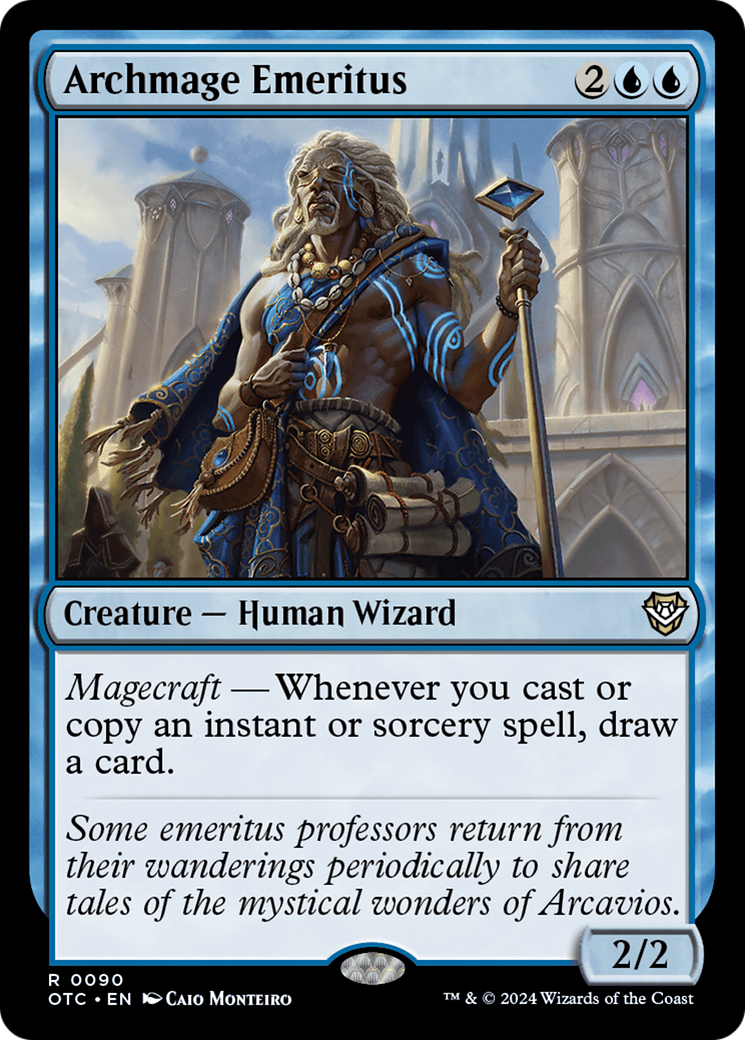
Archmage Emeritus
Archmage Emeritus
Creature — Human Wizard
2/2
Magecraft — Whenever you cast or copy an instant or sorcery spell, draw a card.
- If an effect creates multiple copies of an instant or sorcery spell, magecraft abilities trigger once for each copy created by the effect.
- If an effect creates a copy of an instant or sorcery spell, this will also cause the magecraft ability to trigger.
- Each magecraft ability has a different effect, although they all have the same trigger condition, whenever you cast or copy an instant or sorcery spell.
- Some effects instruct you to copy an instant or sorcery card in a zone other than the stack. These copies do not cause magecraft abilities to trigger. However, most effects that do this also allow you to cast the copy, and casting the copy will cause magecraft abilities to trigger.
-
1
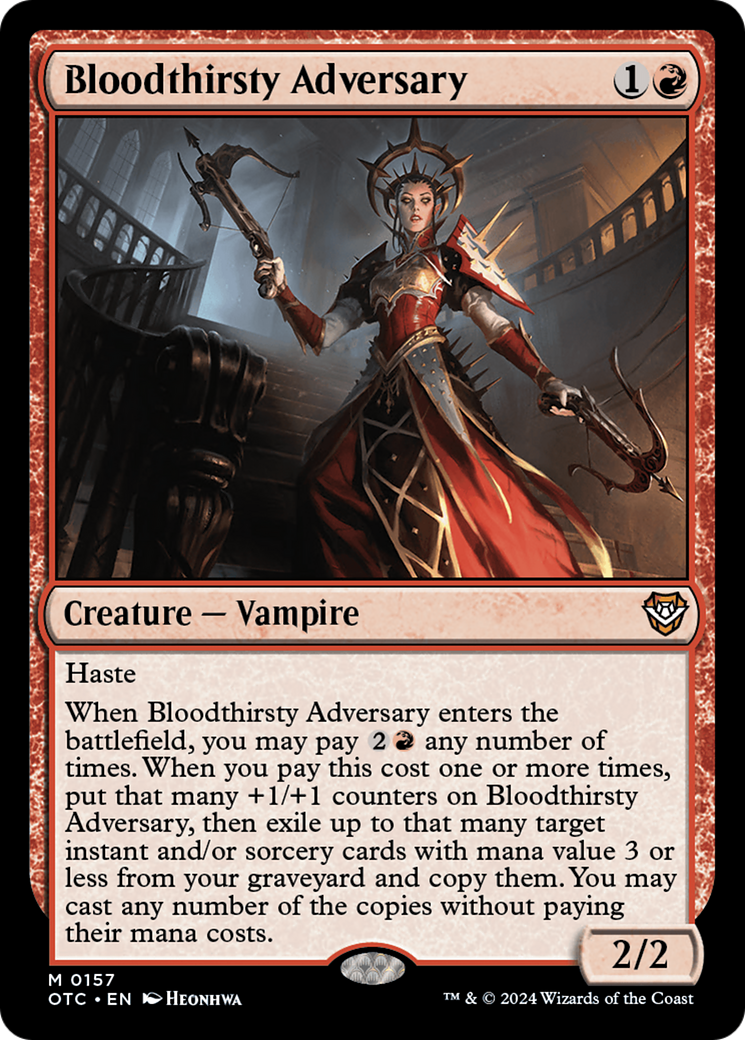
Bloodthirsty Adversary
Bloodthirsty Adversary
Creature — Vampire
2/2
Haste
When this creature enters, you may pay any number of times. When you pay this cost one or more times, put that many +1/+1 counters on this creature, then exile up to that many target instant and/or sorcery cards with mana value 3 or less from your graveyard and copy them. You may cast any number of the copies without paying their mana costs.
- Copies cast this way are cast during the resolution of the ability. You don't have to follow normal timing requirements and you can't wait and cast them later.
- After you pay the cost one or more times, a second ability triggers and you choose the targets for it. Players may respond to the new ability at that point. As that ability resolves, Bloodthirsty Adversary gets its counters and the target cards are exiled.
- Whether or not you cast the copies this way, the original cards will remain in exile.
-
1
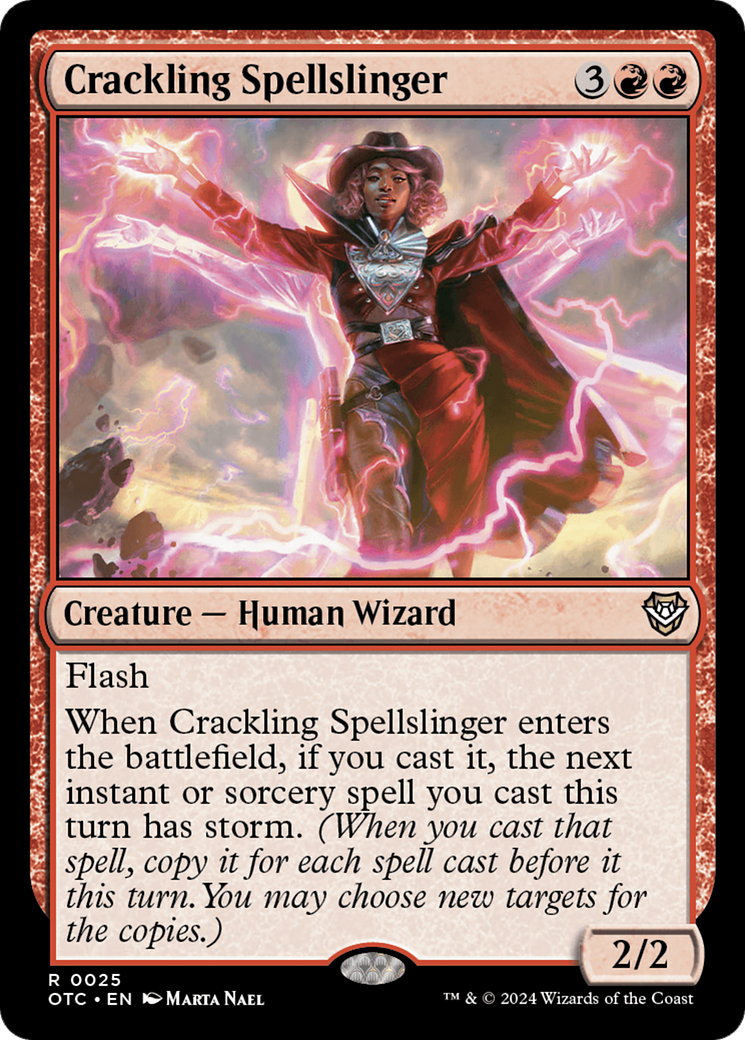
Crackling Spellslinger
Crackling Spellslinger
Creature — Human Wizard
2/2
Flash
When this creature enters, if you cast it, the next instant or sorcery spell you cast this turn has storm. (When you cast that spell, copy it for each spell cast before it this turn. You may choose new targets for the copies.)
- Crackling Spellslinger’s second ability triggers if you cast it from any zone. It doesn’t trigger if you put Crackling Spellslinger onto the battlefield without casting it.
- The copies of a spell with storm created by its storm ability are put directly onto the stack. They aren’t cast and won’t be counted by other spells with storm cast later in the turn.
- Spells cast from zones other than a player’s hand and spells that were countered or otherwise failed to resolve are counted by the storm ability.
- A copy of a spell can be countered like any other spell, but it must be countered individually. Countering a spell with storm won’t affect the copies.
-
1
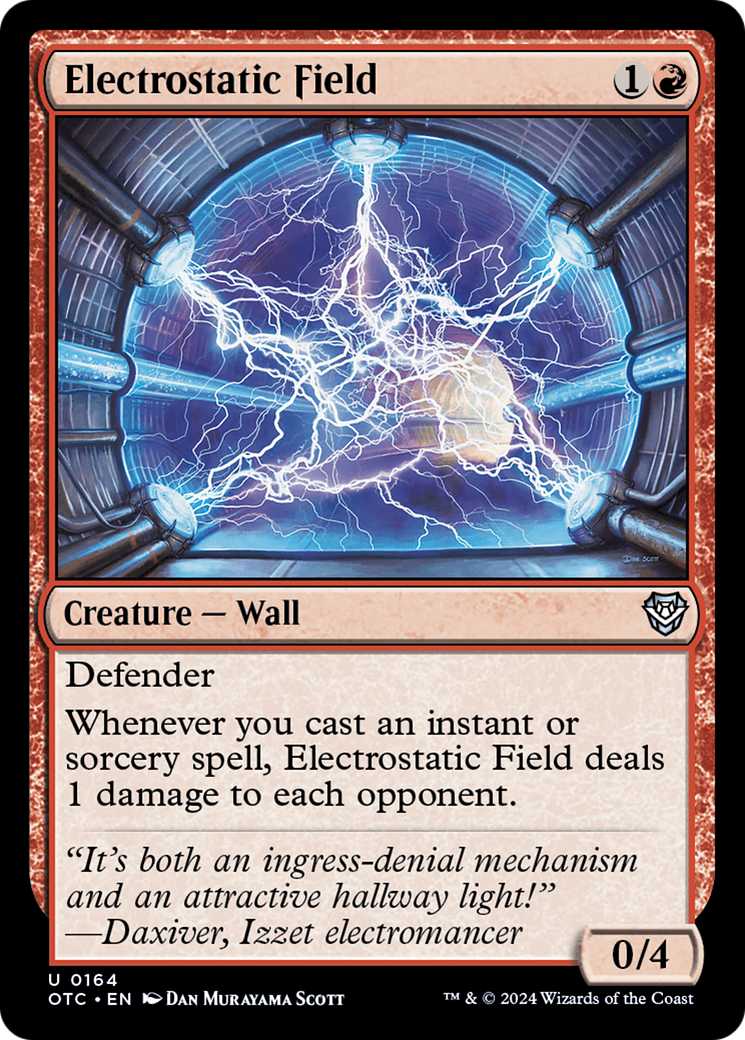
Electrostatic Field
Electrostatic Field
Creature — Wall
0/4
Defender
Whenever you cast an instant or sorcery spell, this creature deals 1 damage to each opponent.
- In a Two-Headed Giant game, Electrostatic Field's triggered ability causes the opposing team to lose 2 life.
- Electrostatic Field's triggered ability resolves before the spell that caused it to trigger. It resolves even if that spell is countered.
-
1
Eris, Roar of the Storm
Eris, Roar of the Storm
Legendary Creature — Elemental Warlock
4/4
This spell costs less to cast for each different mana value among instant and sorcery cards in your graveyard.
Flying, prowess
Whenever you cast your second spell each turn, create a 4/4 red Dragon Elemental creature token with flying and prowess.
- The mana value of a split card in the graveyard is the total mana value of both halves of that card. It does not have two mana values.
- The mana value of a double-faced card in your graveyard is always the mana value of the front face.
- If the mana cost of a card in your graveyard includes , X is 0 for the purpose of determining its mana value.
- Spells that were cast before Eris entered the battlefield count. If Eris was the first spell you cast this turn, the next spell you cast this turn is your second spell.
-
1
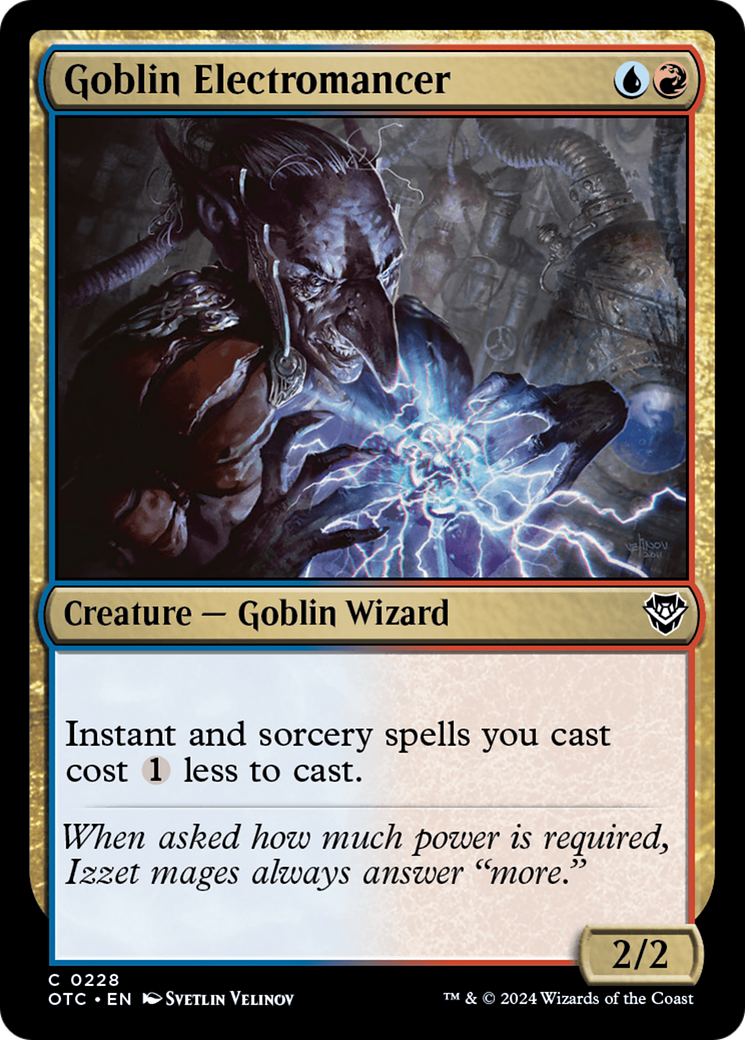
Goblin Electromancer
Goblin Electromancer
Creature — Goblin Wizard
2/2
Instant and sorcery spells you cast cost less to cast.
- To determine the total cost of a spell, start with the mana cost or alternative cost you're paying, add any cost increases, then apply any cost reductions. The mana value of the spell remains unchanged, no matter what the total cost to cast it was.
- Goblin Electromancer's effect reduces only generic mana in the spell's total cost.
- Two Goblin Electromancers will make instant and sorcery spells you cast cost less to cast, and so on.
-
1
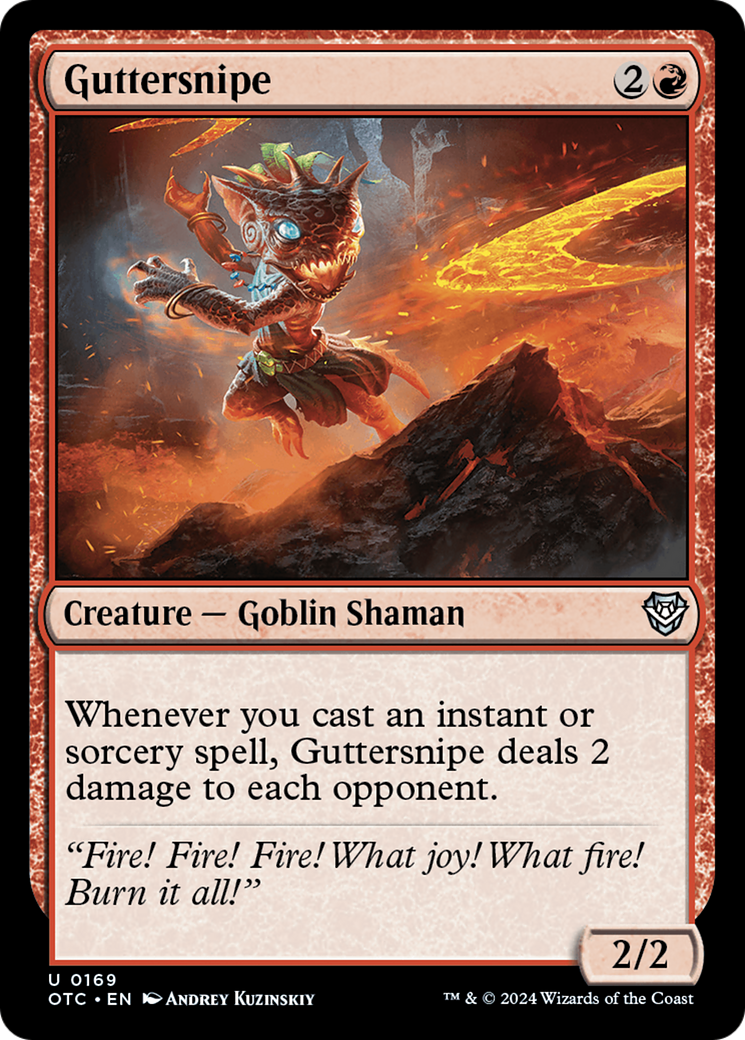
Guttersnipe
Guttersnipe
Creature — Goblin Shaman
2/2
Whenever you cast an instant or sorcery spell, this creature deals 2 damage to each opponent.
- Guttersnipe's triggered ability resolves before the spell that caused it to trigger. It resolves even if that spell is countered or otherwise leaves the stack without resolving.
- In a Two-Headed Giant game, Guttersnipe's ability causes the opposing team to lose 4 life.
-
1
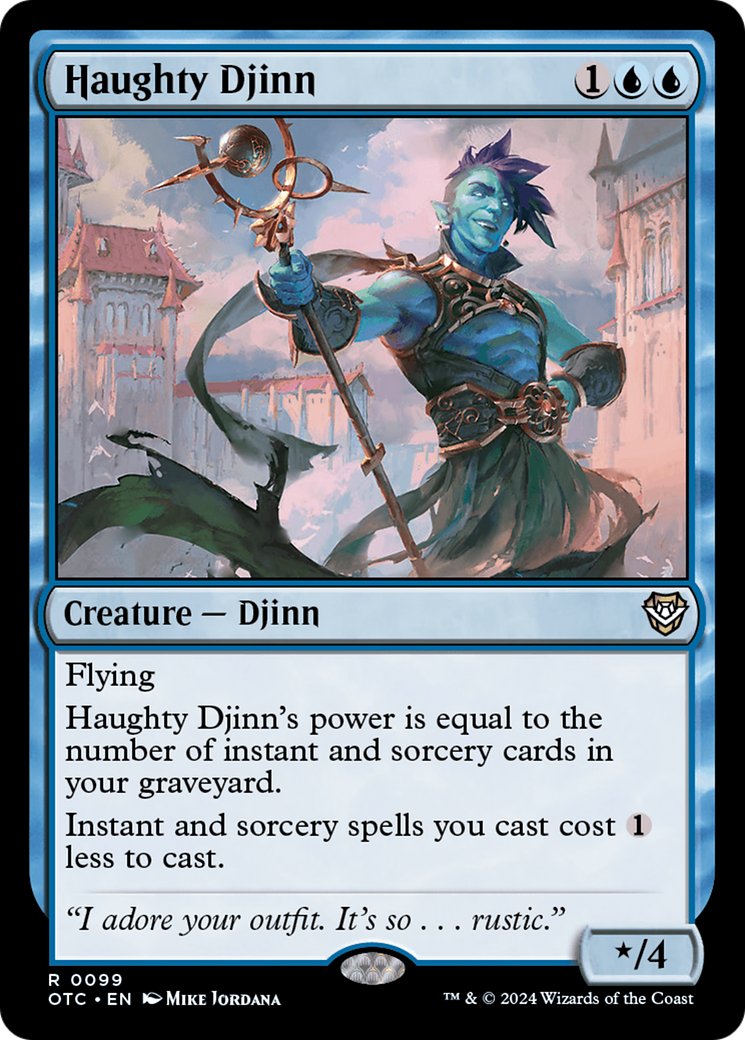
Haughty Djinn
Haughty Djinn
Creature — Djinn
*/4
Flying
Haughty Djinn's power is equal to the number of instant and sorcery cards in your graveyard.
Instant and sorcery spells you cast cost less to cast.
- The ability that defines Haughty Djinn's power functions in all zones.
- A split card in your graveyard only counts once for Haughty Djinn's power, even if it's both an instant and a sorcery.
-
1
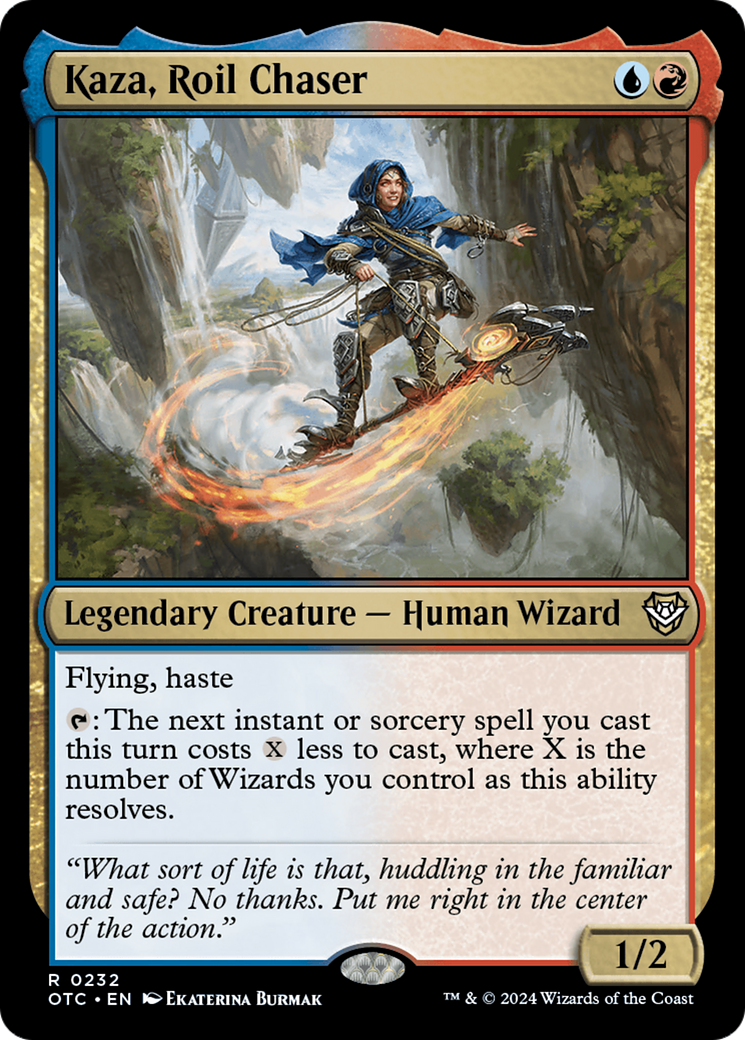
Kaza, Roil Chaser
Kaza, Roil Chaser
Legendary Creature — Human Wizard
1/2
Flying, haste
: The next instant or sorcery spell you cast this turn costs less to cast, where X is the number of Wizards you control as this ability resolves.
- To determine the total cost of a spell, start with the mana cost or alternative cost you're paying, add any cost increases, then apply any cost reductions (such as that of Kaza's activated ability). The mana value of the spell is determined only by its mana cost, no matter what the total cost to cast the spell was.
- Kaza's cost reduction can reduce only generic mana in a spell's cost. It can't reduce colored mana requirements.
-
1
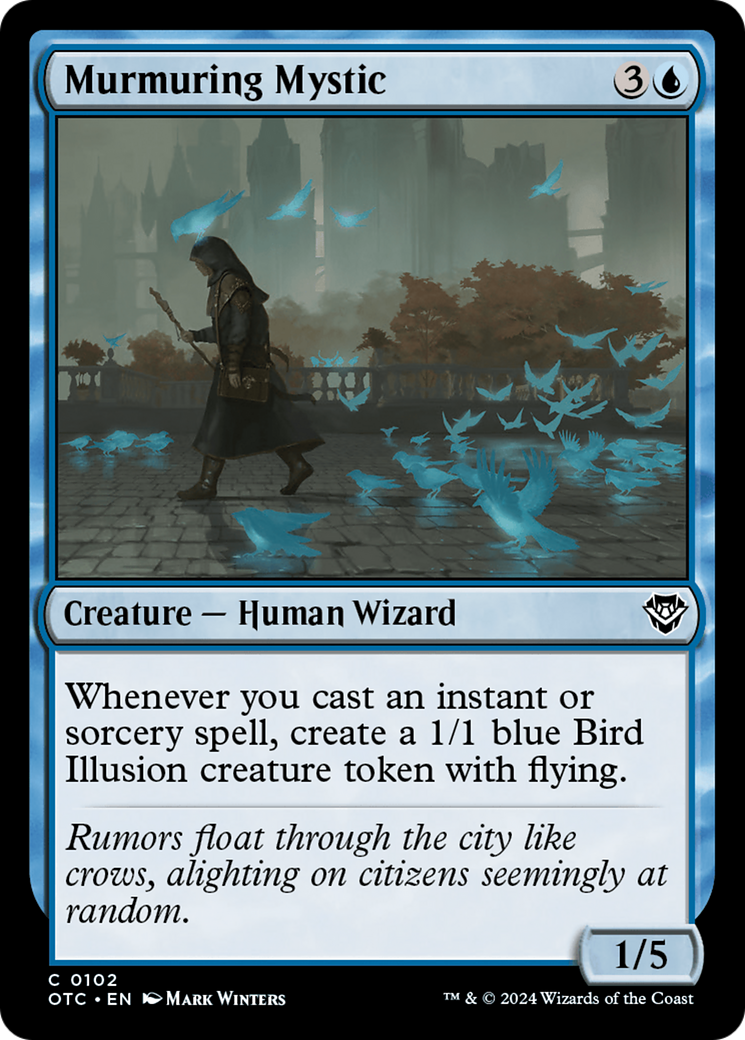
Murmuring Mystic
Murmuring Mystic
Creature — Human Wizard
1/5
Whenever you cast an instant or sorcery spell, create a 1/1 blue Bird Illusion creature token with flying.
- Murmuring Mystic's triggered ability resolves before the spell that caused it to trigger. It resolves even if that spell is countered.
-
1
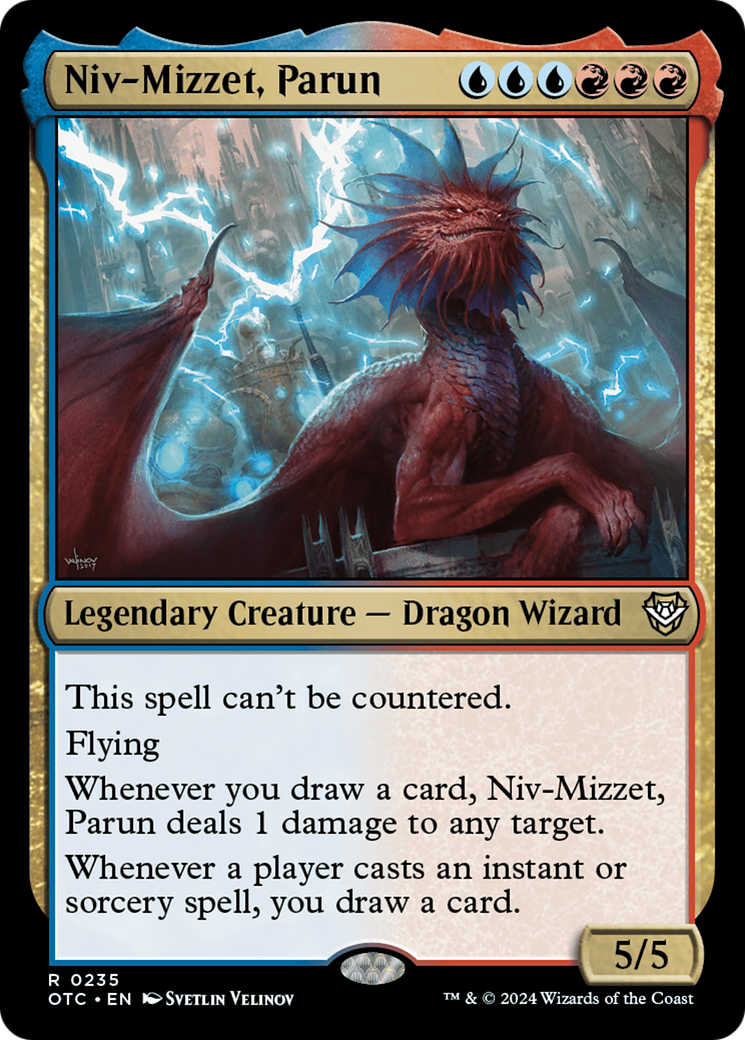
Niv-Mizzet, Parun
Niv-Mizzet, Parun
Legendary Creature — Dragon Wizard
5/5
This spell can't be countered.
Flying
Whenever you draw a card, Niv-Mizzet deals 1 damage to any target.
Whenever a player casts an instant or sorcery spell, you draw a card.
- If an effect instructs you to draw multiple cards, Niv-Mizzet's first triggered ability triggers that many times. You choose targets for those abilities after you've drawn all of the cards.
- If a spell or ability causes you to put cards into your hand without specifically using the word "draw," Niv-Mizzet's first triggered ability won't trigger.
- Niv-Mizzet's second triggered ability resolves before the spell that caused it to trigger. It resolves even if that spell is countered. This causes its first triggered ability to trigger, and that also resolves before the spell.
- Players can cast spells and activate abilities after Niv-Mizzet's second triggered ability resolves but before the spell that caused it to trigger does. Notably, the card you draw may be able to counter that spell.
-
1
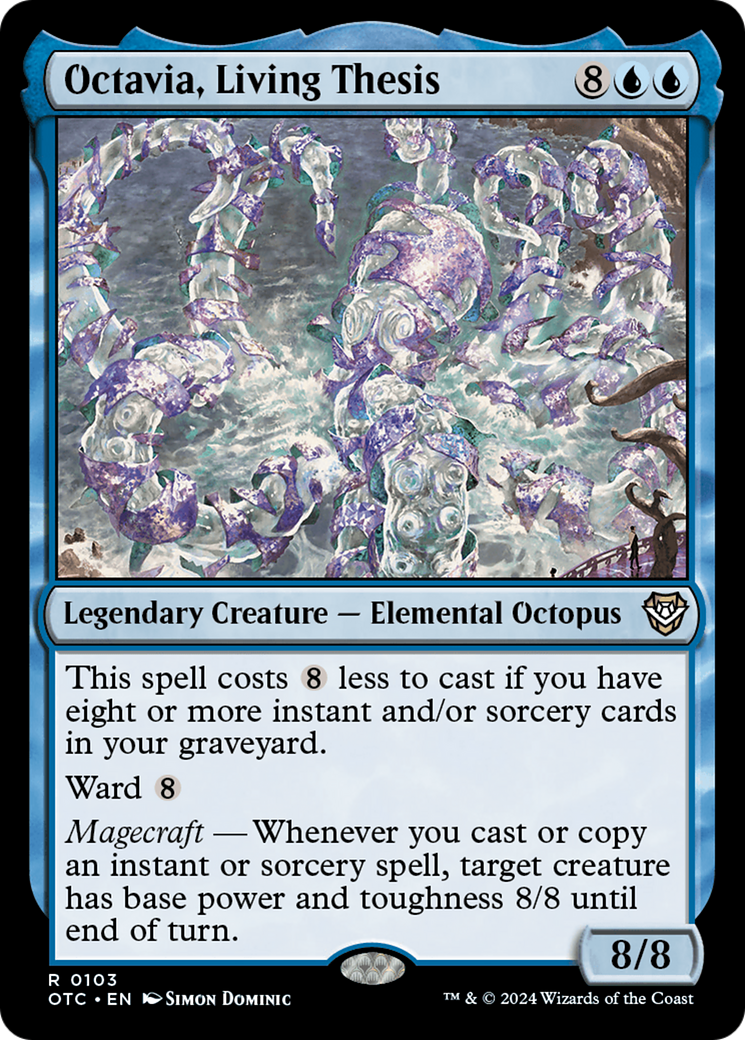
Octavia, Living Thesis
Octavia, Living Thesis
Legendary Creature — Elemental Octopus
8/8
This spell costs less to cast if you have eight or more instant and/or sorcery cards in your graveyard.
Ward
Magecraft — Whenever you cast or copy an instant or sorcery spell, target creature has base power and toughness 8/8 until end of turn.
- Each magecraft ability has a different effect, although they all have the same trigger condition, whenever you cast or copy an instant or sorcery spell.
- For example, if you control Archmage Emeritus and cast an instant or sorcery spell, Archmage Emeritus's magecraft ability will trigger and you will draw a card.
- If an effect creates a copy of an instant or sorcery spell, this will also cause the magecraft ability to trigger.
- If an effect creates multiple copies of an instant or sorcery spell, magecraft abilities trigger once for each copy created by the effect.
- Some effects instruct you to copy an instant or sorcery card in a zone other than the stack. These copies do not cause magecraft abilities to trigger. However, most effects that do this also allow you to cast the copy, and casting the copy will cause magecraft abilities to trigger.
- If a player casts a spell that targets multiple permanents their opponent controls with ward, each of those ward abilities will trigger. If that player doesn't pay for all of them, the spell will be countered.
-
1
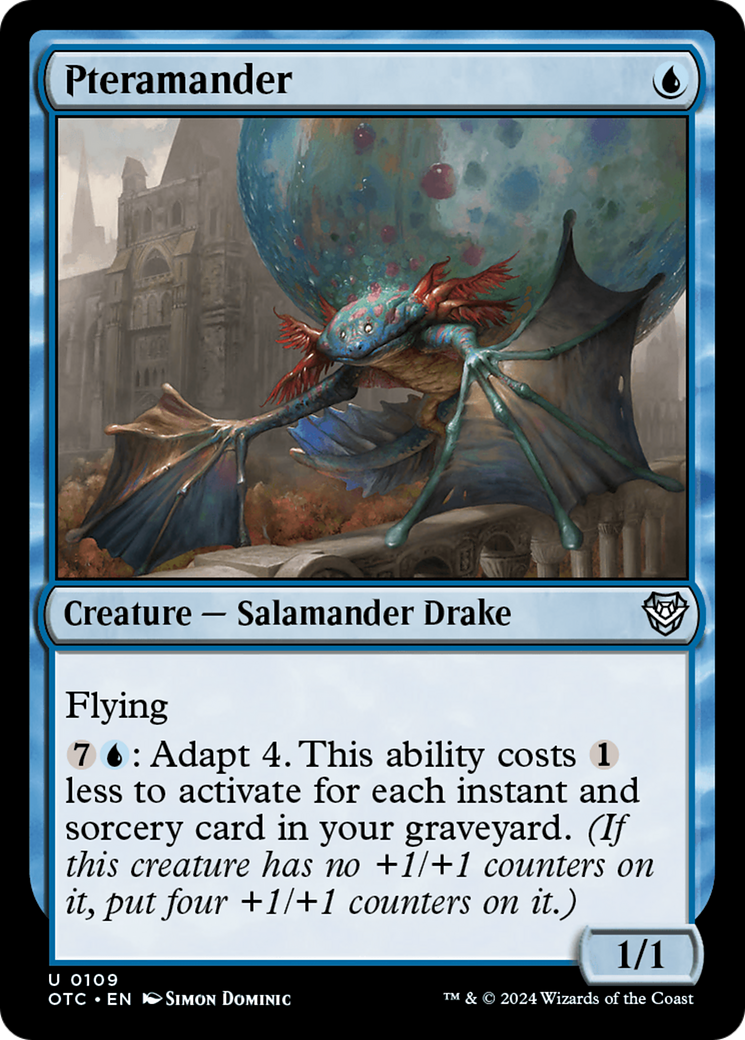
Pteramander
Pteramander
Creature — Salamander Drake
1/1
Flying
: Adapt 4. This ability costs less to activate for each instant and sorcery card in your graveyard. (If this creature has no +1/+1 counters on it, put four +1/+1 counters on it.)
- Pteramander's activated ability can't reduce itself to less than to activate.
- You can always activate an ability that will cause a creature to adapt. As that ability resolves, if the creature has a +1/+1 counter on it for any reason, you simply won't put any +1/+1 counters on it.
- If a creature somehow loses all of its +1/+1 counters, it can adapt again and get more +1/+1 counters.
-
1
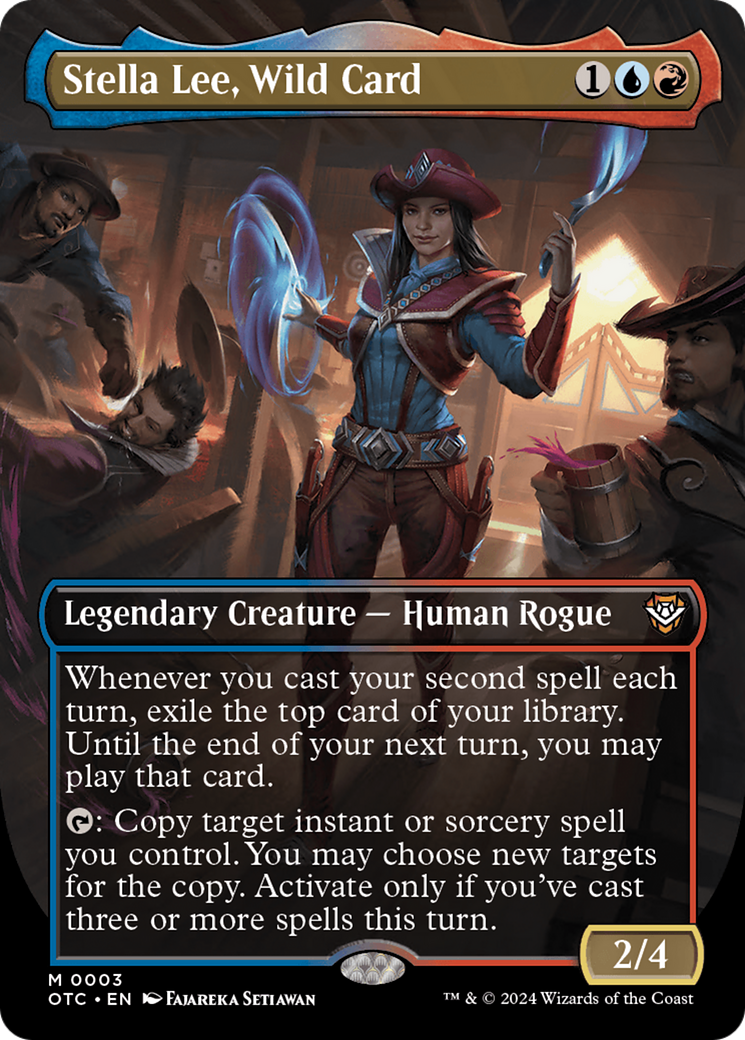
Stella Lee, Wild Card
Stella Lee, Wild Card
Legendary Creature — Human Rogue
2/4
Whenever you cast your second spell each turn, exile the top card of your library. Until the end of your next turn, you may play that card.
: Copy target instant or sorcery spell you control. You may choose new targets for the copy. Activate only if you've cast three or more spells this turn.
- Spells that were cast before Stella Lee entered the battlefield count. If Stella Lee was the first spell you cast this turn, the next spell you cast this turn is your second spell.
- You pay all costs and follow all normal timing rules for cards played from exile with Stella Lee’s first ability. For example, if the exiled card is a land card, you may play it only during your main phase while the stack is empty.
- The copy created by Stella Lee’s last ability will have the same targets as the spell it’s copying unless you choose new ones. You may change any number of the targets, including all of them or none of them. The new targets must be legal.
- If the copied spell is modal (that is, it says “Choose one —” or the like), the copy will have the same mode or modes. You can’t choose different ones.
- If the copied spell divides damage or distributes counters among a number of targets, the division and number of targets can’t be changed. If you choose new targets, you must choose the same number of targets.
- If a spell that’s copied has an X whose value was determined as it was cast, the copy will have the same value of X.
- You can’t choose to pay any additional costs for the copy. However, effects based on any additional costs that were paid for the original spell are copied as though those same costs were paid for the copy too.
- The copy made by Stella Lee’s last ability is created on the stack, so it’s not “cast.”
-
1
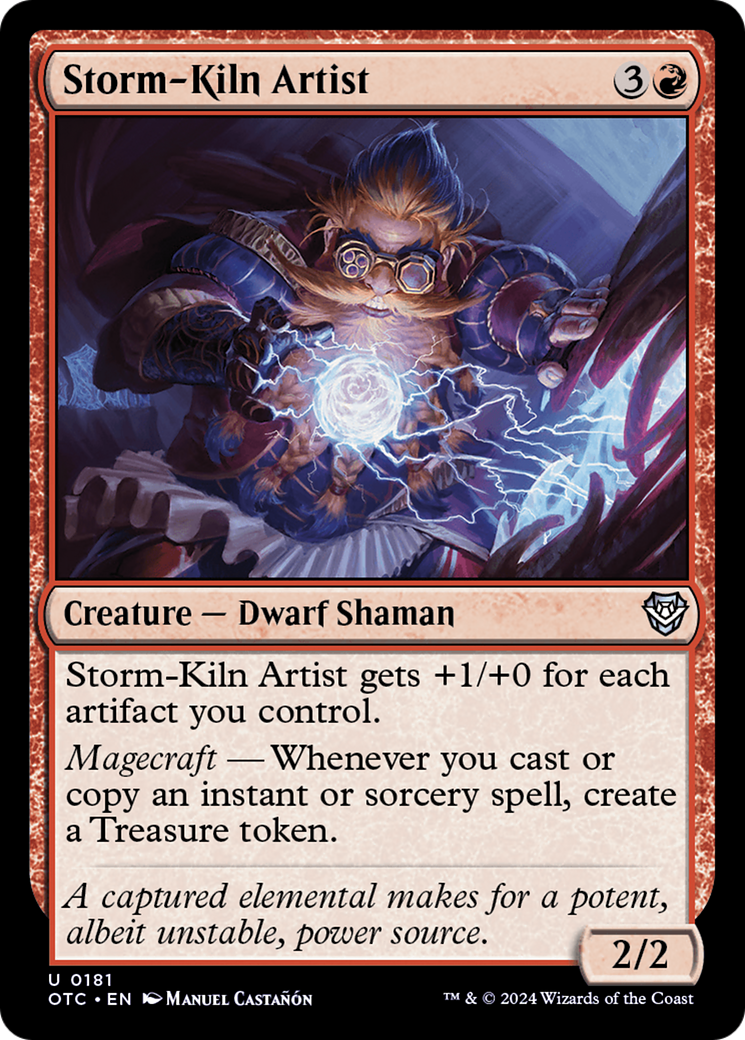
Storm-Kiln Artist
Storm-Kiln Artist
Creature — Dwarf Shaman
2/2
This creature gets +1/+0 for each artifact you control.
Magecraft — Whenever you cast or copy an instant or sorcery spell, create a Treasure token. (It's an artifact with " , Sacrifice this token: Add one mana of any color.")
- If an effect creates multiple copies of an instant or sorcery spell, magecraft abilities trigger once for each copy created by the effect.
- Each magecraft ability has a different effect, although they all have the same trigger condition, whenever you cast or copy an instant or sorcery spell.
- Some effects instruct you to copy an instant or sorcery card in a zone other than the stack. These copies do not cause magecraft abilities to trigger. However, most effects that do this also allow you to cast the copy, and casting the copy will cause magecraft abilities to trigger.
- If an effect creates a copy of an instant or sorcery spell, this will also cause the magecraft ability to trigger.
-
1
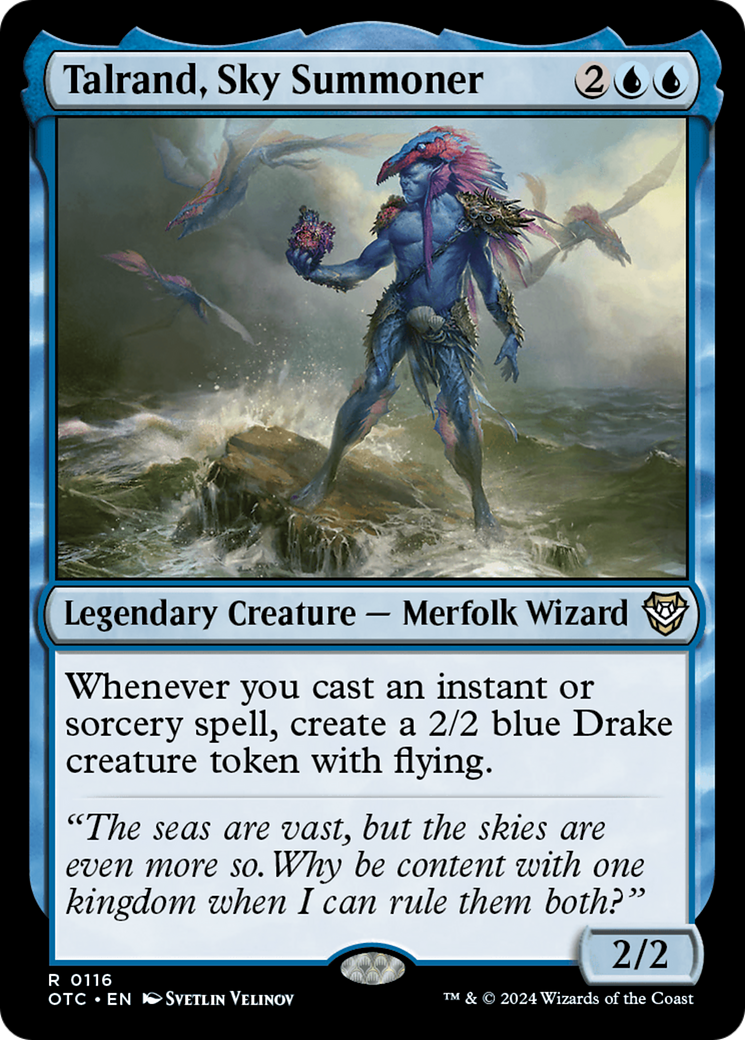
Talrand, Sky Summoner
Talrand, Sky Summoner
Legendary Creature — Merfolk Wizard
2/2
Whenever you cast an instant or sorcery spell, create a 2/2 blue Drake creature token with flying.
- An ability that triggers when a player casts a spell resolves before the spell that caused it to trigger, but after targets have been chosen for that spell. It resolves even if that spell is countered.
-
1
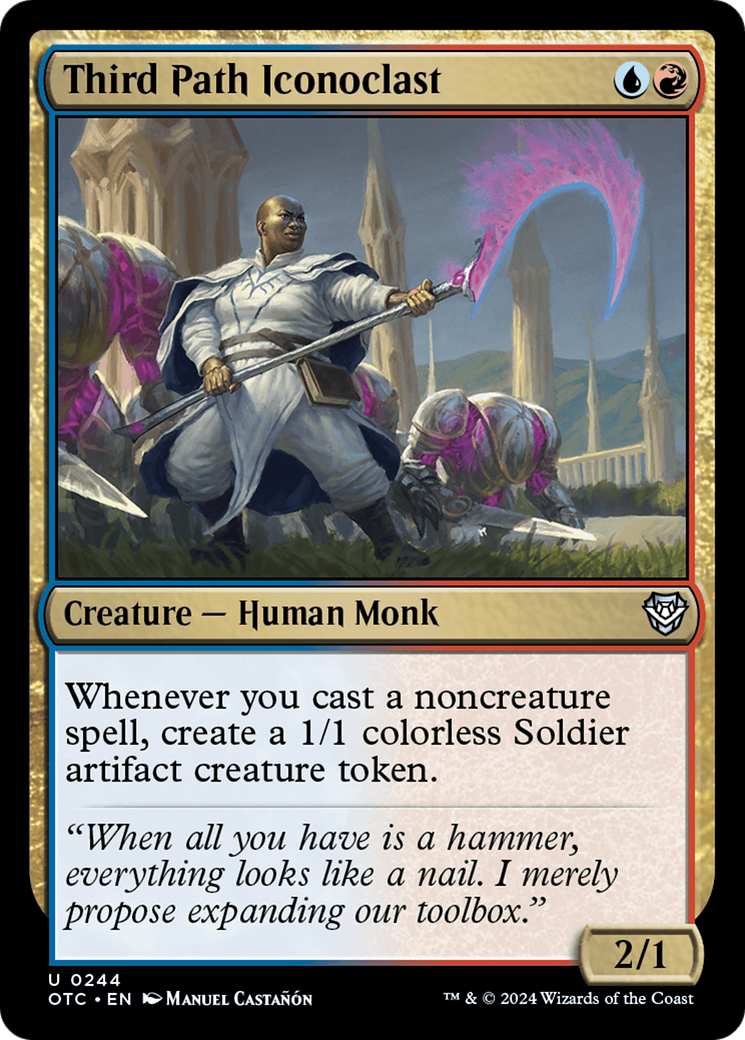
Third Path Iconoclast
Third Path Iconoclast
Creature — Human Monk
2/1
Whenever you cast a noncreature spell, create a 1/1 colorless Soldier artifact creature token.
-
1
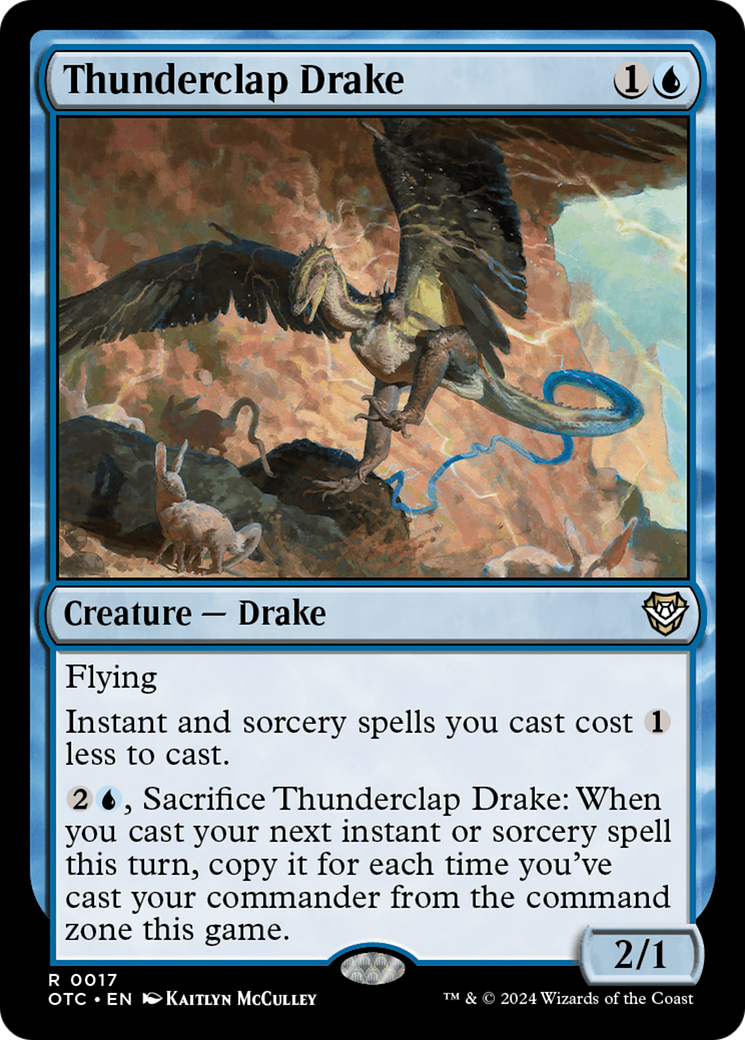
Thunderclap Drake
Thunderclap Drake
Creature — Drake
2/1
Flying
Instant and sorcery spells you cast cost less to cast.
, Sacrifice this creature: When you next cast an instant or sorcery spell this turn, copy it for each time you've cast your commander from the command zone this game. You may choose new targets for the copies.
- The last sentence of Thunderclap Drake's rules text was inadvertently omitted from the card. Its Oracle text has been updated to include that sentence.
- You can't choose to pay any additional costs for the copies. However, effects based on any additional costs that were paid for the original spell are copied as though those same costs were paid for the copies too.
- If the spell that's copied is modal (that is, it says "Choose one —" or the like), the copies will have the same mode or modes. You can't choose different ones.
- Thunderclap Drake's second ability doesn't change the mana cost or mana value of any spell. It changes only the total cost you pay to cast instant and sorcery spells.
- If a spell that's copied has an X whose value was determined as it was cast, the copies will have the same value of X.
- If you have multiple commanders, you'll copy the next instant or sorcery spell you cast this turn for each time you've cast either of them. For example, if you've cast one commander once and one twice, you'll copy that spell three times.
- The copies made by Thunderclap Drake's delayed triggered ability are created on the stack, so they're not "cast."
- Thunderclap Drake's second ability can't reduce the amount of colored mana you pay for a spell. It reduces only the generic mana component of that spell's cost.
- If the spell that's copied divides damage or distributes counters among a number of targets, the division and number of targets can't be changed.
-
1
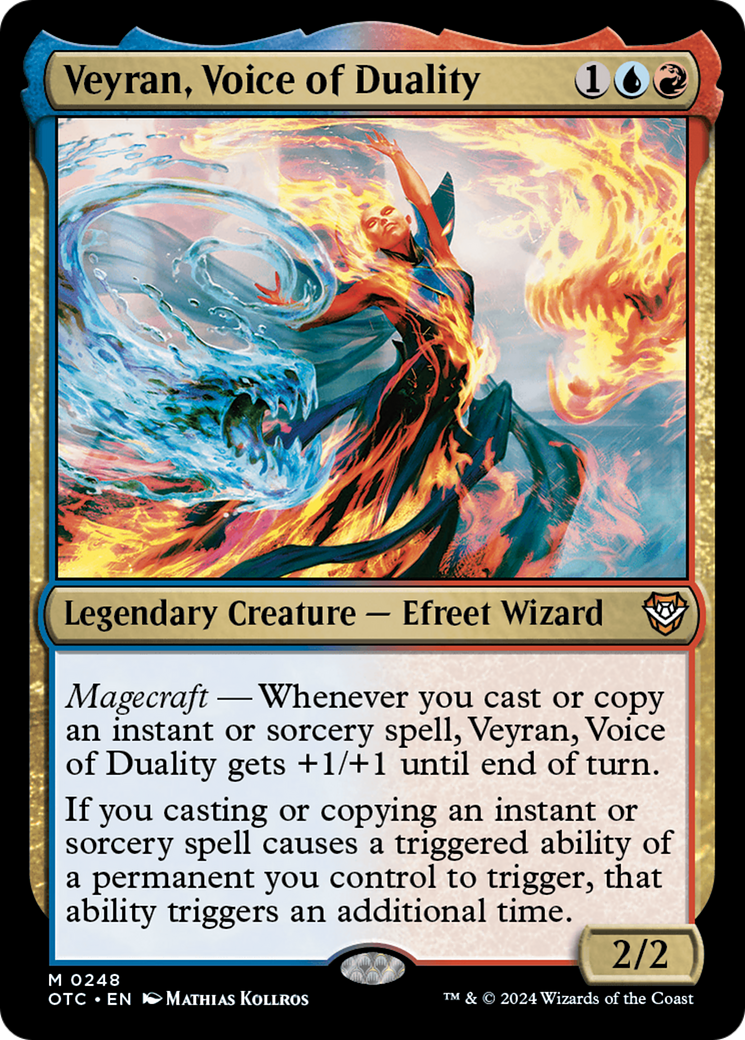
Veyran, Voice of Duality
Veyran, Voice of Duality
Legendary Creature — Efreet Wizard
2/2
Magecraft — Whenever you cast or copy an instant or sorcery spell, Veyran gets +1/+1 until end of turn.
If you casting or copying an instant or sorcery spell causes a triggered ability of a permanent you control to trigger, that ability triggers an additional time.
- Veyran, Voice of Duality's last ability causes each of your magecraft abilities, including Veyran's own, to trigger an additional time.
- If an effect creates a copy of an instant or sorcery spell, this will also cause the magecraft ability to trigger.
- Some effects instruct you to copy an instant or sorcery card in a zone other than the stack. These copies do not cause magecraft abilities to trigger. However, most effects that do this also allow you to cast the copy, and casting the copy will cause magecraft abilities to trigger.
- Each magecraft ability has a different effect, although they all have the same trigger condition, whenever you cast or copy an instant or sorcery spell.
- Veyran's effect doesn't copy the triggered ability; it just causes the ability to trigger again. Any choices you make as you put the ability on the stack, such as modes and targets, are made separately for each instance of the ability. Any choices made on resolution are also made individually.
- If an effect creates multiple copies of an instant or sorcery spell, magecraft abilities trigger once for each copy created by the effect.
- If you somehow control two Veyrans (which would be poetic), you casting an instant or sorcery spell causes abilities to trigger three times. A third Veyran (less poetic) causes abilities to trigger four times, and so on.
-
1
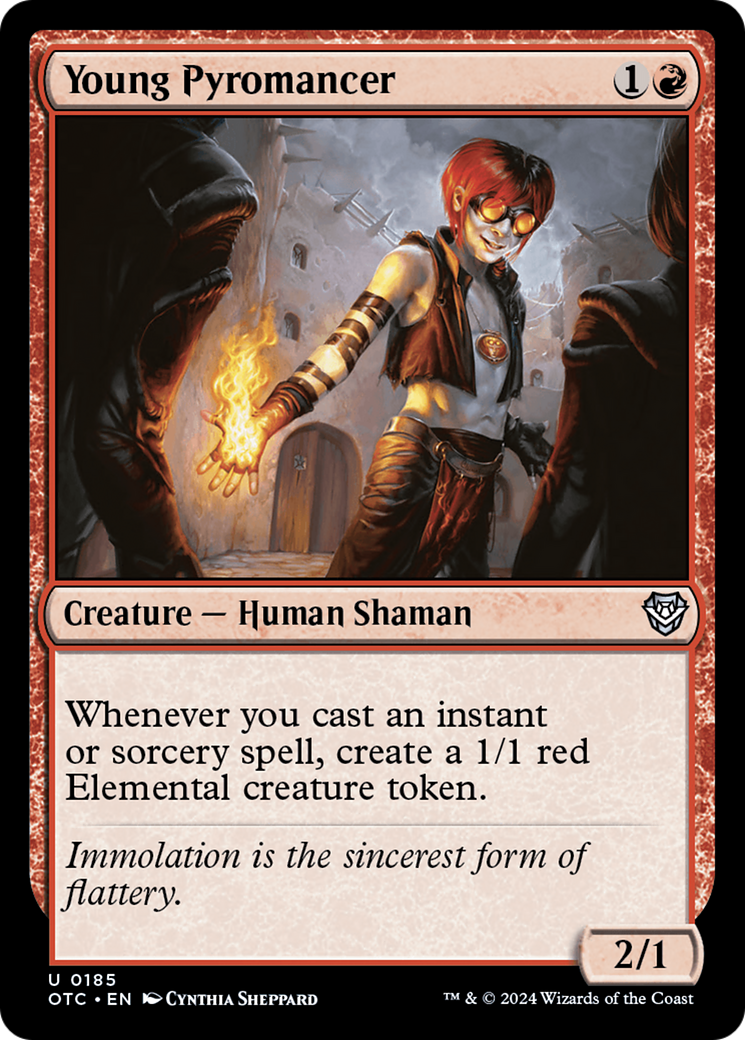
Young Pyromancer
Young Pyromancer
Creature — Human Shaman
2/1
Whenever you cast an instant or sorcery spell, create a 1/1 red Elemental creature token.
- An ability that triggers when a player casts a spell resolves before the spell that caused it to trigger, but after targets have been chosen for that spell. It resolves even if that spell is countered.
Instants 9
-
1
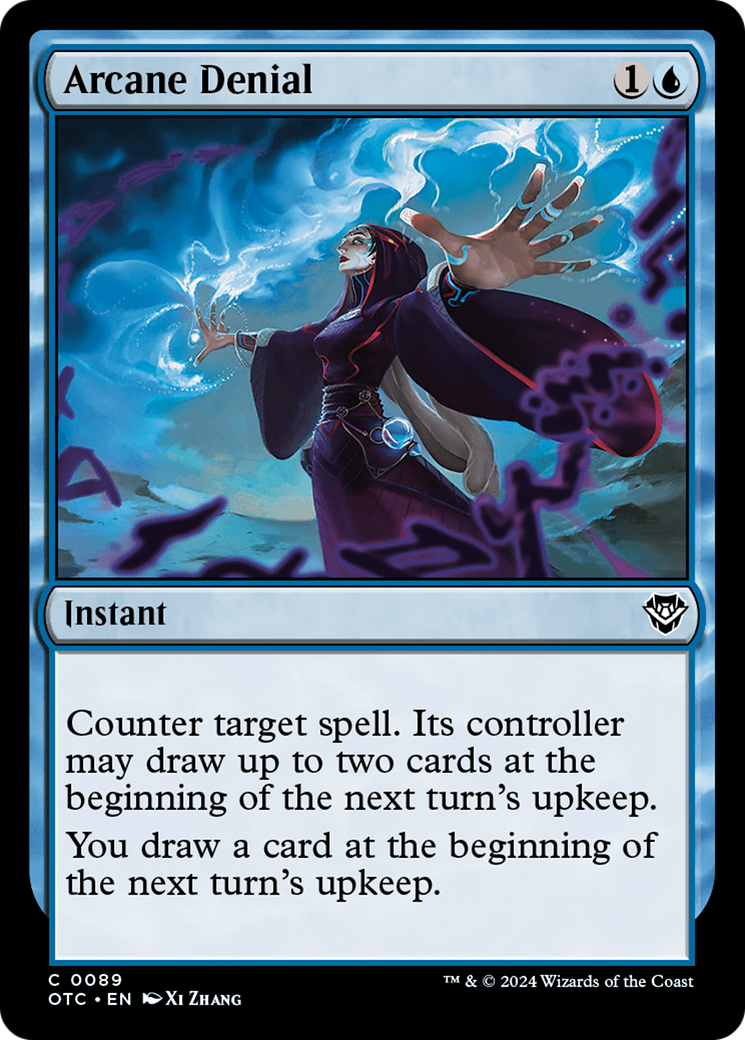
Arcane Denial
Arcane Denial
Instant
Counter target spell. Its controller may draw up to two cards at the beginning of the next turn's upkeep.
You draw a card at the beginning of the next turn's upkeep.
- The controller of the countered spell doesn't choose how many cards to draw until the relevant ability resolves. The player may draw 0, 1, or 2 cards. They choose the number before drawing any cards.
-
1
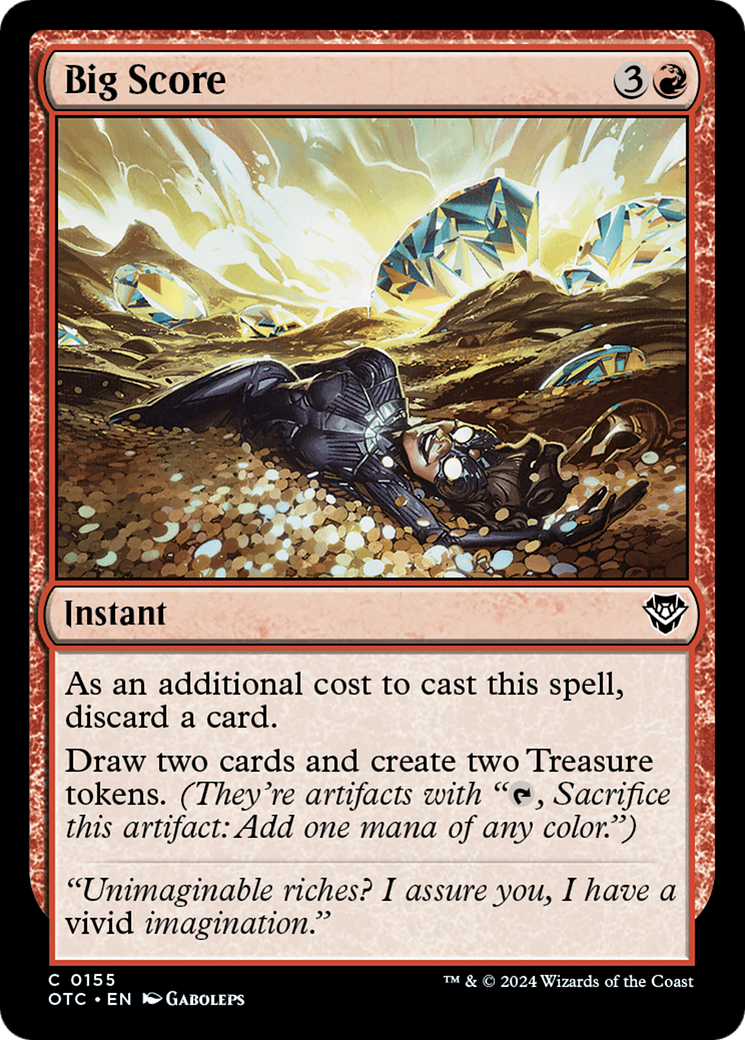
Big Score
Big Score
Instant
As an additional cost to cast this spell, discard a card.
Draw two cards and create two Treasure tokens. (They're artifacts with " , Sacrifice this token: Add one mana of any color.")
-
1
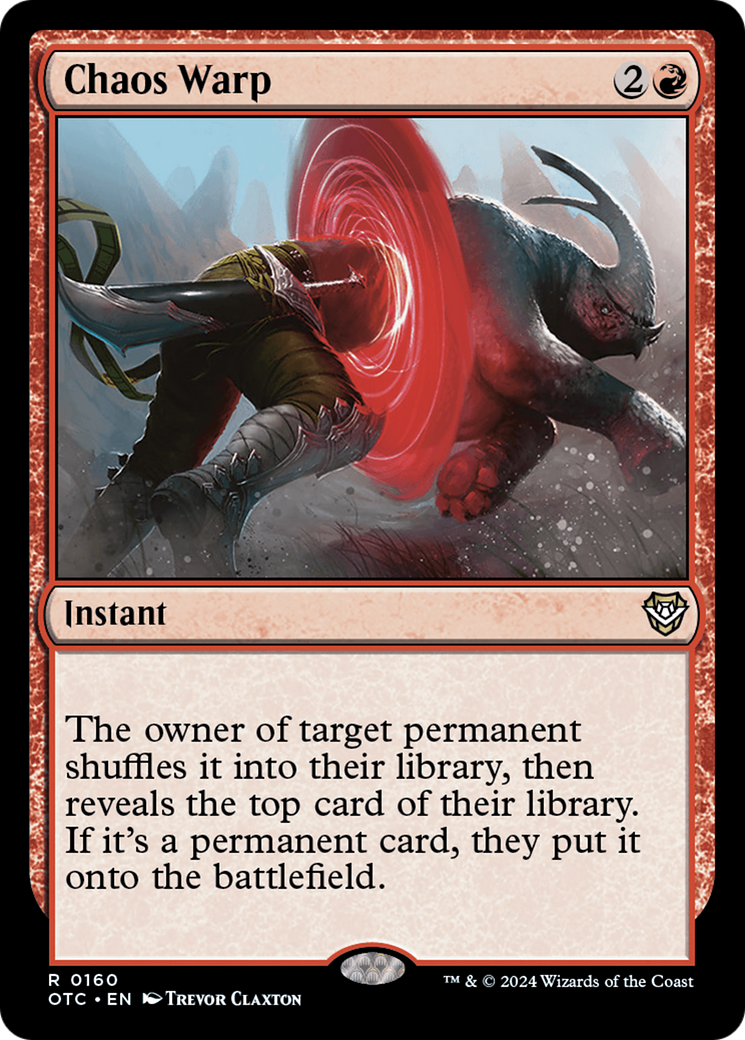
Chaos Warp
Chaos Warp
Instant
The owner of target permanent shuffles it into their library, then reveals the top card of their library. If it's a permanent card, they put it onto the battlefield.
- A permanent card is a card with one or more of the following card types: artifact, creature, enchantment, land, or planeswalker.
- The owner of a token is the player under whose control the token was put onto the battlefield. If a token is shuffled into a player's library this way, that player shuffles before revealing the top card of that library.
- If the revealed card is not a permanent card, it remains on top of that library.
- If the permanent is an illegal target by the time Chaos Warp tries to resolve, it won't resolve and none of its effects will occur. No library will be shuffled and no card will be revealed.
- If the revealed card is a permanent card but can't enter (perhaps because it's an Aura with nothing to enchant), it remains on top of that library.
-
1
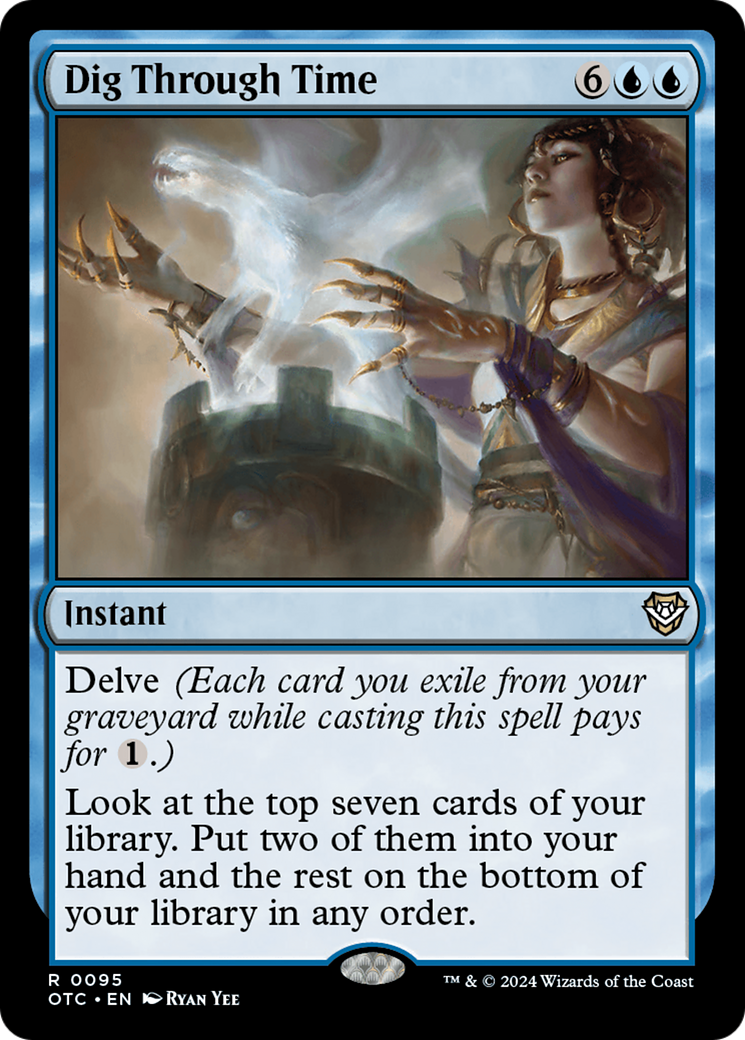
Dig Through Time
Dig Through Time
Instant
Delve (Each card you exile from your graveyard while casting this spell pays for .)
Look at the top seven cards of your library. Put two of them into your hand and the rest on the bottom of your library in any order.
- Because delve isn't an alternative cost, it can be used in conjunction with alternative costs, such as flashback. It can also be used to pay for additional costs that include generic mana.
- Delve doesn't change a spell's mana cost or mana value. For example, Treasure Cruise's mana value is 8 even if you exiled three cards to cast it.
- You can exile cards to pay only for generic mana, and you can't exile more cards than the generic mana requirement of a spell with delve. For example, you can't exile more than seven cards from your graveyard to cast Treasure Cruise unless an effect has increased its cost.
-
1
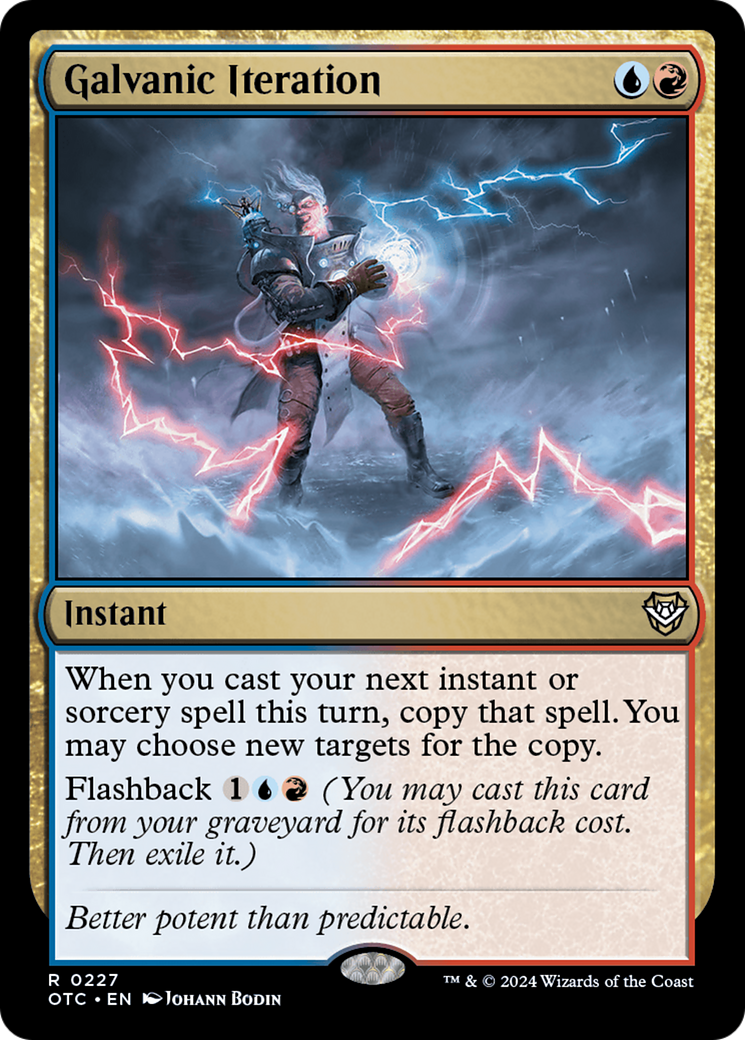
Galvanic Iteration
Galvanic Iteration
Instant
When you next cast an instant or sorcery spell this turn, copy that spell. You may choose new targets for the copy.
Flashback (You may cast this card from your graveyard for its flashback cost. Then exile it.)
- If you resolve one Galvanic Iteration after another (or cast the same one with flashback), the second Galvanic Iteration will be copied. That copy and spell each resolve, creating two delayed triggered abilities. The next spell you cast after that will be copied twice. If that spell is also a Galvanic Iteration, the following spell will be copied three times, and so on.
- Galvanic Iteration's ability will copy any instant or sorcery spell, not just one with targets.
- A copy is created even if the spell that caused Galvanic Iteration's ability to trigger has been countered by the time that ability resolves. The copy resolves before the original spell.
- The copy will have the same targets as the spell it's copying unless you choose new ones. You may change any number of the targets, including all of them or none of them. The new targets must be legal.
- If the spell that's copied is modal (that is, it says "Choose one —" or the like), the copy will have the same mode or modes. You can't choose different ones.
- If the spell that's copied has an X whose value was determined as it was cast, the copy has the same value of X.
- You can't choose to pay any additional costs for the copy. However, effects based on any additional costs that were paid for the original spell are copied as though those same costs were paid for the copy too.
- The copy that Galvanic Iteration's ability creates is created on the stack, so it's not "cast." Abilities that trigger when a player casts a spell won't trigger.
- "Flashback [cost]" means "You may cast this card from your graveyard by paying [cost] rather than paying its mana cost" and "If the flashback cost was paid, exile this card instead of putting it anywhere else any time it would leave the stack."
- You must still follow any timing restrictions and permissions, including those based on the card's type. For instance, you can cast a sorcery using flashback only when you could normally cast a sorcery.
- To determine the total cost of a spell, start with the mana cost or alternative cost (such as a flashback cost) you're paying, add any cost increases, then apply any cost reductions. The mana value of the spell is determined only by its mana cost, no matter what the total cost to cast the spell was.
- A spell cast using flashback will always be exiled afterward, whether it resolves, is countered, or leaves the stack in some other way.
- You can cast a spell using flashback even if it was somehow put into your graveyard without having been cast.
- If a card with flashback is put into your graveyard during your turn, you can cast it if it's legal to do so before any other player can take any actions.
-
1
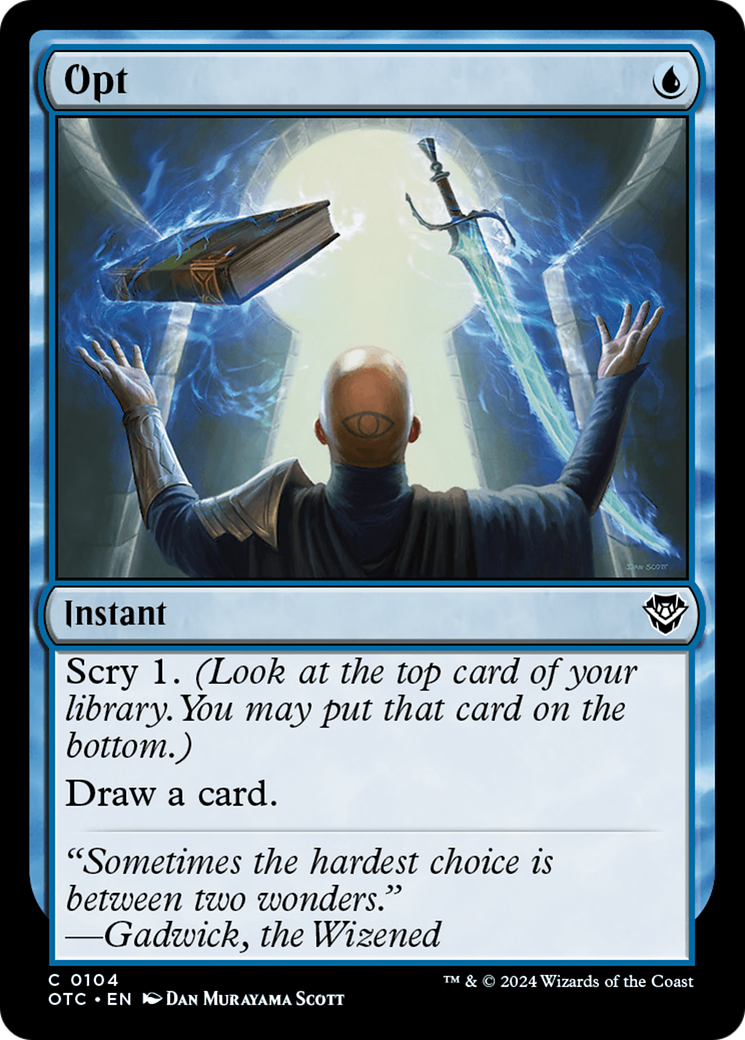
Opt
Opt
Instant
Scry 1. (Look at the top card of your library. You may put that card on the bottom.)
Draw a card.
-
1
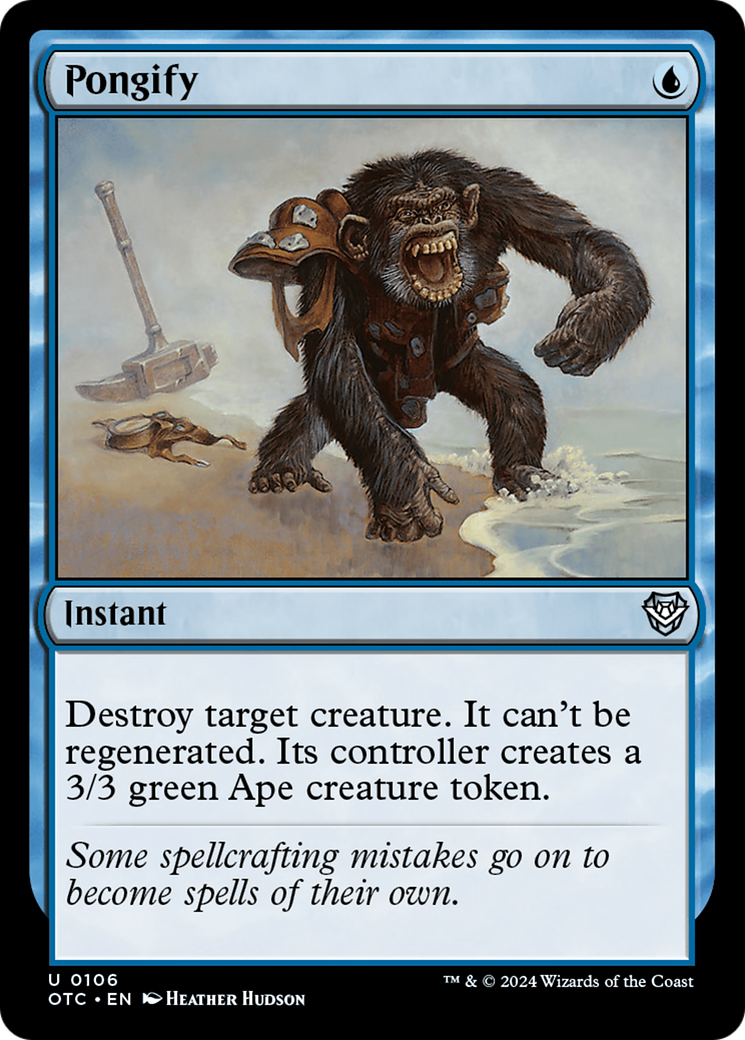
Pongify
Pongify
Instant
Destroy target creature. It can't be regenerated. Its controller creates a 3/3 green Ape creature token.
- If the target creature is an illegal target by the time Pongify tries to resolve, the spell won't resolve. No player creates an Ape token. If the target is legal but not destroyed (most likely because it has indestructible), its controller does create an Ape token.
-
1
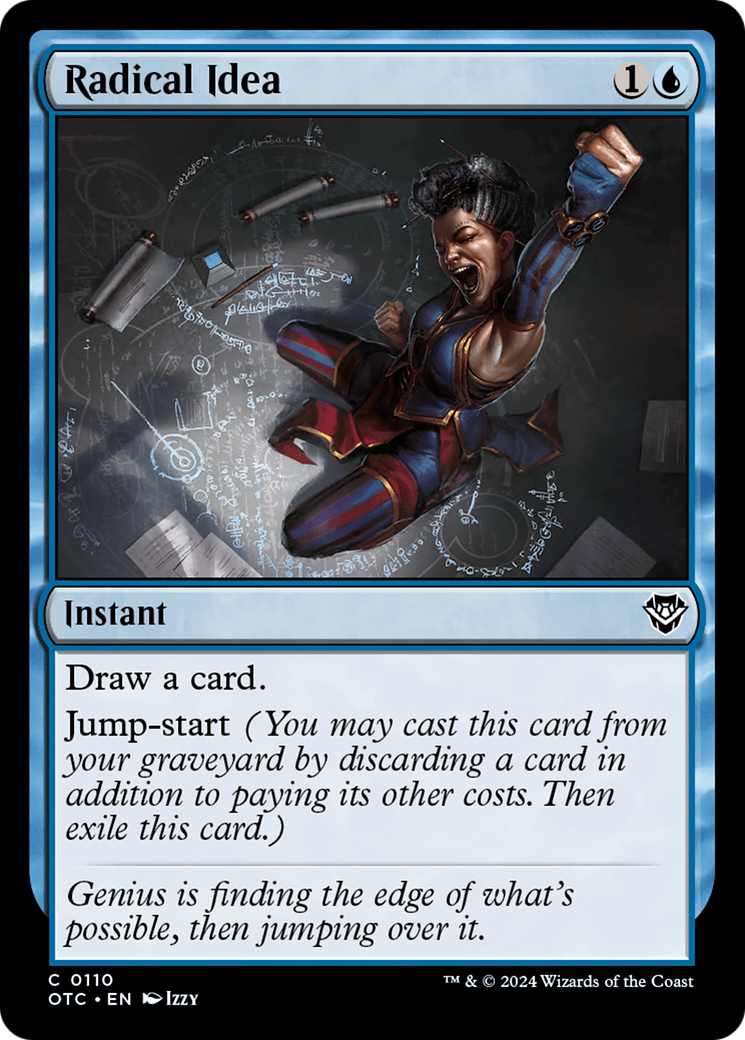
Radical Idea
Radical Idea
Instant
Draw a card.
Jump-start (You may cast this card from your graveyard by discarding a card in addition to paying its other costs. Then exile this card.)
- You must still follow any timing restrictions and permissions when casting a spell with jump-start, including those based on the card's type. For instance, you can cast a sorcery using jump-start only when you could normally cast a sorcery.
- A spell cast using jump-start will always be exiled afterward, whether it resolves, it's countered, or it leaves the stack in some other way.
- If an effect allows you to pay an alternative cost rather than a spell's mana cost, you may pay that alternative cost when you jump-start a spell. You'll still discard a card as an additional cost to cast it.
- If a card with jump-start is put into your graveyard during your turn, you'll be able to cast it right away if it's legal to do so, before an opponent can take any actions.
-
1
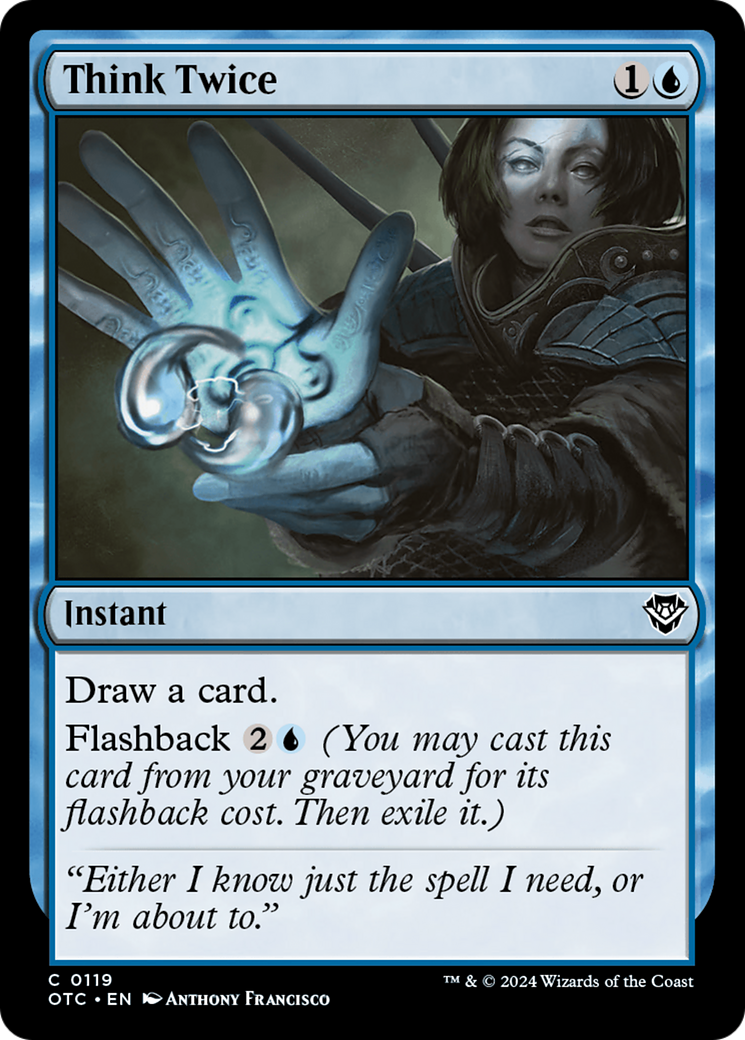
Think Twice
Think Twice
Instant
Draw a card.
Flashback (You may cast this card from your graveyard for its flashback cost. Then exile it.)
- "Flashback [cost]" means "You may cast this card from your graveyard by paying [cost] rather than paying its mana cost" and "If the flashback cost was paid, exile this card instead of putting it anywhere else any time it would leave the stack."
- You must still follow any timing restrictions and permissions, including those based on the card's type. For instance, you can cast a sorcery using flashback only when you could normally cast a sorcery.
- To determine the total cost of a spell, start with the mana cost or alternative cost (such as a flashback cost) you're paying, add any cost increases, then apply any cost reductions. The mana value of the spell is determined only by its mana cost, no matter what the total cost to cast the spell was.
- A spell cast using flashback will always be exiled afterward, whether it resolves, is countered, or leaves the stack in some other way.
- You can cast a spell using flashback even if it was somehow put into your graveyard without having been cast.
- If a card with flashback is put into your graveyard during your turn, you can cast it if it's legal to do so before any other player can take any actions.
Sorceries 21
-
1
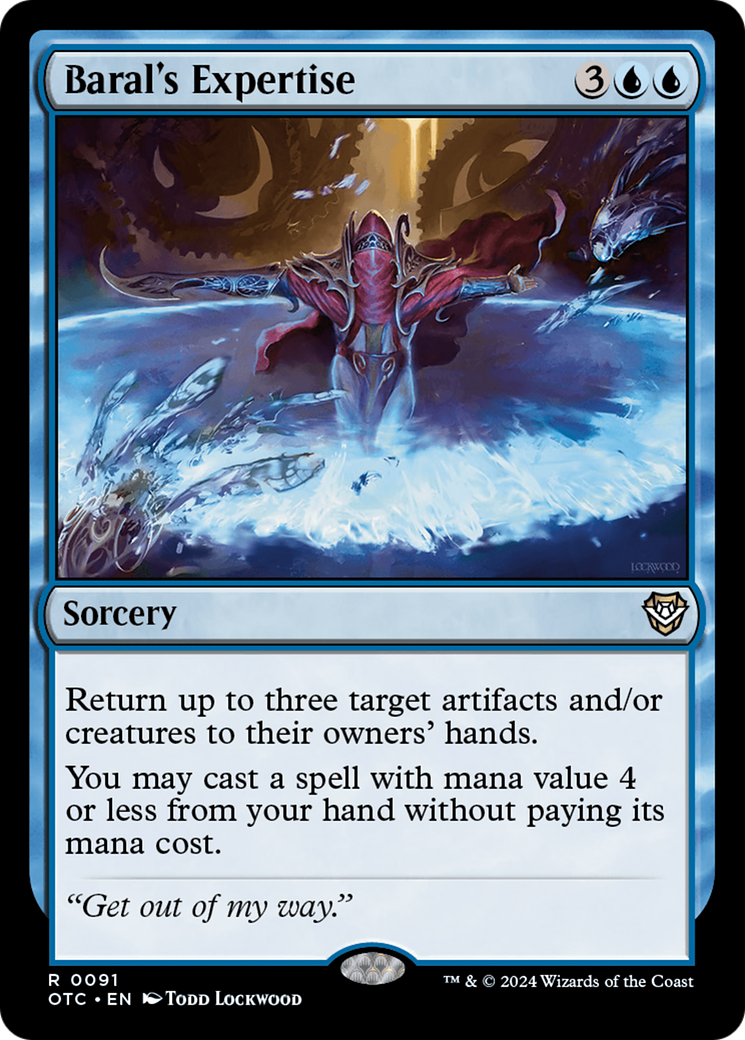
Baral's Expertise
Baral's Expertise
Sorcery
Return up to three target artifacts and/or creatures to their owners' hands.
You may cast a spell with mana value 4 or less from your hand without paying its mana cost.
- The mana value of a split card is determined by the combined mana cost of its two halves. If an expertise spell allows you to cast a split card, you may cast either half or, if that split card has fuse, both halves.
- If the card has in its mana cost, you must choose 0 as the value of X when casting it without paying its mana cost.
- The card that you cast may be an artifact or creature that was returned to your hand by this spell.
- If the Expertise spell you cast has any targets, and those targets become illegal before the spell resolves, the spell doesn't resolve and none of its effects happen. You won't get to cast a free spell.
- Effects that allow you to "cast" a card don't allow you to play a land card.
- If you cast a card "without paying its mana cost," you can't choose to cast it for any alternative costs, such as emerge costs. You can, however, pay additional costs. If the card has any mandatory additional costs, such as that of Cathartic Reunion, you must pay those to cast the card.
- While you're casting your free spell, the Expertise spell is still on the stack. It will be put into its owner's graveyard after the free spell is cast. The free spell can't target the Expertise card in your graveyard. It can target the Expertise spell on the stack, but the Expertise spell will become an illegal target before the free spell resolves.
- Any triggered abilities that trigger while performing the Expertise spell's first effect won't be put onto the stack until after you're done casting your free spell. They're put onto the stack at the same time as any abilities that triggered while casting that spell regardless of the order in which those abilities triggered.
- A card's mana value is determined solely by the mana symbols printed in its upper right corner. The mana value is the total amount of mana in that cost, regardless of color. For example, a card with mana cost has mana value 3. Ignore any alternative costs, additional costs, cost increases, or cost reductions that could apply to it. A card with no mana cost has a mana value of 0.
-
1
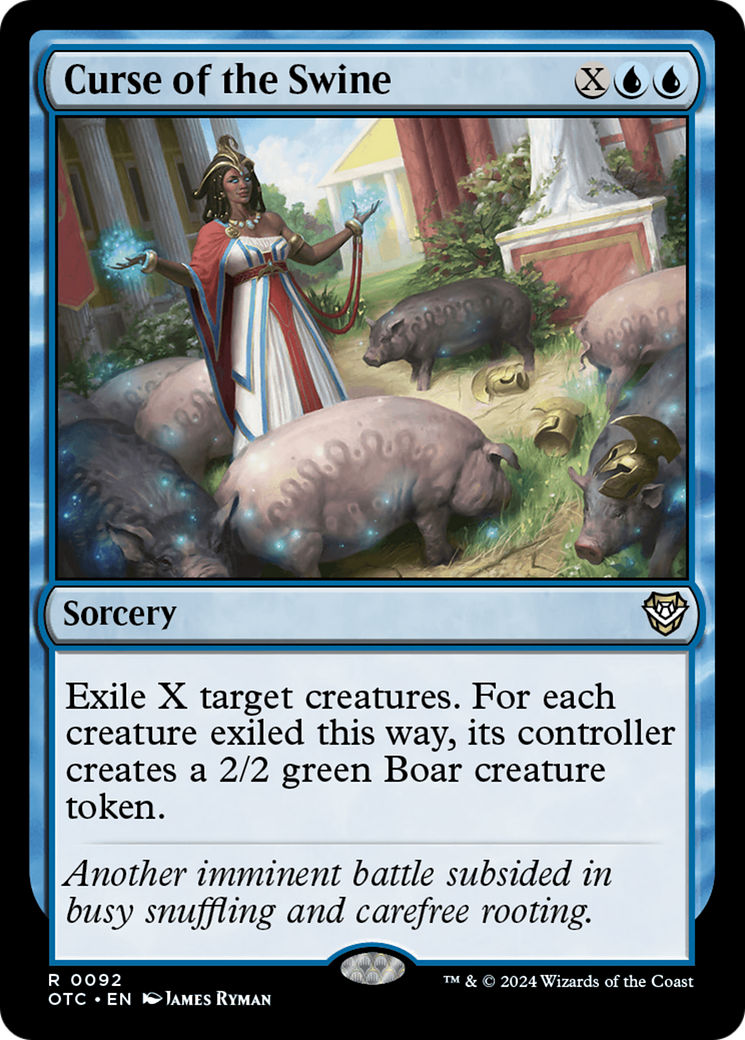
Curse of the Swine
Curse of the Swine
Sorcery
Exile X target creatures. For each creature exiled this way, its controller creates a 2/2 green Boar creature token.
-
1
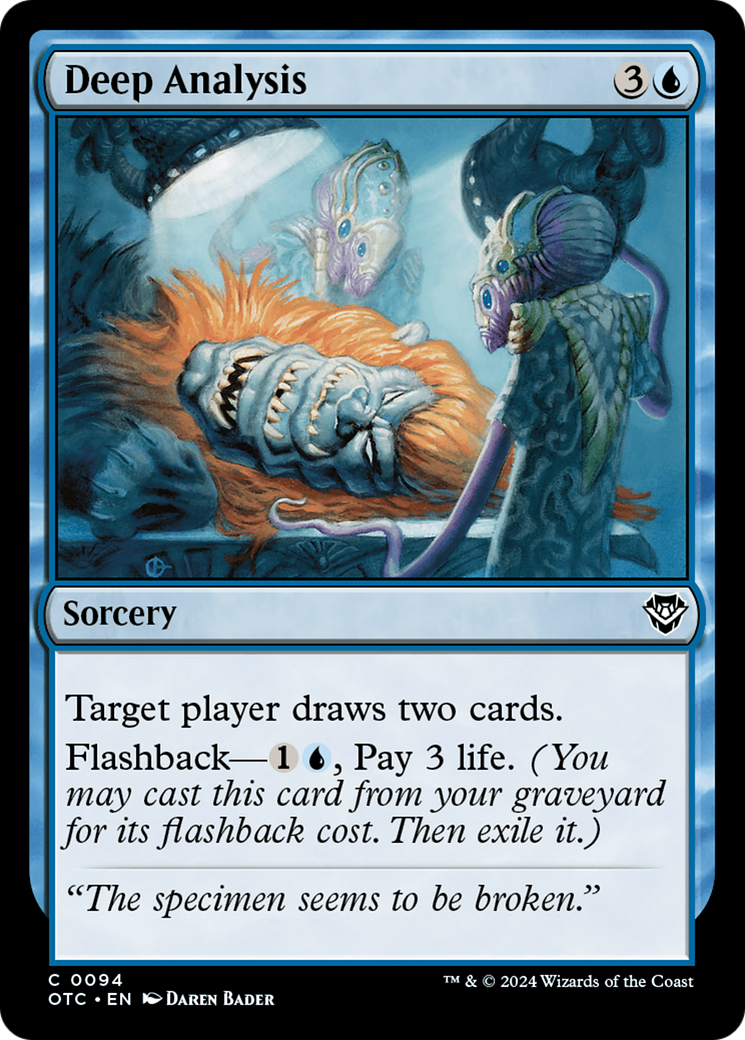
Deep Analysis
Deep Analysis
Sorcery
Target player draws two cards.
Flashback— , Pay 3 life. (You may cast this card from your graveyard for its flashback cost. Then exile it.)
- A spell cast using flashback will always be exiled afterward, whether it resolves, is countered, or leaves the stack in some other way.
- You must still follow any timing restrictions and permissions, including those based on the card's type. For instance, you can cast a sorcery using flashback only when you could normally cast a sorcery.
- You can cast a spell using flashback even if it was somehow put into your graveyard without having been cast.
- To determine the total cost of a spell, start with the mana cost or alternative cost (such as a flashback cost) you're paying, add any cost increases, then apply any cost reductions. The mana value of the spell is determined only by its mana cost, no matter what the total cost to cast the spell was.
- If a card with flashback is put into your graveyard during your turn, you can cast it if it's legal to do so before any other player can take any actions.
- "Flashback [cost]" means "You may cast this card from your graveyard by paying [cost] rather than paying its mana cost" and "If the flashback cost was paid, exile this card instead of putting it anywhere else any time it would leave the stack."
-
1
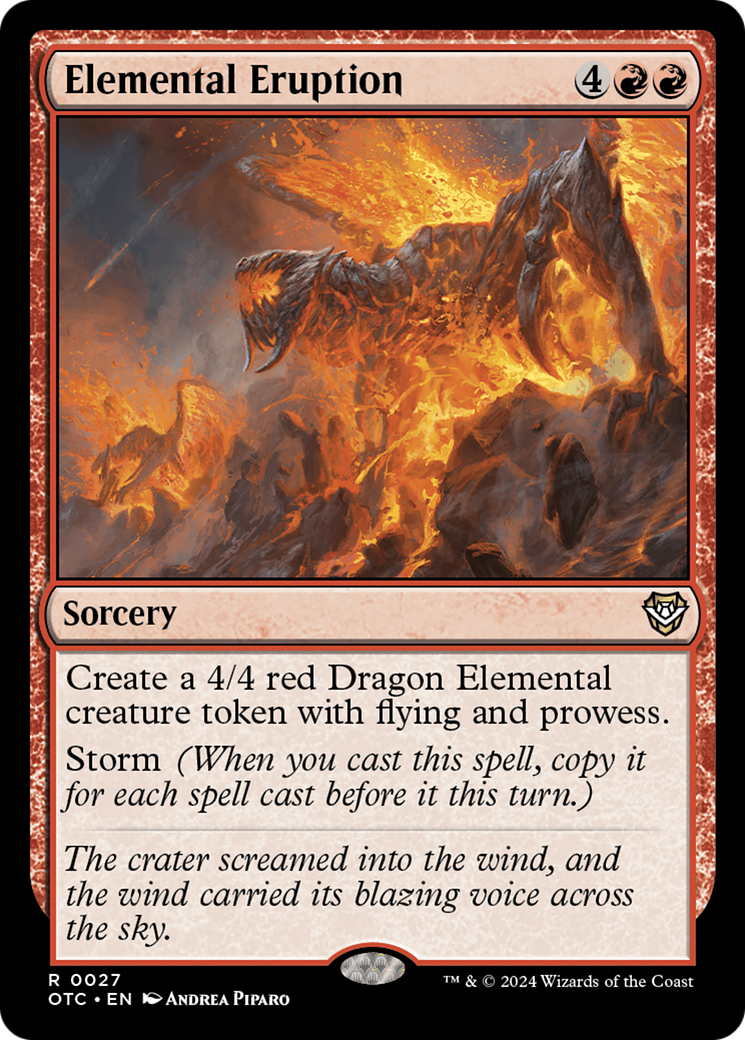
Elemental Eruption
Elemental Eruption
Sorcery
Create a 4/4 red Dragon Elemental creature token with flying and prowess.
Storm (When you cast this spell, copy it for each spell cast before it this turn.)
- The copies of Elemental Eruption created by its storm ability are put directly onto the stack. They aren’t cast and won’t be counted by other spells with storm cast later in the turn.
- Spells cast from zones other than a player’s hand and spells that were countered or otherwise failed to resolve are counted by the storm ability.
- A copy of a spell can be countered like any other spell, but it must be countered individually. Countering a spell with storm won’t affect the copies.
-
1
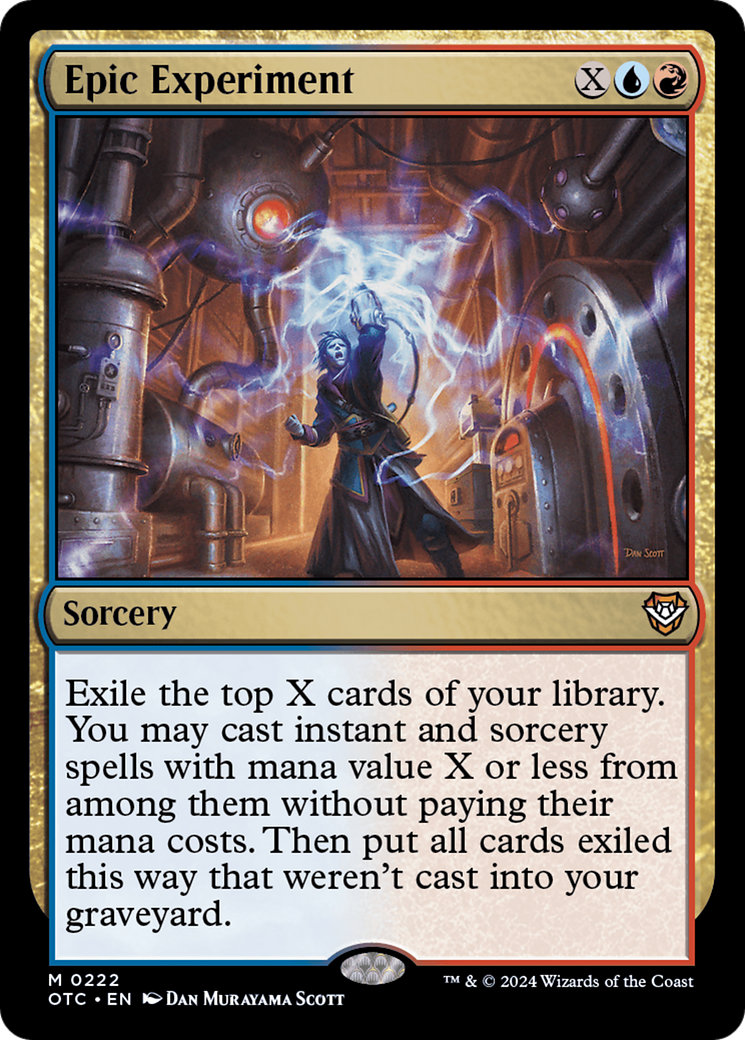
Epic Experiment
Epic Experiment
Sorcery
Exile the top X cards of your library. You may cast instant and sorcery spells with mana value X or less from among them without paying their mana costs. Then put all cards exiled this way that weren't cast into your graveyard.
- If you cast a card "without paying its mana cost," you can't choose to cast it for any alternative costs. You can, however, pay additional costs. If the card has any mandatory additional costs, you must pay those to cast the card.
- If the card has in its mana cost, you must choose 0 as the value of X when casting it without paying its mana cost.
- You cast the cards one at a time, choosing modes, targets, and so on. The last card you cast will be the first one to resolve.
- When casting an instant or sorcery card this way, ignore timing restrictions based on the card's type. Other timing restrictions, such as "Cast [this card] only during combat," must be followed.
- If you can't cast a card, perhaps because there are no legal targets available, or if you choose not to cast it, it will be put into your graveyard.
-
1
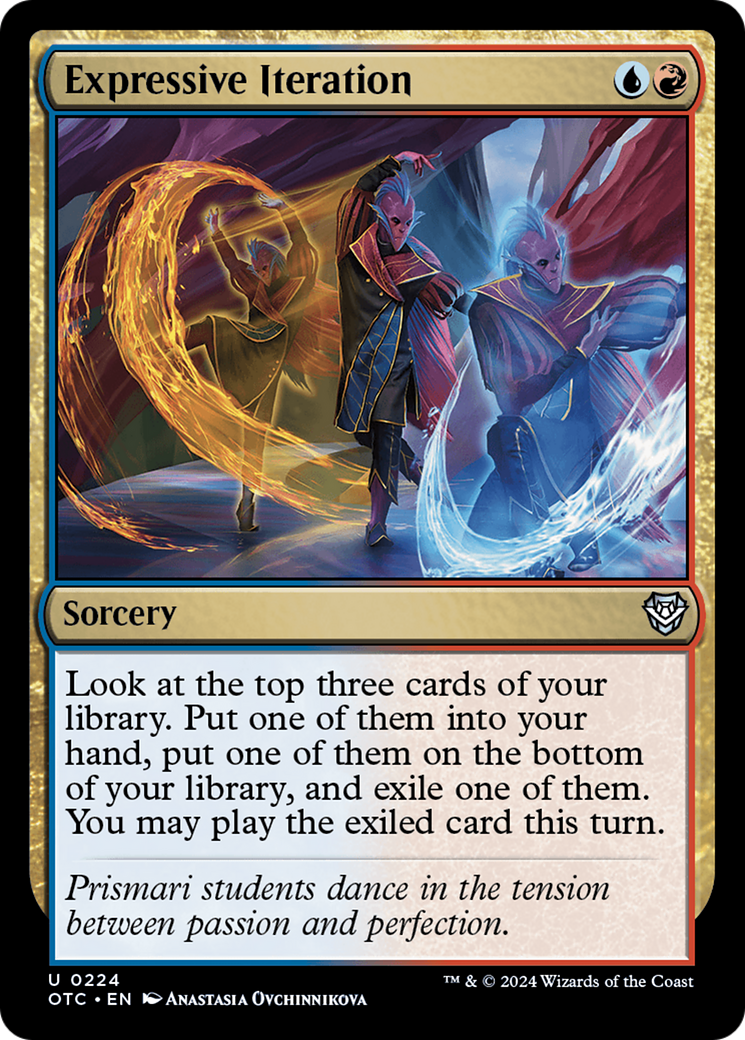
Expressive Iteration
Expressive Iteration
Sorcery
Look at the top three cards of your library. Put one of them into your hand, put one of them on the bottom of your library, and exile one of them. You may play the exiled card this turn.
- If you choose to play the exiled card this turn, you must still pay all costs and follow all timing restrictions required by that card. If it's a land, you can't play it unless you have a land play available.
- If there are fewer than three cards in your library, follow the instructions in the order given for any cards that are there. For example, if there are two cards in your library, you'll put one of them into your hand and one of them on the bottom of your library. You won't have the option to exile either of them.
- If you don't play the exiled card, it remains exiled. It won't be available to be played on future turns.
-
1
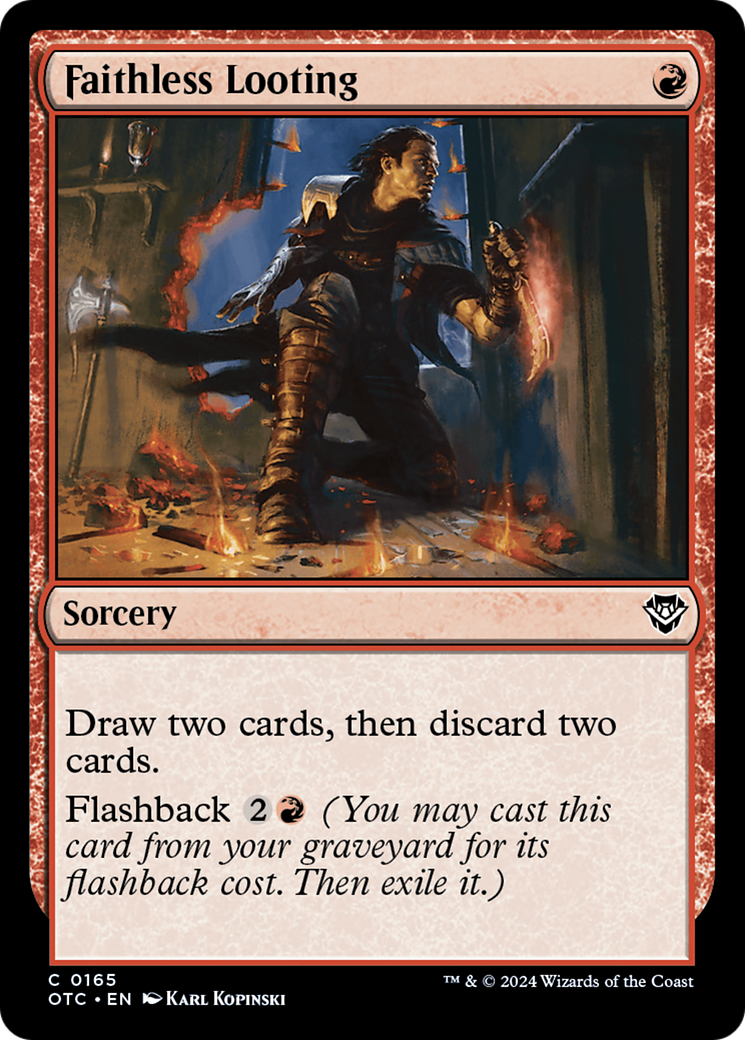
Faithless Looting
Faithless Looting
Sorcery
Draw two cards, then discard two cards.
Flashback (You may cast this card from your graveyard for its flashback cost. Then exile it.)
- To determine the total cost of a spell, start with the mana cost or alternative cost (such as a flashback cost) you're paying, add any cost increases, then apply any cost reductions. The mana value of the spell is determined only by its mana cost, no matter what the total cost to cast the spell was.
- A spell cast using flashback will always be exiled afterward, whether it resolves, is countered, or leaves the stack in some other way.
- "Flashback [cost]" means "You may cast this card from your graveyard if the resulting spell is an instant or sorcery spell by paying [cost] rather than paying its mana cost" and "If the flashback cost was paid, exile this card instead of putting it anywhere else any time it would leave the stack."
- If a card with flashback is put into your graveyard during your turn, you can cast it if it's legal to do so before any other player can take any actions.
- You can cast a spell using flashback even if it was somehow put into your graveyard without having been cast.
- You must still follow any timing restrictions and permissions, including those based on the card's type. For instance, you can cast a sorcery using flashback only when you could normally cast a sorcery.
- You draw two cards and discard two cards all while Faithless Looting is resolving. Nothing can happen between the two, and no player may choose to take actions.
-
1
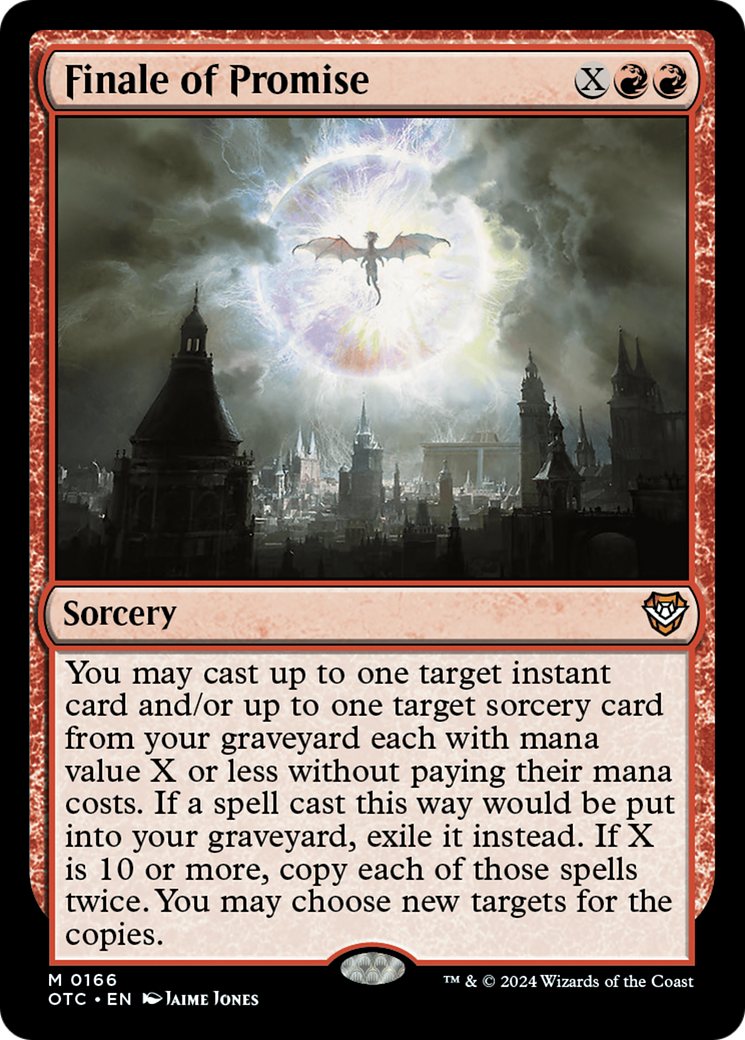
Finale of Promise
Finale of Promise
Sorcery
You may cast up to one target instant card and/or up to one target sorcery card from your graveyard each with mana value X or less without paying their mana costs. If a spell cast this way would be put into your graveyard, exile it instead. If X is 10 or more, copy each of those spells twice. You may choose new targets for the copies.
- As Finale of Promise resolves, first you cast the target instant card and/or the target sorcery card in either order. Then, if X is 10 or more, you copy each of those twice and put the copies on the stack in any order. The copies will resolve before the original spells.
- A split card that's an instant and a sorcery card may be the target of Finale of Promise twice. However, once you cast that card once, it can't be cast a second time.
- If a spell has in its mana cost, you must choose 0 as the value of X when casting it without paying its mana cost.
- If you cast a card "without paying its mana cost," you can't choose to cast it for any alternative costs. You can, however, pay additional costs. If the card has any mandatory additional costs, such as that of Spark Harvest, you must pay those to cast the card.
- If the spell that's copied is modal (that is, it says "Choose one—" or the like), the copies will have the same mode or modes. You can't choose different ones.
- If the spell has damage divided as it was cast, the division can't be changed (although the targets receiving that damage still can). The same is true of spells that distribute counters.
- You can't choose to pay any additional costs for the copies. However, effects based on any additional costs that were paid for the original spell are copied as though those same costs were paid for the copy too.
- The copies that Finale of Promise creates are created on the stack, so they're not "cast." Abilities that trigger when a player casts a spell won't trigger.
-
1
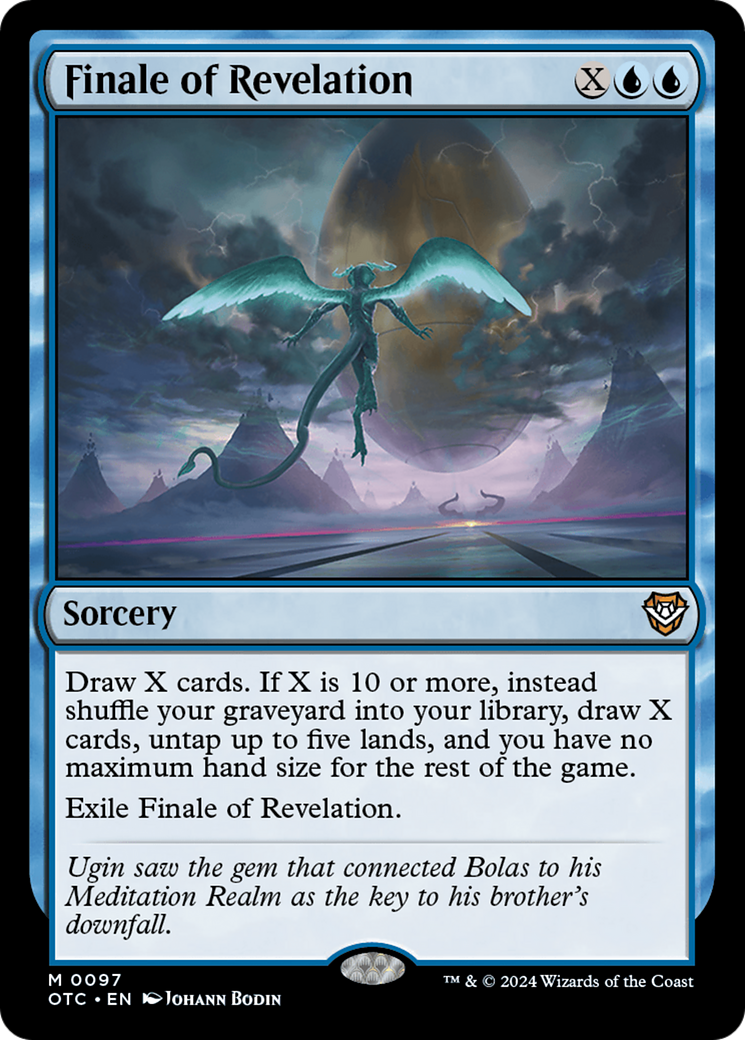
Finale of Revelation
Finale of Revelation
Sorcery
Draw X cards. If X is 10 or more, instead shuffle your graveyard into your library, draw X cards, untap up to five lands, and you have no maximum hand size for the rest of the game.
Exile Finale of Revelation.
-
1
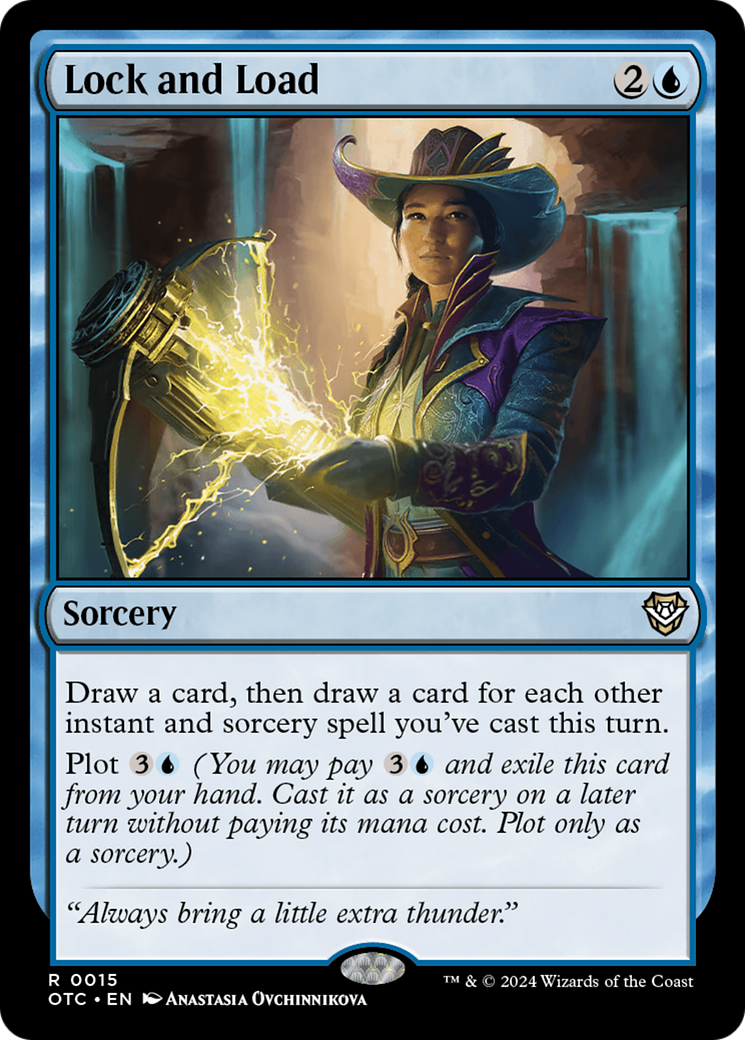
Lock and Load
Lock and Load
Sorcery
Draw a card, then draw a card for each other instant and sorcery spell you've cast this turn.
Plot (You may pay and exile this card from your hand. Cast it as a sorcery on a later turn without paying its mana cost. Plot only as a sorcery.)
- Lock and Load will count any other instant and sorcery spells you’ve cast this turn. It doesn’t matter if the other spells resolved, didn’t resolve, were countered, or are still on the stack.
- Plot abilities are written “Plot [cost],” which means “Any time you have priority during your main phase while the stack is empty, you may pay [cost] and exile this card from your hand. It becomes plotted.”
- Exiling a card using its plot ability is a special action. Once you announce you’re taking that action, no other player can respond by trying to remove that card from your hand.
- You can’t cast a plotted card on the same turn it became plotted. On any future turn, you may cast that card from exile without paying its mana cost during your main phase while the stack is empty.
- If you’re casting a plotted card from exile without paying its mana cost, you can’t choose to cast it for any other alternative costs. You can, however, pay additional costs, such as kicker costs. If the plotted card has any mandatory additional costs, those must still be paid to cast the spell.
- If a plotted card has in its mana cost, you must choose 0 as the value of X when casting it without paying its mana cost.
-
1
Mizzix's Mastery
Mizzix's Mastery
Sorcery
Exile target card that's an instant or sorcery from your graveyard. For each card exiled this way, copy it, and you may cast the copy without paying its mana cost. Exile Mizzix's Mastery.
Overload (You may cast this spell for its overload cost. If you do, change "target" in its text to "each.")
- If you are instructed to cast a spell with overload "without paying its mana cost," you can't choose to pay its overload cost instead.
- If you don't pay the overload cost of a spell with overload, that spell will have a single target. If you pay the overload cost, the spell won't have any targets.
- Because a spell with overload doesn't target when its overload cost is paid, it may affect permanents with hexproof or with protection from the appropriate color.
- To determine the total cost of a spell, start with the mana cost or alternative cost you're paying (such as an overload cost), add any cost increases, then apply any cost reductions. The mana value of the spell remains unchanged, no matter what the total cost to cast it was.
- The copies are created and cast during the resolution of Mizzix's Mastery. You can't wait to cast them later in the turn. Timing restrictions based on the copy's type are ignored. Other restrictions (such as "Cast [this spell] only during combat") are not.
- If you cast a spell "without paying its mana cost," you can't pay any alternative costs. You can, however, pay additional costs, such as kicker costs. If the card has any mandatory additional costs, you must pay those.
- If the copy has in its mana cost, you must choose 0 as the value of X.
- The cards remain exiled no matter what happens to the copies.
- If Mizzix's Mastery exiled multiple cards, you may cast the copies in any order. The last copy you cast will be the first one to resolve.
- If you don't cast one of the copies (perhaps because there are no legal targets available or you don't want to), the copy will cease to exist.
- Mizzix's Mastery is still on the stack as it resolves. If you pay the overload cost, Mizzix's Mastery won't copy itself.
-
1
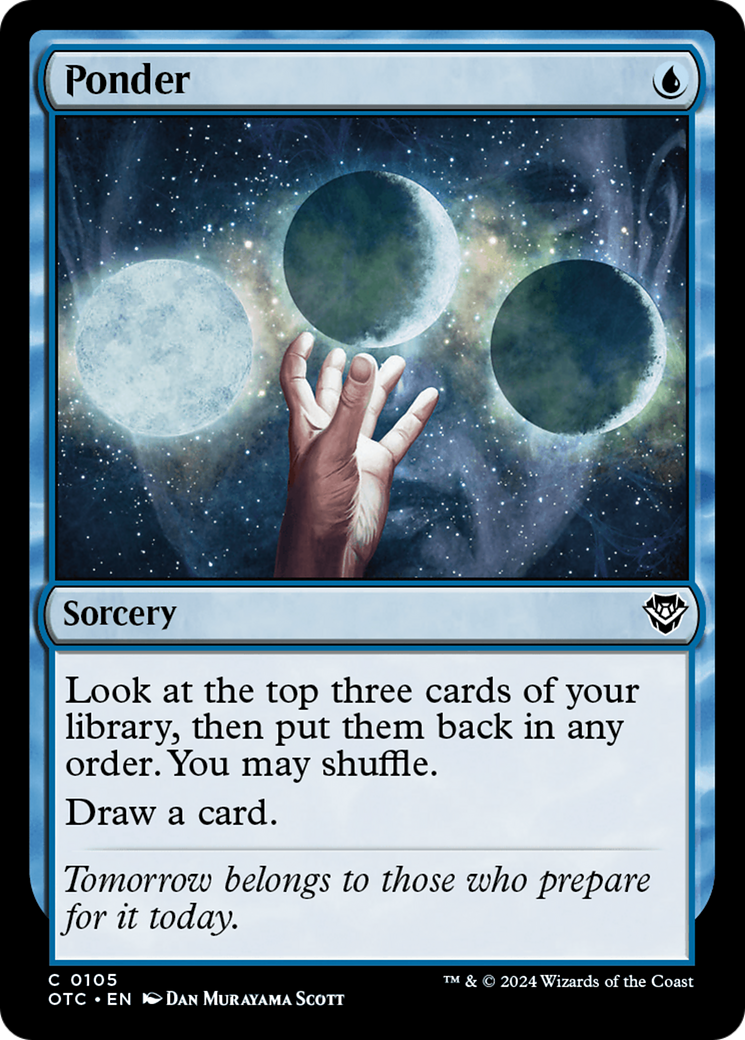
Ponder
Ponder
Sorcery
Look at the top three cards of your library, then put them back in any order. You may shuffle.
Draw a card.
- If you choose to shuffle your library, that includes the three cards you just looked at and put back on top of it.
-
1
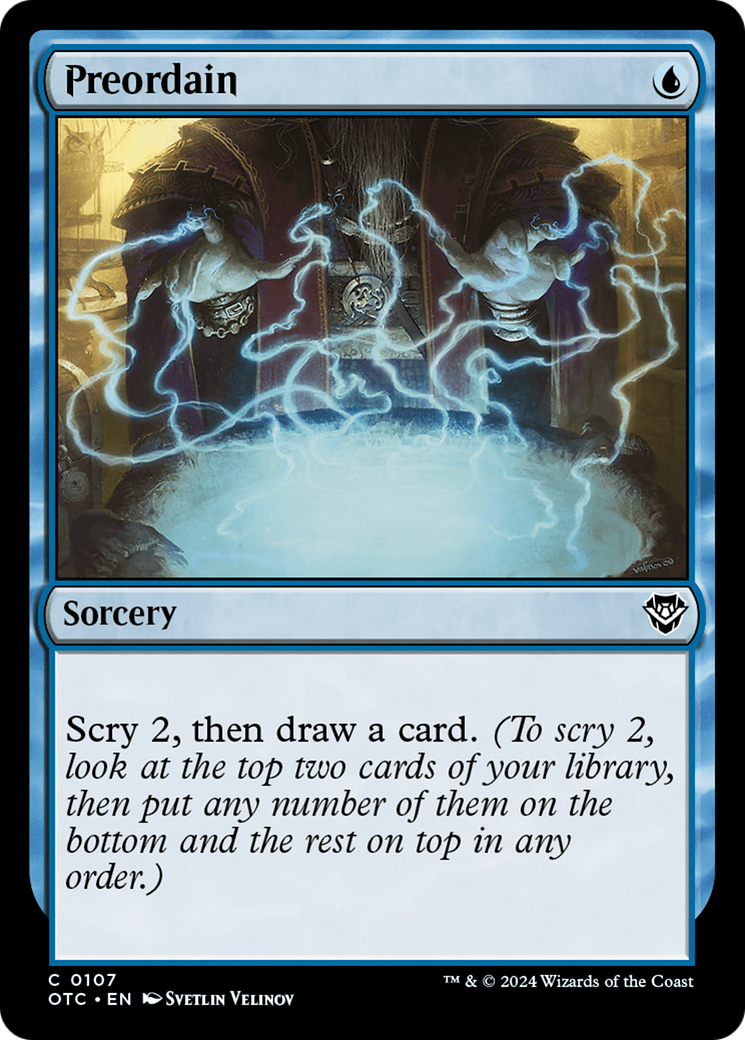
Preordain
Preordain
Sorcery
Scry 2, then draw a card. (To scry 2, look at the top two cards of your library, then put any number of them on the bottom and the rest on top in any order.)
-
1
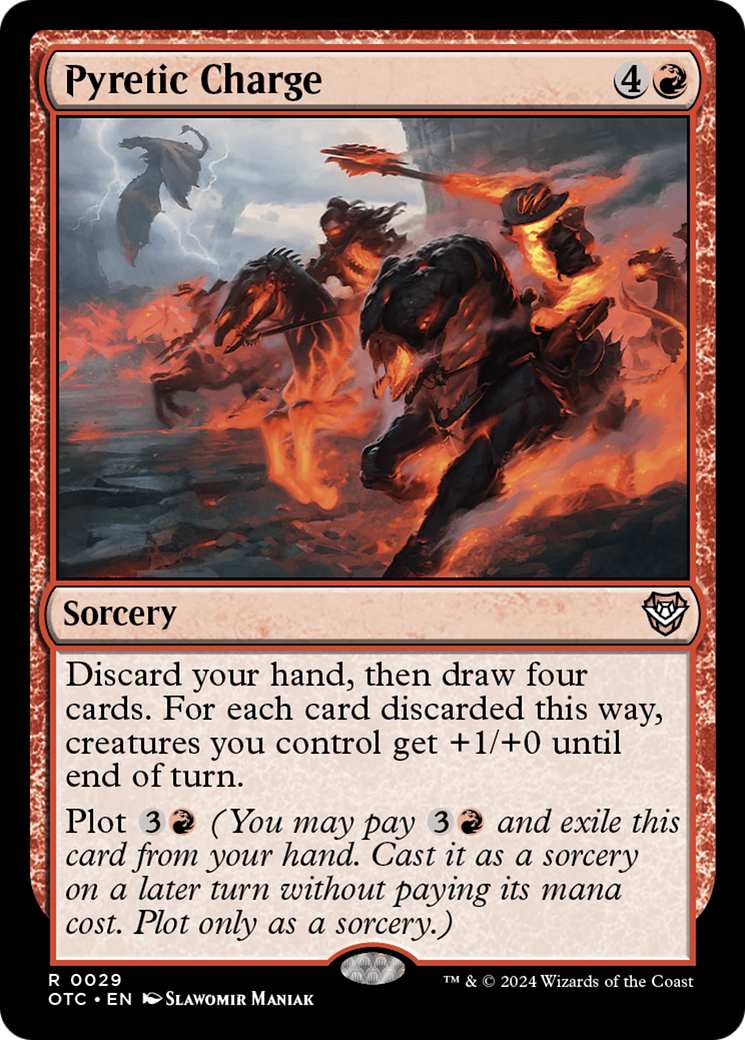
Pyretic Charge
Pyretic Charge
Sorcery
Discard your hand, then draw four cards. For each card discarded this way, creatures you control get +1/+0 until end of turn.
Plot (You may pay and exile this card from your hand. Cast it as a sorcery on a later turn without paying its mana cost. Plot only as a sorcery.)
- Plot abilities are written “Plot [cost],” which means “Any time you have priority during your main phase while the stack is empty, you may pay [cost] and exile this card from your hand. It becomes plotted.”
- Exiling a card using its plot ability is a special action. Once you announce you’re taking that action, no other player can respond by trying to remove that card from your hand.
- Pyretic Charge affects only creatures you control at the time it resolves. Creatures you begin to control later in the turn and noncreature permanents that become creatures later in the turn won’t get +1/+0 for each card discarded this way.
- You can’t cast a plotted card on the same turn it became plotted. On any future turn, you may cast that card from exile without paying its mana cost during your main phase while the stack is empty.
- If you’re casting a plotted card from exile without paying its mana cost, you can’t choose to cast it for any other alternative costs. You can, however, pay additional costs, such as kicker costs. If the plotted card has any mandatory additional costs, those must still be paid to cast the spell.
- If a plotted card has in its mana cost, you must choose 0 as the value of X when casting it without paying its mana cost.
-
1
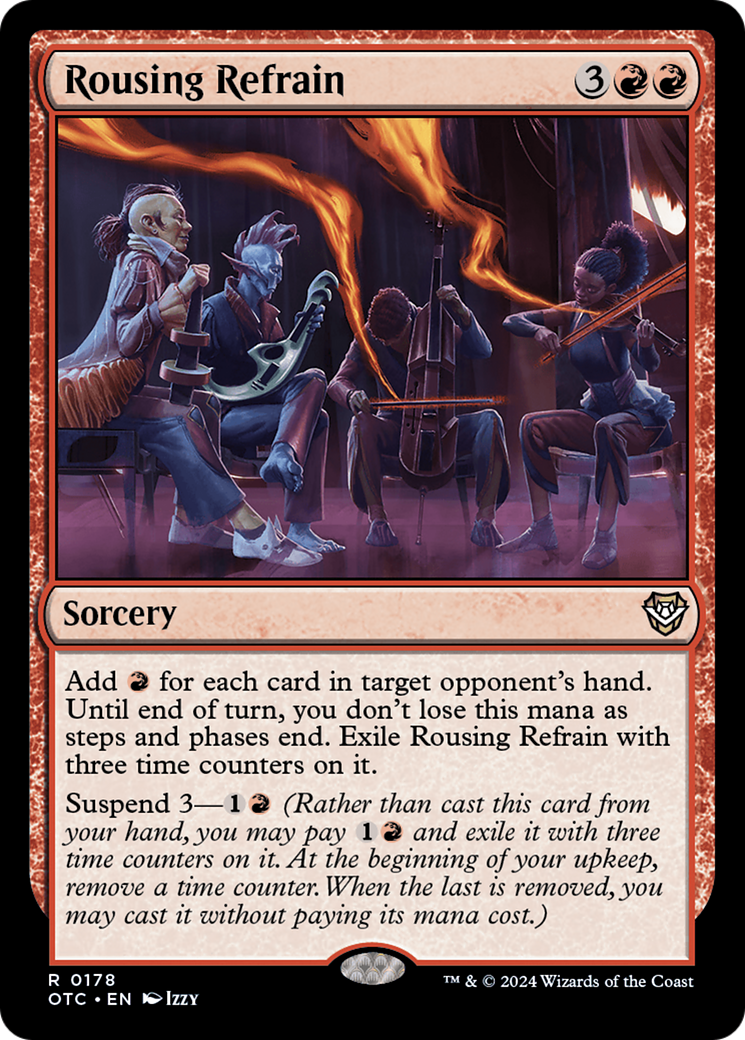
Rousing Refrain
Rousing Refrain
Sorcery
Add for each card in target opponent's hand. Until end of turn, you don't lose this mana as steps and phases end. Exile Rousing Refrain with three time counters on it.
Suspend 3— (Rather than cast this card from your hand, you may pay and exile it with three time counters on it. At the beginning of your upkeep, remove a time counter. When the last is removed, you may cast it without paying its mana cost.)
- Suspend is a keyword that represents three abilities. The first is a static ability that allows you to exile the card from your hand with the specified number of time counters (the number before the dash) on it by paying its suspend cost (listed after the dash). The second is a triggered ability that removes a time counter from the suspended card at the beginning of each of your upkeeps. The third is a triggered ability that gives you the option to cast the card when the last time counter is removed.
- Exiling a card with suspend isn't casting that card. This action doesn't use the stack and can't be responded to.
- Due to a recent rules change to suspend, you are no longer required to cast the suspended card as the second triggered ability of suspend resolves. Instead, as the second triggered ability resolves, you may cast the card. Timing permissions based on the card's type are ignored. If you don't cast the card, it remains exiled with no time counters on it, and it's no longer suspended.
- Cards exiled with suspend are exiled face up.
- If the card has in its mana cost, you must choose 0 as the value of X when casting it without paying its mana cost.
- You can exile a card in your hand using suspend any time you could cast that card. Consider its card type, any effects that modify when you could cast it (such as flash) and any other effects that stop you from casting it (such as from Meddling Mage's ability) to determine if and when you can do this. Whether you could actually complete all steps in casting the card is irrelevant. For example, you can exile a card with suspend that has no mana cost or that requires a target even if no legal targets are available at that time.
- If the spell requires any targets, those targets are chosen when the spell is finally cast, not when it's exiled.
- If the first triggered ability of suspend (the one that removes time counters) is countered, no time counter is removed. The ability will trigger again at the beginning of the card's owner's next upkeep.
- If the second triggered ability is countered, the card can't be cast. It remains exiled with no time counters on it, and it's no longer suspended.
- If an effect refers to a "suspended card," that means a card that (1) has suspend, (2) is in exile, and (3) has one or more time counters on it.
- If you cast a card "without paying its mana cost," such as with suspend, you can't choose to cast it for any alternative costs. You can, however, pay additional costs. If the card has any mandatory additional costs, you must pay those if you want to cast the card.
- When the last time counter is removed, the second triggered ability of suspend (the one that lets you cast the card) triggers. It doesn't matter why the last time counter was removed or what effect removed it.
- The mana value of a spell cast without paying its mana cost is determined by its mana cost, even though that cost wasn't paid.
-
1
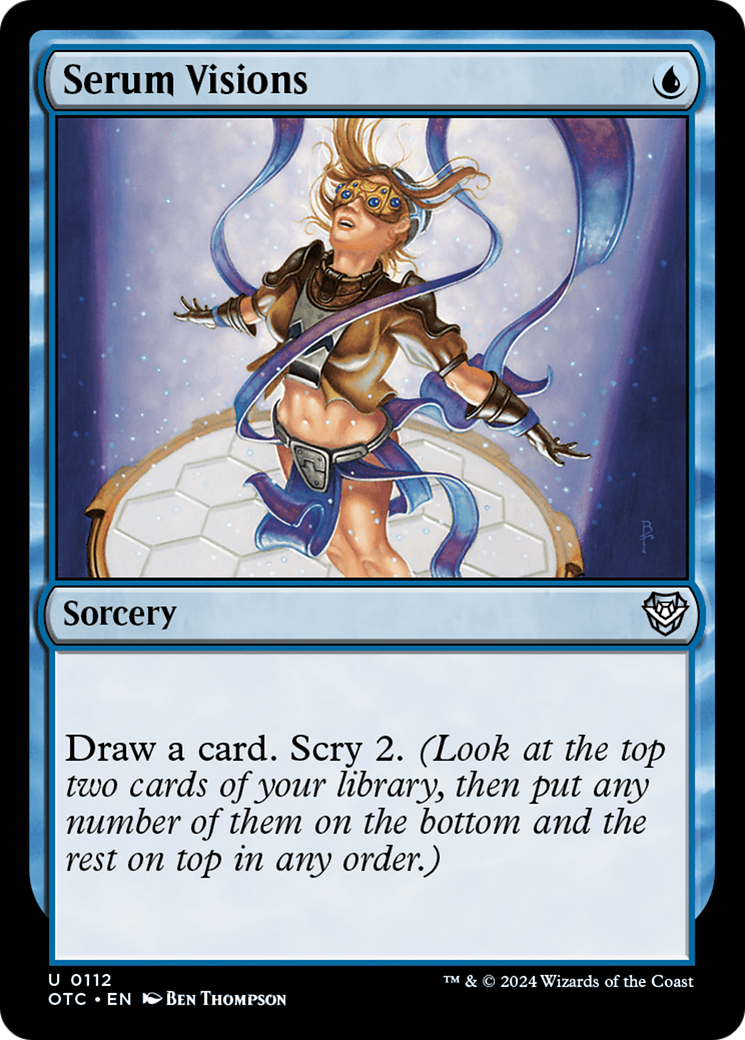
Serum Visions
Serum Visions
Sorcery
Draw a card. Scry 2.
-
1
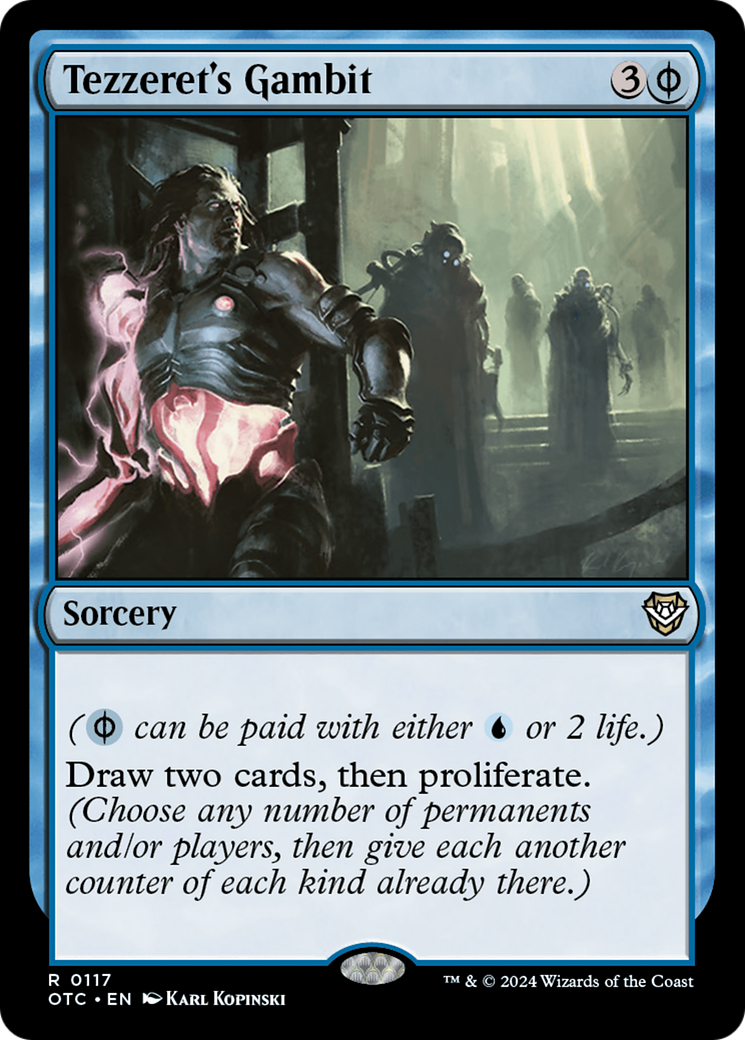
Tezzeret's Gambit
Tezzeret's Gambit
Sorcery
( can be paid with either or 2 life.)
Draw two cards, then proliferate. (Choose any number of permanents and/or players, then give each another counter of each kind already there.)
- If a permanent ever has both +1/+1 counters and -1/-1 counters on it at the same time, they're removed in pairs as a state-based action so that the permanent has only one of those kinds of counters on it.
- To proliferate, you can choose any permanent that has a counter, including ones controlled by opponents. You can choose any player who has a counter, including opponents. You can't choose cards in any zone other than the battlefield, even if they have counters on them.
- You don't have to choose every permanent or player that has a counter, only the ones you want to add another counter to. Since "any number" includes zero, you don't have to choose any permanents at all, and you don't have to choose any players at all.
- If a player or permanent has more than one kind of counter on it, and you choose for it to get additional counters, it must get one of each kind of counter it already has. You can't have it get just one kind of counter it already has and not the others.
- An ability that triggers "Whenever you proliferate" triggers even if you chose no permanents or players while doing so.
- Players can respond to a spell or ability whose effect includes proliferating. Once that spell or ability starts to resolve, however, and its controller chooses which permanents and players will get new counters, it's too late for anyone to respond.
- To calculate the mana value of a card with Phyrexian mana symbols in its cost, count each Phyrexian mana symbol as 1.
- As you cast a spell or activate an activated ability with one or more Phyrexian mana symbols in its cost, you choose how to pay for each Phyrexian mana symbol at the same time you would choose modes or choose a value for X.
- If you're at 1 life or less, you can't pay 2 life.
- Phyrexian mana is not a new color. Players can't produce Phyrexian mana.
- A card with Phyrexian mana symbols in its mana cost is each color that appears in that mana cost, regardless of how that cost may have been paid.
-
1
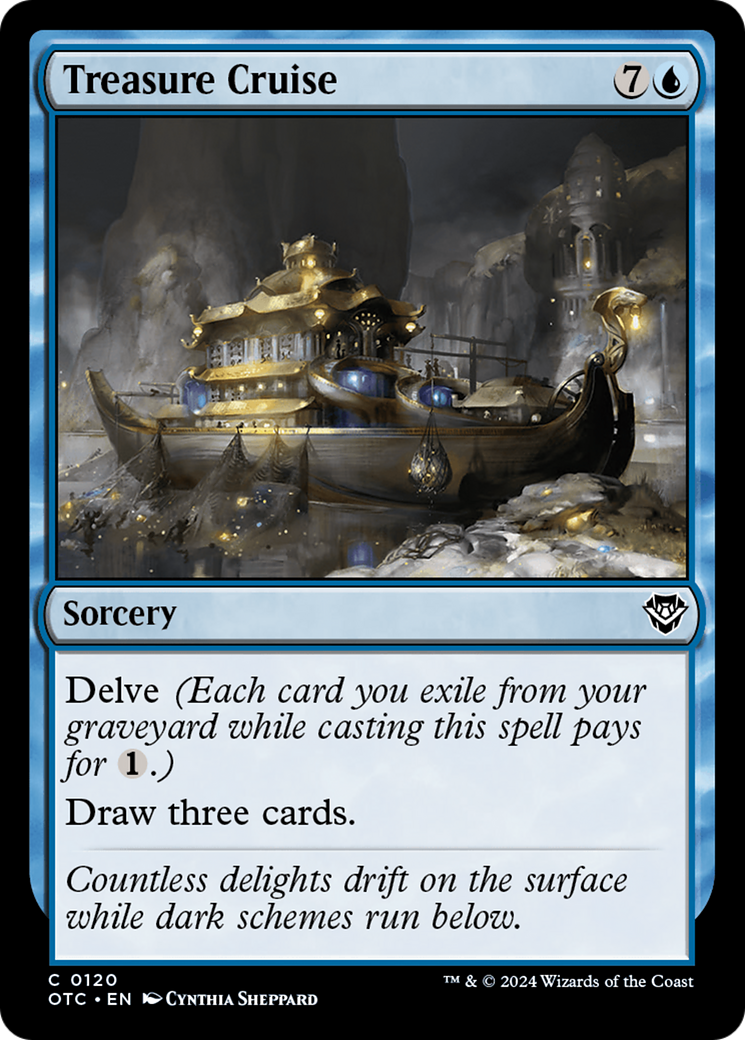
Treasure Cruise
Treasure Cruise
Sorcery
Delve (Each card you exile from your graveyard while casting this spell pays for .)
Draw three cards.
- Delve doesn't change a spell's mana cost or mana value. For example, Treasure Cruise's mana value is 8 even if you exiled three cards to cast it.
- You can exile cards to pay only for generic mana, and you can't exile more cards than the generic mana requirement of a spell with delve. For example, you can't exile more than seven cards from your graveyard to cast Treasure Cruise unless an effect has increased its cost.
- Because delve isn't an alternative cost, it can be used in conjunction with alternative costs, such as flashback. It can also be used to pay for additional costs that include generic mana.
-
1
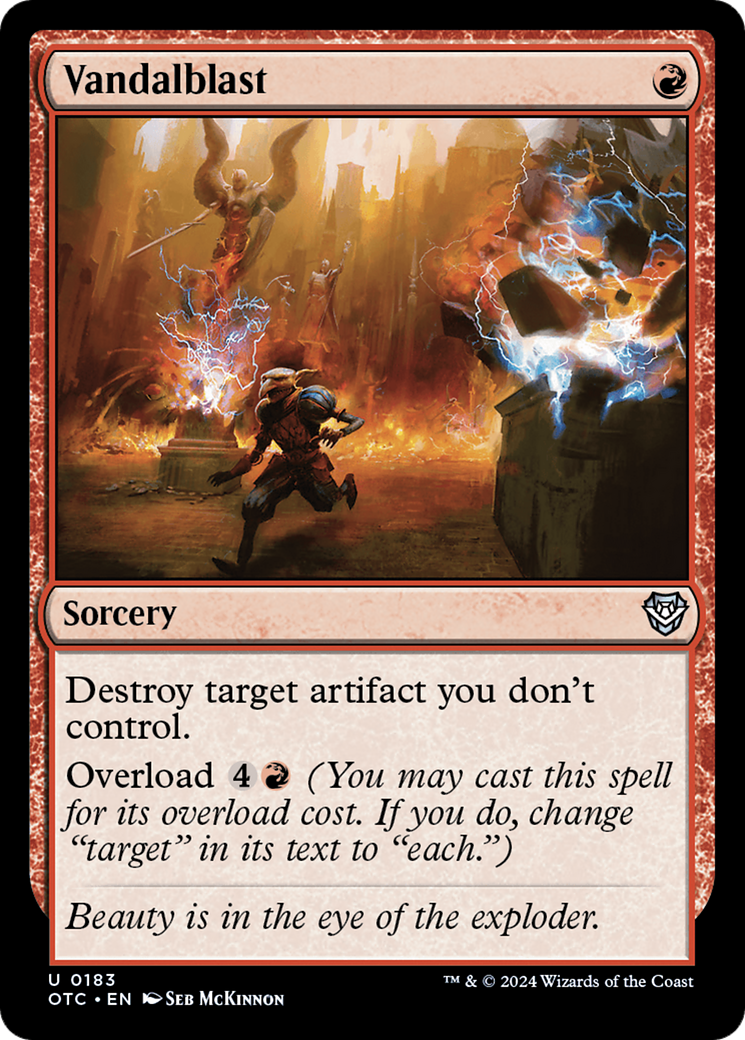
Vandalblast
Vandalblast
Sorcery
Destroy target artifact you don't control.
Overload (You may cast this spell for its overload cost. If you do, change "target" in its text to "each.")
- If you don't pay the overload cost of a spell with overload, that spell will have a single target. If you pay the overload cost, the spell won't have any targets.
- Because a spell with overload doesn't target when its overload cost is paid, it may affect permanents with hexproof or with protection from the appropriate color.
- To determine the total cost of a spell, start with the mana cost or alternative cost you're paying (such as an overload cost), add any cost increases, then apply any cost reductions. The mana value of the spell remains unchanged, no matter what the total cost to cast it was.
- If you are instructed to cast a spell with overload "without paying its mana cost," you can't choose to pay its overload cost instead.
-
1
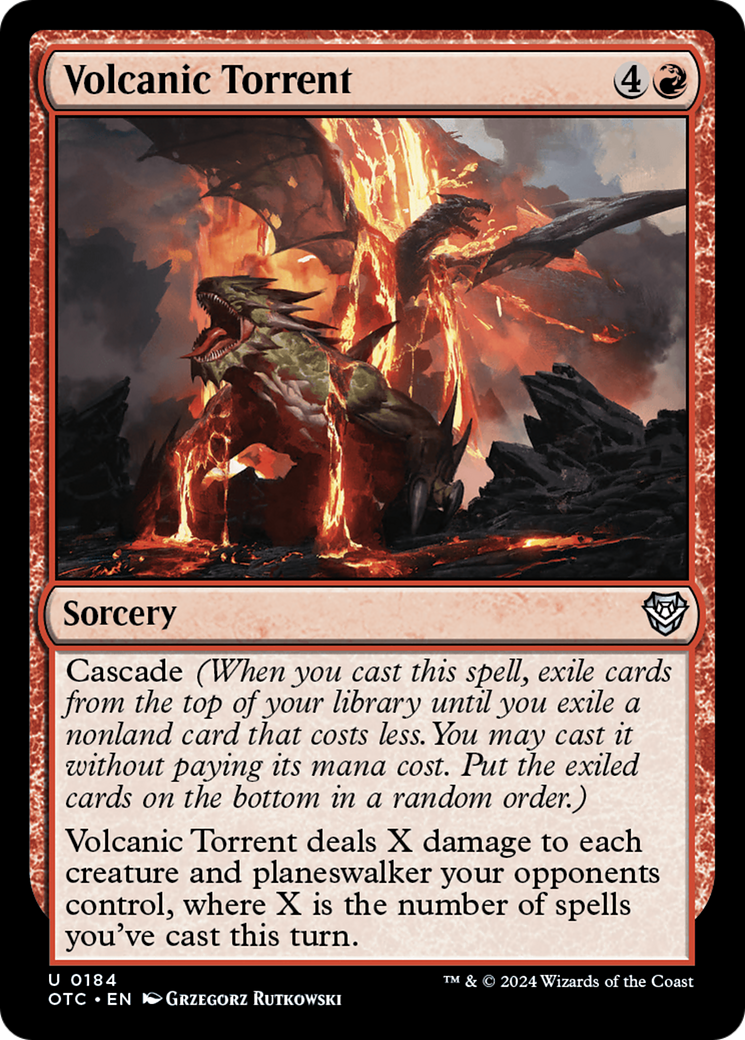
Volcanic Torrent
Volcanic Torrent
Sorcery
Cascade (When you cast this spell, exile cards from the top of your library until you exile a nonland card that costs less. You may cast it without paying its mana cost. Put the exiled cards on the bottom in a random order.)
Volcanic Torrent deals X damage to each creature and planeswalker your opponents control, where X is the number of spells you've cast this turn.
- Cascade triggers when you cast the spell, meaning that it resolves before that spell. If you end up casting the exiled card, it will go on the stack above the spell with cascade.
- If the card has in its mana cost, you must choose 0 as the value of X when casting it without paying its mana cost.
- The mana value of a split card is determined by the combined mana cost of its two halves. If cascade allows you to cast a split card, you may cast either half but not both halves.
- When the cascade ability resolves, you must exile cards. The only optional part of the ability is whether or not you cast the last card exiled.
- Due to a 2021 rules change to cascade, not only do you stop exiling cards if you exile a nonland card with lesser mana value than the spell with cascade, but the resulting spell you cast must also have lesser mana value. Previously, in cases where a card's mana value differed from the resulting spell, such as with some modal double-faced cards or cards with an Adventure, you could cast a spell with a higher mana value than the exiled card.
- If a spell with cascade is countered, the cascade ability will still resolve normally.
- A spell's mana value is determined only by its mana cost. Ignore any alternative costs, additional costs, cost increases, or cost reductions.
- If you cast a card "without paying its mana cost," you can't choose to cast it for any alternative costs. You can, however, pay additional costs. If the card has any mandatory additional costs, you must pay those to cast the card.
- You exile the cards face up. All players will be able to see them.
- If you copy a spell, Volcanic Torrent won't count the copy. However, if an effect instructs you to copy a card and then cast the copy, it will be counted by Volcanic Torrent.
- The value of X is calculated as Volcanic Torrent resolves. It will include Volcanic Torrent, spells you cast in response to Volcanic Torrent, and spells you cast prior to casting Volcanic Torrent, even if those spells haven't resolved yet. For example, say the first spell you cast in a turn has cascade and that cascade ability causes you to cast Volcanic Torrent. Then Volcanic Torrent's cascade ability causes you to cast another spell. When Volcanic Torrent resolves, X will be 3.
-
1
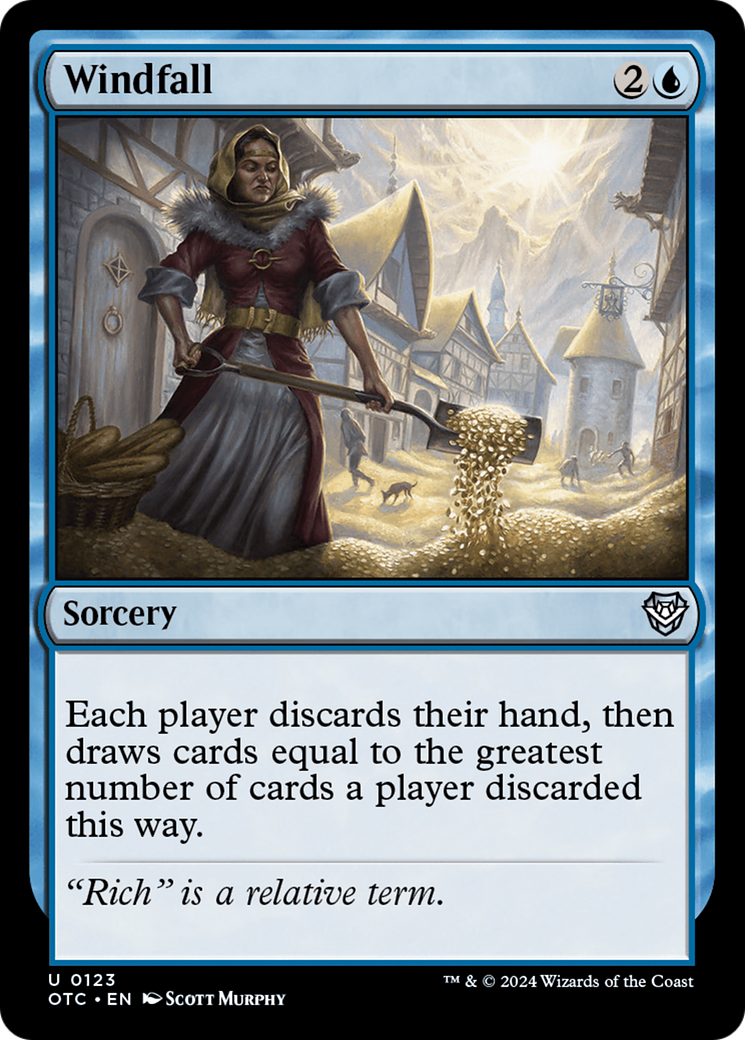
Windfall
Windfall
Sorcery
Each player discards their hand, then draws cards equal to the greatest number of cards a player discarded this way.
Artifacts 9
-
1
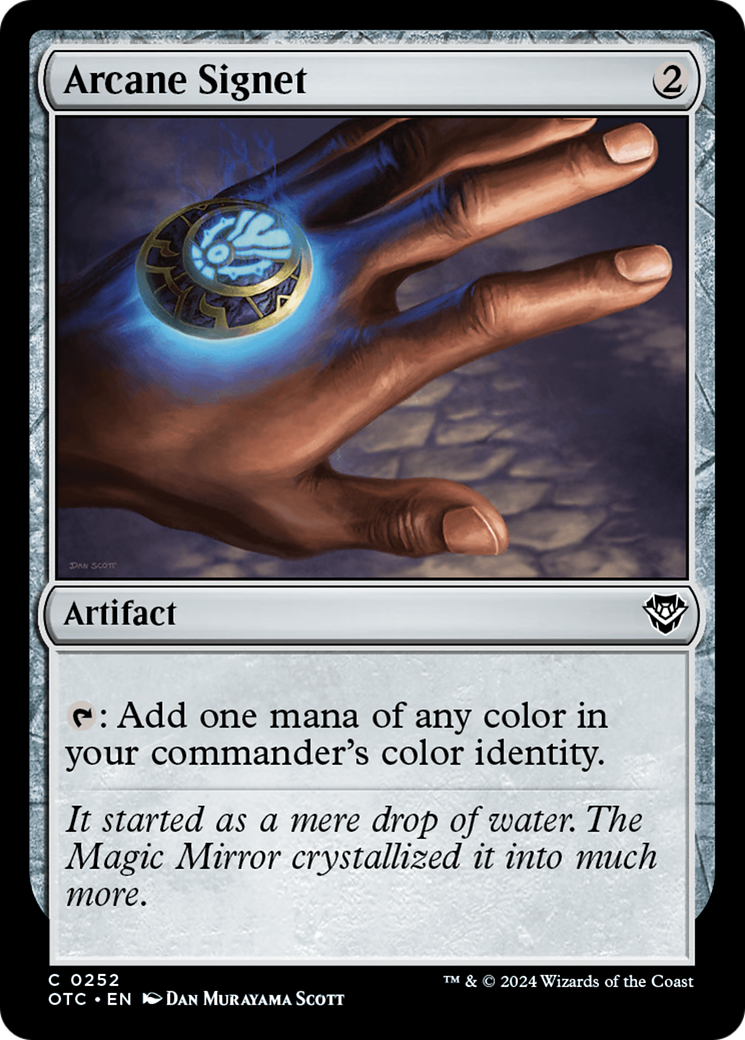
Arcane Signet
Arcane Signet
Artifact
: Add one mana of any color in your commander's color identity.
- If your commander is a card that has no colors in its color identity, Arcane Signet's ability produces no mana. It doesn't produce .
- If you have two commanders, the ability adds one mana of any color in their combined color identities.
- If you don't have a commander, Arcane Signet's ability produces no mana.
-
1
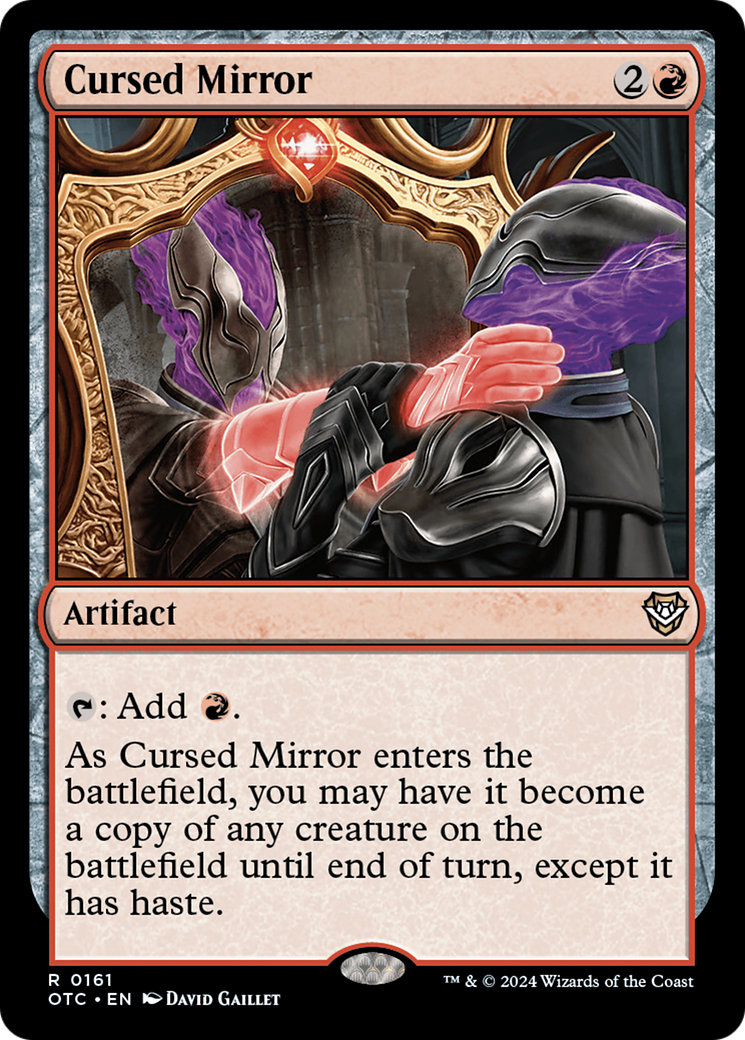
Cursed Mirror
Cursed Mirror
Artifact
: Add .
As this artifact enters, you may have it become a copy of any creature on the battlefield until end of turn, except it has haste.
- If Cursed Mirror somehow enters the battlefield at the same time as a creature, it can't become a copy of that creature. You may choose only a creature that's already on the battlefield.
- Cursed Mirror copies exactly what was printed on the original creature (unless that creature is copying something else or is a token; see below). It doesn't copy whether that creature is tapped or untapped, whether it has any counters on it or any Auras or Equipment attached to it, or any non-copy effects that have changed its types, color, power and toughness, and so on.
- If the copied creature has in its mana cost, X is considered to be 0.
- If something else becomes a copy of Cursed Mirror while Cursed Mirror is a copy of a creature, the duration of the effect is not copied. The new copy will still be a creature (with haste) after Cursed Mirror stops being a copy at the end of the turn.
- While it is copying a creature, Cursed Mirror does not have " : Add " (unless the creature it's copying also has that ability).
- If the copied creature is copying something else, then Cursed Mirror enters the battlefield as a copy of whatever that creature is copying.
- Any enters-the-battlefield abilities of the copied creature will trigger when Cursed Mirror enters the battlefield. Any "As [this creature] enters the battlefield" or "[This creature] enters the battlefield with" abilities of the copied creature will also work.
- If the copied creature is a token, Cursed Mirror copies the original characteristics of that token as stated by the effect that created the token. Copying a token doesn't make Cursed Mirror a token. Similarly, if Cursed Mirror itself is a token, copying a nontoken permanent doesn't make it stop being a token.
-
1
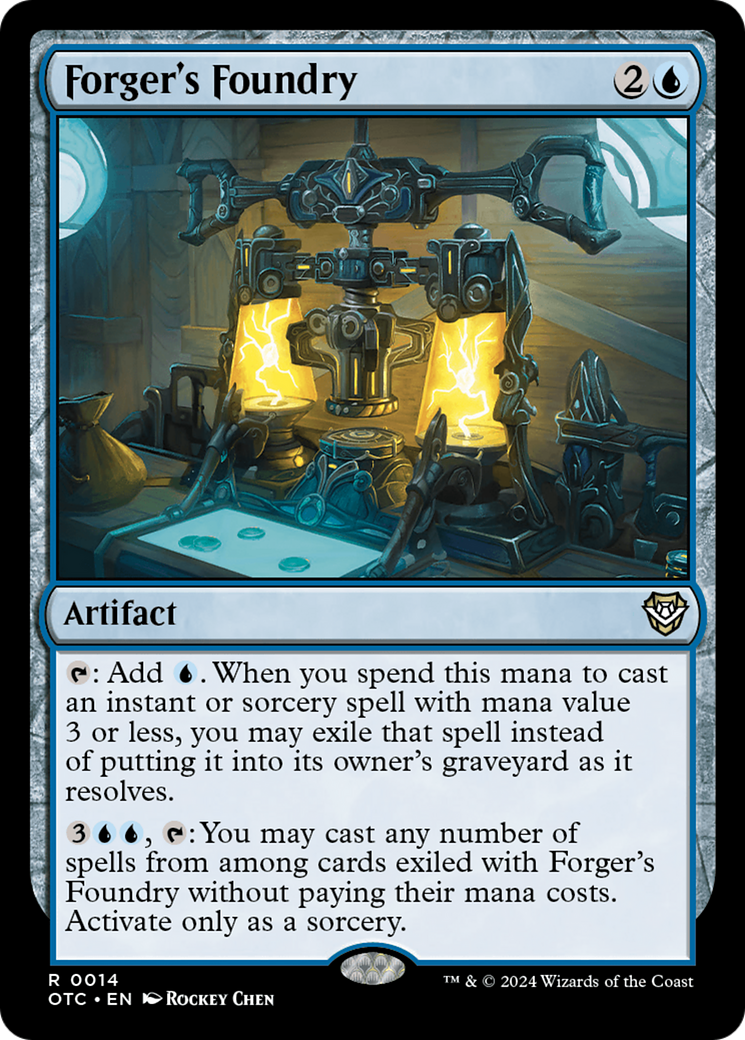
Forger's Foundry
Forger's Foundry
Artifact
: Add . When you spend this mana to cast an instant or sorcery spell with mana value 3 or less, you may exile that spell instead of putting it into its owner's graveyard as it resolves.
, : You may cast any number of spells from among cards exiled with this artifact without paying their mana costs. Activate only as a sorcery.
- The mana added by Forger's Foundry can be spent on anything, not just instant and sorcery spells with mana value 3 or less.
- The delayed triggered ability will trigger whether Forger's Foundry is still on the battlefield or not.
- When casting an instant or sorcery spell with in its mana cost using the mana added by Forger's Foundry, use the value of X chosen when you cast that spell to determine whether or not the delayed triggered ability triggers.
- You choose which spells (if any) to cast as Forger's Foundry's last ability resolves. If you do, you do so as part of the resolution of that ability. You can't wait to cast them later in the turn.
- You cast the spells one at a time as Forger's Foundry's last ability is resolving, choosing modes, targets, and so on. The last spell you cast will be the first one to resolve. Ignore timing restrictions based on the cards' types. Other timing restrictions, such as "Cast [this spell] only during combat," must be followed.
- If you cast a spell "without paying its mana cost," you can't choose to cast it for any alternative costs. You can, however, pay additional costs, such as kicker costs. If the spell has any mandatory additional costs, those must be paid to cast the spell.
- If a spell you cast has in its mana cost, you must choose 0 as the value of X when casting it without paying its mana cost.
-
1
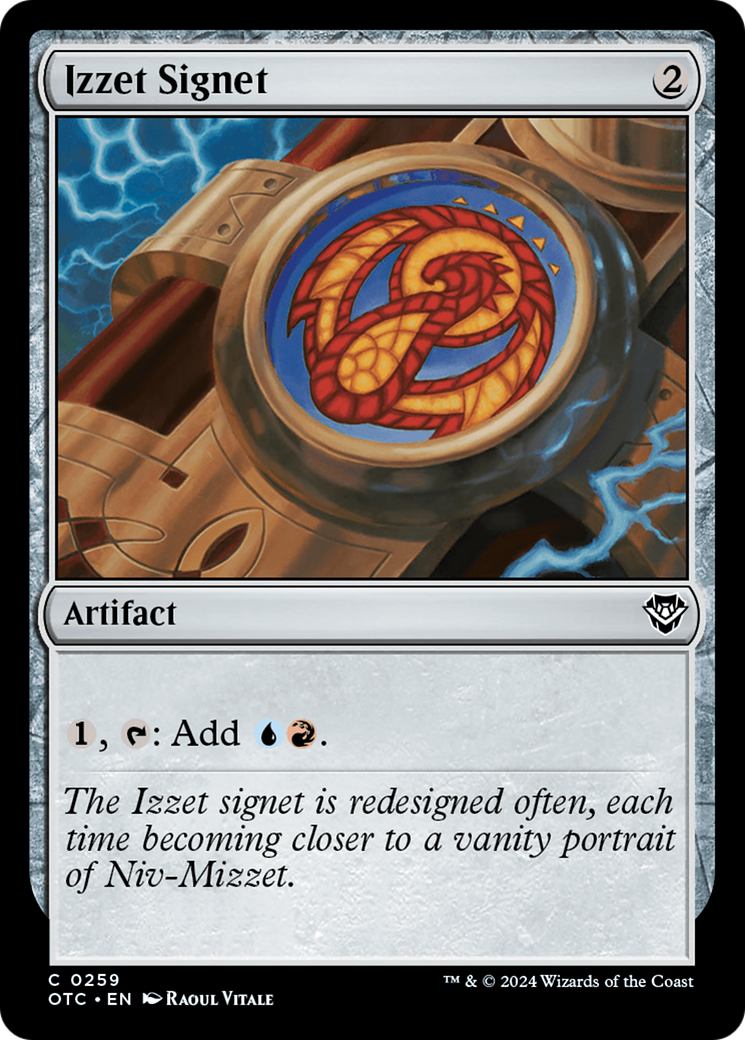
Izzet Signet
Izzet Signet
Artifact
, : Add .
-
1
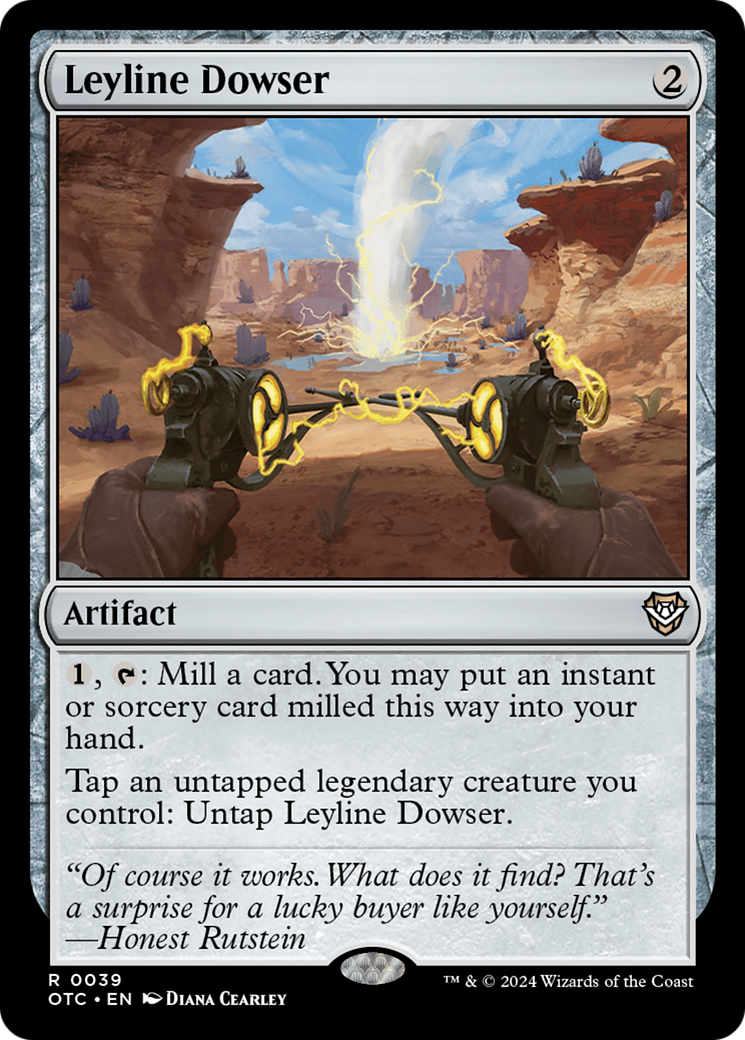
Leyline Dowser
Leyline Dowser
Artifact
, : Mill a card. You may put an instant or sorcery card milled this way into your hand.
Tap an untapped legendary creature you control: Untap this artifact.
- You can tap any untapped legendary creature you control, including one you haven’t controlled continuously since the beginning of your most recent turn, to pay the cost of Leyline Dowser’s second activated ability.
-
1
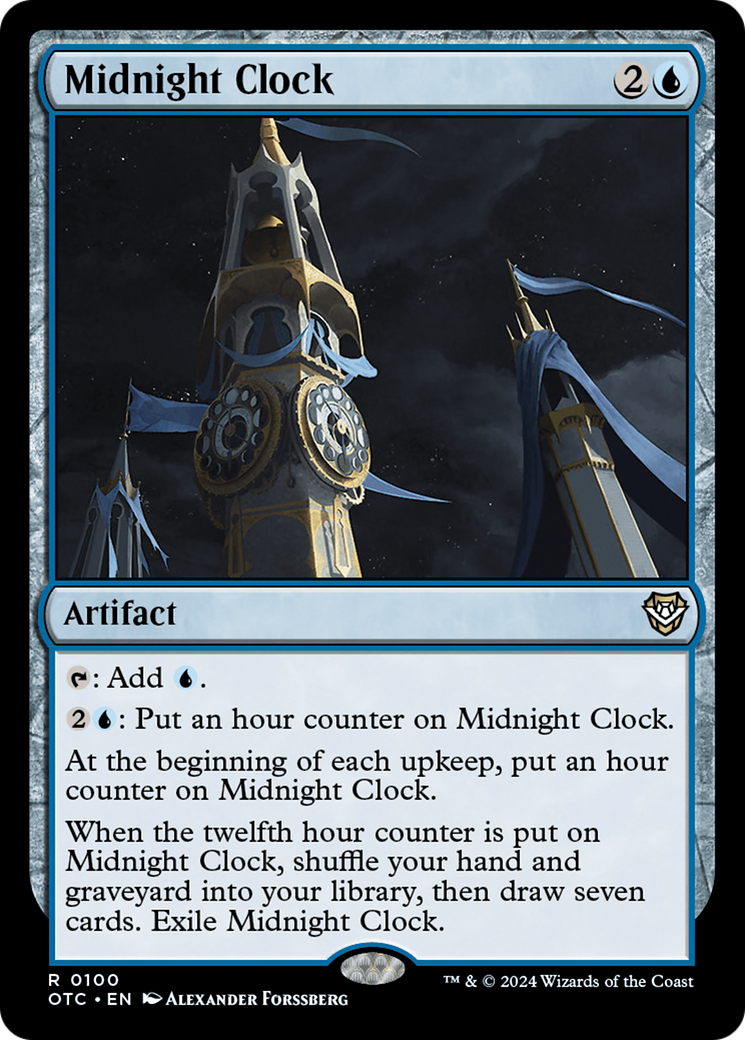
Midnight Clock
Midnight Clock
Artifact
: Add .
: Put an hour counter on this artifact.
At the beginning of each upkeep, put an hour counter on this artifact.
When the twelfth hour counter is put on this artifact, shuffle your hand and graveyard into your library, then draw seven cards. Exile this artifact.
- If Midnight Clock leaves the battlefield while its last ability is on the stack, it won't be exiled.
- You can activate Midnight Clock's mana ability to pay the cost of its second ability.
- Midnight Clock's last ability triggers after one or more counters are put onto it if it had fewer than twelve counters on it before those counters were put on it and it has twelve or more counters on it after.
- Midnight Clock's first triggered ability triggers at the beginning of each upkeep, not just your upkeep. In a Two-Headed Giant game, an ability that triggers at the beginning of each upkeep rather than each player's upkeep triggers only once during each team's upkeep.
-
1
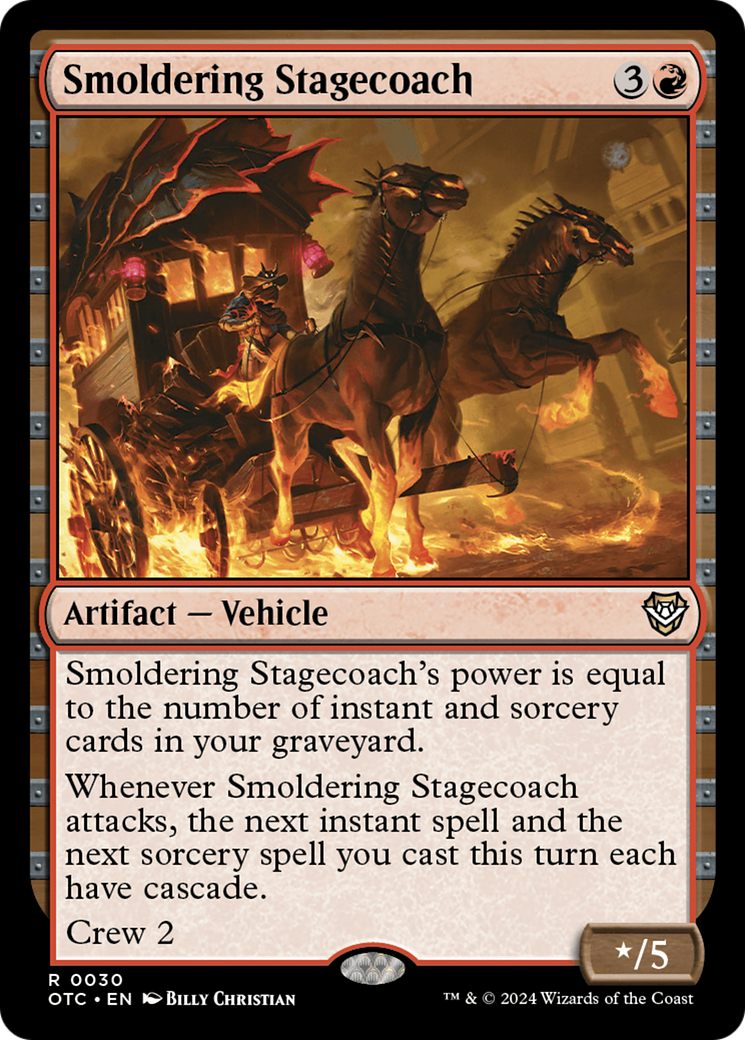
Smoldering Stagecoach
Smoldering Stagecoach
Artifact — Vehicle
*/5
Smoldering Stagecoach's power is equal to the number of instant and sorcery cards in your graveyard.
Whenever this Vehicle attacks, the next instant spell and the next sorcery spell you cast this turn each have cascade.
Crew 2
- The ability that defines Smoldering Stagecoach's power works in all zones, not just the battlefield.
- "Cascade" means "When you cast this spell, exile cards from the top of your library until you exile a nonland card whose mana value is less than this spell's mana value. You may cast that card without paying its mana cost if the resulting spell's mana value is less than this spell's mana value. Then put all cards exiled this way that weren't cast on the bottom of your library in a random order."
- A spell's mana value is determined only by its mana cost. Ignore any alternative costs, additional costs, cost increases, or cost reductions.
- Cascade triggers when you cast the spell, meaning that it resolves before that spell. If you end up casting the exiled card, it will go on the stack above the spell with cascade.
- When the cascade ability resolves, you must exile cards. The only optional part of the ability is whether you cast the last card exiled.
- If a spell with cascade is countered, the cascade ability will still resolve normally.
- You exile the cards face up. All players will be able to see them.
- If you cast a spell "without paying its mana cost," you can't choose to cast it for any alternative costs. You can, however, pay additional costs. If the spell has any mandatory additional costs, you must pay those to cast the card.
- If the card has in its mana cost, you must choose 0 as the value of X when casting it without paying its mana cost.
- Due to a 2021 rules change to cascade, not only do you stop exiling cards if you exile a nonland card with lesser mana value than the spell with cascade, but the resulting spell you cast must also have lesser mana value. Previously, in cases where a card's mana value differed from the resulting spell, such as with some modal double-faced cards or cards with an Adventure, you could cast a spell with a higher mana value than the exiled card.
- The mana value of a split card is determined by the combined mana cost of its two halves. If cascade allows you to cast a split card, you may cast either half but not both halves.
-
1
Sol Ring
Sol Ring
Artifact
: Add .
-
1
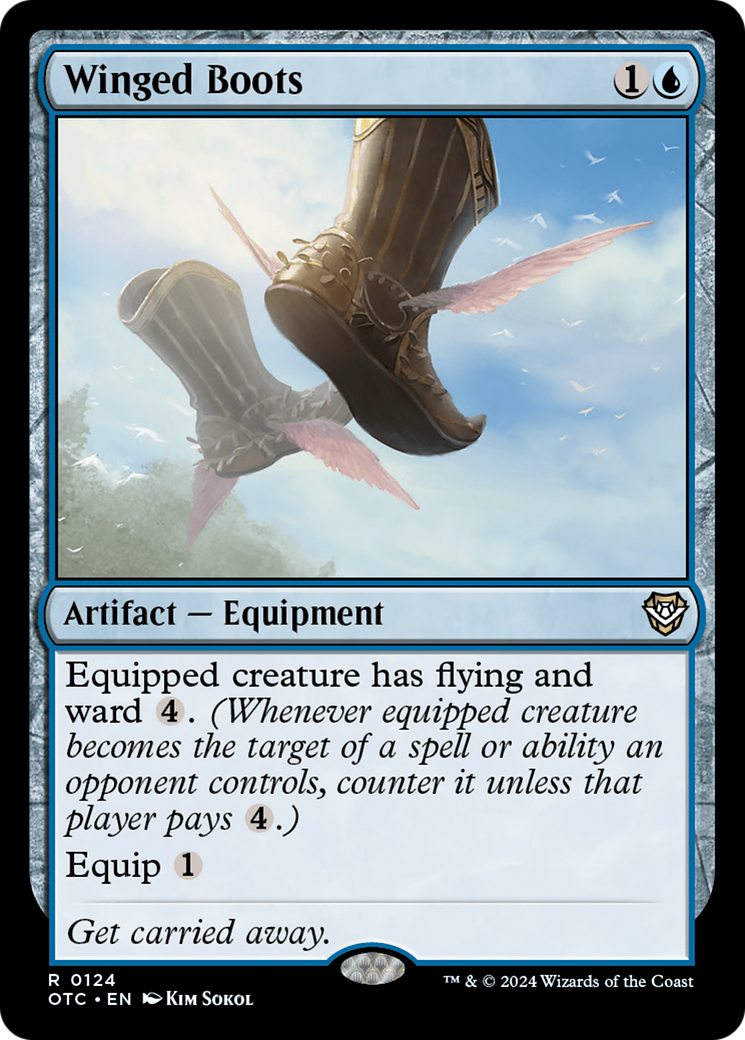
Winged Boots
Winged Boots
Artifact — Equipment
Equipped creature has flying and ward . (Whenever equipped creature becomes the target of a spell or ability an opponent controls, counter it unless that player pays .)
Equip
- If a player casts a spell that targets multiple permanents their opponent controls with ward, each of those ward abilities will trigger. If that player doesn't pay for all of them, the spell will be countered.
Enchantments 3
-
1
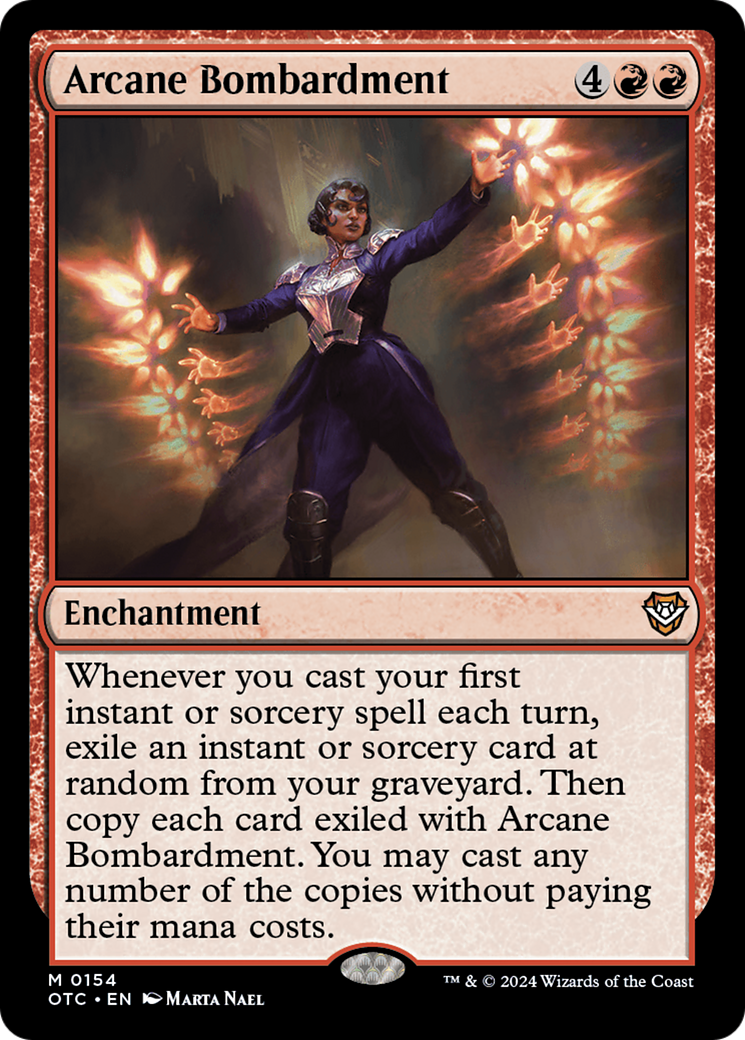
Arcane Bombardment
Arcane Bombardment
Enchantment
Whenever you cast your first instant or sorcery spell each turn, exile an instant or sorcery card at random from your graveyard. Then copy each card exiled with this enchantment. You may cast any number of the copies without paying their mana costs.
- The spell that caused Arcane Bombardment's ability to trigger is normally still on the stack while that ability resolves. That spell won't be among the cards in your graveyard when you exile an instant or sorcery from it at random.
- If you've already cast an instant or sorcery spell the turn that Arcane Bombardment enters the battlefield, it won't trigger until you cast an instant or sorcery spell on a later turn.
- You cast the desired copies as the triggered ability resolves. You don't get to cast them later in the turn. You choose the order of copies as you cast them.
- If you cast a spell with in its cost without paying its mana cost, you must choose 0 for X.
- If Arcane Bombardment leaves the battlefield, the exiled cards remain in exile. If it returns to the battlefield or you play another copy of it, you won't get to cast copies of the cards previously exiled.
-
1
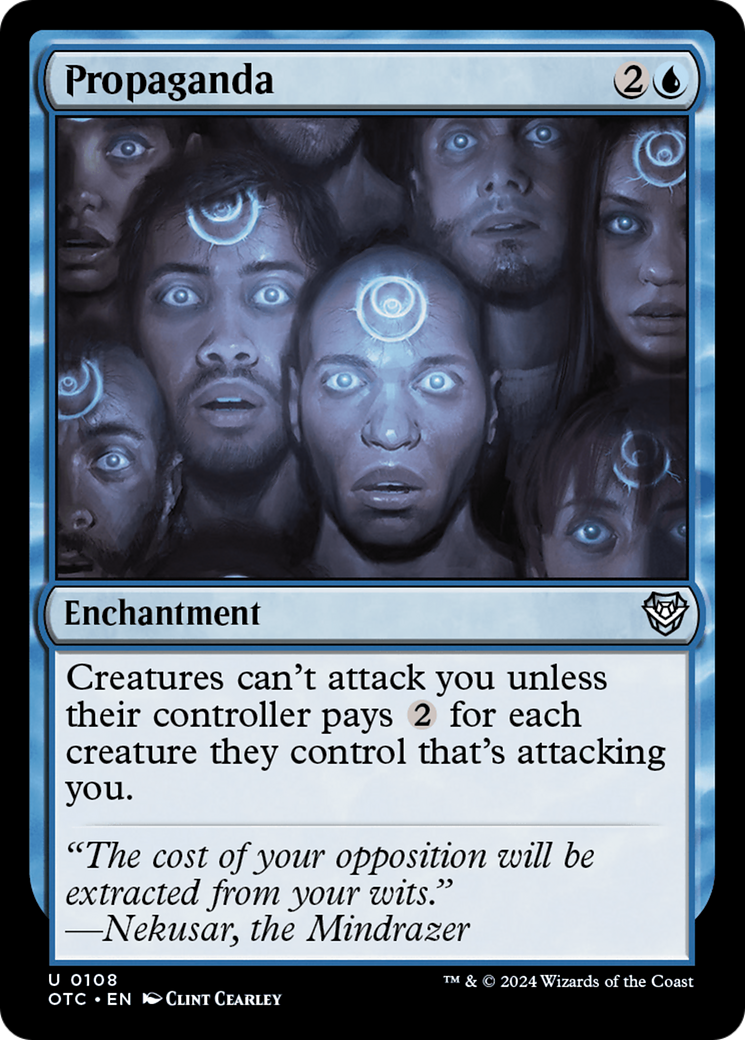
Propaganda
Propaganda
Enchantment
Creatures can't attack you unless their controller pays for each creature they control that's attacking you.
- The payment is made during the declare attackers step at the same time you are declaring the attacker.
- If there are multiple attacks in a turn, then you have to pay for each attack.
- If there is more than one Propaganda on the battlefield, the cost is cumulative.
- Paying this cost is not an instant or any other kind of ability, it is an additional cost on the declaration of the attacker.
-
1
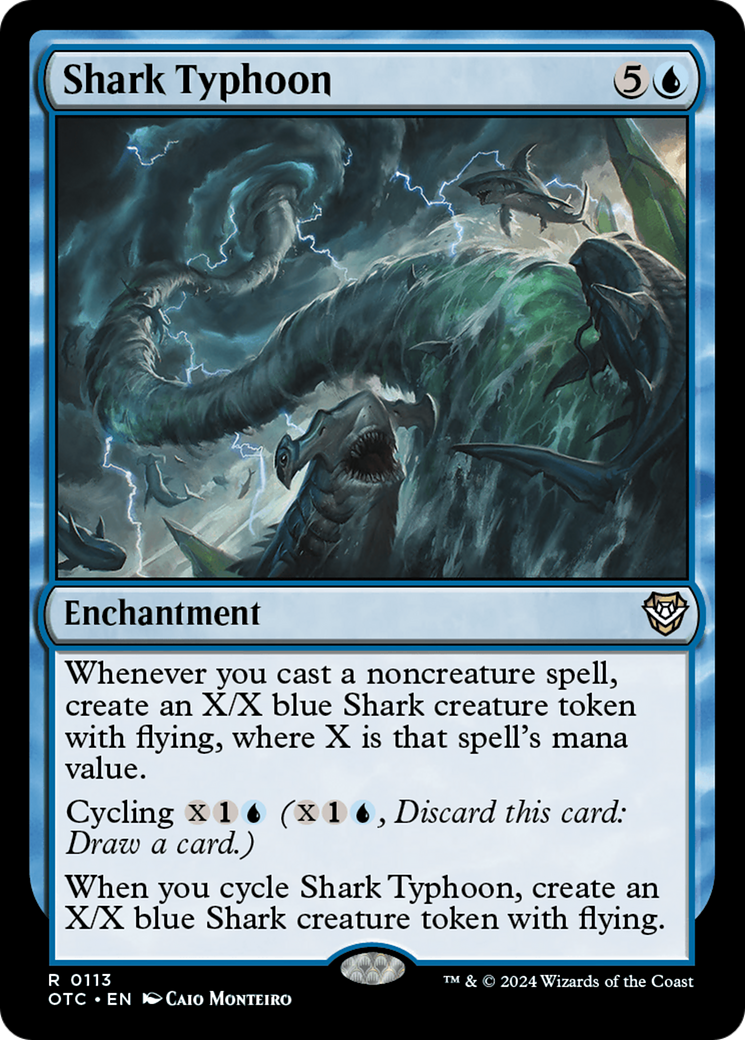
Shark Typhoon
Shark Typhoon
Enchantment
Whenever you cast a noncreature spell, create an X/X blue Shark creature token with flying, where X is that spell's mana value.
Cycling ( , Discard this card: Draw a card.)
When you cycle this card, create an X/X blue Shark creature token with flying.
- An ability that triggers when a player casts a spell resolves before the spell that caused it to trigger. It resolves even if that spell is countered.
- For spells with in their mana costs, use the value chosen for X to determine the spell's mana value.
- You can choose 0 as the value of X in Shark Typhoon's cycling cost. The last ability will trigger, and you'll create a 0/0 blue Shark creature token with flying. Unless something else is raising its toughness, the Shark will then immediately die.
- Some cards with cycling have an ability that triggers when you cycle them, and some cards have an ability that triggers whenever you cycle any card. These triggered abilities resolve before you draw from the cycling ability.
- Triggered abilities from cycling a card and the cycling ability itself aren't spells. Effects that interact with spells (such as that of Cancel) won't affect them.
- You can cycle a card even if it has a triggered ability from cycling that won't have a legal target. This is because the cycling ability and the triggered ability are separate. This also means that if either ability is countered (with Disallow, for example), the other ability will still resolve.
Lands 38
-
1
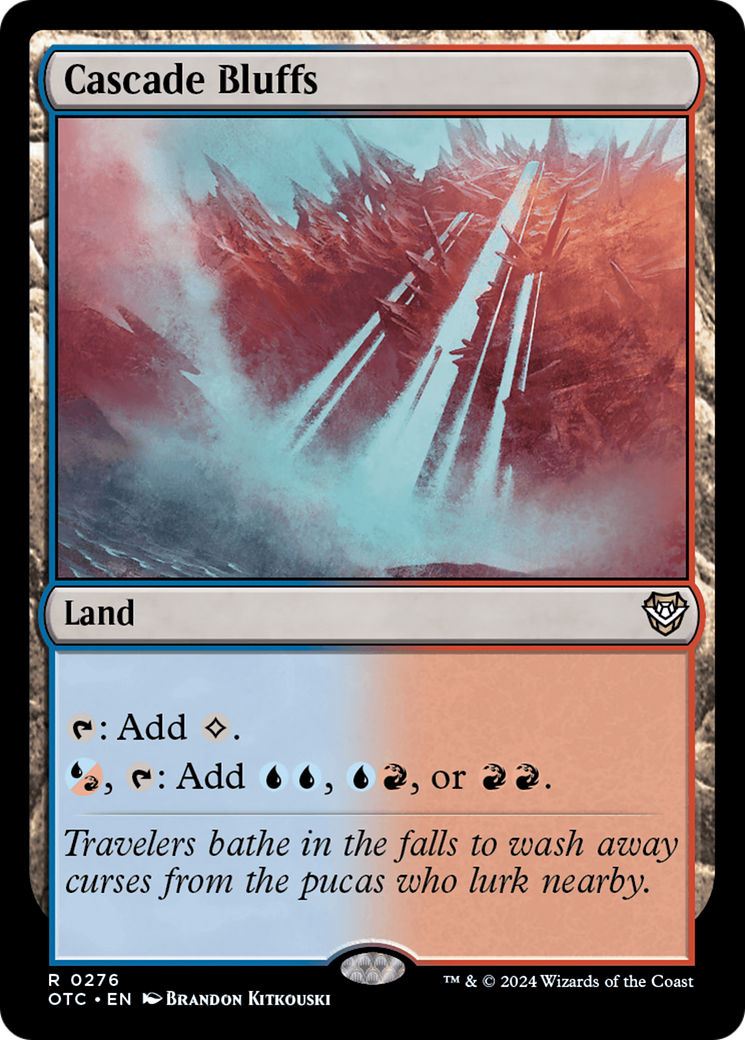
Cascade Bluffs
Cascade Bluffs
Land
: Add .
, : Add , , or .
-
1
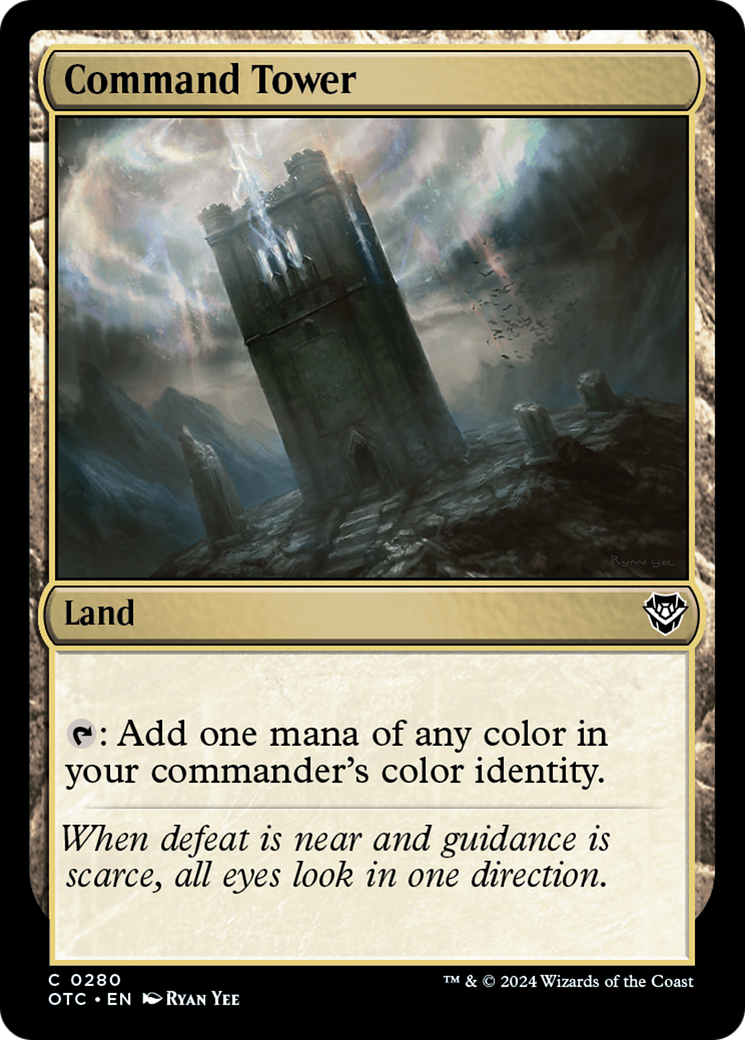
Command Tower
Command Tower
Land
: Add one mana of any color in your commander's color identity.
- If you don't have a commander, Command Tower's ability produces no mana.
- If your commander is a card that has no colors in its color identity, Command Tower's ability produces no mana. It doesn't produce .
- If you have two commanders, the ability adds one mana of any color in their combined color identities.
-
1
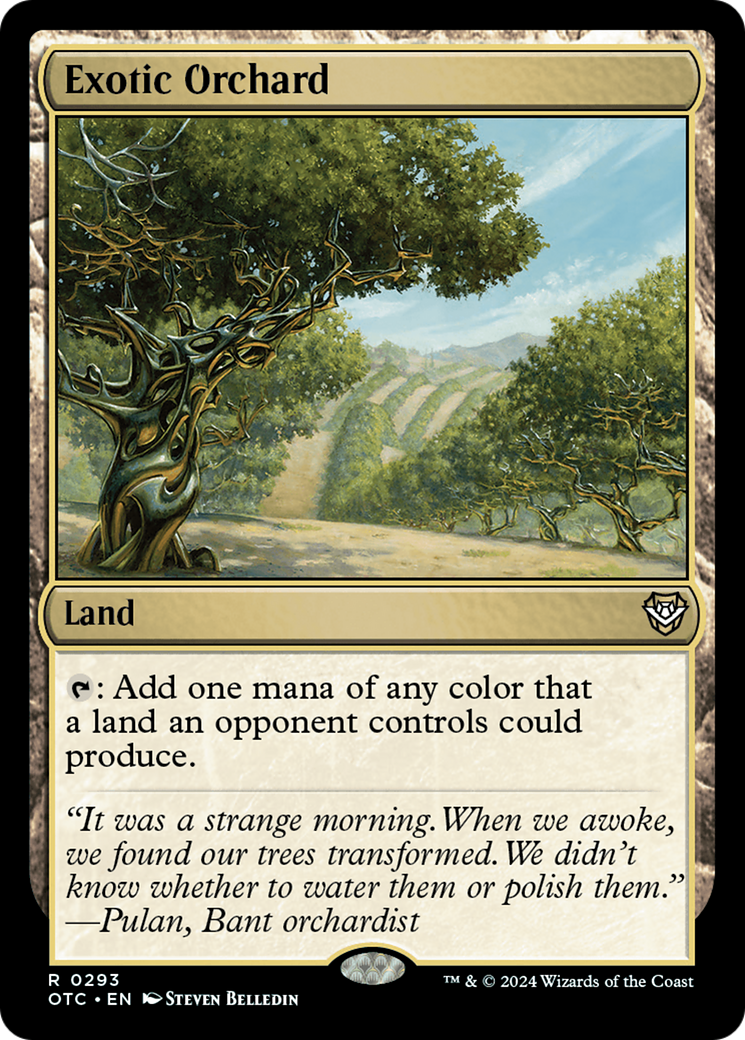
Exotic Orchard
Exotic Orchard
Land
: Add one mana of any color that a land an opponent controls could produce.
- Lands that produce mana based only on what other lands "could produce" won't help each other unless some other land allows one of them to actually produce some type of mana. For example, if you control an Exotic Orchard and your opponent controls an Exotic Orchard and a Reflecting Pool, none of those lands would produce mana if their mana abilities were activated. On the other hand, if you control a Forest and an Exotic Orchard, and your opponent controls an Exotic Orchard and a Reflecting Pool, then each of those lands can be tapped to produce . Your opponent's Exotic Orchard can produce because you control a Forest. Your Exotic Orchard and your opponent's Reflecting Pool can each produce because your opponent's Exotic Orchard can produce .
- When determining what colors of mana your opponents' lands could produce, Exotic Orchard takes into account any applicable replacement effects that would apply to those lands' mana abilities (such as Contamination's effect, for example). If there are more than one, consider them in any possible order.
- The colors of mana are white, blue, black, red, and green. Exotic Orchard can't be tapped for colorless mana, even if a land an opponent controls could produce colorless mana.
- Exotic Orchard doesn't care about any restrictions or riders your opponents' lands (such as Ancient Ziggurat or Hall of the Bandit Lord) put on the mana they produce. It just cares about colors of mana.
- Exotic Orchard checks the effects of all mana-producing abilities of lands your opponents control, but it doesn't check their costs. For example, Vivid Crag has the ability " , Remove a charge counter from Vivid Crag: Add one mana of any color." If an opponent controls Vivid Crag and you control Exotic Orchard, you can tap Exotic Orchard for any color of mana. It doesn't matter whether Vivid Crag has a charge counter on it, and it doesn't matter whether it's untapped.
-
1
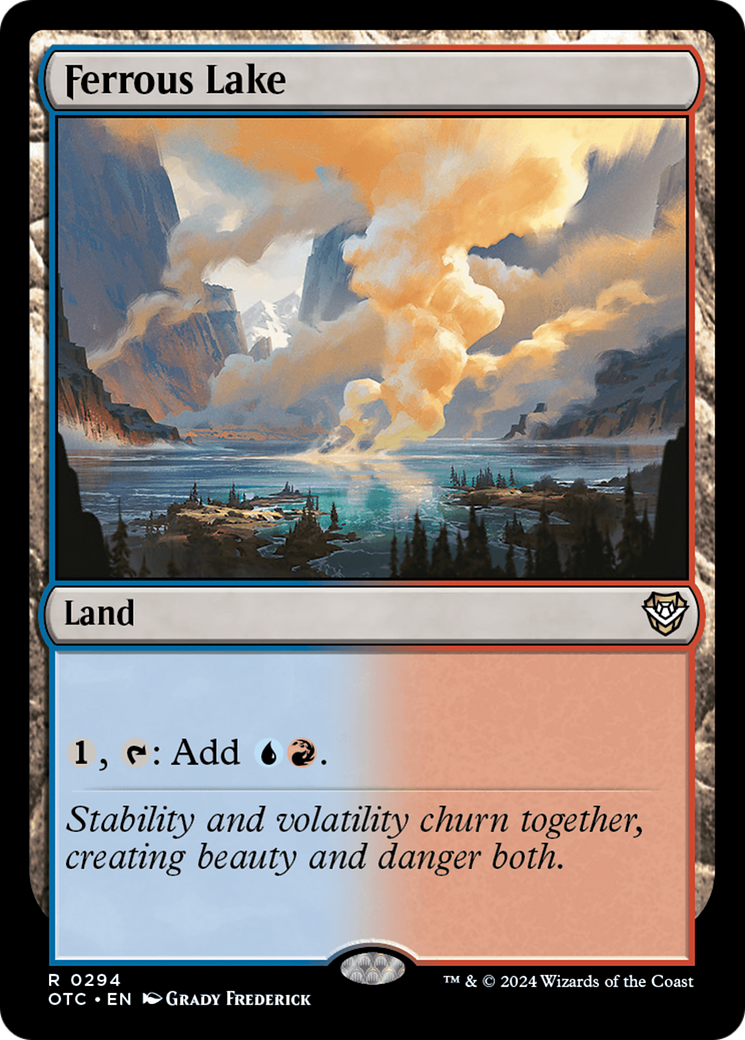
Ferrous Lake
Ferrous Lake
Land
, : Add .
-
1
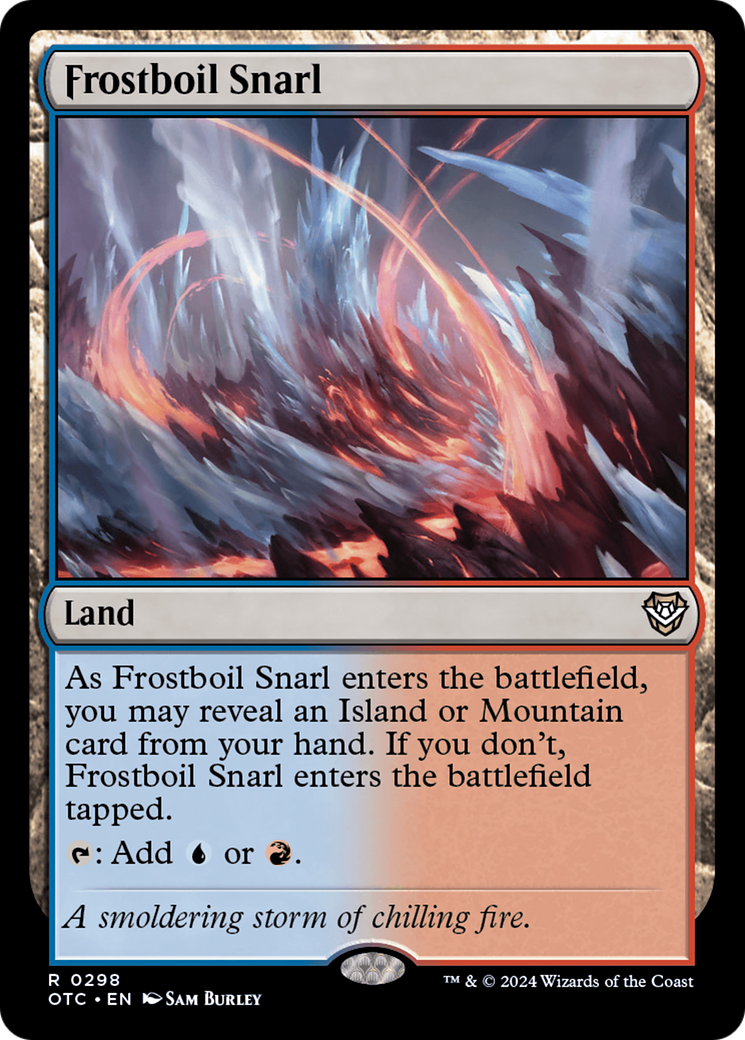
Frostboil Snarl
Frostboil Snarl
Land
As this land enters, you may reveal an Island or Mountain card from your hand. If you don't, this land enters tapped.
: Add or .
- The "Snarl" itself doesn't have any land subtypes. You can't reveal one to satisfy the ability of another.
- If a land card with an appropriate subtype is entering the battlefield from your hand at the same time as one of these lands, you may reveal the other land to have the "Snarl" enter untapped.
- If an effect instructs you to put one of these lands onto the battlefield tapped, it will still enter the battlefield tapped even if you reveal a land card from your hand.
- You may reveal any land card with either or both of the appropriate subtypes. It doesn't have to be a basic land card.
-
14
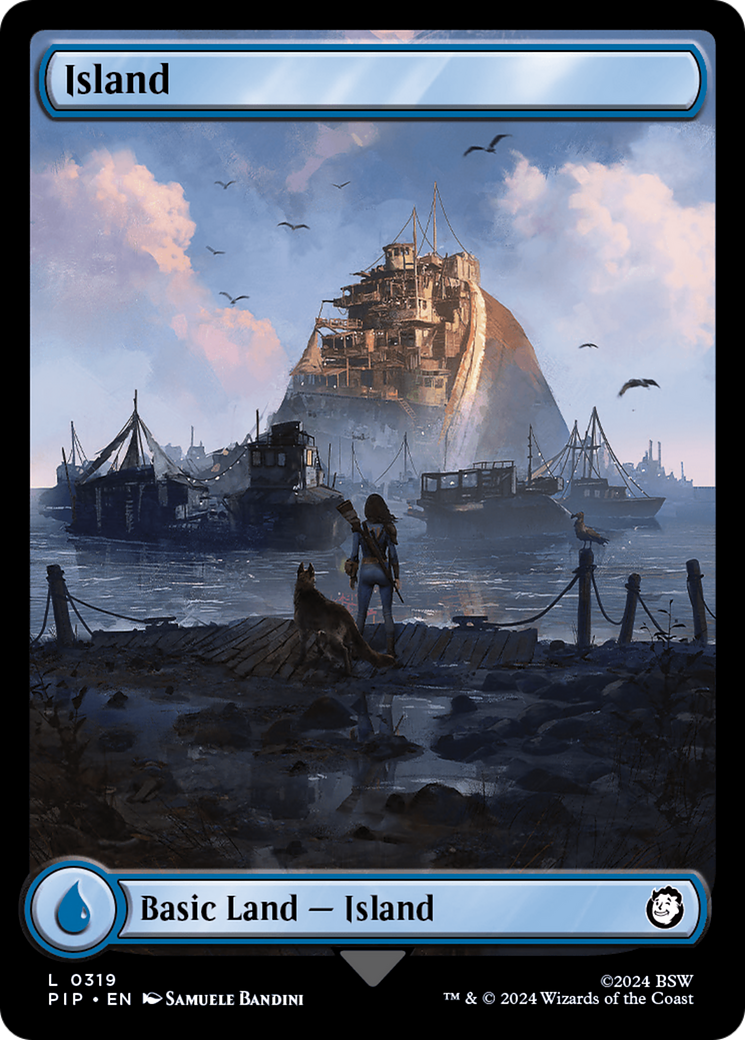
Island
Island
Basic Land — Island
( : Add .)
-
1
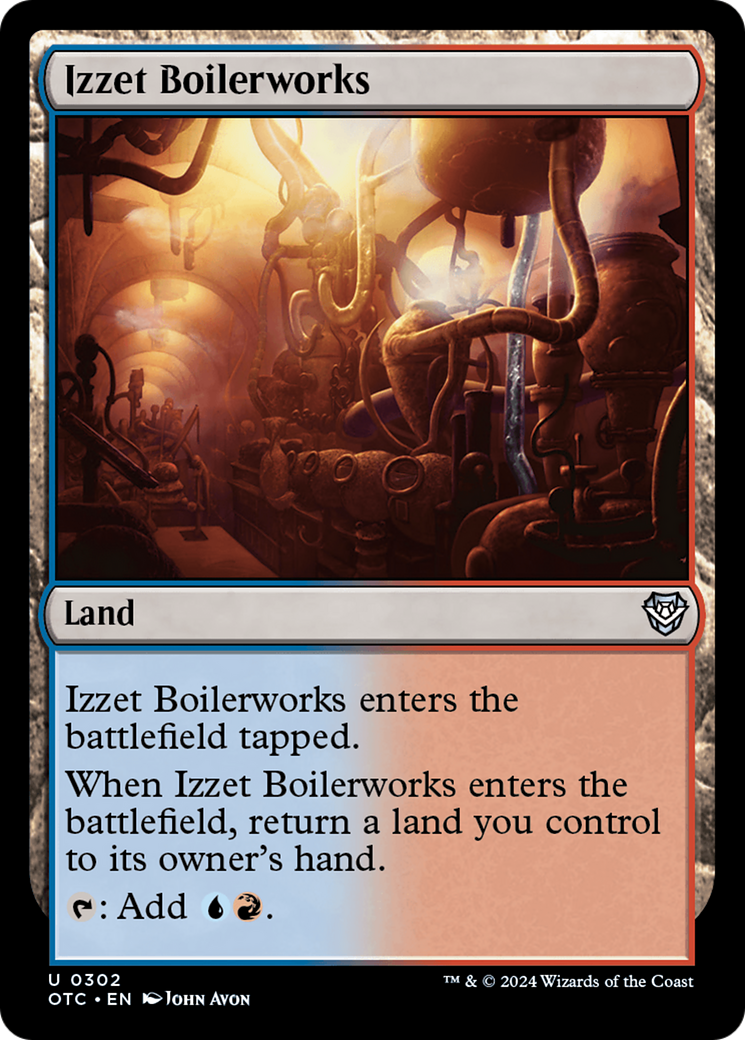
Izzet Boilerworks
Izzet Boilerworks
Land
This land enters tapped.
When this land enters, return a land you control to its owner's hand.
: Add .
- If this land enters the battlefield and you control no other lands, its ability will force you to return it to your hand.
-
13
Mountain
Mountain
Basic Land — Mountain
( : Add .)
-
1
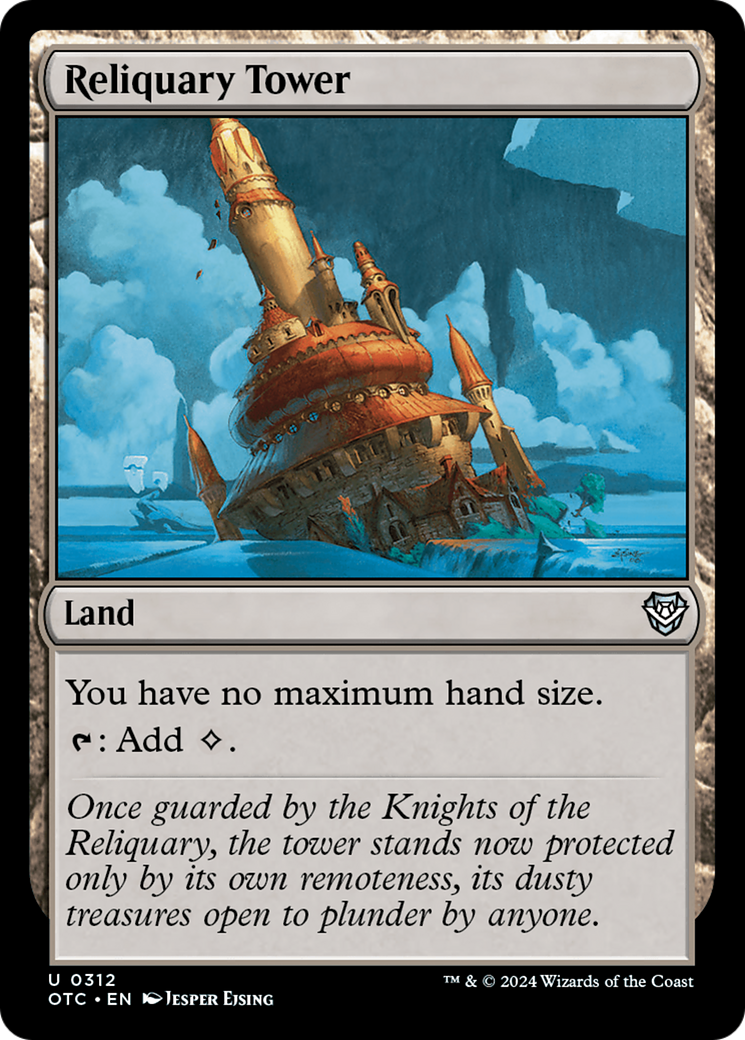
Reliquary Tower
Reliquary Tower
Land
You have no maximum hand size.
: Add .
- If multiple effects modify your hand size, apply them in timestamp order. For example, if you put Null Profusion (an enchantment that says your maximum hand size is two) onto the battlefield and then put Reliquary Tower onto the battlefield, you'll have no maximum hand size. However, if those permanents enter in the opposite order, your maximum hand size would be two.
-
1
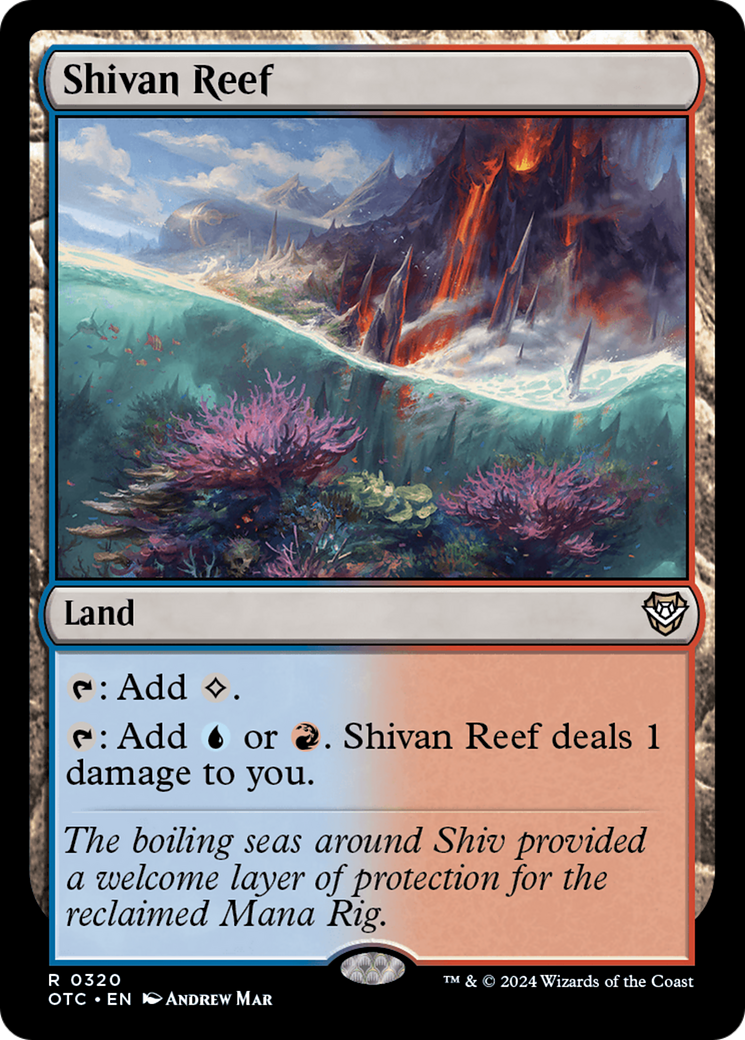
Shivan Reef
Shivan Reef
Land
: Add .
: Add or . This land deals 1 damage to you.
- The damage dealt to you is part of the second mana ability. It doesn't use the stack and can't be responded to.
- Like most lands, each land in this cycle is colorless. The damage dealt to you is dealt by a colorless source.
-
1
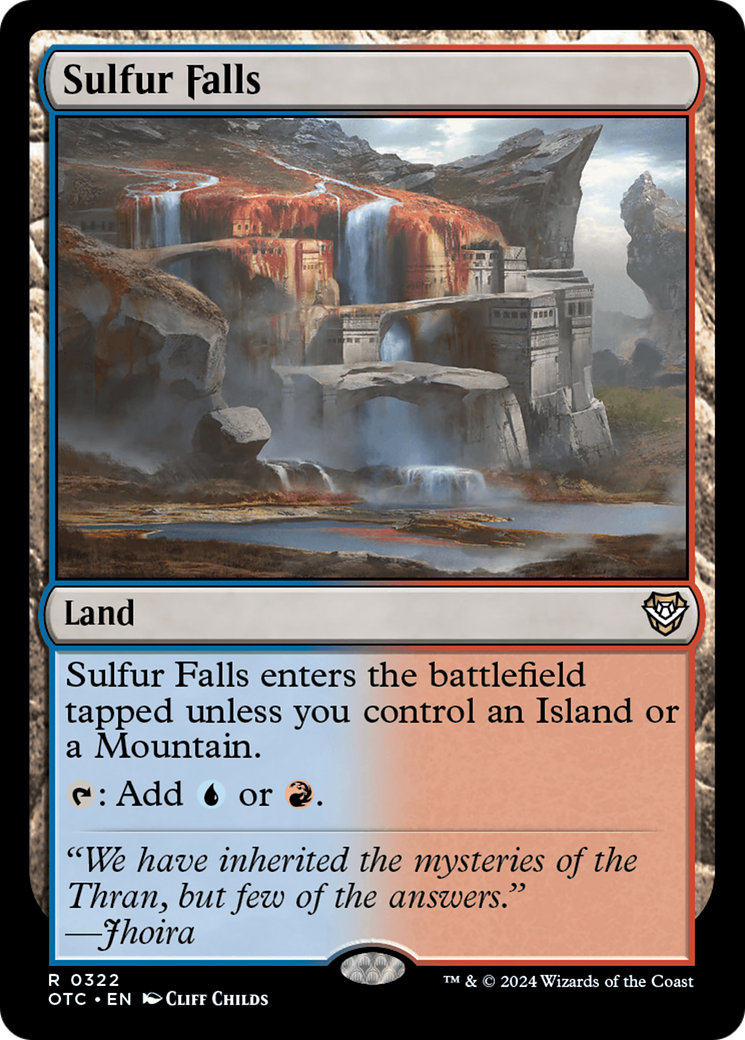
Sulfur Falls
Sulfur Falls
Land
This land enters tapped unless you control an Island or a Mountain.
: Add or .
-
1
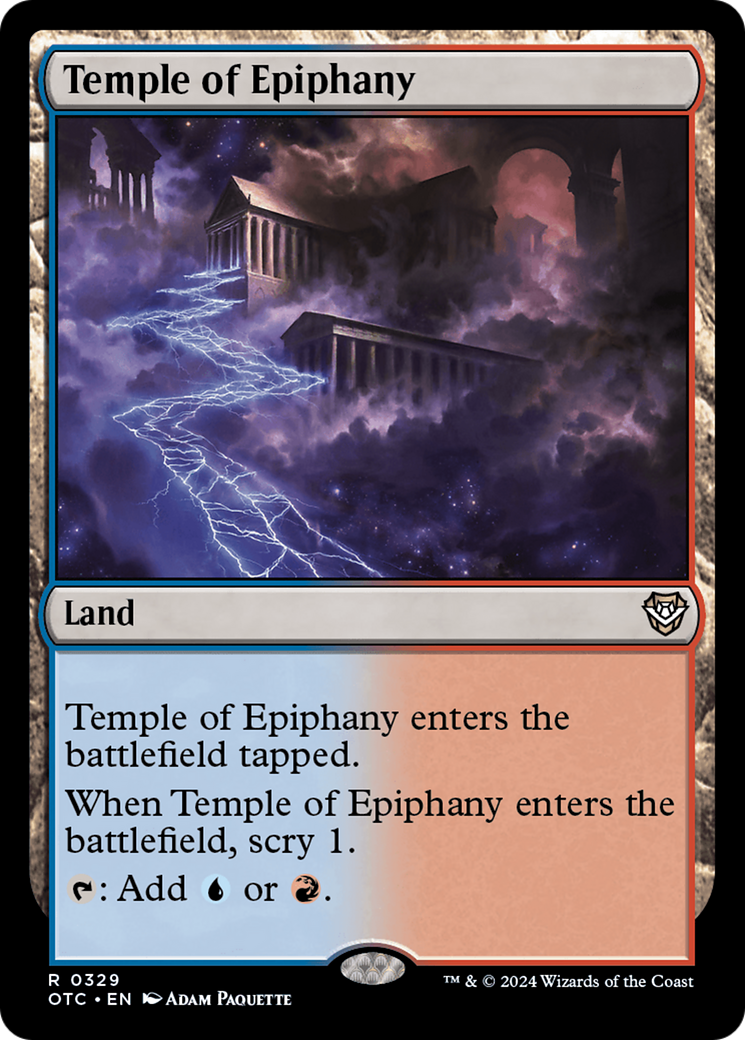
Temple of Epiphany
Temple of Epiphany
Land
This land enters tapped.
When this land enters, scry 1. (Look at the top card of your library. You may put that card on the bottom.)
: Add or .
-
1
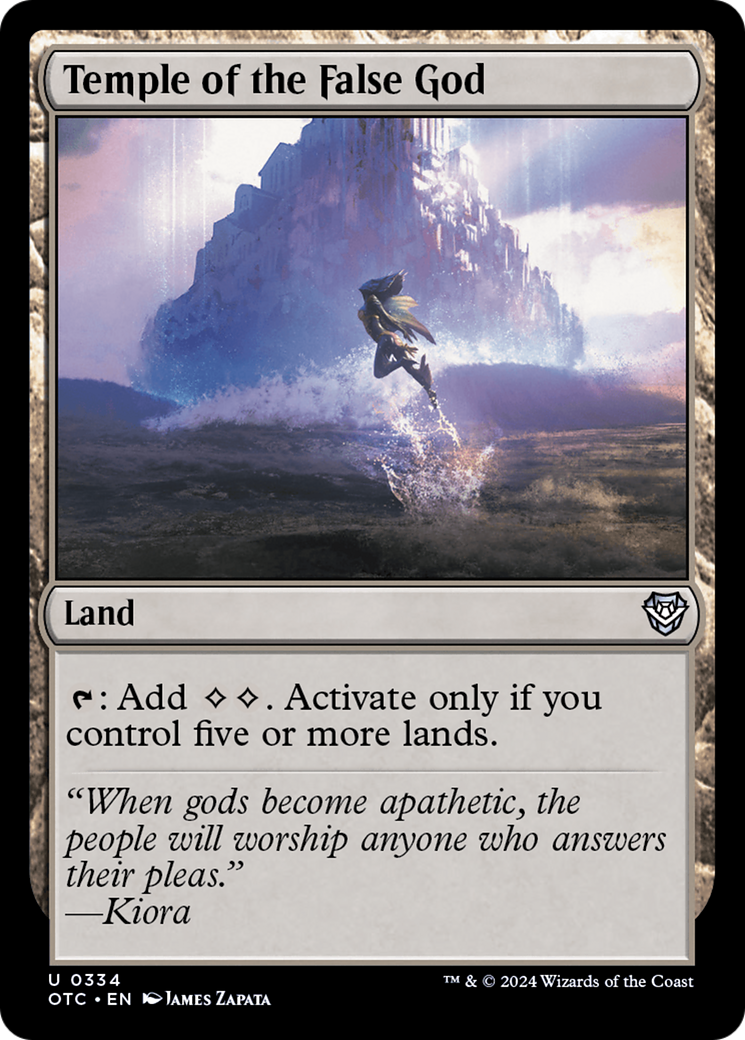
Temple of the False God
Temple of the False God
Land
: Add . Activate only if you control five or more lands.
Blue 28
-
1
Arcane Denial
Arcane Denial
Instant
Counter target spell. Its controller may draw up to two cards at the beginning of the next turn's upkeep.
You draw a card at the beginning of the next turn's upkeep.
- The controller of the countered spell doesn't choose how many cards to draw until the relevant ability resolves. The player may draw 0, 1, or 2 cards. They choose the number before drawing any cards.
-
1
Archmage Emeritus
Archmage Emeritus
Creature — Human Wizard
2/2
Magecraft — Whenever you cast or copy an instant or sorcery spell, draw a card.
- If an effect creates multiple copies of an instant or sorcery spell, magecraft abilities trigger once for each copy created by the effect.
- If an effect creates a copy of an instant or sorcery spell, this will also cause the magecraft ability to trigger.
- Each magecraft ability has a different effect, although they all have the same trigger condition, whenever you cast or copy an instant or sorcery spell.
- Some effects instruct you to copy an instant or sorcery card in a zone other than the stack. These copies do not cause magecraft abilities to trigger. However, most effects that do this also allow you to cast the copy, and casting the copy will cause magecraft abilities to trigger.
-
1
Baral's Expertise
Baral's Expertise
Sorcery
Return up to three target artifacts and/or creatures to their owners' hands.
You may cast a spell with mana value 4 or less from your hand without paying its mana cost.
- The mana value of a split card is determined by the combined mana cost of its two halves. If an expertise spell allows you to cast a split card, you may cast either half or, if that split card has fuse, both halves.
- If the card has in its mana cost, you must choose 0 as the value of X when casting it without paying its mana cost.
- The card that you cast may be an artifact or creature that was returned to your hand by this spell.
- If the Expertise spell you cast has any targets, and those targets become illegal before the spell resolves, the spell doesn't resolve and none of its effects happen. You won't get to cast a free spell.
- Effects that allow you to "cast" a card don't allow you to play a land card.
- If you cast a card "without paying its mana cost," you can't choose to cast it for any alternative costs, such as emerge costs. You can, however, pay additional costs. If the card has any mandatory additional costs, such as that of Cathartic Reunion, you must pay those to cast the card.
- While you're casting your free spell, the Expertise spell is still on the stack. It will be put into its owner's graveyard after the free spell is cast. The free spell can't target the Expertise card in your graveyard. It can target the Expertise spell on the stack, but the Expertise spell will become an illegal target before the free spell resolves.
- Any triggered abilities that trigger while performing the Expertise spell's first effect won't be put onto the stack until after you're done casting your free spell. They're put onto the stack at the same time as any abilities that triggered while casting that spell regardless of the order in which those abilities triggered.
- A card's mana value is determined solely by the mana symbols printed in its upper right corner. The mana value is the total amount of mana in that cost, regardless of color. For example, a card with mana cost has mana value 3. Ignore any alternative costs, additional costs, cost increases, or cost reductions that could apply to it. A card with no mana cost has a mana value of 0.
-
1
Curse of the Swine
Curse of the Swine
Sorcery
Exile X target creatures. For each creature exiled this way, its controller creates a 2/2 green Boar creature token.
-
1
Deep Analysis
Deep Analysis
Sorcery
Target player draws two cards.
Flashback— , Pay 3 life. (You may cast this card from your graveyard for its flashback cost. Then exile it.)
- A spell cast using flashback will always be exiled afterward, whether it resolves, is countered, or leaves the stack in some other way.
- You must still follow any timing restrictions and permissions, including those based on the card's type. For instance, you can cast a sorcery using flashback only when you could normally cast a sorcery.
- You can cast a spell using flashback even if it was somehow put into your graveyard without having been cast.
- To determine the total cost of a spell, start with the mana cost or alternative cost (such as a flashback cost) you're paying, add any cost increases, then apply any cost reductions. The mana value of the spell is determined only by its mana cost, no matter what the total cost to cast the spell was.
- If a card with flashback is put into your graveyard during your turn, you can cast it if it's legal to do so before any other player can take any actions.
- "Flashback [cost]" means "You may cast this card from your graveyard by paying [cost] rather than paying its mana cost" and "If the flashback cost was paid, exile this card instead of putting it anywhere else any time it would leave the stack."
-
1
Dig Through Time
Dig Through Time
Instant
Delve (Each card you exile from your graveyard while casting this spell pays for .)
Look at the top seven cards of your library. Put two of them into your hand and the rest on the bottom of your library in any order.
- Because delve isn't an alternative cost, it can be used in conjunction with alternative costs, such as flashback. It can also be used to pay for additional costs that include generic mana.
- Delve doesn't change a spell's mana cost or mana value. For example, Treasure Cruise's mana value is 8 even if you exiled three cards to cast it.
- You can exile cards to pay only for generic mana, and you can't exile more cards than the generic mana requirement of a spell with delve. For example, you can't exile more than seven cards from your graveyard to cast Treasure Cruise unless an effect has increased its cost.
-
1
Finale of Revelation
Finale of Revelation
Sorcery
Draw X cards. If X is 10 or more, instead shuffle your graveyard into your library, draw X cards, untap up to five lands, and you have no maximum hand size for the rest of the game.
Exile Finale of Revelation.
-
1
Forger's Foundry
Forger's Foundry
Artifact
: Add . When you spend this mana to cast an instant or sorcery spell with mana value 3 or less, you may exile that spell instead of putting it into its owner's graveyard as it resolves.
, : You may cast any number of spells from among cards exiled with this artifact without paying their mana costs. Activate only as a sorcery.
- The mana added by Forger's Foundry can be spent on anything, not just instant and sorcery spells with mana value 3 or less.
- The delayed triggered ability will trigger whether Forger's Foundry is still on the battlefield or not.
- When casting an instant or sorcery spell with in its mana cost using the mana added by Forger's Foundry, use the value of X chosen when you cast that spell to determine whether or not the delayed triggered ability triggers.
- You choose which spells (if any) to cast as Forger's Foundry's last ability resolves. If you do, you do so as part of the resolution of that ability. You can't wait to cast them later in the turn.
- You cast the spells one at a time as Forger's Foundry's last ability is resolving, choosing modes, targets, and so on. The last spell you cast will be the first one to resolve. Ignore timing restrictions based on the cards' types. Other timing restrictions, such as "Cast [this spell] only during combat," must be followed.
- If you cast a spell "without paying its mana cost," you can't choose to cast it for any alternative costs. You can, however, pay additional costs, such as kicker costs. If the spell has any mandatory additional costs, those must be paid to cast the spell.
- If a spell you cast has in its mana cost, you must choose 0 as the value of X when casting it without paying its mana cost.
-
1
Haughty Djinn
Haughty Djinn
Creature — Djinn
*/4
Flying
Haughty Djinn's power is equal to the number of instant and sorcery cards in your graveyard.
Instant and sorcery spells you cast cost less to cast.
- The ability that defines Haughty Djinn's power functions in all zones.
- A split card in your graveyard only counts once for Haughty Djinn's power, even if it's both an instant and a sorcery.
-
1
Lock and Load
Lock and Load
Sorcery
Draw a card, then draw a card for each other instant and sorcery spell you've cast this turn.
Plot (You may pay and exile this card from your hand. Cast it as a sorcery on a later turn without paying its mana cost. Plot only as a sorcery.)
- Lock and Load will count any other instant and sorcery spells you’ve cast this turn. It doesn’t matter if the other spells resolved, didn’t resolve, were countered, or are still on the stack.
- Plot abilities are written “Plot [cost],” which means “Any time you have priority during your main phase while the stack is empty, you may pay [cost] and exile this card from your hand. It becomes plotted.”
- Exiling a card using its plot ability is a special action. Once you announce you’re taking that action, no other player can respond by trying to remove that card from your hand.
- You can’t cast a plotted card on the same turn it became plotted. On any future turn, you may cast that card from exile without paying its mana cost during your main phase while the stack is empty.
- If you’re casting a plotted card from exile without paying its mana cost, you can’t choose to cast it for any other alternative costs. You can, however, pay additional costs, such as kicker costs. If the plotted card has any mandatory additional costs, those must still be paid to cast the spell.
- If a plotted card has in its mana cost, you must choose 0 as the value of X when casting it without paying its mana cost.
-
1
Midnight Clock
Midnight Clock
Artifact
: Add .
: Put an hour counter on this artifact.
At the beginning of each upkeep, put an hour counter on this artifact.
When the twelfth hour counter is put on this artifact, shuffle your hand and graveyard into your library, then draw seven cards. Exile this artifact.
- If Midnight Clock leaves the battlefield while its last ability is on the stack, it won't be exiled.
- You can activate Midnight Clock's mana ability to pay the cost of its second ability.
- Midnight Clock's last ability triggers after one or more counters are put onto it if it had fewer than twelve counters on it before those counters were put on it and it has twelve or more counters on it after.
- Midnight Clock's first triggered ability triggers at the beginning of each upkeep, not just your upkeep. In a Two-Headed Giant game, an ability that triggers at the beginning of each upkeep rather than each player's upkeep triggers only once during each team's upkeep.
-
1
Murmuring Mystic
Murmuring Mystic
Creature — Human Wizard
1/5
Whenever you cast an instant or sorcery spell, create a 1/1 blue Bird Illusion creature token with flying.
- Murmuring Mystic's triggered ability resolves before the spell that caused it to trigger. It resolves even if that spell is countered.
-
1
Octavia, Living Thesis
Octavia, Living Thesis
Legendary Creature — Elemental Octopus
8/8
This spell costs less to cast if you have eight or more instant and/or sorcery cards in your graveyard.
Ward
Magecraft — Whenever you cast or copy an instant or sorcery spell, target creature has base power and toughness 8/8 until end of turn.
- Each magecraft ability has a different effect, although they all have the same trigger condition, whenever you cast or copy an instant or sorcery spell.
- For example, if you control Archmage Emeritus and cast an instant or sorcery spell, Archmage Emeritus's magecraft ability will trigger and you will draw a card.
- If an effect creates a copy of an instant or sorcery spell, this will also cause the magecraft ability to trigger.
- If an effect creates multiple copies of an instant or sorcery spell, magecraft abilities trigger once for each copy created by the effect.
- Some effects instruct you to copy an instant or sorcery card in a zone other than the stack. These copies do not cause magecraft abilities to trigger. However, most effects that do this also allow you to cast the copy, and casting the copy will cause magecraft abilities to trigger.
- If a player casts a spell that targets multiple permanents their opponent controls with ward, each of those ward abilities will trigger. If that player doesn't pay for all of them, the spell will be countered.
-
1
Opt
Opt
Instant
Scry 1. (Look at the top card of your library. You may put that card on the bottom.)
Draw a card.
-
1
Ponder
Ponder
Sorcery
Look at the top three cards of your library, then put them back in any order. You may shuffle.
Draw a card.
- If you choose to shuffle your library, that includes the three cards you just looked at and put back on top of it.
-
1
Pongify
Pongify
Instant
Destroy target creature. It can't be regenerated. Its controller creates a 3/3 green Ape creature token.
- If the target creature is an illegal target by the time Pongify tries to resolve, the spell won't resolve. No player creates an Ape token. If the target is legal but not destroyed (most likely because it has indestructible), its controller does create an Ape token.
-
1
Preordain
Preordain
Sorcery
Scry 2, then draw a card. (To scry 2, look at the top two cards of your library, then put any number of them on the bottom and the rest on top in any order.)
-
1
Propaganda
Propaganda
Enchantment
Creatures can't attack you unless their controller pays for each creature they control that's attacking you.
- The payment is made during the declare attackers step at the same time you are declaring the attacker.
- If there are multiple attacks in a turn, then you have to pay for each attack.
- If there is more than one Propaganda on the battlefield, the cost is cumulative.
- Paying this cost is not an instant or any other kind of ability, it is an additional cost on the declaration of the attacker.
-
1
Pteramander
Pteramander
Creature — Salamander Drake
1/1
Flying
: Adapt 4. This ability costs less to activate for each instant and sorcery card in your graveyard. (If this creature has no +1/+1 counters on it, put four +1/+1 counters on it.)
- Pteramander's activated ability can't reduce itself to less than to activate.
- You can always activate an ability that will cause a creature to adapt. As that ability resolves, if the creature has a +1/+1 counter on it for any reason, you simply won't put any +1/+1 counters on it.
- If a creature somehow loses all of its +1/+1 counters, it can adapt again and get more +1/+1 counters.
-
1
Radical Idea
Radical Idea
Instant
Draw a card.
Jump-start (You may cast this card from your graveyard by discarding a card in addition to paying its other costs. Then exile this card.)
- You must still follow any timing restrictions and permissions when casting a spell with jump-start, including those based on the card's type. For instance, you can cast a sorcery using jump-start only when you could normally cast a sorcery.
- A spell cast using jump-start will always be exiled afterward, whether it resolves, it's countered, or it leaves the stack in some other way.
- If an effect allows you to pay an alternative cost rather than a spell's mana cost, you may pay that alternative cost when you jump-start a spell. You'll still discard a card as an additional cost to cast it.
- If a card with jump-start is put into your graveyard during your turn, you'll be able to cast it right away if it's legal to do so, before an opponent can take any actions.
-
1
Serum Visions
Serum Visions
Sorcery
Draw a card. Scry 2.
-
1
Shark Typhoon
Shark Typhoon
Enchantment
Whenever you cast a noncreature spell, create an X/X blue Shark creature token with flying, where X is that spell's mana value.
Cycling ( , Discard this card: Draw a card.)
When you cycle this card, create an X/X blue Shark creature token with flying.
- An ability that triggers when a player casts a spell resolves before the spell that caused it to trigger. It resolves even if that spell is countered.
- For spells with in their mana costs, use the value chosen for X to determine the spell's mana value.
- You can choose 0 as the value of X in Shark Typhoon's cycling cost. The last ability will trigger, and you'll create a 0/0 blue Shark creature token with flying. Unless something else is raising its toughness, the Shark will then immediately die.
- Some cards with cycling have an ability that triggers when you cycle them, and some cards have an ability that triggers whenever you cycle any card. These triggered abilities resolve before you draw from the cycling ability.
- Triggered abilities from cycling a card and the cycling ability itself aren't spells. Effects that interact with spells (such as that of Cancel) won't affect them.
- You can cycle a card even if it has a triggered ability from cycling that won't have a legal target. This is because the cycling ability and the triggered ability are separate. This also means that if either ability is countered (with Disallow, for example), the other ability will still resolve.
-
1
Talrand, Sky Summoner
Talrand, Sky Summoner
Legendary Creature — Merfolk Wizard
2/2
Whenever you cast an instant or sorcery spell, create a 2/2 blue Drake creature token with flying.
- An ability that triggers when a player casts a spell resolves before the spell that caused it to trigger, but after targets have been chosen for that spell. It resolves even if that spell is countered.
-
1
Think Twice
Think Twice
Instant
Draw a card.
Flashback (You may cast this card from your graveyard for its flashback cost. Then exile it.)
- "Flashback [cost]" means "You may cast this card from your graveyard by paying [cost] rather than paying its mana cost" and "If the flashback cost was paid, exile this card instead of putting it anywhere else any time it would leave the stack."
- You must still follow any timing restrictions and permissions, including those based on the card's type. For instance, you can cast a sorcery using flashback only when you could normally cast a sorcery.
- To determine the total cost of a spell, start with the mana cost or alternative cost (such as a flashback cost) you're paying, add any cost increases, then apply any cost reductions. The mana value of the spell is determined only by its mana cost, no matter what the total cost to cast the spell was.
- A spell cast using flashback will always be exiled afterward, whether it resolves, is countered, or leaves the stack in some other way.
- You can cast a spell using flashback even if it was somehow put into your graveyard without having been cast.
- If a card with flashback is put into your graveyard during your turn, you can cast it if it's legal to do so before any other player can take any actions.
-
1
Thunderclap Drake
Thunderclap Drake
Creature — Drake
2/1
Flying
Instant and sorcery spells you cast cost less to cast.
, Sacrifice this creature: When you next cast an instant or sorcery spell this turn, copy it for each time you've cast your commander from the command zone this game. You may choose new targets for the copies.
- The last sentence of Thunderclap Drake's rules text was inadvertently omitted from the card. Its Oracle text has been updated to include that sentence.
- You can't choose to pay any additional costs for the copies. However, effects based on any additional costs that were paid for the original spell are copied as though those same costs were paid for the copies too.
- If the spell that's copied is modal (that is, it says "Choose one —" or the like), the copies will have the same mode or modes. You can't choose different ones.
- Thunderclap Drake's second ability doesn't change the mana cost or mana value of any spell. It changes only the total cost you pay to cast instant and sorcery spells.
- If a spell that's copied has an X whose value was determined as it was cast, the copies will have the same value of X.
- If you have multiple commanders, you'll copy the next instant or sorcery spell you cast this turn for each time you've cast either of them. For example, if you've cast one commander once and one twice, you'll copy that spell three times.
- The copies made by Thunderclap Drake's delayed triggered ability are created on the stack, so they're not "cast."
- Thunderclap Drake's second ability can't reduce the amount of colored mana you pay for a spell. It reduces only the generic mana component of that spell's cost.
- If the spell that's copied divides damage or distributes counters among a number of targets, the division and number of targets can't be changed.
-
1
Treasure Cruise
Treasure Cruise
Sorcery
Delve (Each card you exile from your graveyard while casting this spell pays for .)
Draw three cards.
- Delve doesn't change a spell's mana cost or mana value. For example, Treasure Cruise's mana value is 8 even if you exiled three cards to cast it.
- You can exile cards to pay only for generic mana, and you can't exile more cards than the generic mana requirement of a spell with delve. For example, you can't exile more than seven cards from your graveyard to cast Treasure Cruise unless an effect has increased its cost.
- Because delve isn't an alternative cost, it can be used in conjunction with alternative costs, such as flashback. It can also be used to pay for additional costs that include generic mana.
-
1
Windfall
Windfall
Sorcery
Each player discards their hand, then draws cards equal to the greatest number of cards a player discarded this way.
-
1
Winged Boots
Winged Boots
Artifact — Equipment
Equipped creature has flying and ward . (Whenever equipped creature becomes the target of a spell or ability an opponent controls, counter it unless that player pays .)
Equip
- If a player casts a spell that targets multiple permanents their opponent controls with ward, each of those ward abilities will trigger. If that player doesn't pay for all of them, the spell will be countered.
Red 19
-
1
Arcane Bombardment
Arcane Bombardment
Enchantment
Whenever you cast your first instant or sorcery spell each turn, exile an instant or sorcery card at random from your graveyard. Then copy each card exiled with this enchantment. You may cast any number of the copies without paying their mana costs.
- The spell that caused Arcane Bombardment's ability to trigger is normally still on the stack while that ability resolves. That spell won't be among the cards in your graveyard when you exile an instant or sorcery from it at random.
- If you've already cast an instant or sorcery spell the turn that Arcane Bombardment enters the battlefield, it won't trigger until you cast an instant or sorcery spell on a later turn.
- You cast the desired copies as the triggered ability resolves. You don't get to cast them later in the turn. You choose the order of copies as you cast them.
- If you cast a spell with in its cost without paying its mana cost, you must choose 0 for X.
- If Arcane Bombardment leaves the battlefield, the exiled cards remain in exile. If it returns to the battlefield or you play another copy of it, you won't get to cast copies of the cards previously exiled.
-
1
Big Score
Big Score
Instant
As an additional cost to cast this spell, discard a card.
Draw two cards and create two Treasure tokens. (They're artifacts with " , Sacrifice this token: Add one mana of any color.")
-
1
Bloodthirsty Adversary
Bloodthirsty Adversary
Creature — Vampire
2/2
Haste
When this creature enters, you may pay any number of times. When you pay this cost one or more times, put that many +1/+1 counters on this creature, then exile up to that many target instant and/or sorcery cards with mana value 3 or less from your graveyard and copy them. You may cast any number of the copies without paying their mana costs.
- Copies cast this way are cast during the resolution of the ability. You don't have to follow normal timing requirements and you can't wait and cast them later.
- After you pay the cost one or more times, a second ability triggers and you choose the targets for it. Players may respond to the new ability at that point. As that ability resolves, Bloodthirsty Adversary gets its counters and the target cards are exiled.
- Whether or not you cast the copies this way, the original cards will remain in exile.
-
1
Chaos Warp
Chaos Warp
Instant
The owner of target permanent shuffles it into their library, then reveals the top card of their library. If it's a permanent card, they put it onto the battlefield.
- A permanent card is a card with one or more of the following card types: artifact, creature, enchantment, land, or planeswalker.
- The owner of a token is the player under whose control the token was put onto the battlefield. If a token is shuffled into a player's library this way, that player shuffles before revealing the top card of that library.
- If the revealed card is not a permanent card, it remains on top of that library.
- If the permanent is an illegal target by the time Chaos Warp tries to resolve, it won't resolve and none of its effects will occur. No library will be shuffled and no card will be revealed.
- If the revealed card is a permanent card but can't enter (perhaps because it's an Aura with nothing to enchant), it remains on top of that library.
-
1
Crackling Spellslinger
Crackling Spellslinger
Creature — Human Wizard
2/2
Flash
When this creature enters, if you cast it, the next instant or sorcery spell you cast this turn has storm. (When you cast that spell, copy it for each spell cast before it this turn. You may choose new targets for the copies.)
- Crackling Spellslinger’s second ability triggers if you cast it from any zone. It doesn’t trigger if you put Crackling Spellslinger onto the battlefield without casting it.
- The copies of a spell with storm created by its storm ability are put directly onto the stack. They aren’t cast and won’t be counted by other spells with storm cast later in the turn.
- Spells cast from zones other than a player’s hand and spells that were countered or otherwise failed to resolve are counted by the storm ability.
- A copy of a spell can be countered like any other spell, but it must be countered individually. Countering a spell with storm won’t affect the copies.
-
1
Cursed Mirror
Cursed Mirror
Artifact
: Add .
As this artifact enters, you may have it become a copy of any creature on the battlefield until end of turn, except it has haste.
- If Cursed Mirror somehow enters the battlefield at the same time as a creature, it can't become a copy of that creature. You may choose only a creature that's already on the battlefield.
- Cursed Mirror copies exactly what was printed on the original creature (unless that creature is copying something else or is a token; see below). It doesn't copy whether that creature is tapped or untapped, whether it has any counters on it or any Auras or Equipment attached to it, or any non-copy effects that have changed its types, color, power and toughness, and so on.
- If the copied creature has in its mana cost, X is considered to be 0.
- If something else becomes a copy of Cursed Mirror while Cursed Mirror is a copy of a creature, the duration of the effect is not copied. The new copy will still be a creature (with haste) after Cursed Mirror stops being a copy at the end of the turn.
- While it is copying a creature, Cursed Mirror does not have " : Add " (unless the creature it's copying also has that ability).
- If the copied creature is copying something else, then Cursed Mirror enters the battlefield as a copy of whatever that creature is copying.
- Any enters-the-battlefield abilities of the copied creature will trigger when Cursed Mirror enters the battlefield. Any "As [this creature] enters the battlefield" or "[This creature] enters the battlefield with" abilities of the copied creature will also work.
- If the copied creature is a token, Cursed Mirror copies the original characteristics of that token as stated by the effect that created the token. Copying a token doesn't make Cursed Mirror a token. Similarly, if Cursed Mirror itself is a token, copying a nontoken permanent doesn't make it stop being a token.
-
1
Electrostatic Field
Electrostatic Field
Creature — Wall
0/4
Defender
Whenever you cast an instant or sorcery spell, this creature deals 1 damage to each opponent.
- In a Two-Headed Giant game, Electrostatic Field's triggered ability causes the opposing team to lose 2 life.
- Electrostatic Field's triggered ability resolves before the spell that caused it to trigger. It resolves even if that spell is countered.
-
1
Elemental Eruption
Elemental Eruption
Sorcery
Create a 4/4 red Dragon Elemental creature token with flying and prowess.
Storm (When you cast this spell, copy it for each spell cast before it this turn.)
- The copies of Elemental Eruption created by its storm ability are put directly onto the stack. They aren’t cast and won’t be counted by other spells with storm cast later in the turn.
- Spells cast from zones other than a player’s hand and spells that were countered or otherwise failed to resolve are counted by the storm ability.
- A copy of a spell can be countered like any other spell, but it must be countered individually. Countering a spell with storm won’t affect the copies.
-
1
Faithless Looting
Faithless Looting
Sorcery
Draw two cards, then discard two cards.
Flashback (You may cast this card from your graveyard for its flashback cost. Then exile it.)
- To determine the total cost of a spell, start with the mana cost or alternative cost (such as a flashback cost) you're paying, add any cost increases, then apply any cost reductions. The mana value of the spell is determined only by its mana cost, no matter what the total cost to cast the spell was.
- A spell cast using flashback will always be exiled afterward, whether it resolves, is countered, or leaves the stack in some other way.
- "Flashback [cost]" means "You may cast this card from your graveyard if the resulting spell is an instant or sorcery spell by paying [cost] rather than paying its mana cost" and "If the flashback cost was paid, exile this card instead of putting it anywhere else any time it would leave the stack."
- If a card with flashback is put into your graveyard during your turn, you can cast it if it's legal to do so before any other player can take any actions.
- You can cast a spell using flashback even if it was somehow put into your graveyard without having been cast.
- You must still follow any timing restrictions and permissions, including those based on the card's type. For instance, you can cast a sorcery using flashback only when you could normally cast a sorcery.
- You draw two cards and discard two cards all while Faithless Looting is resolving. Nothing can happen between the two, and no player may choose to take actions.
-
1
Finale of Promise
Finale of Promise
Sorcery
You may cast up to one target instant card and/or up to one target sorcery card from your graveyard each with mana value X or less without paying their mana costs. If a spell cast this way would be put into your graveyard, exile it instead. If X is 10 or more, copy each of those spells twice. You may choose new targets for the copies.
- As Finale of Promise resolves, first you cast the target instant card and/or the target sorcery card in either order. Then, if X is 10 or more, you copy each of those twice and put the copies on the stack in any order. The copies will resolve before the original spells.
- A split card that's an instant and a sorcery card may be the target of Finale of Promise twice. However, once you cast that card once, it can't be cast a second time.
- If a spell has in its mana cost, you must choose 0 as the value of X when casting it without paying its mana cost.
- If you cast a card "without paying its mana cost," you can't choose to cast it for any alternative costs. You can, however, pay additional costs. If the card has any mandatory additional costs, such as that of Spark Harvest, you must pay those to cast the card.
- If the spell that's copied is modal (that is, it says "Choose one—" or the like), the copies will have the same mode or modes. You can't choose different ones.
- If the spell has damage divided as it was cast, the division can't be changed (although the targets receiving that damage still can). The same is true of spells that distribute counters.
- You can't choose to pay any additional costs for the copies. However, effects based on any additional costs that were paid for the original spell are copied as though those same costs were paid for the copy too.
- The copies that Finale of Promise creates are created on the stack, so they're not "cast." Abilities that trigger when a player casts a spell won't trigger.
-
1
Guttersnipe
Guttersnipe
Creature — Goblin Shaman
2/2
Whenever you cast an instant or sorcery spell, this creature deals 2 damage to each opponent.
- Guttersnipe's triggered ability resolves before the spell that caused it to trigger. It resolves even if that spell is countered or otherwise leaves the stack without resolving.
- In a Two-Headed Giant game, Guttersnipe's ability causes the opposing team to lose 4 life.
-
1
Mizzix's Mastery
Mizzix's Mastery
Sorcery
Exile target card that's an instant or sorcery from your graveyard. For each card exiled this way, copy it, and you may cast the copy without paying its mana cost. Exile Mizzix's Mastery.
Overload (You may cast this spell for its overload cost. If you do, change "target" in its text to "each.")
- If you are instructed to cast a spell with overload "without paying its mana cost," you can't choose to pay its overload cost instead.
- If you don't pay the overload cost of a spell with overload, that spell will have a single target. If you pay the overload cost, the spell won't have any targets.
- Because a spell with overload doesn't target when its overload cost is paid, it may affect permanents with hexproof or with protection from the appropriate color.
- To determine the total cost of a spell, start with the mana cost or alternative cost you're paying (such as an overload cost), add any cost increases, then apply any cost reductions. The mana value of the spell remains unchanged, no matter what the total cost to cast it was.
- The copies are created and cast during the resolution of Mizzix's Mastery. You can't wait to cast them later in the turn. Timing restrictions based on the copy's type are ignored. Other restrictions (such as "Cast [this spell] only during combat") are not.
- If you cast a spell "without paying its mana cost," you can't pay any alternative costs. You can, however, pay additional costs, such as kicker costs. If the card has any mandatory additional costs, you must pay those.
- If the copy has in its mana cost, you must choose 0 as the value of X.
- The cards remain exiled no matter what happens to the copies.
- If Mizzix's Mastery exiled multiple cards, you may cast the copies in any order. The last copy you cast will be the first one to resolve.
- If you don't cast one of the copies (perhaps because there are no legal targets available or you don't want to), the copy will cease to exist.
- Mizzix's Mastery is still on the stack as it resolves. If you pay the overload cost, Mizzix's Mastery won't copy itself.
-
1
Pyretic Charge
Pyretic Charge
Sorcery
Discard your hand, then draw four cards. For each card discarded this way, creatures you control get +1/+0 until end of turn.
Plot (You may pay and exile this card from your hand. Cast it as a sorcery on a later turn without paying its mana cost. Plot only as a sorcery.)
- Plot abilities are written “Plot [cost],” which means “Any time you have priority during your main phase while the stack is empty, you may pay [cost] and exile this card from your hand. It becomes plotted.”
- Exiling a card using its plot ability is a special action. Once you announce you’re taking that action, no other player can respond by trying to remove that card from your hand.
- Pyretic Charge affects only creatures you control at the time it resolves. Creatures you begin to control later in the turn and noncreature permanents that become creatures later in the turn won’t get +1/+0 for each card discarded this way.
- You can’t cast a plotted card on the same turn it became plotted. On any future turn, you may cast that card from exile without paying its mana cost during your main phase while the stack is empty.
- If you’re casting a plotted card from exile without paying its mana cost, you can’t choose to cast it for any other alternative costs. You can, however, pay additional costs, such as kicker costs. If the plotted card has any mandatory additional costs, those must still be paid to cast the spell.
- If a plotted card has in its mana cost, you must choose 0 as the value of X when casting it without paying its mana cost.
-
1
Rousing Refrain
Rousing Refrain
Sorcery
Add for each card in target opponent's hand. Until end of turn, you don't lose this mana as steps and phases end. Exile Rousing Refrain with three time counters on it.
Suspend 3— (Rather than cast this card from your hand, you may pay and exile it with three time counters on it. At the beginning of your upkeep, remove a time counter. When the last is removed, you may cast it without paying its mana cost.)
- Suspend is a keyword that represents three abilities. The first is a static ability that allows you to exile the card from your hand with the specified number of time counters (the number before the dash) on it by paying its suspend cost (listed after the dash). The second is a triggered ability that removes a time counter from the suspended card at the beginning of each of your upkeeps. The third is a triggered ability that gives you the option to cast the card when the last time counter is removed.
- Exiling a card with suspend isn't casting that card. This action doesn't use the stack and can't be responded to.
- Due to a recent rules change to suspend, you are no longer required to cast the suspended card as the second triggered ability of suspend resolves. Instead, as the second triggered ability resolves, you may cast the card. Timing permissions based on the card's type are ignored. If you don't cast the card, it remains exiled with no time counters on it, and it's no longer suspended.
- Cards exiled with suspend are exiled face up.
- If the card has in its mana cost, you must choose 0 as the value of X when casting it without paying its mana cost.
- You can exile a card in your hand using suspend any time you could cast that card. Consider its card type, any effects that modify when you could cast it (such as flash) and any other effects that stop you from casting it (such as from Meddling Mage's ability) to determine if and when you can do this. Whether you could actually complete all steps in casting the card is irrelevant. For example, you can exile a card with suspend that has no mana cost or that requires a target even if no legal targets are available at that time.
- If the spell requires any targets, those targets are chosen when the spell is finally cast, not when it's exiled.
- If the first triggered ability of suspend (the one that removes time counters) is countered, no time counter is removed. The ability will trigger again at the beginning of the card's owner's next upkeep.
- If the second triggered ability is countered, the card can't be cast. It remains exiled with no time counters on it, and it's no longer suspended.
- If an effect refers to a "suspended card," that means a card that (1) has suspend, (2) is in exile, and (3) has one or more time counters on it.
- If you cast a card "without paying its mana cost," such as with suspend, you can't choose to cast it for any alternative costs. You can, however, pay additional costs. If the card has any mandatory additional costs, you must pay those if you want to cast the card.
- When the last time counter is removed, the second triggered ability of suspend (the one that lets you cast the card) triggers. It doesn't matter why the last time counter was removed or what effect removed it.
- The mana value of a spell cast without paying its mana cost is determined by its mana cost, even though that cost wasn't paid.
-
1
Smoldering Stagecoach
Smoldering Stagecoach
Artifact — Vehicle
*/5
Smoldering Stagecoach's power is equal to the number of instant and sorcery cards in your graveyard.
Whenever this Vehicle attacks, the next instant spell and the next sorcery spell you cast this turn each have cascade.
Crew 2
- The ability that defines Smoldering Stagecoach's power works in all zones, not just the battlefield.
- "Cascade" means "When you cast this spell, exile cards from the top of your library until you exile a nonland card whose mana value is less than this spell's mana value. You may cast that card without paying its mana cost if the resulting spell's mana value is less than this spell's mana value. Then put all cards exiled this way that weren't cast on the bottom of your library in a random order."
- A spell's mana value is determined only by its mana cost. Ignore any alternative costs, additional costs, cost increases, or cost reductions.
- Cascade triggers when you cast the spell, meaning that it resolves before that spell. If you end up casting the exiled card, it will go on the stack above the spell with cascade.
- When the cascade ability resolves, you must exile cards. The only optional part of the ability is whether you cast the last card exiled.
- If a spell with cascade is countered, the cascade ability will still resolve normally.
- You exile the cards face up. All players will be able to see them.
- If you cast a spell "without paying its mana cost," you can't choose to cast it for any alternative costs. You can, however, pay additional costs. If the spell has any mandatory additional costs, you must pay those to cast the card.
- If the card has in its mana cost, you must choose 0 as the value of X when casting it without paying its mana cost.
- Due to a 2021 rules change to cascade, not only do you stop exiling cards if you exile a nonland card with lesser mana value than the spell with cascade, but the resulting spell you cast must also have lesser mana value. Previously, in cases where a card's mana value differed from the resulting spell, such as with some modal double-faced cards or cards with an Adventure, you could cast a spell with a higher mana value than the exiled card.
- The mana value of a split card is determined by the combined mana cost of its two halves. If cascade allows you to cast a split card, you may cast either half but not both halves.
-
1
Storm-Kiln Artist
Storm-Kiln Artist
Creature — Dwarf Shaman
2/2
This creature gets +1/+0 for each artifact you control.
Magecraft — Whenever you cast or copy an instant or sorcery spell, create a Treasure token. (It's an artifact with " , Sacrifice this token: Add one mana of any color.")
- If an effect creates multiple copies of an instant or sorcery spell, magecraft abilities trigger once for each copy created by the effect.
- Each magecraft ability has a different effect, although they all have the same trigger condition, whenever you cast or copy an instant or sorcery spell.
- Some effects instruct you to copy an instant or sorcery card in a zone other than the stack. These copies do not cause magecraft abilities to trigger. However, most effects that do this also allow you to cast the copy, and casting the copy will cause magecraft abilities to trigger.
- If an effect creates a copy of an instant or sorcery spell, this will also cause the magecraft ability to trigger.
-
1
Vandalblast
Vandalblast
Sorcery
Destroy target artifact you don't control.
Overload (You may cast this spell for its overload cost. If you do, change "target" in its text to "each.")
- If you don't pay the overload cost of a spell with overload, that spell will have a single target. If you pay the overload cost, the spell won't have any targets.
- Because a spell with overload doesn't target when its overload cost is paid, it may affect permanents with hexproof or with protection from the appropriate color.
- To determine the total cost of a spell, start with the mana cost or alternative cost you're paying (such as an overload cost), add any cost increases, then apply any cost reductions. The mana value of the spell remains unchanged, no matter what the total cost to cast it was.
- If you are instructed to cast a spell with overload "without paying its mana cost," you can't choose to pay its overload cost instead.
-
1
Volcanic Torrent
Volcanic Torrent
Sorcery
Cascade (When you cast this spell, exile cards from the top of your library until you exile a nonland card that costs less. You may cast it without paying its mana cost. Put the exiled cards on the bottom in a random order.)
Volcanic Torrent deals X damage to each creature and planeswalker your opponents control, where X is the number of spells you've cast this turn.
- Cascade triggers when you cast the spell, meaning that it resolves before that spell. If you end up casting the exiled card, it will go on the stack above the spell with cascade.
- If the card has in its mana cost, you must choose 0 as the value of X when casting it without paying its mana cost.
- The mana value of a split card is determined by the combined mana cost of its two halves. If cascade allows you to cast a split card, you may cast either half but not both halves.
- When the cascade ability resolves, you must exile cards. The only optional part of the ability is whether or not you cast the last card exiled.
- Due to a 2021 rules change to cascade, not only do you stop exiling cards if you exile a nonland card with lesser mana value than the spell with cascade, but the resulting spell you cast must also have lesser mana value. Previously, in cases where a card's mana value differed from the resulting spell, such as with some modal double-faced cards or cards with an Adventure, you could cast a spell with a higher mana value than the exiled card.
- If a spell with cascade is countered, the cascade ability will still resolve normally.
- A spell's mana value is determined only by its mana cost. Ignore any alternative costs, additional costs, cost increases, or cost reductions.
- If you cast a card "without paying its mana cost," you can't choose to cast it for any alternative costs. You can, however, pay additional costs. If the card has any mandatory additional costs, you must pay those to cast the card.
- You exile the cards face up. All players will be able to see them.
- If you copy a spell, Volcanic Torrent won't count the copy. However, if an effect instructs you to copy a card and then cast the copy, it will be counted by Volcanic Torrent.
- The value of X is calculated as Volcanic Torrent resolves. It will include Volcanic Torrent, spells you cast in response to Volcanic Torrent, and spells you cast prior to casting Volcanic Torrent, even if those spells haven't resolved yet. For example, say the first spell you cast in a turn has cascade and that cascade ability causes you to cast Volcanic Torrent. Then Volcanic Torrent's cascade ability causes you to cast another spell. When Volcanic Torrent resolves, X will be 3.
-
1
Young Pyromancer
Young Pyromancer
Creature — Human Shaman
2/1
Whenever you cast an instant or sorcery spell, create a 1/1 red Elemental creature token.
- An ability that triggers when a player casts a spell resolves before the spell that caused it to trigger, but after targets have been chosen for that spell. It resolves even if that spell is countered.
Multicolor 10
-
1
Epic Experiment
Epic Experiment
Sorcery
Exile the top X cards of your library. You may cast instant and sorcery spells with mana value X or less from among them without paying their mana costs. Then put all cards exiled this way that weren't cast into your graveyard.
- If you cast a card "without paying its mana cost," you can't choose to cast it for any alternative costs. You can, however, pay additional costs. If the card has any mandatory additional costs, you must pay those to cast the card.
- If the card has in its mana cost, you must choose 0 as the value of X when casting it without paying its mana cost.
- You cast the cards one at a time, choosing modes, targets, and so on. The last card you cast will be the first one to resolve.
- When casting an instant or sorcery card this way, ignore timing restrictions based on the card's type. Other timing restrictions, such as "Cast [this card] only during combat," must be followed.
- If you can't cast a card, perhaps because there are no legal targets available, or if you choose not to cast it, it will be put into your graveyard.
-
1
Eris, Roar of the Storm
Eris, Roar of the Storm
Legendary Creature — Elemental Warlock
4/4
This spell costs less to cast for each different mana value among instant and sorcery cards in your graveyard.
Flying, prowess
Whenever you cast your second spell each turn, create a 4/4 red Dragon Elemental creature token with flying and prowess.
- The mana value of a split card in the graveyard is the total mana value of both halves of that card. It does not have two mana values.
- The mana value of a double-faced card in your graveyard is always the mana value of the front face.
- If the mana cost of a card in your graveyard includes , X is 0 for the purpose of determining its mana value.
- Spells that were cast before Eris entered the battlefield count. If Eris was the first spell you cast this turn, the next spell you cast this turn is your second spell.
-
1
Expressive Iteration
Expressive Iteration
Sorcery
Look at the top three cards of your library. Put one of them into your hand, put one of them on the bottom of your library, and exile one of them. You may play the exiled card this turn.
- If you choose to play the exiled card this turn, you must still pay all costs and follow all timing restrictions required by that card. If it's a land, you can't play it unless you have a land play available.
- If there are fewer than three cards in your library, follow the instructions in the order given for any cards that are there. For example, if there are two cards in your library, you'll put one of them into your hand and one of them on the bottom of your library. You won't have the option to exile either of them.
- If you don't play the exiled card, it remains exiled. It won't be available to be played on future turns.
-
1
Galvanic Iteration
Galvanic Iteration
Instant
When you next cast an instant or sorcery spell this turn, copy that spell. You may choose new targets for the copy.
Flashback (You may cast this card from your graveyard for its flashback cost. Then exile it.)
- If you resolve one Galvanic Iteration after another (or cast the same one with flashback), the second Galvanic Iteration will be copied. That copy and spell each resolve, creating two delayed triggered abilities. The next spell you cast after that will be copied twice. If that spell is also a Galvanic Iteration, the following spell will be copied three times, and so on.
- Galvanic Iteration's ability will copy any instant or sorcery spell, not just one with targets.
- A copy is created even if the spell that caused Galvanic Iteration's ability to trigger has been countered by the time that ability resolves. The copy resolves before the original spell.
- The copy will have the same targets as the spell it's copying unless you choose new ones. You may change any number of the targets, including all of them or none of them. The new targets must be legal.
- If the spell that's copied is modal (that is, it says "Choose one —" or the like), the copy will have the same mode or modes. You can't choose different ones.
- If the spell that's copied has an X whose value was determined as it was cast, the copy has the same value of X.
- You can't choose to pay any additional costs for the copy. However, effects based on any additional costs that were paid for the original spell are copied as though those same costs were paid for the copy too.
- The copy that Galvanic Iteration's ability creates is created on the stack, so it's not "cast." Abilities that trigger when a player casts a spell won't trigger.
- "Flashback [cost]" means "You may cast this card from your graveyard by paying [cost] rather than paying its mana cost" and "If the flashback cost was paid, exile this card instead of putting it anywhere else any time it would leave the stack."
- You must still follow any timing restrictions and permissions, including those based on the card's type. For instance, you can cast a sorcery using flashback only when you could normally cast a sorcery.
- To determine the total cost of a spell, start with the mana cost or alternative cost (such as a flashback cost) you're paying, add any cost increases, then apply any cost reductions. The mana value of the spell is determined only by its mana cost, no matter what the total cost to cast the spell was.
- A spell cast using flashback will always be exiled afterward, whether it resolves, is countered, or leaves the stack in some other way.
- You can cast a spell using flashback even if it was somehow put into your graveyard without having been cast.
- If a card with flashback is put into your graveyard during your turn, you can cast it if it's legal to do so before any other player can take any actions.
-
1
Goblin Electromancer
Goblin Electromancer
Creature — Goblin Wizard
2/2
Instant and sorcery spells you cast cost less to cast.
- To determine the total cost of a spell, start with the mana cost or alternative cost you're paying, add any cost increases, then apply any cost reductions. The mana value of the spell remains unchanged, no matter what the total cost to cast it was.
- Goblin Electromancer's effect reduces only generic mana in the spell's total cost.
- Two Goblin Electromancers will make instant and sorcery spells you cast cost less to cast, and so on.
-
1
Kaza, Roil Chaser
Kaza, Roil Chaser
Legendary Creature — Human Wizard
1/2
Flying, haste
: The next instant or sorcery spell you cast this turn costs less to cast, where X is the number of Wizards you control as this ability resolves.
- To determine the total cost of a spell, start with the mana cost or alternative cost you're paying, add any cost increases, then apply any cost reductions (such as that of Kaza's activated ability). The mana value of the spell is determined only by its mana cost, no matter what the total cost to cast the spell was.
- Kaza's cost reduction can reduce only generic mana in a spell's cost. It can't reduce colored mana requirements.
-
1
Niv-Mizzet, Parun
Niv-Mizzet, Parun
Legendary Creature — Dragon Wizard
5/5
This spell can't be countered.
Flying
Whenever you draw a card, Niv-Mizzet deals 1 damage to any target.
Whenever a player casts an instant or sorcery spell, you draw a card.
- If an effect instructs you to draw multiple cards, Niv-Mizzet's first triggered ability triggers that many times. You choose targets for those abilities after you've drawn all of the cards.
- If a spell or ability causes you to put cards into your hand without specifically using the word "draw," Niv-Mizzet's first triggered ability won't trigger.
- Niv-Mizzet's second triggered ability resolves before the spell that caused it to trigger. It resolves even if that spell is countered. This causes its first triggered ability to trigger, and that also resolves before the spell.
- Players can cast spells and activate abilities after Niv-Mizzet's second triggered ability resolves but before the spell that caused it to trigger does. Notably, the card you draw may be able to counter that spell.
-
1
Stella Lee, Wild Card
Stella Lee, Wild Card
Legendary Creature — Human Rogue
2/4
Whenever you cast your second spell each turn, exile the top card of your library. Until the end of your next turn, you may play that card.
: Copy target instant or sorcery spell you control. You may choose new targets for the copy. Activate only if you've cast three or more spells this turn.
- Spells that were cast before Stella Lee entered the battlefield count. If Stella Lee was the first spell you cast this turn, the next spell you cast this turn is your second spell.
- You pay all costs and follow all normal timing rules for cards played from exile with Stella Lee’s first ability. For example, if the exiled card is a land card, you may play it only during your main phase while the stack is empty.
- The copy created by Stella Lee’s last ability will have the same targets as the spell it’s copying unless you choose new ones. You may change any number of the targets, including all of them or none of them. The new targets must be legal.
- If the copied spell is modal (that is, it says “Choose one —” or the like), the copy will have the same mode or modes. You can’t choose different ones.
- If the copied spell divides damage or distributes counters among a number of targets, the division and number of targets can’t be changed. If you choose new targets, you must choose the same number of targets.
- If a spell that’s copied has an X whose value was determined as it was cast, the copy will have the same value of X.
- You can’t choose to pay any additional costs for the copy. However, effects based on any additional costs that were paid for the original spell are copied as though those same costs were paid for the copy too.
- The copy made by Stella Lee’s last ability is created on the stack, so it’s not “cast.”
-
1
Third Path Iconoclast
Third Path Iconoclast
Creature — Human Monk
2/1
Whenever you cast a noncreature spell, create a 1/1 colorless Soldier artifact creature token.
-
1
Veyran, Voice of Duality
Veyran, Voice of Duality
Legendary Creature — Efreet Wizard
2/2
Magecraft — Whenever you cast or copy an instant or sorcery spell, Veyran gets +1/+1 until end of turn.
If you casting or copying an instant or sorcery spell causes a triggered ability of a permanent you control to trigger, that ability triggers an additional time.
- Veyran, Voice of Duality's last ability causes each of your magecraft abilities, including Veyran's own, to trigger an additional time.
- If an effect creates a copy of an instant or sorcery spell, this will also cause the magecraft ability to trigger.
- Some effects instruct you to copy an instant or sorcery card in a zone other than the stack. These copies do not cause magecraft abilities to trigger. However, most effects that do this also allow you to cast the copy, and casting the copy will cause magecraft abilities to trigger.
- Each magecraft ability has a different effect, although they all have the same trigger condition, whenever you cast or copy an instant or sorcery spell.
- Veyran's effect doesn't copy the triggered ability; it just causes the ability to trigger again. Any choices you make as you put the ability on the stack, such as modes and targets, are made separately for each instance of the ability. Any choices made on resolution are also made individually.
- If an effect creates multiple copies of an instant or sorcery spell, magecraft abilities trigger once for each copy created by the effect.
- If you somehow control two Veyrans (which would be poetic), you casting an instant or sorcery spell causes abilities to trigger three times. A third Veyran (less poetic) causes abilities to trigger four times, and so on.
Colorless 5
-
1
Arcane Signet
Arcane Signet
Artifact
: Add one mana of any color in your commander's color identity.
- If your commander is a card that has no colors in its color identity, Arcane Signet's ability produces no mana. It doesn't produce .
- If you have two commanders, the ability adds one mana of any color in their combined color identities.
- If you don't have a commander, Arcane Signet's ability produces no mana.
-
1
Izzet Signet
Izzet Signet
Artifact
, : Add .
-
1
Leyline Dowser
Leyline Dowser
Artifact
, : Mill a card. You may put an instant or sorcery card milled this way into your hand.
Tap an untapped legendary creature you control: Untap this artifact.
- You can tap any untapped legendary creature you control, including one you haven’t controlled continuously since the beginning of your most recent turn, to pay the cost of Leyline Dowser’s second activated ability.
-
1
Sol Ring
Sol Ring
Artifact
: Add .
-
1
Tezzeret's Gambit
Tezzeret's Gambit
Sorcery
( can be paid with either or 2 life.)
Draw two cards, then proliferate. (Choose any number of permanents and/or players, then give each another counter of each kind already there.)
- If a permanent ever has both +1/+1 counters and -1/-1 counters on it at the same time, they're removed in pairs as a state-based action so that the permanent has only one of those kinds of counters on it.
- To proliferate, you can choose any permanent that has a counter, including ones controlled by opponents. You can choose any player who has a counter, including opponents. You can't choose cards in any zone other than the battlefield, even if they have counters on them.
- You don't have to choose every permanent or player that has a counter, only the ones you want to add another counter to. Since "any number" includes zero, you don't have to choose any permanents at all, and you don't have to choose any players at all.
- If a player or permanent has more than one kind of counter on it, and you choose for it to get additional counters, it must get one of each kind of counter it already has. You can't have it get just one kind of counter it already has and not the others.
- An ability that triggers "Whenever you proliferate" triggers even if you chose no permanents or players while doing so.
- Players can respond to a spell or ability whose effect includes proliferating. Once that spell or ability starts to resolve, however, and its controller chooses which permanents and players will get new counters, it's too late for anyone to respond.
- To calculate the mana value of a card with Phyrexian mana symbols in its cost, count each Phyrexian mana symbol as 1.
- As you cast a spell or activate an activated ability with one or more Phyrexian mana symbols in its cost, you choose how to pay for each Phyrexian mana symbol at the same time you would choose modes or choose a value for X.
- If you're at 1 life or less, you can't pay 2 life.
- Phyrexian mana is not a new color. Players can't produce Phyrexian mana.
- A card with Phyrexian mana symbols in its mana cost is each color that appears in that mana cost, regardless of how that cost may have been paid.
Lands 38
-
1
Cascade Bluffs
Cascade Bluffs
Land
: Add .
, : Add , , or .
-
1
Command Tower
Command Tower
Land
: Add one mana of any color in your commander's color identity.
- If you don't have a commander, Command Tower's ability produces no mana.
- If your commander is a card that has no colors in its color identity, Command Tower's ability produces no mana. It doesn't produce .
- If you have two commanders, the ability adds one mana of any color in their combined color identities.
-
1
Exotic Orchard
Exotic Orchard
Land
: Add one mana of any color that a land an opponent controls could produce.
- Lands that produce mana based only on what other lands "could produce" won't help each other unless some other land allows one of them to actually produce some type of mana. For example, if you control an Exotic Orchard and your opponent controls an Exotic Orchard and a Reflecting Pool, none of those lands would produce mana if their mana abilities were activated. On the other hand, if you control a Forest and an Exotic Orchard, and your opponent controls an Exotic Orchard and a Reflecting Pool, then each of those lands can be tapped to produce . Your opponent's Exotic Orchard can produce because you control a Forest. Your Exotic Orchard and your opponent's Reflecting Pool can each produce because your opponent's Exotic Orchard can produce .
- When determining what colors of mana your opponents' lands could produce, Exotic Orchard takes into account any applicable replacement effects that would apply to those lands' mana abilities (such as Contamination's effect, for example). If there are more than one, consider them in any possible order.
- The colors of mana are white, blue, black, red, and green. Exotic Orchard can't be tapped for colorless mana, even if a land an opponent controls could produce colorless mana.
- Exotic Orchard doesn't care about any restrictions or riders your opponents' lands (such as Ancient Ziggurat or Hall of the Bandit Lord) put on the mana they produce. It just cares about colors of mana.
- Exotic Orchard checks the effects of all mana-producing abilities of lands your opponents control, but it doesn't check their costs. For example, Vivid Crag has the ability " , Remove a charge counter from Vivid Crag: Add one mana of any color." If an opponent controls Vivid Crag and you control Exotic Orchard, you can tap Exotic Orchard for any color of mana. It doesn't matter whether Vivid Crag has a charge counter on it, and it doesn't matter whether it's untapped.
-
1
Ferrous Lake
Ferrous Lake
Land
, : Add .
-
1
Frostboil Snarl
Frostboil Snarl
Land
As this land enters, you may reveal an Island or Mountain card from your hand. If you don't, this land enters tapped.
: Add or .
- The "Snarl" itself doesn't have any land subtypes. You can't reveal one to satisfy the ability of another.
- If a land card with an appropriate subtype is entering the battlefield from your hand at the same time as one of these lands, you may reveal the other land to have the "Snarl" enter untapped.
- If an effect instructs you to put one of these lands onto the battlefield tapped, it will still enter the battlefield tapped even if you reveal a land card from your hand.
- You may reveal any land card with either or both of the appropriate subtypes. It doesn't have to be a basic land card.
-
14
Island
Island
Basic Land — Island
( : Add .)
-
1
Izzet Boilerworks
Izzet Boilerworks
Land
This land enters tapped.
When this land enters, return a land you control to its owner's hand.
: Add .
- If this land enters the battlefield and you control no other lands, its ability will force you to return it to your hand.
-
13
Mountain
Mountain
Basic Land — Mountain
( : Add .)
-
1
Reliquary Tower
Reliquary Tower
Land
You have no maximum hand size.
: Add .
- If multiple effects modify your hand size, apply them in timestamp order. For example, if you put Null Profusion (an enchantment that says your maximum hand size is two) onto the battlefield and then put Reliquary Tower onto the battlefield, you'll have no maximum hand size. However, if those permanents enter in the opposite order, your maximum hand size would be two.
-
1
Shivan Reef
Shivan Reef
Land
: Add .
: Add or . This land deals 1 damage to you.
- The damage dealt to you is part of the second mana ability. It doesn't use the stack and can't be responded to.
- Like most lands, each land in this cycle is colorless. The damage dealt to you is dealt by a colorless source.
-
1
Sulfur Falls
Sulfur Falls
Land
This land enters tapped unless you control an Island or a Mountain.
: Add or .
-
1
Temple of Epiphany
Temple of Epiphany
Land
This land enters tapped.
When this land enters, scry 1. (Look at the top card of your library. You may put that card on the bottom.)
: Add or .
-
1
Temple of the False God
Temple of the False God
Land
: Add . Activate only if you control five or more lands.
1 9
-
1
Faithless Looting
Faithless Looting
Sorcery
Draw two cards, then discard two cards.
Flashback (You may cast this card from your graveyard for its flashback cost. Then exile it.)
- To determine the total cost of a spell, start with the mana cost or alternative cost (such as a flashback cost) you're paying, add any cost increases, then apply any cost reductions. The mana value of the spell is determined only by its mana cost, no matter what the total cost to cast the spell was.
- A spell cast using flashback will always be exiled afterward, whether it resolves, is countered, or leaves the stack in some other way.
- "Flashback [cost]" means "You may cast this card from your graveyard if the resulting spell is an instant or sorcery spell by paying [cost] rather than paying its mana cost" and "If the flashback cost was paid, exile this card instead of putting it anywhere else any time it would leave the stack."
- If a card with flashback is put into your graveyard during your turn, you can cast it if it's legal to do so before any other player can take any actions.
- You can cast a spell using flashback even if it was somehow put into your graveyard without having been cast.
- You must still follow any timing restrictions and permissions, including those based on the card's type. For instance, you can cast a sorcery using flashback only when you could normally cast a sorcery.
- You draw two cards and discard two cards all while Faithless Looting is resolving. Nothing can happen between the two, and no player may choose to take actions.
-
1
Opt
Opt
Instant
Scry 1. (Look at the top card of your library. You may put that card on the bottom.)
Draw a card.
-
1
Ponder
Ponder
Sorcery
Look at the top three cards of your library, then put them back in any order. You may shuffle.
Draw a card.
- If you choose to shuffle your library, that includes the three cards you just looked at and put back on top of it.
-
1
Pongify
Pongify
Instant
Destroy target creature. It can't be regenerated. Its controller creates a 3/3 green Ape creature token.
- If the target creature is an illegal target by the time Pongify tries to resolve, the spell won't resolve. No player creates an Ape token. If the target is legal but not destroyed (most likely because it has indestructible), its controller does create an Ape token.
-
1
Preordain
Preordain
Sorcery
Scry 2, then draw a card. (To scry 2, look at the top two cards of your library, then put any number of them on the bottom and the rest on top in any order.)
-
1
Pteramander
Pteramander
Creature — Salamander Drake
1/1
Flying
: Adapt 4. This ability costs less to activate for each instant and sorcery card in your graveyard. (If this creature has no +1/+1 counters on it, put four +1/+1 counters on it.)
- Pteramander's activated ability can't reduce itself to less than to activate.
- You can always activate an ability that will cause a creature to adapt. As that ability resolves, if the creature has a +1/+1 counter on it for any reason, you simply won't put any +1/+1 counters on it.
- If a creature somehow loses all of its +1/+1 counters, it can adapt again and get more +1/+1 counters.
-
1
Serum Visions
Serum Visions
Sorcery
Draw a card. Scry 2.
-
1
Sol Ring
Sol Ring
Artifact
: Add .
-
1
Vandalblast
Vandalblast
Sorcery
Destroy target artifact you don't control.
Overload (You may cast this spell for its overload cost. If you do, change "target" in its text to "each.")
- If you don't pay the overload cost of a spell with overload, that spell will have a single target. If you pay the overload cost, the spell won't have any targets.
- Because a spell with overload doesn't target when its overload cost is paid, it may affect permanents with hexproof or with protection from the appropriate color.
- To determine the total cost of a spell, start with the mana cost or alternative cost you're paying (such as an overload cost), add any cost increases, then apply any cost reductions. The mana value of the spell remains unchanged, no matter what the total cost to cast it was.
- If you are instructed to cast a spell with overload "without paying its mana cost," you can't choose to pay its overload cost instead.
2 20
-
1
Arcane Denial
Arcane Denial
Instant
Counter target spell. Its controller may draw up to two cards at the beginning of the next turn's upkeep.
You draw a card at the beginning of the next turn's upkeep.
- The controller of the countered spell doesn't choose how many cards to draw until the relevant ability resolves. The player may draw 0, 1, or 2 cards. They choose the number before drawing any cards.
-
1
Arcane Signet
Arcane Signet
Artifact
: Add one mana of any color in your commander's color identity.
- If your commander is a card that has no colors in its color identity, Arcane Signet's ability produces no mana. It doesn't produce .
- If you have two commanders, the ability adds one mana of any color in their combined color identities.
- If you don't have a commander, Arcane Signet's ability produces no mana.
-
1
Bloodthirsty Adversary
Bloodthirsty Adversary
Creature — Vampire
2/2
Haste
When this creature enters, you may pay any number of times. When you pay this cost one or more times, put that many +1/+1 counters on this creature, then exile up to that many target instant and/or sorcery cards with mana value 3 or less from your graveyard and copy them. You may cast any number of the copies without paying their mana costs.
- Copies cast this way are cast during the resolution of the ability. You don't have to follow normal timing requirements and you can't wait and cast them later.
- After you pay the cost one or more times, a second ability triggers and you choose the targets for it. Players may respond to the new ability at that point. As that ability resolves, Bloodthirsty Adversary gets its counters and the target cards are exiled.
- Whether or not you cast the copies this way, the original cards will remain in exile.
-
1
Curse of the Swine
Curse of the Swine
Sorcery
Exile X target creatures. For each creature exiled this way, its controller creates a 2/2 green Boar creature token.
-
1
Electrostatic Field
Electrostatic Field
Creature — Wall
0/4
Defender
Whenever you cast an instant or sorcery spell, this creature deals 1 damage to each opponent.
- In a Two-Headed Giant game, Electrostatic Field's triggered ability causes the opposing team to lose 2 life.
- Electrostatic Field's triggered ability resolves before the spell that caused it to trigger. It resolves even if that spell is countered.
-
1
Epic Experiment
Epic Experiment
Sorcery
Exile the top X cards of your library. You may cast instant and sorcery spells with mana value X or less from among them without paying their mana costs. Then put all cards exiled this way that weren't cast into your graveyard.
- If you cast a card "without paying its mana cost," you can't choose to cast it for any alternative costs. You can, however, pay additional costs. If the card has any mandatory additional costs, you must pay those to cast the card.
- If the card has in its mana cost, you must choose 0 as the value of X when casting it without paying its mana cost.
- You cast the cards one at a time, choosing modes, targets, and so on. The last card you cast will be the first one to resolve.
- When casting an instant or sorcery card this way, ignore timing restrictions based on the card's type. Other timing restrictions, such as "Cast [this card] only during combat," must be followed.
- If you can't cast a card, perhaps because there are no legal targets available, or if you choose not to cast it, it will be put into your graveyard.
-
1
Expressive Iteration
Expressive Iteration
Sorcery
Look at the top three cards of your library. Put one of them into your hand, put one of them on the bottom of your library, and exile one of them. You may play the exiled card this turn.
- If you choose to play the exiled card this turn, you must still pay all costs and follow all timing restrictions required by that card. If it's a land, you can't play it unless you have a land play available.
- If there are fewer than three cards in your library, follow the instructions in the order given for any cards that are there. For example, if there are two cards in your library, you'll put one of them into your hand and one of them on the bottom of your library. You won't have the option to exile either of them.
- If you don't play the exiled card, it remains exiled. It won't be available to be played on future turns.
-
1
Finale of Promise
Finale of Promise
Sorcery
You may cast up to one target instant card and/or up to one target sorcery card from your graveyard each with mana value X or less without paying their mana costs. If a spell cast this way would be put into your graveyard, exile it instead. If X is 10 or more, copy each of those spells twice. You may choose new targets for the copies.
- As Finale of Promise resolves, first you cast the target instant card and/or the target sorcery card in either order. Then, if X is 10 or more, you copy each of those twice and put the copies on the stack in any order. The copies will resolve before the original spells.
- A split card that's an instant and a sorcery card may be the target of Finale of Promise twice. However, once you cast that card once, it can't be cast a second time.
- If a spell has in its mana cost, you must choose 0 as the value of X when casting it without paying its mana cost.
- If you cast a card "without paying its mana cost," you can't choose to cast it for any alternative costs. You can, however, pay additional costs. If the card has any mandatory additional costs, such as that of Spark Harvest, you must pay those to cast the card.
- If the spell that's copied is modal (that is, it says "Choose one—" or the like), the copies will have the same mode or modes. You can't choose different ones.
- If the spell has damage divided as it was cast, the division can't be changed (although the targets receiving that damage still can). The same is true of spells that distribute counters.
- You can't choose to pay any additional costs for the copies. However, effects based on any additional costs that were paid for the original spell are copied as though those same costs were paid for the copy too.
- The copies that Finale of Promise creates are created on the stack, so they're not "cast." Abilities that trigger when a player casts a spell won't trigger.
-
1
Finale of Revelation
Finale of Revelation
Sorcery
Draw X cards. If X is 10 or more, instead shuffle your graveyard into your library, draw X cards, untap up to five lands, and you have no maximum hand size for the rest of the game.
Exile Finale of Revelation.
-
1
Galvanic Iteration
Galvanic Iteration
Instant
When you next cast an instant or sorcery spell this turn, copy that spell. You may choose new targets for the copy.
Flashback (You may cast this card from your graveyard for its flashback cost. Then exile it.)
- If you resolve one Galvanic Iteration after another (or cast the same one with flashback), the second Galvanic Iteration will be copied. That copy and spell each resolve, creating two delayed triggered abilities. The next spell you cast after that will be copied twice. If that spell is also a Galvanic Iteration, the following spell will be copied three times, and so on.
- Galvanic Iteration's ability will copy any instant or sorcery spell, not just one with targets.
- A copy is created even if the spell that caused Galvanic Iteration's ability to trigger has been countered by the time that ability resolves. The copy resolves before the original spell.
- The copy will have the same targets as the spell it's copying unless you choose new ones. You may change any number of the targets, including all of them or none of them. The new targets must be legal.
- If the spell that's copied is modal (that is, it says "Choose one —" or the like), the copy will have the same mode or modes. You can't choose different ones.
- If the spell that's copied has an X whose value was determined as it was cast, the copy has the same value of X.
- You can't choose to pay any additional costs for the copy. However, effects based on any additional costs that were paid for the original spell are copied as though those same costs were paid for the copy too.
- The copy that Galvanic Iteration's ability creates is created on the stack, so it's not "cast." Abilities that trigger when a player casts a spell won't trigger.
- "Flashback [cost]" means "You may cast this card from your graveyard by paying [cost] rather than paying its mana cost" and "If the flashback cost was paid, exile this card instead of putting it anywhere else any time it would leave the stack."
- You must still follow any timing restrictions and permissions, including those based on the card's type. For instance, you can cast a sorcery using flashback only when you could normally cast a sorcery.
- To determine the total cost of a spell, start with the mana cost or alternative cost (such as a flashback cost) you're paying, add any cost increases, then apply any cost reductions. The mana value of the spell is determined only by its mana cost, no matter what the total cost to cast the spell was.
- A spell cast using flashback will always be exiled afterward, whether it resolves, is countered, or leaves the stack in some other way.
- You can cast a spell using flashback even if it was somehow put into your graveyard without having been cast.
- If a card with flashback is put into your graveyard during your turn, you can cast it if it's legal to do so before any other player can take any actions.
-
1
Goblin Electromancer
Goblin Electromancer
Creature — Goblin Wizard
2/2
Instant and sorcery spells you cast cost less to cast.
- To determine the total cost of a spell, start with the mana cost or alternative cost you're paying, add any cost increases, then apply any cost reductions. The mana value of the spell remains unchanged, no matter what the total cost to cast it was.
- Goblin Electromancer's effect reduces only generic mana in the spell's total cost.
- Two Goblin Electromancers will make instant and sorcery spells you cast cost less to cast, and so on.
-
1
Izzet Signet
Izzet Signet
Artifact
, : Add .
-
1
Kaza, Roil Chaser
Kaza, Roil Chaser
Legendary Creature — Human Wizard
1/2
Flying, haste
: The next instant or sorcery spell you cast this turn costs less to cast, where X is the number of Wizards you control as this ability resolves.
- To determine the total cost of a spell, start with the mana cost or alternative cost you're paying, add any cost increases, then apply any cost reductions (such as that of Kaza's activated ability). The mana value of the spell is determined only by its mana cost, no matter what the total cost to cast the spell was.
- Kaza's cost reduction can reduce only generic mana in a spell's cost. It can't reduce colored mana requirements.
-
1
Leyline Dowser
Leyline Dowser
Artifact
, : Mill a card. You may put an instant or sorcery card milled this way into your hand.
Tap an untapped legendary creature you control: Untap this artifact.
- You can tap any untapped legendary creature you control, including one you haven’t controlled continuously since the beginning of your most recent turn, to pay the cost of Leyline Dowser’s second activated ability.
-
1
Radical Idea
Radical Idea
Instant
Draw a card.
Jump-start (You may cast this card from your graveyard by discarding a card in addition to paying its other costs. Then exile this card.)
- You must still follow any timing restrictions and permissions when casting a spell with jump-start, including those based on the card's type. For instance, you can cast a sorcery using jump-start only when you could normally cast a sorcery.
- A spell cast using jump-start will always be exiled afterward, whether it resolves, it's countered, or it leaves the stack in some other way.
- If an effect allows you to pay an alternative cost rather than a spell's mana cost, you may pay that alternative cost when you jump-start a spell. You'll still discard a card as an additional cost to cast it.
- If a card with jump-start is put into your graveyard during your turn, you'll be able to cast it right away if it's legal to do so, before an opponent can take any actions.
-
1
Think Twice
Think Twice
Instant
Draw a card.
Flashback (You may cast this card from your graveyard for its flashback cost. Then exile it.)
- "Flashback [cost]" means "You may cast this card from your graveyard by paying [cost] rather than paying its mana cost" and "If the flashback cost was paid, exile this card instead of putting it anywhere else any time it would leave the stack."
- You must still follow any timing restrictions and permissions, including those based on the card's type. For instance, you can cast a sorcery using flashback only when you could normally cast a sorcery.
- To determine the total cost of a spell, start with the mana cost or alternative cost (such as a flashback cost) you're paying, add any cost increases, then apply any cost reductions. The mana value of the spell is determined only by its mana cost, no matter what the total cost to cast the spell was.
- A spell cast using flashback will always be exiled afterward, whether it resolves, is countered, or leaves the stack in some other way.
- You can cast a spell using flashback even if it was somehow put into your graveyard without having been cast.
- If a card with flashback is put into your graveyard during your turn, you can cast it if it's legal to do so before any other player can take any actions.
-
1
Third Path Iconoclast
Third Path Iconoclast
Creature — Human Monk
2/1
Whenever you cast a noncreature spell, create a 1/1 colorless Soldier artifact creature token.
-
1
Thunderclap Drake
Thunderclap Drake
Creature — Drake
2/1
Flying
Instant and sorcery spells you cast cost less to cast.
, Sacrifice this creature: When you next cast an instant or sorcery spell this turn, copy it for each time you've cast your commander from the command zone this game. You may choose new targets for the copies.
- The last sentence of Thunderclap Drake's rules text was inadvertently omitted from the card. Its Oracle text has been updated to include that sentence.
- You can't choose to pay any additional costs for the copies. However, effects based on any additional costs that were paid for the original spell are copied as though those same costs were paid for the copies too.
- If the spell that's copied is modal (that is, it says "Choose one —" or the like), the copies will have the same mode or modes. You can't choose different ones.
- Thunderclap Drake's second ability doesn't change the mana cost or mana value of any spell. It changes only the total cost you pay to cast instant and sorcery spells.
- If a spell that's copied has an X whose value was determined as it was cast, the copies will have the same value of X.
- If you have multiple commanders, you'll copy the next instant or sorcery spell you cast this turn for each time you've cast either of them. For example, if you've cast one commander once and one twice, you'll copy that spell three times.
- The copies made by Thunderclap Drake's delayed triggered ability are created on the stack, so they're not "cast."
- Thunderclap Drake's second ability can't reduce the amount of colored mana you pay for a spell. It reduces only the generic mana component of that spell's cost.
- If the spell that's copied divides damage or distributes counters among a number of targets, the division and number of targets can't be changed.
-
1
Winged Boots
Winged Boots
Artifact — Equipment
Equipped creature has flying and ward . (Whenever equipped creature becomes the target of a spell or ability an opponent controls, counter it unless that player pays .)
Equip
- If a player casts a spell that targets multiple permanents their opponent controls with ward, each of those ward abilities will trigger. If that player doesn't pay for all of them, the spell will be countered.
-
1
Young Pyromancer
Young Pyromancer
Creature — Human Shaman
2/1
Whenever you cast an instant or sorcery spell, create a 1/1 red Elemental creature token.
- An ability that triggers when a player casts a spell resolves before the spell that caused it to trigger, but after targets have been chosen for that spell. It resolves even if that spell is countered.
3 11
-
1
Chaos Warp
Chaos Warp
Instant
The owner of target permanent shuffles it into their library, then reveals the top card of their library. If it's a permanent card, they put it onto the battlefield.
- A permanent card is a card with one or more of the following card types: artifact, creature, enchantment, land, or planeswalker.
- The owner of a token is the player under whose control the token was put onto the battlefield. If a token is shuffled into a player's library this way, that player shuffles before revealing the top card of that library.
- If the revealed card is not a permanent card, it remains on top of that library.
- If the permanent is an illegal target by the time Chaos Warp tries to resolve, it won't resolve and none of its effects will occur. No library will be shuffled and no card will be revealed.
- If the revealed card is a permanent card but can't enter (perhaps because it's an Aura with nothing to enchant), it remains on top of that library.
-
1
Cursed Mirror
Cursed Mirror
Artifact
: Add .
As this artifact enters, you may have it become a copy of any creature on the battlefield until end of turn, except it has haste.
- If Cursed Mirror somehow enters the battlefield at the same time as a creature, it can't become a copy of that creature. You may choose only a creature that's already on the battlefield.
- Cursed Mirror copies exactly what was printed on the original creature (unless that creature is copying something else or is a token; see below). It doesn't copy whether that creature is tapped or untapped, whether it has any counters on it or any Auras or Equipment attached to it, or any non-copy effects that have changed its types, color, power and toughness, and so on.
- If the copied creature has in its mana cost, X is considered to be 0.
- If something else becomes a copy of Cursed Mirror while Cursed Mirror is a copy of a creature, the duration of the effect is not copied. The new copy will still be a creature (with haste) after Cursed Mirror stops being a copy at the end of the turn.
- While it is copying a creature, Cursed Mirror does not have " : Add " (unless the creature it's copying also has that ability).
- If the copied creature is copying something else, then Cursed Mirror enters the battlefield as a copy of whatever that creature is copying.
- Any enters-the-battlefield abilities of the copied creature will trigger when Cursed Mirror enters the battlefield. Any "As [this creature] enters the battlefield" or "[This creature] enters the battlefield with" abilities of the copied creature will also work.
- If the copied creature is a token, Cursed Mirror copies the original characteristics of that token as stated by the effect that created the token. Copying a token doesn't make Cursed Mirror a token. Similarly, if Cursed Mirror itself is a token, copying a nontoken permanent doesn't make it stop being a token.
-
1
Forger's Foundry
Forger's Foundry
Artifact
: Add . When you spend this mana to cast an instant or sorcery spell with mana value 3 or less, you may exile that spell instead of putting it into its owner's graveyard as it resolves.
, : You may cast any number of spells from among cards exiled with this artifact without paying their mana costs. Activate only as a sorcery.
- The mana added by Forger's Foundry can be spent on anything, not just instant and sorcery spells with mana value 3 or less.
- The delayed triggered ability will trigger whether Forger's Foundry is still on the battlefield or not.
- When casting an instant or sorcery spell with in its mana cost using the mana added by Forger's Foundry, use the value of X chosen when you cast that spell to determine whether or not the delayed triggered ability triggers.
- You choose which spells (if any) to cast as Forger's Foundry's last ability resolves. If you do, you do so as part of the resolution of that ability. You can't wait to cast them later in the turn.
- You cast the spells one at a time as Forger's Foundry's last ability is resolving, choosing modes, targets, and so on. The last spell you cast will be the first one to resolve. Ignore timing restrictions based on the cards' types. Other timing restrictions, such as "Cast [this spell] only during combat," must be followed.
- If you cast a spell "without paying its mana cost," you can't choose to cast it for any alternative costs. You can, however, pay additional costs, such as kicker costs. If the spell has any mandatory additional costs, those must be paid to cast the spell.
- If a spell you cast has in its mana cost, you must choose 0 as the value of X when casting it without paying its mana cost.
-
1
Guttersnipe
Guttersnipe
Creature — Goblin Shaman
2/2
Whenever you cast an instant or sorcery spell, this creature deals 2 damage to each opponent.
- Guttersnipe's triggered ability resolves before the spell that caused it to trigger. It resolves even if that spell is countered or otherwise leaves the stack without resolving.
- In a Two-Headed Giant game, Guttersnipe's ability causes the opposing team to lose 4 life.
-
1
Haughty Djinn
Haughty Djinn
Creature — Djinn
*/4
Flying
Haughty Djinn's power is equal to the number of instant and sorcery cards in your graveyard.
Instant and sorcery spells you cast cost less to cast.
- The ability that defines Haughty Djinn's power functions in all zones.
- A split card in your graveyard only counts once for Haughty Djinn's power, even if it's both an instant and a sorcery.
-
1
Lock and Load
Lock and Load
Sorcery
Draw a card, then draw a card for each other instant and sorcery spell you've cast this turn.
Plot (You may pay and exile this card from your hand. Cast it as a sorcery on a later turn without paying its mana cost. Plot only as a sorcery.)
- Lock and Load will count any other instant and sorcery spells you’ve cast this turn. It doesn’t matter if the other spells resolved, didn’t resolve, were countered, or are still on the stack.
- Plot abilities are written “Plot [cost],” which means “Any time you have priority during your main phase while the stack is empty, you may pay [cost] and exile this card from your hand. It becomes plotted.”
- Exiling a card using its plot ability is a special action. Once you announce you’re taking that action, no other player can respond by trying to remove that card from your hand.
- You can’t cast a plotted card on the same turn it became plotted. On any future turn, you may cast that card from exile without paying its mana cost during your main phase while the stack is empty.
- If you’re casting a plotted card from exile without paying its mana cost, you can’t choose to cast it for any other alternative costs. You can, however, pay additional costs, such as kicker costs. If the plotted card has any mandatory additional costs, those must still be paid to cast the spell.
- If a plotted card has in its mana cost, you must choose 0 as the value of X when casting it without paying its mana cost.
-
1
Midnight Clock
Midnight Clock
Artifact
: Add .
: Put an hour counter on this artifact.
At the beginning of each upkeep, put an hour counter on this artifact.
When the twelfth hour counter is put on this artifact, shuffle your hand and graveyard into your library, then draw seven cards. Exile this artifact.
- If Midnight Clock leaves the battlefield while its last ability is on the stack, it won't be exiled.
- You can activate Midnight Clock's mana ability to pay the cost of its second ability.
- Midnight Clock's last ability triggers after one or more counters are put onto it if it had fewer than twelve counters on it before those counters were put on it and it has twelve or more counters on it after.
- Midnight Clock's first triggered ability triggers at the beginning of each upkeep, not just your upkeep. In a Two-Headed Giant game, an ability that triggers at the beginning of each upkeep rather than each player's upkeep triggers only once during each team's upkeep.
-
1
Propaganda
Propaganda
Enchantment
Creatures can't attack you unless their controller pays for each creature they control that's attacking you.
- The payment is made during the declare attackers step at the same time you are declaring the attacker.
- If there are multiple attacks in a turn, then you have to pay for each attack.
- If there is more than one Propaganda on the battlefield, the cost is cumulative.
- Paying this cost is not an instant or any other kind of ability, it is an additional cost on the declaration of the attacker.
-
1
Stella Lee, Wild Card
Stella Lee, Wild Card
Legendary Creature — Human Rogue
2/4
Whenever you cast your second spell each turn, exile the top card of your library. Until the end of your next turn, you may play that card.
: Copy target instant or sorcery spell you control. You may choose new targets for the copy. Activate only if you've cast three or more spells this turn.
- Spells that were cast before Stella Lee entered the battlefield count. If Stella Lee was the first spell you cast this turn, the next spell you cast this turn is your second spell.
- You pay all costs and follow all normal timing rules for cards played from exile with Stella Lee’s first ability. For example, if the exiled card is a land card, you may play it only during your main phase while the stack is empty.
- The copy created by Stella Lee’s last ability will have the same targets as the spell it’s copying unless you choose new ones. You may change any number of the targets, including all of them or none of them. The new targets must be legal.
- If the copied spell is modal (that is, it says “Choose one —” or the like), the copy will have the same mode or modes. You can’t choose different ones.
- If the copied spell divides damage or distributes counters among a number of targets, the division and number of targets can’t be changed. If you choose new targets, you must choose the same number of targets.
- If a spell that’s copied has an X whose value was determined as it was cast, the copy will have the same value of X.
- You can’t choose to pay any additional costs for the copy. However, effects based on any additional costs that were paid for the original spell are copied as though those same costs were paid for the copy too.
- The copy made by Stella Lee’s last ability is created on the stack, so it’s not “cast.”
-
1
Veyran, Voice of Duality
Veyran, Voice of Duality
Legendary Creature — Efreet Wizard
2/2
Magecraft — Whenever you cast or copy an instant or sorcery spell, Veyran gets +1/+1 until end of turn.
If you casting or copying an instant or sorcery spell causes a triggered ability of a permanent you control to trigger, that ability triggers an additional time.
- Veyran, Voice of Duality's last ability causes each of your magecraft abilities, including Veyran's own, to trigger an additional time.
- If an effect creates a copy of an instant or sorcery spell, this will also cause the magecraft ability to trigger.
- Some effects instruct you to copy an instant or sorcery card in a zone other than the stack. These copies do not cause magecraft abilities to trigger. However, most effects that do this also allow you to cast the copy, and casting the copy will cause magecraft abilities to trigger.
- Each magecraft ability has a different effect, although they all have the same trigger condition, whenever you cast or copy an instant or sorcery spell.
- Veyran's effect doesn't copy the triggered ability; it just causes the ability to trigger again. Any choices you make as you put the ability on the stack, such as modes and targets, are made separately for each instance of the ability. Any choices made on resolution are also made individually.
- If an effect creates multiple copies of an instant or sorcery spell, magecraft abilities trigger once for each copy created by the effect.
- If you somehow control two Veyrans (which would be poetic), you casting an instant or sorcery spell causes abilities to trigger three times. A third Veyran (less poetic) causes abilities to trigger four times, and so on.
-
1
Windfall
Windfall
Sorcery
Each player discards their hand, then draws cards equal to the greatest number of cards a player discarded this way.
4 9
-
1
Archmage Emeritus
Archmage Emeritus
Creature — Human Wizard
2/2
Magecraft — Whenever you cast or copy an instant or sorcery spell, draw a card.
- If an effect creates multiple copies of an instant or sorcery spell, magecraft abilities trigger once for each copy created by the effect.
- If an effect creates a copy of an instant or sorcery spell, this will also cause the magecraft ability to trigger.
- Each magecraft ability has a different effect, although they all have the same trigger condition, whenever you cast or copy an instant or sorcery spell.
- Some effects instruct you to copy an instant or sorcery card in a zone other than the stack. These copies do not cause magecraft abilities to trigger. However, most effects that do this also allow you to cast the copy, and casting the copy will cause magecraft abilities to trigger.
-
1
Big Score
Big Score
Instant
As an additional cost to cast this spell, discard a card.
Draw two cards and create two Treasure tokens. (They're artifacts with " , Sacrifice this token: Add one mana of any color.")
-
1
Deep Analysis
Deep Analysis
Sorcery
Target player draws two cards.
Flashback— , Pay 3 life. (You may cast this card from your graveyard for its flashback cost. Then exile it.)
- A spell cast using flashback will always be exiled afterward, whether it resolves, is countered, or leaves the stack in some other way.
- You must still follow any timing restrictions and permissions, including those based on the card's type. For instance, you can cast a sorcery using flashback only when you could normally cast a sorcery.
- You can cast a spell using flashback even if it was somehow put into your graveyard without having been cast.
- To determine the total cost of a spell, start with the mana cost or alternative cost (such as a flashback cost) you're paying, add any cost increases, then apply any cost reductions. The mana value of the spell is determined only by its mana cost, no matter what the total cost to cast the spell was.
- If a card with flashback is put into your graveyard during your turn, you can cast it if it's legal to do so before any other player can take any actions.
- "Flashback [cost]" means "You may cast this card from your graveyard by paying [cost] rather than paying its mana cost" and "If the flashback cost was paid, exile this card instead of putting it anywhere else any time it would leave the stack."
-
1
Mizzix's Mastery
Mizzix's Mastery
Sorcery
Exile target card that's an instant or sorcery from your graveyard. For each card exiled this way, copy it, and you may cast the copy without paying its mana cost. Exile Mizzix's Mastery.
Overload (You may cast this spell for its overload cost. If you do, change "target" in its text to "each.")
- If you are instructed to cast a spell with overload "without paying its mana cost," you can't choose to pay its overload cost instead.
- If you don't pay the overload cost of a spell with overload, that spell will have a single target. If you pay the overload cost, the spell won't have any targets.
- Because a spell with overload doesn't target when its overload cost is paid, it may affect permanents with hexproof or with protection from the appropriate color.
- To determine the total cost of a spell, start with the mana cost or alternative cost you're paying (such as an overload cost), add any cost increases, then apply any cost reductions. The mana value of the spell remains unchanged, no matter what the total cost to cast it was.
- The copies are created and cast during the resolution of Mizzix's Mastery. You can't wait to cast them later in the turn. Timing restrictions based on the copy's type are ignored. Other restrictions (such as "Cast [this spell] only during combat") are not.
- If you cast a spell "without paying its mana cost," you can't pay any alternative costs. You can, however, pay additional costs, such as kicker costs. If the card has any mandatory additional costs, you must pay those.
- If the copy has in its mana cost, you must choose 0 as the value of X.
- The cards remain exiled no matter what happens to the copies.
- If Mizzix's Mastery exiled multiple cards, you may cast the copies in any order. The last copy you cast will be the first one to resolve.
- If you don't cast one of the copies (perhaps because there are no legal targets available or you don't want to), the copy will cease to exist.
- Mizzix's Mastery is still on the stack as it resolves. If you pay the overload cost, Mizzix's Mastery won't copy itself.
-
1
Murmuring Mystic
Murmuring Mystic
Creature — Human Wizard
1/5
Whenever you cast an instant or sorcery spell, create a 1/1 blue Bird Illusion creature token with flying.
- Murmuring Mystic's triggered ability resolves before the spell that caused it to trigger. It resolves even if that spell is countered.
-
1
Smoldering Stagecoach
Smoldering Stagecoach
Artifact — Vehicle
*/5
Smoldering Stagecoach's power is equal to the number of instant and sorcery cards in your graveyard.
Whenever this Vehicle attacks, the next instant spell and the next sorcery spell you cast this turn each have cascade.
Crew 2
- The ability that defines Smoldering Stagecoach's power works in all zones, not just the battlefield.
- "Cascade" means "When you cast this spell, exile cards from the top of your library until you exile a nonland card whose mana value is less than this spell's mana value. You may cast that card without paying its mana cost if the resulting spell's mana value is less than this spell's mana value. Then put all cards exiled this way that weren't cast on the bottom of your library in a random order."
- A spell's mana value is determined only by its mana cost. Ignore any alternative costs, additional costs, cost increases, or cost reductions.
- Cascade triggers when you cast the spell, meaning that it resolves before that spell. If you end up casting the exiled card, it will go on the stack above the spell with cascade.
- When the cascade ability resolves, you must exile cards. The only optional part of the ability is whether you cast the last card exiled.
- If a spell with cascade is countered, the cascade ability will still resolve normally.
- You exile the cards face up. All players will be able to see them.
- If you cast a spell "without paying its mana cost," you can't choose to cast it for any alternative costs. You can, however, pay additional costs. If the spell has any mandatory additional costs, you must pay those to cast the card.
- If the card has in its mana cost, you must choose 0 as the value of X when casting it without paying its mana cost.
- Due to a 2021 rules change to cascade, not only do you stop exiling cards if you exile a nonland card with lesser mana value than the spell with cascade, but the resulting spell you cast must also have lesser mana value. Previously, in cases where a card's mana value differed from the resulting spell, such as with some modal double-faced cards or cards with an Adventure, you could cast a spell with a higher mana value than the exiled card.
- The mana value of a split card is determined by the combined mana cost of its two halves. If cascade allows you to cast a split card, you may cast either half but not both halves.
-
1
Storm-Kiln Artist
Storm-Kiln Artist
Creature — Dwarf Shaman
2/2
This creature gets +1/+0 for each artifact you control.
Magecraft — Whenever you cast or copy an instant or sorcery spell, create a Treasure token. (It's an artifact with " , Sacrifice this token: Add one mana of any color.")
- If an effect creates multiple copies of an instant or sorcery spell, magecraft abilities trigger once for each copy created by the effect.
- Each magecraft ability has a different effect, although they all have the same trigger condition, whenever you cast or copy an instant or sorcery spell.
- Some effects instruct you to copy an instant or sorcery card in a zone other than the stack. These copies do not cause magecraft abilities to trigger. However, most effects that do this also allow you to cast the copy, and casting the copy will cause magecraft abilities to trigger.
- If an effect creates a copy of an instant or sorcery spell, this will also cause the magecraft ability to trigger.
-
1
Talrand, Sky Summoner
Talrand, Sky Summoner
Legendary Creature — Merfolk Wizard
2/2
Whenever you cast an instant or sorcery spell, create a 2/2 blue Drake creature token with flying.
- An ability that triggers when a player casts a spell resolves before the spell that caused it to trigger, but after targets have been chosen for that spell. It resolves even if that spell is countered.
-
1
Tezzeret's Gambit
Tezzeret's Gambit
Sorcery
( can be paid with either or 2 life.)
Draw two cards, then proliferate. (Choose any number of permanents and/or players, then give each another counter of each kind already there.)
- If a permanent ever has both +1/+1 counters and -1/-1 counters on it at the same time, they're removed in pairs as a state-based action so that the permanent has only one of those kinds of counters on it.
- To proliferate, you can choose any permanent that has a counter, including ones controlled by opponents. You can choose any player who has a counter, including opponents. You can't choose cards in any zone other than the battlefield, even if they have counters on them.
- You don't have to choose every permanent or player that has a counter, only the ones you want to add another counter to. Since "any number" includes zero, you don't have to choose any permanents at all, and you don't have to choose any players at all.
- If a player or permanent has more than one kind of counter on it, and you choose for it to get additional counters, it must get one of each kind of counter it already has. You can't have it get just one kind of counter it already has and not the others.
- An ability that triggers "Whenever you proliferate" triggers even if you chose no permanents or players while doing so.
- Players can respond to a spell or ability whose effect includes proliferating. Once that spell or ability starts to resolve, however, and its controller chooses which permanents and players will get new counters, it's too late for anyone to respond.
- To calculate the mana value of a card with Phyrexian mana symbols in its cost, count each Phyrexian mana symbol as 1.
- As you cast a spell or activate an activated ability with one or more Phyrexian mana symbols in its cost, you choose how to pay for each Phyrexian mana symbol at the same time you would choose modes or choose a value for X.
- If you're at 1 life or less, you can't pay 2 life.
- Phyrexian mana is not a new color. Players can't produce Phyrexian mana.
- A card with Phyrexian mana symbols in its mana cost is each color that appears in that mana cost, regardless of how that cost may have been paid.
5 5
-
1
Baral's Expertise
Baral's Expertise
Sorcery
Return up to three target artifacts and/or creatures to their owners' hands.
You may cast a spell with mana value 4 or less from your hand without paying its mana cost.
- The mana value of a split card is determined by the combined mana cost of its two halves. If an expertise spell allows you to cast a split card, you may cast either half or, if that split card has fuse, both halves.
- If the card has in its mana cost, you must choose 0 as the value of X when casting it without paying its mana cost.
- The card that you cast may be an artifact or creature that was returned to your hand by this spell.
- If the Expertise spell you cast has any targets, and those targets become illegal before the spell resolves, the spell doesn't resolve and none of its effects happen. You won't get to cast a free spell.
- Effects that allow you to "cast" a card don't allow you to play a land card.
- If you cast a card "without paying its mana cost," you can't choose to cast it for any alternative costs, such as emerge costs. You can, however, pay additional costs. If the card has any mandatory additional costs, such as that of Cathartic Reunion, you must pay those to cast the card.
- While you're casting your free spell, the Expertise spell is still on the stack. It will be put into its owner's graveyard after the free spell is cast. The free spell can't target the Expertise card in your graveyard. It can target the Expertise spell on the stack, but the Expertise spell will become an illegal target before the free spell resolves.
- Any triggered abilities that trigger while performing the Expertise spell's first effect won't be put onto the stack until after you're done casting your free spell. They're put onto the stack at the same time as any abilities that triggered while casting that spell regardless of the order in which those abilities triggered.
- A card's mana value is determined solely by the mana symbols printed in its upper right corner. The mana value is the total amount of mana in that cost, regardless of color. For example, a card with mana cost has mana value 3. Ignore any alternative costs, additional costs, cost increases, or cost reductions that could apply to it. A card with no mana cost has a mana value of 0.
-
1
Crackling Spellslinger
Crackling Spellslinger
Creature — Human Wizard
2/2
Flash
When this creature enters, if you cast it, the next instant or sorcery spell you cast this turn has storm. (When you cast that spell, copy it for each spell cast before it this turn. You may choose new targets for the copies.)
- Crackling Spellslinger’s second ability triggers if you cast it from any zone. It doesn’t trigger if you put Crackling Spellslinger onto the battlefield without casting it.
- The copies of a spell with storm created by its storm ability are put directly onto the stack. They aren’t cast and won’t be counted by other spells with storm cast later in the turn.
- Spells cast from zones other than a player’s hand and spells that were countered or otherwise failed to resolve are counted by the storm ability.
- A copy of a spell can be countered like any other spell, but it must be countered individually. Countering a spell with storm won’t affect the copies.
-
1
Pyretic Charge
Pyretic Charge
Sorcery
Discard your hand, then draw four cards. For each card discarded this way, creatures you control get +1/+0 until end of turn.
Plot (You may pay and exile this card from your hand. Cast it as a sorcery on a later turn without paying its mana cost. Plot only as a sorcery.)
- Plot abilities are written “Plot [cost],” which means “Any time you have priority during your main phase while the stack is empty, you may pay [cost] and exile this card from your hand. It becomes plotted.”
- Exiling a card using its plot ability is a special action. Once you announce you’re taking that action, no other player can respond by trying to remove that card from your hand.
- Pyretic Charge affects only creatures you control at the time it resolves. Creatures you begin to control later in the turn and noncreature permanents that become creatures later in the turn won’t get +1/+0 for each card discarded this way.
- You can’t cast a plotted card on the same turn it became plotted. On any future turn, you may cast that card from exile without paying its mana cost during your main phase while the stack is empty.
- If you’re casting a plotted card from exile without paying its mana cost, you can’t choose to cast it for any other alternative costs. You can, however, pay additional costs, such as kicker costs. If the plotted card has any mandatory additional costs, those must still be paid to cast the spell.
- If a plotted card has in its mana cost, you must choose 0 as the value of X when casting it without paying its mana cost.
-
1
Rousing Refrain
Rousing Refrain
Sorcery
Add for each card in target opponent's hand. Until end of turn, you don't lose this mana as steps and phases end. Exile Rousing Refrain with three time counters on it.
Suspend 3— (Rather than cast this card from your hand, you may pay and exile it with three time counters on it. At the beginning of your upkeep, remove a time counter. When the last is removed, you may cast it without paying its mana cost.)
- Suspend is a keyword that represents three abilities. The first is a static ability that allows you to exile the card from your hand with the specified number of time counters (the number before the dash) on it by paying its suspend cost (listed after the dash). The second is a triggered ability that removes a time counter from the suspended card at the beginning of each of your upkeeps. The third is a triggered ability that gives you the option to cast the card when the last time counter is removed.
- Exiling a card with suspend isn't casting that card. This action doesn't use the stack and can't be responded to.
- Due to a recent rules change to suspend, you are no longer required to cast the suspended card as the second triggered ability of suspend resolves. Instead, as the second triggered ability resolves, you may cast the card. Timing permissions based on the card's type are ignored. If you don't cast the card, it remains exiled with no time counters on it, and it's no longer suspended.
- Cards exiled with suspend are exiled face up.
- If the card has in its mana cost, you must choose 0 as the value of X when casting it without paying its mana cost.
- You can exile a card in your hand using suspend any time you could cast that card. Consider its card type, any effects that modify when you could cast it (such as flash) and any other effects that stop you from casting it (such as from Meddling Mage's ability) to determine if and when you can do this. Whether you could actually complete all steps in casting the card is irrelevant. For example, you can exile a card with suspend that has no mana cost or that requires a target even if no legal targets are available at that time.
- If the spell requires any targets, those targets are chosen when the spell is finally cast, not when it's exiled.
- If the first triggered ability of suspend (the one that removes time counters) is countered, no time counter is removed. The ability will trigger again at the beginning of the card's owner's next upkeep.
- If the second triggered ability is countered, the card can't be cast. It remains exiled with no time counters on it, and it's no longer suspended.
- If an effect refers to a "suspended card," that means a card that (1) has suspend, (2) is in exile, and (3) has one or more time counters on it.
- If you cast a card "without paying its mana cost," such as with suspend, you can't choose to cast it for any alternative costs. You can, however, pay additional costs. If the card has any mandatory additional costs, you must pay those if you want to cast the card.
- When the last time counter is removed, the second triggered ability of suspend (the one that lets you cast the card) triggers. It doesn't matter why the last time counter was removed or what effect removed it.
- The mana value of a spell cast without paying its mana cost is determined by its mana cost, even though that cost wasn't paid.
-
1
Volcanic Torrent
Volcanic Torrent
Sorcery
Cascade (When you cast this spell, exile cards from the top of your library until you exile a nonland card that costs less. You may cast it without paying its mana cost. Put the exiled cards on the bottom in a random order.)
Volcanic Torrent deals X damage to each creature and planeswalker your opponents control, where X is the number of spells you've cast this turn.
- Cascade triggers when you cast the spell, meaning that it resolves before that spell. If you end up casting the exiled card, it will go on the stack above the spell with cascade.
- If the card has in its mana cost, you must choose 0 as the value of X when casting it without paying its mana cost.
- The mana value of a split card is determined by the combined mana cost of its two halves. If cascade allows you to cast a split card, you may cast either half but not both halves.
- When the cascade ability resolves, you must exile cards. The only optional part of the ability is whether or not you cast the last card exiled.
- Due to a 2021 rules change to cascade, not only do you stop exiling cards if you exile a nonland card with lesser mana value than the spell with cascade, but the resulting spell you cast must also have lesser mana value. Previously, in cases where a card's mana value differed from the resulting spell, such as with some modal double-faced cards or cards with an Adventure, you could cast a spell with a higher mana value than the exiled card.
- If a spell with cascade is countered, the cascade ability will still resolve normally.
- A spell's mana value is determined only by its mana cost. Ignore any alternative costs, additional costs, cost increases, or cost reductions.
- If you cast a card "without paying its mana cost," you can't choose to cast it for any alternative costs. You can, however, pay additional costs. If the card has any mandatory additional costs, you must pay those to cast the card.
- You exile the cards face up. All players will be able to see them.
- If you copy a spell, Volcanic Torrent won't count the copy. However, if an effect instructs you to copy a card and then cast the copy, it will be counted by Volcanic Torrent.
- The value of X is calculated as Volcanic Torrent resolves. It will include Volcanic Torrent, spells you cast in response to Volcanic Torrent, and spells you cast prior to casting Volcanic Torrent, even if those spells haven't resolved yet. For example, say the first spell you cast in a turn has cascade and that cascade ability causes you to cast Volcanic Torrent. Then Volcanic Torrent's cascade ability causes you to cast another spell. When Volcanic Torrent resolves, X will be 3.
6 4
-
1
Arcane Bombardment
Arcane Bombardment
Enchantment
Whenever you cast your first instant or sorcery spell each turn, exile an instant or sorcery card at random from your graveyard. Then copy each card exiled with this enchantment. You may cast any number of the copies without paying their mana costs.
- The spell that caused Arcane Bombardment's ability to trigger is normally still on the stack while that ability resolves. That spell won't be among the cards in your graveyard when you exile an instant or sorcery from it at random.
- If you've already cast an instant or sorcery spell the turn that Arcane Bombardment enters the battlefield, it won't trigger until you cast an instant or sorcery spell on a later turn.
- You cast the desired copies as the triggered ability resolves. You don't get to cast them later in the turn. You choose the order of copies as you cast them.
- If you cast a spell with in its cost without paying its mana cost, you must choose 0 for X.
- If Arcane Bombardment leaves the battlefield, the exiled cards remain in exile. If it returns to the battlefield or you play another copy of it, you won't get to cast copies of the cards previously exiled.
-
1
Elemental Eruption
Elemental Eruption
Sorcery
Create a 4/4 red Dragon Elemental creature token with flying and prowess.
Storm (When you cast this spell, copy it for each spell cast before it this turn.)
- The copies of Elemental Eruption created by its storm ability are put directly onto the stack. They aren’t cast and won’t be counted by other spells with storm cast later in the turn.
- Spells cast from zones other than a player’s hand and spells that were countered or otherwise failed to resolve are counted by the storm ability.
- A copy of a spell can be countered like any other spell, but it must be countered individually. Countering a spell with storm won’t affect the copies.
-
1
Niv-Mizzet, Parun
Niv-Mizzet, Parun
Legendary Creature — Dragon Wizard
5/5
This spell can't be countered.
Flying
Whenever you draw a card, Niv-Mizzet deals 1 damage to any target.
Whenever a player casts an instant or sorcery spell, you draw a card.
- If an effect instructs you to draw multiple cards, Niv-Mizzet's first triggered ability triggers that many times. You choose targets for those abilities after you've drawn all of the cards.
- If a spell or ability causes you to put cards into your hand without specifically using the word "draw," Niv-Mizzet's first triggered ability won't trigger.
- Niv-Mizzet's second triggered ability resolves before the spell that caused it to trigger. It resolves even if that spell is countered. This causes its first triggered ability to trigger, and that also resolves before the spell.
- Players can cast spells and activate abilities after Niv-Mizzet's second triggered ability resolves but before the spell that caused it to trigger does. Notably, the card you draw may be able to counter that spell.
-
1
Shark Typhoon
Shark Typhoon
Enchantment
Whenever you cast a noncreature spell, create an X/X blue Shark creature token with flying, where X is that spell's mana value.
Cycling ( , Discard this card: Draw a card.)
When you cycle this card, create an X/X blue Shark creature token with flying.
- An ability that triggers when a player casts a spell resolves before the spell that caused it to trigger. It resolves even if that spell is countered.
- For spells with in their mana costs, use the value chosen for X to determine the spell's mana value.
- You can choose 0 as the value of X in Shark Typhoon's cycling cost. The last ability will trigger, and you'll create a 0/0 blue Shark creature token with flying. Unless something else is raising its toughness, the Shark will then immediately die.
- Some cards with cycling have an ability that triggers when you cycle them, and some cards have an ability that triggers whenever you cycle any card. These triggered abilities resolve before you draw from the cycling ability.
- Triggered abilities from cycling a card and the cycling ability itself aren't spells. Effects that interact with spells (such as that of Cancel) won't affect them.
- You can cycle a card even if it has a triggered ability from cycling that won't have a legal target. This is because the cycling ability and the triggered ability are separate. This also means that if either ability is countered (with Disallow, for example), the other ability will still resolve.
7+ 4
-
1
Dig Through Time
Dig Through Time
Instant
Delve (Each card you exile from your graveyard while casting this spell pays for .)
Look at the top seven cards of your library. Put two of them into your hand and the rest on the bottom of your library in any order.
- Because delve isn't an alternative cost, it can be used in conjunction with alternative costs, such as flashback. It can also be used to pay for additional costs that include generic mana.
- Delve doesn't change a spell's mana cost or mana value. For example, Treasure Cruise's mana value is 8 even if you exiled three cards to cast it.
- You can exile cards to pay only for generic mana, and you can't exile more cards than the generic mana requirement of a spell with delve. For example, you can't exile more than seven cards from your graveyard to cast Treasure Cruise unless an effect has increased its cost.
-
1
Eris, Roar of the Storm
Eris, Roar of the Storm
Legendary Creature — Elemental Warlock
4/4
This spell costs less to cast for each different mana value among instant and sorcery cards in your graveyard.
Flying, prowess
Whenever you cast your second spell each turn, create a 4/4 red Dragon Elemental creature token with flying and prowess.
- The mana value of a split card in the graveyard is the total mana value of both halves of that card. It does not have two mana values.
- The mana value of a double-faced card in your graveyard is always the mana value of the front face.
- If the mana cost of a card in your graveyard includes , X is 0 for the purpose of determining its mana value.
- Spells that were cast before Eris entered the battlefield count. If Eris was the first spell you cast this turn, the next spell you cast this turn is your second spell.
-
1
Octavia, Living Thesis
Octavia, Living Thesis
Legendary Creature — Elemental Octopus
8/8
This spell costs less to cast if you have eight or more instant and/or sorcery cards in your graveyard.
Ward
Magecraft — Whenever you cast or copy an instant or sorcery spell, target creature has base power and toughness 8/8 until end of turn.
- Each magecraft ability has a different effect, although they all have the same trigger condition, whenever you cast or copy an instant or sorcery spell.
- For example, if you control Archmage Emeritus and cast an instant or sorcery spell, Archmage Emeritus's magecraft ability will trigger and you will draw a card.
- If an effect creates a copy of an instant or sorcery spell, this will also cause the magecraft ability to trigger.
- If an effect creates multiple copies of an instant or sorcery spell, magecraft abilities trigger once for each copy created by the effect.
- Some effects instruct you to copy an instant or sorcery card in a zone other than the stack. These copies do not cause magecraft abilities to trigger. However, most effects that do this also allow you to cast the copy, and casting the copy will cause magecraft abilities to trigger.
- If a player casts a spell that targets multiple permanents their opponent controls with ward, each of those ward abilities will trigger. If that player doesn't pay for all of them, the spell will be countered.
-
1
Treasure Cruise
Treasure Cruise
Sorcery
Delve (Each card you exile from your graveyard while casting this spell pays for .)
Draw three cards.
- Delve doesn't change a spell's mana cost or mana value. For example, Treasure Cruise's mana value is 8 even if you exiled three cards to cast it.
- You can exile cards to pay only for generic mana, and you can't exile more cards than the generic mana requirement of a spell with delve. For example, you can't exile more than seven cards from your graveyard to cast Treasure Cruise unless an effect has increased its cost.
- Because delve isn't an alternative cost, it can be used in conjunction with alternative costs, such as flashback. It can also be used to pay for additional costs that include generic mana.
Lands 38
-
1
Cascade Bluffs
Cascade Bluffs
Land
: Add .
, : Add , , or .
-
1
Command Tower
Command Tower
Land
: Add one mana of any color in your commander's color identity.
- If you don't have a commander, Command Tower's ability produces no mana.
- If your commander is a card that has no colors in its color identity, Command Tower's ability produces no mana. It doesn't produce .
- If you have two commanders, the ability adds one mana of any color in their combined color identities.
-
1
Exotic Orchard
Exotic Orchard
Land
: Add one mana of any color that a land an opponent controls could produce.
- Lands that produce mana based only on what other lands "could produce" won't help each other unless some other land allows one of them to actually produce some type of mana. For example, if you control an Exotic Orchard and your opponent controls an Exotic Orchard and a Reflecting Pool, none of those lands would produce mana if their mana abilities were activated. On the other hand, if you control a Forest and an Exotic Orchard, and your opponent controls an Exotic Orchard and a Reflecting Pool, then each of those lands can be tapped to produce . Your opponent's Exotic Orchard can produce because you control a Forest. Your Exotic Orchard and your opponent's Reflecting Pool can each produce because your opponent's Exotic Orchard can produce .
- When determining what colors of mana your opponents' lands could produce, Exotic Orchard takes into account any applicable replacement effects that would apply to those lands' mana abilities (such as Contamination's effect, for example). If there are more than one, consider them in any possible order.
- The colors of mana are white, blue, black, red, and green. Exotic Orchard can't be tapped for colorless mana, even if a land an opponent controls could produce colorless mana.
- Exotic Orchard doesn't care about any restrictions or riders your opponents' lands (such as Ancient Ziggurat or Hall of the Bandit Lord) put on the mana they produce. It just cares about colors of mana.
- Exotic Orchard checks the effects of all mana-producing abilities of lands your opponents control, but it doesn't check their costs. For example, Vivid Crag has the ability " , Remove a charge counter from Vivid Crag: Add one mana of any color." If an opponent controls Vivid Crag and you control Exotic Orchard, you can tap Exotic Orchard for any color of mana. It doesn't matter whether Vivid Crag has a charge counter on it, and it doesn't matter whether it's untapped.
-
1
Ferrous Lake
Ferrous Lake
Land
, : Add .
-
1
Frostboil Snarl
Frostboil Snarl
Land
As this land enters, you may reveal an Island or Mountain card from your hand. If you don't, this land enters tapped.
: Add or .
- The "Snarl" itself doesn't have any land subtypes. You can't reveal one to satisfy the ability of another.
- If a land card with an appropriate subtype is entering the battlefield from your hand at the same time as one of these lands, you may reveal the other land to have the "Snarl" enter untapped.
- If an effect instructs you to put one of these lands onto the battlefield tapped, it will still enter the battlefield tapped even if you reveal a land card from your hand.
- You may reveal any land card with either or both of the appropriate subtypes. It doesn't have to be a basic land card.
-
14
Island
Island
Basic Land — Island
( : Add .)
-
1
Izzet Boilerworks
Izzet Boilerworks
Land
This land enters tapped.
When this land enters, return a land you control to its owner's hand.
: Add .
- If this land enters the battlefield and you control no other lands, its ability will force you to return it to your hand.
-
13
Mountain
Mountain
Basic Land — Mountain
( : Add .)
-
1
Reliquary Tower
Reliquary Tower
Land
You have no maximum hand size.
: Add .
- If multiple effects modify your hand size, apply them in timestamp order. For example, if you put Null Profusion (an enchantment that says your maximum hand size is two) onto the battlefield and then put Reliquary Tower onto the battlefield, you'll have no maximum hand size. However, if those permanents enter in the opposite order, your maximum hand size would be two.
-
1
Shivan Reef
Shivan Reef
Land
: Add .
: Add or . This land deals 1 damage to you.
- The damage dealt to you is part of the second mana ability. It doesn't use the stack and can't be responded to.
- Like most lands, each land in this cycle is colorless. The damage dealt to you is dealt by a colorless source.
-
1
Sulfur Falls
Sulfur Falls
Land
This land enters tapped unless you control an Island or a Mountain.
: Add or .
-
1
Temple of Epiphany
Temple of Epiphany
Land
This land enters tapped.
When this land enters, scry 1. (Look at the top card of your library. You may put that card on the bottom.)
: Add or .
-
1
Temple of the False God
Temple of the False God
Land
: Add . Activate only if you control five or more lands.