Creatures 37
-
1
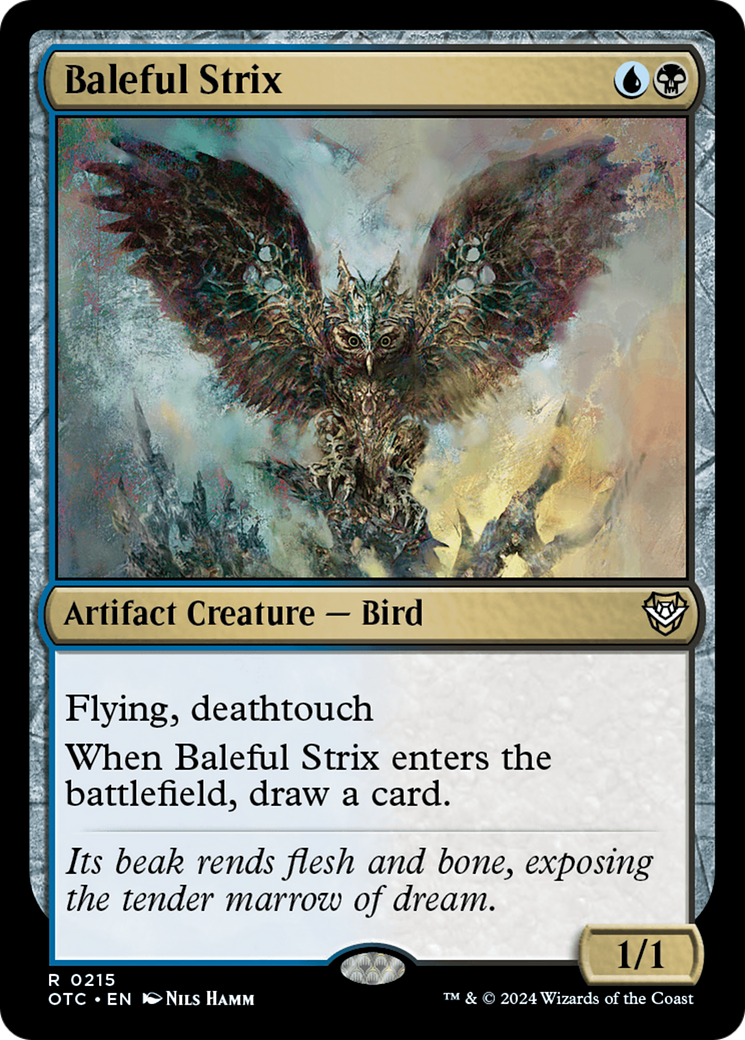
Baleful Strix
Baleful Strix
Artifact Creature — Bird
1/1
Flying, deathtouch
When this creature enters, draw a card.
-
1
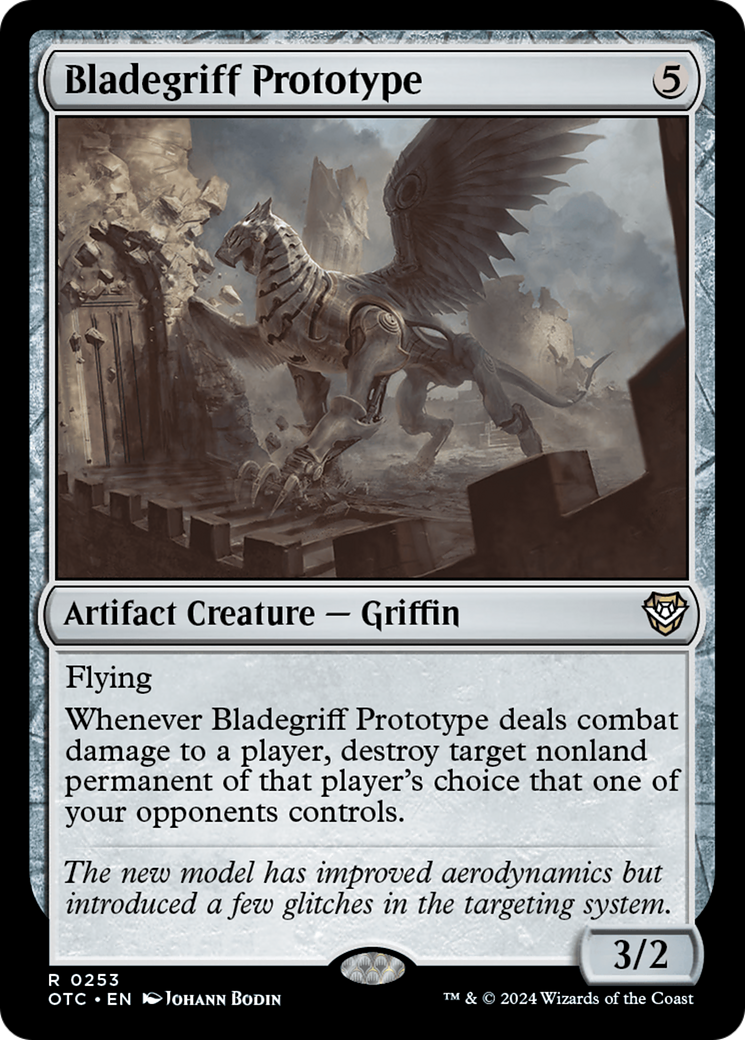
Bladegriff Prototype
Bladegriff Prototype
Artifact Creature — Griffin
3/2
Flying
Whenever this creature deals combat damage to a player, destroy target nonland permanent of that player's choice that one of your opponents controls.
- Even though the player who was dealt damage chooses the target for Bladegriff Prototype's ability, you are the controller of the ability.
- If an opponent dealt damage by Bladegriff Prototype leaves the game before the triggered ability goes on the stack (most likely because that player's life total was reduced to 0 or less in combat), you choose another opponent to choose the target permanent.
-
1
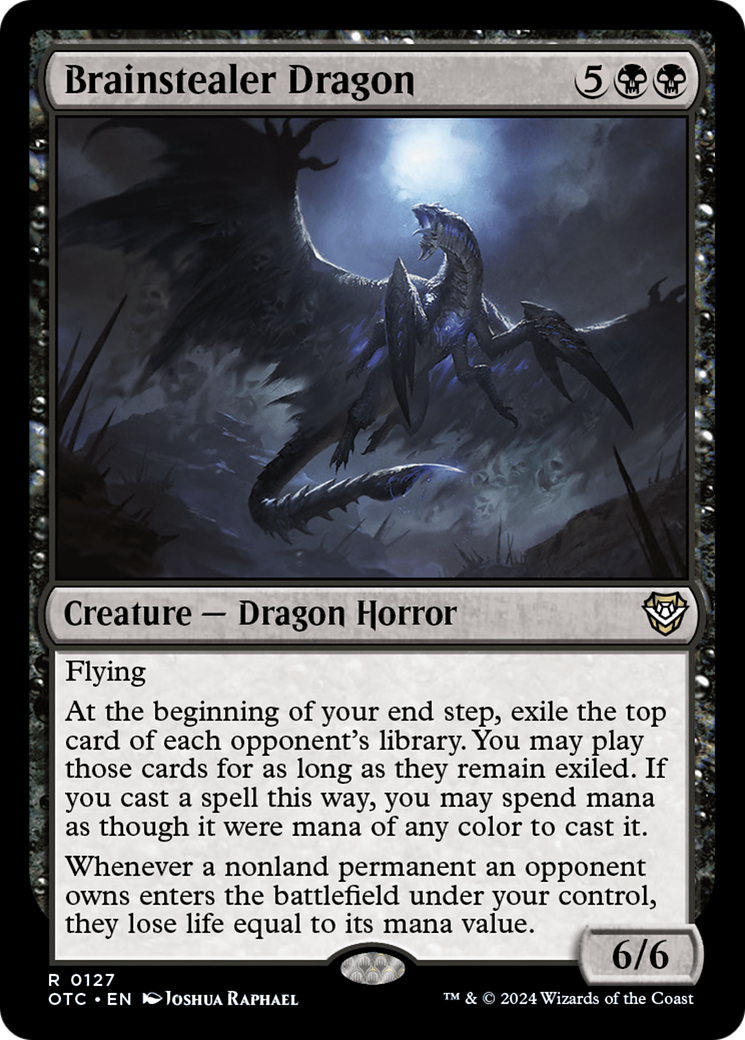
Brainstealer Dragon
Brainstealer Dragon
Creature — Dragon Horror
6/6
Flying
At the beginning of your end step, exile the top card of each opponent's library. You may play those cards for as long as they remain exiled. If you cast a spell this way, you may spend mana as though it were mana of any color to cast it.
Whenever a nonland permanent an opponent owns enters the battlefield under your control, they lose life equal to its mana value.
-
1
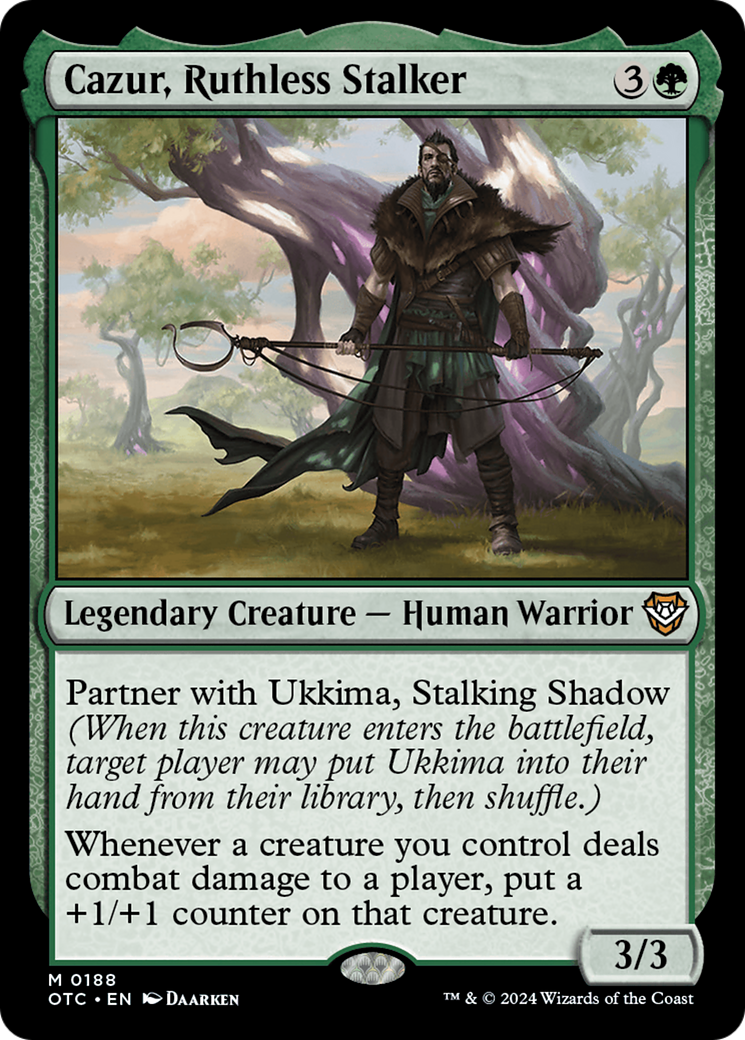
Cazur, Ruthless Stalker
Cazur, Ruthless Stalker
Legendary Creature — Human Warrior
3/3
Partner with Ukkima, Stalking Shadow (When this creature enters, target player may put Ukkima into their hand from their library, then shuffle.)
Whenever a creature you control deals combat damage to a player, put a +1/+1 counter on that creature.
- "Partner with [name]" represents two abilities. The first is a triggered ability: "When this permanent enters the battlefield, target player may search their library for a card named [name], reveal it, put it into their hand, then shuffle their library."
- Note that the target player searches their library (which may be affected by effects such as that of Stranglehold) and that the card they find is revealed, even though these words aren't included in the ability's reminder text.
- The second ability represented by the "partner with [name]" keyword modifies the rules for deck construction in the Commander variant and has no function outside of that variant. If a legendary creature card with "partner with [name]" is designated as your commander, the named legendary creature card can also be designated as your commander.
- If your Commander deck has two commanders, you can only include cards whose own color identities are also found in your commanders' combined color identities. If Haldan and Pako are your commanders, your deck may contain cards with blue, red, and/or green in their color identity, but not cards with white or black.
- Both commanders start in the command zone, and the remaining 98 cards of your deck are shuffled to become your library.
- A creature with a "partner with" ability can't partner with any creature other than its designated partner. Losing a partner ability during the game doesn't cause either to cease to be your commander.
- Once the game begins, your two commanders are tracked separately. If you cast one, you won't have to pay an additional the first time you cast the other. A player loses the game after having been dealt 21 damage from one of them, not from both of them combined. Command Beacon's effect puts one into your hand from the command zone, not both.
- The triggered ability of the "partner with" keyword still triggers in a Commander game. If your other commander has somehow ended up in your library, you can find it. You can also target another player who might have that card in their library.
-
1
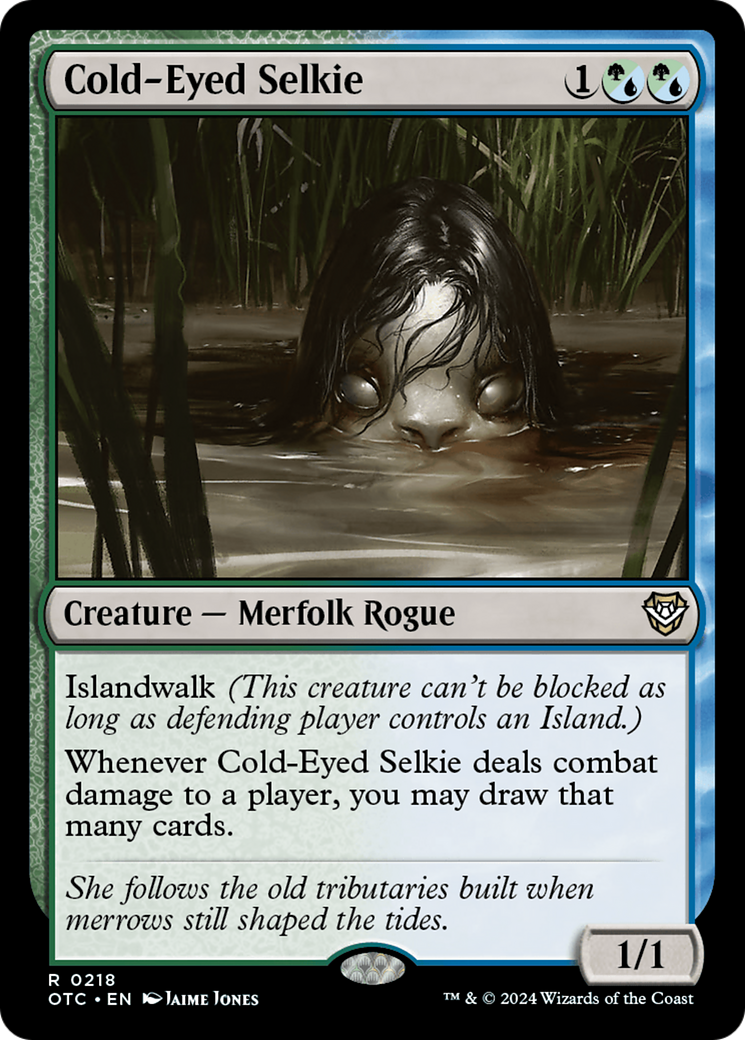
Cold-Eyed Selkie
Cold-Eyed Selkie
Creature — Merfolk Rogue
1/1
Islandwalk (This creature can't be blocked as long as defending player controls an Island.)
Whenever this creature deals combat damage to a player, you may draw that many cards.
-
1
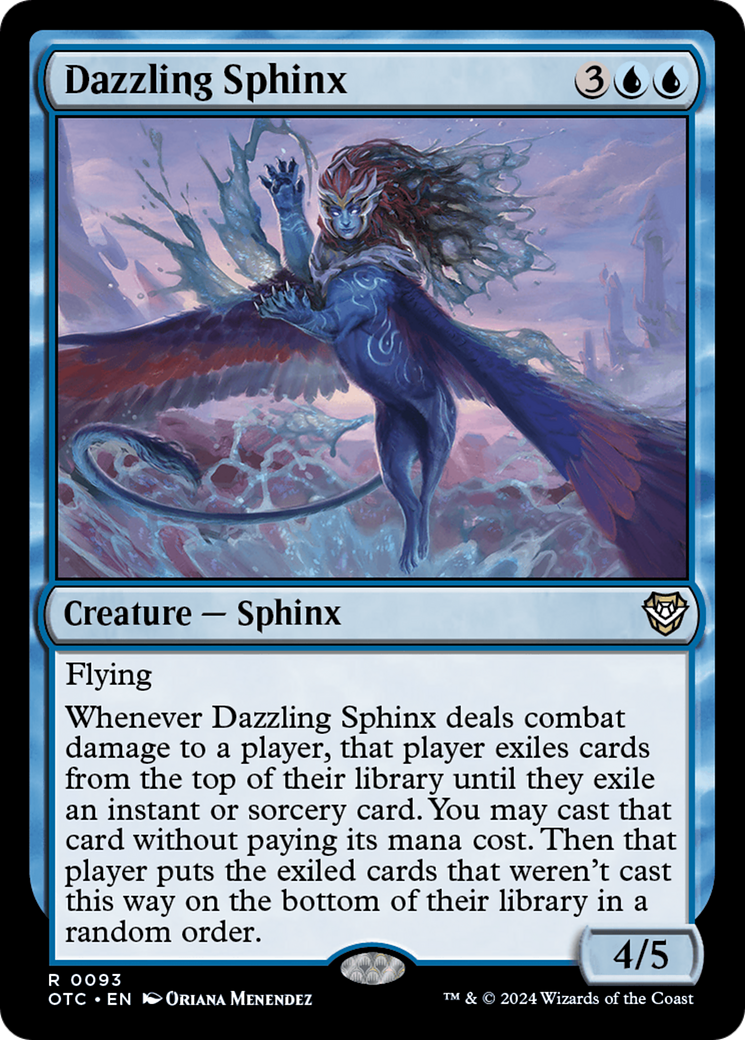
Dazzling Sphinx
Dazzling Sphinx
Creature — Sphinx
4/5
Flying
Whenever this creature deals combat damage to a player, that player exiles cards from the top of their library until they exile an instant or sorcery card. You may cast that card without paying its mana cost. Then that player puts the exiled cards that weren't cast this way on the bottom of their library in a random order.
- Dazzling Sphinx's triggered ability lets you cast the exiled card during the resolution of the ability. It doesn't allow you to wait and cast the card later.
- You may choose not to cast the instant or sorcery card that you exiled. In that case, it will be put on the bottom of the library with the rest of the exiled cards.
- If the exiled instant or sorcery card has an in its mana cost, you must choose 0 as the value of .
-
1
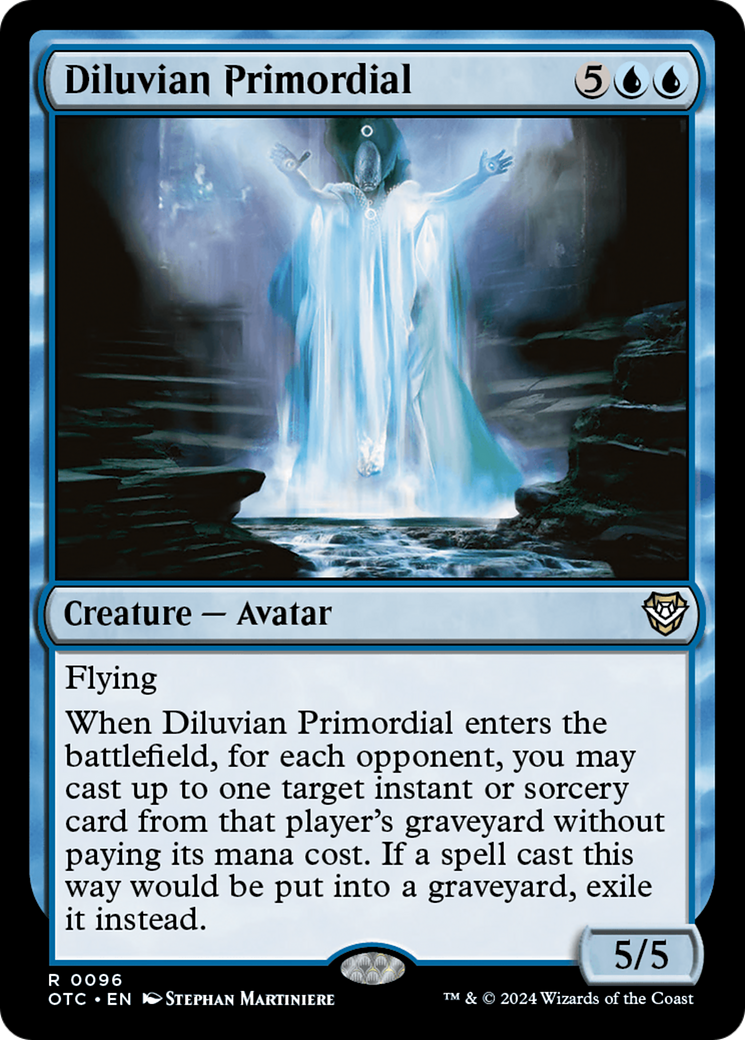
Diluvian Primordial
Diluvian Primordial
Creature — Avatar
5/5
Flying
When this creature enters, for each opponent, you may cast up to one target instant or sorcery card from that player's graveyard without paying its mana cost. If a spell cast this way would be put into a graveyard, exile it instead.
- You can choose a number of targets up to the number of opponents you have, one target per opponent.
- You cast the cards one at a time, choosing modes, targets and so on. The last card you cast will be the first one to resolve.
- When casting an instant or sorcery card this way, ignore timing restrictions based on the card's type. Other timing restrictions, such as "Cast [this card] only during combat," must be followed.
- If you can't cast one of the target instant or sorcery cards, perhaps because there are no legal targets available, or if you choose not to cast one, it will remain in its owner's graveyard.
- If you cast a card "without paying its mana cost," you can't pay alternative costs such as overload costs. You can pay additional costs such as kicker costs. If the card has mandatory additional costs, you must pay those.
- If a card has in its mana cost, you must choose 0 as its value.
- If an instant or sorcery card you cast this way is countered, it will still be exiled.
- If you cast an instant or sorcery spell with cipher this way, you may exile the card encoded on a creature you control. If you can't, or if you choose not to, the card will end up exiled but not encoded on a creature.
- If an instant or sorcery card you cast this way goes to a zone other than exile or a graveyard, perhaps because one of its abilities says to put it into its owner's hand, it won't be exiled. This is true even if the card would be put into a graveyard later that turn.
-
1
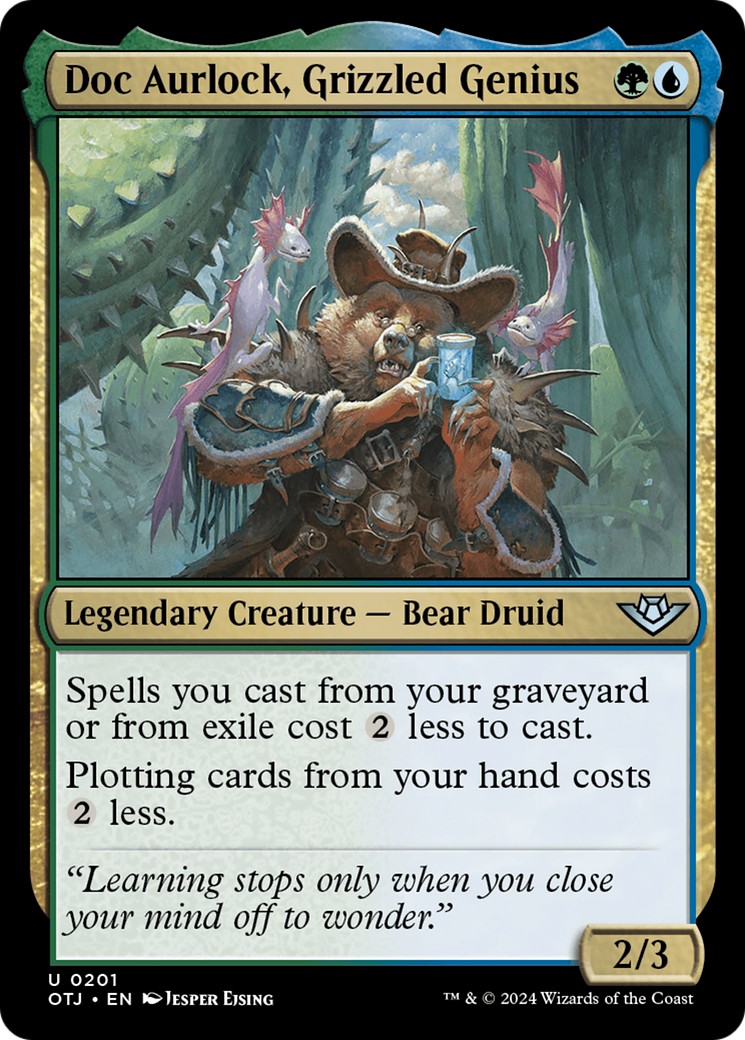
Doc Aurlock, Grizzled Genius
Doc Aurlock, Grizzled Genius
Legendary Creature — Bear Druid
2/3
Spells you cast from your graveyard or from exile cost less to cast.
Plotting cards from your hand costs less.
-
1
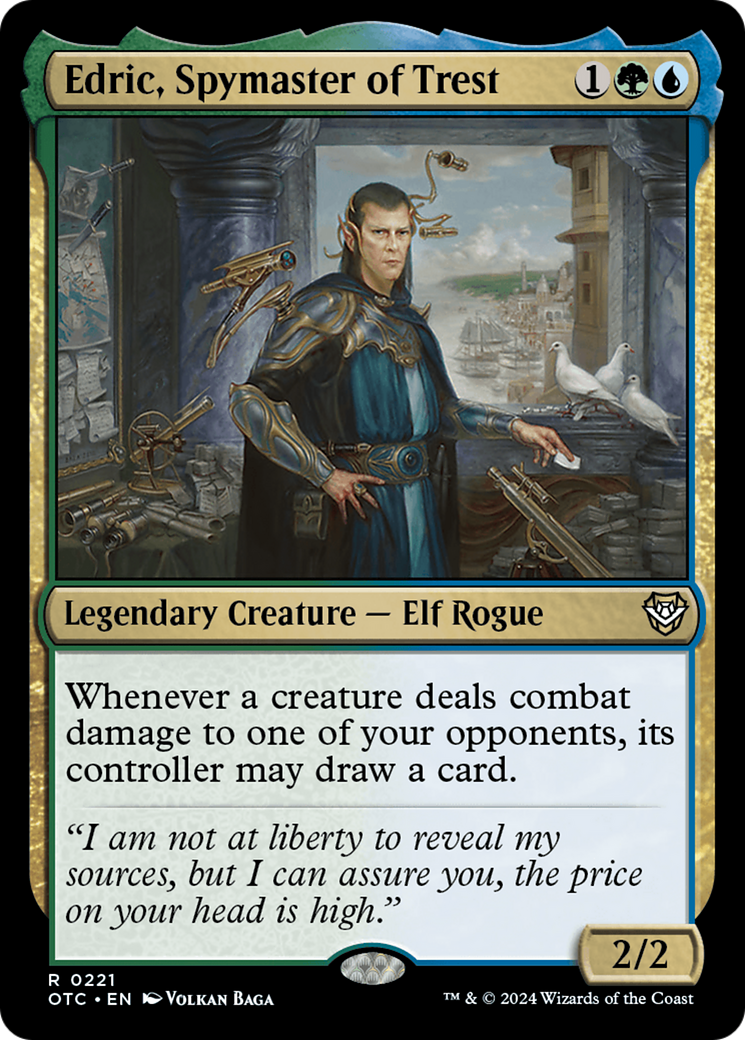
Edric, Spymaster of Trest
Edric, Spymaster of Trest
Legendary Creature — Elf Rogue
2/2
Whenever a creature deals combat damage to one of your opponents, its controller may draw a card.
- Edric, Spymaster of Trest is banned as a commander in Duel Commander format, but it may be part of your deck.
- A creature controlled by an opponent that deals combat damage to another opponent will cause Edric's ability to trigger. The creature's controller chooses whether to draw a card.
- When a creature you control deals combat damage to one of your opponents, you may draw a card.
-
1
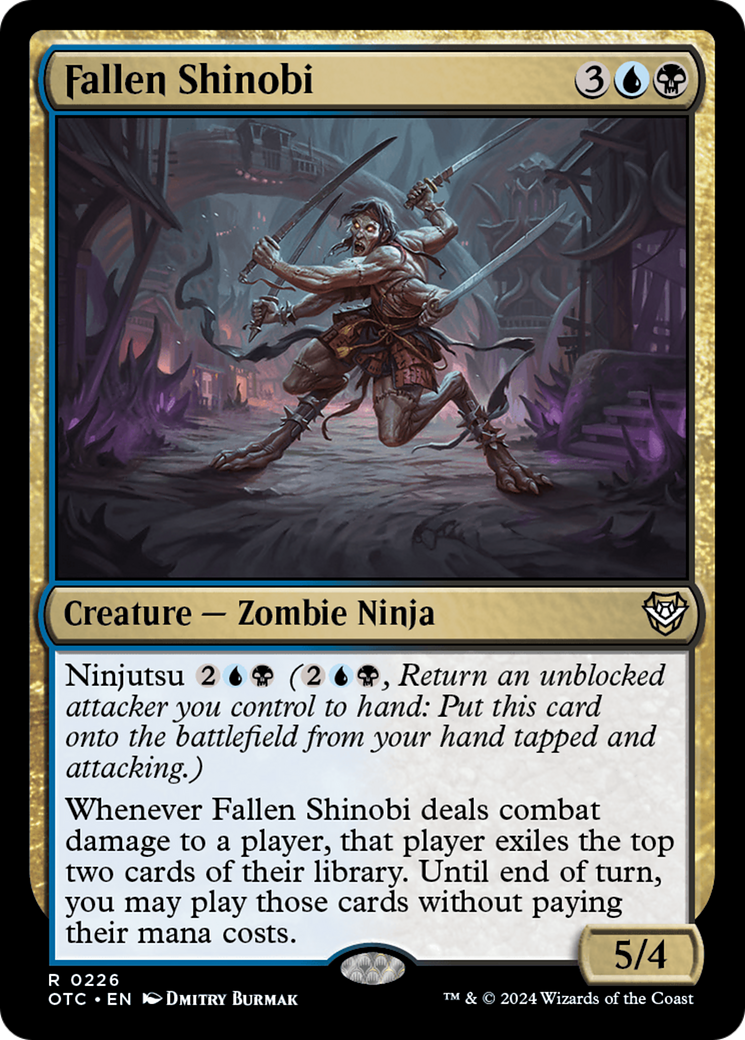
Fallen Shinobi
Fallen Shinobi
Creature — Zombie Ninja
5/4
Ninjutsu ( , Return an unblocked attacker you control to hand: Put this card onto the battlefield from your hand tapped and attacking.)
Whenever this creature deals combat damage to a player, that player exiles the top two cards of their library. Until end of turn, you may play those cards without paying their mana costs.
- Fallen Shinobi's triggered ability doesn't change when you can play the exiled cards. For example, if a sorcery card is exiled, you can cast it only during your main phase when the stack is empty. If a land card is exiled, you can play it only during your main phase and only if you have an available land play remaining.
- Casting an exiled card causes it to leave exile. You can't cast it multiple times.
- Any cards you don't cast will remain in exile.
- The ninjutsu ability can be activated only after blockers have been declared. Before then, attacking creatures are neither blocked nor unblocked.
- As you activate a ninjutsu ability, you reveal the Ninja card in your hand and return the attacking creature. The Ninja isn't put onto the battlefield until the ability resolves. If it leaves your hand before then, it won't enter the battlefield at all.
- The creature with ninjutsu enters the battlefield attacking the same player or planeswalker that the returned creature was attacking. This is a rule specific to ninjutsu; in other cases, when a creature is put onto the battlefield attacking, that creature's controller chooses which player or planeswalker it's attacking.
- Although the Ninja is attacking, it was never declared as an attacking creature (for purposes of abilities that trigger whenever a creature attacks, for example).
- The ninjutsu ability can be activated during the declare blockers step, combat damage step, or end of combat step. If you wait until after the declare blockers step, because all combat damage is dealt at once, the Ninja won't normally deal combat damage.
- If a creature in combat has first strike or double strike, you can activate the ninjutsu ability during the first-strike combat damage step. The Ninja will deal combat damage during the regular combat damage step, even if it has first strike.
-
1
Felix Five-Boots
Felix Five-Boots
Legendary Creature — Ooze Rogue
5/4
Menace, ward
If a creature you control dealing combat damage to a player causes a triggered ability of a permanent you control to trigger, that ability triggers an additional time.
- Triggered abilities use the word “when,” “whenever,” or “at.” They’re often written as “[Trigger condition], [effect].” Some keyword abilities are triggered abilities and will have “when,” “whenever,” or “at the beginning of” in their reminder text.
- Felix’s last ability affects only triggered abilities whose trigger conditions refer specifically to damage being dealt. It does not affect triggered abilities that would trigger because of the results of that damage. For example, if you control Felix as well as an Ajani’s Pridemate (“Whenever you gain life, put a +1/+1 counter on Ajani’s Pridemate”) and a creature you control with lifelink deals combat damage to a player, the triggered ability of Ajani’s Pridemate will still trigger only once.
- Replacement effects are unaffected by Felix’s last ability. For example, if Charging Tuskodon (“If Charging Tuskodon would deal combat damage to a player, it deals double that damage to that player instead”) deals combat damage to a player, Felix’s ability won’t cause the damage it deals to be doubled an additional time.
- Felix’s last ability doesn’t copy the triggered ability; it just causes the ability to trigger an additional time. Any choices made as you put the ability onto the stack, such as modes and targets, are made separately for each instance of the ability. Any choices made on resolution, such as whether to put counters on a permanent, are also made individually.
- If you somehow control two Felixes, a creature you control dealing combat damage to a player causes abilities of permanents you control to trigger three times. A third Felix causes such abilities to trigger four times, a fourth causes such abilities to trigger five times, and so on.
-
1
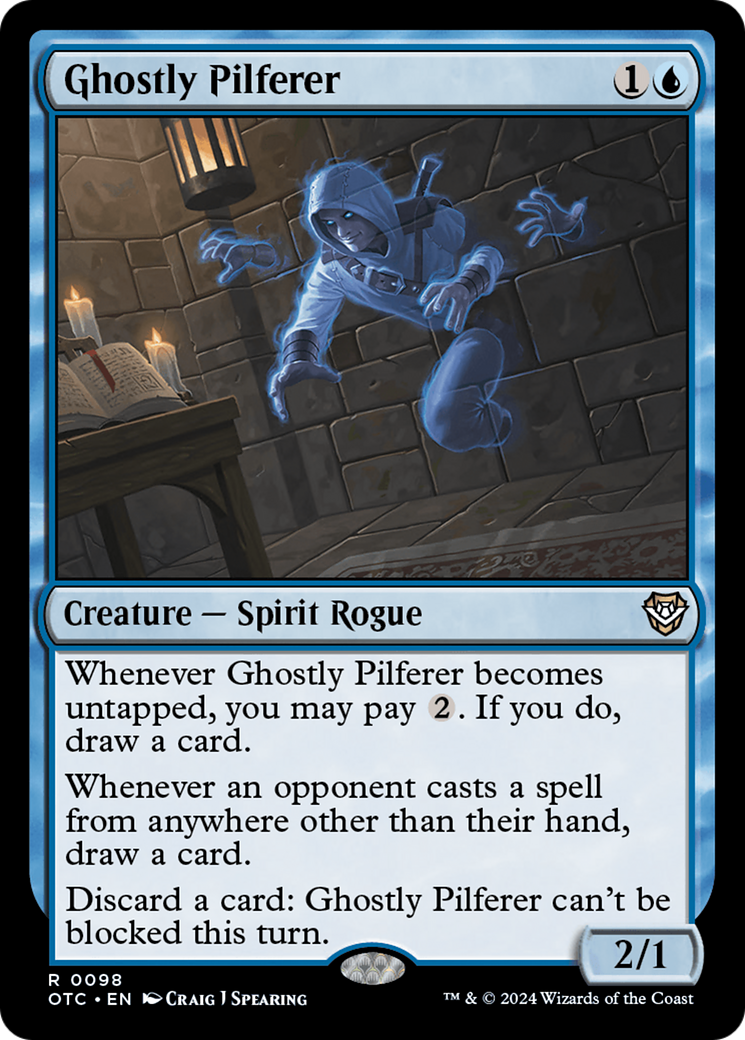
Ghostly Pilferer
Ghostly Pilferer
Creature — Spirit Rogue
2/1
Whenever this creature becomes untapped, you may pay . If you do, draw a card.
Whenever an opponent casts a spell from anywhere other than their hand, draw a card.
Discard a card: This creature can't be blocked this turn.
- Ghostly Pilferer's first ability triggers during your untap step, but it's put onto the stack at the same time as abilities that trigger at the beginning of your upkeep step. Even though the ability triggered first, you may order it before or after other abilities you control that are put onto the stack at this time.
- While resolving Ghostly Pilferer's first ability, you can't pay more than to draw more than one card.
- An ability that triggers when a player casts a spell resolves before the spell that caused it to trigger. It resolves even if that spell is countered.
- Players can cast spells and activate abilities after the second triggered ability resolves but before the spell that caused it to trigger does.
- Once Ghostly Pilferer has been blocked, activating its last ability doesn't cause it to become unblocked.
-
1
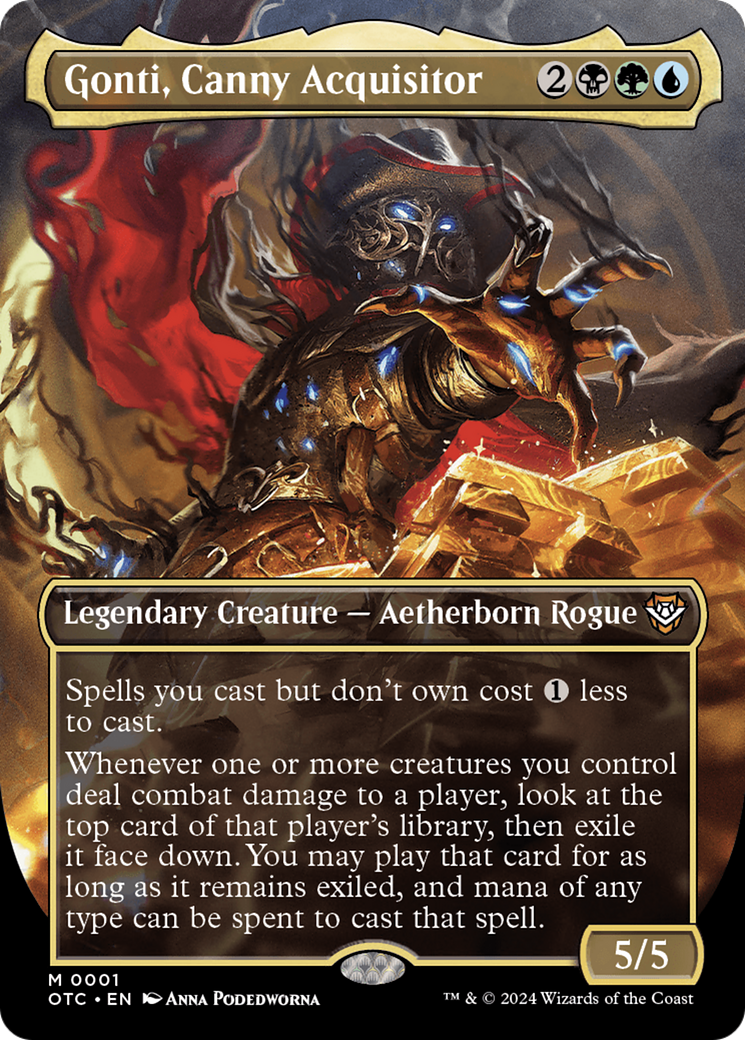
Gonti, Canny Acquisitor
Gonti, Canny Acquisitor
Legendary Creature — Aetherborn Rogue
5/5
Spells you cast but don't own cost less to cast.
Whenever one or more creatures you control deal combat damage to a player, look at the top card of that player's library, then exile it face down. You may play that card for as long as it remains exiled, and mana of any type can be spent to cast that spell.
- You may look at and play cards exiled face down with Gonti’s last ability (and spend mana of any type to do so) even if Gonti leaves the battlefield. If another player gains control of Gonti, that player can’t look at or play cards already exiled with Gonti, and you still can.
- You pay all costs and follow all normal timing rules for cards played from exile with Gonti’s last ability. For example, if the exiled card is a land card, you may play it only during your main phase while the stack is empty.
- Playing an exiled card causes it to leave exile. You can’t play it multiple times.
- If you leave the game, any remaining face-down exiled cards remain exiled face down indefinitely. No player may look at them.
-
1
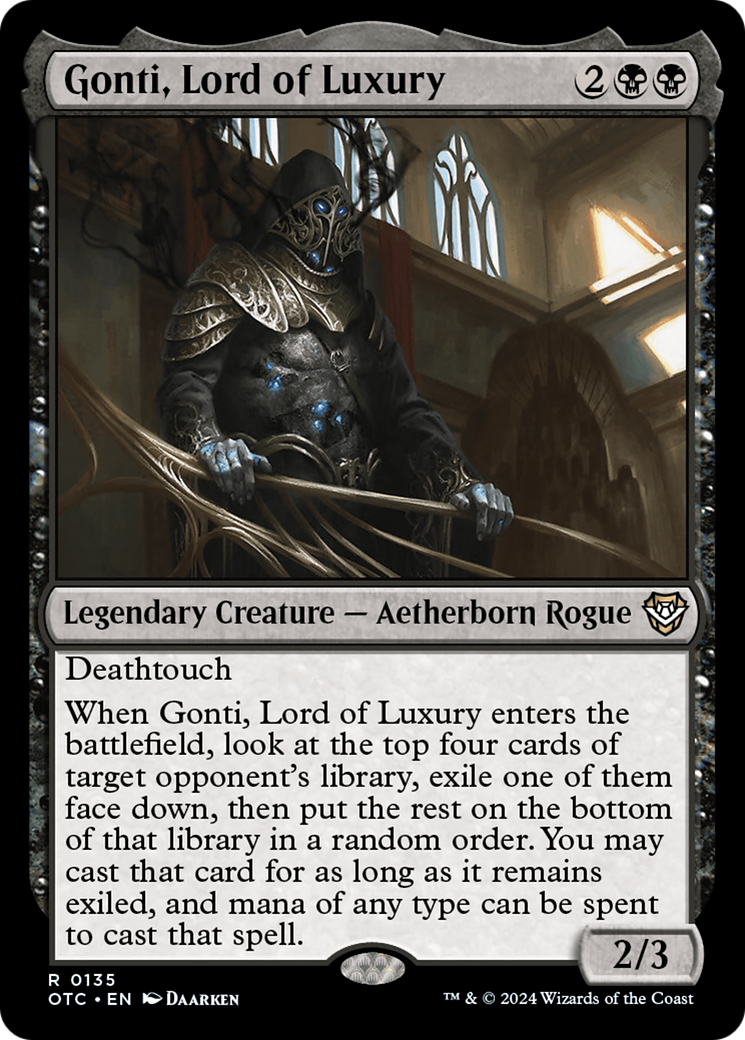
Gonti, Lord of Luxury
Gonti, Lord of Luxury
Legendary Creature — Aetherborn Rogue
2/3
Deathtouch
When Gonti enters, look at the top four cards of target opponent's library, exile one of them face down, then put the rest on the bottom of that library in a random order. You may cast that card for as long as it remains exiled, and mana of any type can be spent to cast that spell.
- The six types of mana are white, blue, black, red, green, and colorless. Snow mana is not a type of mana. Gonti, Lord of Luxury won't let you pay a snow cost using mana produced by a nonsnow source.
- An effect that instructs you to "cast" a card doesn't allow you to play lands.
- You pay the costs for the exiled card if you cast it. You may pay alternative costs such as emerge rather than the card's mana cost.
- You may look at and cast that card (and spend mana as though it were mana of any type to do so) even if Gonti leaves the battlefield. If another player gains control of Gonti, that player can't look at or cast the card, and you still can.
- Casting the card causes it to leave exile. You can't cast it multiple times.
- If you leave the game, the card remains exiled face down indefinitely. No player may look at it.
- Gonti doesn't change when you can cast the exiled card. For example, if you exile a creature card without flash, you can cast it only during your main phase when the stack is empty.
-
1
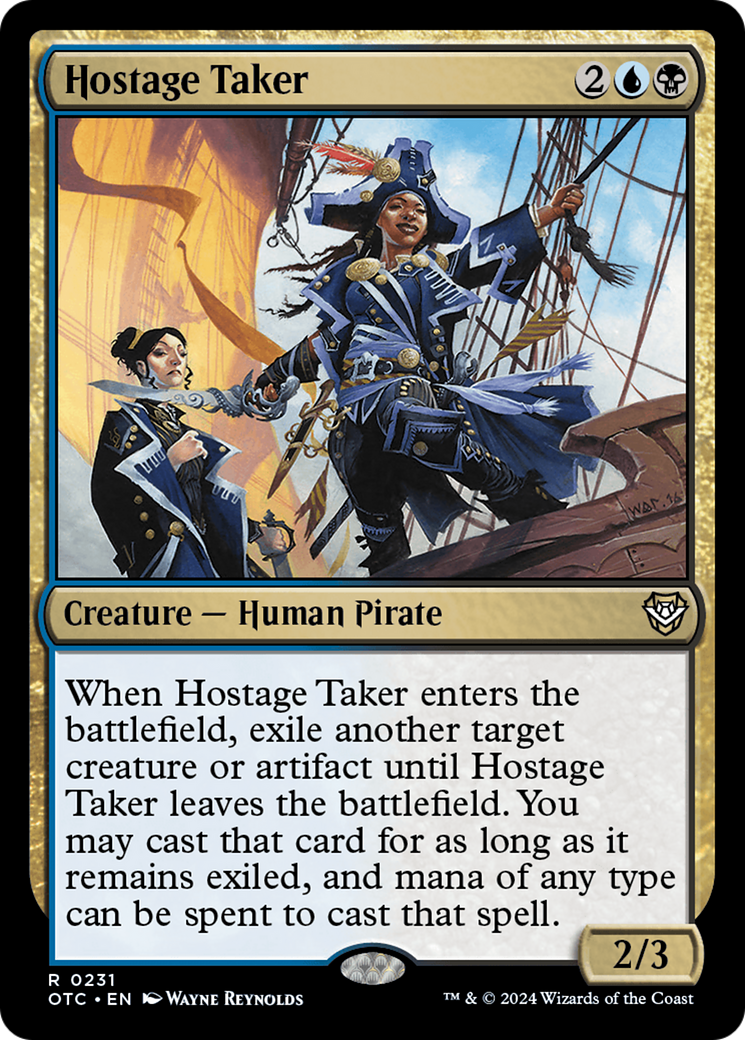
Hostage Taker
Hostage Taker
Creature — Human Pirate
2/3
When this creature enters, exile another target creature or artifact until this creature leaves the battlefield. You may cast that card for as long as it remains exiled, and mana of any type can be spent to cast that spell.
- Hostage Taker has received errata to prevent it from targeting itself. The correct Oracle wording appears above.
- If Hostage Taker leaves the battlefield before its triggered ability resolves, the target permanent won't be exiled.
- Auras attached to the exiled permanent will be put into their owners' graveyards. Any Equipment will become unattached and remain on the battlefield. Any counters on the exiled permanent will cease to exist.
- If a token is exiled this way, it will cease to exist and won't return to the battlefield. You can't cast it.
- Once you begin to cast the exiled card, it's considered a new object. You'll control that spell and the permanent that spell becomes even if Hostage Taker leaves the battlefield.
- If it's still in exile, the exiled card returns to the battlefield immediately after Hostage Taker leaves the battlefield. Nothing happens between the two events, including state-based actions.
- In a multiplayer game, if Hostage Taker's owner leaves the game while the card is still exiled and another player owns that card, the exiled card will return to the battlefield under its owner's control. Because the one-shot effect that returns the card isn't an ability that goes on the stack, it won't cease to exist along with the leaving player's spells and abilities on the stack.
- In a multiplayer game, if a player leaves the game, all cards that player owns leave as well. If you leave the game, any spell or permanent cards you control from Hostage Taker's ability are exiled.
-
1
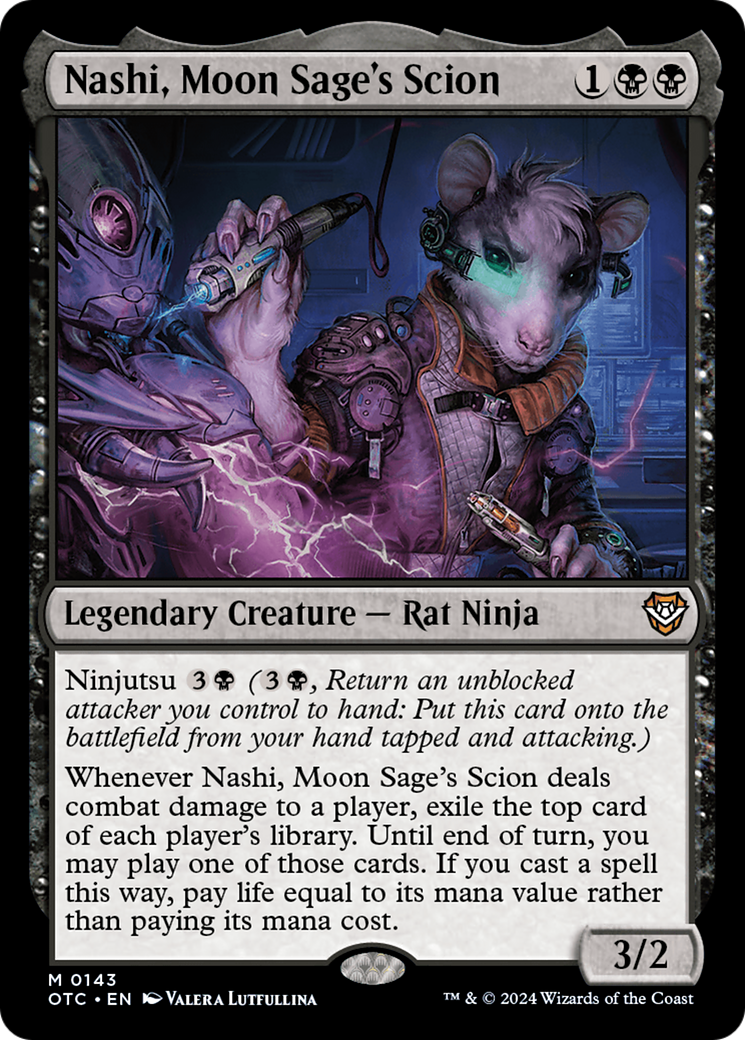
Nashi, Moon Sage's Scion
Nashi, Moon Sage's Scion
Legendary Creature — Rat Ninja
3/2
Ninjutsu ( , Return an unblocked attacker you control to hand: Put this card onto the battlefield from your hand tapped and attacking.)
Whenever Nashi deals combat damage to a player, exile the top card of each player's library. Until end of turn, you may play one of those cards. If you cast a spell this way, pay life equal to its mana value rather than paying its mana cost.
- You may only cast a spell this way by paying the appropriate amount of life. You may not pay its normal cost and may not pay any other alternative costs. You may still pay for additional costs, such as kicker costs. If the spell has mandatory additional costs, you must pay those.
- You must follow all normal timing rules when casting a spell or playing a land this way. For example, you cannot normally play a land card this way if you have already played a land this turn.
- If you cast a spell with in its mana cost this way, the only legal choice for X is 0.
- The ninjutsu ability can be activated only after blockers have been declared. Before then, attacking creatures are neither blocked nor unblocked.
- As you activate a ninjutsu ability, you reveal the Ninja card in your hand and return the attacking creature. The Ninja card stays revealed and isn't put onto the battlefield until the ability resolves. If it leaves your hand before then, it won't enter the battlefield at all.
- The creature with ninjutsu enters the battlefield attacking the same player or planeswalker that the returned creature was attacking. This is a rule specific to ninjutsu; in other cases, when a creature is put onto the battlefield attacking, that creature's controller chooses which player or planeswalker it's attacking.
- Although the Ninja is attacking, it was never declared as an attacking creature (for purposes of abilities that trigger whenever a creature attacks, for example).
- The ninjutsu ability can be activated during the declare blockers step, combat damage step, or end of combat step. In most cases (see below), if you wait until the combatdamage step or end of combat step, it will be after combat damage has been dealt, so the Ninja won't deal combat damage.
- If a creature in combat has first strike or double strike, you can activate the ninjutsu ability during the first-strike combat damage step. The Ninja will deal combat damage during the regular combat damage step, even if it has first strike.
- Puff of smoke not included.
-
1
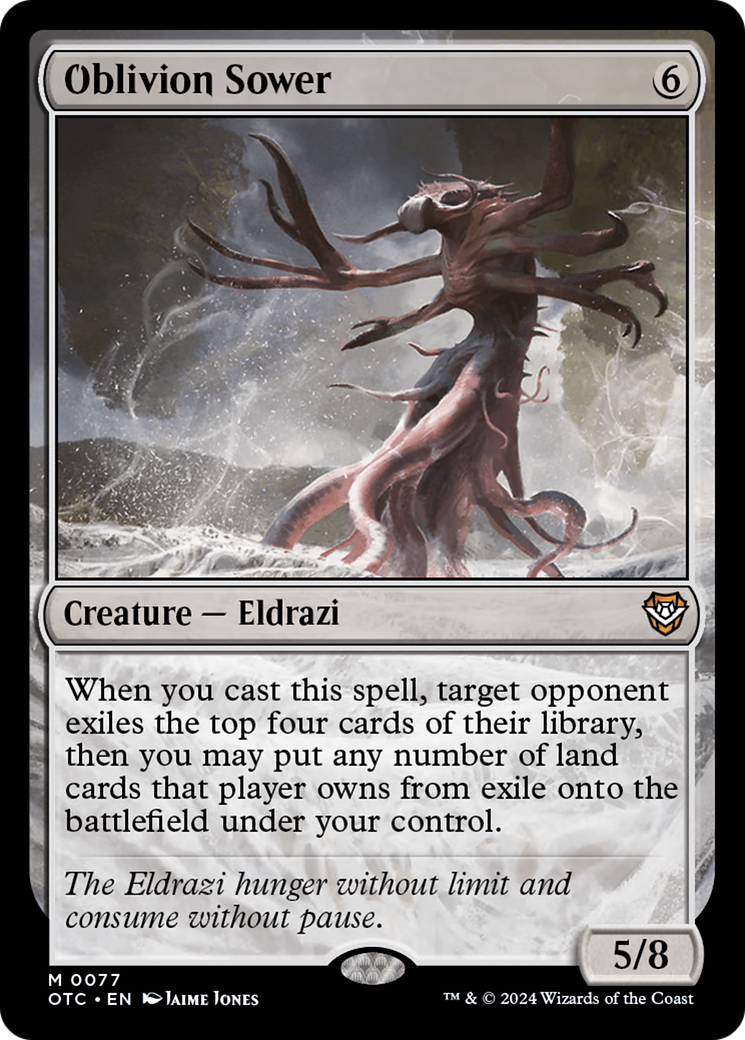
Oblivion Sower
Oblivion Sower
Creature — Eldrazi
5/8
When you cast this spell, target opponent exiles the top four cards of their library, then you may put any number of land cards that player owns from exile onto the battlefield under your control.
- Oblivion Sower's ability allows you to put any land cards the player owns from exile onto the battlefield, regardless of how those cards were exiled.
- Cards that are face down in exile have no characteristics. Such cards can't be put onto the battlefield with Oblivion Sower's ability.
-
1
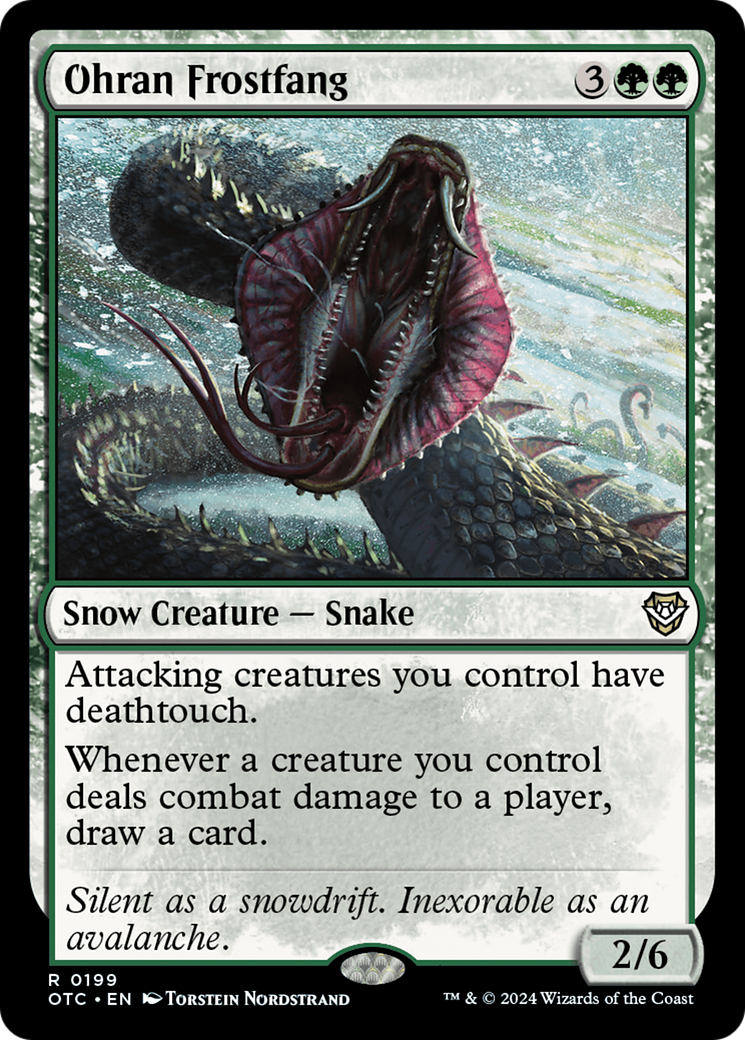
Ohran Frostfang
Ohran Frostfang
Snow Creature — Snake
2/6
Attacking creatures you control have deathtouch.
Whenever a creature you control deals combat damage to a player, draw a card.
- If one or more creatures you control deal combat damage to players at the same time that lethal damage is dealt to Ohran Frostfang, its ability triggers for each of those creatures.
- Snow is a supertype, not a card type. It has no rules meaning or function by itself, but other cards and abilities may refer to it.
-
1
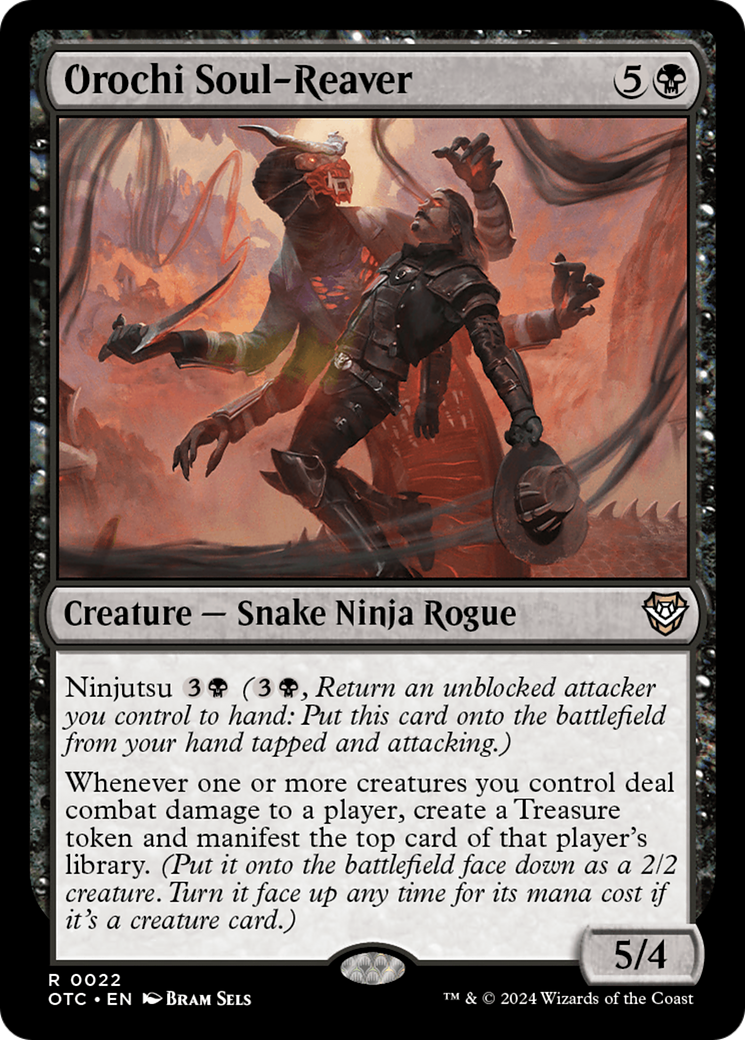
Orochi Soul-Reaver
Orochi Soul-Reaver
Creature — Snake Ninja Rogue
5/4
Ninjutsu ( , Return an unblocked attacker you control to hand: Put this card onto the battlefield from your hand tapped and attacking.)
Whenever one or more creatures you control deal combat damage to a player, create a Treasure token and manifest the top card of that player's library. (Put it onto the battlefield face down as a 2/2 creature. Turn it face up any time for its mana cost if it's a creature card.)
- The ninjutsu ability can be activated only after blockers have been declared. Before then, attacking creatures are neither blocked nor unblocked.
- As you activate a ninjutsu ability, you reveal the Ninja card in your hand and return the attacking creature to its owner’s hand. The Ninja card stays revealed and isn’t put onto the battlefield until the ability resolves. If it leaves your hand before then, it won’t enter the battlefield at all.
- The creature with ninjutsu enters the battlefield attacking the same player, planeswalker, or battle that the returned creature was attacking. This is a rule specific to ninjutsu; in other cases, when a creature is put onto the battlefield attacking, that creature’s controller chooses which player, planeswalker, or battle it’s attacking.
- Although the Ninja is attacking, it was never declared as an attacking creature (for purposes of abilities that trigger whenever a creature attacks, for example).
- The ninjutsu ability can be activated during the declare blockers step, combat damage step, or end of combat step. In most cases (see below), if you wait until the combat damage step or end of combat step, it will be after combat damage has been dealt, so the Ninja won’t deal combat damage.
- If a creature in combat has first strike or double strike, you can activate the ninjutsu ability during the first-strike combat damage step. The Ninja will deal combat damage during the regular combat damage step, even if it has first strike.
- Your opponents can’t look at the card they own that you manifested.
-
1
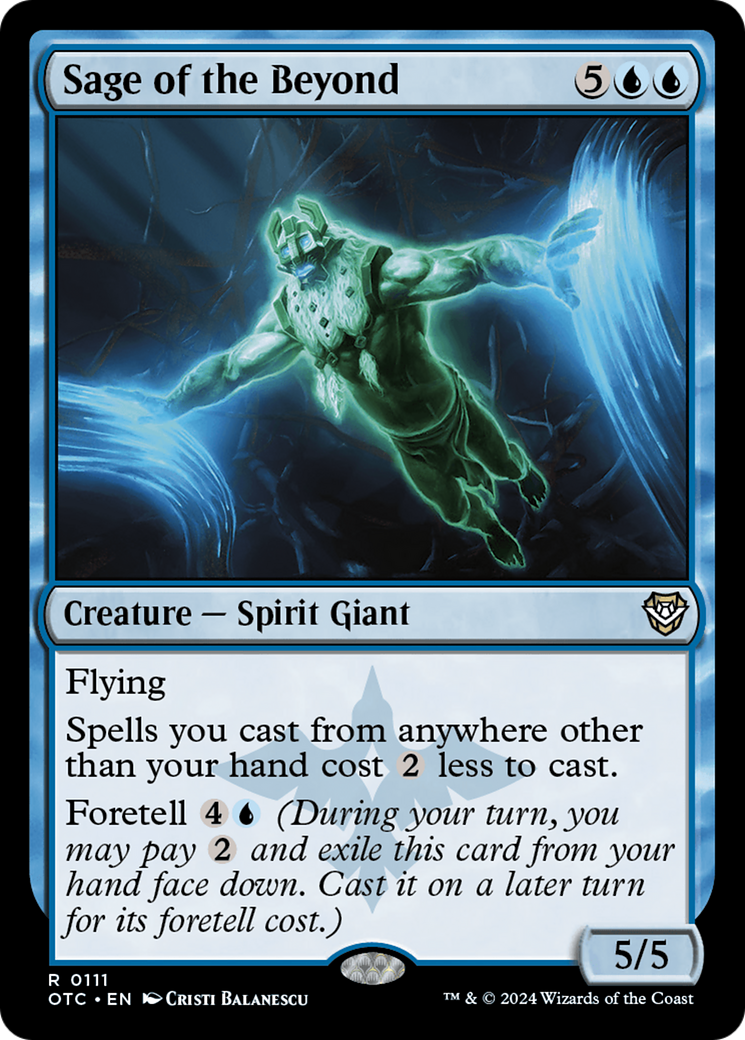
Sage of the Beyond
Sage of the Beyond
Creature — Spirit Giant
5/5
Flying
Spells you cast from anywhere other than your hand cost less to cast.
Foretell (During your turn, you may pay and exile this card from your hand face down. Cast it on a later turn for its foretell cost.)
- To determine the total cost of a spell, start with the mana cost or alternative cost you're paying, add any cost increases, then apply any cost reductions (such as that of Sage of the Beyond). The mana value of the spell is determined only by its mana cost, no matter what the total cost to cast the spell was.
- The cost reduction applies only to generic mana in the costs of spells you cast from anywhere other than your hand. It can't reduce requirements of a specific color of mana.
- Because exiling a card with foretell from your hand is a special action, you can do so any time you have priority during your turn, including in response to spells and abilities. Once you announce you're taking the action, no other player can respond by trying to remove the card from your hand.
- Casting a foretold card from exile follows the timing rules for that card. If you foretell an instant card, you can cast it as soon as the next player's turn. In most cases, if you foretell a card that isn't an instant (or doesn't have flash), you'll have to wait until your next turn to cast it.
- If you're casting a foretold card from exile for its foretell cost, you can't choose to cast it for any other alternative costs. You can, however, pay additional costs, such as kicker costs. If the card has any mandatory additional costs, those must be paid to cast the spell.
-
1
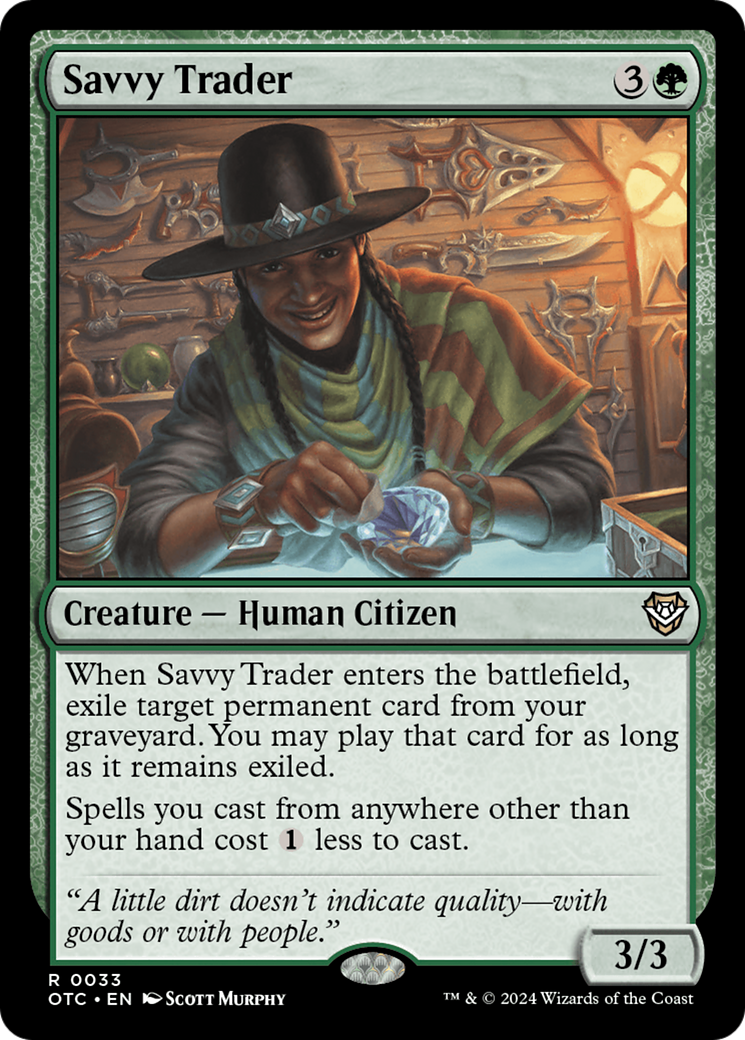
Savvy Trader
Savvy Trader
Creature — Human Citizen
3/3
When this creature enters, exile target permanent card from your graveyard. You may play that card for as long as it remains exiled.
Spells you cast from anywhere other than your hand cost less to cast.
- You may play the card exiled with Savvy Trader’s first ability even if Savvy Trader leaves the battlefield. If another player gains control of Savvy Trader, that player can’t play the card, and you still can.
- You pay all costs and follow all normal timing rules for the card played from exile with Savvy Trader’s first ability. For example, if the exiled card is a land card, you may play it only during your main phase while the stack is empty.
- Savvy Trader’s last ability doesn’t change the mana cost or mana value of any spell. It changes only the total cost you pay to cast spells from anywhere other than your hand.
- Savvy Trader’s last ability can’t reduce the amount of colored mana you pay for a spell. It reduces only the generic mana component of that spell’s cost.
-
1
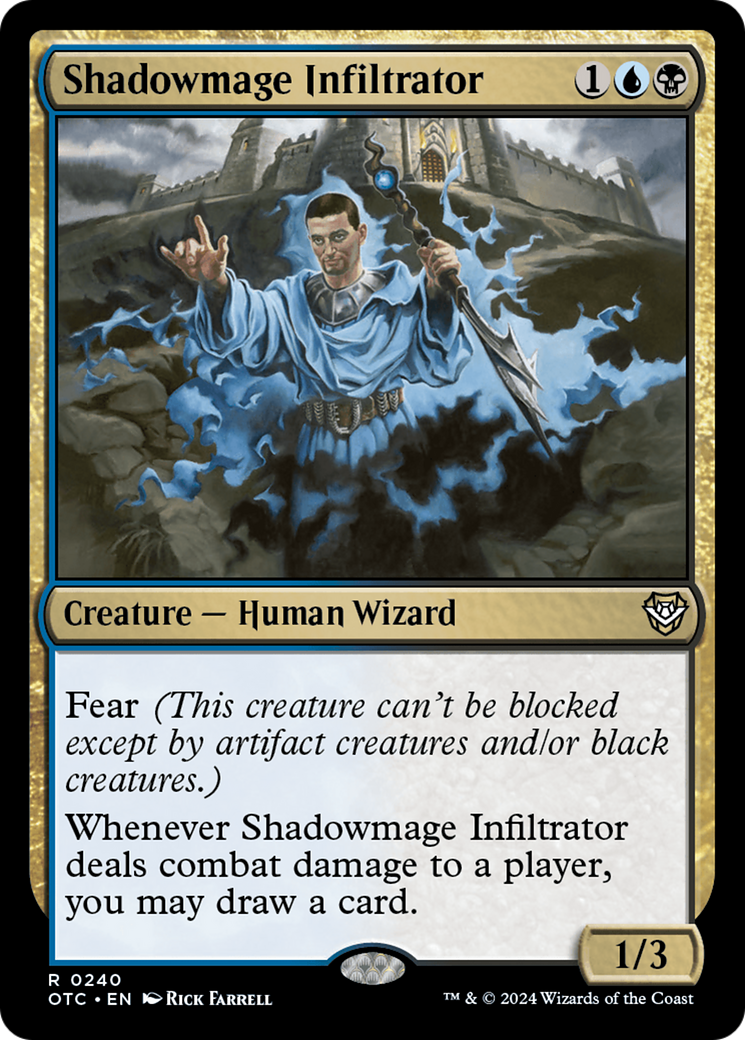
Shadowmage Infiltrator
Shadowmage Infiltrator
Creature — Human Wizard
1/3
Fear (This creature can't be blocked except by artifact creatures and/or black creatures.)
Whenever this creature deals combat damage to a player, you may draw a card.
-
1
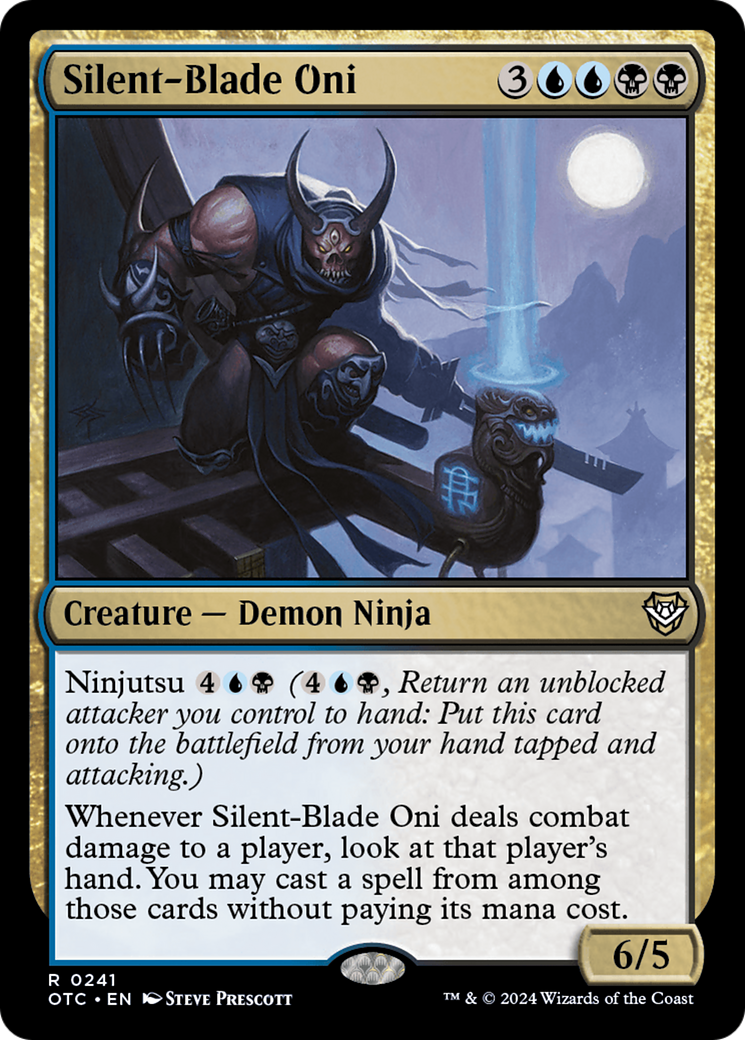
Silent-Blade Oni
Silent-Blade Oni
Creature — Demon Ninja
6/5
Ninjutsu ( , Return an unblocked attacker you control to hand: Put this card onto the battlefield from your hand tapped and attacking.)
Whenever this creature deals combat damage to a player, look at that player's hand. You may cast a spell from among those cards without paying its mana cost.
- If you cast a permanent spell this way, it will enter under your control when it resolves. If you cast an instant or sorcery spell this way, that card will be put into its owner's graveyard when it resolves.
- The nonland card you cast via the triggered ability is cast as part of the resolution of that ability. Timing restrictions based on the card's type are ignored. Other restrictions, such as "Cast [this card] only during an opponent's turn," are not.
- If you cast a card without paying its mana cost, you can't choose to cast it for any alternative costs, such as evoke or the alternative cost provided by the morph ability. If it has in its mana cost, X must be 0. However, you can pay optional additional costs, such as kicker, and you must still pay mandatory additional costs, such as the one on Fling.
-
1
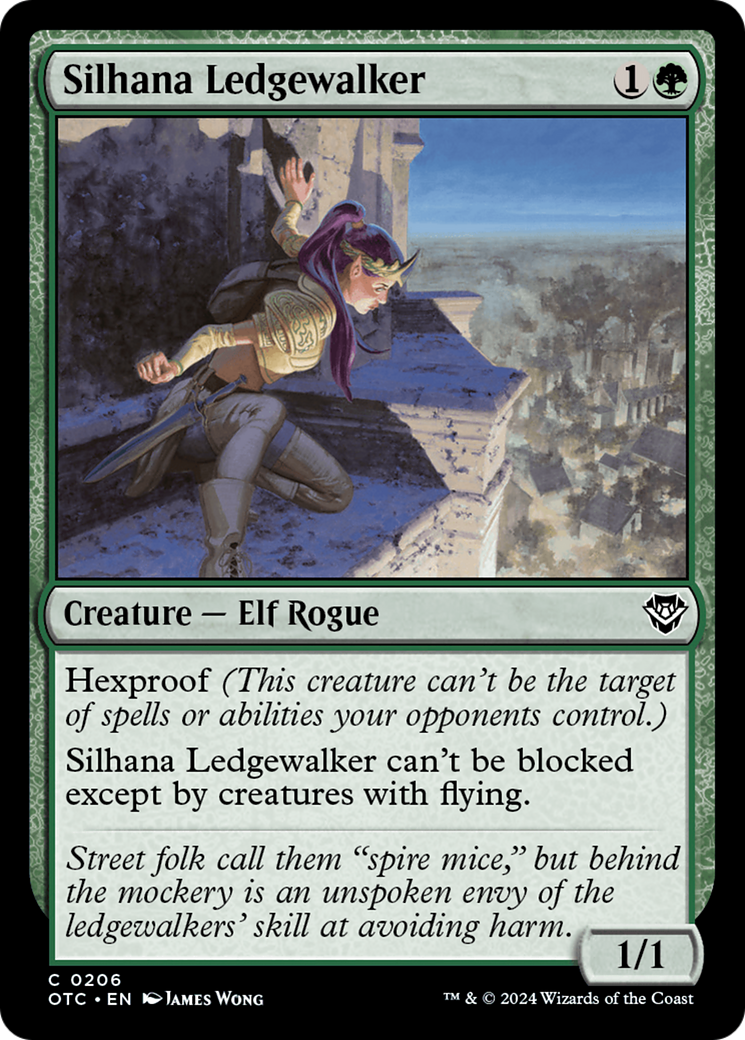
Silhana Ledgewalker
Silhana Ledgewalker
Creature — Elf Rogue
1/1
Hexproof (This creature can't be the target of spells or abilities your opponents control.)
This creature can't be blocked except by creatures with flying.
- Creatures with reach (such as Giant Spider) don't actually have flying, so they can't block this.
-
1
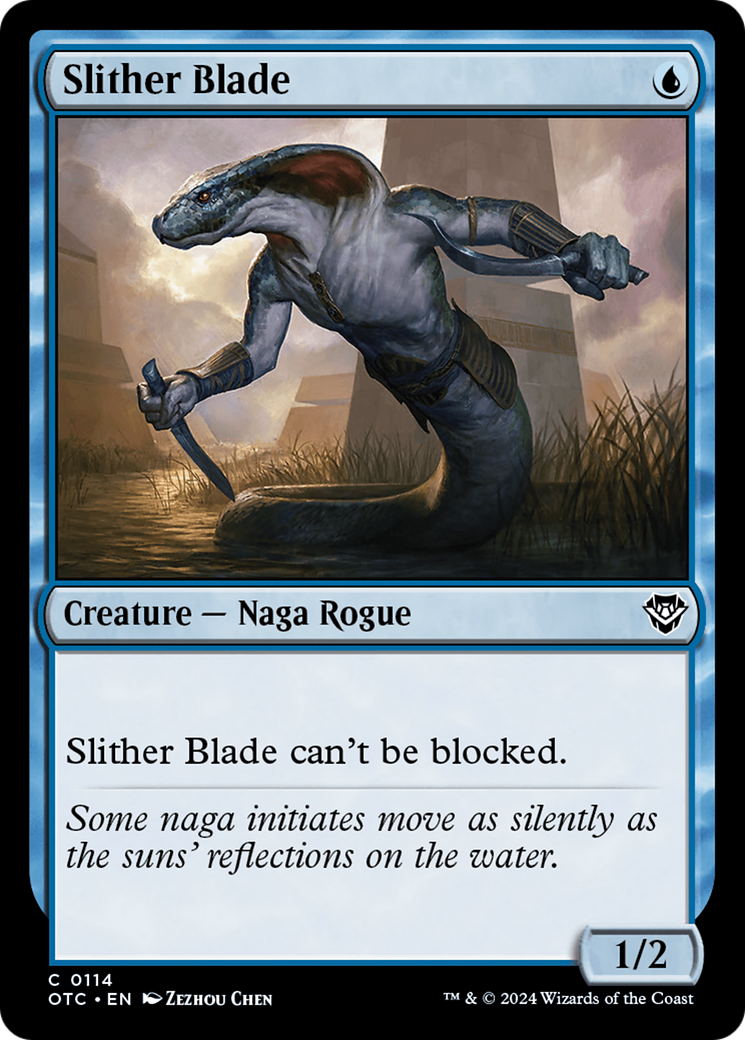
Slither Blade
Slither Blade
Creature — Snake Rogue
1/2
This creature can't be blocked.
-
1
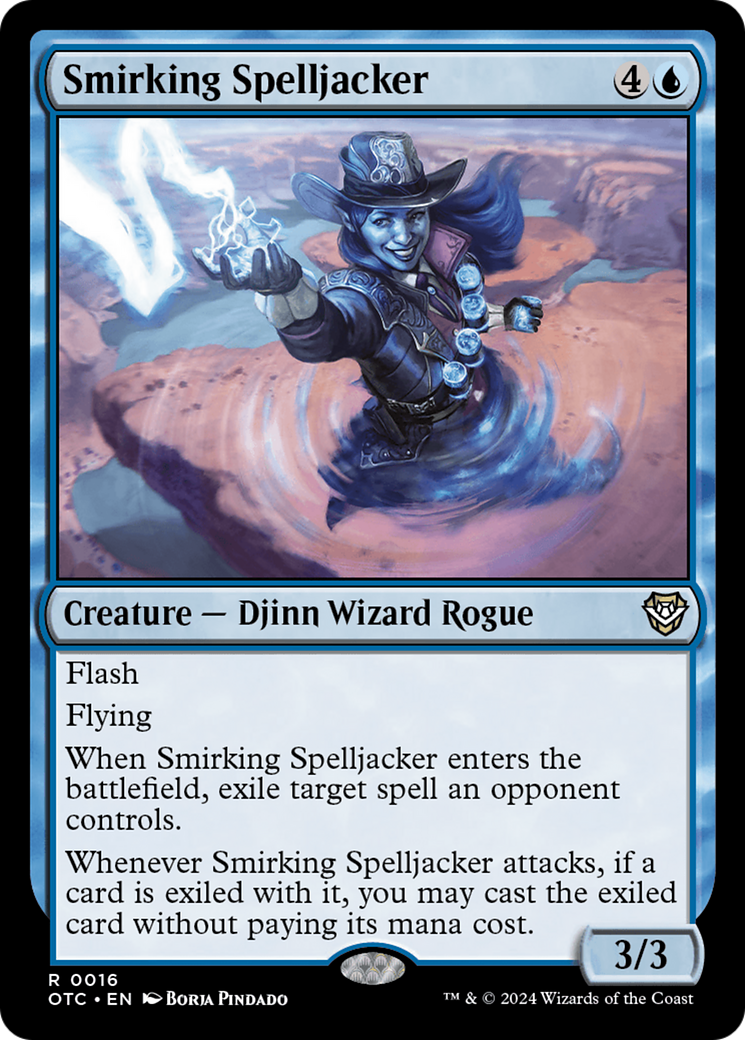
Smirking Spelljacker
Smirking Spelljacker
Creature — Djinn Wizard Rogue
3/3
Flash
Flying
When this creature enters, exile target spell an opponent controls.
Whenever this creature attacks, if a card is exiled with it, you may cast the exiled card without paying its mana cost.
- Spells that can’t be countered can still be exiled by Smirking Spelljacker’s triggered ability. They won’t resolve.
- You choose whether to cast the exiled card as Smirking Spelljacker’s last ability resolves. If you do, you do so as part of the resolution of that ability. You can’t wait to cast it later in the turn. Timing restrictions based on the card’s types are ignored.
- If you cast a spell “without paying its mana cost,” you can’t choose to cast it for any alternative costs. You can, however, pay additional costs, such as kicker costs. If the spell has any mandatory additional costs, those must be paid to cast the spell.
- If the spell you cast has in its mana cost, you must choose 0 as the value of X when casting it without paying its mana cost.
- If you cast a card exiled with Smirking Spelljacker, it will go to the stack. From there, it will likely go to the battlefield or back to its owner’s graveyard. Even if it returns to exile, it will no longer be exiled with Smirking Spelljacker, so you can’t cast it again.
-
1
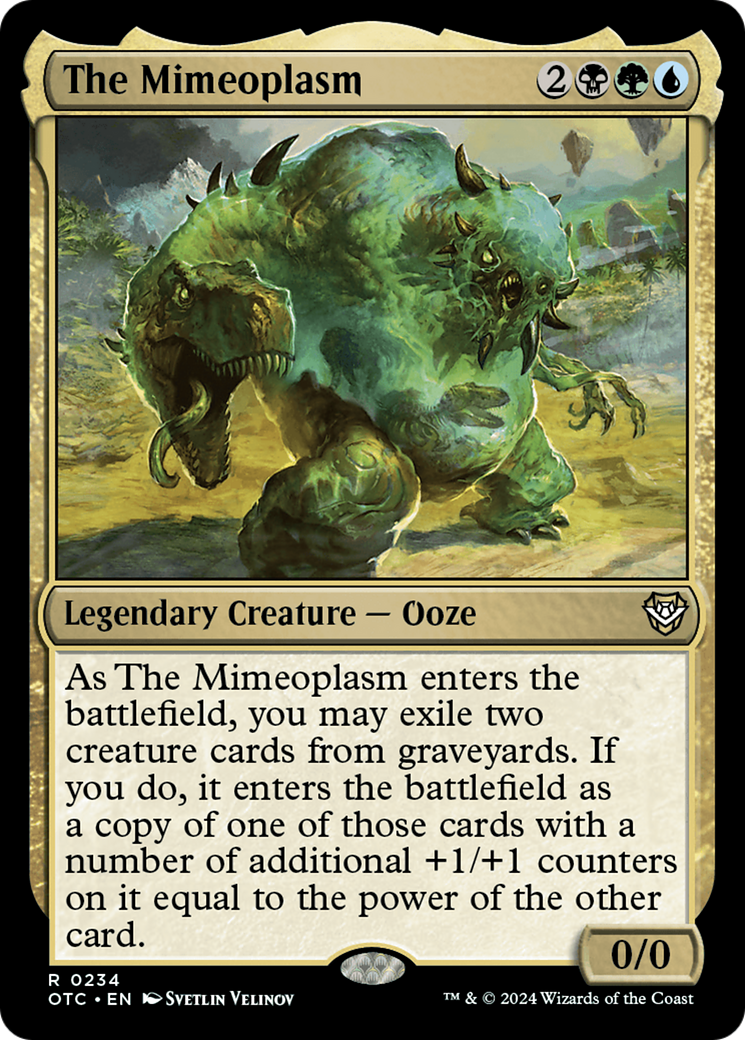
The Mimeoplasm
The Mimeoplasm
Legendary Creature — Ooze
0/0
As The Mimeoplasm enters, you may exile two creature cards from graveyards. If you do, it enters as a copy of one of those cards with a number of additional +1/+1 counters on it equal to the power of the other card.
- You can't choose to exile just one creature card.
- The two creature cards may come from the same graveyard or different graveyards.
- You choose which one The Mimeoplasm is copying and which one determines how many +1/+1 counters are placed on The Mimeoplasm as The Mimeoplasm enters.
- Treat The Mimeoplasm as though it were the creature card it's copying entering the battlefield. Any "As [this card] enters," "[This card] enters with," and "When [this card] enters" abilities of that creature card will work.
- Specifically, if The Mimeoplasm as a copy of a creature card that enters the battlefield with a number of +1/+1 counters, The Mimeoplasm will enter with those +1/+1 counters and +1/+1 counters equal to the power of the other exiled card.
-
1
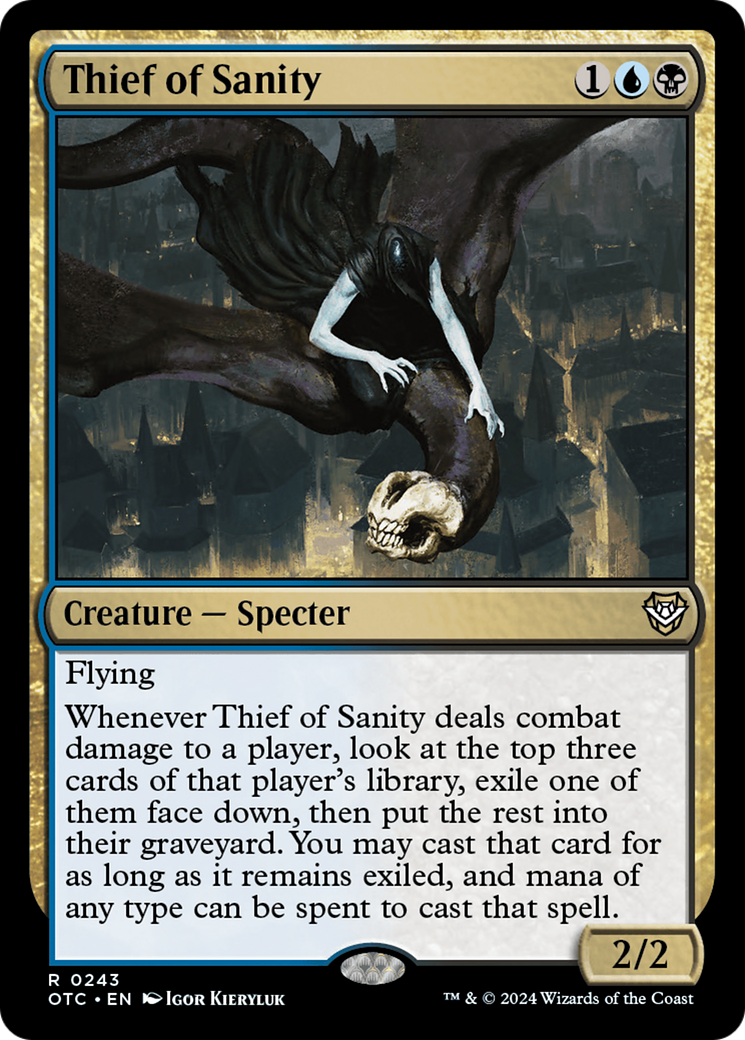
Thief of Sanity
Thief of Sanity
Creature — Specter
2/2
Flying
Whenever this creature deals combat damage to a player, look at the top three cards of that player's library, exile one of them face down, then put the rest into their graveyard. You may cast that card for as long as it remains exiled, and mana of any type can be spent to cast that spell.
- Thief of Sanity's effect doesn't change when you can cast the exiled card. For example, if you exile a sorcery card, you can cast it only during your main phase when the stack is empty.
- An effect that instructs you to "cast" a card doesn't allow you to play lands.
- You can still cast the exiled card if Thief of Sanity leaves the battlefield or leaves your control. If another player gains control of Thief of Sanity, that player can't cast the exiled card.
- Casting an exiled card causes it to leave exile. You can't cast it multiple times.
- In a multiplayer game, if a player leaves the game, all cards that player owns leave as well. If you leave the game, any spells or permanents you control from Thief of Sanity's effect are exiled, and any of the face-down exiled cards remain face down indefinitely. No player may look at them.
-
1
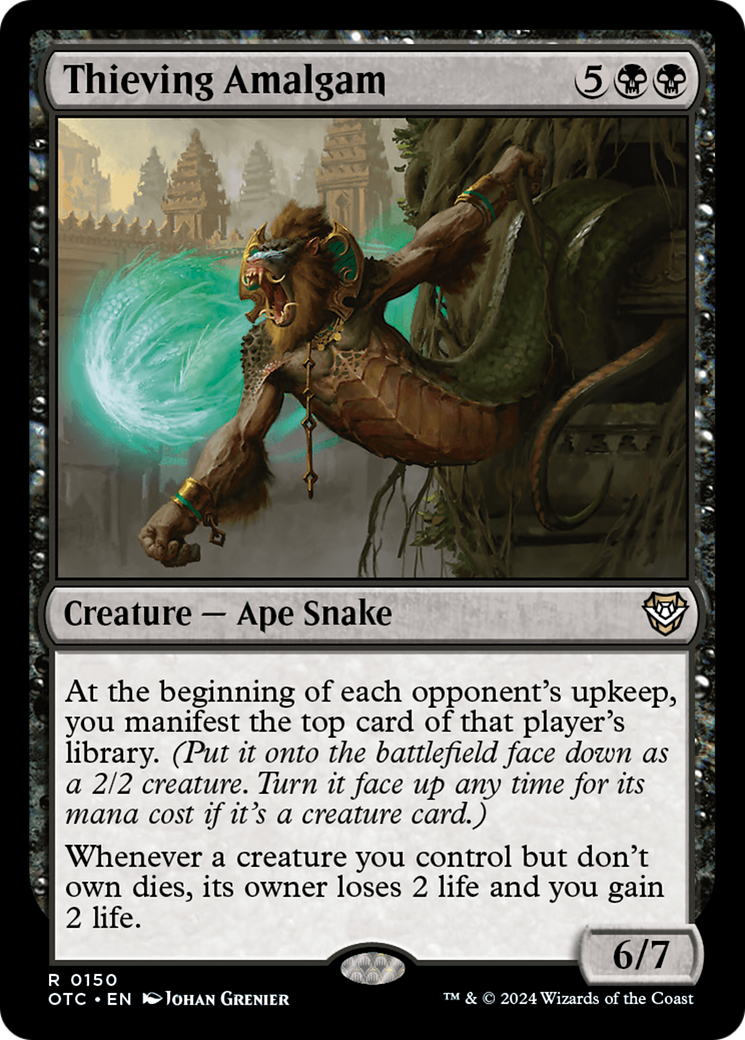
Thieving Amalgam
Thieving Amalgam
Creature — Ape Snake
6/7
At the beginning of each opponent's upkeep, you manifest the top card of that player's library. (Put it onto the battlefield face down as a 2/2 creature. Turn it face up any time for its mana cost if it's a creature card.)
Whenever a creature you control but don't own dies, its owner loses 2 life and you gain 2 life.
- Your opponents can't look at the card they own that you manifested.
- If a creature you control but don't own dies at the same time that your life total becomes 0 or less, you lose the game before Thieving Amalgam's last ability can save you.
- If a creature you control but don't own dies at the same time that its owner leaves the game, Thieving Amalgam's last ability triggers. No player loses 2 life, but you gain 2 life.
- In the Commander variant, you can produce mana that isn't of your commander's color identity if an effect lets you produce mana of that color or mana of any color, even though those symbols can't appear on cards in your deck. You may be able to turn a manifested creature card face up this way if it's not the same colors as your commander.
- In a multiplayer game, if a player leaves the game, all cards that player owns leave as well. If you leave the game, the creatures you manifested with Thieving Amalgam's triggered ability are exiled.
-
1
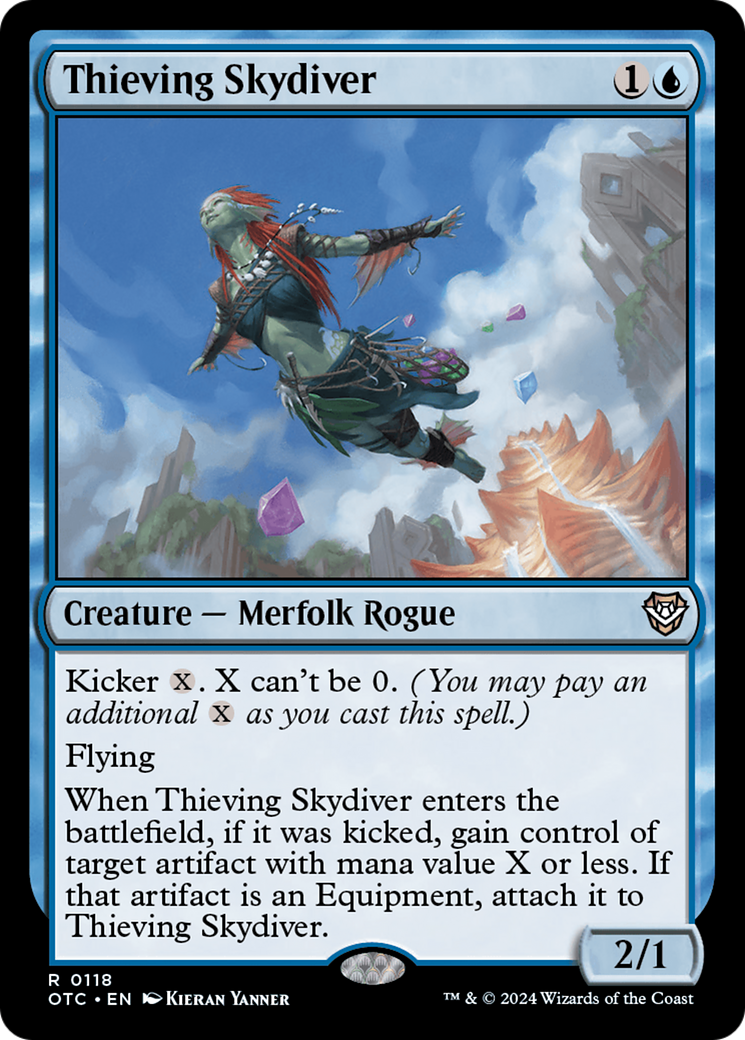
Thieving Skydiver
Thieving Skydiver
Creature — Merfolk Rogue
2/1
Kicker . X can't be 0. (You may pay an additional as you cast this spell.)
Flying
When this creature enters, if it was kicked, gain control of target artifact with mana value X or less. If that artifact is an Equipment, attach it to this creature.
- To determine a spell's total cost, start with the mana cost (or an alternative cost if another card's effect allows you to pay one instead), add any cost increases (such as kicker), then apply any cost reductions. The spell's mana value remains unchanged, no matter what the total cost to cast it was.
- If you put a permanent with a kicker ability onto the battlefield without casting it, you can't kick it.
- If you copy a kicked spell on the stack, the copy is also kicked. If the copied spell is a permanent spell, the token the copy of that spell becomes when it enters is also kicked.
- If a card or token enters as a copy of a permanent, the new permanent isn't kicked, even if the original was.
- If a spell's kicker cost was paid, the spell is "kicked."
- The kicker ability doesn't let you pay a kicker cost more than once.
- Thieving Skydiver's ability can target an artifact you already control. You'll attach it to Thieving Skydiver if it's an Equipment.
- The control-change effect of Thieving Skydiver lasts indefinitely. It doesn't wear off during the cleanup step, and it doesn't expire if Thieving Skydiver leaves the battlefield. In a multiplayer game, it does expire if you leave the game.
- If the Equipment can't be attached to Thieving Skydiver, most likely because Thieving Skydiver has left the battlefield before its triggered ability resolves, the Equipment remains attached to whatever it's currently attached to or remains unattached if attached to nothing.
-
1
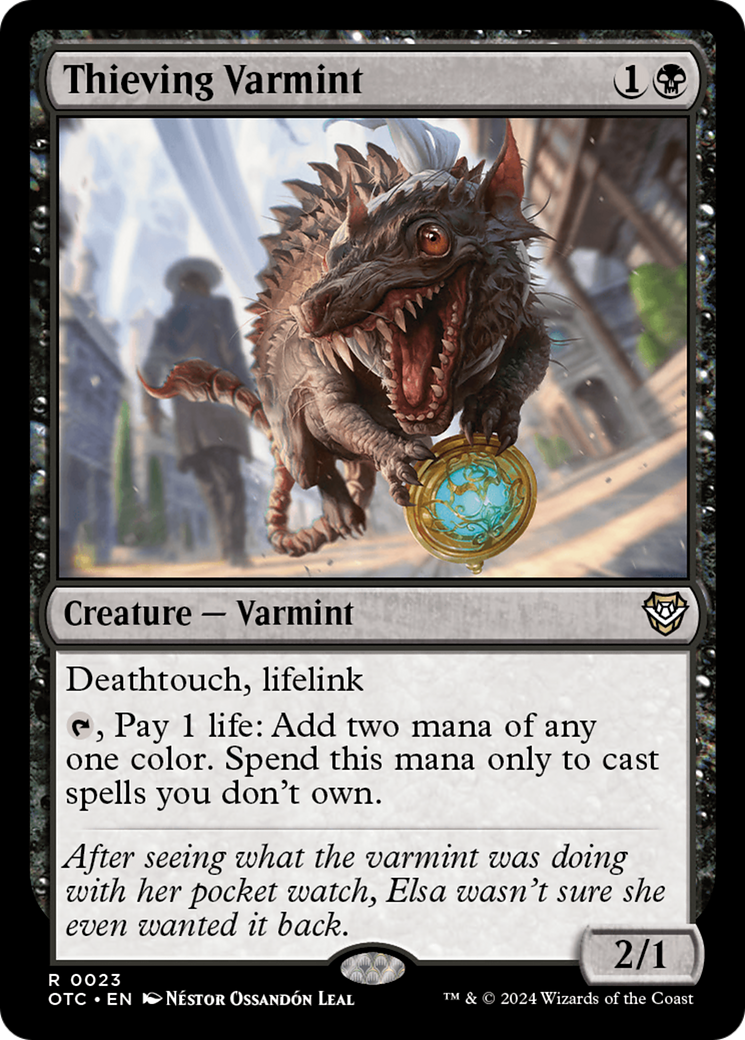
Thieving Varmint
Thieving Varmint
Creature — Varmint
2/1
Deathtouch, lifelink
, Pay 1 life: Add two mana of any one color. Spend this mana only to cast spells you don't own.
- You may spend the two mana added by the last ability on the same spell you don’t own or on two different spells you don’t own.
-
1
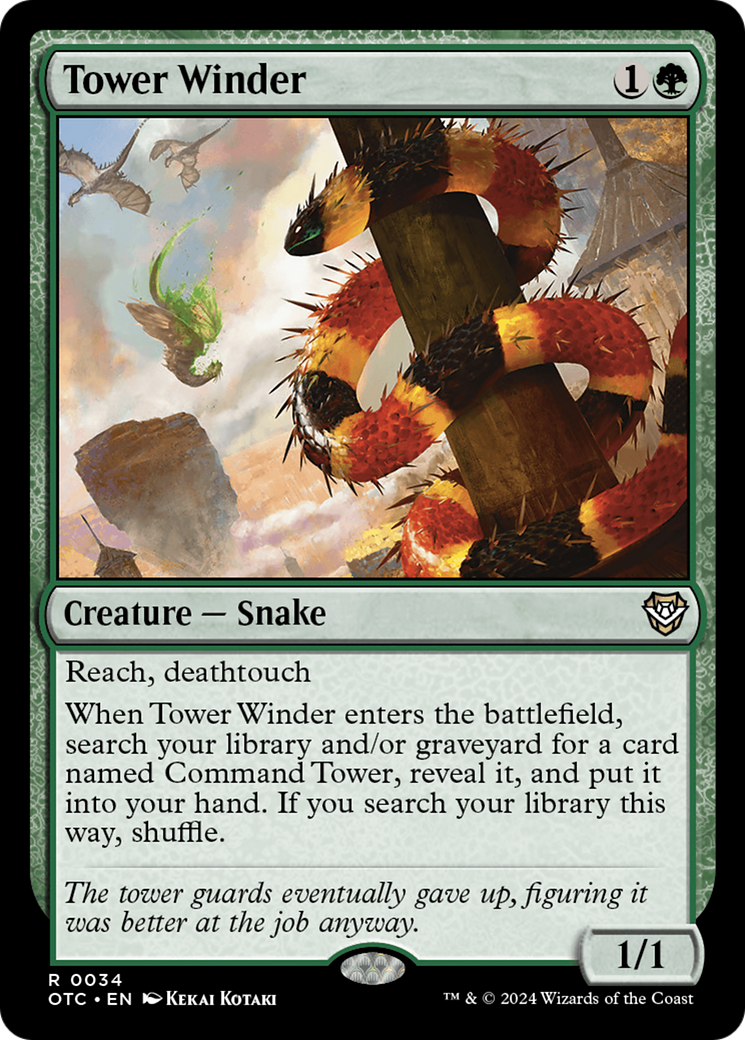
Tower Winder
Tower Winder
Creature — Snake
1/1
Reach, deathtouch
When this creature enters, search your library and/or graveyard for a card named Command Tower, reveal it, and put it into your hand. If you search your library this way, shuffle.
-
1
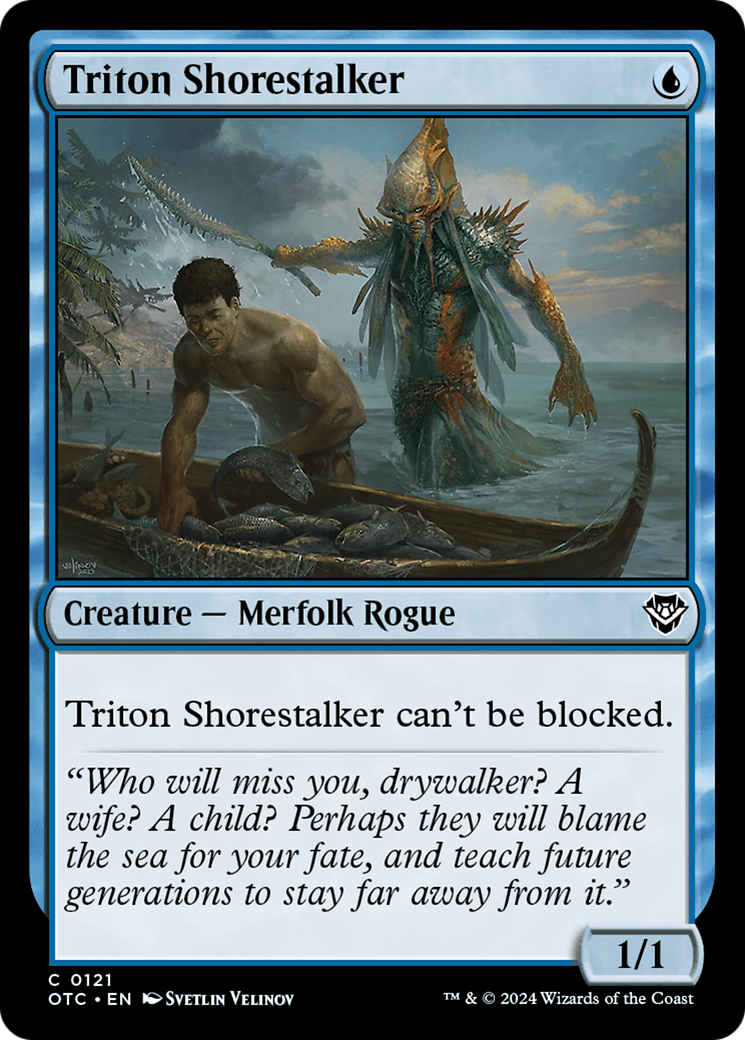
Triton Shorestalker
Triton Shorestalker
Creature — Merfolk Rogue
1/1
This creature can't be blocked.
-
1
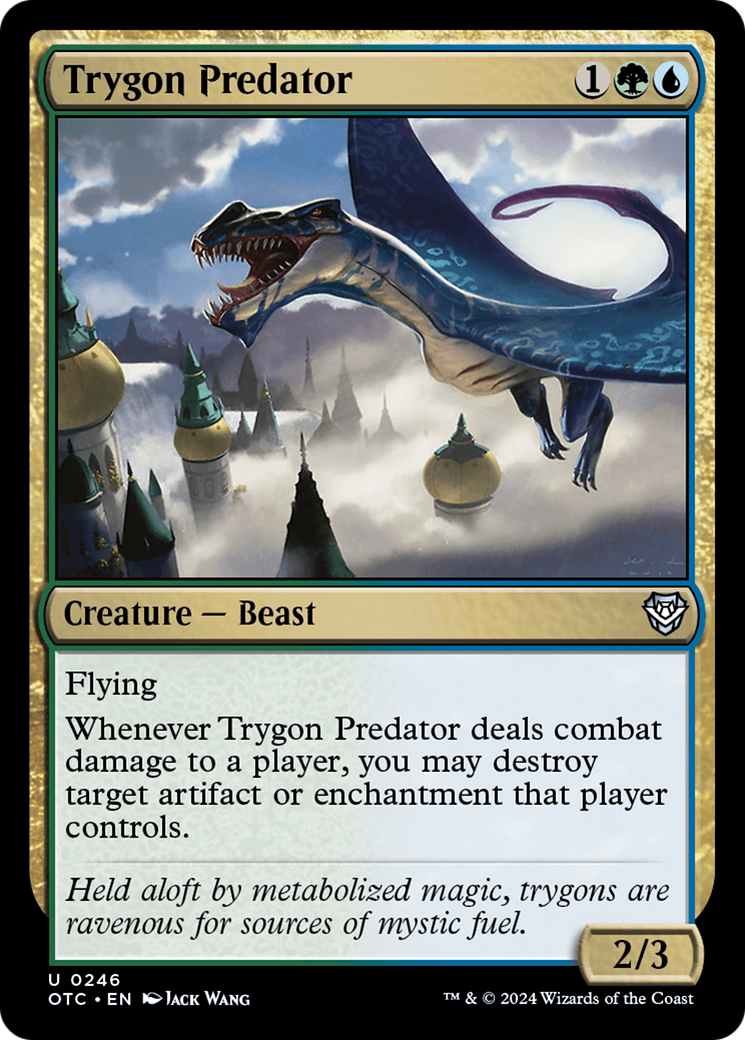
Trygon Predator
Trygon Predator
Creature — Beast
2/3
Flying
Whenever this creature deals combat damage to a player, you may destroy target artifact or enchantment that player controls.
-
1
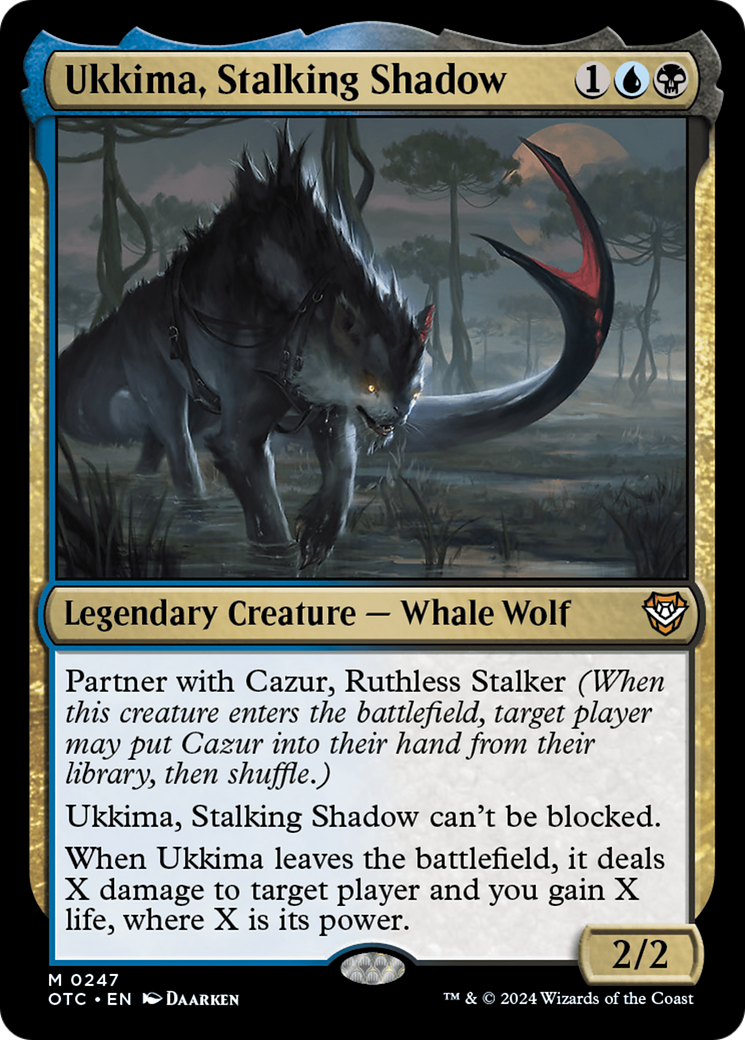
Ukkima, Stalking Shadow
Ukkima, Stalking Shadow
Legendary Creature — Whale Wolf
2/2
Partner with Cazur, Ruthless Stalker (When this creature enters, target player may put Cazur into their hand from their library, then shuffle.)
Ukkima can't be blocked.
When Ukkima leaves the battlefield, it deals X damage to target player and you gain X life, where X is its power.
- Use Ukkima's power as it last existed on the battlefield to determine how much damage it deals and how much life you gain. If that number is negative, it deals no damage and you gain no life.
- If the target player is an illegal target by the time Ukkima's last ability tries to resolve, the ability won't resolve. You won't gain any life.
- If your life total is brought to 0 or less at the same time that Ukkima is dealt lethal damage, you lose the game before the last ability goes on the stack.
-
1
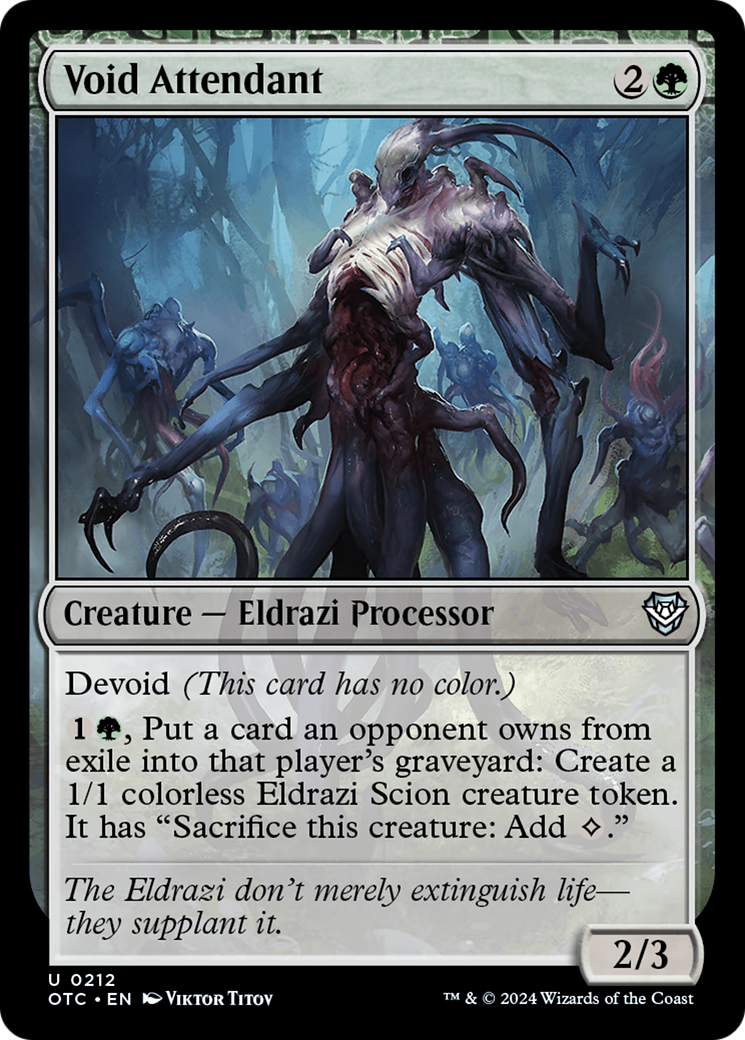
Void Attendant
Void Attendant
Creature — Eldrazi Processor
2/3
Devoid (This card has no color.)
, Put a card an opponent owns from exile into that player's graveyard: Create a 1/1 colorless Eldrazi Scion creature token. It has "Sacrifice this token: Add ."
- Once you announce that you're activating this ability, players can't respond until after you have paid its costs and completed activating it. Specifically, no one can try to remove the card from exile to stop you from activating the ability.
- Cards with devoid use frames that are variations of the transparent frame traditionally used for Eldrazi. The top part of the card features some color over a background based on the texture of the hedrons that once imprisoned the Eldrazi. This coloration is intended to aid deckbuilding and game play.
- A card with devoid is just colorless. It's not colorless and the colors of mana in its mana cost.
- Other cards and abilities can give a card with devoid color. If that happens, it's just the new color, not that color and colorless.
- Devoid works in all zones, not just on the battlefield.
- If a card loses devoid, it will still be colorless. This is because effects that change an object's color (like the one created by devoid) are considered before the object loses devoid.
- If a spell or ability requires that you put more than one exiled card into the graveyard, you may choose cards owned by different opponents. Each card chosen will be put into its owner's graveyard.
- If a replacement effect will cause cards that would be put into a graveyard from anywhere to be exiled instead (such as the one created by Anafenza, the Foremost), you can still put an exiled card into its opponent's graveyard. The card becomes a new object and remains in exile. In this situation, you can't use a single exiled card if required to put more than one exiled card into the graveyard. Conversely, you could use the same card in this situation if two separate spells or abilities each required you to put a single exiled card into its owner's graveyard.
- You can't look at face-down cards in exile unless an effect allows you to.
- Face-down cards in exile are grouped using two criteria: what caused them to be exiled face down and when they were exiled face down. If you want to put a face-down card in exile into its owner's graveyard, you must first choose one of these groups and then choose a card from within that group at random. For example, say an artifact causes your opponent to exile their hand of three cards face down. Then on a later turn, that artifact causes your opponent to exile another two cards face down. If you use Wasteland Strangler to put one of those cards into their graveyard, you would pick the first or second pile and put a card chosen at random from that pile into the graveyard.
- Eldrazi Scions are similar to Eldrazi Spawn, seen in the Zendikar block. Note that Eldrazi Scions are 1/1, not 0/1.
- Eldrazi and Scion are each separate creature types. Anything that affects Eldrazi will affect these tokens, for example.
- Sacrificing an Eldrazi Scion creature token to add is a mana ability. It doesn't use the stack and can't be responded to.
- Some instants and sorceries that create Eldrazi Scions require targets. If all targets for such a spell have become illegal by the time that spell tries to resolve, the spell won't resolve and none of its effects will happen. You won't get any Eldrazi Scions.
-
1
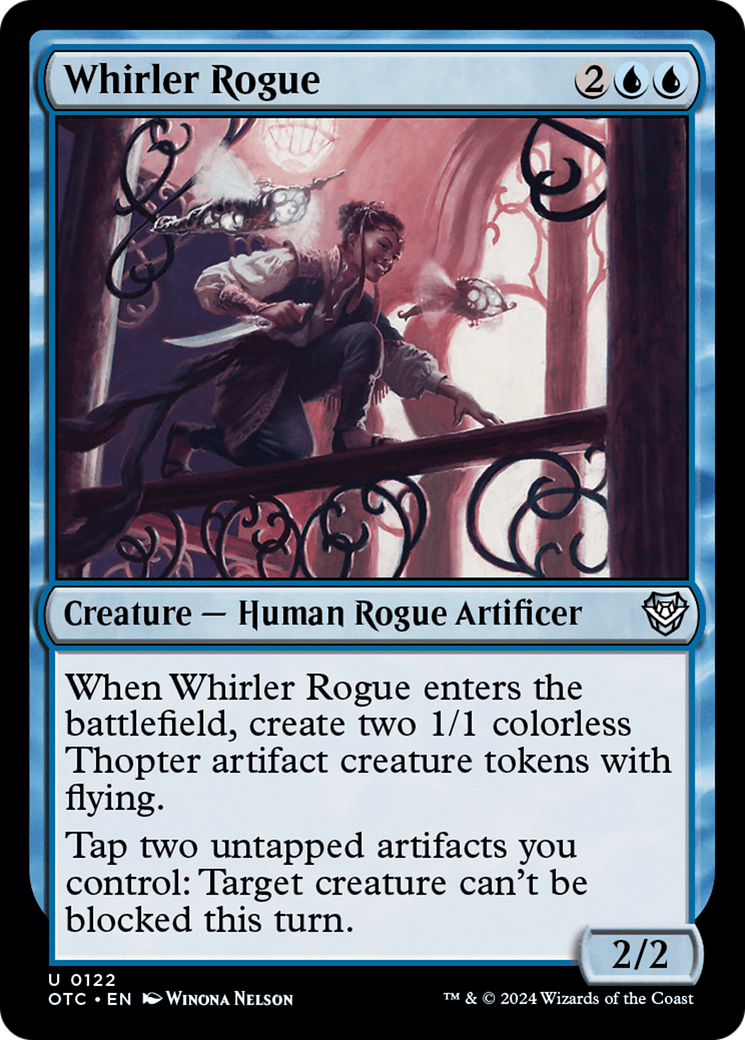
Whirler Rogue
Whirler Rogue
Creature — Human Rogue Artificer
2/2
When this creature enters, create two 1/1 colorless Thopter artifact creature tokens with flying.
Tap two untapped artifacts you control: Target creature can't be blocked this turn.
- You may tap any two untapped artifacts you control, including artifact creatures that haven't been under your control continuously since the beginning of your most recent turn.
- Activating the second ability of Whirler Rogue after a creature has become blocked won't cause it to become unblocked.
Instants 4
-
1
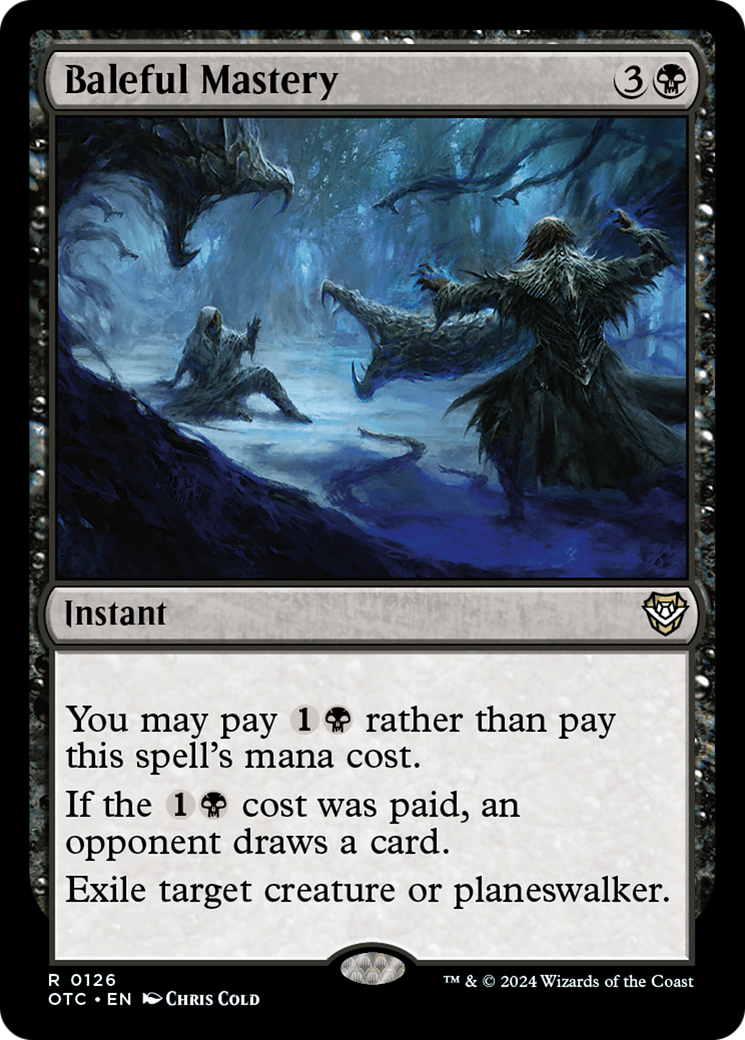
Baleful Mastery
Baleful Mastery
Instant
You may pay rather than pay this spell's mana cost.
If the cost was paid, an opponent draws a card.
Exile target creature or planeswalker.
- The mana value of a spell on the stack is determined by its mana cost, not any alternative costs you used to pay for it.
- If you choose to pay one alternative cost, you can't pay any other alternative costs. For example, if an effect lets you cast a "Mastery" spell "without paying its mana cost," you can't also choose to pay its given alternative cost.
- If an effect increases or decreases the cost of spells you cast, that cost increase or decrease is applied to the alternative cost you chose to pay. In that case, the cost was still paid for the purposes of the effect, even if you paid more or less for it when it was cast.
- If you copy a "Mastery" spell and the alternative cost was paid, the copy will resolve as though the cost was paid.
- In a multiplayer game, you choose which opponent takes the prescribed action as the spell resolves.
-
1
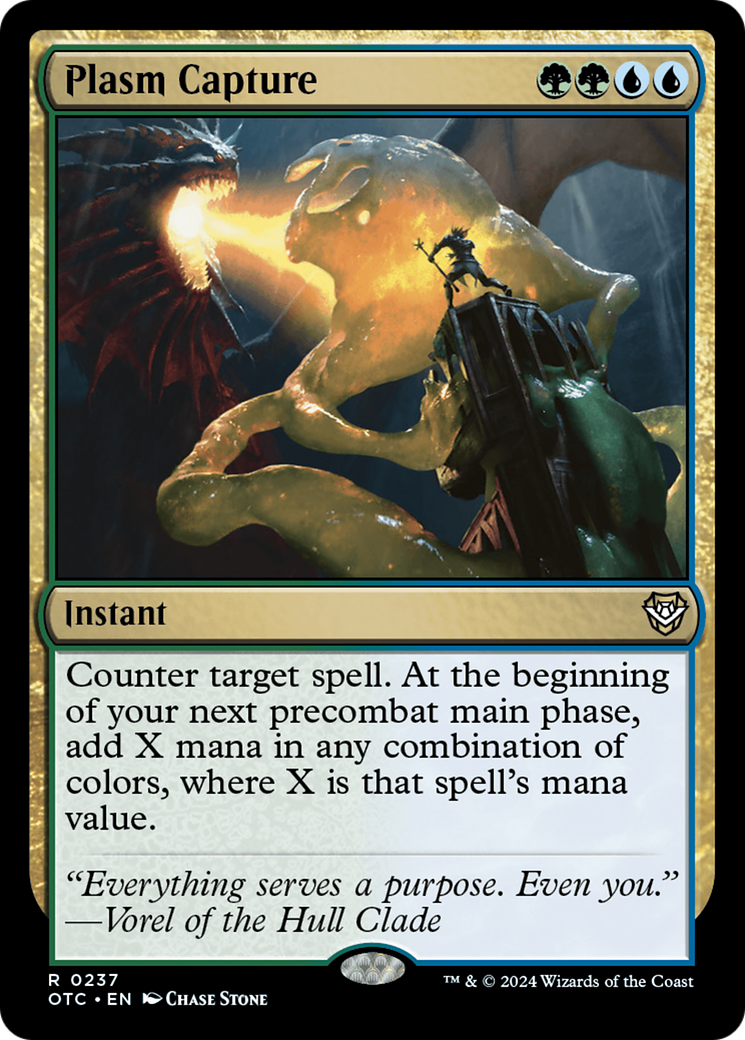
Plasm Capture
Plasm Capture
Instant
Counter target spell. At the beginning of your next first main phase, add X mana in any combination of colors, where X is that spell's mana value.
- If the countered spell had in its mana cost, include the value chosen for that X when determining how much mana to produce. For example, if you counter a spell that costs with X equal to 5, you'll produce six mana.
- Your precombat main phase is the main phase that happens immediately after your draw step, not any other main phase.
-
1
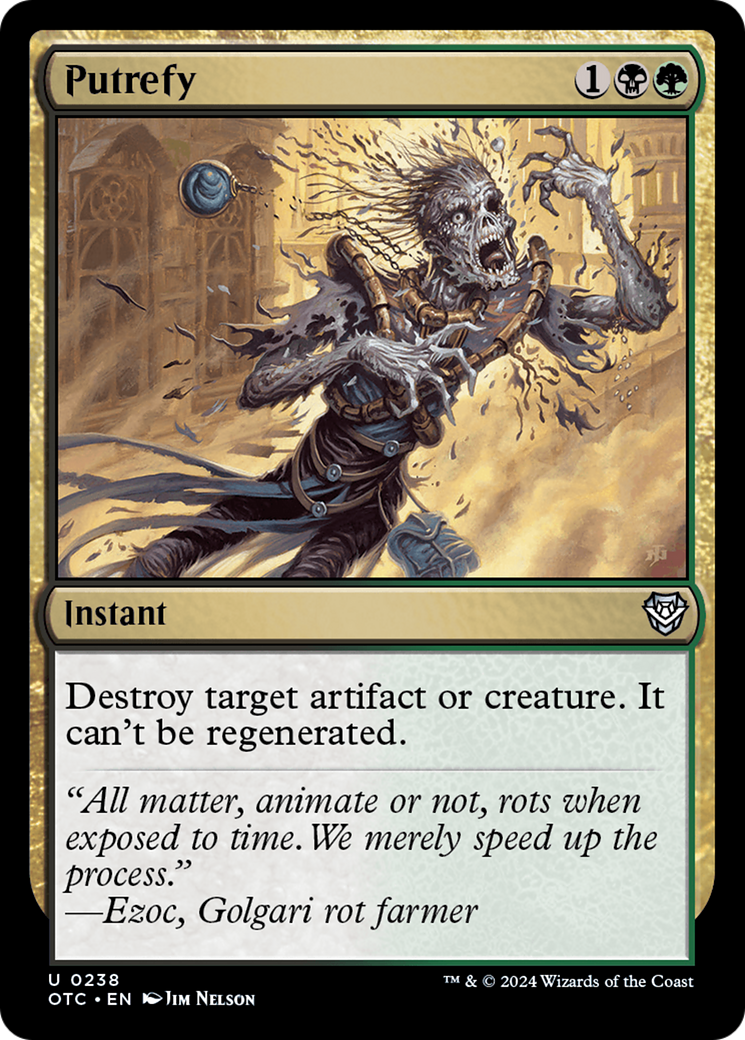
Putrefy
Putrefy
Instant
Destroy target artifact or creature. It can't be regenerated.
- This spell isn't modal. When it resolves, it will destroy the target if it's a creature or an artifact, even if it changed from one to the other between targeting and resolution.
-
1
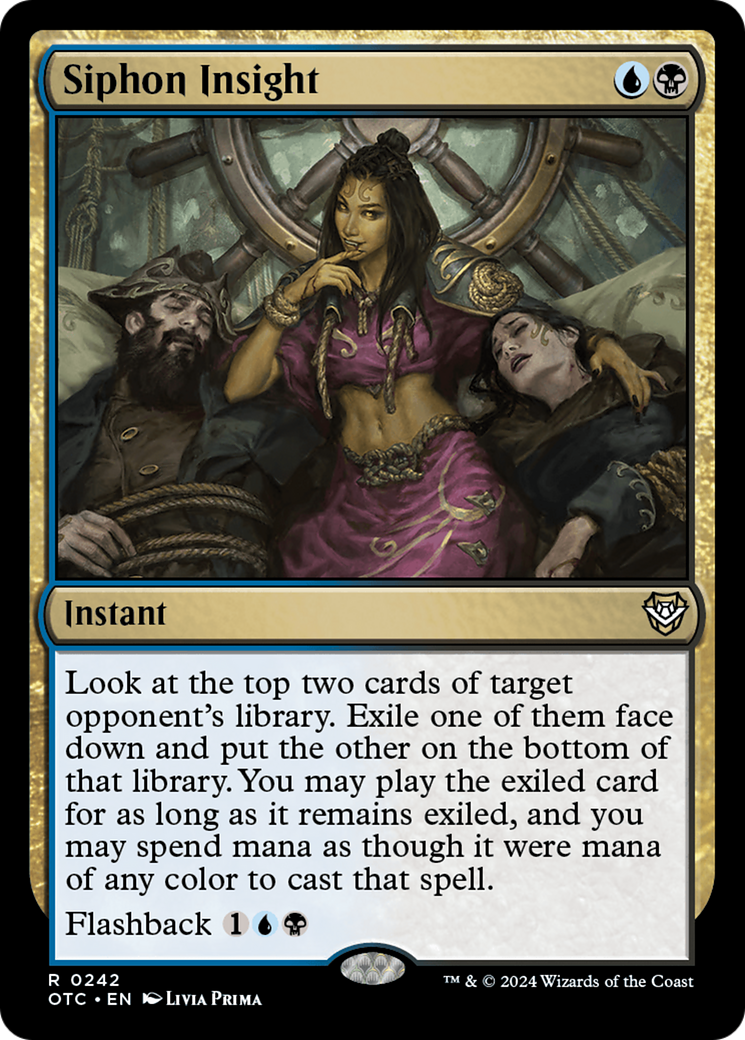
Siphon Insight
Siphon Insight
Instant
Look at the top two cards of target opponent's library. Exile one of them face down and put the other on the bottom of that library. You may play the exiled card for as long as it remains exiled, and you may spend mana as though it were mana of any color to cast that spell.
Flashback
- Only you get to look at the exiled card. Its owner doesn't get to know what it is while it is in exile unless you tell them.
- You don't have to disclose which card you exiled and which card you put on the bottom of the library. For example, if your opponent knows what the top card of their library is and you cast Siphon Insight, you don't have to tell them where you put that card.
- You may play the card even if it is a land.
- You must still follow all normal timing rules to play a card exiled with Siphon Insight.
- "Flashback [cost]" means "You may cast this card from your graveyard by paying [cost] rather than paying its mana cost" and "If the flashback cost was paid, exile this card instead of putting it anywhere else any time it would leave the stack."
- You must still follow any timing restrictions and permissions, including those based on the card's type. For instance, you can cast a sorcery using flashback only when you could normally cast a sorcery.
- To determine the total cost of a spell, start with the mana cost or alternative cost (such as a flashback cost) you're paying, add any cost increases, then apply any cost reductions. The mana value of the spell is determined only by its mana cost, no matter what the total cost to cast the spell was.
- A spell cast using flashback will always be exiled afterward, whether it resolves, is countered, or leaves the stack in some other way.
- You can cast a spell using flashback even if it was somehow put into your graveyard without having been cast.
- If a card with flashback is put into your graveyard during your turn, you can cast it if it's legal to do so before any other player can take any actions.
Sorceries 12
-
1
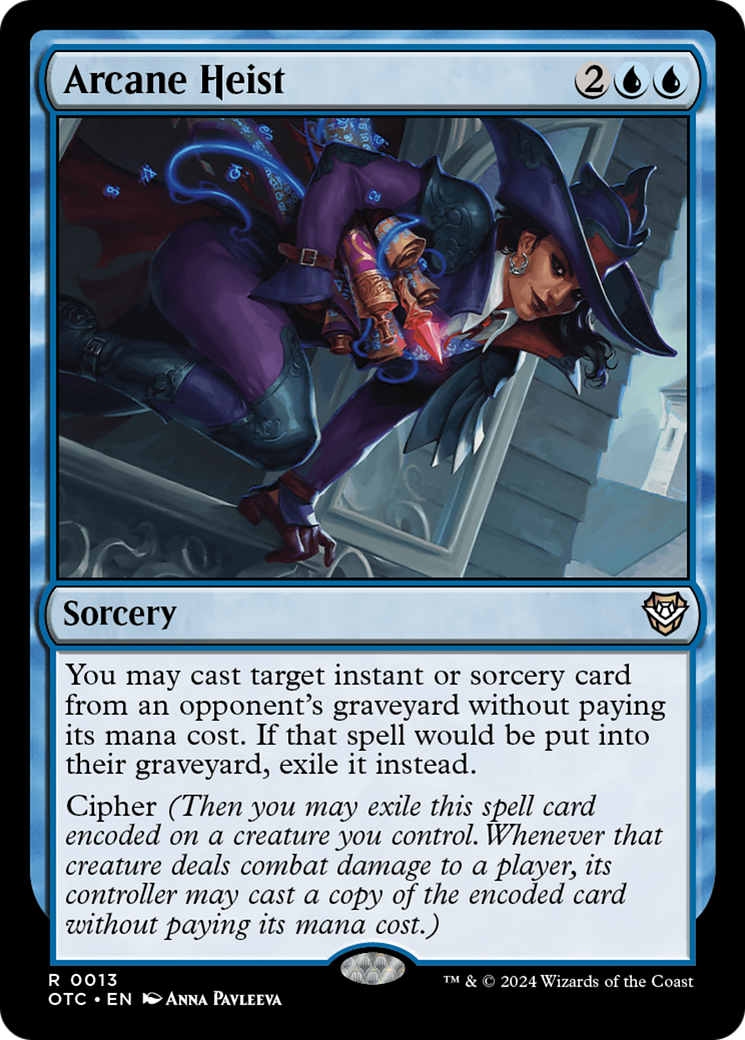
Arcane Heist
Arcane Heist
Sorcery
You may cast target instant or sorcery card from an opponent's graveyard without paying its mana cost. If that spell would be put into their graveyard, exile it instead.
Cipher (Then you may exile this spell card encoded on a creature you control. Whenever that creature deals combat damage to a player, its controller may cast a copy of the encoded card without paying its mana cost.)
- You choose whether to cast the target instant or sorcery card as Arcane Heist resolves. If you do, you do so as part of the resolution of Arcane Heist. You can’t wait to cast it later in the turn. Timing restrictions based on the card’s types are ignored.
- If you cast a spell “without paying its mana cost,” you can’t choose to cast it for any alternative costs. You can, however, pay additional costs, such as kicker costs. If the spell has any mandatory additional costs, those must be paid to cast the spell.
- If the spell you cast has in its mana cost, you must choose 0 as the value of X when casting it without paying its mana cost.
- The spell with cipher is encoded on the creature as part of that spell’s resolution, just after the spell’s other effects. That card goes directly from the stack to exile. It never goes to the graveyard.
- You choose the creature as the spell resolves. The cipher ability doesn’t target that creature.
- If the spell with cipher doesn’t resolve, none of its effects will happen, including cipher. The card will go to its owner’s graveyard and won’t be encoded on a creature.
- If the creature leaves the battlefield, the exiled card will no longer be encoded on any creature. It will stay exiled.
- You can choose only a creature to encode the card onto.
- The copy of the card with cipher is created in and cast from exile.
- You cast the copy of the card with cipher during the resolution of the triggered ability. Ignore timing restrictions based on the card’s type.
- If you choose not to cast the copy, or you can’t cast it (perhaps because there are no legal targets available), the copy will cease to exist the next time state-based actions are performed. You won’t get a chance to cast the copy at a later time.
- The exiled card with cipher grants a triggered ability to the creature it’s encoded on. If that creature loses that ability and subsequently deals combat damage to a player, the triggered ability won’t trigger. However, the exiled card will continue to be encoded on that creature.
- If another player gains control of the creature, that player will control the triggered ability. That player will create a copy of the encoded card and may cast it.
- If a creature with an encoded card deals combat damage to more than one player simultaneously (perhaps because some of the combat damage was redirected), the triggered ability will trigger once for each player it deals combat damage to. Each ability will create a copy of the exiled card and allow you to cast it.
-
1
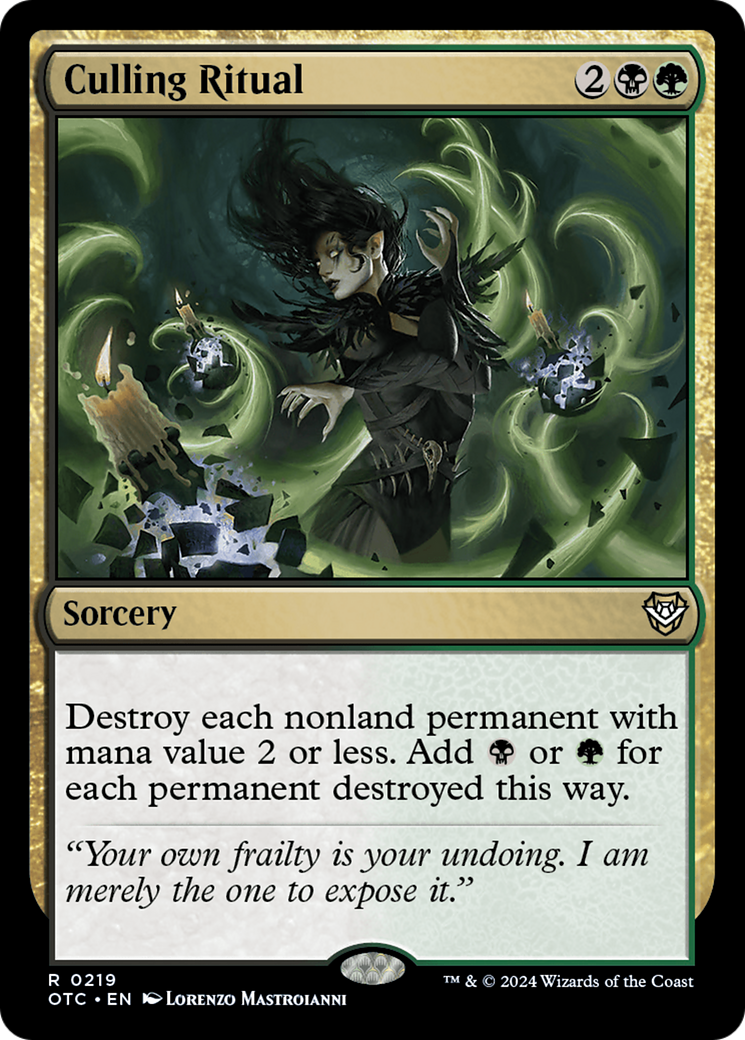
Culling Ritual
Culling Ritual
Sorcery
Destroy each nonland permanent with mana value 2 or less. Add or for each permanent destroyed this way.
- You can choose to add either or for each permanent destroyed. You aren't limited to one color.
-
1
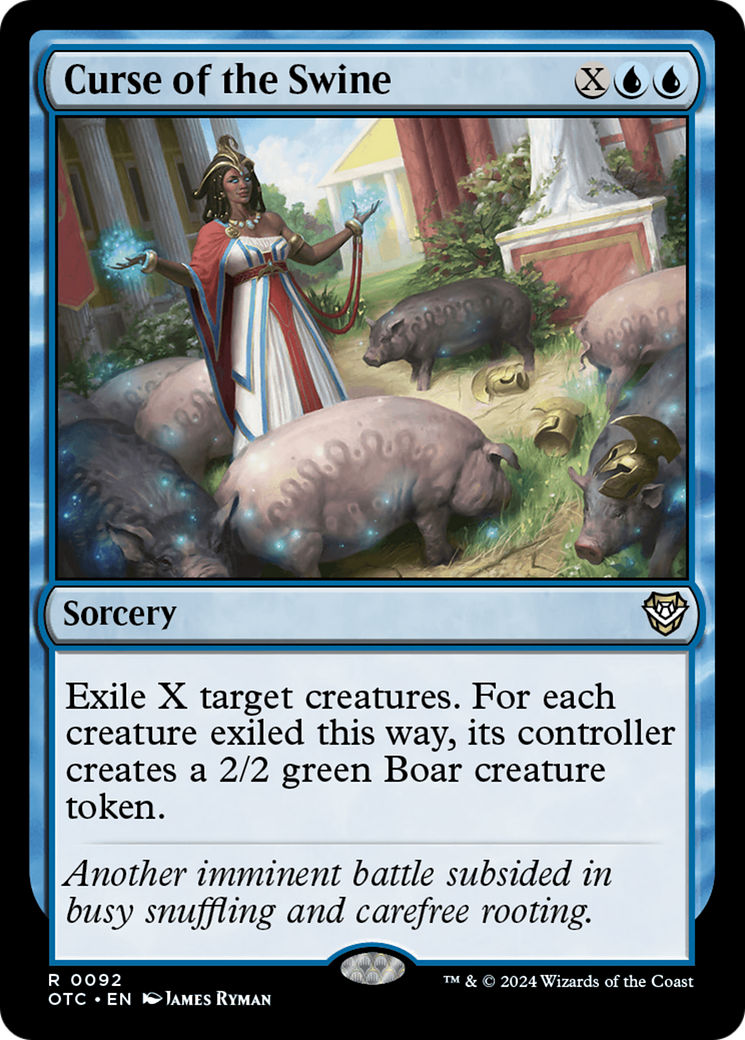
Curse of the Swine
Curse of the Swine
Sorcery
Exile X target creatures. For each creature exiled this way, its controller creates a 2/2 green Boar creature token.
-
1
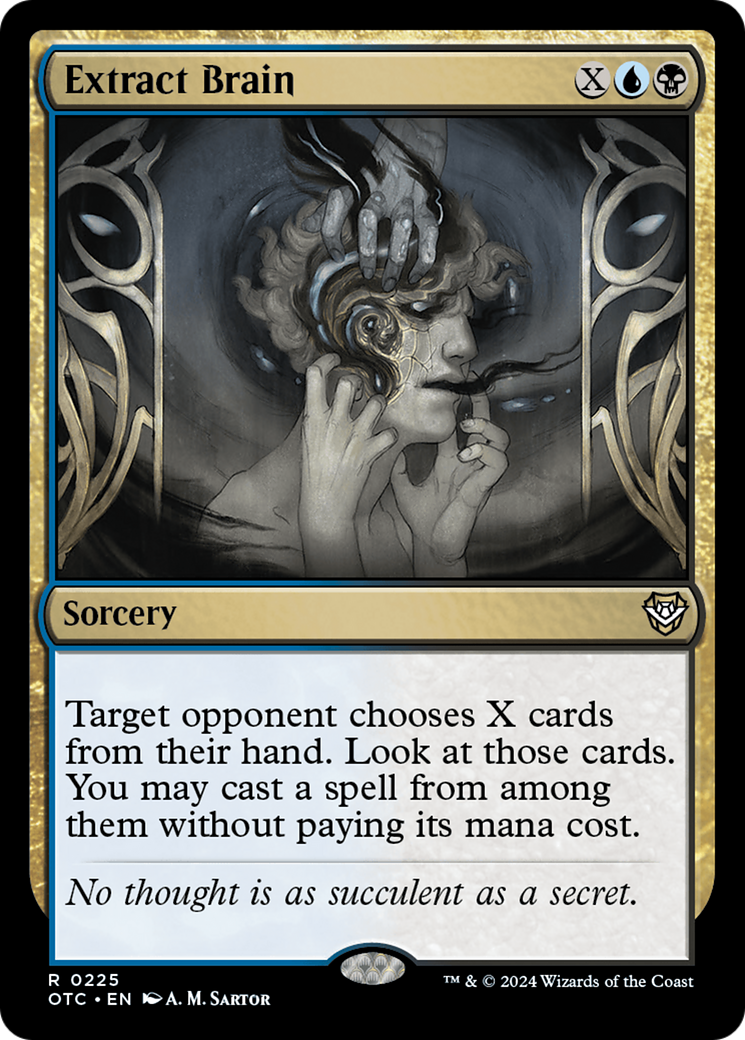
Extract Brain
Extract Brain
Sorcery
Target opponent chooses X cards from their hand. Look at those cards. You may cast a spell from among them without paying its mana cost.
-
1
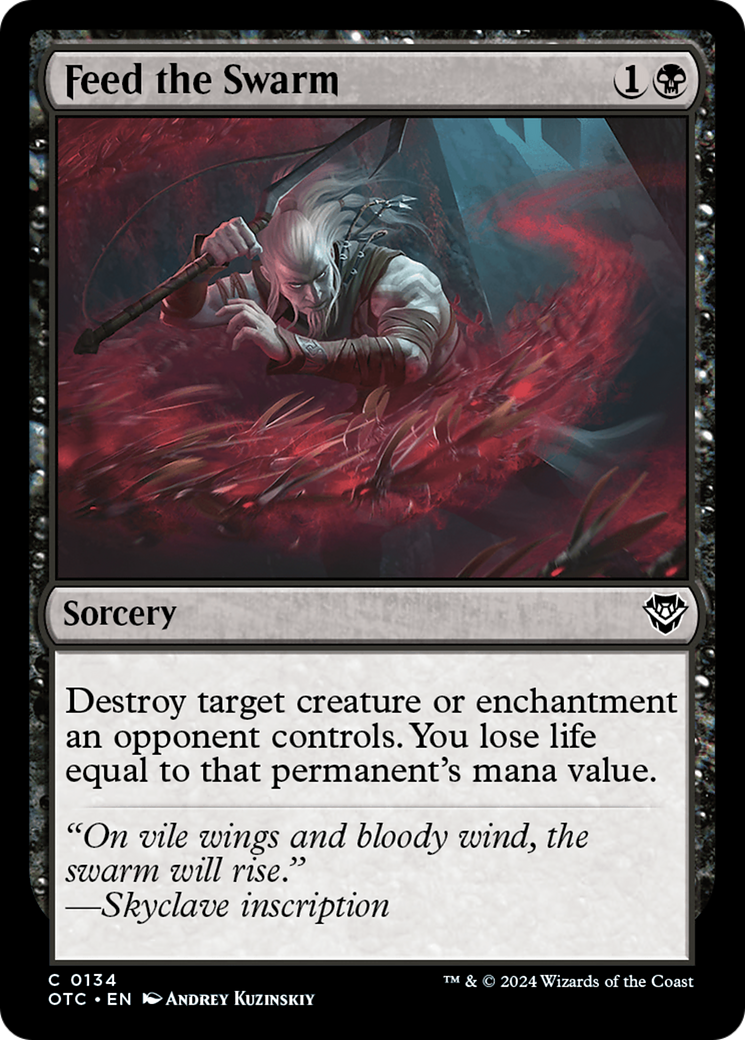
Feed the Swarm
Feed the Swarm
Sorcery
Destroy target creature or enchantment an opponent controls. You lose life equal to that permanent's mana value.
- The amount of life you lose is determined by the permanent's mana value as it last existed on the battlefield.
- If the target permanent is an illegal target by the time Feed the Swarm tries to resolve, the spell doesn't resolve. You don't lose any life. If the target is legal but not destroyed (most likely because it has indestructible), you do lose life.
- If a permanent on the battlefield has in its mana cost, X is 0 for the purpose of determining its mana value.
-
1
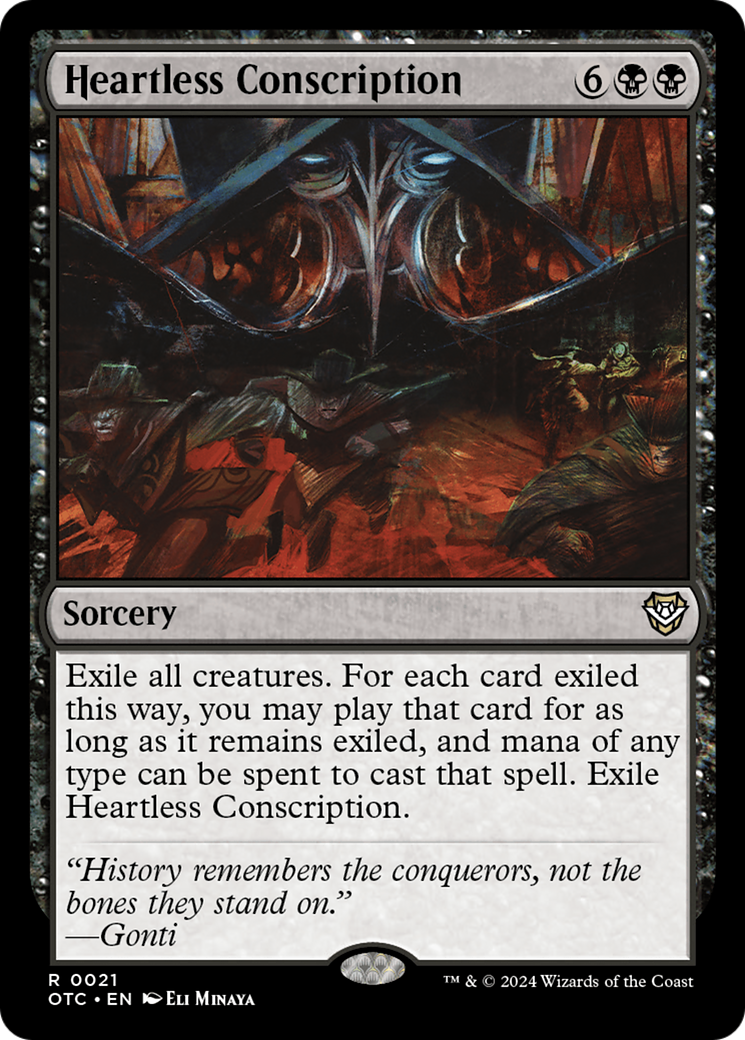
Heartless Conscription
Heartless Conscription
Sorcery
Exile all creatures. For each card exiled this way, you may play that card for as long as it remains exiled, and mana of any type can be spent to cast that spell. Exile Heartless Conscription.
- You pay all costs and follow all normal timing rules for cards played from exile this way. For example, if the exiled card is a creature card without flash, you may cast it only during your main phase while the stack is empty.
- If any of the cards are land cards (perhaps because they were lands that had become creatures), you can play them from exile, following the normal timing rules for playing lands.
-
1
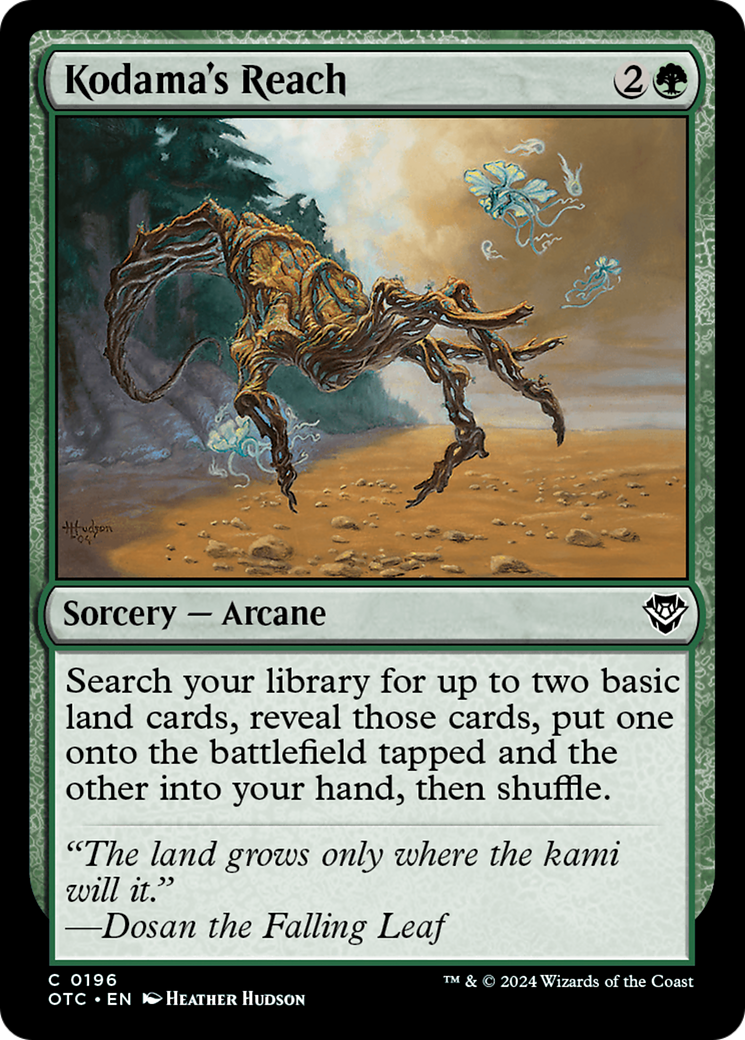
Kodama's Reach
Kodama's Reach
Sorcery — Arcane
Search your library for up to two basic land cards, reveal those cards, put one onto the battlefield tapped and the other into your hand, then shuffle.
- You can get just one basic land card if you wish (or even none at all). If you get only one land card, you put it onto the battlefield tapped.
-
1
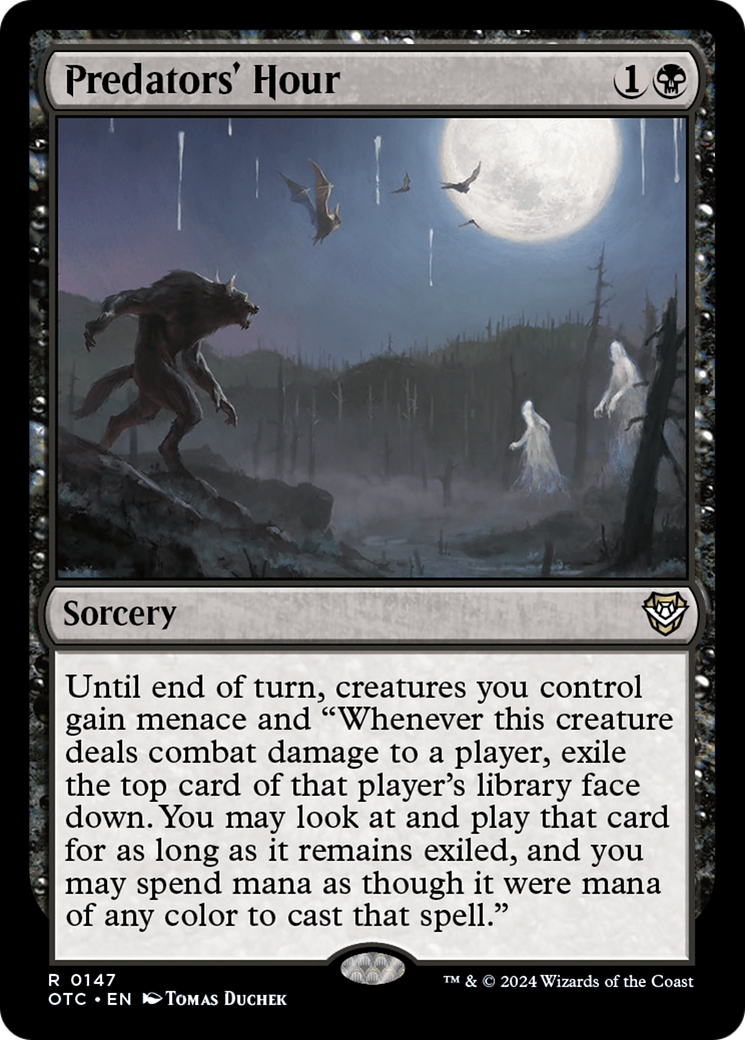
Predators' Hour
Predators' Hour
Sorcery
Until end of turn, creatures you control gain menace and "Whenever this creature deals combat damage to a player, exile the top card of that player's library face down. You may look at and play that card for as long as it remains exiled, and you may spend mana as though it were mana of any color to cast that spell."
- You must pay all costs to play cards exiled this way, and you must follow all normal timing permissions and restrictions. For example, if you play a land this way, you may do so only during your main phase while the stack is empty and only if you haven't yet played a land (unless another effect allows you to play additional lands).
-
1
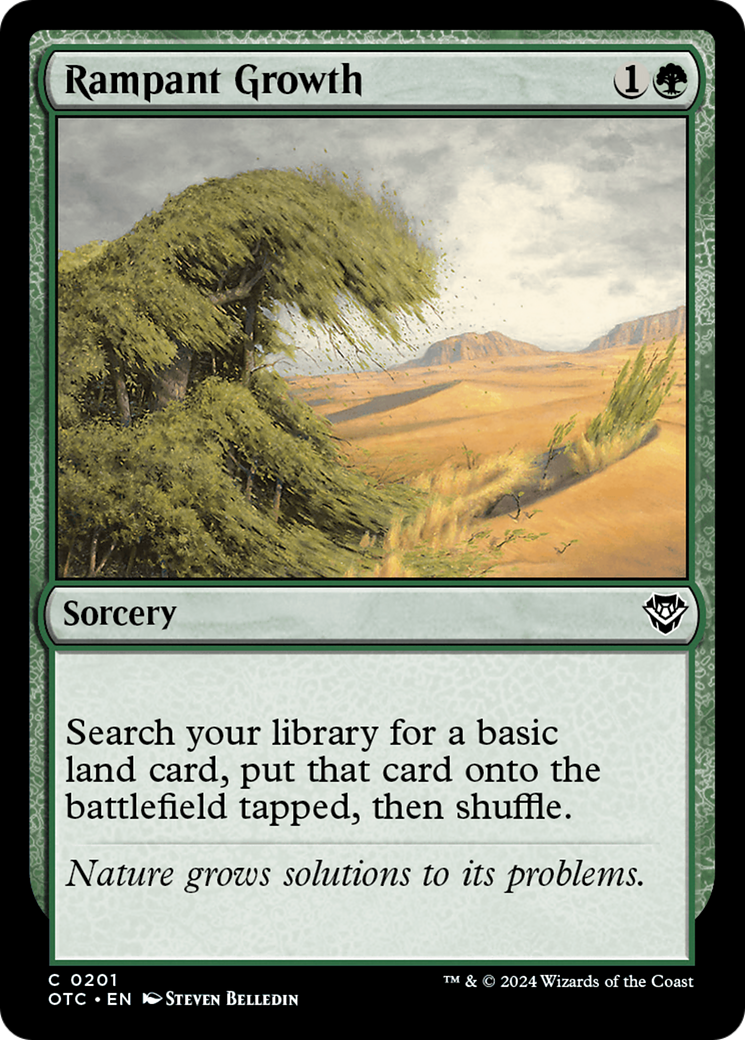
Rampant Growth
Rampant Growth
Sorcery
Search your library for a basic land card, put that card onto the battlefield tapped, then shuffle.
- The land does not count toward your one per turn limit because it was put onto the battlefield by an effect.
-
1
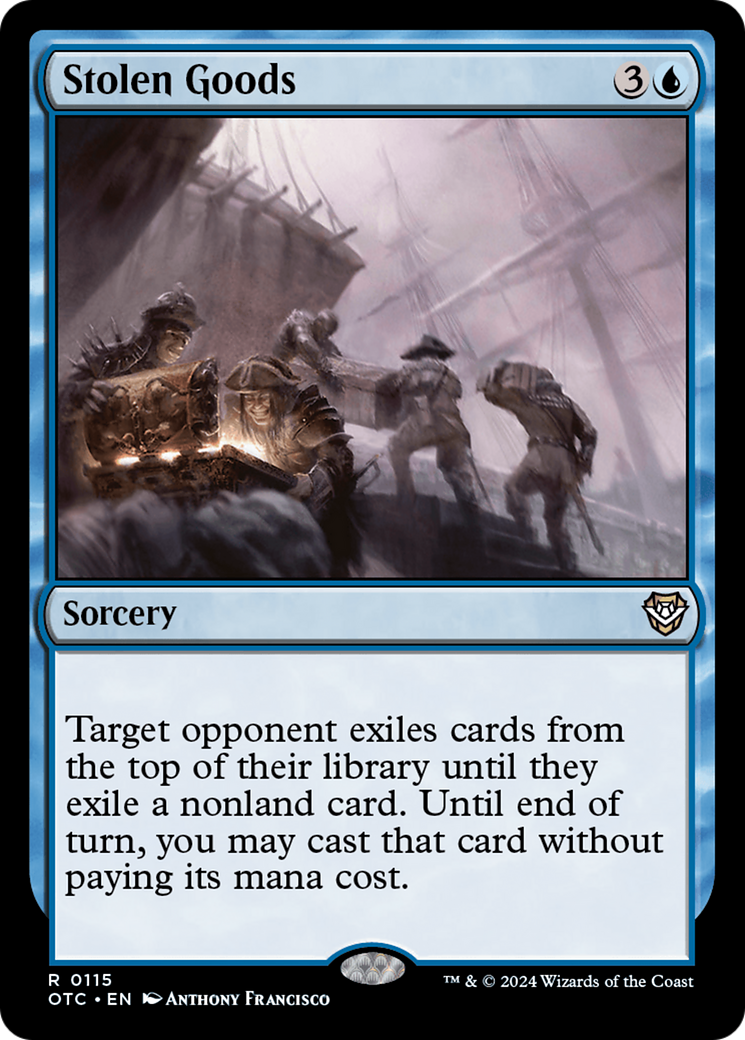
Stolen Goods
Stolen Goods
Sorcery
Target opponent exiles cards from the top of their library until they exile a nonland card. Until end of turn, you may cast that card without paying its mana cost.
- You cast the card from exile. Each land card exiled this way will remain exiled.
- If you can't cast the nonland card (perhaps because there are no legal targets available) or if you choose not to cast it, it will remain exiled.
- You must follow the normal timing restrictions of the exiled card.
- If you cast a card "without paying its mana cost," you can't pay any alternative costs. You can pay additional costs, such as kicker costs. If the card has mandatory additional costs, you must pay those.
- If the card has in its mana cost, you must choose 0 as its value.
- If there are no nonland cards left in that library, the opponent will exile all cards from their library, and Stolen Goods will finish resolving.
-
1
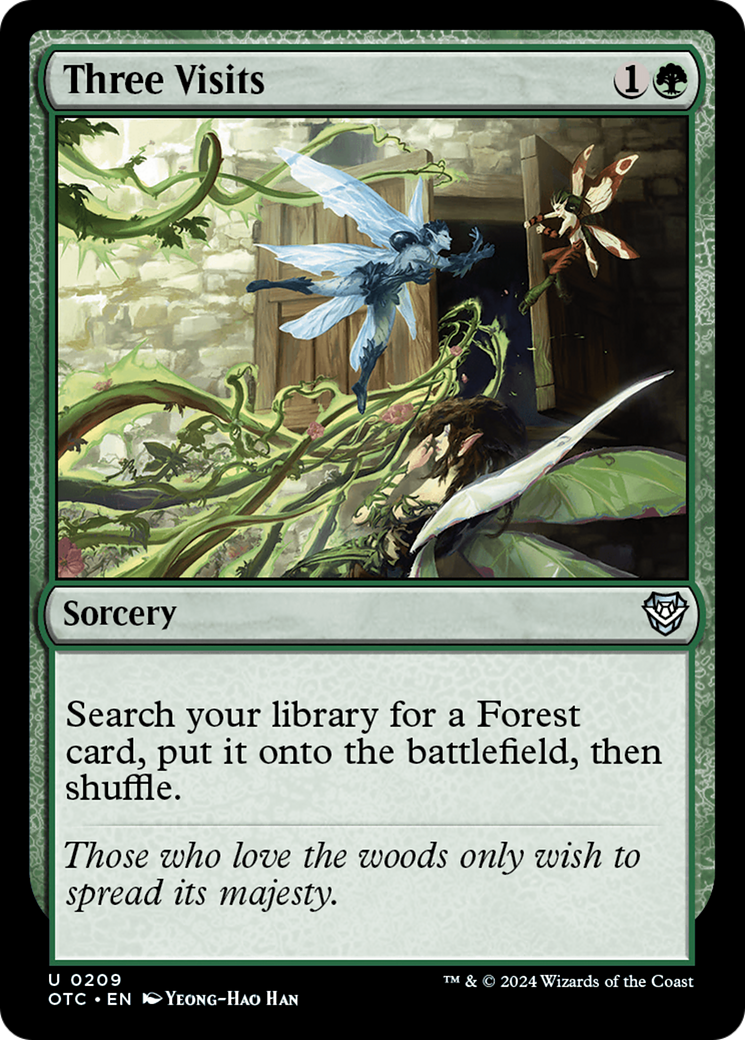
Three Visits
Three Visits
Sorcery
Search your library for a Forest card, put it onto the battlefield, then shuffle.
- Three Visits allows you to search your library for any card with the land type Forest, not just a card with the name Forest.
- Because the "search" requires you to find a card with certain characteristics, you don't have to find the card if you don't want to.
-
1
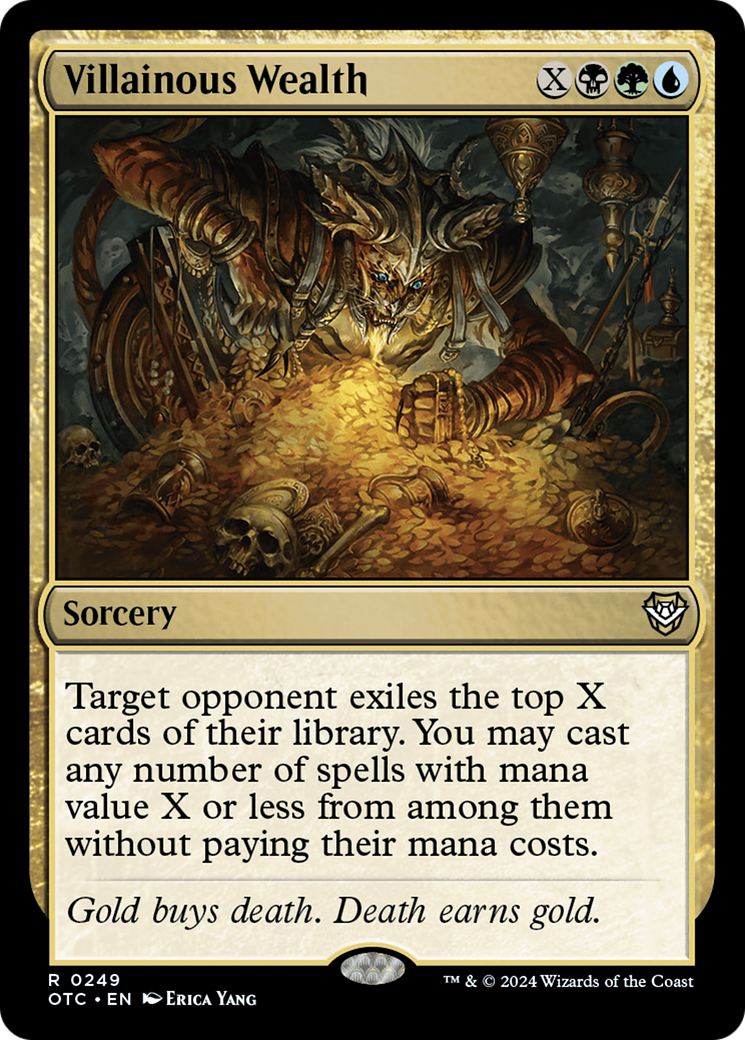
Villainous Wealth
Villainous Wealth
Sorcery
Target opponent exiles the top X cards of their library. You may cast any number of spells with mana value X or less from among them without paying their mana costs.
- You choose which spells (if any) to cast as Villainous Wealth resolves. If you do, you do so as part of the resolution of Villainous Wealth. You can't wait to cast them later in the turn.
- You cast the spells one at a time as Villainous Wealth is resolving, choosing modes, targets, and so on. The last spell you cast will be the first one to resolve. Ignore timing restrictions based on the spells' types. Other timing restrictions, such as "Cast [this spell] only during combat," must be followed.
- If you cast a spell "without paying its mana cost," you can't choose to cast it for any alternative costs. You can, however, pay additional costs, such as kicker costs. If the spell has any mandatory additional costs, those must be paid to cast the spell.
- If a spell you cast has in its mana cost, you must choose 0 as the value of X when casting it without paying its mana cost.
- Any cards you don't cast this way will remain in exile.
Artifacts 7
-
1
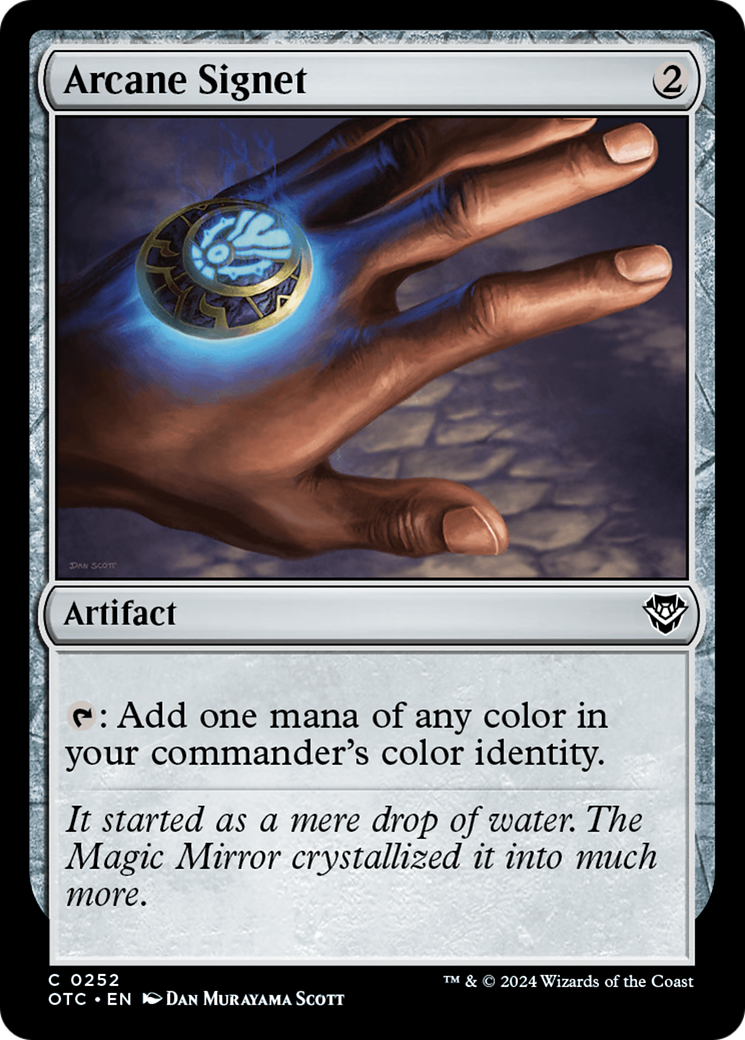
Arcane Signet
Arcane Signet
Artifact
: Add one mana of any color in your commander's color identity.
- If your commander is a card that has no colors in its color identity, Arcane Signet's ability produces no mana. It doesn't produce .
- If you have two commanders, the ability adds one mana of any color in their combined color identities.
- If you don't have a commander, Arcane Signet's ability produces no mana.
-
1
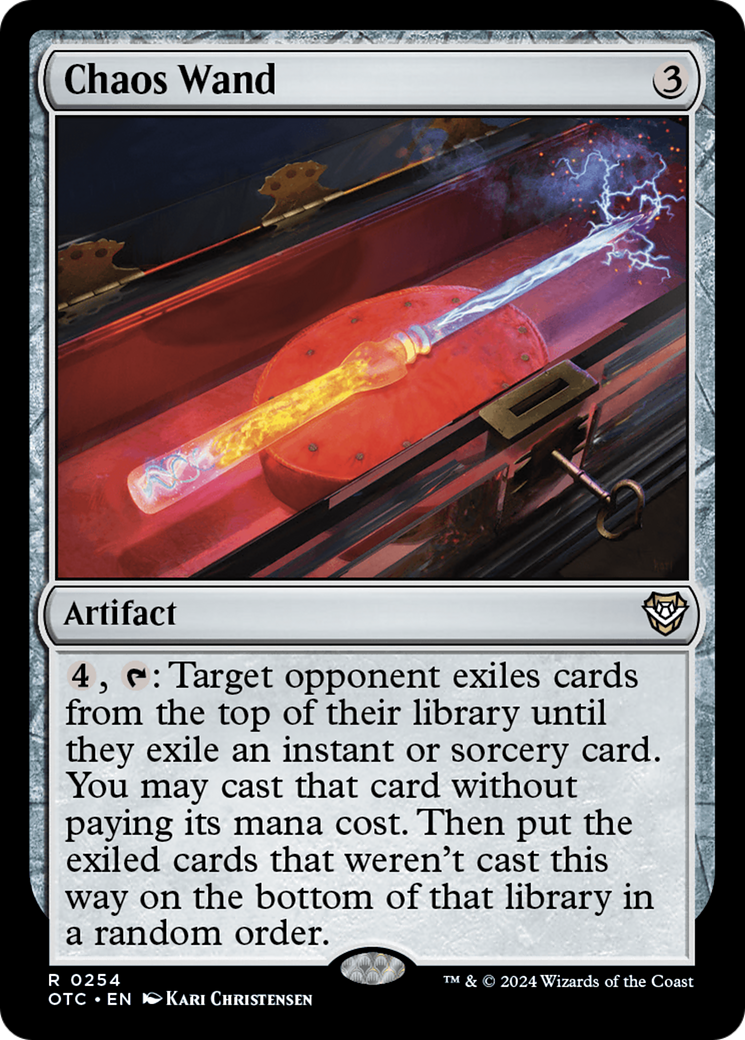
Chaos Wand
Chaos Wand
Artifact
, : Target opponent exiles cards from the top of their library until they exile an instant or sorcery card. You may cast that card without paying its mana cost. Then put the exiled cards that weren't cast this way on the bottom of that library in a random order.
- The opponent stops exiling cards as soon as they exile any instant or sorcery card. You don't choose which card type to look for.
- If the opponent exiles their entire library without exiling an instant or sorcery card, that player stops exiling cards, and the exiled cards are put into their library in a random order.
- If you don't cast the exiled instant or sorcery card, it's put on the bottom of that library with the other cards.
- If you wish to cast the exiled card, you must cast it while Chaos Wand's ability is resolving. You can't cast it later in the turn. A spell cast this way may be cast at a time you normally wouldn't be able to cast a spell of that type, but other restrictions (such as "Cast this spell only during combat") are enforced.
- If you cast a card "without paying its mana cost," you can't choose to cast it for any alternative costs. You can, however, pay additional costs. If the card has any mandatory additional costs, such as that of Tormenting Voice, those must be paid to cast the card.
- If the exiled card has in its mana cost, you must choose 0 as the value of X when casting it without paying its mana cost.
-
1
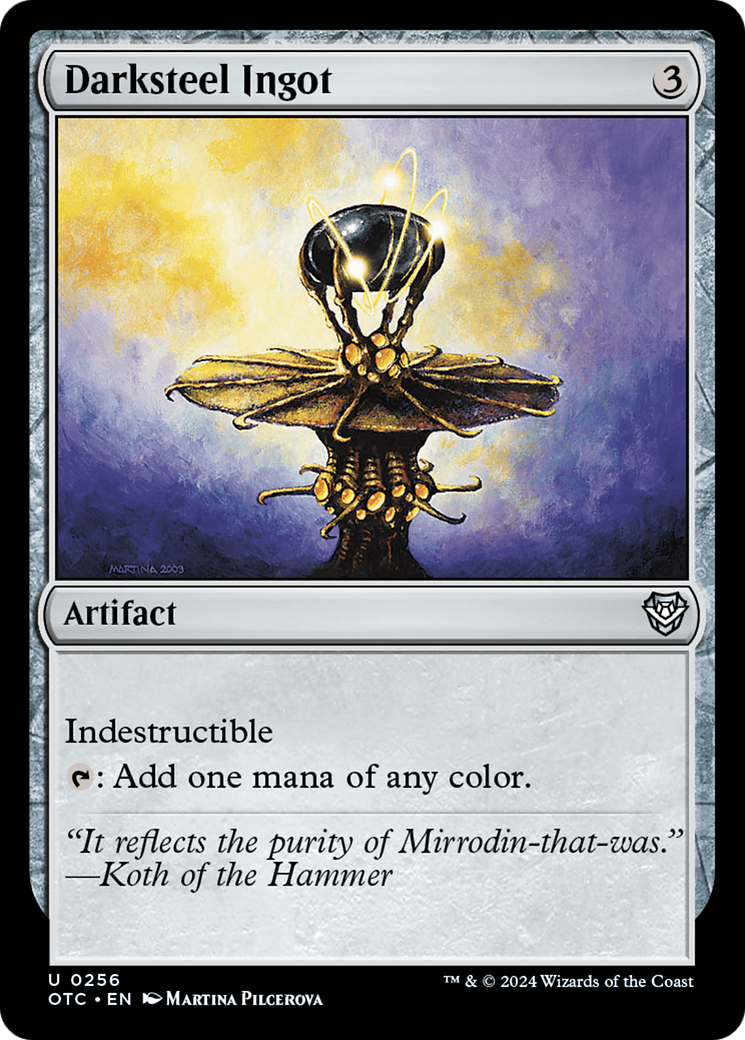
Darksteel Ingot
Darksteel Ingot
Artifact
Indestructible (Effects that say "destroy" don't destroy this artifact.)
: Add one mana of any color.
-
1
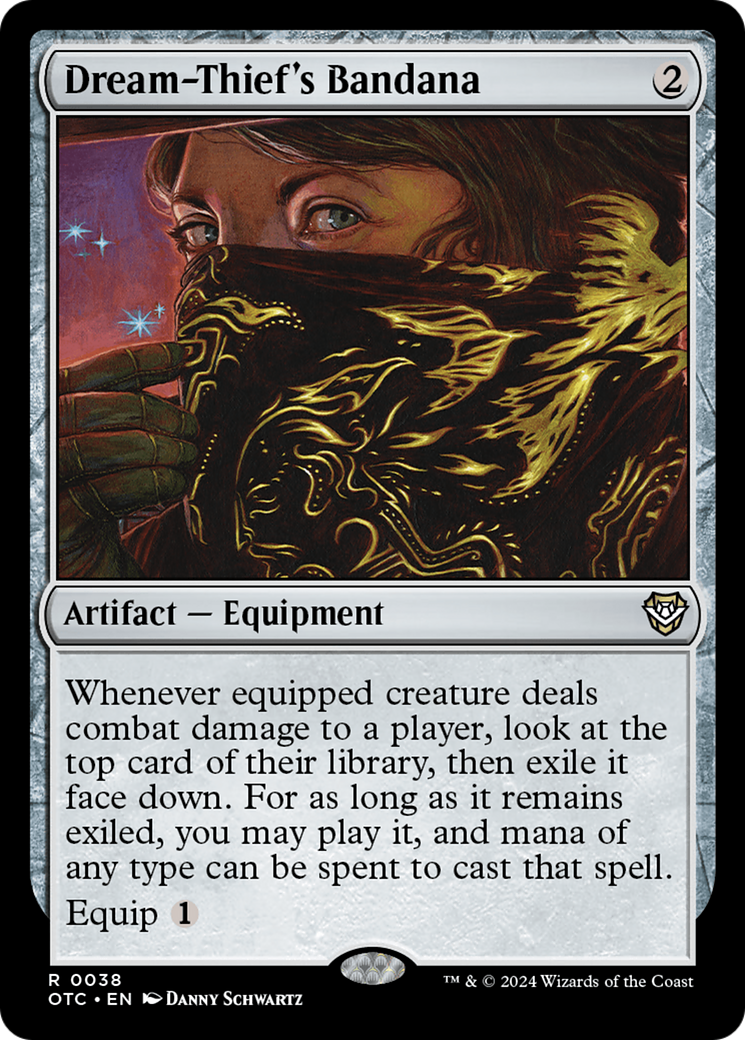
Dream-Thief's Bandana
Dream-Thief's Bandana
Artifact — Equipment
Whenever equipped creature deals combat damage to a player, look at the top card of their library, then exile it face down. For as long as it remains exiled, you may play it, and mana of any type can be spent to cast that spell.
Equip
- You may look at and play cards exiled face down with Dream-Thief's Bandana's first ability (and spend mana of any type to do so) even if Dream-Thief's Bandana and/or the equipped creature leaves the battlefield. If another player gains control of Dream-Thief's Bandana and/or the equipped creature, that player can't look at or play cards already exiled with Dream-Thief's Bandana, and you still can.
- You pay all costs and follow all normal timing rules for cards played from exile with Dream-Thief's Bandana's first ability. For example, if the exiled card is a land card, you may play it only during your main phase while the stack is empty.
- Playing an exiled card causes it to leave exile. You can't play it multiple times.
- If you leave the game, any remaining face-down exiled cards remain exiled face down indefinitely. No player may look at them.
-
1
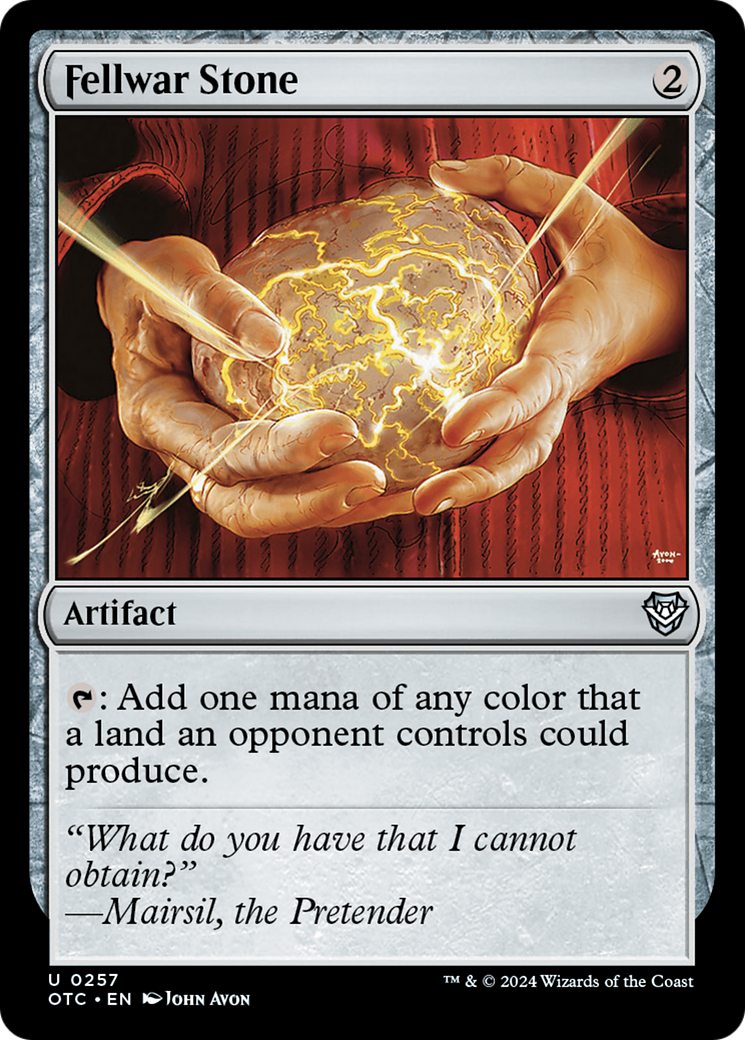
Fellwar Stone
Fellwar Stone
Artifact
: Add one mana of any color that a land an opponent controls could produce.
- When determining what colors of mana your opponents' lands could produce, take into account any applicable replacement effects that would apply to those lands' mana abilities (such as Contamination's effect, for example). If there is more than one, consider them in any possible order.
- Fellwar Stone doesn't care about any restrictions or riders your opponents' lands (such as Ancient Ziggurat or Hall of the Bandit Lord) put on the mana they produce. It just cares about colors of mana.
- The colors of mana are white, blue, black, red, and green. Fellwar Stone can't be tapped for colorless mana, even if a land an opponent controls could produce colorless mana.
- Fellwar Stone checks the effects of all mana-producing abilities of lands your opponents control, but it doesn't check their costs. For example, Vivid Crag has the ability " , Remove a charge counter from Vivid Crag: Add one mana of any color." If an opponent controls Vivid Crag and you control Fellwar Stone, you can tap Fellwar Stone for any color of mana. It doesn't matter whether Vivid Crag has a charge counter on it, and it doesn't matter whether it's untapped.
- This works even if the opponent's lands are tapped. It only checks what kinds of mana can be produced, not if the abilities that produce them are usable right now.
- It only produces one mana even if the land can produce more than one.
- The ability can be activated if the opponent has no lands that produce mana, but the effect will not be able to generate any mana.
-
1
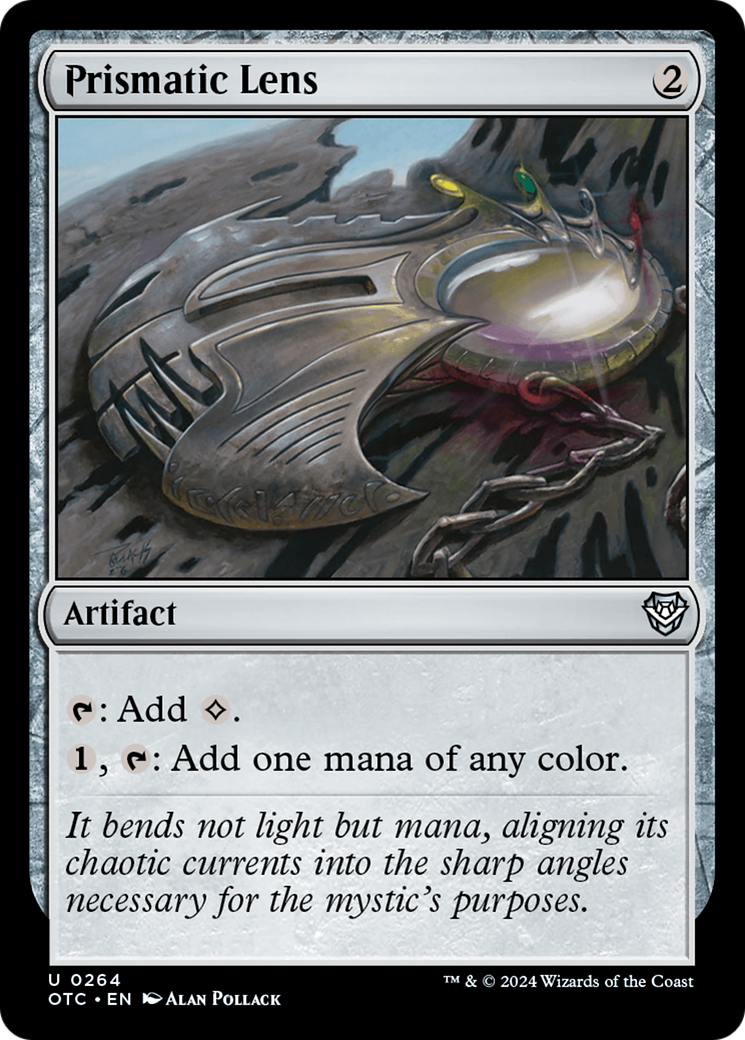
Prismatic Lens
Prismatic Lens
Artifact
: Add .
, : Add one mana of any color.
-
1
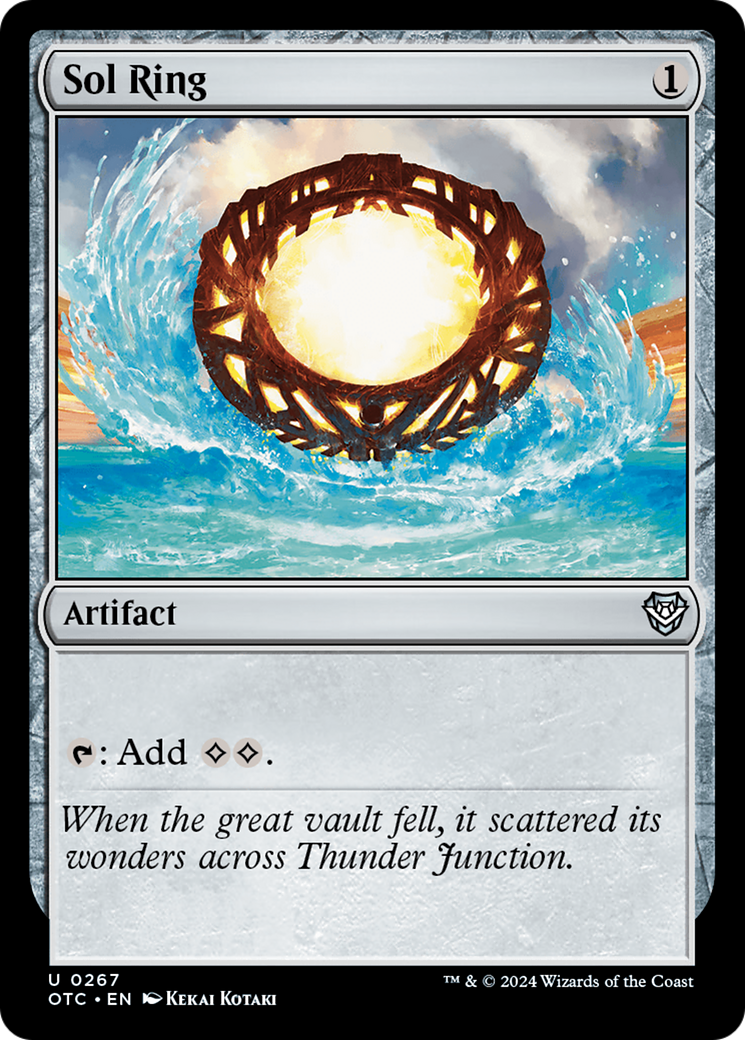
Sol Ring
Sol Ring
Artifact
: Add .
Enchantments 2
-
1
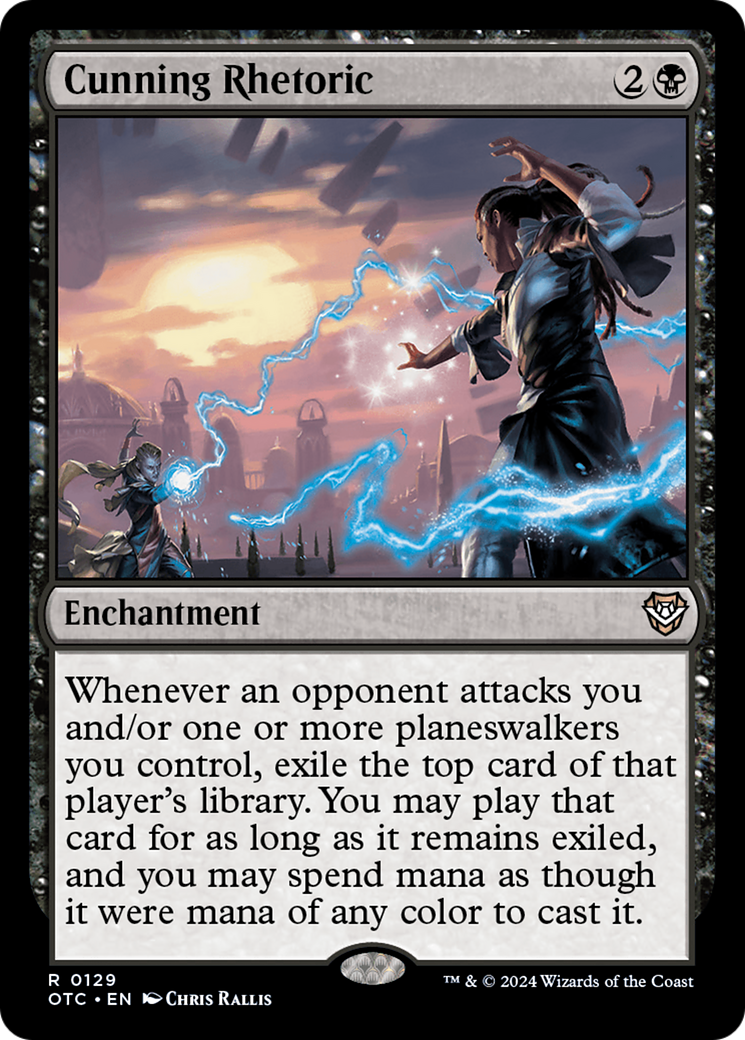
Cunning Rhetoric
Cunning Rhetoric
Enchantment
Whenever an opponent attacks you and/or one or more planeswalkers you control, exile the top card of that player's library. You may play that card for as long as it remains exiled, and you may spend mana as though it were mana of any color to cast it.
- You must follow the normal timing permissions and restrictions for the exiled card. If it's a land, you can't play it unless you have land plays available.
- You'll still pay all costs for a spell cast this way, including additional costs. You may also pay alternative costs if any are available.
- If you play a card this way, it leaves exile and becomes a new object. If it returns to exile later in the turn, you can't play it again.
-
1
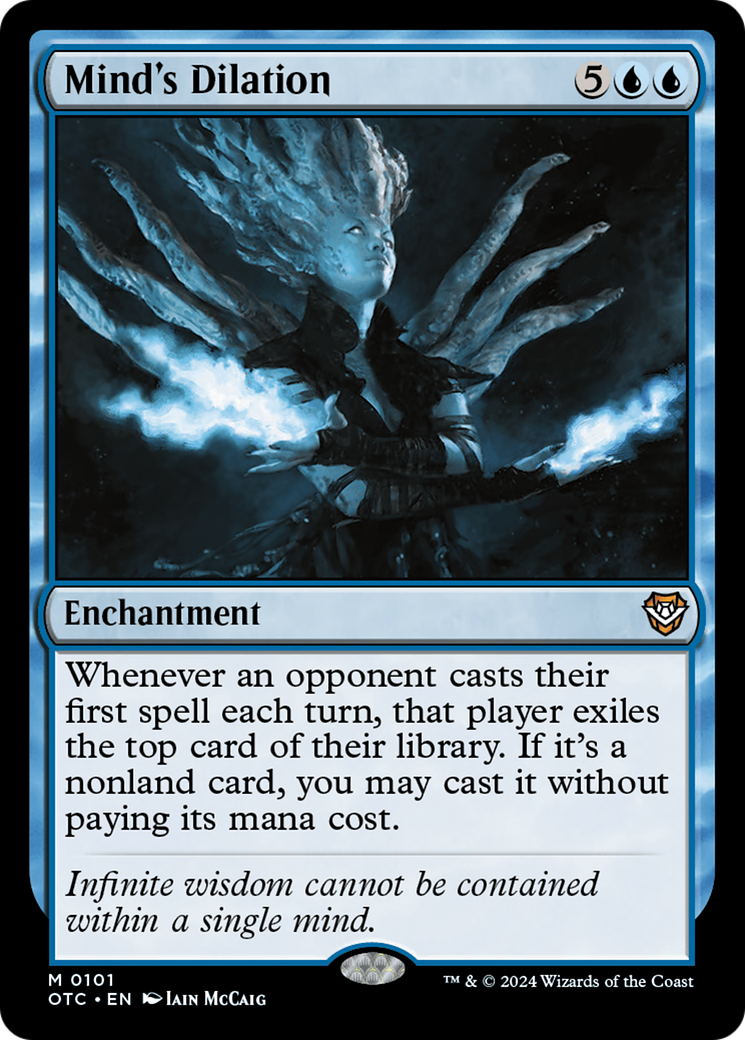
Mind's Dilation
Mind's Dilation
Enchantment
Whenever an opponent casts their first spell each turn, that player exiles the top card of their library. If it's a nonland card, you may cast it without paying its mana cost.
- If you cast the exiled card, you do so as part of the resolution of Mind's Dilation's ability. You can't wait to cast it later in the turn. Timing permissions based on the card's type are ignored, but other restrictions (such as "Cast [this card] only during combat") are not.
- If you cast a card "without paying its mana cost," you can't choose to cast it for any alternative costs, such as emerge costs. You can, however, pay additional costs, such as escalate costs. If the card has any mandatory additional costs, you must pay those.
- If the card has in its mana cost, you must choose 0 as the value of X when casting it without paying its mana cost.
- If you cast the card this way, it will resolve before the spell that caused Mind's Dilation's ability to trigger.
- If you cast an instant or sorcery card this way, it goes to its owner's graveyard as normal. It doesn't return to exile.
- If you don't cast the card, perhaps because you choose not to or because it's a land card, it remains exiled.
Lands 38
-
1
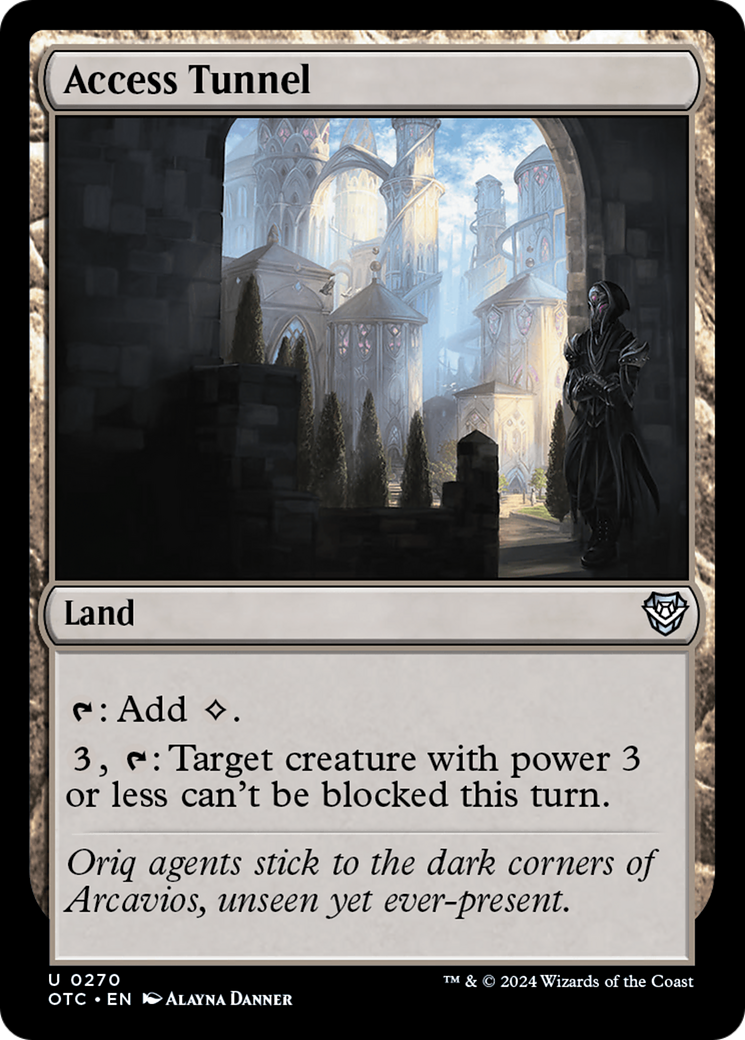
Access Tunnel
Access Tunnel
Land
: Add .
, : Target creature with power 3 or less can't be blocked this turn.
- Once a creature with power 3 or less has been blocked, Access Tunnel's second ability won't cause it to become unblocked.
- If the target creature's power is greater than 3 as Access Tunnel's second ability tries to resolve, the ability doesn't resolve. However, if instead the creature's power is raised above 3 after the ability resolves, it still can't be blocked that turn.
-
1
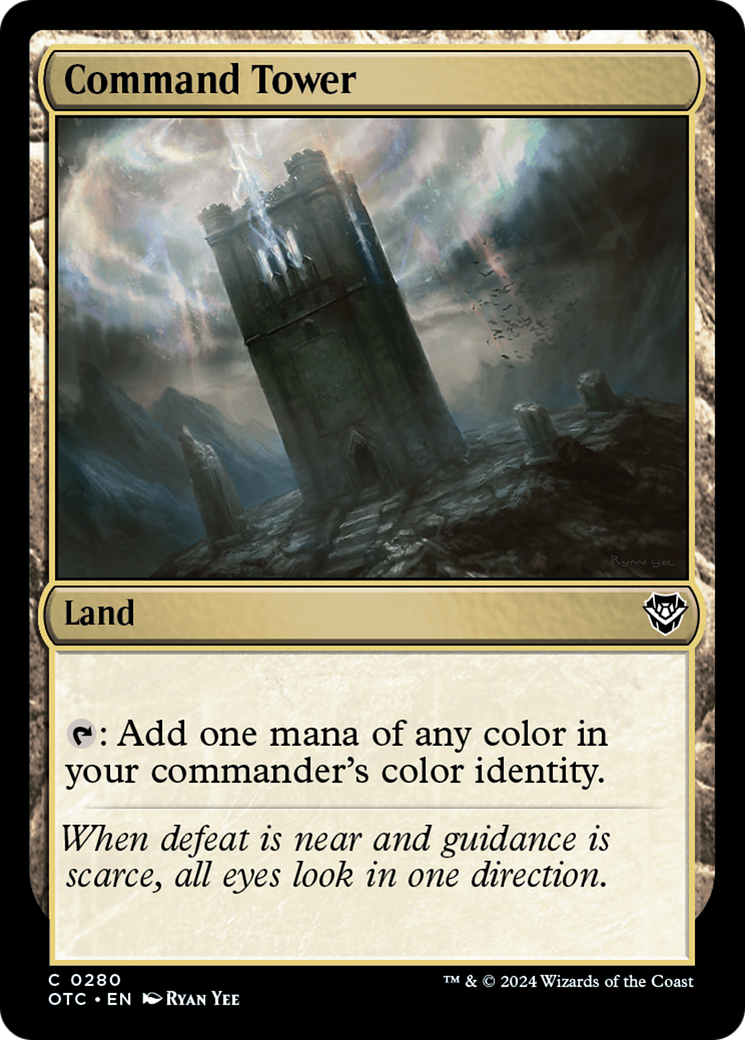
Command Tower
Command Tower
Land
: Add one mana of any color in your commander's color identity.
- If you don't have a commander, Command Tower's ability produces no mana.
- If your commander is a card that has no colors in its color identity, Command Tower's ability produces no mana. It doesn't produce .
- If you have two commanders, the ability adds one mana of any color in their combined color identities.
-
1
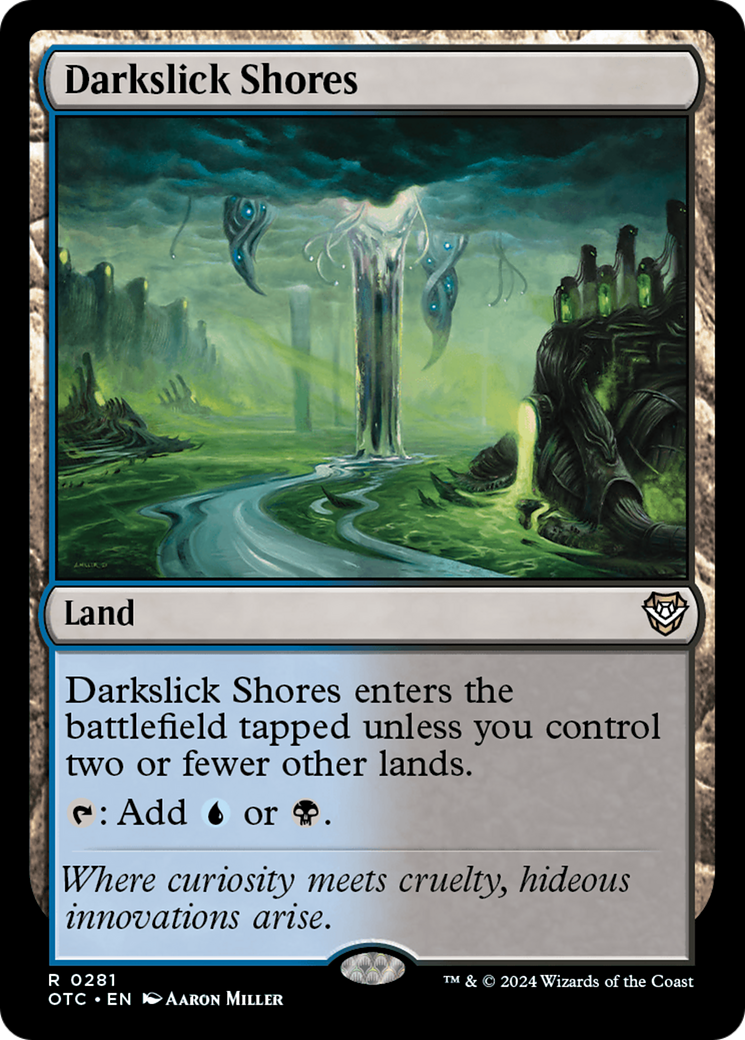
Darkslick Shores
Darkslick Shores
Land
This land enters tapped unless you control two or fewer other lands.
: Add or .
- If one of these lands enters the battlefield under your control and you control zero, one, or two other lands, it enters the battlefield untapped. If you control three or more other lands, however, it enters the battlefield tapped.
- If one of these lands enters the battlefield at the same time as one or more other lands (due to Oblivion Sower or Warp World, perhaps), it doesn't take those lands into consideration when determining how many other lands you control.
-
1
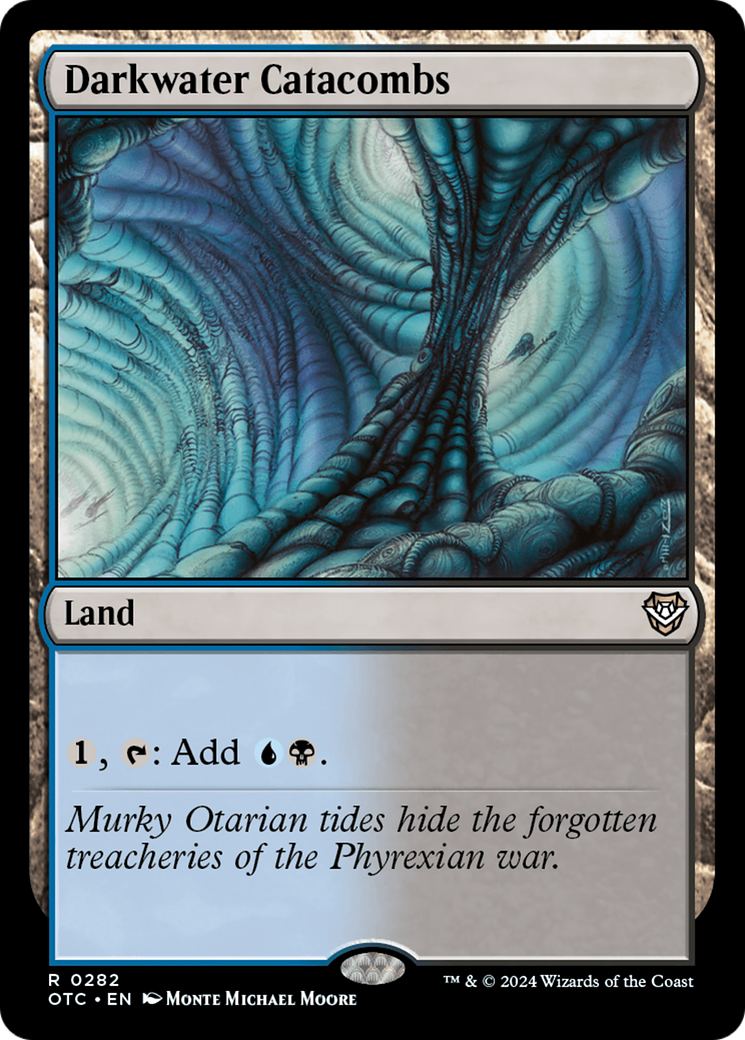
Darkwater Catacombs
Darkwater Catacombs
Land
, : Add .
-
1
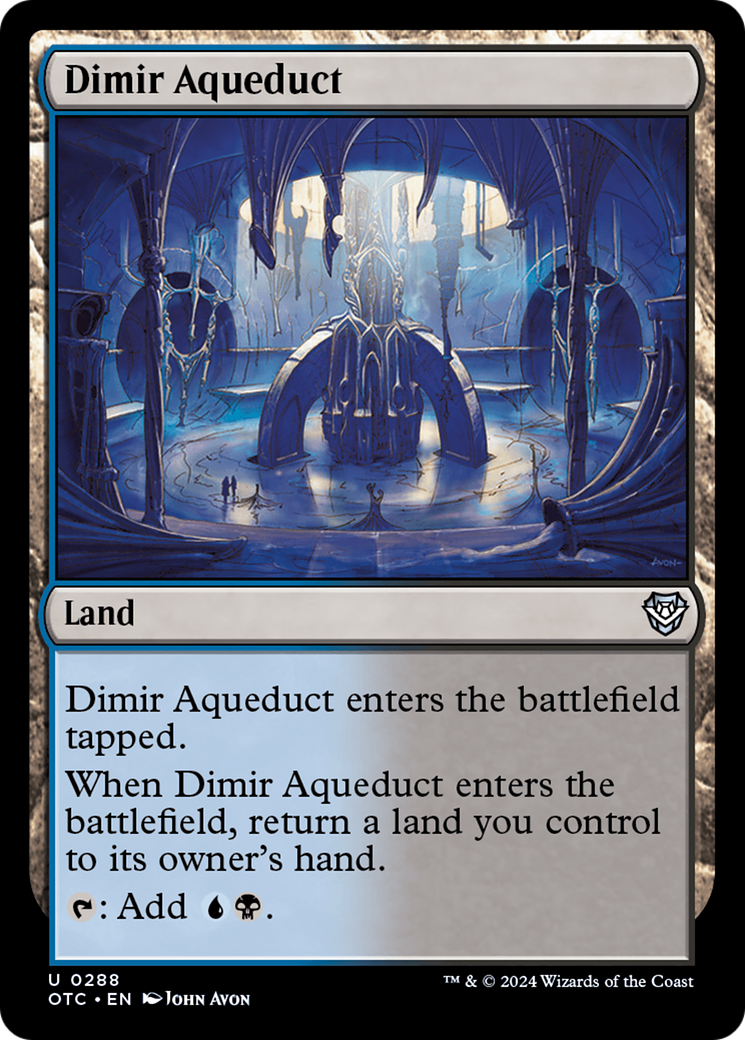
Dimir Aqueduct
Dimir Aqueduct
Land
This land enters tapped.
When this land enters, return a land you control to its owner's hand.
: Add .
- If this land enters the battlefield and you control no other lands, its ability will force you to return it to your hand.
-
1
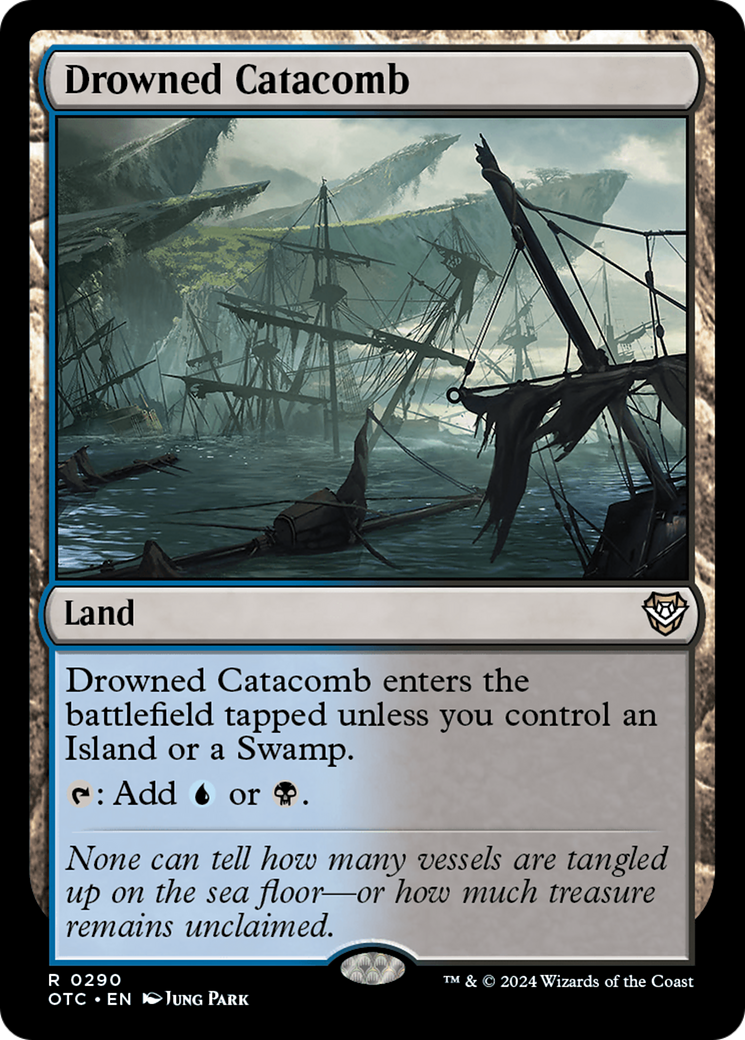
Drowned Catacomb
Drowned Catacomb
Land
This land enters tapped unless you control an Island or a Swamp.
: Add or .
- As this is entering, it checks for lands that are already on the battlefield. It won't see lands that are entering at the same time (due to Warp World, for example).
- This checks for lands you control with the land type Island or Swamp, not for lands named Island or Swamp. The lands it checks for don't have to be basic lands. For example, if you control Blood Crypt (a nonbasic land with the land types Swamp and Mountain), Drowned Catacomb will enter untapped.
-
1
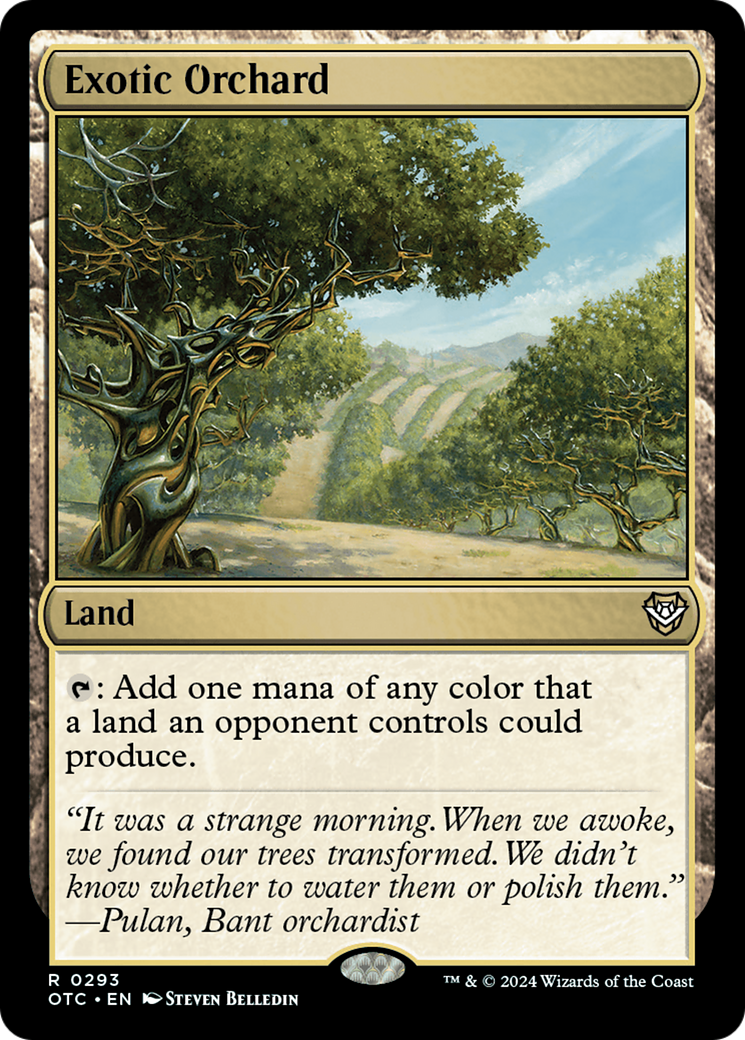
Exotic Orchard
Exotic Orchard
Land
: Add one mana of any color that a land an opponent controls could produce.
- Lands that produce mana based only on what other lands "could produce" won't help each other unless some other land allows one of them to actually produce some type of mana. For example, if you control an Exotic Orchard and your opponent controls an Exotic Orchard and a Reflecting Pool, none of those lands would produce mana if their mana abilities were activated. On the other hand, if you control a Forest and an Exotic Orchard, and your opponent controls an Exotic Orchard and a Reflecting Pool, then each of those lands can be tapped to produce . Your opponent's Exotic Orchard can produce because you control a Forest. Your Exotic Orchard and your opponent's Reflecting Pool can each produce because your opponent's Exotic Orchard can produce .
- When determining what colors of mana your opponents' lands could produce, Exotic Orchard takes into account any applicable replacement effects that would apply to those lands' mana abilities (such as Contamination's effect, for example). If there are more than one, consider them in any possible order.
- The colors of mana are white, blue, black, red, and green. Exotic Orchard can't be tapped for colorless mana, even if a land an opponent controls could produce colorless mana.
- Exotic Orchard doesn't care about any restrictions or riders your opponents' lands (such as Ancient Ziggurat or Hall of the Bandit Lord) put on the mana they produce. It just cares about colors of mana.
- Exotic Orchard checks the effects of all mana-producing abilities of lands your opponents control, but it doesn't check their costs. For example, Vivid Crag has the ability " , Remove a charge counter from Vivid Crag: Add one mana of any color." If an opponent controls Vivid Crag and you control Exotic Orchard, you can tap Exotic Orchard for any color of mana. It doesn't matter whether Vivid Crag has a charge counter on it, and it doesn't matter whether it's untapped.
-
1
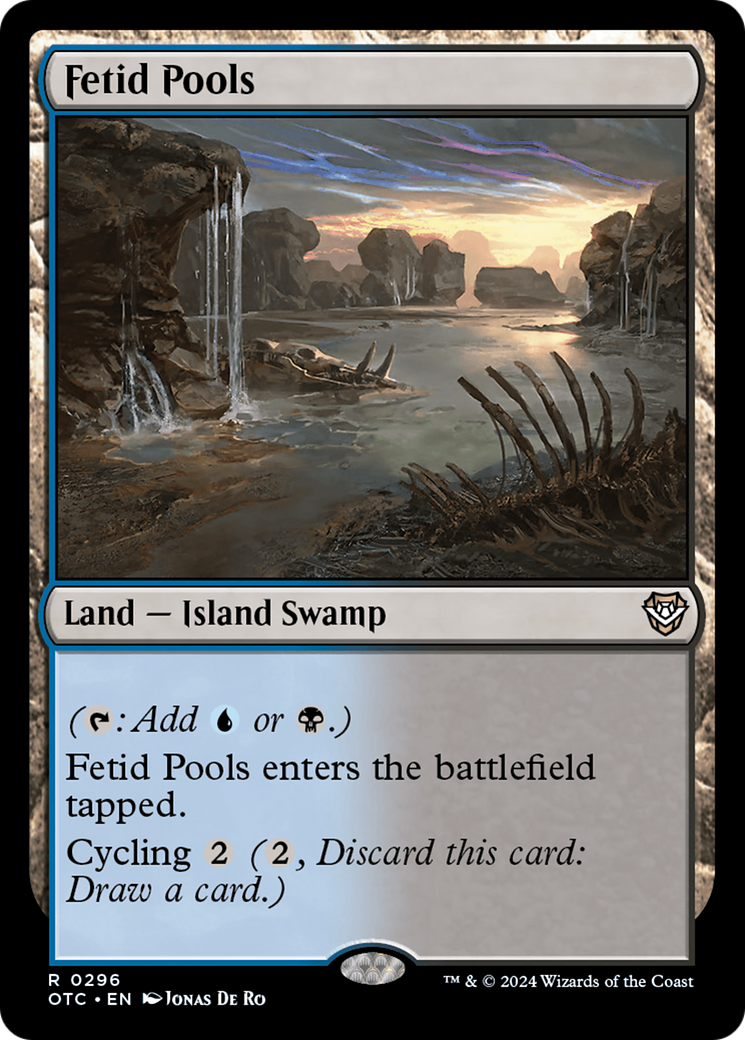
Fetid Pools
Fetid Pools
Land — Island Swamp
( : Add or .)
This land enters tapped.
Cycling ( , Discard this card: Draw a card.)
-
1
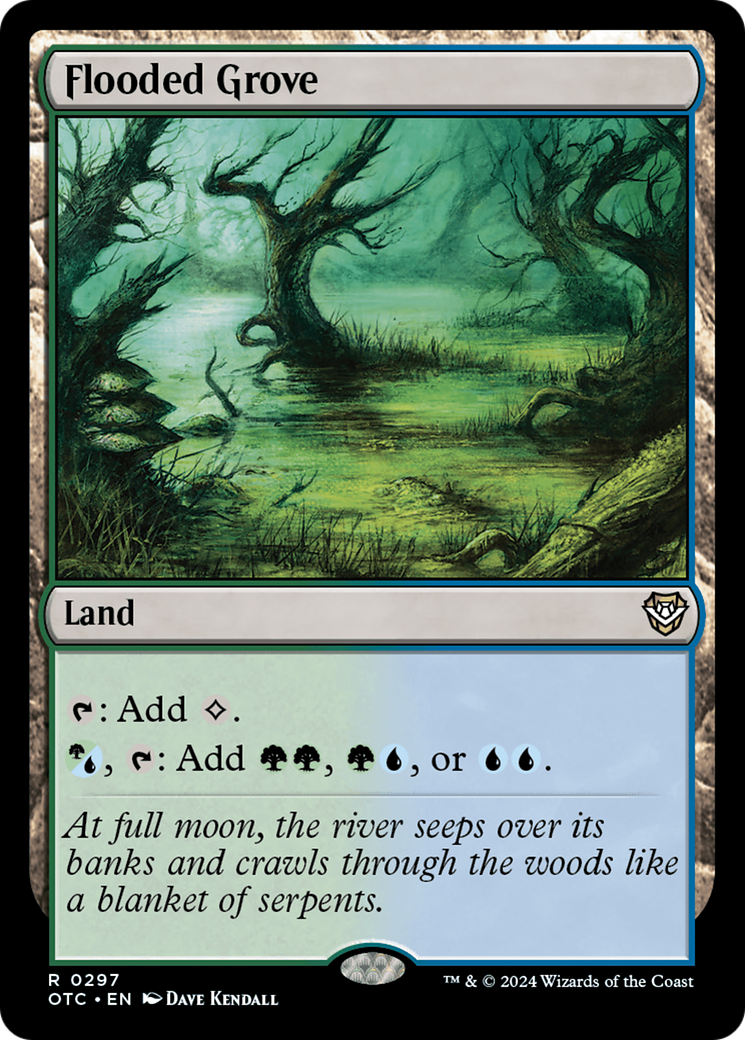
Flooded Grove
Flooded Grove
Land
: Add .
, : Add , , or .
-
4
Forest
Forest
Basic Land — Forest
( : Add .)
-
1
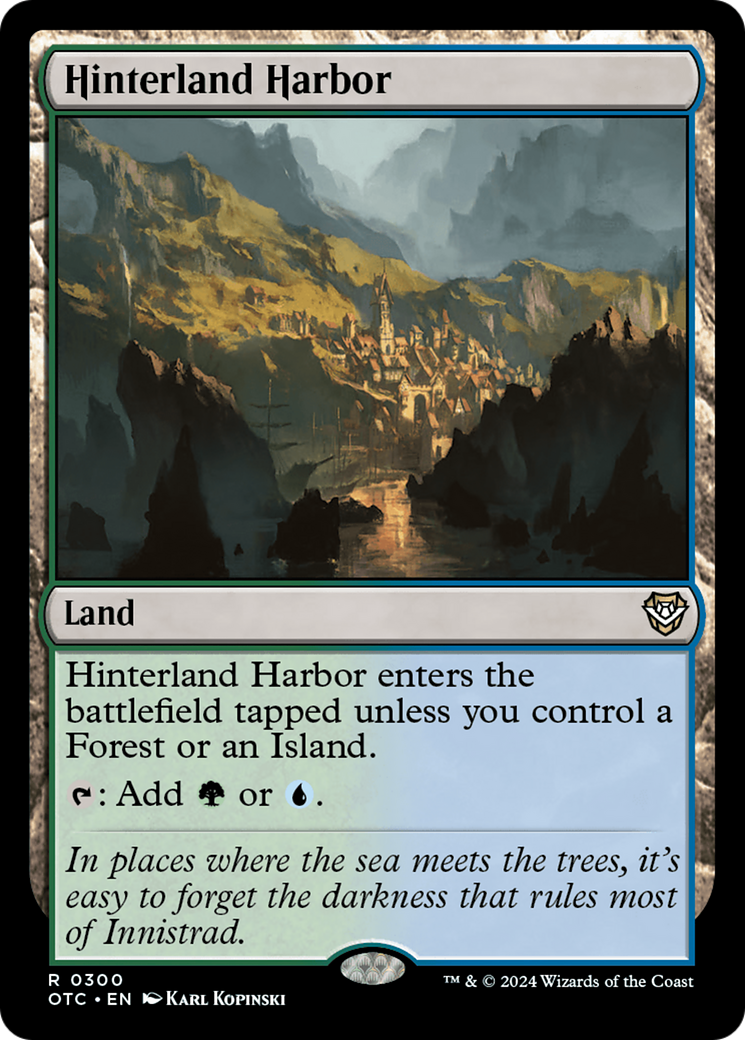
Hinterland Harbor
Hinterland Harbor
Land
This land enters tapped unless you control a Forest or an Island.
: Add or .
-
5
Island
Island
Basic Land — Island
( : Add .)
-
1
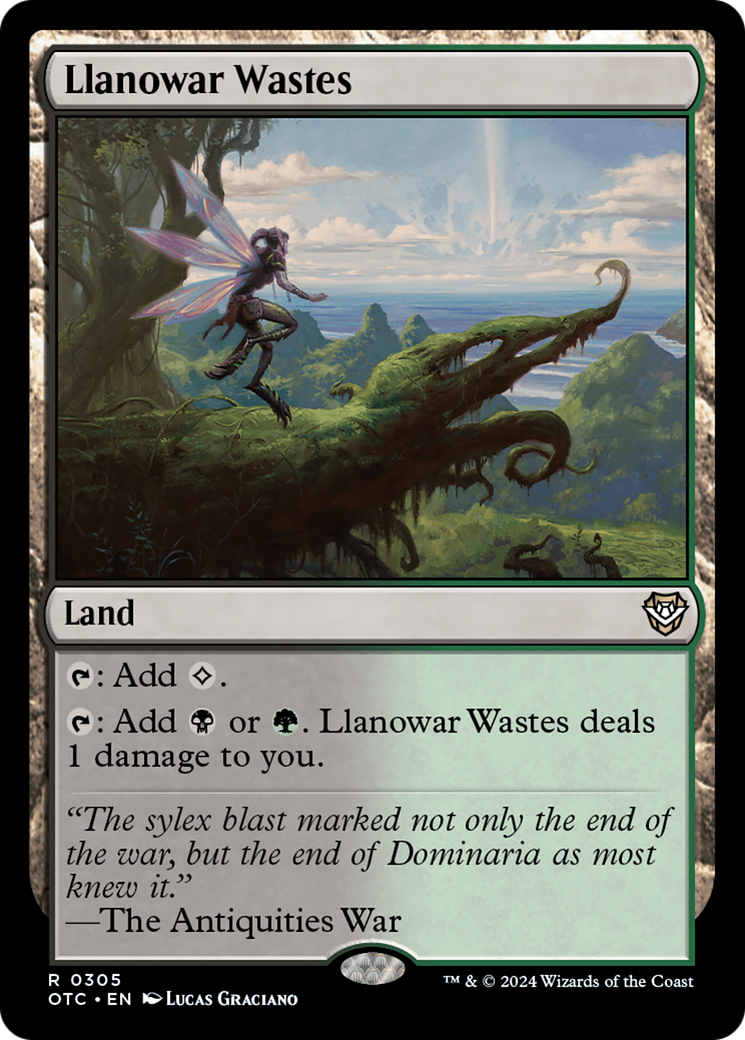
Llanowar Wastes
Llanowar Wastes
Land
: Add .
: Add or . This land deals 1 damage to you.
- The damage dealt to you is part of the second mana ability. It doesn't use the stack and can't be responded to.
- Like most lands, each land in this cycle is colorless. The damage dealt to you is dealt by a colorless source.
-
1
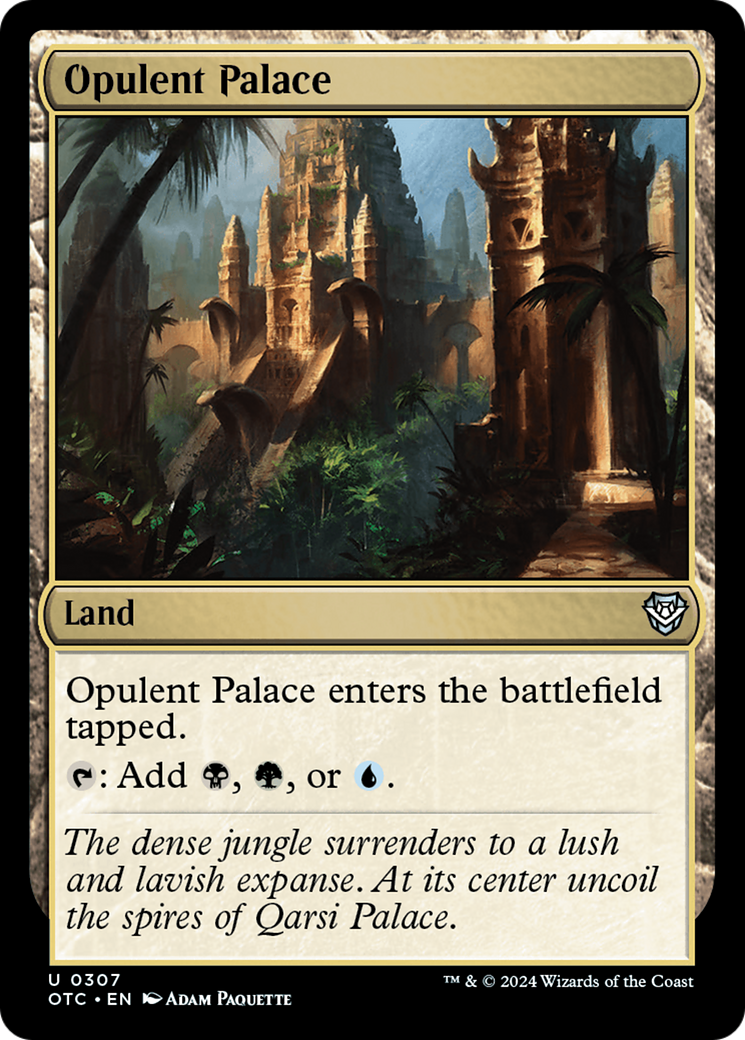
Opulent Palace
Opulent Palace
Land
This land enters tapped.
: Add , , or .
-
1
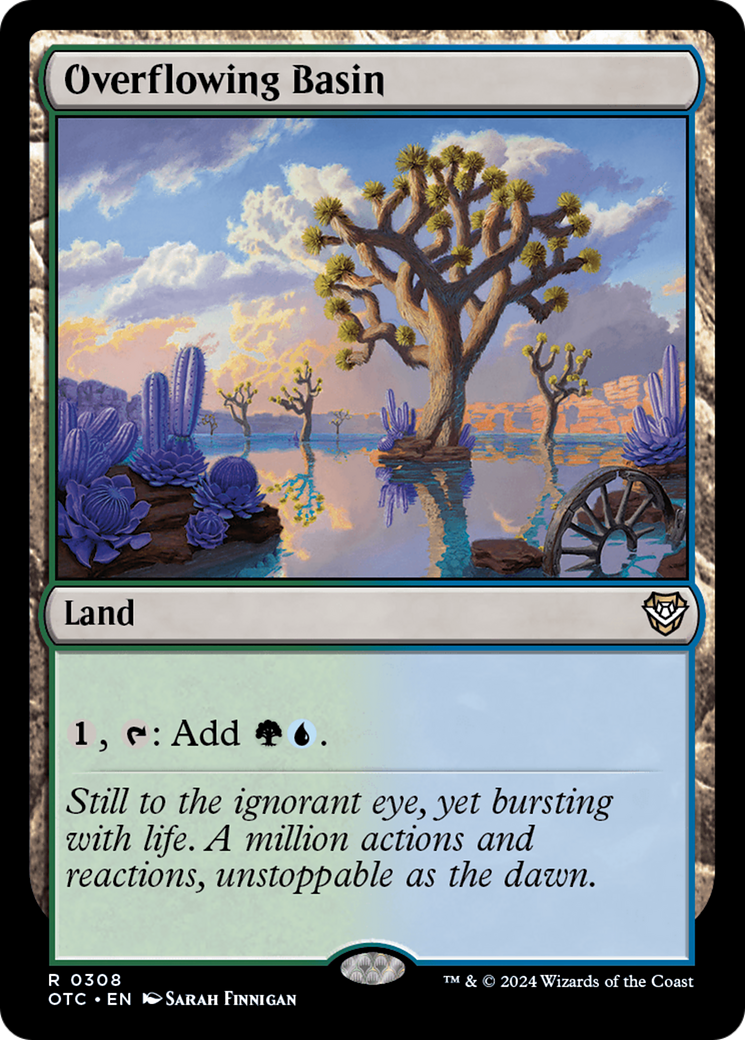
Overflowing Basin
Overflowing Basin
Land
, : Add .
-
1
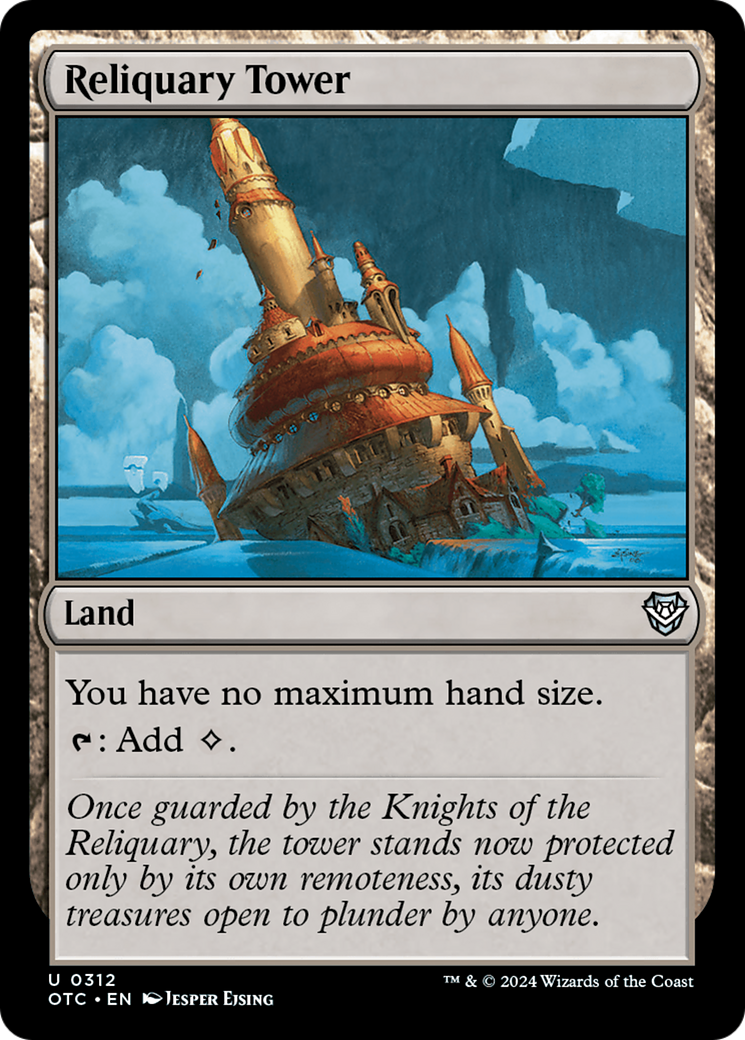
Reliquary Tower
Reliquary Tower
Land
You have no maximum hand size.
: Add .
- If multiple effects modify your hand size, apply them in timestamp order. For example, if you put Null Profusion (an enchantment that says your maximum hand size is two) onto the battlefield and then put Reliquary Tower onto the battlefield, you'll have no maximum hand size. However, if those permanents enter in the opposite order, your maximum hand size would be two.
-
1
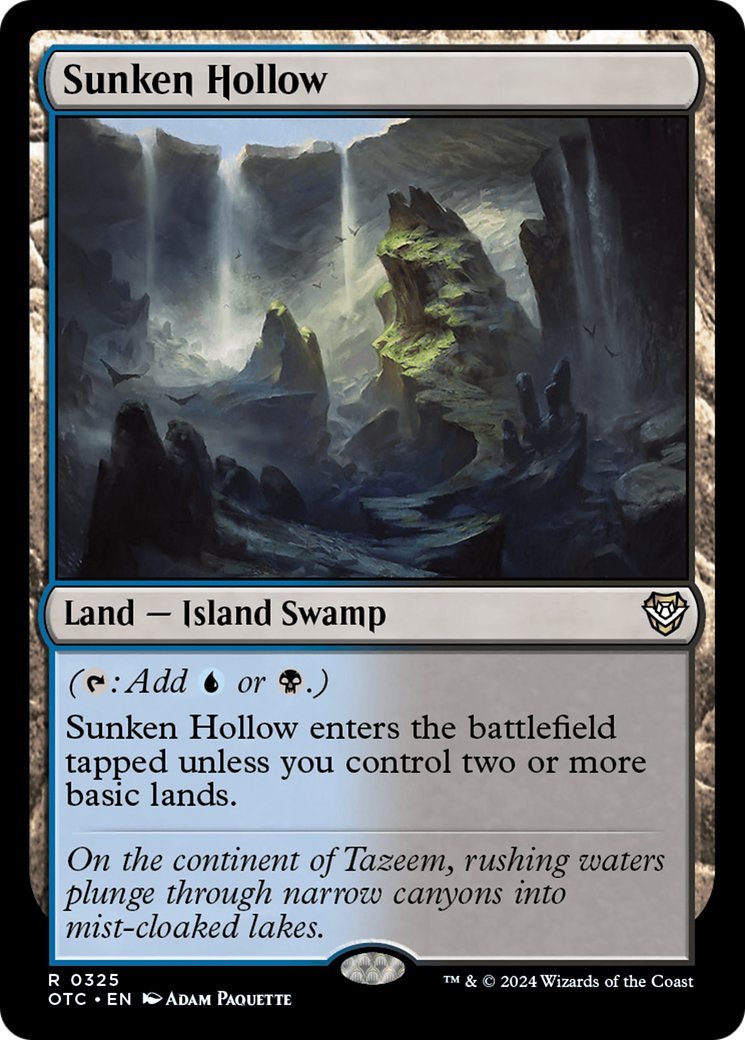
Sunken Hollow
Sunken Hollow
Land — Island Swamp
( : Add or .)
This land enters tapped unless you control two or more basic lands.
- Even though these lands have basic land types, they are not basic lands because "basic" doesn't appear on their type line. Notably, controlling two or more of them won't allow others to enter the battlefield untapped.
- However, because these cards have basic land types, effects that specify a basic land type without also specifying that the land be basic can affect them. For example, a spell or ability that reads "Destroy target Forest" can target Canopy Vista, while one that reads "Destroy target basic Forest" cannot.
- If one of these lands enters the battlefield at the same time as any number of basic lands, those other lands are not counted when determining if this land enters the battlefield tapped or untapped.
-
6
Swamp
Swamp
Basic Land — Swamp
( : Add .)
-
1
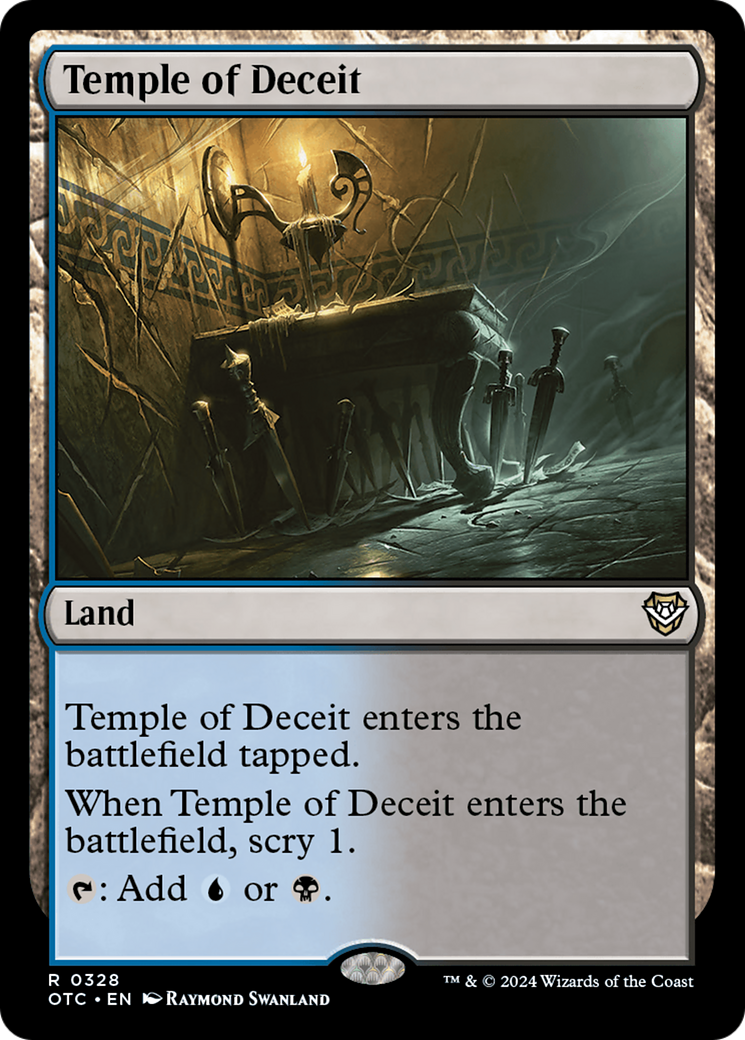
Temple of Deceit
Temple of Deceit
Land
This land enters tapped.
When this land enters, scry 1. (Look at the top card of your library. You may put that card on the bottom.)
: Add or .
- When you scry, you may put all the cards you look at back on top of your library, you may put all of those cards on the bottom of your library, or you may put some of those cards on top and the rest of them on the bottom.
- You choose how to order cards returned to your library after scrying no matter where you put them.
- You perform the actions stated on a card in sequence. For some spells and abilities, that means you'll scry last. For others, that means you'll scry and then perform other actions.
- Scry appears on some spells and abilities with one or more targets. If all of the spell or ability's targets are illegal when it tries to resolve, it won't resolve and none of its effects will happen. You won't scry.
-
1
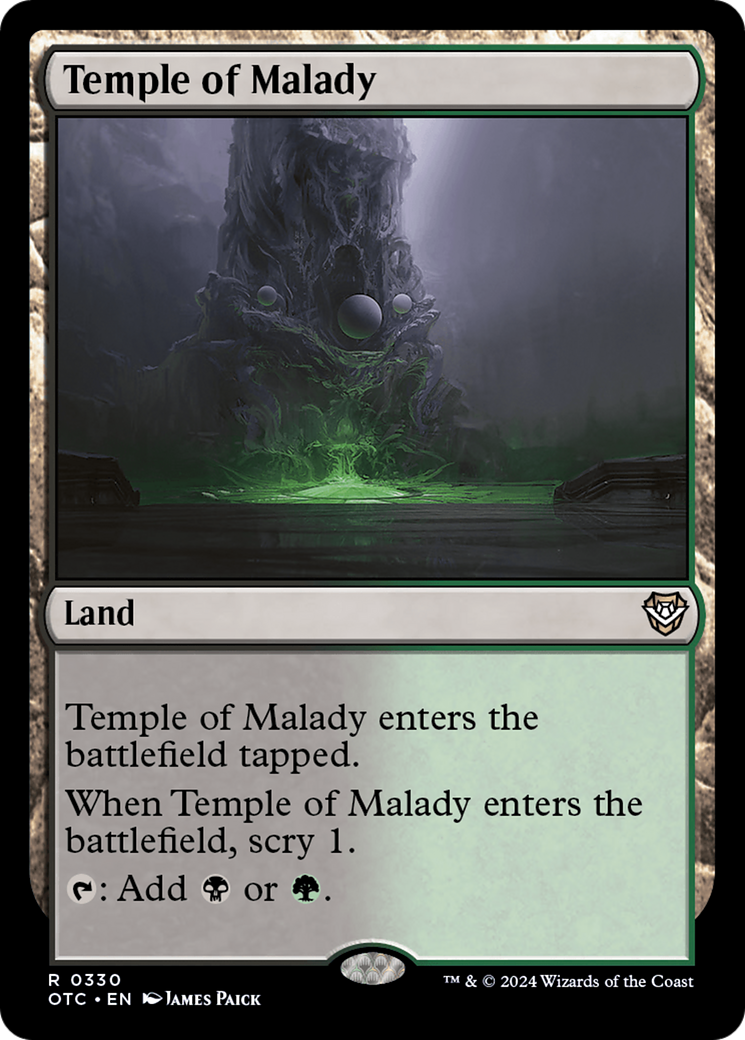
Temple of Malady
Temple of Malady
Land
This land enters tapped.
When this land enters, scry 1. (Look at the top card of your library. You may put that card on the bottom.)
: Add or .
-
1
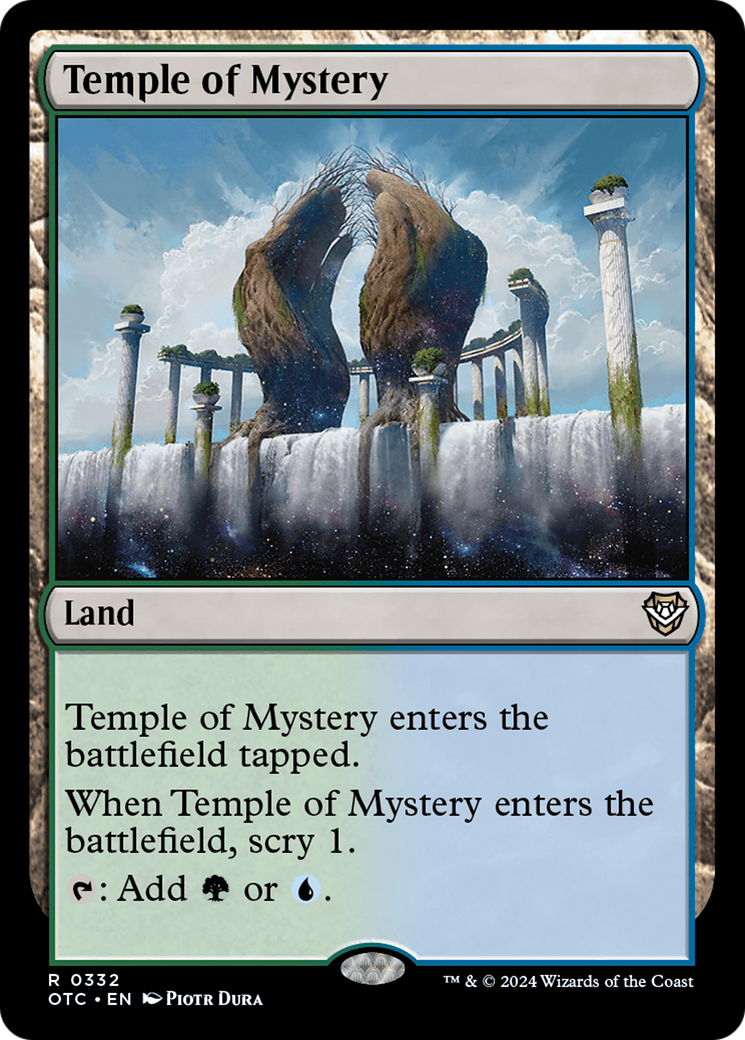
Temple of Mystery
Temple of Mystery
Land
This land enters tapped.
When this land enters, scry 1. (Look at the top card of your library. You may put that card on the bottom.)
: Add or .
- When you scry, you may put all the cards you look at back on top of your library, you may put all of those cards on the bottom of your library, or you may put some of those cards on top and the rest of them on the bottom.
- You choose how to order cards returned to your library after scrying no matter where you put them.
- You perform the actions stated on a card in sequence. For some spells and abilities, that means you'll scry last. For others, that means you'll scry and then perform other actions.
- Scry appears on some spells and abilities with one or more targets. If all of the spell or ability's targets are illegal when it tries to resolve, it won't resolve and none of its effects will happen. You won't scry.
-
1
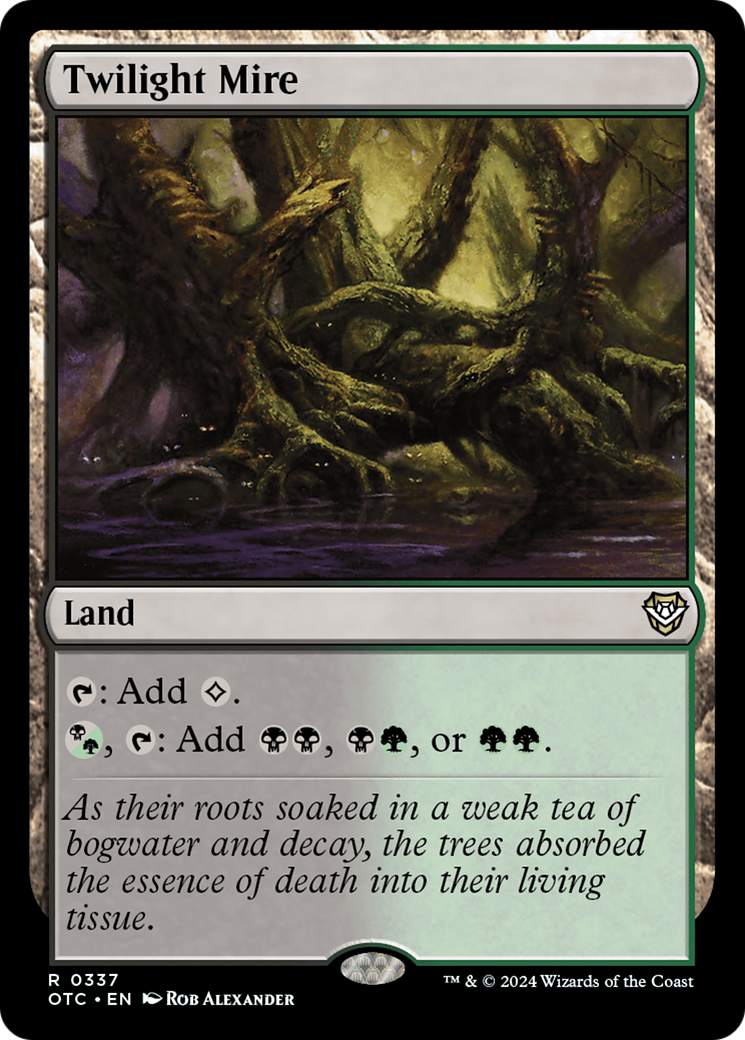
Twilight Mire
Twilight Mire
Land
: Add .
, : Add , , or .
-
1
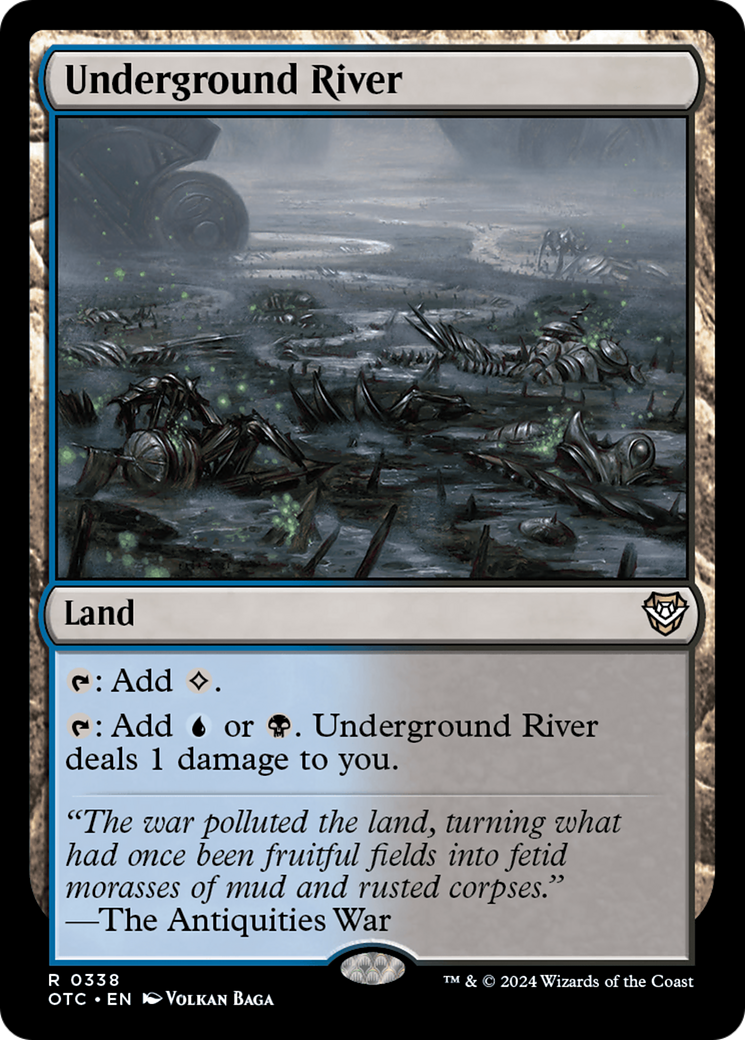
Underground River
Underground River
Land
: Add .
: Add or . This land deals 1 damage to you.
-
1
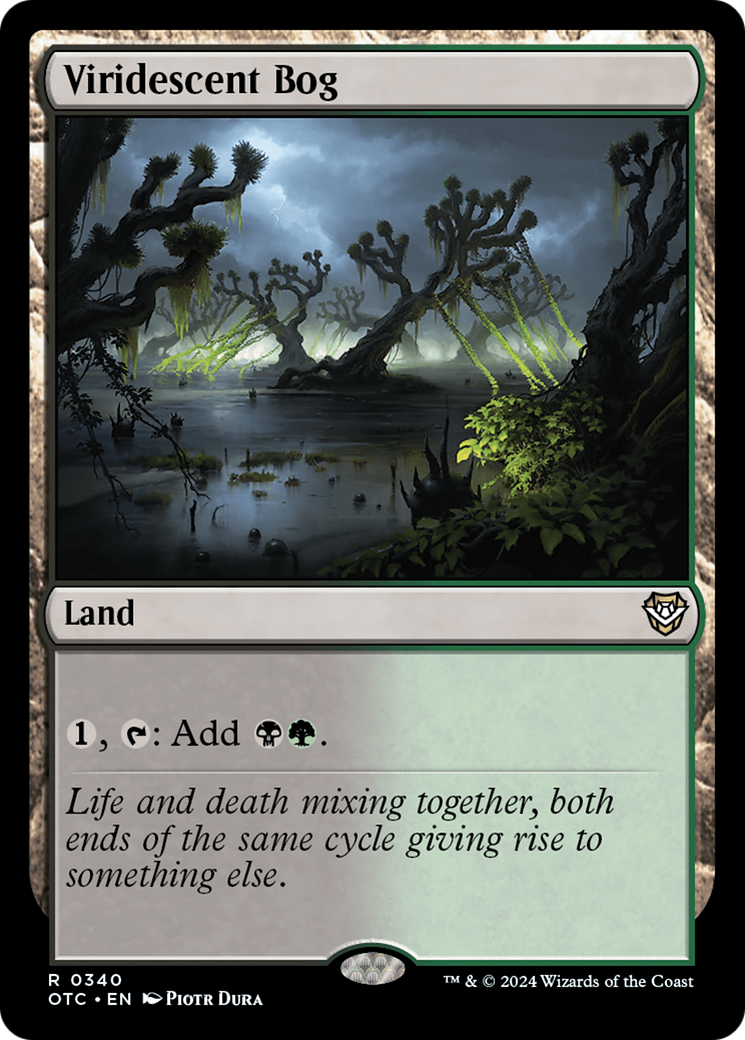
Viridescent Bog
Viridescent Bog
Land
, : Add .
-
1
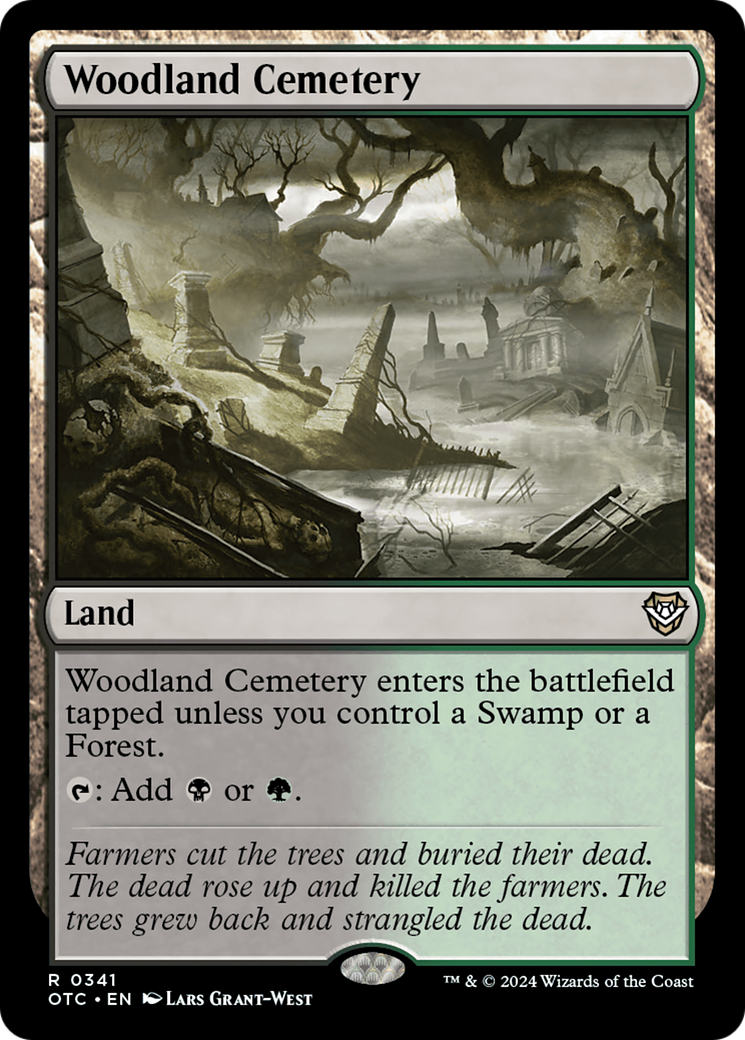
Woodland Cemetery
Woodland Cemetery
Land
This land enters tapped unless you control a Swamp or a Forest.
: Add or .
-
1
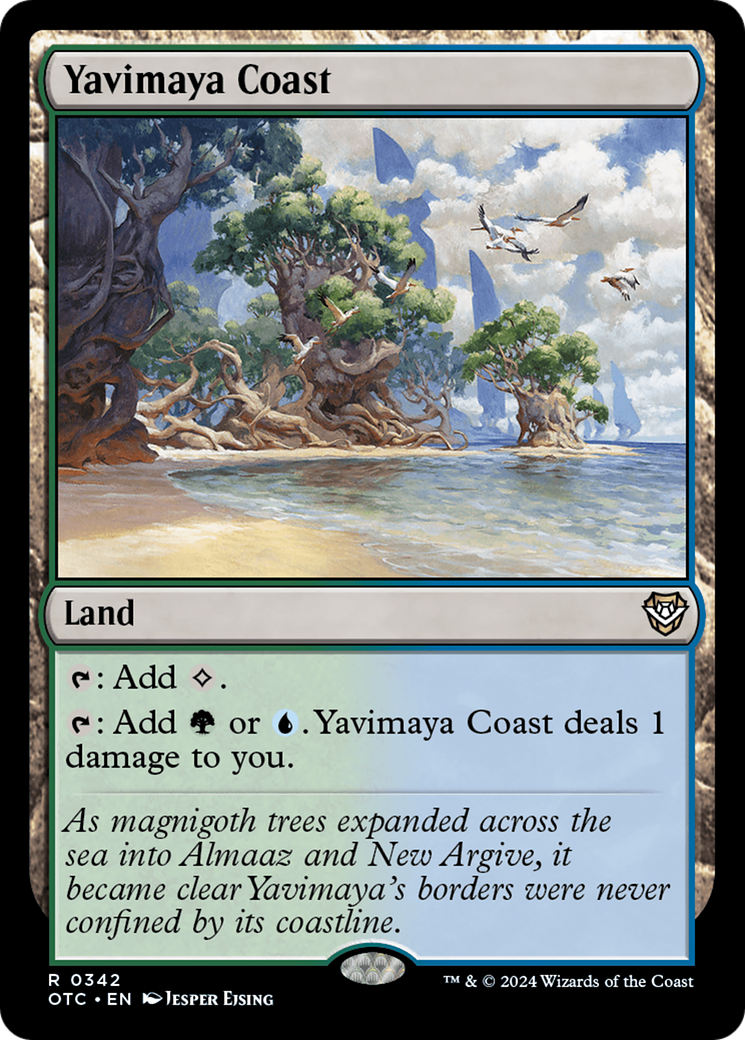
Yavimaya Coast
Yavimaya Coast
Land
: Add .
: Add or . This land deals 1 damage to you.
- Like most lands, each land in this cycle is colorless. The damage dealt to you is dealt by a colorless source.
- The damage dealt to you is part of the second mana ability. It doesn't use the stack and can't be responded to.
Blue 13
-
1
Arcane Heist
Arcane Heist
Sorcery
You may cast target instant or sorcery card from an opponent's graveyard without paying its mana cost. If that spell would be put into their graveyard, exile it instead.
Cipher (Then you may exile this spell card encoded on a creature you control. Whenever that creature deals combat damage to a player, its controller may cast a copy of the encoded card without paying its mana cost.)
- You choose whether to cast the target instant or sorcery card as Arcane Heist resolves. If you do, you do so as part of the resolution of Arcane Heist. You can’t wait to cast it later in the turn. Timing restrictions based on the card’s types are ignored.
- If you cast a spell “without paying its mana cost,” you can’t choose to cast it for any alternative costs. You can, however, pay additional costs, such as kicker costs. If the spell has any mandatory additional costs, those must be paid to cast the spell.
- If the spell you cast has in its mana cost, you must choose 0 as the value of X when casting it without paying its mana cost.
- The spell with cipher is encoded on the creature as part of that spell’s resolution, just after the spell’s other effects. That card goes directly from the stack to exile. It never goes to the graveyard.
- You choose the creature as the spell resolves. The cipher ability doesn’t target that creature.
- If the spell with cipher doesn’t resolve, none of its effects will happen, including cipher. The card will go to its owner’s graveyard and won’t be encoded on a creature.
- If the creature leaves the battlefield, the exiled card will no longer be encoded on any creature. It will stay exiled.
- You can choose only a creature to encode the card onto.
- The copy of the card with cipher is created in and cast from exile.
- You cast the copy of the card with cipher during the resolution of the triggered ability. Ignore timing restrictions based on the card’s type.
- If you choose not to cast the copy, or you can’t cast it (perhaps because there are no legal targets available), the copy will cease to exist the next time state-based actions are performed. You won’t get a chance to cast the copy at a later time.
- The exiled card with cipher grants a triggered ability to the creature it’s encoded on. If that creature loses that ability and subsequently deals combat damage to a player, the triggered ability won’t trigger. However, the exiled card will continue to be encoded on that creature.
- If another player gains control of the creature, that player will control the triggered ability. That player will create a copy of the encoded card and may cast it.
- If a creature with an encoded card deals combat damage to more than one player simultaneously (perhaps because some of the combat damage was redirected), the triggered ability will trigger once for each player it deals combat damage to. Each ability will create a copy of the exiled card and allow you to cast it.
-
1
Curse of the Swine
Curse of the Swine
Sorcery
Exile X target creatures. For each creature exiled this way, its controller creates a 2/2 green Boar creature token.
-
1
Dazzling Sphinx
Dazzling Sphinx
Creature — Sphinx
4/5
Flying
Whenever this creature deals combat damage to a player, that player exiles cards from the top of their library until they exile an instant or sorcery card. You may cast that card without paying its mana cost. Then that player puts the exiled cards that weren't cast this way on the bottom of their library in a random order.
- Dazzling Sphinx's triggered ability lets you cast the exiled card during the resolution of the ability. It doesn't allow you to wait and cast the card later.
- You may choose not to cast the instant or sorcery card that you exiled. In that case, it will be put on the bottom of the library with the rest of the exiled cards.
- If the exiled instant or sorcery card has an in its mana cost, you must choose 0 as the value of .
-
1
Diluvian Primordial
Diluvian Primordial
Creature — Avatar
5/5
Flying
When this creature enters, for each opponent, you may cast up to one target instant or sorcery card from that player's graveyard without paying its mana cost. If a spell cast this way would be put into a graveyard, exile it instead.
- You can choose a number of targets up to the number of opponents you have, one target per opponent.
- You cast the cards one at a time, choosing modes, targets and so on. The last card you cast will be the first one to resolve.
- When casting an instant or sorcery card this way, ignore timing restrictions based on the card's type. Other timing restrictions, such as "Cast [this card] only during combat," must be followed.
- If you can't cast one of the target instant or sorcery cards, perhaps because there are no legal targets available, or if you choose not to cast one, it will remain in its owner's graveyard.
- If you cast a card "without paying its mana cost," you can't pay alternative costs such as overload costs. You can pay additional costs such as kicker costs. If the card has mandatory additional costs, you must pay those.
- If a card has in its mana cost, you must choose 0 as its value.
- If an instant or sorcery card you cast this way is countered, it will still be exiled.
- If you cast an instant or sorcery spell with cipher this way, you may exile the card encoded on a creature you control. If you can't, or if you choose not to, the card will end up exiled but not encoded on a creature.
- If an instant or sorcery card you cast this way goes to a zone other than exile or a graveyard, perhaps because one of its abilities says to put it into its owner's hand, it won't be exiled. This is true even if the card would be put into a graveyard later that turn.
-
1
Ghostly Pilferer
Ghostly Pilferer
Creature — Spirit Rogue
2/1
Whenever this creature becomes untapped, you may pay . If you do, draw a card.
Whenever an opponent casts a spell from anywhere other than their hand, draw a card.
Discard a card: This creature can't be blocked this turn.
- Ghostly Pilferer's first ability triggers during your untap step, but it's put onto the stack at the same time as abilities that trigger at the beginning of your upkeep step. Even though the ability triggered first, you may order it before or after other abilities you control that are put onto the stack at this time.
- While resolving Ghostly Pilferer's first ability, you can't pay more than to draw more than one card.
- An ability that triggers when a player casts a spell resolves before the spell that caused it to trigger. It resolves even if that spell is countered.
- Players can cast spells and activate abilities after the second triggered ability resolves but before the spell that caused it to trigger does.
- Once Ghostly Pilferer has been blocked, activating its last ability doesn't cause it to become unblocked.
-
1
Mind's Dilation
Mind's Dilation
Enchantment
Whenever an opponent casts their first spell each turn, that player exiles the top card of their library. If it's a nonland card, you may cast it without paying its mana cost.
- If you cast the exiled card, you do so as part of the resolution of Mind's Dilation's ability. You can't wait to cast it later in the turn. Timing permissions based on the card's type are ignored, but other restrictions (such as "Cast [this card] only during combat") are not.
- If you cast a card "without paying its mana cost," you can't choose to cast it for any alternative costs, such as emerge costs. You can, however, pay additional costs, such as escalate costs. If the card has any mandatory additional costs, you must pay those.
- If the card has in its mana cost, you must choose 0 as the value of X when casting it without paying its mana cost.
- If you cast the card this way, it will resolve before the spell that caused Mind's Dilation's ability to trigger.
- If you cast an instant or sorcery card this way, it goes to its owner's graveyard as normal. It doesn't return to exile.
- If you don't cast the card, perhaps because you choose not to or because it's a land card, it remains exiled.
-
1
Sage of the Beyond
Sage of the Beyond
Creature — Spirit Giant
5/5
Flying
Spells you cast from anywhere other than your hand cost less to cast.
Foretell (During your turn, you may pay and exile this card from your hand face down. Cast it on a later turn for its foretell cost.)
- To determine the total cost of a spell, start with the mana cost or alternative cost you're paying, add any cost increases, then apply any cost reductions (such as that of Sage of the Beyond). The mana value of the spell is determined only by its mana cost, no matter what the total cost to cast the spell was.
- The cost reduction applies only to generic mana in the costs of spells you cast from anywhere other than your hand. It can't reduce requirements of a specific color of mana.
- Because exiling a card with foretell from your hand is a special action, you can do so any time you have priority during your turn, including in response to spells and abilities. Once you announce you're taking the action, no other player can respond by trying to remove the card from your hand.
- Casting a foretold card from exile follows the timing rules for that card. If you foretell an instant card, you can cast it as soon as the next player's turn. In most cases, if you foretell a card that isn't an instant (or doesn't have flash), you'll have to wait until your next turn to cast it.
- If you're casting a foretold card from exile for its foretell cost, you can't choose to cast it for any other alternative costs. You can, however, pay additional costs, such as kicker costs. If the card has any mandatory additional costs, those must be paid to cast the spell.
-
1
Slither Blade
Slither Blade
Creature — Snake Rogue
1/2
This creature can't be blocked.
-
1
Smirking Spelljacker
Smirking Spelljacker
Creature — Djinn Wizard Rogue
3/3
Flash
Flying
When this creature enters, exile target spell an opponent controls.
Whenever this creature attacks, if a card is exiled with it, you may cast the exiled card without paying its mana cost.
- Spells that can’t be countered can still be exiled by Smirking Spelljacker’s triggered ability. They won’t resolve.
- You choose whether to cast the exiled card as Smirking Spelljacker’s last ability resolves. If you do, you do so as part of the resolution of that ability. You can’t wait to cast it later in the turn. Timing restrictions based on the card’s types are ignored.
- If you cast a spell “without paying its mana cost,” you can’t choose to cast it for any alternative costs. You can, however, pay additional costs, such as kicker costs. If the spell has any mandatory additional costs, those must be paid to cast the spell.
- If the spell you cast has in its mana cost, you must choose 0 as the value of X when casting it without paying its mana cost.
- If you cast a card exiled with Smirking Spelljacker, it will go to the stack. From there, it will likely go to the battlefield or back to its owner’s graveyard. Even if it returns to exile, it will no longer be exiled with Smirking Spelljacker, so you can’t cast it again.
-
1
Stolen Goods
Stolen Goods
Sorcery
Target opponent exiles cards from the top of their library until they exile a nonland card. Until end of turn, you may cast that card without paying its mana cost.
- You cast the card from exile. Each land card exiled this way will remain exiled.
- If you can't cast the nonland card (perhaps because there are no legal targets available) or if you choose not to cast it, it will remain exiled.
- You must follow the normal timing restrictions of the exiled card.
- If you cast a card "without paying its mana cost," you can't pay any alternative costs. You can pay additional costs, such as kicker costs. If the card has mandatory additional costs, you must pay those.
- If the card has in its mana cost, you must choose 0 as its value.
- If there are no nonland cards left in that library, the opponent will exile all cards from their library, and Stolen Goods will finish resolving.
-
1
Thieving Skydiver
Thieving Skydiver
Creature — Merfolk Rogue
2/1
Kicker . X can't be 0. (You may pay an additional as you cast this spell.)
Flying
When this creature enters, if it was kicked, gain control of target artifact with mana value X or less. If that artifact is an Equipment, attach it to this creature.
- To determine a spell's total cost, start with the mana cost (or an alternative cost if another card's effect allows you to pay one instead), add any cost increases (such as kicker), then apply any cost reductions. The spell's mana value remains unchanged, no matter what the total cost to cast it was.
- If you put a permanent with a kicker ability onto the battlefield without casting it, you can't kick it.
- If you copy a kicked spell on the stack, the copy is also kicked. If the copied spell is a permanent spell, the token the copy of that spell becomes when it enters is also kicked.
- If a card or token enters as a copy of a permanent, the new permanent isn't kicked, even if the original was.
- If a spell's kicker cost was paid, the spell is "kicked."
- The kicker ability doesn't let you pay a kicker cost more than once.
- Thieving Skydiver's ability can target an artifact you already control. You'll attach it to Thieving Skydiver if it's an Equipment.
- The control-change effect of Thieving Skydiver lasts indefinitely. It doesn't wear off during the cleanup step, and it doesn't expire if Thieving Skydiver leaves the battlefield. In a multiplayer game, it does expire if you leave the game.
- If the Equipment can't be attached to Thieving Skydiver, most likely because Thieving Skydiver has left the battlefield before its triggered ability resolves, the Equipment remains attached to whatever it's currently attached to or remains unattached if attached to nothing.
-
1
Triton Shorestalker
Triton Shorestalker
Creature — Merfolk Rogue
1/1
This creature can't be blocked.
-
1
Whirler Rogue
Whirler Rogue
Creature — Human Rogue Artificer
2/2
When this creature enters, create two 1/1 colorless Thopter artifact creature tokens with flying.
Tap two untapped artifacts you control: Target creature can't be blocked this turn.
- You may tap any two untapped artifacts you control, including artifact creatures that haven't been under your control continuously since the beginning of your most recent turn.
- Activating the second ability of Whirler Rogue after a creature has become blocked won't cause it to become unblocked.
Black 11
-
1
Baleful Mastery
Baleful Mastery
Instant
You may pay rather than pay this spell's mana cost.
If the cost was paid, an opponent draws a card.
Exile target creature or planeswalker.
- The mana value of a spell on the stack is determined by its mana cost, not any alternative costs you used to pay for it.
- If you choose to pay one alternative cost, you can't pay any other alternative costs. For example, if an effect lets you cast a "Mastery" spell "without paying its mana cost," you can't also choose to pay its given alternative cost.
- If an effect increases or decreases the cost of spells you cast, that cost increase or decrease is applied to the alternative cost you chose to pay. In that case, the cost was still paid for the purposes of the effect, even if you paid more or less for it when it was cast.
- If you copy a "Mastery" spell and the alternative cost was paid, the copy will resolve as though the cost was paid.
- In a multiplayer game, you choose which opponent takes the prescribed action as the spell resolves.
-
1
Brainstealer Dragon
Brainstealer Dragon
Creature — Dragon Horror
6/6
Flying
At the beginning of your end step, exile the top card of each opponent's library. You may play those cards for as long as they remain exiled. If you cast a spell this way, you may spend mana as though it were mana of any color to cast it.
Whenever a nonland permanent an opponent owns enters the battlefield under your control, they lose life equal to its mana value.
-
1
Cunning Rhetoric
Cunning Rhetoric
Enchantment
Whenever an opponent attacks you and/or one or more planeswalkers you control, exile the top card of that player's library. You may play that card for as long as it remains exiled, and you may spend mana as though it were mana of any color to cast it.
- You must follow the normal timing permissions and restrictions for the exiled card. If it's a land, you can't play it unless you have land plays available.
- You'll still pay all costs for a spell cast this way, including additional costs. You may also pay alternative costs if any are available.
- If you play a card this way, it leaves exile and becomes a new object. If it returns to exile later in the turn, you can't play it again.
-
1
Feed the Swarm
Feed the Swarm
Sorcery
Destroy target creature or enchantment an opponent controls. You lose life equal to that permanent's mana value.
- The amount of life you lose is determined by the permanent's mana value as it last existed on the battlefield.
- If the target permanent is an illegal target by the time Feed the Swarm tries to resolve, the spell doesn't resolve. You don't lose any life. If the target is legal but not destroyed (most likely because it has indestructible), you do lose life.
- If a permanent on the battlefield has in its mana cost, X is 0 for the purpose of determining its mana value.
-
1
Gonti, Lord of Luxury
Gonti, Lord of Luxury
Legendary Creature — Aetherborn Rogue
2/3
Deathtouch
When Gonti enters, look at the top four cards of target opponent's library, exile one of them face down, then put the rest on the bottom of that library in a random order. You may cast that card for as long as it remains exiled, and mana of any type can be spent to cast that spell.
- The six types of mana are white, blue, black, red, green, and colorless. Snow mana is not a type of mana. Gonti, Lord of Luxury won't let you pay a snow cost using mana produced by a nonsnow source.
- An effect that instructs you to "cast" a card doesn't allow you to play lands.
- You pay the costs for the exiled card if you cast it. You may pay alternative costs such as emerge rather than the card's mana cost.
- You may look at and cast that card (and spend mana as though it were mana of any type to do so) even if Gonti leaves the battlefield. If another player gains control of Gonti, that player can't look at or cast the card, and you still can.
- Casting the card causes it to leave exile. You can't cast it multiple times.
- If you leave the game, the card remains exiled face down indefinitely. No player may look at it.
- Gonti doesn't change when you can cast the exiled card. For example, if you exile a creature card without flash, you can cast it only during your main phase when the stack is empty.
-
1
Heartless Conscription
Heartless Conscription
Sorcery
Exile all creatures. For each card exiled this way, you may play that card for as long as it remains exiled, and mana of any type can be spent to cast that spell. Exile Heartless Conscription.
- You pay all costs and follow all normal timing rules for cards played from exile this way. For example, if the exiled card is a creature card without flash, you may cast it only during your main phase while the stack is empty.
- If any of the cards are land cards (perhaps because they were lands that had become creatures), you can play them from exile, following the normal timing rules for playing lands.
-
1
Nashi, Moon Sage's Scion
Nashi, Moon Sage's Scion
Legendary Creature — Rat Ninja
3/2
Ninjutsu ( , Return an unblocked attacker you control to hand: Put this card onto the battlefield from your hand tapped and attacking.)
Whenever Nashi deals combat damage to a player, exile the top card of each player's library. Until end of turn, you may play one of those cards. If you cast a spell this way, pay life equal to its mana value rather than paying its mana cost.
- You may only cast a spell this way by paying the appropriate amount of life. You may not pay its normal cost and may not pay any other alternative costs. You may still pay for additional costs, such as kicker costs. If the spell has mandatory additional costs, you must pay those.
- You must follow all normal timing rules when casting a spell or playing a land this way. For example, you cannot normally play a land card this way if you have already played a land this turn.
- If you cast a spell with in its mana cost this way, the only legal choice for X is 0.
- The ninjutsu ability can be activated only after blockers have been declared. Before then, attacking creatures are neither blocked nor unblocked.
- As you activate a ninjutsu ability, you reveal the Ninja card in your hand and return the attacking creature. The Ninja card stays revealed and isn't put onto the battlefield until the ability resolves. If it leaves your hand before then, it won't enter the battlefield at all.
- The creature with ninjutsu enters the battlefield attacking the same player or planeswalker that the returned creature was attacking. This is a rule specific to ninjutsu; in other cases, when a creature is put onto the battlefield attacking, that creature's controller chooses which player or planeswalker it's attacking.
- Although the Ninja is attacking, it was never declared as an attacking creature (for purposes of abilities that trigger whenever a creature attacks, for example).
- The ninjutsu ability can be activated during the declare blockers step, combat damage step, or end of combat step. In most cases (see below), if you wait until the combatdamage step or end of combat step, it will be after combat damage has been dealt, so the Ninja won't deal combat damage.
- If a creature in combat has first strike or double strike, you can activate the ninjutsu ability during the first-strike combat damage step. The Ninja will deal combat damage during the regular combat damage step, even if it has first strike.
- Puff of smoke not included.
-
1
Orochi Soul-Reaver
Orochi Soul-Reaver
Creature — Snake Ninja Rogue
5/4
Ninjutsu ( , Return an unblocked attacker you control to hand: Put this card onto the battlefield from your hand tapped and attacking.)
Whenever one or more creatures you control deal combat damage to a player, create a Treasure token and manifest the top card of that player's library. (Put it onto the battlefield face down as a 2/2 creature. Turn it face up any time for its mana cost if it's a creature card.)
- The ninjutsu ability can be activated only after blockers have been declared. Before then, attacking creatures are neither blocked nor unblocked.
- As you activate a ninjutsu ability, you reveal the Ninja card in your hand and return the attacking creature to its owner’s hand. The Ninja card stays revealed and isn’t put onto the battlefield until the ability resolves. If it leaves your hand before then, it won’t enter the battlefield at all.
- The creature with ninjutsu enters the battlefield attacking the same player, planeswalker, or battle that the returned creature was attacking. This is a rule specific to ninjutsu; in other cases, when a creature is put onto the battlefield attacking, that creature’s controller chooses which player, planeswalker, or battle it’s attacking.
- Although the Ninja is attacking, it was never declared as an attacking creature (for purposes of abilities that trigger whenever a creature attacks, for example).
- The ninjutsu ability can be activated during the declare blockers step, combat damage step, or end of combat step. In most cases (see below), if you wait until the combat damage step or end of combat step, it will be after combat damage has been dealt, so the Ninja won’t deal combat damage.
- If a creature in combat has first strike or double strike, you can activate the ninjutsu ability during the first-strike combat damage step. The Ninja will deal combat damage during the regular combat damage step, even if it has first strike.
- Your opponents can’t look at the card they own that you manifested.
-
1
Predators' Hour
Predators' Hour
Sorcery
Until end of turn, creatures you control gain menace and "Whenever this creature deals combat damage to a player, exile the top card of that player's library face down. You may look at and play that card for as long as it remains exiled, and you may spend mana as though it were mana of any color to cast that spell."
- You must pay all costs to play cards exiled this way, and you must follow all normal timing permissions and restrictions. For example, if you play a land this way, you may do so only during your main phase while the stack is empty and only if you haven't yet played a land (unless another effect allows you to play additional lands).
-
1
Thieving Amalgam
Thieving Amalgam
Creature — Ape Snake
6/7
At the beginning of each opponent's upkeep, you manifest the top card of that player's library. (Put it onto the battlefield face down as a 2/2 creature. Turn it face up any time for its mana cost if it's a creature card.)
Whenever a creature you control but don't own dies, its owner loses 2 life and you gain 2 life.
- Your opponents can't look at the card they own that you manifested.
- If a creature you control but don't own dies at the same time that your life total becomes 0 or less, you lose the game before Thieving Amalgam's last ability can save you.
- If a creature you control but don't own dies at the same time that its owner leaves the game, Thieving Amalgam's last ability triggers. No player loses 2 life, but you gain 2 life.
- In the Commander variant, you can produce mana that isn't of your commander's color identity if an effect lets you produce mana of that color or mana of any color, even though those symbols can't appear on cards in your deck. You may be able to turn a manifested creature card face up this way if it's not the same colors as your commander.
- In a multiplayer game, if a player leaves the game, all cards that player owns leave as well. If you leave the game, the creatures you manifested with Thieving Amalgam's triggered ability are exiled.
-
1
Thieving Varmint
Thieving Varmint
Creature — Varmint
2/1
Deathtouch, lifelink
, Pay 1 life: Add two mana of any one color. Spend this mana only to cast spells you don't own.
- You may spend the two mana added by the last ability on the same spell you don’t own or on two different spells you don’t own.
Green 9
-
1
Cazur, Ruthless Stalker
Cazur, Ruthless Stalker
Legendary Creature — Human Warrior
3/3
Partner with Ukkima, Stalking Shadow (When this creature enters, target player may put Ukkima into their hand from their library, then shuffle.)
Whenever a creature you control deals combat damage to a player, put a +1/+1 counter on that creature.
- "Partner with [name]" represents two abilities. The first is a triggered ability: "When this permanent enters the battlefield, target player may search their library for a card named [name], reveal it, put it into their hand, then shuffle their library."
- Note that the target player searches their library (which may be affected by effects such as that of Stranglehold) and that the card they find is revealed, even though these words aren't included in the ability's reminder text.
- The second ability represented by the "partner with [name]" keyword modifies the rules for deck construction in the Commander variant and has no function outside of that variant. If a legendary creature card with "partner with [name]" is designated as your commander, the named legendary creature card can also be designated as your commander.
- If your Commander deck has two commanders, you can only include cards whose own color identities are also found in your commanders' combined color identities. If Haldan and Pako are your commanders, your deck may contain cards with blue, red, and/or green in their color identity, but not cards with white or black.
- Both commanders start in the command zone, and the remaining 98 cards of your deck are shuffled to become your library.
- A creature with a "partner with" ability can't partner with any creature other than its designated partner. Losing a partner ability during the game doesn't cause either to cease to be your commander.
- Once the game begins, your two commanders are tracked separately. If you cast one, you won't have to pay an additional the first time you cast the other. A player loses the game after having been dealt 21 damage from one of them, not from both of them combined. Command Beacon's effect puts one into your hand from the command zone, not both.
- The triggered ability of the "partner with" keyword still triggers in a Commander game. If your other commander has somehow ended up in your library, you can find it. You can also target another player who might have that card in their library.
-
1
Kodama's Reach
Kodama's Reach
Sorcery — Arcane
Search your library for up to two basic land cards, reveal those cards, put one onto the battlefield tapped and the other into your hand, then shuffle.
- You can get just one basic land card if you wish (or even none at all). If you get only one land card, you put it onto the battlefield tapped.
-
1
Ohran Frostfang
Ohran Frostfang
Snow Creature — Snake
2/6
Attacking creatures you control have deathtouch.
Whenever a creature you control deals combat damage to a player, draw a card.
- If one or more creatures you control deal combat damage to players at the same time that lethal damage is dealt to Ohran Frostfang, its ability triggers for each of those creatures.
- Snow is a supertype, not a card type. It has no rules meaning or function by itself, but other cards and abilities may refer to it.
-
1
Rampant Growth
Rampant Growth
Sorcery
Search your library for a basic land card, put that card onto the battlefield tapped, then shuffle.
- The land does not count toward your one per turn limit because it was put onto the battlefield by an effect.
-
1
Savvy Trader
Savvy Trader
Creature — Human Citizen
3/3
When this creature enters, exile target permanent card from your graveyard. You may play that card for as long as it remains exiled.
Spells you cast from anywhere other than your hand cost less to cast.
- You may play the card exiled with Savvy Trader’s first ability even if Savvy Trader leaves the battlefield. If another player gains control of Savvy Trader, that player can’t play the card, and you still can.
- You pay all costs and follow all normal timing rules for the card played from exile with Savvy Trader’s first ability. For example, if the exiled card is a land card, you may play it only during your main phase while the stack is empty.
- Savvy Trader’s last ability doesn’t change the mana cost or mana value of any spell. It changes only the total cost you pay to cast spells from anywhere other than your hand.
- Savvy Trader’s last ability can’t reduce the amount of colored mana you pay for a spell. It reduces only the generic mana component of that spell’s cost.
-
1
Silhana Ledgewalker
Silhana Ledgewalker
Creature — Elf Rogue
1/1
Hexproof (This creature can't be the target of spells or abilities your opponents control.)
This creature can't be blocked except by creatures with flying.
- Creatures with reach (such as Giant Spider) don't actually have flying, so they can't block this.
-
1
Three Visits
Three Visits
Sorcery
Search your library for a Forest card, put it onto the battlefield, then shuffle.
- Three Visits allows you to search your library for any card with the land type Forest, not just a card with the name Forest.
- Because the "search" requires you to find a card with certain characteristics, you don't have to find the card if you don't want to.
-
1
Tower Winder
Tower Winder
Creature — Snake
1/1
Reach, deathtouch
When this creature enters, search your library and/or graveyard for a card named Command Tower, reveal it, and put it into your hand. If you search your library this way, shuffle.
-
1
Void Attendant
Void Attendant
Creature — Eldrazi Processor
2/3
Devoid (This card has no color.)
, Put a card an opponent owns from exile into that player's graveyard: Create a 1/1 colorless Eldrazi Scion creature token. It has "Sacrifice this token: Add ."
- Once you announce that you're activating this ability, players can't respond until after you have paid its costs and completed activating it. Specifically, no one can try to remove the card from exile to stop you from activating the ability.
- Cards with devoid use frames that are variations of the transparent frame traditionally used for Eldrazi. The top part of the card features some color over a background based on the texture of the hedrons that once imprisoned the Eldrazi. This coloration is intended to aid deckbuilding and game play.
- A card with devoid is just colorless. It's not colorless and the colors of mana in its mana cost.
- Other cards and abilities can give a card with devoid color. If that happens, it's just the new color, not that color and colorless.
- Devoid works in all zones, not just on the battlefield.
- If a card loses devoid, it will still be colorless. This is because effects that change an object's color (like the one created by devoid) are considered before the object loses devoid.
- If a spell or ability requires that you put more than one exiled card into the graveyard, you may choose cards owned by different opponents. Each card chosen will be put into its owner's graveyard.
- If a replacement effect will cause cards that would be put into a graveyard from anywhere to be exiled instead (such as the one created by Anafenza, the Foremost), you can still put an exiled card into its opponent's graveyard. The card becomes a new object and remains in exile. In this situation, you can't use a single exiled card if required to put more than one exiled card into the graveyard. Conversely, you could use the same card in this situation if two separate spells or abilities each required you to put a single exiled card into its owner's graveyard.
- You can't look at face-down cards in exile unless an effect allows you to.
- Face-down cards in exile are grouped using two criteria: what caused them to be exiled face down and when they were exiled face down. If you want to put a face-down card in exile into its owner's graveyard, you must first choose one of these groups and then choose a card from within that group at random. For example, say an artifact causes your opponent to exile their hand of three cards face down. Then on a later turn, that artifact causes your opponent to exile another two cards face down. If you use Wasteland Strangler to put one of those cards into their graveyard, you would pick the first or second pile and put a card chosen at random from that pile into the graveyard.
- Eldrazi Scions are similar to Eldrazi Spawn, seen in the Zendikar block. Note that Eldrazi Scions are 1/1, not 0/1.
- Eldrazi and Scion are each separate creature types. Anything that affects Eldrazi will affect these tokens, for example.
- Sacrificing an Eldrazi Scion creature token to add is a mana ability. It doesn't use the stack and can't be responded to.
- Some instants and sorceries that create Eldrazi Scions require targets. If all targets for such a spell have become illegal by the time that spell tries to resolve, the spell won't resolve and none of its effects will happen. You won't get any Eldrazi Scions.
Multicolor 19
-
1
Baleful Strix
Baleful Strix
Artifact Creature — Bird
1/1
Flying, deathtouch
When this creature enters, draw a card.
-
1
Culling Ritual
Culling Ritual
Sorcery
Destroy each nonland permanent with mana value 2 or less. Add or for each permanent destroyed this way.
- You can choose to add either or for each permanent destroyed. You aren't limited to one color.
-
1
Doc Aurlock, Grizzled Genius
Doc Aurlock, Grizzled Genius
Legendary Creature — Bear Druid
2/3
Spells you cast from your graveyard or from exile cost less to cast.
Plotting cards from your hand costs less.
-
1
Edric, Spymaster of Trest
Edric, Spymaster of Trest
Legendary Creature — Elf Rogue
2/2
Whenever a creature deals combat damage to one of your opponents, its controller may draw a card.
- Edric, Spymaster of Trest is banned as a commander in Duel Commander format, but it may be part of your deck.
- A creature controlled by an opponent that deals combat damage to another opponent will cause Edric's ability to trigger. The creature's controller chooses whether to draw a card.
- When a creature you control deals combat damage to one of your opponents, you may draw a card.
-
1
Extract Brain
Extract Brain
Sorcery
Target opponent chooses X cards from their hand. Look at those cards. You may cast a spell from among them without paying its mana cost.
-
1
Fallen Shinobi
Fallen Shinobi
Creature — Zombie Ninja
5/4
Ninjutsu ( , Return an unblocked attacker you control to hand: Put this card onto the battlefield from your hand tapped and attacking.)
Whenever this creature deals combat damage to a player, that player exiles the top two cards of their library. Until end of turn, you may play those cards without paying their mana costs.
- Fallen Shinobi's triggered ability doesn't change when you can play the exiled cards. For example, if a sorcery card is exiled, you can cast it only during your main phase when the stack is empty. If a land card is exiled, you can play it only during your main phase and only if you have an available land play remaining.
- Casting an exiled card causes it to leave exile. You can't cast it multiple times.
- Any cards you don't cast will remain in exile.
- The ninjutsu ability can be activated only after blockers have been declared. Before then, attacking creatures are neither blocked nor unblocked.
- As you activate a ninjutsu ability, you reveal the Ninja card in your hand and return the attacking creature. The Ninja isn't put onto the battlefield until the ability resolves. If it leaves your hand before then, it won't enter the battlefield at all.
- The creature with ninjutsu enters the battlefield attacking the same player or planeswalker that the returned creature was attacking. This is a rule specific to ninjutsu; in other cases, when a creature is put onto the battlefield attacking, that creature's controller chooses which player or planeswalker it's attacking.
- Although the Ninja is attacking, it was never declared as an attacking creature (for purposes of abilities that trigger whenever a creature attacks, for example).
- The ninjutsu ability can be activated during the declare blockers step, combat damage step, or end of combat step. If you wait until after the declare blockers step, because all combat damage is dealt at once, the Ninja won't normally deal combat damage.
- If a creature in combat has first strike or double strike, you can activate the ninjutsu ability during the first-strike combat damage step. The Ninja will deal combat damage during the regular combat damage step, even if it has first strike.
-
1
Felix Five-Boots
Felix Five-Boots
Legendary Creature — Ooze Rogue
5/4
Menace, ward
If a creature you control dealing combat damage to a player causes a triggered ability of a permanent you control to trigger, that ability triggers an additional time.
- Triggered abilities use the word “when,” “whenever,” or “at.” They’re often written as “[Trigger condition], [effect].” Some keyword abilities are triggered abilities and will have “when,” “whenever,” or “at the beginning of” in their reminder text.
- Felix’s last ability affects only triggered abilities whose trigger conditions refer specifically to damage being dealt. It does not affect triggered abilities that would trigger because of the results of that damage. For example, if you control Felix as well as an Ajani’s Pridemate (“Whenever you gain life, put a +1/+1 counter on Ajani’s Pridemate”) and a creature you control with lifelink deals combat damage to a player, the triggered ability of Ajani’s Pridemate will still trigger only once.
- Replacement effects are unaffected by Felix’s last ability. For example, if Charging Tuskodon (“If Charging Tuskodon would deal combat damage to a player, it deals double that damage to that player instead”) deals combat damage to a player, Felix’s ability won’t cause the damage it deals to be doubled an additional time.
- Felix’s last ability doesn’t copy the triggered ability; it just causes the ability to trigger an additional time. Any choices made as you put the ability onto the stack, such as modes and targets, are made separately for each instance of the ability. Any choices made on resolution, such as whether to put counters on a permanent, are also made individually.
- If you somehow control two Felixes, a creature you control dealing combat damage to a player causes abilities of permanents you control to trigger three times. A third Felix causes such abilities to trigger four times, a fourth causes such abilities to trigger five times, and so on.
-
1
Gonti, Canny Acquisitor
Gonti, Canny Acquisitor
Legendary Creature — Aetherborn Rogue
5/5
Spells you cast but don't own cost less to cast.
Whenever one or more creatures you control deal combat damage to a player, look at the top card of that player's library, then exile it face down. You may play that card for as long as it remains exiled, and mana of any type can be spent to cast that spell.
- You may look at and play cards exiled face down with Gonti’s last ability (and spend mana of any type to do so) even if Gonti leaves the battlefield. If another player gains control of Gonti, that player can’t look at or play cards already exiled with Gonti, and you still can.
- You pay all costs and follow all normal timing rules for cards played from exile with Gonti’s last ability. For example, if the exiled card is a land card, you may play it only during your main phase while the stack is empty.
- Playing an exiled card causes it to leave exile. You can’t play it multiple times.
- If you leave the game, any remaining face-down exiled cards remain exiled face down indefinitely. No player may look at them.
-
1
Hostage Taker
Hostage Taker
Creature — Human Pirate
2/3
When this creature enters, exile another target creature or artifact until this creature leaves the battlefield. You may cast that card for as long as it remains exiled, and mana of any type can be spent to cast that spell.
- Hostage Taker has received errata to prevent it from targeting itself. The correct Oracle wording appears above.
- If Hostage Taker leaves the battlefield before its triggered ability resolves, the target permanent won't be exiled.
- Auras attached to the exiled permanent will be put into their owners' graveyards. Any Equipment will become unattached and remain on the battlefield. Any counters on the exiled permanent will cease to exist.
- If a token is exiled this way, it will cease to exist and won't return to the battlefield. You can't cast it.
- Once you begin to cast the exiled card, it's considered a new object. You'll control that spell and the permanent that spell becomes even if Hostage Taker leaves the battlefield.
- If it's still in exile, the exiled card returns to the battlefield immediately after Hostage Taker leaves the battlefield. Nothing happens between the two events, including state-based actions.
- In a multiplayer game, if Hostage Taker's owner leaves the game while the card is still exiled and another player owns that card, the exiled card will return to the battlefield under its owner's control. Because the one-shot effect that returns the card isn't an ability that goes on the stack, it won't cease to exist along with the leaving player's spells and abilities on the stack.
- In a multiplayer game, if a player leaves the game, all cards that player owns leave as well. If you leave the game, any spell or permanent cards you control from Hostage Taker's ability are exiled.
-
1
Plasm Capture
Plasm Capture
Instant
Counter target spell. At the beginning of your next first main phase, add X mana in any combination of colors, where X is that spell's mana value.
- If the countered spell had in its mana cost, include the value chosen for that X when determining how much mana to produce. For example, if you counter a spell that costs with X equal to 5, you'll produce six mana.
- Your precombat main phase is the main phase that happens immediately after your draw step, not any other main phase.
-
1
Putrefy
Putrefy
Instant
Destroy target artifact or creature. It can't be regenerated.
- This spell isn't modal. When it resolves, it will destroy the target if it's a creature or an artifact, even if it changed from one to the other between targeting and resolution.
-
1
Shadowmage Infiltrator
Shadowmage Infiltrator
Creature — Human Wizard
1/3
Fear (This creature can't be blocked except by artifact creatures and/or black creatures.)
Whenever this creature deals combat damage to a player, you may draw a card.
-
1
Silent-Blade Oni
Silent-Blade Oni
Creature — Demon Ninja
6/5
Ninjutsu ( , Return an unblocked attacker you control to hand: Put this card onto the battlefield from your hand tapped and attacking.)
Whenever this creature deals combat damage to a player, look at that player's hand. You may cast a spell from among those cards without paying its mana cost.
- If you cast a permanent spell this way, it will enter under your control when it resolves. If you cast an instant or sorcery spell this way, that card will be put into its owner's graveyard when it resolves.
- The nonland card you cast via the triggered ability is cast as part of the resolution of that ability. Timing restrictions based on the card's type are ignored. Other restrictions, such as "Cast [this card] only during an opponent's turn," are not.
- If you cast a card without paying its mana cost, you can't choose to cast it for any alternative costs, such as evoke or the alternative cost provided by the morph ability. If it has in its mana cost, X must be 0. However, you can pay optional additional costs, such as kicker, and you must still pay mandatory additional costs, such as the one on Fling.
-
1
Siphon Insight
Siphon Insight
Instant
Look at the top two cards of target opponent's library. Exile one of them face down and put the other on the bottom of that library. You may play the exiled card for as long as it remains exiled, and you may spend mana as though it were mana of any color to cast that spell.
Flashback
- Only you get to look at the exiled card. Its owner doesn't get to know what it is while it is in exile unless you tell them.
- You don't have to disclose which card you exiled and which card you put on the bottom of the library. For example, if your opponent knows what the top card of their library is and you cast Siphon Insight, you don't have to tell them where you put that card.
- You may play the card even if it is a land.
- You must still follow all normal timing rules to play a card exiled with Siphon Insight.
- "Flashback [cost]" means "You may cast this card from your graveyard by paying [cost] rather than paying its mana cost" and "If the flashback cost was paid, exile this card instead of putting it anywhere else any time it would leave the stack."
- You must still follow any timing restrictions and permissions, including those based on the card's type. For instance, you can cast a sorcery using flashback only when you could normally cast a sorcery.
- To determine the total cost of a spell, start with the mana cost or alternative cost (such as a flashback cost) you're paying, add any cost increases, then apply any cost reductions. The mana value of the spell is determined only by its mana cost, no matter what the total cost to cast the spell was.
- A spell cast using flashback will always be exiled afterward, whether it resolves, is countered, or leaves the stack in some other way.
- You can cast a spell using flashback even if it was somehow put into your graveyard without having been cast.
- If a card with flashback is put into your graveyard during your turn, you can cast it if it's legal to do so before any other player can take any actions.
-
1
The Mimeoplasm
The Mimeoplasm
Legendary Creature — Ooze
0/0
As The Mimeoplasm enters, you may exile two creature cards from graveyards. If you do, it enters as a copy of one of those cards with a number of additional +1/+1 counters on it equal to the power of the other card.
- You can't choose to exile just one creature card.
- The two creature cards may come from the same graveyard or different graveyards.
- You choose which one The Mimeoplasm is copying and which one determines how many +1/+1 counters are placed on The Mimeoplasm as The Mimeoplasm enters.
- Treat The Mimeoplasm as though it were the creature card it's copying entering the battlefield. Any "As [this card] enters," "[This card] enters with," and "When [this card] enters" abilities of that creature card will work.
- Specifically, if The Mimeoplasm as a copy of a creature card that enters the battlefield with a number of +1/+1 counters, The Mimeoplasm will enter with those +1/+1 counters and +1/+1 counters equal to the power of the other exiled card.
-
1
Thief of Sanity
Thief of Sanity
Creature — Specter
2/2
Flying
Whenever this creature deals combat damage to a player, look at the top three cards of that player's library, exile one of them face down, then put the rest into their graveyard. You may cast that card for as long as it remains exiled, and mana of any type can be spent to cast that spell.
- Thief of Sanity's effect doesn't change when you can cast the exiled card. For example, if you exile a sorcery card, you can cast it only during your main phase when the stack is empty.
- An effect that instructs you to "cast" a card doesn't allow you to play lands.
- You can still cast the exiled card if Thief of Sanity leaves the battlefield or leaves your control. If another player gains control of Thief of Sanity, that player can't cast the exiled card.
- Casting an exiled card causes it to leave exile. You can't cast it multiple times.
- In a multiplayer game, if a player leaves the game, all cards that player owns leave as well. If you leave the game, any spells or permanents you control from Thief of Sanity's effect are exiled, and any of the face-down exiled cards remain face down indefinitely. No player may look at them.
-
1
Trygon Predator
Trygon Predator
Creature — Beast
2/3
Flying
Whenever this creature deals combat damage to a player, you may destroy target artifact or enchantment that player controls.
-
1
Ukkima, Stalking Shadow
Ukkima, Stalking Shadow
Legendary Creature — Whale Wolf
2/2
Partner with Cazur, Ruthless Stalker (When this creature enters, target player may put Cazur into their hand from their library, then shuffle.)
Ukkima can't be blocked.
When Ukkima leaves the battlefield, it deals X damage to target player and you gain X life, where X is its power.
- Use Ukkima's power as it last existed on the battlefield to determine how much damage it deals and how much life you gain. If that number is negative, it deals no damage and you gain no life.
- If the target player is an illegal target by the time Ukkima's last ability tries to resolve, the ability won't resolve. You won't gain any life.
- If your life total is brought to 0 or less at the same time that Ukkima is dealt lethal damage, you lose the game before the last ability goes on the stack.
-
1
Villainous Wealth
Villainous Wealth
Sorcery
Target opponent exiles the top X cards of their library. You may cast any number of spells with mana value X or less from among them without paying their mana costs.
- You choose which spells (if any) to cast as Villainous Wealth resolves. If you do, you do so as part of the resolution of Villainous Wealth. You can't wait to cast them later in the turn.
- You cast the spells one at a time as Villainous Wealth is resolving, choosing modes, targets, and so on. The last spell you cast will be the first one to resolve. Ignore timing restrictions based on the spells' types. Other timing restrictions, such as "Cast [this spell] only during combat," must be followed.
- If you cast a spell "without paying its mana cost," you can't choose to cast it for any alternative costs. You can, however, pay additional costs, such as kicker costs. If the spell has any mandatory additional costs, those must be paid to cast the spell.
- If a spell you cast has in its mana cost, you must choose 0 as the value of X when casting it without paying its mana cost.
- Any cards you don't cast this way will remain in exile.
Colorless 10
-
1
Arcane Signet
Arcane Signet
Artifact
: Add one mana of any color in your commander's color identity.
- If your commander is a card that has no colors in its color identity, Arcane Signet's ability produces no mana. It doesn't produce .
- If you have two commanders, the ability adds one mana of any color in their combined color identities.
- If you don't have a commander, Arcane Signet's ability produces no mana.
-
1
Bladegriff Prototype
Bladegriff Prototype
Artifact Creature — Griffin
3/2
Flying
Whenever this creature deals combat damage to a player, destroy target nonland permanent of that player's choice that one of your opponents controls.
- Even though the player who was dealt damage chooses the target for Bladegriff Prototype's ability, you are the controller of the ability.
- If an opponent dealt damage by Bladegriff Prototype leaves the game before the triggered ability goes on the stack (most likely because that player's life total was reduced to 0 or less in combat), you choose another opponent to choose the target permanent.
-
1
Chaos Wand
Chaos Wand
Artifact
, : Target opponent exiles cards from the top of their library until they exile an instant or sorcery card. You may cast that card without paying its mana cost. Then put the exiled cards that weren't cast this way on the bottom of that library in a random order.
- The opponent stops exiling cards as soon as they exile any instant or sorcery card. You don't choose which card type to look for.
- If the opponent exiles their entire library without exiling an instant or sorcery card, that player stops exiling cards, and the exiled cards are put into their library in a random order.
- If you don't cast the exiled instant or sorcery card, it's put on the bottom of that library with the other cards.
- If you wish to cast the exiled card, you must cast it while Chaos Wand's ability is resolving. You can't cast it later in the turn. A spell cast this way may be cast at a time you normally wouldn't be able to cast a spell of that type, but other restrictions (such as "Cast this spell only during combat") are enforced.
- If you cast a card "without paying its mana cost," you can't choose to cast it for any alternative costs. You can, however, pay additional costs. If the card has any mandatory additional costs, such as that of Tormenting Voice, those must be paid to cast the card.
- If the exiled card has in its mana cost, you must choose 0 as the value of X when casting it without paying its mana cost.
-
1
Cold-Eyed Selkie
Cold-Eyed Selkie
Creature — Merfolk Rogue
1/1
Islandwalk (This creature can't be blocked as long as defending player controls an Island.)
Whenever this creature deals combat damage to a player, you may draw that many cards.
-
1
Darksteel Ingot
Darksteel Ingot
Artifact
Indestructible (Effects that say "destroy" don't destroy this artifact.)
: Add one mana of any color.
-
1
Dream-Thief's Bandana
Dream-Thief's Bandana
Artifact — Equipment
Whenever equipped creature deals combat damage to a player, look at the top card of their library, then exile it face down. For as long as it remains exiled, you may play it, and mana of any type can be spent to cast that spell.
Equip
- You may look at and play cards exiled face down with Dream-Thief's Bandana's first ability (and spend mana of any type to do so) even if Dream-Thief's Bandana and/or the equipped creature leaves the battlefield. If another player gains control of Dream-Thief's Bandana and/or the equipped creature, that player can't look at or play cards already exiled with Dream-Thief's Bandana, and you still can.
- You pay all costs and follow all normal timing rules for cards played from exile with Dream-Thief's Bandana's first ability. For example, if the exiled card is a land card, you may play it only during your main phase while the stack is empty.
- Playing an exiled card causes it to leave exile. You can't play it multiple times.
- If you leave the game, any remaining face-down exiled cards remain exiled face down indefinitely. No player may look at them.
-
1
Fellwar Stone
Fellwar Stone
Artifact
: Add one mana of any color that a land an opponent controls could produce.
- When determining what colors of mana your opponents' lands could produce, take into account any applicable replacement effects that would apply to those lands' mana abilities (such as Contamination's effect, for example). If there is more than one, consider them in any possible order.
- Fellwar Stone doesn't care about any restrictions or riders your opponents' lands (such as Ancient Ziggurat or Hall of the Bandit Lord) put on the mana they produce. It just cares about colors of mana.
- The colors of mana are white, blue, black, red, and green. Fellwar Stone can't be tapped for colorless mana, even if a land an opponent controls could produce colorless mana.
- Fellwar Stone checks the effects of all mana-producing abilities of lands your opponents control, but it doesn't check their costs. For example, Vivid Crag has the ability " , Remove a charge counter from Vivid Crag: Add one mana of any color." If an opponent controls Vivid Crag and you control Fellwar Stone, you can tap Fellwar Stone for any color of mana. It doesn't matter whether Vivid Crag has a charge counter on it, and it doesn't matter whether it's untapped.
- This works even if the opponent's lands are tapped. It only checks what kinds of mana can be produced, not if the abilities that produce them are usable right now.
- It only produces one mana even if the land can produce more than one.
- The ability can be activated if the opponent has no lands that produce mana, but the effect will not be able to generate any mana.
-
1
Oblivion Sower
Oblivion Sower
Creature — Eldrazi
5/8
When you cast this spell, target opponent exiles the top four cards of their library, then you may put any number of land cards that player owns from exile onto the battlefield under your control.
- Oblivion Sower's ability allows you to put any land cards the player owns from exile onto the battlefield, regardless of how those cards were exiled.
- Cards that are face down in exile have no characteristics. Such cards can't be put onto the battlefield with Oblivion Sower's ability.
-
1
Prismatic Lens
Prismatic Lens
Artifact
: Add .
, : Add one mana of any color.
-
1
Sol Ring
Sol Ring
Artifact
: Add .
Lands 38
-
1
Access Tunnel
Access Tunnel
Land
: Add .
, : Target creature with power 3 or less can't be blocked this turn.
- Once a creature with power 3 or less has been blocked, Access Tunnel's second ability won't cause it to become unblocked.
- If the target creature's power is greater than 3 as Access Tunnel's second ability tries to resolve, the ability doesn't resolve. However, if instead the creature's power is raised above 3 after the ability resolves, it still can't be blocked that turn.
-
1
Command Tower
Command Tower
Land
: Add one mana of any color in your commander's color identity.
- If you don't have a commander, Command Tower's ability produces no mana.
- If your commander is a card that has no colors in its color identity, Command Tower's ability produces no mana. It doesn't produce .
- If you have two commanders, the ability adds one mana of any color in their combined color identities.
-
1
Darkslick Shores
Darkslick Shores
Land
This land enters tapped unless you control two or fewer other lands.
: Add or .
- If one of these lands enters the battlefield under your control and you control zero, one, or two other lands, it enters the battlefield untapped. If you control three or more other lands, however, it enters the battlefield tapped.
- If one of these lands enters the battlefield at the same time as one or more other lands (due to Oblivion Sower or Warp World, perhaps), it doesn't take those lands into consideration when determining how many other lands you control.
-
1
Darkwater Catacombs
Darkwater Catacombs
Land
, : Add .
-
1
Dimir Aqueduct
Dimir Aqueduct
Land
This land enters tapped.
When this land enters, return a land you control to its owner's hand.
: Add .
- If this land enters the battlefield and you control no other lands, its ability will force you to return it to your hand.
-
1
Drowned Catacomb
Drowned Catacomb
Land
This land enters tapped unless you control an Island or a Swamp.
: Add or .
- As this is entering, it checks for lands that are already on the battlefield. It won't see lands that are entering at the same time (due to Warp World, for example).
- This checks for lands you control with the land type Island or Swamp, not for lands named Island or Swamp. The lands it checks for don't have to be basic lands. For example, if you control Blood Crypt (a nonbasic land with the land types Swamp and Mountain), Drowned Catacomb will enter untapped.
-
1
Exotic Orchard
Exotic Orchard
Land
: Add one mana of any color that a land an opponent controls could produce.
- Lands that produce mana based only on what other lands "could produce" won't help each other unless some other land allows one of them to actually produce some type of mana. For example, if you control an Exotic Orchard and your opponent controls an Exotic Orchard and a Reflecting Pool, none of those lands would produce mana if their mana abilities were activated. On the other hand, if you control a Forest and an Exotic Orchard, and your opponent controls an Exotic Orchard and a Reflecting Pool, then each of those lands can be tapped to produce . Your opponent's Exotic Orchard can produce because you control a Forest. Your Exotic Orchard and your opponent's Reflecting Pool can each produce because your opponent's Exotic Orchard can produce .
- When determining what colors of mana your opponents' lands could produce, Exotic Orchard takes into account any applicable replacement effects that would apply to those lands' mana abilities (such as Contamination's effect, for example). If there are more than one, consider them in any possible order.
- The colors of mana are white, blue, black, red, and green. Exotic Orchard can't be tapped for colorless mana, even if a land an opponent controls could produce colorless mana.
- Exotic Orchard doesn't care about any restrictions or riders your opponents' lands (such as Ancient Ziggurat or Hall of the Bandit Lord) put on the mana they produce. It just cares about colors of mana.
- Exotic Orchard checks the effects of all mana-producing abilities of lands your opponents control, but it doesn't check their costs. For example, Vivid Crag has the ability " , Remove a charge counter from Vivid Crag: Add one mana of any color." If an opponent controls Vivid Crag and you control Exotic Orchard, you can tap Exotic Orchard for any color of mana. It doesn't matter whether Vivid Crag has a charge counter on it, and it doesn't matter whether it's untapped.
-
1
Fetid Pools
Fetid Pools
Land — Island Swamp
( : Add or .)
This land enters tapped.
Cycling ( , Discard this card: Draw a card.)
-
1
Flooded Grove
Flooded Grove
Land
: Add .
, : Add , , or .
-
4
Forest
Forest
Basic Land — Forest
( : Add .)
-
1
Hinterland Harbor
Hinterland Harbor
Land
This land enters tapped unless you control a Forest or an Island.
: Add or .
-
5
Island
Island
Basic Land — Island
( : Add .)
-
1
Llanowar Wastes
Llanowar Wastes
Land
: Add .
: Add or . This land deals 1 damage to you.
- The damage dealt to you is part of the second mana ability. It doesn't use the stack and can't be responded to.
- Like most lands, each land in this cycle is colorless. The damage dealt to you is dealt by a colorless source.
-
1
Opulent Palace
Opulent Palace
Land
This land enters tapped.
: Add , , or .
-
1
Overflowing Basin
Overflowing Basin
Land
, : Add .
-
1
Reliquary Tower
Reliquary Tower
Land
You have no maximum hand size.
: Add .
- If multiple effects modify your hand size, apply them in timestamp order. For example, if you put Null Profusion (an enchantment that says your maximum hand size is two) onto the battlefield and then put Reliquary Tower onto the battlefield, you'll have no maximum hand size. However, if those permanents enter in the opposite order, your maximum hand size would be two.
-
1
Sunken Hollow
Sunken Hollow
Land — Island Swamp
( : Add or .)
This land enters tapped unless you control two or more basic lands.
- Even though these lands have basic land types, they are not basic lands because "basic" doesn't appear on their type line. Notably, controlling two or more of them won't allow others to enter the battlefield untapped.
- However, because these cards have basic land types, effects that specify a basic land type without also specifying that the land be basic can affect them. For example, a spell or ability that reads "Destroy target Forest" can target Canopy Vista, while one that reads "Destroy target basic Forest" cannot.
- If one of these lands enters the battlefield at the same time as any number of basic lands, those other lands are not counted when determining if this land enters the battlefield tapped or untapped.
-
6
Swamp
Swamp
Basic Land — Swamp
( : Add .)
-
1
Temple of Deceit
Temple of Deceit
Land
This land enters tapped.
When this land enters, scry 1. (Look at the top card of your library. You may put that card on the bottom.)
: Add or .
- When you scry, you may put all the cards you look at back on top of your library, you may put all of those cards on the bottom of your library, or you may put some of those cards on top and the rest of them on the bottom.
- You choose how to order cards returned to your library after scrying no matter where you put them.
- You perform the actions stated on a card in sequence. For some spells and abilities, that means you'll scry last. For others, that means you'll scry and then perform other actions.
- Scry appears on some spells and abilities with one or more targets. If all of the spell or ability's targets are illegal when it tries to resolve, it won't resolve and none of its effects will happen. You won't scry.
-
1
Temple of Malady
Temple of Malady
Land
This land enters tapped.
When this land enters, scry 1. (Look at the top card of your library. You may put that card on the bottom.)
: Add or .
-
1
Temple of Mystery
Temple of Mystery
Land
This land enters tapped.
When this land enters, scry 1. (Look at the top card of your library. You may put that card on the bottom.)
: Add or .
- When you scry, you may put all the cards you look at back on top of your library, you may put all of those cards on the bottom of your library, or you may put some of those cards on top and the rest of them on the bottom.
- You choose how to order cards returned to your library after scrying no matter where you put them.
- You perform the actions stated on a card in sequence. For some spells and abilities, that means you'll scry last. For others, that means you'll scry and then perform other actions.
- Scry appears on some spells and abilities with one or more targets. If all of the spell or ability's targets are illegal when it tries to resolve, it won't resolve and none of its effects will happen. You won't scry.
-
1
Twilight Mire
Twilight Mire
Land
: Add .
, : Add , , or .
-
1
Underground River
Underground River
Land
: Add .
: Add or . This land deals 1 damage to you.
-
1
Viridescent Bog
Viridescent Bog
Land
, : Add .
-
1
Woodland Cemetery
Woodland Cemetery
Land
This land enters tapped unless you control a Swamp or a Forest.
: Add or .
-
1
Yavimaya Coast
Yavimaya Coast
Land
: Add .
: Add or . This land deals 1 damage to you.
- Like most lands, each land in this cycle is colorless. The damage dealt to you is dealt by a colorless source.
- The damage dealt to you is part of the second mana ability. It doesn't use the stack and can't be responded to.
1 3
2 18
-
1
Arcane Signet
Arcane Signet
Artifact
: Add one mana of any color in your commander's color identity.
- If your commander is a card that has no colors in its color identity, Arcane Signet's ability produces no mana. It doesn't produce .
- If you have two commanders, the ability adds one mana of any color in their combined color identities.
- If you don't have a commander, Arcane Signet's ability produces no mana.
-
1
Baleful Strix
Baleful Strix
Artifact Creature — Bird
1/1
Flying, deathtouch
When this creature enters, draw a card.
-
1
Curse of the Swine
Curse of the Swine
Sorcery
Exile X target creatures. For each creature exiled this way, its controller creates a 2/2 green Boar creature token.
-
1
Doc Aurlock, Grizzled Genius
Doc Aurlock, Grizzled Genius
Legendary Creature — Bear Druid
2/3
Spells you cast from your graveyard or from exile cost less to cast.
Plotting cards from your hand costs less.
-
1
Dream-Thief's Bandana
Dream-Thief's Bandana
Artifact — Equipment
Whenever equipped creature deals combat damage to a player, look at the top card of their library, then exile it face down. For as long as it remains exiled, you may play it, and mana of any type can be spent to cast that spell.
Equip
- You may look at and play cards exiled face down with Dream-Thief's Bandana's first ability (and spend mana of any type to do so) even if Dream-Thief's Bandana and/or the equipped creature leaves the battlefield. If another player gains control of Dream-Thief's Bandana and/or the equipped creature, that player can't look at or play cards already exiled with Dream-Thief's Bandana, and you still can.
- You pay all costs and follow all normal timing rules for cards played from exile with Dream-Thief's Bandana's first ability. For example, if the exiled card is a land card, you may play it only during your main phase while the stack is empty.
- Playing an exiled card causes it to leave exile. You can't play it multiple times.
- If you leave the game, any remaining face-down exiled cards remain exiled face down indefinitely. No player may look at them.
-
1
Extract Brain
Extract Brain
Sorcery
Target opponent chooses X cards from their hand. Look at those cards. You may cast a spell from among them without paying its mana cost.
-
1
Feed the Swarm
Feed the Swarm
Sorcery
Destroy target creature or enchantment an opponent controls. You lose life equal to that permanent's mana value.
- The amount of life you lose is determined by the permanent's mana value as it last existed on the battlefield.
- If the target permanent is an illegal target by the time Feed the Swarm tries to resolve, the spell doesn't resolve. You don't lose any life. If the target is legal but not destroyed (most likely because it has indestructible), you do lose life.
- If a permanent on the battlefield has in its mana cost, X is 0 for the purpose of determining its mana value.
-
1
Fellwar Stone
Fellwar Stone
Artifact
: Add one mana of any color that a land an opponent controls could produce.
- When determining what colors of mana your opponents' lands could produce, take into account any applicable replacement effects that would apply to those lands' mana abilities (such as Contamination's effect, for example). If there is more than one, consider them in any possible order.
- Fellwar Stone doesn't care about any restrictions or riders your opponents' lands (such as Ancient Ziggurat or Hall of the Bandit Lord) put on the mana they produce. It just cares about colors of mana.
- The colors of mana are white, blue, black, red, and green. Fellwar Stone can't be tapped for colorless mana, even if a land an opponent controls could produce colorless mana.
- Fellwar Stone checks the effects of all mana-producing abilities of lands your opponents control, but it doesn't check their costs. For example, Vivid Crag has the ability " , Remove a charge counter from Vivid Crag: Add one mana of any color." If an opponent controls Vivid Crag and you control Fellwar Stone, you can tap Fellwar Stone for any color of mana. It doesn't matter whether Vivid Crag has a charge counter on it, and it doesn't matter whether it's untapped.
- This works even if the opponent's lands are tapped. It only checks what kinds of mana can be produced, not if the abilities that produce them are usable right now.
- It only produces one mana even if the land can produce more than one.
- The ability can be activated if the opponent has no lands that produce mana, but the effect will not be able to generate any mana.
-
1
Ghostly Pilferer
Ghostly Pilferer
Creature — Spirit Rogue
2/1
Whenever this creature becomes untapped, you may pay . If you do, draw a card.
Whenever an opponent casts a spell from anywhere other than their hand, draw a card.
Discard a card: This creature can't be blocked this turn.
- Ghostly Pilferer's first ability triggers during your untap step, but it's put onto the stack at the same time as abilities that trigger at the beginning of your upkeep step. Even though the ability triggered first, you may order it before or after other abilities you control that are put onto the stack at this time.
- While resolving Ghostly Pilferer's first ability, you can't pay more than to draw more than one card.
- An ability that triggers when a player casts a spell resolves before the spell that caused it to trigger. It resolves even if that spell is countered.
- Players can cast spells and activate abilities after the second triggered ability resolves but before the spell that caused it to trigger does.
- Once Ghostly Pilferer has been blocked, activating its last ability doesn't cause it to become unblocked.
-
1
Predators' Hour
Predators' Hour
Sorcery
Until end of turn, creatures you control gain menace and "Whenever this creature deals combat damage to a player, exile the top card of that player's library face down. You may look at and play that card for as long as it remains exiled, and you may spend mana as though it were mana of any color to cast that spell."
- You must pay all costs to play cards exiled this way, and you must follow all normal timing permissions and restrictions. For example, if you play a land this way, you may do so only during your main phase while the stack is empty and only if you haven't yet played a land (unless another effect allows you to play additional lands).
-
1
Prismatic Lens
Prismatic Lens
Artifact
: Add .
, : Add one mana of any color.
-
1
Rampant Growth
Rampant Growth
Sorcery
Search your library for a basic land card, put that card onto the battlefield tapped, then shuffle.
- The land does not count toward your one per turn limit because it was put onto the battlefield by an effect.
-
1
Silhana Ledgewalker
Silhana Ledgewalker
Creature — Elf Rogue
1/1
Hexproof (This creature can't be the target of spells or abilities your opponents control.)
This creature can't be blocked except by creatures with flying.
- Creatures with reach (such as Giant Spider) don't actually have flying, so they can't block this.
-
1
Siphon Insight
Siphon Insight
Instant
Look at the top two cards of target opponent's library. Exile one of them face down and put the other on the bottom of that library. You may play the exiled card for as long as it remains exiled, and you may spend mana as though it were mana of any color to cast that spell.
Flashback
- Only you get to look at the exiled card. Its owner doesn't get to know what it is while it is in exile unless you tell them.
- You don't have to disclose which card you exiled and which card you put on the bottom of the library. For example, if your opponent knows what the top card of their library is and you cast Siphon Insight, you don't have to tell them where you put that card.
- You may play the card even if it is a land.
- You must still follow all normal timing rules to play a card exiled with Siphon Insight.
- "Flashback [cost]" means "You may cast this card from your graveyard by paying [cost] rather than paying its mana cost" and "If the flashback cost was paid, exile this card instead of putting it anywhere else any time it would leave the stack."
- You must still follow any timing restrictions and permissions, including those based on the card's type. For instance, you can cast a sorcery using flashback only when you could normally cast a sorcery.
- To determine the total cost of a spell, start with the mana cost or alternative cost (such as a flashback cost) you're paying, add any cost increases, then apply any cost reductions. The mana value of the spell is determined only by its mana cost, no matter what the total cost to cast the spell was.
- A spell cast using flashback will always be exiled afterward, whether it resolves, is countered, or leaves the stack in some other way.
- You can cast a spell using flashback even if it was somehow put into your graveyard without having been cast.
- If a card with flashback is put into your graveyard during your turn, you can cast it if it's legal to do so before any other player can take any actions.
-
1
Thieving Skydiver
Thieving Skydiver
Creature — Merfolk Rogue
2/1
Kicker . X can't be 0. (You may pay an additional as you cast this spell.)
Flying
When this creature enters, if it was kicked, gain control of target artifact with mana value X or less. If that artifact is an Equipment, attach it to this creature.
- To determine a spell's total cost, start with the mana cost (or an alternative cost if another card's effect allows you to pay one instead), add any cost increases (such as kicker), then apply any cost reductions. The spell's mana value remains unchanged, no matter what the total cost to cast it was.
- If you put a permanent with a kicker ability onto the battlefield without casting it, you can't kick it.
- If you copy a kicked spell on the stack, the copy is also kicked. If the copied spell is a permanent spell, the token the copy of that spell becomes when it enters is also kicked.
- If a card or token enters as a copy of a permanent, the new permanent isn't kicked, even if the original was.
- If a spell's kicker cost was paid, the spell is "kicked."
- The kicker ability doesn't let you pay a kicker cost more than once.
- Thieving Skydiver's ability can target an artifact you already control. You'll attach it to Thieving Skydiver if it's an Equipment.
- The control-change effect of Thieving Skydiver lasts indefinitely. It doesn't wear off during the cleanup step, and it doesn't expire if Thieving Skydiver leaves the battlefield. In a multiplayer game, it does expire if you leave the game.
- If the Equipment can't be attached to Thieving Skydiver, most likely because Thieving Skydiver has left the battlefield before its triggered ability resolves, the Equipment remains attached to whatever it's currently attached to or remains unattached if attached to nothing.
-
1
Thieving Varmint
Thieving Varmint
Creature — Varmint
2/1
Deathtouch, lifelink
, Pay 1 life: Add two mana of any one color. Spend this mana only to cast spells you don't own.
- You may spend the two mana added by the last ability on the same spell you don’t own or on two different spells you don’t own.
-
1
Three Visits
Three Visits
Sorcery
Search your library for a Forest card, put it onto the battlefield, then shuffle.
- Three Visits allows you to search your library for any card with the land type Forest, not just a card with the name Forest.
- Because the "search" requires you to find a card with certain characteristics, you don't have to find the card if you don't want to.
-
1
Tower Winder
Tower Winder
Creature — Snake
1/1
Reach, deathtouch
When this creature enters, search your library and/or graveyard for a card named Command Tower, reveal it, and put it into your hand. If you search your library this way, shuffle.
3 14
-
1
Chaos Wand
Chaos Wand
Artifact
, : Target opponent exiles cards from the top of their library until they exile an instant or sorcery card. You may cast that card without paying its mana cost. Then put the exiled cards that weren't cast this way on the bottom of that library in a random order.
- The opponent stops exiling cards as soon as they exile any instant or sorcery card. You don't choose which card type to look for.
- If the opponent exiles their entire library without exiling an instant or sorcery card, that player stops exiling cards, and the exiled cards are put into their library in a random order.
- If you don't cast the exiled instant or sorcery card, it's put on the bottom of that library with the other cards.
- If you wish to cast the exiled card, you must cast it while Chaos Wand's ability is resolving. You can't cast it later in the turn. A spell cast this way may be cast at a time you normally wouldn't be able to cast a spell of that type, but other restrictions (such as "Cast this spell only during combat") are enforced.
- If you cast a card "without paying its mana cost," you can't choose to cast it for any alternative costs. You can, however, pay additional costs. If the card has any mandatory additional costs, such as that of Tormenting Voice, those must be paid to cast the card.
- If the exiled card has in its mana cost, you must choose 0 as the value of X when casting it without paying its mana cost.
-
1
Cold-Eyed Selkie
Cold-Eyed Selkie
Creature — Merfolk Rogue
1/1
Islandwalk (This creature can't be blocked as long as defending player controls an Island.)
Whenever this creature deals combat damage to a player, you may draw that many cards.
-
1
Cunning Rhetoric
Cunning Rhetoric
Enchantment
Whenever an opponent attacks you and/or one or more planeswalkers you control, exile the top card of that player's library. You may play that card for as long as it remains exiled, and you may spend mana as though it were mana of any color to cast it.
- You must follow the normal timing permissions and restrictions for the exiled card. If it's a land, you can't play it unless you have land plays available.
- You'll still pay all costs for a spell cast this way, including additional costs. You may also pay alternative costs if any are available.
- If you play a card this way, it leaves exile and becomes a new object. If it returns to exile later in the turn, you can't play it again.
-
1
Darksteel Ingot
Darksteel Ingot
Artifact
Indestructible (Effects that say "destroy" don't destroy this artifact.)
: Add one mana of any color.
-
1
Edric, Spymaster of Trest
Edric, Spymaster of Trest
Legendary Creature — Elf Rogue
2/2
Whenever a creature deals combat damage to one of your opponents, its controller may draw a card.
- Edric, Spymaster of Trest is banned as a commander in Duel Commander format, but it may be part of your deck.
- A creature controlled by an opponent that deals combat damage to another opponent will cause Edric's ability to trigger. The creature's controller chooses whether to draw a card.
- When a creature you control deals combat damage to one of your opponents, you may draw a card.
-
1
Kodama's Reach
Kodama's Reach
Sorcery — Arcane
Search your library for up to two basic land cards, reveal those cards, put one onto the battlefield tapped and the other into your hand, then shuffle.
- You can get just one basic land card if you wish (or even none at all). If you get only one land card, you put it onto the battlefield tapped.
-
1
Nashi, Moon Sage's Scion
Nashi, Moon Sage's Scion
Legendary Creature — Rat Ninja
3/2
Ninjutsu ( , Return an unblocked attacker you control to hand: Put this card onto the battlefield from your hand tapped and attacking.)
Whenever Nashi deals combat damage to a player, exile the top card of each player's library. Until end of turn, you may play one of those cards. If you cast a spell this way, pay life equal to its mana value rather than paying its mana cost.
- You may only cast a spell this way by paying the appropriate amount of life. You may not pay its normal cost and may not pay any other alternative costs. You may still pay for additional costs, such as kicker costs. If the spell has mandatory additional costs, you must pay those.
- You must follow all normal timing rules when casting a spell or playing a land this way. For example, you cannot normally play a land card this way if you have already played a land this turn.
- If you cast a spell with in its mana cost this way, the only legal choice for X is 0.
- The ninjutsu ability can be activated only after blockers have been declared. Before then, attacking creatures are neither blocked nor unblocked.
- As you activate a ninjutsu ability, you reveal the Ninja card in your hand and return the attacking creature. The Ninja card stays revealed and isn't put onto the battlefield until the ability resolves. If it leaves your hand before then, it won't enter the battlefield at all.
- The creature with ninjutsu enters the battlefield attacking the same player or planeswalker that the returned creature was attacking. This is a rule specific to ninjutsu; in other cases, when a creature is put onto the battlefield attacking, that creature's controller chooses which player or planeswalker it's attacking.
- Although the Ninja is attacking, it was never declared as an attacking creature (for purposes of abilities that trigger whenever a creature attacks, for example).
- The ninjutsu ability can be activated during the declare blockers step, combat damage step, or end of combat step. In most cases (see below), if you wait until the combatdamage step or end of combat step, it will be after combat damage has been dealt, so the Ninja won't deal combat damage.
- If a creature in combat has first strike or double strike, you can activate the ninjutsu ability during the first-strike combat damage step. The Ninja will deal combat damage during the regular combat damage step, even if it has first strike.
- Puff of smoke not included.
-
1
Putrefy
Putrefy
Instant
Destroy target artifact or creature. It can't be regenerated.
- This spell isn't modal. When it resolves, it will destroy the target if it's a creature or an artifact, even if it changed from one to the other between targeting and resolution.
-
1
Shadowmage Infiltrator
Shadowmage Infiltrator
Creature — Human Wizard
1/3
Fear (This creature can't be blocked except by artifact creatures and/or black creatures.)
Whenever this creature deals combat damage to a player, you may draw a card.
-
1
Thief of Sanity
Thief of Sanity
Creature — Specter
2/2
Flying
Whenever this creature deals combat damage to a player, look at the top three cards of that player's library, exile one of them face down, then put the rest into their graveyard. You may cast that card for as long as it remains exiled, and mana of any type can be spent to cast that spell.
- Thief of Sanity's effect doesn't change when you can cast the exiled card. For example, if you exile a sorcery card, you can cast it only during your main phase when the stack is empty.
- An effect that instructs you to "cast" a card doesn't allow you to play lands.
- You can still cast the exiled card if Thief of Sanity leaves the battlefield or leaves your control. If another player gains control of Thief of Sanity, that player can't cast the exiled card.
- Casting an exiled card causes it to leave exile. You can't cast it multiple times.
- In a multiplayer game, if a player leaves the game, all cards that player owns leave as well. If you leave the game, any spells or permanents you control from Thief of Sanity's effect are exiled, and any of the face-down exiled cards remain face down indefinitely. No player may look at them.
-
1
Trygon Predator
Trygon Predator
Creature — Beast
2/3
Flying
Whenever this creature deals combat damage to a player, you may destroy target artifact or enchantment that player controls.
-
1
Ukkima, Stalking Shadow
Ukkima, Stalking Shadow
Legendary Creature — Whale Wolf
2/2
Partner with Cazur, Ruthless Stalker (When this creature enters, target player may put Cazur into their hand from their library, then shuffle.)
Ukkima can't be blocked.
When Ukkima leaves the battlefield, it deals X damage to target player and you gain X life, where X is its power.
- Use Ukkima's power as it last existed on the battlefield to determine how much damage it deals and how much life you gain. If that number is negative, it deals no damage and you gain no life.
- If the target player is an illegal target by the time Ukkima's last ability tries to resolve, the ability won't resolve. You won't gain any life.
- If your life total is brought to 0 or less at the same time that Ukkima is dealt lethal damage, you lose the game before the last ability goes on the stack.
-
1
Villainous Wealth
Villainous Wealth
Sorcery
Target opponent exiles the top X cards of their library. You may cast any number of spells with mana value X or less from among them without paying their mana costs.
- You choose which spells (if any) to cast as Villainous Wealth resolves. If you do, you do so as part of the resolution of Villainous Wealth. You can't wait to cast them later in the turn.
- You cast the spells one at a time as Villainous Wealth is resolving, choosing modes, targets, and so on. The last spell you cast will be the first one to resolve. Ignore timing restrictions based on the spells' types. Other timing restrictions, such as "Cast [this spell] only during combat," must be followed.
- If you cast a spell "without paying its mana cost," you can't choose to cast it for any alternative costs. You can, however, pay additional costs, such as kicker costs. If the spell has any mandatory additional costs, those must be paid to cast the spell.
- If a spell you cast has in its mana cost, you must choose 0 as the value of X when casting it without paying its mana cost.
- Any cards you don't cast this way will remain in exile.
-
1
Void Attendant
Void Attendant
Creature — Eldrazi Processor
2/3
Devoid (This card has no color.)
, Put a card an opponent owns from exile into that player's graveyard: Create a 1/1 colorless Eldrazi Scion creature token. It has "Sacrifice this token: Add ."
- Once you announce that you're activating this ability, players can't respond until after you have paid its costs and completed activating it. Specifically, no one can try to remove the card from exile to stop you from activating the ability.
- Cards with devoid use frames that are variations of the transparent frame traditionally used for Eldrazi. The top part of the card features some color over a background based on the texture of the hedrons that once imprisoned the Eldrazi. This coloration is intended to aid deckbuilding and game play.
- A card with devoid is just colorless. It's not colorless and the colors of mana in its mana cost.
- Other cards and abilities can give a card with devoid color. If that happens, it's just the new color, not that color and colorless.
- Devoid works in all zones, not just on the battlefield.
- If a card loses devoid, it will still be colorless. This is because effects that change an object's color (like the one created by devoid) are considered before the object loses devoid.
- If a spell or ability requires that you put more than one exiled card into the graveyard, you may choose cards owned by different opponents. Each card chosen will be put into its owner's graveyard.
- If a replacement effect will cause cards that would be put into a graveyard from anywhere to be exiled instead (such as the one created by Anafenza, the Foremost), you can still put an exiled card into its opponent's graveyard. The card becomes a new object and remains in exile. In this situation, you can't use a single exiled card if required to put more than one exiled card into the graveyard. Conversely, you could use the same card in this situation if two separate spells or abilities each required you to put a single exiled card into its owner's graveyard.
- You can't look at face-down cards in exile unless an effect allows you to.
- Face-down cards in exile are grouped using two criteria: what caused them to be exiled face down and when they were exiled face down. If you want to put a face-down card in exile into its owner's graveyard, you must first choose one of these groups and then choose a card from within that group at random. For example, say an artifact causes your opponent to exile their hand of three cards face down. Then on a later turn, that artifact causes your opponent to exile another two cards face down. If you use Wasteland Strangler to put one of those cards into their graveyard, you would pick the first or second pile and put a card chosen at random from that pile into the graveyard.
- Eldrazi Scions are similar to Eldrazi Spawn, seen in the Zendikar block. Note that Eldrazi Scions are 1/1, not 0/1.
- Eldrazi and Scion are each separate creature types. Anything that affects Eldrazi will affect these tokens, for example.
- Sacrificing an Eldrazi Scion creature token to add is a mana ability. It doesn't use the stack and can't be responded to.
- Some instants and sorceries that create Eldrazi Scions require targets. If all targets for such a spell have become illegal by the time that spell tries to resolve, the spell won't resolve and none of its effects will happen. You won't get any Eldrazi Scions.
4 10
-
1
Arcane Heist
Arcane Heist
Sorcery
You may cast target instant or sorcery card from an opponent's graveyard without paying its mana cost. If that spell would be put into their graveyard, exile it instead.
Cipher (Then you may exile this spell card encoded on a creature you control. Whenever that creature deals combat damage to a player, its controller may cast a copy of the encoded card without paying its mana cost.)
- You choose whether to cast the target instant or sorcery card as Arcane Heist resolves. If you do, you do so as part of the resolution of Arcane Heist. You can’t wait to cast it later in the turn. Timing restrictions based on the card’s types are ignored.
- If you cast a spell “without paying its mana cost,” you can’t choose to cast it for any alternative costs. You can, however, pay additional costs, such as kicker costs. If the spell has any mandatory additional costs, those must be paid to cast the spell.
- If the spell you cast has in its mana cost, you must choose 0 as the value of X when casting it without paying its mana cost.
- The spell with cipher is encoded on the creature as part of that spell’s resolution, just after the spell’s other effects. That card goes directly from the stack to exile. It never goes to the graveyard.
- You choose the creature as the spell resolves. The cipher ability doesn’t target that creature.
- If the spell with cipher doesn’t resolve, none of its effects will happen, including cipher. The card will go to its owner’s graveyard and won’t be encoded on a creature.
- If the creature leaves the battlefield, the exiled card will no longer be encoded on any creature. It will stay exiled.
- You can choose only a creature to encode the card onto.
- The copy of the card with cipher is created in and cast from exile.
- You cast the copy of the card with cipher during the resolution of the triggered ability. Ignore timing restrictions based on the card’s type.
- If you choose not to cast the copy, or you can’t cast it (perhaps because there are no legal targets available), the copy will cease to exist the next time state-based actions are performed. You won’t get a chance to cast the copy at a later time.
- The exiled card with cipher grants a triggered ability to the creature it’s encoded on. If that creature loses that ability and subsequently deals combat damage to a player, the triggered ability won’t trigger. However, the exiled card will continue to be encoded on that creature.
- If another player gains control of the creature, that player will control the triggered ability. That player will create a copy of the encoded card and may cast it.
- If a creature with an encoded card deals combat damage to more than one player simultaneously (perhaps because some of the combat damage was redirected), the triggered ability will trigger once for each player it deals combat damage to. Each ability will create a copy of the exiled card and allow you to cast it.
-
1
Baleful Mastery
Baleful Mastery
Instant
You may pay rather than pay this spell's mana cost.
If the cost was paid, an opponent draws a card.
Exile target creature or planeswalker.
- The mana value of a spell on the stack is determined by its mana cost, not any alternative costs you used to pay for it.
- If you choose to pay one alternative cost, you can't pay any other alternative costs. For example, if an effect lets you cast a "Mastery" spell "without paying its mana cost," you can't also choose to pay its given alternative cost.
- If an effect increases or decreases the cost of spells you cast, that cost increase or decrease is applied to the alternative cost you chose to pay. In that case, the cost was still paid for the purposes of the effect, even if you paid more or less for it when it was cast.
- If you copy a "Mastery" spell and the alternative cost was paid, the copy will resolve as though the cost was paid.
- In a multiplayer game, you choose which opponent takes the prescribed action as the spell resolves.
-
1
Cazur, Ruthless Stalker
Cazur, Ruthless Stalker
Legendary Creature — Human Warrior
3/3
Partner with Ukkima, Stalking Shadow (When this creature enters, target player may put Ukkima into their hand from their library, then shuffle.)
Whenever a creature you control deals combat damage to a player, put a +1/+1 counter on that creature.
- "Partner with [name]" represents two abilities. The first is a triggered ability: "When this permanent enters the battlefield, target player may search their library for a card named [name], reveal it, put it into their hand, then shuffle their library."
- Note that the target player searches their library (which may be affected by effects such as that of Stranglehold) and that the card they find is revealed, even though these words aren't included in the ability's reminder text.
- The second ability represented by the "partner with [name]" keyword modifies the rules for deck construction in the Commander variant and has no function outside of that variant. If a legendary creature card with "partner with [name]" is designated as your commander, the named legendary creature card can also be designated as your commander.
- If your Commander deck has two commanders, you can only include cards whose own color identities are also found in your commanders' combined color identities. If Haldan and Pako are your commanders, your deck may contain cards with blue, red, and/or green in their color identity, but not cards with white or black.
- Both commanders start in the command zone, and the remaining 98 cards of your deck are shuffled to become your library.
- A creature with a "partner with" ability can't partner with any creature other than its designated partner. Losing a partner ability during the game doesn't cause either to cease to be your commander.
- Once the game begins, your two commanders are tracked separately. If you cast one, you won't have to pay an additional the first time you cast the other. A player loses the game after having been dealt 21 damage from one of them, not from both of them combined. Command Beacon's effect puts one into your hand from the command zone, not both.
- The triggered ability of the "partner with" keyword still triggers in a Commander game. If your other commander has somehow ended up in your library, you can find it. You can also target another player who might have that card in their library.
-
1
Culling Ritual
Culling Ritual
Sorcery
Destroy each nonland permanent with mana value 2 or less. Add or for each permanent destroyed this way.
- You can choose to add either or for each permanent destroyed. You aren't limited to one color.
-
1
Gonti, Lord of Luxury
Gonti, Lord of Luxury
Legendary Creature — Aetherborn Rogue
2/3
Deathtouch
When Gonti enters, look at the top four cards of target opponent's library, exile one of them face down, then put the rest on the bottom of that library in a random order. You may cast that card for as long as it remains exiled, and mana of any type can be spent to cast that spell.
- The six types of mana are white, blue, black, red, green, and colorless. Snow mana is not a type of mana. Gonti, Lord of Luxury won't let you pay a snow cost using mana produced by a nonsnow source.
- An effect that instructs you to "cast" a card doesn't allow you to play lands.
- You pay the costs for the exiled card if you cast it. You may pay alternative costs such as emerge rather than the card's mana cost.
- You may look at and cast that card (and spend mana as though it were mana of any type to do so) even if Gonti leaves the battlefield. If another player gains control of Gonti, that player can't look at or cast the card, and you still can.
- Casting the card causes it to leave exile. You can't cast it multiple times.
- If you leave the game, the card remains exiled face down indefinitely. No player may look at it.
- Gonti doesn't change when you can cast the exiled card. For example, if you exile a creature card without flash, you can cast it only during your main phase when the stack is empty.
-
1
Hostage Taker
Hostage Taker
Creature — Human Pirate
2/3
When this creature enters, exile another target creature or artifact until this creature leaves the battlefield. You may cast that card for as long as it remains exiled, and mana of any type can be spent to cast that spell.
- Hostage Taker has received errata to prevent it from targeting itself. The correct Oracle wording appears above.
- If Hostage Taker leaves the battlefield before its triggered ability resolves, the target permanent won't be exiled.
- Auras attached to the exiled permanent will be put into their owners' graveyards. Any Equipment will become unattached and remain on the battlefield. Any counters on the exiled permanent will cease to exist.
- If a token is exiled this way, it will cease to exist and won't return to the battlefield. You can't cast it.
- Once you begin to cast the exiled card, it's considered a new object. You'll control that spell and the permanent that spell becomes even if Hostage Taker leaves the battlefield.
- If it's still in exile, the exiled card returns to the battlefield immediately after Hostage Taker leaves the battlefield. Nothing happens between the two events, including state-based actions.
- In a multiplayer game, if Hostage Taker's owner leaves the game while the card is still exiled and another player owns that card, the exiled card will return to the battlefield under its owner's control. Because the one-shot effect that returns the card isn't an ability that goes on the stack, it won't cease to exist along with the leaving player's spells and abilities on the stack.
- In a multiplayer game, if a player leaves the game, all cards that player owns leave as well. If you leave the game, any spell or permanent cards you control from Hostage Taker's ability are exiled.
-
1
Plasm Capture
Plasm Capture
Instant
Counter target spell. At the beginning of your next first main phase, add X mana in any combination of colors, where X is that spell's mana value.
- If the countered spell had in its mana cost, include the value chosen for that X when determining how much mana to produce. For example, if you counter a spell that costs with X equal to 5, you'll produce six mana.
- Your precombat main phase is the main phase that happens immediately after your draw step, not any other main phase.
-
1
Savvy Trader
Savvy Trader
Creature — Human Citizen
3/3
When this creature enters, exile target permanent card from your graveyard. You may play that card for as long as it remains exiled.
Spells you cast from anywhere other than your hand cost less to cast.
- You may play the card exiled with Savvy Trader’s first ability even if Savvy Trader leaves the battlefield. If another player gains control of Savvy Trader, that player can’t play the card, and you still can.
- You pay all costs and follow all normal timing rules for the card played from exile with Savvy Trader’s first ability. For example, if the exiled card is a land card, you may play it only during your main phase while the stack is empty.
- Savvy Trader’s last ability doesn’t change the mana cost or mana value of any spell. It changes only the total cost you pay to cast spells from anywhere other than your hand.
- Savvy Trader’s last ability can’t reduce the amount of colored mana you pay for a spell. It reduces only the generic mana component of that spell’s cost.
-
1
Stolen Goods
Stolen Goods
Sorcery
Target opponent exiles cards from the top of their library until they exile a nonland card. Until end of turn, you may cast that card without paying its mana cost.
- You cast the card from exile. Each land card exiled this way will remain exiled.
- If you can't cast the nonland card (perhaps because there are no legal targets available) or if you choose not to cast it, it will remain exiled.
- You must follow the normal timing restrictions of the exiled card.
- If you cast a card "without paying its mana cost," you can't pay any alternative costs. You can pay additional costs, such as kicker costs. If the card has mandatory additional costs, you must pay those.
- If the card has in its mana cost, you must choose 0 as its value.
- If there are no nonland cards left in that library, the opponent will exile all cards from their library, and Stolen Goods will finish resolving.
-
1
Whirler Rogue
Whirler Rogue
Creature — Human Rogue Artificer
2/2
When this creature enters, create two 1/1 colorless Thopter artifact creature tokens with flying.
Tap two untapped artifacts you control: Target creature can't be blocked this turn.
- You may tap any two untapped artifacts you control, including artifact creatures that haven't been under your control continuously since the beginning of your most recent turn.
- Activating the second ability of Whirler Rogue after a creature has become blocked won't cause it to become unblocked.
5 8
-
1
Bladegriff Prototype
Bladegriff Prototype
Artifact Creature — Griffin
3/2
Flying
Whenever this creature deals combat damage to a player, destroy target nonland permanent of that player's choice that one of your opponents controls.
- Even though the player who was dealt damage chooses the target for Bladegriff Prototype's ability, you are the controller of the ability.
- If an opponent dealt damage by Bladegriff Prototype leaves the game before the triggered ability goes on the stack (most likely because that player's life total was reduced to 0 or less in combat), you choose another opponent to choose the target permanent.
-
1
Dazzling Sphinx
Dazzling Sphinx
Creature — Sphinx
4/5
Flying
Whenever this creature deals combat damage to a player, that player exiles cards from the top of their library until they exile an instant or sorcery card. You may cast that card without paying its mana cost. Then that player puts the exiled cards that weren't cast this way on the bottom of their library in a random order.
- Dazzling Sphinx's triggered ability lets you cast the exiled card during the resolution of the ability. It doesn't allow you to wait and cast the card later.
- You may choose not to cast the instant or sorcery card that you exiled. In that case, it will be put on the bottom of the library with the rest of the exiled cards.
- If the exiled instant or sorcery card has an in its mana cost, you must choose 0 as the value of .
-
1
Fallen Shinobi
Fallen Shinobi
Creature — Zombie Ninja
5/4
Ninjutsu ( , Return an unblocked attacker you control to hand: Put this card onto the battlefield from your hand tapped and attacking.)
Whenever this creature deals combat damage to a player, that player exiles the top two cards of their library. Until end of turn, you may play those cards without paying their mana costs.
- Fallen Shinobi's triggered ability doesn't change when you can play the exiled cards. For example, if a sorcery card is exiled, you can cast it only during your main phase when the stack is empty. If a land card is exiled, you can play it only during your main phase and only if you have an available land play remaining.
- Casting an exiled card causes it to leave exile. You can't cast it multiple times.
- Any cards you don't cast will remain in exile.
- The ninjutsu ability can be activated only after blockers have been declared. Before then, attacking creatures are neither blocked nor unblocked.
- As you activate a ninjutsu ability, you reveal the Ninja card in your hand and return the attacking creature. The Ninja isn't put onto the battlefield until the ability resolves. If it leaves your hand before then, it won't enter the battlefield at all.
- The creature with ninjutsu enters the battlefield attacking the same player or planeswalker that the returned creature was attacking. This is a rule specific to ninjutsu; in other cases, when a creature is put onto the battlefield attacking, that creature's controller chooses which player or planeswalker it's attacking.
- Although the Ninja is attacking, it was never declared as an attacking creature (for purposes of abilities that trigger whenever a creature attacks, for example).
- The ninjutsu ability can be activated during the declare blockers step, combat damage step, or end of combat step. If you wait until after the declare blockers step, because all combat damage is dealt at once, the Ninja won't normally deal combat damage.
- If a creature in combat has first strike or double strike, you can activate the ninjutsu ability during the first-strike combat damage step. The Ninja will deal combat damage during the regular combat damage step, even if it has first strike.
-
1
Felix Five-Boots
Felix Five-Boots
Legendary Creature — Ooze Rogue
5/4
Menace, ward
If a creature you control dealing combat damage to a player causes a triggered ability of a permanent you control to trigger, that ability triggers an additional time.
- Triggered abilities use the word “when,” “whenever,” or “at.” They’re often written as “[Trigger condition], [effect].” Some keyword abilities are triggered abilities and will have “when,” “whenever,” or “at the beginning of” in their reminder text.
- Felix’s last ability affects only triggered abilities whose trigger conditions refer specifically to damage being dealt. It does not affect triggered abilities that would trigger because of the results of that damage. For example, if you control Felix as well as an Ajani’s Pridemate (“Whenever you gain life, put a +1/+1 counter on Ajani’s Pridemate”) and a creature you control with lifelink deals combat damage to a player, the triggered ability of Ajani’s Pridemate will still trigger only once.
- Replacement effects are unaffected by Felix’s last ability. For example, if Charging Tuskodon (“If Charging Tuskodon would deal combat damage to a player, it deals double that damage to that player instead”) deals combat damage to a player, Felix’s ability won’t cause the damage it deals to be doubled an additional time.
- Felix’s last ability doesn’t copy the triggered ability; it just causes the ability to trigger an additional time. Any choices made as you put the ability onto the stack, such as modes and targets, are made separately for each instance of the ability. Any choices made on resolution, such as whether to put counters on a permanent, are also made individually.
- If you somehow control two Felixes, a creature you control dealing combat damage to a player causes abilities of permanents you control to trigger three times. A third Felix causes such abilities to trigger four times, a fourth causes such abilities to trigger five times, and so on.
-
1
Gonti, Canny Acquisitor
Gonti, Canny Acquisitor
Legendary Creature — Aetherborn Rogue
5/5
Spells you cast but don't own cost less to cast.
Whenever one or more creatures you control deal combat damage to a player, look at the top card of that player's library, then exile it face down. You may play that card for as long as it remains exiled, and mana of any type can be spent to cast that spell.
- You may look at and play cards exiled face down with Gonti’s last ability (and spend mana of any type to do so) even if Gonti leaves the battlefield. If another player gains control of Gonti, that player can’t look at or play cards already exiled with Gonti, and you still can.
- You pay all costs and follow all normal timing rules for cards played from exile with Gonti’s last ability. For example, if the exiled card is a land card, you may play it only during your main phase while the stack is empty.
- Playing an exiled card causes it to leave exile. You can’t play it multiple times.
- If you leave the game, any remaining face-down exiled cards remain exiled face down indefinitely. No player may look at them.
-
1
Ohran Frostfang
Ohran Frostfang
Snow Creature — Snake
2/6
Attacking creatures you control have deathtouch.
Whenever a creature you control deals combat damage to a player, draw a card.
- If one or more creatures you control deal combat damage to players at the same time that lethal damage is dealt to Ohran Frostfang, its ability triggers for each of those creatures.
- Snow is a supertype, not a card type. It has no rules meaning or function by itself, but other cards and abilities may refer to it.
-
1
Smirking Spelljacker
Smirking Spelljacker
Creature — Djinn Wizard Rogue
3/3
Flash
Flying
When this creature enters, exile target spell an opponent controls.
Whenever this creature attacks, if a card is exiled with it, you may cast the exiled card without paying its mana cost.
- Spells that can’t be countered can still be exiled by Smirking Spelljacker’s triggered ability. They won’t resolve.
- You choose whether to cast the exiled card as Smirking Spelljacker’s last ability resolves. If you do, you do so as part of the resolution of that ability. You can’t wait to cast it later in the turn. Timing restrictions based on the card’s types are ignored.
- If you cast a spell “without paying its mana cost,” you can’t choose to cast it for any alternative costs. You can, however, pay additional costs, such as kicker costs. If the spell has any mandatory additional costs, those must be paid to cast the spell.
- If the spell you cast has in its mana cost, you must choose 0 as the value of X when casting it without paying its mana cost.
- If you cast a card exiled with Smirking Spelljacker, it will go to the stack. From there, it will likely go to the battlefield or back to its owner’s graveyard. Even if it returns to exile, it will no longer be exiled with Smirking Spelljacker, so you can’t cast it again.
-
1
The Mimeoplasm
The Mimeoplasm
Legendary Creature — Ooze
0/0
As The Mimeoplasm enters, you may exile two creature cards from graveyards. If you do, it enters as a copy of one of those cards with a number of additional +1/+1 counters on it equal to the power of the other card.
- You can't choose to exile just one creature card.
- The two creature cards may come from the same graveyard or different graveyards.
- You choose which one The Mimeoplasm is copying and which one determines how many +1/+1 counters are placed on The Mimeoplasm as The Mimeoplasm enters.
- Treat The Mimeoplasm as though it were the creature card it's copying entering the battlefield. Any "As [this card] enters," "[This card] enters with," and "When [this card] enters" abilities of that creature card will work.
- Specifically, if The Mimeoplasm as a copy of a creature card that enters the battlefield with a number of +1/+1 counters, The Mimeoplasm will enter with those +1/+1 counters and +1/+1 counters equal to the power of the other exiled card.
6 2
-
1
Oblivion Sower
Oblivion Sower
Creature — Eldrazi
5/8
When you cast this spell, target opponent exiles the top four cards of their library, then you may put any number of land cards that player owns from exile onto the battlefield under your control.
- Oblivion Sower's ability allows you to put any land cards the player owns from exile onto the battlefield, regardless of how those cards were exiled.
- Cards that are face down in exile have no characteristics. Such cards can't be put onto the battlefield with Oblivion Sower's ability.
-
1
Orochi Soul-Reaver
Orochi Soul-Reaver
Creature — Snake Ninja Rogue
5/4
Ninjutsu ( , Return an unblocked attacker you control to hand: Put this card onto the battlefield from your hand tapped and attacking.)
Whenever one or more creatures you control deal combat damage to a player, create a Treasure token and manifest the top card of that player's library. (Put it onto the battlefield face down as a 2/2 creature. Turn it face up any time for its mana cost if it's a creature card.)
- The ninjutsu ability can be activated only after blockers have been declared. Before then, attacking creatures are neither blocked nor unblocked.
- As you activate a ninjutsu ability, you reveal the Ninja card in your hand and return the attacking creature to its owner’s hand. The Ninja card stays revealed and isn’t put onto the battlefield until the ability resolves. If it leaves your hand before then, it won’t enter the battlefield at all.
- The creature with ninjutsu enters the battlefield attacking the same player, planeswalker, or battle that the returned creature was attacking. This is a rule specific to ninjutsu; in other cases, when a creature is put onto the battlefield attacking, that creature’s controller chooses which player, planeswalker, or battle it’s attacking.
- Although the Ninja is attacking, it was never declared as an attacking creature (for purposes of abilities that trigger whenever a creature attacks, for example).
- The ninjutsu ability can be activated during the declare blockers step, combat damage step, or end of combat step. In most cases (see below), if you wait until the combat damage step or end of combat step, it will be after combat damage has been dealt, so the Ninja won’t deal combat damage.
- If a creature in combat has first strike or double strike, you can activate the ninjutsu ability during the first-strike combat damage step. The Ninja will deal combat damage during the regular combat damage step, even if it has first strike.
- Your opponents can’t look at the card they own that you manifested.
7+ 7
-
1
Brainstealer Dragon
Brainstealer Dragon
Creature — Dragon Horror
6/6
Flying
At the beginning of your end step, exile the top card of each opponent's library. You may play those cards for as long as they remain exiled. If you cast a spell this way, you may spend mana as though it were mana of any color to cast it.
Whenever a nonland permanent an opponent owns enters the battlefield under your control, they lose life equal to its mana value.
-
1
Diluvian Primordial
Diluvian Primordial
Creature — Avatar
5/5
Flying
When this creature enters, for each opponent, you may cast up to one target instant or sorcery card from that player's graveyard without paying its mana cost. If a spell cast this way would be put into a graveyard, exile it instead.
- You can choose a number of targets up to the number of opponents you have, one target per opponent.
- You cast the cards one at a time, choosing modes, targets and so on. The last card you cast will be the first one to resolve.
- When casting an instant or sorcery card this way, ignore timing restrictions based on the card's type. Other timing restrictions, such as "Cast [this card] only during combat," must be followed.
- If you can't cast one of the target instant or sorcery cards, perhaps because there are no legal targets available, or if you choose not to cast one, it will remain in its owner's graveyard.
- If you cast a card "without paying its mana cost," you can't pay alternative costs such as overload costs. You can pay additional costs such as kicker costs. If the card has mandatory additional costs, you must pay those.
- If a card has in its mana cost, you must choose 0 as its value.
- If an instant or sorcery card you cast this way is countered, it will still be exiled.
- If you cast an instant or sorcery spell with cipher this way, you may exile the card encoded on a creature you control. If you can't, or if you choose not to, the card will end up exiled but not encoded on a creature.
- If an instant or sorcery card you cast this way goes to a zone other than exile or a graveyard, perhaps because one of its abilities says to put it into its owner's hand, it won't be exiled. This is true even if the card would be put into a graveyard later that turn.
-
1
Heartless Conscription
Heartless Conscription
Sorcery
Exile all creatures. For each card exiled this way, you may play that card for as long as it remains exiled, and mana of any type can be spent to cast that spell. Exile Heartless Conscription.
- You pay all costs and follow all normal timing rules for cards played from exile this way. For example, if the exiled card is a creature card without flash, you may cast it only during your main phase while the stack is empty.
- If any of the cards are land cards (perhaps because they were lands that had become creatures), you can play them from exile, following the normal timing rules for playing lands.
-
1
Mind's Dilation
Mind's Dilation
Enchantment
Whenever an opponent casts their first spell each turn, that player exiles the top card of their library. If it's a nonland card, you may cast it without paying its mana cost.
- If you cast the exiled card, you do so as part of the resolution of Mind's Dilation's ability. You can't wait to cast it later in the turn. Timing permissions based on the card's type are ignored, but other restrictions (such as "Cast [this card] only during combat") are not.
- If you cast a card "without paying its mana cost," you can't choose to cast it for any alternative costs, such as emerge costs. You can, however, pay additional costs, such as escalate costs. If the card has any mandatory additional costs, you must pay those.
- If the card has in its mana cost, you must choose 0 as the value of X when casting it without paying its mana cost.
- If you cast the card this way, it will resolve before the spell that caused Mind's Dilation's ability to trigger.
- If you cast an instant or sorcery card this way, it goes to its owner's graveyard as normal. It doesn't return to exile.
- If you don't cast the card, perhaps because you choose not to or because it's a land card, it remains exiled.
-
1
Sage of the Beyond
Sage of the Beyond
Creature — Spirit Giant
5/5
Flying
Spells you cast from anywhere other than your hand cost less to cast.
Foretell (During your turn, you may pay and exile this card from your hand face down. Cast it on a later turn for its foretell cost.)
- To determine the total cost of a spell, start with the mana cost or alternative cost you're paying, add any cost increases, then apply any cost reductions (such as that of Sage of the Beyond). The mana value of the spell is determined only by its mana cost, no matter what the total cost to cast the spell was.
- The cost reduction applies only to generic mana in the costs of spells you cast from anywhere other than your hand. It can't reduce requirements of a specific color of mana.
- Because exiling a card with foretell from your hand is a special action, you can do so any time you have priority during your turn, including in response to spells and abilities. Once you announce you're taking the action, no other player can respond by trying to remove the card from your hand.
- Casting a foretold card from exile follows the timing rules for that card. If you foretell an instant card, you can cast it as soon as the next player's turn. In most cases, if you foretell a card that isn't an instant (or doesn't have flash), you'll have to wait until your next turn to cast it.
- If you're casting a foretold card from exile for its foretell cost, you can't choose to cast it for any other alternative costs. You can, however, pay additional costs, such as kicker costs. If the card has any mandatory additional costs, those must be paid to cast the spell.
-
1
Silent-Blade Oni
Silent-Blade Oni
Creature — Demon Ninja
6/5
Ninjutsu ( , Return an unblocked attacker you control to hand: Put this card onto the battlefield from your hand tapped and attacking.)
Whenever this creature deals combat damage to a player, look at that player's hand. You may cast a spell from among those cards without paying its mana cost.
- If you cast a permanent spell this way, it will enter under your control when it resolves. If you cast an instant or sorcery spell this way, that card will be put into its owner's graveyard when it resolves.
- The nonland card you cast via the triggered ability is cast as part of the resolution of that ability. Timing restrictions based on the card's type are ignored. Other restrictions, such as "Cast [this card] only during an opponent's turn," are not.
- If you cast a card without paying its mana cost, you can't choose to cast it for any alternative costs, such as evoke or the alternative cost provided by the morph ability. If it has in its mana cost, X must be 0. However, you can pay optional additional costs, such as kicker, and you must still pay mandatory additional costs, such as the one on Fling.
-
1
Thieving Amalgam
Thieving Amalgam
Creature — Ape Snake
6/7
At the beginning of each opponent's upkeep, you manifest the top card of that player's library. (Put it onto the battlefield face down as a 2/2 creature. Turn it face up any time for its mana cost if it's a creature card.)
Whenever a creature you control but don't own dies, its owner loses 2 life and you gain 2 life.
- Your opponents can't look at the card they own that you manifested.
- If a creature you control but don't own dies at the same time that your life total becomes 0 or less, you lose the game before Thieving Amalgam's last ability can save you.
- If a creature you control but don't own dies at the same time that its owner leaves the game, Thieving Amalgam's last ability triggers. No player loses 2 life, but you gain 2 life.
- In the Commander variant, you can produce mana that isn't of your commander's color identity if an effect lets you produce mana of that color or mana of any color, even though those symbols can't appear on cards in your deck. You may be able to turn a manifested creature card face up this way if it's not the same colors as your commander.
- In a multiplayer game, if a player leaves the game, all cards that player owns leave as well. If you leave the game, the creatures you manifested with Thieving Amalgam's triggered ability are exiled.
Lands 38
-
1
Access Tunnel
Access Tunnel
Land
: Add .
, : Target creature with power 3 or less can't be blocked this turn.
- Once a creature with power 3 or less has been blocked, Access Tunnel's second ability won't cause it to become unblocked.
- If the target creature's power is greater than 3 as Access Tunnel's second ability tries to resolve, the ability doesn't resolve. However, if instead the creature's power is raised above 3 after the ability resolves, it still can't be blocked that turn.
-
1
Command Tower
Command Tower
Land
: Add one mana of any color in your commander's color identity.
- If you don't have a commander, Command Tower's ability produces no mana.
- If your commander is a card that has no colors in its color identity, Command Tower's ability produces no mana. It doesn't produce .
- If you have two commanders, the ability adds one mana of any color in their combined color identities.
-
1
Darkslick Shores
Darkslick Shores
Land
This land enters tapped unless you control two or fewer other lands.
: Add or .
- If one of these lands enters the battlefield under your control and you control zero, one, or two other lands, it enters the battlefield untapped. If you control three or more other lands, however, it enters the battlefield tapped.
- If one of these lands enters the battlefield at the same time as one or more other lands (due to Oblivion Sower or Warp World, perhaps), it doesn't take those lands into consideration when determining how many other lands you control.
-
1
Darkwater Catacombs
Darkwater Catacombs
Land
, : Add .
-
1
Dimir Aqueduct
Dimir Aqueduct
Land
This land enters tapped.
When this land enters, return a land you control to its owner's hand.
: Add .
- If this land enters the battlefield and you control no other lands, its ability will force you to return it to your hand.
-
1
Drowned Catacomb
Drowned Catacomb
Land
This land enters tapped unless you control an Island or a Swamp.
: Add or .
- As this is entering, it checks for lands that are already on the battlefield. It won't see lands that are entering at the same time (due to Warp World, for example).
- This checks for lands you control with the land type Island or Swamp, not for lands named Island or Swamp. The lands it checks for don't have to be basic lands. For example, if you control Blood Crypt (a nonbasic land with the land types Swamp and Mountain), Drowned Catacomb will enter untapped.
-
1
Exotic Orchard
Exotic Orchard
Land
: Add one mana of any color that a land an opponent controls could produce.
- Lands that produce mana based only on what other lands "could produce" won't help each other unless some other land allows one of them to actually produce some type of mana. For example, if you control an Exotic Orchard and your opponent controls an Exotic Orchard and a Reflecting Pool, none of those lands would produce mana if their mana abilities were activated. On the other hand, if you control a Forest and an Exotic Orchard, and your opponent controls an Exotic Orchard and a Reflecting Pool, then each of those lands can be tapped to produce . Your opponent's Exotic Orchard can produce because you control a Forest. Your Exotic Orchard and your opponent's Reflecting Pool can each produce because your opponent's Exotic Orchard can produce .
- When determining what colors of mana your opponents' lands could produce, Exotic Orchard takes into account any applicable replacement effects that would apply to those lands' mana abilities (such as Contamination's effect, for example). If there are more than one, consider them in any possible order.
- The colors of mana are white, blue, black, red, and green. Exotic Orchard can't be tapped for colorless mana, even if a land an opponent controls could produce colorless mana.
- Exotic Orchard doesn't care about any restrictions or riders your opponents' lands (such as Ancient Ziggurat or Hall of the Bandit Lord) put on the mana they produce. It just cares about colors of mana.
- Exotic Orchard checks the effects of all mana-producing abilities of lands your opponents control, but it doesn't check their costs. For example, Vivid Crag has the ability " , Remove a charge counter from Vivid Crag: Add one mana of any color." If an opponent controls Vivid Crag and you control Exotic Orchard, you can tap Exotic Orchard for any color of mana. It doesn't matter whether Vivid Crag has a charge counter on it, and it doesn't matter whether it's untapped.
-
1
Fetid Pools
Fetid Pools
Land — Island Swamp
( : Add or .)
This land enters tapped.
Cycling ( , Discard this card: Draw a card.)
-
1
Flooded Grove
Flooded Grove
Land
: Add .
, : Add , , or .
-
4
Forest
Forest
Basic Land — Forest
( : Add .)
-
1
Hinterland Harbor
Hinterland Harbor
Land
This land enters tapped unless you control a Forest or an Island.
: Add or .
-
5
Island
Island
Basic Land — Island
( : Add .)
-
1
Llanowar Wastes
Llanowar Wastes
Land
: Add .
: Add or . This land deals 1 damage to you.
- The damage dealt to you is part of the second mana ability. It doesn't use the stack and can't be responded to.
- Like most lands, each land in this cycle is colorless. The damage dealt to you is dealt by a colorless source.
-
1
Opulent Palace
Opulent Palace
Land
This land enters tapped.
: Add , , or .
-
1
Overflowing Basin
Overflowing Basin
Land
, : Add .
-
1
Reliquary Tower
Reliquary Tower
Land
You have no maximum hand size.
: Add .
- If multiple effects modify your hand size, apply them in timestamp order. For example, if you put Null Profusion (an enchantment that says your maximum hand size is two) onto the battlefield and then put Reliquary Tower onto the battlefield, you'll have no maximum hand size. However, if those permanents enter in the opposite order, your maximum hand size would be two.
-
1
Sunken Hollow
Sunken Hollow
Land — Island Swamp
( : Add or .)
This land enters tapped unless you control two or more basic lands.
- Even though these lands have basic land types, they are not basic lands because "basic" doesn't appear on their type line. Notably, controlling two or more of them won't allow others to enter the battlefield untapped.
- However, because these cards have basic land types, effects that specify a basic land type without also specifying that the land be basic can affect them. For example, a spell or ability that reads "Destroy target Forest" can target Canopy Vista, while one that reads "Destroy target basic Forest" cannot.
- If one of these lands enters the battlefield at the same time as any number of basic lands, those other lands are not counted when determining if this land enters the battlefield tapped or untapped.
-
6
Swamp
Swamp
Basic Land — Swamp
( : Add .)
-
1
Temple of Deceit
Temple of Deceit
Land
This land enters tapped.
When this land enters, scry 1. (Look at the top card of your library. You may put that card on the bottom.)
: Add or .
- When you scry, you may put all the cards you look at back on top of your library, you may put all of those cards on the bottom of your library, or you may put some of those cards on top and the rest of them on the bottom.
- You choose how to order cards returned to your library after scrying no matter where you put them.
- You perform the actions stated on a card in sequence. For some spells and abilities, that means you'll scry last. For others, that means you'll scry and then perform other actions.
- Scry appears on some spells and abilities with one or more targets. If all of the spell or ability's targets are illegal when it tries to resolve, it won't resolve and none of its effects will happen. You won't scry.
-
1
Temple of Malady
Temple of Malady
Land
This land enters tapped.
When this land enters, scry 1. (Look at the top card of your library. You may put that card on the bottom.)
: Add or .
-
1
Temple of Mystery
Temple of Mystery
Land
This land enters tapped.
When this land enters, scry 1. (Look at the top card of your library. You may put that card on the bottom.)
: Add or .
- When you scry, you may put all the cards you look at back on top of your library, you may put all of those cards on the bottom of your library, or you may put some of those cards on top and the rest of them on the bottom.
- You choose how to order cards returned to your library after scrying no matter where you put them.
- You perform the actions stated on a card in sequence. For some spells and abilities, that means you'll scry last. For others, that means you'll scry and then perform other actions.
- Scry appears on some spells and abilities with one or more targets. If all of the spell or ability's targets are illegal when it tries to resolve, it won't resolve and none of its effects will happen. You won't scry.
-
1
Twilight Mire
Twilight Mire
Land
: Add .
, : Add , , or .
-
1
Underground River
Underground River
Land
: Add .
: Add or . This land deals 1 damage to you.
-
1
Viridescent Bog
Viridescent Bog
Land
, : Add .
-
1
Woodland Cemetery
Woodland Cemetery
Land
This land enters tapped unless you control a Swamp or a Forest.
: Add or .
-
1
Yavimaya Coast
Yavimaya Coast
Land
: Add .
: Add or . This land deals 1 damage to you.
- Like most lands, each land in this cycle is colorless. The damage dealt to you is dealt by a colorless source.
- The damage dealt to you is part of the second mana ability. It doesn't use the stack and can't be responded to.