Creatures 28
-
1
Ancient Greenwarden
Ancient Greenwarden
Creature — Elemental
5/7
Reach (This creature can block creatures with flying.)
You may play lands from your graveyard.
If a land entering causes a triggered ability of a permanent you control to trigger, that ability triggers an additional time.
- Ancient Greenwarden doesn't change the times when you can play those lands. You can still play only one land per turn, and only during your main phase when you have priority and the stack is empty.
- Ancient Greenwarden doesn't allow you to activate abilities (such as cycling) of land cards in your graveyard.
- Ancient Greenwarden allows you to play a modal double-faced card's land face, but not a nonland face.
- Ancient Greenwarden's third ability affects a land's own enters-the-battlefield triggered abilities as well as other triggered abilities that trigger when that land enters the battlefield, such as landfall abilities. Such triggered abilities start with "when" or "whenever."
- Replacement effects are unaffected by Ancient Greenwarden's third ability. This includes any abilities that apply "as [this land] enters the battlefield" and any ability that says the land enters the battlefield with counters.
- Ancient Greenwarden's effect doesn't copy the triggered ability; it causes the ability to trigger twice. Any choices made as you put the ability onto the stack, such as modes and targets, are made separately for each instance of the ability. Any choices made on resolution, such as whether to put counters on a permanent, are also made individually.
- The trigger event doesn't have to specifically refer to "lands." For example, an ability that triggers "whenever a creature enters the battlefield under your control" would trigger twice if the entering land is also a creature.
- An ability that triggers whenever you play a land won't trigger an additional time.
- Look at each permanent as it exists on the battlefield, taking into account continuous effects, to determine whether any triggered abilities will trigger multiple times. For example, if you control Ashaya, Soul of the Wild, a nontoken creature entering the battlefield will cause any appropriate abilities to trigger an additional time.
- If you control two Ancient Greenwardens, a land entering the battlefield causes abilities to trigger three times, not four. A third Ancient Greenwarden causes abilities to trigger four times, a fourth causes abilities to trigger five times, and so on.
- If a land entering the battlefield at the same time as Ancient Greenwarden (including Ancient Greenwarden itself if an effect causes it to be a land) causes a triggered ability of a permanent you control to trigger, that ability triggers an additional time.
-
1
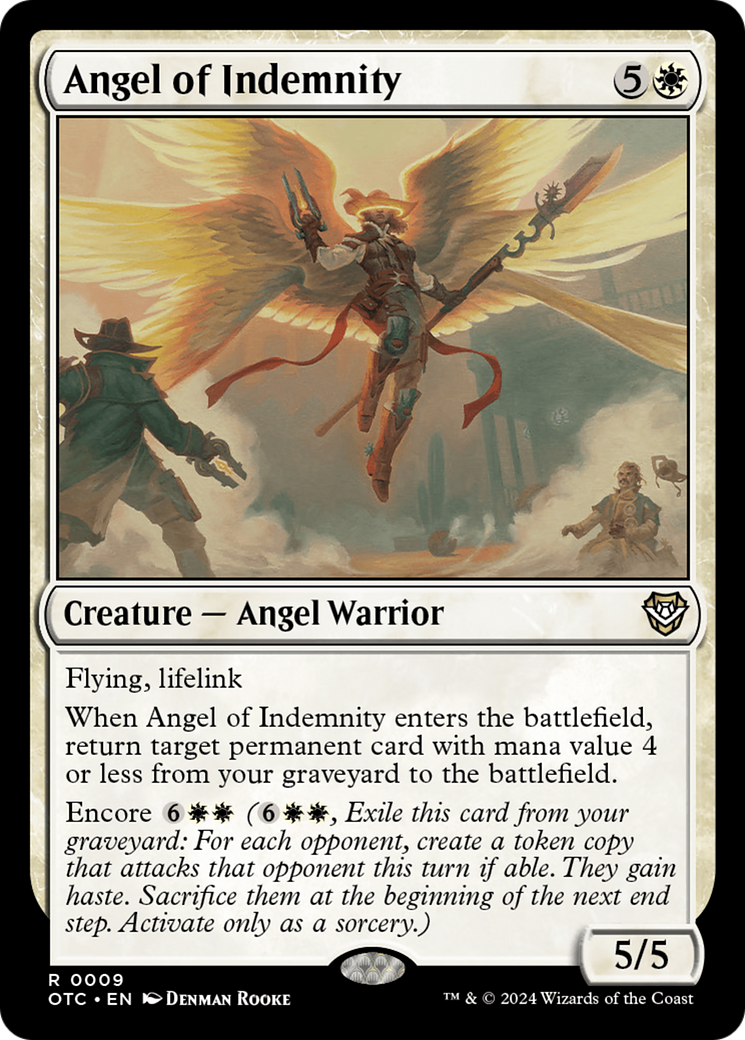
Angel of Indemnity
Angel of Indemnity
Creature — Angel Warrior
5/5
Flying, lifelink
When this creature enters, return target permanent card with mana value 4 or less from your graveyard to the battlefield.
Encore ( , Exile this card from your graveyard: For each opponent, create a token copy that attacks that opponent this turn if able. They gain haste. Sacrifice them at the beginning of the next end step. Activate only as a sorcery.)
- Opponents who have left the game aren't counted when determining how many tokens to create.
- If one of the tokens can't attack for any reason (such as being tapped), then it doesn't attack. If there's a cost associated with having it attack, you aren't forced to pay that cost, so it doesn't have to attack in that case either.
- If one of the tokens somehow is under another player's control as the delayed triggered ability resolves, you can't sacrifice that token. It remains on the battlefield indefinitely, even if you regain control of it later.
- The tokens copy only what's on the original card. Effects that modified that creature when it was previously on the battlefield won't be copied.
- Exiling the card with encore is a cost to activate the ability. Once you announce that you're activating it, no player may take actions until you've finished. They can't try to remove the card from your graveyard to stop you from paying the cost.
- If an effect stops a token from attacking a specific player, that token can attack any player, planeswalker, or battle, or not attack at all. If the effect stops the token from attacking a specific player unless a cost is paid, you don't have to pay that cost unless you want to attack that player.
- If you return an Aura this way, you choose what the Aura will enchant just before it enters the battlefield. An Aura returning to the battlefield this way doesn't target the player or permanent it will enchant, so permanents or players with hexproof may be chosen; however, the chosen recipient must be able to legally be enchanted by the Aura, so a player or permanent with protection from one of the Aura's qualities can't be chosen this way. If there's nothing legal for the Aura to enchant, it stays in the graveyard.
- A permanent card is an artifact, battle, creature, enchantment, land, or planeswalker card.
- If the mana cost of a card in your graveyard includes , X is 0 for the purpose of determining its mana value.
- Each token must attack the appropriate player if able.
-
1
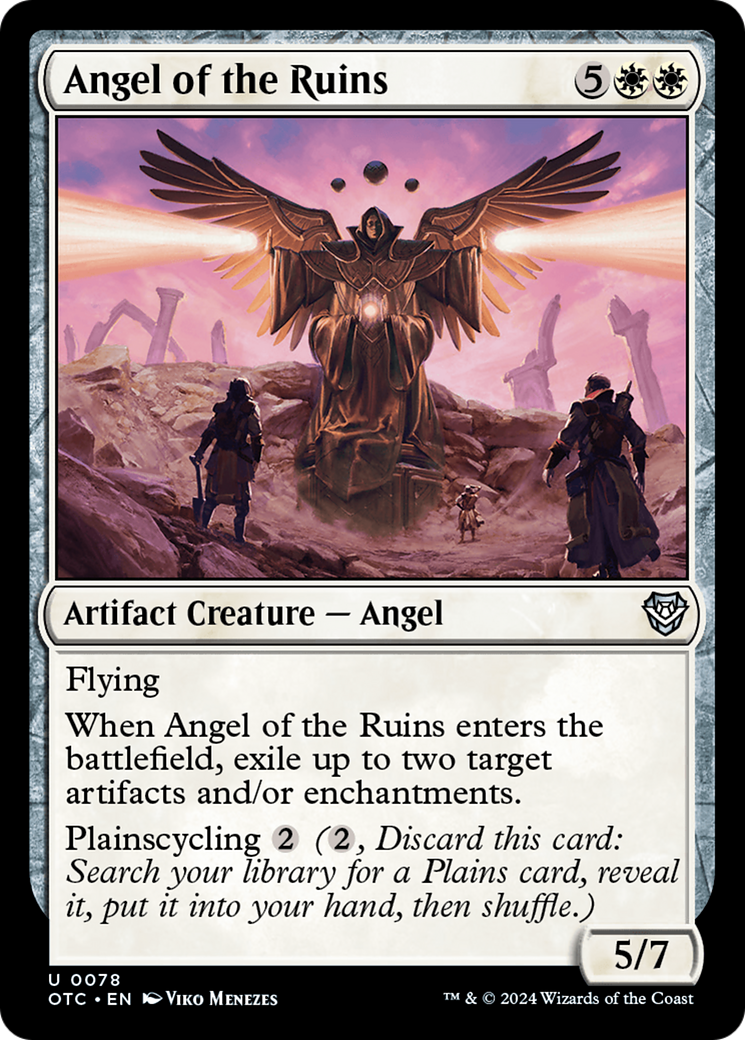
Angel of the Ruins
Angel of the Ruins
Artifact Creature — Angel
5/7
Flying
When this creature enters, exile up to two target artifacts and/or enchantments.
Plainscycling ( , Discard this card: Search your library for a Plains card, reveal it, put it into your hand, then shuffle.)
-
1
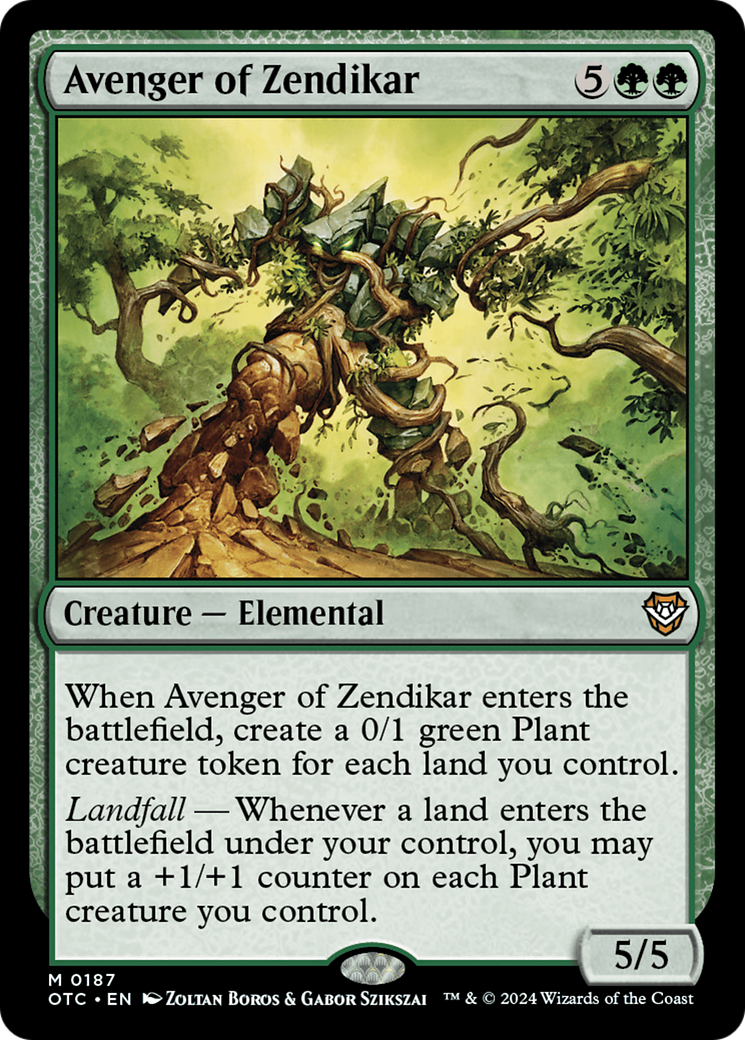
Avenger of Zendikar
Avenger of Zendikar
Creature — Elemental
5/5
When this creature enters, create a 0/1 green Plant creature token for each land you control.
Landfall — Whenever a land you control enters, you may put a +1/+1 counter on each Plant creature you control.
- A landfall ability triggers whenever a land you control enters for any reason. It triggers whenever you play a land, as well as whenever a spell or ability puts a land onto the battlefield under your control.
- A landfall ability doesn't trigger if a permanent already on the battlefield becomes a land.
- Whenever a land you control enters, each landfall ability of the permanents you control will trigger. You can put them on the stack in any order. The last ability you put on the stack will be the first one to resolve (As a result, you can have those abilities resolve in the order of your choosing.).
-
1
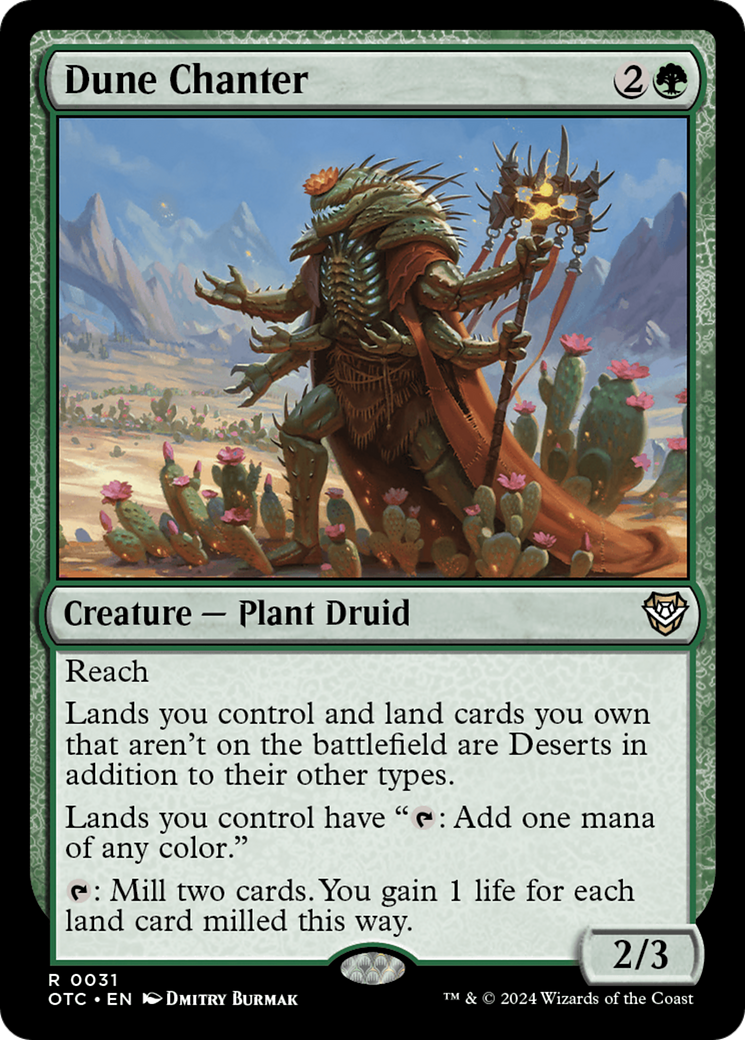
Dune Chanter
Dune Chanter
Creature — Plant Druid
2/3
Reach
Lands you control and land cards you own that aren't on the battlefield are Deserts in addition to their other types.
Lands you control have " : Add one mana of any color."
: Mill two cards. You gain 1 life for each land card milled this way.
-
1
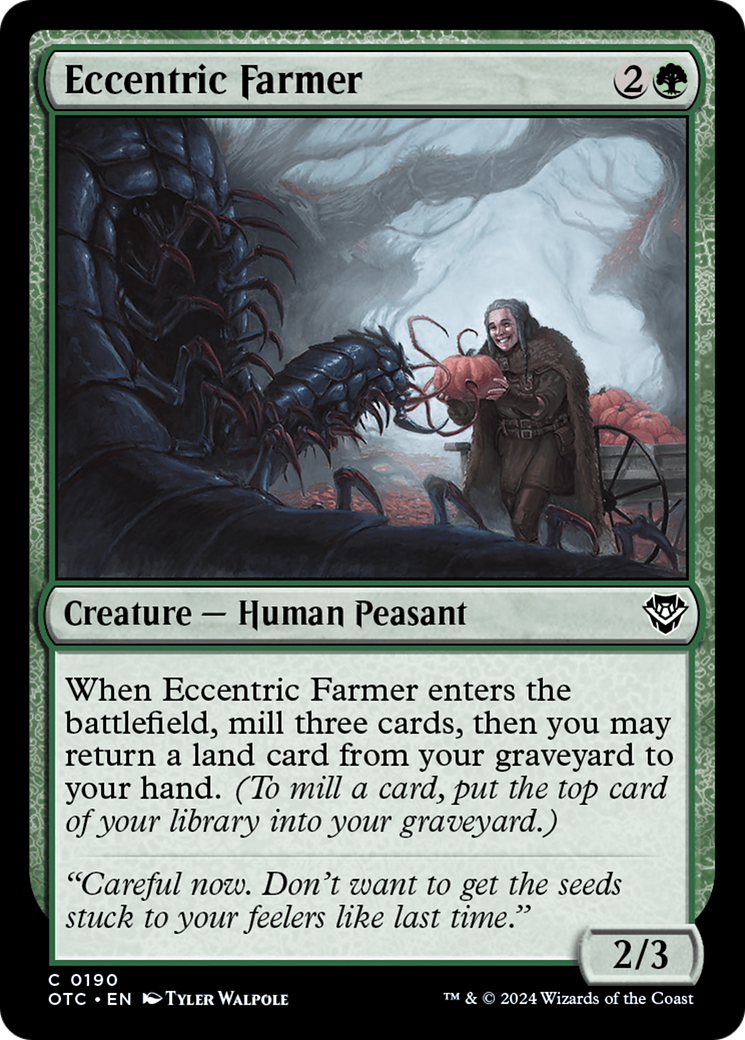
Eccentric Farmer
Eccentric Farmer
Creature — Human Peasant
2/3
When this creature enters, mill three cards, then you may return a land card from your graveyard to your hand. (To mill three cards, put the top three cards of your library into your graveyard.)
- The land card you return to your hand can be one you just milled or it can be one that was already in your graveyard.
-
1
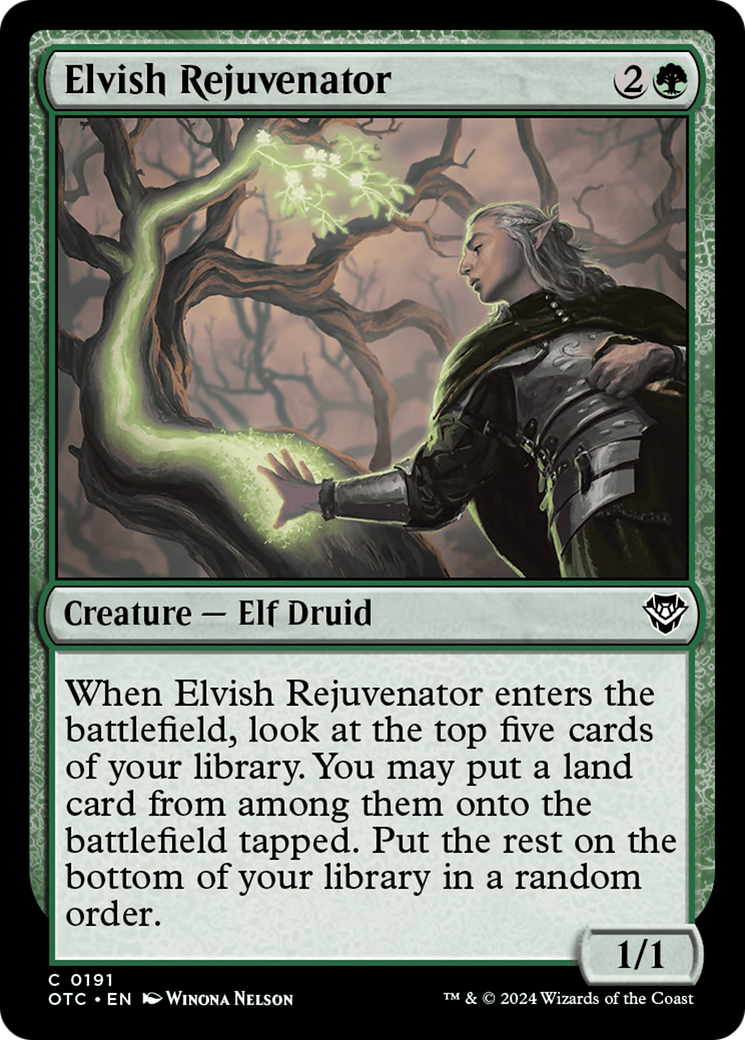
Elvish Rejuvenator
Elvish Rejuvenator
Creature — Elf Druid
1/1
When this creature enters, look at the top five cards of your library. You may put a land card from among them onto the battlefield tapped. Put the rest on the bottom of your library in a random order.
-
1
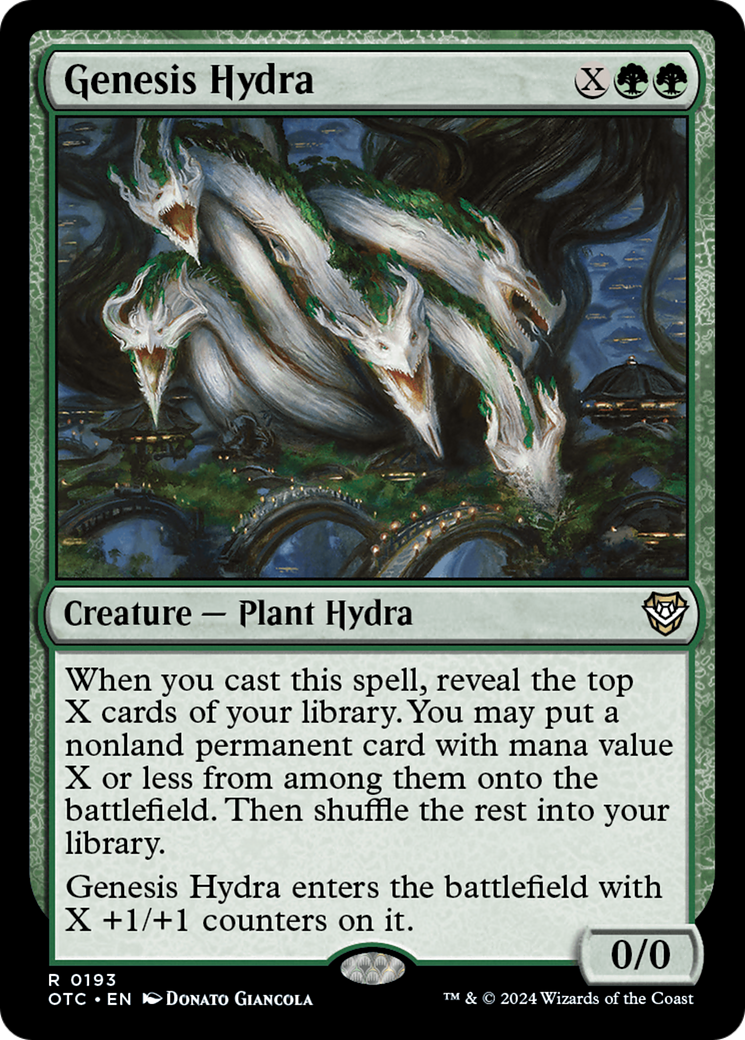
Genesis Hydra
Genesis Hydra
Creature — Plant Hydra
0/0
When you cast this spell, reveal the top X cards of your library. You may put a nonland permanent card with mana value X or less from among them onto the battlefield. Then shuffle the rest into your library.
This creature enters with X +1/+1 counters on it.
- Genesis Hydra's first ability will resolve before Genesis Hydra does. Notably, if you put an Aura card onto the battlefield this way, it can't enchant Genesis Hydra.
- If you have fewer than X cards in your library, you reveal all of them.
- If a card in a player's library has in its mana cost, X is considered to be 0.
- A nonland permanent card is an artifact, creature, enchantment, or planeswalker card.
- If you put an Aura onto the battlefield this way, you choose what it enchants as it enters the battlefield. This doesn't target any permanent or player, but it must be able to enchant that permanent or player. For example, you could put a green Aura onto the battlefield enchanting a creature with hexproof controlled by an opponent, but not one with protection from green.
- If "the rest" is zero cards, either because X was 0 or because X was 1 and that card was put onto the battlefield, the library is still shuffled.
-
1
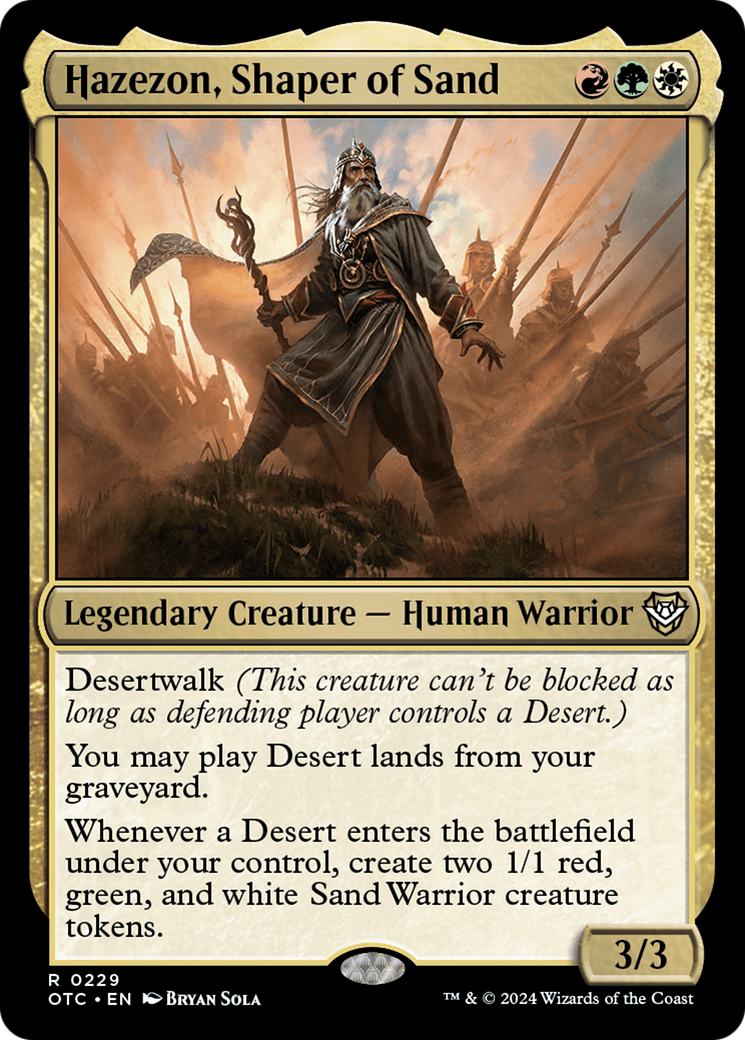
Hazezon, Shaper of Sand
Hazezon, Shaper of Sand
Legendary Creature — Human Warrior
3/3
Desertwalk (This creature can't be blocked as long as defending player controls a Desert.)
You may play Desert lands from your graveyard.
Whenever a Desert you control enters, create two 1/1 red, green, and white Sand Warrior creature tokens.
- Hazezon doesn't change the times when you can play those land cards. You can still play only one land per turn, and only during your main phase when you have priority and the stack is empty.
- Hazezon doesn't allow you to activate abilities (such as cycling) of land cards in your graveyard.
-
1
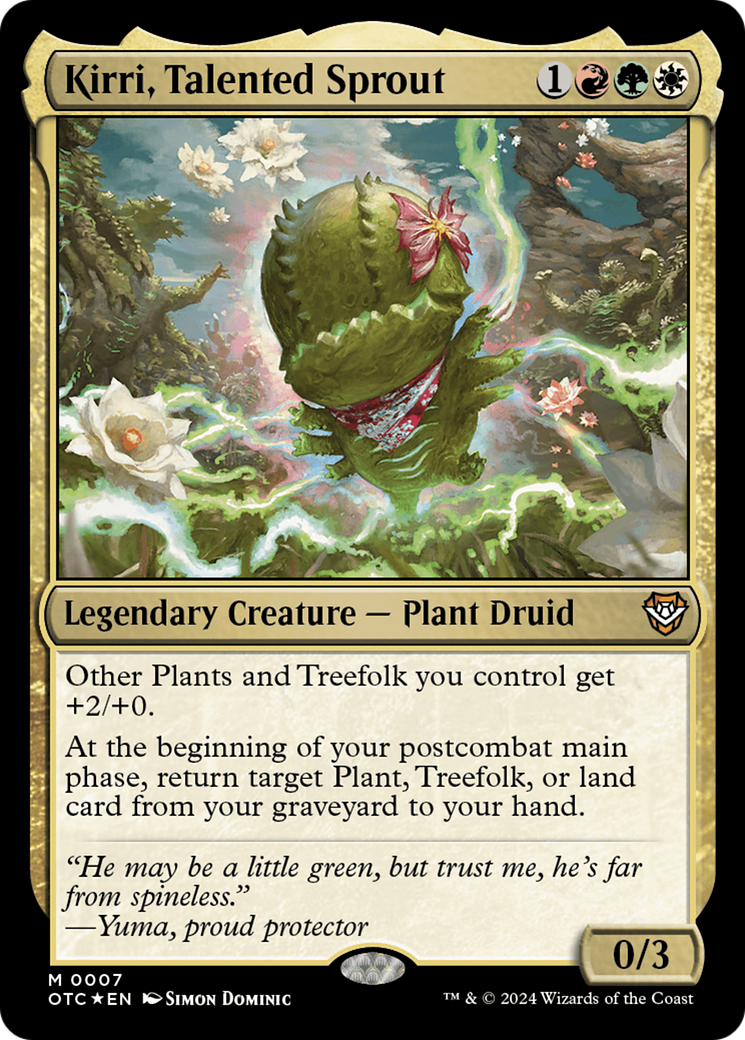
Kirri, Talented Sprout
Kirri, Talented Sprout
Legendary Creature — Plant Druid
0/3
Other Plants and Treefolk you control get +2/+0.
At the beginning of each of your postcombat main phases, return target Plant, Treefolk, or land card from your graveyard to your hand.
- A creature that’s both a Plant and a Treefolk gets only +2/+0 from Kirri’s first ability.
-
1
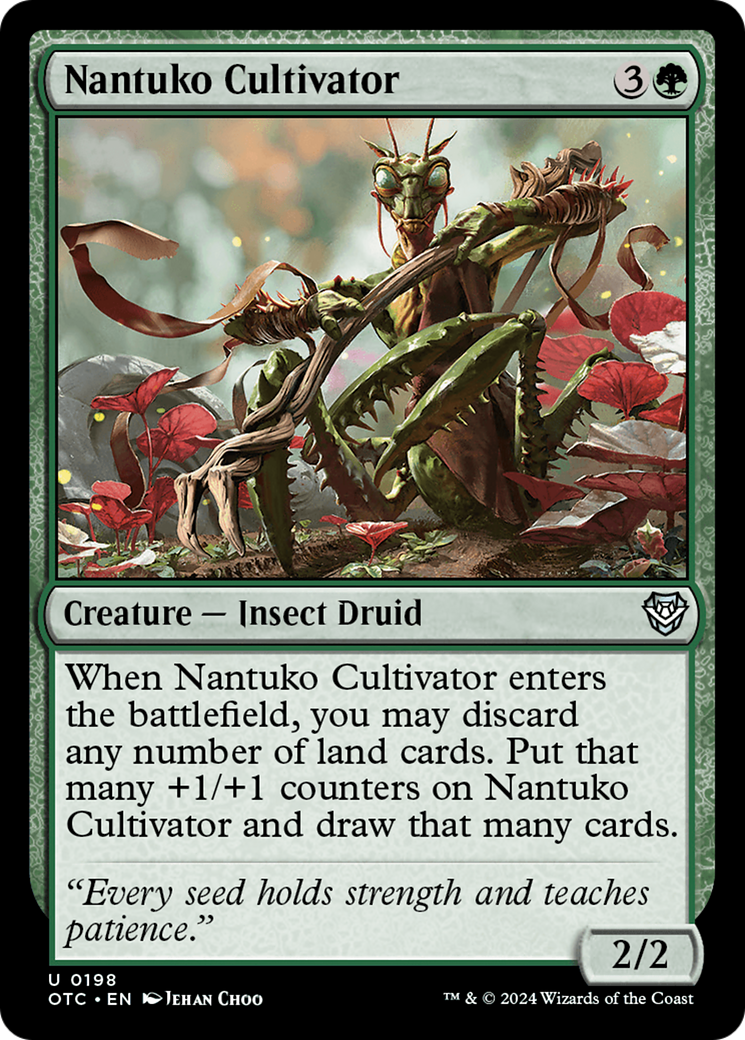
Nantuko Cultivator
Nantuko Cultivator
Creature — Insect Druid
2/2
When this creature enters, you may discard any number of land cards. Put that many +1/+1 counters on this creature and draw that many cards.
- If an effect modifies how many +1/+1 counters you put on Nantuko Cultivator, the number of cards you draw isn't modified. Likewise, if an effect modifies how many cards you draw, the number of +1/+1 counters you put on Nantuko Cultivator won't be modified.
- You discard, put counters, and draw all while Nantuko Cultivator's ability is resolving. Nothing can happen between the three, and no player may choose to take actions.
-
1
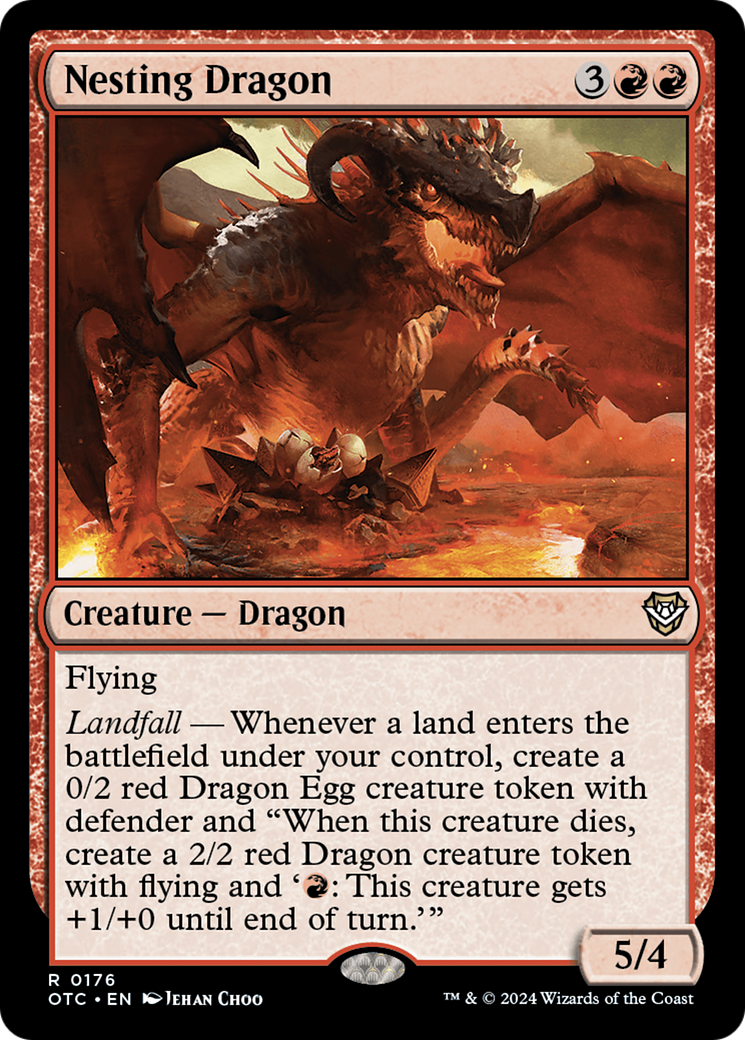
Nesting Dragon
Nesting Dragon
Creature — Dragon
5/4
Flying
Landfall — Whenever a land you control enters, create a 0/2 red Dragon Egg creature token with defender and "When this token dies, create a 2/2 red Dragon creature token with flying and ' : This token gets +1/+0 until end of turn.'"
-
1
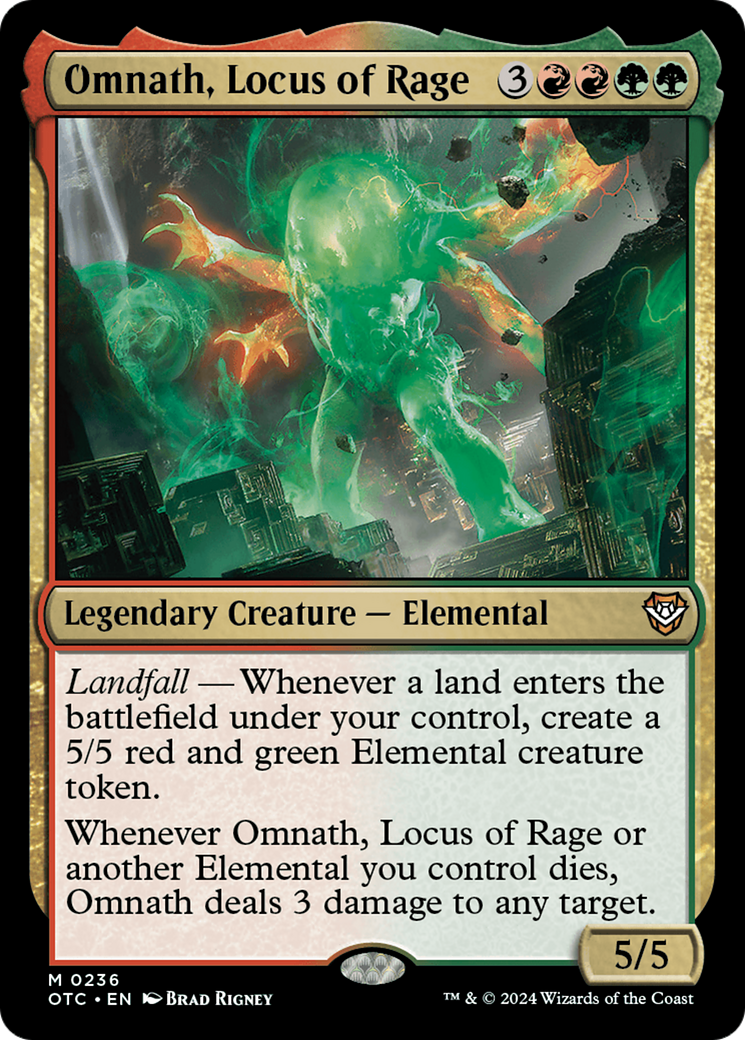
Omnath, Locus of Rage
Omnath, Locus of Rage
Legendary Creature — Elemental
5/5
Landfall — Whenever a land you control enters, create a 5/5 red and green Elemental creature token.
Whenever Omnath or another Elemental you control dies, Omnath deals 3 damage to any target.
- Omanth doesn't have the land type Locus.
- If Omnath dies at the same time as any other Elementals you control, Omnath's last ability will trigger for each of them (and once for itself).
-
1
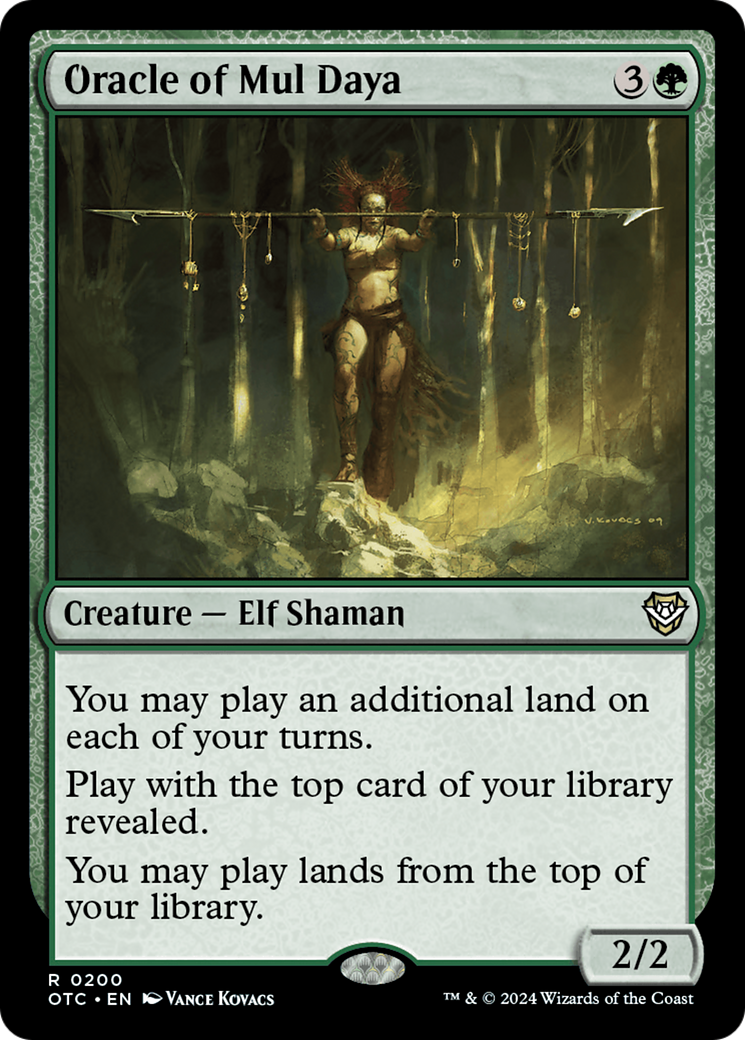
Oracle of Mul Daya
Oracle of Mul Daya
Creature — Elf Shaman
2/2
You may play an additional land on each of your turns.
Play with the top card of your library revealed.
You may play lands from the top of your library.
- If you control more than one Oracle of Mul Daya, the effects of their first abilities are cumulative. If you control two, for example, you can play three lands on your turn.
- Oracle of Mul Daya doesn't change the times when you can play a land card from the top of your library. You can play a land only during your main phase when you have priority and the stack is empty. Doing so counts as one of your land plays for the turn.
- If you play your first land of the turn from the top of your library, and the new top card is another land card, you can play that one too.
-
1
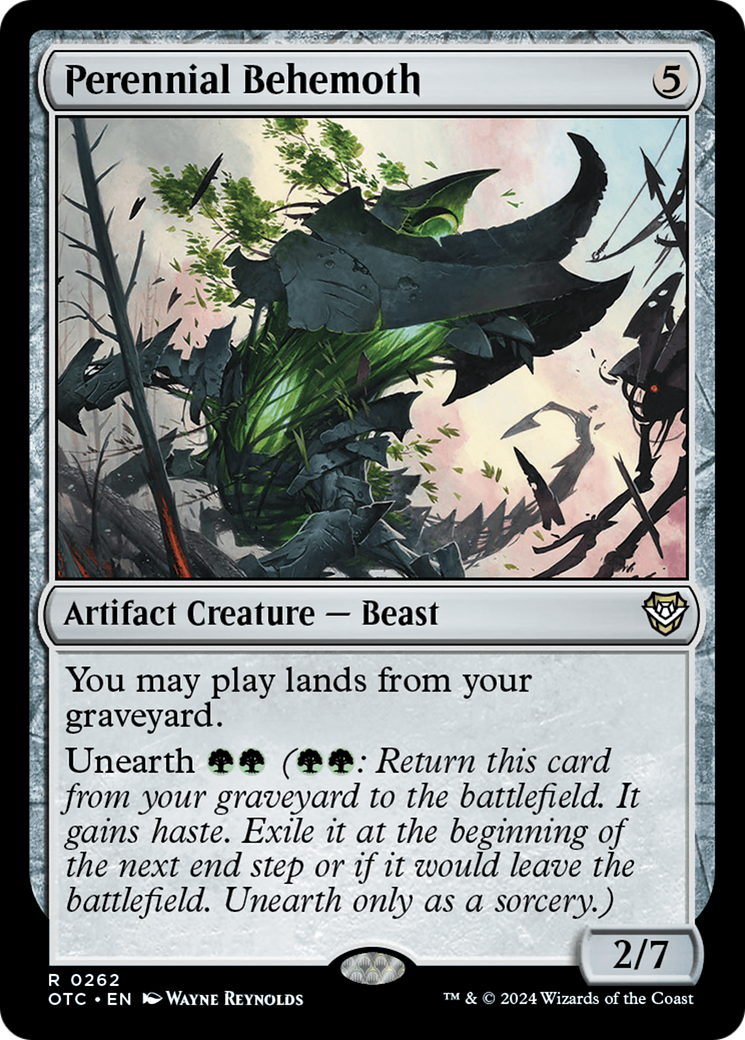
Perennial Behemoth
Perennial Behemoth
Artifact Creature — Beast
2/7
You may play lands from your graveyard.
Unearth ( : Return this card from your graveyard to the battlefield. It gains haste. Exile it at the beginning of the next end step or if it would leave the battlefield. Unearth only as a sorcery.)
- Perennial Behemoth doesn't change the times when you can play those land cards. You can still play only one land per turn, and only during your main phase when you have priority and the stack is empty.
- Perennial Behemoth doesn't allow you to activate abilities (such as cycling) of land cards in your graveyard.
- If you activate a card's unearth ability but that card is removed from your graveyard before the ability resolves, that unearth ability will do nothing as it resolves.
- Activating a card's unearth ability isn't the same as casting that card. The unearth ability is put on the stack, but the card is not. Spells and abilities that interact with activated abilities (such as Defabricate's second mode) will interact with unearth, but spells and abilities that interact with spells (such as Scatter Ray) will not.
- At the beginning of the next end step, a permanent returned to the battlefield with unearth is exiled. This is a delayed triggered ability, and it can be countered by effects such as Defabricate that counter triggered abilities. If the ability is countered, the permanent will stay on the battlefield and the delayed triggered ability won't trigger again. However, the replacement effect will still exile the permanent if it eventually leaves the battlefield.
- Unearth grants haste to the permanent that's returned to the battlefield (even if it's not a creature card). However, neither of the "exile" abilities is granted to that permanent. If that permanent loses all its abilities, it will still be exiled at the beginning of the next end step, and if it would leave the battlefield, it is still exiled instead.
- If a permanent returned to the battlefield with unearth would leave the battlefield for any reason, it's exiled instead—unless the spell or ability that's causing the permanent to leave the battlefield is actually trying to exile it! In that case, it succeeds at exiling it. If that spell or ability later returns the card to the battlefield (as Static Net might, for example), the permanent card will return to the battlefield as a new object with no relation to its previous existence. The unearth effects will no longer apply to it.
-
1
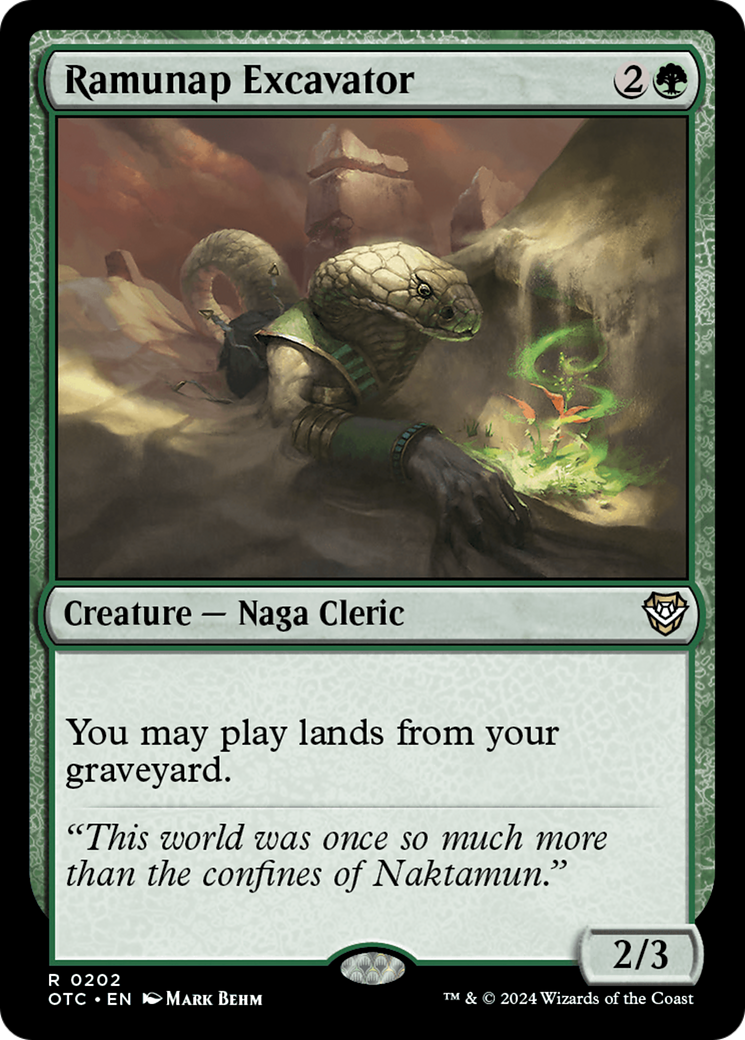
Ramunap Excavator
Ramunap Excavator
Creature — Snake Cleric
2/3
You may play lands from your graveyard.
- Ramunap Excavator doesn't change the times when you can play those land cards. You can still play only one land per turn, and only during your main phase when you have priority and the stack is empty.
- Ramunap Excavator doesn't allow you to activate activated abilities (such as cycling) of land cards in your graveyard.
-
1
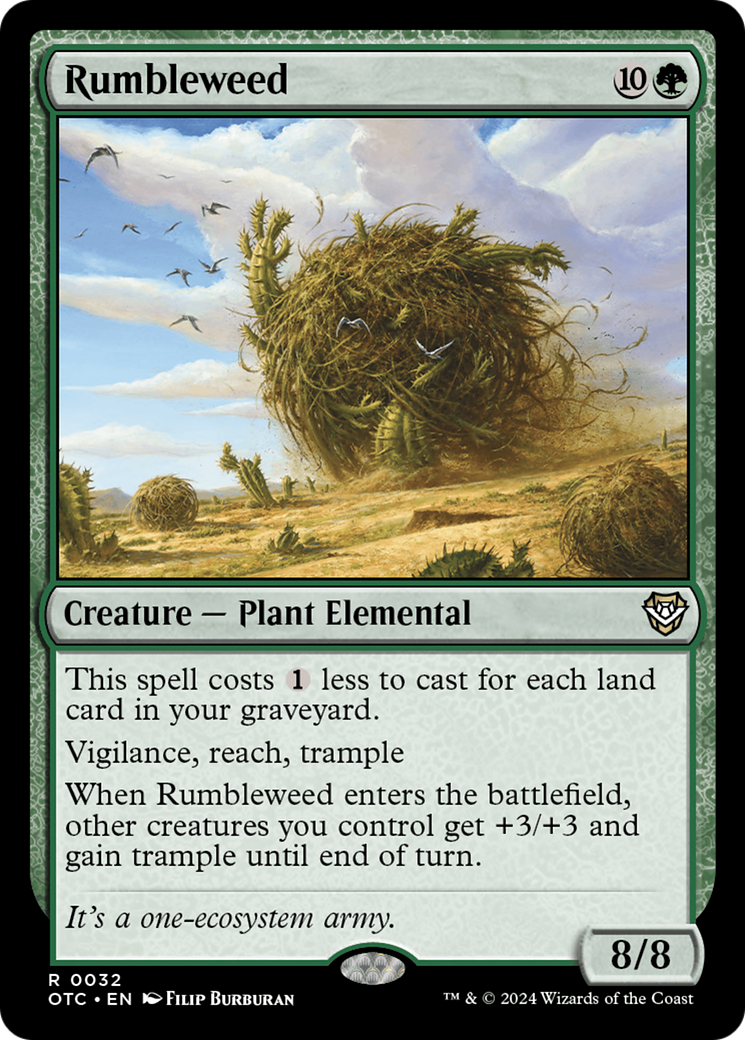
Rumbleweed
Rumbleweed
Creature — Plant Elemental
8/8
This spell costs less to cast for each land card in your graveyard.
Vigilance, reach, trample
When this creature enters, other creatures you control get +3/+3 and gain trample until end of turn.
- Rumbleweed’s first ability doesn’t change its mana value, which is always 11.
- Rumbleweed’s last ability affects only creatures you control at the time it resolves. Creatures you begin to control later in the turn and noncreature permanents that become creatures later in the turn won’t get +3/+3 or gain trample.
-
1
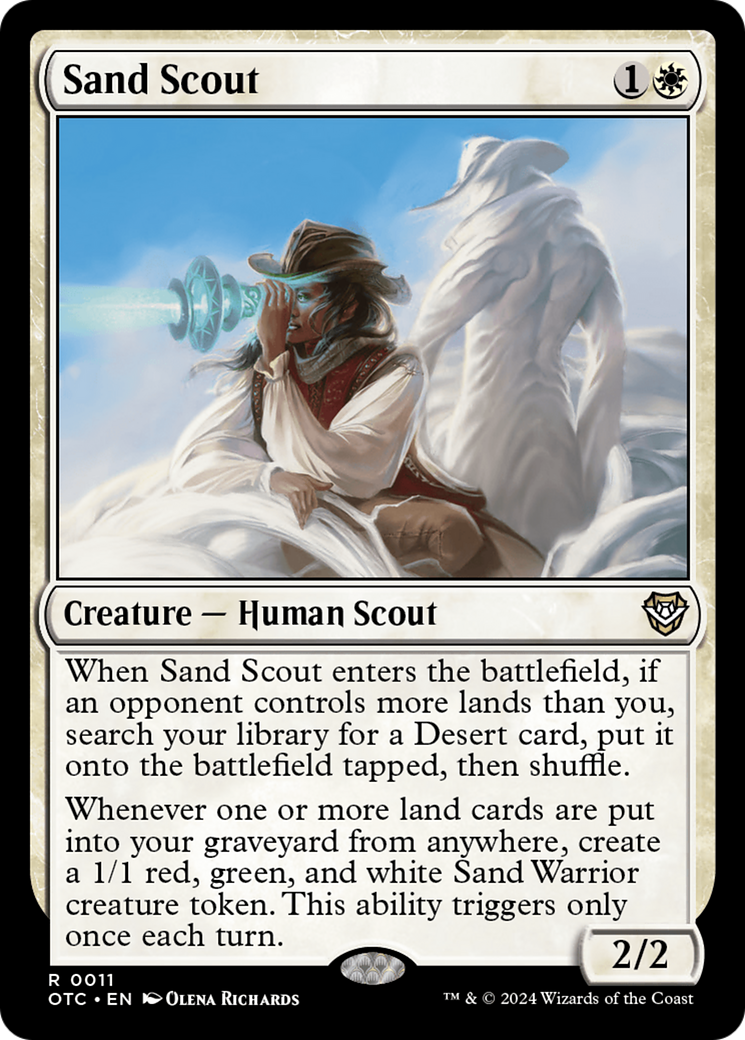
Sand Scout
Sand Scout
Creature — Human Scout
2/2
When this creature enters, if an opponent controls more lands than you, search your library for a Desert card, put it onto the battlefield tapped, then shuffle.
Whenever one or more land cards are put into your graveyard from anywhere, create a 1/1 red, green, and white Sand Warrior creature token. This ability triggers only once each turn.
- Sand Scout must be on the battlefield for its last ability to trigger. If it is put into your graveyard at the same time as one or more land cards you own, its ability won’t trigger.
-
1
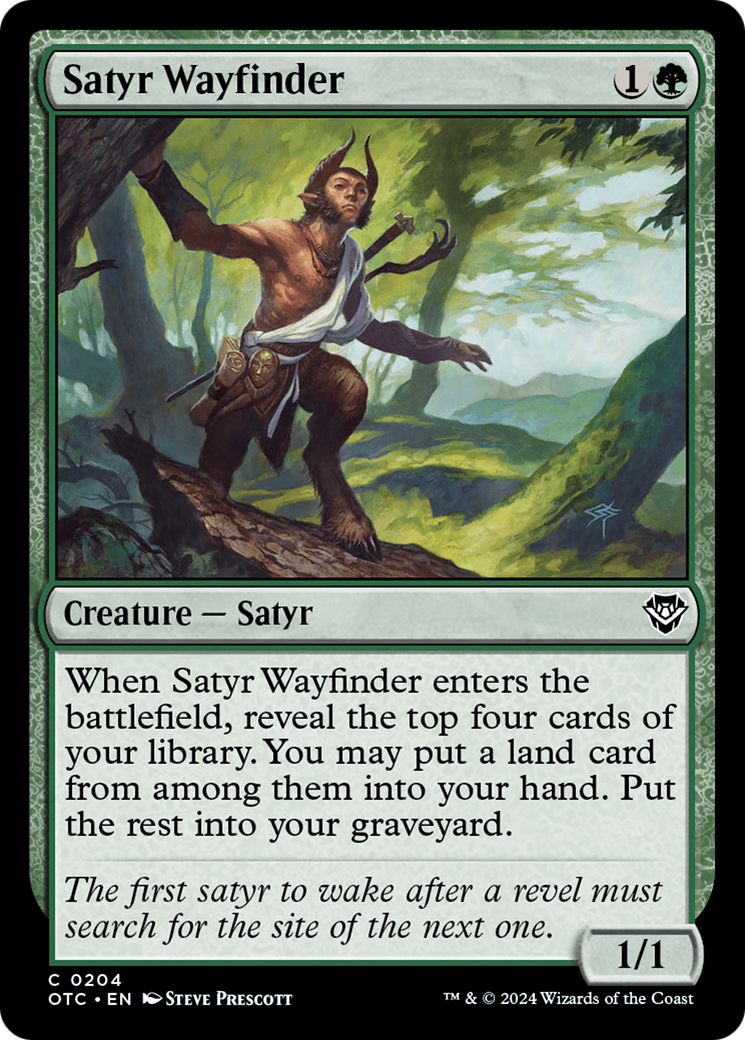
Satyr Wayfinder
Satyr Wayfinder
Creature — Satyr
1/1
When this creature enters, reveal the top four cards of your library. You may put a land card from among them into your hand. Put the rest into your graveyard.
-
1
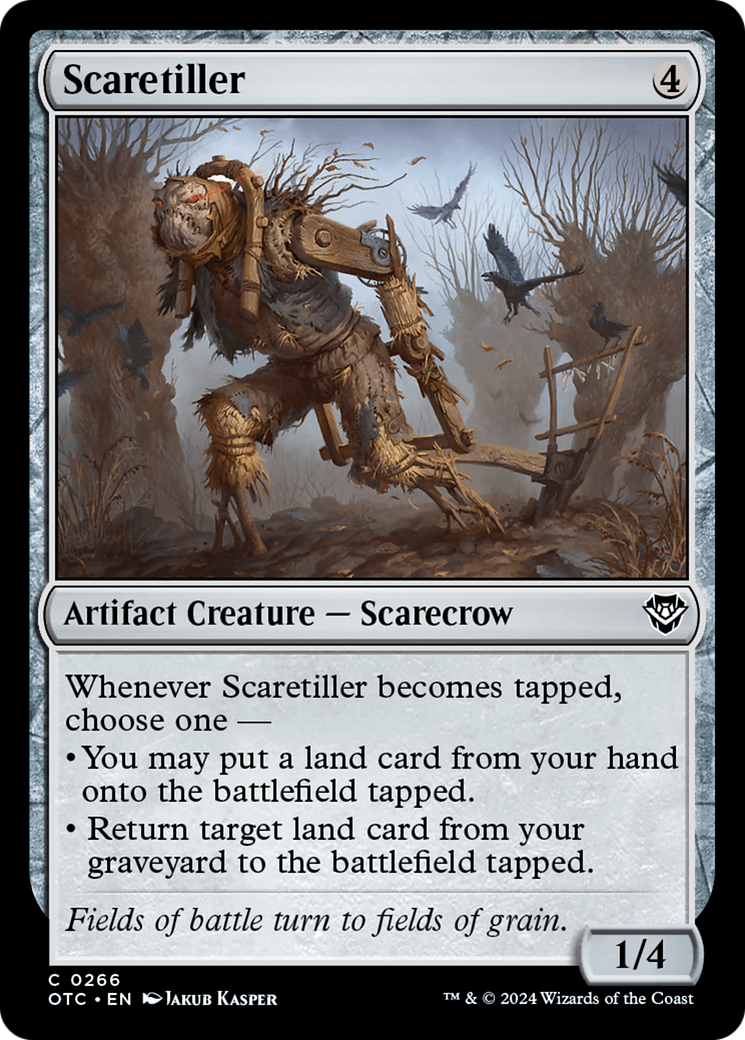
Scaretiller
Scaretiller
Artifact Creature — Scarecrow
1/4
Whenever this creature becomes tapped, choose one —
- You may put a land card from your hand onto the battlefield tapped.
- Return target land card from your graveyard to the battlefield tapped.
- Scaretiller's ability is a triggered ability, not an activated ability. It doesn't allow you to tap it whenever you want; rather, you need some other way of tapping it, such as by attacking.
- If Scaretiller becomes tapped while casting a spell or activating an ability, that spell or ability resolves after Scaretiller's triggered ability has resolved.
- Neither mode of Scaretiller's ability counts as playing a land. It can put a land card onto the battlefield even if you've already played your land for the turn, and even if it's not your turn.
-
1
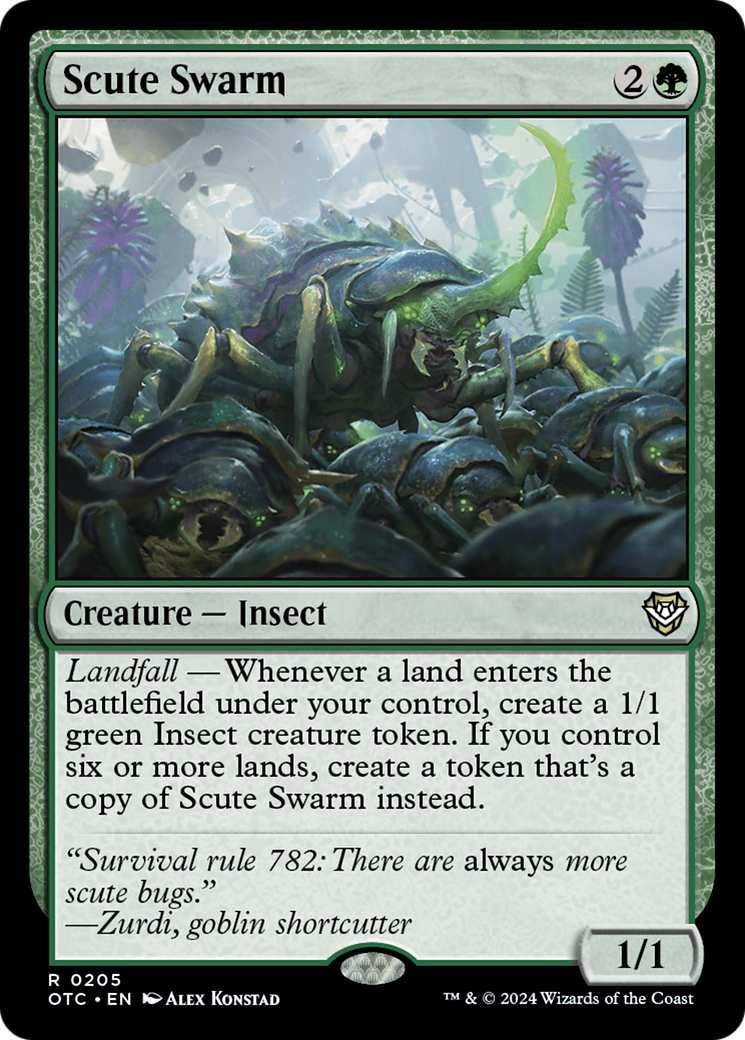
Scute Swarm
Scute Swarm
Creature — Insect
1/1
Landfall — Whenever a land you control enters, create a 1/1 green Insect creature token. If you control six or more lands, create a token that's a copy of this creature instead.
- A landfall ability triggers whenever a land you control enters for any reason. It triggers whenever you play a land, as well as whenever a spell or ability puts a land onto the battlefield under your control.
- A landfall ability doesn't trigger if a permanent already on the battlefield becomes a land.
- Whenever a land you control enters, each landfall ability of the permanents you control will trigger. You can put them on the stack in any order. The last ability you put on the stack will be the first one to resolve (As a result, you can have those abilities resolve in the order of your choosing.).
- The token copy will have Scute Swarm's ability. It will also be able to create copies of itself.
- The token copy won't copy counters or damage marked on Scute Swarm, nor will it copy other effects that have changed Scute Swarm's power, toughness, types, color, and so on. Normally, this means the token will simply be a Scute Swarm, but if any copy effects have affected the original Scute Swarm, the token will take those into account.
- If Scute Swarm leaves the battlefield before its triggered ability resolves, the token will still enter the battlefield as a copy of Scute Swarm, using Scute Swarm's copiable values from when it was last on the battlefield.
-
1
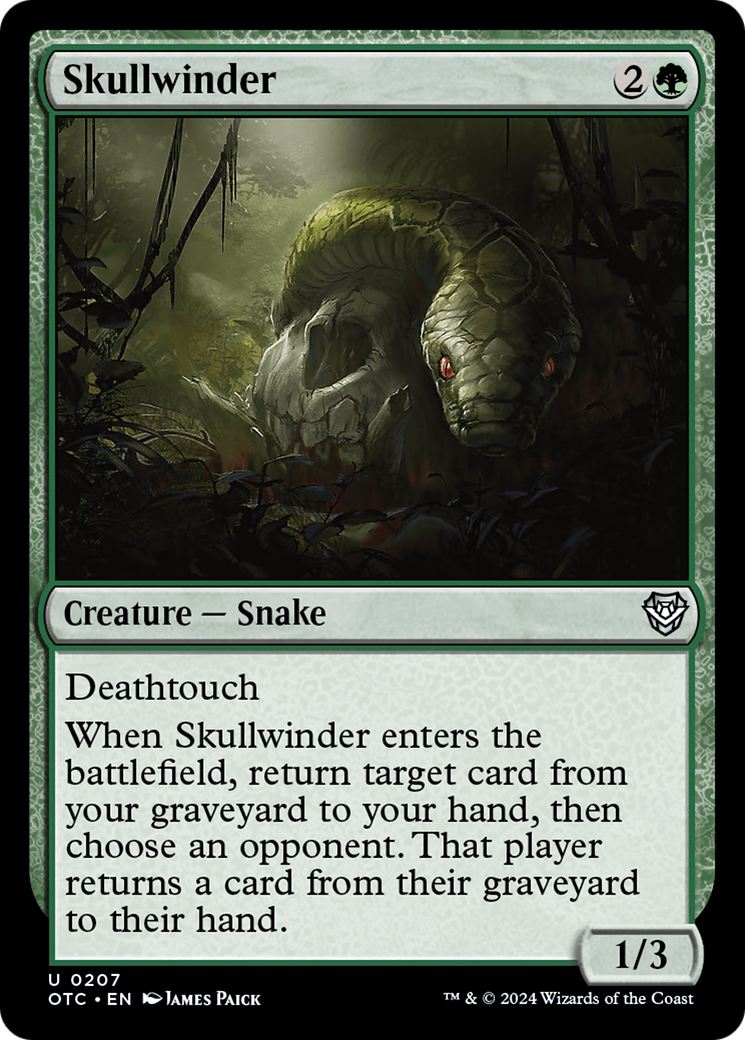
Skullwinder
Skullwinder
Creature — Snake
1/3
Deathtouch
When this creature enters, return target card from your graveyard to your hand, then choose an opponent. That player returns a card from their graveyard to their hand.
- Skullwinder's enters-the-battlefield ability targets only the card in your graveyard. If that card is an illegal target as the ability tries to resolve, the ability won't resolve and none of its effects will happen. No cards will be returned to any player's hand.
- You choose the target card as you put Skullwinder's triggered ability on the stack, but you don't choose an opponent until after you have returned the card to your hand.
- The chosen opponent gets to choose which card to return from their graveyard to their hand.
- You may choose an opponent with no cards in their graveyard. In that case, they will not get to return anything.
- Skullwinder's enters-the-battlefield ability targets only the card in your graveyard. If that card is an illegal target as the ability tries to resolve, the ability won't resolve and none of its effects will happen. No cards will be returned to any player's hand.
- You choose the opponent as the ability is resolving. You may choose an opponent with no cards in their graveyard.
-
1
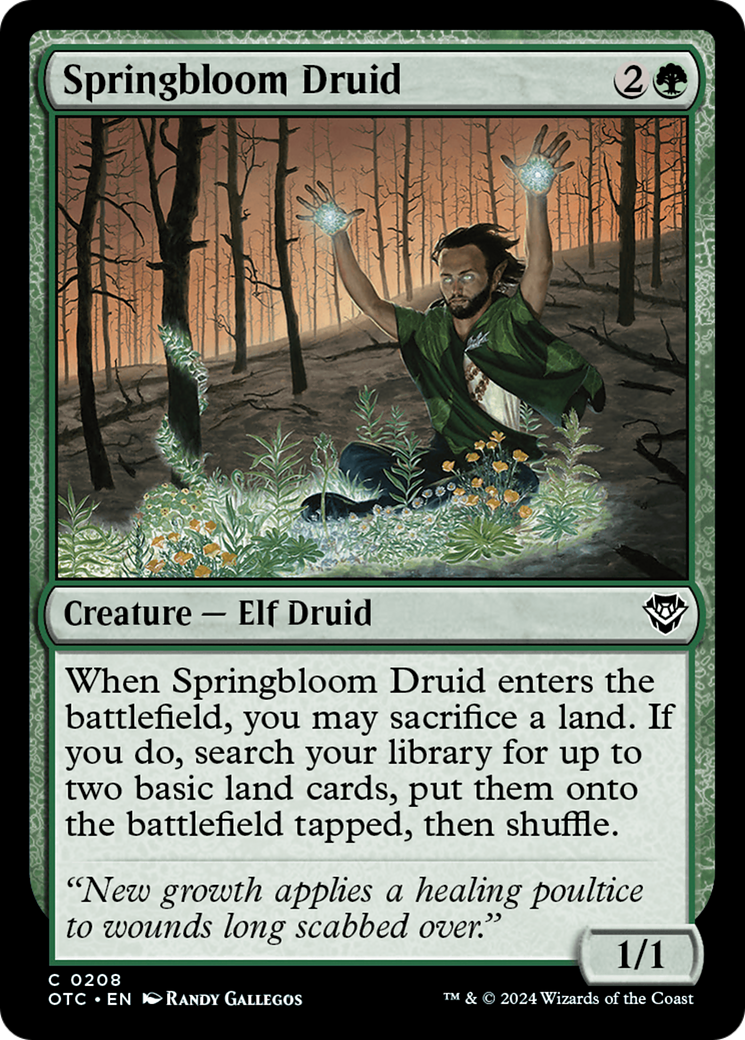
Springbloom Druid
Springbloom Druid
Creature — Elf Druid
1/1
When this creature enters, you may sacrifice a land. If you do, search your library for up to two basic land cards, put them onto the battlefield tapped, then shuffle.
- While resolving Springbloom Druid's triggered ability, you can't sacrifice multiple lands to search for more than two basic land cards.
-
1
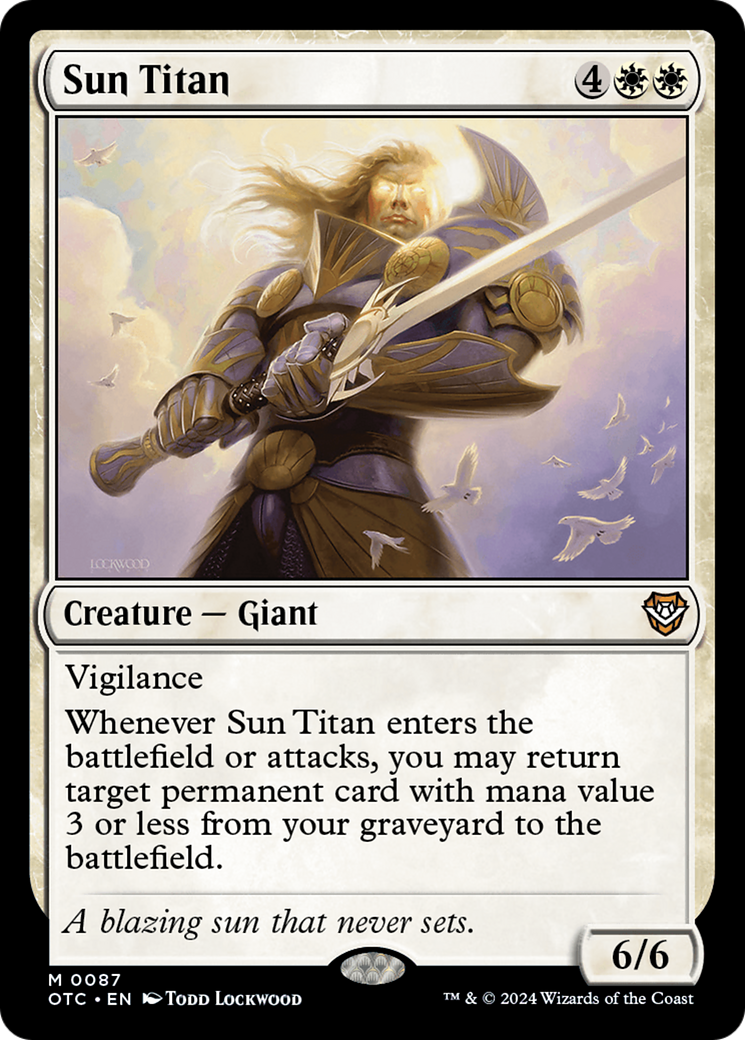
Sun Titan
Sun Titan
Creature — Giant
6/6
Vigilance
Whenever this creature enters or attacks, you may return target permanent card with mana value 3 or less from your graveyard to the battlefield.
- A permanent card is an artifact, creature, enchantment, land, or planeswalker card.
- If a card in your graveyard has no mana symbols in its upper right corner (because it's a land card, for example), its mana value is 0.
- The mana value of a card in your graveyard is determined solely by the mana symbols printed in its upper right corner. The mana value is the total amount of mana in that cost, regardless of color. For example, a card with mana cost has mana value 5.
- If the mana cost of a card in your graveyard includes , X is considered to be 0.
-
1
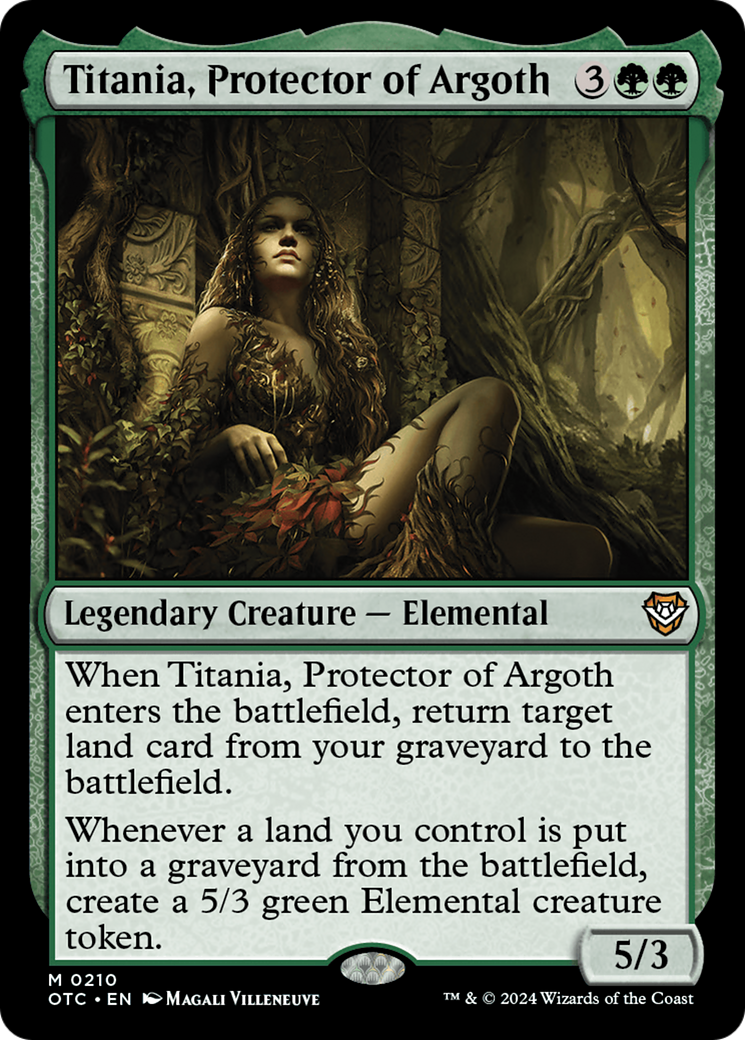
Titania, Protector of Argoth
Titania, Protector of Argoth
Legendary Creature — Elemental
5/3
When Titania enters, return target land card from your graveyard to the battlefield.
Whenever a land you control is put into a graveyard from the battlefield, create a 5/3 green Elemental creature token.
-
1
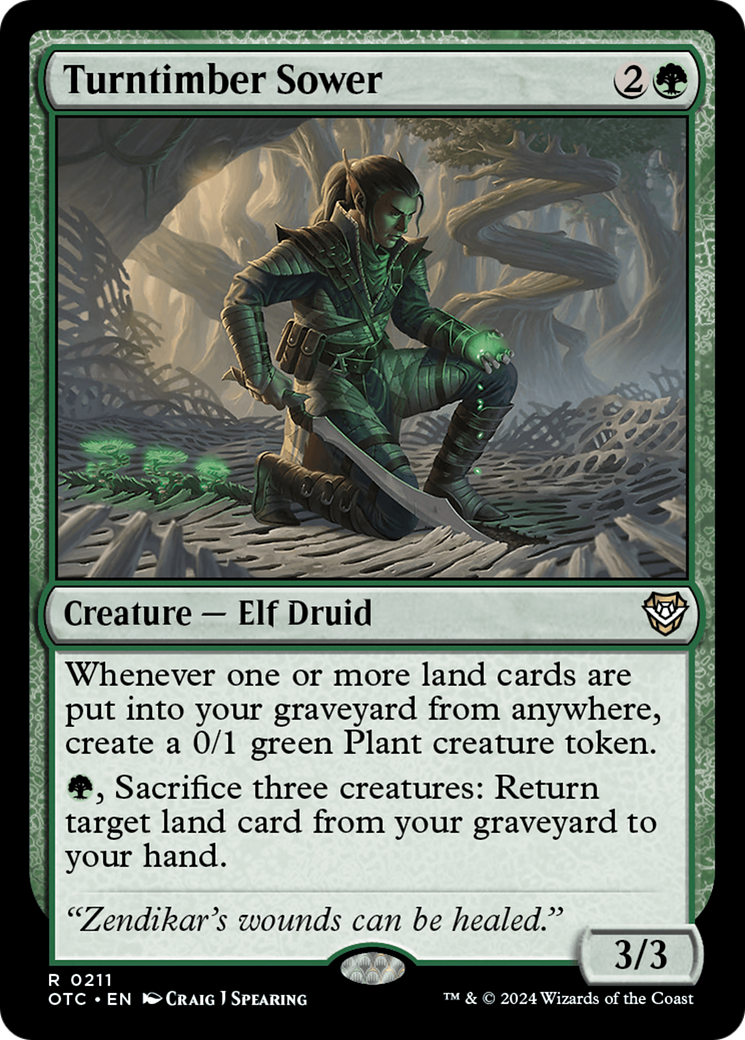
Turntimber Sower
Turntimber Sower
Creature — Elf Druid
3/3
Whenever one or more land cards are put into your graveyard from anywhere, create a 0/1 green Plant creature token.
, Sacrifice three creatures: Return target land card from your graveyard to your hand.
- If multiple land cards are put into your graveyard at once, Turntimber Sower's first ability triggers only once. This could happen because an effect put them there from your library at once, or because they were destroyed at the same time (such as two land creatures that were dealt lethal combat damage), for example.
-
1
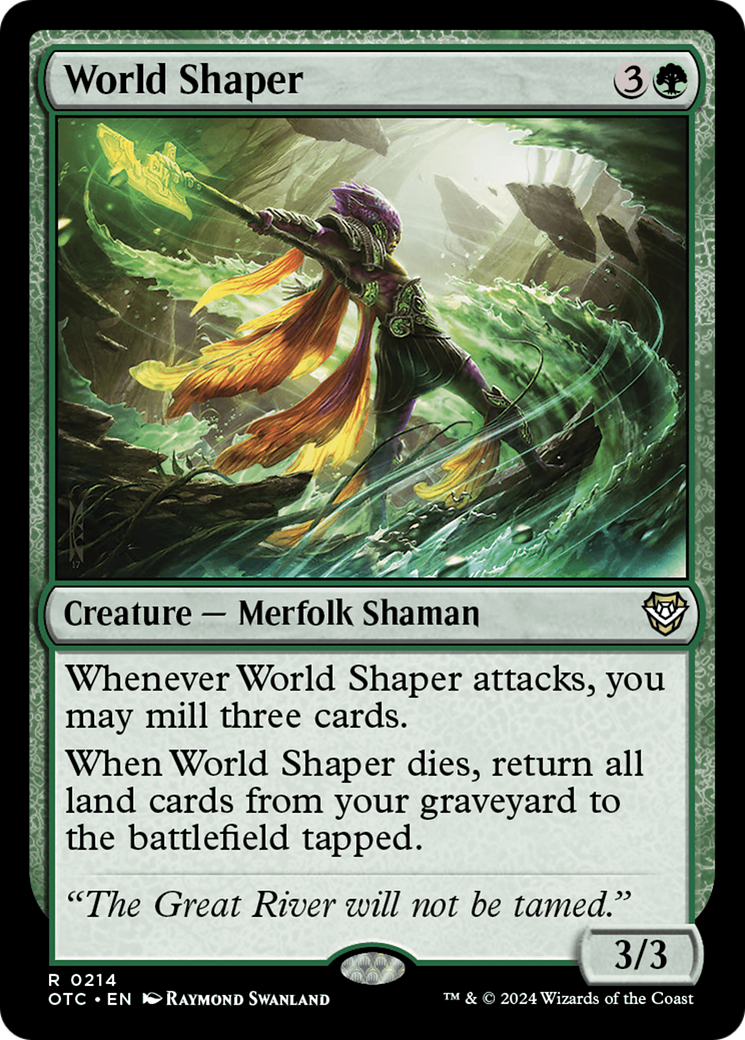
World Shaper
World Shaper
Creature — Merfolk Shaman
3/3
Whenever this creature attacks, you may mill three cards.
When this creature dies, return all land cards from your graveyard to the battlefield tapped.
-
1
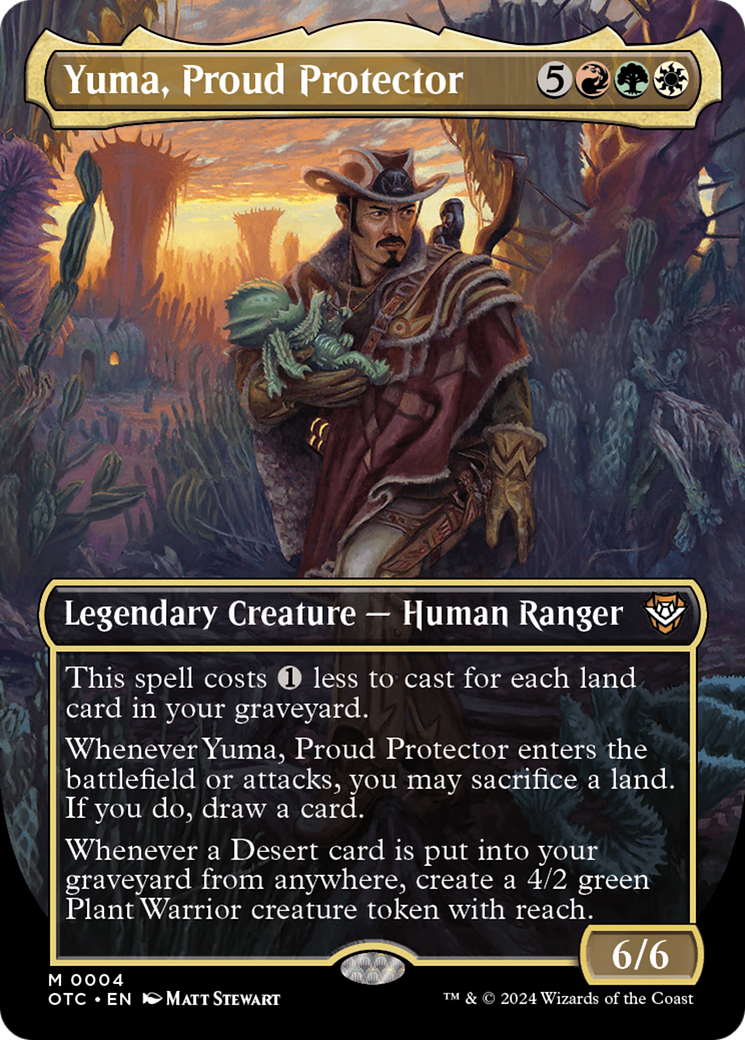
Yuma, Proud Protector
Yuma, Proud Protector
Legendary Creature — Human Ranger
6/6
This spell costs less to cast for each land card in your graveyard.
Whenever Yuma enters or attacks, you may sacrifice a land. If you do, draw a card.
Whenever a Desert card is put into your graveyard from anywhere, create a 4/2 green Plant Warrior creature token with reach.
- Yuma must be on the battlefield for its last ability to trigger. If it is put into your graveyard at the same time as a Desert card you own, its ability won't trigger.
Instants 8
-
1
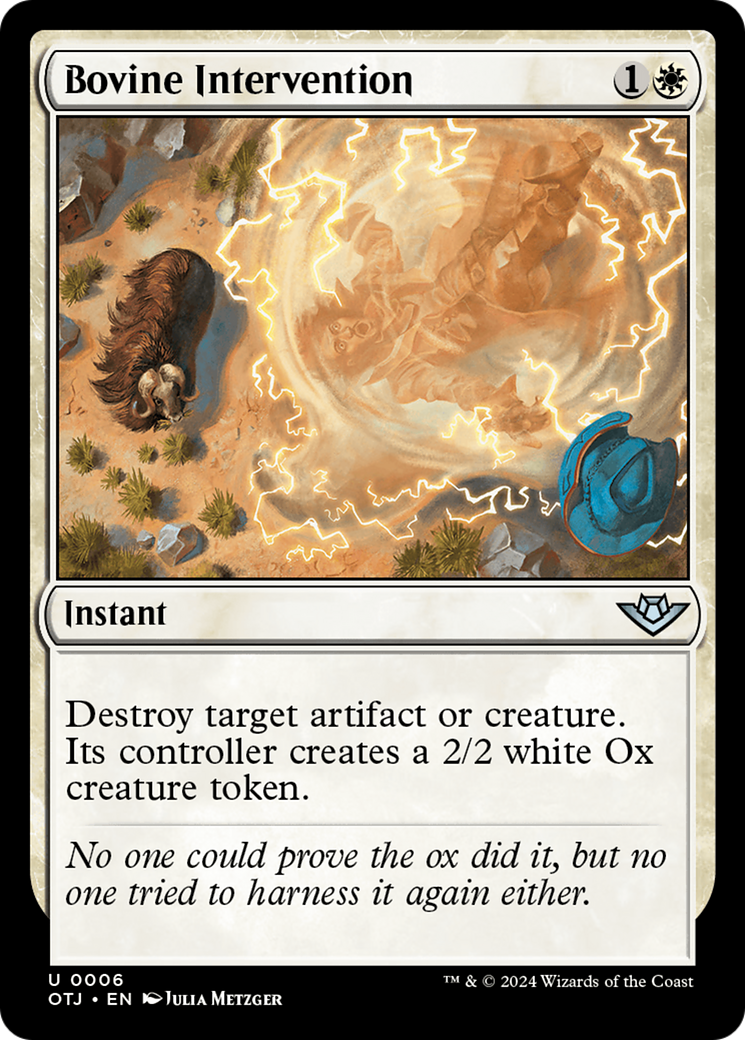
Bovine Intervention
Bovine Intervention
Instant
Destroy target artifact or creature. Its controller creates a 2/2 white Ox creature token.
-
1
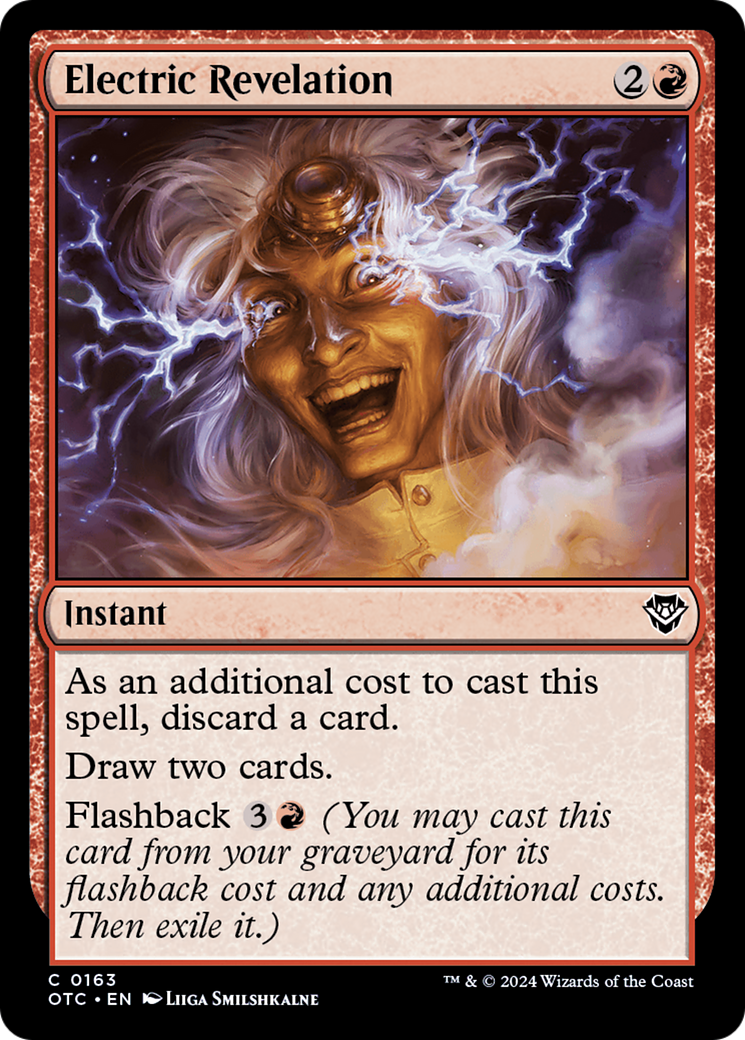
Electric Revelation
Electric Revelation
Instant
As an additional cost to cast this spell, discard a card.
Draw two cards.
Flashback (You may cast this card from your graveyard for its flashback cost and any additional costs. Then exile it.)
- If you cast Electric Revelation using flashback, you must still pay its additional cost of discarding a card.
-
1
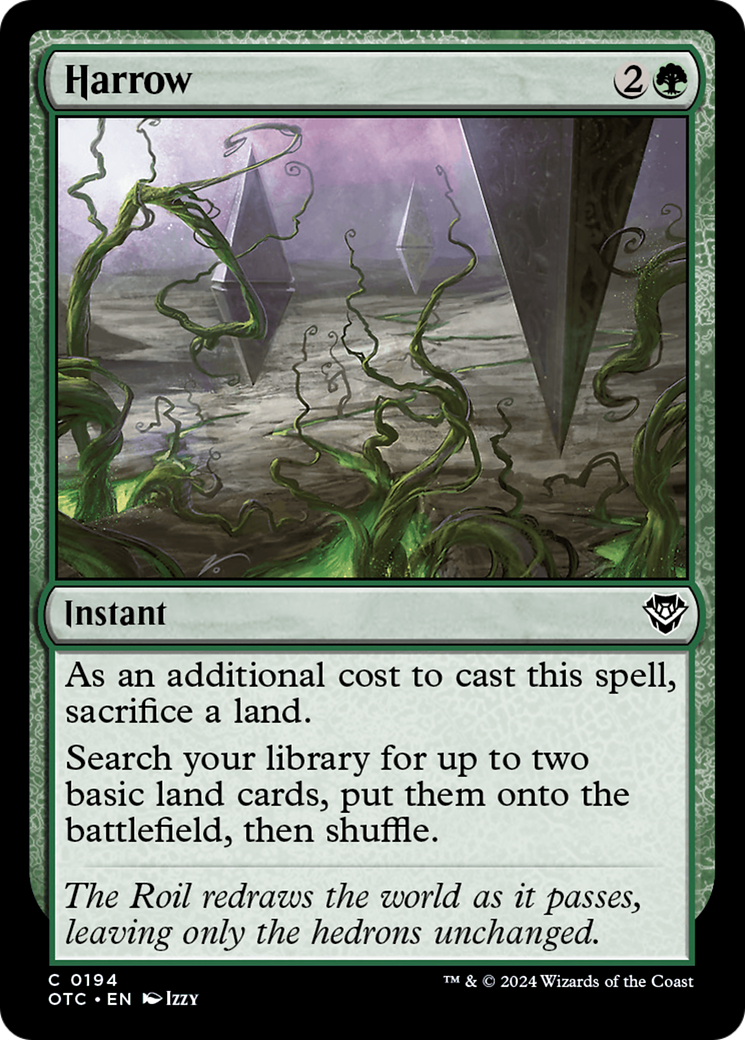
Harrow
Harrow
Instant
As an additional cost to cast this spell, sacrifice a land.
Search your library for up to two basic land cards, put them onto the battlefield, then shuffle.
- The two lands do not count toward your normal one land you can play each turn.
- The sacrifice of a land is part of the cost of casting Harrow. You can't pay this cost more than once to get a multiple effect.
-
1
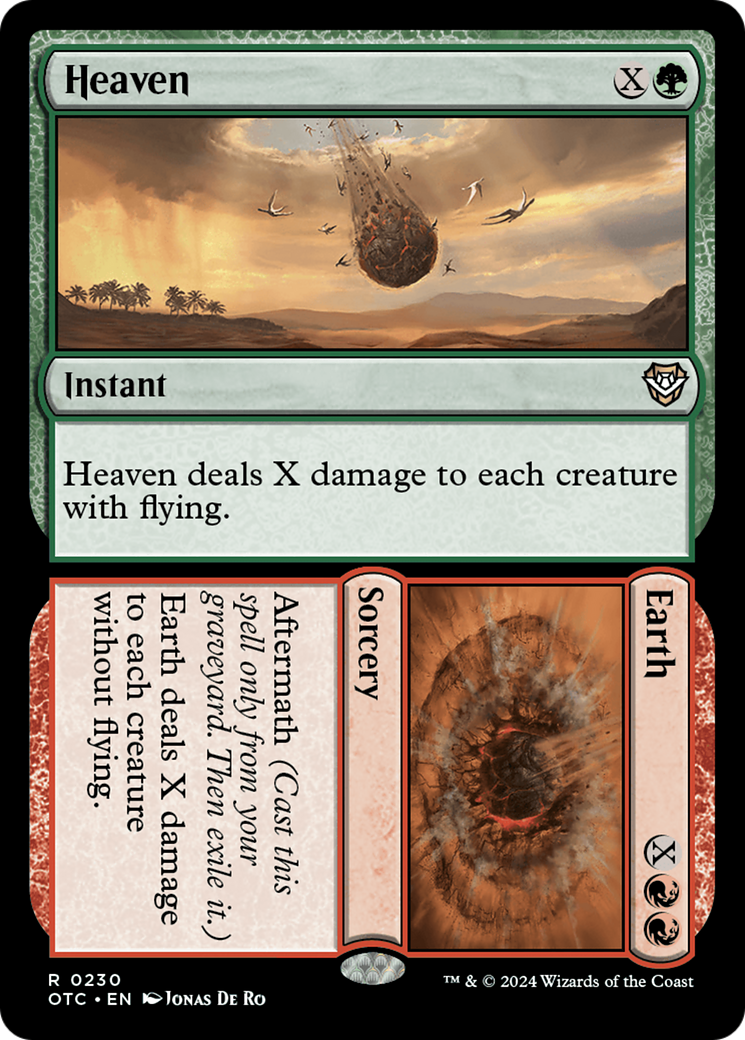
Heaven // Earth
//
Heaven
Instant
- Once you've started to cast a spell with aftermath from your graveyard, the card is immediately moved to the stack. Opponents can't try to stop the ability by exiling the card with an effect such as that of Crook of Condemnation.
- All split cards have two card faces on a single card, and you put a split card onto the stack with only the half you're casting. The characteristics of the half of the card you didn't cast are ignored while the spell is on the stack. For example, if an effect prevents you from casting green spells, you can cast Destined of Destined // Lead, but not Lead.
- Each split card is a single card. For example, if you discard one, you've discarded one card, not two. If an effect counts the number of instant and sorcery cards in your graveyard, Destined // Lead counts once, not twice.
- Each split card has two names. If an effect instructs you to choose a card name, you may choose one, but not both.
- While not on the stack, the characteristics of a split card are the combination of its two halves. For example, Destined // Lead is a green and black card, it is both an instant card and a sorcery card, and its mana value is 6. This means that if an effect allows you to cast a card with mana value 2 from your hand, you can't cast Destined. This is a change from the previous rules for split cards.
- Split cards with aftermath have a new frame treatment—the half you can cast from your hand is oriented the same as other cards you'd cast from your hand, while the half you can cast from your graveyard is a traditional split card half. This frame treatment is for your convenience and has no rules significance.
- If another effect allows you to cast a split card with aftermath from any zone other than a graveyard, you can't cast the half with aftermath.
- If another effect allows you to cast a split card with aftermath from a graveyard, you may cast either half. If you cast the half that has aftermath, you'll exile the card if it would leave the stack.
- A spell with aftermath cast from a graveyard will always be exiled afterward, whether it resolves, it's countered, or it leaves the stack in some other way.
- You don't have to choose the same value for X while casting Earth as you did while casting Heaven.
- If you cast the first half of a split card with aftermath during your turn, you'll have priority immediately after it resolves. You can cast the half with aftermath from your graveyard before any player can take any other action if it's legal for you to do so.
-
1
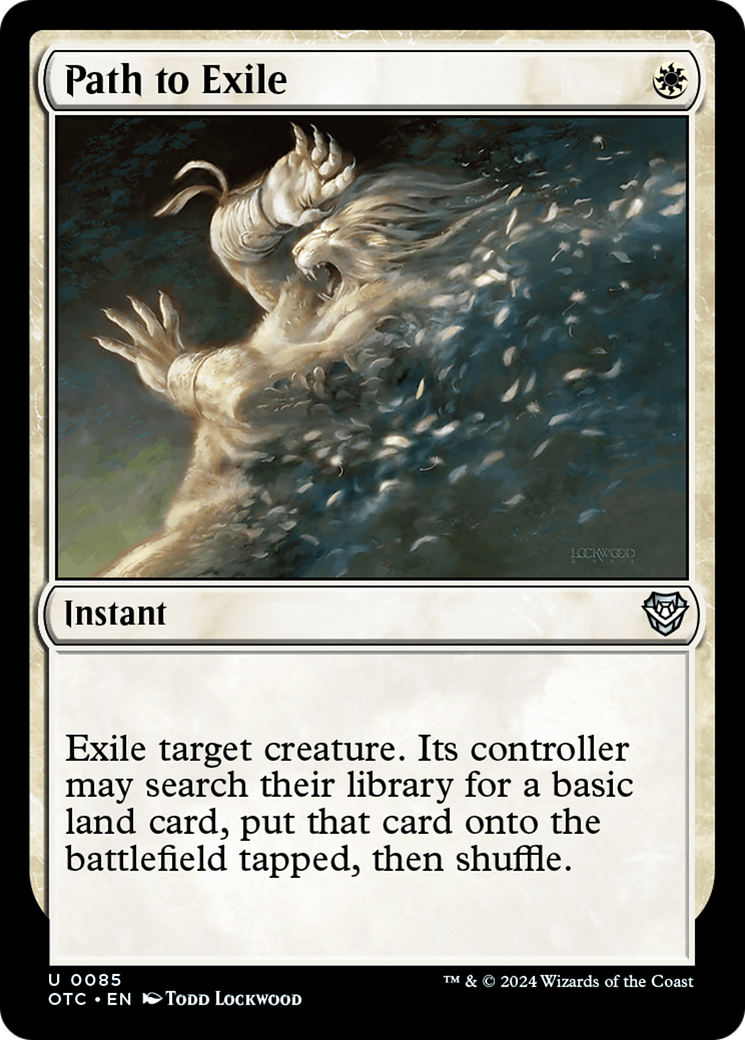
Path to Exile
Path to Exile
Instant
Exile target creature. Its controller may search their library for a basic land card, put that card onto the battlefield tapped, then shuffle.
- The controller of the exiled creature isn't required to search their library for a basic land. If that player doesn't, the player won't shuffle their library.
- If the target creature is an illegal target by the time Path to Exile tries to resolve, it won't resolve and none of its effects will happen. The creature's controller won't search for a basic land card.
-
1
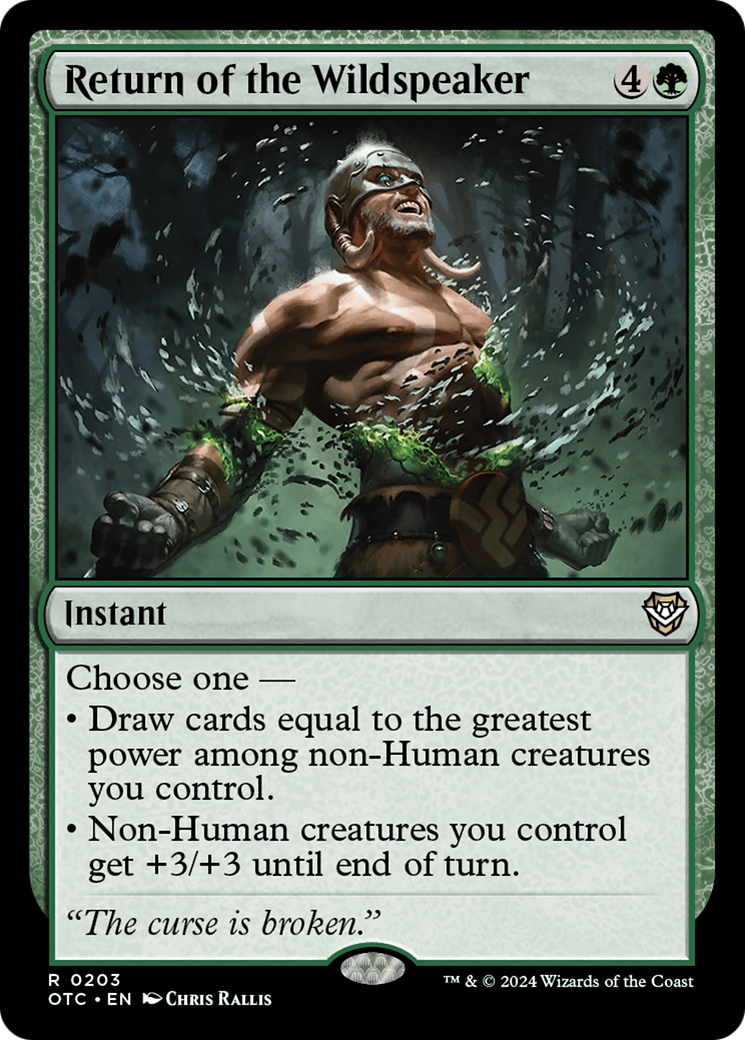
Return of the Wildspeaker
Return of the Wildspeaker
Instant
Choose one —
- Draw cards equal to the greatest power among non-Human creatures you control.
- Non-Human creatures you control get +3/+3 until end of turn.
-
1
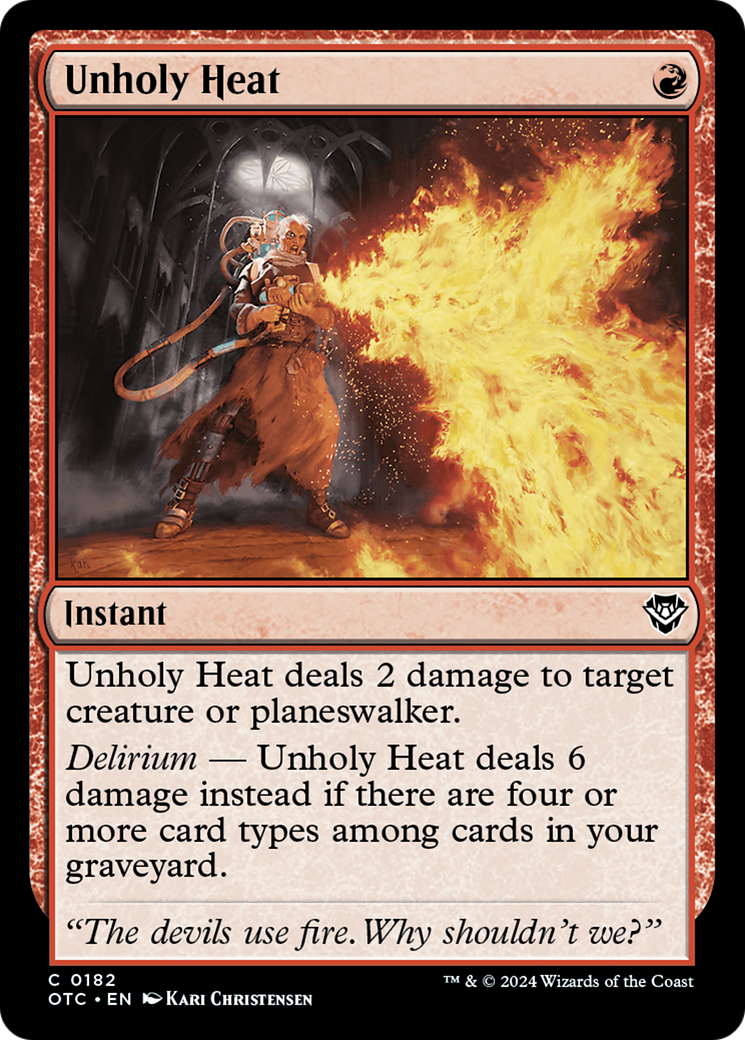
Unholy Heat
Unholy Heat
Instant
Unholy Heat deals 2 damage to target creature or planeswalker.
Delirium — Unholy Heat deals 6 damage instead if there are four or more card types among cards in your graveyard.
- Unholy Heat checks your graveyard as it resolves to determine if it deals 2 or 6 damage. At that time, Unholy Heat isn't in the graveyard yet.
- The card types that can appear in a graveyard are artifact, battle, creature, enchantment, instant, kindred, land, planeswalker, and sorcery. Legendary, basic, and snow are supertypes, not card types; Kavu and Equipment are subtypes, not card types.
-
1
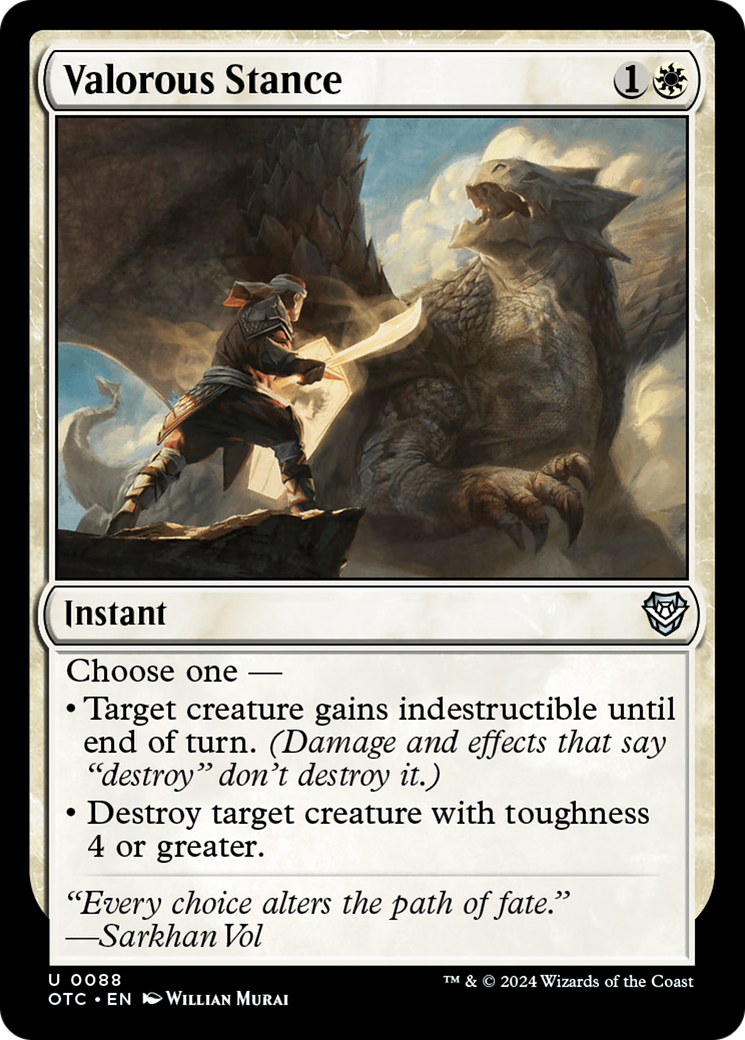
Valorous Stance
Valorous Stance
Instant
Choose one —
- Target creature gains indestructible until end of turn. (Damage and effects that say "destroy" don't destroy it.)
- Destroy target creature with toughness 4 or greater.
Sorceries 15
-
1
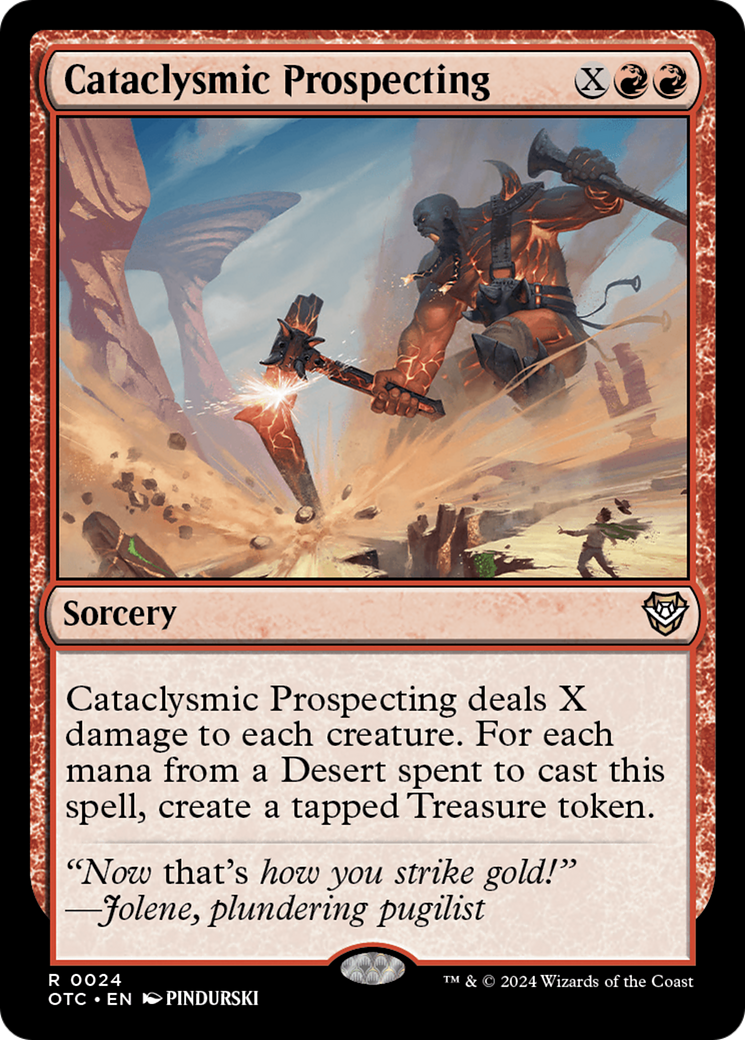
Cataclysmic Prospecting
Cataclysmic Prospecting
Sorcery
Cataclysmic Prospecting deals X damage to each creature. For each mana from a Desert spent to cast this spell, create a tapped Treasure token.
-
1
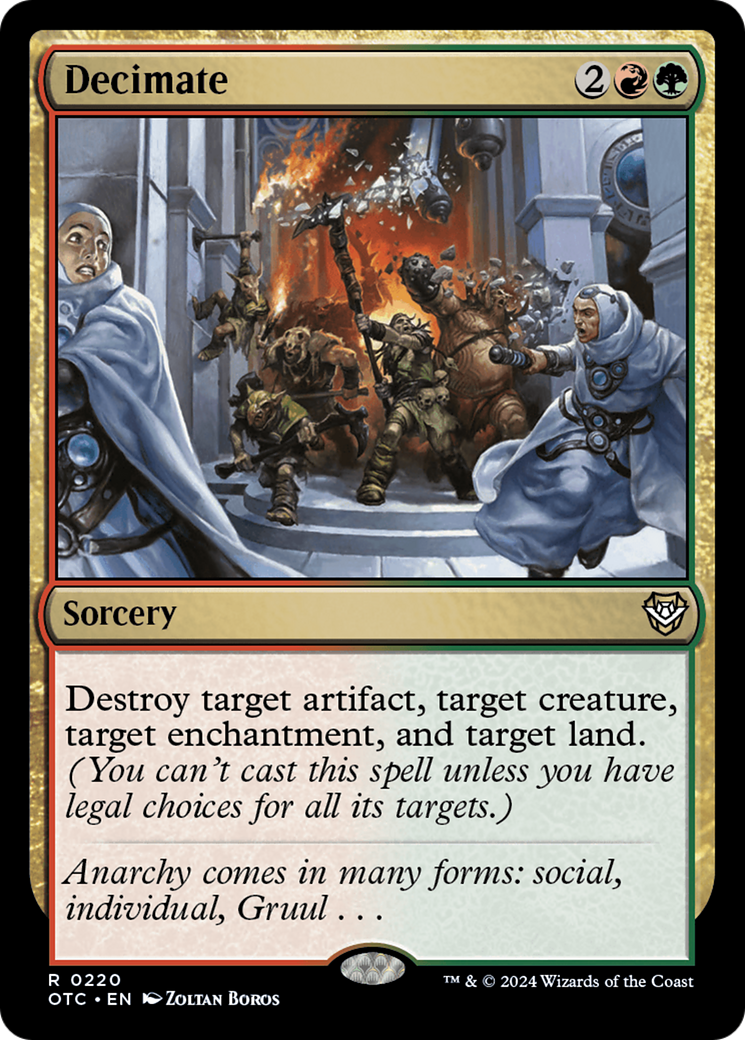
Decimate
Decimate
Sorcery
Destroy target artifact, target creature, target enchantment, and target land. (You can't cast this spell unless you have legal choices for all its targets.)
- You must choose a legal target for each target required by Decimate. However, if a permanent has multiple card types, it may be chosen as the target for more than one instance of the word "target." For example, you could cast Decimate targeting an artifact creature, an enchantment, and a land.
-
1
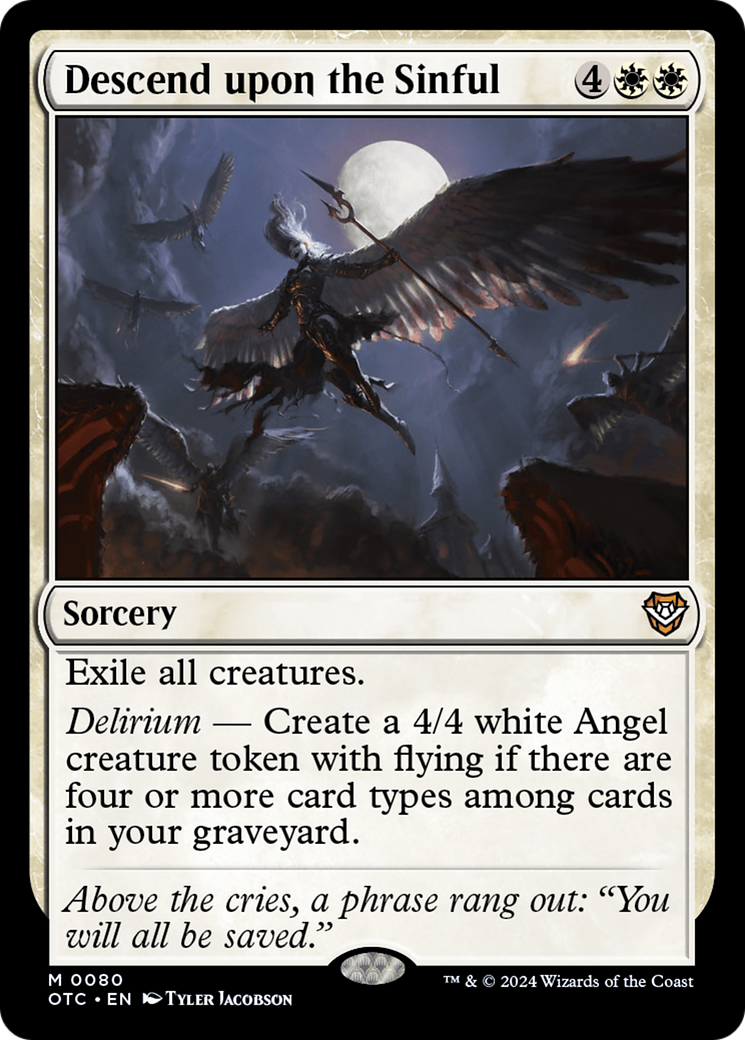
Descend upon the Sinful
Descend upon the Sinful
Sorcery
Exile all creatures.
Delirium — Create a 4/4 white Angel creature token with flying if there are four or more card types among cards in your graveyard.
- If you have three non-sorcery card types among cards in your graveyard at the time Descend upon the Sinful resolves, you won't get an Angel token. Descend upon the Sinful isn't put into your graveyard until after it's finished resolving.
- If one of those creatures was enchanted, its Aura won't be put into a player's graveyard until after Descend upon the Sinful has finished resolving. If the controller of Descend upon the Sinful owned the Aura, it won't be in the graveyard in time to be counted for the delirium ability.
- The card types in Magic are artifact, battle, creature, enchantment, instant, kindred, land, planeswalker, and sorcery. Supertypes (such as legendary and basic) and subtypes (such as Human and Equipment) are not counted.
- The number of card types matters, not the number of cards. For example, Wicker Witch (an artifact creature) along with Catalog (an instant) and Chaplain's Blessing (a sorcery) will enable delirium.
- Because you consider only the characteristics of a double-faced card's front face while it's not on the battlefield, the types of its back face won't be counted for delirium.
- In some rare cases, you can have a token or a copy of a spell in your graveyard at the moment that an object's delirium ability counts the card types among cards in your graveyard, before that token or copy ceases to exist. Because tokens and copies of spells are not cards, even if they are copies of cards, their types will never be counted.
-
1
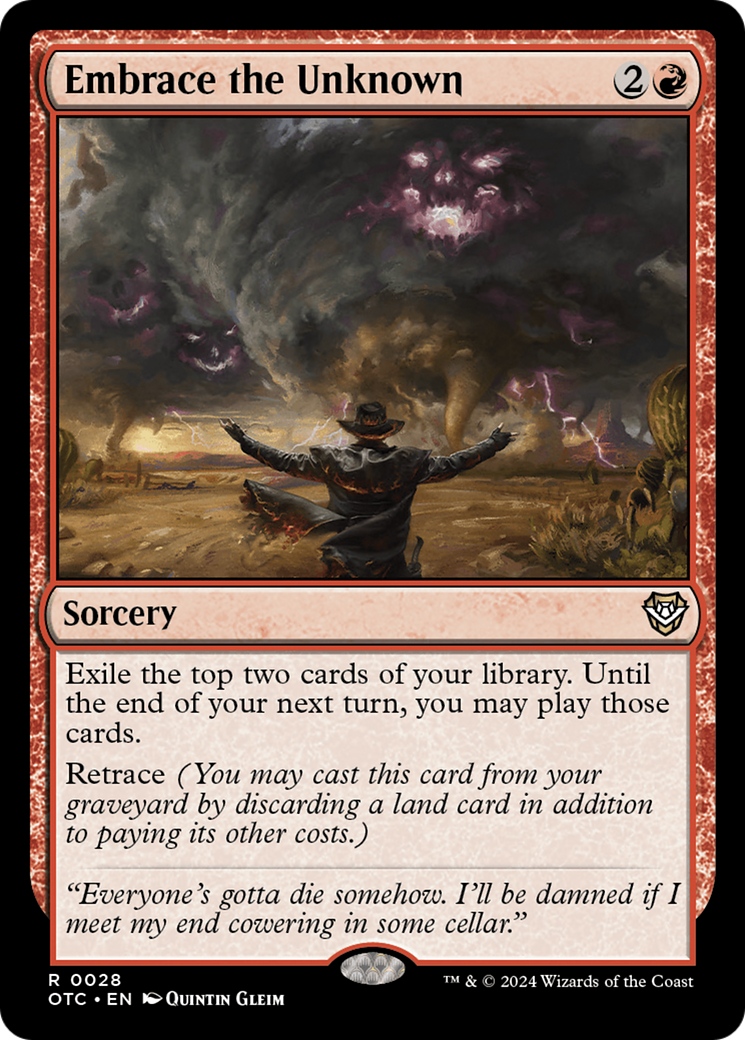
Embrace the Unknown
Embrace the Unknown
Sorcery
Exile the top two cards of your library. Until the end of your next turn, you may play those cards.
Retrace (You may cast this card from your graveyard by discarding a land card in addition to paying its other costs.)
- You pay all costs and follow all normal timing rules for cards played from exile this way. For example, if an exiled card is a land card, you may play it only during your main phase while the stack is empty.
- Casting a card by using its retrace ability works just like casting any other spell, with two exceptions: You’re casting it from your graveyard rather than your hand, and you must discard a land card in addition to any other costs.
- A retrace card cast from your graveyard follows the normal timing rules for its card type.
- When a retrace spell you cast from your graveyard resolves, fails to resolve, or is countered, it’s put back into your graveyard. You may use the retrace ability to cast it again.
- If the active player casts a spell that has retrace, that player may cast that card again after it resolves, before another player can remove the card from the graveyard. The active player has priority after the spell resolves, so they can immediately cast a new spell. Since casting a card with retrace from the graveyard moves that card onto the stack, no one else would have the chance to affect it while it’s still in the graveyard.
-
1
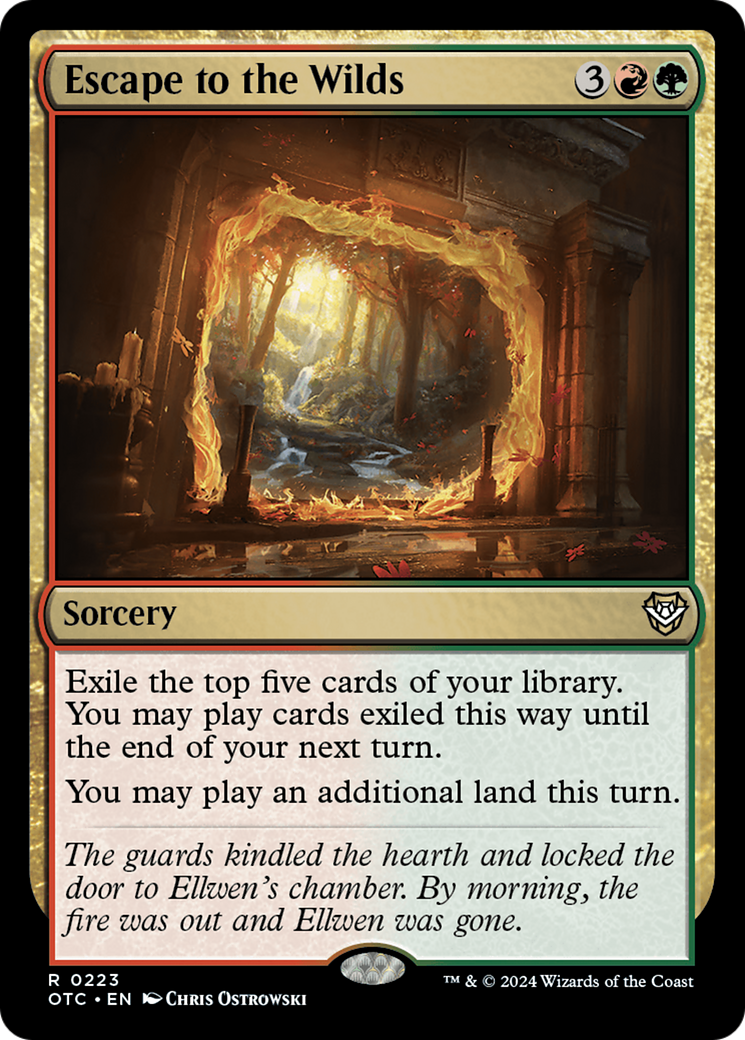
Escape to the Wilds
Escape to the Wilds
Sorcery
Exile the top five cards of your library. You may play cards exiled this way until the end of your next turn.
You may play an additional land this turn.
- Escape to the Wilds doesn't change when you can play the exiled cards. For example, if you exile a sorcery card, you can cast it only during your main phase when the stack is empty. If you exile a land card, you can play it only during your main phase and only if you have an available land play remaining.
- Casting an exiled card causes it to leave exile. You can't cast it multiple times.
- The additional land that you play doesn't have to be from among the exiled cards.
- If you don't play a card exiled this way, it remains in exile.
-
1
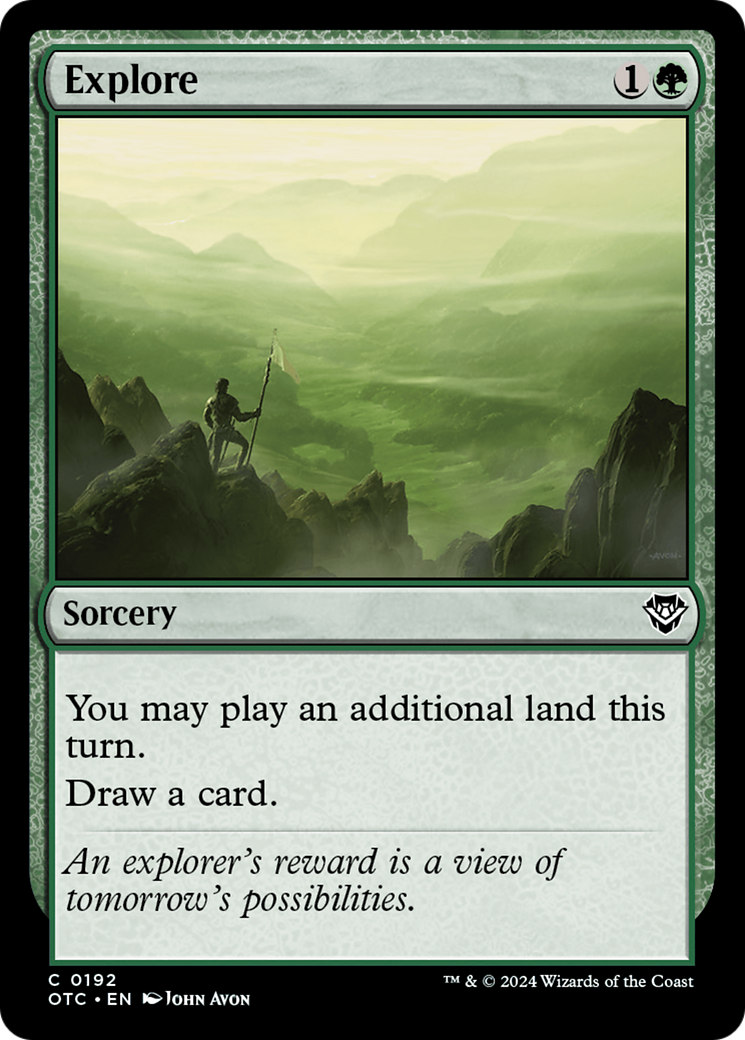
Explore
Explore
Sorcery
You may play an additional land this turn.
Draw a card.
- The effects of multiple Explores in the same turn are cumulative. They're also cumulative with other effects that let you play additional lands, such as the one from Urban Evolution.
- Explore's effect allows you to play an additional land during your main phase. Doing so follows the normal timing rules for playing lands. In particular, you don't get to play a land as Explore resolves; Explore fully resolves first and you draw a card, perhaps a land you'll play later.
- If you somehow manage to cast Explore when it's not your turn, you'll draw a card when it resolves, but you won't be able to play a land that turn.
-
1
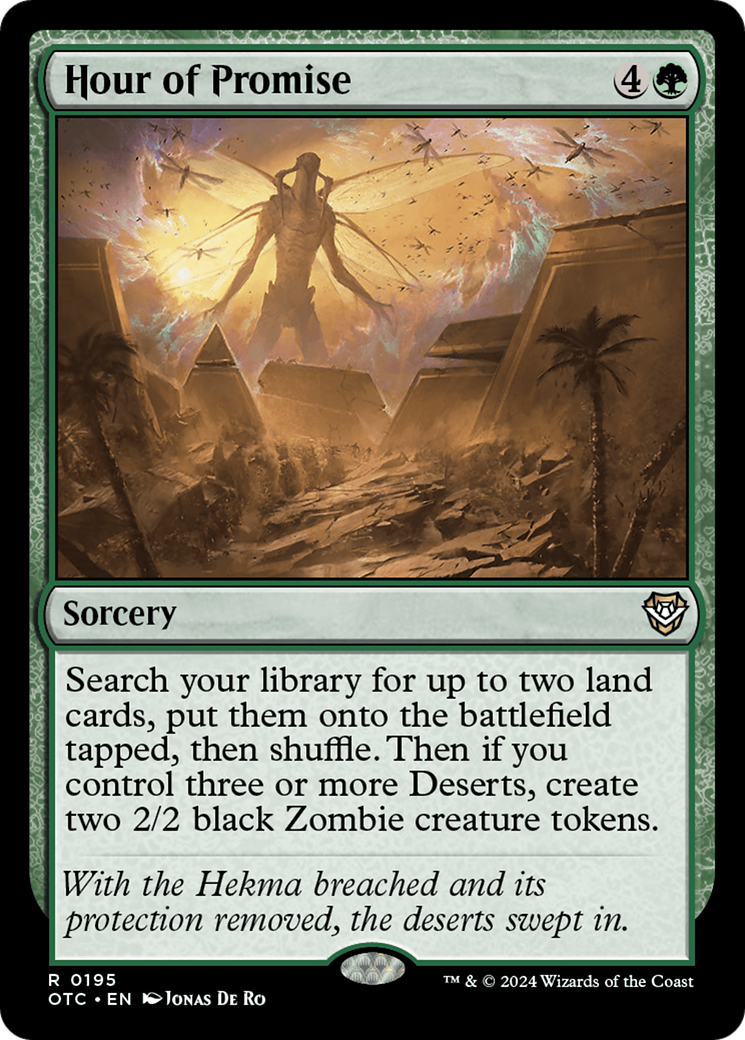
Hour of Promise
Hour of Promise
Sorcery
Search your library for up to two land cards, put them onto the battlefield tapped, then shuffle. Then if you control three or more Deserts, create two 2/2 black Zombie creature tokens.
- There are many important moments in the story, but the most crucial—called "story spotlights"—are shown on cards. These cards have the Planeswalker symbol in their text box; this symbol has no effect on gameplay. You can read more about these events in the official Magic fiction at http://www.mtgstory.com.
- When Hour of Promise checks the number of Deserts you control, it includes any Deserts you found earlier with Hour of Promise.
-
1
Magmatic Insight
Magmatic Insight
Sorcery
As an additional cost to cast this spell, discard a land card.
Draw two cards.
- You must discard exactly one land card to cast Magmatic Insight. You can't cast it without discarding a land card, and you can't discard additional cards.
-
1
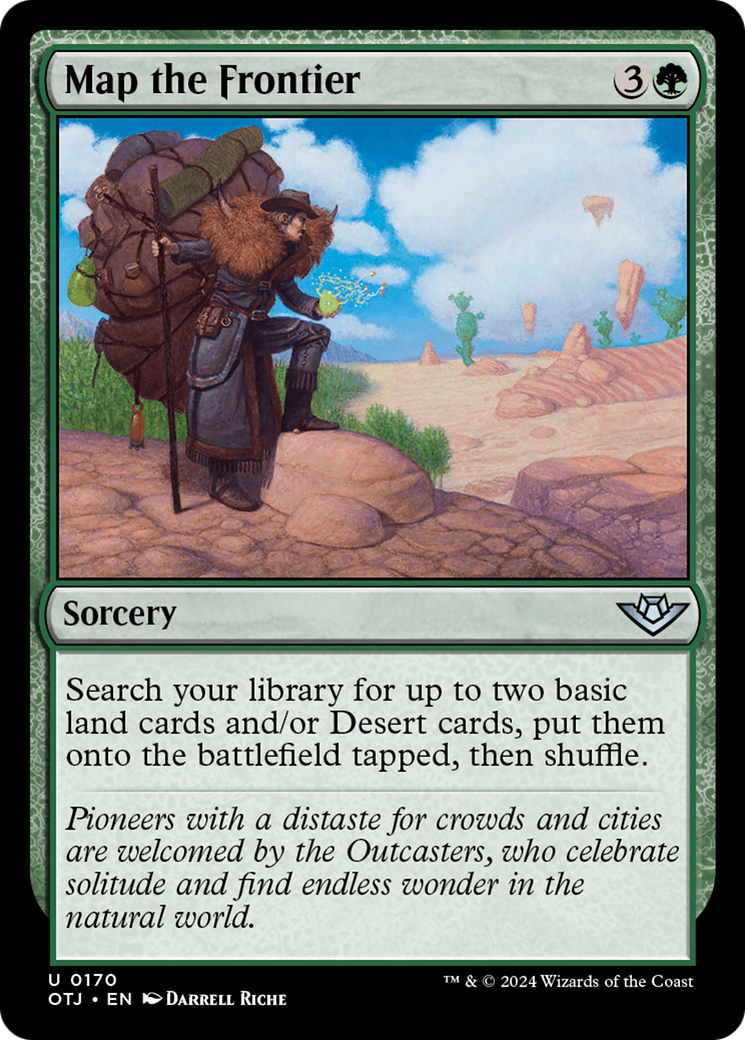
Map the Frontier
Map the Frontier
Sorcery
Search your library for up to two basic land cards and/or Desert cards, put them onto the battlefield tapped, then shuffle.
-
1
Requisition Raid
Requisition Raid
Sorcery
Spree (Choose one or more additional costs.)
+ — Destroy target artifact.
+ — Destroy target enchantment.
+ — Put a +1/+1 counter on each creature target player controls.
- Spells with spree have a + (plus sign) indicator in the upper right corner of the card frame. This has no rules meaning and serves only to remind players that at least one additional cost is required to cast the spell.
- If a mode requires a target, you can select that mode only if there's a legal target available. Ignore the targeting requirements for modes you don't choose.
- Each additional cost and associated mode in the text box is also preceded with a + indicator. These symbols also have no rules meaning and serve only to remind players that the listed costs are additional costs.
- No matter which modes you choose, you always follow the instructions in the order they are written.
- You must choose at least one of the listed modes and pay its associated additional cost in order to cast a spell with spree.
- The mana value of a spell with spree is determined only by its mana cost (in the upper right corner of the card). It doesn't matter which modes you choose or which additional costs you pay, including any additional costs imposed by other effects.
- No player can cast spells or activate abilities in between the modes of a resolving spell. Any abilities that trigger won't be put onto the stack until the spell is done resolving.
- You choose the modes as you cast the spell with spree. Once modes are chosen, they can't be changed.
- You can't choose the same mode more than once.
- If a spell with spree is copied, the effect that creates the copy may allow you to choose new targets. You cannot choose new modes.
- If all targets for the chosen modes become illegal before a spell with spree resolves, the spell won't resolve and none of its effects will happen. If at least one target is still legal, the spell will resolve but will have no effect on any illegal targets.
- If an effect allows you to cast a spell with spree "without paying its mana cost," you must still choose at least one mode and pay the associated additional costs.
-
1
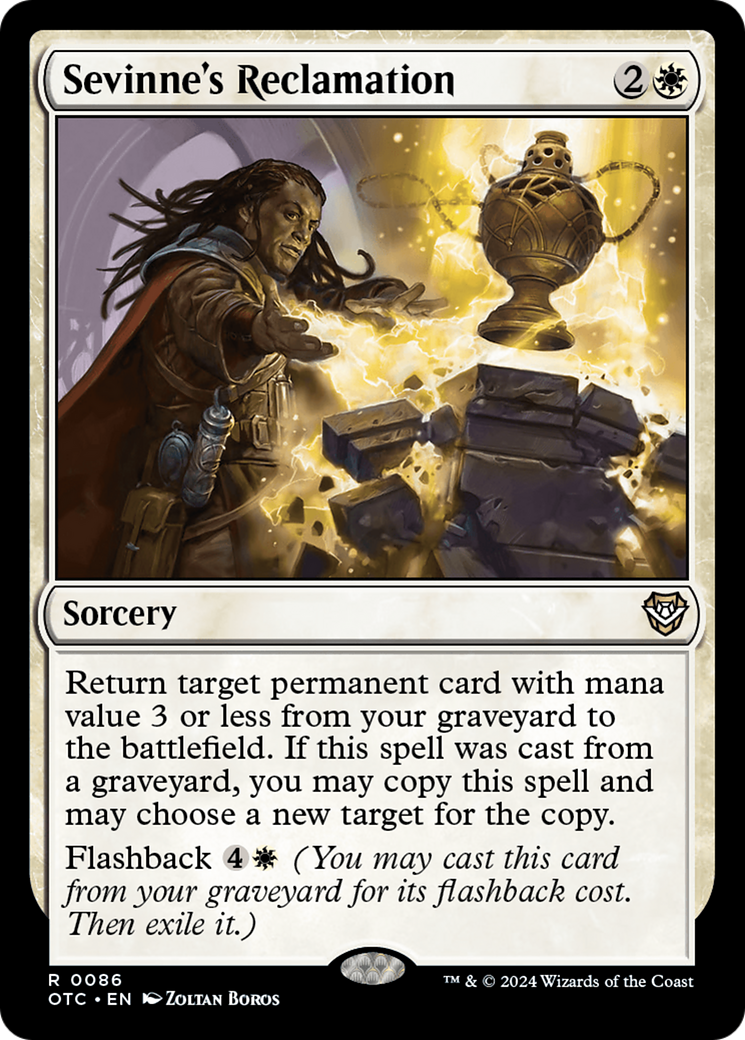
Sevinne's Reclamation
Sevinne's Reclamation
Sorcery
Return target permanent card with mana value 3 or less from your graveyard to the battlefield. If this spell was cast from a graveyard, you may copy this spell and may choose a new target for the copy.
Flashback (You may cast this card from your graveyard for its flashback cost. Then exile it.)
- A spell cast using flashback will always be exiled afterward, whether it resolves, is countered, or leaves the stack in some other way.
- You can cast a spell using flashback even if it was somehow put into your graveyard without having been cast.
- To determine the total cost of a spell, start with the mana cost or alternative cost (such as a flashback cost) you're paying, add any cost increases, then apply any cost reductions. The mana value of the spell is determined only by its mana cost, no matter what the total cost to cast the spell was.
- You must still follow any timing restrictions and permissions, including those based on the card's type. For instance, you can cast a sorcery using flashback only when you could normally cast a sorcery.
- "Flashback [cost]" means "You may cast this card from your graveyard if the resulting spell is an instant or sorcery spell by paying [cost] rather than paying its mana cost" and "If the flashback cost was paid, exile this card instead of putting it anywhere else any time it would leave the stack."
- If a card with flashback is put into your graveyard during your turn, you can cast it if it's legal to do so before any other player can take any actions.
- A permanent card is an artifact, battle, creature, enchantment, land, or planeswalker card.
- The copy that Sevinne's Reclamation creates is created on the stack, so it's not "cast." Abilities that trigger when a player casts a spell won't trigger. The copy wasn't cast from a graveyard, so it won't make another copy of itself.
- If you cast Sevinne's Reclamation from your graveyard, any abilities that trigger as the permanent card returns to the battlefield will resolve before the copy of Sevinne's Reclamation resolves but after new targets for the copy have been chosen.
- If a card in a graveyard has in its mana cost, X is considered to be 0.
- If the target card is an illegal target by the time Sevinne's Reclamation tries to resolve, the spell doesn't resolve. You won't copy it if you cast it from a graveyard.
-
1
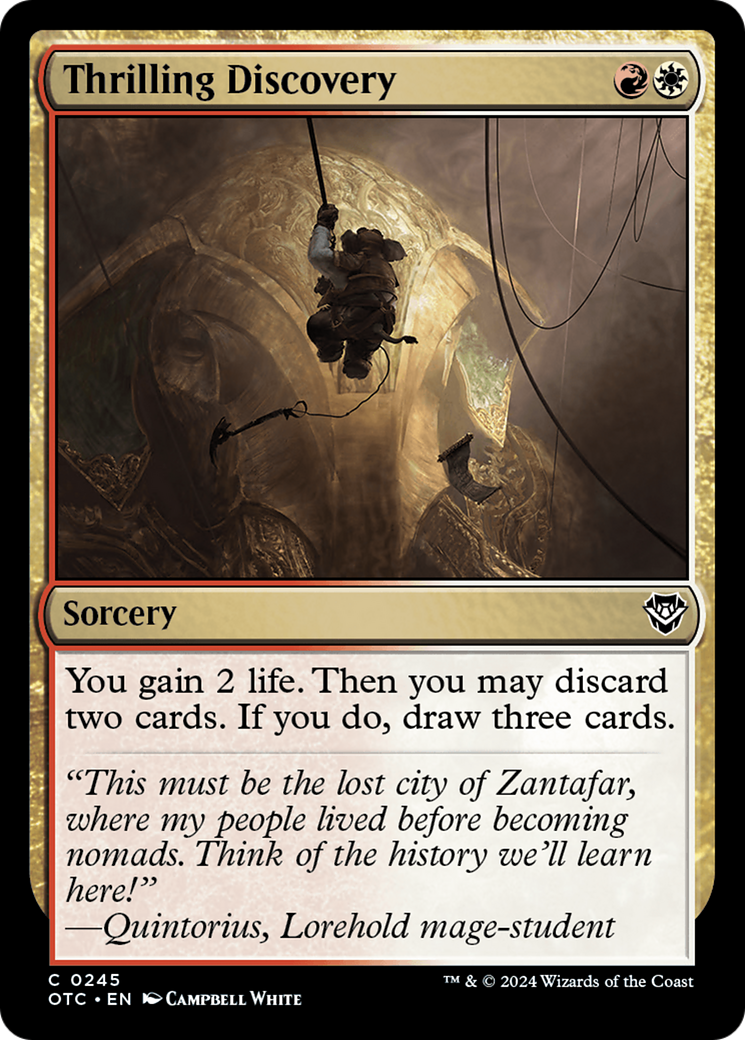
Thrilling Discovery
Thrilling Discovery
Sorcery
You gain 2 life. Then you may discard two cards. If you do, draw three cards.
-
1
Vengeful Regrowth
Vengeful Regrowth
Sorcery
Return up to three target land cards from your graveyard to the battlefield tapped. Create that many 4/2 green Plant Warrior creature tokens with reach.
Flashback (You may cast this card from your graveyard for its flashback cost. Then exile it.)
- The number of Plant Warrior tokens created is equal to the number of land cards returned from your graveyard to the battlefield by Vengeful Regrowth. For example, if you cast Vengeful Regrowth targeting three Forest cards in your graveyard but two of those Forest cards are exiled in response, you’ll return the remaining Forest card and create one Plant Warrior token.
-
1
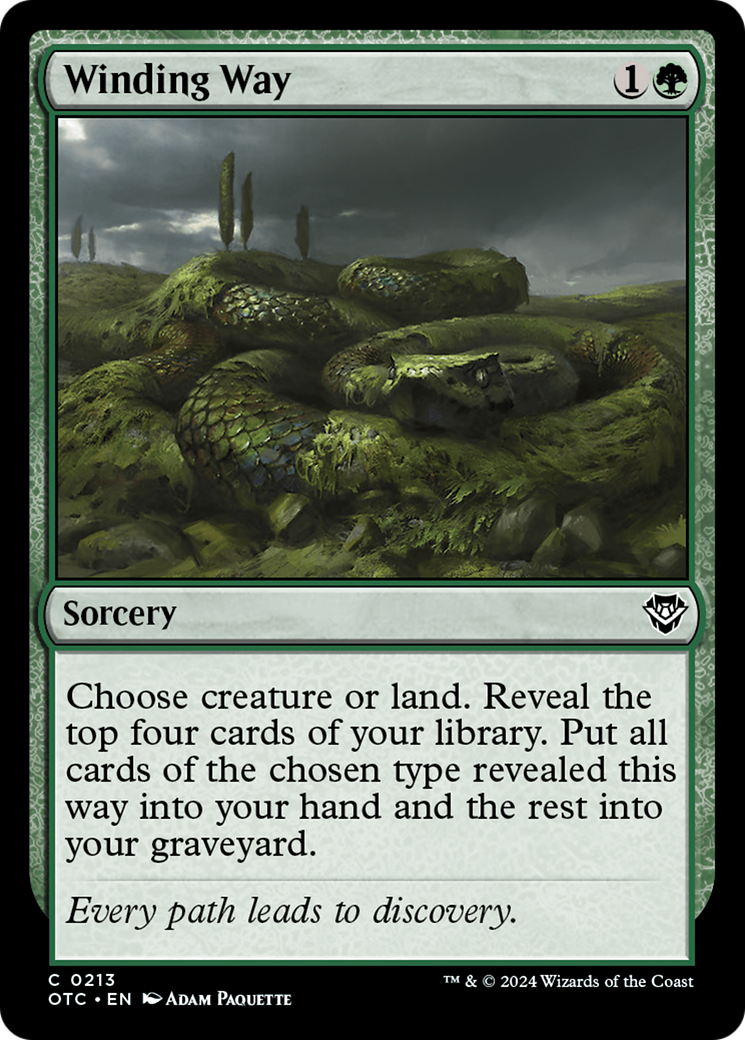
Winding Way
Winding Way
Sorcery
Choose creature or land. Reveal the top four cards of your library. Put all cards of the chosen type revealed this way into your hand and the rest into your graveyard.
-
1
Wreck and Rebuild
Wreck and Rebuild
Sorcery
Choose one —
- Destroy target artifact or enchantment.
- Mill five cards, then you may put a land card from your graveyard onto the battlefield tapped.
Flashback
- "Flashback [cost]" means "You may cast this card from your graveyard by paying [cost] rather than paying its mana cost" and "If the flashback cost was paid, exile this card instead of putting it anywhere else any time it would leave the stack."
- You must still follow any timing restrictions and permissions, including those based on the card's type. For instance, you can cast a sorcery using flashback only when you could normally cast a sorcery.
- To determine the total cost of a spell, start with the mana cost or alternative cost (such as a flashback cost) you're paying, add any cost increases, then apply any cost reductions. The mana value of the spell is determined only by its mana cost, no matter what the total cost to cast the spell was.
- A spell cast using flashback will always be exiled afterward, whether it resolves, is countered, or leaves the stack in some other way.
- You can cast a spell using flashback even if it was somehow put into your graveyard without having been cast.
- If a card with flashback is put into your graveyard during your turn, you can cast it if it's legal to do so before any other player can take any actions.
Artifacts 5
-
1
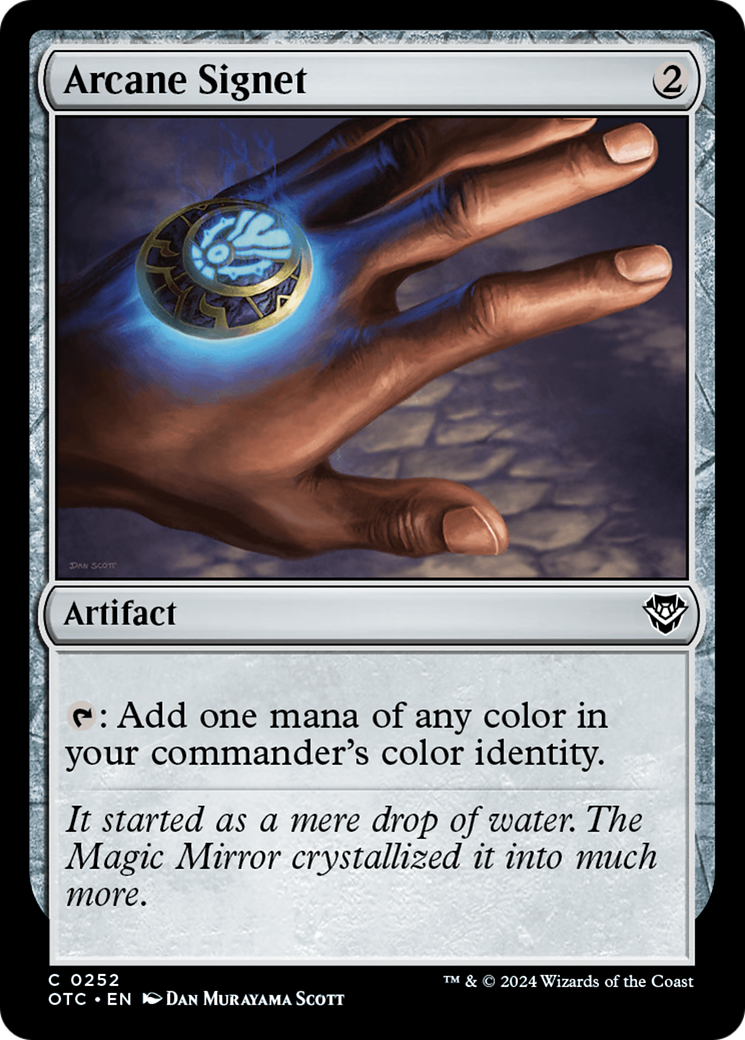
Arcane Signet
Arcane Signet
Artifact
: Add one mana of any color in your commander's color identity.
- If your commander is a card that has no colors in its color identity, Arcane Signet's ability produces no mana. It doesn't produce .
- If you have two commanders, the ability adds one mana of any color in their combined color identities.
- If you don't have a commander, Arcane Signet's ability produces no mana.
-
1
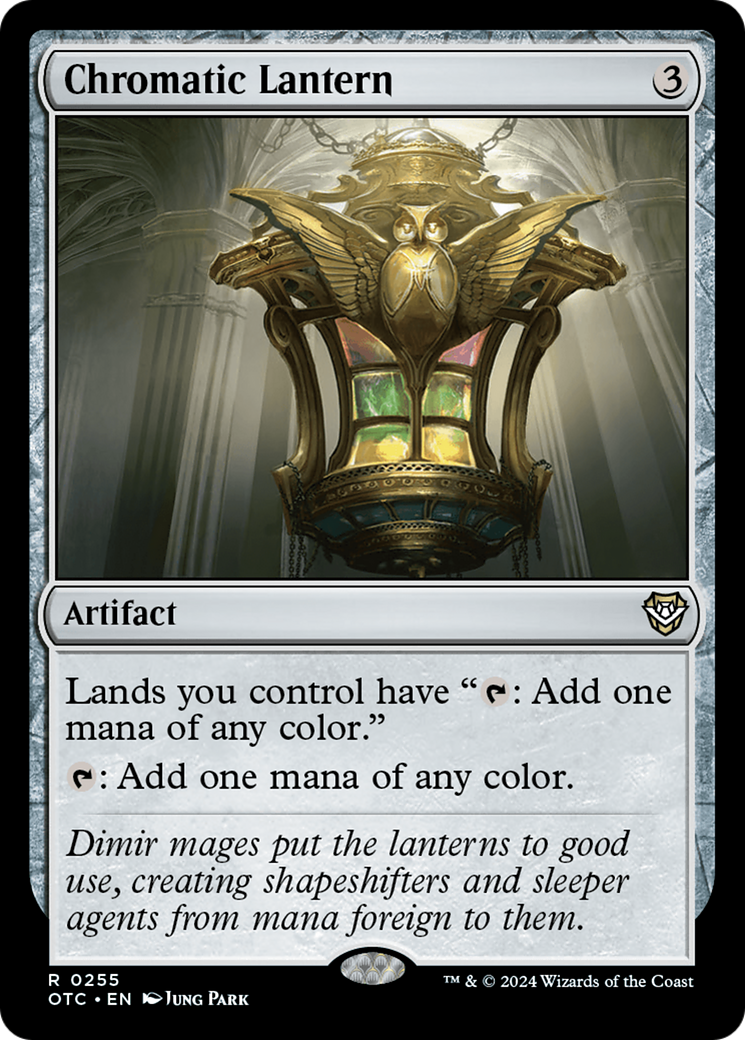
Chromatic Lantern
Chromatic Lantern
Artifact
Lands you control have " : Add one mana of any color."
: Add one mana of any color.
- Lands you control won't lose any other abilities they had. They also won't gain or lose any land types.
-
1
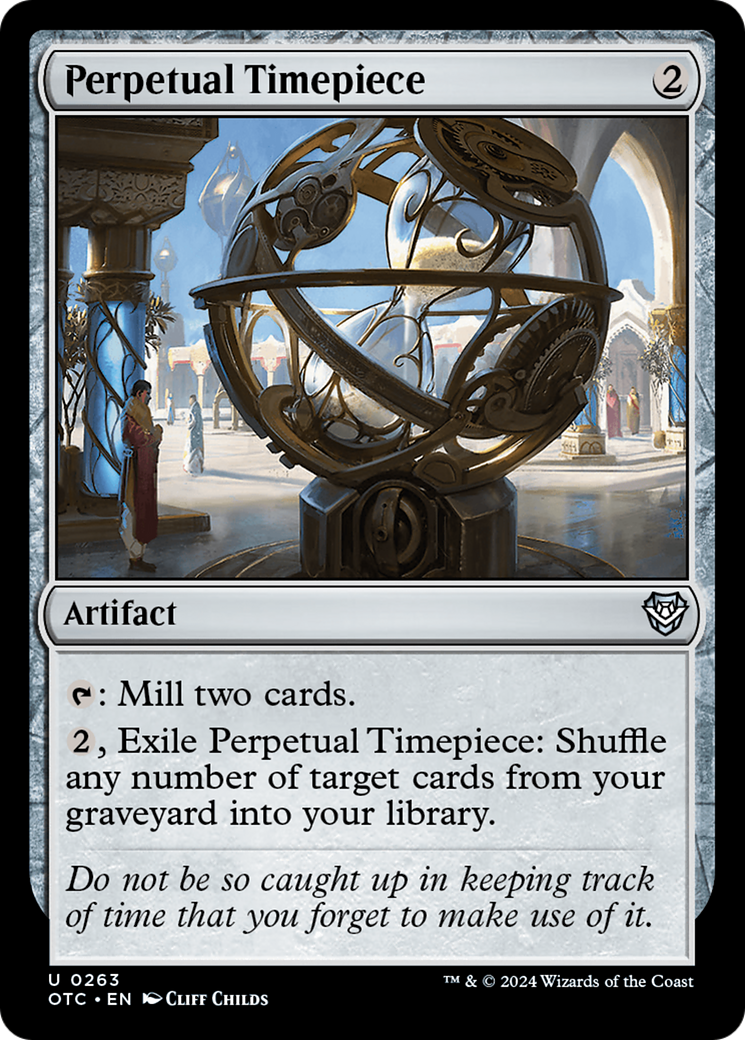
Perpetual Timepiece
Perpetual Timepiece
Artifact
: Mill two cards. (Put the top two cards of your library into your graveyard.)
, Exile this artifact: Shuffle any number of target cards from your graveyard into your library.
- You can activate Perpetual Timepiece's second ability with no targets just to shuffle your library. If you choose any targets and they all become illegal targets, the ability won't resolve and you won't shuffle your library.
-
1
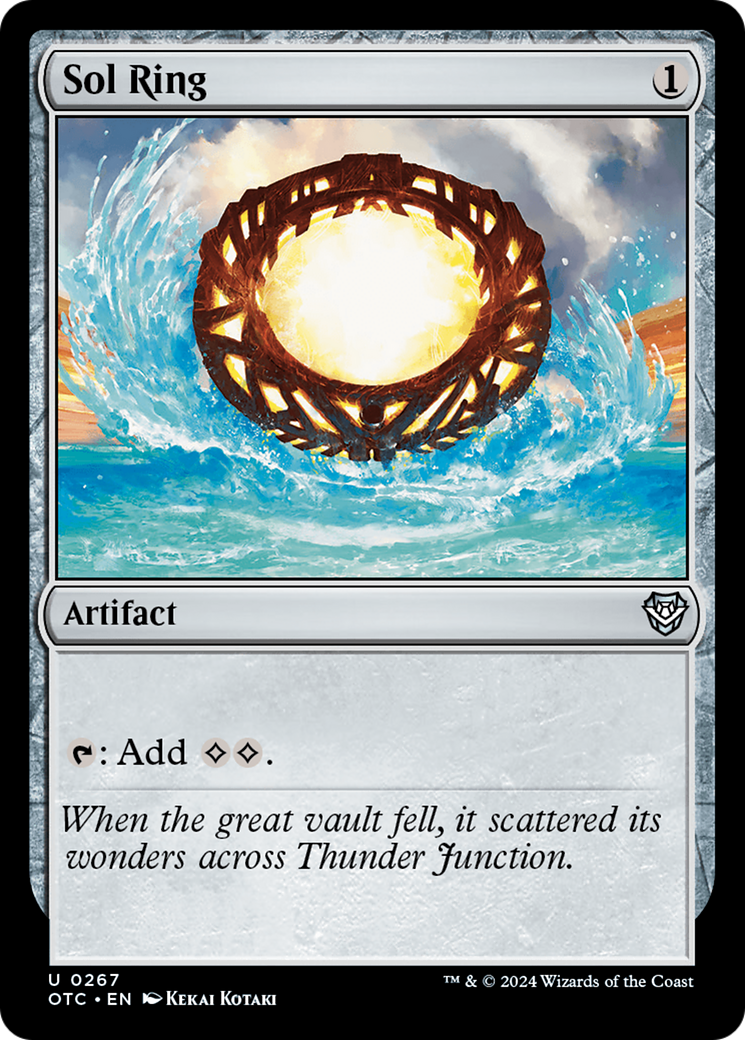
Sol Ring
Sol Ring
Artifact
: Add .
-
1
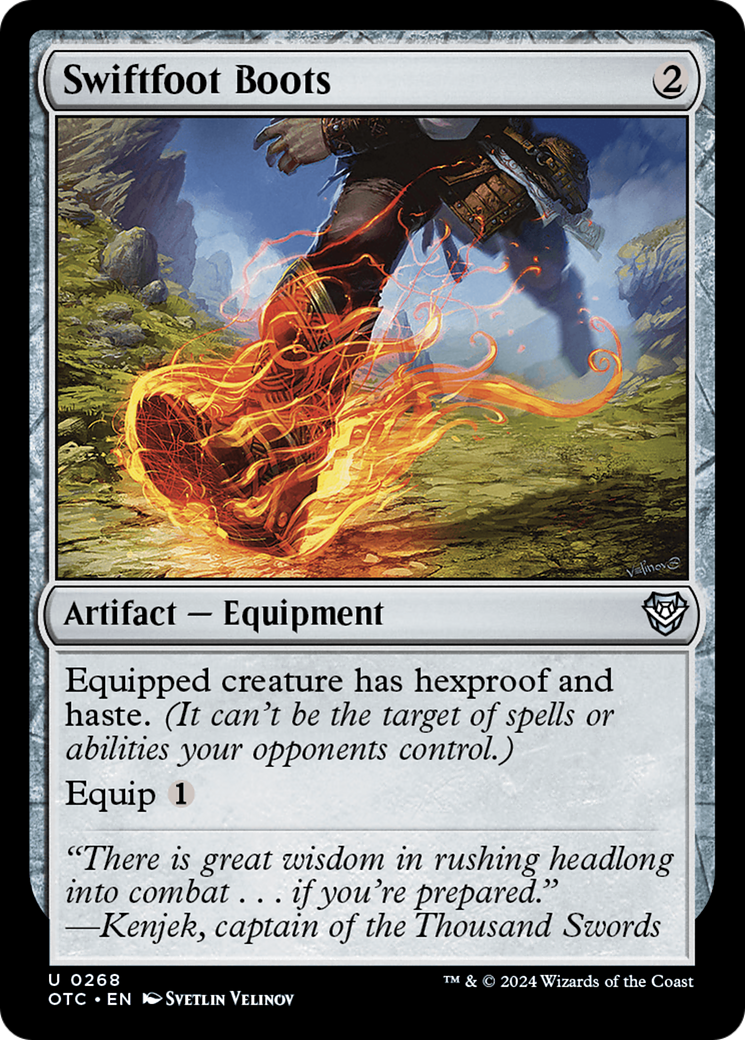
Swiftfoot Boots
Swiftfoot Boots
Artifact — Equipment
Equipped creature has hexproof and haste. (It can't be the target of spells or abilities your opponents control. It can attack and no matter when it came under your control.)
Equip ( : Attach to target creature you control. Equip only as a sorcery.)
- If a creature enters the battlefield under your control and gains haste, but then loses it before attacking, it won't be able to attack that turn. This means that you can't use one Swiftfoot Boots to allow two new creatures to attack in the same turn.
Enchantments 4
-
1
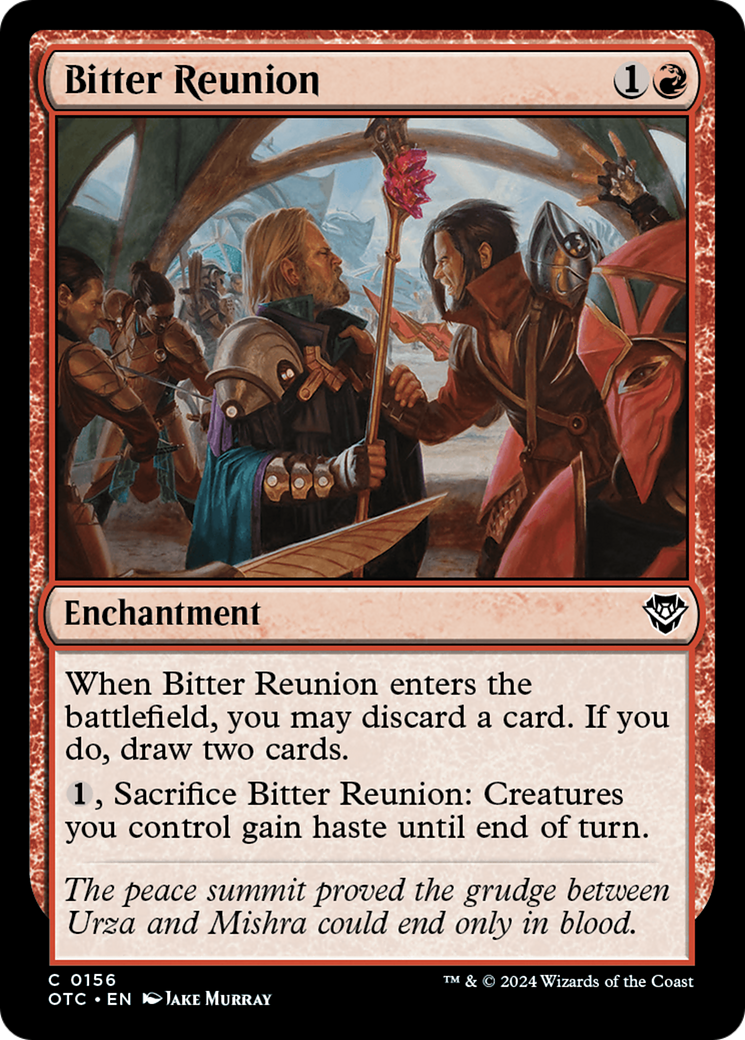
Bitter Reunion
Bitter Reunion
Enchantment
When this enchantment enters, you may discard a card. If you do, draw two cards.
, Sacrifice this enchantment: Creatures you control gain haste until end of turn.
-
1
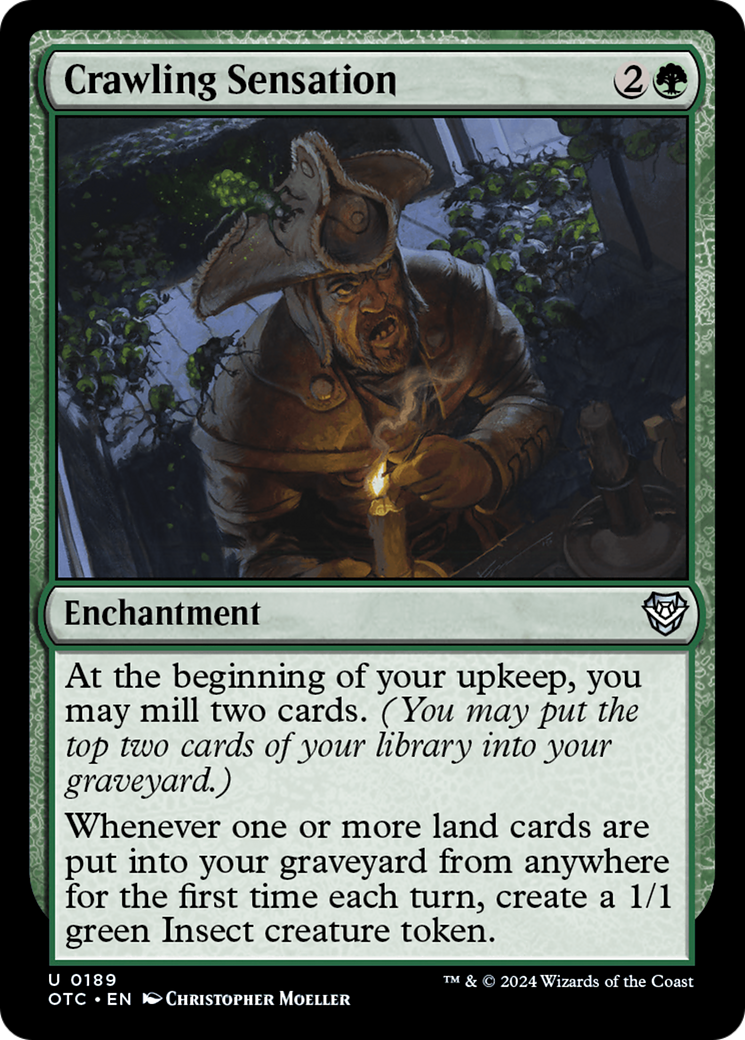
Crawling Sensation
Crawling Sensation
Enchantment
At the beginning of your upkeep, you may mill two cards. (You may put the top two cards of your library into your graveyard.)
Whenever one or more land cards are put into your graveyard from anywhere for the first time each turn, create a 1/1 green Insect creature token.
- If multiple land cards are put into your graveyard at once, Crawling Sensation's last ability triggers only once. This could happen because an effect (such as that of Crawling Sensation's first ability) put them there from your library at once, or because they were destroyed at the same time (such as two land creatures that were dealt lethal combat damage).
-
1
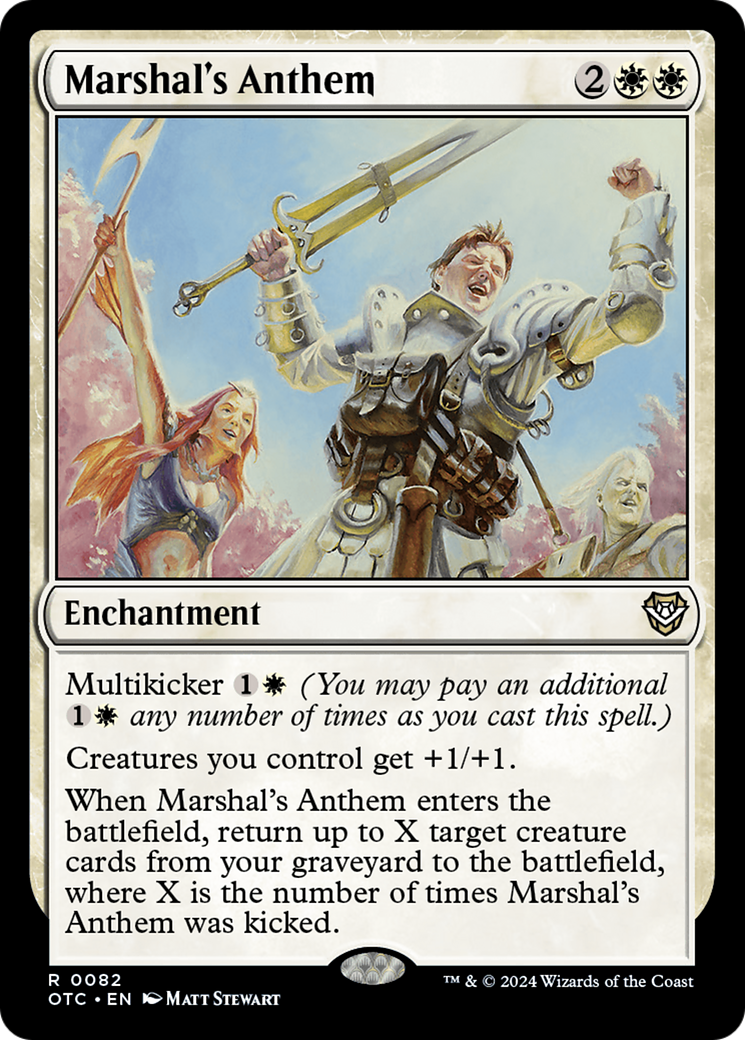
Marshal's Anthem
Marshal's Anthem
Enchantment
Multikicker (You may pay an additional any number of times as you cast this spell.)
Creatures you control get +1/+1.
When this enchantment enters, return up to X target creature cards from your graveyard to the battlefield, where X is the number of times this enchantment was kicked.
- If a spell's kicker cost was paid, the spell is "kicked."
- The kicker ability doesn't let you pay a kicker cost more than once.
- If you put a permanent with a kicker ability onto the battlefield without casting it, you can't kick it.
- If you copy a kicked spell on the stack, the copy is also kicked. If the copied spell is a permanent spell, the token the copy of that spell becomes when it enters is also kicked.
- If a card or token enters as a copy of a permanent, the new permanent isn't kicked, even if the original was.
- To determine a spell's total cost, start with the mana cost (or an alternative cost if another card's effect allows you to pay one instead), add any cost increases (such as kicker), then apply any cost reductions. The spell's mana value remains unchanged, no matter what the total cost to cast it was.
-
1
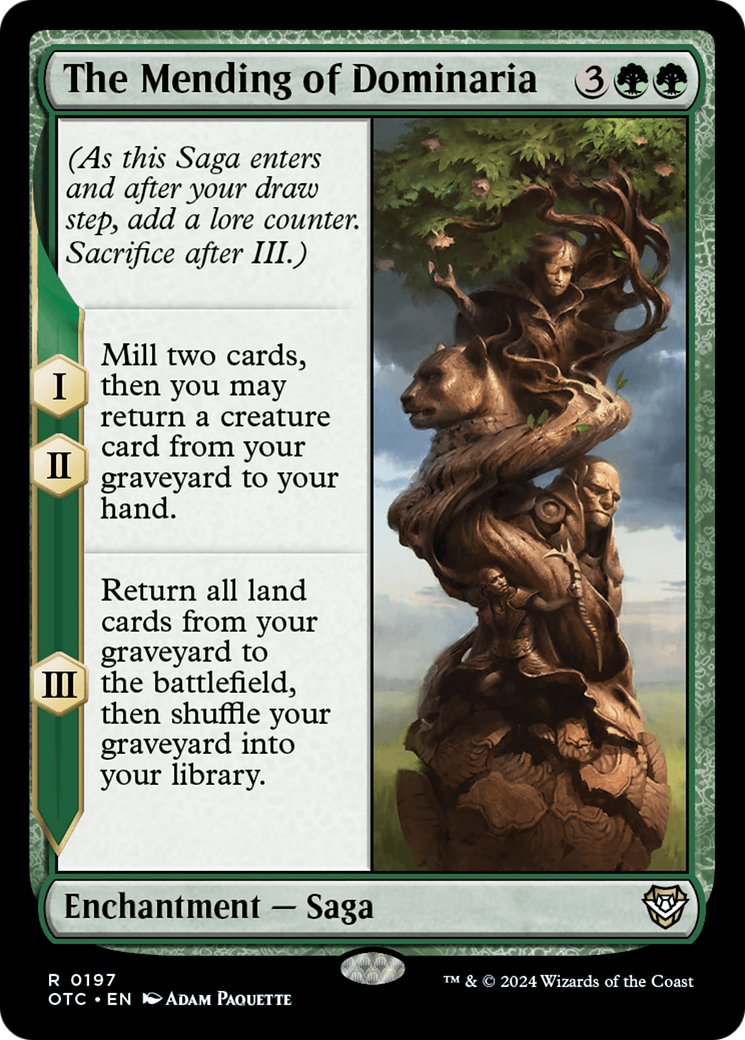
The Mending of Dominaria
The Mending of Dominaria
Enchantment — Saga
(As this Saga enters and after your draw step, add a lore counter. Sacrifice after III.)
I, II — Mill two cards, then you may return a creature card from your graveyard to your hand.
III — Return all land cards from your graveyard to the battlefield, then shuffle your graveyard into your library.
- As a Saga enters the battlefield, its controller puts a lore counter on it. As your precombat main phase begins (immediately after your draw step), you put another lore counter on each Saga you control. Putting a lore counter on a Saga in either of these ways doesn't use the stack.
- Each symbol on the left of a Saga's text box represents a chapter ability. A chapter ability is a triggered ability that triggers when a lore counter that is put on the Saga causes the number of lore counters on the Saga to become equal to or greater than the ability's chapter number. Chapter abilities are put onto the stack and may be responded to.
- A chapter ability doesn't trigger if a lore counter is put on a Saga that already had a number of lore counters greater than or equal to that chapter's number. For example, the third lore counter put on a Saga causes the III chapter ability to trigger, but I and II won't trigger again.
- Once a chapter ability has triggered, the ability on the stack won't be affected if the Saga gains or loses counters, or if it leaves the battlefield.
- If multiple chapter abilities trigger at the same time, their controller puts them on the stack in any order. If any of them require targets, those targets are chosen as you put the abilities on the stack, before any of those abilities resolve.
- If counters are removed from a Saga, the appropriate chapter abilities will trigger again when the Saga receives lore counters. Removing lore counters won't cause a previous chapter ability to trigger.
- Once the number of lore counters on a Saga is greater than or equal to the greatest number among its chapter abilities—in the Dominaria set, this is always three—the Saga's controller sacrifices it as soon as its chapter ability has left the stack, most likely by resolving or being countered. This state-based action doesn't use the stack.
Lands 40
-
1
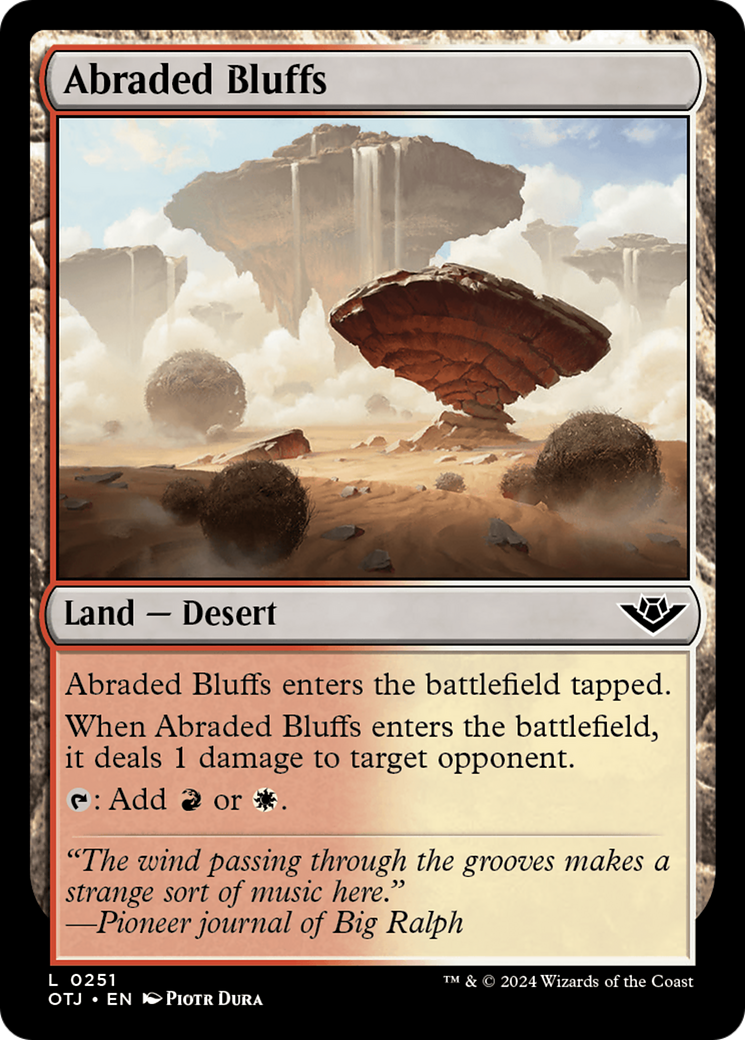
Abraded Bluffs
Abraded Bluffs
Land — Desert
This land enters tapped.
When this land enters, it deals 1 damage to target opponent.
: Add or .
-
1
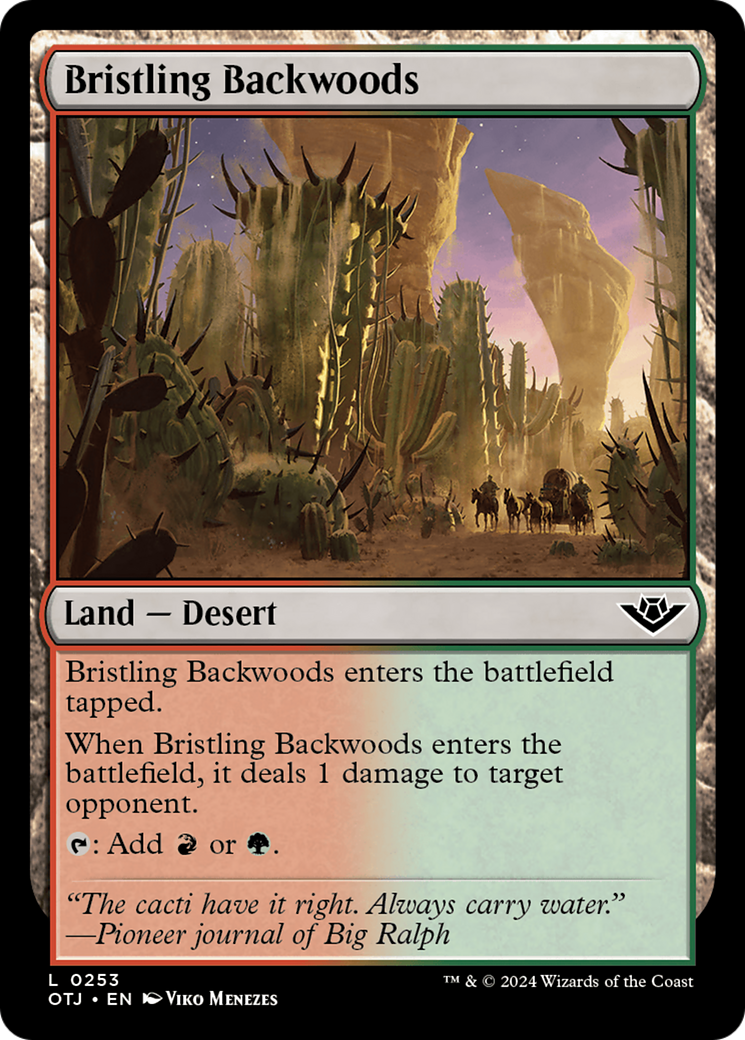
Bristling Backwoods
Bristling Backwoods
Land — Desert
This land enters tapped.
When this land enters, it deals 1 damage to target opponent.
: Add or .
-
1
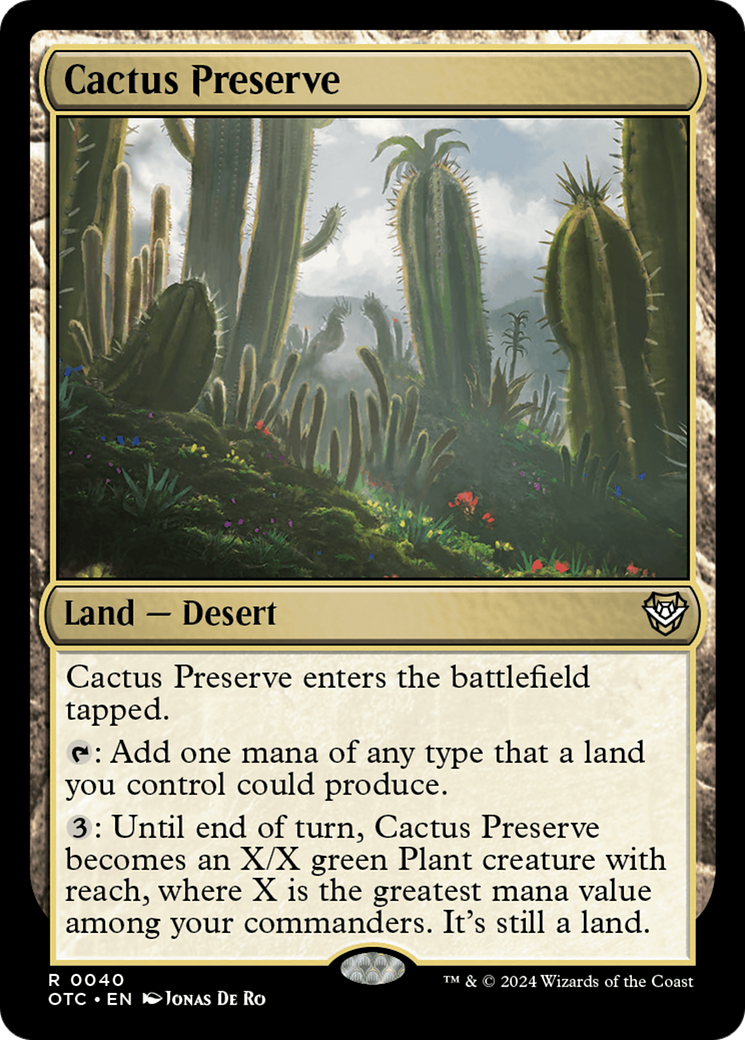
Cactus Preserve
Cactus Preserve
Land — Desert
This land enters tapped.
: Add one mana of any type that a land you control could produce.
: Until end of turn, this land becomes an X/X green Plant creature with reach, where X is the greatest mana value among your commanders. It's still a land.
- The types of mana are white, blue, black, red, green, and colorless.
- Any change to a land’s type or abilities gained by a land can affect the types of mana a land can produce.
- Cactus Preserve’s second ability checks the effects of all mana-producing abilities of lands you control, but it doesn’t check their costs or legality. For example, Spire of Industry says “ , Pay 1 life: Add one mana of any color. Activate only if you control an artifact.” If you control Spire of Industry and Cactus Preserve, you can tap Cactus Preserve for any color of mana. It doesn’t matter whether you control an artifact, whether you can pay 1 life, or whether Spire of Industry is untapped.
- Cactus Preserve doesn’t care about any restrictions or riders your lands put on the mana they produce, such as that of Bucolic Ranch or the ability granted by Discreet Retreat. It just produces one mana of the appropriate type, with no restrictions or riders.
- If Cactus Preserve becomes a creature but you haven’t controlled it continuously since your most recent turn began, you won’t be able to activate its mana ability or attack with it that turn.
- It doesn’t matter where your commander is (or commanders are, if you have more than one because of the partner ability or similar). The value of X will be calculated using your commander’s current characteristics. (Mana value typically doesn’t change, but your commander may become a copy of something else.)
- Desert is a land subtype with no special meaning. It doesn’t grant the land an intrinsic mana ability. Other cards may care about which lands are Deserts.
-
1
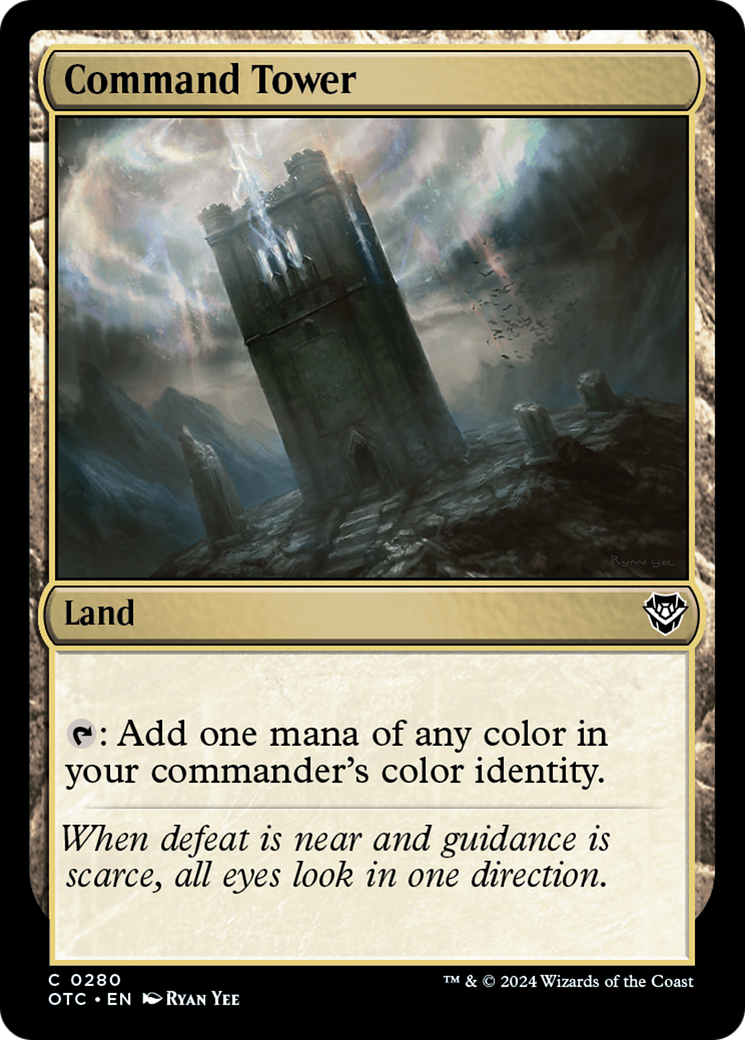
Command Tower
Command Tower
Land
: Add one mana of any color in your commander's color identity.
- If you don't have a commander, Command Tower's ability produces no mana.
- If your commander is a card that has no colors in its color identity, Command Tower's ability produces no mana. It doesn't produce .
- If you have two commanders, the ability adds one mana of any color in their combined color identities.
-
1
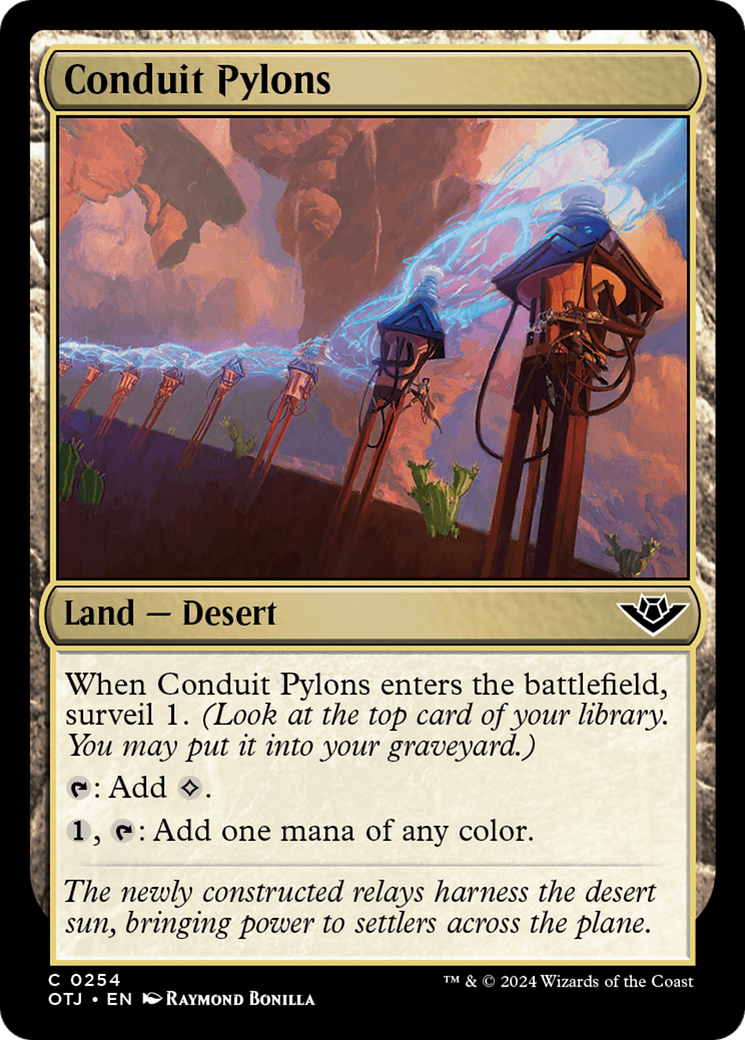
Conduit Pylons
Conduit Pylons
Land — Desert
When this land enters, surveil 1. (Look at the top card of your library. You may put it into your graveyard.)
: Add .
, : Add one mana of any color.
-
1
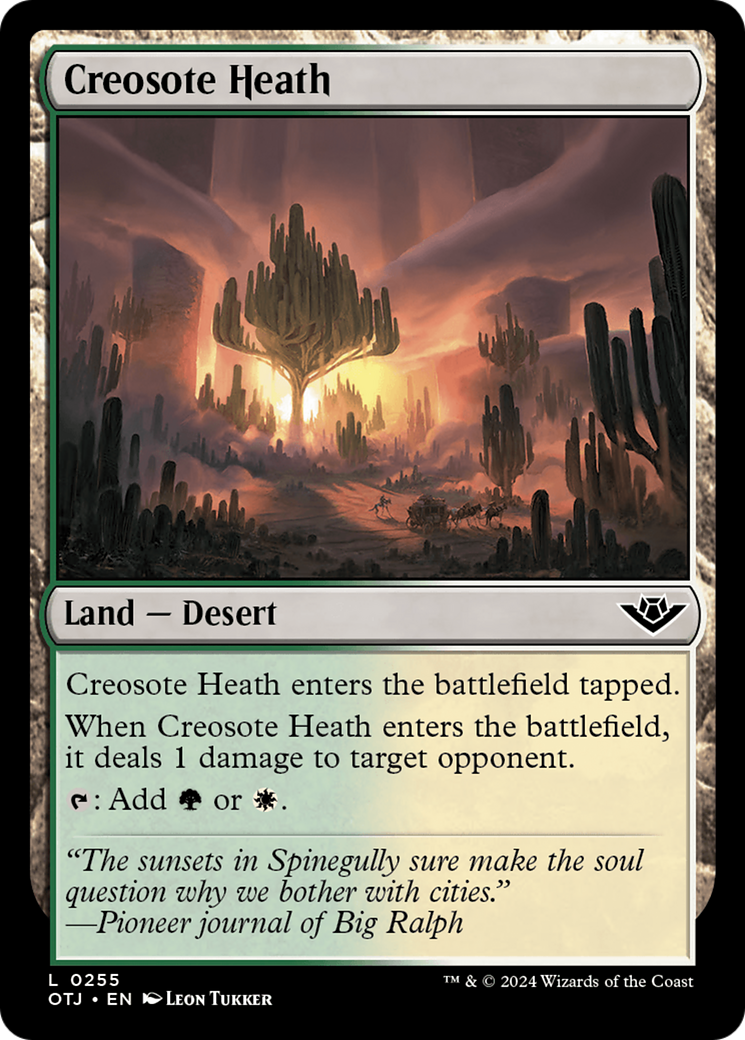
Creosote Heath
Creosote Heath
Land — Desert
This land enters tapped.
When this land enters, it deals 1 damage to target opponent.
: Add or .
-
1
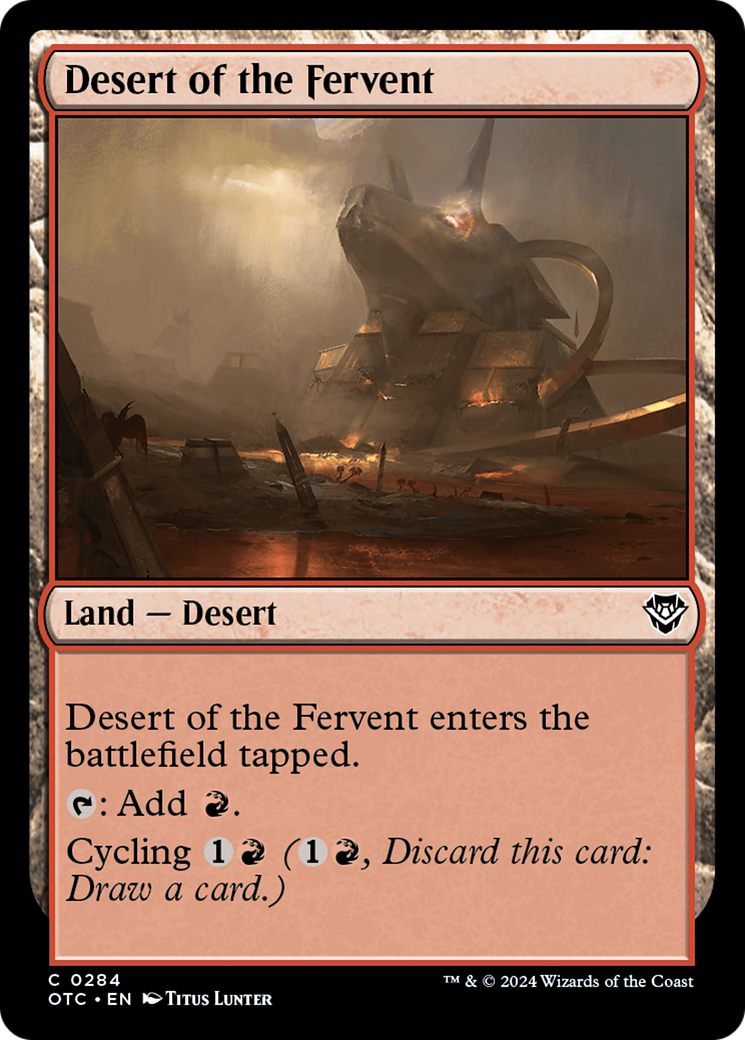
Desert of the Fervent
Desert of the Fervent
Land — Desert
This land enters tapped.
: Add .
Cycling ( , Discard this card: Draw a card.)
- Desert is a land subtype with no special meaning. It doesn't grant the land an intrinsic mana ability. Other cards may care about which lands are Deserts.
-
1
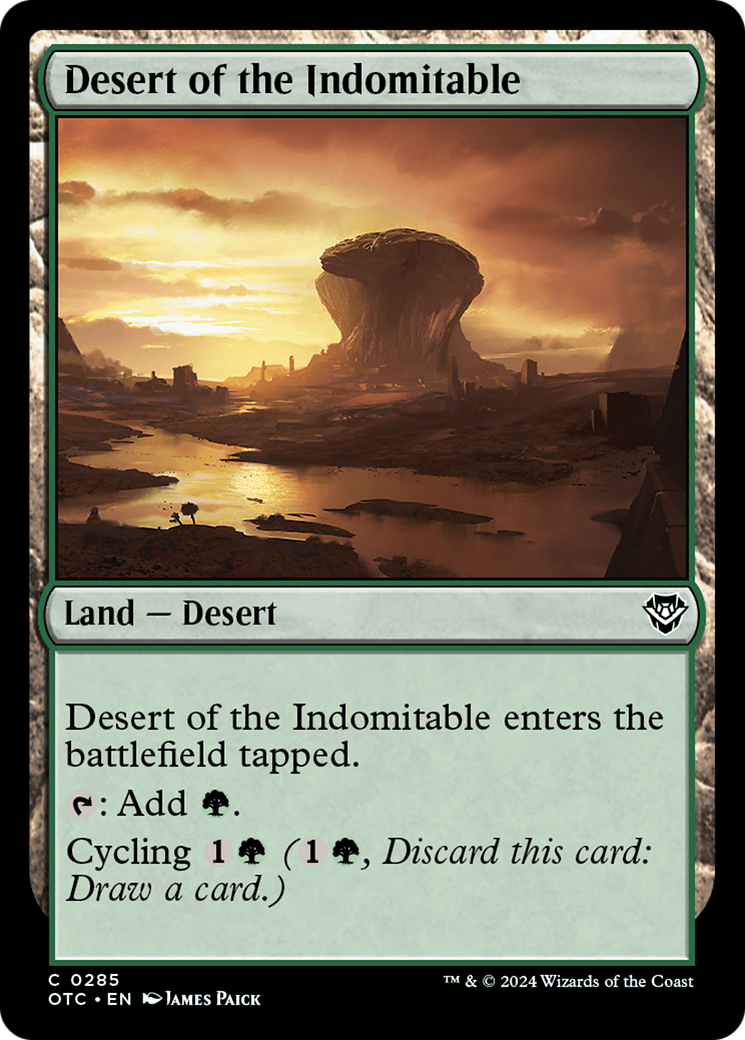
Desert of the Indomitable
Desert of the Indomitable
Land — Desert
This land enters tapped.
: Add .
Cycling ( , Discard this card: Draw a card.)
- Desert is a land subtype with no special meaning. It doesn't grant the land an intrinsic mana ability. Other cards may care about which lands are Deserts.
-
1
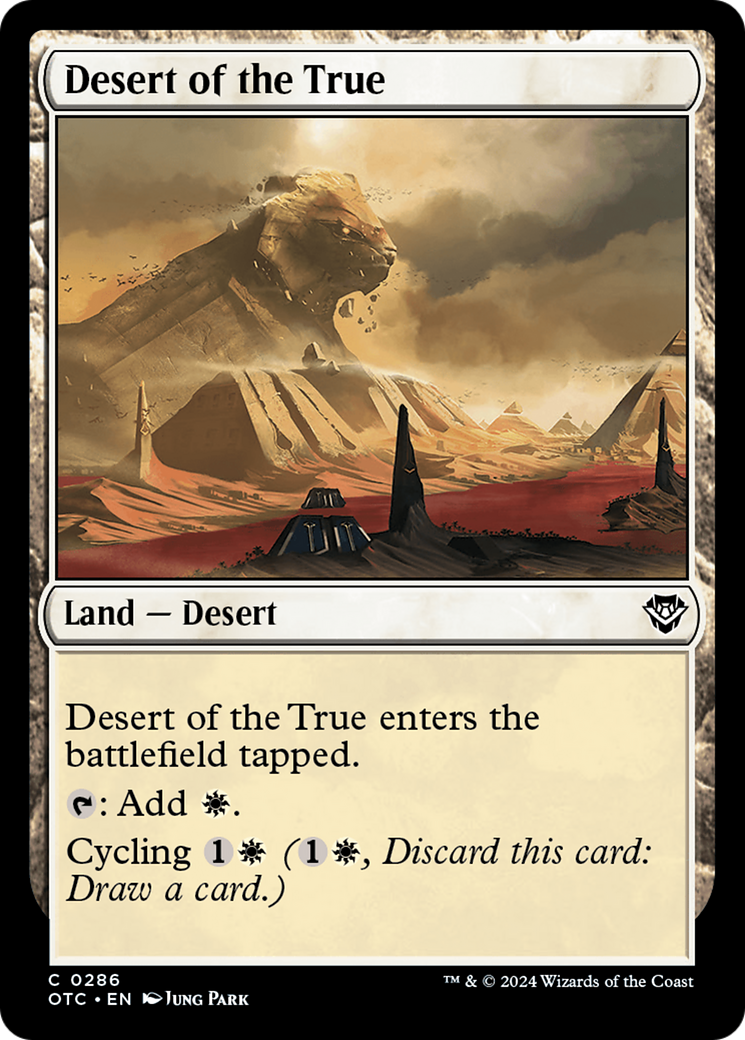
Desert of the True
Desert of the True
Land — Desert
This land enters tapped.
: Add .
Cycling ( , Discard this card: Draw a card.)
- Desert is a land subtype with no special meaning. It doesn't grant the land an intrinsic mana ability. Other cards may care about which lands are Deserts.
-
1
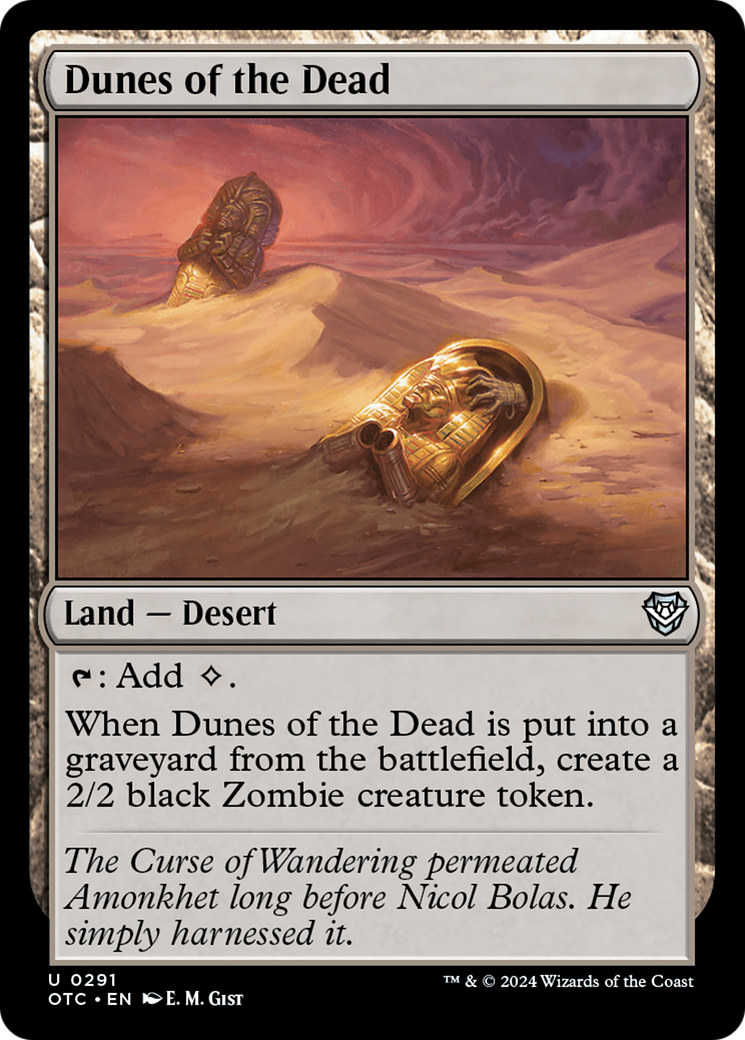
Dunes of the Dead
Dunes of the Dead
Land — Desert
: Add .
When this land is put into a graveyard from the battlefield, create a 2/2 black Zombie creature token.
- Dunes of the Dead's second ability doesn't allow you to sacrifice it whenever you'd like. You must find another way to get Dunes of the Dead into the graveyard.
- If you sacrifice Dunes of the Dead to pay the activation cost of an ability, you'll create the Zombie token before that activated ability resolves.
- Desert is a land subtype with no special meaning. It doesn't grant the land an intrinsic mana ability. Other cards may care about which lands are Deserts.
-
1
Evolving Wilds
Evolving Wilds
Land
, Sacrifice this land: Search your library for a basic land card, put it onto the battlefield tapped, then shuffle.
-
7
Forest
Forest
Basic Land — Forest
( : Add .)
-
1
Hashep Oasis
Hashep Oasis
Land — Desert
: Add .
, Pay 1 life: Add .
, , Sacrifice a Desert: Target creature gets +3/+3 until end of turn. Activate only as a sorcery.
- If a Desert has an ability with a cost of "Sacrifice a Desert," you can sacrifice that Desert to pay the cost for its own ability.
- Desert is a land subtype with no special meaning. It doesn't grant the land an intrinsic mana ability. Other cards may care about which lands are Deserts.
-
1
Jungle Shrine
Jungle Shrine
Land
This land enters tapped.
: Add , , or .
-
1
Krosan Verge
Krosan Verge
Land
This land enters tapped.
: Add .
, , Sacrifice this land: Search your library for a Forest card and a Plains card, put them onto the battlefield tapped, then shuffle.
-
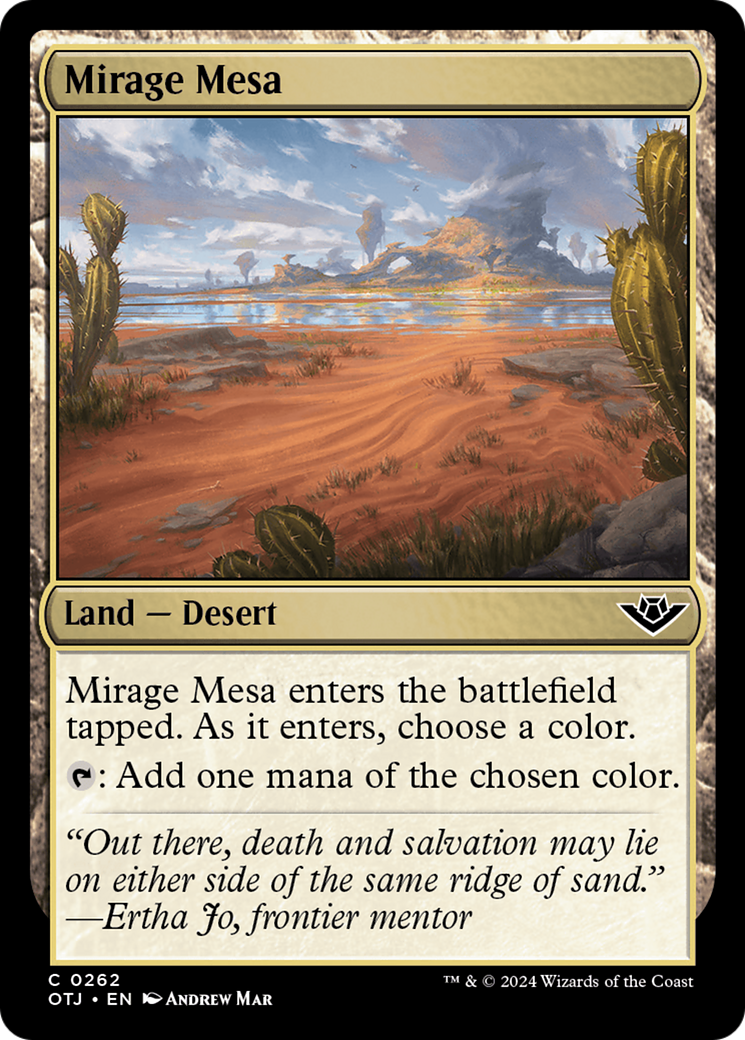
1
Mirage Mesa
Mirage Mesa
Land — Desert
This land enters tapped. As it enters, choose a color.
: Add one mana of the chosen color.
-
4
Mountain
Mountain
Basic Land — Mountain
( : Add .)
-
1
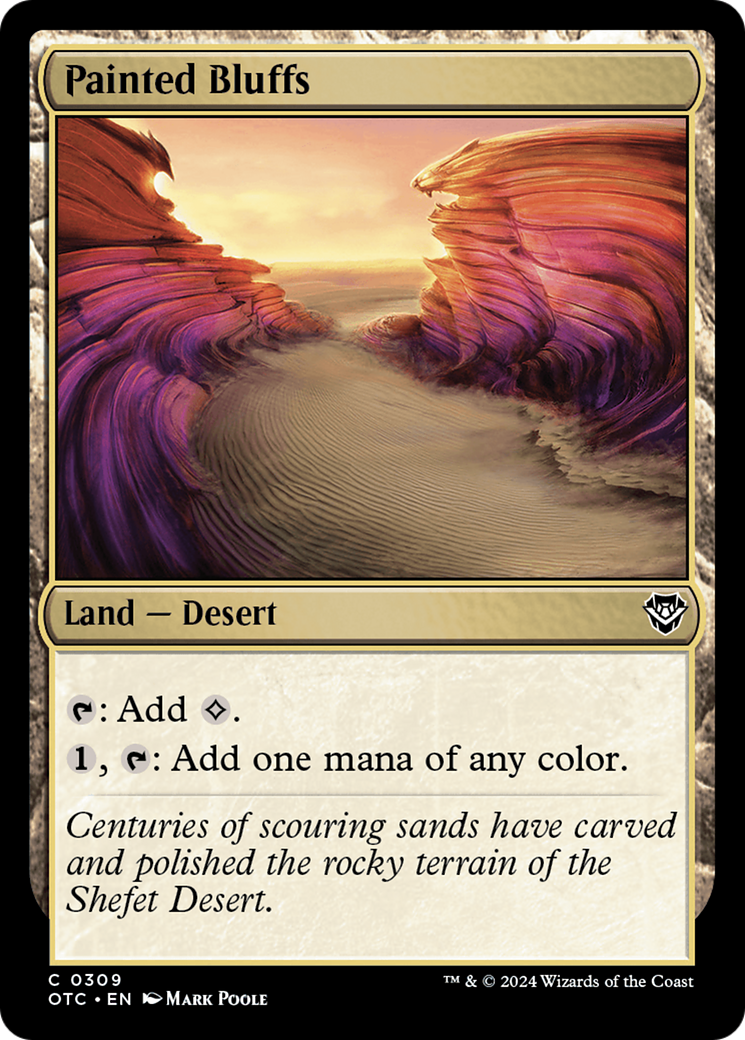
Painted Bluffs
Painted Bluffs
Land — Desert
: Add .
, : Add one mana of any color.
- Desert is a land subtype with no special meaning. It doesn't grant the land an intrinsic mana ability. Other cards may care about which lands are Deserts.
-
6
Plains
Plains
Basic Land — Plains
( : Add .)
-
1
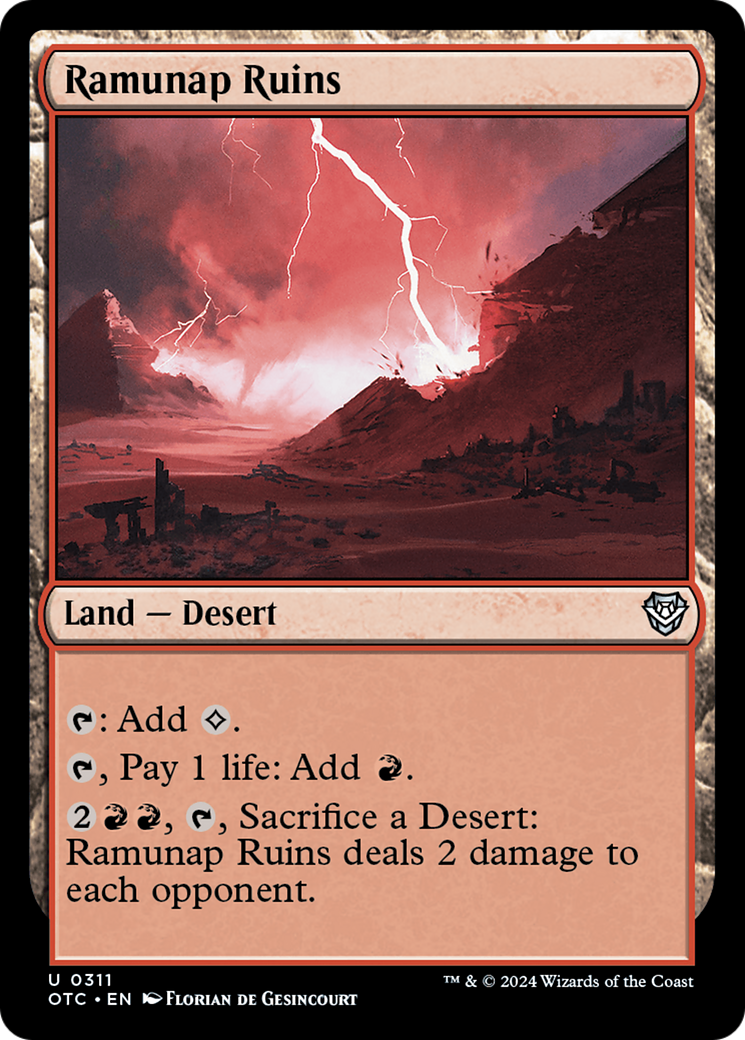
Ramunap Ruins
Ramunap Ruins
Land — Desert
: Add .
, Pay 1 life: Add .
, , Sacrifice a Desert: This land deals 2 damage to each opponent.
- If a Desert has an ability with a cost of "Sacrifice a Desert," you can sacrifice that Desert to pay the cost for its own ability.
- Desert is a land subtype with no special meaning. It doesn't grant the land an intrinsic mana ability. Other cards may care about which lands are Deserts.
-
1
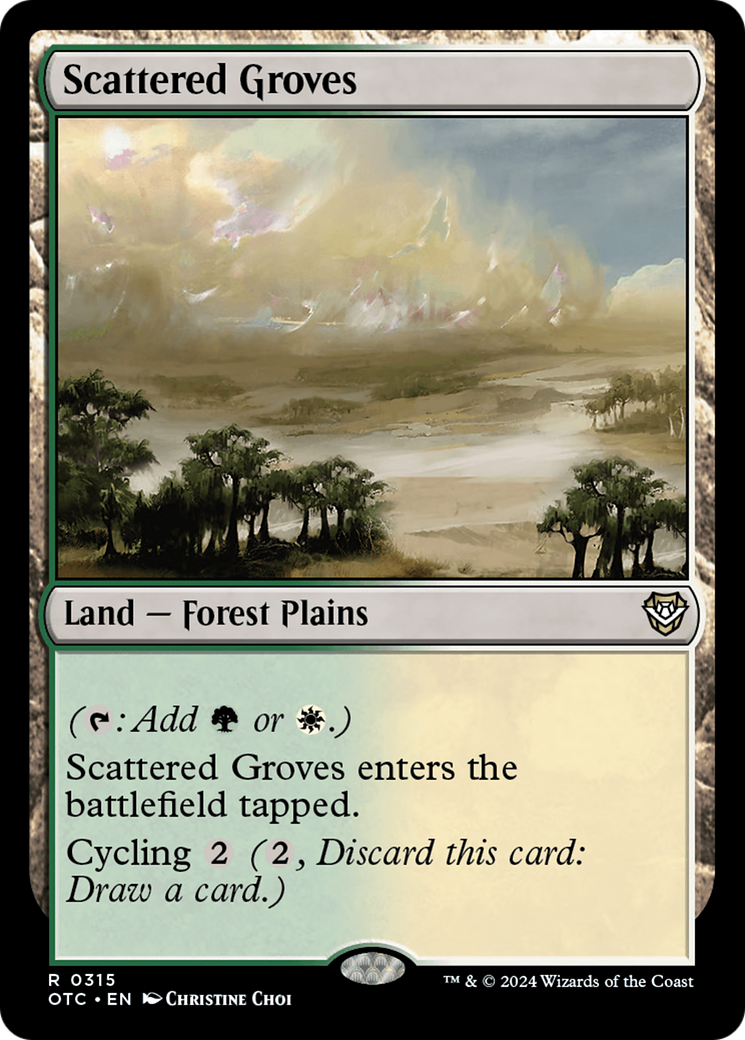
Scattered Groves
Scattered Groves
Land — Forest Plains
( : Add or .)
This land enters tapped.
Cycling ( , Discard this card: Draw a card.)
-
1
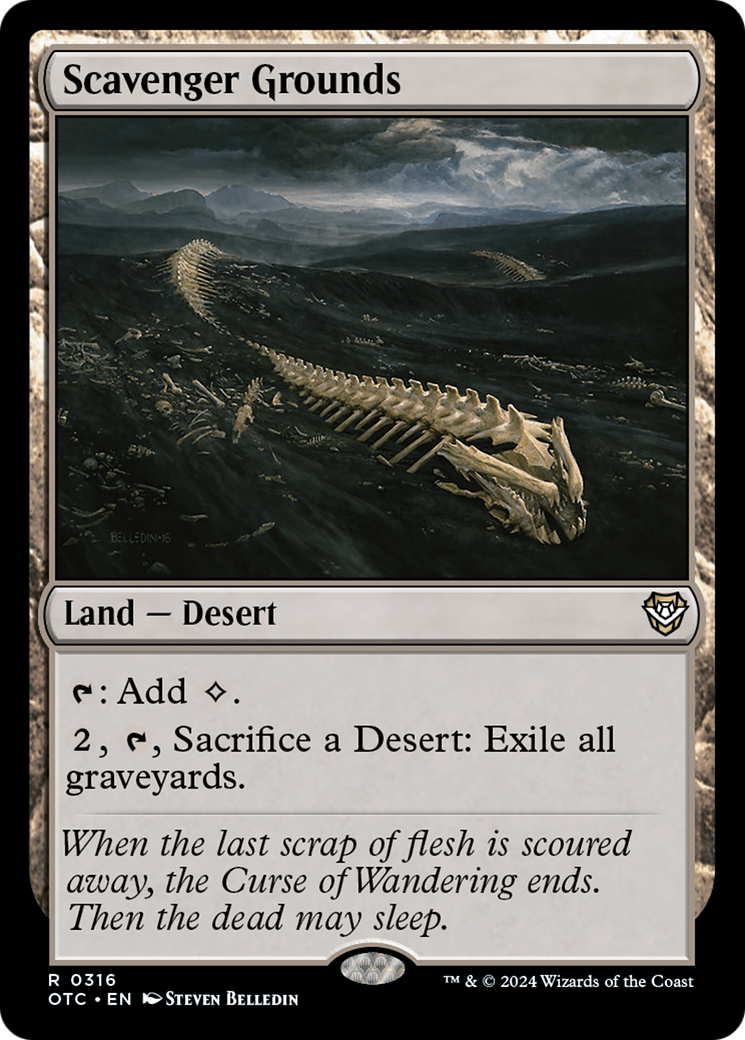
Scavenger Grounds
Scavenger Grounds
Land — Desert
: Add .
, , Sacrifice a Desert: Exile all graveyards.
- The sacrificed Desert will be in your graveyard to be exiled by the last ability of Scavenger Grounds.
-
1
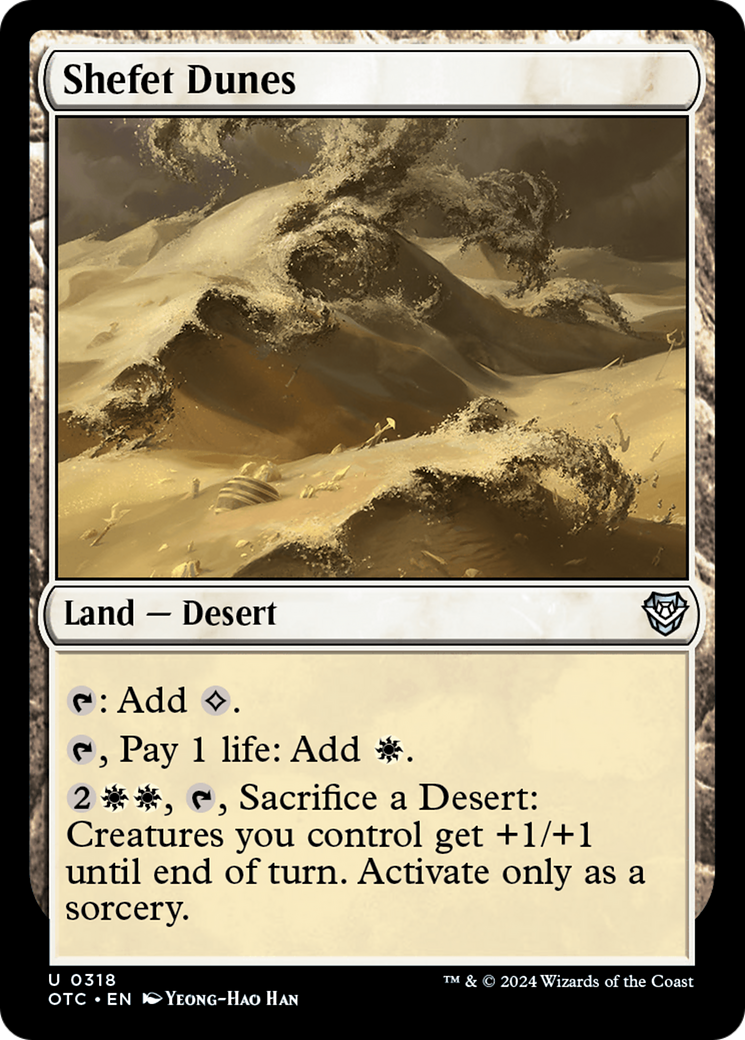
Shefet Dunes
Shefet Dunes
Land — Desert
: Add .
, Pay 1 life: Add .
, , Sacrifice a Desert: Creatures you control get +1/+1 until end of turn. Activate only as a sorcery.
- If a Desert has an ability with a cost of "Sacrifice a Desert," you can sacrifice that Desert to pay the cost for its own ability.
- Desert is a land subtype with no special meaning. It doesn't grant the land an intrinsic mana ability. Other cards may care about which lands are Deserts.
-
1
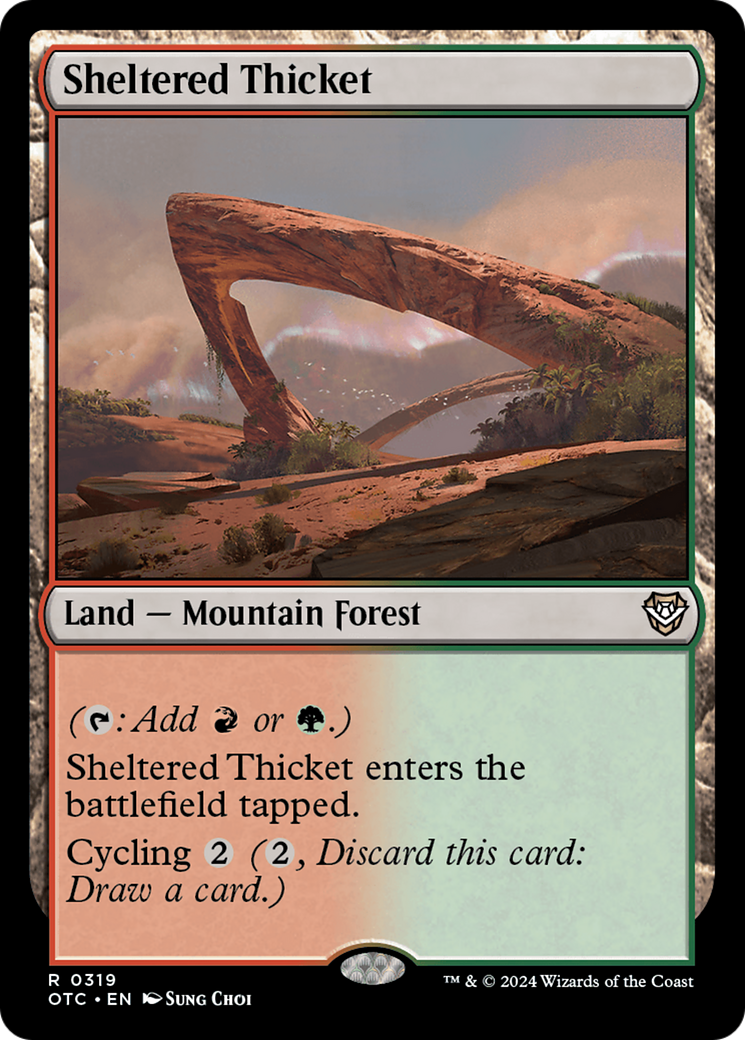
Sheltered Thicket
Sheltered Thicket
Land — Mountain Forest
( : Add or .)
This land enters tapped.
Cycling ( , Discard this card: Draw a card.)
-
1
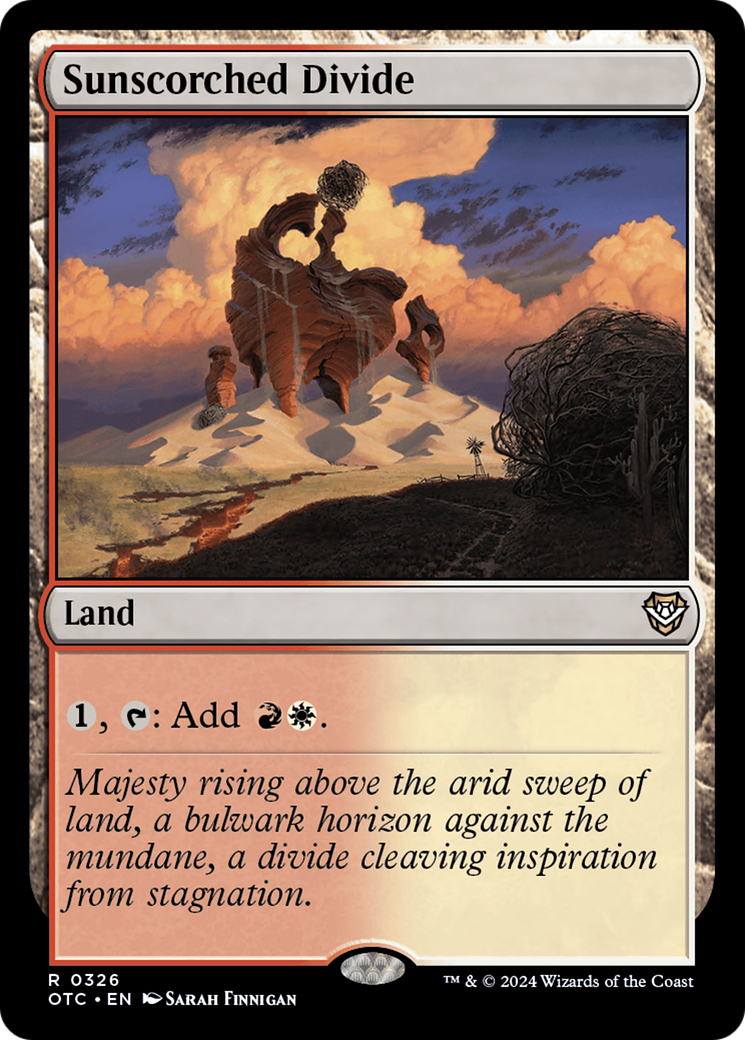
Sunscorched Divide
Sunscorched Divide
Land
, : Add .
-
1
Terramorphic Expanse
Terramorphic Expanse
Land
, Sacrifice this land: Search your library for a basic land card, put it onto the battlefield tapped, then shuffle.
White 11
-
1
Angel of Indemnity
Angel of Indemnity
Creature — Angel Warrior
5/5
Flying, lifelink
When this creature enters, return target permanent card with mana value 4 or less from your graveyard to the battlefield.
Encore ( , Exile this card from your graveyard: For each opponent, create a token copy that attacks that opponent this turn if able. They gain haste. Sacrifice them at the beginning of the next end step. Activate only as a sorcery.)
- Opponents who have left the game aren't counted when determining how many tokens to create.
- If one of the tokens can't attack for any reason (such as being tapped), then it doesn't attack. If there's a cost associated with having it attack, you aren't forced to pay that cost, so it doesn't have to attack in that case either.
- If one of the tokens somehow is under another player's control as the delayed triggered ability resolves, you can't sacrifice that token. It remains on the battlefield indefinitely, even if you regain control of it later.
- The tokens copy only what's on the original card. Effects that modified that creature when it was previously on the battlefield won't be copied.
- Exiling the card with encore is a cost to activate the ability. Once you announce that you're activating it, no player may take actions until you've finished. They can't try to remove the card from your graveyard to stop you from paying the cost.
- If an effect stops a token from attacking a specific player, that token can attack any player, planeswalker, or battle, or not attack at all. If the effect stops the token from attacking a specific player unless a cost is paid, you don't have to pay that cost unless you want to attack that player.
- If you return an Aura this way, you choose what the Aura will enchant just before it enters the battlefield. An Aura returning to the battlefield this way doesn't target the player or permanent it will enchant, so permanents or players with hexproof may be chosen; however, the chosen recipient must be able to legally be enchanted by the Aura, so a player or permanent with protection from one of the Aura's qualities can't be chosen this way. If there's nothing legal for the Aura to enchant, it stays in the graveyard.
- A permanent card is an artifact, battle, creature, enchantment, land, or planeswalker card.
- If the mana cost of a card in your graveyard includes , X is 0 for the purpose of determining its mana value.
- Each token must attack the appropriate player if able.
-
1
Angel of the Ruins
Angel of the Ruins
Artifact Creature — Angel
5/7
Flying
When this creature enters, exile up to two target artifacts and/or enchantments.
Plainscycling ( , Discard this card: Search your library for a Plains card, reveal it, put it into your hand, then shuffle.)
-
1
Bovine Intervention
Bovine Intervention
Instant
Destroy target artifact or creature. Its controller creates a 2/2 white Ox creature token.
-
1
Descend upon the Sinful
Descend upon the Sinful
Sorcery
Exile all creatures.
Delirium — Create a 4/4 white Angel creature token with flying if there are four or more card types among cards in your graveyard.
- If you have three non-sorcery card types among cards in your graveyard at the time Descend upon the Sinful resolves, you won't get an Angel token. Descend upon the Sinful isn't put into your graveyard until after it's finished resolving.
- If one of those creatures was enchanted, its Aura won't be put into a player's graveyard until after Descend upon the Sinful has finished resolving. If the controller of Descend upon the Sinful owned the Aura, it won't be in the graveyard in time to be counted for the delirium ability.
- The card types in Magic are artifact, battle, creature, enchantment, instant, kindred, land, planeswalker, and sorcery. Supertypes (such as legendary and basic) and subtypes (such as Human and Equipment) are not counted.
- The number of card types matters, not the number of cards. For example, Wicker Witch (an artifact creature) along with Catalog (an instant) and Chaplain's Blessing (a sorcery) will enable delirium.
- Because you consider only the characteristics of a double-faced card's front face while it's not on the battlefield, the types of its back face won't be counted for delirium.
- In some rare cases, you can have a token or a copy of a spell in your graveyard at the moment that an object's delirium ability counts the card types among cards in your graveyard, before that token or copy ceases to exist. Because tokens and copies of spells are not cards, even if they are copies of cards, their types will never be counted.
-
1
Marshal's Anthem
Marshal's Anthem
Enchantment
Multikicker (You may pay an additional any number of times as you cast this spell.)
Creatures you control get +1/+1.
When this enchantment enters, return up to X target creature cards from your graveyard to the battlefield, where X is the number of times this enchantment was kicked.
- If a spell's kicker cost was paid, the spell is "kicked."
- The kicker ability doesn't let you pay a kicker cost more than once.
- If you put a permanent with a kicker ability onto the battlefield without casting it, you can't kick it.
- If you copy a kicked spell on the stack, the copy is also kicked. If the copied spell is a permanent spell, the token the copy of that spell becomes when it enters is also kicked.
- If a card or token enters as a copy of a permanent, the new permanent isn't kicked, even if the original was.
- To determine a spell's total cost, start with the mana cost (or an alternative cost if another card's effect allows you to pay one instead), add any cost increases (such as kicker), then apply any cost reductions. The spell's mana value remains unchanged, no matter what the total cost to cast it was.
-
1
Path to Exile
Path to Exile
Instant
Exile target creature. Its controller may search their library for a basic land card, put that card onto the battlefield tapped, then shuffle.
- The controller of the exiled creature isn't required to search their library for a basic land. If that player doesn't, the player won't shuffle their library.
- If the target creature is an illegal target by the time Path to Exile tries to resolve, it won't resolve and none of its effects will happen. The creature's controller won't search for a basic land card.
-
1
Requisition Raid
Requisition Raid
Sorcery
Spree (Choose one or more additional costs.)
+ — Destroy target artifact.
+ — Destroy target enchantment.
+ — Put a +1/+1 counter on each creature target player controls.
- Spells with spree have a + (plus sign) indicator in the upper right corner of the card frame. This has no rules meaning and serves only to remind players that at least one additional cost is required to cast the spell.
- If a mode requires a target, you can select that mode only if there's a legal target available. Ignore the targeting requirements for modes you don't choose.
- Each additional cost and associated mode in the text box is also preceded with a + indicator. These symbols also have no rules meaning and serve only to remind players that the listed costs are additional costs.
- No matter which modes you choose, you always follow the instructions in the order they are written.
- You must choose at least one of the listed modes and pay its associated additional cost in order to cast a spell with spree.
- The mana value of a spell with spree is determined only by its mana cost (in the upper right corner of the card). It doesn't matter which modes you choose or which additional costs you pay, including any additional costs imposed by other effects.
- No player can cast spells or activate abilities in between the modes of a resolving spell. Any abilities that trigger won't be put onto the stack until the spell is done resolving.
- You choose the modes as you cast the spell with spree. Once modes are chosen, they can't be changed.
- You can't choose the same mode more than once.
- If a spell with spree is copied, the effect that creates the copy may allow you to choose new targets. You cannot choose new modes.
- If all targets for the chosen modes become illegal before a spell with spree resolves, the spell won't resolve and none of its effects will happen. If at least one target is still legal, the spell will resolve but will have no effect on any illegal targets.
- If an effect allows you to cast a spell with spree "without paying its mana cost," you must still choose at least one mode and pay the associated additional costs.
-
1
Sand Scout
Sand Scout
Creature — Human Scout
2/2
When this creature enters, if an opponent controls more lands than you, search your library for a Desert card, put it onto the battlefield tapped, then shuffle.
Whenever one or more land cards are put into your graveyard from anywhere, create a 1/1 red, green, and white Sand Warrior creature token. This ability triggers only once each turn.
- Sand Scout must be on the battlefield for its last ability to trigger. If it is put into your graveyard at the same time as one or more land cards you own, its ability won’t trigger.
-
1
Sevinne's Reclamation
Sevinne's Reclamation
Sorcery
Return target permanent card with mana value 3 or less from your graveyard to the battlefield. If this spell was cast from a graveyard, you may copy this spell and may choose a new target for the copy.
Flashback (You may cast this card from your graveyard for its flashback cost. Then exile it.)
- A spell cast using flashback will always be exiled afterward, whether it resolves, is countered, or leaves the stack in some other way.
- You can cast a spell using flashback even if it was somehow put into your graveyard without having been cast.
- To determine the total cost of a spell, start with the mana cost or alternative cost (such as a flashback cost) you're paying, add any cost increases, then apply any cost reductions. The mana value of the spell is determined only by its mana cost, no matter what the total cost to cast the spell was.
- You must still follow any timing restrictions and permissions, including those based on the card's type. For instance, you can cast a sorcery using flashback only when you could normally cast a sorcery.
- "Flashback [cost]" means "You may cast this card from your graveyard if the resulting spell is an instant or sorcery spell by paying [cost] rather than paying its mana cost" and "If the flashback cost was paid, exile this card instead of putting it anywhere else any time it would leave the stack."
- If a card with flashback is put into your graveyard during your turn, you can cast it if it's legal to do so before any other player can take any actions.
- A permanent card is an artifact, battle, creature, enchantment, land, or planeswalker card.
- The copy that Sevinne's Reclamation creates is created on the stack, so it's not "cast." Abilities that trigger when a player casts a spell won't trigger. The copy wasn't cast from a graveyard, so it won't make another copy of itself.
- If you cast Sevinne's Reclamation from your graveyard, any abilities that trigger as the permanent card returns to the battlefield will resolve before the copy of Sevinne's Reclamation resolves but after new targets for the copy have been chosen.
- If a card in a graveyard has in its mana cost, X is considered to be 0.
- If the target card is an illegal target by the time Sevinne's Reclamation tries to resolve, the spell doesn't resolve. You won't copy it if you cast it from a graveyard.
-
1
Sun Titan
Sun Titan
Creature — Giant
6/6
Vigilance
Whenever this creature enters or attacks, you may return target permanent card with mana value 3 or less from your graveyard to the battlefield.
- A permanent card is an artifact, creature, enchantment, land, or planeswalker card.
- If a card in your graveyard has no mana symbols in its upper right corner (because it's a land card, for example), its mana value is 0.
- The mana value of a card in your graveyard is determined solely by the mana symbols printed in its upper right corner. The mana value is the total amount of mana in that cost, regardless of color. For example, a card with mana cost has mana value 5.
- If the mana cost of a card in your graveyard includes , X is considered to be 0.
-
1
Valorous Stance
Valorous Stance
Instant
Choose one —
- Target creature gains indestructible until end of turn. (Damage and effects that say "destroy" don't destroy it.)
- Destroy target creature with toughness 4 or greater.
Red 8
-
1
Bitter Reunion
Bitter Reunion
Enchantment
When this enchantment enters, you may discard a card. If you do, draw two cards.
, Sacrifice this enchantment: Creatures you control gain haste until end of turn.
-
1
Cataclysmic Prospecting
Cataclysmic Prospecting
Sorcery
Cataclysmic Prospecting deals X damage to each creature. For each mana from a Desert spent to cast this spell, create a tapped Treasure token.
-
1
Electric Revelation
Electric Revelation
Instant
As an additional cost to cast this spell, discard a card.
Draw two cards.
Flashback (You may cast this card from your graveyard for its flashback cost and any additional costs. Then exile it.)
- If you cast Electric Revelation using flashback, you must still pay its additional cost of discarding a card.
-
1
Embrace the Unknown
Embrace the Unknown
Sorcery
Exile the top two cards of your library. Until the end of your next turn, you may play those cards.
Retrace (You may cast this card from your graveyard by discarding a land card in addition to paying its other costs.)
- You pay all costs and follow all normal timing rules for cards played from exile this way. For example, if an exiled card is a land card, you may play it only during your main phase while the stack is empty.
- Casting a card by using its retrace ability works just like casting any other spell, with two exceptions: You’re casting it from your graveyard rather than your hand, and you must discard a land card in addition to any other costs.
- A retrace card cast from your graveyard follows the normal timing rules for its card type.
- When a retrace spell you cast from your graveyard resolves, fails to resolve, or is countered, it’s put back into your graveyard. You may use the retrace ability to cast it again.
- If the active player casts a spell that has retrace, that player may cast that card again after it resolves, before another player can remove the card from the graveyard. The active player has priority after the spell resolves, so they can immediately cast a new spell. Since casting a card with retrace from the graveyard moves that card onto the stack, no one else would have the chance to affect it while it’s still in the graveyard.
-
1
Heaven // Earth
//
Heaven
Instant
- Once you've started to cast a spell with aftermath from your graveyard, the card is immediately moved to the stack. Opponents can't try to stop the ability by exiling the card with an effect such as that of Crook of Condemnation.
- All split cards have two card faces on a single card, and you put a split card onto the stack with only the half you're casting. The characteristics of the half of the card you didn't cast are ignored while the spell is on the stack. For example, if an effect prevents you from casting green spells, you can cast Destined of Destined // Lead, but not Lead.
- Each split card is a single card. For example, if you discard one, you've discarded one card, not two. If an effect counts the number of instant and sorcery cards in your graveyard, Destined // Lead counts once, not twice.
- Each split card has two names. If an effect instructs you to choose a card name, you may choose one, but not both.
- While not on the stack, the characteristics of a split card are the combination of its two halves. For example, Destined // Lead is a green and black card, it is both an instant card and a sorcery card, and its mana value is 6. This means that if an effect allows you to cast a card with mana value 2 from your hand, you can't cast Destined. This is a change from the previous rules for split cards.
- Split cards with aftermath have a new frame treatment—the half you can cast from your hand is oriented the same as other cards you'd cast from your hand, while the half you can cast from your graveyard is a traditional split card half. This frame treatment is for your convenience and has no rules significance.
- If another effect allows you to cast a split card with aftermath from any zone other than a graveyard, you can't cast the half with aftermath.
- If another effect allows you to cast a split card with aftermath from a graveyard, you may cast either half. If you cast the half that has aftermath, you'll exile the card if it would leave the stack.
- A spell with aftermath cast from a graveyard will always be exiled afterward, whether it resolves, it's countered, or it leaves the stack in some other way.
- You don't have to choose the same value for X while casting Earth as you did while casting Heaven.
- If you cast the first half of a split card with aftermath during your turn, you'll have priority immediately after it resolves. You can cast the half with aftermath from your graveyard before any player can take any other action if it's legal for you to do so.
-
1
Magmatic Insight
Magmatic Insight
Sorcery
As an additional cost to cast this spell, discard a land card.
Draw two cards.
- You must discard exactly one land card to cast Magmatic Insight. You can't cast it without discarding a land card, and you can't discard additional cards.
-
1
Nesting Dragon
Nesting Dragon
Creature — Dragon
5/4
Flying
Landfall — Whenever a land you control enters, create a 0/2 red Dragon Egg creature token with defender and "When this token dies, create a 2/2 red Dragon creature token with flying and ' : This token gets +1/+0 until end of turn.'"
-
1
Unholy Heat
Unholy Heat
Instant
Unholy Heat deals 2 damage to target creature or planeswalker.
Delirium — Unholy Heat deals 6 damage instead if there are four or more card types among cards in your graveyard.
- Unholy Heat checks your graveyard as it resolves to determine if it deals 2 or 6 damage. At that time, Unholy Heat isn't in the graveyard yet.
- The card types that can appear in a graveyard are artifact, battle, creature, enchantment, instant, kindred, land, planeswalker, and sorcery. Legendary, basic, and snow are supertypes, not card types; Kavu and Equipment are subtypes, not card types.
Green 26
-
1
Ancient Greenwarden
Ancient Greenwarden
Creature — Elemental
5/7
Reach (This creature can block creatures with flying.)
You may play lands from your graveyard.
If a land entering causes a triggered ability of a permanent you control to trigger, that ability triggers an additional time.
- Ancient Greenwarden doesn't change the times when you can play those lands. You can still play only one land per turn, and only during your main phase when you have priority and the stack is empty.
- Ancient Greenwarden doesn't allow you to activate abilities (such as cycling) of land cards in your graveyard.
- Ancient Greenwarden allows you to play a modal double-faced card's land face, but not a nonland face.
- Ancient Greenwarden's third ability affects a land's own enters-the-battlefield triggered abilities as well as other triggered abilities that trigger when that land enters the battlefield, such as landfall abilities. Such triggered abilities start with "when" or "whenever."
- Replacement effects are unaffected by Ancient Greenwarden's third ability. This includes any abilities that apply "as [this land] enters the battlefield" and any ability that says the land enters the battlefield with counters.
- Ancient Greenwarden's effect doesn't copy the triggered ability; it causes the ability to trigger twice. Any choices made as you put the ability onto the stack, such as modes and targets, are made separately for each instance of the ability. Any choices made on resolution, such as whether to put counters on a permanent, are also made individually.
- The trigger event doesn't have to specifically refer to "lands." For example, an ability that triggers "whenever a creature enters the battlefield under your control" would trigger twice if the entering land is also a creature.
- An ability that triggers whenever you play a land won't trigger an additional time.
- Look at each permanent as it exists on the battlefield, taking into account continuous effects, to determine whether any triggered abilities will trigger multiple times. For example, if you control Ashaya, Soul of the Wild, a nontoken creature entering the battlefield will cause any appropriate abilities to trigger an additional time.
- If you control two Ancient Greenwardens, a land entering the battlefield causes abilities to trigger three times, not four. A third Ancient Greenwarden causes abilities to trigger four times, a fourth causes abilities to trigger five times, and so on.
- If a land entering the battlefield at the same time as Ancient Greenwarden (including Ancient Greenwarden itself if an effect causes it to be a land) causes a triggered ability of a permanent you control to trigger, that ability triggers an additional time.
-
1
Avenger of Zendikar
Avenger of Zendikar
Creature — Elemental
5/5
When this creature enters, create a 0/1 green Plant creature token for each land you control.
Landfall — Whenever a land you control enters, you may put a +1/+1 counter on each Plant creature you control.
- A landfall ability triggers whenever a land you control enters for any reason. It triggers whenever you play a land, as well as whenever a spell or ability puts a land onto the battlefield under your control.
- A landfall ability doesn't trigger if a permanent already on the battlefield becomes a land.
- Whenever a land you control enters, each landfall ability of the permanents you control will trigger. You can put them on the stack in any order. The last ability you put on the stack will be the first one to resolve (As a result, you can have those abilities resolve in the order of your choosing.).
-
1
Crawling Sensation
Crawling Sensation
Enchantment
At the beginning of your upkeep, you may mill two cards. (You may put the top two cards of your library into your graveyard.)
Whenever one or more land cards are put into your graveyard from anywhere for the first time each turn, create a 1/1 green Insect creature token.
- If multiple land cards are put into your graveyard at once, Crawling Sensation's last ability triggers only once. This could happen because an effect (such as that of Crawling Sensation's first ability) put them there from your library at once, or because they were destroyed at the same time (such as two land creatures that were dealt lethal combat damage).
-
1
Dune Chanter
Dune Chanter
Creature — Plant Druid
2/3
Reach
Lands you control and land cards you own that aren't on the battlefield are Deserts in addition to their other types.
Lands you control have " : Add one mana of any color."
: Mill two cards. You gain 1 life for each land card milled this way.
-
1
Eccentric Farmer
Eccentric Farmer
Creature — Human Peasant
2/3
When this creature enters, mill three cards, then you may return a land card from your graveyard to your hand. (To mill three cards, put the top three cards of your library into your graveyard.)
- The land card you return to your hand can be one you just milled or it can be one that was already in your graveyard.
-
1
Elvish Rejuvenator
Elvish Rejuvenator
Creature — Elf Druid
1/1
When this creature enters, look at the top five cards of your library. You may put a land card from among them onto the battlefield tapped. Put the rest on the bottom of your library in a random order.
-
1
Explore
Explore
Sorcery
You may play an additional land this turn.
Draw a card.
- The effects of multiple Explores in the same turn are cumulative. They're also cumulative with other effects that let you play additional lands, such as the one from Urban Evolution.
- Explore's effect allows you to play an additional land during your main phase. Doing so follows the normal timing rules for playing lands. In particular, you don't get to play a land as Explore resolves; Explore fully resolves first and you draw a card, perhaps a land you'll play later.
- If you somehow manage to cast Explore when it's not your turn, you'll draw a card when it resolves, but you won't be able to play a land that turn.
-
1
Genesis Hydra
Genesis Hydra
Creature — Plant Hydra
0/0
When you cast this spell, reveal the top X cards of your library. You may put a nonland permanent card with mana value X or less from among them onto the battlefield. Then shuffle the rest into your library.
This creature enters with X +1/+1 counters on it.
- Genesis Hydra's first ability will resolve before Genesis Hydra does. Notably, if you put an Aura card onto the battlefield this way, it can't enchant Genesis Hydra.
- If you have fewer than X cards in your library, you reveal all of them.
- If a card in a player's library has in its mana cost, X is considered to be 0.
- A nonland permanent card is an artifact, creature, enchantment, or planeswalker card.
- If you put an Aura onto the battlefield this way, you choose what it enchants as it enters the battlefield. This doesn't target any permanent or player, but it must be able to enchant that permanent or player. For example, you could put a green Aura onto the battlefield enchanting a creature with hexproof controlled by an opponent, but not one with protection from green.
- If "the rest" is zero cards, either because X was 0 or because X was 1 and that card was put onto the battlefield, the library is still shuffled.
-
1
Harrow
Harrow
Instant
As an additional cost to cast this spell, sacrifice a land.
Search your library for up to two basic land cards, put them onto the battlefield, then shuffle.
- The two lands do not count toward your normal one land you can play each turn.
- The sacrifice of a land is part of the cost of casting Harrow. You can't pay this cost more than once to get a multiple effect.
-
1
Hour of Promise
Hour of Promise
Sorcery
Search your library for up to two land cards, put them onto the battlefield tapped, then shuffle. Then if you control three or more Deserts, create two 2/2 black Zombie creature tokens.
- There are many important moments in the story, but the most crucial—called "story spotlights"—are shown on cards. These cards have the Planeswalker symbol in their text box; this symbol has no effect on gameplay. You can read more about these events in the official Magic fiction at http://www.mtgstory.com.
- When Hour of Promise checks the number of Deserts you control, it includes any Deserts you found earlier with Hour of Promise.
-
1
Map the Frontier
Map the Frontier
Sorcery
Search your library for up to two basic land cards and/or Desert cards, put them onto the battlefield tapped, then shuffle.
-
1
Nantuko Cultivator
Nantuko Cultivator
Creature — Insect Druid
2/2
When this creature enters, you may discard any number of land cards. Put that many +1/+1 counters on this creature and draw that many cards.
- If an effect modifies how many +1/+1 counters you put on Nantuko Cultivator, the number of cards you draw isn't modified. Likewise, if an effect modifies how many cards you draw, the number of +1/+1 counters you put on Nantuko Cultivator won't be modified.
- You discard, put counters, and draw all while Nantuko Cultivator's ability is resolving. Nothing can happen between the three, and no player may choose to take actions.
-
1
Oracle of Mul Daya
Oracle of Mul Daya
Creature — Elf Shaman
2/2
You may play an additional land on each of your turns.
Play with the top card of your library revealed.
You may play lands from the top of your library.
- If you control more than one Oracle of Mul Daya, the effects of their first abilities are cumulative. If you control two, for example, you can play three lands on your turn.
- Oracle of Mul Daya doesn't change the times when you can play a land card from the top of your library. You can play a land only during your main phase when you have priority and the stack is empty. Doing so counts as one of your land plays for the turn.
- If you play your first land of the turn from the top of your library, and the new top card is another land card, you can play that one too.
-
1
Ramunap Excavator
Ramunap Excavator
Creature — Snake Cleric
2/3
You may play lands from your graveyard.
- Ramunap Excavator doesn't change the times when you can play those land cards. You can still play only one land per turn, and only during your main phase when you have priority and the stack is empty.
- Ramunap Excavator doesn't allow you to activate activated abilities (such as cycling) of land cards in your graveyard.
-
1
Return of the Wildspeaker
Return of the Wildspeaker
Instant
Choose one —
- Draw cards equal to the greatest power among non-Human creatures you control.
- Non-Human creatures you control get +3/+3 until end of turn.
-
1
Rumbleweed
Rumbleweed
Creature — Plant Elemental
8/8
This spell costs less to cast for each land card in your graveyard.
Vigilance, reach, trample
When this creature enters, other creatures you control get +3/+3 and gain trample until end of turn.
- Rumbleweed’s first ability doesn’t change its mana value, which is always 11.
- Rumbleweed’s last ability affects only creatures you control at the time it resolves. Creatures you begin to control later in the turn and noncreature permanents that become creatures later in the turn won’t get +3/+3 or gain trample.
-
1
Satyr Wayfinder
Satyr Wayfinder
Creature — Satyr
1/1
When this creature enters, reveal the top four cards of your library. You may put a land card from among them into your hand. Put the rest into your graveyard.
-
1
Scute Swarm
Scute Swarm
Creature — Insect
1/1
Landfall — Whenever a land you control enters, create a 1/1 green Insect creature token. If you control six or more lands, create a token that's a copy of this creature instead.
- A landfall ability triggers whenever a land you control enters for any reason. It triggers whenever you play a land, as well as whenever a spell or ability puts a land onto the battlefield under your control.
- A landfall ability doesn't trigger if a permanent already on the battlefield becomes a land.
- Whenever a land you control enters, each landfall ability of the permanents you control will trigger. You can put them on the stack in any order. The last ability you put on the stack will be the first one to resolve (As a result, you can have those abilities resolve in the order of your choosing.).
- The token copy will have Scute Swarm's ability. It will also be able to create copies of itself.
- The token copy won't copy counters or damage marked on Scute Swarm, nor will it copy other effects that have changed Scute Swarm's power, toughness, types, color, and so on. Normally, this means the token will simply be a Scute Swarm, but if any copy effects have affected the original Scute Swarm, the token will take those into account.
- If Scute Swarm leaves the battlefield before its triggered ability resolves, the token will still enter the battlefield as a copy of Scute Swarm, using Scute Swarm's copiable values from when it was last on the battlefield.
-
1
Skullwinder
Skullwinder
Creature — Snake
1/3
Deathtouch
When this creature enters, return target card from your graveyard to your hand, then choose an opponent. That player returns a card from their graveyard to their hand.
- Skullwinder's enters-the-battlefield ability targets only the card in your graveyard. If that card is an illegal target as the ability tries to resolve, the ability won't resolve and none of its effects will happen. No cards will be returned to any player's hand.
- You choose the target card as you put Skullwinder's triggered ability on the stack, but you don't choose an opponent until after you have returned the card to your hand.
- The chosen opponent gets to choose which card to return from their graveyard to their hand.
- You may choose an opponent with no cards in their graveyard. In that case, they will not get to return anything.
- Skullwinder's enters-the-battlefield ability targets only the card in your graveyard. If that card is an illegal target as the ability tries to resolve, the ability won't resolve and none of its effects will happen. No cards will be returned to any player's hand.
- You choose the opponent as the ability is resolving. You may choose an opponent with no cards in their graveyard.
-
1
Springbloom Druid
Springbloom Druid
Creature — Elf Druid
1/1
When this creature enters, you may sacrifice a land. If you do, search your library for up to two basic land cards, put them onto the battlefield tapped, then shuffle.
- While resolving Springbloom Druid's triggered ability, you can't sacrifice multiple lands to search for more than two basic land cards.
-
1
The Mending of Dominaria
The Mending of Dominaria
Enchantment — Saga
(As this Saga enters and after your draw step, add a lore counter. Sacrifice after III.)
I, II — Mill two cards, then you may return a creature card from your graveyard to your hand.
III — Return all land cards from your graveyard to the battlefield, then shuffle your graveyard into your library.
- As a Saga enters the battlefield, its controller puts a lore counter on it. As your precombat main phase begins (immediately after your draw step), you put another lore counter on each Saga you control. Putting a lore counter on a Saga in either of these ways doesn't use the stack.
- Each symbol on the left of a Saga's text box represents a chapter ability. A chapter ability is a triggered ability that triggers when a lore counter that is put on the Saga causes the number of lore counters on the Saga to become equal to or greater than the ability's chapter number. Chapter abilities are put onto the stack and may be responded to.
- A chapter ability doesn't trigger if a lore counter is put on a Saga that already had a number of lore counters greater than or equal to that chapter's number. For example, the third lore counter put on a Saga causes the III chapter ability to trigger, but I and II won't trigger again.
- Once a chapter ability has triggered, the ability on the stack won't be affected if the Saga gains or loses counters, or if it leaves the battlefield.
- If multiple chapter abilities trigger at the same time, their controller puts them on the stack in any order. If any of them require targets, those targets are chosen as you put the abilities on the stack, before any of those abilities resolve.
- If counters are removed from a Saga, the appropriate chapter abilities will trigger again when the Saga receives lore counters. Removing lore counters won't cause a previous chapter ability to trigger.
- Once the number of lore counters on a Saga is greater than or equal to the greatest number among its chapter abilities—in the Dominaria set, this is always three—the Saga's controller sacrifices it as soon as its chapter ability has left the stack, most likely by resolving or being countered. This state-based action doesn't use the stack.
-
1
Titania, Protector of Argoth
Titania, Protector of Argoth
Legendary Creature — Elemental
5/3
When Titania enters, return target land card from your graveyard to the battlefield.
Whenever a land you control is put into a graveyard from the battlefield, create a 5/3 green Elemental creature token.
-
1
Turntimber Sower
Turntimber Sower
Creature — Elf Druid
3/3
Whenever one or more land cards are put into your graveyard from anywhere, create a 0/1 green Plant creature token.
, Sacrifice three creatures: Return target land card from your graveyard to your hand.
- If multiple land cards are put into your graveyard at once, Turntimber Sower's first ability triggers only once. This could happen because an effect put them there from your library at once, or because they were destroyed at the same time (such as two land creatures that were dealt lethal combat damage), for example.
-
1
Vengeful Regrowth
Vengeful Regrowth
Sorcery
Return up to three target land cards from your graveyard to the battlefield tapped. Create that many 4/2 green Plant Warrior creature tokens with reach.
Flashback (You may cast this card from your graveyard for its flashback cost. Then exile it.)
- The number of Plant Warrior tokens created is equal to the number of land cards returned from your graveyard to the battlefield by Vengeful Regrowth. For example, if you cast Vengeful Regrowth targeting three Forest cards in your graveyard but two of those Forest cards are exiled in response, you’ll return the remaining Forest card and create one Plant Warrior token.
-
1
Winding Way
Winding Way
Sorcery
Choose creature or land. Reveal the top four cards of your library. Put all cards of the chosen type revealed this way into your hand and the rest into your graveyard.
-
1
World Shaper
World Shaper
Creature — Merfolk Shaman
3/3
Whenever this creature attacks, you may mill three cards.
When this creature dies, return all land cards from your graveyard to the battlefield tapped.
Multicolor 8
-
1
Decimate
Decimate
Sorcery
Destroy target artifact, target creature, target enchantment, and target land. (You can't cast this spell unless you have legal choices for all its targets.)
- You must choose a legal target for each target required by Decimate. However, if a permanent has multiple card types, it may be chosen as the target for more than one instance of the word "target." For example, you could cast Decimate targeting an artifact creature, an enchantment, and a land.
-
1
Escape to the Wilds
Escape to the Wilds
Sorcery
Exile the top five cards of your library. You may play cards exiled this way until the end of your next turn.
You may play an additional land this turn.
- Escape to the Wilds doesn't change when you can play the exiled cards. For example, if you exile a sorcery card, you can cast it only during your main phase when the stack is empty. If you exile a land card, you can play it only during your main phase and only if you have an available land play remaining.
- Casting an exiled card causes it to leave exile. You can't cast it multiple times.
- The additional land that you play doesn't have to be from among the exiled cards.
- If you don't play a card exiled this way, it remains in exile.
-
1
Hazezon, Shaper of Sand
Hazezon, Shaper of Sand
Legendary Creature — Human Warrior
3/3
Desertwalk (This creature can't be blocked as long as defending player controls a Desert.)
You may play Desert lands from your graveyard.
Whenever a Desert you control enters, create two 1/1 red, green, and white Sand Warrior creature tokens.
- Hazezon doesn't change the times when you can play those land cards. You can still play only one land per turn, and only during your main phase when you have priority and the stack is empty.
- Hazezon doesn't allow you to activate abilities (such as cycling) of land cards in your graveyard.
-
1
Kirri, Talented Sprout
Kirri, Talented Sprout
Legendary Creature — Plant Druid
0/3
Other Plants and Treefolk you control get +2/+0.
At the beginning of each of your postcombat main phases, return target Plant, Treefolk, or land card from your graveyard to your hand.
- A creature that’s both a Plant and a Treefolk gets only +2/+0 from Kirri’s first ability.
-
1
Omnath, Locus of Rage
Omnath, Locus of Rage
Legendary Creature — Elemental
5/5
Landfall — Whenever a land you control enters, create a 5/5 red and green Elemental creature token.
Whenever Omnath or another Elemental you control dies, Omnath deals 3 damage to any target.
- Omanth doesn't have the land type Locus.
- If Omnath dies at the same time as any other Elementals you control, Omnath's last ability will trigger for each of them (and once for itself).
-
1
Thrilling Discovery
Thrilling Discovery
Sorcery
You gain 2 life. Then you may discard two cards. If you do, draw three cards.
-
1
Wreck and Rebuild
Wreck and Rebuild
Sorcery
Choose one —
- Destroy target artifact or enchantment.
- Mill five cards, then you may put a land card from your graveyard onto the battlefield tapped.
Flashback
- "Flashback [cost]" means "You may cast this card from your graveyard by paying [cost] rather than paying its mana cost" and "If the flashback cost was paid, exile this card instead of putting it anywhere else any time it would leave the stack."
- You must still follow any timing restrictions and permissions, including those based on the card's type. For instance, you can cast a sorcery using flashback only when you could normally cast a sorcery.
- To determine the total cost of a spell, start with the mana cost or alternative cost (such as a flashback cost) you're paying, add any cost increases, then apply any cost reductions. The mana value of the spell is determined only by its mana cost, no matter what the total cost to cast the spell was.
- A spell cast using flashback will always be exiled afterward, whether it resolves, is countered, or leaves the stack in some other way.
- You can cast a spell using flashback even if it was somehow put into your graveyard without having been cast.
- If a card with flashback is put into your graveyard during your turn, you can cast it if it's legal to do so before any other player can take any actions.
-
1
Yuma, Proud Protector
Yuma, Proud Protector
Legendary Creature — Human Ranger
6/6
This spell costs less to cast for each land card in your graveyard.
Whenever Yuma enters or attacks, you may sacrifice a land. If you do, draw a card.
Whenever a Desert card is put into your graveyard from anywhere, create a 4/2 green Plant Warrior creature token with reach.
- Yuma must be on the battlefield for its last ability to trigger. If it is put into your graveyard at the same time as a Desert card you own, its ability won't trigger.
Colorless 7
-
1
Arcane Signet
Arcane Signet
Artifact
: Add one mana of any color in your commander's color identity.
- If your commander is a card that has no colors in its color identity, Arcane Signet's ability produces no mana. It doesn't produce .
- If you have two commanders, the ability adds one mana of any color in their combined color identities.
- If you don't have a commander, Arcane Signet's ability produces no mana.
-
1
Chromatic Lantern
Chromatic Lantern
Artifact
Lands you control have " : Add one mana of any color."
: Add one mana of any color.
- Lands you control won't lose any other abilities they had. They also won't gain or lose any land types.
-
1
Perennial Behemoth
Perennial Behemoth
Artifact Creature — Beast
2/7
You may play lands from your graveyard.
Unearth ( : Return this card from your graveyard to the battlefield. It gains haste. Exile it at the beginning of the next end step or if it would leave the battlefield. Unearth only as a sorcery.)
- Perennial Behemoth doesn't change the times when you can play those land cards. You can still play only one land per turn, and only during your main phase when you have priority and the stack is empty.
- Perennial Behemoth doesn't allow you to activate abilities (such as cycling) of land cards in your graveyard.
- If you activate a card's unearth ability but that card is removed from your graveyard before the ability resolves, that unearth ability will do nothing as it resolves.
- Activating a card's unearth ability isn't the same as casting that card. The unearth ability is put on the stack, but the card is not. Spells and abilities that interact with activated abilities (such as Defabricate's second mode) will interact with unearth, but spells and abilities that interact with spells (such as Scatter Ray) will not.
- At the beginning of the next end step, a permanent returned to the battlefield with unearth is exiled. This is a delayed triggered ability, and it can be countered by effects such as Defabricate that counter triggered abilities. If the ability is countered, the permanent will stay on the battlefield and the delayed triggered ability won't trigger again. However, the replacement effect will still exile the permanent if it eventually leaves the battlefield.
- Unearth grants haste to the permanent that's returned to the battlefield (even if it's not a creature card). However, neither of the "exile" abilities is granted to that permanent. If that permanent loses all its abilities, it will still be exiled at the beginning of the next end step, and if it would leave the battlefield, it is still exiled instead.
- If a permanent returned to the battlefield with unearth would leave the battlefield for any reason, it's exiled instead—unless the spell or ability that's causing the permanent to leave the battlefield is actually trying to exile it! In that case, it succeeds at exiling it. If that spell or ability later returns the card to the battlefield (as Static Net might, for example), the permanent card will return to the battlefield as a new object with no relation to its previous existence. The unearth effects will no longer apply to it.
-
1
Perpetual Timepiece
Perpetual Timepiece
Artifact
: Mill two cards. (Put the top two cards of your library into your graveyard.)
, Exile this artifact: Shuffle any number of target cards from your graveyard into your library.
- You can activate Perpetual Timepiece's second ability with no targets just to shuffle your library. If you choose any targets and they all become illegal targets, the ability won't resolve and you won't shuffle your library.
-
1
Scaretiller
Scaretiller
Artifact Creature — Scarecrow
1/4
Whenever this creature becomes tapped, choose one —
- You may put a land card from your hand onto the battlefield tapped.
- Return target land card from your graveyard to the battlefield tapped.
- Scaretiller's ability is a triggered ability, not an activated ability. It doesn't allow you to tap it whenever you want; rather, you need some other way of tapping it, such as by attacking.
- If Scaretiller becomes tapped while casting a spell or activating an ability, that spell or ability resolves after Scaretiller's triggered ability has resolved.
- Neither mode of Scaretiller's ability counts as playing a land. It can put a land card onto the battlefield even if you've already played your land for the turn, and even if it's not your turn.
-
1
Sol Ring
Sol Ring
Artifact
: Add .
-
1
Swiftfoot Boots
Swiftfoot Boots
Artifact — Equipment
Equipped creature has hexproof and haste. (It can't be the target of spells or abilities your opponents control. It can attack and no matter when it came under your control.)
Equip ( : Attach to target creature you control. Equip only as a sorcery.)
- If a creature enters the battlefield under your control and gains haste, but then loses it before attacking, it won't be able to attack that turn. This means that you can't use one Swiftfoot Boots to allow two new creatures to attack in the same turn.
Lands 40
-
1
Abraded Bluffs
Abraded Bluffs
Land — Desert
This land enters tapped.
When this land enters, it deals 1 damage to target opponent.
: Add or .
-
1
Bristling Backwoods
Bristling Backwoods
Land — Desert
This land enters tapped.
When this land enters, it deals 1 damage to target opponent.
: Add or .
-
1
Cactus Preserve
Cactus Preserve
Land — Desert
This land enters tapped.
: Add one mana of any type that a land you control could produce.
: Until end of turn, this land becomes an X/X green Plant creature with reach, where X is the greatest mana value among your commanders. It's still a land.
- The types of mana are white, blue, black, red, green, and colorless.
- Any change to a land’s type or abilities gained by a land can affect the types of mana a land can produce.
- Cactus Preserve’s second ability checks the effects of all mana-producing abilities of lands you control, but it doesn’t check their costs or legality. For example, Spire of Industry says “ , Pay 1 life: Add one mana of any color. Activate only if you control an artifact.” If you control Spire of Industry and Cactus Preserve, you can tap Cactus Preserve for any color of mana. It doesn’t matter whether you control an artifact, whether you can pay 1 life, or whether Spire of Industry is untapped.
- Cactus Preserve doesn’t care about any restrictions or riders your lands put on the mana they produce, such as that of Bucolic Ranch or the ability granted by Discreet Retreat. It just produces one mana of the appropriate type, with no restrictions or riders.
- If Cactus Preserve becomes a creature but you haven’t controlled it continuously since your most recent turn began, you won’t be able to activate its mana ability or attack with it that turn.
- It doesn’t matter where your commander is (or commanders are, if you have more than one because of the partner ability or similar). The value of X will be calculated using your commander’s current characteristics. (Mana value typically doesn’t change, but your commander may become a copy of something else.)
- Desert is a land subtype with no special meaning. It doesn’t grant the land an intrinsic mana ability. Other cards may care about which lands are Deserts.
-
1
Command Tower
Command Tower
Land
: Add one mana of any color in your commander's color identity.
- If you don't have a commander, Command Tower's ability produces no mana.
- If your commander is a card that has no colors in its color identity, Command Tower's ability produces no mana. It doesn't produce .
- If you have two commanders, the ability adds one mana of any color in their combined color identities.
-
1
Conduit Pylons
Conduit Pylons
Land — Desert
When this land enters, surveil 1. (Look at the top card of your library. You may put it into your graveyard.)
: Add .
, : Add one mana of any color.
-
1
Creosote Heath
Creosote Heath
Land — Desert
This land enters tapped.
When this land enters, it deals 1 damage to target opponent.
: Add or .
-
1
Desert of the Fervent
Desert of the Fervent
Land — Desert
This land enters tapped.
: Add .
Cycling ( , Discard this card: Draw a card.)
- Desert is a land subtype with no special meaning. It doesn't grant the land an intrinsic mana ability. Other cards may care about which lands are Deserts.
-
1
Desert of the Indomitable
Desert of the Indomitable
Land — Desert
This land enters tapped.
: Add .
Cycling ( , Discard this card: Draw a card.)
- Desert is a land subtype with no special meaning. It doesn't grant the land an intrinsic mana ability. Other cards may care about which lands are Deserts.
-
1
Desert of the True
Desert of the True
Land — Desert
This land enters tapped.
: Add .
Cycling ( , Discard this card: Draw a card.)
- Desert is a land subtype with no special meaning. It doesn't grant the land an intrinsic mana ability. Other cards may care about which lands are Deserts.
-
1
Dunes of the Dead
Dunes of the Dead
Land — Desert
: Add .
When this land is put into a graveyard from the battlefield, create a 2/2 black Zombie creature token.
- Dunes of the Dead's second ability doesn't allow you to sacrifice it whenever you'd like. You must find another way to get Dunes of the Dead into the graveyard.
- If you sacrifice Dunes of the Dead to pay the activation cost of an ability, you'll create the Zombie token before that activated ability resolves.
- Desert is a land subtype with no special meaning. It doesn't grant the land an intrinsic mana ability. Other cards may care about which lands are Deserts.
-
1
Evolving Wilds
Evolving Wilds
Land
, Sacrifice this land: Search your library for a basic land card, put it onto the battlefield tapped, then shuffle.
-
7
Forest
Forest
Basic Land — Forest
( : Add .)
-
1
Hashep Oasis
Hashep Oasis
Land — Desert
: Add .
, Pay 1 life: Add .
, , Sacrifice a Desert: Target creature gets +3/+3 until end of turn. Activate only as a sorcery.
- If a Desert has an ability with a cost of "Sacrifice a Desert," you can sacrifice that Desert to pay the cost for its own ability.
- Desert is a land subtype with no special meaning. It doesn't grant the land an intrinsic mana ability. Other cards may care about which lands are Deserts.
-
1
Jungle Shrine
Jungle Shrine
Land
This land enters tapped.
: Add , , or .
-
1
Krosan Verge
Krosan Verge
Land
This land enters tapped.
: Add .
, , Sacrifice this land: Search your library for a Forest card and a Plains card, put them onto the battlefield tapped, then shuffle.
-
1
Mirage Mesa
Mirage Mesa
Land — Desert
This land enters tapped. As it enters, choose a color.
: Add one mana of the chosen color.
-
4
Mountain
Mountain
Basic Land — Mountain
( : Add .)
-
1
Painted Bluffs
Painted Bluffs
Land — Desert
: Add .
, : Add one mana of any color.
- Desert is a land subtype with no special meaning. It doesn't grant the land an intrinsic mana ability. Other cards may care about which lands are Deserts.
-
6
Plains
Plains
Basic Land — Plains
( : Add .)
-
1
Ramunap Ruins
Ramunap Ruins
Land — Desert
: Add .
, Pay 1 life: Add .
, , Sacrifice a Desert: This land deals 2 damage to each opponent.
- If a Desert has an ability with a cost of "Sacrifice a Desert," you can sacrifice that Desert to pay the cost for its own ability.
- Desert is a land subtype with no special meaning. It doesn't grant the land an intrinsic mana ability. Other cards may care about which lands are Deserts.
-
1
Scattered Groves
Scattered Groves
Land — Forest Plains
( : Add or .)
This land enters tapped.
Cycling ( , Discard this card: Draw a card.)
-
1
Scavenger Grounds
Scavenger Grounds
Land — Desert
: Add .
, , Sacrifice a Desert: Exile all graveyards.
- The sacrificed Desert will be in your graveyard to be exiled by the last ability of Scavenger Grounds.
-
1
Shefet Dunes
Shefet Dunes
Land — Desert
: Add .
, Pay 1 life: Add .
, , Sacrifice a Desert: Creatures you control get +1/+1 until end of turn. Activate only as a sorcery.
- If a Desert has an ability with a cost of "Sacrifice a Desert," you can sacrifice that Desert to pay the cost for its own ability.
- Desert is a land subtype with no special meaning. It doesn't grant the land an intrinsic mana ability. Other cards may care about which lands are Deserts.
-
1
Sheltered Thicket
Sheltered Thicket
Land — Mountain Forest
( : Add or .)
This land enters tapped.
Cycling ( , Discard this card: Draw a card.)
-
1
Sunscorched Divide
Sunscorched Divide
Land
, : Add .
-
1
Terramorphic Expanse
Terramorphic Expanse
Land
, Sacrifice this land: Search your library for a basic land card, put it onto the battlefield tapped, then shuffle.
1 5
-
1
Magmatic Insight
Magmatic Insight
Sorcery
As an additional cost to cast this spell, discard a land card.
Draw two cards.
- You must discard exactly one land card to cast Magmatic Insight. You can't cast it without discarding a land card, and you can't discard additional cards.
-
1
Path to Exile
Path to Exile
Instant
Exile target creature. Its controller may search their library for a basic land card, put that card onto the battlefield tapped, then shuffle.
- The controller of the exiled creature isn't required to search their library for a basic land. If that player doesn't, the player won't shuffle their library.
- If the target creature is an illegal target by the time Path to Exile tries to resolve, it won't resolve and none of its effects will happen. The creature's controller won't search for a basic land card.
-
1
Requisition Raid
Requisition Raid
Sorcery
Spree (Choose one or more additional costs.)
+ — Destroy target artifact.
+ — Destroy target enchantment.
+ — Put a +1/+1 counter on each creature target player controls.
- Spells with spree have a + (plus sign) indicator in the upper right corner of the card frame. This has no rules meaning and serves only to remind players that at least one additional cost is required to cast the spell.
- If a mode requires a target, you can select that mode only if there's a legal target available. Ignore the targeting requirements for modes you don't choose.
- Each additional cost and associated mode in the text box is also preceded with a + indicator. These symbols also have no rules meaning and serve only to remind players that the listed costs are additional costs.
- No matter which modes you choose, you always follow the instructions in the order they are written.
- You must choose at least one of the listed modes and pay its associated additional cost in order to cast a spell with spree.
- The mana value of a spell with spree is determined only by its mana cost (in the upper right corner of the card). It doesn't matter which modes you choose or which additional costs you pay, including any additional costs imposed by other effects.
- No player can cast spells or activate abilities in between the modes of a resolving spell. Any abilities that trigger won't be put onto the stack until the spell is done resolving.
- You choose the modes as you cast the spell with spree. Once modes are chosen, they can't be changed.
- You can't choose the same mode more than once.
- If a spell with spree is copied, the effect that creates the copy may allow you to choose new targets. You cannot choose new modes.
- If all targets for the chosen modes become illegal before a spell with spree resolves, the spell won't resolve and none of its effects will happen. If at least one target is still legal, the spell will resolve but will have no effect on any illegal targets.
- If an effect allows you to cast a spell with spree "without paying its mana cost," you must still choose at least one mode and pay the associated additional costs.
-
1
Sol Ring
Sol Ring
Artifact
: Add .
-
1
Unholy Heat
Unholy Heat
Instant
Unholy Heat deals 2 damage to target creature or planeswalker.
Delirium — Unholy Heat deals 6 damage instead if there are four or more card types among cards in your graveyard.
- Unholy Heat checks your graveyard as it resolves to determine if it deals 2 or 6 damage. At that time, Unholy Heat isn't in the graveyard yet.
- The card types that can appear in a graveyard are artifact, battle, creature, enchantment, instant, kindred, land, planeswalker, and sorcery. Legendary, basic, and snow are supertypes, not card types; Kavu and Equipment are subtypes, not card types.
2 13
-
1
Arcane Signet
Arcane Signet
Artifact
: Add one mana of any color in your commander's color identity.
- If your commander is a card that has no colors in its color identity, Arcane Signet's ability produces no mana. It doesn't produce .
- If you have two commanders, the ability adds one mana of any color in their combined color identities.
- If you don't have a commander, Arcane Signet's ability produces no mana.
-
1
Bitter Reunion
Bitter Reunion
Enchantment
When this enchantment enters, you may discard a card. If you do, draw two cards.
, Sacrifice this enchantment: Creatures you control gain haste until end of turn.
-
1
Bovine Intervention
Bovine Intervention
Instant
Destroy target artifact or creature. Its controller creates a 2/2 white Ox creature token.
-
1
Cataclysmic Prospecting
Cataclysmic Prospecting
Sorcery
Cataclysmic Prospecting deals X damage to each creature. For each mana from a Desert spent to cast this spell, create a tapped Treasure token.
-
1
Explore
Explore
Sorcery
You may play an additional land this turn.
Draw a card.
- The effects of multiple Explores in the same turn are cumulative. They're also cumulative with other effects that let you play additional lands, such as the one from Urban Evolution.
- Explore's effect allows you to play an additional land during your main phase. Doing so follows the normal timing rules for playing lands. In particular, you don't get to play a land as Explore resolves; Explore fully resolves first and you draw a card, perhaps a land you'll play later.
- If you somehow manage to cast Explore when it's not your turn, you'll draw a card when it resolves, but you won't be able to play a land that turn.
-
1
Genesis Hydra
Genesis Hydra
Creature — Plant Hydra
0/0
When you cast this spell, reveal the top X cards of your library. You may put a nonland permanent card with mana value X or less from among them onto the battlefield. Then shuffle the rest into your library.
This creature enters with X +1/+1 counters on it.
- Genesis Hydra's first ability will resolve before Genesis Hydra does. Notably, if you put an Aura card onto the battlefield this way, it can't enchant Genesis Hydra.
- If you have fewer than X cards in your library, you reveal all of them.
- If a card in a player's library has in its mana cost, X is considered to be 0.
- A nonland permanent card is an artifact, creature, enchantment, or planeswalker card.
- If you put an Aura onto the battlefield this way, you choose what it enchants as it enters the battlefield. This doesn't target any permanent or player, but it must be able to enchant that permanent or player. For example, you could put a green Aura onto the battlefield enchanting a creature with hexproof controlled by an opponent, but not one with protection from green.
- If "the rest" is zero cards, either because X was 0 or because X was 1 and that card was put onto the battlefield, the library is still shuffled.
-
1
Perpetual Timepiece
Perpetual Timepiece
Artifact
: Mill two cards. (Put the top two cards of your library into your graveyard.)
, Exile this artifact: Shuffle any number of target cards from your graveyard into your library.
- You can activate Perpetual Timepiece's second ability with no targets just to shuffle your library. If you choose any targets and they all become illegal targets, the ability won't resolve and you won't shuffle your library.
-
1
Sand Scout
Sand Scout
Creature — Human Scout
2/2
When this creature enters, if an opponent controls more lands than you, search your library for a Desert card, put it onto the battlefield tapped, then shuffle.
Whenever one or more land cards are put into your graveyard from anywhere, create a 1/1 red, green, and white Sand Warrior creature token. This ability triggers only once each turn.
- Sand Scout must be on the battlefield for its last ability to trigger. If it is put into your graveyard at the same time as one or more land cards you own, its ability won’t trigger.
-
1
Satyr Wayfinder
Satyr Wayfinder
Creature — Satyr
1/1
When this creature enters, reveal the top four cards of your library. You may put a land card from among them into your hand. Put the rest into your graveyard.
-
1
Swiftfoot Boots
Swiftfoot Boots
Artifact — Equipment
Equipped creature has hexproof and haste. (It can't be the target of spells or abilities your opponents control. It can attack and no matter when it came under your control.)
Equip ( : Attach to target creature you control. Equip only as a sorcery.)
- If a creature enters the battlefield under your control and gains haste, but then loses it before attacking, it won't be able to attack that turn. This means that you can't use one Swiftfoot Boots to allow two new creatures to attack in the same turn.
-
1
Thrilling Discovery
Thrilling Discovery
Sorcery
You gain 2 life. Then you may discard two cards. If you do, draw three cards.
-
1
Valorous Stance
Valorous Stance
Instant
Choose one —
- Target creature gains indestructible until end of turn. (Damage and effects that say "destroy" don't destroy it.)
- Destroy target creature with toughness 4 or greater.
-
1
Winding Way
Winding Way
Sorcery
Choose creature or land. Reveal the top four cards of your library. Put all cards of the chosen type revealed this way into your hand and the rest into your graveyard.
3 17
-
1
Chromatic Lantern
Chromatic Lantern
Artifact
Lands you control have " : Add one mana of any color."
: Add one mana of any color.
- Lands you control won't lose any other abilities they had. They also won't gain or lose any land types.
-
1
Crawling Sensation
Crawling Sensation
Enchantment
At the beginning of your upkeep, you may mill two cards. (You may put the top two cards of your library into your graveyard.)
Whenever one or more land cards are put into your graveyard from anywhere for the first time each turn, create a 1/1 green Insect creature token.
- If multiple land cards are put into your graveyard at once, Crawling Sensation's last ability triggers only once. This could happen because an effect (such as that of Crawling Sensation's first ability) put them there from your library at once, or because they were destroyed at the same time (such as two land creatures that were dealt lethal combat damage).
-
1
Dune Chanter
Dune Chanter
Creature — Plant Druid
2/3
Reach
Lands you control and land cards you own that aren't on the battlefield are Deserts in addition to their other types.
Lands you control have " : Add one mana of any color."
: Mill two cards. You gain 1 life for each land card milled this way.
-
1
Eccentric Farmer
Eccentric Farmer
Creature — Human Peasant
2/3
When this creature enters, mill three cards, then you may return a land card from your graveyard to your hand. (To mill three cards, put the top three cards of your library into your graveyard.)
- The land card you return to your hand can be one you just milled or it can be one that was already in your graveyard.
-
1
Electric Revelation
Electric Revelation
Instant
As an additional cost to cast this spell, discard a card.
Draw two cards.
Flashback (You may cast this card from your graveyard for its flashback cost and any additional costs. Then exile it.)
- If you cast Electric Revelation using flashback, you must still pay its additional cost of discarding a card.
-
1
Elvish Rejuvenator
Elvish Rejuvenator
Creature — Elf Druid
1/1
When this creature enters, look at the top five cards of your library. You may put a land card from among them onto the battlefield tapped. Put the rest on the bottom of your library in a random order.
-
1
Embrace the Unknown
Embrace the Unknown
Sorcery
Exile the top two cards of your library. Until the end of your next turn, you may play those cards.
Retrace (You may cast this card from your graveyard by discarding a land card in addition to paying its other costs.)
- You pay all costs and follow all normal timing rules for cards played from exile this way. For example, if an exiled card is a land card, you may play it only during your main phase while the stack is empty.
- Casting a card by using its retrace ability works just like casting any other spell, with two exceptions: You’re casting it from your graveyard rather than your hand, and you must discard a land card in addition to any other costs.
- A retrace card cast from your graveyard follows the normal timing rules for its card type.
- When a retrace spell you cast from your graveyard resolves, fails to resolve, or is countered, it’s put back into your graveyard. You may use the retrace ability to cast it again.
- If the active player casts a spell that has retrace, that player may cast that card again after it resolves, before another player can remove the card from the graveyard. The active player has priority after the spell resolves, so they can immediately cast a new spell. Since casting a card with retrace from the graveyard moves that card onto the stack, no one else would have the chance to affect it while it’s still in the graveyard.
-
1
Harrow
Harrow
Instant
As an additional cost to cast this spell, sacrifice a land.
Search your library for up to two basic land cards, put them onto the battlefield, then shuffle.
- The two lands do not count toward your normal one land you can play each turn.
- The sacrifice of a land is part of the cost of casting Harrow. You can't pay this cost more than once to get a multiple effect.
-
1
Hazezon, Shaper of Sand
Hazezon, Shaper of Sand
Legendary Creature — Human Warrior
3/3
Desertwalk (This creature can't be blocked as long as defending player controls a Desert.)
You may play Desert lands from your graveyard.
Whenever a Desert you control enters, create two 1/1 red, green, and white Sand Warrior creature tokens.
- Hazezon doesn't change the times when you can play those land cards. You can still play only one land per turn, and only during your main phase when you have priority and the stack is empty.
- Hazezon doesn't allow you to activate abilities (such as cycling) of land cards in your graveyard.
-
1
Heaven // Earth
//
Heaven
Instant
- Once you've started to cast a spell with aftermath from your graveyard, the card is immediately moved to the stack. Opponents can't try to stop the ability by exiling the card with an effect such as that of Crook of Condemnation.
- All split cards have two card faces on a single card, and you put a split card onto the stack with only the half you're casting. The characteristics of the half of the card you didn't cast are ignored while the spell is on the stack. For example, if an effect prevents you from casting green spells, you can cast Destined of Destined // Lead, but not Lead.
- Each split card is a single card. For example, if you discard one, you've discarded one card, not two. If an effect counts the number of instant and sorcery cards in your graveyard, Destined // Lead counts once, not twice.
- Each split card has two names. If an effect instructs you to choose a card name, you may choose one, but not both.
- While not on the stack, the characteristics of a split card are the combination of its two halves. For example, Destined // Lead is a green and black card, it is both an instant card and a sorcery card, and its mana value is 6. This means that if an effect allows you to cast a card with mana value 2 from your hand, you can't cast Destined. This is a change from the previous rules for split cards.
- Split cards with aftermath have a new frame treatment—the half you can cast from your hand is oriented the same as other cards you'd cast from your hand, while the half you can cast from your graveyard is a traditional split card half. This frame treatment is for your convenience and has no rules significance.
- If another effect allows you to cast a split card with aftermath from any zone other than a graveyard, you can't cast the half with aftermath.
- If another effect allows you to cast a split card with aftermath from a graveyard, you may cast either half. If you cast the half that has aftermath, you'll exile the card if it would leave the stack.
- A spell with aftermath cast from a graveyard will always be exiled afterward, whether it resolves, it's countered, or it leaves the stack in some other way.
- You don't have to choose the same value for X while casting Earth as you did while casting Heaven.
- If you cast the first half of a split card with aftermath during your turn, you'll have priority immediately after it resolves. You can cast the half with aftermath from your graveyard before any player can take any other action if it's legal for you to do so.
-
1
Ramunap Excavator
Ramunap Excavator
Creature — Snake Cleric
2/3
You may play lands from your graveyard.
- Ramunap Excavator doesn't change the times when you can play those land cards. You can still play only one land per turn, and only during your main phase when you have priority and the stack is empty.
- Ramunap Excavator doesn't allow you to activate activated abilities (such as cycling) of land cards in your graveyard.
-
1
Scute Swarm
Scute Swarm
Creature — Insect
1/1
Landfall — Whenever a land you control enters, create a 1/1 green Insect creature token. If you control six or more lands, create a token that's a copy of this creature instead.
- A landfall ability triggers whenever a land you control enters for any reason. It triggers whenever you play a land, as well as whenever a spell or ability puts a land onto the battlefield under your control.
- A landfall ability doesn't trigger if a permanent already on the battlefield becomes a land.
- Whenever a land you control enters, each landfall ability of the permanents you control will trigger. You can put them on the stack in any order. The last ability you put on the stack will be the first one to resolve (As a result, you can have those abilities resolve in the order of your choosing.).
- The token copy will have Scute Swarm's ability. It will also be able to create copies of itself.
- The token copy won't copy counters or damage marked on Scute Swarm, nor will it copy other effects that have changed Scute Swarm's power, toughness, types, color, and so on. Normally, this means the token will simply be a Scute Swarm, but if any copy effects have affected the original Scute Swarm, the token will take those into account.
- If Scute Swarm leaves the battlefield before its triggered ability resolves, the token will still enter the battlefield as a copy of Scute Swarm, using Scute Swarm's copiable values from when it was last on the battlefield.
-
1
Sevinne's Reclamation
Sevinne's Reclamation
Sorcery
Return target permanent card with mana value 3 or less from your graveyard to the battlefield. If this spell was cast from a graveyard, you may copy this spell and may choose a new target for the copy.
Flashback (You may cast this card from your graveyard for its flashback cost. Then exile it.)
- A spell cast using flashback will always be exiled afterward, whether it resolves, is countered, or leaves the stack in some other way.
- You can cast a spell using flashback even if it was somehow put into your graveyard without having been cast.
- To determine the total cost of a spell, start with the mana cost or alternative cost (such as a flashback cost) you're paying, add any cost increases, then apply any cost reductions. The mana value of the spell is determined only by its mana cost, no matter what the total cost to cast the spell was.
- You must still follow any timing restrictions and permissions, including those based on the card's type. For instance, you can cast a sorcery using flashback only when you could normally cast a sorcery.
- "Flashback [cost]" means "You may cast this card from your graveyard if the resulting spell is an instant or sorcery spell by paying [cost] rather than paying its mana cost" and "If the flashback cost was paid, exile this card instead of putting it anywhere else any time it would leave the stack."
- If a card with flashback is put into your graveyard during your turn, you can cast it if it's legal to do so before any other player can take any actions.
- A permanent card is an artifact, battle, creature, enchantment, land, or planeswalker card.
- The copy that Sevinne's Reclamation creates is created on the stack, so it's not "cast." Abilities that trigger when a player casts a spell won't trigger. The copy wasn't cast from a graveyard, so it won't make another copy of itself.
- If you cast Sevinne's Reclamation from your graveyard, any abilities that trigger as the permanent card returns to the battlefield will resolve before the copy of Sevinne's Reclamation resolves but after new targets for the copy have been chosen.
- If a card in a graveyard has in its mana cost, X is considered to be 0.
- If the target card is an illegal target by the time Sevinne's Reclamation tries to resolve, the spell doesn't resolve. You won't copy it if you cast it from a graveyard.
-
1
Skullwinder
Skullwinder
Creature — Snake
1/3
Deathtouch
When this creature enters, return target card from your graveyard to your hand, then choose an opponent. That player returns a card from their graveyard to their hand.
- Skullwinder's enters-the-battlefield ability targets only the card in your graveyard. If that card is an illegal target as the ability tries to resolve, the ability won't resolve and none of its effects will happen. No cards will be returned to any player's hand.
- You choose the target card as you put Skullwinder's triggered ability on the stack, but you don't choose an opponent until after you have returned the card to your hand.
- The chosen opponent gets to choose which card to return from their graveyard to their hand.
- You may choose an opponent with no cards in their graveyard. In that case, they will not get to return anything.
- Skullwinder's enters-the-battlefield ability targets only the card in your graveyard. If that card is an illegal target as the ability tries to resolve, the ability won't resolve and none of its effects will happen. No cards will be returned to any player's hand.
- You choose the opponent as the ability is resolving. You may choose an opponent with no cards in their graveyard.
-
1
Springbloom Druid
Springbloom Druid
Creature — Elf Druid
1/1
When this creature enters, you may sacrifice a land. If you do, search your library for up to two basic land cards, put them onto the battlefield tapped, then shuffle.
- While resolving Springbloom Druid's triggered ability, you can't sacrifice multiple lands to search for more than two basic land cards.
-
1
Turntimber Sower
Turntimber Sower
Creature — Elf Druid
3/3
Whenever one or more land cards are put into your graveyard from anywhere, create a 0/1 green Plant creature token.
, Sacrifice three creatures: Return target land card from your graveyard to your hand.
- If multiple land cards are put into your graveyard at once, Turntimber Sower's first ability triggers only once. This could happen because an effect put them there from your library at once, or because they were destroyed at the same time (such as two land creatures that were dealt lethal combat damage), for example.
-
1
Wreck and Rebuild
Wreck and Rebuild
Sorcery
Choose one —
- Destroy target artifact or enchantment.
- Mill five cards, then you may put a land card from your graveyard onto the battlefield tapped.
Flashback
- "Flashback [cost]" means "You may cast this card from your graveyard by paying [cost] rather than paying its mana cost" and "If the flashback cost was paid, exile this card instead of putting it anywhere else any time it would leave the stack."
- You must still follow any timing restrictions and permissions, including those based on the card's type. For instance, you can cast a sorcery using flashback only when you could normally cast a sorcery.
- To determine the total cost of a spell, start with the mana cost or alternative cost (such as a flashback cost) you're paying, add any cost increases, then apply any cost reductions. The mana value of the spell is determined only by its mana cost, no matter what the total cost to cast the spell was.
- A spell cast using flashback will always be exiled afterward, whether it resolves, is countered, or leaves the stack in some other way.
- You can cast a spell using flashback even if it was somehow put into your graveyard without having been cast.
- If a card with flashback is put into your graveyard during your turn, you can cast it if it's legal to do so before any other player can take any actions.
4 8
-
1
Decimate
Decimate
Sorcery
Destroy target artifact, target creature, target enchantment, and target land. (You can't cast this spell unless you have legal choices for all its targets.)
- You must choose a legal target for each target required by Decimate. However, if a permanent has multiple card types, it may be chosen as the target for more than one instance of the word "target." For example, you could cast Decimate targeting an artifact creature, an enchantment, and a land.
-
1
Kirri, Talented Sprout
Kirri, Talented Sprout
Legendary Creature — Plant Druid
0/3
Other Plants and Treefolk you control get +2/+0.
At the beginning of each of your postcombat main phases, return target Plant, Treefolk, or land card from your graveyard to your hand.
- A creature that’s both a Plant and a Treefolk gets only +2/+0 from Kirri’s first ability.
-
1
Map the Frontier
Map the Frontier
Sorcery
Search your library for up to two basic land cards and/or Desert cards, put them onto the battlefield tapped, then shuffle.
-
1
Marshal's Anthem
Marshal's Anthem
Enchantment
Multikicker (You may pay an additional any number of times as you cast this spell.)
Creatures you control get +1/+1.
When this enchantment enters, return up to X target creature cards from your graveyard to the battlefield, where X is the number of times this enchantment was kicked.
- If a spell's kicker cost was paid, the spell is "kicked."
- The kicker ability doesn't let you pay a kicker cost more than once.
- If you put a permanent with a kicker ability onto the battlefield without casting it, you can't kick it.
- If you copy a kicked spell on the stack, the copy is also kicked. If the copied spell is a permanent spell, the token the copy of that spell becomes when it enters is also kicked.
- If a card or token enters as a copy of a permanent, the new permanent isn't kicked, even if the original was.
- To determine a spell's total cost, start with the mana cost (or an alternative cost if another card's effect allows you to pay one instead), add any cost increases (such as kicker), then apply any cost reductions. The spell's mana value remains unchanged, no matter what the total cost to cast it was.
-
1
Nantuko Cultivator
Nantuko Cultivator
Creature — Insect Druid
2/2
When this creature enters, you may discard any number of land cards. Put that many +1/+1 counters on this creature and draw that many cards.
- If an effect modifies how many +1/+1 counters you put on Nantuko Cultivator, the number of cards you draw isn't modified. Likewise, if an effect modifies how many cards you draw, the number of +1/+1 counters you put on Nantuko Cultivator won't be modified.
- You discard, put counters, and draw all while Nantuko Cultivator's ability is resolving. Nothing can happen between the three, and no player may choose to take actions.
-
1
Oracle of Mul Daya
Oracle of Mul Daya
Creature — Elf Shaman
2/2
You may play an additional land on each of your turns.
Play with the top card of your library revealed.
You may play lands from the top of your library.
- If you control more than one Oracle of Mul Daya, the effects of their first abilities are cumulative. If you control two, for example, you can play three lands on your turn.
- Oracle of Mul Daya doesn't change the times when you can play a land card from the top of your library. You can play a land only during your main phase when you have priority and the stack is empty. Doing so counts as one of your land plays for the turn.
- If you play your first land of the turn from the top of your library, and the new top card is another land card, you can play that one too.
-
1
Scaretiller
Scaretiller
Artifact Creature — Scarecrow
1/4
Whenever this creature becomes tapped, choose one —
- You may put a land card from your hand onto the battlefield tapped.
- Return target land card from your graveyard to the battlefield tapped.
- Scaretiller's ability is a triggered ability, not an activated ability. It doesn't allow you to tap it whenever you want; rather, you need some other way of tapping it, such as by attacking.
- If Scaretiller becomes tapped while casting a spell or activating an ability, that spell or ability resolves after Scaretiller's triggered ability has resolved.
- Neither mode of Scaretiller's ability counts as playing a land. It can put a land card onto the battlefield even if you've already played your land for the turn, and even if it's not your turn.
-
1
World Shaper
World Shaper
Creature — Merfolk Shaman
3/3
Whenever this creature attacks, you may mill three cards.
When this creature dies, return all land cards from your graveyard to the battlefield tapped.
5 7
-
1
Escape to the Wilds
Escape to the Wilds
Sorcery
Exile the top five cards of your library. You may play cards exiled this way until the end of your next turn.
You may play an additional land this turn.
- Escape to the Wilds doesn't change when you can play the exiled cards. For example, if you exile a sorcery card, you can cast it only during your main phase when the stack is empty. If you exile a land card, you can play it only during your main phase and only if you have an available land play remaining.
- Casting an exiled card causes it to leave exile. You can't cast it multiple times.
- The additional land that you play doesn't have to be from among the exiled cards.
- If you don't play a card exiled this way, it remains in exile.
-
1
Hour of Promise
Hour of Promise
Sorcery
Search your library for up to two land cards, put them onto the battlefield tapped, then shuffle. Then if you control three or more Deserts, create two 2/2 black Zombie creature tokens.
- There are many important moments in the story, but the most crucial—called "story spotlights"—are shown on cards. These cards have the Planeswalker symbol in their text box; this symbol has no effect on gameplay. You can read more about these events in the official Magic fiction at http://www.mtgstory.com.
- When Hour of Promise checks the number of Deserts you control, it includes any Deserts you found earlier with Hour of Promise.
-
1
Nesting Dragon
Nesting Dragon
Creature — Dragon
5/4
Flying
Landfall — Whenever a land you control enters, create a 0/2 red Dragon Egg creature token with defender and "When this token dies, create a 2/2 red Dragon creature token with flying and ' : This token gets +1/+0 until end of turn.'"
-
1
Perennial Behemoth
Perennial Behemoth
Artifact Creature — Beast
2/7
You may play lands from your graveyard.
Unearth ( : Return this card from your graveyard to the battlefield. It gains haste. Exile it at the beginning of the next end step or if it would leave the battlefield. Unearth only as a sorcery.)
- Perennial Behemoth doesn't change the times when you can play those land cards. You can still play only one land per turn, and only during your main phase when you have priority and the stack is empty.
- Perennial Behemoth doesn't allow you to activate abilities (such as cycling) of land cards in your graveyard.
- If you activate a card's unearth ability but that card is removed from your graveyard before the ability resolves, that unearth ability will do nothing as it resolves.
- Activating a card's unearth ability isn't the same as casting that card. The unearth ability is put on the stack, but the card is not. Spells and abilities that interact with activated abilities (such as Defabricate's second mode) will interact with unearth, but spells and abilities that interact with spells (such as Scatter Ray) will not.
- At the beginning of the next end step, a permanent returned to the battlefield with unearth is exiled. This is a delayed triggered ability, and it can be countered by effects such as Defabricate that counter triggered abilities. If the ability is countered, the permanent will stay on the battlefield and the delayed triggered ability won't trigger again. However, the replacement effect will still exile the permanent if it eventually leaves the battlefield.
- Unearth grants haste to the permanent that's returned to the battlefield (even if it's not a creature card). However, neither of the "exile" abilities is granted to that permanent. If that permanent loses all its abilities, it will still be exiled at the beginning of the next end step, and if it would leave the battlefield, it is still exiled instead.
- If a permanent returned to the battlefield with unearth would leave the battlefield for any reason, it's exiled instead—unless the spell or ability that's causing the permanent to leave the battlefield is actually trying to exile it! In that case, it succeeds at exiling it. If that spell or ability later returns the card to the battlefield (as Static Net might, for example), the permanent card will return to the battlefield as a new object with no relation to its previous existence. The unearth effects will no longer apply to it.
-
1
Return of the Wildspeaker
Return of the Wildspeaker
Instant
Choose one —
- Draw cards equal to the greatest power among non-Human creatures you control.
- Non-Human creatures you control get +3/+3 until end of turn.
-
1
The Mending of Dominaria
The Mending of Dominaria
Enchantment — Saga
(As this Saga enters and after your draw step, add a lore counter. Sacrifice after III.)
I, II — Mill two cards, then you may return a creature card from your graveyard to your hand.
III — Return all land cards from your graveyard to the battlefield, then shuffle your graveyard into your library.
- As a Saga enters the battlefield, its controller puts a lore counter on it. As your precombat main phase begins (immediately after your draw step), you put another lore counter on each Saga you control. Putting a lore counter on a Saga in either of these ways doesn't use the stack.
- Each symbol on the left of a Saga's text box represents a chapter ability. A chapter ability is a triggered ability that triggers when a lore counter that is put on the Saga causes the number of lore counters on the Saga to become equal to or greater than the ability's chapter number. Chapter abilities are put onto the stack and may be responded to.
- A chapter ability doesn't trigger if a lore counter is put on a Saga that already had a number of lore counters greater than or equal to that chapter's number. For example, the third lore counter put on a Saga causes the III chapter ability to trigger, but I and II won't trigger again.
- Once a chapter ability has triggered, the ability on the stack won't be affected if the Saga gains or loses counters, or if it leaves the battlefield.
- If multiple chapter abilities trigger at the same time, their controller puts them on the stack in any order. If any of them require targets, those targets are chosen as you put the abilities on the stack, before any of those abilities resolve.
- If counters are removed from a Saga, the appropriate chapter abilities will trigger again when the Saga receives lore counters. Removing lore counters won't cause a previous chapter ability to trigger.
- Once the number of lore counters on a Saga is greater than or equal to the greatest number among its chapter abilities—in the Dominaria set, this is always three—the Saga's controller sacrifices it as soon as its chapter ability has left the stack, most likely by resolving or being countered. This state-based action doesn't use the stack.
-
1
Titania, Protector of Argoth
Titania, Protector of Argoth
Legendary Creature — Elemental
5/3
When Titania enters, return target land card from your graveyard to the battlefield.
Whenever a land you control is put into a graveyard from the battlefield, create a 5/3 green Elemental creature token.
6 5
-
1
Ancient Greenwarden
Ancient Greenwarden
Creature — Elemental
5/7
Reach (This creature can block creatures with flying.)
You may play lands from your graveyard.
If a land entering causes a triggered ability of a permanent you control to trigger, that ability triggers an additional time.
- Ancient Greenwarden doesn't change the times when you can play those lands. You can still play only one land per turn, and only during your main phase when you have priority and the stack is empty.
- Ancient Greenwarden doesn't allow you to activate abilities (such as cycling) of land cards in your graveyard.
- Ancient Greenwarden allows you to play a modal double-faced card's land face, but not a nonland face.
- Ancient Greenwarden's third ability affects a land's own enters-the-battlefield triggered abilities as well as other triggered abilities that trigger when that land enters the battlefield, such as landfall abilities. Such triggered abilities start with "when" or "whenever."
- Replacement effects are unaffected by Ancient Greenwarden's third ability. This includes any abilities that apply "as [this land] enters the battlefield" and any ability that says the land enters the battlefield with counters.
- Ancient Greenwarden's effect doesn't copy the triggered ability; it causes the ability to trigger twice. Any choices made as you put the ability onto the stack, such as modes and targets, are made separately for each instance of the ability. Any choices made on resolution, such as whether to put counters on a permanent, are also made individually.
- The trigger event doesn't have to specifically refer to "lands." For example, an ability that triggers "whenever a creature enters the battlefield under your control" would trigger twice if the entering land is also a creature.
- An ability that triggers whenever you play a land won't trigger an additional time.
- Look at each permanent as it exists on the battlefield, taking into account continuous effects, to determine whether any triggered abilities will trigger multiple times. For example, if you control Ashaya, Soul of the Wild, a nontoken creature entering the battlefield will cause any appropriate abilities to trigger an additional time.
- If you control two Ancient Greenwardens, a land entering the battlefield causes abilities to trigger three times, not four. A third Ancient Greenwarden causes abilities to trigger four times, a fourth causes abilities to trigger five times, and so on.
- If a land entering the battlefield at the same time as Ancient Greenwarden (including Ancient Greenwarden itself if an effect causes it to be a land) causes a triggered ability of a permanent you control to trigger, that ability triggers an additional time.
-
1
Angel of Indemnity
Angel of Indemnity
Creature — Angel Warrior
5/5
Flying, lifelink
When this creature enters, return target permanent card with mana value 4 or less from your graveyard to the battlefield.
Encore ( , Exile this card from your graveyard: For each opponent, create a token copy that attacks that opponent this turn if able. They gain haste. Sacrifice them at the beginning of the next end step. Activate only as a sorcery.)
- Opponents who have left the game aren't counted when determining how many tokens to create.
- If one of the tokens can't attack for any reason (such as being tapped), then it doesn't attack. If there's a cost associated with having it attack, you aren't forced to pay that cost, so it doesn't have to attack in that case either.
- If one of the tokens somehow is under another player's control as the delayed triggered ability resolves, you can't sacrifice that token. It remains on the battlefield indefinitely, even if you regain control of it later.
- The tokens copy only what's on the original card. Effects that modified that creature when it was previously on the battlefield won't be copied.
- Exiling the card with encore is a cost to activate the ability. Once you announce that you're activating it, no player may take actions until you've finished. They can't try to remove the card from your graveyard to stop you from paying the cost.
- If an effect stops a token from attacking a specific player, that token can attack any player, planeswalker, or battle, or not attack at all. If the effect stops the token from attacking a specific player unless a cost is paid, you don't have to pay that cost unless you want to attack that player.
- If you return an Aura this way, you choose what the Aura will enchant just before it enters the battlefield. An Aura returning to the battlefield this way doesn't target the player or permanent it will enchant, so permanents or players with hexproof may be chosen; however, the chosen recipient must be able to legally be enchanted by the Aura, so a player or permanent with protection from one of the Aura's qualities can't be chosen this way. If there's nothing legal for the Aura to enchant, it stays in the graveyard.
- A permanent card is an artifact, battle, creature, enchantment, land, or planeswalker card.
- If the mana cost of a card in your graveyard includes , X is 0 for the purpose of determining its mana value.
- Each token must attack the appropriate player if able.
-
1
Descend upon the Sinful
Descend upon the Sinful
Sorcery
Exile all creatures.
Delirium — Create a 4/4 white Angel creature token with flying if there are four or more card types among cards in your graveyard.
- If you have three non-sorcery card types among cards in your graveyard at the time Descend upon the Sinful resolves, you won't get an Angel token. Descend upon the Sinful isn't put into your graveyard until after it's finished resolving.
- If one of those creatures was enchanted, its Aura won't be put into a player's graveyard until after Descend upon the Sinful has finished resolving. If the controller of Descend upon the Sinful owned the Aura, it won't be in the graveyard in time to be counted for the delirium ability.
- The card types in Magic are artifact, battle, creature, enchantment, instant, kindred, land, planeswalker, and sorcery. Supertypes (such as legendary and basic) and subtypes (such as Human and Equipment) are not counted.
- The number of card types matters, not the number of cards. For example, Wicker Witch (an artifact creature) along with Catalog (an instant) and Chaplain's Blessing (a sorcery) will enable delirium.
- Because you consider only the characteristics of a double-faced card's front face while it's not on the battlefield, the types of its back face won't be counted for delirium.
- In some rare cases, you can have a token or a copy of a spell in your graveyard at the moment that an object's delirium ability counts the card types among cards in your graveyard, before that token or copy ceases to exist. Because tokens and copies of spells are not cards, even if they are copies of cards, their types will never be counted.
-
1
Sun Titan
Sun Titan
Creature — Giant
6/6
Vigilance
Whenever this creature enters or attacks, you may return target permanent card with mana value 3 or less from your graveyard to the battlefield.
- A permanent card is an artifact, creature, enchantment, land, or planeswalker card.
- If a card in your graveyard has no mana symbols in its upper right corner (because it's a land card, for example), its mana value is 0.
- The mana value of a card in your graveyard is determined solely by the mana symbols printed in its upper right corner. The mana value is the total amount of mana in that cost, regardless of color. For example, a card with mana cost has mana value 5.
- If the mana cost of a card in your graveyard includes , X is considered to be 0.
-
1
Vengeful Regrowth
Vengeful Regrowth
Sorcery
Return up to three target land cards from your graveyard to the battlefield tapped. Create that many 4/2 green Plant Warrior creature tokens with reach.
Flashback (You may cast this card from your graveyard for its flashback cost. Then exile it.)
- The number of Plant Warrior tokens created is equal to the number of land cards returned from your graveyard to the battlefield by Vengeful Regrowth. For example, if you cast Vengeful Regrowth targeting three Forest cards in your graveyard but two of those Forest cards are exiled in response, you’ll return the remaining Forest card and create one Plant Warrior token.
7+ 5
-
1
Angel of the Ruins
Angel of the Ruins
Artifact Creature — Angel
5/7
Flying
When this creature enters, exile up to two target artifacts and/or enchantments.
Plainscycling ( , Discard this card: Search your library for a Plains card, reveal it, put it into your hand, then shuffle.)
-
1
Avenger of Zendikar
Avenger of Zendikar
Creature — Elemental
5/5
When this creature enters, create a 0/1 green Plant creature token for each land you control.
Landfall — Whenever a land you control enters, you may put a +1/+1 counter on each Plant creature you control.
- A landfall ability triggers whenever a land you control enters for any reason. It triggers whenever you play a land, as well as whenever a spell or ability puts a land onto the battlefield under your control.
- A landfall ability doesn't trigger if a permanent already on the battlefield becomes a land.
- Whenever a land you control enters, each landfall ability of the permanents you control will trigger. You can put them on the stack in any order. The last ability you put on the stack will be the first one to resolve (As a result, you can have those abilities resolve in the order of your choosing.).
-
1
Omnath, Locus of Rage
Omnath, Locus of Rage
Legendary Creature — Elemental
5/5
Landfall — Whenever a land you control enters, create a 5/5 red and green Elemental creature token.
Whenever Omnath or another Elemental you control dies, Omnath deals 3 damage to any target.
- Omanth doesn't have the land type Locus.
- If Omnath dies at the same time as any other Elementals you control, Omnath's last ability will trigger for each of them (and once for itself).
-
1
Rumbleweed
Rumbleweed
Creature — Plant Elemental
8/8
This spell costs less to cast for each land card in your graveyard.
Vigilance, reach, trample
When this creature enters, other creatures you control get +3/+3 and gain trample until end of turn.
- Rumbleweed’s first ability doesn’t change its mana value, which is always 11.
- Rumbleweed’s last ability affects only creatures you control at the time it resolves. Creatures you begin to control later in the turn and noncreature permanents that become creatures later in the turn won’t get +3/+3 or gain trample.
-
1
Yuma, Proud Protector
Yuma, Proud Protector
Legendary Creature — Human Ranger
6/6
This spell costs less to cast for each land card in your graveyard.
Whenever Yuma enters or attacks, you may sacrifice a land. If you do, draw a card.
Whenever a Desert card is put into your graveyard from anywhere, create a 4/2 green Plant Warrior creature token with reach.
- Yuma must be on the battlefield for its last ability to trigger. If it is put into your graveyard at the same time as a Desert card you own, its ability won't trigger.
Lands 40
-
1
Abraded Bluffs
Abraded Bluffs
Land — Desert
This land enters tapped.
When this land enters, it deals 1 damage to target opponent.
: Add or .
-
1
Bristling Backwoods
Bristling Backwoods
Land — Desert
This land enters tapped.
When this land enters, it deals 1 damage to target opponent.
: Add or .
-
1
Cactus Preserve
Cactus Preserve
Land — Desert
This land enters tapped.
: Add one mana of any type that a land you control could produce.
: Until end of turn, this land becomes an X/X green Plant creature with reach, where X is the greatest mana value among your commanders. It's still a land.
- The types of mana are white, blue, black, red, green, and colorless.
- Any change to a land’s type or abilities gained by a land can affect the types of mana a land can produce.
- Cactus Preserve’s second ability checks the effects of all mana-producing abilities of lands you control, but it doesn’t check their costs or legality. For example, Spire of Industry says “ , Pay 1 life: Add one mana of any color. Activate only if you control an artifact.” If you control Spire of Industry and Cactus Preserve, you can tap Cactus Preserve for any color of mana. It doesn’t matter whether you control an artifact, whether you can pay 1 life, or whether Spire of Industry is untapped.
- Cactus Preserve doesn’t care about any restrictions or riders your lands put on the mana they produce, such as that of Bucolic Ranch or the ability granted by Discreet Retreat. It just produces one mana of the appropriate type, with no restrictions or riders.
- If Cactus Preserve becomes a creature but you haven’t controlled it continuously since your most recent turn began, you won’t be able to activate its mana ability or attack with it that turn.
- It doesn’t matter where your commander is (or commanders are, if you have more than one because of the partner ability or similar). The value of X will be calculated using your commander’s current characteristics. (Mana value typically doesn’t change, but your commander may become a copy of something else.)
- Desert is a land subtype with no special meaning. It doesn’t grant the land an intrinsic mana ability. Other cards may care about which lands are Deserts.
-
1
Command Tower
Command Tower
Land
: Add one mana of any color in your commander's color identity.
- If you don't have a commander, Command Tower's ability produces no mana.
- If your commander is a card that has no colors in its color identity, Command Tower's ability produces no mana. It doesn't produce .
- If you have two commanders, the ability adds one mana of any color in their combined color identities.
-
1
Conduit Pylons
Conduit Pylons
Land — Desert
When this land enters, surveil 1. (Look at the top card of your library. You may put it into your graveyard.)
: Add .
, : Add one mana of any color.
-
1
Creosote Heath
Creosote Heath
Land — Desert
This land enters tapped.
When this land enters, it deals 1 damage to target opponent.
: Add or .
-
1
Desert of the Fervent
Desert of the Fervent
Land — Desert
This land enters tapped.
: Add .
Cycling ( , Discard this card: Draw a card.)
- Desert is a land subtype with no special meaning. It doesn't grant the land an intrinsic mana ability. Other cards may care about which lands are Deserts.
-
1
Desert of the Indomitable
Desert of the Indomitable
Land — Desert
This land enters tapped.
: Add .
Cycling ( , Discard this card: Draw a card.)
- Desert is a land subtype with no special meaning. It doesn't grant the land an intrinsic mana ability. Other cards may care about which lands are Deserts.
-
1
Desert of the True
Desert of the True
Land — Desert
This land enters tapped.
: Add .
Cycling ( , Discard this card: Draw a card.)
- Desert is a land subtype with no special meaning. It doesn't grant the land an intrinsic mana ability. Other cards may care about which lands are Deserts.
-
1
Dunes of the Dead
Dunes of the Dead
Land — Desert
: Add .
When this land is put into a graveyard from the battlefield, create a 2/2 black Zombie creature token.
- Dunes of the Dead's second ability doesn't allow you to sacrifice it whenever you'd like. You must find another way to get Dunes of the Dead into the graveyard.
- If you sacrifice Dunes of the Dead to pay the activation cost of an ability, you'll create the Zombie token before that activated ability resolves.
- Desert is a land subtype with no special meaning. It doesn't grant the land an intrinsic mana ability. Other cards may care about which lands are Deserts.
-
1
Evolving Wilds
Evolving Wilds
Land
, Sacrifice this land: Search your library for a basic land card, put it onto the battlefield tapped, then shuffle.
-
7
Forest
Forest
Basic Land — Forest
( : Add .)
-
1
Hashep Oasis
Hashep Oasis
Land — Desert
: Add .
, Pay 1 life: Add .
, , Sacrifice a Desert: Target creature gets +3/+3 until end of turn. Activate only as a sorcery.
- If a Desert has an ability with a cost of "Sacrifice a Desert," you can sacrifice that Desert to pay the cost for its own ability.
- Desert is a land subtype with no special meaning. It doesn't grant the land an intrinsic mana ability. Other cards may care about which lands are Deserts.
-
1
Jungle Shrine
Jungle Shrine
Land
This land enters tapped.
: Add , , or .
-
1
Krosan Verge
Krosan Verge
Land
This land enters tapped.
: Add .
, , Sacrifice this land: Search your library for a Forest card and a Plains card, put them onto the battlefield tapped, then shuffle.
-
1
Mirage Mesa
Mirage Mesa
Land — Desert
This land enters tapped. As it enters, choose a color.
: Add one mana of the chosen color.
-
4
Mountain
Mountain
Basic Land — Mountain
( : Add .)
-
1
Painted Bluffs
Painted Bluffs
Land — Desert
: Add .
, : Add one mana of any color.
- Desert is a land subtype with no special meaning. It doesn't grant the land an intrinsic mana ability. Other cards may care about which lands are Deserts.
-
6
Plains
Plains
Basic Land — Plains
( : Add .)
-
1
Ramunap Ruins
Ramunap Ruins
Land — Desert
: Add .
, Pay 1 life: Add .
, , Sacrifice a Desert: This land deals 2 damage to each opponent.
- If a Desert has an ability with a cost of "Sacrifice a Desert," you can sacrifice that Desert to pay the cost for its own ability.
- Desert is a land subtype with no special meaning. It doesn't grant the land an intrinsic mana ability. Other cards may care about which lands are Deserts.
-
1
Scattered Groves
Scattered Groves
Land — Forest Plains
( : Add or .)
This land enters tapped.
Cycling ( , Discard this card: Draw a card.)
-
1
Scavenger Grounds
Scavenger Grounds
Land — Desert
: Add .
, , Sacrifice a Desert: Exile all graveyards.
- The sacrificed Desert will be in your graveyard to be exiled by the last ability of Scavenger Grounds.
-
1
Shefet Dunes
Shefet Dunes
Land — Desert
: Add .
, Pay 1 life: Add .
, , Sacrifice a Desert: Creatures you control get +1/+1 until end of turn. Activate only as a sorcery.
- If a Desert has an ability with a cost of "Sacrifice a Desert," you can sacrifice that Desert to pay the cost for its own ability.
- Desert is a land subtype with no special meaning. It doesn't grant the land an intrinsic mana ability. Other cards may care about which lands are Deserts.
-
1
Sheltered Thicket
Sheltered Thicket
Land — Mountain Forest
( : Add or .)
This land enters tapped.
Cycling ( , Discard this card: Draw a card.)
-
1
Sunscorched Divide
Sunscorched Divide
Land
, : Add .
-
1
Terramorphic Expanse
Terramorphic Expanse
Land
, Sacrifice this land: Search your library for a basic land card, put it onto the battlefield tapped, then shuffle.