Creatures 32
-
1
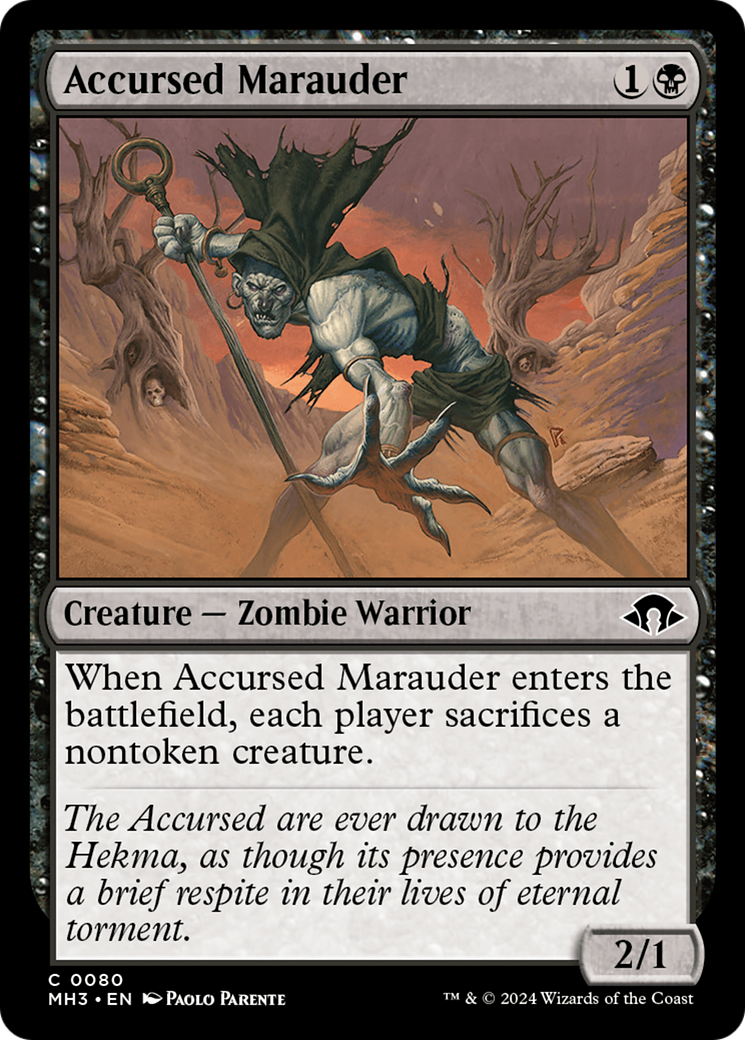
Accursed Marauder
Accursed Marauder
Creature — Zombie Warrior
2/1
When this creature enters, each player sacrifices a nontoken creature of their choice.
-
1
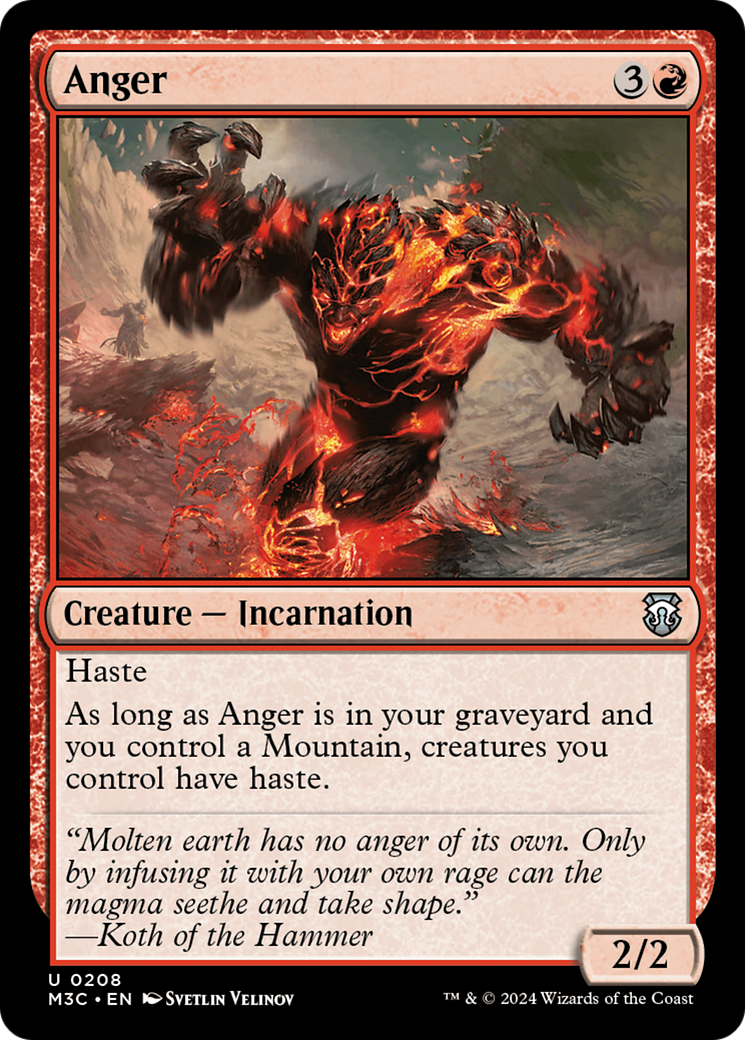
Anger
Anger
Creature — Incarnation
2/2
Haste
As long as this card is in your graveyard and you control a Mountain, creatures you control have haste.
- The timestamp for the "in your graveyard" ability is set at the time that this card goes to your graveyard, regardless of whether you control a Mountain at that time.
-
1
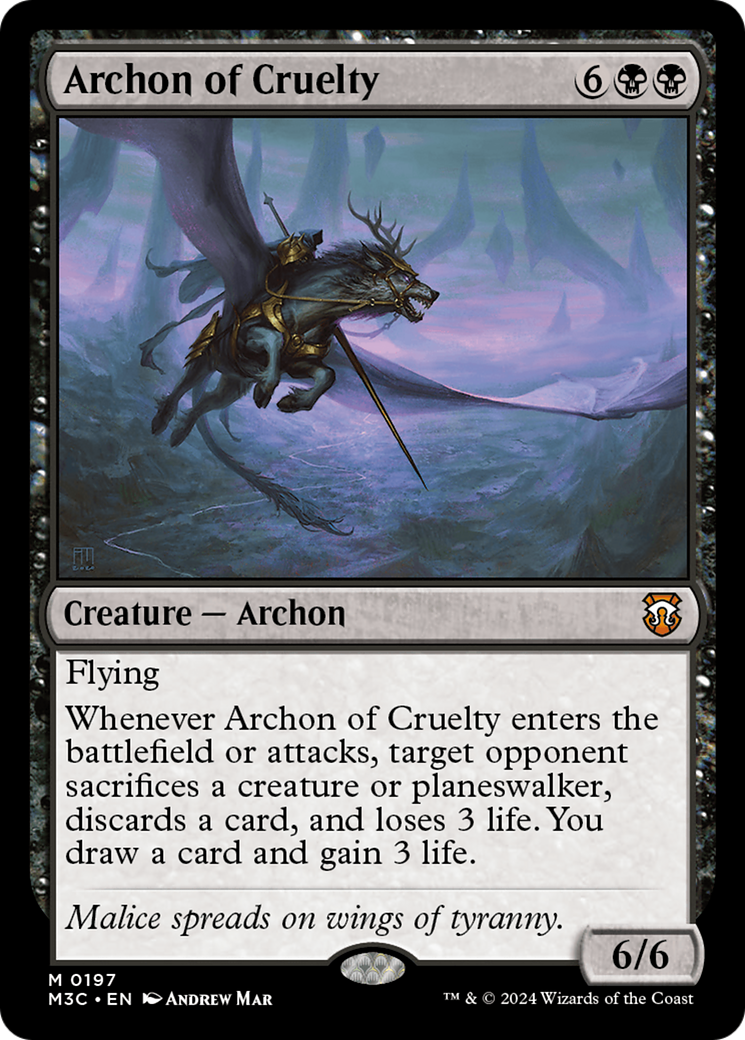
Archon of Cruelty
Archon of Cruelty
Creature — Archon
6/6
Flying
Whenever this creature enters or attacks, target opponent sacrifices a creature or planeswalker of their choice, discards a card, and loses 3 life. You draw a card and gain 3 life.
- You and the opponent you target take all the actions in the order listed. Notably, the creature or planeswalker they sacrifice won't be on the battlefield as they discard a card or lose life. If any abilities trigger, they will wait to be put on the stack until after the spell resolves. If any abilities controlled by that opponent trigger but losing 3 life causes them to lose the game, none of those abilities will be put on the stack.
-
1
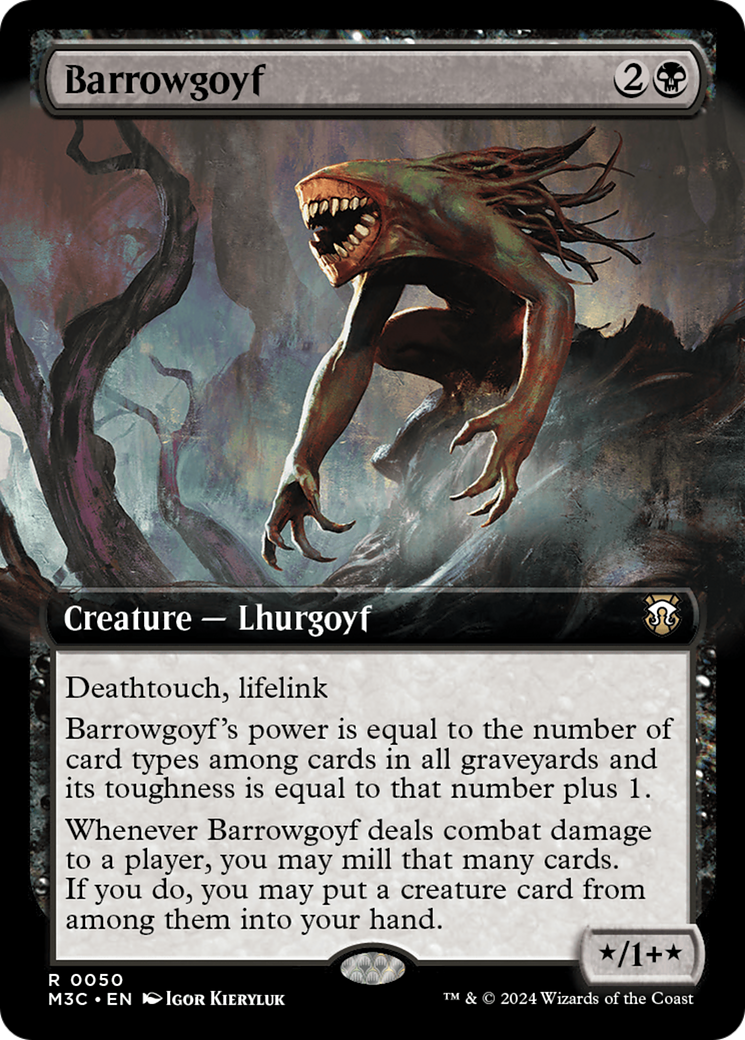
Barrowgoyf
Barrowgoyf
Creature — Lhurgoyf
*/1+*
Deathtouch, lifelink
Barrowgoyf's power is equal to the number of card types among cards in all graveyards and its toughness is equal to that number plus 1.
Whenever this creature deals combat damage to a player, you may mill that many cards. If you do, you may put a creature card from among them into your hand.
- The ability that defines Barrowgoyf's power and toughness works in all zones, not just the battlefield.
- The ability that defines Barrowgoyf's power and toughness counts card types, not cards. If the only card in all graveyards is a single artifact creature card, Barrowgoyf will be a 2/3. If the cards in all graveyards are ten artifact cards and ten creature cards, Barrowgoyf will still be a 2/3.
- Card types that can appear on cards in a graveyard are artifact, battle, creature, enchantment, instant, kindred, land, planeswalker, and sorcery. Legendary, basic, and snow are supertypes, not card types; Lhurgoyf, Forest, and Siege are subtypes, not card types.
-
1
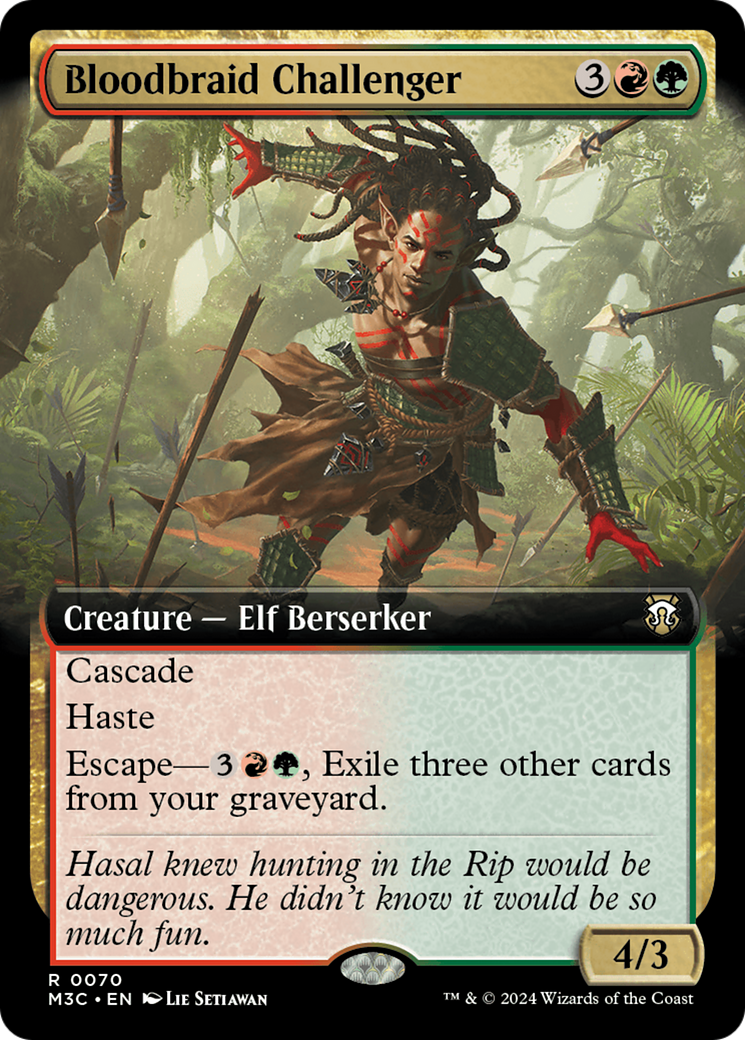
Bloodbraid Challenger
Bloodbraid Challenger
Creature — Elf Berserker
4/3
Cascade
Haste
Escape— , Exile three other cards from your graveyard. (You may cast this card from your graveyard for its escape cost.)
- If you cast a card "without paying its mana cost," you can't choose to cast it for any alternative costs. You can, however, pay additional costs. If the card has any mandatory additional costs, you must pay those to cast the card.
- If the card has in its mana cost, you must choose 0 as the value of X when casting it without paying its mana cost.
- Due to a 2021 rules change to cascade, not only do you stop exiling cards if you exile a nonland card with lesser mana value than the spell with cascade, but the resulting spell you cast must also have lesser mana value. Previously, in cases where a card's mana value differed from the resulting spell, such as with some modal double-faced cards or cards with an Adventure, you could cast a spell with a higher mana value than the exiled card.
- The mana value of a split card is determined by the combined mana cost of its two halves. If cascade allows you to cast a split card, you may cast either half but not both halves.
- Escape's permission doesn't change when you may cast the spell from your graveyard.
- If you cast a spell with its escape permission, you can't choose to apply any other alternative costs or to cast it without paying its mana cost. If it has any additional costs, you must pay those.
- Once you begin casting a spell with escape, it immediately moves to the stack. Players can't take any other actions until you're done casting the spell.
- To determine the total cost of a spell, start with the mana cost or alternative cost you're paying (such as an escape cost), add any cost increases, then apply any cost reductions. The mana value of the spell remains unchanged, no matter what the total cost to cast it was and no matter whether an alternative cost was paid.
- After an escaped spell resolves, it returns to its owner's graveyard if it's not a permanent spell. If it is a permanent spell, it enters the battlefield and will return to its owner's graveyard if it dies later. It can escape again.
- If a card has multiple abilities giving you permission to cast it, such as two escape abilities or an escape ability and a flashback ability, you choose which one to apply. The others have no effect.
- If a card with escape is put into your graveyard during your turn, you'll be able to cast it right away if it's legal to do so, before an opponent can take any actions.
- A spell's mana value is determined only by its mana cost. Ignore any alternative costs, additional costs, cost increases, or cost reductions.
- Cascade triggers when you cast the spell, meaning that it resolves before that spell. If you end up casting the exiled card, it will go on the stack above the spell with cascade.
- When the cascade ability resolves, you must exile cards. The only optional part of the ability is whether or not you cast the last card exiled.
- If a spell with cascade is countered, the cascade ability will still resolve normally.
- You exile the cards face up. All players will be able to see them.
-
1
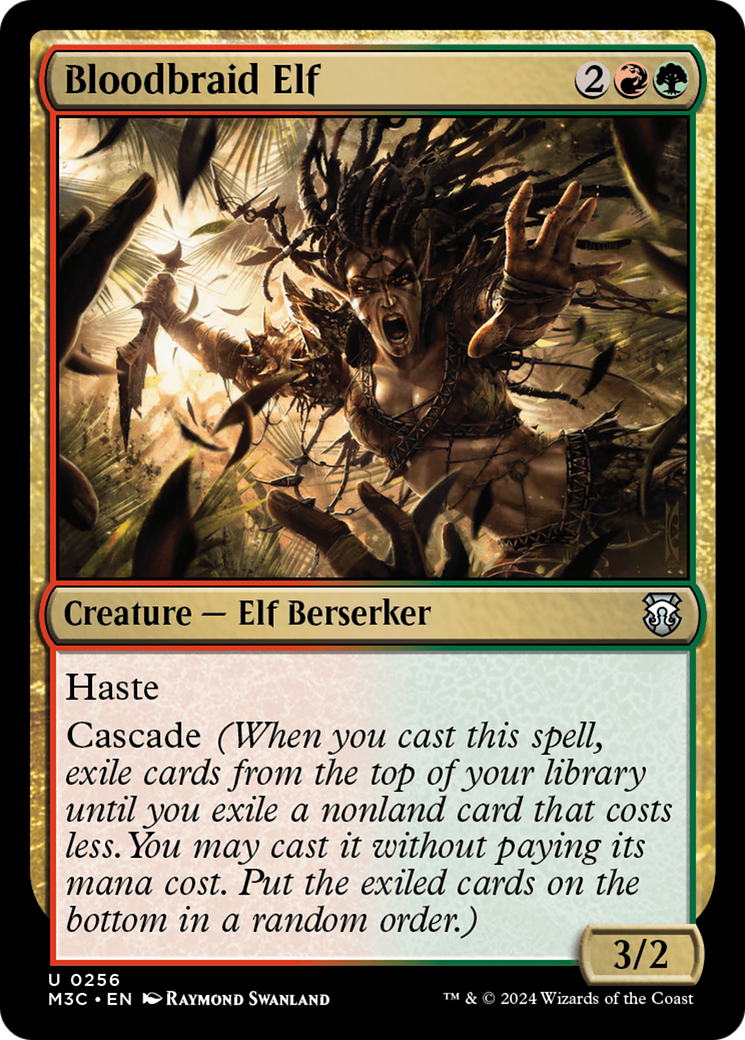
Bloodbraid Elf
Bloodbraid Elf
Creature — Elf Berserker
3/2
Haste (This creature can attack and as soon as it comes under your control.)
Cascade (When you cast this spell, exile cards from the top of your library until you exile a nonland card that costs less. You may cast it without paying its mana cost. Put the exiled cards on the bottom in a random order.)
- A spell's mana value is determined only by its mana cost. Ignore any alternative costs, additional costs, cost increases, or cost reductions.
- Cascade triggers when you cast the spell, meaning that it resolves before that spell. If you end up casting the exiled card, it will go on the stack above the spell with cascade.
- When the cascade ability resolves, you must exile cards. The only optional part of the ability is whether or not you cast the last card exiled.
- If a spell with cascade is countered, the cascade ability will still resolve normally.
- You exile the cards face up. All players will be able to see them.
- If you cast a card "without paying its mana cost," you can't choose to cast it for any alternative costs. You can, however, pay additional costs. If the card has any mandatory additional costs, you must pay those to cast the card.
- If the card has in its mana cost, you must choose 0 as the value of X when casting it without paying its mana cost.
- Due to a 2021 rules change to cascade, not only do you stop exiling cards if you exile a nonland card with lesser mana value than the spell with cascade, but the resulting spell you cast must also have lesser mana value. Previously, in cases where a card's mana value differed from the resulting spell, such as with some modal double-faced cards or cards with an Adventure, you could cast a spell with a higher mana value than the exiled card.
- The mana value of a split card is determined by the combined mana cost of its two halves. If cascade allows you to cast a split card, you may cast either half but not both halves.
-
1
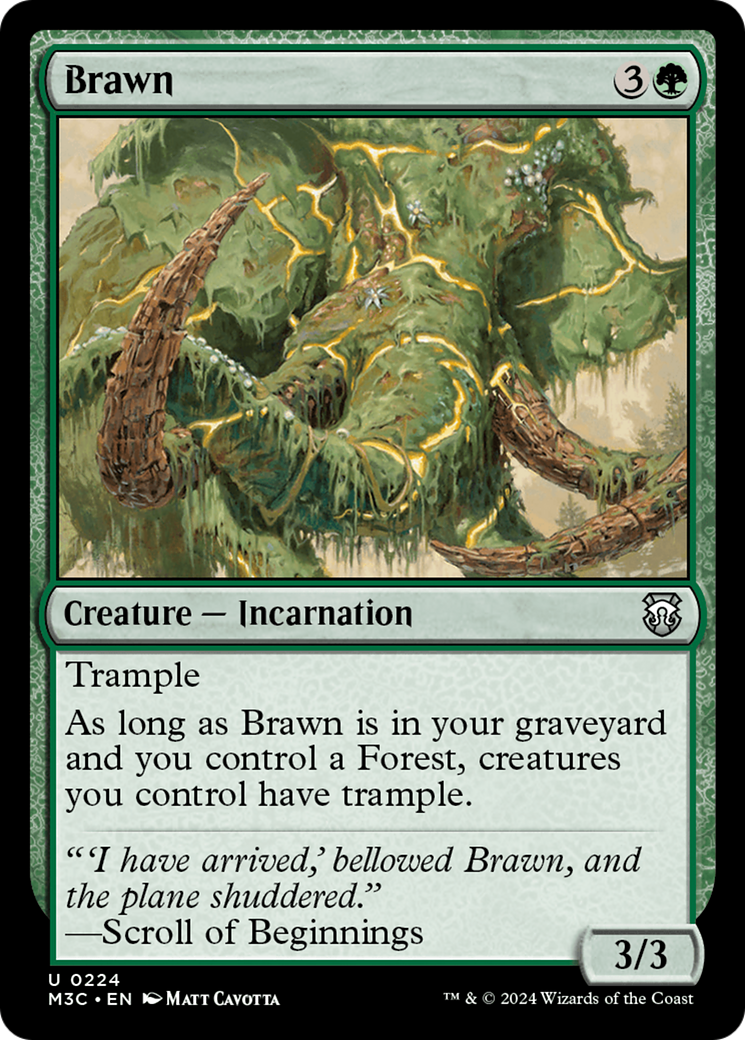
Brawn
Brawn
Creature — Incarnation
3/3
Trample
As long as this card is in your graveyard and you control a Forest, creatures you control have trample.
-
1
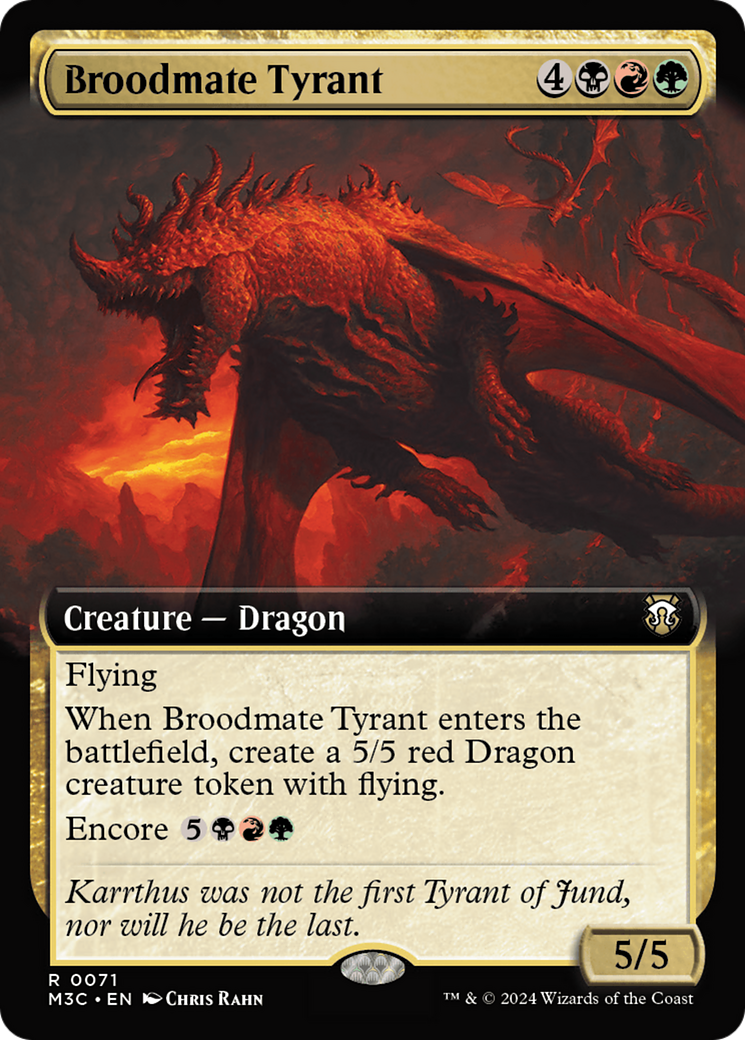
Broodmate Tyrant
Broodmate Tyrant
Creature — Dragon
5/5
Flying
When this creature enters, create a 5/5 red Dragon creature token with flying.
Encore
- Encore is an activated ability that functions from the graveyard. "Encore [cost]" means "[Cost], Exile this card from your graveyard: For each opponent, create a token that's a copy of this card that attacks that opponent this turn if able. The tokens gain haste. Sacrifice them at the beginning of the next end step. Activate only as a sorcery."
- Exiling the card with encore is a cost to activate the encore ability. Once you announce that you're activating it, no player may take actions until you've finished. They can't try to remove the card from your graveyard to stop you from paying the cost.
- Opponents who have left the game aren't counted when determining how many tokens to create.
- The tokens copy only what's on the original card. Effects that modified that creature when it was previously on the battlefield won't be copied.
- Each token must attack the appropriate player if able.
- If one of the tokens can't attack for any reason (such as being tapped), then it doesn't attack. If there's a cost associated with having it attack, you aren't forced to pay that cost, so it doesn't have to attack in that case either.
- If an effect stops a token from attacking a specific player, that token can attack any player, planeswalker, or battle, or not attack at all. If the effect stops the token from attacking a specific player unless a cost is paid, you don't have to pay that cost unless you want to attack that player.
- If one of the tokens somehow is under another player's control as the delayed triggered ability resolves, you can't sacrifice that token. It remains on the battlefield indefinitely, even if you regain control of it later.
-
1
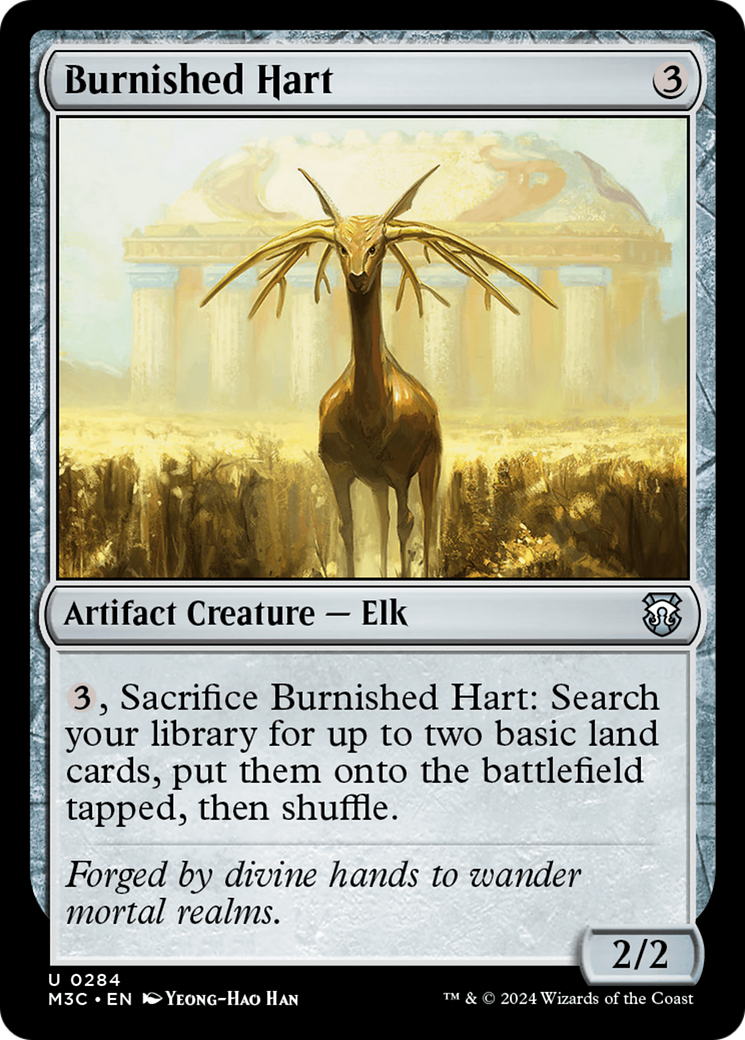
Burnished Hart
Burnished Hart
Artifact Creature — Elk
2/2
, Sacrifice this creature: Search your library for up to two basic land cards, put them onto the battlefield tapped, then shuffle.
-
1
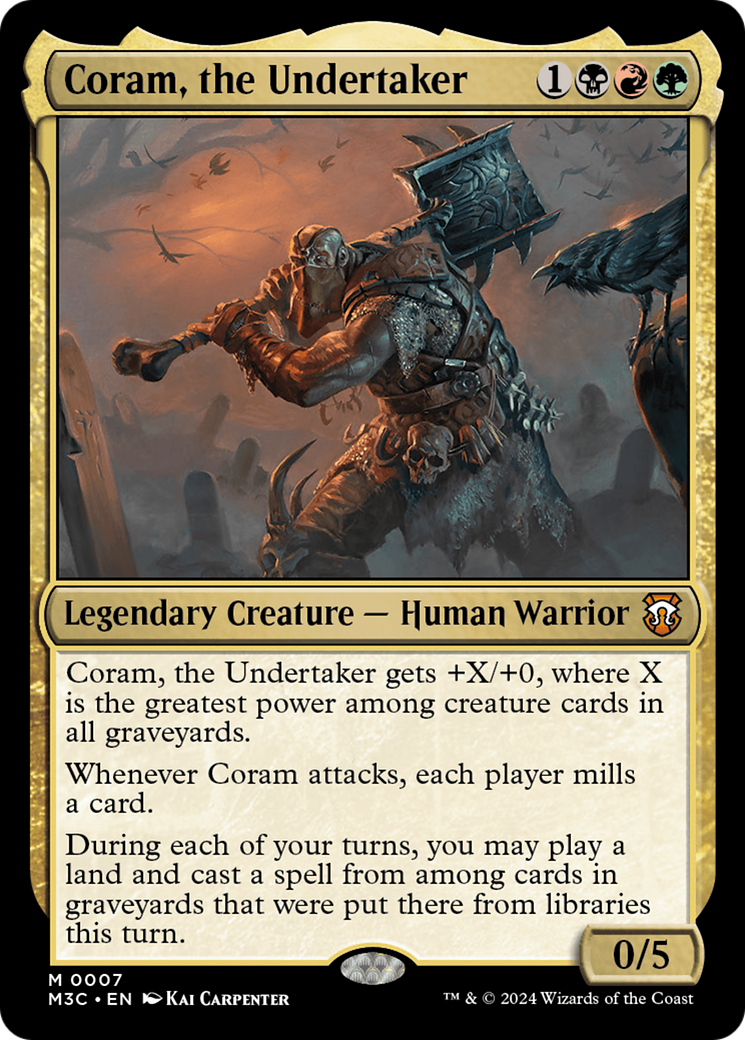
Coram, the Undertaker
Coram, the Undertaker
Legendary Creature — Human Warrior
0/5
Coram gets +X/+0, where X is the greatest power among creature cards in all graveyards.
Whenever Coram attacks, each player mills a card.
During each of your turns, you may play a land and cast a spell from among cards in graveyards that were put there from libraries this turn.
- Coram's first ability applies only while it is on the battlefield. In all other zones, its power is 0.
- The value of X will change as the greatest power among creature cards in all graveyards changes.
- You pay all costs and follow all timing rules for lands played and spells cast this way.
- Once you begin to cast a spell this way, losing control of Coram won't affect it. You can finish casting it as normal.
- If you play a land or cast a spell from a graveyard using another permission, it won't stop you from using Coram's permission to do the same thing later in the turn, provided you haven't already done so.
- If you play a land, cast a spell, or both using the permission granted by Coram's last ability and then have a new Coram come under your control in the same turn, you can still play a land, cast a spell, or both using the new Coram's permission.
- If it's your turn, you control Coram, and another player has permission to play a card in a graveyard that was put there from a library this turn (perhaps because it's an instant card they own that has flashback), whoever gets priority sooner will have the first chance to play that card. In most cases, this will be you, since the active player receives priority after a spell or ability resolves.
-
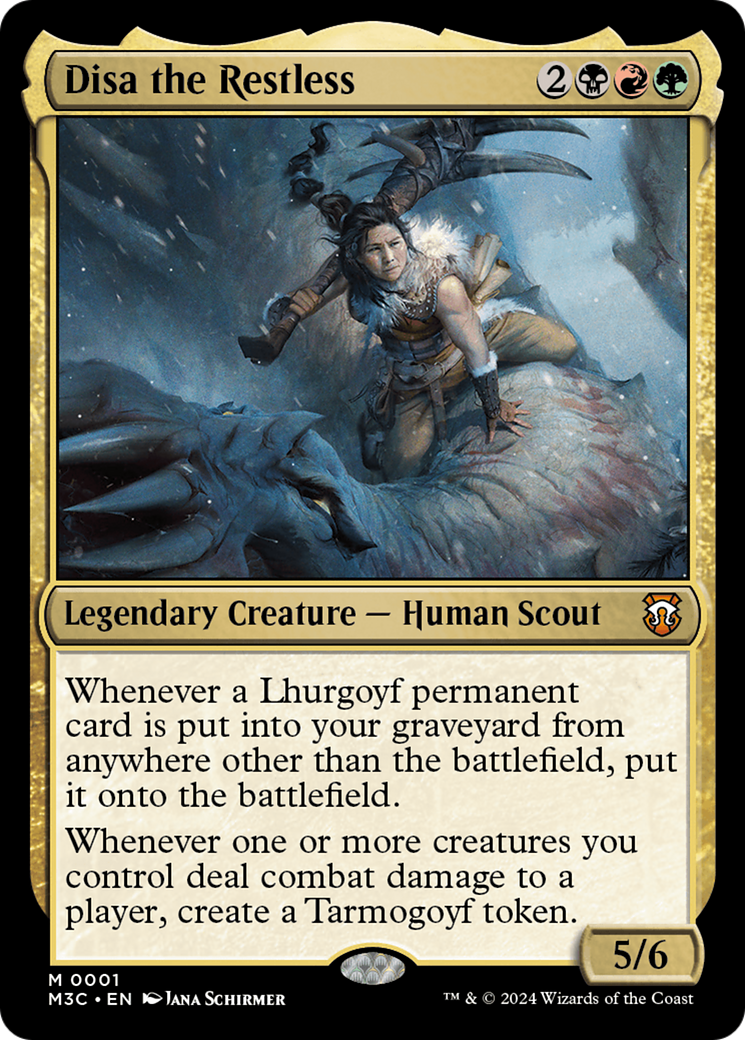
1
Disa the Restless
Disa the Restless
Legendary Creature — Human Scout
5/6
Whenever a Lhurgoyf permanent card is put into your graveyard from anywhere other than the battlefield, put it onto the battlefield.
Whenever one or more creatures you control deal combat damage to a player, create a Tarmogoyf token.
- Disa the Restless's last ability creates a token that's a copy of the card Tarmogoyf in the Oracle card reference. Official text for Tarmogoyf can be found using the Gatherer card database at Gatherer.Wizards.com.
-
1
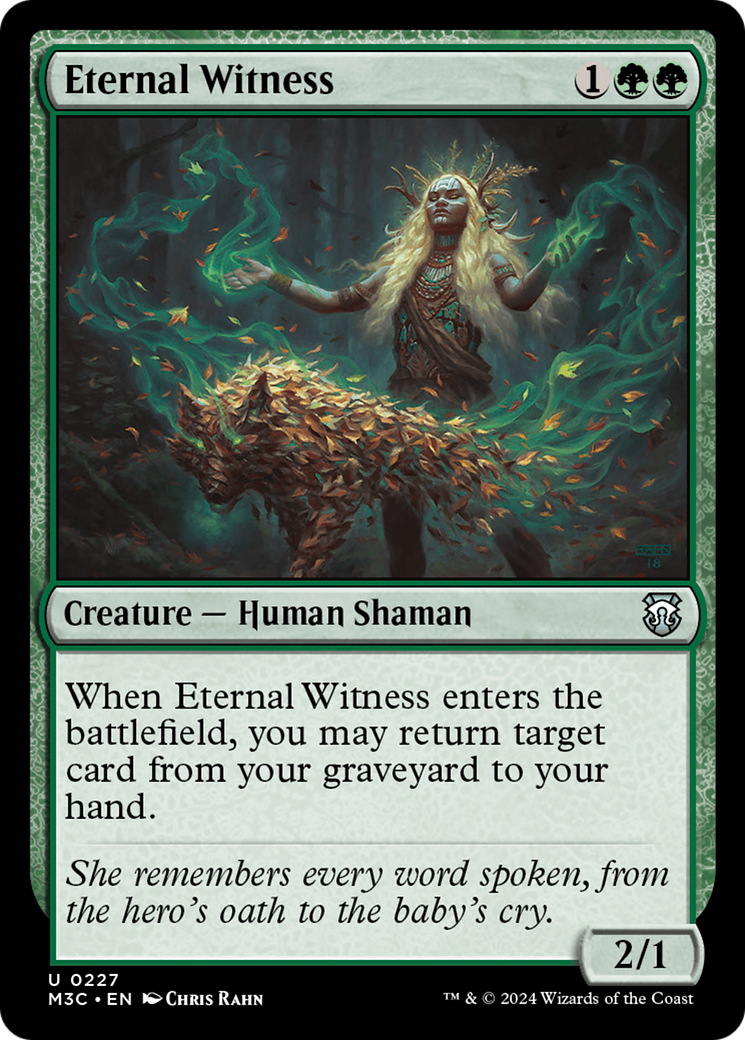
Eternal Witness
Eternal Witness
Creature — Human Shaman
2/1
When this creature enters, you may return target card from your graveyard to your hand.
- If a resolving spell puts Eternal Witness onto the battlefield, Eternal Witness's ability can target that card if it's put into your graveyard as it resolves.
-
1
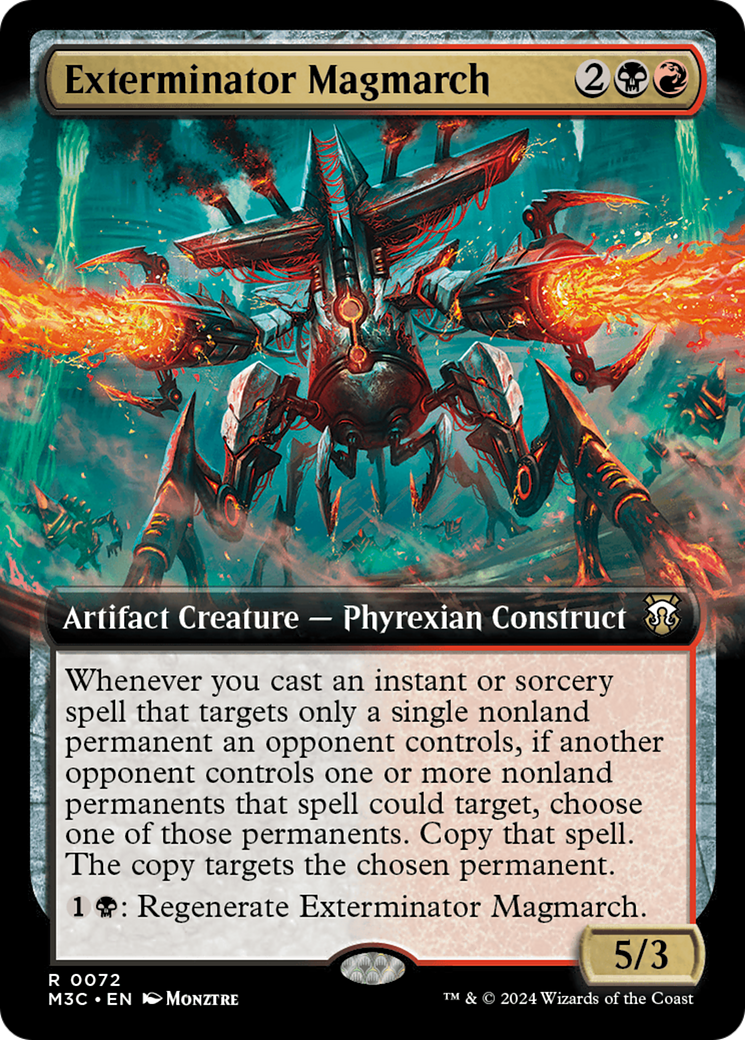
Exterminator Magmarch
Exterminator Magmarch
Artifact Creature — Phyrexian Construct
5/3
Whenever you cast an instant or sorcery spell that targets only a single nonland permanent an opponent controls, if another opponent controls one or more nonland permanents that spell could target, choose one of those permanents. Copy that spell. The copy targets the chosen permanent.
: Regenerate this creature.
- Exterminator Magmarch's first ability won't trigger if no other opponent controls any nonland permanents that spell could target. If the ability does trigger but no other opponent controls any nonland permanents the spell could target by the time the ability resolves, the ability won't do anything.
- If a spell has multiple targets but all of them are the same nonland permanent an opponent controls, Exterminator Magmarch's ability will trigger as long as another opponent controls one or more nonland permanents that spell could target. The copy will target only the chosen permanent and no other permanents.
- The copy is created even if the spell that caused the ability to trigger has been countered by the time the ability resolves. The copy resolves before the original spell.
- The copy that Exterminator Magmarch's ability creates is created on the stack, so it's not "cast." Other abilities that trigger when a player casts a spell won't trigger.
- If the spell that's copied is modal (that is, it says "Choose one —" or the like), the copy will have the same modes. You can't choose different ones.
- If the spell that's copied has an X whose value was determined as it was cast, the copy has the same value of X.
- The controller of a copy can't choose to pay any additional costs for the copy. However, effects based on any additional costs that were paid for the original spell are copied as though those same costs were paid for the copy too. For example, if the spell you copy was kicked, the copies will also be kicked.
-
1
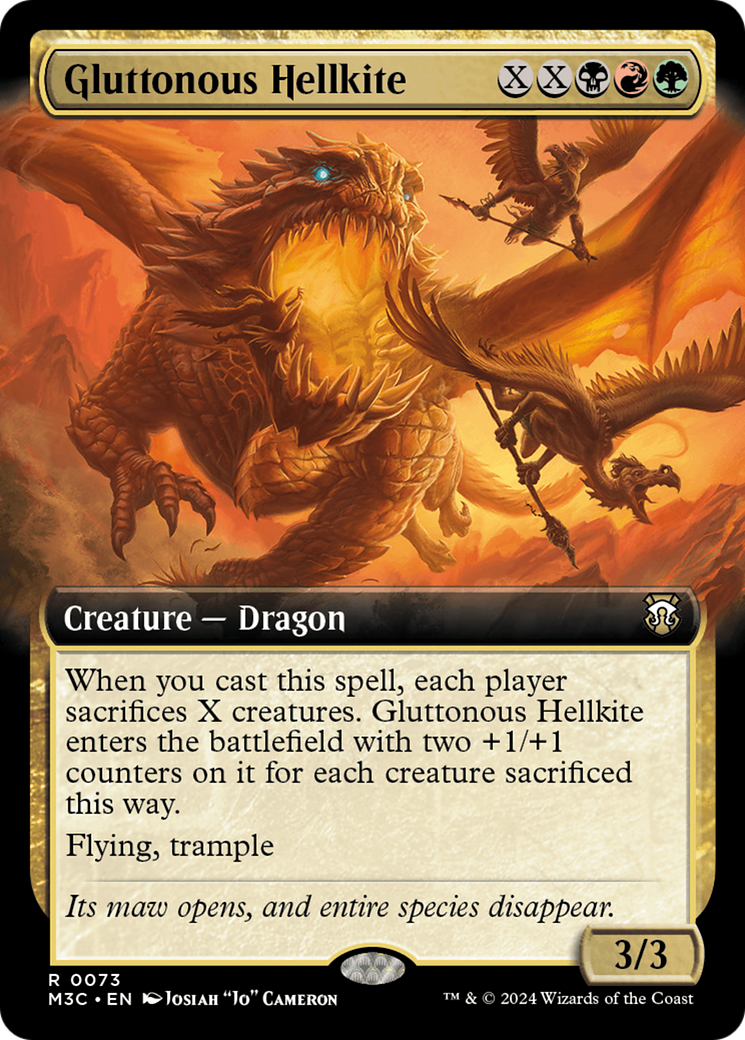
Gluttonous Hellkite
Gluttonous Hellkite
Creature — Dragon
3/3
When you cast this spell, each player sacrifices X creatures. This creature enters with two +1/+1 counters on it for each creature sacrificed this way.
Flying, trample
- Gluttonous Hellkite's triggered ability will resolve before Gluttonous Hellkite does. If Gluttonous Hellkite is countered or otherwise leaves the stack in response to that triggered ability, the triggered ability will still resolve as normal.
- Use the number of creatures that were actually sacrificed this way, not the value of X, to determine the number of +1/+1 counters with which Gluttonous Hellkite should enter the battlefield.
-
1
Graveshifter
Graveshifter
Creature — Shapeshifter
2/2
Changeling (This card is every creature type.)
When this creature enters, you may return target creature card from your graveyard to your hand.
-
1
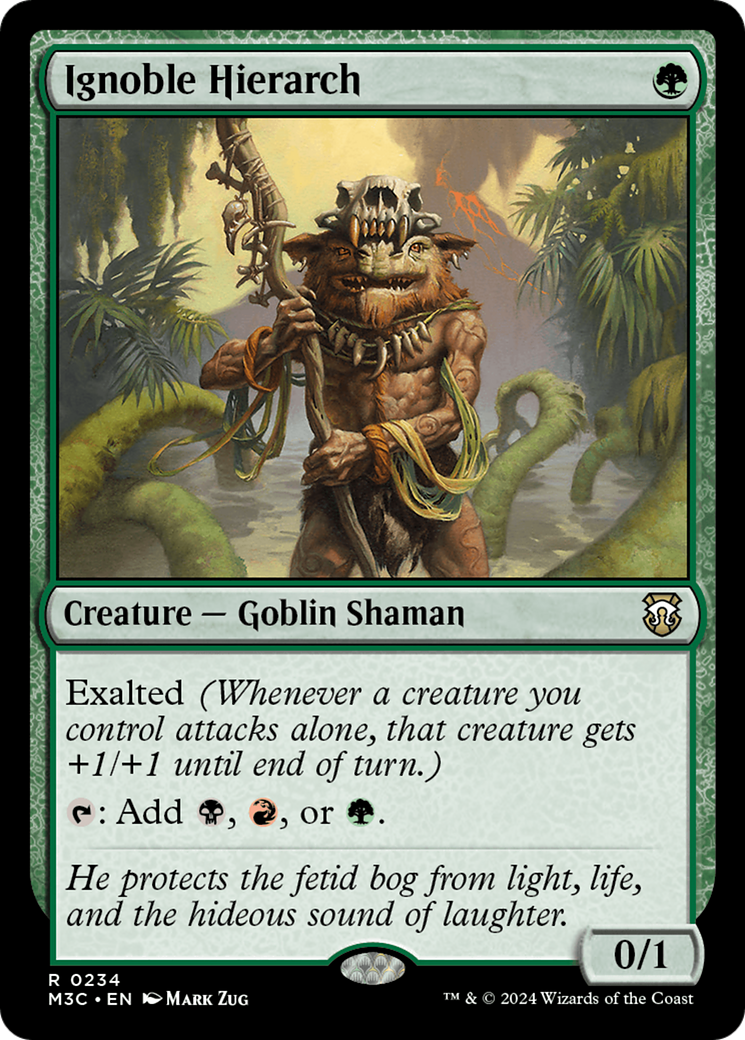
Ignoble Hierarch
Ignoble Hierarch
Creature — Goblin Shaman
0/1
Exalted (Whenever a creature you control attacks alone, that creature gets +1/+1 until end of turn.)
: Add , , or .
- A creature attacks alone if it's the only creature declared as an attacker during the declare attackers step (including creatures controlled by your teammates, if applicable). For example, exalted won't trigger if you attack with multiple creatures and all but one of them are removed from combat.
-
1
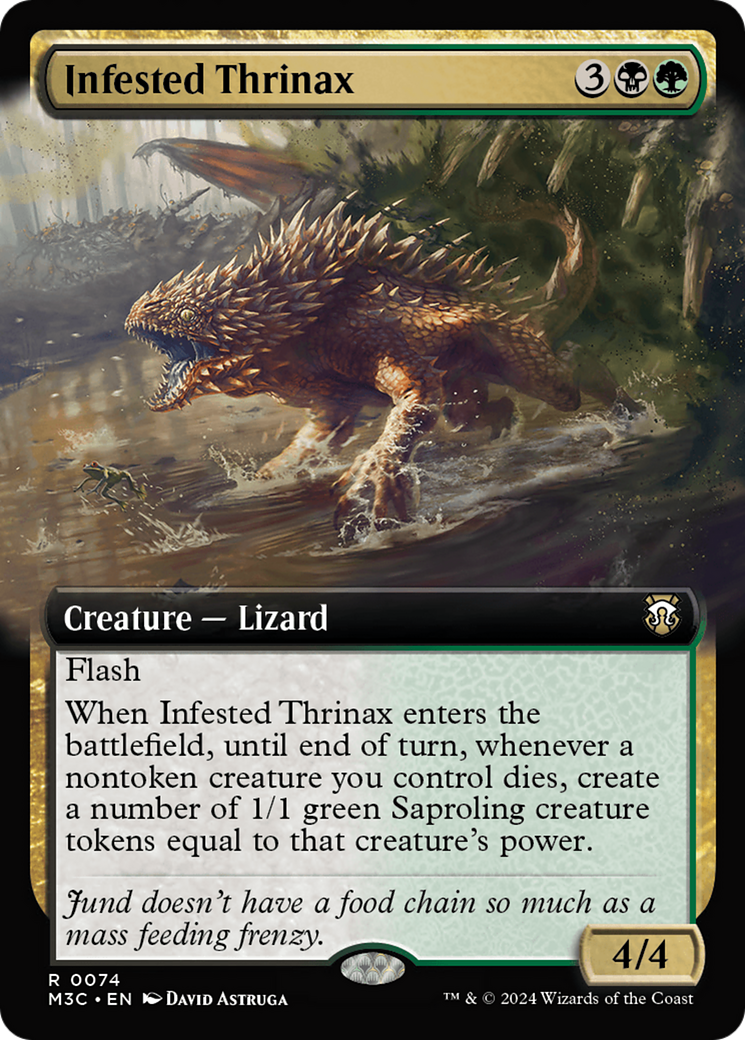
Infested Thrinax
Infested Thrinax
Creature — Lizard
4/4
Flash
When this creature enters, until end of turn, whenever a nontoken creature you control dies, create a number of 1/1 green Saproling creature tokens equal to that creature's power.
- Use the power of the creature that died as it last existed on the battlefield to determine how many Saproling tokens to create.
-
1
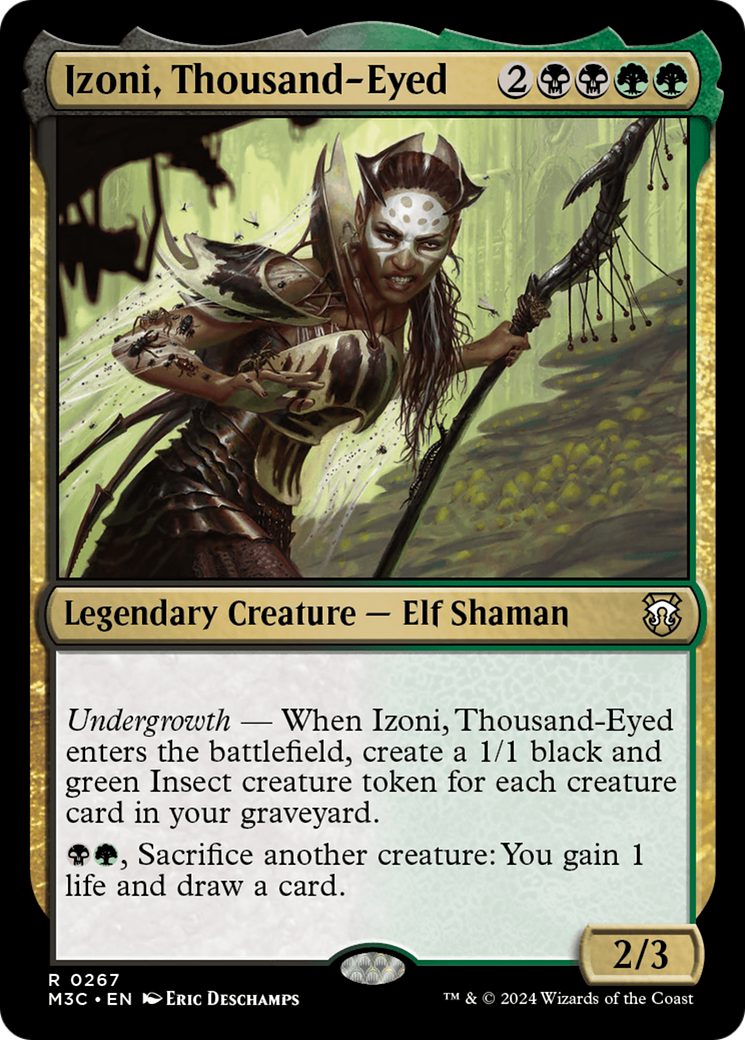
Izoni, Thousand-Eyed
Izoni, Thousand-Eyed
Legendary Creature — Elf Shaman
2/3
Undergrowth — When Izoni enters, create a 1/1 black and green Insect creature token for each creature card in your graveyard.
, Sacrifice another creature: You gain 1 life and draw a card.
- You can activate Izoni's last ability while its undergrowth ability is on the stack. This will increase the number of Insect tokens you'll create.
- Creature cards with other types, such as artifact creature cards, count for undergrowth abilities.
- Because tokens aren't cards, they never count for undergrowth abilities.
-
1
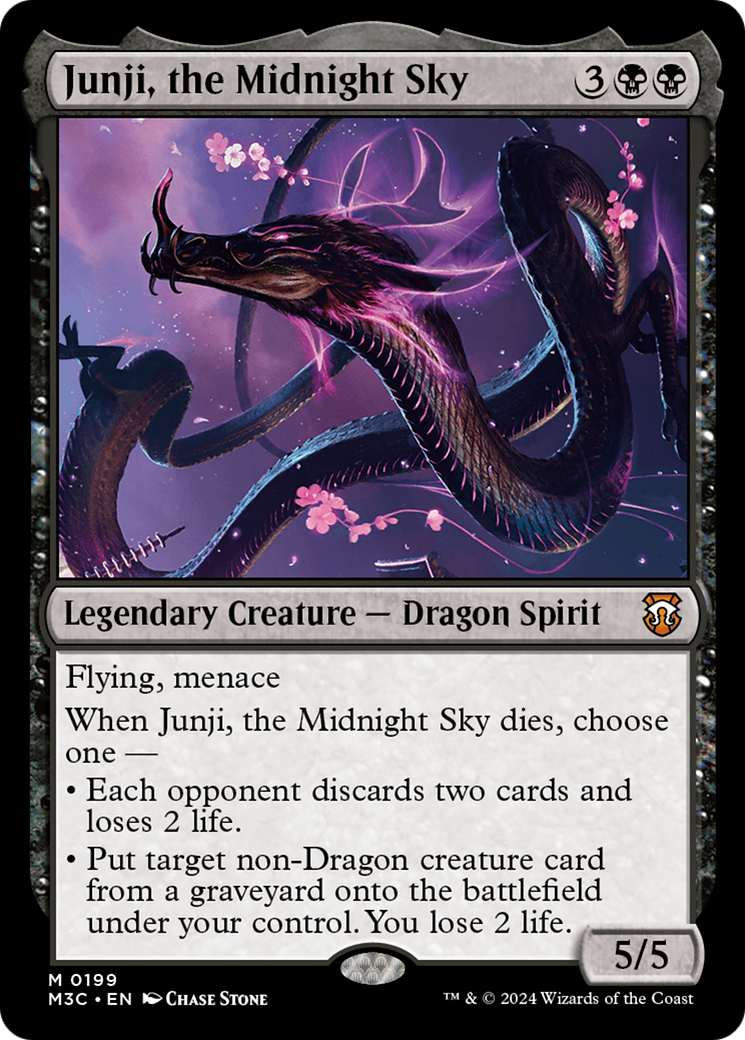
Junji, the Midnight Sky
Junji, the Midnight Sky
Legendary Creature — Dragon Spirit
5/5
Flying, menace
When Junji dies, choose one —
- Each opponent discards two cards and loses 2 life.
- Put target non-Dragon creature card from a graveyard onto the battlefield under your control. You lose 2 life.
-
1
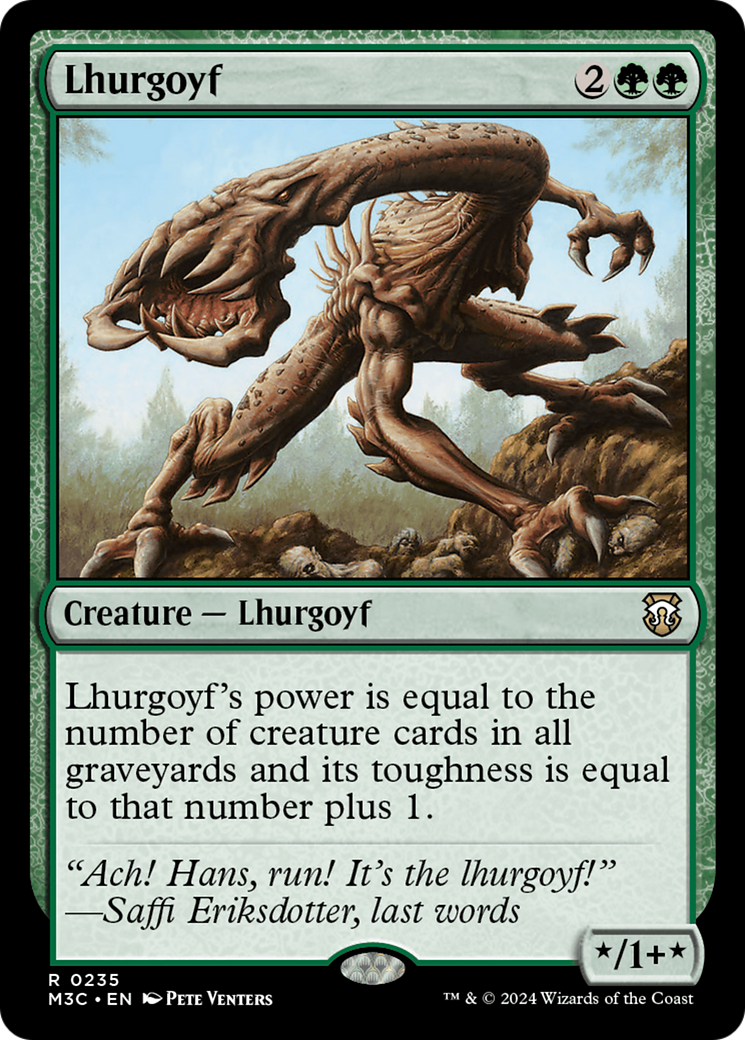
Lhurgoyf
Lhurgoyf
Creature — Lhurgoyf
*/1+*
Lhurgoyf's power is equal to the number of creature cards in all graveyards and its toughness is equal to that number plus 1.
-
1
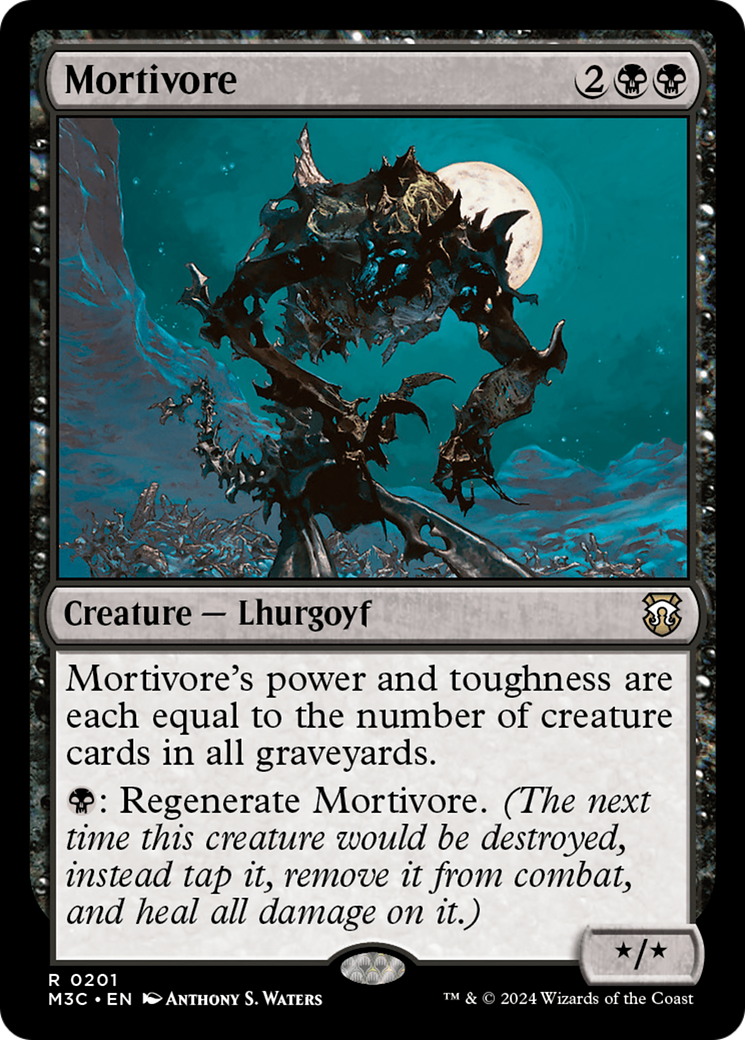
Mortivore
Mortivore
Creature — Lhurgoyf
*/*
Mortivore's power and toughness are each equal to the number of creature cards in all graveyards.
: Regenerate this creature. (The next time this creature would be destroyed this turn, instead tap it, remove it from combat, and heal all damage on it.)
-
1
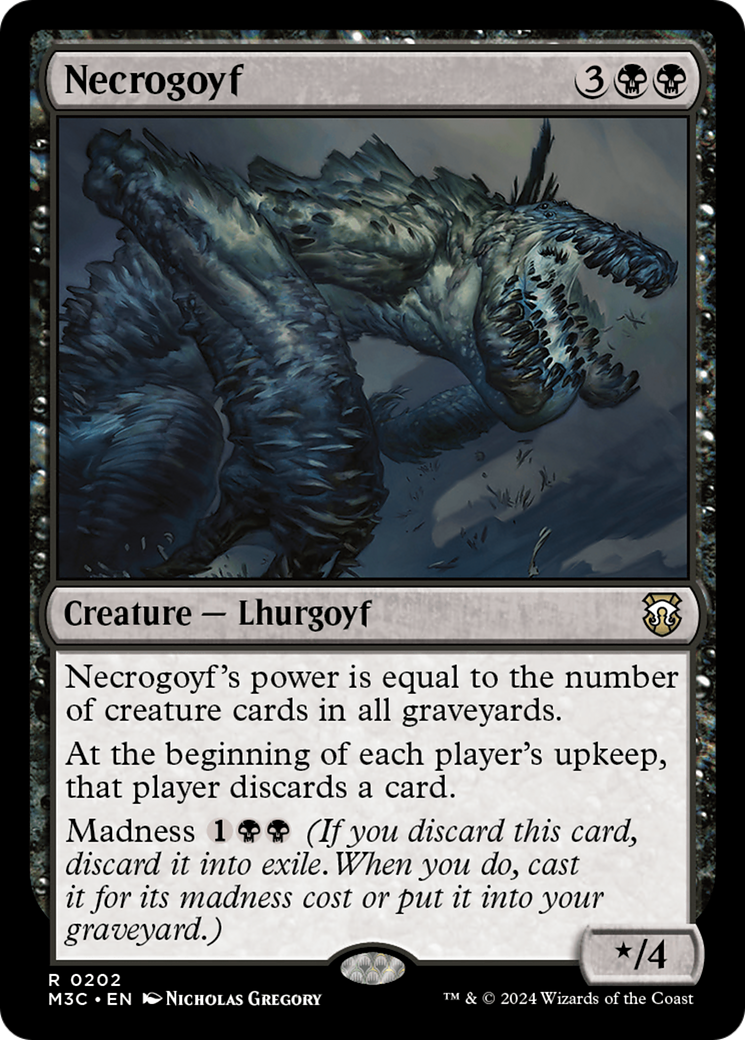
Necrogoyf
Necrogoyf
Creature — Lhurgoyf
*/4
Necrogoyf's power is equal to the number of creature cards in all graveyards.
At the beginning of each player's upkeep, that player discards a card.
Madness (If you discard this card, discard it into exile. When you do, cast it for its madness cost or put it into your graveyard.)
- Cards are discarded in a Magic game only from a player's hand. Effects that put cards into a player's graveyard from anywhere else do not cause those cards to be discarded.
- Madness works independently of why you're discarding the card. You could discard it to pay a cost, because a spell or ability tells you to, or because you have too many cards in your hand during your cleanup step. You can't discard a card with madness just because you want to, though.
- A card with madness that's discarded counts as having been discarded even though it's put into exile rather than a graveyard. If it was discarded to pay a cost, that cost is still paid. Abilities that trigger when a card is discarded will still trigger.
- A spell cast for its madness cost is put onto the stack like any other spell. It can be countered, copied, and so on. As it resolves, it's put onto the battlefield if it's a permanent card or into its owner's graveyard if it's an instant or sorcery card.
- Casting a spell with madness ignores the timing rules based on the card's card type. For example, you can cast a sorcery with madness if you discard it during an opponent's turn.
- To determine the total cost of a spell, start with the mana cost or alternative cost (such as a madness cost) you're paying, add any cost increases, then apply any cost reductions. The mana value of the spell is determined by only its mana cost, no matter what the total cost to cast that spell was.
- If you choose not to cast a card with madness when the madness triggered ability resolves, it's put into your graveyard. Madness doesn't give you another chance to cast it later.
- If you discard a card with madness to pay the cost of a spell or activated ability, that card's madness triggered ability (and the spell that card becomes, if you choose to cast it) will resolve before the spell or ability the discard paid for.
- If you discard a card with madness while a spell or ability is resolving, it moves immediately to exile. Continue resolving that spell or ability, noting that the card you discarded is not in your graveyard at this time. Its madness triggered ability will be placed onto the stack once that spell or ability has completely resolved.
-
1
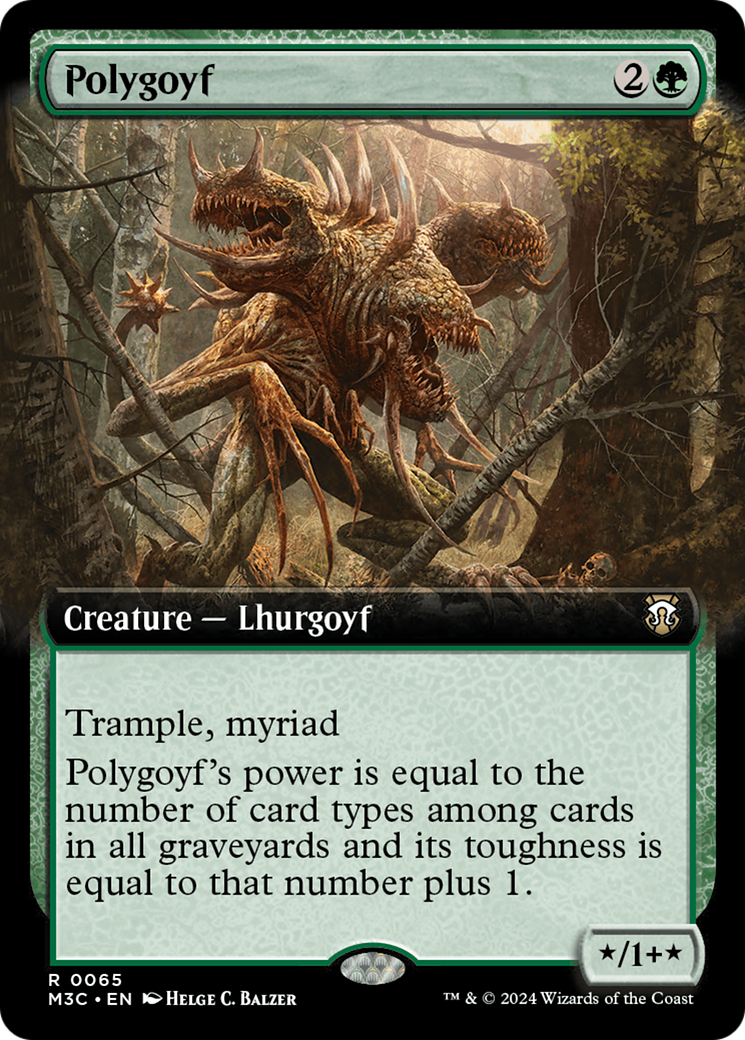
Polygoyf
Polygoyf
Creature — Lhurgoyf
*/1+*
Trample, myriad (Whenever this creature attacks, for each opponent other than defending player, you may create a token copy that's tapped and attacking that player or a planeswalker they control. Exile the tokens at end of combat.)
Polygoyf's power is equal to the number of card types among cards in all graveyards and its toughness is equal to that number plus 1.
- The term "defending player" in the myriad rules (or any other ability of an attacking creature) refers to the player the creature with myriad was attacking at the time it became an attacking creature this combat, the controller of the planeswalker the creature was attacking at the time it became an attacking creature this combat, or the protector of the battle this creature was attacking at the time it became an attacking creature this combat.
- If the defending player is your only opponent, no tokens are put onto the battlefield.
- You choose whether each token is attacking the player or a planeswalker they control as the token is created.
- Although the tokens enter the battlefield attacking, they were never declared as attackers. Abilities that trigger whenever a creature attacks won't trigger, including the myriad ability of the tokens. If there are any costs to have a creature attack, those costs won't apply to the tokens.
- The token creatures all enter the battlefield at the same time.
- Each token copies exactly what was printed on the original creature and nothing else. It doesn't copy whether that creature is tapped or untapped, whether it has any counters on it or Auras and Equipment attached to it, or any non-copy effects that have changed its power, toughness, types, color, and so on.
- Any enters-the-battlefield abilities of the copied creature will trigger when the token enters the battlefield. Any "as [this permanent] enters the battlefield" or "[this permanent] enters the battlefield with" abilities of the copied creature will also work.
- If myriad creates more than one token for any given player (due to an effect such as the one Doubling Season creates), you may choose separately for each token whether it's attacking the player or a planeswalker they control.
- The ability that defines Polygoyf's power and toughness works in all zones, not just the battlefield.
- The ability that defines Polygoyf's power and toughness counts card types, not cards. If the only card in all graveyards is a single artifact creature card, Polygoyf will be a 2/3. If the cards in all graveyards are ten artifact cards and ten creature cards, Polygoyf will still be a 2/3.
- Card types that can appear on cards in a graveyard are artifact, battle, creature, enchantment, instant, kindred, land, planeswalker, and sorcery. Legendary, basic, and snow are supertypes, not card types; Lhurgoyf, Forest, and Siege are subtypes, not card types.
-
1
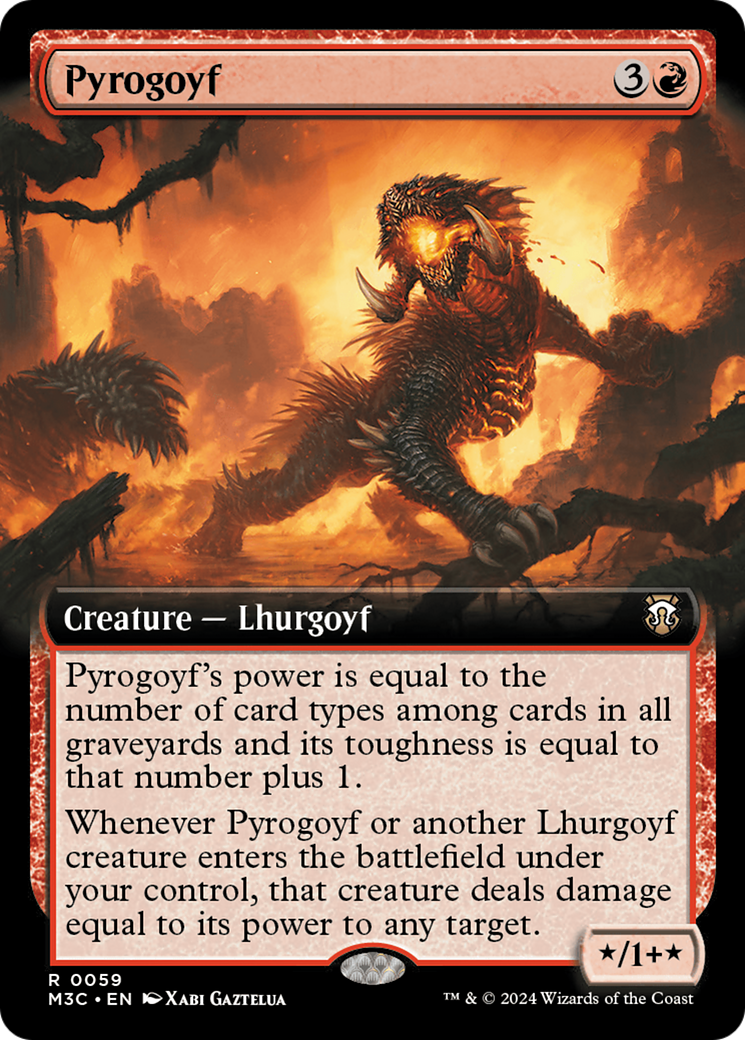
Pyrogoyf
Pyrogoyf
Creature — Lhurgoyf
*/1+*
Pyrogoyf's power is equal to the number of card types among cards in all graveyards and its toughness is equal to that number plus 1.
Whenever this creature or another Lhurgoyf creature you control enters, that creature deals damage equal to its power to any target.
- The ability that defines Pyrogoyf's power and toughness works in all zones, not just the battlefield.
- The ability that defines Pyrogoyf's power and toughness counts card types, not cards. If the only card in all graveyards is a single artifact creature card, Pyrogoyf will be a 2/3. If the cards in all graveyards are ten artifact cards and ten creature cards, Pyrogoyf will still be a 2/3.
- Card types that can appear on cards in a graveyard are artifact, battle, creature, enchantment, instant, kindred, land, planeswalker, and sorcery. Legendary, basic, and snow are supertypes, not card types; Lhurgoyf, Forest, and Siege are subtypes, not card types.
- If Pyrogoyf or the relevant Lhurgoyf creature leaves the battlefield while Pyrogoyf's last ability is on the stack, use its power as it last existed on the battlefield to determine how much damage is dealt.
-
1
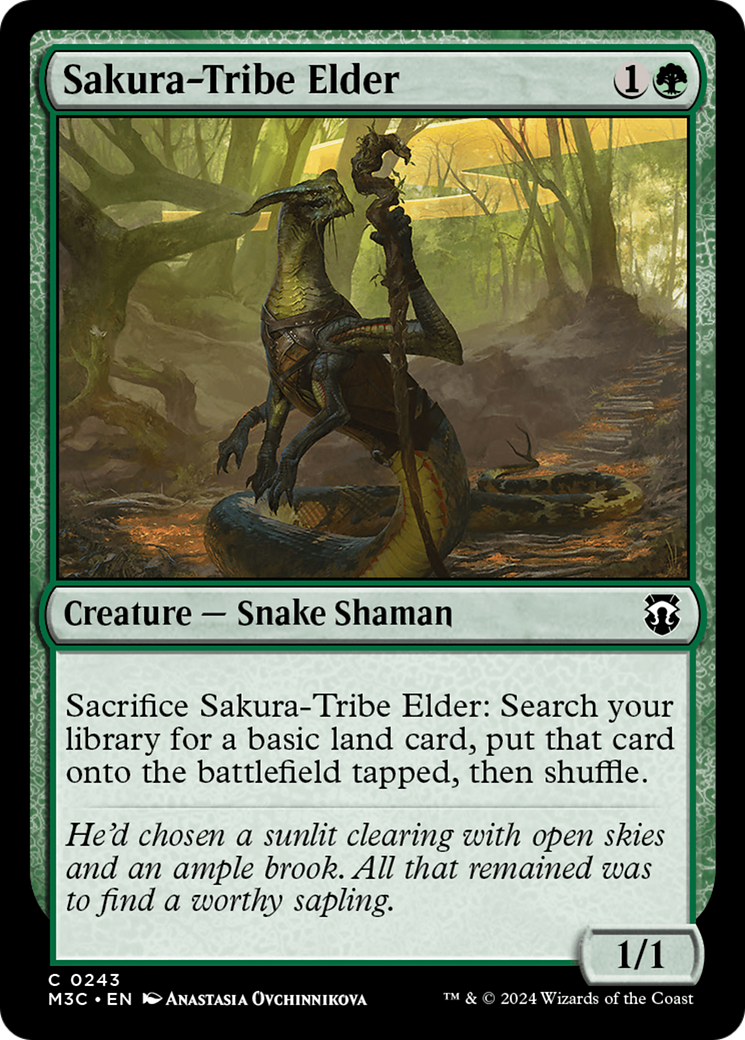
Sakura-Tribe Elder
Sakura-Tribe Elder
Creature — Snake Shaman
1/1
Sacrifice this creature: Search your library for a basic land card, put that card onto the battlefield tapped, then shuffle.
-
1
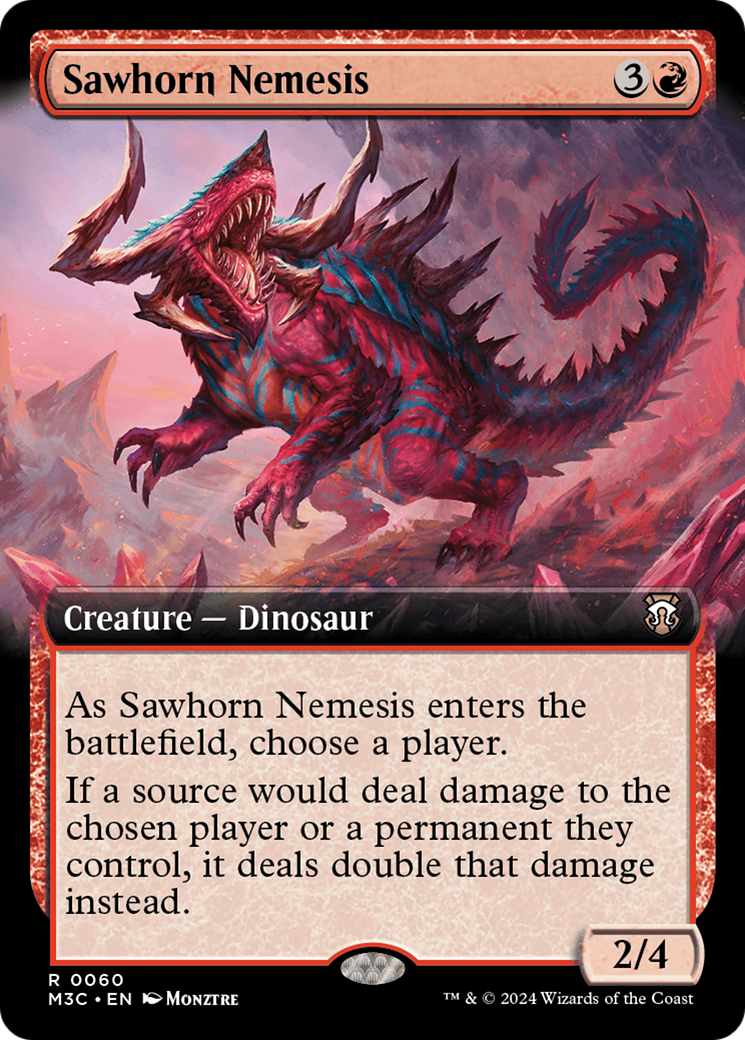
Sawhorn Nemesis
Sawhorn Nemesis
Creature — Dinosaur
2/4
As this creature enters, choose a player.
If a source would deal damage to the chosen player or a permanent they control, it deals double that damage instead.
- The damage is dealt by the same source as the original source of damage. The doubled damage isn't dealt by Sawhorn Nemesis unless it was the original source of damage.
- The protector of a battle with the Siege subtype is not that battle's controller.
- If another effect (or effects) modifies how much damage a source would deal to the chosen player or a permanent they control (for example, by preventing some of that damage), the player being dealt damage or the controller of the permanent being dealt damage chooses the order in which any such effects, including the effect of Sawhorn Nemesis, apply. If all of the damage is prevented before Sawhorn Nemesis's effect would apply, its effect no longer applies.
- If damage dealt is being divided or assigned among multiple permanents or players, that damage is divided or assigned before any effects that modify how much damage will be dealt. For example, if you attack the chosen player with a 5/5 creature with trample and it's blocked by a 2/2 creature they control, you can assign 2 damage to the blocker and 3 damage to the defending player. Those amounts are then doubled to 4 and 6, respectively.
-
1
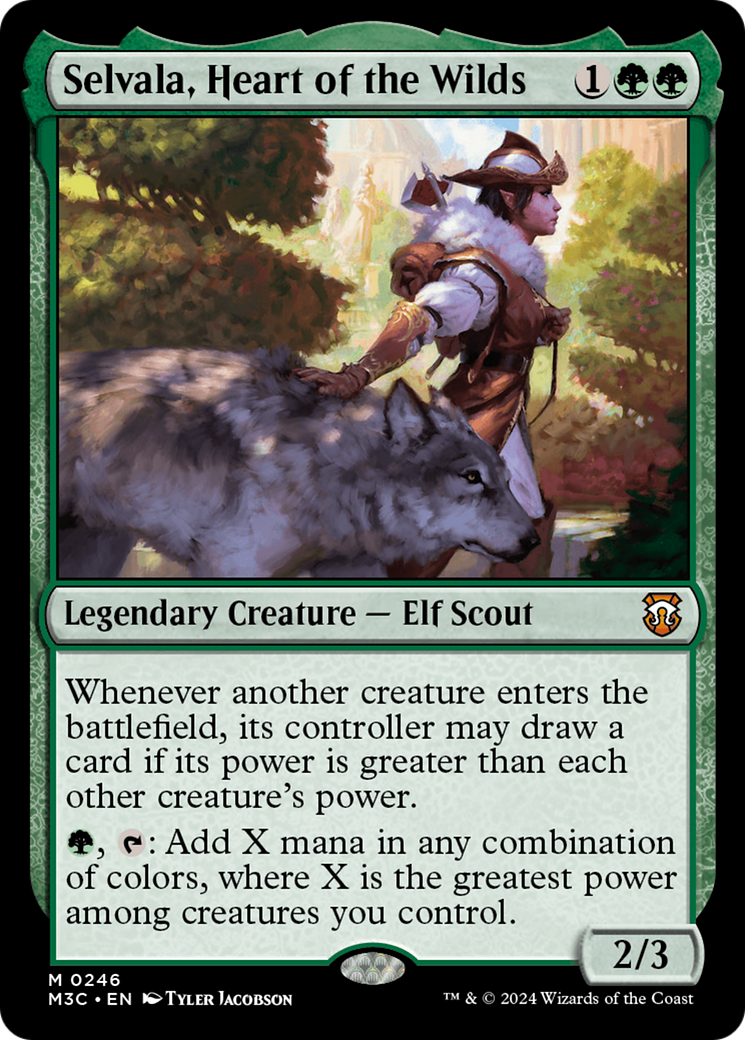
Selvala, Heart of the Wilds
Selvala, Heart of the Wilds
Legendary Creature — Elf Scout
2/3
Whenever another creature enters, its controller may draw a card if its power is greater than each other creature's power.
, : Add X mana in any combination of colors, where X is the greatest power among creatures you control.
- Selvala's last ability is a mana ability. It doesn't use the stack and can't be responded to. If the greatest power among creatures you control is 0 or less at that time, no mana is added.
- The new creature's power is compared to the power of each other creature on the battlefield as the first ability resolves. If another creature has the same or higher power than the new creature's power, no one may draw a card.
- If the new creature isn't on the battlefield as the first ability resolves, use its power when it left the battlefield to determine whether its controller may draw a card. Note that effects that reduced its power before it left the battlefield will apply.
-
1
Siege-Gang Lieutenant
Siege-Gang Lieutenant
Creature — Goblin
2/2
Lieutenant — At the beginning of combat on your turn, if you control your commander, create two 1/1 red Goblin creature tokens. Those tokens gain haste until end of turn.
, Sacrifice a Goblin: This creature deals 1 damage to any target.
- If you don't control your commander as the lieutenant ability resolves, you won't get its effect.
- If you have multiple commanders, the lieutenant effect will happen as long as you control at least one commander. It will happen only once even if you control multiple commanders.
-
1
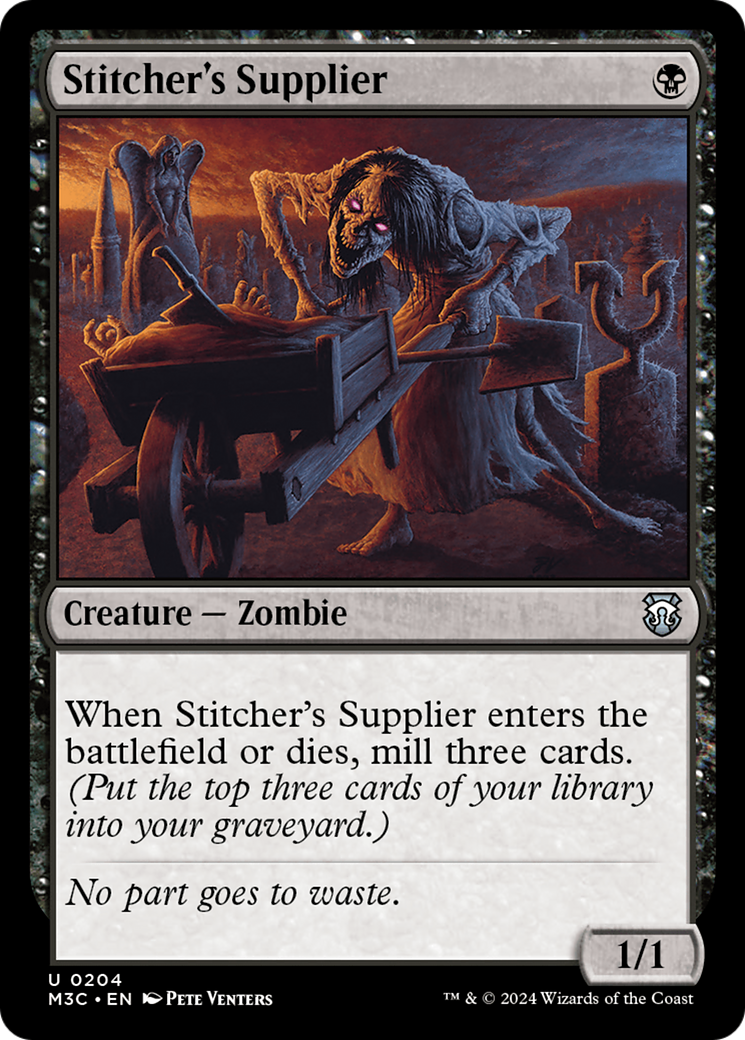
Stitcher's Supplier
Stitcher's Supplier
Creature — Zombie
1/1
When this creature enters or dies, mill three cards. (Put the top three cards of your library into your graveyard.)
-
1
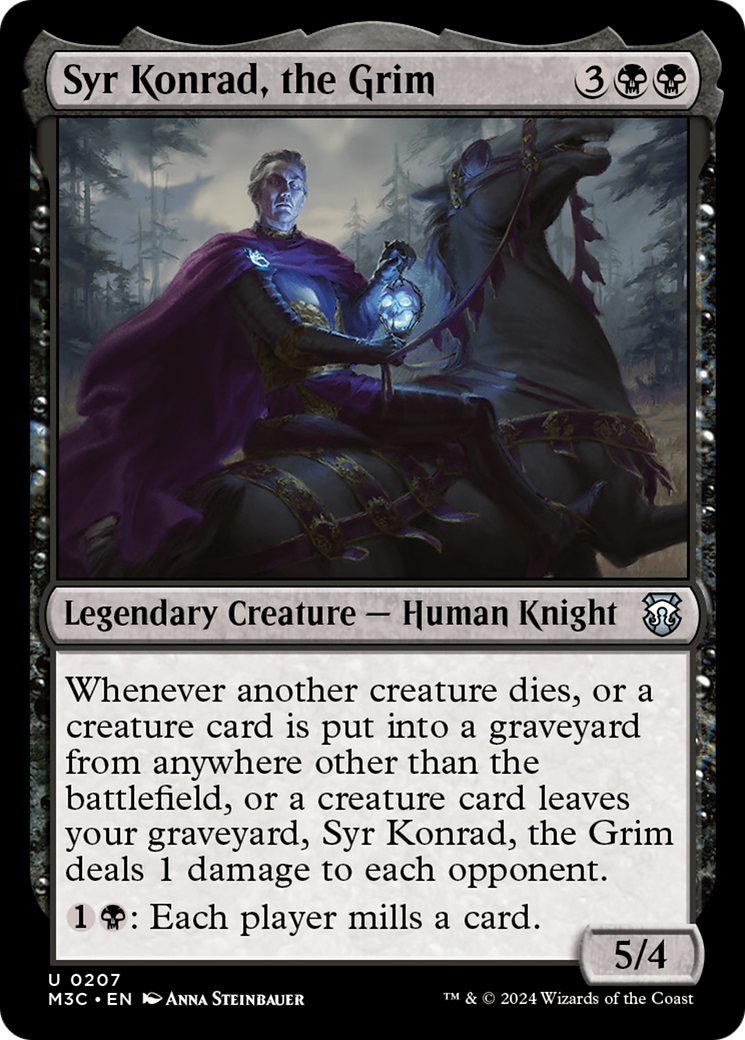
Syr Konrad, the Grim
Syr Konrad, the Grim
Legendary Creature — Human Knight
5/4
Whenever another creature dies, or a creature card is put into a graveyard from anywhere other than the battlefield, or a creature card leaves your graveyard, Syr Konrad deals 1 damage to each opponent.
: Each player mills a card. (They each put the top card of their library into their graveyard.)
- If one or more creatures die at the same time as Syr Konrad, its first ability triggers for each of those creatures.
- In a Two-Headed Giant game, Syr Konrad's first ability causes it to deal 1 damage twice.
-
1
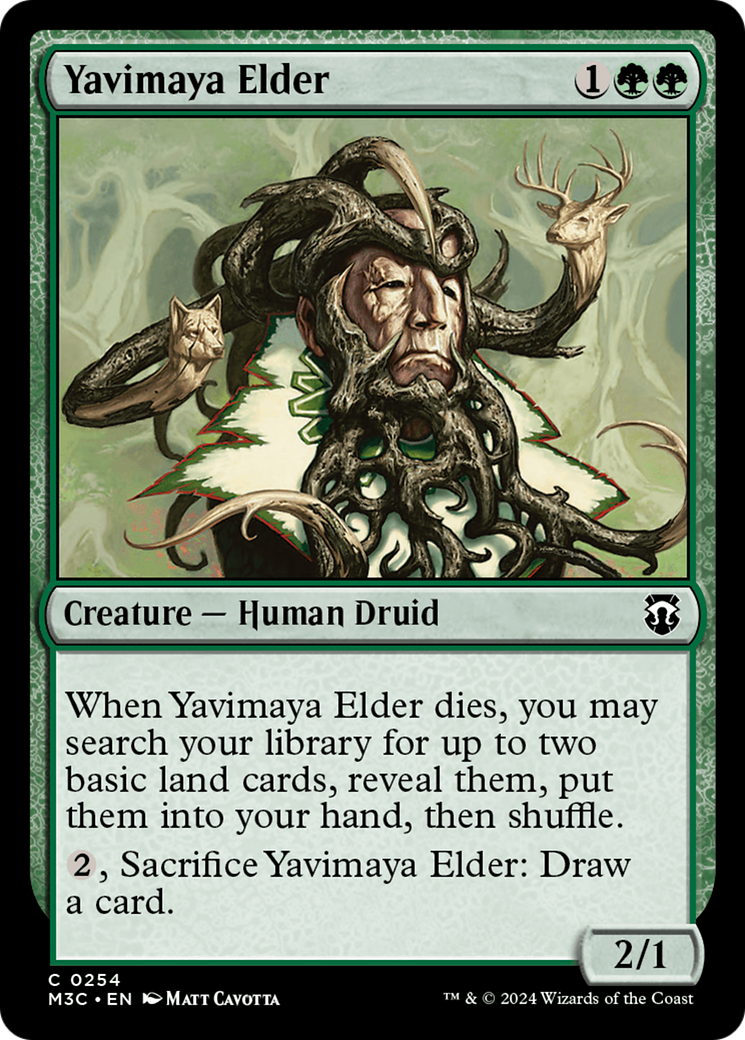
Yavimaya Elder
Yavimaya Elder
Creature — Human Druid
2/1
When this creature dies, you may search your library for up to two basic land cards, reveal them, put them into your hand, then shuffle.
, Sacrifice this creature: Draw a card.
- If you activate Yavimaya Elder's last ability, its triggered ability will trigger and go on the stack. It will resolve first, meaning you'll do the search and shuffle before drawing a card.
-
1
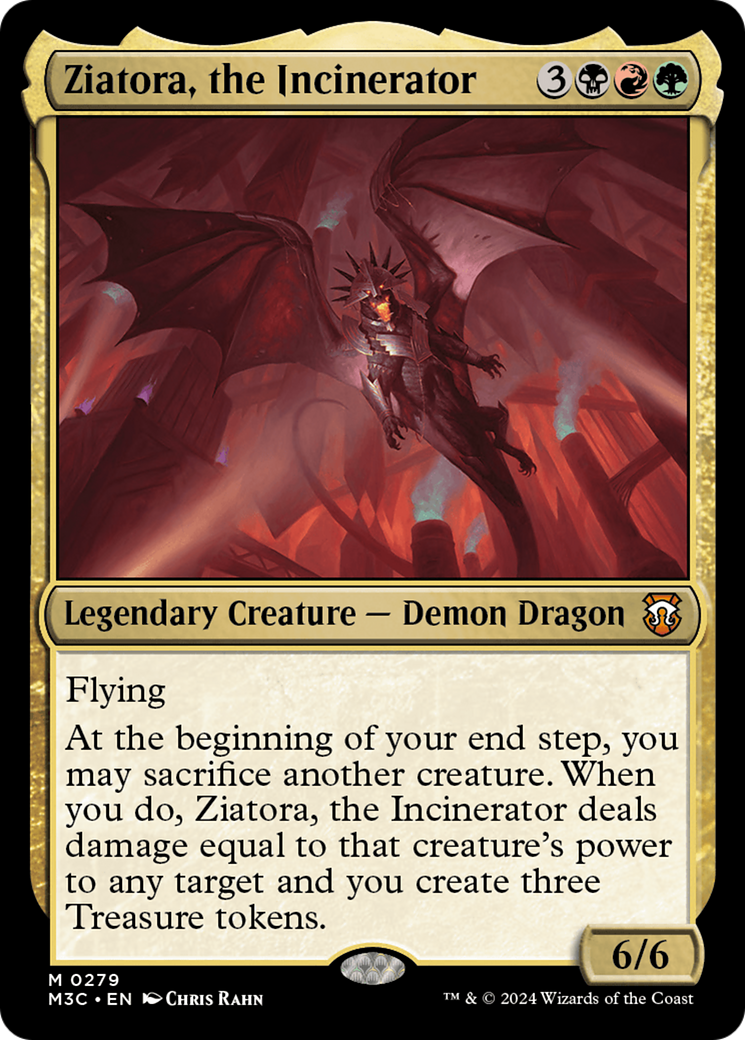
Ziatora, the Incinerator
Ziatora, the Incinerator
Legendary Creature — Demon Dragon
6/6
Flying
At the beginning of your end step, you may sacrifice another creature. When you do, Ziatora deals damage equal to that creature's power to any target and you create three Treasure tokens.
- Use the creature's power as it last existed on the battlefield to determine how much damage Ziatora deals.
Planeswalkers 3
-
1
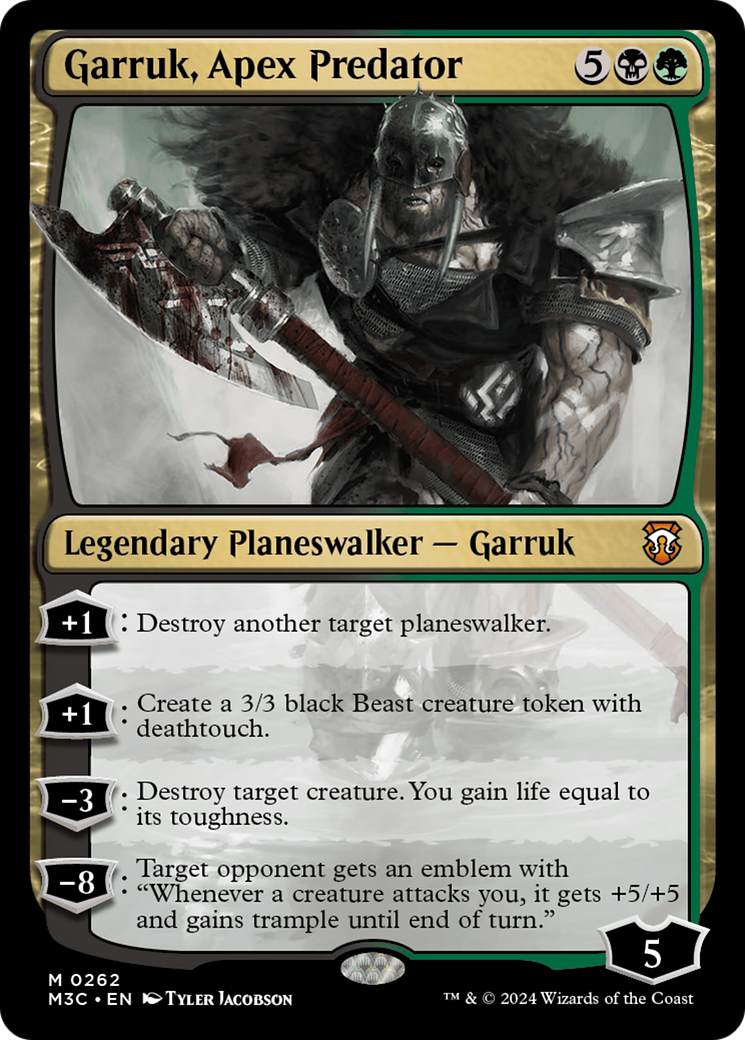
Garruk, Apex Predator
Garruk, Apex Predator
Legendary Planeswalker — Garruk
+1: Destroy another target planeswalker.
+1: Create a 3/3 black Beast creature token with deathtouch.
−3: Destroy target creature. You gain life equal to its toughness.
−8: Target opponent gets an emblem with "Whenever a creature attacks you, it gets +5/+5 and gains trample until end of turn."
- The first ability can target and destroy a Garruk planeswalker controlled by another player.
- If you activate the third ability, and the target creature is an illegal target when the ability tries to resolve, it won’t resolve and none of its effects will happen. You won’t gain any life.
- The emblem’s ability won’t trigger if a creature attacks a planeswalker.
- The emblem is owned and controlled by the target of the ability that created it. In a multiplayer game, if Garruk’s owner leaves the game, the emblem does not.
-
1
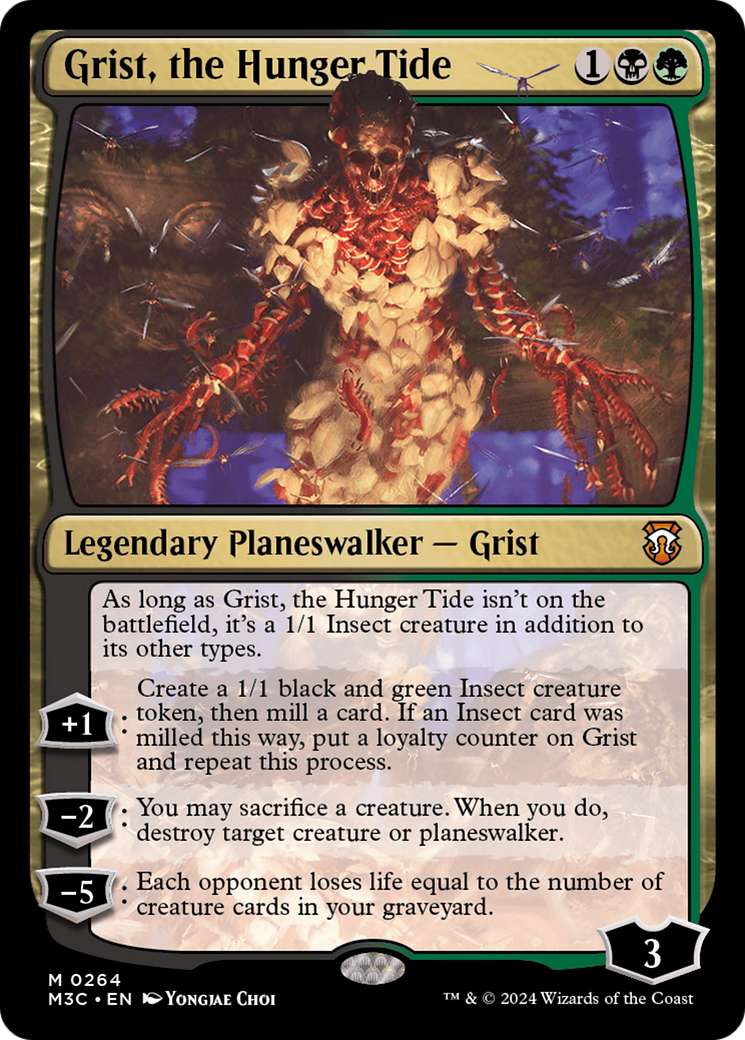
Grist, the Hunger Tide
Grist, the Hunger Tide
Legendary Planeswalker — Grist
As long as Grist isn't on the battlefield, it's a 1/1 Insect creature in addition to its other types.
+1: Create a 1/1 black and green Insect creature token, then mill a card. If an Insect card was milled this way, put a loyalty counter on Grist and repeat this process.
−2: You may sacrifice a creature. When you do, destroy target creature or planeswalker.
−5: Each opponent loses life equal to the number of creature cards in your graveyard.
- Grist, the Hunger Tide can be your commander as its first ability works before the game begins during deck construction.
- Anywhere but on the battlefield, Grist is a Legendary Planeswalker Creature — Grist Insect. Once it enters the battlefield, it is no longer a creature and is just a planeswalker. Anything that could search for or affect a creature or planeswalker card in zones other than the battlefield could affect Grist. For example, you could put it onto the battlefield with Chord of Calling, it could be countered by Essence Scatter (but not by Negate), and opponents couldn't make you discard it with Duress.
- If Grist is no longer on the battlefield as its first loyalty ability resolves, you will still create a 1/1 black and green Insect creature token and mill a card. If an Insect card is milled this way, you won't be able to put a loyalty counter on Grist, but you will still repeat the process. More mill for the Grist, as it were.
- Grist's second loyalty ability doesn't require a target. If you choose to sacrifice a creature as it resolves, the reflexive triggered ability triggers and you'll choose a target creature or planeswalker to destroy. This will happen even if Grist isn't on the battlefield when the loyalty ability resolves.
- Count the number of creature cards in your graveyard as the third loyalty ability resolves to determine how much life each opponent loses. If Grist is in your graveyard at this time, it'll be a creature card and will contribute to the count.
-
1
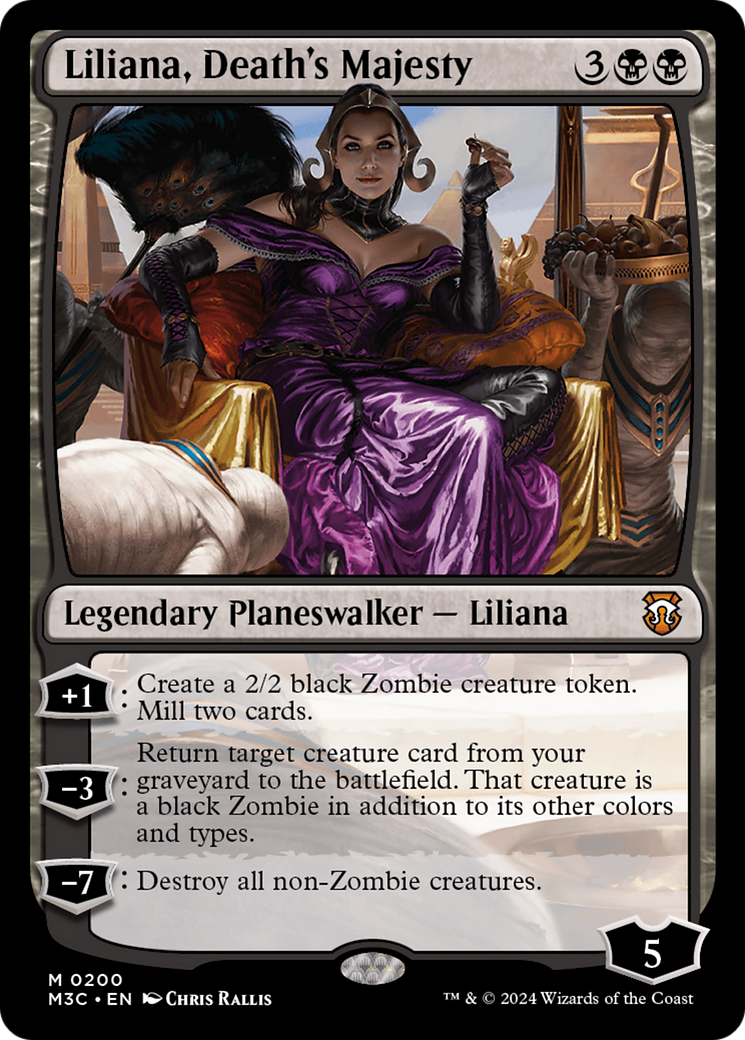
Liliana, Death's Majesty
Liliana, Death's Majesty
Legendary Planeswalker — Liliana
+1: Create a 2/2 black Zombie creature token. Mill two cards.
−3: Return target creature card from your graveyard to the battlefield. That creature is a black Zombie in addition to its other colors and types.
−7: Destroy all non-Zombie creatures.
- A creature that is a Zombie and has other types, such as a Zombie Jackal, isn't a non-Zombie creature.
Instants 7
-
1
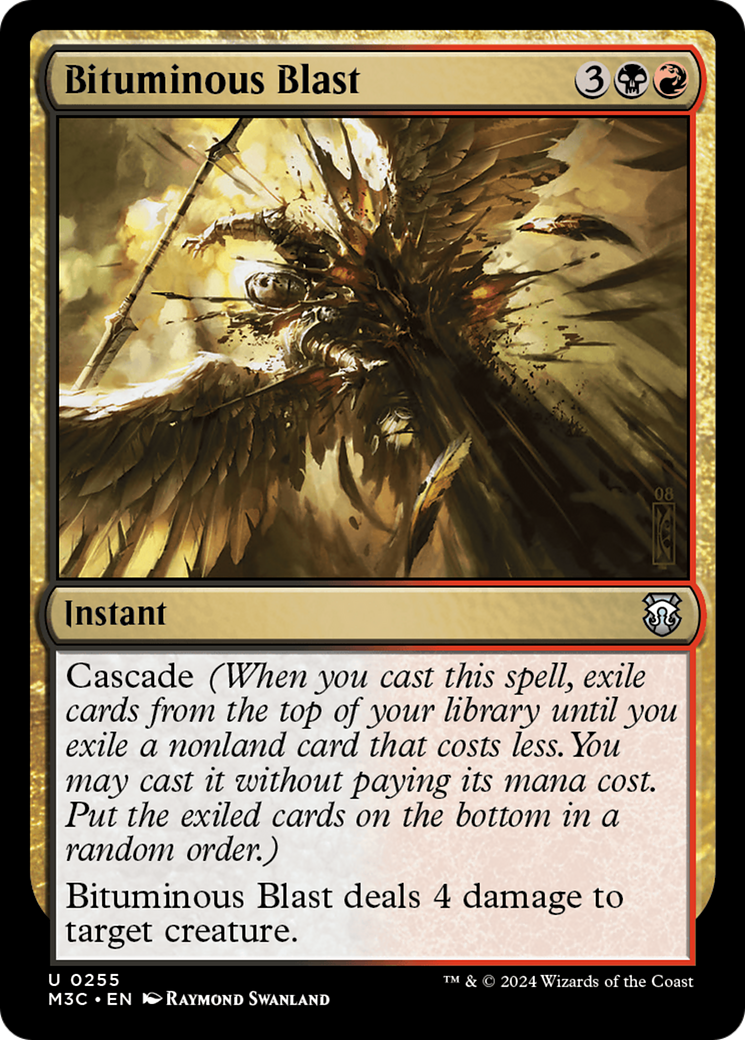
Bituminous Blast
Bituminous Blast
Instant
Cascade (When you cast this spell, exile cards from the top of your library until you exile a nonland card that costs less. You may cast it without paying its mana cost. Put the exiled cards on the bottom in a random order.)
Bituminous Blast deals 4 damage to target creature.
- A spell's mana value is determined only by its mana cost. Ignore any alternative costs, additional costs, cost increases, or cost reductions.
- Cascade triggers when you cast the spell, meaning that it resolves before that spell. If you end up casting the exiled card, it will go on the stack above the spell with cascade.
- When the cascade ability resolves, you must exile cards. The only optional part of the ability is whether or not you cast the last card exiled.
- If a spell with cascade is countered, the cascade ability will still resolve normally.
- You exile the cards face up. All players will be able to see them.
- If you cast a card "without paying its mana cost," you can't choose to cast it for any alternative costs. You can, however, pay additional costs. If the card has any mandatory additional costs, you must pay those to cast the card.
- If the card has in its mana cost, you must choose 0 as the value of X when casting it without paying its mana cost.
- Due to a 2021 rules change to cascade, not only do you stop exiling cards if you exile a nonland card with lesser mana value than the spell with cascade, but the resulting spell you cast must also have lesser mana value. Previously, in cases where a card's mana value differed from the resulting spell, such as with some modal double-faced cards or cards with an Adventure, you could cast a spell with a higher mana value than the exiled card.
- The mana value of a split card is determined by the combined mana cost of its two halves. If cascade allows you to cast a split card, you may cast either half but not both halves.
-
1
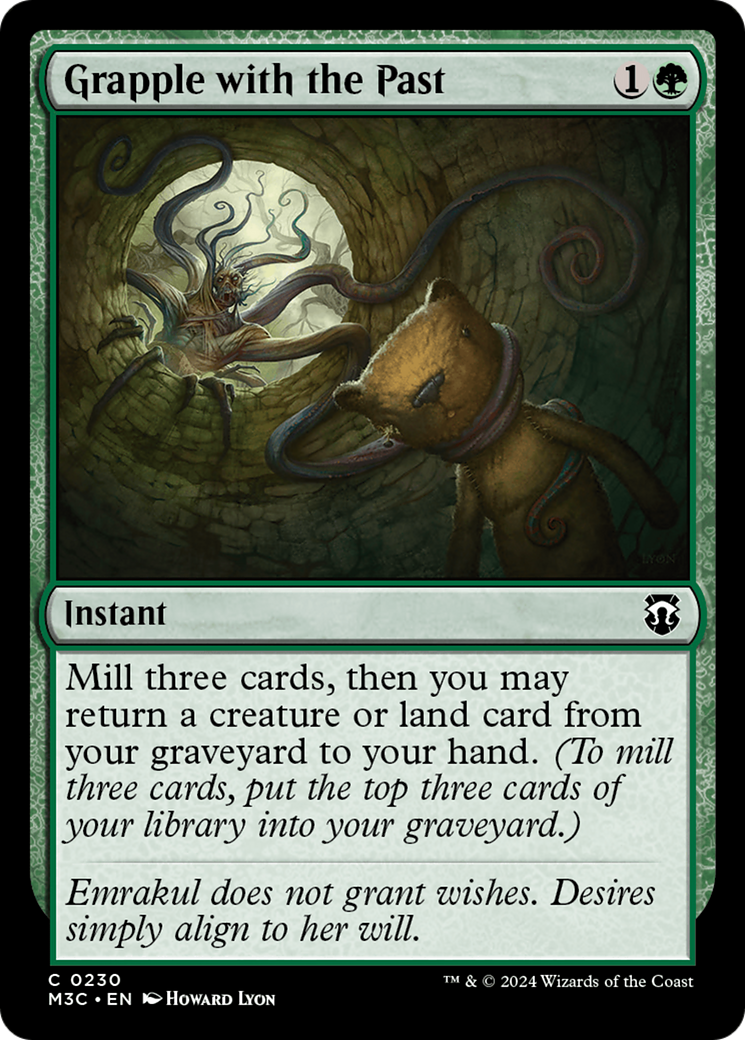
Grapple with the Past
Grapple with the Past
Instant
Mill three cards, then you may return a creature or land card from your graveyard to your hand. (To mill three cards, put the top three cards of your library into your graveyard.)
- Grapple with the Past doesn't target the card to return to your hand. After putting the top three cards of your library into your graveyard, you may choose from among any creature or land cards there.
-
1
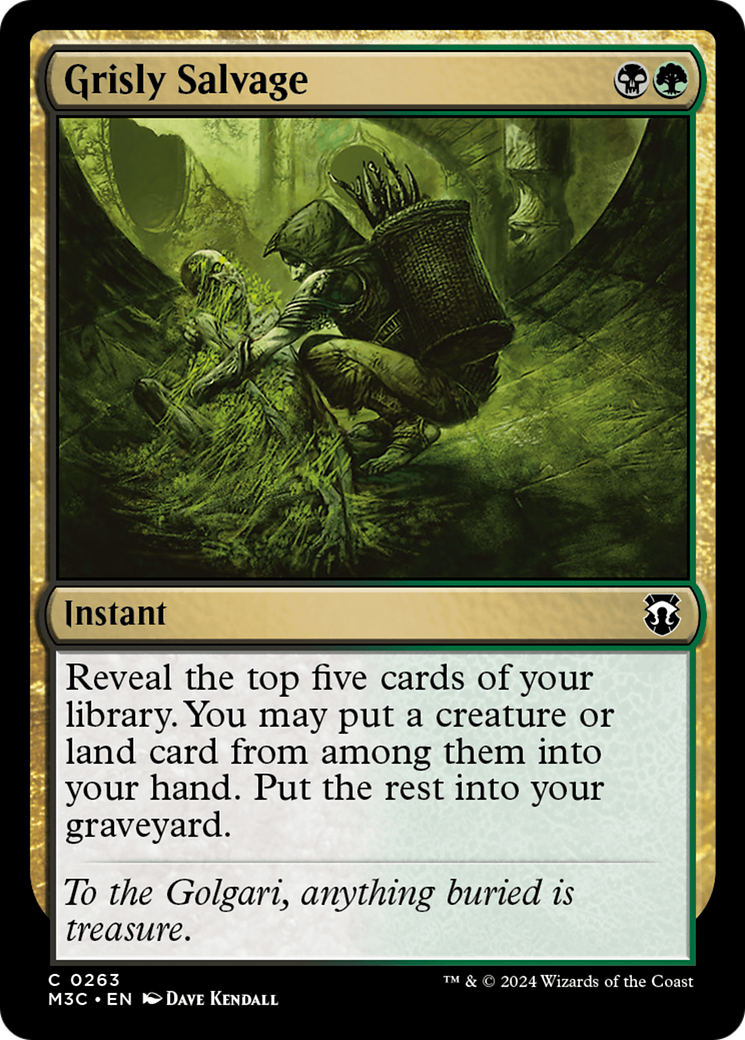
Grisly Salvage
Grisly Salvage
Instant
Reveal the top five cards of your library. You may put a creature or land card from among them into your hand. Put the rest into your graveyard.
-
1
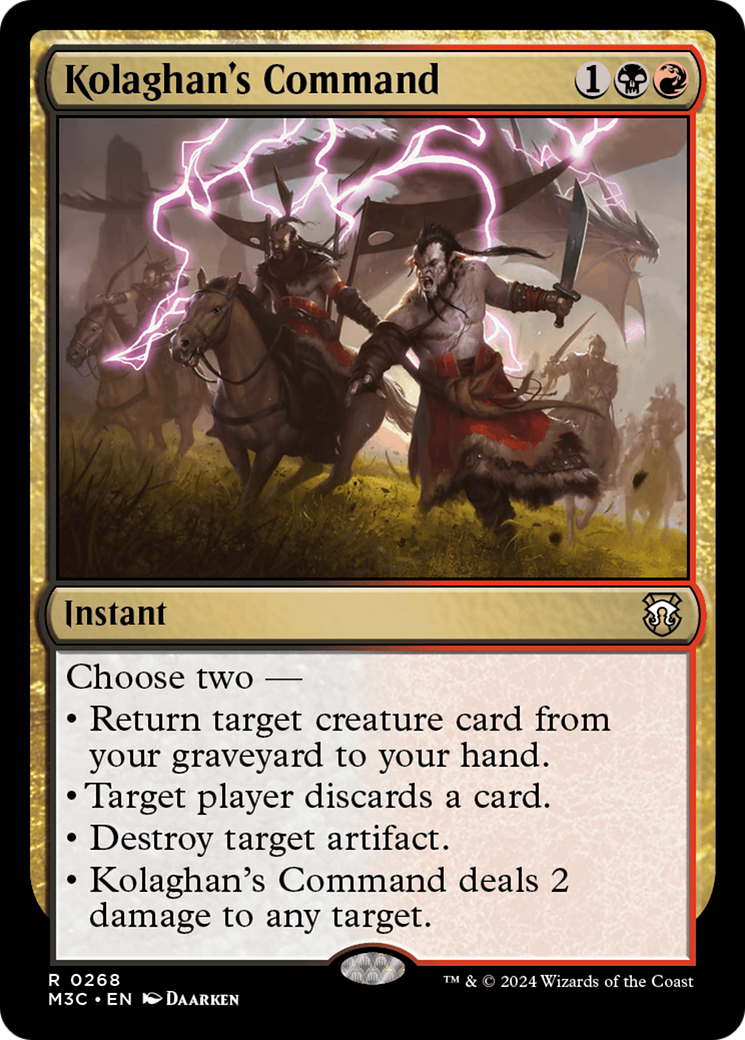
Kolaghan's Command
Kolaghan's Command
Instant
Choose two —
- Return target creature card from your graveyard to your hand.
- Target player discards a card.
- Destroy target artifact.
- Kolaghan's Command deals 2 damage to any target.
- You choose the two modes as you cast the spell. You must choose two different modes. Once modes are chosen, they can't be changed.
- You can choose a mode only if you can choose legal targets for that mode. Ignore the targeting requirements for modes that aren't chosen. For example, you can cast Ojutai's Command without targeting a creature spell provided you don't choose the third mode.
- As the spell resolves, follow the instructions of the modes you chose in the order they are printed on the card. For example, if you chose the second and fourth modes of Ojutai's Command, you would gain 4 life and then draw a card. (The order won't matter in most cases.)
- If a Command is copied, the effect that creates the copy will usually allow you to choose new targets for the copy, but you can't choose new modes.
- If all targets for the chosen modes become illegal before the Command resolves, the spell won't resolve and none of its effects will happen. If at least one target is still legal, the spell will resolve but will have no effect on any illegal targets.
-
1
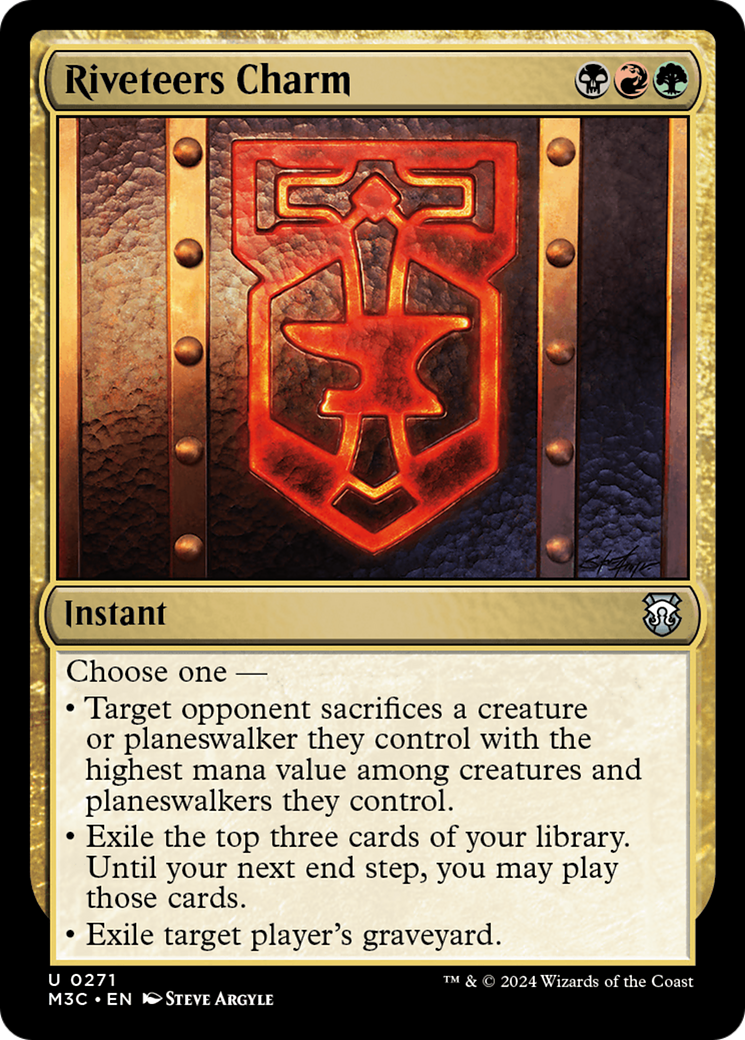
Riveteers Charm
Riveteers Charm
Instant
Choose one —
- Target opponent sacrifices a creature or planeswalker they control with the highest mana value among creatures and planeswalkers they control.
- Exile the top three cards of your library. Until your next end step, you may play those cards.
- Exile target player's graveyard.
- For Riveteers Charm's first mode, if the target opponent controls more than one creature or planeswalker with the highest mana value among creatures and planeswalkers they control, that player chooses which one to sacrifice as Riveteers Charm resolves.
- For the second mode, you must pay all costs and follow all normal timing rules for cards played this way. For example, you may play lands this way only during your main phase while no spells or abilities are on the stack and only if you haven't played a land yet this turn.
-
1
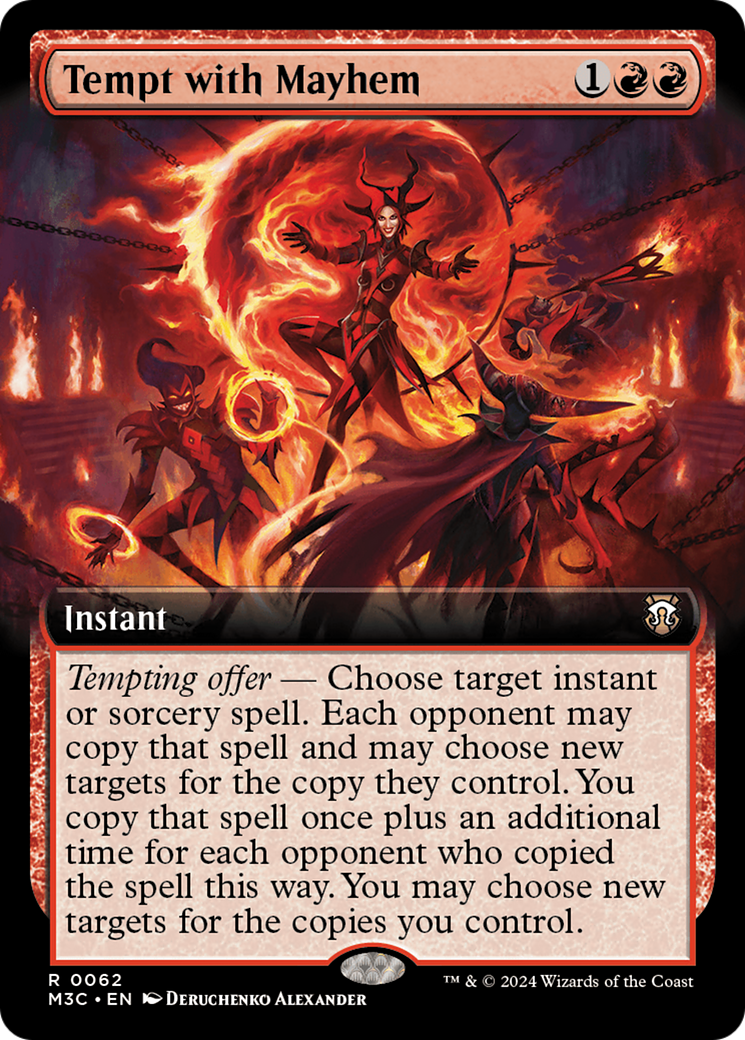
Tempt with Mayhem
Tempt with Mayhem
Instant
Tempting offer — Choose target instant or sorcery spell. Each opponent may copy that spell and may choose new targets for the copy they control. You copy that spell once plus an additional time for each opponent who copied the spell this way. You may choose new targets for the copies you control.
- Starting with the next opponent in turn order (or the active player, if that player is one of your opponents), each opponent in turn order decides whether or not to copy the spell and, if they do, whether or not to choose new targets. Then, if that player did choose to copy the spell, the copy is put onto the stack. Finally, you copy that spell at least once (hopefully more, if the mayhem was tempting enough) and choose new targets for your copies if you wish. This means that your copies of the spell will resolve first, followed by the copies created by your opponents in the opposite order in which they were created.
- In the case where the spell being copied grants one or more players extra turns, those extra turns are added one at a time. When the current turn ends, the most recently created turn will be taken first.
- Each of the copies will have the same targets as the spell it's copying unless its controller chooses new ones. That player may change any number of the targets, including all of them or none of them. The new targets must be legal. If, for any target, they can't choose a new legal target, then it remains unchanged (even if the current target is illegal).
- The copies are created on the stack, so they're not "cast." Creating a copy won't cause abilities that trigger when a player casts a spell to trigger.
- If the spell that's copied is modal (that is, it says "Choose one —" or the like), the copies will have the same mode or modes. You can't choose different ones.
- If the spell that's copied has an X whose value was determined as it was cast, the copies will have the same value of X.
- If the spell that's copied has damage divided as it was cast, the division can't be changed (although the targets receiving that damage still can). The same is true of spells that distribute counters.
- The controller of a copy can't choose to pay any alternative or additional costs for the copy. However, effects based on any alternative or additional costs that were paid for the original spell are copied as though those same costs were paid for the copy.
- Tempt with Mayhem can't target itself. There are limits, after all.
-
1
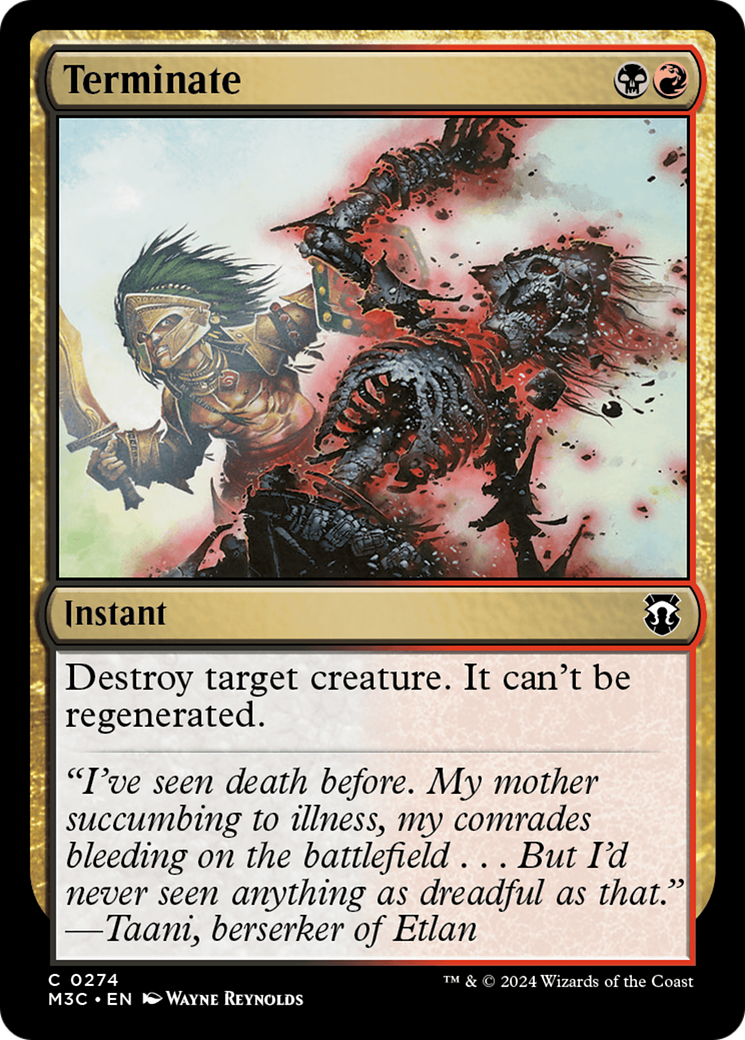
Terminate
Terminate
Instant
Destroy target creature. It can't be regenerated.
Sorceries 7
-
1
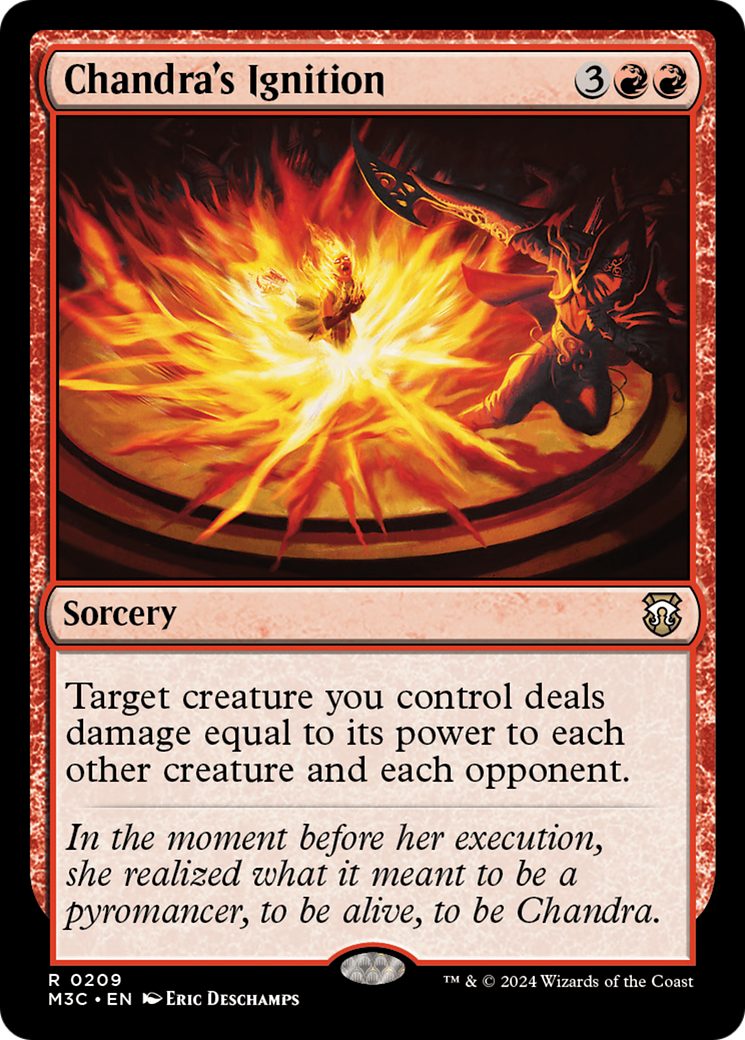
Chandra's Ignition
Chandra's Ignition
Sorcery
Target creature you control deals damage equal to its power to each other creature and each opponent.
- The creature is the source of the damage, not Chandra's Ignition. For example, Chandra's Ignition can have a white creature deal damage to a creature with protection from red.
- Use the power of the target creature as Chandra's Ignition resolves to determine how much damage it deals to each other creature and each opponent.
- If the creature becomes an illegal target by the time Chandra's Ignition tries to resolve (perhaps because another player controls it or it's left the battlefield), Chandra's Ignition won't resolve and none of its effects will happen. No damage will be dealt.
-
1
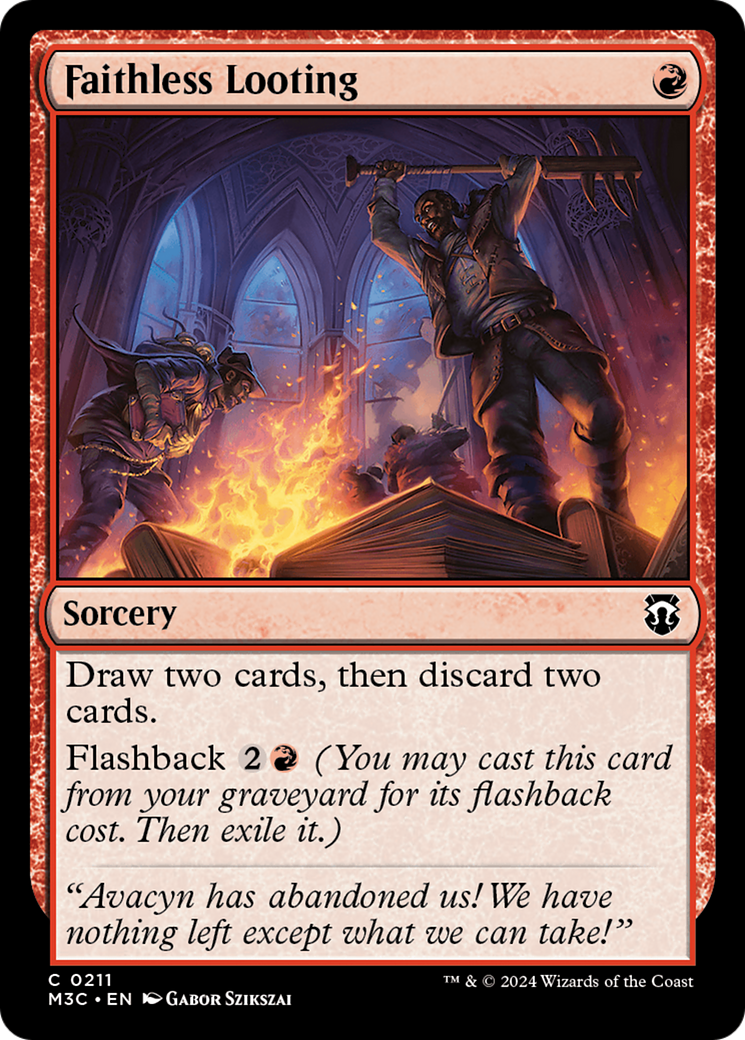
Faithless Looting
Faithless Looting
Sorcery
Draw two cards, then discard two cards.
Flashback (You may cast this card from your graveyard for its flashback cost. Then exile it.)
- To determine the total cost of a spell, start with the mana cost or alternative cost (such as a flashback cost) you're paying, add any cost increases, then apply any cost reductions. The mana value of the spell is determined only by its mana cost, no matter what the total cost to cast the spell was.
- A spell cast using flashback will always be exiled afterward, whether it resolves, is countered, or leaves the stack in some other way.
- "Flashback [cost]" means "You may cast this card from your graveyard if the resulting spell is an instant or sorcery spell by paying [cost] rather than paying its mana cost" and "If the flashback cost was paid, exile this card instead of putting it anywhere else any time it would leave the stack."
- If a card with flashback is put into your graveyard during your turn, you can cast it if it's legal to do so before any other player can take any actions.
- You can cast a spell using flashback even if it was somehow put into your graveyard without having been cast.
- You must still follow any timing restrictions and permissions, including those based on the card's type. For instance, you can cast a sorcery using flashback only when you could normally cast a sorcery.
- You draw two cards and discard two cards all while Faithless Looting is resolving. Nothing can happen between the two, and no player may choose to take actions.
-
1
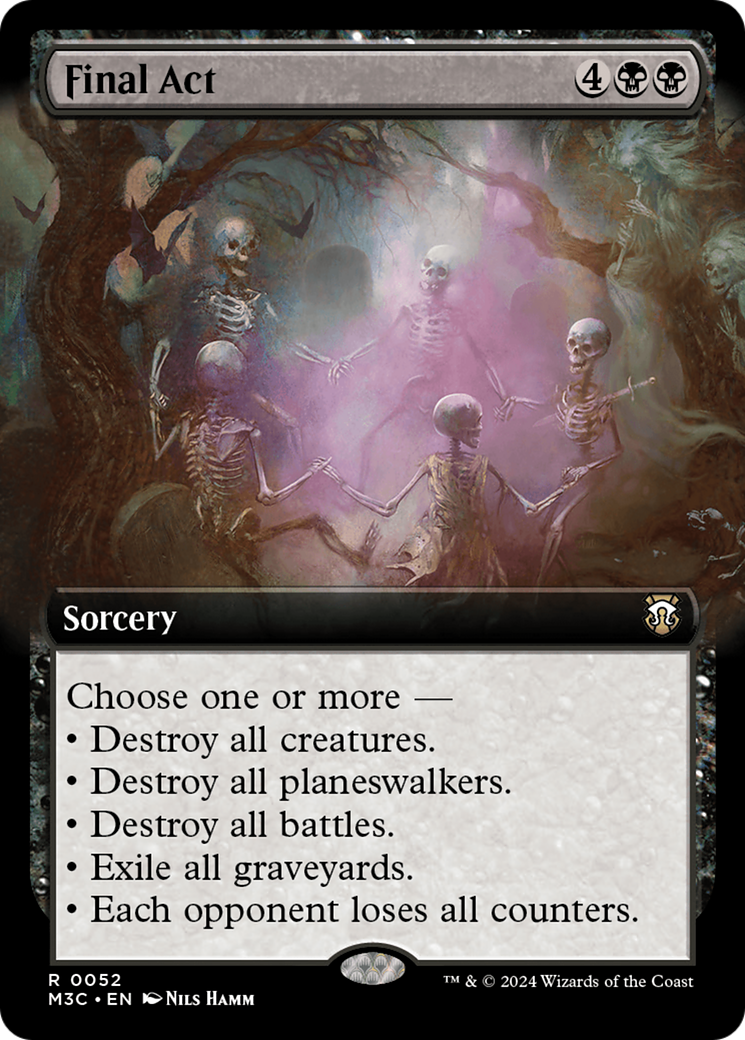
Final Act
Final Act
Sorcery
Choose one or more —
- Destroy all creatures.
- Destroy all planeswalkers.
- Destroy all battles.
- Exile all graveyards.
- Each opponent loses all counters.
- If you choose more than one mode for Final Act, you perform the actions in the order written.
- Counters that players could have include energy counters, experience counters, poison counters, rad counters, and ticket counters.
-
1
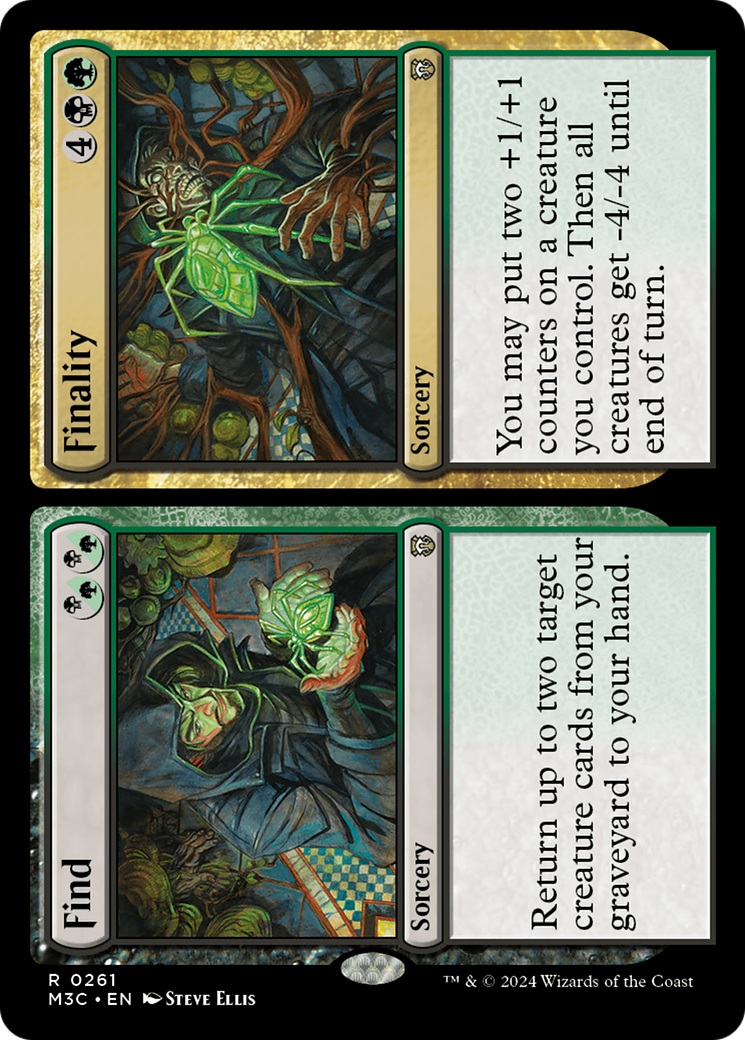
Find // Finality
//
Find
Sorcery
- To cast a split card, choose one of its halves to cast. There's no way to cast both halves of this split card.
- Split cards have two card faces on a single card. The characteristics of the half you didn't cast are ignored while the spell is on the stack.
- Each split card is a single card. For example, if you discard a split card, you've discarded one card, not two. If an effect counts the number of sorcery cards in your graveyard, Assault // Battery counts once, not twice.
- Each split card has two names. If an effect instructs you to choose a card name, you may choose one of those names, but not both.
- A split card's characteristics are a combination of its two halves while it is not on the stack. For example, Assault // Battery has a mana value of 5 while it is in your library. If an effect allows you to search your library for a card with mana value 4 or less, you can't find Assault // Battery.
- If an effect allows you to cast a spell with certain characteristics, consider only the characteristics of the half you're casting. For example, if an effect allows you to cast a sorcery spell with mana value 2 or less from among cards in your graveyard, you could cast Assault this way, but not Battery.
- If you copy a spell that's half of a split card, the copy copies that same half. For example, if you copy Assault, the copy is also Assault, not Battery.
- Finality doesn't target the creature to receive +1/+1 counters. You can cast it even if you control no creatures.
- Finality affects only creatures on the battlefield at the time it resolves. Creatures that enter the battlefield later in the turn won't get -4/-4.
-
1
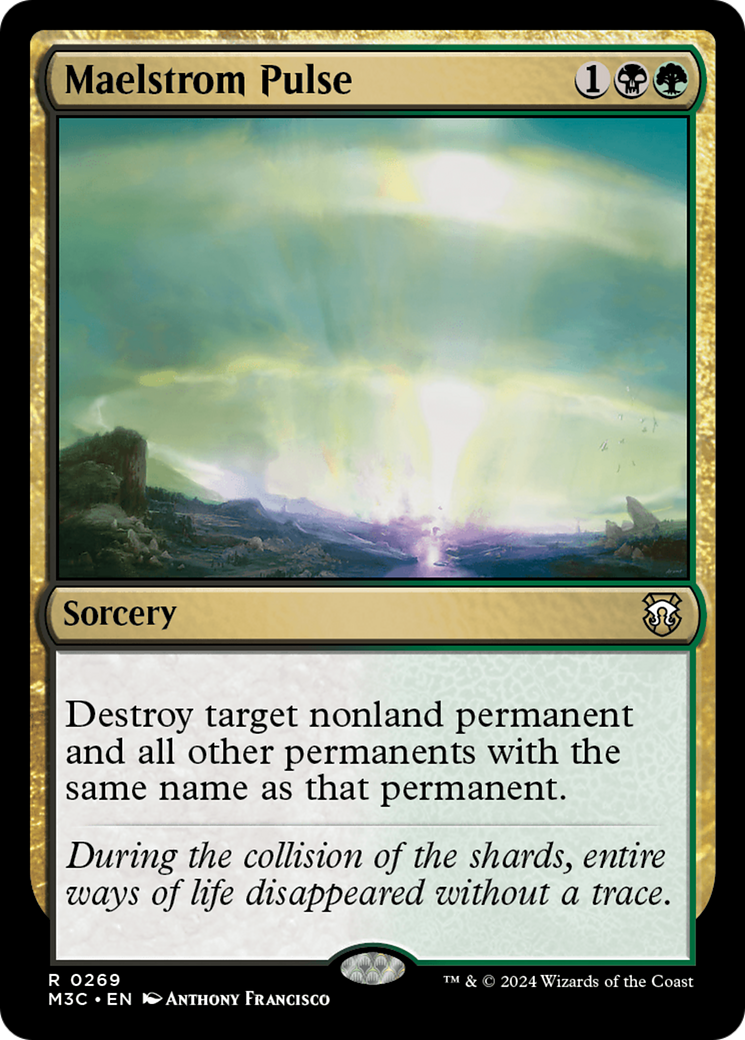
Maelstrom Pulse
Maelstrom Pulse
Sorcery
Destroy target nonland permanent and all other permanents with the same name as that permanent.
- Unless a token is a copy of another permanent or was explicitly given a name by the effect that created it, its name is the subtypes it was given when it was created plus the word "Token." For example, if an effect creates a 1/1 Soldier creature token, that token is named "Soldier Token."
- Maelstrom Pulse has only one target. Other permanents with the same name will be destroyed even if they have hexproof or protection.
- If the target permanent is an illegal target by the time Maelstrom Pulse tries to resolve, the spell won't resolve. You won't destroy any permanents at all. If the target is legal but not destroyed (most likely because it has indestructible), you do destroy other permanents with the same name.
-
1
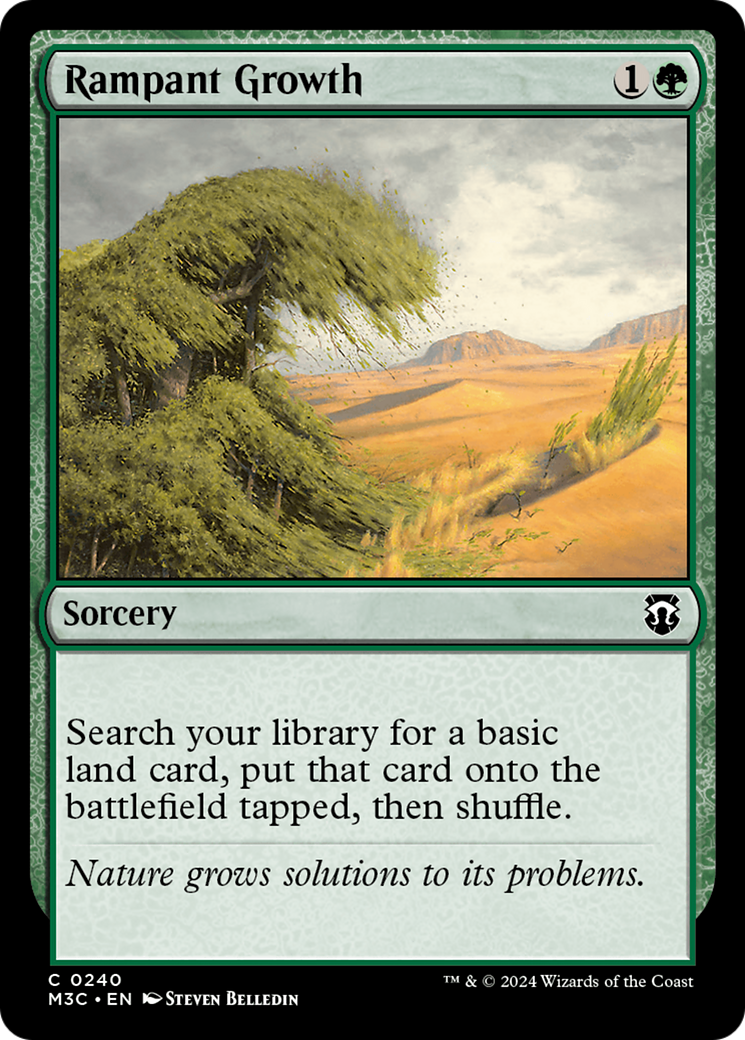
Rampant Growth
Rampant Growth
Sorcery
Search your library for a basic land card, put that card onto the battlefield tapped, then shuffle.
- The land does not count toward your one per turn limit because it was put onto the battlefield by an effect.
-
1
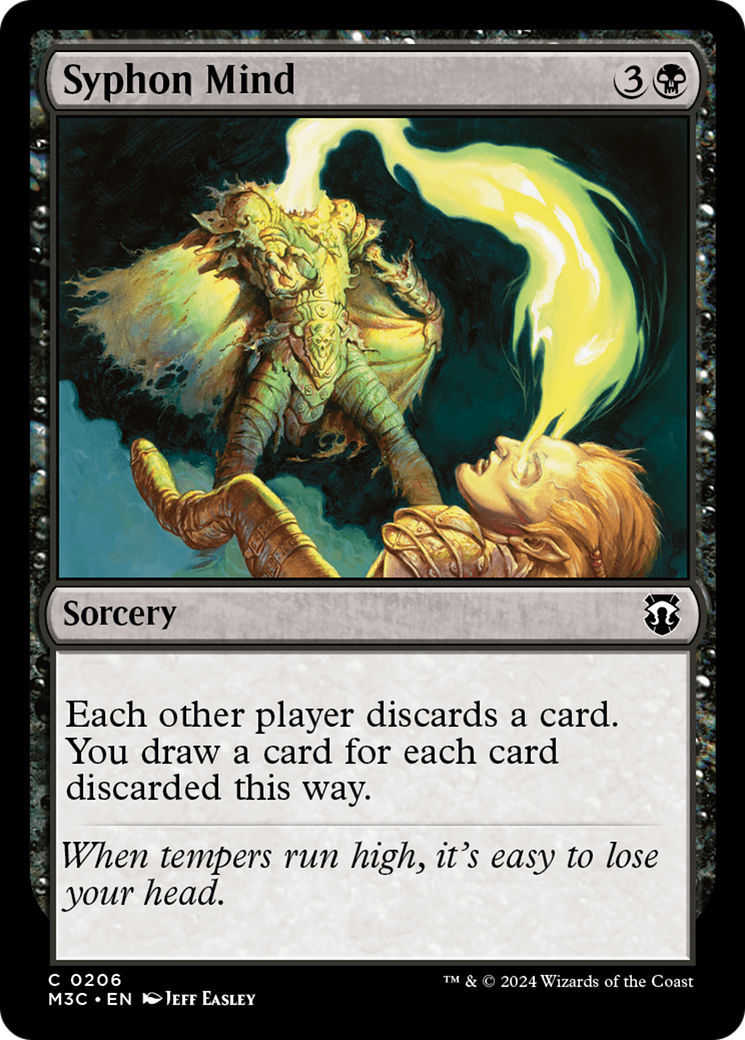
Syphon Mind
Syphon Mind
Sorcery
Each other player discards a card. You draw a card for each card discarded this way.
Artifacts 9
-
1
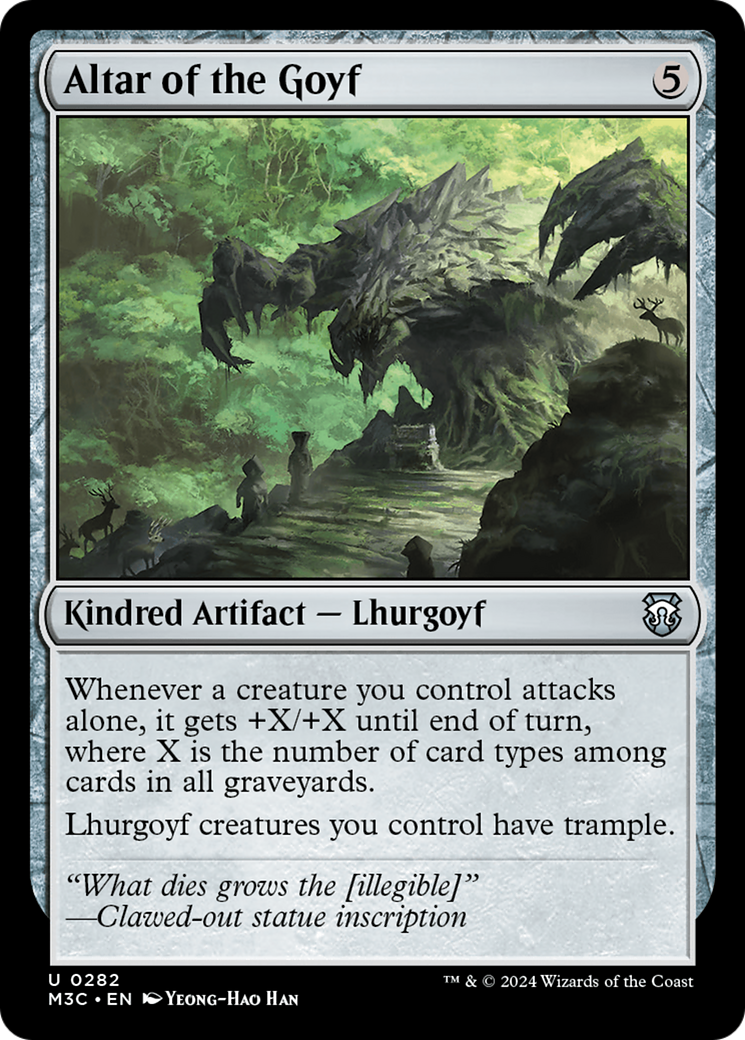
Altar of the Goyf
Altar of the Goyf
Kindred Artifact — Lhurgoyf
Whenever a creature you control attacks alone, it gets +X/+X until end of turn, where X is the number of card types among cards in all graveyards.
Lhurgoyf creatures you control have trample.
- This cards was originally printed with the "tribal" card type. That card type has been replaced with "kindred". This change does not affect the gameplay function of this card.
- Kindred is a card type that allows noncreature cards to have creature types. For example, Echoes of Eternity is an Eldrazi (although not a creature) while on the battlefield and an Eldrazi card (although not a creature card) in zones other than the battlefield.
- While it appears only on cards that already have other card types, kindred is a card type and will be counted by effects that refer to the number of card types among cards in a zone.
- A creature attacks alone if it's the only creature declared as an attacker during the declare attackers step (including creatures controlled by your teammates, if applicable). For example, Altar of the Goyf's first ability won't trigger if you attack with multiple creatures and all but one of them are removed from combat.
- The card types that can appear in a graveyard are artifact, battle, creature, enchantment, instant, kindred, land, planeswalker, and sorcery. Legendary, basic, and snow are supertypes, not card types; Aura and Lhurgoyf are subtypes, not card types.
- If Altar of the Goyf somehow becomes a creature and the effect allows to keep its other types, it will give itself trample.
-
1
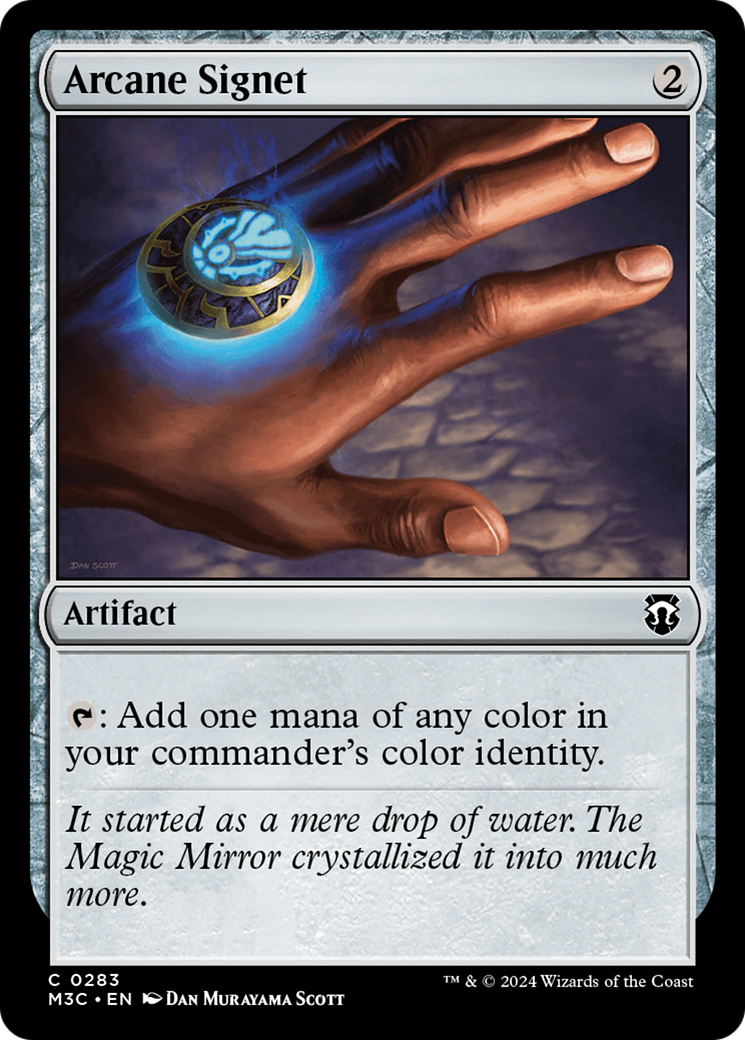
Arcane Signet
Arcane Signet
Artifact
: Add one mana of any color in your commander's color identity.
- If your commander is a card that has no colors in its color identity, Arcane Signet's ability produces no mana. It doesn't produce .
- If you have two commanders, the ability adds one mana of any color in their combined color identities.
- If you don't have a commander, Arcane Signet's ability produces no mana.
-
1
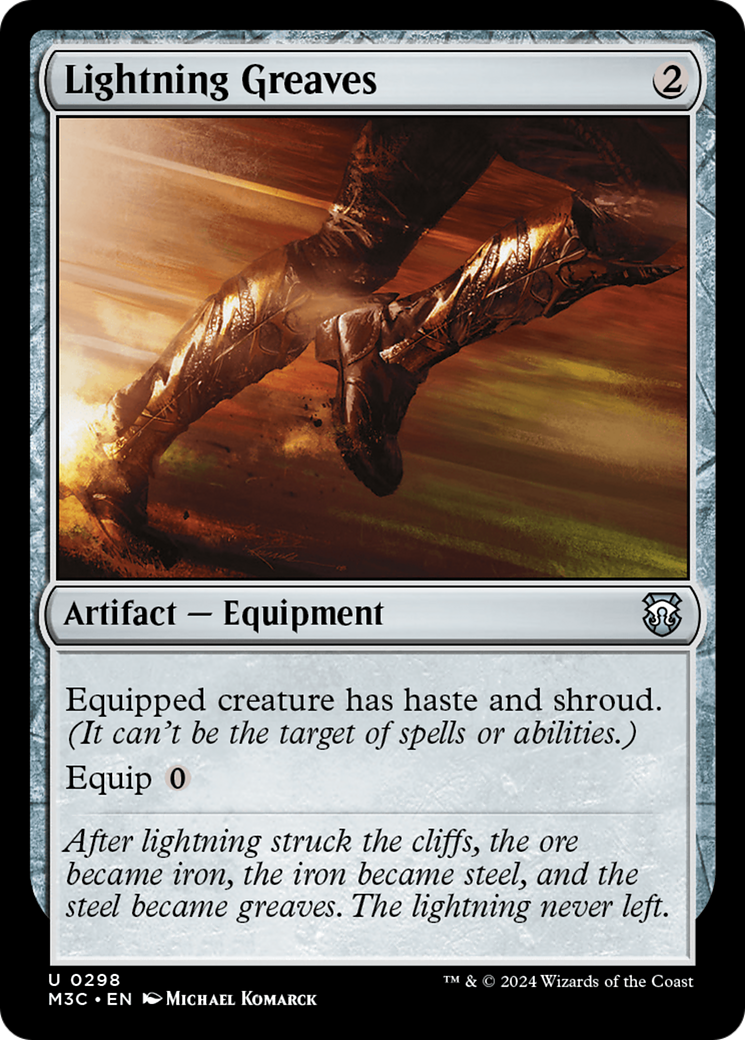
Lightning Greaves
Lightning Greaves
Artifact — Equipment
Equipped creature has haste and shroud. (It can't be the target of spells or abilities.)
Equip
- You can't simply unequip Equipment from a creature. If Lightning Greaves is attached to the only creature you control, you won't be able to attach other equipment to it (or target it with anything else) until you have another creature to which you can attach Lightning Greaves.
- If a creature enters the battlefield under your control and gains haste, but then loses it before attacking, it won't be able to attack that turn. This means that you can't use one Lightning Greaves to allow two new creatures to attack in the same turn.
-
1
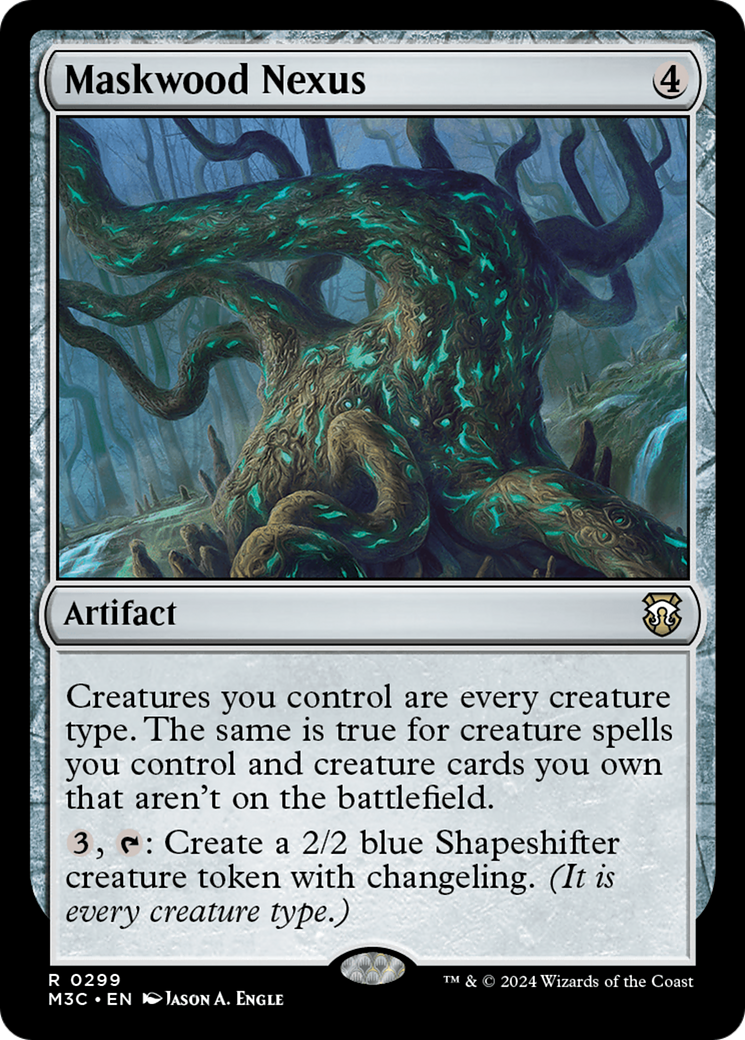
Maskwood Nexus
Maskwood Nexus
Artifact
Creatures you control are every creature type. The same is true for creature spells you control and creature cards you own that aren't on the battlefield.
, : Create a 2/2 blue Shapeshifter creature token with changeling. (It is every creature type.)
- Replacement effects that modify how creatures of a certain creature type enter the battlefield will apply after you apply the effect of Maskwood Nexus. For example, if you control Maskwood Nexus and an effect says that each Warrior you control enters the battlefield with an additional +1/+1 counter on it, any creature that enters the battlefield under your control will get that counter.
- The tokens created by the activated ability will continue to have all creature types if Maskwood Nexus leaves the battlefield because those tokens have changeling. Other creatures you control will revert to their usual creature types unless another relevant effect is affecting them.
- Changeling is a characteristic-defining ability. It functions in all zones, not only while a card that has it is on the battlefield.
- The subtype Shapeshifter that appears on the type line is mostly there to reinforce the flavor. A creature card with changeling is just as much an Elf, a Dwarf, a Sliver, a Goat, a Coward, and a Zombie as it is a Shapeshifter.
- If an effect causes a creature with changeling to become a new creature type, it will be only that new creature type. It will still have changeling; the effect making it all creature types will simply be overwritten.
- If an effect causes a creature with changeling to lose all abilities, it will remain all creature types, even though it will no longer have changeling. This is because changeling applies before the effect that removes it.
-
1
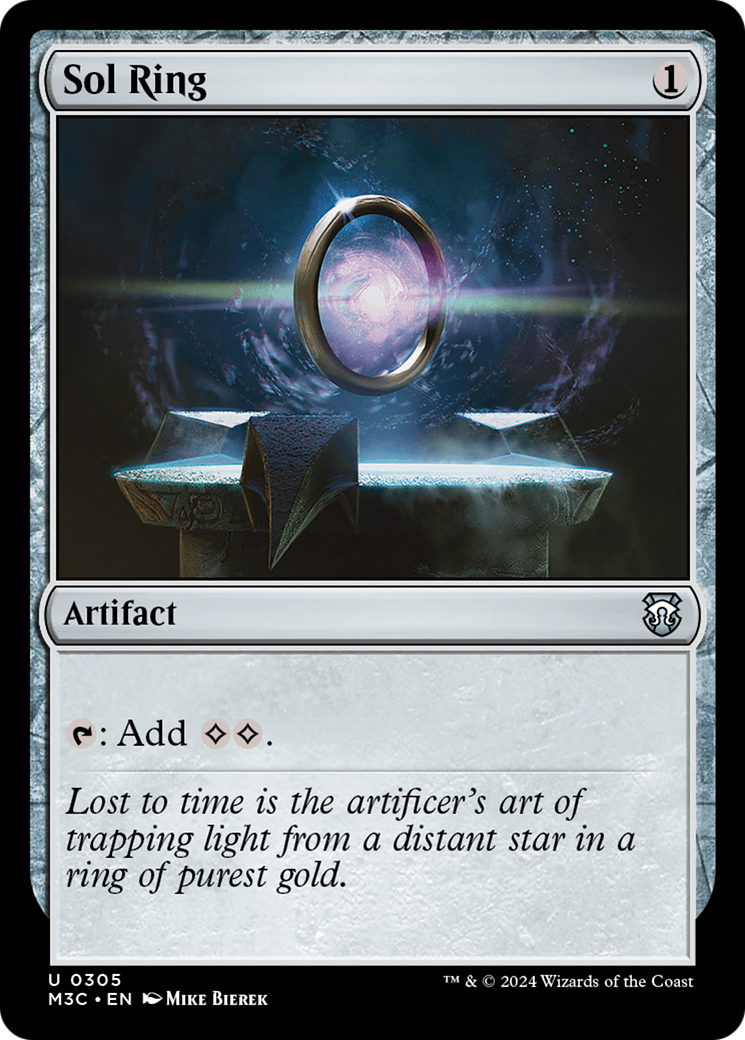
Sol Ring
Sol Ring
Artifact
: Add .
-
1
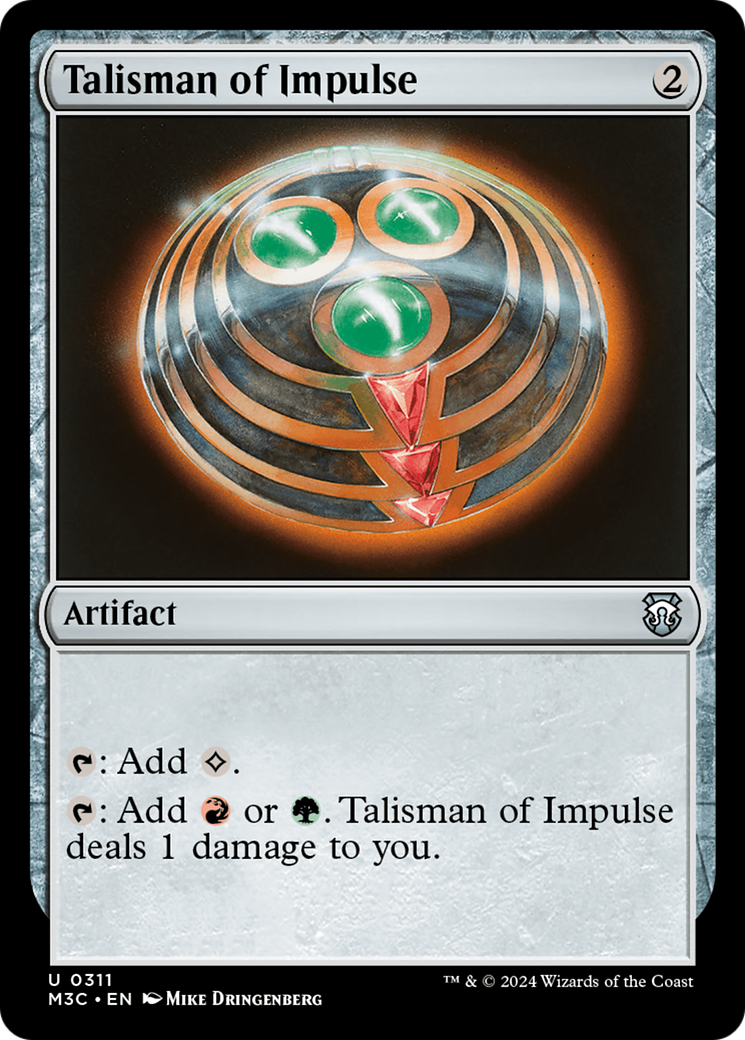
Talisman of Impulse
Talisman of Impulse
Artifact
: Add .
: Add or . This artifact deals 1 damage to you.
-
1
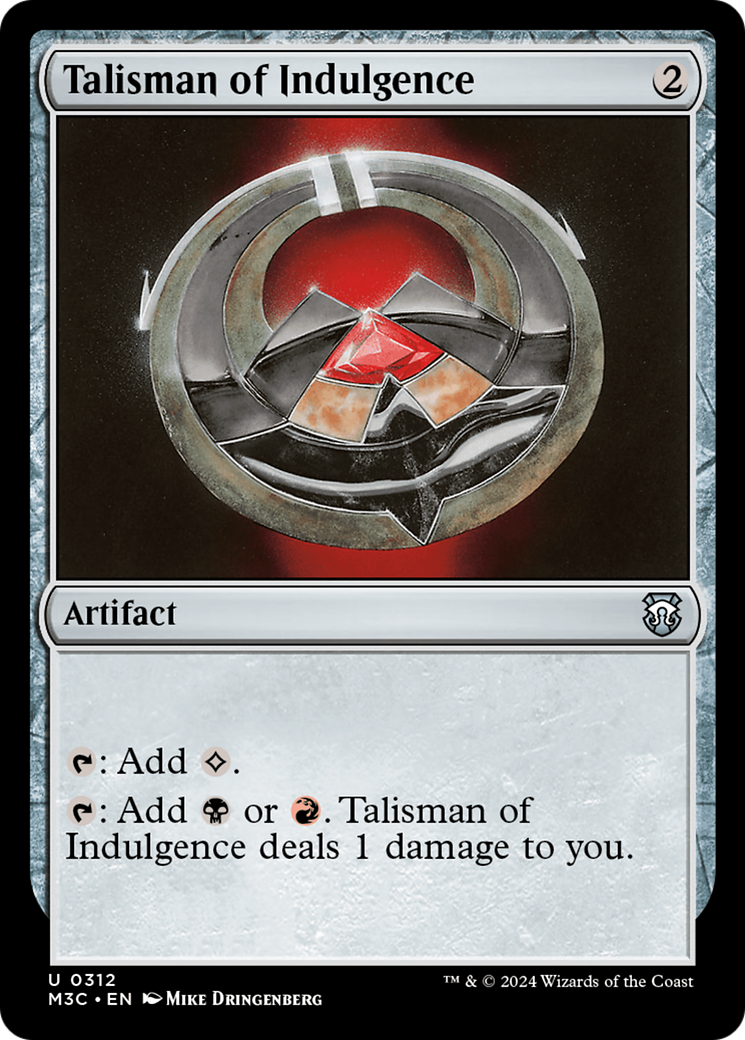
Talisman of Indulgence
Talisman of Indulgence
Artifact
: Add .
: Add or . This artifact deals 1 damage to you.
-
1
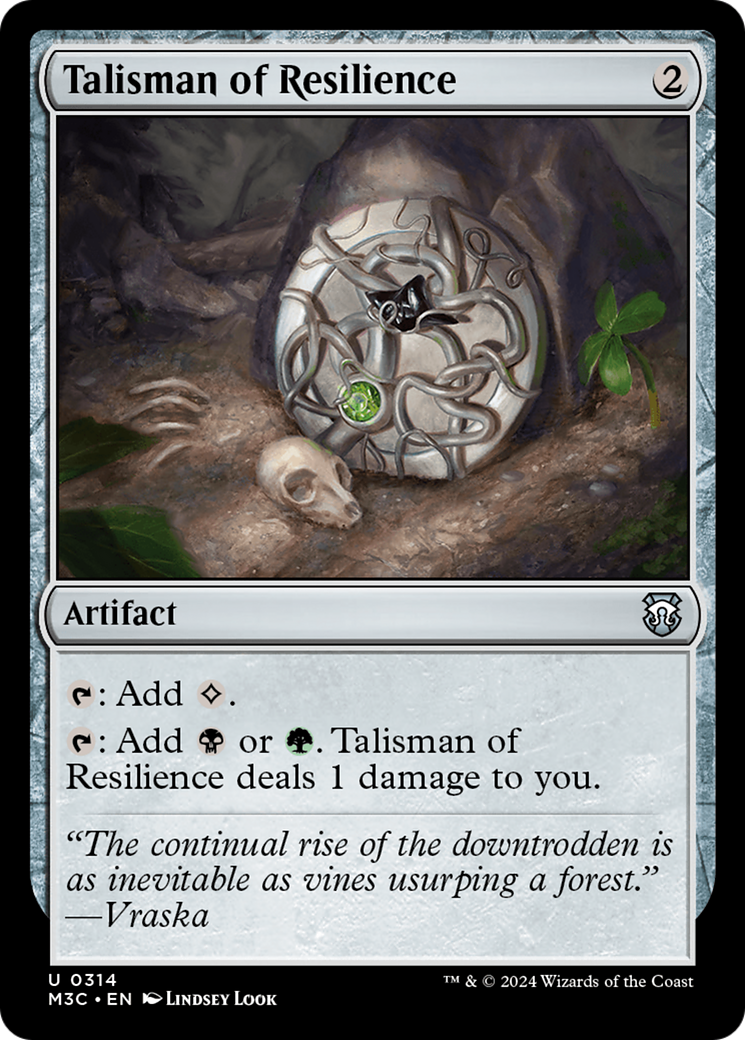
Talisman of Resilience
Talisman of Resilience
Artifact
: Add .
: Add or . This artifact deals 1 damage to you.
-
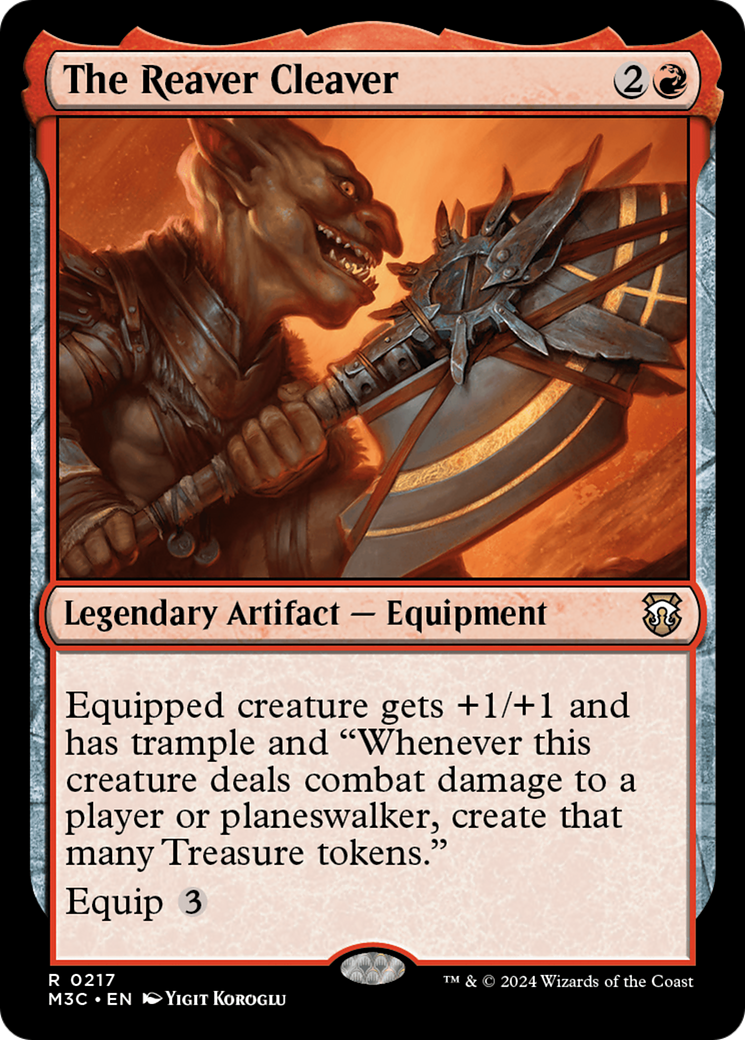
1
The Reaver Cleaver
The Reaver Cleaver
Legendary Artifact — Equipment
Equipped creature gets +1/+1 and has trample and "Whenever this creature deals combat damage to a player or planeswalker, create that many Treasure tokens."
Equip
Enchantments 3
-
1
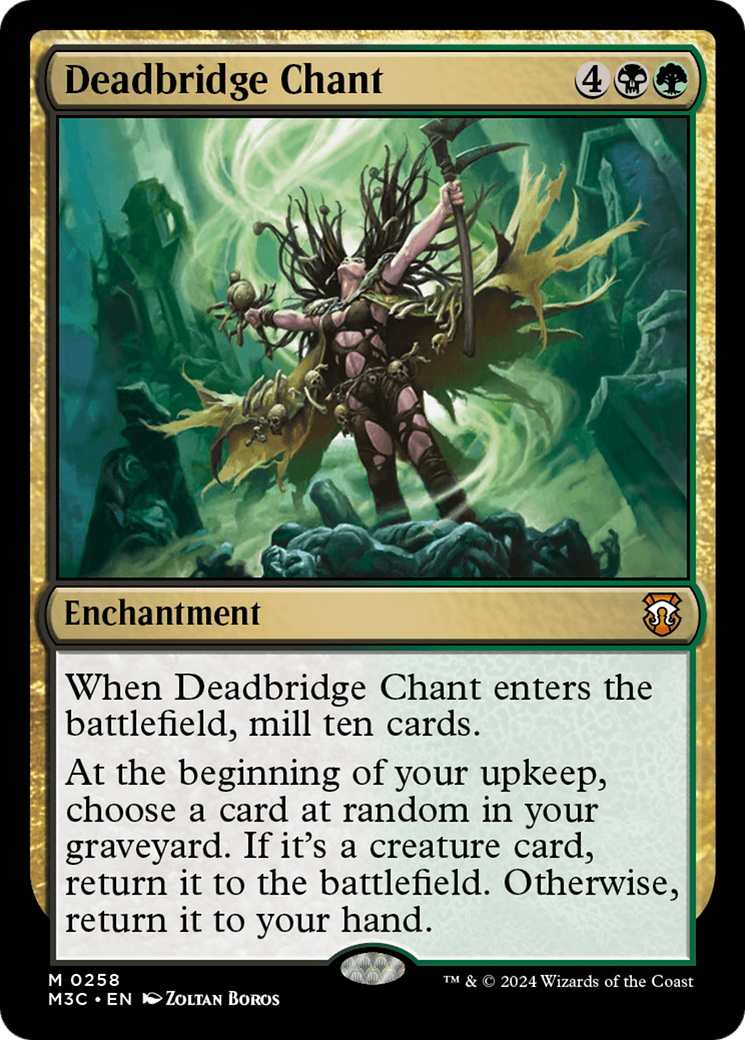
Deadbridge Chant
Deadbridge Chant
Enchantment
When this enchantment enters, mill ten cards.
At the beginning of your upkeep, choose a card at random in your graveyard. If it's a creature card, put it onto the battlefield. Otherwise, put it into your hand.
- The card is chosen at random as the ability resolves. If any player responds to the ability, that player won't yet know what card will be chosen.
- Because the last ability doesn't target any card in your graveyard, any card put into your graveyard in response to the ability may be chosen.
- Each card in your graveyard must have an equal chance of being chosen. Assigning them each a number and rolling a die is an easy way to do this. In formats that allow you to rearrange your graveyard—including Standard, Modern, and Return to Ravnica block Limited formats, you may also shuffle your graveyard face down and choose a card at random.
-
1
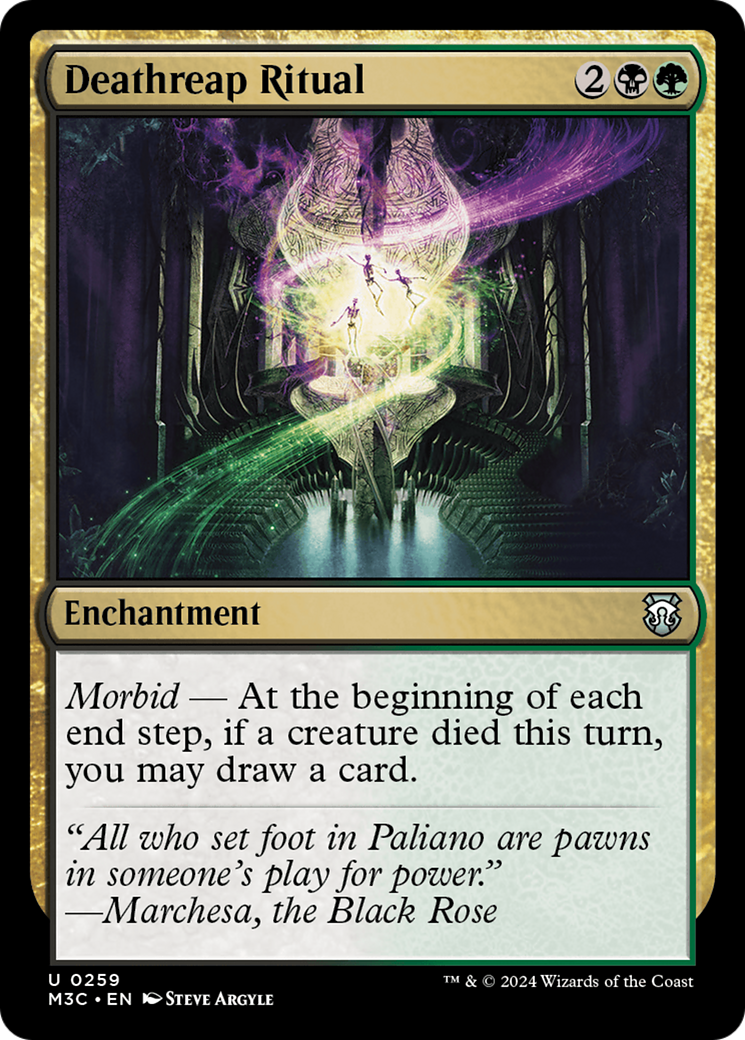
Deathreap Ritual
Deathreap Ritual
Enchantment
Morbid — At the beginning of each end step, if a creature died this turn, you may draw a card.
- If a creature didn't die before a turn's end step begins, Deathreap Ritual's ability doesn't trigger at all. The creature may have died before Deathreap Ritual entered the battlefield, however.
- You draw one card when the ability resolves, not one card per creature that died during the turn.
-
1
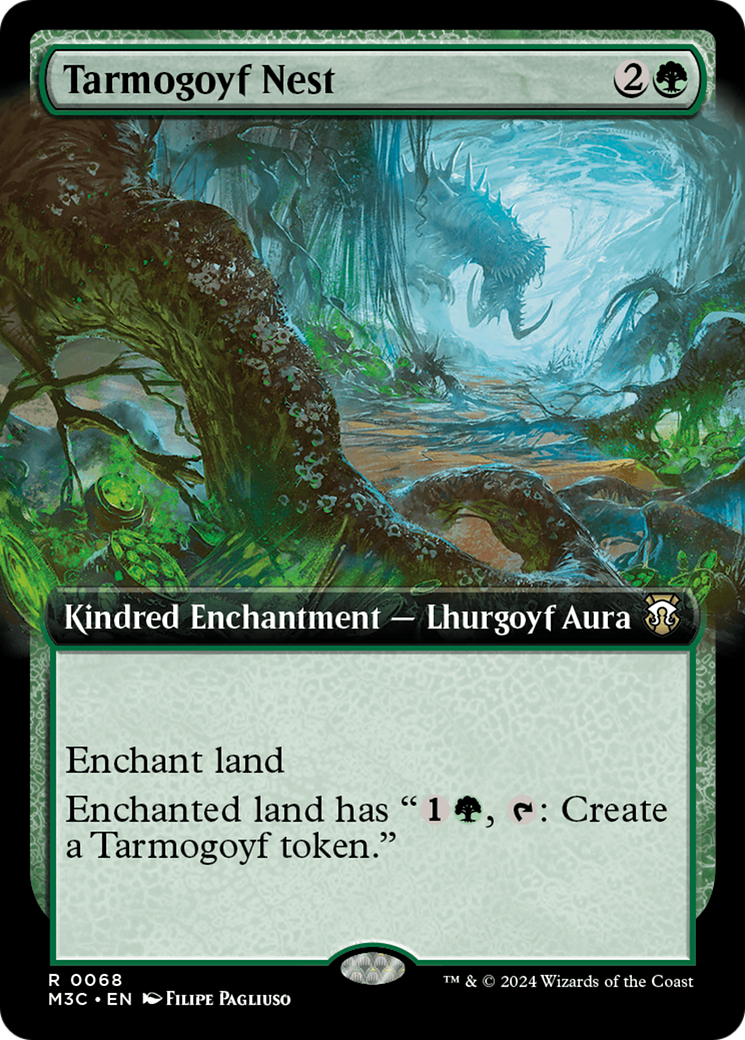
Tarmogoyf Nest
Tarmogoyf Nest
Kindred Enchantment — Lhurgoyf Aura
Enchant land
Enchanted land has " , : Create a Tarmogoyf token." (It's a Lhurgoyf creature with "Tarmogoyf's power is equal to the number of card types among cards in all graveyards and its toughness is equal to that number plus 1.")
- Tarmogoyf Nest's activated ability creates a token that's a copy of the card Tarmogoyf in the Oracle card reference. Official text for Tarmogoyf can be found using the Gatherer card database at Gatherer.Wizards.com.
- Kindred is a card type that allows noncreature cards to have creature types. For example, Echoes of Eternity is an Eldrazi (although not a creature) while on the battlefield and an Eldrazi card (although not a creature card) in zones other than the battlefield.
- While it appears only on cards that already have other card types, kindred is a card type and will be counted by effects that refer to the number of card types among cards in a zone.
Lands 39
-
1
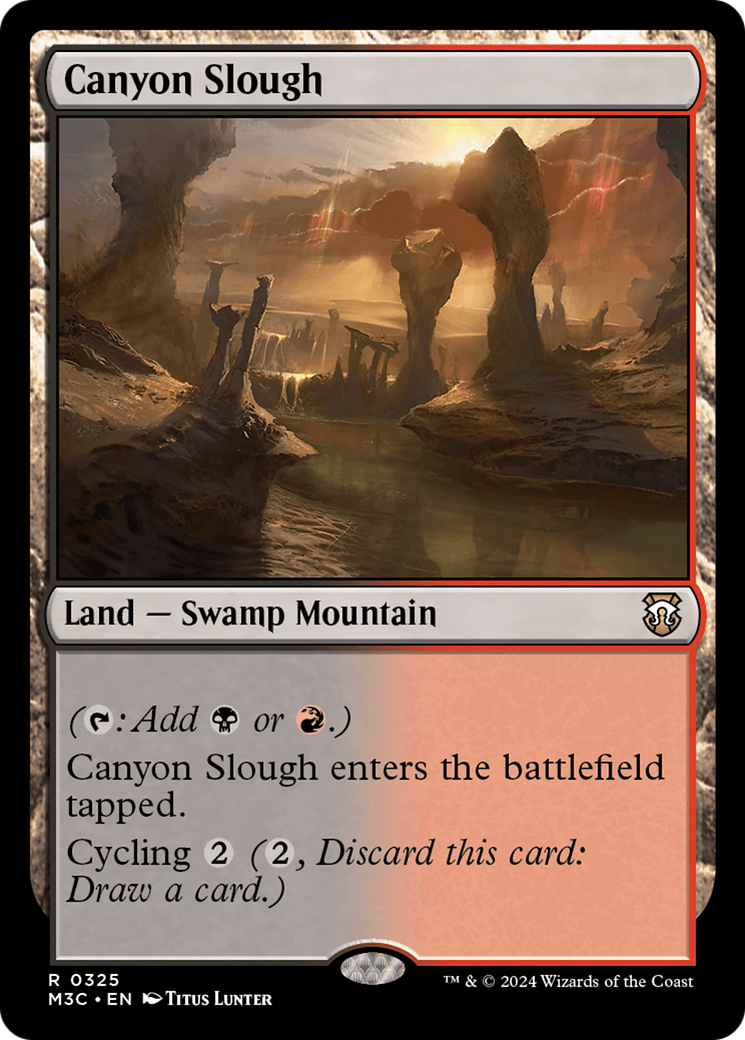
Canyon Slough
Canyon Slough
Land — Swamp Mountain
( : Add or .)
This land enters tapped.
Cycling ( , Discard this card: Draw a card.)
-
1
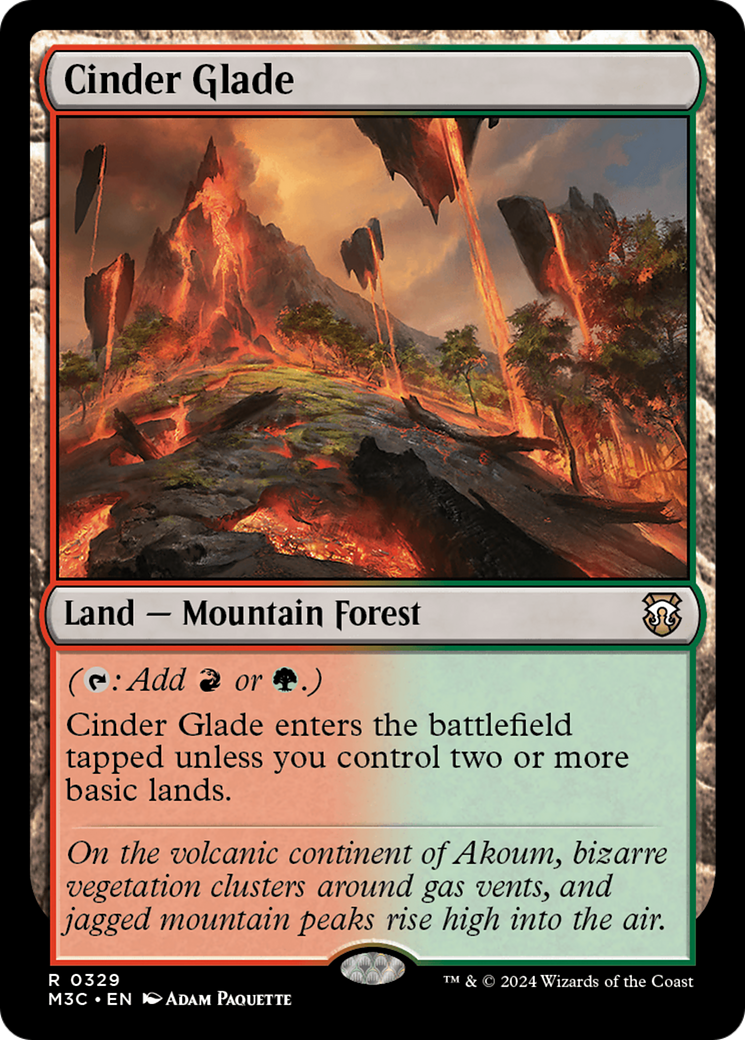
Cinder Glade
Cinder Glade
Land — Mountain Forest
( : Add or .)
This land enters tapped unless you control two or more basic lands.
- If one of these lands enters the battlefield at the same time as any number of basic lands, those other lands are not counted when determining if this land enters the battlefield tapped or untapped.
- However, because these cards have basic land types, effects that specify a basic land type without also specifying that the land be basic can affect them. For example, a spell or ability that reads "Destroy target Forest" can target Canopy Vista, while one that reads "Destroy target basic Forest" cannot.
- Even though these lands have basic land types, they are not basic lands because "basic" doesn't appear on their type line. Notably, controlling two or more of them won't allow others to enter the battlefield untapped.
-
1
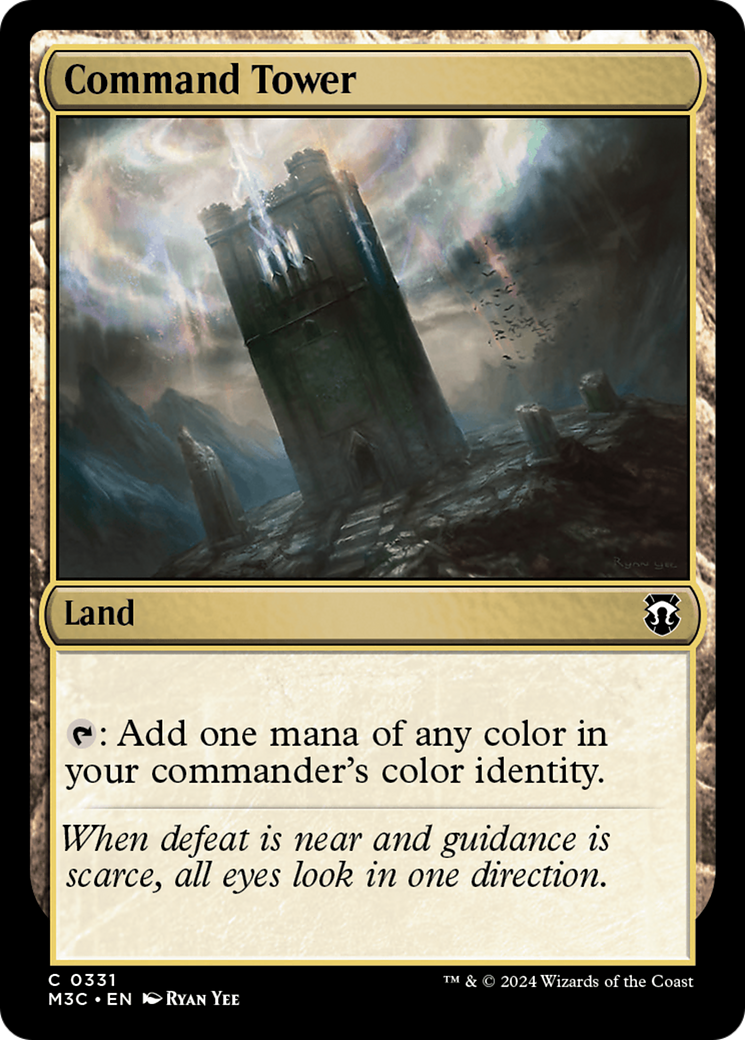
Command Tower
Command Tower
Land
: Add one mana of any color in your commander's color identity.
- If you don't have a commander, Command Tower's ability produces no mana.
- If your commander is a card that has no colors in its color identity, Command Tower's ability produces no mana. It doesn't produce .
- If you have two commanders, the ability adds one mana of any color in their combined color identities.
-
1
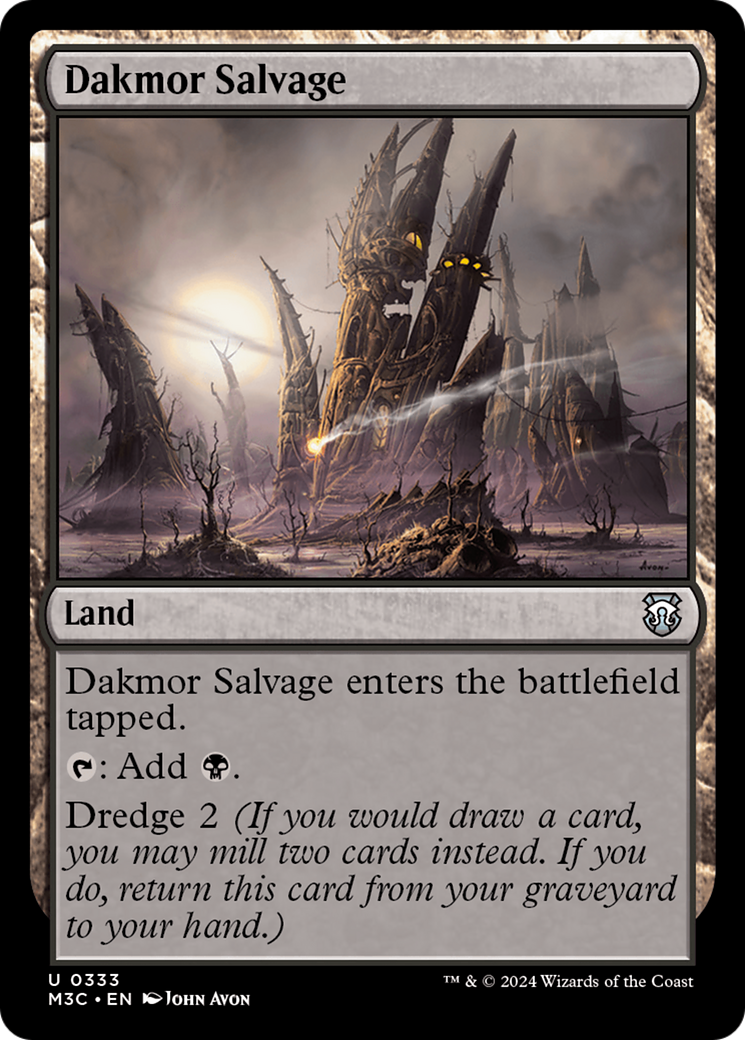
Dakmor Salvage
Dakmor Salvage
Land
This land enters tapped.
: Add .
Dredge 2 (If you would draw a card, you may mill two cards instead. If you do, return this card from your graveyard to your hand.)
- You can't attempt to use a dredge ability if you don't have enough cards in your library.
- If you're drawing multiple cards, each draw is performed one at a time. For example, if you're instructed to draw two cards and you replace the first draw with a dredge ability, another card with a dredge ability (including one that was milled by the first dredge ability) may be used to replace the second draw.
- Dredge can replace any card draw, not only the one during your draw step.
- If an effect puts a card into your hand without specifically using the word "draw," you're not drawing a card. Dredge can't replace this event.
- One card draw can't be replaced by multiple dredge abilities.
- Once you've announced that you're applying a card's dredge ability to replace a draw, players can't take any actions until you've put that card into your hand and milled cards.
-
1
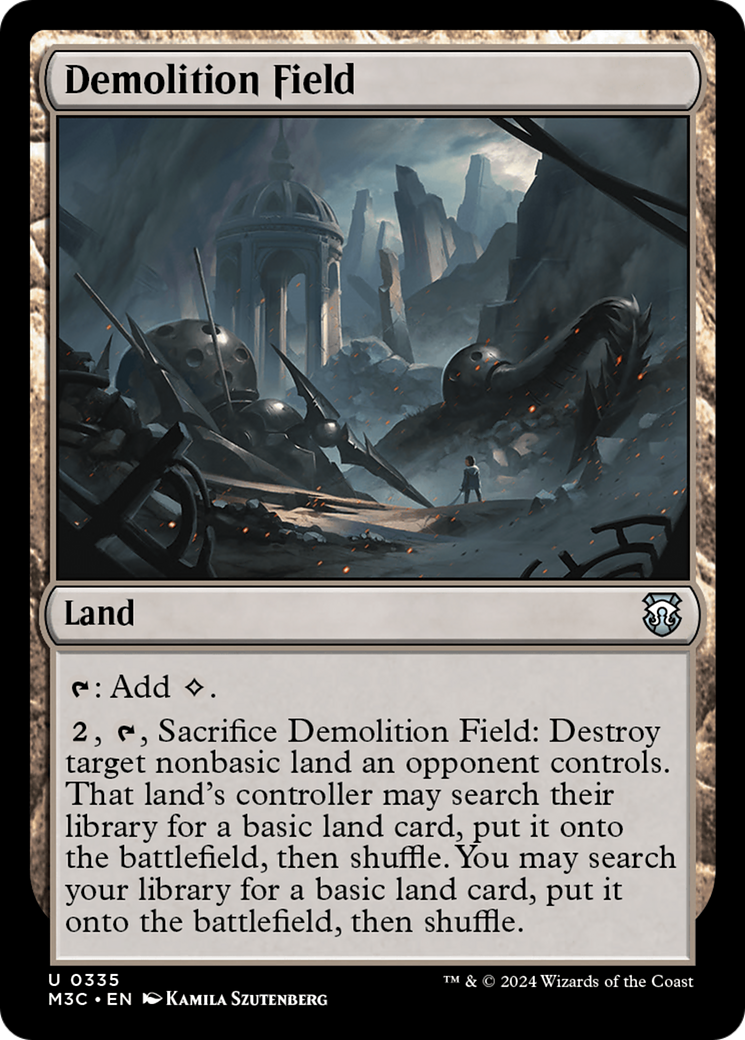
Demolition Field
Demolition Field
Land
: Add .
, , Sacrifice this land: Destroy target nonbasic land an opponent controls. That land's controller may search their library for a basic land card, put it onto the battlefield, then shuffle. You may search your library for a basic land card, put it onto the battlefield, then shuffle.
- The target land's controller gets to search for a basic land card even if that land wasn't destroyed by Demolition Field's ability. This may happen because the land has indestructible.
- If the targeted land is an illegal target by the time Demolition Field's ability resolves, it won't resolve and none of its effects will happen. Neither player will get to search for a basic land card.
-
1
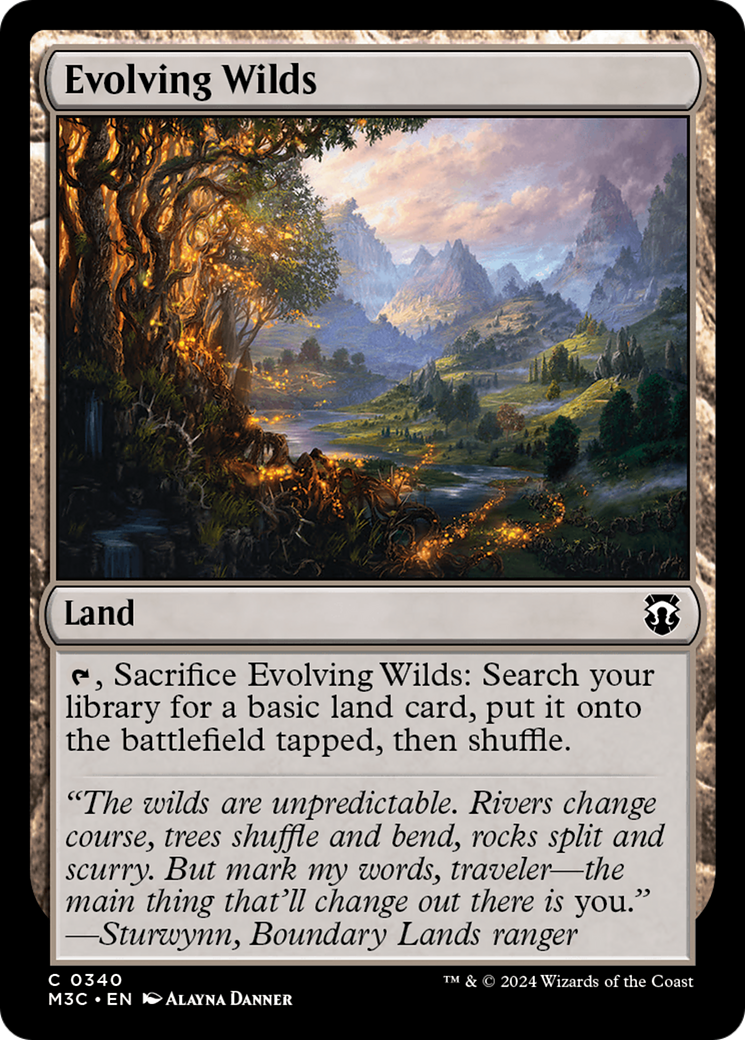
Evolving Wilds
Evolving Wilds
Land
, Sacrifice this land: Search your library for a basic land card, put it onto the battlefield tapped, then shuffle.
-
1
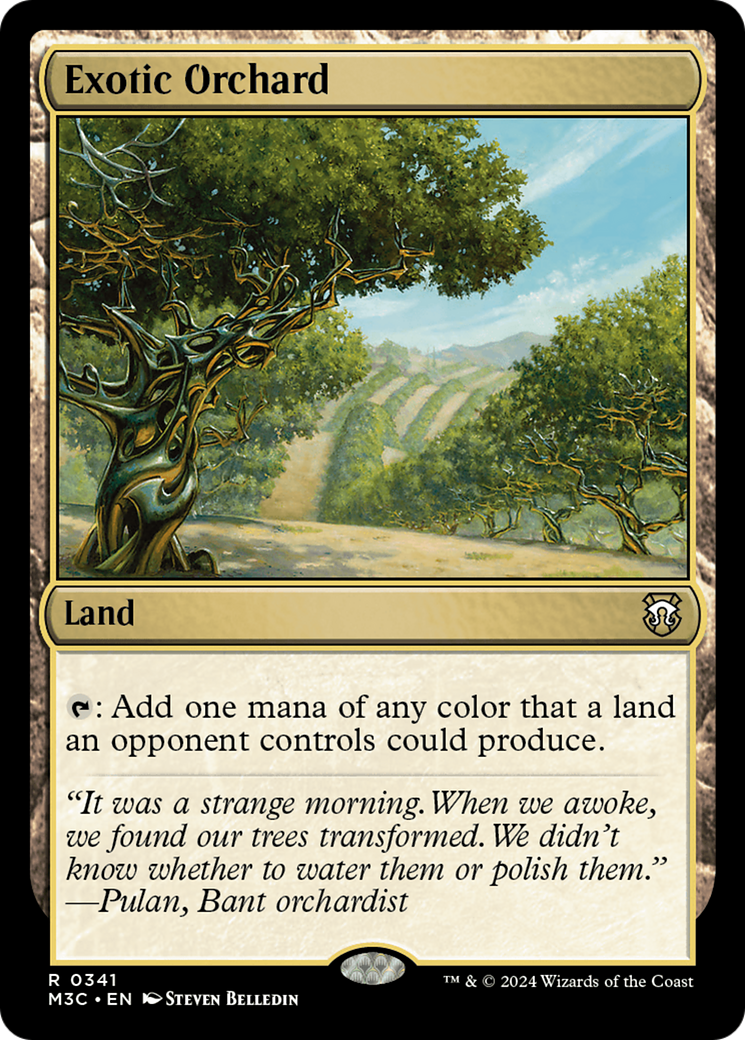
Exotic Orchard
Exotic Orchard
Land
: Add one mana of any color that a land an opponent controls could produce.
- Lands that produce mana based only on what other lands "could produce" won't help each other unless some other land allows one of them to actually produce some type of mana. For example, if you control an Exotic Orchard and your opponent controls an Exotic Orchard and a Reflecting Pool, none of those lands would produce mana if their mana abilities were activated. On the other hand, if you control a Forest and an Exotic Orchard, and your opponent controls an Exotic Orchard and a Reflecting Pool, then each of those lands can be tapped to produce . Your opponent's Exotic Orchard can produce because you control a Forest. Your Exotic Orchard and your opponent's Reflecting Pool can each produce because your opponent's Exotic Orchard can produce .
- When determining what colors of mana your opponents' lands could produce, Exotic Orchard takes into account any applicable replacement effects that would apply to those lands' mana abilities (such as Contamination's effect, for example). If there are more than one, consider them in any possible order.
- The colors of mana are white, blue, black, red, and green. Exotic Orchard can't be tapped for colorless mana, even if a land an opponent controls could produce colorless mana.
- Exotic Orchard doesn't care about any restrictions or riders your opponents' lands (such as Ancient Ziggurat or Hall of the Bandit Lord) put on the mana they produce. It just cares about colors of mana.
- Exotic Orchard checks the effects of all mana-producing abilities of lands your opponents control, but it doesn't check their costs. For example, Vivid Crag has the ability " , Remove a charge counter from Vivid Crag: Add one mana of any color." If an opponent controls Vivid Crag and you control Exotic Orchard, you can tap Exotic Orchard for any color of mana. It doesn't matter whether Vivid Crag has a charge counter on it, and it doesn't matter whether it's untapped.
-
5
Forest
Forest
Basic Land — Forest
( : Add .)
-
1
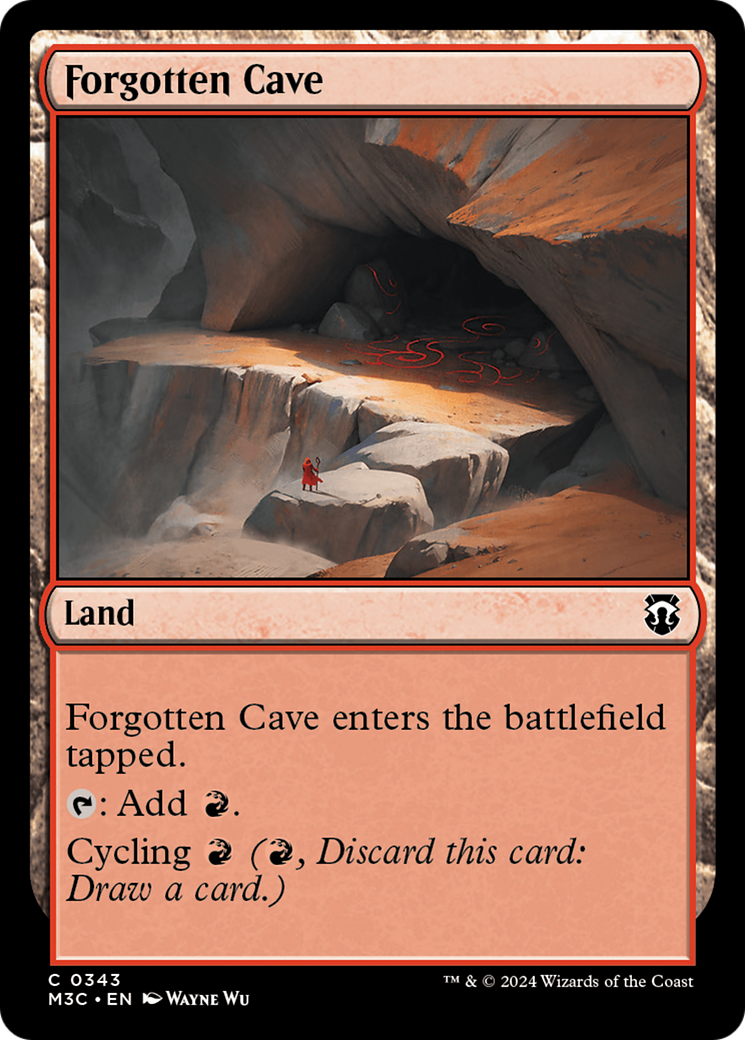
Forgotten Cave
Forgotten Cave
Land
This land enters tapped.
: Add .
Cycling ( , Discard this card: Draw a card.)
-
1
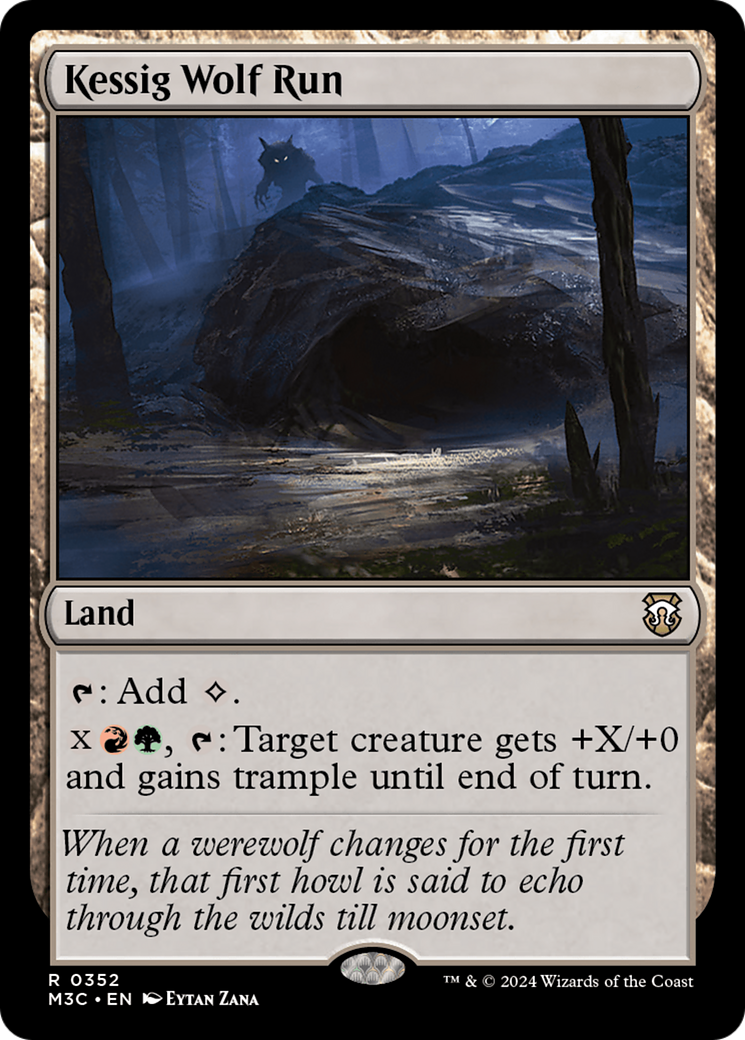
Kessig Wolf Run
Kessig Wolf Run
Land
: Add .
, : Target creature gets +X/+0 and gains trample until end of turn.
-
1
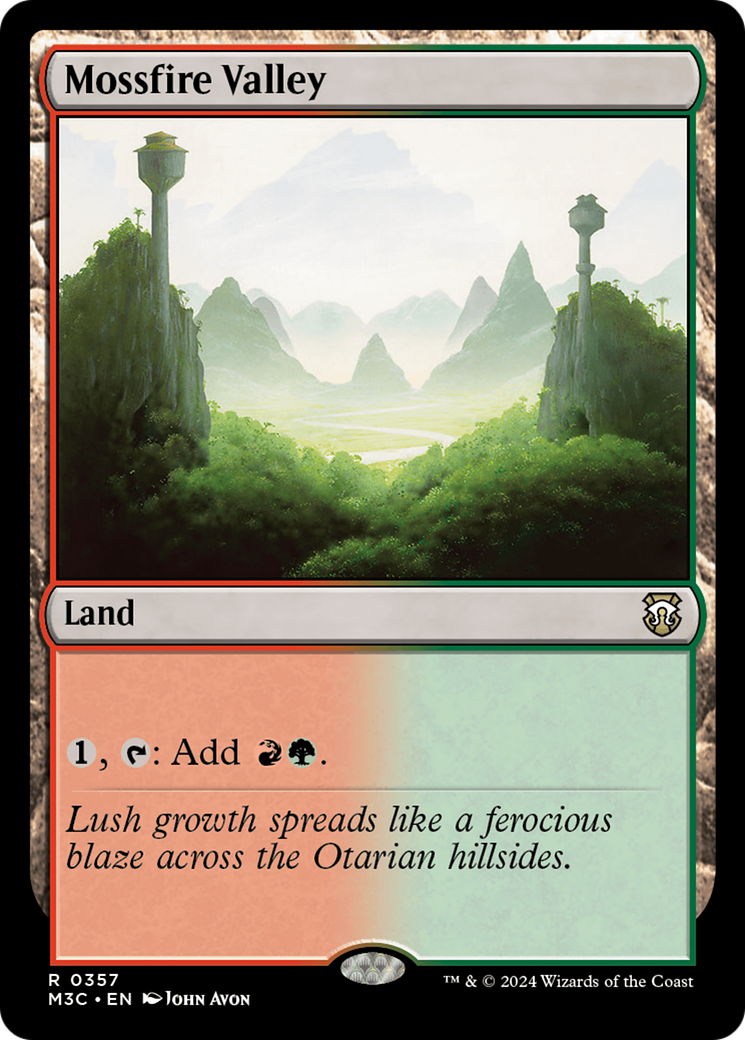
Mossfire Valley
Mossfire Valley
Land
, : Add .
-
3
Mountain
Mountain
Basic Land — Mountain
( : Add .)
-
1
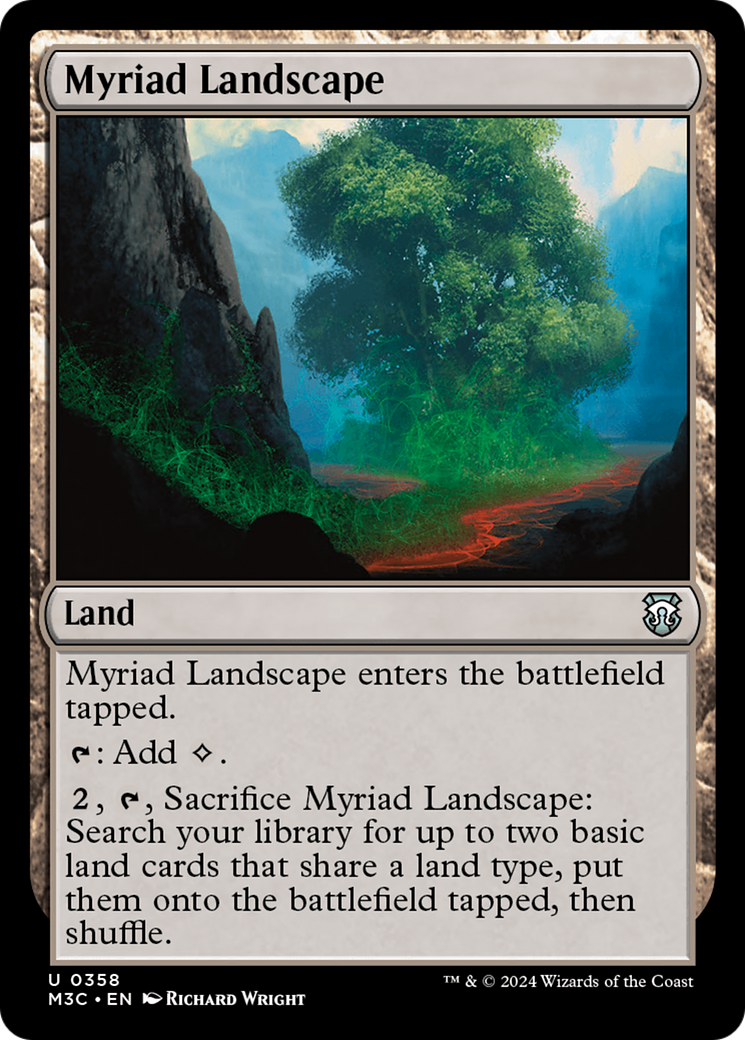
Myriad Landscape
Myriad Landscape
Land
This land enters tapped.
: Add .
, , Sacrifice this land: Search your library for up to two basic land cards that share a land type, put them onto the battlefield tapped, then shuffle.
- You can choose to find one basic land card with Myriad Landscape's last ability.
-
1
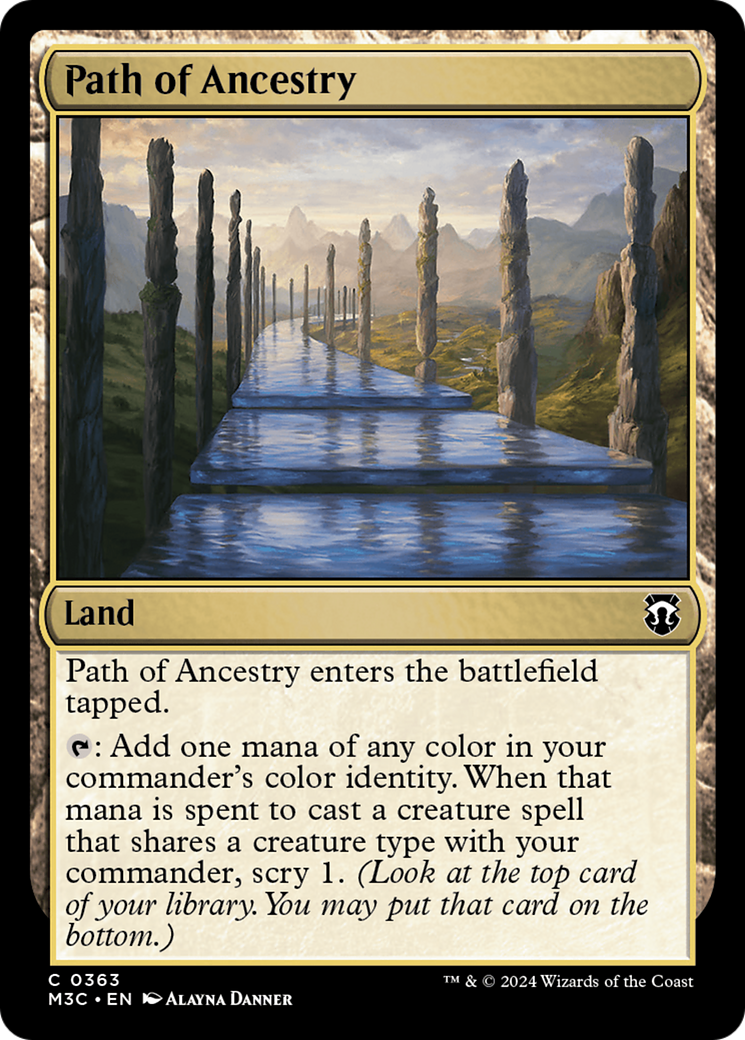
Path of Ancestry
Path of Ancestry
Land
This land enters tapped.
: Add one mana of any color in your commander's color identity. When that mana is spent to cast a creature spell that shares a creature type with your commander, scry 1. (Look at the top card of your library. You may put that card on the bottom.)
- Your commander's creature types are checked immediately after you cast a creature spell spending mana from Path of Ancestry's last ability. They aren't set before the game begins, and they may not be the same types your commander had when you activated that ability.
- If you have two commanders, the last ability adds one mana of any color in their combined color identities. When you spend that mana on a creature spell that shares a creature type with either of your commanders, you'll scry 1.
- If Path of Ancestry's last ability produces two mana (most likely due to Mana Reflection), spending those two mana to cast creature spells that share a creature type with your commander will cause two abilities to trigger. Each of those abilities will cause you to scry 1. You won't scry 2. This is true whether you spend the mana on one creature spell or two.
- If your commander has no creature types, it can't share a creature type with any spell that you cast.
- If you cast your commander with mana from Path of Ancestry, and your commander hasn't somehow lost all of its creature types while on the stack, you'll scry 1.
- If you don't have a commander, Path of Ancestry's ability produces no mana.
- If your commander is a card that has no colors in its color identity, Path of Ancestry's ability produces no mana. It doesn't produce .
-
1
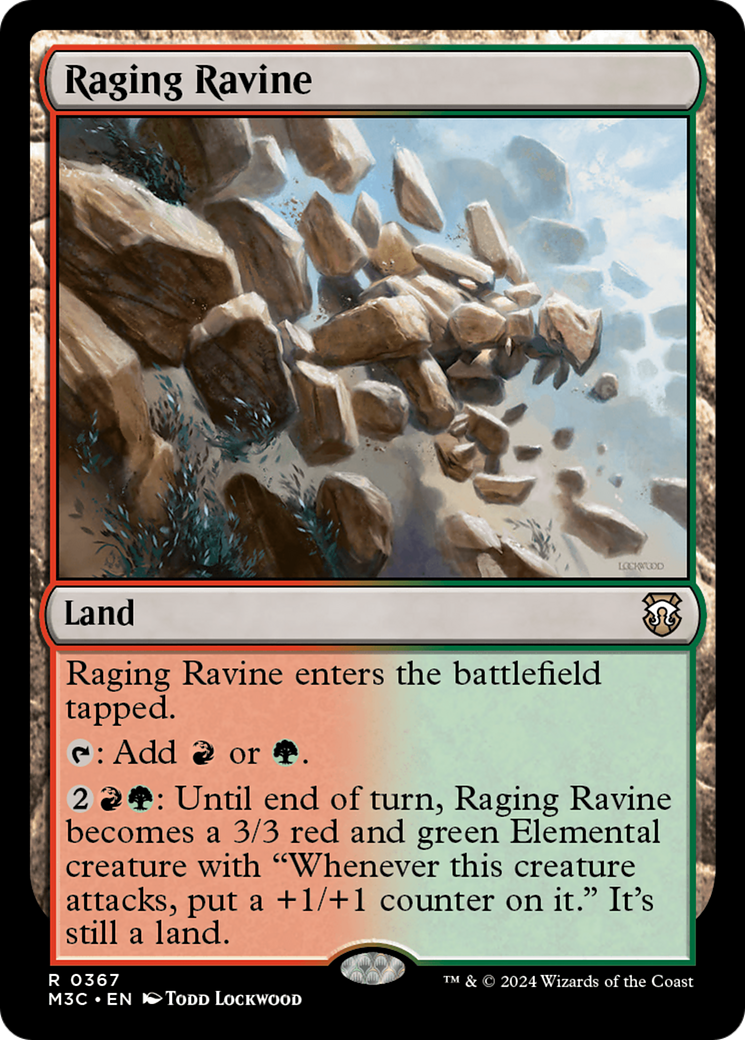
Raging Ravine
Raging Ravine
Land
This land enters tapped.
: Add or .
: Until end of turn, this land becomes a 3/3 red and green Elemental creature with "Whenever this creature attacks, put a +1/+1 counter on it." It's still a land.
- If this land becomes a creature but you haven’t controlled it continuously since your most recent turn began, you won’t be able to activate its mana ability or attack with it that turn.
- Any +1/+1 counters put on Raging Ravine remain on it even after it stops being a creature. They’ll have no effect until it becomes a creature again. (In other words, the land continues to rage, but to no effect.)
- If Raging Ravine’s last ability is activated multiple times in a turn, it will get that many instances of the granted triggered ability. For example, if you activate Raging Ravine’s last ability twice and then attack with it, you’ll put a +1/+1 counter on it twice.
-
1
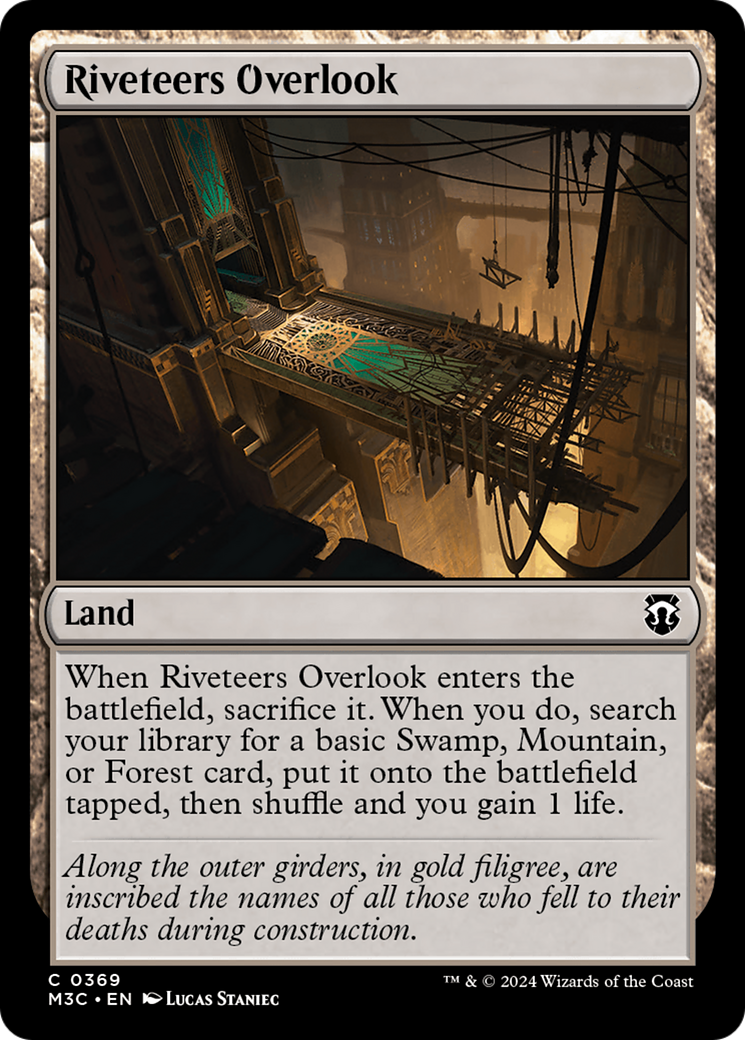
Riveteers Overlook
Riveteers Overlook
Land
When this land enters, sacrifice it. When you do, search your library for a basic Swamp, Mountain, or Forest card, put it onto the battlefield tapped, then shuffle and you gain 1 life.
-
1
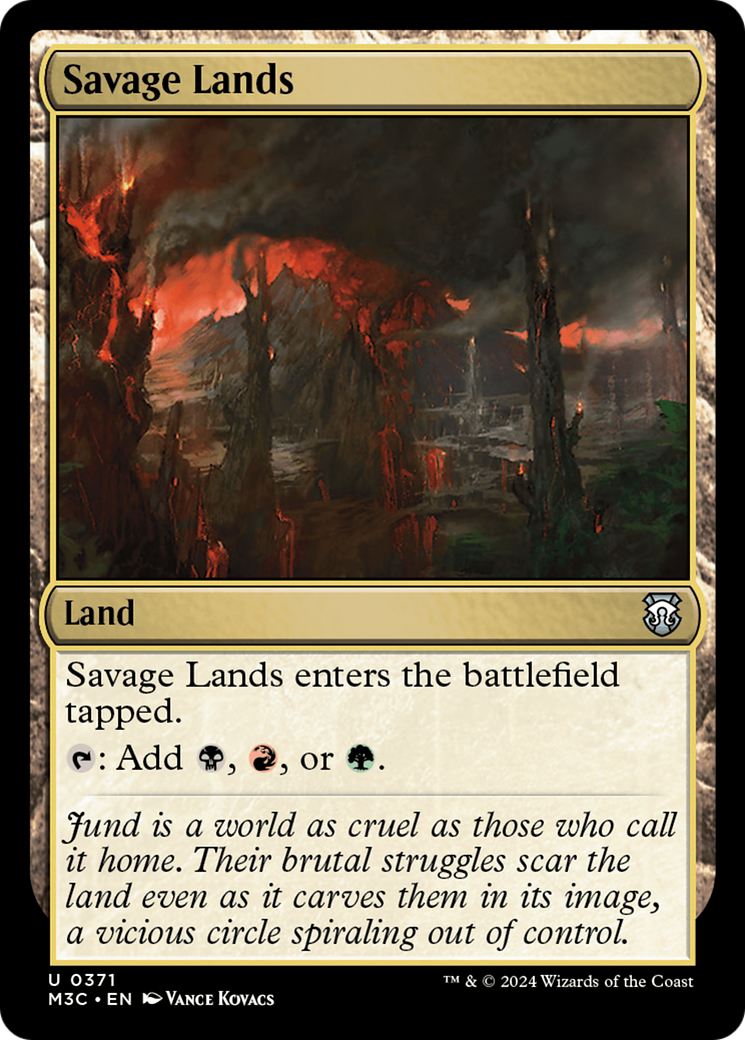
Savage Lands
Savage Lands
Land
This land enters tapped.
: Add , , or .
-
1
Shadowblood Ridge
Shadowblood Ridge
Land
, : Add .
-
1
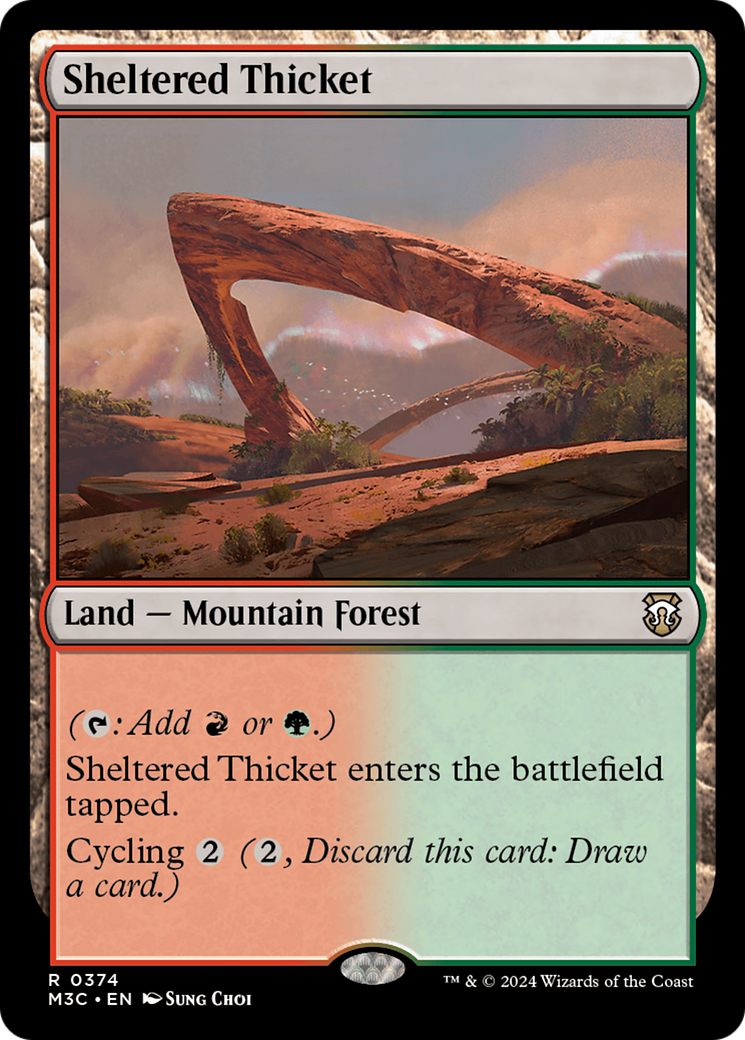
Sheltered Thicket
Sheltered Thicket
Land — Mountain Forest
( : Add or .)
This land enters tapped.
Cycling ( , Discard this card: Draw a card.)
-
1
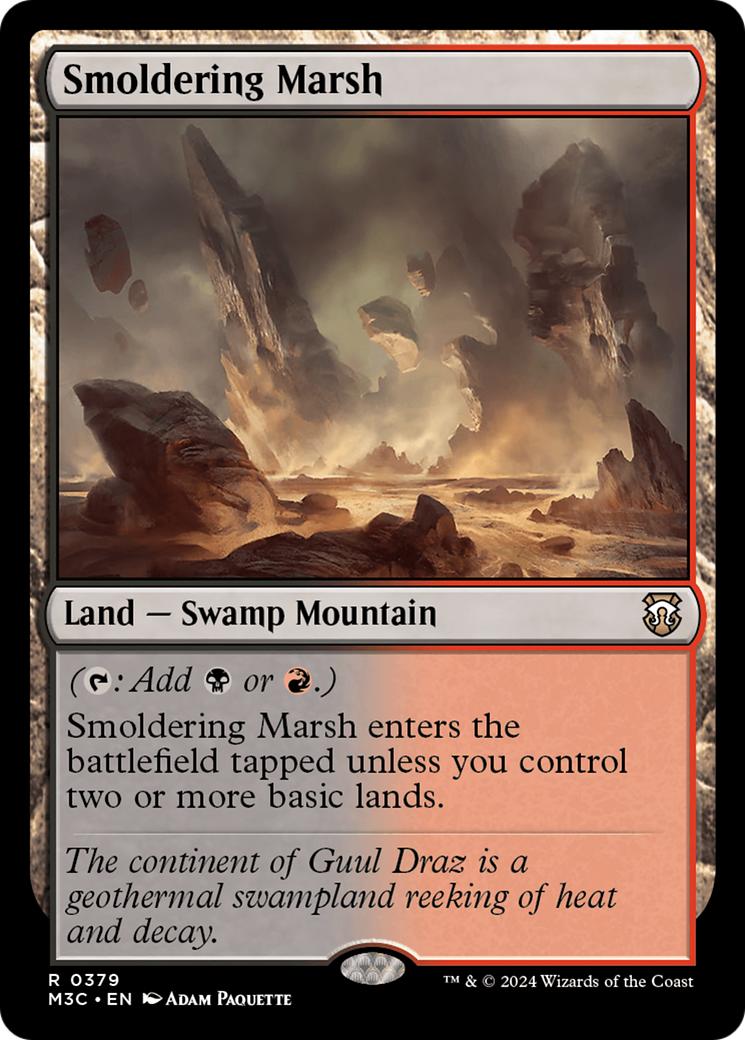
Smoldering Marsh
Smoldering Marsh
Land — Swamp Mountain
( : Add or .)
This land enters tapped unless you control two or more basic lands.
- However, because these cards have basic land types, effects that specify a basic land type without also specifying that the land be basic can affect them. For example, a spell or ability that reads "Destroy target Forest" can target Canopy Vista, while one that reads "Destroy target basic Forest" cannot.
- Even though these lands have basic land types, they are not basic lands because "basic" doesn't appear on their type line. Notably, controlling two or more of them won't allow others to enter the battlefield untapped.
- If one of these lands enters the battlefield at the same time as any number of basic lands, those other lands are not counted when determining if this land enters the battlefield tapped or untapped.
-
4
Swamp
Swamp
Basic Land — Swamp
( : Add .)
-
1
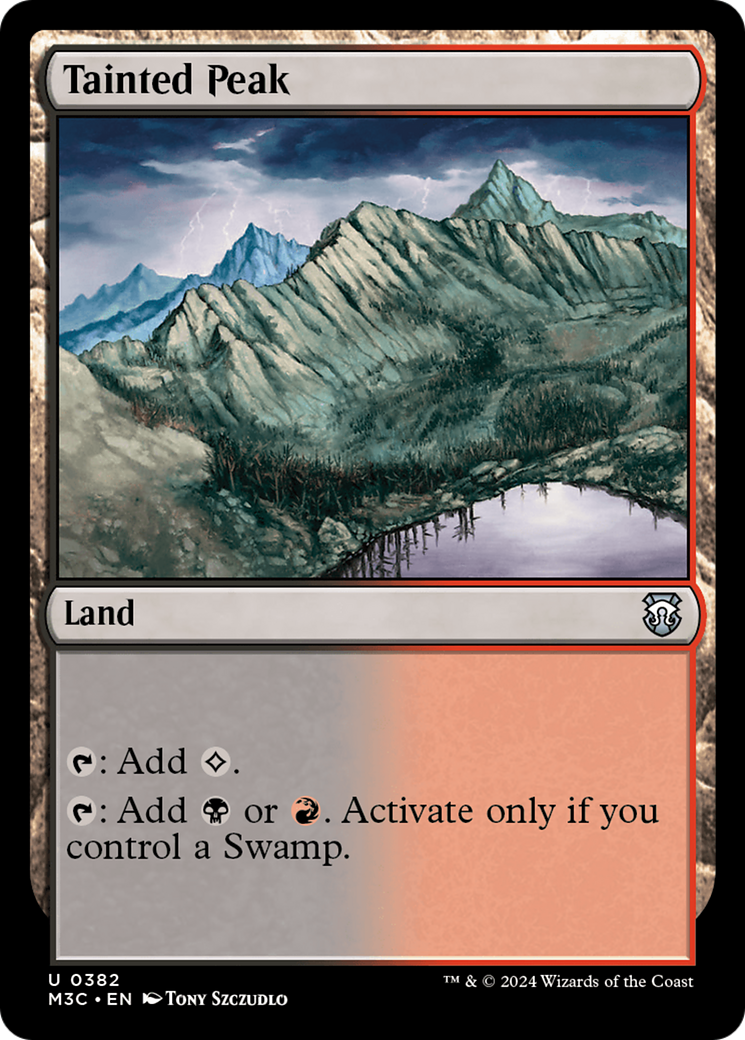
Tainted Peak
Tainted Peak
Land
: Add .
: Add or . Activate only if you control a Swamp.
-
1
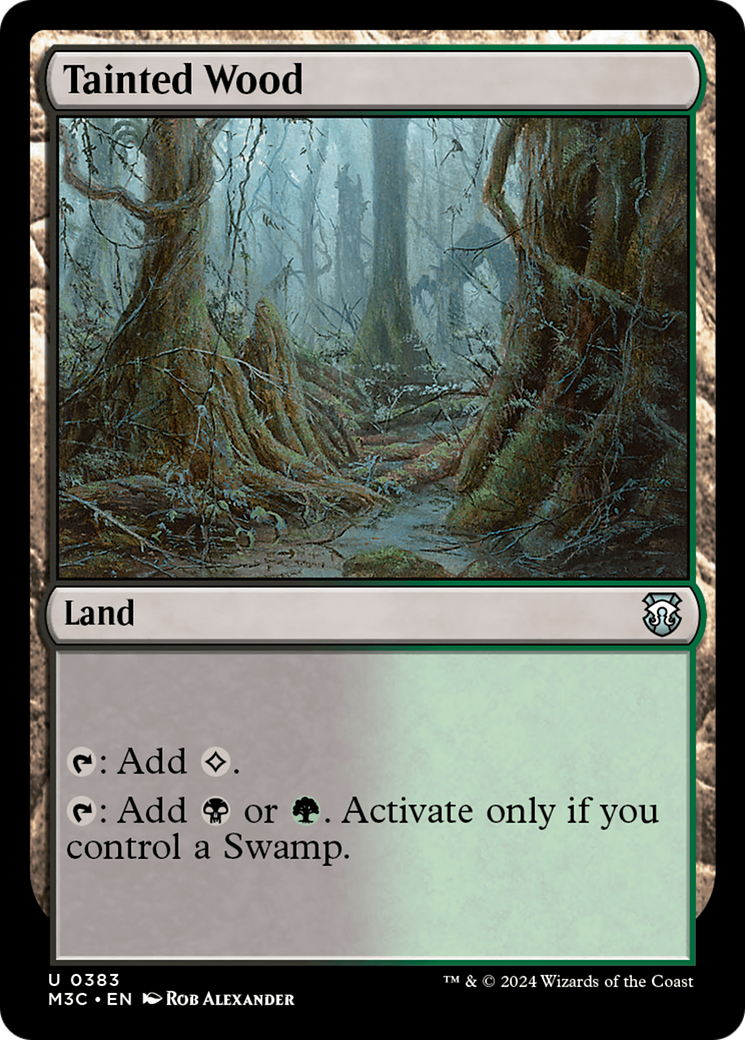
Tainted Wood
Tainted Wood
Land
: Add .
: Add or . Activate only if you control a Swamp.
-
1
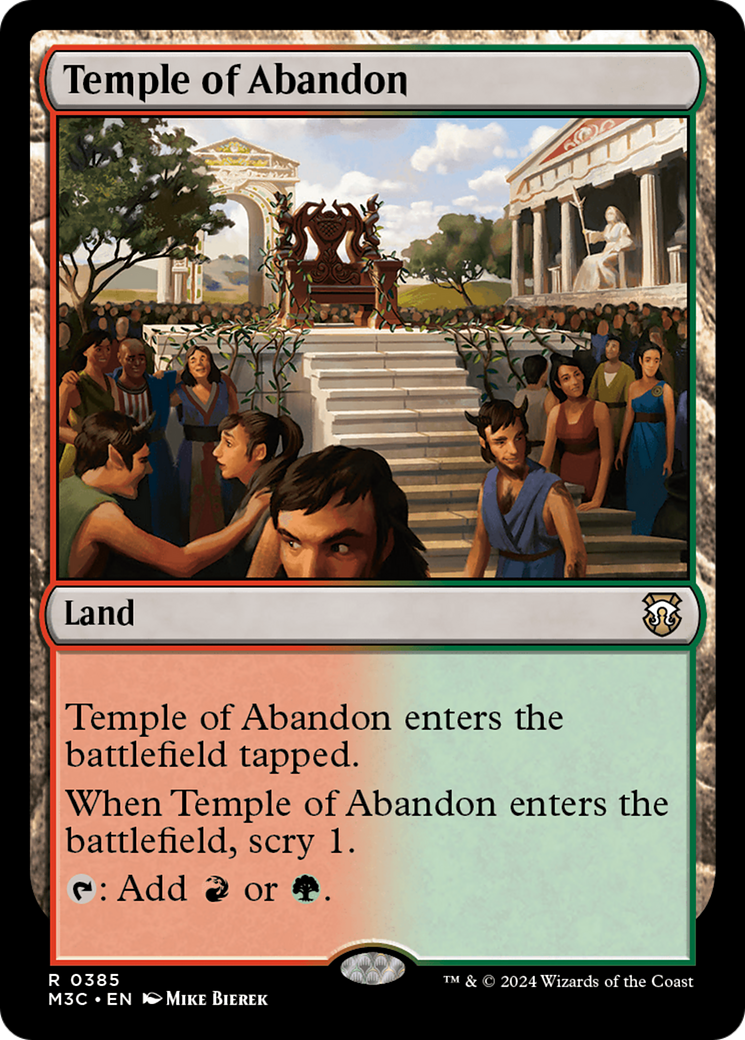
Temple of Abandon
Temple of Abandon
Land
This land enters tapped.
When this land enters, scry 1. (Look at the top card of your library. You may put that card on the bottom.)
: Add or .
- You perform the actions stated on a card in sequence. For some spells and abilities, that means you'll scry last. For others, that means you'll scry and then perform other actions.
- When you scry, you may put all the cards you look at back on top of your library, you may put all of those cards on the bottom of your library, or you may put some of those cards on top and the rest of them on the bottom.
- You choose how to order cards returned to your library after scrying no matter where you put them.
- Scry appears on some spells and abilities with one or more targets. If all of the spell or ability's targets are illegal when it tries to resolve, it won't resolve and none of its effects will happen. You won't scry.
-
1
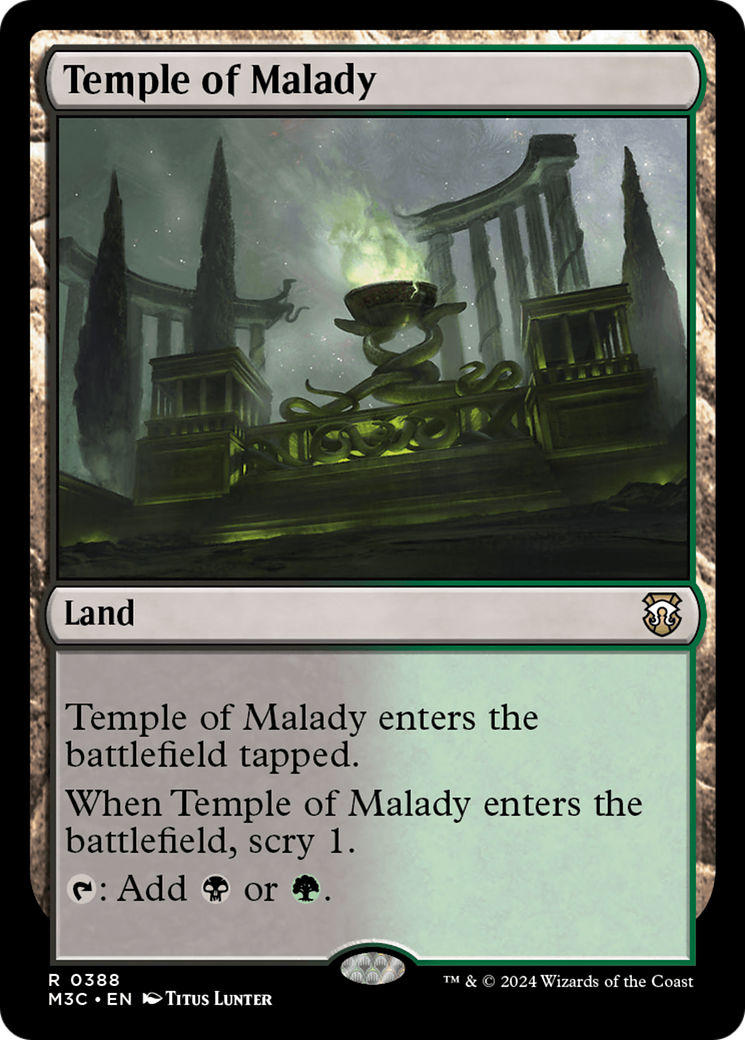
Temple of Malady
Temple of Malady
Land
This land enters tapped.
When this land enters, scry 1. (Look at the top card of your library. You may put that card on the bottom.)
: Add or .
-
1
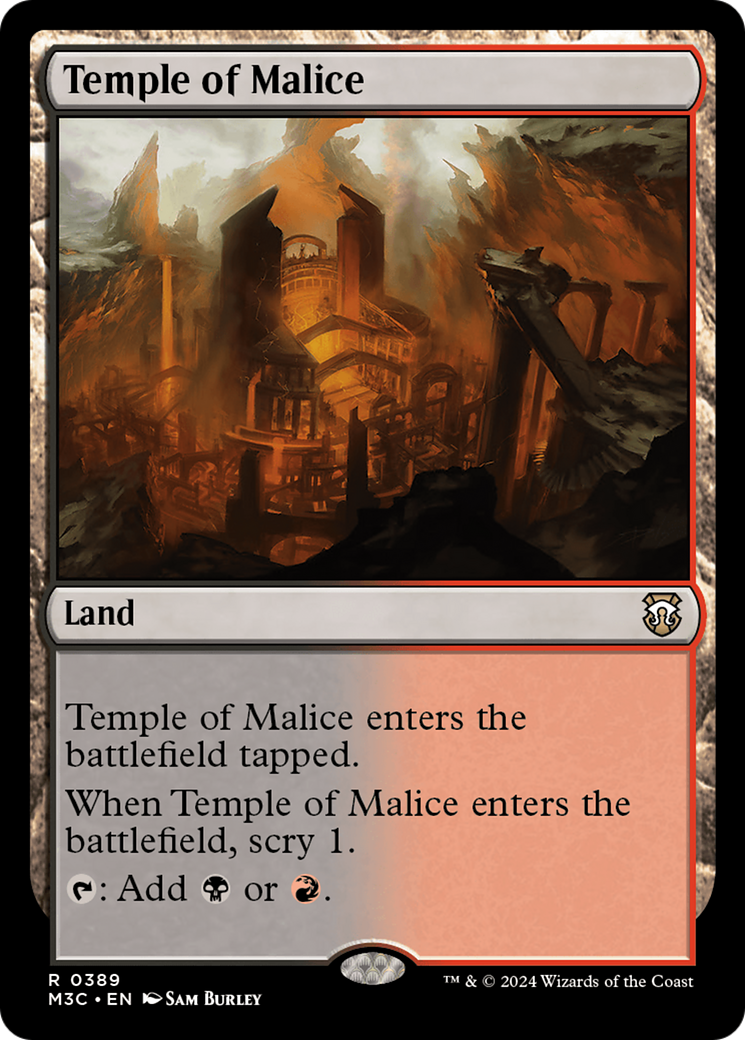
Temple of Malice
Temple of Malice
Land
This land enters tapped.
When this land enters, scry 1. (Look at the top card of your library. You may put that card on the bottom.)
: Add or .
- When you scry, you may put all the cards you look at back on top of your library, you may put all of those cards on the bottom of your library, or you may put some of those cards on top and the rest of them on the bottom.
- You choose how to order cards returned to your library after scrying no matter where you put them.
- You perform the actions stated on a card in sequence. For some spells and abilities, that means you'll scry last. For others, that means you'll scry and then perform other actions.
- Scry appears on some spells and abilities with one or more targets. If all of the spell or ability's targets are illegal when it tries to resolve, it won't resolve and none of its effects will happen. You won't scry.
-
1
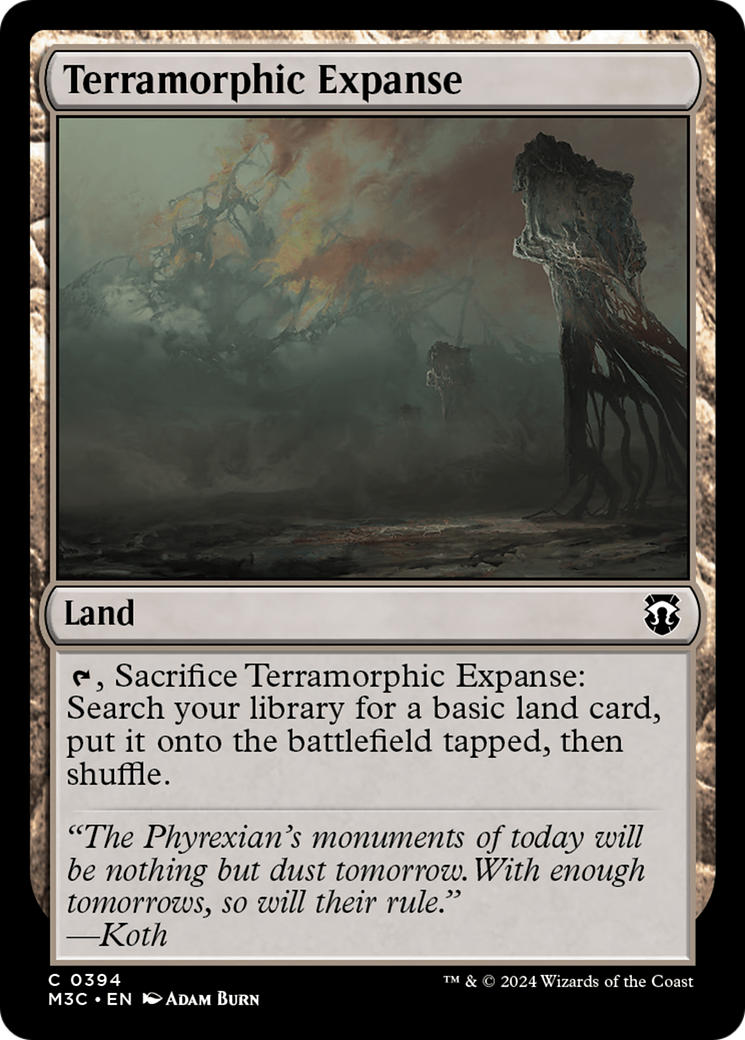
Terramorphic Expanse
Terramorphic Expanse
Land
, Sacrifice this land: Search your library for a basic land card, put it onto the battlefield tapped, then shuffle.
-
1
Tranquil Thicket
Tranquil Thicket
Land
This land enters tapped.
: Add .
Cycling ( , Discard this card: Draw a card.)
-
1
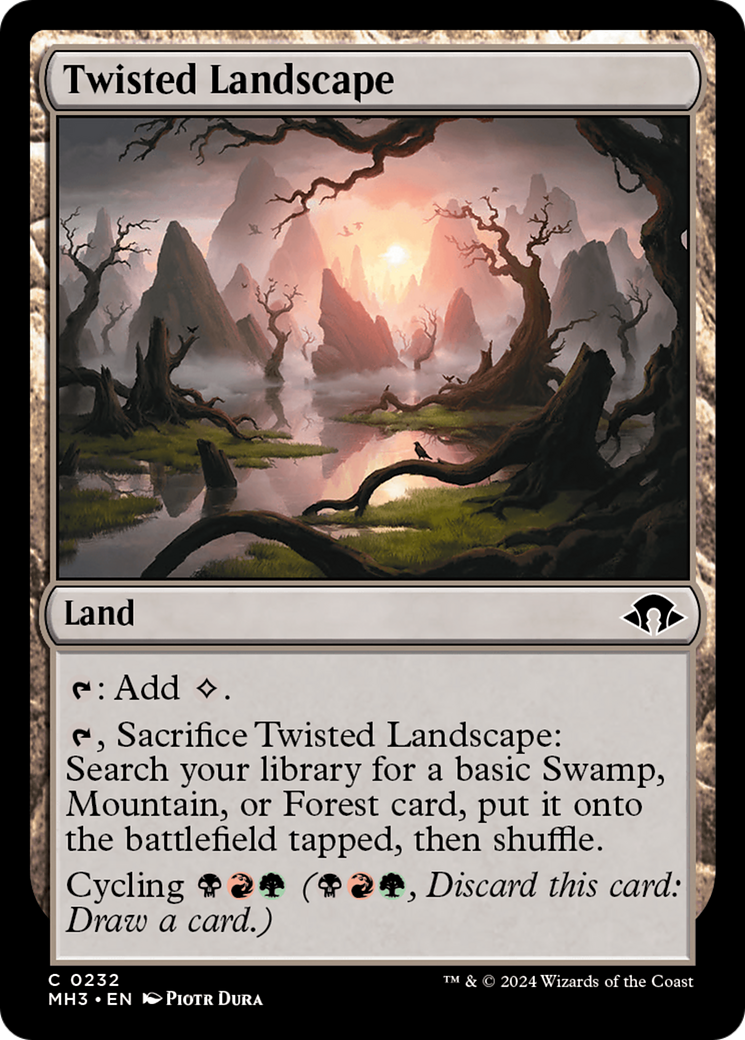
Twisted Landscape
Twisted Landscape
Land
: Add .
, Sacrifice this land: Search your library for a basic Swamp, Mountain, or Forest card, put it onto the battlefield tapped, then shuffle.
Cycling ( , Discard this card: Draw a card.)
-
1
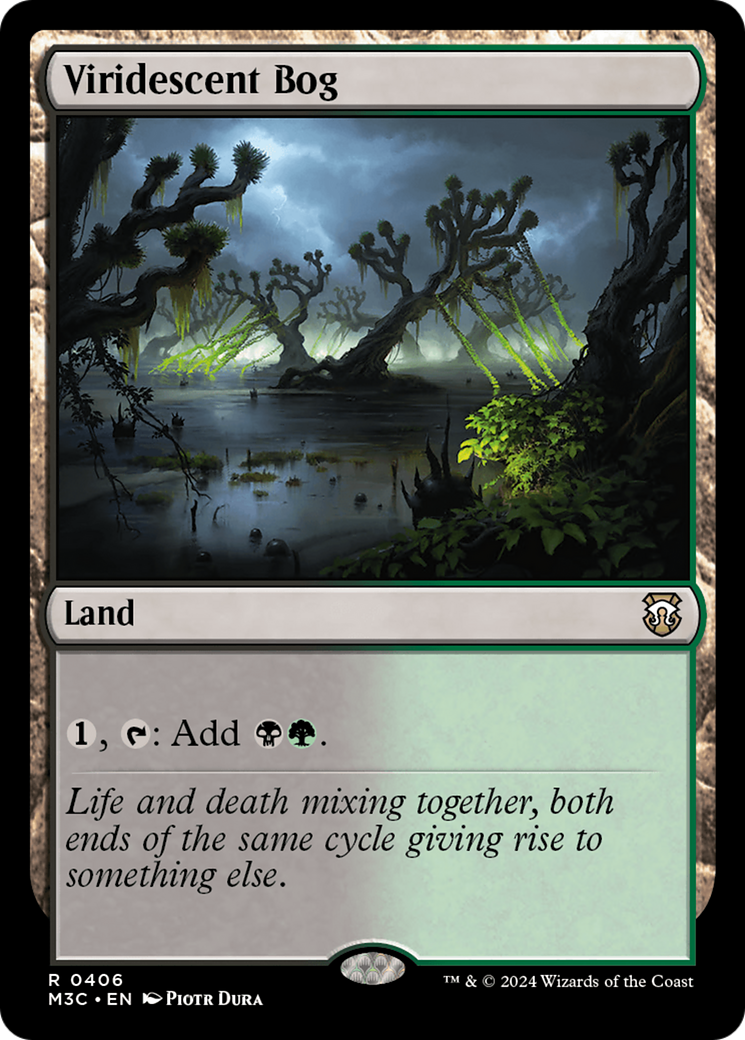
Viridescent Bog
Viridescent Bog
Land
, : Add .
Black 12
-
1
Accursed Marauder
Accursed Marauder
Creature — Zombie Warrior
2/1
When this creature enters, each player sacrifices a nontoken creature of their choice.
-
1
Archon of Cruelty
Archon of Cruelty
Creature — Archon
6/6
Flying
Whenever this creature enters or attacks, target opponent sacrifices a creature or planeswalker of their choice, discards a card, and loses 3 life. You draw a card and gain 3 life.
- You and the opponent you target take all the actions in the order listed. Notably, the creature or planeswalker they sacrifice won't be on the battlefield as they discard a card or lose life. If any abilities trigger, they will wait to be put on the stack until after the spell resolves. If any abilities controlled by that opponent trigger but losing 3 life causes them to lose the game, none of those abilities will be put on the stack.
-
1
Barrowgoyf
Barrowgoyf
Creature — Lhurgoyf
*/1+*
Deathtouch, lifelink
Barrowgoyf's power is equal to the number of card types among cards in all graveyards and its toughness is equal to that number plus 1.
Whenever this creature deals combat damage to a player, you may mill that many cards. If you do, you may put a creature card from among them into your hand.
- The ability that defines Barrowgoyf's power and toughness works in all zones, not just the battlefield.
- The ability that defines Barrowgoyf's power and toughness counts card types, not cards. If the only card in all graveyards is a single artifact creature card, Barrowgoyf will be a 2/3. If the cards in all graveyards are ten artifact cards and ten creature cards, Barrowgoyf will still be a 2/3.
- Card types that can appear on cards in a graveyard are artifact, battle, creature, enchantment, instant, kindred, land, planeswalker, and sorcery. Legendary, basic, and snow are supertypes, not card types; Lhurgoyf, Forest, and Siege are subtypes, not card types.
-
1
Final Act
Final Act
Sorcery
Choose one or more —
- Destroy all creatures.
- Destroy all planeswalkers.
- Destroy all battles.
- Exile all graveyards.
- Each opponent loses all counters.
- If you choose more than one mode for Final Act, you perform the actions in the order written.
- Counters that players could have include energy counters, experience counters, poison counters, rad counters, and ticket counters.
-
1
Graveshifter
Graveshifter
Creature — Shapeshifter
2/2
Changeling (This card is every creature type.)
When this creature enters, you may return target creature card from your graveyard to your hand.
-
1
Junji, the Midnight Sky
Junji, the Midnight Sky
Legendary Creature — Dragon Spirit
5/5
Flying, menace
When Junji dies, choose one —
- Each opponent discards two cards and loses 2 life.
- Put target non-Dragon creature card from a graveyard onto the battlefield under your control. You lose 2 life.
-
1
Liliana, Death's Majesty
Liliana, Death's Majesty
Legendary Planeswalker — Liliana
+1: Create a 2/2 black Zombie creature token. Mill two cards.
−3: Return target creature card from your graveyard to the battlefield. That creature is a black Zombie in addition to its other colors and types.
−7: Destroy all non-Zombie creatures.
- A creature that is a Zombie and has other types, such as a Zombie Jackal, isn't a non-Zombie creature.
-
1
Mortivore
Mortivore
Creature — Lhurgoyf
*/*
Mortivore's power and toughness are each equal to the number of creature cards in all graveyards.
: Regenerate this creature. (The next time this creature would be destroyed this turn, instead tap it, remove it from combat, and heal all damage on it.)
-
1
Necrogoyf
Necrogoyf
Creature — Lhurgoyf
*/4
Necrogoyf's power is equal to the number of creature cards in all graveyards.
At the beginning of each player's upkeep, that player discards a card.
Madness (If you discard this card, discard it into exile. When you do, cast it for its madness cost or put it into your graveyard.)
- Cards are discarded in a Magic game only from a player's hand. Effects that put cards into a player's graveyard from anywhere else do not cause those cards to be discarded.
- Madness works independently of why you're discarding the card. You could discard it to pay a cost, because a spell or ability tells you to, or because you have too many cards in your hand during your cleanup step. You can't discard a card with madness just because you want to, though.
- A card with madness that's discarded counts as having been discarded even though it's put into exile rather than a graveyard. If it was discarded to pay a cost, that cost is still paid. Abilities that trigger when a card is discarded will still trigger.
- A spell cast for its madness cost is put onto the stack like any other spell. It can be countered, copied, and so on. As it resolves, it's put onto the battlefield if it's a permanent card or into its owner's graveyard if it's an instant or sorcery card.
- Casting a spell with madness ignores the timing rules based on the card's card type. For example, you can cast a sorcery with madness if you discard it during an opponent's turn.
- To determine the total cost of a spell, start with the mana cost or alternative cost (such as a madness cost) you're paying, add any cost increases, then apply any cost reductions. The mana value of the spell is determined by only its mana cost, no matter what the total cost to cast that spell was.
- If you choose not to cast a card with madness when the madness triggered ability resolves, it's put into your graveyard. Madness doesn't give you another chance to cast it later.
- If you discard a card with madness to pay the cost of a spell or activated ability, that card's madness triggered ability (and the spell that card becomes, if you choose to cast it) will resolve before the spell or ability the discard paid for.
- If you discard a card with madness while a spell or ability is resolving, it moves immediately to exile. Continue resolving that spell or ability, noting that the card you discarded is not in your graveyard at this time. Its madness triggered ability will be placed onto the stack once that spell or ability has completely resolved.
-
1
Stitcher's Supplier
Stitcher's Supplier
Creature — Zombie
1/1
When this creature enters or dies, mill three cards. (Put the top three cards of your library into your graveyard.)
-
1
Syphon Mind
Syphon Mind
Sorcery
Each other player discards a card. You draw a card for each card discarded this way.
-
1
Syr Konrad, the Grim
Syr Konrad, the Grim
Legendary Creature — Human Knight
5/4
Whenever another creature dies, or a creature card is put into a graveyard from anywhere other than the battlefield, or a creature card leaves your graveyard, Syr Konrad deals 1 damage to each opponent.
: Each player mills a card. (They each put the top card of their library into their graveyard.)
- If one or more creatures die at the same time as Syr Konrad, its first ability triggers for each of those creatures.
- In a Two-Headed Giant game, Syr Konrad's first ability causes it to deal 1 damage twice.
Red 8
-
1
Anger
Anger
Creature — Incarnation
2/2
Haste
As long as this card is in your graveyard and you control a Mountain, creatures you control have haste.
- The timestamp for the "in your graveyard" ability is set at the time that this card goes to your graveyard, regardless of whether you control a Mountain at that time.
-
1
Chandra's Ignition
Chandra's Ignition
Sorcery
Target creature you control deals damage equal to its power to each other creature and each opponent.
- The creature is the source of the damage, not Chandra's Ignition. For example, Chandra's Ignition can have a white creature deal damage to a creature with protection from red.
- Use the power of the target creature as Chandra's Ignition resolves to determine how much damage it deals to each other creature and each opponent.
- If the creature becomes an illegal target by the time Chandra's Ignition tries to resolve (perhaps because another player controls it or it's left the battlefield), Chandra's Ignition won't resolve and none of its effects will happen. No damage will be dealt.
-
1
Faithless Looting
Faithless Looting
Sorcery
Draw two cards, then discard two cards.
Flashback (You may cast this card from your graveyard for its flashback cost. Then exile it.)
- To determine the total cost of a spell, start with the mana cost or alternative cost (such as a flashback cost) you're paying, add any cost increases, then apply any cost reductions. The mana value of the spell is determined only by its mana cost, no matter what the total cost to cast the spell was.
- A spell cast using flashback will always be exiled afterward, whether it resolves, is countered, or leaves the stack in some other way.
- "Flashback [cost]" means "You may cast this card from your graveyard if the resulting spell is an instant or sorcery spell by paying [cost] rather than paying its mana cost" and "If the flashback cost was paid, exile this card instead of putting it anywhere else any time it would leave the stack."
- If a card with flashback is put into your graveyard during your turn, you can cast it if it's legal to do so before any other player can take any actions.
- You can cast a spell using flashback even if it was somehow put into your graveyard without having been cast.
- You must still follow any timing restrictions and permissions, including those based on the card's type. For instance, you can cast a sorcery using flashback only when you could normally cast a sorcery.
- You draw two cards and discard two cards all while Faithless Looting is resolving. Nothing can happen between the two, and no player may choose to take actions.
-
1
Pyrogoyf
Pyrogoyf
Creature — Lhurgoyf
*/1+*
Pyrogoyf's power is equal to the number of card types among cards in all graveyards and its toughness is equal to that number plus 1.
Whenever this creature or another Lhurgoyf creature you control enters, that creature deals damage equal to its power to any target.
- The ability that defines Pyrogoyf's power and toughness works in all zones, not just the battlefield.
- The ability that defines Pyrogoyf's power and toughness counts card types, not cards. If the only card in all graveyards is a single artifact creature card, Pyrogoyf will be a 2/3. If the cards in all graveyards are ten artifact cards and ten creature cards, Pyrogoyf will still be a 2/3.
- Card types that can appear on cards in a graveyard are artifact, battle, creature, enchantment, instant, kindred, land, planeswalker, and sorcery. Legendary, basic, and snow are supertypes, not card types; Lhurgoyf, Forest, and Siege are subtypes, not card types.
- If Pyrogoyf or the relevant Lhurgoyf creature leaves the battlefield while Pyrogoyf's last ability is on the stack, use its power as it last existed on the battlefield to determine how much damage is dealt.
-
1
Sawhorn Nemesis
Sawhorn Nemesis
Creature — Dinosaur
2/4
As this creature enters, choose a player.
If a source would deal damage to the chosen player or a permanent they control, it deals double that damage instead.
- The damage is dealt by the same source as the original source of damage. The doubled damage isn't dealt by Sawhorn Nemesis unless it was the original source of damage.
- The protector of a battle with the Siege subtype is not that battle's controller.
- If another effect (or effects) modifies how much damage a source would deal to the chosen player or a permanent they control (for example, by preventing some of that damage), the player being dealt damage or the controller of the permanent being dealt damage chooses the order in which any such effects, including the effect of Sawhorn Nemesis, apply. If all of the damage is prevented before Sawhorn Nemesis's effect would apply, its effect no longer applies.
- If damage dealt is being divided or assigned among multiple permanents or players, that damage is divided or assigned before any effects that modify how much damage will be dealt. For example, if you attack the chosen player with a 5/5 creature with trample and it's blocked by a 2/2 creature they control, you can assign 2 damage to the blocker and 3 damage to the defending player. Those amounts are then doubled to 4 and 6, respectively.
-
1
Siege-Gang Lieutenant
Siege-Gang Lieutenant
Creature — Goblin
2/2
Lieutenant — At the beginning of combat on your turn, if you control your commander, create two 1/1 red Goblin creature tokens. Those tokens gain haste until end of turn.
, Sacrifice a Goblin: This creature deals 1 damage to any target.
- If you don't control your commander as the lieutenant ability resolves, you won't get its effect.
- If you have multiple commanders, the lieutenant effect will happen as long as you control at least one commander. It will happen only once even if you control multiple commanders.
-
1
Tempt with Mayhem
Tempt with Mayhem
Instant
Tempting offer — Choose target instant or sorcery spell. Each opponent may copy that spell and may choose new targets for the copy they control. You copy that spell once plus an additional time for each opponent who copied the spell this way. You may choose new targets for the copies you control.
- Starting with the next opponent in turn order (or the active player, if that player is one of your opponents), each opponent in turn order decides whether or not to copy the spell and, if they do, whether or not to choose new targets. Then, if that player did choose to copy the spell, the copy is put onto the stack. Finally, you copy that spell at least once (hopefully more, if the mayhem was tempting enough) and choose new targets for your copies if you wish. This means that your copies of the spell will resolve first, followed by the copies created by your opponents in the opposite order in which they were created.
- In the case where the spell being copied grants one or more players extra turns, those extra turns are added one at a time. When the current turn ends, the most recently created turn will be taken first.
- Each of the copies will have the same targets as the spell it's copying unless its controller chooses new ones. That player may change any number of the targets, including all of them or none of them. The new targets must be legal. If, for any target, they can't choose a new legal target, then it remains unchanged (even if the current target is illegal).
- The copies are created on the stack, so they're not "cast." Creating a copy won't cause abilities that trigger when a player casts a spell to trigger.
- If the spell that's copied is modal (that is, it says "Choose one —" or the like), the copies will have the same mode or modes. You can't choose different ones.
- If the spell that's copied has an X whose value was determined as it was cast, the copies will have the same value of X.
- If the spell that's copied has damage divided as it was cast, the division can't be changed (although the targets receiving that damage still can). The same is true of spells that distribute counters.
- The controller of a copy can't choose to pay any alternative or additional costs for the copy. However, effects based on any alternative or additional costs that were paid for the original spell are copied as though those same costs were paid for the copy.
- Tempt with Mayhem can't target itself. There are limits, after all.
-
1
The Reaver Cleaver
The Reaver Cleaver
Legendary Artifact — Equipment
Equipped creature gets +1/+1 and has trample and "Whenever this creature deals combat damage to a player or planeswalker, create that many Treasure tokens."
Equip
Green 11
-
1
Brawn
Brawn
Creature — Incarnation
3/3
Trample
As long as this card is in your graveyard and you control a Forest, creatures you control have trample.
-
1
Eternal Witness
Eternal Witness
Creature — Human Shaman
2/1
When this creature enters, you may return target card from your graveyard to your hand.
- If a resolving spell puts Eternal Witness onto the battlefield, Eternal Witness's ability can target that card if it's put into your graveyard as it resolves.
-
1
Grapple with the Past
Grapple with the Past
Instant
Mill three cards, then you may return a creature or land card from your graveyard to your hand. (To mill three cards, put the top three cards of your library into your graveyard.)
- Grapple with the Past doesn't target the card to return to your hand. After putting the top three cards of your library into your graveyard, you may choose from among any creature or land cards there.
-
1
Ignoble Hierarch
Ignoble Hierarch
Creature — Goblin Shaman
0/1
Exalted (Whenever a creature you control attacks alone, that creature gets +1/+1 until end of turn.)
: Add , , or .
- A creature attacks alone if it's the only creature declared as an attacker during the declare attackers step (including creatures controlled by your teammates, if applicable). For example, exalted won't trigger if you attack with multiple creatures and all but one of them are removed from combat.
-
1
Lhurgoyf
Lhurgoyf
Creature — Lhurgoyf
*/1+*
Lhurgoyf's power is equal to the number of creature cards in all graveyards and its toughness is equal to that number plus 1.
-
1
Polygoyf
Polygoyf
Creature — Lhurgoyf
*/1+*
Trample, myriad (Whenever this creature attacks, for each opponent other than defending player, you may create a token copy that's tapped and attacking that player or a planeswalker they control. Exile the tokens at end of combat.)
Polygoyf's power is equal to the number of card types among cards in all graveyards and its toughness is equal to that number plus 1.
- The term "defending player" in the myriad rules (or any other ability of an attacking creature) refers to the player the creature with myriad was attacking at the time it became an attacking creature this combat, the controller of the planeswalker the creature was attacking at the time it became an attacking creature this combat, or the protector of the battle this creature was attacking at the time it became an attacking creature this combat.
- If the defending player is your only opponent, no tokens are put onto the battlefield.
- You choose whether each token is attacking the player or a planeswalker they control as the token is created.
- Although the tokens enter the battlefield attacking, they were never declared as attackers. Abilities that trigger whenever a creature attacks won't trigger, including the myriad ability of the tokens. If there are any costs to have a creature attack, those costs won't apply to the tokens.
- The token creatures all enter the battlefield at the same time.
- Each token copies exactly what was printed on the original creature and nothing else. It doesn't copy whether that creature is tapped or untapped, whether it has any counters on it or Auras and Equipment attached to it, or any non-copy effects that have changed its power, toughness, types, color, and so on.
- Any enters-the-battlefield abilities of the copied creature will trigger when the token enters the battlefield. Any "as [this permanent] enters the battlefield" or "[this permanent] enters the battlefield with" abilities of the copied creature will also work.
- If myriad creates more than one token for any given player (due to an effect such as the one Doubling Season creates), you may choose separately for each token whether it's attacking the player or a planeswalker they control.
- The ability that defines Polygoyf's power and toughness works in all zones, not just the battlefield.
- The ability that defines Polygoyf's power and toughness counts card types, not cards. If the only card in all graveyards is a single artifact creature card, Polygoyf will be a 2/3. If the cards in all graveyards are ten artifact cards and ten creature cards, Polygoyf will still be a 2/3.
- Card types that can appear on cards in a graveyard are artifact, battle, creature, enchantment, instant, kindred, land, planeswalker, and sorcery. Legendary, basic, and snow are supertypes, not card types; Lhurgoyf, Forest, and Siege are subtypes, not card types.
-
1
Rampant Growth
Rampant Growth
Sorcery
Search your library for a basic land card, put that card onto the battlefield tapped, then shuffle.
- The land does not count toward your one per turn limit because it was put onto the battlefield by an effect.
-
1
Sakura-Tribe Elder
Sakura-Tribe Elder
Creature — Snake Shaman
1/1
Sacrifice this creature: Search your library for a basic land card, put that card onto the battlefield tapped, then shuffle.
-
1
Selvala, Heart of the Wilds
Selvala, Heart of the Wilds
Legendary Creature — Elf Scout
2/3
Whenever another creature enters, its controller may draw a card if its power is greater than each other creature's power.
, : Add X mana in any combination of colors, where X is the greatest power among creatures you control.
- Selvala's last ability is a mana ability. It doesn't use the stack and can't be responded to. If the greatest power among creatures you control is 0 or less at that time, no mana is added.
- The new creature's power is compared to the power of each other creature on the battlefield as the first ability resolves. If another creature has the same or higher power than the new creature's power, no one may draw a card.
- If the new creature isn't on the battlefield as the first ability resolves, use its power when it left the battlefield to determine whether its controller may draw a card. Note that effects that reduced its power before it left the battlefield will apply.
-
1
Tarmogoyf Nest
Tarmogoyf Nest
Kindred Enchantment — Lhurgoyf Aura
Enchant land
Enchanted land has " , : Create a Tarmogoyf token." (It's a Lhurgoyf creature with "Tarmogoyf's power is equal to the number of card types among cards in all graveyards and its toughness is equal to that number plus 1.")
- Tarmogoyf Nest's activated ability creates a token that's a copy of the card Tarmogoyf in the Oracle card reference. Official text for Tarmogoyf can be found using the Gatherer card database at Gatherer.Wizards.com.
- Kindred is a card type that allows noncreature cards to have creature types. For example, Echoes of Eternity is an Eldrazi (although not a creature) while on the battlefield and an Eldrazi card (although not a creature card) in zones other than the battlefield.
- While it appears only on cards that already have other card types, kindred is a card type and will be counted by effects that refer to the number of card types among cards in a zone.
-
1
Yavimaya Elder
Yavimaya Elder
Creature — Human Druid
2/1
When this creature dies, you may search your library for up to two basic land cards, reveal them, put them into your hand, then shuffle.
, Sacrifice this creature: Draw a card.
- If you activate Yavimaya Elder's last ability, its triggered ability will trigger and go on the stack. It will resolve first, meaning you'll do the search and shuffle before drawing a card.
Multicolor 21
-
1
Bituminous Blast
Bituminous Blast
Instant
Cascade (When you cast this spell, exile cards from the top of your library until you exile a nonland card that costs less. You may cast it without paying its mana cost. Put the exiled cards on the bottom in a random order.)
Bituminous Blast deals 4 damage to target creature.
- A spell's mana value is determined only by its mana cost. Ignore any alternative costs, additional costs, cost increases, or cost reductions.
- Cascade triggers when you cast the spell, meaning that it resolves before that spell. If you end up casting the exiled card, it will go on the stack above the spell with cascade.
- When the cascade ability resolves, you must exile cards. The only optional part of the ability is whether or not you cast the last card exiled.
- If a spell with cascade is countered, the cascade ability will still resolve normally.
- You exile the cards face up. All players will be able to see them.
- If you cast a card "without paying its mana cost," you can't choose to cast it for any alternative costs. You can, however, pay additional costs. If the card has any mandatory additional costs, you must pay those to cast the card.
- If the card has in its mana cost, you must choose 0 as the value of X when casting it without paying its mana cost.
- Due to a 2021 rules change to cascade, not only do you stop exiling cards if you exile a nonland card with lesser mana value than the spell with cascade, but the resulting spell you cast must also have lesser mana value. Previously, in cases where a card's mana value differed from the resulting spell, such as with some modal double-faced cards or cards with an Adventure, you could cast a spell with a higher mana value than the exiled card.
- The mana value of a split card is determined by the combined mana cost of its two halves. If cascade allows you to cast a split card, you may cast either half but not both halves.
-
1
Bloodbraid Challenger
Bloodbraid Challenger
Creature — Elf Berserker
4/3
Cascade
Haste
Escape— , Exile three other cards from your graveyard. (You may cast this card from your graveyard for its escape cost.)
- If you cast a card "without paying its mana cost," you can't choose to cast it for any alternative costs. You can, however, pay additional costs. If the card has any mandatory additional costs, you must pay those to cast the card.
- If the card has in its mana cost, you must choose 0 as the value of X when casting it without paying its mana cost.
- Due to a 2021 rules change to cascade, not only do you stop exiling cards if you exile a nonland card with lesser mana value than the spell with cascade, but the resulting spell you cast must also have lesser mana value. Previously, in cases where a card's mana value differed from the resulting spell, such as with some modal double-faced cards or cards with an Adventure, you could cast a spell with a higher mana value than the exiled card.
- The mana value of a split card is determined by the combined mana cost of its two halves. If cascade allows you to cast a split card, you may cast either half but not both halves.
- Escape's permission doesn't change when you may cast the spell from your graveyard.
- If you cast a spell with its escape permission, you can't choose to apply any other alternative costs or to cast it without paying its mana cost. If it has any additional costs, you must pay those.
- Once you begin casting a spell with escape, it immediately moves to the stack. Players can't take any other actions until you're done casting the spell.
- To determine the total cost of a spell, start with the mana cost or alternative cost you're paying (such as an escape cost), add any cost increases, then apply any cost reductions. The mana value of the spell remains unchanged, no matter what the total cost to cast it was and no matter whether an alternative cost was paid.
- After an escaped spell resolves, it returns to its owner's graveyard if it's not a permanent spell. If it is a permanent spell, it enters the battlefield and will return to its owner's graveyard if it dies later. It can escape again.
- If a card has multiple abilities giving you permission to cast it, such as two escape abilities or an escape ability and a flashback ability, you choose which one to apply. The others have no effect.
- If a card with escape is put into your graveyard during your turn, you'll be able to cast it right away if it's legal to do so, before an opponent can take any actions.
- A spell's mana value is determined only by its mana cost. Ignore any alternative costs, additional costs, cost increases, or cost reductions.
- Cascade triggers when you cast the spell, meaning that it resolves before that spell. If you end up casting the exiled card, it will go on the stack above the spell with cascade.
- When the cascade ability resolves, you must exile cards. The only optional part of the ability is whether or not you cast the last card exiled.
- If a spell with cascade is countered, the cascade ability will still resolve normally.
- You exile the cards face up. All players will be able to see them.
-
1
Bloodbraid Elf
Bloodbraid Elf
Creature — Elf Berserker
3/2
Haste (This creature can attack and as soon as it comes under your control.)
Cascade (When you cast this spell, exile cards from the top of your library until you exile a nonland card that costs less. You may cast it without paying its mana cost. Put the exiled cards on the bottom in a random order.)
- A spell's mana value is determined only by its mana cost. Ignore any alternative costs, additional costs, cost increases, or cost reductions.
- Cascade triggers when you cast the spell, meaning that it resolves before that spell. If you end up casting the exiled card, it will go on the stack above the spell with cascade.
- When the cascade ability resolves, you must exile cards. The only optional part of the ability is whether or not you cast the last card exiled.
- If a spell with cascade is countered, the cascade ability will still resolve normally.
- You exile the cards face up. All players will be able to see them.
- If you cast a card "without paying its mana cost," you can't choose to cast it for any alternative costs. You can, however, pay additional costs. If the card has any mandatory additional costs, you must pay those to cast the card.
- If the card has in its mana cost, you must choose 0 as the value of X when casting it without paying its mana cost.
- Due to a 2021 rules change to cascade, not only do you stop exiling cards if you exile a nonland card with lesser mana value than the spell with cascade, but the resulting spell you cast must also have lesser mana value. Previously, in cases where a card's mana value differed from the resulting spell, such as with some modal double-faced cards or cards with an Adventure, you could cast a spell with a higher mana value than the exiled card.
- The mana value of a split card is determined by the combined mana cost of its two halves. If cascade allows you to cast a split card, you may cast either half but not both halves.
-
1
Broodmate Tyrant
Broodmate Tyrant
Creature — Dragon
5/5
Flying
When this creature enters, create a 5/5 red Dragon creature token with flying.
Encore
- Encore is an activated ability that functions from the graveyard. "Encore [cost]" means "[Cost], Exile this card from your graveyard: For each opponent, create a token that's a copy of this card that attacks that opponent this turn if able. The tokens gain haste. Sacrifice them at the beginning of the next end step. Activate only as a sorcery."
- Exiling the card with encore is a cost to activate the encore ability. Once you announce that you're activating it, no player may take actions until you've finished. They can't try to remove the card from your graveyard to stop you from paying the cost.
- Opponents who have left the game aren't counted when determining how many tokens to create.
- The tokens copy only what's on the original card. Effects that modified that creature when it was previously on the battlefield won't be copied.
- Each token must attack the appropriate player if able.
- If one of the tokens can't attack for any reason (such as being tapped), then it doesn't attack. If there's a cost associated with having it attack, you aren't forced to pay that cost, so it doesn't have to attack in that case either.
- If an effect stops a token from attacking a specific player, that token can attack any player, planeswalker, or battle, or not attack at all. If the effect stops the token from attacking a specific player unless a cost is paid, you don't have to pay that cost unless you want to attack that player.
- If one of the tokens somehow is under another player's control as the delayed triggered ability resolves, you can't sacrifice that token. It remains on the battlefield indefinitely, even if you regain control of it later.
-
1
Coram, the Undertaker
Coram, the Undertaker
Legendary Creature — Human Warrior
0/5
Coram gets +X/+0, where X is the greatest power among creature cards in all graveyards.
Whenever Coram attacks, each player mills a card.
During each of your turns, you may play a land and cast a spell from among cards in graveyards that were put there from libraries this turn.
- Coram's first ability applies only while it is on the battlefield. In all other zones, its power is 0.
- The value of X will change as the greatest power among creature cards in all graveyards changes.
- You pay all costs and follow all timing rules for lands played and spells cast this way.
- Once you begin to cast a spell this way, losing control of Coram won't affect it. You can finish casting it as normal.
- If you play a land or cast a spell from a graveyard using another permission, it won't stop you from using Coram's permission to do the same thing later in the turn, provided you haven't already done so.
- If you play a land, cast a spell, or both using the permission granted by Coram's last ability and then have a new Coram come under your control in the same turn, you can still play a land, cast a spell, or both using the new Coram's permission.
- If it's your turn, you control Coram, and another player has permission to play a card in a graveyard that was put there from a library this turn (perhaps because it's an instant card they own that has flashback), whoever gets priority sooner will have the first chance to play that card. In most cases, this will be you, since the active player receives priority after a spell or ability resolves.
-
1
Deadbridge Chant
Deadbridge Chant
Enchantment
When this enchantment enters, mill ten cards.
At the beginning of your upkeep, choose a card at random in your graveyard. If it's a creature card, put it onto the battlefield. Otherwise, put it into your hand.
- The card is chosen at random as the ability resolves. If any player responds to the ability, that player won't yet know what card will be chosen.
- Because the last ability doesn't target any card in your graveyard, any card put into your graveyard in response to the ability may be chosen.
- Each card in your graveyard must have an equal chance of being chosen. Assigning them each a number and rolling a die is an easy way to do this. In formats that allow you to rearrange your graveyard—including Standard, Modern, and Return to Ravnica block Limited formats, you may also shuffle your graveyard face down and choose a card at random.
-
1
Deathreap Ritual
Deathreap Ritual
Enchantment
Morbid — At the beginning of each end step, if a creature died this turn, you may draw a card.
- If a creature didn't die before a turn's end step begins, Deathreap Ritual's ability doesn't trigger at all. The creature may have died before Deathreap Ritual entered the battlefield, however.
- You draw one card when the ability resolves, not one card per creature that died during the turn.
-
1
Disa the Restless
Disa the Restless
Legendary Creature — Human Scout
5/6
Whenever a Lhurgoyf permanent card is put into your graveyard from anywhere other than the battlefield, put it onto the battlefield.
Whenever one or more creatures you control deal combat damage to a player, create a Tarmogoyf token.
- Disa the Restless's last ability creates a token that's a copy of the card Tarmogoyf in the Oracle card reference. Official text for Tarmogoyf can be found using the Gatherer card database at Gatherer.Wizards.com.
-
1
Exterminator Magmarch
Exterminator Magmarch
Artifact Creature — Phyrexian Construct
5/3
Whenever you cast an instant or sorcery spell that targets only a single nonland permanent an opponent controls, if another opponent controls one or more nonland permanents that spell could target, choose one of those permanents. Copy that spell. The copy targets the chosen permanent.
: Regenerate this creature.
- Exterminator Magmarch's first ability won't trigger if no other opponent controls any nonland permanents that spell could target. If the ability does trigger but no other opponent controls any nonland permanents the spell could target by the time the ability resolves, the ability won't do anything.
- If a spell has multiple targets but all of them are the same nonland permanent an opponent controls, Exterminator Magmarch's ability will trigger as long as another opponent controls one or more nonland permanents that spell could target. The copy will target only the chosen permanent and no other permanents.
- The copy is created even if the spell that caused the ability to trigger has been countered by the time the ability resolves. The copy resolves before the original spell.
- The copy that Exterminator Magmarch's ability creates is created on the stack, so it's not "cast." Other abilities that trigger when a player casts a spell won't trigger.
- If the spell that's copied is modal (that is, it says "Choose one —" or the like), the copy will have the same modes. You can't choose different ones.
- If the spell that's copied has an X whose value was determined as it was cast, the copy has the same value of X.
- The controller of a copy can't choose to pay any additional costs for the copy. However, effects based on any additional costs that were paid for the original spell are copied as though those same costs were paid for the copy too. For example, if the spell you copy was kicked, the copies will also be kicked.
-
1
Find // Finality
//
Find
Sorcery
- To cast a split card, choose one of its halves to cast. There's no way to cast both halves of this split card.
- Split cards have two card faces on a single card. The characteristics of the half you didn't cast are ignored while the spell is on the stack.
- Each split card is a single card. For example, if you discard a split card, you've discarded one card, not two. If an effect counts the number of sorcery cards in your graveyard, Assault // Battery counts once, not twice.
- Each split card has two names. If an effect instructs you to choose a card name, you may choose one of those names, but not both.
- A split card's characteristics are a combination of its two halves while it is not on the stack. For example, Assault // Battery has a mana value of 5 while it is in your library. If an effect allows you to search your library for a card with mana value 4 or less, you can't find Assault // Battery.
- If an effect allows you to cast a spell with certain characteristics, consider only the characteristics of the half you're casting. For example, if an effect allows you to cast a sorcery spell with mana value 2 or less from among cards in your graveyard, you could cast Assault this way, but not Battery.
- If you copy a spell that's half of a split card, the copy copies that same half. For example, if you copy Assault, the copy is also Assault, not Battery.
- Finality doesn't target the creature to receive +1/+1 counters. You can cast it even if you control no creatures.
- Finality affects only creatures on the battlefield at the time it resolves. Creatures that enter the battlefield later in the turn won't get -4/-4.
-
1
Garruk, Apex Predator
Garruk, Apex Predator
Legendary Planeswalker — Garruk
+1: Destroy another target planeswalker.
+1: Create a 3/3 black Beast creature token with deathtouch.
−3: Destroy target creature. You gain life equal to its toughness.
−8: Target opponent gets an emblem with "Whenever a creature attacks you, it gets +5/+5 and gains trample until end of turn."
- The first ability can target and destroy a Garruk planeswalker controlled by another player.
- If you activate the third ability, and the target creature is an illegal target when the ability tries to resolve, it won’t resolve and none of its effects will happen. You won’t gain any life.
- The emblem’s ability won’t trigger if a creature attacks a planeswalker.
- The emblem is owned and controlled by the target of the ability that created it. In a multiplayer game, if Garruk’s owner leaves the game, the emblem does not.
-
1
Gluttonous Hellkite
Gluttonous Hellkite
Creature — Dragon
3/3
When you cast this spell, each player sacrifices X creatures. This creature enters with two +1/+1 counters on it for each creature sacrificed this way.
Flying, trample
- Gluttonous Hellkite's triggered ability will resolve before Gluttonous Hellkite does. If Gluttonous Hellkite is countered or otherwise leaves the stack in response to that triggered ability, the triggered ability will still resolve as normal.
- Use the number of creatures that were actually sacrificed this way, not the value of X, to determine the number of +1/+1 counters with which Gluttonous Hellkite should enter the battlefield.
-
1
Grisly Salvage
Grisly Salvage
Instant
Reveal the top five cards of your library. You may put a creature or land card from among them into your hand. Put the rest into your graveyard.
-
1
Grist, the Hunger Tide
Grist, the Hunger Tide
Legendary Planeswalker — Grist
As long as Grist isn't on the battlefield, it's a 1/1 Insect creature in addition to its other types.
+1: Create a 1/1 black and green Insect creature token, then mill a card. If an Insect card was milled this way, put a loyalty counter on Grist and repeat this process.
−2: You may sacrifice a creature. When you do, destroy target creature or planeswalker.
−5: Each opponent loses life equal to the number of creature cards in your graveyard.
- Grist, the Hunger Tide can be your commander as its first ability works before the game begins during deck construction.
- Anywhere but on the battlefield, Grist is a Legendary Planeswalker Creature — Grist Insect. Once it enters the battlefield, it is no longer a creature and is just a planeswalker. Anything that could search for or affect a creature or planeswalker card in zones other than the battlefield could affect Grist. For example, you could put it onto the battlefield with Chord of Calling, it could be countered by Essence Scatter (but not by Negate), and opponents couldn't make you discard it with Duress.
- If Grist is no longer on the battlefield as its first loyalty ability resolves, you will still create a 1/1 black and green Insect creature token and mill a card. If an Insect card is milled this way, you won't be able to put a loyalty counter on Grist, but you will still repeat the process. More mill for the Grist, as it were.
- Grist's second loyalty ability doesn't require a target. If you choose to sacrifice a creature as it resolves, the reflexive triggered ability triggers and you'll choose a target creature or planeswalker to destroy. This will happen even if Grist isn't on the battlefield when the loyalty ability resolves.
- Count the number of creature cards in your graveyard as the third loyalty ability resolves to determine how much life each opponent loses. If Grist is in your graveyard at this time, it'll be a creature card and will contribute to the count.
-
1
Infested Thrinax
Infested Thrinax
Creature — Lizard
4/4
Flash
When this creature enters, until end of turn, whenever a nontoken creature you control dies, create a number of 1/1 green Saproling creature tokens equal to that creature's power.
- Use the power of the creature that died as it last existed on the battlefield to determine how many Saproling tokens to create.
-
1
Izoni, Thousand-Eyed
Izoni, Thousand-Eyed
Legendary Creature — Elf Shaman
2/3
Undergrowth — When Izoni enters, create a 1/1 black and green Insect creature token for each creature card in your graveyard.
, Sacrifice another creature: You gain 1 life and draw a card.
- You can activate Izoni's last ability while its undergrowth ability is on the stack. This will increase the number of Insect tokens you'll create.
- Creature cards with other types, such as artifact creature cards, count for undergrowth abilities.
- Because tokens aren't cards, they never count for undergrowth abilities.
-
1
Kolaghan's Command
Kolaghan's Command
Instant
Choose two —
- Return target creature card from your graveyard to your hand.
- Target player discards a card.
- Destroy target artifact.
- Kolaghan's Command deals 2 damage to any target.
- You choose the two modes as you cast the spell. You must choose two different modes. Once modes are chosen, they can't be changed.
- You can choose a mode only if you can choose legal targets for that mode. Ignore the targeting requirements for modes that aren't chosen. For example, you can cast Ojutai's Command without targeting a creature spell provided you don't choose the third mode.
- As the spell resolves, follow the instructions of the modes you chose in the order they are printed on the card. For example, if you chose the second and fourth modes of Ojutai's Command, you would gain 4 life and then draw a card. (The order won't matter in most cases.)
- If a Command is copied, the effect that creates the copy will usually allow you to choose new targets for the copy, but you can't choose new modes.
- If all targets for the chosen modes become illegal before the Command resolves, the spell won't resolve and none of its effects will happen. If at least one target is still legal, the spell will resolve but will have no effect on any illegal targets.
-
1
Maelstrom Pulse
Maelstrom Pulse
Sorcery
Destroy target nonland permanent and all other permanents with the same name as that permanent.
- Unless a token is a copy of another permanent or was explicitly given a name by the effect that created it, its name is the subtypes it was given when it was created plus the word "Token." For example, if an effect creates a 1/1 Soldier creature token, that token is named "Soldier Token."
- Maelstrom Pulse has only one target. Other permanents with the same name will be destroyed even if they have hexproof or protection.
- If the target permanent is an illegal target by the time Maelstrom Pulse tries to resolve, the spell won't resolve. You won't destroy any permanents at all. If the target is legal but not destroyed (most likely because it has indestructible), you do destroy other permanents with the same name.
-
1
Riveteers Charm
Riveteers Charm
Instant
Choose one —
- Target opponent sacrifices a creature or planeswalker they control with the highest mana value among creatures and planeswalkers they control.
- Exile the top three cards of your library. Until your next end step, you may play those cards.
- Exile target player's graveyard.
- For Riveteers Charm's first mode, if the target opponent controls more than one creature or planeswalker with the highest mana value among creatures and planeswalkers they control, that player chooses which one to sacrifice as Riveteers Charm resolves.
- For the second mode, you must pay all costs and follow all normal timing rules for cards played this way. For example, you may play lands this way only during your main phase while no spells or abilities are on the stack and only if you haven't played a land yet this turn.
-
1
Terminate
Terminate
Instant
Destroy target creature. It can't be regenerated.
-
1
Ziatora, the Incinerator
Ziatora, the Incinerator
Legendary Creature — Demon Dragon
6/6
Flying
At the beginning of your end step, you may sacrifice another creature. When you do, Ziatora deals damage equal to that creature's power to any target and you create three Treasure tokens.
- Use the creature's power as it last existed on the battlefield to determine how much damage Ziatora deals.
Colorless 9
-
1
Altar of the Goyf
Altar of the Goyf
Kindred Artifact — Lhurgoyf
Whenever a creature you control attacks alone, it gets +X/+X until end of turn, where X is the number of card types among cards in all graveyards.
Lhurgoyf creatures you control have trample.
- This cards was originally printed with the "tribal" card type. That card type has been replaced with "kindred". This change does not affect the gameplay function of this card.
- Kindred is a card type that allows noncreature cards to have creature types. For example, Echoes of Eternity is an Eldrazi (although not a creature) while on the battlefield and an Eldrazi card (although not a creature card) in zones other than the battlefield.
- While it appears only on cards that already have other card types, kindred is a card type and will be counted by effects that refer to the number of card types among cards in a zone.
- A creature attacks alone if it's the only creature declared as an attacker during the declare attackers step (including creatures controlled by your teammates, if applicable). For example, Altar of the Goyf's first ability won't trigger if you attack with multiple creatures and all but one of them are removed from combat.
- The card types that can appear in a graveyard are artifact, battle, creature, enchantment, instant, kindred, land, planeswalker, and sorcery. Legendary, basic, and snow are supertypes, not card types; Aura and Lhurgoyf are subtypes, not card types.
- If Altar of the Goyf somehow becomes a creature and the effect allows to keep its other types, it will give itself trample.
-
1
Arcane Signet
Arcane Signet
Artifact
: Add one mana of any color in your commander's color identity.
- If your commander is a card that has no colors in its color identity, Arcane Signet's ability produces no mana. It doesn't produce .
- If you have two commanders, the ability adds one mana of any color in their combined color identities.
- If you don't have a commander, Arcane Signet's ability produces no mana.
-
1
Burnished Hart
Burnished Hart
Artifact Creature — Elk
2/2
, Sacrifice this creature: Search your library for up to two basic land cards, put them onto the battlefield tapped, then shuffle.
-
1
Lightning Greaves
Lightning Greaves
Artifact — Equipment
Equipped creature has haste and shroud. (It can't be the target of spells or abilities.)
Equip
- You can't simply unequip Equipment from a creature. If Lightning Greaves is attached to the only creature you control, you won't be able to attach other equipment to it (or target it with anything else) until you have another creature to which you can attach Lightning Greaves.
- If a creature enters the battlefield under your control and gains haste, but then loses it before attacking, it won't be able to attack that turn. This means that you can't use one Lightning Greaves to allow two new creatures to attack in the same turn.
-
1
Maskwood Nexus
Maskwood Nexus
Artifact
Creatures you control are every creature type. The same is true for creature spells you control and creature cards you own that aren't on the battlefield.
, : Create a 2/2 blue Shapeshifter creature token with changeling. (It is every creature type.)
- Replacement effects that modify how creatures of a certain creature type enter the battlefield will apply after you apply the effect of Maskwood Nexus. For example, if you control Maskwood Nexus and an effect says that each Warrior you control enters the battlefield with an additional +1/+1 counter on it, any creature that enters the battlefield under your control will get that counter.
- The tokens created by the activated ability will continue to have all creature types if Maskwood Nexus leaves the battlefield because those tokens have changeling. Other creatures you control will revert to their usual creature types unless another relevant effect is affecting them.
- Changeling is a characteristic-defining ability. It functions in all zones, not only while a card that has it is on the battlefield.
- The subtype Shapeshifter that appears on the type line is mostly there to reinforce the flavor. A creature card with changeling is just as much an Elf, a Dwarf, a Sliver, a Goat, a Coward, and a Zombie as it is a Shapeshifter.
- If an effect causes a creature with changeling to become a new creature type, it will be only that new creature type. It will still have changeling; the effect making it all creature types will simply be overwritten.
- If an effect causes a creature with changeling to lose all abilities, it will remain all creature types, even though it will no longer have changeling. This is because changeling applies before the effect that removes it.
-
1
Sol Ring
Sol Ring
Artifact
: Add .
-
1
Talisman of Impulse
Talisman of Impulse
Artifact
: Add .
: Add or . This artifact deals 1 damage to you.
-
1
Talisman of Indulgence
Talisman of Indulgence
Artifact
: Add .
: Add or . This artifact deals 1 damage to you.
-
1
Talisman of Resilience
Talisman of Resilience
Artifact
: Add .
: Add or . This artifact deals 1 damage to you.
Lands 39
-
1
Canyon Slough
Canyon Slough
Land — Swamp Mountain
( : Add or .)
This land enters tapped.
Cycling ( , Discard this card: Draw a card.)
-
1
Cinder Glade
Cinder Glade
Land — Mountain Forest
( : Add or .)
This land enters tapped unless you control two or more basic lands.
- If one of these lands enters the battlefield at the same time as any number of basic lands, those other lands are not counted when determining if this land enters the battlefield tapped or untapped.
- However, because these cards have basic land types, effects that specify a basic land type without also specifying that the land be basic can affect them. For example, a spell or ability that reads "Destroy target Forest" can target Canopy Vista, while one that reads "Destroy target basic Forest" cannot.
- Even though these lands have basic land types, they are not basic lands because "basic" doesn't appear on their type line. Notably, controlling two or more of them won't allow others to enter the battlefield untapped.
-
1
Command Tower
Command Tower
Land
: Add one mana of any color in your commander's color identity.
- If you don't have a commander, Command Tower's ability produces no mana.
- If your commander is a card that has no colors in its color identity, Command Tower's ability produces no mana. It doesn't produce .
- If you have two commanders, the ability adds one mana of any color in their combined color identities.
-
1
Dakmor Salvage
Dakmor Salvage
Land
This land enters tapped.
: Add .
Dredge 2 (If you would draw a card, you may mill two cards instead. If you do, return this card from your graveyard to your hand.)
- You can't attempt to use a dredge ability if you don't have enough cards in your library.
- If you're drawing multiple cards, each draw is performed one at a time. For example, if you're instructed to draw two cards and you replace the first draw with a dredge ability, another card with a dredge ability (including one that was milled by the first dredge ability) may be used to replace the second draw.
- Dredge can replace any card draw, not only the one during your draw step.
- If an effect puts a card into your hand without specifically using the word "draw," you're not drawing a card. Dredge can't replace this event.
- One card draw can't be replaced by multiple dredge abilities.
- Once you've announced that you're applying a card's dredge ability to replace a draw, players can't take any actions until you've put that card into your hand and milled cards.
-
1
Demolition Field
Demolition Field
Land
: Add .
, , Sacrifice this land: Destroy target nonbasic land an opponent controls. That land's controller may search their library for a basic land card, put it onto the battlefield, then shuffle. You may search your library for a basic land card, put it onto the battlefield, then shuffle.
- The target land's controller gets to search for a basic land card even if that land wasn't destroyed by Demolition Field's ability. This may happen because the land has indestructible.
- If the targeted land is an illegal target by the time Demolition Field's ability resolves, it won't resolve and none of its effects will happen. Neither player will get to search for a basic land card.
-
1
Evolving Wilds
Evolving Wilds
Land
, Sacrifice this land: Search your library for a basic land card, put it onto the battlefield tapped, then shuffle.
-
1
Exotic Orchard
Exotic Orchard
Land
: Add one mana of any color that a land an opponent controls could produce.
- Lands that produce mana based only on what other lands "could produce" won't help each other unless some other land allows one of them to actually produce some type of mana. For example, if you control an Exotic Orchard and your opponent controls an Exotic Orchard and a Reflecting Pool, none of those lands would produce mana if their mana abilities were activated. On the other hand, if you control a Forest and an Exotic Orchard, and your opponent controls an Exotic Orchard and a Reflecting Pool, then each of those lands can be tapped to produce . Your opponent's Exotic Orchard can produce because you control a Forest. Your Exotic Orchard and your opponent's Reflecting Pool can each produce because your opponent's Exotic Orchard can produce .
- When determining what colors of mana your opponents' lands could produce, Exotic Orchard takes into account any applicable replacement effects that would apply to those lands' mana abilities (such as Contamination's effect, for example). If there are more than one, consider them in any possible order.
- The colors of mana are white, blue, black, red, and green. Exotic Orchard can't be tapped for colorless mana, even if a land an opponent controls could produce colorless mana.
- Exotic Orchard doesn't care about any restrictions or riders your opponents' lands (such as Ancient Ziggurat or Hall of the Bandit Lord) put on the mana they produce. It just cares about colors of mana.
- Exotic Orchard checks the effects of all mana-producing abilities of lands your opponents control, but it doesn't check their costs. For example, Vivid Crag has the ability " , Remove a charge counter from Vivid Crag: Add one mana of any color." If an opponent controls Vivid Crag and you control Exotic Orchard, you can tap Exotic Orchard for any color of mana. It doesn't matter whether Vivid Crag has a charge counter on it, and it doesn't matter whether it's untapped.
-
5
Forest
Forest
Basic Land — Forest
( : Add .)
-
1
Forgotten Cave
Forgotten Cave
Land
This land enters tapped.
: Add .
Cycling ( , Discard this card: Draw a card.)
-
1
Kessig Wolf Run
Kessig Wolf Run
Land
: Add .
, : Target creature gets +X/+0 and gains trample until end of turn.
-
1
Mossfire Valley
Mossfire Valley
Land
, : Add .
-
3
Mountain
Mountain
Basic Land — Mountain
( : Add .)
-
1
Myriad Landscape
Myriad Landscape
Land
This land enters tapped.
: Add .
, , Sacrifice this land: Search your library for up to two basic land cards that share a land type, put them onto the battlefield tapped, then shuffle.
- You can choose to find one basic land card with Myriad Landscape's last ability.
-
1
Path of Ancestry
Path of Ancestry
Land
This land enters tapped.
: Add one mana of any color in your commander's color identity. When that mana is spent to cast a creature spell that shares a creature type with your commander, scry 1. (Look at the top card of your library. You may put that card on the bottom.)
- Your commander's creature types are checked immediately after you cast a creature spell spending mana from Path of Ancestry's last ability. They aren't set before the game begins, and they may not be the same types your commander had when you activated that ability.
- If you have two commanders, the last ability adds one mana of any color in their combined color identities. When you spend that mana on a creature spell that shares a creature type with either of your commanders, you'll scry 1.
- If Path of Ancestry's last ability produces two mana (most likely due to Mana Reflection), spending those two mana to cast creature spells that share a creature type with your commander will cause two abilities to trigger. Each of those abilities will cause you to scry 1. You won't scry 2. This is true whether you spend the mana on one creature spell or two.
- If your commander has no creature types, it can't share a creature type with any spell that you cast.
- If you cast your commander with mana from Path of Ancestry, and your commander hasn't somehow lost all of its creature types while on the stack, you'll scry 1.
- If you don't have a commander, Path of Ancestry's ability produces no mana.
- If your commander is a card that has no colors in its color identity, Path of Ancestry's ability produces no mana. It doesn't produce .
-
1
Raging Ravine
Raging Ravine
Land
This land enters tapped.
: Add or .
: Until end of turn, this land becomes a 3/3 red and green Elemental creature with "Whenever this creature attacks, put a +1/+1 counter on it." It's still a land.
- If this land becomes a creature but you haven’t controlled it continuously since your most recent turn began, you won’t be able to activate its mana ability or attack with it that turn.
- Any +1/+1 counters put on Raging Ravine remain on it even after it stops being a creature. They’ll have no effect until it becomes a creature again. (In other words, the land continues to rage, but to no effect.)
- If Raging Ravine’s last ability is activated multiple times in a turn, it will get that many instances of the granted triggered ability. For example, if you activate Raging Ravine’s last ability twice and then attack with it, you’ll put a +1/+1 counter on it twice.
-
1
Riveteers Overlook
Riveteers Overlook
Land
When this land enters, sacrifice it. When you do, search your library for a basic Swamp, Mountain, or Forest card, put it onto the battlefield tapped, then shuffle and you gain 1 life.
-
1
Savage Lands
Savage Lands
Land
This land enters tapped.
: Add , , or .
-
1
Shadowblood Ridge
Shadowblood Ridge
Land
, : Add .
-
1
Sheltered Thicket
Sheltered Thicket
Land — Mountain Forest
( : Add or .)
This land enters tapped.
Cycling ( , Discard this card: Draw a card.)
-
1
Smoldering Marsh
Smoldering Marsh
Land — Swamp Mountain
( : Add or .)
This land enters tapped unless you control two or more basic lands.
- However, because these cards have basic land types, effects that specify a basic land type without also specifying that the land be basic can affect them. For example, a spell or ability that reads "Destroy target Forest" can target Canopy Vista, while one that reads "Destroy target basic Forest" cannot.
- Even though these lands have basic land types, they are not basic lands because "basic" doesn't appear on their type line. Notably, controlling two or more of them won't allow others to enter the battlefield untapped.
- If one of these lands enters the battlefield at the same time as any number of basic lands, those other lands are not counted when determining if this land enters the battlefield tapped or untapped.
-
4
Swamp
Swamp
Basic Land — Swamp
( : Add .)
-
1
Tainted Peak
Tainted Peak
Land
: Add .
: Add or . Activate only if you control a Swamp.
-
1
Tainted Wood
Tainted Wood
Land
: Add .
: Add or . Activate only if you control a Swamp.
-
1
Temple of Abandon
Temple of Abandon
Land
This land enters tapped.
When this land enters, scry 1. (Look at the top card of your library. You may put that card on the bottom.)
: Add or .
- You perform the actions stated on a card in sequence. For some spells and abilities, that means you'll scry last. For others, that means you'll scry and then perform other actions.
- When you scry, you may put all the cards you look at back on top of your library, you may put all of those cards on the bottom of your library, or you may put some of those cards on top and the rest of them on the bottom.
- You choose how to order cards returned to your library after scrying no matter where you put them.
- Scry appears on some spells and abilities with one or more targets. If all of the spell or ability's targets are illegal when it tries to resolve, it won't resolve and none of its effects will happen. You won't scry.
-
1
Temple of Malady
Temple of Malady
Land
This land enters tapped.
When this land enters, scry 1. (Look at the top card of your library. You may put that card on the bottom.)
: Add or .
-
1
Temple of Malice
Temple of Malice
Land
This land enters tapped.
When this land enters, scry 1. (Look at the top card of your library. You may put that card on the bottom.)
: Add or .
- When you scry, you may put all the cards you look at back on top of your library, you may put all of those cards on the bottom of your library, or you may put some of those cards on top and the rest of them on the bottom.
- You choose how to order cards returned to your library after scrying no matter where you put them.
- You perform the actions stated on a card in sequence. For some spells and abilities, that means you'll scry last. For others, that means you'll scry and then perform other actions.
- Scry appears on some spells and abilities with one or more targets. If all of the spell or ability's targets are illegal when it tries to resolve, it won't resolve and none of its effects will happen. You won't scry.
-
1
Terramorphic Expanse
Terramorphic Expanse
Land
, Sacrifice this land: Search your library for a basic land card, put it onto the battlefield tapped, then shuffle.
-
1
Tranquil Thicket
Tranquil Thicket
Land
This land enters tapped.
: Add .
Cycling ( , Discard this card: Draw a card.)
-
1
Twisted Landscape
Twisted Landscape
Land
: Add .
, Sacrifice this land: Search your library for a basic Swamp, Mountain, or Forest card, put it onto the battlefield tapped, then shuffle.
Cycling ( , Discard this card: Draw a card.)
-
1
Viridescent Bog
Viridescent Bog
Land
, : Add .
1 4
-
1
Faithless Looting
Faithless Looting
Sorcery
Draw two cards, then discard two cards.
Flashback (You may cast this card from your graveyard for its flashback cost. Then exile it.)
- To determine the total cost of a spell, start with the mana cost or alternative cost (such as a flashback cost) you're paying, add any cost increases, then apply any cost reductions. The mana value of the spell is determined only by its mana cost, no matter what the total cost to cast the spell was.
- A spell cast using flashback will always be exiled afterward, whether it resolves, is countered, or leaves the stack in some other way.
- "Flashback [cost]" means "You may cast this card from your graveyard if the resulting spell is an instant or sorcery spell by paying [cost] rather than paying its mana cost" and "If the flashback cost was paid, exile this card instead of putting it anywhere else any time it would leave the stack."
- If a card with flashback is put into your graveyard during your turn, you can cast it if it's legal to do so before any other player can take any actions.
- You can cast a spell using flashback even if it was somehow put into your graveyard without having been cast.
- You must still follow any timing restrictions and permissions, including those based on the card's type. For instance, you can cast a sorcery using flashback only when you could normally cast a sorcery.
- You draw two cards and discard two cards all while Faithless Looting is resolving. Nothing can happen between the two, and no player may choose to take actions.
-
1
Ignoble Hierarch
Ignoble Hierarch
Creature — Goblin Shaman
0/1
Exalted (Whenever a creature you control attacks alone, that creature gets +1/+1 until end of turn.)
: Add , , or .
- A creature attacks alone if it's the only creature declared as an attacker during the declare attackers step (including creatures controlled by your teammates, if applicable). For example, exalted won't trigger if you attack with multiple creatures and all but one of them are removed from combat.
-
1
Sol Ring
Sol Ring
Artifact
: Add .
-
1
Stitcher's Supplier
Stitcher's Supplier
Creature — Zombie
1/1
When this creature enters or dies, mill three cards. (Put the top three cards of your library into your graveyard.)
2 11
-
1
Accursed Marauder
Accursed Marauder
Creature — Zombie Warrior
2/1
When this creature enters, each player sacrifices a nontoken creature of their choice.
-
1
Arcane Signet
Arcane Signet
Artifact
: Add one mana of any color in your commander's color identity.
- If your commander is a card that has no colors in its color identity, Arcane Signet's ability produces no mana. It doesn't produce .
- If you have two commanders, the ability adds one mana of any color in their combined color identities.
- If you don't have a commander, Arcane Signet's ability produces no mana.
-
1
Grapple with the Past
Grapple with the Past
Instant
Mill three cards, then you may return a creature or land card from your graveyard to your hand. (To mill three cards, put the top three cards of your library into your graveyard.)
- Grapple with the Past doesn't target the card to return to your hand. After putting the top three cards of your library into your graveyard, you may choose from among any creature or land cards there.
-
1
Grisly Salvage
Grisly Salvage
Instant
Reveal the top five cards of your library. You may put a creature or land card from among them into your hand. Put the rest into your graveyard.
-
1
Lightning Greaves
Lightning Greaves
Artifact — Equipment
Equipped creature has haste and shroud. (It can't be the target of spells or abilities.)
Equip
- You can't simply unequip Equipment from a creature. If Lightning Greaves is attached to the only creature you control, you won't be able to attach other equipment to it (or target it with anything else) until you have another creature to which you can attach Lightning Greaves.
- If a creature enters the battlefield under your control and gains haste, but then loses it before attacking, it won't be able to attack that turn. This means that you can't use one Lightning Greaves to allow two new creatures to attack in the same turn.
-
1
Rampant Growth
Rampant Growth
Sorcery
Search your library for a basic land card, put that card onto the battlefield tapped, then shuffle.
- The land does not count toward your one per turn limit because it was put onto the battlefield by an effect.
-
1
Sakura-Tribe Elder
Sakura-Tribe Elder
Creature — Snake Shaman
1/1
Sacrifice this creature: Search your library for a basic land card, put that card onto the battlefield tapped, then shuffle.
-
1
Talisman of Impulse
Talisman of Impulse
Artifact
: Add .
: Add or . This artifact deals 1 damage to you.
-
1
Talisman of Indulgence
Talisman of Indulgence
Artifact
: Add .
: Add or . This artifact deals 1 damage to you.
-
1
Talisman of Resilience
Talisman of Resilience
Artifact
: Add .
: Add or . This artifact deals 1 damage to you.
-
1
Terminate
Terminate
Instant
Destroy target creature. It can't be regenerated.
3 14
-
1
Barrowgoyf
Barrowgoyf
Creature — Lhurgoyf
*/1+*
Deathtouch, lifelink
Barrowgoyf's power is equal to the number of card types among cards in all graveyards and its toughness is equal to that number plus 1.
Whenever this creature deals combat damage to a player, you may mill that many cards. If you do, you may put a creature card from among them into your hand.
- The ability that defines Barrowgoyf's power and toughness works in all zones, not just the battlefield.
- The ability that defines Barrowgoyf's power and toughness counts card types, not cards. If the only card in all graveyards is a single artifact creature card, Barrowgoyf will be a 2/3. If the cards in all graveyards are ten artifact cards and ten creature cards, Barrowgoyf will still be a 2/3.
- Card types that can appear on cards in a graveyard are artifact, battle, creature, enchantment, instant, kindred, land, planeswalker, and sorcery. Legendary, basic, and snow are supertypes, not card types; Lhurgoyf, Forest, and Siege are subtypes, not card types.
-
1
Burnished Hart
Burnished Hart
Artifact Creature — Elk
2/2
, Sacrifice this creature: Search your library for up to two basic land cards, put them onto the battlefield tapped, then shuffle.
-
1
Eternal Witness
Eternal Witness
Creature — Human Shaman
2/1
When this creature enters, you may return target card from your graveyard to your hand.
- If a resolving spell puts Eternal Witness onto the battlefield, Eternal Witness's ability can target that card if it's put into your graveyard as it resolves.
-
1
Gluttonous Hellkite
Gluttonous Hellkite
Creature — Dragon
3/3
When you cast this spell, each player sacrifices X creatures. This creature enters with two +1/+1 counters on it for each creature sacrificed this way.
Flying, trample
- Gluttonous Hellkite's triggered ability will resolve before Gluttonous Hellkite does. If Gluttonous Hellkite is countered or otherwise leaves the stack in response to that triggered ability, the triggered ability will still resolve as normal.
- Use the number of creatures that were actually sacrificed this way, not the value of X, to determine the number of +1/+1 counters with which Gluttonous Hellkite should enter the battlefield.
-
1
Grist, the Hunger Tide
Grist, the Hunger Tide
Legendary Planeswalker — Grist
As long as Grist isn't on the battlefield, it's a 1/1 Insect creature in addition to its other types.
+1: Create a 1/1 black and green Insect creature token, then mill a card. If an Insect card was milled this way, put a loyalty counter on Grist and repeat this process.
−2: You may sacrifice a creature. When you do, destroy target creature or planeswalker.
−5: Each opponent loses life equal to the number of creature cards in your graveyard.
- Grist, the Hunger Tide can be your commander as its first ability works before the game begins during deck construction.
- Anywhere but on the battlefield, Grist is a Legendary Planeswalker Creature — Grist Insect. Once it enters the battlefield, it is no longer a creature and is just a planeswalker. Anything that could search for or affect a creature or planeswalker card in zones other than the battlefield could affect Grist. For example, you could put it onto the battlefield with Chord of Calling, it could be countered by Essence Scatter (but not by Negate), and opponents couldn't make you discard it with Duress.
- If Grist is no longer on the battlefield as its first loyalty ability resolves, you will still create a 1/1 black and green Insect creature token and mill a card. If an Insect card is milled this way, you won't be able to put a loyalty counter on Grist, but you will still repeat the process. More mill for the Grist, as it were.
- Grist's second loyalty ability doesn't require a target. If you choose to sacrifice a creature as it resolves, the reflexive triggered ability triggers and you'll choose a target creature or planeswalker to destroy. This will happen even if Grist isn't on the battlefield when the loyalty ability resolves.
- Count the number of creature cards in your graveyard as the third loyalty ability resolves to determine how much life each opponent loses. If Grist is in your graveyard at this time, it'll be a creature card and will contribute to the count.
-
1
Kolaghan's Command
Kolaghan's Command
Instant
Choose two —
- Return target creature card from your graveyard to your hand.
- Target player discards a card.
- Destroy target artifact.
- Kolaghan's Command deals 2 damage to any target.
- You choose the two modes as you cast the spell. You must choose two different modes. Once modes are chosen, they can't be changed.
- You can choose a mode only if you can choose legal targets for that mode. Ignore the targeting requirements for modes that aren't chosen. For example, you can cast Ojutai's Command without targeting a creature spell provided you don't choose the third mode.
- As the spell resolves, follow the instructions of the modes you chose in the order they are printed on the card. For example, if you chose the second and fourth modes of Ojutai's Command, you would gain 4 life and then draw a card. (The order won't matter in most cases.)
- If a Command is copied, the effect that creates the copy will usually allow you to choose new targets for the copy, but you can't choose new modes.
- If all targets for the chosen modes become illegal before the Command resolves, the spell won't resolve and none of its effects will happen. If at least one target is still legal, the spell will resolve but will have no effect on any illegal targets.
-
1
Maelstrom Pulse
Maelstrom Pulse
Sorcery
Destroy target nonland permanent and all other permanents with the same name as that permanent.
- Unless a token is a copy of another permanent or was explicitly given a name by the effect that created it, its name is the subtypes it was given when it was created plus the word "Token." For example, if an effect creates a 1/1 Soldier creature token, that token is named "Soldier Token."
- Maelstrom Pulse has only one target. Other permanents with the same name will be destroyed even if they have hexproof or protection.
- If the target permanent is an illegal target by the time Maelstrom Pulse tries to resolve, the spell won't resolve. You won't destroy any permanents at all. If the target is legal but not destroyed (most likely because it has indestructible), you do destroy other permanents with the same name.
-
1
Polygoyf
Polygoyf
Creature — Lhurgoyf
*/1+*
Trample, myriad (Whenever this creature attacks, for each opponent other than defending player, you may create a token copy that's tapped and attacking that player or a planeswalker they control. Exile the tokens at end of combat.)
Polygoyf's power is equal to the number of card types among cards in all graveyards and its toughness is equal to that number plus 1.
- The term "defending player" in the myriad rules (or any other ability of an attacking creature) refers to the player the creature with myriad was attacking at the time it became an attacking creature this combat, the controller of the planeswalker the creature was attacking at the time it became an attacking creature this combat, or the protector of the battle this creature was attacking at the time it became an attacking creature this combat.
- If the defending player is your only opponent, no tokens are put onto the battlefield.
- You choose whether each token is attacking the player or a planeswalker they control as the token is created.
- Although the tokens enter the battlefield attacking, they were never declared as attackers. Abilities that trigger whenever a creature attacks won't trigger, including the myriad ability of the tokens. If there are any costs to have a creature attack, those costs won't apply to the tokens.
- The token creatures all enter the battlefield at the same time.
- Each token copies exactly what was printed on the original creature and nothing else. It doesn't copy whether that creature is tapped or untapped, whether it has any counters on it or Auras and Equipment attached to it, or any non-copy effects that have changed its power, toughness, types, color, and so on.
- Any enters-the-battlefield abilities of the copied creature will trigger when the token enters the battlefield. Any "as [this permanent] enters the battlefield" or "[this permanent] enters the battlefield with" abilities of the copied creature will also work.
- If myriad creates more than one token for any given player (due to an effect such as the one Doubling Season creates), you may choose separately for each token whether it's attacking the player or a planeswalker they control.
- The ability that defines Polygoyf's power and toughness works in all zones, not just the battlefield.
- The ability that defines Polygoyf's power and toughness counts card types, not cards. If the only card in all graveyards is a single artifact creature card, Polygoyf will be a 2/3. If the cards in all graveyards are ten artifact cards and ten creature cards, Polygoyf will still be a 2/3.
- Card types that can appear on cards in a graveyard are artifact, battle, creature, enchantment, instant, kindred, land, planeswalker, and sorcery. Legendary, basic, and snow are supertypes, not card types; Lhurgoyf, Forest, and Siege are subtypes, not card types.
-
1
Riveteers Charm
Riveteers Charm
Instant
Choose one —
- Target opponent sacrifices a creature or planeswalker they control with the highest mana value among creatures and planeswalkers they control.
- Exile the top three cards of your library. Until your next end step, you may play those cards.
- Exile target player's graveyard.
- For Riveteers Charm's first mode, if the target opponent controls more than one creature or planeswalker with the highest mana value among creatures and planeswalkers they control, that player chooses which one to sacrifice as Riveteers Charm resolves.
- For the second mode, you must pay all costs and follow all normal timing rules for cards played this way. For example, you may play lands this way only during your main phase while no spells or abilities are on the stack and only if you haven't played a land yet this turn.
-
1
Selvala, Heart of the Wilds
Selvala, Heart of the Wilds
Legendary Creature — Elf Scout
2/3
Whenever another creature enters, its controller may draw a card if its power is greater than each other creature's power.
, : Add X mana in any combination of colors, where X is the greatest power among creatures you control.
- Selvala's last ability is a mana ability. It doesn't use the stack and can't be responded to. If the greatest power among creatures you control is 0 or less at that time, no mana is added.
- The new creature's power is compared to the power of each other creature on the battlefield as the first ability resolves. If another creature has the same or higher power than the new creature's power, no one may draw a card.
- If the new creature isn't on the battlefield as the first ability resolves, use its power when it left the battlefield to determine whether its controller may draw a card. Note that effects that reduced its power before it left the battlefield will apply.
-
1
Tarmogoyf Nest
Tarmogoyf Nest
Kindred Enchantment — Lhurgoyf Aura
Enchant land
Enchanted land has " , : Create a Tarmogoyf token." (It's a Lhurgoyf creature with "Tarmogoyf's power is equal to the number of card types among cards in all graveyards and its toughness is equal to that number plus 1.")
- Tarmogoyf Nest's activated ability creates a token that's a copy of the card Tarmogoyf in the Oracle card reference. Official text for Tarmogoyf can be found using the Gatherer card database at Gatherer.Wizards.com.
- Kindred is a card type that allows noncreature cards to have creature types. For example, Echoes of Eternity is an Eldrazi (although not a creature) while on the battlefield and an Eldrazi card (although not a creature card) in zones other than the battlefield.
- While it appears only on cards that already have other card types, kindred is a card type and will be counted by effects that refer to the number of card types among cards in a zone.
-
1
Tempt with Mayhem
Tempt with Mayhem
Instant
Tempting offer — Choose target instant or sorcery spell. Each opponent may copy that spell and may choose new targets for the copy they control. You copy that spell once plus an additional time for each opponent who copied the spell this way. You may choose new targets for the copies you control.
- Starting with the next opponent in turn order (or the active player, if that player is one of your opponents), each opponent in turn order decides whether or not to copy the spell and, if they do, whether or not to choose new targets. Then, if that player did choose to copy the spell, the copy is put onto the stack. Finally, you copy that spell at least once (hopefully more, if the mayhem was tempting enough) and choose new targets for your copies if you wish. This means that your copies of the spell will resolve first, followed by the copies created by your opponents in the opposite order in which they were created.
- In the case where the spell being copied grants one or more players extra turns, those extra turns are added one at a time. When the current turn ends, the most recently created turn will be taken first.
- Each of the copies will have the same targets as the spell it's copying unless its controller chooses new ones. That player may change any number of the targets, including all of them or none of them. The new targets must be legal. If, for any target, they can't choose a new legal target, then it remains unchanged (even if the current target is illegal).
- The copies are created on the stack, so they're not "cast." Creating a copy won't cause abilities that trigger when a player casts a spell to trigger.
- If the spell that's copied is modal (that is, it says "Choose one —" or the like), the copies will have the same mode or modes. You can't choose different ones.
- If the spell that's copied has an X whose value was determined as it was cast, the copies will have the same value of X.
- If the spell that's copied has damage divided as it was cast, the division can't be changed (although the targets receiving that damage still can). The same is true of spells that distribute counters.
- The controller of a copy can't choose to pay any alternative or additional costs for the copy. However, effects based on any alternative or additional costs that were paid for the original spell are copied as though those same costs were paid for the copy.
- Tempt with Mayhem can't target itself. There are limits, after all.
-
1
The Reaver Cleaver
The Reaver Cleaver
Legendary Artifact — Equipment
Equipped creature gets +1/+1 and has trample and "Whenever this creature deals combat damage to a player or planeswalker, create that many Treasure tokens."
Equip
-
1
Yavimaya Elder
Yavimaya Elder
Creature — Human Druid
2/1
When this creature dies, you may search your library for up to two basic land cards, reveal them, put them into your hand, then shuffle.
, Sacrifice this creature: Draw a card.
- If you activate Yavimaya Elder's last ability, its triggered ability will trigger and go on the stack. It will resolve first, meaning you'll do the search and shuffle before drawing a card.
4 14
-
1
Anger
Anger
Creature — Incarnation
2/2
Haste
As long as this card is in your graveyard and you control a Mountain, creatures you control have haste.
- The timestamp for the "in your graveyard" ability is set at the time that this card goes to your graveyard, regardless of whether you control a Mountain at that time.
-
1
Bloodbraid Elf
Bloodbraid Elf
Creature — Elf Berserker
3/2
Haste (This creature can attack and as soon as it comes under your control.)
Cascade (When you cast this spell, exile cards from the top of your library until you exile a nonland card that costs less. You may cast it without paying its mana cost. Put the exiled cards on the bottom in a random order.)
- A spell's mana value is determined only by its mana cost. Ignore any alternative costs, additional costs, cost increases, or cost reductions.
- Cascade triggers when you cast the spell, meaning that it resolves before that spell. If you end up casting the exiled card, it will go on the stack above the spell with cascade.
- When the cascade ability resolves, you must exile cards. The only optional part of the ability is whether or not you cast the last card exiled.
- If a spell with cascade is countered, the cascade ability will still resolve normally.
- You exile the cards face up. All players will be able to see them.
- If you cast a card "without paying its mana cost," you can't choose to cast it for any alternative costs. You can, however, pay additional costs. If the card has any mandatory additional costs, you must pay those to cast the card.
- If the card has in its mana cost, you must choose 0 as the value of X when casting it without paying its mana cost.
- Due to a 2021 rules change to cascade, not only do you stop exiling cards if you exile a nonland card with lesser mana value than the spell with cascade, but the resulting spell you cast must also have lesser mana value. Previously, in cases where a card's mana value differed from the resulting spell, such as with some modal double-faced cards or cards with an Adventure, you could cast a spell with a higher mana value than the exiled card.
- The mana value of a split card is determined by the combined mana cost of its two halves. If cascade allows you to cast a split card, you may cast either half but not both halves.
-
1
Brawn
Brawn
Creature — Incarnation
3/3
Trample
As long as this card is in your graveyard and you control a Forest, creatures you control have trample.
-
1
Coram, the Undertaker
Coram, the Undertaker
Legendary Creature — Human Warrior
0/5
Coram gets +X/+0, where X is the greatest power among creature cards in all graveyards.
Whenever Coram attacks, each player mills a card.
During each of your turns, you may play a land and cast a spell from among cards in graveyards that were put there from libraries this turn.
- Coram's first ability applies only while it is on the battlefield. In all other zones, its power is 0.
- The value of X will change as the greatest power among creature cards in all graveyards changes.
- You pay all costs and follow all timing rules for lands played and spells cast this way.
- Once you begin to cast a spell this way, losing control of Coram won't affect it. You can finish casting it as normal.
- If you play a land or cast a spell from a graveyard using another permission, it won't stop you from using Coram's permission to do the same thing later in the turn, provided you haven't already done so.
- If you play a land, cast a spell, or both using the permission granted by Coram's last ability and then have a new Coram come under your control in the same turn, you can still play a land, cast a spell, or both using the new Coram's permission.
- If it's your turn, you control Coram, and another player has permission to play a card in a graveyard that was put there from a library this turn (perhaps because it's an instant card they own that has flashback), whoever gets priority sooner will have the first chance to play that card. In most cases, this will be you, since the active player receives priority after a spell or ability resolves.
-
1
Deathreap Ritual
Deathreap Ritual
Enchantment
Morbid — At the beginning of each end step, if a creature died this turn, you may draw a card.
- If a creature didn't die before a turn's end step begins, Deathreap Ritual's ability doesn't trigger at all. The creature may have died before Deathreap Ritual entered the battlefield, however.
- You draw one card when the ability resolves, not one card per creature that died during the turn.
-
1
Exterminator Magmarch
Exterminator Magmarch
Artifact Creature — Phyrexian Construct
5/3
Whenever you cast an instant or sorcery spell that targets only a single nonland permanent an opponent controls, if another opponent controls one or more nonland permanents that spell could target, choose one of those permanents. Copy that spell. The copy targets the chosen permanent.
: Regenerate this creature.
- Exterminator Magmarch's first ability won't trigger if no other opponent controls any nonland permanents that spell could target. If the ability does trigger but no other opponent controls any nonland permanents the spell could target by the time the ability resolves, the ability won't do anything.
- If a spell has multiple targets but all of them are the same nonland permanent an opponent controls, Exterminator Magmarch's ability will trigger as long as another opponent controls one or more nonland permanents that spell could target. The copy will target only the chosen permanent and no other permanents.
- The copy is created even if the spell that caused the ability to trigger has been countered by the time the ability resolves. The copy resolves before the original spell.
- The copy that Exterminator Magmarch's ability creates is created on the stack, so it's not "cast." Other abilities that trigger when a player casts a spell won't trigger.
- If the spell that's copied is modal (that is, it says "Choose one —" or the like), the copy will have the same modes. You can't choose different ones.
- If the spell that's copied has an X whose value was determined as it was cast, the copy has the same value of X.
- The controller of a copy can't choose to pay any additional costs for the copy. However, effects based on any additional costs that were paid for the original spell are copied as though those same costs were paid for the copy too. For example, if the spell you copy was kicked, the copies will also be kicked.
-
1
Graveshifter
Graveshifter
Creature — Shapeshifter
2/2
Changeling (This card is every creature type.)
When this creature enters, you may return target creature card from your graveyard to your hand.
-
1
Lhurgoyf
Lhurgoyf
Creature — Lhurgoyf
*/1+*
Lhurgoyf's power is equal to the number of creature cards in all graveyards and its toughness is equal to that number plus 1.
-
1
Maskwood Nexus
Maskwood Nexus
Artifact
Creatures you control are every creature type. The same is true for creature spells you control and creature cards you own that aren't on the battlefield.
, : Create a 2/2 blue Shapeshifter creature token with changeling. (It is every creature type.)
- Replacement effects that modify how creatures of a certain creature type enter the battlefield will apply after you apply the effect of Maskwood Nexus. For example, if you control Maskwood Nexus and an effect says that each Warrior you control enters the battlefield with an additional +1/+1 counter on it, any creature that enters the battlefield under your control will get that counter.
- The tokens created by the activated ability will continue to have all creature types if Maskwood Nexus leaves the battlefield because those tokens have changeling. Other creatures you control will revert to their usual creature types unless another relevant effect is affecting them.
- Changeling is a characteristic-defining ability. It functions in all zones, not only while a card that has it is on the battlefield.
- The subtype Shapeshifter that appears on the type line is mostly there to reinforce the flavor. A creature card with changeling is just as much an Elf, a Dwarf, a Sliver, a Goat, a Coward, and a Zombie as it is a Shapeshifter.
- If an effect causes a creature with changeling to become a new creature type, it will be only that new creature type. It will still have changeling; the effect making it all creature types will simply be overwritten.
- If an effect causes a creature with changeling to lose all abilities, it will remain all creature types, even though it will no longer have changeling. This is because changeling applies before the effect that removes it.
-
1
Mortivore
Mortivore
Creature — Lhurgoyf
*/*
Mortivore's power and toughness are each equal to the number of creature cards in all graveyards.
: Regenerate this creature. (The next time this creature would be destroyed this turn, instead tap it, remove it from combat, and heal all damage on it.)
-
1
Pyrogoyf
Pyrogoyf
Creature — Lhurgoyf
*/1+*
Pyrogoyf's power is equal to the number of card types among cards in all graveyards and its toughness is equal to that number plus 1.
Whenever this creature or another Lhurgoyf creature you control enters, that creature deals damage equal to its power to any target.
- The ability that defines Pyrogoyf's power and toughness works in all zones, not just the battlefield.
- The ability that defines Pyrogoyf's power and toughness counts card types, not cards. If the only card in all graveyards is a single artifact creature card, Pyrogoyf will be a 2/3. If the cards in all graveyards are ten artifact cards and ten creature cards, Pyrogoyf will still be a 2/3.
- Card types that can appear on cards in a graveyard are artifact, battle, creature, enchantment, instant, kindred, land, planeswalker, and sorcery. Legendary, basic, and snow are supertypes, not card types; Lhurgoyf, Forest, and Siege are subtypes, not card types.
- If Pyrogoyf or the relevant Lhurgoyf creature leaves the battlefield while Pyrogoyf's last ability is on the stack, use its power as it last existed on the battlefield to determine how much damage is dealt.
-
1
Sawhorn Nemesis
Sawhorn Nemesis
Creature — Dinosaur
2/4
As this creature enters, choose a player.
If a source would deal damage to the chosen player or a permanent they control, it deals double that damage instead.
- The damage is dealt by the same source as the original source of damage. The doubled damage isn't dealt by Sawhorn Nemesis unless it was the original source of damage.
- The protector of a battle with the Siege subtype is not that battle's controller.
- If another effect (or effects) modifies how much damage a source would deal to the chosen player or a permanent they control (for example, by preventing some of that damage), the player being dealt damage or the controller of the permanent being dealt damage chooses the order in which any such effects, including the effect of Sawhorn Nemesis, apply. If all of the damage is prevented before Sawhorn Nemesis's effect would apply, its effect no longer applies.
- If damage dealt is being divided or assigned among multiple permanents or players, that damage is divided or assigned before any effects that modify how much damage will be dealt. For example, if you attack the chosen player with a 5/5 creature with trample and it's blocked by a 2/2 creature they control, you can assign 2 damage to the blocker and 3 damage to the defending player. Those amounts are then doubled to 4 and 6, respectively.
-
1
Siege-Gang Lieutenant
Siege-Gang Lieutenant
Creature — Goblin
2/2
Lieutenant — At the beginning of combat on your turn, if you control your commander, create two 1/1 red Goblin creature tokens. Those tokens gain haste until end of turn.
, Sacrifice a Goblin: This creature deals 1 damage to any target.
- If you don't control your commander as the lieutenant ability resolves, you won't get its effect.
- If you have multiple commanders, the lieutenant effect will happen as long as you control at least one commander. It will happen only once even if you control multiple commanders.
-
1
Syphon Mind
Syphon Mind
Sorcery
Each other player discards a card. You draw a card for each card discarded this way.
5 10
-
1
Altar of the Goyf
Altar of the Goyf
Kindred Artifact — Lhurgoyf
Whenever a creature you control attacks alone, it gets +X/+X until end of turn, where X is the number of card types among cards in all graveyards.
Lhurgoyf creatures you control have trample.
- This cards was originally printed with the "tribal" card type. That card type has been replaced with "kindred". This change does not affect the gameplay function of this card.
- Kindred is a card type that allows noncreature cards to have creature types. For example, Echoes of Eternity is an Eldrazi (although not a creature) while on the battlefield and an Eldrazi card (although not a creature card) in zones other than the battlefield.
- While it appears only on cards that already have other card types, kindred is a card type and will be counted by effects that refer to the number of card types among cards in a zone.
- A creature attacks alone if it's the only creature declared as an attacker during the declare attackers step (including creatures controlled by your teammates, if applicable). For example, Altar of the Goyf's first ability won't trigger if you attack with multiple creatures and all but one of them are removed from combat.
- The card types that can appear in a graveyard are artifact, battle, creature, enchantment, instant, kindred, land, planeswalker, and sorcery. Legendary, basic, and snow are supertypes, not card types; Aura and Lhurgoyf are subtypes, not card types.
- If Altar of the Goyf somehow becomes a creature and the effect allows to keep its other types, it will give itself trample.
-
1
Bituminous Blast
Bituminous Blast
Instant
Cascade (When you cast this spell, exile cards from the top of your library until you exile a nonland card that costs less. You may cast it without paying its mana cost. Put the exiled cards on the bottom in a random order.)
Bituminous Blast deals 4 damage to target creature.
- A spell's mana value is determined only by its mana cost. Ignore any alternative costs, additional costs, cost increases, or cost reductions.
- Cascade triggers when you cast the spell, meaning that it resolves before that spell. If you end up casting the exiled card, it will go on the stack above the spell with cascade.
- When the cascade ability resolves, you must exile cards. The only optional part of the ability is whether or not you cast the last card exiled.
- If a spell with cascade is countered, the cascade ability will still resolve normally.
- You exile the cards face up. All players will be able to see them.
- If you cast a card "without paying its mana cost," you can't choose to cast it for any alternative costs. You can, however, pay additional costs. If the card has any mandatory additional costs, you must pay those to cast the card.
- If the card has in its mana cost, you must choose 0 as the value of X when casting it without paying its mana cost.
- Due to a 2021 rules change to cascade, not only do you stop exiling cards if you exile a nonland card with lesser mana value than the spell with cascade, but the resulting spell you cast must also have lesser mana value. Previously, in cases where a card's mana value differed from the resulting spell, such as with some modal double-faced cards or cards with an Adventure, you could cast a spell with a higher mana value than the exiled card.
- The mana value of a split card is determined by the combined mana cost of its two halves. If cascade allows you to cast a split card, you may cast either half but not both halves.
-
1
Bloodbraid Challenger
Bloodbraid Challenger
Creature — Elf Berserker
4/3
Cascade
Haste
Escape— , Exile three other cards from your graveyard. (You may cast this card from your graveyard for its escape cost.)
- If you cast a card "without paying its mana cost," you can't choose to cast it for any alternative costs. You can, however, pay additional costs. If the card has any mandatory additional costs, you must pay those to cast the card.
- If the card has in its mana cost, you must choose 0 as the value of X when casting it without paying its mana cost.
- Due to a 2021 rules change to cascade, not only do you stop exiling cards if you exile a nonland card with lesser mana value than the spell with cascade, but the resulting spell you cast must also have lesser mana value. Previously, in cases where a card's mana value differed from the resulting spell, such as with some modal double-faced cards or cards with an Adventure, you could cast a spell with a higher mana value than the exiled card.
- The mana value of a split card is determined by the combined mana cost of its two halves. If cascade allows you to cast a split card, you may cast either half but not both halves.
- Escape's permission doesn't change when you may cast the spell from your graveyard.
- If you cast a spell with its escape permission, you can't choose to apply any other alternative costs or to cast it without paying its mana cost. If it has any additional costs, you must pay those.
- Once you begin casting a spell with escape, it immediately moves to the stack. Players can't take any other actions until you're done casting the spell.
- To determine the total cost of a spell, start with the mana cost or alternative cost you're paying (such as an escape cost), add any cost increases, then apply any cost reductions. The mana value of the spell remains unchanged, no matter what the total cost to cast it was and no matter whether an alternative cost was paid.
- After an escaped spell resolves, it returns to its owner's graveyard if it's not a permanent spell. If it is a permanent spell, it enters the battlefield and will return to its owner's graveyard if it dies later. It can escape again.
- If a card has multiple abilities giving you permission to cast it, such as two escape abilities or an escape ability and a flashback ability, you choose which one to apply. The others have no effect.
- If a card with escape is put into your graveyard during your turn, you'll be able to cast it right away if it's legal to do so, before an opponent can take any actions.
- A spell's mana value is determined only by its mana cost. Ignore any alternative costs, additional costs, cost increases, or cost reductions.
- Cascade triggers when you cast the spell, meaning that it resolves before that spell. If you end up casting the exiled card, it will go on the stack above the spell with cascade.
- When the cascade ability resolves, you must exile cards. The only optional part of the ability is whether or not you cast the last card exiled.
- If a spell with cascade is countered, the cascade ability will still resolve normally.
- You exile the cards face up. All players will be able to see them.
-
1
Chandra's Ignition
Chandra's Ignition
Sorcery
Target creature you control deals damage equal to its power to each other creature and each opponent.
- The creature is the source of the damage, not Chandra's Ignition. For example, Chandra's Ignition can have a white creature deal damage to a creature with protection from red.
- Use the power of the target creature as Chandra's Ignition resolves to determine how much damage it deals to each other creature and each opponent.
- If the creature becomes an illegal target by the time Chandra's Ignition tries to resolve (perhaps because another player controls it or it's left the battlefield), Chandra's Ignition won't resolve and none of its effects will happen. No damage will be dealt.
-
1
Disa the Restless
Disa the Restless
Legendary Creature — Human Scout
5/6
Whenever a Lhurgoyf permanent card is put into your graveyard from anywhere other than the battlefield, put it onto the battlefield.
Whenever one or more creatures you control deal combat damage to a player, create a Tarmogoyf token.
- Disa the Restless's last ability creates a token that's a copy of the card Tarmogoyf in the Oracle card reference. Official text for Tarmogoyf can be found using the Gatherer card database at Gatherer.Wizards.com.
-
1
Infested Thrinax
Infested Thrinax
Creature — Lizard
4/4
Flash
When this creature enters, until end of turn, whenever a nontoken creature you control dies, create a number of 1/1 green Saproling creature tokens equal to that creature's power.
- Use the power of the creature that died as it last existed on the battlefield to determine how many Saproling tokens to create.
-
1
Junji, the Midnight Sky
Junji, the Midnight Sky
Legendary Creature — Dragon Spirit
5/5
Flying, menace
When Junji dies, choose one —
- Each opponent discards two cards and loses 2 life.
- Put target non-Dragon creature card from a graveyard onto the battlefield under your control. You lose 2 life.
-
1
Liliana, Death's Majesty
Liliana, Death's Majesty
Legendary Planeswalker — Liliana
+1: Create a 2/2 black Zombie creature token. Mill two cards.
−3: Return target creature card from your graveyard to the battlefield. That creature is a black Zombie in addition to its other colors and types.
−7: Destroy all non-Zombie creatures.
- A creature that is a Zombie and has other types, such as a Zombie Jackal, isn't a non-Zombie creature.
-
1
Necrogoyf
Necrogoyf
Creature — Lhurgoyf
*/4
Necrogoyf's power is equal to the number of creature cards in all graveyards.
At the beginning of each player's upkeep, that player discards a card.
Madness (If you discard this card, discard it into exile. When you do, cast it for its madness cost or put it into your graveyard.)
- Cards are discarded in a Magic game only from a player's hand. Effects that put cards into a player's graveyard from anywhere else do not cause those cards to be discarded.
- Madness works independently of why you're discarding the card. You could discard it to pay a cost, because a spell or ability tells you to, or because you have too many cards in your hand during your cleanup step. You can't discard a card with madness just because you want to, though.
- A card with madness that's discarded counts as having been discarded even though it's put into exile rather than a graveyard. If it was discarded to pay a cost, that cost is still paid. Abilities that trigger when a card is discarded will still trigger.
- A spell cast for its madness cost is put onto the stack like any other spell. It can be countered, copied, and so on. As it resolves, it's put onto the battlefield if it's a permanent card or into its owner's graveyard if it's an instant or sorcery card.
- Casting a spell with madness ignores the timing rules based on the card's card type. For example, you can cast a sorcery with madness if you discard it during an opponent's turn.
- To determine the total cost of a spell, start with the mana cost or alternative cost (such as a madness cost) you're paying, add any cost increases, then apply any cost reductions. The mana value of the spell is determined by only its mana cost, no matter what the total cost to cast that spell was.
- If you choose not to cast a card with madness when the madness triggered ability resolves, it's put into your graveyard. Madness doesn't give you another chance to cast it later.
- If you discard a card with madness to pay the cost of a spell or activated ability, that card's madness triggered ability (and the spell that card becomes, if you choose to cast it) will resolve before the spell or ability the discard paid for.
- If you discard a card with madness while a spell or ability is resolving, it moves immediately to exile. Continue resolving that spell or ability, noting that the card you discarded is not in your graveyard at this time. Its madness triggered ability will be placed onto the stack once that spell or ability has completely resolved.
-
1
Syr Konrad, the Grim
Syr Konrad, the Grim
Legendary Creature — Human Knight
5/4
Whenever another creature dies, or a creature card is put into a graveyard from anywhere other than the battlefield, or a creature card leaves your graveyard, Syr Konrad deals 1 damage to each opponent.
: Each player mills a card. (They each put the top card of their library into their graveyard.)
- If one or more creatures die at the same time as Syr Konrad, its first ability triggers for each of those creatures.
- In a Two-Headed Giant game, Syr Konrad's first ability causes it to deal 1 damage twice.
6 4
-
1
Deadbridge Chant
Deadbridge Chant
Enchantment
When this enchantment enters, mill ten cards.
At the beginning of your upkeep, choose a card at random in your graveyard. If it's a creature card, put it onto the battlefield. Otherwise, put it into your hand.
- The card is chosen at random as the ability resolves. If any player responds to the ability, that player won't yet know what card will be chosen.
- Because the last ability doesn't target any card in your graveyard, any card put into your graveyard in response to the ability may be chosen.
- Each card in your graveyard must have an equal chance of being chosen. Assigning them each a number and rolling a die is an easy way to do this. In formats that allow you to rearrange your graveyard—including Standard, Modern, and Return to Ravnica block Limited formats, you may also shuffle your graveyard face down and choose a card at random.
-
1
Final Act
Final Act
Sorcery
Choose one or more —
- Destroy all creatures.
- Destroy all planeswalkers.
- Destroy all battles.
- Exile all graveyards.
- Each opponent loses all counters.
- If you choose more than one mode for Final Act, you perform the actions in the order written.
- Counters that players could have include energy counters, experience counters, poison counters, rad counters, and ticket counters.
-
1
Izoni, Thousand-Eyed
Izoni, Thousand-Eyed
Legendary Creature — Elf Shaman
2/3
Undergrowth — When Izoni enters, create a 1/1 black and green Insect creature token for each creature card in your graveyard.
, Sacrifice another creature: You gain 1 life and draw a card.
- You can activate Izoni's last ability while its undergrowth ability is on the stack. This will increase the number of Insect tokens you'll create.
- Creature cards with other types, such as artifact creature cards, count for undergrowth abilities.
- Because tokens aren't cards, they never count for undergrowth abilities.
-
1
Ziatora, the Incinerator
Ziatora, the Incinerator
Legendary Creature — Demon Dragon
6/6
Flying
At the beginning of your end step, you may sacrifice another creature. When you do, Ziatora deals damage equal to that creature's power to any target and you create three Treasure tokens.
- Use the creature's power as it last existed on the battlefield to determine how much damage Ziatora deals.
7+ 4
-
1
Archon of Cruelty
Archon of Cruelty
Creature — Archon
6/6
Flying
Whenever this creature enters or attacks, target opponent sacrifices a creature or planeswalker of their choice, discards a card, and loses 3 life. You draw a card and gain 3 life.
- You and the opponent you target take all the actions in the order listed. Notably, the creature or planeswalker they sacrifice won't be on the battlefield as they discard a card or lose life. If any abilities trigger, they will wait to be put on the stack until after the spell resolves. If any abilities controlled by that opponent trigger but losing 3 life causes them to lose the game, none of those abilities will be put on the stack.
-
1
Broodmate Tyrant
Broodmate Tyrant
Creature — Dragon
5/5
Flying
When this creature enters, create a 5/5 red Dragon creature token with flying.
Encore
- Encore is an activated ability that functions from the graveyard. "Encore [cost]" means "[Cost], Exile this card from your graveyard: For each opponent, create a token that's a copy of this card that attacks that opponent this turn if able. The tokens gain haste. Sacrifice them at the beginning of the next end step. Activate only as a sorcery."
- Exiling the card with encore is a cost to activate the encore ability. Once you announce that you're activating it, no player may take actions until you've finished. They can't try to remove the card from your graveyard to stop you from paying the cost.
- Opponents who have left the game aren't counted when determining how many tokens to create.
- The tokens copy only what's on the original card. Effects that modified that creature when it was previously on the battlefield won't be copied.
- Each token must attack the appropriate player if able.
- If one of the tokens can't attack for any reason (such as being tapped), then it doesn't attack. If there's a cost associated with having it attack, you aren't forced to pay that cost, so it doesn't have to attack in that case either.
- If an effect stops a token from attacking a specific player, that token can attack any player, planeswalker, or battle, or not attack at all. If the effect stops the token from attacking a specific player unless a cost is paid, you don't have to pay that cost unless you want to attack that player.
- If one of the tokens somehow is under another player's control as the delayed triggered ability resolves, you can't sacrifice that token. It remains on the battlefield indefinitely, even if you regain control of it later.
-
1
Find // Finality
//
Find
Sorcery
- To cast a split card, choose one of its halves to cast. There's no way to cast both halves of this split card.
- Split cards have two card faces on a single card. The characteristics of the half you didn't cast are ignored while the spell is on the stack.
- Each split card is a single card. For example, if you discard a split card, you've discarded one card, not two. If an effect counts the number of sorcery cards in your graveyard, Assault // Battery counts once, not twice.
- Each split card has two names. If an effect instructs you to choose a card name, you may choose one of those names, but not both.
- A split card's characteristics are a combination of its two halves while it is not on the stack. For example, Assault // Battery has a mana value of 5 while it is in your library. If an effect allows you to search your library for a card with mana value 4 or less, you can't find Assault // Battery.
- If an effect allows you to cast a spell with certain characteristics, consider only the characteristics of the half you're casting. For example, if an effect allows you to cast a sorcery spell with mana value 2 or less from among cards in your graveyard, you could cast Assault this way, but not Battery.
- If you copy a spell that's half of a split card, the copy copies that same half. For example, if you copy Assault, the copy is also Assault, not Battery.
- Finality doesn't target the creature to receive +1/+1 counters. You can cast it even if you control no creatures.
- Finality affects only creatures on the battlefield at the time it resolves. Creatures that enter the battlefield later in the turn won't get -4/-4.
-
1
Garruk, Apex Predator
Garruk, Apex Predator
Legendary Planeswalker — Garruk
+1: Destroy another target planeswalker.
+1: Create a 3/3 black Beast creature token with deathtouch.
−3: Destroy target creature. You gain life equal to its toughness.
−8: Target opponent gets an emblem with "Whenever a creature attacks you, it gets +5/+5 and gains trample until end of turn."
- The first ability can target and destroy a Garruk planeswalker controlled by another player.
- If you activate the third ability, and the target creature is an illegal target when the ability tries to resolve, it won’t resolve and none of its effects will happen. You won’t gain any life.
- The emblem’s ability won’t trigger if a creature attacks a planeswalker.
- The emblem is owned and controlled by the target of the ability that created it. In a multiplayer game, if Garruk’s owner leaves the game, the emblem does not.
Lands 39
-
1
Canyon Slough
Canyon Slough
Land — Swamp Mountain
( : Add or .)
This land enters tapped.
Cycling ( , Discard this card: Draw a card.)
-
1
Cinder Glade
Cinder Glade
Land — Mountain Forest
( : Add or .)
This land enters tapped unless you control two or more basic lands.
- If one of these lands enters the battlefield at the same time as any number of basic lands, those other lands are not counted when determining if this land enters the battlefield tapped or untapped.
- However, because these cards have basic land types, effects that specify a basic land type without also specifying that the land be basic can affect them. For example, a spell or ability that reads "Destroy target Forest" can target Canopy Vista, while one that reads "Destroy target basic Forest" cannot.
- Even though these lands have basic land types, they are not basic lands because "basic" doesn't appear on their type line. Notably, controlling two or more of them won't allow others to enter the battlefield untapped.
-
1
Command Tower
Command Tower
Land
: Add one mana of any color in your commander's color identity.
- If you don't have a commander, Command Tower's ability produces no mana.
- If your commander is a card that has no colors in its color identity, Command Tower's ability produces no mana. It doesn't produce .
- If you have two commanders, the ability adds one mana of any color in their combined color identities.
-
1
Dakmor Salvage
Dakmor Salvage
Land
This land enters tapped.
: Add .
Dredge 2 (If you would draw a card, you may mill two cards instead. If you do, return this card from your graveyard to your hand.)
- You can't attempt to use a dredge ability if you don't have enough cards in your library.
- If you're drawing multiple cards, each draw is performed one at a time. For example, if you're instructed to draw two cards and you replace the first draw with a dredge ability, another card with a dredge ability (including one that was milled by the first dredge ability) may be used to replace the second draw.
- Dredge can replace any card draw, not only the one during your draw step.
- If an effect puts a card into your hand without specifically using the word "draw," you're not drawing a card. Dredge can't replace this event.
- One card draw can't be replaced by multiple dredge abilities.
- Once you've announced that you're applying a card's dredge ability to replace a draw, players can't take any actions until you've put that card into your hand and milled cards.
-
1
Demolition Field
Demolition Field
Land
: Add .
, , Sacrifice this land: Destroy target nonbasic land an opponent controls. That land's controller may search their library for a basic land card, put it onto the battlefield, then shuffle. You may search your library for a basic land card, put it onto the battlefield, then shuffle.
- The target land's controller gets to search for a basic land card even if that land wasn't destroyed by Demolition Field's ability. This may happen because the land has indestructible.
- If the targeted land is an illegal target by the time Demolition Field's ability resolves, it won't resolve and none of its effects will happen. Neither player will get to search for a basic land card.
-
1
Evolving Wilds
Evolving Wilds
Land
, Sacrifice this land: Search your library for a basic land card, put it onto the battlefield tapped, then shuffle.
-
1
Exotic Orchard
Exotic Orchard
Land
: Add one mana of any color that a land an opponent controls could produce.
- Lands that produce mana based only on what other lands "could produce" won't help each other unless some other land allows one of them to actually produce some type of mana. For example, if you control an Exotic Orchard and your opponent controls an Exotic Orchard and a Reflecting Pool, none of those lands would produce mana if their mana abilities were activated. On the other hand, if you control a Forest and an Exotic Orchard, and your opponent controls an Exotic Orchard and a Reflecting Pool, then each of those lands can be tapped to produce . Your opponent's Exotic Orchard can produce because you control a Forest. Your Exotic Orchard and your opponent's Reflecting Pool can each produce because your opponent's Exotic Orchard can produce .
- When determining what colors of mana your opponents' lands could produce, Exotic Orchard takes into account any applicable replacement effects that would apply to those lands' mana abilities (such as Contamination's effect, for example). If there are more than one, consider them in any possible order.
- The colors of mana are white, blue, black, red, and green. Exotic Orchard can't be tapped for colorless mana, even if a land an opponent controls could produce colorless mana.
- Exotic Orchard doesn't care about any restrictions or riders your opponents' lands (such as Ancient Ziggurat or Hall of the Bandit Lord) put on the mana they produce. It just cares about colors of mana.
- Exotic Orchard checks the effects of all mana-producing abilities of lands your opponents control, but it doesn't check their costs. For example, Vivid Crag has the ability " , Remove a charge counter from Vivid Crag: Add one mana of any color." If an opponent controls Vivid Crag and you control Exotic Orchard, you can tap Exotic Orchard for any color of mana. It doesn't matter whether Vivid Crag has a charge counter on it, and it doesn't matter whether it's untapped.
-
5
Forest
Forest
Basic Land — Forest
( : Add .)
-
1
Forgotten Cave
Forgotten Cave
Land
This land enters tapped.
: Add .
Cycling ( , Discard this card: Draw a card.)
-
1
Kessig Wolf Run
Kessig Wolf Run
Land
: Add .
, : Target creature gets +X/+0 and gains trample until end of turn.
-
1
Mossfire Valley
Mossfire Valley
Land
, : Add .
-
3
Mountain
Mountain
Basic Land — Mountain
( : Add .)
-
1
Myriad Landscape
Myriad Landscape
Land
This land enters tapped.
: Add .
, , Sacrifice this land: Search your library for up to two basic land cards that share a land type, put them onto the battlefield tapped, then shuffle.
- You can choose to find one basic land card with Myriad Landscape's last ability.
-
1
Path of Ancestry
Path of Ancestry
Land
This land enters tapped.
: Add one mana of any color in your commander's color identity. When that mana is spent to cast a creature spell that shares a creature type with your commander, scry 1. (Look at the top card of your library. You may put that card on the bottom.)
- Your commander's creature types are checked immediately after you cast a creature spell spending mana from Path of Ancestry's last ability. They aren't set before the game begins, and they may not be the same types your commander had when you activated that ability.
- If you have two commanders, the last ability adds one mana of any color in their combined color identities. When you spend that mana on a creature spell that shares a creature type with either of your commanders, you'll scry 1.
- If Path of Ancestry's last ability produces two mana (most likely due to Mana Reflection), spending those two mana to cast creature spells that share a creature type with your commander will cause two abilities to trigger. Each of those abilities will cause you to scry 1. You won't scry 2. This is true whether you spend the mana on one creature spell or two.
- If your commander has no creature types, it can't share a creature type with any spell that you cast.
- If you cast your commander with mana from Path of Ancestry, and your commander hasn't somehow lost all of its creature types while on the stack, you'll scry 1.
- If you don't have a commander, Path of Ancestry's ability produces no mana.
- If your commander is a card that has no colors in its color identity, Path of Ancestry's ability produces no mana. It doesn't produce .
-
1
Raging Ravine
Raging Ravine
Land
This land enters tapped.
: Add or .
: Until end of turn, this land becomes a 3/3 red and green Elemental creature with "Whenever this creature attacks, put a +1/+1 counter on it." It's still a land.
- If this land becomes a creature but you haven’t controlled it continuously since your most recent turn began, you won’t be able to activate its mana ability or attack with it that turn.
- Any +1/+1 counters put on Raging Ravine remain on it even after it stops being a creature. They’ll have no effect until it becomes a creature again. (In other words, the land continues to rage, but to no effect.)
- If Raging Ravine’s last ability is activated multiple times in a turn, it will get that many instances of the granted triggered ability. For example, if you activate Raging Ravine’s last ability twice and then attack with it, you’ll put a +1/+1 counter on it twice.
-
1
Riveteers Overlook
Riveteers Overlook
Land
When this land enters, sacrifice it. When you do, search your library for a basic Swamp, Mountain, or Forest card, put it onto the battlefield tapped, then shuffle and you gain 1 life.
-
1
Savage Lands
Savage Lands
Land
This land enters tapped.
: Add , , or .
-
1
Shadowblood Ridge
Shadowblood Ridge
Land
, : Add .
-
1
Sheltered Thicket
Sheltered Thicket
Land — Mountain Forest
( : Add or .)
This land enters tapped.
Cycling ( , Discard this card: Draw a card.)
-
1
Smoldering Marsh
Smoldering Marsh
Land — Swamp Mountain
( : Add or .)
This land enters tapped unless you control two or more basic lands.
- However, because these cards have basic land types, effects that specify a basic land type without also specifying that the land be basic can affect them. For example, a spell or ability that reads "Destroy target Forest" can target Canopy Vista, while one that reads "Destroy target basic Forest" cannot.
- Even though these lands have basic land types, they are not basic lands because "basic" doesn't appear on their type line. Notably, controlling two or more of them won't allow others to enter the battlefield untapped.
- If one of these lands enters the battlefield at the same time as any number of basic lands, those other lands are not counted when determining if this land enters the battlefield tapped or untapped.
-
4
Swamp
Swamp
Basic Land — Swamp
( : Add .)
-
1
Tainted Peak
Tainted Peak
Land
: Add .
: Add or . Activate only if you control a Swamp.
-
1
Tainted Wood
Tainted Wood
Land
: Add .
: Add or . Activate only if you control a Swamp.
-
1
Temple of Abandon
Temple of Abandon
Land
This land enters tapped.
When this land enters, scry 1. (Look at the top card of your library. You may put that card on the bottom.)
: Add or .
- You perform the actions stated on a card in sequence. For some spells and abilities, that means you'll scry last. For others, that means you'll scry and then perform other actions.
- When you scry, you may put all the cards you look at back on top of your library, you may put all of those cards on the bottom of your library, or you may put some of those cards on top and the rest of them on the bottom.
- You choose how to order cards returned to your library after scrying no matter where you put them.
- Scry appears on some spells and abilities with one or more targets. If all of the spell or ability's targets are illegal when it tries to resolve, it won't resolve and none of its effects will happen. You won't scry.
-
1
Temple of Malady
Temple of Malady
Land
This land enters tapped.
When this land enters, scry 1. (Look at the top card of your library. You may put that card on the bottom.)
: Add or .
-
1
Temple of Malice
Temple of Malice
Land
This land enters tapped.
When this land enters, scry 1. (Look at the top card of your library. You may put that card on the bottom.)
: Add or .
- When you scry, you may put all the cards you look at back on top of your library, you may put all of those cards on the bottom of your library, or you may put some of those cards on top and the rest of them on the bottom.
- You choose how to order cards returned to your library after scrying no matter where you put them.
- You perform the actions stated on a card in sequence. For some spells and abilities, that means you'll scry last. For others, that means you'll scry and then perform other actions.
- Scry appears on some spells and abilities with one or more targets. If all of the spell or ability's targets are illegal when it tries to resolve, it won't resolve and none of its effects will happen. You won't scry.
-
1
Terramorphic Expanse
Terramorphic Expanse
Land
, Sacrifice this land: Search your library for a basic land card, put it onto the battlefield tapped, then shuffle.
-
1
Tranquil Thicket
Tranquil Thicket
Land
This land enters tapped.
: Add .
Cycling ( , Discard this card: Draw a card.)
-
1
Twisted Landscape
Twisted Landscape
Land
: Add .
, Sacrifice this land: Search your library for a basic Swamp, Mountain, or Forest card, put it onto the battlefield tapped, then shuffle.
Cycling ( , Discard this card: Draw a card.)
-
1
Viridescent Bog
Viridescent Bog
Land
, : Add .