Creatures 25
-
1
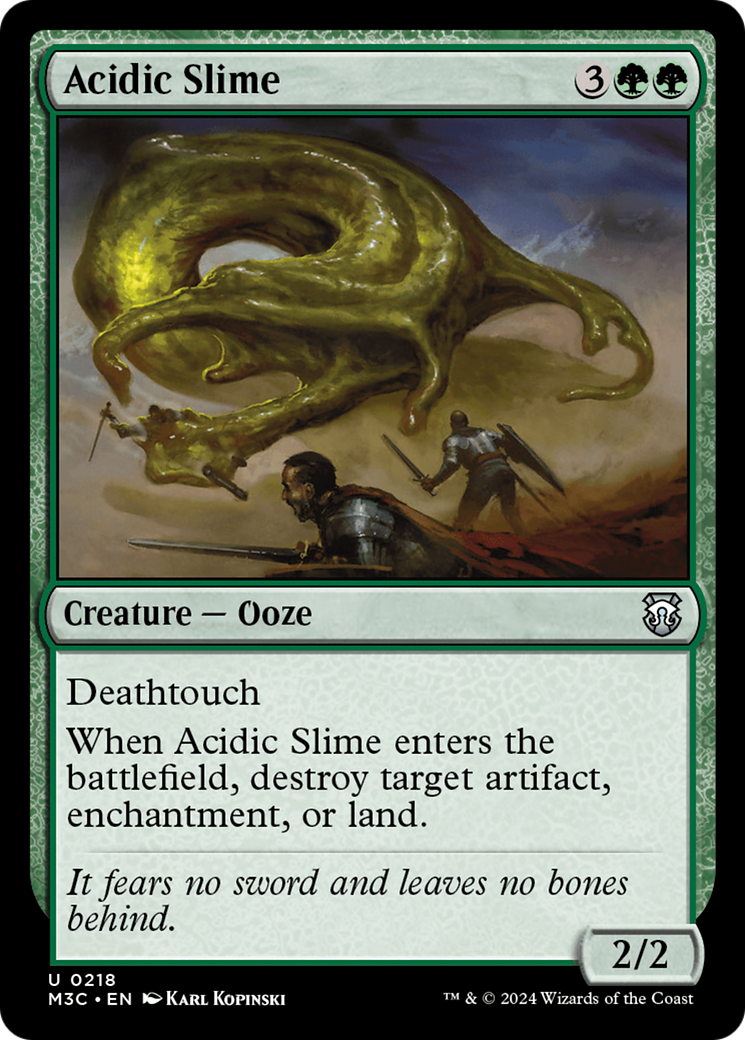
Acidic Slime
Acidic Slime
Creature — Ooze
2/2
Deathtouch (Any amount of damage this deals to a creature is enough to destroy it.)
When this creature enters, destroy target artifact, enchantment, or land.
-
1
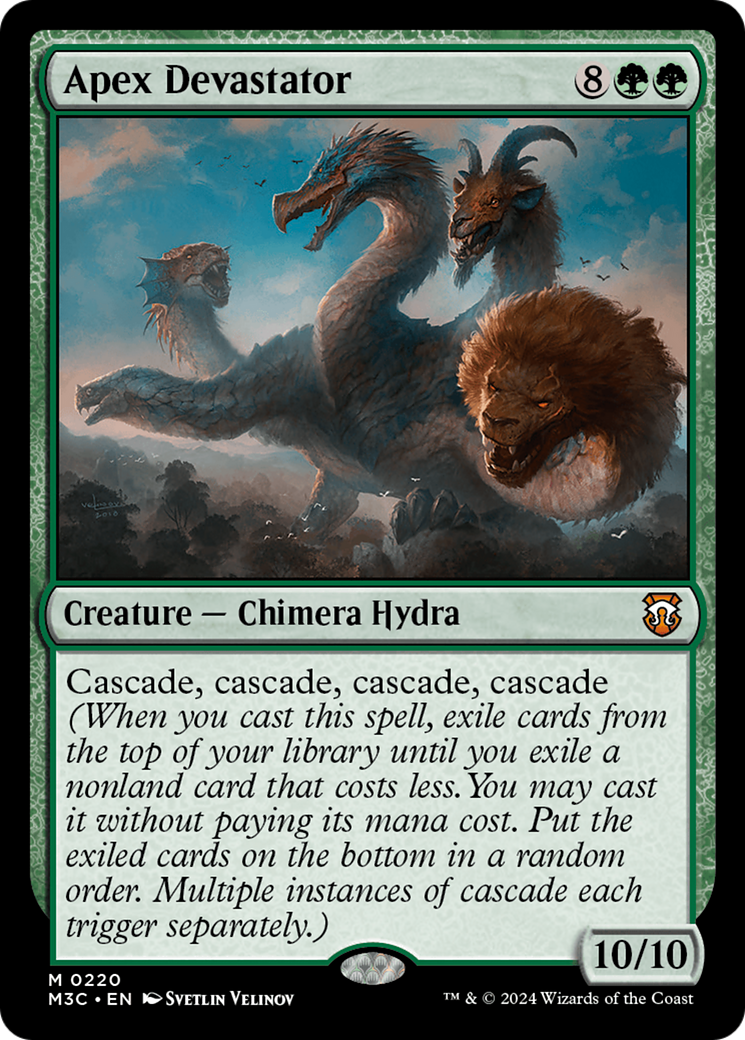
Apex Devastator
Apex Devastator
Creature — Chimera Hydra
10/10
Cascade, cascade, cascade, cascade (When you cast this spell, exile cards from the top of your library until you exile a nonland card that costs less. You may cast it without paying its mana cost. Put the exiled cards on the bottom in a random order. Multiple instances of cascade each trigger separately.)
- The mana value of a split card is determined by the combined mana cost of its two halves. If cascade allows you to cast a split card, you may cast either half but not both halves.
- If the card has in its mana cost, you must choose 0 as the value of X when casting it without paying its mana cost.
- Due to a 2021 rules change to cascade, not only do you stop exiling cards if you exile a nonland card with lesser mana value than the spell with cascade, but the resulting spell you cast must also have lesser mana value. Previously, in cases where a card's mana value differed from the resulting spell, such as with some modal double-faced cards or cards with an Adventure, you could cast a spell with a higher mana value than the exiled card.
- A spell's mana value is determined only by its mana cost. Ignore any alternative costs, additional costs, cost increases, or cost reductions.
- Cascade triggers when you cast the spell, meaning that it resolves before that spell. If you end up casting the exiled card, it will go on the stack above the spell with cascade.
- When the cascade ability resolves, you must exile cards. The only optional part of the ability is whether or not you cast the last card exiled.
- If a spell with cascade is countered, the cascade ability will still resolve normally.
- You exile the cards face up. All players will be able to see them.
- If you cast a card "without paying its mana cost," you can't choose to cast it for any alternative costs. You can, however, pay additional costs. If the card has any mandatory additional costs, you must pay those to cast the card.
- Each of Apex Devastator's four cascade abilities will look for a nonland card with mana value less than 10 (Apex Devastator's mana value). This doesn't change even if one or more of the spells you cast because of those cascade abilities has cascade itself. Each of those additional cascade abilities, if any, will refer to the mana value of the spell that caused it to trigger. In other words, each cascade ability cares only about the spell that caused it to trigger, the stack can get messy, and we wish you luck.
- Each instance of cascade triggers and resolves separately. The spell you cast due to the first cascade ability will go on the stack on top of the second, third, and fourth cascade abilities. That spell will resolve before you exile cards for the second cascade ability. The spell you cast for the second will resolve before you exile cards for the third, and so on.
-
1
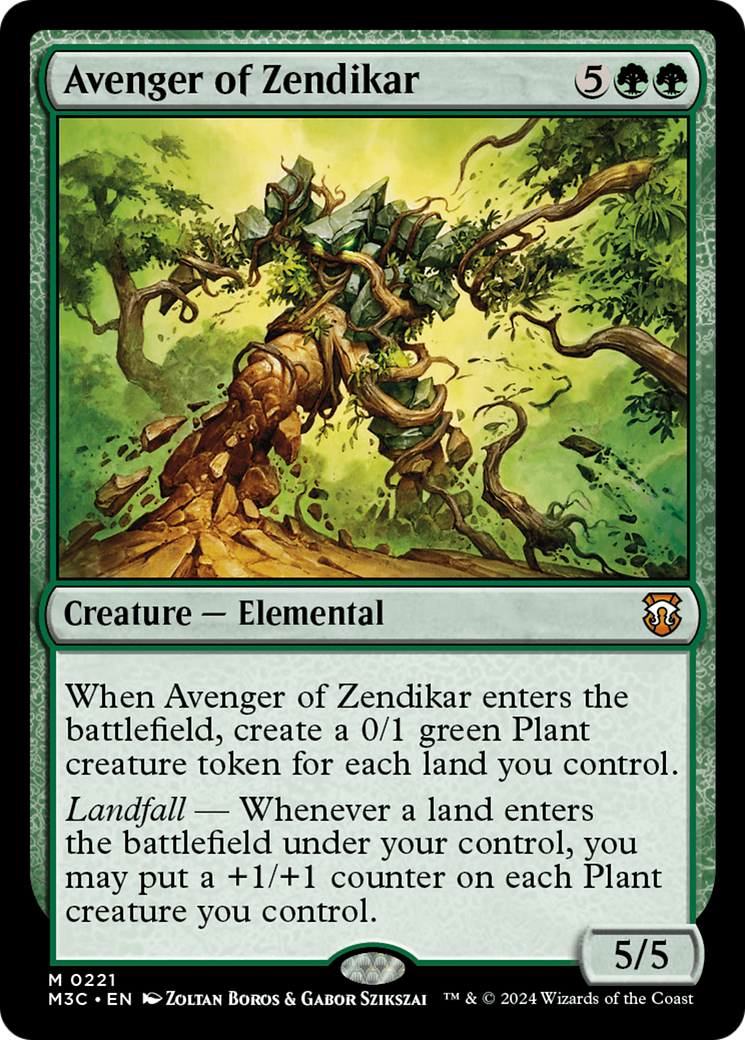
Avenger of Zendikar
Avenger of Zendikar
Creature — Elemental
5/5
When this creature enters, create a 0/1 green Plant creature token for each land you control.
Landfall — Whenever a land you control enters, you may put a +1/+1 counter on each Plant creature you control.
- A landfall ability triggers whenever a land you control enters for any reason. It triggers whenever you play a land, as well as whenever a spell or ability puts a land onto the battlefield under your control.
- A landfall ability doesn't trigger if a permanent already on the battlefield becomes a land.
- Whenever a land you control enters, each landfall ability of the permanents you control will trigger. You can put them on the stack in any order. The last ability you put on the stack will be the first one to resolve (As a result, you can have those abilities resolve in the order of your choosing.).
-
1
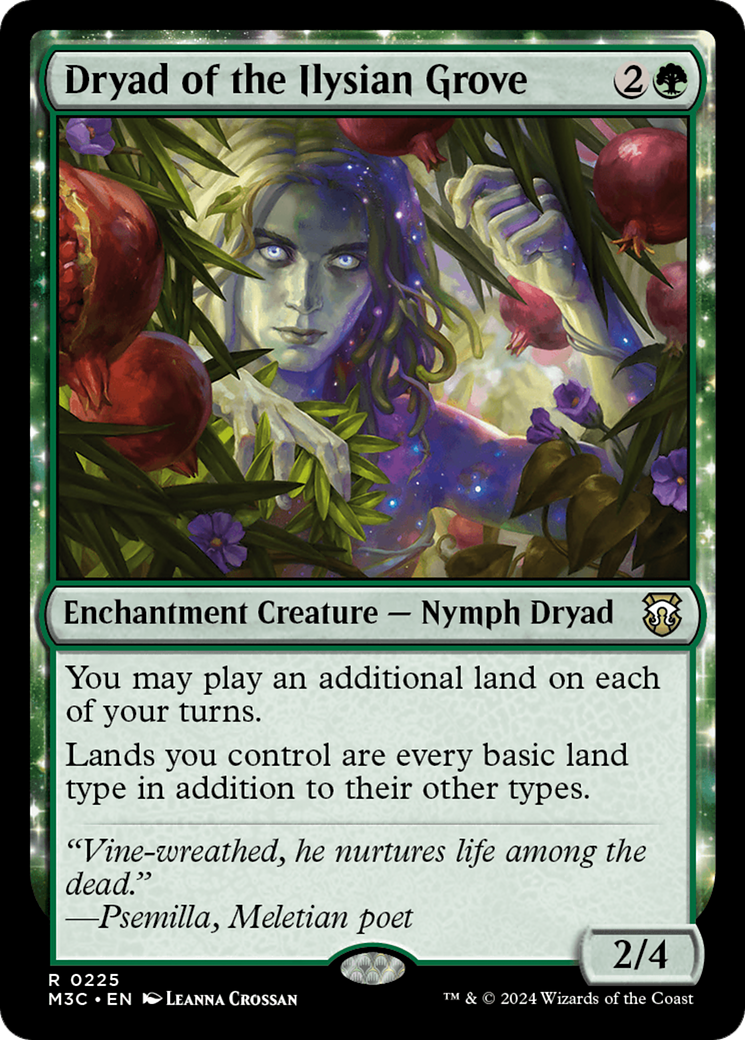
Dryad of the Ilysian Grove
Dryad of the Ilysian Grove
Enchantment Creature — Nymph Dryad
2/4
You may play an additional land on each of your turns.
Lands you control are every basic land type in addition to their other types.
- Dryad of the Ilysian Grove’s first ability is cumulative if you control more than one. It’s also cumulative with other effects that let you play additional lands, such as the one from Escape to the Wilds.
- Each land you control will have the land types Plains, Island, Swamp, Mountain, and Forest. They’ll also have the mana ability of each basic land type (for example, Forests have “ : Add .”). They’ll still have their other subtypes and abilities.
- Giving a land additional basic land types doesn’t change its name or whether it’s legendary or basic.
-
1
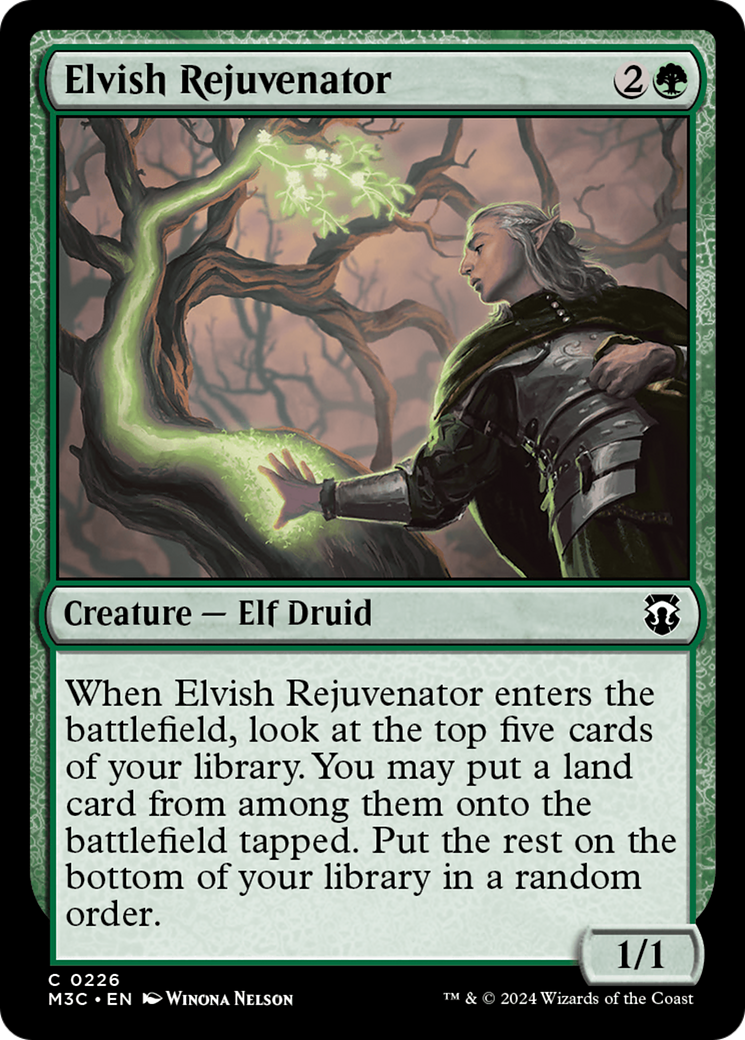
Elvish Rejuvenator
Elvish Rejuvenator
Creature — Elf Druid
1/1
When this creature enters, look at the top five cards of your library. You may put a land card from among them onto the battlefield tapped. Put the rest on the bottom of your library in a random order.
-
1
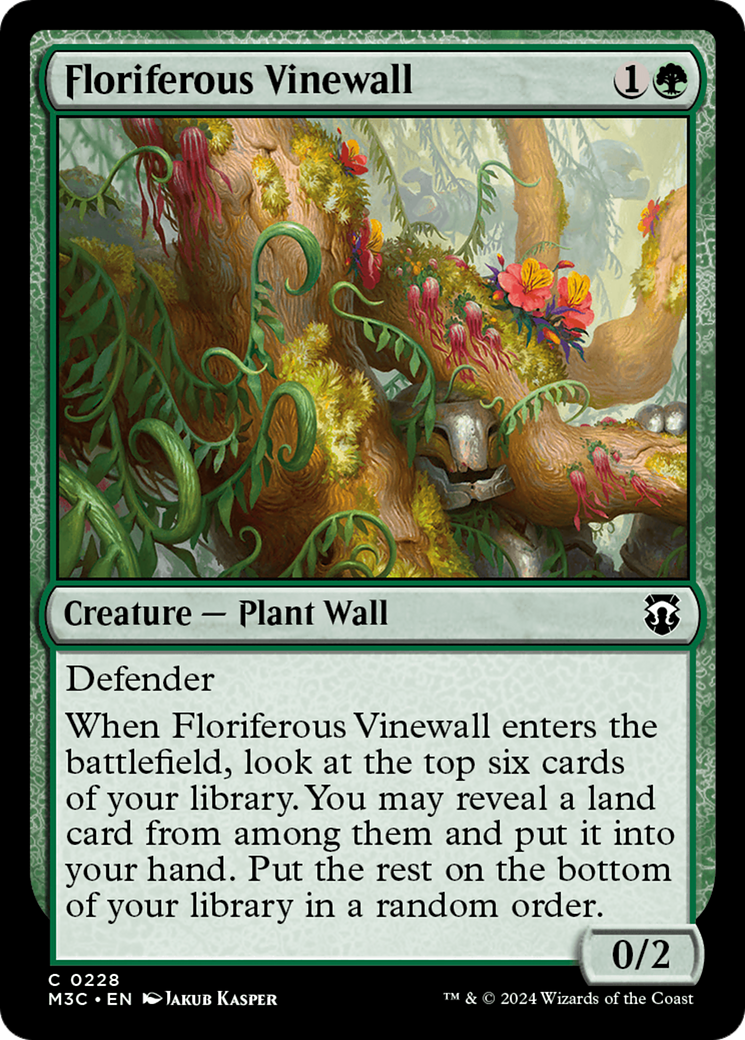
Floriferous Vinewall
Floriferous Vinewall
Creature — Plant Wall
0/2
Defender
When this creature enters, look at the top six cards of your library. You may reveal a land card from among them and put it into your hand. Put the rest on the bottom of your library in a random order.
-
1
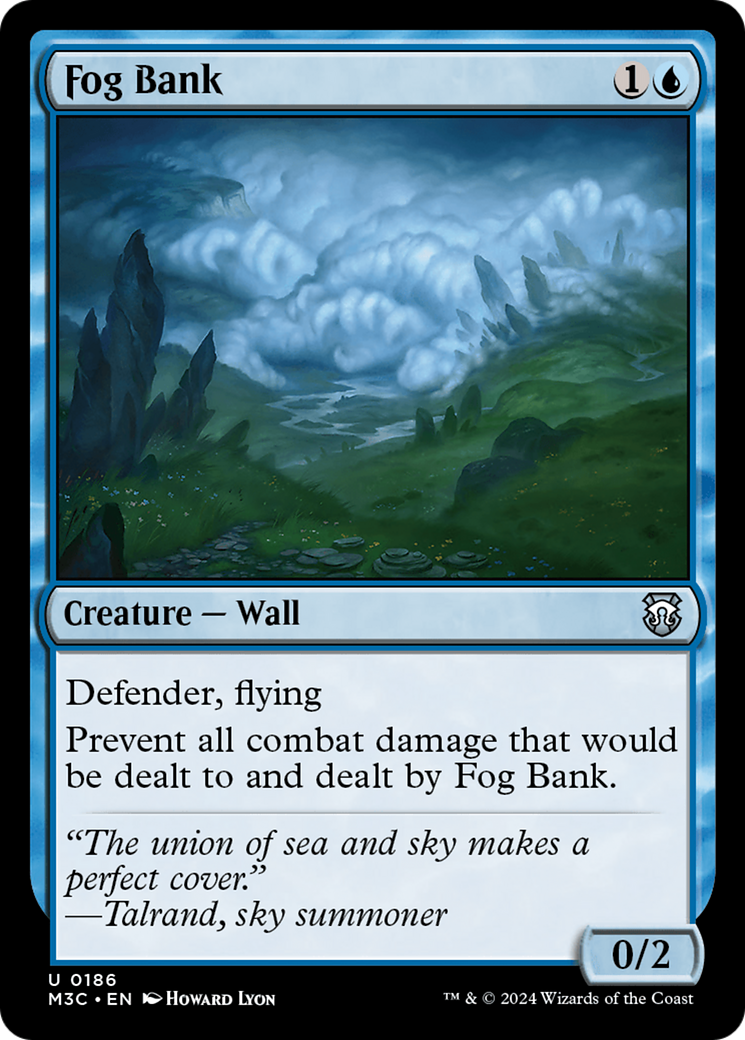
Fog Bank
Fog Bank
Creature — Wall
0/2
Defender (This creature can't attack.)
Flying
Prevent all combat damage that would be dealt to and dealt by this creature.
- Fog Bank's prevention effect isn't considered while assigning combat damage from a creature with trample. For example, if it blocks a 5/5 creature with trample, that creature's controller must assign 2 of that creature's combat damage to Fog Bank and the remainder can be assigned to the defending player, planeswalker, or battle.
-
1
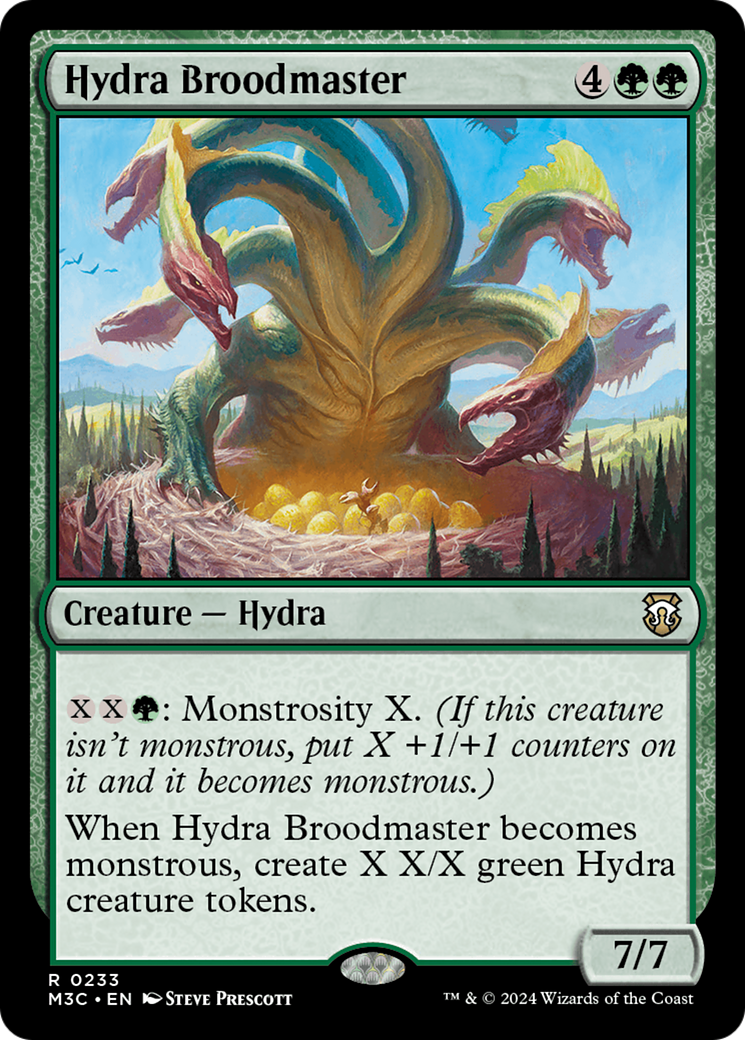
Hydra Broodmaster
Hydra Broodmaster
Creature — Hydra
7/7
: Monstrosity X. (If this creature isn't monstrous, put X +1/+1 counters on it and it becomes monstrous.)
When this creature becomes monstrous, create X X/X green Hydra creature tokens.
- The value of each X in Hydra Broodmaster's last ability is equal to the value chosen for X when its monstrosity ability was activated.
- Once a creature becomes monstrous, it can't become monstrous again. If the creature is already monstrous when the monstrosity ability resolves, nothing happens.
- Monstrous isn't an ability that a creature has. It's just something true about that creature. If the creature stops being a creature or loses its abilities, it will continue to be monstrous.
- An ability that triggers when a creature becomes monstrous won't trigger if that creature isn't on the battlefield when its monstrosity ability resolves.
-
1
Hydroid Krasis
Hydroid Krasis
Creature — Jellyfish Hydra Beast
0/0
When you cast this spell, you gain half X life and draw half X cards. Round down each time.
Flying, trample
This creature enters with X +1/+1 counters on it.
- Hydroid Krasis's first ability triggers as you cast it, and that ability resolves before the spell itself. It resolves even if Hydroid Krasis is countered.
-
1
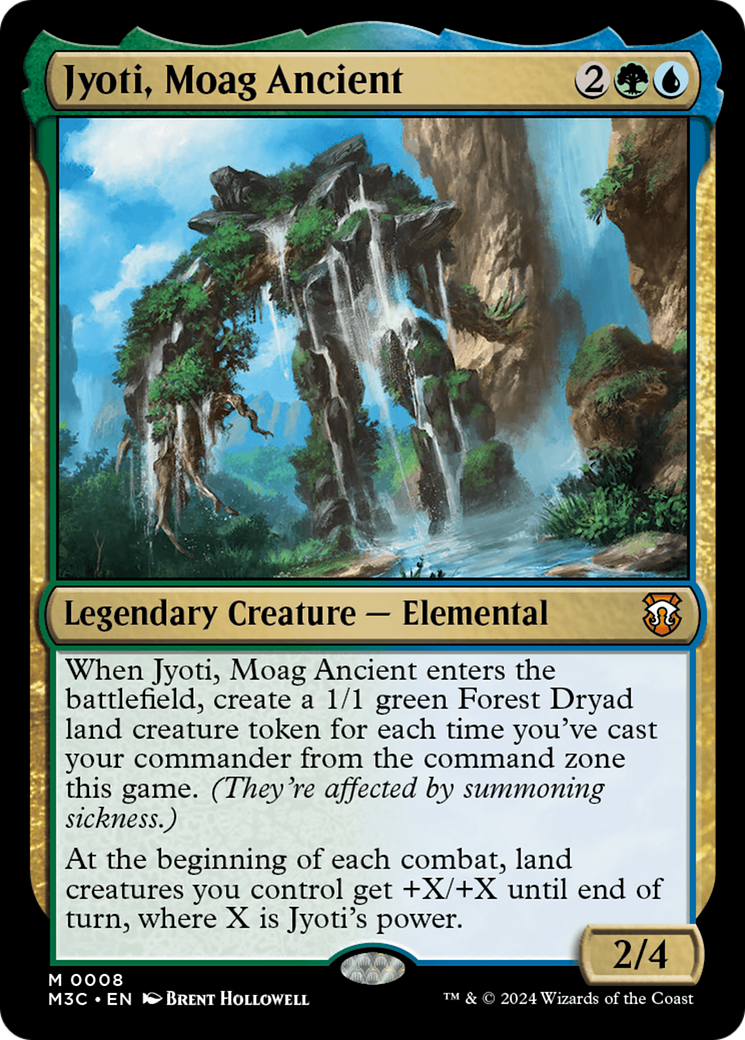
Jyoti, Moag Ancient
Jyoti, Moag Ancient
Legendary Creature — Elemental
2/4
When Jyoti enters, create a 1/1 green Forest Dryad land creature token for each time you've cast your commander from the command zone this game. (They're affected by summoning sickness.)
At the beginning of each combat, land creatures you control get +X/+X until end of turn, where X is Jyoti's power.
- If your commander was countered, that time you cast it still counts.
- If you have multiple commanders, Jyoti's first ability will create a 1/1 green Forest Dryad land creature token for each time you've cast either of them. For example, if you've cast one commander once and one twice, you'll create three Forest Dryads.
- The value of X in Jyoti's last ability is calculated only once, as Jyoti's ability resolves.
-
1
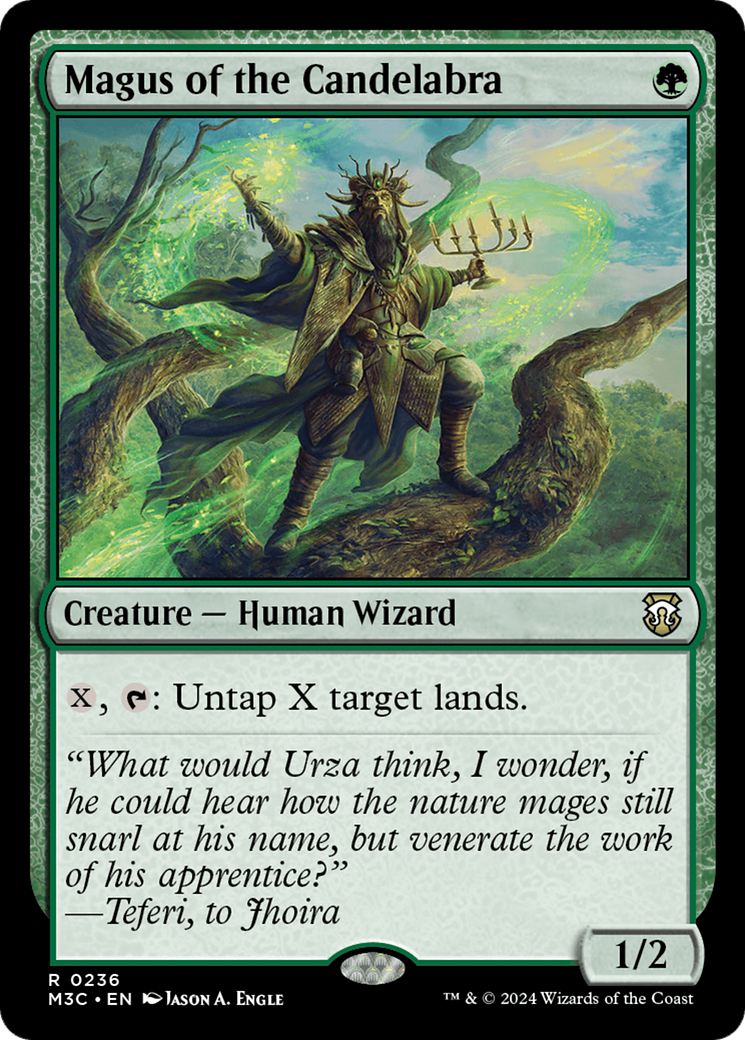
Magus of the Candelabra
Magus of the Candelabra
Creature — Human Wizard
1/2
, : Untap X target lands.
-
1
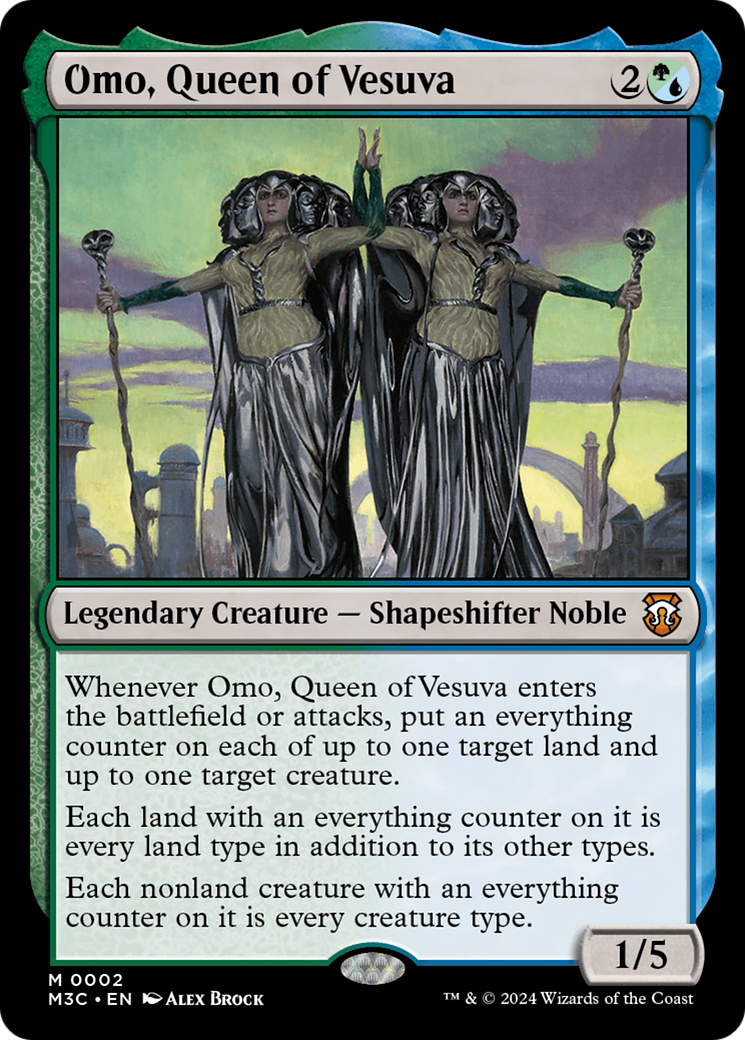
Omo, Queen of Vesuva
Omo, Queen of Vesuva
Legendary Creature — Shapeshifter Noble
1/5
Whenever Omo enters or attacks, put an everything counter on each of up to one target land and up to one target creature.
Each land with an everything counter on it is every land type in addition to its other types.
Each nonland creature with an everything counter on it is every creature type.
- Omo's second ability grants every land type to lands with everything counters on them, not just basic land types. The full list of land types can be found in the Comprehensive Rules of Magic.
-
1
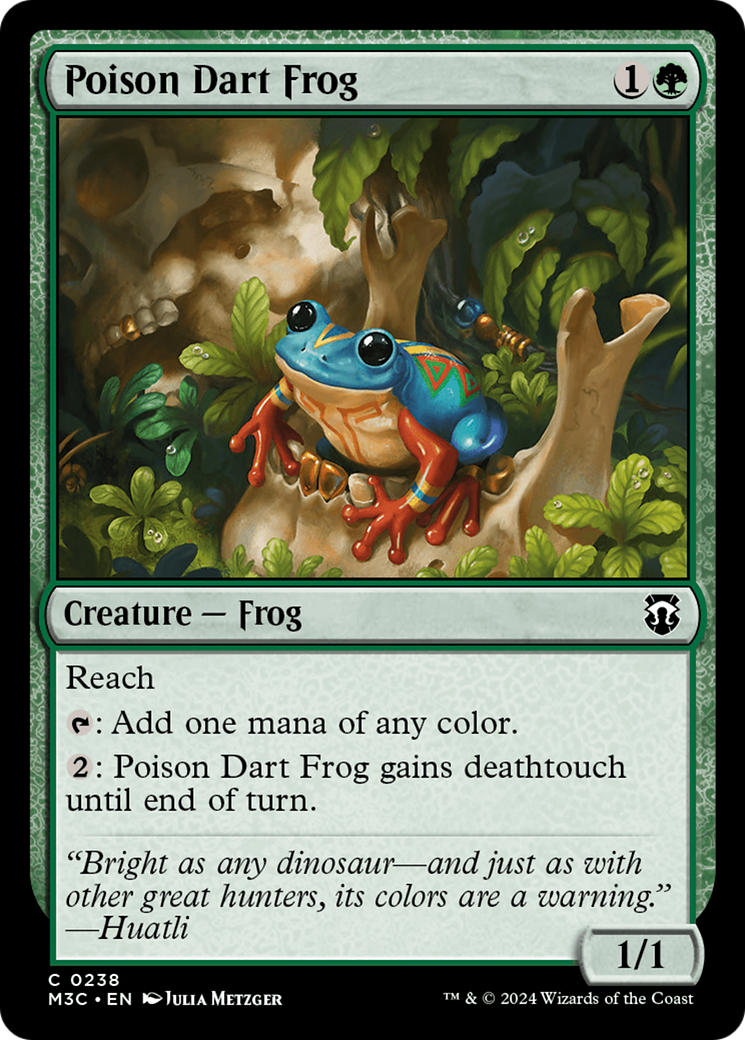
Poison Dart Frog
Poison Dart Frog
Creature — Frog
1/1
Reach
: Add one mana of any color.
: This creature gains deathtouch until end of turn.
-
1
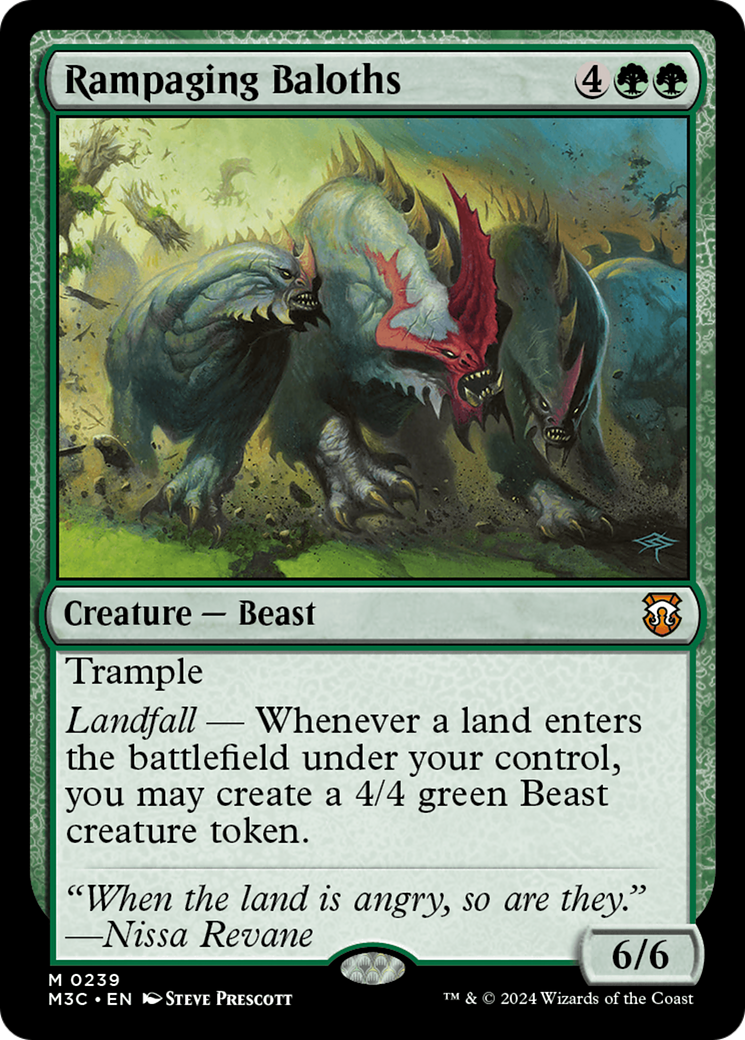
Rampaging Baloths
Rampaging Baloths
Creature — Beast
6/6
Trample
Landfall — Whenever a land you control enters, you may create a 4/4 green Beast creature token.
- A landfall ability triggers whenever a land you control enters for any reason. It triggers whenever you play a land, as well as whenever a spell or ability puts a land onto the battlefield under your control.
- A landfall ability doesn't trigger if a permanent already on the battlefield becomes a land.
- Whenever a land you control enters, each landfall ability of the permanents you control will trigger. You can put them on the stack in any order. The last ability you put on the stack will be the first one to resolve (As a result, you can have those abilities resolve in the order of your choosing.).
-
1
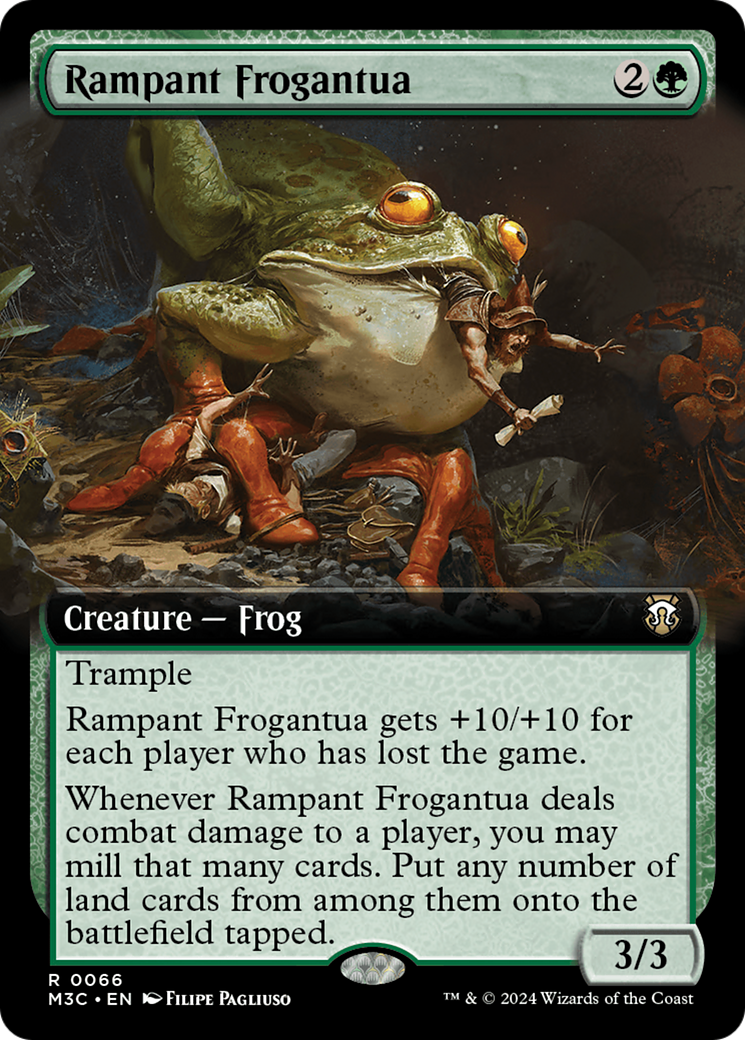
Rampant Frogantua
Rampant Frogantua
Creature — Frog
3/3
Trample
This creature gets +10/+10 for each player who has lost the game.
Whenever this creature deals combat damage to a player, you may mill that many cards. Put any number of land cards from among them onto the battlefield tapped.
- Rampant Frogantua's second ability counts players who lost the game before Rampant Frogantua entered the battlefield.
- Rampant Frogantua's second ability counts every player who has lost, no matter how the player lost the game: due to a state-based action (having 0 or less life, trying to draw a card from an empty library, having 10 or more poison counters), because of a spell or effect that states they lose the game, because your awesome might has left them with no choice other than concession, or for any other reason.
- If the number of cards remaining in your library is less than the amount of combat damage dealt to a player by Rampant Frogantua, you can't choose to mill that many cards with Rampant Frogantua's last ability.
-
1
Ramunap Excavator
Ramunap Excavator
Creature — Snake Cleric
2/3
You may play lands from your graveyard.
- Ramunap Excavator doesn't change the times when you can play those land cards. You can still play only one land per turn, and only during your main phase when you have priority and the stack is empty.
- Ramunap Excavator doesn't allow you to activate activated abilities (such as cycling) of land cards in your graveyard.
-
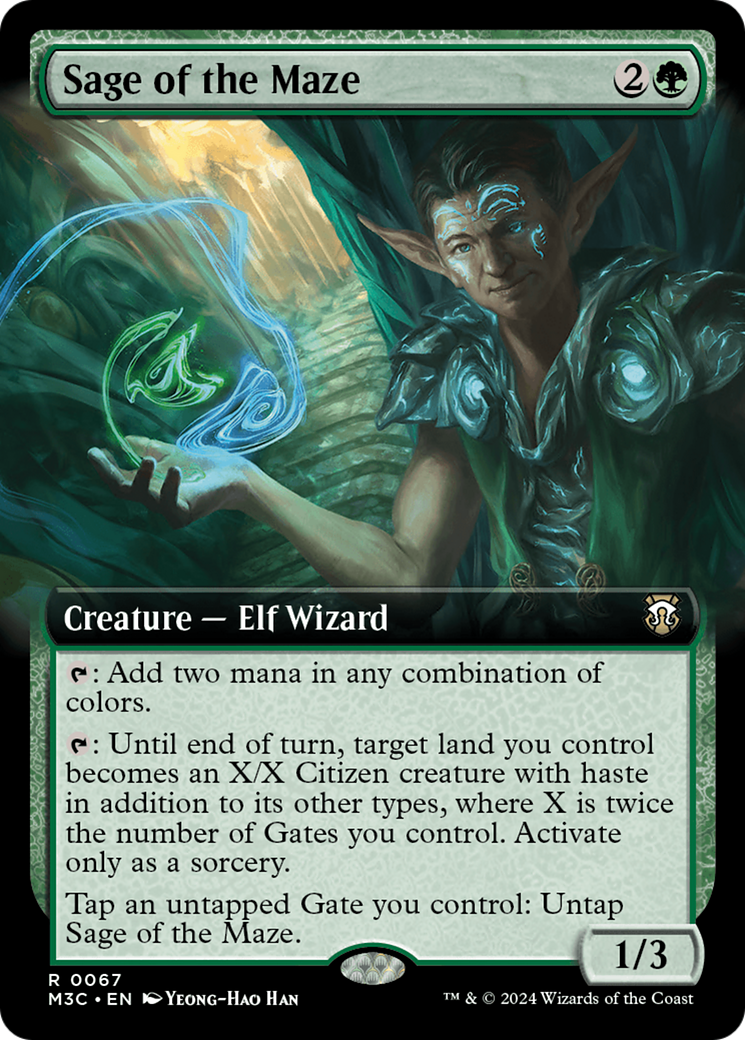
1
Sage of the Maze
Sage of the Maze
Creature — Elf Wizard
1/3
: Add two mana in any combination of colors.
: Until end of turn, target land you control becomes an X/X Citizen creature with haste in addition to its other types, where X is twice the number of Gates you control. Activate only as a sorcery.
Tap an untapped Gate you control: Untap this creature.
- The value of X is calculated only once, as Sage of the Maze's second ability resolves.
-
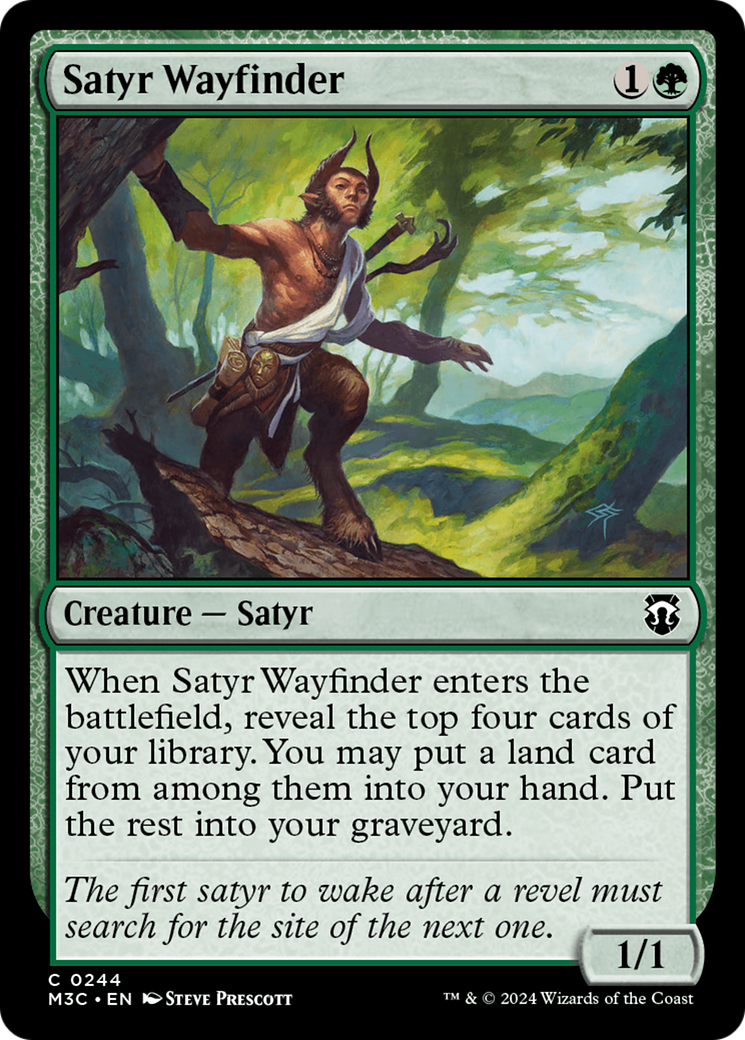
1
Satyr Wayfinder
Satyr Wayfinder
Creature — Satyr
1/1
When this creature enters, reveal the top four cards of your library. You may put a land card from among them into your hand. Put the rest into your graveyard.
-
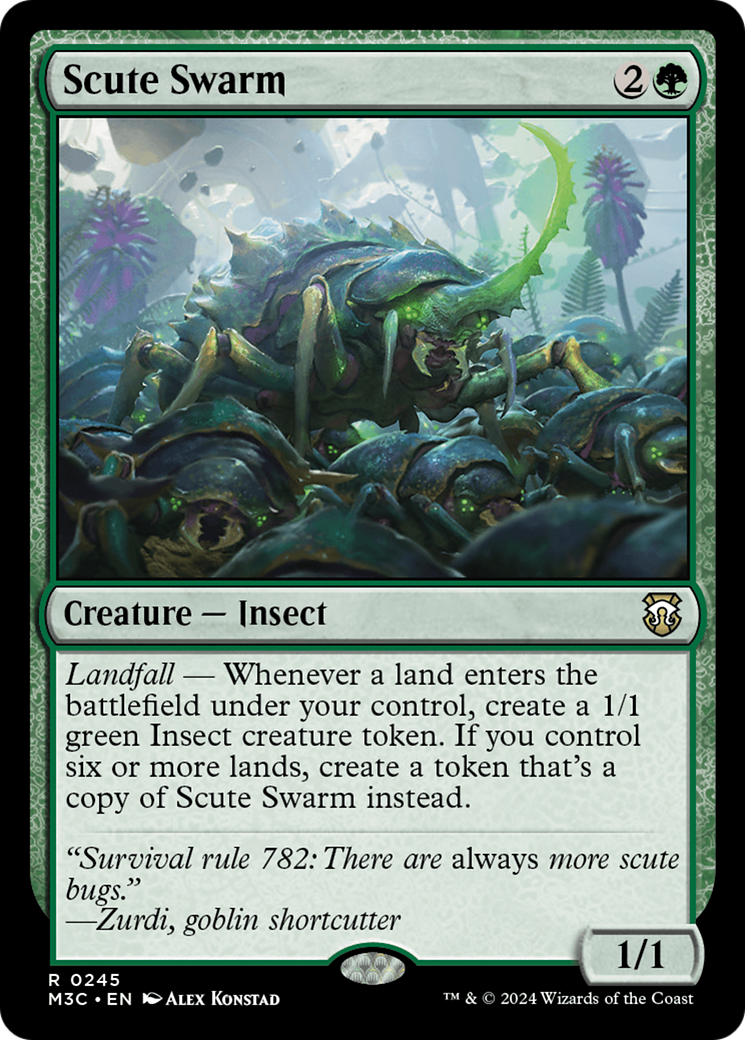
1
Scute Swarm
Scute Swarm
Creature — Insect
1/1
Landfall — Whenever a land you control enters, create a 1/1 green Insect creature token. If you control six or more lands, create a token that's a copy of this creature instead.
- A landfall ability triggers whenever a land you control enters for any reason. It triggers whenever you play a land, as well as whenever a spell or ability puts a land onto the battlefield under your control.
- A landfall ability doesn't trigger if a permanent already on the battlefield becomes a land.
- Whenever a land you control enters, each landfall ability of the permanents you control will trigger. You can put them on the stack in any order. The last ability you put on the stack will be the first one to resolve (As a result, you can have those abilities resolve in the order of your choosing.).
- The token copy will have Scute Swarm's ability. It will also be able to create copies of itself.
- The token copy won't copy counters or damage marked on Scute Swarm, nor will it copy other effects that have changed Scute Swarm's power, toughness, types, color, and so on. Normally, this means the token will simply be a Scute Swarm, but if any copy effects have affected the original Scute Swarm, the token will take those into account.
- If Scute Swarm leaves the battlefield before its triggered ability resolves, the token will still enter the battlefield as a copy of Scute Swarm, using Scute Swarm's copiable values from when it was last on the battlefield.
-
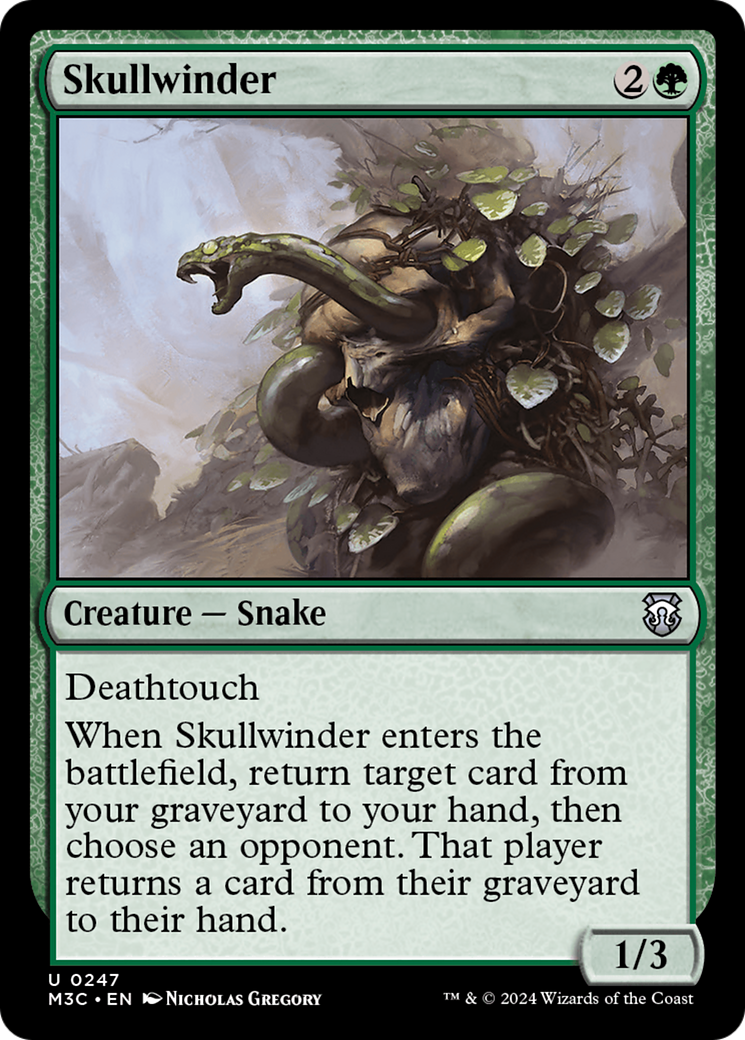
1
Skullwinder
Skullwinder
Creature — Snake
1/3
Deathtouch
When this creature enters, return target card from your graveyard to your hand, then choose an opponent. That player returns a card from their graveyard to their hand.
- Skullwinder's enters-the-battlefield ability targets only the card in your graveyard. If that card is an illegal target as the ability tries to resolve, the ability won't resolve and none of its effects will happen. No cards will be returned to any player's hand.
- You choose the target card as you put Skullwinder's triggered ability on the stack, but you don't choose an opponent until after you have returned the card to your hand.
- The chosen opponent gets to choose which card to return from their graveyard to their hand.
- You may choose an opponent with no cards in their graveyard. In that case, they will not get to return anything.
- Skullwinder's enters-the-battlefield ability targets only the card in your graveyard. If that card is an illegal target as the ability tries to resolve, the ability won't resolve and none of its effects will happen. No cards will be returned to any player's hand.
- You choose the opponent as the ability is resolving. You may choose an opponent with no cards in their graveyard.
-
1
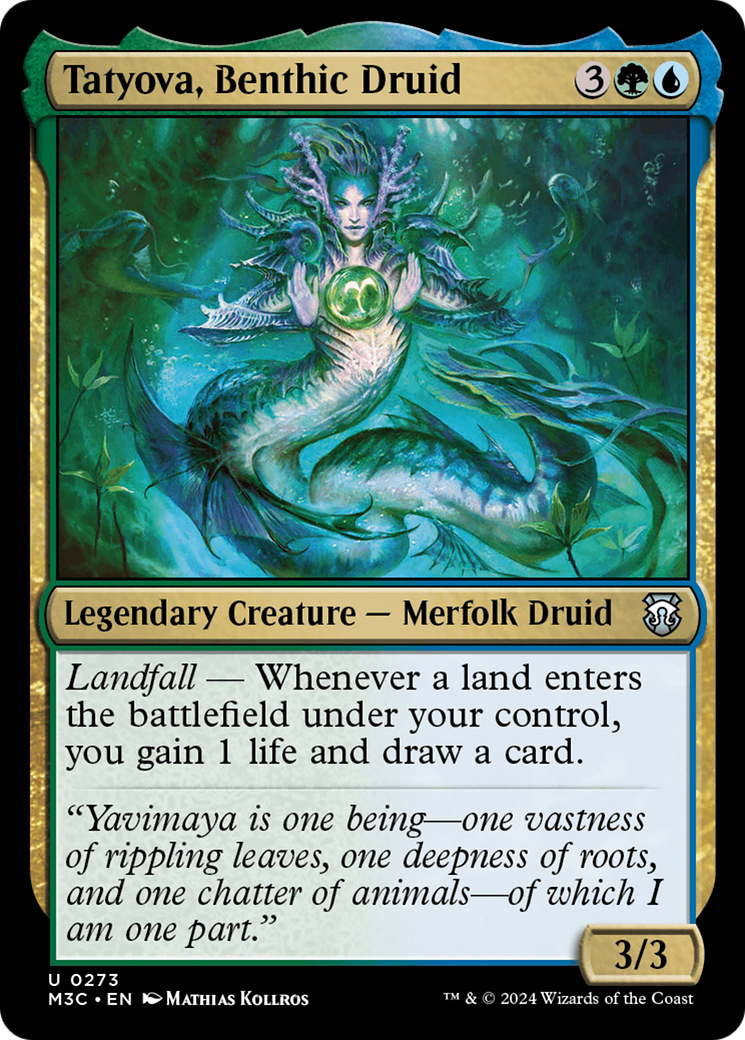
Tatyova, Benthic Druid
Tatyova, Benthic Druid
Legendary Creature — Merfolk Druid
3/3
Landfall — Whenever a land you control enters, you gain 1 life and draw a card.
- A landfall ability triggers whenever a land you control enters for any reason. It triggers whenever you play a land, as well as whenever a spell or ability puts a land onto the battlefield under your control.
- A landfall ability doesn't trigger if a permanent already on the battlefield becomes a land.
- Whenever a land you control enters, each landfall ability of the permanents you control will trigger. You can put them on the stack in any order. The last ability you put on the stack will be the first one to resolve (As a result, you can have those abilities resolve in the order of your choosing.).
-
1
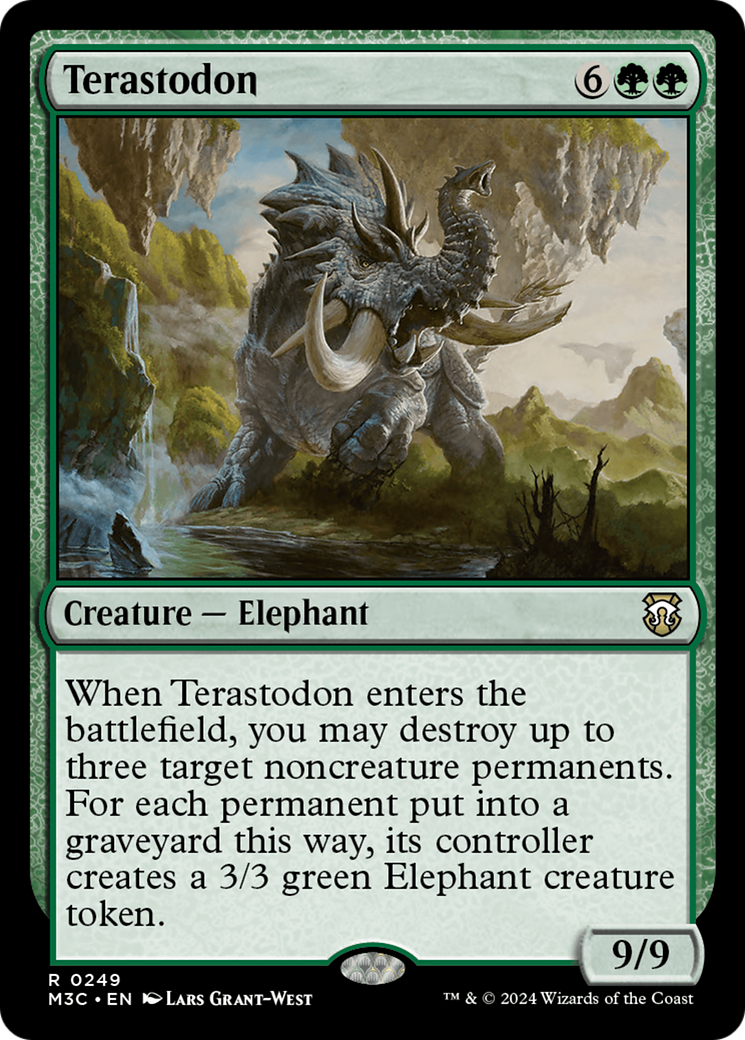
Terastodon
Terastodon
Creature — Elephant
9/9
When this creature enters, you may destroy up to three target noncreature permanents. For each permanent put into a graveyard this way, its controller creates a 3/3 green Elephant creature token.
- If a targeted permanent has indestructible or regenerates, its controller won't get an Elephant token for it. Similarly, if the targeted permanent is destroyed but a replacement effect moves it to a different zone instead of its owner's graveyard, its controller won't get an Elephant token for it.
- The targeted permanents may be controlled by different players.
-
1
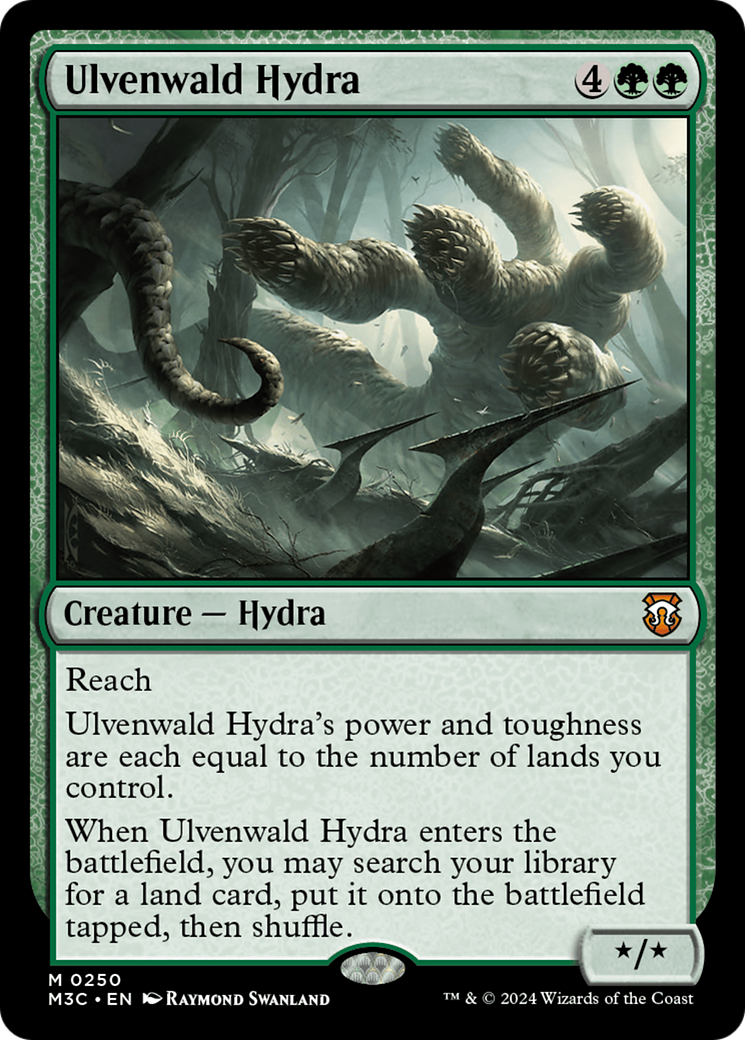
Ulvenwald Hydra
Ulvenwald Hydra
Creature — Hydra
*/*
Reach
Ulvenwald Hydra's power and toughness are each equal to the number of lands you control.
When this creature enters, you may search your library for a land card, put it onto the battlefield tapped, then shuffle.
-
1
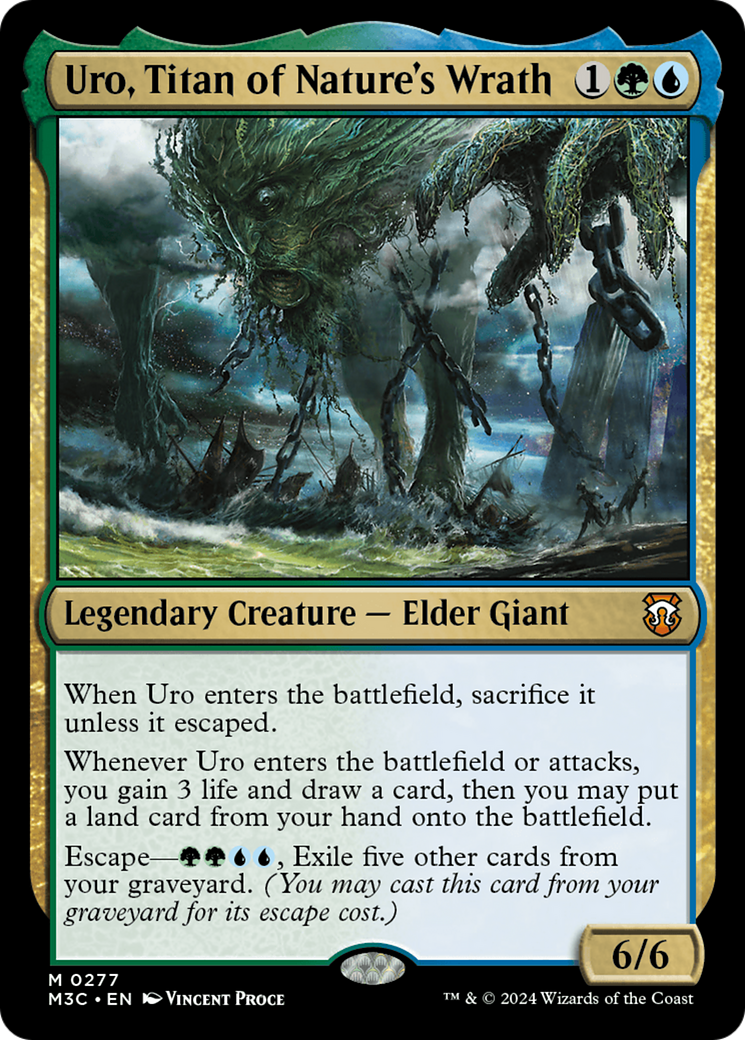
Uro, Titan of Nature's Wrath
Uro, Titan of Nature's Wrath
Legendary Creature — Elder Giant
6/6
When Uro enters, sacrifice it unless it escaped.
Whenever Uro enters or attacks, you gain 3 life and draw a card, then you may put a land card from your hand onto the battlefield.
Escape— , Exile five other cards from your graveyard. (You may cast this card from your graveyard for its escape cost.)
- Uro's first ability causes you to sacrifice it if you didn't cast it, or if it was cast using any permission other than an escape ability.
- Uro's second ability triggers when it enters the battlefield, even if it didn't escape.
- Uro's effect doesn't count as playing a land. It can put a land card onto the battlefield even if it's not your turn or if you've already played your land for the turn.
- Escape's permission doesn't change when you may cast the spell from your graveyard.
- To determine the total cost of a spell, start with the mana cost or alternative cost you're paying (such as an escape cost), add any cost increases, then apply any cost reductions. The mana value of the spell remains unchanged, no matter what the total cost to cast it was and no matter whether an alternative cost was paid.
- After an escaped spell resolves, it returns to its owner's graveyard if it's not a permanent spell. If it is a permanent spell, it enters the battlefield and will return to its owner's graveyard if it dies later. Perhaps it will escape again—good underworld security is so hard to come by these days.
- If a card has multiple abilities giving you permission to cast it, such as two escape abilities or an escape ability and a flashback ability, you choose which one to apply. The others have no effect.
- If you cast a spell with its escape permission, you can't choose to apply any other alternative costs or to cast it without paying its mana cost. If it has any additional costs, you must pay those.
- If a card with escape is put into your graveyard during your turn, you'll be able to cast it right away if it's legal to do so, before an opponent can take any actions.
- Once you begin casting a spell with escape, it immediately moves to the stack. Players can't take any other actions until you're done casting the spell.
-
1
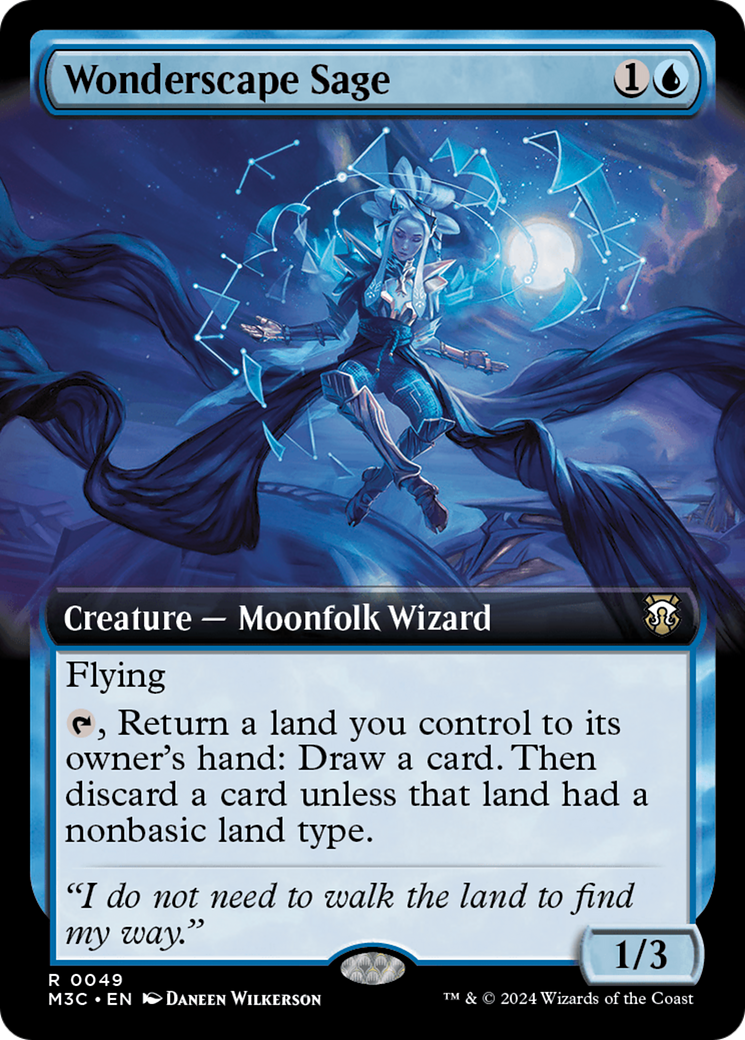
Wonderscape Sage
Wonderscape Sage
Creature — Moonfolk Wizard
1/3
Flying
, Return a land you control to its owner's hand: Draw a card. Then discard a card unless that land had a nonbasic land type.
- Wonderscape Sage's last ability doesn't care if the returned land was nonbasic. It only cares if the land had a nonbasic land type. For example, if you control Omo, Queen of Vesuva and return a Forest with an everything counter on it to your hand to pay the cost of Wonderscape Sage's last ability, you won't discard a card.
- Use the subtypes of the returned land as it last existed on the battlefield to determine whether or not you must discard a card. For example, if you return a Copy Land that's a copy of Urza's Cave (a land with the types Urza's and Cave) to your hand to pay the cost of Wonderscape Sage's last ability, you won't discard a card.
Planeswalkers 2
-
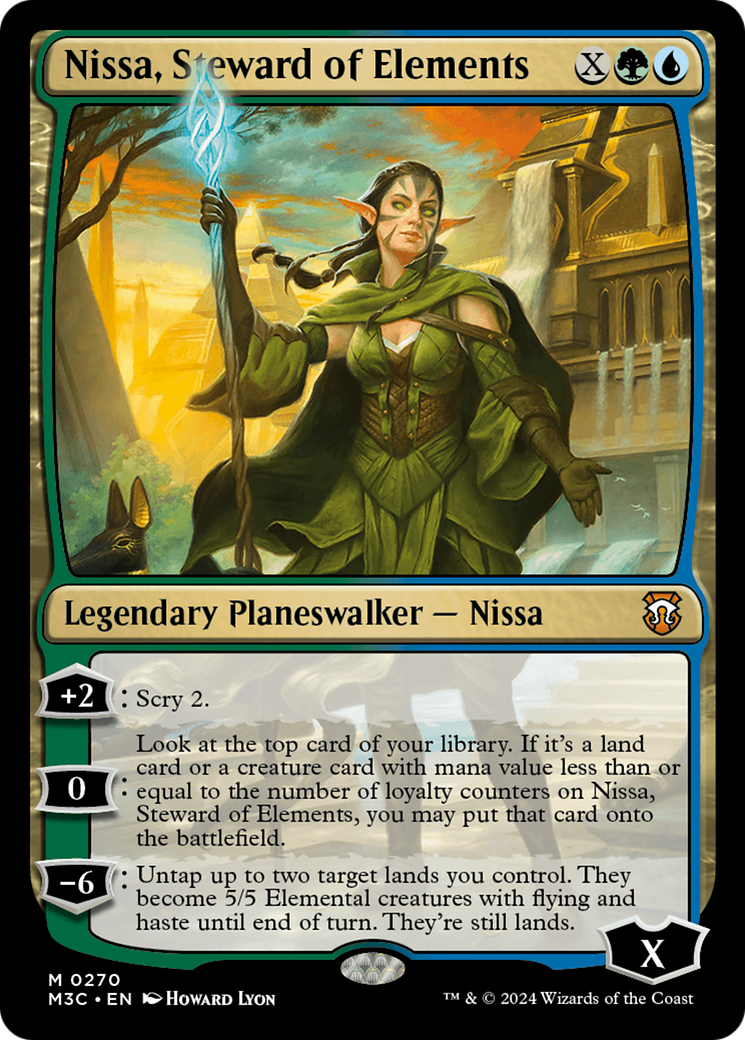
1
Nissa, Steward of Elements
Nissa, Steward of Elements
Legendary Planeswalker — Nissa
+2: Scry 2.
0: Look at the top card of your library. If it's a land card or a creature card with mana value less than or equal to the number of loyalty counters on Nissa, you may put that card onto the battlefield.
−6: Untap up to two target lands you control. They become 5/5 Elemental creatures with flying and haste until end of turn. They're still lands.
- If X is 0, Nissa enters the battlefield with no loyalty and is put into her owner's graveyard before you can activate her abilities.
- While resolving Nissa's second ability, if you can't or don't put the card onto the battlefield, it remains on top of your library.
- Once Nissa's second ability begins to resolve, no player may take actions until it's done. Notably, players can't try to change Nissa's loyalty once you look at the card or choose to put it onto the battlefield.
- If Nissa leaves the battlefield while her second ability is on the stack, use her last known loyalty to determine whether you may put the top card of your library onto the battlefield. If Nissa left the battlefield because she took enough damage to reduce her loyalty to 0, then her last known loyalty is 0.
- Nissa's last ability sets the base power and toughness of the lands to 5/5. Any +1/+1 or -1/-1 counters that were on those lands will apply to those values.
-
1
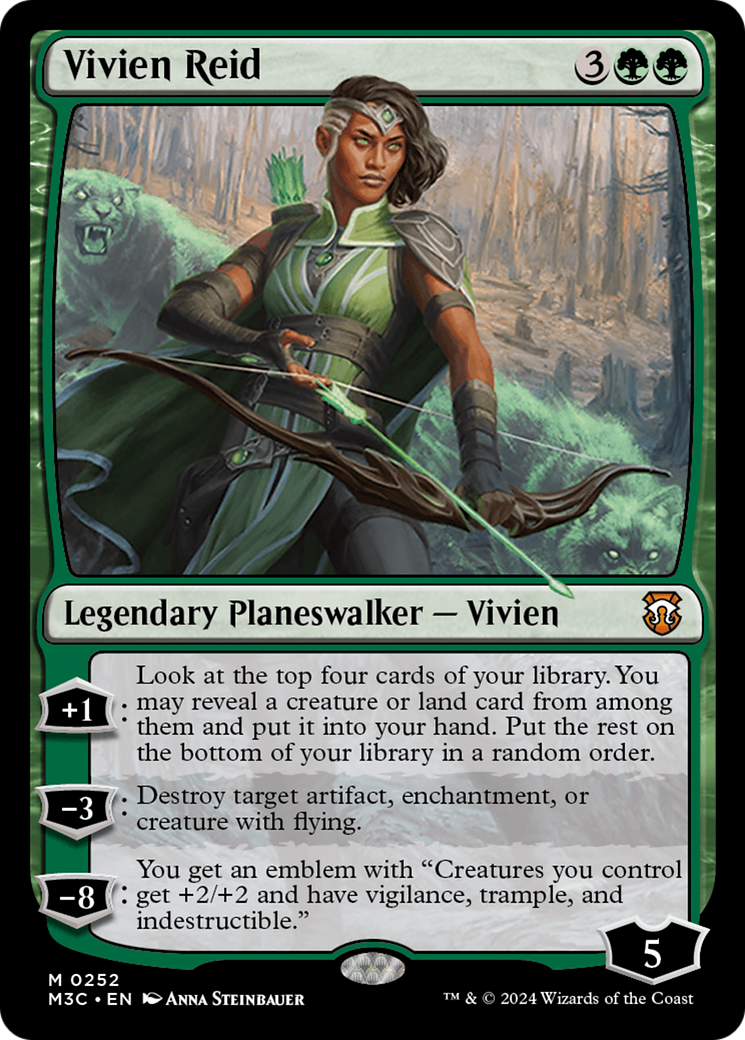
Vivien Reid
Vivien Reid
Legendary Planeswalker — Vivien
+1: Look at the top four cards of your library. You may reveal a creature or land card from among them and put it into your hand. Put the rest on the bottom of your library in a random order.
−3: Destroy target artifact, enchantment, or creature with flying.
−8: You get an emblem with "Creatures you control get +2/+2 and have vigilance, trample, and indestructible."
Instants 8
-
1
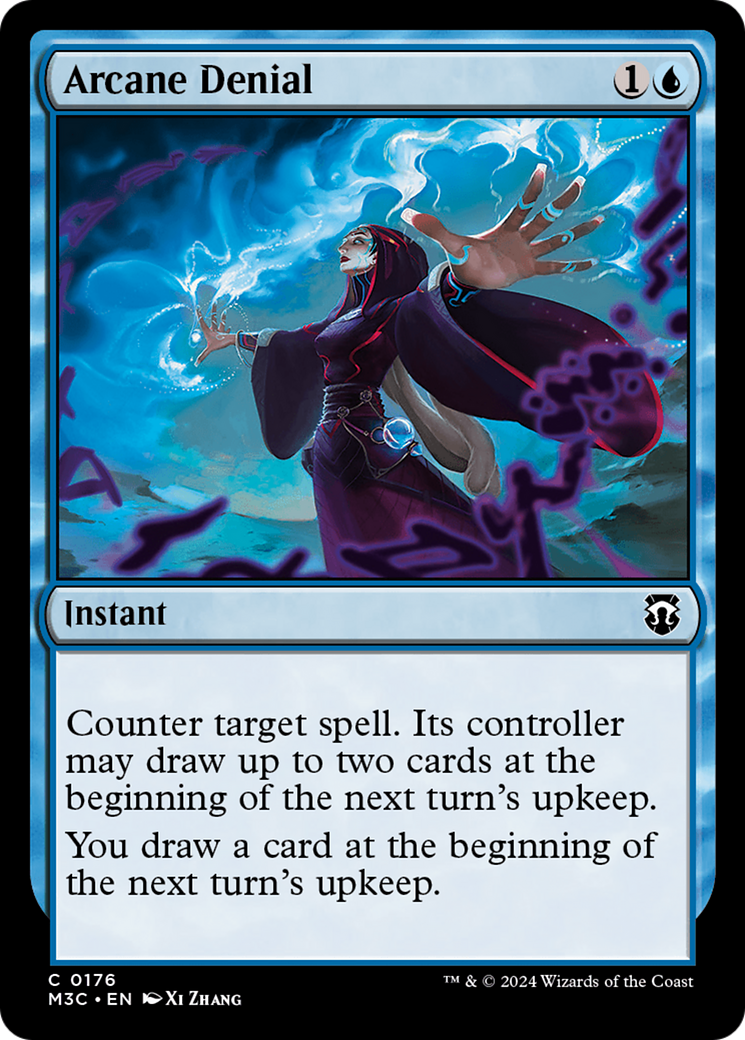
Arcane Denial
Arcane Denial
Instant
Counter target spell. Its controller may draw up to two cards at the beginning of the next turn's upkeep.
You draw a card at the beginning of the next turn's upkeep.
- The controller of the countered spell doesn't choose how many cards to draw until the relevant ability resolves. The player may draw 0, 1, or 2 cards. They choose the number before drawing any cards.
-
1
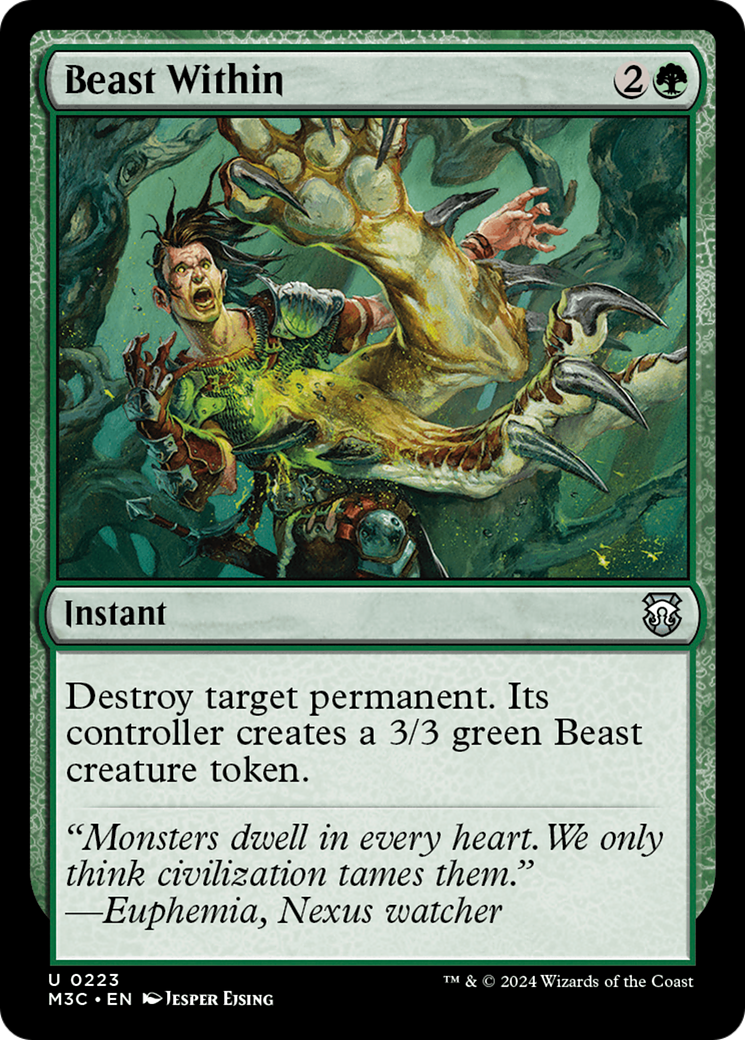
Beast Within
Beast Within
Instant
Destroy target permanent. Its controller creates a 3/3 green Beast creature token.
- If the target permanent is an illegal target by the time Beast Within tries to resolve, the spell won't resolve. No player creates a Beast token. If the target is legal but not destroyed (most likely because it has indestructible), its controller does create a Beast token.
-
1
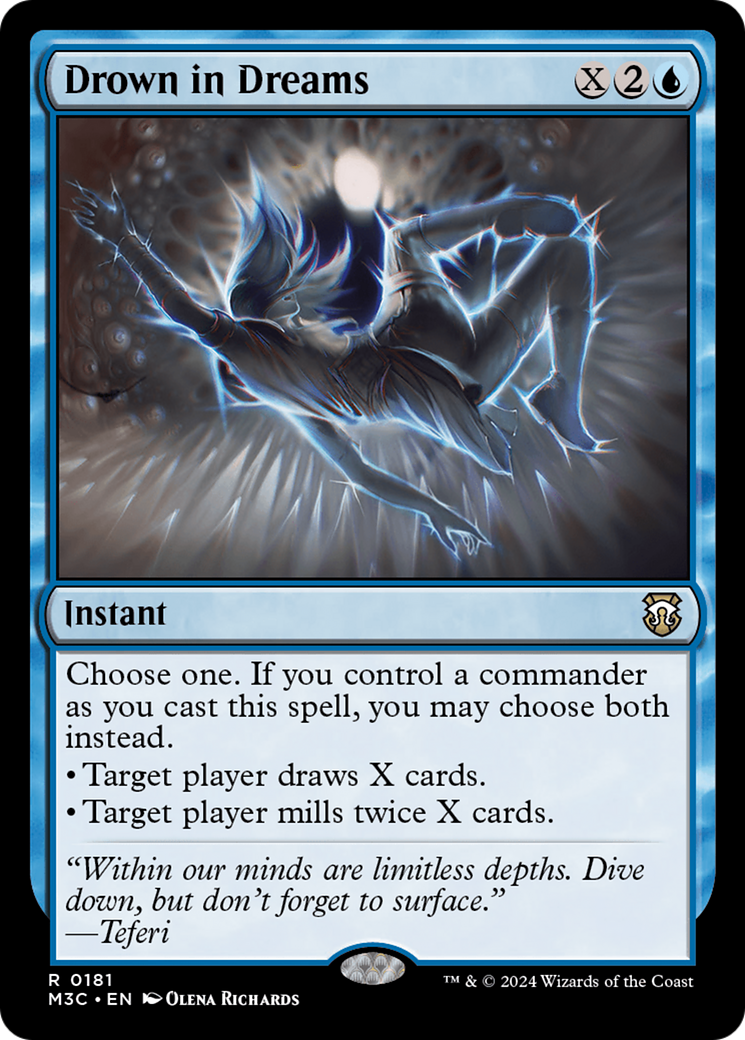
Drown in Dreams
Drown in Dreams
Instant
Choose one. If you control a commander as you cast this spell, you may choose both instead.
- Target player draws X cards.
- Target player mills twice X cards.
- Controlling a commander means that you control a permanent on the battlefield that is someone's commander. It can be yours or another player's. Controlling a commander spell on the stack will not allow you to choose both modes.
- You may target the same player with both modes or target different players. The effects happen in the order they're listed on the card.
-
1
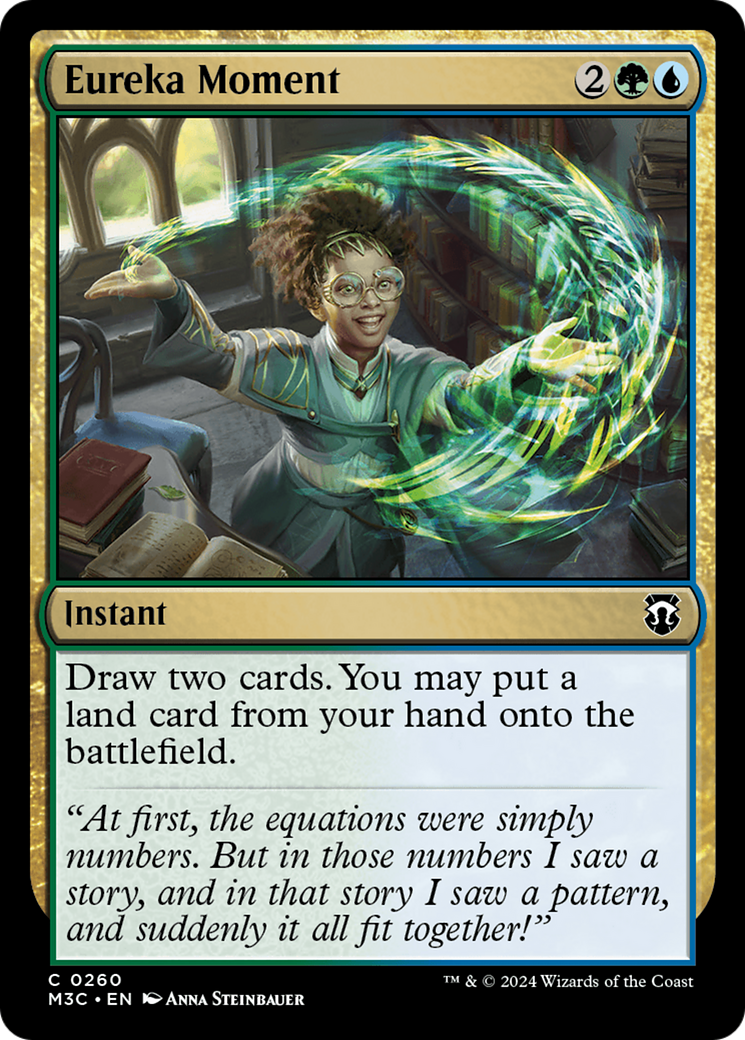
Eureka Moment
Eureka Moment
Instant
Draw two cards. You may put a land card from your hand onto the battlefield.
- Putting a land card from your hand onto the battlefield is not the same as playing a land. You may do it even if you have already played a land on your turn, or if you're casting Eureka Moment on your opponent's turn.
-
1
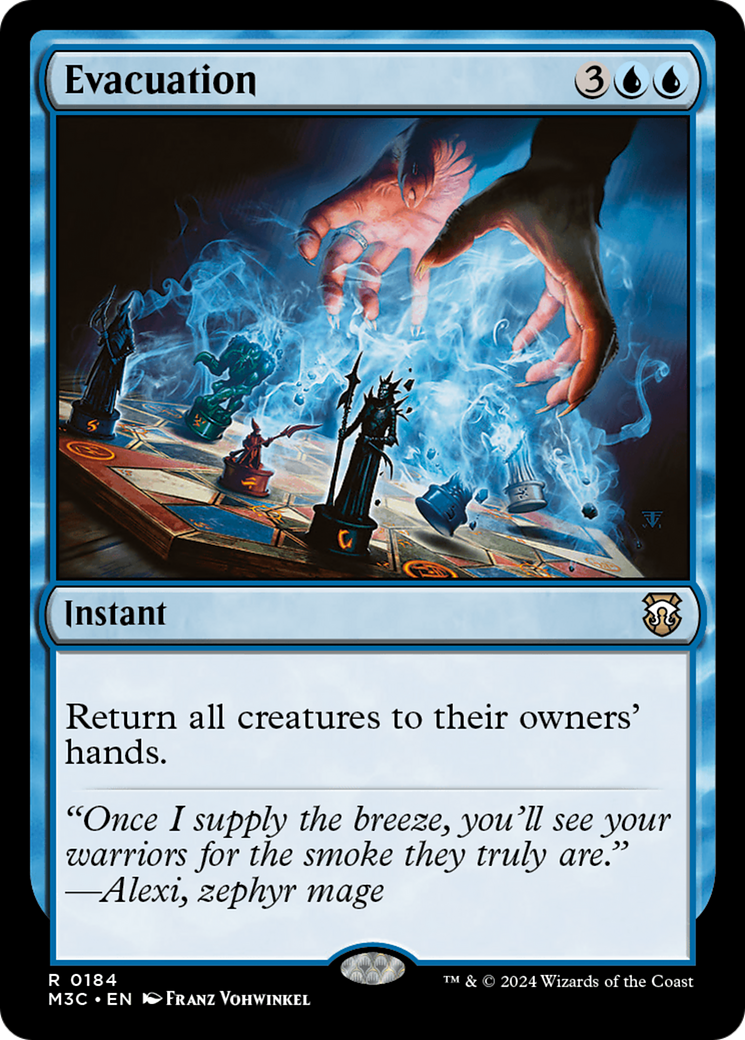
Evacuation
Evacuation
Instant
Return all creatures to their owners' hands.
-
1
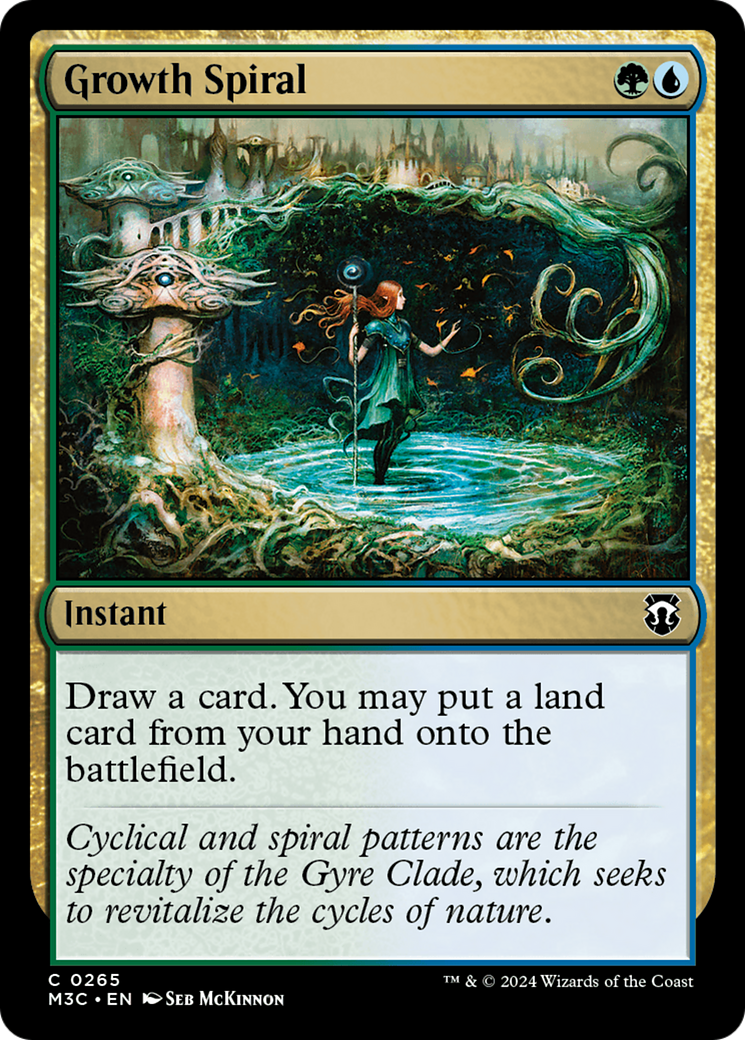
Growth Spiral
Growth Spiral
Instant
Draw a card. You may put a land card from your hand onto the battlefield.
- Growth Spiral's effect doesn't count as playing a land. It can put a land card onto the battlefield even if it's not your turn or if you've already played your land for the turn.
-
1
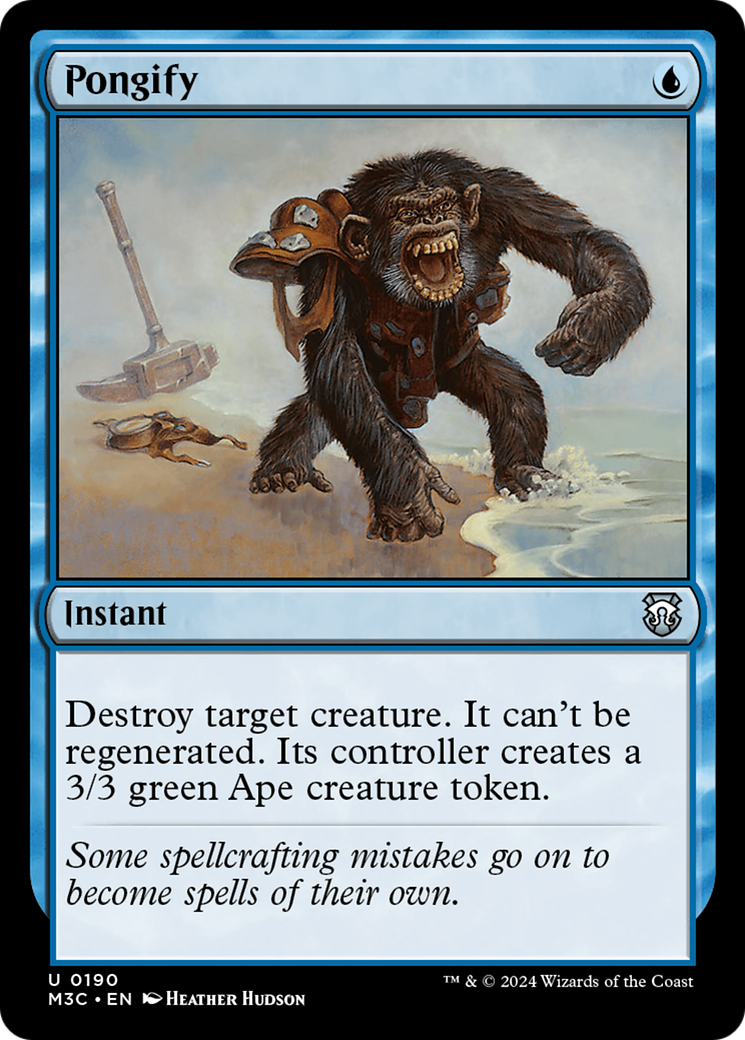
Pongify
Pongify
Instant
Destroy target creature. It can't be regenerated. Its controller creates a 3/3 green Ape creature token.
- If the target creature is an illegal target by the time Pongify tries to resolve, the spell won't resolve. No player creates an Ape token. If the target is legal but not destroyed (most likely because it has indestructible), its controller does create an Ape token.
-
1
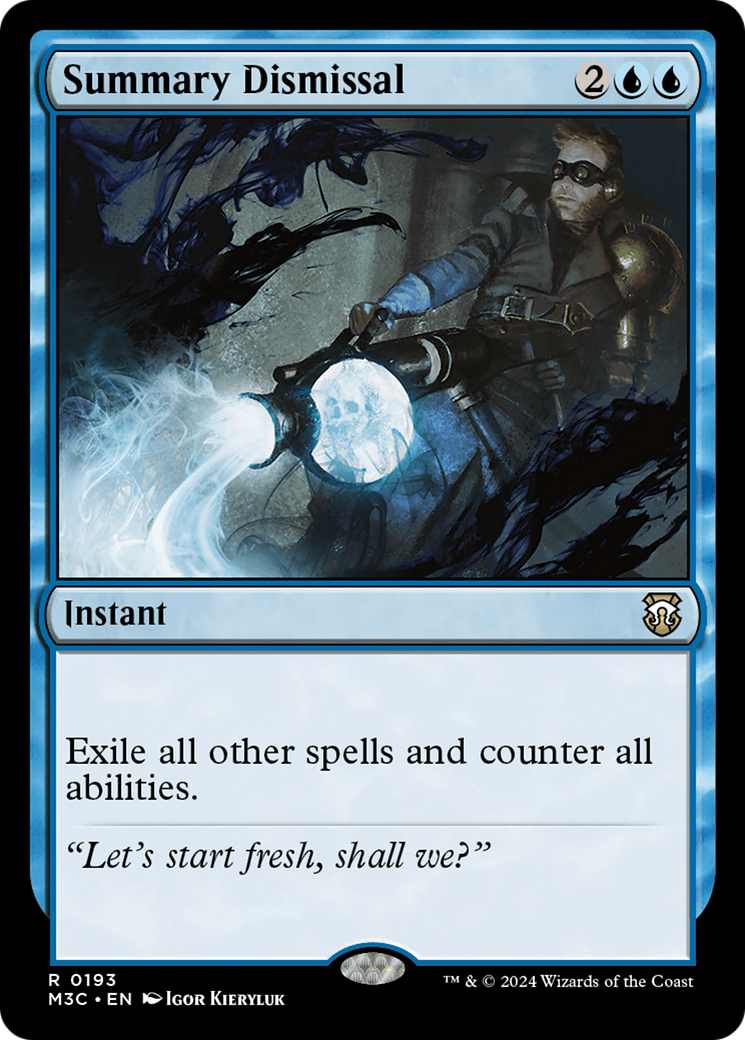
Summary Dismissal
Summary Dismissal
Instant
Exile all other spells and counter all abilities.
- Spells that can’t be countered are exiled by Summary Dismissal. They won’t resolve.
- Only activated and triggered abilities on the stack are countered. Static abilities of objects remain unaffected, and activated and triggered abilities of objects may be activated or may trigger again later in the turn. Spells and abilities that have already resolved aren’t affected.
Sorceries 10
-
1
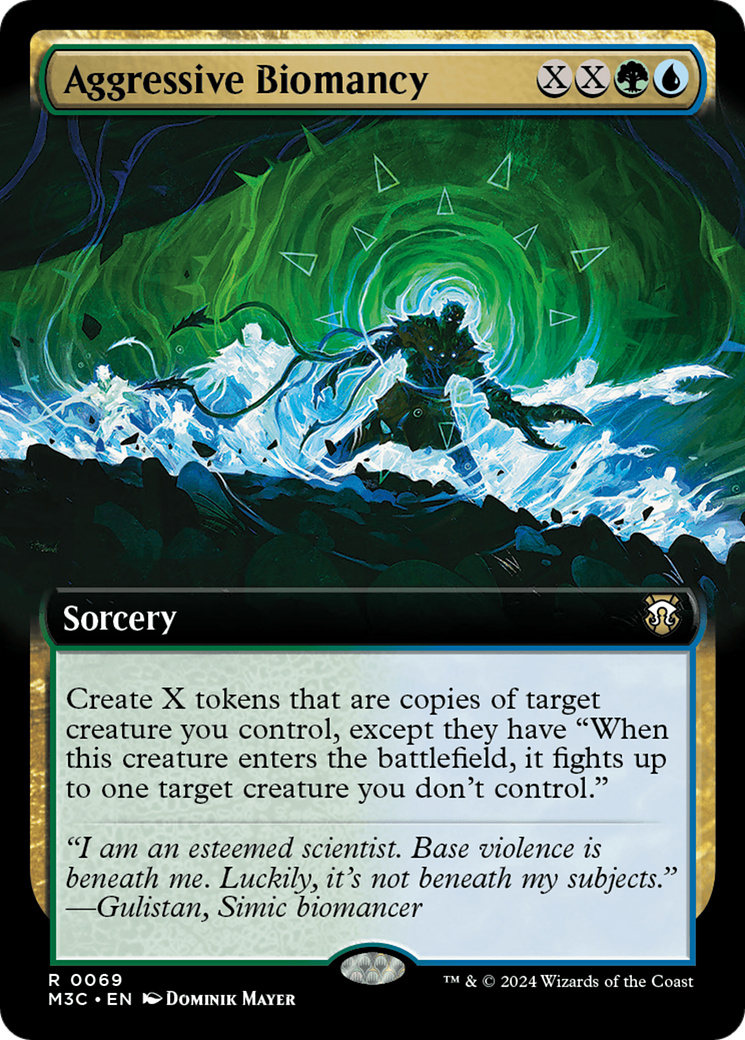
Aggressive Biomancy
Aggressive Biomancy
Sorcery
Create X tokens that are copies of target creature you control, except they have "When this token enters, it fights up to one target creature you don't control."
- The tokens copy exactly what was printed on the original creature and nothing else, with the listed exception (unless that creature is itself copying something else; see below). They don't copy whether that creature is tapped or untapped, whether it has any counters on it or Auras attached to it, or any non-copy effects that have changed its power, toughness, types, color, and so on.
- If the copied creature is copying something else, then the tokens enter the battlefield as whatever that creature copied, with the listed exception.
- If the copied creature has in its mana cost, X is 0.
- If the copied creature is itself a token, the tokens created by Aggressive Biomancy copy the original characteristics of that token as stated by the effect that created it, with the listed exception.
- Any enters-the-battlefield abilities of the copied creature will trigger when the tokens enter the battlefield. Any "as [this creature] enters the battlefield" or "[this creature] enters the battlefield with" abilities of the creature will also work.
-
1
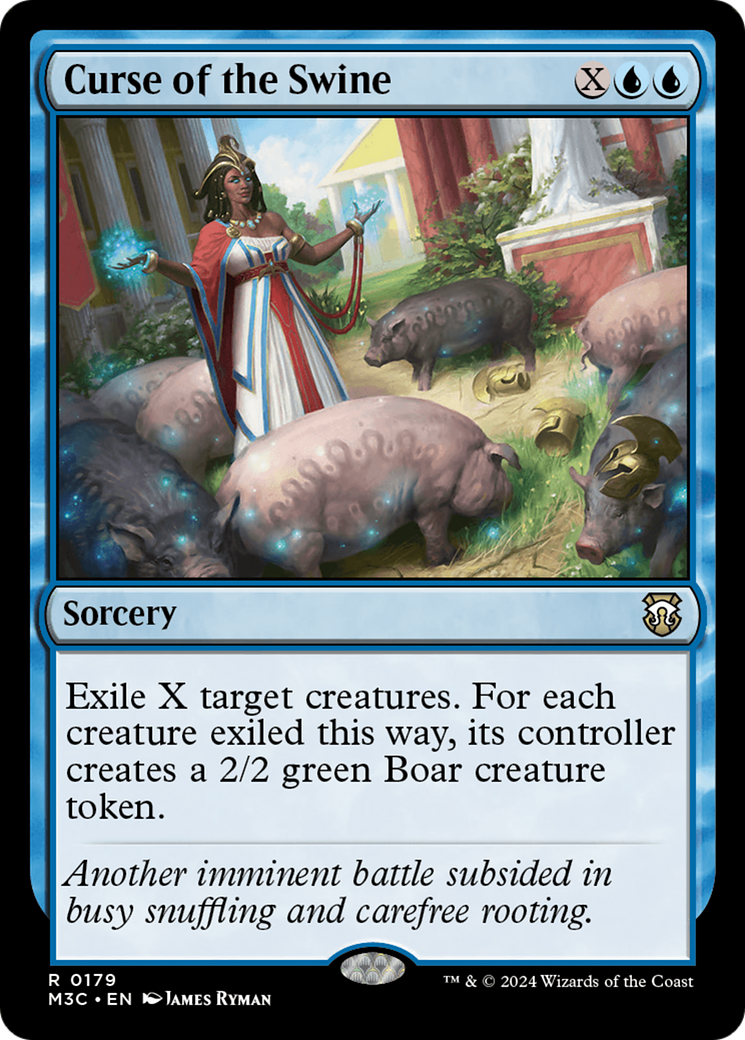
Curse of the Swine
Curse of the Swine
Sorcery
Exile X target creatures. For each creature exiled this way, its controller creates a 2/2 green Boar creature token.
-
1
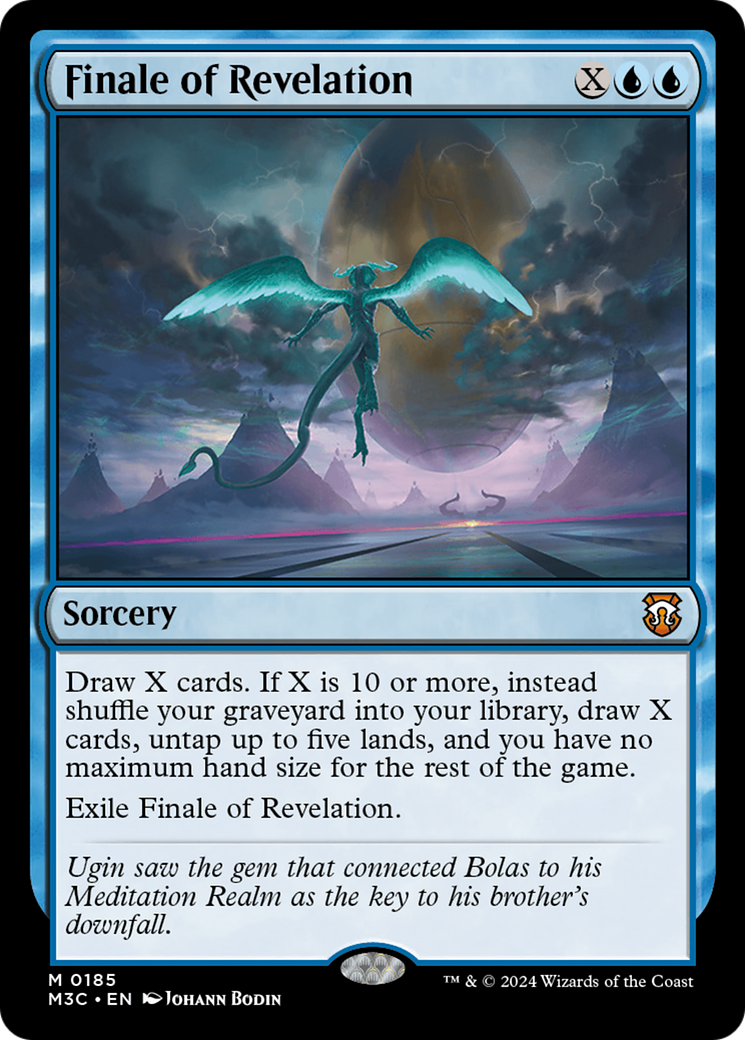
Finale of Revelation
Finale of Revelation
Sorcery
Draw X cards. If X is 10 or more, instead shuffle your graveyard into your library, draw X cards, untap up to five lands, and you have no maximum hand size for the rest of the game.
Exile Finale of Revelation.
-
1
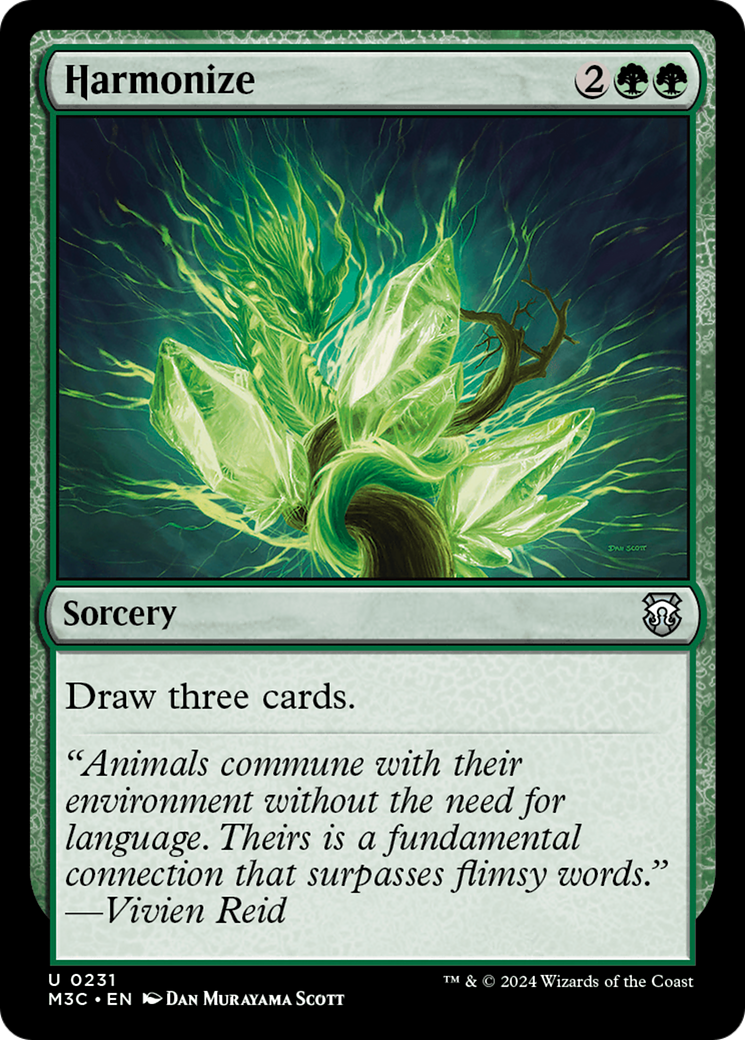
Harmonize
Harmonize
Sorcery
Draw three cards.
-
1
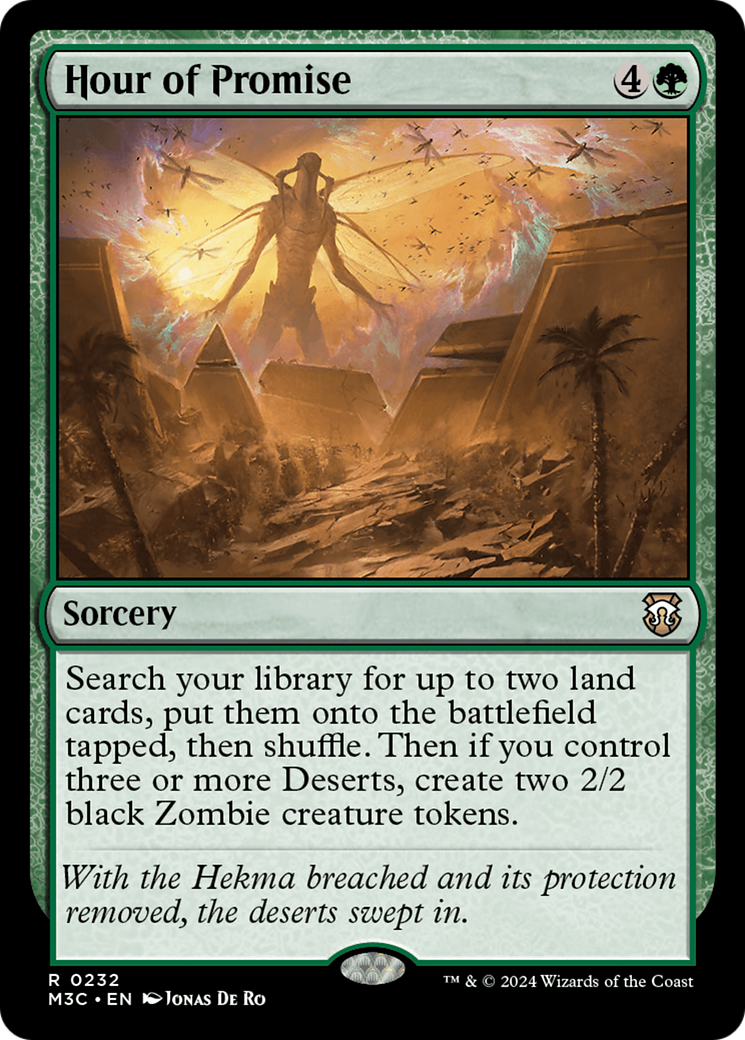
Hour of Promise
Hour of Promise
Sorcery
Search your library for up to two land cards, put them onto the battlefield tapped, then shuffle. Then if you control three or more Deserts, create two 2/2 black Zombie creature tokens.
- There are many important moments in the story, but the most crucial—called "story spotlights"—are shown on cards. These cards have the Planeswalker symbol in their text box; this symbol has no effect on gameplay. You can read more about these events in the official Magic fiction at http://www.mtgstory.com.
- When Hour of Promise checks the number of Deserts you control, it includes any Deserts you found earlier with Hour of Promise.
-
1
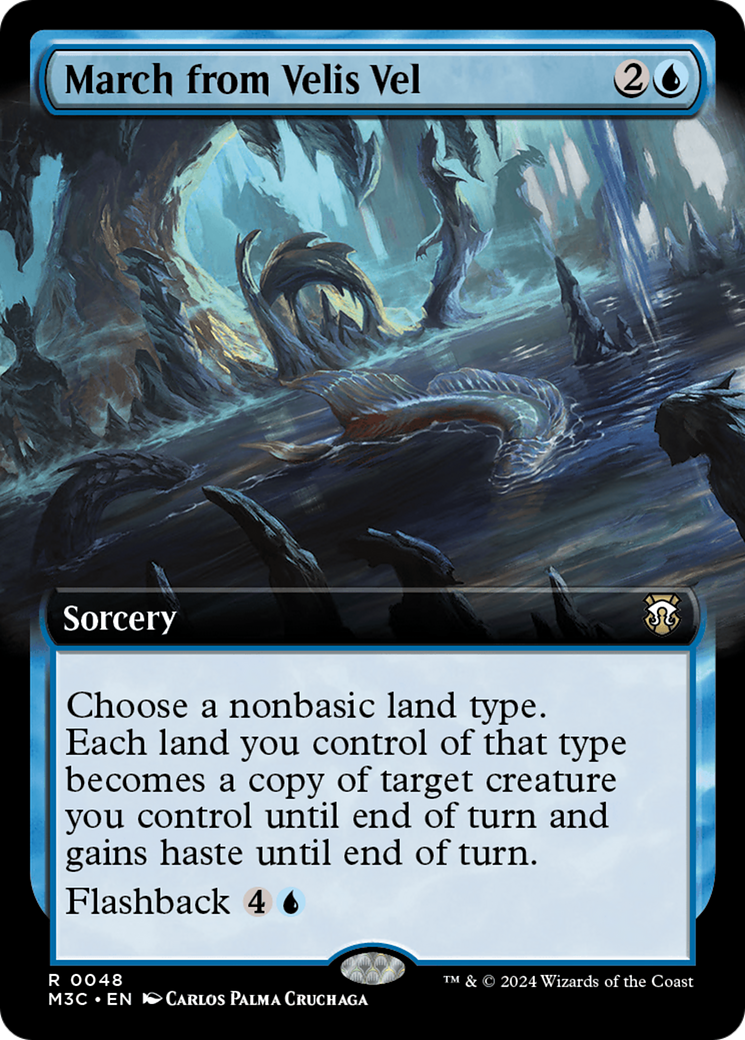
March from Velis Vel
March from Velis Vel
Sorcery
Choose a nonbasic land type. Each land you control of that type becomes a copy of target creature you control until end of turn and gains haste until end of turn.
Flashback (You may cast this card from your graveyard for its flashback cost. Then exile it.)
- The lands copy exactly what was printed on the original creature and nothing else (unless that permanent is copying something else; see below). They don't copy whether that creature is tapped or untapped, whether it has any counters on it or Auras and Equipment attached to it, and so on.
- If the copied creature has in its mana cost, X is 0.
- If the copied creature is copying something else, then the lands become copies of whatever that creature copied.
- Because the lands aren't entering the battlefield when they become copies of the creature, any "When [this creature] enters the battlefield" or "[This creature] enters the battlefield with" abilities of the copied creature won't apply.
- "Flashback [cost]" means "You may cast this card from your graveyard by paying [cost] rather than paying its mana cost" and "If the flashback cost was paid, exile this card instead of putting it anywhere else any time it would leave the stack."
- You must still follow any timing restrictions and permissions, including those based on the card's type. For instance, you can cast a sorcery using flashback only when you could normally cast a sorcery.
- To determine the total cost of a spell, start with the mana cost or alternative cost (such as a flashback cost) you're paying, add any cost increases, then apply any cost reductions. The mana value of the spell is determined only by its mana cost, no matter what the total cost to cast the spell was.
- A spell cast using flashback will always be exiled afterward, whether it resolves, is countered, or leaves the stack in some other way.
- You can cast a spell using flashback even if it was somehow put into your graveyard without having been cast.
- If a card with flashback is put into your graveyard during your turn, you can cast it if it's legal to do so before any other player can take any actions.
-
1
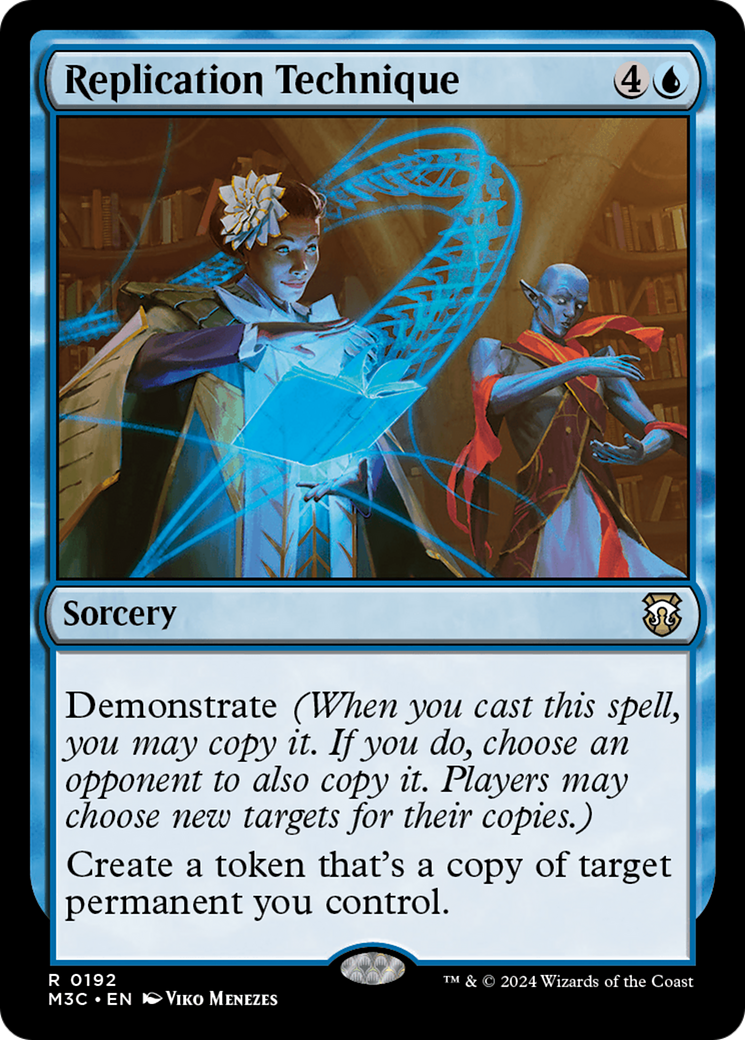
Replication Technique
Replication Technique
Sorcery
Demonstrate (When you cast this spell, you may copy it. If you do, choose an opponent to also copy it. Players may choose new targets for their copies.)
Create a token that's a copy of target permanent you control.
- If the spell requires targets, you choose the target of the original spell as you cast it. If you create a copy of the spell, you may choose new targets for the copy as you create that copy. Similarly, the opponent you chose to create a copy may choose new targets for that copy as it's created. In other words, your opponent will know the targets of your original spell and your copy when choosing the new targets, if any, for their copy.
- If you copy a spell with demonstrate, you then immediately choose an opponent. If they copy the spell, it goes on top of the stack.
- You choose whether to make a copy as the demonstrate ability resolves. This happens before the original spell resolves. Your copy goes on the stack above the original spell.
- This means that if you cast a spell with demonstrate and both you and an opponent copy it, the opponent's copy will resolve first, then your copy will resolve, and finally the original spell will resolve.
- If you cast the spell and choose not to copy it, no opponent will get to copy it either.
-
1
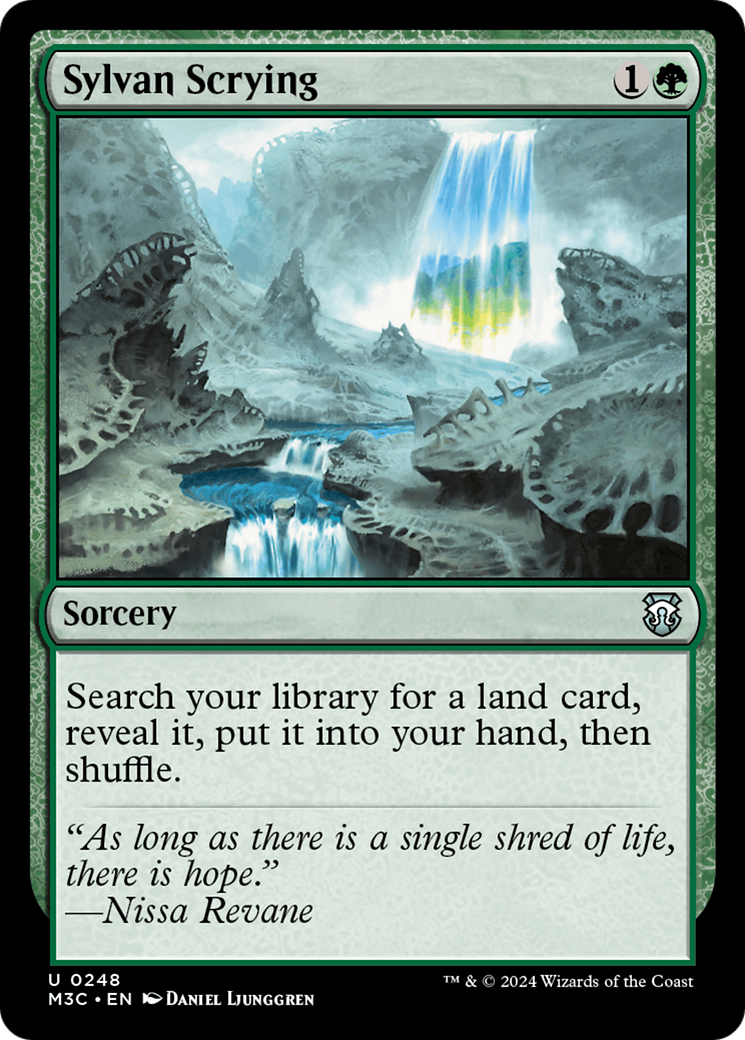
Sylvan Scrying
Sylvan Scrying
Sorcery
Search your library for a land card, reveal it, put it into your hand, then shuffle.
-
1
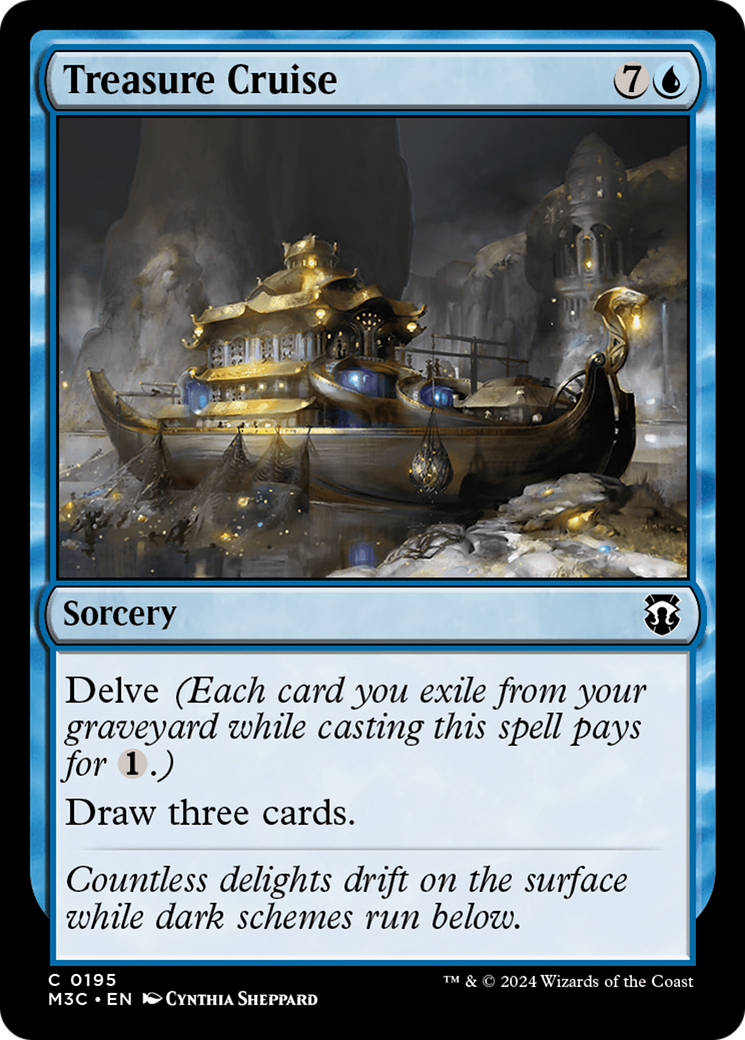
Treasure Cruise
Treasure Cruise
Sorcery
Delve (Each card you exile from your graveyard while casting this spell pays for .)
Draw three cards.
- Delve doesn't change a spell's mana cost or mana value. For example, Treasure Cruise's mana value is 8 even if you exiled three cards to cast it.
- You can exile cards to pay only for generic mana, and you can't exile more cards than the generic mana requirement of a spell with delve. For example, you can't exile more than seven cards from your graveyard to cast Treasure Cruise unless an effect has increased its cost.
- Because delve isn't an alternative cost, it can be used in conjunction with alternative costs, such as flashback. It can also be used to pay for additional costs that include generic mana.
-
1
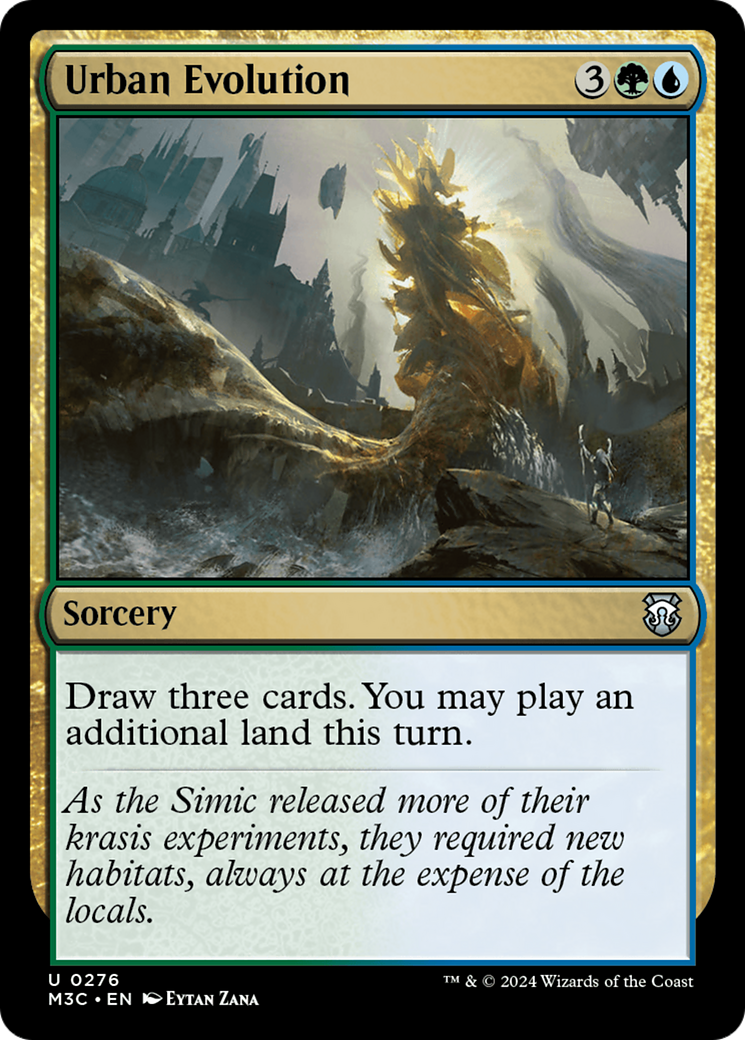
Urban Evolution
Urban Evolution
Sorcery
Draw three cards. You may play an additional land this turn.
- Urban Evolution's effect allows you to play an additional land during your main phase. Doing so follows the normal timing rules for playing lands. In particular, you don't get to play a land as Urban Evolution resolves; Urban Evolution fully resolves first and you draw three cards, perhaps including a land you'll play later.
- The effects of multiple Urban Evolutions in the same turn are cumulative. They're also cumulative with other effects that let you play additional lands, such as the one from Explore.
- If you somehow manage to cast Urban Evolution when it's not your turn, you'll draw three cards when it resolves, but you won't be able to play a land that turn.
Artifacts 7
-
1
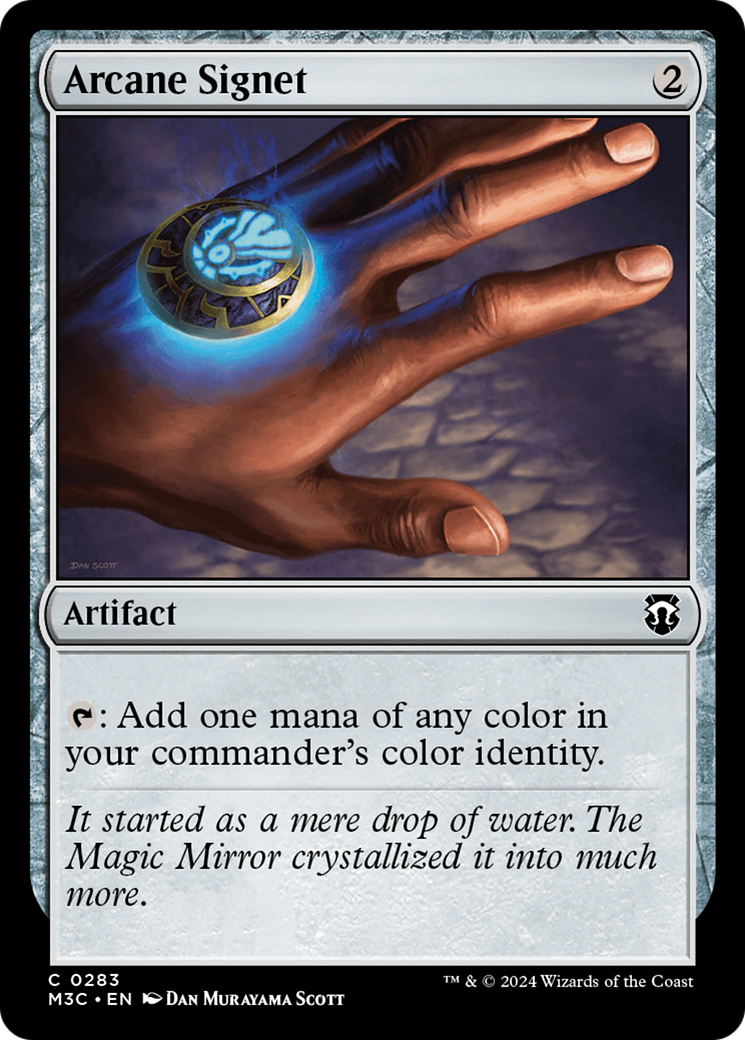
Arcane Signet
Arcane Signet
Artifact
: Add one mana of any color in your commander's color identity.
- If your commander is a card that has no colors in its color identity, Arcane Signet's ability produces no mana. It doesn't produce .
- If you have two commanders, the ability adds one mana of any color in their combined color identities.
- If you don't have a commander, Arcane Signet's ability produces no mana.
-
1
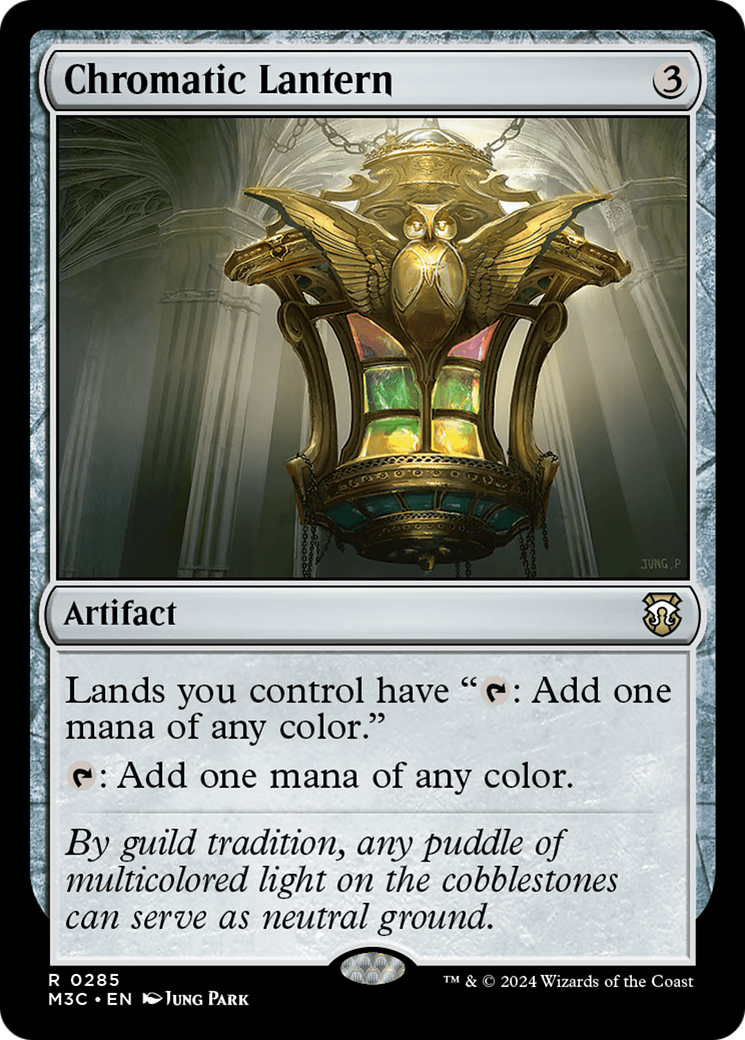
Chromatic Lantern
Chromatic Lantern
Artifact
Lands you control have " : Add one mana of any color."
: Add one mana of any color.
- Lands you control won't lose any other abilities they had. They also won't gain or lose any land types.
-
1
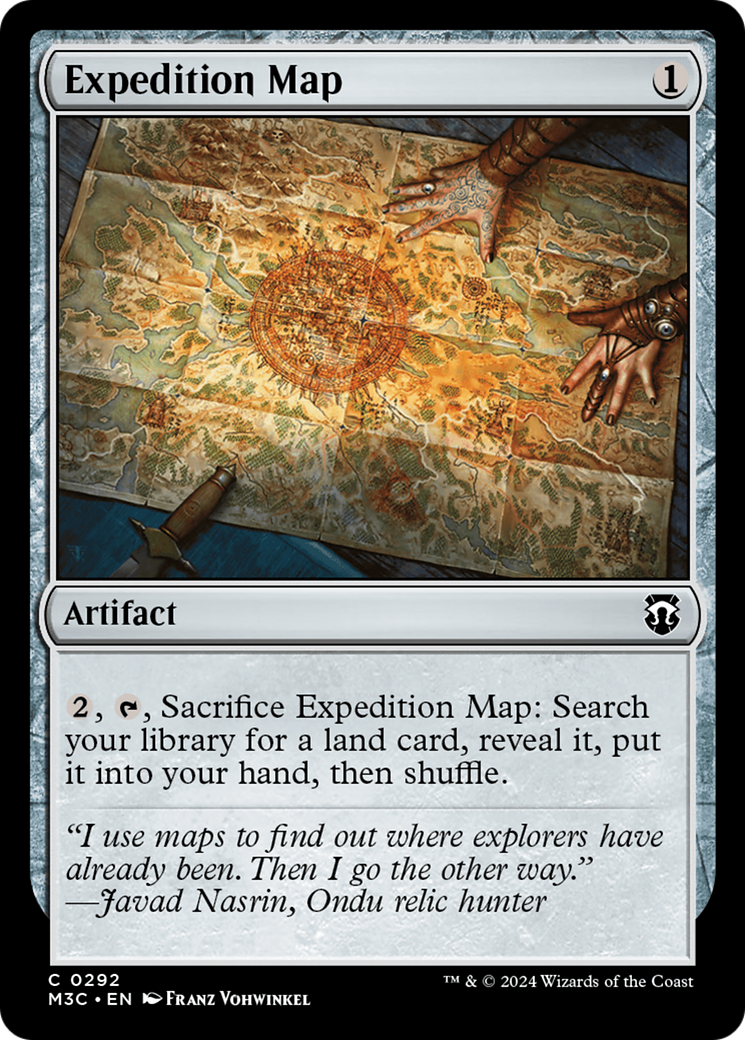
Expedition Map
Expedition Map
Artifact
, , Sacrifice this artifact: Search your library for a land card, reveal it, put it into your hand, then shuffle.
- You may find any land card, not just a basic land card.
-
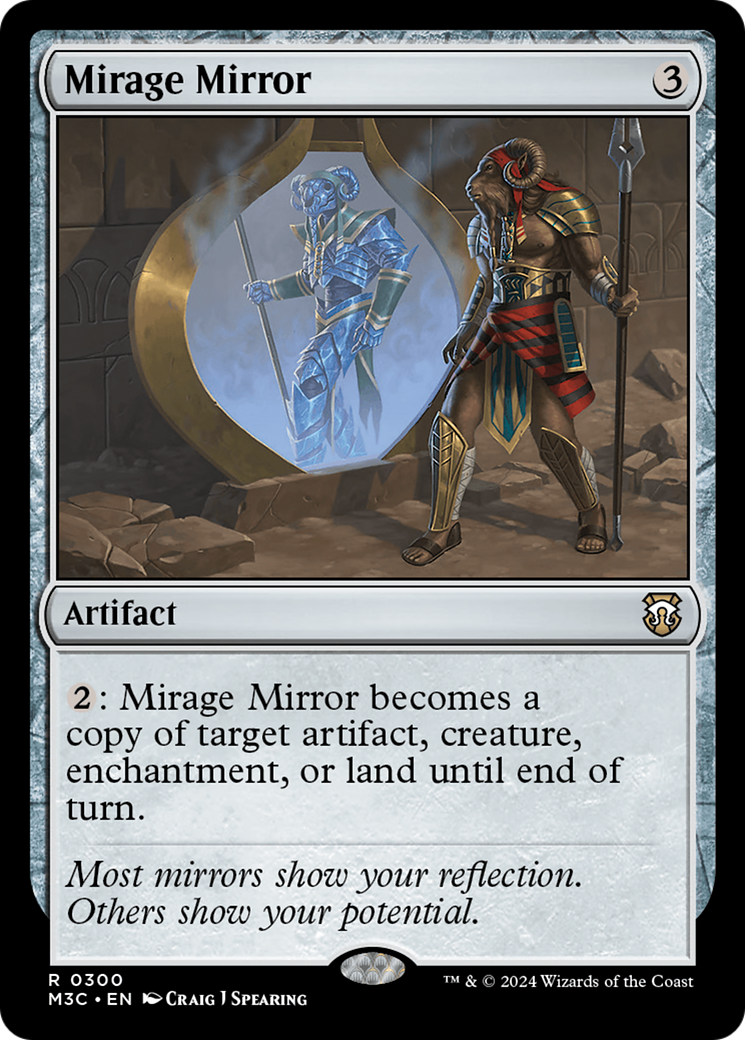
1
Mirage Mirror
Mirage Mirror
Artifact
: This artifact becomes a copy of target artifact, creature, enchantment, or land until end of turn.
- Once Mirage Mirror's ability resolves, it no longer has that ability.
- Mirage Mirror copies the printed values of the target permanent, plus any copy effects that have been applied to it. It won't copy counters on that permanent or effects that have changed its power, toughness, types, color, or so on. Notably, it won't copy effects that made the target permanent become a creature.
- If Mirage Mirror copies a permanent that's copying something else, it will become whatever the target is copying.
- If you activate Mirage Mirror's ability multiple times in a turn in response to itself, then each time one of those abilities resolves, it will overwrite whatever Mirage Mirror is copying. Mirage Mirror will wind up as a copy of the permanent targeted by the last ability to resolve. When the turn ends, all instances of the ability will wear off at the same time.
- If an effect begins to apply to Mirage Mirror before it becomes a copy of another permanent, that effect will continue to apply. For example, if Mirage Mirror is activated twice in response to itself targeting first Rampaging Hippo then Frilled Sandwalla, the ability it has while it's a copy of Frilled Sandwalla can be activated and its effect will continue to apply while Mirage Mirror is a copy of Rampaging Hippo.
- If Mirage Mirror becomes a creature the same turn it enters the battlefield, you can't attack with it or use any of its abilities (if it gains any) unless it has haste.
- If Mirage Mirror becomes a copy of a legendary permanent you control, you'll put one of them into your graveyard.
- If Mirage Mirror becomes a copy of an Aura, it's put into its owner's graveyard unless it's somehow attached to an appropriate object or player already. If it becomes a copy of an Equipment and is attached to a creature, it'll become unattached when it becomes a non-Equipment artifact again.
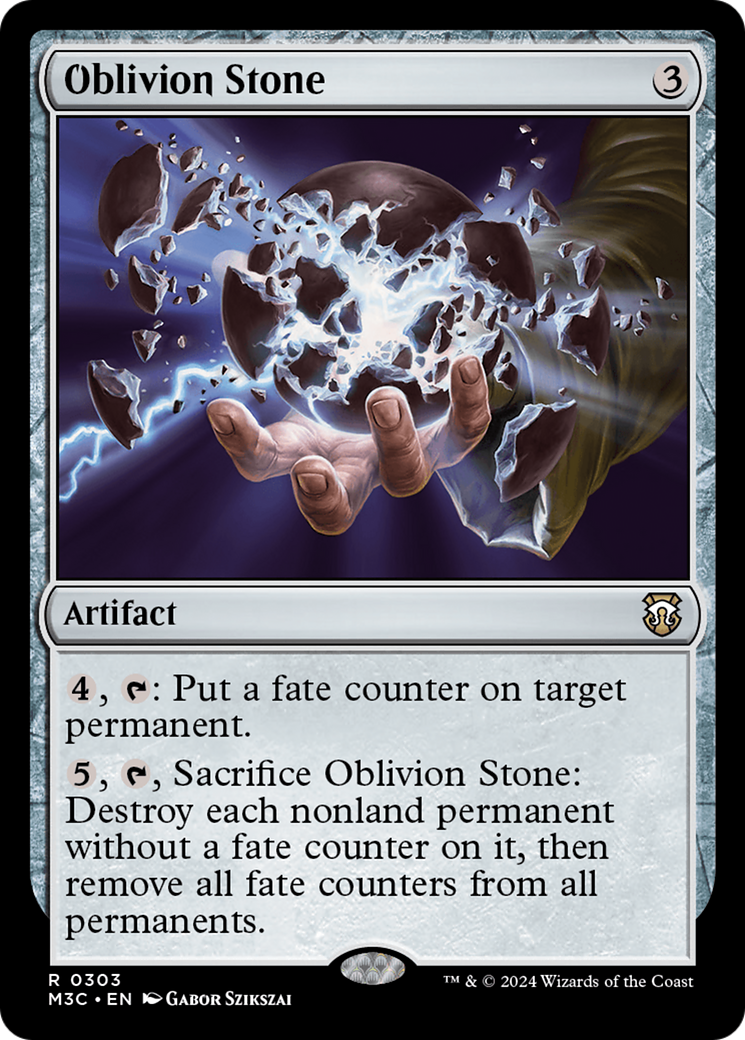
-
1
Oblivion Stone
Oblivion Stone
Artifact
, : Put a fate counter on target permanent.
, , Sacrifice this artifact: Destroy each nonland permanent without a fate counter on it, then remove all fate counters from all permanents.
-
1
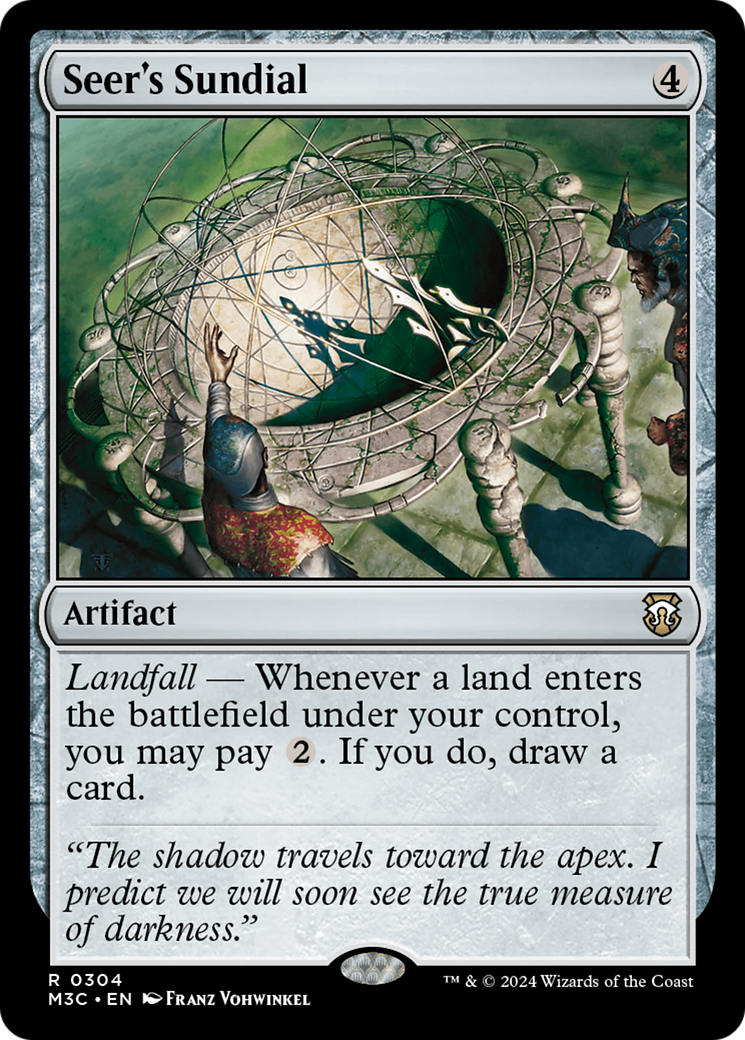
Seer's Sundial
Seer's Sundial
Artifact
Landfall — Whenever a land you control enters, you may pay . If you do, draw a card.
- A landfall ability triggers whenever a land you control enters for any reason. It triggers whenever you play a land, as well as whenever a spell or ability puts a land onto the battlefield under your control.
- A landfall ability doesn't trigger if a permanent already on the battlefield becomes a land.
- Whenever a land you control enters, each landfall ability of the permanents you control will trigger. You can put them on the stack in any order. The last ability you put on the stack will be the first one to resolve (As a result, you can have those abilities resolve in the order of your choosing.).
- You choose whether to pay as the ability resolves. You may pay only once per resolution.
-
1
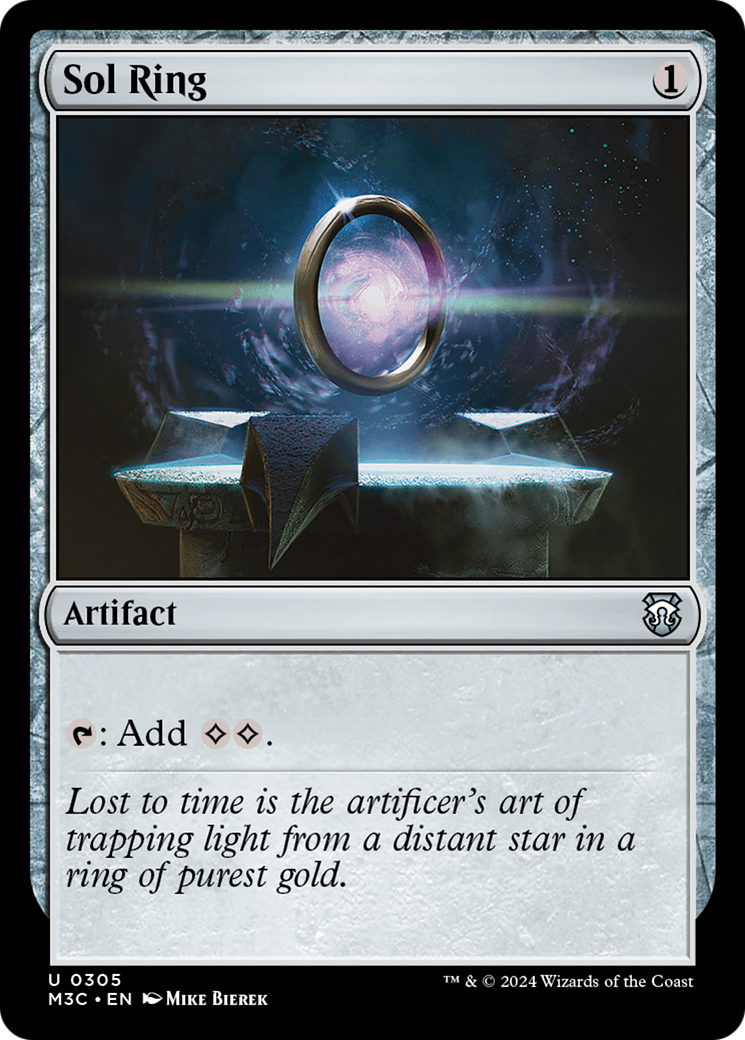
Sol Ring
Sol Ring
Artifact
: Add .
Enchantments 4
-
1
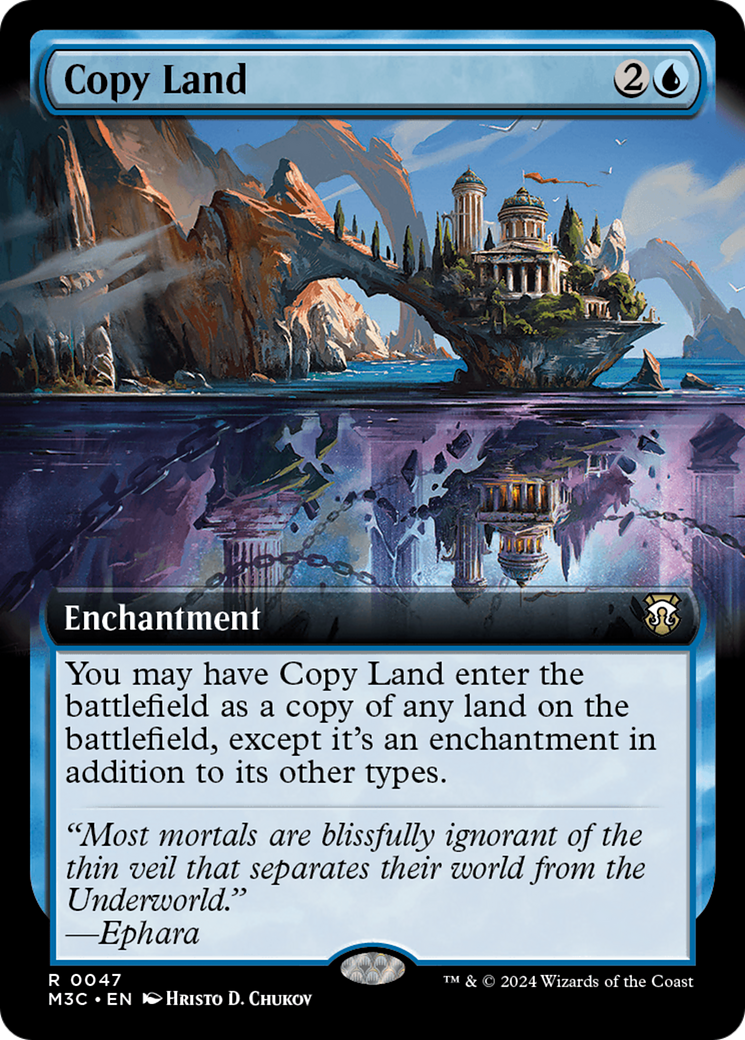
Copy Land
Copy Land
Enchantment
You may have this enchantment enter as a copy of any land on the battlefield, except it's an enchantment in addition to its other types.
- Copy Land copies exactly what was printed on the original permanent and nothing more, with the listed exception (unless that permanent is itself copying something or is a token; see below). It doesn't copy whether that permanent is tapped or untapped, whether it has any counters on it or Auras attached to it, or any non-copy effects that have changed its power, toughness, types, color, and so on.
- In the unusual case where the chosen permanent has in its mana cost, X is 0.
- If the chosen permanent is copying something else (for example, if the chosen permanent is another Copy Land), then your Copy Land enters the battlefield as whatever the chosen permanent copied, with the listed exception.
- If the chosen permanent is a token, Copy Land copies the original characteristics of that token as stated by the effect that created the token, with the listed exception. Copy Land does not become a token.
- Any enters-the-battlefield abilities of the copied permanent will trigger when Copy Land enters the battlefield. Any "as [this land] enters the battlefield" or "[this land] enters the battlefield with" abilities of the chosen permanent will also work.
- If Copy Land somehow enters the battlefield at the same time as another permanent, Copy Land can't become a copy of that permanent. You may choose only a permanent that's already on the battlefield.
- You can choose not to copy anything. In that case, Copy Land simply enters the battlefield as an enchantment with an irrelevant ability. We're sure you had your reasons.
-
1
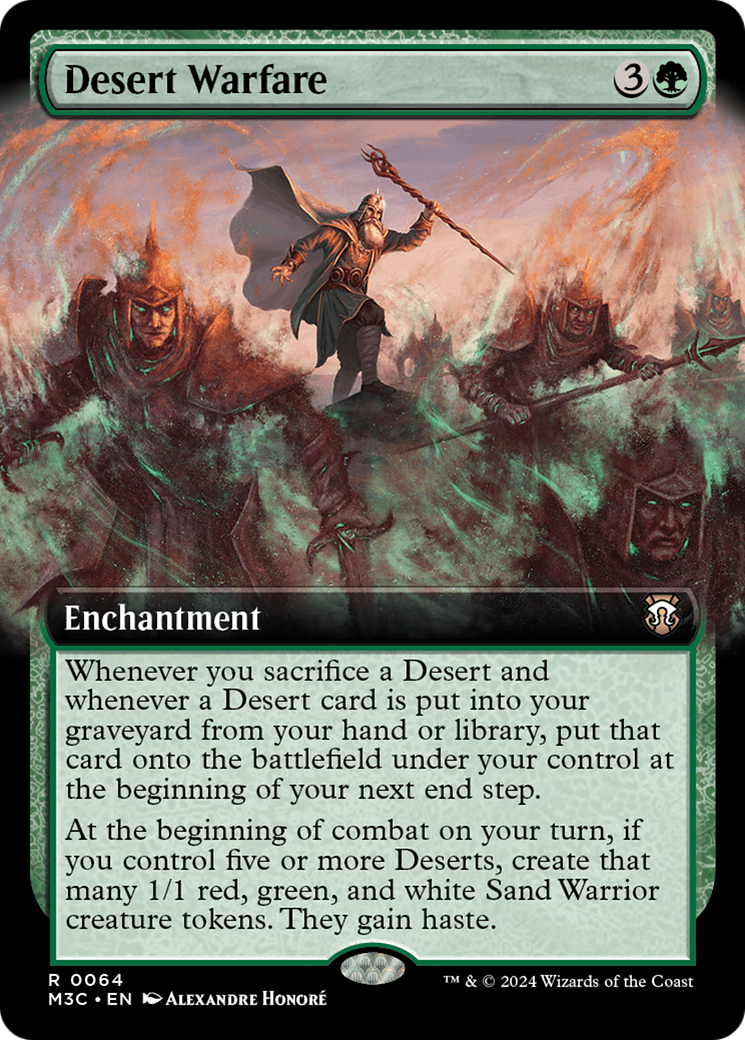
Desert Warfare
Desert Warfare
Enchantment
Whenever you sacrifice a Desert and whenever a Desert card is put into your graveyard from your hand or library, put that card onto the battlefield under your control at the beginning of your next end step.
At the beginning of combat on your turn, if you control five or more Deserts, create that many 1/1 red, green, and white Sand Warrior creature tokens. They gain haste.
- Desert Warfare's first ability won't return any Deserts that you sacrificed or that were put into your graveyard from your hand or library before Desert Warfare entered the battlefield.
- If the Desert leaves your graveyard before the delayed triggered ability created by Desert Warfare's first ability resolves, that Desert won't be put onto the battlefield from its new zone when that ability resolves.
-
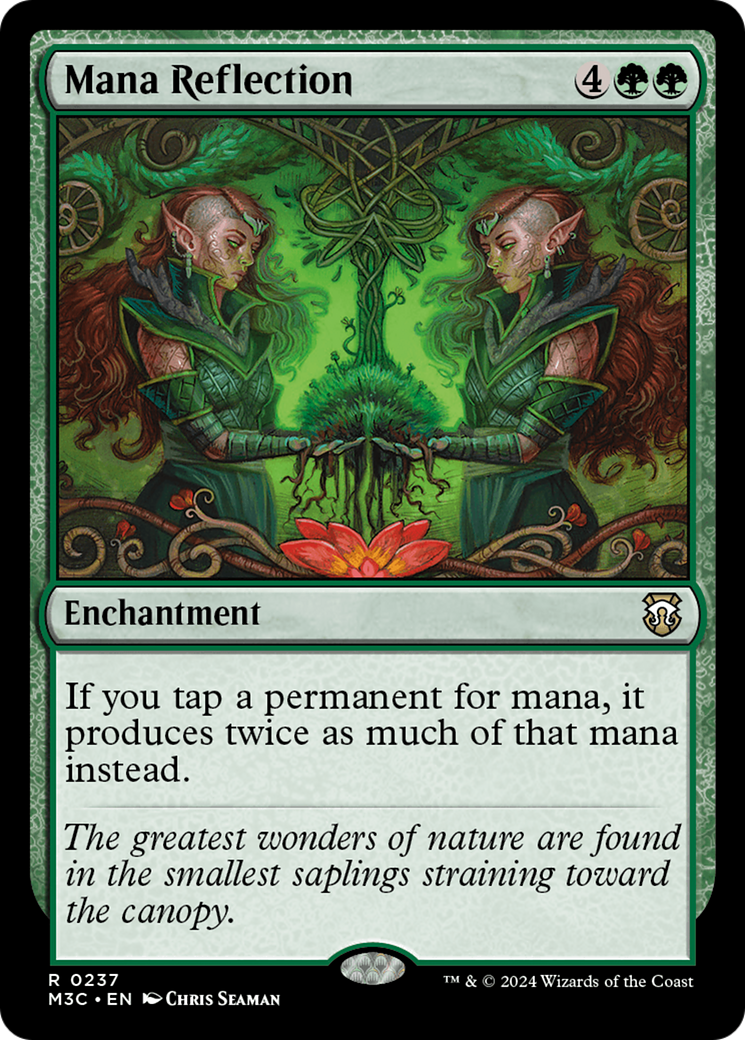
1
Mana Reflection
Mana Reflection
Enchantment
If you tap a permanent for mana, it produces twice as much of that mana instead.
- You're “tapping a permanent for mana” only if you're activating a mana ability of that permanent that includes the symbol in its cost. A mana ability produces mana as part of its effect.
- If an ability triggers “whenever you tap” something for mana and produces mana, that triggered mana ability won't be affected by Mana Reflection.
- Mana Reflection doesn't produce any mana itself. Rather, it causes permanents you tap for mana to produce more mana. If the mana ability of that permanent puts any restrictions or riders on the mana it produces, that will apply to all the mana it produces this way.
- The effects of multiple Mana Reflections are cumulative. For example, if you have two Mana Reflections on the battlefield, you'll get four times the original amount and type of mana. If you have three, you'll get eight times the mana, and so on.
-
1
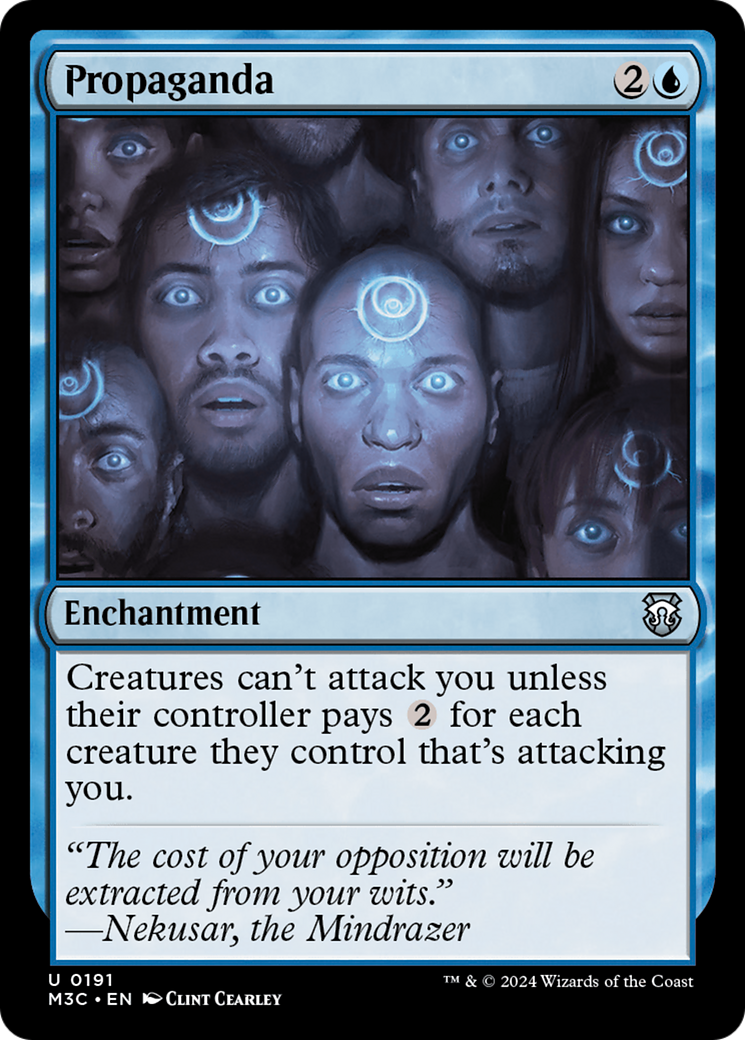
Propaganda
Propaganda
Enchantment
Creatures can't attack you unless their controller pays for each creature they control that's attacking you.
- The payment is made during the declare attackers step at the same time you are declaring the attacker.
- If there are multiple attacks in a turn, then you have to pay for each attack.
- If there is more than one Propaganda on the battlefield, the cost is cumulative.
- Paying this cost is not an instant or any other kind of ability, it is an additional cost on the declaration of the attacker.
Lands 44
-
1
Basilisk Gate
Basilisk Gate
Land — Gate
: Add .
, : Target creature gets +X/+X until end of turn, where X is the number of Gates you control. Activate only as a sorcery.
-
1
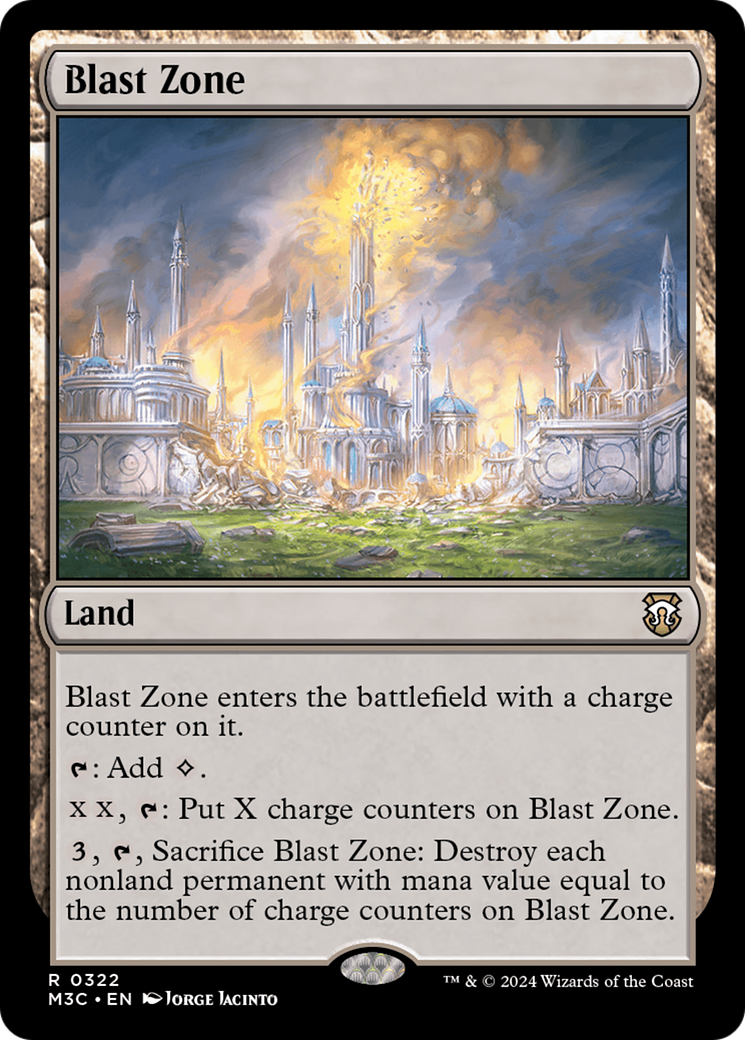
Blast Zone
Blast Zone
Land
This land enters with a charge counter on it.
: Add .
, : Put X charge counters on this land.
, , Sacrifice this land: Destroy each nonland permanent with mana value equal to the number of charge counters on this land.
- An activation cost of means that you pay twice X. If you want X to be 3, you pay to activate Blast Zone’s ability.
- Every token has mana value 0 unless it is copying something or was created with a specific mana cost.
- If a permanent has in its mana cost, X is 0 for the purpose of determining its mana value.
-
1
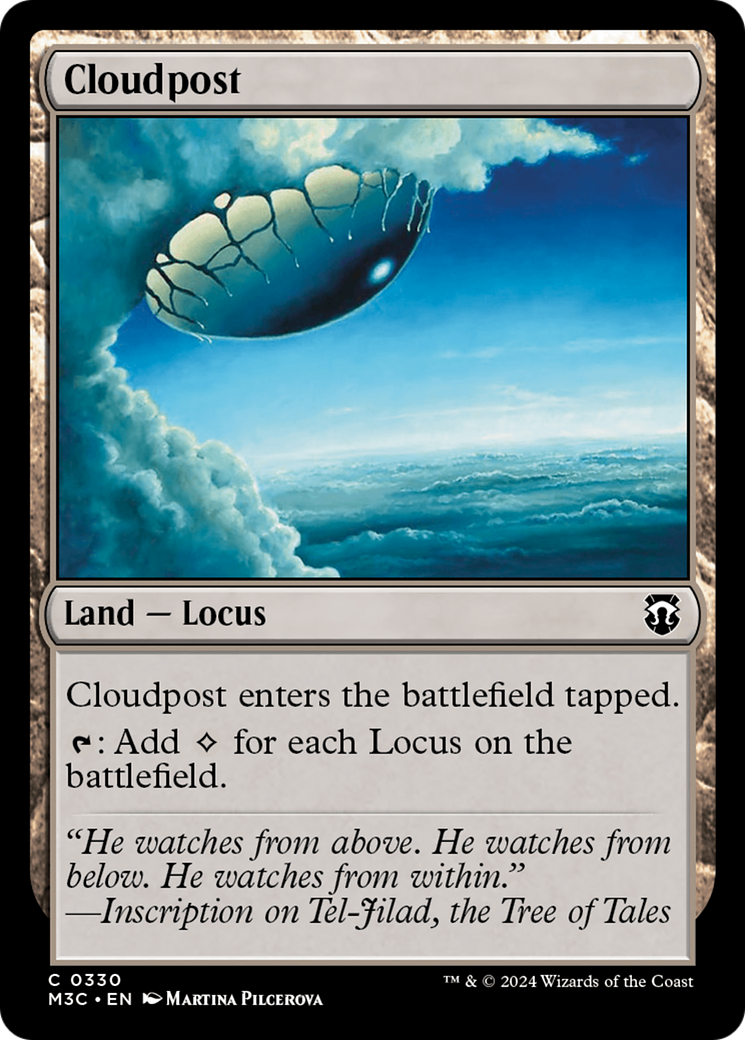
Cloudpost
Cloudpost
Land — Locus
This land enters tapped.
: Add for each Locus on the battlefield.
-
1
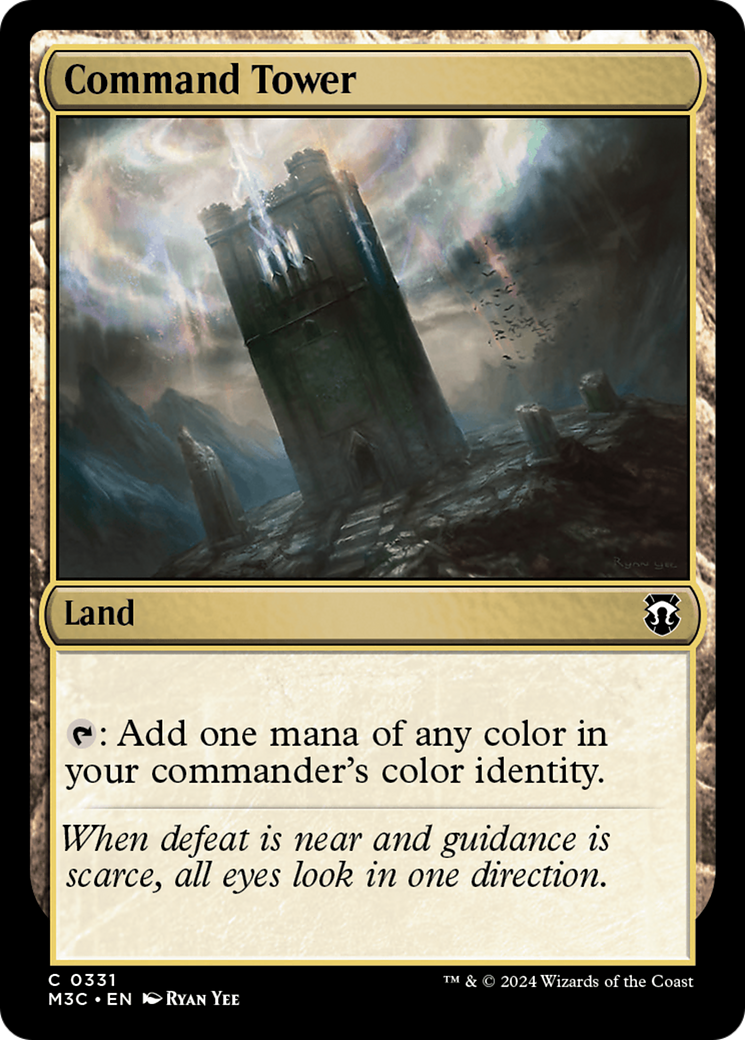
Command Tower
Command Tower
Land
: Add one mana of any color in your commander's color identity.
- If you don't have a commander, Command Tower's ability produces no mana.
- If your commander is a card that has no colors in its color identity, Command Tower's ability produces no mana. It doesn't produce .
- If you have two commanders, the ability adds one mana of any color in their combined color identities.
-
1
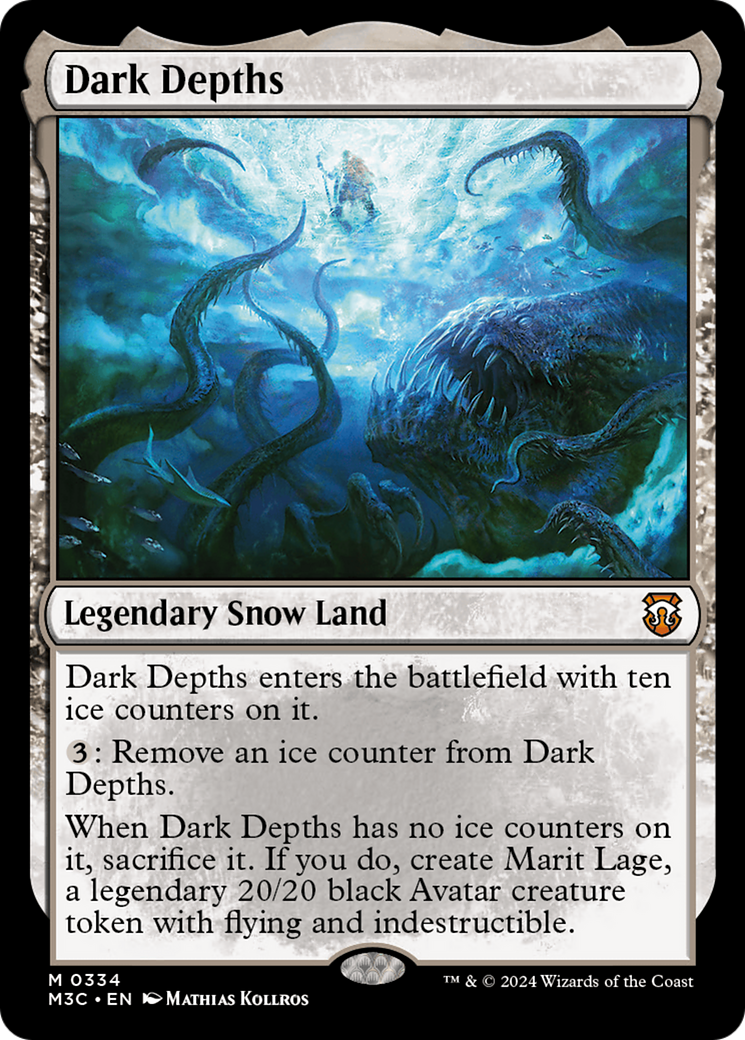
Dark Depths
Dark Depths
Legendary Snow Land
Dark Depths enters with ten ice counters on it.
: Remove an ice counter from Dark Depths.
When Dark Depths has no ice counters on it, sacrifice it. If you do, create Marit Lage, a legendary 20/20 black Avatar creature token with flying and indestructible.
- Dark Depths doesn't have a mana ability. It doesn't tap for colorless mana.
- If Dark Depths leaves the battlefield before its triggered ability resolves, you won't be able to sacrifice it, so you won't create Marit Lage.
- The last ability of Dark Depths is a state trigger. It won't trigger again while the ability is on the stack, but if the ability is countered and Dark Depths is still on the battlefield with no ice counters on it, it will trigger again immediately.
-
1
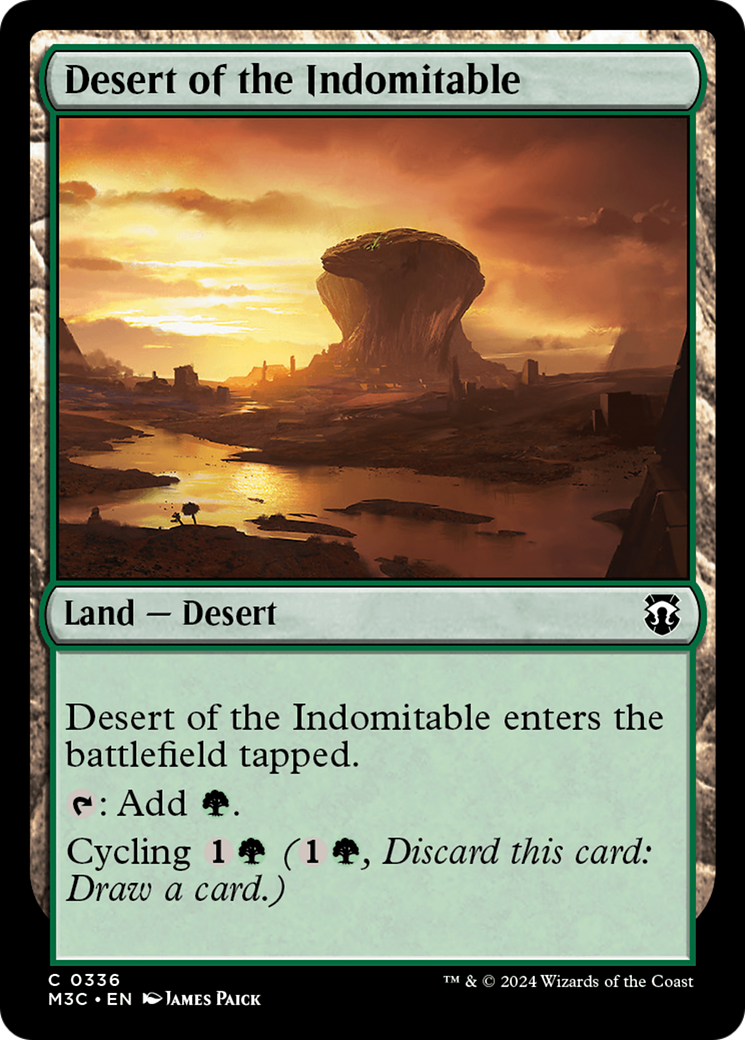
Desert of the Indomitable
Desert of the Indomitable
Land — Desert
This land enters tapped.
: Add .
Cycling ( , Discard this card: Draw a card.)
- Desert is a land subtype with no special meaning. It doesn't grant the land an intrinsic mana ability. Other cards may care about which lands are Deserts.
-
1
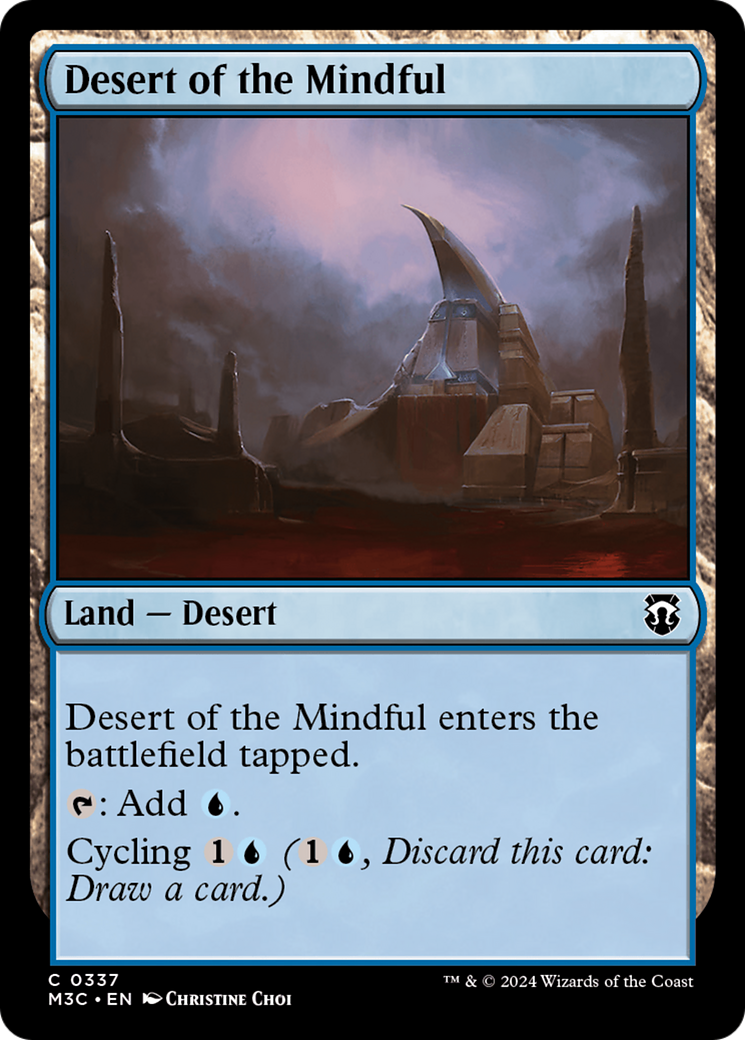
Desert of the Mindful
Desert of the Mindful
Land — Desert
This land enters tapped.
: Add .
Cycling ( , Discard this card: Draw a card.)
- Desert is a land subtype with no special meaning. It doesn’t grant the land an intrinsic mana ability. Other cards may care about which lands are Deserts.
-
1
Dreamroot Cascade
Dreamroot Cascade
Land
This land enters tapped unless you control two or more other lands.
: Add or .
-
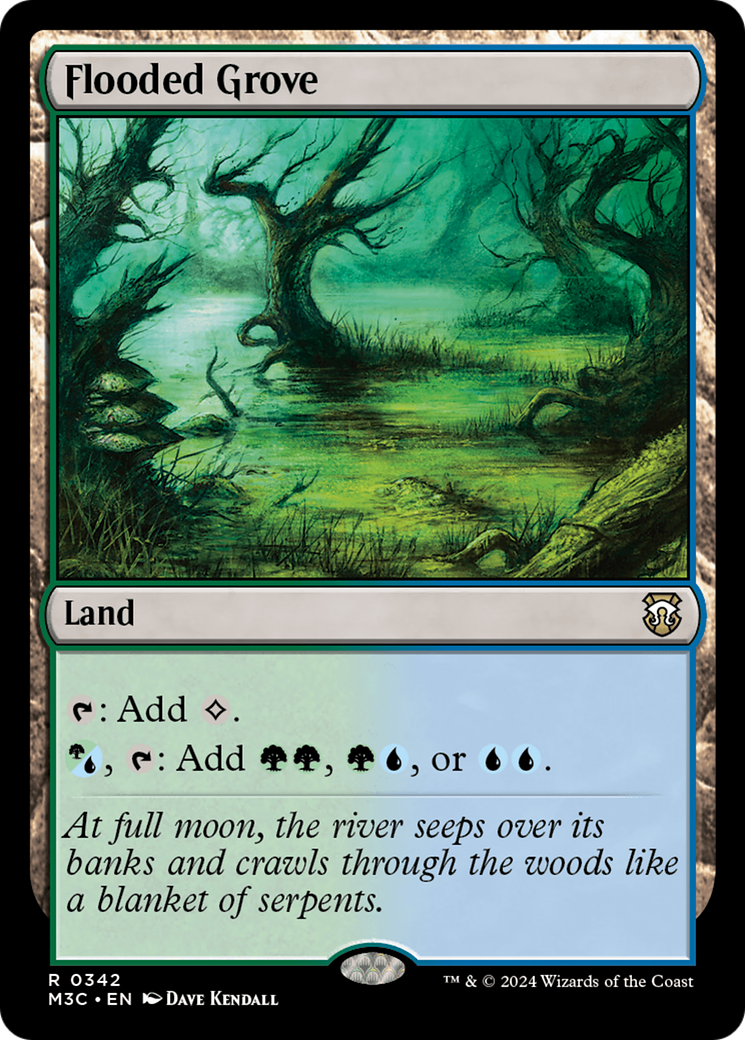
1
Flooded Grove
Flooded Grove
Land
: Add .
, : Add , , or .
-
4
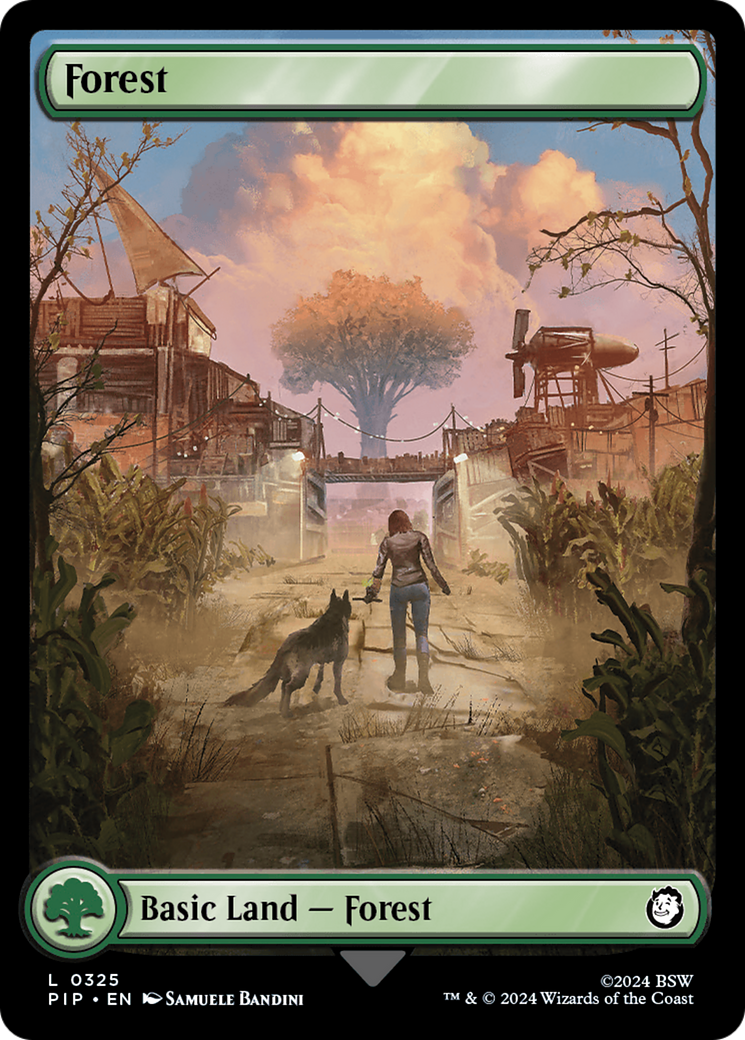
Forest
Forest
Basic Land — Forest
( : Add .)
-
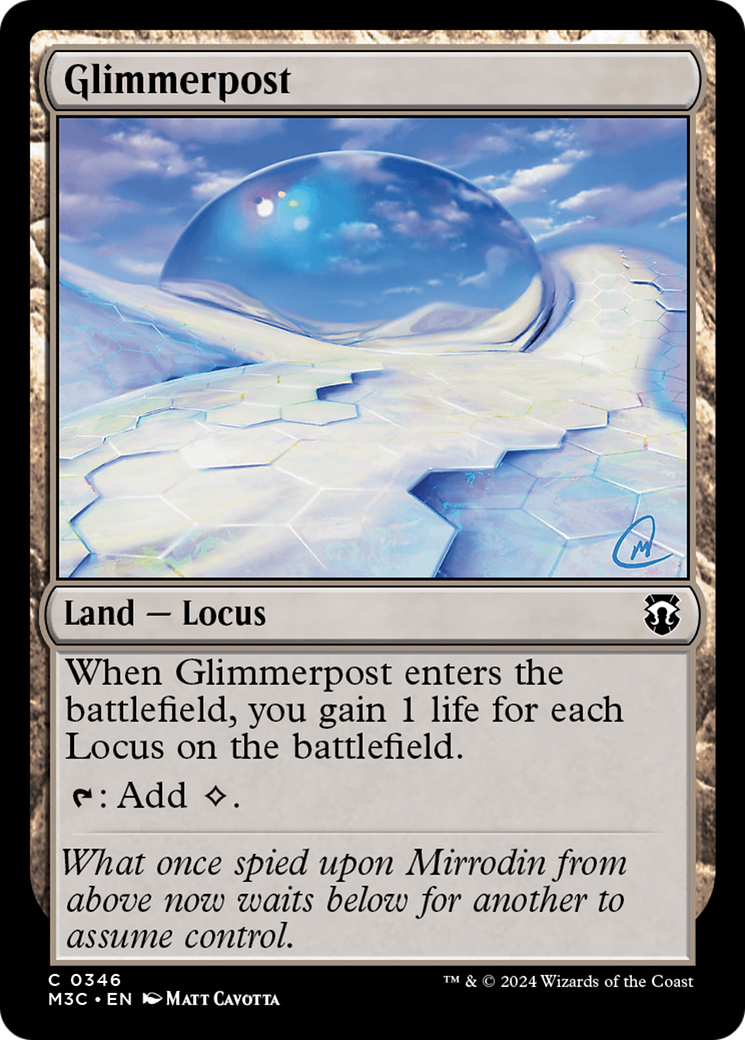
1
Glimmerpost
Glimmerpost
Land — Locus
When this land enters, you gain 1 life for each Locus on the battlefield.
: Add .
- As the triggered ability resolves, count each Locus on the battlefield regardless of who controls it.
-
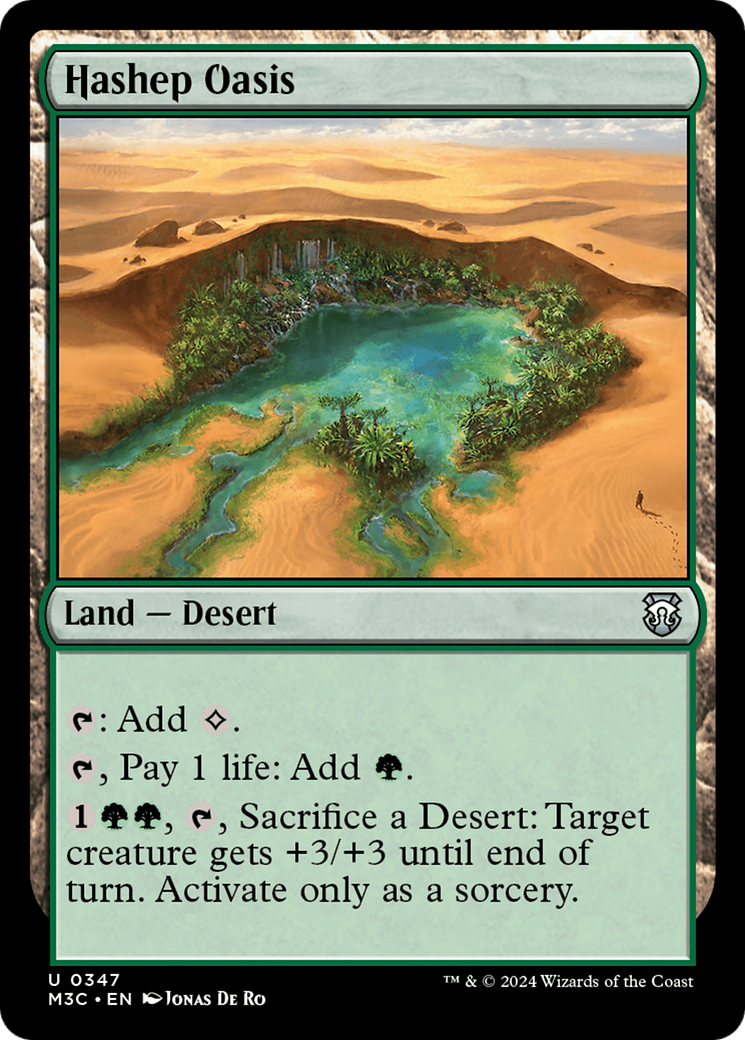
1
Hashep Oasis
Hashep Oasis
Land — Desert
: Add .
, Pay 1 life: Add .
, , Sacrifice a Desert: Target creature gets +3/+3 until end of turn. Activate only as a sorcery.
- If a Desert has an ability with a cost of "Sacrifice a Desert," you can sacrifice that Desert to pay the cost for its own ability.
- Desert is a land subtype with no special meaning. It doesn't grant the land an intrinsic mana ability. Other cards may care about which lands are Deserts.
-
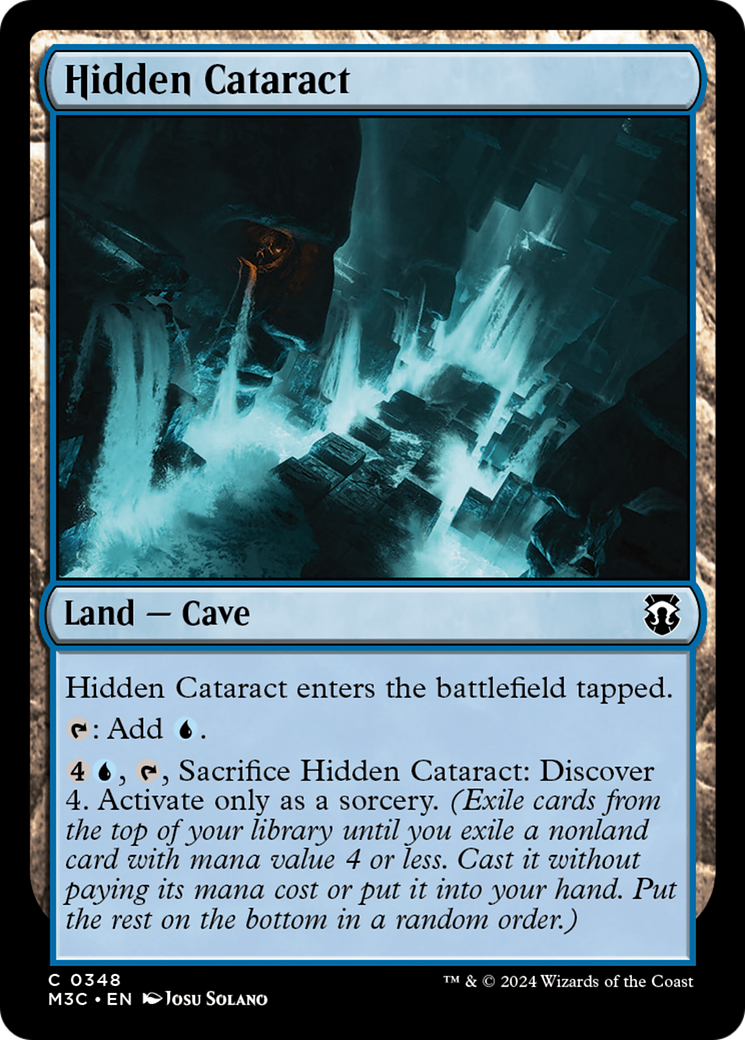
1
Hidden Cataract
Hidden Cataract
Land — Cave
This land enters tapped.
: Add .
, , Sacrifice this land: Discover 4. Activate only as a sorcery. (Exile cards from the top of your library until you exile a nonland card with mana value 4 or less. Cast it without paying its mana cost or put it into your hand. Put the rest on the bottom in a random order.)
- A spell's mana value is determined only by its mana cost. Ignore any alternative costs, additional costs, cost increases, or cost reductions.
- When you discover, you must exile cards. The only optional part of the ability is whether you cast the exiled card or put it into your hand.
- You exile the cards face up. All players will be able to see them.
- If you cast a spell "without paying its mana cost", you can't choose to cast it for any alternative costs. You can, however, pay additional costs. If the spell has any mandatory additional costs, you must pay those to cast it.
- If the discovered card has in its mana cost, you must choose 0 as the value of X when casting it without paying its mana cost.
- If you can't cast the discovered card (perhaps because there are no legal targets for the spell), you'll put it into your hand.
- Some spells and abilities that cause you to discover may require targets. If each target chosen is an illegal target as that spell or ability tries to resolve, it won't resolve and you won't discover.
- The mana value of a split card is determined by the combined mana cost of its two halves. If discover allows you to cast a split card, you may cast either half (as long as its mana value is less than or equal to the effect's discover value) but not both halves.
- If you discover an adventurer card, split card, or modal double-faced card, you might be able to cast that card with either set of characteristics depending on the effect's discover value. For example, if you discover 4 and reveal Galvanic Giant (an adventurer card from Wilds of Eldraine with a mana value of 4), you could cast Galvanic Giant, but not Storm Reading (its Adventure, which has a mana value of 7). If you discover 7 and reveal Galvanic Giant, you could cast either Galvanic Giant or Storm Reading.
-
1
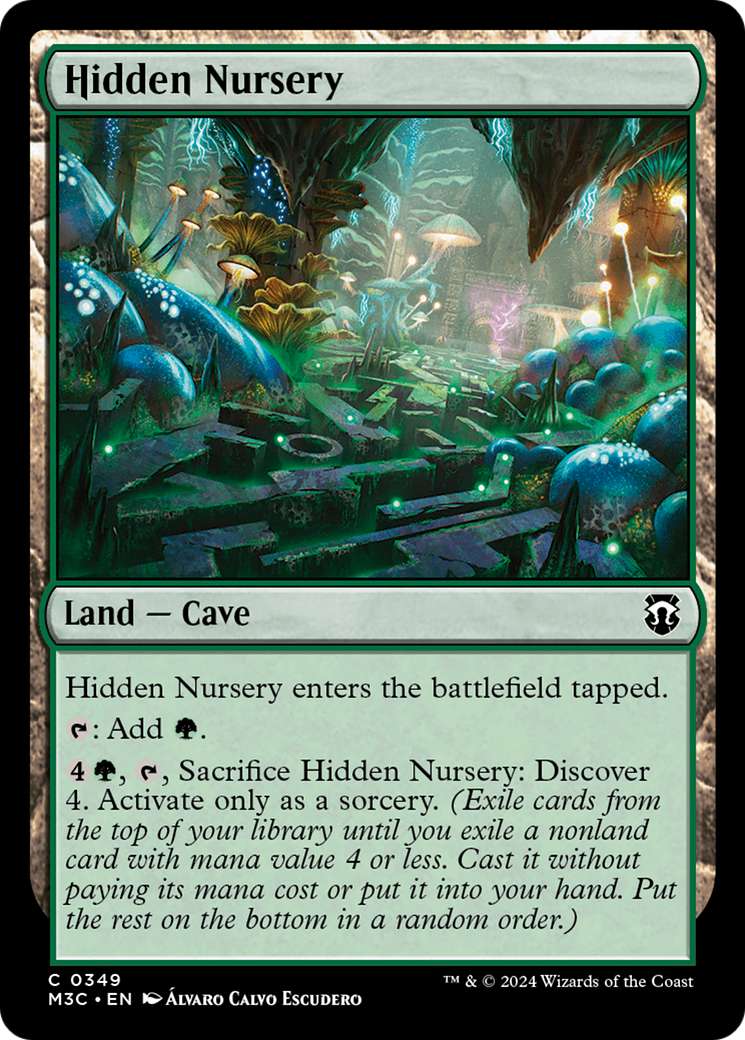
Hidden Nursery
Hidden Nursery
Land — Cave
This land enters tapped.
: Add .
, , Sacrifice this land: Discover 4. Activate only as a sorcery. (Exile cards from the top of your library until you exile a nonland card with mana value 4 or less. Cast it without paying its mana cost or put it into your hand. Put the rest on the bottom in a random order.)
- A spell's mana value is determined only by its mana cost. Ignore any alternative costs, additional costs, cost increases, or cost reductions.
- When you discover, you must exile cards. The only optional part of the ability is whether you cast the exiled card or put it into your hand.
- You exile the cards face up. All players will be able to see them.
- If you cast a spell "without paying its mana cost", you can't choose to cast it for any alternative costs. You can, however, pay additional costs. If the spell has any mandatory additional costs, you must pay those to cast it.
- If the discovered card has in its mana cost, you must choose 0 as the value of X when casting it without paying its mana cost.
- If you can't cast the discovered card (perhaps because there are no legal targets for the spell), you'll put it into your hand.
- Some spells and abilities that cause you to discover may require targets. If each target chosen is an illegal target as that spell or ability tries to resolve, it won't resolve and you won't discover.
- The mana value of a split card is determined by the combined mana cost of its two halves. If discover allows you to cast a split card, you may cast either half (as long as its mana value is less than or equal to the effect's discover value) but not both halves.
- If you discover an adventurer card, split card, or modal double-faced card, you might be able to cast that card with either set of characteristics depending on the effect's discover value. For example, if you discover 4 and reveal Galvanic Giant (an adventurer card from Wilds of Eldraine with a mana value of 4), you could cast Galvanic Giant, but not Storm Reading (its Adventure, which has a mana value of 7). If you discover 7 and reveal Galvanic Giant, you could cast either Galvanic Giant or Storm Reading.
-
1
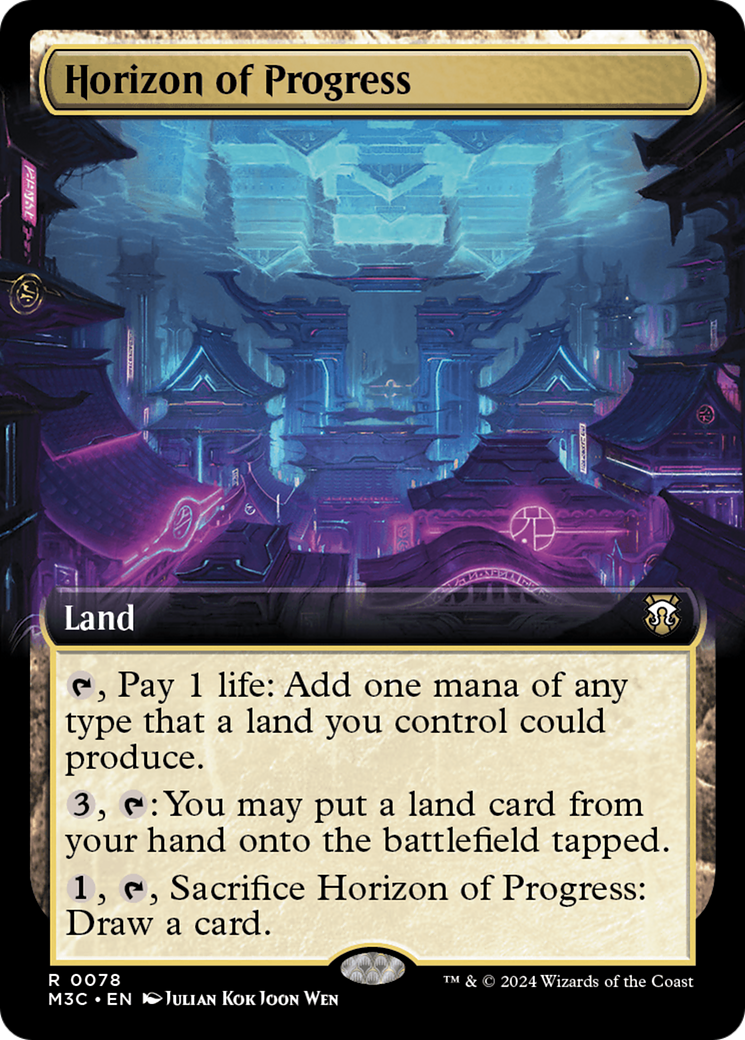
Horizon of Progress
Horizon of Progress
Land
, Pay 1 life: Add one mana of any type that a land you control could produce.
, : You may put a land card from your hand onto the battlefield tapped.
, , Sacrifice this land: Draw a card.
- The types of mana are white, blue, black, red, green, and colorless.
- Any change to a land's type or abilities gained by a land can affect the types of mana that land can produce.
- Horizon of Progress's first ability checks the effects of all mana-producing abilities of lands you control, but it doesn't check their costs or legality. For example, Spire of Industry says " , Pay 1 life: Add one mana of any color. Activate only if you control an artifact." If you control Spire of Industry and Horizon of Progress, Horizon of Progress's first ability can generate any color of mana. It doesn't matter whether you control an artifact or whether Spire of Industry is untapped.
-
3
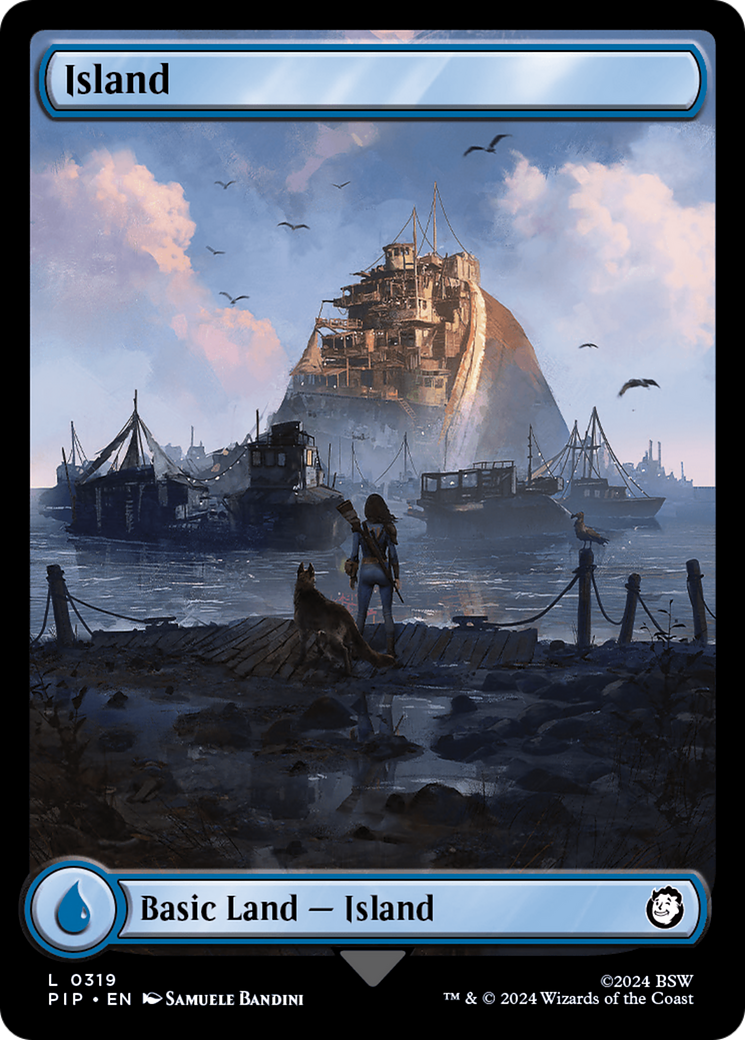
Island
Island
Basic Land — Island
( : Add .)
-
1
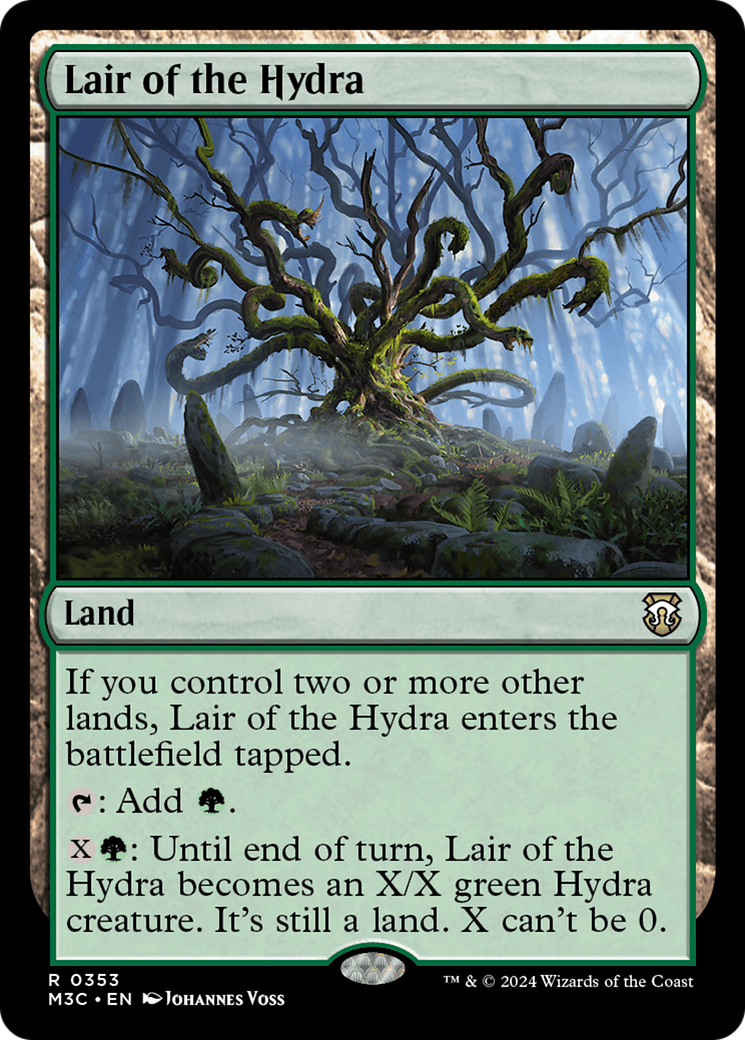
Lair of the Hydra
Lair of the Hydra
Land
If you control two or more other lands, this land enters tapped.
: Add .
: Until end of turn, this land becomes an X/X green Hydra creature. It's still a land. X can't be 0.
- If Lair of the Hydra enters the battlefield at the same time as one or more other lands, it doesn't take those lands into consideration when determining how many other lands you control.
- If you turn Lair of the Hydra into a creature but haven't controlled it continuously since your most recent turn began, you won't be able to activate its mana ability or attack with it.
-
1
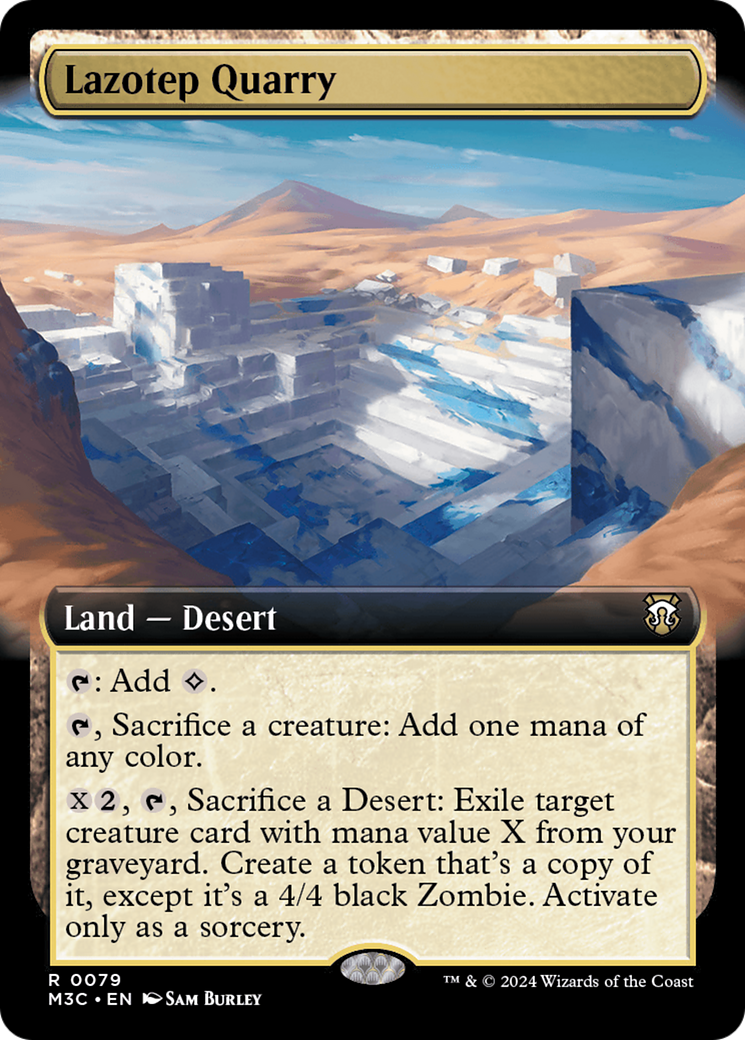
Lazotep Quarry
Lazotep Quarry
Land — Desert
: Add .
, Sacrifice a creature: Add one mana of any color.
, , Sacrifice a Desert: Exile target creature card with mana value X from your graveyard. Create a token that's a copy of it, except it's a 4/4 black Zombie. Activate only as a sorcery.
- Except for the listed exceptions, the token created by Lazotep Quarry's last ability copies exactly what was printed on the original card and nothing else. It doesn't copy any information about the object that card was before it was put into your graveyard.
- The token is a Zombie instead of its other creature types, and it's black instead of its other colors. These are copiable values of the token that other effects may copy.
- If the copied card has in its mana cost, is 0.
- If a card copied by the token had any "when [this creature] enters the battlefield" abilities, the token also has those abilities and will trigger them when it's created. Similarly, any "as [this creature] enters the battlefield" or "[this creature] enters the battlefield with" abilities that the token has copied will also work.
-
1
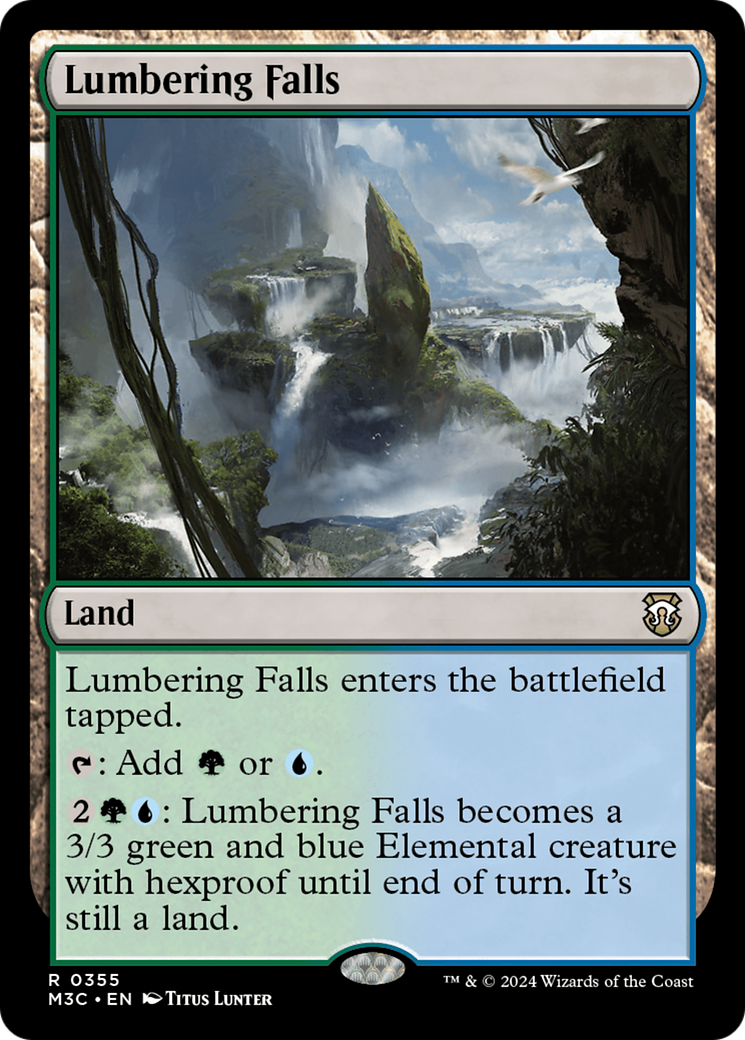
Lumbering Falls
Lumbering Falls
Land
This land enters tapped.
: Add or .
: This land becomes a 3/3 green and blue Elemental creature with hexproof until end of turn. It's still a land.
- A land that becomes a creature may be affected by "summoning sickness." You can't attack with it or use any of its abilities (including its mana abilities) unless it began your most recent turn on the battlefield under your control. Note that summoning sickness cares about when that permanent came under your control, not when it became a creature nor when it entered the battlefield.
- This land is colorless until the last ability gives it colors.
- When a land becomes a creature, that doesn't count as having a creature enter the battlefield. The permanent was already on the battlefield; it only changed its types. Abilities that trigger whenever a creature enters the battlefield won't trigger.
- An ability that turns a land into a creature also sets that creature's power and toughness. If the land was already a creature (for example, if it was the target of a spell with awaken), this will overwrite the previous effect that set its power and toughness. Effects that modify its power or toughness will continue to apply no matter when they started to take effect. The same is true for counters that change its power or toughness (such as +1/+1 counters) and effects that switch its power and toughness. For example, if Lumbering Falls has been made a 0/0 creature with three +1/+1 counters on it, activating its last ability will turn it into a 6/6 creature that's still a land.
-
1
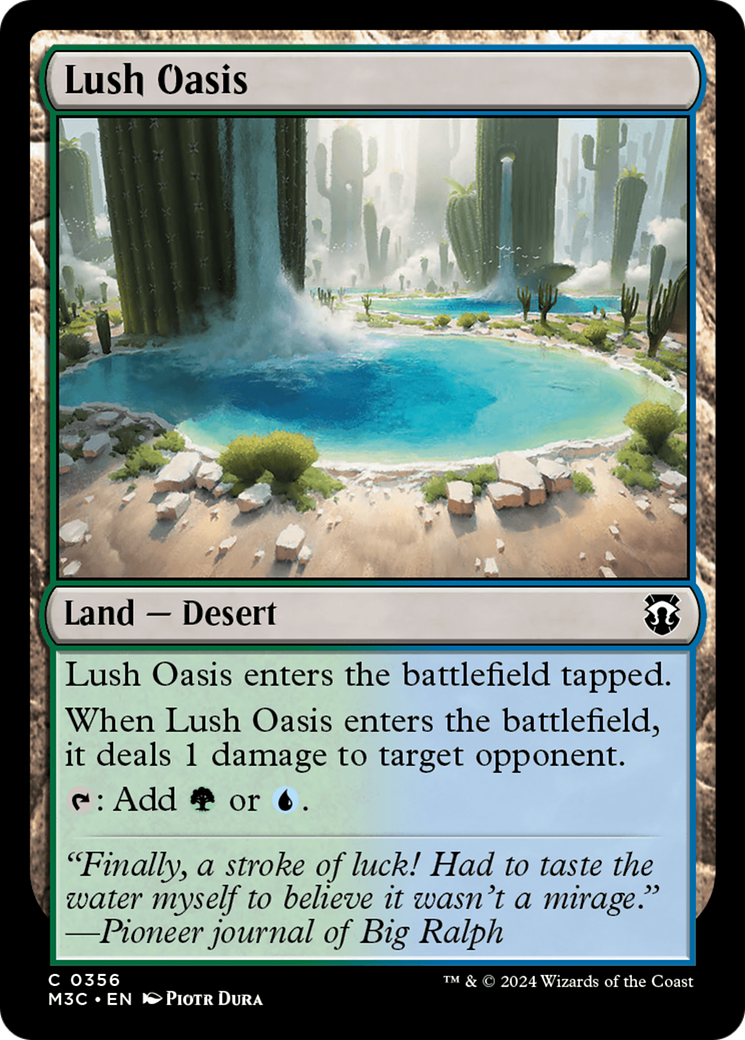
Lush Oasis
Lush Oasis
Land — Desert
This land enters tapped.
When this land enters, it deals 1 damage to target opponent.
: Add or .
- Desert is a land subtype with no special meaning. It doesn’t grant the land an intrinsic mana ability. Other cards may care about which lands are Deserts.
-
1
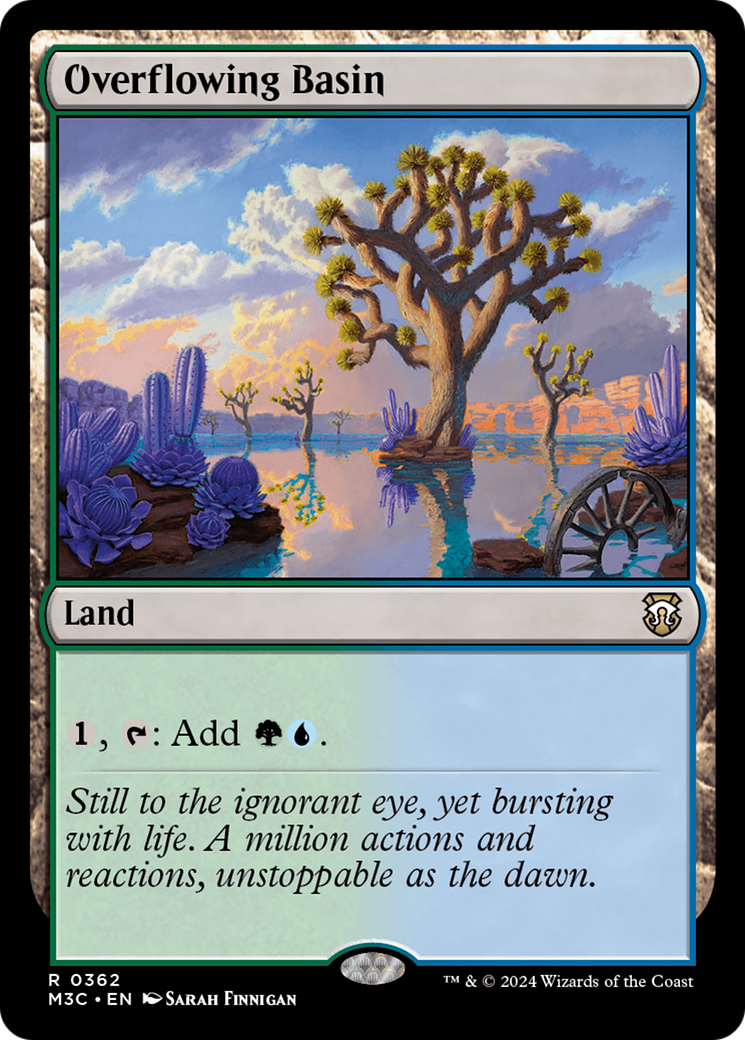
Overflowing Basin
Overflowing Basin
Land
, : Add .
-
1
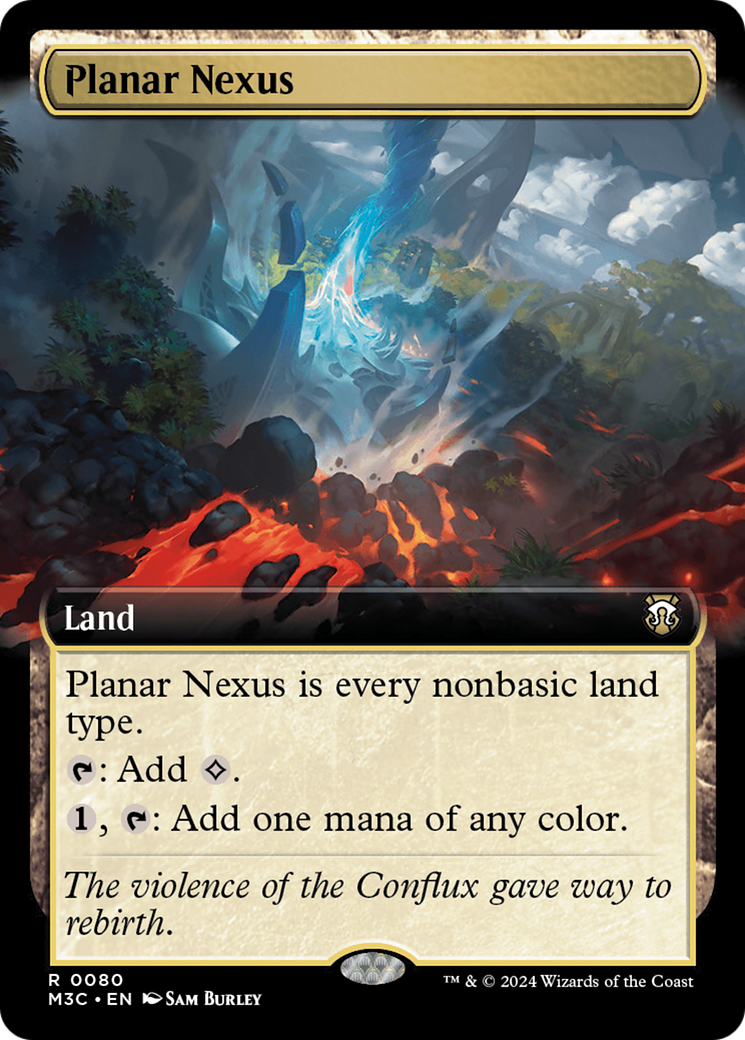
Planar Nexus
Planar Nexus
Land
This land is every nonbasic land type. (Nonbasic land types include Cave, Desert, Gate, Lair, Locus, Mine, Power-Plant, Sphere, Tower, and Urza's.)
: Add .
, : Add one mana of any color.
- The list of nonbasic land types in the reminder text is exhaustive as of the release of Modern Horizons 3. The full list of land types can always be found in the Comprehensive Rules of Magic.
- Since Planar Nexus has the subtypes Urza's, Mine, Power-Plant, and Tower, it will satisfy all of the requirements for the abilities of Urza's Mine, Urza's Power Plant, and Urza's Tower to add additional mana. For example, if you control Planar Nexus and Urza's Tower, the ability of Urza's Tower will add .
-
1
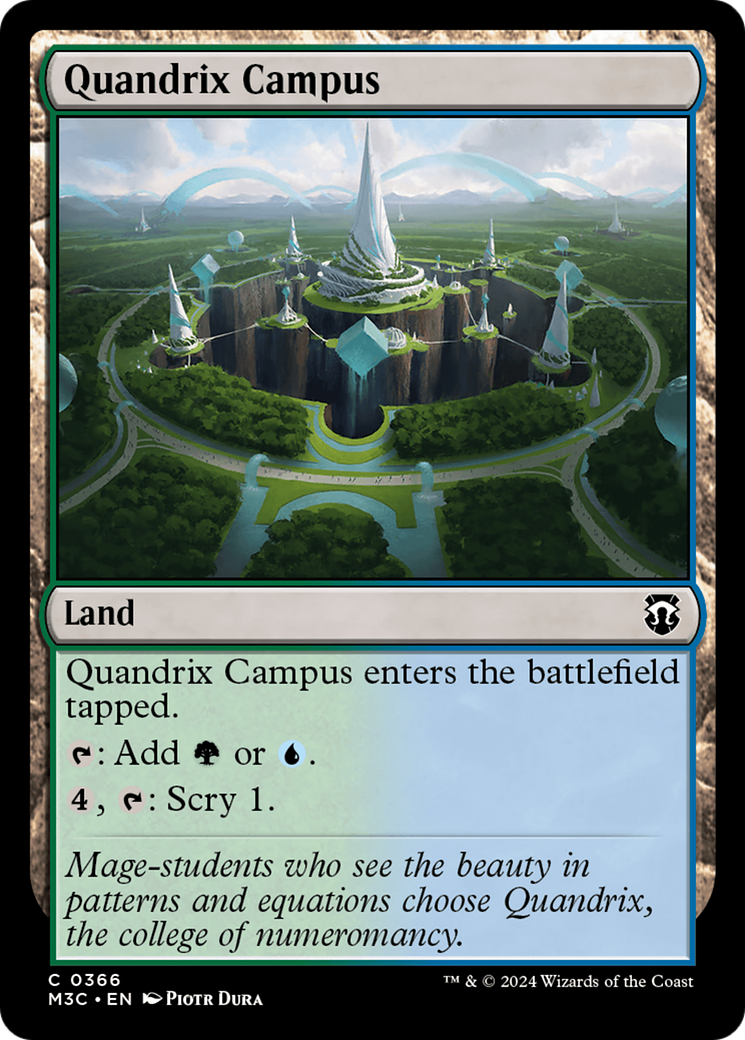
Quandrix Campus
Quandrix Campus
Land
This land enters tapped.
: Add or .
, : Scry 1.
-
1
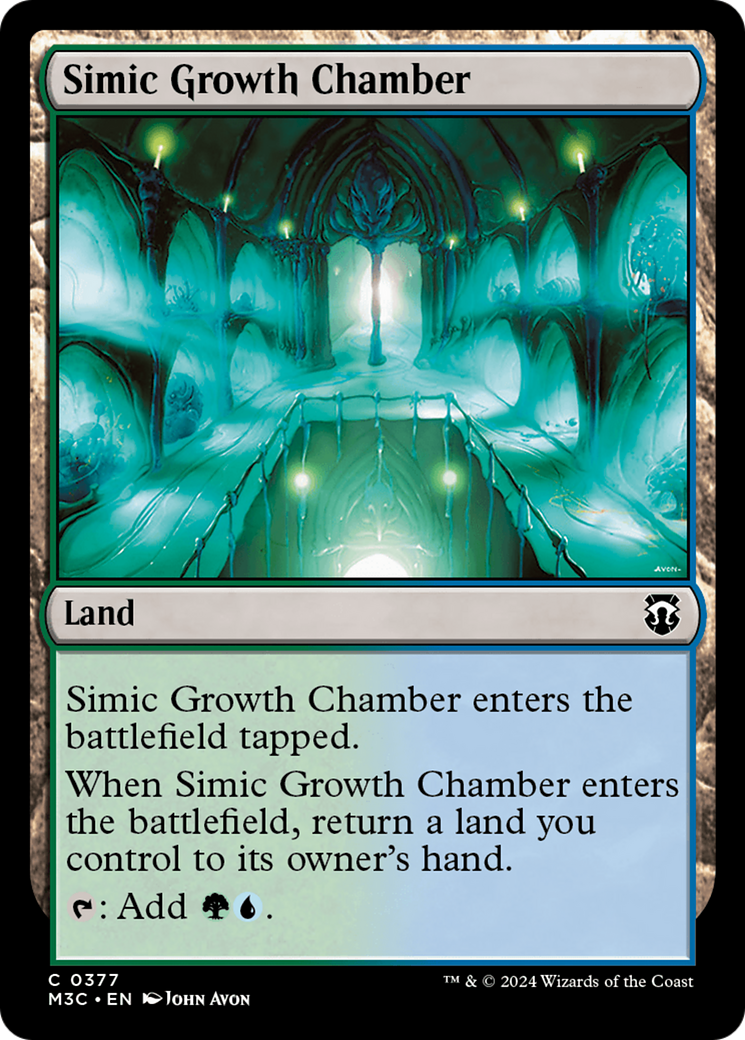
Simic Growth Chamber
Simic Growth Chamber
Land
This land enters tapped.
When this land enters, return a land you control to its owner's hand.
: Add .
- If this land enters the battlefield and you control no other lands, its ability will force you to return it to your hand.
-
1
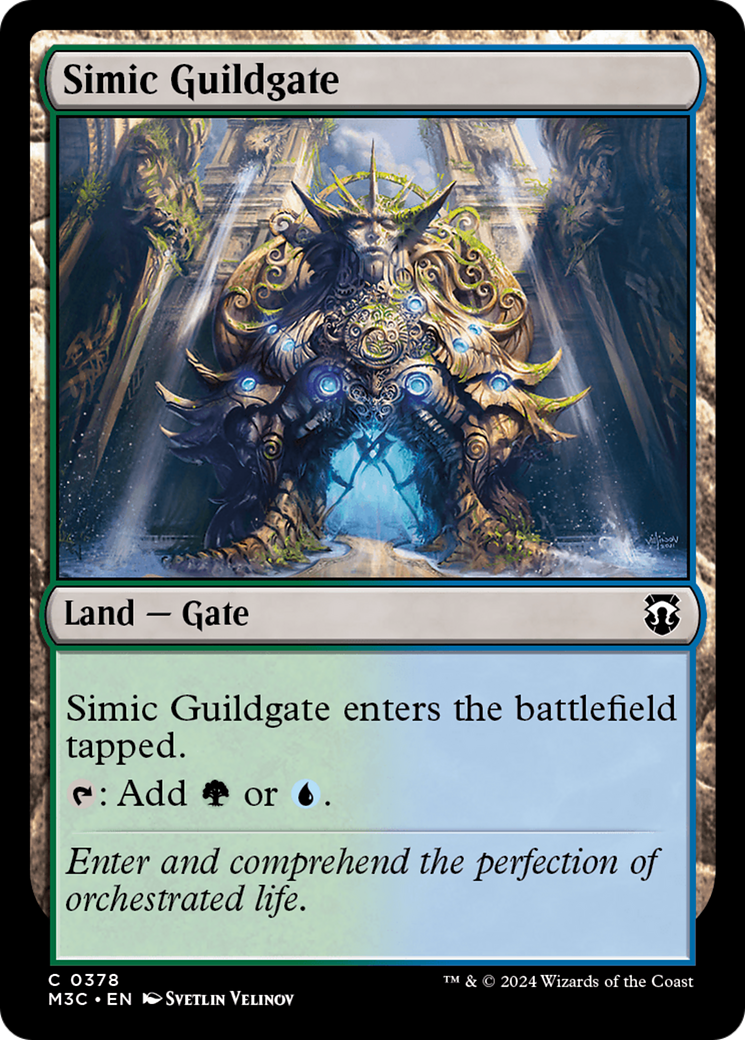
Simic Guildgate
Simic Guildgate
Land — Gate
This land enters tapped.
: Add or .
- The subtype Gate has no special rules significance, but other spells and abilities may refer to it.
- Gate is not a basic land type.
-
1
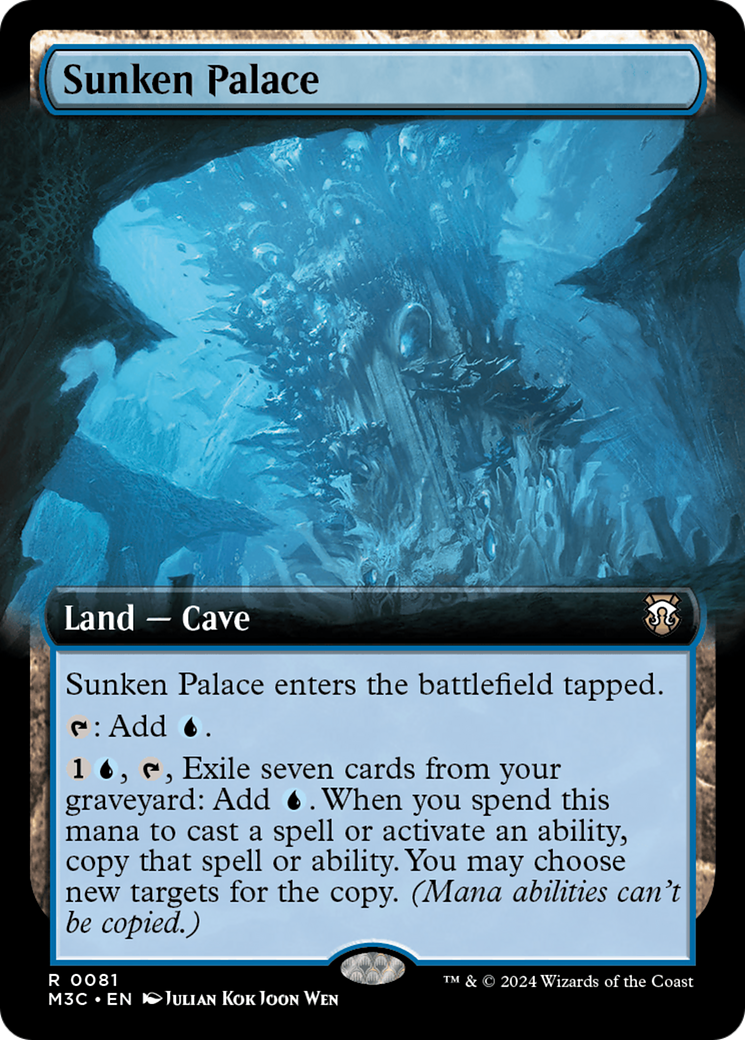
Sunken Palace
Sunken Palace
Land — Cave
This land enters tapped.
: Add .
, , Exile seven cards from your graveyard: Add . When you spend this mana to cast a spell or activate an ability, copy that spell or ability. You may choose new targets for the copy. (Mana abilities can't be copied.)
- Activated abilities contain a colon. They're generally written "[Cost]: [Effect]." Some keyword abilities are activated abilities and will have a colon in their reminder text.
- A copy is created even if the spell or ability that caused the delayed triggered ability to trigger has been countered by the time that delayed triggered ability resolves. The copy resolves before the original spell.
- The copy will have the same targets as the spell or ability it's copying unless you choose new ones. You may change any number of the targets, including all of them or none of them. If the spell is a permanent spell with targets, such as an Aura, you may also choose a new target for that spell. The new targets must be legal. If, for any target, you can't choose a new legal target, then it remains unchanged (even if the current target is illegal).
- The copy is created on the stack, so it's not "cast" or "activated." Creating the copy won't cause abilities that trigger when a player casts a spell or activates an ability to trigger.
- If the spell or ability that's copied is modal (that is, it says "Choose one —" or the like), the copy will have the same mode or modes. You can't choose different ones.
- If the spell or ability that's copied has an X whose value was determined as it was cast or activated, the copy will have the same value of X.
- If the spell or ability has damage divided as it was cast or activated, the division can't be changed (although the targets receiving that damage still can). The same is true of spells and abilities that distribute counters.
- The controller of a copy can't choose to pay any alternative or additional costs for the copy. However, effects based on any alternative or additional costs that were paid for the original spell are copied as though those same costs were paid for the copy.
- Resolving copies of permanent spells become tokens as they enter the battlefield. These tokens are not considered "created" when this happens.
-
1
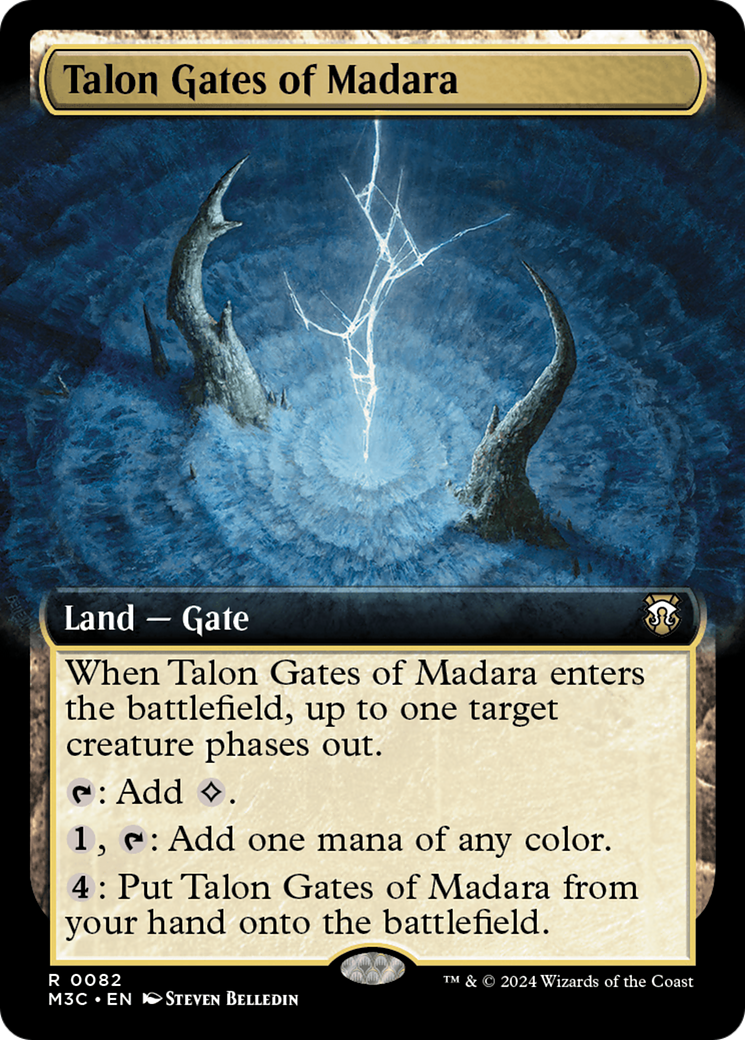
Talon Gates of Madara
Talon Gates of Madara
Land — Gate
When this land enters, up to one target creature phases out.
: Add .
, : Add one mana of any color.
: Put this card from your hand onto the battlefield.
- Phased-out permanents are treated as though they don't exist. They can't be the targets of spells or abilities, their static abilities have no effect on the game, their triggered abilities can't trigger, they can't attack or block, and so on.
- As a permanent is phased out, Auras and Equipment attached to it also phase out at the same time. Those Auras and Equipment will phase in at the same time that permanent does, and they'll phase in still attached to that permanent.
- Permanents phase back in during their controller's untap step, immediately before that player untaps their permanents. Creatures that phase in this way are able to attack during that turn, and their activated abilities with in their costs can be activated. If a permanent had counters on it when it phased out, it will have those counters when it phases back in.
- An attacking or blocking creature that phases out is removed from combat.
- Phasing out doesn't cause any "leaves the battlefield" abilities to trigger. Similarly, phasing in won't cause any "enters the battlefield" abilities to trigger.
- Any continuous effects with a "for as long as" duration ignore phased-out objects. If ignoring those objects causes the effect's conditions to no longer be met, the duration will expire.
- Choices made for permanents as they entered the battlefield are remembered when they phase in.
- When you activate Talon Gates of Madara's last ability, you must reveal Talon Gates of Madara from your hand until that ability resolves or otherwise leaves the stack. If Talon Gates of Madara isn't still in your hand as that ability resolves, nothing happens.
-
1
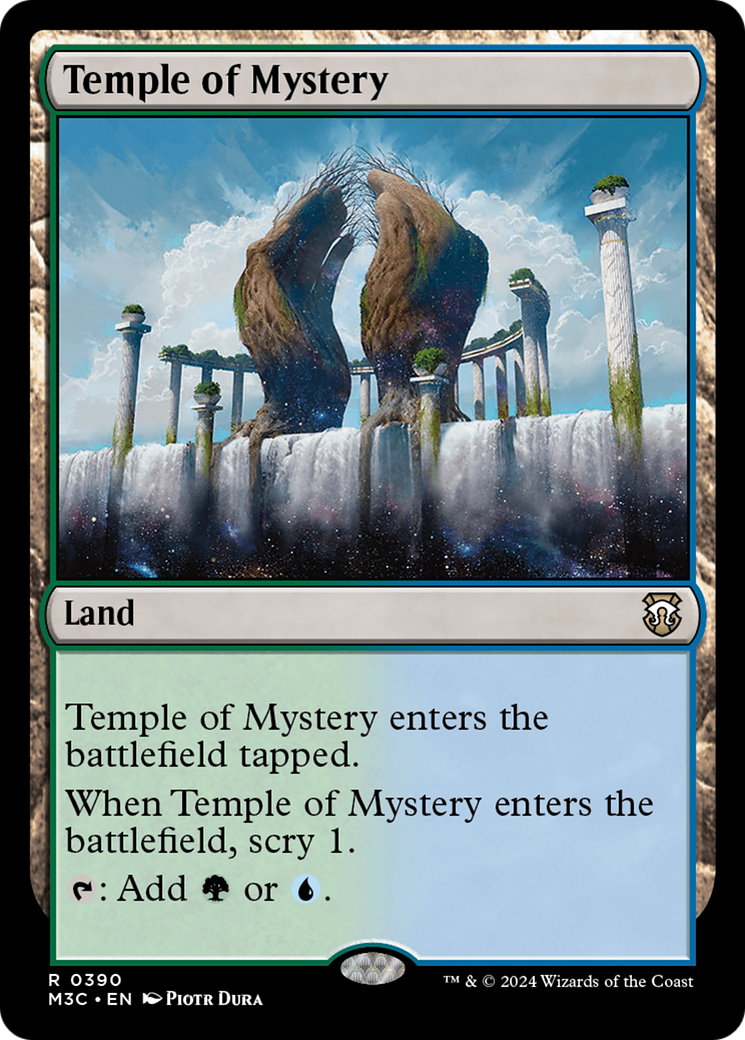
Temple of Mystery
Temple of Mystery
Land
This land enters tapped.
When this land enters, scry 1. (Look at the top card of your library. You may put that card on the bottom.)
: Add or .
- When you scry, you may put all the cards you look at back on top of your library, you may put all of those cards on the bottom of your library, or you may put some of those cards on top and the rest of them on the bottom.
- You choose how to order cards returned to your library after scrying no matter where you put them.
- You perform the actions stated on a card in sequence. For some spells and abilities, that means you'll scry last. For others, that means you'll scry and then perform other actions.
- Scry appears on some spells and abilities with one or more targets. If all of the spell or ability's targets are illegal when it tries to resolve, it won't resolve and none of its effects will happen. You won't scry.
-
1
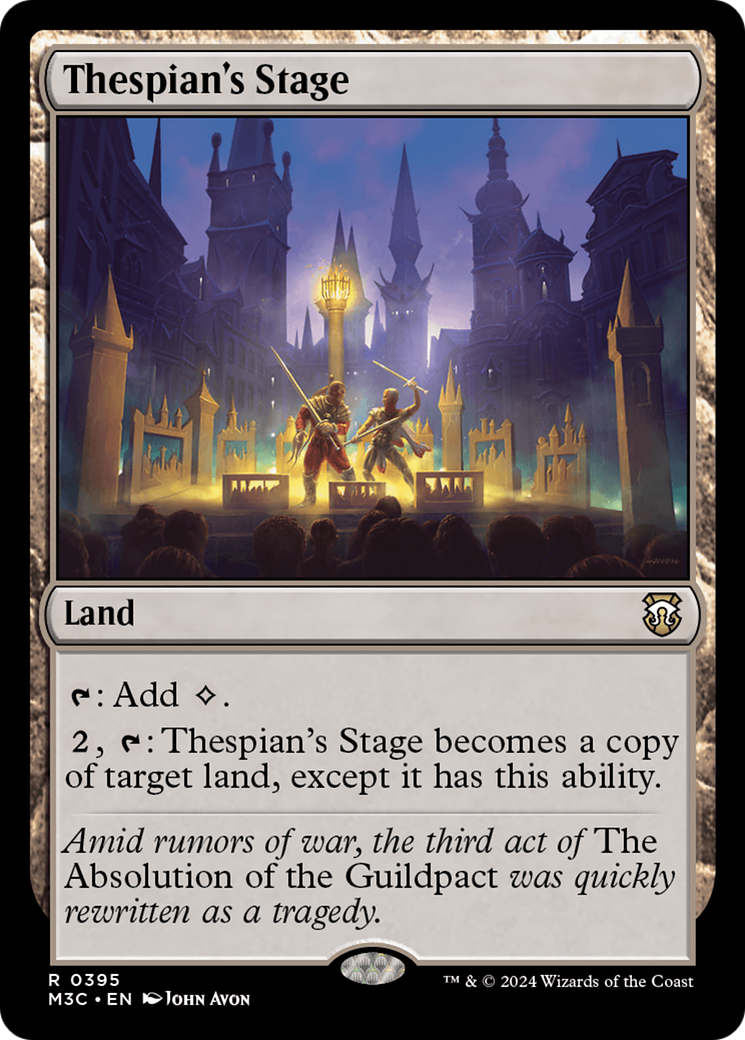
Thespian's Stage
Thespian's Stage
Land
: Add .
, : This land becomes a copy of target land, except it has this ability.
- The copy effect created by the last activated ability doesn't have a duration. It will last until Thespian's Stage leaves the battlefield or another copy effect overwrites it. The permanent will no longer have the first ability of Thespian's Stage.
- A land's copiable values are those printed on it, as modified by other copy effects. Counters and other effects aren't copied. Notably, if you copy a land that is also a creature because of a temporary effect (such as Celestial Colonnade), Thespian's Stage will become just the "unanimated" land.
- Thespian's Stage doesn't become untapped when it becomes a copy, even if the target land is untapped.
- No enters-the-battlefield abilities of the land Thespian's Stage is copying will trigger. Thespian's Stage was already on the battlefield. Similarly, no "as this land enters the battlefield" or "this land enters the battlefield with" effects, such as that of Dark Depths, will apply.
-
1
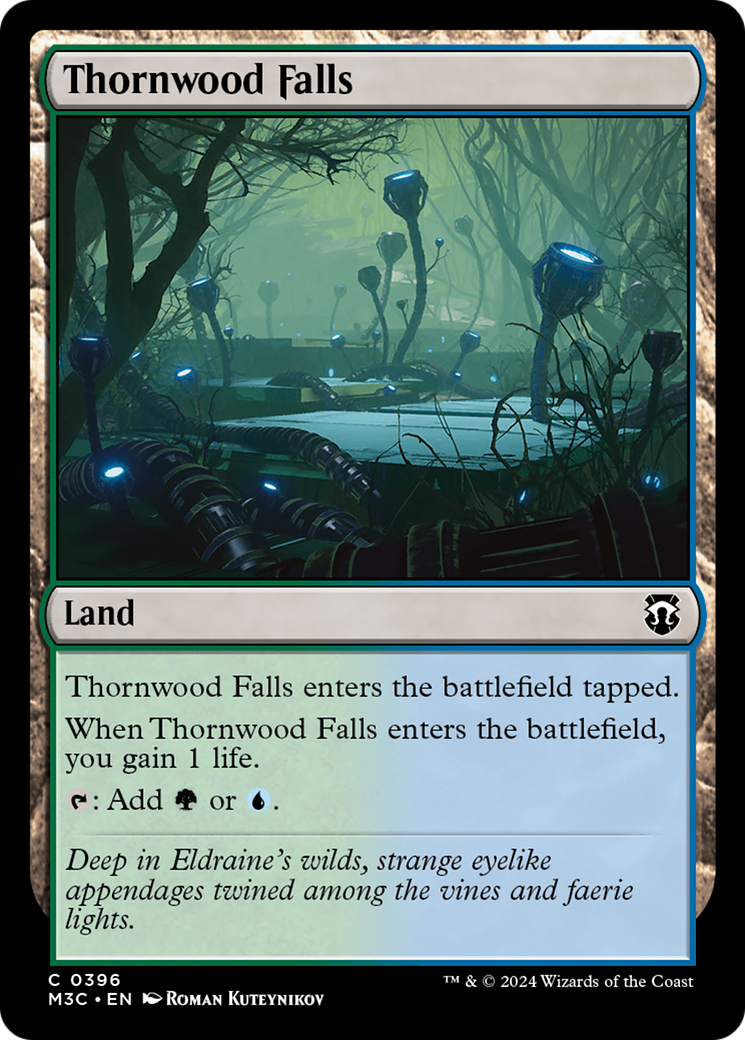
Thornwood Falls
Thornwood Falls
Land
This land enters tapped.
When this land enters, you gain 1 life.
: Add or .
-
1
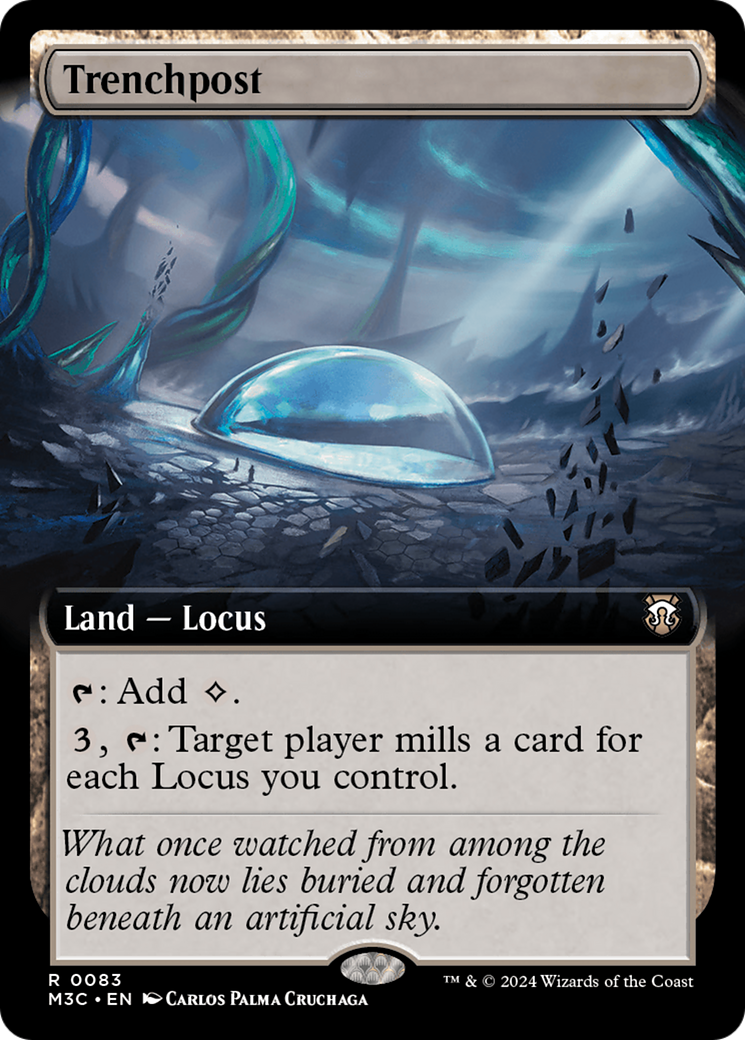
Trenchpost
Trenchpost
Land — Locus
: Add .
, : Target player mills a card for each Locus you control.
-
1
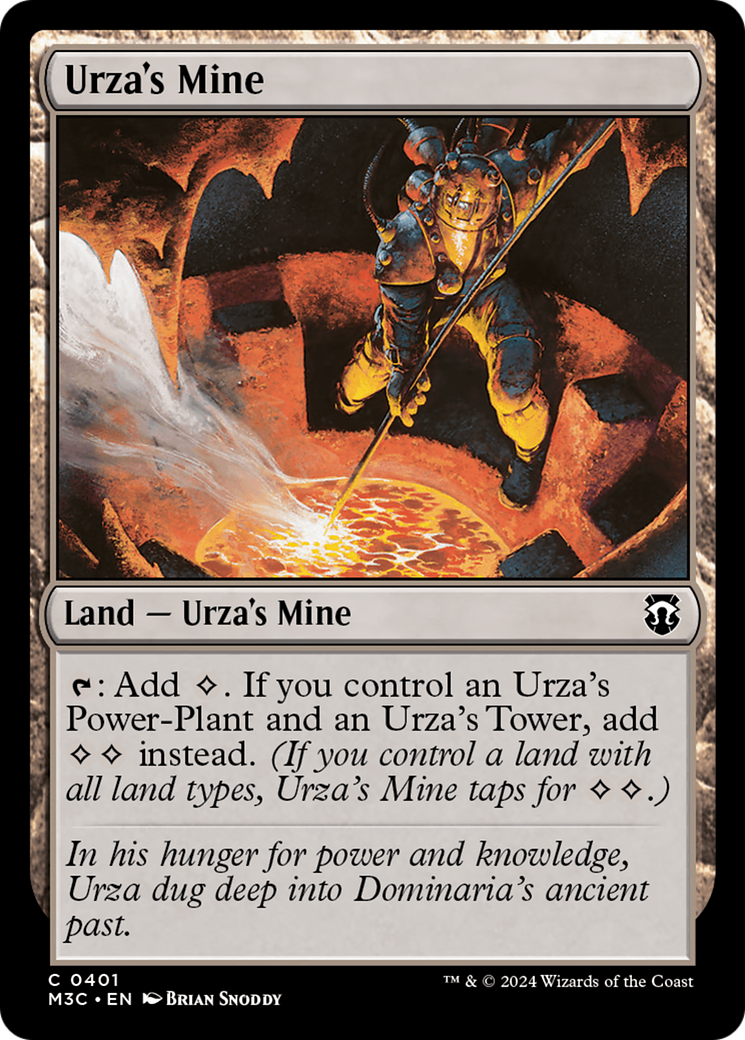
Urza's Mine
Urza's Mine
Land — Urza's Mine
: Add . If you control an Urza's Power-Plant and an Urza's Tower, add instead.
- The ability checks for land types, not the names of other permanents you control.
- If you have at least one of each of the three Urza's lands on the battlefield, you must take the 2 mana instead of just one.
-
1
Urza's Power Plant
Urza's Power Plant
Land — Urza's Power-Plant
: Add . If you control an Urza's Mine and an Urza's Tower, add instead.
- The ability checks for land types, not the names of other permanents you control.
- If you have at least one of each of the three Urza's lands on the battlefield, you must take the 2 mana instead of just one.
-
1
Urza's Tower
Urza's Tower
Land — Urza's Tower
: Add . If you control an Urza's Mine and an Urza's Power-Plant, add instead.
- The ability checks for land types, not the names of other permanents you control.
-
1
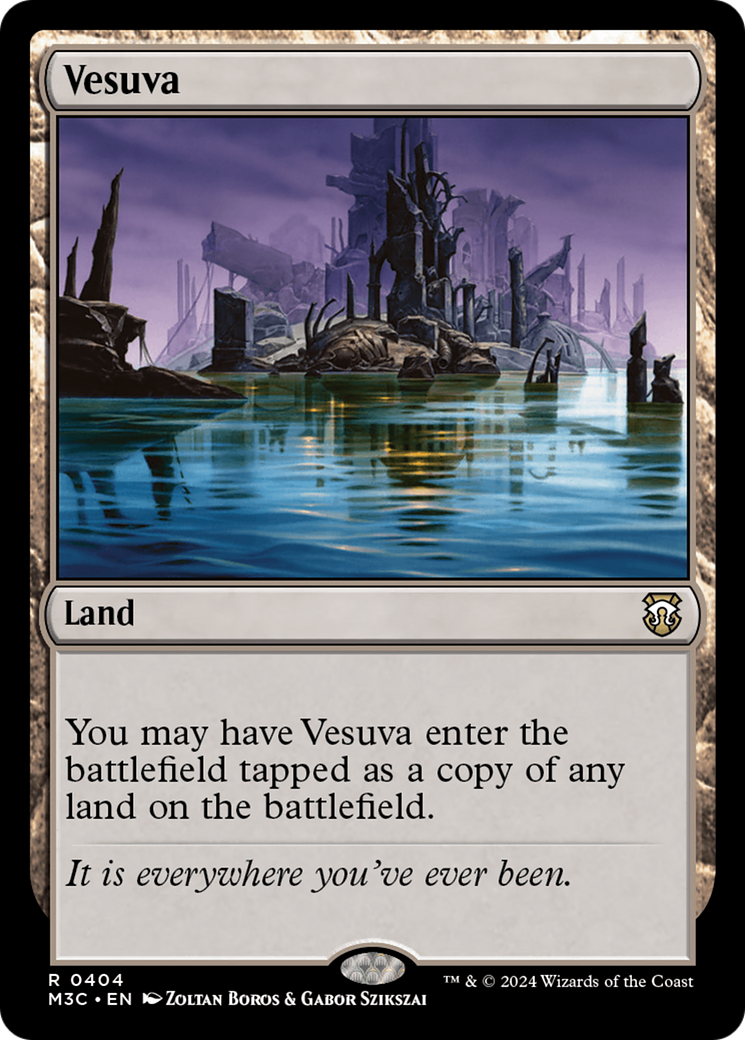
Vesuva
Vesuva
Land
You may have this land enter tapped as a copy of any land on the battlefield.
- Vesuva copies exactly what is printed on the land it's copying and nothing else (unless it's copying a land that's copying something else; see below). It doesn't copy whether a land is tapped or untapped, whether it has any counters on it or Auras attached to it, or any non-copy effects that changed its types, and so on.
- If the copied land is copying something else, Vesuva uses the copiable values of that land. In most cases, Vesuva will be a copy of whatever that land is copying.
- Any enters-the-battlefield abilities of the copied land will trigger if Vesuva is entering the battlefield. Any "As [this land] enters the battlefield" or "[This land] enters the battlefield with" abilities of the copied land will also work.
- If Vesuva somehow enters the battlefield at the same time as another land, Vesuva can't become a copy of that land. You may choose only a land that's already on the battlefield.
- If you don't choose a land on the battlefield, Vesuva enters the battlefield untapped as itself, and will not be able to tap for mana.
-
1
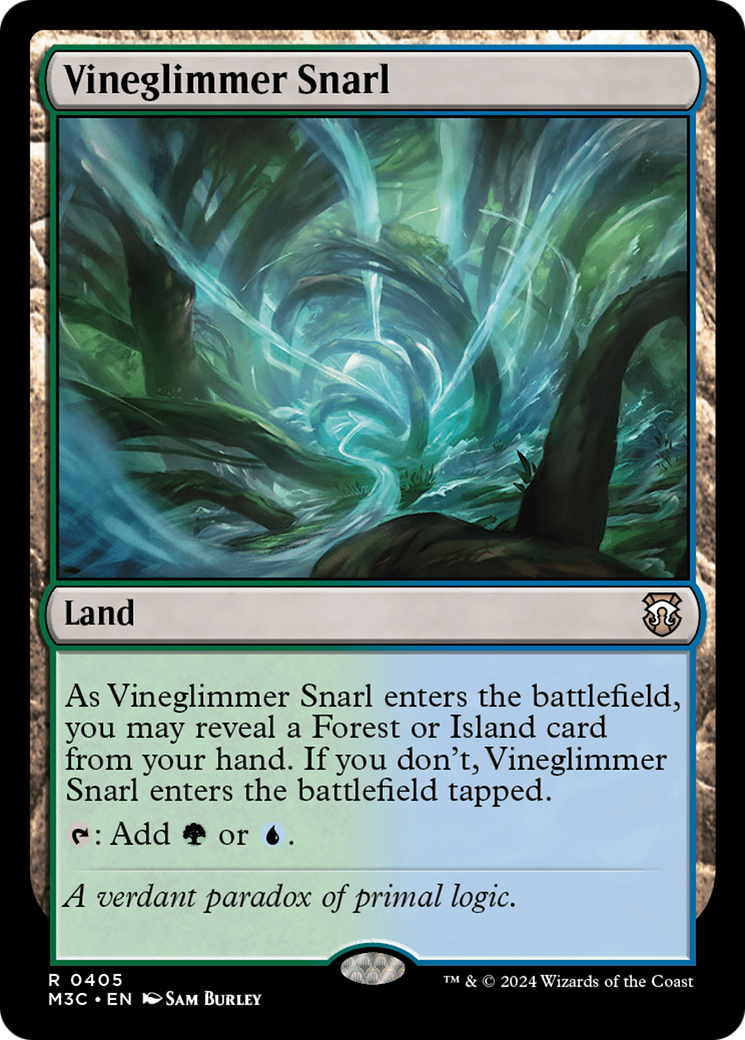
Vineglimmer Snarl
Vineglimmer Snarl
Land
As this land enters, you may reveal a Forest or Island card from your hand. If you don't, this land enters tapped.
: Add or .
- You may reveal any land card with either or both of the appropriate subtypes. It doesn't have to be a basic land card.
- The "Snarl" itself doesn't have any land subtypes. You can't reveal one to satisfy the ability of another.
- If a land card with an appropriate subtype is entering the battlefield from your hand at the same time as one of these lands, you may reveal the other land to have the "Snarl" enter untapped.
- If an effect instructs you to put one of these lands onto the battlefield tapped, it will still enter the battlefield tapped even if you reveal a land card from your hand.
-
1
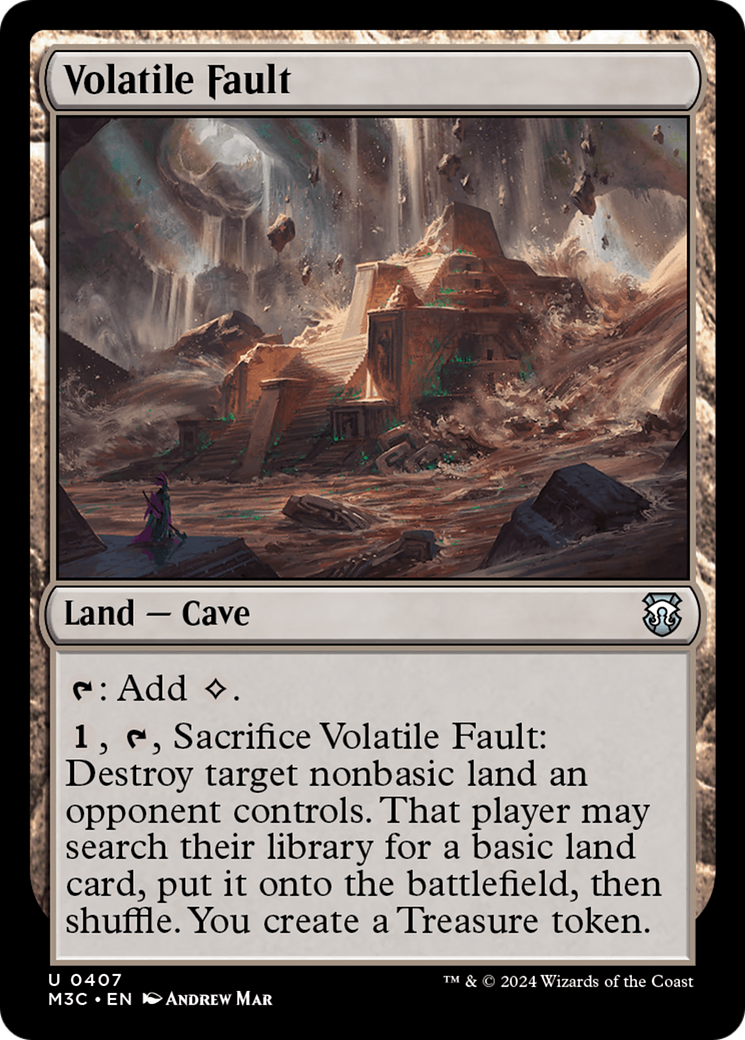
Volatile Fault
Volatile Fault
Land — Cave
: Add .
, , Sacrifice this land: Destroy target nonbasic land an opponent controls. That player may search their library for a basic land card, put it onto the battlefield, then shuffle. You create a Treasure token.
- If the target of Volatile Fault's last ability is illegal as the ability tries to resolve, it won't resolve and none of its effects will happen. You won't create a Treasure token.
- If Volatile Fault's ability resolves, the target nonbasic land's controller gets to search for a basic land card even if the land wasn't destroyed by Volatile Fault's ability. This may happen because the land has indestructible. In this case, you'll still create a Treasure token.
-
1
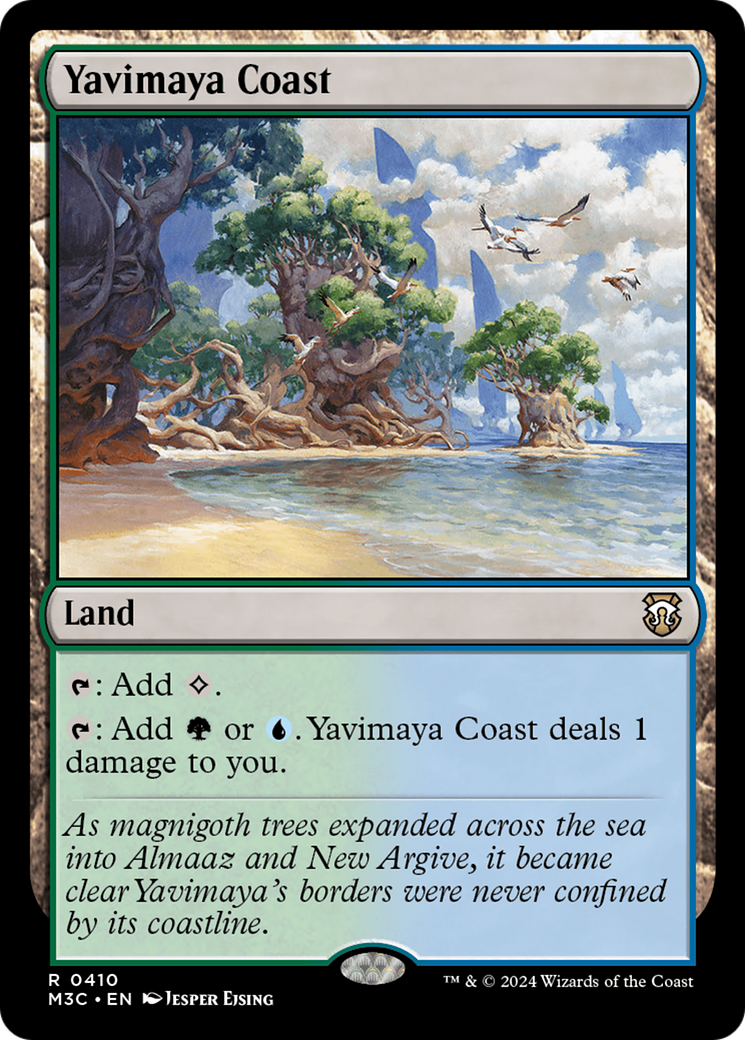
Yavimaya Coast
Yavimaya Coast
Land
: Add .
: Add or . This land deals 1 damage to you.
- Like most lands, each land in this cycle is colorless. The damage dealt to you is dealt by a colorless source.
- The damage dealt to you is part of the second mana ability. It doesn't use the stack and can't be responded to.
-
1
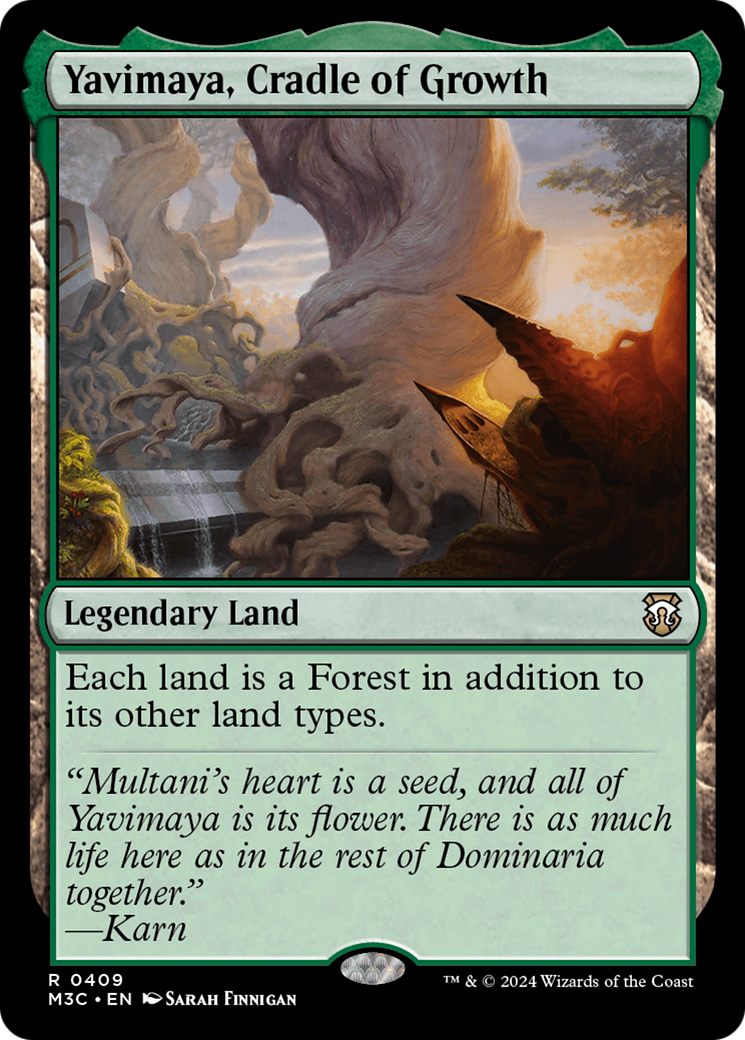
Yavimaya, Cradle of Growth
Yavimaya, Cradle of Growth
Legendary Land
Each land is a Forest in addition to its other land types.
- Yavimaya, Cradle of Growth isn't a Forest while it's not on the battlefield.
- Land cards not on the battlefield aren't Forests while Yavimaya is on the battlefield.
- Yavimaya's ability causes each land on the battlefield to have the land type Forest. Any land that's a Forest has the ability " : Add ." Nothing else changes about those lands, including their names, other subtypes, and whether they're legendary, basic, or snow.
Blue 14
-
1
Arcane Denial
Arcane Denial
Instant
Counter target spell. Its controller may draw up to two cards at the beginning of the next turn's upkeep.
You draw a card at the beginning of the next turn's upkeep.
- The controller of the countered spell doesn't choose how many cards to draw until the relevant ability resolves. The player may draw 0, 1, or 2 cards. They choose the number before drawing any cards.
-
1
Copy Land
Copy Land
Enchantment
You may have this enchantment enter as a copy of any land on the battlefield, except it's an enchantment in addition to its other types.
- Copy Land copies exactly what was printed on the original permanent and nothing more, with the listed exception (unless that permanent is itself copying something or is a token; see below). It doesn't copy whether that permanent is tapped or untapped, whether it has any counters on it or Auras attached to it, or any non-copy effects that have changed its power, toughness, types, color, and so on.
- In the unusual case where the chosen permanent has in its mana cost, X is 0.
- If the chosen permanent is copying something else (for example, if the chosen permanent is another Copy Land), then your Copy Land enters the battlefield as whatever the chosen permanent copied, with the listed exception.
- If the chosen permanent is a token, Copy Land copies the original characteristics of that token as stated by the effect that created the token, with the listed exception. Copy Land does not become a token.
- Any enters-the-battlefield abilities of the copied permanent will trigger when Copy Land enters the battlefield. Any "as [this land] enters the battlefield" or "[this land] enters the battlefield with" abilities of the chosen permanent will also work.
- If Copy Land somehow enters the battlefield at the same time as another permanent, Copy Land can't become a copy of that permanent. You may choose only a permanent that's already on the battlefield.
- You can choose not to copy anything. In that case, Copy Land simply enters the battlefield as an enchantment with an irrelevant ability. We're sure you had your reasons.
-
1
Curse of the Swine
Curse of the Swine
Sorcery
Exile X target creatures. For each creature exiled this way, its controller creates a 2/2 green Boar creature token.
-
1
Drown in Dreams
Drown in Dreams
Instant
Choose one. If you control a commander as you cast this spell, you may choose both instead.
- Target player draws X cards.
- Target player mills twice X cards.
- Controlling a commander means that you control a permanent on the battlefield that is someone's commander. It can be yours or another player's. Controlling a commander spell on the stack will not allow you to choose both modes.
- You may target the same player with both modes or target different players. The effects happen in the order they're listed on the card.
-
1
Evacuation
Evacuation
Instant
Return all creatures to their owners' hands.
-
1
Finale of Revelation
Finale of Revelation
Sorcery
Draw X cards. If X is 10 or more, instead shuffle your graveyard into your library, draw X cards, untap up to five lands, and you have no maximum hand size for the rest of the game.
Exile Finale of Revelation.
-
1
Fog Bank
Fog Bank
Creature — Wall
0/2
Defender (This creature can't attack.)
Flying
Prevent all combat damage that would be dealt to and dealt by this creature.
- Fog Bank's prevention effect isn't considered while assigning combat damage from a creature with trample. For example, if it blocks a 5/5 creature with trample, that creature's controller must assign 2 of that creature's combat damage to Fog Bank and the remainder can be assigned to the defending player, planeswalker, or battle.
-
1
March from Velis Vel
March from Velis Vel
Sorcery
Choose a nonbasic land type. Each land you control of that type becomes a copy of target creature you control until end of turn and gains haste until end of turn.
Flashback (You may cast this card from your graveyard for its flashback cost. Then exile it.)
- The lands copy exactly what was printed on the original creature and nothing else (unless that permanent is copying something else; see below). They don't copy whether that creature is tapped or untapped, whether it has any counters on it or Auras and Equipment attached to it, and so on.
- If the copied creature has in its mana cost, X is 0.
- If the copied creature is copying something else, then the lands become copies of whatever that creature copied.
- Because the lands aren't entering the battlefield when they become copies of the creature, any "When [this creature] enters the battlefield" or "[This creature] enters the battlefield with" abilities of the copied creature won't apply.
- "Flashback [cost]" means "You may cast this card from your graveyard by paying [cost] rather than paying its mana cost" and "If the flashback cost was paid, exile this card instead of putting it anywhere else any time it would leave the stack."
- You must still follow any timing restrictions and permissions, including those based on the card's type. For instance, you can cast a sorcery using flashback only when you could normally cast a sorcery.
- To determine the total cost of a spell, start with the mana cost or alternative cost (such as a flashback cost) you're paying, add any cost increases, then apply any cost reductions. The mana value of the spell is determined only by its mana cost, no matter what the total cost to cast the spell was.
- A spell cast using flashback will always be exiled afterward, whether it resolves, is countered, or leaves the stack in some other way.
- You can cast a spell using flashback even if it was somehow put into your graveyard without having been cast.
- If a card with flashback is put into your graveyard during your turn, you can cast it if it's legal to do so before any other player can take any actions.
-
1
Pongify
Pongify
Instant
Destroy target creature. It can't be regenerated. Its controller creates a 3/3 green Ape creature token.
- If the target creature is an illegal target by the time Pongify tries to resolve, the spell won't resolve. No player creates an Ape token. If the target is legal but not destroyed (most likely because it has indestructible), its controller does create an Ape token.
-
1
Propaganda
Propaganda
Enchantment
Creatures can't attack you unless their controller pays for each creature they control that's attacking you.
- The payment is made during the declare attackers step at the same time you are declaring the attacker.
- If there are multiple attacks in a turn, then you have to pay for each attack.
- If there is more than one Propaganda on the battlefield, the cost is cumulative.
- Paying this cost is not an instant or any other kind of ability, it is an additional cost on the declaration of the attacker.
-
1
Replication Technique
Replication Technique
Sorcery
Demonstrate (When you cast this spell, you may copy it. If you do, choose an opponent to also copy it. Players may choose new targets for their copies.)
Create a token that's a copy of target permanent you control.
- If the spell requires targets, you choose the target of the original spell as you cast it. If you create a copy of the spell, you may choose new targets for the copy as you create that copy. Similarly, the opponent you chose to create a copy may choose new targets for that copy as it's created. In other words, your opponent will know the targets of your original spell and your copy when choosing the new targets, if any, for their copy.
- If you copy a spell with demonstrate, you then immediately choose an opponent. If they copy the spell, it goes on top of the stack.
- You choose whether to make a copy as the demonstrate ability resolves. This happens before the original spell resolves. Your copy goes on the stack above the original spell.
- This means that if you cast a spell with demonstrate and both you and an opponent copy it, the opponent's copy will resolve first, then your copy will resolve, and finally the original spell will resolve.
- If you cast the spell and choose not to copy it, no opponent will get to copy it either.
-
1
Summary Dismissal
Summary Dismissal
Instant
Exile all other spells and counter all abilities.
- Spells that can’t be countered are exiled by Summary Dismissal. They won’t resolve.
- Only activated and triggered abilities on the stack are countered. Static abilities of objects remain unaffected, and activated and triggered abilities of objects may be activated or may trigger again later in the turn. Spells and abilities that have already resolved aren’t affected.
-
1
Treasure Cruise
Treasure Cruise
Sorcery
Delve (Each card you exile from your graveyard while casting this spell pays for .)
Draw three cards.
- Delve doesn't change a spell's mana cost or mana value. For example, Treasure Cruise's mana value is 8 even if you exiled three cards to cast it.
- You can exile cards to pay only for generic mana, and you can't exile more cards than the generic mana requirement of a spell with delve. For example, you can't exile more than seven cards from your graveyard to cast Treasure Cruise unless an effect has increased its cost.
- Because delve isn't an alternative cost, it can be used in conjunction with alternative costs, such as flashback. It can also be used to pay for additional costs that include generic mana.
-
1
Wonderscape Sage
Wonderscape Sage
Creature — Moonfolk Wizard
1/3
Flying
, Return a land you control to its owner's hand: Draw a card. Then discard a card unless that land had a nonbasic land type.
- Wonderscape Sage's last ability doesn't care if the returned land was nonbasic. It only cares if the land had a nonbasic land type. For example, if you control Omo, Queen of Vesuva and return a Forest with an everything counter on it to your hand to pay the cost of Wonderscape Sage's last ability, you won't discard a card.
- Use the subtypes of the returned land as it last existed on the battlefield to determine whether or not you must discard a card. For example, if you return a Copy Land that's a copy of Urza's Cave (a land with the types Urza's and Cave) to your hand to pay the cost of Wonderscape Sage's last ability, you won't discard a card.
Green 25
-
1
Acidic Slime
Acidic Slime
Creature — Ooze
2/2
Deathtouch (Any amount of damage this deals to a creature is enough to destroy it.)
When this creature enters, destroy target artifact, enchantment, or land.
-
1
Apex Devastator
Apex Devastator
Creature — Chimera Hydra
10/10
Cascade, cascade, cascade, cascade (When you cast this spell, exile cards from the top of your library until you exile a nonland card that costs less. You may cast it without paying its mana cost. Put the exiled cards on the bottom in a random order. Multiple instances of cascade each trigger separately.)
- The mana value of a split card is determined by the combined mana cost of its two halves. If cascade allows you to cast a split card, you may cast either half but not both halves.
- If the card has in its mana cost, you must choose 0 as the value of X when casting it without paying its mana cost.
- Due to a 2021 rules change to cascade, not only do you stop exiling cards if you exile a nonland card with lesser mana value than the spell with cascade, but the resulting spell you cast must also have lesser mana value. Previously, in cases where a card's mana value differed from the resulting spell, such as with some modal double-faced cards or cards with an Adventure, you could cast a spell with a higher mana value than the exiled card.
- A spell's mana value is determined only by its mana cost. Ignore any alternative costs, additional costs, cost increases, or cost reductions.
- Cascade triggers when you cast the spell, meaning that it resolves before that spell. If you end up casting the exiled card, it will go on the stack above the spell with cascade.
- When the cascade ability resolves, you must exile cards. The only optional part of the ability is whether or not you cast the last card exiled.
- If a spell with cascade is countered, the cascade ability will still resolve normally.
- You exile the cards face up. All players will be able to see them.
- If you cast a card "without paying its mana cost," you can't choose to cast it for any alternative costs. You can, however, pay additional costs. If the card has any mandatory additional costs, you must pay those to cast the card.
- Each of Apex Devastator's four cascade abilities will look for a nonland card with mana value less than 10 (Apex Devastator's mana value). This doesn't change even if one or more of the spells you cast because of those cascade abilities has cascade itself. Each of those additional cascade abilities, if any, will refer to the mana value of the spell that caused it to trigger. In other words, each cascade ability cares only about the spell that caused it to trigger, the stack can get messy, and we wish you luck.
- Each instance of cascade triggers and resolves separately. The spell you cast due to the first cascade ability will go on the stack on top of the second, third, and fourth cascade abilities. That spell will resolve before you exile cards for the second cascade ability. The spell you cast for the second will resolve before you exile cards for the third, and so on.
-
1
Avenger of Zendikar
Avenger of Zendikar
Creature — Elemental
5/5
When this creature enters, create a 0/1 green Plant creature token for each land you control.
Landfall — Whenever a land you control enters, you may put a +1/+1 counter on each Plant creature you control.
- A landfall ability triggers whenever a land you control enters for any reason. It triggers whenever you play a land, as well as whenever a spell or ability puts a land onto the battlefield under your control.
- A landfall ability doesn't trigger if a permanent already on the battlefield becomes a land.
- Whenever a land you control enters, each landfall ability of the permanents you control will trigger. You can put them on the stack in any order. The last ability you put on the stack will be the first one to resolve (As a result, you can have those abilities resolve in the order of your choosing.).
-
1
Beast Within
Beast Within
Instant
Destroy target permanent. Its controller creates a 3/3 green Beast creature token.
- If the target permanent is an illegal target by the time Beast Within tries to resolve, the spell won't resolve. No player creates a Beast token. If the target is legal but not destroyed (most likely because it has indestructible), its controller does create a Beast token.
-
1
Desert Warfare
Desert Warfare
Enchantment
Whenever you sacrifice a Desert and whenever a Desert card is put into your graveyard from your hand or library, put that card onto the battlefield under your control at the beginning of your next end step.
At the beginning of combat on your turn, if you control five or more Deserts, create that many 1/1 red, green, and white Sand Warrior creature tokens. They gain haste.
- Desert Warfare's first ability won't return any Deserts that you sacrificed or that were put into your graveyard from your hand or library before Desert Warfare entered the battlefield.
- If the Desert leaves your graveyard before the delayed triggered ability created by Desert Warfare's first ability resolves, that Desert won't be put onto the battlefield from its new zone when that ability resolves.
-
1
Dryad of the Ilysian Grove
Dryad of the Ilysian Grove
Enchantment Creature — Nymph Dryad
2/4
You may play an additional land on each of your turns.
Lands you control are every basic land type in addition to their other types.
- Dryad of the Ilysian Grove’s first ability is cumulative if you control more than one. It’s also cumulative with other effects that let you play additional lands, such as the one from Escape to the Wilds.
- Each land you control will have the land types Plains, Island, Swamp, Mountain, and Forest. They’ll also have the mana ability of each basic land type (for example, Forests have “ : Add .”). They’ll still have their other subtypes and abilities.
- Giving a land additional basic land types doesn’t change its name or whether it’s legendary or basic.
-
1
Elvish Rejuvenator
Elvish Rejuvenator
Creature — Elf Druid
1/1
When this creature enters, look at the top five cards of your library. You may put a land card from among them onto the battlefield tapped. Put the rest on the bottom of your library in a random order.
-
1
Floriferous Vinewall
Floriferous Vinewall
Creature — Plant Wall
0/2
Defender
When this creature enters, look at the top six cards of your library. You may reveal a land card from among them and put it into your hand. Put the rest on the bottom of your library in a random order.
-
1
Harmonize
Harmonize
Sorcery
Draw three cards.
-
1
Hour of Promise
Hour of Promise
Sorcery
Search your library for up to two land cards, put them onto the battlefield tapped, then shuffle. Then if you control three or more Deserts, create two 2/2 black Zombie creature tokens.
- There are many important moments in the story, but the most crucial—called "story spotlights"—are shown on cards. These cards have the Planeswalker symbol in their text box; this symbol has no effect on gameplay. You can read more about these events in the official Magic fiction at http://www.mtgstory.com.
- When Hour of Promise checks the number of Deserts you control, it includes any Deserts you found earlier with Hour of Promise.
-
1
Hydra Broodmaster
Hydra Broodmaster
Creature — Hydra
7/7
: Monstrosity X. (If this creature isn't monstrous, put X +1/+1 counters on it and it becomes monstrous.)
When this creature becomes monstrous, create X X/X green Hydra creature tokens.
- The value of each X in Hydra Broodmaster's last ability is equal to the value chosen for X when its monstrosity ability was activated.
- Once a creature becomes monstrous, it can't become monstrous again. If the creature is already monstrous when the monstrosity ability resolves, nothing happens.
- Monstrous isn't an ability that a creature has. It's just something true about that creature. If the creature stops being a creature or loses its abilities, it will continue to be monstrous.
- An ability that triggers when a creature becomes monstrous won't trigger if that creature isn't on the battlefield when its monstrosity ability resolves.
-
1
Magus of the Candelabra
Magus of the Candelabra
Creature — Human Wizard
1/2
, : Untap X target lands.
-
1
Mana Reflection
Mana Reflection
Enchantment
If you tap a permanent for mana, it produces twice as much of that mana instead.
- You're “tapping a permanent for mana” only if you're activating a mana ability of that permanent that includes the symbol in its cost. A mana ability produces mana as part of its effect.
- If an ability triggers “whenever you tap” something for mana and produces mana, that triggered mana ability won't be affected by Mana Reflection.
- Mana Reflection doesn't produce any mana itself. Rather, it causes permanents you tap for mana to produce more mana. If the mana ability of that permanent puts any restrictions or riders on the mana it produces, that will apply to all the mana it produces this way.
- The effects of multiple Mana Reflections are cumulative. For example, if you have two Mana Reflections on the battlefield, you'll get four times the original amount and type of mana. If you have three, you'll get eight times the mana, and so on.
-
1
Poison Dart Frog
Poison Dart Frog
Creature — Frog
1/1
Reach
: Add one mana of any color.
: This creature gains deathtouch until end of turn.
-
1
Rampaging Baloths
Rampaging Baloths
Creature — Beast
6/6
Trample
Landfall — Whenever a land you control enters, you may create a 4/4 green Beast creature token.
- A landfall ability triggers whenever a land you control enters for any reason. It triggers whenever you play a land, as well as whenever a spell or ability puts a land onto the battlefield under your control.
- A landfall ability doesn't trigger if a permanent already on the battlefield becomes a land.
- Whenever a land you control enters, each landfall ability of the permanents you control will trigger. You can put them on the stack in any order. The last ability you put on the stack will be the first one to resolve (As a result, you can have those abilities resolve in the order of your choosing.).
-
1
Rampant Frogantua
Rampant Frogantua
Creature — Frog
3/3
Trample
This creature gets +10/+10 for each player who has lost the game.
Whenever this creature deals combat damage to a player, you may mill that many cards. Put any number of land cards from among them onto the battlefield tapped.
- Rampant Frogantua's second ability counts players who lost the game before Rampant Frogantua entered the battlefield.
- Rampant Frogantua's second ability counts every player who has lost, no matter how the player lost the game: due to a state-based action (having 0 or less life, trying to draw a card from an empty library, having 10 or more poison counters), because of a spell or effect that states they lose the game, because your awesome might has left them with no choice other than concession, or for any other reason.
- If the number of cards remaining in your library is less than the amount of combat damage dealt to a player by Rampant Frogantua, you can't choose to mill that many cards with Rampant Frogantua's last ability.
-
1
Ramunap Excavator
Ramunap Excavator
Creature — Snake Cleric
2/3
You may play lands from your graveyard.
- Ramunap Excavator doesn't change the times when you can play those land cards. You can still play only one land per turn, and only during your main phase when you have priority and the stack is empty.
- Ramunap Excavator doesn't allow you to activate activated abilities (such as cycling) of land cards in your graveyard.
-
1
Sage of the Maze
Sage of the Maze
Creature — Elf Wizard
1/3
: Add two mana in any combination of colors.
: Until end of turn, target land you control becomes an X/X Citizen creature with haste in addition to its other types, where X is twice the number of Gates you control. Activate only as a sorcery.
Tap an untapped Gate you control: Untap this creature.
- The value of X is calculated only once, as Sage of the Maze's second ability resolves.
-
1
Satyr Wayfinder
Satyr Wayfinder
Creature — Satyr
1/1
When this creature enters, reveal the top four cards of your library. You may put a land card from among them into your hand. Put the rest into your graveyard.
-
1
Scute Swarm
Scute Swarm
Creature — Insect
1/1
Landfall — Whenever a land you control enters, create a 1/1 green Insect creature token. If you control six or more lands, create a token that's a copy of this creature instead.
- A landfall ability triggers whenever a land you control enters for any reason. It triggers whenever you play a land, as well as whenever a spell or ability puts a land onto the battlefield under your control.
- A landfall ability doesn't trigger if a permanent already on the battlefield becomes a land.
- Whenever a land you control enters, each landfall ability of the permanents you control will trigger. You can put them on the stack in any order. The last ability you put on the stack will be the first one to resolve (As a result, you can have those abilities resolve in the order of your choosing.).
- The token copy will have Scute Swarm's ability. It will also be able to create copies of itself.
- The token copy won't copy counters or damage marked on Scute Swarm, nor will it copy other effects that have changed Scute Swarm's power, toughness, types, color, and so on. Normally, this means the token will simply be a Scute Swarm, but if any copy effects have affected the original Scute Swarm, the token will take those into account.
- If Scute Swarm leaves the battlefield before its triggered ability resolves, the token will still enter the battlefield as a copy of Scute Swarm, using Scute Swarm's copiable values from when it was last on the battlefield.
-
1
Skullwinder
Skullwinder
Creature — Snake
1/3
Deathtouch
When this creature enters, return target card from your graveyard to your hand, then choose an opponent. That player returns a card from their graveyard to their hand.
- Skullwinder's enters-the-battlefield ability targets only the card in your graveyard. If that card is an illegal target as the ability tries to resolve, the ability won't resolve and none of its effects will happen. No cards will be returned to any player's hand.
- You choose the target card as you put Skullwinder's triggered ability on the stack, but you don't choose an opponent until after you have returned the card to your hand.
- The chosen opponent gets to choose which card to return from their graveyard to their hand.
- You may choose an opponent with no cards in their graveyard. In that case, they will not get to return anything.
- Skullwinder's enters-the-battlefield ability targets only the card in your graveyard. If that card is an illegal target as the ability tries to resolve, the ability won't resolve and none of its effects will happen. No cards will be returned to any player's hand.
- You choose the opponent as the ability is resolving. You may choose an opponent with no cards in their graveyard.
-
1
Sylvan Scrying
Sylvan Scrying
Sorcery
Search your library for a land card, reveal it, put it into your hand, then shuffle.
-
1
Terastodon
Terastodon
Creature — Elephant
9/9
When this creature enters, you may destroy up to three target noncreature permanents. For each permanent put into a graveyard this way, its controller creates a 3/3 green Elephant creature token.
- If a targeted permanent has indestructible or regenerates, its controller won't get an Elephant token for it. Similarly, if the targeted permanent is destroyed but a replacement effect moves it to a different zone instead of its owner's graveyard, its controller won't get an Elephant token for it.
- The targeted permanents may be controlled by different players.
-
1
Ulvenwald Hydra
Ulvenwald Hydra
Creature — Hydra
*/*
Reach
Ulvenwald Hydra's power and toughness are each equal to the number of lands you control.
When this creature enters, you may search your library for a land card, put it onto the battlefield tapped, then shuffle.
-
1
Vivien Reid
Vivien Reid
Legendary Planeswalker — Vivien
+1: Look at the top four cards of your library. You may reveal a creature or land card from among them and put it into your hand. Put the rest on the bottom of your library in a random order.
−3: Destroy target artifact, enchantment, or creature with flying.
−8: You get an emblem with "Creatures you control get +2/+2 and have vigilance, trample, and indestructible."
Multicolor 9
-
1
Aggressive Biomancy
Aggressive Biomancy
Sorcery
Create X tokens that are copies of target creature you control, except they have "When this token enters, it fights up to one target creature you don't control."
- The tokens copy exactly what was printed on the original creature and nothing else, with the listed exception (unless that creature is itself copying something else; see below). They don't copy whether that creature is tapped or untapped, whether it has any counters on it or Auras attached to it, or any non-copy effects that have changed its power, toughness, types, color, and so on.
- If the copied creature is copying something else, then the tokens enter the battlefield as whatever that creature copied, with the listed exception.
- If the copied creature has in its mana cost, X is 0.
- If the copied creature is itself a token, the tokens created by Aggressive Biomancy copy the original characteristics of that token as stated by the effect that created it, with the listed exception.
- Any enters-the-battlefield abilities of the copied creature will trigger when the tokens enter the battlefield. Any "as [this creature] enters the battlefield" or "[this creature] enters the battlefield with" abilities of the creature will also work.
-
1
Eureka Moment
Eureka Moment
Instant
Draw two cards. You may put a land card from your hand onto the battlefield.
- Putting a land card from your hand onto the battlefield is not the same as playing a land. You may do it even if you have already played a land on your turn, or if you're casting Eureka Moment on your opponent's turn.
-
1
Growth Spiral
Growth Spiral
Instant
Draw a card. You may put a land card from your hand onto the battlefield.
- Growth Spiral's effect doesn't count as playing a land. It can put a land card onto the battlefield even if it's not your turn or if you've already played your land for the turn.
-
1
Hydroid Krasis
Hydroid Krasis
Creature — Jellyfish Hydra Beast
0/0
When you cast this spell, you gain half X life and draw half X cards. Round down each time.
Flying, trample
This creature enters with X +1/+1 counters on it.
- Hydroid Krasis's first ability triggers as you cast it, and that ability resolves before the spell itself. It resolves even if Hydroid Krasis is countered.
-
1
Jyoti, Moag Ancient
Jyoti, Moag Ancient
Legendary Creature — Elemental
2/4
When Jyoti enters, create a 1/1 green Forest Dryad land creature token for each time you've cast your commander from the command zone this game. (They're affected by summoning sickness.)
At the beginning of each combat, land creatures you control get +X/+X until end of turn, where X is Jyoti's power.
- If your commander was countered, that time you cast it still counts.
- If you have multiple commanders, Jyoti's first ability will create a 1/1 green Forest Dryad land creature token for each time you've cast either of them. For example, if you've cast one commander once and one twice, you'll create three Forest Dryads.
- The value of X in Jyoti's last ability is calculated only once, as Jyoti's ability resolves.
-
1
Nissa, Steward of Elements
Nissa, Steward of Elements
Legendary Planeswalker — Nissa
+2: Scry 2.
0: Look at the top card of your library. If it's a land card or a creature card with mana value less than or equal to the number of loyalty counters on Nissa, you may put that card onto the battlefield.
−6: Untap up to two target lands you control. They become 5/5 Elemental creatures with flying and haste until end of turn. They're still lands.
- If X is 0, Nissa enters the battlefield with no loyalty and is put into her owner's graveyard before you can activate her abilities.
- While resolving Nissa's second ability, if you can't or don't put the card onto the battlefield, it remains on top of your library.
- Once Nissa's second ability begins to resolve, no player may take actions until it's done. Notably, players can't try to change Nissa's loyalty once you look at the card or choose to put it onto the battlefield.
- If Nissa leaves the battlefield while her second ability is on the stack, use her last known loyalty to determine whether you may put the top card of your library onto the battlefield. If Nissa left the battlefield because she took enough damage to reduce her loyalty to 0, then her last known loyalty is 0.
- Nissa's last ability sets the base power and toughness of the lands to 5/5. Any +1/+1 or -1/-1 counters that were on those lands will apply to those values.
-
1
Tatyova, Benthic Druid
Tatyova, Benthic Druid
Legendary Creature — Merfolk Druid
3/3
Landfall — Whenever a land you control enters, you gain 1 life and draw a card.
- A landfall ability triggers whenever a land you control enters for any reason. It triggers whenever you play a land, as well as whenever a spell or ability puts a land onto the battlefield under your control.
- A landfall ability doesn't trigger if a permanent already on the battlefield becomes a land.
- Whenever a land you control enters, each landfall ability of the permanents you control will trigger. You can put them on the stack in any order. The last ability you put on the stack will be the first one to resolve (As a result, you can have those abilities resolve in the order of your choosing.).
-
1
Urban Evolution
Urban Evolution
Sorcery
Draw three cards. You may play an additional land this turn.
- Urban Evolution's effect allows you to play an additional land during your main phase. Doing so follows the normal timing rules for playing lands. In particular, you don't get to play a land as Urban Evolution resolves; Urban Evolution fully resolves first and you draw three cards, perhaps including a land you'll play later.
- The effects of multiple Urban Evolutions in the same turn are cumulative. They're also cumulative with other effects that let you play additional lands, such as the one from Explore.
- If you somehow manage to cast Urban Evolution when it's not your turn, you'll draw three cards when it resolves, but you won't be able to play a land that turn.
-
1
Uro, Titan of Nature's Wrath
Uro, Titan of Nature's Wrath
Legendary Creature — Elder Giant
6/6
When Uro enters, sacrifice it unless it escaped.
Whenever Uro enters or attacks, you gain 3 life and draw a card, then you may put a land card from your hand onto the battlefield.
Escape— , Exile five other cards from your graveyard. (You may cast this card from your graveyard for its escape cost.)
- Uro's first ability causes you to sacrifice it if you didn't cast it, or if it was cast using any permission other than an escape ability.
- Uro's second ability triggers when it enters the battlefield, even if it didn't escape.
- Uro's effect doesn't count as playing a land. It can put a land card onto the battlefield even if it's not your turn or if you've already played your land for the turn.
- Escape's permission doesn't change when you may cast the spell from your graveyard.
- To determine the total cost of a spell, start with the mana cost or alternative cost you're paying (such as an escape cost), add any cost increases, then apply any cost reductions. The mana value of the spell remains unchanged, no matter what the total cost to cast it was and no matter whether an alternative cost was paid.
- After an escaped spell resolves, it returns to its owner's graveyard if it's not a permanent spell. If it is a permanent spell, it enters the battlefield and will return to its owner's graveyard if it dies later. Perhaps it will escape again—good underworld security is so hard to come by these days.
- If a card has multiple abilities giving you permission to cast it, such as two escape abilities or an escape ability and a flashback ability, you choose which one to apply. The others have no effect.
- If you cast a spell with its escape permission, you can't choose to apply any other alternative costs or to cast it without paying its mana cost. If it has any additional costs, you must pay those.
- If a card with escape is put into your graveyard during your turn, you'll be able to cast it right away if it's legal to do so, before an opponent can take any actions.
- Once you begin casting a spell with escape, it immediately moves to the stack. Players can't take any other actions until you're done casting the spell.
Colorless 8
-
1
Arcane Signet
Arcane Signet
Artifact
: Add one mana of any color in your commander's color identity.
- If your commander is a card that has no colors in its color identity, Arcane Signet's ability produces no mana. It doesn't produce .
- If you have two commanders, the ability adds one mana of any color in their combined color identities.
- If you don't have a commander, Arcane Signet's ability produces no mana.
-
1
Chromatic Lantern
Chromatic Lantern
Artifact
Lands you control have " : Add one mana of any color."
: Add one mana of any color.
- Lands you control won't lose any other abilities they had. They also won't gain or lose any land types.
-
1
Expedition Map
Expedition Map
Artifact
, , Sacrifice this artifact: Search your library for a land card, reveal it, put it into your hand, then shuffle.
- You may find any land card, not just a basic land card.
-
1
Mirage Mirror
Mirage Mirror
Artifact
: This artifact becomes a copy of target artifact, creature, enchantment, or land until end of turn.
- Once Mirage Mirror's ability resolves, it no longer has that ability.
- Mirage Mirror copies the printed values of the target permanent, plus any copy effects that have been applied to it. It won't copy counters on that permanent or effects that have changed its power, toughness, types, color, or so on. Notably, it won't copy effects that made the target permanent become a creature.
- If Mirage Mirror copies a permanent that's copying something else, it will become whatever the target is copying.
- If you activate Mirage Mirror's ability multiple times in a turn in response to itself, then each time one of those abilities resolves, it will overwrite whatever Mirage Mirror is copying. Mirage Mirror will wind up as a copy of the permanent targeted by the last ability to resolve. When the turn ends, all instances of the ability will wear off at the same time.
- If an effect begins to apply to Mirage Mirror before it becomes a copy of another permanent, that effect will continue to apply. For example, if Mirage Mirror is activated twice in response to itself targeting first Rampaging Hippo then Frilled Sandwalla, the ability it has while it's a copy of Frilled Sandwalla can be activated and its effect will continue to apply while Mirage Mirror is a copy of Rampaging Hippo.
- If Mirage Mirror becomes a creature the same turn it enters the battlefield, you can't attack with it or use any of its abilities (if it gains any) unless it has haste.
- If Mirage Mirror becomes a copy of a legendary permanent you control, you'll put one of them into your graveyard.
- If Mirage Mirror becomes a copy of an Aura, it's put into its owner's graveyard unless it's somehow attached to an appropriate object or player already. If it becomes a copy of an Equipment and is attached to a creature, it'll become unattached when it becomes a non-Equipment artifact again.
-
1
Oblivion Stone
Oblivion Stone
Artifact
, : Put a fate counter on target permanent.
, , Sacrifice this artifact: Destroy each nonland permanent without a fate counter on it, then remove all fate counters from all permanents.
-
1
Omo, Queen of Vesuva
Omo, Queen of Vesuva
Legendary Creature — Shapeshifter Noble
1/5
Whenever Omo enters or attacks, put an everything counter on each of up to one target land and up to one target creature.
Each land with an everything counter on it is every land type in addition to its other types.
Each nonland creature with an everything counter on it is every creature type.
- Omo's second ability grants every land type to lands with everything counters on them, not just basic land types. The full list of land types can be found in the Comprehensive Rules of Magic.
-
1
Seer's Sundial
Seer's Sundial
Artifact
Landfall — Whenever a land you control enters, you may pay . If you do, draw a card.
- A landfall ability triggers whenever a land you control enters for any reason. It triggers whenever you play a land, as well as whenever a spell or ability puts a land onto the battlefield under your control.
- A landfall ability doesn't trigger if a permanent already on the battlefield becomes a land.
- Whenever a land you control enters, each landfall ability of the permanents you control will trigger. You can put them on the stack in any order. The last ability you put on the stack will be the first one to resolve (As a result, you can have those abilities resolve in the order of your choosing.).
- You choose whether to pay as the ability resolves. You may pay only once per resolution.
-
1
Sol Ring
Sol Ring
Artifact
: Add .
Lands 44
-
1
Basilisk Gate
Basilisk Gate
Land — Gate
: Add .
, : Target creature gets +X/+X until end of turn, where X is the number of Gates you control. Activate only as a sorcery.
-
1
Blast Zone
Blast Zone
Land
This land enters with a charge counter on it.
: Add .
, : Put X charge counters on this land.
, , Sacrifice this land: Destroy each nonland permanent with mana value equal to the number of charge counters on this land.
- An activation cost of means that you pay twice X. If you want X to be 3, you pay to activate Blast Zone’s ability.
- Every token has mana value 0 unless it is copying something or was created with a specific mana cost.
- If a permanent has in its mana cost, X is 0 for the purpose of determining its mana value.
-
1
Cloudpost
Cloudpost
Land — Locus
This land enters tapped.
: Add for each Locus on the battlefield.
-
1
Command Tower
Command Tower
Land
: Add one mana of any color in your commander's color identity.
- If you don't have a commander, Command Tower's ability produces no mana.
- If your commander is a card that has no colors in its color identity, Command Tower's ability produces no mana. It doesn't produce .
- If you have two commanders, the ability adds one mana of any color in their combined color identities.
-
1
Dark Depths
Dark Depths
Legendary Snow Land
Dark Depths enters with ten ice counters on it.
: Remove an ice counter from Dark Depths.
When Dark Depths has no ice counters on it, sacrifice it. If you do, create Marit Lage, a legendary 20/20 black Avatar creature token with flying and indestructible.
- Dark Depths doesn't have a mana ability. It doesn't tap for colorless mana.
- If Dark Depths leaves the battlefield before its triggered ability resolves, you won't be able to sacrifice it, so you won't create Marit Lage.
- The last ability of Dark Depths is a state trigger. It won't trigger again while the ability is on the stack, but if the ability is countered and Dark Depths is still on the battlefield with no ice counters on it, it will trigger again immediately.
-
1
Desert of the Indomitable
Desert of the Indomitable
Land — Desert
This land enters tapped.
: Add .
Cycling ( , Discard this card: Draw a card.)
- Desert is a land subtype with no special meaning. It doesn't grant the land an intrinsic mana ability. Other cards may care about which lands are Deserts.
-
1
Desert of the Mindful
Desert of the Mindful
Land — Desert
This land enters tapped.
: Add .
Cycling ( , Discard this card: Draw a card.)
- Desert is a land subtype with no special meaning. It doesn’t grant the land an intrinsic mana ability. Other cards may care about which lands are Deserts.
-
1
Dreamroot Cascade
Dreamroot Cascade
Land
This land enters tapped unless you control two or more other lands.
: Add or .
-
1
Flooded Grove
Flooded Grove
Land
: Add .
, : Add , , or .
-
4
Forest
Forest
Basic Land — Forest
( : Add .)
-
1
Glimmerpost
Glimmerpost
Land — Locus
When this land enters, you gain 1 life for each Locus on the battlefield.
: Add .
- As the triggered ability resolves, count each Locus on the battlefield regardless of who controls it.
-
1
Hashep Oasis
Hashep Oasis
Land — Desert
: Add .
, Pay 1 life: Add .
, , Sacrifice a Desert: Target creature gets +3/+3 until end of turn. Activate only as a sorcery.
- If a Desert has an ability with a cost of "Sacrifice a Desert," you can sacrifice that Desert to pay the cost for its own ability.
- Desert is a land subtype with no special meaning. It doesn't grant the land an intrinsic mana ability. Other cards may care about which lands are Deserts.
-
1
Hidden Cataract
Hidden Cataract
Land — Cave
This land enters tapped.
: Add .
, , Sacrifice this land: Discover 4. Activate only as a sorcery. (Exile cards from the top of your library until you exile a nonland card with mana value 4 or less. Cast it without paying its mana cost or put it into your hand. Put the rest on the bottom in a random order.)
- A spell's mana value is determined only by its mana cost. Ignore any alternative costs, additional costs, cost increases, or cost reductions.
- When you discover, you must exile cards. The only optional part of the ability is whether you cast the exiled card or put it into your hand.
- You exile the cards face up. All players will be able to see them.
- If you cast a spell "without paying its mana cost", you can't choose to cast it for any alternative costs. You can, however, pay additional costs. If the spell has any mandatory additional costs, you must pay those to cast it.
- If the discovered card has in its mana cost, you must choose 0 as the value of X when casting it without paying its mana cost.
- If you can't cast the discovered card (perhaps because there are no legal targets for the spell), you'll put it into your hand.
- Some spells and abilities that cause you to discover may require targets. If each target chosen is an illegal target as that spell or ability tries to resolve, it won't resolve and you won't discover.
- The mana value of a split card is determined by the combined mana cost of its two halves. If discover allows you to cast a split card, you may cast either half (as long as its mana value is less than or equal to the effect's discover value) but not both halves.
- If you discover an adventurer card, split card, or modal double-faced card, you might be able to cast that card with either set of characteristics depending on the effect's discover value. For example, if you discover 4 and reveal Galvanic Giant (an adventurer card from Wilds of Eldraine with a mana value of 4), you could cast Galvanic Giant, but not Storm Reading (its Adventure, which has a mana value of 7). If you discover 7 and reveal Galvanic Giant, you could cast either Galvanic Giant or Storm Reading.
-
1
Hidden Nursery
Hidden Nursery
Land — Cave
This land enters tapped.
: Add .
, , Sacrifice this land: Discover 4. Activate only as a sorcery. (Exile cards from the top of your library until you exile a nonland card with mana value 4 or less. Cast it without paying its mana cost or put it into your hand. Put the rest on the bottom in a random order.)
- A spell's mana value is determined only by its mana cost. Ignore any alternative costs, additional costs, cost increases, or cost reductions.
- When you discover, you must exile cards. The only optional part of the ability is whether you cast the exiled card or put it into your hand.
- You exile the cards face up. All players will be able to see them.
- If you cast a spell "without paying its mana cost", you can't choose to cast it for any alternative costs. You can, however, pay additional costs. If the spell has any mandatory additional costs, you must pay those to cast it.
- If the discovered card has in its mana cost, you must choose 0 as the value of X when casting it without paying its mana cost.
- If you can't cast the discovered card (perhaps because there are no legal targets for the spell), you'll put it into your hand.
- Some spells and abilities that cause you to discover may require targets. If each target chosen is an illegal target as that spell or ability tries to resolve, it won't resolve and you won't discover.
- The mana value of a split card is determined by the combined mana cost of its two halves. If discover allows you to cast a split card, you may cast either half (as long as its mana value is less than or equal to the effect's discover value) but not both halves.
- If you discover an adventurer card, split card, or modal double-faced card, you might be able to cast that card with either set of characteristics depending on the effect's discover value. For example, if you discover 4 and reveal Galvanic Giant (an adventurer card from Wilds of Eldraine with a mana value of 4), you could cast Galvanic Giant, but not Storm Reading (its Adventure, which has a mana value of 7). If you discover 7 and reveal Galvanic Giant, you could cast either Galvanic Giant or Storm Reading.
-
1
Horizon of Progress
Horizon of Progress
Land
, Pay 1 life: Add one mana of any type that a land you control could produce.
, : You may put a land card from your hand onto the battlefield tapped.
, , Sacrifice this land: Draw a card.
- The types of mana are white, blue, black, red, green, and colorless.
- Any change to a land's type or abilities gained by a land can affect the types of mana that land can produce.
- Horizon of Progress's first ability checks the effects of all mana-producing abilities of lands you control, but it doesn't check their costs or legality. For example, Spire of Industry says " , Pay 1 life: Add one mana of any color. Activate only if you control an artifact." If you control Spire of Industry and Horizon of Progress, Horizon of Progress's first ability can generate any color of mana. It doesn't matter whether you control an artifact or whether Spire of Industry is untapped.
-
3
Island
Island
Basic Land — Island
( : Add .)
-
1
Lair of the Hydra
Lair of the Hydra
Land
If you control two or more other lands, this land enters tapped.
: Add .
: Until end of turn, this land becomes an X/X green Hydra creature. It's still a land. X can't be 0.
- If Lair of the Hydra enters the battlefield at the same time as one or more other lands, it doesn't take those lands into consideration when determining how many other lands you control.
- If you turn Lair of the Hydra into a creature but haven't controlled it continuously since your most recent turn began, you won't be able to activate its mana ability or attack with it.
-
1
Lazotep Quarry
Lazotep Quarry
Land — Desert
: Add .
, Sacrifice a creature: Add one mana of any color.
, , Sacrifice a Desert: Exile target creature card with mana value X from your graveyard. Create a token that's a copy of it, except it's a 4/4 black Zombie. Activate only as a sorcery.
- Except for the listed exceptions, the token created by Lazotep Quarry's last ability copies exactly what was printed on the original card and nothing else. It doesn't copy any information about the object that card was before it was put into your graveyard.
- The token is a Zombie instead of its other creature types, and it's black instead of its other colors. These are copiable values of the token that other effects may copy.
- If the copied card has in its mana cost, is 0.
- If a card copied by the token had any "when [this creature] enters the battlefield" abilities, the token also has those abilities and will trigger them when it's created. Similarly, any "as [this creature] enters the battlefield" or "[this creature] enters the battlefield with" abilities that the token has copied will also work.
-
1
Lumbering Falls
Lumbering Falls
Land
This land enters tapped.
: Add or .
: This land becomes a 3/3 green and blue Elemental creature with hexproof until end of turn. It's still a land.
- A land that becomes a creature may be affected by "summoning sickness." You can't attack with it or use any of its abilities (including its mana abilities) unless it began your most recent turn on the battlefield under your control. Note that summoning sickness cares about when that permanent came under your control, not when it became a creature nor when it entered the battlefield.
- This land is colorless until the last ability gives it colors.
- When a land becomes a creature, that doesn't count as having a creature enter the battlefield. The permanent was already on the battlefield; it only changed its types. Abilities that trigger whenever a creature enters the battlefield won't trigger.
- An ability that turns a land into a creature also sets that creature's power and toughness. If the land was already a creature (for example, if it was the target of a spell with awaken), this will overwrite the previous effect that set its power and toughness. Effects that modify its power or toughness will continue to apply no matter when they started to take effect. The same is true for counters that change its power or toughness (such as +1/+1 counters) and effects that switch its power and toughness. For example, if Lumbering Falls has been made a 0/0 creature with three +1/+1 counters on it, activating its last ability will turn it into a 6/6 creature that's still a land.
-
1
Lush Oasis
Lush Oasis
Land — Desert
This land enters tapped.
When this land enters, it deals 1 damage to target opponent.
: Add or .
- Desert is a land subtype with no special meaning. It doesn’t grant the land an intrinsic mana ability. Other cards may care about which lands are Deserts.
-
1
Overflowing Basin
Overflowing Basin
Land
, : Add .
-
1
Planar Nexus
Planar Nexus
Land
This land is every nonbasic land type. (Nonbasic land types include Cave, Desert, Gate, Lair, Locus, Mine, Power-Plant, Sphere, Tower, and Urza's.)
: Add .
, : Add one mana of any color.
- The list of nonbasic land types in the reminder text is exhaustive as of the release of Modern Horizons 3. The full list of land types can always be found in the Comprehensive Rules of Magic.
- Since Planar Nexus has the subtypes Urza's, Mine, Power-Plant, and Tower, it will satisfy all of the requirements for the abilities of Urza's Mine, Urza's Power Plant, and Urza's Tower to add additional mana. For example, if you control Planar Nexus and Urza's Tower, the ability of Urza's Tower will add .
-
1
Quandrix Campus
Quandrix Campus
Land
This land enters tapped.
: Add or .
, : Scry 1.
-
1
Simic Growth Chamber
Simic Growth Chamber
Land
This land enters tapped.
When this land enters, return a land you control to its owner's hand.
: Add .
- If this land enters the battlefield and you control no other lands, its ability will force you to return it to your hand.
-
1
Simic Guildgate
Simic Guildgate
Land — Gate
This land enters tapped.
: Add or .
- The subtype Gate has no special rules significance, but other spells and abilities may refer to it.
- Gate is not a basic land type.
-
1
Sunken Palace
Sunken Palace
Land — Cave
This land enters tapped.
: Add .
, , Exile seven cards from your graveyard: Add . When you spend this mana to cast a spell or activate an ability, copy that spell or ability. You may choose new targets for the copy. (Mana abilities can't be copied.)
- Activated abilities contain a colon. They're generally written "[Cost]: [Effect]." Some keyword abilities are activated abilities and will have a colon in their reminder text.
- A copy is created even if the spell or ability that caused the delayed triggered ability to trigger has been countered by the time that delayed triggered ability resolves. The copy resolves before the original spell.
- The copy will have the same targets as the spell or ability it's copying unless you choose new ones. You may change any number of the targets, including all of them or none of them. If the spell is a permanent spell with targets, such as an Aura, you may also choose a new target for that spell. The new targets must be legal. If, for any target, you can't choose a new legal target, then it remains unchanged (even if the current target is illegal).
- The copy is created on the stack, so it's not "cast" or "activated." Creating the copy won't cause abilities that trigger when a player casts a spell or activates an ability to trigger.
- If the spell or ability that's copied is modal (that is, it says "Choose one —" or the like), the copy will have the same mode or modes. You can't choose different ones.
- If the spell or ability that's copied has an X whose value was determined as it was cast or activated, the copy will have the same value of X.
- If the spell or ability has damage divided as it was cast or activated, the division can't be changed (although the targets receiving that damage still can). The same is true of spells and abilities that distribute counters.
- The controller of a copy can't choose to pay any alternative or additional costs for the copy. However, effects based on any alternative or additional costs that were paid for the original spell are copied as though those same costs were paid for the copy.
- Resolving copies of permanent spells become tokens as they enter the battlefield. These tokens are not considered "created" when this happens.
-
1
Talon Gates of Madara
Talon Gates of Madara
Land — Gate
When this land enters, up to one target creature phases out.
: Add .
, : Add one mana of any color.
: Put this card from your hand onto the battlefield.
- Phased-out permanents are treated as though they don't exist. They can't be the targets of spells or abilities, their static abilities have no effect on the game, their triggered abilities can't trigger, they can't attack or block, and so on.
- As a permanent is phased out, Auras and Equipment attached to it also phase out at the same time. Those Auras and Equipment will phase in at the same time that permanent does, and they'll phase in still attached to that permanent.
- Permanents phase back in during their controller's untap step, immediately before that player untaps their permanents. Creatures that phase in this way are able to attack during that turn, and their activated abilities with in their costs can be activated. If a permanent had counters on it when it phased out, it will have those counters when it phases back in.
- An attacking or blocking creature that phases out is removed from combat.
- Phasing out doesn't cause any "leaves the battlefield" abilities to trigger. Similarly, phasing in won't cause any "enters the battlefield" abilities to trigger.
- Any continuous effects with a "for as long as" duration ignore phased-out objects. If ignoring those objects causes the effect's conditions to no longer be met, the duration will expire.
- Choices made for permanents as they entered the battlefield are remembered when they phase in.
- When you activate Talon Gates of Madara's last ability, you must reveal Talon Gates of Madara from your hand until that ability resolves or otherwise leaves the stack. If Talon Gates of Madara isn't still in your hand as that ability resolves, nothing happens.
-
1
Temple of Mystery
Temple of Mystery
Land
This land enters tapped.
When this land enters, scry 1. (Look at the top card of your library. You may put that card on the bottom.)
: Add or .
- When you scry, you may put all the cards you look at back on top of your library, you may put all of those cards on the bottom of your library, or you may put some of those cards on top and the rest of them on the bottom.
- You choose how to order cards returned to your library after scrying no matter where you put them.
- You perform the actions stated on a card in sequence. For some spells and abilities, that means you'll scry last. For others, that means you'll scry and then perform other actions.
- Scry appears on some spells and abilities with one or more targets. If all of the spell or ability's targets are illegal when it tries to resolve, it won't resolve and none of its effects will happen. You won't scry.
-
1
Thespian's Stage
Thespian's Stage
Land
: Add .
, : This land becomes a copy of target land, except it has this ability.
- The copy effect created by the last activated ability doesn't have a duration. It will last until Thespian's Stage leaves the battlefield or another copy effect overwrites it. The permanent will no longer have the first ability of Thespian's Stage.
- A land's copiable values are those printed on it, as modified by other copy effects. Counters and other effects aren't copied. Notably, if you copy a land that is also a creature because of a temporary effect (such as Celestial Colonnade), Thespian's Stage will become just the "unanimated" land.
- Thespian's Stage doesn't become untapped when it becomes a copy, even if the target land is untapped.
- No enters-the-battlefield abilities of the land Thespian's Stage is copying will trigger. Thespian's Stage was already on the battlefield. Similarly, no "as this land enters the battlefield" or "this land enters the battlefield with" effects, such as that of Dark Depths, will apply.
-
1
Thornwood Falls
Thornwood Falls
Land
This land enters tapped.
When this land enters, you gain 1 life.
: Add or .
-
1
Trenchpost
Trenchpost
Land — Locus
: Add .
, : Target player mills a card for each Locus you control.
-
1
Urza's Mine
Urza's Mine
Land — Urza's Mine
: Add . If you control an Urza's Power-Plant and an Urza's Tower, add instead.
- The ability checks for land types, not the names of other permanents you control.
- If you have at least one of each of the three Urza's lands on the battlefield, you must take the 2 mana instead of just one.
-
1
Urza's Power Plant
Urza's Power Plant
Land — Urza's Power-Plant
: Add . If you control an Urza's Mine and an Urza's Tower, add instead.
- The ability checks for land types, not the names of other permanents you control.
- If you have at least one of each of the three Urza's lands on the battlefield, you must take the 2 mana instead of just one.
-
1
Urza's Tower
Urza's Tower
Land — Urza's Tower
: Add . If you control an Urza's Mine and an Urza's Power-Plant, add instead.
- The ability checks for land types, not the names of other permanents you control.
-
1
Vesuva
Vesuva
Land
You may have this land enter tapped as a copy of any land on the battlefield.
- Vesuva copies exactly what is printed on the land it's copying and nothing else (unless it's copying a land that's copying something else; see below). It doesn't copy whether a land is tapped or untapped, whether it has any counters on it or Auras attached to it, or any non-copy effects that changed its types, and so on.
- If the copied land is copying something else, Vesuva uses the copiable values of that land. In most cases, Vesuva will be a copy of whatever that land is copying.
- Any enters-the-battlefield abilities of the copied land will trigger if Vesuva is entering the battlefield. Any "As [this land] enters the battlefield" or "[This land] enters the battlefield with" abilities of the copied land will also work.
- If Vesuva somehow enters the battlefield at the same time as another land, Vesuva can't become a copy of that land. You may choose only a land that's already on the battlefield.
- If you don't choose a land on the battlefield, Vesuva enters the battlefield untapped as itself, and will not be able to tap for mana.
-
1
Vineglimmer Snarl
Vineglimmer Snarl
Land
As this land enters, you may reveal a Forest or Island card from your hand. If you don't, this land enters tapped.
: Add or .
- You may reveal any land card with either or both of the appropriate subtypes. It doesn't have to be a basic land card.
- The "Snarl" itself doesn't have any land subtypes. You can't reveal one to satisfy the ability of another.
- If a land card with an appropriate subtype is entering the battlefield from your hand at the same time as one of these lands, you may reveal the other land to have the "Snarl" enter untapped.
- If an effect instructs you to put one of these lands onto the battlefield tapped, it will still enter the battlefield tapped even if you reveal a land card from your hand.
-
1
Volatile Fault
Volatile Fault
Land — Cave
: Add .
, , Sacrifice this land: Destroy target nonbasic land an opponent controls. That player may search their library for a basic land card, put it onto the battlefield, then shuffle. You create a Treasure token.
- If the target of Volatile Fault's last ability is illegal as the ability tries to resolve, it won't resolve and none of its effects will happen. You won't create a Treasure token.
- If Volatile Fault's ability resolves, the target nonbasic land's controller gets to search for a basic land card even if the land wasn't destroyed by Volatile Fault's ability. This may happen because the land has indestructible. In this case, you'll still create a Treasure token.
-
1
Yavimaya Coast
Yavimaya Coast
Land
: Add .
: Add or . This land deals 1 damage to you.
- Like most lands, each land in this cycle is colorless. The damage dealt to you is dealt by a colorless source.
- The damage dealt to you is part of the second mana ability. It doesn't use the stack and can't be responded to.
-
1
Yavimaya, Cradle of Growth
Yavimaya, Cradle of Growth
Legendary Land
Each land is a Forest in addition to its other land types.
- Yavimaya, Cradle of Growth isn't a Forest while it's not on the battlefield.
- Land cards not on the battlefield aren't Forests while Yavimaya is on the battlefield.
- Yavimaya's ability causes each land on the battlefield to have the land type Forest. Any land that's a Forest has the ability " : Add ." Nothing else changes about those lands, including their names, other subtypes, and whether they're legendary, basic, or snow.
1 4
-
1
Expedition Map
Expedition Map
Artifact
, , Sacrifice this artifact: Search your library for a land card, reveal it, put it into your hand, then shuffle.
- You may find any land card, not just a basic land card.
-
1
Magus of the Candelabra
Magus of the Candelabra
Creature — Human Wizard
1/2
, : Untap X target lands.
-
1
Pongify
Pongify
Instant
Destroy target creature. It can't be regenerated. Its controller creates a 3/3 green Ape creature token.
- If the target creature is an illegal target by the time Pongify tries to resolve, the spell won't resolve. No player creates an Ape token. If the target is legal but not destroyed (most likely because it has indestructible), its controller does create an Ape token.
-
1
Sol Ring
Sol Ring
Artifact
: Add .
2 14
-
1
Aggressive Biomancy
Aggressive Biomancy
Sorcery
Create X tokens that are copies of target creature you control, except they have "When this token enters, it fights up to one target creature you don't control."
- The tokens copy exactly what was printed on the original creature and nothing else, with the listed exception (unless that creature is itself copying something else; see below). They don't copy whether that creature is tapped or untapped, whether it has any counters on it or Auras attached to it, or any non-copy effects that have changed its power, toughness, types, color, and so on.
- If the copied creature is copying something else, then the tokens enter the battlefield as whatever that creature copied, with the listed exception.
- If the copied creature has in its mana cost, X is 0.
- If the copied creature is itself a token, the tokens created by Aggressive Biomancy copy the original characteristics of that token as stated by the effect that created it, with the listed exception.
- Any enters-the-battlefield abilities of the copied creature will trigger when the tokens enter the battlefield. Any "as [this creature] enters the battlefield" or "[this creature] enters the battlefield with" abilities of the creature will also work.
-
1
Arcane Denial
Arcane Denial
Instant
Counter target spell. Its controller may draw up to two cards at the beginning of the next turn's upkeep.
You draw a card at the beginning of the next turn's upkeep.
- The controller of the countered spell doesn't choose how many cards to draw until the relevant ability resolves. The player may draw 0, 1, or 2 cards. They choose the number before drawing any cards.
-
1
Arcane Signet
Arcane Signet
Artifact
: Add one mana of any color in your commander's color identity.
- If your commander is a card that has no colors in its color identity, Arcane Signet's ability produces no mana. It doesn't produce .
- If you have two commanders, the ability adds one mana of any color in their combined color identities.
- If you don't have a commander, Arcane Signet's ability produces no mana.
-
1
Curse of the Swine
Curse of the Swine
Sorcery
Exile X target creatures. For each creature exiled this way, its controller creates a 2/2 green Boar creature token.
-
1
Finale of Revelation
Finale of Revelation
Sorcery
Draw X cards. If X is 10 or more, instead shuffle your graveyard into your library, draw X cards, untap up to five lands, and you have no maximum hand size for the rest of the game.
Exile Finale of Revelation.
-
1
Floriferous Vinewall
Floriferous Vinewall
Creature — Plant Wall
0/2
Defender
When this creature enters, look at the top six cards of your library. You may reveal a land card from among them and put it into your hand. Put the rest on the bottom of your library in a random order.
-
1
Fog Bank
Fog Bank
Creature — Wall
0/2
Defender (This creature can't attack.)
Flying
Prevent all combat damage that would be dealt to and dealt by this creature.
- Fog Bank's prevention effect isn't considered while assigning combat damage from a creature with trample. For example, if it blocks a 5/5 creature with trample, that creature's controller must assign 2 of that creature's combat damage to Fog Bank and the remainder can be assigned to the defending player, planeswalker, or battle.
-
1
Growth Spiral
Growth Spiral
Instant
Draw a card. You may put a land card from your hand onto the battlefield.
- Growth Spiral's effect doesn't count as playing a land. It can put a land card onto the battlefield even if it's not your turn or if you've already played your land for the turn.
-
1
Hydroid Krasis
Hydroid Krasis
Creature — Jellyfish Hydra Beast
0/0
When you cast this spell, you gain half X life and draw half X cards. Round down each time.
Flying, trample
This creature enters with X +1/+1 counters on it.
- Hydroid Krasis's first ability triggers as you cast it, and that ability resolves before the spell itself. It resolves even if Hydroid Krasis is countered.
-
1
Nissa, Steward of Elements
Nissa, Steward of Elements
Legendary Planeswalker — Nissa
+2: Scry 2.
0: Look at the top card of your library. If it's a land card or a creature card with mana value less than or equal to the number of loyalty counters on Nissa, you may put that card onto the battlefield.
−6: Untap up to two target lands you control. They become 5/5 Elemental creatures with flying and haste until end of turn. They're still lands.
- If X is 0, Nissa enters the battlefield with no loyalty and is put into her owner's graveyard before you can activate her abilities.
- While resolving Nissa's second ability, if you can't or don't put the card onto the battlefield, it remains on top of your library.
- Once Nissa's second ability begins to resolve, no player may take actions until it's done. Notably, players can't try to change Nissa's loyalty once you look at the card or choose to put it onto the battlefield.
- If Nissa leaves the battlefield while her second ability is on the stack, use her last known loyalty to determine whether you may put the top card of your library onto the battlefield. If Nissa left the battlefield because she took enough damage to reduce her loyalty to 0, then her last known loyalty is 0.
- Nissa's last ability sets the base power and toughness of the lands to 5/5. Any +1/+1 or -1/-1 counters that were on those lands will apply to those values.
-
1
Poison Dart Frog
Poison Dart Frog
Creature — Frog
1/1
Reach
: Add one mana of any color.
: This creature gains deathtouch until end of turn.
-
1
Satyr Wayfinder
Satyr Wayfinder
Creature — Satyr
1/1
When this creature enters, reveal the top four cards of your library. You may put a land card from among them into your hand. Put the rest into your graveyard.
-
1
Sylvan Scrying
Sylvan Scrying
Sorcery
Search your library for a land card, reveal it, put it into your hand, then shuffle.
-
1
Wonderscape Sage
Wonderscape Sage
Creature — Moonfolk Wizard
1/3
Flying
, Return a land you control to its owner's hand: Draw a card. Then discard a card unless that land had a nonbasic land type.
- Wonderscape Sage's last ability doesn't care if the returned land was nonbasic. It only cares if the land had a nonbasic land type. For example, if you control Omo, Queen of Vesuva and return a Forest with an everything counter on it to your hand to pay the cost of Wonderscape Sage's last ability, you won't discard a card.
- Use the subtypes of the returned land as it last existed on the battlefield to determine whether or not you must discard a card. For example, if you return a Copy Land that's a copy of Urza's Cave (a land with the types Urza's and Cave) to your hand to pay the cost of Wonderscape Sage's last ability, you won't discard a card.
3 17
-
1
Beast Within
Beast Within
Instant
Destroy target permanent. Its controller creates a 3/3 green Beast creature token.
- If the target permanent is an illegal target by the time Beast Within tries to resolve, the spell won't resolve. No player creates a Beast token. If the target is legal but not destroyed (most likely because it has indestructible), its controller does create a Beast token.
-
1
Chromatic Lantern
Chromatic Lantern
Artifact
Lands you control have " : Add one mana of any color."
: Add one mana of any color.
- Lands you control won't lose any other abilities they had. They also won't gain or lose any land types.
-
1
Copy Land
Copy Land
Enchantment
You may have this enchantment enter as a copy of any land on the battlefield, except it's an enchantment in addition to its other types.
- Copy Land copies exactly what was printed on the original permanent and nothing more, with the listed exception (unless that permanent is itself copying something or is a token; see below). It doesn't copy whether that permanent is tapped or untapped, whether it has any counters on it or Auras attached to it, or any non-copy effects that have changed its power, toughness, types, color, and so on.
- In the unusual case where the chosen permanent has in its mana cost, X is 0.
- If the chosen permanent is copying something else (for example, if the chosen permanent is another Copy Land), then your Copy Land enters the battlefield as whatever the chosen permanent copied, with the listed exception.
- If the chosen permanent is a token, Copy Land copies the original characteristics of that token as stated by the effect that created the token, with the listed exception. Copy Land does not become a token.
- Any enters-the-battlefield abilities of the copied permanent will trigger when Copy Land enters the battlefield. Any "as [this land] enters the battlefield" or "[this land] enters the battlefield with" abilities of the chosen permanent will also work.
- If Copy Land somehow enters the battlefield at the same time as another permanent, Copy Land can't become a copy of that permanent. You may choose only a permanent that's already on the battlefield.
- You can choose not to copy anything. In that case, Copy Land simply enters the battlefield as an enchantment with an irrelevant ability. We're sure you had your reasons.
-
1
Drown in Dreams
Drown in Dreams
Instant
Choose one. If you control a commander as you cast this spell, you may choose both instead.
- Target player draws X cards.
- Target player mills twice X cards.
- Controlling a commander means that you control a permanent on the battlefield that is someone's commander. It can be yours or another player's. Controlling a commander spell on the stack will not allow you to choose both modes.
- You may target the same player with both modes or target different players. The effects happen in the order they're listed on the card.
-
1
Dryad of the Ilysian Grove
Dryad of the Ilysian Grove
Enchantment Creature — Nymph Dryad
2/4
You may play an additional land on each of your turns.
Lands you control are every basic land type in addition to their other types.
- Dryad of the Ilysian Grove’s first ability is cumulative if you control more than one. It’s also cumulative with other effects that let you play additional lands, such as the one from Escape to the Wilds.
- Each land you control will have the land types Plains, Island, Swamp, Mountain, and Forest. They’ll also have the mana ability of each basic land type (for example, Forests have “ : Add .”). They’ll still have their other subtypes and abilities.
- Giving a land additional basic land types doesn’t change its name or whether it’s legendary or basic.
-
1
Elvish Rejuvenator
Elvish Rejuvenator
Creature — Elf Druid
1/1
When this creature enters, look at the top five cards of your library. You may put a land card from among them onto the battlefield tapped. Put the rest on the bottom of your library in a random order.
-
1
March from Velis Vel
March from Velis Vel
Sorcery
Choose a nonbasic land type. Each land you control of that type becomes a copy of target creature you control until end of turn and gains haste until end of turn.
Flashback (You may cast this card from your graveyard for its flashback cost. Then exile it.)
- The lands copy exactly what was printed on the original creature and nothing else (unless that permanent is copying something else; see below). They don't copy whether that creature is tapped or untapped, whether it has any counters on it or Auras and Equipment attached to it, and so on.
- If the copied creature has in its mana cost, X is 0.
- If the copied creature is copying something else, then the lands become copies of whatever that creature copied.
- Because the lands aren't entering the battlefield when they become copies of the creature, any "When [this creature] enters the battlefield" or "[This creature] enters the battlefield with" abilities of the copied creature won't apply.
- "Flashback [cost]" means "You may cast this card from your graveyard by paying [cost] rather than paying its mana cost" and "If the flashback cost was paid, exile this card instead of putting it anywhere else any time it would leave the stack."
- You must still follow any timing restrictions and permissions, including those based on the card's type. For instance, you can cast a sorcery using flashback only when you could normally cast a sorcery.
- To determine the total cost of a spell, start with the mana cost or alternative cost (such as a flashback cost) you're paying, add any cost increases, then apply any cost reductions. The mana value of the spell is determined only by its mana cost, no matter what the total cost to cast the spell was.
- A spell cast using flashback will always be exiled afterward, whether it resolves, is countered, or leaves the stack in some other way.
- You can cast a spell using flashback even if it was somehow put into your graveyard without having been cast.
- If a card with flashback is put into your graveyard during your turn, you can cast it if it's legal to do so before any other player can take any actions.
-
1
Mirage Mirror
Mirage Mirror
Artifact
: This artifact becomes a copy of target artifact, creature, enchantment, or land until end of turn.
- Once Mirage Mirror's ability resolves, it no longer has that ability.
- Mirage Mirror copies the printed values of the target permanent, plus any copy effects that have been applied to it. It won't copy counters on that permanent or effects that have changed its power, toughness, types, color, or so on. Notably, it won't copy effects that made the target permanent become a creature.
- If Mirage Mirror copies a permanent that's copying something else, it will become whatever the target is copying.
- If you activate Mirage Mirror's ability multiple times in a turn in response to itself, then each time one of those abilities resolves, it will overwrite whatever Mirage Mirror is copying. Mirage Mirror will wind up as a copy of the permanent targeted by the last ability to resolve. When the turn ends, all instances of the ability will wear off at the same time.
- If an effect begins to apply to Mirage Mirror before it becomes a copy of another permanent, that effect will continue to apply. For example, if Mirage Mirror is activated twice in response to itself targeting first Rampaging Hippo then Frilled Sandwalla, the ability it has while it's a copy of Frilled Sandwalla can be activated and its effect will continue to apply while Mirage Mirror is a copy of Rampaging Hippo.
- If Mirage Mirror becomes a creature the same turn it enters the battlefield, you can't attack with it or use any of its abilities (if it gains any) unless it has haste.
- If Mirage Mirror becomes a copy of a legendary permanent you control, you'll put one of them into your graveyard.
- If Mirage Mirror becomes a copy of an Aura, it's put into its owner's graveyard unless it's somehow attached to an appropriate object or player already. If it becomes a copy of an Equipment and is attached to a creature, it'll become unattached when it becomes a non-Equipment artifact again.
-
1
Oblivion Stone
Oblivion Stone
Artifact
, : Put a fate counter on target permanent.
, , Sacrifice this artifact: Destroy each nonland permanent without a fate counter on it, then remove all fate counters from all permanents.
-
1
Omo, Queen of Vesuva
Omo, Queen of Vesuva
Legendary Creature — Shapeshifter Noble
1/5
Whenever Omo enters or attacks, put an everything counter on each of up to one target land and up to one target creature.
Each land with an everything counter on it is every land type in addition to its other types.
Each nonland creature with an everything counter on it is every creature type.
- Omo's second ability grants every land type to lands with everything counters on them, not just basic land types. The full list of land types can be found in the Comprehensive Rules of Magic.
-
1
Propaganda
Propaganda
Enchantment
Creatures can't attack you unless their controller pays for each creature they control that's attacking you.
- The payment is made during the declare attackers step at the same time you are declaring the attacker.
- If there are multiple attacks in a turn, then you have to pay for each attack.
- If there is more than one Propaganda on the battlefield, the cost is cumulative.
- Paying this cost is not an instant or any other kind of ability, it is an additional cost on the declaration of the attacker.
-
1
Rampant Frogantua
Rampant Frogantua
Creature — Frog
3/3
Trample
This creature gets +10/+10 for each player who has lost the game.
Whenever this creature deals combat damage to a player, you may mill that many cards. Put any number of land cards from among them onto the battlefield tapped.
- Rampant Frogantua's second ability counts players who lost the game before Rampant Frogantua entered the battlefield.
- Rampant Frogantua's second ability counts every player who has lost, no matter how the player lost the game: due to a state-based action (having 0 or less life, trying to draw a card from an empty library, having 10 or more poison counters), because of a spell or effect that states they lose the game, because your awesome might has left them with no choice other than concession, or for any other reason.
- If the number of cards remaining in your library is less than the amount of combat damage dealt to a player by Rampant Frogantua, you can't choose to mill that many cards with Rampant Frogantua's last ability.
-
1
Ramunap Excavator
Ramunap Excavator
Creature — Snake Cleric
2/3
You may play lands from your graveyard.
- Ramunap Excavator doesn't change the times when you can play those land cards. You can still play only one land per turn, and only during your main phase when you have priority and the stack is empty.
- Ramunap Excavator doesn't allow you to activate activated abilities (such as cycling) of land cards in your graveyard.
-
1
Sage of the Maze
Sage of the Maze
Creature — Elf Wizard
1/3
: Add two mana in any combination of colors.
: Until end of turn, target land you control becomes an X/X Citizen creature with haste in addition to its other types, where X is twice the number of Gates you control. Activate only as a sorcery.
Tap an untapped Gate you control: Untap this creature.
- The value of X is calculated only once, as Sage of the Maze's second ability resolves.
-
1
Scute Swarm
Scute Swarm
Creature — Insect
1/1
Landfall — Whenever a land you control enters, create a 1/1 green Insect creature token. If you control six or more lands, create a token that's a copy of this creature instead.
- A landfall ability triggers whenever a land you control enters for any reason. It triggers whenever you play a land, as well as whenever a spell or ability puts a land onto the battlefield under your control.
- A landfall ability doesn't trigger if a permanent already on the battlefield becomes a land.
- Whenever a land you control enters, each landfall ability of the permanents you control will trigger. You can put them on the stack in any order. The last ability you put on the stack will be the first one to resolve (As a result, you can have those abilities resolve in the order of your choosing.).
- The token copy will have Scute Swarm's ability. It will also be able to create copies of itself.
- The token copy won't copy counters or damage marked on Scute Swarm, nor will it copy other effects that have changed Scute Swarm's power, toughness, types, color, and so on. Normally, this means the token will simply be a Scute Swarm, but if any copy effects have affected the original Scute Swarm, the token will take those into account.
- If Scute Swarm leaves the battlefield before its triggered ability resolves, the token will still enter the battlefield as a copy of Scute Swarm, using Scute Swarm's copiable values from when it was last on the battlefield.
-
1
Skullwinder
Skullwinder
Creature — Snake
1/3
Deathtouch
When this creature enters, return target card from your graveyard to your hand, then choose an opponent. That player returns a card from their graveyard to their hand.
- Skullwinder's enters-the-battlefield ability targets only the card in your graveyard. If that card is an illegal target as the ability tries to resolve, the ability won't resolve and none of its effects will happen. No cards will be returned to any player's hand.
- You choose the target card as you put Skullwinder's triggered ability on the stack, but you don't choose an opponent until after you have returned the card to your hand.
- The chosen opponent gets to choose which card to return from their graveyard to their hand.
- You may choose an opponent with no cards in their graveyard. In that case, they will not get to return anything.
- Skullwinder's enters-the-battlefield ability targets only the card in your graveyard. If that card is an illegal target as the ability tries to resolve, the ability won't resolve and none of its effects will happen. No cards will be returned to any player's hand.
- You choose the opponent as the ability is resolving. You may choose an opponent with no cards in their graveyard.
-
1
Uro, Titan of Nature's Wrath
Uro, Titan of Nature's Wrath
Legendary Creature — Elder Giant
6/6
When Uro enters, sacrifice it unless it escaped.
Whenever Uro enters or attacks, you gain 3 life and draw a card, then you may put a land card from your hand onto the battlefield.
Escape— , Exile five other cards from your graveyard. (You may cast this card from your graveyard for its escape cost.)
- Uro's first ability causes you to sacrifice it if you didn't cast it, or if it was cast using any permission other than an escape ability.
- Uro's second ability triggers when it enters the battlefield, even if it didn't escape.
- Uro's effect doesn't count as playing a land. It can put a land card onto the battlefield even if it's not your turn or if you've already played your land for the turn.
- Escape's permission doesn't change when you may cast the spell from your graveyard.
- To determine the total cost of a spell, start with the mana cost or alternative cost you're paying (such as an escape cost), add any cost increases, then apply any cost reductions. The mana value of the spell remains unchanged, no matter what the total cost to cast it was and no matter whether an alternative cost was paid.
- After an escaped spell resolves, it returns to its owner's graveyard if it's not a permanent spell. If it is a permanent spell, it enters the battlefield and will return to its owner's graveyard if it dies later. Perhaps it will escape again—good underworld security is so hard to come by these days.
- If a card has multiple abilities giving you permission to cast it, such as two escape abilities or an escape ability and a flashback ability, you choose which one to apply. The others have no effect.
- If you cast a spell with its escape permission, you can't choose to apply any other alternative costs or to cast it without paying its mana cost. If it has any additional costs, you must pay those.
- If a card with escape is put into your graveyard during your turn, you'll be able to cast it right away if it's legal to do so, before an opponent can take any actions.
- Once you begin casting a spell with escape, it immediately moves to the stack. Players can't take any other actions until you're done casting the spell.
4 6
-
1
Desert Warfare
Desert Warfare
Enchantment
Whenever you sacrifice a Desert and whenever a Desert card is put into your graveyard from your hand or library, put that card onto the battlefield under your control at the beginning of your next end step.
At the beginning of combat on your turn, if you control five or more Deserts, create that many 1/1 red, green, and white Sand Warrior creature tokens. They gain haste.
- Desert Warfare's first ability won't return any Deserts that you sacrificed or that were put into your graveyard from your hand or library before Desert Warfare entered the battlefield.
- If the Desert leaves your graveyard before the delayed triggered ability created by Desert Warfare's first ability resolves, that Desert won't be put onto the battlefield from its new zone when that ability resolves.
-
1
Eureka Moment
Eureka Moment
Instant
Draw two cards. You may put a land card from your hand onto the battlefield.
- Putting a land card from your hand onto the battlefield is not the same as playing a land. You may do it even if you have already played a land on your turn, or if you're casting Eureka Moment on your opponent's turn.
-
1
Harmonize
Harmonize
Sorcery
Draw three cards.
-
1
Jyoti, Moag Ancient
Jyoti, Moag Ancient
Legendary Creature — Elemental
2/4
When Jyoti enters, create a 1/1 green Forest Dryad land creature token for each time you've cast your commander from the command zone this game. (They're affected by summoning sickness.)
At the beginning of each combat, land creatures you control get +X/+X until end of turn, where X is Jyoti's power.
- If your commander was countered, that time you cast it still counts.
- If you have multiple commanders, Jyoti's first ability will create a 1/1 green Forest Dryad land creature token for each time you've cast either of them. For example, if you've cast one commander once and one twice, you'll create three Forest Dryads.
- The value of X in Jyoti's last ability is calculated only once, as Jyoti's ability resolves.
-
1
Seer's Sundial
Seer's Sundial
Artifact
Landfall — Whenever a land you control enters, you may pay . If you do, draw a card.
- A landfall ability triggers whenever a land you control enters for any reason. It triggers whenever you play a land, as well as whenever a spell or ability puts a land onto the battlefield under your control.
- A landfall ability doesn't trigger if a permanent already on the battlefield becomes a land.
- Whenever a land you control enters, each landfall ability of the permanents you control will trigger. You can put them on the stack in any order. The last ability you put on the stack will be the first one to resolve (As a result, you can have those abilities resolve in the order of your choosing.).
- You choose whether to pay as the ability resolves. You may pay only once per resolution.
-
1
Summary Dismissal
Summary Dismissal
Instant
Exile all other spells and counter all abilities.
- Spells that can’t be countered are exiled by Summary Dismissal. They won’t resolve.
- Only activated and triggered abilities on the stack are countered. Static abilities of objects remain unaffected, and activated and triggered abilities of objects may be activated or may trigger again later in the turn. Spells and abilities that have already resolved aren’t affected.
5 7
-
1
Acidic Slime
Acidic Slime
Creature — Ooze
2/2
Deathtouch (Any amount of damage this deals to a creature is enough to destroy it.)
When this creature enters, destroy target artifact, enchantment, or land.
-
1
Evacuation
Evacuation
Instant
Return all creatures to their owners' hands.
-
1
Hour of Promise
Hour of Promise
Sorcery
Search your library for up to two land cards, put them onto the battlefield tapped, then shuffle. Then if you control three or more Deserts, create two 2/2 black Zombie creature tokens.
- There are many important moments in the story, but the most crucial—called "story spotlights"—are shown on cards. These cards have the Planeswalker symbol in their text box; this symbol has no effect on gameplay. You can read more about these events in the official Magic fiction at http://www.mtgstory.com.
- When Hour of Promise checks the number of Deserts you control, it includes any Deserts you found earlier with Hour of Promise.
-
1
Replication Technique
Replication Technique
Sorcery
Demonstrate (When you cast this spell, you may copy it. If you do, choose an opponent to also copy it. Players may choose new targets for their copies.)
Create a token that's a copy of target permanent you control.
- If the spell requires targets, you choose the target of the original spell as you cast it. If you create a copy of the spell, you may choose new targets for the copy as you create that copy. Similarly, the opponent you chose to create a copy may choose new targets for that copy as it's created. In other words, your opponent will know the targets of your original spell and your copy when choosing the new targets, if any, for their copy.
- If you copy a spell with demonstrate, you then immediately choose an opponent. If they copy the spell, it goes on top of the stack.
- You choose whether to make a copy as the demonstrate ability resolves. This happens before the original spell resolves. Your copy goes on the stack above the original spell.
- This means that if you cast a spell with demonstrate and both you and an opponent copy it, the opponent's copy will resolve first, then your copy will resolve, and finally the original spell will resolve.
- If you cast the spell and choose not to copy it, no opponent will get to copy it either.
-
1
Tatyova, Benthic Druid
Tatyova, Benthic Druid
Legendary Creature — Merfolk Druid
3/3
Landfall — Whenever a land you control enters, you gain 1 life and draw a card.
- A landfall ability triggers whenever a land you control enters for any reason. It triggers whenever you play a land, as well as whenever a spell or ability puts a land onto the battlefield under your control.
- A landfall ability doesn't trigger if a permanent already on the battlefield becomes a land.
- Whenever a land you control enters, each landfall ability of the permanents you control will trigger. You can put them on the stack in any order. The last ability you put on the stack will be the first one to resolve (As a result, you can have those abilities resolve in the order of your choosing.).
-
1
Urban Evolution
Urban Evolution
Sorcery
Draw three cards. You may play an additional land this turn.
- Urban Evolution's effect allows you to play an additional land during your main phase. Doing so follows the normal timing rules for playing lands. In particular, you don't get to play a land as Urban Evolution resolves; Urban Evolution fully resolves first and you draw three cards, perhaps including a land you'll play later.
- The effects of multiple Urban Evolutions in the same turn are cumulative. They're also cumulative with other effects that let you play additional lands, such as the one from Explore.
- If you somehow manage to cast Urban Evolution when it's not your turn, you'll draw three cards when it resolves, but you won't be able to play a land that turn.
-
1
Vivien Reid
Vivien Reid
Legendary Planeswalker — Vivien
+1: Look at the top four cards of your library. You may reveal a creature or land card from among them and put it into your hand. Put the rest on the bottom of your library in a random order.
−3: Destroy target artifact, enchantment, or creature with flying.
−8: You get an emblem with "Creatures you control get +2/+2 and have vigilance, trample, and indestructible."
6 4
-
1
Hydra Broodmaster
Hydra Broodmaster
Creature — Hydra
7/7
: Monstrosity X. (If this creature isn't monstrous, put X +1/+1 counters on it and it becomes monstrous.)
When this creature becomes monstrous, create X X/X green Hydra creature tokens.
- The value of each X in Hydra Broodmaster's last ability is equal to the value chosen for X when its monstrosity ability was activated.
- Once a creature becomes monstrous, it can't become monstrous again. If the creature is already monstrous when the monstrosity ability resolves, nothing happens.
- Monstrous isn't an ability that a creature has. It's just something true about that creature. If the creature stops being a creature or loses its abilities, it will continue to be monstrous.
- An ability that triggers when a creature becomes monstrous won't trigger if that creature isn't on the battlefield when its monstrosity ability resolves.
-
1
Mana Reflection
Mana Reflection
Enchantment
If you tap a permanent for mana, it produces twice as much of that mana instead.
- You're “tapping a permanent for mana” only if you're activating a mana ability of that permanent that includes the symbol in its cost. A mana ability produces mana as part of its effect.
- If an ability triggers “whenever you tap” something for mana and produces mana, that triggered mana ability won't be affected by Mana Reflection.
- Mana Reflection doesn't produce any mana itself. Rather, it causes permanents you tap for mana to produce more mana. If the mana ability of that permanent puts any restrictions or riders on the mana it produces, that will apply to all the mana it produces this way.
- The effects of multiple Mana Reflections are cumulative. For example, if you have two Mana Reflections on the battlefield, you'll get four times the original amount and type of mana. If you have three, you'll get eight times the mana, and so on.
-
1
Rampaging Baloths
Rampaging Baloths
Creature — Beast
6/6
Trample
Landfall — Whenever a land you control enters, you may create a 4/4 green Beast creature token.
- A landfall ability triggers whenever a land you control enters for any reason. It triggers whenever you play a land, as well as whenever a spell or ability puts a land onto the battlefield under your control.
- A landfall ability doesn't trigger if a permanent already on the battlefield becomes a land.
- Whenever a land you control enters, each landfall ability of the permanents you control will trigger. You can put them on the stack in any order. The last ability you put on the stack will be the first one to resolve (As a result, you can have those abilities resolve in the order of your choosing.).
-
1
Ulvenwald Hydra
Ulvenwald Hydra
Creature — Hydra
*/*
Reach
Ulvenwald Hydra's power and toughness are each equal to the number of lands you control.
When this creature enters, you may search your library for a land card, put it onto the battlefield tapped, then shuffle.
7+ 4
-
1
Apex Devastator
Apex Devastator
Creature — Chimera Hydra
10/10
Cascade, cascade, cascade, cascade (When you cast this spell, exile cards from the top of your library until you exile a nonland card that costs less. You may cast it without paying its mana cost. Put the exiled cards on the bottom in a random order. Multiple instances of cascade each trigger separately.)
- The mana value of a split card is determined by the combined mana cost of its two halves. If cascade allows you to cast a split card, you may cast either half but not both halves.
- If the card has in its mana cost, you must choose 0 as the value of X when casting it without paying its mana cost.
- Due to a 2021 rules change to cascade, not only do you stop exiling cards if you exile a nonland card with lesser mana value than the spell with cascade, but the resulting spell you cast must also have lesser mana value. Previously, in cases where a card's mana value differed from the resulting spell, such as with some modal double-faced cards or cards with an Adventure, you could cast a spell with a higher mana value than the exiled card.
- A spell's mana value is determined only by its mana cost. Ignore any alternative costs, additional costs, cost increases, or cost reductions.
- Cascade triggers when you cast the spell, meaning that it resolves before that spell. If you end up casting the exiled card, it will go on the stack above the spell with cascade.
- When the cascade ability resolves, you must exile cards. The only optional part of the ability is whether or not you cast the last card exiled.
- If a spell with cascade is countered, the cascade ability will still resolve normally.
- You exile the cards face up. All players will be able to see them.
- If you cast a card "without paying its mana cost," you can't choose to cast it for any alternative costs. You can, however, pay additional costs. If the card has any mandatory additional costs, you must pay those to cast the card.
- Each of Apex Devastator's four cascade abilities will look for a nonland card with mana value less than 10 (Apex Devastator's mana value). This doesn't change even if one or more of the spells you cast because of those cascade abilities has cascade itself. Each of those additional cascade abilities, if any, will refer to the mana value of the spell that caused it to trigger. In other words, each cascade ability cares only about the spell that caused it to trigger, the stack can get messy, and we wish you luck.
- Each instance of cascade triggers and resolves separately. The spell you cast due to the first cascade ability will go on the stack on top of the second, third, and fourth cascade abilities. That spell will resolve before you exile cards for the second cascade ability. The spell you cast for the second will resolve before you exile cards for the third, and so on.
-
1
Avenger of Zendikar
Avenger of Zendikar
Creature — Elemental
5/5
When this creature enters, create a 0/1 green Plant creature token for each land you control.
Landfall — Whenever a land you control enters, you may put a +1/+1 counter on each Plant creature you control.
- A landfall ability triggers whenever a land you control enters for any reason. It triggers whenever you play a land, as well as whenever a spell or ability puts a land onto the battlefield under your control.
- A landfall ability doesn't trigger if a permanent already on the battlefield becomes a land.
- Whenever a land you control enters, each landfall ability of the permanents you control will trigger. You can put them on the stack in any order. The last ability you put on the stack will be the first one to resolve (As a result, you can have those abilities resolve in the order of your choosing.).
-
1
Terastodon
Terastodon
Creature — Elephant
9/9
When this creature enters, you may destroy up to three target noncreature permanents. For each permanent put into a graveyard this way, its controller creates a 3/3 green Elephant creature token.
- If a targeted permanent has indestructible or regenerates, its controller won't get an Elephant token for it. Similarly, if the targeted permanent is destroyed but a replacement effect moves it to a different zone instead of its owner's graveyard, its controller won't get an Elephant token for it.
- The targeted permanents may be controlled by different players.
-
1
Treasure Cruise
Treasure Cruise
Sorcery
Delve (Each card you exile from your graveyard while casting this spell pays for .)
Draw three cards.
- Delve doesn't change a spell's mana cost or mana value. For example, Treasure Cruise's mana value is 8 even if you exiled three cards to cast it.
- You can exile cards to pay only for generic mana, and you can't exile more cards than the generic mana requirement of a spell with delve. For example, you can't exile more than seven cards from your graveyard to cast Treasure Cruise unless an effect has increased its cost.
- Because delve isn't an alternative cost, it can be used in conjunction with alternative costs, such as flashback. It can also be used to pay for additional costs that include generic mana.
Lands 44
-
1
Basilisk Gate
Basilisk Gate
Land — Gate
: Add .
, : Target creature gets +X/+X until end of turn, where X is the number of Gates you control. Activate only as a sorcery.
-
1
Blast Zone
Blast Zone
Land
This land enters with a charge counter on it.
: Add .
, : Put X charge counters on this land.
, , Sacrifice this land: Destroy each nonland permanent with mana value equal to the number of charge counters on this land.
- An activation cost of means that you pay twice X. If you want X to be 3, you pay to activate Blast Zone’s ability.
- Every token has mana value 0 unless it is copying something or was created with a specific mana cost.
- If a permanent has in its mana cost, X is 0 for the purpose of determining its mana value.
-
1
Cloudpost
Cloudpost
Land — Locus
This land enters tapped.
: Add for each Locus on the battlefield.
-
1
Command Tower
Command Tower
Land
: Add one mana of any color in your commander's color identity.
- If you don't have a commander, Command Tower's ability produces no mana.
- If your commander is a card that has no colors in its color identity, Command Tower's ability produces no mana. It doesn't produce .
- If you have two commanders, the ability adds one mana of any color in their combined color identities.
-
1
Dark Depths
Dark Depths
Legendary Snow Land
Dark Depths enters with ten ice counters on it.
: Remove an ice counter from Dark Depths.
When Dark Depths has no ice counters on it, sacrifice it. If you do, create Marit Lage, a legendary 20/20 black Avatar creature token with flying and indestructible.
- Dark Depths doesn't have a mana ability. It doesn't tap for colorless mana.
- If Dark Depths leaves the battlefield before its triggered ability resolves, you won't be able to sacrifice it, so you won't create Marit Lage.
- The last ability of Dark Depths is a state trigger. It won't trigger again while the ability is on the stack, but if the ability is countered and Dark Depths is still on the battlefield with no ice counters on it, it will trigger again immediately.
-
1
Desert of the Indomitable
Desert of the Indomitable
Land — Desert
This land enters tapped.
: Add .
Cycling ( , Discard this card: Draw a card.)
- Desert is a land subtype with no special meaning. It doesn't grant the land an intrinsic mana ability. Other cards may care about which lands are Deserts.
-
1
Desert of the Mindful
Desert of the Mindful
Land — Desert
This land enters tapped.
: Add .
Cycling ( , Discard this card: Draw a card.)
- Desert is a land subtype with no special meaning. It doesn’t grant the land an intrinsic mana ability. Other cards may care about which lands are Deserts.
-
1
Dreamroot Cascade
Dreamroot Cascade
Land
This land enters tapped unless you control two or more other lands.
: Add or .
-
1
Flooded Grove
Flooded Grove
Land
: Add .
, : Add , , or .
-
4
Forest
Forest
Basic Land — Forest
( : Add .)
-
1
Glimmerpost
Glimmerpost
Land — Locus
When this land enters, you gain 1 life for each Locus on the battlefield.
: Add .
- As the triggered ability resolves, count each Locus on the battlefield regardless of who controls it.
-
1
Hashep Oasis
Hashep Oasis
Land — Desert
: Add .
, Pay 1 life: Add .
, , Sacrifice a Desert: Target creature gets +3/+3 until end of turn. Activate only as a sorcery.
- If a Desert has an ability with a cost of "Sacrifice a Desert," you can sacrifice that Desert to pay the cost for its own ability.
- Desert is a land subtype with no special meaning. It doesn't grant the land an intrinsic mana ability. Other cards may care about which lands are Deserts.
-
1
Hidden Cataract
Hidden Cataract
Land — Cave
This land enters tapped.
: Add .
, , Sacrifice this land: Discover 4. Activate only as a sorcery. (Exile cards from the top of your library until you exile a nonland card with mana value 4 or less. Cast it without paying its mana cost or put it into your hand. Put the rest on the bottom in a random order.)
- A spell's mana value is determined only by its mana cost. Ignore any alternative costs, additional costs, cost increases, or cost reductions.
- When you discover, you must exile cards. The only optional part of the ability is whether you cast the exiled card or put it into your hand.
- You exile the cards face up. All players will be able to see them.
- If you cast a spell "without paying its mana cost", you can't choose to cast it for any alternative costs. You can, however, pay additional costs. If the spell has any mandatory additional costs, you must pay those to cast it.
- If the discovered card has in its mana cost, you must choose 0 as the value of X when casting it without paying its mana cost.
- If you can't cast the discovered card (perhaps because there are no legal targets for the spell), you'll put it into your hand.
- Some spells and abilities that cause you to discover may require targets. If each target chosen is an illegal target as that spell or ability tries to resolve, it won't resolve and you won't discover.
- The mana value of a split card is determined by the combined mana cost of its two halves. If discover allows you to cast a split card, you may cast either half (as long as its mana value is less than or equal to the effect's discover value) but not both halves.
- If you discover an adventurer card, split card, or modal double-faced card, you might be able to cast that card with either set of characteristics depending on the effect's discover value. For example, if you discover 4 and reveal Galvanic Giant (an adventurer card from Wilds of Eldraine with a mana value of 4), you could cast Galvanic Giant, but not Storm Reading (its Adventure, which has a mana value of 7). If you discover 7 and reveal Galvanic Giant, you could cast either Galvanic Giant or Storm Reading.
-
1
Hidden Nursery
Hidden Nursery
Land — Cave
This land enters tapped.
: Add .
, , Sacrifice this land: Discover 4. Activate only as a sorcery. (Exile cards from the top of your library until you exile a nonland card with mana value 4 or less. Cast it without paying its mana cost or put it into your hand. Put the rest on the bottom in a random order.)
- A spell's mana value is determined only by its mana cost. Ignore any alternative costs, additional costs, cost increases, or cost reductions.
- When you discover, you must exile cards. The only optional part of the ability is whether you cast the exiled card or put it into your hand.
- You exile the cards face up. All players will be able to see them.
- If you cast a spell "without paying its mana cost", you can't choose to cast it for any alternative costs. You can, however, pay additional costs. If the spell has any mandatory additional costs, you must pay those to cast it.
- If the discovered card has in its mana cost, you must choose 0 as the value of X when casting it without paying its mana cost.
- If you can't cast the discovered card (perhaps because there are no legal targets for the spell), you'll put it into your hand.
- Some spells and abilities that cause you to discover may require targets. If each target chosen is an illegal target as that spell or ability tries to resolve, it won't resolve and you won't discover.
- The mana value of a split card is determined by the combined mana cost of its two halves. If discover allows you to cast a split card, you may cast either half (as long as its mana value is less than or equal to the effect's discover value) but not both halves.
- If you discover an adventurer card, split card, or modal double-faced card, you might be able to cast that card with either set of characteristics depending on the effect's discover value. For example, if you discover 4 and reveal Galvanic Giant (an adventurer card from Wilds of Eldraine with a mana value of 4), you could cast Galvanic Giant, but not Storm Reading (its Adventure, which has a mana value of 7). If you discover 7 and reveal Galvanic Giant, you could cast either Galvanic Giant or Storm Reading.
-
1
Horizon of Progress
Horizon of Progress
Land
, Pay 1 life: Add one mana of any type that a land you control could produce.
, : You may put a land card from your hand onto the battlefield tapped.
, , Sacrifice this land: Draw a card.
- The types of mana are white, blue, black, red, green, and colorless.
- Any change to a land's type or abilities gained by a land can affect the types of mana that land can produce.
- Horizon of Progress's first ability checks the effects of all mana-producing abilities of lands you control, but it doesn't check their costs or legality. For example, Spire of Industry says " , Pay 1 life: Add one mana of any color. Activate only if you control an artifact." If you control Spire of Industry and Horizon of Progress, Horizon of Progress's first ability can generate any color of mana. It doesn't matter whether you control an artifact or whether Spire of Industry is untapped.
-
3
Island
Island
Basic Land — Island
( : Add .)
-
1
Lair of the Hydra
Lair of the Hydra
Land
If you control two or more other lands, this land enters tapped.
: Add .
: Until end of turn, this land becomes an X/X green Hydra creature. It's still a land. X can't be 0.
- If Lair of the Hydra enters the battlefield at the same time as one or more other lands, it doesn't take those lands into consideration when determining how many other lands you control.
- If you turn Lair of the Hydra into a creature but haven't controlled it continuously since your most recent turn began, you won't be able to activate its mana ability or attack with it.
-
1
Lazotep Quarry
Lazotep Quarry
Land — Desert
: Add .
, Sacrifice a creature: Add one mana of any color.
, , Sacrifice a Desert: Exile target creature card with mana value X from your graveyard. Create a token that's a copy of it, except it's a 4/4 black Zombie. Activate only as a sorcery.
- Except for the listed exceptions, the token created by Lazotep Quarry's last ability copies exactly what was printed on the original card and nothing else. It doesn't copy any information about the object that card was before it was put into your graveyard.
- The token is a Zombie instead of its other creature types, and it's black instead of its other colors. These are copiable values of the token that other effects may copy.
- If the copied card has in its mana cost, is 0.
- If a card copied by the token had any "when [this creature] enters the battlefield" abilities, the token also has those abilities and will trigger them when it's created. Similarly, any "as [this creature] enters the battlefield" or "[this creature] enters the battlefield with" abilities that the token has copied will also work.
-
1
Lumbering Falls
Lumbering Falls
Land
This land enters tapped.
: Add or .
: This land becomes a 3/3 green and blue Elemental creature with hexproof until end of turn. It's still a land.
- A land that becomes a creature may be affected by "summoning sickness." You can't attack with it or use any of its abilities (including its mana abilities) unless it began your most recent turn on the battlefield under your control. Note that summoning sickness cares about when that permanent came under your control, not when it became a creature nor when it entered the battlefield.
- This land is colorless until the last ability gives it colors.
- When a land becomes a creature, that doesn't count as having a creature enter the battlefield. The permanent was already on the battlefield; it only changed its types. Abilities that trigger whenever a creature enters the battlefield won't trigger.
- An ability that turns a land into a creature also sets that creature's power and toughness. If the land was already a creature (for example, if it was the target of a spell with awaken), this will overwrite the previous effect that set its power and toughness. Effects that modify its power or toughness will continue to apply no matter when they started to take effect. The same is true for counters that change its power or toughness (such as +1/+1 counters) and effects that switch its power and toughness. For example, if Lumbering Falls has been made a 0/0 creature with three +1/+1 counters on it, activating its last ability will turn it into a 6/6 creature that's still a land.
-
1
Lush Oasis
Lush Oasis
Land — Desert
This land enters tapped.
When this land enters, it deals 1 damage to target opponent.
: Add or .
- Desert is a land subtype with no special meaning. It doesn’t grant the land an intrinsic mana ability. Other cards may care about which lands are Deserts.
-
1
Overflowing Basin
Overflowing Basin
Land
, : Add .
-
1
Planar Nexus
Planar Nexus
Land
This land is every nonbasic land type. (Nonbasic land types include Cave, Desert, Gate, Lair, Locus, Mine, Power-Plant, Sphere, Tower, and Urza's.)
: Add .
, : Add one mana of any color.
- The list of nonbasic land types in the reminder text is exhaustive as of the release of Modern Horizons 3. The full list of land types can always be found in the Comprehensive Rules of Magic.
- Since Planar Nexus has the subtypes Urza's, Mine, Power-Plant, and Tower, it will satisfy all of the requirements for the abilities of Urza's Mine, Urza's Power Plant, and Urza's Tower to add additional mana. For example, if you control Planar Nexus and Urza's Tower, the ability of Urza's Tower will add .
-
1
Quandrix Campus
Quandrix Campus
Land
This land enters tapped.
: Add or .
, : Scry 1.
-
1
Simic Growth Chamber
Simic Growth Chamber
Land
This land enters tapped.
When this land enters, return a land you control to its owner's hand.
: Add .
- If this land enters the battlefield and you control no other lands, its ability will force you to return it to your hand.
-
1
Simic Guildgate
Simic Guildgate
Land — Gate
This land enters tapped.
: Add or .
- The subtype Gate has no special rules significance, but other spells and abilities may refer to it.
- Gate is not a basic land type.
-
1
Sunken Palace
Sunken Palace
Land — Cave
This land enters tapped.
: Add .
, , Exile seven cards from your graveyard: Add . When you spend this mana to cast a spell or activate an ability, copy that spell or ability. You may choose new targets for the copy. (Mana abilities can't be copied.)
- Activated abilities contain a colon. They're generally written "[Cost]: [Effect]." Some keyword abilities are activated abilities and will have a colon in their reminder text.
- A copy is created even if the spell or ability that caused the delayed triggered ability to trigger has been countered by the time that delayed triggered ability resolves. The copy resolves before the original spell.
- The copy will have the same targets as the spell or ability it's copying unless you choose new ones. You may change any number of the targets, including all of them or none of them. If the spell is a permanent spell with targets, such as an Aura, you may also choose a new target for that spell. The new targets must be legal. If, for any target, you can't choose a new legal target, then it remains unchanged (even if the current target is illegal).
- The copy is created on the stack, so it's not "cast" or "activated." Creating the copy won't cause abilities that trigger when a player casts a spell or activates an ability to trigger.
- If the spell or ability that's copied is modal (that is, it says "Choose one —" or the like), the copy will have the same mode or modes. You can't choose different ones.
- If the spell or ability that's copied has an X whose value was determined as it was cast or activated, the copy will have the same value of X.
- If the spell or ability has damage divided as it was cast or activated, the division can't be changed (although the targets receiving that damage still can). The same is true of spells and abilities that distribute counters.
- The controller of a copy can't choose to pay any alternative or additional costs for the copy. However, effects based on any alternative or additional costs that were paid for the original spell are copied as though those same costs were paid for the copy.
- Resolving copies of permanent spells become tokens as they enter the battlefield. These tokens are not considered "created" when this happens.
-
1
Talon Gates of Madara
Talon Gates of Madara
Land — Gate
When this land enters, up to one target creature phases out.
: Add .
, : Add one mana of any color.
: Put this card from your hand onto the battlefield.
- Phased-out permanents are treated as though they don't exist. They can't be the targets of spells or abilities, their static abilities have no effect on the game, their triggered abilities can't trigger, they can't attack or block, and so on.
- As a permanent is phased out, Auras and Equipment attached to it also phase out at the same time. Those Auras and Equipment will phase in at the same time that permanent does, and they'll phase in still attached to that permanent.
- Permanents phase back in during their controller's untap step, immediately before that player untaps their permanents. Creatures that phase in this way are able to attack during that turn, and their activated abilities with in their costs can be activated. If a permanent had counters on it when it phased out, it will have those counters when it phases back in.
- An attacking or blocking creature that phases out is removed from combat.
- Phasing out doesn't cause any "leaves the battlefield" abilities to trigger. Similarly, phasing in won't cause any "enters the battlefield" abilities to trigger.
- Any continuous effects with a "for as long as" duration ignore phased-out objects. If ignoring those objects causes the effect's conditions to no longer be met, the duration will expire.
- Choices made for permanents as they entered the battlefield are remembered when they phase in.
- When you activate Talon Gates of Madara's last ability, you must reveal Talon Gates of Madara from your hand until that ability resolves or otherwise leaves the stack. If Talon Gates of Madara isn't still in your hand as that ability resolves, nothing happens.
-
1
Temple of Mystery
Temple of Mystery
Land
This land enters tapped.
When this land enters, scry 1. (Look at the top card of your library. You may put that card on the bottom.)
: Add or .
- When you scry, you may put all the cards you look at back on top of your library, you may put all of those cards on the bottom of your library, or you may put some of those cards on top and the rest of them on the bottom.
- You choose how to order cards returned to your library after scrying no matter where you put them.
- You perform the actions stated on a card in sequence. For some spells and abilities, that means you'll scry last. For others, that means you'll scry and then perform other actions.
- Scry appears on some spells and abilities with one or more targets. If all of the spell or ability's targets are illegal when it tries to resolve, it won't resolve and none of its effects will happen. You won't scry.
-
1
Thespian's Stage
Thespian's Stage
Land
: Add .
, : This land becomes a copy of target land, except it has this ability.
- The copy effect created by the last activated ability doesn't have a duration. It will last until Thespian's Stage leaves the battlefield or another copy effect overwrites it. The permanent will no longer have the first ability of Thespian's Stage.
- A land's copiable values are those printed on it, as modified by other copy effects. Counters and other effects aren't copied. Notably, if you copy a land that is also a creature because of a temporary effect (such as Celestial Colonnade), Thespian's Stage will become just the "unanimated" land.
- Thespian's Stage doesn't become untapped when it becomes a copy, even if the target land is untapped.
- No enters-the-battlefield abilities of the land Thespian's Stage is copying will trigger. Thespian's Stage was already on the battlefield. Similarly, no "as this land enters the battlefield" or "this land enters the battlefield with" effects, such as that of Dark Depths, will apply.
-
1
Thornwood Falls
Thornwood Falls
Land
This land enters tapped.
When this land enters, you gain 1 life.
: Add or .
-
1
Trenchpost
Trenchpost
Land — Locus
: Add .
, : Target player mills a card for each Locus you control.
-
1
Urza's Mine
Urza's Mine
Land — Urza's Mine
: Add . If you control an Urza's Power-Plant and an Urza's Tower, add instead.
- The ability checks for land types, not the names of other permanents you control.
- If you have at least one of each of the three Urza's lands on the battlefield, you must take the 2 mana instead of just one.
-
1
Urza's Power Plant
Urza's Power Plant
Land — Urza's Power-Plant
: Add . If you control an Urza's Mine and an Urza's Tower, add instead.
- The ability checks for land types, not the names of other permanents you control.
- If you have at least one of each of the three Urza's lands on the battlefield, you must take the 2 mana instead of just one.
-
1
Urza's Tower
Urza's Tower
Land — Urza's Tower
: Add . If you control an Urza's Mine and an Urza's Power-Plant, add instead.
- The ability checks for land types, not the names of other permanents you control.
-
1
Vesuva
Vesuva
Land
You may have this land enter tapped as a copy of any land on the battlefield.
- Vesuva copies exactly what is printed on the land it's copying and nothing else (unless it's copying a land that's copying something else; see below). It doesn't copy whether a land is tapped or untapped, whether it has any counters on it or Auras attached to it, or any non-copy effects that changed its types, and so on.
- If the copied land is copying something else, Vesuva uses the copiable values of that land. In most cases, Vesuva will be a copy of whatever that land is copying.
- Any enters-the-battlefield abilities of the copied land will trigger if Vesuva is entering the battlefield. Any "As [this land] enters the battlefield" or "[This land] enters the battlefield with" abilities of the copied land will also work.
- If Vesuva somehow enters the battlefield at the same time as another land, Vesuva can't become a copy of that land. You may choose only a land that's already on the battlefield.
- If you don't choose a land on the battlefield, Vesuva enters the battlefield untapped as itself, and will not be able to tap for mana.
-
1
Vineglimmer Snarl
Vineglimmer Snarl
Land
As this land enters, you may reveal a Forest or Island card from your hand. If you don't, this land enters tapped.
: Add or .
- You may reveal any land card with either or both of the appropriate subtypes. It doesn't have to be a basic land card.
- The "Snarl" itself doesn't have any land subtypes. You can't reveal one to satisfy the ability of another.
- If a land card with an appropriate subtype is entering the battlefield from your hand at the same time as one of these lands, you may reveal the other land to have the "Snarl" enter untapped.
- If an effect instructs you to put one of these lands onto the battlefield tapped, it will still enter the battlefield tapped even if you reveal a land card from your hand.
-
1
Volatile Fault
Volatile Fault
Land — Cave
: Add .
, , Sacrifice this land: Destroy target nonbasic land an opponent controls. That player may search their library for a basic land card, put it onto the battlefield, then shuffle. You create a Treasure token.
- If the target of Volatile Fault's last ability is illegal as the ability tries to resolve, it won't resolve and none of its effects will happen. You won't create a Treasure token.
- If Volatile Fault's ability resolves, the target nonbasic land's controller gets to search for a basic land card even if the land wasn't destroyed by Volatile Fault's ability. This may happen because the land has indestructible. In this case, you'll still create a Treasure token.
-
1
Yavimaya Coast
Yavimaya Coast
Land
: Add .
: Add or . This land deals 1 damage to you.
- Like most lands, each land in this cycle is colorless. The damage dealt to you is dealt by a colorless source.
- The damage dealt to you is part of the second mana ability. It doesn't use the stack and can't be responded to.
-
1
Yavimaya, Cradle of Growth
Yavimaya, Cradle of Growth
Legendary Land
Each land is a Forest in addition to its other land types.
- Yavimaya, Cradle of Growth isn't a Forest while it's not on the battlefield.
- Land cards not on the battlefield aren't Forests while Yavimaya is on the battlefield.
- Yavimaya's ability causes each land on the battlefield to have the land type Forest. Any land that's a Forest has the ability " : Add ." Nothing else changes about those lands, including their names, other subtypes, and whether they're legendary, basic, or snow.