Creatures 27
-
1
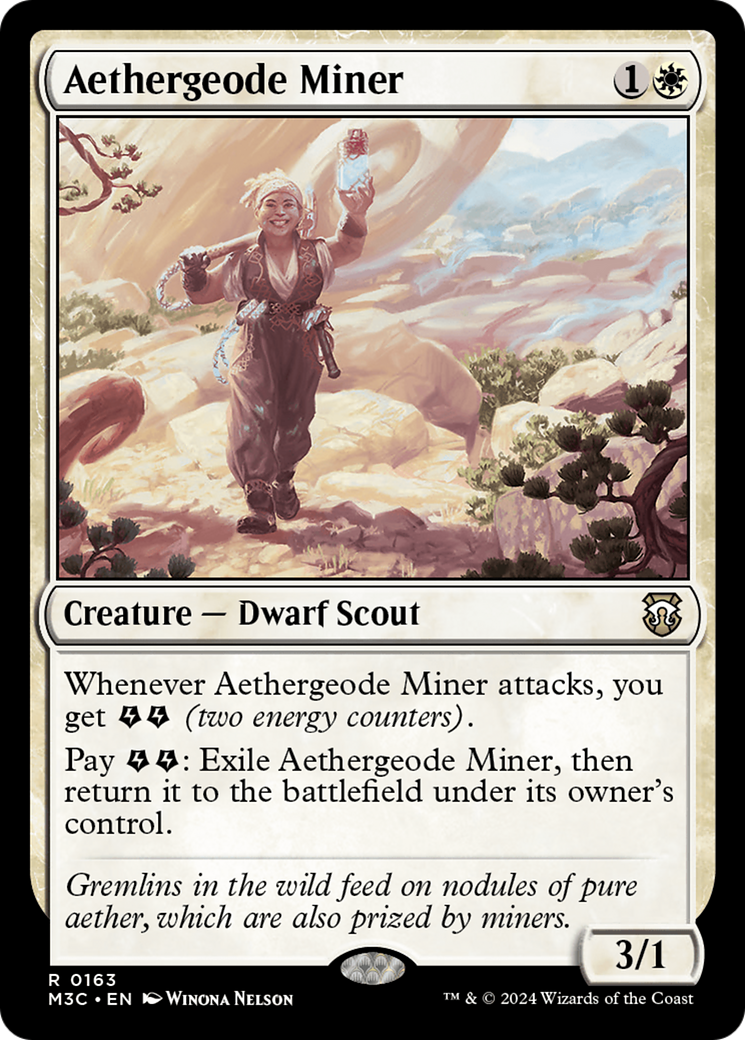
Aethergeode Miner
Aethergeode Miner
Creature — Dwarf Scout
3/1
Whenever this creature attacks, you get (two energy counters).
Pay : Exile this creature, then return it to the battlefield under its owner's control.
- Some spells and abilities that give you may require targets. If each target chosen is an illegal target as that spell or ability tries to resolve, it won't resolve. You won't get any .
- is the energy symbol. It represents one energy counter.
- Energy counters are a kind of counter that a player may have. They're not associated with any specific permanents.
- Keep track of how many energy counters each player has. Potential ways to track this include writing theme down on paper or using dice, but any method that is clear and mutually agreeable is fine. (At higher levels of tournament play, dice may not be allowed for tracking counters that players have.)
- If an effect says you get one or more , you get that many energy counters. To pay one or more , you lose that many energy counters. You can't pay more energy counters than you have. Any effects that interact with counters a player gets, has, or loses can interact with energy counters.
- Energy counters aren't mana. They don't go away as steps, phases, and turns end, and effects that add mana "of any type" can't give you energy counters.
- Some triggered abilities state that you "may pay" a certain amount of . You can't pay that amount multiple times to multiply the effect. You simply choose whether or not to pay that amount of as the ability resolves.
- Some triggered abilities that state that you "may pay" a certain amount of describe an effect that happens "If you do." In that case, no player may take actions to try to stop the ability's effect after you make your choice. If the payment is followed by the phrase "When you do," then you'll choose any targets for that reflexive triggered ability and put it on the stack before players can take actions.
- If a spell or ability with one or more targets states that you "may pay" some amount of , and each permanent that it targets has become an illegal target, the spell or ability won't resolve. You can't pay any even if you want to.
- After Aethergeode Miner returns to the battlefield, it will be a new object with no connection to the creature that was exiled. It won't be in combat or have any additional abilities it may have had when it was exiled. Any +1/+1 counters on it or Auras attached to it are removed, and any Equipment will no longer be attached.
-
1
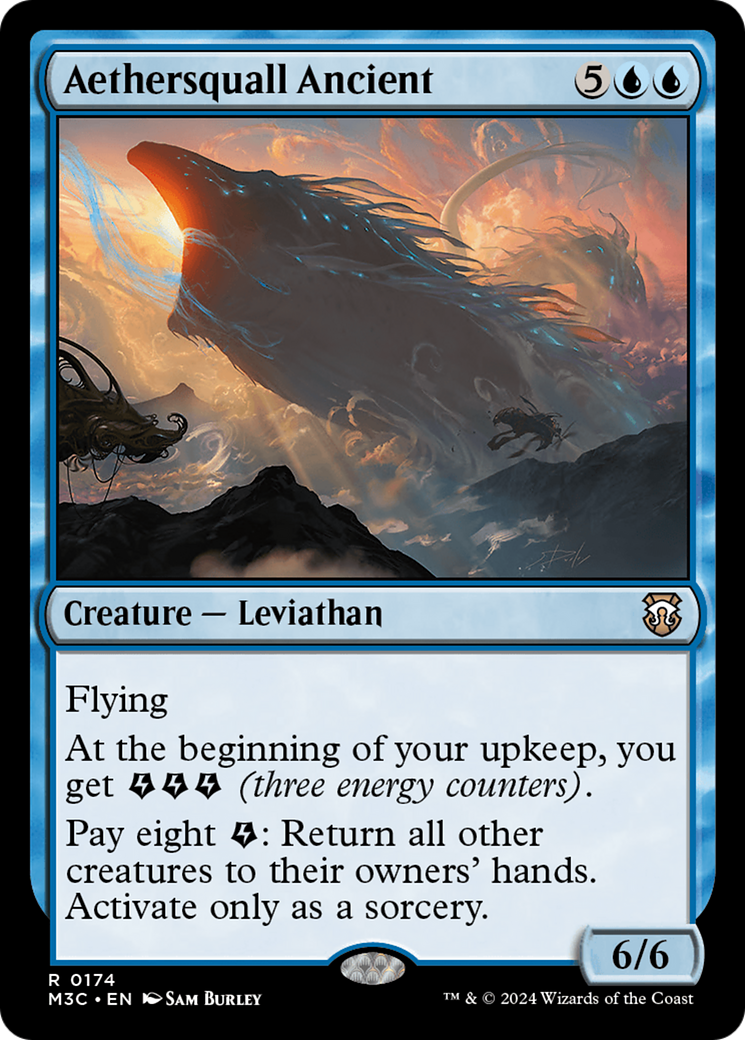
Aethersquall Ancient
Aethersquall Ancient
Creature — Leviathan
6/6
Flying
At the beginning of your upkeep, you get (three energy counters).
Pay eight : Return all other creatures to their owners' hands. Activate only as a sorcery.
- is the energy symbol. It represents one energy counter.
- Energy counters are a kind of counter that a player may have. They're not associated with any specific permanents.
- Keep track of how many energy counters each player has. Potential ways to track this include writing theme down on paper or using dice, but any method that is clear and mutually agreeable is fine. (At higher levels of tournament play, dice may not be allowed for tracking counters that players have.)
- If an effect says you get one or more , you get that many energy counters. To pay one or more , you lose that many energy counters. You can't pay more energy counters than you have. Any effects that interact with counters a player gets, has, or loses can interact with energy counters.
- Energy counters aren't mana. They don't go away as steps, phases, and turns end, and effects that add mana "of any type" can't give you energy counters.
- Some triggered abilities state that you "may pay" a certain amount of . You can't pay that amount multiple times to multiply the effect. You simply choose whether or not to pay that amount of as the ability resolves.
- Some triggered abilities that state that you "may pay" a certain amount of describe an effect that happens "If you do." In that case, no player may take actions to try to stop the ability's effect after you make your choice. If the payment is followed by the phrase "When you do," then you'll choose any targets for that reflexive triggered ability and put it on the stack before players can take actions.
- If a spell or ability with one or more targets states that you "may pay" some amount of , and each permanent that it targets has become an illegal target, the spell or ability won't resolve. You can't pay any even if you want to.
- Some spells and abilities that give you may require targets. If each target chosen is an illegal target as that spell or ability tries to resolve, it won't resolve. You won't get any .
-
1
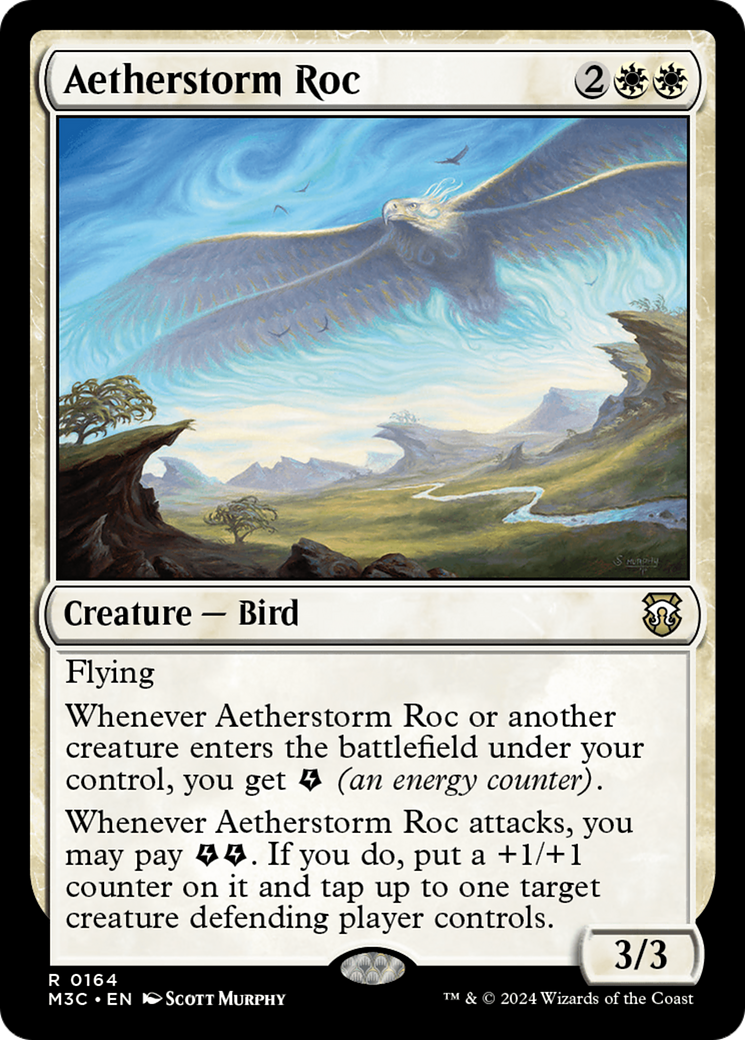
Aetherstorm Roc
Aetherstorm Roc
Creature — Bird
3/3
Flying
Whenever this creature or another creature you control enters, you get (an energy counter).
Whenever this creature attacks, you may pay . If you do, put a +1/+1 counter on it and tap up to one target creature defending player controls.
- Some spells and abilities that give you may require targets. If each target chosen is an illegal target as that spell or ability tries to resolve, it won't resolve. You won't get any .
- Some triggered abilities state that you "may pay" a certain amount of . You can't pay that amount multiple times to multiply the effect. You simply choose whether or not to pay that amount of as the ability resolves.
- Some triggered abilities that state that you "may pay" a certain amount of describe an effect that happens "If you do." In that case, no player may take actions to try to stop the ability's effect after you make your choice. If the payment is followed by the phrase "When you do," then you'll choose any targets for that reflexive triggered ability and put it on the stack before players can take actions.
- If a spell or ability with one or more targets states that you "may pay" some amount of , and each permanent that it targets has become an illegal target, the spell or ability won't resolve. You can't pay any even if you want to.
- is the energy symbol. It represents one energy counter.
- Energy counters are a kind of counter that a player may have. They're not associated with any specific permanents.
- Keep track of how many energy counters each player has. Potential ways to track this include writing theme down on paper or using dice, but any method that is clear and mutually agreeable is fine. (At higher levels of tournament play, dice may not be allowed for tracking counters that players have.)
- If an effect says you get one or more , you get that many energy counters. To pay one or more , you lose that many energy counters. You can't pay more energy counters than you have. Any effects that interact with counters a player gets, has, or loses can interact with energy counters.
- Energy counters aren't mana. They don't go away as steps, phases, and turns end, and effects that add mana "of any type" can't give you energy counters.
- Aetherstorm Roc's second triggered ability resolves before blockers are chosen. A creature tapped this way won't be able to block.
- You don't have to target a creature with Aetherstorm Roc's last ability. If you do choose a target, and that target becomes illegal, the ability doesn't resolve and you won't be able to pay to put a counter on Aetherstorm Roc.
- A creature entering the battlefield at the same time as Aetherstorm Roc causes its first triggered ability to trigger.
-
1
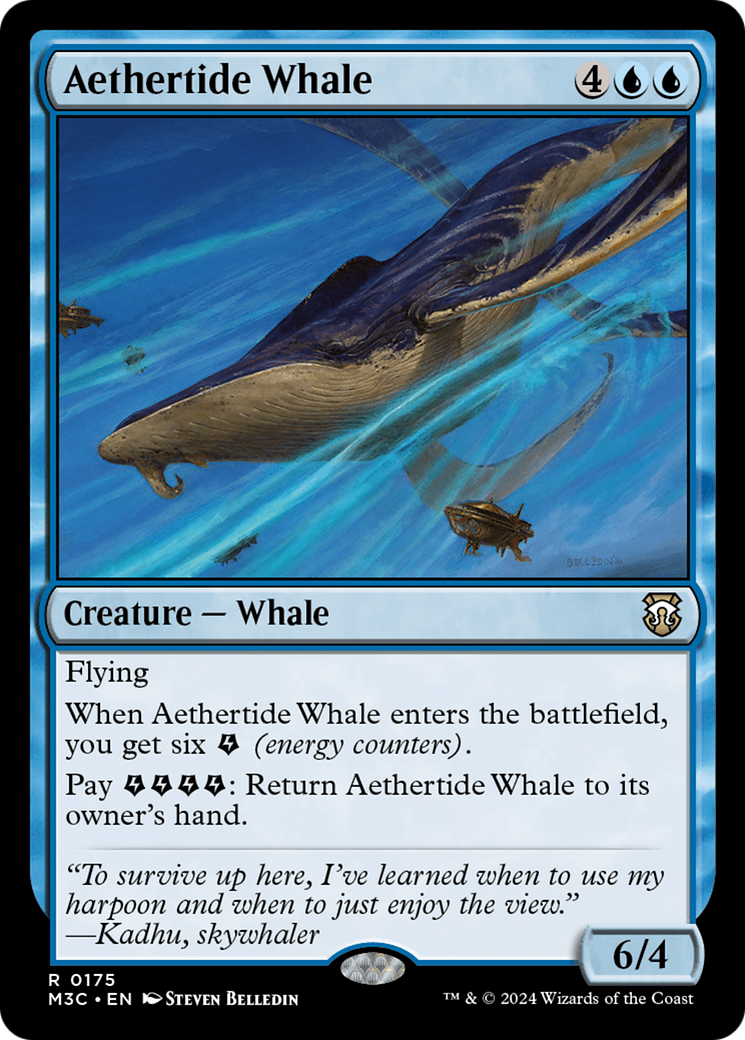
Aethertide Whale
Aethertide Whale
Creature — Whale
6/4
Flying
When this creature enters, you get six (energy counters).
Pay : Return this creature to its owner's hand.
- is the energy symbol. It represents one energy counter.
- Energy counters are a kind of counter that a player may have. They're not associated with any specific permanents.
- Keep track of how many energy counters each player has. Potential ways to track this include writing theme down on paper or using dice, but any method that is clear and mutually agreeable is fine. (At higher levels of tournament play, dice may not be allowed for tracking counters that players have.)
- If an effect says you get one or more , you get that many energy counters. To pay one or more , you lose that many energy counters. You can't pay more energy counters than you have. Any effects that interact with counters a player gets, has, or loses can interact with energy counters.
- Energy counters aren't mana. They don't go away as steps, phases, and turns end, and effects that add mana "of any type" can't give you energy counters.
- Some triggered abilities state that you "may pay" a certain amount of . You can't pay that amount multiple times to multiply the effect. You simply choose whether or not to pay that amount of as the ability resolves.
- Some triggered abilities that state that you "may pay" a certain amount of describe an effect that happens "If you do." In that case, no player may take actions to try to stop the ability's effect after you make your choice. If the payment is followed by the phrase "When you do," then you'll choose any targets for that reflexive triggered ability and put it on the stack before players can take actions.
- If a spell or ability with one or more targets states that you "may pay" some amount of , and each permanent that it targets has become an illegal target, the spell or ability won't resolve. You can't pay any even if you want to.
- Some spells and abilities that give you may require targets. If each target chosen is an illegal target as that spell or ability tries to resolve, it won't resolve. You won't get any .
-
1
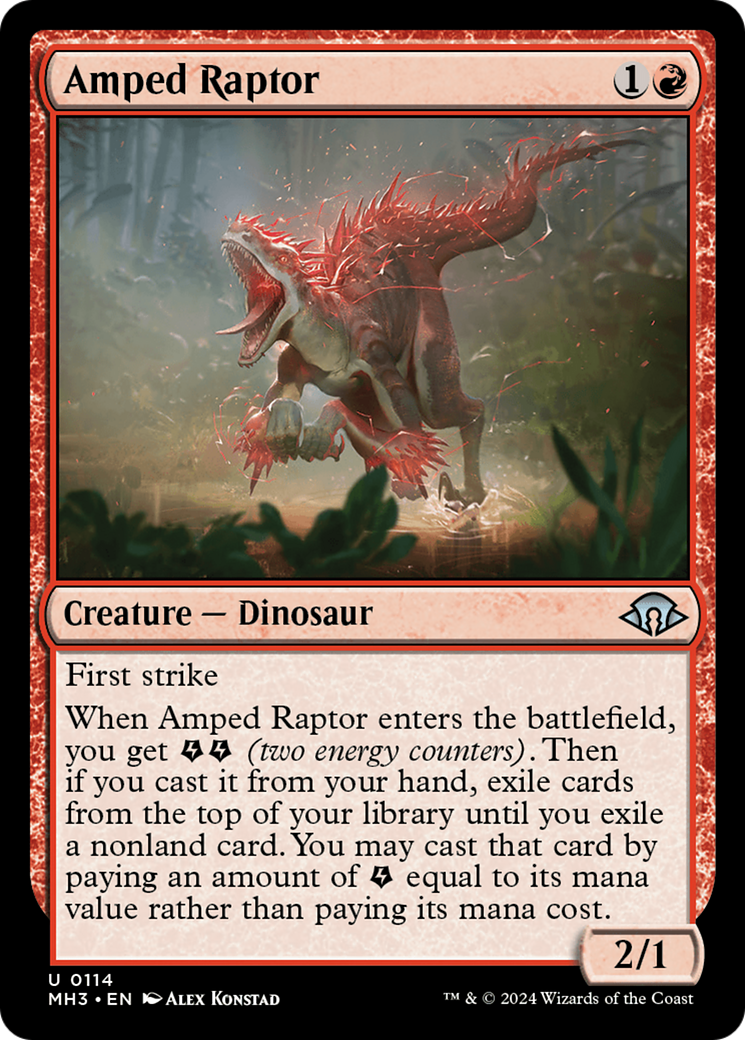
Amped Raptor
Amped Raptor
Creature — Dinosaur
2/1
First strike
When this creature enters, you get (two energy counters). Then if you cast it from your hand, exile cards from the top of your library until you exile a nonland card. You may cast that card by paying an amount of equal to its mana value rather than paying its mana cost.
-
1
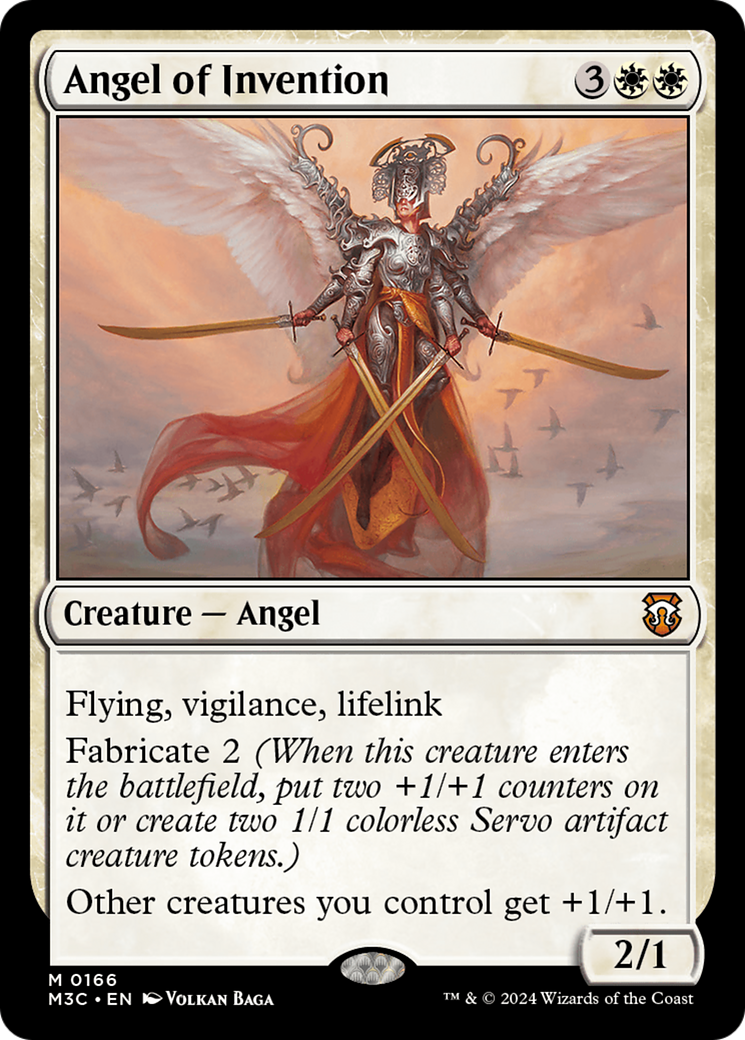
Angel of Invention
Angel of Invention
Creature — Angel
2/1
Flying, vigilance, lifelink
Fabricate 2 (When this creature enters, put two +1/+1 counters on it or create two 1/1 colorless Servo artifact creature tokens.)
Other creatures you control get +1/+1.
- You choose whether to put +1/+1 counters on the creature or create Servo tokens as the fabricate ability is resolving. No player may take actions between the time you choose and the time that counters are added or tokens are created.
- Fabricate doesn't cause the creature with the ability to enter the battlefield with +1/+1 counters already on it. For example, Weaponcraft Enthusiast will enter the battlefield as a 0/1 creature, then its fabricate ability goes on the stack. Players may take actions (such as casting instants) while the ability is waiting to resolve.
- If you can't put +1/+1 counters on the creature for any reason as fabricate resolves (for instance, if it's no longer on the battlefield), you just create Servo tokens.
-
1
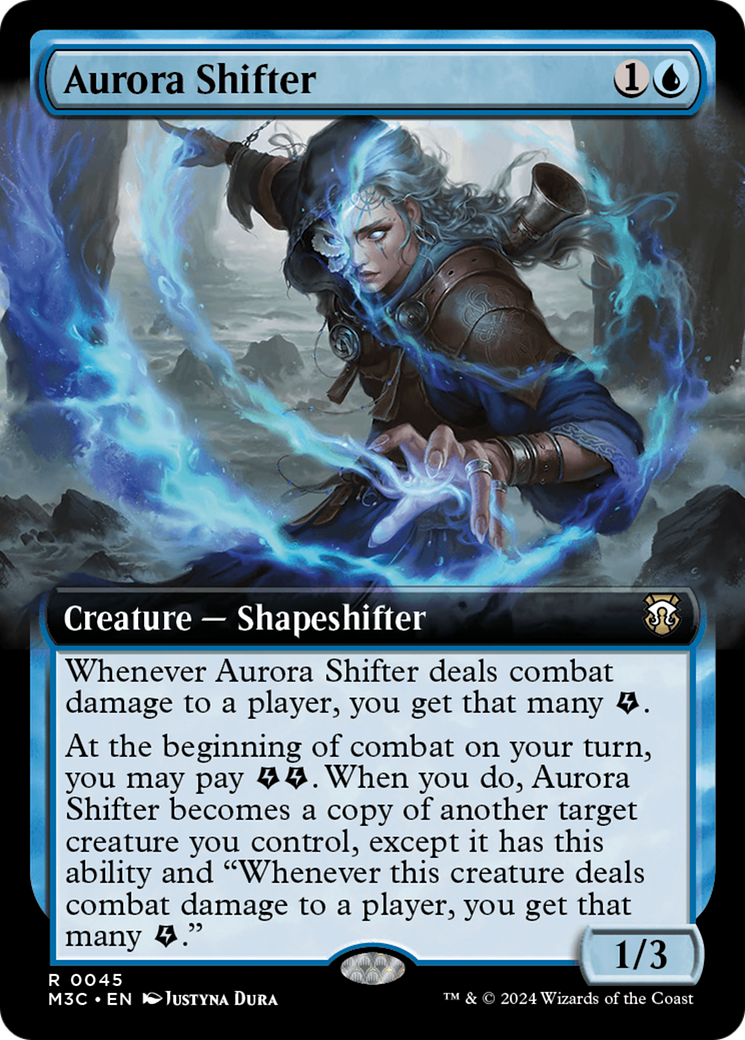
Aurora Shifter
Aurora Shifter
Creature — Shapeshifter
1/3
Whenever this creature deals combat damage to a player, you get that many .
At the beginning of combat on your turn, you may pay . When you do, this creature becomes a copy of another target creature you control, except it has this ability and "Whenever this creature deals combat damage to a player, you get that many ."
- You don't choose a target for Aurora Shifter's last ability at the time it triggers. Rather, a second "reflexive" ability triggers when you pay this way. You choose a target for that ability as it goes on the stack. Each player may respond to this triggered ability as normal.
- Aurora Shifter copies exactly what was printed on the original creature and nothing else, with the listed exception (unless that permanent is copying something else; see below). It doesn't copy whether that creature is tapped or untapped, whether it has any counters on it or Auras and Equipment attached to it, and so on.
- If the copied creature has in its mana cost, X is 0.
- If the copied creature is copying something else, then Aurora Shifter becomes a copy of whatever that creature copied (with the listed exception).
- Because Aurora Shifter isn't entering the battlefield when it becomes a copy of another creature, any "When [this creature] enters the battlefield" or "[This creature] enters the battlefield with" abilities of the copied creature won't apply.
- is the energy symbol. It represents one energy counter.
- Energy counters are a kind of counter that a player may have. They're not associated with any specific permanents.
- Keep track of how many energy counters each player has. Potential ways to track this include writing theme down on paper or using dice, but any method that is clear and mutually agreeable is fine. (At higher levels of tournament play, dice may not be allowed for tracking counters that players have.)
- If an effect says you get one or more , you get that many energy counters. To pay one or more , you lose that many energy counters. You can't pay more energy counters than you have. Any effects that interact with counters a player gets, has, or loses can interact with energy counters.
- Energy counters aren't mana. They don't go away as steps, phases, and turns end, and effects that add mana "of any type" can't give you energy counters.
- Some triggered abilities state that you "may pay" a certain amount of . You can't pay that amount multiple times to multiply the effect. You simply choose whether or not to pay that amount of as the ability resolves.
- Some triggered abilities that state that you "may pay" a certain amount of describe an effect that happens "If you do." In that case, no player may take actions to try to stop the ability's effect after you make your choice. If the payment is followed by the phrase "When you do," then you'll choose any targets for that reflexive triggered ability and put it on the stack before players can take actions.
- If a spell or ability with one or more targets states that you "may pay" some amount of , and each permanent that it targets has become an illegal target, the spell or ability won't resolve. You can't pay any even if you want to.
- Some spells and abilities that give you may require targets. If each target chosen is an illegal target as that spell or ability tries to resolve, it won't resolve. You won't get any .
-
1
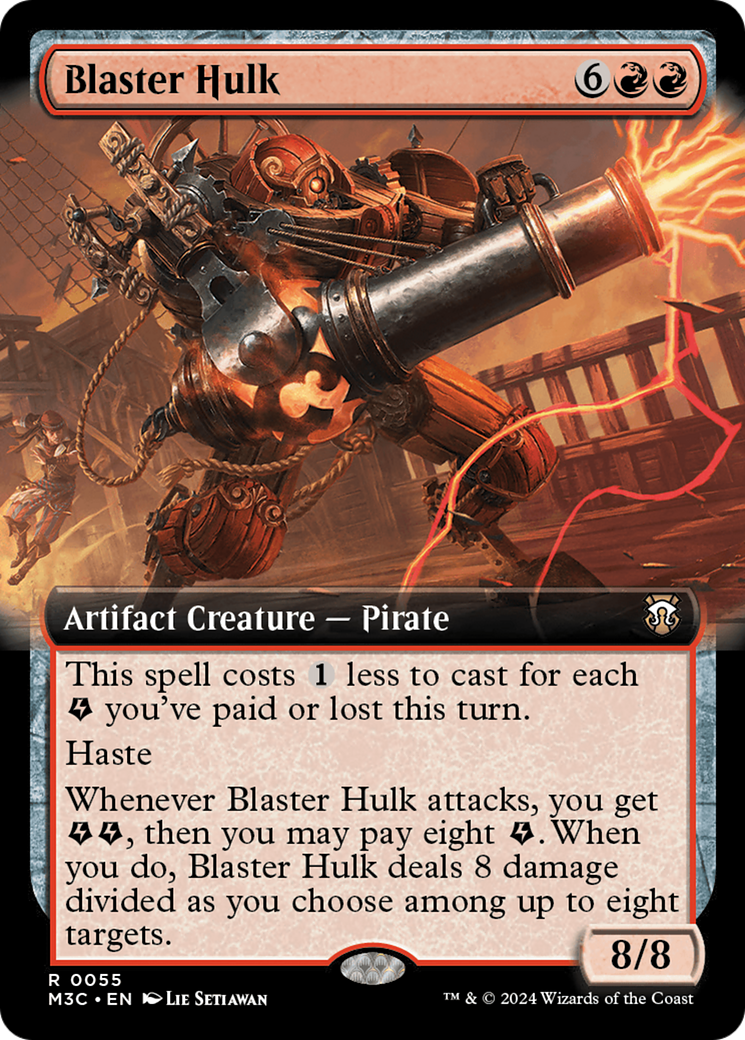
Blaster Hulk
Blaster Hulk
Artifact Creature — Pirate
8/8
This spell costs less to cast for each (energy counter) you've paid or lost this turn.
Haste
Whenever this creature attacks, you get , then you may pay eight . When you do, this creature deals 8 damage divided as you choose among up to eight targets.
- Casting Blaster Hulk doesn't allow you to pay any . It counts only you've paid or lost that turn before you cast it.
- You don't choose a target for Blaster Hulk's last ability at the time it triggers. Rather, a second "reflexive" ability triggers when you pay eight this way. You choose a target for that ability as it goes on the stack. Each player may respond to this triggered ability as normal.
- You choose how many targets Blaster Hulk's last ability has and how the damage is divided as you activate the ability. Each target must receive at least 1 damage.
- If some of the targets are illegal as Blaster Hulk's last ability tries to resolve, the original division of damage still applies and the damage that would have been dealt to the illegal targets is lost. It won't be dealt instead to a legal target. If all of the targets are illegal, the ability won't resolve and none of its effects will happen.
- is the energy symbol. It represents one energy counter.
- Energy counters are a kind of counter that a player may have. They're not associated with any specific permanents.
- Keep track of how many energy counters each player has. Potential ways to track this include writing theme down on paper or using dice, but any method that is clear and mutually agreeable is fine. (At higher levels of tournament play, dice may not be allowed for tracking counters that players have.)
- If an effect says you get one or more , you get that many energy counters. To pay one or more , you lose that many energy counters. You can't pay more energy counters than you have. Any effects that interact with counters a player gets, has, or loses can interact with energy counters.
- Energy counters aren't mana. They don't go away as steps, phases, and turns end, and effects that add mana "of any type" can't give you energy counters.
- Some triggered abilities state that you "may pay" a certain amount of . You can't pay that amount multiple times to multiply the effect. You simply choose whether or not to pay that amount of as the ability resolves.
- Some triggered abilities that state that you "may pay" a certain amount of describe an effect that happens "If you do." In that case, no player may take actions to try to stop the ability's effect after you make your choice. If the payment is followed by the phrase "When you do," then you'll choose any targets for that reflexive triggered ability and put it on the stack before players can take actions.
- If a spell or ability with one or more targets states that you "may pay" some amount of , and each permanent that it targets has become an illegal target, the spell or ability won't resolve. You can't pay any even if you want to.
- Some spells and abilities that give you may require targets. If each target chosen is an illegal target as that spell or ability tries to resolve, it won't resolve. You won't get any .
-
1
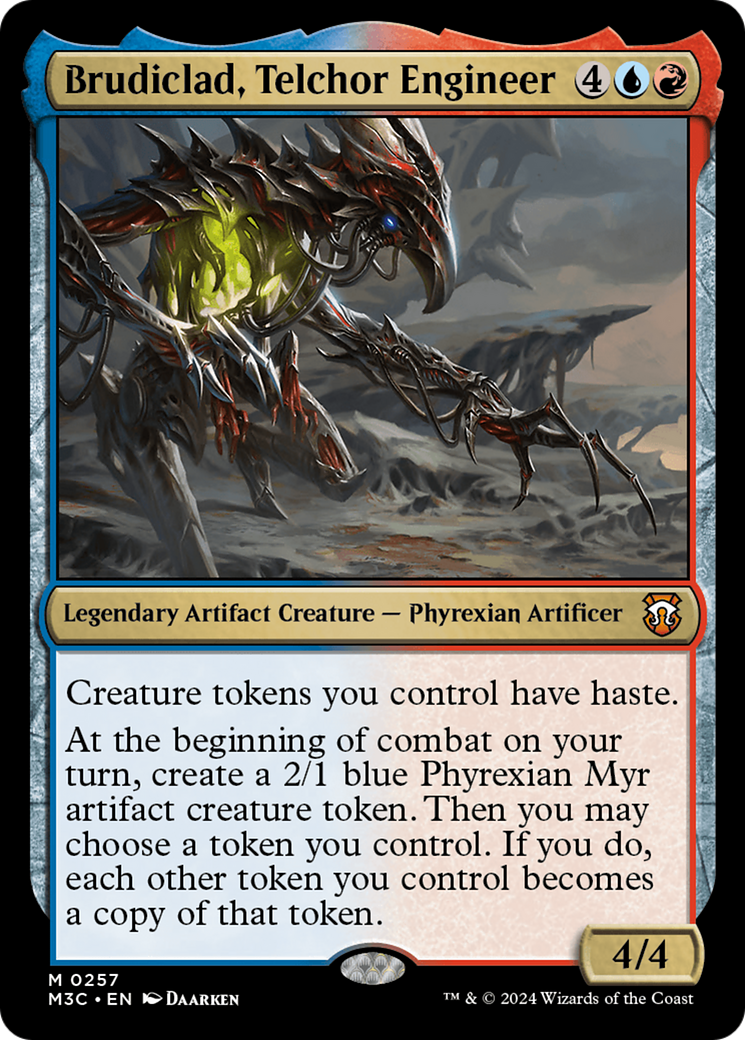
Brudiclad, Telchor Engineer
Brudiclad, Telchor Engineer
Legendary Artifact Creature — Phyrexian Artificer
4/4
Creature tokens you control have haste.
At the beginning of combat on your turn, create a 2/1 blue Phyrexian Myr artifact creature token. Then you may choose a token you control. If you do, each other token you control becomes a copy of that token.
- Once a creature token that came under your control this turn has legally attacked, causing it to lose haste by removing Brudiclad from the battlefield won't cause that token to stop attacking.
- All other tokens you control become a copy of the chosen token, even those that aren't of the same type. For example, if you control a Treasure artifact token and choose the Myr token Brudiclad just created, your Treasure will become a copy of the Myr.
- The effect of Brudiclad's triggered ability lasts indefinitely. It continues to apply after Brudiclad leaves the game.
- Brudiclad copies only the values defined as the original token was created (unless that token is copying something else; see below). It doesn't copy whether that token is tapped or untapped, whether it has any counters on it or any Auras and Equipment attached to it, or any non-copy effects that have changed its power, toughness, types, color, or so on.
- The last effect of Brudiclad's triggered ability affects all tokens you control other than the chosen token, including the token that was just created if that isn't the chosen token.
- If the chosen token is copying something else (for example, if the chosen token was previously affected by Brudiclad's triggered ability), then your tokens become copies of whatever the chosen token copied.
-
1
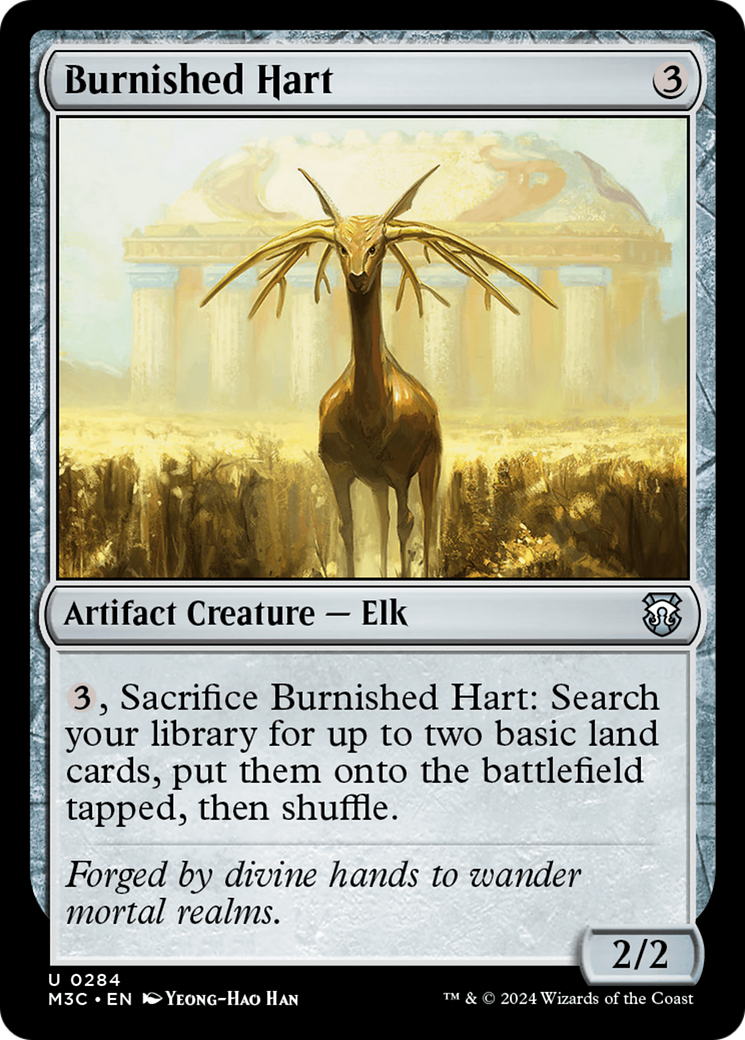
Burnished Hart
Burnished Hart
Artifact Creature — Elk
2/2
, Sacrifice this creature: Search your library for up to two basic land cards, put them onto the battlefield tapped, then shuffle.
-
1
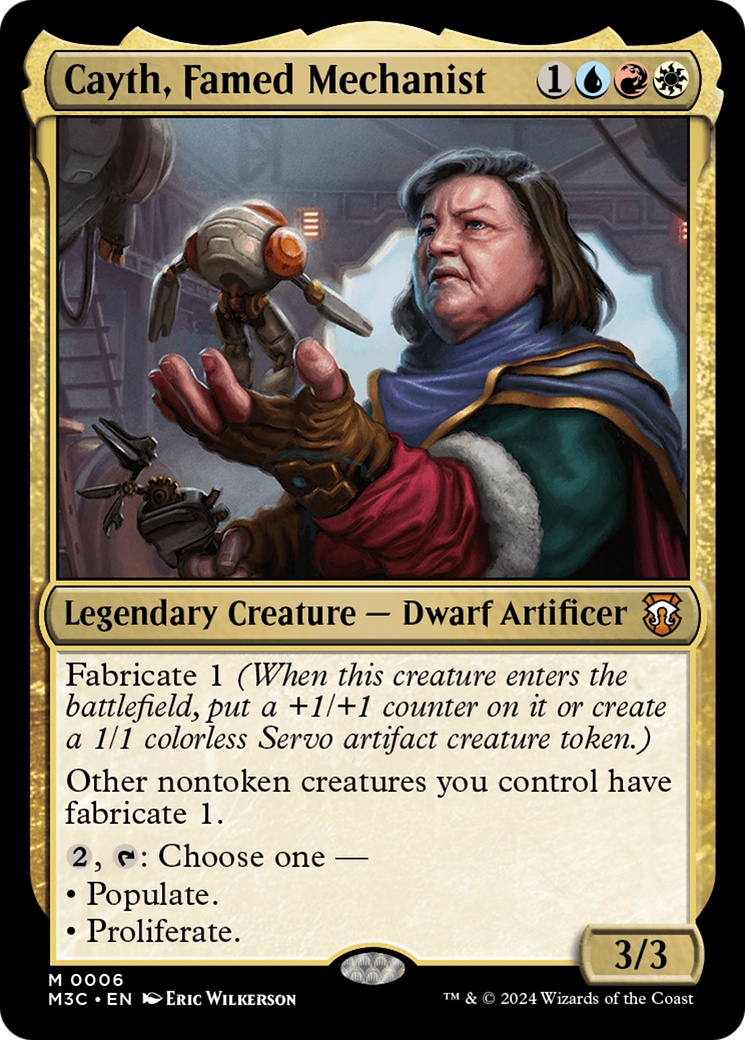
Cayth, Famed Mechanist
Cayth, Famed Mechanist
Legendary Creature — Dwarf Artificer
3/3
Fabricate 1 (When this creature enters, put a +1/+1 counter on it or create a 1/1 colorless Servo artifact creature token.)
Other nontoken creatures you control have fabricate 1.
, : Choose one —
- Populate.
- Proliferate.
- You choose whether to put a +1/+1 counter on the creature or create a Servo token as the fabricate ability is resolving. No player may take actions between the time you choose and the time that the counter is added or the token is created.
- Fabricate doesn't cause the creature with the ability to enter the battlefield with +1/+1 counters already on it. For example, Cayth, Famed Machinist will enter the battlefield as a 3/3 creature, then its fabricate ability goes on the stack. Players may take actions (such as casting instants) while the ability is waiting to resolve.
- If you can't put a +1/+1 counter on the creature for any reason as fabricate resolves (for instance, if it's no longer on the battlefield), you just create a Servo token.
- If you control no creature tokens when you populate, nothing will happen.
- The new creature token copies the characteristics of the original token as stated by the effect that created the original token.
- The new token doesn't copy whether the original token is tapped or untapped, whether it has any counters on it or Auras and Equipment attached to it, or any non-copy effects that have changed its power, toughness, color, and so on.
- Any "as [this creature] enters the battlefield" or "[this creature] enters the battlefield with" abilities of the new token will work.
- When you proliferate, you can choose any permanent that has a counter, including ones controlled by opponents. You can choose any player who has a counter, including opponents. You can't choose cards in any zone other than the battlefield, even if they have counters on them.
- You don't have to choose every permanent or player that has a counter—only the ones you want to add counters to. Since "any number" includes zero, you don't have to choose any permanents at all, and you don't have to choose any players at all.
- If a player or permanent has more than one kind of counter on it, and you choose for it to get additional counters, it must get one of each kind of counter it already has. You can't have it get just one kind of counter it already has and not the others.
- Players can respond to a spell or ability whose effect includes proliferating. Once that spell or ability starts to resolve, however, and its controller chooses which permanents and players will get new counters, it's too late for anyone to respond.
-
1
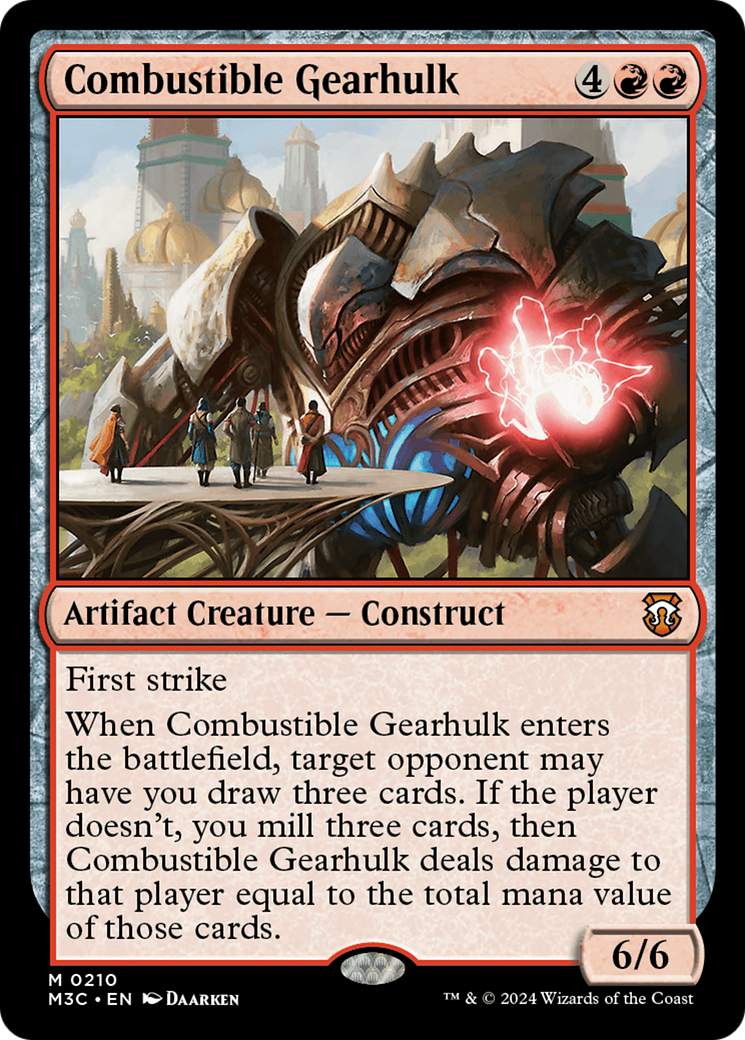
Combustible Gearhulk
Combustible Gearhulk
Artifact Creature — Construct
6/6
First strike
When this creature enters, target opponent may have you draw three cards. If the player doesn't, you mill three cards, then this creature deals damage to that player equal to the total mana value of those cards.
- If any of the cards put into your graveyard have in their mana cost, X is considered to be 0.
- If you have fewer than three cards in your library, the opponent may choose to have you draw three cards. If so, you'll lose the game as state-based actions are performed.
- While Combustible Gearhulk's triggered ability is resolving, no player may take any actions other than those specified by the Gearhulk. Once the opponent makes a choice, players can't cast spells or activate abilities until after the cards are drawn or put into the graveyard and damage has been dealt (if applicable).
-
1
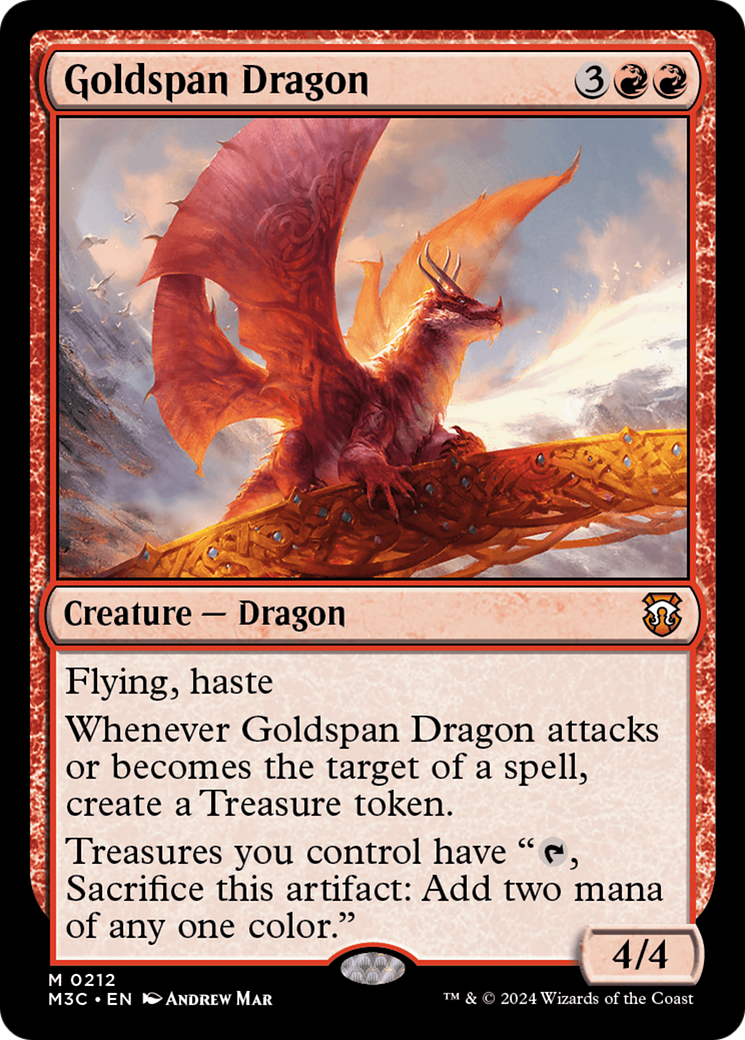
Goldspan Dragon
Goldspan Dragon
Creature — Dragon
4/4
Flying, haste
Whenever this creature attacks or becomes the target of a spell, create a Treasure token.
Treasures you control have " , Sacrifice this artifact: Add two mana of any one color."
- If a spell targets Goldspan Dragon more than once, the triggered ability will trigger only once.
- An ability that triggers when a creature becomes the target of a spell resolves before the spell that caused it to trigger. Such an ability resolves even if that spell is countered.
- Players can cast spells and activate abilities after the triggered ability resolves but before the spell that caused it to trigger does.
-
1
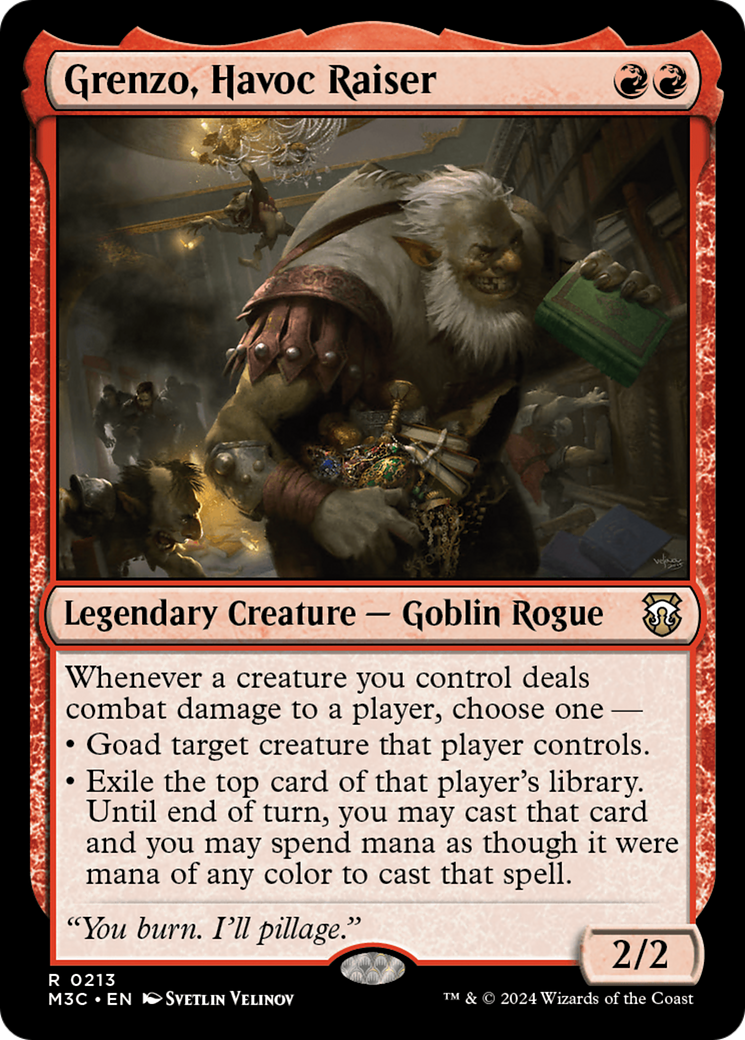
Grenzo, Havoc Raiser
Grenzo, Havoc Raiser
Legendary Creature — Goblin Rogue
2/2
Whenever a creature you control deals combat damage to a player, choose one —
- Goad target creature that player controls.
- Exile the top card of that player's library. Until end of turn, you may cast that card and you may spend mana as though it were mana of any color to cast that spell.
- If a creature you control has been goaded by multiple opponents, it must attack one of your opponents that hasn't goaded it, as that fulfills the maximum number of goad requirements. If a creature you control has been goaded by each of your opponents, the creature must attack an opponent (rather than a planeswalker or battle), but you choose which opponent it attacks.
- If, during a player's declare attackers step, a creature that player controls that's been goaded is tapped, is affected by a spell or ability that says it can't attack, or hasn't been under that player's control continuously since the turn began (and doesn't have haste), then it doesn't attack. If there's a cost associated with having a creature attack a player, its controller isn't forced to pay that cost, so it doesn't have to attack that player.
- If the creature doesn't meet any of the above exceptions and can attack, it must attack a player other than the controller of the spell or ability that goaded it if able. If the creature can't attack any of those players but could otherwise attack, it must attack a planeswalker an opponent controls, a battle an opponent controls, or a player who goaded it.
- Being goaded isn't an ability the creature has. Once it's been goaded, it must attack as detailed above even if it loses all abilities.
- Attacking with a goaded creature doesn't cause it to stop being goaded. If there is an additional combat phase that turn, or if another player gains control of it before it stops being goaded, it must attack again if able.
- If you exile a land card this way, you can't play it.
- Casting the exiled card follows the normal rules for casting that card. You must pay its costs, and you must follow all applicable timing rules. For example, if you exile a creature card this way, you must wait until your main phase to cast it.
- If you don't cast the card, it will remain in exile.
- The card exiled by the second mode is exiled face up.
-
1
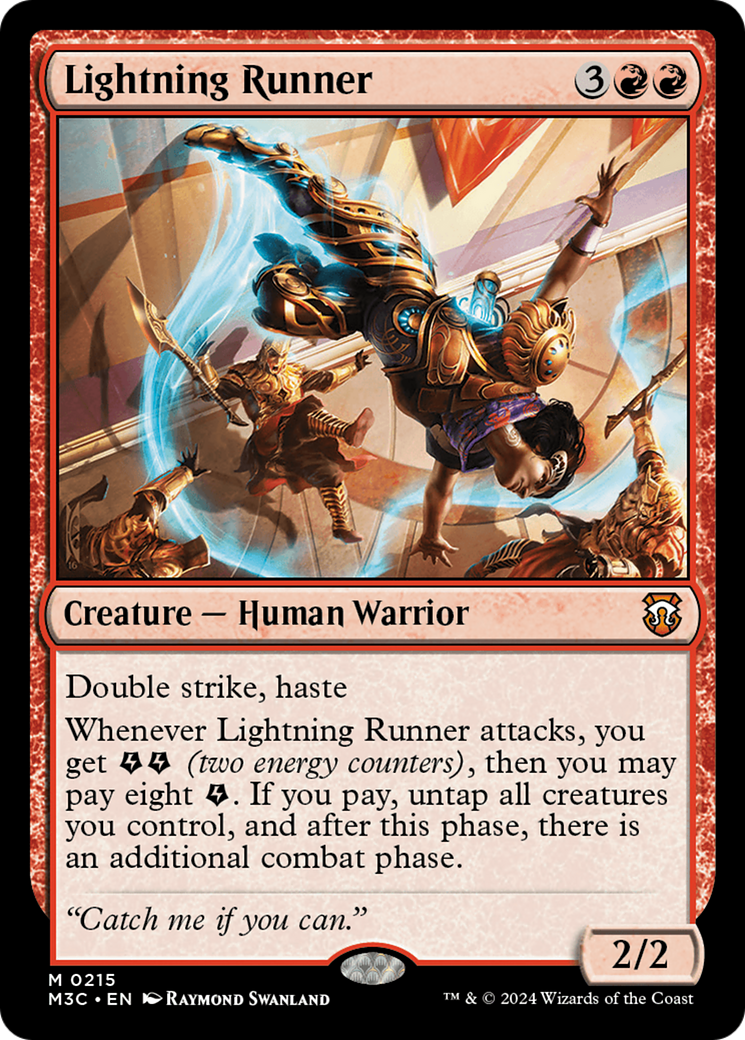
Lightning Runner
Lightning Runner
Creature — Human Warrior
2/2
Double strike, haste
Whenever this creature attacks, you get (two energy counters), then you may pay eight . If you pay, untap all creatures you control, and after this phase, there is an additional combat phase.
- Some spells and abilities that give you may require targets. If each target chosen is an illegal target as that spell or ability tries to resolve, it won't resolve. You won't get any .
- is the energy symbol. It represents one energy counter.
- Energy counters are a kind of counter that a player may have. They're not associated with any specific permanents.
- Keep track of how many energy counters each player has. Potential ways to track this include writing theme down on paper or using dice, but any method that is clear and mutually agreeable is fine. (At higher levels of tournament play, dice may not be allowed for tracking counters that players have.)
- If an effect says you get one or more , you get that many energy counters. To pay one or more , you lose that many energy counters. You can't pay more energy counters than you have. Any effects that interact with counters a player gets, has, or loses can interact with energy counters.
- Energy counters aren't mana. They don't go away as steps, phases, and turns end, and effects that add mana "of any type" can't give you energy counters.
- Some triggered abilities state that you "may pay" a certain amount of . You can't pay that amount multiple times to multiply the effect. You simply choose whether or not to pay that amount of as the ability resolves.
- Some triggered abilities that state that you "may pay" a certain amount of describe an effect that happens "If you do." In that case, no player may take actions to try to stop the ability's effect after you make your choice. If the payment is followed by the phrase "When you do," then you'll choose any targets for that reflexive triggered ability and put it on the stack before players can take actions.
- If a spell or ability with one or more targets states that you "may pay" some amount of , and each permanent that it targets has become an illegal target, the spell or ability won't resolve. You can't pay any even if you want to.
- You untap all creatures you control, including ones that aren't attacking.
-
1
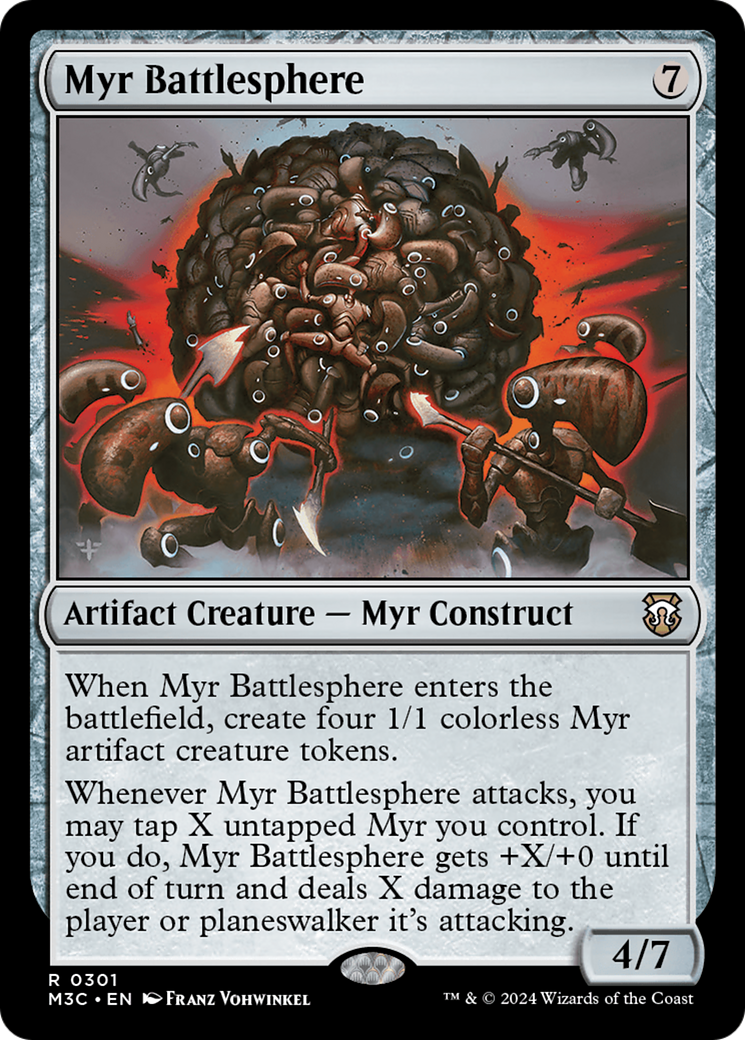
Myr Battlesphere
Myr Battlesphere
Artifact Creature — Myr Construct
4/7
When this creature enters, create four 1/1 colorless Myr artifact creature tokens.
Whenever this creature attacks, you may tap X untapped Myr you control. If you do, this creature gets +X/+0 until end of turn and deals X damage to the player or planeswalker it's attacking.
- You choose the value for X as the last ability resolves. You can't choose a value for X that's greater than the number of untapped Myr you control.
- You can tap any untapped Myr you control as the last ability resolves, not just the Myr tokens you created with the first ability. This includes Myr that haven't been under your control since your most recent turn began.
- As the last ability resolves, you can tap untapped Myr you control even if Myr Battlesphere is no longer on the battlefield by then. If that has happened, Myr Battlesphere won't be able to get the +X/+0 bonus, but it will still deal X damage to the appropriate player or planeswalker.
-
1
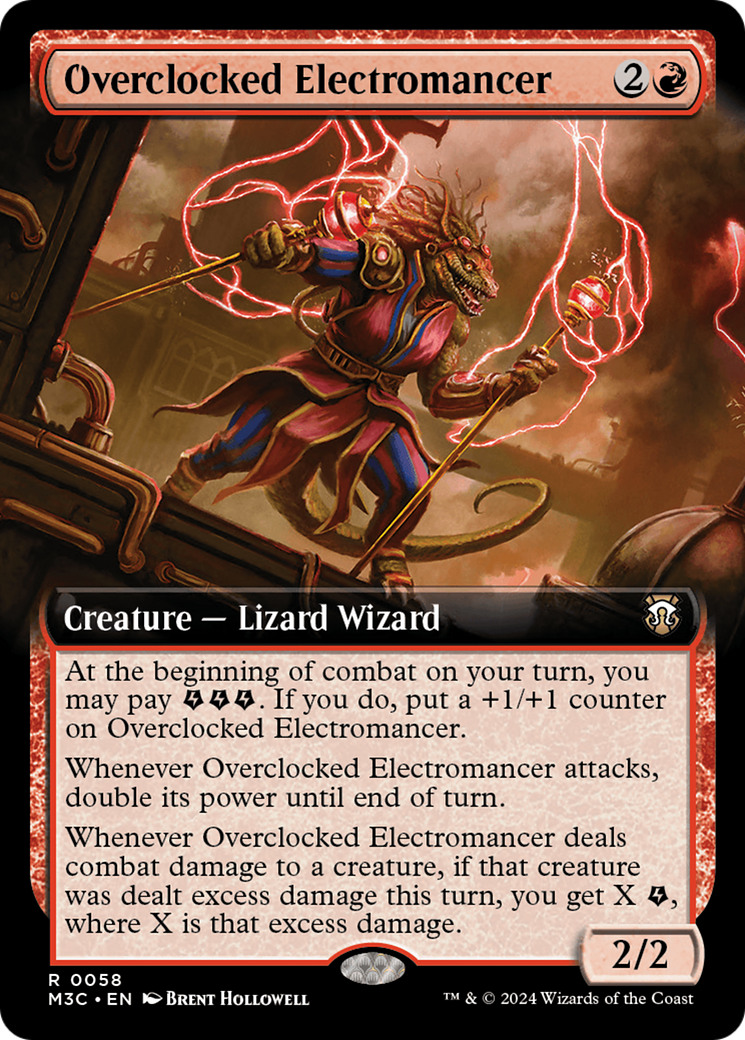
Overclocked Electromancer
Overclocked Electromancer
Creature — Lizard Wizard
2/2
At the beginning of combat on your turn, you may pay . If you do, put a +1/+1 counter on this creature.
Whenever this creature attacks, double its power until end of turn.
Whenever this creature deals combat damage to a creature, if that creature was dealt excess damage this turn, you get X , where X is that excess damage.
- To double Overclocked Electromancer's power, it gets +X/+0, where X is its power when its second ability resolves.
- Excess damage has been dealt to a creature if the damage dealt to it is greater than lethal damage. Usually, this means damage greater than its toughness, although damage already marked on the creature is taken into account.
- is the energy symbol. It represents one energy counter.
- Energy counters are a kind of counter that a player may have. They're not associated with any specific permanents.
- Keep track of how many energy counters each player has. Potential ways to track this include writing theme down on paper or using dice, but any method that is clear and mutually agreeable is fine. (At higher levels of tournament play, dice may not be allowed for tracking counters that players have.)
- If an effect says you get one or more , you get that many energy counters. To pay one or more , you lose that many energy counters. You can't pay more energy counters than you have. Any effects that interact with counters a player gets, has, or loses can interact with energy counters.
- Energy counters aren't mana. They don't go away as steps, phases, and turns end, and effects that add mana "of any type" can't give you energy counters.
- Some triggered abilities state that you "may pay" a certain amount of . You can't pay that amount multiple times to multiply the effect. You simply choose whether or not to pay that amount of as the ability resolves.
- Some triggered abilities that state that you "may pay" a certain amount of describe an effect that happens "If you do." In that case, no player may take actions to try to stop the ability's effect after you make your choice. If the payment is followed by the phrase "When you do," then you'll choose any targets for that reflexive triggered ability and put it on the stack before players can take actions.
- If a spell or ability with one or more targets states that you "may pay" some amount of , and each permanent that it targets has become an illegal target, the spell or ability won't resolve. You can't pay any even if you want to.
- Some spells and abilities that give you may require targets. If each target chosen is an illegal target as that spell or ability tries to resolve, it won't resolve. You won't get any .
-
1
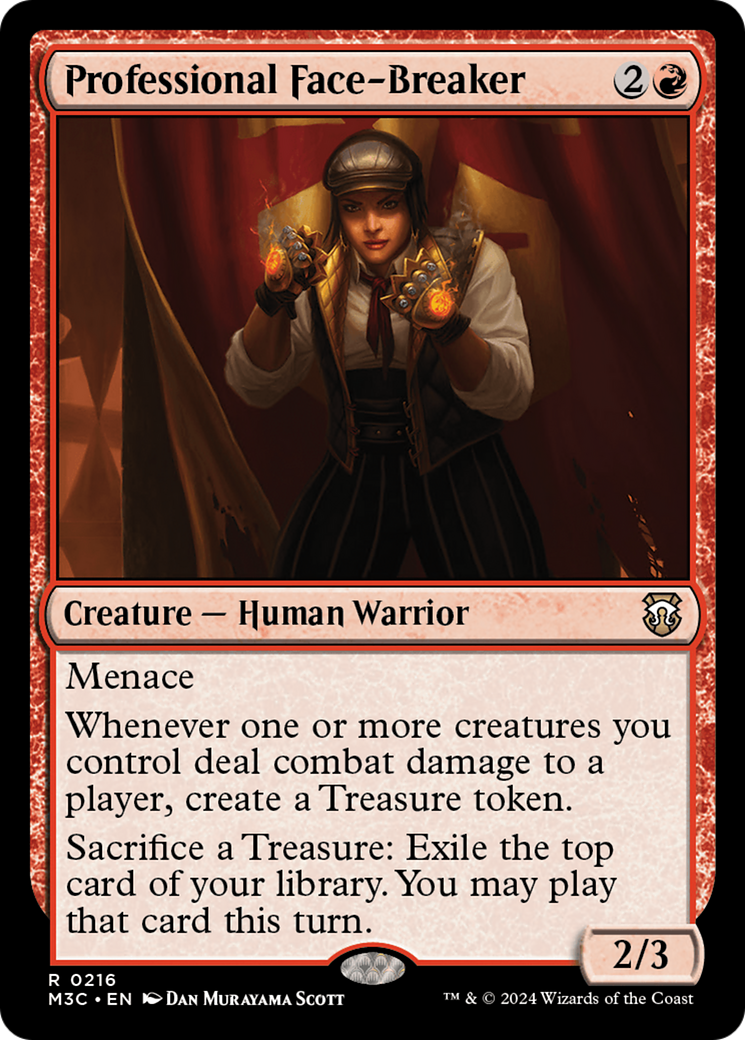
Professional Face-Breaker
Professional Face-Breaker
Creature — Human Warrior
2/3
Menace
Whenever one or more creatures you control deal combat damage to a player, create a Treasure token.
Sacrifice a Treasure: Exile the top card of your library. You may play that card this turn.
-
1
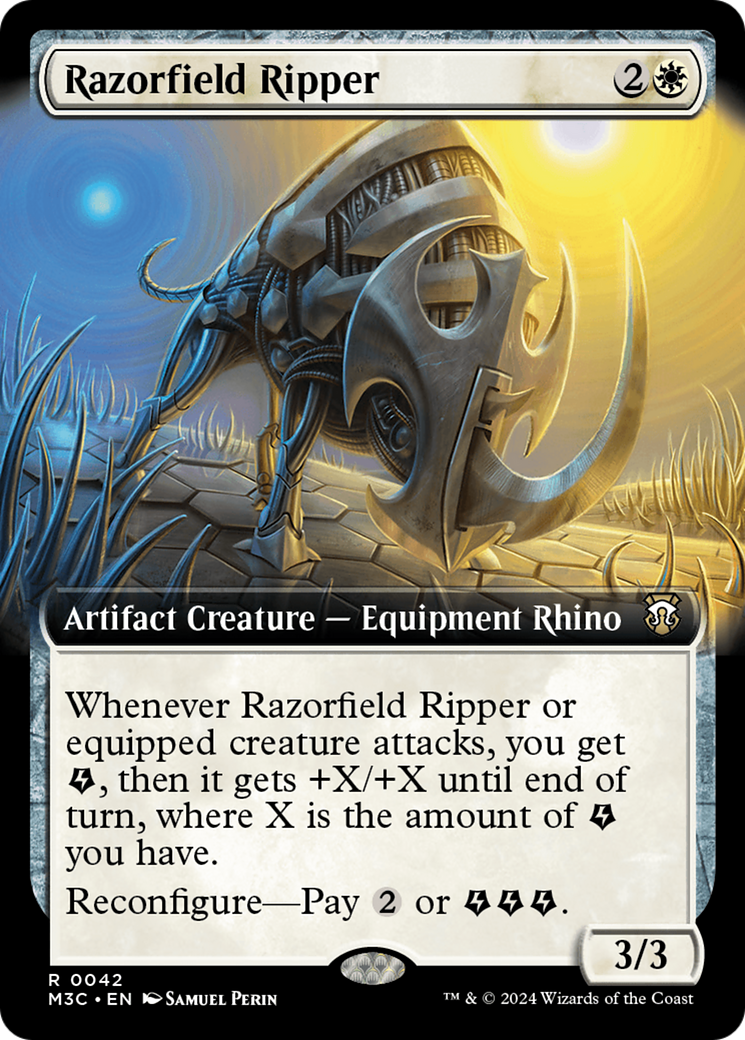
Razorfield Ripper
Razorfield Ripper
Artifact Creature — Equipment Rhino
3/3
Whenever this creature or equipped creature attacks, you get (an energy counter), then it gets +X/+X until end of turn, where X is the amount of you have.
Reconfigure—Pay or . (Pay or : Attach to target creature you control; or unattach from a creature. Reconfigure only as a sorcery. While attached, this isn't a creature.)
- The value of X is calculated only once, as Razorfield Ripper's triggered ability resolves.
- Reconfigure represents two activated abilities. Reconfigure [cost] means "[Cost]: Attach this permanent to another target creature you control. Activate only as a sorcery," and "[Cost]: Unattach this permanent. Activate only if this permanent is attached to a creature and only as a sorcery."
- Attaching an Equipment with reconfigure to a creature causes that Equipment to stop being a creature until it becomes unattached. It also loses any creature subtypes it had.
- An Equipment doesn't become tapped when the permanent it's attached to becomes tapped. For example, if you attack with a creature that is equipped with Razorfield Ripper, then use reconfigure to unattach Razorfield Ripper after combat, Razorfield Ripper will be untapped and could be used to block during your opponent's turn.
- Similarly, if an Equipment is tapped, its reconfigure abilities may still be activated and it may still become attached to creatures. Becoming attached doesn't untap it. In most cases, an attached Equipment being tapped won't affect gameplay, but it will be relevant if it becomes unattached again before it untaps.
- If an Equipment with reconfigure somehow loses its abilities while it is attached, the effect causing it to not be a creature continues to apply until it becomes unattached.
- As soon as an Equipment creature with reconfigure stops being a creature, any Equipment and Auras with enchant creature abilities become unattached. Auras that can enchant an Equipment that isn't a creature remain attached to it.
- An Equipment creature with reconfigure can be attached to creatures by effects other than its reconfigure ability, such as the activated ability of Brass Squire.
- Although it causes an Equipment to become attached to a creature, reconfigure is not an "equip ability" for the purpose of cards like Fighter Class and Leonin Shikari.
- An Equipment creature can never become attached to itself. If an effect tries to do this, nothing happens.
- If a permanent with reconfigure is somehow still a creature after it becomes attached (perhaps due to an effect like that of March of the Machines), it immediately becomes unattached from the equipped creature.
- is the energy symbol. It represents one energy counter.
- Energy counters are a kind of counter that a player may have. They're not associated with any specific permanents.
- Keep track of how many energy counters each player has. Potential ways to track this include writing theme down on paper or using dice, but any method that is clear and mutually agreeable is fine. (At higher levels of tournament play, dice may not be allowed for tracking counters that players have.)
- If an effect says you get one or more , you get that many energy counters. To pay one or more , you lose that many energy counters. You can't pay more energy counters than you have. Any effects that interact with counters a player gets, has, or loses can interact with energy counters.
- Energy counters aren't mana. They don't go away as steps, phases, and turns end, and effects that add mana "of any type" can't give you energy counters.
- Some triggered abilities state that you "may pay" a certain amount of . You can't pay that amount multiple times to multiply the effect. You simply choose whether or not to pay that amount of as the ability resolves.
- Some triggered abilities that state that you "may pay" a certain amount of describe an effect that happens "If you do." In that case, no player may take actions to try to stop the ability's effect after you make your choice. If the payment is followed by the phrase "When you do," then you'll choose any targets for that reflexive triggered ability and put it on the stack before players can take actions.
- If a spell or ability with one or more targets states that you "may pay" some amount of , and each permanent that it targets has become an illegal target, the spell or ability won't resolve. You can't pay any even if you want to.
- Some spells and abilities that give you may require targets. If each target chosen is an illegal target as that spell or ability tries to resolve, it won't resolve. You won't get any .
-
1
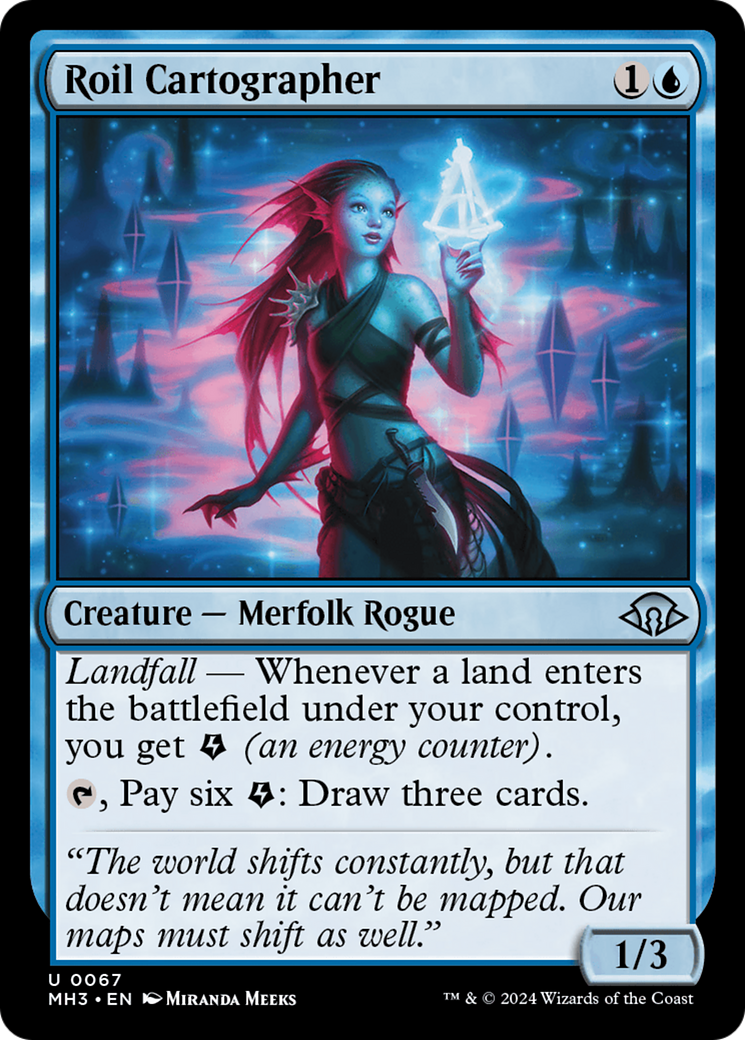
Roil Cartographer
Roil Cartographer
Creature — Merfolk Rogue
1/3
Landfall — Whenever a land you control enters, you get (an energy counter).
, Pay six : Draw three cards.
-
1
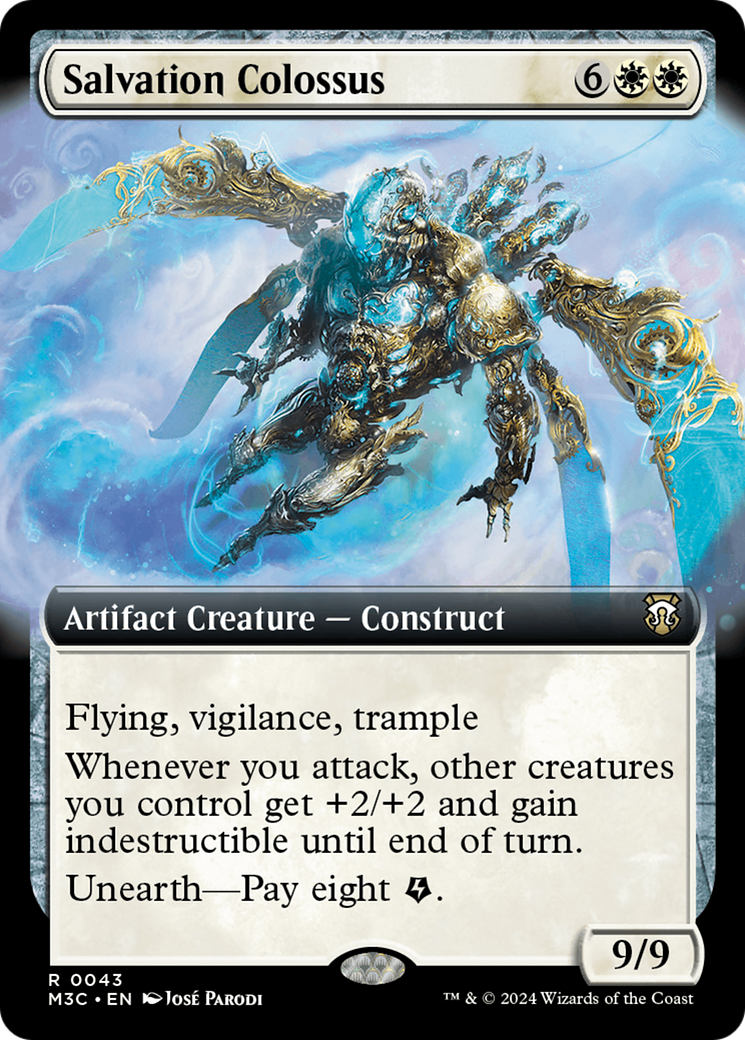
Salvation Colossus
Salvation Colossus
Artifact Creature — Construct
9/9
Flying, vigilance, trample
Whenever you attack, other creatures you control get +2/+2 and gain indestructible until end of turn.
Unearth—Pay eight . (Pay eight energy counters: Return this card from your graveyard to the battlefield. It gains haste. Exile it at the beginning of the next end step or if it would leave the battlefield. Unearth only as a sorcery.)
- If you activate a card's unearth ability but that card is removed from your graveyard before the ability resolves, that unearth ability will do nothing as it resolves.
- Activating a card's unearth ability isn't the same as casting that card. The unearth ability is put on the stack, but the card is not. Spells and abilities that interact with activated abilities will interact with unearth, but spells and abilities that interact with spells (such as Flare of Denial) will not.
- At the beginning of the next end step, a permanent returned to the battlefield with unearth is exiled. This is a delayed triggered ability, and it can be countered by effects that counter triggered abilities. If the ability is countered, the permanent will stay on the battlefield and the delayed triggered ability won't trigger again. However, the replacement effect will still exile the permanent if it eventually leaves the battlefield.
- Unearth grants haste to the permanent that's returned to the battlefield (even if it's not a creature card). However, neither of the "exile" abilities is granted to that permanent. If that permanent loses all its abilities, it will still be exiled at the beginning of the next end step, and if it would leave the battlefield, it is still exiled instead.
- If a permanent returned to the battlefield with unearth would leave the battlefield for any reason, it's exiled instead—unless the spell or ability that's causing the permanent to leave the battlefield is actually trying to exile it! In that case, it succeeds at exiling it. If that spell or ability later returns the card to the battlefield (as Static Prison might, for example), the permanent card will return to the battlefield as a new object with no relation to its previous existence. The unearth effects will no longer apply to it.
- is the energy symbol. It represents one energy counter.
- Energy counters are a kind of counter that a player may have. They're not associated with any specific permanents.
- Keep track of how many energy counters each player has. Potential ways to track this include writing theme down on paper or using dice, but any method that is clear and mutually agreeable is fine. (At higher levels of tournament play, dice may not be allowed for tracking counters that players have.)
- If an effect says you get one or more , you get that many energy counters. To pay one or more , you lose that many energy counters. You can't pay more energy counters than you have. Any effects that interact with counters a player gets, has, or loses can interact with energy counters.
- Energy counters aren't mana. They don't go away as steps, phases, and turns end, and effects that add mana "of any type" can't give you energy counters.
- Some triggered abilities state that you "may pay" a certain amount of . You can't pay that amount multiple times to multiply the effect. You simply choose whether or not to pay that amount of as the ability resolves.
- Some triggered abilities that state that you "may pay" a certain amount of describe an effect that happens "If you do." In that case, no player may take actions to try to stop the ability's effect after you make your choice. If the payment is followed by the phrase "When you do," then you'll choose any targets for that reflexive triggered ability and put it on the stack before players can take actions.
- If a spell or ability with one or more targets states that you "may pay" some amount of , and each permanent that it targets has become an illegal target, the spell or ability won't resolve. You can't pay any even if you want to.
- Some spells and abilities that give you may require targets. If each target chosen is an illegal target as that spell or ability tries to resolve, it won't resolve. You won't get any .
-
1
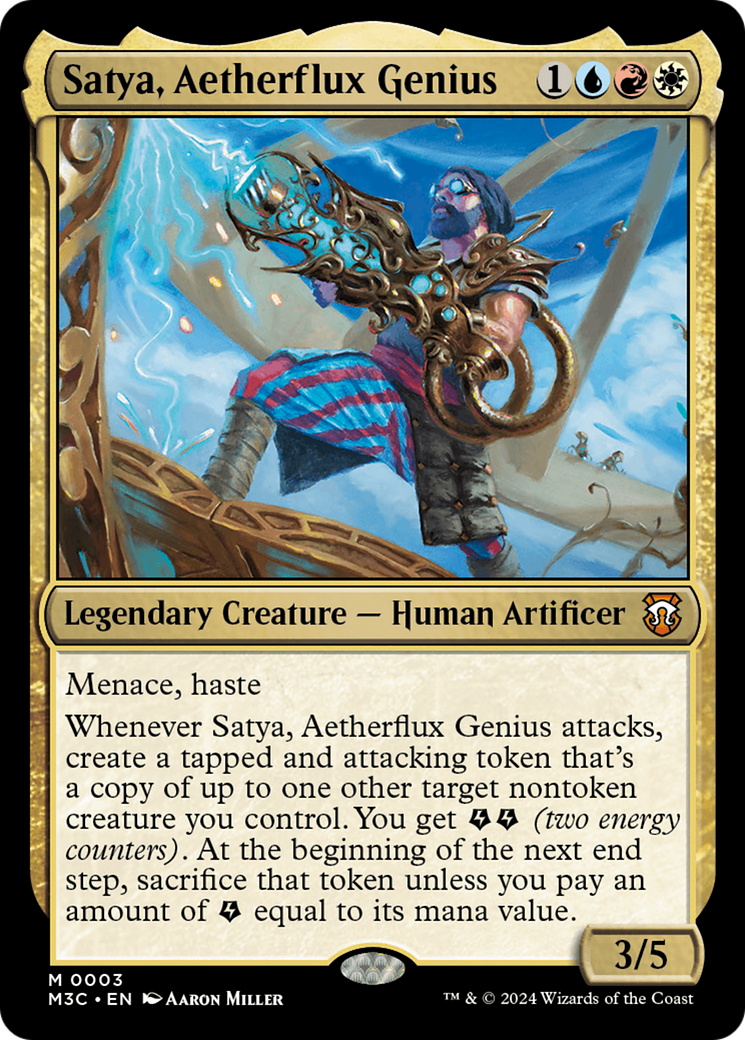
Satya, Aetherflux Genius
Satya, Aetherflux Genius
Legendary Creature — Human Artificer
3/5
Menace, haste
Whenever Satya attacks, create a tapped and attacking token that's a copy of up to one other target nontoken creature you control. You get (two energy counters). At the beginning of the next end step, sacrifice that token unless you pay an amount of equal to its mana value.
- You choose which player, planeswalker, or battle the token is attacking as you create the token. It doesn't need to be attacking the same player, planeswalker, or battle that Satya is attacking.
- The token copies exactly what was printed on the original card and nothing else (unless that creature is itself copying something else; see below). It doesn't copy whether that creature is tapped or untapped, whether it has any counters on it or Auras attached to it, or any non-copy effects that have changed its power, toughness, types, color, and so on.
- If the copied creature is copying something else, then the token enters the battlefield as whatever that creature copied.
- If the copied creature has in its mana cost, X is 0.
- Any enters-the-battlefield abilities of the copied creature will trigger when the token enters the battlefield. Any "as [this creature] enters the battlefield" or "[this creature] enters the battlefield with" abilities of the creature will also work.
- is the energy symbol. It represents one energy counter.
- Energy counters are a kind of counter that a player may have. They're not associated with any specific permanents.
- Keep track of how many energy counters each player has. Potential ways to track this include writing theme down on paper or using dice, but any method that is clear and mutually agreeable is fine. (At higher levels of tournament play, dice may not be allowed for tracking counters that players have.)
- If an effect says you get one or more , you get that many energy counters. To pay one or more , you lose that many energy counters. You can't pay more energy counters than you have. Any effects that interact with counters a player gets, has, or loses can interact with energy counters.
- Energy counters aren't mana. They don't go away as steps, phases, and turns end, and effects that add mana "of any type" can't give you energy counters.
- Some triggered abilities state that you "may pay" a certain amount of . You can't pay that amount multiple times to multiply the effect. You simply choose whether or not to pay that amount of as the ability resolves.
- Some triggered abilities that state that you "may pay" a certain amount of describe an effect that happens "If you do." In that case, no player may take actions to try to stop the ability's effect after you make your choice. If the payment is followed by the phrase "When you do," then you'll choose any targets for that reflexive triggered ability and put it on the stack before players can take actions.
- If a spell or ability with one or more targets states that you "may pay" some amount of , and each permanent that it targets has become an illegal target, the spell or ability won't resolve. You can't pay any even if you want to.
- Some spells and abilities that give you may require targets. If each target chosen is an illegal target as that spell or ability tries to resolve, it won't resolve. You won't get any .
-
1
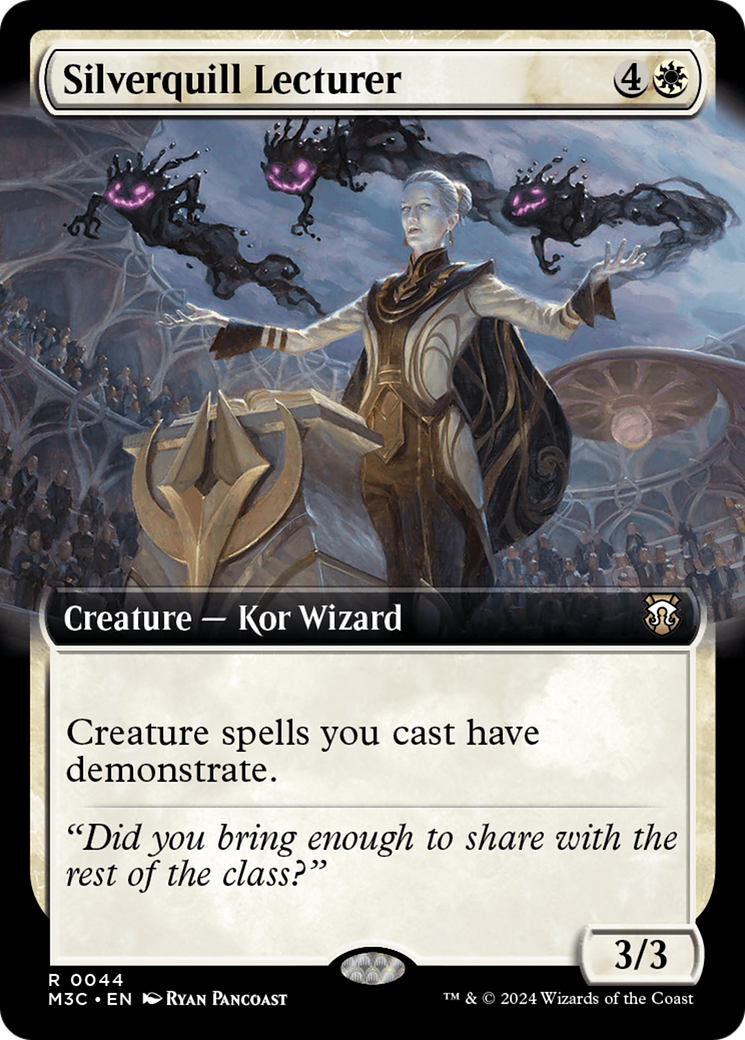
Silverquill Lecturer
Silverquill Lecturer
Creature — Kor Wizard
3/3
Creature spells you cast have demonstrate. (Whenever you cast a creature spell, you may copy it. If you do, choose an opponent to also copy it. Each copy becomes a token.)
- If you cast a spell with demonstrate and both you and an opponent copy it, the opponent's copy will resolve first, then your copy will resolve, and finally the original spell will resolve.
- If you cast the spell and choose not to copy it, no opponent will get to copy it either.
- If the spell had an X value chosen for it as it was cast, the copies will have the same value of X.
- If any additional or alternative costs were paid to cast the spell with demonstrate, the copies will see those choices as well. For example, if the spell has a kicker ability and was kicked, the copies will also be kicked
- Resolving copies of permanent spells become tokens as they enter the battlefield. These tokens are not considered "created" when this happens.
- You choose whether to make a copy as the demonstrate ability resolves. This happens before the original spell resolves. Your copy goes on the stack above the original spell.
- If you copy a spell with demonstrate, you then immediately choose an opponent. If they copy the spell, it goes on top of the stack.
-
1
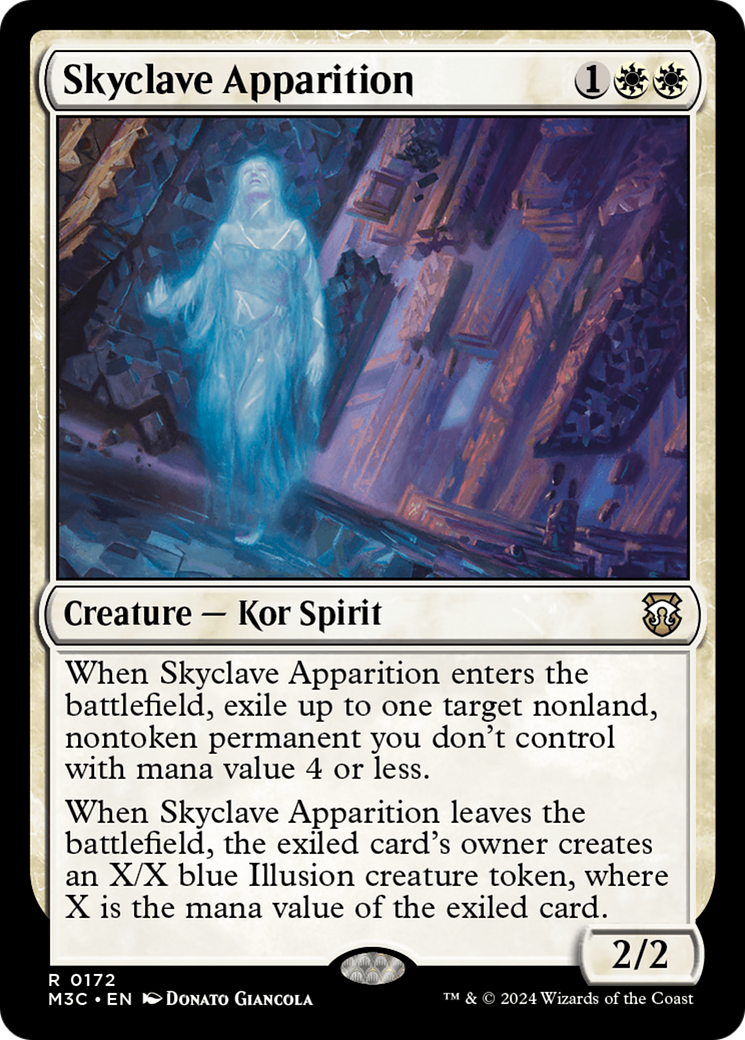
Skyclave Apparition
Skyclave Apparition
Creature — Kor Spirit
2/2
When this creature enters, exile up to one target nonland, nontoken permanent you don't control with mana value 4 or less.
When this creature leaves the battlefield, the exiled card's owner creates an X/X blue Illusion creature token, where X is the mana value of the exiled card.
- If there's no exiled card when Skyclave Apparition leaves the battlefield (most likely because its first ability hasn't resolved yet), no player creates a token.
- If a creature on the battlefield has in its mana cost, X is considered to be 0.
- If Skyclave Apparition leaves the battlefield before its first ability resolves, the ability still exiles the target permanent.
- If Skyclave Apparition's first ability exiled more than one card owned by a single player, that player creates a token with power and toughness equal to the sum of those cards' mana values. If the first ability exiled cards owned by more than one player, each of those players creates a token with power and toughness equal to the sum of the mana values of all cards exiled by the first ability.
-
1
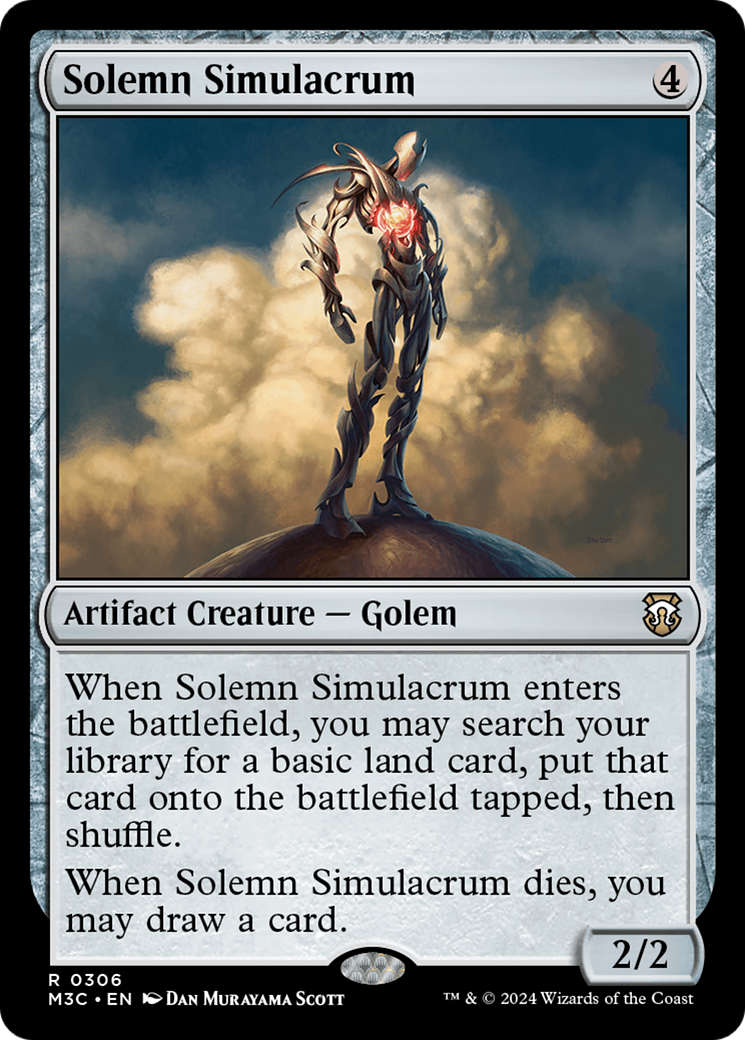
Solemn Simulacrum
Solemn Simulacrum
Artifact Creature — Golem
2/2
When this creature enters, you may search your library for a basic land card, put that card onto the battlefield tapped, then shuffle.
When this creature dies, you may draw a card.
-
1
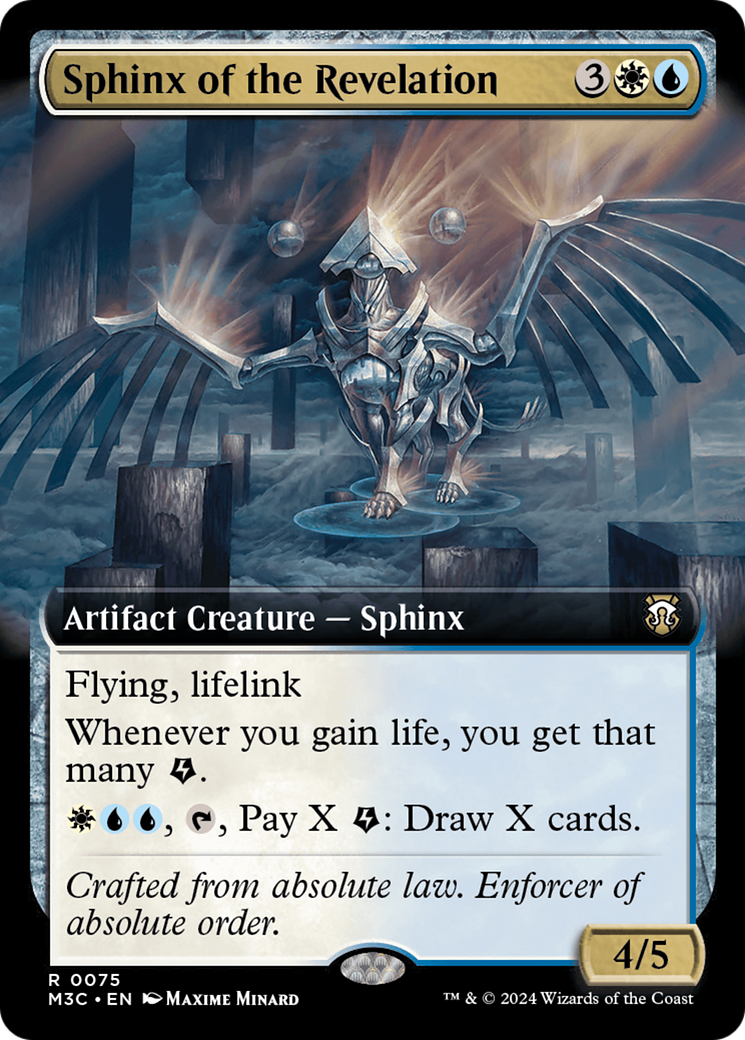
Sphinx of the Revelation
Sphinx of the Revelation
Artifact Creature — Sphinx
4/5
Flying, lifelink
Whenever you gain life, you get that many (energy counters).
, , Pay X : Draw X cards.
- Each creature with lifelink dealing combat damage causes a separate life-gaining event. For example, if two creatures you control with lifelink deal combat damage at the same time, Sphinx of the Revelation's triggered ability will trigger twice. This may be relevant if you control a permanent with an ability that triggers "Whenever you get one or more ."
- is the energy symbol. It represents one energy counter.
- Energy counters are a kind of counter that a player may have. They're not associated with any specific permanents.
- Keep track of how many energy counters each player has. Potential ways to track this include writing theme down on paper or using dice, but any method that is clear and mutually agreeable is fine. (At higher levels of tournament play, dice may not be allowed for tracking counters that players have.)
- If an effect says you get one or more , you get that many energy counters. To pay one or more , you lose that many energy counters. You can't pay more energy counters than you have. Any effects that interact with counters a player gets, has, or loses can interact with energy counters.
- Energy counters aren't mana. They don't go away as steps, phases, and turns end, and effects that add mana "of any type" can't give you energy counters.
- Some triggered abilities state that you "may pay" a certain amount of . You can't pay that amount multiple times to multiply the effect. You simply choose whether or not to pay that amount of as the ability resolves.
- Some triggered abilities that state that you "may pay" a certain amount of describe an effect that happens "If you do." In that case, no player may take actions to try to stop the ability's effect after you make your choice. If the payment is followed by the phrase "When you do," then you'll choose any targets for that reflexive triggered ability and put it on the stack before players can take actions.
- If a spell or ability with one or more targets states that you "may pay" some amount of , and each permanent that it targets has become an illegal target, the spell or ability won't resolve. You can't pay any even if you want to.
- Some spells and abilities that give you may require targets. If each target chosen is an illegal target as that spell or ability tries to resolve, it won't resolve. You won't get any .
-
1
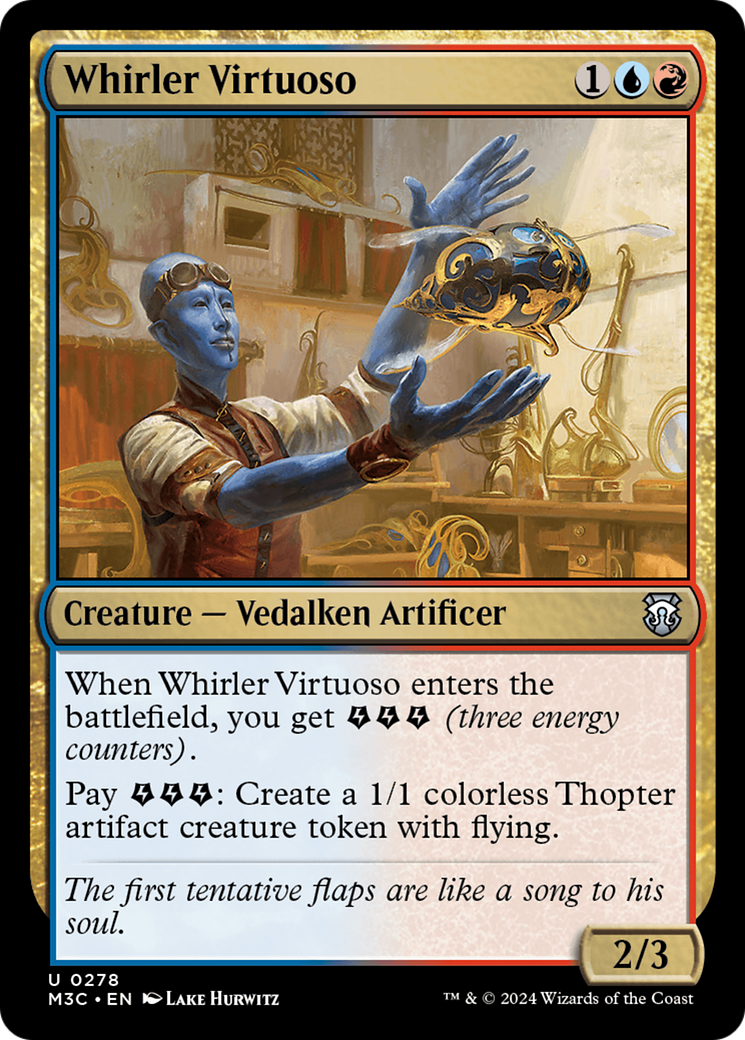
Whirler Virtuoso
Whirler Virtuoso
Creature — Vedalken Artificer
2/3
When this creature enters, you get (three energy counters).
Pay : Create a 1/1 colorless Thopter artifact creature token with flying.
- is the energy symbol. It represents one energy counter.
- Energy counters are a kind of counter that a player may have. They're not associated with any specific permanents.
- Keep track of how many energy counters each player has. Potential ways to track this include writing theme down on paper or using dice, but any method that is clear and mutually agreeable is fine. (At higher levels of tournament play, dice may not be allowed for tracking counters that players have.)
- If an effect says you get one or more , you get that many energy counters. To pay one or more , you lose that many energy counters. You can't pay more energy counters than you have. Any effects that interact with counters a player gets, has, or loses can interact with energy counters.
- Energy counters aren't mana. They don't go away as steps, phases, and turns end, and effects that add mana "of any type" can't give you energy counters.
- Some triggered abilities state that you "may pay" a certain amount of . You can't pay that amount multiple times to multiply the effect. You simply choose whether or not to pay that amount of as the ability resolves.
- Some triggered abilities that state that you "may pay" a certain amount of describe an effect that happens "If you do." In that case, no player may take actions to try to stop the ability's effect after you make your choice. If the payment is followed by the phrase "When you do," then you'll choose any targets for that reflexive triggered ability and put it on the stack before players can take actions.
- If a spell or ability with one or more targets states that you "may pay" some amount of , and each permanent that it targets has become an illegal target, the spell or ability won't resolve. You can't pay any even if you want to.
- Some spells and abilities that give you may require targets. If each target chosen is an illegal target as that spell or ability tries to resolve, it won't resolve. You won't get any .
Instants 3
-
1
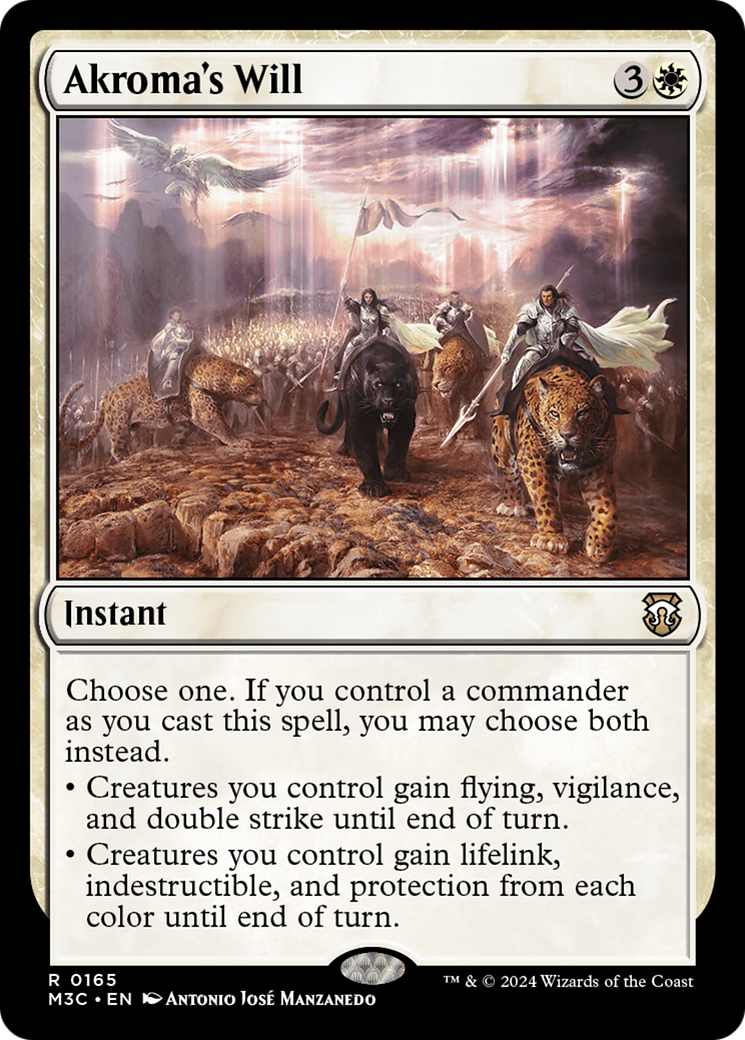
Akroma's Will
Akroma's Will
Instant
Choose one. If you control a commander as you cast this spell, you may choose both instead.
- Creatures you control gain flying, vigilance, and double strike until end of turn.
- Creatures you control gain lifelink, indestructible, and protection from each color until end of turn.
- "Protection from each color" is shorthand for protection from white, from blue, from black, from red, and from green. Colorless is not a color.
- There's no extra bonus if you control more than one commander.
- Once you've announced that you're casting a spell, players can't take any actions until you've finished doing so. Notably, opponents can't try to remove your commander to change how many modes you may choose.
- Even though the card is named after a specific character, controlling any commander will satisfy its condition.
- The commander you control doesn't have to be your commander.
- Once you've chosen both modes for the spell, it doesn't matter whether you continue to control a commander. This is true even if you somehow no longer control a commander as you finish casting the spell.
-
1
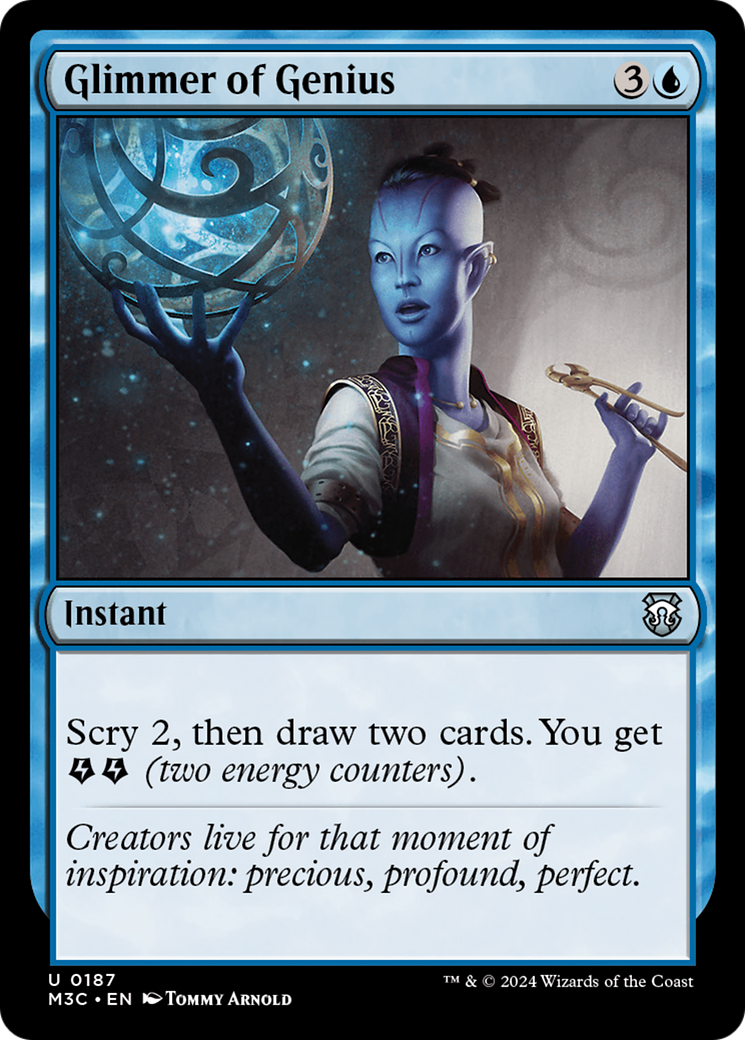
Glimmer of Genius
Glimmer of Genius
Instant
Scry 2, then draw two cards. You get (two energy counters).
- is the energy symbol. It represents one energy counter.
- Energy counters are a kind of counter that a player may have. They're not associated with any specific permanents.
- Keep track of how many energy counters each player has. Potential ways to track this include writing theme down on paper or using dice, but any method that is clear and mutually agreeable is fine. (At higher levels of tournament play, dice may not be allowed for tracking counters that players have.)
- If an effect says you get one or more , you get that many energy counters. To pay one or more , you lose that many energy counters. You can't pay more energy counters than you have. Any effects that interact with counters a player gets, has, or loses can interact with energy counters.
- Energy counters aren't mana. They don't go away as steps, phases, and turns end, and effects that add mana "of any type" can't give you energy counters.
- Some triggered abilities state that you "may pay" a certain amount of . You can't pay that amount multiple times to multiply the effect. You simply choose whether or not to pay that amount of as the ability resolves.
- Some triggered abilities that state that you "may pay" a certain amount of describe an effect that happens "If you do." In that case, no player may take actions to try to stop the ability's effect after you make your choice. If the payment is followed by the phrase "When you do," then you'll choose any targets for that reflexive triggered ability and put it on the stack before players can take actions.
- If a spell or ability with one or more targets states that you "may pay" some amount of , and each permanent that it targets has become an illegal target, the spell or ability won't resolve. You can't pay any even if you want to.
- Some spells and abilities that give you may require targets. If each target chosen is an illegal target as that spell or ability tries to resolve, it won't resolve. You won't get any .
-
1
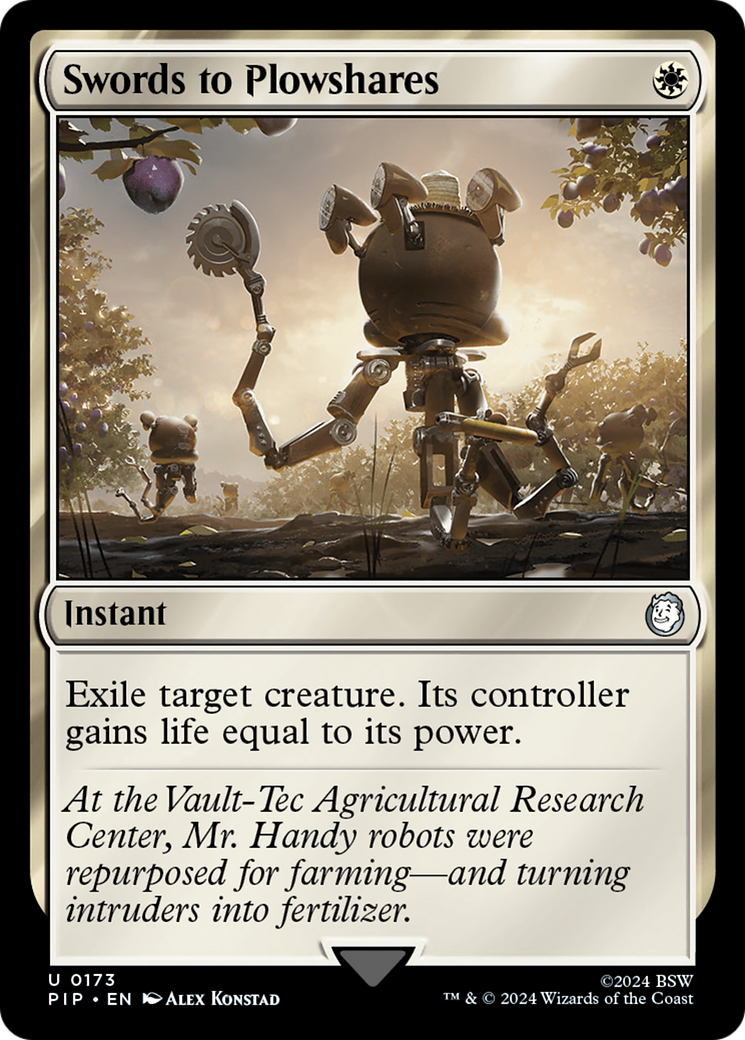
Swords to Plowshares
Swords to Plowshares
Instant
Exile target creature. Its controller gains life equal to its power.
- Use the power of the creature from when it was last on the battlefield to determine how much life is gained.
Sorceries 6
-
1
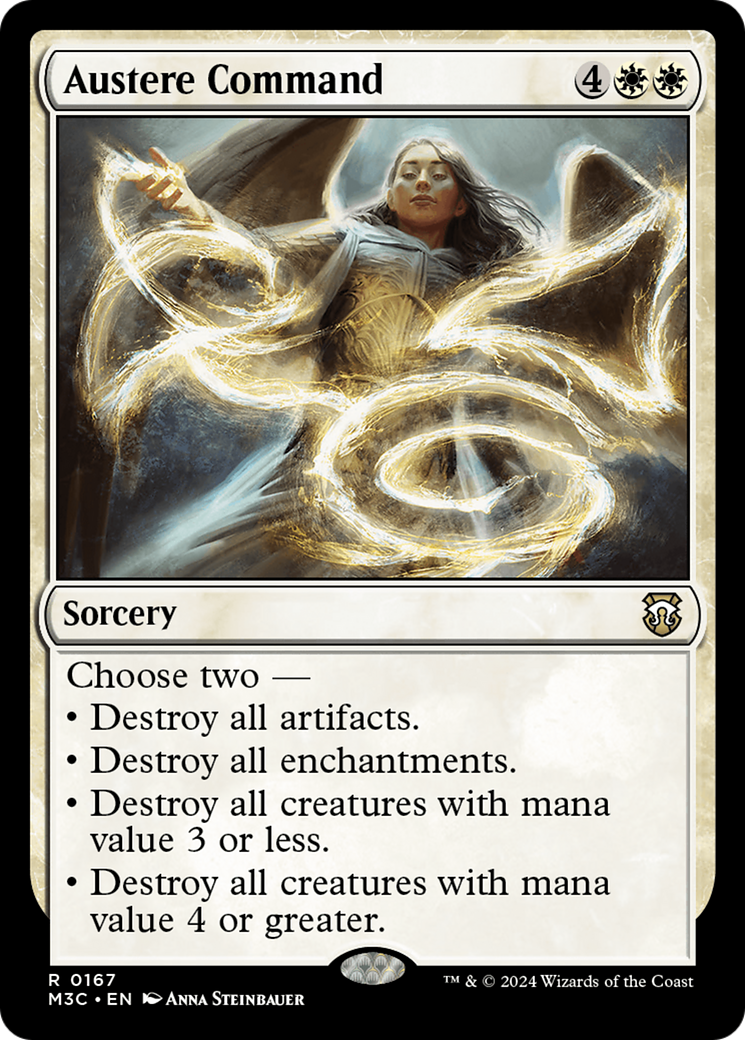
Austere Command
Austere Command
Sorcery
Choose two —
- Destroy all artifacts.
- Destroy all enchantments.
- Destroy all creatures with mana value 3 or less.
- Destroy all creatures with mana value 4 or greater.
- Each of the chosen modes happens sequentially. If a permanent has an ability that triggers whenever it or another permanent is destroyed, it will see permanents destroyed at the same time as it or before it, but not permanents destroyed by later modes.
- If a card is exiled "until" another permanent leaves the battlefield, the exiled card returns to the battlefield immediately after that permanent leaves the battlefield during Austere Command's resolution, and it may be destroyed by a later mode.
- If the first and last modes are chosen, an artifact creature with mana value 4 or greater will have to be regenerated twice to survive. This is because the modes happen sequentially, and the regeneration "shield" is used up by the first one. The same is true with any other combination of modes that covers one permanent twice.
-
1
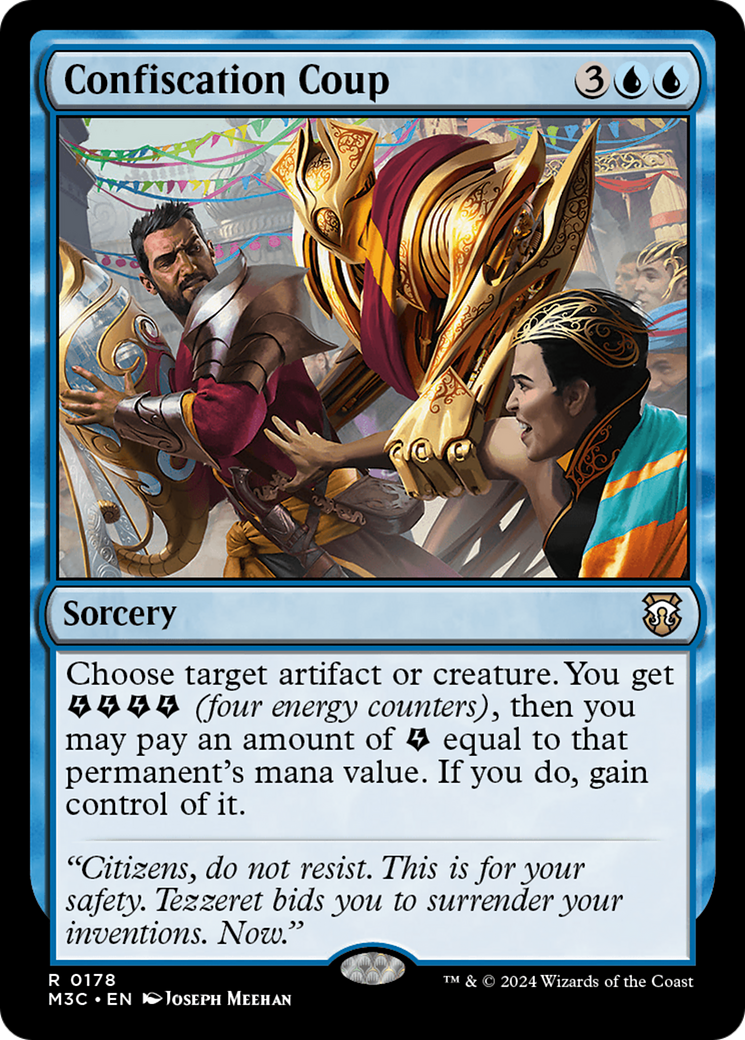
Confiscation Coup
Confiscation Coup
Sorcery
Choose target artifact or creature. You get (four energy counters), then you may pay an amount of equal to that permanent's mana value. If you do, gain control of it.
- Some spells and abilities that give you may require targets. If each target chosen is an illegal target as that spell or ability tries to resolve, it won't resolve. You won't get any .
- Keep track of how many energy counters each player has. Potential ways to track this include writing theme down on paper or using dice, but any method that is clear and mutually agreeable is fine. (At higher levels of tournament play, dice may not be allowed for tracking counters that players have.)
- If an effect says you get one or more , you get that many energy counters. To pay one or more , you lose that many energy counters. You can't pay more energy counters than you have. Any effects that interact with counters a player gets, has, or loses can interact with energy counters.
- Energy counters aren't mana. They don't go away as steps, phases, and turns end, and effects that add mana "of any type" can't give you energy counters.
- Some triggered abilities state that you "may pay" a certain amount of . You can't pay that amount multiple times to multiply the effect. You simply choose whether or not to pay that amount of as the ability resolves.
- Some triggered abilities that state that you "may pay" a certain amount of describe an effect that happens "If you do." In that case, no player may take actions to try to stop the ability's effect after you make your choice. If the payment is followed by the phrase "When you do," then you'll choose any targets for that reflexive triggered ability and put it on the stack before players can take actions.
- If a spell or ability with one or more targets states that you "may pay" some amount of , and each permanent that it targets has become an illegal target, the spell or ability won't resolve. You can't pay any even if you want to.
- is the energy symbol. It represents one energy counter.
- Energy counters are a kind of counter that a player may have. They're not associated with any specific permanents.
- There are many important moments in the story, but the most crucial—called "story spotlights"—are shown on cards. These cards have the Planeswalker symbol in their text box; this symbol has no effect on gameplay. You can read more about these events in the official Magic fiction at http://www.mtgstory.com.
- If the target artifact or creature has a mana value of 0, you may choose to pay zero energy and gain control of it.
- If a permanent has in its mana cost, X is considered to be 0.
- The mana value of a token that isn't a copy of another object is 0. A token that is a copy of another object has the same mana cost as that object.
- In a multiplayer game, if a permanent's owner leaves the game after you've gained control of it, the permanent leaves with that player. If you leave the game before that player, the control-change effect ends.
- You choose the target artifact or creature as you cast Confiscation Coup. You don't choose whether or not to pay an amount of until Confiscation Coup resolves. If the target becomes an illegal target, Confiscation Coup won't resolve and you won't get .
-
1
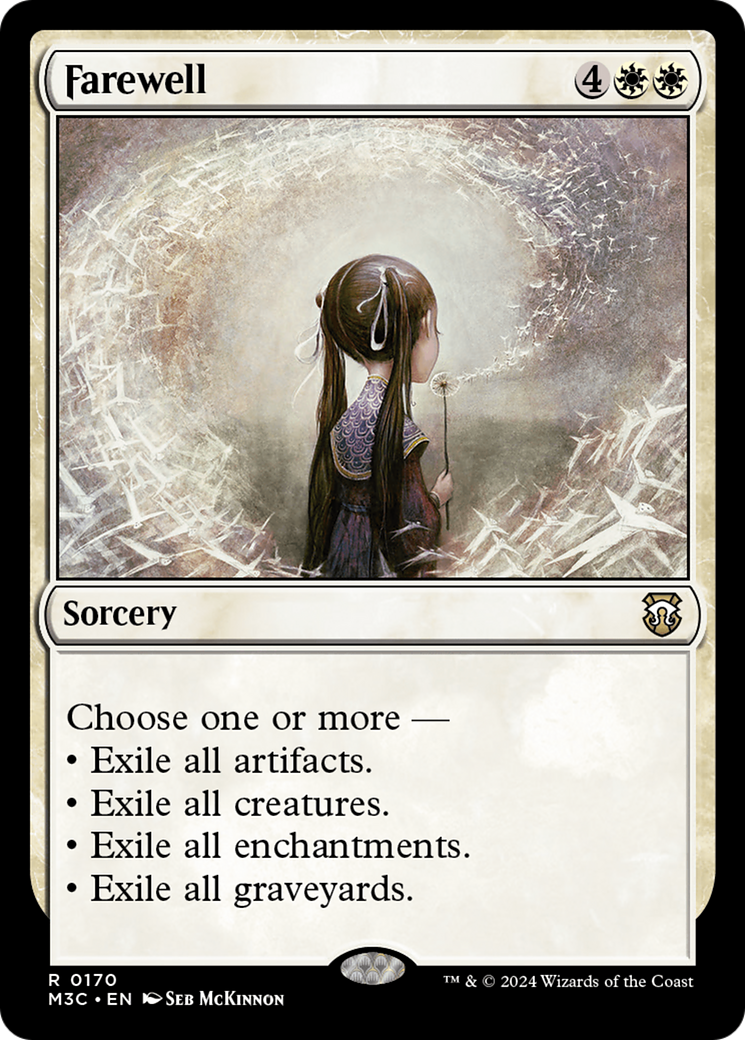
Farewell
Farewell
Sorcery
Choose one or more —
- Exile all artifacts.
- Exile all creatures.
- Exile all enchantments.
- Exile all graveyards.
- If you choose more than one mode for Farewell, you perform the actions in the order written.
-
1
Jolted Awake
Jolted Awake
Sorcery
Choose up to one target artifact or creature card in your graveyard. You get (two energy counters). Then you may pay an amount of equal to that card's mana value. If you do, return it from your graveyard to the battlefield.
Cycling ( , Discard this card: Draw a card.)
-
1
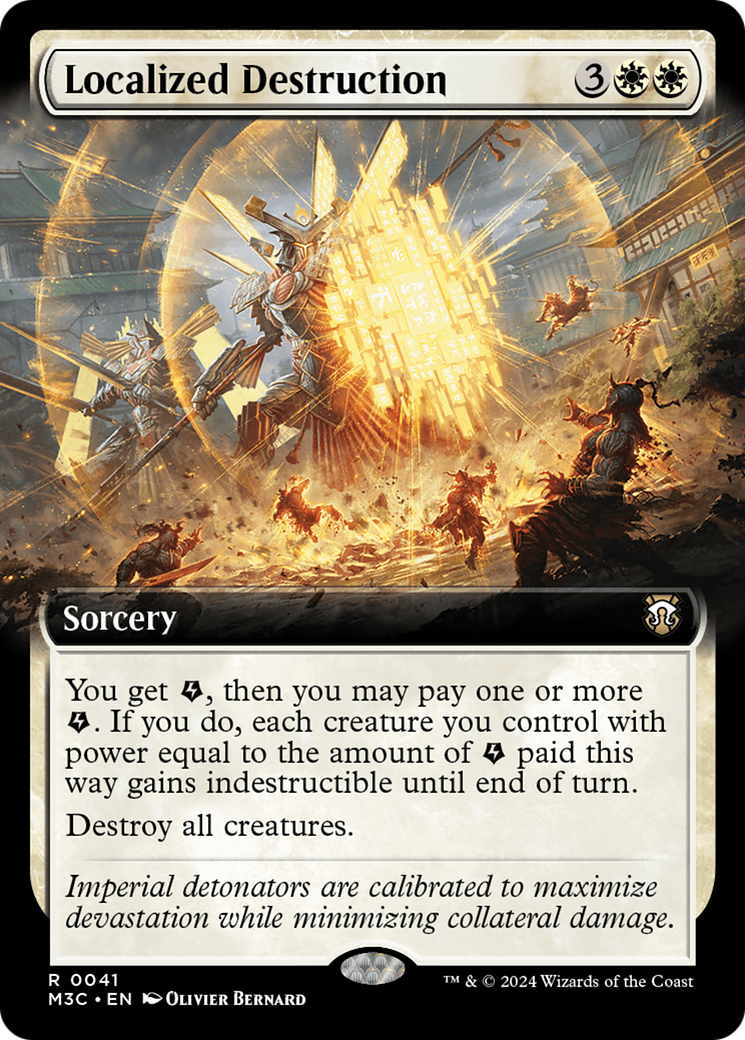
Localized Destruction
Localized Destruction
Sorcery
You get (an energy counter), then you may pay one or more . If you do, each creature you control with power equal to the amount of paid this way gains indestructible until end of turn.
Destroy all creatures.
- is the energy symbol. It represents one energy counter.
- Energy counters are a kind of counter that a player may have. They're not associated with any specific permanents.
- Keep track of how many energy counters each player has. Potential ways to track this include writing theme down on paper or using dice, but any method that is clear and mutually agreeable is fine. (At higher levels of tournament play, dice may not be allowed for tracking counters that players have.)
- If an effect says you get one or more , you get that many energy counters. To pay one or more , you lose that many energy counters. You can't pay more energy counters than you have. Any effects that interact with counters a player gets, has, or loses can interact with energy counters.
- Energy counters aren't mana. They don't go away as steps, phases, and turns end, and effects that add mana "of any type" can't give you energy counters.
- Some triggered abilities state that you "may pay" a certain amount of . You can't pay that amount multiple times to multiply the effect. You simply choose whether or not to pay that amount of as the ability resolves.
- Some triggered abilities that state that you "may pay" a certain amount of describe an effect that happens "If you do." In that case, no player may take actions to try to stop the ability's effect after you make your choice. If the payment is followed by the phrase "When you do," then you'll choose any targets for that reflexive triggered ability and put it on the stack before players can take actions.
- If a spell or ability with one or more targets states that you "may pay" some amount of , and each permanent that it targets has become an illegal target, the spell or ability won't resolve. You can't pay any even if you want to.
- Some spells and abilities that give you may require targets. If each target chosen is an illegal target as that spell or ability tries to resolve, it won't resolve. You won't get any .
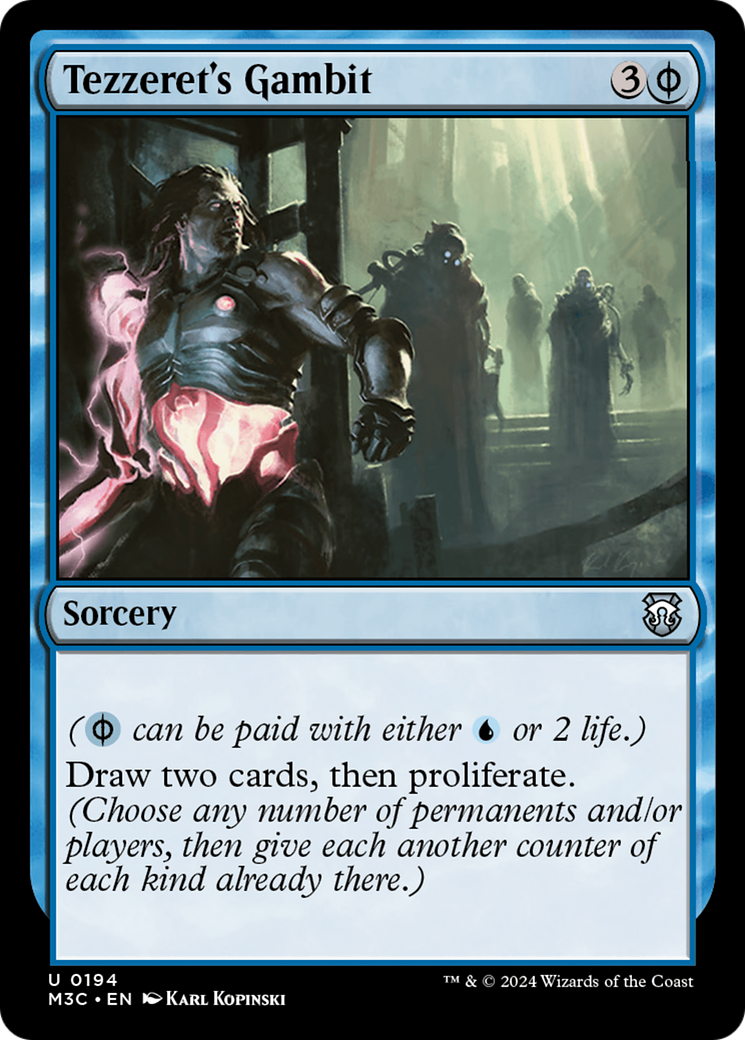
-
1
Tezzeret's Gambit
Tezzeret's Gambit
Sorcery
( can be paid with either or 2 life.)
Draw two cards, then proliferate. (Choose any number of permanents and/or players, then give each another counter of each kind already there.)
- If a permanent ever has both +1/+1 counters and -1/-1 counters on it at the same time, they're removed in pairs as a state-based action so that the permanent has only one of those kinds of counters on it.
- To proliferate, you can choose any permanent that has a counter, including ones controlled by opponents. You can choose any player who has a counter, including opponents. You can't choose cards in any zone other than the battlefield, even if they have counters on them.
- You don't have to choose every permanent or player that has a counter, only the ones you want to add another counter to. Since "any number" includes zero, you don't have to choose any permanents at all, and you don't have to choose any players at all.
- If a player or permanent has more than one kind of counter on it, and you choose for it to get additional counters, it must get one of each kind of counter it already has. You can't have it get just one kind of counter it already has and not the others.
- An ability that triggers "Whenever you proliferate" triggers even if you chose no permanents or players while doing so.
- Players can respond to a spell or ability whose effect includes proliferating. Once that spell or ability starts to resolve, however, and its controller chooses which permanents and players will get new counters, it's too late for anyone to respond.
- To calculate the mana value of a card with Phyrexian mana symbols in its cost, count each Phyrexian mana symbol as 1.
- As you cast a spell or activate an activated ability with one or more Phyrexian mana symbols in its cost, you choose how to pay for each Phyrexian mana symbol at the same time you would choose modes or choose a value for X.
- If you're at 1 life or less, you can't pay 2 life.
- Phyrexian mana is not a new color. Players can't produce Phyrexian mana.
- A card with Phyrexian mana symbols in its mana cost is each color that appears in that mana cost, regardless of how that cost may have been paid.
Artifacts 23
-
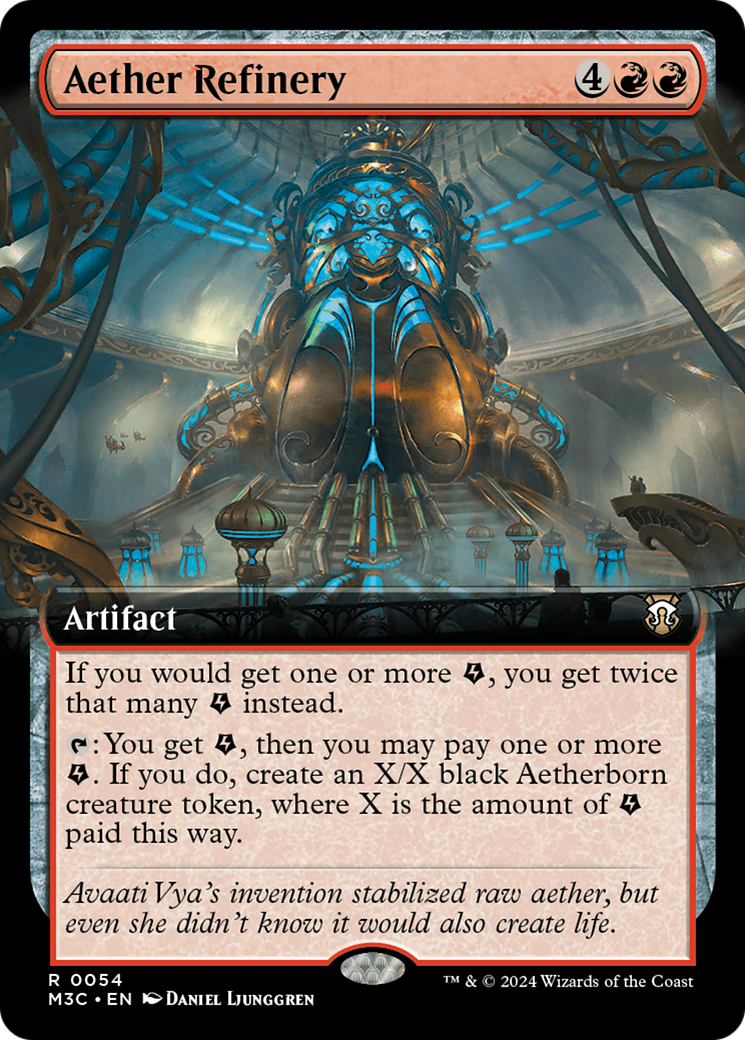
1
Aether Refinery
Aether Refinery
Artifact
If you would get one or more (energy counters), you get twice that many instead.
: You get , then you may pay one or more . If you do, create an X/X black Aetherborn creature token, where X is the amount of paid this way.
- If you control two Aether Refineries, the amount of you get is four times the original number. Three Aether Refineries multiplies the original number by eight, and so on.
- If two or more effects attempt to modify how many you get (or how many counters you would get), you choose the order to apply those effects, no matter who controls the sources of those effects.
- is the energy symbol. It represents one energy counter.
- Energy counters are a kind of counter that a player may have. They're not associated with any specific permanents.
- Keep track of how many energy counters each player has. Potential ways to track this include writing theme down on paper or using dice, but any method that is clear and mutually agreeable is fine. (At higher levels of tournament play, dice may not be allowed for tracking counters that players have.)
- If an effect says you get one or more , you get that many energy counters. To pay one or more , you lose that many energy counters. You can't pay more energy counters than you have. Any effects that interact with counters a player gets, has, or loses can interact with energy counters.
- Energy counters aren't mana. They don't go away as steps, phases, and turns end, and effects that add mana "of any type" can't give you energy counters.
- Some triggered abilities state that you "may pay" a certain amount of . You can't pay that amount multiple times to multiply the effect. You simply choose whether or not to pay that amount of as the ability resolves.
- Some triggered abilities that state that you "may pay" a certain amount of describe an effect that happens "If you do." In that case, no player may take actions to try to stop the ability's effect after you make your choice. If the payment is followed by the phrase "When you do," then you'll choose any targets for that reflexive triggered ability and put it on the stack before players can take actions.
- If a spell or ability with one or more targets states that you "may pay" some amount of , and each permanent that it targets has become an illegal target, the spell or ability won't resolve. You can't pay any even if you want to.
- Some spells and abilities that give you may require targets. If each target chosen is an illegal target as that spell or ability tries to resolve, it won't resolve. You won't get any .
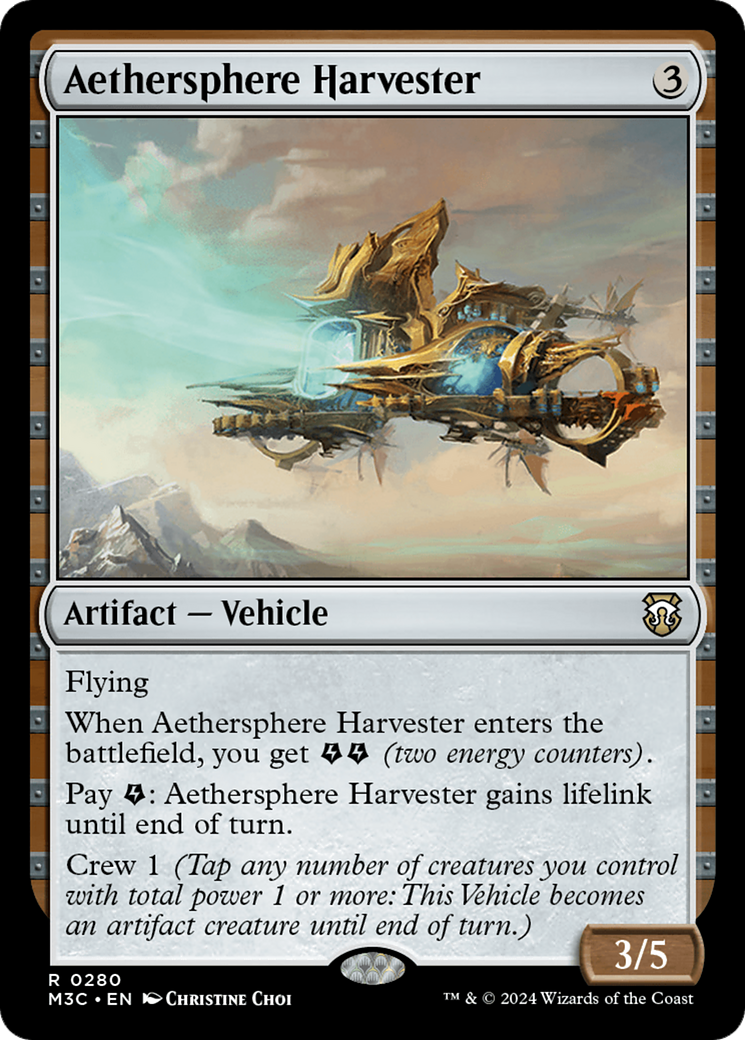
-
1
Aethersphere Harvester
Aethersphere Harvester
Artifact — Vehicle
3/5
Flying
When this Vehicle enters, you get (two energy counters).
Pay : This Vehicle gains lifelink until end of turn.
Crew 1 (Tap any number of creatures you control with total power 1 or more: This Vehicle becomes an artifact creature until end of turn.)
- Some spells and abilities that give you may require targets. If each target chosen is an illegal target as that spell or ability tries to resolve, it won't resolve. You won't get any .
- is the energy symbol. It represents one energy counter.
- Energy counters are a kind of counter that a player may have. They're not associated with any specific permanents.
- Keep track of how many energy counters each player has. Potential ways to track this include writing theme down on paper or using dice, but any method that is clear and mutually agreeable is fine. (At higher levels of tournament play, dice may not be allowed for tracking counters that players have.)
- If an effect says you get one or more , you get that many energy counters. To pay one or more , you lose that many energy counters. You can't pay more energy counters than you have. Any effects that interact with counters a player gets, has, or loses can interact with energy counters.
- Energy counters aren't mana. They don't go away as steps, phases, and turns end, and effects that add mana "of any type" can't give you energy counters.
- Some triggered abilities state that you "may pay" a certain amount of . You can't pay that amount multiple times to multiply the effect. You simply choose whether or not to pay that amount of as the ability resolves.
- Some triggered abilities that state that you "may pay" a certain amount of describe an effect that happens "If you do." In that case, no player may take actions to try to stop the ability's effect after you make your choice. If the payment is followed by the phrase "When you do," then you'll choose any targets for that reflexive triggered ability and put it on the stack before players can take actions.
- If a spell or ability with one or more targets states that you "may pay" some amount of , and each permanent that it targets has become an illegal target, the spell or ability won't resolve. You can't pay any even if you want to.
- You may activate a crew ability of a Vehicle even if it's already an artifact creature. Doing so has no effect on the Vehicle. It doesn't change its power and toughness.
- For a Vehicle to be able to attack, it must be a creature as the declare attackers step begins, so the latest you can activate its crew ability to attack with it is during the beginning of combat step. For a Vehicle to be able to block, it must be a creature as the declare blockers step begins, so the latest you can activate its crew ability to block with it is during the declare attackers step. In either case, players may take actions after the crew ability resolves but before the Vehicle has been declared as an attacking or blocking creature.
- If a permanent becomes a copy of a Vehicle, the copy won't be a creature, even if the Vehicle it's copying has become an artifact creature.
- When a Vehicle becomes a creature, that doesn't count as having a creature enter the battlefield. The permanent was already on the battlefield; it only changed its types. Abilities that trigger whenever a creature enters the battlefield won't trigger.
- Each Vehicle is printed with a power and toughness, but it's not a creature. If it becomes a creature (most likely through its crew ability), it will have that power and toughness.
- If an effect causes a Vehicle to become an artifact creature with a specified power and toughness, that effect overwrites the Vehicle's printed power and toughness.
- Vehicle is an artifact type, not a creature type. A Vehicle that's crewed won't normally have any creature type.
- Once a player announces that they are activating a crew ability, no player may take other actions until the ability has been paid for. Notably, players can't try to stop the ability by changing a creature's power or by removing or tapping a creature.
- Any untapped creature you control can be tapped to pay a crew cost, even one that just came under your control.
- You may tap more creatures than necessary to activate a crew ability.
- Creatures that crew a Vehicle aren't attached to it or related in any other way. Effects that affect the Vehicle, such as by destroying it or giving it a +1/+1 counter, don't affect the creatures that crewed it.
- Once a Vehicle becomes a creature, it behaves exactly like any other artifact creature. It can't attack unless you've controlled it continuously since your turn began, it can block if it's untapped, it can be tapped to pay a Vehicle's crew cost, and so on.
- Multiple instances of lifelink on the same creature are redundant.
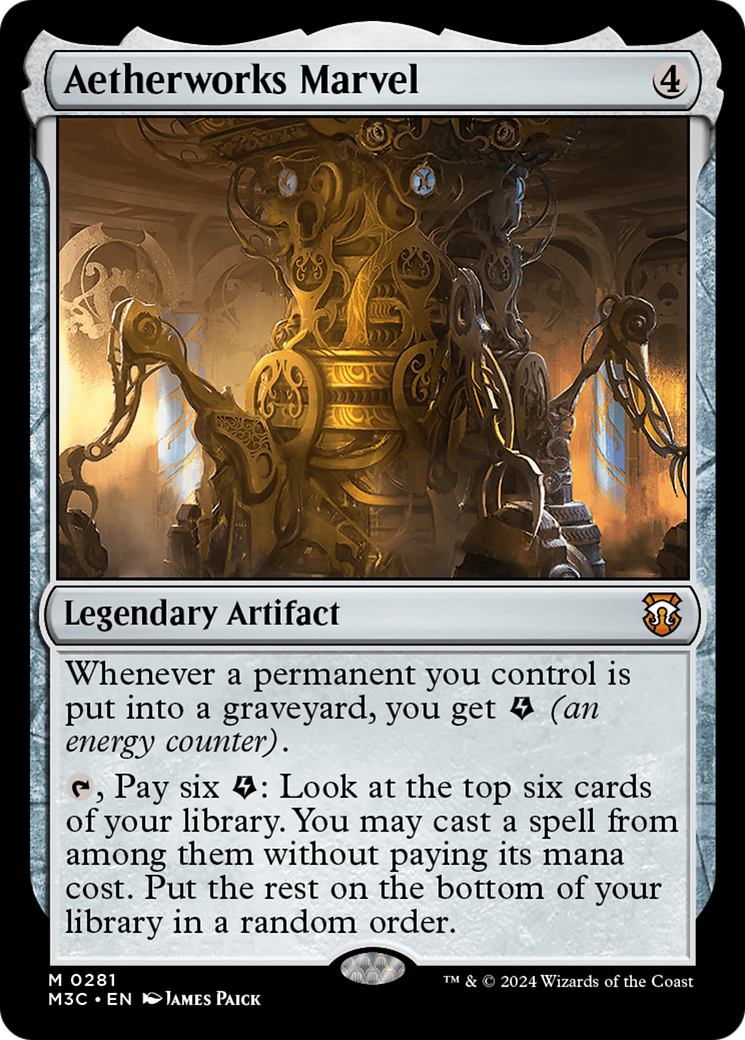
-
1
Aetherworks Marvel
Aetherworks Marvel
Legendary Artifact
Whenever a permanent you control is put into a graveyard, you get (an energy counter).
, Pay six : Look at the top six cards of your library. You may cast a spell from among them without paying its mana cost. Put the rest on the bottom of your library in a random order.
- Some spells and abilities that give you may require targets. If each target chosen is an illegal target as that spell or ability tries to resolve, it won't resolve. You won't get any .
- If an effect says you get one or more , you get that many energy counters. To pay one or more , you lose that many energy counters. You can't pay more energy counters than you have. Any effects that interact with counters a player gets, has, or loses can interact with energy counters.
- Energy counters aren't mana. They don't go away as steps, phases, and turns end, and effects that add mana "of any type" can't give you energy counters.
- Some triggered abilities state that you "may pay" a certain amount of . You can't pay that amount multiple times to multiply the effect. You simply choose whether or not to pay that amount of as the ability resolves.
- Some triggered abilities that state that you "may pay" a certain amount of describe an effect that happens "If you do." In that case, no player may take actions to try to stop the ability's effect after you make your choice. If the payment is followed by the phrase "When you do," then you'll choose any targets for that reflexive triggered ability and put it on the stack before players can take actions.
- If a spell or ability with one or more targets states that you "may pay" some amount of , and each permanent that it targets has become an illegal target, the spell or ability won't resolve. You can't pay any even if you want to.
- is the energy symbol. It represents one energy counter.
- Energy counters are a kind of counter that a player may have. They're not associated with any specific permanents.
- Keep track of how many energy counters each player has. Potential ways to track this include writing theme down on paper or using dice, but any method that is clear and mutually agreeable is fine. (At higher levels of tournament play, dice may not be allowed for tracking counters that players have.)
- Tokens that are sacrificed or destroyed are put into their owner's graveyard before ceasing to exist. If you controlled the token, Aetherworks Marvel's first ability will trigger.
- The card cast with Aetherworks Marvel's second ability is cast from your library.
- If you cast a card "without paying its mana cost," you can't choose to cast it for any alternative costs, such as emerge costs. You can, however, pay additional costs. If the card has any mandatory additional costs, such as that of Incendiary Sabotage, you must pay those to cast the card.
- If the card has in its mana cost, you must choose 0 as the value of X when casting it without paying its mana cost.
- Aetherworks Marvel's first ability triggers whenever any permanent you control is put into a graveyard from the battlefield, including Aetherworks Marvel itself and other permanents put into a graveyard at the same time as it.
-
1
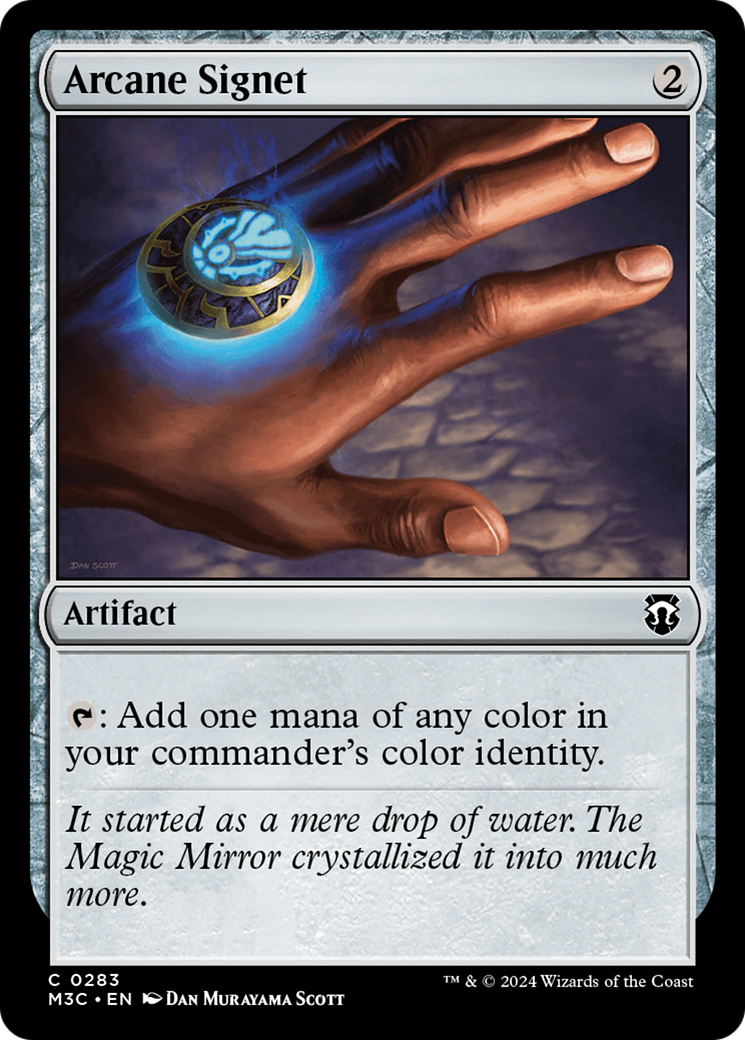
Arcane Signet
Arcane Signet
Artifact
: Add one mana of any color in your commander's color identity.
- If your commander is a card that has no colors in its color identity, Arcane Signet's ability produces no mana. It doesn't produce .
- If you have two commanders, the ability adds one mana of any color in their combined color identities.
- If you don't have a commander, Arcane Signet's ability produces no mana.
-
1
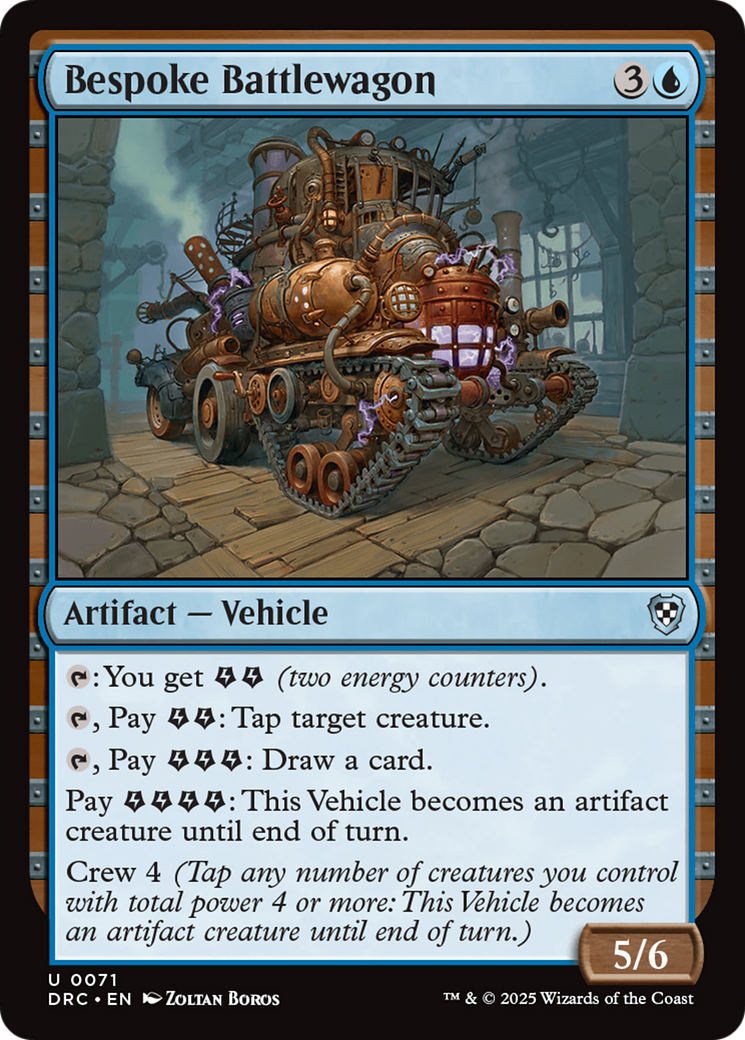
Bespoke Battlewagon
Bespoke Battlewagon
Artifact — Vehicle
5/6
: You get (two energy counters).
, Pay : Tap target creature.
, Pay : Draw a card.
Pay : This Vehicle becomes an artifact creature until end of turn.
Crew 4
- As long as Bespoke Battlewagon isn't a creature, its abilities can be activated even if you haven't controlled it continuously since the beginning of your most recent turn. If it is a creature, however, it's still subject to "summoning sickness" during that time period.
-
1
Bident of Thassa
Bident of Thassa
Legendary Enchantment Artifact
Whenever a creature you control deals combat damage to a player, you may draw a card.
, : Creatures your opponents control attack this turn if able.
- The controller of each attacking creature still chooses which player or planeswalker that creature attacks.
- If a creature can't attack for any reason (such as being tapped or having come under that player's control that turn), then it doesn't attack. If there's a cost associated with having a creature attack, the player isn't forced to pay that cost, so it doesn't have to attack in that case either.
-
1
Coalition Relic
Coalition Relic
Artifact
: Add one mana of any color.
: Put a charge counter on this artifact.
At the beginning of your first main phase, remove all charge counters from this artifact. Add one mana of any color for each charge counter removed this way.
- If you remove multiple charge counters from Coalition Relic at once, you may add a different color of mana for each one.
- Only the first main phase each turn is considered a precombat main phase, even if additional main phases or combat phases are created.
-
1
Conversion Apparatus
Conversion Apparatus
Artifact
: Add .
, : You get (three energy counters).
, Pay : Add three mana in any combination of colors.
-
1
Coveted Jewel
Coveted Jewel
Artifact
When this artifact enters, draw three cards.
: Add three mana of any one color.
Whenever one or more creatures an opponent controls attack you and aren't blocked, that player draws three cards and gains control of this artifact. Untap it.
- Coveted Jewel's last ability triggers after you declare blockers (or declare no blockers at all) if any attacking creatures are unblocked. It doesn't matter if some attacking creatures were blocked.
- If more than one opponent attacks you at the same time, Coveted Jewel's last ability triggers for each of them. You choose which player ends up with Coveted Jewel, but each of them draws three cards and has a chance to activate its mana ability.
- A creature attacking a planeswalker you control won't cause Coveted Jewel's last ability to trigger.
- Coveted Jewel's last ability resolves after blockers are chosen but before combat damage is dealt.
-
1
Decoction Module
Decoction Module
Artifact
Whenever a creature you control enters, you get (an energy counter).
, : Return target creature you control to its owner's hand.
- is the energy symbol. It represents one energy counter.
- Energy counters are a kind of counter that a player may have. They're not associated with any specific permanents.
- Keep track of how many energy counters each player has. Potential ways to track this include writing theme down on paper or using dice, but any method that is clear and mutually agreeable is fine. (At higher levels of tournament play, dice may not be allowed for tracking counters that players have.)
- If an effect says you get one or more , you get that many energy counters. To pay one or more , you lose that many energy counters. You can't pay more energy counters than you have. Any effects that interact with counters a player gets, has, or loses can interact with energy counters.
- Energy counters aren't mana. They don't go away as steps, phases, and turns end, and effects that add mana "of any type" can't give you energy counters.
- Some triggered abilities state that you "may pay" a certain amount of . You can't pay that amount multiple times to multiply the effect. You simply choose whether or not to pay that amount of as the ability resolves.
- Some triggered abilities that state that you "may pay" a certain amount of describe an effect that happens "If you do." In that case, no player may take actions to try to stop the ability's effect after you make your choice. If the payment is followed by the phrase "When you do," then you'll choose any targets for that reflexive triggered ability and put it on the stack before players can take actions.
- If a spell or ability with one or more targets states that you "may pay" some amount of , and each permanent that it targets has become an illegal target, the spell or ability won't resolve. You can't pay any even if you want to.
- Some spells and abilities that give you may require targets. If each target chosen is an illegal target as that spell or ability tries to resolve, it won't resolve. You won't get any .
-
1
Filigree Racer
Filigree Racer
Artifact — Vehicle
5/5
When this Vehicle enters, you get (four energy counters).
Whenever this Vehicle attacks, you may pay . When you do, target instant or sorcery card in your graveyard gains jump-start until end of turn. (You may cast that card from your graveyard by discarding a card in addition to paying its other costs. Then exile it.)
Crew 1
- When casting a spell with jump-start, you must still follow any timing restrictions and permissions, including those based on the card's type. For instance, you can cast a sorcery using jump-start only when you could normally cast a sorcery.
- A spell cast using jump-start will always be exiled afterward, whether it resolves, it's countered, or it leaves the stack in some other way.
- If an effect allows you to pay an alternative cost rather than a spell's mana cost, you may pay that alternative cost when you jump-start a spell. You'll still discard a card as an additional cost to cast it.
-
1
Gonti's Aether Heart
Gonti's Aether Heart
Legendary Artifact
Whenever Gonti's Aether Heart or another artifact you control enters, you get (two energy counters).
Pay eight , Exile Gonti's Aether Heart: Take an extra turn after this one.
- is the energy symbol. It represents one energy counter.
- Energy counters are a kind of counter that a player may have. They're not associated with any specific permanents.
- Keep track of how many energy counters each player has. Potential ways to track this include writing theme down on paper or using dice, but any method that is clear and mutually agreeable is fine. (At higher levels of tournament play, dice may not be allowed for tracking counters that players have.)
- If an effect says you get one or more , you get that many energy counters. To pay one or more , you lose that many energy counters. You can't pay more energy counters than you have. Any effects that interact with counters a player gets, has, or loses can interact with energy counters.
- Energy counters aren't mana. They don't go away as steps, phases, and turns end, and effects that add mana "of any type" can't give you energy counters.
- Some triggered abilities state that you "may pay" a certain amount of . You can't pay that amount multiple times to multiply the effect. You simply choose whether or not to pay that amount of as the ability resolves.
- Some triggered abilities that state that you "may pay" a certain amount of describe an effect that happens "If you do." In that case, no player may take actions to try to stop the ability's effect after you make your choice. If the payment is followed by the phrase "When you do," then you'll choose any targets for that reflexive triggered ability and put it on the stack before players can take actions.
- If a spell or ability with one or more targets states that you "may pay" some amount of , and each permanent that it targets has become an illegal target, the spell or ability won't resolve. You can't pay any even if you want to.
- Some spells and abilities that give you may require targets. If each target chosen is an illegal target as that spell or ability tries to resolve, it won't resolve. You won't get any .
-
1
Hourglass of the Lost
Hourglass of the Lost
Artifact
: Add . Put a time counter on this artifact.
, Remove X time counters from this artifact and exile it: Return each nonland permanent card with mana value X from your graveyard to the battlefield. Activate only as a sorcery.
- If a card in your graveyard has in its mana cost, X is considered to be 0.
-
1
Izzet Generatorium
Izzet Generatorium
Artifact
If you would get one or more (energy counters), you get that many plus one instead.
: Draw a card. Activate only if you've paid or lost four or more this turn.
-
1
Midnight Clock
Midnight Clock
Artifact
: Add .
: Put an hour counter on this artifact.
At the beginning of each upkeep, put an hour counter on this artifact.
When the twelfth hour counter is put on this artifact, shuffle your hand and graveyard into your library, then draw seven cards. Exile this artifact.
- If Midnight Clock leaves the battlefield while its last ability is on the stack, it won't be exiled.
- You can activate Midnight Clock's mana ability to pay the cost of its second ability.
- Midnight Clock's last ability triggers after one or more counters are put onto it if it had fewer than twelve counters on it before those counters were put on it and it has twelve or more counters on it after.
- Midnight Clock's first triggered ability triggers at the beginning of each upkeep, not just your upkeep. In a Two-Headed Giant game, an ability that triggers at the beginning of each upkeep rather than each player's upkeep triggers only once during each team's upkeep.
-
1
Sol Ring
Sol Ring
Artifact
: Add .
-
1
Solar Transformer
Solar Transformer
Artifact
This artifact enters tapped.
When this artifact enters, you get (three energy counters).
: Add .
, Pay : Add one mana of any color.
- is the energy symbol. It represents one energy counter.
- Energy counters are a kind of counter that a player may have. They're not associated with any specific permanents.
- Keep track of how many energy counters each player has. Potential ways to track this include writing theme down on paper or using dice, but any method that is clear and mutually agreeable is fine. (At higher levels of tournament play, dice may not be allowed for tracking counters that players have.)
- If an effect says you get one or more , you get that many energy counters. To pay one or more , you lose that many energy counters. You can't pay more energy counters than you have. Any effects that interact with counters a player gets, has, or loses can interact with energy counters.
- Energy counters aren't mana. They don't go away as steps, phases, and turns end, and effects that add mana "of any type" can't give you energy counters.
- Some triggered abilities state that you "may pay" a certain amount of . You can't pay that amount multiple times to multiply the effect. You simply choose whether or not to pay that amount of as the ability resolves.
- Some triggered abilities that state that you "may pay" a certain amount of describe an effect that happens "If you do." In that case, no player may take actions to try to stop the ability's effect after you make your choice. If the payment is followed by the phrase "When you do," then you'll choose any targets for that reflexive triggered ability and put it on the stack before players can take actions.
- If a spell or ability with one or more targets states that you "may pay" some amount of , and each permanent that it targets has become an illegal target, the spell or ability won't resolve. You can't pay any even if you want to.
- Some spells and abilities that give you may require targets. If each target chosen is an illegal target as that spell or ability tries to resolve, it won't resolve. You won't get any .
-
1
Stone Idol Generator
Stone Idol Generator
Artifact
Whenever a creature you control attacks, you get (an energy counter).
, Pay six : Create a 6/12 colorless Construct artifact creature token with trample. Activate only as a sorcery.
- Some spells and abilities that give you may require targets. If each target chosen is an illegal target as that spell or ability tries to resolve, it won't resolve. You won't get any .
- is the energy symbol. It represents one energy counter.
- Energy counters are a kind of counter that a player may have. They're not associated with any specific permanents.
- Keep track of how many energy counters each player has. Potential ways to track this include writing theme down on paper or using dice, but any method that is clear and mutually agreeable is fine. (At higher levels of tournament play, dice may not be allowed for tracking counters that players have.)
- If an effect says you get one or more , you get that many energy counters. To pay one or more , you lose that many energy counters. You can't pay more energy counters than you have. Any effects that interact with counters a player gets, has, or loses can interact with energy counters.
- Energy counters aren't mana. They don't go away as steps, phases, and turns end, and effects that add mana "of any type" can't give you energy counters.
- Some triggered abilities state that you "may pay" a certain amount of . You can't pay that amount multiple times to multiply the effect. You simply choose whether or not to pay that amount of as the ability resolves.
- Some triggered abilities that state that you "may pay" a certain amount of describe an effect that happens "If you do." In that case, no player may take actions to try to stop the ability's effect after you make your choice. If the payment is followed by the phrase "When you do," then you'll choose any targets for that reflexive triggered ability and put it on the stack before players can take actions.
- If a spell or ability with one or more targets states that you "may pay" some amount of , and each permanent that it targets has become an illegal target, the spell or ability won't resolve. You can't pay any even if you want to.
-
1
Talisman of Conviction
Talisman of Conviction
Artifact
: Add .
: Add or . This artifact deals 1 damage to you.
-
1
Talisman of Creativity
Talisman of Creativity
Artifact
: Add .
: Add or . This artifact deals 1 damage to you.
-
1
Talisman of Progress
Talisman of Progress
Artifact
: Add .
: Add or . This artifact deals 1 damage to you.
-
1
Unstable Amulet
Unstable Amulet
Artifact
When this artifact enters, you get (two energy counters).
Whenever you cast a spell from anywhere other than your hand, this artifact deals 1 damage to each opponent.
, Pay : Exile the top card of your library. You may play it until you exile another card with this artifact.
-
1
Wayfarer's Bauble
Wayfarer's Bauble
Artifact
, , Sacrifice this artifact: Search your library for a basic land card, put that card onto the battlefield tapped, then shuffle.
Enchantments 3
-
1
Era of Innovation
Era of Innovation
Enchantment
Whenever an artifact or Artificer you control enters, you may pay . If you do, you get (two energy counters).
Pay six , Sacrifice this enchantment: Draw three cards.
- Some spells and abilities that give you may require targets. If each target chosen is an illegal target as that spell or ability tries to resolve, it won't resolve. You won't get any .
- Some triggered abilities that state that you "may pay" a certain amount of describe an effect that happens "If you do." In that case, no player may take actions to try to stop the ability's effect after you make your choice. If the payment is followed by the phrase "When you do," then you'll choose any targets for that reflexive triggered ability and put it on the stack before players can take actions.
- If a spell or ability with one or more targets states that you "may pay" some amount of , and each permanent that it targets has become an illegal target, the spell or ability won't resolve. You can't pay any even if you want to.
- is the energy symbol. It represents one energy counter.
- Energy counters are a kind of counter that a player may have. They're not associated with any specific permanents.
- Keep track of how many energy counters each player has. Potential ways to track this include writing theme down on paper or using dice, but any method that is clear and mutually agreeable is fine. (At higher levels of tournament play, dice may not be allowed for tracking counters that players have.)
- If an effect says you get one or more , you get that many energy counters. To pay one or more , you lose that many energy counters. You can't pay more energy counters than you have. Any effects that interact with counters a player gets, has, or loses can interact with energy counters.
- Energy counters aren't mana. They don't go away as steps, phases, and turns end, and effects that add mana "of any type" can't give you energy counters.
- Some triggered abilities state that you "may pay" a certain amount of . You can't pay that amount multiple times to multiply the effect. You simply choose whether or not to pay that amount of as the ability resolves.
- You can pay only once each time Era of Innovation's first ability resolves. You can't pay more to get more than .
- If a creature that is both an artifact and an Artificer enters the battlefield under your control, Era of Innovation's triggered ability triggers only once.
-
1
Legion Loyalty
Legion Loyalty
Enchantment
Creatures you control have myriad. (Whenever a creature with myriad attacks, for each opponent other than defending player, you may create a token copy that's tapped and attacking that player or a planeswalker they control. Exile the tokens at end of combat.)
-
1
Scurry of Gremlins
Scurry of Gremlins
Enchantment
When this enchantment enters, create two 1/1 red Gremlin creature tokens. Then you get an amount of (energy counters) equal to the number of creatures you control.
Pay : Creatures you control get +1/+0 and gain haste until end of turn.
Lands 38
-
1
Adarkar Wastes
Adarkar Wastes
Land
: Add .
: Add or . This land deals 1 damage to you.
-
1
Aether Hub
Aether Hub
Land
When this land enters, you get (an energy counter).
: Add .
, Pay : Add one mana of any color.
- is the energy symbol. It represents one energy counter.
- Energy counters are a kind of counter that a player may have. They're not associated with any specific permanents.
- Keep track of how many energy counters each player has. Potential ways to track this include writing theme down on paper or using dice, but any method that is clear and mutually agreeable is fine. (At higher levels of tournament play, dice may not be allowed for tracking counters that players have.)
- If an effect says you get one or more , you get that many energy counters. To pay one or more , you lose that many energy counters. You can't pay more energy counters than you have. Any effects that interact with counters a player gets, has, or loses can interact with energy counters.
- Energy counters aren't mana. They don't go away as steps, phases, and turns end, and effects that add mana "of any type" can't give you energy counters.
- Some triggered abilities state that you "may pay" a certain amount of . You can't pay that amount multiple times to multiply the effect. You simply choose whether or not to pay that amount of as the ability resolves.
- Some triggered abilities that state that you "may pay" a certain amount of describe an effect that happens "If you do." In that case, no player may take actions to try to stop the ability's effect after you make your choice. If the payment is followed by the phrase "When you do," then you'll choose any targets for that reflexive triggered ability and put it on the stack before players can take actions.
- If a spell or ability with one or more targets states that you "may pay" some amount of , and each permanent that it targets has become an illegal target, the spell or ability won't resolve. You can't pay any even if you want to.
- Some spells and abilities that give you may require targets. If each target chosen is an illegal target as that spell or ability tries to resolve, it won't resolve. You won't get any .
-
1
Azorius Chancery
Azorius Chancery
Land
This land enters tapped.
When this land enters, return a land you control to its owner's hand.
: Add .
- If this land enters the battlefield and you control no other lands, its ability will force you to return it to your hand.
-
1
Battlefield Forge
Battlefield Forge
Land
: Add .
: Add or . This land deals 1 damage to you.
- Like most lands, each land in this cycle is colorless. The damage dealt to you is dealt by a colorless source.
- The damage dealt to you is part of the second mana ability. It doesn't use the stack and can't be responded to.
-
1
Castle Vantress
Castle Vantress
Land
This land enters tapped unless you control an Island.
: Add .
, : Scry 2.
- Once the common lands (such as Mystic Sanctuary) enter the battlefield tapped, there's no way to untap them with a spell or ability to make their last ability trigger.
- Although the common lands have basic land types, they aren't basic lands.
-
1
Command Tower
Command Tower
Land
: Add one mana of any color in your commander's color identity.
- If you don't have a commander, Command Tower's ability produces no mana.
- If your commander is a card that has no colors in its color identity, Command Tower's ability produces no mana. It doesn't produce .
- If you have two commanders, the ability adds one mana of any color in their combined color identities.
-
1
Demolition Field
Demolition Field
Land
: Add .
, , Sacrifice this land: Destroy target nonbasic land an opponent controls. That land's controller may search their library for a basic land card, put it onto the battlefield, then shuffle. You may search your library for a basic land card, put it onto the battlefield, then shuffle.
- The target land's controller gets to search for a basic land card even if that land wasn't destroyed by Demolition Field's ability. This may happen because the land has indestructible.
- If the targeted land is an illegal target by the time Demolition Field's ability resolves, it won't resolve and none of its effects will happen. Neither player will get to search for a basic land card.
-
1
Frostboil Snarl
Frostboil Snarl
Land
As this land enters, you may reveal an Island or Mountain card from your hand. If you don't, this land enters tapped.
: Add or .
- The "Snarl" itself doesn't have any land subtypes. You can't reveal one to satisfy the ability of another.
- If a land card with an appropriate subtype is entering the battlefield from your hand at the same time as one of these lands, you may reveal the other land to have the "Snarl" enter untapped.
- If an effect instructs you to put one of these lands onto the battlefield tapped, it will still enter the battlefield tapped even if you reveal a land card from your hand.
- You may reveal any land card with either or both of the appropriate subtypes. It doesn't have to be a basic land card.
-
1
Furycalm Snarl
Furycalm Snarl
Land
As this land enters, you may reveal a Mountain or Plains card from your hand. If you don't, this land enters tapped.
: Add or .
- The "Snarl" itself doesn't have any land subtypes. You can't reveal one to satisfy the ability of another.
- If a land card with an appropriate subtype is entering the battlefield from your hand at the same time as one of these lands, you may reveal the other land to have the "Snarl" enter untapped.
- If an effect instructs you to put one of these lands onto the battlefield tapped, it will still enter the battlefield tapped even if you reveal a land card from your hand.
- You may reveal any land card with either or both of the appropriate subtypes. It doesn't have to be a basic land card.
-
5
Island
Island
Basic Land — Island
( : Add .)
-
1
Izzet Boilerworks
Izzet Boilerworks
Land
This land enters tapped.
When this land enters, return a land you control to its owner's hand.
: Add .
- If this land enters the battlefield and you control no other lands, its ability will force you to return it to your hand.
-
5
Mountain
Mountain
Basic Land — Mountain
( : Add .)
-
1
Mystic Gate
Mystic Gate
Land
: Add .
, : Add , , or .
-
1
Mystic Monastery
Mystic Monastery
Land
This land enters tapped.
: Add , , or .
-
10
Plains
Plains
Basic Land — Plains
( : Add .)
-
1
Port Town
Port Town
Land
As this land enters, you may reveal a Plains or Island card from your hand. If you don't, this land enters tapped.
: Add or .
- You may reveal any land card with either or both of the appropriate subtypes. It doesn't have to be a basic land. For example, you could reveal Canopy Vista from the Battle for Zendikar set to satisfy the ability of Port Town.
- Lands don't have a subtype just because they can produce mana of the corresponding color. Port Town itself is neither a Plains nor an Island, even though it produces white and blue mana, so you can't reveal one to satisfy the ability of another.
- If a Plains or Island is entering the battlefield from your hand at the same time as Port Town, you may reveal the other land to have Port Town enter untapped.
- If an effect instructs you to put Port Town onto the battlefield tapped, it will still enter the battlefield tapped even if you reveal a land card from your hand.
-
1
Prairie Stream
Prairie Stream
Land — Plains Island
( : Add or .)
This land enters tapped unless you control two or more basic lands.
- Even though these lands have basic land types, they are not basic lands because "basic" doesn't appear on their type line. Notably, controlling two or more of them won't allow others to enter the battlefield untapped.
- However, because these cards have basic land types, effects that specify a basic land type without also specifying that the land be basic can affect them. For example, a spell or ability that reads "Destroy target Forest" can target Canopy Vista, while one that reads "Destroy target basic Forest" cannot.
- If one of these lands enters the battlefield at the same time as any number of basic lands, those other lands are not counted when determining if this land enters the battlefield tapped or untapped.
-
1
Shivan Reef
Shivan Reef
Land
: Add .
: Add or . This land deals 1 damage to you.
- The damage dealt to you is part of the second mana ability. It doesn't use the stack and can't be responded to.
- Like most lands, each land in this cycle is colorless. The damage dealt to you is dealt by a colorless source.
-
1
Temple of Enlightenment
Temple of Enlightenment
Land
This land enters tapped.
When this land enters, scry 1. (Look at the top card of your library. You may put that card on the bottom.)
: Add or .
- When you scry, you may put all the cards you look at back on top of your library, you may put all of those cards on the bottom of your library, or you may put some of those cards on top and the rest of them on the bottom.
- You choose how to order cards returned to your library after scrying no matter where you put them.
- You perform the actions stated on a card in sequence. For some spells and abilities, that means you'll scry last. For others, that means you'll scry and then perform other actions.
- Scry appears on some spells and abilities with one or more targets. If all of the spell or ability's targets are illegal when it tries to resolve, it won't resolve and none of its effects will happen. You won't scry.
-
1
Temple of Epiphany
Temple of Epiphany
Land
This land enters tapped.
When this land enters, scry 1. (Look at the top card of your library. You may put that card on the bottom.)
: Add or .
-
1
Temple of Triumph
Temple of Triumph
Land
This land enters tapped.
When this land enters, scry 1. (Look at the top card of your library. You may put that card on the bottom.)
: Add or .
- When you scry, you may put all the cards you look at back on top of your library, you may put all of those cards on the bottom of your library, or you may put some of those cards on top and the rest of them on the bottom.
- You choose how to order cards returned to your library after scrying no matter where you put them.
- You perform the actions stated on a card in sequence. For some spells and abilities, that means you'll scry last. For others, that means you'll scry and then perform other actions.
- Scry appears on some spells and abilities with one or more targets. If all of the spell or ability's targets are illegal when it tries to resolve, it won't resolve and none of its effects will happen. You won't scry.
White 15
-
1
Aethergeode Miner
Aethergeode Miner
Creature — Dwarf Scout
3/1
Whenever this creature attacks, you get (two energy counters).
Pay : Exile this creature, then return it to the battlefield under its owner's control.
- Some spells and abilities that give you may require targets. If each target chosen is an illegal target as that spell or ability tries to resolve, it won't resolve. You won't get any .
- is the energy symbol. It represents one energy counter.
- Energy counters are a kind of counter that a player may have. They're not associated with any specific permanents.
- Keep track of how many energy counters each player has. Potential ways to track this include writing theme down on paper or using dice, but any method that is clear and mutually agreeable is fine. (At higher levels of tournament play, dice may not be allowed for tracking counters that players have.)
- If an effect says you get one or more , you get that many energy counters. To pay one or more , you lose that many energy counters. You can't pay more energy counters than you have. Any effects that interact with counters a player gets, has, or loses can interact with energy counters.
- Energy counters aren't mana. They don't go away as steps, phases, and turns end, and effects that add mana "of any type" can't give you energy counters.
- Some triggered abilities state that you "may pay" a certain amount of . You can't pay that amount multiple times to multiply the effect. You simply choose whether or not to pay that amount of as the ability resolves.
- Some triggered abilities that state that you "may pay" a certain amount of describe an effect that happens "If you do." In that case, no player may take actions to try to stop the ability's effect after you make your choice. If the payment is followed by the phrase "When you do," then you'll choose any targets for that reflexive triggered ability and put it on the stack before players can take actions.
- If a spell or ability with one or more targets states that you "may pay" some amount of , and each permanent that it targets has become an illegal target, the spell or ability won't resolve. You can't pay any even if you want to.
- After Aethergeode Miner returns to the battlefield, it will be a new object with no connection to the creature that was exiled. It won't be in combat or have any additional abilities it may have had when it was exiled. Any +1/+1 counters on it or Auras attached to it are removed, and any Equipment will no longer be attached.
-
1
Aetherstorm Roc
Aetherstorm Roc
Creature — Bird
3/3
Flying
Whenever this creature or another creature you control enters, you get (an energy counter).
Whenever this creature attacks, you may pay . If you do, put a +1/+1 counter on it and tap up to one target creature defending player controls.
- Some spells and abilities that give you may require targets. If each target chosen is an illegal target as that spell or ability tries to resolve, it won't resolve. You won't get any .
- Some triggered abilities state that you "may pay" a certain amount of . You can't pay that amount multiple times to multiply the effect. You simply choose whether or not to pay that amount of as the ability resolves.
- Some triggered abilities that state that you "may pay" a certain amount of describe an effect that happens "If you do." In that case, no player may take actions to try to stop the ability's effect after you make your choice. If the payment is followed by the phrase "When you do," then you'll choose any targets for that reflexive triggered ability and put it on the stack before players can take actions.
- If a spell or ability with one or more targets states that you "may pay" some amount of , and each permanent that it targets has become an illegal target, the spell or ability won't resolve. You can't pay any even if you want to.
- is the energy symbol. It represents one energy counter.
- Energy counters are a kind of counter that a player may have. They're not associated with any specific permanents.
- Keep track of how many energy counters each player has. Potential ways to track this include writing theme down on paper or using dice, but any method that is clear and mutually agreeable is fine. (At higher levels of tournament play, dice may not be allowed for tracking counters that players have.)
- If an effect says you get one or more , you get that many energy counters. To pay one or more , you lose that many energy counters. You can't pay more energy counters than you have. Any effects that interact with counters a player gets, has, or loses can interact with energy counters.
- Energy counters aren't mana. They don't go away as steps, phases, and turns end, and effects that add mana "of any type" can't give you energy counters.
- Aetherstorm Roc's second triggered ability resolves before blockers are chosen. A creature tapped this way won't be able to block.
- You don't have to target a creature with Aetherstorm Roc's last ability. If you do choose a target, and that target becomes illegal, the ability doesn't resolve and you won't be able to pay to put a counter on Aetherstorm Roc.
- A creature entering the battlefield at the same time as Aetherstorm Roc causes its first triggered ability to trigger.
-
1
Akroma's Will
Akroma's Will
Instant
Choose one. If you control a commander as you cast this spell, you may choose both instead.
- Creatures you control gain flying, vigilance, and double strike until end of turn.
- Creatures you control gain lifelink, indestructible, and protection from each color until end of turn.
- "Protection from each color" is shorthand for protection from white, from blue, from black, from red, and from green. Colorless is not a color.
- There's no extra bonus if you control more than one commander.
- Once you've announced that you're casting a spell, players can't take any actions until you've finished doing so. Notably, opponents can't try to remove your commander to change how many modes you may choose.
- Even though the card is named after a specific character, controlling any commander will satisfy its condition.
- The commander you control doesn't have to be your commander.
- Once you've chosen both modes for the spell, it doesn't matter whether you continue to control a commander. This is true even if you somehow no longer control a commander as you finish casting the spell.
-
1
Angel of Invention
Angel of Invention
Creature — Angel
2/1
Flying, vigilance, lifelink
Fabricate 2 (When this creature enters, put two +1/+1 counters on it or create two 1/1 colorless Servo artifact creature tokens.)
Other creatures you control get +1/+1.
- You choose whether to put +1/+1 counters on the creature or create Servo tokens as the fabricate ability is resolving. No player may take actions between the time you choose and the time that counters are added or tokens are created.
- Fabricate doesn't cause the creature with the ability to enter the battlefield with +1/+1 counters already on it. For example, Weaponcraft Enthusiast will enter the battlefield as a 0/1 creature, then its fabricate ability goes on the stack. Players may take actions (such as casting instants) while the ability is waiting to resolve.
- If you can't put +1/+1 counters on the creature for any reason as fabricate resolves (for instance, if it's no longer on the battlefield), you just create Servo tokens.
-
1
Austere Command
Austere Command
Sorcery
Choose two —
- Destroy all artifacts.
- Destroy all enchantments.
- Destroy all creatures with mana value 3 or less.
- Destroy all creatures with mana value 4 or greater.
- Each of the chosen modes happens sequentially. If a permanent has an ability that triggers whenever it or another permanent is destroyed, it will see permanents destroyed at the same time as it or before it, but not permanents destroyed by later modes.
- If a card is exiled "until" another permanent leaves the battlefield, the exiled card returns to the battlefield immediately after that permanent leaves the battlefield during Austere Command's resolution, and it may be destroyed by a later mode.
- If the first and last modes are chosen, an artifact creature with mana value 4 or greater will have to be regenerated twice to survive. This is because the modes happen sequentially, and the regeneration "shield" is used up by the first one. The same is true with any other combination of modes that covers one permanent twice.
-
1
Farewell
Farewell
Sorcery
Choose one or more —
- Exile all artifacts.
- Exile all creatures.
- Exile all enchantments.
- Exile all graveyards.
- If you choose more than one mode for Farewell, you perform the actions in the order written.
-
1
Hourglass of the Lost
Hourglass of the Lost
Artifact
: Add . Put a time counter on this artifact.
, Remove X time counters from this artifact and exile it: Return each nonland permanent card with mana value X from your graveyard to the battlefield. Activate only as a sorcery.
- If a card in your graveyard has in its mana cost, X is considered to be 0.
-
1
Jolted Awake
Jolted Awake
Sorcery
Choose up to one target artifact or creature card in your graveyard. You get (two energy counters). Then you may pay an amount of equal to that card's mana value. If you do, return it from your graveyard to the battlefield.
Cycling ( , Discard this card: Draw a card.)
-
1
Legion Loyalty
Legion Loyalty
Enchantment
Creatures you control have myriad. (Whenever a creature with myriad attacks, for each opponent other than defending player, you may create a token copy that's tapped and attacking that player or a planeswalker they control. Exile the tokens at end of combat.)
-
1
Localized Destruction
Localized Destruction
Sorcery
You get (an energy counter), then you may pay one or more . If you do, each creature you control with power equal to the amount of paid this way gains indestructible until end of turn.
Destroy all creatures.
- is the energy symbol. It represents one energy counter.
- Energy counters are a kind of counter that a player may have. They're not associated with any specific permanents.
- Keep track of how many energy counters each player has. Potential ways to track this include writing theme down on paper or using dice, but any method that is clear and mutually agreeable is fine. (At higher levels of tournament play, dice may not be allowed for tracking counters that players have.)
- If an effect says you get one or more , you get that many energy counters. To pay one or more , you lose that many energy counters. You can't pay more energy counters than you have. Any effects that interact with counters a player gets, has, or loses can interact with energy counters.
- Energy counters aren't mana. They don't go away as steps, phases, and turns end, and effects that add mana "of any type" can't give you energy counters.
- Some triggered abilities state that you "may pay" a certain amount of . You can't pay that amount multiple times to multiply the effect. You simply choose whether or not to pay that amount of as the ability resolves.
- Some triggered abilities that state that you "may pay" a certain amount of describe an effect that happens "If you do." In that case, no player may take actions to try to stop the ability's effect after you make your choice. If the payment is followed by the phrase "When you do," then you'll choose any targets for that reflexive triggered ability and put it on the stack before players can take actions.
- If a spell or ability with one or more targets states that you "may pay" some amount of , and each permanent that it targets has become an illegal target, the spell or ability won't resolve. You can't pay any even if you want to.
- Some spells and abilities that give you may require targets. If each target chosen is an illegal target as that spell or ability tries to resolve, it won't resolve. You won't get any .
-
1
Razorfield Ripper
Razorfield Ripper
Artifact Creature — Equipment Rhino
3/3
Whenever this creature or equipped creature attacks, you get (an energy counter), then it gets +X/+X until end of turn, where X is the amount of you have.
Reconfigure—Pay or . (Pay or : Attach to target creature you control; or unattach from a creature. Reconfigure only as a sorcery. While attached, this isn't a creature.)
- The value of X is calculated only once, as Razorfield Ripper's triggered ability resolves.
- Reconfigure represents two activated abilities. Reconfigure [cost] means "[Cost]: Attach this permanent to another target creature you control. Activate only as a sorcery," and "[Cost]: Unattach this permanent. Activate only if this permanent is attached to a creature and only as a sorcery."
- Attaching an Equipment with reconfigure to a creature causes that Equipment to stop being a creature until it becomes unattached. It also loses any creature subtypes it had.
- An Equipment doesn't become tapped when the permanent it's attached to becomes tapped. For example, if you attack with a creature that is equipped with Razorfield Ripper, then use reconfigure to unattach Razorfield Ripper after combat, Razorfield Ripper will be untapped and could be used to block during your opponent's turn.
- Similarly, if an Equipment is tapped, its reconfigure abilities may still be activated and it may still become attached to creatures. Becoming attached doesn't untap it. In most cases, an attached Equipment being tapped won't affect gameplay, but it will be relevant if it becomes unattached again before it untaps.
- If an Equipment with reconfigure somehow loses its abilities while it is attached, the effect causing it to not be a creature continues to apply until it becomes unattached.
- As soon as an Equipment creature with reconfigure stops being a creature, any Equipment and Auras with enchant creature abilities become unattached. Auras that can enchant an Equipment that isn't a creature remain attached to it.
- An Equipment creature with reconfigure can be attached to creatures by effects other than its reconfigure ability, such as the activated ability of Brass Squire.
- Although it causes an Equipment to become attached to a creature, reconfigure is not an "equip ability" for the purpose of cards like Fighter Class and Leonin Shikari.
- An Equipment creature can never become attached to itself. If an effect tries to do this, nothing happens.
- If a permanent with reconfigure is somehow still a creature after it becomes attached (perhaps due to an effect like that of March of the Machines), it immediately becomes unattached from the equipped creature.
- is the energy symbol. It represents one energy counter.
- Energy counters are a kind of counter that a player may have. They're not associated with any specific permanents.
- Keep track of how many energy counters each player has. Potential ways to track this include writing theme down on paper or using dice, but any method that is clear and mutually agreeable is fine. (At higher levels of tournament play, dice may not be allowed for tracking counters that players have.)
- If an effect says you get one or more , you get that many energy counters. To pay one or more , you lose that many energy counters. You can't pay more energy counters than you have. Any effects that interact with counters a player gets, has, or loses can interact with energy counters.
- Energy counters aren't mana. They don't go away as steps, phases, and turns end, and effects that add mana "of any type" can't give you energy counters.
- Some triggered abilities state that you "may pay" a certain amount of . You can't pay that amount multiple times to multiply the effect. You simply choose whether or not to pay that amount of as the ability resolves.
- Some triggered abilities that state that you "may pay" a certain amount of describe an effect that happens "If you do." In that case, no player may take actions to try to stop the ability's effect after you make your choice. If the payment is followed by the phrase "When you do," then you'll choose any targets for that reflexive triggered ability and put it on the stack before players can take actions.
- If a spell or ability with one or more targets states that you "may pay" some amount of , and each permanent that it targets has become an illegal target, the spell or ability won't resolve. You can't pay any even if you want to.
- Some spells and abilities that give you may require targets. If each target chosen is an illegal target as that spell or ability tries to resolve, it won't resolve. You won't get any .
-
1
Salvation Colossus
Salvation Colossus
Artifact Creature — Construct
9/9
Flying, vigilance, trample
Whenever you attack, other creatures you control get +2/+2 and gain indestructible until end of turn.
Unearth—Pay eight . (Pay eight energy counters: Return this card from your graveyard to the battlefield. It gains haste. Exile it at the beginning of the next end step or if it would leave the battlefield. Unearth only as a sorcery.)
- If you activate a card's unearth ability but that card is removed from your graveyard before the ability resolves, that unearth ability will do nothing as it resolves.
- Activating a card's unearth ability isn't the same as casting that card. The unearth ability is put on the stack, but the card is not. Spells and abilities that interact with activated abilities will interact with unearth, but spells and abilities that interact with spells (such as Flare of Denial) will not.
- At the beginning of the next end step, a permanent returned to the battlefield with unearth is exiled. This is a delayed triggered ability, and it can be countered by effects that counter triggered abilities. If the ability is countered, the permanent will stay on the battlefield and the delayed triggered ability won't trigger again. However, the replacement effect will still exile the permanent if it eventually leaves the battlefield.
- Unearth grants haste to the permanent that's returned to the battlefield (even if it's not a creature card). However, neither of the "exile" abilities is granted to that permanent. If that permanent loses all its abilities, it will still be exiled at the beginning of the next end step, and if it would leave the battlefield, it is still exiled instead.
- If a permanent returned to the battlefield with unearth would leave the battlefield for any reason, it's exiled instead—unless the spell or ability that's causing the permanent to leave the battlefield is actually trying to exile it! In that case, it succeeds at exiling it. If that spell or ability later returns the card to the battlefield (as Static Prison might, for example), the permanent card will return to the battlefield as a new object with no relation to its previous existence. The unearth effects will no longer apply to it.
- is the energy symbol. It represents one energy counter.
- Energy counters are a kind of counter that a player may have. They're not associated with any specific permanents.
- Keep track of how many energy counters each player has. Potential ways to track this include writing theme down on paper or using dice, but any method that is clear and mutually agreeable is fine. (At higher levels of tournament play, dice may not be allowed for tracking counters that players have.)
- If an effect says you get one or more , you get that many energy counters. To pay one or more , you lose that many energy counters. You can't pay more energy counters than you have. Any effects that interact with counters a player gets, has, or loses can interact with energy counters.
- Energy counters aren't mana. They don't go away as steps, phases, and turns end, and effects that add mana "of any type" can't give you energy counters.
- Some triggered abilities state that you "may pay" a certain amount of . You can't pay that amount multiple times to multiply the effect. You simply choose whether or not to pay that amount of as the ability resolves.
- Some triggered abilities that state that you "may pay" a certain amount of describe an effect that happens "If you do." In that case, no player may take actions to try to stop the ability's effect after you make your choice. If the payment is followed by the phrase "When you do," then you'll choose any targets for that reflexive triggered ability and put it on the stack before players can take actions.
- If a spell or ability with one or more targets states that you "may pay" some amount of , and each permanent that it targets has become an illegal target, the spell or ability won't resolve. You can't pay any even if you want to.
- Some spells and abilities that give you may require targets. If each target chosen is an illegal target as that spell or ability tries to resolve, it won't resolve. You won't get any .
-
1
Silverquill Lecturer
Silverquill Lecturer
Creature — Kor Wizard
3/3
Creature spells you cast have demonstrate. (Whenever you cast a creature spell, you may copy it. If you do, choose an opponent to also copy it. Each copy becomes a token.)
- If you cast a spell with demonstrate and both you and an opponent copy it, the opponent's copy will resolve first, then your copy will resolve, and finally the original spell will resolve.
- If you cast the spell and choose not to copy it, no opponent will get to copy it either.
- If the spell had an X value chosen for it as it was cast, the copies will have the same value of X.
- If any additional or alternative costs were paid to cast the spell with demonstrate, the copies will see those choices as well. For example, if the spell has a kicker ability and was kicked, the copies will also be kicked
- Resolving copies of permanent spells become tokens as they enter the battlefield. These tokens are not considered "created" when this happens.
- You choose whether to make a copy as the demonstrate ability resolves. This happens before the original spell resolves. Your copy goes on the stack above the original spell.
- If you copy a spell with demonstrate, you then immediately choose an opponent. If they copy the spell, it goes on top of the stack.
-
1
Skyclave Apparition
Skyclave Apparition
Creature — Kor Spirit
2/2
When this creature enters, exile up to one target nonland, nontoken permanent you don't control with mana value 4 or less.
When this creature leaves the battlefield, the exiled card's owner creates an X/X blue Illusion creature token, where X is the mana value of the exiled card.
- If there's no exiled card when Skyclave Apparition leaves the battlefield (most likely because its first ability hasn't resolved yet), no player creates a token.
- If a creature on the battlefield has in its mana cost, X is considered to be 0.
- If Skyclave Apparition leaves the battlefield before its first ability resolves, the ability still exiles the target permanent.
- If Skyclave Apparition's first ability exiled more than one card owned by a single player, that player creates a token with power and toughness equal to the sum of those cards' mana values. If the first ability exiled cards owned by more than one player, each of those players creates a token with power and toughness equal to the sum of the mana values of all cards exiled by the first ability.
-
1
Swords to Plowshares
Swords to Plowshares
Instant
Exile target creature. Its controller gains life equal to its power.
- Use the power of the creature from when it was last on the battlefield to determine how much life is gained.
Blue 10
-
1
Aethersquall Ancient
Aethersquall Ancient
Creature — Leviathan
6/6
Flying
At the beginning of your upkeep, you get (three energy counters).
Pay eight : Return all other creatures to their owners' hands. Activate only as a sorcery.
- is the energy symbol. It represents one energy counter.
- Energy counters are a kind of counter that a player may have. They're not associated with any specific permanents.
- Keep track of how many energy counters each player has. Potential ways to track this include writing theme down on paper or using dice, but any method that is clear and mutually agreeable is fine. (At higher levels of tournament play, dice may not be allowed for tracking counters that players have.)
- If an effect says you get one or more , you get that many energy counters. To pay one or more , you lose that many energy counters. You can't pay more energy counters than you have. Any effects that interact with counters a player gets, has, or loses can interact with energy counters.
- Energy counters aren't mana. They don't go away as steps, phases, and turns end, and effects that add mana "of any type" can't give you energy counters.
- Some triggered abilities state that you "may pay" a certain amount of . You can't pay that amount multiple times to multiply the effect. You simply choose whether or not to pay that amount of as the ability resolves.
- Some triggered abilities that state that you "may pay" a certain amount of describe an effect that happens "If you do." In that case, no player may take actions to try to stop the ability's effect after you make your choice. If the payment is followed by the phrase "When you do," then you'll choose any targets for that reflexive triggered ability and put it on the stack before players can take actions.
- If a spell or ability with one or more targets states that you "may pay" some amount of , and each permanent that it targets has become an illegal target, the spell or ability won't resolve. You can't pay any even if you want to.
- Some spells and abilities that give you may require targets. If each target chosen is an illegal target as that spell or ability tries to resolve, it won't resolve. You won't get any .
-
1
Aethertide Whale
Aethertide Whale
Creature — Whale
6/4
Flying
When this creature enters, you get six (energy counters).
Pay : Return this creature to its owner's hand.
- is the energy symbol. It represents one energy counter.
- Energy counters are a kind of counter that a player may have. They're not associated with any specific permanents.
- Keep track of how many energy counters each player has. Potential ways to track this include writing theme down on paper or using dice, but any method that is clear and mutually agreeable is fine. (At higher levels of tournament play, dice may not be allowed for tracking counters that players have.)
- If an effect says you get one or more , you get that many energy counters. To pay one or more , you lose that many energy counters. You can't pay more energy counters than you have. Any effects that interact with counters a player gets, has, or loses can interact with energy counters.
- Energy counters aren't mana. They don't go away as steps, phases, and turns end, and effects that add mana "of any type" can't give you energy counters.
- Some triggered abilities state that you "may pay" a certain amount of . You can't pay that amount multiple times to multiply the effect. You simply choose whether or not to pay that amount of as the ability resolves.
- Some triggered abilities that state that you "may pay" a certain amount of describe an effect that happens "If you do." In that case, no player may take actions to try to stop the ability's effect after you make your choice. If the payment is followed by the phrase "When you do," then you'll choose any targets for that reflexive triggered ability and put it on the stack before players can take actions.
- If a spell or ability with one or more targets states that you "may pay" some amount of , and each permanent that it targets has become an illegal target, the spell or ability won't resolve. You can't pay any even if you want to.
- Some spells and abilities that give you may require targets. If each target chosen is an illegal target as that spell or ability tries to resolve, it won't resolve. You won't get any .
-
1
Aurora Shifter
Aurora Shifter
Creature — Shapeshifter
1/3
Whenever this creature deals combat damage to a player, you get that many .
At the beginning of combat on your turn, you may pay . When you do, this creature becomes a copy of another target creature you control, except it has this ability and "Whenever this creature deals combat damage to a player, you get that many ."
- You don't choose a target for Aurora Shifter's last ability at the time it triggers. Rather, a second "reflexive" ability triggers when you pay this way. You choose a target for that ability as it goes on the stack. Each player may respond to this triggered ability as normal.
- Aurora Shifter copies exactly what was printed on the original creature and nothing else, with the listed exception (unless that permanent is copying something else; see below). It doesn't copy whether that creature is tapped or untapped, whether it has any counters on it or Auras and Equipment attached to it, and so on.
- If the copied creature has in its mana cost, X is 0.
- If the copied creature is copying something else, then Aurora Shifter becomes a copy of whatever that creature copied (with the listed exception).
- Because Aurora Shifter isn't entering the battlefield when it becomes a copy of another creature, any "When [this creature] enters the battlefield" or "[This creature] enters the battlefield with" abilities of the copied creature won't apply.
- is the energy symbol. It represents one energy counter.
- Energy counters are a kind of counter that a player may have. They're not associated with any specific permanents.
- Keep track of how many energy counters each player has. Potential ways to track this include writing theme down on paper or using dice, but any method that is clear and mutually agreeable is fine. (At higher levels of tournament play, dice may not be allowed for tracking counters that players have.)
- If an effect says you get one or more , you get that many energy counters. To pay one or more , you lose that many energy counters. You can't pay more energy counters than you have. Any effects that interact with counters a player gets, has, or loses can interact with energy counters.
- Energy counters aren't mana. They don't go away as steps, phases, and turns end, and effects that add mana "of any type" can't give you energy counters.
- Some triggered abilities state that you "may pay" a certain amount of . You can't pay that amount multiple times to multiply the effect. You simply choose whether or not to pay that amount of as the ability resolves.
- Some triggered abilities that state that you "may pay" a certain amount of describe an effect that happens "If you do." In that case, no player may take actions to try to stop the ability's effect after you make your choice. If the payment is followed by the phrase "When you do," then you'll choose any targets for that reflexive triggered ability and put it on the stack before players can take actions.
- If a spell or ability with one or more targets states that you "may pay" some amount of , and each permanent that it targets has become an illegal target, the spell or ability won't resolve. You can't pay any even if you want to.
- Some spells and abilities that give you may require targets. If each target chosen is an illegal target as that spell or ability tries to resolve, it won't resolve. You won't get any .
-
1
Bespoke Battlewagon
Bespoke Battlewagon
Artifact — Vehicle
5/6
: You get (two energy counters).
, Pay : Tap target creature.
, Pay : Draw a card.
Pay : This Vehicle becomes an artifact creature until end of turn.
Crew 4
- As long as Bespoke Battlewagon isn't a creature, its abilities can be activated even if you haven't controlled it continuously since the beginning of your most recent turn. If it is a creature, however, it's still subject to "summoning sickness" during that time period.
-
1
Bident of Thassa
Bident of Thassa
Legendary Enchantment Artifact
Whenever a creature you control deals combat damage to a player, you may draw a card.
, : Creatures your opponents control attack this turn if able.
- The controller of each attacking creature still chooses which player or planeswalker that creature attacks.
- If a creature can't attack for any reason (such as being tapped or having come under that player's control that turn), then it doesn't attack. If there's a cost associated with having a creature attack, the player isn't forced to pay that cost, so it doesn't have to attack in that case either.
-
1
Confiscation Coup
Confiscation Coup
Sorcery
Choose target artifact or creature. You get (four energy counters), then you may pay an amount of equal to that permanent's mana value. If you do, gain control of it.
- Some spells and abilities that give you may require targets. If each target chosen is an illegal target as that spell or ability tries to resolve, it won't resolve. You won't get any .
- Keep track of how many energy counters each player has. Potential ways to track this include writing theme down on paper or using dice, but any method that is clear and mutually agreeable is fine. (At higher levels of tournament play, dice may not be allowed for tracking counters that players have.)
- If an effect says you get one or more , you get that many energy counters. To pay one or more , you lose that many energy counters. You can't pay more energy counters than you have. Any effects that interact with counters a player gets, has, or loses can interact with energy counters.
- Energy counters aren't mana. They don't go away as steps, phases, and turns end, and effects that add mana "of any type" can't give you energy counters.
- Some triggered abilities state that you "may pay" a certain amount of . You can't pay that amount multiple times to multiply the effect. You simply choose whether or not to pay that amount of as the ability resolves.
- Some triggered abilities that state that you "may pay" a certain amount of describe an effect that happens "If you do." In that case, no player may take actions to try to stop the ability's effect after you make your choice. If the payment is followed by the phrase "When you do," then you'll choose any targets for that reflexive triggered ability and put it on the stack before players can take actions.
- If a spell or ability with one or more targets states that you "may pay" some amount of , and each permanent that it targets has become an illegal target, the spell or ability won't resolve. You can't pay any even if you want to.
- is the energy symbol. It represents one energy counter.
- Energy counters are a kind of counter that a player may have. They're not associated with any specific permanents.
- There are many important moments in the story, but the most crucial—called "story spotlights"—are shown on cards. These cards have the Planeswalker symbol in their text box; this symbol has no effect on gameplay. You can read more about these events in the official Magic fiction at http://www.mtgstory.com.
- If the target artifact or creature has a mana value of 0, you may choose to pay zero energy and gain control of it.
- If a permanent has in its mana cost, X is considered to be 0.
- The mana value of a token that isn't a copy of another object is 0. A token that is a copy of another object has the same mana cost as that object.
- In a multiplayer game, if a permanent's owner leaves the game after you've gained control of it, the permanent leaves with that player. If you leave the game before that player, the control-change effect ends.
- You choose the target artifact or creature as you cast Confiscation Coup. You don't choose whether or not to pay an amount of until Confiscation Coup resolves. If the target becomes an illegal target, Confiscation Coup won't resolve and you won't get .
-
1
Era of Innovation
Era of Innovation
Enchantment
Whenever an artifact or Artificer you control enters, you may pay . If you do, you get (two energy counters).
Pay six , Sacrifice this enchantment: Draw three cards.
- Some spells and abilities that give you may require targets. If each target chosen is an illegal target as that spell or ability tries to resolve, it won't resolve. You won't get any .
- Some triggered abilities that state that you "may pay" a certain amount of describe an effect that happens "If you do." In that case, no player may take actions to try to stop the ability's effect after you make your choice. If the payment is followed by the phrase "When you do," then you'll choose any targets for that reflexive triggered ability and put it on the stack before players can take actions.
- If a spell or ability with one or more targets states that you "may pay" some amount of , and each permanent that it targets has become an illegal target, the spell or ability won't resolve. You can't pay any even if you want to.
- is the energy symbol. It represents one energy counter.
- Energy counters are a kind of counter that a player may have. They're not associated with any specific permanents.
- Keep track of how many energy counters each player has. Potential ways to track this include writing theme down on paper or using dice, but any method that is clear and mutually agreeable is fine. (At higher levels of tournament play, dice may not be allowed for tracking counters that players have.)
- If an effect says you get one or more , you get that many energy counters. To pay one or more , you lose that many energy counters. You can't pay more energy counters than you have. Any effects that interact with counters a player gets, has, or loses can interact with energy counters.
- Energy counters aren't mana. They don't go away as steps, phases, and turns end, and effects that add mana "of any type" can't give you energy counters.
- Some triggered abilities state that you "may pay" a certain amount of . You can't pay that amount multiple times to multiply the effect. You simply choose whether or not to pay that amount of as the ability resolves.
- You can pay only once each time Era of Innovation's first ability resolves. You can't pay more to get more than .
- If a creature that is both an artifact and an Artificer enters the battlefield under your control, Era of Innovation's triggered ability triggers only once.
-
1
Glimmer of Genius
Glimmer of Genius
Instant
Scry 2, then draw two cards. You get (two energy counters).
- is the energy symbol. It represents one energy counter.
- Energy counters are a kind of counter that a player may have. They're not associated with any specific permanents.
- Keep track of how many energy counters each player has. Potential ways to track this include writing theme down on paper or using dice, but any method that is clear and mutually agreeable is fine. (At higher levels of tournament play, dice may not be allowed for tracking counters that players have.)
- If an effect says you get one or more , you get that many energy counters. To pay one or more , you lose that many energy counters. You can't pay more energy counters than you have. Any effects that interact with counters a player gets, has, or loses can interact with energy counters.
- Energy counters aren't mana. They don't go away as steps, phases, and turns end, and effects that add mana "of any type" can't give you energy counters.
- Some triggered abilities state that you "may pay" a certain amount of . You can't pay that amount multiple times to multiply the effect. You simply choose whether or not to pay that amount of as the ability resolves.
- Some triggered abilities that state that you "may pay" a certain amount of describe an effect that happens "If you do." In that case, no player may take actions to try to stop the ability's effect after you make your choice. If the payment is followed by the phrase "When you do," then you'll choose any targets for that reflexive triggered ability and put it on the stack before players can take actions.
- If a spell or ability with one or more targets states that you "may pay" some amount of , and each permanent that it targets has become an illegal target, the spell or ability won't resolve. You can't pay any even if you want to.
- Some spells and abilities that give you may require targets. If each target chosen is an illegal target as that spell or ability tries to resolve, it won't resolve. You won't get any .
-
1
Midnight Clock
Midnight Clock
Artifact
: Add .
: Put an hour counter on this artifact.
At the beginning of each upkeep, put an hour counter on this artifact.
When the twelfth hour counter is put on this artifact, shuffle your hand and graveyard into your library, then draw seven cards. Exile this artifact.
- If Midnight Clock leaves the battlefield while its last ability is on the stack, it won't be exiled.
- You can activate Midnight Clock's mana ability to pay the cost of its second ability.
- Midnight Clock's last ability triggers after one or more counters are put onto it if it had fewer than twelve counters on it before those counters were put on it and it has twelve or more counters on it after.
- Midnight Clock's first triggered ability triggers at the beginning of each upkeep, not just your upkeep. In a Two-Headed Giant game, an ability that triggers at the beginning of each upkeep rather than each player's upkeep triggers only once during each team's upkeep.
-
1
Roil Cartographer
Roil Cartographer
Creature — Merfolk Rogue
1/3
Landfall — Whenever a land you control enters, you get (an energy counter).
, Pay six : Draw three cards.
Red 11
-
1
Aether Refinery
Aether Refinery
Artifact
If you would get one or more (energy counters), you get twice that many instead.
: You get , then you may pay one or more . If you do, create an X/X black Aetherborn creature token, where X is the amount of paid this way.
- If you control two Aether Refineries, the amount of you get is four times the original number. Three Aether Refineries multiplies the original number by eight, and so on.
- If two or more effects attempt to modify how many you get (or how many counters you would get), you choose the order to apply those effects, no matter who controls the sources of those effects.
- is the energy symbol. It represents one energy counter.
- Energy counters are a kind of counter that a player may have. They're not associated with any specific permanents.
- Keep track of how many energy counters each player has. Potential ways to track this include writing theme down on paper or using dice, but any method that is clear and mutually agreeable is fine. (At higher levels of tournament play, dice may not be allowed for tracking counters that players have.)
- If an effect says you get one or more , you get that many energy counters. To pay one or more , you lose that many energy counters. You can't pay more energy counters than you have. Any effects that interact with counters a player gets, has, or loses can interact with energy counters.
- Energy counters aren't mana. They don't go away as steps, phases, and turns end, and effects that add mana "of any type" can't give you energy counters.
- Some triggered abilities state that you "may pay" a certain amount of . You can't pay that amount multiple times to multiply the effect. You simply choose whether or not to pay that amount of as the ability resolves.
- Some triggered abilities that state that you "may pay" a certain amount of describe an effect that happens "If you do." In that case, no player may take actions to try to stop the ability's effect after you make your choice. If the payment is followed by the phrase "When you do," then you'll choose any targets for that reflexive triggered ability and put it on the stack before players can take actions.
- If a spell or ability with one or more targets states that you "may pay" some amount of , and each permanent that it targets has become an illegal target, the spell or ability won't resolve. You can't pay any even if you want to.
- Some spells and abilities that give you may require targets. If each target chosen is an illegal target as that spell or ability tries to resolve, it won't resolve. You won't get any .
-
1
Amped Raptor
Amped Raptor
Creature — Dinosaur
2/1
First strike
When this creature enters, you get (two energy counters). Then if you cast it from your hand, exile cards from the top of your library until you exile a nonland card. You may cast that card by paying an amount of equal to its mana value rather than paying its mana cost.
-
1
Blaster Hulk
Blaster Hulk
Artifact Creature — Pirate
8/8
This spell costs less to cast for each (energy counter) you've paid or lost this turn.
Haste
Whenever this creature attacks, you get , then you may pay eight . When you do, this creature deals 8 damage divided as you choose among up to eight targets.
- Casting Blaster Hulk doesn't allow you to pay any . It counts only you've paid or lost that turn before you cast it.
- You don't choose a target for Blaster Hulk's last ability at the time it triggers. Rather, a second "reflexive" ability triggers when you pay eight this way. You choose a target for that ability as it goes on the stack. Each player may respond to this triggered ability as normal.
- You choose how many targets Blaster Hulk's last ability has and how the damage is divided as you activate the ability. Each target must receive at least 1 damage.
- If some of the targets are illegal as Blaster Hulk's last ability tries to resolve, the original division of damage still applies and the damage that would have been dealt to the illegal targets is lost. It won't be dealt instead to a legal target. If all of the targets are illegal, the ability won't resolve and none of its effects will happen.
- is the energy symbol. It represents one energy counter.
- Energy counters are a kind of counter that a player may have. They're not associated with any specific permanents.
- Keep track of how many energy counters each player has. Potential ways to track this include writing theme down on paper or using dice, but any method that is clear and mutually agreeable is fine. (At higher levels of tournament play, dice may not be allowed for tracking counters that players have.)
- If an effect says you get one or more , you get that many energy counters. To pay one or more , you lose that many energy counters. You can't pay more energy counters than you have. Any effects that interact with counters a player gets, has, or loses can interact with energy counters.
- Energy counters aren't mana. They don't go away as steps, phases, and turns end, and effects that add mana "of any type" can't give you energy counters.
- Some triggered abilities state that you "may pay" a certain amount of . You can't pay that amount multiple times to multiply the effect. You simply choose whether or not to pay that amount of as the ability resolves.
- Some triggered abilities that state that you "may pay" a certain amount of describe an effect that happens "If you do." In that case, no player may take actions to try to stop the ability's effect after you make your choice. If the payment is followed by the phrase "When you do," then you'll choose any targets for that reflexive triggered ability and put it on the stack before players can take actions.
- If a spell or ability with one or more targets states that you "may pay" some amount of , and each permanent that it targets has become an illegal target, the spell or ability won't resolve. You can't pay any even if you want to.
- Some spells and abilities that give you may require targets. If each target chosen is an illegal target as that spell or ability tries to resolve, it won't resolve. You won't get any .
-
1
Combustible Gearhulk
Combustible Gearhulk
Artifact Creature — Construct
6/6
First strike
When this creature enters, target opponent may have you draw three cards. If the player doesn't, you mill three cards, then this creature deals damage to that player equal to the total mana value of those cards.
- If any of the cards put into your graveyard have in their mana cost, X is considered to be 0.
- If you have fewer than three cards in your library, the opponent may choose to have you draw three cards. If so, you'll lose the game as state-based actions are performed.
- While Combustible Gearhulk's triggered ability is resolving, no player may take any actions other than those specified by the Gearhulk. Once the opponent makes a choice, players can't cast spells or activate abilities until after the cards are drawn or put into the graveyard and damage has been dealt (if applicable).
-
1
Filigree Racer
Filigree Racer
Artifact — Vehicle
5/5
When this Vehicle enters, you get (four energy counters).
Whenever this Vehicle attacks, you may pay . When you do, target instant or sorcery card in your graveyard gains jump-start until end of turn. (You may cast that card from your graveyard by discarding a card in addition to paying its other costs. Then exile it.)
Crew 1
- When casting a spell with jump-start, you must still follow any timing restrictions and permissions, including those based on the card's type. For instance, you can cast a sorcery using jump-start only when you could normally cast a sorcery.
- A spell cast using jump-start will always be exiled afterward, whether it resolves, it's countered, or it leaves the stack in some other way.
- If an effect allows you to pay an alternative cost rather than a spell's mana cost, you may pay that alternative cost when you jump-start a spell. You'll still discard a card as an additional cost to cast it.
-
1
Goldspan Dragon
Goldspan Dragon
Creature — Dragon
4/4
Flying, haste
Whenever this creature attacks or becomes the target of a spell, create a Treasure token.
Treasures you control have " , Sacrifice this artifact: Add two mana of any one color."
- If a spell targets Goldspan Dragon more than once, the triggered ability will trigger only once.
- An ability that triggers when a creature becomes the target of a spell resolves before the spell that caused it to trigger. Such an ability resolves even if that spell is countered.
- Players can cast spells and activate abilities after the triggered ability resolves but before the spell that caused it to trigger does.
-
1
Grenzo, Havoc Raiser
Grenzo, Havoc Raiser
Legendary Creature — Goblin Rogue
2/2
Whenever a creature you control deals combat damage to a player, choose one —
- Goad target creature that player controls.
- Exile the top card of that player's library. Until end of turn, you may cast that card and you may spend mana as though it were mana of any color to cast that spell.
- If a creature you control has been goaded by multiple opponents, it must attack one of your opponents that hasn't goaded it, as that fulfills the maximum number of goad requirements. If a creature you control has been goaded by each of your opponents, the creature must attack an opponent (rather than a planeswalker or battle), but you choose which opponent it attacks.
- If, during a player's declare attackers step, a creature that player controls that's been goaded is tapped, is affected by a spell or ability that says it can't attack, or hasn't been under that player's control continuously since the turn began (and doesn't have haste), then it doesn't attack. If there's a cost associated with having a creature attack a player, its controller isn't forced to pay that cost, so it doesn't have to attack that player.
- If the creature doesn't meet any of the above exceptions and can attack, it must attack a player other than the controller of the spell or ability that goaded it if able. If the creature can't attack any of those players but could otherwise attack, it must attack a planeswalker an opponent controls, a battle an opponent controls, or a player who goaded it.
- Being goaded isn't an ability the creature has. Once it's been goaded, it must attack as detailed above even if it loses all abilities.
- Attacking with a goaded creature doesn't cause it to stop being goaded. If there is an additional combat phase that turn, or if another player gains control of it before it stops being goaded, it must attack again if able.
- If you exile a land card this way, you can't play it.
- Casting the exiled card follows the normal rules for casting that card. You must pay its costs, and you must follow all applicable timing rules. For example, if you exile a creature card this way, you must wait until your main phase to cast it.
- If you don't cast the card, it will remain in exile.
- The card exiled by the second mode is exiled face up.
-
1
Lightning Runner
Lightning Runner
Creature — Human Warrior
2/2
Double strike, haste
Whenever this creature attacks, you get (two energy counters), then you may pay eight . If you pay, untap all creatures you control, and after this phase, there is an additional combat phase.
- Some spells and abilities that give you may require targets. If each target chosen is an illegal target as that spell or ability tries to resolve, it won't resolve. You won't get any .
- is the energy symbol. It represents one energy counter.
- Energy counters are a kind of counter that a player may have. They're not associated with any specific permanents.
- Keep track of how many energy counters each player has. Potential ways to track this include writing theme down on paper or using dice, but any method that is clear and mutually agreeable is fine. (At higher levels of tournament play, dice may not be allowed for tracking counters that players have.)
- If an effect says you get one or more , you get that many energy counters. To pay one or more , you lose that many energy counters. You can't pay more energy counters than you have. Any effects that interact with counters a player gets, has, or loses can interact with energy counters.
- Energy counters aren't mana. They don't go away as steps, phases, and turns end, and effects that add mana "of any type" can't give you energy counters.
- Some triggered abilities state that you "may pay" a certain amount of . You can't pay that amount multiple times to multiply the effect. You simply choose whether or not to pay that amount of as the ability resolves.
- Some triggered abilities that state that you "may pay" a certain amount of describe an effect that happens "If you do." In that case, no player may take actions to try to stop the ability's effect after you make your choice. If the payment is followed by the phrase "When you do," then you'll choose any targets for that reflexive triggered ability and put it on the stack before players can take actions.
- If a spell or ability with one or more targets states that you "may pay" some amount of , and each permanent that it targets has become an illegal target, the spell or ability won't resolve. You can't pay any even if you want to.
- You untap all creatures you control, including ones that aren't attacking.
-
1
Overclocked Electromancer
Overclocked Electromancer
Creature — Lizard Wizard
2/2
At the beginning of combat on your turn, you may pay . If you do, put a +1/+1 counter on this creature.
Whenever this creature attacks, double its power until end of turn.
Whenever this creature deals combat damage to a creature, if that creature was dealt excess damage this turn, you get X , where X is that excess damage.
- To double Overclocked Electromancer's power, it gets +X/+0, where X is its power when its second ability resolves.
- Excess damage has been dealt to a creature if the damage dealt to it is greater than lethal damage. Usually, this means damage greater than its toughness, although damage already marked on the creature is taken into account.
- is the energy symbol. It represents one energy counter.
- Energy counters are a kind of counter that a player may have. They're not associated with any specific permanents.
- Keep track of how many energy counters each player has. Potential ways to track this include writing theme down on paper or using dice, but any method that is clear and mutually agreeable is fine. (At higher levels of tournament play, dice may not be allowed for tracking counters that players have.)
- If an effect says you get one or more , you get that many energy counters. To pay one or more , you lose that many energy counters. You can't pay more energy counters than you have. Any effects that interact with counters a player gets, has, or loses can interact with energy counters.
- Energy counters aren't mana. They don't go away as steps, phases, and turns end, and effects that add mana "of any type" can't give you energy counters.
- Some triggered abilities state that you "may pay" a certain amount of . You can't pay that amount multiple times to multiply the effect. You simply choose whether or not to pay that amount of as the ability resolves.
- Some triggered abilities that state that you "may pay" a certain amount of describe an effect that happens "If you do." In that case, no player may take actions to try to stop the ability's effect after you make your choice. If the payment is followed by the phrase "When you do," then you'll choose any targets for that reflexive triggered ability and put it on the stack before players can take actions.
- If a spell or ability with one or more targets states that you "may pay" some amount of , and each permanent that it targets has become an illegal target, the spell or ability won't resolve. You can't pay any even if you want to.
- Some spells and abilities that give you may require targets. If each target chosen is an illegal target as that spell or ability tries to resolve, it won't resolve. You won't get any .
-
1
Professional Face-Breaker
Professional Face-Breaker
Creature — Human Warrior
2/3
Menace
Whenever one or more creatures you control deal combat damage to a player, create a Treasure token.
Sacrifice a Treasure: Exile the top card of your library. You may play that card this turn.
-
1
Unstable Amulet
Unstable Amulet
Artifact
When this artifact enters, you get (two energy counters).
Whenever you cast a spell from anywhere other than your hand, this artifact deals 1 damage to each opponent.
, Pay : Exile the top card of your library. You may play it until you exile another card with this artifact.
Multicolor 7
-
1
Brudiclad, Telchor Engineer
Brudiclad, Telchor Engineer
Legendary Artifact Creature — Phyrexian Artificer
4/4
Creature tokens you control have haste.
At the beginning of combat on your turn, create a 2/1 blue Phyrexian Myr artifact creature token. Then you may choose a token you control. If you do, each other token you control becomes a copy of that token.
- Once a creature token that came under your control this turn has legally attacked, causing it to lose haste by removing Brudiclad from the battlefield won't cause that token to stop attacking.
- All other tokens you control become a copy of the chosen token, even those that aren't of the same type. For example, if you control a Treasure artifact token and choose the Myr token Brudiclad just created, your Treasure will become a copy of the Myr.
- The effect of Brudiclad's triggered ability lasts indefinitely. It continues to apply after Brudiclad leaves the game.
- Brudiclad copies only the values defined as the original token was created (unless that token is copying something else; see below). It doesn't copy whether that token is tapped or untapped, whether it has any counters on it or any Auras and Equipment attached to it, or any non-copy effects that have changed its power, toughness, types, color, or so on.
- The last effect of Brudiclad's triggered ability affects all tokens you control other than the chosen token, including the token that was just created if that isn't the chosen token.
- If the chosen token is copying something else (for example, if the chosen token was previously affected by Brudiclad's triggered ability), then your tokens become copies of whatever the chosen token copied.
-
1
Cayth, Famed Mechanist
Cayth, Famed Mechanist
Legendary Creature — Dwarf Artificer
3/3
Fabricate 1 (When this creature enters, put a +1/+1 counter on it or create a 1/1 colorless Servo artifact creature token.)
Other nontoken creatures you control have fabricate 1.
, : Choose one —
- Populate.
- Proliferate.
- You choose whether to put a +1/+1 counter on the creature or create a Servo token as the fabricate ability is resolving. No player may take actions between the time you choose and the time that the counter is added or the token is created.
- Fabricate doesn't cause the creature with the ability to enter the battlefield with +1/+1 counters already on it. For example, Cayth, Famed Machinist will enter the battlefield as a 3/3 creature, then its fabricate ability goes on the stack. Players may take actions (such as casting instants) while the ability is waiting to resolve.
- If you can't put a +1/+1 counter on the creature for any reason as fabricate resolves (for instance, if it's no longer on the battlefield), you just create a Servo token.
- If you control no creature tokens when you populate, nothing will happen.
- The new creature token copies the characteristics of the original token as stated by the effect that created the original token.
- The new token doesn't copy whether the original token is tapped or untapped, whether it has any counters on it or Auras and Equipment attached to it, or any non-copy effects that have changed its power, toughness, color, and so on.
- Any "as [this creature] enters the battlefield" or "[this creature] enters the battlefield with" abilities of the new token will work.
- When you proliferate, you can choose any permanent that has a counter, including ones controlled by opponents. You can choose any player who has a counter, including opponents. You can't choose cards in any zone other than the battlefield, even if they have counters on them.
- You don't have to choose every permanent or player that has a counter—only the ones you want to add counters to. Since "any number" includes zero, you don't have to choose any permanents at all, and you don't have to choose any players at all.
- If a player or permanent has more than one kind of counter on it, and you choose for it to get additional counters, it must get one of each kind of counter it already has. You can't have it get just one kind of counter it already has and not the others.
- Players can respond to a spell or ability whose effect includes proliferating. Once that spell or ability starts to resolve, however, and its controller chooses which permanents and players will get new counters, it's too late for anyone to respond.
-
1
Izzet Generatorium
Izzet Generatorium
Artifact
If you would get one or more (energy counters), you get that many plus one instead.
: Draw a card. Activate only if you've paid or lost four or more this turn.
-
1
Satya, Aetherflux Genius
Satya, Aetherflux Genius
Legendary Creature — Human Artificer
3/5
Menace, haste
Whenever Satya attacks, create a tapped and attacking token that's a copy of up to one other target nontoken creature you control. You get (two energy counters). At the beginning of the next end step, sacrifice that token unless you pay an amount of equal to its mana value.
- You choose which player, planeswalker, or battle the token is attacking as you create the token. It doesn't need to be attacking the same player, planeswalker, or battle that Satya is attacking.
- The token copies exactly what was printed on the original card and nothing else (unless that creature is itself copying something else; see below). It doesn't copy whether that creature is tapped or untapped, whether it has any counters on it or Auras attached to it, or any non-copy effects that have changed its power, toughness, types, color, and so on.
- If the copied creature is copying something else, then the token enters the battlefield as whatever that creature copied.
- If the copied creature has in its mana cost, X is 0.
- Any enters-the-battlefield abilities of the copied creature will trigger when the token enters the battlefield. Any "as [this creature] enters the battlefield" or "[this creature] enters the battlefield with" abilities of the creature will also work.
- is the energy symbol. It represents one energy counter.
- Energy counters are a kind of counter that a player may have. They're not associated with any specific permanents.
- Keep track of how many energy counters each player has. Potential ways to track this include writing theme down on paper or using dice, but any method that is clear and mutually agreeable is fine. (At higher levels of tournament play, dice may not be allowed for tracking counters that players have.)
- If an effect says you get one or more , you get that many energy counters. To pay one or more , you lose that many energy counters. You can't pay more energy counters than you have. Any effects that interact with counters a player gets, has, or loses can interact with energy counters.
- Energy counters aren't mana. They don't go away as steps, phases, and turns end, and effects that add mana "of any type" can't give you energy counters.
- Some triggered abilities state that you "may pay" a certain amount of . You can't pay that amount multiple times to multiply the effect. You simply choose whether or not to pay that amount of as the ability resolves.
- Some triggered abilities that state that you "may pay" a certain amount of describe an effect that happens "If you do." In that case, no player may take actions to try to stop the ability's effect after you make your choice. If the payment is followed by the phrase "When you do," then you'll choose any targets for that reflexive triggered ability and put it on the stack before players can take actions.
- If a spell or ability with one or more targets states that you "may pay" some amount of , and each permanent that it targets has become an illegal target, the spell or ability won't resolve. You can't pay any even if you want to.
- Some spells and abilities that give you may require targets. If each target chosen is an illegal target as that spell or ability tries to resolve, it won't resolve. You won't get any .
-
1
Scurry of Gremlins
Scurry of Gremlins
Enchantment
When this enchantment enters, create two 1/1 red Gremlin creature tokens. Then you get an amount of (energy counters) equal to the number of creatures you control.
Pay : Creatures you control get +1/+0 and gain haste until end of turn.
-
1
Sphinx of the Revelation
Sphinx of the Revelation
Artifact Creature — Sphinx
4/5
Flying, lifelink
Whenever you gain life, you get that many (energy counters).
, , Pay X : Draw X cards.
- Each creature with lifelink dealing combat damage causes a separate life-gaining event. For example, if two creatures you control with lifelink deal combat damage at the same time, Sphinx of the Revelation's triggered ability will trigger twice. This may be relevant if you control a permanent with an ability that triggers "Whenever you get one or more ."
- is the energy symbol. It represents one energy counter.
- Energy counters are a kind of counter that a player may have. They're not associated with any specific permanents.
- Keep track of how many energy counters each player has. Potential ways to track this include writing theme down on paper or using dice, but any method that is clear and mutually agreeable is fine. (At higher levels of tournament play, dice may not be allowed for tracking counters that players have.)
- If an effect says you get one or more , you get that many energy counters. To pay one or more , you lose that many energy counters. You can't pay more energy counters than you have. Any effects that interact with counters a player gets, has, or loses can interact with energy counters.
- Energy counters aren't mana. They don't go away as steps, phases, and turns end, and effects that add mana "of any type" can't give you energy counters.
- Some triggered abilities state that you "may pay" a certain amount of . You can't pay that amount multiple times to multiply the effect. You simply choose whether or not to pay that amount of as the ability resolves.
- Some triggered abilities that state that you "may pay" a certain amount of describe an effect that happens "If you do." In that case, no player may take actions to try to stop the ability's effect after you make your choice. If the payment is followed by the phrase "When you do," then you'll choose any targets for that reflexive triggered ability and put it on the stack before players can take actions.
- If a spell or ability with one or more targets states that you "may pay" some amount of , and each permanent that it targets has become an illegal target, the spell or ability won't resolve. You can't pay any even if you want to.
- Some spells and abilities that give you may require targets. If each target chosen is an illegal target as that spell or ability tries to resolve, it won't resolve. You won't get any .
-
1
Whirler Virtuoso
Whirler Virtuoso
Creature — Vedalken Artificer
2/3
When this creature enters, you get (three energy counters).
Pay : Create a 1/1 colorless Thopter artifact creature token with flying.
- is the energy symbol. It represents one energy counter.
- Energy counters are a kind of counter that a player may have. They're not associated with any specific permanents.
- Keep track of how many energy counters each player has. Potential ways to track this include writing theme down on paper or using dice, but any method that is clear and mutually agreeable is fine. (At higher levels of tournament play, dice may not be allowed for tracking counters that players have.)
- If an effect says you get one or more , you get that many energy counters. To pay one or more , you lose that many energy counters. You can't pay more energy counters than you have. Any effects that interact with counters a player gets, has, or loses can interact with energy counters.
- Energy counters aren't mana. They don't go away as steps, phases, and turns end, and effects that add mana "of any type" can't give you energy counters.
- Some triggered abilities state that you "may pay" a certain amount of . You can't pay that amount multiple times to multiply the effect. You simply choose whether or not to pay that amount of as the ability resolves.
- Some triggered abilities that state that you "may pay" a certain amount of describe an effect that happens "If you do." In that case, no player may take actions to try to stop the ability's effect after you make your choice. If the payment is followed by the phrase "When you do," then you'll choose any targets for that reflexive triggered ability and put it on the stack before players can take actions.
- If a spell or ability with one or more targets states that you "may pay" some amount of , and each permanent that it targets has become an illegal target, the spell or ability won't resolve. You can't pay any even if you want to.
- Some spells and abilities that give you may require targets. If each target chosen is an illegal target as that spell or ability tries to resolve, it won't resolve. You won't get any .
Colorless 19
-
1
Aethersphere Harvester
Aethersphere Harvester
Artifact — Vehicle
3/5
Flying
When this Vehicle enters, you get (two energy counters).
Pay : This Vehicle gains lifelink until end of turn.
Crew 1 (Tap any number of creatures you control with total power 1 or more: This Vehicle becomes an artifact creature until end of turn.)
- Some spells and abilities that give you may require targets. If each target chosen is an illegal target as that spell or ability tries to resolve, it won't resolve. You won't get any .
- is the energy symbol. It represents one energy counter.
- Energy counters are a kind of counter that a player may have. They're not associated with any specific permanents.
- Keep track of how many energy counters each player has. Potential ways to track this include writing theme down on paper or using dice, but any method that is clear and mutually agreeable is fine. (At higher levels of tournament play, dice may not be allowed for tracking counters that players have.)
- If an effect says you get one or more , you get that many energy counters. To pay one or more , you lose that many energy counters. You can't pay more energy counters than you have. Any effects that interact with counters a player gets, has, or loses can interact with energy counters.
- Energy counters aren't mana. They don't go away as steps, phases, and turns end, and effects that add mana "of any type" can't give you energy counters.
- Some triggered abilities state that you "may pay" a certain amount of . You can't pay that amount multiple times to multiply the effect. You simply choose whether or not to pay that amount of as the ability resolves.
- Some triggered abilities that state that you "may pay" a certain amount of describe an effect that happens "If you do." In that case, no player may take actions to try to stop the ability's effect after you make your choice. If the payment is followed by the phrase "When you do," then you'll choose any targets for that reflexive triggered ability and put it on the stack before players can take actions.
- If a spell or ability with one or more targets states that you "may pay" some amount of , and each permanent that it targets has become an illegal target, the spell or ability won't resolve. You can't pay any even if you want to.
- You may activate a crew ability of a Vehicle even if it's already an artifact creature. Doing so has no effect on the Vehicle. It doesn't change its power and toughness.
- For a Vehicle to be able to attack, it must be a creature as the declare attackers step begins, so the latest you can activate its crew ability to attack with it is during the beginning of combat step. For a Vehicle to be able to block, it must be a creature as the declare blockers step begins, so the latest you can activate its crew ability to block with it is during the declare attackers step. In either case, players may take actions after the crew ability resolves but before the Vehicle has been declared as an attacking or blocking creature.
- If a permanent becomes a copy of a Vehicle, the copy won't be a creature, even if the Vehicle it's copying has become an artifact creature.
- When a Vehicle becomes a creature, that doesn't count as having a creature enter the battlefield. The permanent was already on the battlefield; it only changed its types. Abilities that trigger whenever a creature enters the battlefield won't trigger.
- Each Vehicle is printed with a power and toughness, but it's not a creature. If it becomes a creature (most likely through its crew ability), it will have that power and toughness.
- If an effect causes a Vehicle to become an artifact creature with a specified power and toughness, that effect overwrites the Vehicle's printed power and toughness.
- Vehicle is an artifact type, not a creature type. A Vehicle that's crewed won't normally have any creature type.
- Once a player announces that they are activating a crew ability, no player may take other actions until the ability has been paid for. Notably, players can't try to stop the ability by changing a creature's power or by removing or tapping a creature.
- Any untapped creature you control can be tapped to pay a crew cost, even one that just came under your control.
- You may tap more creatures than necessary to activate a crew ability.
- Creatures that crew a Vehicle aren't attached to it or related in any other way. Effects that affect the Vehicle, such as by destroying it or giving it a +1/+1 counter, don't affect the creatures that crewed it.
- Once a Vehicle becomes a creature, it behaves exactly like any other artifact creature. It can't attack unless you've controlled it continuously since your turn began, it can block if it's untapped, it can be tapped to pay a Vehicle's crew cost, and so on.
- Multiple instances of lifelink on the same creature are redundant.
-
1
Aetherworks Marvel
Aetherworks Marvel
Legendary Artifact
Whenever a permanent you control is put into a graveyard, you get (an energy counter).
, Pay six : Look at the top six cards of your library. You may cast a spell from among them without paying its mana cost. Put the rest on the bottom of your library in a random order.
- Some spells and abilities that give you may require targets. If each target chosen is an illegal target as that spell or ability tries to resolve, it won't resolve. You won't get any .
- If an effect says you get one or more , you get that many energy counters. To pay one or more , you lose that many energy counters. You can't pay more energy counters than you have. Any effects that interact with counters a player gets, has, or loses can interact with energy counters.
- Energy counters aren't mana. They don't go away as steps, phases, and turns end, and effects that add mana "of any type" can't give you energy counters.
- Some triggered abilities state that you "may pay" a certain amount of . You can't pay that amount multiple times to multiply the effect. You simply choose whether or not to pay that amount of as the ability resolves.
- Some triggered abilities that state that you "may pay" a certain amount of describe an effect that happens "If you do." In that case, no player may take actions to try to stop the ability's effect after you make your choice. If the payment is followed by the phrase "When you do," then you'll choose any targets for that reflexive triggered ability and put it on the stack before players can take actions.
- If a spell or ability with one or more targets states that you "may pay" some amount of , and each permanent that it targets has become an illegal target, the spell or ability won't resolve. You can't pay any even if you want to.
- is the energy symbol. It represents one energy counter.
- Energy counters are a kind of counter that a player may have. They're not associated with any specific permanents.
- Keep track of how many energy counters each player has. Potential ways to track this include writing theme down on paper or using dice, but any method that is clear and mutually agreeable is fine. (At higher levels of tournament play, dice may not be allowed for tracking counters that players have.)
- Tokens that are sacrificed or destroyed are put into their owner's graveyard before ceasing to exist. If you controlled the token, Aetherworks Marvel's first ability will trigger.
- The card cast with Aetherworks Marvel's second ability is cast from your library.
- If you cast a card "without paying its mana cost," you can't choose to cast it for any alternative costs, such as emerge costs. You can, however, pay additional costs. If the card has any mandatory additional costs, such as that of Incendiary Sabotage, you must pay those to cast the card.
- If the card has in its mana cost, you must choose 0 as the value of X when casting it without paying its mana cost.
- Aetherworks Marvel's first ability triggers whenever any permanent you control is put into a graveyard from the battlefield, including Aetherworks Marvel itself and other permanents put into a graveyard at the same time as it.
-
1
Arcane Signet
Arcane Signet
Artifact
: Add one mana of any color in your commander's color identity.
- If your commander is a card that has no colors in its color identity, Arcane Signet's ability produces no mana. It doesn't produce .
- If you have two commanders, the ability adds one mana of any color in their combined color identities.
- If you don't have a commander, Arcane Signet's ability produces no mana.
-
1
Burnished Hart
Burnished Hart
Artifact Creature — Elk
2/2
, Sacrifice this creature: Search your library for up to two basic land cards, put them onto the battlefield tapped, then shuffle.
-
1
Coalition Relic
Coalition Relic
Artifact
: Add one mana of any color.
: Put a charge counter on this artifact.
At the beginning of your first main phase, remove all charge counters from this artifact. Add one mana of any color for each charge counter removed this way.
- If you remove multiple charge counters from Coalition Relic at once, you may add a different color of mana for each one.
- Only the first main phase each turn is considered a precombat main phase, even if additional main phases or combat phases are created.
-
1
Conversion Apparatus
Conversion Apparatus
Artifact
: Add .
, : You get (three energy counters).
, Pay : Add three mana in any combination of colors.
-
1
Coveted Jewel
Coveted Jewel
Artifact
When this artifact enters, draw three cards.
: Add three mana of any one color.
Whenever one or more creatures an opponent controls attack you and aren't blocked, that player draws three cards and gains control of this artifact. Untap it.
- Coveted Jewel's last ability triggers after you declare blockers (or declare no blockers at all) if any attacking creatures are unblocked. It doesn't matter if some attacking creatures were blocked.
- If more than one opponent attacks you at the same time, Coveted Jewel's last ability triggers for each of them. You choose which player ends up with Coveted Jewel, but each of them draws three cards and has a chance to activate its mana ability.
- A creature attacking a planeswalker you control won't cause Coveted Jewel's last ability to trigger.
- Coveted Jewel's last ability resolves after blockers are chosen but before combat damage is dealt.
-
1
Decoction Module
Decoction Module
Artifact
Whenever a creature you control enters, you get (an energy counter).
, : Return target creature you control to its owner's hand.
- is the energy symbol. It represents one energy counter.
- Energy counters are a kind of counter that a player may have. They're not associated with any specific permanents.
- Keep track of how many energy counters each player has. Potential ways to track this include writing theme down on paper or using dice, but any method that is clear and mutually agreeable is fine. (At higher levels of tournament play, dice may not be allowed for tracking counters that players have.)
- If an effect says you get one or more , you get that many energy counters. To pay one or more , you lose that many energy counters. You can't pay more energy counters than you have. Any effects that interact with counters a player gets, has, or loses can interact with energy counters.
- Energy counters aren't mana. They don't go away as steps, phases, and turns end, and effects that add mana "of any type" can't give you energy counters.
- Some triggered abilities state that you "may pay" a certain amount of . You can't pay that amount multiple times to multiply the effect. You simply choose whether or not to pay that amount of as the ability resolves.
- Some triggered abilities that state that you "may pay" a certain amount of describe an effect that happens "If you do." In that case, no player may take actions to try to stop the ability's effect after you make your choice. If the payment is followed by the phrase "When you do," then you'll choose any targets for that reflexive triggered ability and put it on the stack before players can take actions.
- If a spell or ability with one or more targets states that you "may pay" some amount of , and each permanent that it targets has become an illegal target, the spell or ability won't resolve. You can't pay any even if you want to.
- Some spells and abilities that give you may require targets. If each target chosen is an illegal target as that spell or ability tries to resolve, it won't resolve. You won't get any .
-
1
Gonti's Aether Heart
Gonti's Aether Heart
Legendary Artifact
Whenever Gonti's Aether Heart or another artifact you control enters, you get (two energy counters).
Pay eight , Exile Gonti's Aether Heart: Take an extra turn after this one.
- is the energy symbol. It represents one energy counter.
- Energy counters are a kind of counter that a player may have. They're not associated with any specific permanents.
- Keep track of how many energy counters each player has. Potential ways to track this include writing theme down on paper or using dice, but any method that is clear and mutually agreeable is fine. (At higher levels of tournament play, dice may not be allowed for tracking counters that players have.)
- If an effect says you get one or more , you get that many energy counters. To pay one or more , you lose that many energy counters. You can't pay more energy counters than you have. Any effects that interact with counters a player gets, has, or loses can interact with energy counters.
- Energy counters aren't mana. They don't go away as steps, phases, and turns end, and effects that add mana "of any type" can't give you energy counters.
- Some triggered abilities state that you "may pay" a certain amount of . You can't pay that amount multiple times to multiply the effect. You simply choose whether or not to pay that amount of as the ability resolves.
- Some triggered abilities that state that you "may pay" a certain amount of describe an effect that happens "If you do." In that case, no player may take actions to try to stop the ability's effect after you make your choice. If the payment is followed by the phrase "When you do," then you'll choose any targets for that reflexive triggered ability and put it on the stack before players can take actions.
- If a spell or ability with one or more targets states that you "may pay" some amount of , and each permanent that it targets has become an illegal target, the spell or ability won't resolve. You can't pay any even if you want to.
- Some spells and abilities that give you may require targets. If each target chosen is an illegal target as that spell or ability tries to resolve, it won't resolve. You won't get any .
-
1
Myr Battlesphere
Myr Battlesphere
Artifact Creature — Myr Construct
4/7
When this creature enters, create four 1/1 colorless Myr artifact creature tokens.
Whenever this creature attacks, you may tap X untapped Myr you control. If you do, this creature gets +X/+0 until end of turn and deals X damage to the player or planeswalker it's attacking.
- You choose the value for X as the last ability resolves. You can't choose a value for X that's greater than the number of untapped Myr you control.
- You can tap any untapped Myr you control as the last ability resolves, not just the Myr tokens you created with the first ability. This includes Myr that haven't been under your control since your most recent turn began.
- As the last ability resolves, you can tap untapped Myr you control even if Myr Battlesphere is no longer on the battlefield by then. If that has happened, Myr Battlesphere won't be able to get the +X/+0 bonus, but it will still deal X damage to the appropriate player or planeswalker.
-
1
Sol Ring
Sol Ring
Artifact
: Add .
-
1
Solar Transformer
Solar Transformer
Artifact
This artifact enters tapped.
When this artifact enters, you get (three energy counters).
: Add .
, Pay : Add one mana of any color.
- is the energy symbol. It represents one energy counter.
- Energy counters are a kind of counter that a player may have. They're not associated with any specific permanents.
- Keep track of how many energy counters each player has. Potential ways to track this include writing theme down on paper or using dice, but any method that is clear and mutually agreeable is fine. (At higher levels of tournament play, dice may not be allowed for tracking counters that players have.)
- If an effect says you get one or more , you get that many energy counters. To pay one or more , you lose that many energy counters. You can't pay more energy counters than you have. Any effects that interact with counters a player gets, has, or loses can interact with energy counters.
- Energy counters aren't mana. They don't go away as steps, phases, and turns end, and effects that add mana "of any type" can't give you energy counters.
- Some triggered abilities state that you "may pay" a certain amount of . You can't pay that amount multiple times to multiply the effect. You simply choose whether or not to pay that amount of as the ability resolves.
- Some triggered abilities that state that you "may pay" a certain amount of describe an effect that happens "If you do." In that case, no player may take actions to try to stop the ability's effect after you make your choice. If the payment is followed by the phrase "When you do," then you'll choose any targets for that reflexive triggered ability and put it on the stack before players can take actions.
- If a spell or ability with one or more targets states that you "may pay" some amount of , and each permanent that it targets has become an illegal target, the spell or ability won't resolve. You can't pay any even if you want to.
- Some spells and abilities that give you may require targets. If each target chosen is an illegal target as that spell or ability tries to resolve, it won't resolve. You won't get any .
-
1
Solemn Simulacrum
Solemn Simulacrum
Artifact Creature — Golem
2/2
When this creature enters, you may search your library for a basic land card, put that card onto the battlefield tapped, then shuffle.
When this creature dies, you may draw a card.
-
1
Stone Idol Generator
Stone Idol Generator
Artifact
Whenever a creature you control attacks, you get (an energy counter).
, Pay six : Create a 6/12 colorless Construct artifact creature token with trample. Activate only as a sorcery.
- Some spells and abilities that give you may require targets. If each target chosen is an illegal target as that spell or ability tries to resolve, it won't resolve. You won't get any .
- is the energy symbol. It represents one energy counter.
- Energy counters are a kind of counter that a player may have. They're not associated with any specific permanents.
- Keep track of how many energy counters each player has. Potential ways to track this include writing theme down on paper or using dice, but any method that is clear and mutually agreeable is fine. (At higher levels of tournament play, dice may not be allowed for tracking counters that players have.)
- If an effect says you get one or more , you get that many energy counters. To pay one or more , you lose that many energy counters. You can't pay more energy counters than you have. Any effects that interact with counters a player gets, has, or loses can interact with energy counters.
- Energy counters aren't mana. They don't go away as steps, phases, and turns end, and effects that add mana "of any type" can't give you energy counters.
- Some triggered abilities state that you "may pay" a certain amount of . You can't pay that amount multiple times to multiply the effect. You simply choose whether or not to pay that amount of as the ability resolves.
- Some triggered abilities that state that you "may pay" a certain amount of describe an effect that happens "If you do." In that case, no player may take actions to try to stop the ability's effect after you make your choice. If the payment is followed by the phrase "When you do," then you'll choose any targets for that reflexive triggered ability and put it on the stack before players can take actions.
- If a spell or ability with one or more targets states that you "may pay" some amount of , and each permanent that it targets has become an illegal target, the spell or ability won't resolve. You can't pay any even if you want to.
-
1
Talisman of Conviction
Talisman of Conviction
Artifact
: Add .
: Add or . This artifact deals 1 damage to you.
-
1
Talisman of Creativity
Talisman of Creativity
Artifact
: Add .
: Add or . This artifact deals 1 damage to you.
-
1
Talisman of Progress
Talisman of Progress
Artifact
: Add .
: Add or . This artifact deals 1 damage to you.
-
1
Tezzeret's Gambit
Tezzeret's Gambit
Sorcery
( can be paid with either or 2 life.)
Draw two cards, then proliferate. (Choose any number of permanents and/or players, then give each another counter of each kind already there.)
- If a permanent ever has both +1/+1 counters and -1/-1 counters on it at the same time, they're removed in pairs as a state-based action so that the permanent has only one of those kinds of counters on it.
- To proliferate, you can choose any permanent that has a counter, including ones controlled by opponents. You can choose any player who has a counter, including opponents. You can't choose cards in any zone other than the battlefield, even if they have counters on them.
- You don't have to choose every permanent or player that has a counter, only the ones you want to add another counter to. Since "any number" includes zero, you don't have to choose any permanents at all, and you don't have to choose any players at all.
- If a player or permanent has more than one kind of counter on it, and you choose for it to get additional counters, it must get one of each kind of counter it already has. You can't have it get just one kind of counter it already has and not the others.
- An ability that triggers "Whenever you proliferate" triggers even if you chose no permanents or players while doing so.
- Players can respond to a spell or ability whose effect includes proliferating. Once that spell or ability starts to resolve, however, and its controller chooses which permanents and players will get new counters, it's too late for anyone to respond.
- To calculate the mana value of a card with Phyrexian mana symbols in its cost, count each Phyrexian mana symbol as 1.
- As you cast a spell or activate an activated ability with one or more Phyrexian mana symbols in its cost, you choose how to pay for each Phyrexian mana symbol at the same time you would choose modes or choose a value for X.
- If you're at 1 life or less, you can't pay 2 life.
- Phyrexian mana is not a new color. Players can't produce Phyrexian mana.
- A card with Phyrexian mana symbols in its mana cost is each color that appears in that mana cost, regardless of how that cost may have been paid.
-
1
Wayfarer's Bauble
Wayfarer's Bauble
Artifact
, , Sacrifice this artifact: Search your library for a basic land card, put that card onto the battlefield tapped, then shuffle.
Lands 38
-
1
Adarkar Wastes
Adarkar Wastes
Land
: Add .
: Add or . This land deals 1 damage to you.
-
1
Aether Hub
Aether Hub
Land
When this land enters, you get (an energy counter).
: Add .
, Pay : Add one mana of any color.
- is the energy symbol. It represents one energy counter.
- Energy counters are a kind of counter that a player may have. They're not associated with any specific permanents.
- Keep track of how many energy counters each player has. Potential ways to track this include writing theme down on paper or using dice, but any method that is clear and mutually agreeable is fine. (At higher levels of tournament play, dice may not be allowed for tracking counters that players have.)
- If an effect says you get one or more , you get that many energy counters. To pay one or more , you lose that many energy counters. You can't pay more energy counters than you have. Any effects that interact with counters a player gets, has, or loses can interact with energy counters.
- Energy counters aren't mana. They don't go away as steps, phases, and turns end, and effects that add mana "of any type" can't give you energy counters.
- Some triggered abilities state that you "may pay" a certain amount of . You can't pay that amount multiple times to multiply the effect. You simply choose whether or not to pay that amount of as the ability resolves.
- Some triggered abilities that state that you "may pay" a certain amount of describe an effect that happens "If you do." In that case, no player may take actions to try to stop the ability's effect after you make your choice. If the payment is followed by the phrase "When you do," then you'll choose any targets for that reflexive triggered ability and put it on the stack before players can take actions.
- If a spell or ability with one or more targets states that you "may pay" some amount of , and each permanent that it targets has become an illegal target, the spell or ability won't resolve. You can't pay any even if you want to.
- Some spells and abilities that give you may require targets. If each target chosen is an illegal target as that spell or ability tries to resolve, it won't resolve. You won't get any .
-
1
Azorius Chancery
Azorius Chancery
Land
This land enters tapped.
When this land enters, return a land you control to its owner's hand.
: Add .
- If this land enters the battlefield and you control no other lands, its ability will force you to return it to your hand.
-
1
Battlefield Forge
Battlefield Forge
Land
: Add .
: Add or . This land deals 1 damage to you.
- Like most lands, each land in this cycle is colorless. The damage dealt to you is dealt by a colorless source.
- The damage dealt to you is part of the second mana ability. It doesn't use the stack and can't be responded to.
-
1
Castle Vantress
Castle Vantress
Land
This land enters tapped unless you control an Island.
: Add .
, : Scry 2.
- Once the common lands (such as Mystic Sanctuary) enter the battlefield tapped, there's no way to untap them with a spell or ability to make their last ability trigger.
- Although the common lands have basic land types, they aren't basic lands.
-
1
Command Tower
Command Tower
Land
: Add one mana of any color in your commander's color identity.
- If you don't have a commander, Command Tower's ability produces no mana.
- If your commander is a card that has no colors in its color identity, Command Tower's ability produces no mana. It doesn't produce .
- If you have two commanders, the ability adds one mana of any color in their combined color identities.
-
1
Demolition Field
Demolition Field
Land
: Add .
, , Sacrifice this land: Destroy target nonbasic land an opponent controls. That land's controller may search their library for a basic land card, put it onto the battlefield, then shuffle. You may search your library for a basic land card, put it onto the battlefield, then shuffle.
- The target land's controller gets to search for a basic land card even if that land wasn't destroyed by Demolition Field's ability. This may happen because the land has indestructible.
- If the targeted land is an illegal target by the time Demolition Field's ability resolves, it won't resolve and none of its effects will happen. Neither player will get to search for a basic land card.
-
1
Frostboil Snarl
Frostboil Snarl
Land
As this land enters, you may reveal an Island or Mountain card from your hand. If you don't, this land enters tapped.
: Add or .
- The "Snarl" itself doesn't have any land subtypes. You can't reveal one to satisfy the ability of another.
- If a land card with an appropriate subtype is entering the battlefield from your hand at the same time as one of these lands, you may reveal the other land to have the "Snarl" enter untapped.
- If an effect instructs you to put one of these lands onto the battlefield tapped, it will still enter the battlefield tapped even if you reveal a land card from your hand.
- You may reveal any land card with either or both of the appropriate subtypes. It doesn't have to be a basic land card.
-
1
Furycalm Snarl
Furycalm Snarl
Land
As this land enters, you may reveal a Mountain or Plains card from your hand. If you don't, this land enters tapped.
: Add or .
- The "Snarl" itself doesn't have any land subtypes. You can't reveal one to satisfy the ability of another.
- If a land card with an appropriate subtype is entering the battlefield from your hand at the same time as one of these lands, you may reveal the other land to have the "Snarl" enter untapped.
- If an effect instructs you to put one of these lands onto the battlefield tapped, it will still enter the battlefield tapped even if you reveal a land card from your hand.
- You may reveal any land card with either or both of the appropriate subtypes. It doesn't have to be a basic land card.
-
5
Island
Island
Basic Land — Island
( : Add .)
-
1
Izzet Boilerworks
Izzet Boilerworks
Land
This land enters tapped.
When this land enters, return a land you control to its owner's hand.
: Add .
- If this land enters the battlefield and you control no other lands, its ability will force you to return it to your hand.
-
5
Mountain
Mountain
Basic Land — Mountain
( : Add .)
-
1
Mystic Gate
Mystic Gate
Land
: Add .
, : Add , , or .
-
1
Mystic Monastery
Mystic Monastery
Land
This land enters tapped.
: Add , , or .
-
10
Plains
Plains
Basic Land — Plains
( : Add .)
-
1
Port Town
Port Town
Land
As this land enters, you may reveal a Plains or Island card from your hand. If you don't, this land enters tapped.
: Add or .
- You may reveal any land card with either or both of the appropriate subtypes. It doesn't have to be a basic land. For example, you could reveal Canopy Vista from the Battle for Zendikar set to satisfy the ability of Port Town.
- Lands don't have a subtype just because they can produce mana of the corresponding color. Port Town itself is neither a Plains nor an Island, even though it produces white and blue mana, so you can't reveal one to satisfy the ability of another.
- If a Plains or Island is entering the battlefield from your hand at the same time as Port Town, you may reveal the other land to have Port Town enter untapped.
- If an effect instructs you to put Port Town onto the battlefield tapped, it will still enter the battlefield tapped even if you reveal a land card from your hand.
-
1
Prairie Stream
Prairie Stream
Land — Plains Island
( : Add or .)
This land enters tapped unless you control two or more basic lands.
- Even though these lands have basic land types, they are not basic lands because "basic" doesn't appear on their type line. Notably, controlling two or more of them won't allow others to enter the battlefield untapped.
- However, because these cards have basic land types, effects that specify a basic land type without also specifying that the land be basic can affect them. For example, a spell or ability that reads "Destroy target Forest" can target Canopy Vista, while one that reads "Destroy target basic Forest" cannot.
- If one of these lands enters the battlefield at the same time as any number of basic lands, those other lands are not counted when determining if this land enters the battlefield tapped or untapped.
-
1
Shivan Reef
Shivan Reef
Land
: Add .
: Add or . This land deals 1 damage to you.
- The damage dealt to you is part of the second mana ability. It doesn't use the stack and can't be responded to.
- Like most lands, each land in this cycle is colorless. The damage dealt to you is dealt by a colorless source.
-
1
Temple of Enlightenment
Temple of Enlightenment
Land
This land enters tapped.
When this land enters, scry 1. (Look at the top card of your library. You may put that card on the bottom.)
: Add or .
- When you scry, you may put all the cards you look at back on top of your library, you may put all of those cards on the bottom of your library, or you may put some of those cards on top and the rest of them on the bottom.
- You choose how to order cards returned to your library after scrying no matter where you put them.
- You perform the actions stated on a card in sequence. For some spells and abilities, that means you'll scry last. For others, that means you'll scry and then perform other actions.
- Scry appears on some spells and abilities with one or more targets. If all of the spell or ability's targets are illegal when it tries to resolve, it won't resolve and none of its effects will happen. You won't scry.
-
1
Temple of Epiphany
Temple of Epiphany
Land
This land enters tapped.
When this land enters, scry 1. (Look at the top card of your library. You may put that card on the bottom.)
: Add or .
-
1
Temple of Triumph
Temple of Triumph
Land
This land enters tapped.
When this land enters, scry 1. (Look at the top card of your library. You may put that card on the bottom.)
: Add or .
- When you scry, you may put all the cards you look at back on top of your library, you may put all of those cards on the bottom of your library, or you may put some of those cards on top and the rest of them on the bottom.
- You choose how to order cards returned to your library after scrying no matter where you put them.
- You perform the actions stated on a card in sequence. For some spells and abilities, that means you'll scry last. For others, that means you'll scry and then perform other actions.
- Scry appears on some spells and abilities with one or more targets. If all of the spell or ability's targets are illegal when it tries to resolve, it won't resolve and none of its effects will happen. You won't scry.
1 4
-
1
Jolted Awake
Jolted Awake
Sorcery
Choose up to one target artifact or creature card in your graveyard. You get (two energy counters). Then you may pay an amount of equal to that card's mana value. If you do, return it from your graveyard to the battlefield.
Cycling ( , Discard this card: Draw a card.)
-
1
Sol Ring
Sol Ring
Artifact
: Add .
-
1
Swords to Plowshares
Swords to Plowshares
Instant
Exile target creature. Its controller gains life equal to its power.
- Use the power of the creature from when it was last on the battlefield to determine how much life is gained.
-
1
Wayfarer's Bauble
Wayfarer's Bauble
Artifact
, , Sacrifice this artifact: Search your library for a basic land card, put that card onto the battlefield tapped, then shuffle.
2 14
-
1
Aethergeode Miner
Aethergeode Miner
Creature — Dwarf Scout
3/1
Whenever this creature attacks, you get (two energy counters).
Pay : Exile this creature, then return it to the battlefield under its owner's control.
- Some spells and abilities that give you may require targets. If each target chosen is an illegal target as that spell or ability tries to resolve, it won't resolve. You won't get any .
- is the energy symbol. It represents one energy counter.
- Energy counters are a kind of counter that a player may have. They're not associated with any specific permanents.
- Keep track of how many energy counters each player has. Potential ways to track this include writing theme down on paper or using dice, but any method that is clear and mutually agreeable is fine. (At higher levels of tournament play, dice may not be allowed for tracking counters that players have.)
- If an effect says you get one or more , you get that many energy counters. To pay one or more , you lose that many energy counters. You can't pay more energy counters than you have. Any effects that interact with counters a player gets, has, or loses can interact with energy counters.
- Energy counters aren't mana. They don't go away as steps, phases, and turns end, and effects that add mana "of any type" can't give you energy counters.
- Some triggered abilities state that you "may pay" a certain amount of . You can't pay that amount multiple times to multiply the effect. You simply choose whether or not to pay that amount of as the ability resolves.
- Some triggered abilities that state that you "may pay" a certain amount of describe an effect that happens "If you do." In that case, no player may take actions to try to stop the ability's effect after you make your choice. If the payment is followed by the phrase "When you do," then you'll choose any targets for that reflexive triggered ability and put it on the stack before players can take actions.
- If a spell or ability with one or more targets states that you "may pay" some amount of , and each permanent that it targets has become an illegal target, the spell or ability won't resolve. You can't pay any even if you want to.
- After Aethergeode Miner returns to the battlefield, it will be a new object with no connection to the creature that was exiled. It won't be in combat or have any additional abilities it may have had when it was exiled. Any +1/+1 counters on it or Auras attached to it are removed, and any Equipment will no longer be attached.
-
1
Amped Raptor
Amped Raptor
Creature — Dinosaur
2/1
First strike
When this creature enters, you get (two energy counters). Then if you cast it from your hand, exile cards from the top of your library until you exile a nonland card. You may cast that card by paying an amount of equal to its mana value rather than paying its mana cost.
-
1
Arcane Signet
Arcane Signet
Artifact
: Add one mana of any color in your commander's color identity.
- If your commander is a card that has no colors in its color identity, Arcane Signet's ability produces no mana. It doesn't produce .
- If you have two commanders, the ability adds one mana of any color in their combined color identities.
- If you don't have a commander, Arcane Signet's ability produces no mana.
-
1
Aurora Shifter
Aurora Shifter
Creature — Shapeshifter
1/3
Whenever this creature deals combat damage to a player, you get that many .
At the beginning of combat on your turn, you may pay . When you do, this creature becomes a copy of another target creature you control, except it has this ability and "Whenever this creature deals combat damage to a player, you get that many ."
- You don't choose a target for Aurora Shifter's last ability at the time it triggers. Rather, a second "reflexive" ability triggers when you pay this way. You choose a target for that ability as it goes on the stack. Each player may respond to this triggered ability as normal.
- Aurora Shifter copies exactly what was printed on the original creature and nothing else, with the listed exception (unless that permanent is copying something else; see below). It doesn't copy whether that creature is tapped or untapped, whether it has any counters on it or Auras and Equipment attached to it, and so on.
- If the copied creature has in its mana cost, X is 0.
- If the copied creature is copying something else, then Aurora Shifter becomes a copy of whatever that creature copied (with the listed exception).
- Because Aurora Shifter isn't entering the battlefield when it becomes a copy of another creature, any "When [this creature] enters the battlefield" or "[This creature] enters the battlefield with" abilities of the copied creature won't apply.
- is the energy symbol. It represents one energy counter.
- Energy counters are a kind of counter that a player may have. They're not associated with any specific permanents.
- Keep track of how many energy counters each player has. Potential ways to track this include writing theme down on paper or using dice, but any method that is clear and mutually agreeable is fine. (At higher levels of tournament play, dice may not be allowed for tracking counters that players have.)
- If an effect says you get one or more , you get that many energy counters. To pay one or more , you lose that many energy counters. You can't pay more energy counters than you have. Any effects that interact with counters a player gets, has, or loses can interact with energy counters.
- Energy counters aren't mana. They don't go away as steps, phases, and turns end, and effects that add mana "of any type" can't give you energy counters.
- Some triggered abilities state that you "may pay" a certain amount of . You can't pay that amount multiple times to multiply the effect. You simply choose whether or not to pay that amount of as the ability resolves.
- Some triggered abilities that state that you "may pay" a certain amount of describe an effect that happens "If you do." In that case, no player may take actions to try to stop the ability's effect after you make your choice. If the payment is followed by the phrase "When you do," then you'll choose any targets for that reflexive triggered ability and put it on the stack before players can take actions.
- If a spell or ability with one or more targets states that you "may pay" some amount of , and each permanent that it targets has become an illegal target, the spell or ability won't resolve. You can't pay any even if you want to.
- Some spells and abilities that give you may require targets. If each target chosen is an illegal target as that spell or ability tries to resolve, it won't resolve. You won't get any .
-
1
Decoction Module
Decoction Module
Artifact
Whenever a creature you control enters, you get (an energy counter).
, : Return target creature you control to its owner's hand.
- is the energy symbol. It represents one energy counter.
- Energy counters are a kind of counter that a player may have. They're not associated with any specific permanents.
- Keep track of how many energy counters each player has. Potential ways to track this include writing theme down on paper or using dice, but any method that is clear and mutually agreeable is fine. (At higher levels of tournament play, dice may not be allowed for tracking counters that players have.)
- If an effect says you get one or more , you get that many energy counters. To pay one or more , you lose that many energy counters. You can't pay more energy counters than you have. Any effects that interact with counters a player gets, has, or loses can interact with energy counters.
- Energy counters aren't mana. They don't go away as steps, phases, and turns end, and effects that add mana "of any type" can't give you energy counters.
- Some triggered abilities state that you "may pay" a certain amount of . You can't pay that amount multiple times to multiply the effect. You simply choose whether or not to pay that amount of as the ability resolves.
- Some triggered abilities that state that you "may pay" a certain amount of describe an effect that happens "If you do." In that case, no player may take actions to try to stop the ability's effect after you make your choice. If the payment is followed by the phrase "When you do," then you'll choose any targets for that reflexive triggered ability and put it on the stack before players can take actions.
- If a spell or ability with one or more targets states that you "may pay" some amount of , and each permanent that it targets has become an illegal target, the spell or ability won't resolve. You can't pay any even if you want to.
- Some spells and abilities that give you may require targets. If each target chosen is an illegal target as that spell or ability tries to resolve, it won't resolve. You won't get any .
-
1
Era of Innovation
Era of Innovation
Enchantment
Whenever an artifact or Artificer you control enters, you may pay . If you do, you get (two energy counters).
Pay six , Sacrifice this enchantment: Draw three cards.
- Some spells and abilities that give you may require targets. If each target chosen is an illegal target as that spell or ability tries to resolve, it won't resolve. You won't get any .
- Some triggered abilities that state that you "may pay" a certain amount of describe an effect that happens "If you do." In that case, no player may take actions to try to stop the ability's effect after you make your choice. If the payment is followed by the phrase "When you do," then you'll choose any targets for that reflexive triggered ability and put it on the stack before players can take actions.
- If a spell or ability with one or more targets states that you "may pay" some amount of , and each permanent that it targets has become an illegal target, the spell or ability won't resolve. You can't pay any even if you want to.
- is the energy symbol. It represents one energy counter.
- Energy counters are a kind of counter that a player may have. They're not associated with any specific permanents.
- Keep track of how many energy counters each player has. Potential ways to track this include writing theme down on paper or using dice, but any method that is clear and mutually agreeable is fine. (At higher levels of tournament play, dice may not be allowed for tracking counters that players have.)
- If an effect says you get one or more , you get that many energy counters. To pay one or more , you lose that many energy counters. You can't pay more energy counters than you have. Any effects that interact with counters a player gets, has, or loses can interact with energy counters.
- Energy counters aren't mana. They don't go away as steps, phases, and turns end, and effects that add mana "of any type" can't give you energy counters.
- Some triggered abilities state that you "may pay" a certain amount of . You can't pay that amount multiple times to multiply the effect. You simply choose whether or not to pay that amount of as the ability resolves.
- You can pay only once each time Era of Innovation's first ability resolves. You can't pay more to get more than .
- If a creature that is both an artifact and an Artificer enters the battlefield under your control, Era of Innovation's triggered ability triggers only once.
-
1
Grenzo, Havoc Raiser
Grenzo, Havoc Raiser
Legendary Creature — Goblin Rogue
2/2
Whenever a creature you control deals combat damage to a player, choose one —
- Goad target creature that player controls.
- Exile the top card of that player's library. Until end of turn, you may cast that card and you may spend mana as though it were mana of any color to cast that spell.
- If a creature you control has been goaded by multiple opponents, it must attack one of your opponents that hasn't goaded it, as that fulfills the maximum number of goad requirements. If a creature you control has been goaded by each of your opponents, the creature must attack an opponent (rather than a planeswalker or battle), but you choose which opponent it attacks.
- If, during a player's declare attackers step, a creature that player controls that's been goaded is tapped, is affected by a spell or ability that says it can't attack, or hasn't been under that player's control continuously since the turn began (and doesn't have haste), then it doesn't attack. If there's a cost associated with having a creature attack a player, its controller isn't forced to pay that cost, so it doesn't have to attack that player.
- If the creature doesn't meet any of the above exceptions and can attack, it must attack a player other than the controller of the spell or ability that goaded it if able. If the creature can't attack any of those players but could otherwise attack, it must attack a planeswalker an opponent controls, a battle an opponent controls, or a player who goaded it.
- Being goaded isn't an ability the creature has. Once it's been goaded, it must attack as detailed above even if it loses all abilities.
- Attacking with a goaded creature doesn't cause it to stop being goaded. If there is an additional combat phase that turn, or if another player gains control of it before it stops being goaded, it must attack again if able.
- If you exile a land card this way, you can't play it.
- Casting the exiled card follows the normal rules for casting that card. You must pay its costs, and you must follow all applicable timing rules. For example, if you exile a creature card this way, you must wait until your main phase to cast it.
- If you don't cast the card, it will remain in exile.
- The card exiled by the second mode is exiled face up.
-
1
Izzet Generatorium
Izzet Generatorium
Artifact
If you would get one or more (energy counters), you get that many plus one instead.
: Draw a card. Activate only if you've paid or lost four or more this turn.
-
1
Roil Cartographer
Roil Cartographer
Creature — Merfolk Rogue
1/3
Landfall — Whenever a land you control enters, you get (an energy counter).
, Pay six : Draw three cards.
-
1
Solar Transformer
Solar Transformer
Artifact
This artifact enters tapped.
When this artifact enters, you get (three energy counters).
: Add .
, Pay : Add one mana of any color.
- is the energy symbol. It represents one energy counter.
- Energy counters are a kind of counter that a player may have. They're not associated with any specific permanents.
- Keep track of how many energy counters each player has. Potential ways to track this include writing theme down on paper or using dice, but any method that is clear and mutually agreeable is fine. (At higher levels of tournament play, dice may not be allowed for tracking counters that players have.)
- If an effect says you get one or more , you get that many energy counters. To pay one or more , you lose that many energy counters. You can't pay more energy counters than you have. Any effects that interact with counters a player gets, has, or loses can interact with energy counters.
- Energy counters aren't mana. They don't go away as steps, phases, and turns end, and effects that add mana "of any type" can't give you energy counters.
- Some triggered abilities state that you "may pay" a certain amount of . You can't pay that amount multiple times to multiply the effect. You simply choose whether or not to pay that amount of as the ability resolves.
- Some triggered abilities that state that you "may pay" a certain amount of describe an effect that happens "If you do." In that case, no player may take actions to try to stop the ability's effect after you make your choice. If the payment is followed by the phrase "When you do," then you'll choose any targets for that reflexive triggered ability and put it on the stack before players can take actions.
- If a spell or ability with one or more targets states that you "may pay" some amount of , and each permanent that it targets has become an illegal target, the spell or ability won't resolve. You can't pay any even if you want to.
- Some spells and abilities that give you may require targets. If each target chosen is an illegal target as that spell or ability tries to resolve, it won't resolve. You won't get any .
-
1
Talisman of Conviction
Talisman of Conviction
Artifact
: Add .
: Add or . This artifact deals 1 damage to you.
-
1
Talisman of Creativity
Talisman of Creativity
Artifact
: Add .
: Add or . This artifact deals 1 damage to you.
-
1
Talisman of Progress
Talisman of Progress
Artifact
: Add .
: Add or . This artifact deals 1 damage to you.
-
1
Unstable Amulet
Unstable Amulet
Artifact
When this artifact enters, you get (two energy counters).
Whenever you cast a spell from anywhere other than your hand, this artifact deals 1 damage to each opponent.
, Pay : Exile the top card of your library. You may play it until you exile another card with this artifact.
3 11
-
1
Aethersphere Harvester
Aethersphere Harvester
Artifact — Vehicle
3/5
Flying
When this Vehicle enters, you get (two energy counters).
Pay : This Vehicle gains lifelink until end of turn.
Crew 1 (Tap any number of creatures you control with total power 1 or more: This Vehicle becomes an artifact creature until end of turn.)
- Some spells and abilities that give you may require targets. If each target chosen is an illegal target as that spell or ability tries to resolve, it won't resolve. You won't get any .
- is the energy symbol. It represents one energy counter.
- Energy counters are a kind of counter that a player may have. They're not associated with any specific permanents.
- Keep track of how many energy counters each player has. Potential ways to track this include writing theme down on paper or using dice, but any method that is clear and mutually agreeable is fine. (At higher levels of tournament play, dice may not be allowed for tracking counters that players have.)
- If an effect says you get one or more , you get that many energy counters. To pay one or more , you lose that many energy counters. You can't pay more energy counters than you have. Any effects that interact with counters a player gets, has, or loses can interact with energy counters.
- Energy counters aren't mana. They don't go away as steps, phases, and turns end, and effects that add mana "of any type" can't give you energy counters.
- Some triggered abilities state that you "may pay" a certain amount of . You can't pay that amount multiple times to multiply the effect. You simply choose whether or not to pay that amount of as the ability resolves.
- Some triggered abilities that state that you "may pay" a certain amount of describe an effect that happens "If you do." In that case, no player may take actions to try to stop the ability's effect after you make your choice. If the payment is followed by the phrase "When you do," then you'll choose any targets for that reflexive triggered ability and put it on the stack before players can take actions.
- If a spell or ability with one or more targets states that you "may pay" some amount of , and each permanent that it targets has become an illegal target, the spell or ability won't resolve. You can't pay any even if you want to.
- You may activate a crew ability of a Vehicle even if it's already an artifact creature. Doing so has no effect on the Vehicle. It doesn't change its power and toughness.
- For a Vehicle to be able to attack, it must be a creature as the declare attackers step begins, so the latest you can activate its crew ability to attack with it is during the beginning of combat step. For a Vehicle to be able to block, it must be a creature as the declare blockers step begins, so the latest you can activate its crew ability to block with it is during the declare attackers step. In either case, players may take actions after the crew ability resolves but before the Vehicle has been declared as an attacking or blocking creature.
- If a permanent becomes a copy of a Vehicle, the copy won't be a creature, even if the Vehicle it's copying has become an artifact creature.
- When a Vehicle becomes a creature, that doesn't count as having a creature enter the battlefield. The permanent was already on the battlefield; it only changed its types. Abilities that trigger whenever a creature enters the battlefield won't trigger.
- Each Vehicle is printed with a power and toughness, but it's not a creature. If it becomes a creature (most likely through its crew ability), it will have that power and toughness.
- If an effect causes a Vehicle to become an artifact creature with a specified power and toughness, that effect overwrites the Vehicle's printed power and toughness.
- Vehicle is an artifact type, not a creature type. A Vehicle that's crewed won't normally have any creature type.
- Once a player announces that they are activating a crew ability, no player may take other actions until the ability has been paid for. Notably, players can't try to stop the ability by changing a creature's power or by removing or tapping a creature.
- Any untapped creature you control can be tapped to pay a crew cost, even one that just came under your control.
- You may tap more creatures than necessary to activate a crew ability.
- Creatures that crew a Vehicle aren't attached to it or related in any other way. Effects that affect the Vehicle, such as by destroying it or giving it a +1/+1 counter, don't affect the creatures that crewed it.
- Once a Vehicle becomes a creature, it behaves exactly like any other artifact creature. It can't attack unless you've controlled it continuously since your turn began, it can block if it's untapped, it can be tapped to pay a Vehicle's crew cost, and so on.
- Multiple instances of lifelink on the same creature are redundant.
-
1
Burnished Hart
Burnished Hart
Artifact Creature — Elk
2/2
, Sacrifice this creature: Search your library for up to two basic land cards, put them onto the battlefield tapped, then shuffle.
-
1
Coalition Relic
Coalition Relic
Artifact
: Add one mana of any color.
: Put a charge counter on this artifact.
At the beginning of your first main phase, remove all charge counters from this artifact. Add one mana of any color for each charge counter removed this way.
- If you remove multiple charge counters from Coalition Relic at once, you may add a different color of mana for each one.
- Only the first main phase each turn is considered a precombat main phase, even if additional main phases or combat phases are created.
-
1
Conversion Apparatus
Conversion Apparatus
Artifact
: Add .
, : You get (three energy counters).
, Pay : Add three mana in any combination of colors.
-
1
Hourglass of the Lost
Hourglass of the Lost
Artifact
: Add . Put a time counter on this artifact.
, Remove X time counters from this artifact and exile it: Return each nonland permanent card with mana value X from your graveyard to the battlefield. Activate only as a sorcery.
- If a card in your graveyard has in its mana cost, X is considered to be 0.
-
1
Midnight Clock
Midnight Clock
Artifact
: Add .
: Put an hour counter on this artifact.
At the beginning of each upkeep, put an hour counter on this artifact.
When the twelfth hour counter is put on this artifact, shuffle your hand and graveyard into your library, then draw seven cards. Exile this artifact.
- If Midnight Clock leaves the battlefield while its last ability is on the stack, it won't be exiled.
- You can activate Midnight Clock's mana ability to pay the cost of its second ability.
- Midnight Clock's last ability triggers after one or more counters are put onto it if it had fewer than twelve counters on it before those counters were put on it and it has twelve or more counters on it after.
- Midnight Clock's first triggered ability triggers at the beginning of each upkeep, not just your upkeep. In a Two-Headed Giant game, an ability that triggers at the beginning of each upkeep rather than each player's upkeep triggers only once during each team's upkeep.
-
1
Overclocked Electromancer
Overclocked Electromancer
Creature — Lizard Wizard
2/2
At the beginning of combat on your turn, you may pay . If you do, put a +1/+1 counter on this creature.
Whenever this creature attacks, double its power until end of turn.
Whenever this creature deals combat damage to a creature, if that creature was dealt excess damage this turn, you get X , where X is that excess damage.
- To double Overclocked Electromancer's power, it gets +X/+0, where X is its power when its second ability resolves.
- Excess damage has been dealt to a creature if the damage dealt to it is greater than lethal damage. Usually, this means damage greater than its toughness, although damage already marked on the creature is taken into account.
- is the energy symbol. It represents one energy counter.
- Energy counters are a kind of counter that a player may have. They're not associated with any specific permanents.
- Keep track of how many energy counters each player has. Potential ways to track this include writing theme down on paper or using dice, but any method that is clear and mutually agreeable is fine. (At higher levels of tournament play, dice may not be allowed for tracking counters that players have.)
- If an effect says you get one or more , you get that many energy counters. To pay one or more , you lose that many energy counters. You can't pay more energy counters than you have. Any effects that interact with counters a player gets, has, or loses can interact with energy counters.
- Energy counters aren't mana. They don't go away as steps, phases, and turns end, and effects that add mana "of any type" can't give you energy counters.
- Some triggered abilities state that you "may pay" a certain amount of . You can't pay that amount multiple times to multiply the effect. You simply choose whether or not to pay that amount of as the ability resolves.
- Some triggered abilities that state that you "may pay" a certain amount of describe an effect that happens "If you do." In that case, no player may take actions to try to stop the ability's effect after you make your choice. If the payment is followed by the phrase "When you do," then you'll choose any targets for that reflexive triggered ability and put it on the stack before players can take actions.
- If a spell or ability with one or more targets states that you "may pay" some amount of , and each permanent that it targets has become an illegal target, the spell or ability won't resolve. You can't pay any even if you want to.
- Some spells and abilities that give you may require targets. If each target chosen is an illegal target as that spell or ability tries to resolve, it won't resolve. You won't get any .
-
1
Professional Face-Breaker
Professional Face-Breaker
Creature — Human Warrior
2/3
Menace
Whenever one or more creatures you control deal combat damage to a player, create a Treasure token.
Sacrifice a Treasure: Exile the top card of your library. You may play that card this turn.
-
1
Razorfield Ripper
Razorfield Ripper
Artifact Creature — Equipment Rhino
3/3
Whenever this creature or equipped creature attacks, you get (an energy counter), then it gets +X/+X until end of turn, where X is the amount of you have.
Reconfigure—Pay or . (Pay or : Attach to target creature you control; or unattach from a creature. Reconfigure only as a sorcery. While attached, this isn't a creature.)
- The value of X is calculated only once, as Razorfield Ripper's triggered ability resolves.
- Reconfigure represents two activated abilities. Reconfigure [cost] means "[Cost]: Attach this permanent to another target creature you control. Activate only as a sorcery," and "[Cost]: Unattach this permanent. Activate only if this permanent is attached to a creature and only as a sorcery."
- Attaching an Equipment with reconfigure to a creature causes that Equipment to stop being a creature until it becomes unattached. It also loses any creature subtypes it had.
- An Equipment doesn't become tapped when the permanent it's attached to becomes tapped. For example, if you attack with a creature that is equipped with Razorfield Ripper, then use reconfigure to unattach Razorfield Ripper after combat, Razorfield Ripper will be untapped and could be used to block during your opponent's turn.
- Similarly, if an Equipment is tapped, its reconfigure abilities may still be activated and it may still become attached to creatures. Becoming attached doesn't untap it. In most cases, an attached Equipment being tapped won't affect gameplay, but it will be relevant if it becomes unattached again before it untaps.
- If an Equipment with reconfigure somehow loses its abilities while it is attached, the effect causing it to not be a creature continues to apply until it becomes unattached.
- As soon as an Equipment creature with reconfigure stops being a creature, any Equipment and Auras with enchant creature abilities become unattached. Auras that can enchant an Equipment that isn't a creature remain attached to it.
- An Equipment creature with reconfigure can be attached to creatures by effects other than its reconfigure ability, such as the activated ability of Brass Squire.
- Although it causes an Equipment to become attached to a creature, reconfigure is not an "equip ability" for the purpose of cards like Fighter Class and Leonin Shikari.
- An Equipment creature can never become attached to itself. If an effect tries to do this, nothing happens.
- If a permanent with reconfigure is somehow still a creature after it becomes attached (perhaps due to an effect like that of March of the Machines), it immediately becomes unattached from the equipped creature.
- is the energy symbol. It represents one energy counter.
- Energy counters are a kind of counter that a player may have. They're not associated with any specific permanents.
- Keep track of how many energy counters each player has. Potential ways to track this include writing theme down on paper or using dice, but any method that is clear and mutually agreeable is fine. (At higher levels of tournament play, dice may not be allowed for tracking counters that players have.)
- If an effect says you get one or more , you get that many energy counters. To pay one or more , you lose that many energy counters. You can't pay more energy counters than you have. Any effects that interact with counters a player gets, has, or loses can interact with energy counters.
- Energy counters aren't mana. They don't go away as steps, phases, and turns end, and effects that add mana "of any type" can't give you energy counters.
- Some triggered abilities state that you "may pay" a certain amount of . You can't pay that amount multiple times to multiply the effect. You simply choose whether or not to pay that amount of as the ability resolves.
- Some triggered abilities that state that you "may pay" a certain amount of describe an effect that happens "If you do." In that case, no player may take actions to try to stop the ability's effect after you make your choice. If the payment is followed by the phrase "When you do," then you'll choose any targets for that reflexive triggered ability and put it on the stack before players can take actions.
- If a spell or ability with one or more targets states that you "may pay" some amount of , and each permanent that it targets has become an illegal target, the spell or ability won't resolve. You can't pay any even if you want to.
- Some spells and abilities that give you may require targets. If each target chosen is an illegal target as that spell or ability tries to resolve, it won't resolve. You won't get any .
-
1
Skyclave Apparition
Skyclave Apparition
Creature — Kor Spirit
2/2
When this creature enters, exile up to one target nonland, nontoken permanent you don't control with mana value 4 or less.
When this creature leaves the battlefield, the exiled card's owner creates an X/X blue Illusion creature token, where X is the mana value of the exiled card.
- If there's no exiled card when Skyclave Apparition leaves the battlefield (most likely because its first ability hasn't resolved yet), no player creates a token.
- If a creature on the battlefield has in its mana cost, X is considered to be 0.
- If Skyclave Apparition leaves the battlefield before its first ability resolves, the ability still exiles the target permanent.
- If Skyclave Apparition's first ability exiled more than one card owned by a single player, that player creates a token with power and toughness equal to the sum of those cards' mana values. If the first ability exiled cards owned by more than one player, each of those players creates a token with power and toughness equal to the sum of the mana values of all cards exiled by the first ability.
-
1
Whirler Virtuoso
Whirler Virtuoso
Creature — Vedalken Artificer
2/3
When this creature enters, you get (three energy counters).
Pay : Create a 1/1 colorless Thopter artifact creature token with flying.
- is the energy symbol. It represents one energy counter.
- Energy counters are a kind of counter that a player may have. They're not associated with any specific permanents.
- Keep track of how many energy counters each player has. Potential ways to track this include writing theme down on paper or using dice, but any method that is clear and mutually agreeable is fine. (At higher levels of tournament play, dice may not be allowed for tracking counters that players have.)
- If an effect says you get one or more , you get that many energy counters. To pay one or more , you lose that many energy counters. You can't pay more energy counters than you have. Any effects that interact with counters a player gets, has, or loses can interact with energy counters.
- Energy counters aren't mana. They don't go away as steps, phases, and turns end, and effects that add mana "of any type" can't give you energy counters.
- Some triggered abilities state that you "may pay" a certain amount of . You can't pay that amount multiple times to multiply the effect. You simply choose whether or not to pay that amount of as the ability resolves.
- Some triggered abilities that state that you "may pay" a certain amount of describe an effect that happens "If you do." In that case, no player may take actions to try to stop the ability's effect after you make your choice. If the payment is followed by the phrase "When you do," then you'll choose any targets for that reflexive triggered ability and put it on the stack before players can take actions.
- If a spell or ability with one or more targets states that you "may pay" some amount of , and each permanent that it targets has become an illegal target, the spell or ability won't resolve. You can't pay any even if you want to.
- Some spells and abilities that give you may require targets. If each target chosen is an illegal target as that spell or ability tries to resolve, it won't resolve. You won't get any .
4 12
-
1
Aetherstorm Roc
Aetherstorm Roc
Creature — Bird
3/3
Flying
Whenever this creature or another creature you control enters, you get (an energy counter).
Whenever this creature attacks, you may pay . If you do, put a +1/+1 counter on it and tap up to one target creature defending player controls.
- Some spells and abilities that give you may require targets. If each target chosen is an illegal target as that spell or ability tries to resolve, it won't resolve. You won't get any .
- Some triggered abilities state that you "may pay" a certain amount of . You can't pay that amount multiple times to multiply the effect. You simply choose whether or not to pay that amount of as the ability resolves.
- Some triggered abilities that state that you "may pay" a certain amount of describe an effect that happens "If you do." In that case, no player may take actions to try to stop the ability's effect after you make your choice. If the payment is followed by the phrase "When you do," then you'll choose any targets for that reflexive triggered ability and put it on the stack before players can take actions.
- If a spell or ability with one or more targets states that you "may pay" some amount of , and each permanent that it targets has become an illegal target, the spell or ability won't resolve. You can't pay any even if you want to.
- is the energy symbol. It represents one energy counter.
- Energy counters are a kind of counter that a player may have. They're not associated with any specific permanents.
- Keep track of how many energy counters each player has. Potential ways to track this include writing theme down on paper or using dice, but any method that is clear and mutually agreeable is fine. (At higher levels of tournament play, dice may not be allowed for tracking counters that players have.)
- If an effect says you get one or more , you get that many energy counters. To pay one or more , you lose that many energy counters. You can't pay more energy counters than you have. Any effects that interact with counters a player gets, has, or loses can interact with energy counters.
- Energy counters aren't mana. They don't go away as steps, phases, and turns end, and effects that add mana "of any type" can't give you energy counters.
- Aetherstorm Roc's second triggered ability resolves before blockers are chosen. A creature tapped this way won't be able to block.
- You don't have to target a creature with Aetherstorm Roc's last ability. If you do choose a target, and that target becomes illegal, the ability doesn't resolve and you won't be able to pay to put a counter on Aetherstorm Roc.
- A creature entering the battlefield at the same time as Aetherstorm Roc causes its first triggered ability to trigger.
-
1
Aetherworks Marvel
Aetherworks Marvel
Legendary Artifact
Whenever a permanent you control is put into a graveyard, you get (an energy counter).
, Pay six : Look at the top six cards of your library. You may cast a spell from among them without paying its mana cost. Put the rest on the bottom of your library in a random order.
- Some spells and abilities that give you may require targets. If each target chosen is an illegal target as that spell or ability tries to resolve, it won't resolve. You won't get any .
- If an effect says you get one or more , you get that many energy counters. To pay one or more , you lose that many energy counters. You can't pay more energy counters than you have. Any effects that interact with counters a player gets, has, or loses can interact with energy counters.
- Energy counters aren't mana. They don't go away as steps, phases, and turns end, and effects that add mana "of any type" can't give you energy counters.
- Some triggered abilities state that you "may pay" a certain amount of . You can't pay that amount multiple times to multiply the effect. You simply choose whether or not to pay that amount of as the ability resolves.
- Some triggered abilities that state that you "may pay" a certain amount of describe an effect that happens "If you do." In that case, no player may take actions to try to stop the ability's effect after you make your choice. If the payment is followed by the phrase "When you do," then you'll choose any targets for that reflexive triggered ability and put it on the stack before players can take actions.
- If a spell or ability with one or more targets states that you "may pay" some amount of , and each permanent that it targets has become an illegal target, the spell or ability won't resolve. You can't pay any even if you want to.
- is the energy symbol. It represents one energy counter.
- Energy counters are a kind of counter that a player may have. They're not associated with any specific permanents.
- Keep track of how many energy counters each player has. Potential ways to track this include writing theme down on paper or using dice, but any method that is clear and mutually agreeable is fine. (At higher levels of tournament play, dice may not be allowed for tracking counters that players have.)
- Tokens that are sacrificed or destroyed are put into their owner's graveyard before ceasing to exist. If you controlled the token, Aetherworks Marvel's first ability will trigger.
- The card cast with Aetherworks Marvel's second ability is cast from your library.
- If you cast a card "without paying its mana cost," you can't choose to cast it for any alternative costs, such as emerge costs. You can, however, pay additional costs. If the card has any mandatory additional costs, such as that of Incendiary Sabotage, you must pay those to cast the card.
- If the card has in its mana cost, you must choose 0 as the value of X when casting it without paying its mana cost.
- Aetherworks Marvel's first ability triggers whenever any permanent you control is put into a graveyard from the battlefield, including Aetherworks Marvel itself and other permanents put into a graveyard at the same time as it.
-
1
Akroma's Will
Akroma's Will
Instant
Choose one. If you control a commander as you cast this spell, you may choose both instead.
- Creatures you control gain flying, vigilance, and double strike until end of turn.
- Creatures you control gain lifelink, indestructible, and protection from each color until end of turn.
- "Protection from each color" is shorthand for protection from white, from blue, from black, from red, and from green. Colorless is not a color.
- There's no extra bonus if you control more than one commander.
- Once you've announced that you're casting a spell, players can't take any actions until you've finished doing so. Notably, opponents can't try to remove your commander to change how many modes you may choose.
- Even though the card is named after a specific character, controlling any commander will satisfy its condition.
- The commander you control doesn't have to be your commander.
- Once you've chosen both modes for the spell, it doesn't matter whether you continue to control a commander. This is true even if you somehow no longer control a commander as you finish casting the spell.
-
1
Bespoke Battlewagon
Bespoke Battlewagon
Artifact — Vehicle
5/6
: You get (two energy counters).
, Pay : Tap target creature.
, Pay : Draw a card.
Pay : This Vehicle becomes an artifact creature until end of turn.
Crew 4
- As long as Bespoke Battlewagon isn't a creature, its abilities can be activated even if you haven't controlled it continuously since the beginning of your most recent turn. If it is a creature, however, it's still subject to "summoning sickness" during that time period.
-
1
Bident of Thassa
Bident of Thassa
Legendary Enchantment Artifact
Whenever a creature you control deals combat damage to a player, you may draw a card.
, : Creatures your opponents control attack this turn if able.
- The controller of each attacking creature still chooses which player or planeswalker that creature attacks.
- If a creature can't attack for any reason (such as being tapped or having come under that player's control that turn), then it doesn't attack. If there's a cost associated with having a creature attack, the player isn't forced to pay that cost, so it doesn't have to attack in that case either.
-
1
Cayth, Famed Mechanist
Cayth, Famed Mechanist
Legendary Creature — Dwarf Artificer
3/3
Fabricate 1 (When this creature enters, put a +1/+1 counter on it or create a 1/1 colorless Servo artifact creature token.)
Other nontoken creatures you control have fabricate 1.
, : Choose one —
- Populate.
- Proliferate.
- You choose whether to put a +1/+1 counter on the creature or create a Servo token as the fabricate ability is resolving. No player may take actions between the time you choose and the time that the counter is added or the token is created.
- Fabricate doesn't cause the creature with the ability to enter the battlefield with +1/+1 counters already on it. For example, Cayth, Famed Machinist will enter the battlefield as a 3/3 creature, then its fabricate ability goes on the stack. Players may take actions (such as casting instants) while the ability is waiting to resolve.
- If you can't put a +1/+1 counter on the creature for any reason as fabricate resolves (for instance, if it's no longer on the battlefield), you just create a Servo token.
- If you control no creature tokens when you populate, nothing will happen.
- The new creature token copies the characteristics of the original token as stated by the effect that created the original token.
- The new token doesn't copy whether the original token is tapped or untapped, whether it has any counters on it or Auras and Equipment attached to it, or any non-copy effects that have changed its power, toughness, color, and so on.
- Any "as [this creature] enters the battlefield" or "[this creature] enters the battlefield with" abilities of the new token will work.
- When you proliferate, you can choose any permanent that has a counter, including ones controlled by opponents. You can choose any player who has a counter, including opponents. You can't choose cards in any zone other than the battlefield, even if they have counters on them.
- You don't have to choose every permanent or player that has a counter—only the ones you want to add counters to. Since "any number" includes zero, you don't have to choose any permanents at all, and you don't have to choose any players at all.
- If a player or permanent has more than one kind of counter on it, and you choose for it to get additional counters, it must get one of each kind of counter it already has. You can't have it get just one kind of counter it already has and not the others.
- Players can respond to a spell or ability whose effect includes proliferating. Once that spell or ability starts to resolve, however, and its controller chooses which permanents and players will get new counters, it's too late for anyone to respond.
-
1
Filigree Racer
Filigree Racer
Artifact — Vehicle
5/5
When this Vehicle enters, you get (four energy counters).
Whenever this Vehicle attacks, you may pay . When you do, target instant or sorcery card in your graveyard gains jump-start until end of turn. (You may cast that card from your graveyard by discarding a card in addition to paying its other costs. Then exile it.)
Crew 1
- When casting a spell with jump-start, you must still follow any timing restrictions and permissions, including those based on the card's type. For instance, you can cast a sorcery using jump-start only when you could normally cast a sorcery.
- A spell cast using jump-start will always be exiled afterward, whether it resolves, it's countered, or it leaves the stack in some other way.
- If an effect allows you to pay an alternative cost rather than a spell's mana cost, you may pay that alternative cost when you jump-start a spell. You'll still discard a card as an additional cost to cast it.
-
1
Glimmer of Genius
Glimmer of Genius
Instant
Scry 2, then draw two cards. You get (two energy counters).
- is the energy symbol. It represents one energy counter.
- Energy counters are a kind of counter that a player may have. They're not associated with any specific permanents.
- Keep track of how many energy counters each player has. Potential ways to track this include writing theme down on paper or using dice, but any method that is clear and mutually agreeable is fine. (At higher levels of tournament play, dice may not be allowed for tracking counters that players have.)
- If an effect says you get one or more , you get that many energy counters. To pay one or more , you lose that many energy counters. You can't pay more energy counters than you have. Any effects that interact with counters a player gets, has, or loses can interact with energy counters.
- Energy counters aren't mana. They don't go away as steps, phases, and turns end, and effects that add mana "of any type" can't give you energy counters.
- Some triggered abilities state that you "may pay" a certain amount of . You can't pay that amount multiple times to multiply the effect. You simply choose whether or not to pay that amount of as the ability resolves.
- Some triggered abilities that state that you "may pay" a certain amount of describe an effect that happens "If you do." In that case, no player may take actions to try to stop the ability's effect after you make your choice. If the payment is followed by the phrase "When you do," then you'll choose any targets for that reflexive triggered ability and put it on the stack before players can take actions.
- If a spell or ability with one or more targets states that you "may pay" some amount of , and each permanent that it targets has become an illegal target, the spell or ability won't resolve. You can't pay any even if you want to.
- Some spells and abilities that give you may require targets. If each target chosen is an illegal target as that spell or ability tries to resolve, it won't resolve. You won't get any .
-
1
Satya, Aetherflux Genius
Satya, Aetherflux Genius
Legendary Creature — Human Artificer
3/5
Menace, haste
Whenever Satya attacks, create a tapped and attacking token that's a copy of up to one other target nontoken creature you control. You get (two energy counters). At the beginning of the next end step, sacrifice that token unless you pay an amount of equal to its mana value.
- You choose which player, planeswalker, or battle the token is attacking as you create the token. It doesn't need to be attacking the same player, planeswalker, or battle that Satya is attacking.
- The token copies exactly what was printed on the original card and nothing else (unless that creature is itself copying something else; see below). It doesn't copy whether that creature is tapped or untapped, whether it has any counters on it or Auras attached to it, or any non-copy effects that have changed its power, toughness, types, color, and so on.
- If the copied creature is copying something else, then the token enters the battlefield as whatever that creature copied.
- If the copied creature has in its mana cost, X is 0.
- Any enters-the-battlefield abilities of the copied creature will trigger when the token enters the battlefield. Any "as [this creature] enters the battlefield" or "[this creature] enters the battlefield with" abilities of the creature will also work.
- is the energy symbol. It represents one energy counter.
- Energy counters are a kind of counter that a player may have. They're not associated with any specific permanents.
- Keep track of how many energy counters each player has. Potential ways to track this include writing theme down on paper or using dice, but any method that is clear and mutually agreeable is fine. (At higher levels of tournament play, dice may not be allowed for tracking counters that players have.)
- If an effect says you get one or more , you get that many energy counters. To pay one or more , you lose that many energy counters. You can't pay more energy counters than you have. Any effects that interact with counters a player gets, has, or loses can interact with energy counters.
- Energy counters aren't mana. They don't go away as steps, phases, and turns end, and effects that add mana "of any type" can't give you energy counters.
- Some triggered abilities state that you "may pay" a certain amount of . You can't pay that amount multiple times to multiply the effect. You simply choose whether or not to pay that amount of as the ability resolves.
- Some triggered abilities that state that you "may pay" a certain amount of describe an effect that happens "If you do." In that case, no player may take actions to try to stop the ability's effect after you make your choice. If the payment is followed by the phrase "When you do," then you'll choose any targets for that reflexive triggered ability and put it on the stack before players can take actions.
- If a spell or ability with one or more targets states that you "may pay" some amount of , and each permanent that it targets has become an illegal target, the spell or ability won't resolve. You can't pay any even if you want to.
- Some spells and abilities that give you may require targets. If each target chosen is an illegal target as that spell or ability tries to resolve, it won't resolve. You won't get any .
-
1
Scurry of Gremlins
Scurry of Gremlins
Enchantment
When this enchantment enters, create two 1/1 red Gremlin creature tokens. Then you get an amount of (energy counters) equal to the number of creatures you control.
Pay : Creatures you control get +1/+0 and gain haste until end of turn.
-
1
Solemn Simulacrum
Solemn Simulacrum
Artifact Creature — Golem
2/2
When this creature enters, you may search your library for a basic land card, put that card onto the battlefield tapped, then shuffle.
When this creature dies, you may draw a card.
-
1
Tezzeret's Gambit
Tezzeret's Gambit
Sorcery
( can be paid with either or 2 life.)
Draw two cards, then proliferate. (Choose any number of permanents and/or players, then give each another counter of each kind already there.)
- If a permanent ever has both +1/+1 counters and -1/-1 counters on it at the same time, they're removed in pairs as a state-based action so that the permanent has only one of those kinds of counters on it.
- To proliferate, you can choose any permanent that has a counter, including ones controlled by opponents. You can choose any player who has a counter, including opponents. You can't choose cards in any zone other than the battlefield, even if they have counters on them.
- You don't have to choose every permanent or player that has a counter, only the ones you want to add another counter to. Since "any number" includes zero, you don't have to choose any permanents at all, and you don't have to choose any players at all.
- If a player or permanent has more than one kind of counter on it, and you choose for it to get additional counters, it must get one of each kind of counter it already has. You can't have it get just one kind of counter it already has and not the others.
- An ability that triggers "Whenever you proliferate" triggers even if you chose no permanents or players while doing so.
- Players can respond to a spell or ability whose effect includes proliferating. Once that spell or ability starts to resolve, however, and its controller chooses which permanents and players will get new counters, it's too late for anyone to respond.
- To calculate the mana value of a card with Phyrexian mana symbols in its cost, count each Phyrexian mana symbol as 1.
- As you cast a spell or activate an activated ability with one or more Phyrexian mana symbols in its cost, you choose how to pay for each Phyrexian mana symbol at the same time you would choose modes or choose a value for X.
- If you're at 1 life or less, you can't pay 2 life.
- Phyrexian mana is not a new color. Players can't produce Phyrexian mana.
- A card with Phyrexian mana symbols in its mana cost is each color that appears in that mana cost, regardless of how that cost may have been paid.
5 8
-
1
Angel of Invention
Angel of Invention
Creature — Angel
2/1
Flying, vigilance, lifelink
Fabricate 2 (When this creature enters, put two +1/+1 counters on it or create two 1/1 colorless Servo artifact creature tokens.)
Other creatures you control get +1/+1.
- You choose whether to put +1/+1 counters on the creature or create Servo tokens as the fabricate ability is resolving. No player may take actions between the time you choose and the time that counters are added or tokens are created.
- Fabricate doesn't cause the creature with the ability to enter the battlefield with +1/+1 counters already on it. For example, Weaponcraft Enthusiast will enter the battlefield as a 0/1 creature, then its fabricate ability goes on the stack. Players may take actions (such as casting instants) while the ability is waiting to resolve.
- If you can't put +1/+1 counters on the creature for any reason as fabricate resolves (for instance, if it's no longer on the battlefield), you just create Servo tokens.
-
1
Confiscation Coup
Confiscation Coup
Sorcery
Choose target artifact or creature. You get (four energy counters), then you may pay an amount of equal to that permanent's mana value. If you do, gain control of it.
- Some spells and abilities that give you may require targets. If each target chosen is an illegal target as that spell or ability tries to resolve, it won't resolve. You won't get any .
- Keep track of how many energy counters each player has. Potential ways to track this include writing theme down on paper or using dice, but any method that is clear and mutually agreeable is fine. (At higher levels of tournament play, dice may not be allowed for tracking counters that players have.)
- If an effect says you get one or more , you get that many energy counters. To pay one or more , you lose that many energy counters. You can't pay more energy counters than you have. Any effects that interact with counters a player gets, has, or loses can interact with energy counters.
- Energy counters aren't mana. They don't go away as steps, phases, and turns end, and effects that add mana "of any type" can't give you energy counters.
- Some triggered abilities state that you "may pay" a certain amount of . You can't pay that amount multiple times to multiply the effect. You simply choose whether or not to pay that amount of as the ability resolves.
- Some triggered abilities that state that you "may pay" a certain amount of describe an effect that happens "If you do." In that case, no player may take actions to try to stop the ability's effect after you make your choice. If the payment is followed by the phrase "When you do," then you'll choose any targets for that reflexive triggered ability and put it on the stack before players can take actions.
- If a spell or ability with one or more targets states that you "may pay" some amount of , and each permanent that it targets has become an illegal target, the spell or ability won't resolve. You can't pay any even if you want to.
- is the energy symbol. It represents one energy counter.
- Energy counters are a kind of counter that a player may have. They're not associated with any specific permanents.
- There are many important moments in the story, but the most crucial—called "story spotlights"—are shown on cards. These cards have the Planeswalker symbol in their text box; this symbol has no effect on gameplay. You can read more about these events in the official Magic fiction at http://www.mtgstory.com.
- If the target artifact or creature has a mana value of 0, you may choose to pay zero energy and gain control of it.
- If a permanent has in its mana cost, X is considered to be 0.
- The mana value of a token that isn't a copy of another object is 0. A token that is a copy of another object has the same mana cost as that object.
- In a multiplayer game, if a permanent's owner leaves the game after you've gained control of it, the permanent leaves with that player. If you leave the game before that player, the control-change effect ends.
- You choose the target artifact or creature as you cast Confiscation Coup. You don't choose whether or not to pay an amount of until Confiscation Coup resolves. If the target becomes an illegal target, Confiscation Coup won't resolve and you won't get .
-
1
Goldspan Dragon
Goldspan Dragon
Creature — Dragon
4/4
Flying, haste
Whenever this creature attacks or becomes the target of a spell, create a Treasure token.
Treasures you control have " , Sacrifice this artifact: Add two mana of any one color."
- If a spell targets Goldspan Dragon more than once, the triggered ability will trigger only once.
- An ability that triggers when a creature becomes the target of a spell resolves before the spell that caused it to trigger. Such an ability resolves even if that spell is countered.
- Players can cast spells and activate abilities after the triggered ability resolves but before the spell that caused it to trigger does.
-
1
Lightning Runner
Lightning Runner
Creature — Human Warrior
2/2
Double strike, haste
Whenever this creature attacks, you get (two energy counters), then you may pay eight . If you pay, untap all creatures you control, and after this phase, there is an additional combat phase.
- Some spells and abilities that give you may require targets. If each target chosen is an illegal target as that spell or ability tries to resolve, it won't resolve. You won't get any .
- is the energy symbol. It represents one energy counter.
- Energy counters are a kind of counter that a player may have. They're not associated with any specific permanents.
- Keep track of how many energy counters each player has. Potential ways to track this include writing theme down on paper or using dice, but any method that is clear and mutually agreeable is fine. (At higher levels of tournament play, dice may not be allowed for tracking counters that players have.)
- If an effect says you get one or more , you get that many energy counters. To pay one or more , you lose that many energy counters. You can't pay more energy counters than you have. Any effects that interact with counters a player gets, has, or loses can interact with energy counters.
- Energy counters aren't mana. They don't go away as steps, phases, and turns end, and effects that add mana "of any type" can't give you energy counters.
- Some triggered abilities state that you "may pay" a certain amount of . You can't pay that amount multiple times to multiply the effect. You simply choose whether or not to pay that amount of as the ability resolves.
- Some triggered abilities that state that you "may pay" a certain amount of describe an effect that happens "If you do." In that case, no player may take actions to try to stop the ability's effect after you make your choice. If the payment is followed by the phrase "When you do," then you'll choose any targets for that reflexive triggered ability and put it on the stack before players can take actions.
- If a spell or ability with one or more targets states that you "may pay" some amount of , and each permanent that it targets has become an illegal target, the spell or ability won't resolve. You can't pay any even if you want to.
- You untap all creatures you control, including ones that aren't attacking.
-
1
Localized Destruction
Localized Destruction
Sorcery
You get (an energy counter), then you may pay one or more . If you do, each creature you control with power equal to the amount of paid this way gains indestructible until end of turn.
Destroy all creatures.
- is the energy symbol. It represents one energy counter.
- Energy counters are a kind of counter that a player may have. They're not associated with any specific permanents.
- Keep track of how many energy counters each player has. Potential ways to track this include writing theme down on paper or using dice, but any method that is clear and mutually agreeable is fine. (At higher levels of tournament play, dice may not be allowed for tracking counters that players have.)
- If an effect says you get one or more , you get that many energy counters. To pay one or more , you lose that many energy counters. You can't pay more energy counters than you have. Any effects that interact with counters a player gets, has, or loses can interact with energy counters.
- Energy counters aren't mana. They don't go away as steps, phases, and turns end, and effects that add mana "of any type" can't give you energy counters.
- Some triggered abilities state that you "may pay" a certain amount of . You can't pay that amount multiple times to multiply the effect. You simply choose whether or not to pay that amount of as the ability resolves.
- Some triggered abilities that state that you "may pay" a certain amount of describe an effect that happens "If you do." In that case, no player may take actions to try to stop the ability's effect after you make your choice. If the payment is followed by the phrase "When you do," then you'll choose any targets for that reflexive triggered ability and put it on the stack before players can take actions.
- If a spell or ability with one or more targets states that you "may pay" some amount of , and each permanent that it targets has become an illegal target, the spell or ability won't resolve. You can't pay any even if you want to.
- Some spells and abilities that give you may require targets. If each target chosen is an illegal target as that spell or ability tries to resolve, it won't resolve. You won't get any .
-
1
Silverquill Lecturer
Silverquill Lecturer
Creature — Kor Wizard
3/3
Creature spells you cast have demonstrate. (Whenever you cast a creature spell, you may copy it. If you do, choose an opponent to also copy it. Each copy becomes a token.)
- If you cast a spell with demonstrate and both you and an opponent copy it, the opponent's copy will resolve first, then your copy will resolve, and finally the original spell will resolve.
- If you cast the spell and choose not to copy it, no opponent will get to copy it either.
- If the spell had an X value chosen for it as it was cast, the copies will have the same value of X.
- If any additional or alternative costs were paid to cast the spell with demonstrate, the copies will see those choices as well. For example, if the spell has a kicker ability and was kicked, the copies will also be kicked
- Resolving copies of permanent spells become tokens as they enter the battlefield. These tokens are not considered "created" when this happens.
- You choose whether to make a copy as the demonstrate ability resolves. This happens before the original spell resolves. Your copy goes on the stack above the original spell.
- If you copy a spell with demonstrate, you then immediately choose an opponent. If they copy the spell, it goes on top of the stack.
-
1
Sphinx of the Revelation
Sphinx of the Revelation
Artifact Creature — Sphinx
4/5
Flying, lifelink
Whenever you gain life, you get that many (energy counters).
, , Pay X : Draw X cards.
- Each creature with lifelink dealing combat damage causes a separate life-gaining event. For example, if two creatures you control with lifelink deal combat damage at the same time, Sphinx of the Revelation's triggered ability will trigger twice. This may be relevant if you control a permanent with an ability that triggers "Whenever you get one or more ."
- is the energy symbol. It represents one energy counter.
- Energy counters are a kind of counter that a player may have. They're not associated with any specific permanents.
- Keep track of how many energy counters each player has. Potential ways to track this include writing theme down on paper or using dice, but any method that is clear and mutually agreeable is fine. (At higher levels of tournament play, dice may not be allowed for tracking counters that players have.)
- If an effect says you get one or more , you get that many energy counters. To pay one or more , you lose that many energy counters. You can't pay more energy counters than you have. Any effects that interact with counters a player gets, has, or loses can interact with energy counters.
- Energy counters aren't mana. They don't go away as steps, phases, and turns end, and effects that add mana "of any type" can't give you energy counters.
- Some triggered abilities state that you "may pay" a certain amount of . You can't pay that amount multiple times to multiply the effect. You simply choose whether or not to pay that amount of as the ability resolves.
- Some triggered abilities that state that you "may pay" a certain amount of describe an effect that happens "If you do." In that case, no player may take actions to try to stop the ability's effect after you make your choice. If the payment is followed by the phrase "When you do," then you'll choose any targets for that reflexive triggered ability and put it on the stack before players can take actions.
- If a spell or ability with one or more targets states that you "may pay" some amount of , and each permanent that it targets has become an illegal target, the spell or ability won't resolve. You can't pay any even if you want to.
- Some spells and abilities that give you may require targets. If each target chosen is an illegal target as that spell or ability tries to resolve, it won't resolve. You won't get any .
-
1
Stone Idol Generator
Stone Idol Generator
Artifact
Whenever a creature you control attacks, you get (an energy counter).
, Pay six : Create a 6/12 colorless Construct artifact creature token with trample. Activate only as a sorcery.
- Some spells and abilities that give you may require targets. If each target chosen is an illegal target as that spell or ability tries to resolve, it won't resolve. You won't get any .
- is the energy symbol. It represents one energy counter.
- Energy counters are a kind of counter that a player may have. They're not associated with any specific permanents.
- Keep track of how many energy counters each player has. Potential ways to track this include writing theme down on paper or using dice, but any method that is clear and mutually agreeable is fine. (At higher levels of tournament play, dice may not be allowed for tracking counters that players have.)
- If an effect says you get one or more , you get that many energy counters. To pay one or more , you lose that many energy counters. You can't pay more energy counters than you have. Any effects that interact with counters a player gets, has, or loses can interact with energy counters.
- Energy counters aren't mana. They don't go away as steps, phases, and turns end, and effects that add mana "of any type" can't give you energy counters.
- Some triggered abilities state that you "may pay" a certain amount of . You can't pay that amount multiple times to multiply the effect. You simply choose whether or not to pay that amount of as the ability resolves.
- Some triggered abilities that state that you "may pay" a certain amount of describe an effect that happens "If you do." In that case, no player may take actions to try to stop the ability's effect after you make your choice. If the payment is followed by the phrase "When you do," then you'll choose any targets for that reflexive triggered ability and put it on the stack before players can take actions.
- If a spell or ability with one or more targets states that you "may pay" some amount of , and each permanent that it targets has become an illegal target, the spell or ability won't resolve. You can't pay any even if you want to.
6 8
-
1
Aether Refinery
Aether Refinery
Artifact
If you would get one or more (energy counters), you get twice that many instead.
: You get , then you may pay one or more . If you do, create an X/X black Aetherborn creature token, where X is the amount of paid this way.
- If you control two Aether Refineries, the amount of you get is four times the original number. Three Aether Refineries multiplies the original number by eight, and so on.
- If two or more effects attempt to modify how many you get (or how many counters you would get), you choose the order to apply those effects, no matter who controls the sources of those effects.
- is the energy symbol. It represents one energy counter.
- Energy counters are a kind of counter that a player may have. They're not associated with any specific permanents.
- Keep track of how many energy counters each player has. Potential ways to track this include writing theme down on paper or using dice, but any method that is clear and mutually agreeable is fine. (At higher levels of tournament play, dice may not be allowed for tracking counters that players have.)
- If an effect says you get one or more , you get that many energy counters. To pay one or more , you lose that many energy counters. You can't pay more energy counters than you have. Any effects that interact with counters a player gets, has, or loses can interact with energy counters.
- Energy counters aren't mana. They don't go away as steps, phases, and turns end, and effects that add mana "of any type" can't give you energy counters.
- Some triggered abilities state that you "may pay" a certain amount of . You can't pay that amount multiple times to multiply the effect. You simply choose whether or not to pay that amount of as the ability resolves.
- Some triggered abilities that state that you "may pay" a certain amount of describe an effect that happens "If you do." In that case, no player may take actions to try to stop the ability's effect after you make your choice. If the payment is followed by the phrase "When you do," then you'll choose any targets for that reflexive triggered ability and put it on the stack before players can take actions.
- If a spell or ability with one or more targets states that you "may pay" some amount of , and each permanent that it targets has become an illegal target, the spell or ability won't resolve. You can't pay any even if you want to.
- Some spells and abilities that give you may require targets. If each target chosen is an illegal target as that spell or ability tries to resolve, it won't resolve. You won't get any .
-
1
Aethertide Whale
Aethertide Whale
Creature — Whale
6/4
Flying
When this creature enters, you get six (energy counters).
Pay : Return this creature to its owner's hand.
- is the energy symbol. It represents one energy counter.
- Energy counters are a kind of counter that a player may have. They're not associated with any specific permanents.
- Keep track of how many energy counters each player has. Potential ways to track this include writing theme down on paper or using dice, but any method that is clear and mutually agreeable is fine. (At higher levels of tournament play, dice may not be allowed for tracking counters that players have.)
- If an effect says you get one or more , you get that many energy counters. To pay one or more , you lose that many energy counters. You can't pay more energy counters than you have. Any effects that interact with counters a player gets, has, or loses can interact with energy counters.
- Energy counters aren't mana. They don't go away as steps, phases, and turns end, and effects that add mana "of any type" can't give you energy counters.
- Some triggered abilities state that you "may pay" a certain amount of . You can't pay that amount multiple times to multiply the effect. You simply choose whether or not to pay that amount of as the ability resolves.
- Some triggered abilities that state that you "may pay" a certain amount of describe an effect that happens "If you do." In that case, no player may take actions to try to stop the ability's effect after you make your choice. If the payment is followed by the phrase "When you do," then you'll choose any targets for that reflexive triggered ability and put it on the stack before players can take actions.
- If a spell or ability with one or more targets states that you "may pay" some amount of , and each permanent that it targets has become an illegal target, the spell or ability won't resolve. You can't pay any even if you want to.
- Some spells and abilities that give you may require targets. If each target chosen is an illegal target as that spell or ability tries to resolve, it won't resolve. You won't get any .
-
1
Austere Command
Austere Command
Sorcery
Choose two —
- Destroy all artifacts.
- Destroy all enchantments.
- Destroy all creatures with mana value 3 or less.
- Destroy all creatures with mana value 4 or greater.
- Each of the chosen modes happens sequentially. If a permanent has an ability that triggers whenever it or another permanent is destroyed, it will see permanents destroyed at the same time as it or before it, but not permanents destroyed by later modes.
- If a card is exiled "until" another permanent leaves the battlefield, the exiled card returns to the battlefield immediately after that permanent leaves the battlefield during Austere Command's resolution, and it may be destroyed by a later mode.
- If the first and last modes are chosen, an artifact creature with mana value 4 or greater will have to be regenerated twice to survive. This is because the modes happen sequentially, and the regeneration "shield" is used up by the first one. The same is true with any other combination of modes that covers one permanent twice.
-
1
Brudiclad, Telchor Engineer
Brudiclad, Telchor Engineer
Legendary Artifact Creature — Phyrexian Artificer
4/4
Creature tokens you control have haste.
At the beginning of combat on your turn, create a 2/1 blue Phyrexian Myr artifact creature token. Then you may choose a token you control. If you do, each other token you control becomes a copy of that token.
- Once a creature token that came under your control this turn has legally attacked, causing it to lose haste by removing Brudiclad from the battlefield won't cause that token to stop attacking.
- All other tokens you control become a copy of the chosen token, even those that aren't of the same type. For example, if you control a Treasure artifact token and choose the Myr token Brudiclad just created, your Treasure will become a copy of the Myr.
- The effect of Brudiclad's triggered ability lasts indefinitely. It continues to apply after Brudiclad leaves the game.
- Brudiclad copies only the values defined as the original token was created (unless that token is copying something else; see below). It doesn't copy whether that token is tapped or untapped, whether it has any counters on it or any Auras and Equipment attached to it, or any non-copy effects that have changed its power, toughness, types, color, or so on.
- The last effect of Brudiclad's triggered ability affects all tokens you control other than the chosen token, including the token that was just created if that isn't the chosen token.
- If the chosen token is copying something else (for example, if the chosen token was previously affected by Brudiclad's triggered ability), then your tokens become copies of whatever the chosen token copied.
-
1
Combustible Gearhulk
Combustible Gearhulk
Artifact Creature — Construct
6/6
First strike
When this creature enters, target opponent may have you draw three cards. If the player doesn't, you mill three cards, then this creature deals damage to that player equal to the total mana value of those cards.
- If any of the cards put into your graveyard have in their mana cost, X is considered to be 0.
- If you have fewer than three cards in your library, the opponent may choose to have you draw three cards. If so, you'll lose the game as state-based actions are performed.
- While Combustible Gearhulk's triggered ability is resolving, no player may take any actions other than those specified by the Gearhulk. Once the opponent makes a choice, players can't cast spells or activate abilities until after the cards are drawn or put into the graveyard and damage has been dealt (if applicable).
-
1
Coveted Jewel
Coveted Jewel
Artifact
When this artifact enters, draw three cards.
: Add three mana of any one color.
Whenever one or more creatures an opponent controls attack you and aren't blocked, that player draws three cards and gains control of this artifact. Untap it.
- Coveted Jewel's last ability triggers after you declare blockers (or declare no blockers at all) if any attacking creatures are unblocked. It doesn't matter if some attacking creatures were blocked.
- If more than one opponent attacks you at the same time, Coveted Jewel's last ability triggers for each of them. You choose which player ends up with Coveted Jewel, but each of them draws three cards and has a chance to activate its mana ability.
- A creature attacking a planeswalker you control won't cause Coveted Jewel's last ability to trigger.
- Coveted Jewel's last ability resolves after blockers are chosen but before combat damage is dealt.
-
1
Farewell
Farewell
Sorcery
Choose one or more —
- Exile all artifacts.
- Exile all creatures.
- Exile all enchantments.
- Exile all graveyards.
- If you choose more than one mode for Farewell, you perform the actions in the order written.
-
1
Gonti's Aether Heart
Gonti's Aether Heart
Legendary Artifact
Whenever Gonti's Aether Heart or another artifact you control enters, you get (two energy counters).
Pay eight , Exile Gonti's Aether Heart: Take an extra turn after this one.
- is the energy symbol. It represents one energy counter.
- Energy counters are a kind of counter that a player may have. They're not associated with any specific permanents.
- Keep track of how many energy counters each player has. Potential ways to track this include writing theme down on paper or using dice, but any method that is clear and mutually agreeable is fine. (At higher levels of tournament play, dice may not be allowed for tracking counters that players have.)
- If an effect says you get one or more , you get that many energy counters. To pay one or more , you lose that many energy counters. You can't pay more energy counters than you have. Any effects that interact with counters a player gets, has, or loses can interact with energy counters.
- Energy counters aren't mana. They don't go away as steps, phases, and turns end, and effects that add mana "of any type" can't give you energy counters.
- Some triggered abilities state that you "may pay" a certain amount of . You can't pay that amount multiple times to multiply the effect. You simply choose whether or not to pay that amount of as the ability resolves.
- Some triggered abilities that state that you "may pay" a certain amount of describe an effect that happens "If you do." In that case, no player may take actions to try to stop the ability's effect after you make your choice. If the payment is followed by the phrase "When you do," then you'll choose any targets for that reflexive triggered ability and put it on the stack before players can take actions.
- If a spell or ability with one or more targets states that you "may pay" some amount of , and each permanent that it targets has become an illegal target, the spell or ability won't resolve. You can't pay any even if you want to.
- Some spells and abilities that give you may require targets. If each target chosen is an illegal target as that spell or ability tries to resolve, it won't resolve. You won't get any .
7+ 5
-
1
Aethersquall Ancient
Aethersquall Ancient
Creature — Leviathan
6/6
Flying
At the beginning of your upkeep, you get (three energy counters).
Pay eight : Return all other creatures to their owners' hands. Activate only as a sorcery.
- is the energy symbol. It represents one energy counter.
- Energy counters are a kind of counter that a player may have. They're not associated with any specific permanents.
- Keep track of how many energy counters each player has. Potential ways to track this include writing theme down on paper or using dice, but any method that is clear and mutually agreeable is fine. (At higher levels of tournament play, dice may not be allowed for tracking counters that players have.)
- If an effect says you get one or more , you get that many energy counters. To pay one or more , you lose that many energy counters. You can't pay more energy counters than you have. Any effects that interact with counters a player gets, has, or loses can interact with energy counters.
- Energy counters aren't mana. They don't go away as steps, phases, and turns end, and effects that add mana "of any type" can't give you energy counters.
- Some triggered abilities state that you "may pay" a certain amount of . You can't pay that amount multiple times to multiply the effect. You simply choose whether or not to pay that amount of as the ability resolves.
- Some triggered abilities that state that you "may pay" a certain amount of describe an effect that happens "If you do." In that case, no player may take actions to try to stop the ability's effect after you make your choice. If the payment is followed by the phrase "When you do," then you'll choose any targets for that reflexive triggered ability and put it on the stack before players can take actions.
- If a spell or ability with one or more targets states that you "may pay" some amount of , and each permanent that it targets has become an illegal target, the spell or ability won't resolve. You can't pay any even if you want to.
- Some spells and abilities that give you may require targets. If each target chosen is an illegal target as that spell or ability tries to resolve, it won't resolve. You won't get any .
-
1
Blaster Hulk
Blaster Hulk
Artifact Creature — Pirate
8/8
This spell costs less to cast for each (energy counter) you've paid or lost this turn.
Haste
Whenever this creature attacks, you get , then you may pay eight . When you do, this creature deals 8 damage divided as you choose among up to eight targets.
- Casting Blaster Hulk doesn't allow you to pay any . It counts only you've paid or lost that turn before you cast it.
- You don't choose a target for Blaster Hulk's last ability at the time it triggers. Rather, a second "reflexive" ability triggers when you pay eight this way. You choose a target for that ability as it goes on the stack. Each player may respond to this triggered ability as normal.
- You choose how many targets Blaster Hulk's last ability has and how the damage is divided as you activate the ability. Each target must receive at least 1 damage.
- If some of the targets are illegal as Blaster Hulk's last ability tries to resolve, the original division of damage still applies and the damage that would have been dealt to the illegal targets is lost. It won't be dealt instead to a legal target. If all of the targets are illegal, the ability won't resolve and none of its effects will happen.
- is the energy symbol. It represents one energy counter.
- Energy counters are a kind of counter that a player may have. They're not associated with any specific permanents.
- Keep track of how many energy counters each player has. Potential ways to track this include writing theme down on paper or using dice, but any method that is clear and mutually agreeable is fine. (At higher levels of tournament play, dice may not be allowed for tracking counters that players have.)
- If an effect says you get one or more , you get that many energy counters. To pay one or more , you lose that many energy counters. You can't pay more energy counters than you have. Any effects that interact with counters a player gets, has, or loses can interact with energy counters.
- Energy counters aren't mana. They don't go away as steps, phases, and turns end, and effects that add mana "of any type" can't give you energy counters.
- Some triggered abilities state that you "may pay" a certain amount of . You can't pay that amount multiple times to multiply the effect. You simply choose whether or not to pay that amount of as the ability resolves.
- Some triggered abilities that state that you "may pay" a certain amount of describe an effect that happens "If you do." In that case, no player may take actions to try to stop the ability's effect after you make your choice. If the payment is followed by the phrase "When you do," then you'll choose any targets for that reflexive triggered ability and put it on the stack before players can take actions.
- If a spell or ability with one or more targets states that you "may pay" some amount of , and each permanent that it targets has become an illegal target, the spell or ability won't resolve. You can't pay any even if you want to.
- Some spells and abilities that give you may require targets. If each target chosen is an illegal target as that spell or ability tries to resolve, it won't resolve. You won't get any .
-
1
Legion Loyalty
Legion Loyalty
Enchantment
Creatures you control have myriad. (Whenever a creature with myriad attacks, for each opponent other than defending player, you may create a token copy that's tapped and attacking that player or a planeswalker they control. Exile the tokens at end of combat.)
-
1
Myr Battlesphere
Myr Battlesphere
Artifact Creature — Myr Construct
4/7
When this creature enters, create four 1/1 colorless Myr artifact creature tokens.
Whenever this creature attacks, you may tap X untapped Myr you control. If you do, this creature gets +X/+0 until end of turn and deals X damage to the player or planeswalker it's attacking.
- You choose the value for X as the last ability resolves. You can't choose a value for X that's greater than the number of untapped Myr you control.
- You can tap any untapped Myr you control as the last ability resolves, not just the Myr tokens you created with the first ability. This includes Myr that haven't been under your control since your most recent turn began.
- As the last ability resolves, you can tap untapped Myr you control even if Myr Battlesphere is no longer on the battlefield by then. If that has happened, Myr Battlesphere won't be able to get the +X/+0 bonus, but it will still deal X damage to the appropriate player or planeswalker.
-
1
Salvation Colossus
Salvation Colossus
Artifact Creature — Construct
9/9
Flying, vigilance, trample
Whenever you attack, other creatures you control get +2/+2 and gain indestructible until end of turn.
Unearth—Pay eight . (Pay eight energy counters: Return this card from your graveyard to the battlefield. It gains haste. Exile it at the beginning of the next end step or if it would leave the battlefield. Unearth only as a sorcery.)
- If you activate a card's unearth ability but that card is removed from your graveyard before the ability resolves, that unearth ability will do nothing as it resolves.
- Activating a card's unearth ability isn't the same as casting that card. The unearth ability is put on the stack, but the card is not. Spells and abilities that interact with activated abilities will interact with unearth, but spells and abilities that interact with spells (such as Flare of Denial) will not.
- At the beginning of the next end step, a permanent returned to the battlefield with unearth is exiled. This is a delayed triggered ability, and it can be countered by effects that counter triggered abilities. If the ability is countered, the permanent will stay on the battlefield and the delayed triggered ability won't trigger again. However, the replacement effect will still exile the permanent if it eventually leaves the battlefield.
- Unearth grants haste to the permanent that's returned to the battlefield (even if it's not a creature card). However, neither of the "exile" abilities is granted to that permanent. If that permanent loses all its abilities, it will still be exiled at the beginning of the next end step, and if it would leave the battlefield, it is still exiled instead.
- If a permanent returned to the battlefield with unearth would leave the battlefield for any reason, it's exiled instead—unless the spell or ability that's causing the permanent to leave the battlefield is actually trying to exile it! In that case, it succeeds at exiling it. If that spell or ability later returns the card to the battlefield (as Static Prison might, for example), the permanent card will return to the battlefield as a new object with no relation to its previous existence. The unearth effects will no longer apply to it.
- is the energy symbol. It represents one energy counter.
- Energy counters are a kind of counter that a player may have. They're not associated with any specific permanents.
- Keep track of how many energy counters each player has. Potential ways to track this include writing theme down on paper or using dice, but any method that is clear and mutually agreeable is fine. (At higher levels of tournament play, dice may not be allowed for tracking counters that players have.)
- If an effect says you get one or more , you get that many energy counters. To pay one or more , you lose that many energy counters. You can't pay more energy counters than you have. Any effects that interact with counters a player gets, has, or loses can interact with energy counters.
- Energy counters aren't mana. They don't go away as steps, phases, and turns end, and effects that add mana "of any type" can't give you energy counters.
- Some triggered abilities state that you "may pay" a certain amount of . You can't pay that amount multiple times to multiply the effect. You simply choose whether or not to pay that amount of as the ability resolves.
- Some triggered abilities that state that you "may pay" a certain amount of describe an effect that happens "If you do." In that case, no player may take actions to try to stop the ability's effect after you make your choice. If the payment is followed by the phrase "When you do," then you'll choose any targets for that reflexive triggered ability and put it on the stack before players can take actions.
- If a spell or ability with one or more targets states that you "may pay" some amount of , and each permanent that it targets has become an illegal target, the spell or ability won't resolve. You can't pay any even if you want to.
- Some spells and abilities that give you may require targets. If each target chosen is an illegal target as that spell or ability tries to resolve, it won't resolve. You won't get any .
Lands 38
-
1
Adarkar Wastes
Adarkar Wastes
Land
: Add .
: Add or . This land deals 1 damage to you.
-
1
Aether Hub
Aether Hub
Land
When this land enters, you get (an energy counter).
: Add .
, Pay : Add one mana of any color.
- is the energy symbol. It represents one energy counter.
- Energy counters are a kind of counter that a player may have. They're not associated with any specific permanents.
- Keep track of how many energy counters each player has. Potential ways to track this include writing theme down on paper or using dice, but any method that is clear and mutually agreeable is fine. (At higher levels of tournament play, dice may not be allowed for tracking counters that players have.)
- If an effect says you get one or more , you get that many energy counters. To pay one or more , you lose that many energy counters. You can't pay more energy counters than you have. Any effects that interact with counters a player gets, has, or loses can interact with energy counters.
- Energy counters aren't mana. They don't go away as steps, phases, and turns end, and effects that add mana "of any type" can't give you energy counters.
- Some triggered abilities state that you "may pay" a certain amount of . You can't pay that amount multiple times to multiply the effect. You simply choose whether or not to pay that amount of as the ability resolves.
- Some triggered abilities that state that you "may pay" a certain amount of describe an effect that happens "If you do." In that case, no player may take actions to try to stop the ability's effect after you make your choice. If the payment is followed by the phrase "When you do," then you'll choose any targets for that reflexive triggered ability and put it on the stack before players can take actions.
- If a spell or ability with one or more targets states that you "may pay" some amount of , and each permanent that it targets has become an illegal target, the spell or ability won't resolve. You can't pay any even if you want to.
- Some spells and abilities that give you may require targets. If each target chosen is an illegal target as that spell or ability tries to resolve, it won't resolve. You won't get any .
-
1
Azorius Chancery
Azorius Chancery
Land
This land enters tapped.
When this land enters, return a land you control to its owner's hand.
: Add .
- If this land enters the battlefield and you control no other lands, its ability will force you to return it to your hand.
-
1
Battlefield Forge
Battlefield Forge
Land
: Add .
: Add or . This land deals 1 damage to you.
- Like most lands, each land in this cycle is colorless. The damage dealt to you is dealt by a colorless source.
- The damage dealt to you is part of the second mana ability. It doesn't use the stack and can't be responded to.
-
1
Castle Vantress
Castle Vantress
Land
This land enters tapped unless you control an Island.
: Add .
, : Scry 2.
- Once the common lands (such as Mystic Sanctuary) enter the battlefield tapped, there's no way to untap them with a spell or ability to make their last ability trigger.
- Although the common lands have basic land types, they aren't basic lands.
-
1
Command Tower
Command Tower
Land
: Add one mana of any color in your commander's color identity.
- If you don't have a commander, Command Tower's ability produces no mana.
- If your commander is a card that has no colors in its color identity, Command Tower's ability produces no mana. It doesn't produce .
- If you have two commanders, the ability adds one mana of any color in their combined color identities.
-
1
Demolition Field
Demolition Field
Land
: Add .
, , Sacrifice this land: Destroy target nonbasic land an opponent controls. That land's controller may search their library for a basic land card, put it onto the battlefield, then shuffle. You may search your library for a basic land card, put it onto the battlefield, then shuffle.
- The target land's controller gets to search for a basic land card even if that land wasn't destroyed by Demolition Field's ability. This may happen because the land has indestructible.
- If the targeted land is an illegal target by the time Demolition Field's ability resolves, it won't resolve and none of its effects will happen. Neither player will get to search for a basic land card.
-
1
Frostboil Snarl
Frostboil Snarl
Land
As this land enters, you may reveal an Island or Mountain card from your hand. If you don't, this land enters tapped.
: Add or .
- The "Snarl" itself doesn't have any land subtypes. You can't reveal one to satisfy the ability of another.
- If a land card with an appropriate subtype is entering the battlefield from your hand at the same time as one of these lands, you may reveal the other land to have the "Snarl" enter untapped.
- If an effect instructs you to put one of these lands onto the battlefield tapped, it will still enter the battlefield tapped even if you reveal a land card from your hand.
- You may reveal any land card with either or both of the appropriate subtypes. It doesn't have to be a basic land card.
-
1
Furycalm Snarl
Furycalm Snarl
Land
As this land enters, you may reveal a Mountain or Plains card from your hand. If you don't, this land enters tapped.
: Add or .
- The "Snarl" itself doesn't have any land subtypes. You can't reveal one to satisfy the ability of another.
- If a land card with an appropriate subtype is entering the battlefield from your hand at the same time as one of these lands, you may reveal the other land to have the "Snarl" enter untapped.
- If an effect instructs you to put one of these lands onto the battlefield tapped, it will still enter the battlefield tapped even if you reveal a land card from your hand.
- You may reveal any land card with either or both of the appropriate subtypes. It doesn't have to be a basic land card.
-
5
Island
Island
Basic Land — Island
( : Add .)
-
1
Izzet Boilerworks
Izzet Boilerworks
Land
This land enters tapped.
When this land enters, return a land you control to its owner's hand.
: Add .
- If this land enters the battlefield and you control no other lands, its ability will force you to return it to your hand.
-
5
Mountain
Mountain
Basic Land — Mountain
( : Add .)
-
1
Mystic Gate
Mystic Gate
Land
: Add .
, : Add , , or .
-
1
Mystic Monastery
Mystic Monastery
Land
This land enters tapped.
: Add , , or .
-
10
Plains
Plains
Basic Land — Plains
( : Add .)
-
1
Port Town
Port Town
Land
As this land enters, you may reveal a Plains or Island card from your hand. If you don't, this land enters tapped.
: Add or .
- You may reveal any land card with either or both of the appropriate subtypes. It doesn't have to be a basic land. For example, you could reveal Canopy Vista from the Battle for Zendikar set to satisfy the ability of Port Town.
- Lands don't have a subtype just because they can produce mana of the corresponding color. Port Town itself is neither a Plains nor an Island, even though it produces white and blue mana, so you can't reveal one to satisfy the ability of another.
- If a Plains or Island is entering the battlefield from your hand at the same time as Port Town, you may reveal the other land to have Port Town enter untapped.
- If an effect instructs you to put Port Town onto the battlefield tapped, it will still enter the battlefield tapped even if you reveal a land card from your hand.
-
1
Prairie Stream
Prairie Stream
Land — Plains Island
( : Add or .)
This land enters tapped unless you control two or more basic lands.
- Even though these lands have basic land types, they are not basic lands because "basic" doesn't appear on their type line. Notably, controlling two or more of them won't allow others to enter the battlefield untapped.
- However, because these cards have basic land types, effects that specify a basic land type without also specifying that the land be basic can affect them. For example, a spell or ability that reads "Destroy target Forest" can target Canopy Vista, while one that reads "Destroy target basic Forest" cannot.
- If one of these lands enters the battlefield at the same time as any number of basic lands, those other lands are not counted when determining if this land enters the battlefield tapped or untapped.
-
1
Shivan Reef
Shivan Reef
Land
: Add .
: Add or . This land deals 1 damage to you.
- The damage dealt to you is part of the second mana ability. It doesn't use the stack and can't be responded to.
- Like most lands, each land in this cycle is colorless. The damage dealt to you is dealt by a colorless source.
-
1
Temple of Enlightenment
Temple of Enlightenment
Land
This land enters tapped.
When this land enters, scry 1. (Look at the top card of your library. You may put that card on the bottom.)
: Add or .
- When you scry, you may put all the cards you look at back on top of your library, you may put all of those cards on the bottom of your library, or you may put some of those cards on top and the rest of them on the bottom.
- You choose how to order cards returned to your library after scrying no matter where you put them.
- You perform the actions stated on a card in sequence. For some spells and abilities, that means you'll scry last. For others, that means you'll scry and then perform other actions.
- Scry appears on some spells and abilities with one or more targets. If all of the spell or ability's targets are illegal when it tries to resolve, it won't resolve and none of its effects will happen. You won't scry.
-
1
Temple of Epiphany
Temple of Epiphany
Land
This land enters tapped.
When this land enters, scry 1. (Look at the top card of your library. You may put that card on the bottom.)
: Add or .
-
1
Temple of Triumph
Temple of Triumph
Land
This land enters tapped.
When this land enters, scry 1. (Look at the top card of your library. You may put that card on the bottom.)
: Add or .
- When you scry, you may put all the cards you look at back on top of your library, you may put all of those cards on the bottom of your library, or you may put some of those cards on top and the rest of them on the bottom.
- You choose how to order cards returned to your library after scrying no matter where you put them.
- You perform the actions stated on a card in sequence. For some spells and abilities, that means you'll scry last. For others, that means you'll scry and then perform other actions.
- Scry appears on some spells and abilities with one or more targets. If all of the spell or ability's targets are illegal when it tries to resolve, it won't resolve and none of its effects will happen. You won't scry.