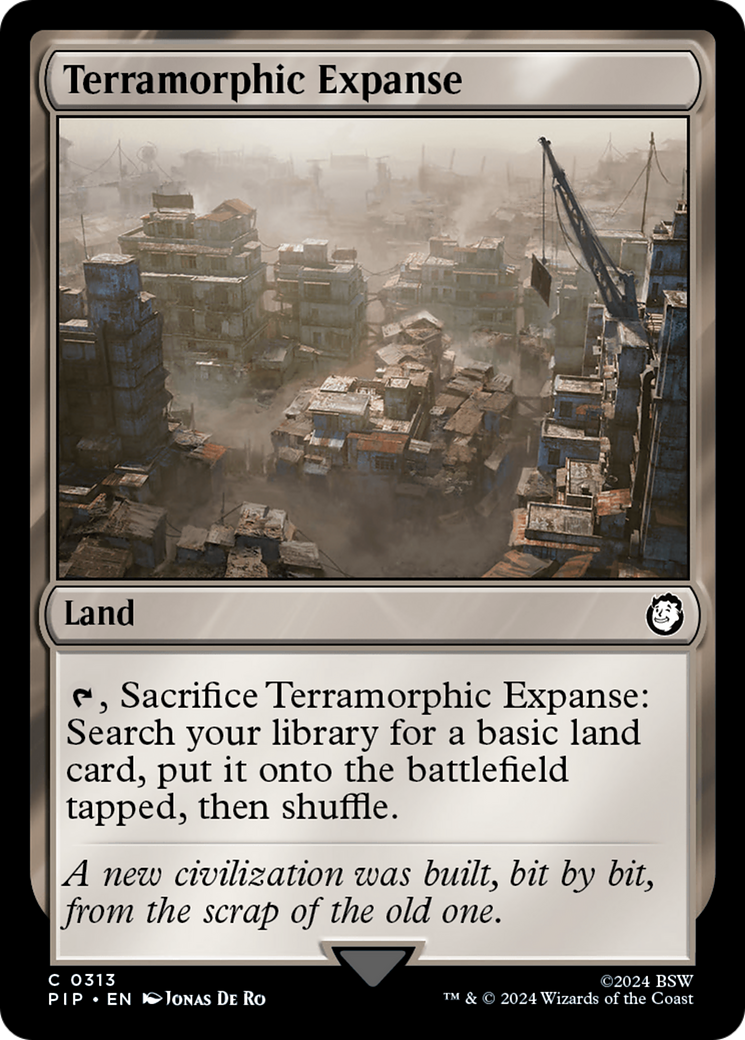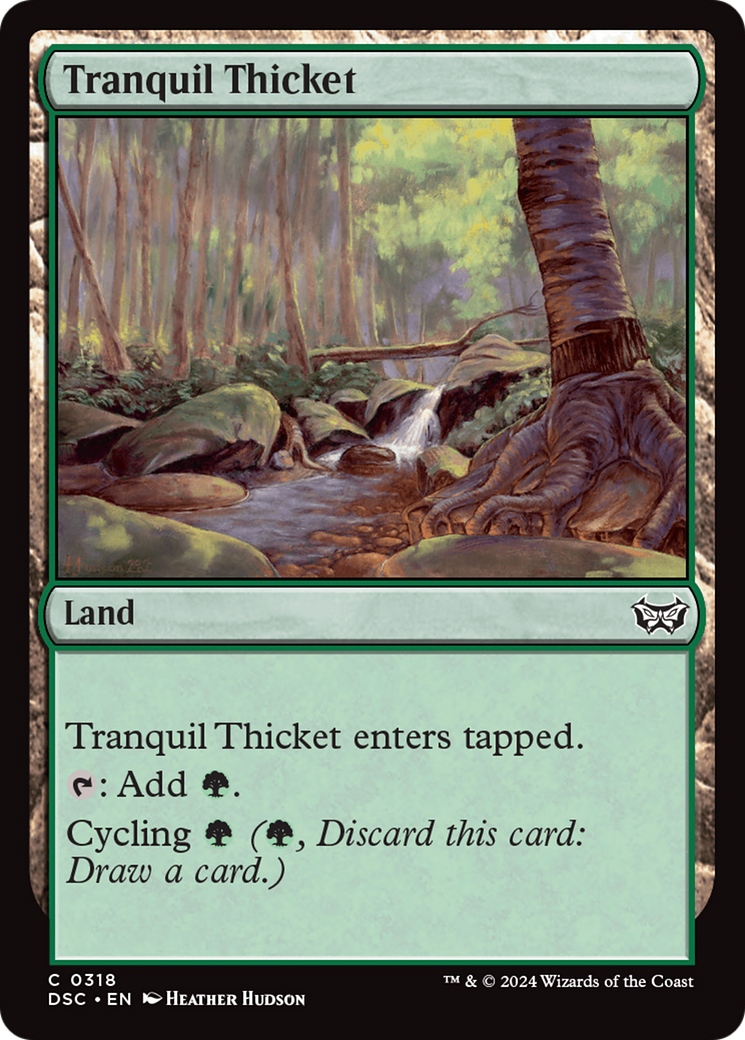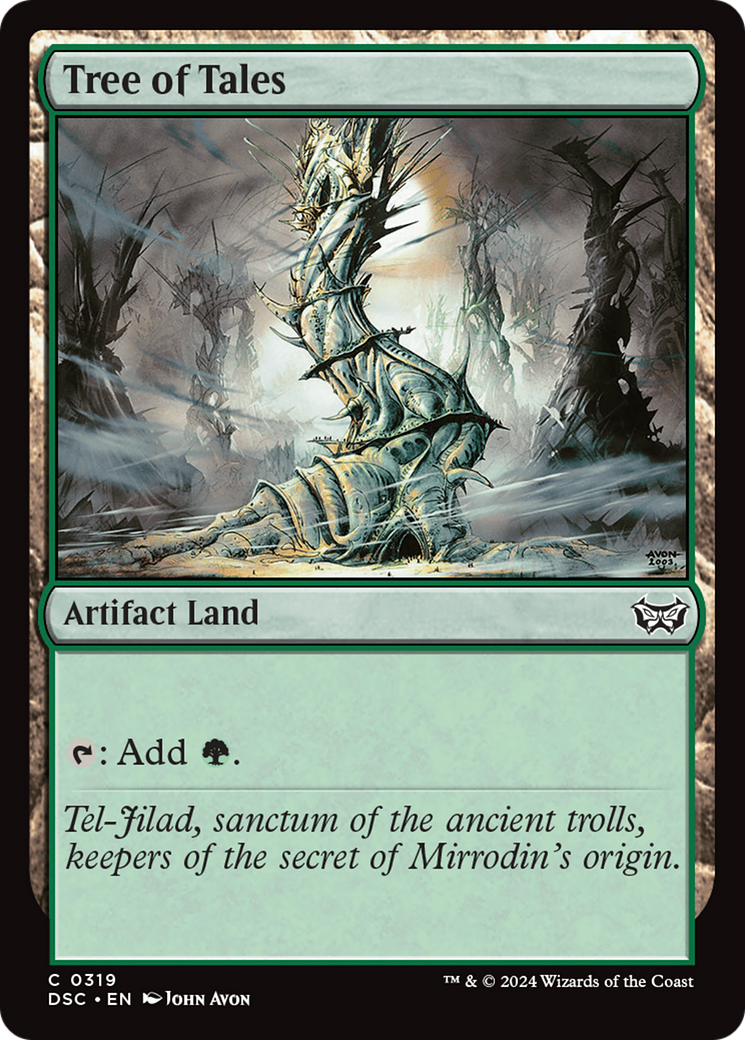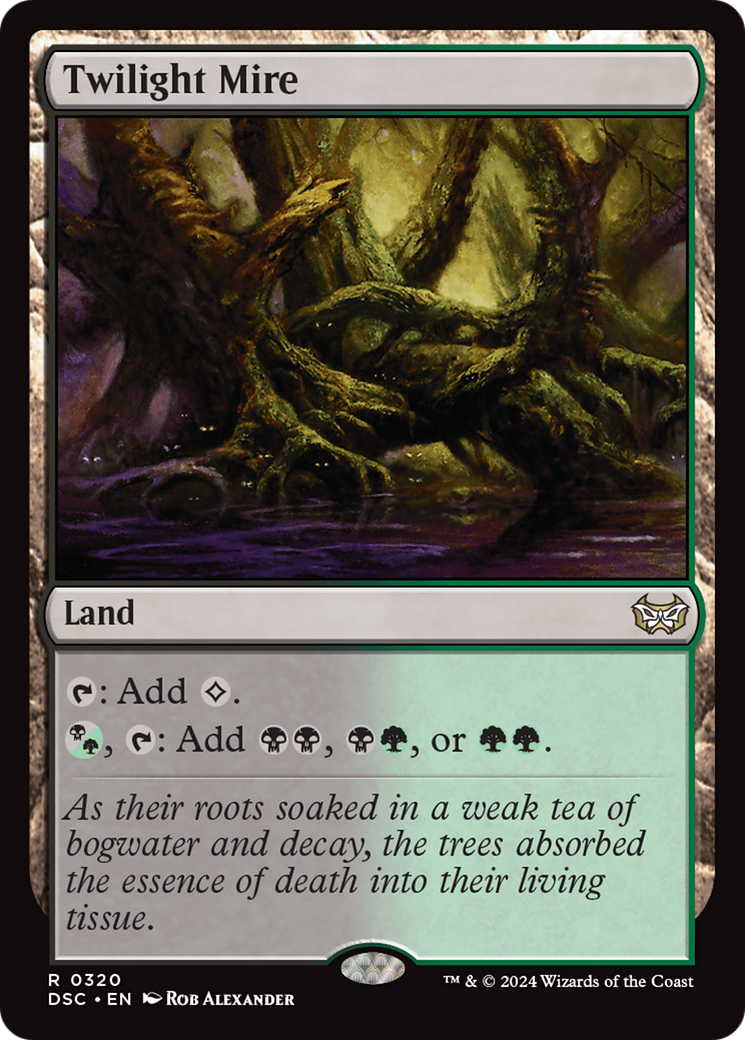
Creatures 28
-
1
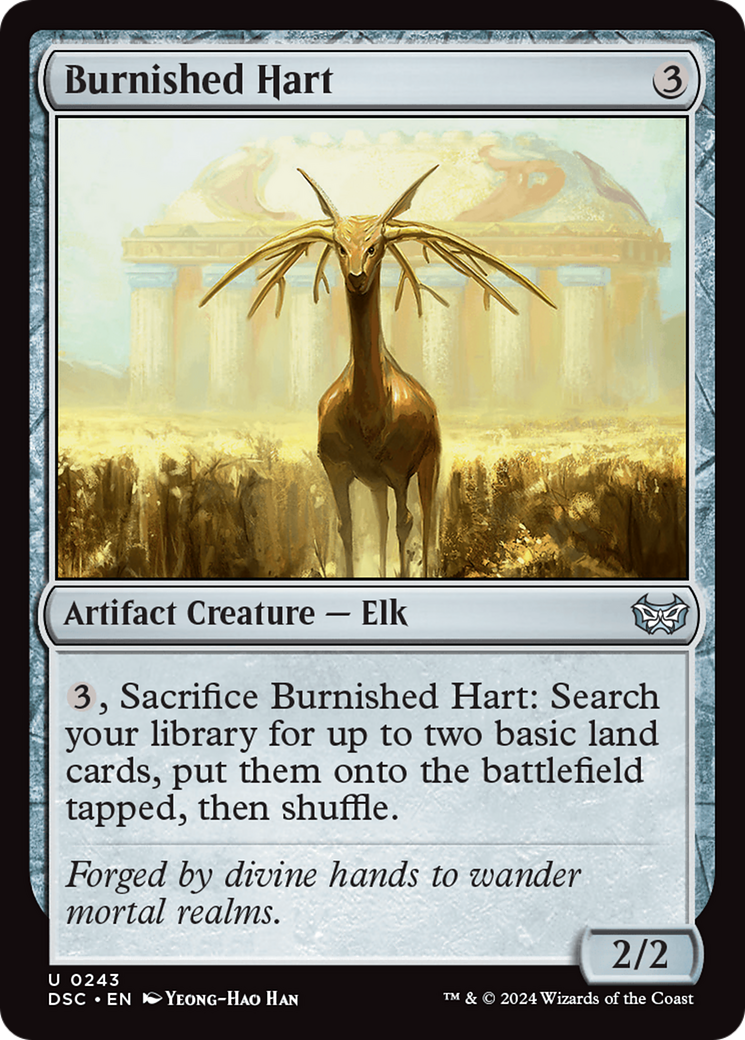
Burnished Hart
Burnished Hart
Artifact Creature — Elk
2/2
, Sacrifice this creature: Search your library for up to two basic land cards, put them onto the battlefield tapped, then shuffle.
-
1
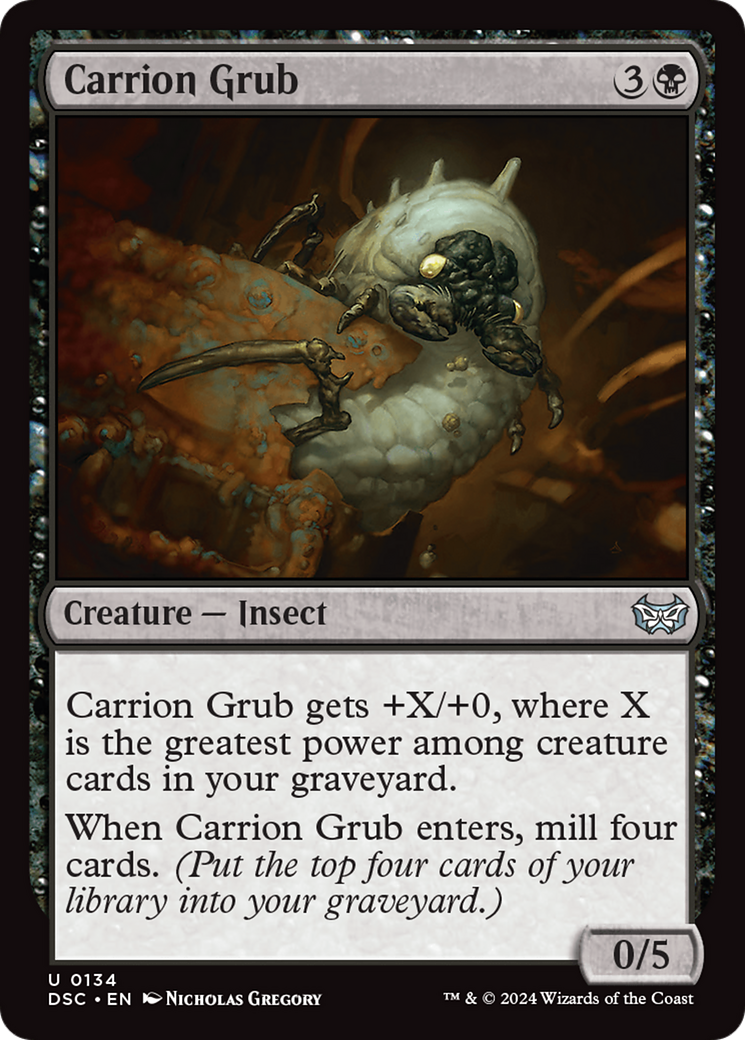
Carrion Grub
Carrion Grub
Creature — Insect
0/5
This creature gets +X/+0, where X is the greatest power among creature cards in your graveyard.
When this creature enters, mill four cards. (Put the top four cards of your library into your graveyard.)
- Carrion Grub's first ability applies only while it is on the battlefield. In all other zones, its power is 0.
- Any counters on creatures that die or effects that affect them until end of turn won't apply to those cards in their owner's graveyard.
-
1
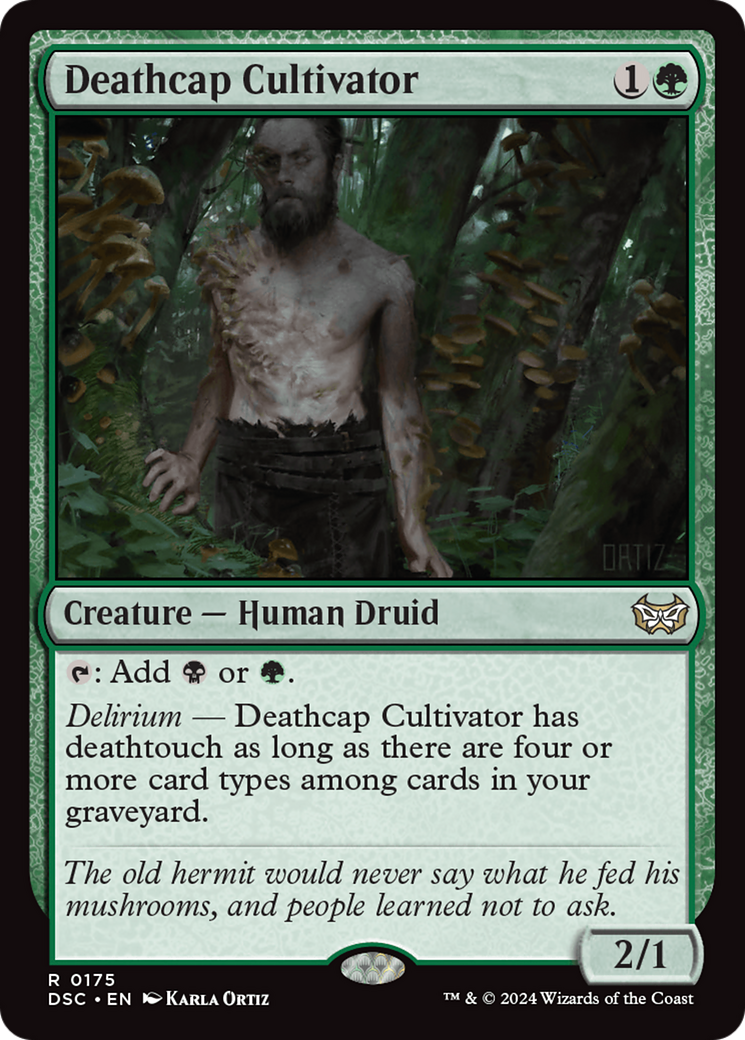
Deathcap Cultivator
Deathcap Cultivator
Creature — Human Druid
2/1
: Add or .
Delirium — This creature has deathtouch as long as there are four or more card types among cards in your graveyard.
- If you have three noncreature card types among cards in your graveyard at the time damage is dealt by Deathcap Cultivator, and lethal damage is dealt to another creature you control at the same time, the damage from Deathcap Cultivator won't be from a source with deathtouch.
- The card types in Magic are artifact, battle, creature, enchantment, instant, kindred, land, planeswalker, and sorcery. Supertypes (such as legendary and basic) and subtypes (such as Human and Equipment) are not counted.
- The number of card types matters, not the number of cards. For example, Wicker Witch (an artifact creature) along with Catalog (an instant) and Chaplain's Blessing (a sorcery) will enable delirium.
- Because you consider only the characteristics of a double-faced card's front face while it's not on the battlefield, the types of its back face won't be counted for delirium.
- In some rare cases, you can have a token or a copy of a spell in your graveyard at the moment that an object's delirium ability counts the card types among cards in your graveyard, before that token or copy ceases to exist. Because tokens and copies of spells are not cards, even if they are copies of cards, their types will never be counted.
-
1
Demolisher Spawn
Demolisher Spawn
Enchantment Creature — Horror
7/7
Trample, haste
Delirium — Whenever this creature attacks, if there are four or more card types among cards in your graveyard, other attacking creatures get +4/+4 until end of turn.
-
1
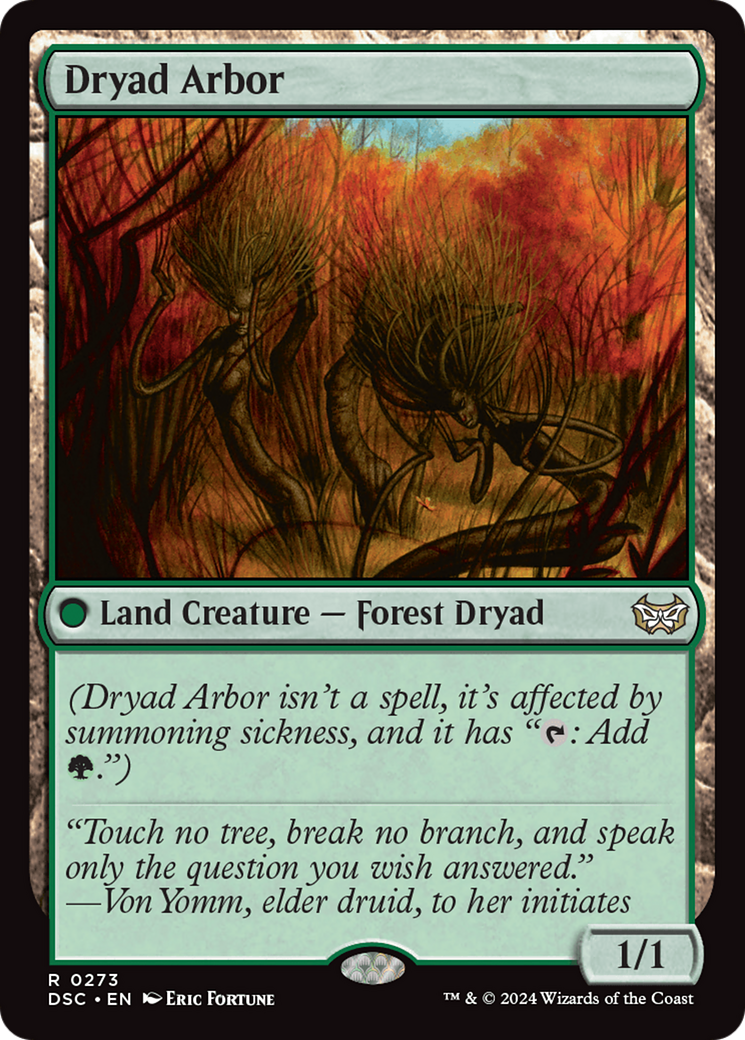
Dryad Arbor
Dryad Arbor
Land Creature — Forest Dryad
1/1
(This land isn't a spell, it's affected by summoning sickness, and it has " : Add .")
- Due to its color indicator (appearing to the left of its type line), Dryad Arbor is green. Color indicators apply in all zones, not just the battlefield.
- If Dryad Arbor is changed into another basic land type, it continues to be a green Dryad creature.
- If a Dryad Arbor gains flash, or you have the ability to play Dryad Arbor as though it had flash (due to Teferi, Mage of Zhalfir or Scout's Warning, for example), you can ignore the normal timing rules for when during your turn you can play a land, but not any other restrictions. You can't play Dryad Arbor during another player's turn, and you can't play Dryad Arbor if you don't have any land plays remaining.
- Forest is a land type and Dryad is a creature type.
- Dryad Arbor is played as a land. It doesn't use the stack, it's not a spell, it can't be responded to, it has no mana cost, and it counts as your land play for the turn.
- Although originally printed with a characteristic-defining ability that defined its color, this card now has a color indicator. This color indicator can't be affected by text-changing effects (such as the one created by Crystal Spray), although color-changing effects can still overwrite it.
- If Dryad Arbor is changed into another basic land type (such as by Sea's Claim), it continues to be a creature and a Dryad.
-
1
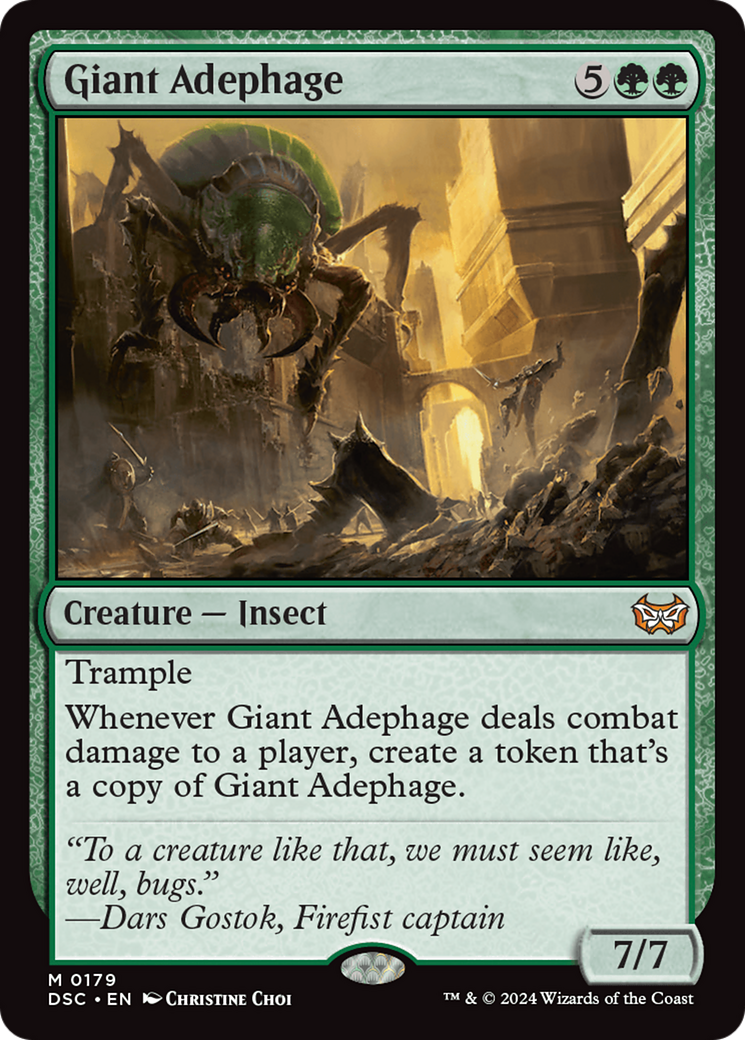
Giant Adephage
Giant Adephage
Creature — Insect
7/7
Trample
Whenever this creature deals combat damage to a player, create a token that's a copy of this creature.
- As the token is created, it checks the printed values of the Giant Adephage it's copying—or, if the Giant Adephage whose ability triggered was itself a token, the original characteristics of that token as stated by the effect that put it onto the battlefield—as well as any copy effects that have been applied to it. It won't copy counters on the Giant Adephage, nor will it copy other effects that have changed Giant Adephage's power, toughness, types, color, or so on. Normally, this means the token will simply be a Giant Adephage. But if any copy effects have affected that Giant Adephage, they're taken into account.
-
1
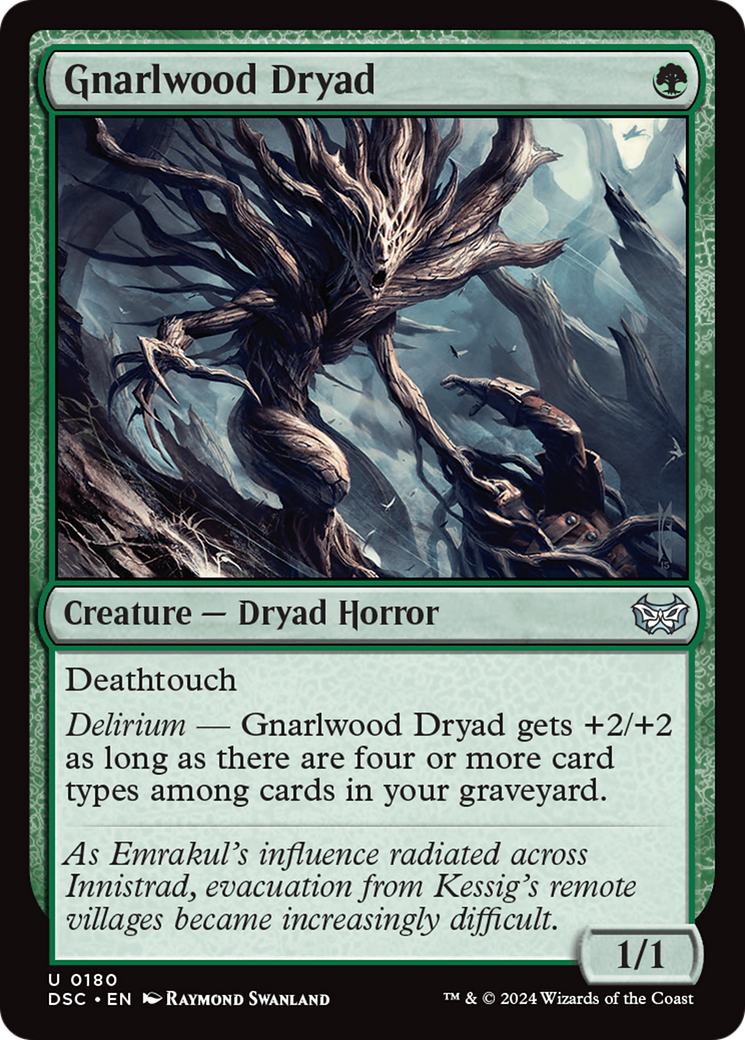
Gnarlwood Dryad
Gnarlwood Dryad
Creature — Dryad Horror
1/1
Deathtouch
Delirium — This creature gets +2/+2 as long as there are four or more card types among cards in your graveyard.
-
1
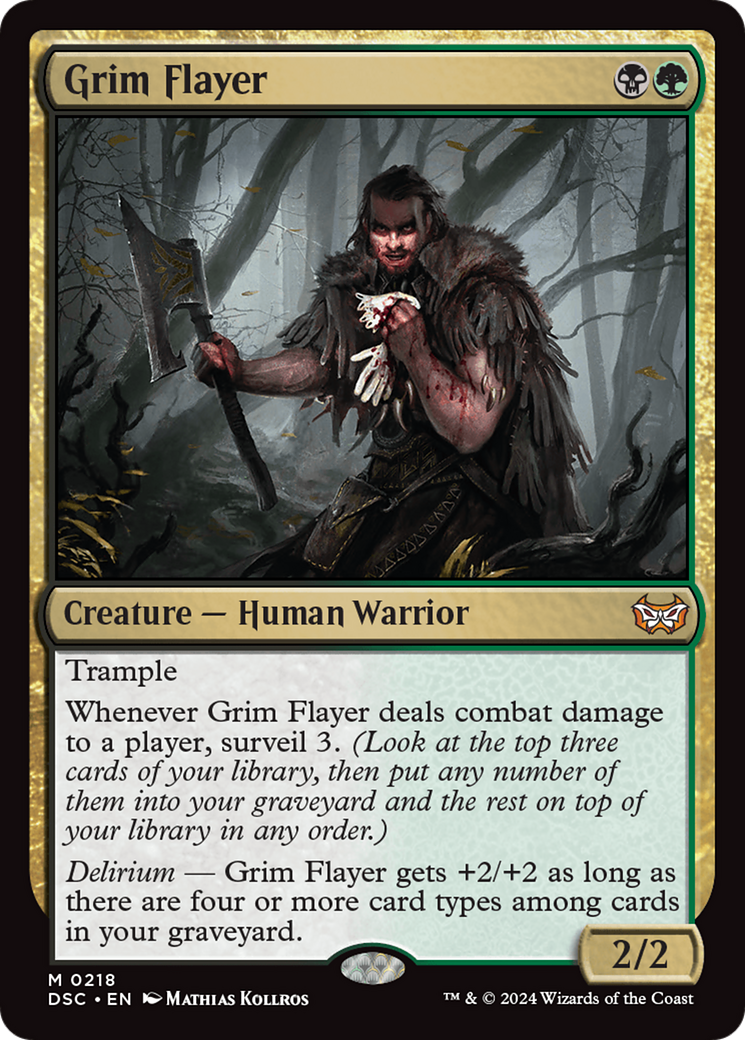
Grim Flayer
Grim Flayer
Creature — Human Warrior
2/2
Trample
Whenever this creature deals combat damage to a player, surveil 3. (Look at the top three cards of your library, then put any number of them into your graveyard and the rest on top of your library in any order.)
Delirium — This creature gets +2/+2 as long as there are four or more card types among cards in your graveyard.
- When you surveil, you may put all the cards you look at back on top of your library, you may put all of those cards into your graveyard, or you may put some of those cards on top and the rest of them into your graveyard.
-
1
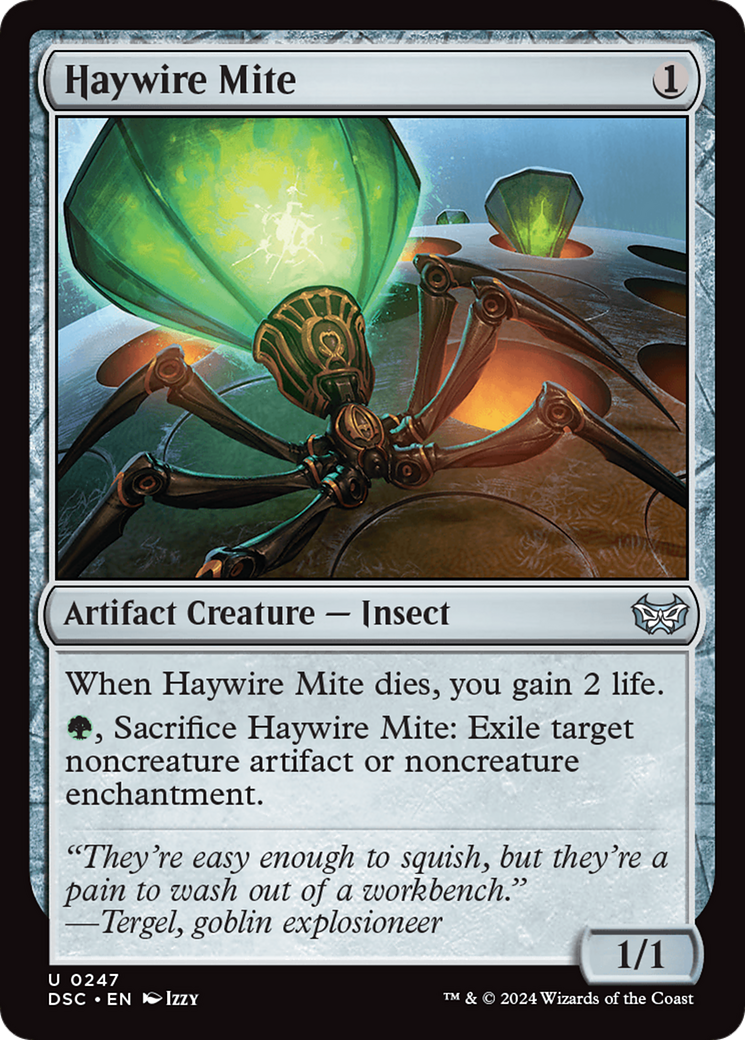
Haywire Mite
Haywire Mite
Artifact Creature — Insect
1/1
When this creature dies, you gain 2 life.
, Sacrifice this creature: Exile target noncreature artifact or noncreature enchantment.
-
1
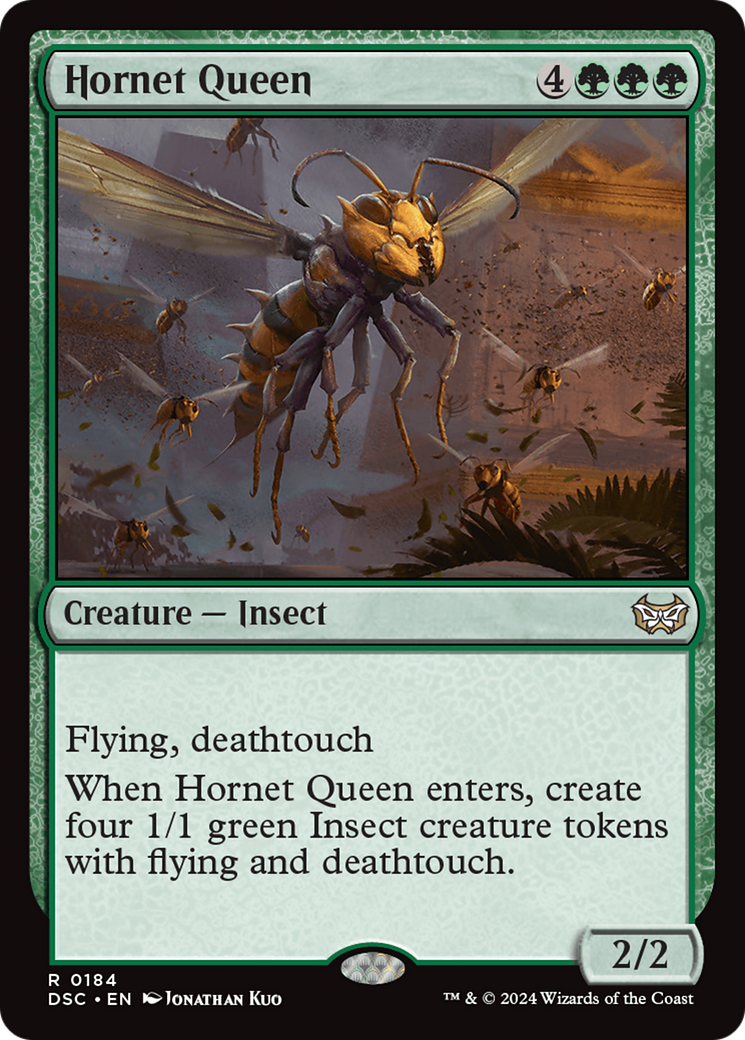
Hornet Queen
Hornet Queen
Creature — Insect
2/2
Flying, deathtouch
When this creature enters, create four 1/1 green Insect creature tokens with flying and deathtouch.
-
1
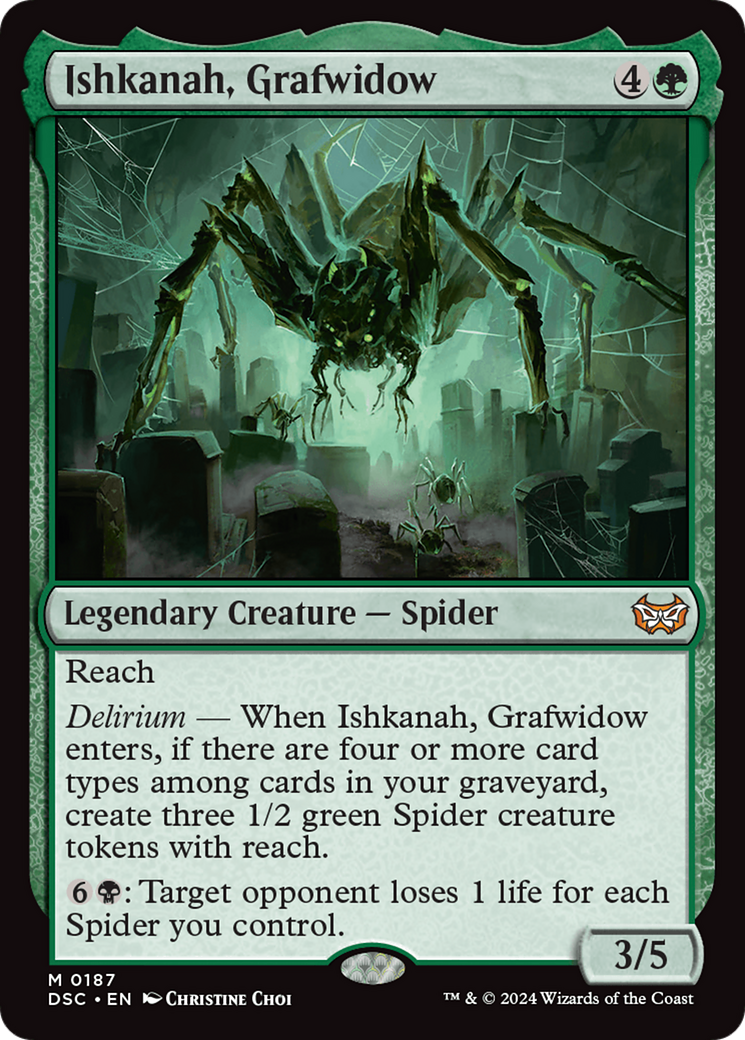
Ishkanah, Grafwidow
Ishkanah, Grafwidow
Legendary Creature — Spider
3/5
Reach
Delirium — When Ishkanah enters, if there are four or more card types among cards in your graveyard, create three 1/2 green Spider creature tokens with reach.
: Target opponent loses 1 life for each Spider you control.
- The number of Spiders you control is checked only as Ishkanah's last ability resolves. The ability will count Ishkanah itself if it's still on the battlefield.
-
1
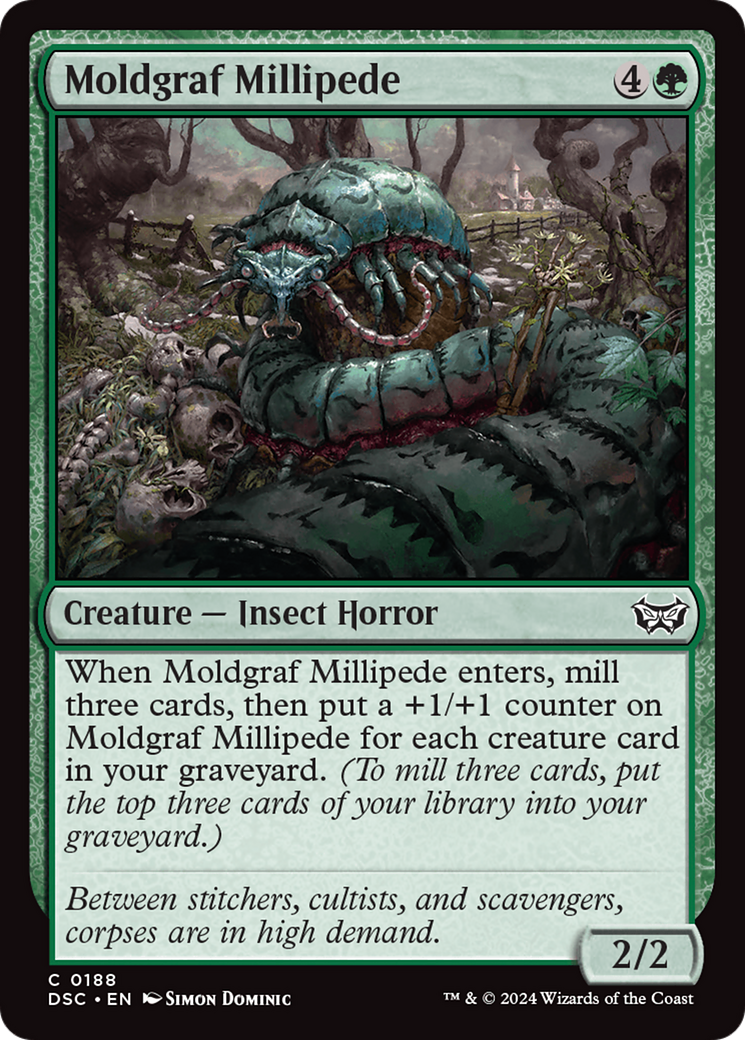
Moldgraf Millipede
Moldgraf Millipede
Creature — Insect Horror
2/2
When this creature enters, mill three cards, then put a +1/+1 counter on this creature for each creature card in your graveyard. (To mill three cards, put the top three cards of your library into your graveyard.)
- Moldgraf Millipede gets a +1/+1 counter for every creature card in your graveyard, including any creature cards that were already there before you milled three cards.
-
1
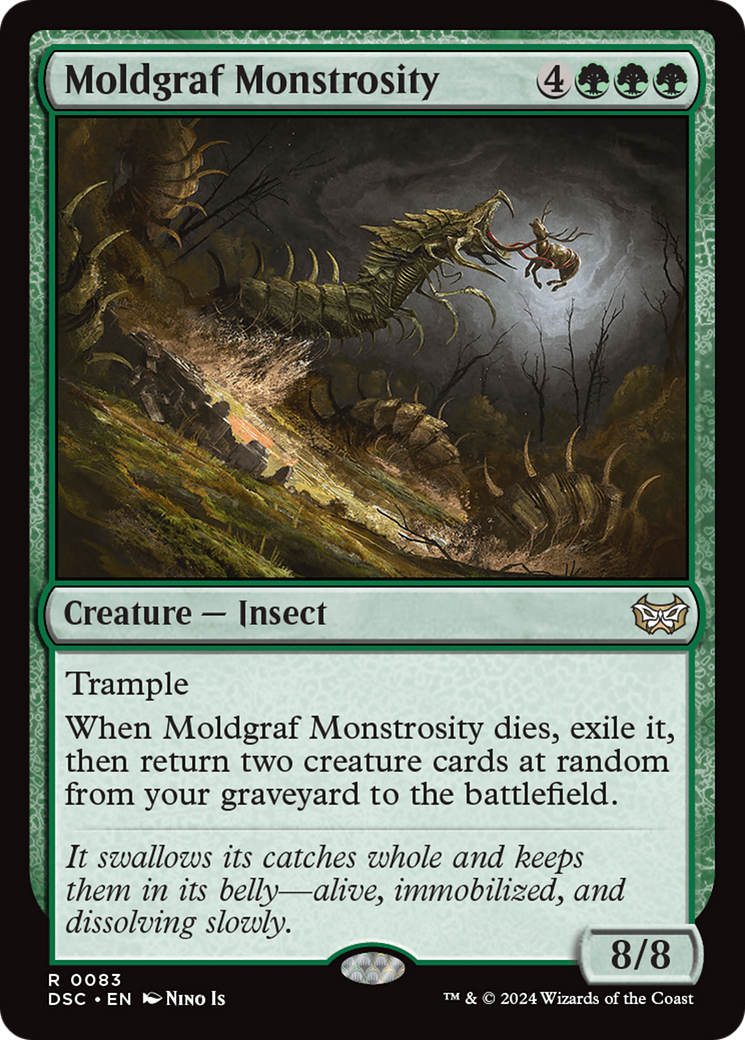
Moldgraf Monstrosity
Moldgraf Monstrosity
Creature — Insect
8/8
Trample
When this creature dies, exile it, then return two creature cards at random from your graveyard to the battlefield.
- If Moldgraf Monstrosity's ability can't exile it (perhaps because it's not still in the graveyard when the ability resolves), the two creature cards are still returned to the battlefield.
- If two Moldgraf Monstrosities die simultaneously, the first ability to resolve could return the other Moldgraf Monstrosity to the battlefield. If it does, the second Moldgraf Monstrosity's ability won't exile it but it will return two more creature cards to the battlefield.
-
1
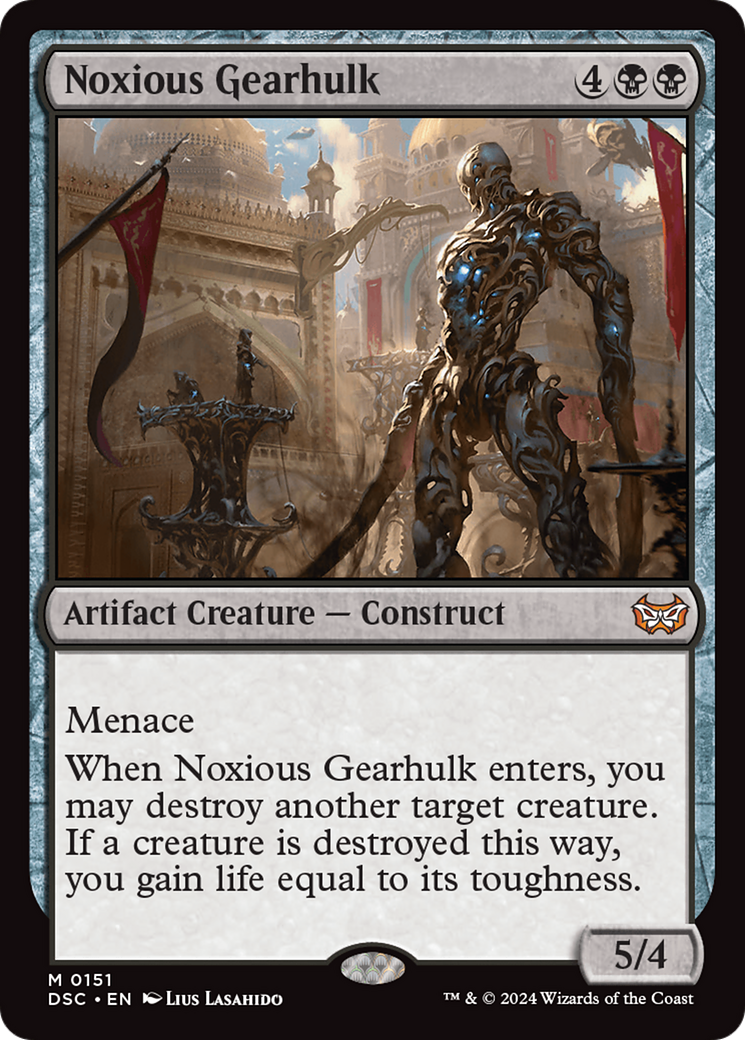
Noxious Gearhulk
Noxious Gearhulk
Artifact Creature — Construct
5/4
Menace
When this creature enters, you may destroy another target creature. If a creature is destroyed this way, you gain life equal to its toughness.
- If the target creature has indestructible, it isn't destroyed this way and you won't gain life. If it is destroyed but put into a zone other than a graveyard, you'll gain life.
- Use the toughness of the creature as it last existed on the battlefield to determine how much life to gain.
-
1
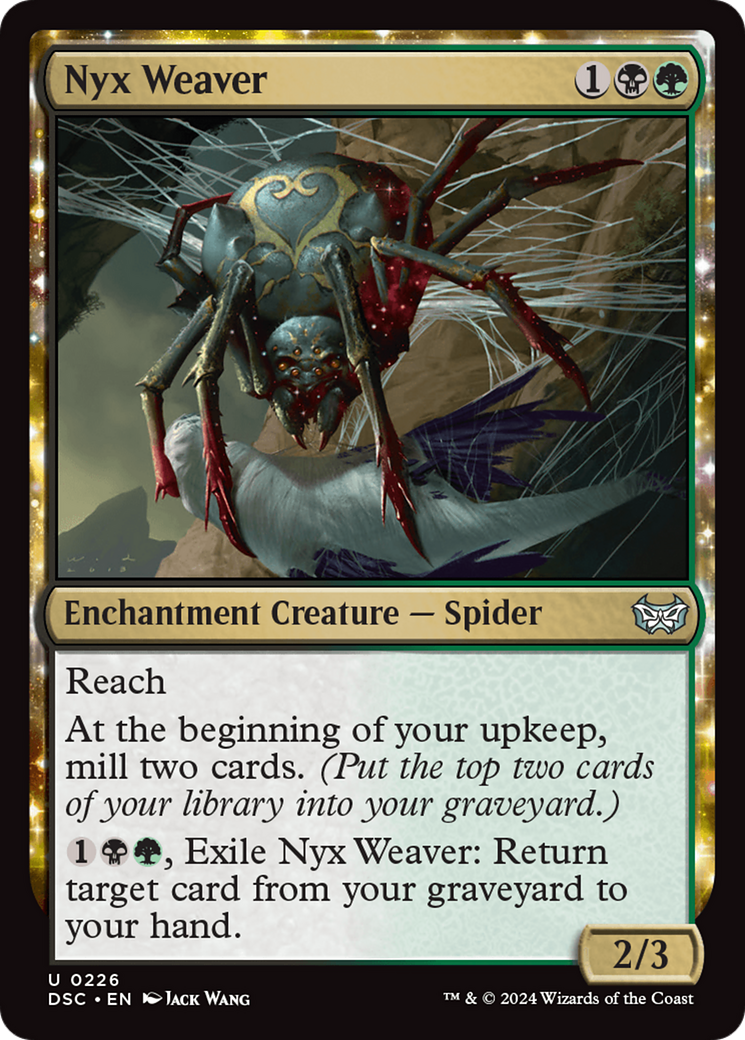
Nyx Weaver
Nyx Weaver
Enchantment Creature — Spider
2/3
Reach
At the beginning of your upkeep, mill two cards. (Put the top two cards of your library into your graveyard.)
, Exile this creature: Return target card from your graveyard to your hand.
-
1
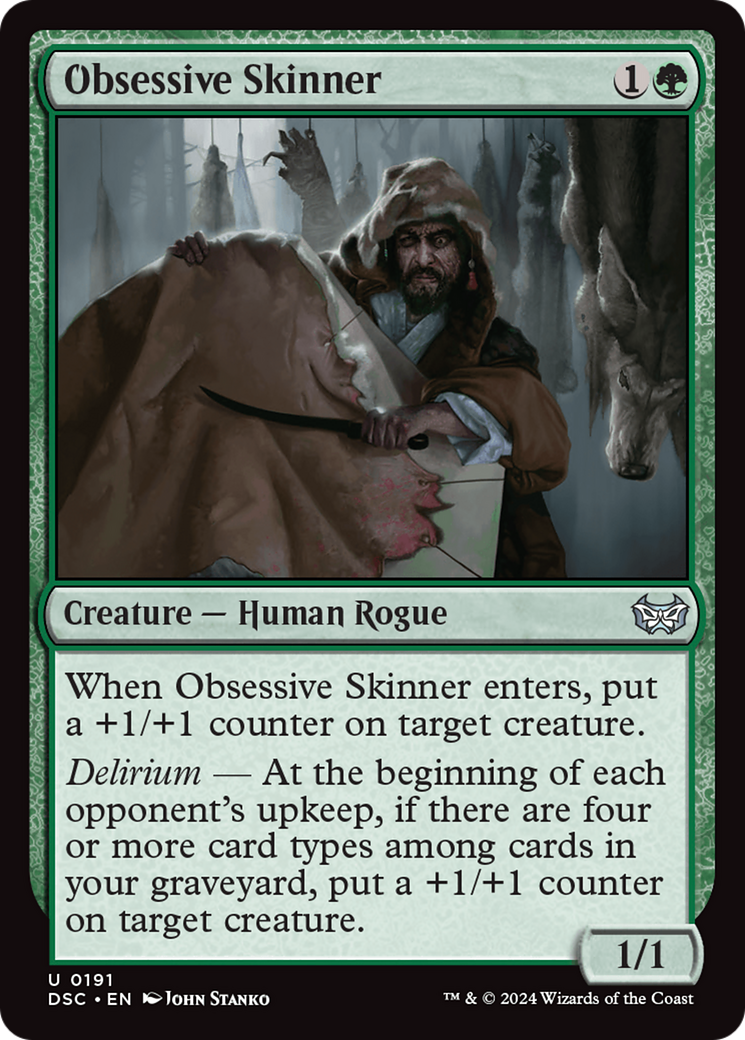
Obsessive Skinner
Obsessive Skinner
Creature — Human Rogue
1/1
When this creature enters, put a +1/+1 counter on target creature.
Delirium — At the beginning of each opponent's upkeep, if there are four or more card types among cards in your graveyard, put a +1/+1 counter on target creature.
- Both of Obsessive Skinner's abilities can target Obsessive Skinner itself.
- The card types in Magic are artifact, battle, creature, enchantment, instant, kindred, land, planeswalker, and sorcery. Supertypes (such as legendary and basic) and subtypes (such as Human and Equipment) are not counted.
- The number of card types matters, not the number of cards. For example, Wicker Witch (an artifact creature) along with Catalog (an instant) and Chaplain's Blessing (a sorcery) will enable delirium.
- Because you consider only the characteristics of a double-faced card's front face while it's not on the battlefield, the types of its back face won't be counted for delirium.
- In some rare cases, you can have a token or a copy of a spell in your graveyard at the moment that an object's delirium ability counts the card types among cards in your graveyard, before that token or copy ceases to exist. Because tokens and copies of spells are not cards, even if they are copies of cards, their types will never be counted.
- Most triggered delirium abilities use an intervening "if" clause. There must be four or more card types among cards in your graveyard in order for these abilities to trigger, otherwise they never trigger at all. There's no way to have the ability trigger if there aren't enough card types, even if you intend to raise that number in response to the triggered ability. The number of card types is checked again as the trigger resolves, and if it has become too low somehow, the ability does nothing. If which card types are in your graveyard changes but the quantity of card types stays the same (or increases), then the delirium triggered ability will still resolve.
-
1
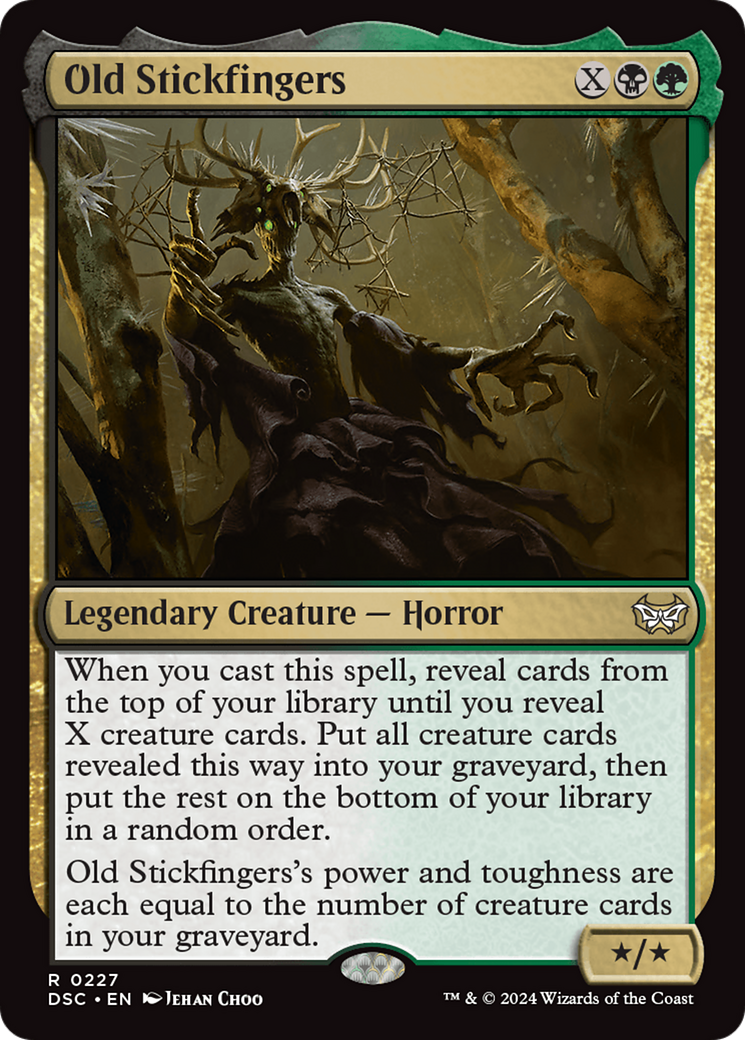
Old Stickfingers
Old Stickfingers
Legendary Creature — Horror
*/*
When you cast this spell, reveal cards from the top of your library until you reveal X creature cards. Put all creature cards revealed this way into your graveyard, then put the rest on the bottom of your library in a random order.
Old Stickfingers's power and toughness are each equal to the number of creature cards in your graveyard.
- The triggered ability will resolve before Old Stickfingers does. If Old Stickfingers is countered in response to its own triggered ability, you will still follow all the instructions of the triggered ability, using the chosen value of X.
- The ability that defines the power and toughness of Old Stickfingers functions in all zones, not only while Old Stickfingers is on the battlefield. While Old Stickfingers is in a graveyard, the ability will count Old Stickfingers itself, presumably using a single, withered stickfinger.
-
1
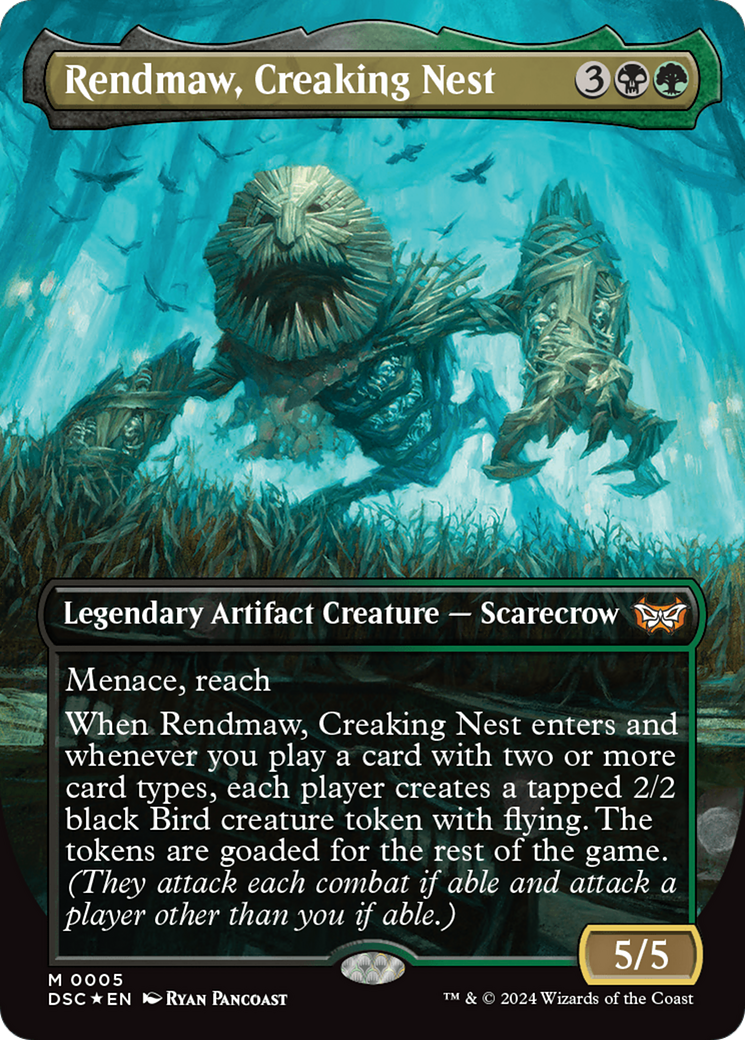
Rendmaw, Creaking Nest
Rendmaw, Creaking Nest
Legendary Artifact Creature — Scarecrow
5/5
Menace, reach
When Rendmaw enters and whenever you play a card with two or more card types, each player creates a tapped 2/2 black Bird creature token with flying. The tokens are goaded for the rest of the game. (They attack each combat if able and attack a player other than you if able.)
- The card types in Magic include artifact, battle, creature, enchantment, instant, kindred, land, planeswalker, and sorcery. Legendary, basic, and snow are supertypes, not card types; Horror and Room are subtypes, not card types.
- If, during a player's declare attackers step, a creature that player controls that's been goaded is tapped, is affected by a spell or ability that says it can't attack, or hasn't been under that player's control continuously since the turn began (and doesn't have haste), then it doesn't attack. If there's a cost associated with having a creature attack a player, its controller isn't forced to pay that cost, so it doesn't have to attack that player.
- If the creature doesn't meet any of the above exceptions and can attack, it must attack a player other than the controller of the spell or ability that goaded it if able. If the creature can't attack any of those players but could otherwise attack, it must attack a planeswalker an opponent controls, a battle an opponent controls, or a player who goaded it.
- Being goaded isn't an ability the creature has. Once it's been goaded, it must attack as detailed above even if it loses all abilities.
- Attacking with a goaded creature doesn't cause it to stop being goaded. If there is an additional combat phase that turn, or if another player gains control of it before it stops being goaded, it must attack again if able.
- If a creature you control has been goaded by multiple opponents, it must attack one of your opponents that hasn't goaded it, as that fulfills the maximum number of goad requirements. If a creature you control has been goaded by each of your opponents, the creature must attack an opponent (rather than a planeswalker or battle), but you choose which opponent it attacks.
-
1
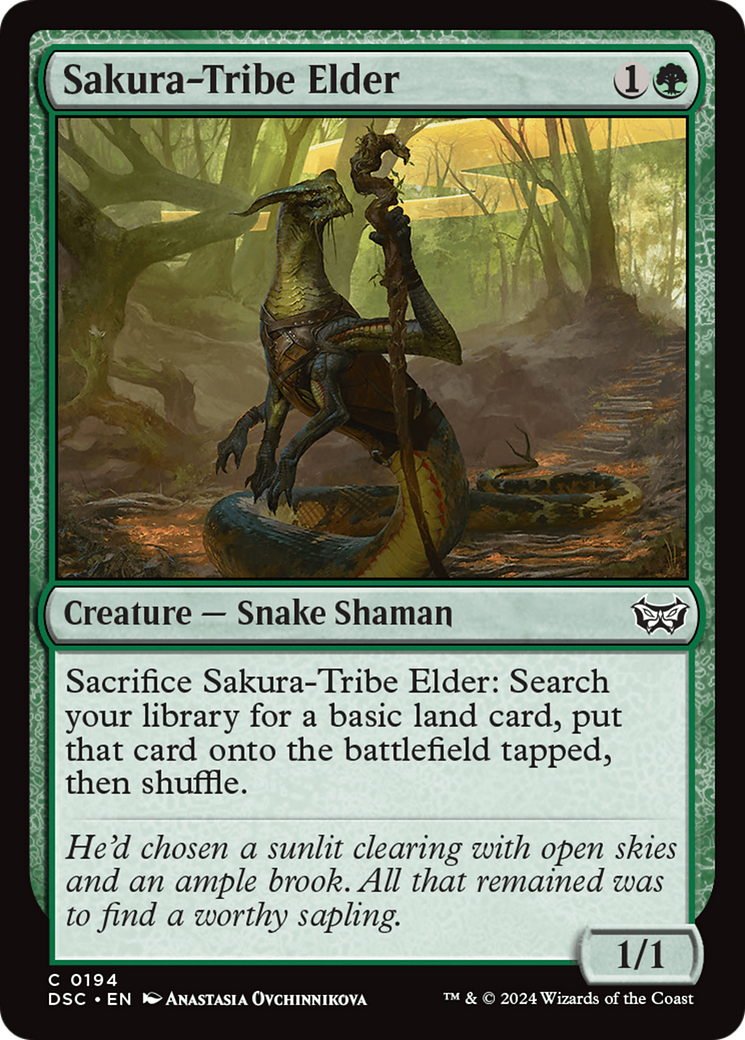
Sakura-Tribe Elder
Sakura-Tribe Elder
Creature — Snake Shaman
1/1
Sacrifice this creature: Search your library for a basic land card, put that card onto the battlefield tapped, then shuffle.
-
1
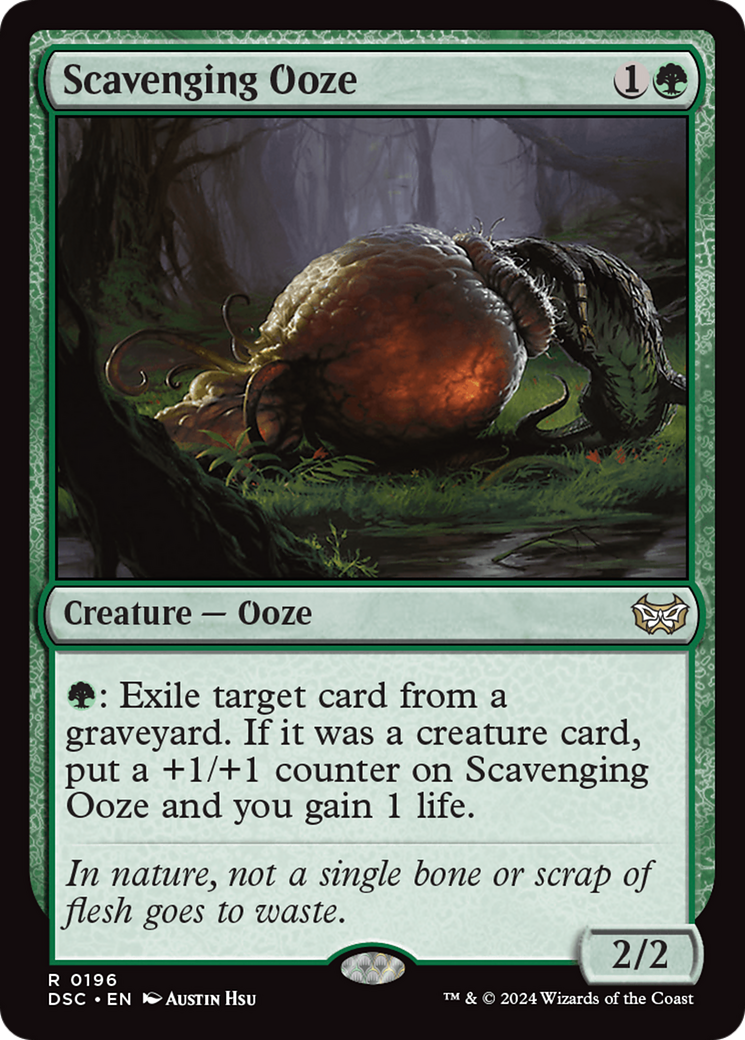
Scavenging Ooze
Scavenging Ooze
Creature — Ooze
2/2
: Exile target card from a graveyard. If it was a creature card, put a +1/+1 counter on this creature and you gain 1 life.
- If the target card is an illegal target when the ability tries to resolve, it won't resolve and none of its effects will happen. No +1/+1 counter will be put on Scavenging Ooze and you won't gain life. Notably, this means that if you activate Scavenging Ooze's ability multiple times targeting the same creature card, only the first instance of the ability to resolve will have any effect.
-
1
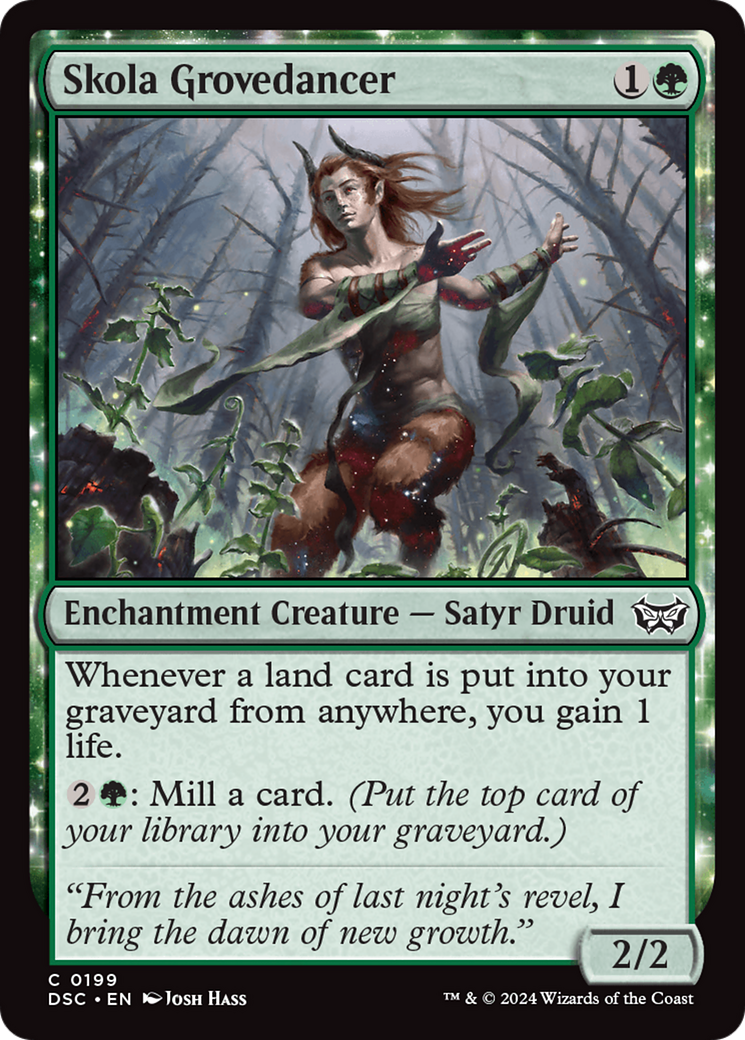
Skola Grovedancer
Skola Grovedancer
Enchantment Creature — Satyr Druid
2/2
Whenever a land card is put into your graveyard from anywhere, you gain 1 life.
: Mill a card. (Put the top card of your library into your graveyard.)
- Because Skola Grovedancer's ability triggers when land cards are put into your graveyard "from anywhere," Skola Grovedancer must be on the battlefield immediately after a land card is put there in order to trigger. This means that if Skola Grovedancer dies at the same time as a land you control, its ability won't trigger.
-
1
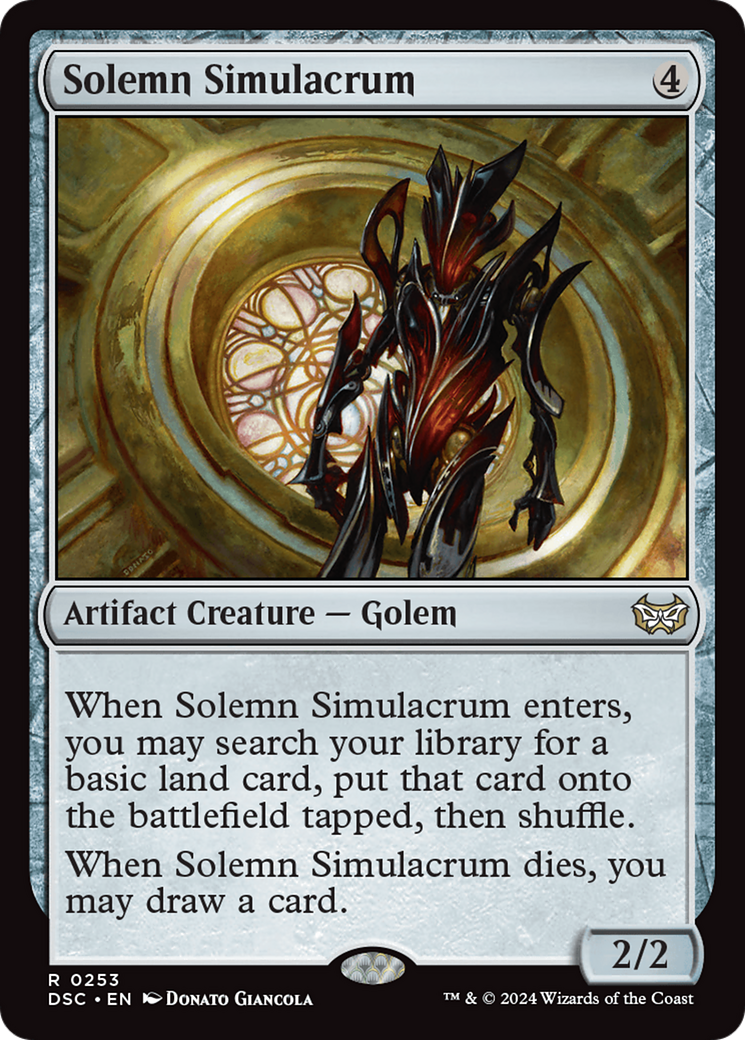
Solemn Simulacrum
Solemn Simulacrum
Artifact Creature — Golem
2/2
When this creature enters, you may search your library for a basic land card, put that card onto the battlefield tapped, then shuffle.
When this creature dies, you may draw a card.
-
1
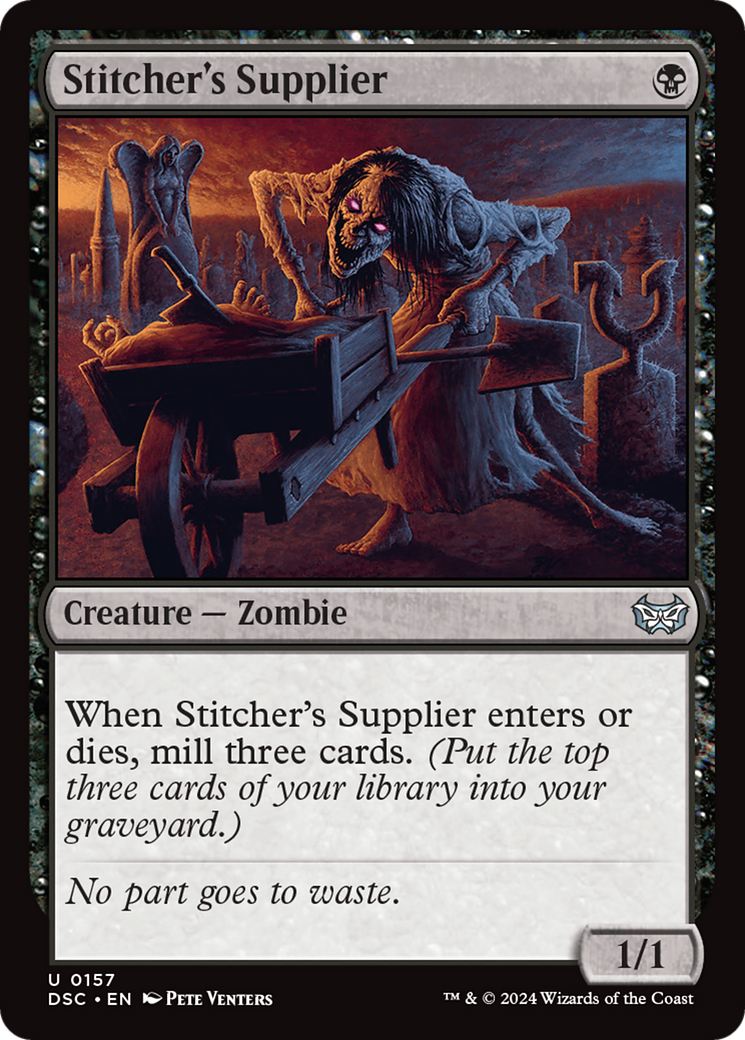
Stitcher's Supplier
Stitcher's Supplier
Creature — Zombie
1/1
When this creature enters or dies, mill three cards. (Put the top three cards of your library into your graveyard.)
-
1
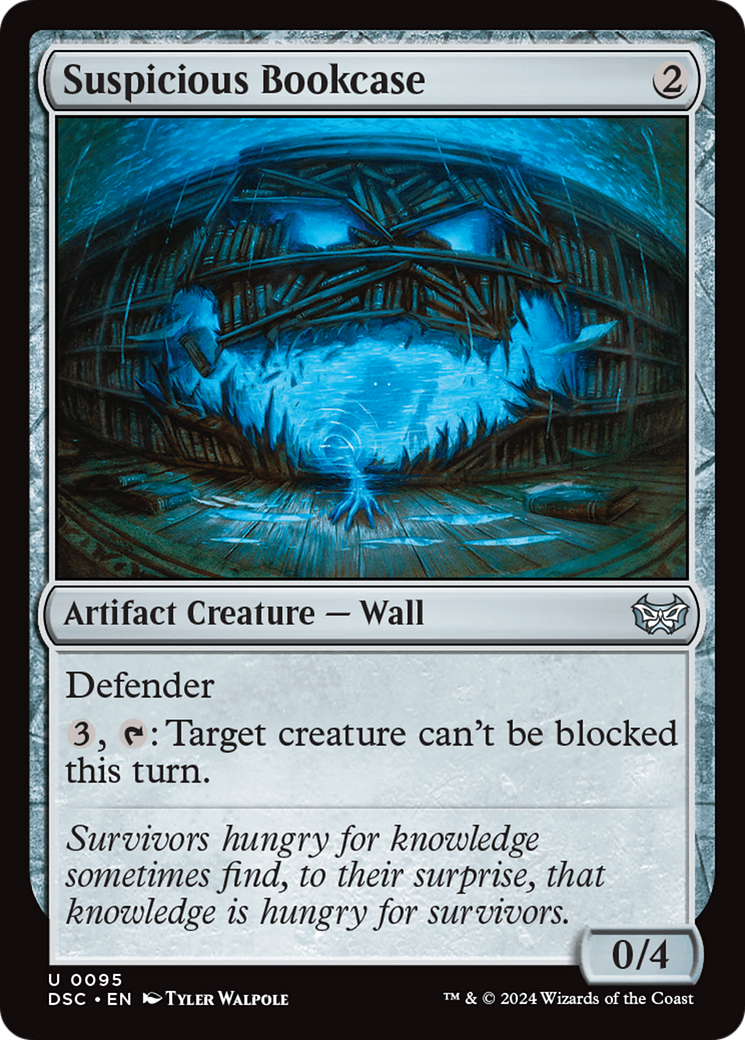
Suspicious Bookcase
Suspicious Bookcase
Artifact Creature — Wall
0/4
Defender
, : Target creature can't be blocked this turn.
- Activating Suspicious Bookcase's ability after a creature has become blocked won't cause that creature to become unblocked.
-
1
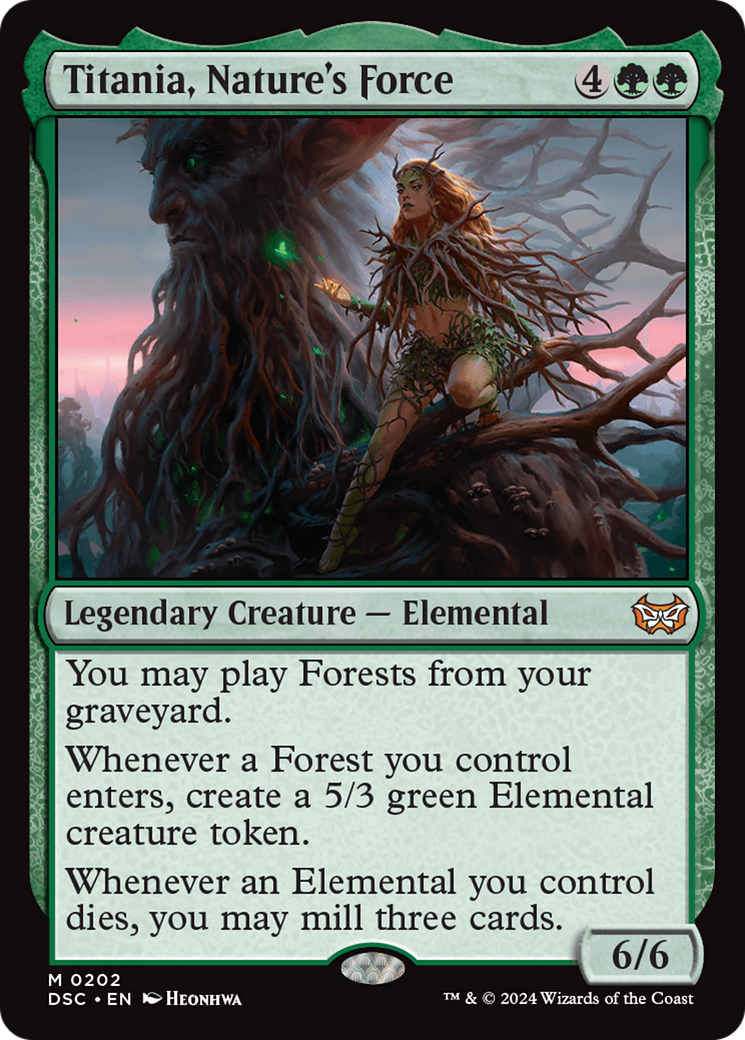
Titania, Nature's Force
Titania, Nature's Force
Legendary Creature — Elemental
6/6
You may play Forests from your graveyard.
Whenever a Forest you control enters, create a 5/3 green Elemental creature token.
Whenever an Elemental you control dies, you may mill three cards.
- Titania, Nature's Force doesn't change the times when you can play those Forests. You can still play only one land per turn, and only during your main phase when you have priority and the stack is empty.
-
1
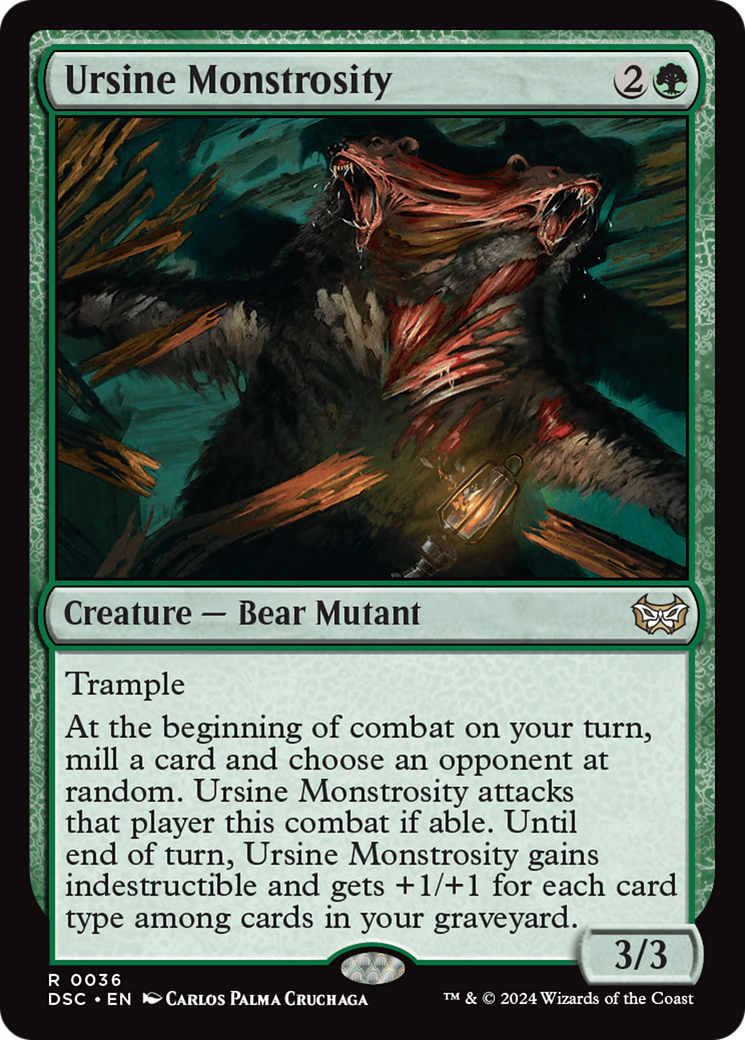
Ursine Monstrosity
Ursine Monstrosity
Creature — Bear Mutant
3/3
Trample
At the beginning of combat on your turn, mill a card and choose an opponent at random. This creature attacks that player this combat if able. Until end of turn, this creature gains indestructible and gets +1/+1 for each card type among cards in your graveyard.
- If you can't mill a card, you'll still follow the rest of the instructions of Ursine Monstrosity's last ability.
- Ursine Monstrosity must attack the chosen player if able, not a planeswalker they control or a battle they protect.
- If, during your declare attackers step, Ursine Monstrosity is tapped, is affected by a spell or ability that says it can't attack, or hasn't been under your control continuously since your turn began (and doesn't have haste), then it doesn't attack. If there's a cost associated with having Ursine Monstrosity attack the chosen player, you aren't forced to pay that cost, so it doesn't have to attack that player in that case either.
- If Ursine Monstrosity isn't forced to attack the chosen player for one of the above reasons but can still attack, you may choose to have it attack another player, a planeswalker, a battle, or nothing at all.
- If your turn has multiple combat phases, Ursine Monstrosity's last ability triggers at the beginning of each of them. Ignore any choices made for its last ability during previous combat phases.
- The card types in Magic include artifact, battle, creature, enchantment, instant, kindred, land, planeswalker, and sorcery. Legendary, basic, and snow are supertypes, not card types; Horror and Room are subtypes, not card types.
-
1
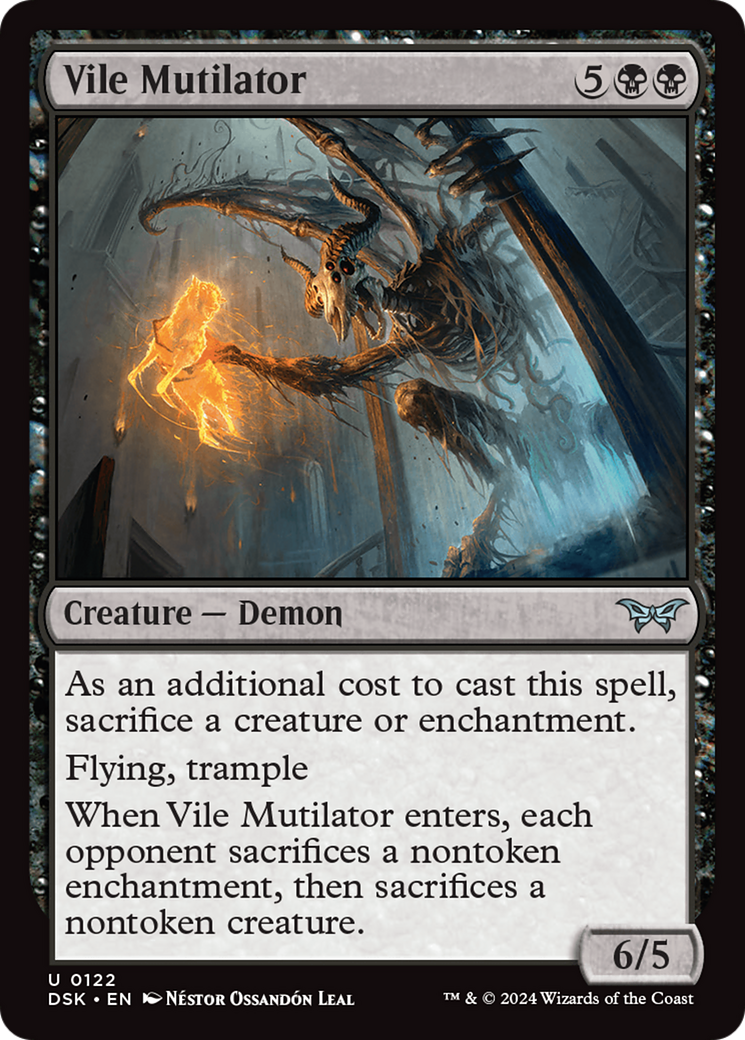
Vile Mutilator
Vile Mutilator
Creature — Demon
6/5
As an additional cost to cast this spell, sacrifice a creature or enchantment.
Flying, trample
When this creature enters, each opponent sacrifices a nontoken enchantment of their choice, then sacrifices a nontoken creature of their choice.
-
1
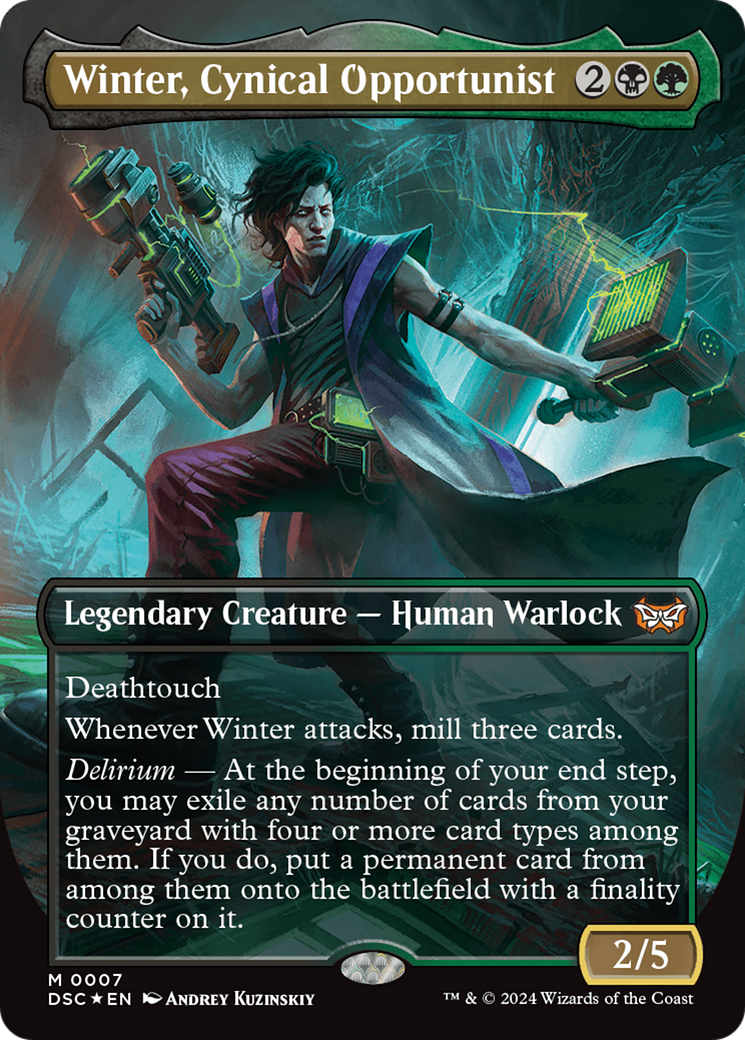
Winter, Cynical Opportunist
Winter, Cynical Opportunist
Legendary Creature — Human Warlock
2/5
Deathtouch
Whenever Winter attacks, mill three cards.
Delirium — At the beginning of your end step, you may exile any number of cards from your graveyard with four or more card types among them. If you do, put a permanent card from among them onto the battlefield with a finality counter on it.
- If a permanent with a finality counter on it would be put into a graveyard from the battlefield, exile it instead.
- Finality counters don't stop permanents from going to zones other than the graveyard from the battlefield. For example, if a permanent with a finality counter on it would be put into its owner's hand from the battlefield, it does so normally.
- Finality counters aren't keyword counters, and a finality counter doesn't give any abilities to the permanent it's on. If that permanent loses its abilities and then would go to a graveyard, it will still be exiled instead.
- Multiple finality counters on a single permanent are redundant.
Planeswalkers 4
-
1
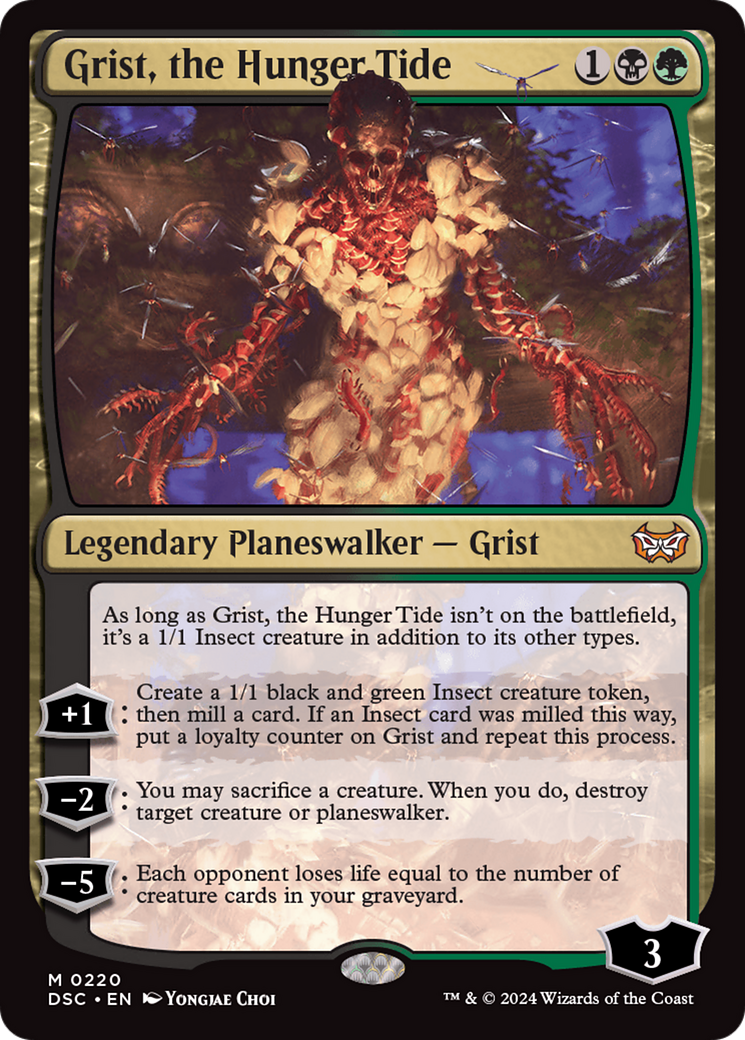
Grist, the Hunger Tide
Grist, the Hunger Tide
Legendary Planeswalker — Grist
As long as Grist isn't on the battlefield, it's a 1/1 Insect creature in addition to its other types.
+1: Create a 1/1 black and green Insect creature token, then mill a card. If an Insect card was milled this way, put a loyalty counter on Grist and repeat this process.
−2: You may sacrifice a creature. When you do, destroy target creature or planeswalker.
−5: Each opponent loses life equal to the number of creature cards in your graveyard.
- Grist, the Hunger Tide can be your commander as its first ability works before the game begins during deck construction.
- Anywhere but on the battlefield, Grist is a Legendary Planeswalker Creature — Grist Insect. Once it enters the battlefield, it is no longer a creature and is just a planeswalker. Anything that could search for or affect a creature or planeswalker card in zones other than the battlefield could affect Grist. For example, you could put it onto the battlefield with Chord of Calling, it could be countered by Essence Scatter (but not by Negate), and opponents couldn't make you discard it with Duress.
- If Grist is no longer on the battlefield as its first loyalty ability resolves, you will still create a 1/1 black and green Insect creature token and mill a card. If an Insect card is milled this way, you won't be able to put a loyalty counter on Grist, but you will still repeat the process. More mill for the Grist, as it were.
- Grist's second loyalty ability doesn't require a target. If you choose to sacrifice a creature as it resolves, the reflexive triggered ability triggers and you'll choose a target creature or planeswalker to destroy. This will happen even if Grist isn't on the battlefield when the loyalty ability resolves.
- Count the number of creature cards in your graveyard as the third loyalty ability resolves to determine how much life each opponent loses. If Grist is in your graveyard at this time, it'll be a creature card and will contribute to the count.
-
1
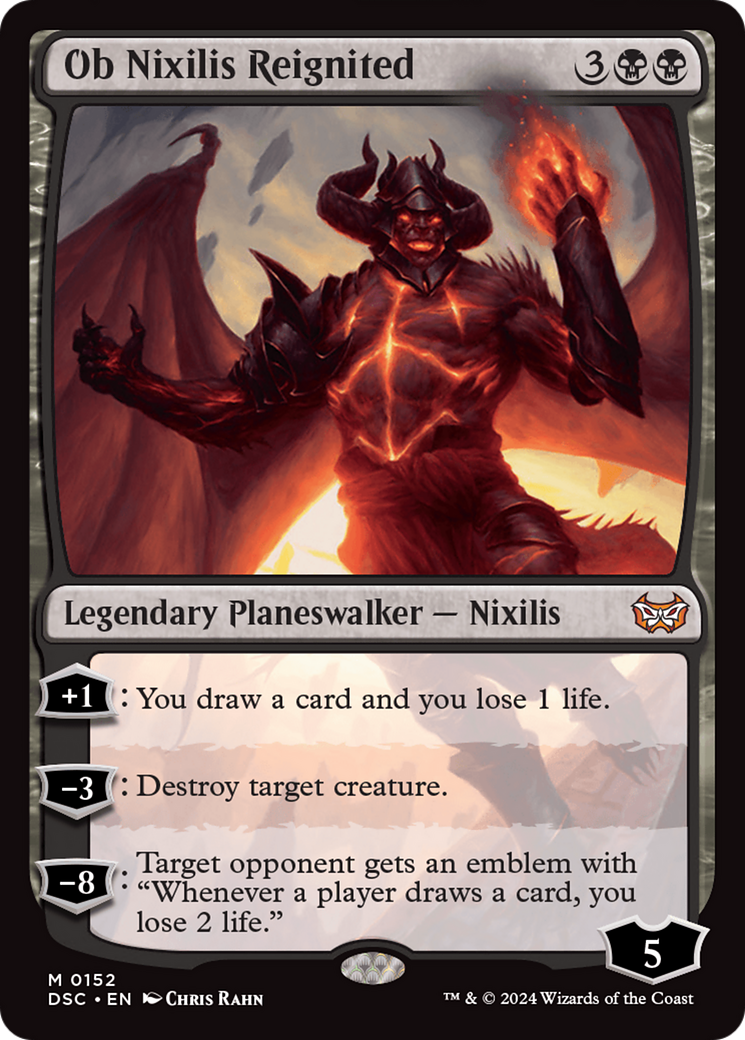
Ob Nixilis Reignited
Ob Nixilis Reignited
Legendary Planeswalker — Nixilis
+1: You draw a card and you lose 1 life.
−3: Destroy target creature.
−8: Target opponent gets an emblem with "Whenever a player draws a card, you lose 2 life."
- The emblem created by Ob Nixilis Reignited's last ability is both owned and controlled by the target opponent. In a multiplayer game, if you own Ob Nixilis Reignited and use him to give one of your opponents an emblem, the emblem remains even if you leave the game.
-
1
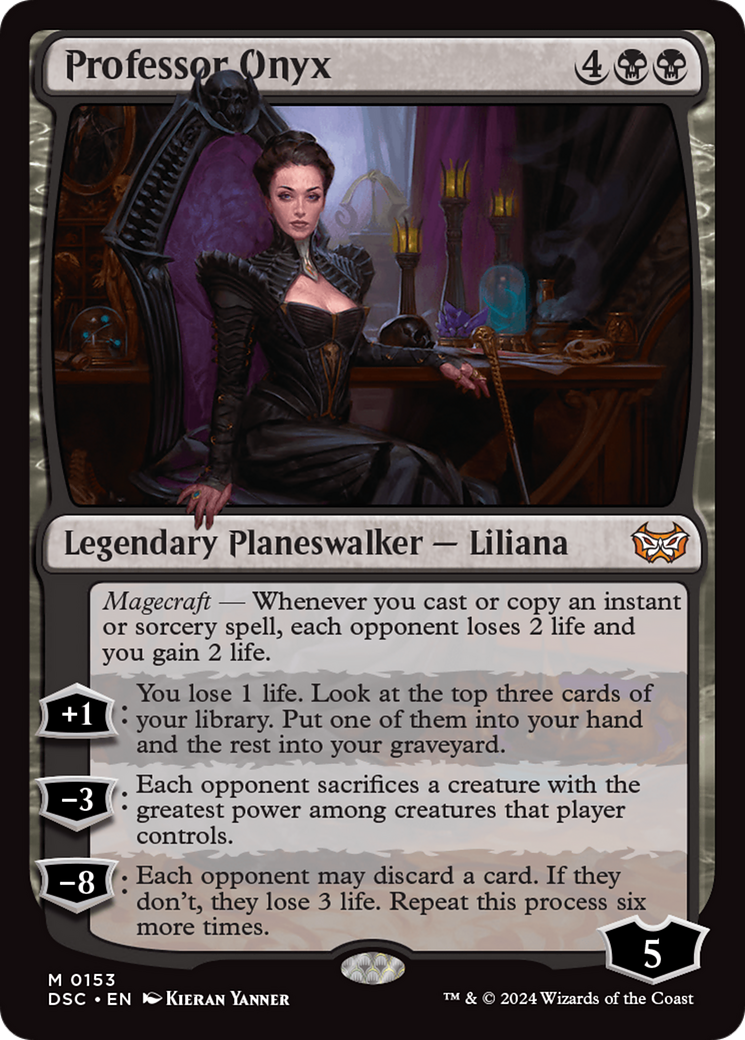
Professor Onyx
Professor Onyx
Legendary Planeswalker — Liliana
Magecraft — Whenever you cast or copy an instant or sorcery spell, each opponent loses 2 life and you gain 2 life.
+1: You lose 1 life. Look at the top three cards of your library. Put one of them into your hand and the rest into your graveyard.
−3: Each opponent sacrifices a creature with the greatest power among creatures that player controls.
−8: Each opponent may discard a card. If they don't, they lose 3 life. Repeat this process six more times.
- For Professor Onyx's second loyalty ability, if an opponent has multiple creatures with the greatest power, that player choose which one to sacrifice. The next opponent in turn order chooses which creature they are sacrificing, then each other opponent in turn order does the same, knowing the choices made before them. Then all chosen creatures are sacrificed at the same time.
- For Professor Onyx's last loyalty ability, "this process" is the following: First, the next opponent in turn order may choose a card in hand without revealing it, then each other opponent in turn order does the same. Then all the chosen cards are revealed and discarded at the same time and each opponent who didn't discard a card (whether they chose not to or had an empty hand) loses 3 life. This all will happen seven times, for a maximum loss of 21 life per opponent.
- If Professor Onyx seems familiar, it's probably because you've seen this type of planeswalker before.
- Each magecraft ability has a different effect, although they all have the same trigger condition, whenever you cast or copy an instant or sorcery spell.
- For example, if you control Archmage Emeritus and cast an instant or sorcery spell, Archmage Emeritus's magecraft ability will trigger and you will draw a card.
- If an effect creates a copy of an instant or sorcery spell, this will also cause the magecraft ability to trigger.
- If an effect creates multiple copies of an instant or sorcery spell, magecraft abilities trigger once for each copy created by the effect.
- Some effects instruct you to copy an instant or sorcery card in a zone other than the stack. These copies do not cause magecraft abilities to trigger. However, most effects that do this also allow you to cast the copy, and casting the copy will cause magecraft abilities to trigger.
-
1
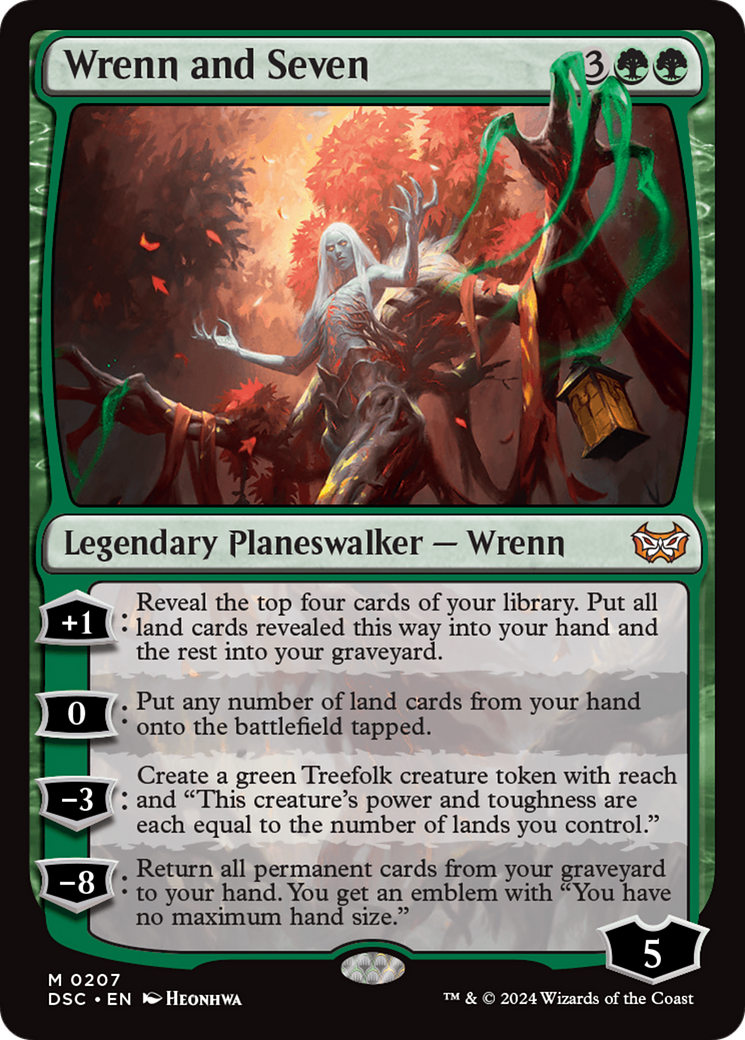
Wrenn and Seven
Wrenn and Seven
Legendary Planeswalker — Wrenn
+1: Reveal the top four cards of your library. Put all land cards revealed this way into your hand and the rest into your graveyard.
0: Put any number of land cards from your hand onto the battlefield tapped.
−3: Create a green Treefolk creature token with reach and "This token's power and toughness are each equal to the number of lands you control."
−8: Return all permanent cards from your graveyard to your hand. You get an emblem with "You have no maximum hand size."
Instants 6
-
1
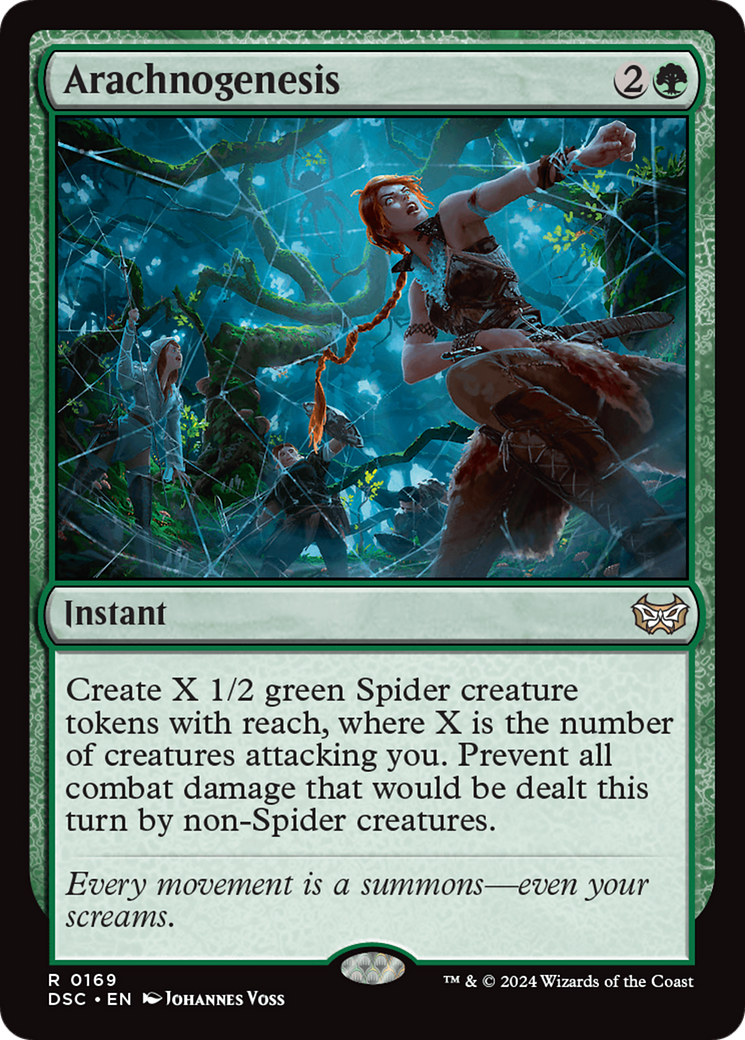
Arachnogenesis
Arachnogenesis
Instant
Create X 1/2 green Spider creature tokens with reach, where X is the number of creatures attacking you. Prevent all combat damage that would be dealt this turn by non-Spider creatures.
-
1
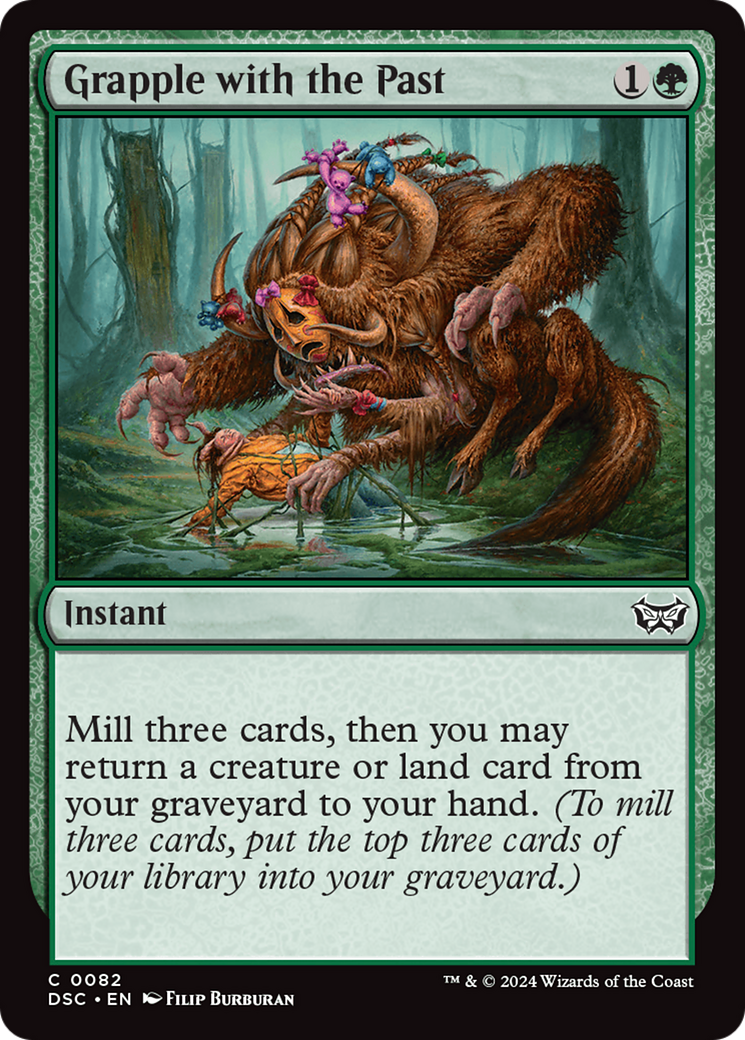
Grapple with the Past
Grapple with the Past
Instant
Mill three cards, then you may return a creature or land card from your graveyard to your hand. (To mill three cards, put the top three cards of your library into your graveyard.)
- Grapple with the Past doesn't target the card to return to your hand. After putting the top three cards of your library into your graveyard, you may choose from among any creature or land cards there.
-
1
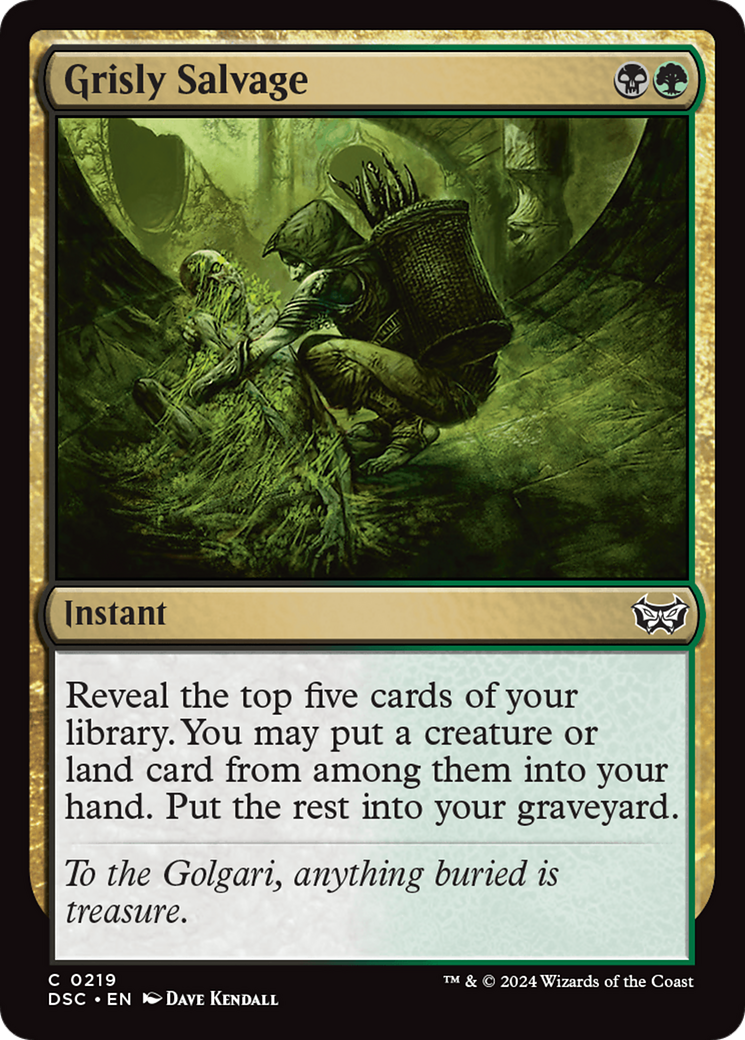
Grisly Salvage
Grisly Salvage
Instant
Reveal the top five cards of your library. You may put a creature or land card from among them into your hand. Put the rest into your graveyard.
-
1
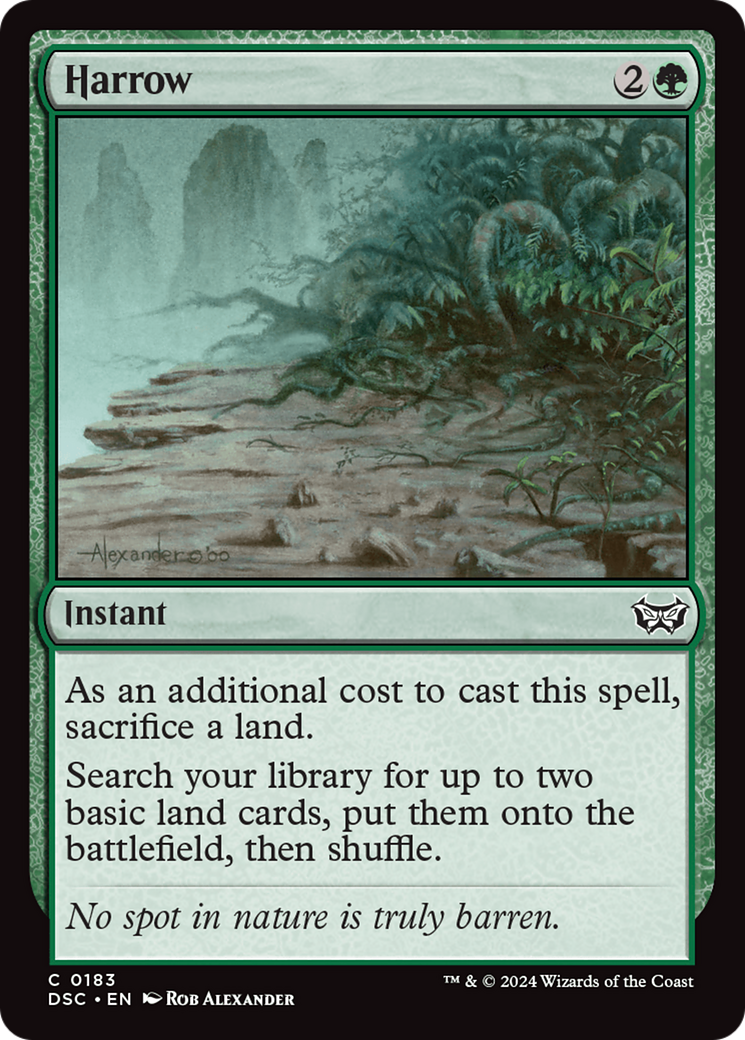
Harrow
Harrow
Instant
As an additional cost to cast this spell, sacrifice a land.
Search your library for up to two basic land cards, put them onto the battlefield, then shuffle.
- The two lands do not count toward your normal one land you can play each turn.
- The sacrifice of a land is part of the cost of casting Harrow. You can't pay this cost more than once to get a multiple effect.
-
1
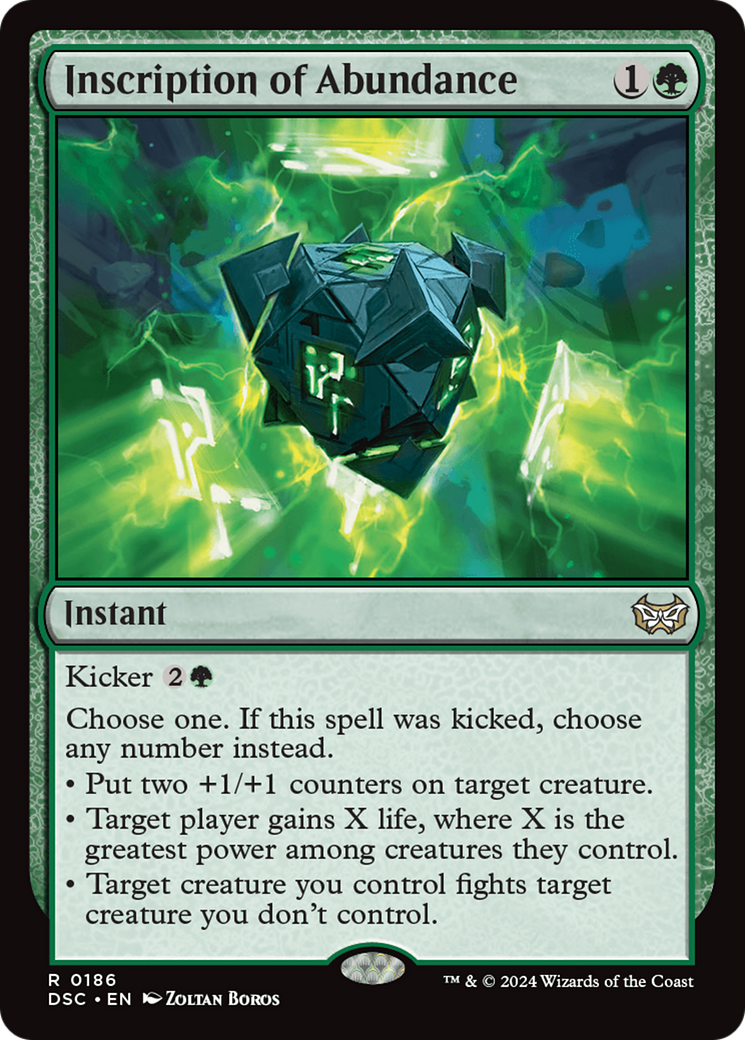
Inscription of Abundance
Inscription of Abundance
Instant
Kicker
Choose one. If this spell was kicked, choose any number instead.
- Put two +1/+1 counters on target creature.
- Target player gains X life, where X is the greatest power among creatures they control.
- Target creature you control fights target creature you don't control.
- To determine a spell's total cost, start with the mana cost (or an alternative cost if another card's effect allows you to pay one instead), add any cost increases (such as kicker), then apply any cost reductions. The spell's mana value remains unchanged, no matter what the total cost to cast it was.
- If a spell's kicker cost was paid, the spell is "kicked."
- The kicker ability doesn't let you pay a kicker cost more than once.
- If you put a permanent with a kicker ability onto the battlefield without casting it, you can't kick it.
- If you copy a kicked spell on the stack, the copy is also kicked. If the copied spell is a permanent spell, the token the copy of that spell becomes when it enters is also kicked.
- If a card or token enters as a copy of a permanent, the new permanent isn't kicked, even if the original was.
- If more than one mode is chosen, perform them in the order written. Nothing can happen in between, however, and no player may choose to take actions. Any abilities that trigger will be put onto the stack after the spell has finished resolving.
- If any targets become illegal, the other targets will still be affected as appropriate.
- If the second mode is chosen and each creature the target player controls has negative power, that player doesn't gain or lose life.
- If either target creature is an illegal target as Inscription of Abundance resolves with its last mode chosen, no creature will deal or be dealt damage.
- If you kick Inscription of Abundance, you can't choose any one mode more than once.
-
1
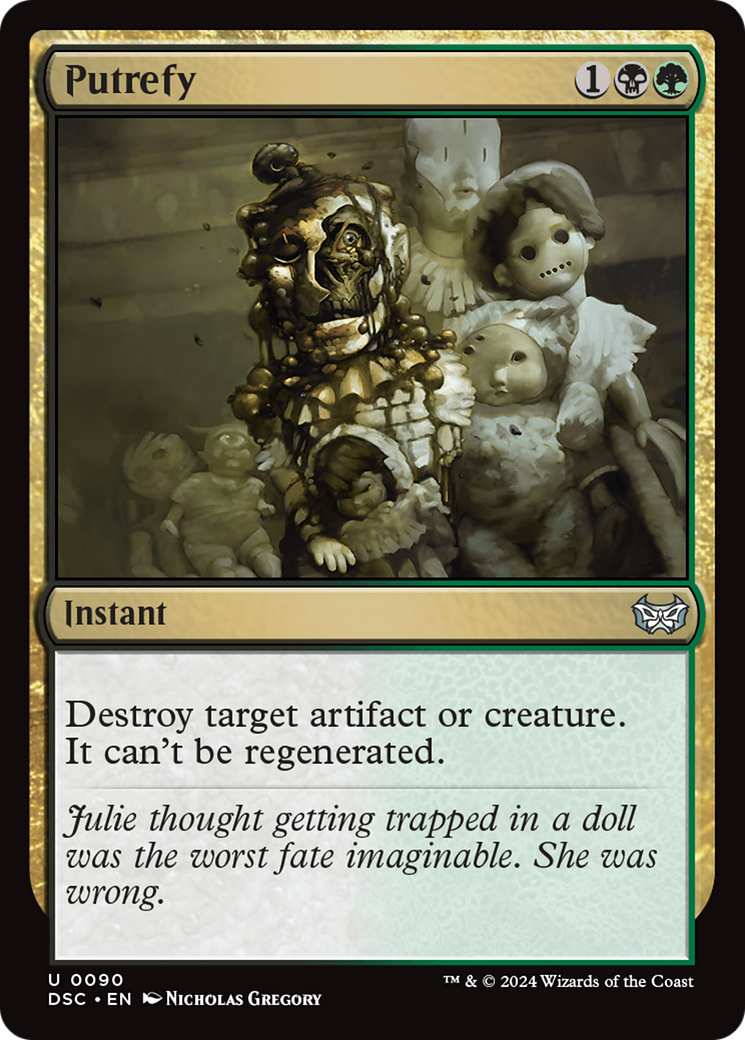
Putrefy
Putrefy
Instant
Destroy target artifact or creature. It can't be regenerated.
- This spell isn't modal. When it resolves, it will destroy the target if it's a creature or an artifact, even if it changed from one to the other between targeting and resolution.
Sorceries 9
-
1
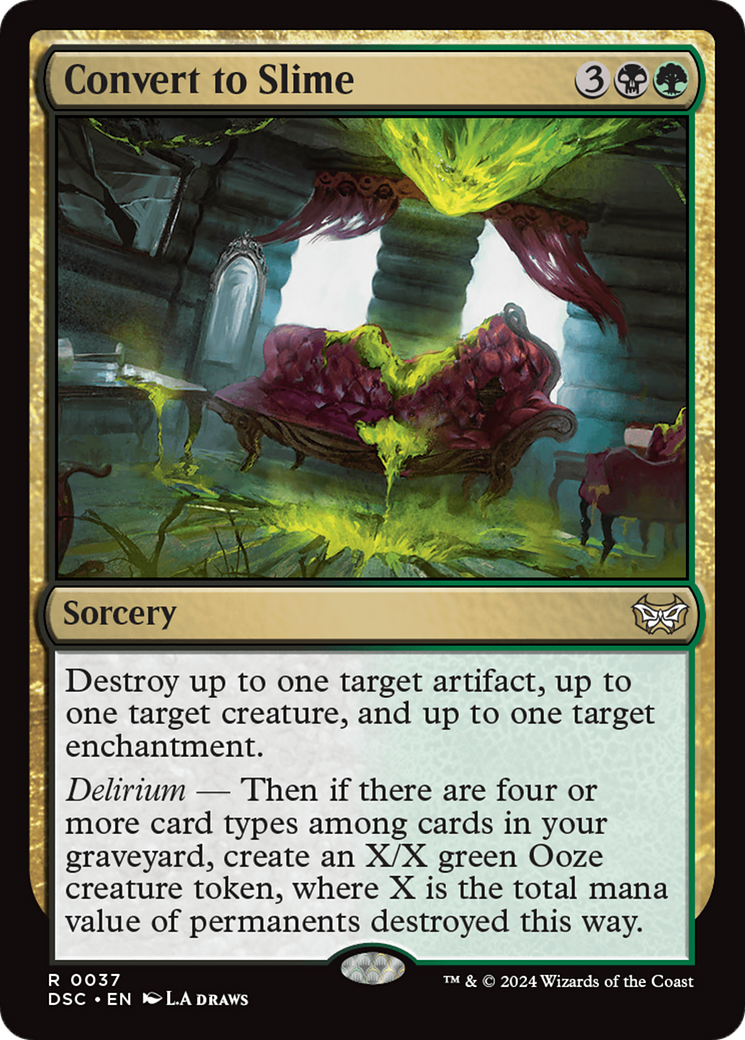
Convert to Slime
Convert to Slime
Sorcery
Destroy up to one target artifact, up to one target creature, and up to one target enchantment.
Delirium — Then if there are four or more card types among cards in your graveyard, create an X/X green Ooze creature token, where X is the total mana value of permanents destroyed this way.
- If you destroy some of your own permanents with Convert to Slime, they'll go to your graveyard in time for their types to be counted for the delirium ability.
- Use the mana value of the destroyed permanents as they last existed on the battlefield to determine the value of X.
-
1
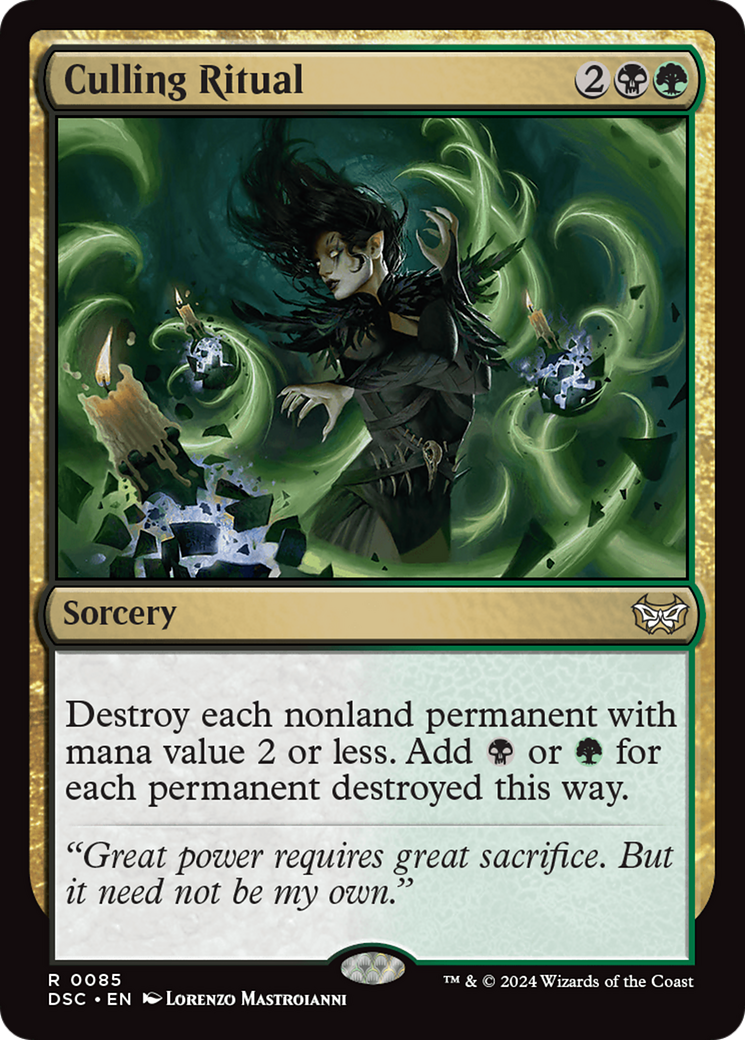
Culling Ritual
Culling Ritual
Sorcery
Destroy each nonland permanent with mana value 2 or less. Add or for each permanent destroyed this way.
- You can choose to add either or for each permanent destroyed. You aren't limited to one color.
-
1
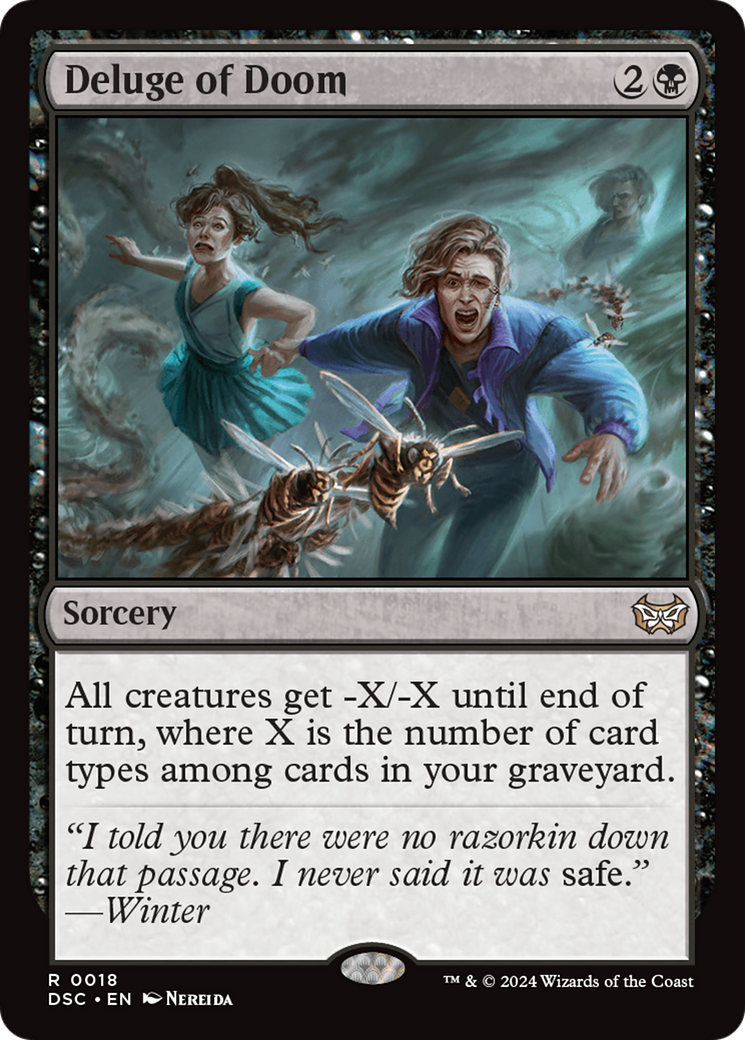
Deluge of Doom
Deluge of Doom
Sorcery
All creatures get -X/-X until end of turn, where X is the number of card types among cards in your graveyard.
-
1
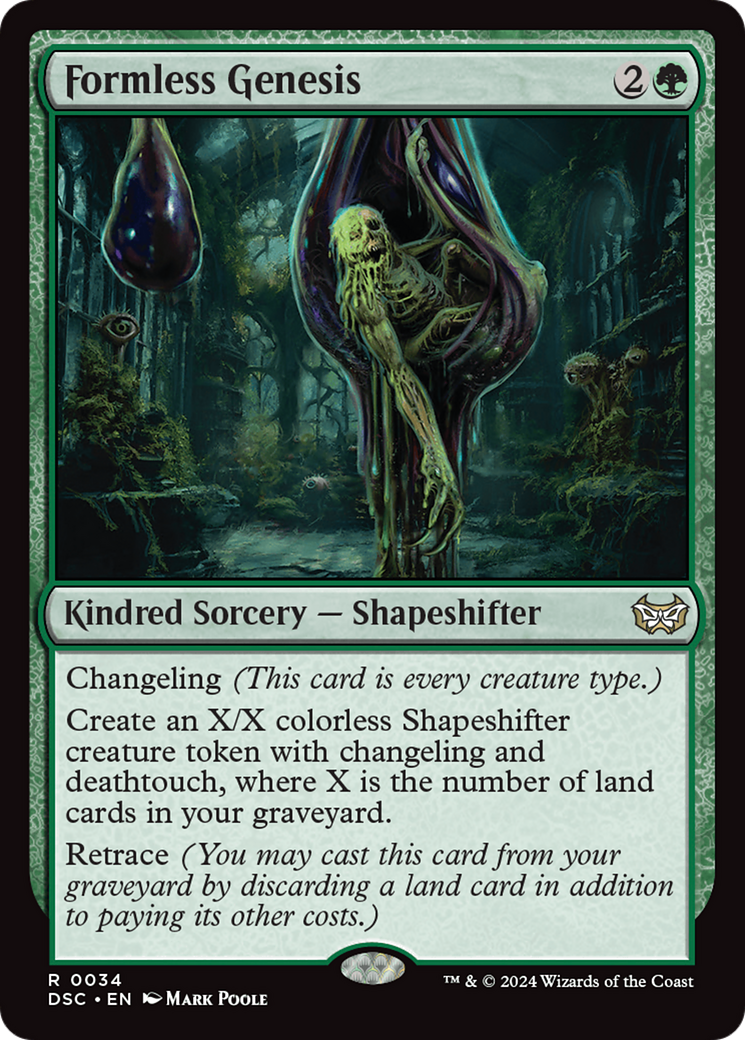
Formless Genesis
Formless Genesis
Kindred Sorcery — Shapeshifter
Changeling (This card is every creature type.)
Create an X/X colorless Shapeshifter creature token with changeling and deathtouch, where X is the number of land cards in your graveyard.
Retrace (You may cast this card from your graveyard by discarding a land card in addition to paying its other costs.)
- Changeling is a characteristic-defining ability. It functions in all zones.
- The subtype Shapeshifter that appears on the type line is mostly there to reinforce the flavor. A spell or token with changeling is just as much an Elf, a Dwarf, a Sliver, a Goat, a Coward, and a Zombie as it is a Shapeshifter.
- When a retrace spell you cast from your graveyard resolves, fails to resolve, or is countered, it's put back into your graveyard. You may use the retrace ability to cast it again.
- Casting a card by using its retrace ability works just like casting any other spell, with two exceptions: You're casting it from your graveyard rather than your hand, and you must discard a land card in addition to any other costs.
- The value of X is determined only once, as Formless Genesis resolves. The token's power and toughness won't change if the number of land cards in your graveyard later changes.
- A retrace card cast from your graveyard follows the normal timing rules for its card type.
- If the active player casts a spell that has retrace, that player may cast that card again after it resolves, before another player can remove the card from the graveyard. The active player has priority after the spell resolves, so they can immediately cast a new spell. Since casting a card with retrace from the graveyard moves that card onto the stack, no one else would have the chance to affect it while it's still in the graveyard.
-
1
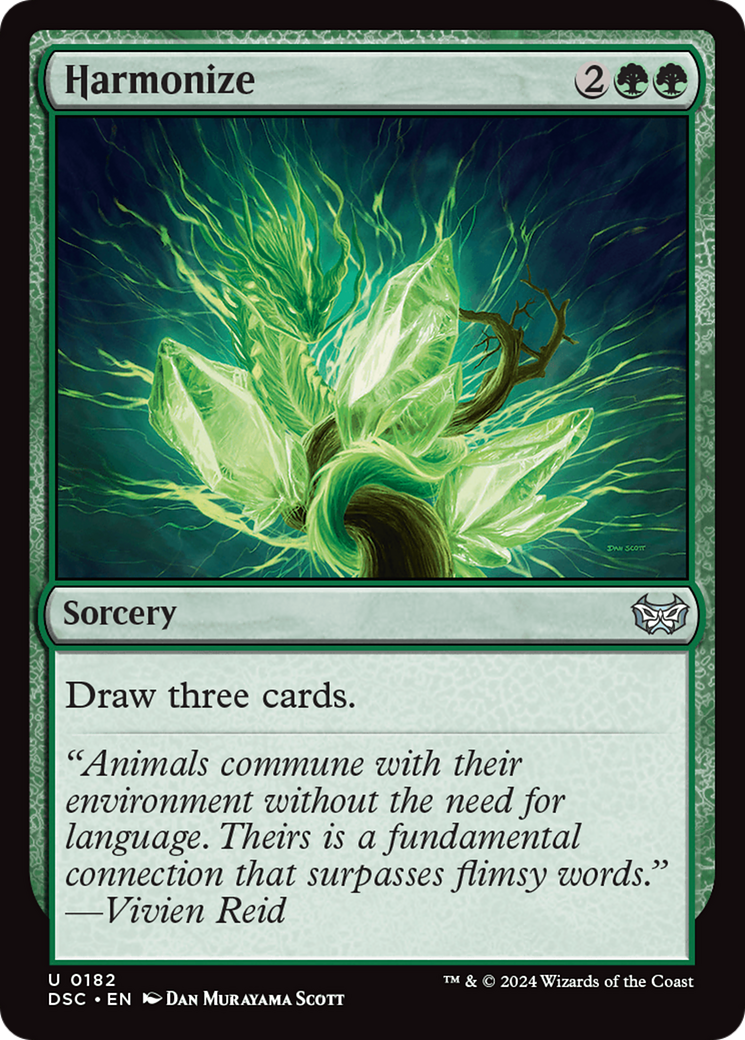
Harmonize
Harmonize
Sorcery
Draw three cards.
-
1
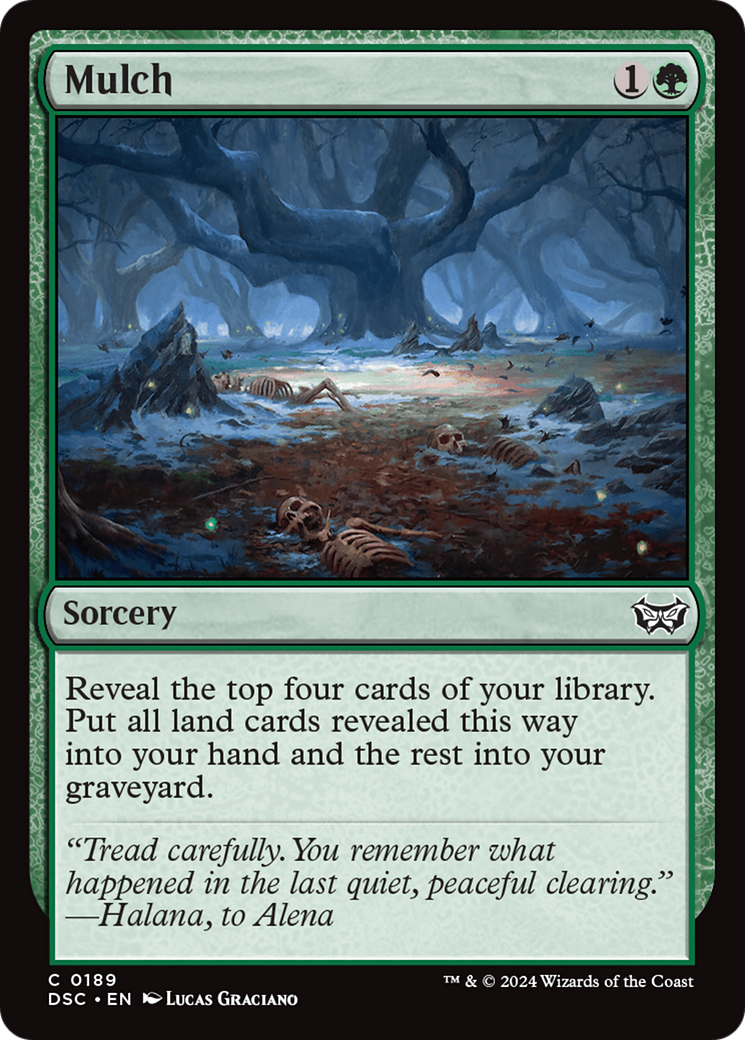
Mulch
Mulch
Sorcery
Reveal the top four cards of your library. Put all land cards revealed this way into your hand and the rest into your graveyard.
-
1
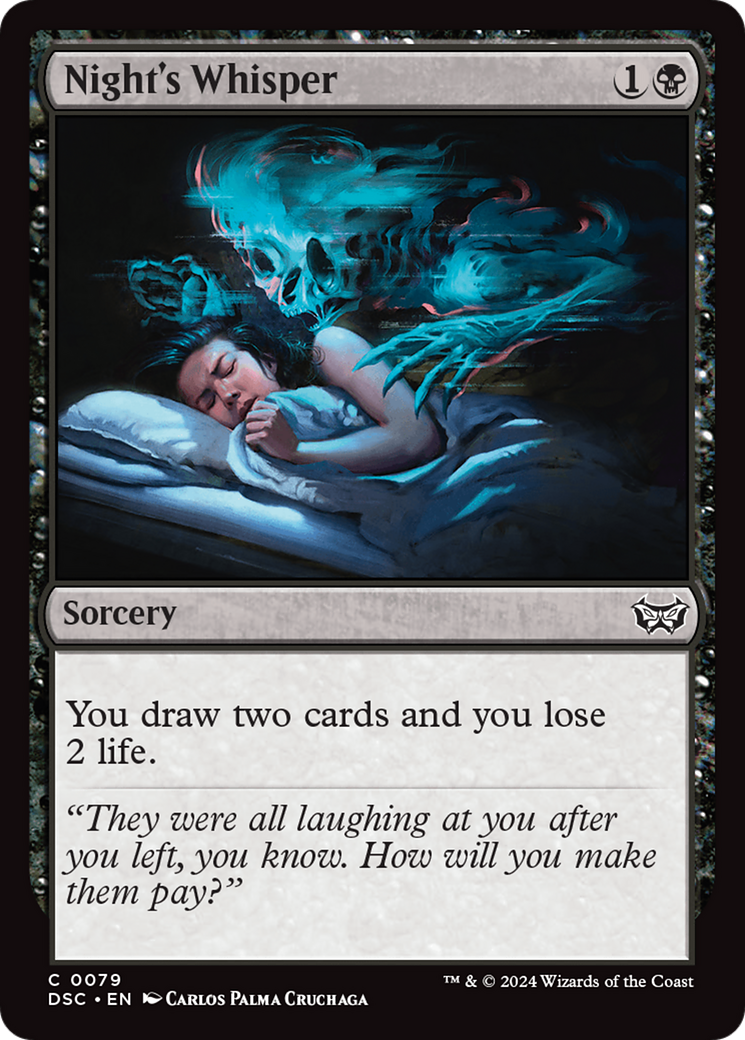
Night's Whisper
Night's Whisper
Sorcery
You draw two cards and you lose 2 life.
-
1
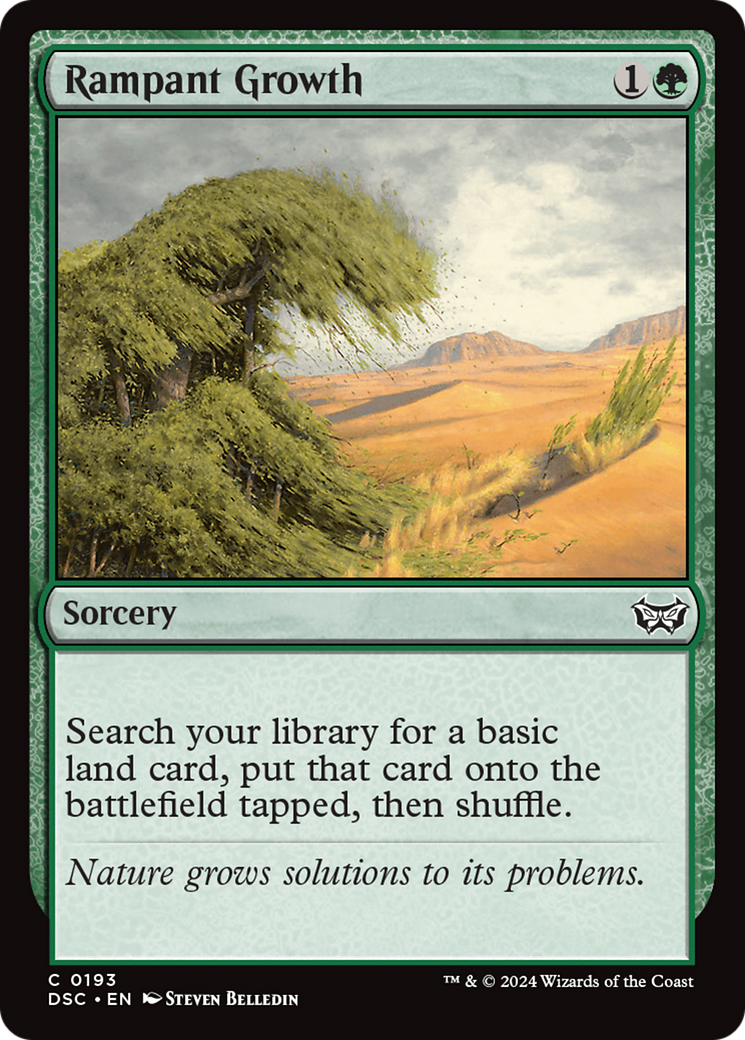
Rampant Growth
Rampant Growth
Sorcery
Search your library for a basic land card, put that card onto the battlefield tapped, then shuffle.
- The land does not count toward your one per turn limit because it was put onto the battlefield by an effect.
-
1
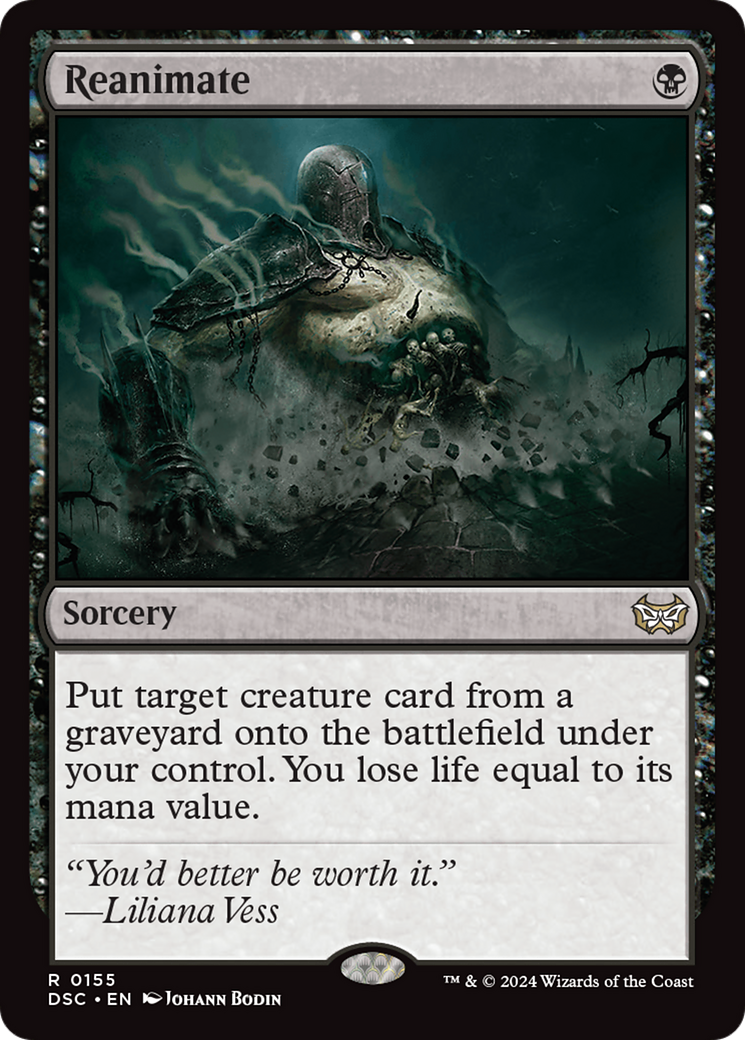
Reanimate
Reanimate
Sorcery
Put target creature card from a graveyard onto the battlefield under your control. You lose life equal to its mana value.
- If a card in a graveyard has in its mana cost, X is 0.
- The amount of life you lose is determined by the mana value of the card in your graveyard, not the creature once it's on the battlefield.
- You lose life after the creature is already on the battlefield. Any abilities it has that interact with loss of life, such as that of Platinum Emperion, apply to that loss of life.
- If any abilities trigger on the creature entering the battlefield, those abilities resolve after you lose life. If losing life results in you losing the game, those abilities won't resolve.
- In a multiplayer game, if a player leaves the game, all cards that player owns leave as well. If you leave the game, the creature you control from Reanimate is exiled.
Artifacts 8
-
1
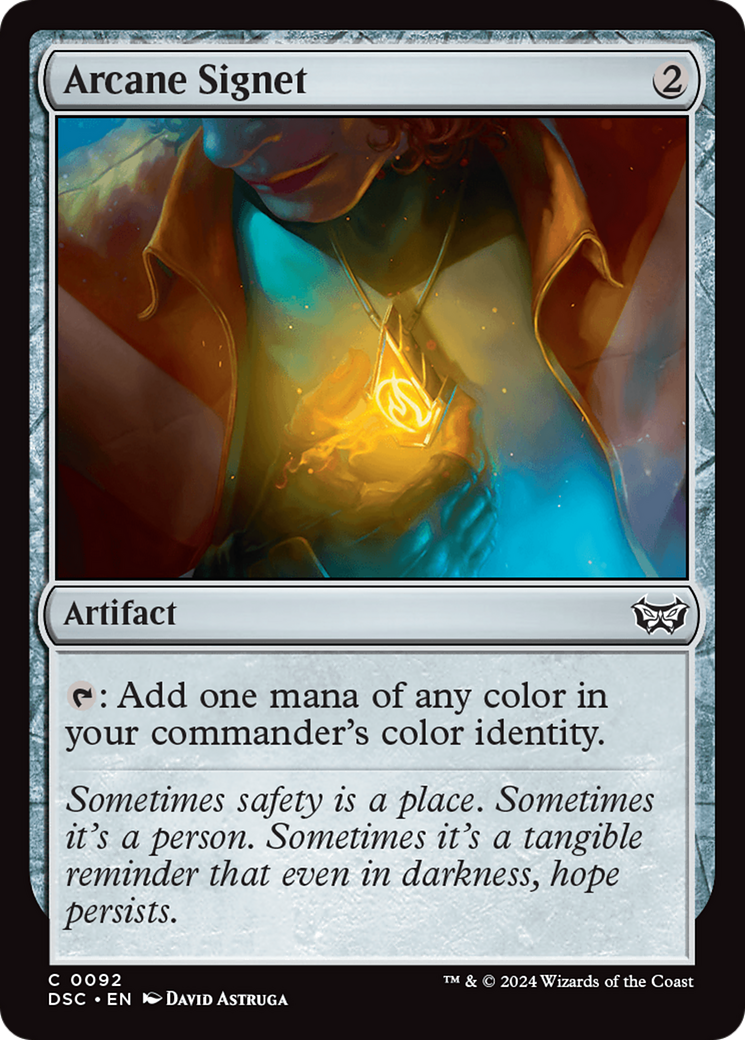
Arcane Signet
Arcane Signet
Artifact
: Add one mana of any color in your commander's color identity.
- If your commander is a card that has no colors in its color identity, Arcane Signet's ability produces no mana. It doesn't produce .
- If you have two commanders, the ability adds one mana of any color in their combined color identities.
- If you don't have a commander, Arcane Signet's ability produces no mana.
-
1
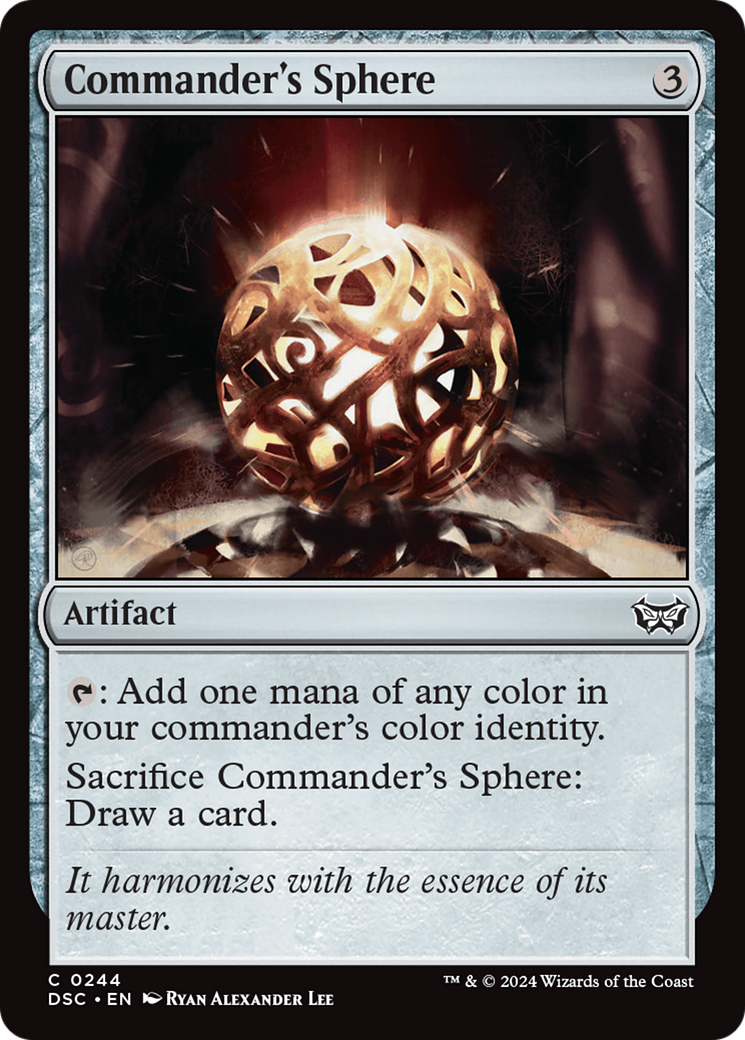
Commander's Sphere
Commander's Sphere
Artifact
: Add one mana of any color in your commander's color identity.
Sacrifice this artifact: Draw a card.
- If your commander is a card that has no colors in its color identity, Commander's Sphere's first ability produces no mana. It doesn't produce .
- If you don't have a commander, Commander's Sphere's first ability produces no mana.
- If you have two commanders, the ability adds one mana of any color in their combined color identities.
-
1
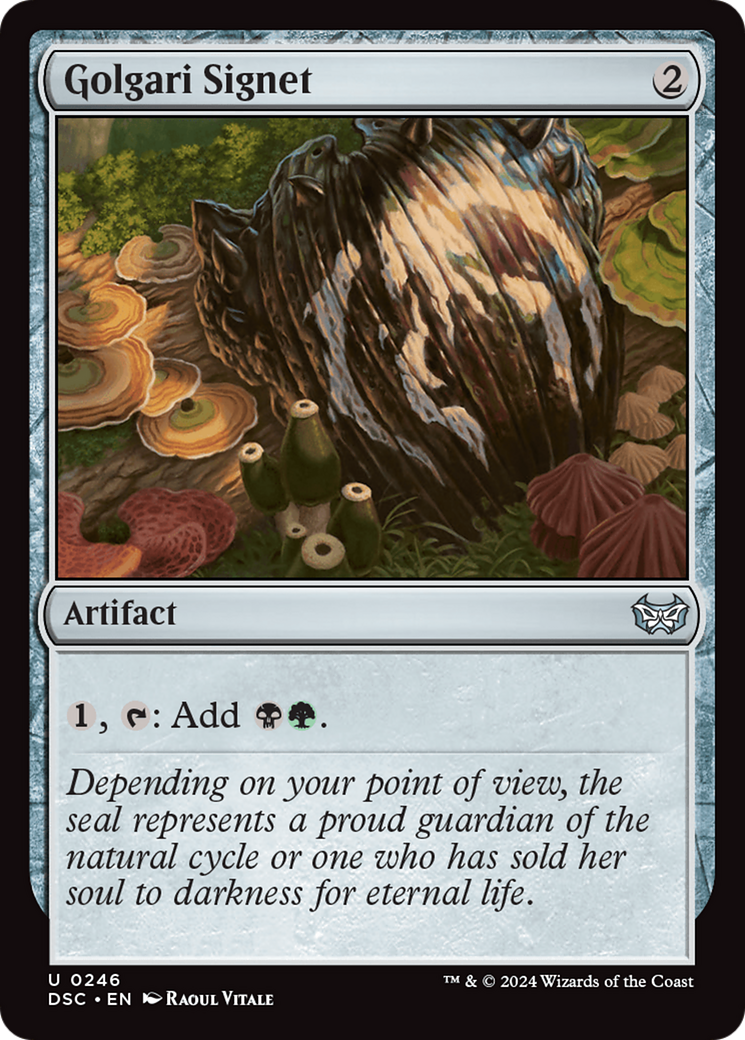
Golgari Signet
Golgari Signet
Artifact
, : Add .
-
1
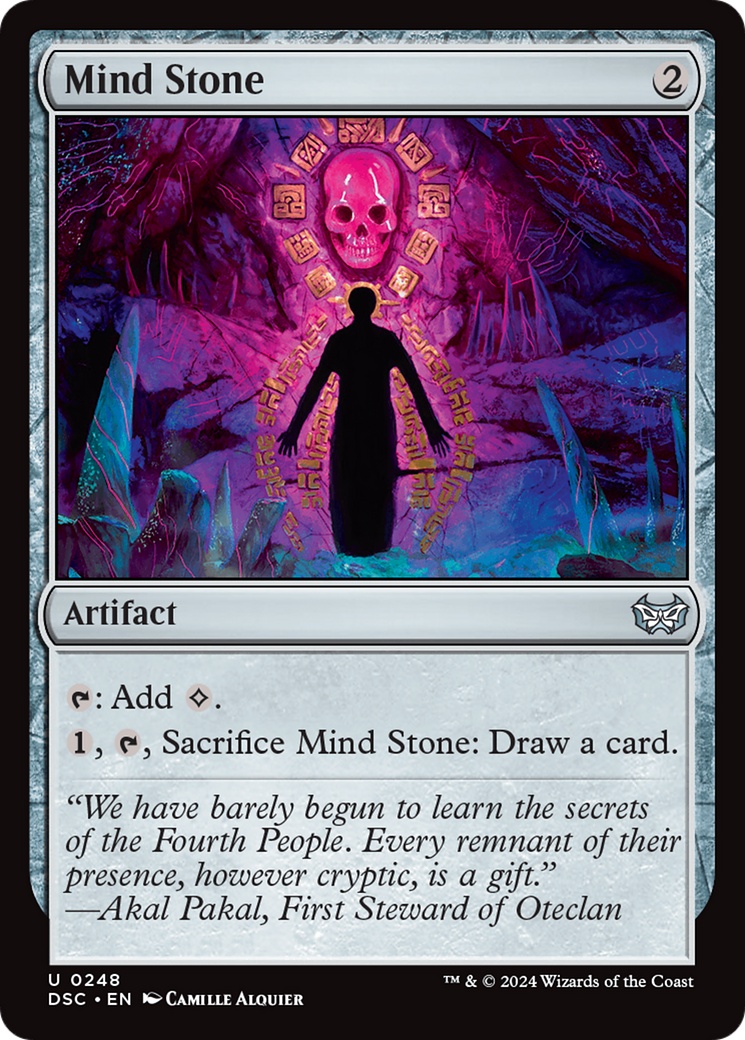
Mind Stone
Mind Stone
Artifact
: Add .
, , Sacrifice this artifact: Draw a card.
-
1
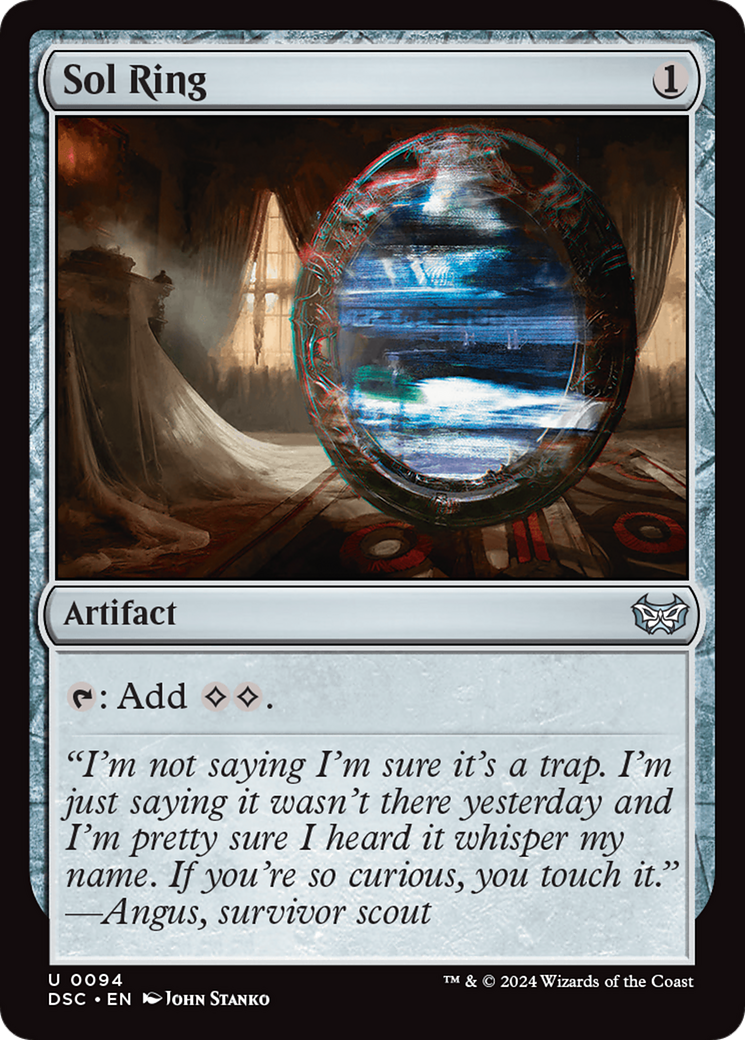
Sol Ring
Sol Ring
Artifact
: Add .
-
1
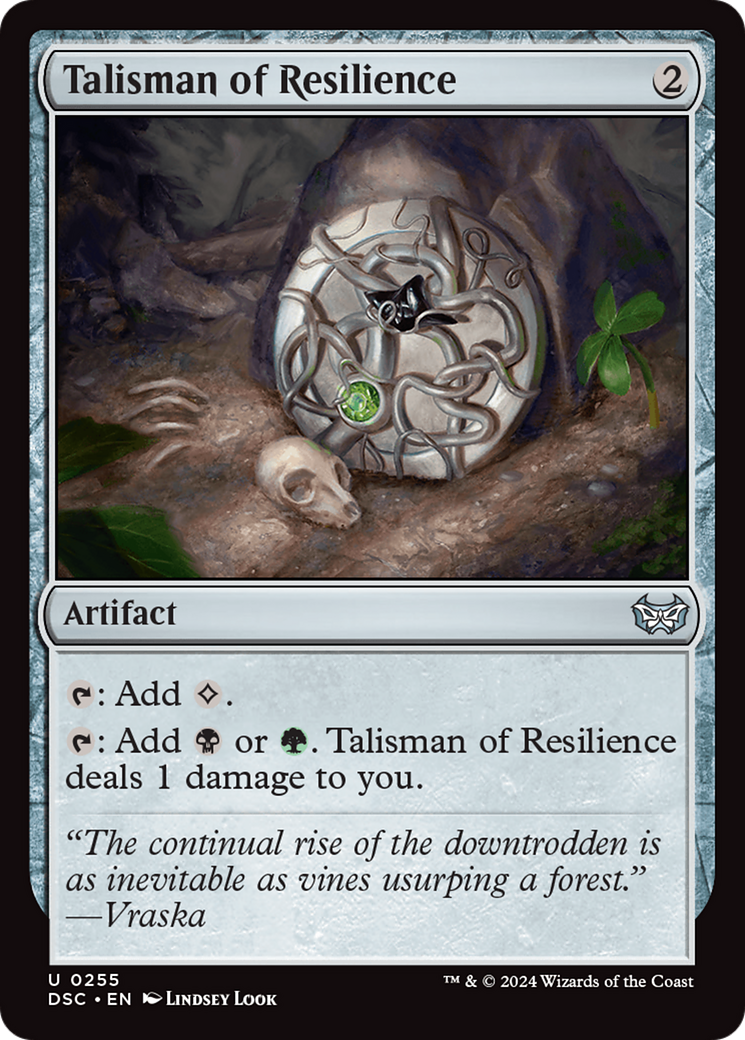
Talisman of Resilience
Talisman of Resilience
Artifact
: Add .
: Add or . This artifact deals 1 damage to you.
-
1
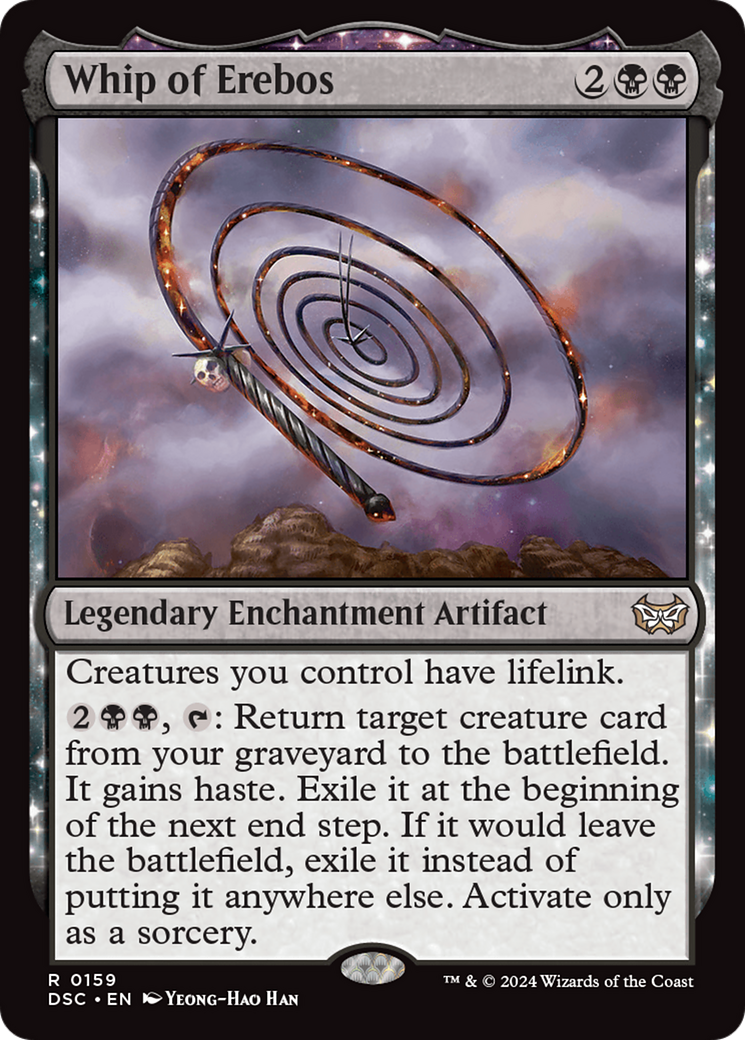
Whip of Erebos
Whip of Erebos
Legendary Enchantment Artifact
Creatures you control have lifelink.
, : Return target creature card from your graveyard to the battlefield. It gains haste. Exile it at the beginning of the next end step. If it would leave the battlefield, exile it instead of putting it anywhere else. Activate only as a sorcery.
- At the beginning of the next end step, the creature returned to the battlefield with Whip of Erebos is exiled. This is a delayed triggered ability. If the ability is countered, the creature will stay on the battlefield and the delayed trigger won't trigger again. However, the replacement effect will still exile the creature when it eventually leaves the battlefield.
- Whip of Erebos grants haste to the creature that's returned to the battlefield. However, neither of the "exile" abilities is granted to that creature. If that creature loses all its abilities, it will still be exiled at the beginning of the end step, and if it would leave the battlefield, it is still exiled instead.
- If a creature returned to the battlefield with Whip of Erebos would leave the battlefield for any reason, it's exiled instead. However, if that creature is already being exiled, then the replacement effect won't apply. If the spell or ability that exiles it later returns it to the battlefield (as Chained to the Rocks might, for example), the creature card will return to the battlefield as a new object with no relation to its previous existence. The effects from Whip of Erebos will no longer apply to it.
- The exiled creature is never put into the graveyard. Any abilities the creature has that trigger when it dies won't trigger.
-
1
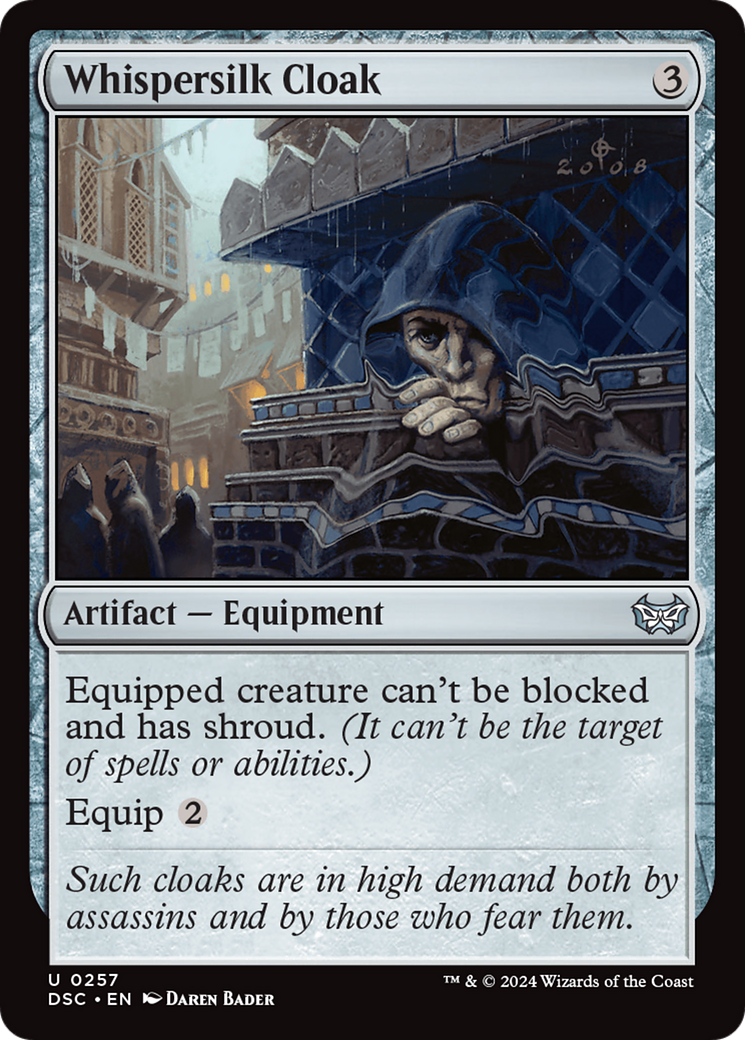
Whispersilk Cloak
Whispersilk Cloak
Artifact — Equipment
Equipped creature can't be blocked and has shroud. (It can't be the target of spells or abilities.)
Equip
Enchantments 8
-
1
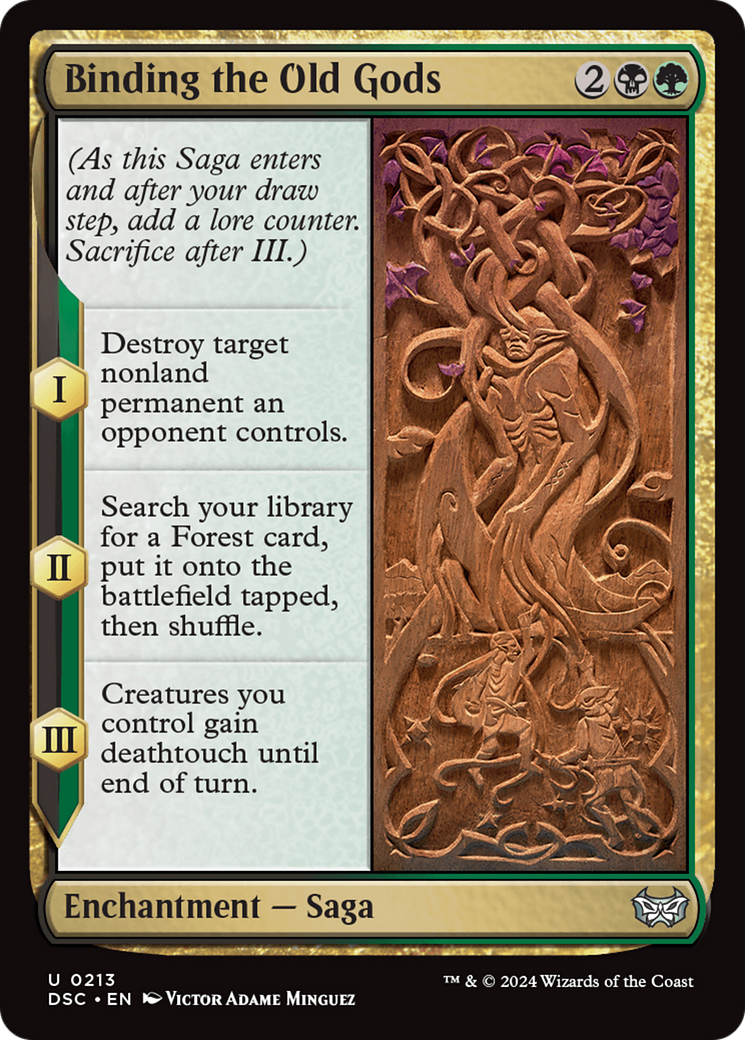
Binding the Old Gods
Binding the Old Gods
Enchantment — Saga
(As this Saga enters and after your draw step, add a lore counter. Sacrifice after III.)
I — Destroy target nonland permanent an opponent controls.
II — Search your library for a Forest card, put it onto the battlefield tapped, then shuffle.
III — Creatures you control gain deathtouch until end of turn.
- As a Saga enters the battlefield, its controller puts a lore counter on it. As your precombat main phase begins (immediately after your draw step), you put another lore counter on each Saga you control. Putting a lore counter on a Saga in either of these ways doesn't use the stack.
- Each symbol on the left of a Saga's text box represents a chapter ability. A chapter ability is a triggered ability that triggers when a lore counter that is put on the Saga causes the number of lore counters on the Saga to become equal to or greater than the ability's chapter number. Chapter abilities are put onto the stack and may be responded to.
- A chapter ability doesn't trigger if a lore counter is put on a Saga that already had a number of lore counters greater than or equal to that chapter's number. For example, the third lore counter put on a Saga causes the chapter III ability to trigger, but chapters I and II won't trigger again.
- Once a chapter ability has triggered, the ability on the stack won't be affected if the Saga gains or loses counters, or if it leaves the battlefield.
- If multiple chapter abilities trigger at the same time, their controller puts them on the stack in any order. If any of them require targets, those targets are chosen as you put the abilities on the stack, before any of those abilities resolve.
- Removing lore counters won't cause a previous chapter ability to trigger. If lore counters are removed from a Saga, the appropriate chapter abilities will trigger again when the Saga receives more lore counters.
- Once the number of lore counters on a Saga is greater than or equal to the greatest number among its chapter abilities, the Saga's controller sacrifices it as soon as its chapter ability has left the stack, most likely by resolving or being countered. This state-based action doesn't use the stack.
-
1
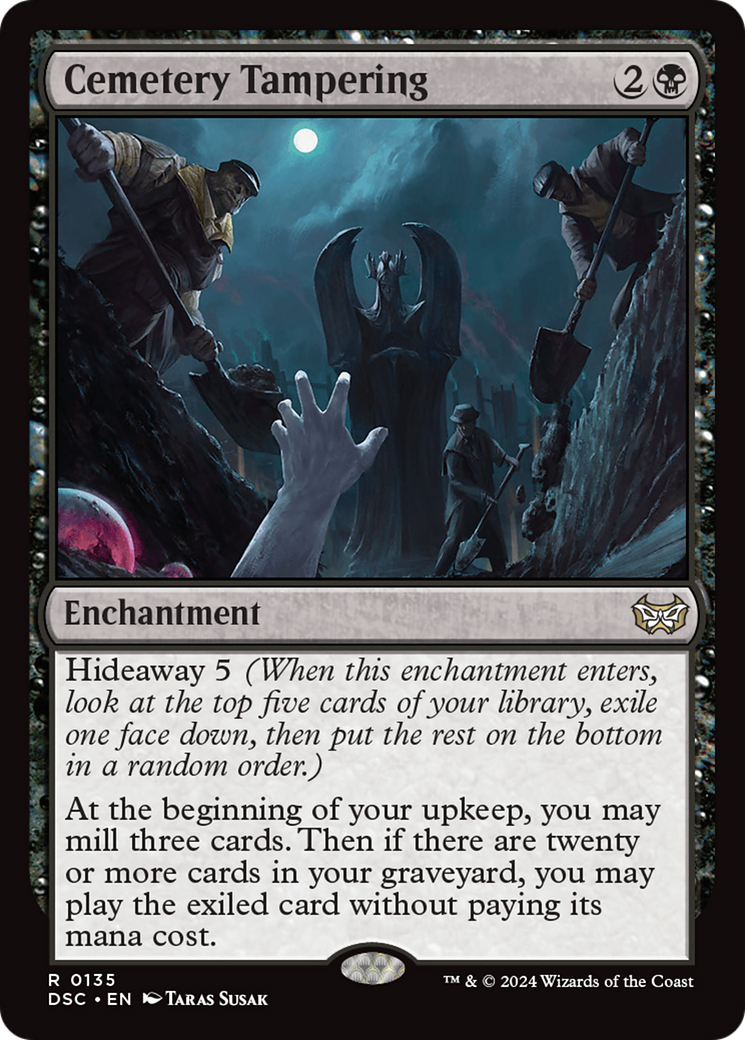
Cemetery Tampering
Cemetery Tampering
Enchantment
Hideaway 5 (When this enchantment enters, look at the top five cards of your library, exile one face down, then put the rest on the bottom in a random order.)
At the beginning of your upkeep, you may mill three cards. Then if there are twenty or more cards in your graveyard, you may play the exiled card without paying its mana cost.
- "Hideaway N" means "When this permanent enters the battlefield, look at the top N cards of your library. Exile one of them face down and put the rest on the bottom of your library in a random order. The exiled card gains 'The player who controls the permanent that exiled this card may look at this card in the exile zone.'"
- Any player who has controlled a permanent with a hideaway ability since a card was exiled with it may look at that card.
- Previously, permanents with hideaway entered the battlefield tapped. This ability has been removed from the definition of hideaway. Older cards have received errata to have an additional paragraph that reads "[This permanent] enters the battlefield tapped," and they now have hideaway 4.
- Hideaway now causes you to put the rest of the cards on the bottom of your library in a random order instead of any order.
-
1
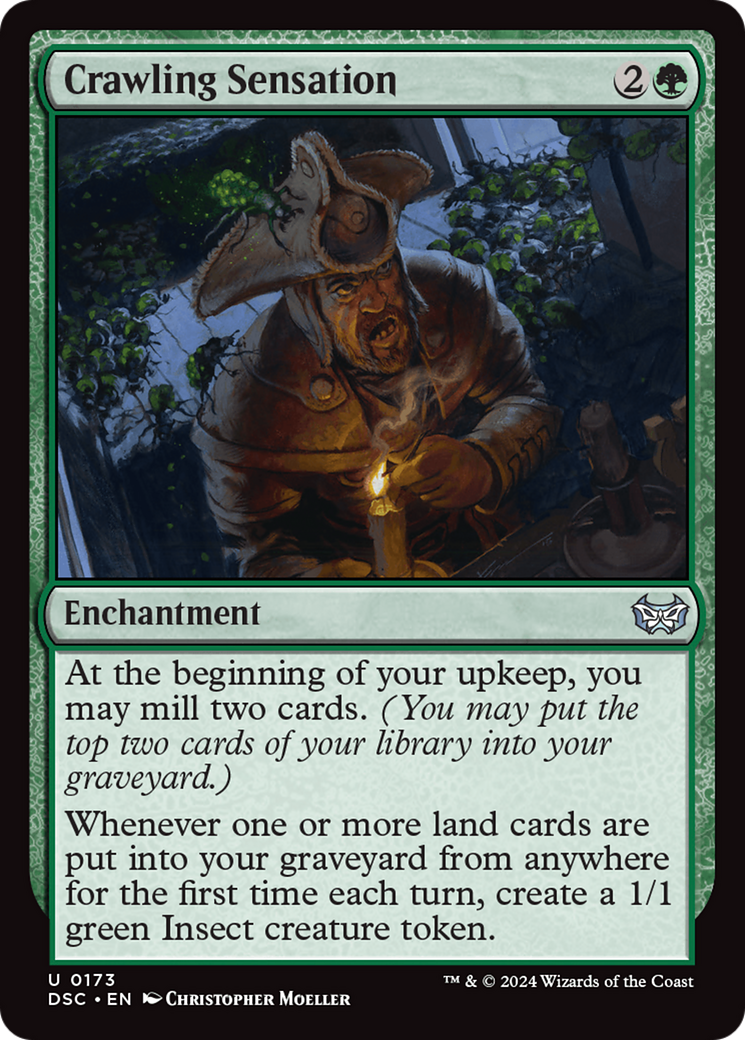
Crawling Sensation
Crawling Sensation
Enchantment
At the beginning of your upkeep, you may mill two cards. (You may put the top two cards of your library into your graveyard.)
Whenever one or more land cards are put into your graveyard from anywhere for the first time each turn, create a 1/1 green Insect creature token.
- If multiple land cards are put into your graveyard at once, Crawling Sensation's last ability triggers only once. This could happen because an effect (such as that of Crawling Sensation's first ability) put them there from your library at once, or because they were destroyed at the same time (such as two land creatures that were dealt lethal combat damage).
-
1
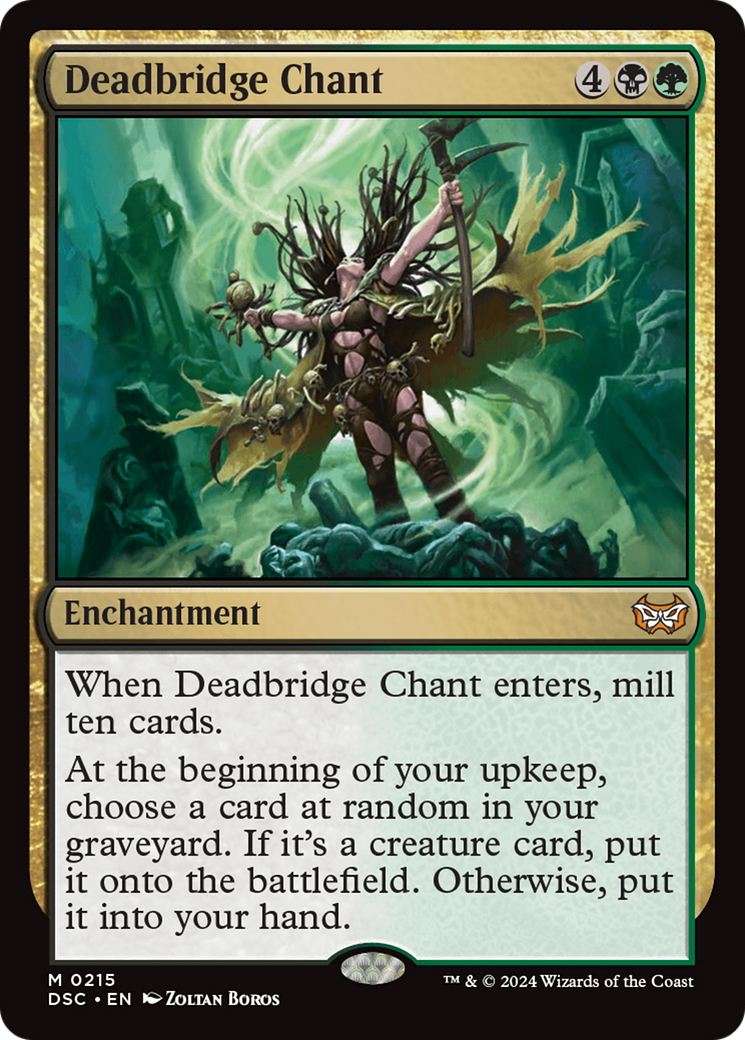
Deadbridge Chant
Deadbridge Chant
Enchantment
When this enchantment enters, mill ten cards.
At the beginning of your upkeep, choose a card at random in your graveyard. If it's a creature card, put it onto the battlefield. Otherwise, put it into your hand.
- The card is chosen at random as the ability resolves. If any player responds to the ability, that player won't yet know what card will be chosen.
- Because the last ability doesn't target any card in your graveyard, any card put into your graveyard in response to the ability may be chosen.
- Each card in your graveyard must have an equal chance of being chosen. Assigning them each a number and rolling a die is an easy way to do this. In formats that allow you to rearrange your graveyard—including Standard, Modern, and Return to Ravnica block Limited formats, you may also shuffle your graveyard face down and choose a card at random.
-
1
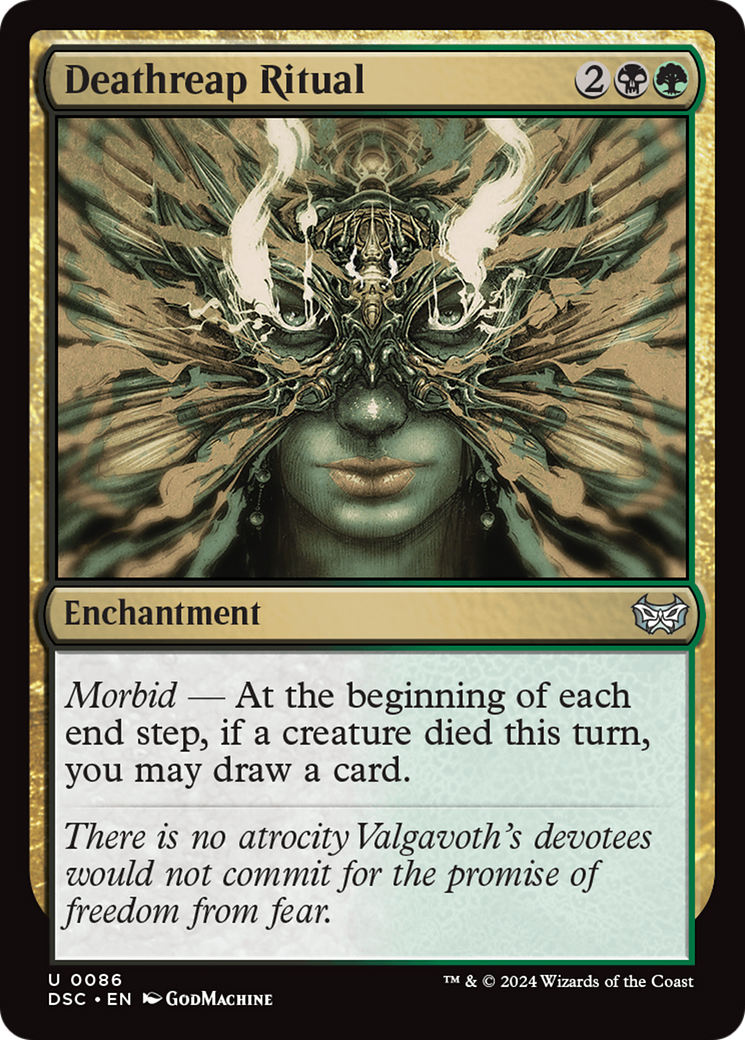
Deathreap Ritual
Deathreap Ritual
Enchantment
Morbid — At the beginning of each end step, if a creature died this turn, you may draw a card.
- If a creature didn't die before a turn's end step begins, Deathreap Ritual's ability doesn't trigger at all. The creature may have died before Deathreap Ritual entered the battlefield, however.
- You draw one card when the ability resolves, not one card per creature that died during the turn.
-
1
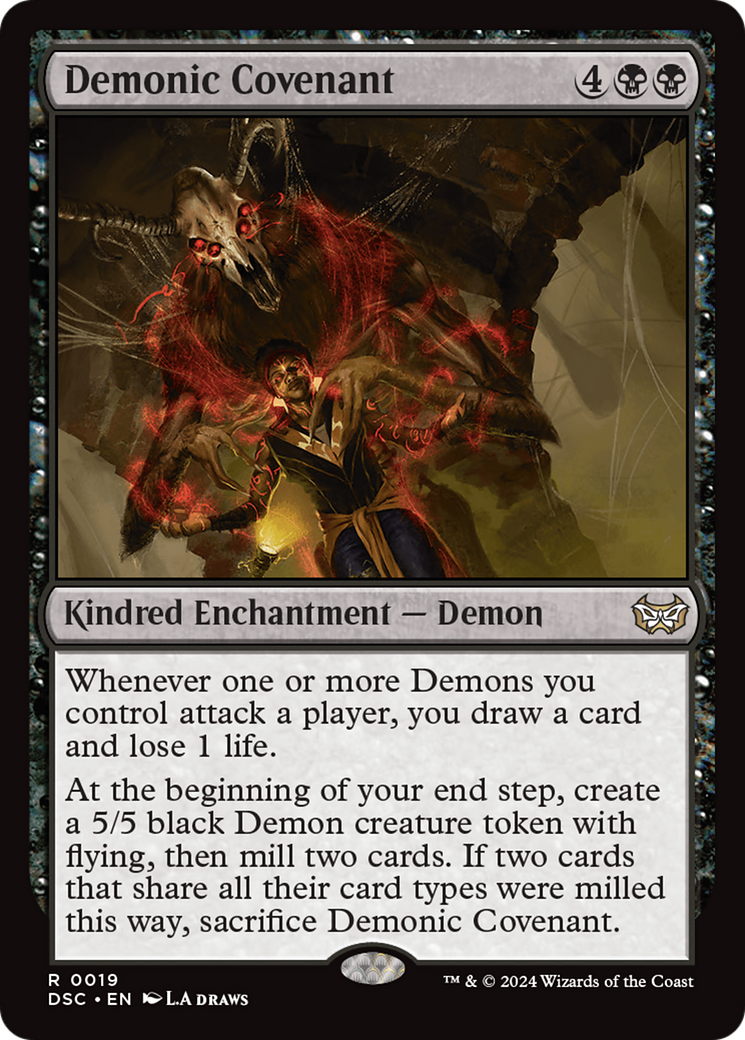
Demonic Covenant
Demonic Covenant
Kindred Enchantment — Demon
Whenever one or more Demons you control attack a player, you draw a card and lose 1 life.
At the beginning of your end step, create a 5/5 black Demon creature token with flying, then mill two cards. If two cards that share all their card types were milled this way, sacrifice this enchantment.
- Creatures that enter attacking are never declared as attackers, and as such, they won't cause Demonic Covenant's first ability to trigger.
- The card types in Magic include artifact, battle, creature, enchantment, instant, kindred, land, planeswalker, and sorcery. Legendary, basic, and snow are supertypes, not card types; Horror and Room are subtypes, not card types.
- Demonic Covenant's last ability will only cause you to sacrifice Demonic Covenant if both cards have the exact same combination of card types. Supertypes and subtypes are not taken into account.
- Demonic Covenant's first ability will trigger once for each player you attack with one or more Demons.
-
1
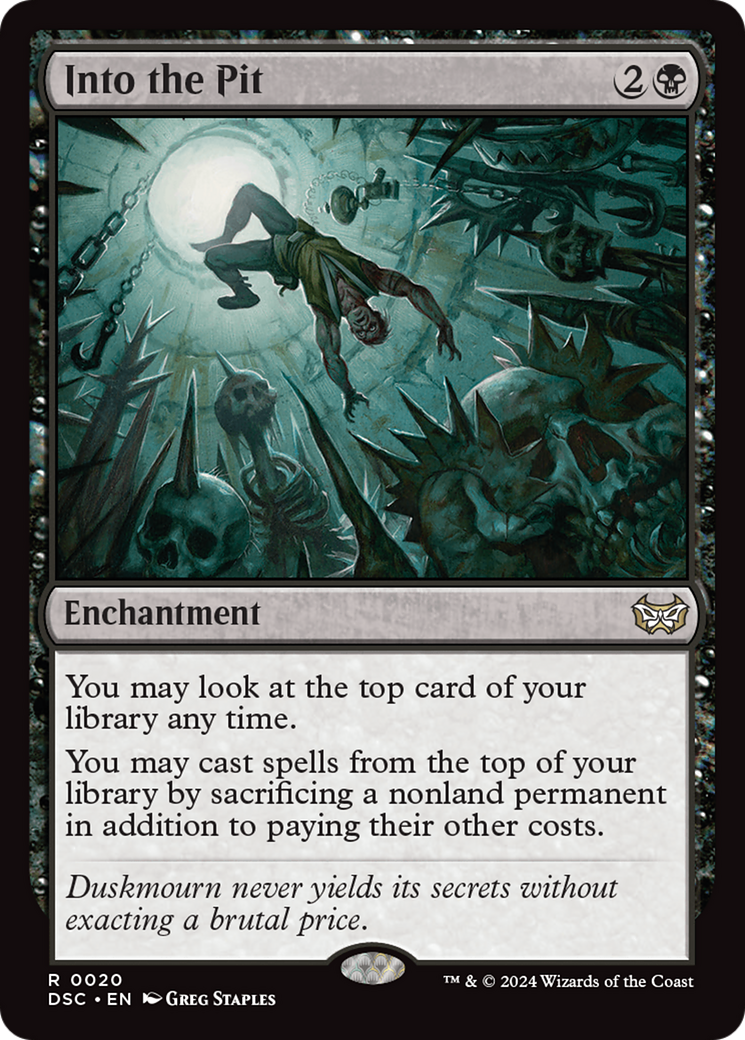
Into the Pit
Into the Pit
Enchantment
You may look at the top card of your library any time.
You may cast spells from the top of your library by sacrificing a nonland permanent in addition to paying their other costs.
- While you control Into the Pit, you can look at the top card of your library whenever you want (with one restriction; see below), even if you don't have priority. This action doesn't use the stack. Knowing what that card is becomes part of the information you have access to, just like you can look at the cards in your hand.
- If the top card of your library changes while you're casting a spell, playing a land, activating an ability, or taking a special action, you can't look at the new top card until you finish doing so. This means that if you cast a spell from the top of your library, you can't look at the next one until you're done paying for that spell.
- You pay all costs and follow all timing rules for spells cast from the top of your library this way.
- While you control Into the Pit, if the top card of your library has disguise or morph, you may cast it face down from the top of your library by paying and sacrificing a nonland permanent.
-
1
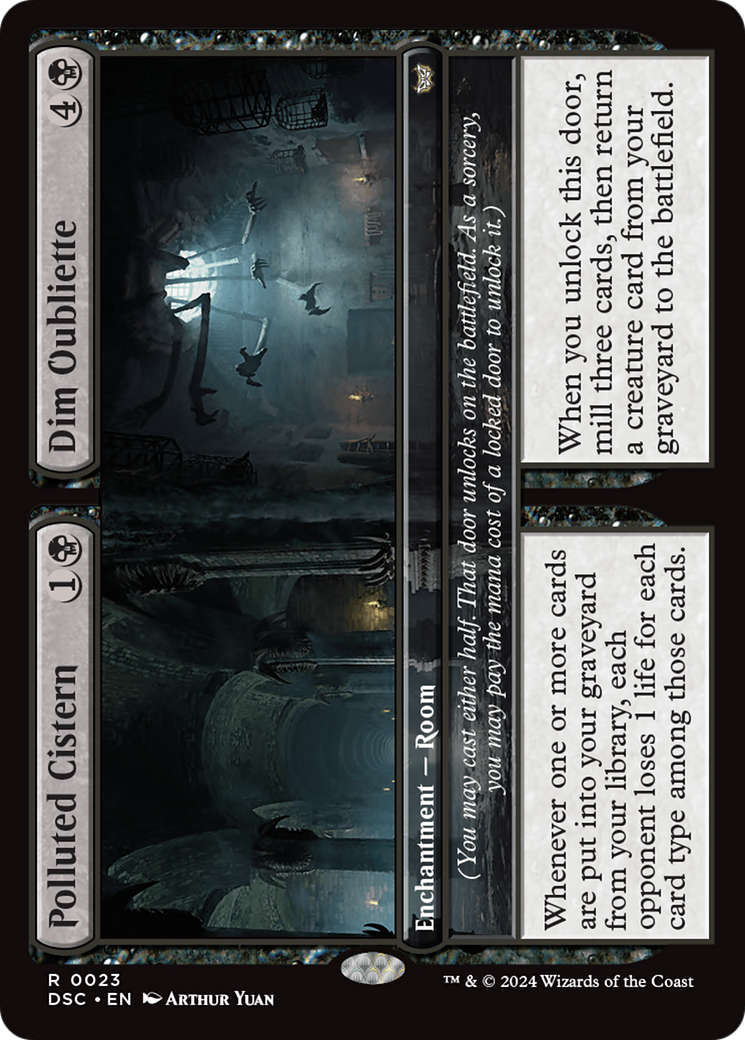
Polluted Cistern // Dim Oubliette
//
Polluted Cistern
Enchantment — Room
- To cast a Room spell, choose a half (or "door") to cast. There's no way to cast both halves of a Room card. When the Room spell resolves, the corresponding door becomes unlocked as the Room enters.
- Room cards have two card faces with a shared type line on a single card. The characteristics of the door you didn't cast are ignored while the spell is on the stack.
- Each Room card is a single card. For example, if you discard a Room card, you've discarded one card, not two. If an effect counts the number of enchantment cards in your graveyard, Bottomless Pool // Locker Room counts once, not twice.
- Each Room card has two names. If an effect instructs you to choose a card name, you may choose one of those names, but not both.
- If an effect allows you to cast a spell with certain characteristics, consider only the characteristics of the door you're casting. For example, if an effect allows you to cast a permanent spell with mana value 3 or less from among cards in your graveyard, you could cast Bottomless Pool this way, but not Locker Room.
- While in any zone other than the stack or the battlefield, a Room card's characteristics are a combination of its two doors. For example, Bottomless Pool // Locker Room has a mana value of 6 while it's in your library. If an effect allows you to search your library for a card with mana value 4 or less, you can't find Bottomless Pool // Locker Room.
- While on the battlefield, a Room's characteristics are a combination of the characteristics of its unlocked doors. For example, if Bottomless Pool // Locker Room is on the battlefield with both doors unlocked, its names are Bottomless Pool and Locker Room, its mana value is 6, it's a Room Enchantment, and it has the abilities in each door's text box.
- If a spell or ability would create a copy of a Room spell on the stack, the copy retains the choice of which door was cast but also retains the full characteristics of the spell. The characteristics of the door that wasn't cast are still ignored while the copy is on the stack, and when the copy resolves, the token it becomes will enter with the appropriate door unlocked.
- If a Room enters from any zone other than the stack, it will enter with both halves locked.
- If neither door of a Room is unlocked, it's a Room enchantment with no name and no abilities.
- Any time you have priority during a main phase of your turn and the stack is empty, you may pay the mana cost of a locked door (also called its "unlock cost"). That door becomes unlocked. This is a special action. It doesn't use the stack and can't be responded to.
- An ability that triggers "when you unlock this door" triggers when that door becomes unlocked. This can happen one of two ways: (1) the door becomes unlocked on the battlefield or (2) the door becomes unlocked as the Room enters the battlefield because you cast the corresponding half. In the latter case, since the door becoming unlocked is what causes the ability to trigger, effects that cause abilities that trigger when a permanent enters to trigger an additional time (such as that of Panharmonicon) won't apply.
- Some abilities allow you to unlock a door of a Room you control. You can't choose to unlock a door that's already unlocked with such an ability. If such an ability requires a target, you can target a Room even if both of its doors are unlocked, but the ability won't do anything when it resolves.
- Some abilities allow you to lock a door of a Room you control. You can't choose to lock a door that's already locked with such an ability. If such an ability requires a target, you can target a Room even if both of its doors are locked, but the ability won't do anything when it resolves.
- Some doors have abilities that trigger whenever you unlock that door and require one or more targets. You can unlock that door even if there would be insufficient legal targets for that triggered ability. The triggered ability won't go on the stack.
- An ability that triggers "whenever you fully unlock a Room" triggers when a door becomes unlocked and the other door of that Room is already unlocked, or when both doors of that Room become unlocked simultaneously.
Lands 37
-
1
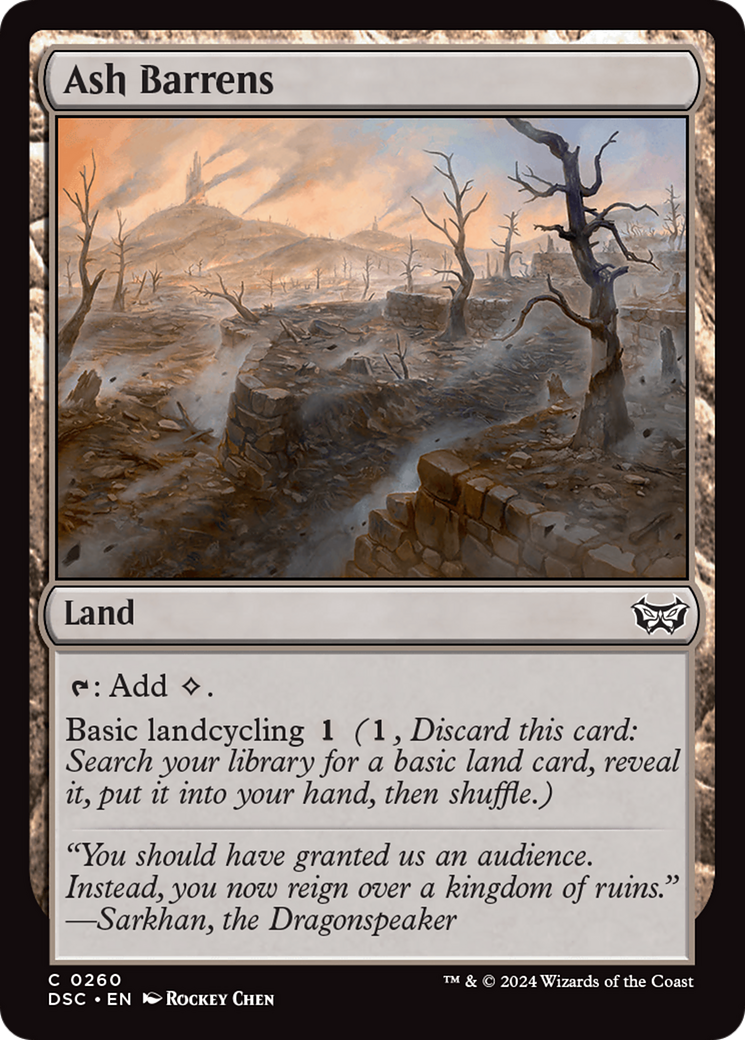
Ash Barrens
Ash Barrens
Land
: Add .
Basic landcycling ( , Discard this card: Search your library for a basic land card, reveal it, put it into your hand, then shuffle.)
-
1
Barren Moor
Barren Moor
Land
This land enters tapped.
: Add .
Cycling ( , Discard this card: Draw a card.)
- Cycling is an activated ability. Effects that interact with activated abilities (such as Stifle or Rings of Brighthearth) will interact with cycling. Effects that interact with spells (such as Remove Soul or Faerie Tauntings) will not.
-
1
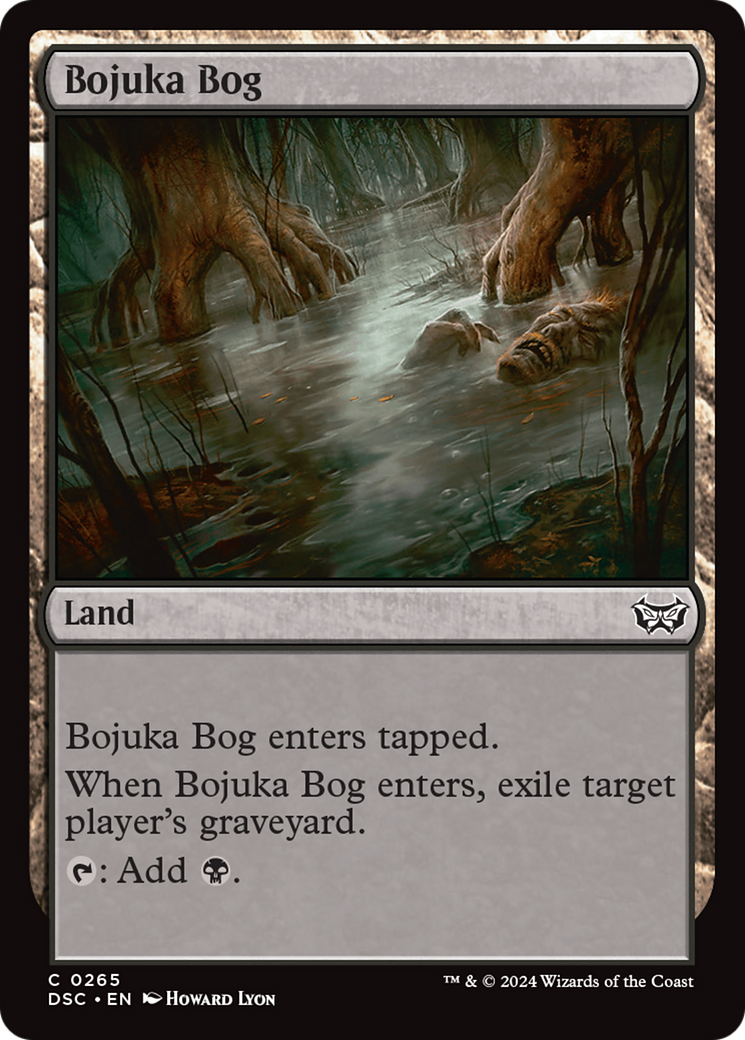
Bojuka Bog
Bojuka Bog
Land
This land enters tapped.
When this land enters, exile target player's graveyard.
: Add .
-
1
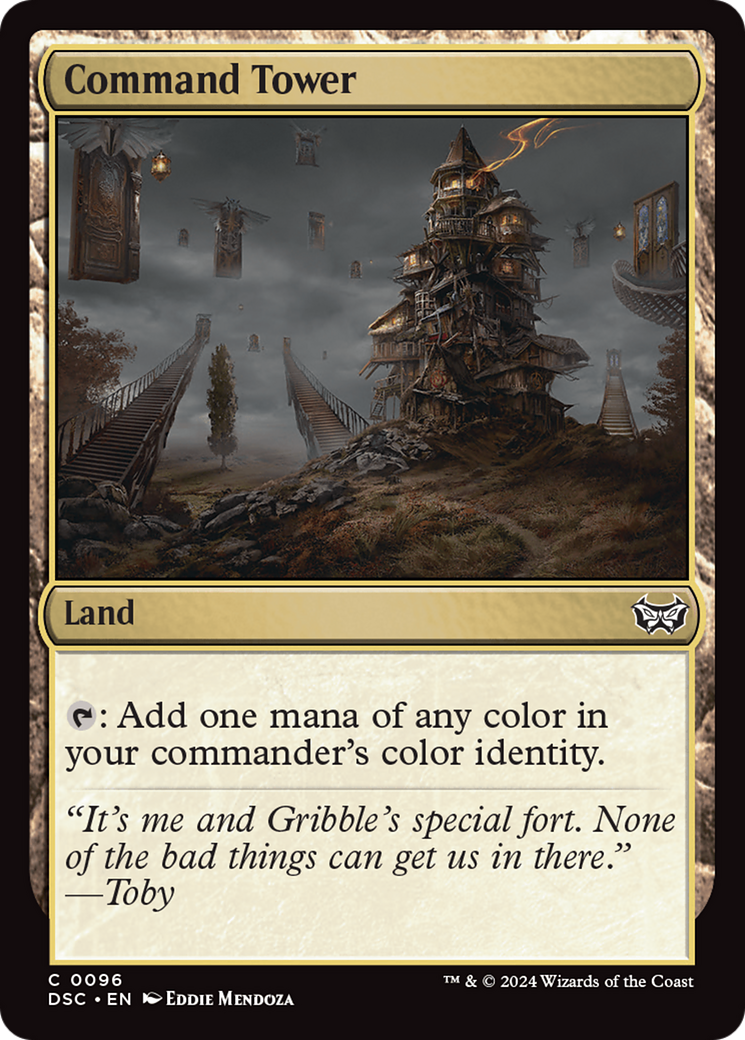
Command Tower
Command Tower
Land
: Add one mana of any color in your commander's color identity.
- If you don't have a commander, Command Tower's ability produces no mana.
- If your commander is a card that has no colors in its color identity, Command Tower's ability produces no mana. It doesn't produce .
- If you have two commanders, the ability adds one mana of any color in their combined color identities.
-
1
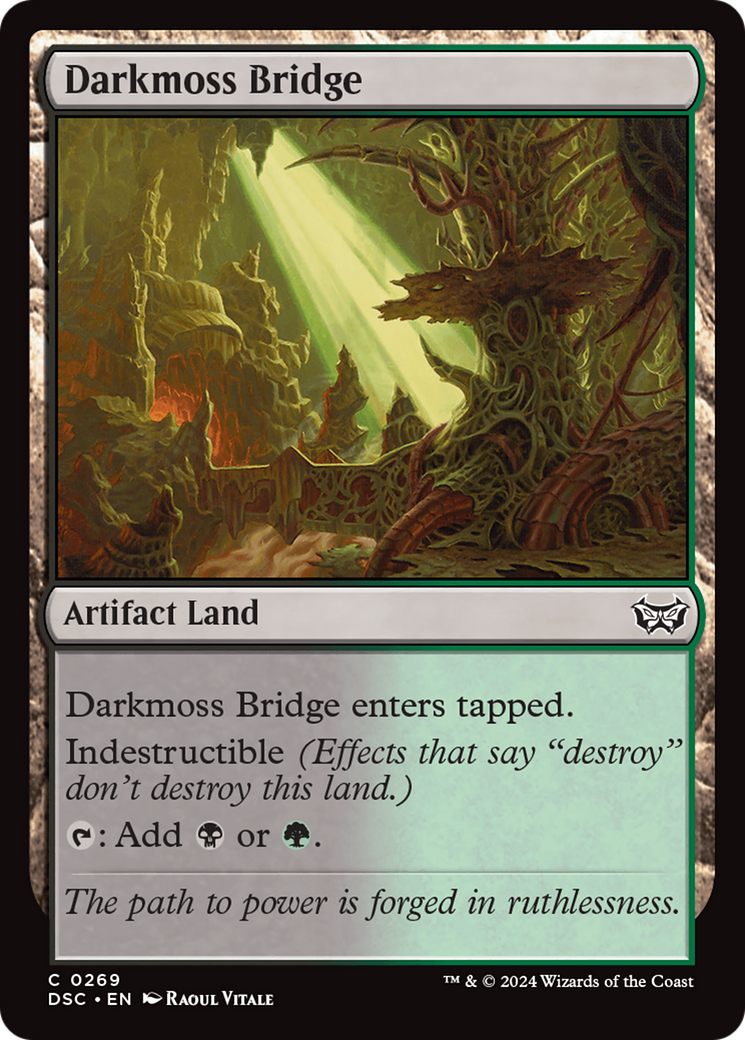
Darkmoss Bridge
Darkmoss Bridge
Artifact Land
This land enters tapped.
Indestructible
: Add or .
-
1
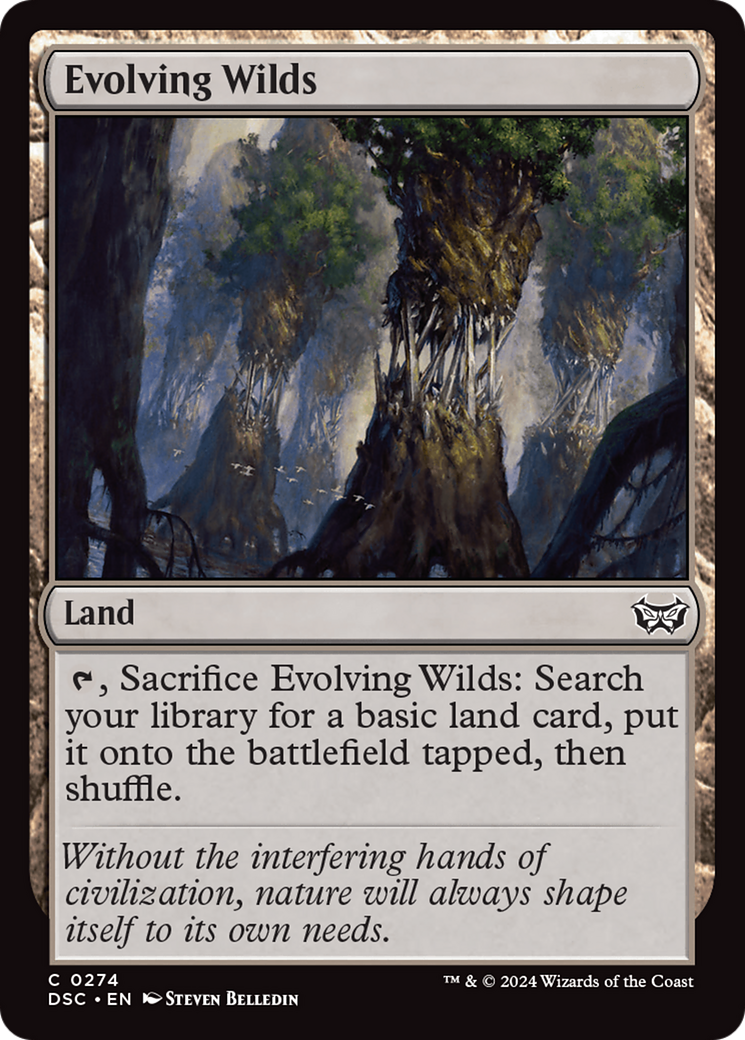
Evolving Wilds
Evolving Wilds
Land
, Sacrifice this land: Search your library for a basic land card, put it onto the battlefield tapped, then shuffle.
-
1
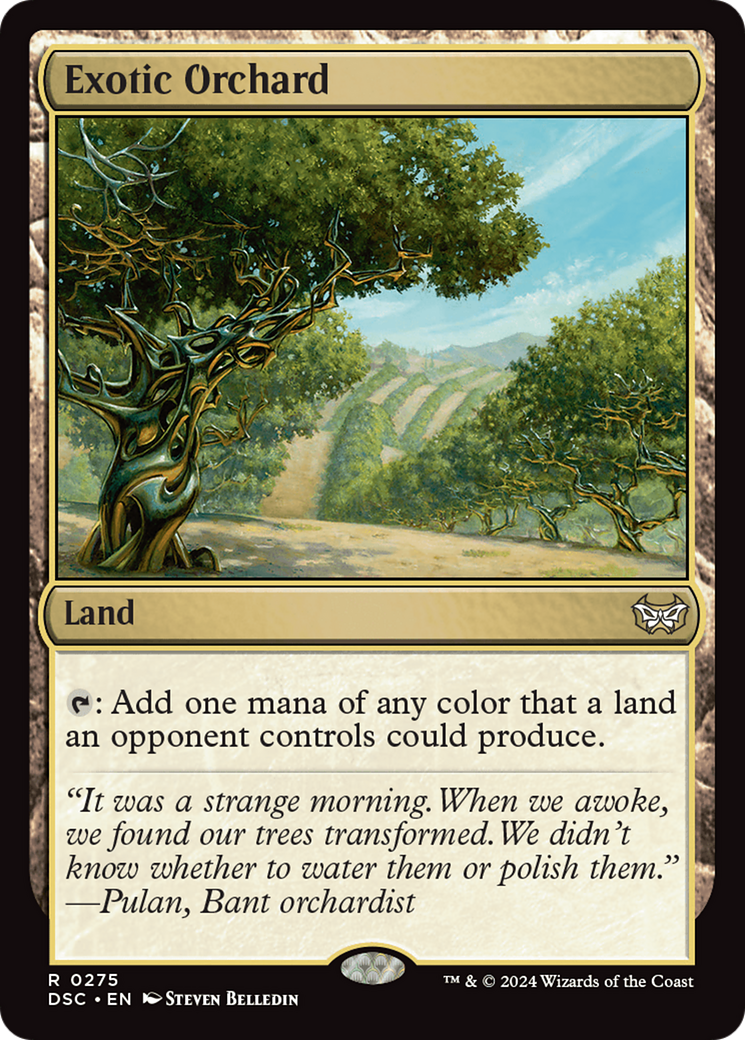
Exotic Orchard
Exotic Orchard
Land
: Add one mana of any color that a land an opponent controls could produce.
- Lands that produce mana based only on what other lands "could produce" won't help each other unless some other land allows one of them to actually produce some type of mana. For example, if you control an Exotic Orchard and your opponent controls an Exotic Orchard and a Reflecting Pool, none of those lands would produce mana if their mana abilities were activated. On the other hand, if you control a Forest and an Exotic Orchard, and your opponent controls an Exotic Orchard and a Reflecting Pool, then each of those lands can be tapped to produce . Your opponent's Exotic Orchard can produce because you control a Forest. Your Exotic Orchard and your opponent's Reflecting Pool can each produce because your opponent's Exotic Orchard can produce .
- When determining what colors of mana your opponents' lands could produce, Exotic Orchard takes into account any applicable replacement effects that would apply to those lands' mana abilities (such as Contamination's effect, for example). If there are more than one, consider them in any possible order.
- The colors of mana are white, blue, black, red, and green. Exotic Orchard can't be tapped for colorless mana, even if a land an opponent controls could produce colorless mana.
- Exotic Orchard doesn't care about any restrictions or riders your opponents' lands (such as Ancient Ziggurat or Hall of the Bandit Lord) put on the mana they produce. It just cares about colors of mana.
- Exotic Orchard checks the effects of all mana-producing abilities of lands your opponents control, but it doesn't check their costs. For example, Vivid Crag has the ability " , Remove a charge counter from Vivid Crag: Add one mana of any color." If an opponent controls Vivid Crag and you control Exotic Orchard, you can tap Exotic Orchard for any color of mana. It doesn't matter whether Vivid Crag has a charge counter on it, and it doesn't matter whether it's untapped.
-
7
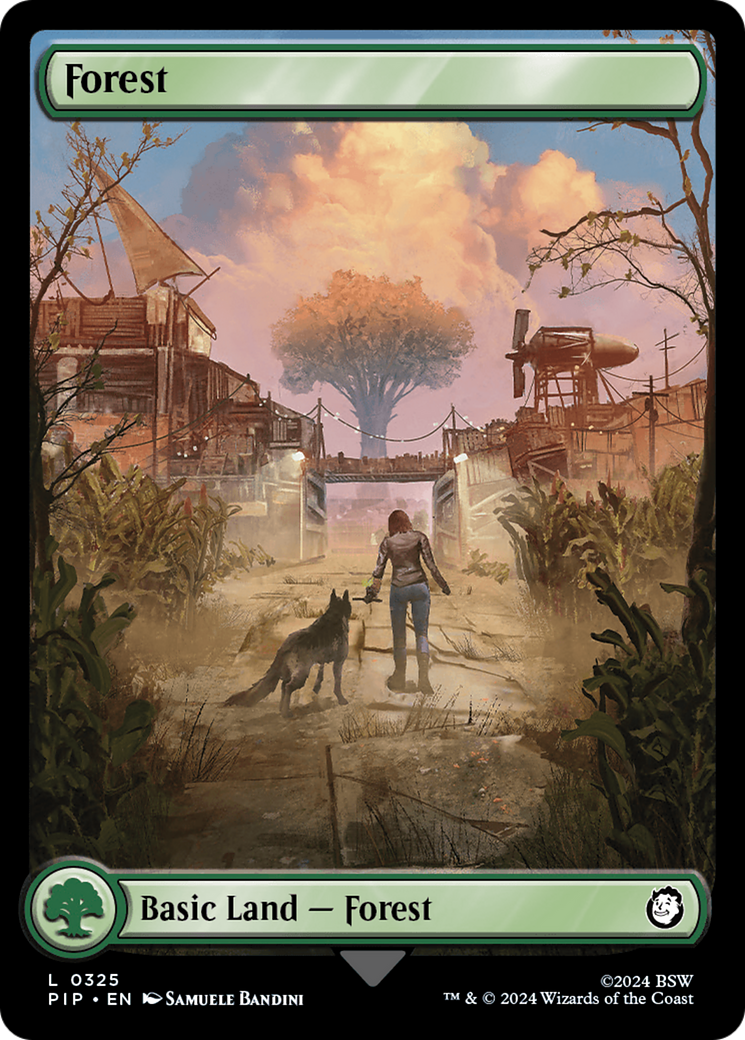
Forest
Forest
Basic Land — Forest
( : Add .)
-
1
Golgari Rot Farm
Golgari Rot Farm
Land
This land enters tapped.
When this land enters, return a land you control to its owner's hand.
: Add .
- If this land enters the battlefield and you control no other lands, its ability will force you to return it to your hand.
-
1
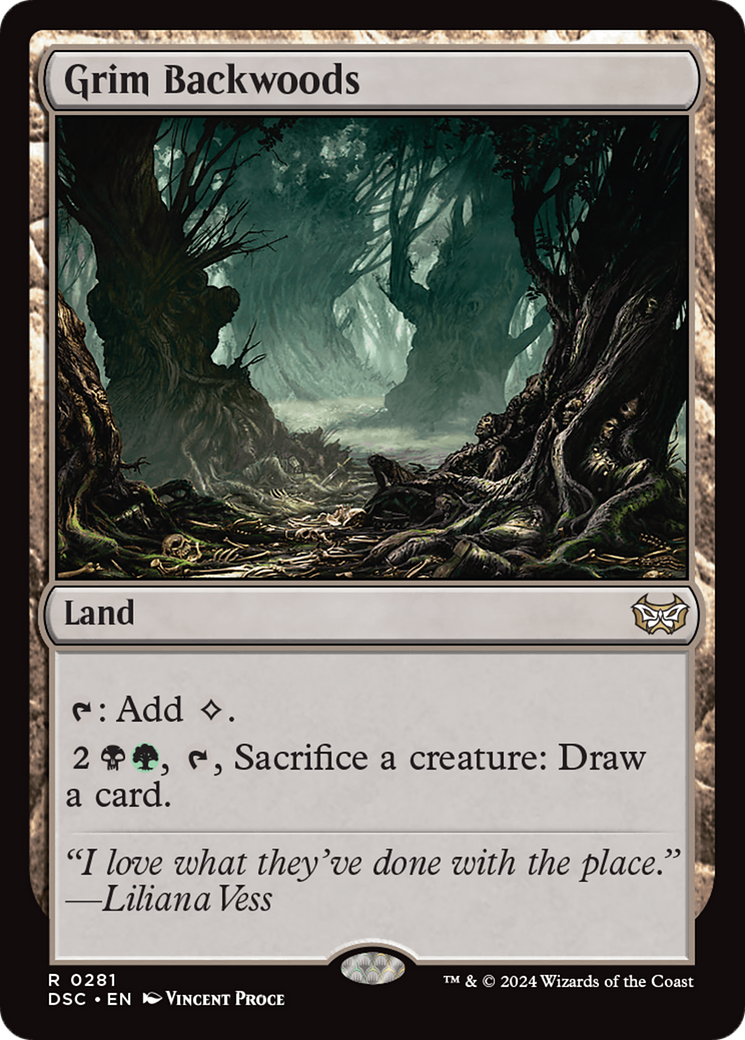
Grim Backwoods
Grim Backwoods
Land
: Add .
, , Sacrifice a creature: Draw a card.
-
1
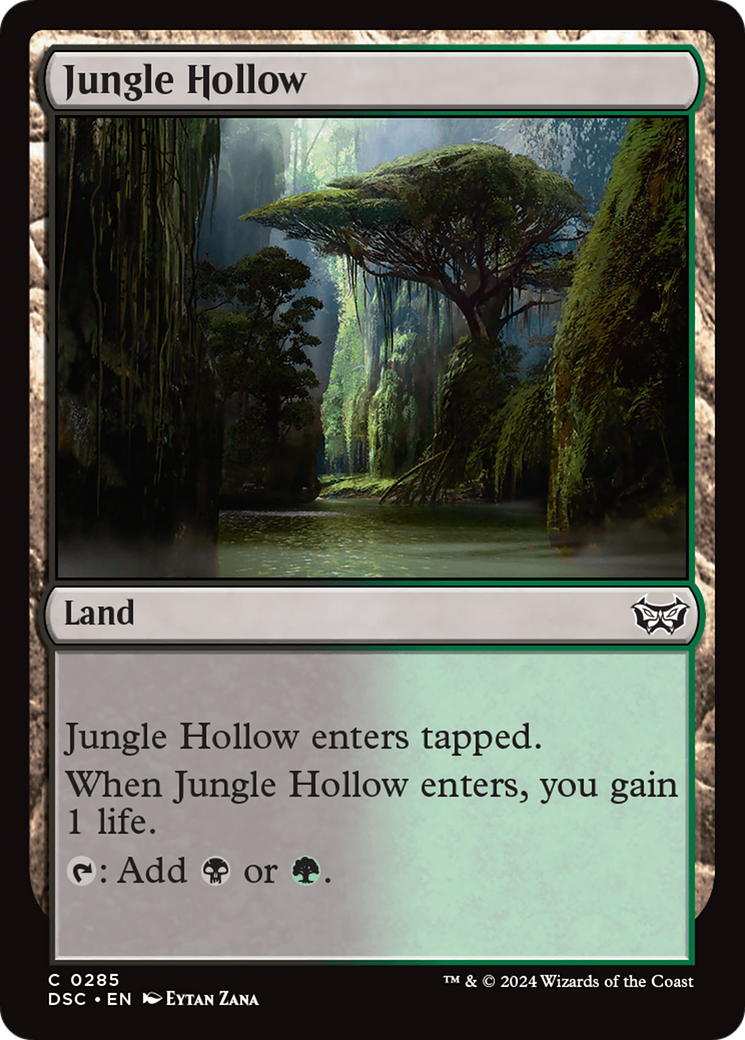
Jungle Hollow
Jungle Hollow
Land
This land enters tapped.
When this land enters, you gain 1 life.
: Add or .
-
1
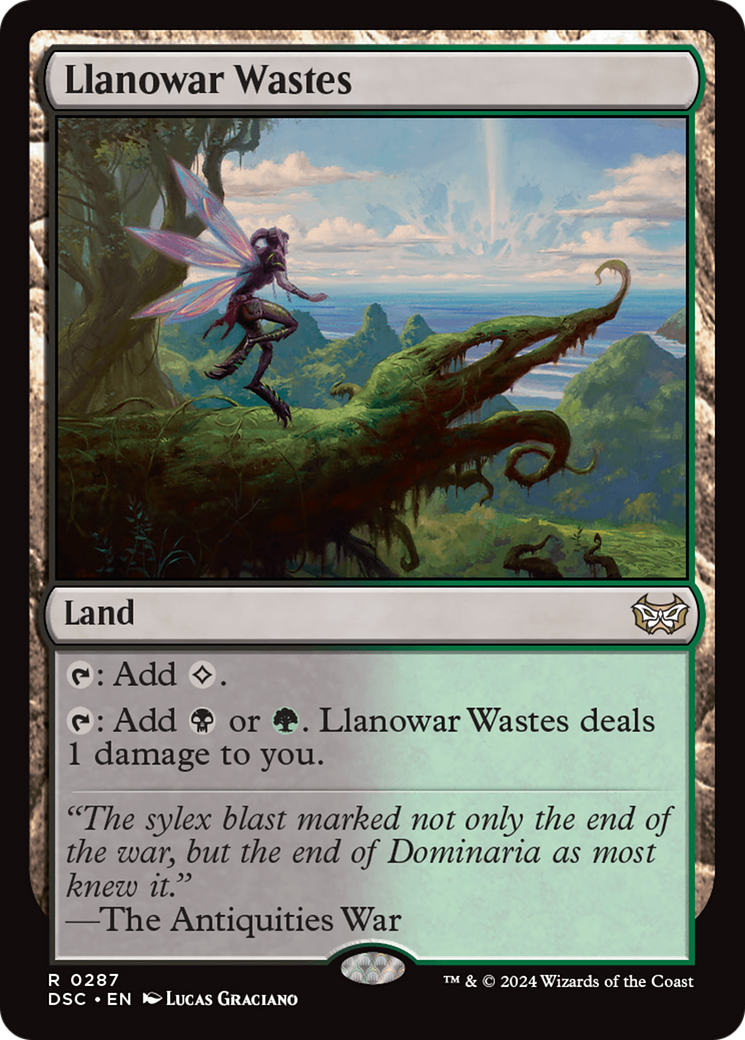
Llanowar Wastes
Llanowar Wastes
Land
: Add .
: Add or . This land deals 1 damage to you.
- The damage dealt to you is part of the second mana ability. It doesn't use the stack and can't be responded to.
- Like most lands, each land in this cycle is colorless. The damage dealt to you is dealt by a colorless source.
-
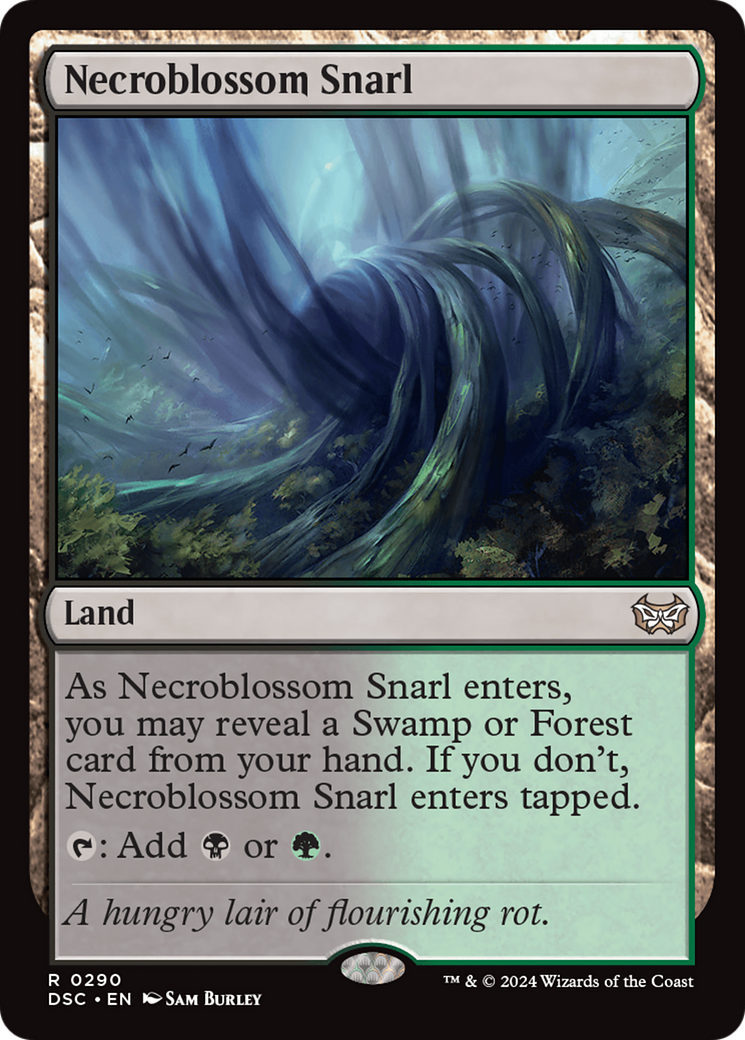
1
Necroblossom Snarl
Necroblossom Snarl
Land
As this land enters, you may reveal a Swamp or Forest card from your hand. If you don't, this land enters tapped.
: Add or .
- If an effect instructs you to put one of these lands onto the battlefield tapped, it will still enter the battlefield tapped even if you reveal a land card from your hand.
- You may reveal any land card with either or both of the appropriate subtypes. It doesn't have to be a basic land card.
- The "Snarl" itself doesn't have any land subtypes. You can't reveal one to satisfy the ability of another.
- If a land card with an appropriate subtype is entering the battlefield from your hand at the same time as one of these lands, you may reveal the other land to have the "Snarl" enter untapped.
-
1
Reliquary Tower
Reliquary Tower
Land
You have no maximum hand size.
: Add .
- If multiple effects modify your hand size, apply them in timestamp order. For example, if you put Null Profusion (an enchantment that says your maximum hand size is two) onto the battlefield and then put Reliquary Tower onto the battlefield, you'll have no maximum hand size. However, if those permanents enter in the opposite order, your maximum hand size would be two.
-
7
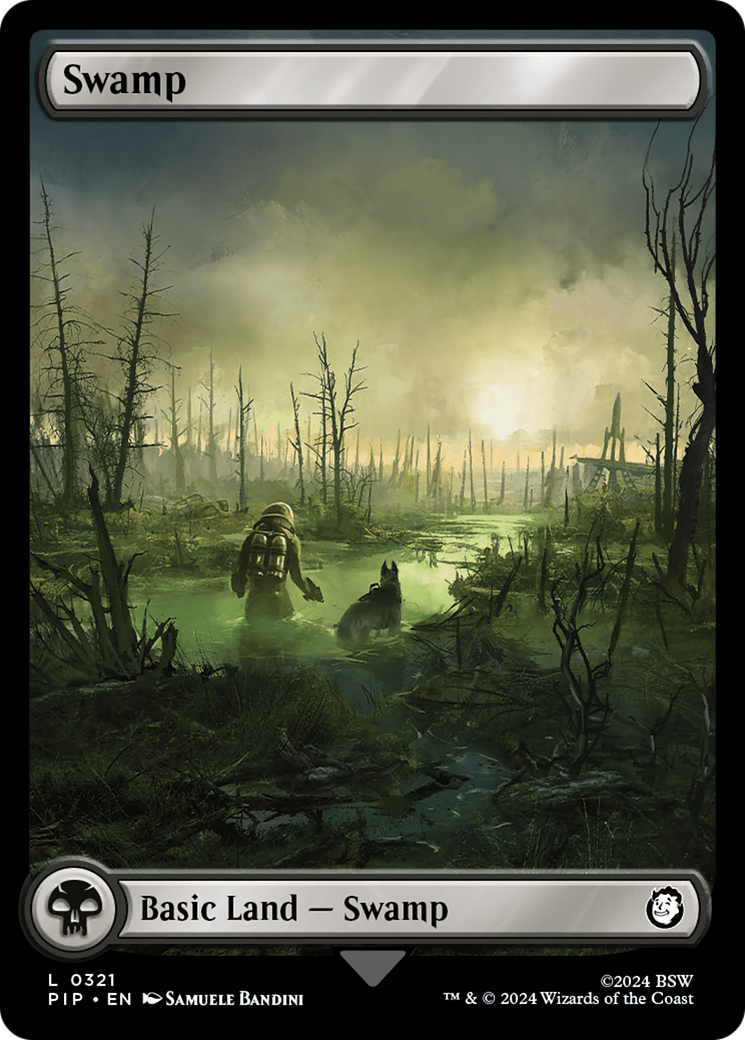
Swamp
Swamp
Basic Land — Swamp
( : Add .)
-
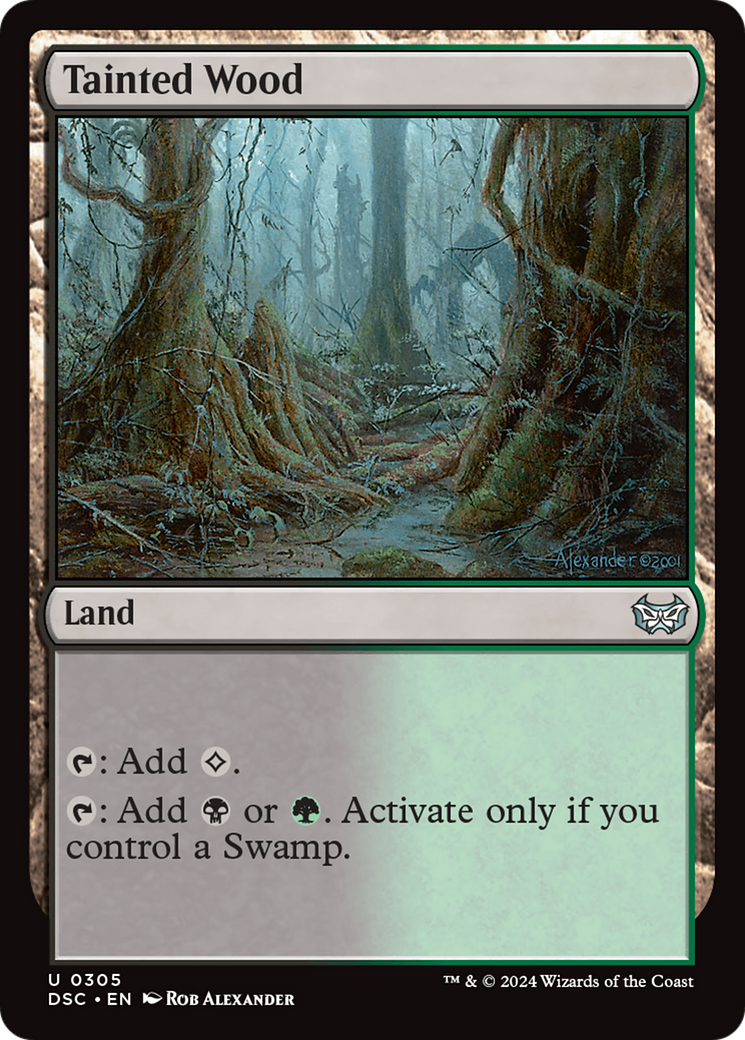
1
Tainted Wood
Tainted Wood
Land
: Add .
: Add or . Activate only if you control a Swamp.
-
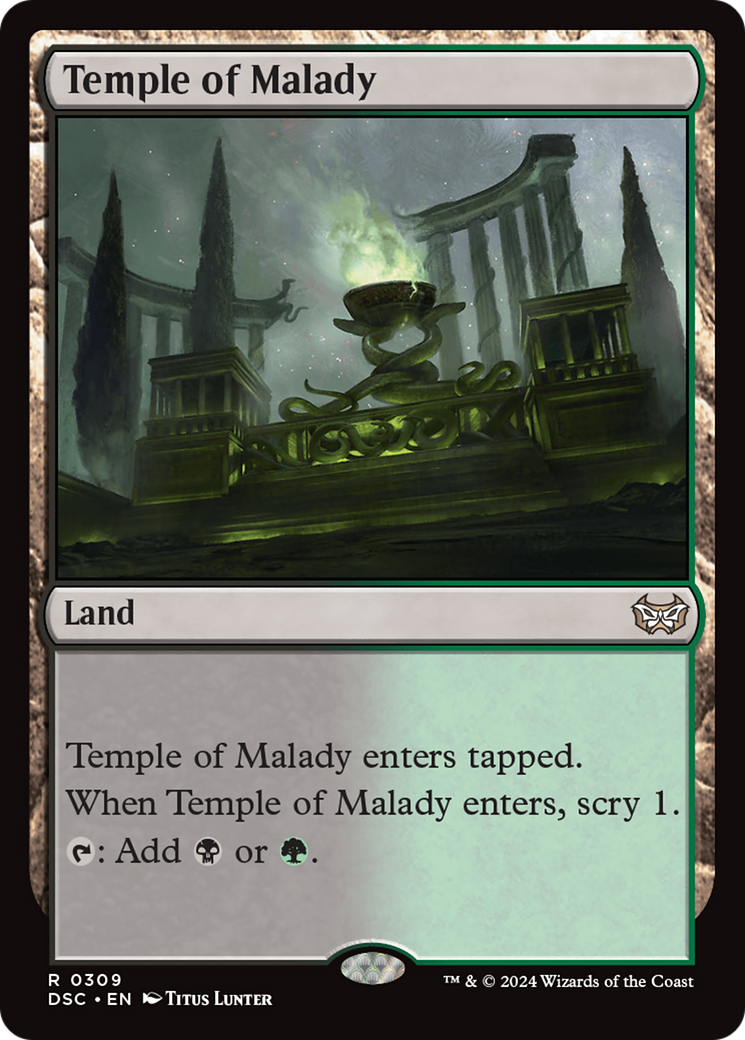
1
Temple of Malady
Temple of Malady
Land
This land enters tapped.
When this land enters, scry 1. (Look at the top card of your library. You may put that card on the bottom.)
: Add or .
-
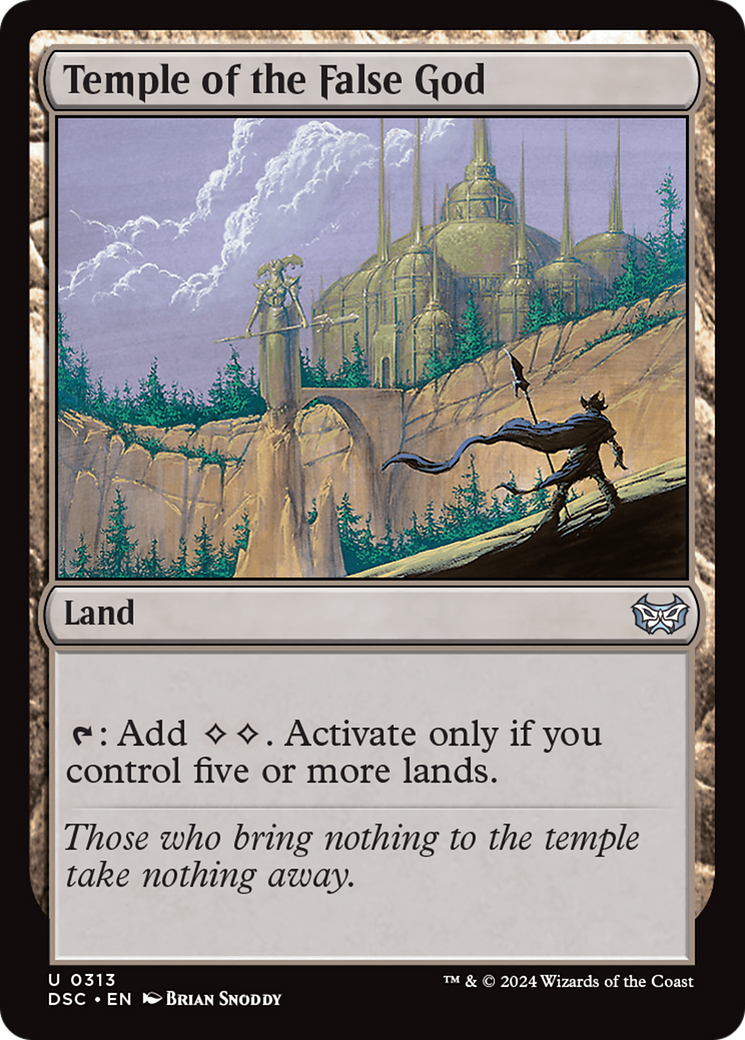
1
Temple of the False God
Temple of the False God
Land
: Add . Activate only if you control five or more lands.
-
1
Terramorphic Expanse
Terramorphic Expanse
Land
, Sacrifice this land: Search your library for a basic land card, put it onto the battlefield tapped, then shuffle.
-
1
Tranquil Thicket
Tranquil Thicket
Land
This land enters tapped.
: Add .
Cycling ( , Discard this card: Draw a card.)
-
1
Tree of Tales
Tree of Tales
Artifact Land
: Add .
-
1
Twilight Mire
Twilight Mire
Land
: Add .
, : Add , , or .
-
1
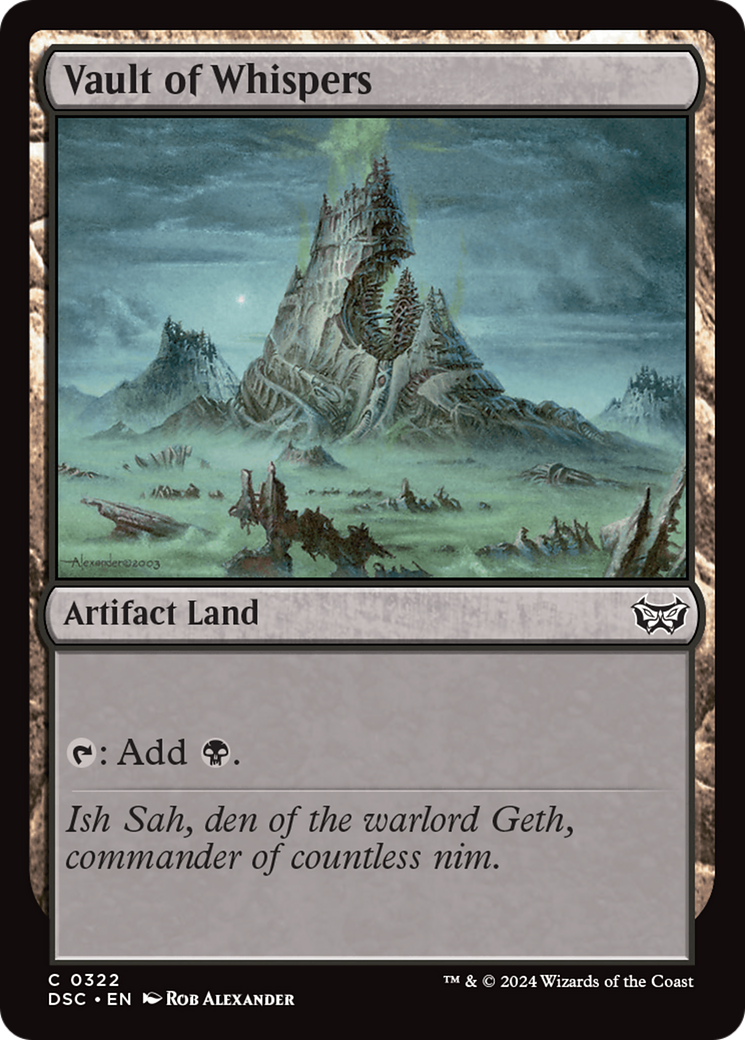
Vault of Whispers
Vault of Whispers
Artifact Land
: Add .
-
1
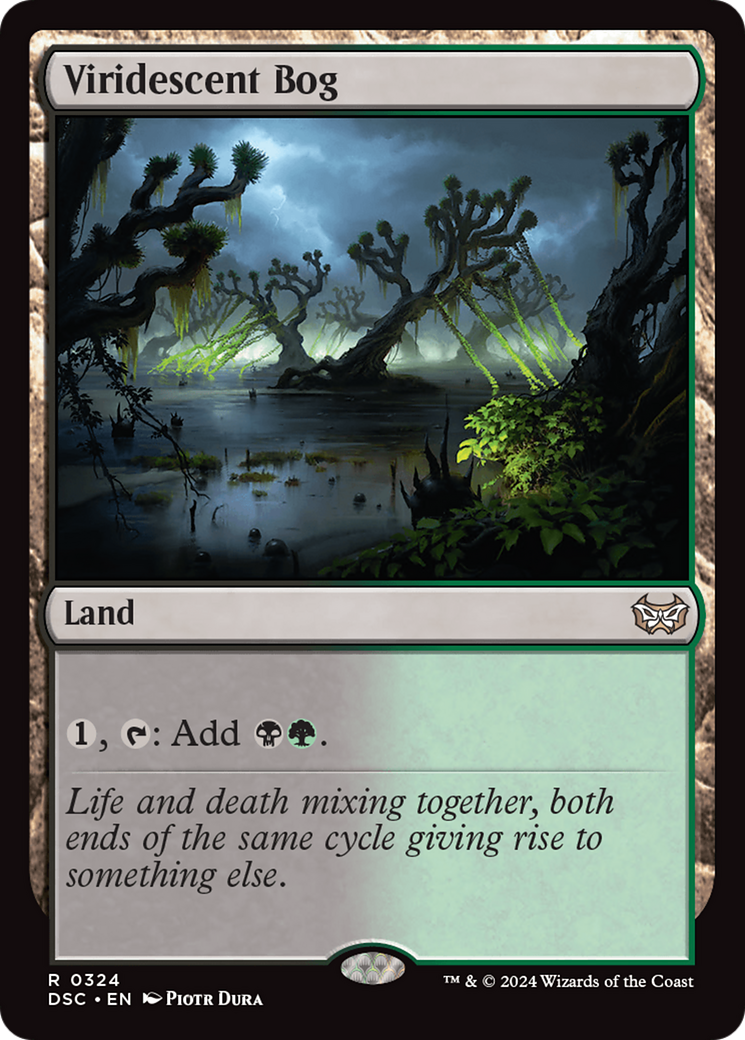
Viridescent Bog
Viridescent Bog
Land
, : Add .
-
1
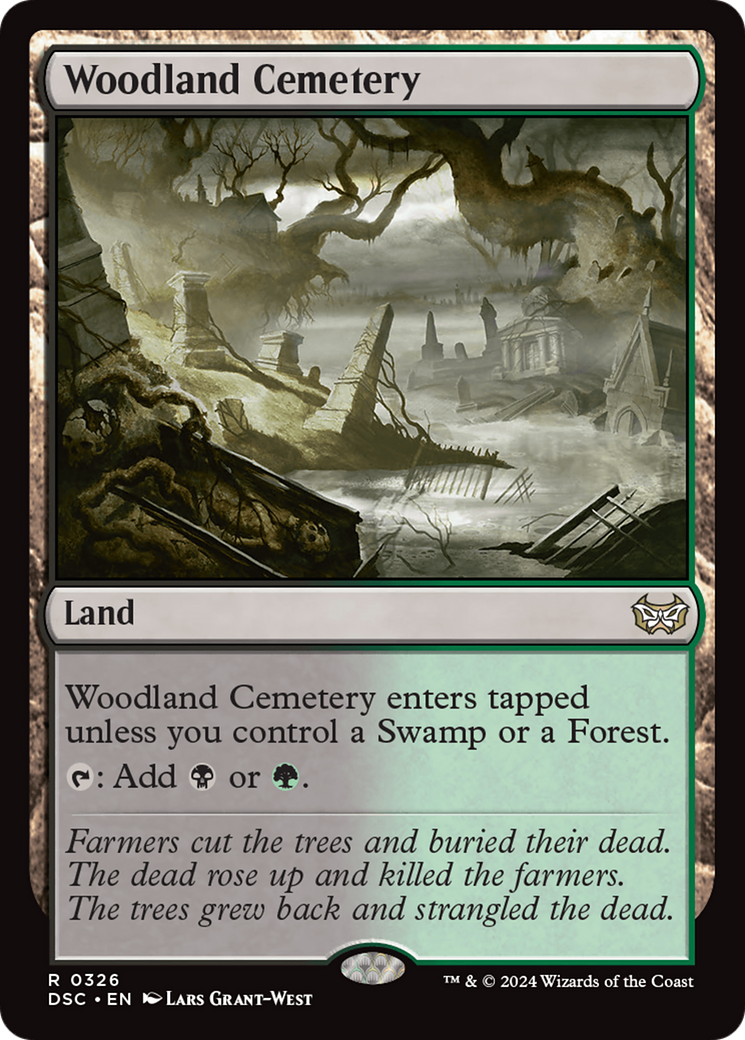
Woodland Cemetery
Woodland Cemetery
Land
This land enters tapped unless you control a Swamp or a Forest.
: Add or .
Black 14
-
1
Carrion Grub
Carrion Grub
Creature — Insect
0/5
This creature gets +X/+0, where X is the greatest power among creature cards in your graveyard.
When this creature enters, mill four cards. (Put the top four cards of your library into your graveyard.)
- Carrion Grub's first ability applies only while it is on the battlefield. In all other zones, its power is 0.
- Any counters on creatures that die or effects that affect them until end of turn won't apply to those cards in their owner's graveyard.
-
1
Cemetery Tampering
Cemetery Tampering
Enchantment
Hideaway 5 (When this enchantment enters, look at the top five cards of your library, exile one face down, then put the rest on the bottom in a random order.)
At the beginning of your upkeep, you may mill three cards. Then if there are twenty or more cards in your graveyard, you may play the exiled card without paying its mana cost.
- "Hideaway N" means "When this permanent enters the battlefield, look at the top N cards of your library. Exile one of them face down and put the rest on the bottom of your library in a random order. The exiled card gains 'The player who controls the permanent that exiled this card may look at this card in the exile zone.'"
- Any player who has controlled a permanent with a hideaway ability since a card was exiled with it may look at that card.
- Previously, permanents with hideaway entered the battlefield tapped. This ability has been removed from the definition of hideaway. Older cards have received errata to have an additional paragraph that reads "[This permanent] enters the battlefield tapped," and they now have hideaway 4.
- Hideaway now causes you to put the rest of the cards on the bottom of your library in a random order instead of any order.
-
1
Deluge of Doom
Deluge of Doom
Sorcery
All creatures get -X/-X until end of turn, where X is the number of card types among cards in your graveyard.
-
1
Demonic Covenant
Demonic Covenant
Kindred Enchantment — Demon
Whenever one or more Demons you control attack a player, you draw a card and lose 1 life.
At the beginning of your end step, create a 5/5 black Demon creature token with flying, then mill two cards. If two cards that share all their card types were milled this way, sacrifice this enchantment.
- Creatures that enter attacking are never declared as attackers, and as such, they won't cause Demonic Covenant's first ability to trigger.
- The card types in Magic include artifact, battle, creature, enchantment, instant, kindred, land, planeswalker, and sorcery. Legendary, basic, and snow are supertypes, not card types; Horror and Room are subtypes, not card types.
- Demonic Covenant's last ability will only cause you to sacrifice Demonic Covenant if both cards have the exact same combination of card types. Supertypes and subtypes are not taken into account.
- Demonic Covenant's first ability will trigger once for each player you attack with one or more Demons.
-
1
Into the Pit
Into the Pit
Enchantment
You may look at the top card of your library any time.
You may cast spells from the top of your library by sacrificing a nonland permanent in addition to paying their other costs.
- While you control Into the Pit, you can look at the top card of your library whenever you want (with one restriction; see below), even if you don't have priority. This action doesn't use the stack. Knowing what that card is becomes part of the information you have access to, just like you can look at the cards in your hand.
- If the top card of your library changes while you're casting a spell, playing a land, activating an ability, or taking a special action, you can't look at the new top card until you finish doing so. This means that if you cast a spell from the top of your library, you can't look at the next one until you're done paying for that spell.
- You pay all costs and follow all timing rules for spells cast from the top of your library this way.
- While you control Into the Pit, if the top card of your library has disguise or morph, you may cast it face down from the top of your library by paying and sacrificing a nonland permanent.
-
1
Night's Whisper
Night's Whisper
Sorcery
You draw two cards and you lose 2 life.
-
1
Noxious Gearhulk
Noxious Gearhulk
Artifact Creature — Construct
5/4
Menace
When this creature enters, you may destroy another target creature. If a creature is destroyed this way, you gain life equal to its toughness.
- If the target creature has indestructible, it isn't destroyed this way and you won't gain life. If it is destroyed but put into a zone other than a graveyard, you'll gain life.
- Use the toughness of the creature as it last existed on the battlefield to determine how much life to gain.
-
1
Ob Nixilis Reignited
Ob Nixilis Reignited
Legendary Planeswalker — Nixilis
+1: You draw a card and you lose 1 life.
−3: Destroy target creature.
−8: Target opponent gets an emblem with "Whenever a player draws a card, you lose 2 life."
- The emblem created by Ob Nixilis Reignited's last ability is both owned and controlled by the target opponent. In a multiplayer game, if you own Ob Nixilis Reignited and use him to give one of your opponents an emblem, the emblem remains even if you leave the game.
-
1
Polluted Cistern // Dim Oubliette
//
Polluted Cistern
Enchantment — Room
- To cast a Room spell, choose a half (or "door") to cast. There's no way to cast both halves of a Room card. When the Room spell resolves, the corresponding door becomes unlocked as the Room enters.
- Room cards have two card faces with a shared type line on a single card. The characteristics of the door you didn't cast are ignored while the spell is on the stack.
- Each Room card is a single card. For example, if you discard a Room card, you've discarded one card, not two. If an effect counts the number of enchantment cards in your graveyard, Bottomless Pool // Locker Room counts once, not twice.
- Each Room card has two names. If an effect instructs you to choose a card name, you may choose one of those names, but not both.
- If an effect allows you to cast a spell with certain characteristics, consider only the characteristics of the door you're casting. For example, if an effect allows you to cast a permanent spell with mana value 3 or less from among cards in your graveyard, you could cast Bottomless Pool this way, but not Locker Room.
- While in any zone other than the stack or the battlefield, a Room card's characteristics are a combination of its two doors. For example, Bottomless Pool // Locker Room has a mana value of 6 while it's in your library. If an effect allows you to search your library for a card with mana value 4 or less, you can't find Bottomless Pool // Locker Room.
- While on the battlefield, a Room's characteristics are a combination of the characteristics of its unlocked doors. For example, if Bottomless Pool // Locker Room is on the battlefield with both doors unlocked, its names are Bottomless Pool and Locker Room, its mana value is 6, it's a Room Enchantment, and it has the abilities in each door's text box.
- If a spell or ability would create a copy of a Room spell on the stack, the copy retains the choice of which door was cast but also retains the full characteristics of the spell. The characteristics of the door that wasn't cast are still ignored while the copy is on the stack, and when the copy resolves, the token it becomes will enter with the appropriate door unlocked.
- If a Room enters from any zone other than the stack, it will enter with both halves locked.
- If neither door of a Room is unlocked, it's a Room enchantment with no name and no abilities.
- Any time you have priority during a main phase of your turn and the stack is empty, you may pay the mana cost of a locked door (also called its "unlock cost"). That door becomes unlocked. This is a special action. It doesn't use the stack and can't be responded to.
- An ability that triggers "when you unlock this door" triggers when that door becomes unlocked. This can happen one of two ways: (1) the door becomes unlocked on the battlefield or (2) the door becomes unlocked as the Room enters the battlefield because you cast the corresponding half. In the latter case, since the door becoming unlocked is what causes the ability to trigger, effects that cause abilities that trigger when a permanent enters to trigger an additional time (such as that of Panharmonicon) won't apply.
- Some abilities allow you to unlock a door of a Room you control. You can't choose to unlock a door that's already unlocked with such an ability. If such an ability requires a target, you can target a Room even if both of its doors are unlocked, but the ability won't do anything when it resolves.
- Some abilities allow you to lock a door of a Room you control. You can't choose to lock a door that's already locked with such an ability. If such an ability requires a target, you can target a Room even if both of its doors are locked, but the ability won't do anything when it resolves.
- Some doors have abilities that trigger whenever you unlock that door and require one or more targets. You can unlock that door even if there would be insufficient legal targets for that triggered ability. The triggered ability won't go on the stack.
- An ability that triggers "whenever you fully unlock a Room" triggers when a door becomes unlocked and the other door of that Room is already unlocked, or when both doors of that Room become unlocked simultaneously.
-
1
Professor Onyx
Professor Onyx
Legendary Planeswalker — Liliana
Magecraft — Whenever you cast or copy an instant or sorcery spell, each opponent loses 2 life and you gain 2 life.
+1: You lose 1 life. Look at the top three cards of your library. Put one of them into your hand and the rest into your graveyard.
−3: Each opponent sacrifices a creature with the greatest power among creatures that player controls.
−8: Each opponent may discard a card. If they don't, they lose 3 life. Repeat this process six more times.
- For Professor Onyx's second loyalty ability, if an opponent has multiple creatures with the greatest power, that player choose which one to sacrifice. The next opponent in turn order chooses which creature they are sacrificing, then each other opponent in turn order does the same, knowing the choices made before them. Then all chosen creatures are sacrificed at the same time.
- For Professor Onyx's last loyalty ability, "this process" is the following: First, the next opponent in turn order may choose a card in hand without revealing it, then each other opponent in turn order does the same. Then all the chosen cards are revealed and discarded at the same time and each opponent who didn't discard a card (whether they chose not to or had an empty hand) loses 3 life. This all will happen seven times, for a maximum loss of 21 life per opponent.
- If Professor Onyx seems familiar, it's probably because you've seen this type of planeswalker before.
- Each magecraft ability has a different effect, although they all have the same trigger condition, whenever you cast or copy an instant or sorcery spell.
- For example, if you control Archmage Emeritus and cast an instant or sorcery spell, Archmage Emeritus's magecraft ability will trigger and you will draw a card.
- If an effect creates a copy of an instant or sorcery spell, this will also cause the magecraft ability to trigger.
- If an effect creates multiple copies of an instant or sorcery spell, magecraft abilities trigger once for each copy created by the effect.
- Some effects instruct you to copy an instant or sorcery card in a zone other than the stack. These copies do not cause magecraft abilities to trigger. However, most effects that do this also allow you to cast the copy, and casting the copy will cause magecraft abilities to trigger.
-
1
Reanimate
Reanimate
Sorcery
Put target creature card from a graveyard onto the battlefield under your control. You lose life equal to its mana value.
- If a card in a graveyard has in its mana cost, X is 0.
- The amount of life you lose is determined by the mana value of the card in your graveyard, not the creature once it's on the battlefield.
- You lose life after the creature is already on the battlefield. Any abilities it has that interact with loss of life, such as that of Platinum Emperion, apply to that loss of life.
- If any abilities trigger on the creature entering the battlefield, those abilities resolve after you lose life. If losing life results in you losing the game, those abilities won't resolve.
- In a multiplayer game, if a player leaves the game, all cards that player owns leave as well. If you leave the game, the creature you control from Reanimate is exiled.
-
1
Stitcher's Supplier
Stitcher's Supplier
Creature — Zombie
1/1
When this creature enters or dies, mill three cards. (Put the top three cards of your library into your graveyard.)
-
1
Vile Mutilator
Vile Mutilator
Creature — Demon
6/5
As an additional cost to cast this spell, sacrifice a creature or enchantment.
Flying, trample
When this creature enters, each opponent sacrifices a nontoken enchantment of their choice, then sacrifices a nontoken creature of their choice.
-
1
Whip of Erebos
Whip of Erebos
Legendary Enchantment Artifact
Creatures you control have lifelink.
, : Return target creature card from your graveyard to the battlefield. It gains haste. Exile it at the beginning of the next end step. If it would leave the battlefield, exile it instead of putting it anywhere else. Activate only as a sorcery.
- At the beginning of the next end step, the creature returned to the battlefield with Whip of Erebos is exiled. This is a delayed triggered ability. If the ability is countered, the creature will stay on the battlefield and the delayed trigger won't trigger again. However, the replacement effect will still exile the creature when it eventually leaves the battlefield.
- Whip of Erebos grants haste to the creature that's returned to the battlefield. However, neither of the "exile" abilities is granted to that creature. If that creature loses all its abilities, it will still be exiled at the beginning of the end step, and if it would leave the battlefield, it is still exiled instead.
- If a creature returned to the battlefield with Whip of Erebos would leave the battlefield for any reason, it's exiled instead. However, if that creature is already being exiled, then the replacement effect won't apply. If the spell or ability that exiles it later returns it to the battlefield (as Chained to the Rocks might, for example), the creature card will return to the battlefield as a new object with no relation to its previous existence. The effects from Whip of Erebos will no longer apply to it.
- The exiled creature is never put into the graveyard. Any abilities the creature has that trigger when it dies won't trigger.
Green 24
-
1
Arachnogenesis
Arachnogenesis
Instant
Create X 1/2 green Spider creature tokens with reach, where X is the number of creatures attacking you. Prevent all combat damage that would be dealt this turn by non-Spider creatures.
-
1
Crawling Sensation
Crawling Sensation
Enchantment
At the beginning of your upkeep, you may mill two cards. (You may put the top two cards of your library into your graveyard.)
Whenever one or more land cards are put into your graveyard from anywhere for the first time each turn, create a 1/1 green Insect creature token.
- If multiple land cards are put into your graveyard at once, Crawling Sensation's last ability triggers only once. This could happen because an effect (such as that of Crawling Sensation's first ability) put them there from your library at once, or because they were destroyed at the same time (such as two land creatures that were dealt lethal combat damage).
-
1
Deathcap Cultivator
Deathcap Cultivator
Creature — Human Druid
2/1
: Add or .
Delirium — This creature has deathtouch as long as there are four or more card types among cards in your graveyard.
- If you have three noncreature card types among cards in your graveyard at the time damage is dealt by Deathcap Cultivator, and lethal damage is dealt to another creature you control at the same time, the damage from Deathcap Cultivator won't be from a source with deathtouch.
- The card types in Magic are artifact, battle, creature, enchantment, instant, kindred, land, planeswalker, and sorcery. Supertypes (such as legendary and basic) and subtypes (such as Human and Equipment) are not counted.
- The number of card types matters, not the number of cards. For example, Wicker Witch (an artifact creature) along with Catalog (an instant) and Chaplain's Blessing (a sorcery) will enable delirium.
- Because you consider only the characteristics of a double-faced card's front face while it's not on the battlefield, the types of its back face won't be counted for delirium.
- In some rare cases, you can have a token or a copy of a spell in your graveyard at the moment that an object's delirium ability counts the card types among cards in your graveyard, before that token or copy ceases to exist. Because tokens and copies of spells are not cards, even if they are copies of cards, their types will never be counted.
-
1
Demolisher Spawn
Demolisher Spawn
Enchantment Creature — Horror
7/7
Trample, haste
Delirium — Whenever this creature attacks, if there are four or more card types among cards in your graveyard, other attacking creatures get +4/+4 until end of turn.
-
1
Formless Genesis
Formless Genesis
Kindred Sorcery — Shapeshifter
Changeling (This card is every creature type.)
Create an X/X colorless Shapeshifter creature token with changeling and deathtouch, where X is the number of land cards in your graveyard.
Retrace (You may cast this card from your graveyard by discarding a land card in addition to paying its other costs.)
- Changeling is a characteristic-defining ability. It functions in all zones.
- The subtype Shapeshifter that appears on the type line is mostly there to reinforce the flavor. A spell or token with changeling is just as much an Elf, a Dwarf, a Sliver, a Goat, a Coward, and a Zombie as it is a Shapeshifter.
- When a retrace spell you cast from your graveyard resolves, fails to resolve, or is countered, it's put back into your graveyard. You may use the retrace ability to cast it again.
- Casting a card by using its retrace ability works just like casting any other spell, with two exceptions: You're casting it from your graveyard rather than your hand, and you must discard a land card in addition to any other costs.
- The value of X is determined only once, as Formless Genesis resolves. The token's power and toughness won't change if the number of land cards in your graveyard later changes.
- A retrace card cast from your graveyard follows the normal timing rules for its card type.
- If the active player casts a spell that has retrace, that player may cast that card again after it resolves, before another player can remove the card from the graveyard. The active player has priority after the spell resolves, so they can immediately cast a new spell. Since casting a card with retrace from the graveyard moves that card onto the stack, no one else would have the chance to affect it while it's still in the graveyard.
-
1
Giant Adephage
Giant Adephage
Creature — Insect
7/7
Trample
Whenever this creature deals combat damage to a player, create a token that's a copy of this creature.
- As the token is created, it checks the printed values of the Giant Adephage it's copying—or, if the Giant Adephage whose ability triggered was itself a token, the original characteristics of that token as stated by the effect that put it onto the battlefield—as well as any copy effects that have been applied to it. It won't copy counters on the Giant Adephage, nor will it copy other effects that have changed Giant Adephage's power, toughness, types, color, or so on. Normally, this means the token will simply be a Giant Adephage. But if any copy effects have affected that Giant Adephage, they're taken into account.
-
1
Gnarlwood Dryad
Gnarlwood Dryad
Creature — Dryad Horror
1/1
Deathtouch
Delirium — This creature gets +2/+2 as long as there are four or more card types among cards in your graveyard.
-
1
Grapple with the Past
Grapple with the Past
Instant
Mill three cards, then you may return a creature or land card from your graveyard to your hand. (To mill three cards, put the top three cards of your library into your graveyard.)
- Grapple with the Past doesn't target the card to return to your hand. After putting the top three cards of your library into your graveyard, you may choose from among any creature or land cards there.
-
1
Harmonize
Harmonize
Sorcery
Draw three cards.
-
1
Harrow
Harrow
Instant
As an additional cost to cast this spell, sacrifice a land.
Search your library for up to two basic land cards, put them onto the battlefield, then shuffle.
- The two lands do not count toward your normal one land you can play each turn.
- The sacrifice of a land is part of the cost of casting Harrow. You can't pay this cost more than once to get a multiple effect.
-
1
Hornet Queen
Hornet Queen
Creature — Insect
2/2
Flying, deathtouch
When this creature enters, create four 1/1 green Insect creature tokens with flying and deathtouch.
-
1
Inscription of Abundance
Inscription of Abundance
Instant
Kicker
Choose one. If this spell was kicked, choose any number instead.
- Put two +1/+1 counters on target creature.
- Target player gains X life, where X is the greatest power among creatures they control.
- Target creature you control fights target creature you don't control.
- To determine a spell's total cost, start with the mana cost (or an alternative cost if another card's effect allows you to pay one instead), add any cost increases (such as kicker), then apply any cost reductions. The spell's mana value remains unchanged, no matter what the total cost to cast it was.
- If a spell's kicker cost was paid, the spell is "kicked."
- The kicker ability doesn't let you pay a kicker cost more than once.
- If you put a permanent with a kicker ability onto the battlefield without casting it, you can't kick it.
- If you copy a kicked spell on the stack, the copy is also kicked. If the copied spell is a permanent spell, the token the copy of that spell becomes when it enters is also kicked.
- If a card or token enters as a copy of a permanent, the new permanent isn't kicked, even if the original was.
- If more than one mode is chosen, perform them in the order written. Nothing can happen in between, however, and no player may choose to take actions. Any abilities that trigger will be put onto the stack after the spell has finished resolving.
- If any targets become illegal, the other targets will still be affected as appropriate.
- If the second mode is chosen and each creature the target player controls has negative power, that player doesn't gain or lose life.
- If either target creature is an illegal target as Inscription of Abundance resolves with its last mode chosen, no creature will deal or be dealt damage.
- If you kick Inscription of Abundance, you can't choose any one mode more than once.
-
1
Ishkanah, Grafwidow
Ishkanah, Grafwidow
Legendary Creature — Spider
3/5
Reach
Delirium — When Ishkanah enters, if there are four or more card types among cards in your graveyard, create three 1/2 green Spider creature tokens with reach.
: Target opponent loses 1 life for each Spider you control.
- The number of Spiders you control is checked only as Ishkanah's last ability resolves. The ability will count Ishkanah itself if it's still on the battlefield.
-
1
Moldgraf Millipede
Moldgraf Millipede
Creature — Insect Horror
2/2
When this creature enters, mill three cards, then put a +1/+1 counter on this creature for each creature card in your graveyard. (To mill three cards, put the top three cards of your library into your graveyard.)
- Moldgraf Millipede gets a +1/+1 counter for every creature card in your graveyard, including any creature cards that were already there before you milled three cards.
-
1
Moldgraf Monstrosity
Moldgraf Monstrosity
Creature — Insect
8/8
Trample
When this creature dies, exile it, then return two creature cards at random from your graveyard to the battlefield.
- If Moldgraf Monstrosity's ability can't exile it (perhaps because it's not still in the graveyard when the ability resolves), the two creature cards are still returned to the battlefield.
- If two Moldgraf Monstrosities die simultaneously, the first ability to resolve could return the other Moldgraf Monstrosity to the battlefield. If it does, the second Moldgraf Monstrosity's ability won't exile it but it will return two more creature cards to the battlefield.
-
1
Mulch
Mulch
Sorcery
Reveal the top four cards of your library. Put all land cards revealed this way into your hand and the rest into your graveyard.
-
1
Obsessive Skinner
Obsessive Skinner
Creature — Human Rogue
1/1
When this creature enters, put a +1/+1 counter on target creature.
Delirium — At the beginning of each opponent's upkeep, if there are four or more card types among cards in your graveyard, put a +1/+1 counter on target creature.
- Both of Obsessive Skinner's abilities can target Obsessive Skinner itself.
- The card types in Magic are artifact, battle, creature, enchantment, instant, kindred, land, planeswalker, and sorcery. Supertypes (such as legendary and basic) and subtypes (such as Human and Equipment) are not counted.
- The number of card types matters, not the number of cards. For example, Wicker Witch (an artifact creature) along with Catalog (an instant) and Chaplain's Blessing (a sorcery) will enable delirium.
- Because you consider only the characteristics of a double-faced card's front face while it's not on the battlefield, the types of its back face won't be counted for delirium.
- In some rare cases, you can have a token or a copy of a spell in your graveyard at the moment that an object's delirium ability counts the card types among cards in your graveyard, before that token or copy ceases to exist. Because tokens and copies of spells are not cards, even if they are copies of cards, their types will never be counted.
- Most triggered delirium abilities use an intervening "if" clause. There must be four or more card types among cards in your graveyard in order for these abilities to trigger, otherwise they never trigger at all. There's no way to have the ability trigger if there aren't enough card types, even if you intend to raise that number in response to the triggered ability. The number of card types is checked again as the trigger resolves, and if it has become too low somehow, the ability does nothing. If which card types are in your graveyard changes but the quantity of card types stays the same (or increases), then the delirium triggered ability will still resolve.
-
1
Rampant Growth
Rampant Growth
Sorcery
Search your library for a basic land card, put that card onto the battlefield tapped, then shuffle.
- The land does not count toward your one per turn limit because it was put onto the battlefield by an effect.
-
1
Sakura-Tribe Elder
Sakura-Tribe Elder
Creature — Snake Shaman
1/1
Sacrifice this creature: Search your library for a basic land card, put that card onto the battlefield tapped, then shuffle.
-
1
Scavenging Ooze
Scavenging Ooze
Creature — Ooze
2/2
: Exile target card from a graveyard. If it was a creature card, put a +1/+1 counter on this creature and you gain 1 life.
- If the target card is an illegal target when the ability tries to resolve, it won't resolve and none of its effects will happen. No +1/+1 counter will be put on Scavenging Ooze and you won't gain life. Notably, this means that if you activate Scavenging Ooze's ability multiple times targeting the same creature card, only the first instance of the ability to resolve will have any effect.
-
1
Skola Grovedancer
Skola Grovedancer
Enchantment Creature — Satyr Druid
2/2
Whenever a land card is put into your graveyard from anywhere, you gain 1 life.
: Mill a card. (Put the top card of your library into your graveyard.)
- Because Skola Grovedancer's ability triggers when land cards are put into your graveyard "from anywhere," Skola Grovedancer must be on the battlefield immediately after a land card is put there in order to trigger. This means that if Skola Grovedancer dies at the same time as a land you control, its ability won't trigger.
-
1
Titania, Nature's Force
Titania, Nature's Force
Legendary Creature — Elemental
6/6
You may play Forests from your graveyard.
Whenever a Forest you control enters, create a 5/3 green Elemental creature token.
Whenever an Elemental you control dies, you may mill three cards.
- Titania, Nature's Force doesn't change the times when you can play those Forests. You can still play only one land per turn, and only during your main phase when you have priority and the stack is empty.
-
1
Ursine Monstrosity
Ursine Monstrosity
Creature — Bear Mutant
3/3
Trample
At the beginning of combat on your turn, mill a card and choose an opponent at random. This creature attacks that player this combat if able. Until end of turn, this creature gains indestructible and gets +1/+1 for each card type among cards in your graveyard.
- If you can't mill a card, you'll still follow the rest of the instructions of Ursine Monstrosity's last ability.
- Ursine Monstrosity must attack the chosen player if able, not a planeswalker they control or a battle they protect.
- If, during your declare attackers step, Ursine Monstrosity is tapped, is affected by a spell or ability that says it can't attack, or hasn't been under your control continuously since your turn began (and doesn't have haste), then it doesn't attack. If there's a cost associated with having Ursine Monstrosity attack the chosen player, you aren't forced to pay that cost, so it doesn't have to attack that player in that case either.
- If Ursine Monstrosity isn't forced to attack the chosen player for one of the above reasons but can still attack, you may choose to have it attack another player, a planeswalker, a battle, or nothing at all.
- If your turn has multiple combat phases, Ursine Monstrosity's last ability triggers at the beginning of each of them. Ignore any choices made for its last ability during previous combat phases.
- The card types in Magic include artifact, battle, creature, enchantment, instant, kindred, land, planeswalker, and sorcery. Legendary, basic, and snow are supertypes, not card types; Horror and Room are subtypes, not card types.
-
1
Wrenn and Seven
Wrenn and Seven
Legendary Planeswalker — Wrenn
+1: Reveal the top four cards of your library. Put all land cards revealed this way into your hand and the rest into your graveyard.
0: Put any number of land cards from your hand onto the battlefield tapped.
−3: Create a green Treefolk creature token with reach and "This token's power and toughness are each equal to the number of lands you control."
−8: Return all permanent cards from your graveyard to your hand. You get an emblem with "You have no maximum hand size."
Multicolor 13
-
1
Binding the Old Gods
Binding the Old Gods
Enchantment — Saga
(As this Saga enters and after your draw step, add a lore counter. Sacrifice after III.)
I — Destroy target nonland permanent an opponent controls.
II — Search your library for a Forest card, put it onto the battlefield tapped, then shuffle.
III — Creatures you control gain deathtouch until end of turn.
- As a Saga enters the battlefield, its controller puts a lore counter on it. As your precombat main phase begins (immediately after your draw step), you put another lore counter on each Saga you control. Putting a lore counter on a Saga in either of these ways doesn't use the stack.
- Each symbol on the left of a Saga's text box represents a chapter ability. A chapter ability is a triggered ability that triggers when a lore counter that is put on the Saga causes the number of lore counters on the Saga to become equal to or greater than the ability's chapter number. Chapter abilities are put onto the stack and may be responded to.
- A chapter ability doesn't trigger if a lore counter is put on a Saga that already had a number of lore counters greater than or equal to that chapter's number. For example, the third lore counter put on a Saga causes the chapter III ability to trigger, but chapters I and II won't trigger again.
- Once a chapter ability has triggered, the ability on the stack won't be affected if the Saga gains or loses counters, or if it leaves the battlefield.
- If multiple chapter abilities trigger at the same time, their controller puts them on the stack in any order. If any of them require targets, those targets are chosen as you put the abilities on the stack, before any of those abilities resolve.
- Removing lore counters won't cause a previous chapter ability to trigger. If lore counters are removed from a Saga, the appropriate chapter abilities will trigger again when the Saga receives more lore counters.
- Once the number of lore counters on a Saga is greater than or equal to the greatest number among its chapter abilities, the Saga's controller sacrifices it as soon as its chapter ability has left the stack, most likely by resolving or being countered. This state-based action doesn't use the stack.
-
1
Convert to Slime
Convert to Slime
Sorcery
Destroy up to one target artifact, up to one target creature, and up to one target enchantment.
Delirium — Then if there are four or more card types among cards in your graveyard, create an X/X green Ooze creature token, where X is the total mana value of permanents destroyed this way.
- If you destroy some of your own permanents with Convert to Slime, they'll go to your graveyard in time for their types to be counted for the delirium ability.
- Use the mana value of the destroyed permanents as they last existed on the battlefield to determine the value of X.
-
1
Culling Ritual
Culling Ritual
Sorcery
Destroy each nonland permanent with mana value 2 or less. Add or for each permanent destroyed this way.
- You can choose to add either or for each permanent destroyed. You aren't limited to one color.
-
1
Deadbridge Chant
Deadbridge Chant
Enchantment
When this enchantment enters, mill ten cards.
At the beginning of your upkeep, choose a card at random in your graveyard. If it's a creature card, put it onto the battlefield. Otherwise, put it into your hand.
- The card is chosen at random as the ability resolves. If any player responds to the ability, that player won't yet know what card will be chosen.
- Because the last ability doesn't target any card in your graveyard, any card put into your graveyard in response to the ability may be chosen.
- Each card in your graveyard must have an equal chance of being chosen. Assigning them each a number and rolling a die is an easy way to do this. In formats that allow you to rearrange your graveyard—including Standard, Modern, and Return to Ravnica block Limited formats, you may also shuffle your graveyard face down and choose a card at random.
-
1
Deathreap Ritual
Deathreap Ritual
Enchantment
Morbid — At the beginning of each end step, if a creature died this turn, you may draw a card.
- If a creature didn't die before a turn's end step begins, Deathreap Ritual's ability doesn't trigger at all. The creature may have died before Deathreap Ritual entered the battlefield, however.
- You draw one card when the ability resolves, not one card per creature that died during the turn.
-
1
Grim Flayer
Grim Flayer
Creature — Human Warrior
2/2
Trample
Whenever this creature deals combat damage to a player, surveil 3. (Look at the top three cards of your library, then put any number of them into your graveyard and the rest on top of your library in any order.)
Delirium — This creature gets +2/+2 as long as there are four or more card types among cards in your graveyard.
- When you surveil, you may put all the cards you look at back on top of your library, you may put all of those cards into your graveyard, or you may put some of those cards on top and the rest of them into your graveyard.
-
1
Grisly Salvage
Grisly Salvage
Instant
Reveal the top five cards of your library. You may put a creature or land card from among them into your hand. Put the rest into your graveyard.
-
1
Grist, the Hunger Tide
Grist, the Hunger Tide
Legendary Planeswalker — Grist
As long as Grist isn't on the battlefield, it's a 1/1 Insect creature in addition to its other types.
+1: Create a 1/1 black and green Insect creature token, then mill a card. If an Insect card was milled this way, put a loyalty counter on Grist and repeat this process.
−2: You may sacrifice a creature. When you do, destroy target creature or planeswalker.
−5: Each opponent loses life equal to the number of creature cards in your graveyard.
- Grist, the Hunger Tide can be your commander as its first ability works before the game begins during deck construction.
- Anywhere but on the battlefield, Grist is a Legendary Planeswalker Creature — Grist Insect. Once it enters the battlefield, it is no longer a creature and is just a planeswalker. Anything that could search for or affect a creature or planeswalker card in zones other than the battlefield could affect Grist. For example, you could put it onto the battlefield with Chord of Calling, it could be countered by Essence Scatter (but not by Negate), and opponents couldn't make you discard it with Duress.
- If Grist is no longer on the battlefield as its first loyalty ability resolves, you will still create a 1/1 black and green Insect creature token and mill a card. If an Insect card is milled this way, you won't be able to put a loyalty counter on Grist, but you will still repeat the process. More mill for the Grist, as it were.
- Grist's second loyalty ability doesn't require a target. If you choose to sacrifice a creature as it resolves, the reflexive triggered ability triggers and you'll choose a target creature or planeswalker to destroy. This will happen even if Grist isn't on the battlefield when the loyalty ability resolves.
- Count the number of creature cards in your graveyard as the third loyalty ability resolves to determine how much life each opponent loses. If Grist is in your graveyard at this time, it'll be a creature card and will contribute to the count.
-
1
Nyx Weaver
Nyx Weaver
Enchantment Creature — Spider
2/3
Reach
At the beginning of your upkeep, mill two cards. (Put the top two cards of your library into your graveyard.)
, Exile this creature: Return target card from your graveyard to your hand.
-
1
Old Stickfingers
Old Stickfingers
Legendary Creature — Horror
*/*
When you cast this spell, reveal cards from the top of your library until you reveal X creature cards. Put all creature cards revealed this way into your graveyard, then put the rest on the bottom of your library in a random order.
Old Stickfingers's power and toughness are each equal to the number of creature cards in your graveyard.
- The triggered ability will resolve before Old Stickfingers does. If Old Stickfingers is countered in response to its own triggered ability, you will still follow all the instructions of the triggered ability, using the chosen value of X.
- The ability that defines the power and toughness of Old Stickfingers functions in all zones, not only while Old Stickfingers is on the battlefield. While Old Stickfingers is in a graveyard, the ability will count Old Stickfingers itself, presumably using a single, withered stickfinger.
-
1
Putrefy
Putrefy
Instant
Destroy target artifact or creature. It can't be regenerated.
- This spell isn't modal. When it resolves, it will destroy the target if it's a creature or an artifact, even if it changed from one to the other between targeting and resolution.
-
1
Rendmaw, Creaking Nest
Rendmaw, Creaking Nest
Legendary Artifact Creature — Scarecrow
5/5
Menace, reach
When Rendmaw enters and whenever you play a card with two or more card types, each player creates a tapped 2/2 black Bird creature token with flying. The tokens are goaded for the rest of the game. (They attack each combat if able and attack a player other than you if able.)
- The card types in Magic include artifact, battle, creature, enchantment, instant, kindred, land, planeswalker, and sorcery. Legendary, basic, and snow are supertypes, not card types; Horror and Room are subtypes, not card types.
- If, during a player's declare attackers step, a creature that player controls that's been goaded is tapped, is affected by a spell or ability that says it can't attack, or hasn't been under that player's control continuously since the turn began (and doesn't have haste), then it doesn't attack. If there's a cost associated with having a creature attack a player, its controller isn't forced to pay that cost, so it doesn't have to attack that player.
- If the creature doesn't meet any of the above exceptions and can attack, it must attack a player other than the controller of the spell or ability that goaded it if able. If the creature can't attack any of those players but could otherwise attack, it must attack a planeswalker an opponent controls, a battle an opponent controls, or a player who goaded it.
- Being goaded isn't an ability the creature has. Once it's been goaded, it must attack as detailed above even if it loses all abilities.
- Attacking with a goaded creature doesn't cause it to stop being goaded. If there is an additional combat phase that turn, or if another player gains control of it before it stops being goaded, it must attack again if able.
- If a creature you control has been goaded by multiple opponents, it must attack one of your opponents that hasn't goaded it, as that fulfills the maximum number of goad requirements. If a creature you control has been goaded by each of your opponents, the creature must attack an opponent (rather than a planeswalker or battle), but you choose which opponent it attacks.
-
1
Winter, Cynical Opportunist
Winter, Cynical Opportunist
Legendary Creature — Human Warlock
2/5
Deathtouch
Whenever Winter attacks, mill three cards.
Delirium — At the beginning of your end step, you may exile any number of cards from your graveyard with four or more card types among them. If you do, put a permanent card from among them onto the battlefield with a finality counter on it.
- If a permanent with a finality counter on it would be put into a graveyard from the battlefield, exile it instead.
- Finality counters don't stop permanents from going to zones other than the graveyard from the battlefield. For example, if a permanent with a finality counter on it would be put into its owner's hand from the battlefield, it does so normally.
- Finality counters aren't keyword counters, and a finality counter doesn't give any abilities to the permanent it's on. If that permanent loses its abilities and then would go to a graveyard, it will still be exiled instead.
- Multiple finality counters on a single permanent are redundant.
Colorless 11
-
1
Arcane Signet
Arcane Signet
Artifact
: Add one mana of any color in your commander's color identity.
- If your commander is a card that has no colors in its color identity, Arcane Signet's ability produces no mana. It doesn't produce .
- If you have two commanders, the ability adds one mana of any color in their combined color identities.
- If you don't have a commander, Arcane Signet's ability produces no mana.
-
1
Burnished Hart
Burnished Hart
Artifact Creature — Elk
2/2
, Sacrifice this creature: Search your library for up to two basic land cards, put them onto the battlefield tapped, then shuffle.
-
1
Commander's Sphere
Commander's Sphere
Artifact
: Add one mana of any color in your commander's color identity.
Sacrifice this artifact: Draw a card.
- If your commander is a card that has no colors in its color identity, Commander's Sphere's first ability produces no mana. It doesn't produce .
- If you don't have a commander, Commander's Sphere's first ability produces no mana.
- If you have two commanders, the ability adds one mana of any color in their combined color identities.
-
1
Golgari Signet
Golgari Signet
Artifact
, : Add .
-
1
Haywire Mite
Haywire Mite
Artifact Creature — Insect
1/1
When this creature dies, you gain 2 life.
, Sacrifice this creature: Exile target noncreature artifact or noncreature enchantment.
-
1
Mind Stone
Mind Stone
Artifact
: Add .
, , Sacrifice this artifact: Draw a card.
-
1
Sol Ring
Sol Ring
Artifact
: Add .
-
1
Solemn Simulacrum
Solemn Simulacrum
Artifact Creature — Golem
2/2
When this creature enters, you may search your library for a basic land card, put that card onto the battlefield tapped, then shuffle.
When this creature dies, you may draw a card.
-
1
Suspicious Bookcase
Suspicious Bookcase
Artifact Creature — Wall
0/4
Defender
, : Target creature can't be blocked this turn.
- Activating Suspicious Bookcase's ability after a creature has become blocked won't cause that creature to become unblocked.
-
1
Talisman of Resilience
Talisman of Resilience
Artifact
: Add .
: Add or . This artifact deals 1 damage to you.
-
1
Whispersilk Cloak
Whispersilk Cloak
Artifact — Equipment
Equipped creature can't be blocked and has shroud. (It can't be the target of spells or abilities.)
Equip
Lands 38
-
1
Ash Barrens
Ash Barrens
Land
: Add .
Basic landcycling ( , Discard this card: Search your library for a basic land card, reveal it, put it into your hand, then shuffle.)
-
1
Barren Moor
Barren Moor
Land
This land enters tapped.
: Add .
Cycling ( , Discard this card: Draw a card.)
- Cycling is an activated ability. Effects that interact with activated abilities (such as Stifle or Rings of Brighthearth) will interact with cycling. Effects that interact with spells (such as Remove Soul or Faerie Tauntings) will not.
-
1
Bojuka Bog
Bojuka Bog
Land
This land enters tapped.
When this land enters, exile target player's graveyard.
: Add .
-
1
Command Tower
Command Tower
Land
: Add one mana of any color in your commander's color identity.
- If you don't have a commander, Command Tower's ability produces no mana.
- If your commander is a card that has no colors in its color identity, Command Tower's ability produces no mana. It doesn't produce .
- If you have two commanders, the ability adds one mana of any color in their combined color identities.
-
1
Darkmoss Bridge
Darkmoss Bridge
Artifact Land
This land enters tapped.
Indestructible
: Add or .
-
1
Dryad Arbor
Dryad Arbor
Land Creature — Forest Dryad
1/1
(This land isn't a spell, it's affected by summoning sickness, and it has " : Add .")
- Due to its color indicator (appearing to the left of its type line), Dryad Arbor is green. Color indicators apply in all zones, not just the battlefield.
- If Dryad Arbor is changed into another basic land type, it continues to be a green Dryad creature.
- If a Dryad Arbor gains flash, or you have the ability to play Dryad Arbor as though it had flash (due to Teferi, Mage of Zhalfir or Scout's Warning, for example), you can ignore the normal timing rules for when during your turn you can play a land, but not any other restrictions. You can't play Dryad Arbor during another player's turn, and you can't play Dryad Arbor if you don't have any land plays remaining.
- Forest is a land type and Dryad is a creature type.
- Dryad Arbor is played as a land. It doesn't use the stack, it's not a spell, it can't be responded to, it has no mana cost, and it counts as your land play for the turn.
- Although originally printed with a characteristic-defining ability that defined its color, this card now has a color indicator. This color indicator can't be affected by text-changing effects (such as the one created by Crystal Spray), although color-changing effects can still overwrite it.
- If Dryad Arbor is changed into another basic land type (such as by Sea's Claim), it continues to be a creature and a Dryad.
-
1
Evolving Wilds
Evolving Wilds
Land
, Sacrifice this land: Search your library for a basic land card, put it onto the battlefield tapped, then shuffle.
-
1
Exotic Orchard
Exotic Orchard
Land
: Add one mana of any color that a land an opponent controls could produce.
- Lands that produce mana based only on what other lands "could produce" won't help each other unless some other land allows one of them to actually produce some type of mana. For example, if you control an Exotic Orchard and your opponent controls an Exotic Orchard and a Reflecting Pool, none of those lands would produce mana if their mana abilities were activated. On the other hand, if you control a Forest and an Exotic Orchard, and your opponent controls an Exotic Orchard and a Reflecting Pool, then each of those lands can be tapped to produce . Your opponent's Exotic Orchard can produce because you control a Forest. Your Exotic Orchard and your opponent's Reflecting Pool can each produce because your opponent's Exotic Orchard can produce .
- When determining what colors of mana your opponents' lands could produce, Exotic Orchard takes into account any applicable replacement effects that would apply to those lands' mana abilities (such as Contamination's effect, for example). If there are more than one, consider them in any possible order.
- The colors of mana are white, blue, black, red, and green. Exotic Orchard can't be tapped for colorless mana, even if a land an opponent controls could produce colorless mana.
- Exotic Orchard doesn't care about any restrictions or riders your opponents' lands (such as Ancient Ziggurat or Hall of the Bandit Lord) put on the mana they produce. It just cares about colors of mana.
- Exotic Orchard checks the effects of all mana-producing abilities of lands your opponents control, but it doesn't check their costs. For example, Vivid Crag has the ability " , Remove a charge counter from Vivid Crag: Add one mana of any color." If an opponent controls Vivid Crag and you control Exotic Orchard, you can tap Exotic Orchard for any color of mana. It doesn't matter whether Vivid Crag has a charge counter on it, and it doesn't matter whether it's untapped.
-
7
Forest
Forest
Basic Land — Forest
( : Add .)
-
1
Golgari Rot Farm
Golgari Rot Farm
Land
This land enters tapped.
When this land enters, return a land you control to its owner's hand.
: Add .
- If this land enters the battlefield and you control no other lands, its ability will force you to return it to your hand.
-
1
Grim Backwoods
Grim Backwoods
Land
: Add .
, , Sacrifice a creature: Draw a card.
-
1
Jungle Hollow
Jungle Hollow
Land
This land enters tapped.
When this land enters, you gain 1 life.
: Add or .
-
1
Llanowar Wastes
Llanowar Wastes
Land
: Add .
: Add or . This land deals 1 damage to you.
- The damage dealt to you is part of the second mana ability. It doesn't use the stack and can't be responded to.
- Like most lands, each land in this cycle is colorless. The damage dealt to you is dealt by a colorless source.
-
1
Necroblossom Snarl
Necroblossom Snarl
Land
As this land enters, you may reveal a Swamp or Forest card from your hand. If you don't, this land enters tapped.
: Add or .
- If an effect instructs you to put one of these lands onto the battlefield tapped, it will still enter the battlefield tapped even if you reveal a land card from your hand.
- You may reveal any land card with either or both of the appropriate subtypes. It doesn't have to be a basic land card.
- The "Snarl" itself doesn't have any land subtypes. You can't reveal one to satisfy the ability of another.
- If a land card with an appropriate subtype is entering the battlefield from your hand at the same time as one of these lands, you may reveal the other land to have the "Snarl" enter untapped.
-
1
Reliquary Tower
Reliquary Tower
Land
You have no maximum hand size.
: Add .
- If multiple effects modify your hand size, apply them in timestamp order. For example, if you put Null Profusion (an enchantment that says your maximum hand size is two) onto the battlefield and then put Reliquary Tower onto the battlefield, you'll have no maximum hand size. However, if those permanents enter in the opposite order, your maximum hand size would be two.
-
7
Swamp
Swamp
Basic Land — Swamp
( : Add .)
-
1
Tainted Wood
Tainted Wood
Land
: Add .
: Add or . Activate only if you control a Swamp.
-
1
Temple of Malady
Temple of Malady
Land
This land enters tapped.
When this land enters, scry 1. (Look at the top card of your library. You may put that card on the bottom.)
: Add or .
-
1
Temple of the False God
Temple of the False God
Land
: Add . Activate only if you control five or more lands.
-
1
Terramorphic Expanse
Terramorphic Expanse
Land
, Sacrifice this land: Search your library for a basic land card, put it onto the battlefield tapped, then shuffle.
-
1
Tranquil Thicket
Tranquil Thicket
Land
This land enters tapped.
: Add .
Cycling ( , Discard this card: Draw a card.)
-
1
Tree of Tales
Tree of Tales
Artifact Land
: Add .
-
1
Twilight Mire
Twilight Mire
Land
: Add .
, : Add , , or .
-
1
Vault of Whispers
Vault of Whispers
Artifact Land
: Add .
-
1
Viridescent Bog
Viridescent Bog
Land
, : Add .
-
1
Woodland Cemetery
Woodland Cemetery
Land
This land enters tapped unless you control a Swamp or a Forest.
: Add or .
1 5
-
1
Gnarlwood Dryad
Gnarlwood Dryad
Creature — Dryad Horror
1/1
Deathtouch
Delirium — This creature gets +2/+2 as long as there are four or more card types among cards in your graveyard.
-
1
Haywire Mite
Haywire Mite
Artifact Creature — Insect
1/1
When this creature dies, you gain 2 life.
, Sacrifice this creature: Exile target noncreature artifact or noncreature enchantment.
-
1
Reanimate
Reanimate
Sorcery
Put target creature card from a graveyard onto the battlefield under your control. You lose life equal to its mana value.
- If a card in a graveyard has in its mana cost, X is 0.
- The amount of life you lose is determined by the mana value of the card in your graveyard, not the creature once it's on the battlefield.
- You lose life after the creature is already on the battlefield. Any abilities it has that interact with loss of life, such as that of Platinum Emperion, apply to that loss of life.
- If any abilities trigger on the creature entering the battlefield, those abilities resolve after you lose life. If losing life results in you losing the game, those abilities won't resolve.
- In a multiplayer game, if a player leaves the game, all cards that player owns leave as well. If you leave the game, the creature you control from Reanimate is exiled.
-
1
Sol Ring
Sol Ring
Artifact
: Add .
-
1
Stitcher's Supplier
Stitcher's Supplier
Creature — Zombie
1/1
When this creature enters or dies, mill three cards. (Put the top three cards of your library into your graveyard.)
2 18
-
1
Arcane Signet
Arcane Signet
Artifact
: Add one mana of any color in your commander's color identity.
- If your commander is a card that has no colors in its color identity, Arcane Signet's ability produces no mana. It doesn't produce .
- If you have two commanders, the ability adds one mana of any color in their combined color identities.
- If you don't have a commander, Arcane Signet's ability produces no mana.
-
1
Deathcap Cultivator
Deathcap Cultivator
Creature — Human Druid
2/1
: Add or .
Delirium — This creature has deathtouch as long as there are four or more card types among cards in your graveyard.
- If you have three noncreature card types among cards in your graveyard at the time damage is dealt by Deathcap Cultivator, and lethal damage is dealt to another creature you control at the same time, the damage from Deathcap Cultivator won't be from a source with deathtouch.
- The card types in Magic are artifact, battle, creature, enchantment, instant, kindred, land, planeswalker, and sorcery. Supertypes (such as legendary and basic) and subtypes (such as Human and Equipment) are not counted.
- The number of card types matters, not the number of cards. For example, Wicker Witch (an artifact creature) along with Catalog (an instant) and Chaplain's Blessing (a sorcery) will enable delirium.
- Because you consider only the characteristics of a double-faced card's front face while it's not on the battlefield, the types of its back face won't be counted for delirium.
- In some rare cases, you can have a token or a copy of a spell in your graveyard at the moment that an object's delirium ability counts the card types among cards in your graveyard, before that token or copy ceases to exist. Because tokens and copies of spells are not cards, even if they are copies of cards, their types will never be counted.
-
1
Golgari Signet
Golgari Signet
Artifact
, : Add .
-
1
Grapple with the Past
Grapple with the Past
Instant
Mill three cards, then you may return a creature or land card from your graveyard to your hand. (To mill three cards, put the top three cards of your library into your graveyard.)
- Grapple with the Past doesn't target the card to return to your hand. After putting the top three cards of your library into your graveyard, you may choose from among any creature or land cards there.
-
1
Grim Flayer
Grim Flayer
Creature — Human Warrior
2/2
Trample
Whenever this creature deals combat damage to a player, surveil 3. (Look at the top three cards of your library, then put any number of them into your graveyard and the rest on top of your library in any order.)
Delirium — This creature gets +2/+2 as long as there are four or more card types among cards in your graveyard.
- When you surveil, you may put all the cards you look at back on top of your library, you may put all of those cards into your graveyard, or you may put some of those cards on top and the rest of them into your graveyard.
-
1
Grisly Salvage
Grisly Salvage
Instant
Reveal the top five cards of your library. You may put a creature or land card from among them into your hand. Put the rest into your graveyard.
-
1
Inscription of Abundance
Inscription of Abundance
Instant
Kicker
Choose one. If this spell was kicked, choose any number instead.
- Put two +1/+1 counters on target creature.
- Target player gains X life, where X is the greatest power among creatures they control.
- Target creature you control fights target creature you don't control.
- To determine a spell's total cost, start with the mana cost (or an alternative cost if another card's effect allows you to pay one instead), add any cost increases (such as kicker), then apply any cost reductions. The spell's mana value remains unchanged, no matter what the total cost to cast it was.
- If a spell's kicker cost was paid, the spell is "kicked."
- The kicker ability doesn't let you pay a kicker cost more than once.
- If you put a permanent with a kicker ability onto the battlefield without casting it, you can't kick it.
- If you copy a kicked spell on the stack, the copy is also kicked. If the copied spell is a permanent spell, the token the copy of that spell becomes when it enters is also kicked.
- If a card or token enters as a copy of a permanent, the new permanent isn't kicked, even if the original was.
- If more than one mode is chosen, perform them in the order written. Nothing can happen in between, however, and no player may choose to take actions. Any abilities that trigger will be put onto the stack after the spell has finished resolving.
- If any targets become illegal, the other targets will still be affected as appropriate.
- If the second mode is chosen and each creature the target player controls has negative power, that player doesn't gain or lose life.
- If either target creature is an illegal target as Inscription of Abundance resolves with its last mode chosen, no creature will deal or be dealt damage.
- If you kick Inscription of Abundance, you can't choose any one mode more than once.
-
1
Mind Stone
Mind Stone
Artifact
: Add .
, , Sacrifice this artifact: Draw a card.
-
1
Mulch
Mulch
Sorcery
Reveal the top four cards of your library. Put all land cards revealed this way into your hand and the rest into your graveyard.
-
1
Night's Whisper
Night's Whisper
Sorcery
You draw two cards and you lose 2 life.
-
1
Obsessive Skinner
Obsessive Skinner
Creature — Human Rogue
1/1
When this creature enters, put a +1/+1 counter on target creature.
Delirium — At the beginning of each opponent's upkeep, if there are four or more card types among cards in your graveyard, put a +1/+1 counter on target creature.
- Both of Obsessive Skinner's abilities can target Obsessive Skinner itself.
- The card types in Magic are artifact, battle, creature, enchantment, instant, kindred, land, planeswalker, and sorcery. Supertypes (such as legendary and basic) and subtypes (such as Human and Equipment) are not counted.
- The number of card types matters, not the number of cards. For example, Wicker Witch (an artifact creature) along with Catalog (an instant) and Chaplain's Blessing (a sorcery) will enable delirium.
- Because you consider only the characteristics of a double-faced card's front face while it's not on the battlefield, the types of its back face won't be counted for delirium.
- In some rare cases, you can have a token or a copy of a spell in your graveyard at the moment that an object's delirium ability counts the card types among cards in your graveyard, before that token or copy ceases to exist. Because tokens and copies of spells are not cards, even if they are copies of cards, their types will never be counted.
- Most triggered delirium abilities use an intervening "if" clause. There must be four or more card types among cards in your graveyard in order for these abilities to trigger, otherwise they never trigger at all. There's no way to have the ability trigger if there aren't enough card types, even if you intend to raise that number in response to the triggered ability. The number of card types is checked again as the trigger resolves, and if it has become too low somehow, the ability does nothing. If which card types are in your graveyard changes but the quantity of card types stays the same (or increases), then the delirium triggered ability will still resolve.
-
1
Old Stickfingers
Old Stickfingers
Legendary Creature — Horror
*/*
When you cast this spell, reveal cards from the top of your library until you reveal X creature cards. Put all creature cards revealed this way into your graveyard, then put the rest on the bottom of your library in a random order.
Old Stickfingers's power and toughness are each equal to the number of creature cards in your graveyard.
- The triggered ability will resolve before Old Stickfingers does. If Old Stickfingers is countered in response to its own triggered ability, you will still follow all the instructions of the triggered ability, using the chosen value of X.
- The ability that defines the power and toughness of Old Stickfingers functions in all zones, not only while Old Stickfingers is on the battlefield. While Old Stickfingers is in a graveyard, the ability will count Old Stickfingers itself, presumably using a single, withered stickfinger.
-
1
Rampant Growth
Rampant Growth
Sorcery
Search your library for a basic land card, put that card onto the battlefield tapped, then shuffle.
- The land does not count toward your one per turn limit because it was put onto the battlefield by an effect.
-
1
Sakura-Tribe Elder
Sakura-Tribe Elder
Creature — Snake Shaman
1/1
Sacrifice this creature: Search your library for a basic land card, put that card onto the battlefield tapped, then shuffle.
-
1
Scavenging Ooze
Scavenging Ooze
Creature — Ooze
2/2
: Exile target card from a graveyard. If it was a creature card, put a +1/+1 counter on this creature and you gain 1 life.
- If the target card is an illegal target when the ability tries to resolve, it won't resolve and none of its effects will happen. No +1/+1 counter will be put on Scavenging Ooze and you won't gain life. Notably, this means that if you activate Scavenging Ooze's ability multiple times targeting the same creature card, only the first instance of the ability to resolve will have any effect.
-
1
Skola Grovedancer
Skola Grovedancer
Enchantment Creature — Satyr Druid
2/2
Whenever a land card is put into your graveyard from anywhere, you gain 1 life.
: Mill a card. (Put the top card of your library into your graveyard.)
- Because Skola Grovedancer's ability triggers when land cards are put into your graveyard "from anywhere," Skola Grovedancer must be on the battlefield immediately after a land card is put there in order to trigger. This means that if Skola Grovedancer dies at the same time as a land you control, its ability won't trigger.
-
1
Suspicious Bookcase
Suspicious Bookcase
Artifact Creature — Wall
0/4
Defender
, : Target creature can't be blocked this turn.
- Activating Suspicious Bookcase's ability after a creature has become blocked won't cause that creature to become unblocked.
-
1
Talisman of Resilience
Talisman of Resilience
Artifact
: Add .
: Add or . This artifact deals 1 damage to you.
3 14
-
1
Arachnogenesis
Arachnogenesis
Instant
Create X 1/2 green Spider creature tokens with reach, where X is the number of creatures attacking you. Prevent all combat damage that would be dealt this turn by non-Spider creatures.
-
1
Burnished Hart
Burnished Hart
Artifact Creature — Elk
2/2
, Sacrifice this creature: Search your library for up to two basic land cards, put them onto the battlefield tapped, then shuffle.
-
1
Cemetery Tampering
Cemetery Tampering
Enchantment
Hideaway 5 (When this enchantment enters, look at the top five cards of your library, exile one face down, then put the rest on the bottom in a random order.)
At the beginning of your upkeep, you may mill three cards. Then if there are twenty or more cards in your graveyard, you may play the exiled card without paying its mana cost.
- "Hideaway N" means "When this permanent enters the battlefield, look at the top N cards of your library. Exile one of them face down and put the rest on the bottom of your library in a random order. The exiled card gains 'The player who controls the permanent that exiled this card may look at this card in the exile zone.'"
- Any player who has controlled a permanent with a hideaway ability since a card was exiled with it may look at that card.
- Previously, permanents with hideaway entered the battlefield tapped. This ability has been removed from the definition of hideaway. Older cards have received errata to have an additional paragraph that reads "[This permanent] enters the battlefield tapped," and they now have hideaway 4.
- Hideaway now causes you to put the rest of the cards on the bottom of your library in a random order instead of any order.
-
1
Commander's Sphere
Commander's Sphere
Artifact
: Add one mana of any color in your commander's color identity.
Sacrifice this artifact: Draw a card.
- If your commander is a card that has no colors in its color identity, Commander's Sphere's first ability produces no mana. It doesn't produce .
- If you don't have a commander, Commander's Sphere's first ability produces no mana.
- If you have two commanders, the ability adds one mana of any color in their combined color identities.
-
1
Crawling Sensation
Crawling Sensation
Enchantment
At the beginning of your upkeep, you may mill two cards. (You may put the top two cards of your library into your graveyard.)
Whenever one or more land cards are put into your graveyard from anywhere for the first time each turn, create a 1/1 green Insect creature token.
- If multiple land cards are put into your graveyard at once, Crawling Sensation's last ability triggers only once. This could happen because an effect (such as that of Crawling Sensation's first ability) put them there from your library at once, or because they were destroyed at the same time (such as two land creatures that were dealt lethal combat damage).
-
1
Deluge of Doom
Deluge of Doom
Sorcery
All creatures get -X/-X until end of turn, where X is the number of card types among cards in your graveyard.
-
1
Formless Genesis
Formless Genesis
Kindred Sorcery — Shapeshifter
Changeling (This card is every creature type.)
Create an X/X colorless Shapeshifter creature token with changeling and deathtouch, where X is the number of land cards in your graveyard.
Retrace (You may cast this card from your graveyard by discarding a land card in addition to paying its other costs.)
- Changeling is a characteristic-defining ability. It functions in all zones.
- The subtype Shapeshifter that appears on the type line is mostly there to reinforce the flavor. A spell or token with changeling is just as much an Elf, a Dwarf, a Sliver, a Goat, a Coward, and a Zombie as it is a Shapeshifter.
- When a retrace spell you cast from your graveyard resolves, fails to resolve, or is countered, it's put back into your graveyard. You may use the retrace ability to cast it again.
- Casting a card by using its retrace ability works just like casting any other spell, with two exceptions: You're casting it from your graveyard rather than your hand, and you must discard a land card in addition to any other costs.
- The value of X is determined only once, as Formless Genesis resolves. The token's power and toughness won't change if the number of land cards in your graveyard later changes.
- A retrace card cast from your graveyard follows the normal timing rules for its card type.
- If the active player casts a spell that has retrace, that player may cast that card again after it resolves, before another player can remove the card from the graveyard. The active player has priority after the spell resolves, so they can immediately cast a new spell. Since casting a card with retrace from the graveyard moves that card onto the stack, no one else would have the chance to affect it while it's still in the graveyard.
-
1
Grist, the Hunger Tide
Grist, the Hunger Tide
Legendary Planeswalker — Grist
As long as Grist isn't on the battlefield, it's a 1/1 Insect creature in addition to its other types.
+1: Create a 1/1 black and green Insect creature token, then mill a card. If an Insect card was milled this way, put a loyalty counter on Grist and repeat this process.
−2: You may sacrifice a creature. When you do, destroy target creature or planeswalker.
−5: Each opponent loses life equal to the number of creature cards in your graveyard.
- Grist, the Hunger Tide can be your commander as its first ability works before the game begins during deck construction.
- Anywhere but on the battlefield, Grist is a Legendary Planeswalker Creature — Grist Insect. Once it enters the battlefield, it is no longer a creature and is just a planeswalker. Anything that could search for or affect a creature or planeswalker card in zones other than the battlefield could affect Grist. For example, you could put it onto the battlefield with Chord of Calling, it could be countered by Essence Scatter (but not by Negate), and opponents couldn't make you discard it with Duress.
- If Grist is no longer on the battlefield as its first loyalty ability resolves, you will still create a 1/1 black and green Insect creature token and mill a card. If an Insect card is milled this way, you won't be able to put a loyalty counter on Grist, but you will still repeat the process. More mill for the Grist, as it were.
- Grist's second loyalty ability doesn't require a target. If you choose to sacrifice a creature as it resolves, the reflexive triggered ability triggers and you'll choose a target creature or planeswalker to destroy. This will happen even if Grist isn't on the battlefield when the loyalty ability resolves.
- Count the number of creature cards in your graveyard as the third loyalty ability resolves to determine how much life each opponent loses. If Grist is in your graveyard at this time, it'll be a creature card and will contribute to the count.
-
1
Harrow
Harrow
Instant
As an additional cost to cast this spell, sacrifice a land.
Search your library for up to two basic land cards, put them onto the battlefield, then shuffle.
- The two lands do not count toward your normal one land you can play each turn.
- The sacrifice of a land is part of the cost of casting Harrow. You can't pay this cost more than once to get a multiple effect.
-
1
Into the Pit
Into the Pit
Enchantment
You may look at the top card of your library any time.
You may cast spells from the top of your library by sacrificing a nonland permanent in addition to paying their other costs.
- While you control Into the Pit, you can look at the top card of your library whenever you want (with one restriction; see below), even if you don't have priority. This action doesn't use the stack. Knowing what that card is becomes part of the information you have access to, just like you can look at the cards in your hand.
- If the top card of your library changes while you're casting a spell, playing a land, activating an ability, or taking a special action, you can't look at the new top card until you finish doing so. This means that if you cast a spell from the top of your library, you can't look at the next one until you're done paying for that spell.
- You pay all costs and follow all timing rules for spells cast from the top of your library this way.
- While you control Into the Pit, if the top card of your library has disguise or morph, you may cast it face down from the top of your library by paying and sacrificing a nonland permanent.
-
1
Nyx Weaver
Nyx Weaver
Enchantment Creature — Spider
2/3
Reach
At the beginning of your upkeep, mill two cards. (Put the top two cards of your library into your graveyard.)
, Exile this creature: Return target card from your graveyard to your hand.
-
1
Putrefy
Putrefy
Instant
Destroy target artifact or creature. It can't be regenerated.
- This spell isn't modal. When it resolves, it will destroy the target if it's a creature or an artifact, even if it changed from one to the other between targeting and resolution.
-
1
Ursine Monstrosity
Ursine Monstrosity
Creature — Bear Mutant
3/3
Trample
At the beginning of combat on your turn, mill a card and choose an opponent at random. This creature attacks that player this combat if able. Until end of turn, this creature gains indestructible and gets +1/+1 for each card type among cards in your graveyard.
- If you can't mill a card, you'll still follow the rest of the instructions of Ursine Monstrosity's last ability.
- Ursine Monstrosity must attack the chosen player if able, not a planeswalker they control or a battle they protect.
- If, during your declare attackers step, Ursine Monstrosity is tapped, is affected by a spell or ability that says it can't attack, or hasn't been under your control continuously since your turn began (and doesn't have haste), then it doesn't attack. If there's a cost associated with having Ursine Monstrosity attack the chosen player, you aren't forced to pay that cost, so it doesn't have to attack that player in that case either.
- If Ursine Monstrosity isn't forced to attack the chosen player for one of the above reasons but can still attack, you may choose to have it attack another player, a planeswalker, a battle, or nothing at all.
- If your turn has multiple combat phases, Ursine Monstrosity's last ability triggers at the beginning of each of them. Ignore any choices made for its last ability during previous combat phases.
- The card types in Magic include artifact, battle, creature, enchantment, instant, kindred, land, planeswalker, and sorcery. Legendary, basic, and snow are supertypes, not card types; Horror and Room are subtypes, not card types.
-
1
Whispersilk Cloak
Whispersilk Cloak
Artifact — Equipment
Equipped creature can't be blocked and has shroud. (It can't be the target of spells or abilities.)
Equip
4 8
-
1
Binding the Old Gods
Binding the Old Gods
Enchantment — Saga
(As this Saga enters and after your draw step, add a lore counter. Sacrifice after III.)
I — Destroy target nonland permanent an opponent controls.
II — Search your library for a Forest card, put it onto the battlefield tapped, then shuffle.
III — Creatures you control gain deathtouch until end of turn.
- As a Saga enters the battlefield, its controller puts a lore counter on it. As your precombat main phase begins (immediately after your draw step), you put another lore counter on each Saga you control. Putting a lore counter on a Saga in either of these ways doesn't use the stack.
- Each symbol on the left of a Saga's text box represents a chapter ability. A chapter ability is a triggered ability that triggers when a lore counter that is put on the Saga causes the number of lore counters on the Saga to become equal to or greater than the ability's chapter number. Chapter abilities are put onto the stack and may be responded to.
- A chapter ability doesn't trigger if a lore counter is put on a Saga that already had a number of lore counters greater than or equal to that chapter's number. For example, the third lore counter put on a Saga causes the chapter III ability to trigger, but chapters I and II won't trigger again.
- Once a chapter ability has triggered, the ability on the stack won't be affected if the Saga gains or loses counters, or if it leaves the battlefield.
- If multiple chapter abilities trigger at the same time, their controller puts them on the stack in any order. If any of them require targets, those targets are chosen as you put the abilities on the stack, before any of those abilities resolve.
- Removing lore counters won't cause a previous chapter ability to trigger. If lore counters are removed from a Saga, the appropriate chapter abilities will trigger again when the Saga receives more lore counters.
- Once the number of lore counters on a Saga is greater than or equal to the greatest number among its chapter abilities, the Saga's controller sacrifices it as soon as its chapter ability has left the stack, most likely by resolving or being countered. This state-based action doesn't use the stack.
-
1
Carrion Grub
Carrion Grub
Creature — Insect
0/5
This creature gets +X/+0, where X is the greatest power among creature cards in your graveyard.
When this creature enters, mill four cards. (Put the top four cards of your library into your graveyard.)
- Carrion Grub's first ability applies only while it is on the battlefield. In all other zones, its power is 0.
- Any counters on creatures that die or effects that affect them until end of turn won't apply to those cards in their owner's graveyard.
-
1
Culling Ritual
Culling Ritual
Sorcery
Destroy each nonland permanent with mana value 2 or less. Add or for each permanent destroyed this way.
- You can choose to add either or for each permanent destroyed. You aren't limited to one color.
-
1
Deathreap Ritual
Deathreap Ritual
Enchantment
Morbid — At the beginning of each end step, if a creature died this turn, you may draw a card.
- If a creature didn't die before a turn's end step begins, Deathreap Ritual's ability doesn't trigger at all. The creature may have died before Deathreap Ritual entered the battlefield, however.
- You draw one card when the ability resolves, not one card per creature that died during the turn.
-
1
Harmonize
Harmonize
Sorcery
Draw three cards.
-
1
Solemn Simulacrum
Solemn Simulacrum
Artifact Creature — Golem
2/2
When this creature enters, you may search your library for a basic land card, put that card onto the battlefield tapped, then shuffle.
When this creature dies, you may draw a card.
-
1
Whip of Erebos
Whip of Erebos
Legendary Enchantment Artifact
Creatures you control have lifelink.
, : Return target creature card from your graveyard to the battlefield. It gains haste. Exile it at the beginning of the next end step. If it would leave the battlefield, exile it instead of putting it anywhere else. Activate only as a sorcery.
- At the beginning of the next end step, the creature returned to the battlefield with Whip of Erebos is exiled. This is a delayed triggered ability. If the ability is countered, the creature will stay on the battlefield and the delayed trigger won't trigger again. However, the replacement effect will still exile the creature when it eventually leaves the battlefield.
- Whip of Erebos grants haste to the creature that's returned to the battlefield. However, neither of the "exile" abilities is granted to that creature. If that creature loses all its abilities, it will still be exiled at the beginning of the end step, and if it would leave the battlefield, it is still exiled instead.
- If a creature returned to the battlefield with Whip of Erebos would leave the battlefield for any reason, it's exiled instead. However, if that creature is already being exiled, then the replacement effect won't apply. If the spell or ability that exiles it later returns it to the battlefield (as Chained to the Rocks might, for example), the creature card will return to the battlefield as a new object with no relation to its previous existence. The effects from Whip of Erebos will no longer apply to it.
- The exiled creature is never put into the graveyard. Any abilities the creature has that trigger when it dies won't trigger.
-
1
Winter, Cynical Opportunist
Winter, Cynical Opportunist
Legendary Creature — Human Warlock
2/5
Deathtouch
Whenever Winter attacks, mill three cards.
Delirium — At the beginning of your end step, you may exile any number of cards from your graveyard with four or more card types among them. If you do, put a permanent card from among them onto the battlefield with a finality counter on it.
- If a permanent with a finality counter on it would be put into a graveyard from the battlefield, exile it instead.
- Finality counters don't stop permanents from going to zones other than the graveyard from the battlefield. For example, if a permanent with a finality counter on it would be put into its owner's hand from the battlefield, it does so normally.
- Finality counters aren't keyword counters, and a finality counter doesn't give any abilities to the permanent it's on. If that permanent loses its abilities and then would go to a graveyard, it will still be exiled instead.
- Multiple finality counters on a single permanent are redundant.
5 6
-
1
Convert to Slime
Convert to Slime
Sorcery
Destroy up to one target artifact, up to one target creature, and up to one target enchantment.
Delirium — Then if there are four or more card types among cards in your graveyard, create an X/X green Ooze creature token, where X is the total mana value of permanents destroyed this way.
- If you destroy some of your own permanents with Convert to Slime, they'll go to your graveyard in time for their types to be counted for the delirium ability.
- Use the mana value of the destroyed permanents as they last existed on the battlefield to determine the value of X.
-
1
Ishkanah, Grafwidow
Ishkanah, Grafwidow
Legendary Creature — Spider
3/5
Reach
Delirium — When Ishkanah enters, if there are four or more card types among cards in your graveyard, create three 1/2 green Spider creature tokens with reach.
: Target opponent loses 1 life for each Spider you control.
- The number of Spiders you control is checked only as Ishkanah's last ability resolves. The ability will count Ishkanah itself if it's still on the battlefield.
-
1
Moldgraf Millipede
Moldgraf Millipede
Creature — Insect Horror
2/2
When this creature enters, mill three cards, then put a +1/+1 counter on this creature for each creature card in your graveyard. (To mill three cards, put the top three cards of your library into your graveyard.)
- Moldgraf Millipede gets a +1/+1 counter for every creature card in your graveyard, including any creature cards that were already there before you milled three cards.
-
1
Ob Nixilis Reignited
Ob Nixilis Reignited
Legendary Planeswalker — Nixilis
+1: You draw a card and you lose 1 life.
−3: Destroy target creature.
−8: Target opponent gets an emblem with "Whenever a player draws a card, you lose 2 life."
- The emblem created by Ob Nixilis Reignited's last ability is both owned and controlled by the target opponent. In a multiplayer game, if you own Ob Nixilis Reignited and use him to give one of your opponents an emblem, the emblem remains even if you leave the game.
-
1
Rendmaw, Creaking Nest
Rendmaw, Creaking Nest
Legendary Artifact Creature — Scarecrow
5/5
Menace, reach
When Rendmaw enters and whenever you play a card with two or more card types, each player creates a tapped 2/2 black Bird creature token with flying. The tokens are goaded for the rest of the game. (They attack each combat if able and attack a player other than you if able.)
- The card types in Magic include artifact, battle, creature, enchantment, instant, kindred, land, planeswalker, and sorcery. Legendary, basic, and snow are supertypes, not card types; Horror and Room are subtypes, not card types.
- If, during a player's declare attackers step, a creature that player controls that's been goaded is tapped, is affected by a spell or ability that says it can't attack, or hasn't been under that player's control continuously since the turn began (and doesn't have haste), then it doesn't attack. If there's a cost associated with having a creature attack a player, its controller isn't forced to pay that cost, so it doesn't have to attack that player.
- If the creature doesn't meet any of the above exceptions and can attack, it must attack a player other than the controller of the spell or ability that goaded it if able. If the creature can't attack any of those players but could otherwise attack, it must attack a planeswalker an opponent controls, a battle an opponent controls, or a player who goaded it.
- Being goaded isn't an ability the creature has. Once it's been goaded, it must attack as detailed above even if it loses all abilities.
- Attacking with a goaded creature doesn't cause it to stop being goaded. If there is an additional combat phase that turn, or if another player gains control of it before it stops being goaded, it must attack again if able.
- If a creature you control has been goaded by multiple opponents, it must attack one of your opponents that hasn't goaded it, as that fulfills the maximum number of goad requirements. If a creature you control has been goaded by each of your opponents, the creature must attack an opponent (rather than a planeswalker or battle), but you choose which opponent it attacks.
-
1
Wrenn and Seven
Wrenn and Seven
Legendary Planeswalker — Wrenn
+1: Reveal the top four cards of your library. Put all land cards revealed this way into your hand and the rest into your graveyard.
0: Put any number of land cards from your hand onto the battlefield tapped.
−3: Create a green Treefolk creature token with reach and "This token's power and toughness are each equal to the number of lands you control."
−8: Return all permanent cards from your graveyard to your hand. You get an emblem with "You have no maximum hand size."
6 5
-
1
Deadbridge Chant
Deadbridge Chant
Enchantment
When this enchantment enters, mill ten cards.
At the beginning of your upkeep, choose a card at random in your graveyard. If it's a creature card, put it onto the battlefield. Otherwise, put it into your hand.
- The card is chosen at random as the ability resolves. If any player responds to the ability, that player won't yet know what card will be chosen.
- Because the last ability doesn't target any card in your graveyard, any card put into your graveyard in response to the ability may be chosen.
- Each card in your graveyard must have an equal chance of being chosen. Assigning them each a number and rolling a die is an easy way to do this. In formats that allow you to rearrange your graveyard—including Standard, Modern, and Return to Ravnica block Limited formats, you may also shuffle your graveyard face down and choose a card at random.
-
1
Demonic Covenant
Demonic Covenant
Kindred Enchantment — Demon
Whenever one or more Demons you control attack a player, you draw a card and lose 1 life.
At the beginning of your end step, create a 5/5 black Demon creature token with flying, then mill two cards. If two cards that share all their card types were milled this way, sacrifice this enchantment.
- Creatures that enter attacking are never declared as attackers, and as such, they won't cause Demonic Covenant's first ability to trigger.
- The card types in Magic include artifact, battle, creature, enchantment, instant, kindred, land, planeswalker, and sorcery. Legendary, basic, and snow are supertypes, not card types; Horror and Room are subtypes, not card types.
- Demonic Covenant's last ability will only cause you to sacrifice Demonic Covenant if both cards have the exact same combination of card types. Supertypes and subtypes are not taken into account.
- Demonic Covenant's first ability will trigger once for each player you attack with one or more Demons.
-
1
Noxious Gearhulk
Noxious Gearhulk
Artifact Creature — Construct
5/4
Menace
When this creature enters, you may destroy another target creature. If a creature is destroyed this way, you gain life equal to its toughness.
- If the target creature has indestructible, it isn't destroyed this way and you won't gain life. If it is destroyed but put into a zone other than a graveyard, you'll gain life.
- Use the toughness of the creature as it last existed on the battlefield to determine how much life to gain.
-
1
Professor Onyx
Professor Onyx
Legendary Planeswalker — Liliana
Magecraft — Whenever you cast or copy an instant or sorcery spell, each opponent loses 2 life and you gain 2 life.
+1: You lose 1 life. Look at the top three cards of your library. Put one of them into your hand and the rest into your graveyard.
−3: Each opponent sacrifices a creature with the greatest power among creatures that player controls.
−8: Each opponent may discard a card. If they don't, they lose 3 life. Repeat this process six more times.
- For Professor Onyx's second loyalty ability, if an opponent has multiple creatures with the greatest power, that player choose which one to sacrifice. The next opponent in turn order chooses which creature they are sacrificing, then each other opponent in turn order does the same, knowing the choices made before them. Then all chosen creatures are sacrificed at the same time.
- For Professor Onyx's last loyalty ability, "this process" is the following: First, the next opponent in turn order may choose a card in hand without revealing it, then each other opponent in turn order does the same. Then all the chosen cards are revealed and discarded at the same time and each opponent who didn't discard a card (whether they chose not to or had an empty hand) loses 3 life. This all will happen seven times, for a maximum loss of 21 life per opponent.
- If Professor Onyx seems familiar, it's probably because you've seen this type of planeswalker before.
- Each magecraft ability has a different effect, although they all have the same trigger condition, whenever you cast or copy an instant or sorcery spell.
- For example, if you control Archmage Emeritus and cast an instant or sorcery spell, Archmage Emeritus's magecraft ability will trigger and you will draw a card.
- If an effect creates a copy of an instant or sorcery spell, this will also cause the magecraft ability to trigger.
- If an effect creates multiple copies of an instant or sorcery spell, magecraft abilities trigger once for each copy created by the effect.
- Some effects instruct you to copy an instant or sorcery card in a zone other than the stack. These copies do not cause magecraft abilities to trigger. However, most effects that do this also allow you to cast the copy, and casting the copy will cause magecraft abilities to trigger.
-
1
Titania, Nature's Force
Titania, Nature's Force
Legendary Creature — Elemental
6/6
You may play Forests from your graveyard.
Whenever a Forest you control enters, create a 5/3 green Elemental creature token.
Whenever an Elemental you control dies, you may mill three cards.
- Titania, Nature's Force doesn't change the times when you can play those Forests. You can still play only one land per turn, and only during your main phase when you have priority and the stack is empty.
7+ 6
-
1
Demolisher Spawn
Demolisher Spawn
Enchantment Creature — Horror
7/7
Trample, haste
Delirium — Whenever this creature attacks, if there are four or more card types among cards in your graveyard, other attacking creatures get +4/+4 until end of turn.
-
1
Giant Adephage
Giant Adephage
Creature — Insect
7/7
Trample
Whenever this creature deals combat damage to a player, create a token that's a copy of this creature.
- As the token is created, it checks the printed values of the Giant Adephage it's copying—or, if the Giant Adephage whose ability triggered was itself a token, the original characteristics of that token as stated by the effect that put it onto the battlefield—as well as any copy effects that have been applied to it. It won't copy counters on the Giant Adephage, nor will it copy other effects that have changed Giant Adephage's power, toughness, types, color, or so on. Normally, this means the token will simply be a Giant Adephage. But if any copy effects have affected that Giant Adephage, they're taken into account.
-
1
Hornet Queen
Hornet Queen
Creature — Insect
2/2
Flying, deathtouch
When this creature enters, create four 1/1 green Insect creature tokens with flying and deathtouch.
-
1
Moldgraf Monstrosity
Moldgraf Monstrosity
Creature — Insect
8/8
Trample
When this creature dies, exile it, then return two creature cards at random from your graveyard to the battlefield.
- If Moldgraf Monstrosity's ability can't exile it (perhaps because it's not still in the graveyard when the ability resolves), the two creature cards are still returned to the battlefield.
- If two Moldgraf Monstrosities die simultaneously, the first ability to resolve could return the other Moldgraf Monstrosity to the battlefield. If it does, the second Moldgraf Monstrosity's ability won't exile it but it will return two more creature cards to the battlefield.
-
1
Polluted Cistern // Dim Oubliette
//
Polluted Cistern
Enchantment — Room
- To cast a Room spell, choose a half (or "door") to cast. There's no way to cast both halves of a Room card. When the Room spell resolves, the corresponding door becomes unlocked as the Room enters.
- Room cards have two card faces with a shared type line on a single card. The characteristics of the door you didn't cast are ignored while the spell is on the stack.
- Each Room card is a single card. For example, if you discard a Room card, you've discarded one card, not two. If an effect counts the number of enchantment cards in your graveyard, Bottomless Pool // Locker Room counts once, not twice.
- Each Room card has two names. If an effect instructs you to choose a card name, you may choose one of those names, but not both.
- If an effect allows you to cast a spell with certain characteristics, consider only the characteristics of the door you're casting. For example, if an effect allows you to cast a permanent spell with mana value 3 or less from among cards in your graveyard, you could cast Bottomless Pool this way, but not Locker Room.
- While in any zone other than the stack or the battlefield, a Room card's characteristics are a combination of its two doors. For example, Bottomless Pool // Locker Room has a mana value of 6 while it's in your library. If an effect allows you to search your library for a card with mana value 4 or less, you can't find Bottomless Pool // Locker Room.
- While on the battlefield, a Room's characteristics are a combination of the characteristics of its unlocked doors. For example, if Bottomless Pool // Locker Room is on the battlefield with both doors unlocked, its names are Bottomless Pool and Locker Room, its mana value is 6, it's a Room Enchantment, and it has the abilities in each door's text box.
- If a spell or ability would create a copy of a Room spell on the stack, the copy retains the choice of which door was cast but also retains the full characteristics of the spell. The characteristics of the door that wasn't cast are still ignored while the copy is on the stack, and when the copy resolves, the token it becomes will enter with the appropriate door unlocked.
- If a Room enters from any zone other than the stack, it will enter with both halves locked.
- If neither door of a Room is unlocked, it's a Room enchantment with no name and no abilities.
- Any time you have priority during a main phase of your turn and the stack is empty, you may pay the mana cost of a locked door (also called its "unlock cost"). That door becomes unlocked. This is a special action. It doesn't use the stack and can't be responded to.
- An ability that triggers "when you unlock this door" triggers when that door becomes unlocked. This can happen one of two ways: (1) the door becomes unlocked on the battlefield or (2) the door becomes unlocked as the Room enters the battlefield because you cast the corresponding half. In the latter case, since the door becoming unlocked is what causes the ability to trigger, effects that cause abilities that trigger when a permanent enters to trigger an additional time (such as that of Panharmonicon) won't apply.
- Some abilities allow you to unlock a door of a Room you control. You can't choose to unlock a door that's already unlocked with such an ability. If such an ability requires a target, you can target a Room even if both of its doors are unlocked, but the ability won't do anything when it resolves.
- Some abilities allow you to lock a door of a Room you control. You can't choose to lock a door that's already locked with such an ability. If such an ability requires a target, you can target a Room even if both of its doors are locked, but the ability won't do anything when it resolves.
- Some doors have abilities that trigger whenever you unlock that door and require one or more targets. You can unlock that door even if there would be insufficient legal targets for that triggered ability. The triggered ability won't go on the stack.
- An ability that triggers "whenever you fully unlock a Room" triggers when a door becomes unlocked and the other door of that Room is already unlocked, or when both doors of that Room become unlocked simultaneously.
-
1
Vile Mutilator
Vile Mutilator
Creature — Demon
6/5
As an additional cost to cast this spell, sacrifice a creature or enchantment.
Flying, trample
When this creature enters, each opponent sacrifices a nontoken enchantment of their choice, then sacrifices a nontoken creature of their choice.
Lands 38
-
1
Ash Barrens
Ash Barrens
Land
: Add .
Basic landcycling ( , Discard this card: Search your library for a basic land card, reveal it, put it into your hand, then shuffle.)
-
1
Barren Moor
Barren Moor
Land
This land enters tapped.
: Add .
Cycling ( , Discard this card: Draw a card.)
- Cycling is an activated ability. Effects that interact with activated abilities (such as Stifle or Rings of Brighthearth) will interact with cycling. Effects that interact with spells (such as Remove Soul or Faerie Tauntings) will not.
-
1
Bojuka Bog
Bojuka Bog
Land
This land enters tapped.
When this land enters, exile target player's graveyard.
: Add .
-
1
Command Tower
Command Tower
Land
: Add one mana of any color in your commander's color identity.
- If you don't have a commander, Command Tower's ability produces no mana.
- If your commander is a card that has no colors in its color identity, Command Tower's ability produces no mana. It doesn't produce .
- If you have two commanders, the ability adds one mana of any color in their combined color identities.
-
1
Darkmoss Bridge
Darkmoss Bridge
Artifact Land
This land enters tapped.
Indestructible
: Add or .
-
1
Dryad Arbor
Dryad Arbor
Land Creature — Forest Dryad
1/1
(This land isn't a spell, it's affected by summoning sickness, and it has " : Add .")
- Due to its color indicator (appearing to the left of its type line), Dryad Arbor is green. Color indicators apply in all zones, not just the battlefield.
- If Dryad Arbor is changed into another basic land type, it continues to be a green Dryad creature.
- If a Dryad Arbor gains flash, or you have the ability to play Dryad Arbor as though it had flash (due to Teferi, Mage of Zhalfir or Scout's Warning, for example), you can ignore the normal timing rules for when during your turn you can play a land, but not any other restrictions. You can't play Dryad Arbor during another player's turn, and you can't play Dryad Arbor if you don't have any land plays remaining.
- Forest is a land type and Dryad is a creature type.
- Dryad Arbor is played as a land. It doesn't use the stack, it's not a spell, it can't be responded to, it has no mana cost, and it counts as your land play for the turn.
- Although originally printed with a characteristic-defining ability that defined its color, this card now has a color indicator. This color indicator can't be affected by text-changing effects (such as the one created by Crystal Spray), although color-changing effects can still overwrite it.
- If Dryad Arbor is changed into another basic land type (such as by Sea's Claim), it continues to be a creature and a Dryad.
-
1
Evolving Wilds
Evolving Wilds
Land
, Sacrifice this land: Search your library for a basic land card, put it onto the battlefield tapped, then shuffle.
-
1
Exotic Orchard
Exotic Orchard
Land
: Add one mana of any color that a land an opponent controls could produce.
- Lands that produce mana based only on what other lands "could produce" won't help each other unless some other land allows one of them to actually produce some type of mana. For example, if you control an Exotic Orchard and your opponent controls an Exotic Orchard and a Reflecting Pool, none of those lands would produce mana if their mana abilities were activated. On the other hand, if you control a Forest and an Exotic Orchard, and your opponent controls an Exotic Orchard and a Reflecting Pool, then each of those lands can be tapped to produce . Your opponent's Exotic Orchard can produce because you control a Forest. Your Exotic Orchard and your opponent's Reflecting Pool can each produce because your opponent's Exotic Orchard can produce .
- When determining what colors of mana your opponents' lands could produce, Exotic Orchard takes into account any applicable replacement effects that would apply to those lands' mana abilities (such as Contamination's effect, for example). If there are more than one, consider them in any possible order.
- The colors of mana are white, blue, black, red, and green. Exotic Orchard can't be tapped for colorless mana, even if a land an opponent controls could produce colorless mana.
- Exotic Orchard doesn't care about any restrictions or riders your opponents' lands (such as Ancient Ziggurat or Hall of the Bandit Lord) put on the mana they produce. It just cares about colors of mana.
- Exotic Orchard checks the effects of all mana-producing abilities of lands your opponents control, but it doesn't check their costs. For example, Vivid Crag has the ability " , Remove a charge counter from Vivid Crag: Add one mana of any color." If an opponent controls Vivid Crag and you control Exotic Orchard, you can tap Exotic Orchard for any color of mana. It doesn't matter whether Vivid Crag has a charge counter on it, and it doesn't matter whether it's untapped.
-
7
Forest
Forest
Basic Land — Forest
( : Add .)
-
1
Golgari Rot Farm
Golgari Rot Farm
Land
This land enters tapped.
When this land enters, return a land you control to its owner's hand.
: Add .
- If this land enters the battlefield and you control no other lands, its ability will force you to return it to your hand.
-
1
Grim Backwoods
Grim Backwoods
Land
: Add .
, , Sacrifice a creature: Draw a card.
-
1
Jungle Hollow
Jungle Hollow
Land
This land enters tapped.
When this land enters, you gain 1 life.
: Add or .
-
1
Llanowar Wastes
Llanowar Wastes
Land
: Add .
: Add or . This land deals 1 damage to you.
- The damage dealt to you is part of the second mana ability. It doesn't use the stack and can't be responded to.
- Like most lands, each land in this cycle is colorless. The damage dealt to you is dealt by a colorless source.
-
1
Necroblossom Snarl
Necroblossom Snarl
Land
As this land enters, you may reveal a Swamp or Forest card from your hand. If you don't, this land enters tapped.
: Add or .
- If an effect instructs you to put one of these lands onto the battlefield tapped, it will still enter the battlefield tapped even if you reveal a land card from your hand.
- You may reveal any land card with either or both of the appropriate subtypes. It doesn't have to be a basic land card.
- The "Snarl" itself doesn't have any land subtypes. You can't reveal one to satisfy the ability of another.
- If a land card with an appropriate subtype is entering the battlefield from your hand at the same time as one of these lands, you may reveal the other land to have the "Snarl" enter untapped.
-
1
Reliquary Tower
Reliquary Tower
Land
You have no maximum hand size.
: Add .
- If multiple effects modify your hand size, apply them in timestamp order. For example, if you put Null Profusion (an enchantment that says your maximum hand size is two) onto the battlefield and then put Reliquary Tower onto the battlefield, you'll have no maximum hand size. However, if those permanents enter in the opposite order, your maximum hand size would be two.
-
7
Swamp
Swamp
Basic Land — Swamp
( : Add .)
-
1
Tainted Wood
Tainted Wood
Land
: Add .
: Add or . Activate only if you control a Swamp.
-
1
Temple of Malady
Temple of Malady
Land
This land enters tapped.
When this land enters, scry 1. (Look at the top card of your library. You may put that card on the bottom.)
: Add or .
-
1
Temple of the False God
Temple of the False God
Land
: Add . Activate only if you control five or more lands.
-
1
Terramorphic Expanse
Terramorphic Expanse
Land
, Sacrifice this land: Search your library for a basic land card, put it onto the battlefield tapped, then shuffle.
-
1
Tranquil Thicket
Tranquil Thicket
Land
This land enters tapped.
: Add .
Cycling ( , Discard this card: Draw a card.)
-
1
Tree of Tales
Tree of Tales
Artifact Land
: Add .
-
1
Twilight Mire
Twilight Mire
Land
: Add .
, : Add , , or .
-
1
Vault of Whispers
Vault of Whispers
Artifact Land
: Add .
-
1
Viridescent Bog
Viridescent Bog
Land
, : Add .
-
1
Woodland Cemetery
Woodland Cemetery
Land
This land enters tapped unless you control a Swamp or a Forest.
: Add or .