Creatures 30
-
1
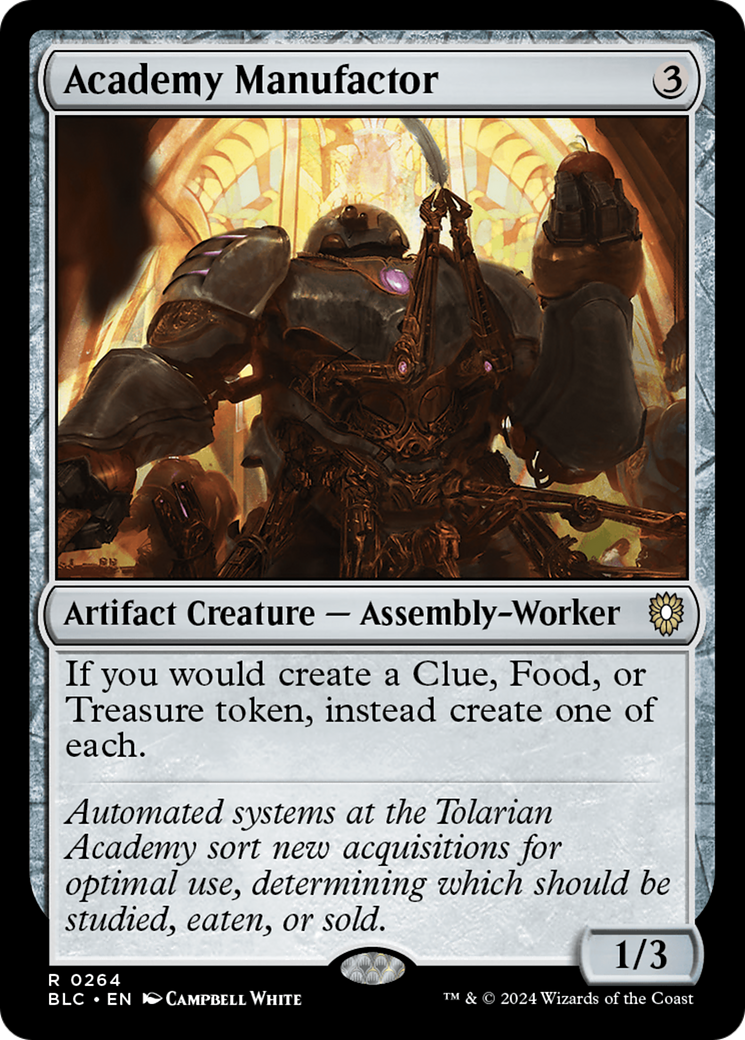
Academy Manufactor
Academy Manufactor
Artifact Creature — Assembly-Worker
1/3
If you would create a Clue, Food, or Treasure token, instead create one of each.
- If you control one Academy Manufactor and would create some number of Clue, Food, or Treasure tokens, you will instead create that many Clue tokens, that many Food tokens, and that many Treasure tokens.
- If you control two Academy Manufactors and would create some number of Clue, Food, or Treasure tokens, you will instead create three times that many Clue tokens, three times that many Food tokens, and three times that many Treasure tokens.
- If you control eighteen Academy Manufactors (I don't know, you figure it out) and would create some number of Clue, Food, or Treasure tokens, you will instead create 129,140,163 times that many Clue tokens, 129,140,163 times that many Food tokens, and 129,140,163 times that many Treasure tokens.
- Creating a Clue token this way isn't the same thing as investigating. Notably, an ability that triggers whenever you investigate won't trigger because you created a Clue token due to this replacement effect. If the original token creation was because you investigated once, those abilities will still each trigger once, no matter how many Clue tokens you end up creating.
-
1
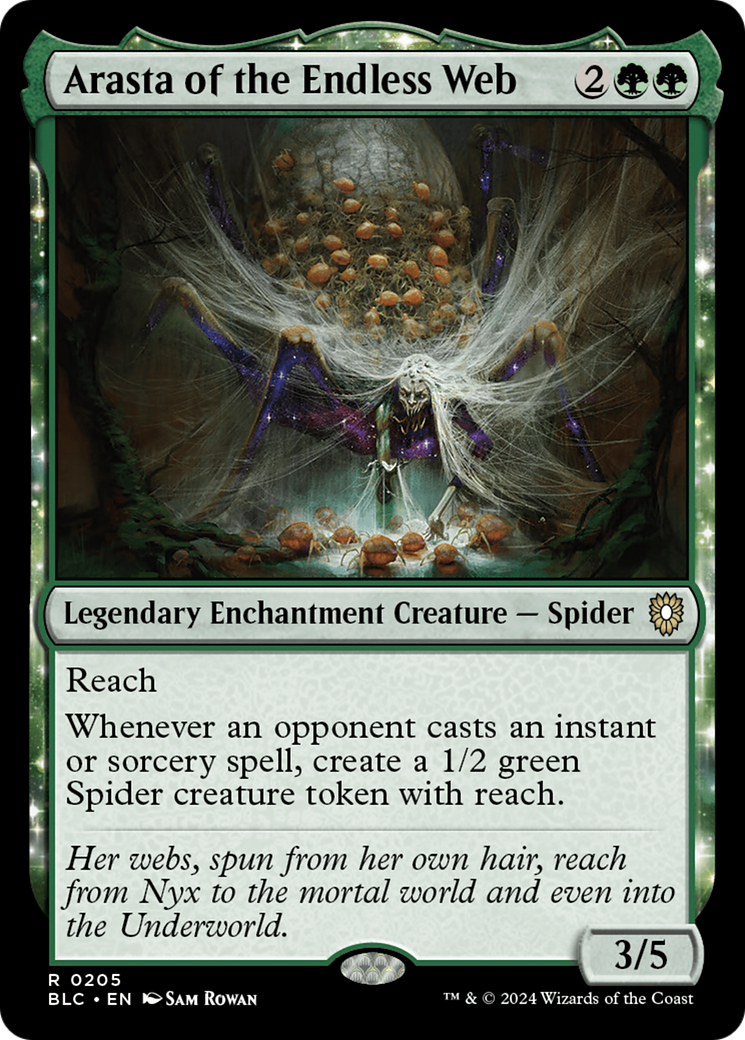
Arasta of the Endless Web
Arasta of the Endless Web
Legendary Enchantment Creature — Spider
3/5
Reach
Whenever an opponent casts an instant or sorcery spell, create a 1/2 green Spider creature token with reach.
- An ability that triggers when a player casts a spell resolves before the spell that caused it to trigger. It resolves even if that spell is countered.
-
1
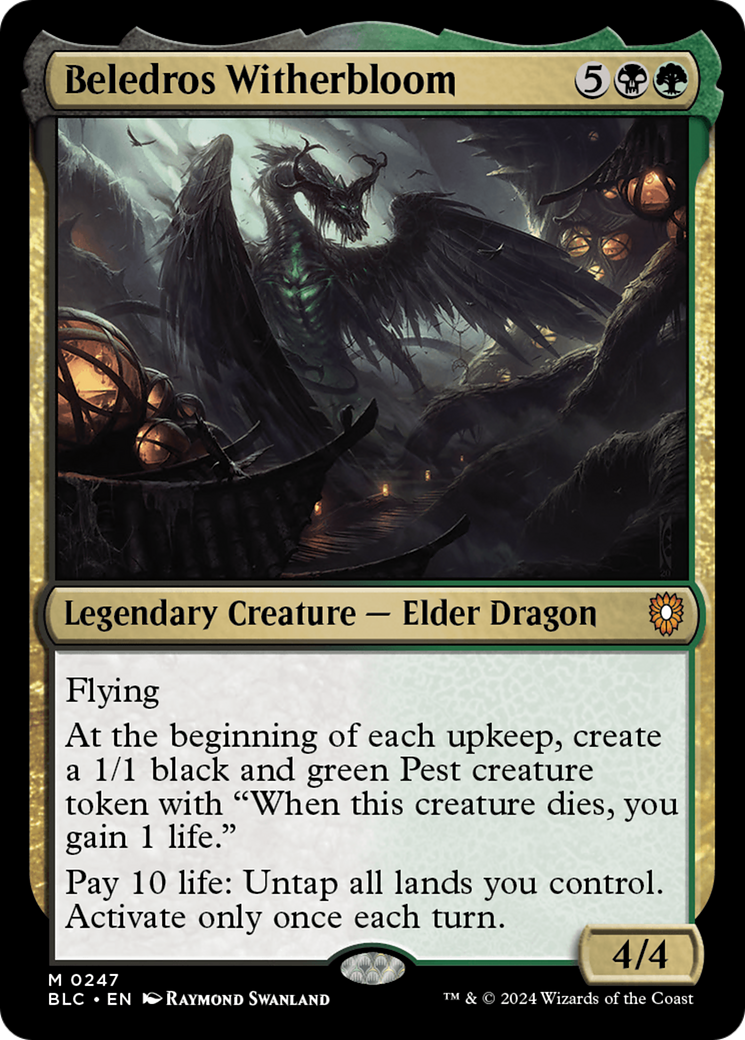
Beledros Witherbloom
Beledros Witherbloom
Legendary Creature — Elder Dragon
4/4
Flying
At the beginning of each upkeep, create a 1/1 black and green Pest creature token with "When this token dies, you gain 1 life."
Pay 10 life: Untap all lands you control. Activate only once each turn.
-
1
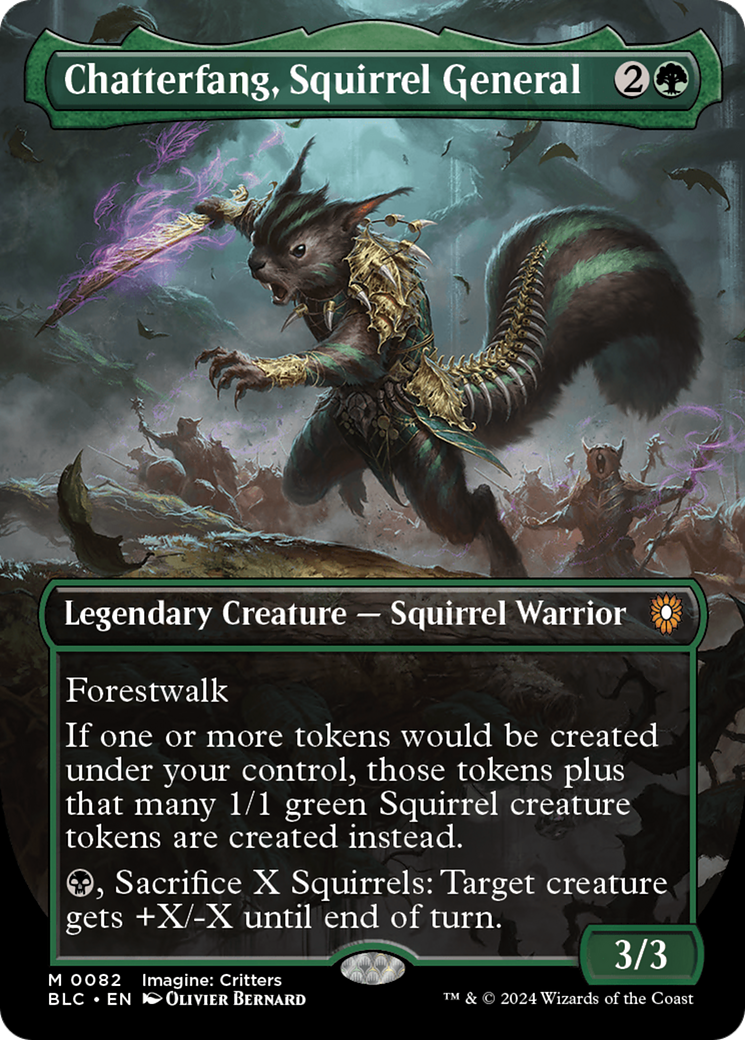
Chatterfang, Squirrel General
Chatterfang, Squirrel General
Legendary Creature — Squirrel Warrior
3/3
Forestwalk (This creature can't be blocked as long as defending player controls a Forest.)
If one or more tokens would be created under your control, those tokens plus that many 1/1 green Squirrel creature tokens are created instead.
, Sacrifice X Squirrels: Target creature gets +X/-X until end of turn.
- You don't need to control the spell or ability that creates the tokens, nor do you have to be the one creating the tokens for Chatterfang's ability to apply. As long as the tokens are being created under your control, Chatterang's replacement effect will apply.
- Chatterfang's second ability applies to all kinds of tokens, including Clue, Food, and Treasure tokens.
- The additional Squirrel tokens won't have any abilities the other tokens were created with. Anything else specified in the effect creating the token (such as tapped, attacking, "That token gains haste," or "Exile that token at end of combat") applies to both the original tokens and the Squirrels.
- If an effect changes under whose control a token would be created, that effect applies before Chatterfang's effect applies. If an effect changes under whose control a token would enter the battlefield, that effect applies after Chatterfang's effect is able to be applied.
- In a Commander game, the defending player is the player Chatterfang is attacking or the controller of the planeswalker Chatterfang is attacking.
-
1
Chittering Witch
Chittering Witch
Creature — Human Warlock
2/2
When this creature enters, create a number of 1/1 black Rat creature tokens equal to the number of opponents you have.
, Sacrifice a creature: Target creature gets -2/-2 until end of turn.
- You can sacrifice Chittering Witch to pay the cost of its last ability.
- In a multiplayer game, opponents who have left the game aren't counted by Chittering Witch's triggered ability.
-
1
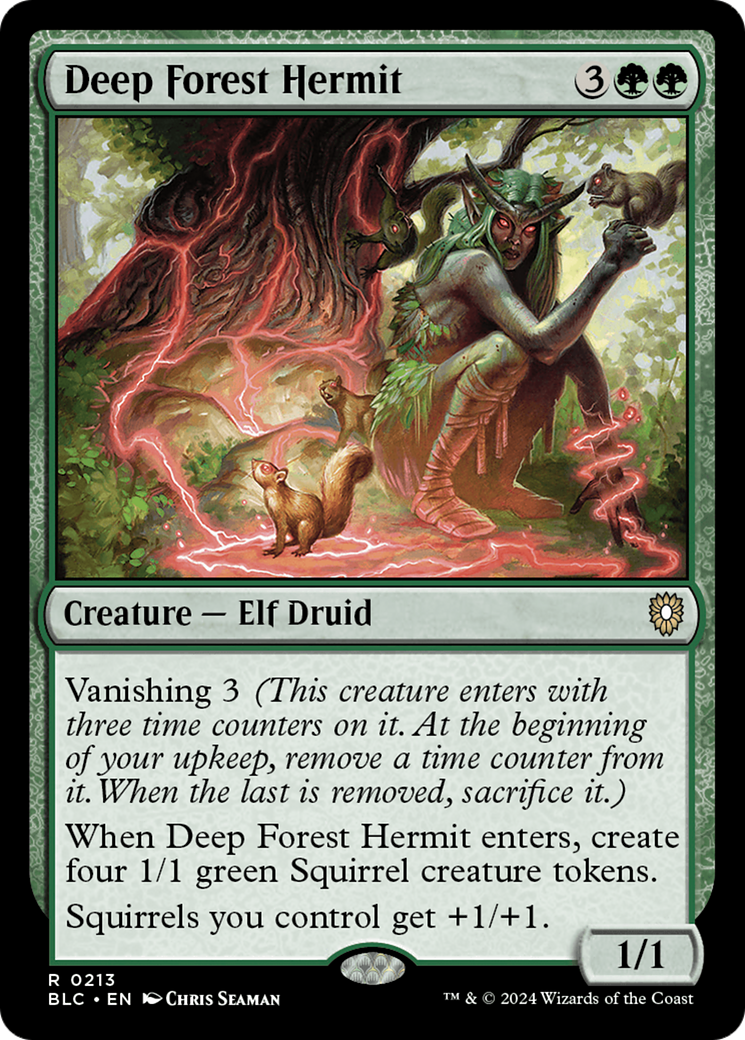
Deep Forest Hermit
Deep Forest Hermit
Creature — Elf Druid
1/1
Vanishing 3 (This creature enters with three time counters on it. At the beginning of your upkeep, remove a time counter from it. When the last is removed, sacrifice it.)
When this creature enters, create four 1/1 green Squirrel creature tokens.
Squirrels you control get +1/+1.
-
1
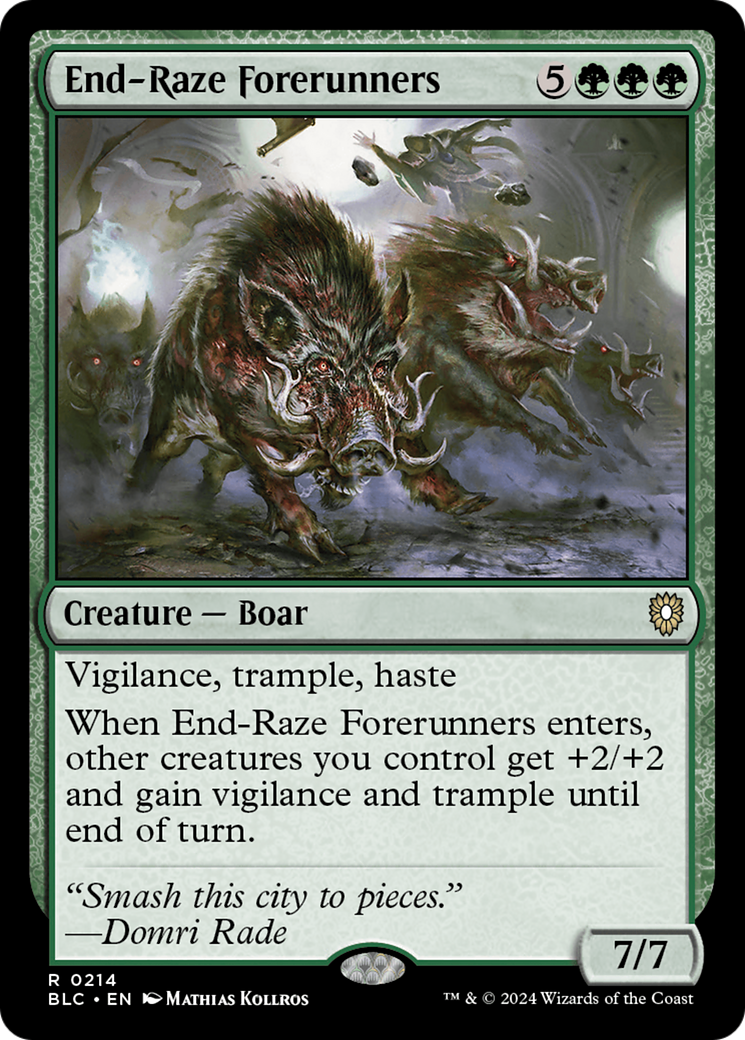
End-Raze Forerunners
End-Raze Forerunners
Creature — Boar
7/7
Vigilance, trample, haste
When this creature enters, other creatures you control get +2/+2 and gain vigilance and trample until end of turn.
- The triggered ability of End-Raze Forerunners affects only creatures you control at the time it resolves. Creatures you begin to control later in the turn won't get +2/+2 or gain vigilance or trample.
-
1
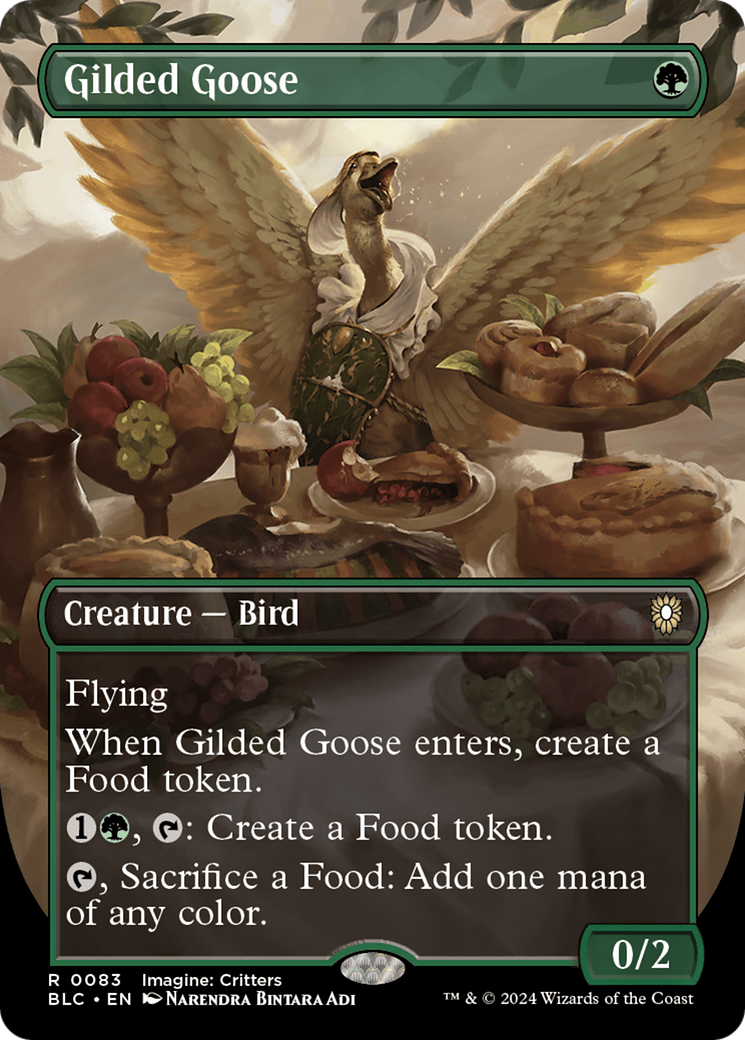
Gilded Goose
Gilded Goose
Creature — Bird
0/2
Flying
When this creature enters, create a Food token. (It's an artifact with " , , Sacrifice this token: You gain 3 life.")
, : Create a Food token.
, Sacrifice a Food: Add one mana of any color.
- If an effect refers to a Food, it means any Food artifact, not just a Food artifact token. For example, you can sacrifice Tough Cookie (an Artifact Creature — Food Golem) to activate Maraleaf Rider's ability (an ability with "Sacrifice a Food" in its cost).
- Food is an artifact type. Even though it appears on some creatures, it's never a creature type.
- You can't sacrifice a Food to pay multiple costs. For example, you can't sacrifice a Food token to activate its own ability and also to activate Maraleaf Rider's ability.
- Whatever you do, don't eat the delicious cards.
-
1
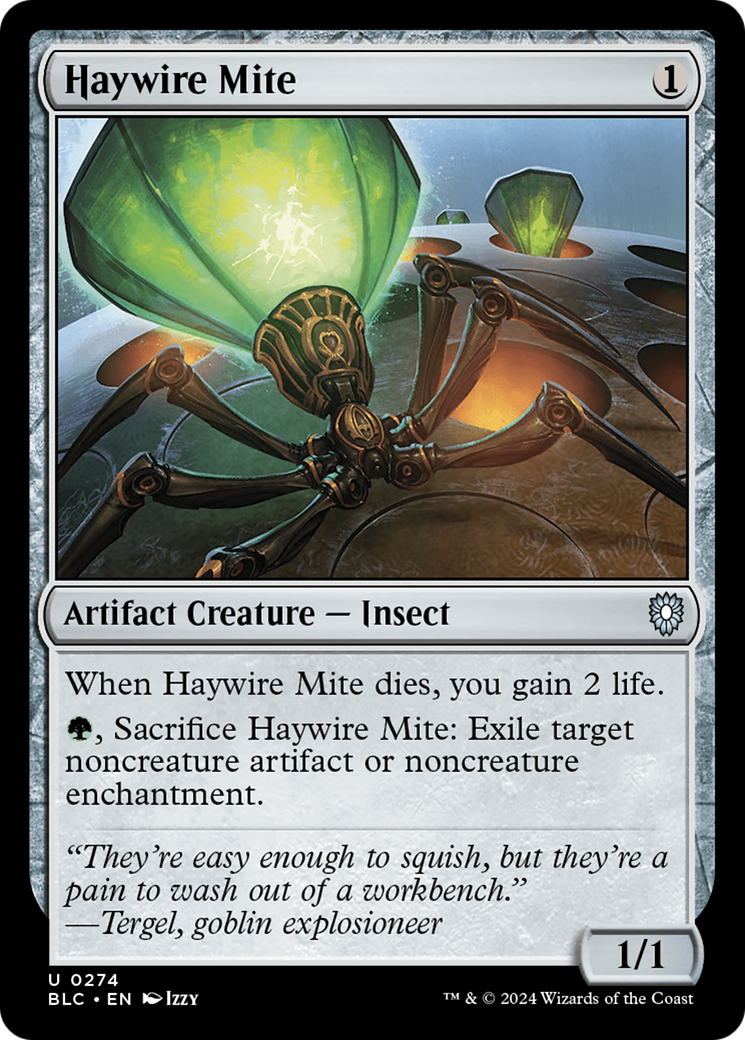
Haywire Mite
Haywire Mite
Artifact Creature — Insect
1/1
When this creature dies, you gain 2 life.
, Sacrifice this creature: Exile target noncreature artifact or noncreature enchantment.
-
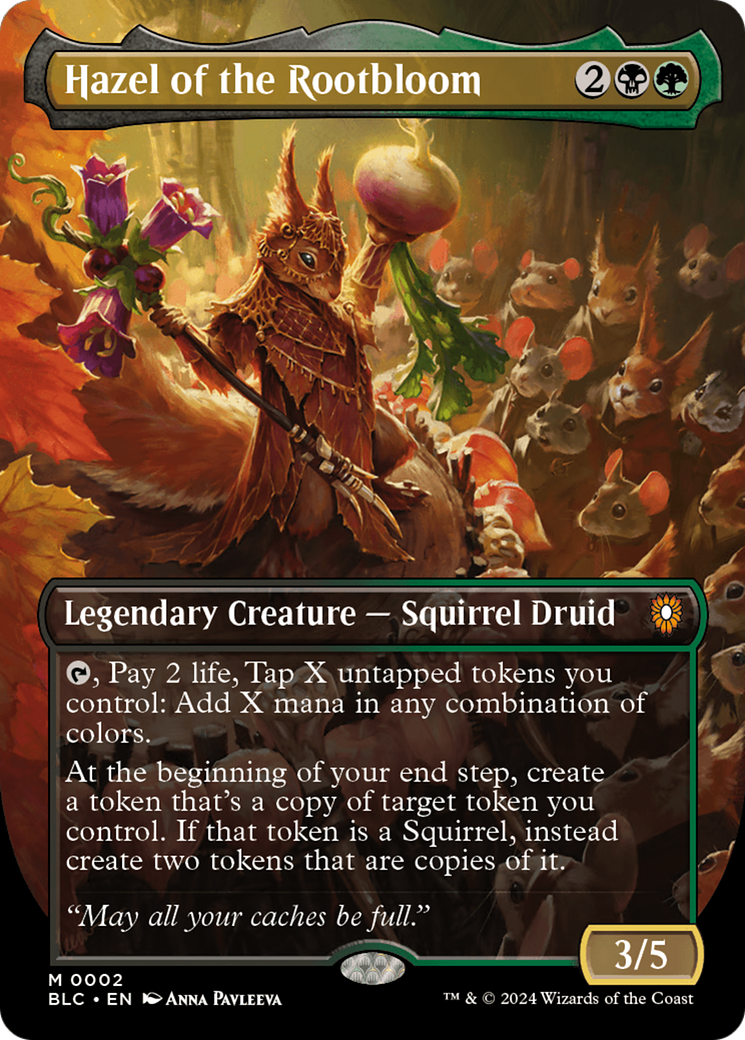
1
Hazel of the Rootbloom
Hazel of the Rootbloom
Legendary Creature — Squirrel Druid
3/5
, Pay 2 life, Tap X untapped tokens you control: Add X mana in any combination of colors.
At the beginning of your end step, create a token that's a copy of target token you control. If that token is a Squirrel, instead create two tokens that are copies of it.
- You can tap any untapped tokens you control, including creature tokens you control that you haven't controlled continuously since the beginning of your most recent turn, to pay the cost of Hazel of the Rootbloom's activated ability.
- The token (or tokens) you create copies the original characteristics of the token as stated by the effect that created that token (unless that token is copying something else; see below). It doesn't copy whether that token is tapped or untapped, whether it has any counters on it or Auras and Equipment attached to it, or any non-copy effects that have changed its power, toughness, types, color, or so on.
- If the copied token is copying something else (for example, if the copied token is one previously created by this ability), then the token enters as whatever that token copied.
- If the copied token has in its mana cost, X is 0.
- Any "enters" abilities of the copied token will trigger when the token enters. Any "as [this permanent] enters" or "[this permanent] enters with" abilities of the copied token will also work.
-
1
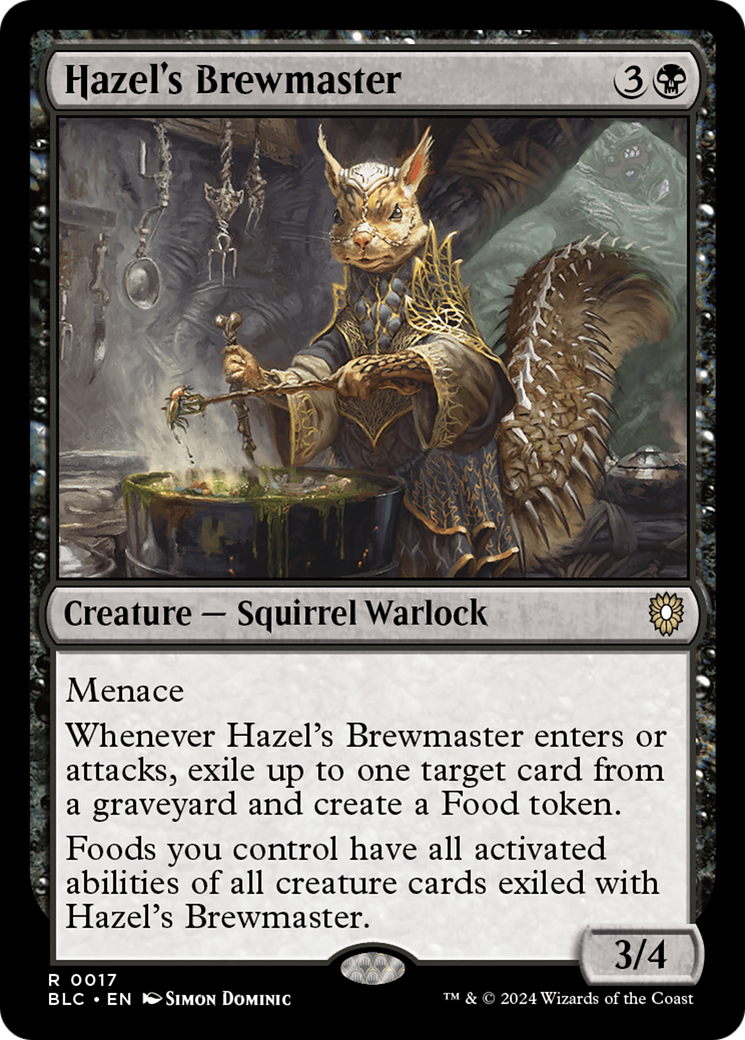
Hazel's Brewmaster
Hazel's Brewmaster
Creature — Squirrel Warlock
3/4
Menace
Whenever this creature enters or attacks, exile up to one target card from a graveyard and create a Food token.
Foods you control have all activated abilities of all creature cards exiled with this creature.
- Whatever you do, don't eat the delicious cards.
- If an effect refers to a Food, it means any Food artifact, not just a Food artifact token. For example, you can sacrifice Tough Cookie (an Artifact Creature — Food Golem) to activate Maraleaf Rider's ability (an ability with "Sacrifice a Food" in its cost).
- Food is an artifact type. Even though it appears on some creatures, it's never a creature type.
- You can't sacrifice a Food to pay multiple costs. For example, you can't sacrifice a Food token to activate its own ability and also to activate Maraleaf Rider's ability.
- You don't have to choose a target for Hazel's Brewmaster's second ability. However, if you do, and that target is illegal as the ability tries to resolve, it won't resolve and none of its effects will happen. You won't create a Food token.
- Activated abilities contain a colon. They're generally written "[Cost]: [Effect]." Some keyword abilities are activated abilities; those will often have colons in their reminder text.
- Hazel's Brewmaster's last ability grants only activated abilities. It doesn't grant keyword abilities (unless those keyword abilities are activated), triggered abilities, or static abilities.
- The granted abilities effectively use "this permanent" rather than "[that card's name]," so you treat the abilities as though they were printed on the permanent that gained the ability. For example, say you exiled the card Argothian Sprite with Hazel's Brewmaster. Argothian Sprite has the ability " : Put two +1/+1 counters on Argothian Sprite." If you controlled a Gingerbrute (an Artifact Creature – Food Golem), you'd treat it as though it had the ability " : Put two +1/+1 counters on Gingerbrute."
-
1
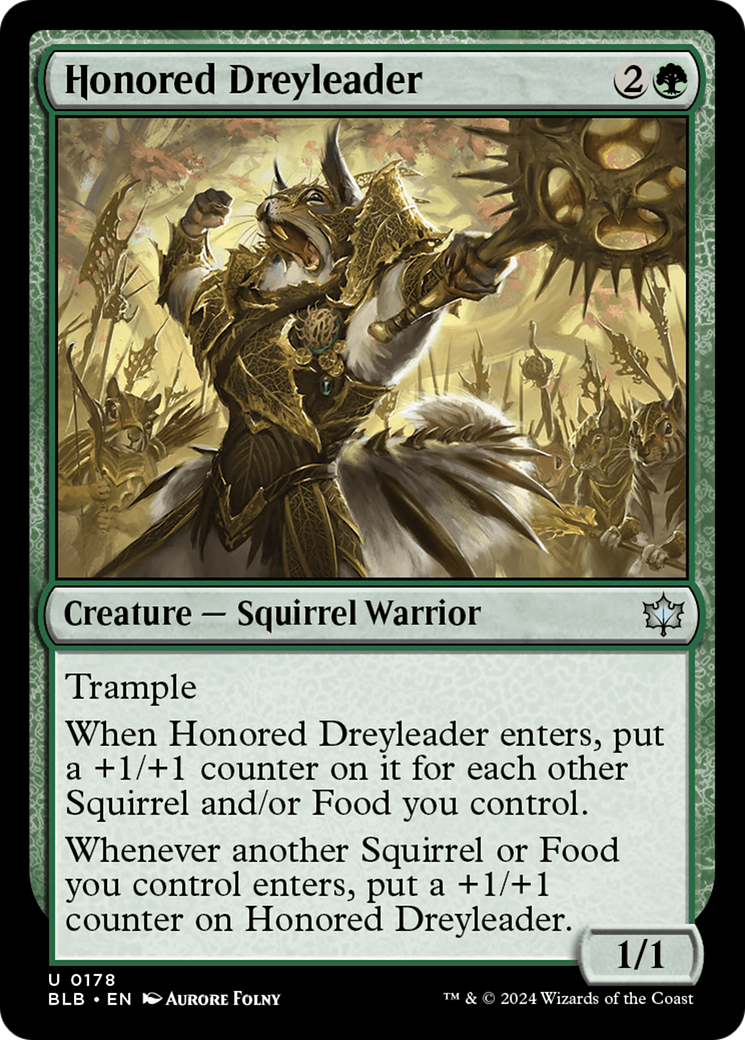
Honored Dreyleader
Honored Dreyleader
Creature — Squirrel Warrior
1/1
Trample
When this creature enters, put a +1/+1 counter on it for each other Squirrel and/or Food you control.
Whenever another Squirrel or Food you control enters, put a +1/+1 counter on this creature.
- If an effect refers to a Food, it means any Food artifact, not just a Food artifact token. For example, you can sacrifice Tough Cookie (an Artifact Creature — Food Golem) to activate Maraleaf Rider's ability (an ability with "Sacrifice a Food" in its cost).
- Food is an artifact type. Even though it appears on some creatures, it's never a creature type.
- You can't sacrifice a Food to pay multiple costs. For example, you can't sacrifice a Food token to activate its own ability and also to activate Maraleaf Rider's ability.
- Whatever you do, don't eat the delicious cards.
- If a permanent you control is both a Squirrel and a Food, count it only once when determining how many counters to put on Honored Dreyleader with its second ability.
- Similarly, if a permanent you control that is both a Squirrel and a Food enters, Honored Dreyleader's last ability will trigger only once.
-
1
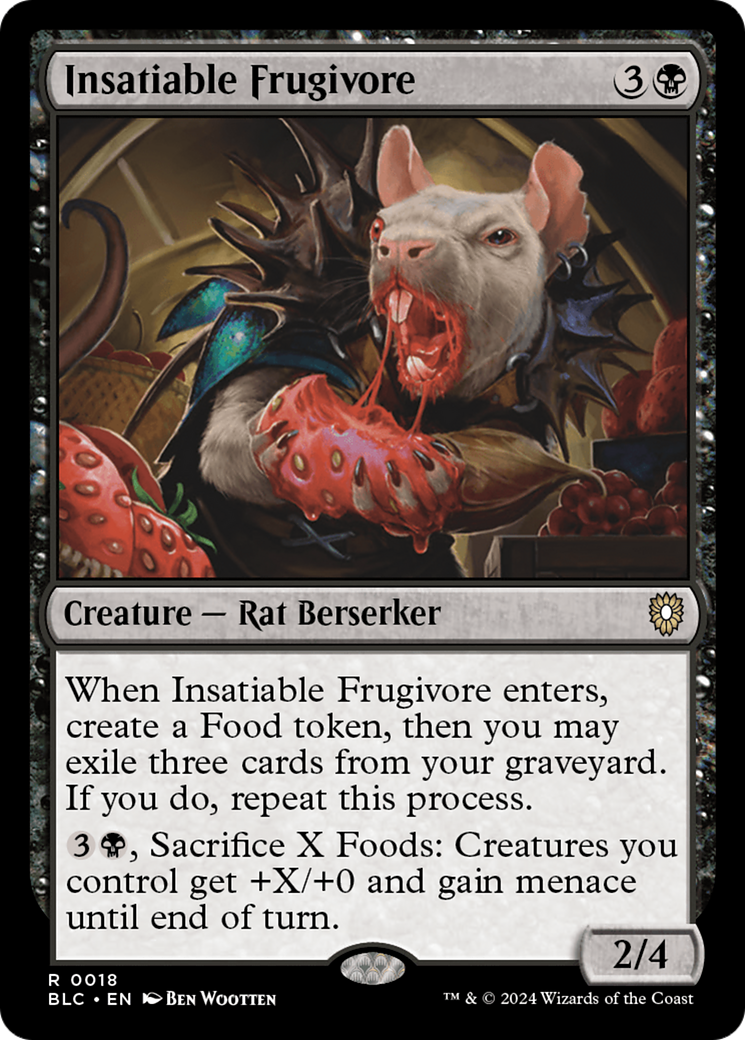
Insatiable Frugivore
Insatiable Frugivore
Creature — Rat Berserker
2/4
When this creature enters, create a Food token, then you may exile three cards from your graveyard. If you do, repeat this process.
, Sacrifice X Foods: Creatures you control get +X/+0 and gain menace until end of turn.
- Whatever you do, don't eat the delicious cards.
- If an effect refers to a Food, it means any Food artifact, not just a Food artifact token. For example, you can sacrifice Tough Cookie (an Artifact Creature — Food Golem) to activate Maraleaf Rider's ability (an ability with "Sacrifice a Food" in its cost).
- Food is an artifact type. Even though it appears on some creatures, it's never a creature type.
- You can't sacrifice a Food to pay multiple costs. For example, you can't sacrifice a Food token to activate its own ability and also to activate Maraleaf Rider's ability.
- You repeat the process as part of the resolution of Insatiable Frugivore's first ability. If the Food token you created or the cards you exiled from your graveyard caused any abilities to trigger, those abilities won't go on the stack until after Insatiable Frugivore's first ability has finished resolving.
- Players can't take other actions during the resolution of Insatiable Frugivore's first ability. Notably, they can't try to remove cards from your graveyard between repetitions of this process.
- The process in Insatiable Frugivore's first ability is repeated until you decline to exile three cards from your graveyard. You can't try to exile three cards from your graveyard if you don't have at least three cards in your graveyard.
- You can choose 0 for the value of X in the cost of Insatiable Frugivore's last ability. If you do, creatures you control will just gain menace until end of turn. (The mere idea of someone eating berries like that is scary enough, apparently.)
-
1
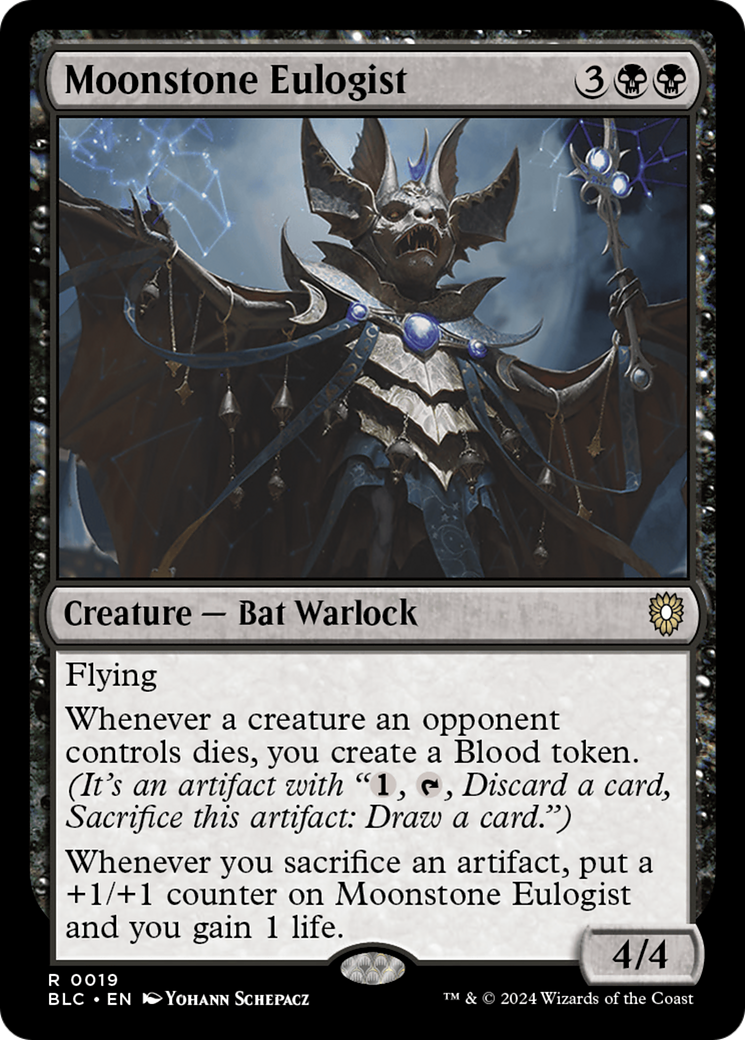
Moonstone Eulogist
Moonstone Eulogist
Creature — Bat Warlock
4/4
Flying
Whenever a creature an opponent controls dies, you create a Blood token. (It's an artifact with " , , Discard a card, Sacrifice this token: Draw a card.")
Whenever you sacrifice an artifact, put a +1/+1 counter on this creature and you gain 1 life.
- If an effect refers to a Blood token, it means any artifact token with the subtype Blood, even if it has gained other subtypes.
- You can't sacrifice a Blood token to pay multiple costs.
- Some triggered abilities trigger "whenever you sacrifice a Blood token." These abilities trigger regardless of why you sacrificed that Blood token.
- If Moonstone Eulogist and one or more creatures opponents control die at the same time, its second ability will trigger for each of those creatures opponents controlled that died.
-
1
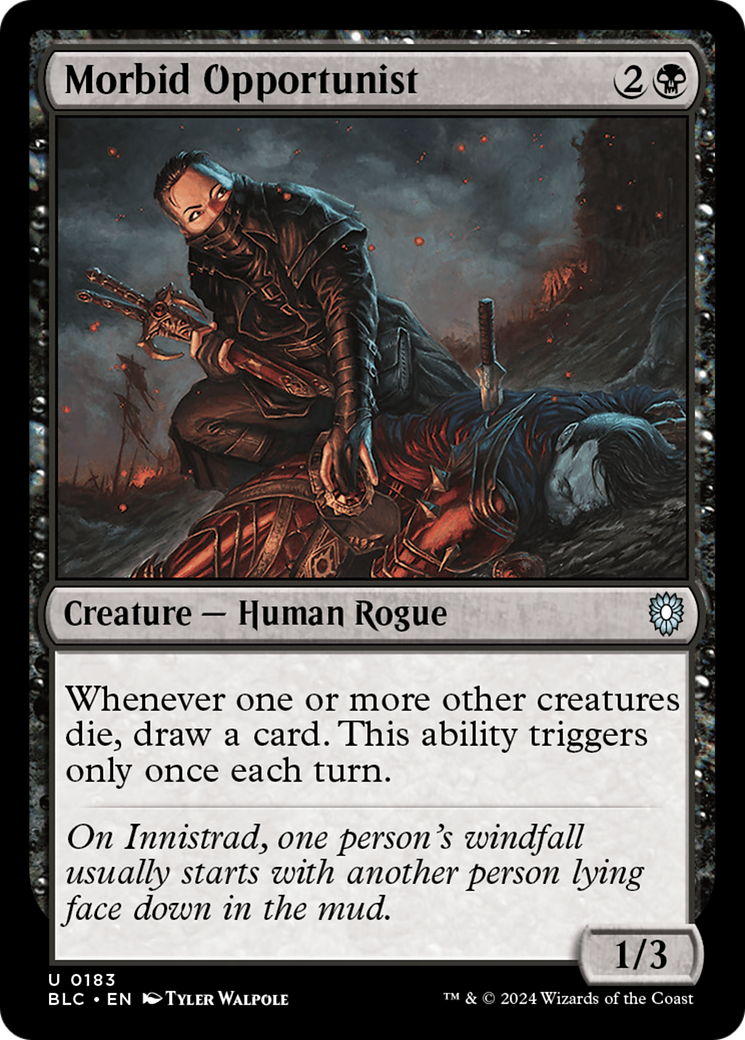
Morbid Opportunist
Morbid Opportunist
Creature — Human Rogue
1/3
Whenever one or more other creatures die, draw a card. This ability triggers only once each turn.
- If Morbid Opportunist dies at the same time as one or more other creatures, Morbid Opportunist's ability still triggers.
-
1
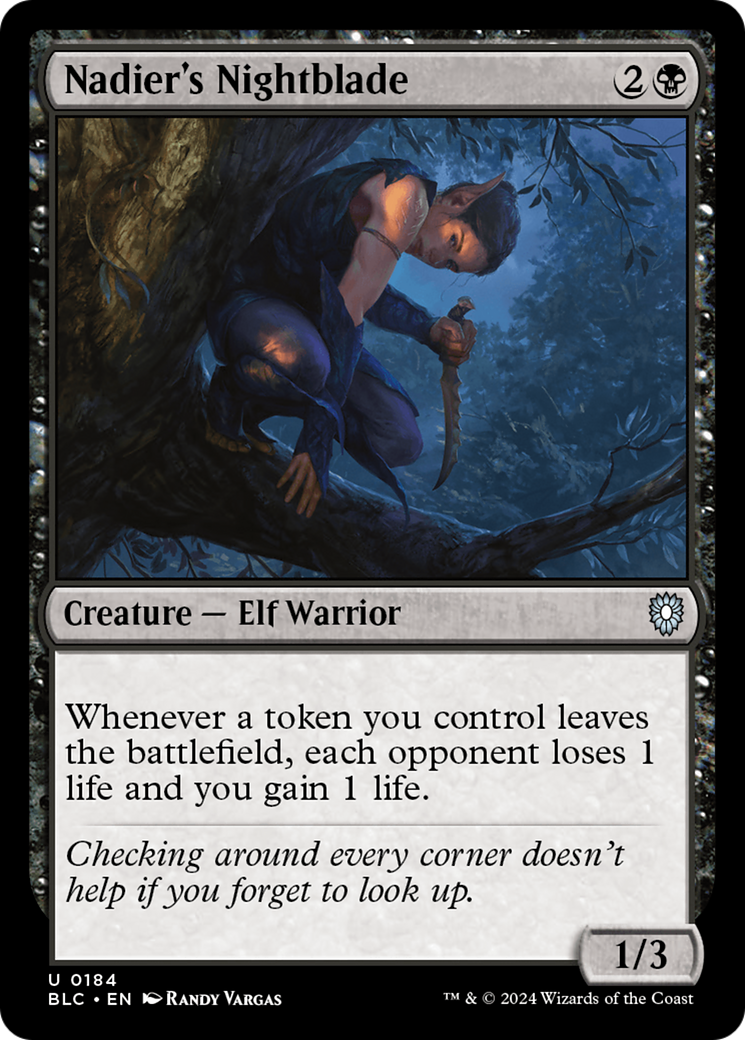
Nadier's Nightblade
Nadier's Nightblade
Creature — Elf Warrior
1/3
Whenever a token you control leaves the battlefield, each opponent loses 1 life and you gain 1 life.
-
1
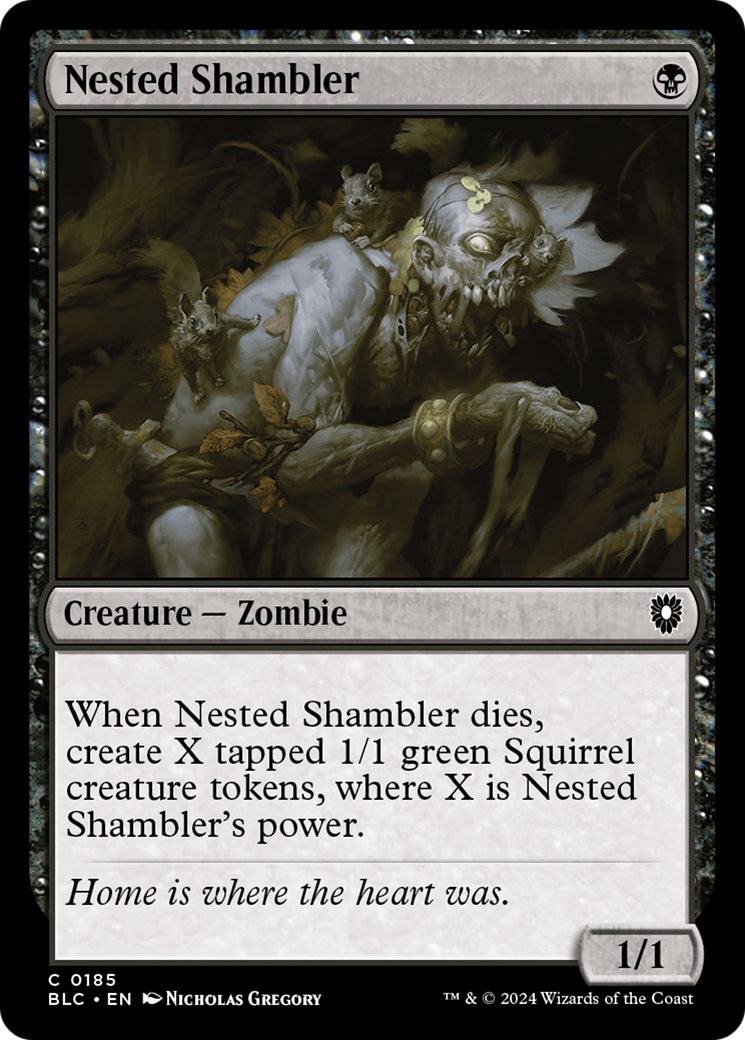
Nested Shambler
Nested Shambler
Creature — Zombie
1/1
When this creature dies, create X tapped 1/1 green Squirrel creature tokens, where X is this creature's power.
- X is Nested Shambler's power the last time it was on the battlefield, not its power in the graveyard. If its power was 0 or less when it died, you won't create any tokens.
-
1
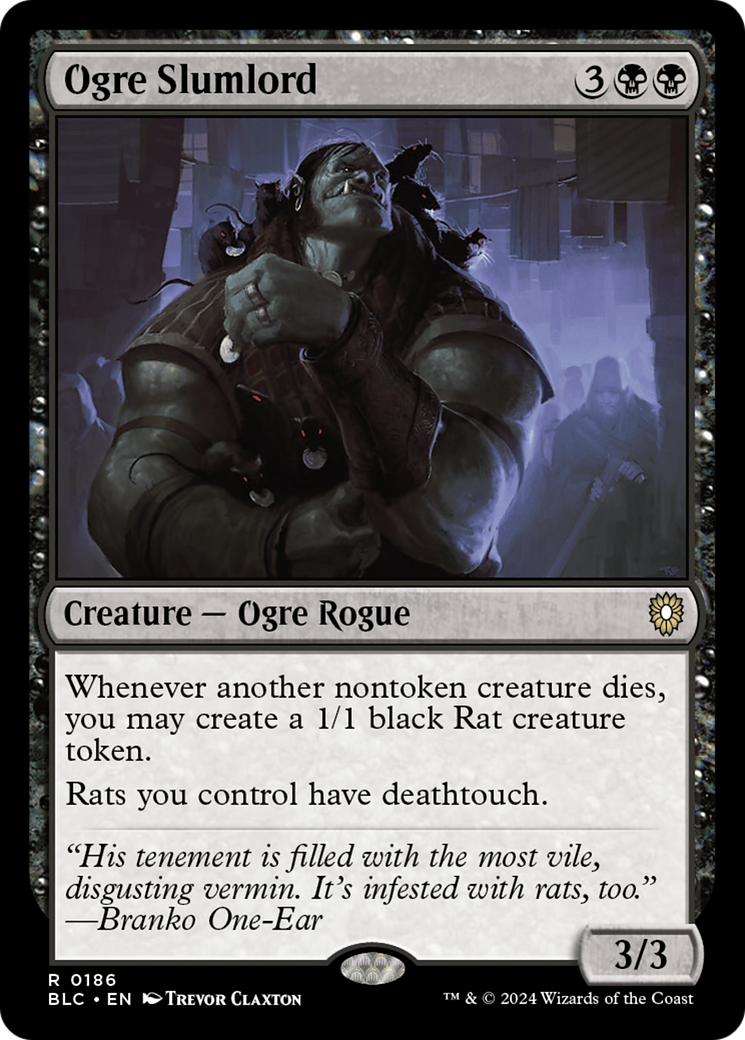
Ogre Slumlord
Ogre Slumlord
Creature — Ogre Rogue
3/3
Whenever another nontoken creature dies, you may create a 1/1 black Rat creature token.
Rats you control have deathtouch.
- All Rats you control have deathtouch while Ogre Slumlord is on the battlefield, not just the ones created by Ogre Slumlord.
-
1
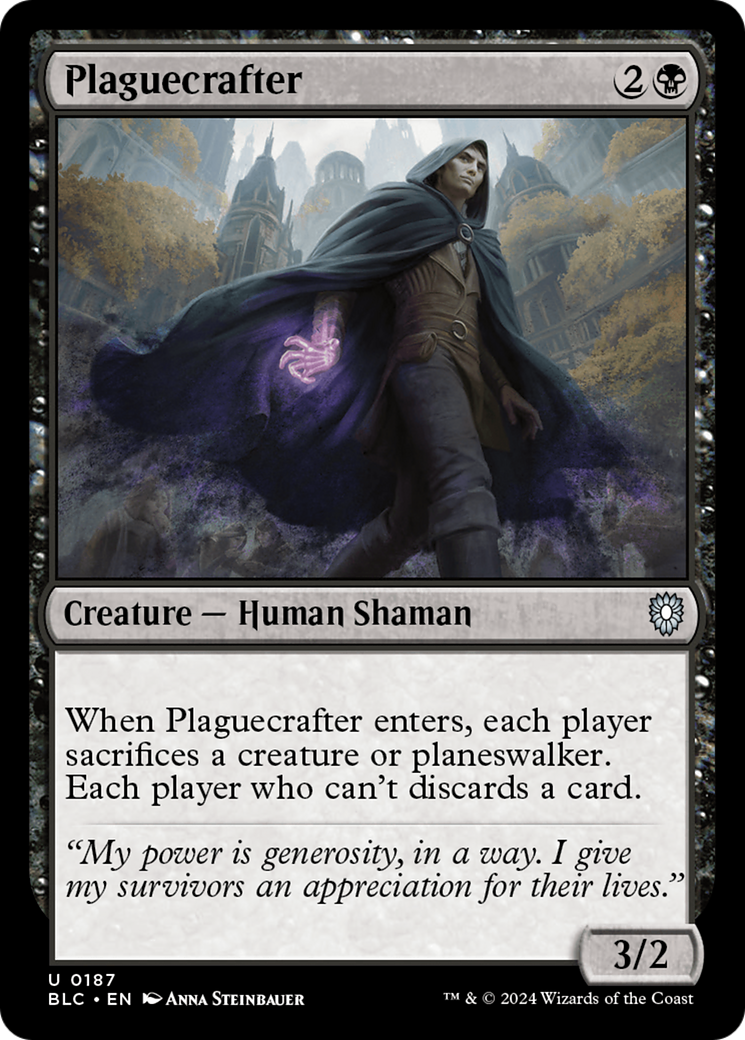
Plaguecrafter
Plaguecrafter
Creature — Human Shaman
3/2
When this creature enters, each player sacrifices a creature or planeswalker of their choice. Each player who can't discards a card.
- As Plaguecrafter's ability resolves, first the player whose turn it is chooses a creature or planeswalker they control, then each other player in turn order does the same, knowing the choices made before them. Then all the chosen permanents are sacrificed at the same time. Next, each player in the same order who couldn't sacrifice a permanent chooses a card in hand without revealing it, then the chosen cards are discarded at the same time.
- Each player chooses a permanent to sacrifice from among the creatures and planeswalkers they control. You don't choose which type of permanent any other player has to sacrifice.
- Plaguecrafter can be the creature its controller sacrifices for its own ability.
-
1
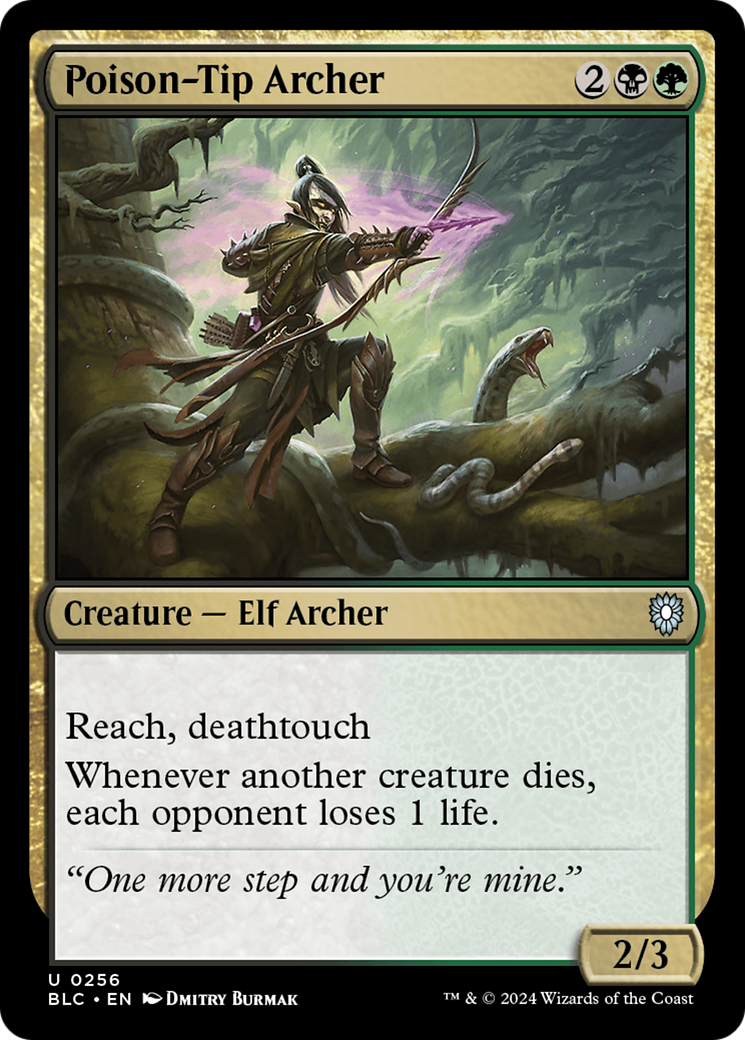
Poison-Tip Archer
Poison-Tip Archer
Creature — Elf Archer
2/3
Reach (This creature can block creatures with flying.)
Deathtouch (Any amount of damage this deals to a creature is enough to destroy it.)
Whenever another creature dies, each opponent loses 1 life.
- If another creature dies at the same time as Poison-Tip Archer does, each opponent loses 1 life.
- In a Two-Headed Giant game, Poison-tip Archer's last ability causes the opposing team to lose 2 life.
-
1
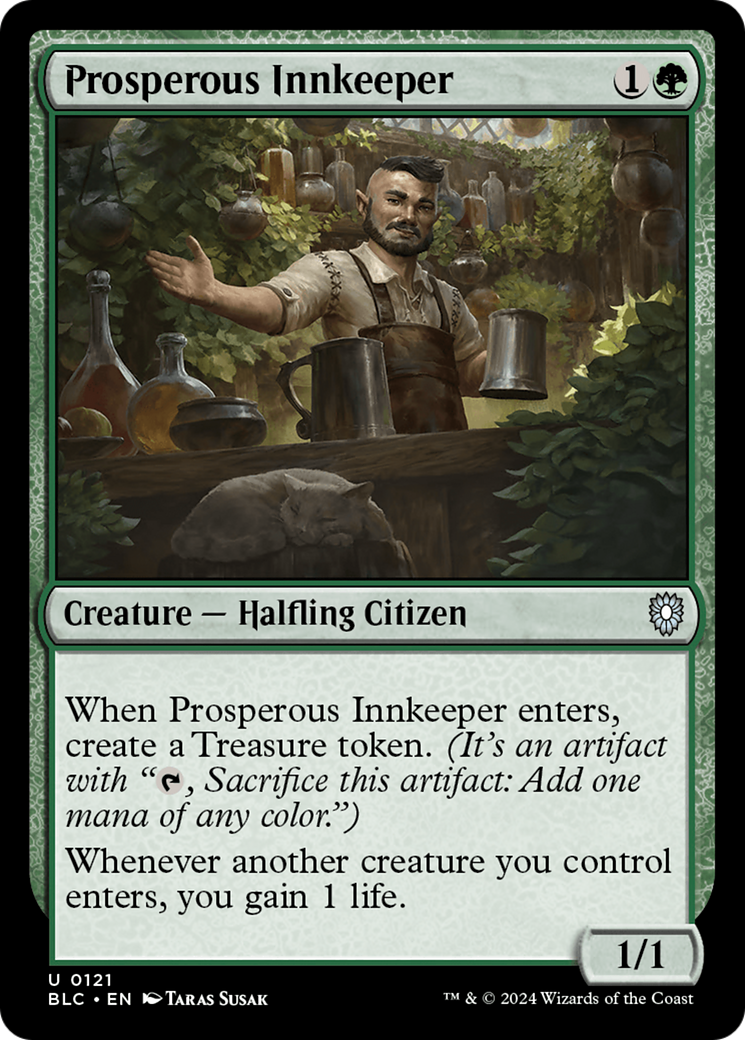
Prosperous Innkeeper
Prosperous Innkeeper
Creature — Halfling Citizen
1/1
When this creature enters, create a Treasure token. (It's an artifact with " , Sacrifice this token: Add one mana of any color.")
Whenever another creature you control enters, you gain 1 life.
-
1
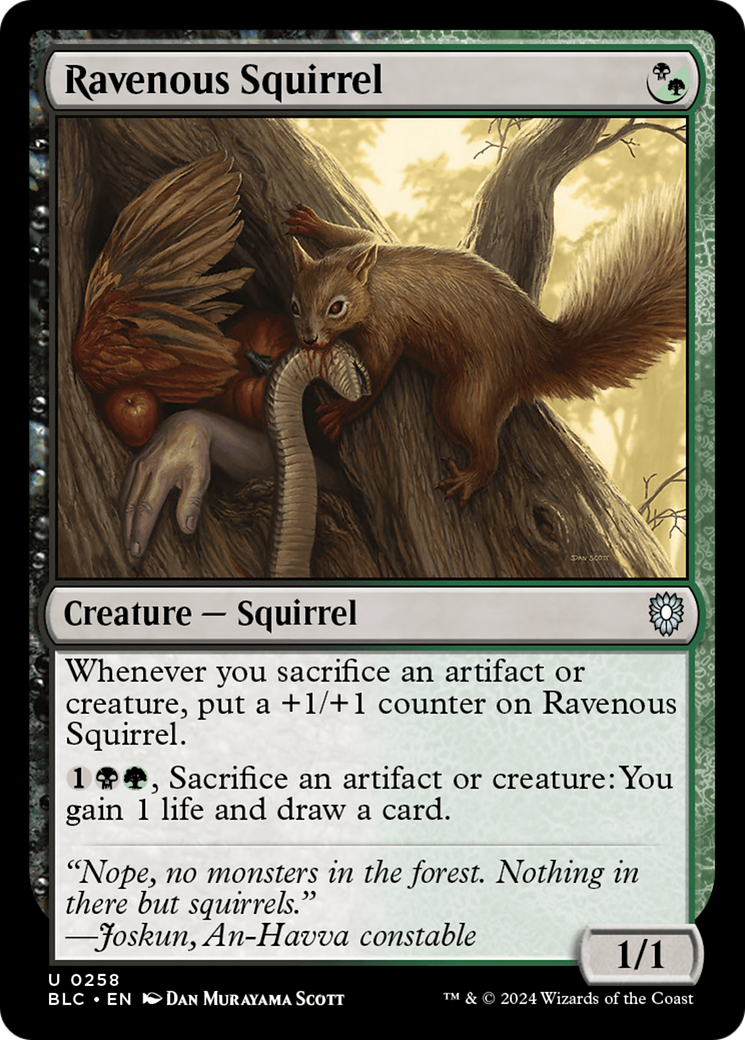
Ravenous Squirrel
Ravenous Squirrel
Creature — Squirrel
1/1
Whenever you sacrifice an artifact or creature, put a +1/+1 counter on this creature.
, Sacrifice an artifact or creature: You gain 1 life and draw a card.
-
1
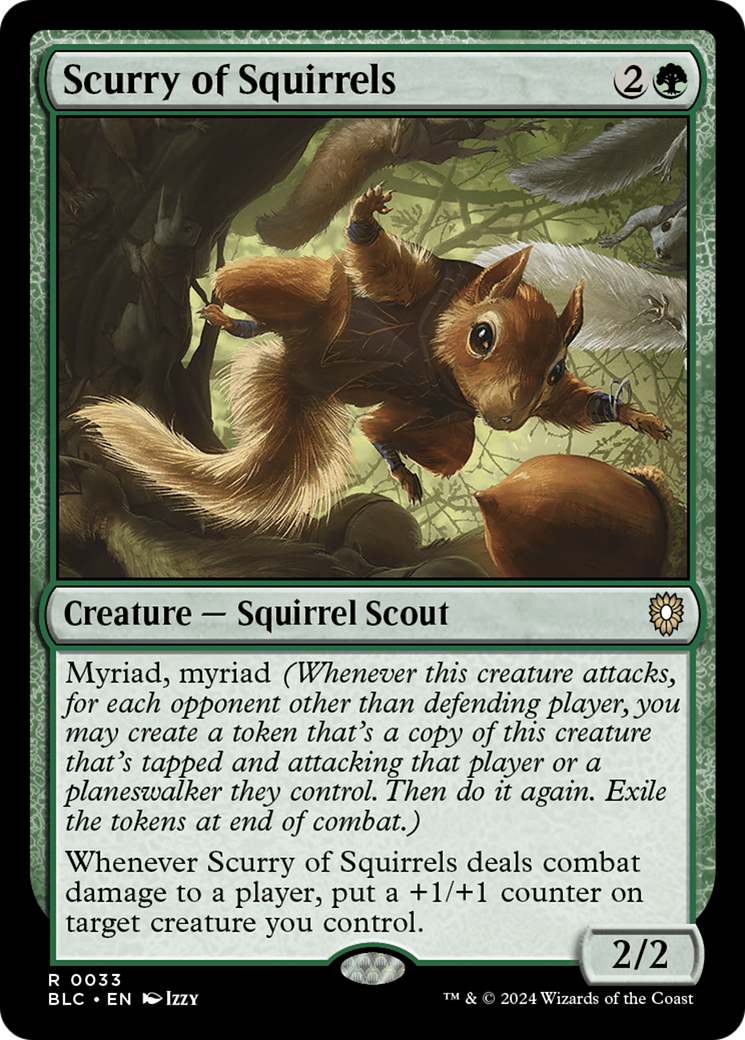
Scurry of Squirrels
Scurry of Squirrels
Creature — Squirrel Scout
2/2
Myriad, myriad (Whenever this creature attacks, for each opponent other than defending player, you may create a token that's a copy of this creature that's tapped and attacking that player or a planeswalker they control. Then do it again. Exile the tokens at end of combat.)
Whenever this creature deals combat damage to a player, put a +1/+1 counter on target creature you control.
- The term "defending player" in the myriad rules (or any other ability of an attacking creature) refers to the player the creature with myriad was attacking, the controller of the planeswalker it was attacking, or the protector of the battle it was attacking at the time the ability resolves. If that creature is no longer attacking, it refers to the appropriate player based on who or what the creature was last attacking.
- If the defending player is your only opponent, no tokens are put onto the battlefield.
- You choose whether each token is attacking the player or a planeswalker they control as the token is created. If it's attacking a planeswalker, you choose which one. You can't have any of the tokens attack a battle.
- Although the tokens enter attacking, they were never declared as attackers. Abilities that trigger whenever a creature attacks won't trigger, including the myriad ability of the tokens. If there are any costs to have a creature attack, those costs won't apply to the tokens.
- The tokens created by a single instance of myriad all enter at the same time.
- Each token copies exactly what was printed on the original creature and nothing else. It doesn't copy whether that creature is tapped or untapped, whether it has any counters on it or Auras and Equipment attached to it, or any non-copy effects that have changed its power, toughness, types, color, and so on.
- Any "enters" abilities of the copied creature will trigger when the tokens enter. Any "as [this permanent] enters" or "[this permanent] enters with" abilities of the copied creature will also work.
- If an instance of myriad creates more than one token for any given player (due to an effect such as the one Doubling Season creates), you may choose separately for each token whether it's attacking the player or a planeswalker they control.
-
1
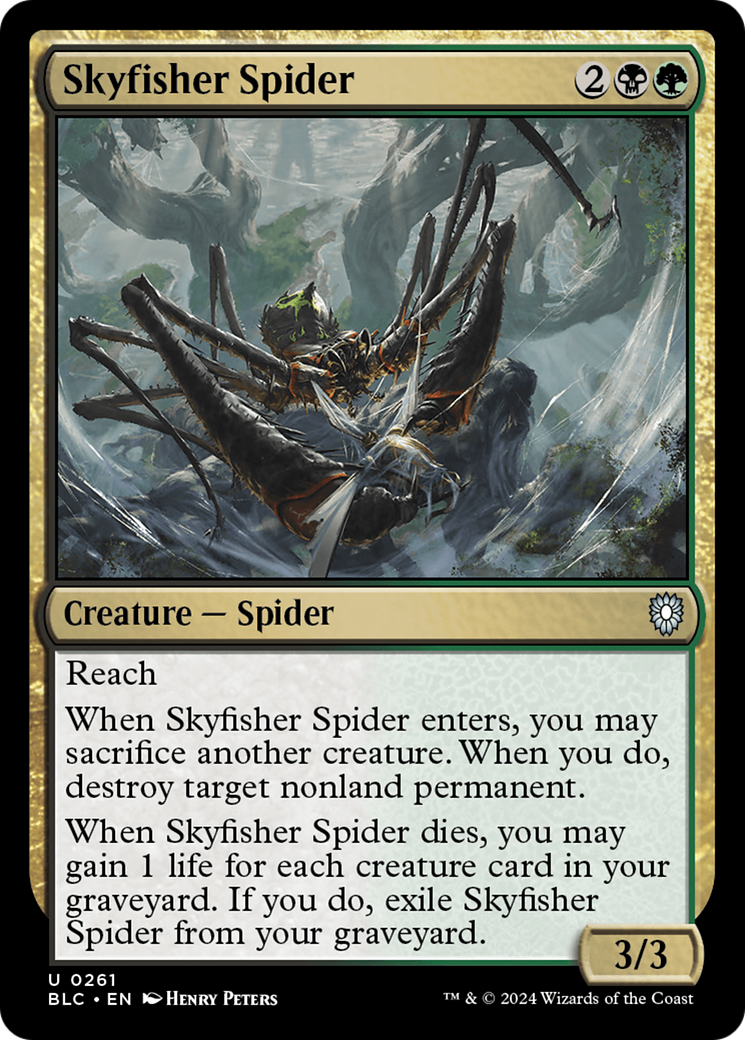
Skyfisher Spider
Skyfisher Spider
Creature — Spider
3/3
Reach
When this creature enters, you may sacrifice another creature. When you do, destroy target nonland permanent.
When this creature dies, you may gain 1 life for each creature card in your graveyard. If you do, exile this creature from your graveyard.
- Skyfisher Spider's first triggered ability doesn't have any targets. If you choose to sacrifice another creature, a second triggered ability (called a "reflexive" triggered ability) goes on the stack and you choose a target nonland permanent at that time. Players may respond to that second ability as normal.
- Notably, this means that players won't get to know what nonland permanent you plan to target before you choose whether to sacrifice a creature.
-
1
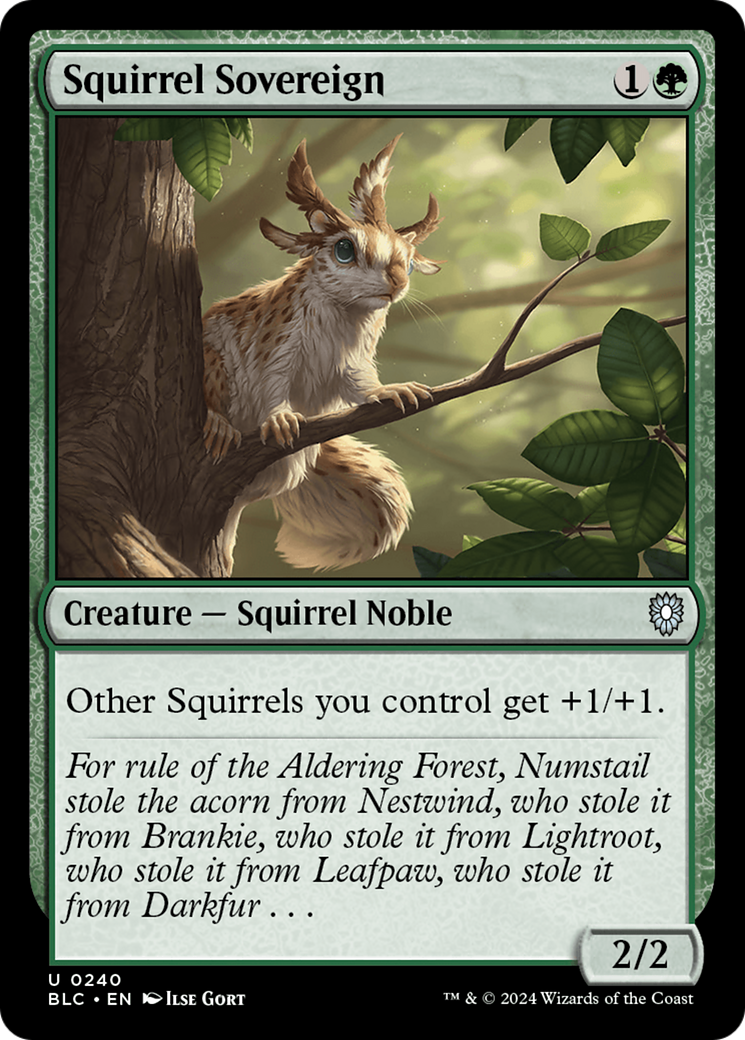
Squirrel Sovereign
Squirrel Sovereign
Creature — Squirrel Noble
2/2
Other Squirrels you control get +1/+1.
-
1
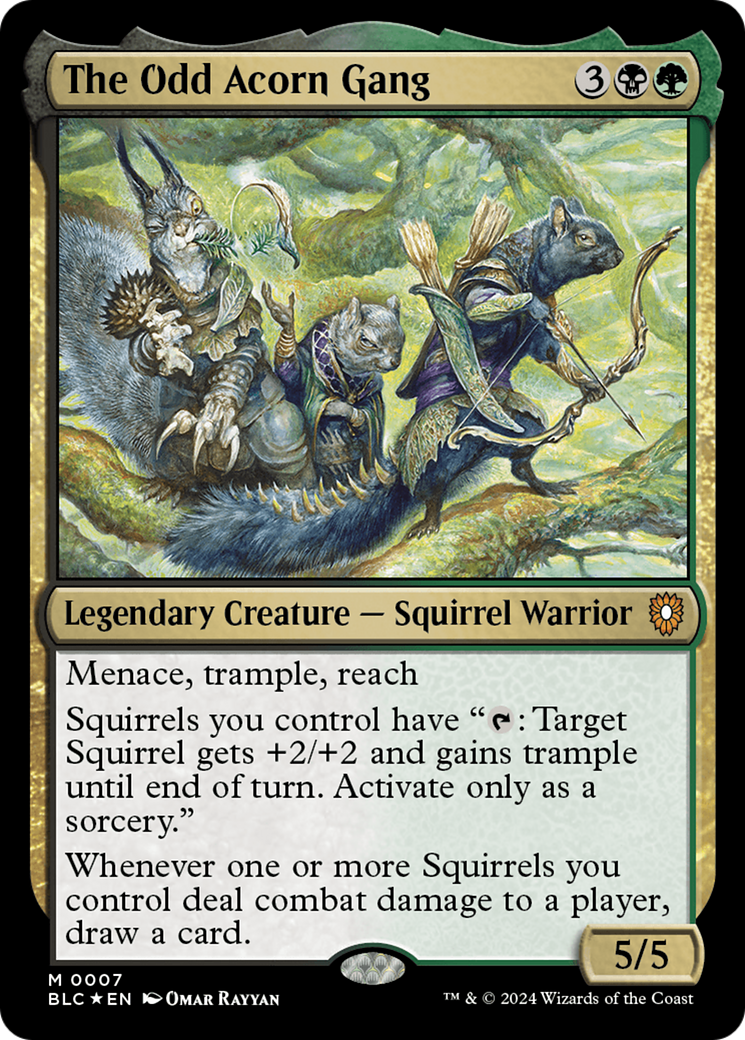
The Odd Acorn Gang
The Odd Acorn Gang
Legendary Creature — Squirrel Warrior
5/5
Menace, trample, reach
Squirrels you control have " : Target Squirrel gets +2/+2 and gains trample until end of turn. Activate only as a sorcery."
Whenever one or more Squirrels you control deal combat damage to a player, draw a card.
-
1
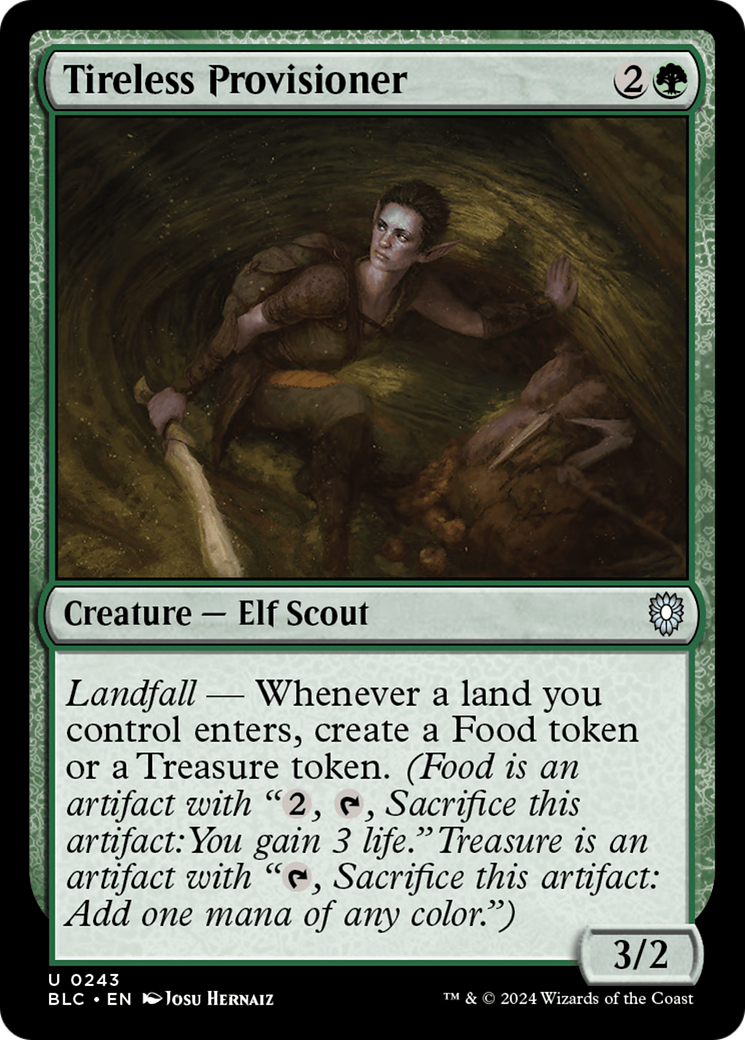
Tireless Provisioner
Tireless Provisioner
Creature — Elf Scout
3/2
Landfall — Whenever a land you control enters, create a Food token or a Treasure token. (Food is an artifact with " , , Sacrifice this token: You gain 3 life." Treasure is an artifact with " , Sacrifice this token: Add one mana of any color.")
- Food is an artifact type. Even though it appears on some creatures, it's never a creature type.
- You can't sacrifice a Food to pay multiple costs. For example, you can't sacrifice a Food token to activate its own ability and also to activate Maraleaf Rider's ability.
- Whatever you do, don't eat the delicious cards.
-
1
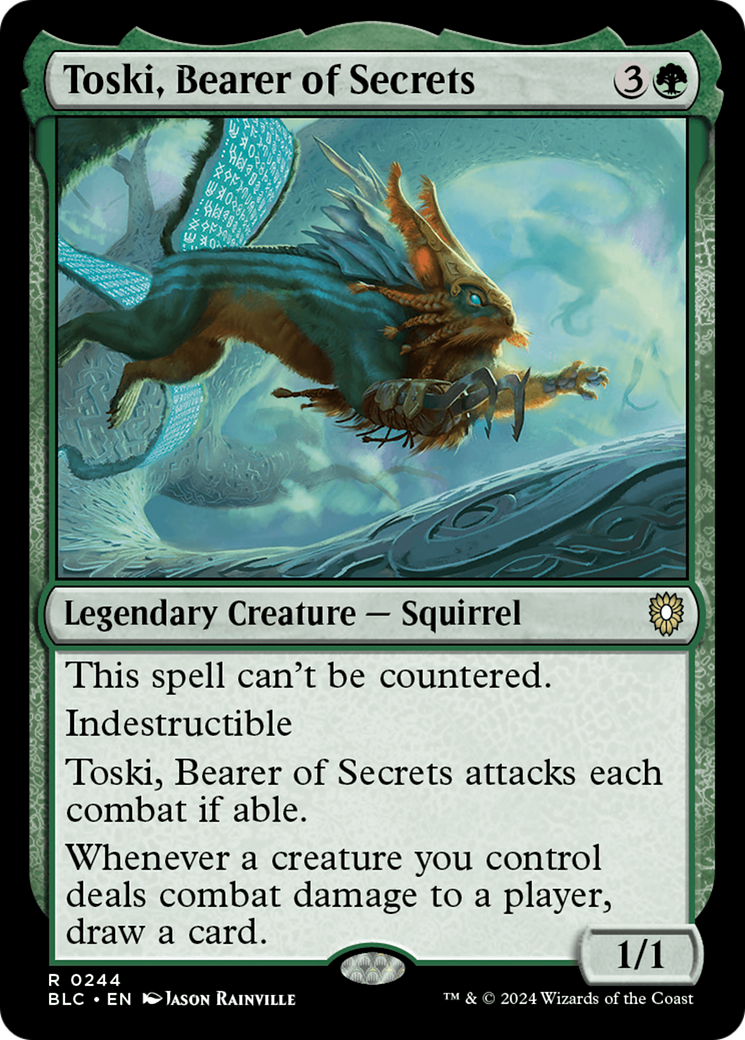
Toski, Bearer of Secrets
Toski, Bearer of Secrets
Legendary Creature — Squirrel
1/1
This spell can't be countered.
Indestructible
Toski attacks each combat if able.
Whenever a creature you control deals combat damage to a player, draw a card.
- A spell or ability that counters spells can still target Toski. When that spell or ability resolves, Toski won't be countered, but any additional effects of that spell or ability will still happen.
- If Toski can't attack for some reason (such as being tapped or having come under that player's control that turn), then it doesn't attack. If there's a cost associated with having it attack, you aren't forced to pay that cost, so it doesn't have to attack in that case either.
-
1
Woe Strider
Woe Strider
Creature — Horror
3/2
When this creature enters, create a 0/1 white Goat creature token.
Sacrifice another creature: Scry 1.
Escape— , Exile four other cards from your graveyard. (You may cast this card from your graveyard for its escape cost.)
This creature escapes with two +1/+1 counters on it.
- Escape's permission doesn't change when you may cast the spell from your graveyard.
- To determine the total cost of a spell, start with the mana cost or alternative cost you're paying (such as an escape cost), add any cost increases, then apply any cost reductions. The mana value of the spell remains unchanged, no matter what the total cost to cast it was and no matter whether an alternative cost was paid.
- After an escaped spell resolves, it returns to its owner's graveyard if it's not a permanent spell. If it is a permanent spell, it enters the battlefield and will return to its owner's graveyard if it dies later. Perhaps it will escape again—good underworld security is so hard to come by these days.
- If a card has multiple abilities giving you permission to cast it, such as two escape abilities or an escape ability and a flashback ability, you choose which one to apply. The others have no effect.
- If you cast a spell with its escape permission, you can't choose to apply any other alternative costs or to cast it without paying its mana cost. If it has any additional costs, you must pay those.
- If a card with escape is put into your graveyard during your turn, you'll be able to cast it right away if it's legal to do so, before an opponent can take any actions.
- Once you begin casting a spell with escape, it immediately moves to the stack. Players can't take any other actions until you're done casting the spell.
-
1
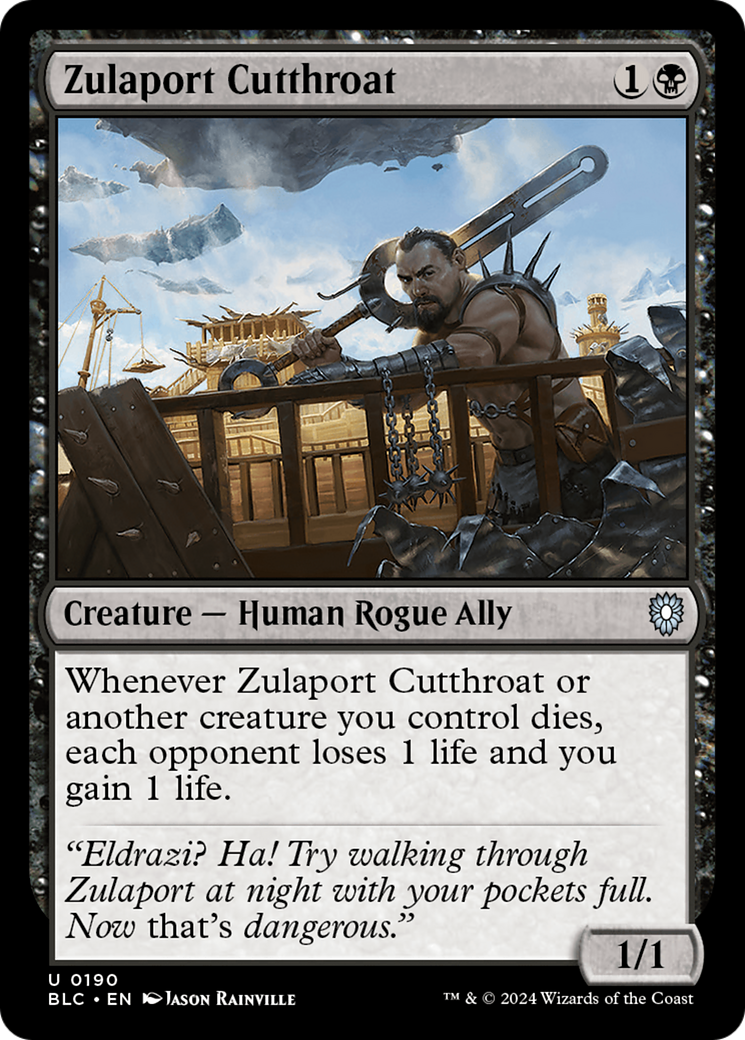
Zulaport Cutthroat
Zulaport Cutthroat
Creature — Human Rogue Ally
1/1
Whenever this creature or another creature you control dies, each opponent loses 1 life and you gain 1 life.
- If another creature you control dies at the same time as Zulaport Cutthroat, its ability triggers for that creature.
Instants 8
-
1
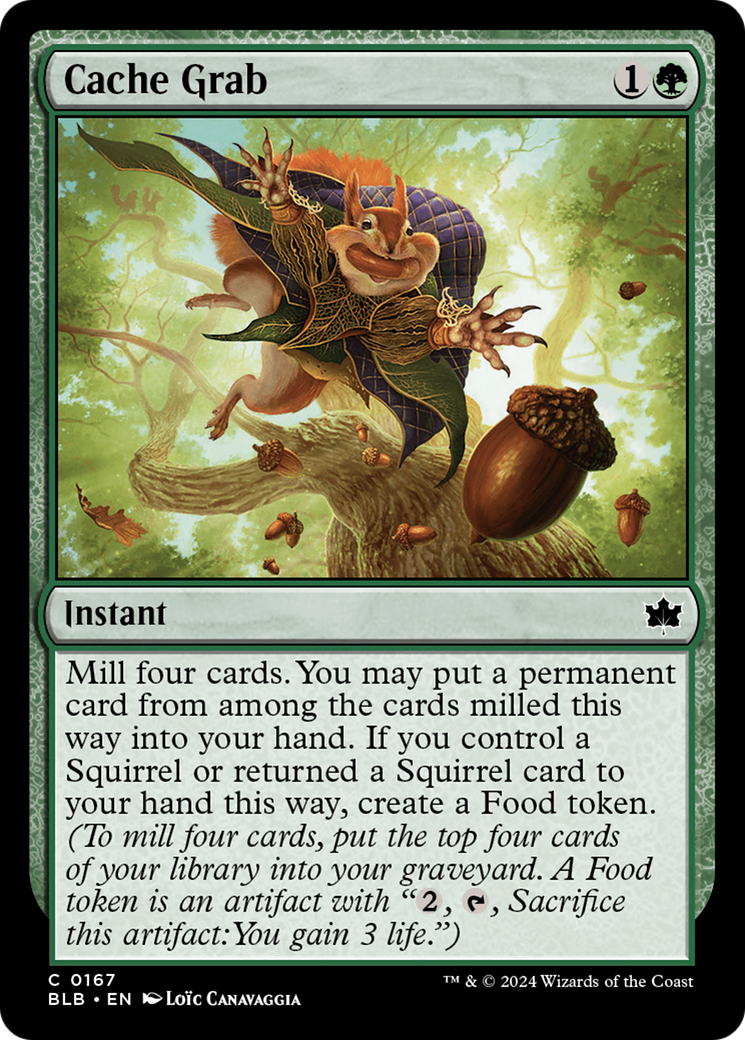
Cache Grab
Cache Grab
Instant
Mill four cards. You may put a permanent card from among the cards milled this way into your hand. If you control a Squirrel or returned a Squirrel card to your hand this way, create a Food token. (To mill four cards, put the top four cards of your library into your graveyard. A Food token is an artifact with " , , Sacrifice this token: You gain 3 life.")
- Food is an artifact type. Even though it appears on some creatures, it's never a creature type.
- You can't sacrifice a Food to pay multiple costs. For example, you can't sacrifice a Food token to activate its own ability and also to activate Maraleaf Rider's ability.
- Whatever you do, don't eat the delicious cards.
-
1
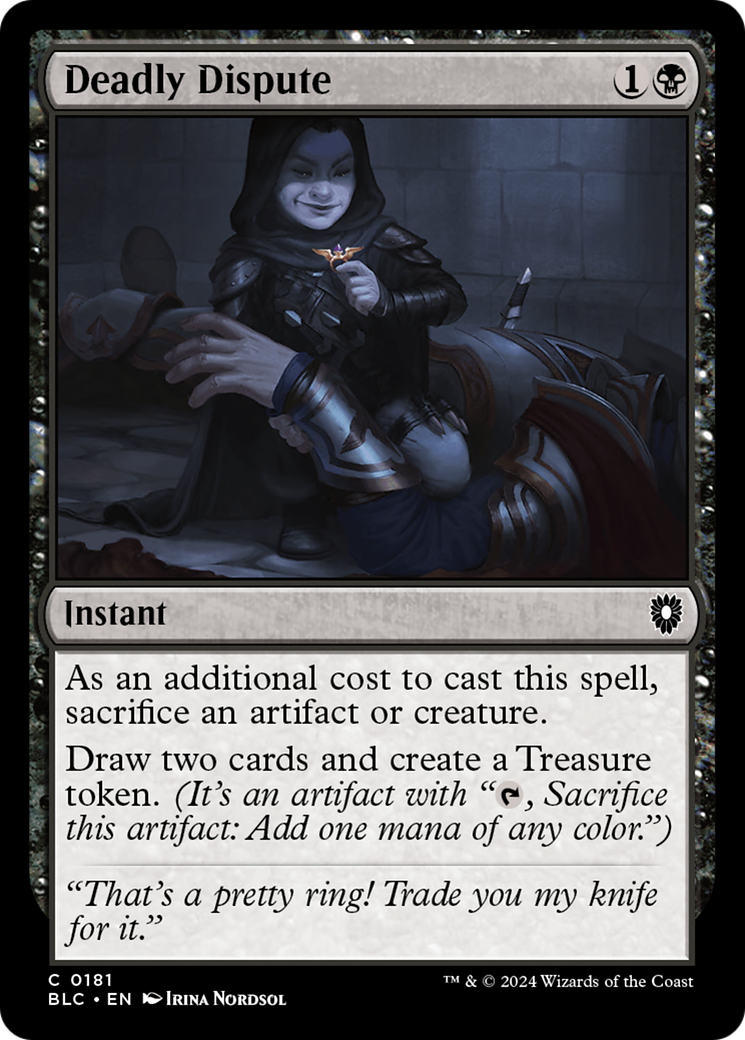
Deadly Dispute
Deadly Dispute
Instant
As an additional cost to cast this spell, sacrifice an artifact or creature.
Draw two cards and create a Treasure token. (It's an artifact with " , Sacrifice this token: Add one mana of any color.")
-
1
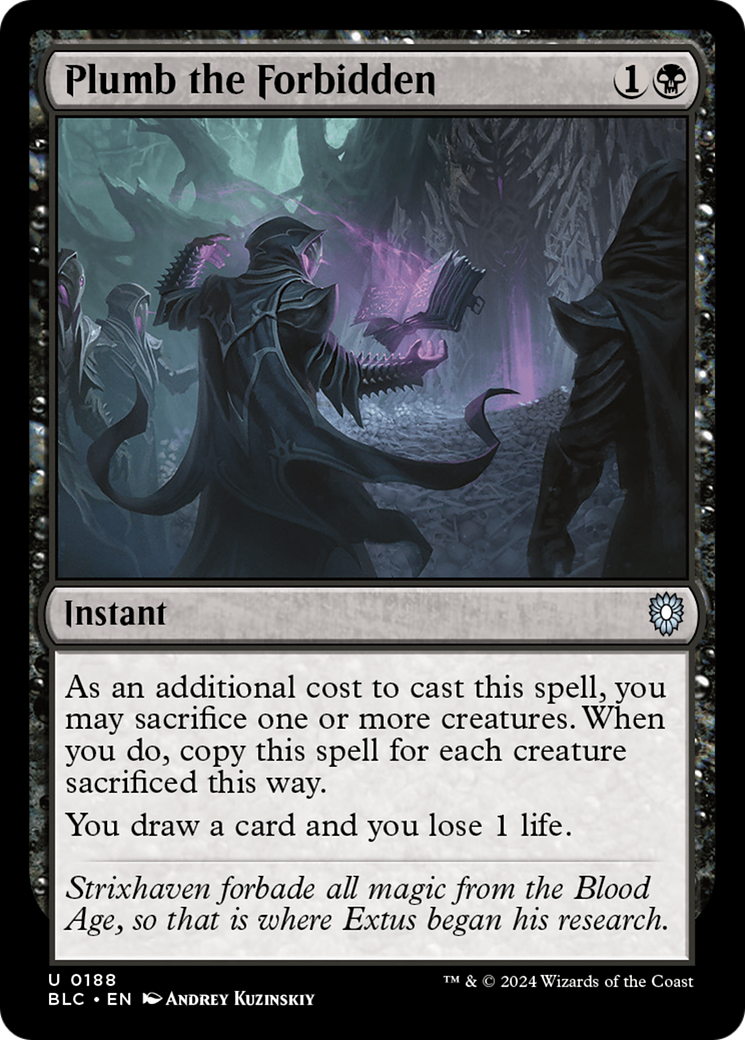
Plumb the Forbidden
Plumb the Forbidden
Instant
As an additional cost to cast this spell, you may sacrifice one or more creatures. When you do, copy this spell for each creature sacrificed this way.
You draw a card and you lose 1 life.
- If you sacrifice a creature with a magecraft ability to cast Plumb the Forbidden, that creature's ability will not trigger.
- If you copy Plumb the Forbidden multiple times, each magecraft ability of a creature you control will trigger that many times.
-
1
Putrefy
Putrefy
Instant
Destroy target artifact or creature. It can't be regenerated.
- This spell isn't modal. When it resolves, it will destroy the target if it's a creature or an artifact, even if it changed from one to the other between targeting and resolution.
-
1
Saw in Half
Saw in Half
Instant
Destroy target creature. If that creature dies this way, its controller creates two tokens that are copies of that creature, except their power is half that creature's power and their toughness is half that creature's toughness. Round up each time.
- If the creature isn't destroyed (perhaps because it has indestructible), its controller doesn't create any tokens. The same is true if the creature is destroyed but instead of going to its owner's graveyard, a replacement effect moves it elsewhere, such as exile.
- Use the power and toughness of the creature from when it was last on the battlefield to determine the power and toughness of the tokens.
- Except for power and toughness, the token copies exactly what was printed on the original creature and nothing else (unless that creature was copying something else or it's a token; see below). It doesn't copy whether that creature was tapped or untapped, whether it had any counters on it or Auras and Equipment attached to it, and so on.
- If the original creature had a characteristic-defining ability that determined its power and/or toughness, that ability is not copied.
- If the copied creature had in its mana cost, X is considered to be 0.
- If the chosen creature was a token, the new tokens copy the original characteristics of that token as stated by the effect that created the token, plus the listed exceptions.
- If the copied creature was copying something else, then the tokens enter the battlefield as whatever that creature copied, with the exceptions noted above.
- Any enters-the-battlefield abilities of the copied creature will trigger when the tokens enter the battlefield. Any "as [this creature] enters the battlefield" or "[this creature] enters the battlefield with" abilities of the chosen creature will also work.
-
1
Second Harvest
Second Harvest
Instant
For each token you control, create a token that's a copy of that permanent.
- Second Harvest copies the original characteristics of each token as stated by the effect that created that token. It doesn’t copy whether that token is tapped or untapped, whether it has any counters on it or any Auras and Equipment attached to it, or any non-copy effects that have changed its power, toughness, types, color, or so on.
- Second Harvest copies all tokens, not only creature tokens.
-
1
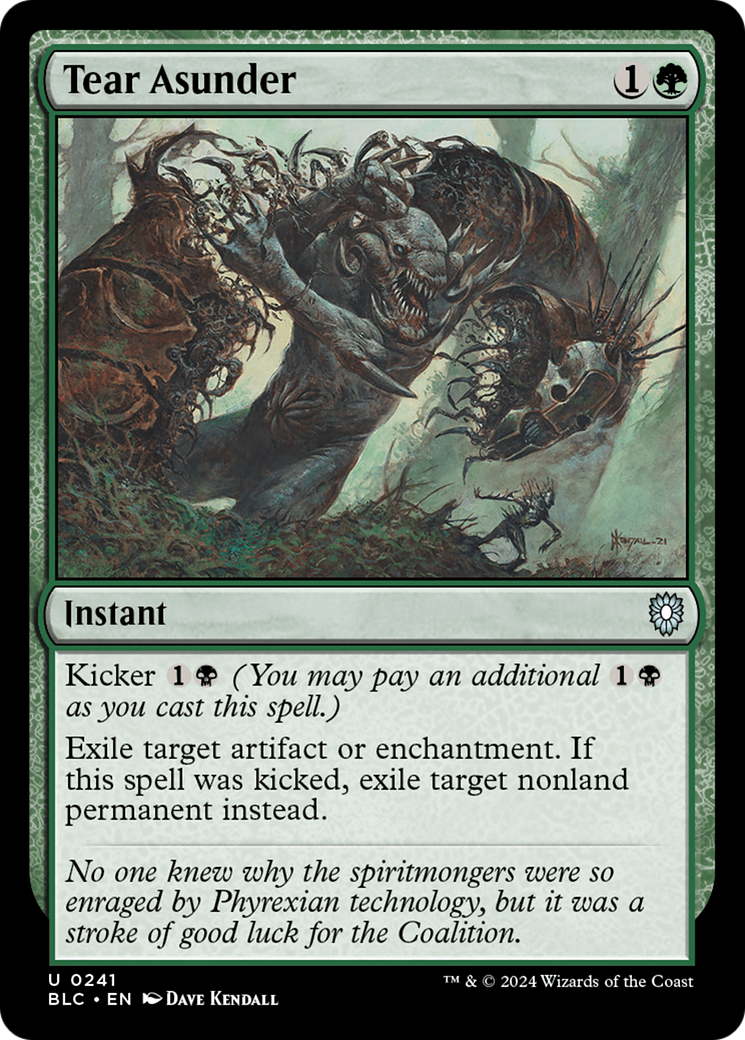
Tear Asunder
Tear Asunder
Instant
Kicker (You may pay an additional as you cast this spell.)
Exile target artifact or enchantment. If this spell was kicked, exile target nonland permanent instead.
- If you put a permanent with a kicker ability onto the battlefield without casting it, you can't kick it.
- If a spell's kicker cost was paid, the spell is "kicked."
- The kicker ability doesn't let you pay a kicker cost more than once.
- To determine a spell's total cost, start with the mana cost (or an alternative cost if another card's effect allows you to pay one instead), add any cost increases (such as kicker), then apply any cost reductions. The spell's mana value remains unchanged, no matter what the total cost to cast it was.
- If you copy a kicked spell on the stack, the copy is also kicked. If the copied spell is a permanent spell, the token the copy of that spell becomes when it enters is also kicked.
- If a card or token enters as a copy of a permanent, the new permanent isn't kicked, even if the original was.
- If Tear Asunder is kicked, it can target any nonland permanent, not just an artifact or enchantment.
-
1
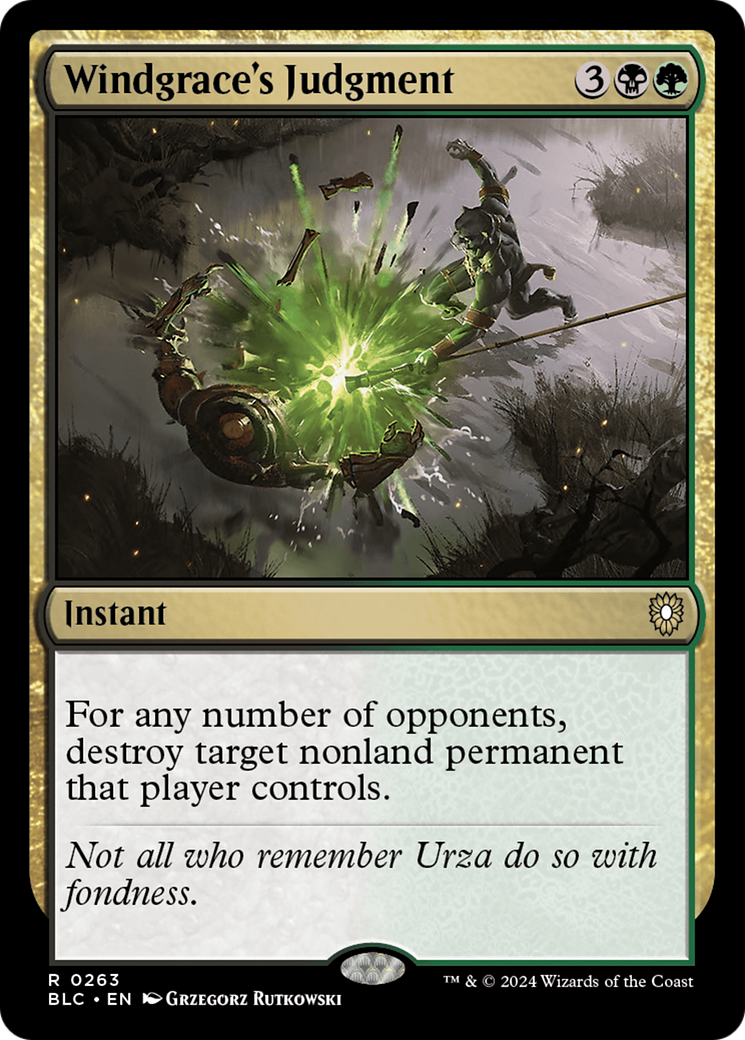
Windgrace's Judgment
Windgrace's Judgment
Instant
For any number of opponents, destroy target nonland permanent that player controls.
Sorceries 7
-
1
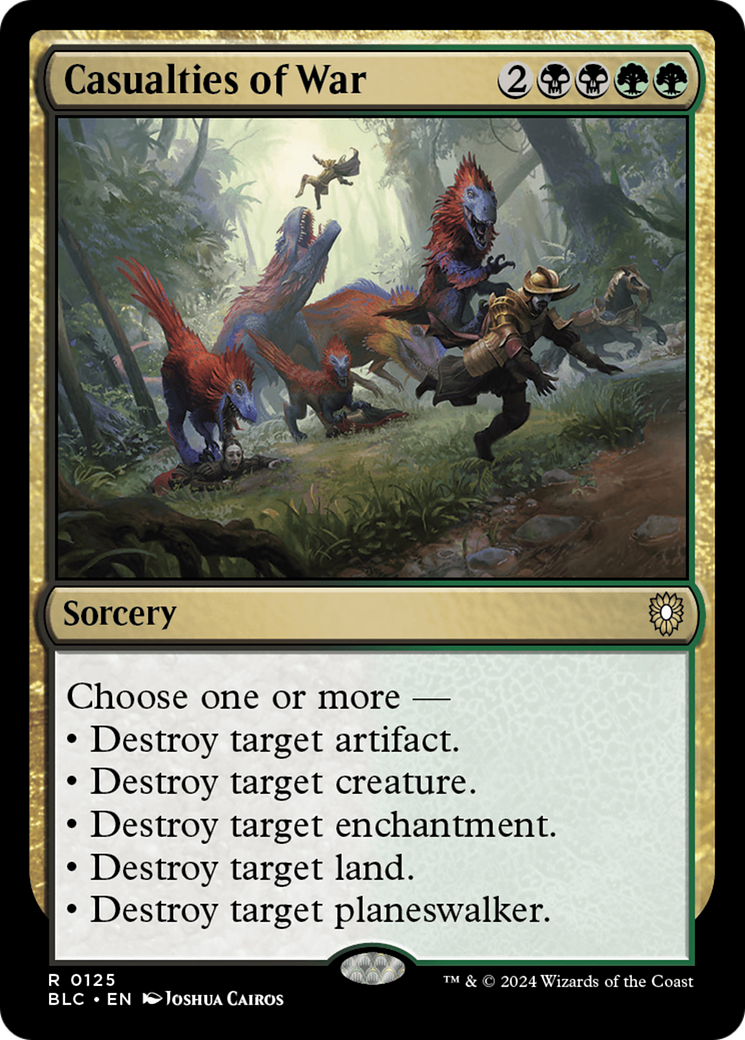
Casualties of War
Casualties of War
Sorcery
Choose one or more —
- Destroy target artifact.
- Destroy target creature.
- Destroy target enchantment.
- Destroy target land.
- Destroy target planeswalker.
- You can choose any number of the modes for Casualties of War, but you can't choose a mode more than once.
- Each target permanent is destroyed in the order specified. Abilities that trigger when one is destroyed won't be put onto the stack until Casualties of War has finished resolving.
-
1
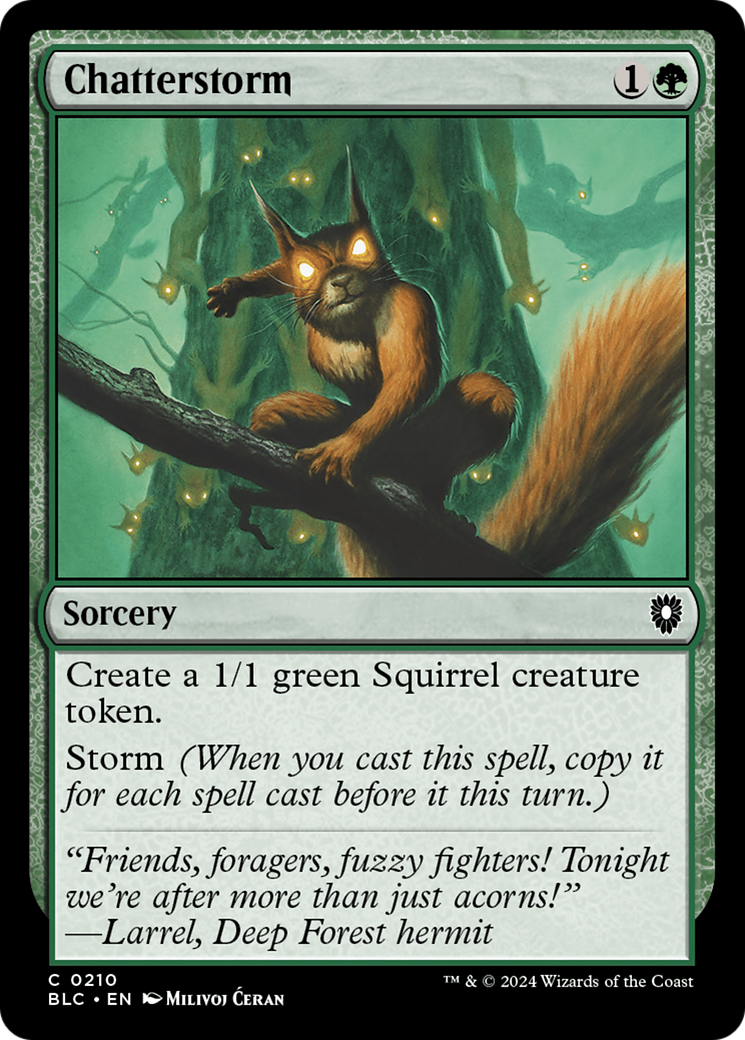
Chatterstorm
Chatterstorm
Sorcery
Create a 1/1 green Squirrel creature token.
Storm (When you cast this spell, copy it for each spell cast before it this turn.)
- The copies are put directly onto the stack. They aren't cast and won't be counted by other spells with storm cast later in the turn.
- Spells cast from zones other than a player's hand and spells that were countered or otherwise failed to resolve are counted by the storm ability.
- A copy of a spell can be countered like any other spell, but it must be countered individually. Countering a spell with storm won't affect the copies.
- The triggered ability that creates the copies can itself be countered by anything that can counter a triggered ability. If it is countered, no copies will be put onto the stack.
- If a spell with storm has targets, you may choose new targets for any of the copies. You can make different choices for each copy.
-
1
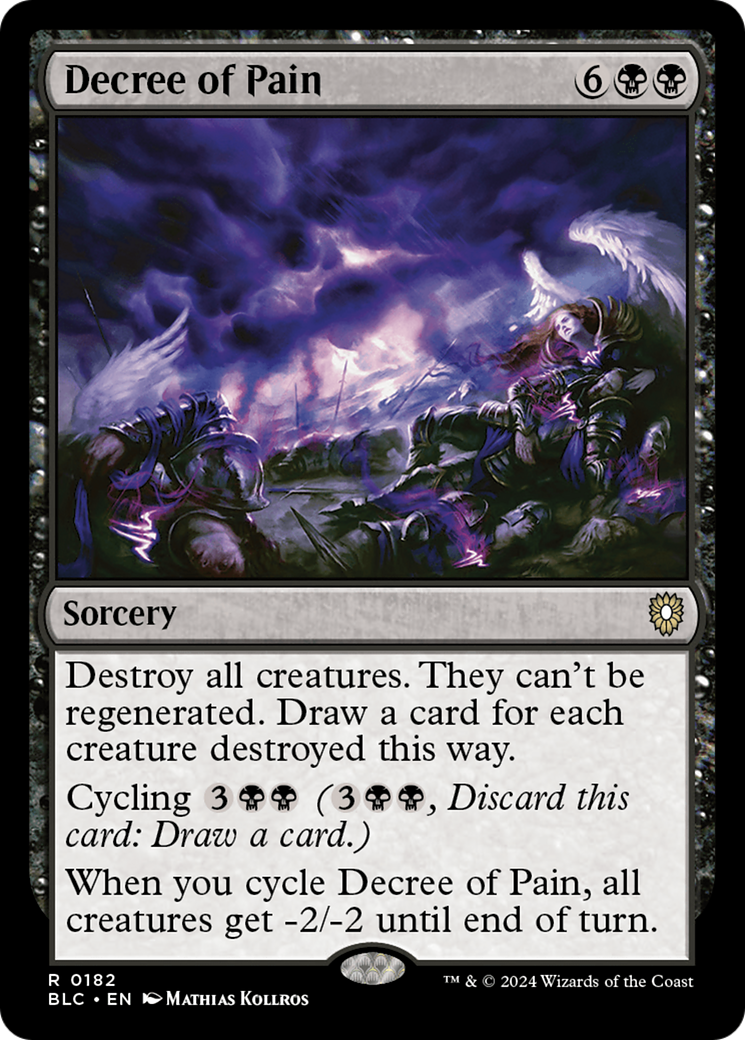
Decree of Pain
Decree of Pain
Sorcery
Destroy all creatures. They can't be regenerated. Draw a card for each creature destroyed this way.
Cycling ( , Discard this card: Draw a card.)
When you cycle this card, all creatures get -2/-2 until end of turn.
- When you cycle this card, first the cycling ability goes on the stack, then the triggered ability goes on the stack on top of it. The triggered ability will resolve before you draw a card from the cycling ability.
- The cycling ability and the triggered ability are separate. If the triggered ability doesn't resolve (because, for example, it has been countered, or all of its targets have become illegal), the cycling ability will still resolve, and you'll draw a card.
-
1
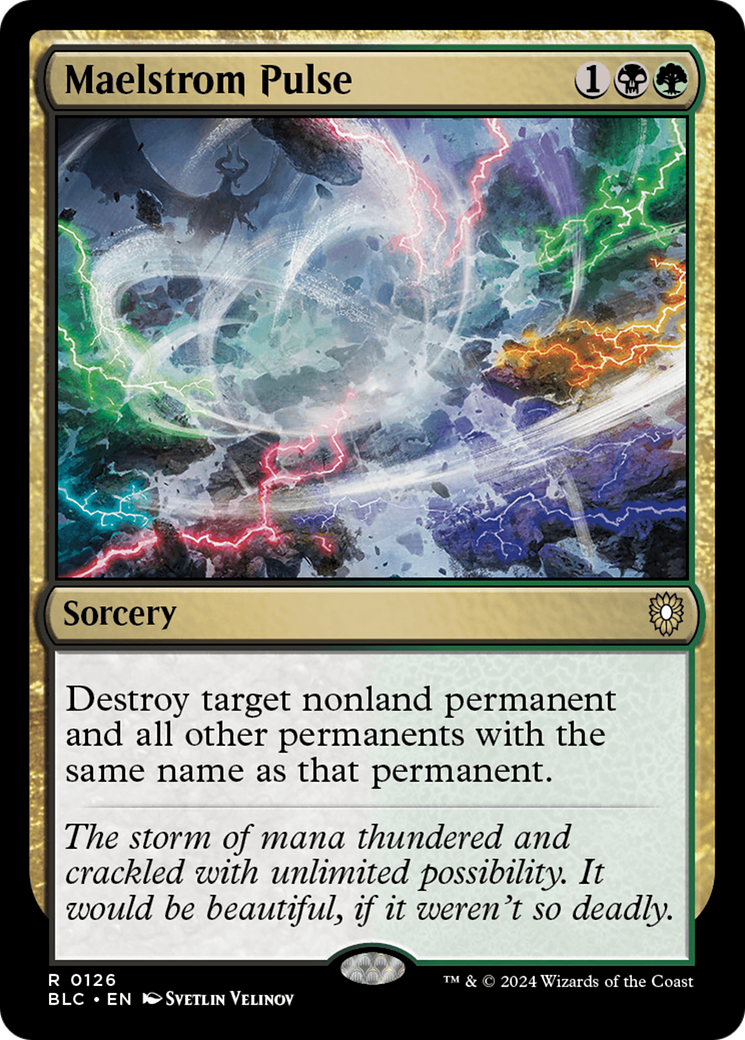
Maelstrom Pulse
Maelstrom Pulse
Sorcery
Destroy target nonland permanent and all other permanents with the same name as that permanent.
- Unless a token is a copy of another permanent or was explicitly given a name by the effect that created it, its name is the subtypes it was given when it was created plus the word "Token." For example, if an effect creates a 1/1 Soldier creature token, that token is named "Soldier Token."
- Maelstrom Pulse has only one target. Other permanents with the same name will be destroyed even if they have hexproof or protection.
- If the target permanent is an illegal target by the time Maelstrom Pulse tries to resolve, the spell won't resolve. You won't destroy any permanents at all. If the target is legal but not destroyed (most likely because it has indestructible), you do destroy other permanents with the same name.
-
1
Rootcast Apprenticeship
Rootcast Apprenticeship
Sorcery
Choose three. You may choose the same mode more than once.
- Put two +1/+1 counters on target creature.
- Create a token that's a copy of target token you control.
- Target player creates a 1/1 green Squirrel creature token.
- Target opponent sacrifices a nontoken artifact of their choice.
- You choose the modes as you cast the spell. Once modes are chosen, they can't be changed.
- You can select a mode only if there's a legal target available for that mode. Ignore the targeting requirements for modes you don't choose. Each time you select that mode, you can choose a different target, or you can choose the same target.
- No matter which combination of modes you choose, you always follow the instructions in the order they are written.
- If the same mode is chosen more than once, you choose their relative order as you cast the spell. For example, if you choose the last mode of Rootcast Apprenticeship more than once, you choose the relative order in which the target opponents sacrifice nontoken artifacts.
- No player can cast spells or activate abilities in between the modes of a resolving spell. Any abilities that trigger won't be put onto the stack until a spell is done resolving.
- If Rootcast Apprenticeship is copied, the effect that creates the copy will usually allow you to choose new targets, but you can't choose new modes.
- If all targets for the chosen modes become illegal before Rootcast Apprenticeship resolves, the spell will be countered and none of its effects will happen. If at least one target is still legal, the spell will resolve but will have no effect on any illegal targets.
-
1
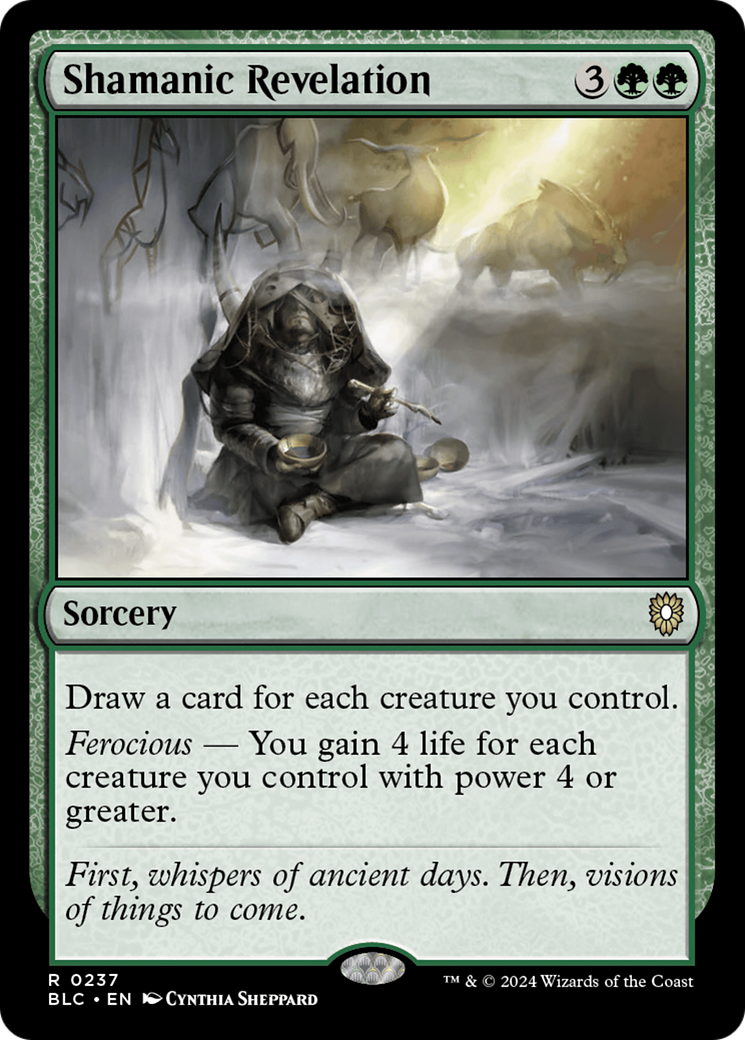
Shamanic Revelation
Shamanic Revelation
Sorcery
Draw a card for each creature you control.
Ferocious — You gain 4 life for each creature you control with power 4 or greater.
- After you draw cards while Shamanic Revelation is resolving, nothing else can happen before you gain the appropriate amount of life. Notably, abilities that trigger when you draw cards won't be put onto the stack until after you've gained life.
-
1
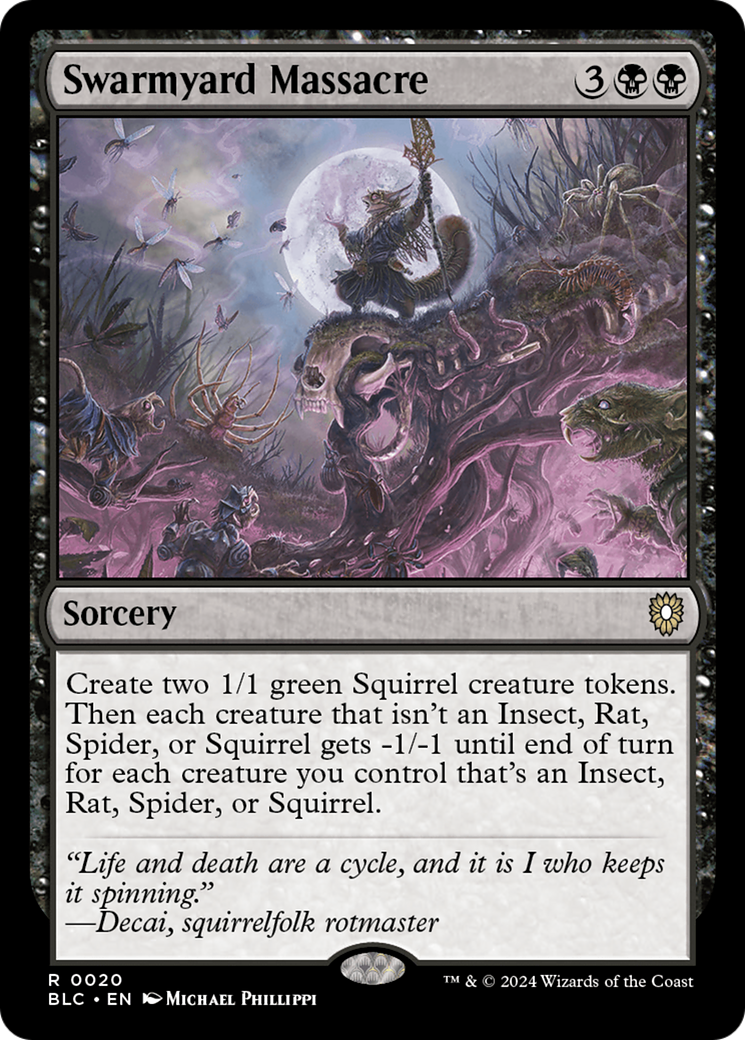
Swarmyard Massacre
Swarmyard Massacre
Sorcery
Create two 1/1 green Squirrel creature tokens. Then each creature that isn't an Insect, Rat, Spider, or Squirrel gets -1/-1 until end of turn for each creature you control that's an Insect, Rat, Spider, or Squirrel.
- If you control a creature that has more than one of the listed types (for example, Daggerfang Duo, which is a Rat Squirrel), it's only counted once for Swarmyard Massacre.
Artifacts 9
-
1
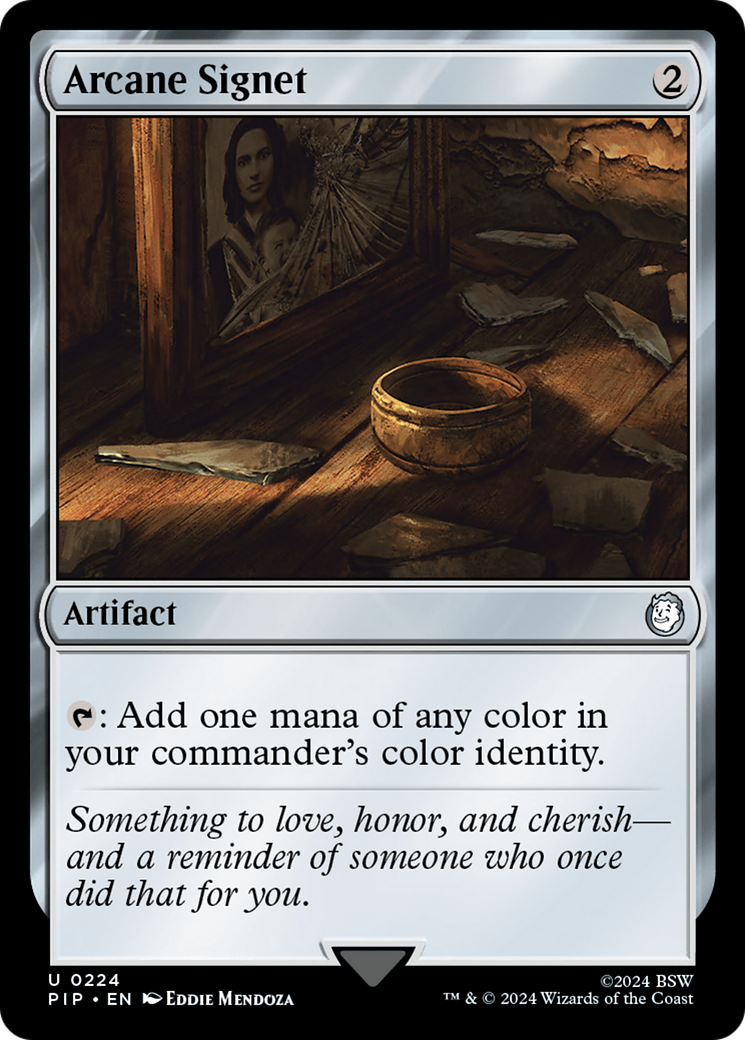
Arcane Signet
Arcane Signet
Artifact
: Add one mana of any color in your commander's color identity.
- If your commander is a card that has no colors in its color identity, Arcane Signet's ability produces no mana. It doesn't produce .
- If you have two commanders, the ability adds one mana of any color in their combined color identities.
- If you don't have a commander, Arcane Signet's ability produces no mana.
-
1
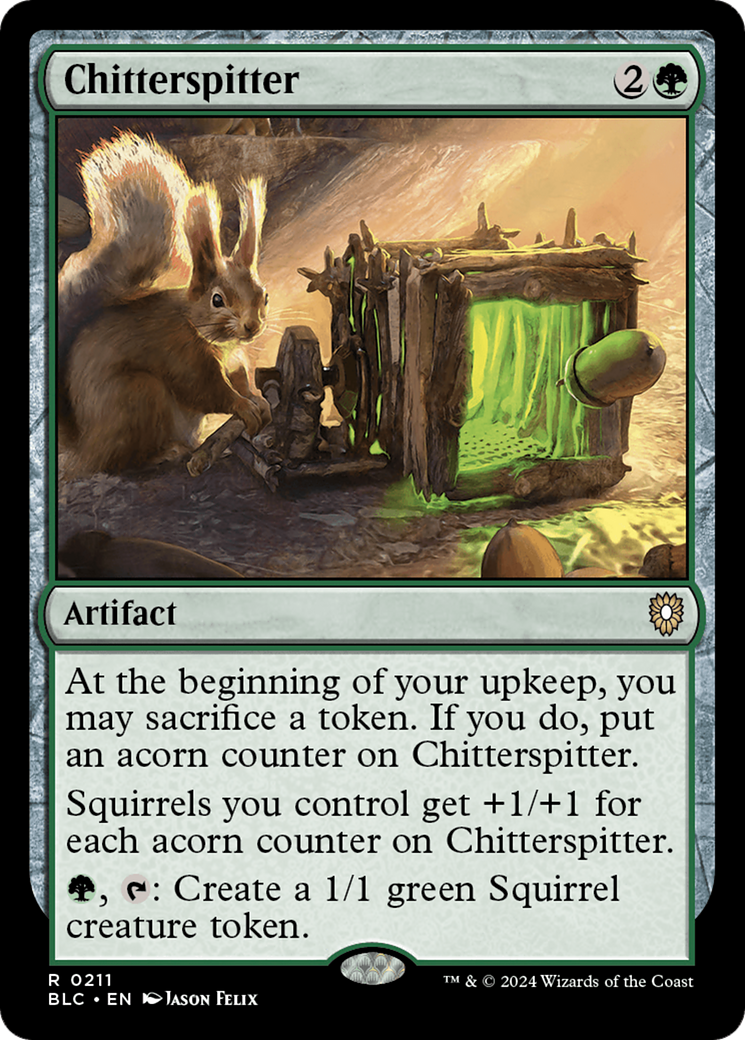
Chitterspitter
Chitterspitter
Artifact
At the beginning of your upkeep, you may sacrifice a token. If you do, put an acorn counter on this artifact.
Squirrels you control get +1/+1 for each acorn counter on this artifact.
, : Create a 1/1 green Squirrel creature token.
-
1
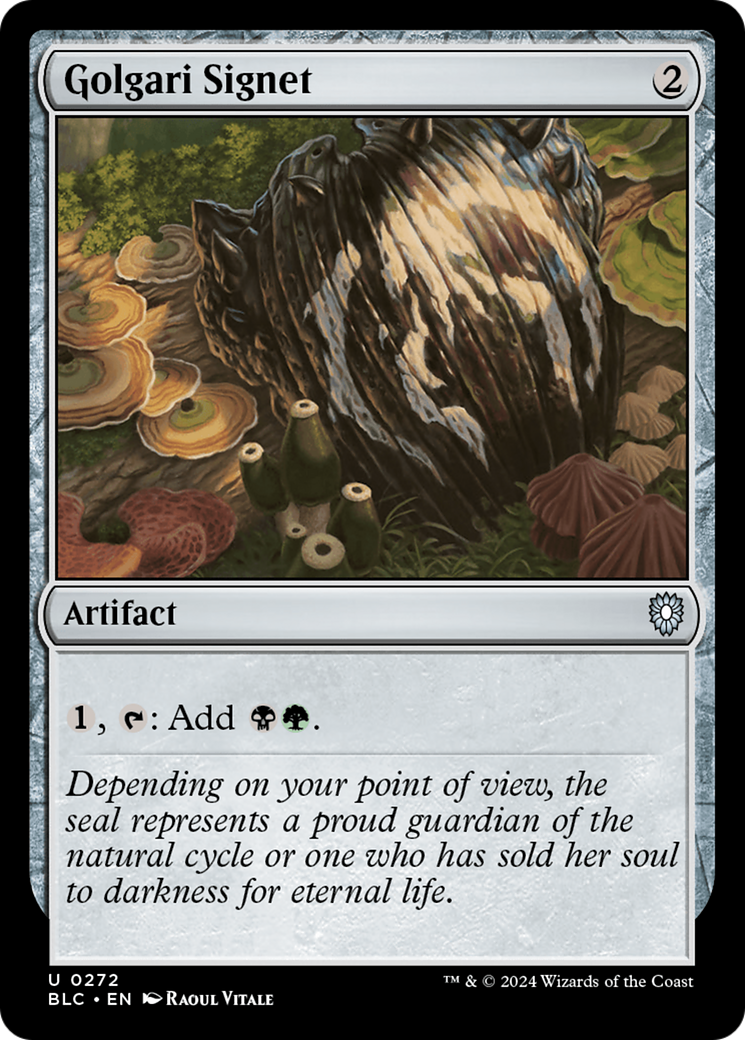
Golgari Signet
Golgari Signet
Artifact
, : Add .
-
1
Idol of Oblivion
Idol of Oblivion
Artifact
: Draw a card. Activate only if you created a token this turn.
, , Sacrifice this artifact: Create a 10/10 colorless Eldrazi creature token.
- You can activate Idol of Oblivion's first ability even if the token you've created was created before Idol of Oblivion entered the battlefield or if the token has left the battlefield.
-
1
Maskwood Nexus
Maskwood Nexus
Artifact
Creatures you control are every creature type. The same is true for creature spells you control and creature cards you own that aren't on the battlefield.
, : Create a 2/2 blue Shapeshifter creature token with changeling. (It is every creature type.)
- Replacement effects that modify how creatures of a certain creature type enter the battlefield will apply after you apply the effect of Maskwood Nexus. For example, if you control Maskwood Nexus and an effect says that each Warrior you control enters the battlefield with an additional +1/+1 counter on it, any creature that enters the battlefield under your control will get that counter.
- The tokens created by the activated ability will continue to have all creature types if Maskwood Nexus leaves the battlefield because those tokens have changeling. Other creatures you control will revert to their usual creature types unless another relevant effect is affecting them.
- Changeling is a characteristic-defining ability. It functions in all zones, not only while a card that has it is on the battlefield.
- The subtype Shapeshifter that appears on the type line is mostly there to reinforce the flavor. A creature card with changeling is just as much an Elf, a Dwarf, a Sliver, a Goat, a Coward, and a Zombie as it is a Shapeshifter.
- If an effect causes a creature with changeling to become a new creature type, it will be only that new creature type. It will still have changeling; the effect making it all creature types will simply be overwritten.
- If an effect causes a creature with changeling to lose all abilities, it will remain all creature types, even though it will no longer have changeling. This is because changeling applies before the effect that removes it.
-
1
Skullclamp
Skullclamp
Artifact — Equipment
Equipped creature gets +1/-1.
Whenever equipped creature dies, draw two cards.
Equip
-
1
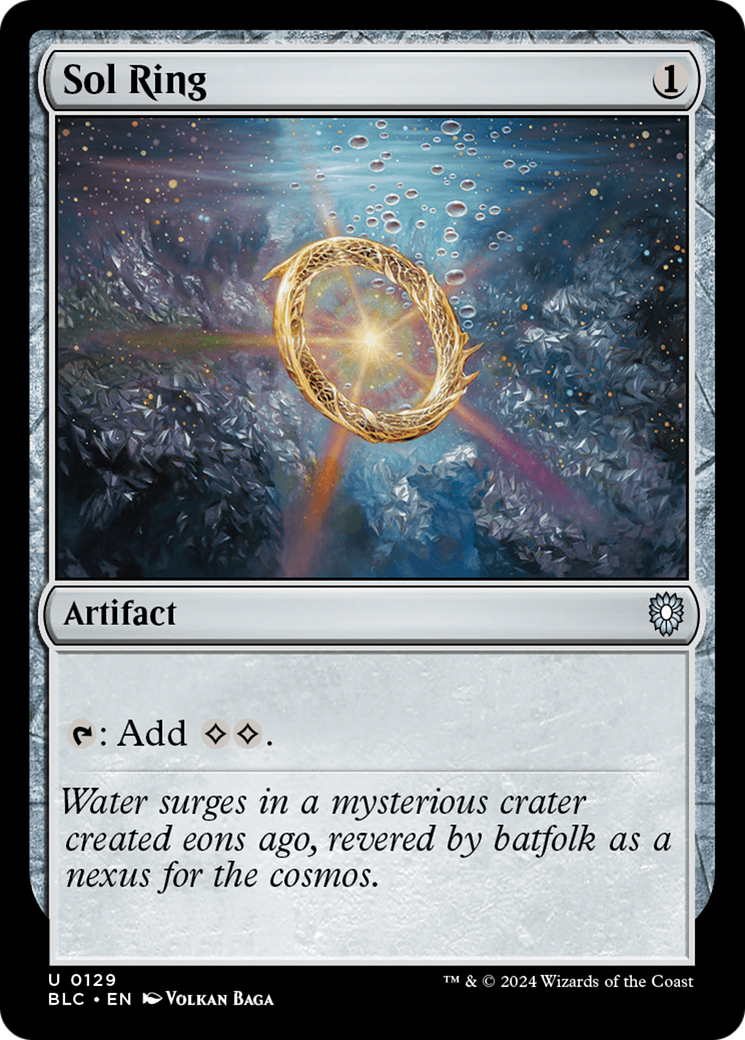
Sol Ring
Sol Ring
Artifact
: Add .
-
1
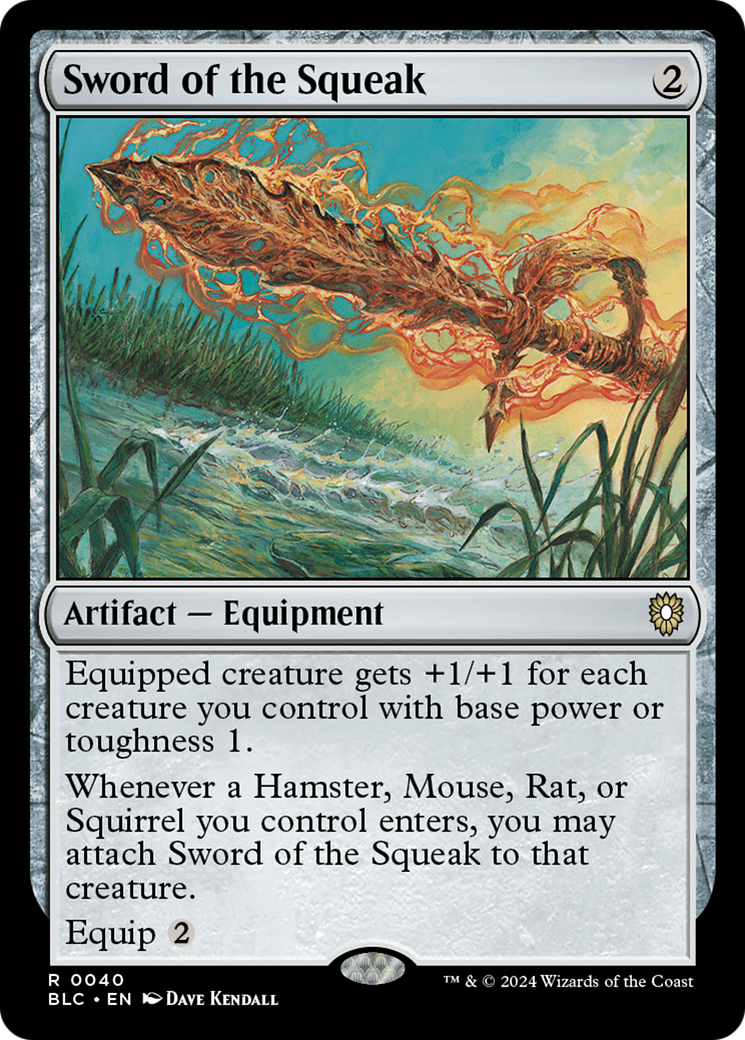
Sword of the Squeak
Sword of the Squeak
Artifact — Equipment
Equipped creature gets +1/+1 for each creature you control with base power or toughness 1.
Whenever a Hamster, Mouse, Rat, or Squirrel you control enters, you may attach this Equipment to that creature.
Equip
- Normally, a creature's base power and toughness are the power and toughness printed on the card or, for a token, the power and toughness set by the effect that created it. If another effect sets a creature's power and toughness to specific numbers or values, those become its base power and toughness. If an effect modifies a creature's power and/or toughness without setting them, that is not included when determining its base power and toughness.
- If a creature has a characteristic-defining ability that sets its power and toughness, indicated with a */* or similar in the power and toughness box, that ability is taken into account when determining its base power and toughness.
- Some creatures have base power and toughness 0/0 and an ability that gives them a bonus based on some criteria. Those are not characteristic-defining abilities, and that ability doesn't change its base power and toughness.
-
1
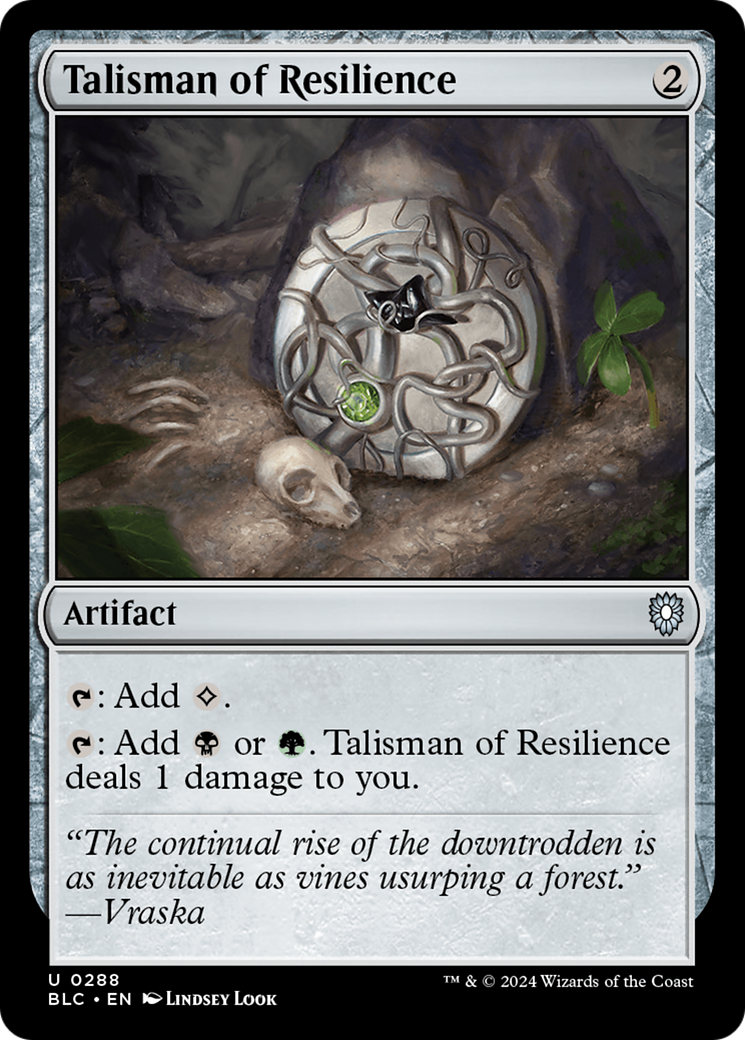
Talisman of Resilience
Talisman of Resilience
Artifact
: Add .
: Add or . This artifact deals 1 damage to you.
Enchantments 7
-
1
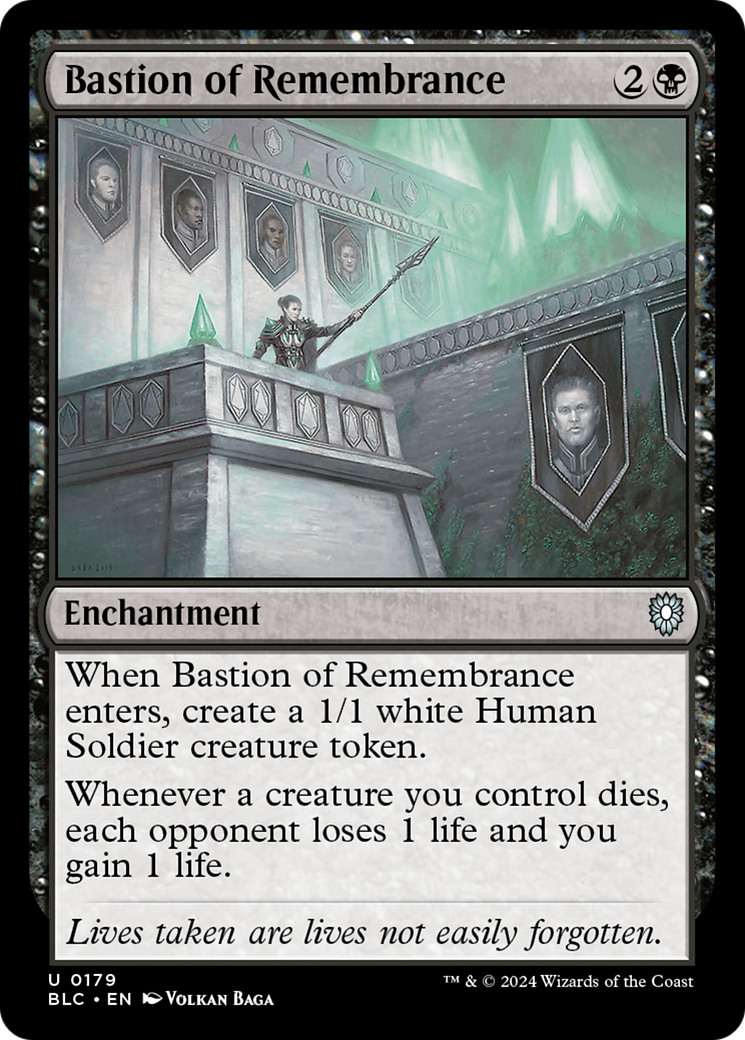
Bastion of Remembrance
Bastion of Remembrance
Enchantment
When this enchantment enters, create a 1/1 white Human Soldier creature token.
Whenever a creature you control dies, each opponent loses 1 life and you gain 1 life.
- If one or more creatures you control die at the same time that Bastion of Remembrance leaves the battlefield, its last ability triggers for each of those creatures.
- If your life total is brought to 0 or less at the same time that creatures you control are dealt lethal damage, you lose the game before the last ability goes on the stack.
- In a Two-Headed Giant game, Bastion of Remembrance's last ability causes the opposing team to lose 2 life and you to gain 1 life.
-
1
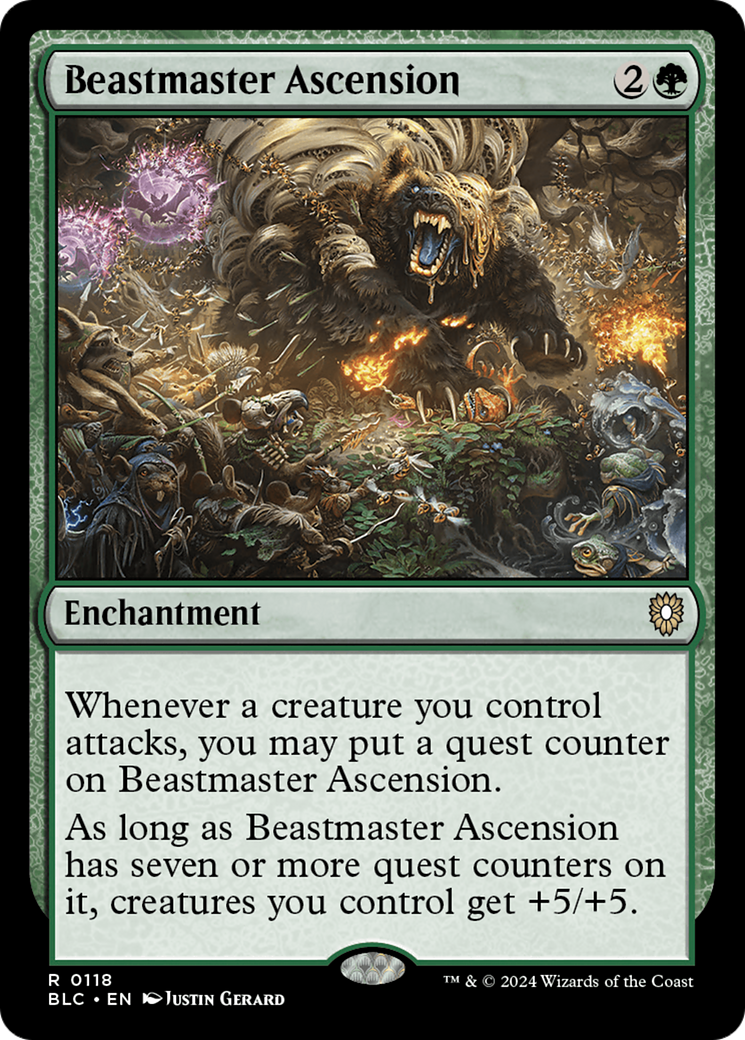
Beastmaster Ascension
Beastmaster Ascension
Enchantment
Whenever a creature you control attacks, you may put a quest counter on this enchantment.
As long as this enchantment has seven or more quest counters on it, creatures you control get +5/+5.
- If you attack with multiple creatures, Beastmaster Ascension's first ability triggers multiple times.
-
1
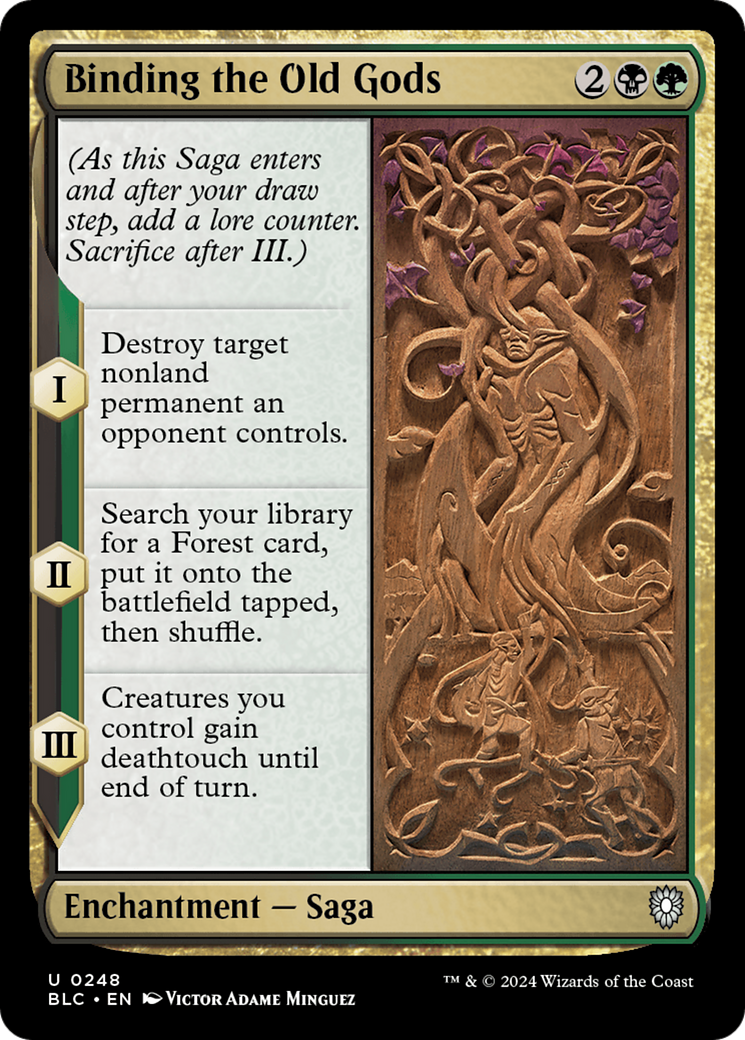
Binding the Old Gods
Binding the Old Gods
Enchantment — Saga
(As this Saga enters and after your draw step, add a lore counter. Sacrifice after III.)
I — Destroy target nonland permanent an opponent controls.
II — Search your library for a Forest card, put it onto the battlefield tapped, then shuffle.
III — Creatures you control gain deathtouch until end of turn.
- As a Saga enters the battlefield, its controller puts a lore counter on it. As your precombat main phase begins (immediately after your draw step), you put another lore counter on each Saga you control. Putting a lore counter on a Saga in either of these ways doesn't use the stack.
- Each symbol on the left of a Saga's text box represents a chapter ability. A chapter ability is a triggered ability that triggers when a lore counter that is put on the Saga causes the number of lore counters on the Saga to become equal to or greater than the ability's chapter number. Chapter abilities are put onto the stack and may be responded to.
- A chapter ability doesn't trigger if a lore counter is put on a Saga that already had a number of lore counters greater than or equal to that chapter's number. For example, the third lore counter put on a Saga causes the chapter III ability to trigger, but chapters I and II won't trigger again.
- Once a chapter ability has triggered, the ability on the stack won't be affected if the Saga gains or loses counters, or if it leaves the battlefield.
- If multiple chapter abilities trigger at the same time, their controller puts them on the stack in any order. If any of them require targets, those targets are chosen as you put the abilities on the stack, before any of those abilities resolve.
- Removing lore counters won't cause a previous chapter ability to trigger. If lore counters are removed from a Saga, the appropriate chapter abilities will trigger again when the Saga receives more lore counters.
- Once the number of lore counters on a Saga is greater than or equal to the greatest number among its chapter abilities, the Saga's controller sacrifices it as soon as its chapter ability has left the stack, most likely by resolving or being countered. This state-based action doesn't use the stack.
-
1
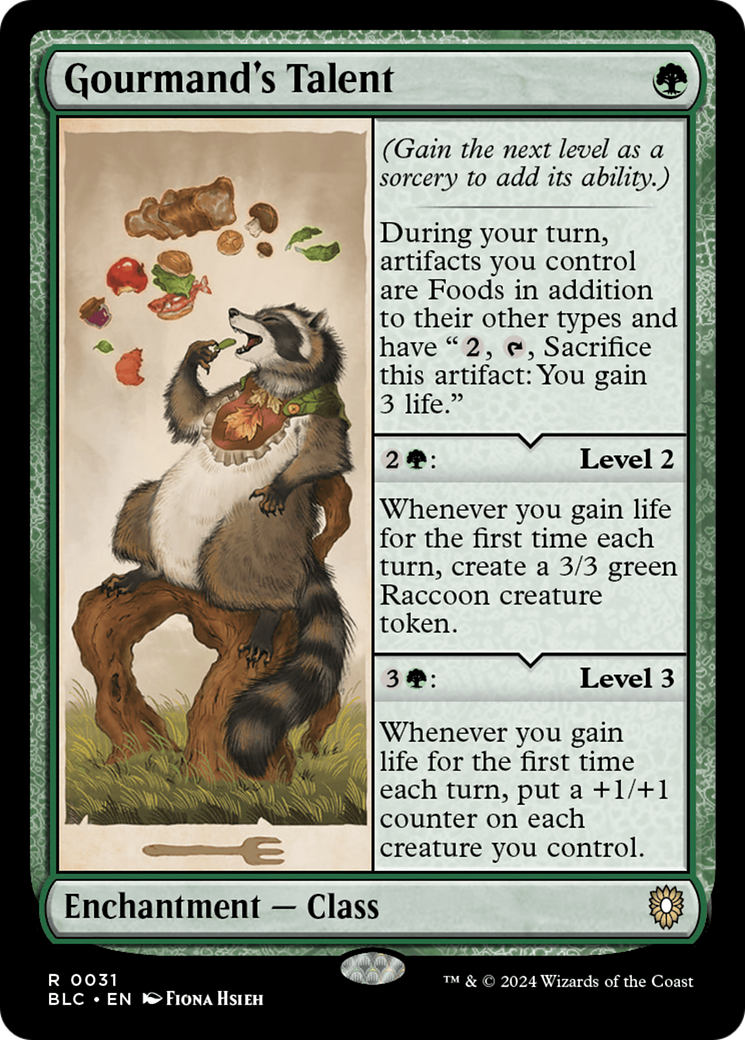
Gourmand's Talent
Gourmand's Talent
Enchantment — Class
(Gain the next level as a sorcery to add its ability.)
During your turn, artifacts you control are Foods in addition to their other types and have " , , Sacrifice this artifact: You gain 3 life."
: Level 2
Whenever you gain life for the first time each turn, create a 3/3 green Raccoon creature token.
: Level 3
Whenever you gain life for the first time each turn, put a +1/+1 counter on each creature you control.
- Food is an artifact type. Even though it appears on some creatures, it's never a creature type.
- You can't sacrifice a Food to pay multiple costs. For example, you can't sacrifice a Food token to activate its own ability and also to activate Maraleaf Rider's ability.
- Whatever you do, don't eat the delicious cards.
- Each Class has five abilities. The three in the major sections of its text box are class abilities. Class abilities can be static, activated, or triggered abilities. The other two are level abilities, one activated ability to advance the Class to level 2 and another to advance the Class to level 3.
- Each Class starts with only the first of its three class abilities. As the first level ability resolves, the Class becomes level 2 and gains the second class ability. As the second level ability resolves, the Class becomes level 3 and gains the third class ability.
- Gaining a level won't remove abilities that a Class had at a previous level.
- The artifacts retain any types, subtypes, supertypes, and abilities they have.
- You can't activate the first level ability of a Class unless that Class is level 1. Similarly, you can't activate the second level ability of a Class unless that Class is level 2.
- There's no restriction on how many Class permanents you can control, whether they're the same or different classes. Each Class permanent tracks its own level separately.
- Gaining a level is a normal activated ability. It uses the stack and can be responded to.
- If Gourmand's Talent somehow becomes an artifact, it will also be a Food during your turn.
- The level 2 and level 3 class abilities of Gourmand's Talent won't trigger if you already gained life earlier in the turn on which it gained those levels, even if you gain life again later in the turn.
-
1
Moldervine Reclamation
Moldervine Reclamation
Enchantment
Whenever a creature you control dies, you gain 1 life and draw a card.
- If Moldervine Reclamation leaves the battlefield at the same time that one or more creatures you control die, its ability triggers for each of those creatures.
- If a creature you control dies at the same time that your life total becomes 0 or less, you lose the game before Moldervine Reclamation's ability can save you.
-
1
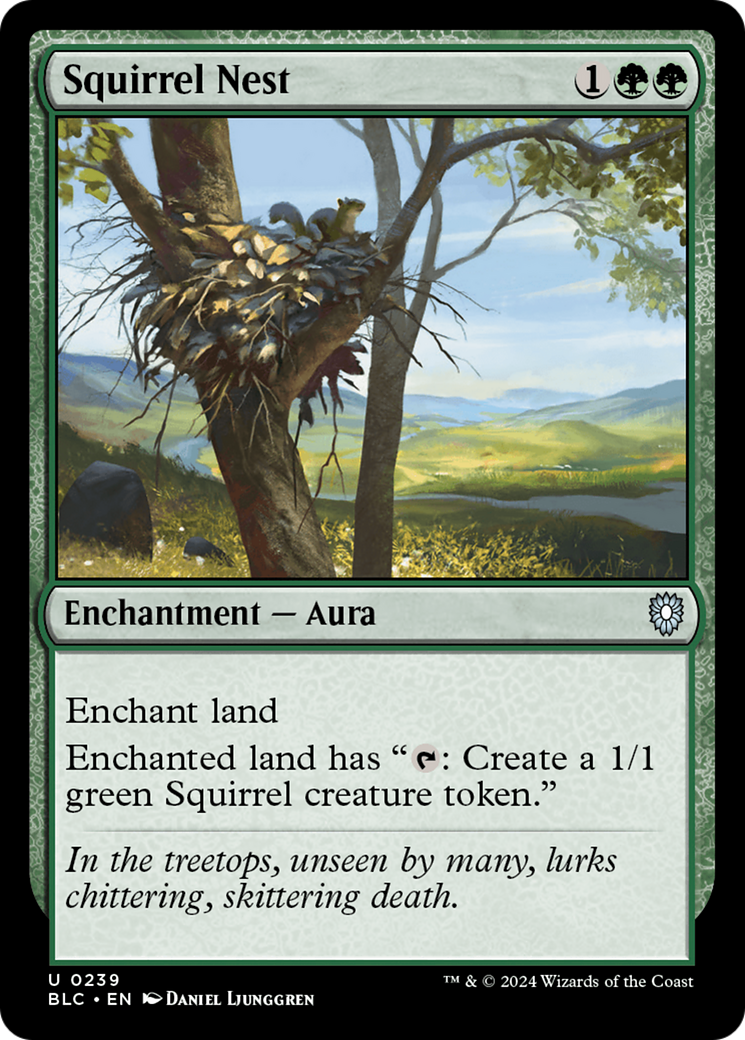
Squirrel Nest
Squirrel Nest
Enchantment — Aura
Enchant land
Enchanted land has " : Create a 1/1 green Squirrel creature token."
-
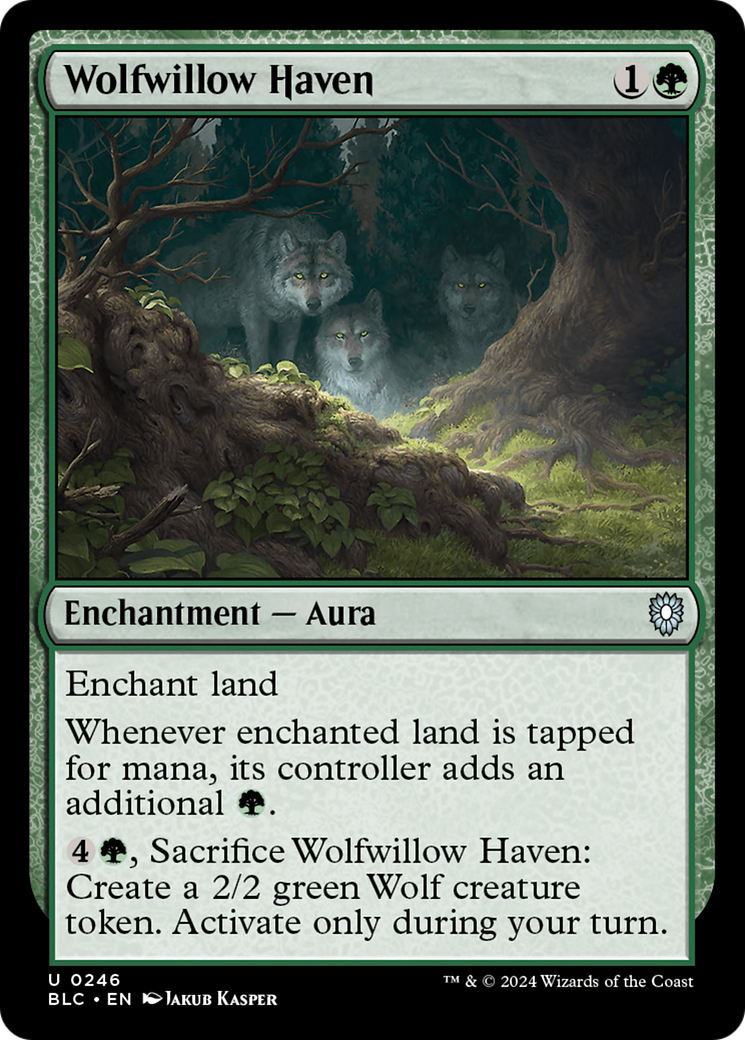
1
Wolfwillow Haven
Wolfwillow Haven
Enchantment — Aura
Enchant land
Whenever enchanted land is tapped for mana, its controller adds an additional .
, Sacrifice this Aura: Create a 2/2 green Wolf creature token. Activate only during your turn.
Lands 38
-
1
Barren Moor
Barren Moor
Land
This land enters tapped.
: Add .
Cycling ( , Discard this card: Draw a card.)
- Cycling is an activated ability. Effects that interact with activated abilities (such as Stifle or Rings of Brighthearth) will interact with cycling. Effects that interact with spells (such as Remove Soul or Faerie Tauntings) will not.
-
1
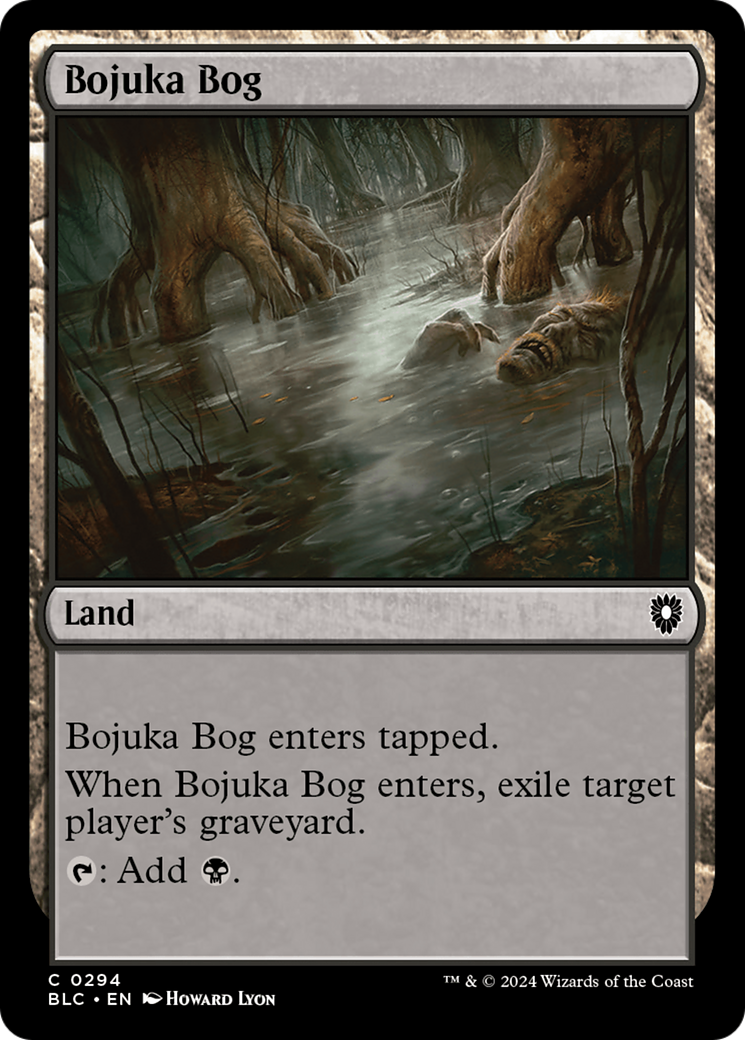
Bojuka Bog
Bojuka Bog
Land
This land enters tapped.
When this land enters, exile target player's graveyard.
: Add .
-
1
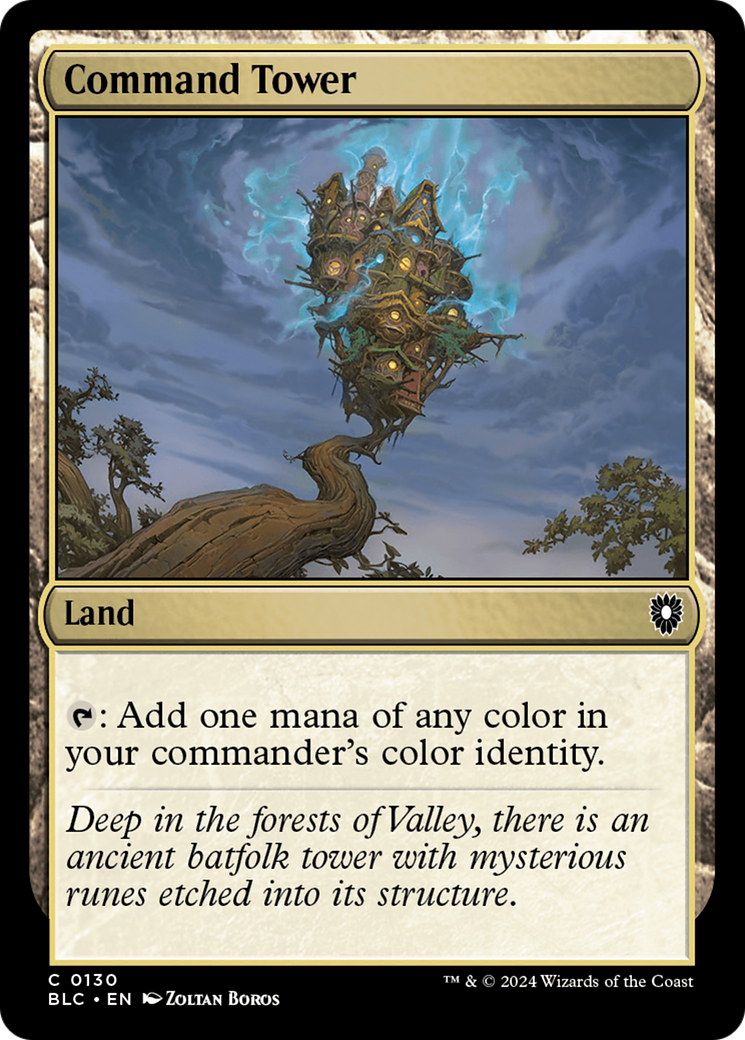
Command Tower
Command Tower
Land
: Add one mana of any color in your commander's color identity.
- If you have two commanders, the ability adds one mana of any color in their combined color identities.
- If your commander is a card that has no colors in its color identity, Command Tower's ability produces no mana. It doesn't produce .
- If you don't have a commander, Command Tower's ability produces no mana.
-
1
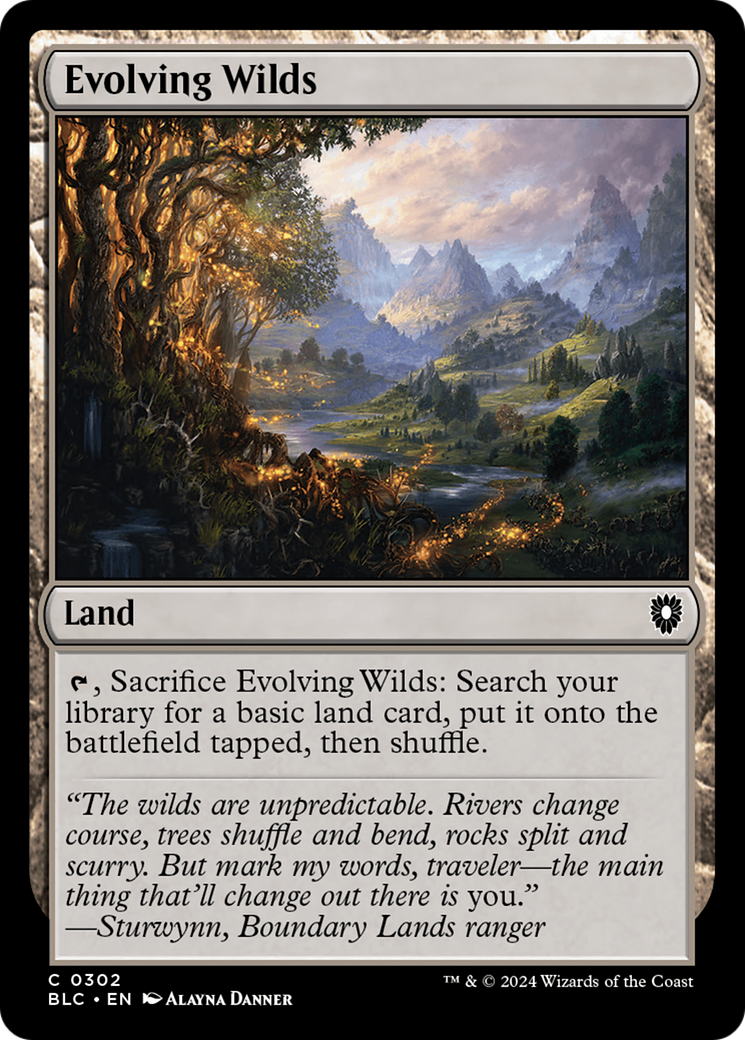
Evolving Wilds
Evolving Wilds
Land
, Sacrifice this land: Search your library for a basic land card, put it onto the battlefield tapped, then shuffle.
-
1
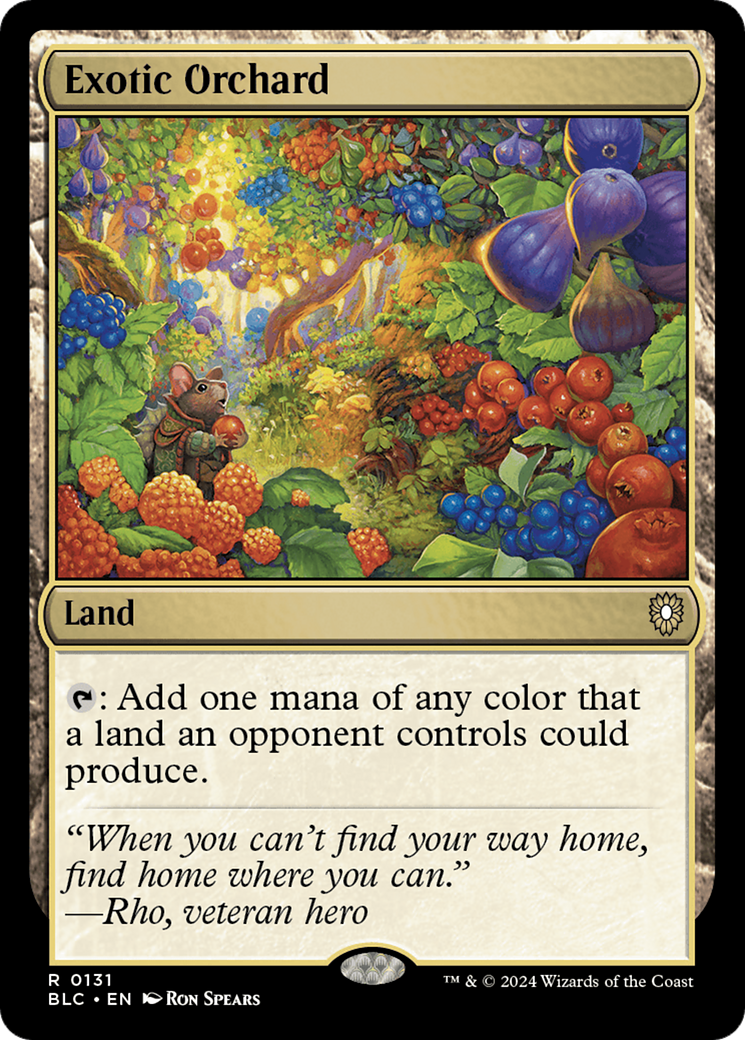
Exotic Orchard
Exotic Orchard
Land
: Add one mana of any color that a land an opponent controls could produce.
- The colors of mana are white, blue, black, red, and green. Exotic Orchard can't be tapped for colorless mana, even if a land an opponent controls could produce colorless mana.
- Exotic Orchard checks the effects of all mana-producing abilities of lands your opponents control, but it doesn't check their costs. For example, Vivid Crag has the ability " , Remove a charge counter from Vivid Crag: Add one mana of any color." If an opponent controls Vivid Crag and you control Exotic Orchard, you can tap Exotic Orchard for any color of mana. It doesn't matter whether Vivid Crag has a charge counter on it, and it doesn't matter whether it's untapped.
- When determining what colors of mana your opponents' lands could produce, Exotic Orchard takes into account any applicable replacement effects that would apply to those lands' mana abilities (such as Contamination's effect, for example). If there are more than one, consider them in any possible order.
- Exotic Orchard doesn't care about any restrictions or riders your opponents' lands (such as Ancient Ziggurat or Hall of the Bandit Lord) put on the mana they produce. It just cares about colors of mana.
- Lands that produce mana based only on what other lands "could produce" won't help each other unless some other land allows one of them to actually produce some type of mana. For example, if you control an Exotic Orchard and your opponent controls an Exotic Orchard and a Reflecting Pool, none of those lands would produce mana if their mana abilities were activated. On the other hand, if you control a Forest and an Exotic Orchard, and your opponent controls an Exotic Orchard and a Reflecting Pool, then each of those lands can be tapped to produce . Your opponent's Exotic Orchard can produce because you control a Forest. Your Exotic Orchard and your opponent's Reflecting Pool can each produce because your opponent's Exotic Orchard can produce .
-
9
Forest
Forest
Basic Land — Forest
( : Add .)
-
1
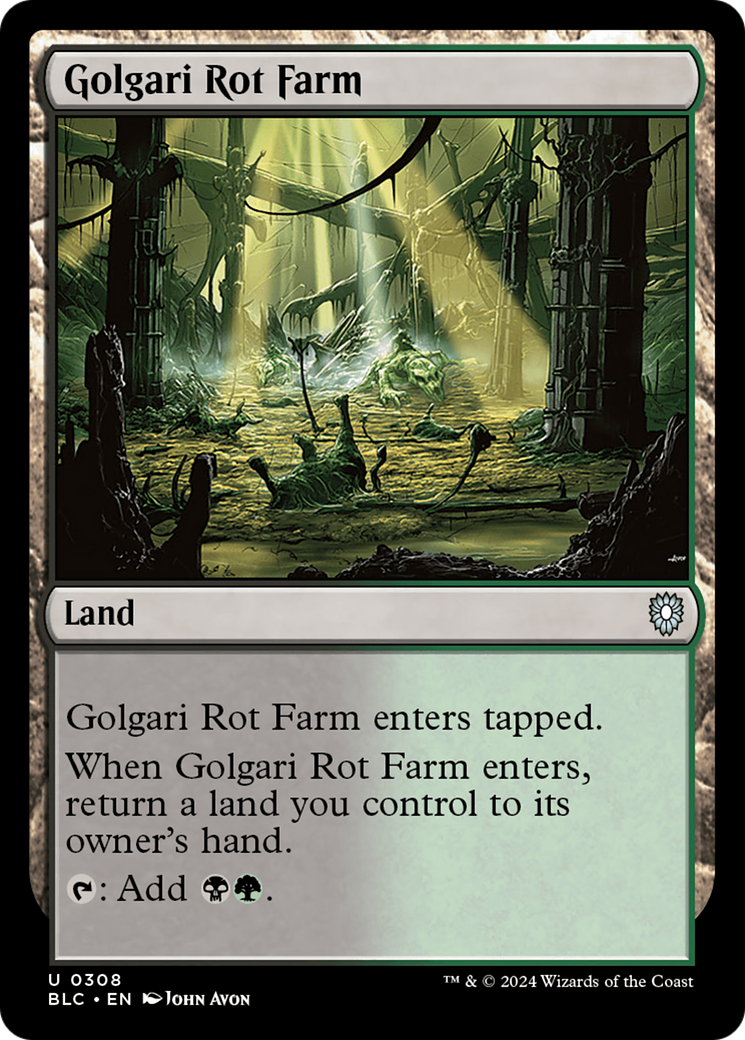
Golgari Rot Farm
Golgari Rot Farm
Land
This land enters tapped.
When this land enters, return a land you control to its owner's hand.
: Add .
- If this land enters the battlefield and you control no other lands, its ability will force you to return it to your hand.
-
1
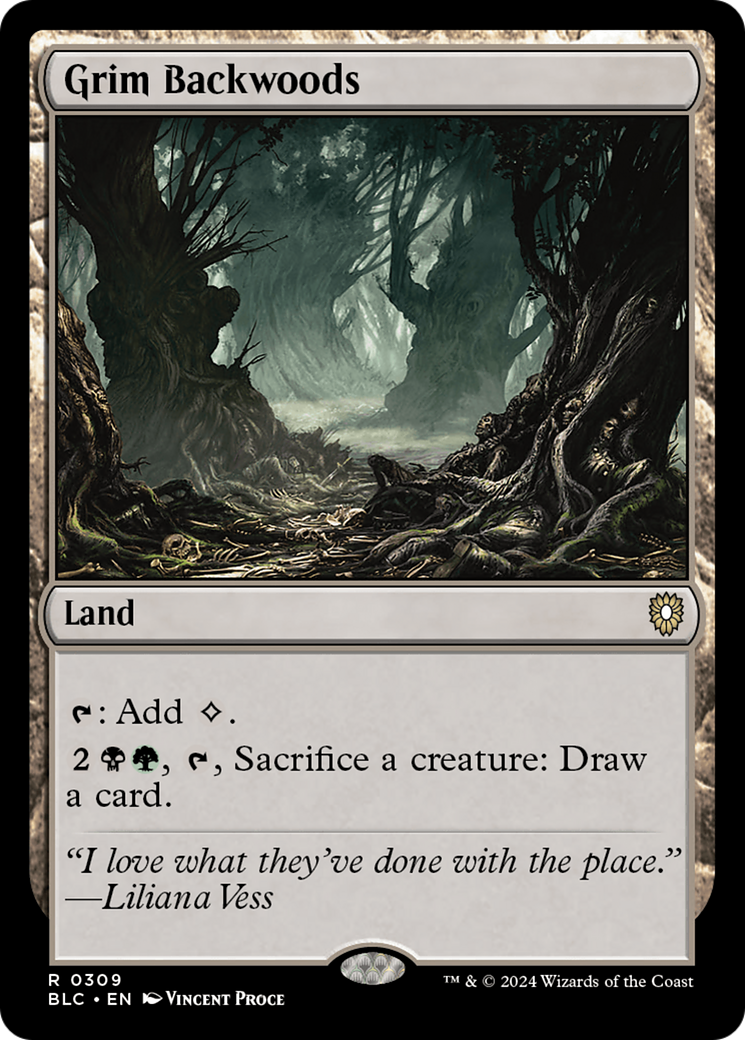
Grim Backwoods
Grim Backwoods
Land
: Add .
, , Sacrifice a creature: Draw a card.
-
1
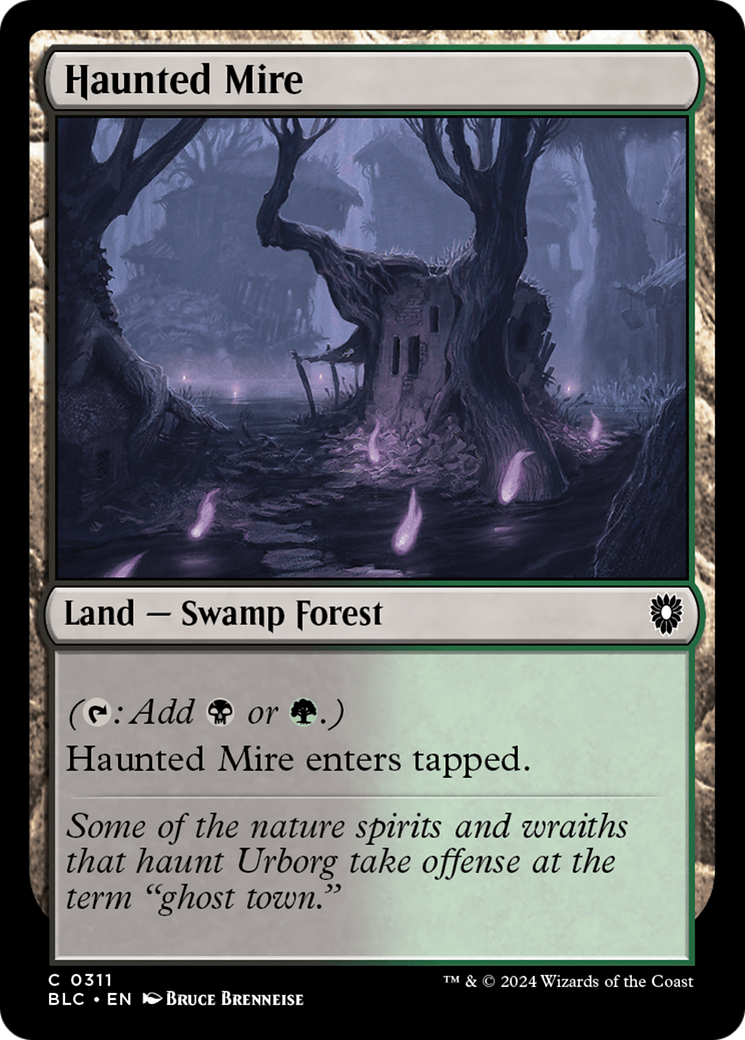
Haunted Mire
Haunted Mire
Land — Swamp Forest
( : Add or .)
This land enters tapped.
-
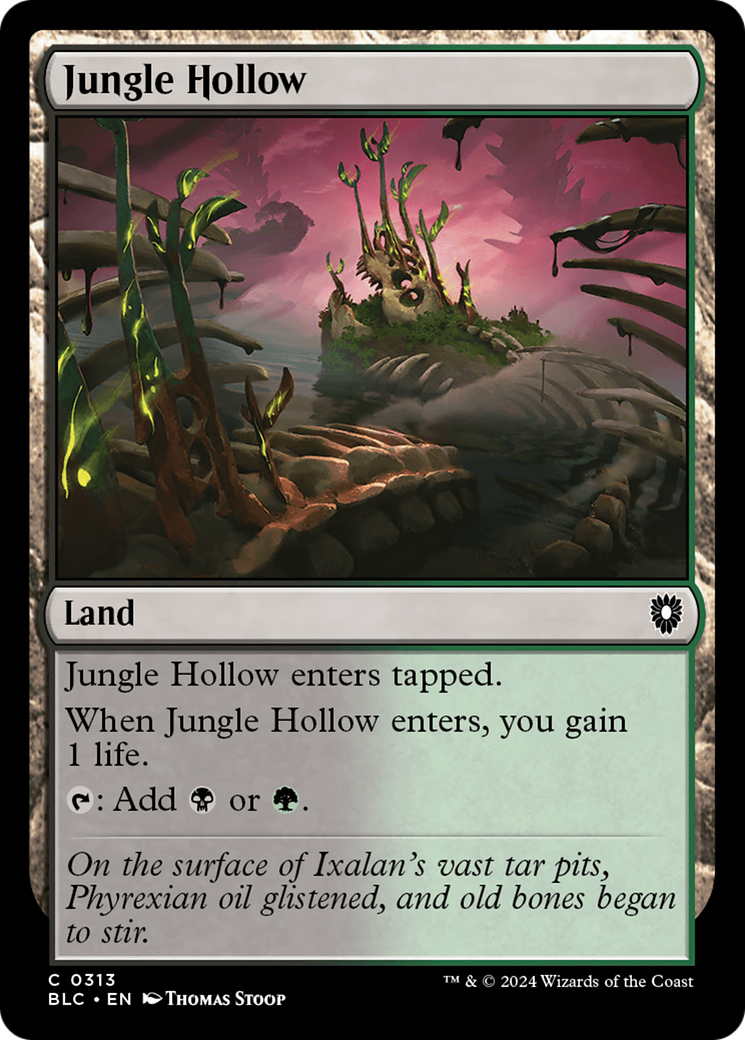
1
Jungle Hollow
Jungle Hollow
Land
This land enters tapped.
When this land enters, you gain 1 life.
: Add or .
-
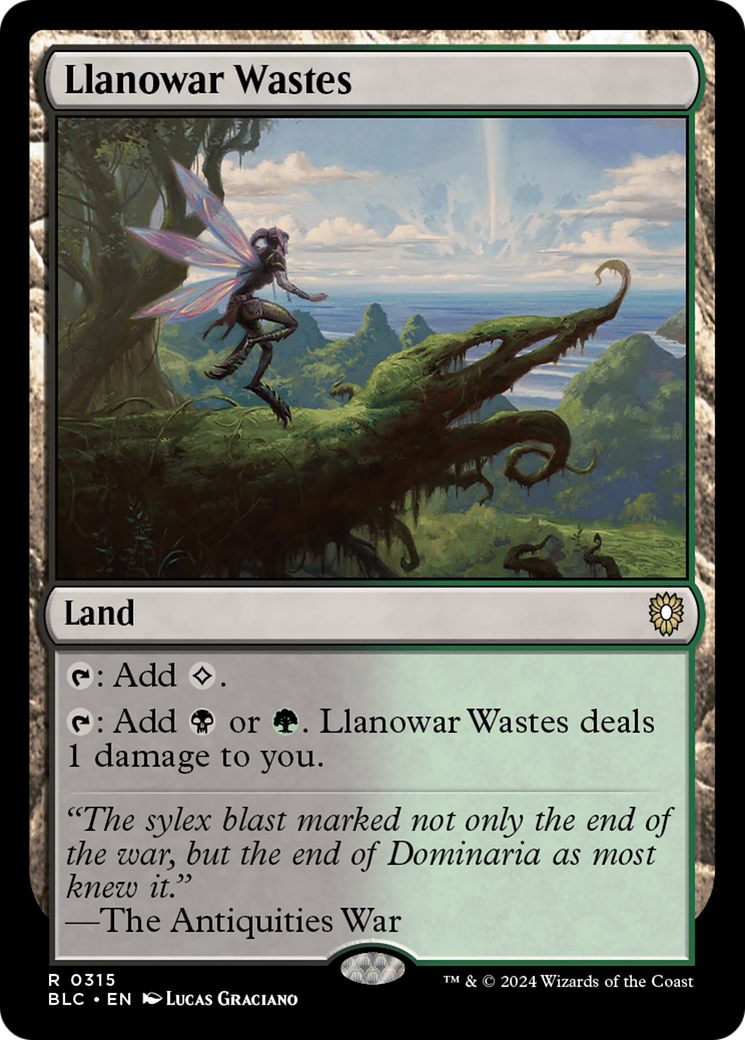
1
Llanowar Wastes
Llanowar Wastes
Land
: Add .
: Add or . This land deals 1 damage to you.
- The damage dealt to you is part of the second mana ability. It doesn't use the stack and can't be responded to.
- Like most lands, each land in this cycle is colorless. The damage dealt to you is dealt by a colorless source.
-
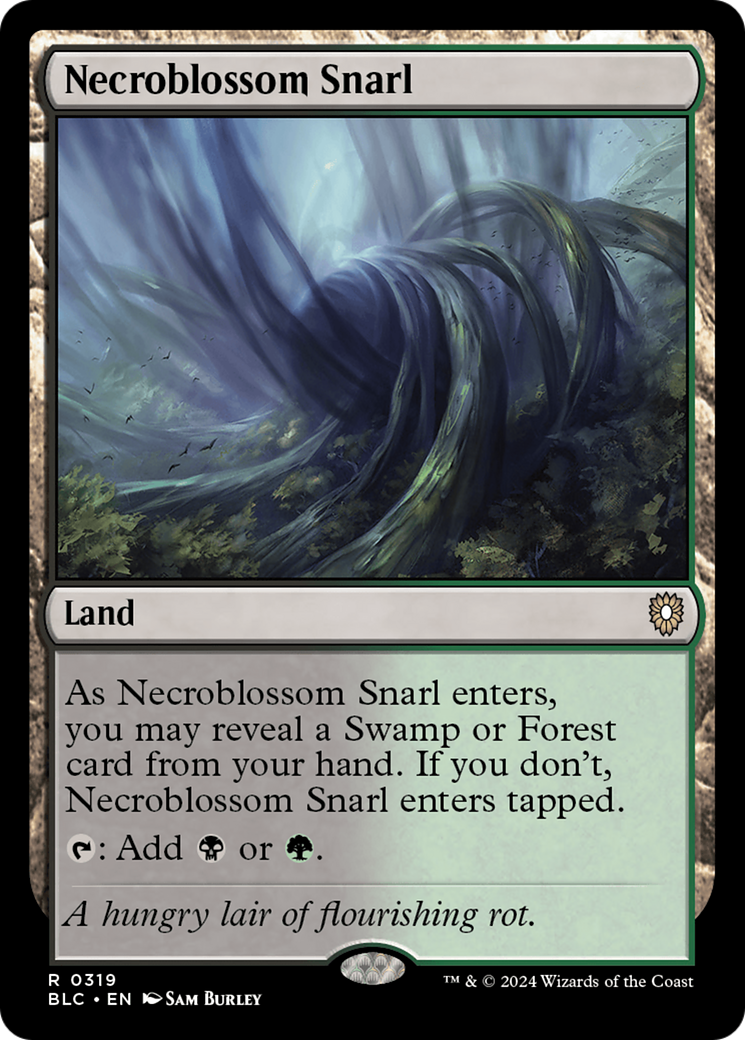
1
Necroblossom Snarl
Necroblossom Snarl
Land
As this land enters, you may reveal a Swamp or Forest card from your hand. If you don't, this land enters tapped.
: Add or .
- You may reveal any land card with either or both of the appropriate subtypes. It doesn't have to be a basic land card.
- The "Snarl" itself doesn't have any land subtypes. You can't reveal one to satisfy the ability of another.
- If a land card with an appropriate subtype is entering the battlefield from your hand at the same time as one of these lands, you may reveal the other land to have the "Snarl" enter untapped.
- If an effect instructs you to put one of these lands onto the battlefield tapped, it will still enter the battlefield tapped even if you reveal a land card from your hand.
-
1
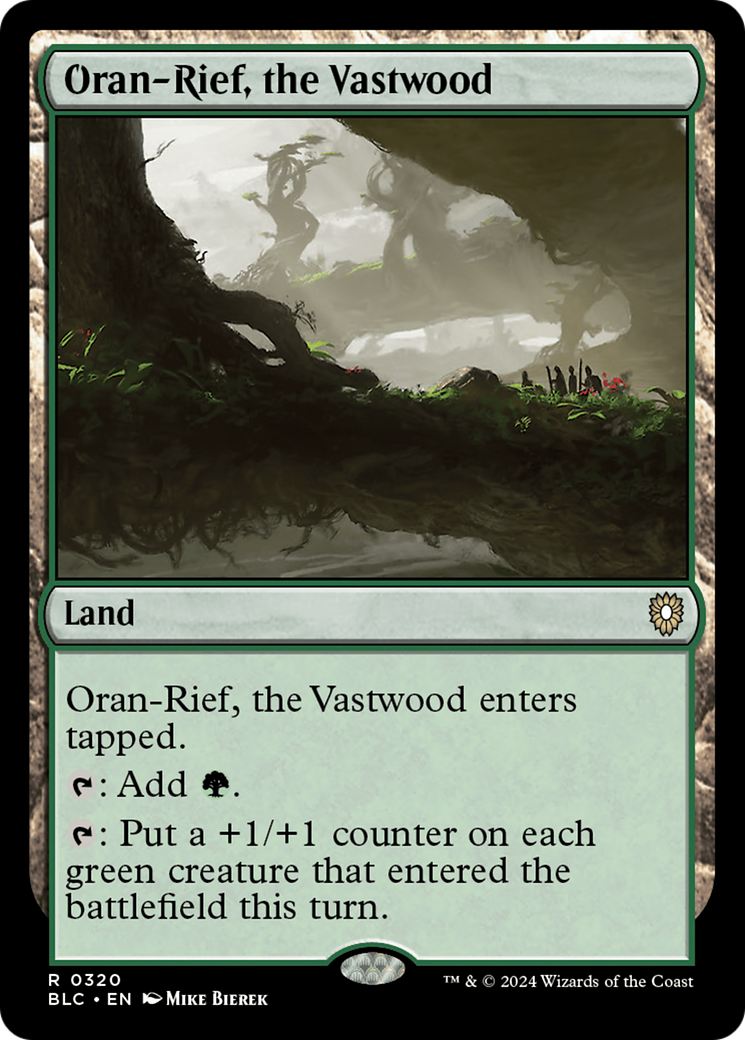
Oran-Rief, the Vastwood
Oran-Rief, the Vastwood
Land
This land enters tapped.
: Add .
: Put a +1/+1 counter on each green creature that entered this turn.
- Oran-Rief's last ability cares about permanents' characteristics at the time the ability resolves, not their characteristics at the time they entered. For example, if a blue creature enters, then is turned green by a spell or ability, then Oran-Rief's second ability resolves, you'll put a +1/+1 counter on that creature.
- Oran-Rief's last ability affects all permanents that are green creatures that entered this turn, not just the ones you control.
-
1
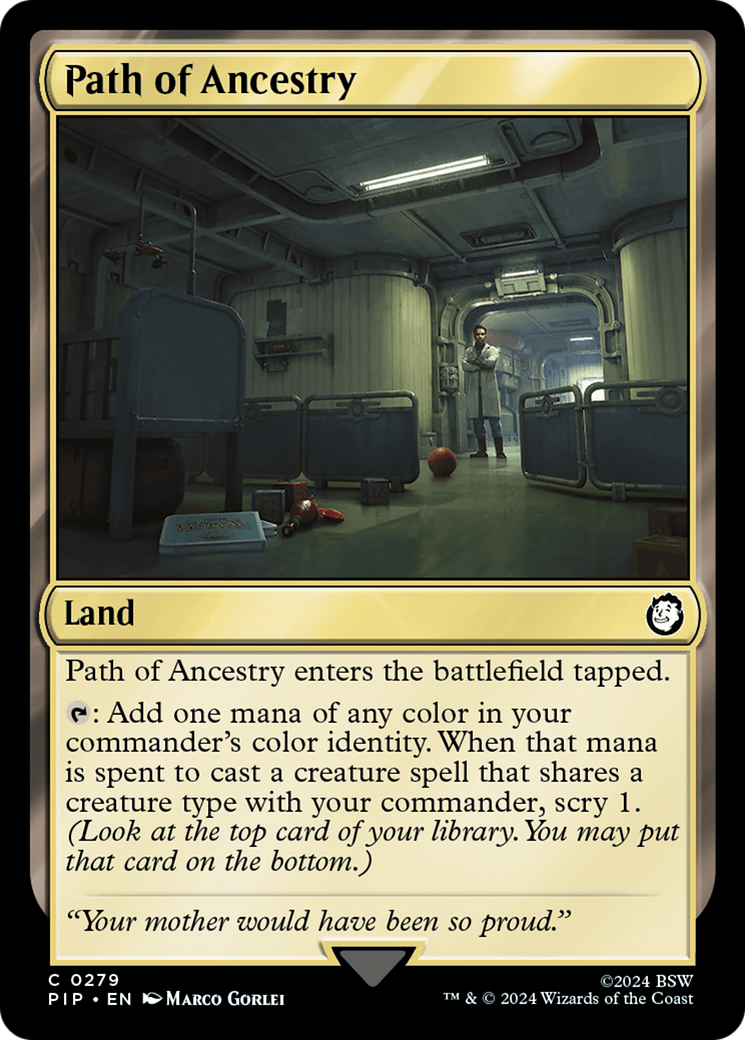
Path of Ancestry
Path of Ancestry
Land
This land enters tapped.
: Add one mana of any color in your commander's color identity. When that mana is spent to cast a creature spell that shares a creature type with your commander, scry 1. (Look at the top card of your library. You may put that card on the bottom.)
- Your commander's creature types are checked immediately after you cast a creature spell spending mana from Path of Ancestry's last ability. They aren't set before the game begins, and they may not be the same types your commander had when you activated that ability.
- If you have two commanders, the last ability adds one mana of any color in their combined color identities. When you spend that mana on a creature spell that shares a creature type with either of your commanders, you'll scry 1.
- If Path of Ancestry's last ability produces two mana (most likely due to Mana Reflection), spending those two mana to cast creature spells that share a creature type with your commander will cause two abilities to trigger. Each of those abilities will cause you to scry 1. You won't scry 2. This is true whether you spend the mana on one creature spell or two.
- If your commander has no creature types, it can't share a creature type with any spell that you cast.
- If you cast your commander with mana from Path of Ancestry, and your commander hasn't somehow lost all of its creature types while on the stack, you'll scry 1.
- If you don't have a commander, Path of Ancestry's ability produces no mana.
- If your commander is a card that has no colors in its color identity, Path of Ancestry's ability produces no mana. It doesn't produce .
-
8
Swamp
Swamp
Basic Land — Swamp
( : Add .)
-
1
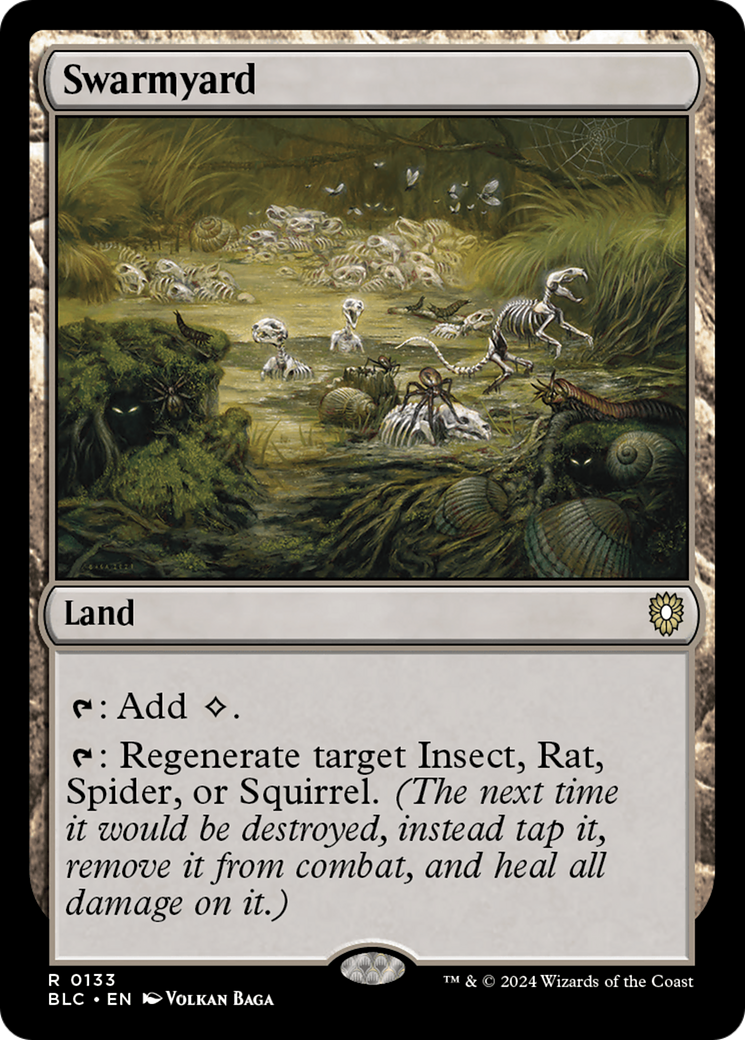
Swarmyard
Swarmyard
Land
: Add .
: Regenerate target Insect, Rat, Spider, or Squirrel. (The next time it would be destroyed this turn, instead tap it, remove it from combat, and heal all damage on it.)
-
1
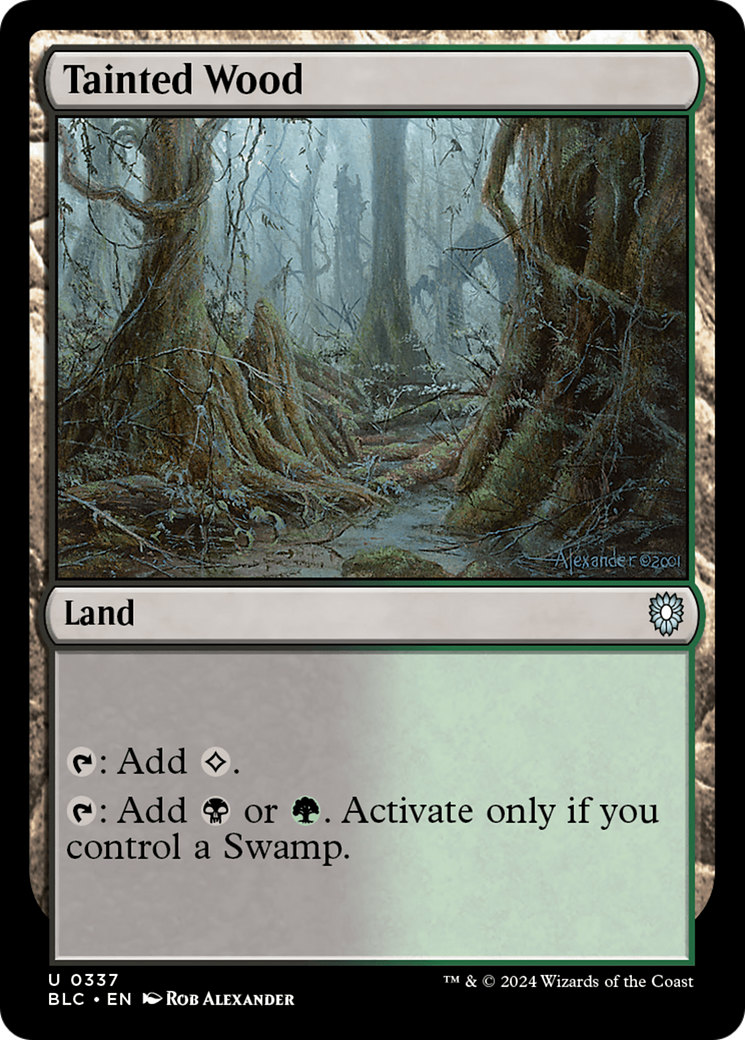
Tainted Wood
Tainted Wood
Land
: Add .
: Add or . Activate only if you control a Swamp.
-
1
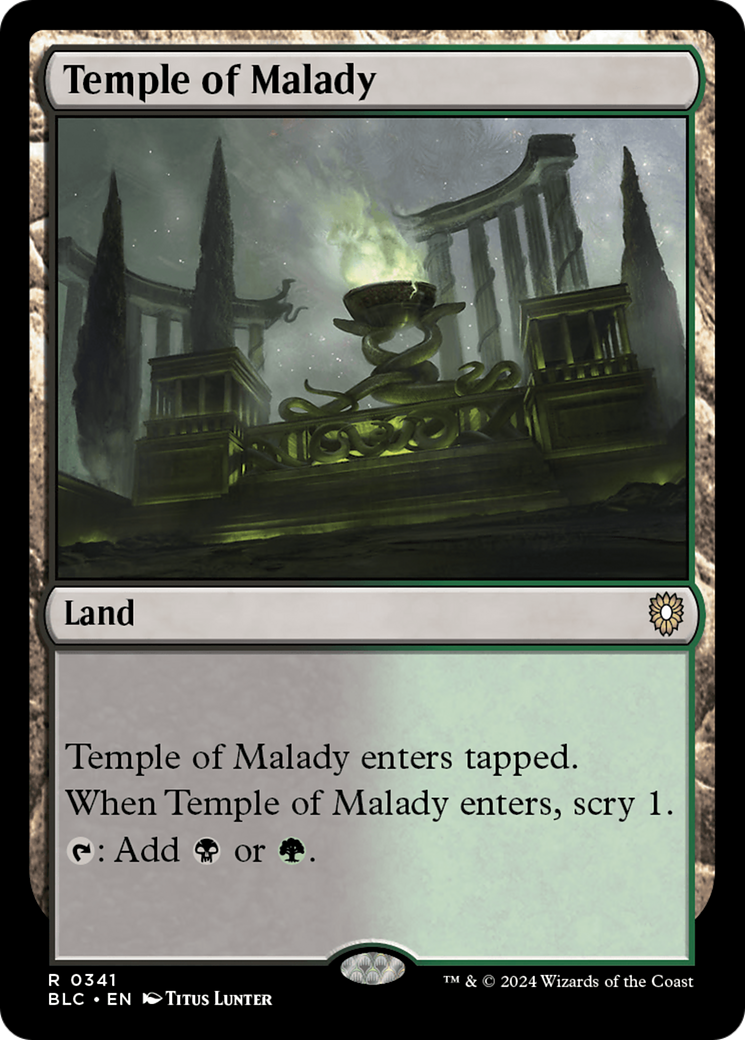
Temple of Malady
Temple of Malady
Land
This land enters tapped.
When this land enters, scry 1. (Look at the top card of your library. You may put that card on the bottom.)
: Add or .
-
1
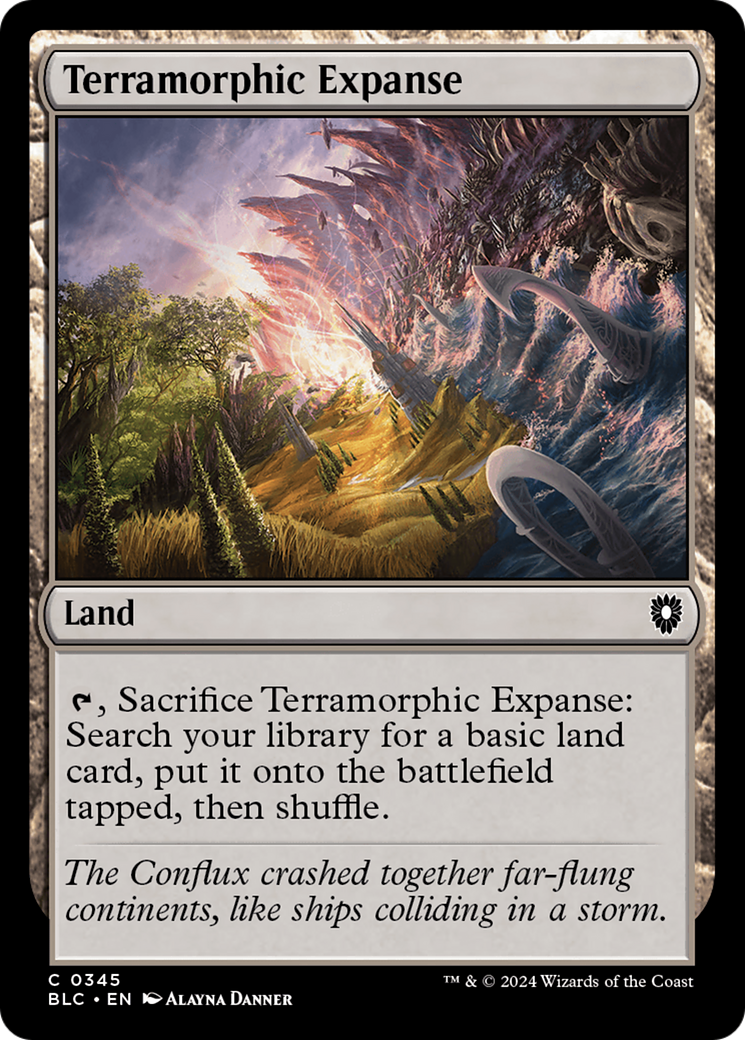
Terramorphic Expanse
Terramorphic Expanse
Land
, Sacrifice this land: Search your library for a basic land card, put it onto the battlefield tapped, then shuffle.
-
1
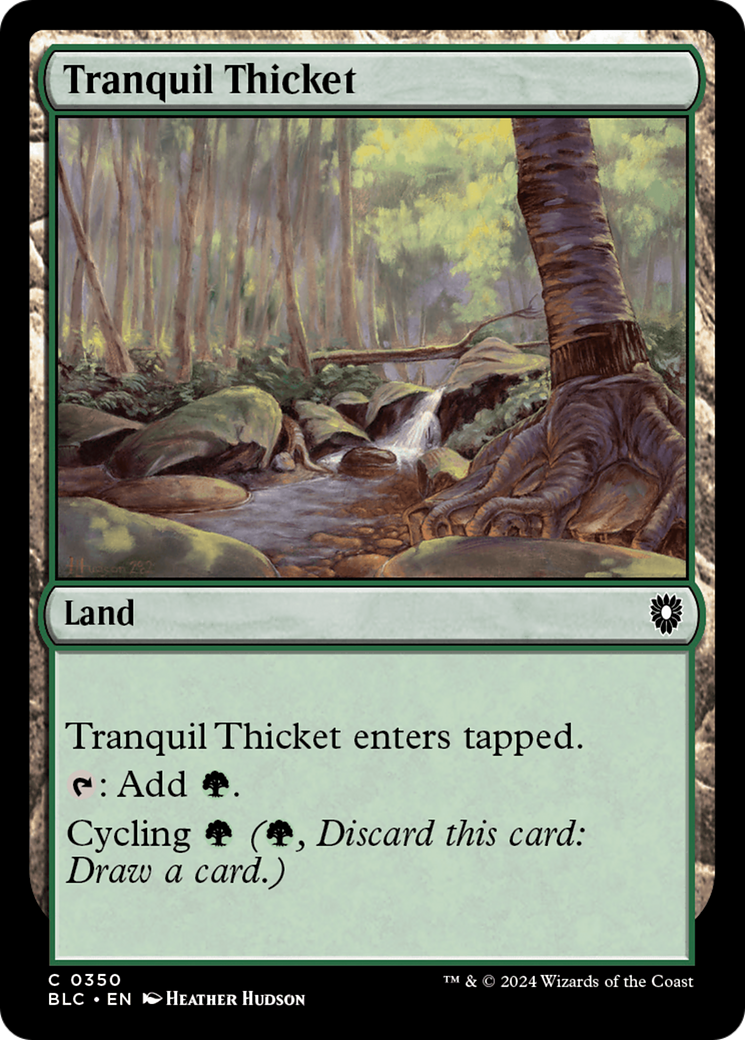
Tranquil Thicket
Tranquil Thicket
Land
This land enters tapped.
: Add .
Cycling ( , Discard this card: Draw a card.)
-
1
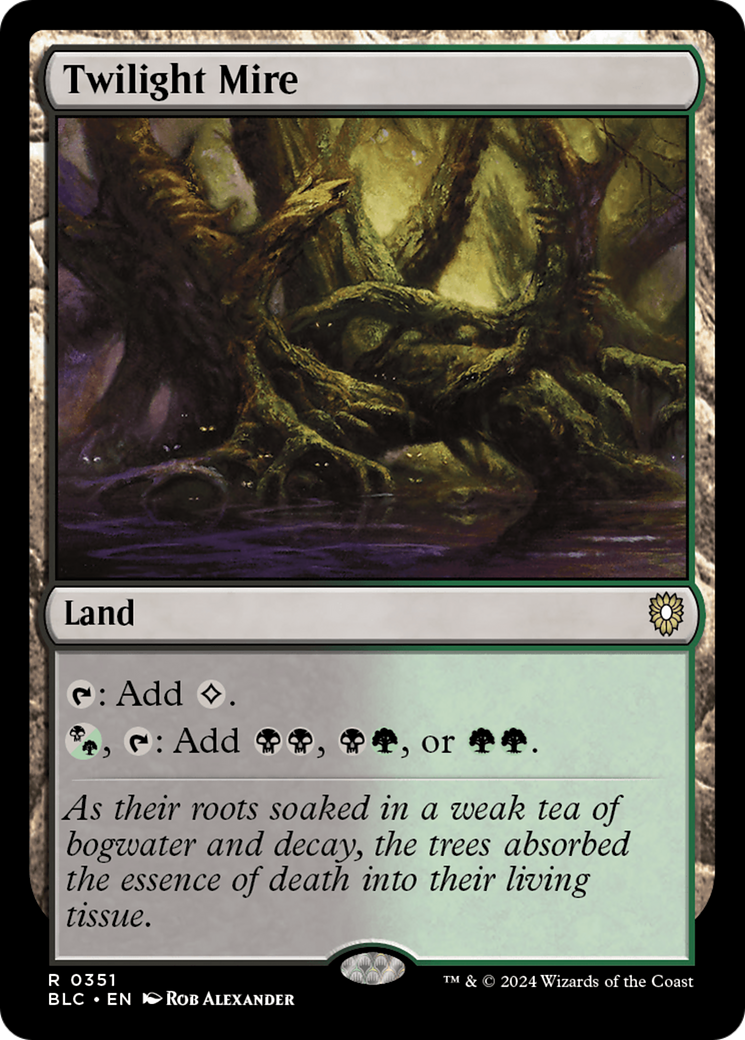
Twilight Mire
Twilight Mire
Land
: Add .
, : Add , , or .
-
1
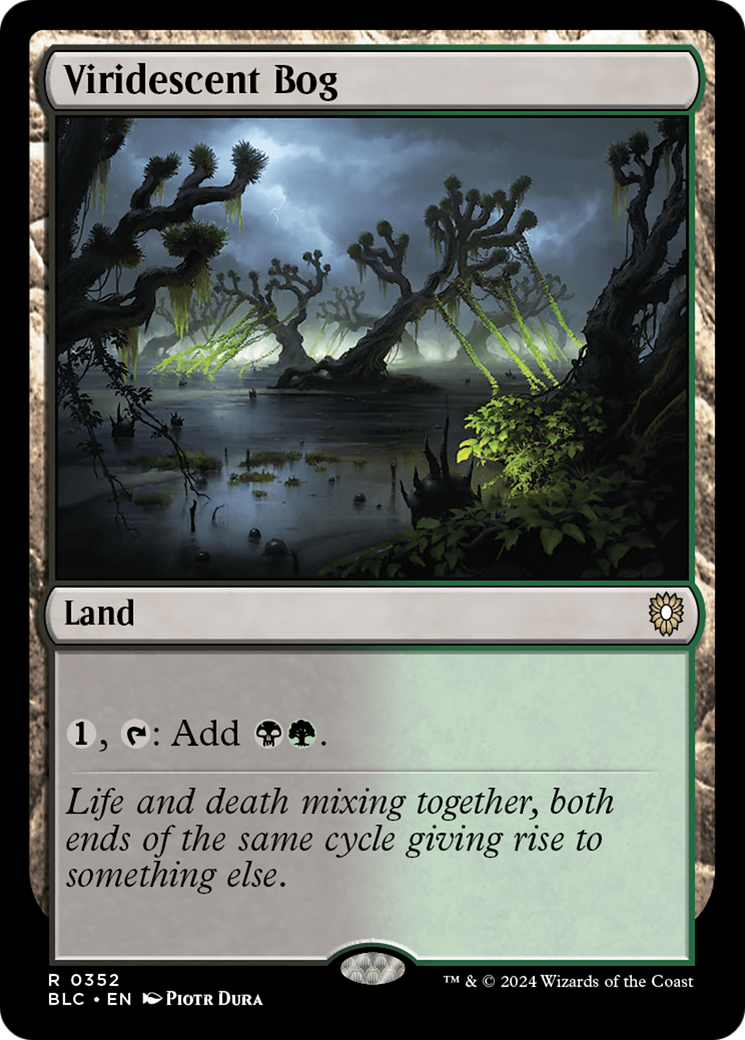
Viridescent Bog
Viridescent Bog
Land
, : Add .
-
1
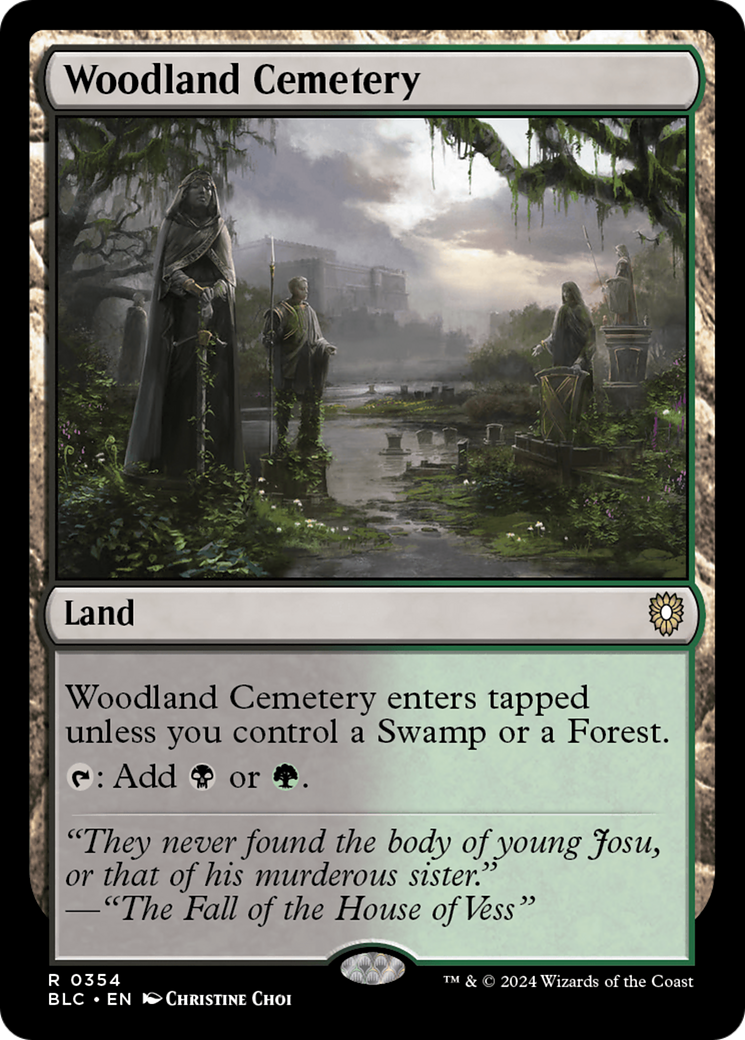
Woodland Cemetery
Woodland Cemetery
Land
This land enters tapped unless you control a Swamp or a Forest.
: Add or .
Black 17
-
1
Bastion of Remembrance
Bastion of Remembrance
Enchantment
When this enchantment enters, create a 1/1 white Human Soldier creature token.
Whenever a creature you control dies, each opponent loses 1 life and you gain 1 life.
- If one or more creatures you control die at the same time that Bastion of Remembrance leaves the battlefield, its last ability triggers for each of those creatures.
- If your life total is brought to 0 or less at the same time that creatures you control are dealt lethal damage, you lose the game before the last ability goes on the stack.
- In a Two-Headed Giant game, Bastion of Remembrance's last ability causes the opposing team to lose 2 life and you to gain 1 life.
-
1
Chittering Witch
Chittering Witch
Creature — Human Warlock
2/2
When this creature enters, create a number of 1/1 black Rat creature tokens equal to the number of opponents you have.
, Sacrifice a creature: Target creature gets -2/-2 until end of turn.
- You can sacrifice Chittering Witch to pay the cost of its last ability.
- In a multiplayer game, opponents who have left the game aren't counted by Chittering Witch's triggered ability.
-
1
Deadly Dispute
Deadly Dispute
Instant
As an additional cost to cast this spell, sacrifice an artifact or creature.
Draw two cards and create a Treasure token. (It's an artifact with " , Sacrifice this token: Add one mana of any color.")
-
1
Decree of Pain
Decree of Pain
Sorcery
Destroy all creatures. They can't be regenerated. Draw a card for each creature destroyed this way.
Cycling ( , Discard this card: Draw a card.)
When you cycle this card, all creatures get -2/-2 until end of turn.
- When you cycle this card, first the cycling ability goes on the stack, then the triggered ability goes on the stack on top of it. The triggered ability will resolve before you draw a card from the cycling ability.
- The cycling ability and the triggered ability are separate. If the triggered ability doesn't resolve (because, for example, it has been countered, or all of its targets have become illegal), the cycling ability will still resolve, and you'll draw a card.
-
1
Hazel's Brewmaster
Hazel's Brewmaster
Creature — Squirrel Warlock
3/4
Menace
Whenever this creature enters or attacks, exile up to one target card from a graveyard and create a Food token.
Foods you control have all activated abilities of all creature cards exiled with this creature.
- Whatever you do, don't eat the delicious cards.
- If an effect refers to a Food, it means any Food artifact, not just a Food artifact token. For example, you can sacrifice Tough Cookie (an Artifact Creature — Food Golem) to activate Maraleaf Rider's ability (an ability with "Sacrifice a Food" in its cost).
- Food is an artifact type. Even though it appears on some creatures, it's never a creature type.
- You can't sacrifice a Food to pay multiple costs. For example, you can't sacrifice a Food token to activate its own ability and also to activate Maraleaf Rider's ability.
- You don't have to choose a target for Hazel's Brewmaster's second ability. However, if you do, and that target is illegal as the ability tries to resolve, it won't resolve and none of its effects will happen. You won't create a Food token.
- Activated abilities contain a colon. They're generally written "[Cost]: [Effect]." Some keyword abilities are activated abilities; those will often have colons in their reminder text.
- Hazel's Brewmaster's last ability grants only activated abilities. It doesn't grant keyword abilities (unless those keyword abilities are activated), triggered abilities, or static abilities.
- The granted abilities effectively use "this permanent" rather than "[that card's name]," so you treat the abilities as though they were printed on the permanent that gained the ability. For example, say you exiled the card Argothian Sprite with Hazel's Brewmaster. Argothian Sprite has the ability " : Put two +1/+1 counters on Argothian Sprite." If you controlled a Gingerbrute (an Artifact Creature – Food Golem), you'd treat it as though it had the ability " : Put two +1/+1 counters on Gingerbrute."
-
1
Insatiable Frugivore
Insatiable Frugivore
Creature — Rat Berserker
2/4
When this creature enters, create a Food token, then you may exile three cards from your graveyard. If you do, repeat this process.
, Sacrifice X Foods: Creatures you control get +X/+0 and gain menace until end of turn.
- Whatever you do, don't eat the delicious cards.
- If an effect refers to a Food, it means any Food artifact, not just a Food artifact token. For example, you can sacrifice Tough Cookie (an Artifact Creature — Food Golem) to activate Maraleaf Rider's ability (an ability with "Sacrifice a Food" in its cost).
- Food is an artifact type. Even though it appears on some creatures, it's never a creature type.
- You can't sacrifice a Food to pay multiple costs. For example, you can't sacrifice a Food token to activate its own ability and also to activate Maraleaf Rider's ability.
- You repeat the process as part of the resolution of Insatiable Frugivore's first ability. If the Food token you created or the cards you exiled from your graveyard caused any abilities to trigger, those abilities won't go on the stack until after Insatiable Frugivore's first ability has finished resolving.
- Players can't take other actions during the resolution of Insatiable Frugivore's first ability. Notably, they can't try to remove cards from your graveyard between repetitions of this process.
- The process in Insatiable Frugivore's first ability is repeated until you decline to exile three cards from your graveyard. You can't try to exile three cards from your graveyard if you don't have at least three cards in your graveyard.
- You can choose 0 for the value of X in the cost of Insatiable Frugivore's last ability. If you do, creatures you control will just gain menace until end of turn. (The mere idea of someone eating berries like that is scary enough, apparently.)
-
1
Moonstone Eulogist
Moonstone Eulogist
Creature — Bat Warlock
4/4
Flying
Whenever a creature an opponent controls dies, you create a Blood token. (It's an artifact with " , , Discard a card, Sacrifice this token: Draw a card.")
Whenever you sacrifice an artifact, put a +1/+1 counter on this creature and you gain 1 life.
- If an effect refers to a Blood token, it means any artifact token with the subtype Blood, even if it has gained other subtypes.
- You can't sacrifice a Blood token to pay multiple costs.
- Some triggered abilities trigger "whenever you sacrifice a Blood token." These abilities trigger regardless of why you sacrificed that Blood token.
- If Moonstone Eulogist and one or more creatures opponents control die at the same time, its second ability will trigger for each of those creatures opponents controlled that died.
-
1
Morbid Opportunist
Morbid Opportunist
Creature — Human Rogue
1/3
Whenever one or more other creatures die, draw a card. This ability triggers only once each turn.
- If Morbid Opportunist dies at the same time as one or more other creatures, Morbid Opportunist's ability still triggers.
-
1
Nadier's Nightblade
Nadier's Nightblade
Creature — Elf Warrior
1/3
Whenever a token you control leaves the battlefield, each opponent loses 1 life and you gain 1 life.
-
1
Nested Shambler
Nested Shambler
Creature — Zombie
1/1
When this creature dies, create X tapped 1/1 green Squirrel creature tokens, where X is this creature's power.
- X is Nested Shambler's power the last time it was on the battlefield, not its power in the graveyard. If its power was 0 or less when it died, you won't create any tokens.
-
1
Ogre Slumlord
Ogre Slumlord
Creature — Ogre Rogue
3/3
Whenever another nontoken creature dies, you may create a 1/1 black Rat creature token.
Rats you control have deathtouch.
- All Rats you control have deathtouch while Ogre Slumlord is on the battlefield, not just the ones created by Ogre Slumlord.
-
1
Plaguecrafter
Plaguecrafter
Creature — Human Shaman
3/2
When this creature enters, each player sacrifices a creature or planeswalker of their choice. Each player who can't discards a card.
- As Plaguecrafter's ability resolves, first the player whose turn it is chooses a creature or planeswalker they control, then each other player in turn order does the same, knowing the choices made before them. Then all the chosen permanents are sacrificed at the same time. Next, each player in the same order who couldn't sacrifice a permanent chooses a card in hand without revealing it, then the chosen cards are discarded at the same time.
- Each player chooses a permanent to sacrifice from among the creatures and planeswalkers they control. You don't choose which type of permanent any other player has to sacrifice.
- Plaguecrafter can be the creature its controller sacrifices for its own ability.
-
1
Plumb the Forbidden
Plumb the Forbidden
Instant
As an additional cost to cast this spell, you may sacrifice one or more creatures. When you do, copy this spell for each creature sacrificed this way.
You draw a card and you lose 1 life.
- If you sacrifice a creature with a magecraft ability to cast Plumb the Forbidden, that creature's ability will not trigger.
- If you copy Plumb the Forbidden multiple times, each magecraft ability of a creature you control will trigger that many times.
-
1
Saw in Half
Saw in Half
Instant
Destroy target creature. If that creature dies this way, its controller creates two tokens that are copies of that creature, except their power is half that creature's power and their toughness is half that creature's toughness. Round up each time.
- If the creature isn't destroyed (perhaps because it has indestructible), its controller doesn't create any tokens. The same is true if the creature is destroyed but instead of going to its owner's graveyard, a replacement effect moves it elsewhere, such as exile.
- Use the power and toughness of the creature from when it was last on the battlefield to determine the power and toughness of the tokens.
- Except for power and toughness, the token copies exactly what was printed on the original creature and nothing else (unless that creature was copying something else or it's a token; see below). It doesn't copy whether that creature was tapped or untapped, whether it had any counters on it or Auras and Equipment attached to it, and so on.
- If the original creature had a characteristic-defining ability that determined its power and/or toughness, that ability is not copied.
- If the copied creature had in its mana cost, X is considered to be 0.
- If the chosen creature was a token, the new tokens copy the original characteristics of that token as stated by the effect that created the token, plus the listed exceptions.
- If the copied creature was copying something else, then the tokens enter the battlefield as whatever that creature copied, with the exceptions noted above.
- Any enters-the-battlefield abilities of the copied creature will trigger when the tokens enter the battlefield. Any "as [this creature] enters the battlefield" or "[this creature] enters the battlefield with" abilities of the chosen creature will also work.
-
1
Swarmyard Massacre
Swarmyard Massacre
Sorcery
Create two 1/1 green Squirrel creature tokens. Then each creature that isn't an Insect, Rat, Spider, or Squirrel gets -1/-1 until end of turn for each creature you control that's an Insect, Rat, Spider, or Squirrel.
- If you control a creature that has more than one of the listed types (for example, Daggerfang Duo, which is a Rat Squirrel), it's only counted once for Swarmyard Massacre.
-
1
Woe Strider
Woe Strider
Creature — Horror
3/2
When this creature enters, create a 0/1 white Goat creature token.
Sacrifice another creature: Scry 1.
Escape— , Exile four other cards from your graveyard. (You may cast this card from your graveyard for its escape cost.)
This creature escapes with two +1/+1 counters on it.
- Escape's permission doesn't change when you may cast the spell from your graveyard.
- To determine the total cost of a spell, start with the mana cost or alternative cost you're paying (such as an escape cost), add any cost increases, then apply any cost reductions. The mana value of the spell remains unchanged, no matter what the total cost to cast it was and no matter whether an alternative cost was paid.
- After an escaped spell resolves, it returns to its owner's graveyard if it's not a permanent spell. If it is a permanent spell, it enters the battlefield and will return to its owner's graveyard if it dies later. Perhaps it will escape again—good underworld security is so hard to come by these days.
- If a card has multiple abilities giving you permission to cast it, such as two escape abilities or an escape ability and a flashback ability, you choose which one to apply. The others have no effect.
- If you cast a spell with its escape permission, you can't choose to apply any other alternative costs or to cast it without paying its mana cost. If it has any additional costs, you must pay those.
- If a card with escape is put into your graveyard during your turn, you'll be able to cast it right away if it's legal to do so, before an opponent can take any actions.
- Once you begin casting a spell with escape, it immediately moves to the stack. Players can't take any other actions until you're done casting the spell.
-
1
Zulaport Cutthroat
Zulaport Cutthroat
Creature — Human Rogue Ally
1/1
Whenever this creature or another creature you control dies, each opponent loses 1 life and you gain 1 life.
- If another creature you control dies at the same time as Zulaport Cutthroat, its ability triggers for that creature.
Green 22
-
1
Arasta of the Endless Web
Arasta of the Endless Web
Legendary Enchantment Creature — Spider
3/5
Reach
Whenever an opponent casts an instant or sorcery spell, create a 1/2 green Spider creature token with reach.
- An ability that triggers when a player casts a spell resolves before the spell that caused it to trigger. It resolves even if that spell is countered.
-
1
Beastmaster Ascension
Beastmaster Ascension
Enchantment
Whenever a creature you control attacks, you may put a quest counter on this enchantment.
As long as this enchantment has seven or more quest counters on it, creatures you control get +5/+5.
- If you attack with multiple creatures, Beastmaster Ascension's first ability triggers multiple times.
-
1
Cache Grab
Cache Grab
Instant
Mill four cards. You may put a permanent card from among the cards milled this way into your hand. If you control a Squirrel or returned a Squirrel card to your hand this way, create a Food token. (To mill four cards, put the top four cards of your library into your graveyard. A Food token is an artifact with " , , Sacrifice this token: You gain 3 life.")
- Food is an artifact type. Even though it appears on some creatures, it's never a creature type.
- You can't sacrifice a Food to pay multiple costs. For example, you can't sacrifice a Food token to activate its own ability and also to activate Maraleaf Rider's ability.
- Whatever you do, don't eat the delicious cards.
-
1
Chatterfang, Squirrel General
Chatterfang, Squirrel General
Legendary Creature — Squirrel Warrior
3/3
Forestwalk (This creature can't be blocked as long as defending player controls a Forest.)
If one or more tokens would be created under your control, those tokens plus that many 1/1 green Squirrel creature tokens are created instead.
, Sacrifice X Squirrels: Target creature gets +X/-X until end of turn.
- You don't need to control the spell or ability that creates the tokens, nor do you have to be the one creating the tokens for Chatterfang's ability to apply. As long as the tokens are being created under your control, Chatterang's replacement effect will apply.
- Chatterfang's second ability applies to all kinds of tokens, including Clue, Food, and Treasure tokens.
- The additional Squirrel tokens won't have any abilities the other tokens were created with. Anything else specified in the effect creating the token (such as tapped, attacking, "That token gains haste," or "Exile that token at end of combat") applies to both the original tokens and the Squirrels.
- If an effect changes under whose control a token would be created, that effect applies before Chatterfang's effect applies. If an effect changes under whose control a token would enter the battlefield, that effect applies after Chatterfang's effect is able to be applied.
- In a Commander game, the defending player is the player Chatterfang is attacking or the controller of the planeswalker Chatterfang is attacking.
-
1
Chatterstorm
Chatterstorm
Sorcery
Create a 1/1 green Squirrel creature token.
Storm (When you cast this spell, copy it for each spell cast before it this turn.)
- The copies are put directly onto the stack. They aren't cast and won't be counted by other spells with storm cast later in the turn.
- Spells cast from zones other than a player's hand and spells that were countered or otherwise failed to resolve are counted by the storm ability.
- A copy of a spell can be countered like any other spell, but it must be countered individually. Countering a spell with storm won't affect the copies.
- The triggered ability that creates the copies can itself be countered by anything that can counter a triggered ability. If it is countered, no copies will be put onto the stack.
- If a spell with storm has targets, you may choose new targets for any of the copies. You can make different choices for each copy.
-
1
Chitterspitter
Chitterspitter
Artifact
At the beginning of your upkeep, you may sacrifice a token. If you do, put an acorn counter on this artifact.
Squirrels you control get +1/+1 for each acorn counter on this artifact.
, : Create a 1/1 green Squirrel creature token.
-
1
Deep Forest Hermit
Deep Forest Hermit
Creature — Elf Druid
1/1
Vanishing 3 (This creature enters with three time counters on it. At the beginning of your upkeep, remove a time counter from it. When the last is removed, sacrifice it.)
When this creature enters, create four 1/1 green Squirrel creature tokens.
Squirrels you control get +1/+1.
-
1
End-Raze Forerunners
End-Raze Forerunners
Creature — Boar
7/7
Vigilance, trample, haste
When this creature enters, other creatures you control get +2/+2 and gain vigilance and trample until end of turn.
- The triggered ability of End-Raze Forerunners affects only creatures you control at the time it resolves. Creatures you begin to control later in the turn won't get +2/+2 or gain vigilance or trample.
-
1
Gilded Goose
Gilded Goose
Creature — Bird
0/2
Flying
When this creature enters, create a Food token. (It's an artifact with " , , Sacrifice this token: You gain 3 life.")
, : Create a Food token.
, Sacrifice a Food: Add one mana of any color.
- If an effect refers to a Food, it means any Food artifact, not just a Food artifact token. For example, you can sacrifice Tough Cookie (an Artifact Creature — Food Golem) to activate Maraleaf Rider's ability (an ability with "Sacrifice a Food" in its cost).
- Food is an artifact type. Even though it appears on some creatures, it's never a creature type.
- You can't sacrifice a Food to pay multiple costs. For example, you can't sacrifice a Food token to activate its own ability and also to activate Maraleaf Rider's ability.
- Whatever you do, don't eat the delicious cards.
-
1
Gourmand's Talent
Gourmand's Talent
Enchantment — Class
(Gain the next level as a sorcery to add its ability.)
During your turn, artifacts you control are Foods in addition to their other types and have " , , Sacrifice this artifact: You gain 3 life."
: Level 2
Whenever you gain life for the first time each turn, create a 3/3 green Raccoon creature token.
: Level 3
Whenever you gain life for the first time each turn, put a +1/+1 counter on each creature you control.
- Food is an artifact type. Even though it appears on some creatures, it's never a creature type.
- You can't sacrifice a Food to pay multiple costs. For example, you can't sacrifice a Food token to activate its own ability and also to activate Maraleaf Rider's ability.
- Whatever you do, don't eat the delicious cards.
- Each Class has five abilities. The three in the major sections of its text box are class abilities. Class abilities can be static, activated, or triggered abilities. The other two are level abilities, one activated ability to advance the Class to level 2 and another to advance the Class to level 3.
- Each Class starts with only the first of its three class abilities. As the first level ability resolves, the Class becomes level 2 and gains the second class ability. As the second level ability resolves, the Class becomes level 3 and gains the third class ability.
- Gaining a level won't remove abilities that a Class had at a previous level.
- The artifacts retain any types, subtypes, supertypes, and abilities they have.
- You can't activate the first level ability of a Class unless that Class is level 1. Similarly, you can't activate the second level ability of a Class unless that Class is level 2.
- There's no restriction on how many Class permanents you can control, whether they're the same or different classes. Each Class permanent tracks its own level separately.
- Gaining a level is a normal activated ability. It uses the stack and can be responded to.
- If Gourmand's Talent somehow becomes an artifact, it will also be a Food during your turn.
- The level 2 and level 3 class abilities of Gourmand's Talent won't trigger if you already gained life earlier in the turn on which it gained those levels, even if you gain life again later in the turn.
-
1
Honored Dreyleader
Honored Dreyleader
Creature — Squirrel Warrior
1/1
Trample
When this creature enters, put a +1/+1 counter on it for each other Squirrel and/or Food you control.
Whenever another Squirrel or Food you control enters, put a +1/+1 counter on this creature.
- If an effect refers to a Food, it means any Food artifact, not just a Food artifact token. For example, you can sacrifice Tough Cookie (an Artifact Creature — Food Golem) to activate Maraleaf Rider's ability (an ability with "Sacrifice a Food" in its cost).
- Food is an artifact type. Even though it appears on some creatures, it's never a creature type.
- You can't sacrifice a Food to pay multiple costs. For example, you can't sacrifice a Food token to activate its own ability and also to activate Maraleaf Rider's ability.
- Whatever you do, don't eat the delicious cards.
- If a permanent you control is both a Squirrel and a Food, count it only once when determining how many counters to put on Honored Dreyleader with its second ability.
- Similarly, if a permanent you control that is both a Squirrel and a Food enters, Honored Dreyleader's last ability will trigger only once.
-
1
Prosperous Innkeeper
Prosperous Innkeeper
Creature — Halfling Citizen
1/1
When this creature enters, create a Treasure token. (It's an artifact with " , Sacrifice this token: Add one mana of any color.")
Whenever another creature you control enters, you gain 1 life.
-
1
Rootcast Apprenticeship
Rootcast Apprenticeship
Sorcery
Choose three. You may choose the same mode more than once.
- Put two +1/+1 counters on target creature.
- Create a token that's a copy of target token you control.
- Target player creates a 1/1 green Squirrel creature token.
- Target opponent sacrifices a nontoken artifact of their choice.
- You choose the modes as you cast the spell. Once modes are chosen, they can't be changed.
- You can select a mode only if there's a legal target available for that mode. Ignore the targeting requirements for modes you don't choose. Each time you select that mode, you can choose a different target, or you can choose the same target.
- No matter which combination of modes you choose, you always follow the instructions in the order they are written.
- If the same mode is chosen more than once, you choose their relative order as you cast the spell. For example, if you choose the last mode of Rootcast Apprenticeship more than once, you choose the relative order in which the target opponents sacrifice nontoken artifacts.
- No player can cast spells or activate abilities in between the modes of a resolving spell. Any abilities that trigger won't be put onto the stack until a spell is done resolving.
- If Rootcast Apprenticeship is copied, the effect that creates the copy will usually allow you to choose new targets, but you can't choose new modes.
- If all targets for the chosen modes become illegal before Rootcast Apprenticeship resolves, the spell will be countered and none of its effects will happen. If at least one target is still legal, the spell will resolve but will have no effect on any illegal targets.
-
1
Scurry of Squirrels
Scurry of Squirrels
Creature — Squirrel Scout
2/2
Myriad, myriad (Whenever this creature attacks, for each opponent other than defending player, you may create a token that's a copy of this creature that's tapped and attacking that player or a planeswalker they control. Then do it again. Exile the tokens at end of combat.)
Whenever this creature deals combat damage to a player, put a +1/+1 counter on target creature you control.
- The term "defending player" in the myriad rules (or any other ability of an attacking creature) refers to the player the creature with myriad was attacking, the controller of the planeswalker it was attacking, or the protector of the battle it was attacking at the time the ability resolves. If that creature is no longer attacking, it refers to the appropriate player based on who or what the creature was last attacking.
- If the defending player is your only opponent, no tokens are put onto the battlefield.
- You choose whether each token is attacking the player or a planeswalker they control as the token is created. If it's attacking a planeswalker, you choose which one. You can't have any of the tokens attack a battle.
- Although the tokens enter attacking, they were never declared as attackers. Abilities that trigger whenever a creature attacks won't trigger, including the myriad ability of the tokens. If there are any costs to have a creature attack, those costs won't apply to the tokens.
- The tokens created by a single instance of myriad all enter at the same time.
- Each token copies exactly what was printed on the original creature and nothing else. It doesn't copy whether that creature is tapped or untapped, whether it has any counters on it or Auras and Equipment attached to it, or any non-copy effects that have changed its power, toughness, types, color, and so on.
- Any "enters" abilities of the copied creature will trigger when the tokens enter. Any "as [this permanent] enters" or "[this permanent] enters with" abilities of the copied creature will also work.
- If an instance of myriad creates more than one token for any given player (due to an effect such as the one Doubling Season creates), you may choose separately for each token whether it's attacking the player or a planeswalker they control.
-
1
Second Harvest
Second Harvest
Instant
For each token you control, create a token that's a copy of that permanent.
- Second Harvest copies the original characteristics of each token as stated by the effect that created that token. It doesn’t copy whether that token is tapped or untapped, whether it has any counters on it or any Auras and Equipment attached to it, or any non-copy effects that have changed its power, toughness, types, color, or so on.
- Second Harvest copies all tokens, not only creature tokens.
-
1
Shamanic Revelation
Shamanic Revelation
Sorcery
Draw a card for each creature you control.
Ferocious — You gain 4 life for each creature you control with power 4 or greater.
- After you draw cards while Shamanic Revelation is resolving, nothing else can happen before you gain the appropriate amount of life. Notably, abilities that trigger when you draw cards won't be put onto the stack until after you've gained life.
-
1
Squirrel Nest
Squirrel Nest
Enchantment — Aura
Enchant land
Enchanted land has " : Create a 1/1 green Squirrel creature token."
-
1
Squirrel Sovereign
Squirrel Sovereign
Creature — Squirrel Noble
2/2
Other Squirrels you control get +1/+1.
-
1
Tear Asunder
Tear Asunder
Instant
Kicker (You may pay an additional as you cast this spell.)
Exile target artifact or enchantment. If this spell was kicked, exile target nonland permanent instead.
- If you put a permanent with a kicker ability onto the battlefield without casting it, you can't kick it.
- If a spell's kicker cost was paid, the spell is "kicked."
- The kicker ability doesn't let you pay a kicker cost more than once.
- To determine a spell's total cost, start with the mana cost (or an alternative cost if another card's effect allows you to pay one instead), add any cost increases (such as kicker), then apply any cost reductions. The spell's mana value remains unchanged, no matter what the total cost to cast it was.
- If you copy a kicked spell on the stack, the copy is also kicked. If the copied spell is a permanent spell, the token the copy of that spell becomes when it enters is also kicked.
- If a card or token enters as a copy of a permanent, the new permanent isn't kicked, even if the original was.
- If Tear Asunder is kicked, it can target any nonland permanent, not just an artifact or enchantment.
-
1
Tireless Provisioner
Tireless Provisioner
Creature — Elf Scout
3/2
Landfall — Whenever a land you control enters, create a Food token or a Treasure token. (Food is an artifact with " , , Sacrifice this token: You gain 3 life." Treasure is an artifact with " , Sacrifice this token: Add one mana of any color.")
- Food is an artifact type. Even though it appears on some creatures, it's never a creature type.
- You can't sacrifice a Food to pay multiple costs. For example, you can't sacrifice a Food token to activate its own ability and also to activate Maraleaf Rider's ability.
- Whatever you do, don't eat the delicious cards.
-
1
Toski, Bearer of Secrets
Toski, Bearer of Secrets
Legendary Creature — Squirrel
1/1
This spell can't be countered.
Indestructible
Toski attacks each combat if able.
Whenever a creature you control deals combat damage to a player, draw a card.
- A spell or ability that counters spells can still target Toski. When that spell or ability resolves, Toski won't be countered, but any additional effects of that spell or ability will still happen.
- If Toski can't attack for some reason (such as being tapped or having come under that player's control that turn), then it doesn't attack. If there's a cost associated with having it attack, you aren't forced to pay that cost, so it doesn't have to attack in that case either.
-
1
Wolfwillow Haven
Wolfwillow Haven
Enchantment — Aura
Enchant land
Whenever enchanted land is tapped for mana, its controller adds an additional .
, Sacrifice this Aura: Create a 2/2 green Wolf creature token. Activate only during your turn.
Multicolor 12
-
1
Beledros Witherbloom
Beledros Witherbloom
Legendary Creature — Elder Dragon
4/4
Flying
At the beginning of each upkeep, create a 1/1 black and green Pest creature token with "When this token dies, you gain 1 life."
Pay 10 life: Untap all lands you control. Activate only once each turn.
-
1
Binding the Old Gods
Binding the Old Gods
Enchantment — Saga
(As this Saga enters and after your draw step, add a lore counter. Sacrifice after III.)
I — Destroy target nonland permanent an opponent controls.
II — Search your library for a Forest card, put it onto the battlefield tapped, then shuffle.
III — Creatures you control gain deathtouch until end of turn.
- As a Saga enters the battlefield, its controller puts a lore counter on it. As your precombat main phase begins (immediately after your draw step), you put another lore counter on each Saga you control. Putting a lore counter on a Saga in either of these ways doesn't use the stack.
- Each symbol on the left of a Saga's text box represents a chapter ability. A chapter ability is a triggered ability that triggers when a lore counter that is put on the Saga causes the number of lore counters on the Saga to become equal to or greater than the ability's chapter number. Chapter abilities are put onto the stack and may be responded to.
- A chapter ability doesn't trigger if a lore counter is put on a Saga that already had a number of lore counters greater than or equal to that chapter's number. For example, the third lore counter put on a Saga causes the chapter III ability to trigger, but chapters I and II won't trigger again.
- Once a chapter ability has triggered, the ability on the stack won't be affected if the Saga gains or loses counters, or if it leaves the battlefield.
- If multiple chapter abilities trigger at the same time, their controller puts them on the stack in any order. If any of them require targets, those targets are chosen as you put the abilities on the stack, before any of those abilities resolve.
- Removing lore counters won't cause a previous chapter ability to trigger. If lore counters are removed from a Saga, the appropriate chapter abilities will trigger again when the Saga receives more lore counters.
- Once the number of lore counters on a Saga is greater than or equal to the greatest number among its chapter abilities, the Saga's controller sacrifices it as soon as its chapter ability has left the stack, most likely by resolving or being countered. This state-based action doesn't use the stack.
-
1
Casualties of War
Casualties of War
Sorcery
Choose one or more —
- Destroy target artifact.
- Destroy target creature.
- Destroy target enchantment.
- Destroy target land.
- Destroy target planeswalker.
- You can choose any number of the modes for Casualties of War, but you can't choose a mode more than once.
- Each target permanent is destroyed in the order specified. Abilities that trigger when one is destroyed won't be put onto the stack until Casualties of War has finished resolving.
-
1
Garruk, Cursed Huntsman
Garruk, Cursed Huntsman
Legendary Planeswalker — Garruk
0: Create two 2/2 black and green Wolf creature tokens with "When this token dies, put a loyalty counter on each Garruk you control."
−3: Destroy target creature. Draw a card.
−6: You get an emblem with "Creatures you control get +3/+3 and have trample."
- If lethal damage is dealt to one of Garruk's Wolf tokens at the same time that Garruk's loyalty is brought to 0 or less, Garruk is put into your graveyard before the Wolf's triggered ability can save him.
- If the target creature is an illegal target by the time Garruk's second ability tries to resolve, the ability won't resolve. You won't draw a card. If the target is legal but not destroyed (most likely because it has indestructible), you will still draw.
-
1
Hazel of the Rootbloom
Hazel of the Rootbloom
Legendary Creature — Squirrel Druid
3/5
, Pay 2 life, Tap X untapped tokens you control: Add X mana in any combination of colors.
At the beginning of your end step, create a token that's a copy of target token you control. If that token is a Squirrel, instead create two tokens that are copies of it.
- You can tap any untapped tokens you control, including creature tokens you control that you haven't controlled continuously since the beginning of your most recent turn, to pay the cost of Hazel of the Rootbloom's activated ability.
- The token (or tokens) you create copies the original characteristics of the token as stated by the effect that created that token (unless that token is copying something else; see below). It doesn't copy whether that token is tapped or untapped, whether it has any counters on it or Auras and Equipment attached to it, or any non-copy effects that have changed its power, toughness, types, color, or so on.
- If the copied token is copying something else (for example, if the copied token is one previously created by this ability), then the token enters as whatever that token copied.
- If the copied token has in its mana cost, X is 0.
- Any "enters" abilities of the copied token will trigger when the token enters. Any "as [this permanent] enters" or "[this permanent] enters with" abilities of the copied token will also work.
-
1
Maelstrom Pulse
Maelstrom Pulse
Sorcery
Destroy target nonland permanent and all other permanents with the same name as that permanent.
- Unless a token is a copy of another permanent or was explicitly given a name by the effect that created it, its name is the subtypes it was given when it was created plus the word "Token." For example, if an effect creates a 1/1 Soldier creature token, that token is named "Soldier Token."
- Maelstrom Pulse has only one target. Other permanents with the same name will be destroyed even if they have hexproof or protection.
- If the target permanent is an illegal target by the time Maelstrom Pulse tries to resolve, the spell won't resolve. You won't destroy any permanents at all. If the target is legal but not destroyed (most likely because it has indestructible), you do destroy other permanents with the same name.
-
1
Moldervine Reclamation
Moldervine Reclamation
Enchantment
Whenever a creature you control dies, you gain 1 life and draw a card.
- If Moldervine Reclamation leaves the battlefield at the same time that one or more creatures you control die, its ability triggers for each of those creatures.
- If a creature you control dies at the same time that your life total becomes 0 or less, you lose the game before Moldervine Reclamation's ability can save you.
-
1
Poison-Tip Archer
Poison-Tip Archer
Creature — Elf Archer
2/3
Reach (This creature can block creatures with flying.)
Deathtouch (Any amount of damage this deals to a creature is enough to destroy it.)
Whenever another creature dies, each opponent loses 1 life.
- If another creature dies at the same time as Poison-Tip Archer does, each opponent loses 1 life.
- In a Two-Headed Giant game, Poison-tip Archer's last ability causes the opposing team to lose 2 life.
-
1
Putrefy
Putrefy
Instant
Destroy target artifact or creature. It can't be regenerated.
- This spell isn't modal. When it resolves, it will destroy the target if it's a creature or an artifact, even if it changed from one to the other between targeting and resolution.
-
1
Skyfisher Spider
Skyfisher Spider
Creature — Spider
3/3
Reach
When this creature enters, you may sacrifice another creature. When you do, destroy target nonland permanent.
When this creature dies, you may gain 1 life for each creature card in your graveyard. If you do, exile this creature from your graveyard.
- Skyfisher Spider's first triggered ability doesn't have any targets. If you choose to sacrifice another creature, a second triggered ability (called a "reflexive" triggered ability) goes on the stack and you choose a target nonland permanent at that time. Players may respond to that second ability as normal.
- Notably, this means that players won't get to know what nonland permanent you plan to target before you choose whether to sacrifice a creature.
-
1
The Odd Acorn Gang
The Odd Acorn Gang
Legendary Creature — Squirrel Warrior
5/5
Menace, trample, reach
Squirrels you control have " : Target Squirrel gets +2/+2 and gains trample until end of turn. Activate only as a sorcery."
Whenever one or more Squirrels you control deal combat damage to a player, draw a card.
-
1
Windgrace's Judgment
Windgrace's Judgment
Instant
For any number of opponents, destroy target nonland permanent that player controls.
Colorless 11
-
1
Academy Manufactor
Academy Manufactor
Artifact Creature — Assembly-Worker
1/3
If you would create a Clue, Food, or Treasure token, instead create one of each.
- If you control one Academy Manufactor and would create some number of Clue, Food, or Treasure tokens, you will instead create that many Clue tokens, that many Food tokens, and that many Treasure tokens.
- If you control two Academy Manufactors and would create some number of Clue, Food, or Treasure tokens, you will instead create three times that many Clue tokens, three times that many Food tokens, and three times that many Treasure tokens.
- If you control eighteen Academy Manufactors (I don't know, you figure it out) and would create some number of Clue, Food, or Treasure tokens, you will instead create 129,140,163 times that many Clue tokens, 129,140,163 times that many Food tokens, and 129,140,163 times that many Treasure tokens.
- Creating a Clue token this way isn't the same thing as investigating. Notably, an ability that triggers whenever you investigate won't trigger because you created a Clue token due to this replacement effect. If the original token creation was because you investigated once, those abilities will still each trigger once, no matter how many Clue tokens you end up creating.
-
1
Arcane Signet
Arcane Signet
Artifact
: Add one mana of any color in your commander's color identity.
- If your commander is a card that has no colors in its color identity, Arcane Signet's ability produces no mana. It doesn't produce .
- If you have two commanders, the ability adds one mana of any color in their combined color identities.
- If you don't have a commander, Arcane Signet's ability produces no mana.
-
1
Golgari Signet
Golgari Signet
Artifact
, : Add .
-
1
Haywire Mite
Haywire Mite
Artifact Creature — Insect
1/1
When this creature dies, you gain 2 life.
, Sacrifice this creature: Exile target noncreature artifact or noncreature enchantment.
-
1
Idol of Oblivion
Idol of Oblivion
Artifact
: Draw a card. Activate only if you created a token this turn.
, , Sacrifice this artifact: Create a 10/10 colorless Eldrazi creature token.
- You can activate Idol of Oblivion's first ability even if the token you've created was created before Idol of Oblivion entered the battlefield or if the token has left the battlefield.
-
1
Maskwood Nexus
Maskwood Nexus
Artifact
Creatures you control are every creature type. The same is true for creature spells you control and creature cards you own that aren't on the battlefield.
, : Create a 2/2 blue Shapeshifter creature token with changeling. (It is every creature type.)
- Replacement effects that modify how creatures of a certain creature type enter the battlefield will apply after you apply the effect of Maskwood Nexus. For example, if you control Maskwood Nexus and an effect says that each Warrior you control enters the battlefield with an additional +1/+1 counter on it, any creature that enters the battlefield under your control will get that counter.
- The tokens created by the activated ability will continue to have all creature types if Maskwood Nexus leaves the battlefield because those tokens have changeling. Other creatures you control will revert to their usual creature types unless another relevant effect is affecting them.
- Changeling is a characteristic-defining ability. It functions in all zones, not only while a card that has it is on the battlefield.
- The subtype Shapeshifter that appears on the type line is mostly there to reinforce the flavor. A creature card with changeling is just as much an Elf, a Dwarf, a Sliver, a Goat, a Coward, and a Zombie as it is a Shapeshifter.
- If an effect causes a creature with changeling to become a new creature type, it will be only that new creature type. It will still have changeling; the effect making it all creature types will simply be overwritten.
- If an effect causes a creature with changeling to lose all abilities, it will remain all creature types, even though it will no longer have changeling. This is because changeling applies before the effect that removes it.
-
1
Ravenous Squirrel
Ravenous Squirrel
Creature — Squirrel
1/1
Whenever you sacrifice an artifact or creature, put a +1/+1 counter on this creature.
, Sacrifice an artifact or creature: You gain 1 life and draw a card.
-
1
Skullclamp
Skullclamp
Artifact — Equipment
Equipped creature gets +1/-1.
Whenever equipped creature dies, draw two cards.
Equip
-
1
Sol Ring
Sol Ring
Artifact
: Add .
-
1
Sword of the Squeak
Sword of the Squeak
Artifact — Equipment
Equipped creature gets +1/+1 for each creature you control with base power or toughness 1.
Whenever a Hamster, Mouse, Rat, or Squirrel you control enters, you may attach this Equipment to that creature.
Equip
- Normally, a creature's base power and toughness are the power and toughness printed on the card or, for a token, the power and toughness set by the effect that created it. If another effect sets a creature's power and toughness to specific numbers or values, those become its base power and toughness. If an effect modifies a creature's power and/or toughness without setting them, that is not included when determining its base power and toughness.
- If a creature has a characteristic-defining ability that sets its power and toughness, indicated with a */* or similar in the power and toughness box, that ability is taken into account when determining its base power and toughness.
- Some creatures have base power and toughness 0/0 and an ability that gives them a bonus based on some criteria. Those are not characteristic-defining abilities, and that ability doesn't change its base power and toughness.
-
1
Talisman of Resilience
Talisman of Resilience
Artifact
: Add .
: Add or . This artifact deals 1 damage to you.
Lands 38
-
1
Barren Moor
Barren Moor
Land
This land enters tapped.
: Add .
Cycling ( , Discard this card: Draw a card.)
- Cycling is an activated ability. Effects that interact with activated abilities (such as Stifle or Rings of Brighthearth) will interact with cycling. Effects that interact with spells (such as Remove Soul or Faerie Tauntings) will not.
-
1
Bojuka Bog
Bojuka Bog
Land
This land enters tapped.
When this land enters, exile target player's graveyard.
: Add .
-
1
Command Tower
Command Tower
Land
: Add one mana of any color in your commander's color identity.
- If you have two commanders, the ability adds one mana of any color in their combined color identities.
- If your commander is a card that has no colors in its color identity, Command Tower's ability produces no mana. It doesn't produce .
- If you don't have a commander, Command Tower's ability produces no mana.
-
1
Evolving Wilds
Evolving Wilds
Land
, Sacrifice this land: Search your library for a basic land card, put it onto the battlefield tapped, then shuffle.
-
1
Exotic Orchard
Exotic Orchard
Land
: Add one mana of any color that a land an opponent controls could produce.
- The colors of mana are white, blue, black, red, and green. Exotic Orchard can't be tapped for colorless mana, even if a land an opponent controls could produce colorless mana.
- Exotic Orchard checks the effects of all mana-producing abilities of lands your opponents control, but it doesn't check their costs. For example, Vivid Crag has the ability " , Remove a charge counter from Vivid Crag: Add one mana of any color." If an opponent controls Vivid Crag and you control Exotic Orchard, you can tap Exotic Orchard for any color of mana. It doesn't matter whether Vivid Crag has a charge counter on it, and it doesn't matter whether it's untapped.
- When determining what colors of mana your opponents' lands could produce, Exotic Orchard takes into account any applicable replacement effects that would apply to those lands' mana abilities (such as Contamination's effect, for example). If there are more than one, consider them in any possible order.
- Exotic Orchard doesn't care about any restrictions or riders your opponents' lands (such as Ancient Ziggurat or Hall of the Bandit Lord) put on the mana they produce. It just cares about colors of mana.
- Lands that produce mana based only on what other lands "could produce" won't help each other unless some other land allows one of them to actually produce some type of mana. For example, if you control an Exotic Orchard and your opponent controls an Exotic Orchard and a Reflecting Pool, none of those lands would produce mana if their mana abilities were activated. On the other hand, if you control a Forest and an Exotic Orchard, and your opponent controls an Exotic Orchard and a Reflecting Pool, then each of those lands can be tapped to produce . Your opponent's Exotic Orchard can produce because you control a Forest. Your Exotic Orchard and your opponent's Reflecting Pool can each produce because your opponent's Exotic Orchard can produce .
-
9
Forest
Forest
Basic Land — Forest
( : Add .)
-
1
Golgari Rot Farm
Golgari Rot Farm
Land
This land enters tapped.
When this land enters, return a land you control to its owner's hand.
: Add .
- If this land enters the battlefield and you control no other lands, its ability will force you to return it to your hand.
-
1
Grim Backwoods
Grim Backwoods
Land
: Add .
, , Sacrifice a creature: Draw a card.
-
1
Haunted Mire
Haunted Mire
Land — Swamp Forest
( : Add or .)
This land enters tapped.
-
1
Jungle Hollow
Jungle Hollow
Land
This land enters tapped.
When this land enters, you gain 1 life.
: Add or .
-
1
Llanowar Wastes
Llanowar Wastes
Land
: Add .
: Add or . This land deals 1 damage to you.
- The damage dealt to you is part of the second mana ability. It doesn't use the stack and can't be responded to.
- Like most lands, each land in this cycle is colorless. The damage dealt to you is dealt by a colorless source.
-
1
Necroblossom Snarl
Necroblossom Snarl
Land
As this land enters, you may reveal a Swamp or Forest card from your hand. If you don't, this land enters tapped.
: Add or .
- You may reveal any land card with either or both of the appropriate subtypes. It doesn't have to be a basic land card.
- The "Snarl" itself doesn't have any land subtypes. You can't reveal one to satisfy the ability of another.
- If a land card with an appropriate subtype is entering the battlefield from your hand at the same time as one of these lands, you may reveal the other land to have the "Snarl" enter untapped.
- If an effect instructs you to put one of these lands onto the battlefield tapped, it will still enter the battlefield tapped even if you reveal a land card from your hand.
-
1
Oran-Rief, the Vastwood
Oran-Rief, the Vastwood
Land
This land enters tapped.
: Add .
: Put a +1/+1 counter on each green creature that entered this turn.
- Oran-Rief's last ability cares about permanents' characteristics at the time the ability resolves, not their characteristics at the time they entered. For example, if a blue creature enters, then is turned green by a spell or ability, then Oran-Rief's second ability resolves, you'll put a +1/+1 counter on that creature.
- Oran-Rief's last ability affects all permanents that are green creatures that entered this turn, not just the ones you control.
-
1
Path of Ancestry
Path of Ancestry
Land
This land enters tapped.
: Add one mana of any color in your commander's color identity. When that mana is spent to cast a creature spell that shares a creature type with your commander, scry 1. (Look at the top card of your library. You may put that card on the bottom.)
- Your commander's creature types are checked immediately after you cast a creature spell spending mana from Path of Ancestry's last ability. They aren't set before the game begins, and they may not be the same types your commander had when you activated that ability.
- If you have two commanders, the last ability adds one mana of any color in their combined color identities. When you spend that mana on a creature spell that shares a creature type with either of your commanders, you'll scry 1.
- If Path of Ancestry's last ability produces two mana (most likely due to Mana Reflection), spending those two mana to cast creature spells that share a creature type with your commander will cause two abilities to trigger. Each of those abilities will cause you to scry 1. You won't scry 2. This is true whether you spend the mana on one creature spell or two.
- If your commander has no creature types, it can't share a creature type with any spell that you cast.
- If you cast your commander with mana from Path of Ancestry, and your commander hasn't somehow lost all of its creature types while on the stack, you'll scry 1.
- If you don't have a commander, Path of Ancestry's ability produces no mana.
- If your commander is a card that has no colors in its color identity, Path of Ancestry's ability produces no mana. It doesn't produce .
-
8
Swamp
Swamp
Basic Land — Swamp
( : Add .)
-
1
Swarmyard
Swarmyard
Land
: Add .
: Regenerate target Insect, Rat, Spider, or Squirrel. (The next time it would be destroyed this turn, instead tap it, remove it from combat, and heal all damage on it.)
-
1
Tainted Wood
Tainted Wood
Land
: Add .
: Add or . Activate only if you control a Swamp.
-
1
Temple of Malady
Temple of Malady
Land
This land enters tapped.
When this land enters, scry 1. (Look at the top card of your library. You may put that card on the bottom.)
: Add or .
-
1
Terramorphic Expanse
Terramorphic Expanse
Land
, Sacrifice this land: Search your library for a basic land card, put it onto the battlefield tapped, then shuffle.
-
1
Tranquil Thicket
Tranquil Thicket
Land
This land enters tapped.
: Add .
Cycling ( , Discard this card: Draw a card.)
-
1
Twilight Mire
Twilight Mire
Land
: Add .
, : Add , , or .
-
1
Viridescent Bog
Viridescent Bog
Land
, : Add .
-
1
Woodland Cemetery
Woodland Cemetery
Land
This land enters tapped unless you control a Swamp or a Forest.
: Add or .
1 7
-
1
Gilded Goose
Gilded Goose
Creature — Bird
0/2
Flying
When this creature enters, create a Food token. (It's an artifact with " , , Sacrifice this token: You gain 3 life.")
, : Create a Food token.
, Sacrifice a Food: Add one mana of any color.
- If an effect refers to a Food, it means any Food artifact, not just a Food artifact token. For example, you can sacrifice Tough Cookie (an Artifact Creature — Food Golem) to activate Maraleaf Rider's ability (an ability with "Sacrifice a Food" in its cost).
- Food is an artifact type. Even though it appears on some creatures, it's never a creature type.
- You can't sacrifice a Food to pay multiple costs. For example, you can't sacrifice a Food token to activate its own ability and also to activate Maraleaf Rider's ability.
- Whatever you do, don't eat the delicious cards.
-
1
Gourmand's Talent
Gourmand's Talent
Enchantment — Class
(Gain the next level as a sorcery to add its ability.)
During your turn, artifacts you control are Foods in addition to their other types and have " , , Sacrifice this artifact: You gain 3 life."
: Level 2
Whenever you gain life for the first time each turn, create a 3/3 green Raccoon creature token.
: Level 3
Whenever you gain life for the first time each turn, put a +1/+1 counter on each creature you control.
- Food is an artifact type. Even though it appears on some creatures, it's never a creature type.
- You can't sacrifice a Food to pay multiple costs. For example, you can't sacrifice a Food token to activate its own ability and also to activate Maraleaf Rider's ability.
- Whatever you do, don't eat the delicious cards.
- Each Class has five abilities. The three in the major sections of its text box are class abilities. Class abilities can be static, activated, or triggered abilities. The other two are level abilities, one activated ability to advance the Class to level 2 and another to advance the Class to level 3.
- Each Class starts with only the first of its three class abilities. As the first level ability resolves, the Class becomes level 2 and gains the second class ability. As the second level ability resolves, the Class becomes level 3 and gains the third class ability.
- Gaining a level won't remove abilities that a Class had at a previous level.
- The artifacts retain any types, subtypes, supertypes, and abilities they have.
- You can't activate the first level ability of a Class unless that Class is level 1. Similarly, you can't activate the second level ability of a Class unless that Class is level 2.
- There's no restriction on how many Class permanents you can control, whether they're the same or different classes. Each Class permanent tracks its own level separately.
- Gaining a level is a normal activated ability. It uses the stack and can be responded to.
- If Gourmand's Talent somehow becomes an artifact, it will also be a Food during your turn.
- The level 2 and level 3 class abilities of Gourmand's Talent won't trigger if you already gained life earlier in the turn on which it gained those levels, even if you gain life again later in the turn.
-
1
Haywire Mite
Haywire Mite
Artifact Creature — Insect
1/1
When this creature dies, you gain 2 life.
, Sacrifice this creature: Exile target noncreature artifact or noncreature enchantment.
-
1
Nested Shambler
Nested Shambler
Creature — Zombie
1/1
When this creature dies, create X tapped 1/1 green Squirrel creature tokens, where X is this creature's power.
- X is Nested Shambler's power the last time it was on the battlefield, not its power in the graveyard. If its power was 0 or less when it died, you won't create any tokens.
-
1
Ravenous Squirrel
Ravenous Squirrel
Creature — Squirrel
1/1
Whenever you sacrifice an artifact or creature, put a +1/+1 counter on this creature.
, Sacrifice an artifact or creature: You gain 1 life and draw a card.
-
1
Skullclamp
Skullclamp
Artifact — Equipment
Equipped creature gets +1/-1.
Whenever equipped creature dies, draw two cards.
Equip
-
1
Sol Ring
Sol Ring
Artifact
: Add .
2 14
-
1
Arcane Signet
Arcane Signet
Artifact
: Add one mana of any color in your commander's color identity.
- If your commander is a card that has no colors in its color identity, Arcane Signet's ability produces no mana. It doesn't produce .
- If you have two commanders, the ability adds one mana of any color in their combined color identities.
- If you don't have a commander, Arcane Signet's ability produces no mana.
-
1
Cache Grab
Cache Grab
Instant
Mill four cards. You may put a permanent card from among the cards milled this way into your hand. If you control a Squirrel or returned a Squirrel card to your hand this way, create a Food token. (To mill four cards, put the top four cards of your library into your graveyard. A Food token is an artifact with " , , Sacrifice this token: You gain 3 life.")
- Food is an artifact type. Even though it appears on some creatures, it's never a creature type.
- You can't sacrifice a Food to pay multiple costs. For example, you can't sacrifice a Food token to activate its own ability and also to activate Maraleaf Rider's ability.
- Whatever you do, don't eat the delicious cards.
-
1
Chatterstorm
Chatterstorm
Sorcery
Create a 1/1 green Squirrel creature token.
Storm (When you cast this spell, copy it for each spell cast before it this turn.)
- The copies are put directly onto the stack. They aren't cast and won't be counted by other spells with storm cast later in the turn.
- Spells cast from zones other than a player's hand and spells that were countered or otherwise failed to resolve are counted by the storm ability.
- A copy of a spell can be countered like any other spell, but it must be countered individually. Countering a spell with storm won't affect the copies.
- The triggered ability that creates the copies can itself be countered by anything that can counter a triggered ability. If it is countered, no copies will be put onto the stack.
- If a spell with storm has targets, you may choose new targets for any of the copies. You can make different choices for each copy.
-
1
Deadly Dispute
Deadly Dispute
Instant
As an additional cost to cast this spell, sacrifice an artifact or creature.
Draw two cards and create a Treasure token. (It's an artifact with " , Sacrifice this token: Add one mana of any color.")
-
1
Golgari Signet
Golgari Signet
Artifact
, : Add .
-
1
Idol of Oblivion
Idol of Oblivion
Artifact
: Draw a card. Activate only if you created a token this turn.
, , Sacrifice this artifact: Create a 10/10 colorless Eldrazi creature token.
- You can activate Idol of Oblivion's first ability even if the token you've created was created before Idol of Oblivion entered the battlefield or if the token has left the battlefield.
-
1
Plumb the Forbidden
Plumb the Forbidden
Instant
As an additional cost to cast this spell, you may sacrifice one or more creatures. When you do, copy this spell for each creature sacrificed this way.
You draw a card and you lose 1 life.
- If you sacrifice a creature with a magecraft ability to cast Plumb the Forbidden, that creature's ability will not trigger.
- If you copy Plumb the Forbidden multiple times, each magecraft ability of a creature you control will trigger that many times.
-
1
Prosperous Innkeeper
Prosperous Innkeeper
Creature — Halfling Citizen
1/1
When this creature enters, create a Treasure token. (It's an artifact with " , Sacrifice this token: Add one mana of any color.")
Whenever another creature you control enters, you gain 1 life.
-
1
Squirrel Sovereign
Squirrel Sovereign
Creature — Squirrel Noble
2/2
Other Squirrels you control get +1/+1.
-
1
Sword of the Squeak
Sword of the Squeak
Artifact — Equipment
Equipped creature gets +1/+1 for each creature you control with base power or toughness 1.
Whenever a Hamster, Mouse, Rat, or Squirrel you control enters, you may attach this Equipment to that creature.
Equip
- Normally, a creature's base power and toughness are the power and toughness printed on the card or, for a token, the power and toughness set by the effect that created it. If another effect sets a creature's power and toughness to specific numbers or values, those become its base power and toughness. If an effect modifies a creature's power and/or toughness without setting them, that is not included when determining its base power and toughness.
- If a creature has a characteristic-defining ability that sets its power and toughness, indicated with a */* or similar in the power and toughness box, that ability is taken into account when determining its base power and toughness.
- Some creatures have base power and toughness 0/0 and an ability that gives them a bonus based on some criteria. Those are not characteristic-defining abilities, and that ability doesn't change its base power and toughness.
-
1
Talisman of Resilience
Talisman of Resilience
Artifact
: Add .
: Add or . This artifact deals 1 damage to you.
-
1
Tear Asunder
Tear Asunder
Instant
Kicker (You may pay an additional as you cast this spell.)
Exile target artifact or enchantment. If this spell was kicked, exile target nonland permanent instead.
- If you put a permanent with a kicker ability onto the battlefield without casting it, you can't kick it.
- If a spell's kicker cost was paid, the spell is "kicked."
- The kicker ability doesn't let you pay a kicker cost more than once.
- To determine a spell's total cost, start with the mana cost (or an alternative cost if another card's effect allows you to pay one instead), add any cost increases (such as kicker), then apply any cost reductions. The spell's mana value remains unchanged, no matter what the total cost to cast it was.
- If you copy a kicked spell on the stack, the copy is also kicked. If the copied spell is a permanent spell, the token the copy of that spell becomes when it enters is also kicked.
- If a card or token enters as a copy of a permanent, the new permanent isn't kicked, even if the original was.
- If Tear Asunder is kicked, it can target any nonland permanent, not just an artifact or enchantment.
-
1
Wolfwillow Haven
Wolfwillow Haven
Enchantment — Aura
Enchant land
Whenever enchanted land is tapped for mana, its controller adds an additional .
, Sacrifice this Aura: Create a 2/2 green Wolf creature token. Activate only during your turn.
-
1
Zulaport Cutthroat
Zulaport Cutthroat
Creature — Human Rogue Ally
1/1
Whenever this creature or another creature you control dies, each opponent loses 1 life and you gain 1 life.
- If another creature you control dies at the same time as Zulaport Cutthroat, its ability triggers for that creature.
3 16
-
1
Academy Manufactor
Academy Manufactor
Artifact Creature — Assembly-Worker
1/3
If you would create a Clue, Food, or Treasure token, instead create one of each.
- If you control one Academy Manufactor and would create some number of Clue, Food, or Treasure tokens, you will instead create that many Clue tokens, that many Food tokens, and that many Treasure tokens.
- If you control two Academy Manufactors and would create some number of Clue, Food, or Treasure tokens, you will instead create three times that many Clue tokens, three times that many Food tokens, and three times that many Treasure tokens.
- If you control eighteen Academy Manufactors (I don't know, you figure it out) and would create some number of Clue, Food, or Treasure tokens, you will instead create 129,140,163 times that many Clue tokens, 129,140,163 times that many Food tokens, and 129,140,163 times that many Treasure tokens.
- Creating a Clue token this way isn't the same thing as investigating. Notably, an ability that triggers whenever you investigate won't trigger because you created a Clue token due to this replacement effect. If the original token creation was because you investigated once, those abilities will still each trigger once, no matter how many Clue tokens you end up creating.
-
1
Bastion of Remembrance
Bastion of Remembrance
Enchantment
When this enchantment enters, create a 1/1 white Human Soldier creature token.
Whenever a creature you control dies, each opponent loses 1 life and you gain 1 life.
- If one or more creatures you control die at the same time that Bastion of Remembrance leaves the battlefield, its last ability triggers for each of those creatures.
- If your life total is brought to 0 or less at the same time that creatures you control are dealt lethal damage, you lose the game before the last ability goes on the stack.
- In a Two-Headed Giant game, Bastion of Remembrance's last ability causes the opposing team to lose 2 life and you to gain 1 life.
-
1
Beastmaster Ascension
Beastmaster Ascension
Enchantment
Whenever a creature you control attacks, you may put a quest counter on this enchantment.
As long as this enchantment has seven or more quest counters on it, creatures you control get +5/+5.
- If you attack with multiple creatures, Beastmaster Ascension's first ability triggers multiple times.
-
1
Chatterfang, Squirrel General
Chatterfang, Squirrel General
Legendary Creature — Squirrel Warrior
3/3
Forestwalk (This creature can't be blocked as long as defending player controls a Forest.)
If one or more tokens would be created under your control, those tokens plus that many 1/1 green Squirrel creature tokens are created instead.
, Sacrifice X Squirrels: Target creature gets +X/-X until end of turn.
- You don't need to control the spell or ability that creates the tokens, nor do you have to be the one creating the tokens for Chatterfang's ability to apply. As long as the tokens are being created under your control, Chatterang's replacement effect will apply.
- Chatterfang's second ability applies to all kinds of tokens, including Clue, Food, and Treasure tokens.
- The additional Squirrel tokens won't have any abilities the other tokens were created with. Anything else specified in the effect creating the token (such as tapped, attacking, "That token gains haste," or "Exile that token at end of combat") applies to both the original tokens and the Squirrels.
- If an effect changes under whose control a token would be created, that effect applies before Chatterfang's effect applies. If an effect changes under whose control a token would enter the battlefield, that effect applies after Chatterfang's effect is able to be applied.
- In a Commander game, the defending player is the player Chatterfang is attacking or the controller of the planeswalker Chatterfang is attacking.
-
1
Chitterspitter
Chitterspitter
Artifact
At the beginning of your upkeep, you may sacrifice a token. If you do, put an acorn counter on this artifact.
Squirrels you control get +1/+1 for each acorn counter on this artifact.
, : Create a 1/1 green Squirrel creature token.
-
1
Honored Dreyleader
Honored Dreyleader
Creature — Squirrel Warrior
1/1
Trample
When this creature enters, put a +1/+1 counter on it for each other Squirrel and/or Food you control.
Whenever another Squirrel or Food you control enters, put a +1/+1 counter on this creature.
- If an effect refers to a Food, it means any Food artifact, not just a Food artifact token. For example, you can sacrifice Tough Cookie (an Artifact Creature — Food Golem) to activate Maraleaf Rider's ability (an ability with "Sacrifice a Food" in its cost).
- Food is an artifact type. Even though it appears on some creatures, it's never a creature type.
- You can't sacrifice a Food to pay multiple costs. For example, you can't sacrifice a Food token to activate its own ability and also to activate Maraleaf Rider's ability.
- Whatever you do, don't eat the delicious cards.
- If a permanent you control is both a Squirrel and a Food, count it only once when determining how many counters to put on Honored Dreyleader with its second ability.
- Similarly, if a permanent you control that is both a Squirrel and a Food enters, Honored Dreyleader's last ability will trigger only once.
-
1
Maelstrom Pulse
Maelstrom Pulse
Sorcery
Destroy target nonland permanent and all other permanents with the same name as that permanent.
- Unless a token is a copy of another permanent or was explicitly given a name by the effect that created it, its name is the subtypes it was given when it was created plus the word "Token." For example, if an effect creates a 1/1 Soldier creature token, that token is named "Soldier Token."
- Maelstrom Pulse has only one target. Other permanents with the same name will be destroyed even if they have hexproof or protection.
- If the target permanent is an illegal target by the time Maelstrom Pulse tries to resolve, the spell won't resolve. You won't destroy any permanents at all. If the target is legal but not destroyed (most likely because it has indestructible), you do destroy other permanents with the same name.
-
1
Morbid Opportunist
Morbid Opportunist
Creature — Human Rogue
1/3
Whenever one or more other creatures die, draw a card. This ability triggers only once each turn.
- If Morbid Opportunist dies at the same time as one or more other creatures, Morbid Opportunist's ability still triggers.
-
1
Nadier's Nightblade
Nadier's Nightblade
Creature — Elf Warrior
1/3
Whenever a token you control leaves the battlefield, each opponent loses 1 life and you gain 1 life.
-
1
Plaguecrafter
Plaguecrafter
Creature — Human Shaman
3/2
When this creature enters, each player sacrifices a creature or planeswalker of their choice. Each player who can't discards a card.
- As Plaguecrafter's ability resolves, first the player whose turn it is chooses a creature or planeswalker they control, then each other player in turn order does the same, knowing the choices made before them. Then all the chosen permanents are sacrificed at the same time. Next, each player in the same order who couldn't sacrifice a permanent chooses a card in hand without revealing it, then the chosen cards are discarded at the same time.
- Each player chooses a permanent to sacrifice from among the creatures and planeswalkers they control. You don't choose which type of permanent any other player has to sacrifice.
- Plaguecrafter can be the creature its controller sacrifices for its own ability.
-
1
Putrefy
Putrefy
Instant
Destroy target artifact or creature. It can't be regenerated.
- This spell isn't modal. When it resolves, it will destroy the target if it's a creature or an artifact, even if it changed from one to the other between targeting and resolution.
-
1
Saw in Half
Saw in Half
Instant
Destroy target creature. If that creature dies this way, its controller creates two tokens that are copies of that creature, except their power is half that creature's power and their toughness is half that creature's toughness. Round up each time.
- If the creature isn't destroyed (perhaps because it has indestructible), its controller doesn't create any tokens. The same is true if the creature is destroyed but instead of going to its owner's graveyard, a replacement effect moves it elsewhere, such as exile.
- Use the power and toughness of the creature from when it was last on the battlefield to determine the power and toughness of the tokens.
- Except for power and toughness, the token copies exactly what was printed on the original creature and nothing else (unless that creature was copying something else or it's a token; see below). It doesn't copy whether that creature was tapped or untapped, whether it had any counters on it or Auras and Equipment attached to it, and so on.
- If the original creature had a characteristic-defining ability that determined its power and/or toughness, that ability is not copied.
- If the copied creature had in its mana cost, X is considered to be 0.
- If the chosen creature was a token, the new tokens copy the original characteristics of that token as stated by the effect that created the token, plus the listed exceptions.
- If the copied creature was copying something else, then the tokens enter the battlefield as whatever that creature copied, with the exceptions noted above.
- Any enters-the-battlefield abilities of the copied creature will trigger when the tokens enter the battlefield. Any "as [this creature] enters the battlefield" or "[this creature] enters the battlefield with" abilities of the chosen creature will also work.
-
1
Scurry of Squirrels
Scurry of Squirrels
Creature — Squirrel Scout
2/2
Myriad, myriad (Whenever this creature attacks, for each opponent other than defending player, you may create a token that's a copy of this creature that's tapped and attacking that player or a planeswalker they control. Then do it again. Exile the tokens at end of combat.)
Whenever this creature deals combat damage to a player, put a +1/+1 counter on target creature you control.
- The term "defending player" in the myriad rules (or any other ability of an attacking creature) refers to the player the creature with myriad was attacking, the controller of the planeswalker it was attacking, or the protector of the battle it was attacking at the time the ability resolves. If that creature is no longer attacking, it refers to the appropriate player based on who or what the creature was last attacking.
- If the defending player is your only opponent, no tokens are put onto the battlefield.
- You choose whether each token is attacking the player or a planeswalker they control as the token is created. If it's attacking a planeswalker, you choose which one. You can't have any of the tokens attack a battle.
- Although the tokens enter attacking, they were never declared as attackers. Abilities that trigger whenever a creature attacks won't trigger, including the myriad ability of the tokens. If there are any costs to have a creature attack, those costs won't apply to the tokens.
- The tokens created by a single instance of myriad all enter at the same time.
- Each token copies exactly what was printed on the original creature and nothing else. It doesn't copy whether that creature is tapped or untapped, whether it has any counters on it or Auras and Equipment attached to it, or any non-copy effects that have changed its power, toughness, types, color, and so on.
- Any "enters" abilities of the copied creature will trigger when the tokens enter. Any "as [this permanent] enters" or "[this permanent] enters with" abilities of the copied creature will also work.
- If an instance of myriad creates more than one token for any given player (due to an effect such as the one Doubling Season creates), you may choose separately for each token whether it's attacking the player or a planeswalker they control.
-
1
Squirrel Nest
Squirrel Nest
Enchantment — Aura
Enchant land
Enchanted land has " : Create a 1/1 green Squirrel creature token."
-
1
Tireless Provisioner
Tireless Provisioner
Creature — Elf Scout
3/2
Landfall — Whenever a land you control enters, create a Food token or a Treasure token. (Food is an artifact with " , , Sacrifice this token: You gain 3 life." Treasure is an artifact with " , Sacrifice this token: Add one mana of any color.")
- Food is an artifact type. Even though it appears on some creatures, it's never a creature type.
- You can't sacrifice a Food to pay multiple costs. For example, you can't sacrifice a Food token to activate its own ability and also to activate Maraleaf Rider's ability.
- Whatever you do, don't eat the delicious cards.
-
1
Woe Strider
Woe Strider
Creature — Horror
3/2
When this creature enters, create a 0/1 white Goat creature token.
Sacrifice another creature: Scry 1.
Escape— , Exile four other cards from your graveyard. (You may cast this card from your graveyard for its escape cost.)
This creature escapes with two +1/+1 counters on it.
- Escape's permission doesn't change when you may cast the spell from your graveyard.
- To determine the total cost of a spell, start with the mana cost or alternative cost you're paying (such as an escape cost), add any cost increases, then apply any cost reductions. The mana value of the spell remains unchanged, no matter what the total cost to cast it was and no matter whether an alternative cost was paid.
- After an escaped spell resolves, it returns to its owner's graveyard if it's not a permanent spell. If it is a permanent spell, it enters the battlefield and will return to its owner's graveyard if it dies later. Perhaps it will escape again—good underworld security is so hard to come by these days.
- If a card has multiple abilities giving you permission to cast it, such as two escape abilities or an escape ability and a flashback ability, you choose which one to apply. The others have no effect.
- If you cast a spell with its escape permission, you can't choose to apply any other alternative costs or to cast it without paying its mana cost. If it has any additional costs, you must pay those.
- If a card with escape is put into your graveyard during your turn, you'll be able to cast it right away if it's legal to do so, before an opponent can take any actions.
- Once you begin casting a spell with escape, it immediately moves to the stack. Players can't take any other actions until you're done casting the spell.
4 12
-
1
Arasta of the Endless Web
Arasta of the Endless Web
Legendary Enchantment Creature — Spider
3/5
Reach
Whenever an opponent casts an instant or sorcery spell, create a 1/2 green Spider creature token with reach.
- An ability that triggers when a player casts a spell resolves before the spell that caused it to trigger. It resolves even if that spell is countered.
-
1
Binding the Old Gods
Binding the Old Gods
Enchantment — Saga
(As this Saga enters and after your draw step, add a lore counter. Sacrifice after III.)
I — Destroy target nonland permanent an opponent controls.
II — Search your library for a Forest card, put it onto the battlefield tapped, then shuffle.
III — Creatures you control gain deathtouch until end of turn.
- As a Saga enters the battlefield, its controller puts a lore counter on it. As your precombat main phase begins (immediately after your draw step), you put another lore counter on each Saga you control. Putting a lore counter on a Saga in either of these ways doesn't use the stack.
- Each symbol on the left of a Saga's text box represents a chapter ability. A chapter ability is a triggered ability that triggers when a lore counter that is put on the Saga causes the number of lore counters on the Saga to become equal to or greater than the ability's chapter number. Chapter abilities are put onto the stack and may be responded to.
- A chapter ability doesn't trigger if a lore counter is put on a Saga that already had a number of lore counters greater than or equal to that chapter's number. For example, the third lore counter put on a Saga causes the chapter III ability to trigger, but chapters I and II won't trigger again.
- Once a chapter ability has triggered, the ability on the stack won't be affected if the Saga gains or loses counters, or if it leaves the battlefield.
- If multiple chapter abilities trigger at the same time, their controller puts them on the stack in any order. If any of them require targets, those targets are chosen as you put the abilities on the stack, before any of those abilities resolve.
- Removing lore counters won't cause a previous chapter ability to trigger. If lore counters are removed from a Saga, the appropriate chapter abilities will trigger again when the Saga receives more lore counters.
- Once the number of lore counters on a Saga is greater than or equal to the greatest number among its chapter abilities, the Saga's controller sacrifices it as soon as its chapter ability has left the stack, most likely by resolving or being countered. This state-based action doesn't use the stack.
-
1
Chittering Witch
Chittering Witch
Creature — Human Warlock
2/2
When this creature enters, create a number of 1/1 black Rat creature tokens equal to the number of opponents you have.
, Sacrifice a creature: Target creature gets -2/-2 until end of turn.
- You can sacrifice Chittering Witch to pay the cost of its last ability.
- In a multiplayer game, opponents who have left the game aren't counted by Chittering Witch's triggered ability.
-
1
Hazel of the Rootbloom
Hazel of the Rootbloom
Legendary Creature — Squirrel Druid
3/5
, Pay 2 life, Tap X untapped tokens you control: Add X mana in any combination of colors.
At the beginning of your end step, create a token that's a copy of target token you control. If that token is a Squirrel, instead create two tokens that are copies of it.
- You can tap any untapped tokens you control, including creature tokens you control that you haven't controlled continuously since the beginning of your most recent turn, to pay the cost of Hazel of the Rootbloom's activated ability.
- The token (or tokens) you create copies the original characteristics of the token as stated by the effect that created that token (unless that token is copying something else; see below). It doesn't copy whether that token is tapped or untapped, whether it has any counters on it or Auras and Equipment attached to it, or any non-copy effects that have changed its power, toughness, types, color, or so on.
- If the copied token is copying something else (for example, if the copied token is one previously created by this ability), then the token enters as whatever that token copied.
- If the copied token has in its mana cost, X is 0.
- Any "enters" abilities of the copied token will trigger when the token enters. Any "as [this permanent] enters" or "[this permanent] enters with" abilities of the copied token will also work.
-
1
Hazel's Brewmaster
Hazel's Brewmaster
Creature — Squirrel Warlock
3/4
Menace
Whenever this creature enters or attacks, exile up to one target card from a graveyard and create a Food token.
Foods you control have all activated abilities of all creature cards exiled with this creature.
- Whatever you do, don't eat the delicious cards.
- If an effect refers to a Food, it means any Food artifact, not just a Food artifact token. For example, you can sacrifice Tough Cookie (an Artifact Creature — Food Golem) to activate Maraleaf Rider's ability (an ability with "Sacrifice a Food" in its cost).
- Food is an artifact type. Even though it appears on some creatures, it's never a creature type.
- You can't sacrifice a Food to pay multiple costs. For example, you can't sacrifice a Food token to activate its own ability and also to activate Maraleaf Rider's ability.
- You don't have to choose a target for Hazel's Brewmaster's second ability. However, if you do, and that target is illegal as the ability tries to resolve, it won't resolve and none of its effects will happen. You won't create a Food token.
- Activated abilities contain a colon. They're generally written "[Cost]: [Effect]." Some keyword abilities are activated abilities; those will often have colons in their reminder text.
- Hazel's Brewmaster's last ability grants only activated abilities. It doesn't grant keyword abilities (unless those keyword abilities are activated), triggered abilities, or static abilities.
- The granted abilities effectively use "this permanent" rather than "[that card's name]," so you treat the abilities as though they were printed on the permanent that gained the ability. For example, say you exiled the card Argothian Sprite with Hazel's Brewmaster. Argothian Sprite has the ability " : Put two +1/+1 counters on Argothian Sprite." If you controlled a Gingerbrute (an Artifact Creature – Food Golem), you'd treat it as though it had the ability " : Put two +1/+1 counters on Gingerbrute."
-
1
Insatiable Frugivore
Insatiable Frugivore
Creature — Rat Berserker
2/4
When this creature enters, create a Food token, then you may exile three cards from your graveyard. If you do, repeat this process.
, Sacrifice X Foods: Creatures you control get +X/+0 and gain menace until end of turn.
- Whatever you do, don't eat the delicious cards.
- If an effect refers to a Food, it means any Food artifact, not just a Food artifact token. For example, you can sacrifice Tough Cookie (an Artifact Creature — Food Golem) to activate Maraleaf Rider's ability (an ability with "Sacrifice a Food" in its cost).
- Food is an artifact type. Even though it appears on some creatures, it's never a creature type.
- You can't sacrifice a Food to pay multiple costs. For example, you can't sacrifice a Food token to activate its own ability and also to activate Maraleaf Rider's ability.
- You repeat the process as part of the resolution of Insatiable Frugivore's first ability. If the Food token you created or the cards you exiled from your graveyard caused any abilities to trigger, those abilities won't go on the stack until after Insatiable Frugivore's first ability has finished resolving.
- Players can't take other actions during the resolution of Insatiable Frugivore's first ability. Notably, they can't try to remove cards from your graveyard between repetitions of this process.
- The process in Insatiable Frugivore's first ability is repeated until you decline to exile three cards from your graveyard. You can't try to exile three cards from your graveyard if you don't have at least three cards in your graveyard.
- You can choose 0 for the value of X in the cost of Insatiable Frugivore's last ability. If you do, creatures you control will just gain menace until end of turn. (The mere idea of someone eating berries like that is scary enough, apparently.)
-
1
Maskwood Nexus
Maskwood Nexus
Artifact
Creatures you control are every creature type. The same is true for creature spells you control and creature cards you own that aren't on the battlefield.
, : Create a 2/2 blue Shapeshifter creature token with changeling. (It is every creature type.)
- Replacement effects that modify how creatures of a certain creature type enter the battlefield will apply after you apply the effect of Maskwood Nexus. For example, if you control Maskwood Nexus and an effect says that each Warrior you control enters the battlefield with an additional +1/+1 counter on it, any creature that enters the battlefield under your control will get that counter.
- The tokens created by the activated ability will continue to have all creature types if Maskwood Nexus leaves the battlefield because those tokens have changeling. Other creatures you control will revert to their usual creature types unless another relevant effect is affecting them.
- Changeling is a characteristic-defining ability. It functions in all zones, not only while a card that has it is on the battlefield.
- The subtype Shapeshifter that appears on the type line is mostly there to reinforce the flavor. A creature card with changeling is just as much an Elf, a Dwarf, a Sliver, a Goat, a Coward, and a Zombie as it is a Shapeshifter.
- If an effect causes a creature with changeling to become a new creature type, it will be only that new creature type. It will still have changeling; the effect making it all creature types will simply be overwritten.
- If an effect causes a creature with changeling to lose all abilities, it will remain all creature types, even though it will no longer have changeling. This is because changeling applies before the effect that removes it.
-
1
Poison-Tip Archer
Poison-Tip Archer
Creature — Elf Archer
2/3
Reach (This creature can block creatures with flying.)
Deathtouch (Any amount of damage this deals to a creature is enough to destroy it.)
Whenever another creature dies, each opponent loses 1 life.
- If another creature dies at the same time as Poison-Tip Archer does, each opponent loses 1 life.
- In a Two-Headed Giant game, Poison-tip Archer's last ability causes the opposing team to lose 2 life.
-
1
Rootcast Apprenticeship
Rootcast Apprenticeship
Sorcery
Choose three. You may choose the same mode more than once.
- Put two +1/+1 counters on target creature.
- Create a token that's a copy of target token you control.
- Target player creates a 1/1 green Squirrel creature token.
- Target opponent sacrifices a nontoken artifact of their choice.
- You choose the modes as you cast the spell. Once modes are chosen, they can't be changed.
- You can select a mode only if there's a legal target available for that mode. Ignore the targeting requirements for modes you don't choose. Each time you select that mode, you can choose a different target, or you can choose the same target.
- No matter which combination of modes you choose, you always follow the instructions in the order they are written.
- If the same mode is chosen more than once, you choose their relative order as you cast the spell. For example, if you choose the last mode of Rootcast Apprenticeship more than once, you choose the relative order in which the target opponents sacrifice nontoken artifacts.
- No player can cast spells or activate abilities in between the modes of a resolving spell. Any abilities that trigger won't be put onto the stack until a spell is done resolving.
- If Rootcast Apprenticeship is copied, the effect that creates the copy will usually allow you to choose new targets, but you can't choose new modes.
- If all targets for the chosen modes become illegal before Rootcast Apprenticeship resolves, the spell will be countered and none of its effects will happen. If at least one target is still legal, the spell will resolve but will have no effect on any illegal targets.
-
1
Second Harvest
Second Harvest
Instant
For each token you control, create a token that's a copy of that permanent.
- Second Harvest copies the original characteristics of each token as stated by the effect that created that token. It doesn’t copy whether that token is tapped or untapped, whether it has any counters on it or any Auras and Equipment attached to it, or any non-copy effects that have changed its power, toughness, types, color, or so on.
- Second Harvest copies all tokens, not only creature tokens.
-
1
Skyfisher Spider
Skyfisher Spider
Creature — Spider
3/3
Reach
When this creature enters, you may sacrifice another creature. When you do, destroy target nonland permanent.
When this creature dies, you may gain 1 life for each creature card in your graveyard. If you do, exile this creature from your graveyard.
- Skyfisher Spider's first triggered ability doesn't have any targets. If you choose to sacrifice another creature, a second triggered ability (called a "reflexive" triggered ability) goes on the stack and you choose a target nonland permanent at that time. Players may respond to that second ability as normal.
- Notably, this means that players won't get to know what nonland permanent you plan to target before you choose whether to sacrifice a creature.
-
1
Toski, Bearer of Secrets
Toski, Bearer of Secrets
Legendary Creature — Squirrel
1/1
This spell can't be countered.
Indestructible
Toski attacks each combat if able.
Whenever a creature you control deals combat damage to a player, draw a card.
- A spell or ability that counters spells can still target Toski. When that spell or ability resolves, Toski won't be countered, but any additional effects of that spell or ability will still happen.
- If Toski can't attack for some reason (such as being tapped or having come under that player's control that turn), then it doesn't attack. If there's a cost associated with having it attack, you aren't forced to pay that cost, so it doesn't have to attack in that case either.
5 8
-
1
Deep Forest Hermit
Deep Forest Hermit
Creature — Elf Druid
1/1
Vanishing 3 (This creature enters with three time counters on it. At the beginning of your upkeep, remove a time counter from it. When the last is removed, sacrifice it.)
When this creature enters, create four 1/1 green Squirrel creature tokens.
Squirrels you control get +1/+1.
-
1
Moldervine Reclamation
Moldervine Reclamation
Enchantment
Whenever a creature you control dies, you gain 1 life and draw a card.
- If Moldervine Reclamation leaves the battlefield at the same time that one or more creatures you control die, its ability triggers for each of those creatures.
- If a creature you control dies at the same time that your life total becomes 0 or less, you lose the game before Moldervine Reclamation's ability can save you.
-
1
Moonstone Eulogist
Moonstone Eulogist
Creature — Bat Warlock
4/4
Flying
Whenever a creature an opponent controls dies, you create a Blood token. (It's an artifact with " , , Discard a card, Sacrifice this token: Draw a card.")
Whenever you sacrifice an artifact, put a +1/+1 counter on this creature and you gain 1 life.
- If an effect refers to a Blood token, it means any artifact token with the subtype Blood, even if it has gained other subtypes.
- You can't sacrifice a Blood token to pay multiple costs.
- Some triggered abilities trigger "whenever you sacrifice a Blood token." These abilities trigger regardless of why you sacrificed that Blood token.
- If Moonstone Eulogist and one or more creatures opponents control die at the same time, its second ability will trigger for each of those creatures opponents controlled that died.
-
1
Ogre Slumlord
Ogre Slumlord
Creature — Ogre Rogue
3/3
Whenever another nontoken creature dies, you may create a 1/1 black Rat creature token.
Rats you control have deathtouch.
- All Rats you control have deathtouch while Ogre Slumlord is on the battlefield, not just the ones created by Ogre Slumlord.
-
1
Shamanic Revelation
Shamanic Revelation
Sorcery
Draw a card for each creature you control.
Ferocious — You gain 4 life for each creature you control with power 4 or greater.
- After you draw cards while Shamanic Revelation is resolving, nothing else can happen before you gain the appropriate amount of life. Notably, abilities that trigger when you draw cards won't be put onto the stack until after you've gained life.
-
1
Swarmyard Massacre
Swarmyard Massacre
Sorcery
Create two 1/1 green Squirrel creature tokens. Then each creature that isn't an Insect, Rat, Spider, or Squirrel gets -1/-1 until end of turn for each creature you control that's an Insect, Rat, Spider, or Squirrel.
- If you control a creature that has more than one of the listed types (for example, Daggerfang Duo, which is a Rat Squirrel), it's only counted once for Swarmyard Massacre.
-
1
The Odd Acorn Gang
The Odd Acorn Gang
Legendary Creature — Squirrel Warrior
5/5
Menace, trample, reach
Squirrels you control have " : Target Squirrel gets +2/+2 and gains trample until end of turn. Activate only as a sorcery."
Whenever one or more Squirrels you control deal combat damage to a player, draw a card.
-
1
Windgrace's Judgment
Windgrace's Judgment
Instant
For any number of opponents, destroy target nonland permanent that player controls.
6 2
-
1
Casualties of War
Casualties of War
Sorcery
Choose one or more —
- Destroy target artifact.
- Destroy target creature.
- Destroy target enchantment.
- Destroy target land.
- Destroy target planeswalker.
- You can choose any number of the modes for Casualties of War, but you can't choose a mode more than once.
- Each target permanent is destroyed in the order specified. Abilities that trigger when one is destroyed won't be put onto the stack until Casualties of War has finished resolving.
-
1
Garruk, Cursed Huntsman
Garruk, Cursed Huntsman
Legendary Planeswalker — Garruk
0: Create two 2/2 black and green Wolf creature tokens with "When this token dies, put a loyalty counter on each Garruk you control."
−3: Destroy target creature. Draw a card.
−6: You get an emblem with "Creatures you control get +3/+3 and have trample."
- If lethal damage is dealt to one of Garruk's Wolf tokens at the same time that Garruk's loyalty is brought to 0 or less, Garruk is put into your graveyard before the Wolf's triggered ability can save him.
- If the target creature is an illegal target by the time Garruk's second ability tries to resolve, the ability won't resolve. You won't draw a card. If the target is legal but not destroyed (most likely because it has indestructible), you will still draw.
7+ 3
-
1
Beledros Witherbloom
Beledros Witherbloom
Legendary Creature — Elder Dragon
4/4
Flying
At the beginning of each upkeep, create a 1/1 black and green Pest creature token with "When this token dies, you gain 1 life."
Pay 10 life: Untap all lands you control. Activate only once each turn.
-
1
Decree of Pain
Decree of Pain
Sorcery
Destroy all creatures. They can't be regenerated. Draw a card for each creature destroyed this way.
Cycling ( , Discard this card: Draw a card.)
When you cycle this card, all creatures get -2/-2 until end of turn.
- When you cycle this card, first the cycling ability goes on the stack, then the triggered ability goes on the stack on top of it. The triggered ability will resolve before you draw a card from the cycling ability.
- The cycling ability and the triggered ability are separate. If the triggered ability doesn't resolve (because, for example, it has been countered, or all of its targets have become illegal), the cycling ability will still resolve, and you'll draw a card.
-
1
End-Raze Forerunners
End-Raze Forerunners
Creature — Boar
7/7
Vigilance, trample, haste
When this creature enters, other creatures you control get +2/+2 and gain vigilance and trample until end of turn.
- The triggered ability of End-Raze Forerunners affects only creatures you control at the time it resolves. Creatures you begin to control later in the turn won't get +2/+2 or gain vigilance or trample.
Lands 38
-
1
Barren Moor
Barren Moor
Land
This land enters tapped.
: Add .
Cycling ( , Discard this card: Draw a card.)
- Cycling is an activated ability. Effects that interact with activated abilities (such as Stifle or Rings of Brighthearth) will interact with cycling. Effects that interact with spells (such as Remove Soul or Faerie Tauntings) will not.
-
1
Bojuka Bog
Bojuka Bog
Land
This land enters tapped.
When this land enters, exile target player's graveyard.
: Add .
-
1
Command Tower
Command Tower
Land
: Add one mana of any color in your commander's color identity.
- If you have two commanders, the ability adds one mana of any color in their combined color identities.
- If your commander is a card that has no colors in its color identity, Command Tower's ability produces no mana. It doesn't produce .
- If you don't have a commander, Command Tower's ability produces no mana.
-
1
Evolving Wilds
Evolving Wilds
Land
, Sacrifice this land: Search your library for a basic land card, put it onto the battlefield tapped, then shuffle.
-
1
Exotic Orchard
Exotic Orchard
Land
: Add one mana of any color that a land an opponent controls could produce.
- The colors of mana are white, blue, black, red, and green. Exotic Orchard can't be tapped for colorless mana, even if a land an opponent controls could produce colorless mana.
- Exotic Orchard checks the effects of all mana-producing abilities of lands your opponents control, but it doesn't check their costs. For example, Vivid Crag has the ability " , Remove a charge counter from Vivid Crag: Add one mana of any color." If an opponent controls Vivid Crag and you control Exotic Orchard, you can tap Exotic Orchard for any color of mana. It doesn't matter whether Vivid Crag has a charge counter on it, and it doesn't matter whether it's untapped.
- When determining what colors of mana your opponents' lands could produce, Exotic Orchard takes into account any applicable replacement effects that would apply to those lands' mana abilities (such as Contamination's effect, for example). If there are more than one, consider them in any possible order.
- Exotic Orchard doesn't care about any restrictions or riders your opponents' lands (such as Ancient Ziggurat or Hall of the Bandit Lord) put on the mana they produce. It just cares about colors of mana.
- Lands that produce mana based only on what other lands "could produce" won't help each other unless some other land allows one of them to actually produce some type of mana. For example, if you control an Exotic Orchard and your opponent controls an Exotic Orchard and a Reflecting Pool, none of those lands would produce mana if their mana abilities were activated. On the other hand, if you control a Forest and an Exotic Orchard, and your opponent controls an Exotic Orchard and a Reflecting Pool, then each of those lands can be tapped to produce . Your opponent's Exotic Orchard can produce because you control a Forest. Your Exotic Orchard and your opponent's Reflecting Pool can each produce because your opponent's Exotic Orchard can produce .
-
9
Forest
Forest
Basic Land — Forest
( : Add .)
-
1
Golgari Rot Farm
Golgari Rot Farm
Land
This land enters tapped.
When this land enters, return a land you control to its owner's hand.
: Add .
- If this land enters the battlefield and you control no other lands, its ability will force you to return it to your hand.
-
1
Grim Backwoods
Grim Backwoods
Land
: Add .
, , Sacrifice a creature: Draw a card.
-
1
Haunted Mire
Haunted Mire
Land — Swamp Forest
( : Add or .)
This land enters tapped.
-
1
Jungle Hollow
Jungle Hollow
Land
This land enters tapped.
When this land enters, you gain 1 life.
: Add or .
-
1
Llanowar Wastes
Llanowar Wastes
Land
: Add .
: Add or . This land deals 1 damage to you.
- The damage dealt to you is part of the second mana ability. It doesn't use the stack and can't be responded to.
- Like most lands, each land in this cycle is colorless. The damage dealt to you is dealt by a colorless source.
-
1
Necroblossom Snarl
Necroblossom Snarl
Land
As this land enters, you may reveal a Swamp or Forest card from your hand. If you don't, this land enters tapped.
: Add or .
- You may reveal any land card with either or both of the appropriate subtypes. It doesn't have to be a basic land card.
- The "Snarl" itself doesn't have any land subtypes. You can't reveal one to satisfy the ability of another.
- If a land card with an appropriate subtype is entering the battlefield from your hand at the same time as one of these lands, you may reveal the other land to have the "Snarl" enter untapped.
- If an effect instructs you to put one of these lands onto the battlefield tapped, it will still enter the battlefield tapped even if you reveal a land card from your hand.
-
1
Oran-Rief, the Vastwood
Oran-Rief, the Vastwood
Land
This land enters tapped.
: Add .
: Put a +1/+1 counter on each green creature that entered this turn.
- Oran-Rief's last ability cares about permanents' characteristics at the time the ability resolves, not their characteristics at the time they entered. For example, if a blue creature enters, then is turned green by a spell or ability, then Oran-Rief's second ability resolves, you'll put a +1/+1 counter on that creature.
- Oran-Rief's last ability affects all permanents that are green creatures that entered this turn, not just the ones you control.
-
1
Path of Ancestry
Path of Ancestry
Land
This land enters tapped.
: Add one mana of any color in your commander's color identity. When that mana is spent to cast a creature spell that shares a creature type with your commander, scry 1. (Look at the top card of your library. You may put that card on the bottom.)
- Your commander's creature types are checked immediately after you cast a creature spell spending mana from Path of Ancestry's last ability. They aren't set before the game begins, and they may not be the same types your commander had when you activated that ability.
- If you have two commanders, the last ability adds one mana of any color in their combined color identities. When you spend that mana on a creature spell that shares a creature type with either of your commanders, you'll scry 1.
- If Path of Ancestry's last ability produces two mana (most likely due to Mana Reflection), spending those two mana to cast creature spells that share a creature type with your commander will cause two abilities to trigger. Each of those abilities will cause you to scry 1. You won't scry 2. This is true whether you spend the mana on one creature spell or two.
- If your commander has no creature types, it can't share a creature type with any spell that you cast.
- If you cast your commander with mana from Path of Ancestry, and your commander hasn't somehow lost all of its creature types while on the stack, you'll scry 1.
- If you don't have a commander, Path of Ancestry's ability produces no mana.
- If your commander is a card that has no colors in its color identity, Path of Ancestry's ability produces no mana. It doesn't produce .
-
8
Swamp
Swamp
Basic Land — Swamp
( : Add .)
-
1
Swarmyard
Swarmyard
Land
: Add .
: Regenerate target Insect, Rat, Spider, or Squirrel. (The next time it would be destroyed this turn, instead tap it, remove it from combat, and heal all damage on it.)
-
1
Tainted Wood
Tainted Wood
Land
: Add .
: Add or . Activate only if you control a Swamp.
-
1
Temple of Malady
Temple of Malady
Land
This land enters tapped.
When this land enters, scry 1. (Look at the top card of your library. You may put that card on the bottom.)
: Add or .
-
1
Terramorphic Expanse
Terramorphic Expanse
Land
, Sacrifice this land: Search your library for a basic land card, put it onto the battlefield tapped, then shuffle.
-
1
Tranquil Thicket
Tranquil Thicket
Land
This land enters tapped.
: Add .
Cycling ( , Discard this card: Draw a card.)
-
1
Twilight Mire
Twilight Mire
Land
: Add .
, : Add , , or .
-
1
Viridescent Bog
Viridescent Bog
Land
, : Add .
-
1
Woodland Cemetery
Woodland Cemetery
Land
This land enters tapped unless you control a Swamp or a Forest.
: Add or .