Creatures 33
-
1
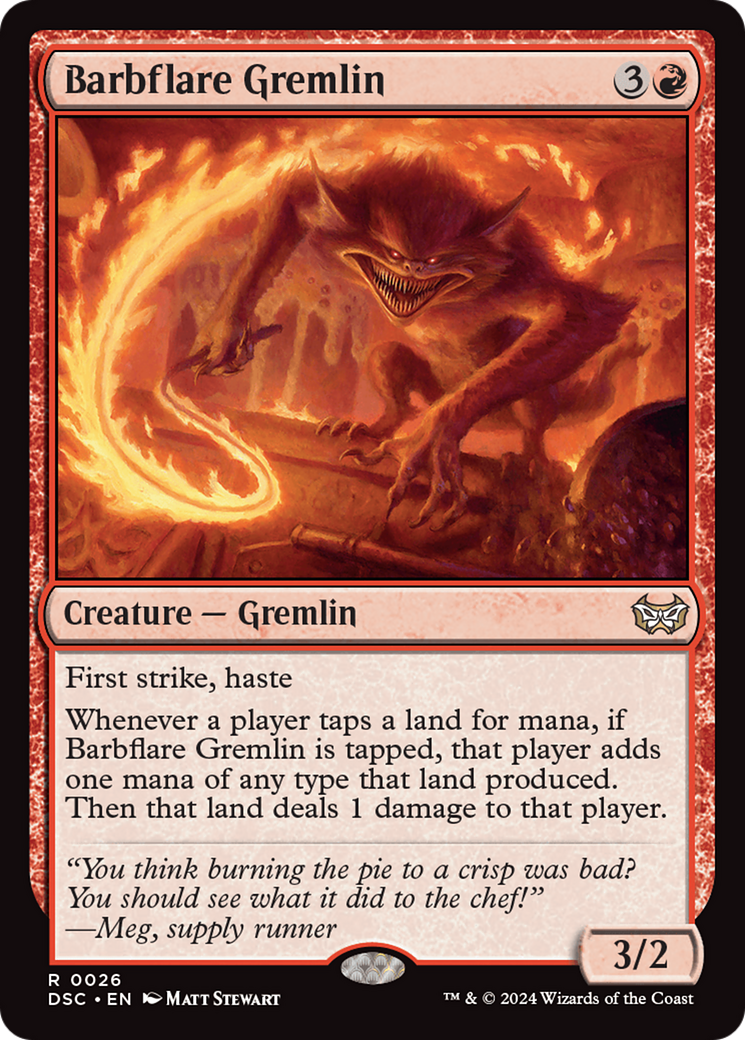
Barbflare Gremlin
Barbflare Gremlin
Creature — Gremlin
3/2
First strike, haste
Whenever a player taps a land for mana, if this creature is tapped, that player adds one mana of any type that land produced. Then that land deals 1 damage to that player.
- Barbflare Gremlin's last ability is a mana ability. It doesn't use the stack and can't be responded to.
-
1
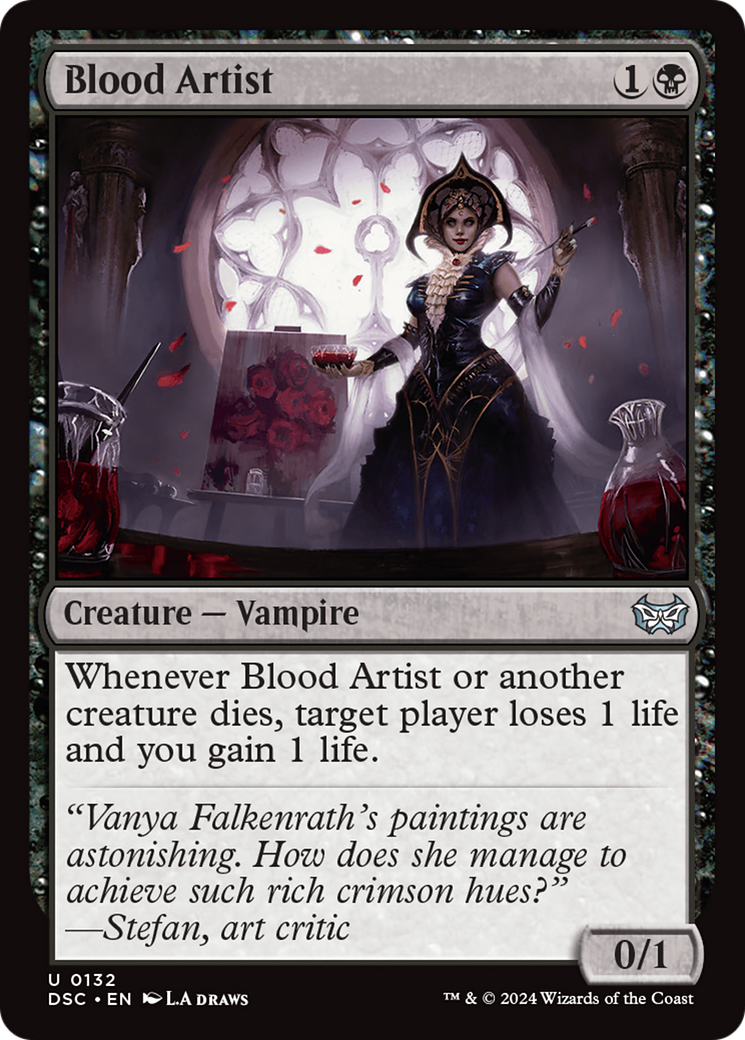
Blood Artist
Blood Artist
Creature — Vampire
0/1
Whenever this creature or another creature dies, target player loses 1 life and you gain 1 life.
- If Blood Artist and one or more other creatures die at the same time, its ability will trigger for each of those creatures.
-
1
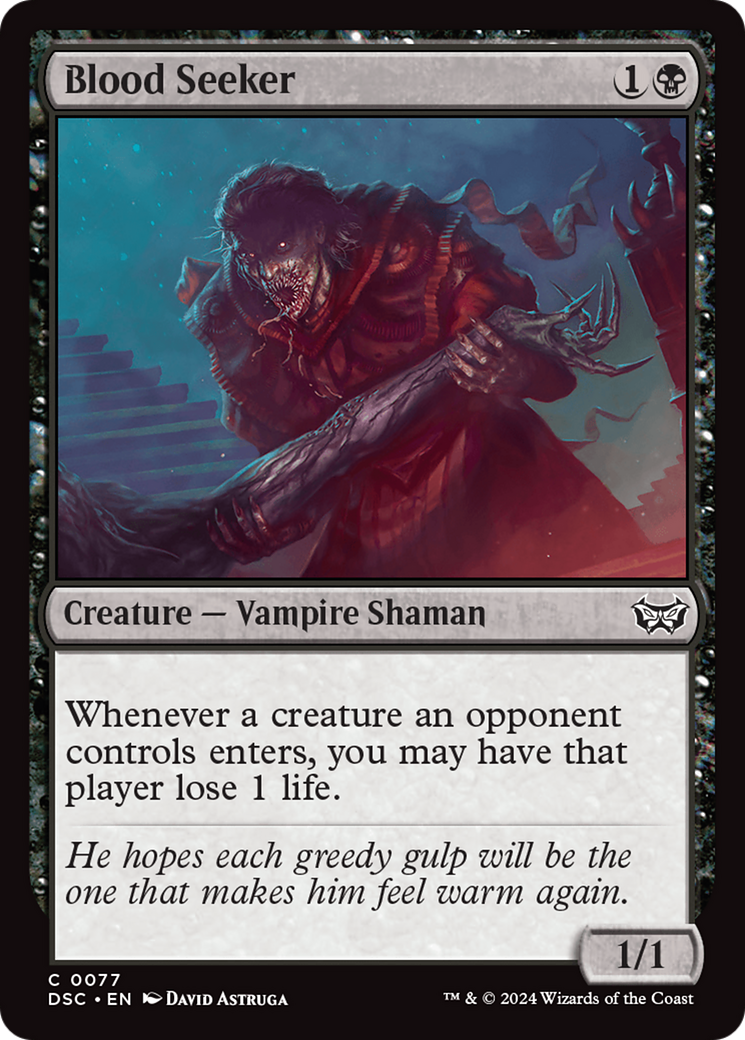
Blood Seeker
Blood Seeker
Creature — Vampire Shaman
1/1
Whenever a creature an opponent controls enters, you may have that player lose 1 life.
- Life loss is not the same as damage. Blood Seeker's ability will not cause creatures with bloodthirst to enter with +1/+1 counters.
-
1
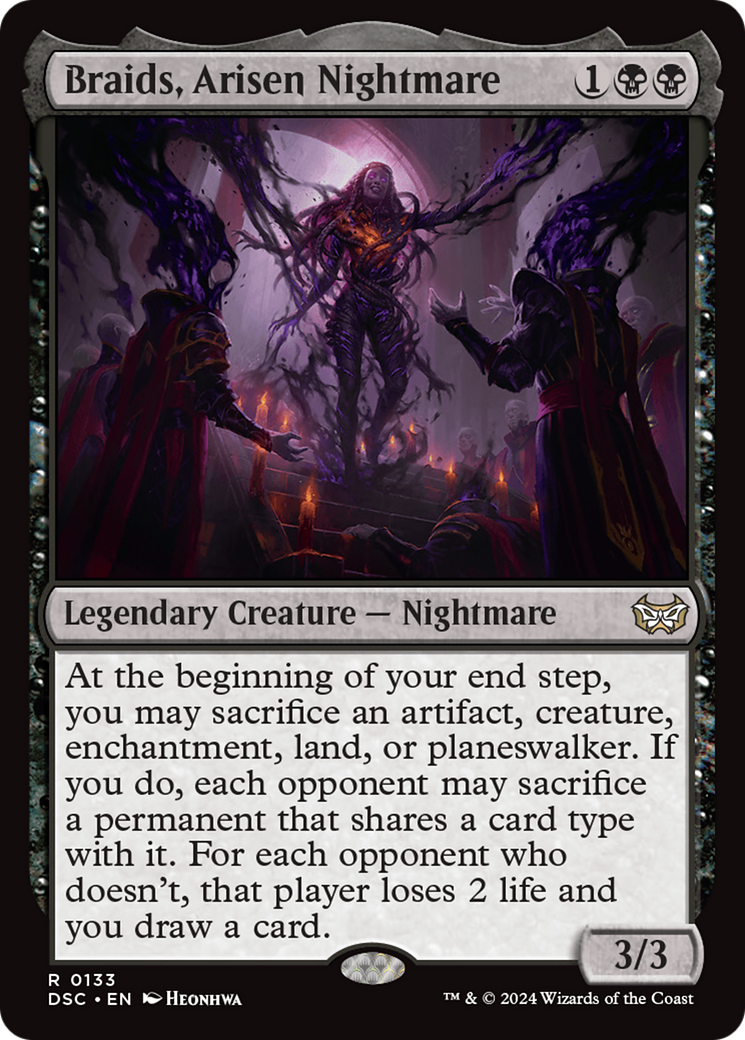
Braids, Arisen Nightmare
Braids, Arisen Nightmare
Legendary Creature — Nightmare
3/3
At the beginning of your end step, you may sacrifice an artifact, creature, enchantment, land, or planeswalker. If you do, each opponent may sacrifice a permanent of their choice that shares a card type with it. For each opponent who doesn't, that player loses 2 life and you draw a card.
- If the permanent that you sacrifice as you resolve Braids's triggered ability has more than one card type, each opponent may choose to sacrifice any permanent they control that shares any card type with it. For example, if the permanent you sacrifice is an artifact creature, one opponent might choose to sacrifice an artifact and another opponent might choose to sacrifice a creature.
-
1
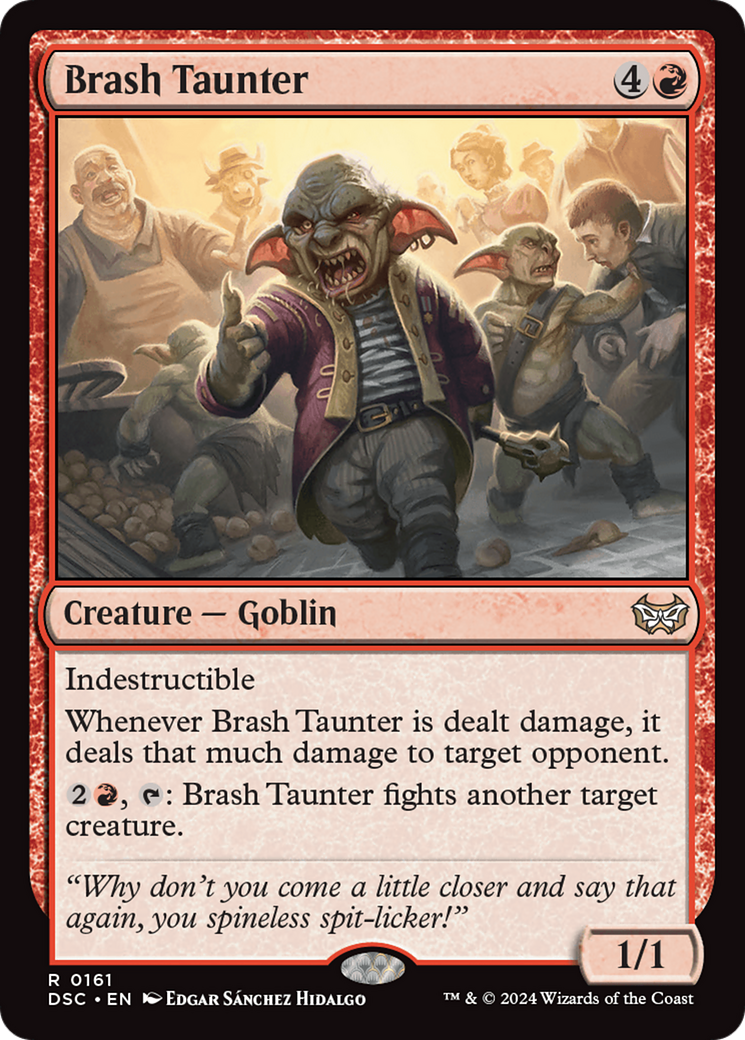
Brash Taunter
Brash Taunter
Creature — Goblin
1/1
Indestructible
Whenever this creature is dealt damage, it deals that much damage to target opponent.
, : This creature fights another target creature.
- A creature can be dealt an amount of damage greater than its toughness. For example, if Brash Taunter is dealt 3 damage, its middle ability deals 3 damage, not 1, to the target opponent.
- If your life total is brought to 0 or less at the same time that Brash Taunter is dealt damage, you lose the game before its middle ability goes on the stack.
- If the target creature is an illegal target when Brash Taunter's last ability tries to resolve, the ability doesn't resolve. If Brash Taunter is no longer on the battlefield, the target creature won't deal or be dealt damage.
-
1
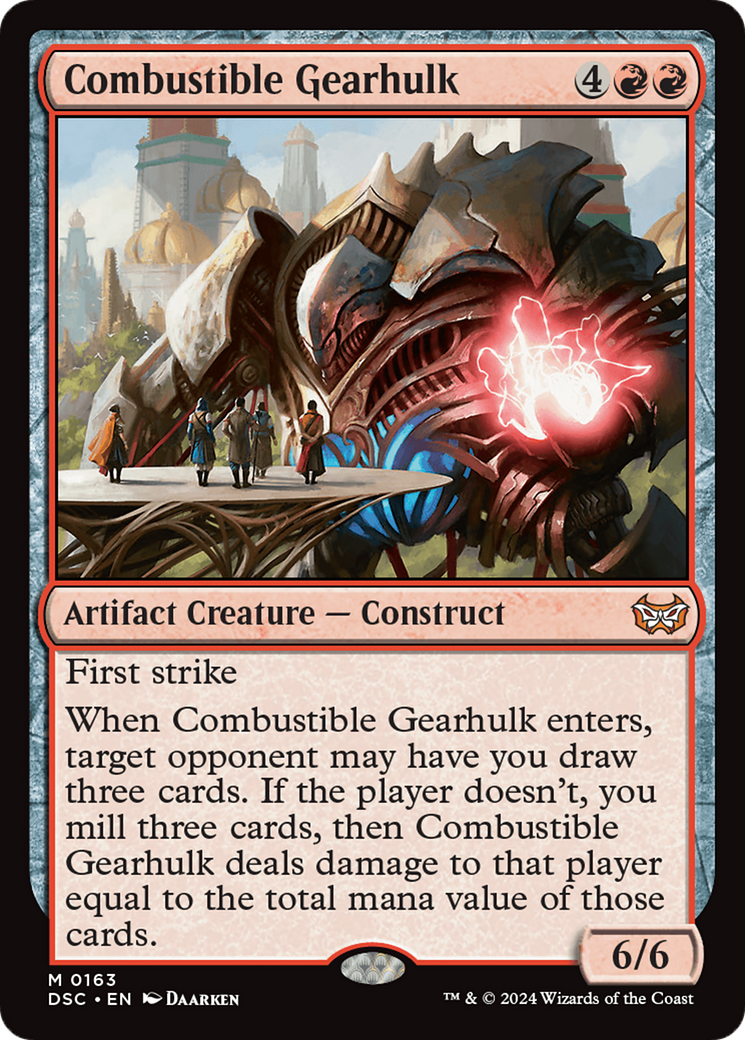
Combustible Gearhulk
Combustible Gearhulk
Artifact Creature — Construct
6/6
First strike
When this creature enters, target opponent may have you draw three cards. If the player doesn't, you mill three cards, then this creature deals damage to that player equal to the total mana value of those cards.
- If any of the cards put into your graveyard have in their mana cost, X is considered to be 0.
- If you have fewer than three cards in your library, the opponent may choose to have you draw three cards. If so, you'll lose the game as state-based actions are performed.
- While Combustible Gearhulk's triggered ability is resolving, no player may take any actions other than those specified by the Gearhulk. Once the opponent makes a choice, players can't cast spells or activate abilities until after the cards are drawn or put into the graveyard and damage has been dealt (if applicable).
-
1
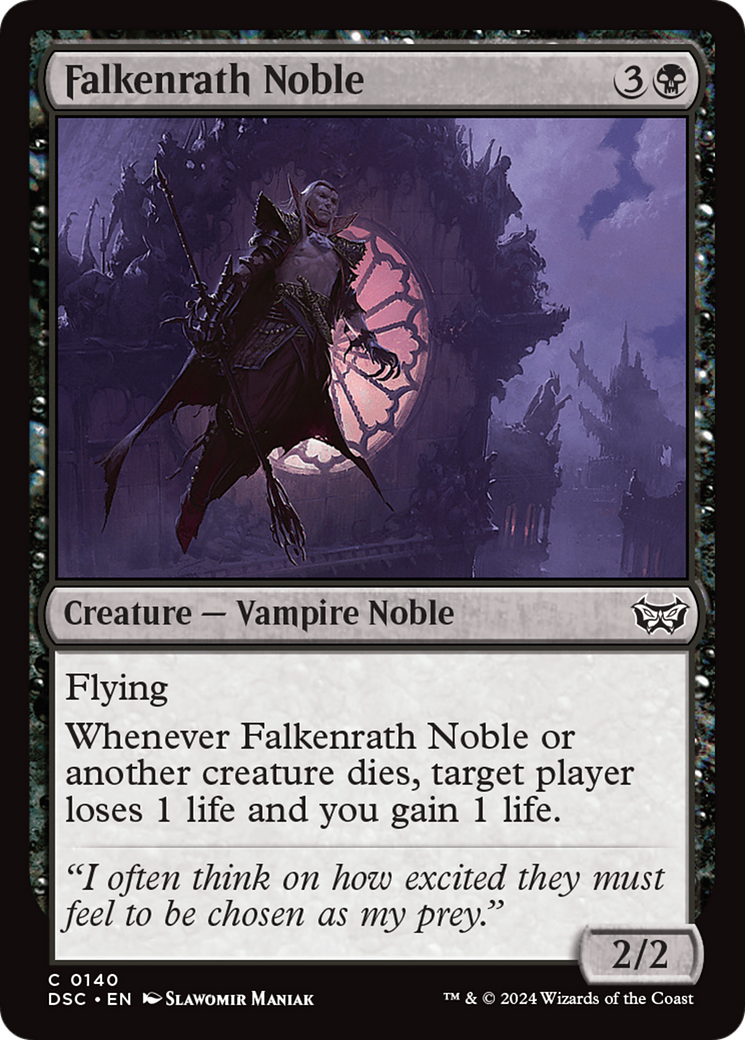
Falkenrath Noble
Falkenrath Noble
Creature — Vampire Noble
2/2
Flying
Whenever this creature or another creature dies, target player loses 1 life and you gain 1 life.
- If Falkenrath Noble and another creature die at the same time, Falkenrath Noble's triggered ability will trigger for each of them.
-
1
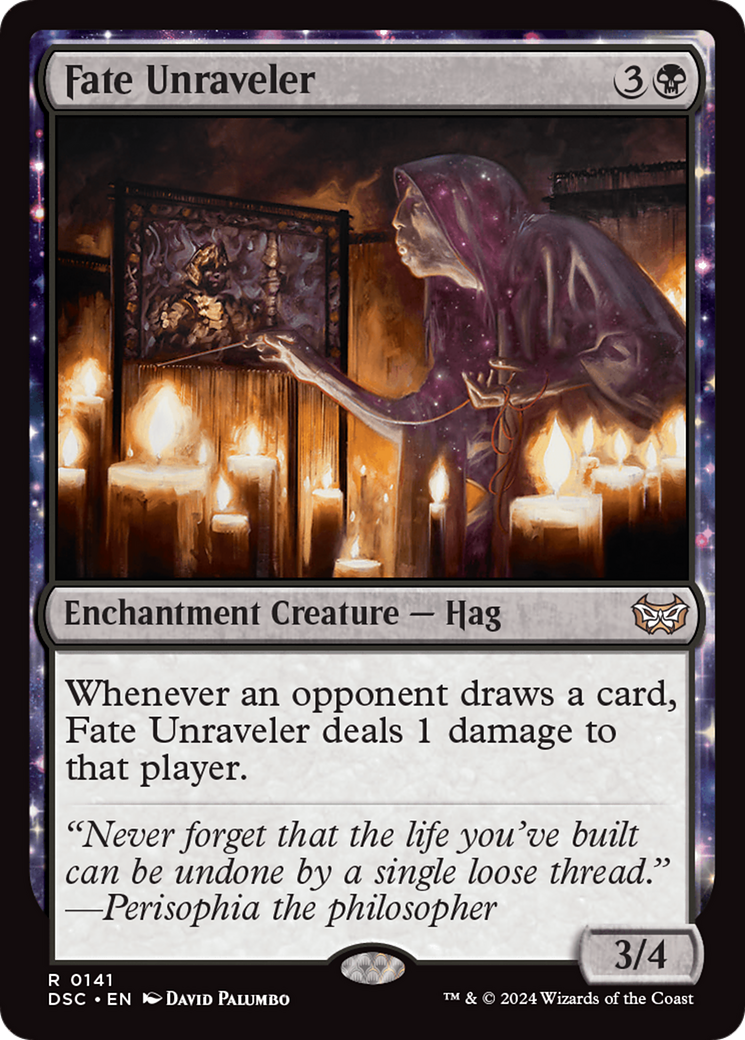
Fate Unraveler
Fate Unraveler
Enchantment Creature — Hag
3/4
Whenever an opponent draws a card, this creature deals 1 damage to that player.
-
1
Fear of Burning Alive
Fear of Burning Alive
Enchantment Creature — Nightmare
4/4
When this creature enters, it deals 4 damage to each opponent.
Delirium — Whenever a source you control deals noncombat damage to an opponent, if there are four or more card types among cards in your graveyard, this creature deals that amount of damage to target creature that player controls.
-
1
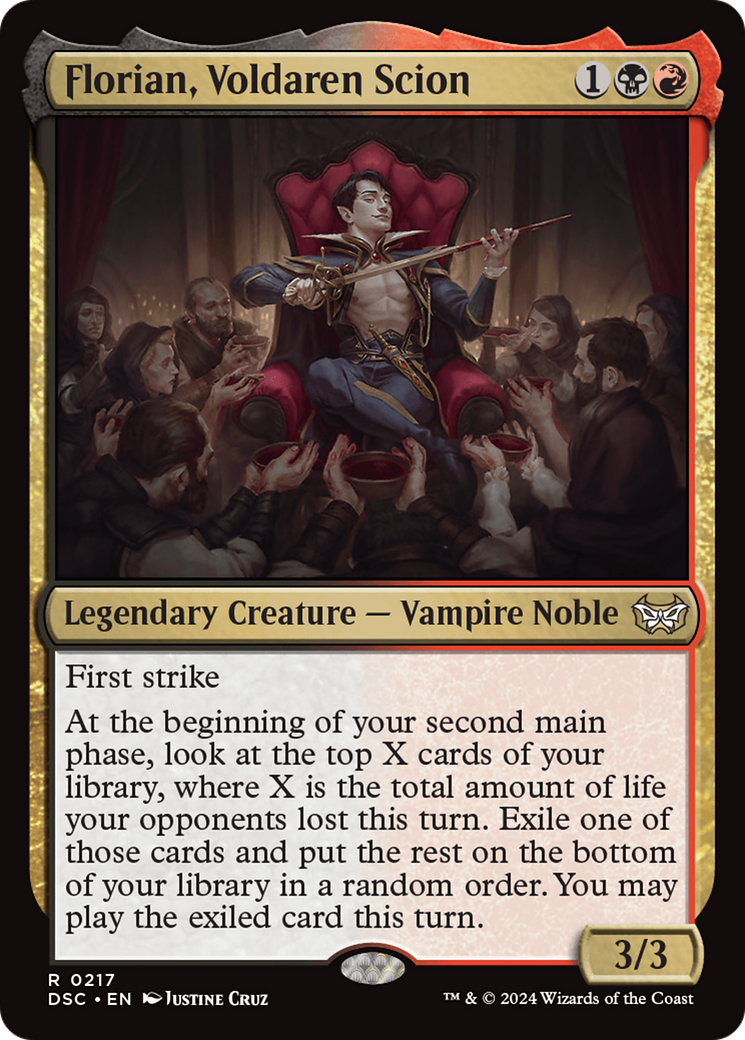
Florian, Voldaren Scion
Florian, Voldaren Scion
Legendary Creature — Vampire Noble
3/3
First strike
At the beginning of each of your postcombat main phases, look at the top X cards of your library, where X is the total amount of life your opponents lost this turn. Exile one of those cards and put the rest on the bottom of your library in a random order. You may play the exiled card this turn.
- If you somehow have more than two main phases in a turn, each main phase after your first one is a postcombat main phase, and Florian's last ability triggers at the beginning of each of them.
- You must pay all costs and follow all timing rules for cards you play with Florian's last ability.
- Damage dealt to a player causes that player to lose that much life.
- You get a postcombat main phase even if no creatures attacked during a turn. Florian's last ability will trigger.
- If an opponent loses life but Florian leaves the battlefield before your postcombat main phase begins, its last ability doesn't trigger.
- Florian's ability checks only how much life opponents lost during the turn, not by how much their life totals decreased compared to the start of the turn. For example, if an opponent lost 2 life and then gained 8 life before Florian's ability resolves, you'll look at the top two cards of your library.
- If an opponent loses life and subsequently loses the game before your postcombat main phase, Florian's last ability counts that loss of life.
-
1
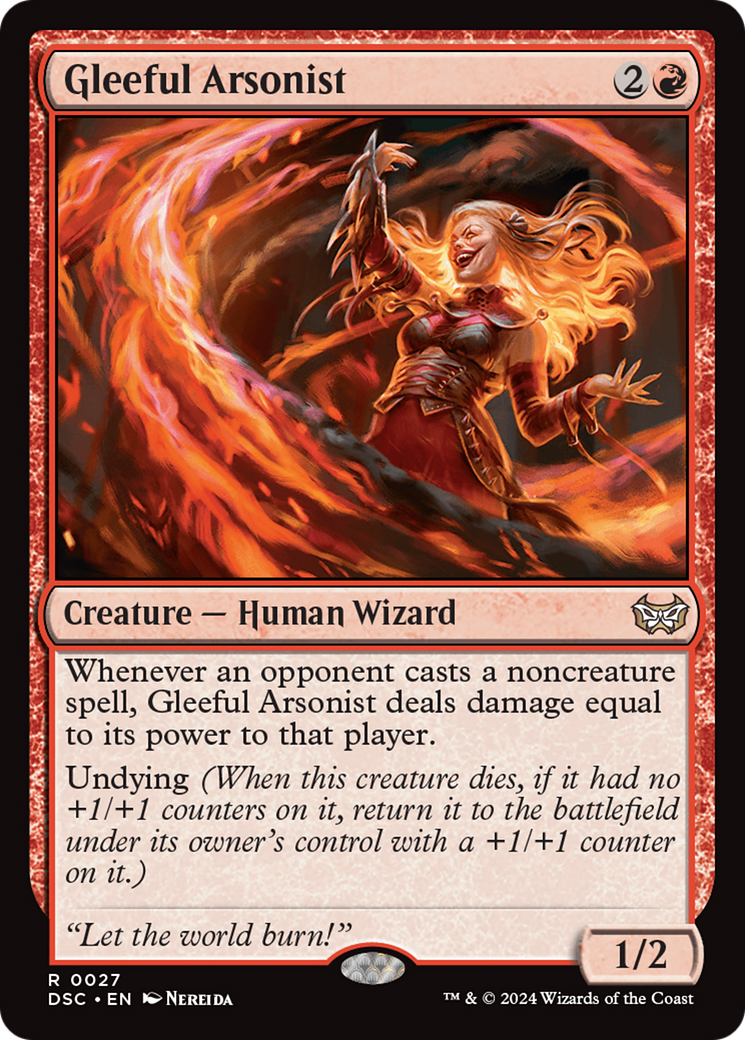
Gleeful Arsonist
Gleeful Arsonist
Creature — Human Wizard
1/2
Whenever an opponent casts a noncreature spell, this creature deals damage equal to its power to that player.
Undying (When this creature dies, if it had no +1/+1 counters on it, return it to the battlefield under its owner's control with a +1/+1 counter on it.)
- Gleeful Arsonist's first ability resolves before the spell that caused it to trigger. It resolves even if that spell is countered.
- If Gleeful Arsonist is no longer on the battlefield when its first ability resolves, use its power as it last existed on the battlefield to determine how much damage it deals.
- Once undying returns the creature, it's considered a new object with no relation to the object that it was. Auras that were attached to it won't return to the battlefield. Equipment that was attached to it will remain unattached. Any counters that were on it won't be put on the new creature.
-
1
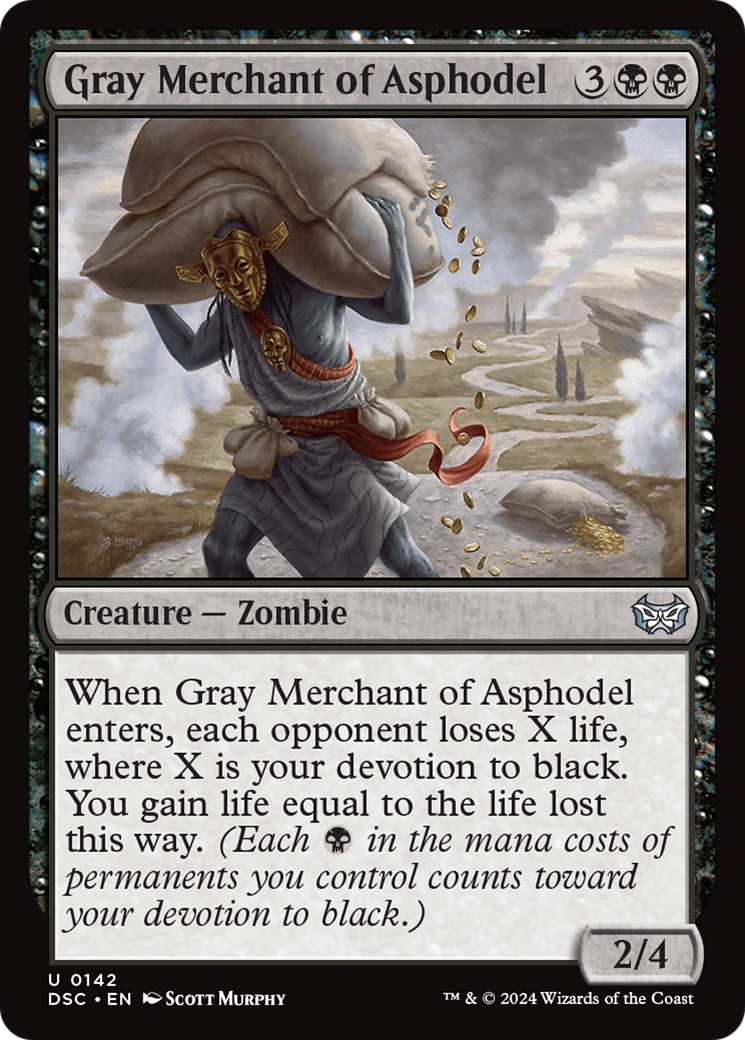
Gray Merchant of Asphodel
Gray Merchant of Asphodel
Creature — Zombie
2/4
When this creature enters, each opponent loses X life, where X is your devotion to black. You gain life equal to the life lost this way. (Each in the mana costs of permanents you control counts toward your devotion to black.)
- The amount of life you gain is the total amount of life lost, not simply the value of X.
- Hybrid mana symbols, monocolored hybrid mana symbols, and Phyrexian mana symbols do count toward your devotion to their color(s).
- Colorless and generic mana symbols ( , , , , , and so on) in mana costs of permanents you control don't count toward your devotion to any color.
- Mana symbols in the text boxes of permanents you control don't count toward your devotion to any color.
- If an activated ability or triggered ability has an effect that depends on your devotion to a color, you count the number of mana symbols of that color among the mana costs of permanents you control as the ability resolves. The permanent with that ability will be counted if it's still on the battlefield at that time.
- If you put an Aura on an opponent's permanent, you still control the Aura, and mana symbols in its mana cost count towards your devotion.
-
1
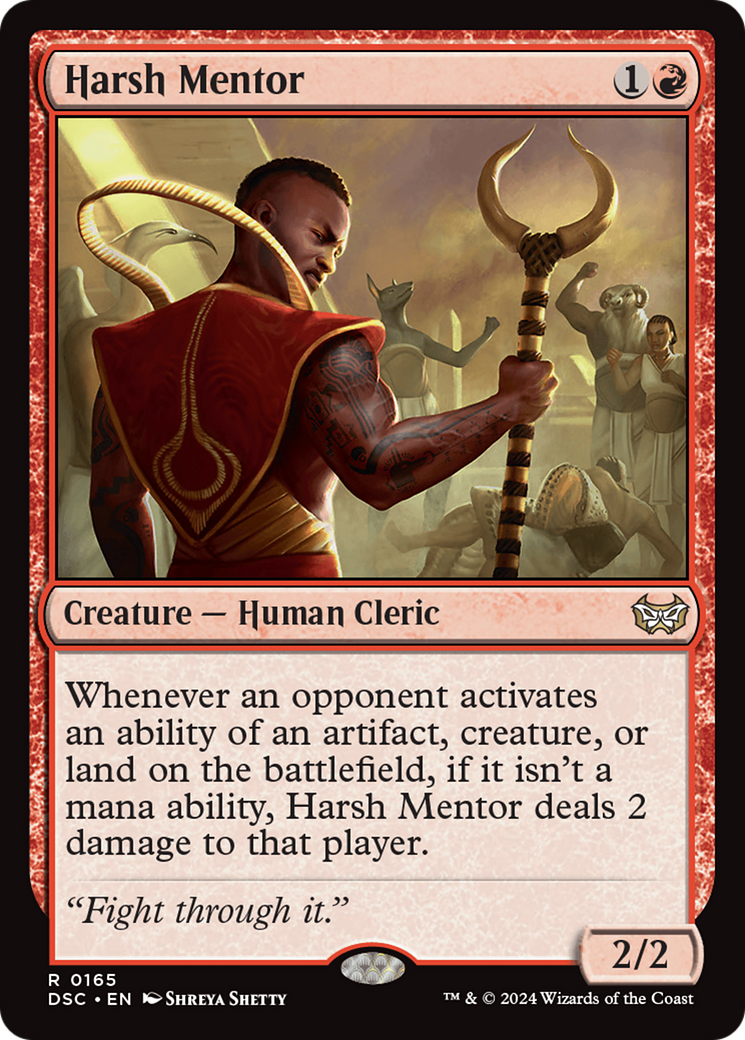
Harsh Mentor
Harsh Mentor
Creature — Human Cleric
2/2
Whenever an opponent activates an ability of an artifact, creature, or land on the battlefield, if it isn't a mana ability, this creature deals 2 damage to that player.
- Activated abilities contain a colon. They're generally written "[Cost]: [Effect]." Some keyword abilities (such as equip) are activated abilities and will have colons in their reminder text. An activated mana ability is one that produces mana as it resolves, not one that costs mana to activate. Notably, exerting a creature isn't an activated ability.
- Harsh Mentor's ability doesn't trigger when an opponent activates an ability of a card in hand (such as cycling) or a card in a graveyard (such as embalm), even if that causes a card to be put onto the battlefield.
- Harsh Mentor's ability resolves before the ability that caused it to trigger.
-
1
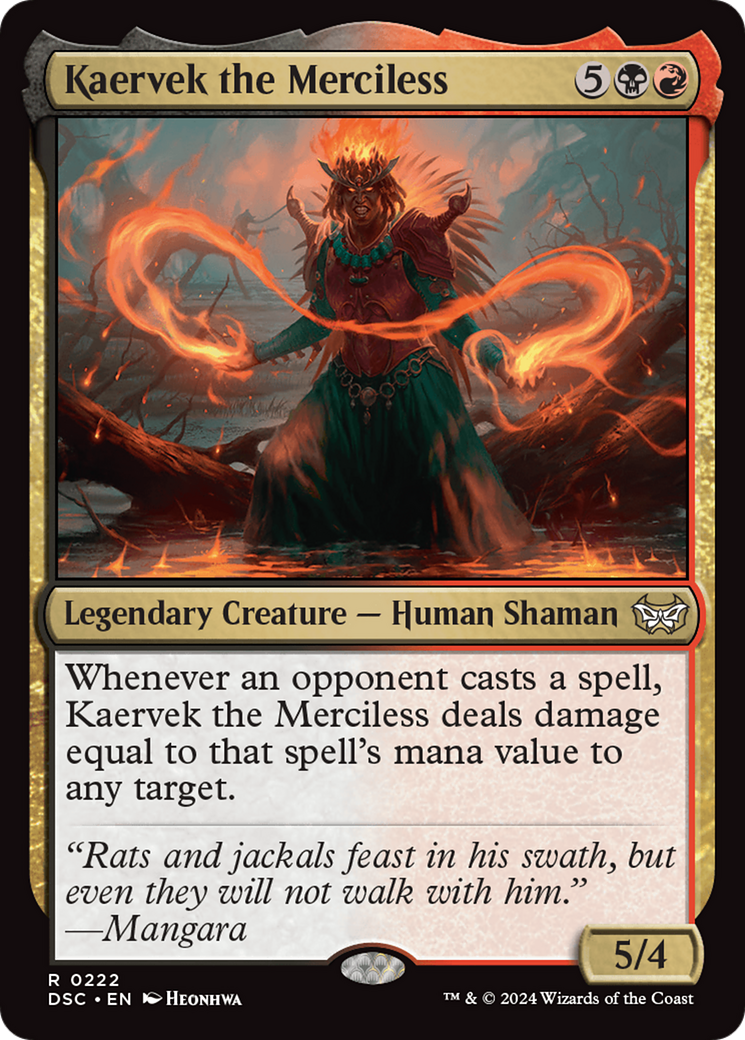
Kaervek the Merciless
Kaervek the Merciless
Legendary Creature — Human Shaman
5/4
Whenever an opponent casts a spell, Kaervek deals damage equal to that spell's mana value to any target.
- An ability that triggers when a player casts a spell resolves before the spell that caused it to trigger. It resolves even if that spell is countered.
- Alternative costs, additional costs, and cost reductions don't change a spell's mana value. Its mana value is still based on its mana cost.
- For spells with in their mana costs, use the value chosen for X to determine the spell's mana value.
-
1
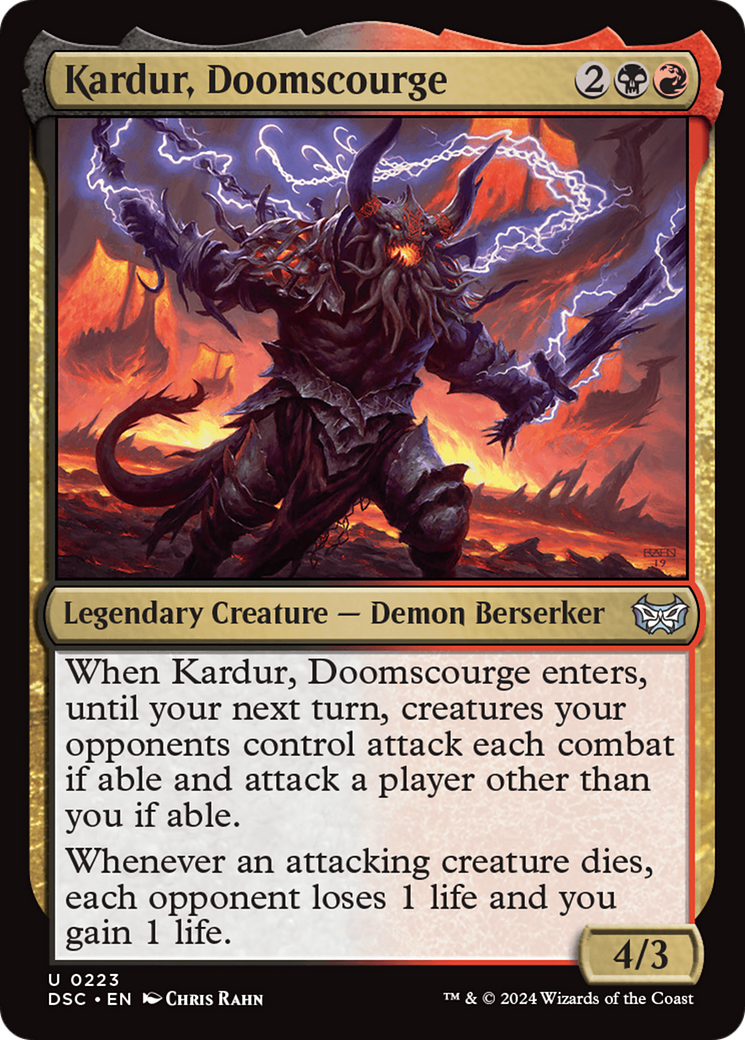
Kardur, Doomscourge
Kardur, Doomscourge
Legendary Creature — Demon Berserker
4/3
When Kardur enters, until your next turn, creatures your opponents control attack each combat if able and attack a player other than you if able.
Whenever an attacking creature dies, each opponent loses 1 life and you gain 1 life.
- Kardur's first ability affects all creatures your opponents control, including any that enter the battlefield after the ability resolves.
- If a creature an opponent controls can't attack for some reason (such as being tapped or having come under its controller's control that turn), then it doesn't attack. If there's a cost associated with having it attack, its controller isn't forced to pay that cost, so the creature doesn't have to attack in that case either.
- If a creature an opponent controls doesn't qualify for any of the above exceptions and can attack, it must attack a player other than you if able. If the creature can't attack any of those players, or if there are no such players, it must attack you or an opposing planeswalker.
- If a creature affected by Kardur's ability could legally attack multiple players and/or planeswalkers, its controller chooses who it attacks.
- Kardur's last ability will trigger no matter who controlled the attacking creature and no matter who it was attacking.
-
1
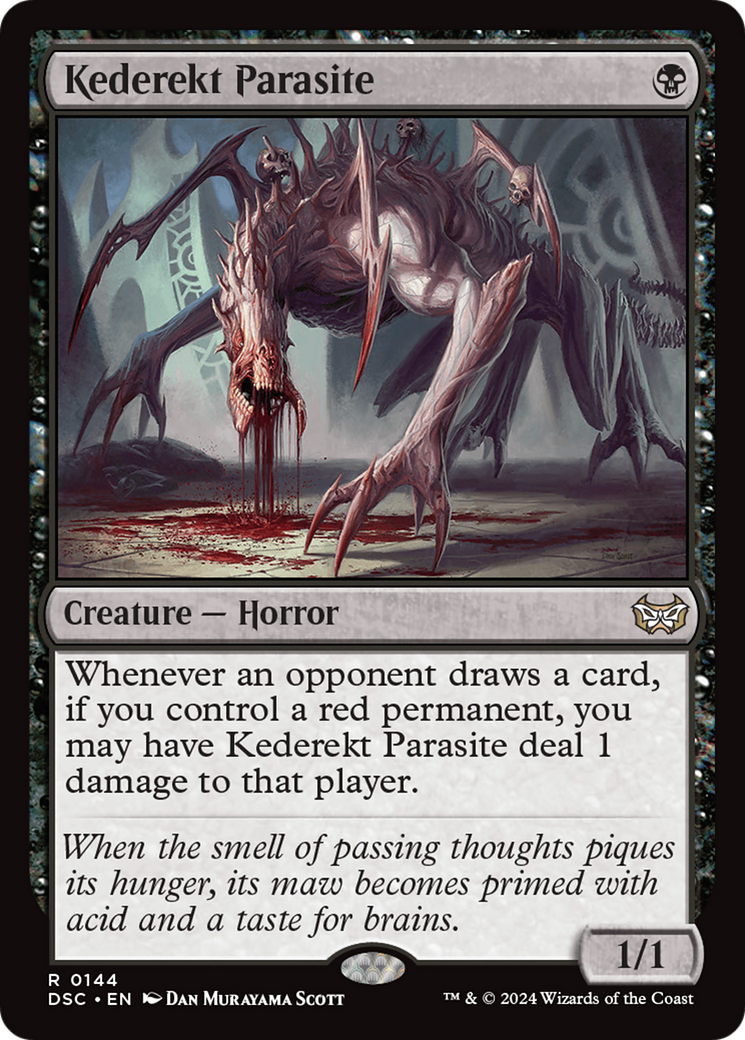
Kederekt Parasite
Kederekt Parasite
Creature — Horror
1/1
Whenever an opponent draws a card, if you control a red permanent, you may have this creature deal 1 damage to that player.
- The "intervening 'if' clause" means that (1) the ability won't trigger at all unless you control a permanent of the specified color, and (2) the ability will do nothing unless you control a permanent of the specified color at the time it resolves.
-
1
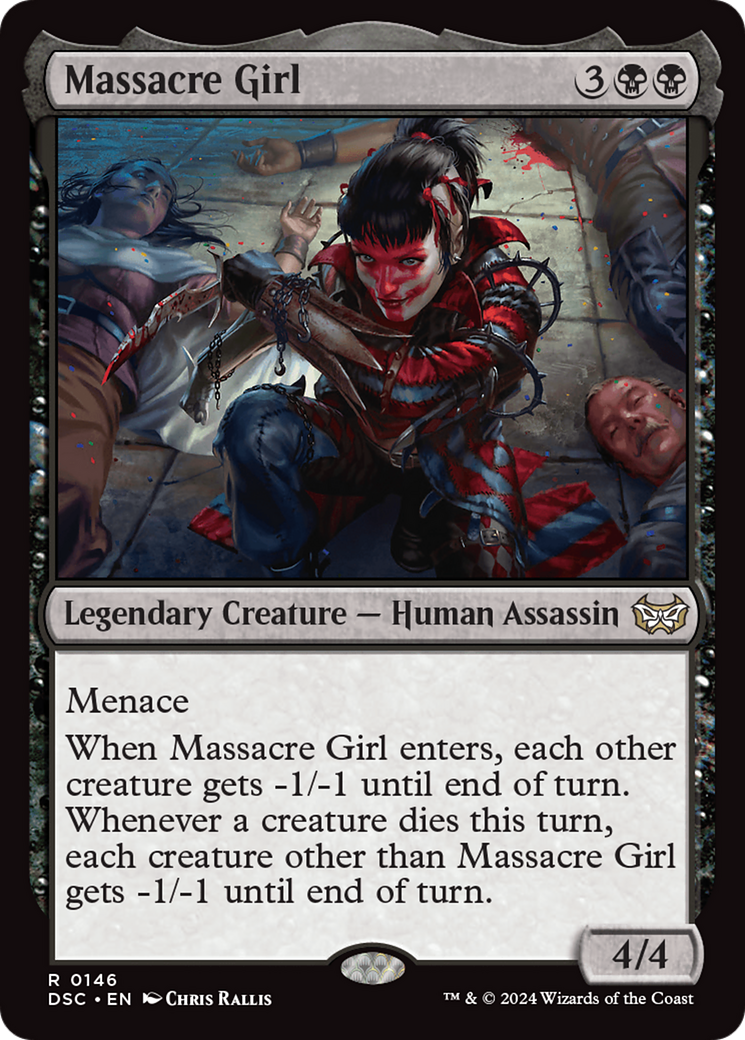
Massacre Girl
Massacre Girl
Legendary Creature — Human Assassin
4/4
Menace
When Massacre Girl enters, each other creature gets -1/-1 until end of turn. Whenever a creature dies this turn, each creature other than Massacre Girl gets -1/-1 until end of turn.
- Massacre Girl's enters-the-battlefield triggered ability and its delayed triggered ability each affect only creatures on the battlefield at the time that those abilities resolve. Creatures that enter the battlefield or become creatures later in the turn won't get -1/-1 unless the delayed triggered ability triggers and resolves again later.
- Once Massacre Girl's enters-the-battlefield ability has triggered, it doesn't matter whether Massacre Girl remains on the battlefield. The delayed triggered ability will be created as the enters-the-battlefield ability resolves.
- Creatures that die while Massacre Girl's triggered ability is still on the stack won't cause its delayed triggered ability to trigger since that delayed triggered ability hasn't been created yet.
- A creature with 0 toughness doesn't die immediately. Rather, the creature dies the next time a player would receive priority. This means that any creatures whose toughness becomes 0 as Massacre Girl's enters-the-battlefield ability resolves will remain on the battlefield until just after the delayed triggered ability has been created.
- If more than one creature dies at once, Massacre Girl's delayed triggered ability triggers that many times.
-
1
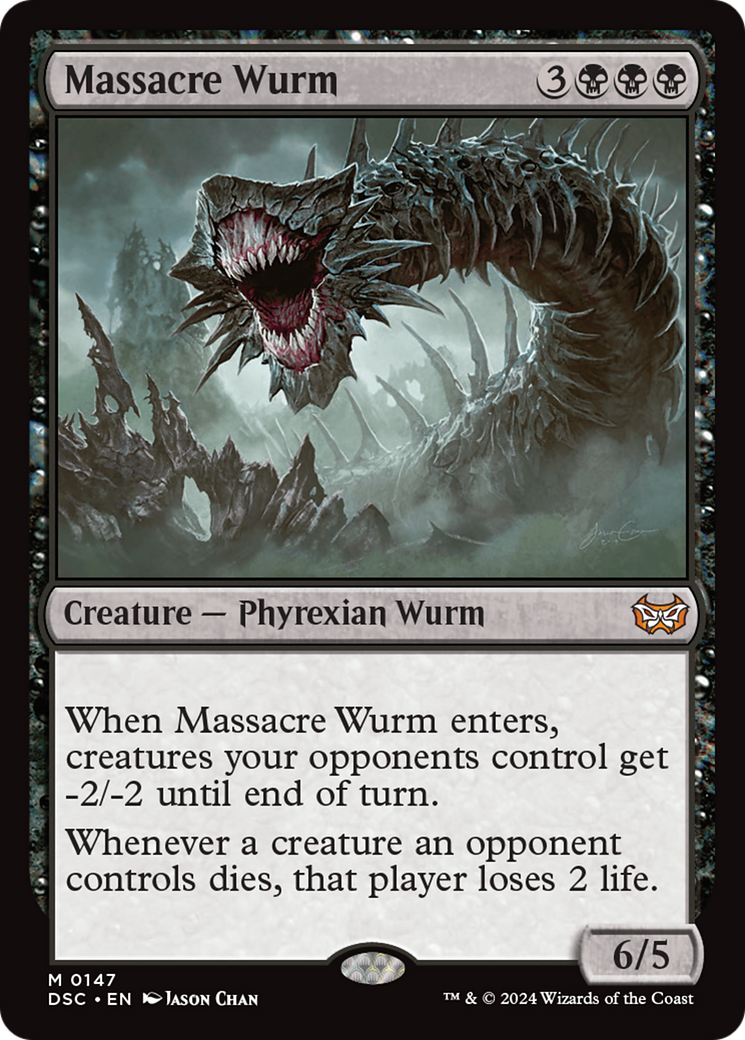
Massacre Wurm
Massacre Wurm
Creature — Phyrexian Wurm
6/5
When this creature enters, creatures your opponents control get -2/-2 until end of turn.
Whenever a creature an opponent controls dies, that player loses 2 life.
- Massacre Wurm's first ability affects only creatures your opponents control at the time it resolves. Creatures they begin to control later in the turn won't get -2/-2.
- Massacre Wurm's triggered ability triggers if a creature an opponent controls dies for any reason, including from its first ability reducing its toughness to 0, as long as Massacre Wurm remains on the battlefield.
- If a creature an opponent controls dies at the same time as Massacre Wurm, Massacre Wurm's last ability triggers for that creature.
- If your life total is brought to 0 or less at the same time that a creature an opponent controls is dealt lethal damage, you lose the game before Massacre Wurm's last ability goes on the stack.
-
1
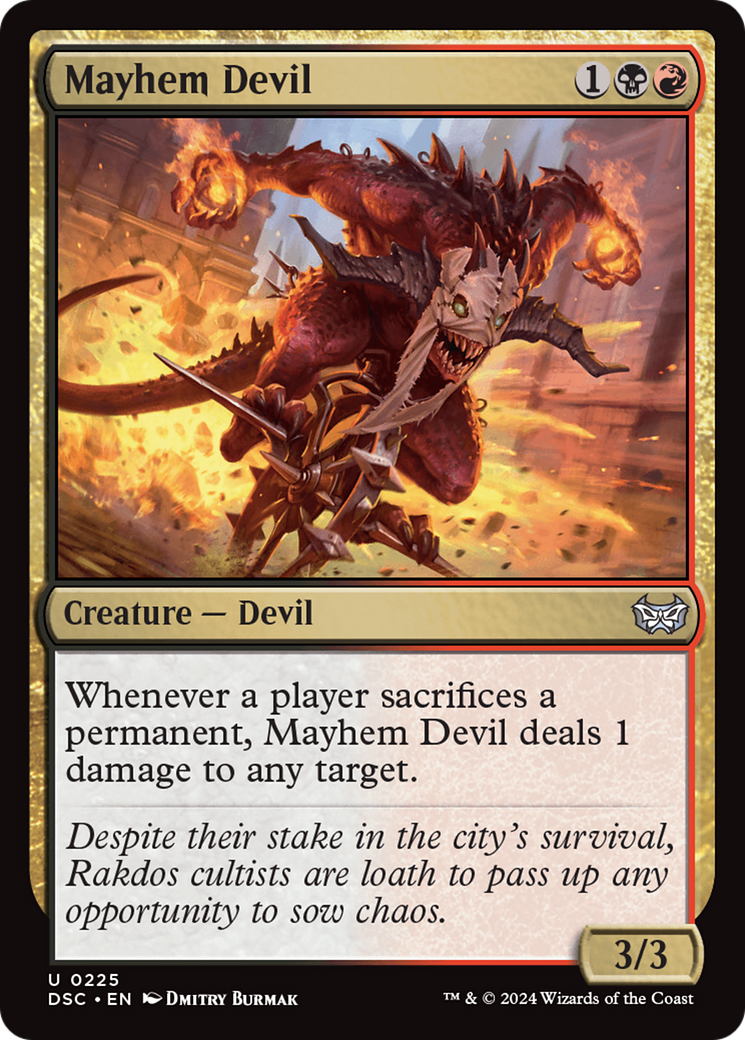
Mayhem Devil
Mayhem Devil
Creature — Devil
3/3
Whenever a player sacrifices a permanent, this creature deals 1 damage to any target.
- A legendary permanent that is put into a graveyard because of the "legend rule" isn't sacrificed.
- You control Mayhem Devil's triggered ability and choose the target, no matter who sacrificed the permanent.
- If a permanent is sacrificed to pay a cost of a spell or ability, Mayhem Devil's ability will resolve before that spell or ability. Conversely, if a permanent is sacrificed during the resolution of a spell or ability, that spell or ability will finish resolving before Mayhem Devil's ability is put onto the stack.
- Mayhem Devil itself doesn't allow any player to sacrifice any permanents. Its ability triggers whenever a player sacrifices a permanent because some other spell, ability, or cost instructed the player to do so.
- If you sacrifice Mayhem Devil, its ability triggers.
-
1
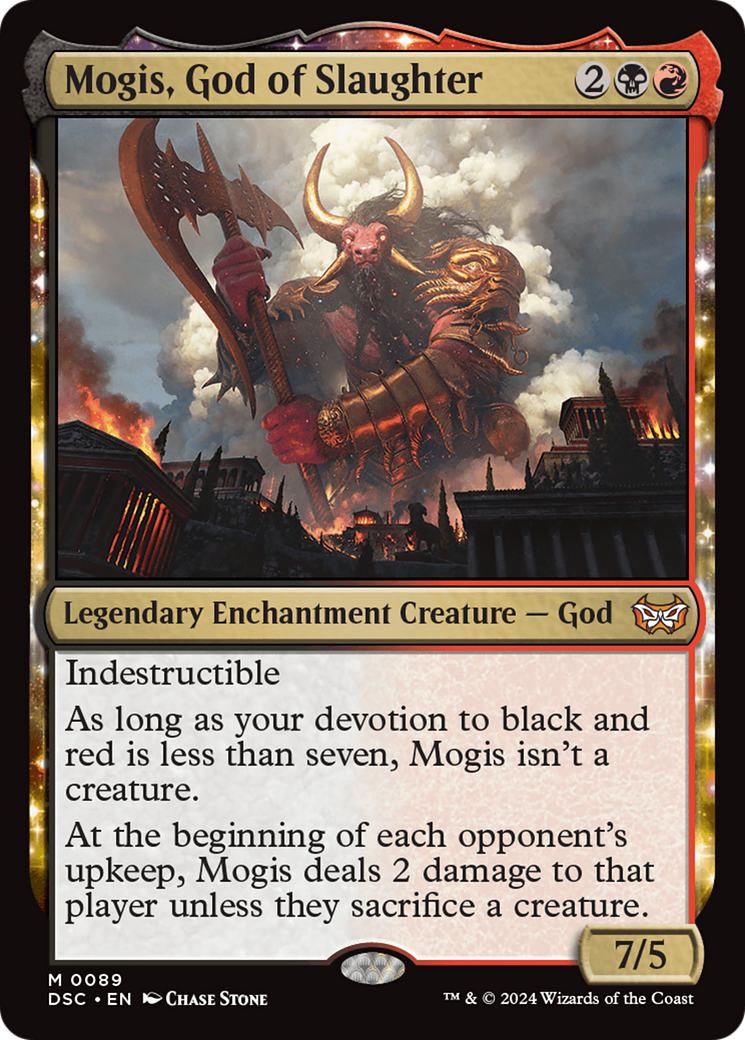
Mogis, God of Slaughter
Mogis, God of Slaughter
Legendary Enchantment Creature — God
7/5
Indestructible
As long as your devotion to black and red is less than seven, Mogis isn't a creature.
At the beginning of each opponent's upkeep, Mogis deals 2 damage to that player unless they sacrifice a creature of their choice.
- If an effect causes a God to lose all abilities, its ability that causes it to stop being a creature still applies if appropriate.
- When a God enters the battlefield, your devotion to its color (including the mana symbols in the mana cost of the God itself) will determine if a creature entered the battlefield or not for abilities that trigger whenever a creature enters the battlefield.
- If a God stops being a creature, it loses the type creature and the creature type God. It continues to be a legendary enchantment.
- The abilities of Gods function as long as they're on the battlefield, regardless of whether they're creatures.
- If a God is attacking or blocking and it stops being a creature, it will be removed from combat. It won't rejoin combat if it resumes being a creature later during that combat.
- Counters put on a God remain on it while it's not a creature, even if they have no effect.
- Your devotion to two colors is the number of mana symbols among mana costs of permanents you control that are the first color, the second, or both. If an effect counts your devotion to two colors, a hybrid symbol that is both of those colors is counted just once.
- The type-changing ability that can make a God not be a creature functions only on the battlefield. It's always a creature card in other zones, regardless of your devotion to its color. It's always a creature spell while it's on the stack.
- As a God enters the battlefield, your devotion to its color will determine whether any replacement effects that affect creatures entering the battlefield apply to that God. Because replacement effects are considered before the God is on the battlefield, the mana symbols in its mana cost won't be counted when determining this.
- If the player can't sacrifice a creature (usually because they don't control one), Mogis will deal 2 damage to them.
- Mana symbols in the text boxes of permanents you control don't count toward your devotion to any color.
- Hybrid mana symbols, monocolored hybrid mana symbols, and Phyrexian mana symbols do count toward your devotion to their color(s).
- If an activated ability or triggered ability has an effect that depends on your devotion to a color, you count the number of mana symbols of that color among the mana costs of permanents you control as the ability resolves. The permanent with that ability will be counted if it's still on the battlefield at that time.
- Numeric mana symbols ( , , and so on) in mana costs of permanents you control don't count toward your devotion to any color.
-
1
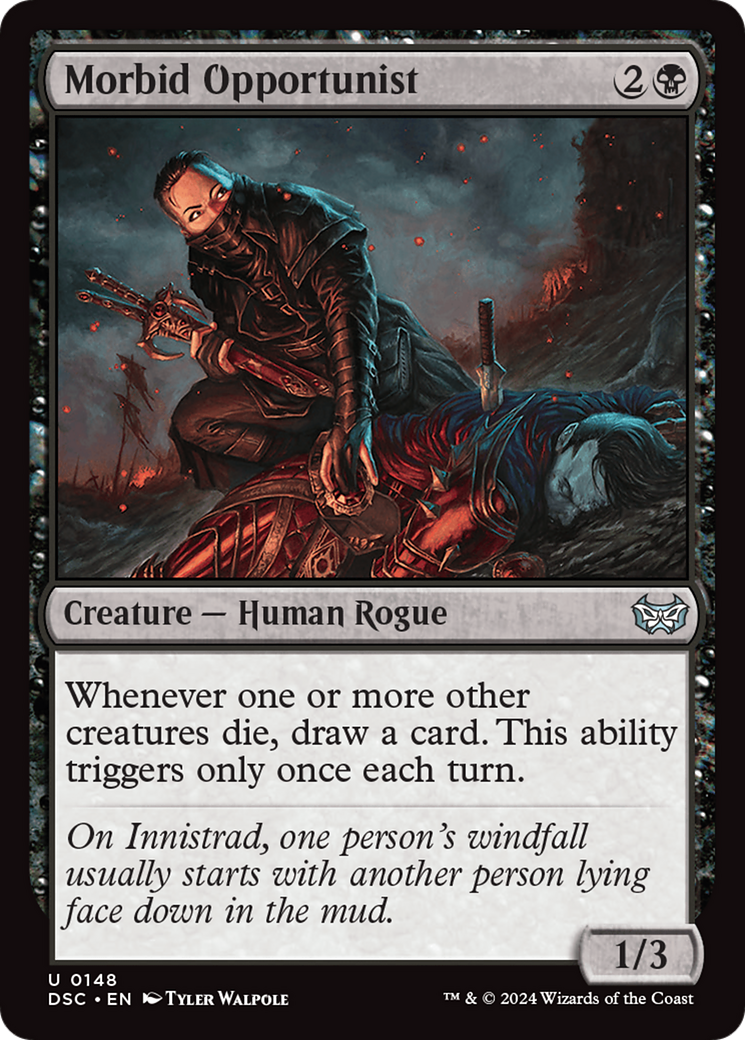
Morbid Opportunist
Morbid Opportunist
Creature — Human Rogue
1/3
Whenever one or more other creatures die, draw a card. This ability triggers only once each turn.
- If Morbid Opportunist dies at the same time as one or more other creatures, Morbid Opportunist's ability still triggers.
-
1
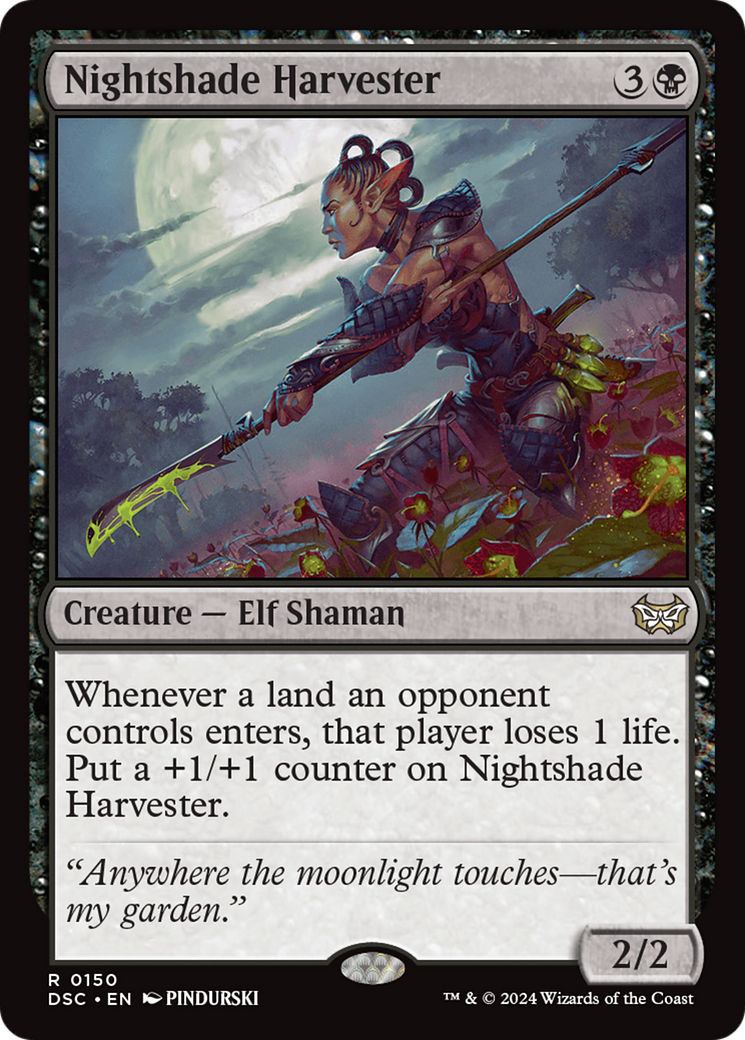
Nightshade Harvester
Nightshade Harvester
Creature — Elf Shaman
2/2
Whenever a land an opponent controls enters, that player loses 1 life. Put a +1/+1 counter on this creature.
-
1
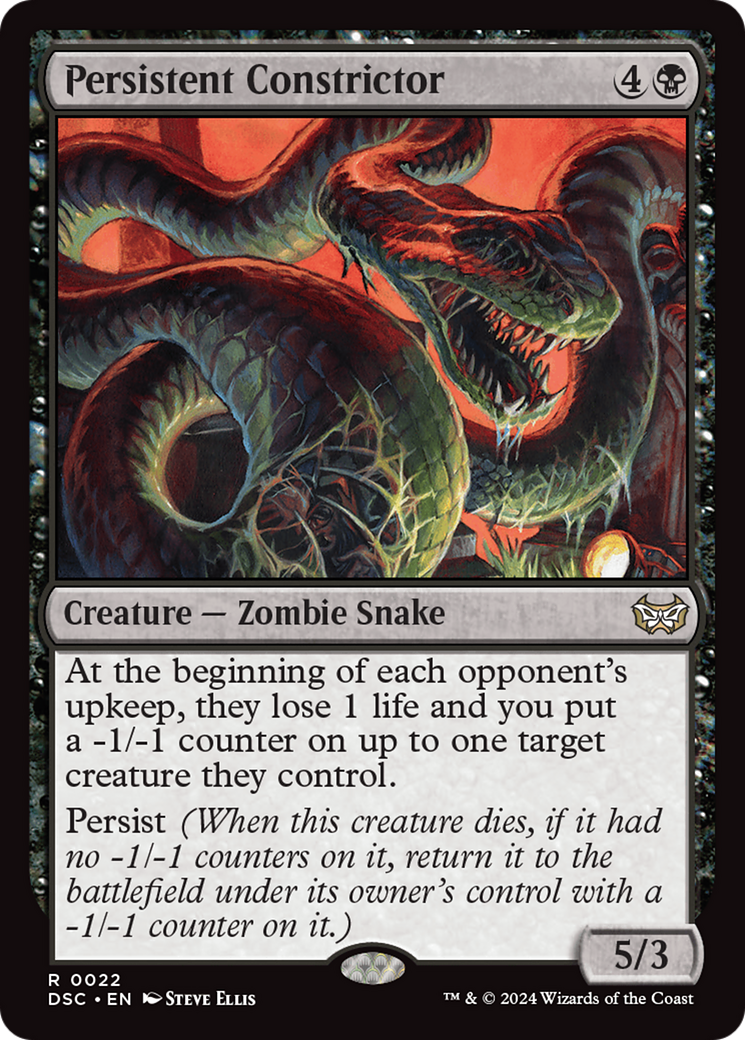
Persistent Constrictor
Persistent Constrictor
Creature — Zombie Snake
5/3
At the beginning of each opponent's upkeep, they lose 1 life and you put a -1/-1 counter on up to one target creature they control.
Persist (When this creature dies, if it had no -1/-1 counters on it, return it to the battlefield under its owner's control with a -1/-1 counter on it.)
- If the target creature is an illegal target as Persistent Constrictor's first ability tries to resolve, it won't resolve and none of its effects will happen. No player will lose life.
- If a card with persist is removed from the graveyard after it dies but before the ability trigger resolves, it won't be returned to the battlefield.
- Once persist returns the creature, it's considered a new object with no relation to the object that it was. Auras that were attached to it won't return to the battlefield. Equipment that was attached to it will remain unattached. Any counters that were on it won't be put on the new creature.
- If a creature has +1/+1 counters and -1/-1 counters on it, state-based actions remove the same number of each so that it has only one kind of those counters on it. A creature's persist ability can bring it back again if its -1/-1 counters are removed this way.
- If a creature with persist that has +1/+1 counters on it receives enough -1/-1 counters to cause it to be destroyed by lethal damage or put into its owner's graveyard for having 0 or less toughness, persist won't trigger and the card won't return to the battlefield. That's because persist checks the creature as it last existed on the battlefield, and it still had -1/-1 counters on it at that point.
-
1
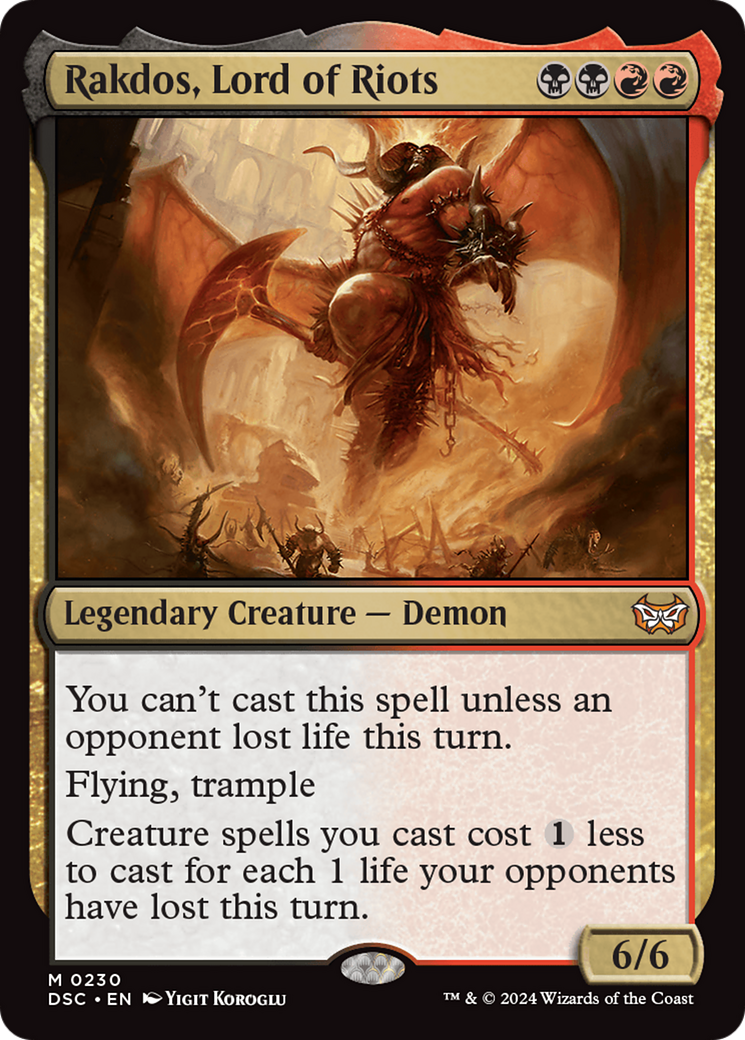
Rakdos, Lord of Riots
Rakdos, Lord of Riots
Legendary Creature — Demon
6/6
You can't cast Rakdos unless an opponent lost life this turn.
Flying, trample
Creature spells you cast cost less to cast for each 1 life your opponents have lost this turn.
- Damage dealt to a player causes that player to lose that much life.
- Rakdos can be put onto the battlefield by another spell or ability even if no opponent has lost life that turn.
- Rakdos's last ability cares about the total life lost, not necessarily what an opponent's life total is compared to what it was at the beginning of the turn. For example, if an opponent loses 5 life and then gains 10 life in a turn, creature spells you cast will cost less to cast.
- If an opponent lost life and subsequently lost the game, Rakdos's first ability is satisfied, and its last ability counts that loss of life.
- Rakdos's last ability can't reduce the colored mana requirement of a creature spell you cast.
- If there are additional costs to cast a creature spell, such as a kicker cost or the commander tax, apply those increases before applying cost reductions.
- Rakdos's last ability won't reduce the cost to cast Rakdos itself. It applies only to creature spells you cast once Rakdos is on the battlefield.
-
1
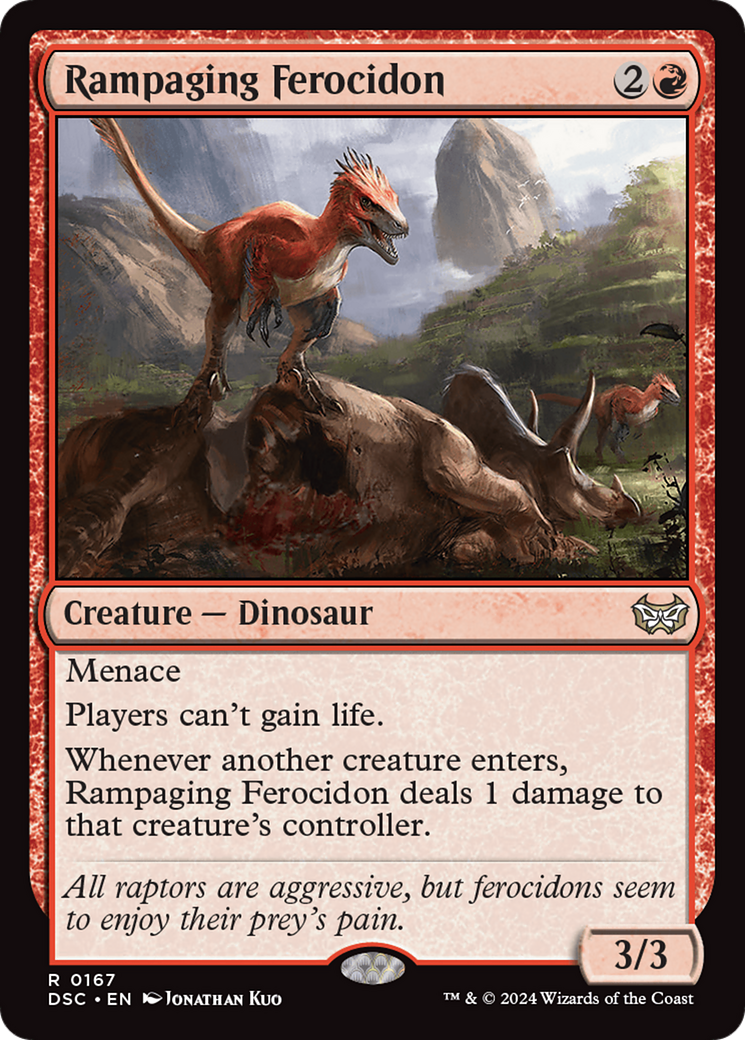
Rampaging Ferocidon
Rampaging Ferocidon
Creature — Dinosaur
3/3
Menace
Players can't gain life.
Whenever another creature enters, this creature deals 1 damage to that creature's controller.
- Spells and abilities that cause players to gain life still resolve while Rampaging Ferocidon is on the battlefield. No player will gain life, but any other effects of that spell or ability will happen.
- If an effect says to set a player's life total to a number that's higher than the player's current life total while Rampaging Ferocidon is on the battlefield, the player's life total doesn't change.
- Rampaging Ferocidon's last ability triggers whenever any player has a creature enter the battlefield, including you.
- If another creature enters the battlefield at the same time as Rampaging Ferocidon, its last ability triggers.
-
1
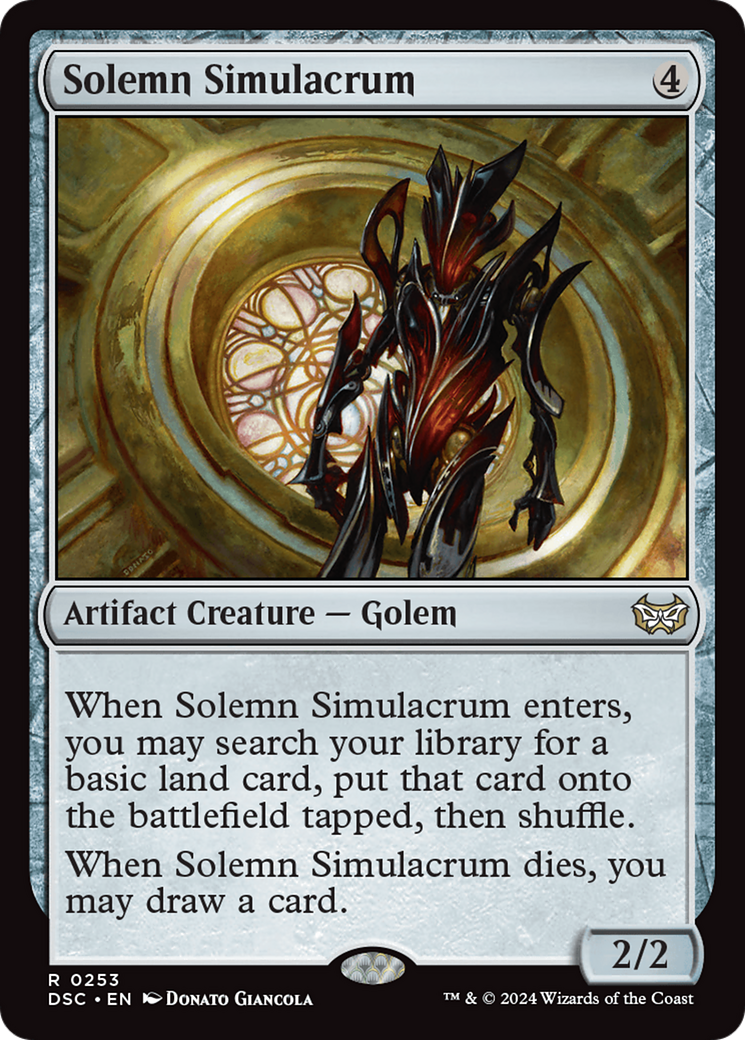
Solemn Simulacrum
Solemn Simulacrum
Artifact Creature — Golem
2/2
When this creature enters, you may search your library for a basic land card, put that card onto the battlefield tapped, then shuffle.
When this creature dies, you may draw a card.
-
1
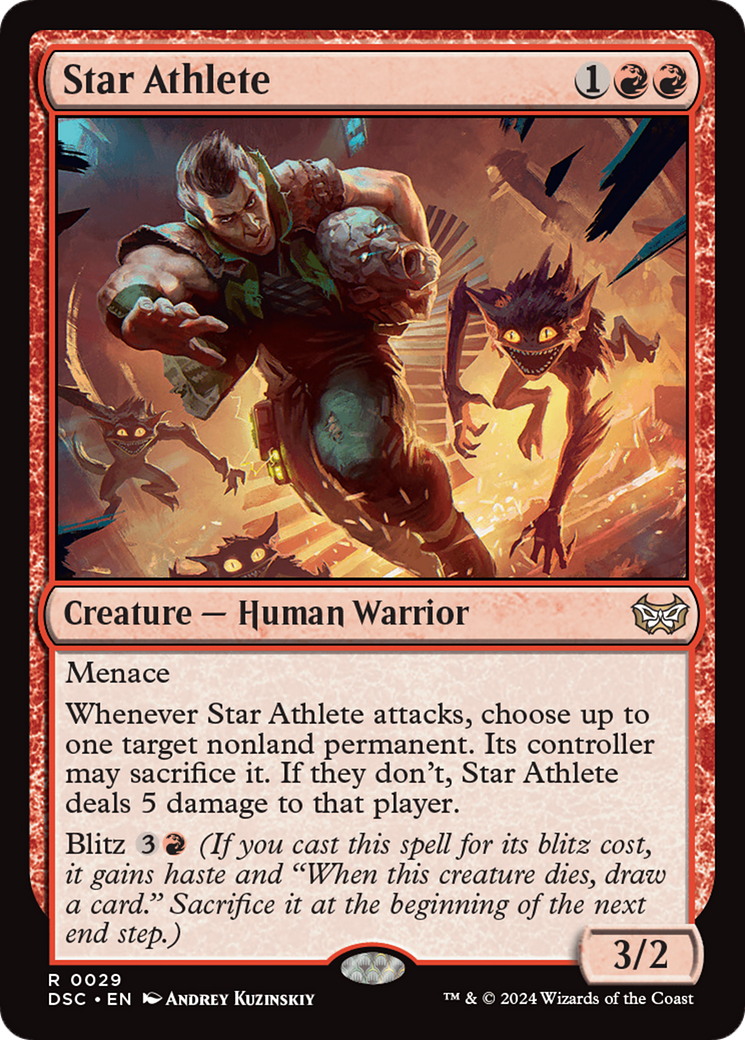
Star Athlete
Star Athlete
Creature — Human Warrior
3/2
Menace
Whenever this creature attacks, choose up to one target nonland permanent. Its controller may sacrifice it. If they don't, this creature deals 5 damage to that player.
Blitz (If you cast this spell for its blitz cost, it gains haste and "When this creature dies, draw a card." Sacrifice it at the beginning of the next end step.)
- If the target permanent is an illegal target as Star Athlete's second ability tries to resolve, it won't resolve and none of its effects will happen. No player will be dealt damage, and no permanents will be sacked . . . er, sacrificed.
- If you choose to pay the blitz cost rather than the mana cost, you're still casting the spell. It goes on the stack and can be responded to and countered. You can cast a creature spell for its blitz cost only if you could cast that creature spell. Most of the time, this means during your main phase when the stack is empty.
- If you pay the blitz cost to cast a creature spell, that permanent will be sacrificed only if it's still on the battlefield when that triggered ability resolves. If it dies or goes to another zone before then, it will stay where it is.
- You don't have to attack with the creature with blitz unless another ability says you do.
- If a creature enters as a copy of or becomes a copy of a creature whose blitz cost was paid, the copy won't have haste, won't be sacrificed, and its controller won't draw a card when it dies.
- If the creature was cast using its blitz ability, the triggered ability that lets its controller draw a card triggers when it dies for any reason, not just when you sacrifice it during the end step.
-
1
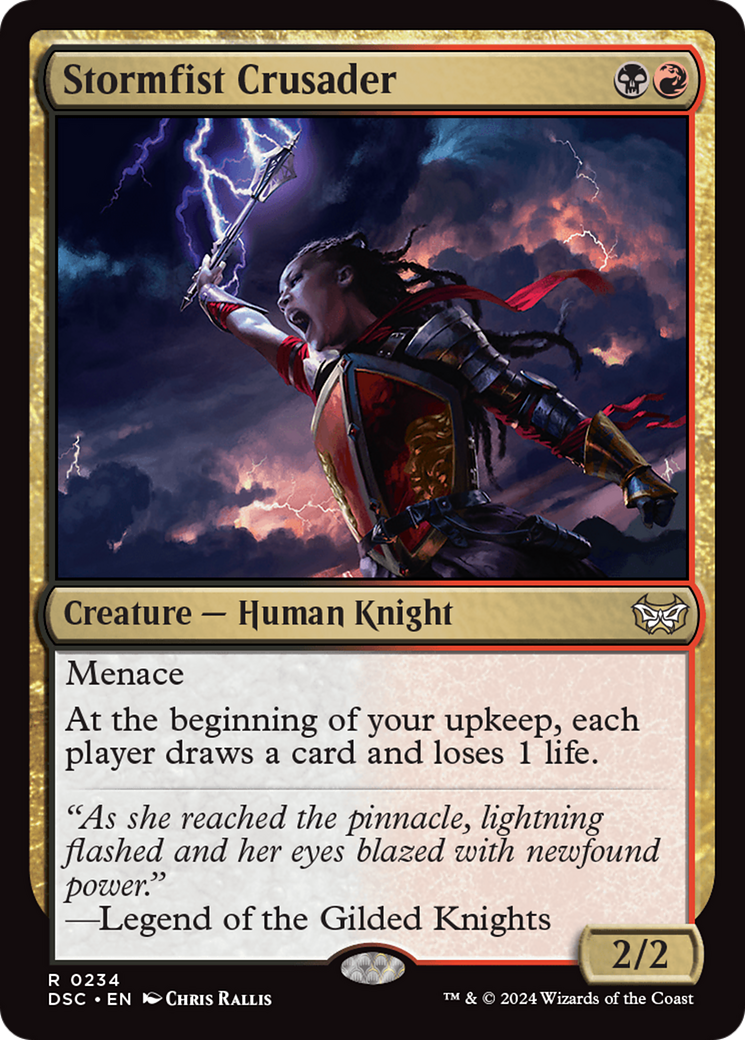
Stormfist Crusader
Stormfist Crusader
Creature — Human Knight
2/2
Menace
At the beginning of your upkeep, each player draws a card and loses 1 life.
- In a Two-Headed Giant game, Stormfist Crusader's triggered ability causes each team to lose 1 life twice after each player on that team has drawn a card.
-
1
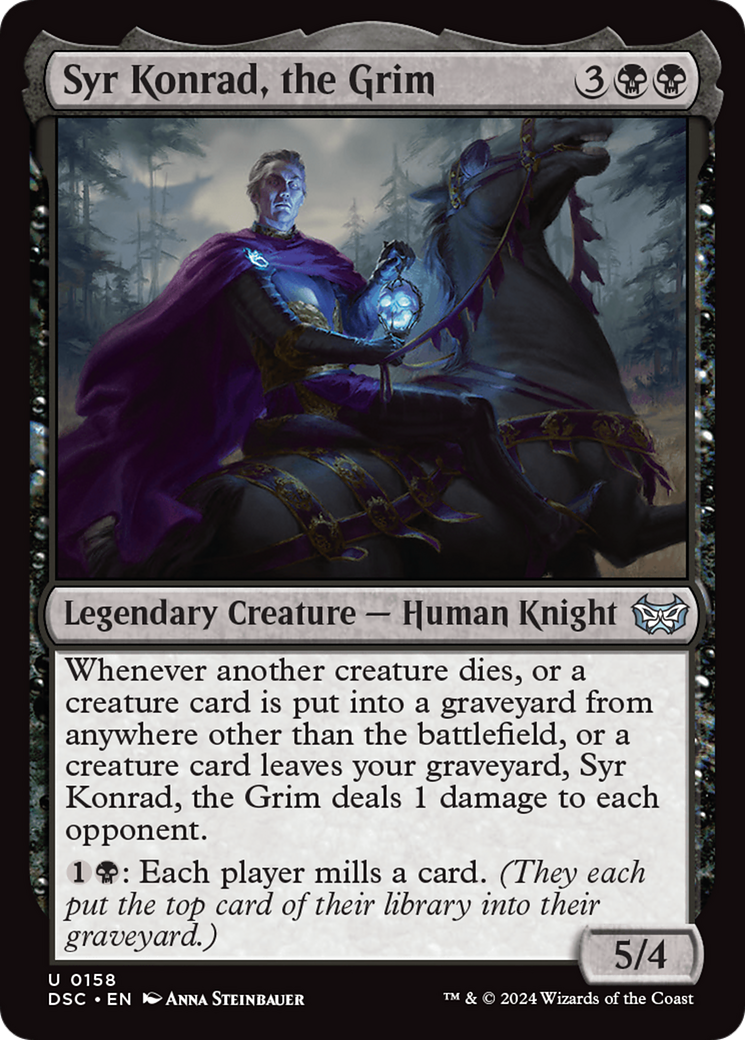
Syr Konrad, the Grim
Syr Konrad, the Grim
Legendary Creature — Human Knight
5/4
Whenever another creature dies, or a creature card is put into a graveyard from anywhere other than the battlefield, or a creature card leaves your graveyard, Syr Konrad deals 1 damage to each opponent.
: Each player mills a card. (They each put the top card of their library into their graveyard.)
- If one or more creatures die at the same time as Syr Konrad, its first ability triggers for each of those creatures.
- In a Two-Headed Giant game, Syr Konrad's first ability causes it to deal 1 damage twice.
-
1
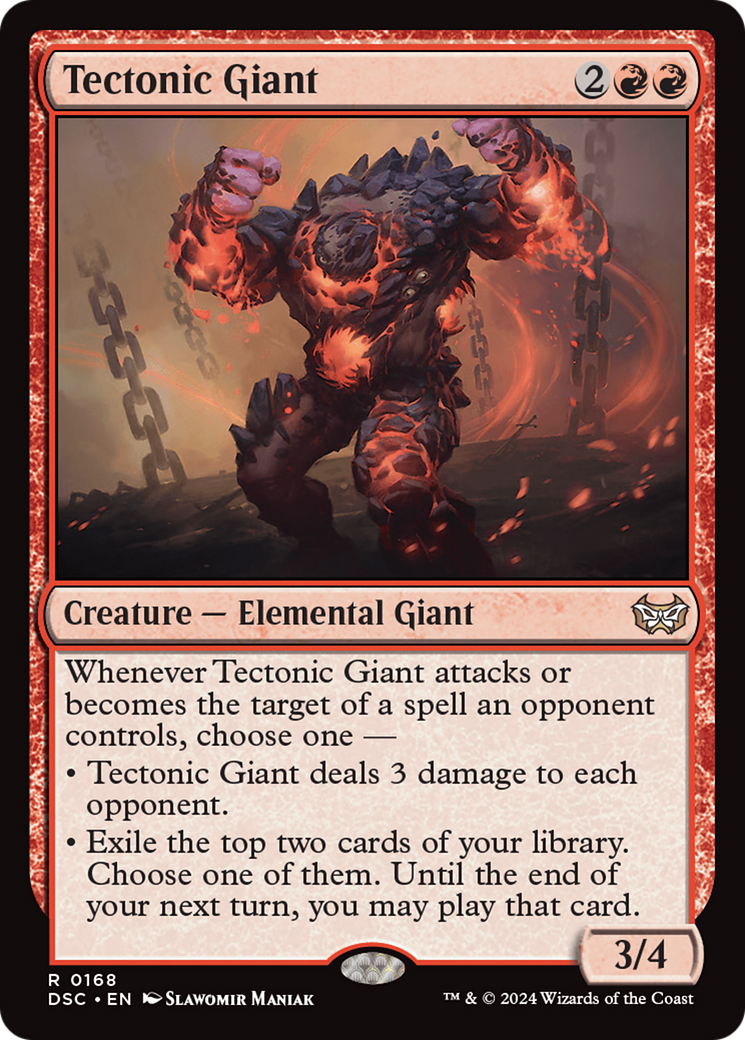
Tectonic Giant
Tectonic Giant
Creature — Elemental Giant
3/4
Whenever this creature attacks or becomes the target of a spell an opponent controls, choose one —
- This creature deals 3 damage to each opponent.
- Exile the top two cards of your library. Choose one of them. Until the end of your next turn, you may play that card.
- An ability that triggers when a creature becomes the target of a spell resolves before the spell that caused it to trigger. It resolves even if that spell is countered.
- Players can cast spells and activate abilities after the triggered ability resolves but before the spell that caused it to trigger does.
- If a spell targets Tectonic Giant more than once, its ability triggers only once.
- You choose which of the exiled cards you'll be able to play while the ability is resolving. You can't wait to pick one later. The other card remains in exile.
- Tectonic Giant doesn't change when you can play the exiled card. For example, if you exile a sorcery card, you can cast it only during your main phase when the stack is empty. If you exile a land card, you can play it only during your main phase and only if you have an available land play remaining.
- Playing an exiled card causes it to leave exile. You can't play it multiple times.
- If you don't play the exiled card that you chose, it remains in exile with the card you didn't choose.
-
1
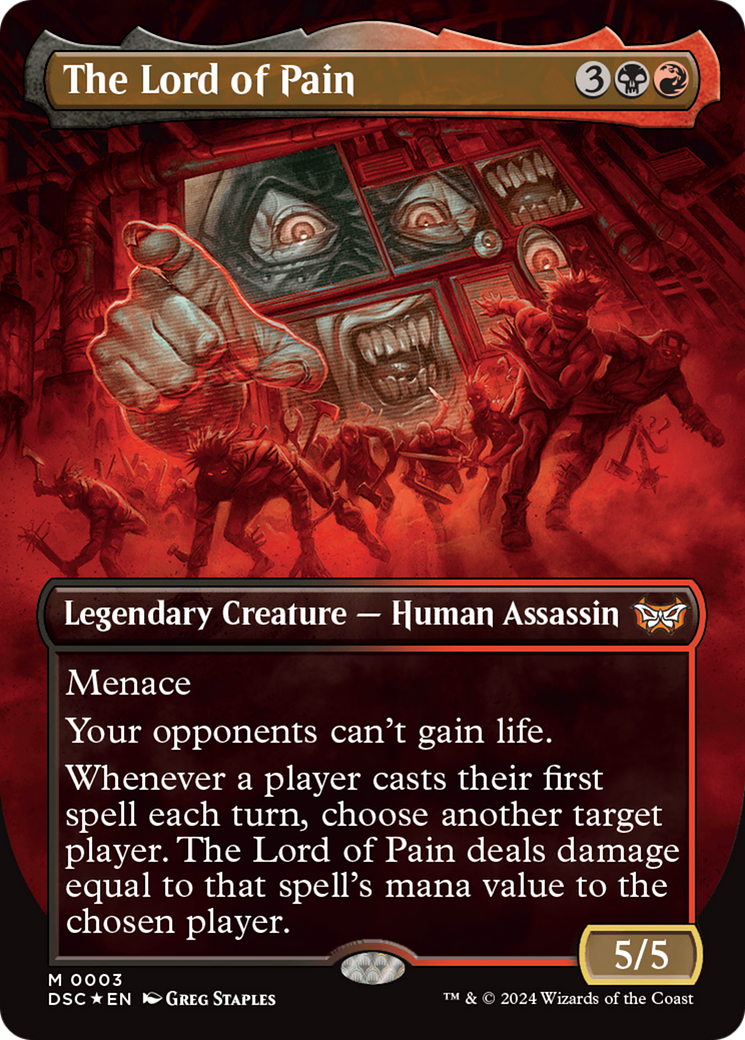
The Lord of Pain
The Lord of Pain
Legendary Creature — Human Assassin
5/5
Menace
Your opponents can't gain life.
Whenever a player casts their first spell each turn, choose another target player. The Lord of Pain deals damage equal to that spell's mana value to the chosen player.
- Spells and abilities that cause opponents to gain life still resolve while The Lord of Pain is on the battlefield. They won't gain life, but any other effects of that spell or ability will still happen.
- If an effect says to set an opponent's life total to a number that's higher than their current life total, that player's life total won't change.
- The Lord of Pain's last ability must target a player other than the one who cast the spell that caused the ability to trigger. That means that if it's just you and one other player in the game, you'll have to target yourself when that player casts their first spell each turn. (What did you expect? You summoned The Lord of Pain!)
- If a spell has in its mana cost, use the value chosen for X when determining that spell's mana value.
-
1
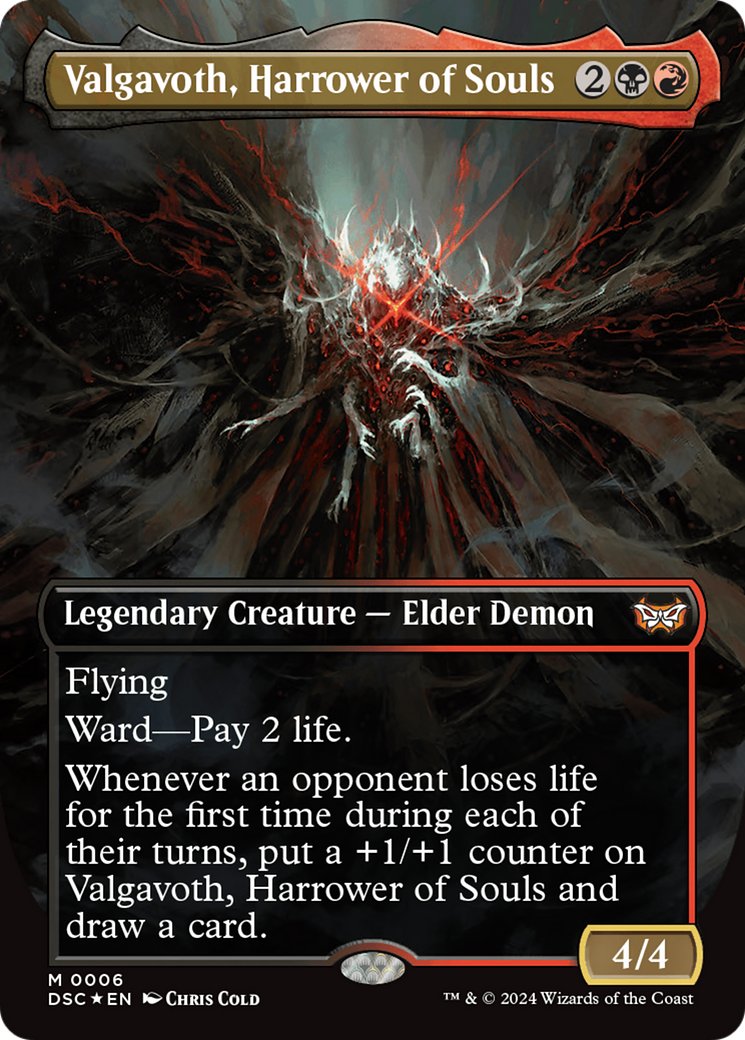
Valgavoth, Harrower of Souls
Valgavoth, Harrower of Souls
Legendary Creature — Elder Demon
4/4
Flying
Ward—Pay 2 life.
Whenever an opponent loses life for the first time during each of their turns, put a +1/+1 counter on Valgavoth and draw a card.
- If Valgavoth somehow enters the battlefield during an opponent's turn and that opponent had lost life earlier in the turn, its last ability won't trigger if that opponent loses life later in the turn.
-
1
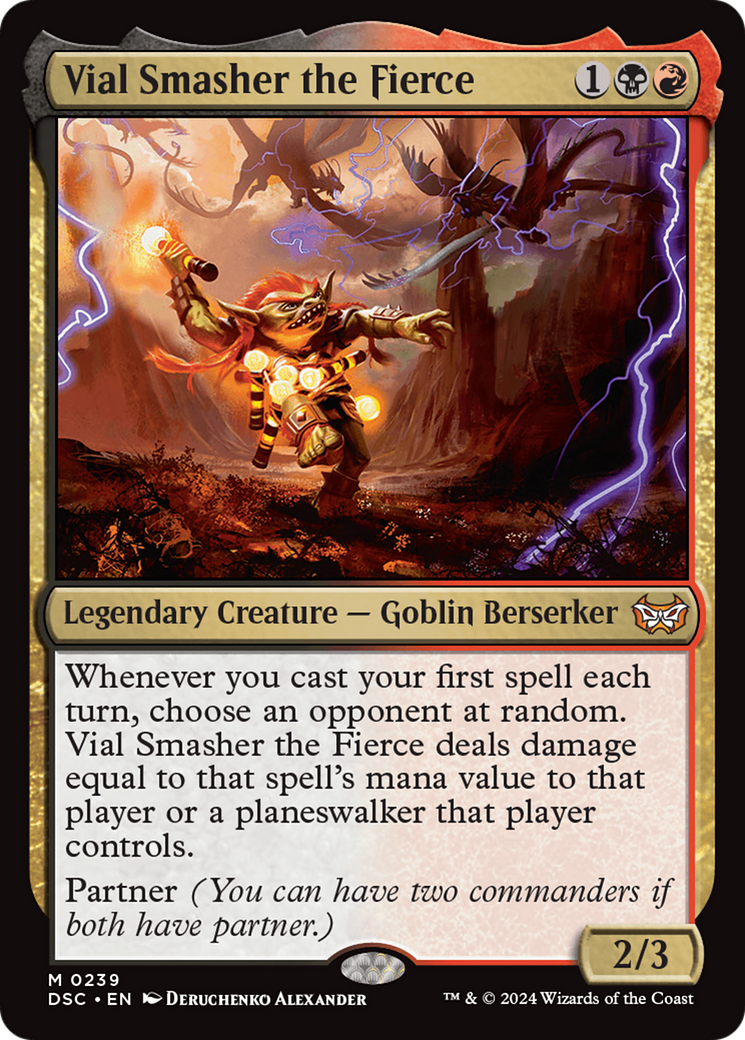
Vial Smasher the Fierce
Vial Smasher the Fierce
Legendary Creature — Goblin Berserker
2/3
Whenever you cast your first spell each turn, choose an opponent at random. Vial Smasher deals damage equal to that spell's mana value to that player or a planeswalker that player controls.
Partner (You can have two commanders if both have partner.)
- Vial Smasher the Fierce is banned as a commander in Duel Commander format, but it may be part of your deck.
- Vial Smasher's triggered ability triggers when you cast your first spell each turn, regardless of whose turn it is.
- Vial Smasher has to be on the battlefield at the moment you cast your first spell. If that spell causes Vial Smasher to leave the battlefield as an additional cost to cast it, Vial Smasher's ability can't trigger. If that spell is Vial Smasher itself, Vial Smasher's ability can't trigger.
- For spells with in their mana costs, use the value chosen for X to determine the spell's mana value.
- Vial Smasher's triggered ability resolves before the spell that caused it to trigger. If Vial Smasher's ability resolves and the spell that caused it to trigger has been countered, use that spell's mana value as it last existed on the stack to determine how much damage is dealt.
- The opponent to be dealt damage is chosen at random while the triggered ability is resolving. After that opponent is chosen, you choose whether damage will be dealt to that player or to a planeswalker they control, and if so, which planeswalker. No player may take any actions between the damage recipient being chosen and the damage being dealt.
- If your Commander deck has two commanders, you can only include cards whose own color identities are also found in your commanders' combined color identities. If Falthis and Kediss are your commanders, your deck may contain cards with black and/or red in their color identity, but not cards with green, white, or blue.
- Both commanders start in the command zone, and the remaining 98 cards (or 58 cards in a Commander Draft game) of your deck are shuffled to become your library.
- To have two commanders, both must have the partner ability as the game begins. Losing the ability during the game doesn't cause either to cease to be your commander.
- Once the game begins, your two commanders are tracked separately. If you cast one, you won't have to pay an additional the first time you cast the other. A player loses the game after having been dealt 21 damage from any one of them, not from both of them combined.
- If something refers to your commander while you have two commanders, it refers to one of them of your choice. If you are instructed to perform an action on your commander (e.g. put it from the command zone into your hand due to Command Beacon), you choose one of your commanders at the time the effect happens.
- An effect that checks whether you control your commander is satisfied if you control one or both of your two commanders.
- You can choose two commanders with partner that are the same color or colors. In Commander Draft, you can even choose two of the same commander with partner if you drafted them. If you do this, make sure you keep the number of times you've cast each from the command zone clear for "commander tax" purposes.
Instants 6
-
1
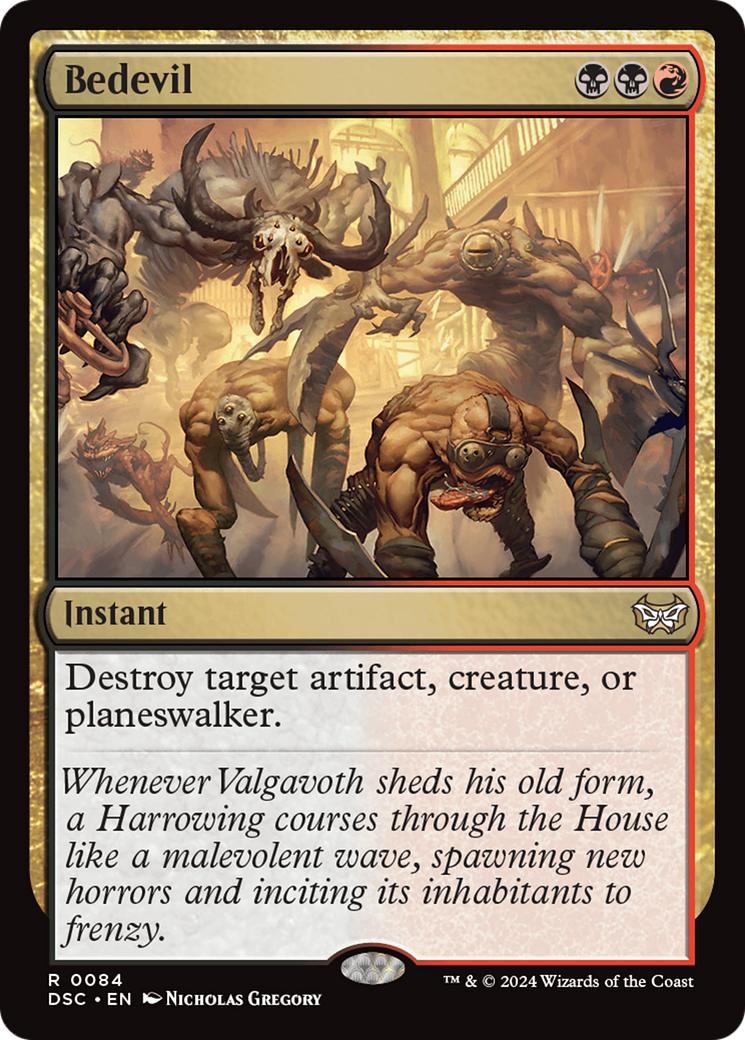
Bedevil
Bedevil
Instant
Destroy target artifact, creature, or planeswalker.
-
1
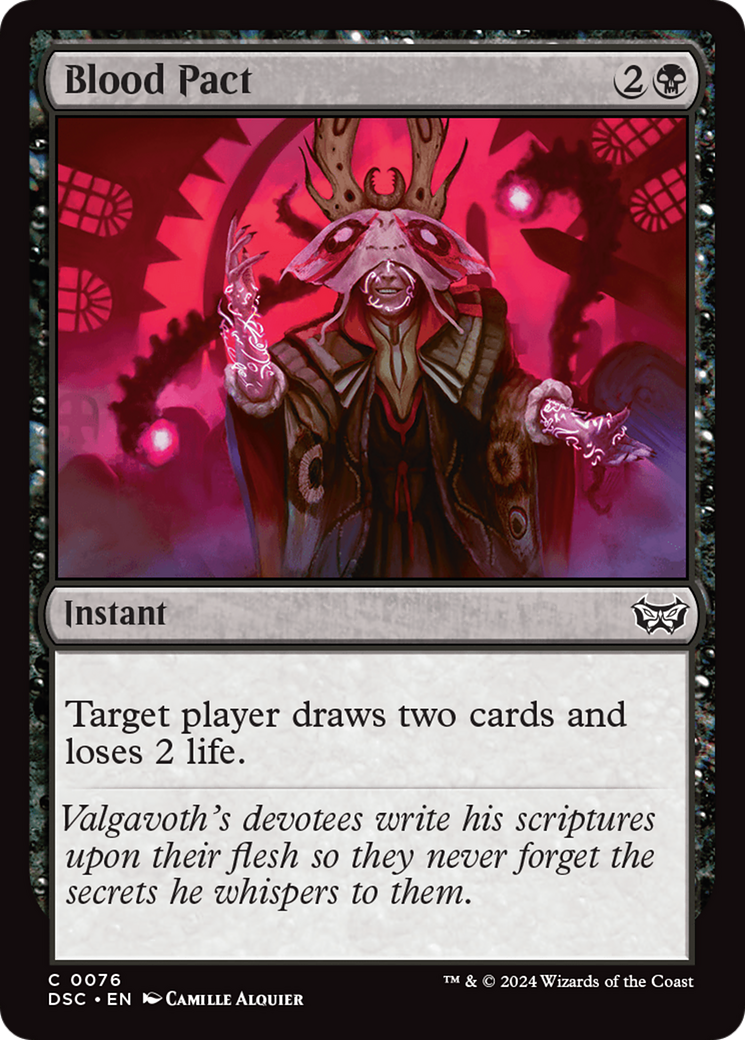
Blood Pact
Blood Pact
Instant
Target player draws two cards and loses 2 life.
-
1
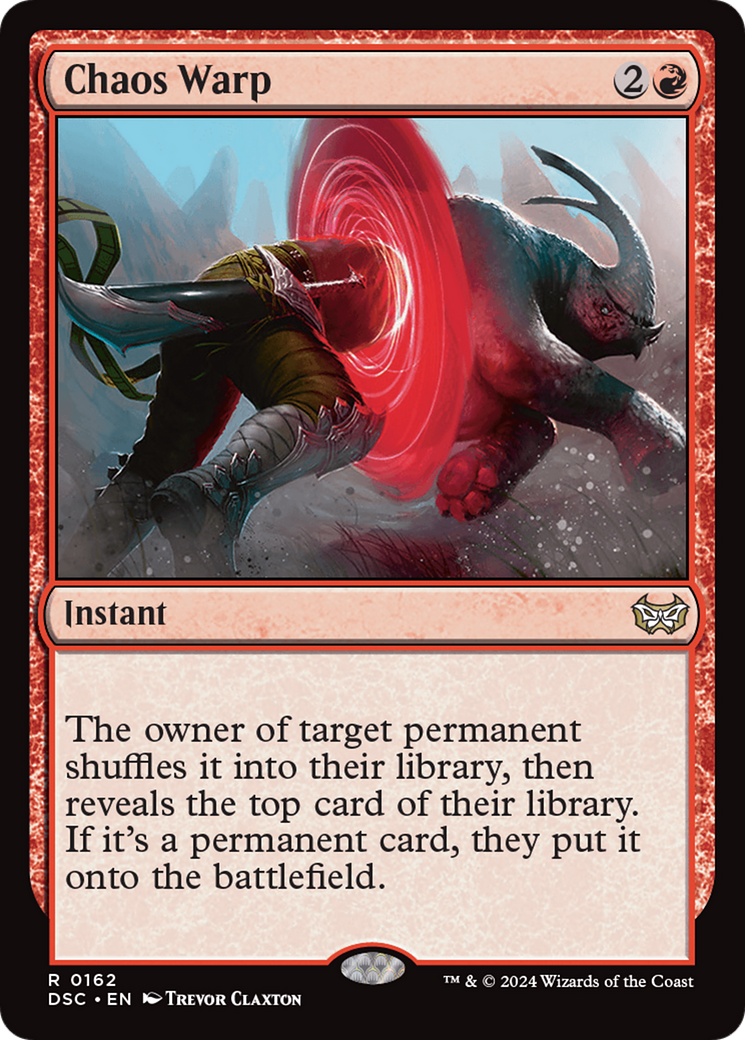
Chaos Warp
Chaos Warp
Instant
The owner of target permanent shuffles it into their library, then reveals the top card of their library. If it's a permanent card, they put it onto the battlefield.
- A permanent card is a card with one or more of the following card types: artifact, creature, enchantment, land, or planeswalker.
- The owner of a token is the player under whose control the token was put onto the battlefield. If a token is shuffled into a player's library this way, that player shuffles before revealing the top card of that library.
- If the revealed card is not a permanent card, it remains on top of that library.
- If the permanent is an illegal target by the time Chaos Warp tries to resolve, it won't resolve and none of its effects will occur. No library will be shuffled and no card will be revealed.
- If the revealed card is a permanent card but can't enter (perhaps because it's an Aura with nothing to enchant), it remains on top of that library.
-
1
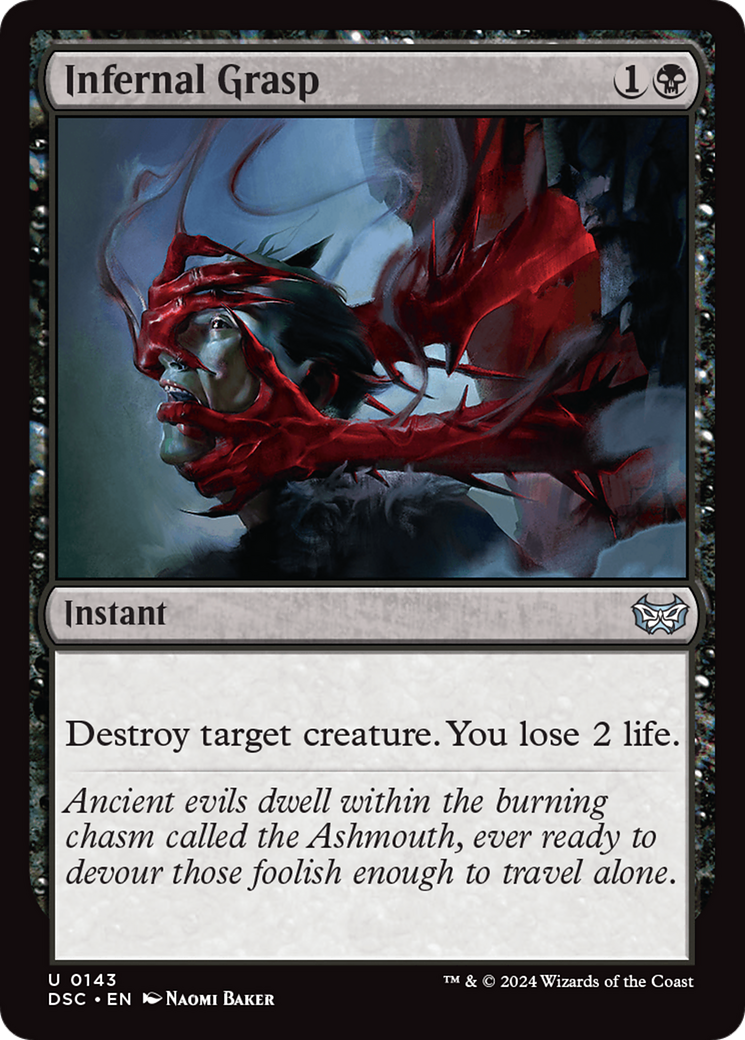
Infernal Grasp
Infernal Grasp
Instant
Destroy target creature. You lose 2 life.
-
1
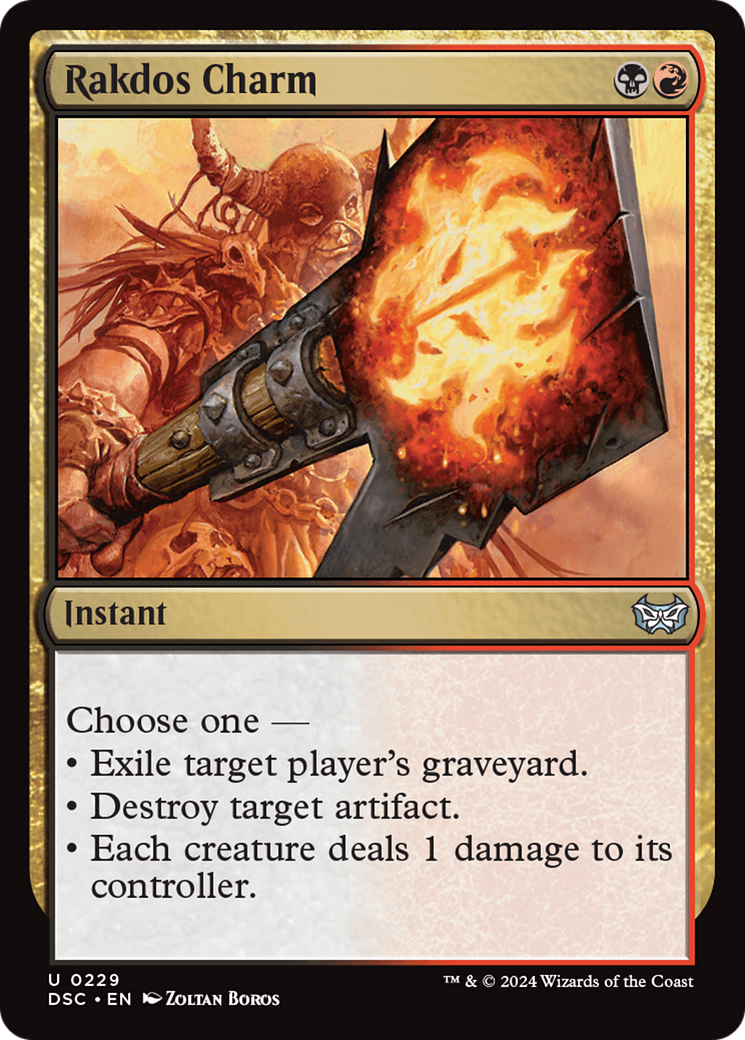
Rakdos Charm
Rakdos Charm
Instant
Choose one —
- Exile target player's graveyard.
- Destroy target artifact.
- Each creature deals 1 damage to its controller.
-
1
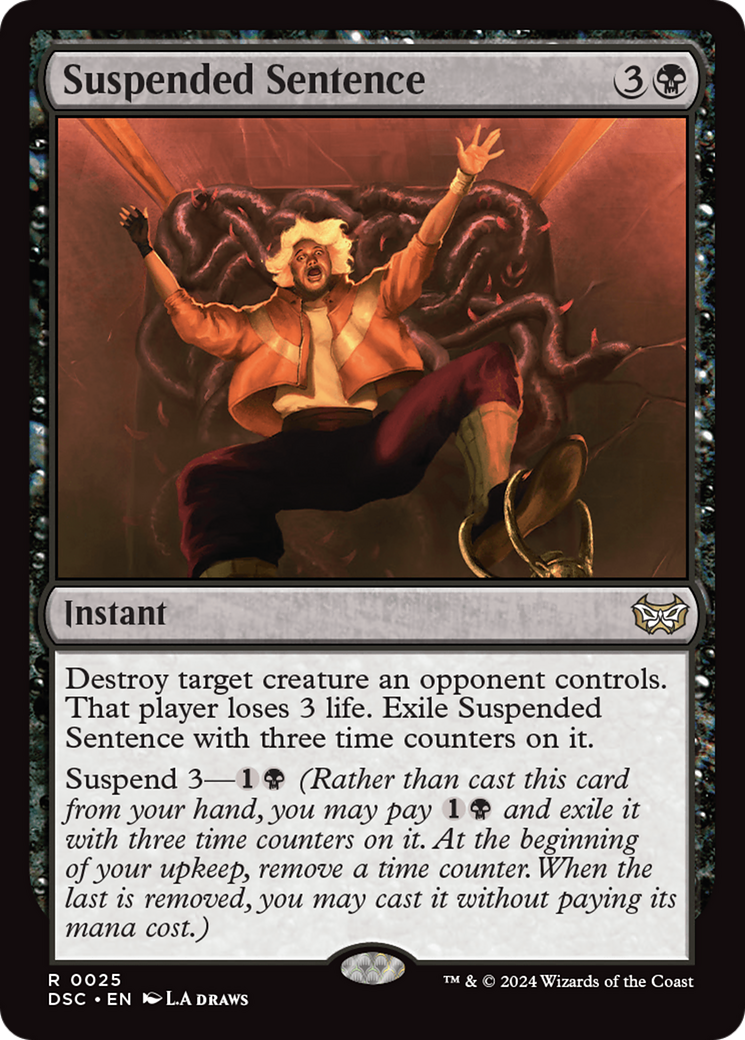
Suspended Sentence
Suspended Sentence
Instant
Destroy target creature an opponent controls. That player loses 3 life. Exile Suspended Sentence with three time counters on it.
Suspend 3— (Rather than cast this card from your hand, you may pay and exile it with three time counters on it. At the beginning of your upkeep, remove a time counter. When the last is removed, you may cast it without paying its mana cost.)
- If the first triggered ability of suspend (the one that removes time counters) is countered, no time counter is removed. The ability will trigger again at the beginning of the card's owner's next upkeep.
- When the last time counter is removed, the second triggered ability of suspend (the one that lets you cast the card) triggers. It doesn't matter why the last time counter was removed or what effect removed it.
- If the second triggered ability is countered, the card can't be cast. It remains exiled with no time counters on it, and it's no longer suspended.
- As the second triggered ability of suspend resolves, you may cast the card. Timing permissions based on the card's type are ignored. If you choose not to (or can't) cast the card, it remains exiled with no time counters on it, and it's no longer suspended.
- If you cast a card "without paying its mana cost," such as with suspend, you can't choose to cast it for any alternative costs. You can, however, pay additional costs. If the card has any mandatory additional costs, you must pay those if you want to cast the card.
- The mana value of a spell cast without paying its mana cost is determined by its mana cost, even though that cost wasn't paid.
- Suspend is a keyword that represents three abilities. The first is a static ability that allows you to exile the card from your hand with the specified number of time counters (the number before the dash) on it by paying its suspend cost (listed after the dash). The second is a triggered ability that removes a time counter from the suspended card at the beginning of each of your upkeeps. The third is a triggered ability that gives you the option to cast the card when the last time counter is removed.
- You can exile a card in your hand using suspend any time you could cast that card. Consider its card type, any effects that modify when you could cast it (such as flash) and any other effects that stop you from casting it (such as from Meddling Mage's ability) to determine if and when you can do this. Whether you could actually complete all steps in casting the card is irrelevant. For example, you can exile a card with suspend that has no mana cost or that requires a target even if no legal targets are available at that time.
- Cards exiled with suspend are exiled face up.
- Exiling a card with suspend isn't casting that card. This action doesn't use the stack and can't be responded to.
- If the spell requires any targets, those targets are chosen when the spell is finally cast, not when it's exiled.
- If an effect refers to a "suspended card," that means a card that (1) has suspend, (2) is in exile, and (3) has one or more time counters on it.
Sorceries 7
-
1
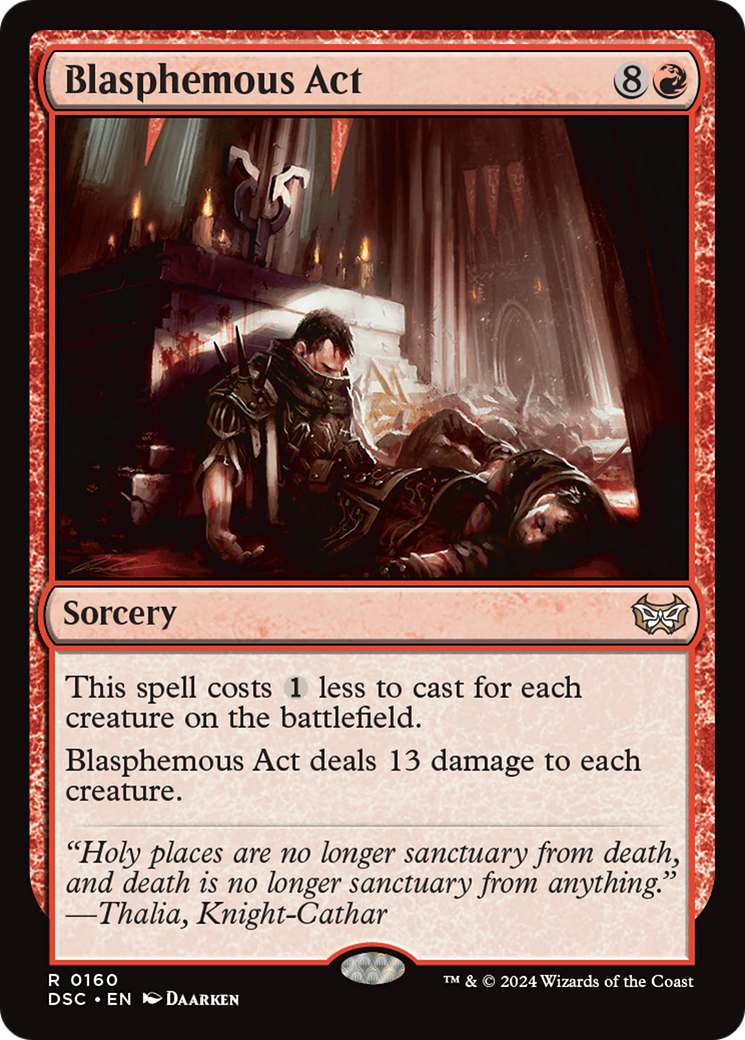
Blasphemous Act
Blasphemous Act
Sorcery
This spell costs less to cast for each creature on the battlefield.
Blasphemous Act deals 13 damage to each creature.
- Although players may respond to Blasphemous Act once it's been cast, once it's announced, they can't respond before the cost is calculated and paid.
- Blasphemous Act's ability can't reduce the total cost to cast the spell below .
- The total cost to cast Blasphemous Act is locked in before you pay that cost. For example, if there are three creatures on the battlefield, including one you can sacrifice to add , the total cost of Blasphemous Act is . Then you can sacrifice the creature when you activate mana abilities just before paying the cost.
- To determine the total cost of a spell, start with the mana cost or alternative cost you're paying, add any cost increases, then apply any cost reductions (such as that of Blasphemous Act). The mana value of the spell is determined only by its mana cost, no matter what the total cost to cast the spell was.
-
1
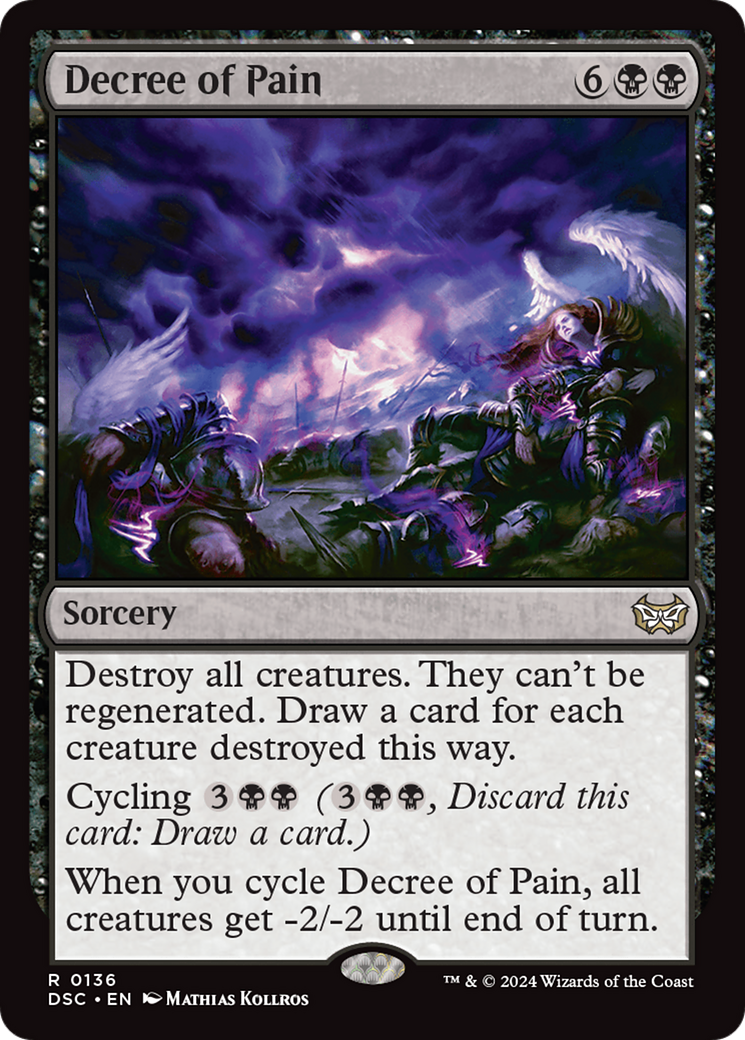
Decree of Pain
Decree of Pain
Sorcery
Destroy all creatures. They can't be regenerated. Draw a card for each creature destroyed this way.
Cycling ( , Discard this card: Draw a card.)
When you cycle this card, all creatures get -2/-2 until end of turn.
- When you cycle this card, first the cycling ability goes on the stack, then the triggered ability goes on the stack on top of it. The triggered ability will resolve before you draw a card from the cycling ability.
- The cycling ability and the triggered ability are separate. If the triggered ability doesn't resolve (because, for example, it has been countered, or all of its targets have become illegal), the cycling ability will still resolve, and you'll draw a card.
-
1
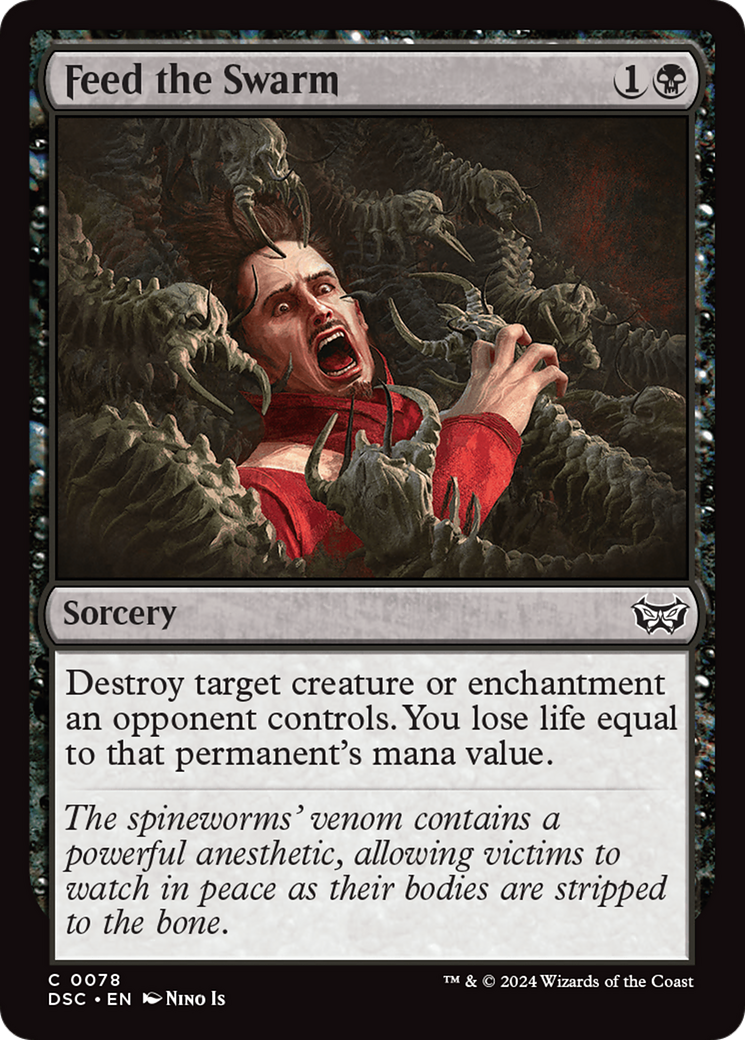
Feed the Swarm
Feed the Swarm
Sorcery
Destroy target creature or enchantment an opponent controls. You lose life equal to that permanent's mana value.
- The amount of life you lose is determined by the permanent's mana value as it last existed on the battlefield.
- If the target permanent is an illegal target by the time Feed the Swarm tries to resolve, the spell doesn't resolve. You don't lose any life. If the target is legal but not destroyed (most likely because it has indestructible), you do lose life.
- If a permanent on the battlefield has in its mana cost, X is 0 for the purpose of determining its mana value.
-
1
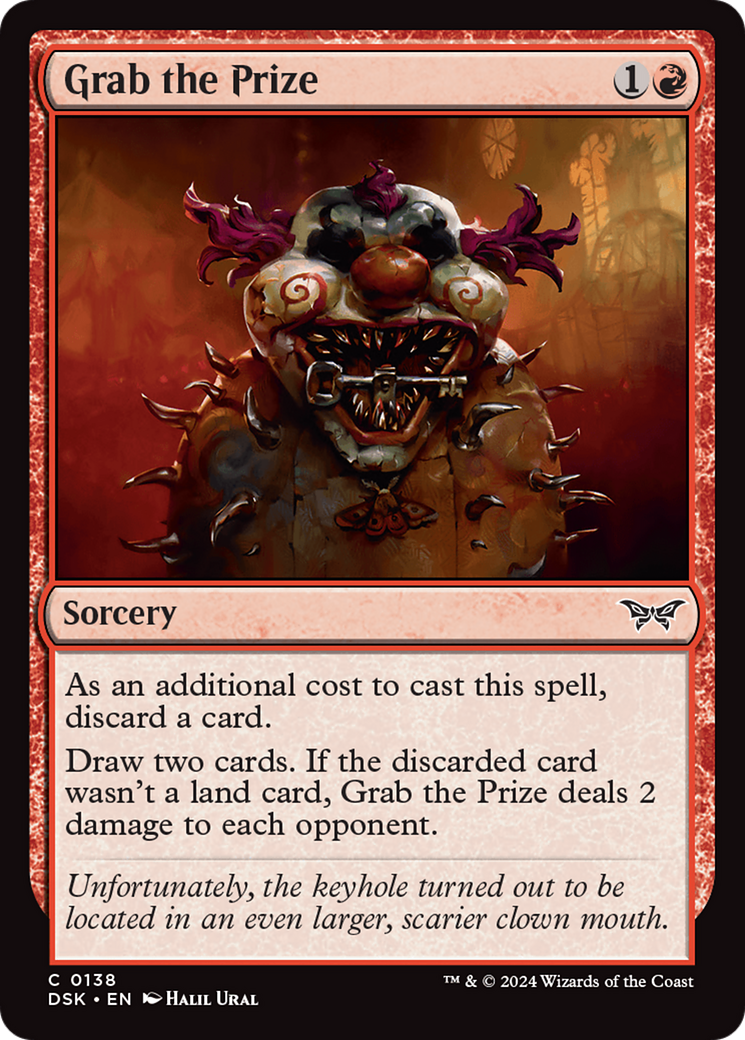
Grab the Prize
Grab the Prize
Sorcery
As an additional cost to cast this spell, discard a card.
Draw two cards. If the discarded card wasn't a land card, Grab the Prize deals 2 damage to each opponent.
-
1
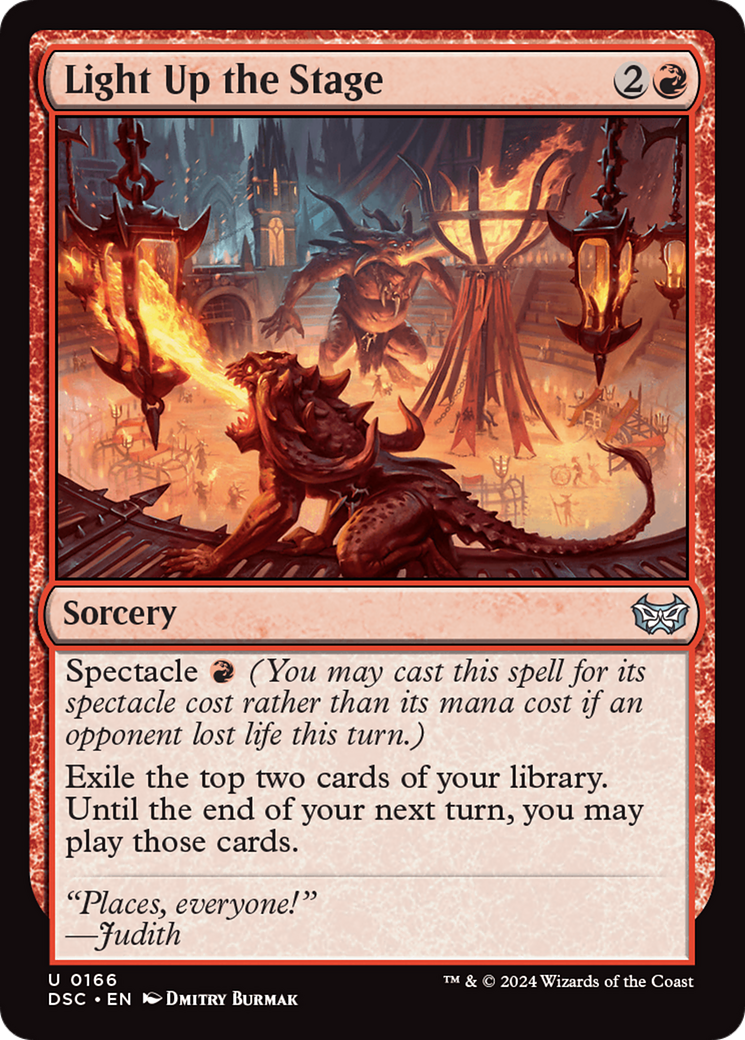
Light Up the Stage
Light Up the Stage
Sorcery
Spectacle (You may cast this spell for its spectacle cost rather than its mana cost if an opponent lost life this turn.)
Exile the top two cards of your library. Until the end of your next turn, you may play those cards.
- In a multiplayer game, if an opponent loses life and later that turn leaves the game, you can cast a spell for its spectacle cost. (If a player leaves the game during their turn, that turn continues without an active player.)
- Spectacle doesn't change when you can cast the spell. For example, you can't cast a sorcery with spectacle during an opponent's turn unless another effect allows you to do so, even if that player has lost life this turn.
- To determine the total cost of a spell, start with the mana cost or alternative cost you're paying (such as a spectacle cost), add any cost increases, then apply any cost reductions. The mana value of the spell remains unchanged, no matter what the total cost to cast it was.
- A card's spectacle cost is the same no matter how much life your opponents lost or how many opponents lost life.
- Damage dealt to a player causes that player to lose that much life.
- Spectacle cares only that an opponent lost life during the turn, not that the opponent's life total is currently lower than it was. For example, if an opponent loses 1 life and then gains 2 life in the same turn, you can cast a spell for its spectacle cost that turn.
- Casting an exiled card causes it to leave exile. You can't cast it multiple times.
- If you don't play a card exiled this way, it remains in exile.
- Light Up the Stage doesn't change when you can play the exiled cards. For example, if you exile a sorcery card, you can cast it only during your main phase when the stack is empty. If you exile a land card, you can play it only during your main phase and only if you have an available land play remaining.
-
1
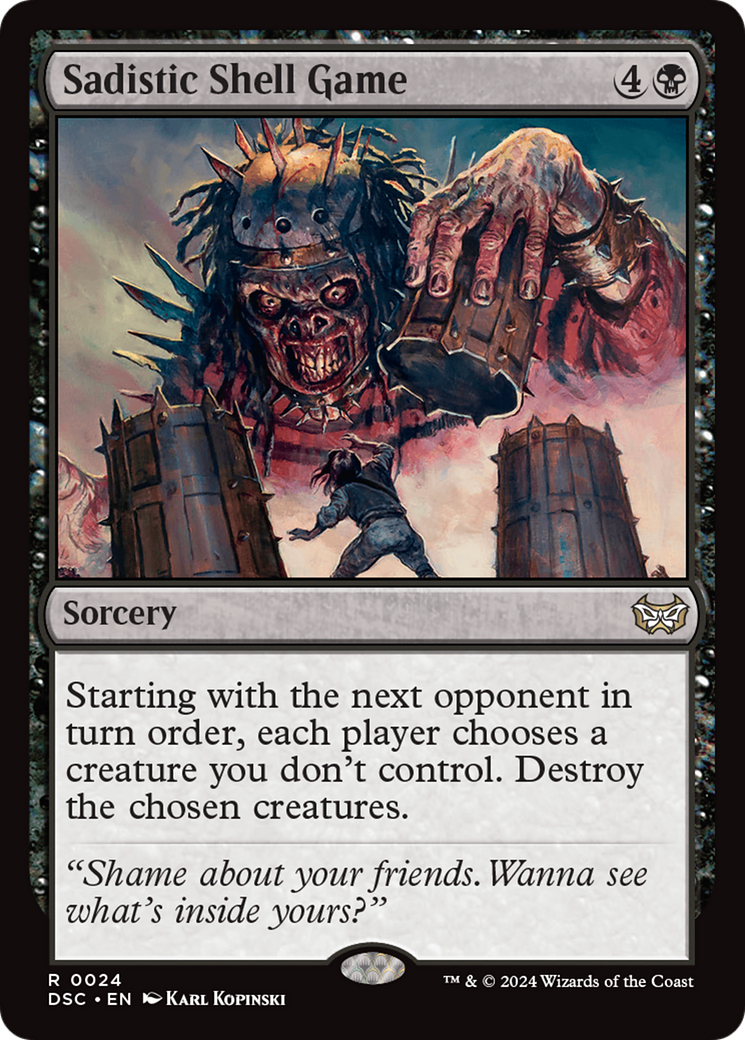
Sadistic Shell Game
Sadistic Shell Game
Sorcery
Starting with the next opponent in turn order, each player chooses a creature you don't control. Destroy the chosen creatures.
- Each player will know what choices players earlier in the turn order made.
-
1
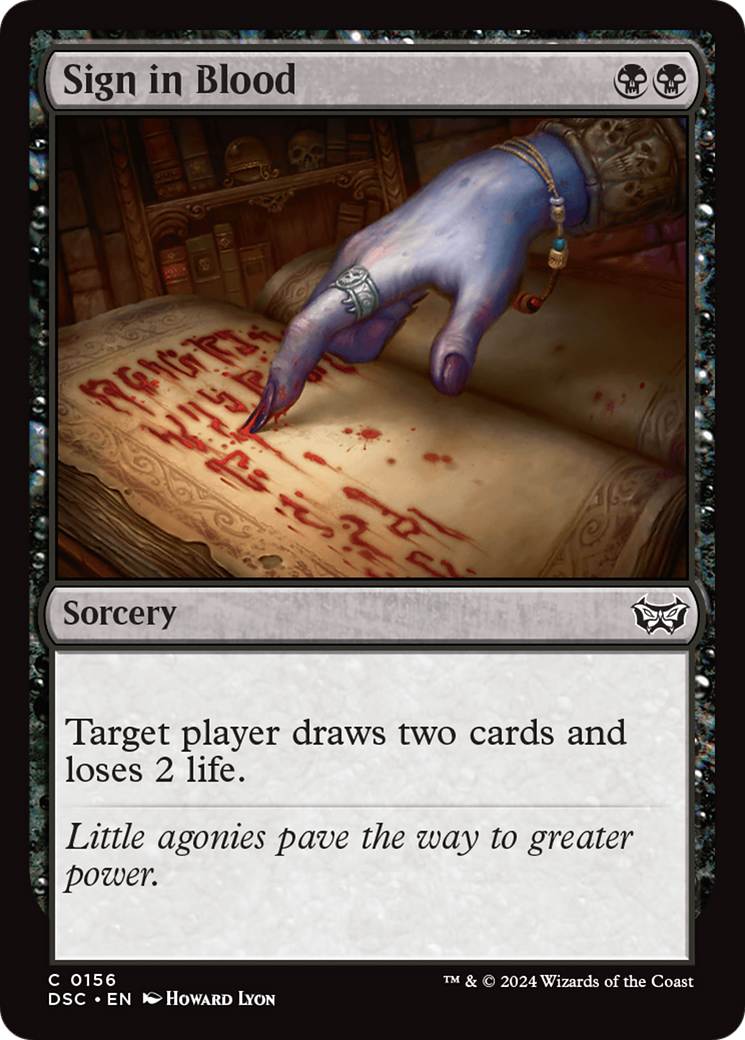
Sign in Blood
Sign in Blood
Sorcery
Target player draws two cards and loses 2 life.
Artifacts 11
-
1
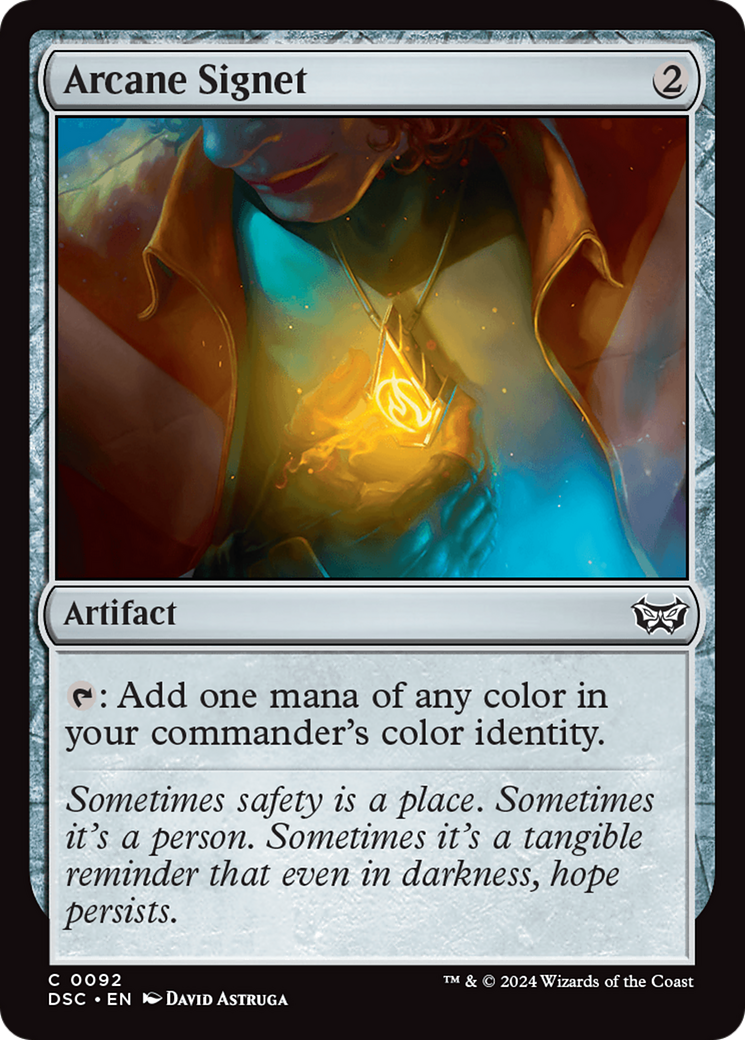
Arcane Signet
Arcane Signet
Artifact
: Add one mana of any color in your commander's color identity.
- If your commander is a card that has no colors in its color identity, Arcane Signet's ability produces no mana. It doesn't produce .
- If you have two commanders, the ability adds one mana of any color in their combined color identities.
- If you don't have a commander, Arcane Signet's ability produces no mana.
-
1
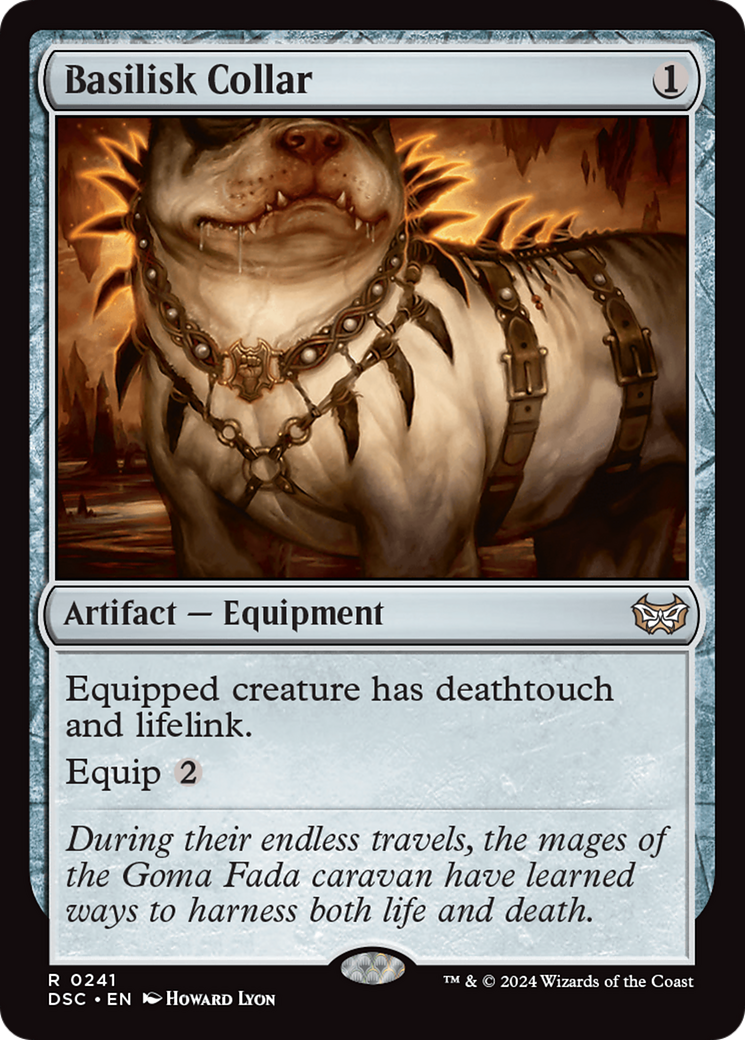
Basilisk Collar
Basilisk Collar
Artifact — Equipment
Equipped creature has deathtouch and lifelink. (Any amount of damage it deals to a creature is enough to destroy it. Damage dealt by this creature also causes you to gain that much life.)
Equip ( : Attach to target creature you control. Equip only as a sorcery.)
-
1
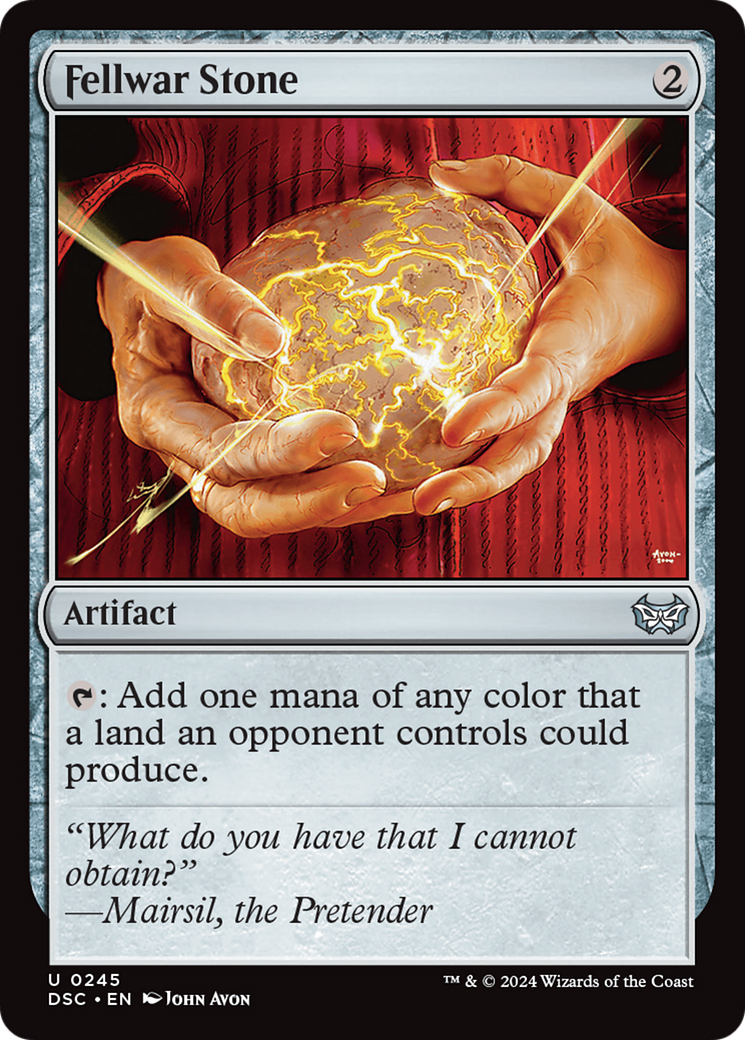
Fellwar Stone
Fellwar Stone
Artifact
: Add one mana of any color that a land an opponent controls could produce.
- When determining what colors of mana your opponents' lands could produce, take into account any applicable replacement effects that would apply to those lands' mana abilities (such as Contamination's effect, for example). If there is more than one, consider them in any possible order.
- Fellwar Stone doesn't care about any restrictions or riders your opponents' lands (such as Ancient Ziggurat or Hall of the Bandit Lord) put on the mana they produce. It just cares about colors of mana.
- The colors of mana are white, blue, black, red, and green. Fellwar Stone can't be tapped for colorless mana, even if a land an opponent controls could produce colorless mana.
- Fellwar Stone checks the effects of all mana-producing abilities of lands your opponents control, but it doesn't check their costs. For example, Vivid Crag has the ability " , Remove a charge counter from Vivid Crag: Add one mana of any color." If an opponent controls Vivid Crag and you control Fellwar Stone, you can tap Fellwar Stone for any color of mana. It doesn't matter whether Vivid Crag has a charge counter on it, and it doesn't matter whether it's untapped.
- This works even if the opponent's lands are tapped. It only checks what kinds of mana can be produced, not if the abilities that produce them are usable right now.
- It only produces one mana even if the land can produce more than one.
- The ability can be activated if the opponent has no lands that produce mana, but the effect will not be able to generate any mana.
-
1
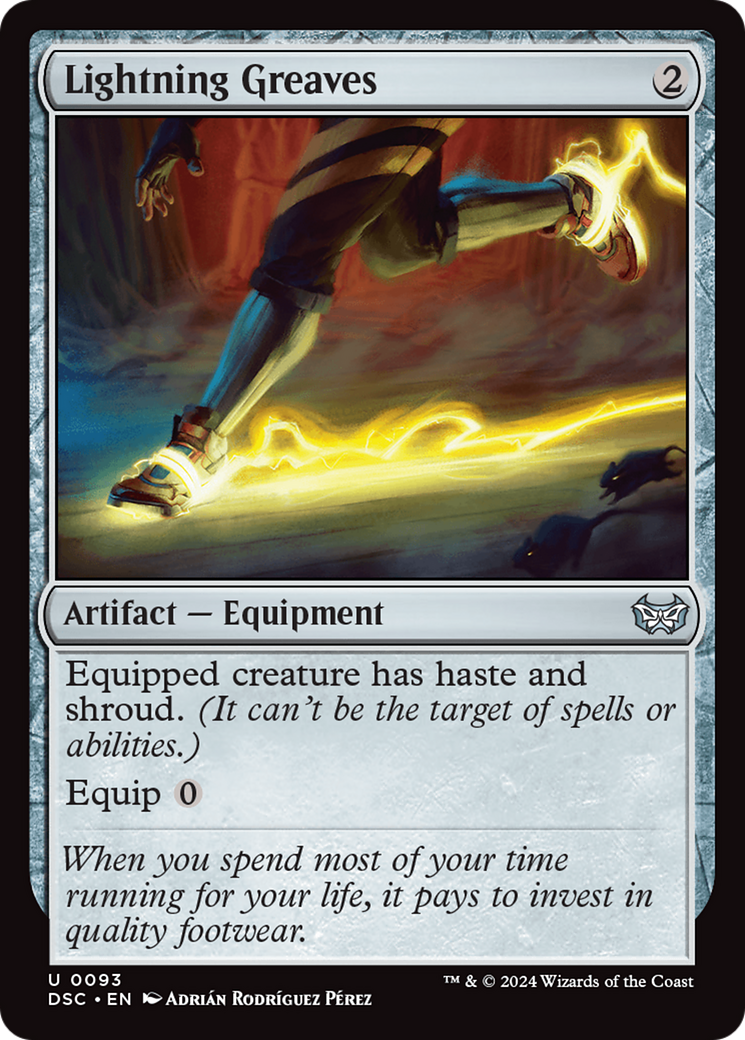
Lightning Greaves
Lightning Greaves
Artifact — Equipment
Equipped creature has haste and shroud. (It can't be the target of spells or abilities.)
Equip
- You can't simply unequip Equipment from a creature. If Lightning Greaves is attached to the only creature you control, you won't be able to attach other equipment to it (or target it with anything else) until you have another creature to which you can attach Lightning Greaves.
- If a creature enters the battlefield under your control and gains haste, but then loses it before attacking, it won't be able to attack that turn. This means that you can't use one Lightning Greaves to allow two new creatures to attack in the same turn.
-
1
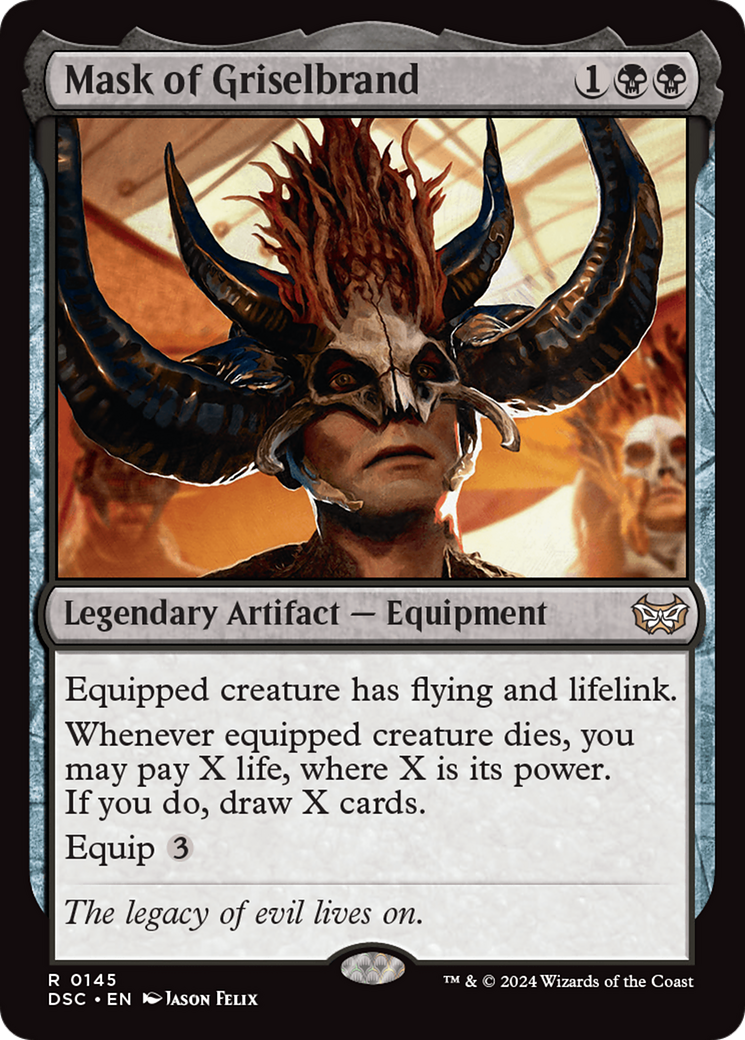
Mask of Griselbrand
Mask of Griselbrand
Legendary Artifact — Equipment
Equipped creature has flying and lifelink.
Whenever equipped creature dies, you may pay X life, where X is its power. If you do, draw X cards.
Equip
- Use the equipped creature's power as it last existed on the battlefield to determine the value of X.
- You must pay exactly X life or nothing. You can't pay less life to draw fewer cards.
-
1
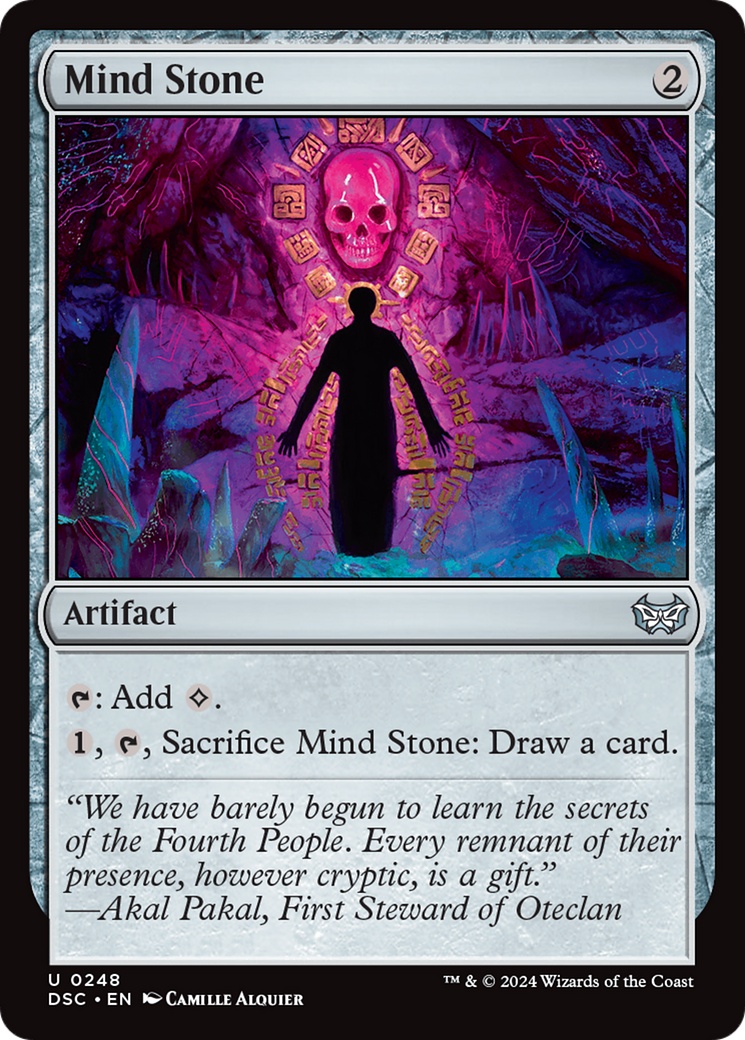
Mind Stone
Mind Stone
Artifact
: Add .
, , Sacrifice this artifact: Draw a card.
-
1
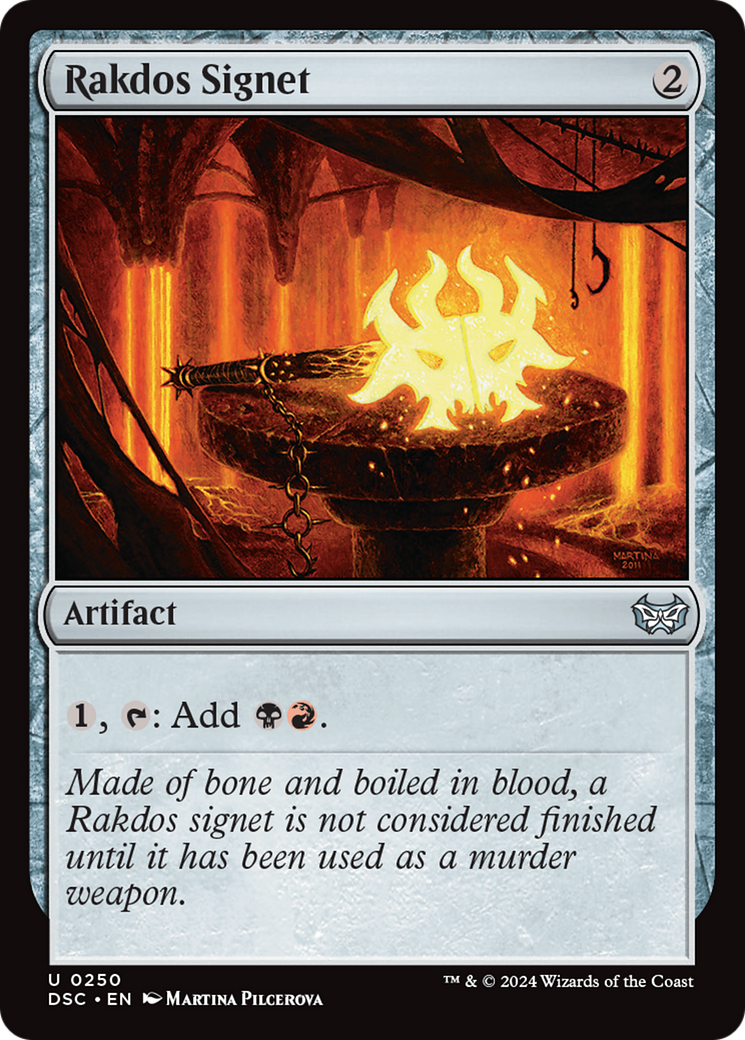
Rakdos Signet
Rakdos Signet
Artifact
, : Add .
-
1
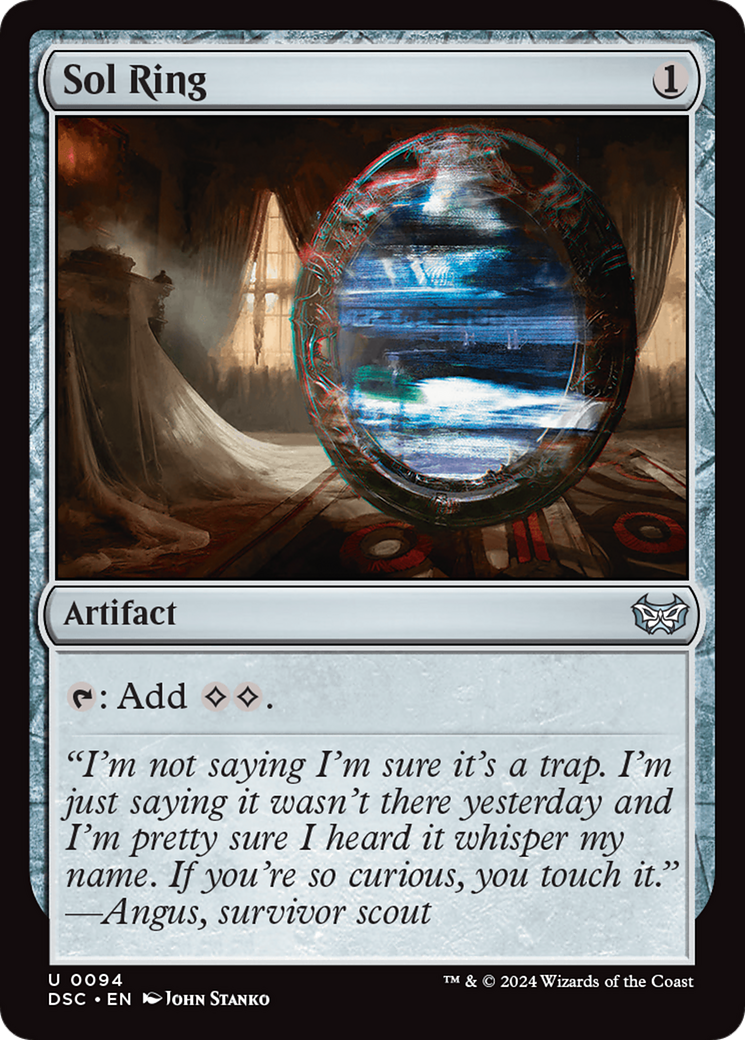
Sol Ring
Sol Ring
Artifact
: Add .
-
1
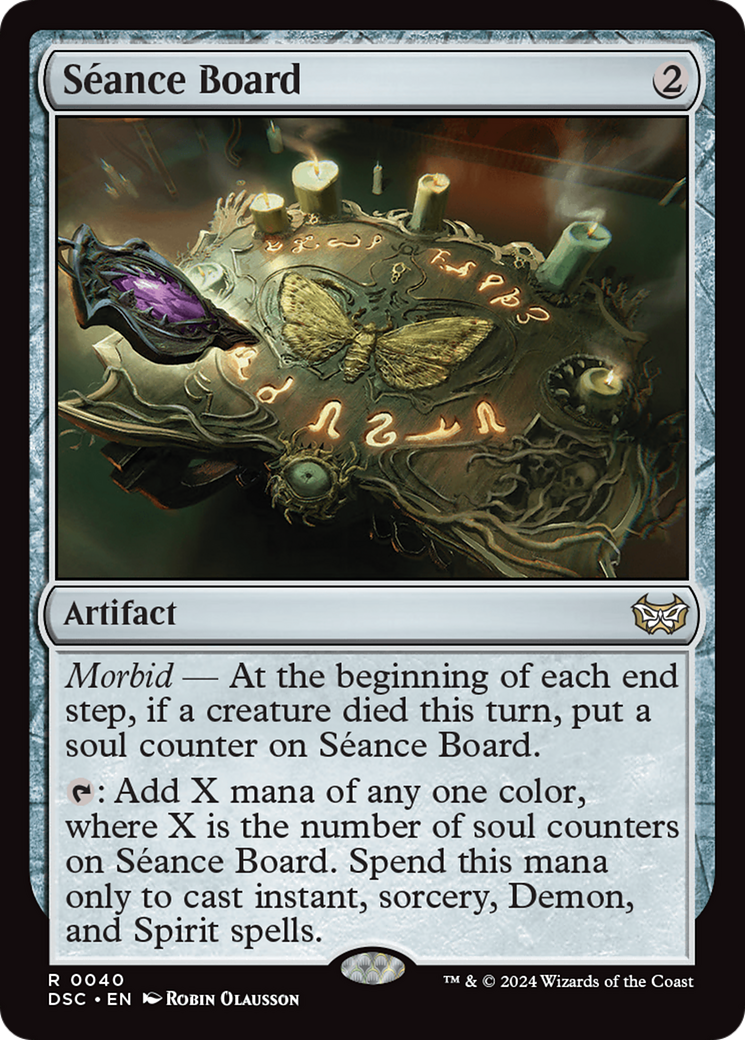
Séance Board
Séance Board
Artifact
Morbid — At the beginning of each end step, if a creature died this turn, put a soul counter on this artifact.
: Add X mana of any one color, where X is the number of soul counters on this artifact. Spend this mana only to cast instant, sorcery, Demon, and Spirit spells.
- If no creatures have died in a turn by the time that turn's end step begins, Séance Board's first ability won't trigger at all. Causing a creature to die during the end step won't cause the ability to trigger.
- If a spell has in its mana cost, use the value chosen for X when determining that spell's mana value.
-
1
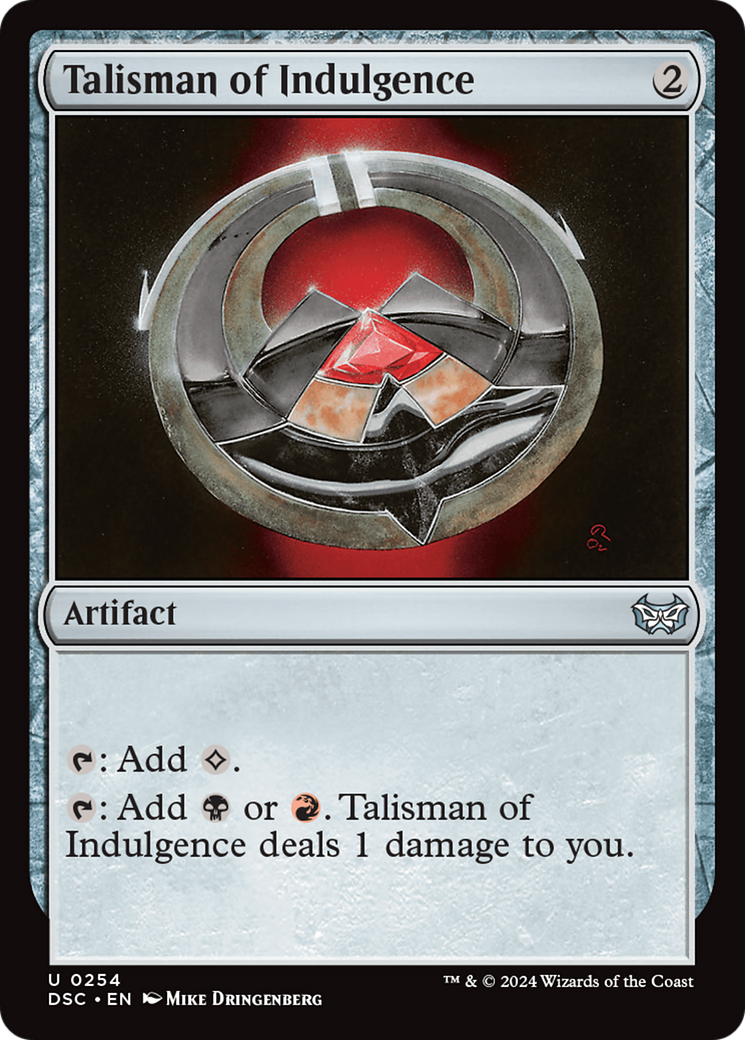
Talisman of Indulgence
Talisman of Indulgence
Artifact
: Add .
: Add or . This artifact deals 1 damage to you.
-
1
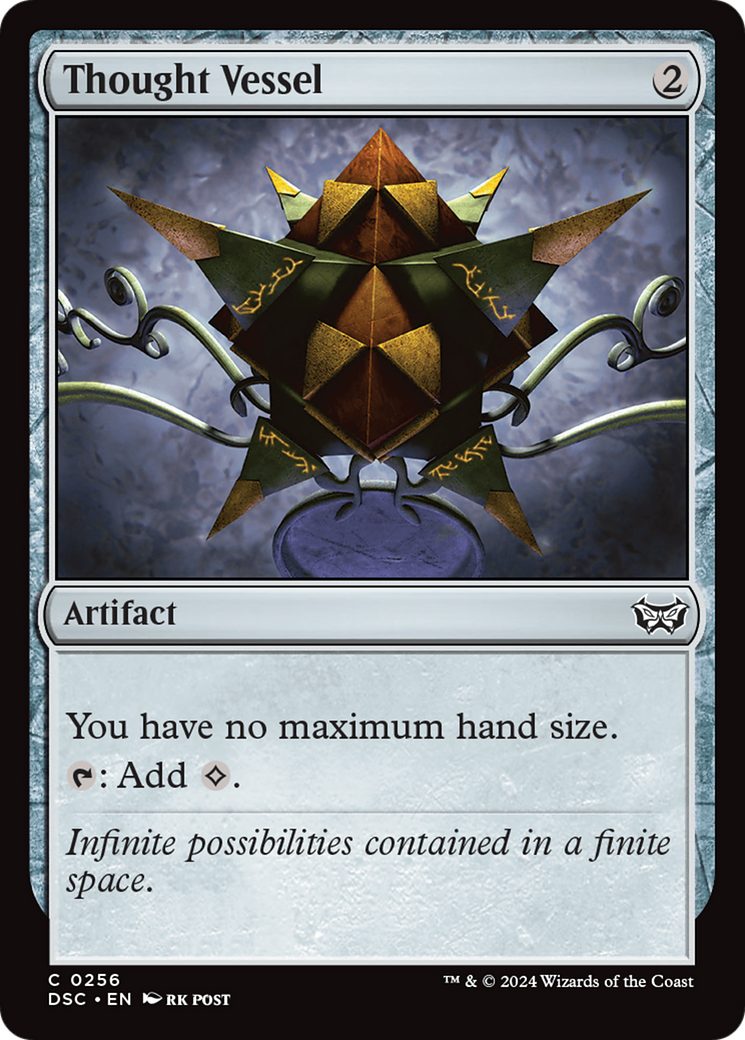
Thought Vessel
Thought Vessel
Artifact
You have no maximum hand size.
: Add .
Enchantments 5
-
1
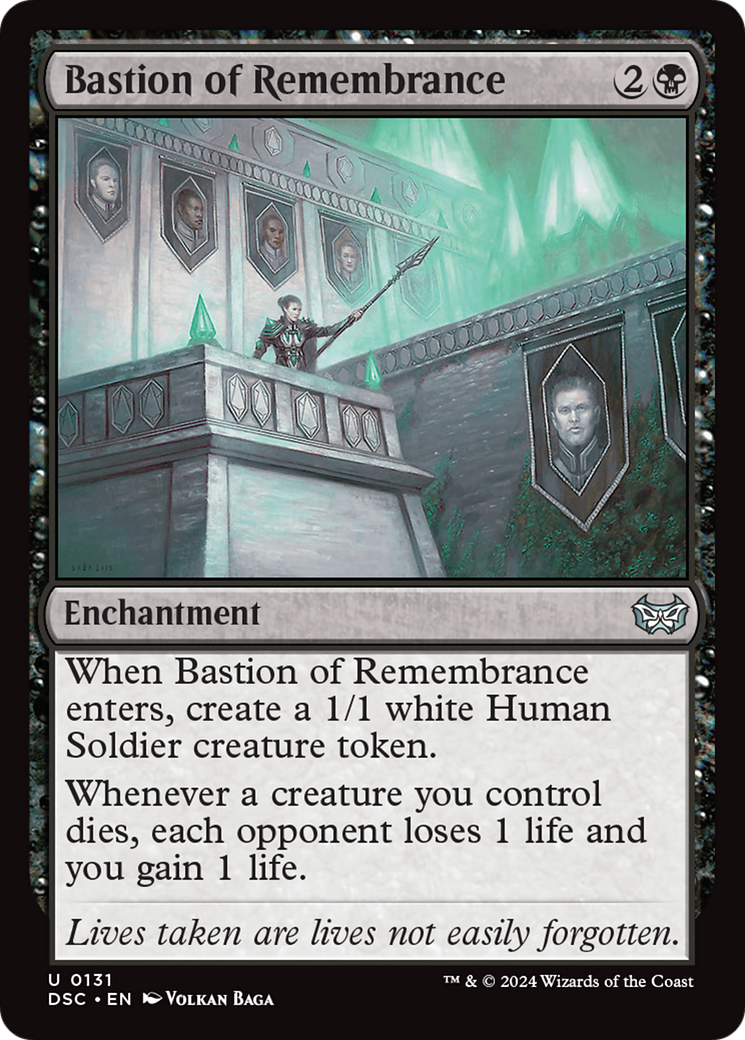
Bastion of Remembrance
Bastion of Remembrance
Enchantment
When this enchantment enters, create a 1/1 white Human Soldier creature token.
Whenever a creature you control dies, each opponent loses 1 life and you gain 1 life.
- If your life total is brought to 0 or less at the same time that creatures you control are dealt lethal damage, you lose the game before the last ability goes on the stack.
- In a Two-Headed Giant game, Bastion of Remembrance's last ability causes the opposing team to lose 2 life and you to gain 1 life.
- If one or more creatures you control die at the same time that Bastion of Remembrance leaves the battlefield, its last ability triggers for each of those creatures.
-
1
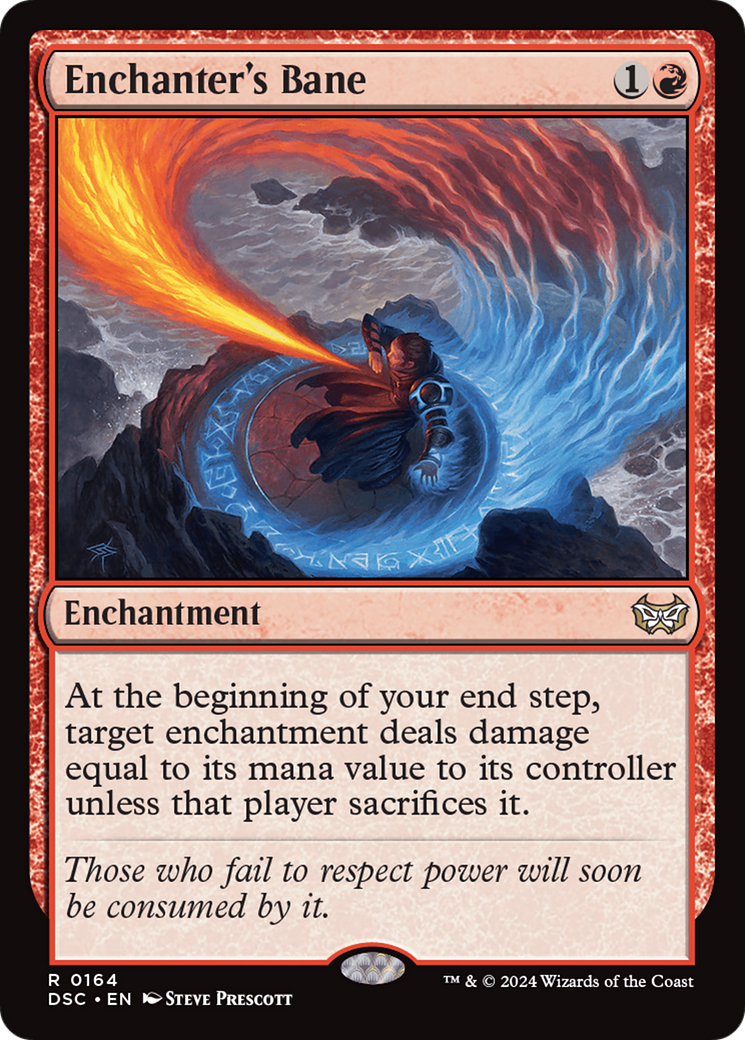
Enchanter's Bane
Enchanter's Bane
Enchantment
At the beginning of your end step, target enchantment deals damage equal to its mana value to its controller unless that player sacrifices it.
- If there are no other enchantments on the battlefield, the triggered ability of Enchanter's Bane must target Enchanter's Bane.
-
1
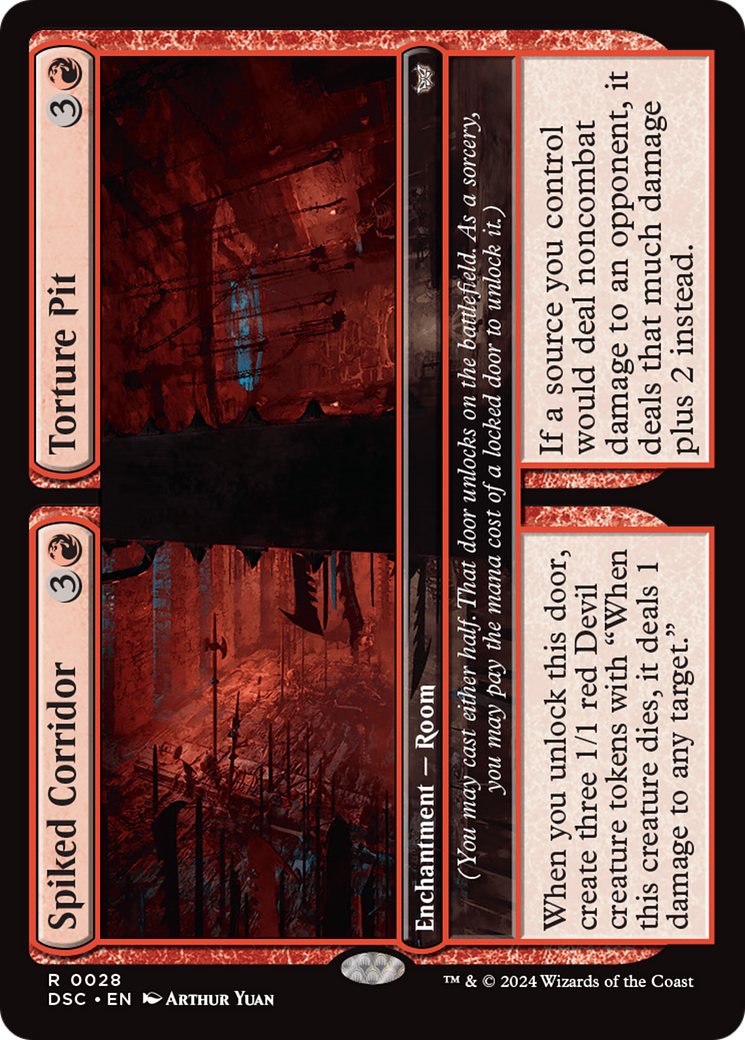
Spiked Corridor // Torture Pit
//
Spiked Corridor
Enchantment — Room
- The additional 2 damage is dealt by the same source as the original source of damage. The additional damage isn't dealt by Torture Pit unless Torture Pit is the original source of damage.
- If another effect modifies how much noncombat damage the source would deal, including preventing some of it, the player being dealt damage chooses an order in which to apply those effects. If all of the damage is prevented, Torture Pit's effect no longer applies.
- If noncombat damage dealt by a source you control is being divided or assigned among multiple players, divide the original amount before adding 2. For example, if you cast a sorcery spell that deals 4 damage divided as you choose among any number of targets, you could have it deal 3 damage to one opponent and 1 damage to another opponent. Those amounts would then be increased to 5 damage and 3 damage, respectively.
- To cast a Room spell, choose a half (or "door") to cast. There's no way to cast both halves of a Room card. When the Room spell resolves, the corresponding door becomes unlocked as the Room enters.
- Room cards have two card faces with a shared type line on a single card. The characteristics of the door you didn't cast are ignored while the spell is on the stack.
- Each Room card is a single card. For example, if you discard a Room card, you've discarded one card, not two. If an effect counts the number of enchantment cards in your graveyard, Bottomless Pool // Locker Room counts once, not twice.
- Each Room card has two names. If an effect instructs you to choose a card name, you may choose one of those names, but not both.
- If an effect allows you to cast a spell with certain characteristics, consider only the characteristics of the door you're casting. For example, if an effect allows you to cast a permanent spell with mana value 3 or less from among cards in your graveyard, you could cast Bottomless Pool this way, but not Locker Room.
- While in any zone other than the stack or the battlefield, a Room card's characteristics are a combination of its two doors. For example, Bottomless Pool // Locker Room has a mana value of 6 while it's in your library. If an effect allows you to search your library for a card with mana value 4 or less, you can't find Bottomless Pool // Locker Room.
- While on the battlefield, a Room's characteristics are a combination of the characteristics of its unlocked doors. For example, if Bottomless Pool // Locker Room is on the battlefield with both doors unlocked, its names are Bottomless Pool and Locker Room, its mana value is 6, it's a Room Enchantment, and it has the abilities in each door's text box.
- If a spell or ability would create a copy of a Room spell on the stack, the copy retains the choice of which door was cast but also retains the full characteristics of the spell. The characteristics of the door that wasn't cast are still ignored while the copy is on the stack, and when the copy resolves, the token it becomes will enter with the appropriate door unlocked.
- If a Room enters from any zone other than the stack, it will enter with both halves locked.
- If neither door of a Room is unlocked, it's a Room enchantment with no name and no abilities.
- Any time you have priority during a main phase of your turn and the stack is empty, you may pay the mana cost of a locked door (also called its "unlock cost"). That door becomes unlocked. This is a special action. It doesn't use the stack and can't be responded to.
- An ability that triggers "when you unlock this door" triggers when that door becomes unlocked. This can happen one of two ways: (1) the door becomes unlocked on the battlefield or (2) the door becomes unlocked as the Room enters the battlefield because you cast the corresponding half. In the latter case, since the door becoming unlocked is what causes the ability to trigger, effects that cause abilities that trigger when a permanent enters to trigger an additional time (such as that of Panharmonicon) won't apply.
- Some abilities allow you to unlock a door of a Room you control. You can't choose to unlock a door that's already unlocked with such an ability. If such an ability requires a target, you can target a Room even if both of its doors are unlocked, but the ability won't do anything when it resolves.
- Some abilities allow you to lock a door of a Room you control. You can't choose to lock a door that's already locked with such an ability. If such an ability requires a target, you can target a Room even if both of its doors are locked, but the ability won't do anything when it resolves.
- Some doors have abilities that trigger whenever you unlock that door and require one or more targets. You can unlock that door even if there would be insufficient legal targets for that triggered ability. The triggered ability won't go on the stack.
- An ability that triggers "whenever you fully unlock a Room" triggers when a door becomes unlocked and the other door of that Room is already unlocked, or when both doors of that Room become unlocked simultaneously.
-
1
Spiteful Visions
Spiteful Visions
Enchantment
At the beginning of each player's draw step, that player draws an additional card.
Whenever a player draws a card, this enchantment deals 1 damage to that player.
- The triggered ability is put onto the stack after you have already drawn your card for the turn.
- Spiteful Visions's second ability triggers any time any player draws a card, not just when a player draws a card as a result of its first ability.
-
1
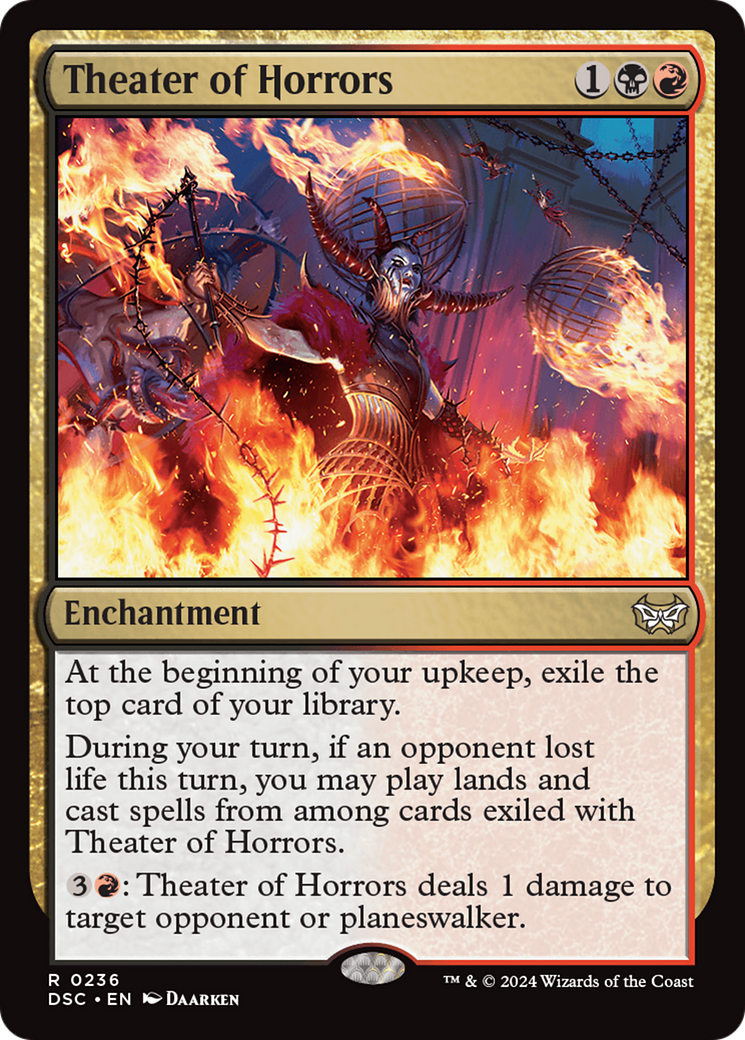
Theater of Horrors
Theater of Horrors
Enchantment
At the beginning of your upkeep, exile the top card of your library.
During your turn, if an opponent lost life this turn, you may play lands and cast spells from among cards exiled with this enchantment.
: This enchantment deals 1 damage to target opponent or planeswalker.
- Damage dealt to a player causes that player to lose that much life.
- Theater of Horrors doesn't change when you can play the exiled cards during your turn. For example, if you exile a sorcery card, you can cast it only during your main phase when the stack is empty. If you exile a land card, you can play it only during your main phase and only if you have an available land play remaining.
- Casting an exiled card causes it to leave exile. You can't cast it multiple times.
- In a multiplayer game, if an opponent loses life during your turn and then leaves the game, you can play cards exiled with Theater of Horrors.
Lands 38
-
1
Ash Barrens
Ash Barrens
Land
: Add .
Basic landcycling ( , Discard this card: Search your library for a basic land card, reveal it, put it into your hand, then shuffle.)
-
1
Blackcleave Cliffs
Blackcleave Cliffs
Land
This land enters tapped unless you control two or fewer other lands.
: Add or .
- If one of these lands enters the battlefield under your control and you control zero, one, or two other lands, it enters the battlefield untapped. If you control three or more other lands, it enters the battlefield tapped.
- If one of these lands enters the battlefield at the same time as one or more other lands (due to Oblivion Sower or Warp World, perhaps), it doesn't take those lands into consideration when determining how many other lands you control.
-
1
Bloodfell Caves
Bloodfell Caves
Land
This land enters tapped.
When this land enters, you gain 1 life.
: Add or .
-
1
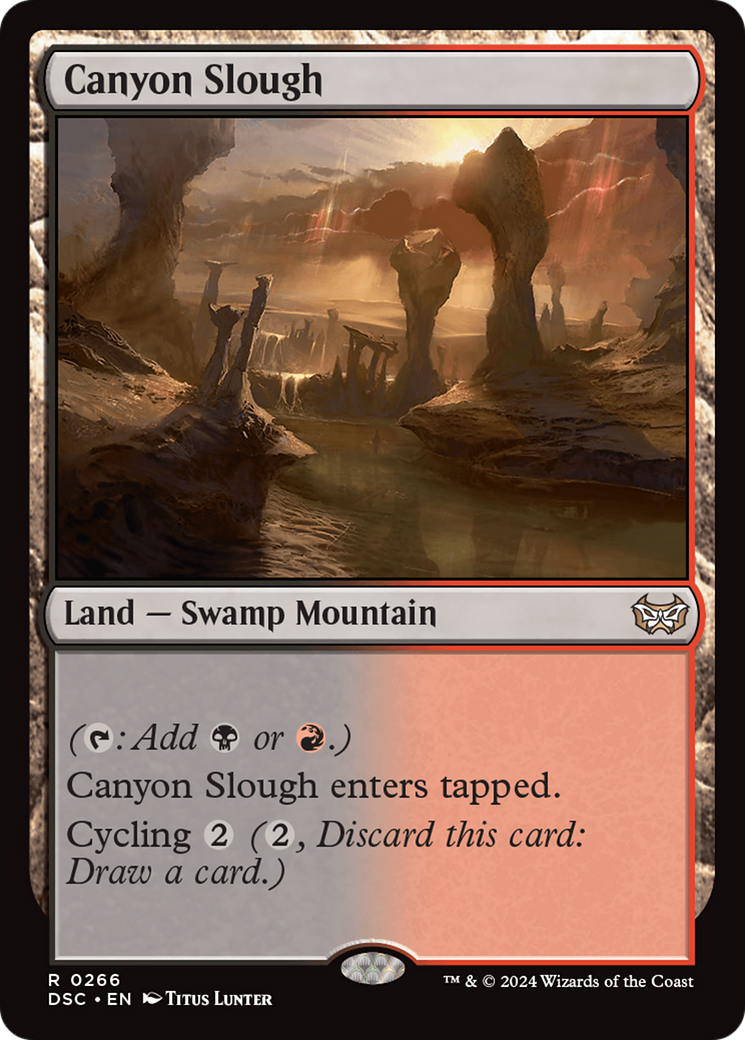
Canyon Slough
Canyon Slough
Land — Swamp Mountain
( : Add or .)
This land enters tapped.
Cycling ( , Discard this card: Draw a card.)
-
1
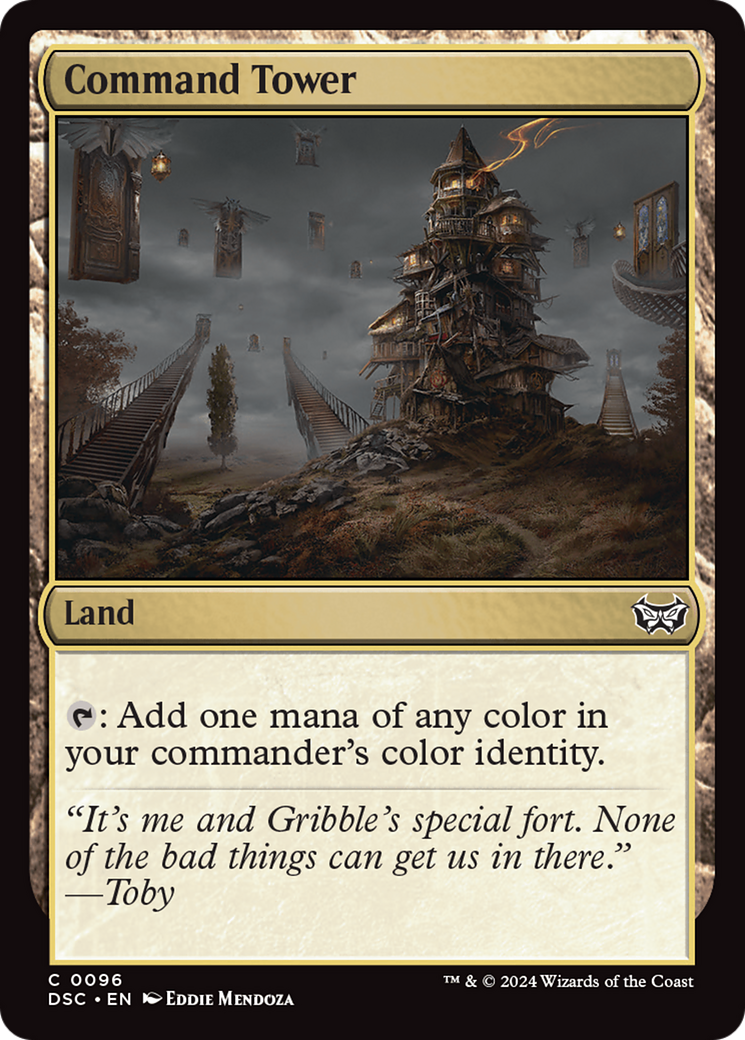
Command Tower
Command Tower
Land
: Add one mana of any color in your commander's color identity.
- If you don't have a commander, Command Tower's ability produces no mana.
- If your commander is a card that has no colors in its color identity, Command Tower's ability produces no mana. It doesn't produce .
- If you have two commanders, the ability adds one mana of any color in their combined color identities.
-
1
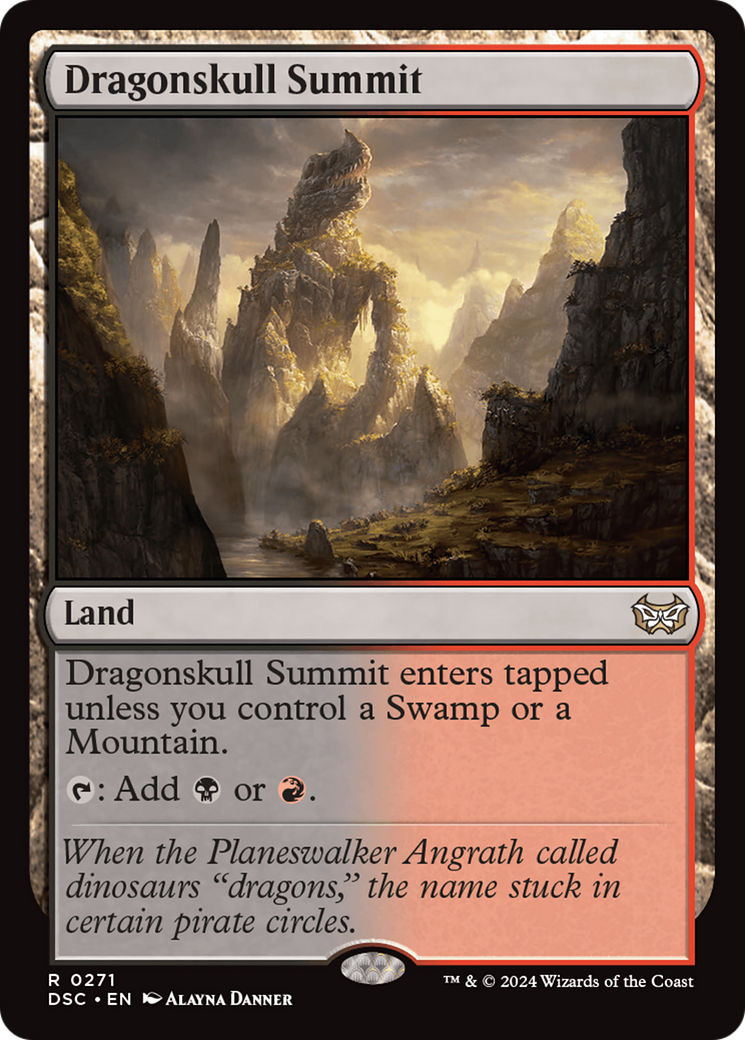
Dragonskull Summit
Dragonskull Summit
Land
This land enters tapped unless you control a Swamp or a Mountain.
: Add or .
- This checks for lands you control with the land type Swamp or Mountain, not for lands named Swamp or Mountain. The lands it checks for don't have to be basic lands. For example, if you control Stomping Ground (a nonbasic land with the land types Mountain and Forest), Dragonskull Summit will enter untapped.
- As this is entering, it checks for lands that are already on the battlefield. It won't see lands that are entering at the same time (due to Warp World, for example).
-
1
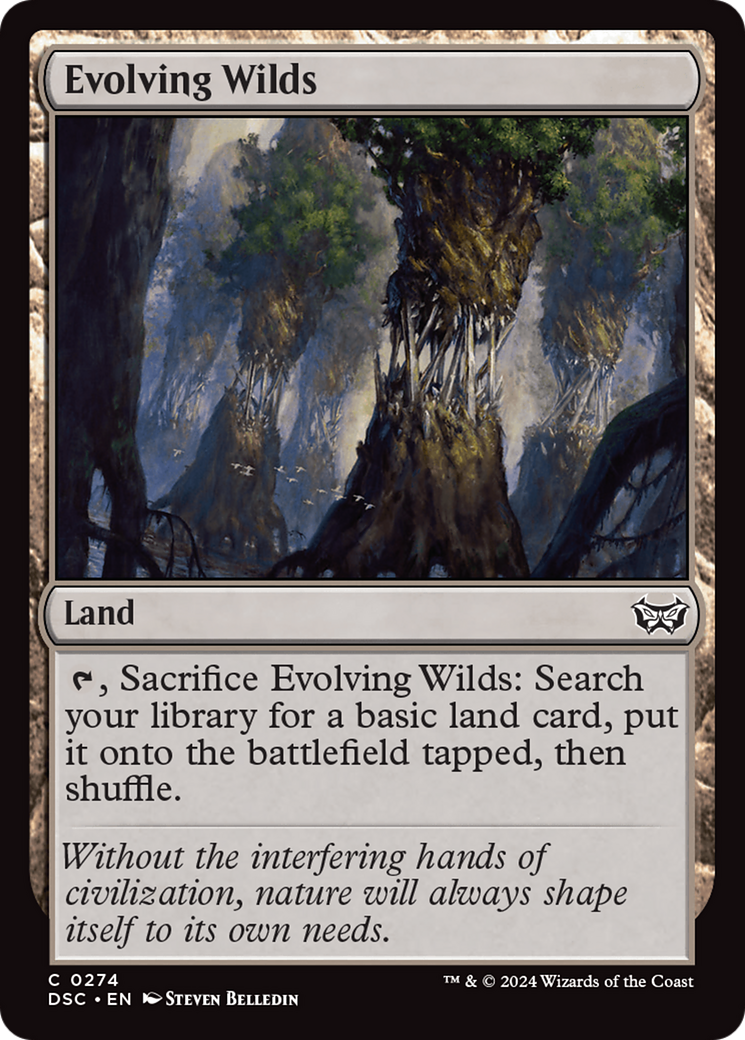
Evolving Wilds
Evolving Wilds
Land
, Sacrifice this land: Search your library for a basic land card, put it onto the battlefield tapped, then shuffle.
-
1
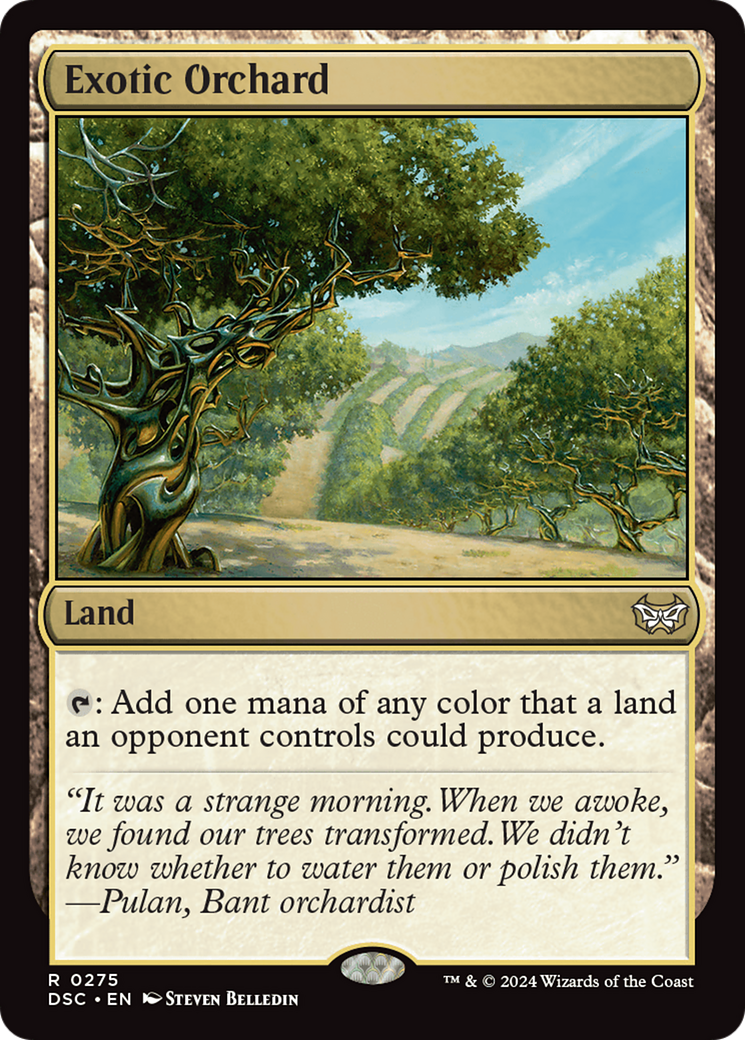
Exotic Orchard
Exotic Orchard
Land
: Add one mana of any color that a land an opponent controls could produce.
- Lands that produce mana based only on what other lands "could produce" won't help each other unless some other land allows one of them to actually produce some type of mana. For example, if you control an Exotic Orchard and your opponent controls an Exotic Orchard and a Reflecting Pool, none of those lands would produce mana if their mana abilities were activated. On the other hand, if you control a Forest and an Exotic Orchard, and your opponent controls an Exotic Orchard and a Reflecting Pool, then each of those lands can be tapped to produce . Your opponent's Exotic Orchard can produce because you control a Forest. Your Exotic Orchard and your opponent's Reflecting Pool can each produce because your opponent's Exotic Orchard can produce .
- When determining what colors of mana your opponents' lands could produce, Exotic Orchard takes into account any applicable replacement effects that would apply to those lands' mana abilities (such as Contamination's effect, for example). If there are more than one, consider them in any possible order.
- The colors of mana are white, blue, black, red, and green. Exotic Orchard can't be tapped for colorless mana, even if a land an opponent controls could produce colorless mana.
- Exotic Orchard doesn't care about any restrictions or riders your opponents' lands (such as Ancient Ziggurat or Hall of the Bandit Lord) put on the mana they produce. It just cares about colors of mana.
- Exotic Orchard checks the effects of all mana-producing abilities of lands your opponents control, but it doesn't check their costs. For example, Vivid Crag has the ability " , Remove a charge counter from Vivid Crag: Add one mana of any color." If an opponent controls Vivid Crag and you control Exotic Orchard, you can tap Exotic Orchard for any color of mana. It doesn't matter whether Vivid Crag has a charge counter on it, and it doesn't matter whether it's untapped.
-
1
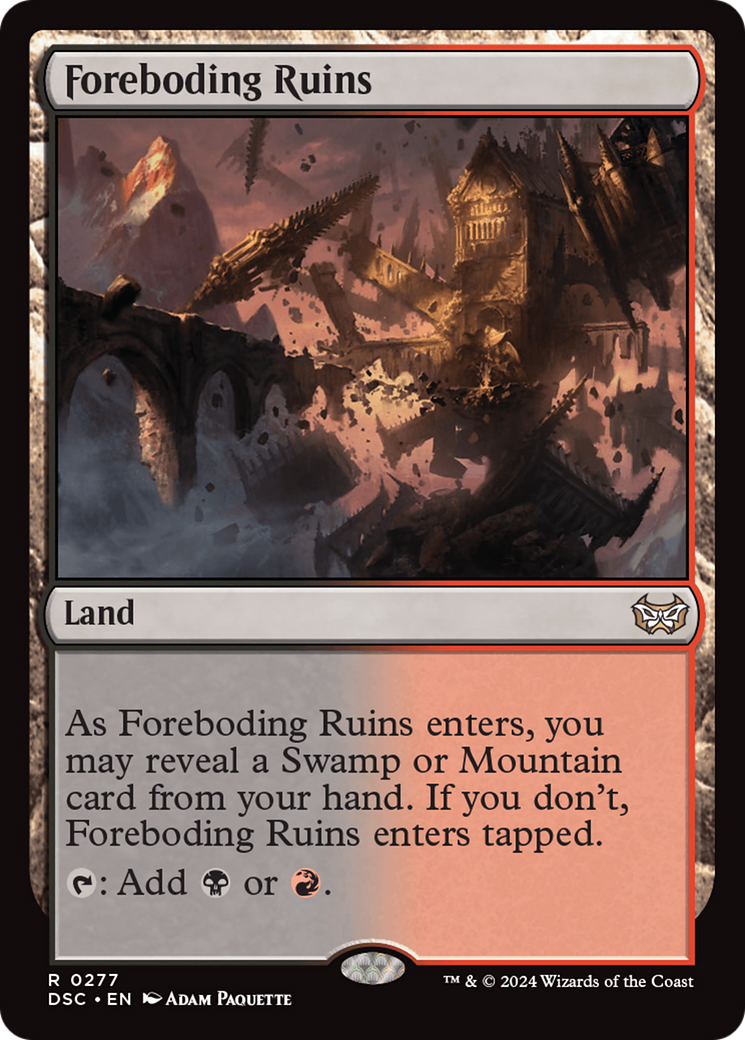
Foreboding Ruins
Foreboding Ruins
Land
As this land enters, you may reveal a Swamp or Mountain card from your hand. If you don't, this land enters tapped.
: Add or .
- You may reveal any land card with either or both of the appropriate subtypes. It doesn't have to be a basic land. For example, you could reveal Sunken Hollow from the Battle for Zendikar set to satisfy the ability of Foreboding Ruins.
- If a Swamp or Mountain is entering the battlefield from your hand at the same time as Foreboding Ruins, you may reveal the other land to have Foreboding Ruins enter untapped.
- Lands don't have a subtype just because they can produce mana of the corresponding color. Foreboding Ruins itself is neither a Swamp nor a Mountain, even though it produces black and red mana, so you can't reveal one to satisfy the ability of another.
- If an effect instructs you to put Foreboding Ruins onto the battlefield tapped, it will still enter the battlefield tapped even if you reveal a land card from your hand.
-
1
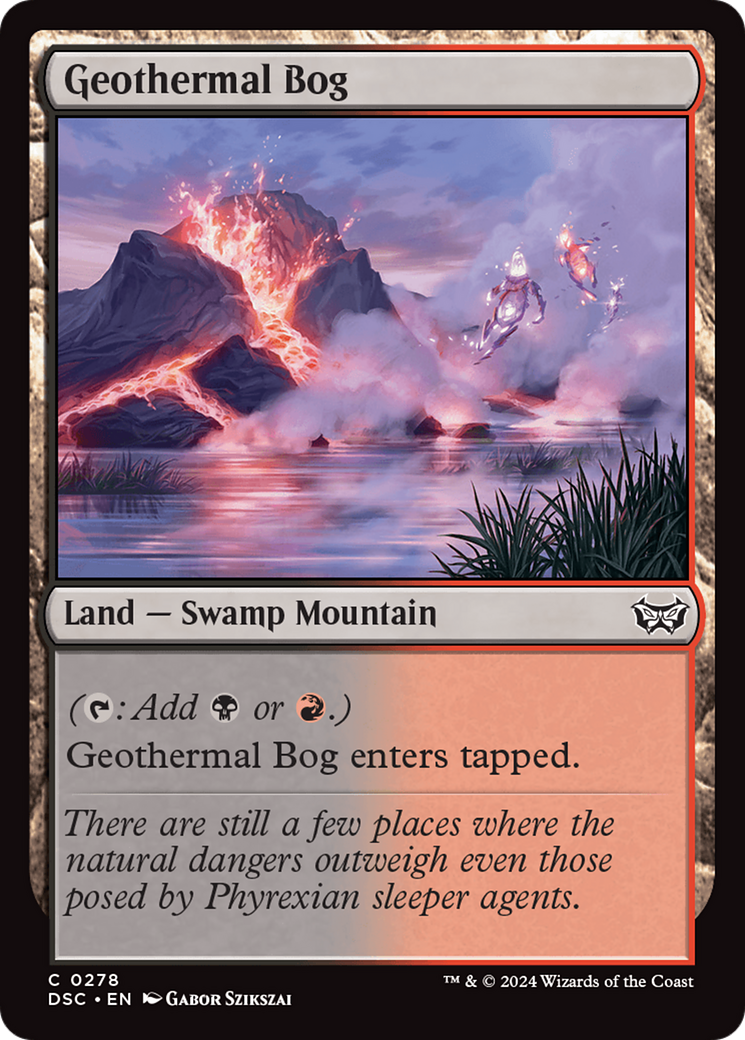
Geothermal Bog
Geothermal Bog
Land — Swamp Mountain
( : Add or .)
This land enters tapped.
-
1
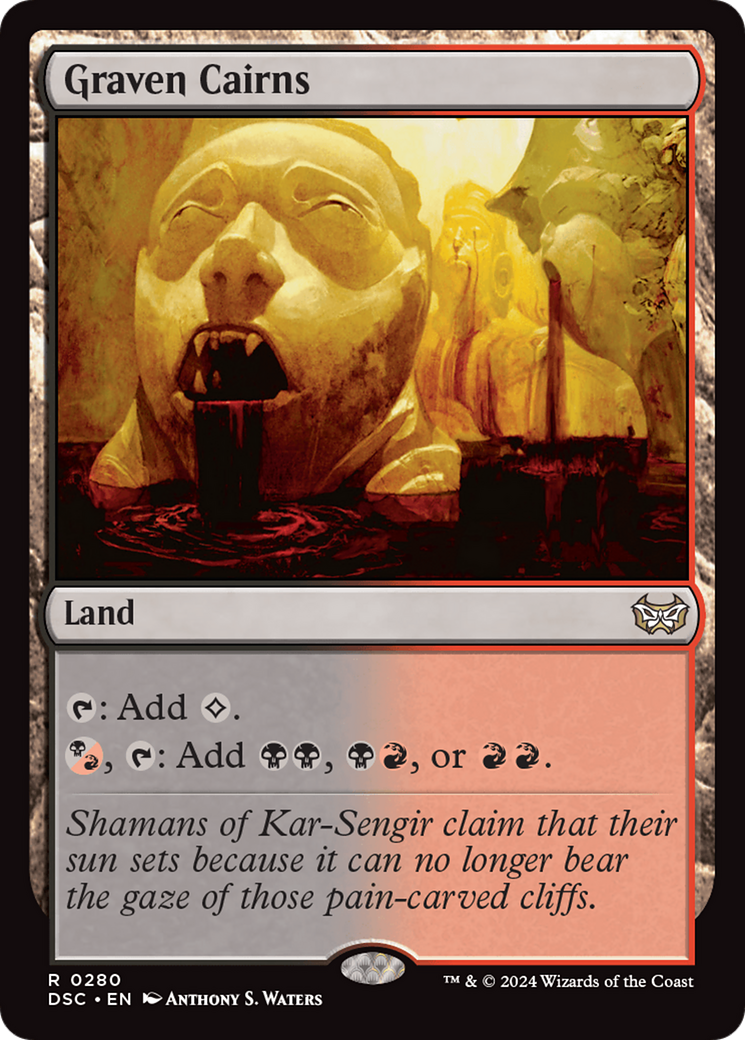
Graven Cairns
Graven Cairns
Land
: Add .
, : Add , , or .
- {(b/r)}, " is the same as saying " , or , .
-
1
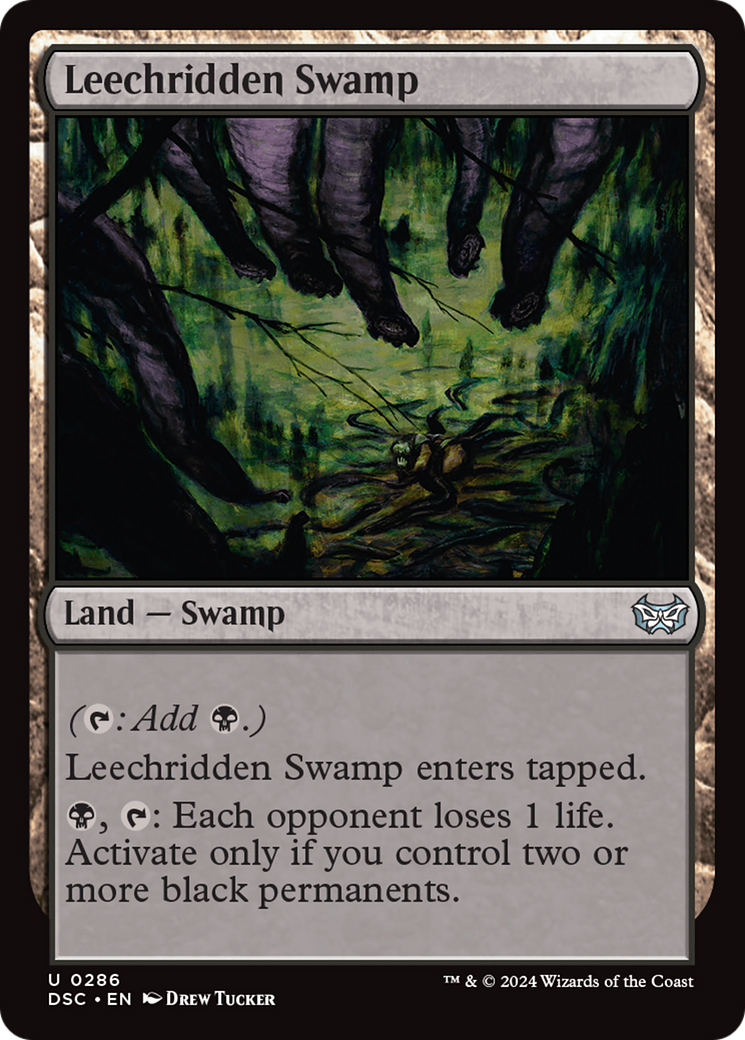
Leechridden Swamp
Leechridden Swamp
Land — Swamp
( : Add .)
This land enters tapped.
, : Each opponent loses 1 life. Activate only if you control two or more black permanents.
-
8
Mountain
Mountain
Basic Land — Mountain
( : Add .)
-
1
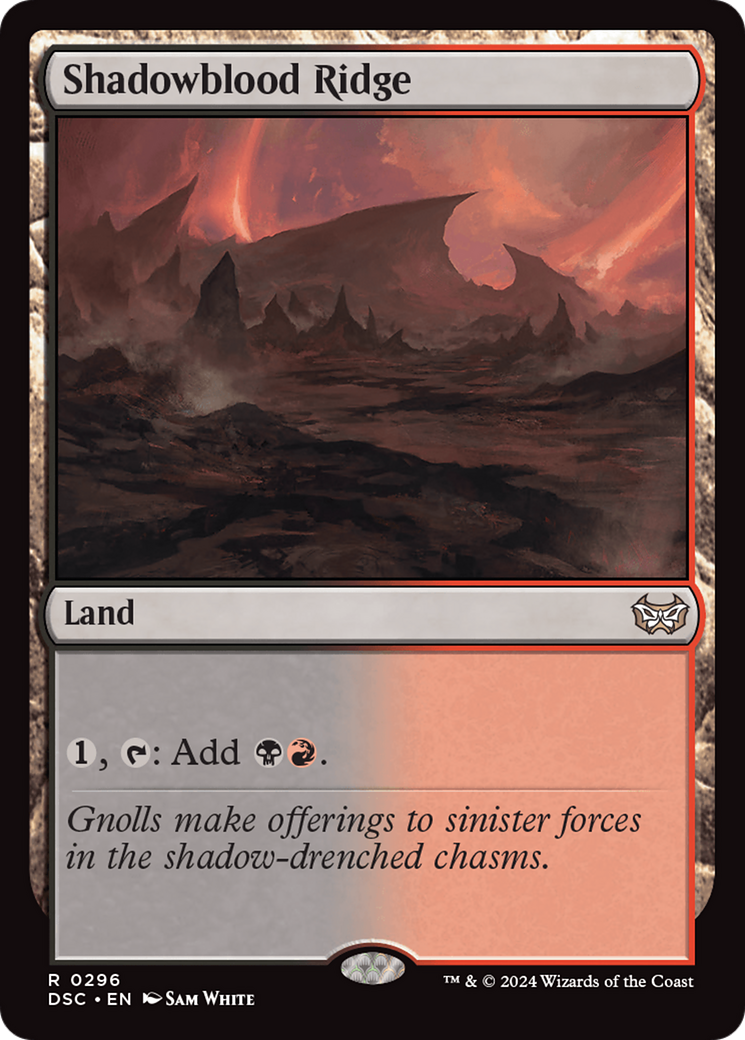
Shadowblood Ridge
Shadowblood Ridge
Land
, : Add .
-
1
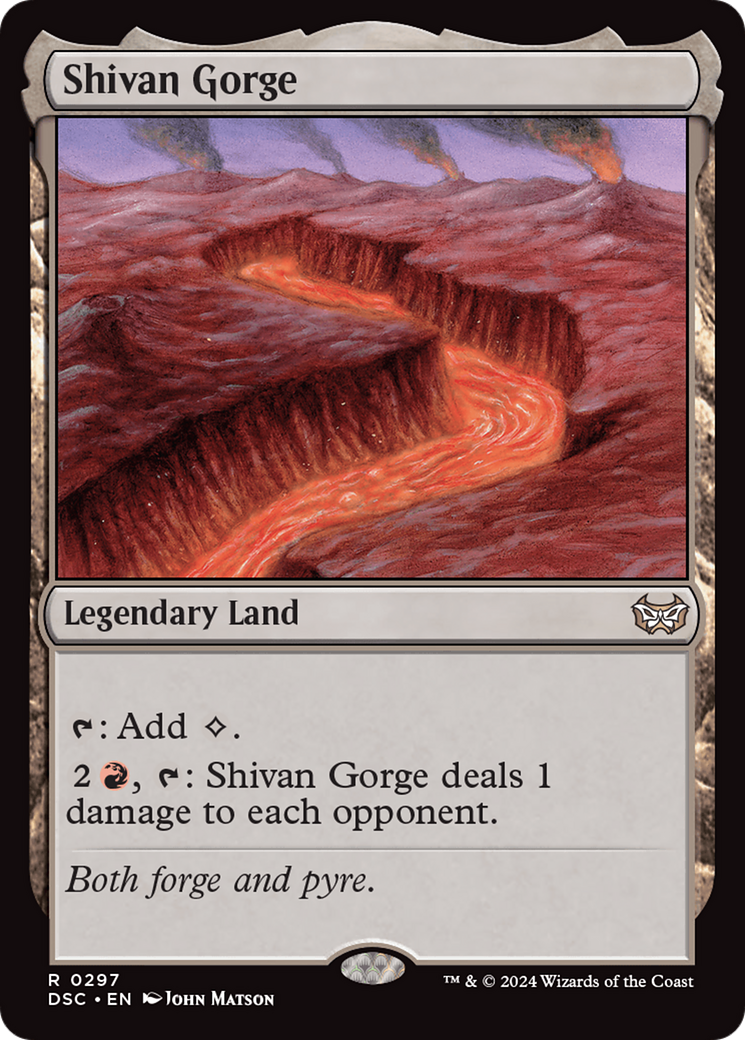
Shivan Gorge
Shivan Gorge
Legendary Land
: Add .
, : Shivan Gorge deals 1 damage to each opponent.
- The damage has no color. It is not red.
-
1
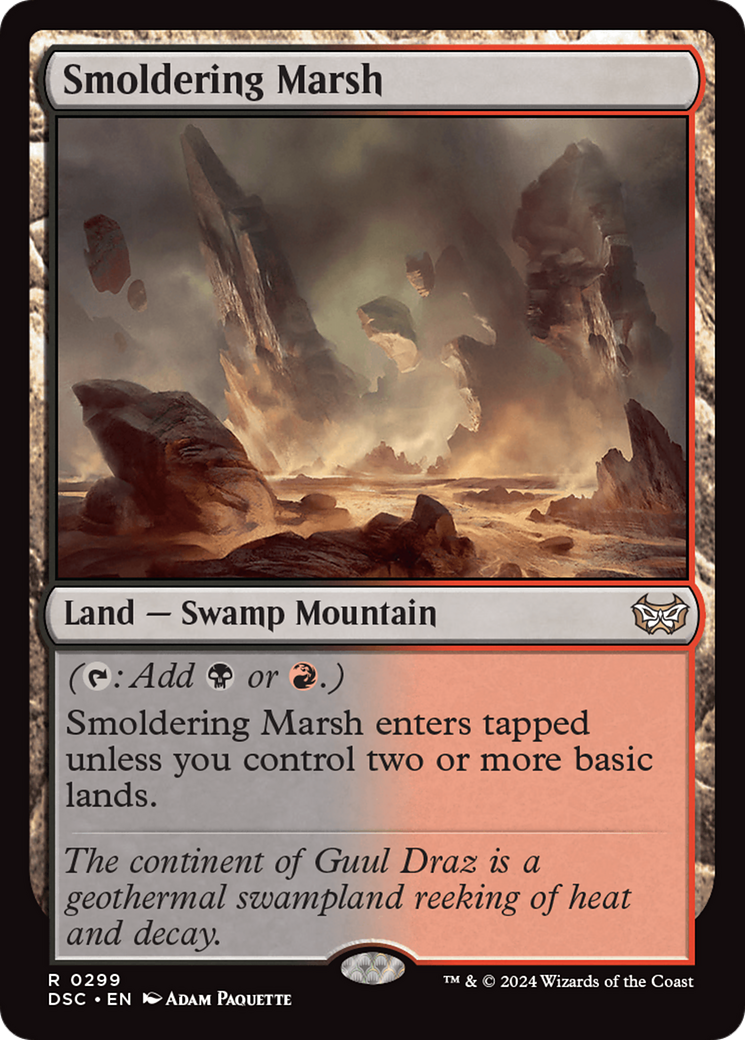
Smoldering Marsh
Smoldering Marsh
Land — Swamp Mountain
( : Add or .)
This land enters tapped unless you control two or more basic lands.
- However, because these cards have basic land types, effects that specify a basic land type without also specifying that the land be basic can affect them. For example, a spell or ability that reads "Destroy target Forest" can target Canopy Vista, while one that reads "Destroy target basic Forest" cannot.
- Even though these lands have basic land types, they are not basic lands because "basic" doesn't appear on their type line. Notably, controlling two or more of them won't allow others to enter the battlefield untapped.
- If one of these lands enters the battlefield at the same time as any number of basic lands, those other lands are not counted when determining if this land enters the battlefield tapped or untapped.
-
1
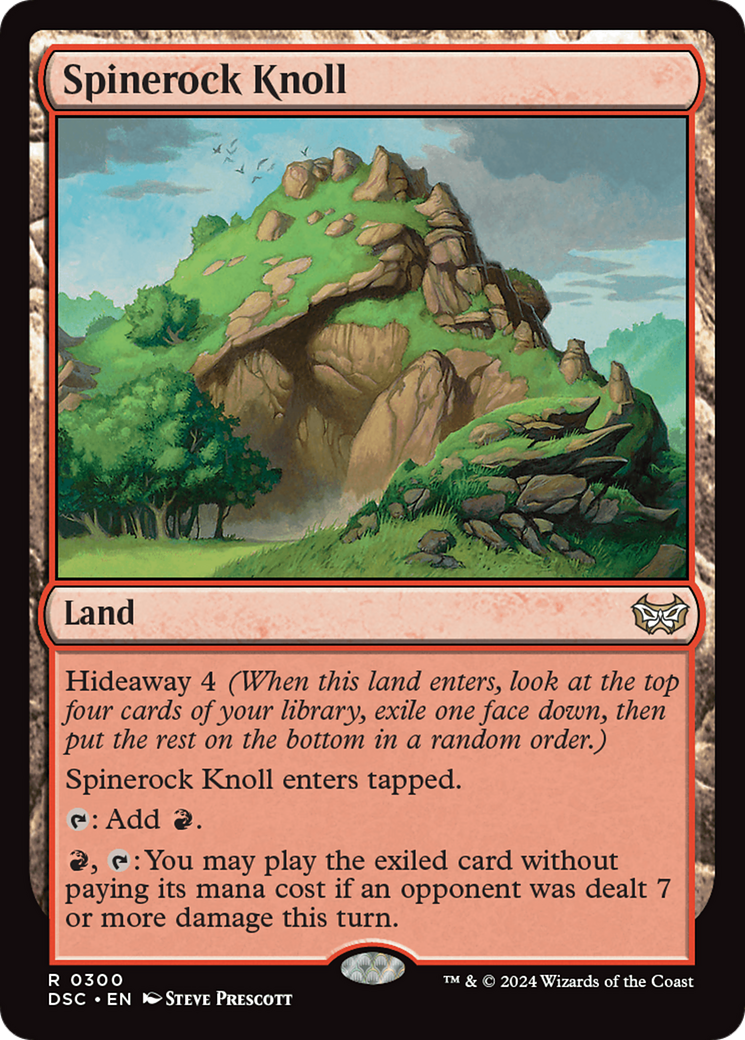
Spinerock Knoll
Spinerock Knoll
Land
Hideaway 4 (When this land enters, look at the top four cards of your library, exile one face down, then put the rest on the bottom in a random order.)
This land enters tapped.
: Add .
, : You may play the exiled card without paying its mana cost if an opponent was dealt 7 or more damage this turn.
- "Hideaway N" means "When this permanent enters the battlefield, look at the top N cards of your library. Exile one of them face down and put the rest on the bottom of your library in a random order. The exiled card gains 'The player who controls the permanent that exiled this card may look at this card in the exile zone.'"
- Any player who has controlled a permanent with a hideaway ability since a card was exiled with it may look at that card.
- Previously, permanents with hideaway entered the battlefield tapped. This ability has been removed from the definition of hideaway. Older cards have received errata to have an additional paragraph that reads "[This permanent] enters the battlefield tapped," and they now have hideaway 4.
- Hideaway now causes you to put the rest of the cards on the bottom of your library in a random order instead of any order.
- It doesn't matter how the opponent was dealt damage or by whom, as long as the total damage is 7 or more. You don't specify an opponent when you activate the ability.
- You'll get to play the card even if Spinerock Knoll wasn't on the battlefield at the time some or all of the 7 damage was dealt.
- At the time the last ability resolves, you'll get to play the card if a player who is currently your opponent, or a player who was your opponent at the time they left the game, has been dealt 7 damage over the course of the turn.
-
1
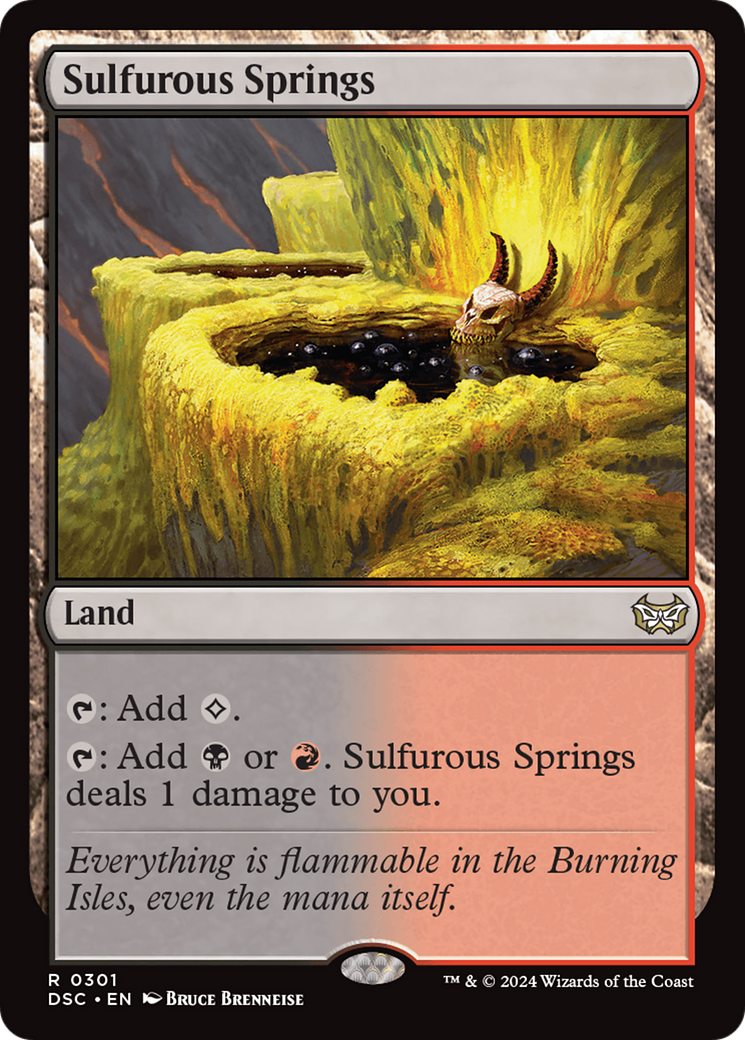
Sulfurous Springs
Sulfurous Springs
Land
: Add .
: Add or . This land deals 1 damage to you.
-
8
Swamp
Swamp
Basic Land — Swamp
( : Add .)
-
1
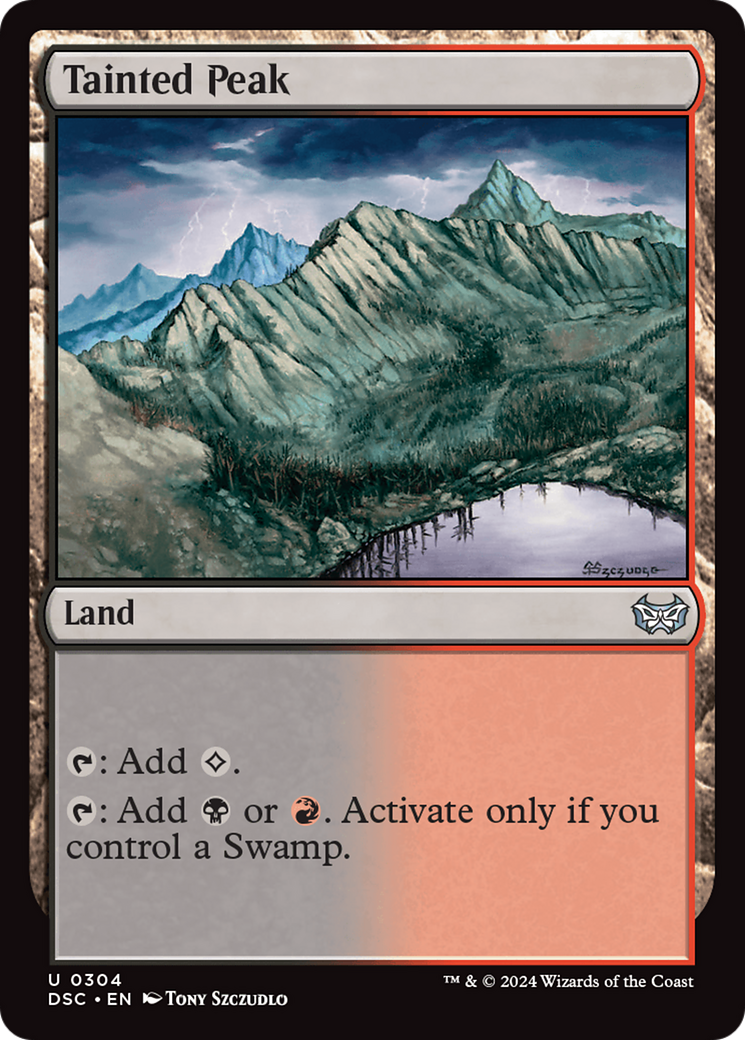
Tainted Peak
Tainted Peak
Land
: Add .
: Add or . Activate only if you control a Swamp.
-
1
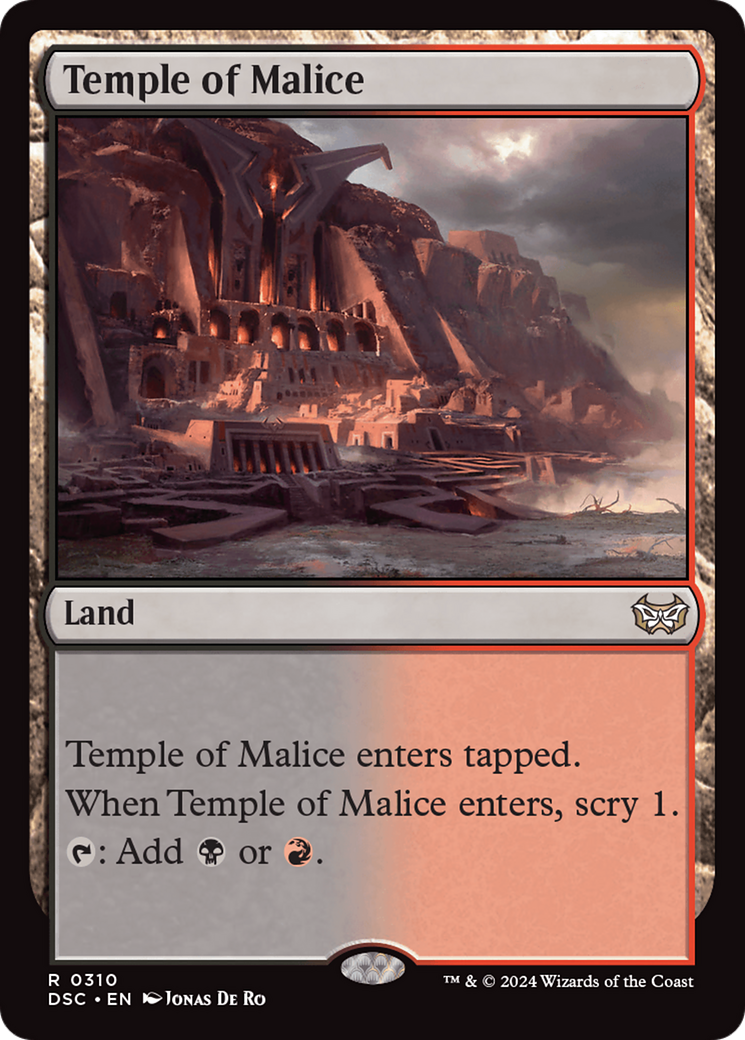
Temple of Malice
Temple of Malice
Land
This land enters tapped.
When this land enters, scry 1. (Look at the top card of your library. You may put that card on the bottom.)
: Add or .
- When you scry, you may put all the cards you look at back on top of your library, you may put all of those cards on the bottom of your library, or you may put some of those cards on top and the rest of them on the bottom.
- You choose how to order cards returned to your library after scrying no matter where you put them.
- You perform the actions stated on a card in sequence. For some spells and abilities, that means you'll scry last. For others, that means you'll scry and then perform other actions.
- Scry appears on some spells and abilities with one or more targets. If all of the spell or ability's targets are illegal when it tries to resolve, it won't resolve and none of its effects will happen. You won't scry.
-
1
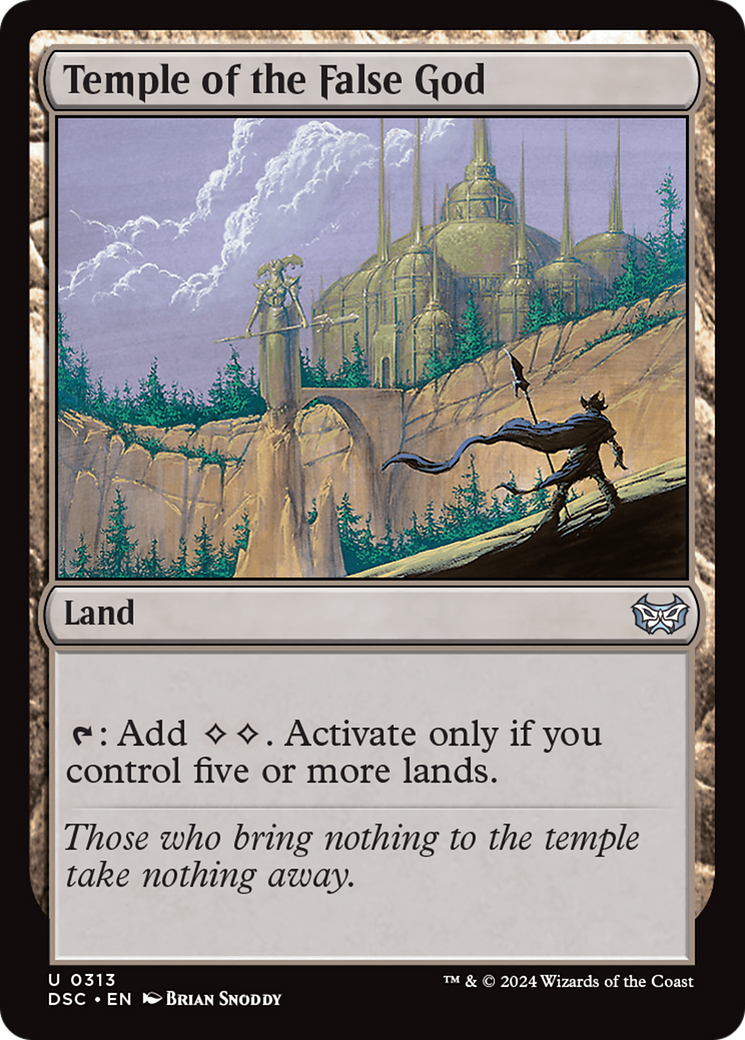
Temple of the False God
Temple of the False God
Land
: Add . Activate only if you control five or more lands.
-
1
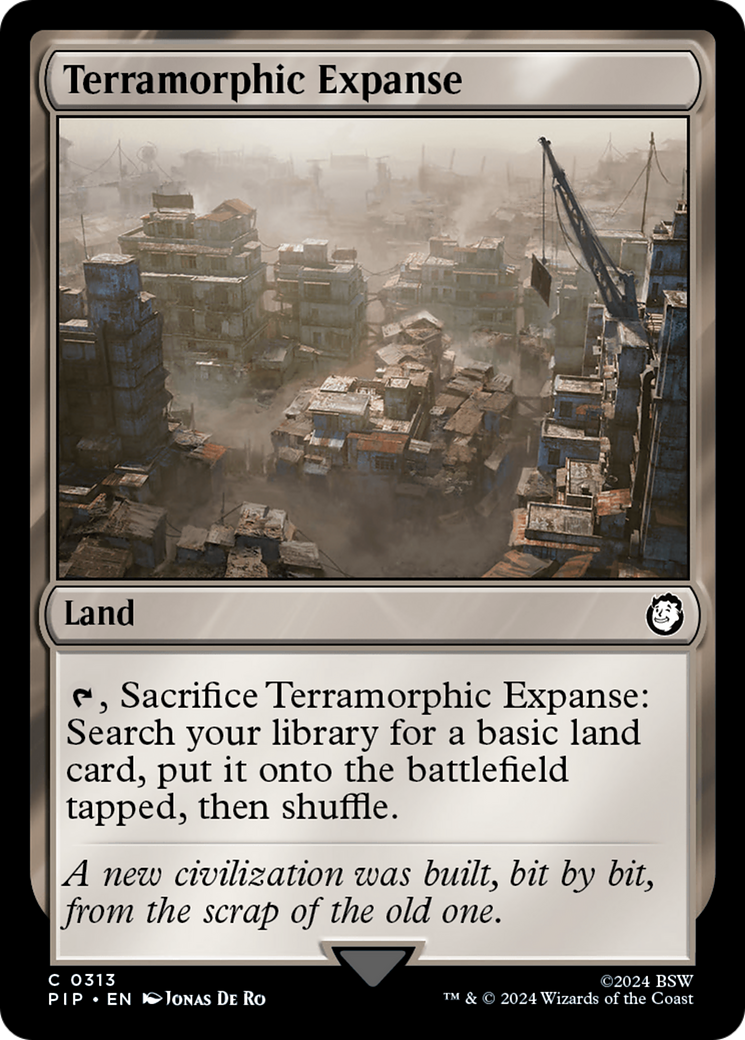
Terramorphic Expanse
Terramorphic Expanse
Land
, Sacrifice this land: Search your library for a basic land card, put it onto the battlefield tapped, then shuffle.
-
1
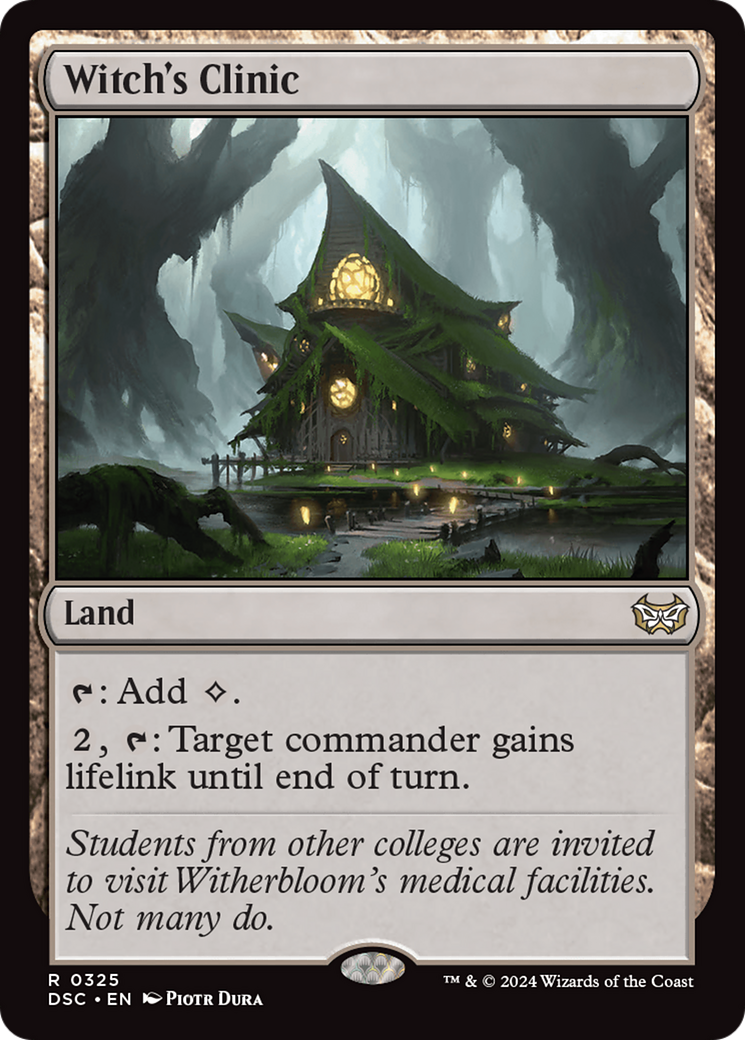
Witch's Clinic
Witch's Clinic
Land
: Add .
, : Target commander gains lifelink until end of turn.
Black 22
-
1
Bastion of Remembrance
Bastion of Remembrance
Enchantment
When this enchantment enters, create a 1/1 white Human Soldier creature token.
Whenever a creature you control dies, each opponent loses 1 life and you gain 1 life.
- If your life total is brought to 0 or less at the same time that creatures you control are dealt lethal damage, you lose the game before the last ability goes on the stack.
- In a Two-Headed Giant game, Bastion of Remembrance's last ability causes the opposing team to lose 2 life and you to gain 1 life.
- If one or more creatures you control die at the same time that Bastion of Remembrance leaves the battlefield, its last ability triggers for each of those creatures.
-
1
Blood Artist
Blood Artist
Creature — Vampire
0/1
Whenever this creature or another creature dies, target player loses 1 life and you gain 1 life.
- If Blood Artist and one or more other creatures die at the same time, its ability will trigger for each of those creatures.
-
1
Blood Pact
Blood Pact
Instant
Target player draws two cards and loses 2 life.
-
1
Blood Seeker
Blood Seeker
Creature — Vampire Shaman
1/1
Whenever a creature an opponent controls enters, you may have that player lose 1 life.
- Life loss is not the same as damage. Blood Seeker's ability will not cause creatures with bloodthirst to enter with +1/+1 counters.
-
1
Braids, Arisen Nightmare
Braids, Arisen Nightmare
Legendary Creature — Nightmare
3/3
At the beginning of your end step, you may sacrifice an artifact, creature, enchantment, land, or planeswalker. If you do, each opponent may sacrifice a permanent of their choice that shares a card type with it. For each opponent who doesn't, that player loses 2 life and you draw a card.
- If the permanent that you sacrifice as you resolve Braids's triggered ability has more than one card type, each opponent may choose to sacrifice any permanent they control that shares any card type with it. For example, if the permanent you sacrifice is an artifact creature, one opponent might choose to sacrifice an artifact and another opponent might choose to sacrifice a creature.
-
1
Decree of Pain
Decree of Pain
Sorcery
Destroy all creatures. They can't be regenerated. Draw a card for each creature destroyed this way.
Cycling ( , Discard this card: Draw a card.)
When you cycle this card, all creatures get -2/-2 until end of turn.
- When you cycle this card, first the cycling ability goes on the stack, then the triggered ability goes on the stack on top of it. The triggered ability will resolve before you draw a card from the cycling ability.
- The cycling ability and the triggered ability are separate. If the triggered ability doesn't resolve (because, for example, it has been countered, or all of its targets have become illegal), the cycling ability will still resolve, and you'll draw a card.
-
1
Falkenrath Noble
Falkenrath Noble
Creature — Vampire Noble
2/2
Flying
Whenever this creature or another creature dies, target player loses 1 life and you gain 1 life.
- If Falkenrath Noble and another creature die at the same time, Falkenrath Noble's triggered ability will trigger for each of them.
-
1
Fate Unraveler
Fate Unraveler
Enchantment Creature — Hag
3/4
Whenever an opponent draws a card, this creature deals 1 damage to that player.
-
1
Feed the Swarm
Feed the Swarm
Sorcery
Destroy target creature or enchantment an opponent controls. You lose life equal to that permanent's mana value.
- The amount of life you lose is determined by the permanent's mana value as it last existed on the battlefield.
- If the target permanent is an illegal target by the time Feed the Swarm tries to resolve, the spell doesn't resolve. You don't lose any life. If the target is legal but not destroyed (most likely because it has indestructible), you do lose life.
- If a permanent on the battlefield has in its mana cost, X is 0 for the purpose of determining its mana value.
-
1
Gray Merchant of Asphodel
Gray Merchant of Asphodel
Creature — Zombie
2/4
When this creature enters, each opponent loses X life, where X is your devotion to black. You gain life equal to the life lost this way. (Each in the mana costs of permanents you control counts toward your devotion to black.)
- The amount of life you gain is the total amount of life lost, not simply the value of X.
- Hybrid mana symbols, monocolored hybrid mana symbols, and Phyrexian mana symbols do count toward your devotion to their color(s).
- Colorless and generic mana symbols ( , , , , , and so on) in mana costs of permanents you control don't count toward your devotion to any color.
- Mana symbols in the text boxes of permanents you control don't count toward your devotion to any color.
- If an activated ability or triggered ability has an effect that depends on your devotion to a color, you count the number of mana symbols of that color among the mana costs of permanents you control as the ability resolves. The permanent with that ability will be counted if it's still on the battlefield at that time.
- If you put an Aura on an opponent's permanent, you still control the Aura, and mana symbols in its mana cost count towards your devotion.
-
1
Infernal Grasp
Infernal Grasp
Instant
Destroy target creature. You lose 2 life.
-
1
Kederekt Parasite
Kederekt Parasite
Creature — Horror
1/1
Whenever an opponent draws a card, if you control a red permanent, you may have this creature deal 1 damage to that player.
- The "intervening 'if' clause" means that (1) the ability won't trigger at all unless you control a permanent of the specified color, and (2) the ability will do nothing unless you control a permanent of the specified color at the time it resolves.
-
1
Mask of Griselbrand
Mask of Griselbrand
Legendary Artifact — Equipment
Equipped creature has flying and lifelink.
Whenever equipped creature dies, you may pay X life, where X is its power. If you do, draw X cards.
Equip
- Use the equipped creature's power as it last existed on the battlefield to determine the value of X.
- You must pay exactly X life or nothing. You can't pay less life to draw fewer cards.
-
1
Massacre Girl
Massacre Girl
Legendary Creature — Human Assassin
4/4
Menace
When Massacre Girl enters, each other creature gets -1/-1 until end of turn. Whenever a creature dies this turn, each creature other than Massacre Girl gets -1/-1 until end of turn.
- Massacre Girl's enters-the-battlefield triggered ability and its delayed triggered ability each affect only creatures on the battlefield at the time that those abilities resolve. Creatures that enter the battlefield or become creatures later in the turn won't get -1/-1 unless the delayed triggered ability triggers and resolves again later.
- Once Massacre Girl's enters-the-battlefield ability has triggered, it doesn't matter whether Massacre Girl remains on the battlefield. The delayed triggered ability will be created as the enters-the-battlefield ability resolves.
- Creatures that die while Massacre Girl's triggered ability is still on the stack won't cause its delayed triggered ability to trigger since that delayed triggered ability hasn't been created yet.
- A creature with 0 toughness doesn't die immediately. Rather, the creature dies the next time a player would receive priority. This means that any creatures whose toughness becomes 0 as Massacre Girl's enters-the-battlefield ability resolves will remain on the battlefield until just after the delayed triggered ability has been created.
- If more than one creature dies at once, Massacre Girl's delayed triggered ability triggers that many times.
-
1
Massacre Wurm
Massacre Wurm
Creature — Phyrexian Wurm
6/5
When this creature enters, creatures your opponents control get -2/-2 until end of turn.
Whenever a creature an opponent controls dies, that player loses 2 life.
- Massacre Wurm's first ability affects only creatures your opponents control at the time it resolves. Creatures they begin to control later in the turn won't get -2/-2.
- Massacre Wurm's triggered ability triggers if a creature an opponent controls dies for any reason, including from its first ability reducing its toughness to 0, as long as Massacre Wurm remains on the battlefield.
- If a creature an opponent controls dies at the same time as Massacre Wurm, Massacre Wurm's last ability triggers for that creature.
- If your life total is brought to 0 or less at the same time that a creature an opponent controls is dealt lethal damage, you lose the game before Massacre Wurm's last ability goes on the stack.
-
1
Morbid Opportunist
Morbid Opportunist
Creature — Human Rogue
1/3
Whenever one or more other creatures die, draw a card. This ability triggers only once each turn.
- If Morbid Opportunist dies at the same time as one or more other creatures, Morbid Opportunist's ability still triggers.
-
1
Nightshade Harvester
Nightshade Harvester
Creature — Elf Shaman
2/2
Whenever a land an opponent controls enters, that player loses 1 life. Put a +1/+1 counter on this creature.
-
1
Persistent Constrictor
Persistent Constrictor
Creature — Zombie Snake
5/3
At the beginning of each opponent's upkeep, they lose 1 life and you put a -1/-1 counter on up to one target creature they control.
Persist (When this creature dies, if it had no -1/-1 counters on it, return it to the battlefield under its owner's control with a -1/-1 counter on it.)
- If the target creature is an illegal target as Persistent Constrictor's first ability tries to resolve, it won't resolve and none of its effects will happen. No player will lose life.
- If a card with persist is removed from the graveyard after it dies but before the ability trigger resolves, it won't be returned to the battlefield.
- Once persist returns the creature, it's considered a new object with no relation to the object that it was. Auras that were attached to it won't return to the battlefield. Equipment that was attached to it will remain unattached. Any counters that were on it won't be put on the new creature.
- If a creature has +1/+1 counters and -1/-1 counters on it, state-based actions remove the same number of each so that it has only one kind of those counters on it. A creature's persist ability can bring it back again if its -1/-1 counters are removed this way.
- If a creature with persist that has +1/+1 counters on it receives enough -1/-1 counters to cause it to be destroyed by lethal damage or put into its owner's graveyard for having 0 or less toughness, persist won't trigger and the card won't return to the battlefield. That's because persist checks the creature as it last existed on the battlefield, and it still had -1/-1 counters on it at that point.
-
1
Sadistic Shell Game
Sadistic Shell Game
Sorcery
Starting with the next opponent in turn order, each player chooses a creature you don't control. Destroy the chosen creatures.
- Each player will know what choices players earlier in the turn order made.
-
1
Sign in Blood
Sign in Blood
Sorcery
Target player draws two cards and loses 2 life.
-
1
Suspended Sentence
Suspended Sentence
Instant
Destroy target creature an opponent controls. That player loses 3 life. Exile Suspended Sentence with three time counters on it.
Suspend 3— (Rather than cast this card from your hand, you may pay and exile it with three time counters on it. At the beginning of your upkeep, remove a time counter. When the last is removed, you may cast it without paying its mana cost.)
- If the first triggered ability of suspend (the one that removes time counters) is countered, no time counter is removed. The ability will trigger again at the beginning of the card's owner's next upkeep.
- When the last time counter is removed, the second triggered ability of suspend (the one that lets you cast the card) triggers. It doesn't matter why the last time counter was removed or what effect removed it.
- If the second triggered ability is countered, the card can't be cast. It remains exiled with no time counters on it, and it's no longer suspended.
- As the second triggered ability of suspend resolves, you may cast the card. Timing permissions based on the card's type are ignored. If you choose not to (or can't) cast the card, it remains exiled with no time counters on it, and it's no longer suspended.
- If you cast a card "without paying its mana cost," such as with suspend, you can't choose to cast it for any alternative costs. You can, however, pay additional costs. If the card has any mandatory additional costs, you must pay those if you want to cast the card.
- The mana value of a spell cast without paying its mana cost is determined by its mana cost, even though that cost wasn't paid.
- Suspend is a keyword that represents three abilities. The first is a static ability that allows you to exile the card from your hand with the specified number of time counters (the number before the dash) on it by paying its suspend cost (listed after the dash). The second is a triggered ability that removes a time counter from the suspended card at the beginning of each of your upkeeps. The third is a triggered ability that gives you the option to cast the card when the last time counter is removed.
- You can exile a card in your hand using suspend any time you could cast that card. Consider its card type, any effects that modify when you could cast it (such as flash) and any other effects that stop you from casting it (such as from Meddling Mage's ability) to determine if and when you can do this. Whether you could actually complete all steps in casting the card is irrelevant. For example, you can exile a card with suspend that has no mana cost or that requires a target even if no legal targets are available at that time.
- Cards exiled with suspend are exiled face up.
- Exiling a card with suspend isn't casting that card. This action doesn't use the stack and can't be responded to.
- If the spell requires any targets, those targets are chosen when the spell is finally cast, not when it's exiled.
- If an effect refers to a "suspended card," that means a card that (1) has suspend, (2) is in exile, and (3) has one or more time counters on it.
-
1
Syr Konrad, the Grim
Syr Konrad, the Grim
Legendary Creature — Human Knight
5/4
Whenever another creature dies, or a creature card is put into a graveyard from anywhere other than the battlefield, or a creature card leaves your graveyard, Syr Konrad deals 1 damage to each opponent.
: Each player mills a card. (They each put the top card of their library into their graveyard.)
- If one or more creatures die at the same time as Syr Konrad, its first ability triggers for each of those creatures.
- In a Two-Headed Giant game, Syr Konrad's first ability causes it to deal 1 damage twice.
Red 15
-
1
Barbflare Gremlin
Barbflare Gremlin
Creature — Gremlin
3/2
First strike, haste
Whenever a player taps a land for mana, if this creature is tapped, that player adds one mana of any type that land produced. Then that land deals 1 damage to that player.
- Barbflare Gremlin's last ability is a mana ability. It doesn't use the stack and can't be responded to.
-
1
Blasphemous Act
Blasphemous Act
Sorcery
This spell costs less to cast for each creature on the battlefield.
Blasphemous Act deals 13 damage to each creature.
- Although players may respond to Blasphemous Act once it's been cast, once it's announced, they can't respond before the cost is calculated and paid.
- Blasphemous Act's ability can't reduce the total cost to cast the spell below .
- The total cost to cast Blasphemous Act is locked in before you pay that cost. For example, if there are three creatures on the battlefield, including one you can sacrifice to add , the total cost of Blasphemous Act is . Then you can sacrifice the creature when you activate mana abilities just before paying the cost.
- To determine the total cost of a spell, start with the mana cost or alternative cost you're paying, add any cost increases, then apply any cost reductions (such as that of Blasphemous Act). The mana value of the spell is determined only by its mana cost, no matter what the total cost to cast the spell was.
-
1
Brash Taunter
Brash Taunter
Creature — Goblin
1/1
Indestructible
Whenever this creature is dealt damage, it deals that much damage to target opponent.
, : This creature fights another target creature.
- A creature can be dealt an amount of damage greater than its toughness. For example, if Brash Taunter is dealt 3 damage, its middle ability deals 3 damage, not 1, to the target opponent.
- If your life total is brought to 0 or less at the same time that Brash Taunter is dealt damage, you lose the game before its middle ability goes on the stack.
- If the target creature is an illegal target when Brash Taunter's last ability tries to resolve, the ability doesn't resolve. If Brash Taunter is no longer on the battlefield, the target creature won't deal or be dealt damage.
-
1
Chaos Warp
Chaos Warp
Instant
The owner of target permanent shuffles it into their library, then reveals the top card of their library. If it's a permanent card, they put it onto the battlefield.
- A permanent card is a card with one or more of the following card types: artifact, creature, enchantment, land, or planeswalker.
- The owner of a token is the player under whose control the token was put onto the battlefield. If a token is shuffled into a player's library this way, that player shuffles before revealing the top card of that library.
- If the revealed card is not a permanent card, it remains on top of that library.
- If the permanent is an illegal target by the time Chaos Warp tries to resolve, it won't resolve and none of its effects will occur. No library will be shuffled and no card will be revealed.
- If the revealed card is a permanent card but can't enter (perhaps because it's an Aura with nothing to enchant), it remains on top of that library.
-
1
Combustible Gearhulk
Combustible Gearhulk
Artifact Creature — Construct
6/6
First strike
When this creature enters, target opponent may have you draw three cards. If the player doesn't, you mill three cards, then this creature deals damage to that player equal to the total mana value of those cards.
- If any of the cards put into your graveyard have in their mana cost, X is considered to be 0.
- If you have fewer than three cards in your library, the opponent may choose to have you draw three cards. If so, you'll lose the game as state-based actions are performed.
- While Combustible Gearhulk's triggered ability is resolving, no player may take any actions other than those specified by the Gearhulk. Once the opponent makes a choice, players can't cast spells or activate abilities until after the cards are drawn or put into the graveyard and damage has been dealt (if applicable).
-
1
Enchanter's Bane
Enchanter's Bane
Enchantment
At the beginning of your end step, target enchantment deals damage equal to its mana value to its controller unless that player sacrifices it.
- If there are no other enchantments on the battlefield, the triggered ability of Enchanter's Bane must target Enchanter's Bane.
-
1
Fear of Burning Alive
Fear of Burning Alive
Enchantment Creature — Nightmare
4/4
When this creature enters, it deals 4 damage to each opponent.
Delirium — Whenever a source you control deals noncombat damage to an opponent, if there are four or more card types among cards in your graveyard, this creature deals that amount of damage to target creature that player controls.
-
1
Gleeful Arsonist
Gleeful Arsonist
Creature — Human Wizard
1/2
Whenever an opponent casts a noncreature spell, this creature deals damage equal to its power to that player.
Undying (When this creature dies, if it had no +1/+1 counters on it, return it to the battlefield under its owner's control with a +1/+1 counter on it.)
- Gleeful Arsonist's first ability resolves before the spell that caused it to trigger. It resolves even if that spell is countered.
- If Gleeful Arsonist is no longer on the battlefield when its first ability resolves, use its power as it last existed on the battlefield to determine how much damage it deals.
- Once undying returns the creature, it's considered a new object with no relation to the object that it was. Auras that were attached to it won't return to the battlefield. Equipment that was attached to it will remain unattached. Any counters that were on it won't be put on the new creature.
-
1
Grab the Prize
Grab the Prize
Sorcery
As an additional cost to cast this spell, discard a card.
Draw two cards. If the discarded card wasn't a land card, Grab the Prize deals 2 damage to each opponent.
-
1
Harsh Mentor
Harsh Mentor
Creature — Human Cleric
2/2
Whenever an opponent activates an ability of an artifact, creature, or land on the battlefield, if it isn't a mana ability, this creature deals 2 damage to that player.
- Activated abilities contain a colon. They're generally written "[Cost]: [Effect]." Some keyword abilities (such as equip) are activated abilities and will have colons in their reminder text. An activated mana ability is one that produces mana as it resolves, not one that costs mana to activate. Notably, exerting a creature isn't an activated ability.
- Harsh Mentor's ability doesn't trigger when an opponent activates an ability of a card in hand (such as cycling) or a card in a graveyard (such as embalm), even if that causes a card to be put onto the battlefield.
- Harsh Mentor's ability resolves before the ability that caused it to trigger.
-
1
Light Up the Stage
Light Up the Stage
Sorcery
Spectacle (You may cast this spell for its spectacle cost rather than its mana cost if an opponent lost life this turn.)
Exile the top two cards of your library. Until the end of your next turn, you may play those cards.
- In a multiplayer game, if an opponent loses life and later that turn leaves the game, you can cast a spell for its spectacle cost. (If a player leaves the game during their turn, that turn continues without an active player.)
- Spectacle doesn't change when you can cast the spell. For example, you can't cast a sorcery with spectacle during an opponent's turn unless another effect allows you to do so, even if that player has lost life this turn.
- To determine the total cost of a spell, start with the mana cost or alternative cost you're paying (such as a spectacle cost), add any cost increases, then apply any cost reductions. The mana value of the spell remains unchanged, no matter what the total cost to cast it was.
- A card's spectacle cost is the same no matter how much life your opponents lost or how many opponents lost life.
- Damage dealt to a player causes that player to lose that much life.
- Spectacle cares only that an opponent lost life during the turn, not that the opponent's life total is currently lower than it was. For example, if an opponent loses 1 life and then gains 2 life in the same turn, you can cast a spell for its spectacle cost that turn.
- Casting an exiled card causes it to leave exile. You can't cast it multiple times.
- If you don't play a card exiled this way, it remains in exile.
- Light Up the Stage doesn't change when you can play the exiled cards. For example, if you exile a sorcery card, you can cast it only during your main phase when the stack is empty. If you exile a land card, you can play it only during your main phase and only if you have an available land play remaining.
-
1
Rampaging Ferocidon
Rampaging Ferocidon
Creature — Dinosaur
3/3
Menace
Players can't gain life.
Whenever another creature enters, this creature deals 1 damage to that creature's controller.
- Spells and abilities that cause players to gain life still resolve while Rampaging Ferocidon is on the battlefield. No player will gain life, but any other effects of that spell or ability will happen.
- If an effect says to set a player's life total to a number that's higher than the player's current life total while Rampaging Ferocidon is on the battlefield, the player's life total doesn't change.
- Rampaging Ferocidon's last ability triggers whenever any player has a creature enter the battlefield, including you.
- If another creature enters the battlefield at the same time as Rampaging Ferocidon, its last ability triggers.
-
1
Spiked Corridor // Torture Pit
//
Spiked Corridor
Enchantment — Room
- The additional 2 damage is dealt by the same source as the original source of damage. The additional damage isn't dealt by Torture Pit unless Torture Pit is the original source of damage.
- If another effect modifies how much noncombat damage the source would deal, including preventing some of it, the player being dealt damage chooses an order in which to apply those effects. If all of the damage is prevented, Torture Pit's effect no longer applies.
- If noncombat damage dealt by a source you control is being divided or assigned among multiple players, divide the original amount before adding 2. For example, if you cast a sorcery spell that deals 4 damage divided as you choose among any number of targets, you could have it deal 3 damage to one opponent and 1 damage to another opponent. Those amounts would then be increased to 5 damage and 3 damage, respectively.
- To cast a Room spell, choose a half (or "door") to cast. There's no way to cast both halves of a Room card. When the Room spell resolves, the corresponding door becomes unlocked as the Room enters.
- Room cards have two card faces with a shared type line on a single card. The characteristics of the door you didn't cast are ignored while the spell is on the stack.
- Each Room card is a single card. For example, if you discard a Room card, you've discarded one card, not two. If an effect counts the number of enchantment cards in your graveyard, Bottomless Pool // Locker Room counts once, not twice.
- Each Room card has two names. If an effect instructs you to choose a card name, you may choose one of those names, but not both.
- If an effect allows you to cast a spell with certain characteristics, consider only the characteristics of the door you're casting. For example, if an effect allows you to cast a permanent spell with mana value 3 or less from among cards in your graveyard, you could cast Bottomless Pool this way, but not Locker Room.
- While in any zone other than the stack or the battlefield, a Room card's characteristics are a combination of its two doors. For example, Bottomless Pool // Locker Room has a mana value of 6 while it's in your library. If an effect allows you to search your library for a card with mana value 4 or less, you can't find Bottomless Pool // Locker Room.
- While on the battlefield, a Room's characteristics are a combination of the characteristics of its unlocked doors. For example, if Bottomless Pool // Locker Room is on the battlefield with both doors unlocked, its names are Bottomless Pool and Locker Room, its mana value is 6, it's a Room Enchantment, and it has the abilities in each door's text box.
- If a spell or ability would create a copy of a Room spell on the stack, the copy retains the choice of which door was cast but also retains the full characteristics of the spell. The characteristics of the door that wasn't cast are still ignored while the copy is on the stack, and when the copy resolves, the token it becomes will enter with the appropriate door unlocked.
- If a Room enters from any zone other than the stack, it will enter with both halves locked.
- If neither door of a Room is unlocked, it's a Room enchantment with no name and no abilities.
- Any time you have priority during a main phase of your turn and the stack is empty, you may pay the mana cost of a locked door (also called its "unlock cost"). That door becomes unlocked. This is a special action. It doesn't use the stack and can't be responded to.
- An ability that triggers "when you unlock this door" triggers when that door becomes unlocked. This can happen one of two ways: (1) the door becomes unlocked on the battlefield or (2) the door becomes unlocked as the Room enters the battlefield because you cast the corresponding half. In the latter case, since the door becoming unlocked is what causes the ability to trigger, effects that cause abilities that trigger when a permanent enters to trigger an additional time (such as that of Panharmonicon) won't apply.
- Some abilities allow you to unlock a door of a Room you control. You can't choose to unlock a door that's already unlocked with such an ability. If such an ability requires a target, you can target a Room even if both of its doors are unlocked, but the ability won't do anything when it resolves.
- Some abilities allow you to lock a door of a Room you control. You can't choose to lock a door that's already locked with such an ability. If such an ability requires a target, you can target a Room even if both of its doors are locked, but the ability won't do anything when it resolves.
- Some doors have abilities that trigger whenever you unlock that door and require one or more targets. You can unlock that door even if there would be insufficient legal targets for that triggered ability. The triggered ability won't go on the stack.
- An ability that triggers "whenever you fully unlock a Room" triggers when a door becomes unlocked and the other door of that Room is already unlocked, or when both doors of that Room become unlocked simultaneously.
-
1
Star Athlete
Star Athlete
Creature — Human Warrior
3/2
Menace
Whenever this creature attacks, choose up to one target nonland permanent. Its controller may sacrifice it. If they don't, this creature deals 5 damage to that player.
Blitz (If you cast this spell for its blitz cost, it gains haste and "When this creature dies, draw a card." Sacrifice it at the beginning of the next end step.)
- If the target permanent is an illegal target as Star Athlete's second ability tries to resolve, it won't resolve and none of its effects will happen. No player will be dealt damage, and no permanents will be sacked . . . er, sacrificed.
- If you choose to pay the blitz cost rather than the mana cost, you're still casting the spell. It goes on the stack and can be responded to and countered. You can cast a creature spell for its blitz cost only if you could cast that creature spell. Most of the time, this means during your main phase when the stack is empty.
- If you pay the blitz cost to cast a creature spell, that permanent will be sacrificed only if it's still on the battlefield when that triggered ability resolves. If it dies or goes to another zone before then, it will stay where it is.
- You don't have to attack with the creature with blitz unless another ability says you do.
- If a creature enters as a copy of or becomes a copy of a creature whose blitz cost was paid, the copy won't have haste, won't be sacrificed, and its controller won't draw a card when it dies.
- If the creature was cast using its blitz ability, the triggered ability that lets its controller draw a card triggers when it dies for any reason, not just when you sacrifice it during the end step.
-
1
Tectonic Giant
Tectonic Giant
Creature — Elemental Giant
3/4
Whenever this creature attacks or becomes the target of a spell an opponent controls, choose one —
- This creature deals 3 damage to each opponent.
- Exile the top two cards of your library. Choose one of them. Until the end of your next turn, you may play that card.
- An ability that triggers when a creature becomes the target of a spell resolves before the spell that caused it to trigger. It resolves even if that spell is countered.
- Players can cast spells and activate abilities after the triggered ability resolves but before the spell that caused it to trigger does.
- If a spell targets Tectonic Giant more than once, its ability triggers only once.
- You choose which of the exiled cards you'll be able to play while the ability is resolving. You can't wait to pick one later. The other card remains in exile.
- Tectonic Giant doesn't change when you can play the exiled card. For example, if you exile a sorcery card, you can cast it only during your main phase when the stack is empty. If you exile a land card, you can play it only during your main phase and only if you have an available land play remaining.
- Playing an exiled card causes it to leave exile. You can't play it multiple times.
- If you don't play the exiled card that you chose, it remains in exile with the card you didn't choose.
Multicolor 13
-
1
Bedevil
Bedevil
Instant
Destroy target artifact, creature, or planeswalker.
-
1
Florian, Voldaren Scion
Florian, Voldaren Scion
Legendary Creature — Vampire Noble
3/3
First strike
At the beginning of each of your postcombat main phases, look at the top X cards of your library, where X is the total amount of life your opponents lost this turn. Exile one of those cards and put the rest on the bottom of your library in a random order. You may play the exiled card this turn.
- If you somehow have more than two main phases in a turn, each main phase after your first one is a postcombat main phase, and Florian's last ability triggers at the beginning of each of them.
- You must pay all costs and follow all timing rules for cards you play with Florian's last ability.
- Damage dealt to a player causes that player to lose that much life.
- You get a postcombat main phase even if no creatures attacked during a turn. Florian's last ability will trigger.
- If an opponent loses life but Florian leaves the battlefield before your postcombat main phase begins, its last ability doesn't trigger.
- Florian's ability checks only how much life opponents lost during the turn, not by how much their life totals decreased compared to the start of the turn. For example, if an opponent lost 2 life and then gained 8 life before Florian's ability resolves, you'll look at the top two cards of your library.
- If an opponent loses life and subsequently loses the game before your postcombat main phase, Florian's last ability counts that loss of life.
-
1
Kaervek the Merciless
Kaervek the Merciless
Legendary Creature — Human Shaman
5/4
Whenever an opponent casts a spell, Kaervek deals damage equal to that spell's mana value to any target.
- An ability that triggers when a player casts a spell resolves before the spell that caused it to trigger. It resolves even if that spell is countered.
- Alternative costs, additional costs, and cost reductions don't change a spell's mana value. Its mana value is still based on its mana cost.
- For spells with in their mana costs, use the value chosen for X to determine the spell's mana value.
-
1
Kardur, Doomscourge
Kardur, Doomscourge
Legendary Creature — Demon Berserker
4/3
When Kardur enters, until your next turn, creatures your opponents control attack each combat if able and attack a player other than you if able.
Whenever an attacking creature dies, each opponent loses 1 life and you gain 1 life.
- Kardur's first ability affects all creatures your opponents control, including any that enter the battlefield after the ability resolves.
- If a creature an opponent controls can't attack for some reason (such as being tapped or having come under its controller's control that turn), then it doesn't attack. If there's a cost associated with having it attack, its controller isn't forced to pay that cost, so the creature doesn't have to attack in that case either.
- If a creature an opponent controls doesn't qualify for any of the above exceptions and can attack, it must attack a player other than you if able. If the creature can't attack any of those players, or if there are no such players, it must attack you or an opposing planeswalker.
- If a creature affected by Kardur's ability could legally attack multiple players and/or planeswalkers, its controller chooses who it attacks.
- Kardur's last ability will trigger no matter who controlled the attacking creature and no matter who it was attacking.
-
1
Mayhem Devil
Mayhem Devil
Creature — Devil
3/3
Whenever a player sacrifices a permanent, this creature deals 1 damage to any target.
- A legendary permanent that is put into a graveyard because of the "legend rule" isn't sacrificed.
- You control Mayhem Devil's triggered ability and choose the target, no matter who sacrificed the permanent.
- If a permanent is sacrificed to pay a cost of a spell or ability, Mayhem Devil's ability will resolve before that spell or ability. Conversely, if a permanent is sacrificed during the resolution of a spell or ability, that spell or ability will finish resolving before Mayhem Devil's ability is put onto the stack.
- Mayhem Devil itself doesn't allow any player to sacrifice any permanents. Its ability triggers whenever a player sacrifices a permanent because some other spell, ability, or cost instructed the player to do so.
- If you sacrifice Mayhem Devil, its ability triggers.
-
1
Mogis, God of Slaughter
Mogis, God of Slaughter
Legendary Enchantment Creature — God
7/5
Indestructible
As long as your devotion to black and red is less than seven, Mogis isn't a creature.
At the beginning of each opponent's upkeep, Mogis deals 2 damage to that player unless they sacrifice a creature of their choice.
- If an effect causes a God to lose all abilities, its ability that causes it to stop being a creature still applies if appropriate.
- When a God enters the battlefield, your devotion to its color (including the mana symbols in the mana cost of the God itself) will determine if a creature entered the battlefield or not for abilities that trigger whenever a creature enters the battlefield.
- If a God stops being a creature, it loses the type creature and the creature type God. It continues to be a legendary enchantment.
- The abilities of Gods function as long as they're on the battlefield, regardless of whether they're creatures.
- If a God is attacking or blocking and it stops being a creature, it will be removed from combat. It won't rejoin combat if it resumes being a creature later during that combat.
- Counters put on a God remain on it while it's not a creature, even if they have no effect.
- Your devotion to two colors is the number of mana symbols among mana costs of permanents you control that are the first color, the second, or both. If an effect counts your devotion to two colors, a hybrid symbol that is both of those colors is counted just once.
- The type-changing ability that can make a God not be a creature functions only on the battlefield. It's always a creature card in other zones, regardless of your devotion to its color. It's always a creature spell while it's on the stack.
- As a God enters the battlefield, your devotion to its color will determine whether any replacement effects that affect creatures entering the battlefield apply to that God. Because replacement effects are considered before the God is on the battlefield, the mana symbols in its mana cost won't be counted when determining this.
- If the player can't sacrifice a creature (usually because they don't control one), Mogis will deal 2 damage to them.
- Mana symbols in the text boxes of permanents you control don't count toward your devotion to any color.
- Hybrid mana symbols, monocolored hybrid mana symbols, and Phyrexian mana symbols do count toward your devotion to their color(s).
- If an activated ability or triggered ability has an effect that depends on your devotion to a color, you count the number of mana symbols of that color among the mana costs of permanents you control as the ability resolves. The permanent with that ability will be counted if it's still on the battlefield at that time.
- Numeric mana symbols ( , , and so on) in mana costs of permanents you control don't count toward your devotion to any color.
-
1
Rakdos Charm
Rakdos Charm
Instant
Choose one —
- Exile target player's graveyard.
- Destroy target artifact.
- Each creature deals 1 damage to its controller.
-
1
Rakdos, Lord of Riots
Rakdos, Lord of Riots
Legendary Creature — Demon
6/6
You can't cast Rakdos unless an opponent lost life this turn.
Flying, trample
Creature spells you cast cost less to cast for each 1 life your opponents have lost this turn.
- Damage dealt to a player causes that player to lose that much life.
- Rakdos can be put onto the battlefield by another spell or ability even if no opponent has lost life that turn.
- Rakdos's last ability cares about the total life lost, not necessarily what an opponent's life total is compared to what it was at the beginning of the turn. For example, if an opponent loses 5 life and then gains 10 life in a turn, creature spells you cast will cost less to cast.
- If an opponent lost life and subsequently lost the game, Rakdos's first ability is satisfied, and its last ability counts that loss of life.
- Rakdos's last ability can't reduce the colored mana requirement of a creature spell you cast.
- If there are additional costs to cast a creature spell, such as a kicker cost or the commander tax, apply those increases before applying cost reductions.
- Rakdos's last ability won't reduce the cost to cast Rakdos itself. It applies only to creature spells you cast once Rakdos is on the battlefield.
-
1
Stormfist Crusader
Stormfist Crusader
Creature — Human Knight
2/2
Menace
At the beginning of your upkeep, each player draws a card and loses 1 life.
- In a Two-Headed Giant game, Stormfist Crusader's triggered ability causes each team to lose 1 life twice after each player on that team has drawn a card.
-
1
The Lord of Pain
The Lord of Pain
Legendary Creature — Human Assassin
5/5
Menace
Your opponents can't gain life.
Whenever a player casts their first spell each turn, choose another target player. The Lord of Pain deals damage equal to that spell's mana value to the chosen player.
- Spells and abilities that cause opponents to gain life still resolve while The Lord of Pain is on the battlefield. They won't gain life, but any other effects of that spell or ability will still happen.
- If an effect says to set an opponent's life total to a number that's higher than their current life total, that player's life total won't change.
- The Lord of Pain's last ability must target a player other than the one who cast the spell that caused the ability to trigger. That means that if it's just you and one other player in the game, you'll have to target yourself when that player casts their first spell each turn. (What did you expect? You summoned The Lord of Pain!)
- If a spell has in its mana cost, use the value chosen for X when determining that spell's mana value.
-
1
Theater of Horrors
Theater of Horrors
Enchantment
At the beginning of your upkeep, exile the top card of your library.
During your turn, if an opponent lost life this turn, you may play lands and cast spells from among cards exiled with this enchantment.
: This enchantment deals 1 damage to target opponent or planeswalker.
- Damage dealt to a player causes that player to lose that much life.
- Theater of Horrors doesn't change when you can play the exiled cards during your turn. For example, if you exile a sorcery card, you can cast it only during your main phase when the stack is empty. If you exile a land card, you can play it only during your main phase and only if you have an available land play remaining.
- Casting an exiled card causes it to leave exile. You can't cast it multiple times.
- In a multiplayer game, if an opponent loses life during your turn and then leaves the game, you can play cards exiled with Theater of Horrors.
-
1
Valgavoth, Harrower of Souls
Valgavoth, Harrower of Souls
Legendary Creature — Elder Demon
4/4
Flying
Ward—Pay 2 life.
Whenever an opponent loses life for the first time during each of their turns, put a +1/+1 counter on Valgavoth and draw a card.
- If Valgavoth somehow enters the battlefield during an opponent's turn and that opponent had lost life earlier in the turn, its last ability won't trigger if that opponent loses life later in the turn.
-
1
Vial Smasher the Fierce
Vial Smasher the Fierce
Legendary Creature — Goblin Berserker
2/3
Whenever you cast your first spell each turn, choose an opponent at random. Vial Smasher deals damage equal to that spell's mana value to that player or a planeswalker that player controls.
Partner (You can have two commanders if both have partner.)
- Vial Smasher the Fierce is banned as a commander in Duel Commander format, but it may be part of your deck.
- Vial Smasher's triggered ability triggers when you cast your first spell each turn, regardless of whose turn it is.
- Vial Smasher has to be on the battlefield at the moment you cast your first spell. If that spell causes Vial Smasher to leave the battlefield as an additional cost to cast it, Vial Smasher's ability can't trigger. If that spell is Vial Smasher itself, Vial Smasher's ability can't trigger.
- For spells with in their mana costs, use the value chosen for X to determine the spell's mana value.
- Vial Smasher's triggered ability resolves before the spell that caused it to trigger. If Vial Smasher's ability resolves and the spell that caused it to trigger has been countered, use that spell's mana value as it last existed on the stack to determine how much damage is dealt.
- The opponent to be dealt damage is chosen at random while the triggered ability is resolving. After that opponent is chosen, you choose whether damage will be dealt to that player or to a planeswalker they control, and if so, which planeswalker. No player may take any actions between the damage recipient being chosen and the damage being dealt.
- If your Commander deck has two commanders, you can only include cards whose own color identities are also found in your commanders' combined color identities. If Falthis and Kediss are your commanders, your deck may contain cards with black and/or red in their color identity, but not cards with green, white, or blue.
- Both commanders start in the command zone, and the remaining 98 cards (or 58 cards in a Commander Draft game) of your deck are shuffled to become your library.
- To have two commanders, both must have the partner ability as the game begins. Losing the ability during the game doesn't cause either to cease to be your commander.
- Once the game begins, your two commanders are tracked separately. If you cast one, you won't have to pay an additional the first time you cast the other. A player loses the game after having been dealt 21 damage from any one of them, not from both of them combined.
- If something refers to your commander while you have two commanders, it refers to one of them of your choice. If you are instructed to perform an action on your commander (e.g. put it from the command zone into your hand due to Command Beacon), you choose one of your commanders at the time the effect happens.
- An effect that checks whether you control your commander is satisfied if you control one or both of your two commanders.
- You can choose two commanders with partner that are the same color or colors. In Commander Draft, you can even choose two of the same commander with partner if you drafted them. If you do this, make sure you keep the number of times you've cast each from the command zone clear for "commander tax" purposes.
Colorless 12
-
1
Arcane Signet
Arcane Signet
Artifact
: Add one mana of any color in your commander's color identity.
- If your commander is a card that has no colors in its color identity, Arcane Signet's ability produces no mana. It doesn't produce .
- If you have two commanders, the ability adds one mana of any color in their combined color identities.
- If you don't have a commander, Arcane Signet's ability produces no mana.
-
1
Basilisk Collar
Basilisk Collar
Artifact — Equipment
Equipped creature has deathtouch and lifelink. (Any amount of damage it deals to a creature is enough to destroy it. Damage dealt by this creature also causes you to gain that much life.)
Equip ( : Attach to target creature you control. Equip only as a sorcery.)
-
1
Fellwar Stone
Fellwar Stone
Artifact
: Add one mana of any color that a land an opponent controls could produce.
- When determining what colors of mana your opponents' lands could produce, take into account any applicable replacement effects that would apply to those lands' mana abilities (such as Contamination's effect, for example). If there is more than one, consider them in any possible order.
- Fellwar Stone doesn't care about any restrictions or riders your opponents' lands (such as Ancient Ziggurat or Hall of the Bandit Lord) put on the mana they produce. It just cares about colors of mana.
- The colors of mana are white, blue, black, red, and green. Fellwar Stone can't be tapped for colorless mana, even if a land an opponent controls could produce colorless mana.
- Fellwar Stone checks the effects of all mana-producing abilities of lands your opponents control, but it doesn't check their costs. For example, Vivid Crag has the ability " , Remove a charge counter from Vivid Crag: Add one mana of any color." If an opponent controls Vivid Crag and you control Fellwar Stone, you can tap Fellwar Stone for any color of mana. It doesn't matter whether Vivid Crag has a charge counter on it, and it doesn't matter whether it's untapped.
- This works even if the opponent's lands are tapped. It only checks what kinds of mana can be produced, not if the abilities that produce them are usable right now.
- It only produces one mana even if the land can produce more than one.
- The ability can be activated if the opponent has no lands that produce mana, but the effect will not be able to generate any mana.
-
1
Lightning Greaves
Lightning Greaves
Artifact — Equipment
Equipped creature has haste and shroud. (It can't be the target of spells or abilities.)
Equip
- You can't simply unequip Equipment from a creature. If Lightning Greaves is attached to the only creature you control, you won't be able to attach other equipment to it (or target it with anything else) until you have another creature to which you can attach Lightning Greaves.
- If a creature enters the battlefield under your control and gains haste, but then loses it before attacking, it won't be able to attack that turn. This means that you can't use one Lightning Greaves to allow two new creatures to attack in the same turn.
-
1
Mind Stone
Mind Stone
Artifact
: Add .
, , Sacrifice this artifact: Draw a card.
-
1
Rakdos Signet
Rakdos Signet
Artifact
, : Add .
-
1
Sol Ring
Sol Ring
Artifact
: Add .
-
1
Solemn Simulacrum
Solemn Simulacrum
Artifact Creature — Golem
2/2
When this creature enters, you may search your library for a basic land card, put that card onto the battlefield tapped, then shuffle.
When this creature dies, you may draw a card.
-
1
Spiteful Visions
Spiteful Visions
Enchantment
At the beginning of each player's draw step, that player draws an additional card.
Whenever a player draws a card, this enchantment deals 1 damage to that player.
- The triggered ability is put onto the stack after you have already drawn your card for the turn.
- Spiteful Visions's second ability triggers any time any player draws a card, not just when a player draws a card as a result of its first ability.
-
1
Séance Board
Séance Board
Artifact
Morbid — At the beginning of each end step, if a creature died this turn, put a soul counter on this artifact.
: Add X mana of any one color, where X is the number of soul counters on this artifact. Spend this mana only to cast instant, sorcery, Demon, and Spirit spells.
- If no creatures have died in a turn by the time that turn's end step begins, Séance Board's first ability won't trigger at all. Causing a creature to die during the end step won't cause the ability to trigger.
- If a spell has in its mana cost, use the value chosen for X when determining that spell's mana value.
-
1
Talisman of Indulgence
Talisman of Indulgence
Artifact
: Add .
: Add or . This artifact deals 1 damage to you.
-
1
Thought Vessel
Thought Vessel
Artifact
You have no maximum hand size.
: Add .
Lands 38
-
1
Ash Barrens
Ash Barrens
Land
: Add .
Basic landcycling ( , Discard this card: Search your library for a basic land card, reveal it, put it into your hand, then shuffle.)
-
1
Blackcleave Cliffs
Blackcleave Cliffs
Land
This land enters tapped unless you control two or fewer other lands.
: Add or .
- If one of these lands enters the battlefield under your control and you control zero, one, or two other lands, it enters the battlefield untapped. If you control three or more other lands, it enters the battlefield tapped.
- If one of these lands enters the battlefield at the same time as one or more other lands (due to Oblivion Sower or Warp World, perhaps), it doesn't take those lands into consideration when determining how many other lands you control.
-
1
Bloodfell Caves
Bloodfell Caves
Land
This land enters tapped.
When this land enters, you gain 1 life.
: Add or .
-
1
Canyon Slough
Canyon Slough
Land — Swamp Mountain
( : Add or .)
This land enters tapped.
Cycling ( , Discard this card: Draw a card.)
-
1
Command Tower
Command Tower
Land
: Add one mana of any color in your commander's color identity.
- If you don't have a commander, Command Tower's ability produces no mana.
- If your commander is a card that has no colors in its color identity, Command Tower's ability produces no mana. It doesn't produce .
- If you have two commanders, the ability adds one mana of any color in their combined color identities.
-
1
Dragonskull Summit
Dragonskull Summit
Land
This land enters tapped unless you control a Swamp or a Mountain.
: Add or .
- This checks for lands you control with the land type Swamp or Mountain, not for lands named Swamp or Mountain. The lands it checks for don't have to be basic lands. For example, if you control Stomping Ground (a nonbasic land with the land types Mountain and Forest), Dragonskull Summit will enter untapped.
- As this is entering, it checks for lands that are already on the battlefield. It won't see lands that are entering at the same time (due to Warp World, for example).
-
1
Evolving Wilds
Evolving Wilds
Land
, Sacrifice this land: Search your library for a basic land card, put it onto the battlefield tapped, then shuffle.
-
1
Exotic Orchard
Exotic Orchard
Land
: Add one mana of any color that a land an opponent controls could produce.
- Lands that produce mana based only on what other lands "could produce" won't help each other unless some other land allows one of them to actually produce some type of mana. For example, if you control an Exotic Orchard and your opponent controls an Exotic Orchard and a Reflecting Pool, none of those lands would produce mana if their mana abilities were activated. On the other hand, if you control a Forest and an Exotic Orchard, and your opponent controls an Exotic Orchard and a Reflecting Pool, then each of those lands can be tapped to produce . Your opponent's Exotic Orchard can produce because you control a Forest. Your Exotic Orchard and your opponent's Reflecting Pool can each produce because your opponent's Exotic Orchard can produce .
- When determining what colors of mana your opponents' lands could produce, Exotic Orchard takes into account any applicable replacement effects that would apply to those lands' mana abilities (such as Contamination's effect, for example). If there are more than one, consider them in any possible order.
- The colors of mana are white, blue, black, red, and green. Exotic Orchard can't be tapped for colorless mana, even if a land an opponent controls could produce colorless mana.
- Exotic Orchard doesn't care about any restrictions or riders your opponents' lands (such as Ancient Ziggurat or Hall of the Bandit Lord) put on the mana they produce. It just cares about colors of mana.
- Exotic Orchard checks the effects of all mana-producing abilities of lands your opponents control, but it doesn't check their costs. For example, Vivid Crag has the ability " , Remove a charge counter from Vivid Crag: Add one mana of any color." If an opponent controls Vivid Crag and you control Exotic Orchard, you can tap Exotic Orchard for any color of mana. It doesn't matter whether Vivid Crag has a charge counter on it, and it doesn't matter whether it's untapped.
-
1
Foreboding Ruins
Foreboding Ruins
Land
As this land enters, you may reveal a Swamp or Mountain card from your hand. If you don't, this land enters tapped.
: Add or .
- You may reveal any land card with either or both of the appropriate subtypes. It doesn't have to be a basic land. For example, you could reveal Sunken Hollow from the Battle for Zendikar set to satisfy the ability of Foreboding Ruins.
- If a Swamp or Mountain is entering the battlefield from your hand at the same time as Foreboding Ruins, you may reveal the other land to have Foreboding Ruins enter untapped.
- Lands don't have a subtype just because they can produce mana of the corresponding color. Foreboding Ruins itself is neither a Swamp nor a Mountain, even though it produces black and red mana, so you can't reveal one to satisfy the ability of another.
- If an effect instructs you to put Foreboding Ruins onto the battlefield tapped, it will still enter the battlefield tapped even if you reveal a land card from your hand.
-
1
Geothermal Bog
Geothermal Bog
Land — Swamp Mountain
( : Add or .)
This land enters tapped.
-
1
Graven Cairns
Graven Cairns
Land
: Add .
, : Add , , or .
- {(b/r)}, " is the same as saying " , or , .
-
1
Leechridden Swamp
Leechridden Swamp
Land — Swamp
( : Add .)
This land enters tapped.
, : Each opponent loses 1 life. Activate only if you control two or more black permanents.
-
8
Mountain
Mountain
Basic Land — Mountain
( : Add .)
-
1
Shadowblood Ridge
Shadowblood Ridge
Land
, : Add .
-
1
Shivan Gorge
Shivan Gorge
Legendary Land
: Add .
, : Shivan Gorge deals 1 damage to each opponent.
- The damage has no color. It is not red.
-
1
Smoldering Marsh
Smoldering Marsh
Land — Swamp Mountain
( : Add or .)
This land enters tapped unless you control two or more basic lands.
- However, because these cards have basic land types, effects that specify a basic land type without also specifying that the land be basic can affect them. For example, a spell or ability that reads "Destroy target Forest" can target Canopy Vista, while one that reads "Destroy target basic Forest" cannot.
- Even though these lands have basic land types, they are not basic lands because "basic" doesn't appear on their type line. Notably, controlling two or more of them won't allow others to enter the battlefield untapped.
- If one of these lands enters the battlefield at the same time as any number of basic lands, those other lands are not counted when determining if this land enters the battlefield tapped or untapped.
-
1
Spinerock Knoll
Spinerock Knoll
Land
Hideaway 4 (When this land enters, look at the top four cards of your library, exile one face down, then put the rest on the bottom in a random order.)
This land enters tapped.
: Add .
, : You may play the exiled card without paying its mana cost if an opponent was dealt 7 or more damage this turn.
- "Hideaway N" means "When this permanent enters the battlefield, look at the top N cards of your library. Exile one of them face down and put the rest on the bottom of your library in a random order. The exiled card gains 'The player who controls the permanent that exiled this card may look at this card in the exile zone.'"
- Any player who has controlled a permanent with a hideaway ability since a card was exiled with it may look at that card.
- Previously, permanents with hideaway entered the battlefield tapped. This ability has been removed from the definition of hideaway. Older cards have received errata to have an additional paragraph that reads "[This permanent] enters the battlefield tapped," and they now have hideaway 4.
- Hideaway now causes you to put the rest of the cards on the bottom of your library in a random order instead of any order.
- It doesn't matter how the opponent was dealt damage or by whom, as long as the total damage is 7 or more. You don't specify an opponent when you activate the ability.
- You'll get to play the card even if Spinerock Knoll wasn't on the battlefield at the time some or all of the 7 damage was dealt.
- At the time the last ability resolves, you'll get to play the card if a player who is currently your opponent, or a player who was your opponent at the time they left the game, has been dealt 7 damage over the course of the turn.
-
1
Sulfurous Springs
Sulfurous Springs
Land
: Add .
: Add or . This land deals 1 damage to you.
-
8
Swamp
Swamp
Basic Land — Swamp
( : Add .)
-
1
Tainted Peak
Tainted Peak
Land
: Add .
: Add or . Activate only if you control a Swamp.
-
1
Temple of Malice
Temple of Malice
Land
This land enters tapped.
When this land enters, scry 1. (Look at the top card of your library. You may put that card on the bottom.)
: Add or .
- When you scry, you may put all the cards you look at back on top of your library, you may put all of those cards on the bottom of your library, or you may put some of those cards on top and the rest of them on the bottom.
- You choose how to order cards returned to your library after scrying no matter where you put them.
- You perform the actions stated on a card in sequence. For some spells and abilities, that means you'll scry last. For others, that means you'll scry and then perform other actions.
- Scry appears on some spells and abilities with one or more targets. If all of the spell or ability's targets are illegal when it tries to resolve, it won't resolve and none of its effects will happen. You won't scry.
-
1
Temple of the False God
Temple of the False God
Land
: Add . Activate only if you control five or more lands.
-
1
Terramorphic Expanse
Terramorphic Expanse
Land
, Sacrifice this land: Search your library for a basic land card, put it onto the battlefield tapped, then shuffle.
-
1
Witch's Clinic
Witch's Clinic
Land
: Add .
, : Target commander gains lifelink until end of turn.
1 3
-
1
Basilisk Collar
Basilisk Collar
Artifact — Equipment
Equipped creature has deathtouch and lifelink. (Any amount of damage it deals to a creature is enough to destroy it. Damage dealt by this creature also causes you to gain that much life.)
Equip ( : Attach to target creature you control. Equip only as a sorcery.)
-
1
Kederekt Parasite
Kederekt Parasite
Creature — Horror
1/1
Whenever an opponent draws a card, if you control a red permanent, you may have this creature deal 1 damage to that player.
- The "intervening 'if' clause" means that (1) the ability won't trigger at all unless you control a permanent of the specified color, and (2) the ability will do nothing unless you control a permanent of the specified color at the time it resolves.
-
1
Sol Ring
Sol Ring
Artifact
: Add .
2 18
-
1
Arcane Signet
Arcane Signet
Artifact
: Add one mana of any color in your commander's color identity.
- If your commander is a card that has no colors in its color identity, Arcane Signet's ability produces no mana. It doesn't produce .
- If you have two commanders, the ability adds one mana of any color in their combined color identities.
- If you don't have a commander, Arcane Signet's ability produces no mana.
-
1
Blood Artist
Blood Artist
Creature — Vampire
0/1
Whenever this creature or another creature dies, target player loses 1 life and you gain 1 life.
- If Blood Artist and one or more other creatures die at the same time, its ability will trigger for each of those creatures.
-
1
Blood Seeker
Blood Seeker
Creature — Vampire Shaman
1/1
Whenever a creature an opponent controls enters, you may have that player lose 1 life.
- Life loss is not the same as damage. Blood Seeker's ability will not cause creatures with bloodthirst to enter with +1/+1 counters.
-
1
Enchanter's Bane
Enchanter's Bane
Enchantment
At the beginning of your end step, target enchantment deals damage equal to its mana value to its controller unless that player sacrifices it.
- If there are no other enchantments on the battlefield, the triggered ability of Enchanter's Bane must target Enchanter's Bane.
-
1
Feed the Swarm
Feed the Swarm
Sorcery
Destroy target creature or enchantment an opponent controls. You lose life equal to that permanent's mana value.
- The amount of life you lose is determined by the permanent's mana value as it last existed on the battlefield.
- If the target permanent is an illegal target by the time Feed the Swarm tries to resolve, the spell doesn't resolve. You don't lose any life. If the target is legal but not destroyed (most likely because it has indestructible), you do lose life.
- If a permanent on the battlefield has in its mana cost, X is 0 for the purpose of determining its mana value.
-
1
Fellwar Stone
Fellwar Stone
Artifact
: Add one mana of any color that a land an opponent controls could produce.
- When determining what colors of mana your opponents' lands could produce, take into account any applicable replacement effects that would apply to those lands' mana abilities (such as Contamination's effect, for example). If there is more than one, consider them in any possible order.
- Fellwar Stone doesn't care about any restrictions or riders your opponents' lands (such as Ancient Ziggurat or Hall of the Bandit Lord) put on the mana they produce. It just cares about colors of mana.
- The colors of mana are white, blue, black, red, and green. Fellwar Stone can't be tapped for colorless mana, even if a land an opponent controls could produce colorless mana.
- Fellwar Stone checks the effects of all mana-producing abilities of lands your opponents control, but it doesn't check their costs. For example, Vivid Crag has the ability " , Remove a charge counter from Vivid Crag: Add one mana of any color." If an opponent controls Vivid Crag and you control Fellwar Stone, you can tap Fellwar Stone for any color of mana. It doesn't matter whether Vivid Crag has a charge counter on it, and it doesn't matter whether it's untapped.
- This works even if the opponent's lands are tapped. It only checks what kinds of mana can be produced, not if the abilities that produce them are usable right now.
- It only produces one mana even if the land can produce more than one.
- The ability can be activated if the opponent has no lands that produce mana, but the effect will not be able to generate any mana.
-
1
Grab the Prize
Grab the Prize
Sorcery
As an additional cost to cast this spell, discard a card.
Draw two cards. If the discarded card wasn't a land card, Grab the Prize deals 2 damage to each opponent.
-
1
Harsh Mentor
Harsh Mentor
Creature — Human Cleric
2/2
Whenever an opponent activates an ability of an artifact, creature, or land on the battlefield, if it isn't a mana ability, this creature deals 2 damage to that player.
- Activated abilities contain a colon. They're generally written "[Cost]: [Effect]." Some keyword abilities (such as equip) are activated abilities and will have colons in their reminder text. An activated mana ability is one that produces mana as it resolves, not one that costs mana to activate. Notably, exerting a creature isn't an activated ability.
- Harsh Mentor's ability doesn't trigger when an opponent activates an ability of a card in hand (such as cycling) or a card in a graveyard (such as embalm), even if that causes a card to be put onto the battlefield.
- Harsh Mentor's ability resolves before the ability that caused it to trigger.
-
1
Infernal Grasp
Infernal Grasp
Instant
Destroy target creature. You lose 2 life.
-
1
Lightning Greaves
Lightning Greaves
Artifact — Equipment
Equipped creature has haste and shroud. (It can't be the target of spells or abilities.)
Equip
- You can't simply unequip Equipment from a creature. If Lightning Greaves is attached to the only creature you control, you won't be able to attach other equipment to it (or target it with anything else) until you have another creature to which you can attach Lightning Greaves.
- If a creature enters the battlefield under your control and gains haste, but then loses it before attacking, it won't be able to attack that turn. This means that you can't use one Lightning Greaves to allow two new creatures to attack in the same turn.
-
1
Mind Stone
Mind Stone
Artifact
: Add .
, , Sacrifice this artifact: Draw a card.
-
1
Rakdos Charm
Rakdos Charm
Instant
Choose one —
- Exile target player's graveyard.
- Destroy target artifact.
- Each creature deals 1 damage to its controller.
-
1
Rakdos Signet
Rakdos Signet
Artifact
, : Add .
-
1
Sign in Blood
Sign in Blood
Sorcery
Target player draws two cards and loses 2 life.
-
1
Stormfist Crusader
Stormfist Crusader
Creature — Human Knight
2/2
Menace
At the beginning of your upkeep, each player draws a card and loses 1 life.
- In a Two-Headed Giant game, Stormfist Crusader's triggered ability causes each team to lose 1 life twice after each player on that team has drawn a card.
-
1
Séance Board
Séance Board
Artifact
Morbid — At the beginning of each end step, if a creature died this turn, put a soul counter on this artifact.
: Add X mana of any one color, where X is the number of soul counters on this artifact. Spend this mana only to cast instant, sorcery, Demon, and Spirit spells.
- If no creatures have died in a turn by the time that turn's end step begins, Séance Board's first ability won't trigger at all. Causing a creature to die during the end step won't cause the ability to trigger.
- If a spell has in its mana cost, use the value chosen for X when determining that spell's mana value.
-
1
Talisman of Indulgence
Talisman of Indulgence
Artifact
: Add .
: Add or . This artifact deals 1 damage to you.
-
1
Thought Vessel
Thought Vessel
Artifact
You have no maximum hand size.
: Add .
3 15
-
1
Bastion of Remembrance
Bastion of Remembrance
Enchantment
When this enchantment enters, create a 1/1 white Human Soldier creature token.
Whenever a creature you control dies, each opponent loses 1 life and you gain 1 life.
- If your life total is brought to 0 or less at the same time that creatures you control are dealt lethal damage, you lose the game before the last ability goes on the stack.
- In a Two-Headed Giant game, Bastion of Remembrance's last ability causes the opposing team to lose 2 life and you to gain 1 life.
- If one or more creatures you control die at the same time that Bastion of Remembrance leaves the battlefield, its last ability triggers for each of those creatures.
-
1
Bedevil
Bedevil
Instant
Destroy target artifact, creature, or planeswalker.
-
1
Blood Pact
Blood Pact
Instant
Target player draws two cards and loses 2 life.
-
1
Braids, Arisen Nightmare
Braids, Arisen Nightmare
Legendary Creature — Nightmare
3/3
At the beginning of your end step, you may sacrifice an artifact, creature, enchantment, land, or planeswalker. If you do, each opponent may sacrifice a permanent of their choice that shares a card type with it. For each opponent who doesn't, that player loses 2 life and you draw a card.
- If the permanent that you sacrifice as you resolve Braids's triggered ability has more than one card type, each opponent may choose to sacrifice any permanent they control that shares any card type with it. For example, if the permanent you sacrifice is an artifact creature, one opponent might choose to sacrifice an artifact and another opponent might choose to sacrifice a creature.
-
1
Chaos Warp
Chaos Warp
Instant
The owner of target permanent shuffles it into their library, then reveals the top card of their library. If it's a permanent card, they put it onto the battlefield.
- A permanent card is a card with one or more of the following card types: artifact, creature, enchantment, land, or planeswalker.
- The owner of a token is the player under whose control the token was put onto the battlefield. If a token is shuffled into a player's library this way, that player shuffles before revealing the top card of that library.
- If the revealed card is not a permanent card, it remains on top of that library.
- If the permanent is an illegal target by the time Chaos Warp tries to resolve, it won't resolve and none of its effects will occur. No library will be shuffled and no card will be revealed.
- If the revealed card is a permanent card but can't enter (perhaps because it's an Aura with nothing to enchant), it remains on top of that library.
-
1
Florian, Voldaren Scion
Florian, Voldaren Scion
Legendary Creature — Vampire Noble
3/3
First strike
At the beginning of each of your postcombat main phases, look at the top X cards of your library, where X is the total amount of life your opponents lost this turn. Exile one of those cards and put the rest on the bottom of your library in a random order. You may play the exiled card this turn.
- If you somehow have more than two main phases in a turn, each main phase after your first one is a postcombat main phase, and Florian's last ability triggers at the beginning of each of them.
- You must pay all costs and follow all timing rules for cards you play with Florian's last ability.
- Damage dealt to a player causes that player to lose that much life.
- You get a postcombat main phase even if no creatures attacked during a turn. Florian's last ability will trigger.
- If an opponent loses life but Florian leaves the battlefield before your postcombat main phase begins, its last ability doesn't trigger.
- Florian's ability checks only how much life opponents lost during the turn, not by how much their life totals decreased compared to the start of the turn. For example, if an opponent lost 2 life and then gained 8 life before Florian's ability resolves, you'll look at the top two cards of your library.
- If an opponent loses life and subsequently loses the game before your postcombat main phase, Florian's last ability counts that loss of life.
-
1
Gleeful Arsonist
Gleeful Arsonist
Creature — Human Wizard
1/2
Whenever an opponent casts a noncreature spell, this creature deals damage equal to its power to that player.
Undying (When this creature dies, if it had no +1/+1 counters on it, return it to the battlefield under its owner's control with a +1/+1 counter on it.)
- Gleeful Arsonist's first ability resolves before the spell that caused it to trigger. It resolves even if that spell is countered.
- If Gleeful Arsonist is no longer on the battlefield when its first ability resolves, use its power as it last existed on the battlefield to determine how much damage it deals.
- Once undying returns the creature, it's considered a new object with no relation to the object that it was. Auras that were attached to it won't return to the battlefield. Equipment that was attached to it will remain unattached. Any counters that were on it won't be put on the new creature.
-
1
Light Up the Stage
Light Up the Stage
Sorcery
Spectacle (You may cast this spell for its spectacle cost rather than its mana cost if an opponent lost life this turn.)
Exile the top two cards of your library. Until the end of your next turn, you may play those cards.
- In a multiplayer game, if an opponent loses life and later that turn leaves the game, you can cast a spell for its spectacle cost. (If a player leaves the game during their turn, that turn continues without an active player.)
- Spectacle doesn't change when you can cast the spell. For example, you can't cast a sorcery with spectacle during an opponent's turn unless another effect allows you to do so, even if that player has lost life this turn.
- To determine the total cost of a spell, start with the mana cost or alternative cost you're paying (such as a spectacle cost), add any cost increases, then apply any cost reductions. The mana value of the spell remains unchanged, no matter what the total cost to cast it was.
- A card's spectacle cost is the same no matter how much life your opponents lost or how many opponents lost life.
- Damage dealt to a player causes that player to lose that much life.
- Spectacle cares only that an opponent lost life during the turn, not that the opponent's life total is currently lower than it was. For example, if an opponent loses 1 life and then gains 2 life in the same turn, you can cast a spell for its spectacle cost that turn.
- Casting an exiled card causes it to leave exile. You can't cast it multiple times.
- If you don't play a card exiled this way, it remains in exile.
- Light Up the Stage doesn't change when you can play the exiled cards. For example, if you exile a sorcery card, you can cast it only during your main phase when the stack is empty. If you exile a land card, you can play it only during your main phase and only if you have an available land play remaining.
-
1
Mask of Griselbrand
Mask of Griselbrand
Legendary Artifact — Equipment
Equipped creature has flying and lifelink.
Whenever equipped creature dies, you may pay X life, where X is its power. If you do, draw X cards.
Equip
- Use the equipped creature's power as it last existed on the battlefield to determine the value of X.
- You must pay exactly X life or nothing. You can't pay less life to draw fewer cards.
-
1
Mayhem Devil
Mayhem Devil
Creature — Devil
3/3
Whenever a player sacrifices a permanent, this creature deals 1 damage to any target.
- A legendary permanent that is put into a graveyard because of the "legend rule" isn't sacrificed.
- You control Mayhem Devil's triggered ability and choose the target, no matter who sacrificed the permanent.
- If a permanent is sacrificed to pay a cost of a spell or ability, Mayhem Devil's ability will resolve before that spell or ability. Conversely, if a permanent is sacrificed during the resolution of a spell or ability, that spell or ability will finish resolving before Mayhem Devil's ability is put onto the stack.
- Mayhem Devil itself doesn't allow any player to sacrifice any permanents. Its ability triggers whenever a player sacrifices a permanent because some other spell, ability, or cost instructed the player to do so.
- If you sacrifice Mayhem Devil, its ability triggers.
-
1
Morbid Opportunist
Morbid Opportunist
Creature — Human Rogue
1/3
Whenever one or more other creatures die, draw a card. This ability triggers only once each turn.
- If Morbid Opportunist dies at the same time as one or more other creatures, Morbid Opportunist's ability still triggers.
-
1
Rampaging Ferocidon
Rampaging Ferocidon
Creature — Dinosaur
3/3
Menace
Players can't gain life.
Whenever another creature enters, this creature deals 1 damage to that creature's controller.
- Spells and abilities that cause players to gain life still resolve while Rampaging Ferocidon is on the battlefield. No player will gain life, but any other effects of that spell or ability will happen.
- If an effect says to set a player's life total to a number that's higher than the player's current life total while Rampaging Ferocidon is on the battlefield, the player's life total doesn't change.
- Rampaging Ferocidon's last ability triggers whenever any player has a creature enter the battlefield, including you.
- If another creature enters the battlefield at the same time as Rampaging Ferocidon, its last ability triggers.
-
1
Star Athlete
Star Athlete
Creature — Human Warrior
3/2
Menace
Whenever this creature attacks, choose up to one target nonland permanent. Its controller may sacrifice it. If they don't, this creature deals 5 damage to that player.
Blitz (If you cast this spell for its blitz cost, it gains haste and "When this creature dies, draw a card." Sacrifice it at the beginning of the next end step.)
- If the target permanent is an illegal target as Star Athlete's second ability tries to resolve, it won't resolve and none of its effects will happen. No player will be dealt damage, and no permanents will be sacked . . . er, sacrificed.
- If you choose to pay the blitz cost rather than the mana cost, you're still casting the spell. It goes on the stack and can be responded to and countered. You can cast a creature spell for its blitz cost only if you could cast that creature spell. Most of the time, this means during your main phase when the stack is empty.
- If you pay the blitz cost to cast a creature spell, that permanent will be sacrificed only if it's still on the battlefield when that triggered ability resolves. If it dies or goes to another zone before then, it will stay where it is.
- You don't have to attack with the creature with blitz unless another ability says you do.
- If a creature enters as a copy of or becomes a copy of a creature whose blitz cost was paid, the copy won't have haste, won't be sacrificed, and its controller won't draw a card when it dies.
- If the creature was cast using its blitz ability, the triggered ability that lets its controller draw a card triggers when it dies for any reason, not just when you sacrifice it during the end step.
-
1
Theater of Horrors
Theater of Horrors
Enchantment
At the beginning of your upkeep, exile the top card of your library.
During your turn, if an opponent lost life this turn, you may play lands and cast spells from among cards exiled with this enchantment.
: This enchantment deals 1 damage to target opponent or planeswalker.
- Damage dealt to a player causes that player to lose that much life.
- Theater of Horrors doesn't change when you can play the exiled cards during your turn. For example, if you exile a sorcery card, you can cast it only during your main phase when the stack is empty. If you exile a land card, you can play it only during your main phase and only if you have an available land play remaining.
- Casting an exiled card causes it to leave exile. You can't cast it multiple times.
- In a multiplayer game, if an opponent loses life during your turn and then leaves the game, you can play cards exiled with Theater of Horrors.
-
1
Vial Smasher the Fierce
Vial Smasher the Fierce
Legendary Creature — Goblin Berserker
2/3
Whenever you cast your first spell each turn, choose an opponent at random. Vial Smasher deals damage equal to that spell's mana value to that player or a planeswalker that player controls.
Partner (You can have two commanders if both have partner.)
- Vial Smasher the Fierce is banned as a commander in Duel Commander format, but it may be part of your deck.
- Vial Smasher's triggered ability triggers when you cast your first spell each turn, regardless of whose turn it is.
- Vial Smasher has to be on the battlefield at the moment you cast your first spell. If that spell causes Vial Smasher to leave the battlefield as an additional cost to cast it, Vial Smasher's ability can't trigger. If that spell is Vial Smasher itself, Vial Smasher's ability can't trigger.
- For spells with in their mana costs, use the value chosen for X to determine the spell's mana value.
- Vial Smasher's triggered ability resolves before the spell that caused it to trigger. If Vial Smasher's ability resolves and the spell that caused it to trigger has been countered, use that spell's mana value as it last existed on the stack to determine how much damage is dealt.
- The opponent to be dealt damage is chosen at random while the triggered ability is resolving. After that opponent is chosen, you choose whether damage will be dealt to that player or to a planeswalker they control, and if so, which planeswalker. No player may take any actions between the damage recipient being chosen and the damage being dealt.
- If your Commander deck has two commanders, you can only include cards whose own color identities are also found in your commanders' combined color identities. If Falthis and Kediss are your commanders, your deck may contain cards with black and/or red in their color identity, but not cards with green, white, or blue.
- Both commanders start in the command zone, and the remaining 98 cards (or 58 cards in a Commander Draft game) of your deck are shuffled to become your library.
- To have two commanders, both must have the partner ability as the game begins. Losing the ability during the game doesn't cause either to cease to be your commander.
- Once the game begins, your two commanders are tracked separately. If you cast one, you won't have to pay an additional the first time you cast the other. A player loses the game after having been dealt 21 damage from any one of them, not from both of them combined.
- If something refers to your commander while you have two commanders, it refers to one of them of your choice. If you are instructed to perform an action on your commander (e.g. put it from the command zone into your hand due to Command Beacon), you choose one of your commanders at the time the effect happens.
- An effect that checks whether you control your commander is satisfied if you control one or both of your two commanders.
- You can choose two commanders with partner that are the same color or colors. In Commander Draft, you can even choose two of the same commander with partner if you drafted them. If you do this, make sure you keep the number of times you've cast each from the command zone clear for "commander tax" purposes.
4 12
-
1
Barbflare Gremlin
Barbflare Gremlin
Creature — Gremlin
3/2
First strike, haste
Whenever a player taps a land for mana, if this creature is tapped, that player adds one mana of any type that land produced. Then that land deals 1 damage to that player.
- Barbflare Gremlin's last ability is a mana ability. It doesn't use the stack and can't be responded to.
-
1
Falkenrath Noble
Falkenrath Noble
Creature — Vampire Noble
2/2
Flying
Whenever this creature or another creature dies, target player loses 1 life and you gain 1 life.
- If Falkenrath Noble and another creature die at the same time, Falkenrath Noble's triggered ability will trigger for each of them.
-
1
Fate Unraveler
Fate Unraveler
Enchantment Creature — Hag
3/4
Whenever an opponent draws a card, this creature deals 1 damage to that player.
-
1
Kardur, Doomscourge
Kardur, Doomscourge
Legendary Creature — Demon Berserker
4/3
When Kardur enters, until your next turn, creatures your opponents control attack each combat if able and attack a player other than you if able.
Whenever an attacking creature dies, each opponent loses 1 life and you gain 1 life.
- Kardur's first ability affects all creatures your opponents control, including any that enter the battlefield after the ability resolves.
- If a creature an opponent controls can't attack for some reason (such as being tapped or having come under its controller's control that turn), then it doesn't attack. If there's a cost associated with having it attack, its controller isn't forced to pay that cost, so the creature doesn't have to attack in that case either.
- If a creature an opponent controls doesn't qualify for any of the above exceptions and can attack, it must attack a player other than you if able. If the creature can't attack any of those players, or if there are no such players, it must attack you or an opposing planeswalker.
- If a creature affected by Kardur's ability could legally attack multiple players and/or planeswalkers, its controller chooses who it attacks.
- Kardur's last ability will trigger no matter who controlled the attacking creature and no matter who it was attacking.
-
1
Mogis, God of Slaughter
Mogis, God of Slaughter
Legendary Enchantment Creature — God
7/5
Indestructible
As long as your devotion to black and red is less than seven, Mogis isn't a creature.
At the beginning of each opponent's upkeep, Mogis deals 2 damage to that player unless they sacrifice a creature of their choice.
- If an effect causes a God to lose all abilities, its ability that causes it to stop being a creature still applies if appropriate.
- When a God enters the battlefield, your devotion to its color (including the mana symbols in the mana cost of the God itself) will determine if a creature entered the battlefield or not for abilities that trigger whenever a creature enters the battlefield.
- If a God stops being a creature, it loses the type creature and the creature type God. It continues to be a legendary enchantment.
- The abilities of Gods function as long as they're on the battlefield, regardless of whether they're creatures.
- If a God is attacking or blocking and it stops being a creature, it will be removed from combat. It won't rejoin combat if it resumes being a creature later during that combat.
- Counters put on a God remain on it while it's not a creature, even if they have no effect.
- Your devotion to two colors is the number of mana symbols among mana costs of permanents you control that are the first color, the second, or both. If an effect counts your devotion to two colors, a hybrid symbol that is both of those colors is counted just once.
- The type-changing ability that can make a God not be a creature functions only on the battlefield. It's always a creature card in other zones, regardless of your devotion to its color. It's always a creature spell while it's on the stack.
- As a God enters the battlefield, your devotion to its color will determine whether any replacement effects that affect creatures entering the battlefield apply to that God. Because replacement effects are considered before the God is on the battlefield, the mana symbols in its mana cost won't be counted when determining this.
- If the player can't sacrifice a creature (usually because they don't control one), Mogis will deal 2 damage to them.
- Mana symbols in the text boxes of permanents you control don't count toward your devotion to any color.
- Hybrid mana symbols, monocolored hybrid mana symbols, and Phyrexian mana symbols do count toward your devotion to their color(s).
- If an activated ability or triggered ability has an effect that depends on your devotion to a color, you count the number of mana symbols of that color among the mana costs of permanents you control as the ability resolves. The permanent with that ability will be counted if it's still on the battlefield at that time.
- Numeric mana symbols ( , , and so on) in mana costs of permanents you control don't count toward your devotion to any color.
-
1
Nightshade Harvester
Nightshade Harvester
Creature — Elf Shaman
2/2
Whenever a land an opponent controls enters, that player loses 1 life. Put a +1/+1 counter on this creature.
-
1
Rakdos, Lord of Riots
Rakdos, Lord of Riots
Legendary Creature — Demon
6/6
You can't cast Rakdos unless an opponent lost life this turn.
Flying, trample
Creature spells you cast cost less to cast for each 1 life your opponents have lost this turn.
- Damage dealt to a player causes that player to lose that much life.
- Rakdos can be put onto the battlefield by another spell or ability even if no opponent has lost life that turn.
- Rakdos's last ability cares about the total life lost, not necessarily what an opponent's life total is compared to what it was at the beginning of the turn. For example, if an opponent loses 5 life and then gains 10 life in a turn, creature spells you cast will cost less to cast.
- If an opponent lost life and subsequently lost the game, Rakdos's first ability is satisfied, and its last ability counts that loss of life.
- Rakdos's last ability can't reduce the colored mana requirement of a creature spell you cast.
- If there are additional costs to cast a creature spell, such as a kicker cost or the commander tax, apply those increases before applying cost reductions.
- Rakdos's last ability won't reduce the cost to cast Rakdos itself. It applies only to creature spells you cast once Rakdos is on the battlefield.
-
1
Solemn Simulacrum
Solemn Simulacrum
Artifact Creature — Golem
2/2
When this creature enters, you may search your library for a basic land card, put that card onto the battlefield tapped, then shuffle.
When this creature dies, you may draw a card.
-
1
Spiteful Visions
Spiteful Visions
Enchantment
At the beginning of each player's draw step, that player draws an additional card.
Whenever a player draws a card, this enchantment deals 1 damage to that player.
- The triggered ability is put onto the stack after you have already drawn your card for the turn.
- Spiteful Visions's second ability triggers any time any player draws a card, not just when a player draws a card as a result of its first ability.
-
1
Suspended Sentence
Suspended Sentence
Instant
Destroy target creature an opponent controls. That player loses 3 life. Exile Suspended Sentence with three time counters on it.
Suspend 3— (Rather than cast this card from your hand, you may pay and exile it with three time counters on it. At the beginning of your upkeep, remove a time counter. When the last is removed, you may cast it without paying its mana cost.)
- If the first triggered ability of suspend (the one that removes time counters) is countered, no time counter is removed. The ability will trigger again at the beginning of the card's owner's next upkeep.
- When the last time counter is removed, the second triggered ability of suspend (the one that lets you cast the card) triggers. It doesn't matter why the last time counter was removed or what effect removed it.
- If the second triggered ability is countered, the card can't be cast. It remains exiled with no time counters on it, and it's no longer suspended.
- As the second triggered ability of suspend resolves, you may cast the card. Timing permissions based on the card's type are ignored. If you choose not to (or can't) cast the card, it remains exiled with no time counters on it, and it's no longer suspended.
- If you cast a card "without paying its mana cost," such as with suspend, you can't choose to cast it for any alternative costs. You can, however, pay additional costs. If the card has any mandatory additional costs, you must pay those if you want to cast the card.
- The mana value of a spell cast without paying its mana cost is determined by its mana cost, even though that cost wasn't paid.
- Suspend is a keyword that represents three abilities. The first is a static ability that allows you to exile the card from your hand with the specified number of time counters (the number before the dash) on it by paying its suspend cost (listed after the dash). The second is a triggered ability that removes a time counter from the suspended card at the beginning of each of your upkeeps. The third is a triggered ability that gives you the option to cast the card when the last time counter is removed.
- You can exile a card in your hand using suspend any time you could cast that card. Consider its card type, any effects that modify when you could cast it (such as flash) and any other effects that stop you from casting it (such as from Meddling Mage's ability) to determine if and when you can do this. Whether you could actually complete all steps in casting the card is irrelevant. For example, you can exile a card with suspend that has no mana cost or that requires a target even if no legal targets are available at that time.
- Cards exiled with suspend are exiled face up.
- Exiling a card with suspend isn't casting that card. This action doesn't use the stack and can't be responded to.
- If the spell requires any targets, those targets are chosen when the spell is finally cast, not when it's exiled.
- If an effect refers to a "suspended card," that means a card that (1) has suspend, (2) is in exile, and (3) has one or more time counters on it.
-
1
Tectonic Giant
Tectonic Giant
Creature — Elemental Giant
3/4
Whenever this creature attacks or becomes the target of a spell an opponent controls, choose one —
- This creature deals 3 damage to each opponent.
- Exile the top two cards of your library. Choose one of them. Until the end of your next turn, you may play that card.
- An ability that triggers when a creature becomes the target of a spell resolves before the spell that caused it to trigger. It resolves even if that spell is countered.
- Players can cast spells and activate abilities after the triggered ability resolves but before the spell that caused it to trigger does.
- If a spell targets Tectonic Giant more than once, its ability triggers only once.
- You choose which of the exiled cards you'll be able to play while the ability is resolving. You can't wait to pick one later. The other card remains in exile.
- Tectonic Giant doesn't change when you can play the exiled card. For example, if you exile a sorcery card, you can cast it only during your main phase when the stack is empty. If you exile a land card, you can play it only during your main phase and only if you have an available land play remaining.
- Playing an exiled card causes it to leave exile. You can't play it multiple times.
- If you don't play the exiled card that you chose, it remains in exile with the card you didn't choose.
-
1
Valgavoth, Harrower of Souls
Valgavoth, Harrower of Souls
Legendary Creature — Elder Demon
4/4
Flying
Ward—Pay 2 life.
Whenever an opponent loses life for the first time during each of their turns, put a +1/+1 counter on Valgavoth and draw a card.
- If Valgavoth somehow enters the battlefield during an opponent's turn and that opponent had lost life earlier in the turn, its last ability won't trigger if that opponent loses life later in the turn.
5 7
-
1
Brash Taunter
Brash Taunter
Creature — Goblin
1/1
Indestructible
Whenever this creature is dealt damage, it deals that much damage to target opponent.
, : This creature fights another target creature.
- A creature can be dealt an amount of damage greater than its toughness. For example, if Brash Taunter is dealt 3 damage, its middle ability deals 3 damage, not 1, to the target opponent.
- If your life total is brought to 0 or less at the same time that Brash Taunter is dealt damage, you lose the game before its middle ability goes on the stack.
- If the target creature is an illegal target when Brash Taunter's last ability tries to resolve, the ability doesn't resolve. If Brash Taunter is no longer on the battlefield, the target creature won't deal or be dealt damage.
-
1
Gray Merchant of Asphodel
Gray Merchant of Asphodel
Creature — Zombie
2/4
When this creature enters, each opponent loses X life, where X is your devotion to black. You gain life equal to the life lost this way. (Each in the mana costs of permanents you control counts toward your devotion to black.)
- The amount of life you gain is the total amount of life lost, not simply the value of X.
- Hybrid mana symbols, monocolored hybrid mana symbols, and Phyrexian mana symbols do count toward your devotion to their color(s).
- Colorless and generic mana symbols ( , , , , , and so on) in mana costs of permanents you control don't count toward your devotion to any color.
- Mana symbols in the text boxes of permanents you control don't count toward your devotion to any color.
- If an activated ability or triggered ability has an effect that depends on your devotion to a color, you count the number of mana symbols of that color among the mana costs of permanents you control as the ability resolves. The permanent with that ability will be counted if it's still on the battlefield at that time.
- If you put an Aura on an opponent's permanent, you still control the Aura, and mana symbols in its mana cost count towards your devotion.
-
1
Massacre Girl
Massacre Girl
Legendary Creature — Human Assassin
4/4
Menace
When Massacre Girl enters, each other creature gets -1/-1 until end of turn. Whenever a creature dies this turn, each creature other than Massacre Girl gets -1/-1 until end of turn.
- Massacre Girl's enters-the-battlefield triggered ability and its delayed triggered ability each affect only creatures on the battlefield at the time that those abilities resolve. Creatures that enter the battlefield or become creatures later in the turn won't get -1/-1 unless the delayed triggered ability triggers and resolves again later.
- Once Massacre Girl's enters-the-battlefield ability has triggered, it doesn't matter whether Massacre Girl remains on the battlefield. The delayed triggered ability will be created as the enters-the-battlefield ability resolves.
- Creatures that die while Massacre Girl's triggered ability is still on the stack won't cause its delayed triggered ability to trigger since that delayed triggered ability hasn't been created yet.
- A creature with 0 toughness doesn't die immediately. Rather, the creature dies the next time a player would receive priority. This means that any creatures whose toughness becomes 0 as Massacre Girl's enters-the-battlefield ability resolves will remain on the battlefield until just after the delayed triggered ability has been created.
- If more than one creature dies at once, Massacre Girl's delayed triggered ability triggers that many times.
-
1
Persistent Constrictor
Persistent Constrictor
Creature — Zombie Snake
5/3
At the beginning of each opponent's upkeep, they lose 1 life and you put a -1/-1 counter on up to one target creature they control.
Persist (When this creature dies, if it had no -1/-1 counters on it, return it to the battlefield under its owner's control with a -1/-1 counter on it.)
- If the target creature is an illegal target as Persistent Constrictor's first ability tries to resolve, it won't resolve and none of its effects will happen. No player will lose life.
- If a card with persist is removed from the graveyard after it dies but before the ability trigger resolves, it won't be returned to the battlefield.
- Once persist returns the creature, it's considered a new object with no relation to the object that it was. Auras that were attached to it won't return to the battlefield. Equipment that was attached to it will remain unattached. Any counters that were on it won't be put on the new creature.
- If a creature has +1/+1 counters and -1/-1 counters on it, state-based actions remove the same number of each so that it has only one kind of those counters on it. A creature's persist ability can bring it back again if its -1/-1 counters are removed this way.
- If a creature with persist that has +1/+1 counters on it receives enough -1/-1 counters to cause it to be destroyed by lethal damage or put into its owner's graveyard for having 0 or less toughness, persist won't trigger and the card won't return to the battlefield. That's because persist checks the creature as it last existed on the battlefield, and it still had -1/-1 counters on it at that point.
-
1
Sadistic Shell Game
Sadistic Shell Game
Sorcery
Starting with the next opponent in turn order, each player chooses a creature you don't control. Destroy the chosen creatures.
- Each player will know what choices players earlier in the turn order made.
-
1
Syr Konrad, the Grim
Syr Konrad, the Grim
Legendary Creature — Human Knight
5/4
Whenever another creature dies, or a creature card is put into a graveyard from anywhere other than the battlefield, or a creature card leaves your graveyard, Syr Konrad deals 1 damage to each opponent.
: Each player mills a card. (They each put the top card of their library into their graveyard.)
- If one or more creatures die at the same time as Syr Konrad, its first ability triggers for each of those creatures.
- In a Two-Headed Giant game, Syr Konrad's first ability causes it to deal 1 damage twice.
-
1
The Lord of Pain
The Lord of Pain
Legendary Creature — Human Assassin
5/5
Menace
Your opponents can't gain life.
Whenever a player casts their first spell each turn, choose another target player. The Lord of Pain deals damage equal to that spell's mana value to the chosen player.
- Spells and abilities that cause opponents to gain life still resolve while The Lord of Pain is on the battlefield. They won't gain life, but any other effects of that spell or ability will still happen.
- If an effect says to set an opponent's life total to a number that's higher than their current life total, that player's life total won't change.
- The Lord of Pain's last ability must target a player other than the one who cast the spell that caused the ability to trigger. That means that if it's just you and one other player in the game, you'll have to target yourself when that player casts their first spell each turn. (What did you expect? You summoned The Lord of Pain!)
- If a spell has in its mana cost, use the value chosen for X when determining that spell's mana value.
6 3
-
1
Combustible Gearhulk
Combustible Gearhulk
Artifact Creature — Construct
6/6
First strike
When this creature enters, target opponent may have you draw three cards. If the player doesn't, you mill three cards, then this creature deals damage to that player equal to the total mana value of those cards.
- If any of the cards put into your graveyard have in their mana cost, X is considered to be 0.
- If you have fewer than three cards in your library, the opponent may choose to have you draw three cards. If so, you'll lose the game as state-based actions are performed.
- While Combustible Gearhulk's triggered ability is resolving, no player may take any actions other than those specified by the Gearhulk. Once the opponent makes a choice, players can't cast spells or activate abilities until after the cards are drawn or put into the graveyard and damage has been dealt (if applicable).
-
1
Fear of Burning Alive
Fear of Burning Alive
Enchantment Creature — Nightmare
4/4
When this creature enters, it deals 4 damage to each opponent.
Delirium — Whenever a source you control deals noncombat damage to an opponent, if there are four or more card types among cards in your graveyard, this creature deals that amount of damage to target creature that player controls.
-
1
Massacre Wurm
Massacre Wurm
Creature — Phyrexian Wurm
6/5
When this creature enters, creatures your opponents control get -2/-2 until end of turn.
Whenever a creature an opponent controls dies, that player loses 2 life.
- Massacre Wurm's first ability affects only creatures your opponents control at the time it resolves. Creatures they begin to control later in the turn won't get -2/-2.
- Massacre Wurm's triggered ability triggers if a creature an opponent controls dies for any reason, including from its first ability reducing its toughness to 0, as long as Massacre Wurm remains on the battlefield.
- If a creature an opponent controls dies at the same time as Massacre Wurm, Massacre Wurm's last ability triggers for that creature.
- If your life total is brought to 0 or less at the same time that a creature an opponent controls is dealt lethal damage, you lose the game before Massacre Wurm's last ability goes on the stack.
7+ 4
-
1
Blasphemous Act
Blasphemous Act
Sorcery
This spell costs less to cast for each creature on the battlefield.
Blasphemous Act deals 13 damage to each creature.
- Although players may respond to Blasphemous Act once it's been cast, once it's announced, they can't respond before the cost is calculated and paid.
- Blasphemous Act's ability can't reduce the total cost to cast the spell below .
- The total cost to cast Blasphemous Act is locked in before you pay that cost. For example, if there are three creatures on the battlefield, including one you can sacrifice to add , the total cost of Blasphemous Act is . Then you can sacrifice the creature when you activate mana abilities just before paying the cost.
- To determine the total cost of a spell, start with the mana cost or alternative cost you're paying, add any cost increases, then apply any cost reductions (such as that of Blasphemous Act). The mana value of the spell is determined only by its mana cost, no matter what the total cost to cast the spell was.
-
1
Decree of Pain
Decree of Pain
Sorcery
Destroy all creatures. They can't be regenerated. Draw a card for each creature destroyed this way.
Cycling ( , Discard this card: Draw a card.)
When you cycle this card, all creatures get -2/-2 until end of turn.
- When you cycle this card, first the cycling ability goes on the stack, then the triggered ability goes on the stack on top of it. The triggered ability will resolve before you draw a card from the cycling ability.
- The cycling ability and the triggered ability are separate. If the triggered ability doesn't resolve (because, for example, it has been countered, or all of its targets have become illegal), the cycling ability will still resolve, and you'll draw a card.
-
1
Kaervek the Merciless
Kaervek the Merciless
Legendary Creature — Human Shaman
5/4
Whenever an opponent casts a spell, Kaervek deals damage equal to that spell's mana value to any target.
- An ability that triggers when a player casts a spell resolves before the spell that caused it to trigger. It resolves even if that spell is countered.
- Alternative costs, additional costs, and cost reductions don't change a spell's mana value. Its mana value is still based on its mana cost.
- For spells with in their mana costs, use the value chosen for X to determine the spell's mana value.
-
1
Spiked Corridor // Torture Pit
//
Spiked Corridor
Enchantment — Room
- The additional 2 damage is dealt by the same source as the original source of damage. The additional damage isn't dealt by Torture Pit unless Torture Pit is the original source of damage.
- If another effect modifies how much noncombat damage the source would deal, including preventing some of it, the player being dealt damage chooses an order in which to apply those effects. If all of the damage is prevented, Torture Pit's effect no longer applies.
- If noncombat damage dealt by a source you control is being divided or assigned among multiple players, divide the original amount before adding 2. For example, if you cast a sorcery spell that deals 4 damage divided as you choose among any number of targets, you could have it deal 3 damage to one opponent and 1 damage to another opponent. Those amounts would then be increased to 5 damage and 3 damage, respectively.
- To cast a Room spell, choose a half (or "door") to cast. There's no way to cast both halves of a Room card. When the Room spell resolves, the corresponding door becomes unlocked as the Room enters.
- Room cards have two card faces with a shared type line on a single card. The characteristics of the door you didn't cast are ignored while the spell is on the stack.
- Each Room card is a single card. For example, if you discard a Room card, you've discarded one card, not two. If an effect counts the number of enchantment cards in your graveyard, Bottomless Pool // Locker Room counts once, not twice.
- Each Room card has two names. If an effect instructs you to choose a card name, you may choose one of those names, but not both.
- If an effect allows you to cast a spell with certain characteristics, consider only the characteristics of the door you're casting. For example, if an effect allows you to cast a permanent spell with mana value 3 or less from among cards in your graveyard, you could cast Bottomless Pool this way, but not Locker Room.
- While in any zone other than the stack or the battlefield, a Room card's characteristics are a combination of its two doors. For example, Bottomless Pool // Locker Room has a mana value of 6 while it's in your library. If an effect allows you to search your library for a card with mana value 4 or less, you can't find Bottomless Pool // Locker Room.
- While on the battlefield, a Room's characteristics are a combination of the characteristics of its unlocked doors. For example, if Bottomless Pool // Locker Room is on the battlefield with both doors unlocked, its names are Bottomless Pool and Locker Room, its mana value is 6, it's a Room Enchantment, and it has the abilities in each door's text box.
- If a spell or ability would create a copy of a Room spell on the stack, the copy retains the choice of which door was cast but also retains the full characteristics of the spell. The characteristics of the door that wasn't cast are still ignored while the copy is on the stack, and when the copy resolves, the token it becomes will enter with the appropriate door unlocked.
- If a Room enters from any zone other than the stack, it will enter with both halves locked.
- If neither door of a Room is unlocked, it's a Room enchantment with no name and no abilities.
- Any time you have priority during a main phase of your turn and the stack is empty, you may pay the mana cost of a locked door (also called its "unlock cost"). That door becomes unlocked. This is a special action. It doesn't use the stack and can't be responded to.
- An ability that triggers "when you unlock this door" triggers when that door becomes unlocked. This can happen one of two ways: (1) the door becomes unlocked on the battlefield or (2) the door becomes unlocked as the Room enters the battlefield because you cast the corresponding half. In the latter case, since the door becoming unlocked is what causes the ability to trigger, effects that cause abilities that trigger when a permanent enters to trigger an additional time (such as that of Panharmonicon) won't apply.
- Some abilities allow you to unlock a door of a Room you control. You can't choose to unlock a door that's already unlocked with such an ability. If such an ability requires a target, you can target a Room even if both of its doors are unlocked, but the ability won't do anything when it resolves.
- Some abilities allow you to lock a door of a Room you control. You can't choose to lock a door that's already locked with such an ability. If such an ability requires a target, you can target a Room even if both of its doors are locked, but the ability won't do anything when it resolves.
- Some doors have abilities that trigger whenever you unlock that door and require one or more targets. You can unlock that door even if there would be insufficient legal targets for that triggered ability. The triggered ability won't go on the stack.
- An ability that triggers "whenever you fully unlock a Room" triggers when a door becomes unlocked and the other door of that Room is already unlocked, or when both doors of that Room become unlocked simultaneously.
Lands 38
-
1
Ash Barrens
Ash Barrens
Land
: Add .
Basic landcycling ( , Discard this card: Search your library for a basic land card, reveal it, put it into your hand, then shuffle.)
-
1
Blackcleave Cliffs
Blackcleave Cliffs
Land
This land enters tapped unless you control two or fewer other lands.
: Add or .
- If one of these lands enters the battlefield under your control and you control zero, one, or two other lands, it enters the battlefield untapped. If you control three or more other lands, it enters the battlefield tapped.
- If one of these lands enters the battlefield at the same time as one or more other lands (due to Oblivion Sower or Warp World, perhaps), it doesn't take those lands into consideration when determining how many other lands you control.
-
1
Bloodfell Caves
Bloodfell Caves
Land
This land enters tapped.
When this land enters, you gain 1 life.
: Add or .
-
1
Canyon Slough
Canyon Slough
Land — Swamp Mountain
( : Add or .)
This land enters tapped.
Cycling ( , Discard this card: Draw a card.)
-
1
Command Tower
Command Tower
Land
: Add one mana of any color in your commander's color identity.
- If you don't have a commander, Command Tower's ability produces no mana.
- If your commander is a card that has no colors in its color identity, Command Tower's ability produces no mana. It doesn't produce .
- If you have two commanders, the ability adds one mana of any color in their combined color identities.
-
1
Dragonskull Summit
Dragonskull Summit
Land
This land enters tapped unless you control a Swamp or a Mountain.
: Add or .
- This checks for lands you control with the land type Swamp or Mountain, not for lands named Swamp or Mountain. The lands it checks for don't have to be basic lands. For example, if you control Stomping Ground (a nonbasic land with the land types Mountain and Forest), Dragonskull Summit will enter untapped.
- As this is entering, it checks for lands that are already on the battlefield. It won't see lands that are entering at the same time (due to Warp World, for example).
-
1
Evolving Wilds
Evolving Wilds
Land
, Sacrifice this land: Search your library for a basic land card, put it onto the battlefield tapped, then shuffle.
-
1
Exotic Orchard
Exotic Orchard
Land
: Add one mana of any color that a land an opponent controls could produce.
- Lands that produce mana based only on what other lands "could produce" won't help each other unless some other land allows one of them to actually produce some type of mana. For example, if you control an Exotic Orchard and your opponent controls an Exotic Orchard and a Reflecting Pool, none of those lands would produce mana if their mana abilities were activated. On the other hand, if you control a Forest and an Exotic Orchard, and your opponent controls an Exotic Orchard and a Reflecting Pool, then each of those lands can be tapped to produce . Your opponent's Exotic Orchard can produce because you control a Forest. Your Exotic Orchard and your opponent's Reflecting Pool can each produce because your opponent's Exotic Orchard can produce .
- When determining what colors of mana your opponents' lands could produce, Exotic Orchard takes into account any applicable replacement effects that would apply to those lands' mana abilities (such as Contamination's effect, for example). If there are more than one, consider them in any possible order.
- The colors of mana are white, blue, black, red, and green. Exotic Orchard can't be tapped for colorless mana, even if a land an opponent controls could produce colorless mana.
- Exotic Orchard doesn't care about any restrictions or riders your opponents' lands (such as Ancient Ziggurat or Hall of the Bandit Lord) put on the mana they produce. It just cares about colors of mana.
- Exotic Orchard checks the effects of all mana-producing abilities of lands your opponents control, but it doesn't check their costs. For example, Vivid Crag has the ability " , Remove a charge counter from Vivid Crag: Add one mana of any color." If an opponent controls Vivid Crag and you control Exotic Orchard, you can tap Exotic Orchard for any color of mana. It doesn't matter whether Vivid Crag has a charge counter on it, and it doesn't matter whether it's untapped.
-
1
Foreboding Ruins
Foreboding Ruins
Land
As this land enters, you may reveal a Swamp or Mountain card from your hand. If you don't, this land enters tapped.
: Add or .
- You may reveal any land card with either or both of the appropriate subtypes. It doesn't have to be a basic land. For example, you could reveal Sunken Hollow from the Battle for Zendikar set to satisfy the ability of Foreboding Ruins.
- If a Swamp or Mountain is entering the battlefield from your hand at the same time as Foreboding Ruins, you may reveal the other land to have Foreboding Ruins enter untapped.
- Lands don't have a subtype just because they can produce mana of the corresponding color. Foreboding Ruins itself is neither a Swamp nor a Mountain, even though it produces black and red mana, so you can't reveal one to satisfy the ability of another.
- If an effect instructs you to put Foreboding Ruins onto the battlefield tapped, it will still enter the battlefield tapped even if you reveal a land card from your hand.
-
1
Geothermal Bog
Geothermal Bog
Land — Swamp Mountain
( : Add or .)
This land enters tapped.
-
1
Graven Cairns
Graven Cairns
Land
: Add .
, : Add , , or .
- {(b/r)}, " is the same as saying " , or , .
-
1
Leechridden Swamp
Leechridden Swamp
Land — Swamp
( : Add .)
This land enters tapped.
, : Each opponent loses 1 life. Activate only if you control two or more black permanents.
-
8
Mountain
Mountain
Basic Land — Mountain
( : Add .)
-
1
Shadowblood Ridge
Shadowblood Ridge
Land
, : Add .
-
1
Shivan Gorge
Shivan Gorge
Legendary Land
: Add .
, : Shivan Gorge deals 1 damage to each opponent.
- The damage has no color. It is not red.
-
1
Smoldering Marsh
Smoldering Marsh
Land — Swamp Mountain
( : Add or .)
This land enters tapped unless you control two or more basic lands.
- However, because these cards have basic land types, effects that specify a basic land type without also specifying that the land be basic can affect them. For example, a spell or ability that reads "Destroy target Forest" can target Canopy Vista, while one that reads "Destroy target basic Forest" cannot.
- Even though these lands have basic land types, they are not basic lands because "basic" doesn't appear on their type line. Notably, controlling two or more of them won't allow others to enter the battlefield untapped.
- If one of these lands enters the battlefield at the same time as any number of basic lands, those other lands are not counted when determining if this land enters the battlefield tapped or untapped.
-
1
Spinerock Knoll
Spinerock Knoll
Land
Hideaway 4 (When this land enters, look at the top four cards of your library, exile one face down, then put the rest on the bottom in a random order.)
This land enters tapped.
: Add .
, : You may play the exiled card without paying its mana cost if an opponent was dealt 7 or more damage this turn.
- "Hideaway N" means "When this permanent enters the battlefield, look at the top N cards of your library. Exile one of them face down and put the rest on the bottom of your library in a random order. The exiled card gains 'The player who controls the permanent that exiled this card may look at this card in the exile zone.'"
- Any player who has controlled a permanent with a hideaway ability since a card was exiled with it may look at that card.
- Previously, permanents with hideaway entered the battlefield tapped. This ability has been removed from the definition of hideaway. Older cards have received errata to have an additional paragraph that reads "[This permanent] enters the battlefield tapped," and they now have hideaway 4.
- Hideaway now causes you to put the rest of the cards on the bottom of your library in a random order instead of any order.
- It doesn't matter how the opponent was dealt damage or by whom, as long as the total damage is 7 or more. You don't specify an opponent when you activate the ability.
- You'll get to play the card even if Spinerock Knoll wasn't on the battlefield at the time some or all of the 7 damage was dealt.
- At the time the last ability resolves, you'll get to play the card if a player who is currently your opponent, or a player who was your opponent at the time they left the game, has been dealt 7 damage over the course of the turn.
-
1
Sulfurous Springs
Sulfurous Springs
Land
: Add .
: Add or . This land deals 1 damage to you.
-
8
Swamp
Swamp
Basic Land — Swamp
( : Add .)
-
1
Tainted Peak
Tainted Peak
Land
: Add .
: Add or . Activate only if you control a Swamp.
-
1
Temple of Malice
Temple of Malice
Land
This land enters tapped.
When this land enters, scry 1. (Look at the top card of your library. You may put that card on the bottom.)
: Add or .
- When you scry, you may put all the cards you look at back on top of your library, you may put all of those cards on the bottom of your library, or you may put some of those cards on top and the rest of them on the bottom.
- You choose how to order cards returned to your library after scrying no matter where you put them.
- You perform the actions stated on a card in sequence. For some spells and abilities, that means you'll scry last. For others, that means you'll scry and then perform other actions.
- Scry appears on some spells and abilities with one or more targets. If all of the spell or ability's targets are illegal when it tries to resolve, it won't resolve and none of its effects will happen. You won't scry.
-
1
Temple of the False God
Temple of the False God
Land
: Add . Activate only if you control five or more lands.
-
1
Terramorphic Expanse
Terramorphic Expanse
Land
, Sacrifice this land: Search your library for a basic land card, put it onto the battlefield tapped, then shuffle.
-
1
Witch's Clinic
Witch's Clinic
Land
: Add .
, : Target commander gains lifelink until end of turn.