Creatures 23
-
1
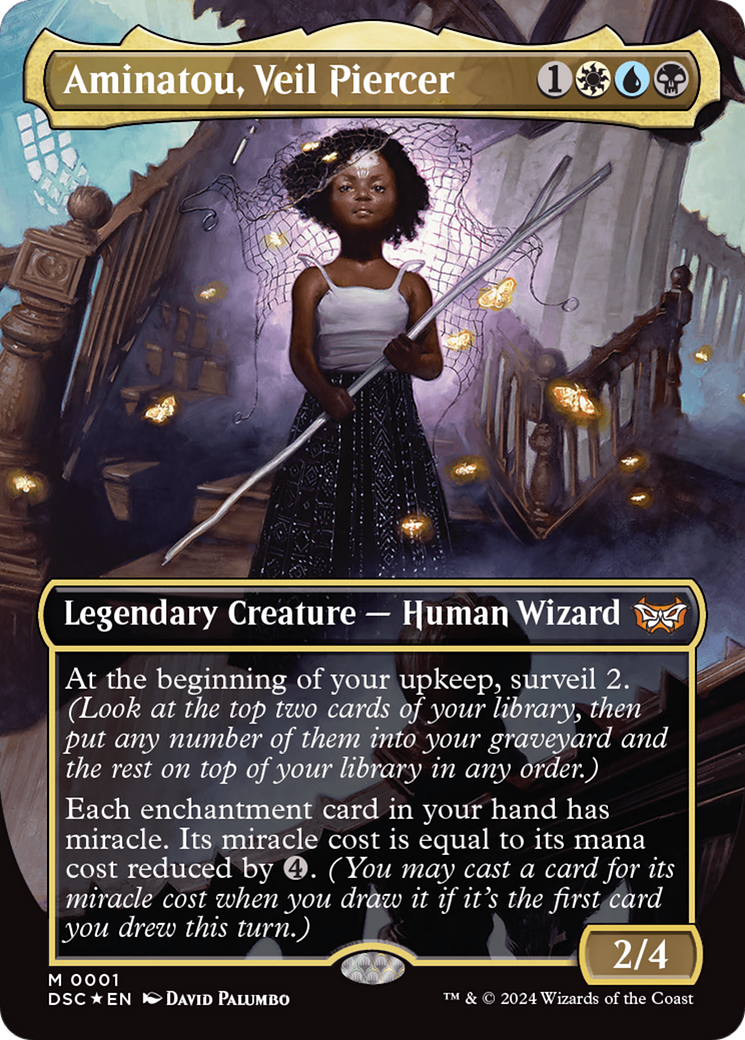
Aminatou, Veil Piercer
Aminatou, Veil Piercer
Legendary Creature — Human Wizard
2/4
At the beginning of your upkeep, surveil 2. (Look at the top two cards of your library, then put any number of them into your graveyard and the rest on top of your library in any order.)
Each enchantment card in your hand has miracle. Its miracle cost is equal to its mana cost reduced by . (You may cast a card for its miracle cost when you draw it if it's the first card you drew this turn.)
- It's important to reveal a card with miracle before it is mixed with the other cards in your hand.
- You can reveal and cast a card with miracle on any turn, not just your own, if it's the first card you've drawn that turn.
- Multiple card draws are always treated as a sequence of individual card draws. For example, if you haven't drawn any cards yet during a turn and cast a spell that instructs you to draw three cards, you'll draw them one at a time. Only the first card drawn this way may be revealed and cast using its miracle ability.
- If an effect puts a card into your hand without using the word "draw," the card wasn't drawn.
- You don't have to reveal a drawn card with miracle if you don't wish to cast it at that time.
- You can cast a card for its miracle cost only as the miracle triggered ability resolves. If you don't want to cast it at that time (or you can't cast it, perhaps because there are no legal targets available), you won't be able to cast it later for the miracle cost.
- You cast the card with miracle during the resolution of the triggered ability. Ignore any timing rules based on the card's type.
- Miracle is an alternative cost to cast the spell with miracle. It can't be combined with other alternative costs, such as casting a spell "without paying its mana cost." You may, however, pay additional costs, such as kicker. If the spell has any mandatory additional costs, those must be paid to cast the spell.
- To determine the total cost of a spell, start with the mana cost or alternative cost (such as a miracle cost) you're paying, add any cost increases, then apply any cost reductions. The mana value of the spell remains unchanged, no matter what the total cost to cast it was.
- If the card with miracle leaves your hand before the triggered ability resolves, you won't be able to cast it using its miracle ability.
- You still draw the card, whether you use the miracle ability or not. Any ability that triggers whenever you draw a card, for example, will trigger. If you don't cast the card using its miracle ability, it will remain in your hand.
-
1
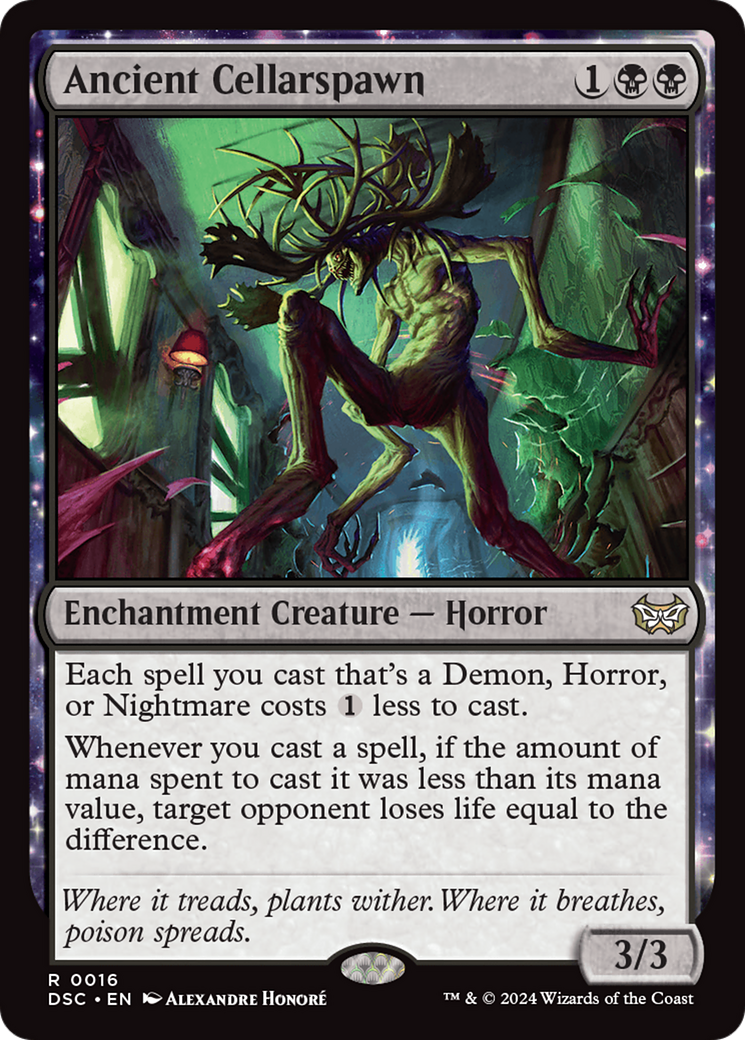
Ancient Cellarspawn
Ancient Cellarspawn
Enchantment Creature — Horror
3/3
Each spell you cast that's a Demon, Horror, or Nightmare costs less to cast.
Whenever you cast a spell, if the amount of mana spent to cast it was less than its mana value, target opponent loses life equal to the difference.
- To determine the total cost of a spell, start with the mana cost or alternative cost you're paying, add any cost increases, then apply any cost reductions. The mana value of the spell remains unchanged, no matter what the total cost to cast it was.
- Ancient Cellarspawn's last ability resolves before the spell that caused it to trigger. It resolves even if that spell is countered.
- For spells with in their mana costs, use the value chosen for X to determine the spell's mana value.
- If the spell is no longer on the stack when Ancient Cellarspawn's last ability resolves, use its mana value as it last existed on the stack.
-
1
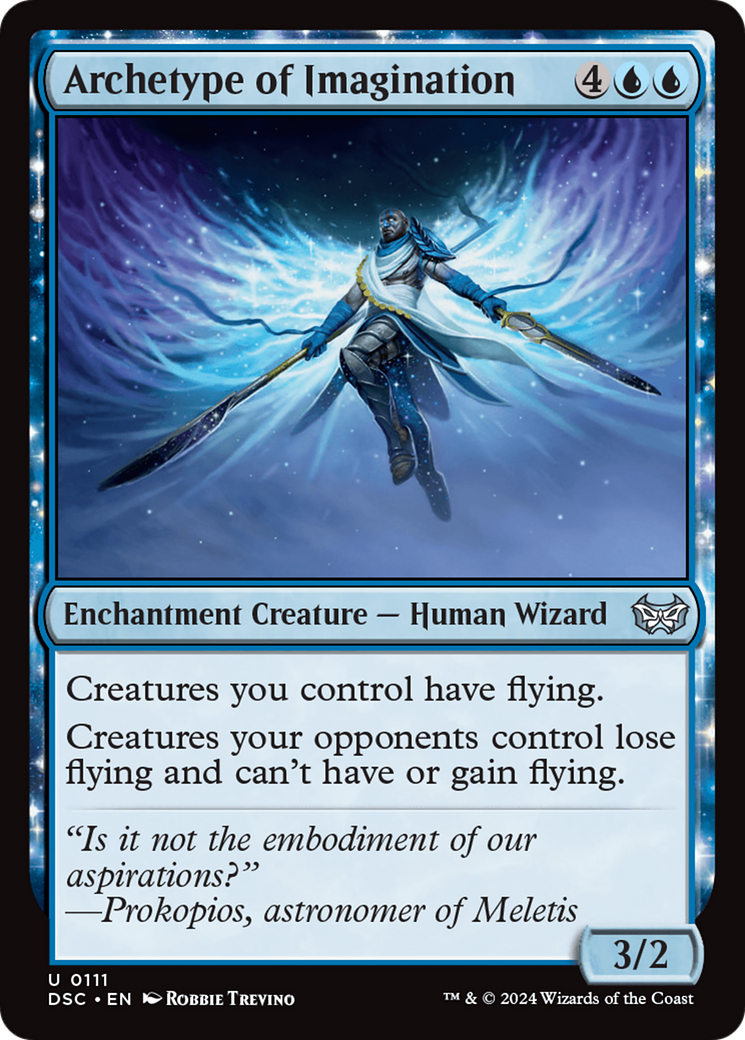
Archetype of Imagination
Archetype of Imagination
Enchantment Creature — Human Wizard
3/2
Creatures you control have flying.
Creatures your opponents control lose flying and can't have or gain flying.
- The Archetype's second ability applies to each creature controlled by any of your opponents, no matter when it entered the battlefield.
- While you control an Archetype, continuous effects generated by the resolution of spells and abilities that would give the specified ability to creatures your opponents control aren't created. For example, if you control Archetype of Courage, a spell cast by an opponent that gives creatures they control first strike wouldn't cause the creatures to have first strike, even if later in the turn Archetype of Courage left the battlefield. (If the spell has additional effects, such as raising the power of the creatures, those effects will apply as normal.)
- Conversely, continuous effects generated by static abilities (such as an Aura that granted the appropriate ability) would resume applying if the Archetype left the battlefield.
- If you and an opponent each control the same Archetype, no creature controlled by any player will have the appropriate ability.
-
1
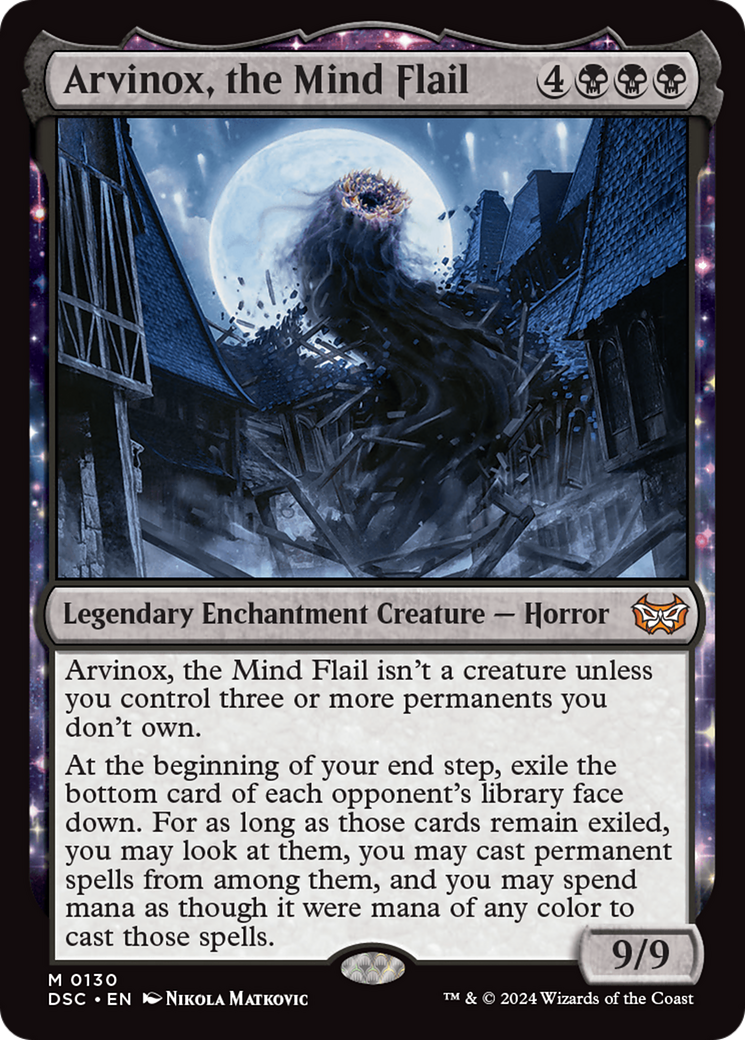
Arvinox, the Mind Flail
Arvinox, the Mind Flail
Legendary Enchantment Creature — Horror
9/9
Arvinox isn't a creature unless you control three or more permanents you don't own.
At the beginning of your end step, exile the bottom card of each opponent's library face down. For as long as those cards remain exiled, you may look at them, you may cast permanent spells from among them, and you may spend mana as though it were mana of any color to cast those spells.
- For the purposes of deck construction, format legality, and all rules, abilities, and effects that refer to a card’s name, this card’s name is the same as that of Mind Flayer, the Shadow.
-
1
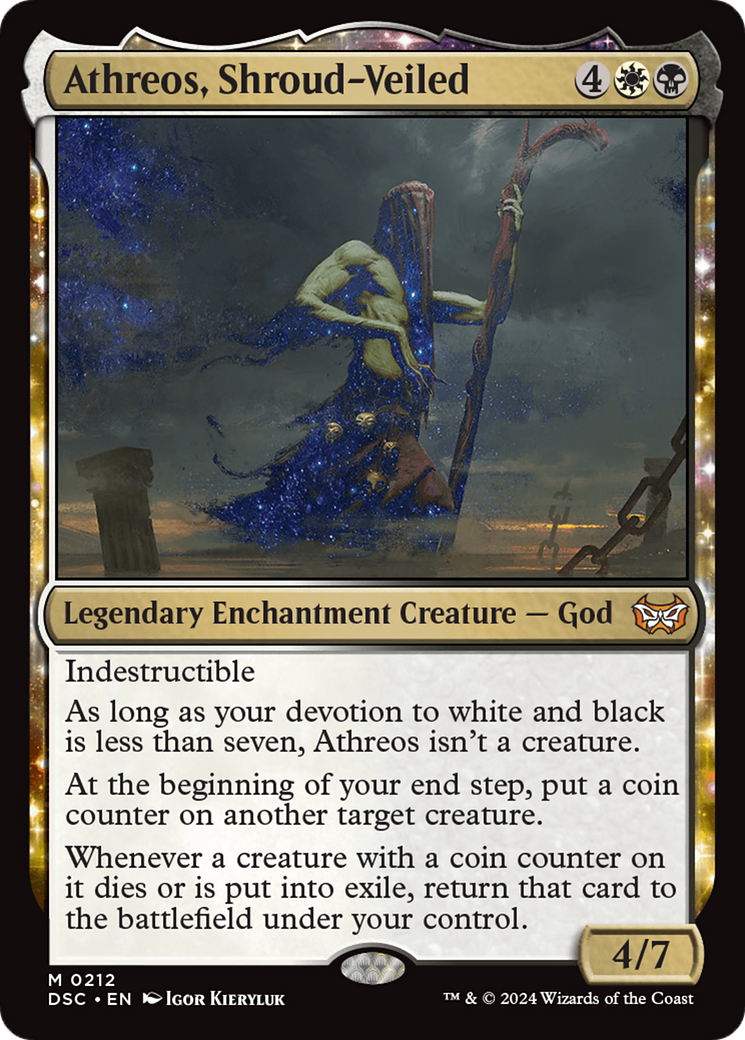
Athreos, Shroud-Veiled
Athreos, Shroud-Veiled
Legendary Enchantment Creature — God
4/7
Indestructible
As long as your devotion to white and black is less than seven, Athreos isn't a creature.
At the beginning of your end step, put a coin counter on another target creature.
Whenever a creature with a coin counter on it dies or is put into exile, return that card to the battlefield under your control.
- If a token with a coin counter on it dies or is exiled, Athreos's last ability triggers, but won't return it to the battlefield.
- The creature returns to the battlefield without a coin counter on it.
- If an effect exiles a creature with a coin counter on it and immediately returns it to the battlefield, Athreos's last ability triggers but will have no effect. If an effect exiles a creature with a coin counter on it and would return it to the battlefield at a later time, Athreos's last ability will return that card to the battlefield and it won't be returned later.
- If a creature with a coin counter on it is put into a graveyard or exile but leaves that zone before Athreos's last ability resolves, that card stays in its new zone, even if that zone is also a graveyard or exile. You don't return it to the battlefield.
- If Athreos and a creature with a coin counter on it are both put into graveyards and/or exiled at the same time, the other creature will be returned to the battlefield.
- If Athreos somehow gets a coin counter on itself, its last ability will return it when it dies or is exiled.
- If Athreos leaves the battlefield, creatures with coin counters on them keep them. The counters won't have any meaning or effect unless another Athreos is on the battlefield later.
- If a creature with a coin counter on it stops being a creature, it keeps its coin counter, but Athreos's last ability won't trigger when that permanent dies or is exiled unless it's a creature again by that time.
- If a creature you don't own has a coin counter on it, that permanent will return to the battlefield under your control when it dies or is exiled while you control Athreos. In a multiplayer game, if a player leaves the game, all cards that player owns leave as well. If you leave the game, any creatures you control from Athreos's ability are exiled.
- In a two-player game, if both players control an Athreos when a creature with a coin counter on it dies, the nonactive player (the one whose turn it isn't) will return the creature under their control. If that happens in a multiplayer game, the nonactive player closest to the right of the player whose turn it is will return the creature under their control.
- Colorless and generic mana symbols ( , , , , , and so on) in mana costs of permanents you control don't count toward your devotion to any color.
- Mana symbols in the text boxes of permanents you control don't count toward your devotion to any color.
- Hybrid mana symbols, monocolored hybrid mana symbols, and Phyrexian mana symbols do count toward your devotion to their color(s).
- If an activated ability or triggered ability has an effect that depends on your devotion to a color, you count the number of mana symbols of that color among the mana costs of permanents you control as the ability resolves. The permanent with that ability will be counted if it's still on the battlefield at that time.
- If you put an Aura on an opponent's permanent, you still control the Aura, and mana symbols in its mana cost count towards your devotion.
- Your devotion to two colors is the number of mana symbols among mana costs of permanents you control that are the first color, the second, or both. If an effect counts your devotion to two colors, a hybrid symbol that is both of those colors is counted just once.
- The type-changing ability that can make a God not be a creature functions only on the battlefield. It's always a creature card in other zones, regardless of your devotion to its color. It's always a creature spell while it's on the stack.
- As a God enters the battlefield, your devotion to its color will determine whether any replacement effects that affect creatures entering the battlefield apply to that God. Because replacement effects are considered before the God is on the battlefield, the mana symbols in its mana cost won't be counted when determining this.
- When a God enters the battlefield, your devotion to its color (including the mana symbols in the mana cost of the God itself) will determine if a creature entered the battlefield or not for abilities that trigger whenever a creature enters the battlefield.
- If a God stops being a creature, it loses the type creature and the creature type God. It continues to be a legendary enchantment.
- The abilities of Gods function as long as they're on the battlefield, regardless of whether they're creatures.
- If a God is attacking or blocking and it stops being a creature, it will be removed from combat. It won't rejoin combat if it resumes being a creature later during that combat.
- Counters put on a God remain on it while it's not a creature, even if they have no effect.
- If an effect causes a God to lose all abilities, its ability that causes it to stop being a creature still applies if appropriate.
-
1
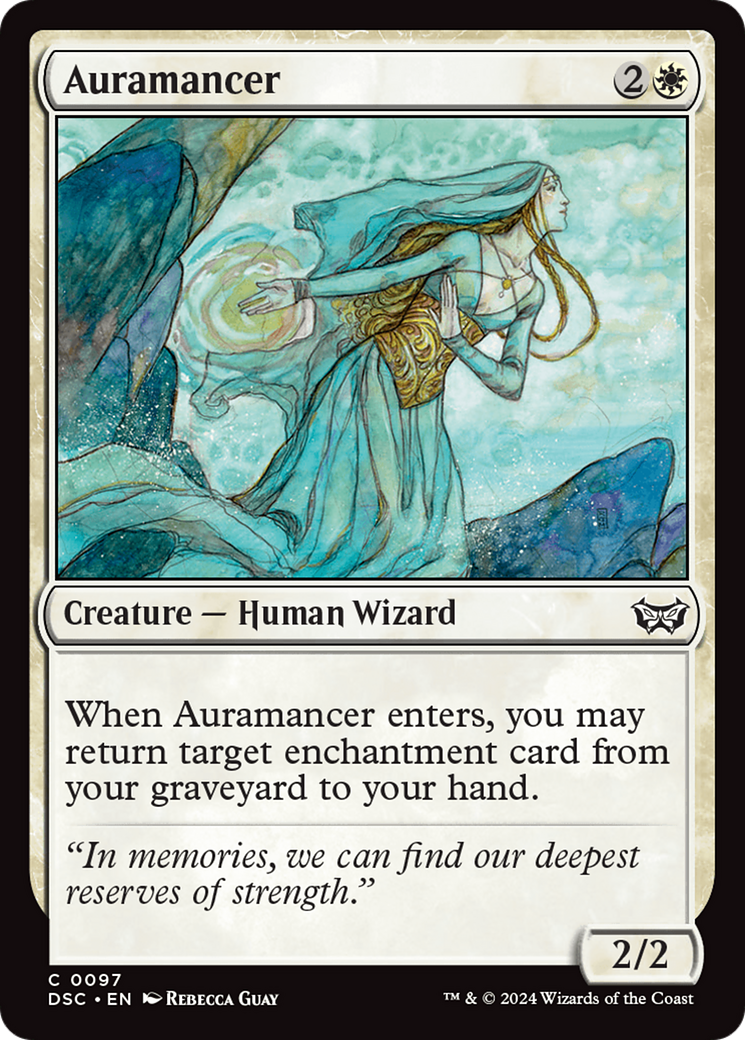
Auramancer
Auramancer
Creature — Human Wizard
2/2
When this creature enters, you may return target enchantment card from your graveyard to your hand.
-
1
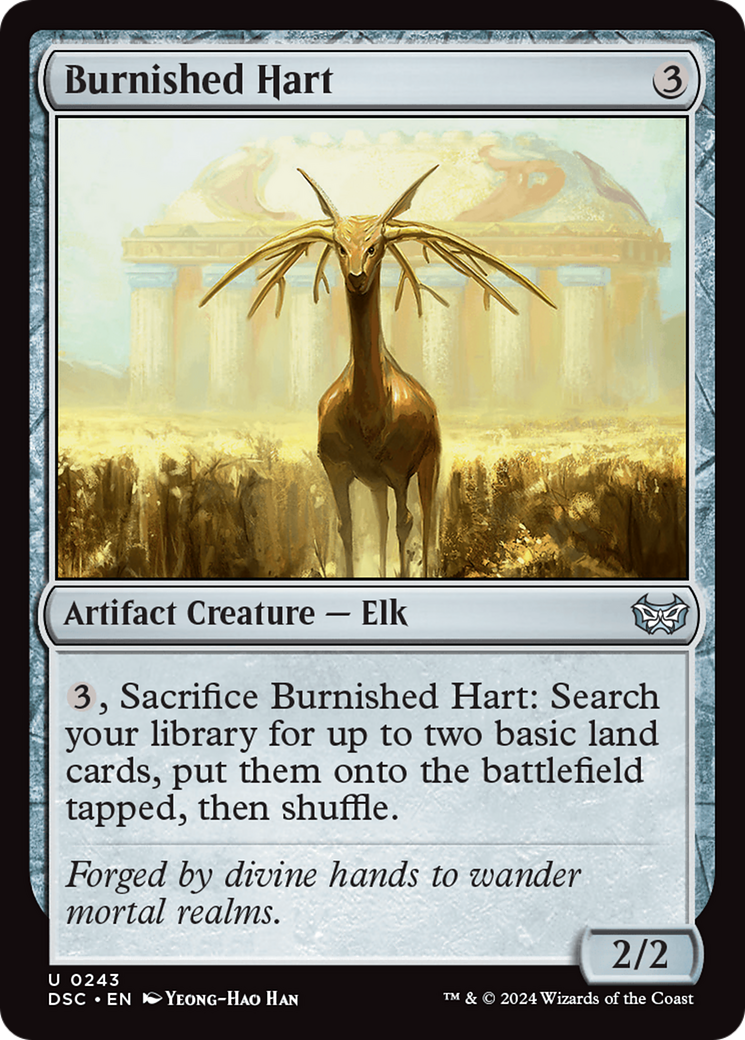
Burnished Hart
Burnished Hart
Artifact Creature — Elk
2/2
, Sacrifice this creature: Search your library for up to two basic land cards, put them onto the battlefield tapped, then shuffle.
-
1
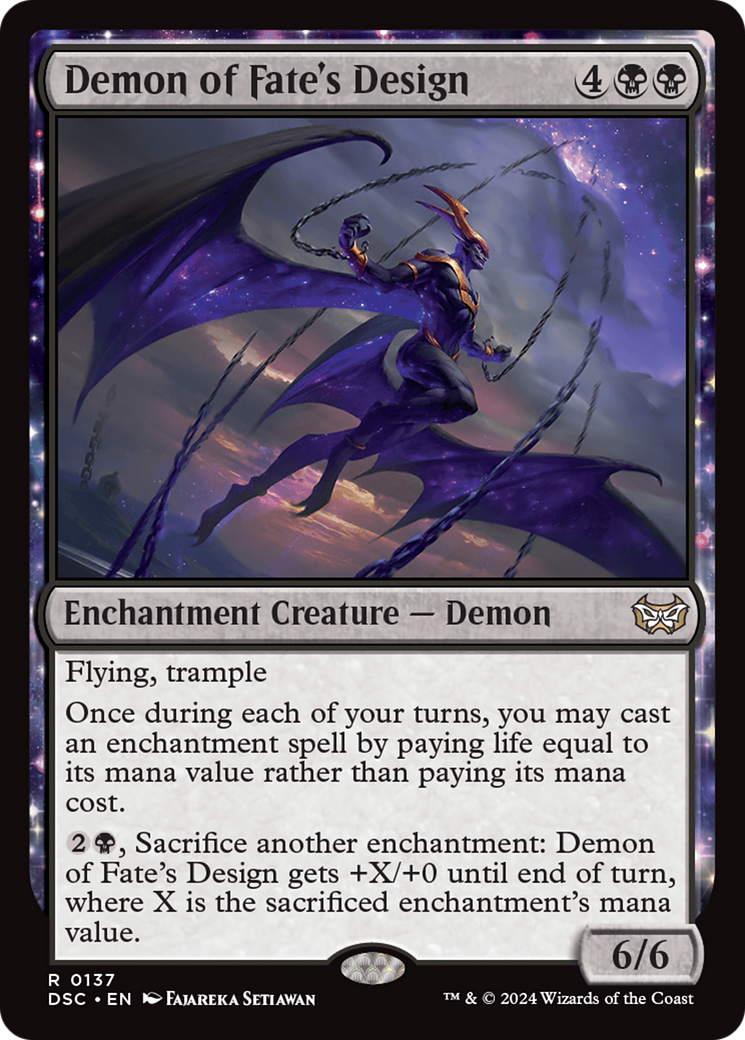
Demon of Fate's Design
Demon of Fate's Design
Enchantment Creature — Demon
6/6
Flying, trample
Once during each of your turns, you may cast an enchantment spell by paying life equal to its mana value rather than paying its mana cost.
, Sacrifice another enchantment: This creature gets +X/+0 until end of turn, where X is the sacrificed enchantment's mana value.
- If you cast a spell for another cost "rather than paying its mana cost," you can't choose to cast it for any alternative costs. You can, however, pay additional costs. If the card has any mandatory additional costs, those must be paid to cast the card.
- If you cast a spell with in its mana cost this way, the only legal choice for X is 0.
-
1
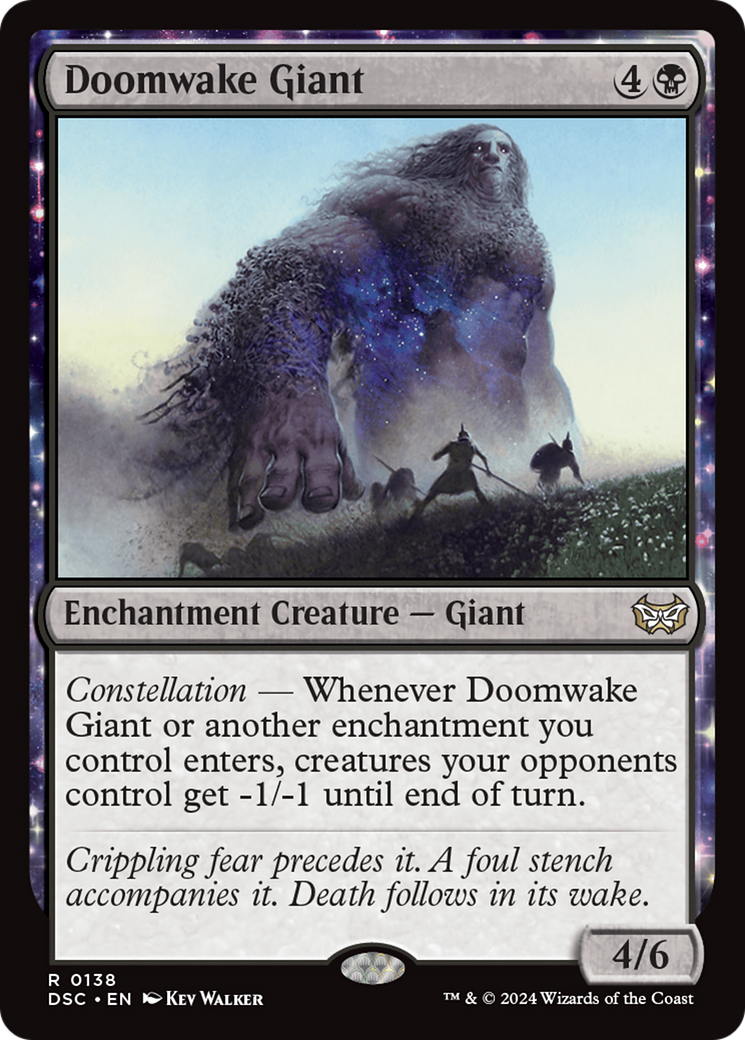
Doomwake Giant
Doomwake Giant
Enchantment Creature — Giant
4/6
Constellation — Whenever this creature or another enchantment you control enters, creatures your opponents control get -1/-1 until end of turn.
- A constellation ability triggers whenever an enchantment enters the battlefield under your control for any reason. Enchantments with other card types, such as enchantment creatures, will also cause constellation abilities to trigger.
- When an enchantment enters the battlefield under your control, each constellation ability of permanents you control will trigger. You can put these abilities on the stack in any order. The last ability you put on the stack will be the first one that resolves.
- An Aura spell without bestow that has an illegal target when it tries to resolve won't resolve and will be put into its owner's graveyard. It won't enter the battlefield and constellation abilities won't trigger. An Aura spell with bestow won't be countered this way. It will revert to being an enchantment creature and resolve, entering the battlefield and triggering constellation abilities.
-
1
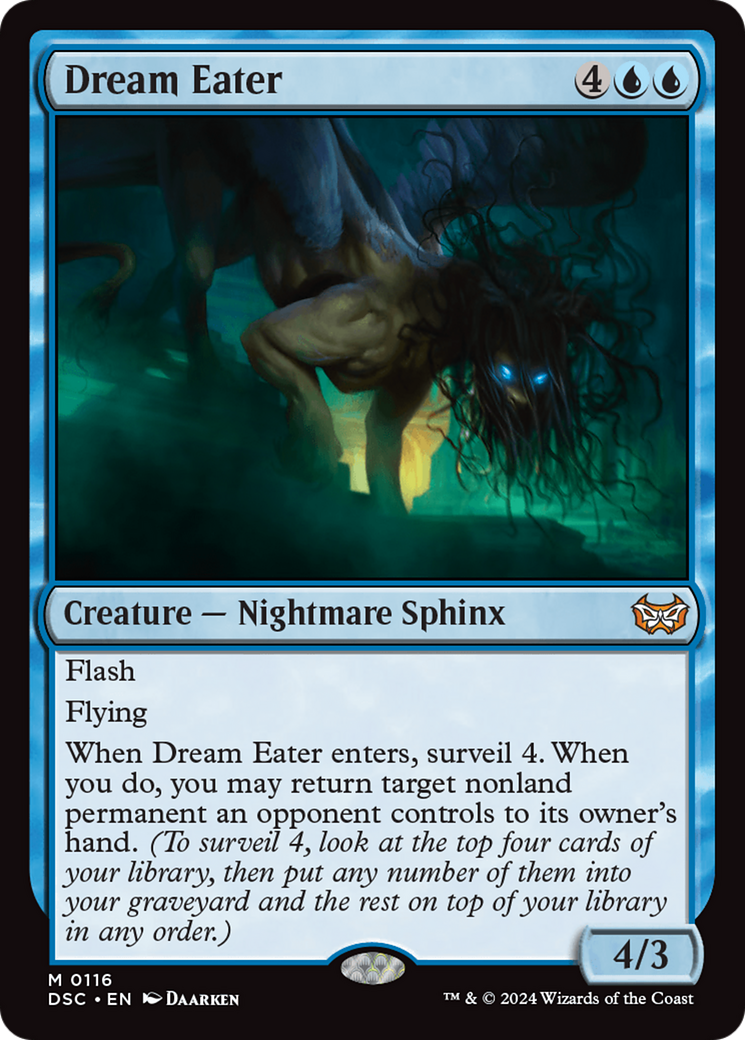
Dream Eater
Dream Eater
Creature — Nightmare Sphinx
4/3
Flash
Flying
When this creature enters, surveil 4. When you do, you may return target nonland permanent an opponent controls to its owner's hand. (To surveil 4, look at the top four cards of your library, then put any number of them into your graveyard and the rest on top of your library in any order.)
- You perform the actions stated on a card in sequence. For some spells and abilities, you'll surveil last. For others, you'll surveil and then perform other actions.
- When you surveil, you may put all the cards you look at back on top of your library, you may put all of those cards into your graveyard, or you may put some of those cards on top and the rest of them into your graveyard.
- Dream Eater's triggered ability goes on the stack without a target. While that ability is resolving, after you've surveilled, the reflexive triggered ability triggers and you pick a target nonland permanent to be returned to its owner's hand. This is different from effects that say "If you do . . ." in that you choose the target after having surveilled.
- Dream Eater's reflexive triggered ability triggers even if you have fewer than four cards in your library to surveil.
-
1
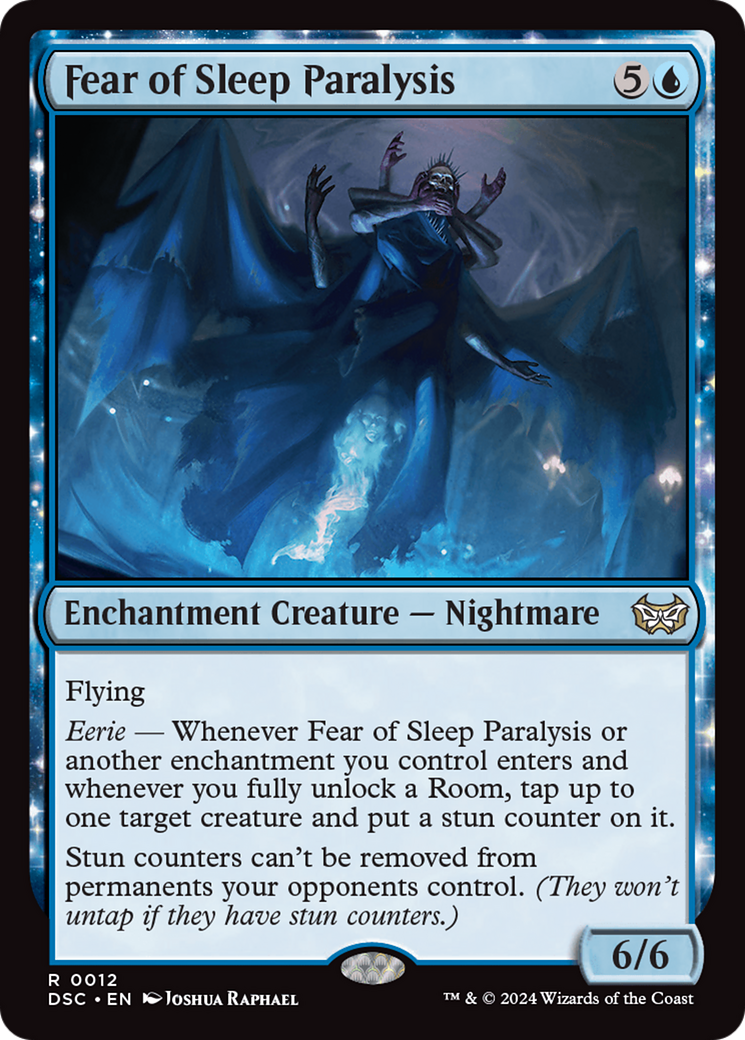
Fear of Sleep Paralysis
Fear of Sleep Paralysis
Enchantment Creature — Nightmare
6/6
Flying
Eerie — Whenever this creature or another enchantment you control enters and whenever you fully unlock a Room, tap up to one target creature and put a stun counter on it.
Stun counters can't be removed from permanents your opponents control. (They won't untap if they have stun counters.)
- While you control Fear of Sleep Paralysis, if a permanent an opponent controls with a stun counter would untap, it doesn't untap and the stun counter isn't removed.
- If an ability tries to move a stun counter from a permanent an opponent controls to another permanent while you control Fear of Sleep Paralysis, that counter won't move. No stun counters will be removed from or put onto anything.
- While you control Fear of Sleep Paralysis, opponents can't use tapped permanents with stun counters on them to pay costs that include untapping a permanent. This includes costs that use the (untap) symbol.
- If a permanent with an eerie ability enters at the same time as one or more enchantments, its ability will trigger for each of those enchantments.
- An ability that triggers "whenever you fully unlock a Room" triggers when a door becomes unlocked and the other door of that Room is already unlocked, or when both doors of that Room become unlocked simultaneously.
-
1
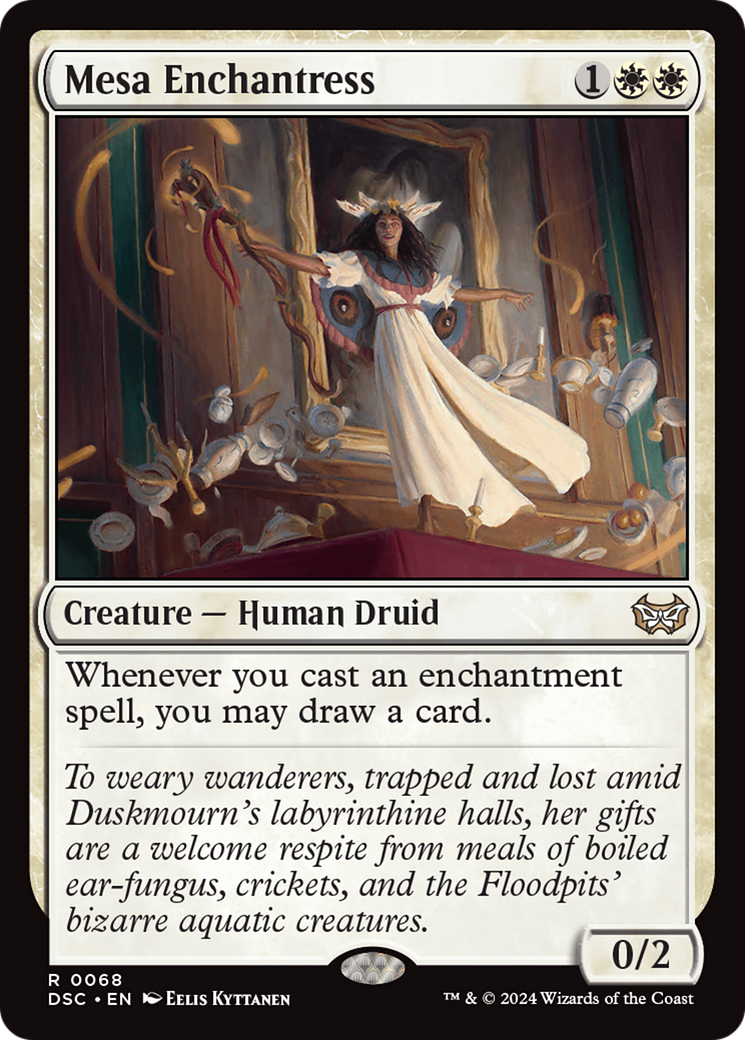
Mesa Enchantress
Mesa Enchantress
Creature — Human Druid
0/2
Whenever you cast an enchantment spell, you may draw a card.
- Mesa Enchantress's ability will resolve before the spell that caused it to trigger.
- If the enchantment spell is countered, Mesa Enchantress's ability still resolves and causes you to draw a card.
- Enchantments put onto the battlefield without being cast won't cause Mesa Enchantress's ability to trigger.
-
1
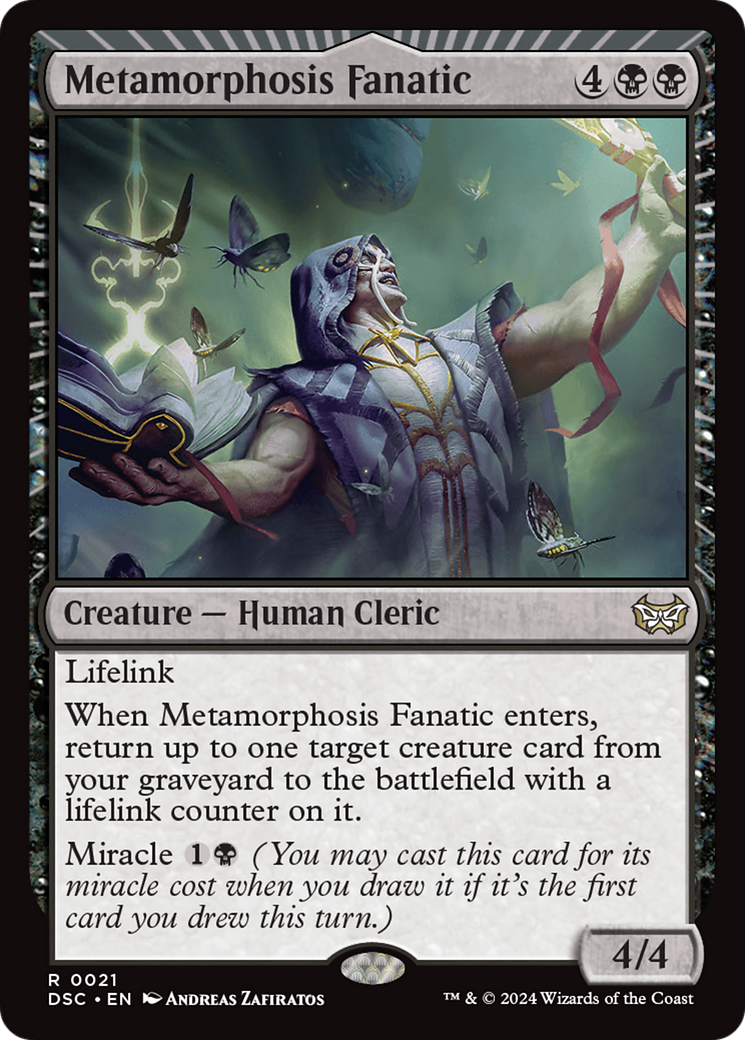
Metamorphosis Fanatic
Metamorphosis Fanatic
Creature — Human Cleric
4/4
Lifelink
When this creature enters, return up to one target creature card from your graveyard to the battlefield with a lifelink counter on it.
Miracle (You may cast this card for its miracle cost when you draw it if it's the first card you drew this turn.)
- You cast the card with miracle during the resolution of the triggered ability. Ignore any timing rules based on the card's type.
- It's important to reveal a card with miracle before it is mixed with the other cards in your hand.
- You can reveal and cast a card with miracle on any turn, not just your own, if it's the first card you've drawn that turn.
- Multiple card draws are always treated as a sequence of individual card draws. For example, if you haven't drawn any cards yet during a turn and cast a spell that instructs you to draw three cards, you'll draw them one at a time. Only the first card drawn this way may be revealed and cast using its miracle ability.
- If an effect puts a card into your hand without using the word "draw," the card wasn't drawn.
- You don't have to reveal a drawn card with miracle if you don't wish to cast it at that time.
- You can cast a card for its miracle cost only as the miracle triggered ability resolves. If you don't want to cast it at that time (or you can't cast it, perhaps because there are no legal targets available), you won't be able to cast it later for the miracle cost.
- Miracle is an alternative cost to cast the spell with miracle. It can't be combined with other alternative costs, such as casting a spell "without paying its mana cost." You may, however, pay additional costs, such as kicker. If the spell has any mandatory additional costs, those must be paid to cast the spell.
- To determine the total cost of a spell, start with the mana cost or alternative cost (such as a miracle cost) you're paying, add any cost increases, then apply any cost reductions. The mana value of the spell remains unchanged, no matter what the total cost to cast it was.
- If the card with miracle leaves your hand before the triggered ability resolves, you won't be able to cast it using its miracle ability.
- You still draw the card, whether you use the miracle ability or not. Any ability that triggers whenever you draw a card, for example, will trigger. If you don't cast the card using its miracle ability, it will remain in your hand.
-
1
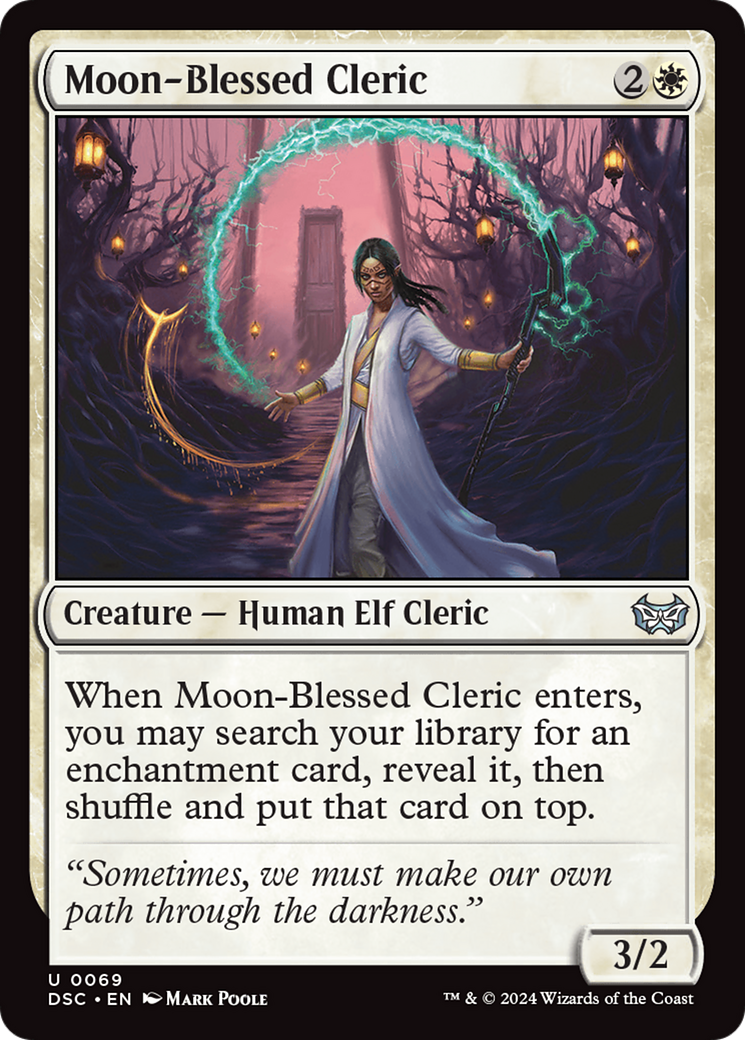
Moon-Blessed Cleric
Moon-Blessed Cleric
Creature — Human Elf Cleric
3/2
Divine Intervention — When this creature enters, you may search your library for an enchantment card, reveal it, then shuffle and put that card on top.
-
1
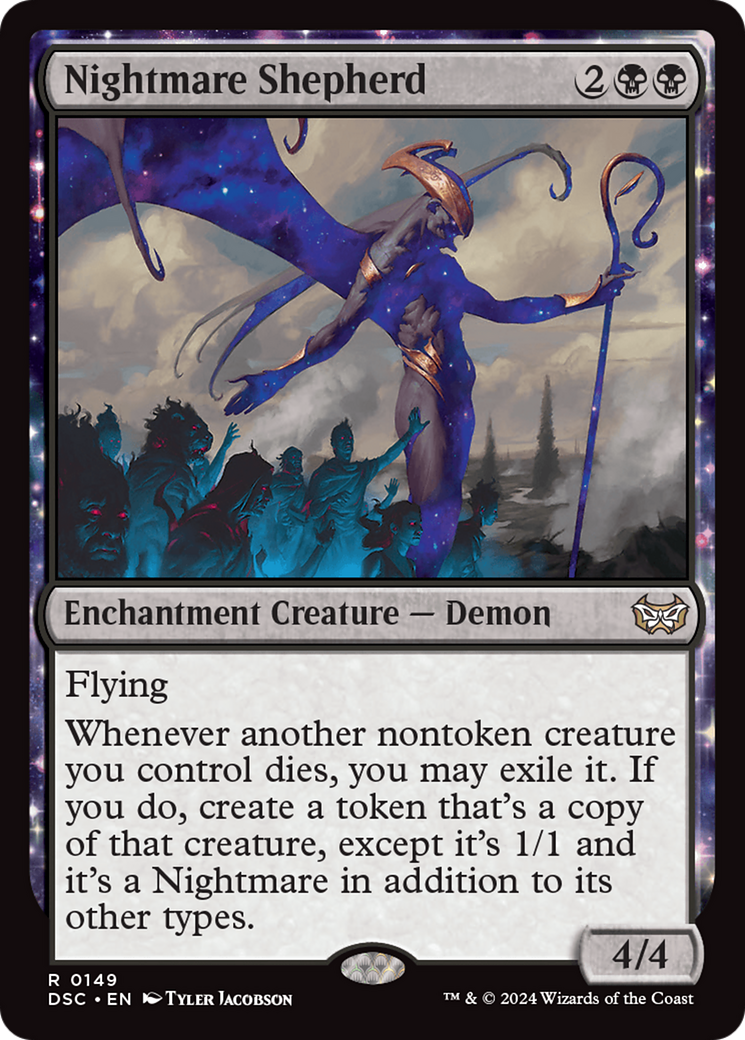
Nightmare Shepherd
Nightmare Shepherd
Enchantment Creature — Demon
4/4
Flying
Whenever another nontoken creature you control dies, you may exile it. If you do, create a token that's a copy of that creature, except it's 1/1 and it's a Nightmare in addition to its other types.
- The token copies the creature as it last existed on the battlefield before it died, not as it existed in the graveyard before it was exiled.
- The token copies exactly what was printed on the original creature and nothing else (unless that creature is copying something else; see below). It doesn't copy whether that creature was tapped or untapped, whether it had any counters on it or Auras or Equipment attached to it, or any non-copy effects that had changed its power, toughness, types, color, or so on.
- If the copied creature was copying something else, then the token enters the battlefield as whatever that creature copied.
- If the copied creature had in its mana cost, X is considered to be 0.
- Any enters-the-battlefield abilities of the copied creature will trigger when the token enters the battlefield. Any "as [this creature] enters the battlefield" or "[this creature] enters the battlefield with" abilities of the creature will also work.
- If the token is a copy of a creature whose power and toughness are defined by an ability (usually printed as */* or similar), the token doesn't copy the ability that defines its power and toughness. It remains a 1/1 creature.
- If something becomes a copy of the token, the copy is also a 1/1 and a Nightmare.
-
1
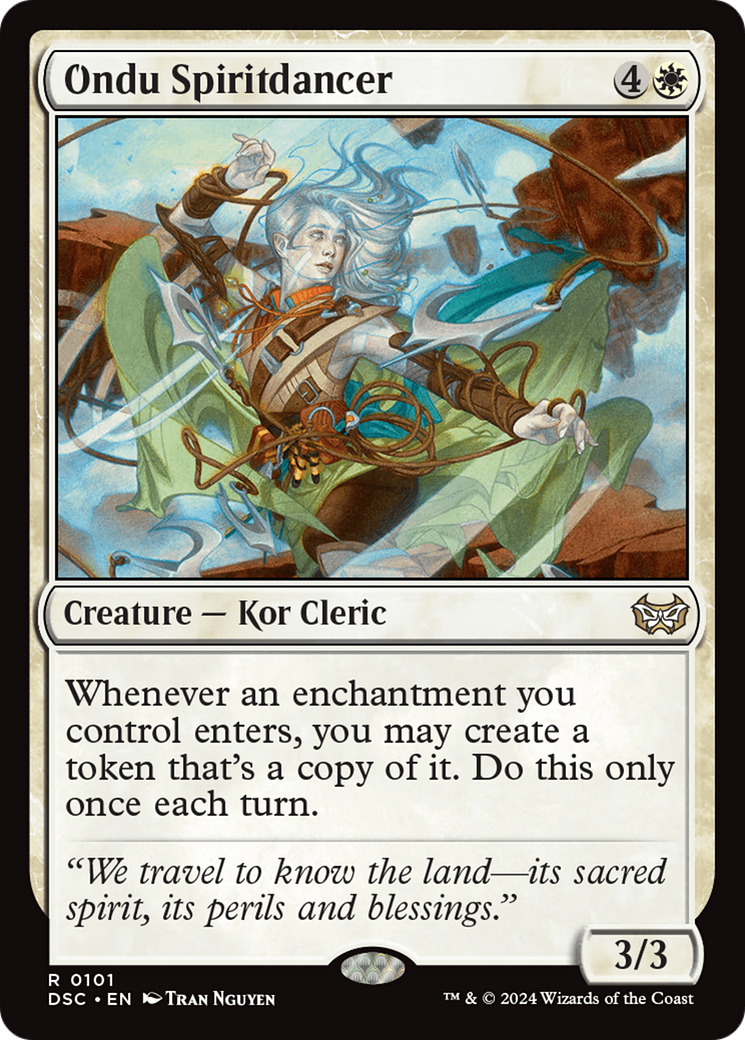
Ondu Spiritdancer
Ondu Spiritdancer
Creature — Kor Cleric
3/3
Whenever an enchantment you control enters, you may create a token that's a copy of it. Do this only once each turn.
- Once you choose to create a token copy of an enchantment during the resolution of Ondu Spiritdancer's ability, that ability won't trigger again that turn, no matter how many more enchantments enter the battlefield under your control.
- If multiple instances of the ability are on the stack (perhaps because multiple enchantments entered the battlefield under your control at the same time), you will be able to create a token copy of an enchantment for only one of those instances. Once you do that, other instances will do nothing as they resolve.
- If an Aura is put onto the battlefield without being cast, such as by being created as a token, the Aura's controller-to-be chooses what it will enchant as it enters the battlefield. An Aura put onto the battlefield this way doesn't target anything (so it could be attached to an opponent's permanent with hexproof, for example), but the Aura's enchant ability restricts what it can be attached to. If an Aura token can't legally be attached to anything, it isn't created.
- Each token copies exactly what was printed on the original enchantment and nothing else (unless that enchantment is copying something else or is a token; see below). It doesn't copy whether that enchantment is tapped or untapped, whether it has any counters on it or Auras and Equipment attached to it, or any non-copy effects that have changed its power, toughness, types, color, or so on.
- If the copied enchantment has in its mana cost, X is 0.
- If the copied enchantment is a token, the token that's created copies the original characteristics of that token as stated by the effect that created the token.
- If the copied enchantment is copying something else, then the token enters the battlefield as whatever that enchantment copied.
- Any enters-the-battlefield abilities of the copied enchantment will trigger when the token enters the battlefield. Any "as [this enchantment] enters the battlefield" or "[this enchantment] enters the battlefield with" abilities of the enchantment will also work.
-
1
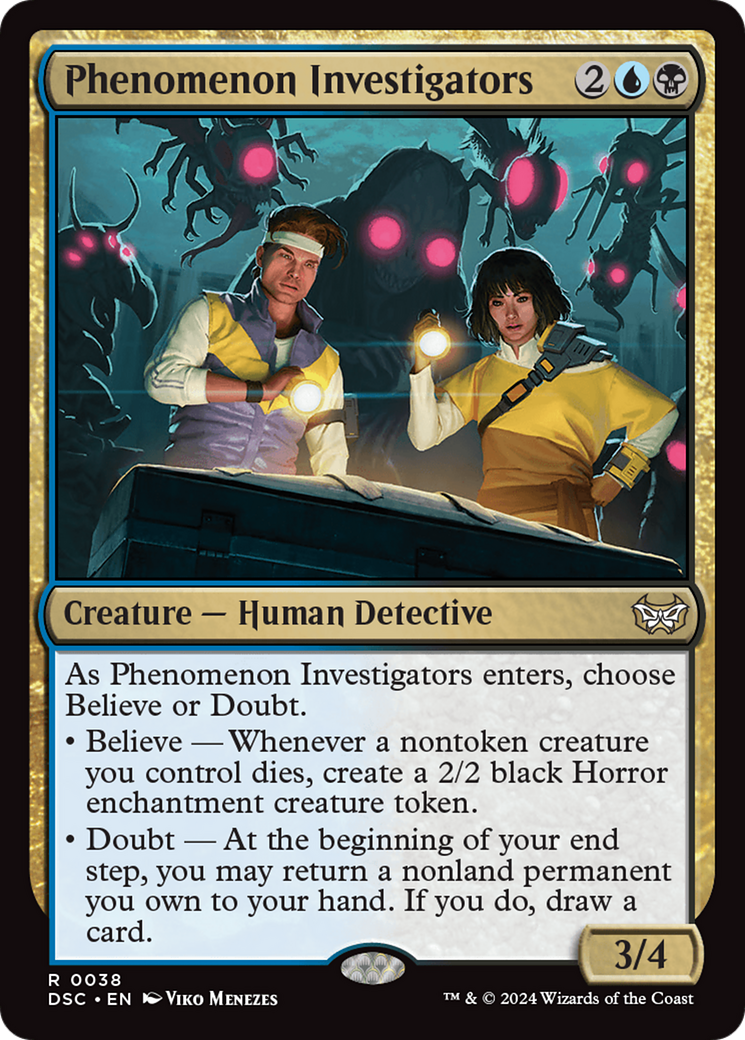
Phenomenon Investigators
Phenomenon Investigators
Creature — Human Detective
3/4
As this creature enters, choose Believe or Doubt.
- Believe — Whenever a nontoken creature you control dies, create a 2/2 black Horror enchantment creature token.
- Doubt — At the beginning of your end step, you may return a nonland permanent you own to your hand. If you do, draw a card.
- If you somehow control Phenomenon Investigators and no choice was made for it (perhaps because another permanent on the battlefield became a copy of it, or it was manifested and later turned face up), it has neither of the two triggered abilities, no matter how much you want to believe (or doubt).
-
1
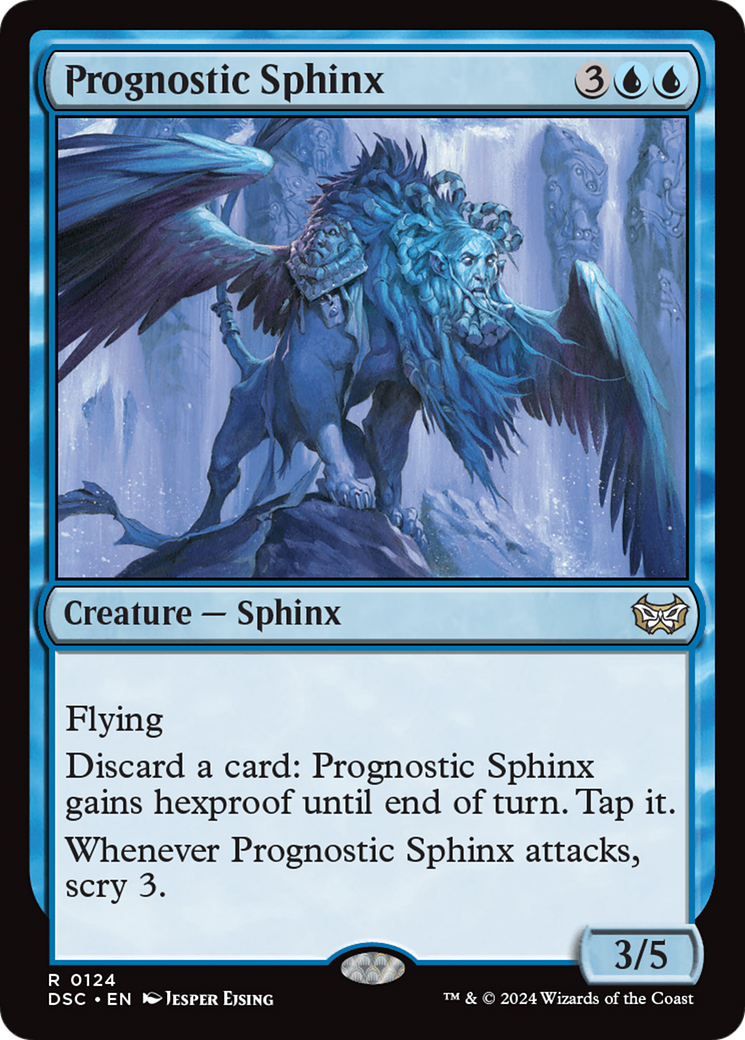
Prognostic Sphinx
Prognostic Sphinx
Creature — Sphinx
3/5
Flying
Discard a card: This creature gains hexproof until end of turn. Tap it.
Whenever this creature attacks, scry 3.
- You can activate Prognostic Sphinx's ability even if it's already tapped.
- When you scry, you may put all the cards you look at back on top of your library, you may put all of those cards on the bottom of your library, or you may put some of those cards on top and the rest of them on the bottom.
- You choose how to order cards returned to your library after scrying no matter where you put them.
- You perform the actions stated on a card in sequence. For some spells and abilities, that means you'll scry last. For others, that means you'll scry and then perform other actions.
- Scry appears on some spells and abilities with one or more targets. If all of the spell or ability's targets are illegal when it tries to resolve, it won't resolve and none of its effects will happen. You won't scry.
-
1
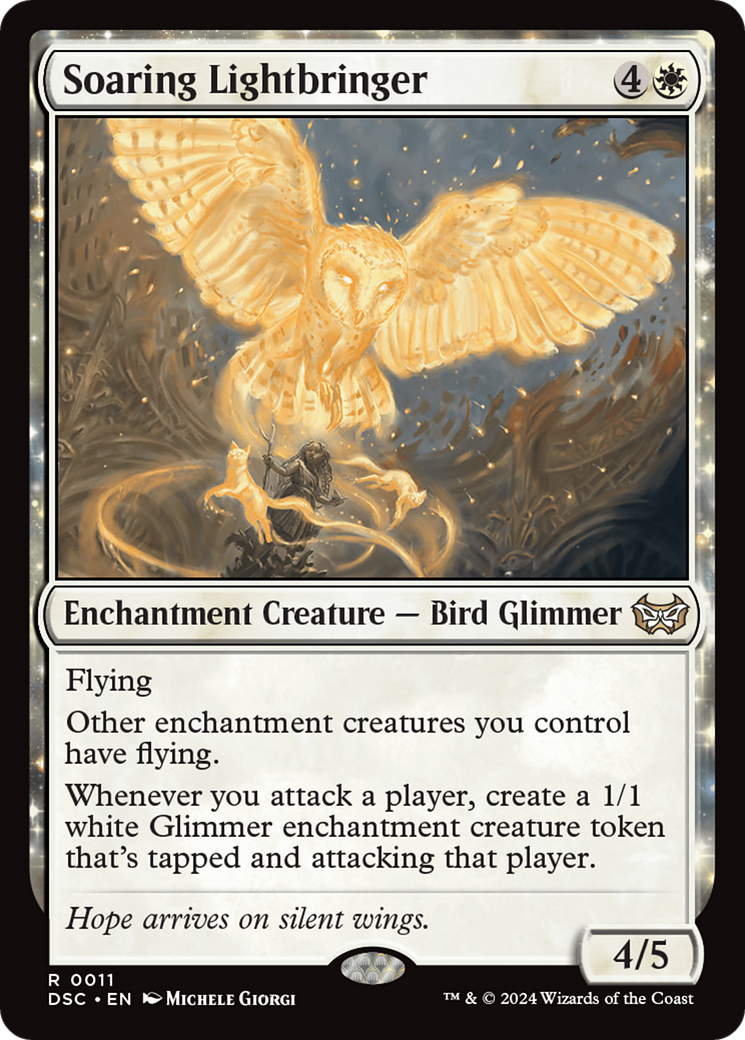
Soaring Lightbringer
Soaring Lightbringer
Enchantment Creature — Bird Glimmer
4/5
Flying
Other enchantment creatures you control have flying.
Whenever you attack a player, create a 1/1 white Glimmer enchantment creature token that's tapped and attacking that player.
- Soaring Lightbringer's last ability will trigger once for each player you attack.
-
1
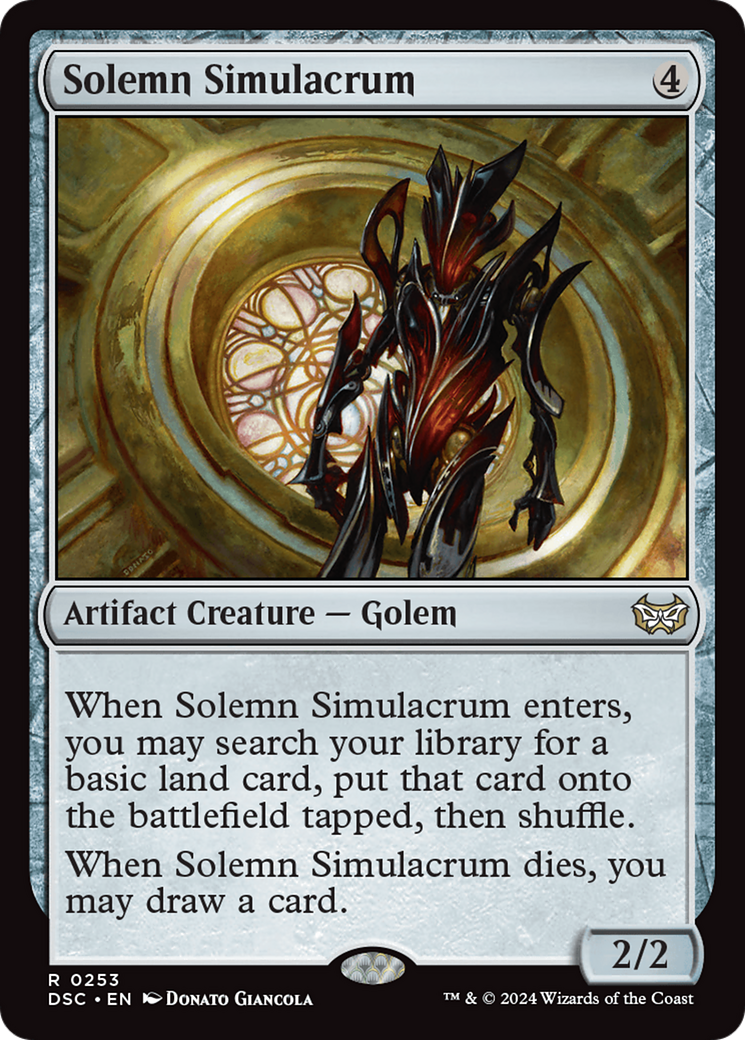
Solemn Simulacrum
Solemn Simulacrum
Artifact Creature — Golem
2/2
When this creature enters, you may search your library for a basic land card, put that card onto the battlefield tapped, then shuffle.
When this creature dies, you may draw a card.
-
1
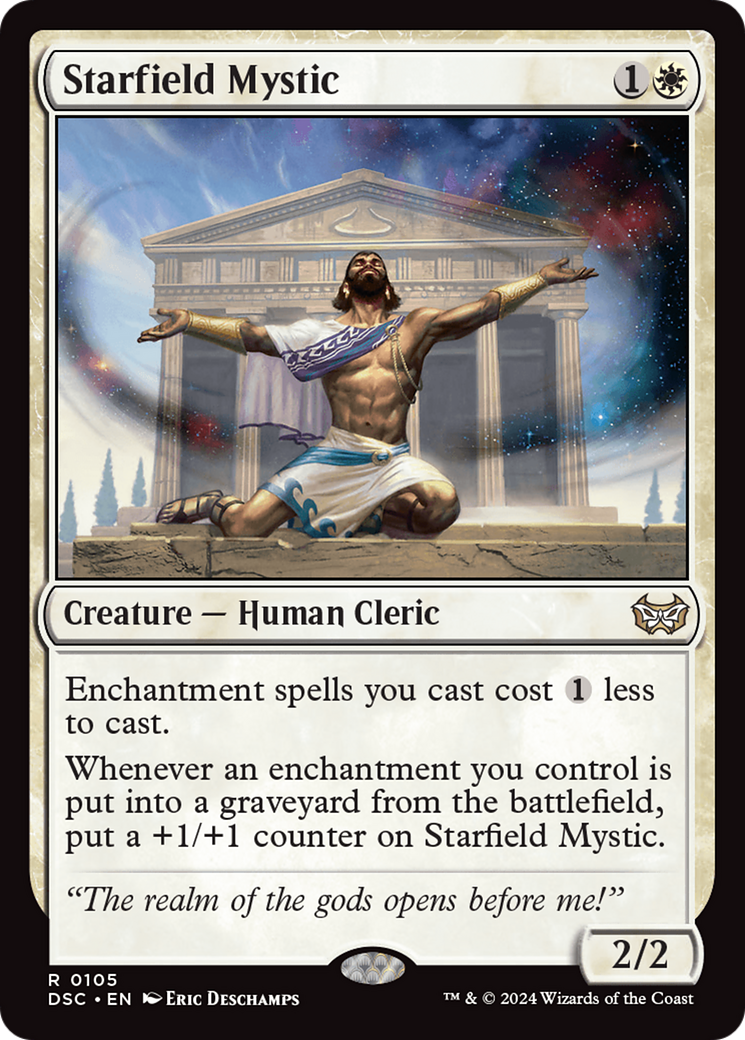
Starfield Mystic
Starfield Mystic
Creature — Human Cleric
2/2
Enchantment spells you cast cost less to cast.
Whenever an enchantment you control is put into a graveyard from the battlefield, put a +1/+1 counter on this creature.
- If you cast an Aura spell targeting an opponent's permanent, you still control the Aura after it resolves.
-
1
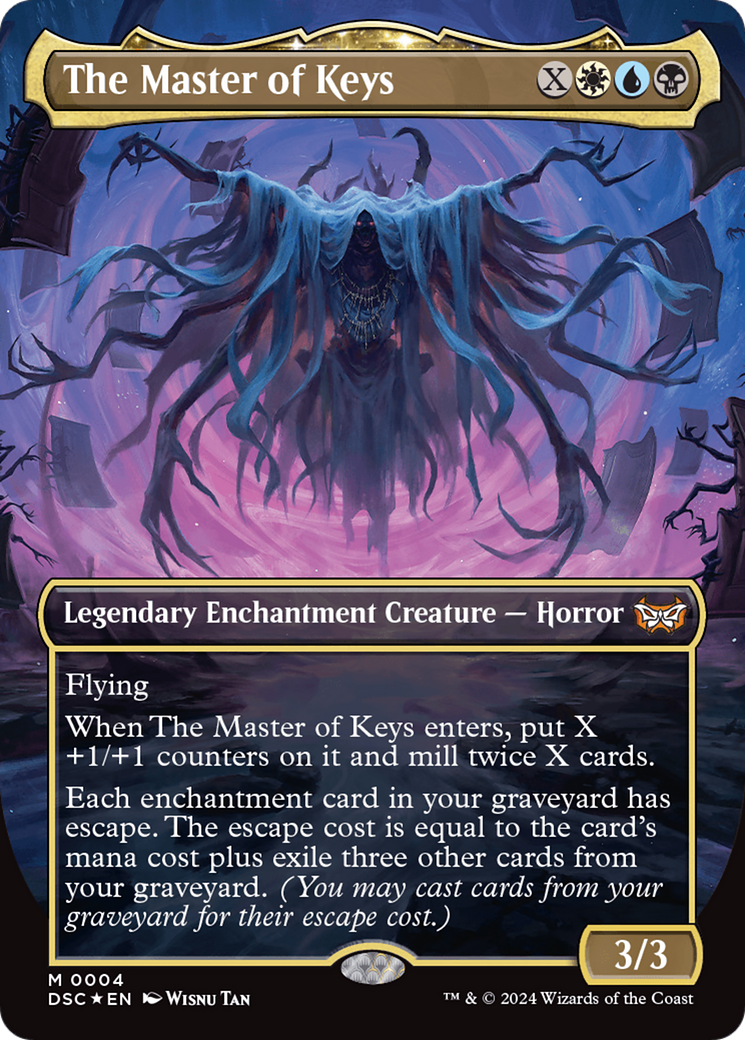
The Master of Keys
The Master of Keys
Legendary Enchantment Creature — Horror
3/3
Flying
When The Master of Keys enters, put X +1/+1 counters on it and mill twice X cards.
Each enchantment card in your graveyard has escape. The escape cost is equal to the card's mana cost plus exile three other cards from your graveyard. (You may cast cards from your graveyard for their escape cost.)
- If a card has multiple abilities giving you permission to cast it, such as two escape abilities or an escape ability and a flashback ability, you choose which one to apply. The others have no effect.
- If you cast a spell with its escape permission, you can't choose to apply any other alternative costs or to cast it without paying its mana cost. If it has any additional costs, you must pay those.
- If a card with escape is put into your graveyard during your turn, you'll be able to cast it right away if it's legal to do so, before an opponent can take any actions.
- Once you begin casting a spell with escape, it immediately moves to the stack. Players can't take any other actions until you're done casting the spell.
- If The Master of Keys is no longer on the battlefield when its second ability resolves, you'll still mill twice X cards.
- If a card has no mana cost, its escape cost is an unpayable cost, so you can't cast it for that cost.
- If you're casting a Room with escape, you choose which half to cast, then pay the appropriate cost plus exiling three cards. The same is true for split cards, adventurer cards, and prototype cards.
- If a spell you're casting with escape has an additional cost of discarding cards or sacrificing permanents, you may exile cards discarded or sacrificed this way to pay that part of its escape cost.
- Escape's permission doesn't change when you may cast the spell from your graveyard.
- To determine the total cost of a spell, start with the mana cost or alternative cost you're paying (such as an escape cost), add any cost increases, then apply any cost reductions. The mana value of the spell remains unchanged, no matter what the total cost to cast it was and no matter whether an alternative cost was paid.
- After an escaped spell resolves, it returns to its owner's graveyard if it's not a permanent spell. If it is a permanent spell, it enters and will return to its owner's graveyard if it dies later. It can escape again.
-
1
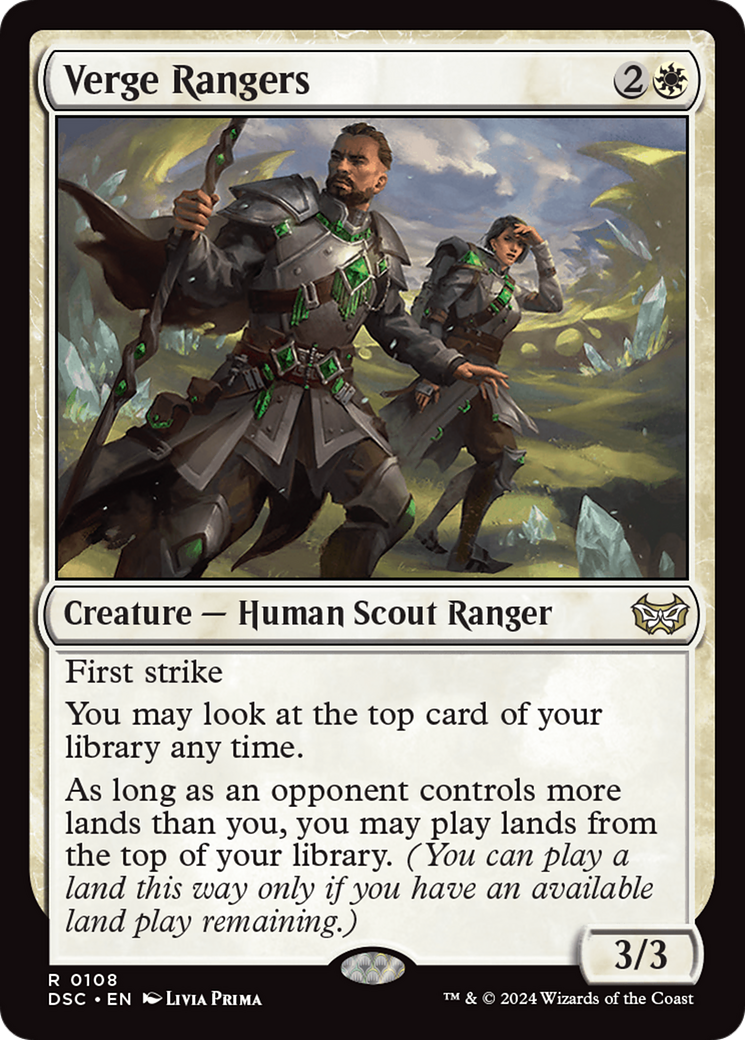
Verge Rangers
Verge Rangers
Creature — Human Scout Ranger
3/3
First strike
You may look at the top card of your library any time.
As long as an opponent controls more lands than you, you may play lands from the top of your library. (You can play a land this way only if you have an available land play remaining.)
- Verge Rangers doesn't allow you to play additional lands.
- Verge Rangers lets you look at the top card of your library whenever you want (with one restriction; see below), even if you don't have priority. This action doesn't use the stack. Knowing what that card is becomes part of the information you have access to, just like you can look at the cards in your hand.
- If the top card of your library changes while you're casting a spell, playing a land, or activating an ability, you can't look at the new top card until you finish doing so. This means that if you play a land from the top of your library and it has a replacement effect that requires you to make a decision (such as that of Temple Garden), you must make that decision without knowing the next card of your library.
Instants 9
-
1
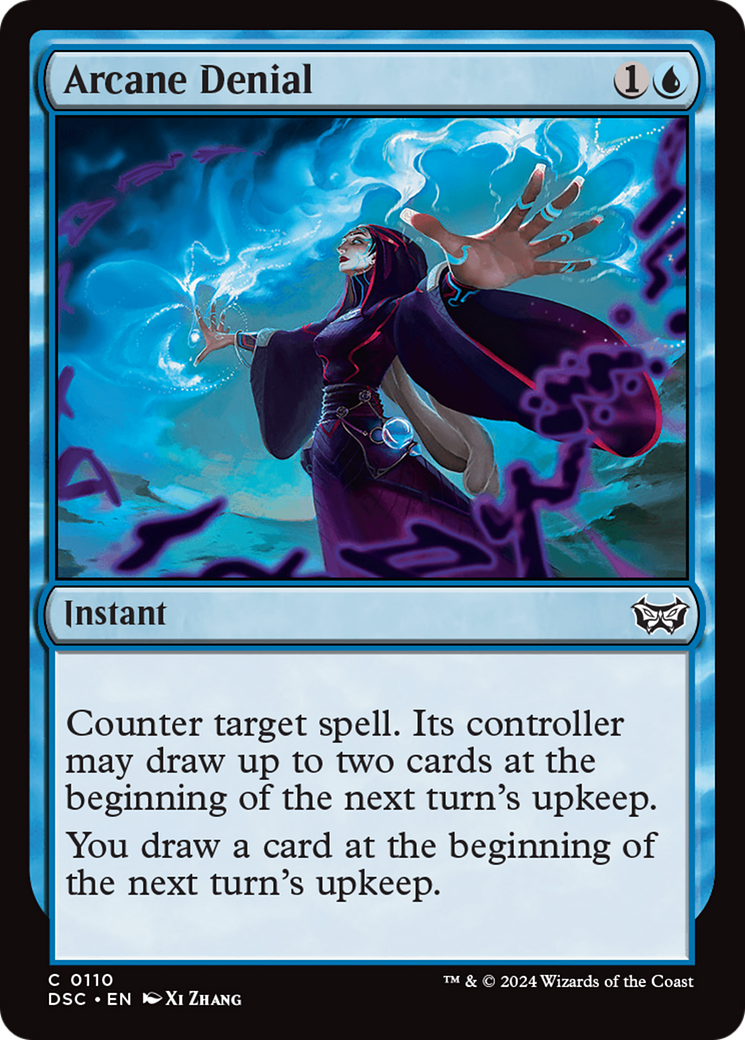
Arcane Denial
Arcane Denial
Instant
Counter target spell. Its controller may draw up to two cards at the beginning of the next turn's upkeep.
You draw a card at the beginning of the next turn's upkeep.
- The controller of the countered spell doesn't choose how many cards to draw until the relevant ability resolves. The player may draw 0, 1, or 2 cards. They choose the number before drawing any cards.
-
1
Brainstorm
Brainstorm
Instant
Draw three cards, then put two cards from your hand on top of your library in any order.
- You draw three cards and put two cards back all while Brainstorm is resolving. Nothing can happen between the two, and no player may choose to take actions.
-
1
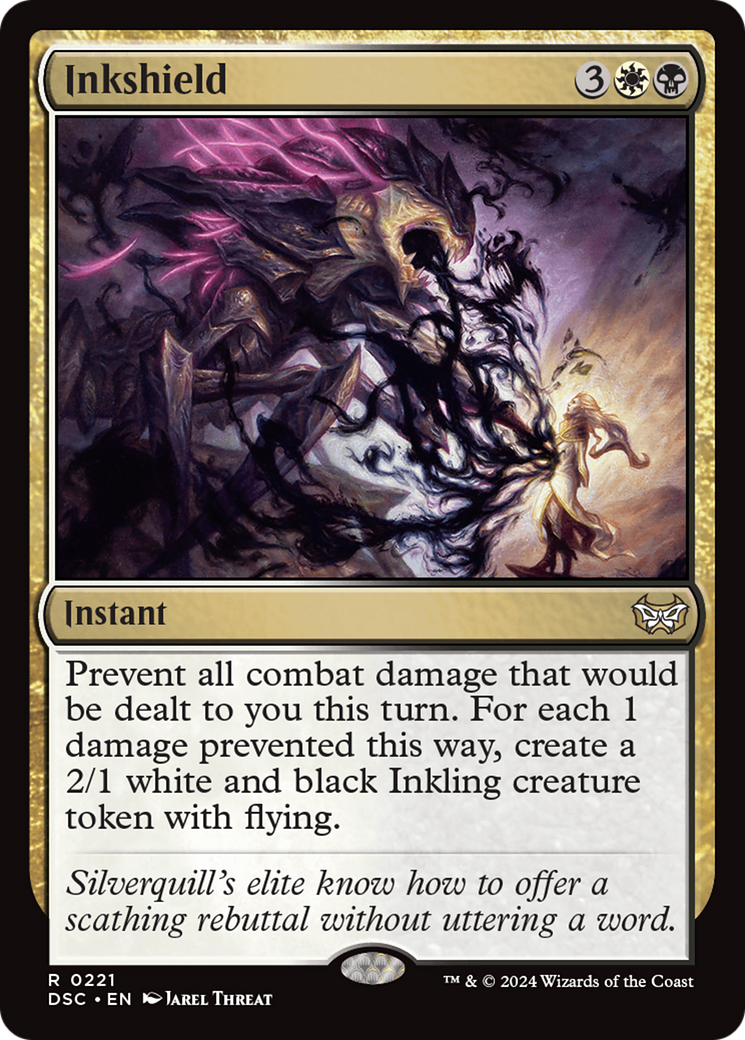
Inkshield
Inkshield
Instant
Prevent all combat damage that would be dealt to you this turn. For each 1 damage prevented this way, create a 2/1 white and black Inkling creature token with flying.
- If multiple damage prevention effects would apply to combat damage that would be dealt to you, you get to choose the order the prevention effects are applied in.
-
1
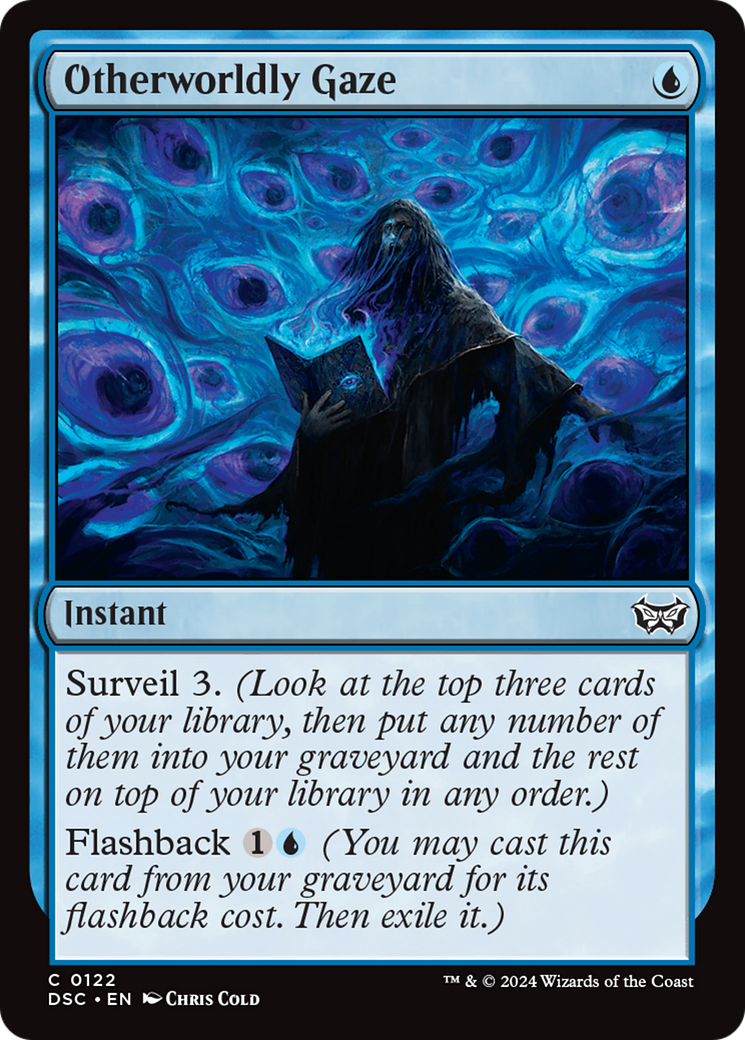
Otherworldly Gaze
Otherworldly Gaze
Instant
Surveil 3. (Look at the top three cards of your library, then put any number of them into your graveyard and the rest on top of your library in any order.)
Flashback (You may cast this card from your graveyard for its flashback cost. Then exile it.)
- When you surveil, you may put all the cards you look at back on top of your library, you may put all of those cards into your graveyard, or you may put some of those cards on top and the rest of them into your graveyard.
- You must still follow any timing restrictions and permissions, including those based on the card's type. For instance, you can cast a sorcery using flashback only when you could normally cast a sorcery.
- To determine the total cost of a spell, start with the mana cost or alternative cost (such as a flashback cost) you're paying, add any cost increases, then apply any cost reductions. The mana value of the spell is determined only by its mana cost, no matter what the total cost to cast the spell was.
- "Flashback [cost]" means "You may cast this card from your graveyard by paying [cost] rather than paying its mana cost" and "If the flashback cost was paid, exile this card instead of putting it anywhere else any time it would leave the stack."
- You can cast a spell using flashback even if it was somehow put into your graveyard without having been cast.
- If a card with flashback is put into your graveyard during your turn, you can cast it if it's legal to do so before any other player can take any actions.
- A spell cast using flashback will always be exiled afterward, whether it resolves, is countered, or leaves the stack in some other way.
-
1
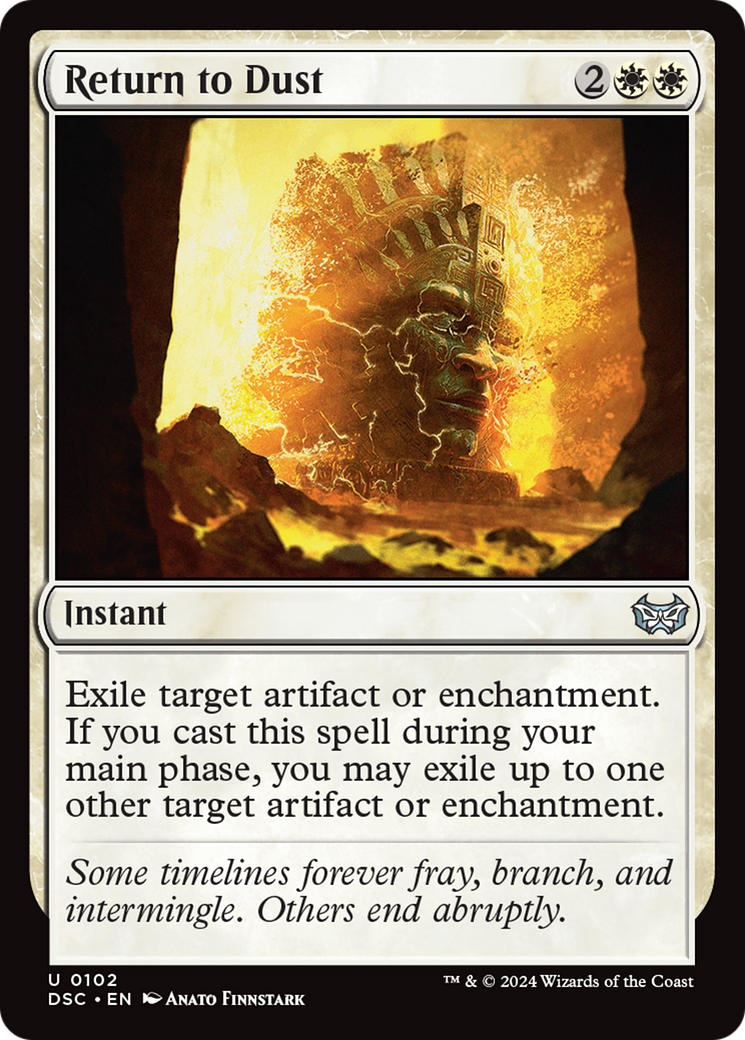
Return to Dust
Return to Dust
Instant
Exile target artifact or enchantment. If you cast this spell during your main phase, you may exile up to one other target artifact or enchantment.
- Return to Dust can always target a second artifact or enchantment; it just won't exile it if it's not your main phase when you cast Return to Dust.
- If a spell or ability copies Return to Dust, the copy exiles only the first target artifact or enchantment. This is because the copy wasn't cast at all.
-
1
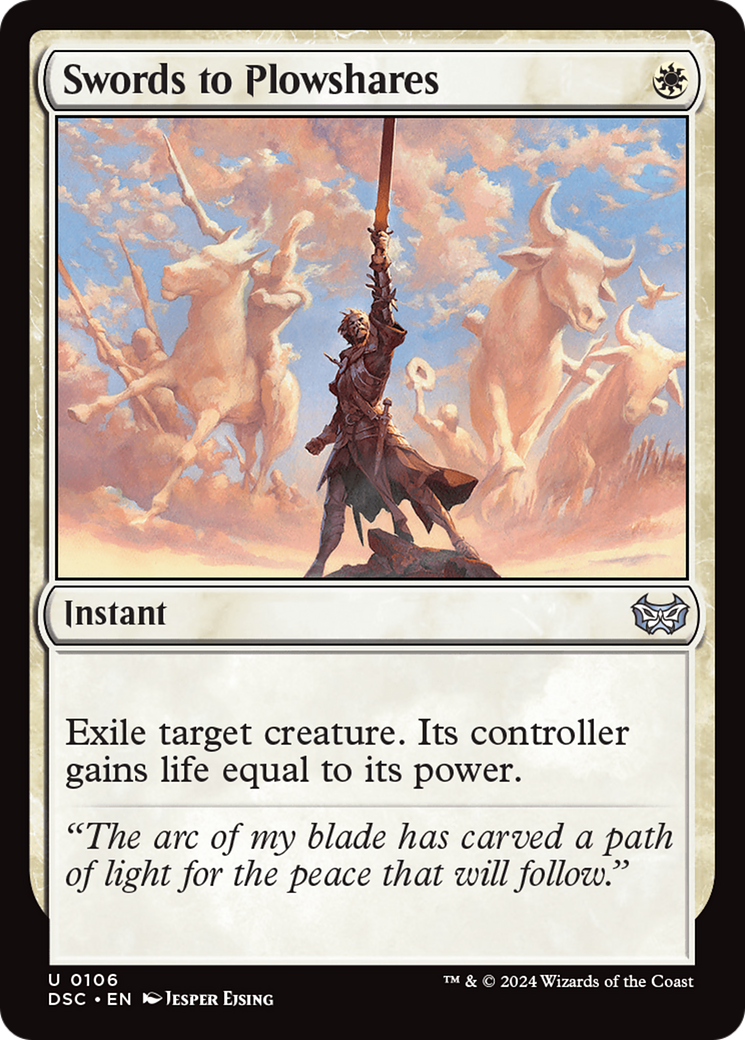
Swords to Plowshares
Swords to Plowshares
Instant
Exile target creature. Its controller gains life equal to its power.
- Use the power of the creature from when it was last on the battlefield to determine how much life is gained.
-
1
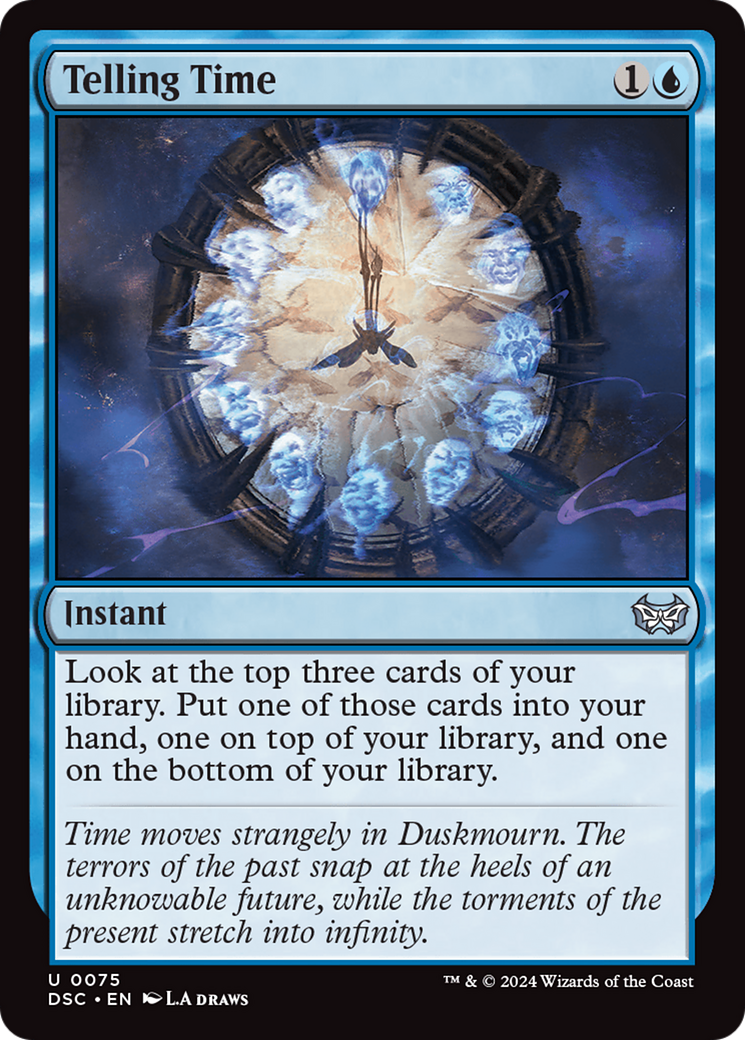
Telling Time
Telling Time
Instant
Look at the top three cards of your library. Put one of those cards into your hand, one on top of your library, and one on the bottom of your library.
- If there are fewer than three cards in your library, follow the instructions in the order given for any cards that are there.
-
1
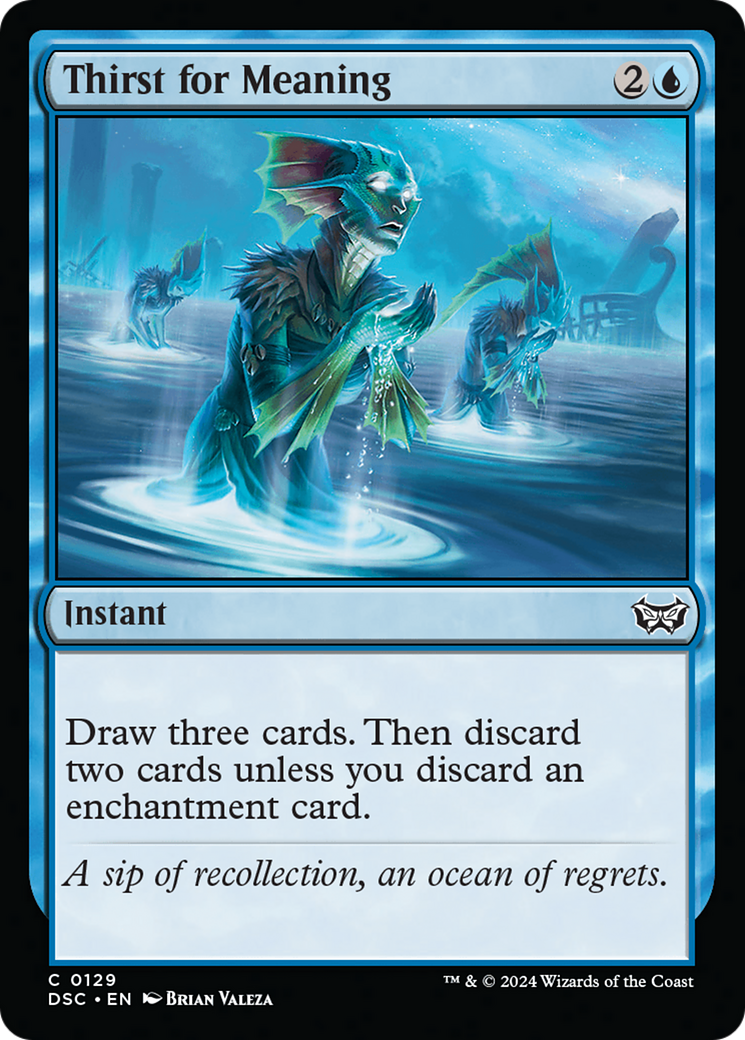
Thirst for Meaning
Thirst for Meaning
Instant
Draw three cards. Then discard two cards unless you discard an enchantment card.
- You can discard either one enchantment card or two cards which may or may not be enchantments. If you really want to, you can discard two enchantment cards.
-
1
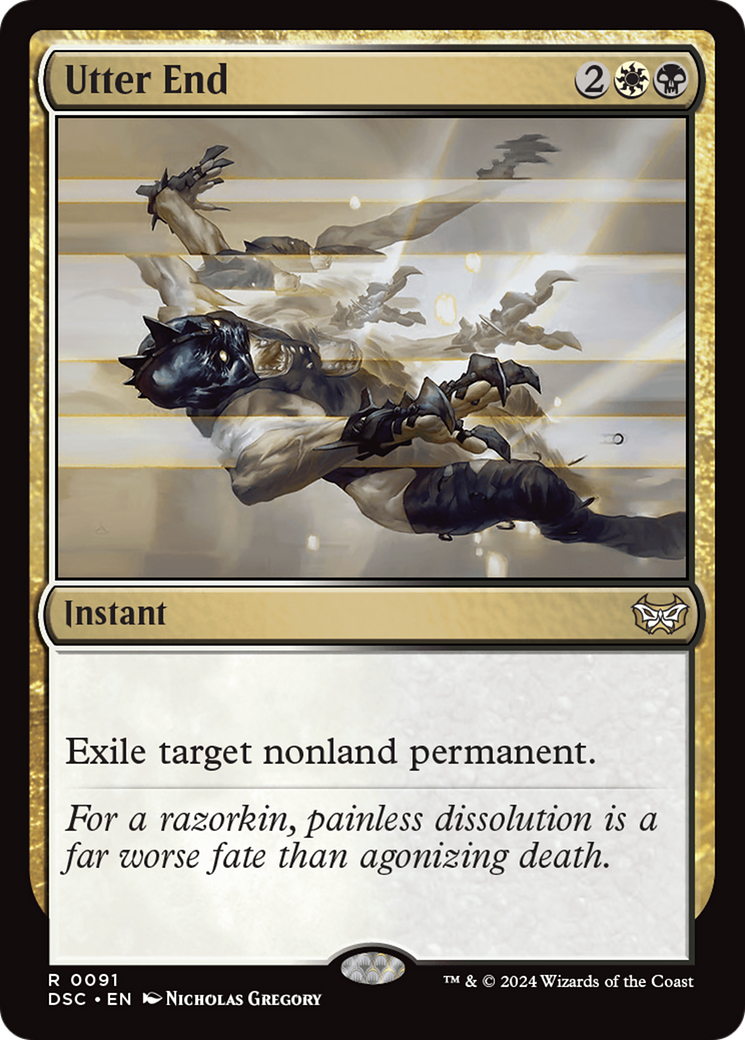
Utter End
Utter End
Instant
Exile target nonland permanent.
Sorceries 9
-
1
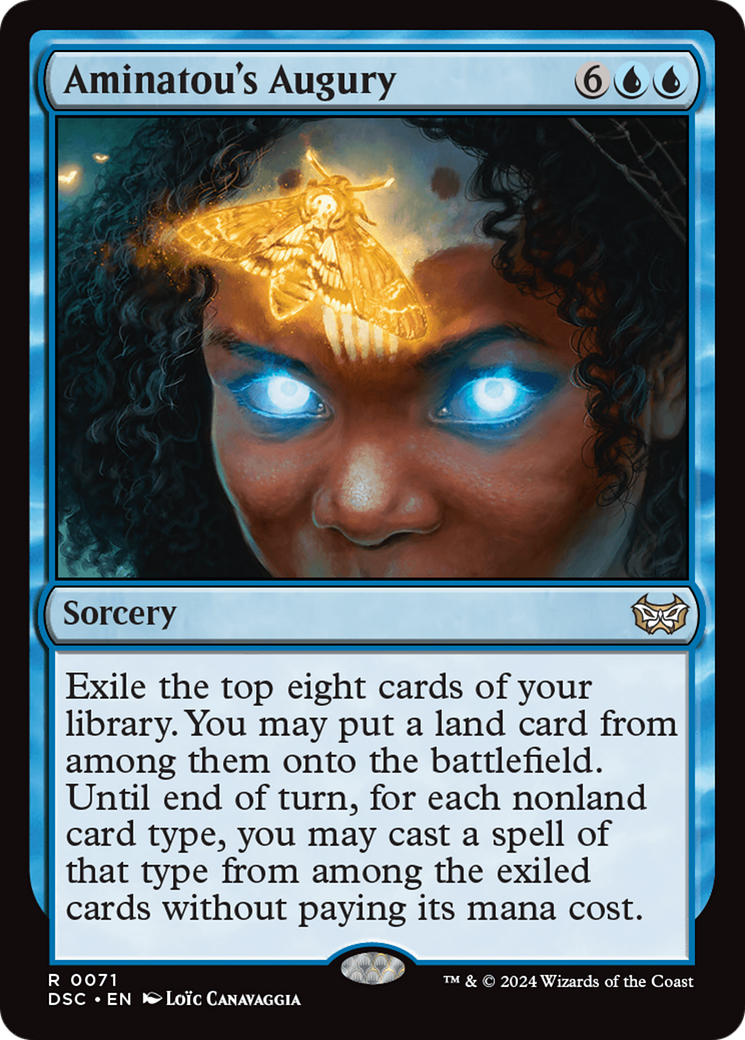
Aminatou's Augury
Aminatou's Augury
Sorcery
Exile the top eight cards of your library. You may put a land card from among them onto the battlefield. Until end of turn, for each nonland card type, you may cast a spell of that type from among the exiled cards without paying its mana cost.
- If you wish to put a land card onto the battlefield, you do so while Aminatou's Augury is resolving, before you're allowed to cast any of the other cards. You may do this even if you've already played a land this turn.
- If a nonland card has multiple types, such as an artifact creature, you may cast it as either of those types. For example, you could cast one artifact creature as your artifact card and another artifact creature as your creature card.
- If you exile a land with another card type, you can't play it later in the turn. You can only put it onto the battlefield at the time Aminatou's Augury instructs you to.
- You must follow the normal timing permissions and restrictions of each spell you cast.
- If you cast a card "without paying its mana cost," you can't choose to cast it for any alternative costs, such as evoke costs. You can, however, pay additional costs. If the card has any mandatory additional costs, such as that of Tormenting Voice, those must be paid to cast the card.
- If a spell has in its mana cost, you must choose 0 as the value of X when casting it without paying its mana cost.
- Casting an exiled card causes it to leave exile. You can't cast it multiple times.
-
1
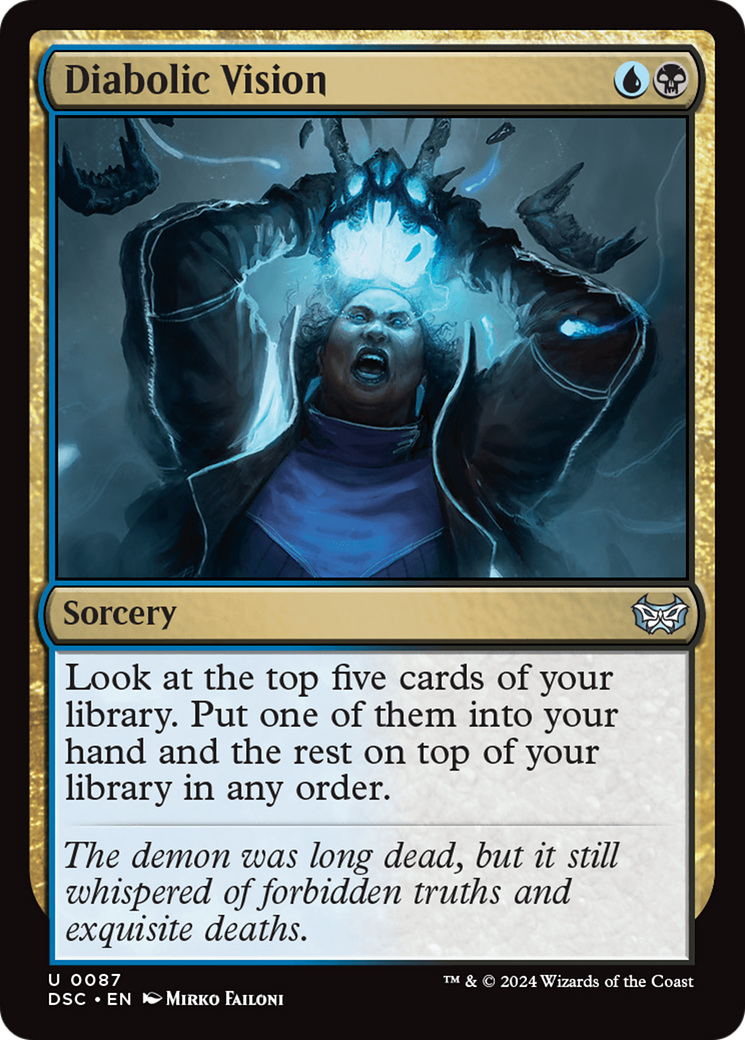
Diabolic Vision
Diabolic Vision
Sorcery
Look at the top five cards of your library. Put one of them into your hand and the rest on top of your library in any order.
-
1
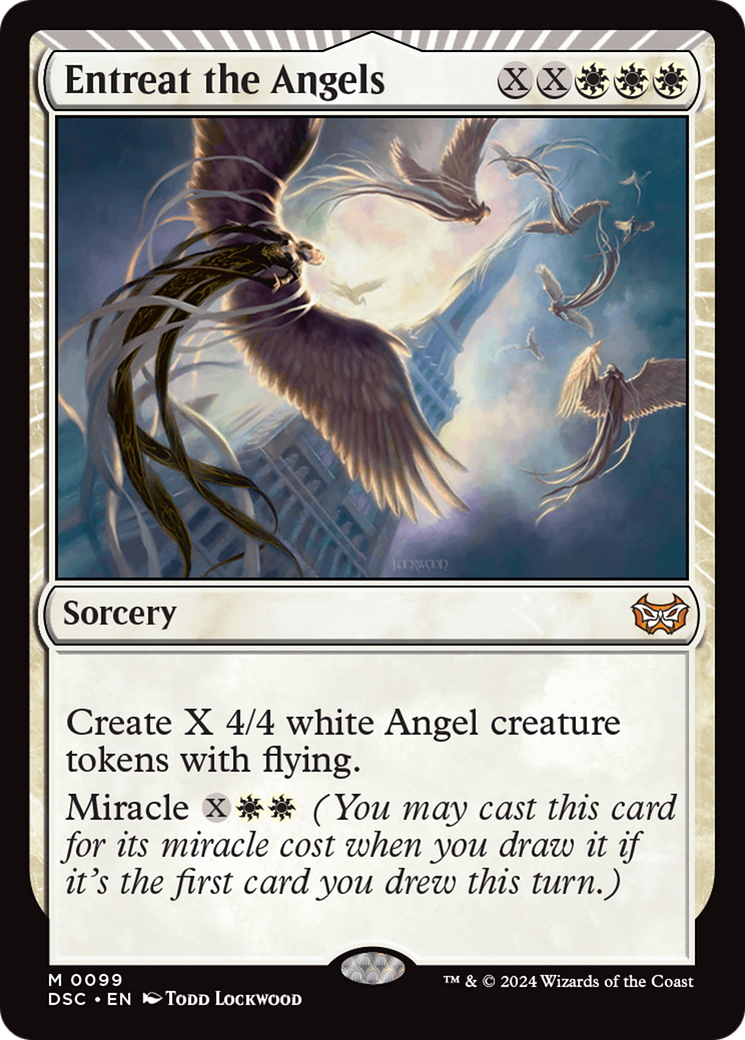
Entreat the Angels
Entreat the Angels
Sorcery
Create X 4/4 white Angel creature tokens with flying.
Miracle (You may cast this card for its miracle cost when you draw it if it's the first card you drew this turn.)
- You still draw the card, whether you use the miracle ability or not. Any ability that triggers whenever you draw a card, for example, will trigger. If you don't cast the card using its miracle ability, it will remain in your hand.
- To determine the total cost of a spell, start with the mana cost or alternative cost (such as a miracle cost) you're paying, add any cost increases, then apply any cost reductions. The mana value of the spell remains unchanged, no matter what the total cost to cast it was.
- If the card with miracle leaves your hand before the triggered ability resolves, you won't be able to cast it using its miracle ability.
- It's important to reveal a card with miracle before it is mixed with the other cards in your hand.
- You can reveal and cast a card with miracle on any turn, not just your own, if it's the first card you've drawn that turn.
- Multiple card draws are always treated as a sequence of individual card draws. For example, if you haven't drawn any cards yet during a turn and cast a spell that instructs you to draw three cards, you'll draw them one at a time. Only the first card drawn this way may be revealed and cast using its miracle ability.
- If an effect puts a card into your hand without using the word "draw," the card wasn't drawn.
- You don't have to reveal a drawn card with miracle if you don't wish to cast it at that time.
- You can cast a card for its miracle cost only as the miracle triggered ability resolves. If you don't want to cast it at that time (or you can't cast it, perhaps because there are no legal targets available), you won't be able to cast it later for the miracle cost.
- You cast the card with miracle during the resolution of the triggered ability. Ignore any timing rules based on the card's type.
- Miracle is an alternative cost to cast the spell with miracle. It can't be combined with other alternative costs, such as casting a spell "without paying its mana cost."
- Entreat the Angels's mana value is based on its mana cost of , even if you're casting it for its miracle cost. For example, if you cast Entreat the Angels for its miracle cost and choose 4 for X, its mana value is 11.
- A mana cost of means that you pay twice X. If you want X to be 3, you pay to cast Entreat the Angels.
-
1
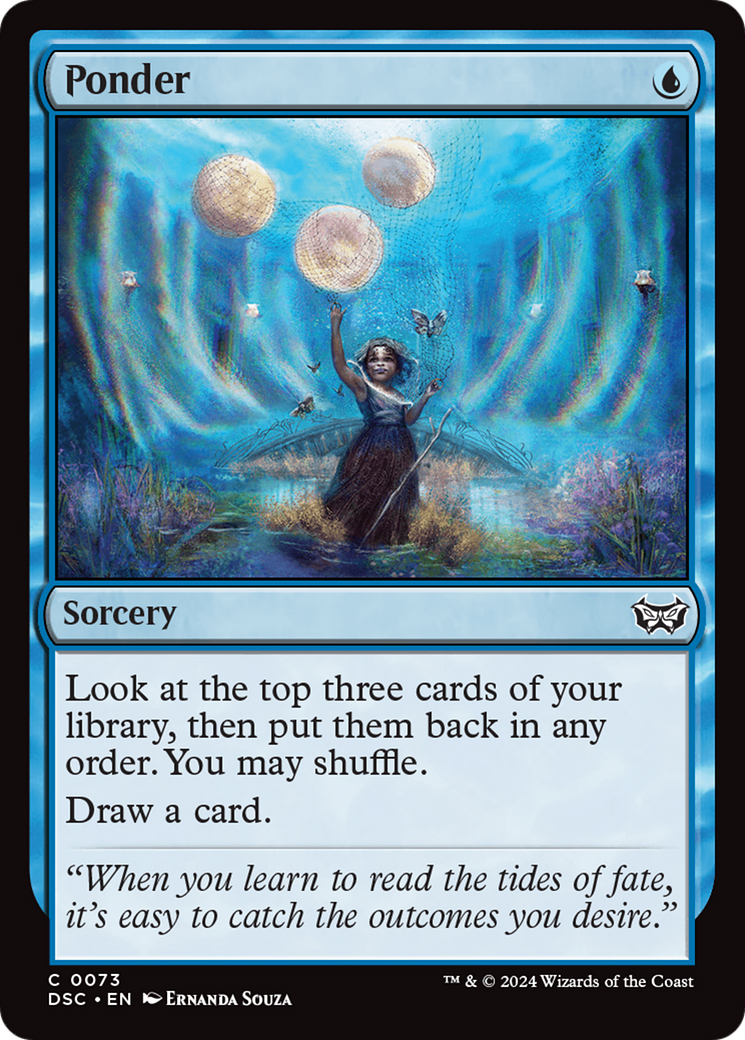
Ponder
Ponder
Sorcery
Look at the top three cards of your library, then put them back in any order. You may shuffle.
Draw a card.
- If you choose to shuffle your library, that includes the three cards you just looked at and put back on top of it.
-
1
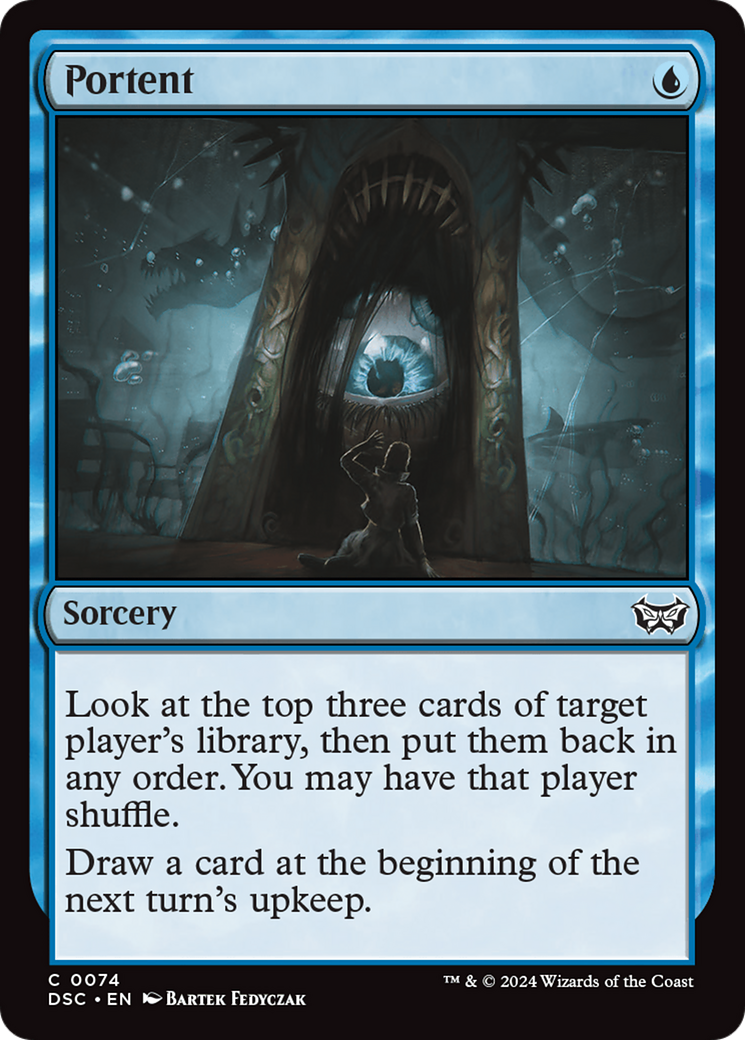
Portent
Portent
Sorcery
Look at the top three cards of target player's library, then put them back in any order. You may have that player shuffle.
Draw a card at the beginning of the next turn's upkeep.
- This does not cause a player to lose if they have less than 3 cards in their library. It allows you to look at and reorder or shuffle whatever remaining cards there might be.
-
1
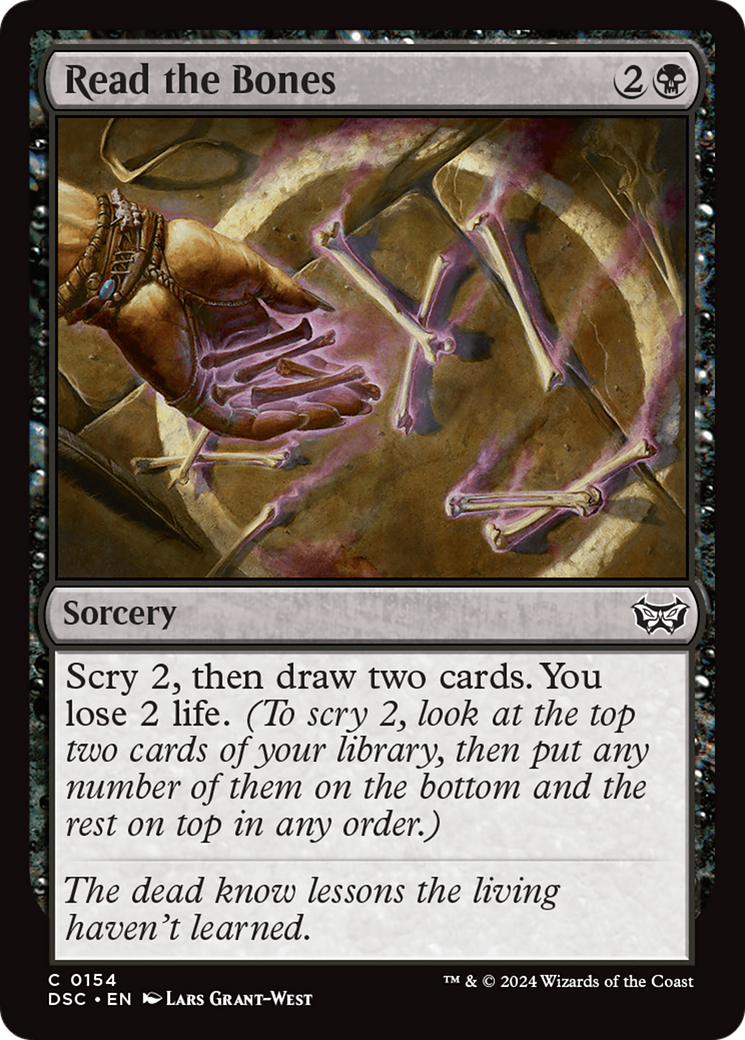
Read the Bones
Read the Bones
Sorcery
Scry 2, then draw two cards. You lose 2 life. (To scry 2, look at the top two cards of your library, then put any number of them on the bottom and the rest on top in any order.)
- The loss of life is part of the spell's effect. It's not an additional cost. If Read the Bones doesn't resolve, you won't lose life.
- When you scry, you may put all the cards you look at back on top of your library, you may put all of those cards on the bottom of your library, or you may put some of those cards on top and the rest of them on the bottom.
- You choose how to order cards returned to your library after scrying no matter where you put them.
- You perform the actions stated on a card in sequence. For some spells and abilities, that means you'll scry last. For others, that means you'll scry and then perform other actions.
- Scry appears on some spells and abilities with one or more targets. If all of the spell or ability's targets are illegal when it tries to resolve, it won't resolve and none of its effects will happen. You won't scry.
-
1
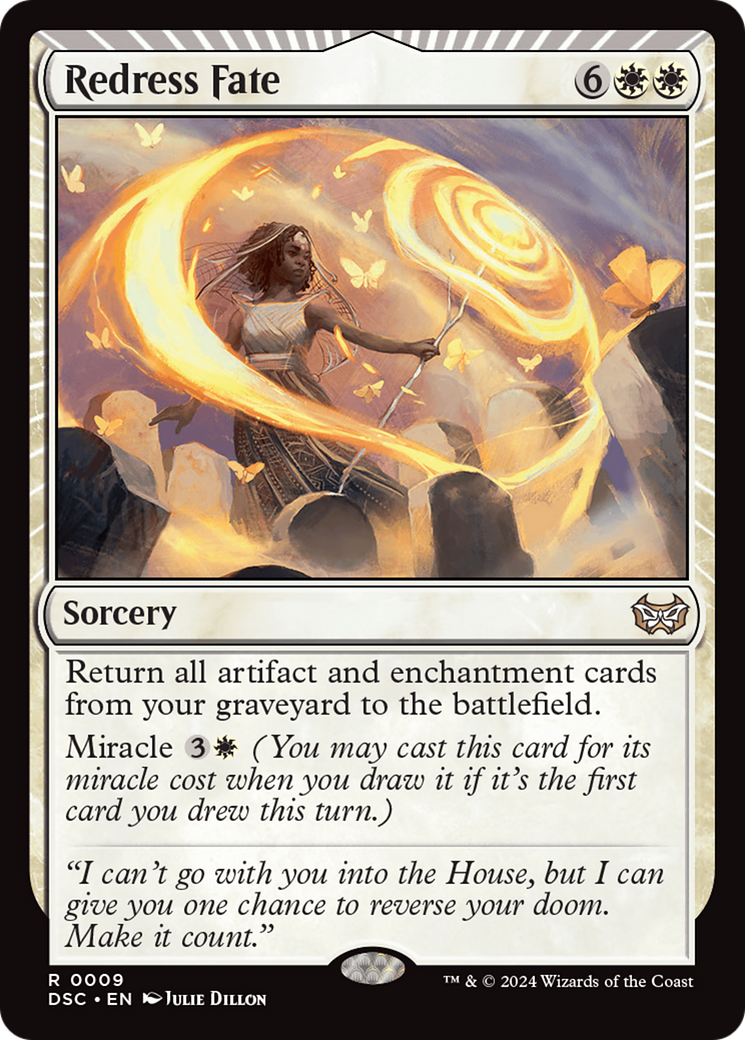
Redress Fate
Redress Fate
Sorcery
Return all artifact and enchantment cards from your graveyard to the battlefield.
Miracle (You may cast this card for its miracle cost when you draw it if it's the first card you drew this turn.)
- If an Aura is put onto the battlefield without being cast, the Aura's controller-to-be chooses what it will enchant as it comes back onto the battlefield. An Aura put onto the battlefield this way doesn't target anything (so it could be attached to an opponent's permanent with hexproof, for example), but the Aura's enchant ability restricts what it can be attached to. If the Aura can't legally be attached to anything, it remains in its current zone.
- If an Aura is being put onto the battlefield at the same time as a creature, that Aura can't enchant that creature.
-
1
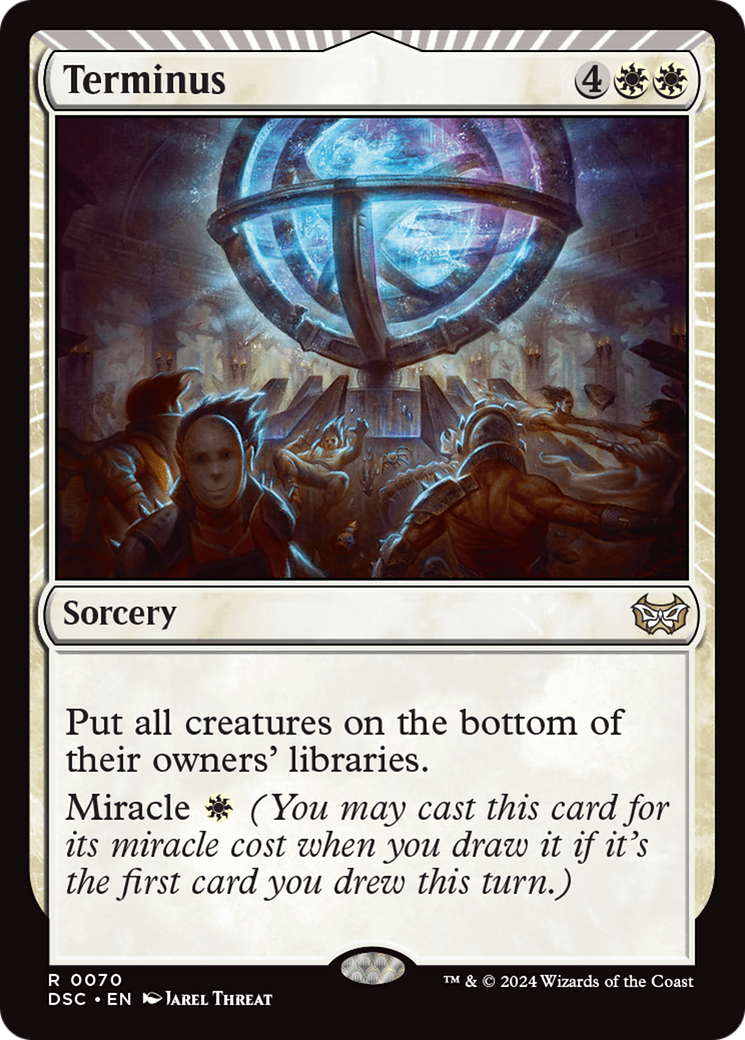
Terminus
Terminus
Sorcery
Put all creatures on the bottom of their owners' libraries.
Miracle (You may cast this card for its miracle cost when you draw it if it's the first card you drew this turn.)
- You still draw the card, whether you use the miracle ability or not. Any ability that triggers whenever you draw a card, for example, will trigger. If you don't cast the card using its miracle ability, it will remain in your hand.
- It's important to reveal a card with miracle before it is mixed with the other cards in your hand.
- You can reveal and cast a card with miracle on any turn, not just your own, if it's the first card you've drawn that turn.
- Multiple card draws are always treated as a sequence of individual card draws. For example, if you haven't drawn any cards yet during a turn and cast a spell that instructs you to draw three cards, you'll draw them one at a time. Only the first card drawn this way may be revealed and cast using its miracle ability.
- If an effect puts a card into your hand without using the word "draw," the card wasn't drawn.
- You don't have to reveal a drawn card with miracle if you don't wish to cast it at that time.
- You can cast a card for its miracle cost only as the miracle triggered ability resolves. If you don't want to cast it at that time (or you can't cast it, perhaps because there are no legal targets available), you won't be able to cast it later for the miracle cost.
- You cast the card with miracle during the resolution of the triggered ability. Ignore any timing rules based on the card's type.
- Miracle is an alternative cost to cast the spell with miracle. It can't be combined with other alternative costs, such as casting a spell "without paying its mana cost."
- To determine the total cost of a spell, start with the mana cost or alternative cost (such as a miracle cost) you're paying, add any cost increases, then apply any cost reductions. The mana value of the spell remains unchanged, no matter what the total cost to cast it was.
- If the card with miracle leaves your hand before the triggered ability resolves, you won't be able to cast it using its miracle ability.
- Each player chooses the order that creatures they own are put onto the bottom of their library. This order isn't revealed to other players.
-
1
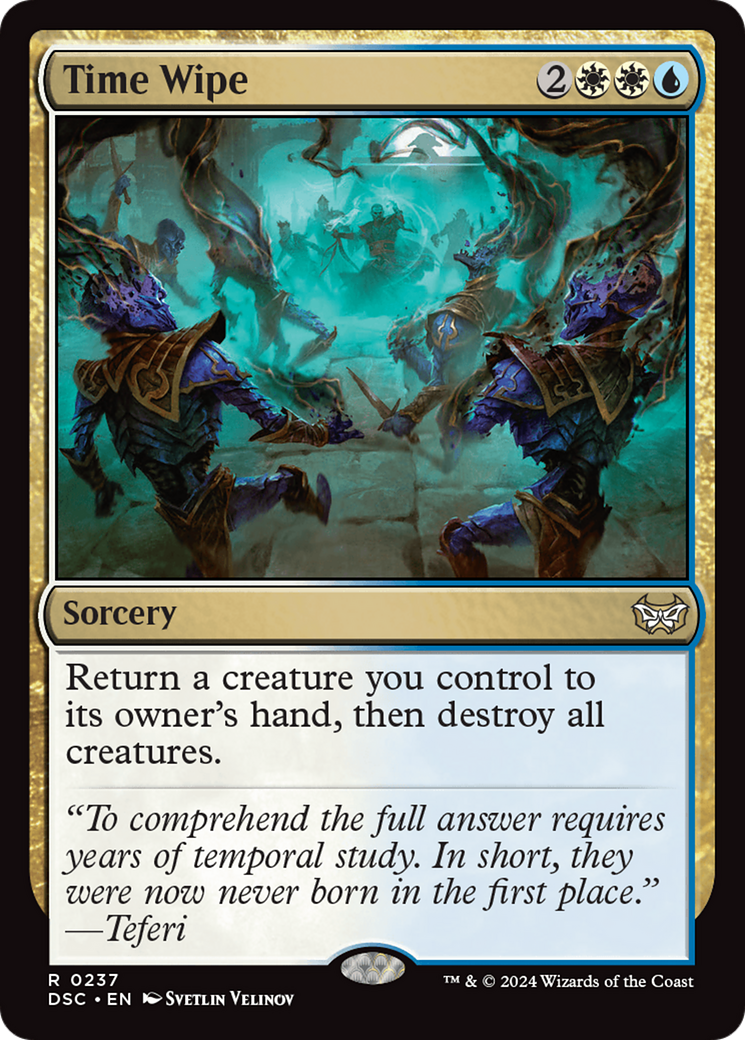
Time Wipe
Time Wipe
Sorcery
Return a creature you control to its owner's hand, then destroy all creatures.
- You chose which creature to return to its owner's hand while Time Wipe is resolving. No player may take any actions between the time you choose the creature to return and the time other creatures are destroyed.
- If you control no creatures, you simply destroy all creatures.
Artifacts 7
-
1
Arcane Signet
Arcane Signet
Artifact
: Add one mana of any color in your commander's color identity.
- If your commander is a card that has no colors in its color identity, Arcane Signet's ability produces no mana. It doesn't produce .
- If you have two commanders, the ability adds one mana of any color in their combined color identities.
- If you don't have a commander, Arcane Signet's ability produces no mana.
-
1
Azorius Signet
Azorius Signet
Artifact
, : Add .
-
1
Brainstone
Brainstone
Artifact
, , Sacrifice this artifact: Draw three cards, then put two cards from your hand on top of your library in any order.
-
1
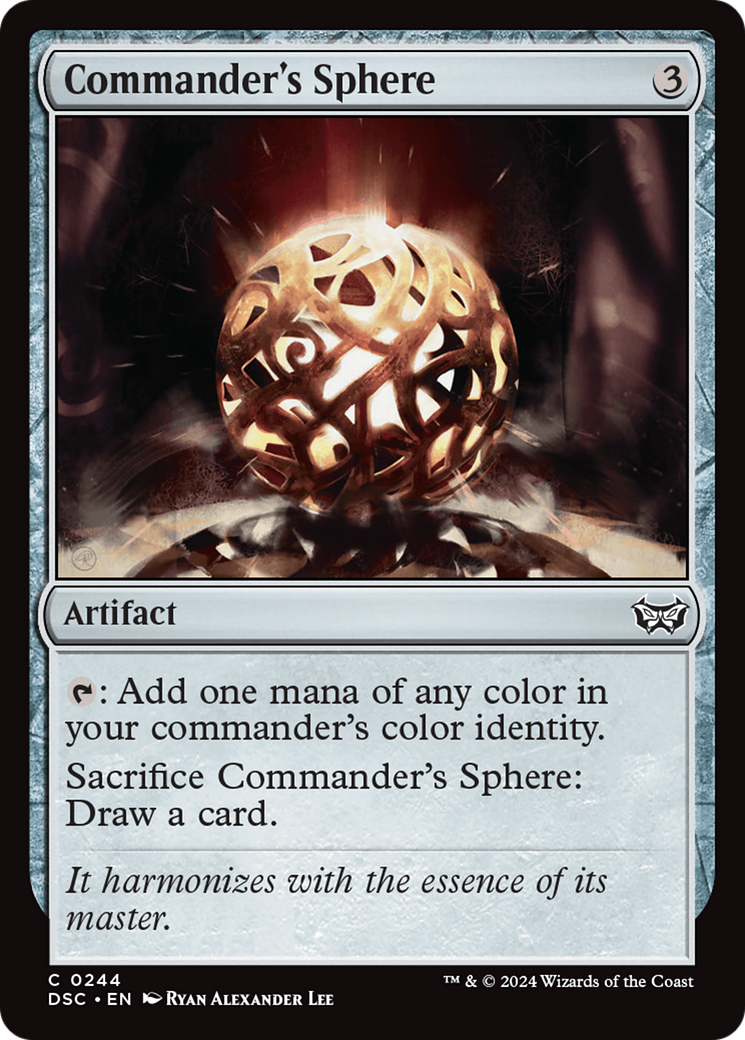
Commander's Sphere
Commander's Sphere
Artifact
: Add one mana of any color in your commander's color identity.
Sacrifice this artifact: Draw a card.
- If your commander is a card that has no colors in its color identity, Commander's Sphere's first ability produces no mana. It doesn't produce .
- If you don't have a commander, Commander's Sphere's first ability produces no mana.
- If you have two commanders, the ability adds one mana of any color in their combined color identities.
-
1
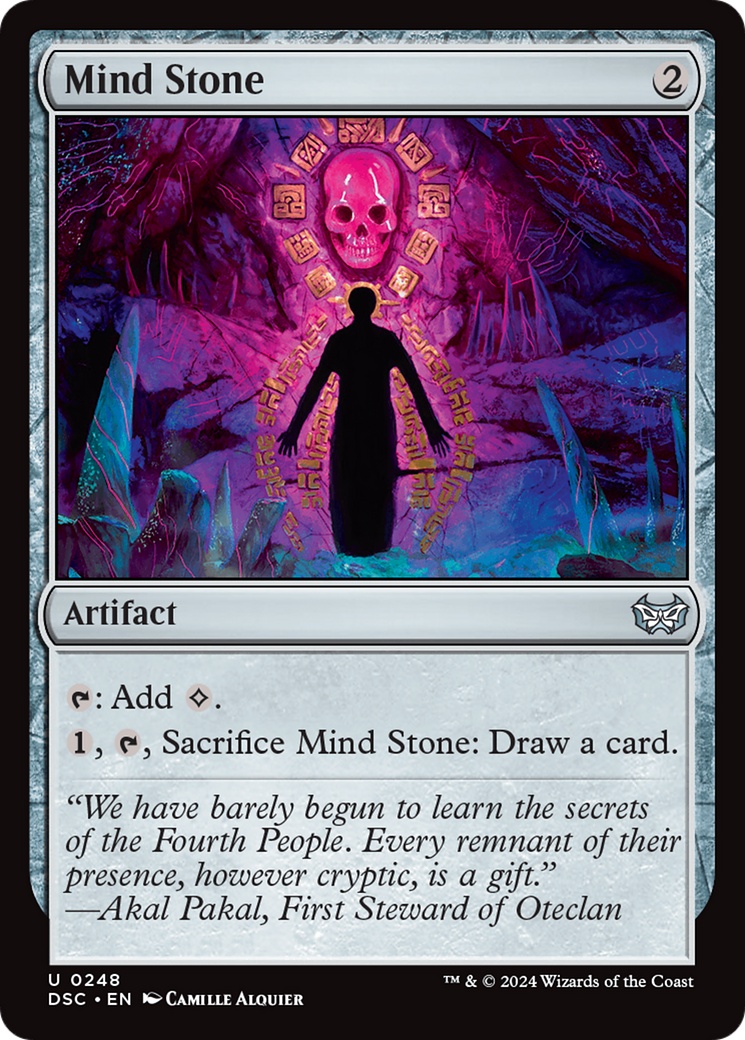
Mind Stone
Mind Stone
Artifact
: Add .
, , Sacrifice this artifact: Draw a card.
-
1
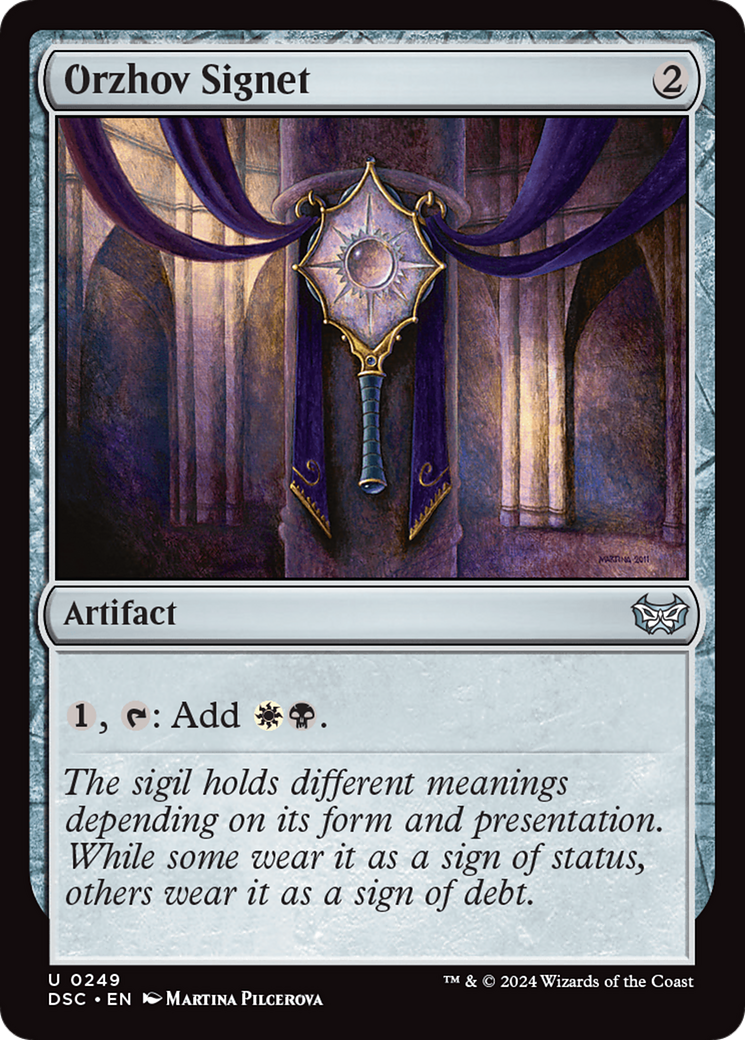
Orzhov Signet
Orzhov Signet
Artifact
, : Add .
-
1
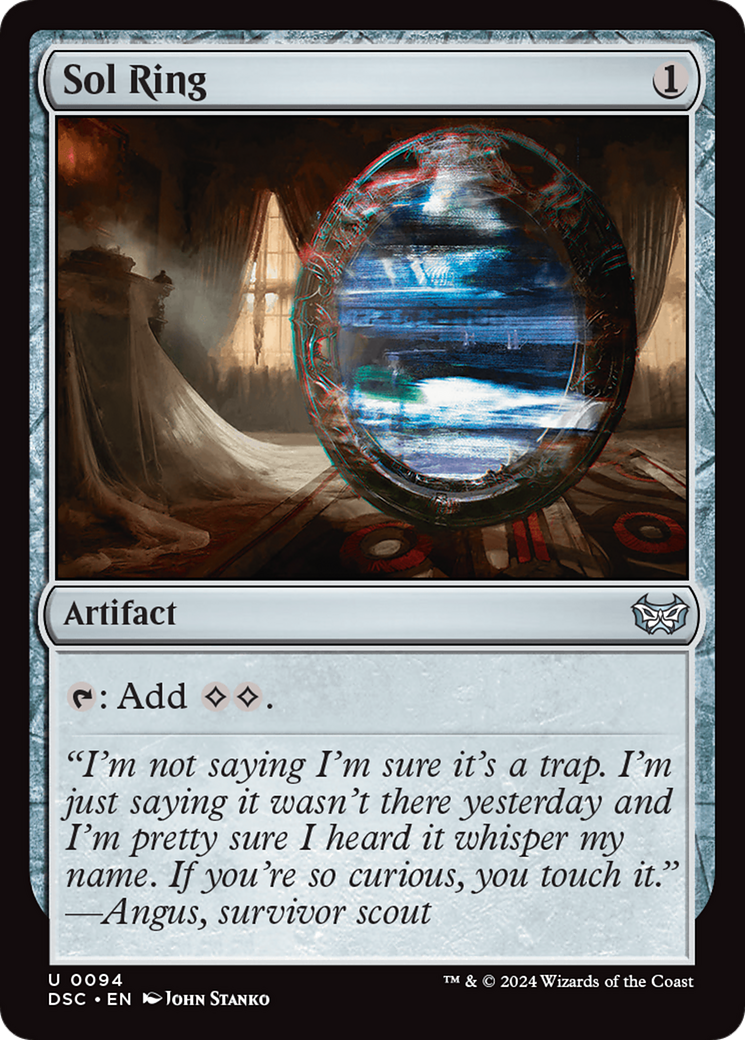
Sol Ring
Sol Ring
Artifact
: Add .
Enchantments 15
-
1
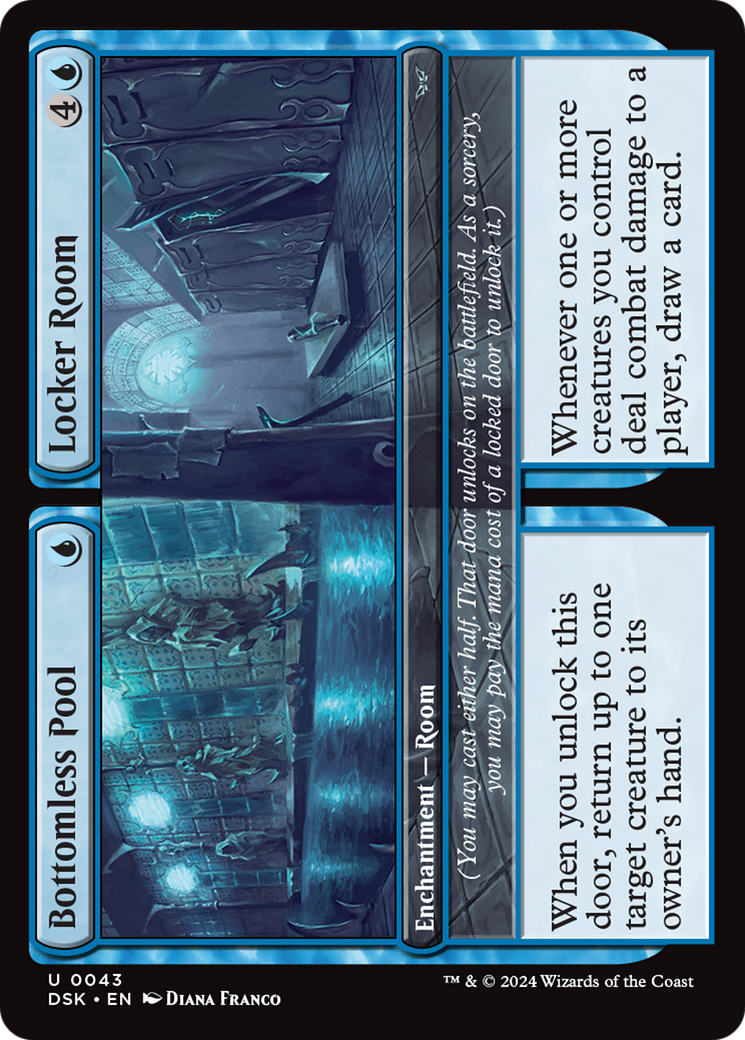
Bottomless Pool // Locker Room
//
Bottomless Pool
Enchantment — Room
-
1
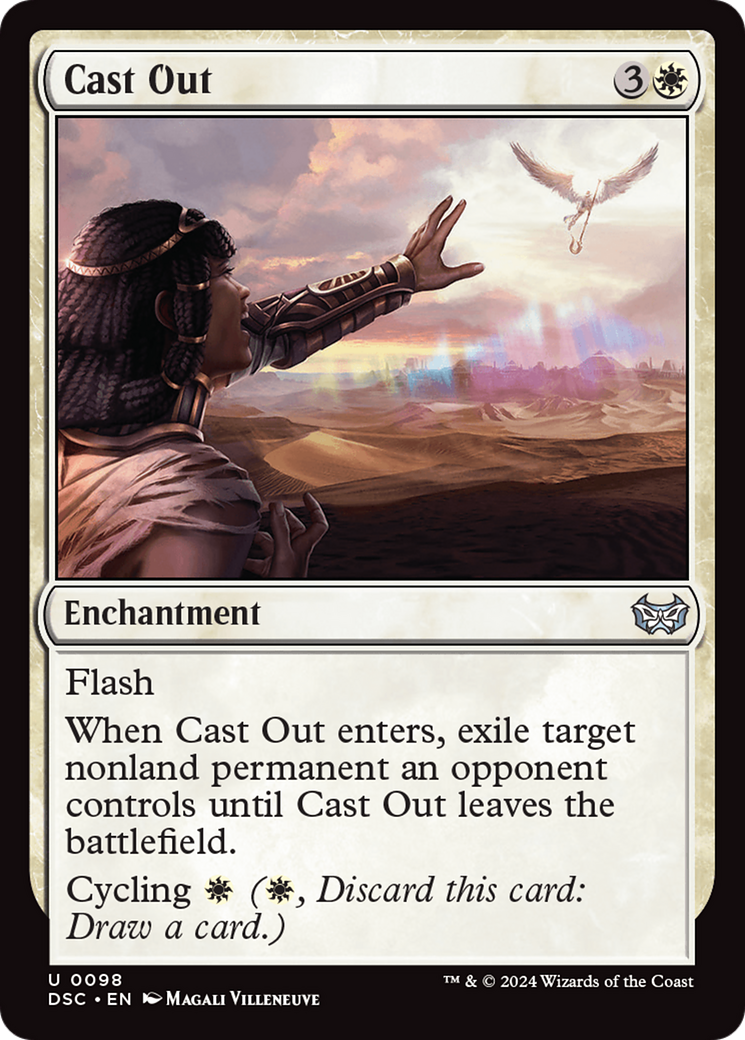
Cast Out
Cast Out
Enchantment
Flash
When this enchantment enters, exile target nonland permanent an opponent controls until this enchantment leaves the battlefield.
Cycling ( , Discard this card: Draw a card.)
- If Cast Out leaves the battlefield before its triggered ability resolves, the target permanent won't be exiled.
- Auras attached to the exiled permanent will be put into their owners' graveyards. Any Equipment will become unattached and remain on the battlefield. Any counters on the exiled permanent will cease to exist.
- If a token is exiled this way, it will cease to exist and won't return to the battlefield.
- The exiled card returns to the battlefield immediately after Cast Out leaves the battlefield. Nothing happens between the two events, including state-based actions.
- In a multiplayer game, if Cast Out's owner leaves the game, the exiled card will return to the battlefield. Because the one-shot effect that returns the card isn't an ability that goes on the stack, it won't cease to exist along with the leaving player's spells and abilities on the stack.
-
1
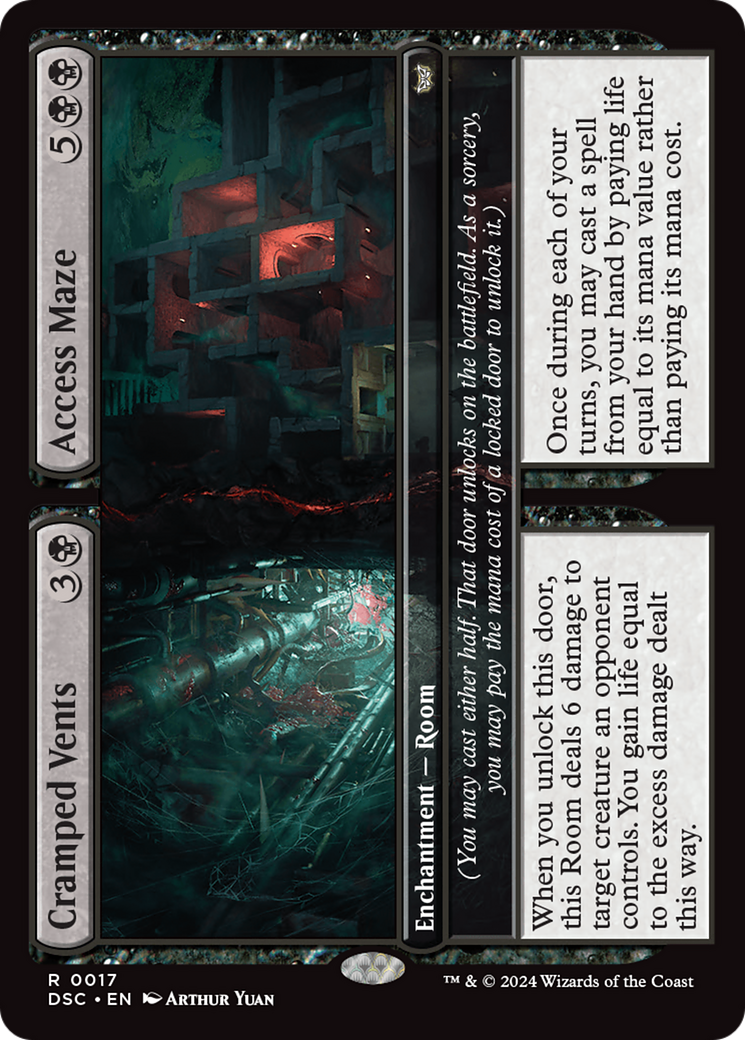
Cramped Vents // Access Maze
//
Cramped Vents
Enchantment — Room
- Excess damage has been dealt to a creature if the damage dealt to it is greater than lethal damage. Usually, this means damage greater than its toughness, although damage already marked on the creature is taken into account.
- In some unusual cases, Cramped Vents may have deathtouch. Even 1 damage dealt to a creature from a source with deathtouch is considered lethal damage, so any amount greater than that will cause excess damage to be dealt, even if the total amount of damage isn't greater than the creature's toughness.
- You follow all timing rules for spells cast with Access Maze's ability.
- The spells you cast using Access Maze's ability have an alternative cost that's paying life equal to their mana value. You can't choose to pay their mana cost and may not pay any other alternative costs. You may still pay for additional costs, such as kicker costs, and you may pay mana for those as normal. If the spell has mandatory additional costs, you must pay those.
- To cast a Room spell, choose a half (or "door") to cast. There's no way to cast both halves of a Room card. When the Room spell resolves, the corresponding door becomes unlocked as the Room enters.
- Room cards have two card faces with a shared type line on a single card. The characteristics of the door you didn't cast are ignored while the spell is on the stack.
- Each Room card is a single card. For example, if you discard a Room card, you've discarded one card, not two. If an effect counts the number of enchantment cards in your graveyard, Bottomless Pool // Locker Room counts once, not twice.
- Each Room card has two names. If an effect instructs you to choose a card name, you may choose one of those names, but not both.
- If an effect allows you to cast a spell with certain characteristics, consider only the characteristics of the door you're casting. For example, if an effect allows you to cast a permanent spell with mana value 3 or less from among cards in your graveyard, you could cast Bottomless Pool this way, but not Locker Room.
- While in any zone other than the stack or the battlefield, a Room card's characteristics are a combination of its two doors. For example, Bottomless Pool // Locker Room has a mana value of 6 while it's in your library. If an effect allows you to search your library for a card with mana value 4 or less, you can't find Bottomless Pool // Locker Room.
- While on the battlefield, a Room's characteristics are a combination of the characteristics of its unlocked doors. For example, if Bottomless Pool // Locker Room is on the battlefield with both doors unlocked, its names are Bottomless Pool and Locker Room, its mana value is 6, it's a Room Enchantment, and it has the abilities in each door's text box.
- If a spell or ability would create a copy of a Room spell on the stack, the copy retains the choice of which door was cast but also retains the full characteristics of the spell. The characteristics of the door that wasn't cast are still ignored while the copy is on the stack, and when the copy resolves, the token it becomes will enter with the appropriate door unlocked.
- If a Room enters from any zone other than the stack, it will enter with both halves locked.
- If neither door of a Room is unlocked, it's a Room enchantment with no name and no abilities.
- Any time you have priority during a main phase of your turn and the stack is empty, you may pay the mana cost of a locked door (also called its "unlock cost"). That door becomes unlocked. This is a special action. It doesn't use the stack and can't be responded to.
- An ability that triggers "when you unlock this door" triggers when that door becomes unlocked. This can happen one of two ways: (1) the door becomes unlocked on the battlefield or (2) the door becomes unlocked as the Room enters the battlefield because you cast the corresponding half. In the latter case, since the door becoming unlocked is what causes the ability to trigger, effects that cause abilities that trigger when a permanent enters to trigger an additional time (such as that of Panharmonicon) won't apply.
- Some abilities allow you to unlock a door of a Room you control. You can't choose to unlock a door that's already unlocked with such an ability. If such an ability requires a target, you can target a Room even if both of its doors are unlocked, but the ability won't do anything when it resolves.
- Some abilities allow you to lock a door of a Room you control. You can't choose to lock a door that's already locked with such an ability. If such an ability requires a target, you can target a Room even if both of its doors are locked, but the ability won't do anything when it resolves.
- Some doors have abilities that trigger whenever you unlock that door and require one or more targets. You can unlock that door even if there would be insufficient legal targets for that triggered ability. The triggered ability won't go on the stack.
- An ability that triggers "whenever you fully unlock a Room" triggers when a door becomes unlocked and the other door of that Room is already unlocked, or when both doors of that Room become unlocked simultaneously.
-
1
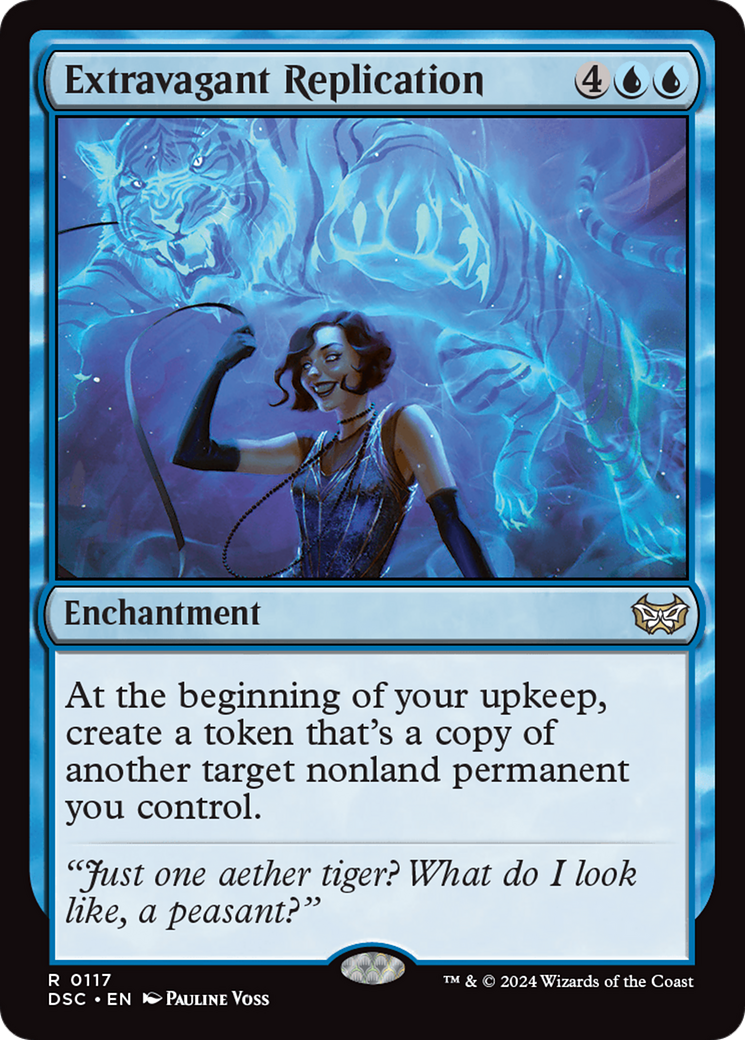
Extravagant Replication
Extravagant Replication
Enchantment
At the beginning of your upkeep, create a token that's a copy of another target nonland permanent you control.
-
1
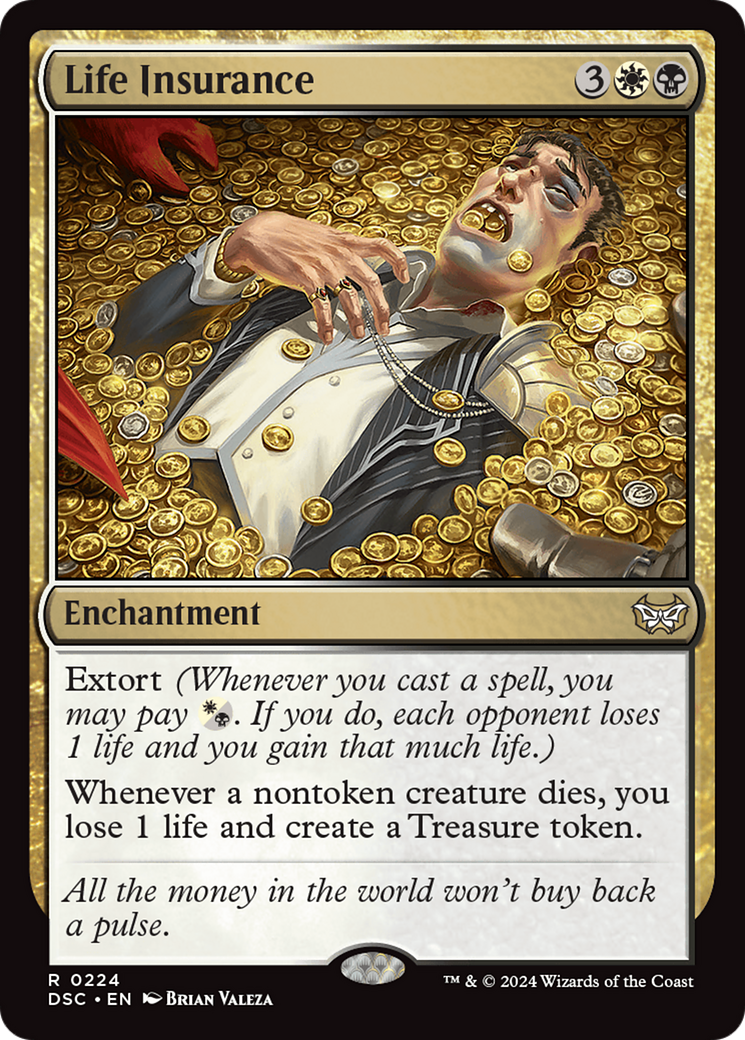
Life Insurance
Life Insurance
Enchantment
Extort (Whenever you cast a spell, you may pay . If you do, each opponent loses 1 life and you gain that much life.)
Whenever a nontoken creature dies, you lose 1 life and create a Treasure token.
- You may pay a maximum of one time for each extort triggered ability. You decide whether to pay when the ability resolves.
- The amount of life you gain from extort is based on the total amount of life lost, not necessarily the number of opponents you have. For example, if your opponent's life total can't change (perhaps because that player controls Platinum Emperion), you won't gain any life.
- The extort ability doesn't target any player.
- The extort ability resolves before the spell that caused it to trigger. The ability resolves even if that spell is countered.
-
1
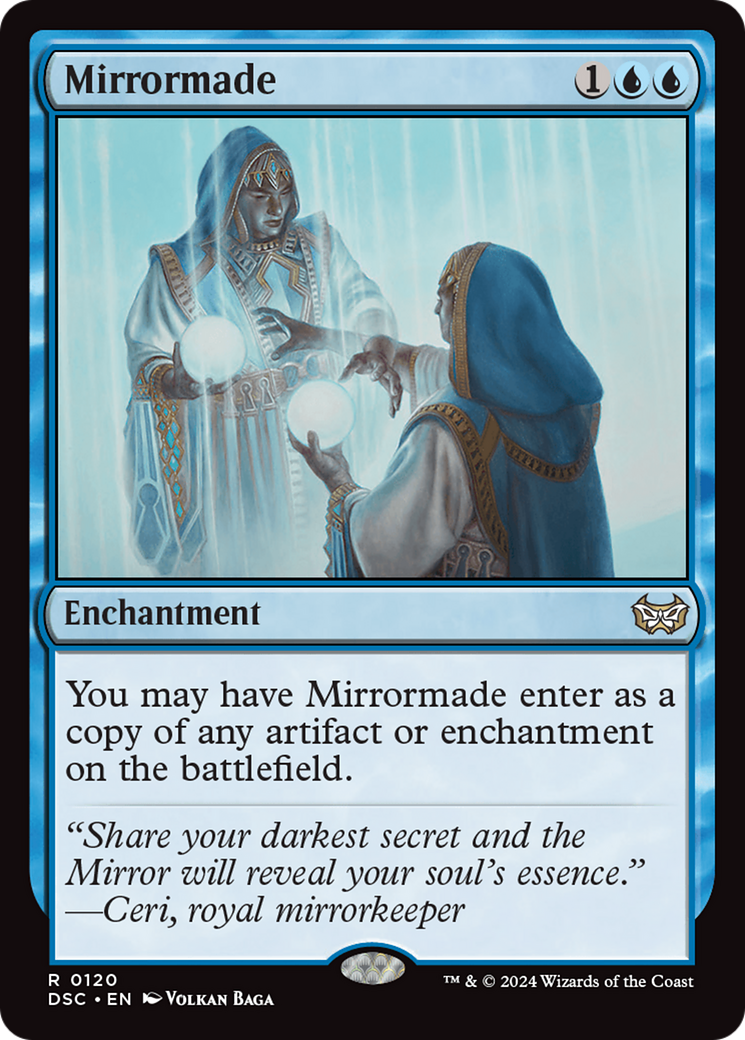
Mirrormade
Mirrormade
Enchantment
You may have this enchantment enter as a copy of any artifact or enchantment on the battlefield.
- Mirrormade copies exactly what was printed on the original permanent (unless that permanent is copying something else or is a token; see below). It doesn't copy whether that permanent is tapped or untapped, whether it has any counters on it or any Auras attached to it, or any non-copy effects that have changed its types, color, or so on. Notably, if Mirrormade copies an artifact creature or enchantment creature that's normally not a creature (such as one affected by Bring to Life), Mirrormade won't be a creature.
- If the chosen permanent has in its mana cost, X is considered to be 0.
- If the chosen permanent is copying something else (for example, if the chosen permanent is another Mirrormade), then Mirrormade enters the battlefield as whatever the chosen permanent copied.
- If the chosen permanent is a token, Mirrormade copies the original characteristics of that token as stated by the effect that created the token. Mirrormade doesn't become a token in this case.
- Any enters-the-battlefield abilities of the copied permanent will trigger when Mirrormade enters the battlefield. Any "as [this permanent] enters the battlefield" or "[this permanent] enters the battlefield with" abilities of the chosen permanent will also work.
- If Mirrormade somehow enters the battlefield at the same time as another artifact or enchantment, it can't become a copy of that permanent. You may choose only a permanent that's already on the battlefield.
- If Mirrormade copies an Aura this way, you choose what the Aura will enchant just before it enters the battlefield. You can't choose any permanent cards entering the battlefield at the same time as that Aura. This doesn't target the player or permanent it will enchant, so an opponent's permanent with hexproof may be chosen this way. The chosen recipient must be able to legally be enchanted by the Aura, so a player or permanent with protection from one of the Aura's qualities can't be chosen this way. If there's nothing legal for Mirrormade to enchant, it stays in its current zone (unless it's a spell, in which case it's put into its owner's graveyard).
-
1
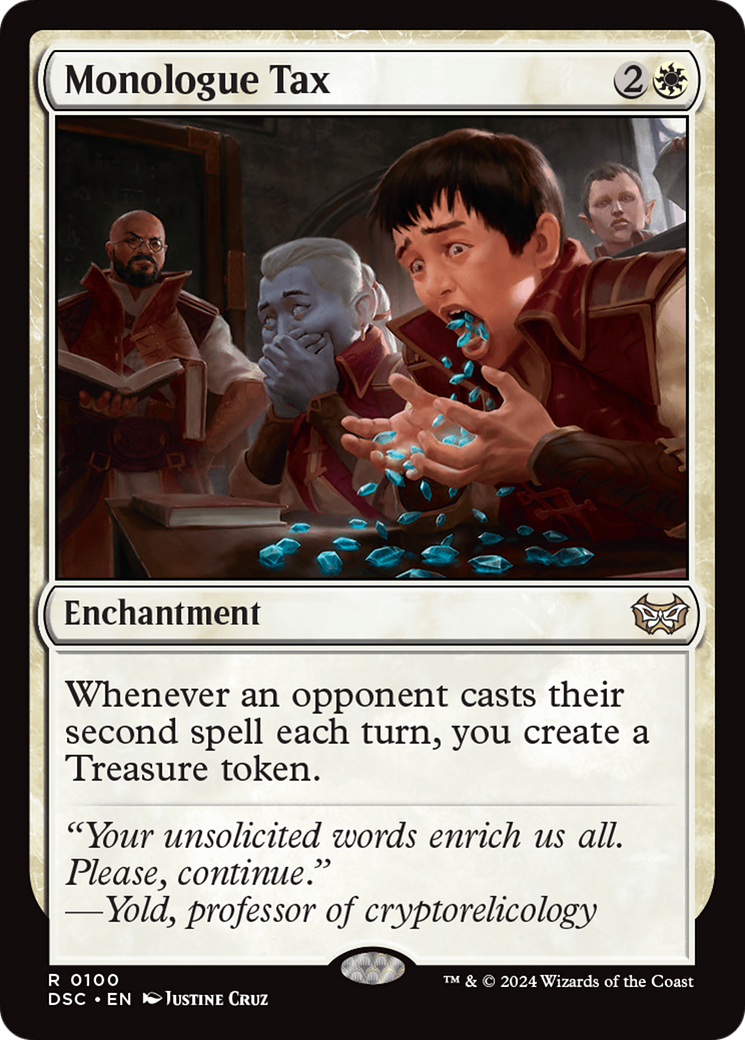
Monologue Tax
Monologue Tax
Enchantment
Whenever an opponent casts their second spell each turn, you create a Treasure token.
- Nothing special happens on the third spell, fourth spell, and so on.
- It doesn't matter if Monologue Tax was on the battlefield for the first spell. It also doesn't matter if that first spell resolved or not.
- The ability can trigger once each turn for each opponent.
-
1
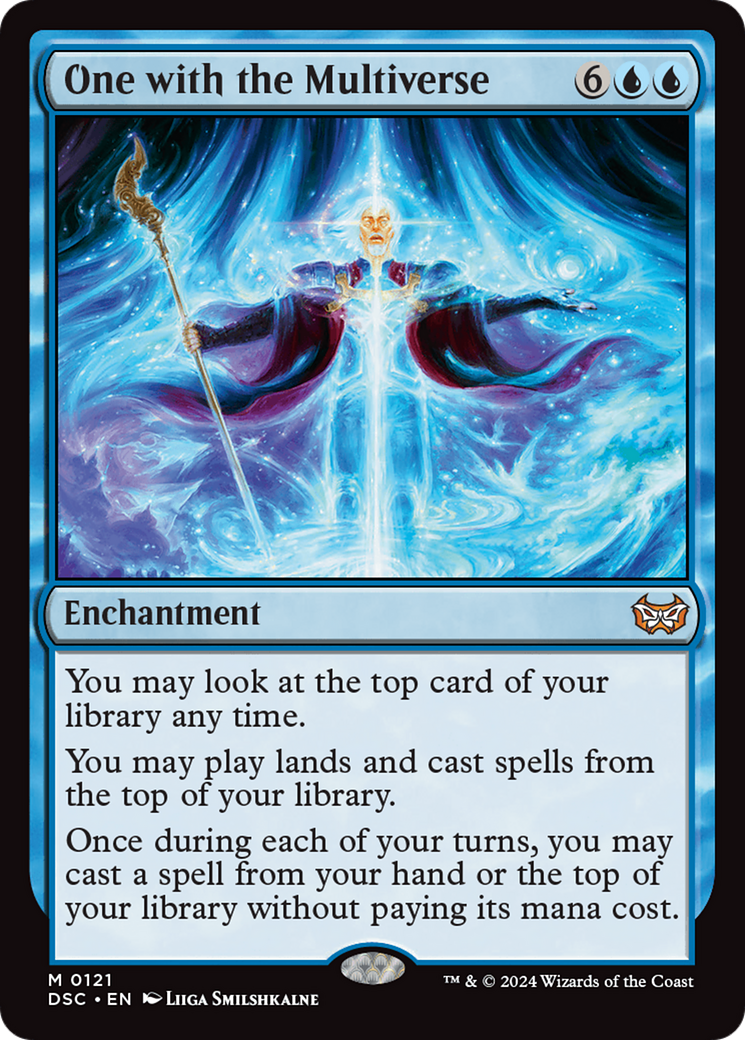
One with the Multiverse
One with the Multiverse
Enchantment
You may look at the top card of your library any time.
You may play lands and cast spells from the top of your library.
Once during each of your turns, you may cast a spell from your hand or the top of your library without paying its mana cost.
- You must follow all normal timing rules for spells cast and lands played using the middle ability and must pay all costs for spells cast this way. To cast a spell this way, you may choose to pay any alternative costs or optional additional costs the spell may have (such as a kicker cost). You must pay any mandatory additional costs.
- While casting a spell without paying its mana cost using the last ability, you can't pay alternative costs, but you may choose to pay any optional additional costs the spell may have (such as a kicker cost). You still must pay any mandatory additional costs.
- While casting a card with the prototype ability using the last ability of One with the Multiverse, you can either choose to cast it normally or choose to cast it as a prototyped spell. In either case, you won't pay its mana cost.
- If One with the Multiverse leaves the battlefield and later returns to the battlefield (or you play a second one), it's considered a new object and you may cast a spell using its last ability regardless of whether or not you did so earlier this turn using the enchantment that was on the battlefield before.
- Similarly, if you control more than one One with the Multiverse (Two with the Multiverse, if you will), each one's last ability applies independently, and you may cast a spell without paying its mana cost once for each of them during each of your turns. In this case, you will need to track which enchantment's permission you are using to cast a spell this way (due to the possibility that one of them might leave the battlefield before you use its permission that turn).
-
1
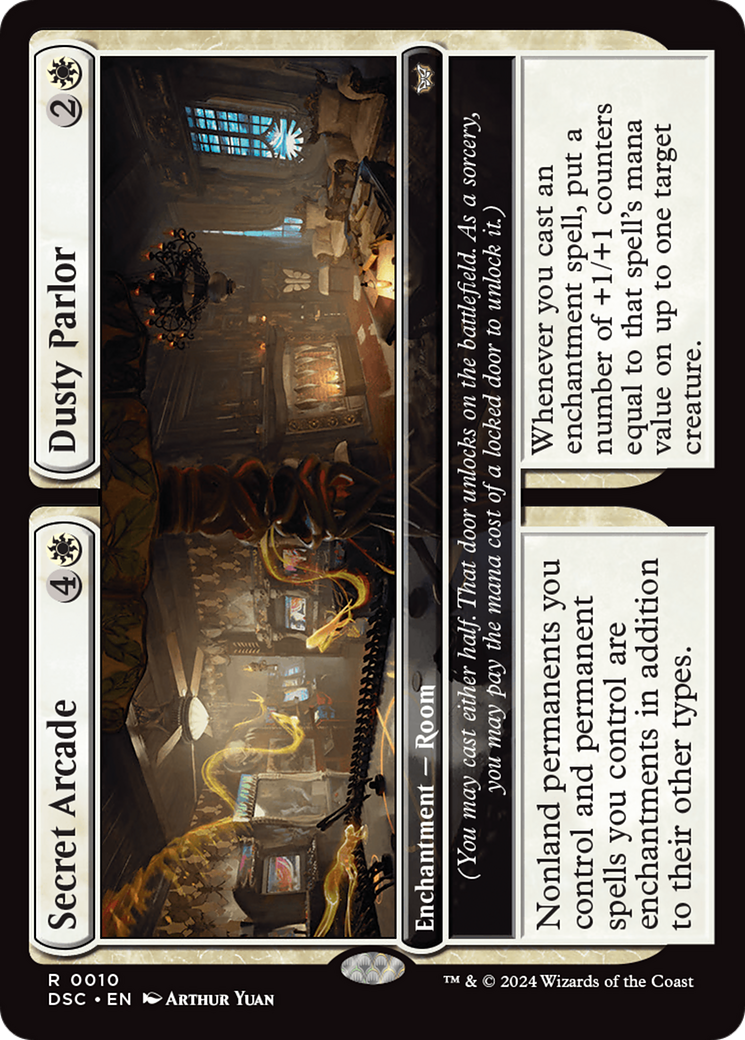
Secret Arcade // Dusty Parlor
//
Secret Arcade
Enchantment — Room
- If no creatures have died in a turn by the time that turn's end step begins, Séance Board's first ability won't trigger at all. Causing a creature to die during the end step won't cause the ability to trigger.
- If a spell has in its mana cost, use the value chosen for X when determining that spell's mana value.
- To cast a Room spell, choose a half (or "door") to cast. There's no way to cast both halves of a Room card. When the Room spell resolves, the corresponding door becomes unlocked as the Room enters.
- Room cards have two card faces with a shared type line on a single card. The characteristics of the door you didn't cast are ignored while the spell is on the stack.
- Each Room card is a single card. For example, if you discard a Room card, you've discarded one card, not two. If an effect counts the number of enchantment cards in your graveyard, Bottomless Pool // Locker Room counts once, not twice.
- Each Room card has two names. If an effect instructs you to choose a card name, you may choose one of those names, but not both.
- If an effect allows you to cast a spell with certain characteristics, consider only the characteristics of the door you're casting. For example, if an effect allows you to cast a permanent spell with mana value 3 or less from among cards in your graveyard, you could cast Bottomless Pool this way, but not Locker Room.
- While in any zone other than the stack or the battlefield, a Room card's characteristics are a combination of its two doors. For example, Bottomless Pool // Locker Room has a mana value of 6 while it's in your library. If an effect allows you to search your library for a card with mana value 4 or less, you can't find Bottomless Pool // Locker Room.
- While on the battlefield, a Room's characteristics are a combination of the characteristics of its unlocked doors. For example, if Bottomless Pool // Locker Room is on the battlefield with both doors unlocked, its names are Bottomless Pool and Locker Room, its mana value is 6, it's a Room Enchantment, and it has the abilities in each door's text box.
- If a spell or ability would create a copy of a Room spell on the stack, the copy retains the choice of which door was cast but also retains the full characteristics of the spell. The characteristics of the door that wasn't cast are still ignored while the copy is on the stack, and when the copy resolves, the token it becomes will enter with the appropriate door unlocked.
- If a Room enters from any zone other than the stack, it will enter with both halves locked.
- If neither door of a Room is unlocked, it's a Room enchantment with no name and no abilities.
- Any time you have priority during a main phase of your turn and the stack is empty, you may pay the mana cost of a locked door (also called its "unlock cost"). That door becomes unlocked. This is a special action. It doesn't use the stack and can't be responded to.
- An ability that triggers "when you unlock this door" triggers when that door becomes unlocked. This can happen one of two ways: (1) the door becomes unlocked on the battlefield or (2) the door becomes unlocked as the Room enters the battlefield because you cast the corresponding half. In the latter case, since the door becoming unlocked is what causes the ability to trigger, effects that cause abilities that trigger when a permanent enters to trigger an additional time (such as that of Panharmonicon) won't apply.
- Some abilities allow you to unlock a door of a Room you control. You can't choose to unlock a door that's already unlocked with such an ability. If such an ability requires a target, you can target a Room even if both of its doors are unlocked, but the ability won't do anything when it resolves.
- Some abilities allow you to lock a door of a Room you control. You can't choose to lock a door that's already locked with such an ability. If such an ability requires a target, you can target a Room even if both of its doors are locked, but the ability won't do anything when it resolves.
- Some doors have abilities that trigger whenever you unlock that door and require one or more targets. You can unlock that door even if there would be insufficient legal targets for that triggered ability. The triggered ability won't go on the stack.
- An ability that triggers "whenever you fully unlock a Room" triggers when a door becomes unlocked and the other door of that Room is already unlocked, or when both doors of that Room become unlocked simultaneously.
-
1
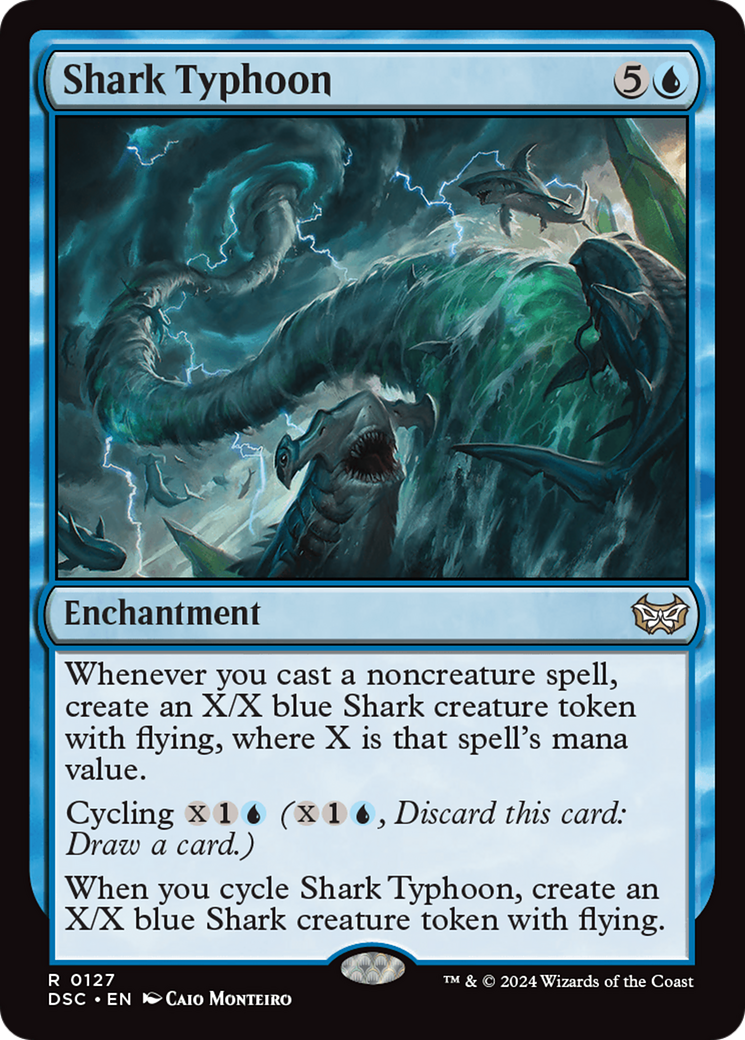
Shark Typhoon
Shark Typhoon
Enchantment
Whenever you cast a noncreature spell, create an X/X blue Shark creature token with flying, where X is that spell's mana value.
Cycling ( , Discard this card: Draw a card.)
When you cycle this card, create an X/X blue Shark creature token with flying.
- An ability that triggers when a player casts a spell resolves before the spell that caused it to trigger. It resolves even if that spell is countered.
- For spells with in their mana costs, use the value chosen for X to determine the spell's mana value.
- You can choose 0 as the value of X in Shark Typhoon's cycling cost. The last ability will trigger, and you'll create a 0/0 blue Shark creature token with flying. Unless something else is raising its toughness, the Shark will then immediately die.
- Some cards with cycling have an ability that triggers when you cycle them, and some cards have an ability that triggers whenever you cycle any card. These triggered abilities resolve before you draw from the cycling ability.
- Triggered abilities from cycling a card and the cycling ability itself aren't spells. Effects that interact with spells (such as that of Cancel) won't affect them.
- You can cycle a card even if it has a triggered ability from cycling that won't have a legal target. This is because the cycling ability and the triggered ability are separate. This also means that if either ability is countered (with Disallow, for example), the other ability will still resolve.
-
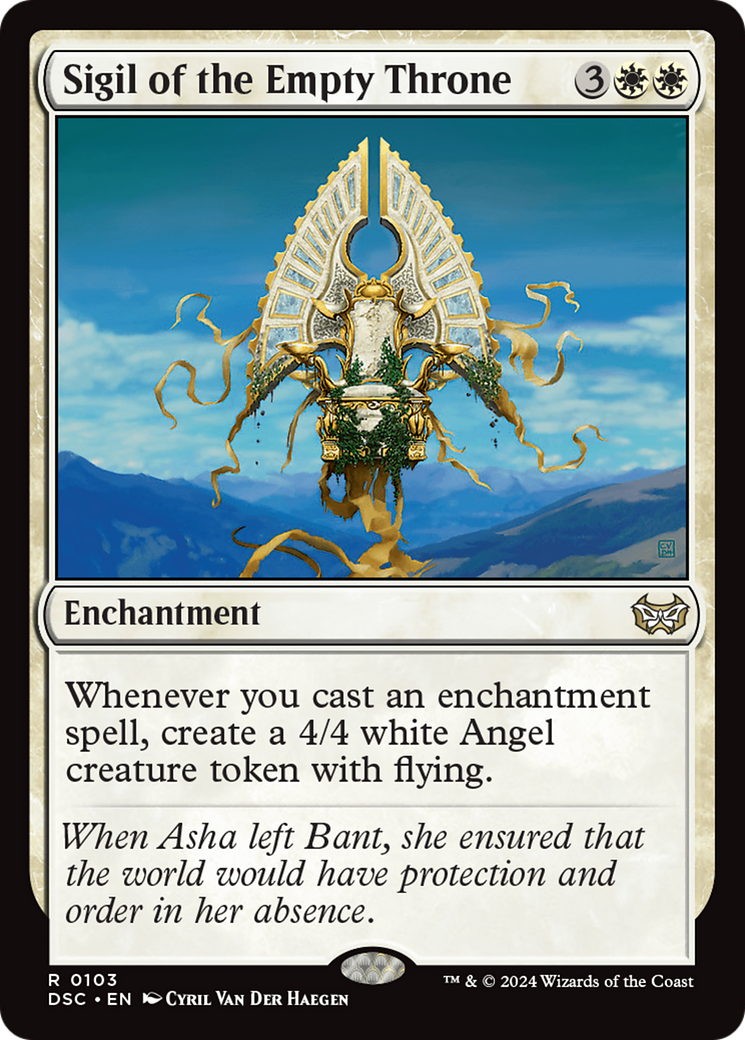
1
Sigil of the Empty Throne
Sigil of the Empty Throne
Enchantment
Whenever you cast an enchantment spell, create a 4/4 white Angel creature token with flying.
- An ability that triggers when a player casts a spell resolves before the spell that caused it to trigger, but after targets have been chosen for that spell. It resolves even if that spell is countered.
- Because it's not on the battlefield yet, casting Sigil of the Empty Throne won't cause its own ability to trigger.
-
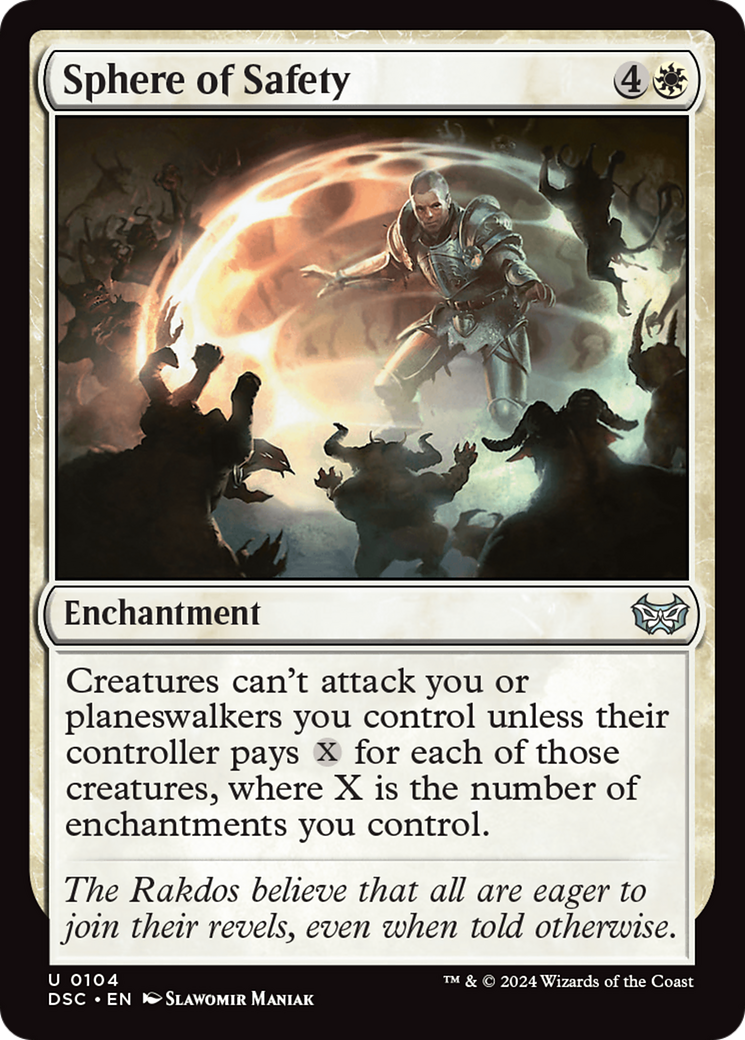
1
Sphere of Safety
Sphere of Safety
Enchantment
Creatures can't attack you or planeswalkers you control unless their controller pays for each of those creatures, where X is the number of enchantments you control.
- If you control Sphere of Safety, your opponents can choose not to attack with a creature with an ability that says it attacks if able.
-
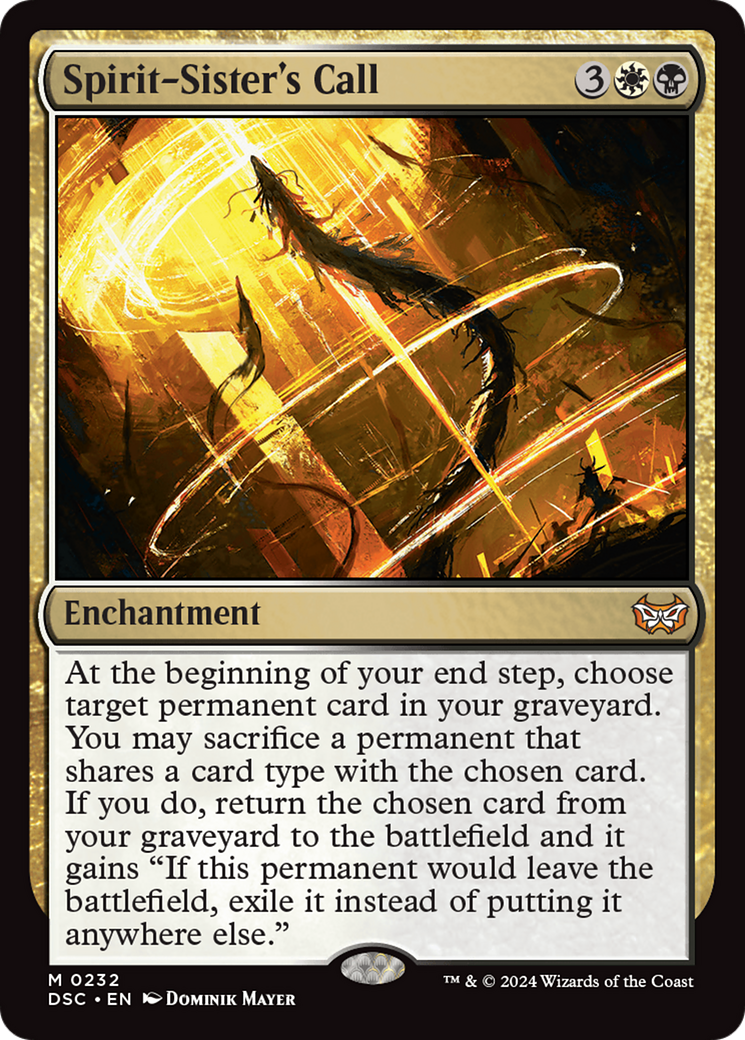
1
Spirit-Sister's Call
Spirit-Sister's Call
Enchantment
At the beginning of your end step, choose target permanent card in your graveyard. You may sacrifice a permanent that shares a card type with the chosen card. If you do, return the chosen card from your graveyard to the battlefield and it gains "If this permanent would leave the battlefield, exile it instead of putting it anywhere else."
- If Spirit-Sister's Call leaves the battlefield, the replacement effect continues to apply. If one of the permanents it returned would leave the battlefield, it'll be exiled instead.
- Because to die means to be put into a graveyard from the battlefield, a creature or planeswalker that is exiled instead doesn't "die." Abilities that would trigger when it dies won't trigger.
-
1
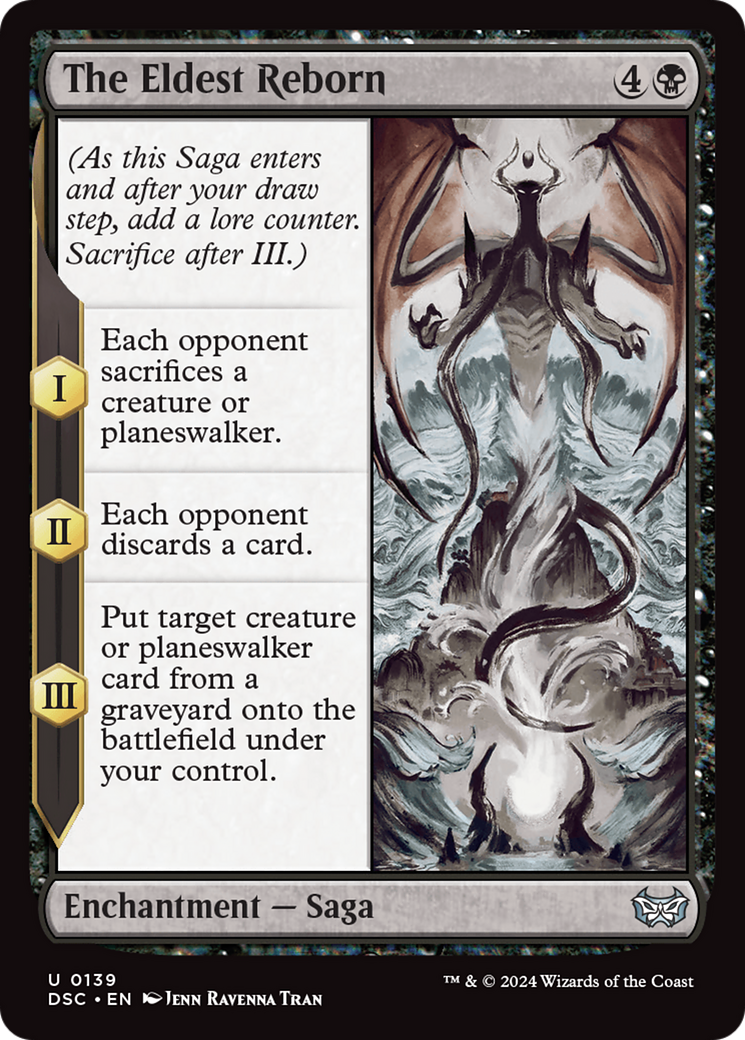
The Eldest Reborn
The Eldest Reborn
Enchantment — Saga
(As this Saga enters and after your draw step, add a lore counter. Sacrifice after III.)
I — Each opponent sacrifices a creature or planeswalker of their choice.
II — Each opponent discards a card.
III — Put target creature or planeswalker card from a graveyard onto the battlefield under your control.
- When the first chapter ability of The Eldest Reborn resolves, the next opponent in turn order (or, if it's an opponent's turn, that opponent) chooses a creature or planeswalker they control, then each other opponent in turn order (if any) does the same. All chosen permanents are then sacrificed at the same time. Players will know the choices made by earlier players when making their choices.
- When the second chapter ability of The Eldest Reborn resolves, the next opponent in turn order (or, if it's an opponent's turn, that opponent) chooses a card in hand without revealing it, then each other opponent in turn order (if any) does the same. All chosen cards are then discarded at the same time.
- In a multiplayer game, if a player leaves the game, all cards that player owns leave as well. If you leave the game, the permanent you control from The Eldest Reborn's final chapter ability is exiled.
- As a Saga enters the battlefield, its controller puts a lore counter on it. As your precombat main phase begins (immediately after your draw step), you put another lore counter on each Saga you control. Putting a lore counter on a Saga in either of these ways doesn't use the stack.
- Each symbol on the left of a Saga's text box represents a chapter ability. A chapter ability is a triggered ability that triggers when a lore counter that is put on the Saga causes the number of lore counters on the Saga to become equal to or greater than the ability's chapter number. Chapter abilities are put onto the stack and may be responded to.
- A chapter ability doesn't trigger if a lore counter is put on a Saga that already had a number of lore counters greater than or equal to that chapter's number. For example, the third lore counter put on a Saga causes the III chapter ability to trigger, but I and II won't trigger again.
- Once a chapter ability has triggered, the ability on the stack won't be affected if the Saga gains or loses counters, or if it leaves the battlefield.
- If multiple chapter abilities trigger at the same time, their controller puts them on the stack in any order. If any of them require targets, those targets are chosen as you put the abilities on the stack, before any of those abilities resolve.
- If counters are removed from a Saga, the appropriate chapter abilities will trigger again when the Saga receives lore counters. Removing lore counters won't cause a previous chapter ability to trigger.
- Once the number of lore counters on a Saga is greater than or equal to the greatest number among its chapter abilities—in the Dominaria set, this is always three—the Saga's controller sacrifices it as soon as its chapter ability has left the stack, most likely by resolving or being countered. This state-based action doesn't use the stack.
-
1
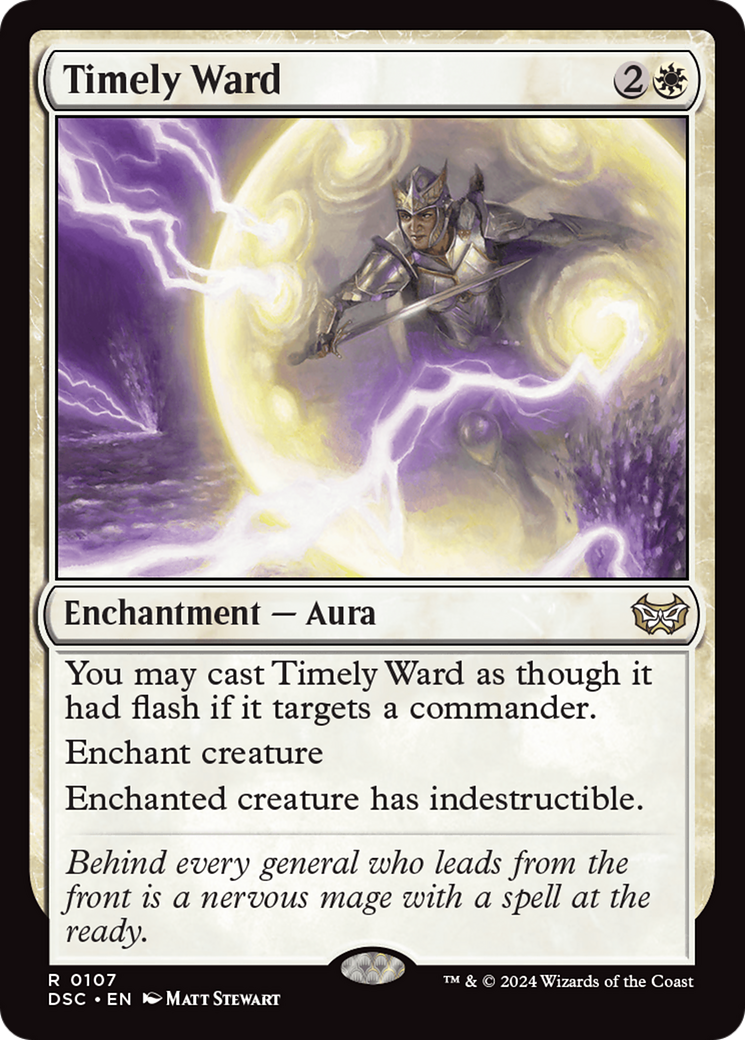
Timely Ward
Timely Ward
Enchantment — Aura
You may cast this spell as though it had flash if it targets a commander.
Enchant creature
Enchanted creature has indestructible.
Lands 37
-
1
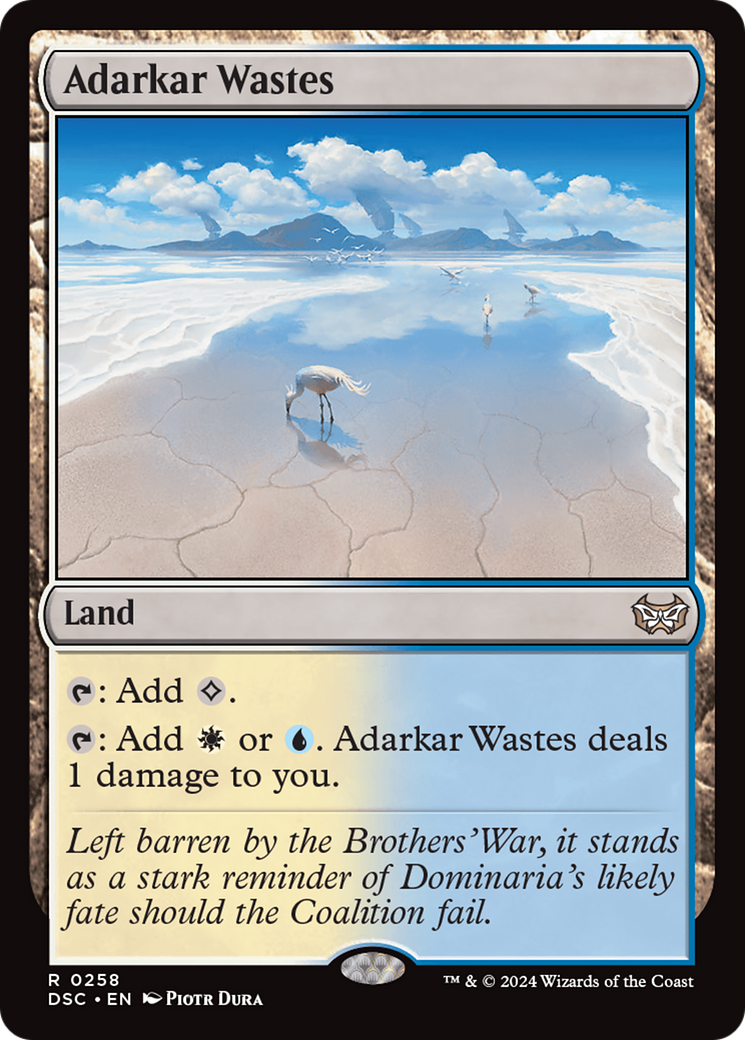
Adarkar Wastes
Adarkar Wastes
Land
: Add .
: Add or . This land deals 1 damage to you.
-
1
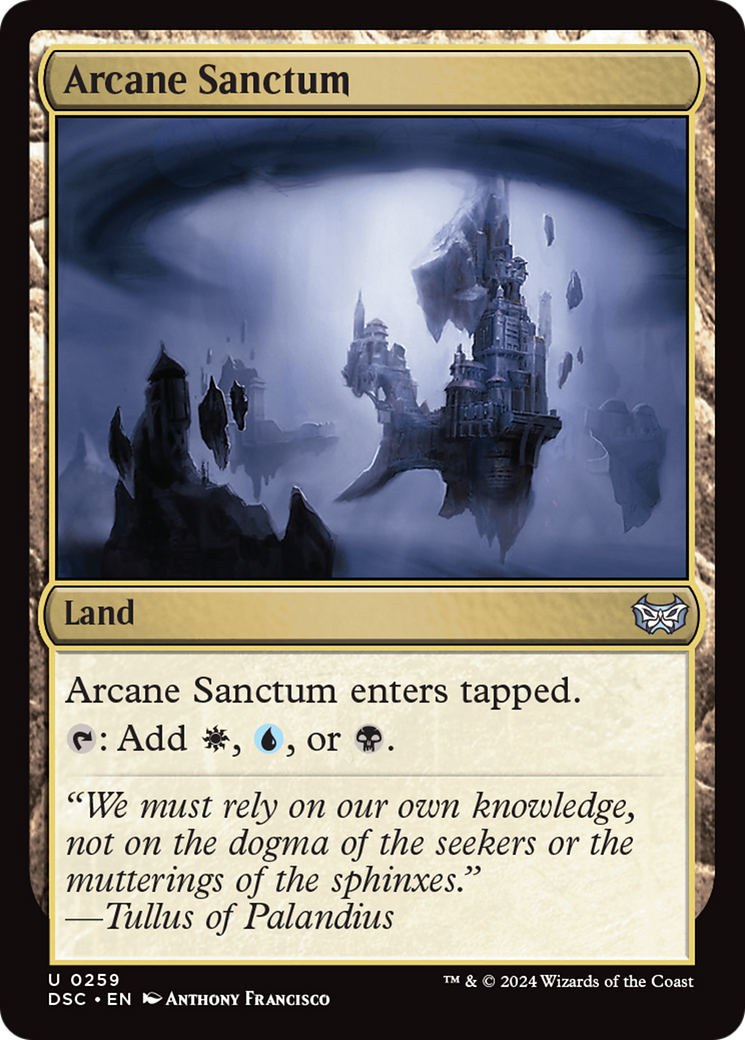
Arcane Sanctum
Arcane Sanctum
Land
This land enters tapped.
: Add , , or .
-
1
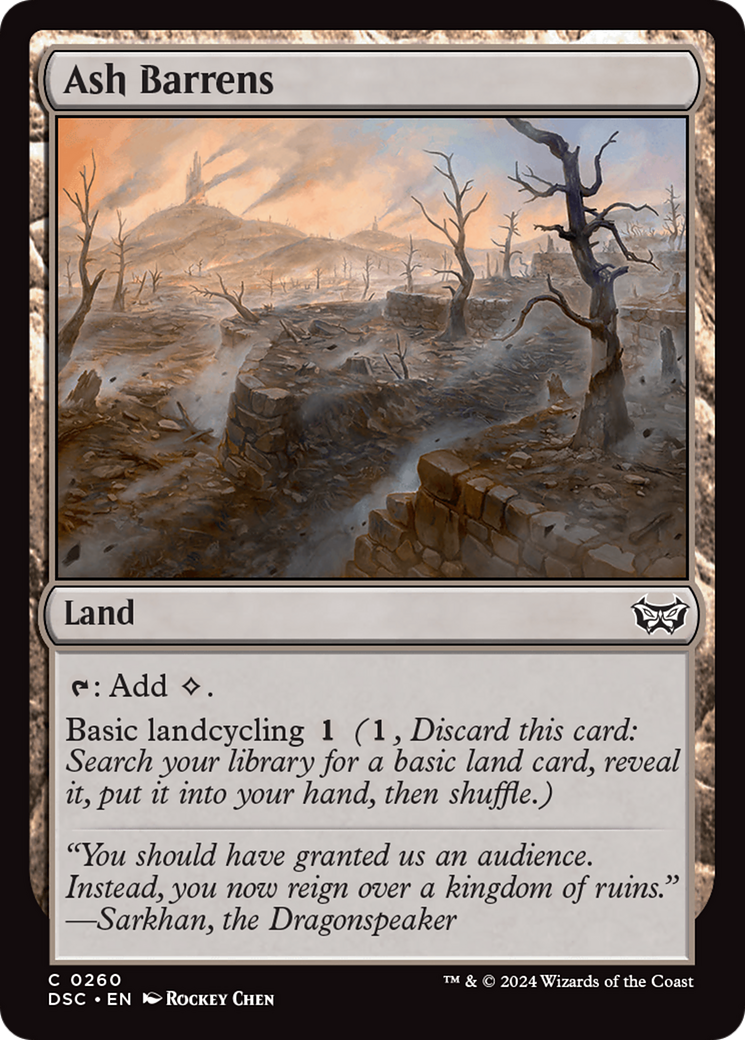
Ash Barrens
Ash Barrens
Land
: Add .
Basic landcycling ( , Discard this card: Search your library for a basic land card, reveal it, put it into your hand, then shuffle.)
-
1
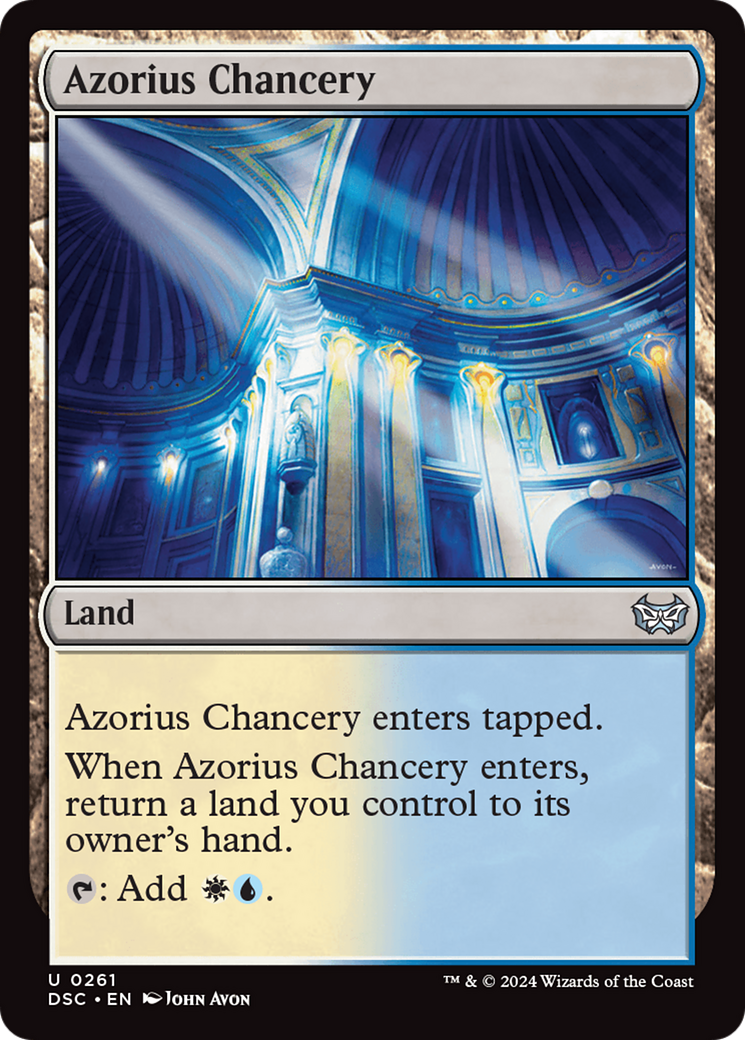
Azorius Chancery
Azorius Chancery
Land
This land enters tapped.
When this land enters, return a land you control to its owner's hand.
: Add .
- If this land enters the battlefield and you control no other lands, its ability will force you to return it to your hand.
-
1
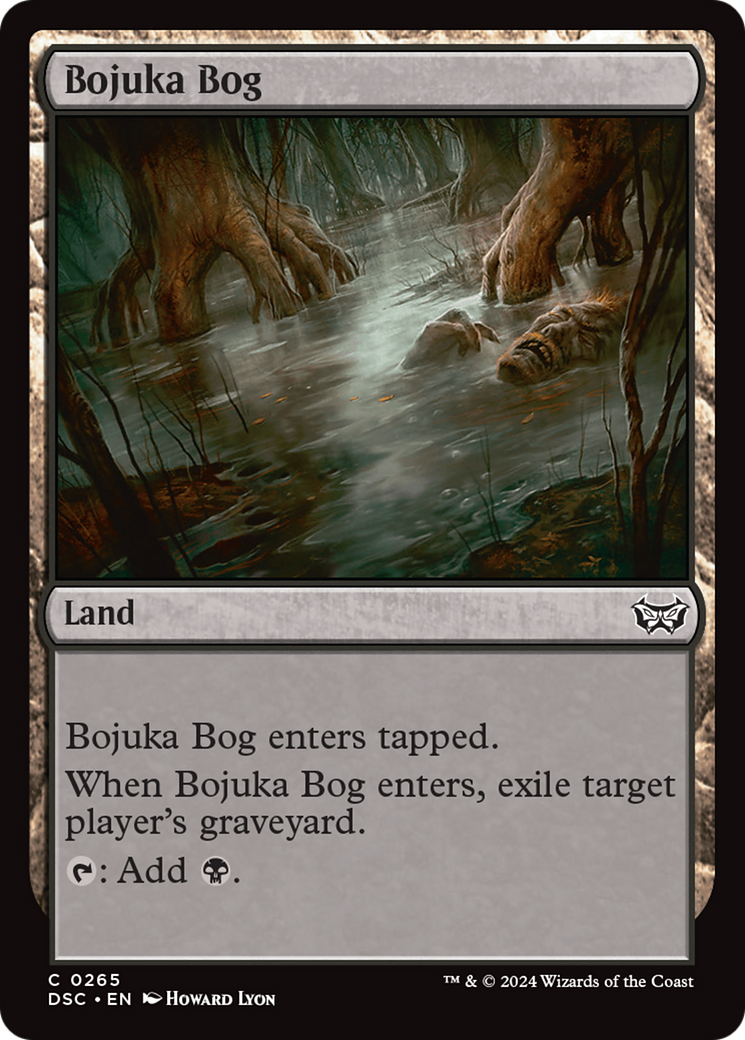
Bojuka Bog
Bojuka Bog
Land
This land enters tapped.
When this land enters, exile target player's graveyard.
: Add .
-
1
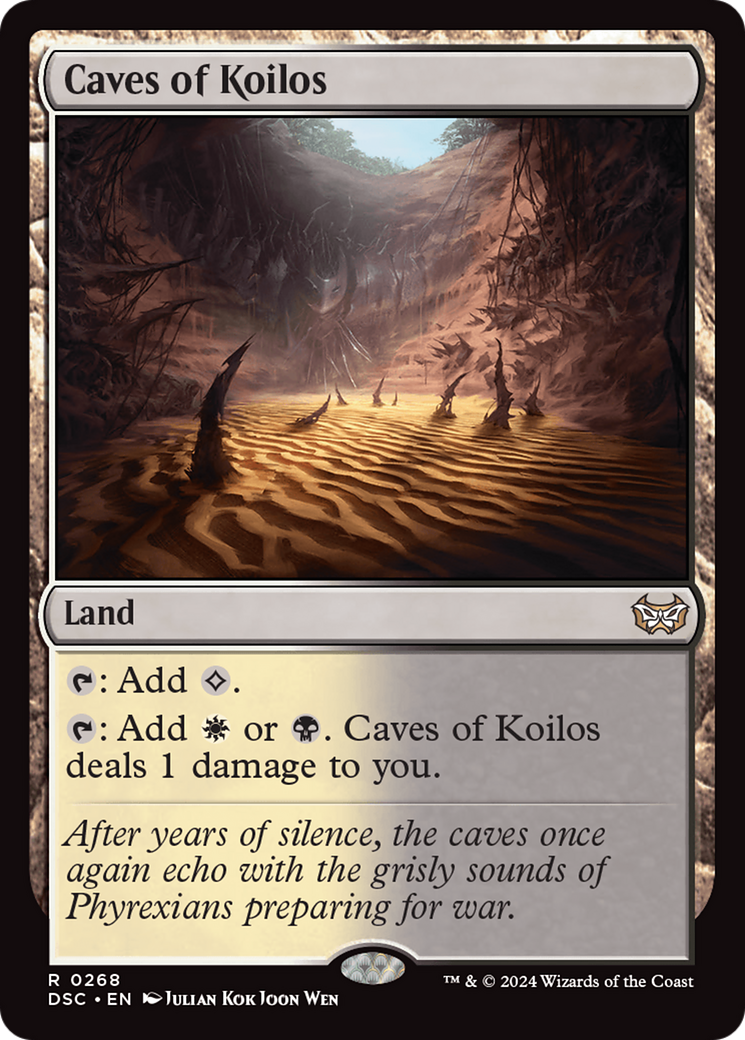
Caves of Koilos
Caves of Koilos
Land
: Add .
: Add or . This land deals 1 damage to you.
- The damage dealt to you is part of the second mana ability. It doesn't use the stack and can't be responded to.
- Like most lands, each land in this cycle is colorless. The damage dealt to you is dealt by a colorless source.
-
1
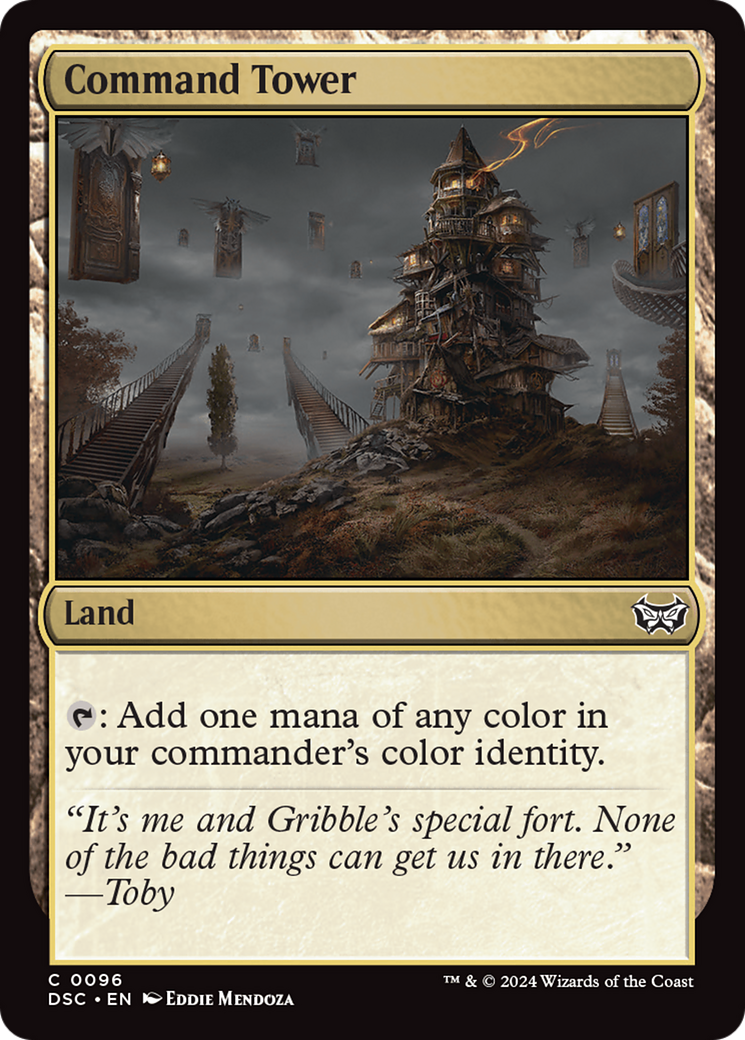
Command Tower
Command Tower
Land
: Add one mana of any color in your commander's color identity.
- If you don't have a commander, Command Tower's ability produces no mana.
- If your commander is a card that has no colors in its color identity, Command Tower's ability produces no mana. It doesn't produce .
- If you have two commanders, the ability adds one mana of any color in their combined color identities.
-
1
Dimir Aqueduct
Dimir Aqueduct
Land
This land enters tapped.
When this land enters, return a land you control to its owner's hand.
: Add .
- If this land enters the battlefield and you control no other lands, its ability will force you to return it to your hand.
-
1
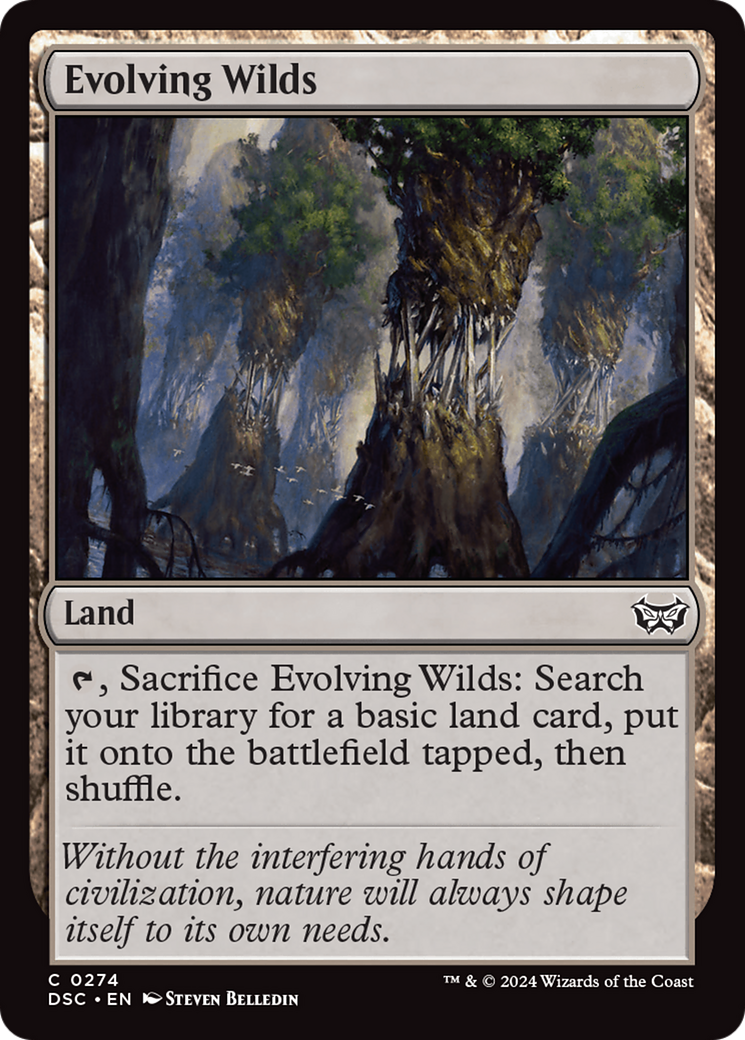
Evolving Wilds
Evolving Wilds
Land
, Sacrifice this land: Search your library for a basic land card, put it onto the battlefield tapped, then shuffle.
-
1
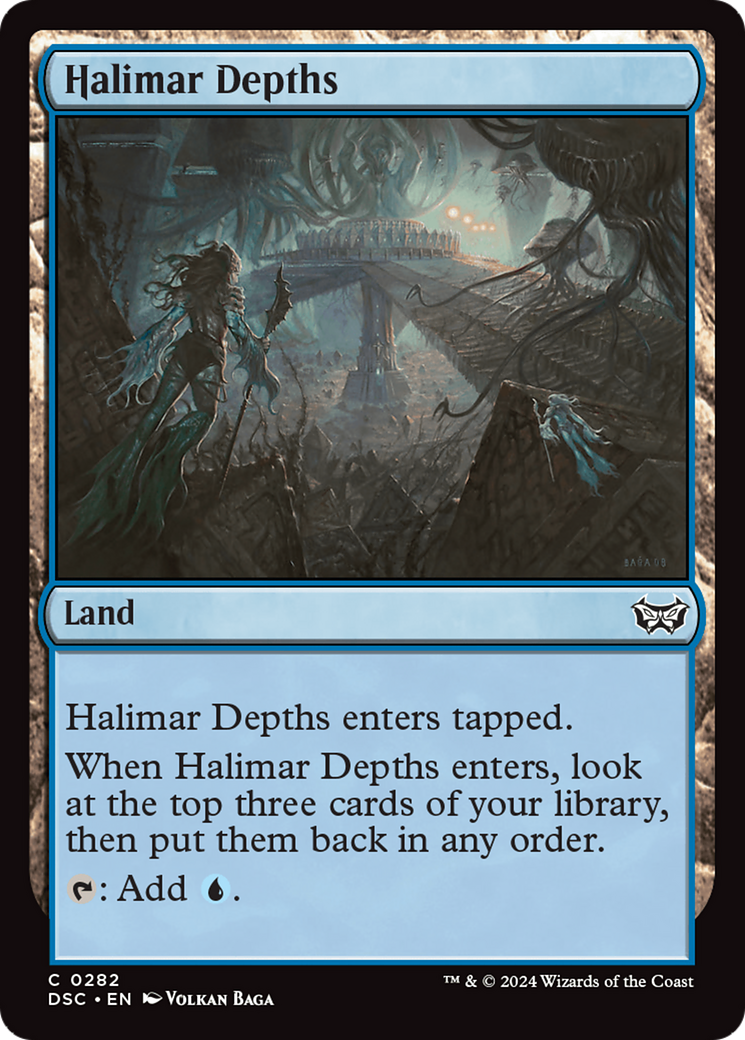
Halimar Depths
Halimar Depths
Land
This land enters tapped.
When this land enters, look at the top three cards of your library, then put them back in any order.
: Add .
-
1
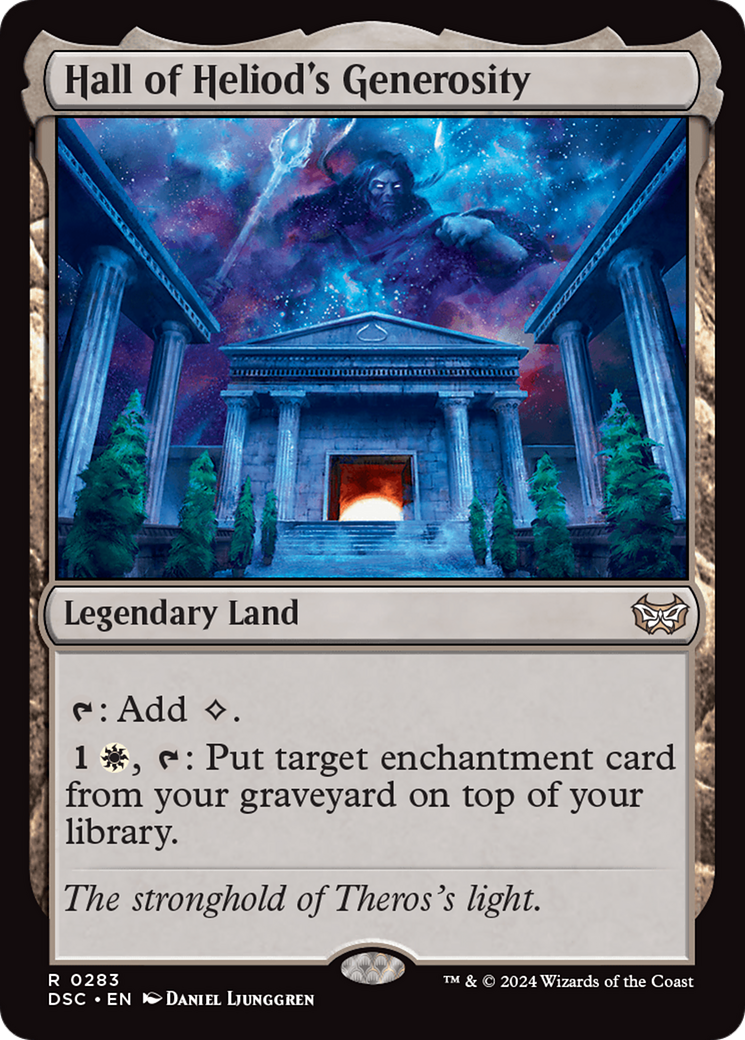
Hall of Heliod's Generosity
Hall of Heliod's Generosity
Legendary Land
: Add .
, : Put target enchantment card from your graveyard on top of your library.
-
4
Island
Island
Basic Land — Island
( : Add .)
-
1
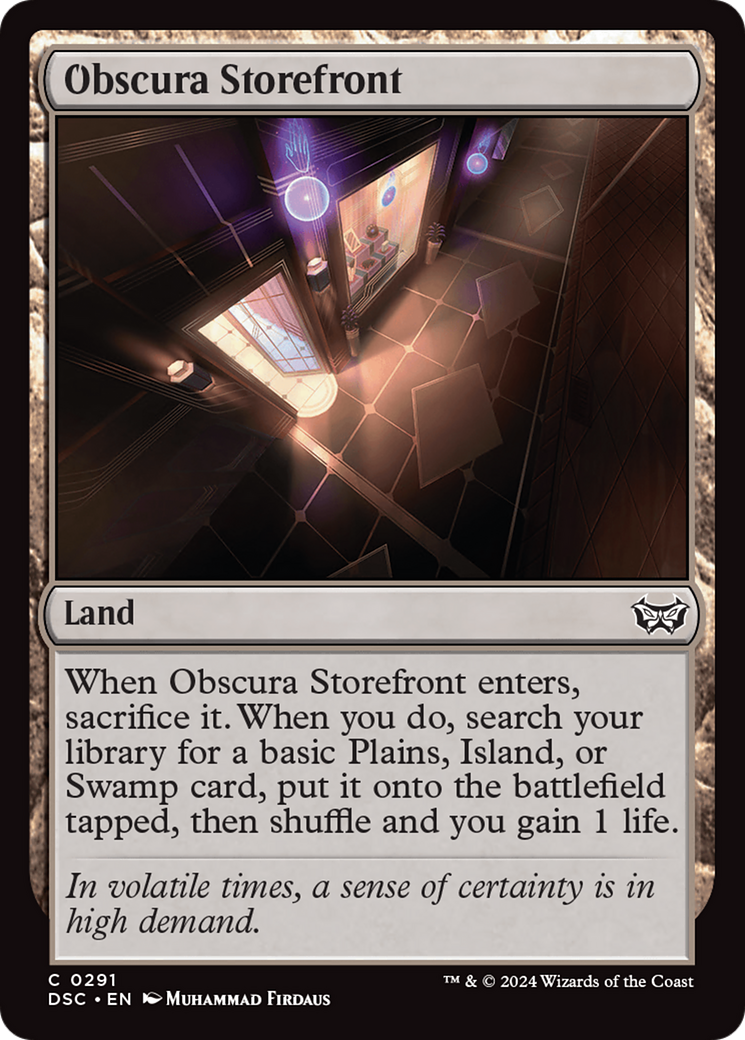
Obscura Storefront
Obscura Storefront
Land
When this land enters, sacrifice it. When you do, search your library for a basic Plains, Island, or Swamp card, put it onto the battlefield tapped, then shuffle and you gain 1 life.
-
1
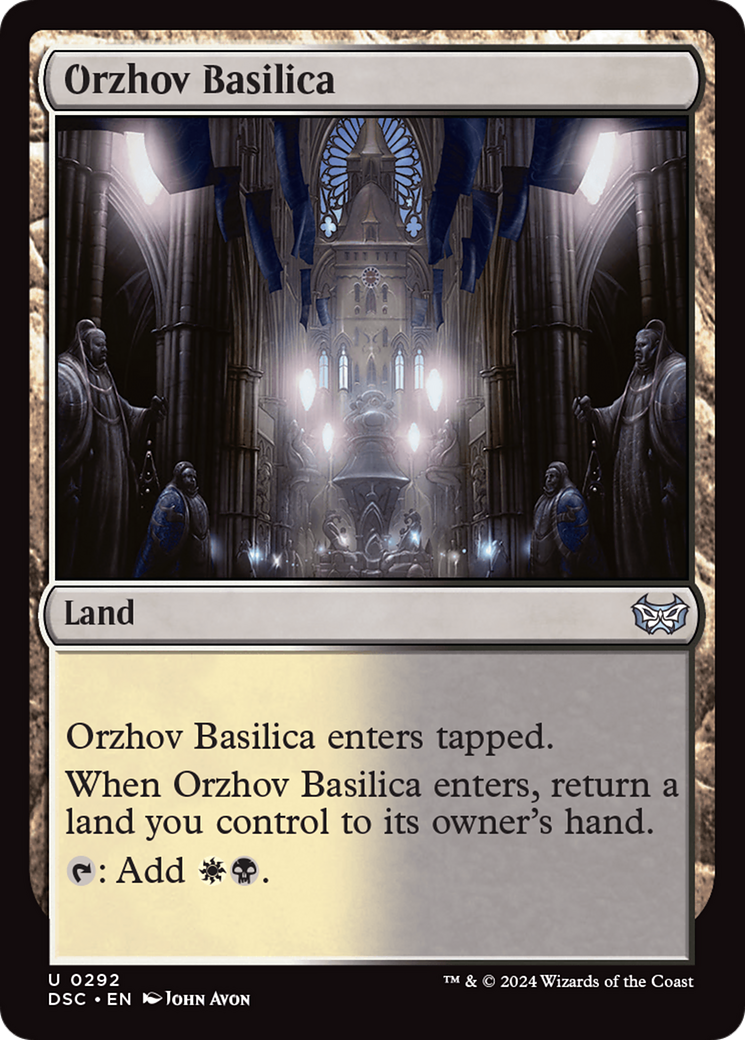
Orzhov Basilica
Orzhov Basilica
Land
This land enters tapped.
When this land enters, return a land you control to its owner's hand.
: Add .
- If this land enters the battlefield and you control no other lands, its ability will force you to return it to your hand.
-
5
Plains
Plains
Basic Land — Plains
( : Add .)
-
5
Swamp
Swamp
Basic Land — Swamp
( : Add .)
-
1
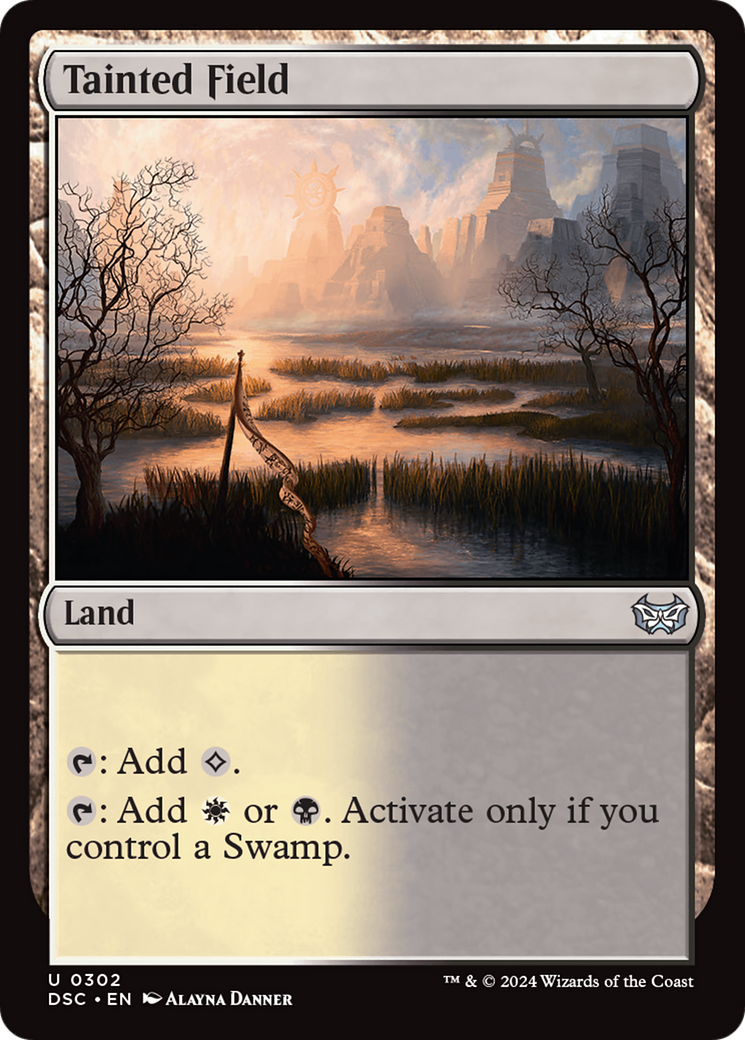
Tainted Field
Tainted Field
Land
: Add .
: Add or . Activate only if you control a Swamp.
-
1
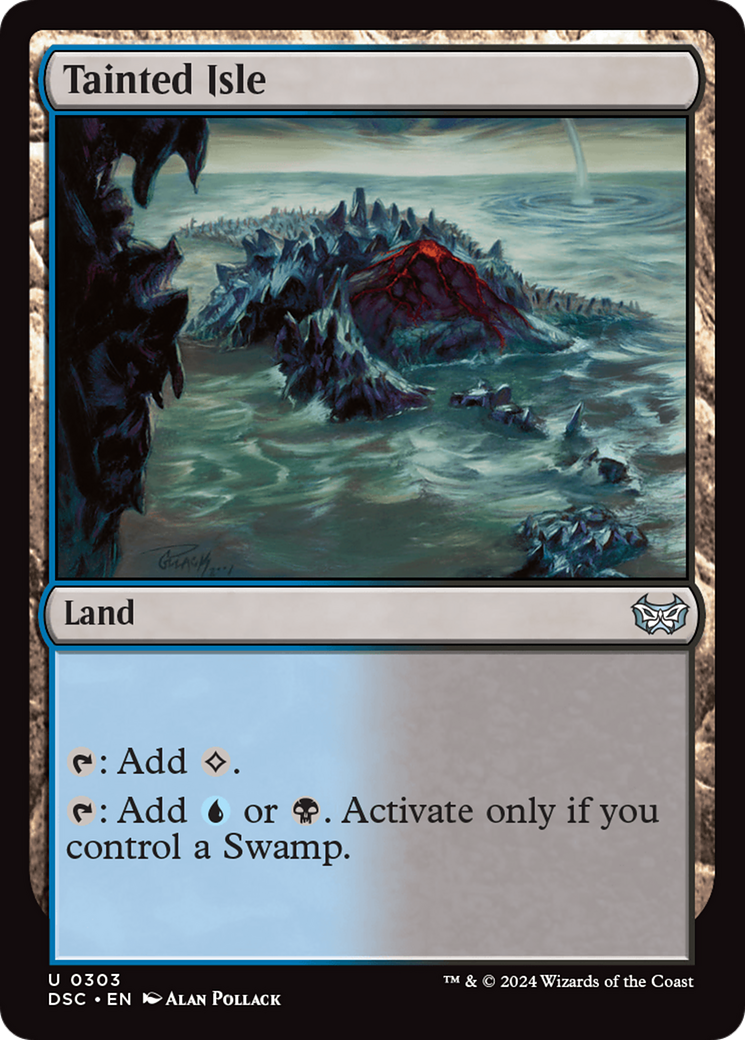
Tainted Isle
Tainted Isle
Land
: Add .
: Add or . Activate only if you control a Swamp.
-
1
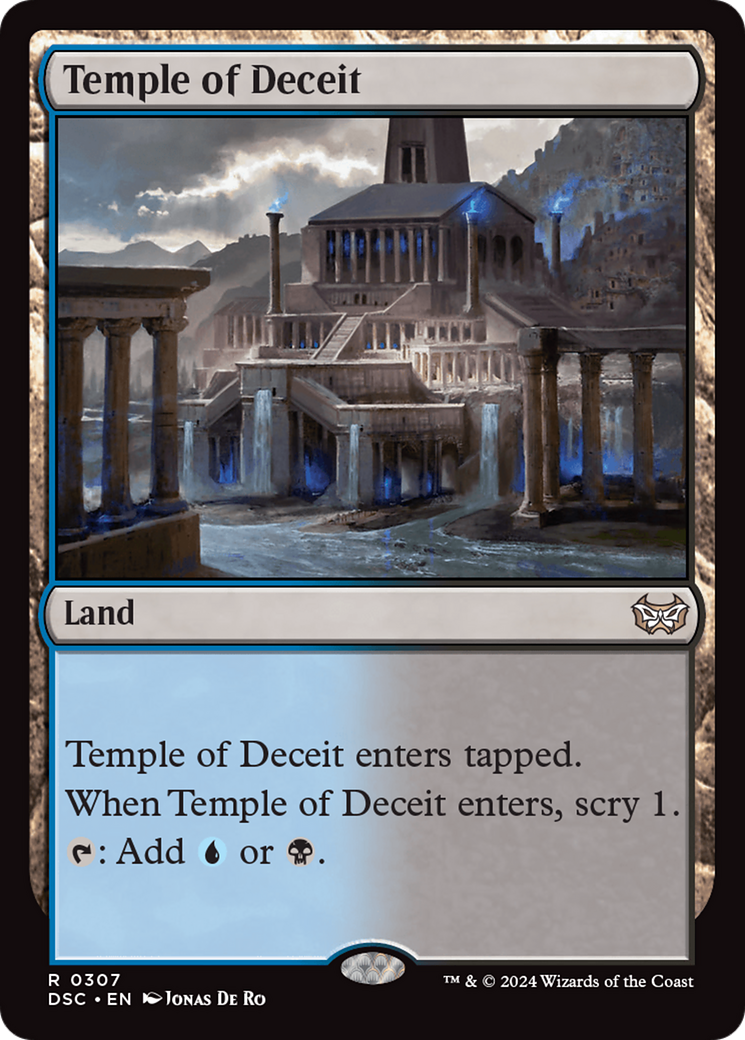
Temple of Deceit
Temple of Deceit
Land
This land enters tapped.
When this land enters, scry 1. (Look at the top card of your library. You may put that card on the bottom.)
: Add or .
- When you scry, you may put all the cards you look at back on top of your library, you may put all of those cards on the bottom of your library, or you may put some of those cards on top and the rest of them on the bottom.
- You choose how to order cards returned to your library after scrying no matter where you put them.
- You perform the actions stated on a card in sequence. For some spells and abilities, that means you'll scry last. For others, that means you'll scry and then perform other actions.
- Scry appears on some spells and abilities with one or more targets. If all of the spell or ability's targets are illegal when it tries to resolve, it won't resolve and none of its effects will happen. You won't scry.
-
1
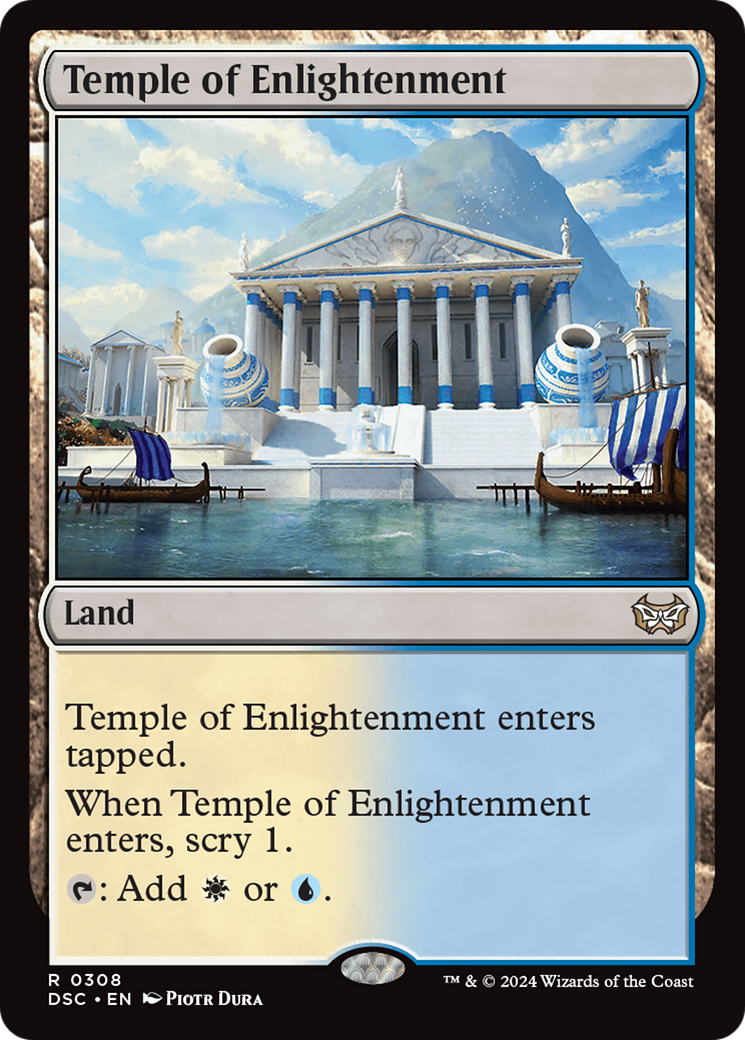
Temple of Enlightenment
Temple of Enlightenment
Land
This land enters tapped.
When this land enters, scry 1. (Look at the top card of your library. You may put that card on the bottom.)
: Add or .
- When you scry, you may put all the cards you look at back on top of your library, you may put all of those cards on the bottom of your library, or you may put some of those cards on top and the rest of them on the bottom.
- You choose how to order cards returned to your library after scrying no matter where you put them.
- You perform the actions stated on a card in sequence. For some spells and abilities, that means you'll scry last. For others, that means you'll scry and then perform other actions.
- Scry appears on some spells and abilities with one or more targets. If all of the spell or ability's targets are illegal when it tries to resolve, it won't resolve and none of its effects will happen. You won't scry.
-
1
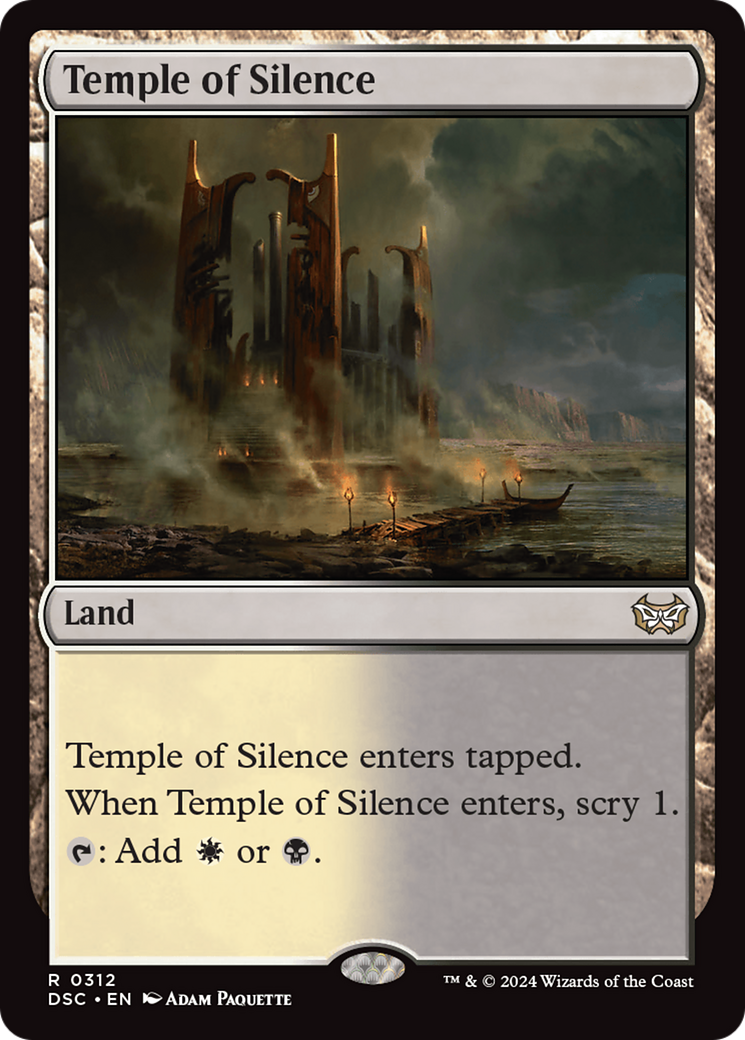
Temple of Silence
Temple of Silence
Land
This land enters tapped.
When this land enters, scry 1. (Look at the top card of your library. You may put that card on the bottom.)
: Add or .
- When you scry, you may put all the cards you look at back on top of your library, you may put all of those cards on the bottom of your library, or you may put some of those cards on top and the rest of them on the bottom.
- You choose how to order cards returned to your library after scrying no matter where you put them.
- You perform the actions stated on a card in sequence. For some spells and abilities, that means you'll scry last. For others, that means you'll scry and then perform other actions.
- Scry appears on some spells and abilities with one or more targets. If all of the spell or ability's targets are illegal when it tries to resolve, it won't resolve and none of its effects will happen. You won't scry.
-
1
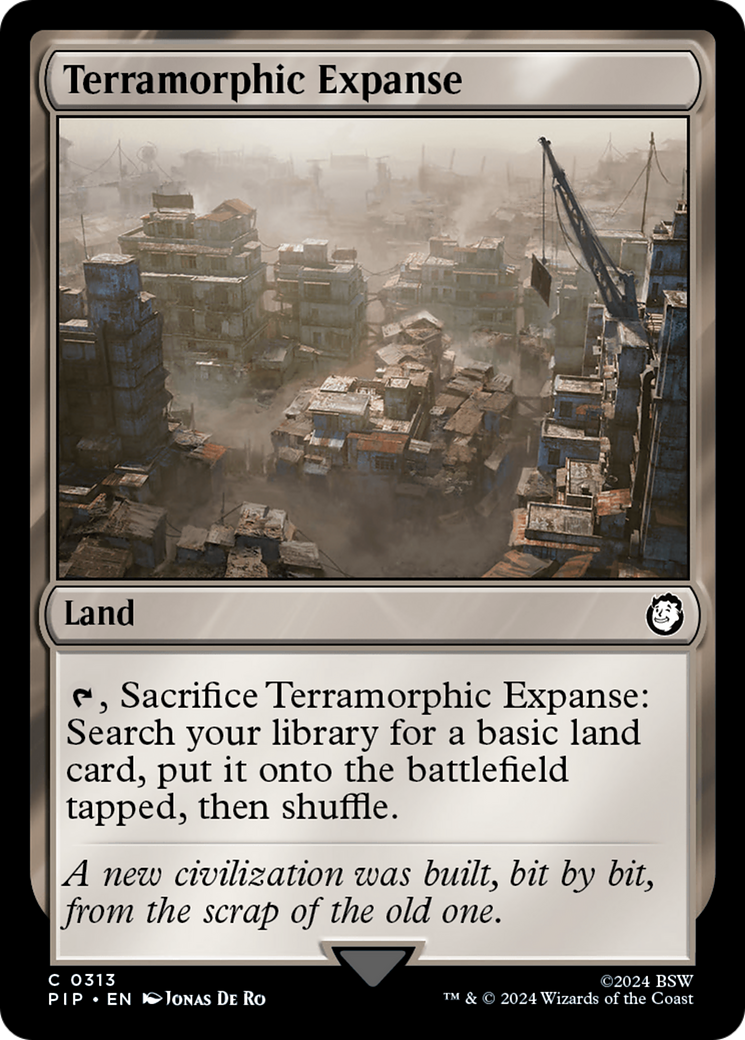
Terramorphic Expanse
Terramorphic Expanse
Land
, Sacrifice this land: Search your library for a basic land card, put it onto the battlefield tapped, then shuffle.
-
1
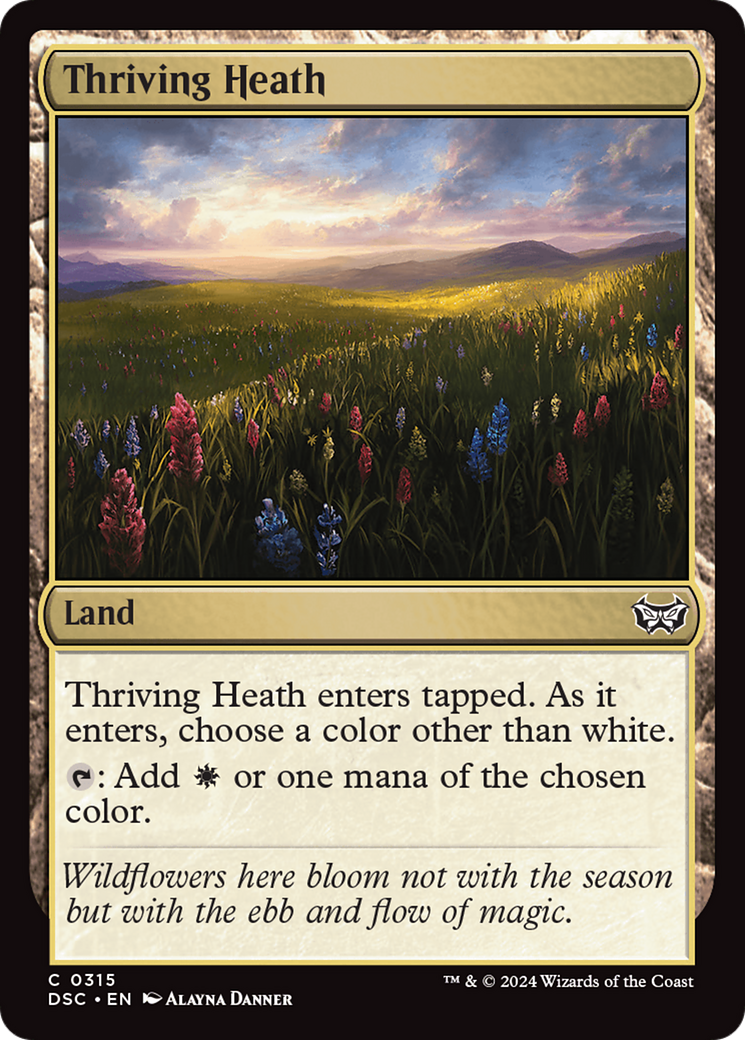
Thriving Heath
Thriving Heath
Land
This land enters tapped. As it enters, choose a color other than white.
: Add or one mana of the chosen color.
-
1
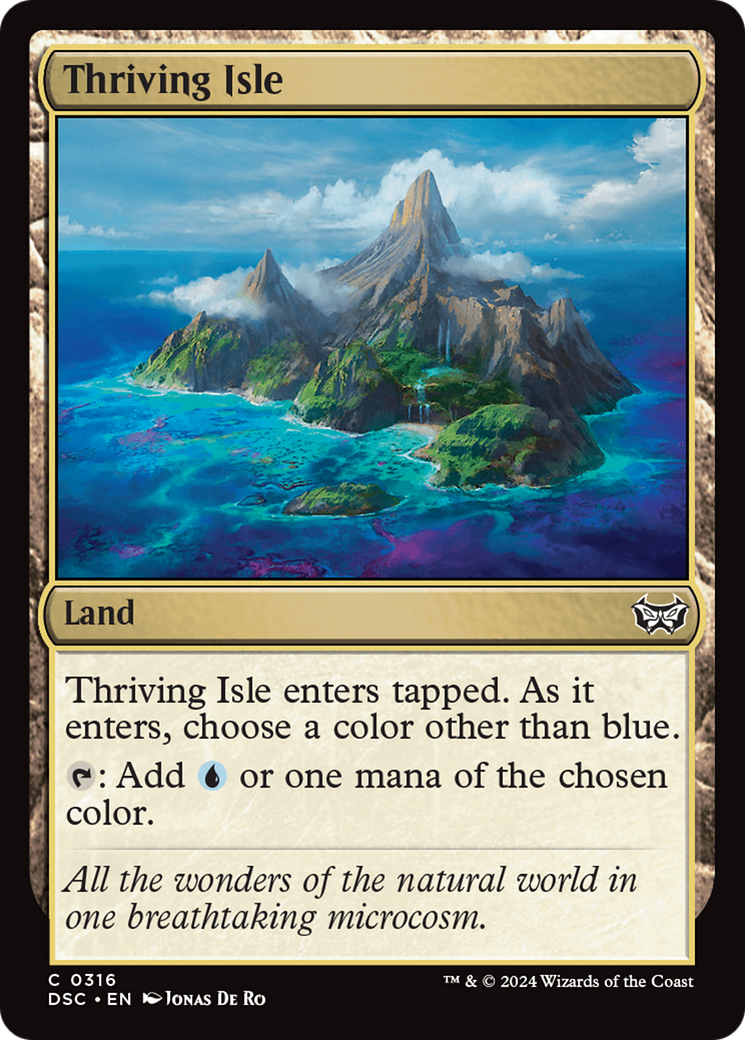
Thriving Isle
Thriving Isle
Land
This land enters tapped. As it enters, choose a color other than blue.
: Add or one mana of the chosen color.
-
1
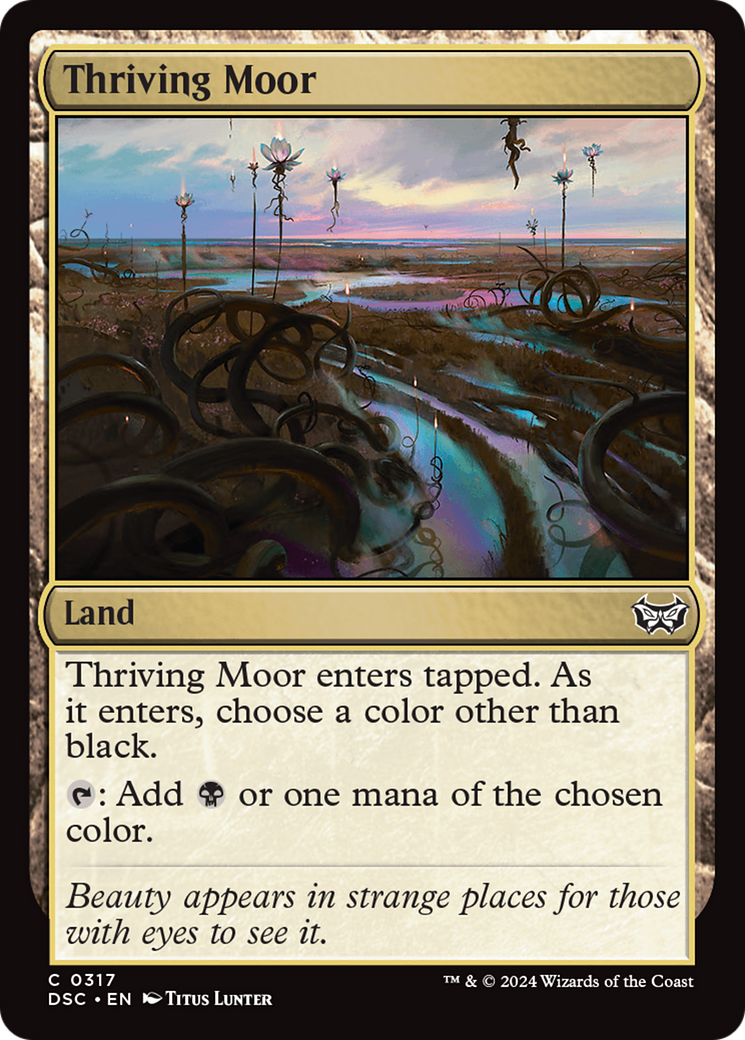
Thriving Moor
Thriving Moor
Land
This land enters tapped. As it enters, choose a color other than black.
: Add or one mana of the chosen color.
-
1
Underground River
Underground River
Land
: Add .
: Add or . This land deals 1 damage to you.
White 18
-
1
Auramancer
Auramancer
Creature — Human Wizard
2/2
When this creature enters, you may return target enchantment card from your graveyard to your hand.
-
1
Cast Out
Cast Out
Enchantment
Flash
When this enchantment enters, exile target nonland permanent an opponent controls until this enchantment leaves the battlefield.
Cycling ( , Discard this card: Draw a card.)
- If Cast Out leaves the battlefield before its triggered ability resolves, the target permanent won't be exiled.
- Auras attached to the exiled permanent will be put into their owners' graveyards. Any Equipment will become unattached and remain on the battlefield. Any counters on the exiled permanent will cease to exist.
- If a token is exiled this way, it will cease to exist and won't return to the battlefield.
- The exiled card returns to the battlefield immediately after Cast Out leaves the battlefield. Nothing happens between the two events, including state-based actions.
- In a multiplayer game, if Cast Out's owner leaves the game, the exiled card will return to the battlefield. Because the one-shot effect that returns the card isn't an ability that goes on the stack, it won't cease to exist along with the leaving player's spells and abilities on the stack.
-
1
Entreat the Angels
Entreat the Angels
Sorcery
Create X 4/4 white Angel creature tokens with flying.
Miracle (You may cast this card for its miracle cost when you draw it if it's the first card you drew this turn.)
- You still draw the card, whether you use the miracle ability or not. Any ability that triggers whenever you draw a card, for example, will trigger. If you don't cast the card using its miracle ability, it will remain in your hand.
- To determine the total cost of a spell, start with the mana cost or alternative cost (such as a miracle cost) you're paying, add any cost increases, then apply any cost reductions. The mana value of the spell remains unchanged, no matter what the total cost to cast it was.
- If the card with miracle leaves your hand before the triggered ability resolves, you won't be able to cast it using its miracle ability.
- It's important to reveal a card with miracle before it is mixed with the other cards in your hand.
- You can reveal and cast a card with miracle on any turn, not just your own, if it's the first card you've drawn that turn.
- Multiple card draws are always treated as a sequence of individual card draws. For example, if you haven't drawn any cards yet during a turn and cast a spell that instructs you to draw three cards, you'll draw them one at a time. Only the first card drawn this way may be revealed and cast using its miracle ability.
- If an effect puts a card into your hand without using the word "draw," the card wasn't drawn.
- You don't have to reveal a drawn card with miracle if you don't wish to cast it at that time.
- You can cast a card for its miracle cost only as the miracle triggered ability resolves. If you don't want to cast it at that time (or you can't cast it, perhaps because there are no legal targets available), you won't be able to cast it later for the miracle cost.
- You cast the card with miracle during the resolution of the triggered ability. Ignore any timing rules based on the card's type.
- Miracle is an alternative cost to cast the spell with miracle. It can't be combined with other alternative costs, such as casting a spell "without paying its mana cost."
- Entreat the Angels's mana value is based on its mana cost of , even if you're casting it for its miracle cost. For example, if you cast Entreat the Angels for its miracle cost and choose 4 for X, its mana value is 11.
- A mana cost of means that you pay twice X. If you want X to be 3, you pay to cast Entreat the Angels.
-
1
Mesa Enchantress
Mesa Enchantress
Creature — Human Druid
0/2
Whenever you cast an enchantment spell, you may draw a card.
- Mesa Enchantress's ability will resolve before the spell that caused it to trigger.
- If the enchantment spell is countered, Mesa Enchantress's ability still resolves and causes you to draw a card.
- Enchantments put onto the battlefield without being cast won't cause Mesa Enchantress's ability to trigger.
-
1
Monologue Tax
Monologue Tax
Enchantment
Whenever an opponent casts their second spell each turn, you create a Treasure token.
- Nothing special happens on the third spell, fourth spell, and so on.
- It doesn't matter if Monologue Tax was on the battlefield for the first spell. It also doesn't matter if that first spell resolved or not.
- The ability can trigger once each turn for each opponent.
-
1
Moon-Blessed Cleric
Moon-Blessed Cleric
Creature — Human Elf Cleric
3/2
Divine Intervention — When this creature enters, you may search your library for an enchantment card, reveal it, then shuffle and put that card on top.
-
1
Ondu Spiritdancer
Ondu Spiritdancer
Creature — Kor Cleric
3/3
Whenever an enchantment you control enters, you may create a token that's a copy of it. Do this only once each turn.
- Once you choose to create a token copy of an enchantment during the resolution of Ondu Spiritdancer's ability, that ability won't trigger again that turn, no matter how many more enchantments enter the battlefield under your control.
- If multiple instances of the ability are on the stack (perhaps because multiple enchantments entered the battlefield under your control at the same time), you will be able to create a token copy of an enchantment for only one of those instances. Once you do that, other instances will do nothing as they resolve.
- If an Aura is put onto the battlefield without being cast, such as by being created as a token, the Aura's controller-to-be chooses what it will enchant as it enters the battlefield. An Aura put onto the battlefield this way doesn't target anything (so it could be attached to an opponent's permanent with hexproof, for example), but the Aura's enchant ability restricts what it can be attached to. If an Aura token can't legally be attached to anything, it isn't created.
- Each token copies exactly what was printed on the original enchantment and nothing else (unless that enchantment is copying something else or is a token; see below). It doesn't copy whether that enchantment is tapped or untapped, whether it has any counters on it or Auras and Equipment attached to it, or any non-copy effects that have changed its power, toughness, types, color, or so on.
- If the copied enchantment has in its mana cost, X is 0.
- If the copied enchantment is a token, the token that's created copies the original characteristics of that token as stated by the effect that created the token.
- If the copied enchantment is copying something else, then the token enters the battlefield as whatever that enchantment copied.
- Any enters-the-battlefield abilities of the copied enchantment will trigger when the token enters the battlefield. Any "as [this enchantment] enters the battlefield" or "[this enchantment] enters the battlefield with" abilities of the enchantment will also work.
-
1
Redress Fate
Redress Fate
Sorcery
Return all artifact and enchantment cards from your graveyard to the battlefield.
Miracle (You may cast this card for its miracle cost when you draw it if it's the first card you drew this turn.)
- If an Aura is put onto the battlefield without being cast, the Aura's controller-to-be chooses what it will enchant as it comes back onto the battlefield. An Aura put onto the battlefield this way doesn't target anything (so it could be attached to an opponent's permanent with hexproof, for example), but the Aura's enchant ability restricts what it can be attached to. If the Aura can't legally be attached to anything, it remains in its current zone.
- If an Aura is being put onto the battlefield at the same time as a creature, that Aura can't enchant that creature.
-
1
Return to Dust
Return to Dust
Instant
Exile target artifact or enchantment. If you cast this spell during your main phase, you may exile up to one other target artifact or enchantment.
- Return to Dust can always target a second artifact or enchantment; it just won't exile it if it's not your main phase when you cast Return to Dust.
- If a spell or ability copies Return to Dust, the copy exiles only the first target artifact or enchantment. This is because the copy wasn't cast at all.
-
1
Secret Arcade // Dusty Parlor
//
Secret Arcade
Enchantment — Room
- If no creatures have died in a turn by the time that turn's end step begins, Séance Board's first ability won't trigger at all. Causing a creature to die during the end step won't cause the ability to trigger.
- If a spell has in its mana cost, use the value chosen for X when determining that spell's mana value.
- To cast a Room spell, choose a half (or "door") to cast. There's no way to cast both halves of a Room card. When the Room spell resolves, the corresponding door becomes unlocked as the Room enters.
- Room cards have two card faces with a shared type line on a single card. The characteristics of the door you didn't cast are ignored while the spell is on the stack.
- Each Room card is a single card. For example, if you discard a Room card, you've discarded one card, not two. If an effect counts the number of enchantment cards in your graveyard, Bottomless Pool // Locker Room counts once, not twice.
- Each Room card has two names. If an effect instructs you to choose a card name, you may choose one of those names, but not both.
- If an effect allows you to cast a spell with certain characteristics, consider only the characteristics of the door you're casting. For example, if an effect allows you to cast a permanent spell with mana value 3 or less from among cards in your graveyard, you could cast Bottomless Pool this way, but not Locker Room.
- While in any zone other than the stack or the battlefield, a Room card's characteristics are a combination of its two doors. For example, Bottomless Pool // Locker Room has a mana value of 6 while it's in your library. If an effect allows you to search your library for a card with mana value 4 or less, you can't find Bottomless Pool // Locker Room.
- While on the battlefield, a Room's characteristics are a combination of the characteristics of its unlocked doors. For example, if Bottomless Pool // Locker Room is on the battlefield with both doors unlocked, its names are Bottomless Pool and Locker Room, its mana value is 6, it's a Room Enchantment, and it has the abilities in each door's text box.
- If a spell or ability would create a copy of a Room spell on the stack, the copy retains the choice of which door was cast but also retains the full characteristics of the spell. The characteristics of the door that wasn't cast are still ignored while the copy is on the stack, and when the copy resolves, the token it becomes will enter with the appropriate door unlocked.
- If a Room enters from any zone other than the stack, it will enter with both halves locked.
- If neither door of a Room is unlocked, it's a Room enchantment with no name and no abilities.
- Any time you have priority during a main phase of your turn and the stack is empty, you may pay the mana cost of a locked door (also called its "unlock cost"). That door becomes unlocked. This is a special action. It doesn't use the stack and can't be responded to.
- An ability that triggers "when you unlock this door" triggers when that door becomes unlocked. This can happen one of two ways: (1) the door becomes unlocked on the battlefield or (2) the door becomes unlocked as the Room enters the battlefield because you cast the corresponding half. In the latter case, since the door becoming unlocked is what causes the ability to trigger, effects that cause abilities that trigger when a permanent enters to trigger an additional time (such as that of Panharmonicon) won't apply.
- Some abilities allow you to unlock a door of a Room you control. You can't choose to unlock a door that's already unlocked with such an ability. If such an ability requires a target, you can target a Room even if both of its doors are unlocked, but the ability won't do anything when it resolves.
- Some abilities allow you to lock a door of a Room you control. You can't choose to lock a door that's already locked with such an ability. If such an ability requires a target, you can target a Room even if both of its doors are locked, but the ability won't do anything when it resolves.
- Some doors have abilities that trigger whenever you unlock that door and require one or more targets. You can unlock that door even if there would be insufficient legal targets for that triggered ability. The triggered ability won't go on the stack.
- An ability that triggers "whenever you fully unlock a Room" triggers when a door becomes unlocked and the other door of that Room is already unlocked, or when both doors of that Room become unlocked simultaneously.
-
1
Sigil of the Empty Throne
Sigil of the Empty Throne
Enchantment
Whenever you cast an enchantment spell, create a 4/4 white Angel creature token with flying.
- An ability that triggers when a player casts a spell resolves before the spell that caused it to trigger, but after targets have been chosen for that spell. It resolves even if that spell is countered.
- Because it's not on the battlefield yet, casting Sigil of the Empty Throne won't cause its own ability to trigger.
-
1
Soaring Lightbringer
Soaring Lightbringer
Enchantment Creature — Bird Glimmer
4/5
Flying
Other enchantment creatures you control have flying.
Whenever you attack a player, create a 1/1 white Glimmer enchantment creature token that's tapped and attacking that player.
- Soaring Lightbringer's last ability will trigger once for each player you attack.
-
1
Sphere of Safety
Sphere of Safety
Enchantment
Creatures can't attack you or planeswalkers you control unless their controller pays for each of those creatures, where X is the number of enchantments you control.
- If you control Sphere of Safety, your opponents can choose not to attack with a creature with an ability that says it attacks if able.
-
1
Starfield Mystic
Starfield Mystic
Creature — Human Cleric
2/2
Enchantment spells you cast cost less to cast.
Whenever an enchantment you control is put into a graveyard from the battlefield, put a +1/+1 counter on this creature.
- If you cast an Aura spell targeting an opponent's permanent, you still control the Aura after it resolves.
-
1
Swords to Plowshares
Swords to Plowshares
Instant
Exile target creature. Its controller gains life equal to its power.
- Use the power of the creature from when it was last on the battlefield to determine how much life is gained.
-
1
Terminus
Terminus
Sorcery
Put all creatures on the bottom of their owners' libraries.
Miracle (You may cast this card for its miracle cost when you draw it if it's the first card you drew this turn.)
- You still draw the card, whether you use the miracle ability or not. Any ability that triggers whenever you draw a card, for example, will trigger. If you don't cast the card using its miracle ability, it will remain in your hand.
- It's important to reveal a card with miracle before it is mixed with the other cards in your hand.
- You can reveal and cast a card with miracle on any turn, not just your own, if it's the first card you've drawn that turn.
- Multiple card draws are always treated as a sequence of individual card draws. For example, if you haven't drawn any cards yet during a turn and cast a spell that instructs you to draw three cards, you'll draw them one at a time. Only the first card drawn this way may be revealed and cast using its miracle ability.
- If an effect puts a card into your hand without using the word "draw," the card wasn't drawn.
- You don't have to reveal a drawn card with miracle if you don't wish to cast it at that time.
- You can cast a card for its miracle cost only as the miracle triggered ability resolves. If you don't want to cast it at that time (or you can't cast it, perhaps because there are no legal targets available), you won't be able to cast it later for the miracle cost.
- You cast the card with miracle during the resolution of the triggered ability. Ignore any timing rules based on the card's type.
- Miracle is an alternative cost to cast the spell with miracle. It can't be combined with other alternative costs, such as casting a spell "without paying its mana cost."
- To determine the total cost of a spell, start with the mana cost or alternative cost (such as a miracle cost) you're paying, add any cost increases, then apply any cost reductions. The mana value of the spell remains unchanged, no matter what the total cost to cast it was.
- If the card with miracle leaves your hand before the triggered ability resolves, you won't be able to cast it using its miracle ability.
- Each player chooses the order that creatures they own are put onto the bottom of their library. This order isn't revealed to other players.
-
1
Timely Ward
Timely Ward
Enchantment — Aura
You may cast this spell as though it had flash if it targets a commander.
Enchant creature
Enchanted creature has indestructible.
-
1
Verge Rangers
Verge Rangers
Creature — Human Scout Ranger
3/3
First strike
You may look at the top card of your library any time.
As long as an opponent controls more lands than you, you may play lands from the top of your library. (You can play a land this way only if you have an available land play remaining.)
- Verge Rangers doesn't allow you to play additional lands.
- Verge Rangers lets you look at the top card of your library whenever you want (with one restriction; see below), even if you don't have priority. This action doesn't use the stack. Knowing what that card is becomes part of the information you have access to, just like you can look at the cards in your hand.
- If the top card of your library changes while you're casting a spell, playing a land, or activating an ability, you can't look at the new top card until you finish doing so. This means that if you play a land from the top of your library and it has a replacement effect that requires you to make a decision (such as that of Temple Garden), you must make that decision without knowing the next card of your library.
Blue 17
-
1
Aminatou's Augury
Aminatou's Augury
Sorcery
Exile the top eight cards of your library. You may put a land card from among them onto the battlefield. Until end of turn, for each nonland card type, you may cast a spell of that type from among the exiled cards without paying its mana cost.
- If you wish to put a land card onto the battlefield, you do so while Aminatou's Augury is resolving, before you're allowed to cast any of the other cards. You may do this even if you've already played a land this turn.
- If a nonland card has multiple types, such as an artifact creature, you may cast it as either of those types. For example, you could cast one artifact creature as your artifact card and another artifact creature as your creature card.
- If you exile a land with another card type, you can't play it later in the turn. You can only put it onto the battlefield at the time Aminatou's Augury instructs you to.
- You must follow the normal timing permissions and restrictions of each spell you cast.
- If you cast a card "without paying its mana cost," you can't choose to cast it for any alternative costs, such as evoke costs. You can, however, pay additional costs. If the card has any mandatory additional costs, such as that of Tormenting Voice, those must be paid to cast the card.
- If a spell has in its mana cost, you must choose 0 as the value of X when casting it without paying its mana cost.
- Casting an exiled card causes it to leave exile. You can't cast it multiple times.
-
1
Arcane Denial
Arcane Denial
Instant
Counter target spell. Its controller may draw up to two cards at the beginning of the next turn's upkeep.
You draw a card at the beginning of the next turn's upkeep.
- The controller of the countered spell doesn't choose how many cards to draw until the relevant ability resolves. The player may draw 0, 1, or 2 cards. They choose the number before drawing any cards.
-
1
Archetype of Imagination
Archetype of Imagination
Enchantment Creature — Human Wizard
3/2
Creatures you control have flying.
Creatures your opponents control lose flying and can't have or gain flying.
- The Archetype's second ability applies to each creature controlled by any of your opponents, no matter when it entered the battlefield.
- While you control an Archetype, continuous effects generated by the resolution of spells and abilities that would give the specified ability to creatures your opponents control aren't created. For example, if you control Archetype of Courage, a spell cast by an opponent that gives creatures they control first strike wouldn't cause the creatures to have first strike, even if later in the turn Archetype of Courage left the battlefield. (If the spell has additional effects, such as raising the power of the creatures, those effects will apply as normal.)
- Conversely, continuous effects generated by static abilities (such as an Aura that granted the appropriate ability) would resume applying if the Archetype left the battlefield.
- If you and an opponent each control the same Archetype, no creature controlled by any player will have the appropriate ability.
-
1
Bottomless Pool // Locker Room
//
Bottomless Pool
Enchantment — Room
-
1
Brainstorm
Brainstorm
Instant
Draw three cards, then put two cards from your hand on top of your library in any order.
- You draw three cards and put two cards back all while Brainstorm is resolving. Nothing can happen between the two, and no player may choose to take actions.
-
1
Dream Eater
Dream Eater
Creature — Nightmare Sphinx
4/3
Flash
Flying
When this creature enters, surveil 4. When you do, you may return target nonland permanent an opponent controls to its owner's hand. (To surveil 4, look at the top four cards of your library, then put any number of them into your graveyard and the rest on top of your library in any order.)
- You perform the actions stated on a card in sequence. For some spells and abilities, you'll surveil last. For others, you'll surveil and then perform other actions.
- When you surveil, you may put all the cards you look at back on top of your library, you may put all of those cards into your graveyard, or you may put some of those cards on top and the rest of them into your graveyard.
- Dream Eater's triggered ability goes on the stack without a target. While that ability is resolving, after you've surveilled, the reflexive triggered ability triggers and you pick a target nonland permanent to be returned to its owner's hand. This is different from effects that say "If you do . . ." in that you choose the target after having surveilled.
- Dream Eater's reflexive triggered ability triggers even if you have fewer than four cards in your library to surveil.
-
1
Extravagant Replication
Extravagant Replication
Enchantment
At the beginning of your upkeep, create a token that's a copy of another target nonland permanent you control.
-
1
Fear of Sleep Paralysis
Fear of Sleep Paralysis
Enchantment Creature — Nightmare
6/6
Flying
Eerie — Whenever this creature or another enchantment you control enters and whenever you fully unlock a Room, tap up to one target creature and put a stun counter on it.
Stun counters can't be removed from permanents your opponents control. (They won't untap if they have stun counters.)
- While you control Fear of Sleep Paralysis, if a permanent an opponent controls with a stun counter would untap, it doesn't untap and the stun counter isn't removed.
- If an ability tries to move a stun counter from a permanent an opponent controls to another permanent while you control Fear of Sleep Paralysis, that counter won't move. No stun counters will be removed from or put onto anything.
- While you control Fear of Sleep Paralysis, opponents can't use tapped permanents with stun counters on them to pay costs that include untapping a permanent. This includes costs that use the (untap) symbol.
- If a permanent with an eerie ability enters at the same time as one or more enchantments, its ability will trigger for each of those enchantments.
- An ability that triggers "whenever you fully unlock a Room" triggers when a door becomes unlocked and the other door of that Room is already unlocked, or when both doors of that Room become unlocked simultaneously.
-
1
Mirrormade
Mirrormade
Enchantment
You may have this enchantment enter as a copy of any artifact or enchantment on the battlefield.
- Mirrormade copies exactly what was printed on the original permanent (unless that permanent is copying something else or is a token; see below). It doesn't copy whether that permanent is tapped or untapped, whether it has any counters on it or any Auras attached to it, or any non-copy effects that have changed its types, color, or so on. Notably, if Mirrormade copies an artifact creature or enchantment creature that's normally not a creature (such as one affected by Bring to Life), Mirrormade won't be a creature.
- If the chosen permanent has in its mana cost, X is considered to be 0.
- If the chosen permanent is copying something else (for example, if the chosen permanent is another Mirrormade), then Mirrormade enters the battlefield as whatever the chosen permanent copied.
- If the chosen permanent is a token, Mirrormade copies the original characteristics of that token as stated by the effect that created the token. Mirrormade doesn't become a token in this case.
- Any enters-the-battlefield abilities of the copied permanent will trigger when Mirrormade enters the battlefield. Any "as [this permanent] enters the battlefield" or "[this permanent] enters the battlefield with" abilities of the chosen permanent will also work.
- If Mirrormade somehow enters the battlefield at the same time as another artifact or enchantment, it can't become a copy of that permanent. You may choose only a permanent that's already on the battlefield.
- If Mirrormade copies an Aura this way, you choose what the Aura will enchant just before it enters the battlefield. You can't choose any permanent cards entering the battlefield at the same time as that Aura. This doesn't target the player or permanent it will enchant, so an opponent's permanent with hexproof may be chosen this way. The chosen recipient must be able to legally be enchanted by the Aura, so a player or permanent with protection from one of the Aura's qualities can't be chosen this way. If there's nothing legal for Mirrormade to enchant, it stays in its current zone (unless it's a spell, in which case it's put into its owner's graveyard).
-
1
One with the Multiverse
One with the Multiverse
Enchantment
You may look at the top card of your library any time.
You may play lands and cast spells from the top of your library.
Once during each of your turns, you may cast a spell from your hand or the top of your library without paying its mana cost.
- You must follow all normal timing rules for spells cast and lands played using the middle ability and must pay all costs for spells cast this way. To cast a spell this way, you may choose to pay any alternative costs or optional additional costs the spell may have (such as a kicker cost). You must pay any mandatory additional costs.
- While casting a spell without paying its mana cost using the last ability, you can't pay alternative costs, but you may choose to pay any optional additional costs the spell may have (such as a kicker cost). You still must pay any mandatory additional costs.
- While casting a card with the prototype ability using the last ability of One with the Multiverse, you can either choose to cast it normally or choose to cast it as a prototyped spell. In either case, you won't pay its mana cost.
- If One with the Multiverse leaves the battlefield and later returns to the battlefield (or you play a second one), it's considered a new object and you may cast a spell using its last ability regardless of whether or not you did so earlier this turn using the enchantment that was on the battlefield before.
- Similarly, if you control more than one One with the Multiverse (Two with the Multiverse, if you will), each one's last ability applies independently, and you may cast a spell without paying its mana cost once for each of them during each of your turns. In this case, you will need to track which enchantment's permission you are using to cast a spell this way (due to the possibility that one of them might leave the battlefield before you use its permission that turn).
-
1
Otherworldly Gaze
Otherworldly Gaze
Instant
Surveil 3. (Look at the top three cards of your library, then put any number of them into your graveyard and the rest on top of your library in any order.)
Flashback (You may cast this card from your graveyard for its flashback cost. Then exile it.)
- When you surveil, you may put all the cards you look at back on top of your library, you may put all of those cards into your graveyard, or you may put some of those cards on top and the rest of them into your graveyard.
- You must still follow any timing restrictions and permissions, including those based on the card's type. For instance, you can cast a sorcery using flashback only when you could normally cast a sorcery.
- To determine the total cost of a spell, start with the mana cost or alternative cost (such as a flashback cost) you're paying, add any cost increases, then apply any cost reductions. The mana value of the spell is determined only by its mana cost, no matter what the total cost to cast the spell was.
- "Flashback [cost]" means "You may cast this card from your graveyard by paying [cost] rather than paying its mana cost" and "If the flashback cost was paid, exile this card instead of putting it anywhere else any time it would leave the stack."
- You can cast a spell using flashback even if it was somehow put into your graveyard without having been cast.
- If a card with flashback is put into your graveyard during your turn, you can cast it if it's legal to do so before any other player can take any actions.
- A spell cast using flashback will always be exiled afterward, whether it resolves, is countered, or leaves the stack in some other way.
-
1
Ponder
Ponder
Sorcery
Look at the top three cards of your library, then put them back in any order. You may shuffle.
Draw a card.
- If you choose to shuffle your library, that includes the three cards you just looked at and put back on top of it.
-
1
Portent
Portent
Sorcery
Look at the top three cards of target player's library, then put them back in any order. You may have that player shuffle.
Draw a card at the beginning of the next turn's upkeep.
- This does not cause a player to lose if they have less than 3 cards in their library. It allows you to look at and reorder or shuffle whatever remaining cards there might be.
-
1
Prognostic Sphinx
Prognostic Sphinx
Creature — Sphinx
3/5
Flying
Discard a card: This creature gains hexproof until end of turn. Tap it.
Whenever this creature attacks, scry 3.
- You can activate Prognostic Sphinx's ability even if it's already tapped.
- When you scry, you may put all the cards you look at back on top of your library, you may put all of those cards on the bottom of your library, or you may put some of those cards on top and the rest of them on the bottom.
- You choose how to order cards returned to your library after scrying no matter where you put them.
- You perform the actions stated on a card in sequence. For some spells and abilities, that means you'll scry last. For others, that means you'll scry and then perform other actions.
- Scry appears on some spells and abilities with one or more targets. If all of the spell or ability's targets are illegal when it tries to resolve, it won't resolve and none of its effects will happen. You won't scry.
-
1
Shark Typhoon
Shark Typhoon
Enchantment
Whenever you cast a noncreature spell, create an X/X blue Shark creature token with flying, where X is that spell's mana value.
Cycling ( , Discard this card: Draw a card.)
When you cycle this card, create an X/X blue Shark creature token with flying.
- An ability that triggers when a player casts a spell resolves before the spell that caused it to trigger. It resolves even if that spell is countered.
- For spells with in their mana costs, use the value chosen for X to determine the spell's mana value.
- You can choose 0 as the value of X in Shark Typhoon's cycling cost. The last ability will trigger, and you'll create a 0/0 blue Shark creature token with flying. Unless something else is raising its toughness, the Shark will then immediately die.
- Some cards with cycling have an ability that triggers when you cycle them, and some cards have an ability that triggers whenever you cycle any card. These triggered abilities resolve before you draw from the cycling ability.
- Triggered abilities from cycling a card and the cycling ability itself aren't spells. Effects that interact with spells (such as that of Cancel) won't affect them.
- You can cycle a card even if it has a triggered ability from cycling that won't have a legal target. This is because the cycling ability and the triggered ability are separate. This also means that if either ability is countered (with Disallow, for example), the other ability will still resolve.
-
1
Telling Time
Telling Time
Instant
Look at the top three cards of your library. Put one of those cards into your hand, one on top of your library, and one on the bottom of your library.
- If there are fewer than three cards in your library, follow the instructions in the order given for any cards that are there.
-
1
Thirst for Meaning
Thirst for Meaning
Instant
Draw three cards. Then discard two cards unless you discard an enchantment card.
- You can discard either one enchantment card or two cards which may or may not be enchantments. If you really want to, you can discard two enchantment cards.
Black 9
-
1
Ancient Cellarspawn
Ancient Cellarspawn
Enchantment Creature — Horror
3/3
Each spell you cast that's a Demon, Horror, or Nightmare costs less to cast.
Whenever you cast a spell, if the amount of mana spent to cast it was less than its mana value, target opponent loses life equal to the difference.
- To determine the total cost of a spell, start with the mana cost or alternative cost you're paying, add any cost increases, then apply any cost reductions. The mana value of the spell remains unchanged, no matter what the total cost to cast it was.
- Ancient Cellarspawn's last ability resolves before the spell that caused it to trigger. It resolves even if that spell is countered.
- For spells with in their mana costs, use the value chosen for X to determine the spell's mana value.
- If the spell is no longer on the stack when Ancient Cellarspawn's last ability resolves, use its mana value as it last existed on the stack.
-
1
Arvinox, the Mind Flail
Arvinox, the Mind Flail
Legendary Enchantment Creature — Horror
9/9
Arvinox isn't a creature unless you control three or more permanents you don't own.
At the beginning of your end step, exile the bottom card of each opponent's library face down. For as long as those cards remain exiled, you may look at them, you may cast permanent spells from among them, and you may spend mana as though it were mana of any color to cast those spells.
- For the purposes of deck construction, format legality, and all rules, abilities, and effects that refer to a card’s name, this card’s name is the same as that of Mind Flayer, the Shadow.
-
1
Cramped Vents // Access Maze
//
Cramped Vents
Enchantment — Room
- Excess damage has been dealt to a creature if the damage dealt to it is greater than lethal damage. Usually, this means damage greater than its toughness, although damage already marked on the creature is taken into account.
- In some unusual cases, Cramped Vents may have deathtouch. Even 1 damage dealt to a creature from a source with deathtouch is considered lethal damage, so any amount greater than that will cause excess damage to be dealt, even if the total amount of damage isn't greater than the creature's toughness.
- You follow all timing rules for spells cast with Access Maze's ability.
- The spells you cast using Access Maze's ability have an alternative cost that's paying life equal to their mana value. You can't choose to pay their mana cost and may not pay any other alternative costs. You may still pay for additional costs, such as kicker costs, and you may pay mana for those as normal. If the spell has mandatory additional costs, you must pay those.
- To cast a Room spell, choose a half (or "door") to cast. There's no way to cast both halves of a Room card. When the Room spell resolves, the corresponding door becomes unlocked as the Room enters.
- Room cards have two card faces with a shared type line on a single card. The characteristics of the door you didn't cast are ignored while the spell is on the stack.
- Each Room card is a single card. For example, if you discard a Room card, you've discarded one card, not two. If an effect counts the number of enchantment cards in your graveyard, Bottomless Pool // Locker Room counts once, not twice.
- Each Room card has two names. If an effect instructs you to choose a card name, you may choose one of those names, but not both.
- If an effect allows you to cast a spell with certain characteristics, consider only the characteristics of the door you're casting. For example, if an effect allows you to cast a permanent spell with mana value 3 or less from among cards in your graveyard, you could cast Bottomless Pool this way, but not Locker Room.
- While in any zone other than the stack or the battlefield, a Room card's characteristics are a combination of its two doors. For example, Bottomless Pool // Locker Room has a mana value of 6 while it's in your library. If an effect allows you to search your library for a card with mana value 4 or less, you can't find Bottomless Pool // Locker Room.
- While on the battlefield, a Room's characteristics are a combination of the characteristics of its unlocked doors. For example, if Bottomless Pool // Locker Room is on the battlefield with both doors unlocked, its names are Bottomless Pool and Locker Room, its mana value is 6, it's a Room Enchantment, and it has the abilities in each door's text box.
- If a spell or ability would create a copy of a Room spell on the stack, the copy retains the choice of which door was cast but also retains the full characteristics of the spell. The characteristics of the door that wasn't cast are still ignored while the copy is on the stack, and when the copy resolves, the token it becomes will enter with the appropriate door unlocked.
- If a Room enters from any zone other than the stack, it will enter with both halves locked.
- If neither door of a Room is unlocked, it's a Room enchantment with no name and no abilities.
- Any time you have priority during a main phase of your turn and the stack is empty, you may pay the mana cost of a locked door (also called its "unlock cost"). That door becomes unlocked. This is a special action. It doesn't use the stack and can't be responded to.
- An ability that triggers "when you unlock this door" triggers when that door becomes unlocked. This can happen one of two ways: (1) the door becomes unlocked on the battlefield or (2) the door becomes unlocked as the Room enters the battlefield because you cast the corresponding half. In the latter case, since the door becoming unlocked is what causes the ability to trigger, effects that cause abilities that trigger when a permanent enters to trigger an additional time (such as that of Panharmonicon) won't apply.
- Some abilities allow you to unlock a door of a Room you control. You can't choose to unlock a door that's already unlocked with such an ability. If such an ability requires a target, you can target a Room even if both of its doors are unlocked, but the ability won't do anything when it resolves.
- Some abilities allow you to lock a door of a Room you control. You can't choose to lock a door that's already locked with such an ability. If such an ability requires a target, you can target a Room even if both of its doors are locked, but the ability won't do anything when it resolves.
- Some doors have abilities that trigger whenever you unlock that door and require one or more targets. You can unlock that door even if there would be insufficient legal targets for that triggered ability. The triggered ability won't go on the stack.
- An ability that triggers "whenever you fully unlock a Room" triggers when a door becomes unlocked and the other door of that Room is already unlocked, or when both doors of that Room become unlocked simultaneously.
-
1
Demon of Fate's Design
Demon of Fate's Design
Enchantment Creature — Demon
6/6
Flying, trample
Once during each of your turns, you may cast an enchantment spell by paying life equal to its mana value rather than paying its mana cost.
, Sacrifice another enchantment: This creature gets +X/+0 until end of turn, where X is the sacrificed enchantment's mana value.
- If you cast a spell for another cost "rather than paying its mana cost," you can't choose to cast it for any alternative costs. You can, however, pay additional costs. If the card has any mandatory additional costs, those must be paid to cast the card.
- If you cast a spell with in its mana cost this way, the only legal choice for X is 0.
-
1
Doomwake Giant
Doomwake Giant
Enchantment Creature — Giant
4/6
Constellation — Whenever this creature or another enchantment you control enters, creatures your opponents control get -1/-1 until end of turn.
- A constellation ability triggers whenever an enchantment enters the battlefield under your control for any reason. Enchantments with other card types, such as enchantment creatures, will also cause constellation abilities to trigger.
- When an enchantment enters the battlefield under your control, each constellation ability of permanents you control will trigger. You can put these abilities on the stack in any order. The last ability you put on the stack will be the first one that resolves.
- An Aura spell without bestow that has an illegal target when it tries to resolve won't resolve and will be put into its owner's graveyard. It won't enter the battlefield and constellation abilities won't trigger. An Aura spell with bestow won't be countered this way. It will revert to being an enchantment creature and resolve, entering the battlefield and triggering constellation abilities.
-
1
Metamorphosis Fanatic
Metamorphosis Fanatic
Creature — Human Cleric
4/4
Lifelink
When this creature enters, return up to one target creature card from your graveyard to the battlefield with a lifelink counter on it.
Miracle (You may cast this card for its miracle cost when you draw it if it's the first card you drew this turn.)
- You cast the card with miracle during the resolution of the triggered ability. Ignore any timing rules based on the card's type.
- It's important to reveal a card with miracle before it is mixed with the other cards in your hand.
- You can reveal and cast a card with miracle on any turn, not just your own, if it's the first card you've drawn that turn.
- Multiple card draws are always treated as a sequence of individual card draws. For example, if you haven't drawn any cards yet during a turn and cast a spell that instructs you to draw three cards, you'll draw them one at a time. Only the first card drawn this way may be revealed and cast using its miracle ability.
- If an effect puts a card into your hand without using the word "draw," the card wasn't drawn.
- You don't have to reveal a drawn card with miracle if you don't wish to cast it at that time.
- You can cast a card for its miracle cost only as the miracle triggered ability resolves. If you don't want to cast it at that time (or you can't cast it, perhaps because there are no legal targets available), you won't be able to cast it later for the miracle cost.
- Miracle is an alternative cost to cast the spell with miracle. It can't be combined with other alternative costs, such as casting a spell "without paying its mana cost." You may, however, pay additional costs, such as kicker. If the spell has any mandatory additional costs, those must be paid to cast the spell.
- To determine the total cost of a spell, start with the mana cost or alternative cost (such as a miracle cost) you're paying, add any cost increases, then apply any cost reductions. The mana value of the spell remains unchanged, no matter what the total cost to cast it was.
- If the card with miracle leaves your hand before the triggered ability resolves, you won't be able to cast it using its miracle ability.
- You still draw the card, whether you use the miracle ability or not. Any ability that triggers whenever you draw a card, for example, will trigger. If you don't cast the card using its miracle ability, it will remain in your hand.
-
1
Nightmare Shepherd
Nightmare Shepherd
Enchantment Creature — Demon
4/4
Flying
Whenever another nontoken creature you control dies, you may exile it. If you do, create a token that's a copy of that creature, except it's 1/1 and it's a Nightmare in addition to its other types.
- The token copies the creature as it last existed on the battlefield before it died, not as it existed in the graveyard before it was exiled.
- The token copies exactly what was printed on the original creature and nothing else (unless that creature is copying something else; see below). It doesn't copy whether that creature was tapped or untapped, whether it had any counters on it or Auras or Equipment attached to it, or any non-copy effects that had changed its power, toughness, types, color, or so on.
- If the copied creature was copying something else, then the token enters the battlefield as whatever that creature copied.
- If the copied creature had in its mana cost, X is considered to be 0.
- Any enters-the-battlefield abilities of the copied creature will trigger when the token enters the battlefield. Any "as [this creature] enters the battlefield" or "[this creature] enters the battlefield with" abilities of the creature will also work.
- If the token is a copy of a creature whose power and toughness are defined by an ability (usually printed as */* or similar), the token doesn't copy the ability that defines its power and toughness. It remains a 1/1 creature.
- If something becomes a copy of the token, the copy is also a 1/1 and a Nightmare.
-
1
Read the Bones
Read the Bones
Sorcery
Scry 2, then draw two cards. You lose 2 life. (To scry 2, look at the top two cards of your library, then put any number of them on the bottom and the rest on top in any order.)
- The loss of life is part of the spell's effect. It's not an additional cost. If Read the Bones doesn't resolve, you won't lose life.
- When you scry, you may put all the cards you look at back on top of your library, you may put all of those cards on the bottom of your library, or you may put some of those cards on top and the rest of them on the bottom.
- You choose how to order cards returned to your library after scrying no matter where you put them.
- You perform the actions stated on a card in sequence. For some spells and abilities, that means you'll scry last. For others, that means you'll scry and then perform other actions.
- Scry appears on some spells and abilities with one or more targets. If all of the spell or ability's targets are illegal when it tries to resolve, it won't resolve and none of its effects will happen. You won't scry.
-
1
The Eldest Reborn
The Eldest Reborn
Enchantment — Saga
(As this Saga enters and after your draw step, add a lore counter. Sacrifice after III.)
I — Each opponent sacrifices a creature or planeswalker of their choice.
II — Each opponent discards a card.
III — Put target creature or planeswalker card from a graveyard onto the battlefield under your control.
- When the first chapter ability of The Eldest Reborn resolves, the next opponent in turn order (or, if it's an opponent's turn, that opponent) chooses a creature or planeswalker they control, then each other opponent in turn order (if any) does the same. All chosen permanents are then sacrificed at the same time. Players will know the choices made by earlier players when making their choices.
- When the second chapter ability of The Eldest Reborn resolves, the next opponent in turn order (or, if it's an opponent's turn, that opponent) chooses a card in hand without revealing it, then each other opponent in turn order (if any) does the same. All chosen cards are then discarded at the same time.
- In a multiplayer game, if a player leaves the game, all cards that player owns leave as well. If you leave the game, the permanent you control from The Eldest Reborn's final chapter ability is exiled.
- As a Saga enters the battlefield, its controller puts a lore counter on it. As your precombat main phase begins (immediately after your draw step), you put another lore counter on each Saga you control. Putting a lore counter on a Saga in either of these ways doesn't use the stack.
- Each symbol on the left of a Saga's text box represents a chapter ability. A chapter ability is a triggered ability that triggers when a lore counter that is put on the Saga causes the number of lore counters on the Saga to become equal to or greater than the ability's chapter number. Chapter abilities are put onto the stack and may be responded to.
- A chapter ability doesn't trigger if a lore counter is put on a Saga that already had a number of lore counters greater than or equal to that chapter's number. For example, the third lore counter put on a Saga causes the III chapter ability to trigger, but I and II won't trigger again.
- Once a chapter ability has triggered, the ability on the stack won't be affected if the Saga gains or loses counters, or if it leaves the battlefield.
- If multiple chapter abilities trigger at the same time, their controller puts them on the stack in any order. If any of them require targets, those targets are chosen as you put the abilities on the stack, before any of those abilities resolve.
- If counters are removed from a Saga, the appropriate chapter abilities will trigger again when the Saga receives lore counters. Removing lore counters won't cause a previous chapter ability to trigger.
- Once the number of lore counters on a Saga is greater than or equal to the greatest number among its chapter abilities—in the Dominaria set, this is always three—the Saga's controller sacrifices it as soon as its chapter ability has left the stack, most likely by resolving or being countered. This state-based action doesn't use the stack.
Multicolor 10
-
1
Aminatou, Veil Piercer
Aminatou, Veil Piercer
Legendary Creature — Human Wizard
2/4
At the beginning of your upkeep, surveil 2. (Look at the top two cards of your library, then put any number of them into your graveyard and the rest on top of your library in any order.)
Each enchantment card in your hand has miracle. Its miracle cost is equal to its mana cost reduced by . (You may cast a card for its miracle cost when you draw it if it's the first card you drew this turn.)
- It's important to reveal a card with miracle before it is mixed with the other cards in your hand.
- You can reveal and cast a card with miracle on any turn, not just your own, if it's the first card you've drawn that turn.
- Multiple card draws are always treated as a sequence of individual card draws. For example, if you haven't drawn any cards yet during a turn and cast a spell that instructs you to draw three cards, you'll draw them one at a time. Only the first card drawn this way may be revealed and cast using its miracle ability.
- If an effect puts a card into your hand without using the word "draw," the card wasn't drawn.
- You don't have to reveal a drawn card with miracle if you don't wish to cast it at that time.
- You can cast a card for its miracle cost only as the miracle triggered ability resolves. If you don't want to cast it at that time (or you can't cast it, perhaps because there are no legal targets available), you won't be able to cast it later for the miracle cost.
- You cast the card with miracle during the resolution of the triggered ability. Ignore any timing rules based on the card's type.
- Miracle is an alternative cost to cast the spell with miracle. It can't be combined with other alternative costs, such as casting a spell "without paying its mana cost." You may, however, pay additional costs, such as kicker. If the spell has any mandatory additional costs, those must be paid to cast the spell.
- To determine the total cost of a spell, start with the mana cost or alternative cost (such as a miracle cost) you're paying, add any cost increases, then apply any cost reductions. The mana value of the spell remains unchanged, no matter what the total cost to cast it was.
- If the card with miracle leaves your hand before the triggered ability resolves, you won't be able to cast it using its miracle ability.
- You still draw the card, whether you use the miracle ability or not. Any ability that triggers whenever you draw a card, for example, will trigger. If you don't cast the card using its miracle ability, it will remain in your hand.
-
1
Athreos, Shroud-Veiled
Athreos, Shroud-Veiled
Legendary Enchantment Creature — God
4/7
Indestructible
As long as your devotion to white and black is less than seven, Athreos isn't a creature.
At the beginning of your end step, put a coin counter on another target creature.
Whenever a creature with a coin counter on it dies or is put into exile, return that card to the battlefield under your control.
- If a token with a coin counter on it dies or is exiled, Athreos's last ability triggers, but won't return it to the battlefield.
- The creature returns to the battlefield without a coin counter on it.
- If an effect exiles a creature with a coin counter on it and immediately returns it to the battlefield, Athreos's last ability triggers but will have no effect. If an effect exiles a creature with a coin counter on it and would return it to the battlefield at a later time, Athreos's last ability will return that card to the battlefield and it won't be returned later.
- If a creature with a coin counter on it is put into a graveyard or exile but leaves that zone before Athreos's last ability resolves, that card stays in its new zone, even if that zone is also a graveyard or exile. You don't return it to the battlefield.
- If Athreos and a creature with a coin counter on it are both put into graveyards and/or exiled at the same time, the other creature will be returned to the battlefield.
- If Athreos somehow gets a coin counter on itself, its last ability will return it when it dies or is exiled.
- If Athreos leaves the battlefield, creatures with coin counters on them keep them. The counters won't have any meaning or effect unless another Athreos is on the battlefield later.
- If a creature with a coin counter on it stops being a creature, it keeps its coin counter, but Athreos's last ability won't trigger when that permanent dies or is exiled unless it's a creature again by that time.
- If a creature you don't own has a coin counter on it, that permanent will return to the battlefield under your control when it dies or is exiled while you control Athreos. In a multiplayer game, if a player leaves the game, all cards that player owns leave as well. If you leave the game, any creatures you control from Athreos's ability are exiled.
- In a two-player game, if both players control an Athreos when a creature with a coin counter on it dies, the nonactive player (the one whose turn it isn't) will return the creature under their control. If that happens in a multiplayer game, the nonactive player closest to the right of the player whose turn it is will return the creature under their control.
- Colorless and generic mana symbols ( , , , , , and so on) in mana costs of permanents you control don't count toward your devotion to any color.
- Mana symbols in the text boxes of permanents you control don't count toward your devotion to any color.
- Hybrid mana symbols, monocolored hybrid mana symbols, and Phyrexian mana symbols do count toward your devotion to their color(s).
- If an activated ability or triggered ability has an effect that depends on your devotion to a color, you count the number of mana symbols of that color among the mana costs of permanents you control as the ability resolves. The permanent with that ability will be counted if it's still on the battlefield at that time.
- If you put an Aura on an opponent's permanent, you still control the Aura, and mana symbols in its mana cost count towards your devotion.
- Your devotion to two colors is the number of mana symbols among mana costs of permanents you control that are the first color, the second, or both. If an effect counts your devotion to two colors, a hybrid symbol that is both of those colors is counted just once.
- The type-changing ability that can make a God not be a creature functions only on the battlefield. It's always a creature card in other zones, regardless of your devotion to its color. It's always a creature spell while it's on the stack.
- As a God enters the battlefield, your devotion to its color will determine whether any replacement effects that affect creatures entering the battlefield apply to that God. Because replacement effects are considered before the God is on the battlefield, the mana symbols in its mana cost won't be counted when determining this.
- When a God enters the battlefield, your devotion to its color (including the mana symbols in the mana cost of the God itself) will determine if a creature entered the battlefield or not for abilities that trigger whenever a creature enters the battlefield.
- If a God stops being a creature, it loses the type creature and the creature type God. It continues to be a legendary enchantment.
- The abilities of Gods function as long as they're on the battlefield, regardless of whether they're creatures.
- If a God is attacking or blocking and it stops being a creature, it will be removed from combat. It won't rejoin combat if it resumes being a creature later during that combat.
- Counters put on a God remain on it while it's not a creature, even if they have no effect.
- If an effect causes a God to lose all abilities, its ability that causes it to stop being a creature still applies if appropriate.
-
1
Diabolic Vision
Diabolic Vision
Sorcery
Look at the top five cards of your library. Put one of them into your hand and the rest on top of your library in any order.
-
1
Inkshield
Inkshield
Instant
Prevent all combat damage that would be dealt to you this turn. For each 1 damage prevented this way, create a 2/1 white and black Inkling creature token with flying.
- If multiple damage prevention effects would apply to combat damage that would be dealt to you, you get to choose the order the prevention effects are applied in.
-
1
Life Insurance
Life Insurance
Enchantment
Extort (Whenever you cast a spell, you may pay . If you do, each opponent loses 1 life and you gain that much life.)
Whenever a nontoken creature dies, you lose 1 life and create a Treasure token.
- You may pay a maximum of one time for each extort triggered ability. You decide whether to pay when the ability resolves.
- The amount of life you gain from extort is based on the total amount of life lost, not necessarily the number of opponents you have. For example, if your opponent's life total can't change (perhaps because that player controls Platinum Emperion), you won't gain any life.
- The extort ability doesn't target any player.
- The extort ability resolves before the spell that caused it to trigger. The ability resolves even if that spell is countered.
-
1
Phenomenon Investigators
Phenomenon Investigators
Creature — Human Detective
3/4
As this creature enters, choose Believe or Doubt.
- Believe — Whenever a nontoken creature you control dies, create a 2/2 black Horror enchantment creature token.
- Doubt — At the beginning of your end step, you may return a nonland permanent you own to your hand. If you do, draw a card.
- If you somehow control Phenomenon Investigators and no choice was made for it (perhaps because another permanent on the battlefield became a copy of it, or it was manifested and later turned face up), it has neither of the two triggered abilities, no matter how much you want to believe (or doubt).
-
1
Spirit-Sister's Call
Spirit-Sister's Call
Enchantment
At the beginning of your end step, choose target permanent card in your graveyard. You may sacrifice a permanent that shares a card type with the chosen card. If you do, return the chosen card from your graveyard to the battlefield and it gains "If this permanent would leave the battlefield, exile it instead of putting it anywhere else."
- If Spirit-Sister's Call leaves the battlefield, the replacement effect continues to apply. If one of the permanents it returned would leave the battlefield, it'll be exiled instead.
- Because to die means to be put into a graveyard from the battlefield, a creature or planeswalker that is exiled instead doesn't "die." Abilities that would trigger when it dies won't trigger.
-
1
The Master of Keys
The Master of Keys
Legendary Enchantment Creature — Horror
3/3
Flying
When The Master of Keys enters, put X +1/+1 counters on it and mill twice X cards.
Each enchantment card in your graveyard has escape. The escape cost is equal to the card's mana cost plus exile three other cards from your graveyard. (You may cast cards from your graveyard for their escape cost.)
- If a card has multiple abilities giving you permission to cast it, such as two escape abilities or an escape ability and a flashback ability, you choose which one to apply. The others have no effect.
- If you cast a spell with its escape permission, you can't choose to apply any other alternative costs or to cast it without paying its mana cost. If it has any additional costs, you must pay those.
- If a card with escape is put into your graveyard during your turn, you'll be able to cast it right away if it's legal to do so, before an opponent can take any actions.
- Once you begin casting a spell with escape, it immediately moves to the stack. Players can't take any other actions until you're done casting the spell.
- If The Master of Keys is no longer on the battlefield when its second ability resolves, you'll still mill twice X cards.
- If a card has no mana cost, its escape cost is an unpayable cost, so you can't cast it for that cost.
- If you're casting a Room with escape, you choose which half to cast, then pay the appropriate cost plus exiling three cards. The same is true for split cards, adventurer cards, and prototype cards.
- If a spell you're casting with escape has an additional cost of discarding cards or sacrificing permanents, you may exile cards discarded or sacrificed this way to pay that part of its escape cost.
- Escape's permission doesn't change when you may cast the spell from your graveyard.
- To determine the total cost of a spell, start with the mana cost or alternative cost you're paying (such as an escape cost), add any cost increases, then apply any cost reductions. The mana value of the spell remains unchanged, no matter what the total cost to cast it was and no matter whether an alternative cost was paid.
- After an escaped spell resolves, it returns to its owner's graveyard if it's not a permanent spell. If it is a permanent spell, it enters and will return to its owner's graveyard if it dies later. It can escape again.
-
1
Time Wipe
Time Wipe
Sorcery
Return a creature you control to its owner's hand, then destroy all creatures.
- You chose which creature to return to its owner's hand while Time Wipe is resolving. No player may take any actions between the time you choose the creature to return and the time other creatures are destroyed.
- If you control no creatures, you simply destroy all creatures.
-
1
Utter End
Utter End
Instant
Exile target nonland permanent.
Colorless 9
-
1
Arcane Signet
Arcane Signet
Artifact
: Add one mana of any color in your commander's color identity.
- If your commander is a card that has no colors in its color identity, Arcane Signet's ability produces no mana. It doesn't produce .
- If you have two commanders, the ability adds one mana of any color in their combined color identities.
- If you don't have a commander, Arcane Signet's ability produces no mana.
-
1
Azorius Signet
Azorius Signet
Artifact
, : Add .
-
1
Brainstone
Brainstone
Artifact
, , Sacrifice this artifact: Draw three cards, then put two cards from your hand on top of your library in any order.
-
1
Burnished Hart
Burnished Hart
Artifact Creature — Elk
2/2
, Sacrifice this creature: Search your library for up to two basic land cards, put them onto the battlefield tapped, then shuffle.
-
1
Commander's Sphere
Commander's Sphere
Artifact
: Add one mana of any color in your commander's color identity.
Sacrifice this artifact: Draw a card.
- If your commander is a card that has no colors in its color identity, Commander's Sphere's first ability produces no mana. It doesn't produce .
- If you don't have a commander, Commander's Sphere's first ability produces no mana.
- If you have two commanders, the ability adds one mana of any color in their combined color identities.
-
1
Mind Stone
Mind Stone
Artifact
: Add .
, , Sacrifice this artifact: Draw a card.
-
1
Orzhov Signet
Orzhov Signet
Artifact
, : Add .
-
1
Sol Ring
Sol Ring
Artifact
: Add .
-
1
Solemn Simulacrum
Solemn Simulacrum
Artifact Creature — Golem
2/2
When this creature enters, you may search your library for a basic land card, put that card onto the battlefield tapped, then shuffle.
When this creature dies, you may draw a card.
Lands 37
-
1
Adarkar Wastes
Adarkar Wastes
Land
: Add .
: Add or . This land deals 1 damage to you.
-
1
Arcane Sanctum
Arcane Sanctum
Land
This land enters tapped.
: Add , , or .
-
1
Ash Barrens
Ash Barrens
Land
: Add .
Basic landcycling ( , Discard this card: Search your library for a basic land card, reveal it, put it into your hand, then shuffle.)
-
1
Azorius Chancery
Azorius Chancery
Land
This land enters tapped.
When this land enters, return a land you control to its owner's hand.
: Add .
- If this land enters the battlefield and you control no other lands, its ability will force you to return it to your hand.
-
1
Bojuka Bog
Bojuka Bog
Land
This land enters tapped.
When this land enters, exile target player's graveyard.
: Add .
-
1
Caves of Koilos
Caves of Koilos
Land
: Add .
: Add or . This land deals 1 damage to you.
- The damage dealt to you is part of the second mana ability. It doesn't use the stack and can't be responded to.
- Like most lands, each land in this cycle is colorless. The damage dealt to you is dealt by a colorless source.
-
1
Command Tower
Command Tower
Land
: Add one mana of any color in your commander's color identity.
- If you don't have a commander, Command Tower's ability produces no mana.
- If your commander is a card that has no colors in its color identity, Command Tower's ability produces no mana. It doesn't produce .
- If you have two commanders, the ability adds one mana of any color in their combined color identities.
-
1
Dimir Aqueduct
Dimir Aqueduct
Land
This land enters tapped.
When this land enters, return a land you control to its owner's hand.
: Add .
- If this land enters the battlefield and you control no other lands, its ability will force you to return it to your hand.
-
1
Evolving Wilds
Evolving Wilds
Land
, Sacrifice this land: Search your library for a basic land card, put it onto the battlefield tapped, then shuffle.
-
1
Halimar Depths
Halimar Depths
Land
This land enters tapped.
When this land enters, look at the top three cards of your library, then put them back in any order.
: Add .
-
1
Hall of Heliod's Generosity
Hall of Heliod's Generosity
Legendary Land
: Add .
, : Put target enchantment card from your graveyard on top of your library.
-
4
Island
Island
Basic Land — Island
( : Add .)
-
1
Obscura Storefront
Obscura Storefront
Land
When this land enters, sacrifice it. When you do, search your library for a basic Plains, Island, or Swamp card, put it onto the battlefield tapped, then shuffle and you gain 1 life.
-
1
Orzhov Basilica
Orzhov Basilica
Land
This land enters tapped.
When this land enters, return a land you control to its owner's hand.
: Add .
- If this land enters the battlefield and you control no other lands, its ability will force you to return it to your hand.
-
5
Plains
Plains
Basic Land — Plains
( : Add .)
-
5
Swamp
Swamp
Basic Land — Swamp
( : Add .)
-
1
Tainted Field
Tainted Field
Land
: Add .
: Add or . Activate only if you control a Swamp.
-
1
Tainted Isle
Tainted Isle
Land
: Add .
: Add or . Activate only if you control a Swamp.
-
1
Temple of Deceit
Temple of Deceit
Land
This land enters tapped.
When this land enters, scry 1. (Look at the top card of your library. You may put that card on the bottom.)
: Add or .
- When you scry, you may put all the cards you look at back on top of your library, you may put all of those cards on the bottom of your library, or you may put some of those cards on top and the rest of them on the bottom.
- You choose how to order cards returned to your library after scrying no matter where you put them.
- You perform the actions stated on a card in sequence. For some spells and abilities, that means you'll scry last. For others, that means you'll scry and then perform other actions.
- Scry appears on some spells and abilities with one or more targets. If all of the spell or ability's targets are illegal when it tries to resolve, it won't resolve and none of its effects will happen. You won't scry.
-
1
Temple of Enlightenment
Temple of Enlightenment
Land
This land enters tapped.
When this land enters, scry 1. (Look at the top card of your library. You may put that card on the bottom.)
: Add or .
- When you scry, you may put all the cards you look at back on top of your library, you may put all of those cards on the bottom of your library, or you may put some of those cards on top and the rest of them on the bottom.
- You choose how to order cards returned to your library after scrying no matter where you put them.
- You perform the actions stated on a card in sequence. For some spells and abilities, that means you'll scry last. For others, that means you'll scry and then perform other actions.
- Scry appears on some spells and abilities with one or more targets. If all of the spell or ability's targets are illegal when it tries to resolve, it won't resolve and none of its effects will happen. You won't scry.
-
1
Temple of Silence
Temple of Silence
Land
This land enters tapped.
When this land enters, scry 1. (Look at the top card of your library. You may put that card on the bottom.)
: Add or .
- When you scry, you may put all the cards you look at back on top of your library, you may put all of those cards on the bottom of your library, or you may put some of those cards on top and the rest of them on the bottom.
- You choose how to order cards returned to your library after scrying no matter where you put them.
- You perform the actions stated on a card in sequence. For some spells and abilities, that means you'll scry last. For others, that means you'll scry and then perform other actions.
- Scry appears on some spells and abilities with one or more targets. If all of the spell or ability's targets are illegal when it tries to resolve, it won't resolve and none of its effects will happen. You won't scry.
-
1
Terramorphic Expanse
Terramorphic Expanse
Land
, Sacrifice this land: Search your library for a basic land card, put it onto the battlefield tapped, then shuffle.
-
1
Thriving Heath
Thriving Heath
Land
This land enters tapped. As it enters, choose a color other than white.
: Add or one mana of the chosen color.
-
1
Thriving Isle
Thriving Isle
Land
This land enters tapped. As it enters, choose a color other than blue.
: Add or one mana of the chosen color.
-
1
Thriving Moor
Thriving Moor
Land
This land enters tapped. As it enters, choose a color other than black.
: Add or one mana of the chosen color.
-
1
Underground River
Underground River
Land
: Add .
: Add or . This land deals 1 damage to you.
1 7
-
1
Brainstone
Brainstone
Artifact
, , Sacrifice this artifact: Draw three cards, then put two cards from your hand on top of your library in any order.
-
1
Brainstorm
Brainstorm
Instant
Draw three cards, then put two cards from your hand on top of your library in any order.
- You draw three cards and put two cards back all while Brainstorm is resolving. Nothing can happen between the two, and no player may choose to take actions.
-
1
Otherworldly Gaze
Otherworldly Gaze
Instant
Surveil 3. (Look at the top three cards of your library, then put any number of them into your graveyard and the rest on top of your library in any order.)
Flashback (You may cast this card from your graveyard for its flashback cost. Then exile it.)
- When you surveil, you may put all the cards you look at back on top of your library, you may put all of those cards into your graveyard, or you may put some of those cards on top and the rest of them into your graveyard.
- You must still follow any timing restrictions and permissions, including those based on the card's type. For instance, you can cast a sorcery using flashback only when you could normally cast a sorcery.
- To determine the total cost of a spell, start with the mana cost or alternative cost (such as a flashback cost) you're paying, add any cost increases, then apply any cost reductions. The mana value of the spell is determined only by its mana cost, no matter what the total cost to cast the spell was.
- "Flashback [cost]" means "You may cast this card from your graveyard by paying [cost] rather than paying its mana cost" and "If the flashback cost was paid, exile this card instead of putting it anywhere else any time it would leave the stack."
- You can cast a spell using flashback even if it was somehow put into your graveyard without having been cast.
- If a card with flashback is put into your graveyard during your turn, you can cast it if it's legal to do so before any other player can take any actions.
- A spell cast using flashback will always be exiled afterward, whether it resolves, is countered, or leaves the stack in some other way.
-
1
Ponder
Ponder
Sorcery
Look at the top three cards of your library, then put them back in any order. You may shuffle.
Draw a card.
- If you choose to shuffle your library, that includes the three cards you just looked at and put back on top of it.
-
1
Portent
Portent
Sorcery
Look at the top three cards of target player's library, then put them back in any order. You may have that player shuffle.
Draw a card at the beginning of the next turn's upkeep.
- This does not cause a player to lose if they have less than 3 cards in their library. It allows you to look at and reorder or shuffle whatever remaining cards there might be.
-
1
Sol Ring
Sol Ring
Artifact
: Add .
-
1
Swords to Plowshares
Swords to Plowshares
Instant
Exile target creature. Its controller gains life equal to its power.
- Use the power of the creature from when it was last on the battlefield to determine how much life is gained.
2 8
-
1
Arcane Denial
Arcane Denial
Instant
Counter target spell. Its controller may draw up to two cards at the beginning of the next turn's upkeep.
You draw a card at the beginning of the next turn's upkeep.
- The controller of the countered spell doesn't choose how many cards to draw until the relevant ability resolves. The player may draw 0, 1, or 2 cards. They choose the number before drawing any cards.
-
1
Arcane Signet
Arcane Signet
Artifact
: Add one mana of any color in your commander's color identity.
- If your commander is a card that has no colors in its color identity, Arcane Signet's ability produces no mana. It doesn't produce .
- If you have two commanders, the ability adds one mana of any color in their combined color identities.
- If you don't have a commander, Arcane Signet's ability produces no mana.
-
1
Azorius Signet
Azorius Signet
Artifact
, : Add .
-
1
Diabolic Vision
Diabolic Vision
Sorcery
Look at the top five cards of your library. Put one of them into your hand and the rest on top of your library in any order.
-
1
Mind Stone
Mind Stone
Artifact
: Add .
, , Sacrifice this artifact: Draw a card.
-
1
Orzhov Signet
Orzhov Signet
Artifact
, : Add .
-
1
Starfield Mystic
Starfield Mystic
Creature — Human Cleric
2/2
Enchantment spells you cast cost less to cast.
Whenever an enchantment you control is put into a graveyard from the battlefield, put a +1/+1 counter on this creature.
- If you cast an Aura spell targeting an opponent's permanent, you still control the Aura after it resolves.
-
1
Telling Time
Telling Time
Instant
Look at the top three cards of your library. Put one of those cards into your hand, one on top of your library, and one on the bottom of your library.
- If there are fewer than three cards in your library, follow the instructions in the order given for any cards that are there.
3 14
-
1
Ancient Cellarspawn
Ancient Cellarspawn
Enchantment Creature — Horror
3/3
Each spell you cast that's a Demon, Horror, or Nightmare costs less to cast.
Whenever you cast a spell, if the amount of mana spent to cast it was less than its mana value, target opponent loses life equal to the difference.
- To determine the total cost of a spell, start with the mana cost or alternative cost you're paying, add any cost increases, then apply any cost reductions. The mana value of the spell remains unchanged, no matter what the total cost to cast it was.
- Ancient Cellarspawn's last ability resolves before the spell that caused it to trigger. It resolves even if that spell is countered.
- For spells with in their mana costs, use the value chosen for X to determine the spell's mana value.
- If the spell is no longer on the stack when Ancient Cellarspawn's last ability resolves, use its mana value as it last existed on the stack.
-
1
Auramancer
Auramancer
Creature — Human Wizard
2/2
When this creature enters, you may return target enchantment card from your graveyard to your hand.
-
1
Burnished Hart
Burnished Hart
Artifact Creature — Elk
2/2
, Sacrifice this creature: Search your library for up to two basic land cards, put them onto the battlefield tapped, then shuffle.
-
1
Commander's Sphere
Commander's Sphere
Artifact
: Add one mana of any color in your commander's color identity.
Sacrifice this artifact: Draw a card.
- If your commander is a card that has no colors in its color identity, Commander's Sphere's first ability produces no mana. It doesn't produce .
- If you don't have a commander, Commander's Sphere's first ability produces no mana.
- If you have two commanders, the ability adds one mana of any color in their combined color identities.
-
1
Entreat the Angels
Entreat the Angels
Sorcery
Create X 4/4 white Angel creature tokens with flying.
Miracle (You may cast this card for its miracle cost when you draw it if it's the first card you drew this turn.)
- You still draw the card, whether you use the miracle ability or not. Any ability that triggers whenever you draw a card, for example, will trigger. If you don't cast the card using its miracle ability, it will remain in your hand.
- To determine the total cost of a spell, start with the mana cost or alternative cost (such as a miracle cost) you're paying, add any cost increases, then apply any cost reductions. The mana value of the spell remains unchanged, no matter what the total cost to cast it was.
- If the card with miracle leaves your hand before the triggered ability resolves, you won't be able to cast it using its miracle ability.
- It's important to reveal a card with miracle before it is mixed with the other cards in your hand.
- You can reveal and cast a card with miracle on any turn, not just your own, if it's the first card you've drawn that turn.
- Multiple card draws are always treated as a sequence of individual card draws. For example, if you haven't drawn any cards yet during a turn and cast a spell that instructs you to draw three cards, you'll draw them one at a time. Only the first card drawn this way may be revealed and cast using its miracle ability.
- If an effect puts a card into your hand without using the word "draw," the card wasn't drawn.
- You don't have to reveal a drawn card with miracle if you don't wish to cast it at that time.
- You can cast a card for its miracle cost only as the miracle triggered ability resolves. If you don't want to cast it at that time (or you can't cast it, perhaps because there are no legal targets available), you won't be able to cast it later for the miracle cost.
- You cast the card with miracle during the resolution of the triggered ability. Ignore any timing rules based on the card's type.
- Miracle is an alternative cost to cast the spell with miracle. It can't be combined with other alternative costs, such as casting a spell "without paying its mana cost."
- Entreat the Angels's mana value is based on its mana cost of , even if you're casting it for its miracle cost. For example, if you cast Entreat the Angels for its miracle cost and choose 4 for X, its mana value is 11.
- A mana cost of means that you pay twice X. If you want X to be 3, you pay to cast Entreat the Angels.
-
1
Mesa Enchantress
Mesa Enchantress
Creature — Human Druid
0/2
Whenever you cast an enchantment spell, you may draw a card.
- Mesa Enchantress's ability will resolve before the spell that caused it to trigger.
- If the enchantment spell is countered, Mesa Enchantress's ability still resolves and causes you to draw a card.
- Enchantments put onto the battlefield without being cast won't cause Mesa Enchantress's ability to trigger.
-
1
Mirrormade
Mirrormade
Enchantment
You may have this enchantment enter as a copy of any artifact or enchantment on the battlefield.
- Mirrormade copies exactly what was printed on the original permanent (unless that permanent is copying something else or is a token; see below). It doesn't copy whether that permanent is tapped or untapped, whether it has any counters on it or any Auras attached to it, or any non-copy effects that have changed its types, color, or so on. Notably, if Mirrormade copies an artifact creature or enchantment creature that's normally not a creature (such as one affected by Bring to Life), Mirrormade won't be a creature.
- If the chosen permanent has in its mana cost, X is considered to be 0.
- If the chosen permanent is copying something else (for example, if the chosen permanent is another Mirrormade), then Mirrormade enters the battlefield as whatever the chosen permanent copied.
- If the chosen permanent is a token, Mirrormade copies the original characteristics of that token as stated by the effect that created the token. Mirrormade doesn't become a token in this case.
- Any enters-the-battlefield abilities of the copied permanent will trigger when Mirrormade enters the battlefield. Any "as [this permanent] enters the battlefield" or "[this permanent] enters the battlefield with" abilities of the chosen permanent will also work.
- If Mirrormade somehow enters the battlefield at the same time as another artifact or enchantment, it can't become a copy of that permanent. You may choose only a permanent that's already on the battlefield.
- If Mirrormade copies an Aura this way, you choose what the Aura will enchant just before it enters the battlefield. You can't choose any permanent cards entering the battlefield at the same time as that Aura. This doesn't target the player or permanent it will enchant, so an opponent's permanent with hexproof may be chosen this way. The chosen recipient must be able to legally be enchanted by the Aura, so a player or permanent with protection from one of the Aura's qualities can't be chosen this way. If there's nothing legal for Mirrormade to enchant, it stays in its current zone (unless it's a spell, in which case it's put into its owner's graveyard).
-
1
Monologue Tax
Monologue Tax
Enchantment
Whenever an opponent casts their second spell each turn, you create a Treasure token.
- Nothing special happens on the third spell, fourth spell, and so on.
- It doesn't matter if Monologue Tax was on the battlefield for the first spell. It also doesn't matter if that first spell resolved or not.
- The ability can trigger once each turn for each opponent.
-
1
Moon-Blessed Cleric
Moon-Blessed Cleric
Creature — Human Elf Cleric
3/2
Divine Intervention — When this creature enters, you may search your library for an enchantment card, reveal it, then shuffle and put that card on top.
-
1
Read the Bones
Read the Bones
Sorcery
Scry 2, then draw two cards. You lose 2 life. (To scry 2, look at the top two cards of your library, then put any number of them on the bottom and the rest on top in any order.)
- The loss of life is part of the spell's effect. It's not an additional cost. If Read the Bones doesn't resolve, you won't lose life.
- When you scry, you may put all the cards you look at back on top of your library, you may put all of those cards on the bottom of your library, or you may put some of those cards on top and the rest of them on the bottom.
- You choose how to order cards returned to your library after scrying no matter where you put them.
- You perform the actions stated on a card in sequence. For some spells and abilities, that means you'll scry last. For others, that means you'll scry and then perform other actions.
- Scry appears on some spells and abilities with one or more targets. If all of the spell or ability's targets are illegal when it tries to resolve, it won't resolve and none of its effects will happen. You won't scry.
-
1
The Master of Keys
The Master of Keys
Legendary Enchantment Creature — Horror
3/3
Flying
When The Master of Keys enters, put X +1/+1 counters on it and mill twice X cards.
Each enchantment card in your graveyard has escape. The escape cost is equal to the card's mana cost plus exile three other cards from your graveyard. (You may cast cards from your graveyard for their escape cost.)
- If a card has multiple abilities giving you permission to cast it, such as two escape abilities or an escape ability and a flashback ability, you choose which one to apply. The others have no effect.
- If you cast a spell with its escape permission, you can't choose to apply any other alternative costs or to cast it without paying its mana cost. If it has any additional costs, you must pay those.
- If a card with escape is put into your graveyard during your turn, you'll be able to cast it right away if it's legal to do so, before an opponent can take any actions.
- Once you begin casting a spell with escape, it immediately moves to the stack. Players can't take any other actions until you're done casting the spell.
- If The Master of Keys is no longer on the battlefield when its second ability resolves, you'll still mill twice X cards.
- If a card has no mana cost, its escape cost is an unpayable cost, so you can't cast it for that cost.
- If you're casting a Room with escape, you choose which half to cast, then pay the appropriate cost plus exiling three cards. The same is true for split cards, adventurer cards, and prototype cards.
- If a spell you're casting with escape has an additional cost of discarding cards or sacrificing permanents, you may exile cards discarded or sacrificed this way to pay that part of its escape cost.
- Escape's permission doesn't change when you may cast the spell from your graveyard.
- To determine the total cost of a spell, start with the mana cost or alternative cost you're paying (such as an escape cost), add any cost increases, then apply any cost reductions. The mana value of the spell remains unchanged, no matter what the total cost to cast it was and no matter whether an alternative cost was paid.
- After an escaped spell resolves, it returns to its owner's graveyard if it's not a permanent spell. If it is a permanent spell, it enters and will return to its owner's graveyard if it dies later. It can escape again.
-
1
Thirst for Meaning
Thirst for Meaning
Instant
Draw three cards. Then discard two cards unless you discard an enchantment card.
- You can discard either one enchantment card or two cards which may or may not be enchantments. If you really want to, you can discard two enchantment cards.
-
1
Timely Ward
Timely Ward
Enchantment — Aura
You may cast this spell as though it had flash if it targets a commander.
Enchant creature
Enchanted creature has indestructible.
-
1
Verge Rangers
Verge Rangers
Creature — Human Scout Ranger
3/3
First strike
You may look at the top card of your library any time.
As long as an opponent controls more lands than you, you may play lands from the top of your library. (You can play a land this way only if you have an available land play remaining.)
- Verge Rangers doesn't allow you to play additional lands.
- Verge Rangers lets you look at the top card of your library whenever you want (with one restriction; see below), even if you don't have priority. This action doesn't use the stack. Knowing what that card is becomes part of the information you have access to, just like you can look at the cards in your hand.
- If the top card of your library changes while you're casting a spell, playing a land, or activating an ability, you can't look at the new top card until you finish doing so. This means that if you play a land from the top of your library and it has a replacement effect that requires you to make a decision (such as that of Temple Garden), you must make that decision without knowing the next card of your library.
4 7
-
1
Aminatou, Veil Piercer
Aminatou, Veil Piercer
Legendary Creature — Human Wizard
2/4
At the beginning of your upkeep, surveil 2. (Look at the top two cards of your library, then put any number of them into your graveyard and the rest on top of your library in any order.)
Each enchantment card in your hand has miracle. Its miracle cost is equal to its mana cost reduced by . (You may cast a card for its miracle cost when you draw it if it's the first card you drew this turn.)
- It's important to reveal a card with miracle before it is mixed with the other cards in your hand.
- You can reveal and cast a card with miracle on any turn, not just your own, if it's the first card you've drawn that turn.
- Multiple card draws are always treated as a sequence of individual card draws. For example, if you haven't drawn any cards yet during a turn and cast a spell that instructs you to draw three cards, you'll draw them one at a time. Only the first card drawn this way may be revealed and cast using its miracle ability.
- If an effect puts a card into your hand without using the word "draw," the card wasn't drawn.
- You don't have to reveal a drawn card with miracle if you don't wish to cast it at that time.
- You can cast a card for its miracle cost only as the miracle triggered ability resolves. If you don't want to cast it at that time (or you can't cast it, perhaps because there are no legal targets available), you won't be able to cast it later for the miracle cost.
- You cast the card with miracle during the resolution of the triggered ability. Ignore any timing rules based on the card's type.
- Miracle is an alternative cost to cast the spell with miracle. It can't be combined with other alternative costs, such as casting a spell "without paying its mana cost." You may, however, pay additional costs, such as kicker. If the spell has any mandatory additional costs, those must be paid to cast the spell.
- To determine the total cost of a spell, start with the mana cost or alternative cost (such as a miracle cost) you're paying, add any cost increases, then apply any cost reductions. The mana value of the spell remains unchanged, no matter what the total cost to cast it was.
- If the card with miracle leaves your hand before the triggered ability resolves, you won't be able to cast it using its miracle ability.
- You still draw the card, whether you use the miracle ability or not. Any ability that triggers whenever you draw a card, for example, will trigger. If you don't cast the card using its miracle ability, it will remain in your hand.
-
1
Cast Out
Cast Out
Enchantment
Flash
When this enchantment enters, exile target nonland permanent an opponent controls until this enchantment leaves the battlefield.
Cycling ( , Discard this card: Draw a card.)
- If Cast Out leaves the battlefield before its triggered ability resolves, the target permanent won't be exiled.
- Auras attached to the exiled permanent will be put into their owners' graveyards. Any Equipment will become unattached and remain on the battlefield. Any counters on the exiled permanent will cease to exist.
- If a token is exiled this way, it will cease to exist and won't return to the battlefield.
- The exiled card returns to the battlefield immediately after Cast Out leaves the battlefield. Nothing happens between the two events, including state-based actions.
- In a multiplayer game, if Cast Out's owner leaves the game, the exiled card will return to the battlefield. Because the one-shot effect that returns the card isn't an ability that goes on the stack, it won't cease to exist along with the leaving player's spells and abilities on the stack.
-
1
Nightmare Shepherd
Nightmare Shepherd
Enchantment Creature — Demon
4/4
Flying
Whenever another nontoken creature you control dies, you may exile it. If you do, create a token that's a copy of that creature, except it's 1/1 and it's a Nightmare in addition to its other types.
- The token copies the creature as it last existed on the battlefield before it died, not as it existed in the graveyard before it was exiled.
- The token copies exactly what was printed on the original creature and nothing else (unless that creature is copying something else; see below). It doesn't copy whether that creature was tapped or untapped, whether it had any counters on it or Auras or Equipment attached to it, or any non-copy effects that had changed its power, toughness, types, color, or so on.
- If the copied creature was copying something else, then the token enters the battlefield as whatever that creature copied.
- If the copied creature had in its mana cost, X is considered to be 0.
- Any enters-the-battlefield abilities of the copied creature will trigger when the token enters the battlefield. Any "as [this creature] enters the battlefield" or "[this creature] enters the battlefield with" abilities of the creature will also work.
- If the token is a copy of a creature whose power and toughness are defined by an ability (usually printed as */* or similar), the token doesn't copy the ability that defines its power and toughness. It remains a 1/1 creature.
- If something becomes a copy of the token, the copy is also a 1/1 and a Nightmare.
-
1
Phenomenon Investigators
Phenomenon Investigators
Creature — Human Detective
3/4
As this creature enters, choose Believe or Doubt.
- Believe — Whenever a nontoken creature you control dies, create a 2/2 black Horror enchantment creature token.
- Doubt — At the beginning of your end step, you may return a nonland permanent you own to your hand. If you do, draw a card.
- If you somehow control Phenomenon Investigators and no choice was made for it (perhaps because another permanent on the battlefield became a copy of it, or it was manifested and later turned face up), it has neither of the two triggered abilities, no matter how much you want to believe (or doubt).
-
1
Return to Dust
Return to Dust
Instant
Exile target artifact or enchantment. If you cast this spell during your main phase, you may exile up to one other target artifact or enchantment.
- Return to Dust can always target a second artifact or enchantment; it just won't exile it if it's not your main phase when you cast Return to Dust.
- If a spell or ability copies Return to Dust, the copy exiles only the first target artifact or enchantment. This is because the copy wasn't cast at all.
-
1
Solemn Simulacrum
Solemn Simulacrum
Artifact Creature — Golem
2/2
When this creature enters, you may search your library for a basic land card, put that card onto the battlefield tapped, then shuffle.
When this creature dies, you may draw a card.
-
1
Utter End
Utter End
Instant
Exile target nonland permanent.
5 11
-
1
Doomwake Giant
Doomwake Giant
Enchantment Creature — Giant
4/6
Constellation — Whenever this creature or another enchantment you control enters, creatures your opponents control get -1/-1 until end of turn.
- A constellation ability triggers whenever an enchantment enters the battlefield under your control for any reason. Enchantments with other card types, such as enchantment creatures, will also cause constellation abilities to trigger.
- When an enchantment enters the battlefield under your control, each constellation ability of permanents you control will trigger. You can put these abilities on the stack in any order. The last ability you put on the stack will be the first one that resolves.
- An Aura spell without bestow that has an illegal target when it tries to resolve won't resolve and will be put into its owner's graveyard. It won't enter the battlefield and constellation abilities won't trigger. An Aura spell with bestow won't be countered this way. It will revert to being an enchantment creature and resolve, entering the battlefield and triggering constellation abilities.
-
1
Inkshield
Inkshield
Instant
Prevent all combat damage that would be dealt to you this turn. For each 1 damage prevented this way, create a 2/1 white and black Inkling creature token with flying.
- If multiple damage prevention effects would apply to combat damage that would be dealt to you, you get to choose the order the prevention effects are applied in.
-
1
Life Insurance
Life Insurance
Enchantment
Extort (Whenever you cast a spell, you may pay . If you do, each opponent loses 1 life and you gain that much life.)
Whenever a nontoken creature dies, you lose 1 life and create a Treasure token.
- You may pay a maximum of one time for each extort triggered ability. You decide whether to pay when the ability resolves.
- The amount of life you gain from extort is based on the total amount of life lost, not necessarily the number of opponents you have. For example, if your opponent's life total can't change (perhaps because that player controls Platinum Emperion), you won't gain any life.
- The extort ability doesn't target any player.
- The extort ability resolves before the spell that caused it to trigger. The ability resolves even if that spell is countered.
-
1
Ondu Spiritdancer
Ondu Spiritdancer
Creature — Kor Cleric
3/3
Whenever an enchantment you control enters, you may create a token that's a copy of it. Do this only once each turn.
- Once you choose to create a token copy of an enchantment during the resolution of Ondu Spiritdancer's ability, that ability won't trigger again that turn, no matter how many more enchantments enter the battlefield under your control.
- If multiple instances of the ability are on the stack (perhaps because multiple enchantments entered the battlefield under your control at the same time), you will be able to create a token copy of an enchantment for only one of those instances. Once you do that, other instances will do nothing as they resolve.
- If an Aura is put onto the battlefield without being cast, such as by being created as a token, the Aura's controller-to-be chooses what it will enchant as it enters the battlefield. An Aura put onto the battlefield this way doesn't target anything (so it could be attached to an opponent's permanent with hexproof, for example), but the Aura's enchant ability restricts what it can be attached to. If an Aura token can't legally be attached to anything, it isn't created.
- Each token copies exactly what was printed on the original enchantment and nothing else (unless that enchantment is copying something else or is a token; see below). It doesn't copy whether that enchantment is tapped or untapped, whether it has any counters on it or Auras and Equipment attached to it, or any non-copy effects that have changed its power, toughness, types, color, or so on.
- If the copied enchantment has in its mana cost, X is 0.
- If the copied enchantment is a token, the token that's created copies the original characteristics of that token as stated by the effect that created the token.
- If the copied enchantment is copying something else, then the token enters the battlefield as whatever that enchantment copied.
- Any enters-the-battlefield abilities of the copied enchantment will trigger when the token enters the battlefield. Any "as [this enchantment] enters the battlefield" or "[this enchantment] enters the battlefield with" abilities of the enchantment will also work.
-
1
Prognostic Sphinx
Prognostic Sphinx
Creature — Sphinx
3/5
Flying
Discard a card: This creature gains hexproof until end of turn. Tap it.
Whenever this creature attacks, scry 3.
- You can activate Prognostic Sphinx's ability even if it's already tapped.
- When you scry, you may put all the cards you look at back on top of your library, you may put all of those cards on the bottom of your library, or you may put some of those cards on top and the rest of them on the bottom.
- You choose how to order cards returned to your library after scrying no matter where you put them.
- You perform the actions stated on a card in sequence. For some spells and abilities, that means you'll scry last. For others, that means you'll scry and then perform other actions.
- Scry appears on some spells and abilities with one or more targets. If all of the spell or ability's targets are illegal when it tries to resolve, it won't resolve and none of its effects will happen. You won't scry.
-
1
Sigil of the Empty Throne
Sigil of the Empty Throne
Enchantment
Whenever you cast an enchantment spell, create a 4/4 white Angel creature token with flying.
- An ability that triggers when a player casts a spell resolves before the spell that caused it to trigger, but after targets have been chosen for that spell. It resolves even if that spell is countered.
- Because it's not on the battlefield yet, casting Sigil of the Empty Throne won't cause its own ability to trigger.
-
1
Soaring Lightbringer
Soaring Lightbringer
Enchantment Creature — Bird Glimmer
4/5
Flying
Other enchantment creatures you control have flying.
Whenever you attack a player, create a 1/1 white Glimmer enchantment creature token that's tapped and attacking that player.
- Soaring Lightbringer's last ability will trigger once for each player you attack.
-
1
Sphere of Safety
Sphere of Safety
Enchantment
Creatures can't attack you or planeswalkers you control unless their controller pays for each of those creatures, where X is the number of enchantments you control.
- If you control Sphere of Safety, your opponents can choose not to attack with a creature with an ability that says it attacks if able.
-
1
Spirit-Sister's Call
Spirit-Sister's Call
Enchantment
At the beginning of your end step, choose target permanent card in your graveyard. You may sacrifice a permanent that shares a card type with the chosen card. If you do, return the chosen card from your graveyard to the battlefield and it gains "If this permanent would leave the battlefield, exile it instead of putting it anywhere else."
- If Spirit-Sister's Call leaves the battlefield, the replacement effect continues to apply. If one of the permanents it returned would leave the battlefield, it'll be exiled instead.
- Because to die means to be put into a graveyard from the battlefield, a creature or planeswalker that is exiled instead doesn't "die." Abilities that would trigger when it dies won't trigger.
-
1
The Eldest Reborn
The Eldest Reborn
Enchantment — Saga
(As this Saga enters and after your draw step, add a lore counter. Sacrifice after III.)
I — Each opponent sacrifices a creature or planeswalker of their choice.
II — Each opponent discards a card.
III — Put target creature or planeswalker card from a graveyard onto the battlefield under your control.
- When the first chapter ability of The Eldest Reborn resolves, the next opponent in turn order (or, if it's an opponent's turn, that opponent) chooses a creature or planeswalker they control, then each other opponent in turn order (if any) does the same. All chosen permanents are then sacrificed at the same time. Players will know the choices made by earlier players when making their choices.
- When the second chapter ability of The Eldest Reborn resolves, the next opponent in turn order (or, if it's an opponent's turn, that opponent) chooses a card in hand without revealing it, then each other opponent in turn order (if any) does the same. All chosen cards are then discarded at the same time.
- In a multiplayer game, if a player leaves the game, all cards that player owns leave as well. If you leave the game, the permanent you control from The Eldest Reborn's final chapter ability is exiled.
- As a Saga enters the battlefield, its controller puts a lore counter on it. As your precombat main phase begins (immediately after your draw step), you put another lore counter on each Saga you control. Putting a lore counter on a Saga in either of these ways doesn't use the stack.
- Each symbol on the left of a Saga's text box represents a chapter ability. A chapter ability is a triggered ability that triggers when a lore counter that is put on the Saga causes the number of lore counters on the Saga to become equal to or greater than the ability's chapter number. Chapter abilities are put onto the stack and may be responded to.
- A chapter ability doesn't trigger if a lore counter is put on a Saga that already had a number of lore counters greater than or equal to that chapter's number. For example, the third lore counter put on a Saga causes the III chapter ability to trigger, but I and II won't trigger again.
- Once a chapter ability has triggered, the ability on the stack won't be affected if the Saga gains or loses counters, or if it leaves the battlefield.
- If multiple chapter abilities trigger at the same time, their controller puts them on the stack in any order. If any of them require targets, those targets are chosen as you put the abilities on the stack, before any of those abilities resolve.
- If counters are removed from a Saga, the appropriate chapter abilities will trigger again when the Saga receives lore counters. Removing lore counters won't cause a previous chapter ability to trigger.
- Once the number of lore counters on a Saga is greater than or equal to the greatest number among its chapter abilities—in the Dominaria set, this is always three—the Saga's controller sacrifices it as soon as its chapter ability has left the stack, most likely by resolving or being countered. This state-based action doesn't use the stack.
-
1
Time Wipe
Time Wipe
Sorcery
Return a creature you control to its owner's hand, then destroy all creatures.
- You chose which creature to return to its owner's hand while Time Wipe is resolving. No player may take any actions between the time you choose the creature to return and the time other creatures are destroyed.
- If you control no creatures, you simply destroy all creatures.
6 10
-
1
Archetype of Imagination
Archetype of Imagination
Enchantment Creature — Human Wizard
3/2
Creatures you control have flying.
Creatures your opponents control lose flying and can't have or gain flying.
- The Archetype's second ability applies to each creature controlled by any of your opponents, no matter when it entered the battlefield.
- While you control an Archetype, continuous effects generated by the resolution of spells and abilities that would give the specified ability to creatures your opponents control aren't created. For example, if you control Archetype of Courage, a spell cast by an opponent that gives creatures they control first strike wouldn't cause the creatures to have first strike, even if later in the turn Archetype of Courage left the battlefield. (If the spell has additional effects, such as raising the power of the creatures, those effects will apply as normal.)
- Conversely, continuous effects generated by static abilities (such as an Aura that granted the appropriate ability) would resume applying if the Archetype left the battlefield.
- If you and an opponent each control the same Archetype, no creature controlled by any player will have the appropriate ability.
-
1
Athreos, Shroud-Veiled
Athreos, Shroud-Veiled
Legendary Enchantment Creature — God
4/7
Indestructible
As long as your devotion to white and black is less than seven, Athreos isn't a creature.
At the beginning of your end step, put a coin counter on another target creature.
Whenever a creature with a coin counter on it dies or is put into exile, return that card to the battlefield under your control.
- If a token with a coin counter on it dies or is exiled, Athreos's last ability triggers, but won't return it to the battlefield.
- The creature returns to the battlefield without a coin counter on it.
- If an effect exiles a creature with a coin counter on it and immediately returns it to the battlefield, Athreos's last ability triggers but will have no effect. If an effect exiles a creature with a coin counter on it and would return it to the battlefield at a later time, Athreos's last ability will return that card to the battlefield and it won't be returned later.
- If a creature with a coin counter on it is put into a graveyard or exile but leaves that zone before Athreos's last ability resolves, that card stays in its new zone, even if that zone is also a graveyard or exile. You don't return it to the battlefield.
- If Athreos and a creature with a coin counter on it are both put into graveyards and/or exiled at the same time, the other creature will be returned to the battlefield.
- If Athreos somehow gets a coin counter on itself, its last ability will return it when it dies or is exiled.
- If Athreos leaves the battlefield, creatures with coin counters on them keep them. The counters won't have any meaning or effect unless another Athreos is on the battlefield later.
- If a creature with a coin counter on it stops being a creature, it keeps its coin counter, but Athreos's last ability won't trigger when that permanent dies or is exiled unless it's a creature again by that time.
- If a creature you don't own has a coin counter on it, that permanent will return to the battlefield under your control when it dies or is exiled while you control Athreos. In a multiplayer game, if a player leaves the game, all cards that player owns leave as well. If you leave the game, any creatures you control from Athreos's ability are exiled.
- In a two-player game, if both players control an Athreos when a creature with a coin counter on it dies, the nonactive player (the one whose turn it isn't) will return the creature under their control. If that happens in a multiplayer game, the nonactive player closest to the right of the player whose turn it is will return the creature under their control.
- Colorless and generic mana symbols ( , , , , , and so on) in mana costs of permanents you control don't count toward your devotion to any color.
- Mana symbols in the text boxes of permanents you control don't count toward your devotion to any color.
- Hybrid mana symbols, monocolored hybrid mana symbols, and Phyrexian mana symbols do count toward your devotion to their color(s).
- If an activated ability or triggered ability has an effect that depends on your devotion to a color, you count the number of mana symbols of that color among the mana costs of permanents you control as the ability resolves. The permanent with that ability will be counted if it's still on the battlefield at that time.
- If you put an Aura on an opponent's permanent, you still control the Aura, and mana symbols in its mana cost count towards your devotion.
- Your devotion to two colors is the number of mana symbols among mana costs of permanents you control that are the first color, the second, or both. If an effect counts your devotion to two colors, a hybrid symbol that is both of those colors is counted just once.
- The type-changing ability that can make a God not be a creature functions only on the battlefield. It's always a creature card in other zones, regardless of your devotion to its color. It's always a creature spell while it's on the stack.
- As a God enters the battlefield, your devotion to its color will determine whether any replacement effects that affect creatures entering the battlefield apply to that God. Because replacement effects are considered before the God is on the battlefield, the mana symbols in its mana cost won't be counted when determining this.
- When a God enters the battlefield, your devotion to its color (including the mana symbols in the mana cost of the God itself) will determine if a creature entered the battlefield or not for abilities that trigger whenever a creature enters the battlefield.
- If a God stops being a creature, it loses the type creature and the creature type God. It continues to be a legendary enchantment.
- The abilities of Gods function as long as they're on the battlefield, regardless of whether they're creatures.
- If a God is attacking or blocking and it stops being a creature, it will be removed from combat. It won't rejoin combat if it resumes being a creature later during that combat.
- Counters put on a God remain on it while it's not a creature, even if they have no effect.
- If an effect causes a God to lose all abilities, its ability that causes it to stop being a creature still applies if appropriate.
-
1
Bottomless Pool // Locker Room
//
Bottomless Pool
Enchantment — Room
-
1
Demon of Fate's Design
Demon of Fate's Design
Enchantment Creature — Demon
6/6
Flying, trample
Once during each of your turns, you may cast an enchantment spell by paying life equal to its mana value rather than paying its mana cost.
, Sacrifice another enchantment: This creature gets +X/+0 until end of turn, where X is the sacrificed enchantment's mana value.
- If you cast a spell for another cost "rather than paying its mana cost," you can't choose to cast it for any alternative costs. You can, however, pay additional costs. If the card has any mandatory additional costs, those must be paid to cast the card.
- If you cast a spell with in its mana cost this way, the only legal choice for X is 0.
-
1
Dream Eater
Dream Eater
Creature — Nightmare Sphinx
4/3
Flash
Flying
When this creature enters, surveil 4. When you do, you may return target nonland permanent an opponent controls to its owner's hand. (To surveil 4, look at the top four cards of your library, then put any number of them into your graveyard and the rest on top of your library in any order.)
- You perform the actions stated on a card in sequence. For some spells and abilities, you'll surveil last. For others, you'll surveil and then perform other actions.
- When you surveil, you may put all the cards you look at back on top of your library, you may put all of those cards into your graveyard, or you may put some of those cards on top and the rest of them into your graveyard.
- Dream Eater's triggered ability goes on the stack without a target. While that ability is resolving, after you've surveilled, the reflexive triggered ability triggers and you pick a target nonland permanent to be returned to its owner's hand. This is different from effects that say "If you do . . ." in that you choose the target after having surveilled.
- Dream Eater's reflexive triggered ability triggers even if you have fewer than four cards in your library to surveil.
-
1
Extravagant Replication
Extravagant Replication
Enchantment
At the beginning of your upkeep, create a token that's a copy of another target nonland permanent you control.
-
1
Fear of Sleep Paralysis
Fear of Sleep Paralysis
Enchantment Creature — Nightmare
6/6
Flying
Eerie — Whenever this creature or another enchantment you control enters and whenever you fully unlock a Room, tap up to one target creature and put a stun counter on it.
Stun counters can't be removed from permanents your opponents control. (They won't untap if they have stun counters.)
- While you control Fear of Sleep Paralysis, if a permanent an opponent controls with a stun counter would untap, it doesn't untap and the stun counter isn't removed.
- If an ability tries to move a stun counter from a permanent an opponent controls to another permanent while you control Fear of Sleep Paralysis, that counter won't move. No stun counters will be removed from or put onto anything.
- While you control Fear of Sleep Paralysis, opponents can't use tapped permanents with stun counters on them to pay costs that include untapping a permanent. This includes costs that use the (untap) symbol.
- If a permanent with an eerie ability enters at the same time as one or more enchantments, its ability will trigger for each of those enchantments.
- An ability that triggers "whenever you fully unlock a Room" triggers when a door becomes unlocked and the other door of that Room is already unlocked, or when both doors of that Room become unlocked simultaneously.
-
1
Metamorphosis Fanatic
Metamorphosis Fanatic
Creature — Human Cleric
4/4
Lifelink
When this creature enters, return up to one target creature card from your graveyard to the battlefield with a lifelink counter on it.
Miracle (You may cast this card for its miracle cost when you draw it if it's the first card you drew this turn.)
- You cast the card with miracle during the resolution of the triggered ability. Ignore any timing rules based on the card's type.
- It's important to reveal a card with miracle before it is mixed with the other cards in your hand.
- You can reveal and cast a card with miracle on any turn, not just your own, if it's the first card you've drawn that turn.
- Multiple card draws are always treated as a sequence of individual card draws. For example, if you haven't drawn any cards yet during a turn and cast a spell that instructs you to draw three cards, you'll draw them one at a time. Only the first card drawn this way may be revealed and cast using its miracle ability.
- If an effect puts a card into your hand without using the word "draw," the card wasn't drawn.
- You don't have to reveal a drawn card with miracle if you don't wish to cast it at that time.
- You can cast a card for its miracle cost only as the miracle triggered ability resolves. If you don't want to cast it at that time (or you can't cast it, perhaps because there are no legal targets available), you won't be able to cast it later for the miracle cost.
- Miracle is an alternative cost to cast the spell with miracle. It can't be combined with other alternative costs, such as casting a spell "without paying its mana cost." You may, however, pay additional costs, such as kicker. If the spell has any mandatory additional costs, those must be paid to cast the spell.
- To determine the total cost of a spell, start with the mana cost or alternative cost (such as a miracle cost) you're paying, add any cost increases, then apply any cost reductions. The mana value of the spell remains unchanged, no matter what the total cost to cast it was.
- If the card with miracle leaves your hand before the triggered ability resolves, you won't be able to cast it using its miracle ability.
- You still draw the card, whether you use the miracle ability or not. Any ability that triggers whenever you draw a card, for example, will trigger. If you don't cast the card using its miracle ability, it will remain in your hand.
-
1
Shark Typhoon
Shark Typhoon
Enchantment
Whenever you cast a noncreature spell, create an X/X blue Shark creature token with flying, where X is that spell's mana value.
Cycling ( , Discard this card: Draw a card.)
When you cycle this card, create an X/X blue Shark creature token with flying.
- An ability that triggers when a player casts a spell resolves before the spell that caused it to trigger. It resolves even if that spell is countered.
- For spells with in their mana costs, use the value chosen for X to determine the spell's mana value.
- You can choose 0 as the value of X in Shark Typhoon's cycling cost. The last ability will trigger, and you'll create a 0/0 blue Shark creature token with flying. Unless something else is raising its toughness, the Shark will then immediately die.
- Some cards with cycling have an ability that triggers when you cycle them, and some cards have an ability that triggers whenever you cycle any card. These triggered abilities resolve before you draw from the cycling ability.
- Triggered abilities from cycling a card and the cycling ability itself aren't spells. Effects that interact with spells (such as that of Cancel) won't affect them.
- You can cycle a card even if it has a triggered ability from cycling that won't have a legal target. This is because the cycling ability and the triggered ability are separate. This also means that if either ability is countered (with Disallow, for example), the other ability will still resolve.
-
1
Terminus
Terminus
Sorcery
Put all creatures on the bottom of their owners' libraries.
Miracle (You may cast this card for its miracle cost when you draw it if it's the first card you drew this turn.)
- You still draw the card, whether you use the miracle ability or not. Any ability that triggers whenever you draw a card, for example, will trigger. If you don't cast the card using its miracle ability, it will remain in your hand.
- It's important to reveal a card with miracle before it is mixed with the other cards in your hand.
- You can reveal and cast a card with miracle on any turn, not just your own, if it's the first card you've drawn that turn.
- Multiple card draws are always treated as a sequence of individual card draws. For example, if you haven't drawn any cards yet during a turn and cast a spell that instructs you to draw three cards, you'll draw them one at a time. Only the first card drawn this way may be revealed and cast using its miracle ability.
- If an effect puts a card into your hand without using the word "draw," the card wasn't drawn.
- You don't have to reveal a drawn card with miracle if you don't wish to cast it at that time.
- You can cast a card for its miracle cost only as the miracle triggered ability resolves. If you don't want to cast it at that time (or you can't cast it, perhaps because there are no legal targets available), you won't be able to cast it later for the miracle cost.
- You cast the card with miracle during the resolution of the triggered ability. Ignore any timing rules based on the card's type.
- Miracle is an alternative cost to cast the spell with miracle. It can't be combined with other alternative costs, such as casting a spell "without paying its mana cost."
- To determine the total cost of a spell, start with the mana cost or alternative cost (such as a miracle cost) you're paying, add any cost increases, then apply any cost reductions. The mana value of the spell remains unchanged, no matter what the total cost to cast it was.
- If the card with miracle leaves your hand before the triggered ability resolves, you won't be able to cast it using its miracle ability.
- Each player chooses the order that creatures they own are put onto the bottom of their library. This order isn't revealed to other players.
7+ 6
-
1
Aminatou's Augury
Aminatou's Augury
Sorcery
Exile the top eight cards of your library. You may put a land card from among them onto the battlefield. Until end of turn, for each nonland card type, you may cast a spell of that type from among the exiled cards without paying its mana cost.
- If you wish to put a land card onto the battlefield, you do so while Aminatou's Augury is resolving, before you're allowed to cast any of the other cards. You may do this even if you've already played a land this turn.
- If a nonland card has multiple types, such as an artifact creature, you may cast it as either of those types. For example, you could cast one artifact creature as your artifact card and another artifact creature as your creature card.
- If you exile a land with another card type, you can't play it later in the turn. You can only put it onto the battlefield at the time Aminatou's Augury instructs you to.
- You must follow the normal timing permissions and restrictions of each spell you cast.
- If you cast a card "without paying its mana cost," you can't choose to cast it for any alternative costs, such as evoke costs. You can, however, pay additional costs. If the card has any mandatory additional costs, such as that of Tormenting Voice, those must be paid to cast the card.
- If a spell has in its mana cost, you must choose 0 as the value of X when casting it without paying its mana cost.
- Casting an exiled card causes it to leave exile. You can't cast it multiple times.
-
1
Arvinox, the Mind Flail
Arvinox, the Mind Flail
Legendary Enchantment Creature — Horror
9/9
Arvinox isn't a creature unless you control three or more permanents you don't own.
At the beginning of your end step, exile the bottom card of each opponent's library face down. For as long as those cards remain exiled, you may look at them, you may cast permanent spells from among them, and you may spend mana as though it were mana of any color to cast those spells.
- For the purposes of deck construction, format legality, and all rules, abilities, and effects that refer to a card’s name, this card’s name is the same as that of Mind Flayer, the Shadow.
-
1
Cramped Vents // Access Maze
//
Cramped Vents
Enchantment — Room
- Excess damage has been dealt to a creature if the damage dealt to it is greater than lethal damage. Usually, this means damage greater than its toughness, although damage already marked on the creature is taken into account.
- In some unusual cases, Cramped Vents may have deathtouch. Even 1 damage dealt to a creature from a source with deathtouch is considered lethal damage, so any amount greater than that will cause excess damage to be dealt, even if the total amount of damage isn't greater than the creature's toughness.
- You follow all timing rules for spells cast with Access Maze's ability.
- The spells you cast using Access Maze's ability have an alternative cost that's paying life equal to their mana value. You can't choose to pay their mana cost and may not pay any other alternative costs. You may still pay for additional costs, such as kicker costs, and you may pay mana for those as normal. If the spell has mandatory additional costs, you must pay those.
- To cast a Room spell, choose a half (or "door") to cast. There's no way to cast both halves of a Room card. When the Room spell resolves, the corresponding door becomes unlocked as the Room enters.
- Room cards have two card faces with a shared type line on a single card. The characteristics of the door you didn't cast are ignored while the spell is on the stack.
- Each Room card is a single card. For example, if you discard a Room card, you've discarded one card, not two. If an effect counts the number of enchantment cards in your graveyard, Bottomless Pool // Locker Room counts once, not twice.
- Each Room card has two names. If an effect instructs you to choose a card name, you may choose one of those names, but not both.
- If an effect allows you to cast a spell with certain characteristics, consider only the characteristics of the door you're casting. For example, if an effect allows you to cast a permanent spell with mana value 3 or less from among cards in your graveyard, you could cast Bottomless Pool this way, but not Locker Room.
- While in any zone other than the stack or the battlefield, a Room card's characteristics are a combination of its two doors. For example, Bottomless Pool // Locker Room has a mana value of 6 while it's in your library. If an effect allows you to search your library for a card with mana value 4 or less, you can't find Bottomless Pool // Locker Room.
- While on the battlefield, a Room's characteristics are a combination of the characteristics of its unlocked doors. For example, if Bottomless Pool // Locker Room is on the battlefield with both doors unlocked, its names are Bottomless Pool and Locker Room, its mana value is 6, it's a Room Enchantment, and it has the abilities in each door's text box.
- If a spell or ability would create a copy of a Room spell on the stack, the copy retains the choice of which door was cast but also retains the full characteristics of the spell. The characteristics of the door that wasn't cast are still ignored while the copy is on the stack, and when the copy resolves, the token it becomes will enter with the appropriate door unlocked.
- If a Room enters from any zone other than the stack, it will enter with both halves locked.
- If neither door of a Room is unlocked, it's a Room enchantment with no name and no abilities.
- Any time you have priority during a main phase of your turn and the stack is empty, you may pay the mana cost of a locked door (also called its "unlock cost"). That door becomes unlocked. This is a special action. It doesn't use the stack and can't be responded to.
- An ability that triggers "when you unlock this door" triggers when that door becomes unlocked. This can happen one of two ways: (1) the door becomes unlocked on the battlefield or (2) the door becomes unlocked as the Room enters the battlefield because you cast the corresponding half. In the latter case, since the door becoming unlocked is what causes the ability to trigger, effects that cause abilities that trigger when a permanent enters to trigger an additional time (such as that of Panharmonicon) won't apply.
- Some abilities allow you to unlock a door of a Room you control. You can't choose to unlock a door that's already unlocked with such an ability. If such an ability requires a target, you can target a Room even if both of its doors are unlocked, but the ability won't do anything when it resolves.
- Some abilities allow you to lock a door of a Room you control. You can't choose to lock a door that's already locked with such an ability. If such an ability requires a target, you can target a Room even if both of its doors are locked, but the ability won't do anything when it resolves.
- Some doors have abilities that trigger whenever you unlock that door and require one or more targets. You can unlock that door even if there would be insufficient legal targets for that triggered ability. The triggered ability won't go on the stack.
- An ability that triggers "whenever you fully unlock a Room" triggers when a door becomes unlocked and the other door of that Room is already unlocked, or when both doors of that Room become unlocked simultaneously.
-
1
One with the Multiverse
One with the Multiverse
Enchantment
You may look at the top card of your library any time.
You may play lands and cast spells from the top of your library.
Once during each of your turns, you may cast a spell from your hand or the top of your library without paying its mana cost.
- You must follow all normal timing rules for spells cast and lands played using the middle ability and must pay all costs for spells cast this way. To cast a spell this way, you may choose to pay any alternative costs or optional additional costs the spell may have (such as a kicker cost). You must pay any mandatory additional costs.
- While casting a spell without paying its mana cost using the last ability, you can't pay alternative costs, but you may choose to pay any optional additional costs the spell may have (such as a kicker cost). You still must pay any mandatory additional costs.
- While casting a card with the prototype ability using the last ability of One with the Multiverse, you can either choose to cast it normally or choose to cast it as a prototyped spell. In either case, you won't pay its mana cost.
- If One with the Multiverse leaves the battlefield and later returns to the battlefield (or you play a second one), it's considered a new object and you may cast a spell using its last ability regardless of whether or not you did so earlier this turn using the enchantment that was on the battlefield before.
- Similarly, if you control more than one One with the Multiverse (Two with the Multiverse, if you will), each one's last ability applies independently, and you may cast a spell without paying its mana cost once for each of them during each of your turns. In this case, you will need to track which enchantment's permission you are using to cast a spell this way (due to the possibility that one of them might leave the battlefield before you use its permission that turn).
-
1
Redress Fate
Redress Fate
Sorcery
Return all artifact and enchantment cards from your graveyard to the battlefield.
Miracle (You may cast this card for its miracle cost when you draw it if it's the first card you drew this turn.)
- If an Aura is put onto the battlefield without being cast, the Aura's controller-to-be chooses what it will enchant as it comes back onto the battlefield. An Aura put onto the battlefield this way doesn't target anything (so it could be attached to an opponent's permanent with hexproof, for example), but the Aura's enchant ability restricts what it can be attached to. If the Aura can't legally be attached to anything, it remains in its current zone.
- If an Aura is being put onto the battlefield at the same time as a creature, that Aura can't enchant that creature.
-
1
Secret Arcade // Dusty Parlor
//
Secret Arcade
Enchantment — Room
- If no creatures have died in a turn by the time that turn's end step begins, Séance Board's first ability won't trigger at all. Causing a creature to die during the end step won't cause the ability to trigger.
- If a spell has in its mana cost, use the value chosen for X when determining that spell's mana value.
- To cast a Room spell, choose a half (or "door") to cast. There's no way to cast both halves of a Room card. When the Room spell resolves, the corresponding door becomes unlocked as the Room enters.
- Room cards have two card faces with a shared type line on a single card. The characteristics of the door you didn't cast are ignored while the spell is on the stack.
- Each Room card is a single card. For example, if you discard a Room card, you've discarded one card, not two. If an effect counts the number of enchantment cards in your graveyard, Bottomless Pool // Locker Room counts once, not twice.
- Each Room card has two names. If an effect instructs you to choose a card name, you may choose one of those names, but not both.
- If an effect allows you to cast a spell with certain characteristics, consider only the characteristics of the door you're casting. For example, if an effect allows you to cast a permanent spell with mana value 3 or less from among cards in your graveyard, you could cast Bottomless Pool this way, but not Locker Room.
- While in any zone other than the stack or the battlefield, a Room card's characteristics are a combination of its two doors. For example, Bottomless Pool // Locker Room has a mana value of 6 while it's in your library. If an effect allows you to search your library for a card with mana value 4 or less, you can't find Bottomless Pool // Locker Room.
- While on the battlefield, a Room's characteristics are a combination of the characteristics of its unlocked doors. For example, if Bottomless Pool // Locker Room is on the battlefield with both doors unlocked, its names are Bottomless Pool and Locker Room, its mana value is 6, it's a Room Enchantment, and it has the abilities in each door's text box.
- If a spell or ability would create a copy of a Room spell on the stack, the copy retains the choice of which door was cast but also retains the full characteristics of the spell. The characteristics of the door that wasn't cast are still ignored while the copy is on the stack, and when the copy resolves, the token it becomes will enter with the appropriate door unlocked.
- If a Room enters from any zone other than the stack, it will enter with both halves locked.
- If neither door of a Room is unlocked, it's a Room enchantment with no name and no abilities.
- Any time you have priority during a main phase of your turn and the stack is empty, you may pay the mana cost of a locked door (also called its "unlock cost"). That door becomes unlocked. This is a special action. It doesn't use the stack and can't be responded to.
- An ability that triggers "when you unlock this door" triggers when that door becomes unlocked. This can happen one of two ways: (1) the door becomes unlocked on the battlefield or (2) the door becomes unlocked as the Room enters the battlefield because you cast the corresponding half. In the latter case, since the door becoming unlocked is what causes the ability to trigger, effects that cause abilities that trigger when a permanent enters to trigger an additional time (such as that of Panharmonicon) won't apply.
- Some abilities allow you to unlock a door of a Room you control. You can't choose to unlock a door that's already unlocked with such an ability. If such an ability requires a target, you can target a Room even if both of its doors are unlocked, but the ability won't do anything when it resolves.
- Some abilities allow you to lock a door of a Room you control. You can't choose to lock a door that's already locked with such an ability. If such an ability requires a target, you can target a Room even if both of its doors are locked, but the ability won't do anything when it resolves.
- Some doors have abilities that trigger whenever you unlock that door and require one or more targets. You can unlock that door even if there would be insufficient legal targets for that triggered ability. The triggered ability won't go on the stack.
- An ability that triggers "whenever you fully unlock a Room" triggers when a door becomes unlocked and the other door of that Room is already unlocked, or when both doors of that Room become unlocked simultaneously.
Lands 37
-
1
Adarkar Wastes
Adarkar Wastes
Land
: Add .
: Add or . This land deals 1 damage to you.
-
1
Arcane Sanctum
Arcane Sanctum
Land
This land enters tapped.
: Add , , or .
-
1
Ash Barrens
Ash Barrens
Land
: Add .
Basic landcycling ( , Discard this card: Search your library for a basic land card, reveal it, put it into your hand, then shuffle.)
-
1
Azorius Chancery
Azorius Chancery
Land
This land enters tapped.
When this land enters, return a land you control to its owner's hand.
: Add .
- If this land enters the battlefield and you control no other lands, its ability will force you to return it to your hand.
-
1
Bojuka Bog
Bojuka Bog
Land
This land enters tapped.
When this land enters, exile target player's graveyard.
: Add .
-
1
Caves of Koilos
Caves of Koilos
Land
: Add .
: Add or . This land deals 1 damage to you.
- The damage dealt to you is part of the second mana ability. It doesn't use the stack and can't be responded to.
- Like most lands, each land in this cycle is colorless. The damage dealt to you is dealt by a colorless source.
-
1
Command Tower
Command Tower
Land
: Add one mana of any color in your commander's color identity.
- If you don't have a commander, Command Tower's ability produces no mana.
- If your commander is a card that has no colors in its color identity, Command Tower's ability produces no mana. It doesn't produce .
- If you have two commanders, the ability adds one mana of any color in their combined color identities.
-
1
Dimir Aqueduct
Dimir Aqueduct
Land
This land enters tapped.
When this land enters, return a land you control to its owner's hand.
: Add .
- If this land enters the battlefield and you control no other lands, its ability will force you to return it to your hand.
-
1
Evolving Wilds
Evolving Wilds
Land
, Sacrifice this land: Search your library for a basic land card, put it onto the battlefield tapped, then shuffle.
-
1
Halimar Depths
Halimar Depths
Land
This land enters tapped.
When this land enters, look at the top three cards of your library, then put them back in any order.
: Add .
-
1
Hall of Heliod's Generosity
Hall of Heliod's Generosity
Legendary Land
: Add .
, : Put target enchantment card from your graveyard on top of your library.
-
4
Island
Island
Basic Land — Island
( : Add .)
-
1
Obscura Storefront
Obscura Storefront
Land
When this land enters, sacrifice it. When you do, search your library for a basic Plains, Island, or Swamp card, put it onto the battlefield tapped, then shuffle and you gain 1 life.
-
1
Orzhov Basilica
Orzhov Basilica
Land
This land enters tapped.
When this land enters, return a land you control to its owner's hand.
: Add .
- If this land enters the battlefield and you control no other lands, its ability will force you to return it to your hand.
-
5
Plains
Plains
Basic Land — Plains
( : Add .)
-
5
Swamp
Swamp
Basic Land — Swamp
( : Add .)
-
1
Tainted Field
Tainted Field
Land
: Add .
: Add or . Activate only if you control a Swamp.
-
1
Tainted Isle
Tainted Isle
Land
: Add .
: Add or . Activate only if you control a Swamp.
-
1
Temple of Deceit
Temple of Deceit
Land
This land enters tapped.
When this land enters, scry 1. (Look at the top card of your library. You may put that card on the bottom.)
: Add or .
- When you scry, you may put all the cards you look at back on top of your library, you may put all of those cards on the bottom of your library, or you may put some of those cards on top and the rest of them on the bottom.
- You choose how to order cards returned to your library after scrying no matter where you put them.
- You perform the actions stated on a card in sequence. For some spells and abilities, that means you'll scry last. For others, that means you'll scry and then perform other actions.
- Scry appears on some spells and abilities with one or more targets. If all of the spell or ability's targets are illegal when it tries to resolve, it won't resolve and none of its effects will happen. You won't scry.
-
1
Temple of Enlightenment
Temple of Enlightenment
Land
This land enters tapped.
When this land enters, scry 1. (Look at the top card of your library. You may put that card on the bottom.)
: Add or .
- When you scry, you may put all the cards you look at back on top of your library, you may put all of those cards on the bottom of your library, or you may put some of those cards on top and the rest of them on the bottom.
- You choose how to order cards returned to your library after scrying no matter where you put them.
- You perform the actions stated on a card in sequence. For some spells and abilities, that means you'll scry last. For others, that means you'll scry and then perform other actions.
- Scry appears on some spells and abilities with one or more targets. If all of the spell or ability's targets are illegal when it tries to resolve, it won't resolve and none of its effects will happen. You won't scry.
-
1
Temple of Silence
Temple of Silence
Land
This land enters tapped.
When this land enters, scry 1. (Look at the top card of your library. You may put that card on the bottom.)
: Add or .
- When you scry, you may put all the cards you look at back on top of your library, you may put all of those cards on the bottom of your library, or you may put some of those cards on top and the rest of them on the bottom.
- You choose how to order cards returned to your library after scrying no matter where you put them.
- You perform the actions stated on a card in sequence. For some spells and abilities, that means you'll scry last. For others, that means you'll scry and then perform other actions.
- Scry appears on some spells and abilities with one or more targets. If all of the spell or ability's targets are illegal when it tries to resolve, it won't resolve and none of its effects will happen. You won't scry.
-
1
Terramorphic Expanse
Terramorphic Expanse
Land
, Sacrifice this land: Search your library for a basic land card, put it onto the battlefield tapped, then shuffle.
-
1
Thriving Heath
Thriving Heath
Land
This land enters tapped. As it enters, choose a color other than white.
: Add or one mana of the chosen color.
-
1
Thriving Isle
Thriving Isle
Land
This land enters tapped. As it enters, choose a color other than blue.
: Add or one mana of the chosen color.
-
1
Thriving Moor
Thriving Moor
Land
This land enters tapped. As it enters, choose a color other than black.
: Add or one mana of the chosen color.
-
1
Underground River
Underground River
Land
: Add .
: Add or . This land deals 1 damage to you.