Creatures 33
-
1
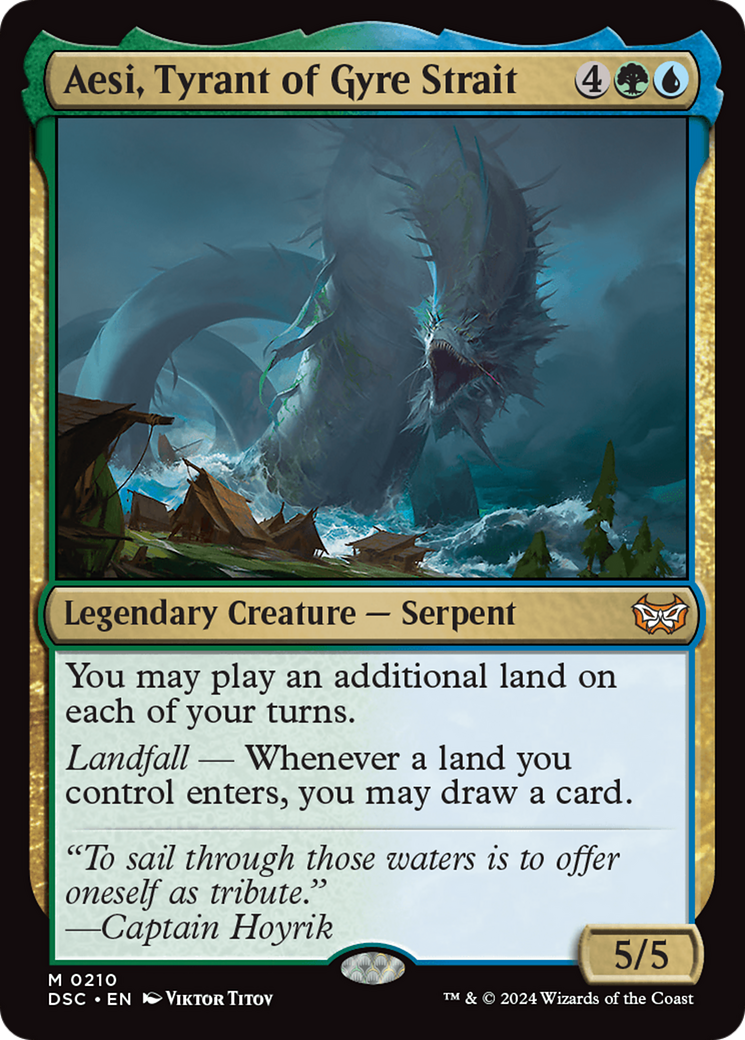
Aesi, Tyrant of Gyre Strait
Aesi, Tyrant of Gyre Strait
Legendary Creature — Serpent
5/5
You may play an additional land on each of your turns.
Landfall — Whenever a land you control enters, you may draw a card.
- A landfall ability triggers whenever a land you control enters for any reason. It triggers whenever you play a land, as well as whenever a spell or ability puts a land onto the battlefield under your control.
- A landfall ability doesn't trigger if a permanent already on the battlefield becomes a land.
- Whenever a land you control enters, each landfall ability of the permanents you control will trigger. You can put them on the stack in any order. The last ability you put on the stack will be the first one to resolve (As a result, you can have those abilities resolve in the order of your choosing.).
- Aesi's ability is cumulative with other effects that let you play additional lands, such as the one from Exploration.
-
1
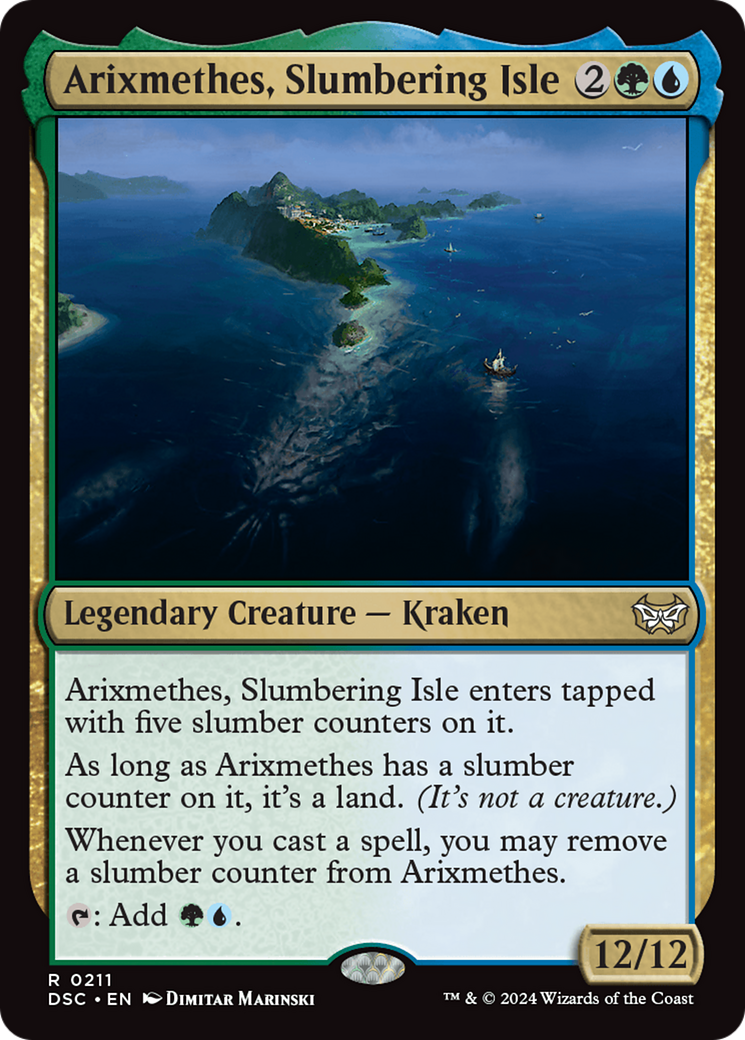
Arixmethes, Slumbering Isle
Arixmethes, Slumbering Isle
Legendary Creature — Kraken
12/12
Arixmethes enters tapped with five slumber counters on it.
As long as Arixmethes has a slumber counter on it, it's a land. (It's not a creature.)
Whenever you cast a spell, you may remove a slumber counter from Arixmethes.
: Add .
- Arixmethes can't be played as a land.
- Arixmethes isn't a land until after it has entered the battlefield. Effects such as that of Blood Moon won't affect its enters-the-battlefield ability. Similarly, replacement effects that modify how creatures you control enter the battlefield will see Arixmethes entering as a creature rather than a land. However, triggered abilities (such as landfall abilities) will see that a land has entered the battlefield and not a creature.
- Arixmethes can tap for mana the turn it enters the battlefield as long as it has slumber counters on it. If you can figure out how to untap it, that is.
- While Arixmethes is a land, it's still green and blue, it's still legendary, and its mana value is still 4.
- Arixmethes's effect causing it to be a land overwrites any earlier effects that gave it additional types. For example, a Phyrexian Metamorph that copies Arixmethes will be a land, not an artifact land, until its slumber counters are removed.
- Arixmethes's triggered ability resolves before the spell that caused it to trigger, but after targets have been chosen for that spell. It resolves even if that spell is countered.
- Once Arixmethes is a creature again, it can attack on the same turn as long as you've controlled it since your most recent turn began.
-
1
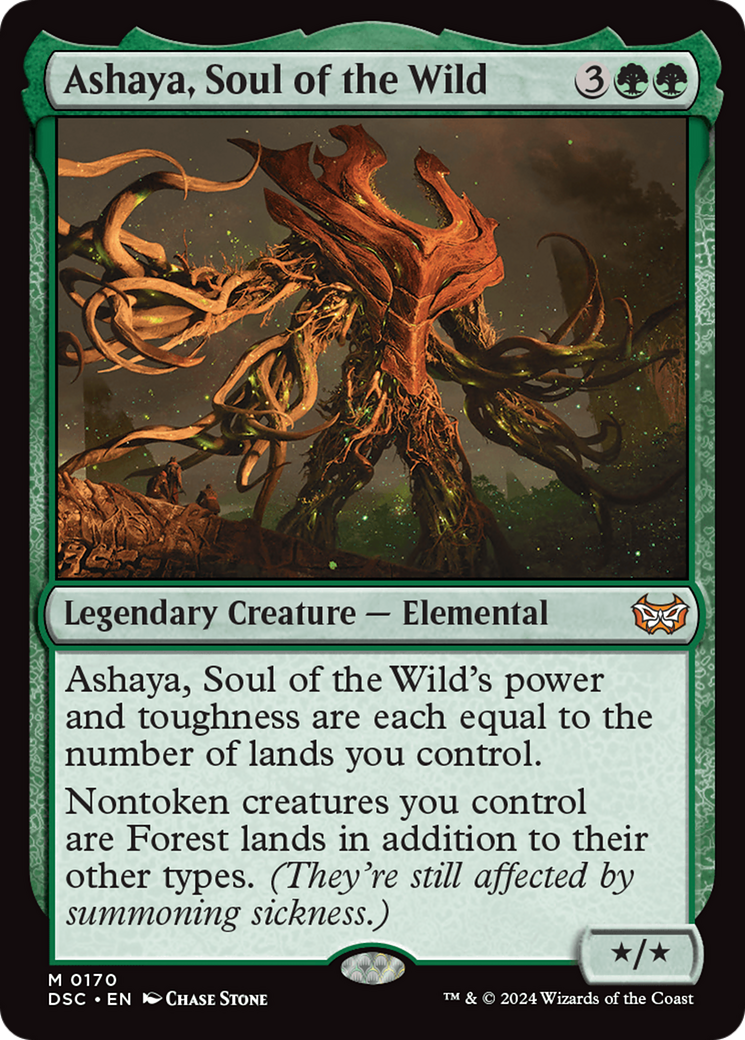
Ashaya, Soul of the Wild
Ashaya, Soul of the Wild
Legendary Creature — Elemental
*/*
Ashaya's power and toughness are each equal to the number of lands you control.
Nontoken creatures you control are Forest lands in addition to their other types. (They're still affected by summoning sickness.)
- The ability that defines Ashaya's power and toughness applies in all zones, not just the battlefield.
- As long as Ashaya is on the battlefield, it's affected by its second ability and thus its first ability counts itself.
- Because damage remains marked on a creature until the damage is removed as the turn ends, nonlethal damage dealt to Ashaya may become lethal if lands you control leave the battlefield during that turn.
- You can't play creature cards as lands; you'll still have to cast them as spells, and they'll enter the battlefield as lands (in addition to their other types).
- A land that's a Forest has the intrinsic mana ability " : Add ."
-
1
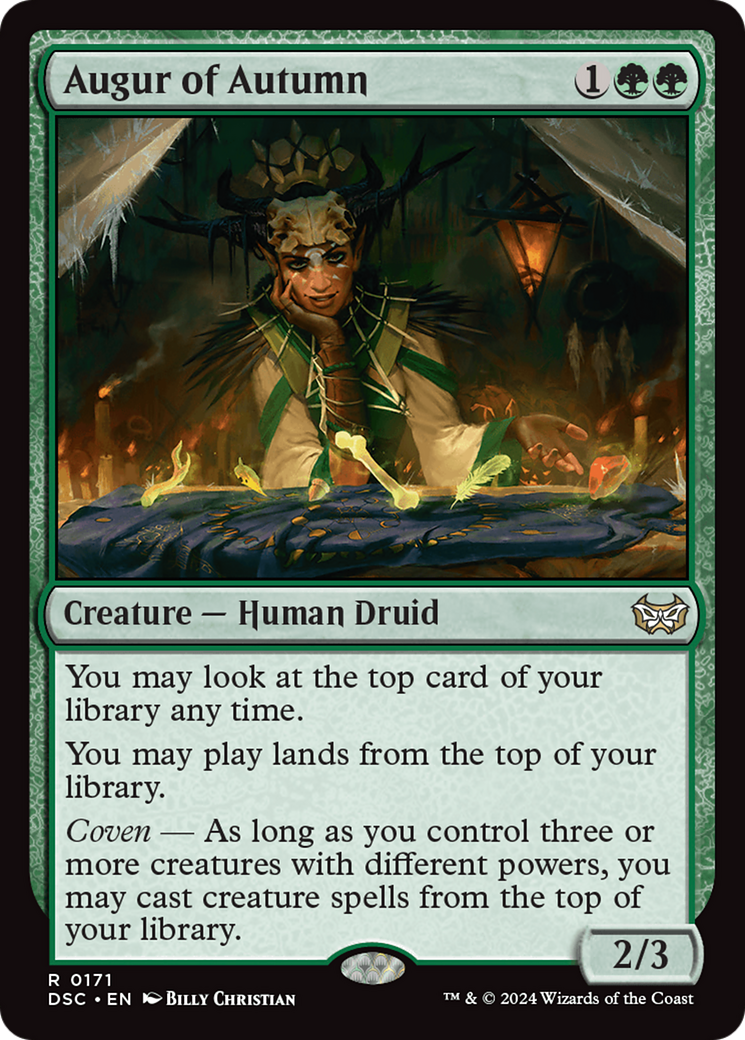
Augur of Autumn
Augur of Autumn
Creature — Human Druid
2/3
You may look at the top card of your library any time.
You may play lands from the top of your library.
Coven — As long as you control three or more creatures with different powers, you may cast creature spells from the top of your library.
- While you have three creatures with different powers, Augur of Autumn allows you to cast the top card of your library if it's a creature card, it's your main phase, and the stack is empty. If that creature card has flash, you'll be able to cast it any time you could cast an instant, even on an opponent's turn.
- Essentially, Augur of Autumn lets you play with the top card of your library revealed only to you. Knowing what that card is becomes part of the information you have access to, just like you can look at the cards in your hand. You may look at the top card of your library whenever you want, even if you don't have priority. This action doesn't use the stack.
- Augur of Autumn doesn't change the times when you can play a land card from the top of your library. You can play a land only during your main phase when you have priority and the stack is empty. Doing so counts as your land play for the turn.
- If the top card of your library changes during the process of casting a spell or activating an ability, you can't look at the new top card until the process of casting the spell or activating the ability ends (all targets are chosen, all costs are paid, and so on).
- The top card of your library isn't in your hand, so you can't suspend it, cycle it, discard it, or activate any of its activated abilities.
- You still pay all costs for that spell, including additional costs. You may also pay alternative costs.
-
1
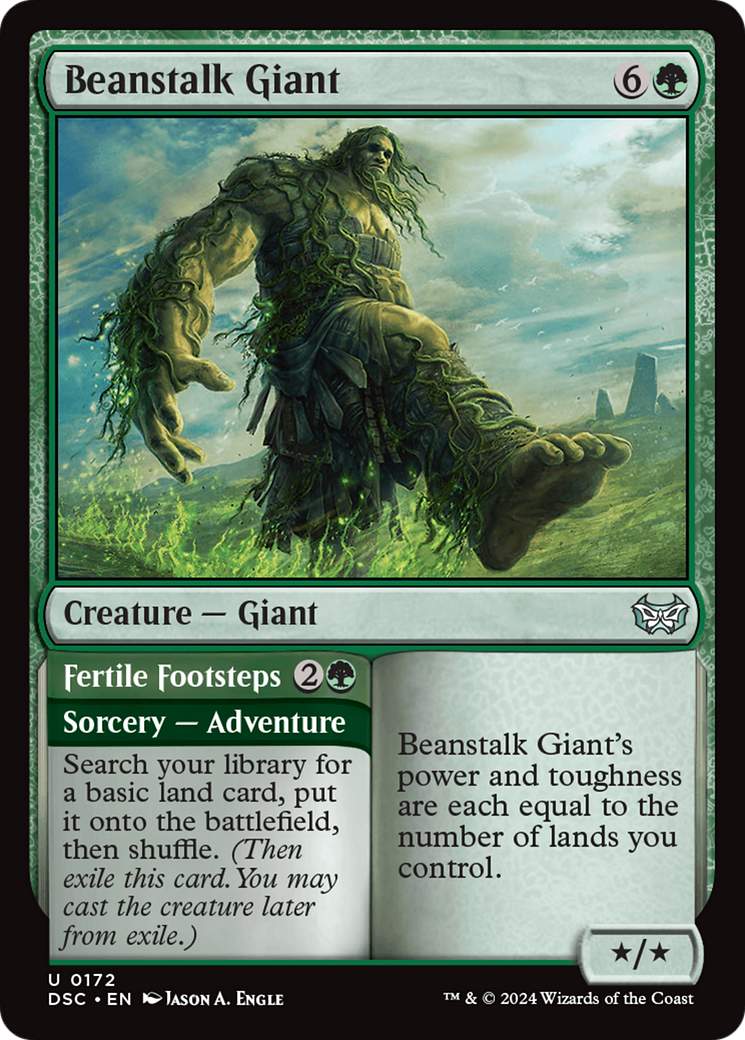
Beanstalk Giant // Fertile Footsteps
//
Beanstalk Giant
Creature — Giant
*/*
- The ability that defines Beanstalk Giant's power and toughness works in all zones, not just the battlefield.
- An adventurer card is a permanent card in every zone except the stack, as well as while on the stack if not cast as an Adventure. Ignore its alternative characteristics in those cases. For example, while it's in your graveyard, Giant Killer is a white creature card whose mana value is 1. It can't be the target of the triggered ability of Mystic Sanctuary.
- When casting a spell as an Adventure, use the alternative characteristics and ignore all of the card's normal characteristics. The spell's color, mana cost, mana value, and so on are determined by only those alternative characteristics. If the spell leaves the stack, it immediately resumes using its normal characteristics.
- If you cast an adventurer card as an Adventure, use only its alternative characteristics to determine whether it's legal to cast that spell. For example, if Giant Killer is exiled with the last ability of Vivien, Champion of the Wilds, you can't cast it as Chop Down.
- If a spell is cast as an Adventure, its controller exiles it instead of putting it into its owner's graveyard as it resolves. For as long as it remains exiled, that player may cast it as a permanent spell. If an Adventure spell leaves the stack in any way other than resolving (most likely by being countered or by failing to resolve because its targets have all become illegal), that card won't be exiled and the spell's controller won't be able to cast it as a permanent later.
- If an adventurer card ends up in exile for any other reason than by exiling itself while resolving, it won't give you permission to cast it as a permanent spell.
- You must still follow any timing restrictions and permissions for the permanent spell you cast from exile. Normally, you'll be able to cast it only during your main phase while the stack is empty.
- If an effect copies an Adventure spell, that copy is exiled as it resolves. It ceases to exist as a state-based action; it's not possible to cast the copy as a permanent.
- If an object becomes a copy of an object that has an Adventure, the copy also has an Adventure. If it changes zones, it will either cease to exist (if it's a token) or cease to be a copy (if it's a nontoken permanent), and so you won't be able to cast it as an Adventure.
- If an effect instructs you to choose a card name, you may choose the alternative Adventure name. Consider only the alternative characteristics to determine whether that is an appropriate name to choose.
- Casting a card as an Adventure isn't casting it for an alternative cost. Effects that allow you to cast a spell for an alternative cost or without paying its mana cost may allow you to apply those to the Adventure.
-
1
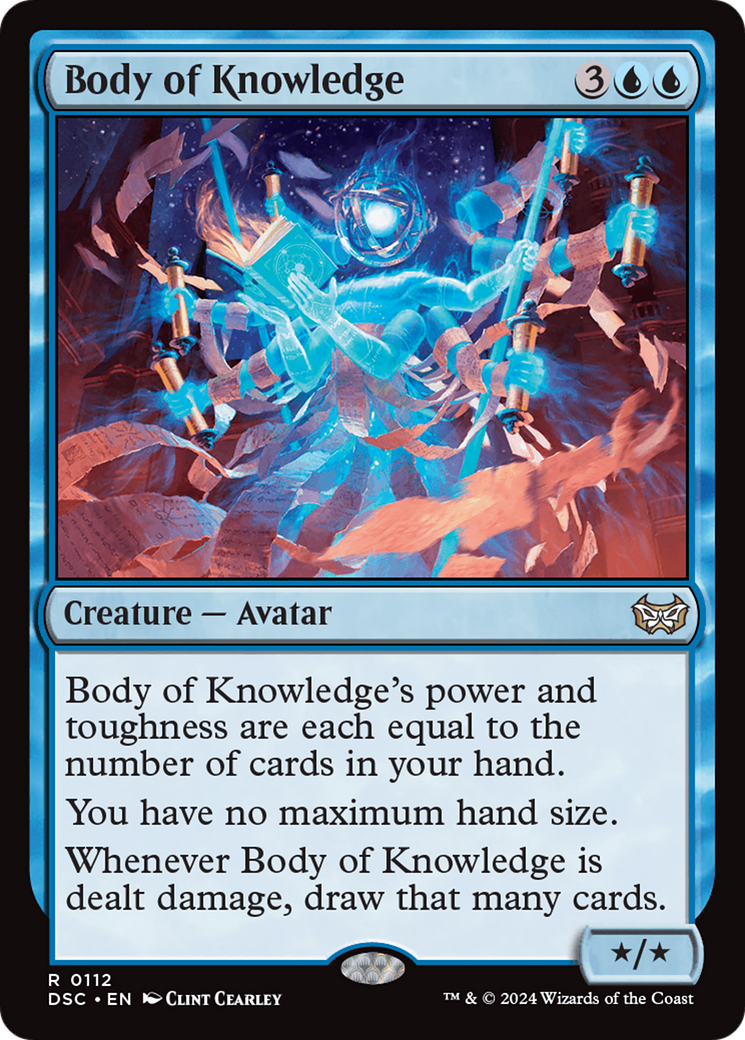
Body of Knowledge
Body of Knowledge
Creature — Avatar
*/*
Body of Knowledge's power and toughness are each equal to the number of cards in your hand.
You have no maximum hand size.
Whenever this creature is dealt damage, draw that many cards.
- The ability that defines Body of Knowledge's power and toughness applies in all zones, not just the battlefield.
- As long as Body of Knowledge is in your hand, its ability will count itself.
- Creatures may be dealt damage greater than their toughness. For example, if Body of Knowledge is a 3/3 creature and a source deals 5 damage to it, you'll draw five cards. Note that if Body of Knowledge is dealt lethal damage, it dies before the cards are drawn, meaning they won't raise Body of Knowledge's toughness in time to save it.
-
1
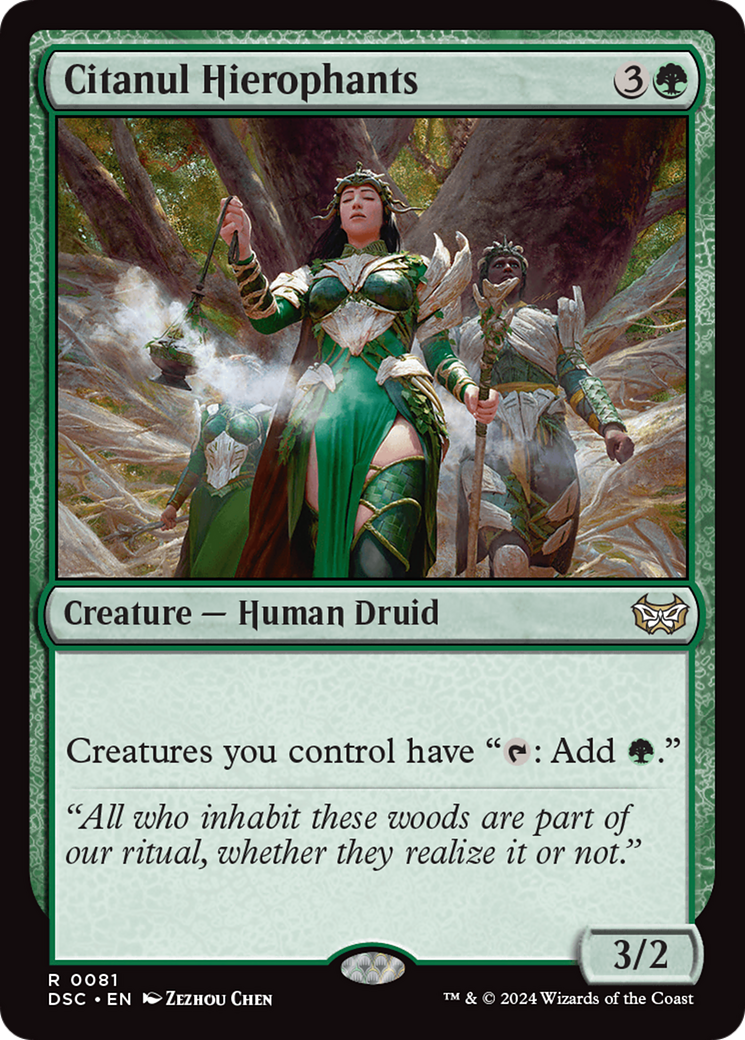
Citanul Hierophants
Citanul Hierophants
Creature — Human Druid
3/2
Creatures you control have " : Add ."
-
1
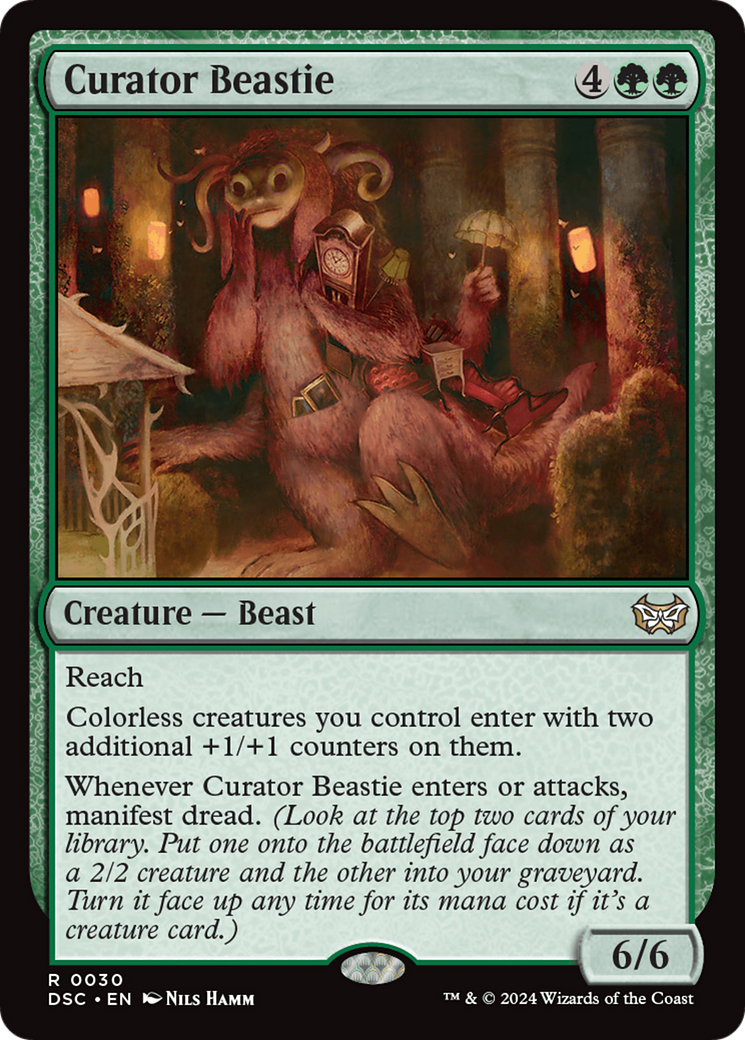
Curator Beastie
Curator Beastie
Creature — Beast
6/6
Reach
Colorless creatures you control enter with two additional +1/+1 counters on them.
Whenever this creature enters or attacks, manifest dread. (Look at the top two cards of your library. Put one onto the battlefield face down as a 2/2 creature and the other into your graveyard. Turn it face up any time for its mana cost if it's a creature card.)
- If Curator Beastie enters under your control at the same time as one or more colorless creatures, those colorless creatures won't enter with additional +1/+1 counters. This is because a replacement effect created by an object entering can only apply to that object.
- The face-down card put onto the battlefield by Curator Beastie's last ability is a colorless creature you control entering the battlefield (unless an effect gives it a color) so it will enter with +1/+1 counters if Curator Beastie is still on the battlefield.
- To manifest dread, look at the top two cards of your library. Manifest one (by putting it onto the battlefield face down) and put the other into your graveyard. The card you put onto the battlefield becomes a 2/2 face-down creature with no name, mana cost, creature types, or abilities. It's colorless and has a mana value of 0. Other effects that apply to the permanent can still grant it any characteristics it doesn't have or change the characteristics it does have.
- Any time you have priority, you can turn a manifested permanent you control face up by revealing that it's a creature card (ignoring any copy effects or type-changing effects that might be applying to it) and paying its mana cost. This is a special action. It doesn't use the stack and can't be responded to.
- If a manifested creature would have disguise or morph if it were face up, you may also turn it face up by paying its disguise or morph cost, as appropriate.
- Unlike a face-down creature that was cast using a disguise or morph ability, a manifested creature may still be turned face up after it loses its abilities if it's a creature card.
- If a double-faced card is manifested, it will be put onto the battlefield face down. While face down, it can't transform. If the front face of the card is a creature card, you can turn it face up by paying its mana cost. If you do, its front face will be up.
- If your library contains only one card when you manifest dread, you'll look at that card and put it onto the battlefield face down. You won't have the option to put it into your graveyard instead. If your library contains no cards when you manifest dread, you won't do anything.
- Some cards in the Duskmourn release have abilities that trigger "whenever you manifest dread." In circumstances where you are instructed to manifest dread but can't perform some or all of the steps of manifesting dread (probably because your library has one or fewer cards in it), these abilities will still trigger.
- At any time, you can look at a face-down spell or permanent you control. You can't look at face-down permanents or spells you don't control unless an effect instructs or allows you to do so.
- If a face-down creature loses its abilities, it can't be turned face up with a disguise or morph ability because it will no longer have that ability (or the associated cost) once face up.
- Because the permanent is on the battlefield both before and after it's turned face up, turning a permanent face up doesn't cause any enters-the-battlefield abilities to trigger.
- Because face-down creatures don't have a name, they can't have the same name as any other creature, even another face-down creature.
- A permanent that turns face up or face down changes characteristics but is otherwise the same permanent. Spells and abilities that were targeting that permanent and Auras and Equipment that were attached to that permanent aren't affected unless the new characteristics of the object change the legality of those targets or attachments.
- Turning a permanent face up or face down doesn't change whether that permanent is tapped or untapped.
- If a face-down spell leaves the stack and goes to any zone other than the battlefield (if it was countered, for example), you must reveal it. Similarly, if a face-down permanent leaves the battlefield, you must reveal it. You must also reveal all face-down spells and permanents you control if you leave the game or the game ends.
- You must ensure that your face-down spells and permanents can be easily differentiated from each other. You're not allowed to mix up the cards that represent them on the battlefield to confuse other players. The order in which they entered should remain clear, as well as what ability caused them to be face down. (This includes manifest, disguise, cloak, morph, and a few older effects that turn cards face down.) Common methods for doing this include using markers or dice, or simply placing them in order on the battlefield.
- If something tries to turn a face-down instant or sorcery card on the battlefield face up, reveal that card to show all players it's an instant or sorcery card. The permanent remains on the battlefield face down. Abilities that trigger when a permanent turns face up won't trigger, because even though you revealed the card, it never turned face up.
-
1
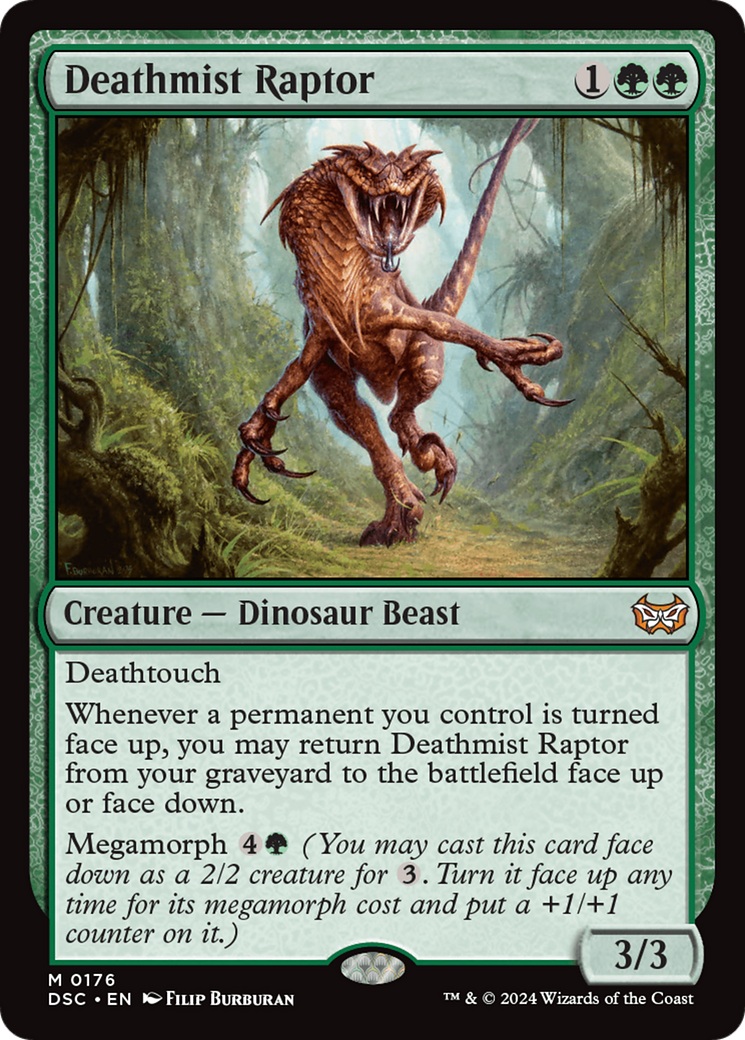
Deathmist Raptor
Deathmist Raptor
Creature — Dinosaur Beast
3/3
Deathtouch
Whenever a permanent you control is turned face up, you may return this card from your graveyard to the battlefield face up or face down.
Megamorph (You may cast this card face down as a 2/2 creature for . Turn it face up any time for its megamorph cost and put a +1/+1 counter on it.)
- Deathmist Raptor's second ability triggers only if Deathmist Raptor is in the graveyard when a permanent you control is turned face up.
- You choose whether Deathmist Raptor will enter the battlefield face up or face down as the ability resolves. You may also choose to leave it in the graveyard.
- Turning a face-down creature with megamorph face up and putting a +1/+1 counter on it is a special action. It doesn't use the stack and can't be responded to.
- If a face-down creature with megamorph is turned face up some other way (for example, if you manifest a card with megamorph and then pay its mana cost to turn it face up), you won't put a +1/+1 counter on it.
- Megamorph is a variant of the morph ability. You can find more information on morph on cards with morph from the Khans of Tarkir set.
-
1
Giggling Skitterspike
Giggling Skitterspike
Artifact Creature — Toy
1/1
Indestructible
Whenever this creature attacks, blocks, or becomes the target of a spell, it deals damage equal to its power to each opponent.
: Monstrosity 5. (If this creature isn't monstrous, put five +1/+1 counters on it and it becomes monstrous.)
- Once a creature becomes monstrous, it can't become monstrous again. If the creature is already monstrous when the monstrosity ability resolves, nothing happens.
- Monstrous isn't an ability that a creature has. It's just something true about that creature. If the creature stops being a creature or loses its abilities, it will continue to be monstrous.
- If Giggling Skitterspike is no longer on the battlefield when its second ability resolves, use its power as it last existed on the battlefield to determine how much damage it deals.
-
1
Glitch Interpreter
Glitch Interpreter
Creature — Human Wizard
2/3
When this creature enters, if you control no face-down permanents, return this creature to its owner's hand and manifest dread.
Whenever one or more colorless creatures you control deal combat damage to a player, draw a card.
- Glitch Interpreter's first ability won't trigger at all if you control one or more face-down permanents when it enters. If it does trigger but you somehow control one or more face-down permanents when it resolves, the ability won't do anything. You won't return Glitch Interpreter to your hand, and you won't manifest dread.
- If Glitch Interpreter is no longer on the battlefield when its first ability resolves and you control no face-down permanents, you'll still manifest dread.
- To manifest dread, look at the top two cards of your library. Manifest one (by putting it onto the battlefield face down) and put the other into your graveyard. The card you put onto the battlefield becomes a 2/2 face-down creature with no name, mana cost, creature types, or abilities. It's colorless and has a mana value of 0. Other effects that apply to the permanent can still grant it any characteristics it doesn't have or change the characteristics it does have.
- Any time you have priority, you can turn a manifested permanent you control face up by revealing that it's a creature card (ignoring any copy effects or type-changing effects that might be applying to it) and paying its mana cost. This is a special action. It doesn't use the stack and can't be responded to.
- If a manifested creature would have disguise or morph if it were face up, you may also turn it face up by paying its disguise or morph cost, as appropriate.
- Unlike a face-down creature that was cast using a disguise or morph ability, a manifested creature may still be turned face up after it loses its abilities if it's a creature card.
- If a double-faced card is manifested, it will be put onto the battlefield face down. While face down, it can't transform. If the front face of the card is a creature card, you can turn it face up by paying its mana cost. If you do, its front face will be up.
- If your library contains only one card when you manifest dread, you'll look at that card and put it onto the battlefield face down. You won't have the option to put it into your graveyard instead. If your library contains no cards when you manifest dread, you won't do anything.
- Some cards in the Duskmourn release have abilities that trigger "whenever you manifest dread." In circumstances where you are instructed to manifest dread but can't perform some or all of the steps of manifesting dread (probably because your library has one or fewer cards in it), these abilities will still trigger.
- At any time, you can look at a face-down spell or permanent you control. You can't look at face-down permanents or spells you don't control unless an effect instructs or allows you to do so.
- If a face-down creature loses its abilities, it can't be turned face up with a disguise or morph ability because it will no longer have that ability (or the associated cost) once face up.
- Because the permanent is on the battlefield both before and after it's turned face up, turning a permanent face up doesn't cause any enters-the-battlefield abilities to trigger.
- Because face-down creatures don't have a name, they can't have the same name as any other creature, even another face-down creature.
- A permanent that turns face up or face down changes characteristics but is otherwise the same permanent. Spells and abilities that were targeting that permanent and Auras and Equipment that were attached to that permanent aren't affected unless the new characteristics of the object change the legality of those targets or attachments.
- Turning a permanent face up or face down doesn't change whether that permanent is tapped or untapped.
- If a face-down spell leaves the stack and goes to any zone other than the battlefield (if it was countered, for example), you must reveal it. Similarly, if a face-down permanent leaves the battlefield, you must reveal it. You must also reveal all face-down spells and permanents you control if you leave the game or the game ends.
- You must ensure that your face-down spells and permanents can be easily differentiated from each other. You're not allowed to mix up the cards that represent them on the battlefield to confuse other players. The order in which they entered should remain clear, as well as what ability caused them to be face down. (This includes manifest, disguise, cloak, morph, and a few older effects that turn cards face down.) Common methods for doing this include using markers or dice, or simply placing them in order on the battlefield.
- If something tries to turn a face-down instant or sorcery card on the battlefield face up, reveal that card to show all players it's an instant or sorcery card. The permanent remains on the battlefield face down. Abilities that trigger when a permanent turns face up won't trigger, because even though you revealed the card, it never turned face up.
-
1
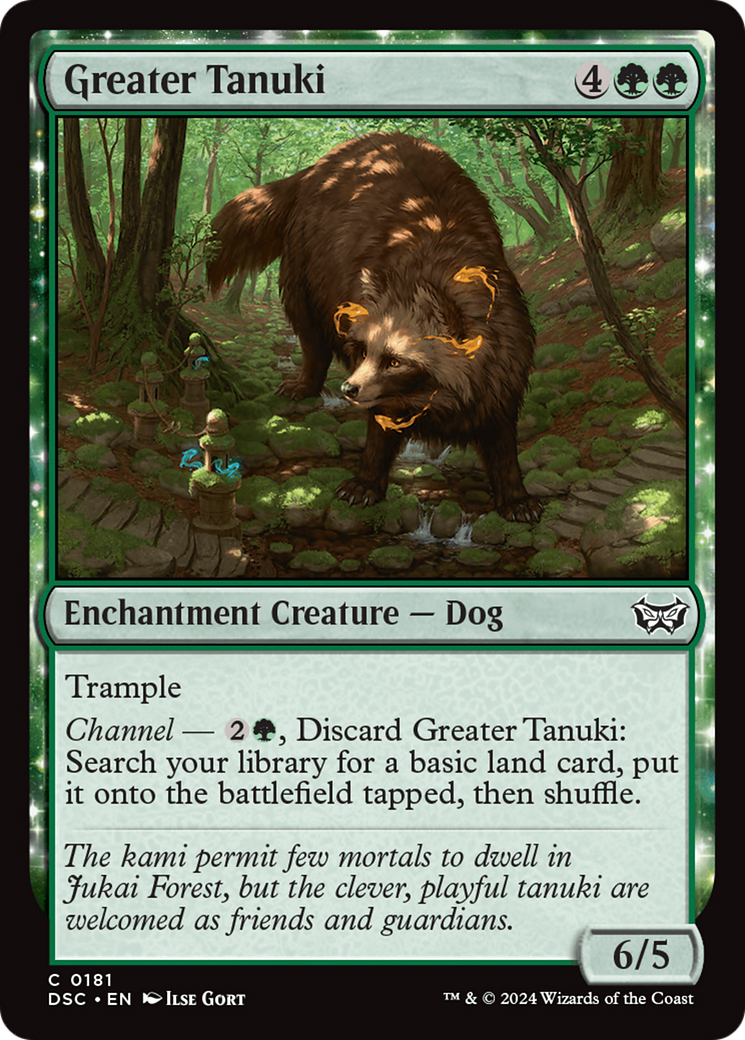
Greater Tanuki
Greater Tanuki
Enchantment Creature — Dog
6/5
Trample
Channel — , Discard this card: Search your library for a basic land card, put it onto the battlefield tapped, then shuffle.
- Discarding the card is part of the cost to activate a channel ability.
- If a channel ability requires a target, you may not activate it without a target just to discard the card.
-
1
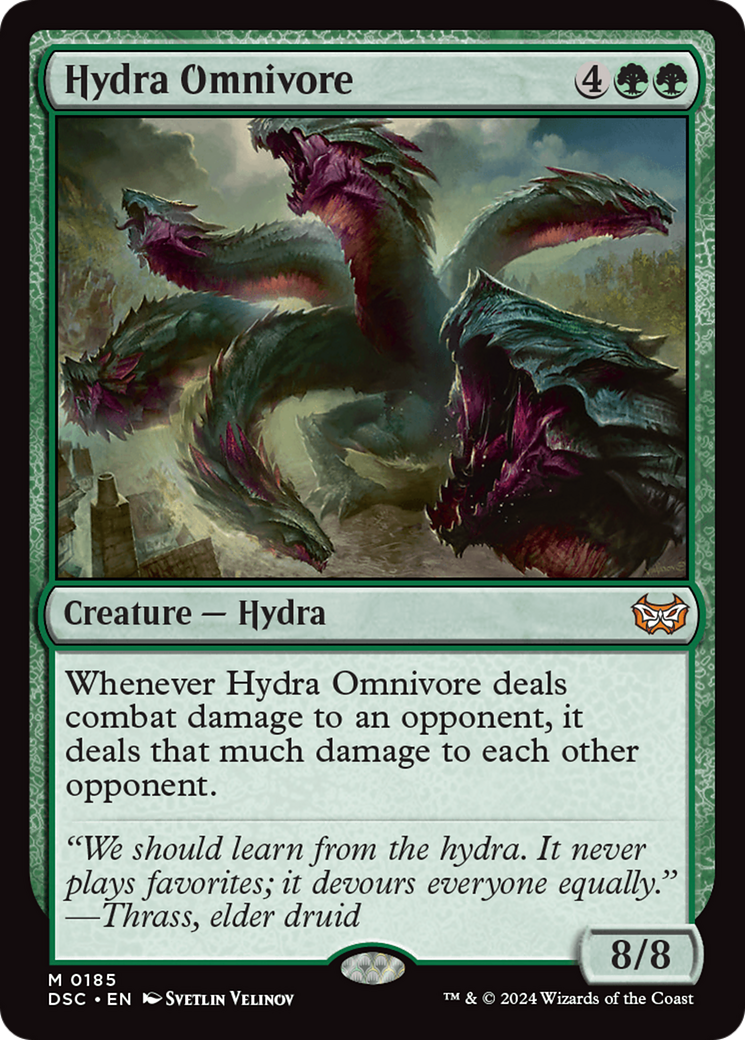
Hydra Omnivore
Hydra Omnivore
Creature — Hydra
8/8
Whenever this creature deals combat damage to an opponent, it deals that much damage to each other opponent.
- The damage dealt by Hydra Omnivore as a result of its triggered ability is not combat damage (and doesn't cause the ability to trigger again).
-
1
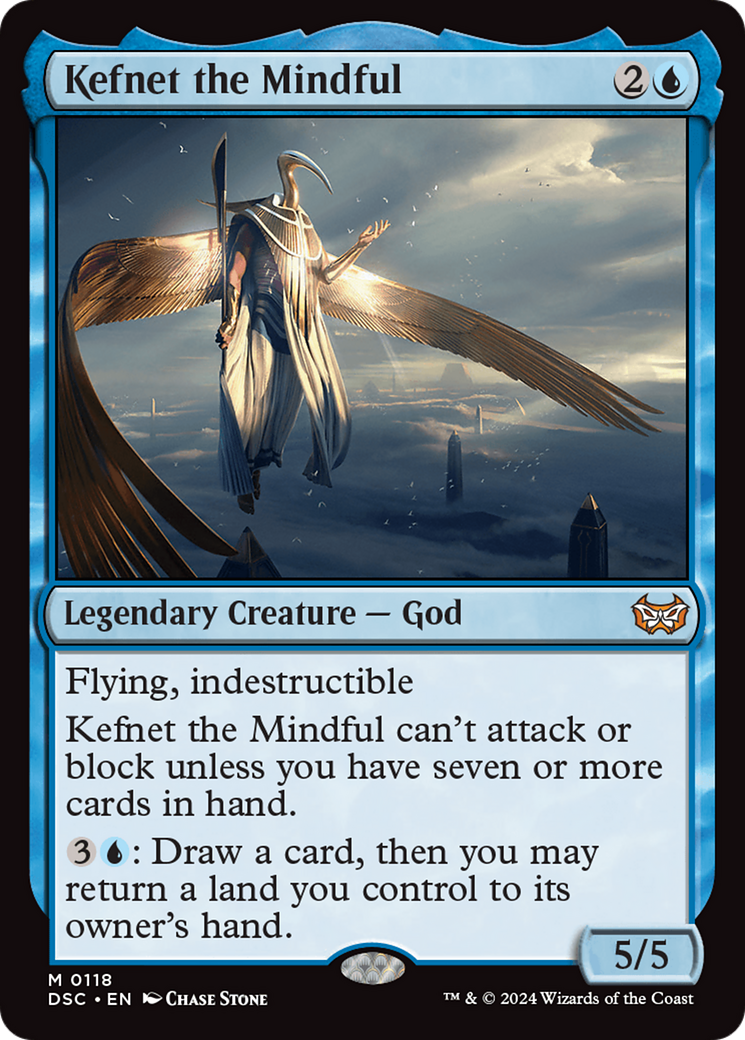
Kefnet the Mindful
Kefnet the Mindful
Legendary Creature — God
5/5
Flying, indestructible
Kefnet can't attack or block unless you have seven or more cards in hand.
: Draw a card, then you may return a land you control to its owner's hand.
- Once Kefnet has attacked or blocked, it will remain in combat even if the number of cards in your hand becomes six or fewer.
- While resolving Kefnet's activated ability, you don't choose which land to return to its owner's hand (or whether you'll return one at all) until you see the card you draw.
-
1
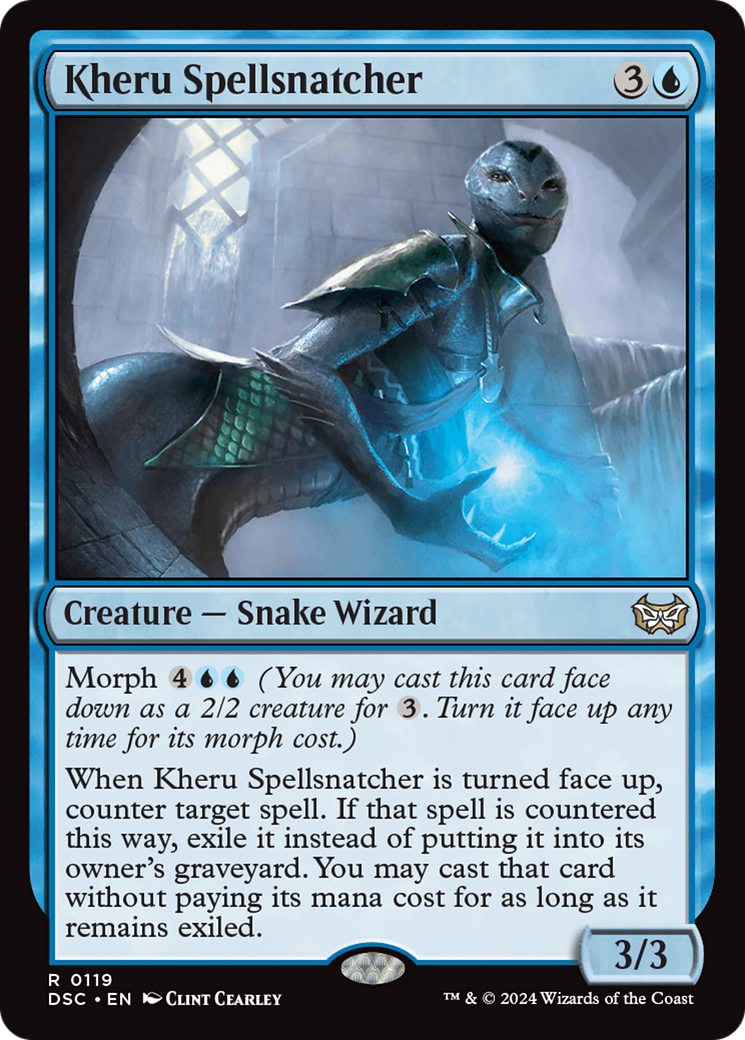
Kheru Spellsnatcher
Kheru Spellsnatcher
Creature — Snake Wizard
3/3
Morph (You may cast this card face down as a 2/2 creature for . Turn it face up any time for its morph cost.)
When this creature is turned face up, counter target spell. If that spell is countered this way, exile it instead of putting it into its owner's graveyard. You may cast that card without paying its mana cost for as long as it remains exiled.
- You can target a spell you control with Kheru Spellsnatcher's triggered ability. This will give you the ability to cast the card later without paying its mana cost.
- Because you're already casting the card using an alternative cost (by casting it without paying its mana cost), you can't pay any other alternative costs for the card, including casting it face down using the morph ability. You can pay additional costs, such as kicker costs. If the card has any mandatory additional costs, you must pay those.
- If the card has in its mana cost, you must choose 0 as the value for X when casting it.
- Morph lets you cast a card face down by paying , and lets you turn the face-down permanent face up any time you have priority by paying its morph cost.
- The face-down spell has no mana cost and has a mana value of 0. When you cast a face-down spell, put it on the stack face down so no other player knows what it is, and pay . This is an alternative cost.
- When the spell resolves, it enters the battlefield as a 2/2 creature with no name, mana cost, creature types, or abilities. It's colorless and has a mana value of 0. Other effects that apply to the creature can still grant it any of these characteristics.
- Any time you have priority, you may turn the face-down creature face up by revealing what its morph cost is and paying that cost. This is a special action. It doesn't use the stack and can't be responded to. Only a face-down permanent can be turned face up this way; a face-down spell cannot.
- Because the permanent is on the battlefield both before and after it's turned face up, turning a permanent face up doesn't cause any enters-the-battlefield abilities to trigger.
- A permanent that turns face up or face down changes characteristics but is otherwise the same permanent. Spells and abilities that were targeting that permanent, as well as Auras and Equipment that were attached to the permanent, aren't affected.
- At any time, you can look at a face-down spell or permanent you control. You can't look at face-down spells or permanents you don't control unless an effect instructs you to do so.
- You must ensure that your face-down spells and permanents can easily be differentiated from each other. You're not allowed to mix up the cards that represent them on the battlefield in order to confuse other players. The order they entered the battlefield should remain clear. Common methods for doing this include using markers or dice, or simply placing them in order on the battlefield.
- If a face-down permanent leaves the battlefield, you must reveal it. You must also reveal all face-down spells and permanents you control if you leave the game or if the game ends.
-
1
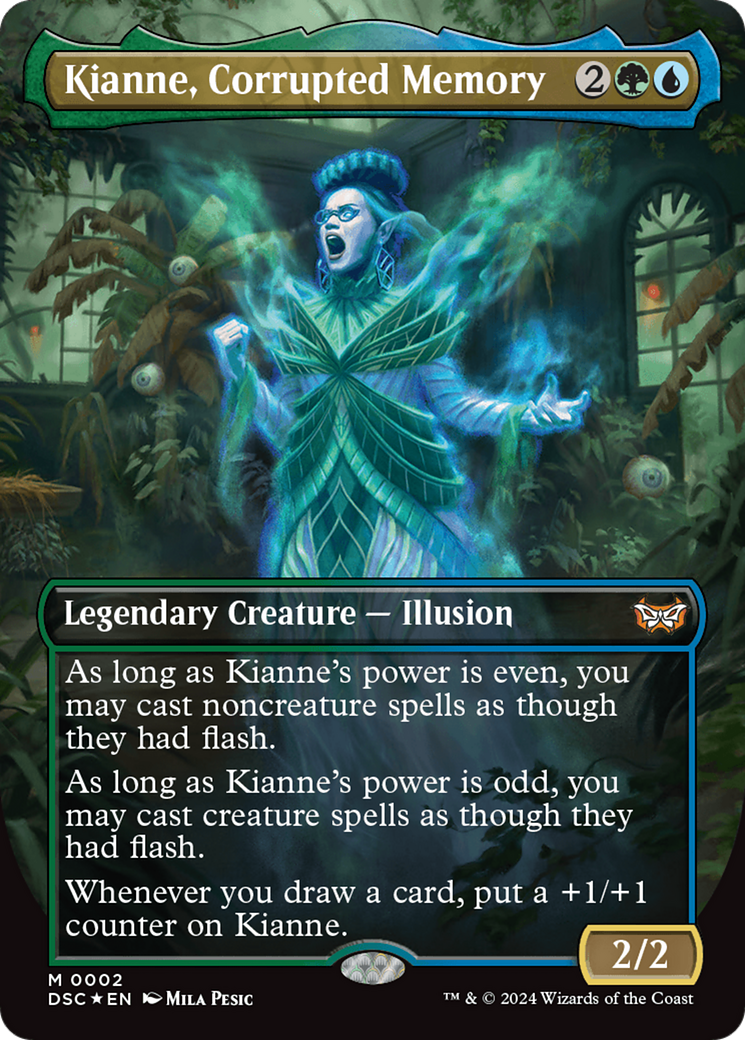
Kianne, Corrupted Memory
Kianne, Corrupted Memory
Legendary Creature — Illusion
2/2
As long as Kianne's power is even, you may cast noncreature spells as though they had flash.
As long as Kianne's power is odd, you may cast creature spells as though they had flash.
Whenever you draw a card, put a +1/+1 counter on Kianne.
-
1
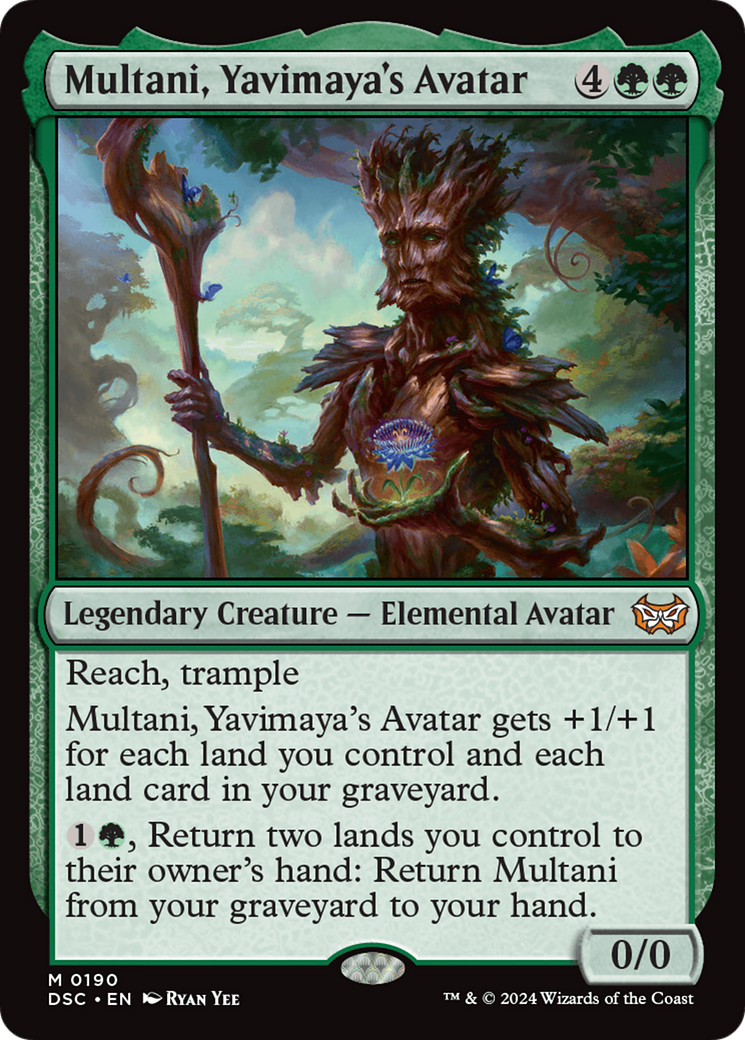
Multani, Yavimaya's Avatar
Multani, Yavimaya's Avatar
Legendary Creature — Elemental Avatar
0/0
Reach, trample
Multani gets +1/+1 for each land you control and each land card in your graveyard.
, Return two lands you control to their owner's hand: Return Multani from your graveyard to your hand.
- Multani's ability that modifies its power and toughness applies only while it's on the battlefield. In all other zones, it's a 0/0 creature card.
- To activate Multani's last ability, you must return lands you control from the battlefield to their owner's hand. Land cards in your graveyard can't be returned this way.
-
1
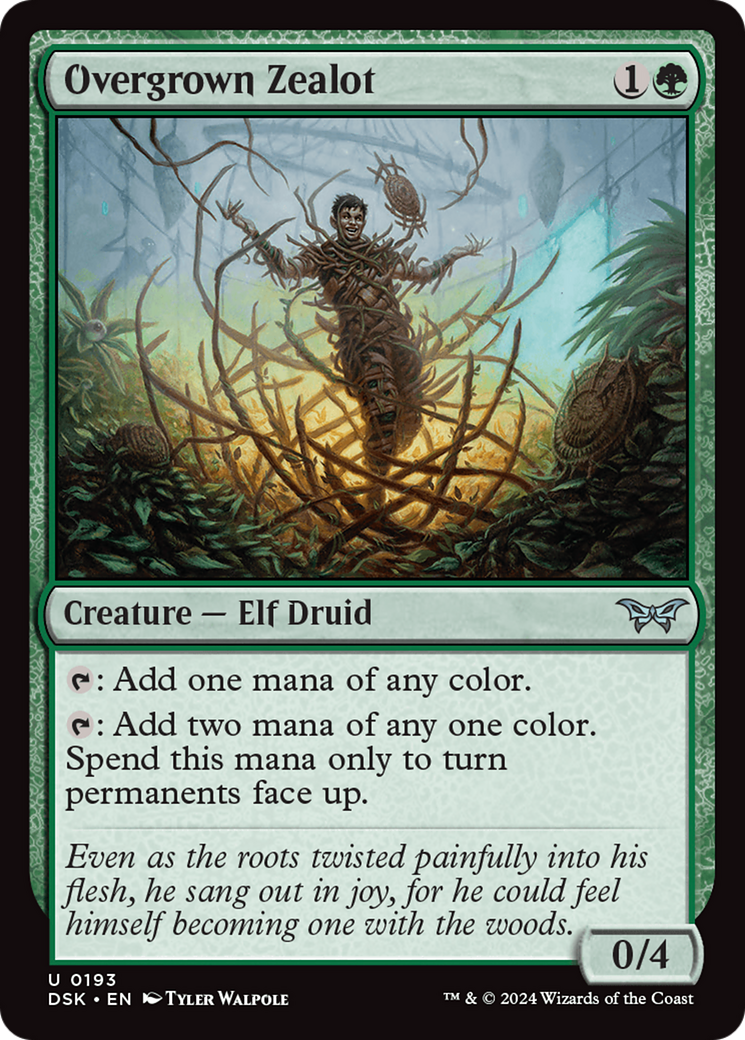
Overgrown Zealot
Overgrown Zealot
Creature — Elf Druid
0/4
: Add one mana of any color.
: Add two mana of any one color. Spend this mana only to turn permanents face up.
-
1
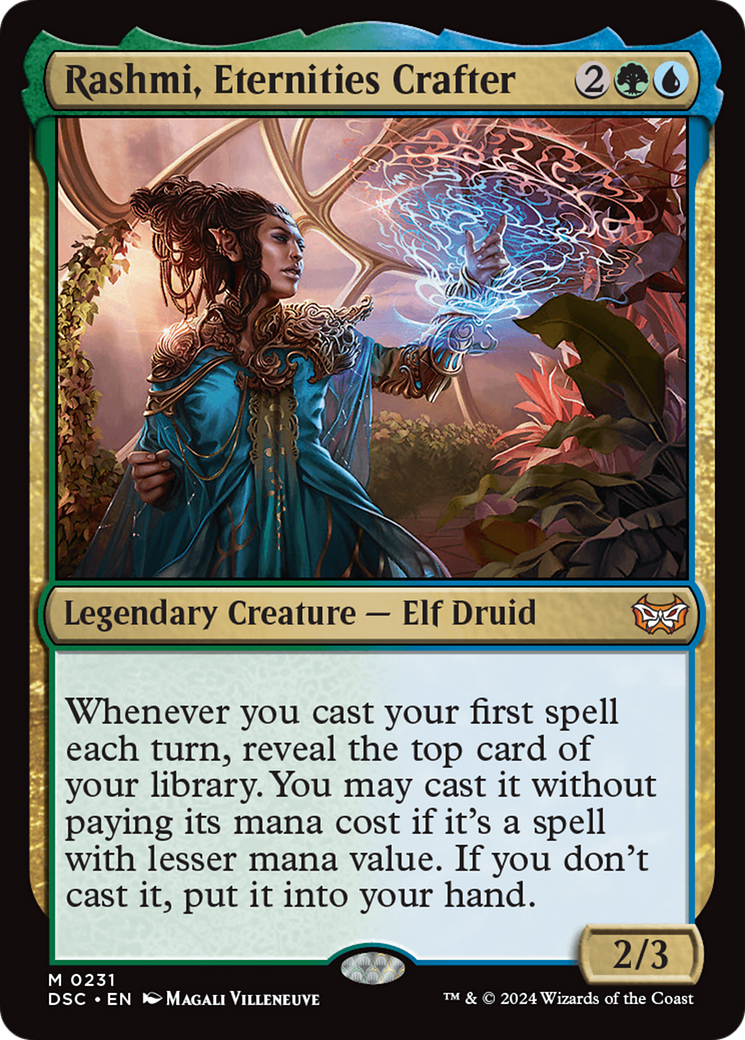
Rashmi, Eternities Crafter
Rashmi, Eternities Crafter
Legendary Creature — Elf Druid
2/3
Whenever you cast your first spell each turn, reveal the top card of your library. You may cast it without paying its mana cost if it's a spell with lesser mana value. If you don't cast it, put it into your hand.
- If the revealed card is a land card, you put it into your hand.
- Rashmi's ability triggers when you cast your first spell each turn, not just on your turn.
- Rashmi has to be on the battlefield at the moment you cast your first spell. If that spell is Rashmi itself, Rashmi's ability can't trigger. If that spell causes Rashmi to leave the battlefield as an additional cost to cast it, Rashmi's ability can't trigger.
- Rashmi's ability resolves before the spell that caused it to trigger. If you cast a spell using the ability, it will also resolve before the initial spell.
- For spells with in their mana costs, use the value chosen for X to determine the spell's mana value. For cards in your library with in their mana costs, X is considered to be 0.
- If Rashmi's ability resolves and the spell that caused it to trigger has been countered, use that spell's mana value as it last existed on the stack to determine whether or not you may cast the top card of your library.
- If you cast the top card of your library, you do so as part of the resolution of Rashmi's ability. You can't wait to cast it later in the turn. Timing permissions based on the card's type are ignored, but other restrictions (such as "Cast [this card] only during combat") are not.
- If you cast a card "without paying its mana cost," you can't choose to cast it for any alternative costs, such as emerge costs. You can, however, pay additional costs. If the card has any mandatory additional costs, such as that of Cathartic Reunion, those must be paid to cast the card.
- If the card has in its mana cost, you must choose 0 as the value of X when casting it without paying its mana cost.
-
1
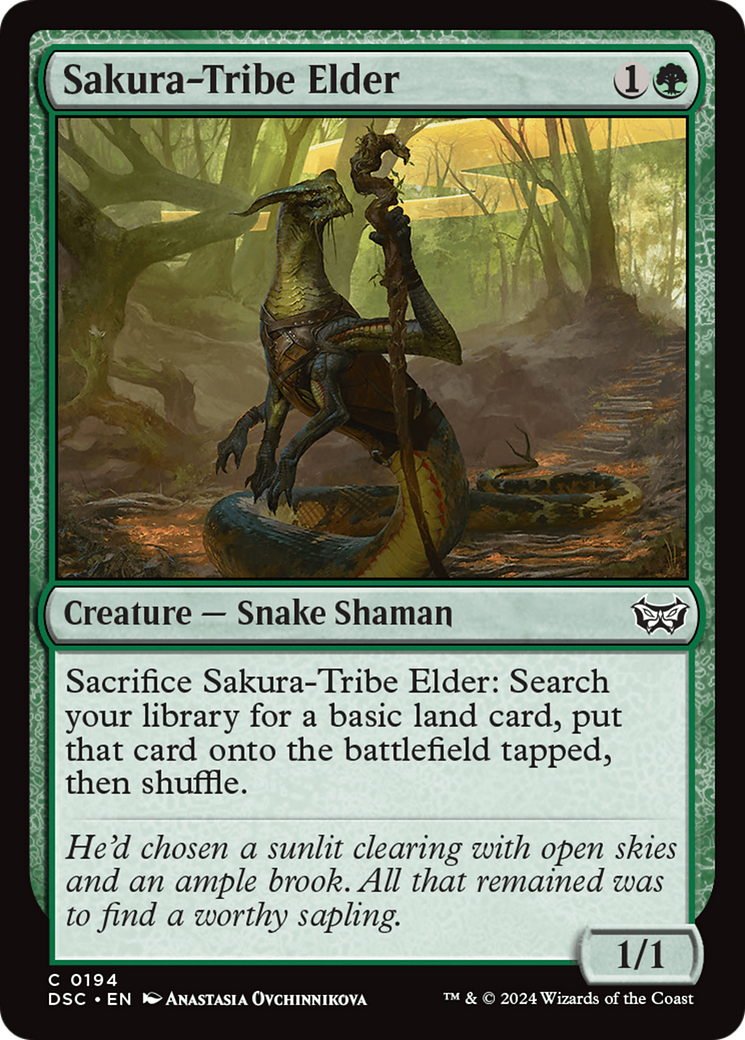
Sakura-Tribe Elder
Sakura-Tribe Elder
Creature — Snake Shaman
1/1
Sacrifice this creature: Search your library for a basic land card, put that card onto the battlefield tapped, then shuffle.
-
1
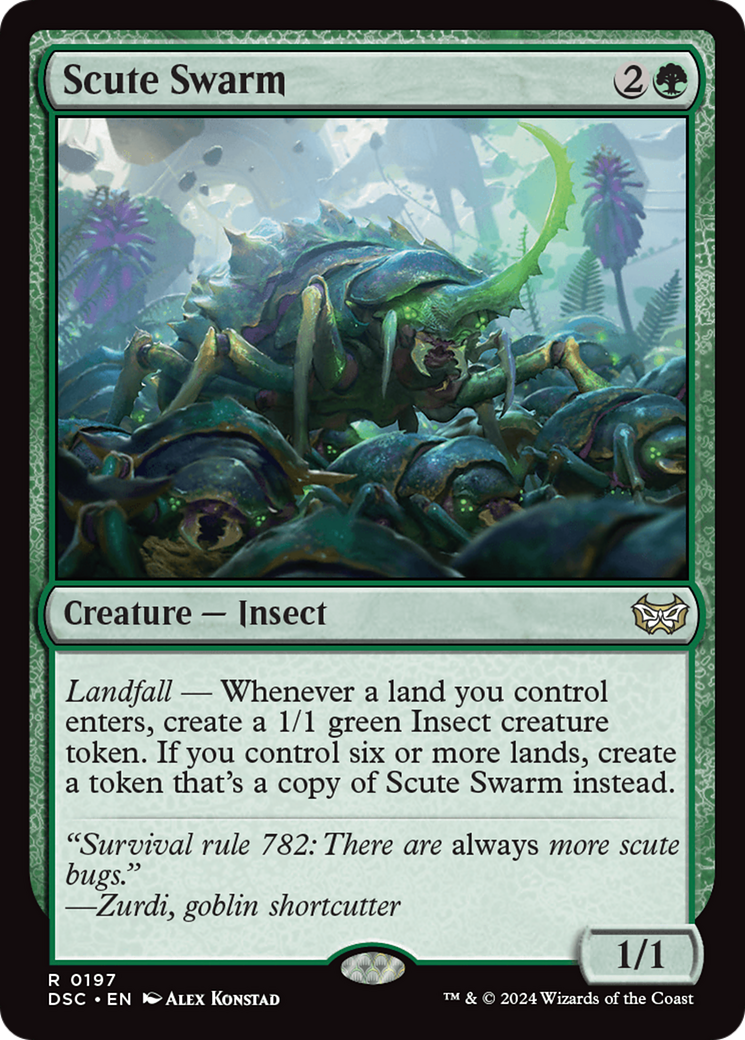
Scute Swarm
Scute Swarm
Creature — Insect
1/1
Landfall — Whenever a land you control enters, create a 1/1 green Insect creature token. If you control six or more lands, create a token that's a copy of this creature instead.
- A landfall ability triggers whenever a land you control enters for any reason. It triggers whenever you play a land, as well as whenever a spell or ability puts a land onto the battlefield under your control.
- A landfall ability doesn't trigger if a permanent already on the battlefield becomes a land.
- Whenever a land you control enters, each landfall ability of the permanents you control will trigger. You can put them on the stack in any order. The last ability you put on the stack will be the first one to resolve (As a result, you can have those abilities resolve in the order of your choosing.).
- The token copy will have Scute Swarm's ability. It will also be able to create copies of itself.
- The token copy won't copy counters or damage marked on Scute Swarm, nor will it copy other effects that have changed Scute Swarm's power, toughness, types, color, and so on. Normally, this means the token will simply be a Scute Swarm, but if any copy effects have affected the original Scute Swarm, the token will take those into account.
- If Scute Swarm leaves the battlefield before its triggered ability resolves, the token will still enter the battlefield as a copy of Scute Swarm, using Scute Swarm's copiable values from when it was last on the battlefield.
-
1
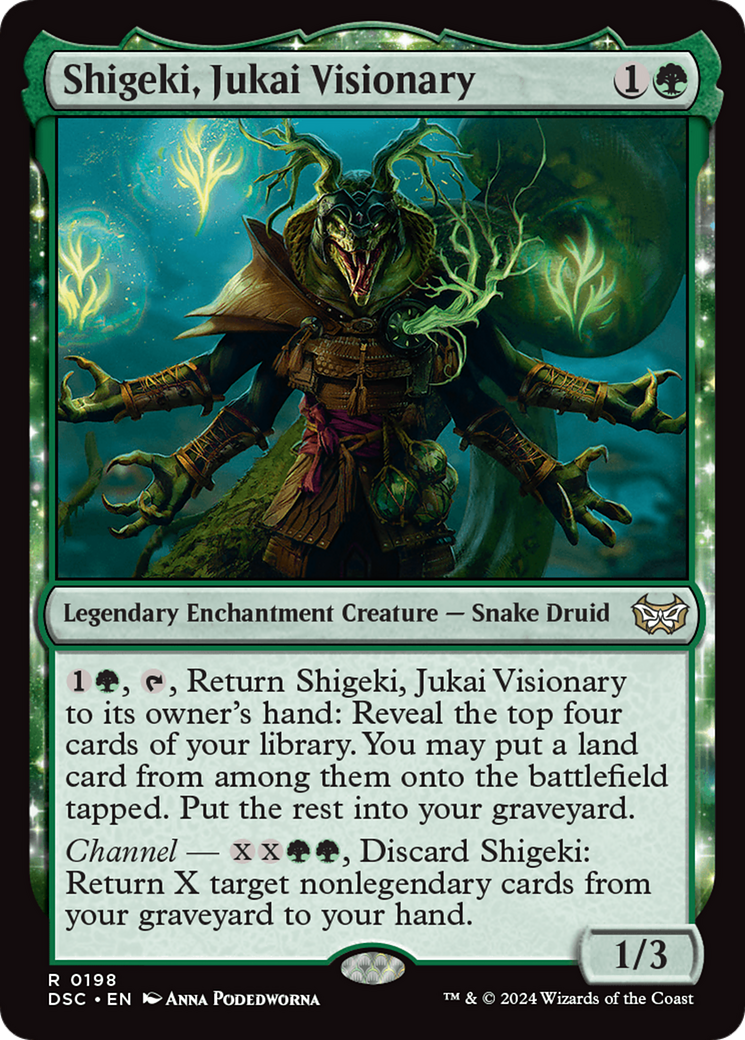
Shigeki, Jukai Visionary
Shigeki, Jukai Visionary
Legendary Enchantment Creature — Snake Druid
1/3
, , Return Shigeki to its owner's hand: Reveal the top four cards of your library. You may put a land card from among them onto the battlefield tapped. Put the rest into your graveyard.
Channel — , Discard this card: Return X target nonlegendary cards from your graveyard to your hand.
- Discarding the card is part of the cost to activate a channel ability.
- If a channel ability requires a target, you may not activate it without a target just to discard the card.
-
1
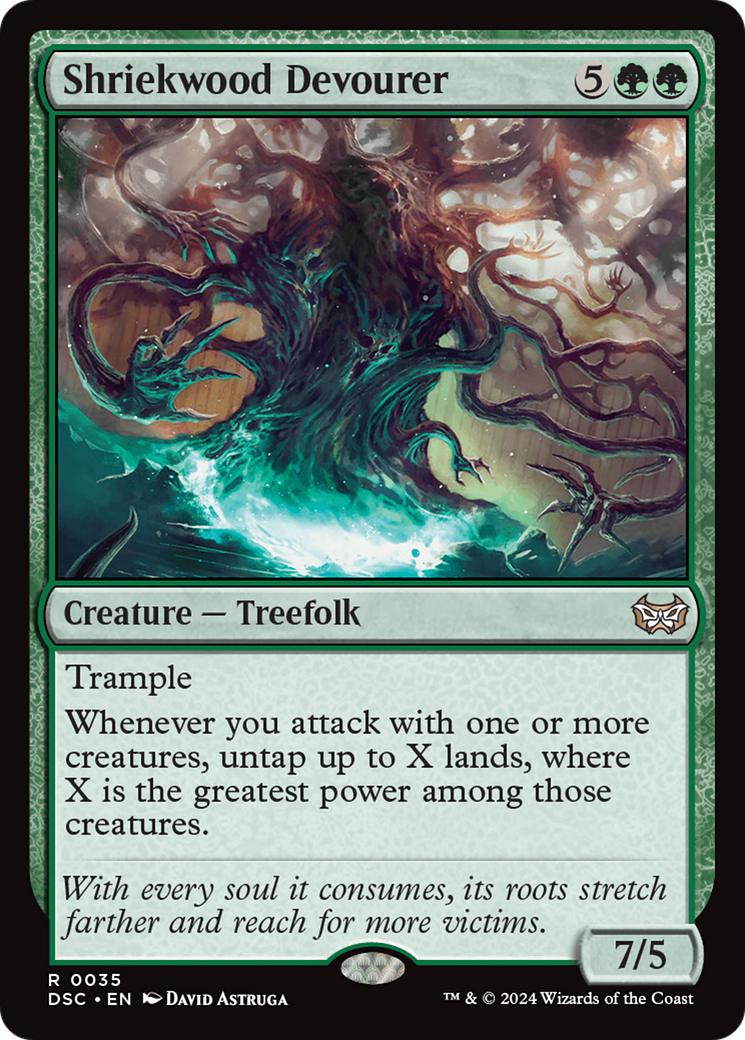
Shriekwood Devourer
Shriekwood Devourer
Creature — Treefolk
7/5
Trample
Whenever you attack with one or more creatures, untap up to X lands, where X is the greatest power among those creatures.
- The value of X is calculated only once, as Shriekwood Devourer's last ability resolves. This means that the value of X may be different than you had hoped when attackers were declared if attacking creatures have left the battlefield or their power has changed.
- Creatures that enter attacking were never declared as attackers, so Shriekwood Devourer's last ability won't take them into account.
-
1
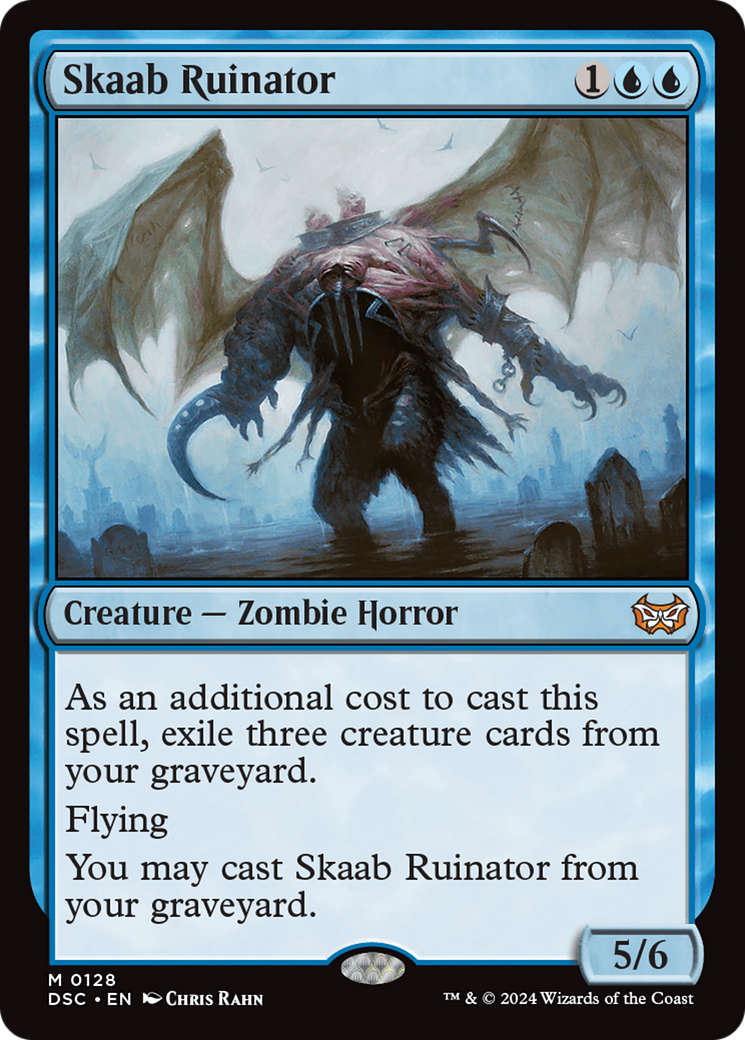
Skaab Ruinator
Skaab Ruinator
Creature — Zombie Horror
5/6
As an additional cost to cast this spell, exile three creature cards from your graveyard.
Flying
You may cast this card from your graveyard.
- Skaab Ruinator is on the stack when you pay its costs. It can't be exiled to pay for itself.
- You must exile three creature cards from your graveyard no matter what zone you're casting Skaab Ruinator from.
-
1
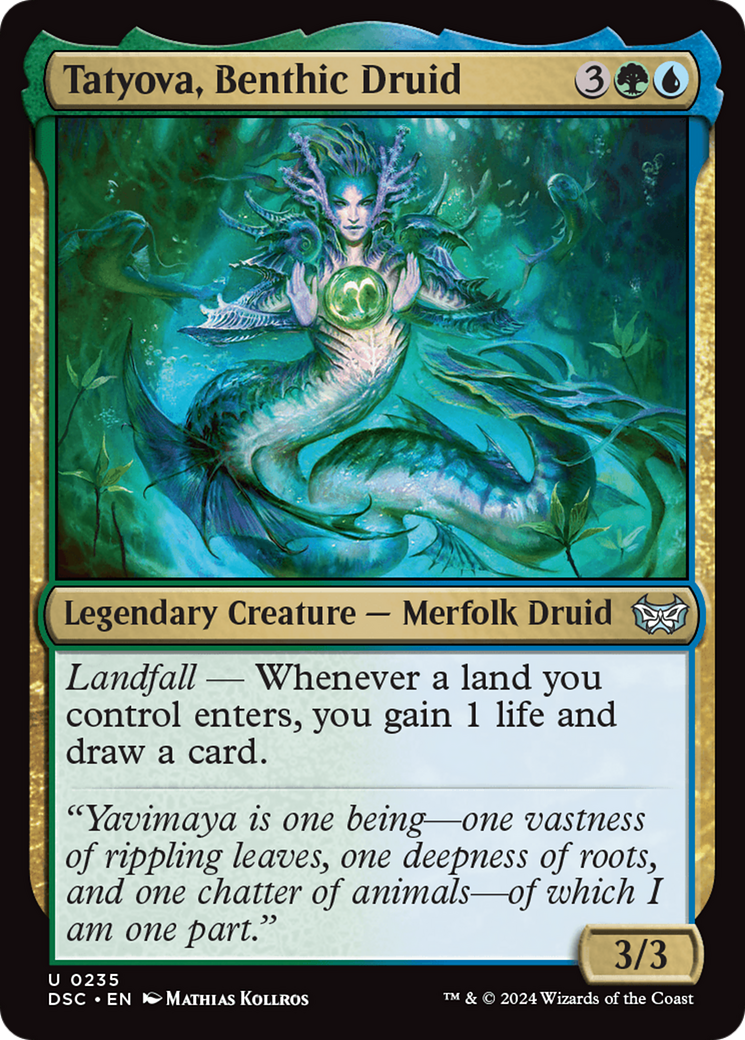
Tatyova, Benthic Druid
Tatyova, Benthic Druid
Legendary Creature — Merfolk Druid
3/3
Landfall — Whenever a land you control enters, you gain 1 life and draw a card.
- A landfall ability triggers whenever a land you control enters for any reason. It triggers whenever you play a land, as well as whenever a spell or ability puts a land onto the battlefield under your control.
- A landfall ability doesn't trigger if a permanent already on the battlefield becomes a land.
- Whenever a land you control enters, each landfall ability of the permanents you control will trigger. You can put them on the stack in any order. The last ability you put on the stack will be the first one to resolve (As a result, you can have those abilities resolve in the order of your choosing.).
-
1
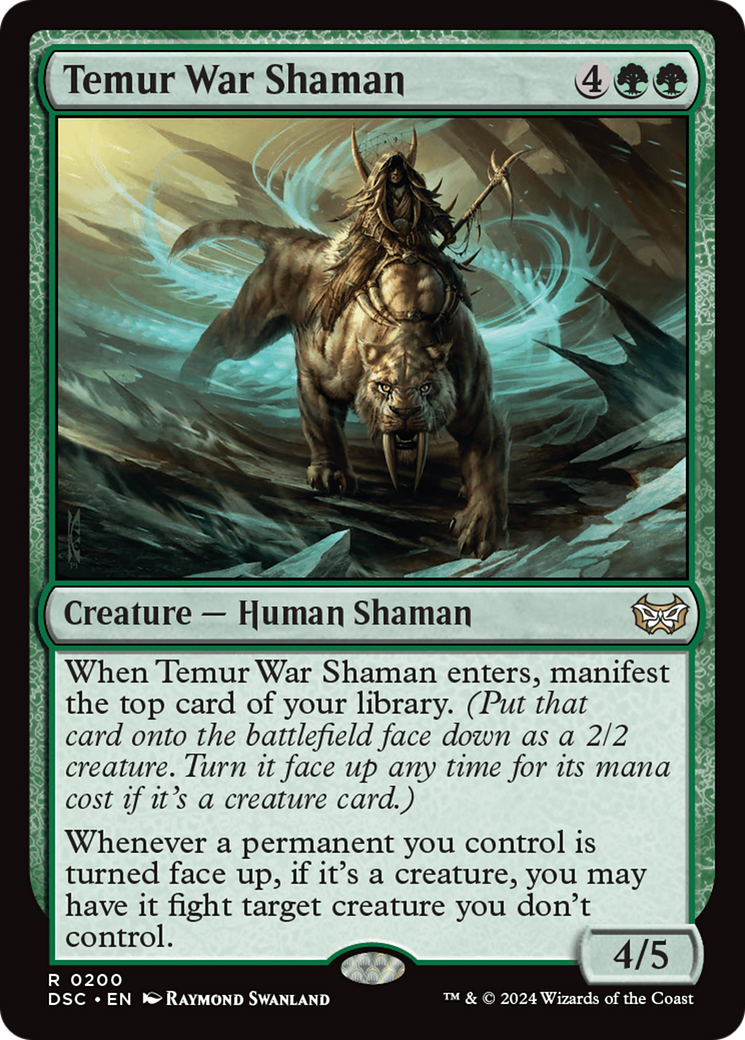
Temur War Shaman
Temur War Shaman
Creature — Human Shaman
4/5
When this creature enters, manifest the top card of your library. (Put that card onto the battlefield face down as a 2/2 creature. Turn it face up any time for its mana cost if it's a creature card.)
Whenever a permanent you control is turned face up, if it's a creature, you may have it fight target creature you don't control.
- The face-down permanent is a 2/2 creature with no name, mana cost, creature types, or abilities. It's colorless and has a mana value of 0. Other effects that apply to the permanent can still grant or change any of these characteristics.
- Any time you have priority, you may turn a manifested creature face up by revealing that it's a creature card (ignoring any copy effects or type-changing effects that might be applying to it) and paying its mana cost. This is a special action. It doesn't use the stack and can't be responded to.
- If a manifested creature would have morph if it were face up, you may also turn it face up by paying its morph cost.
- Unlike a face-down creature that was cast using the morph ability, a manifested creature may still be turned face up after it loses its abilities if it's a creature card.
- Because the permanent is on the battlefield both before and after it's turned face up, turning a permanent face up doesn't cause any enters-the-battlefield abilities to trigger.
- Because face-down creatures don't have names, they can't have the same name as any other creature, even another face-down creature.
- A permanent that turns face up or face down changes characteristics but is otherwise the same permanent. Spells and abilities that were targeting that permanent, as well as Auras and Equipment that were attached to the permanent, aren't affected.
- Turning a permanent face up or face down doesn't change whether that permanent is tapped or untapped.
- At any time, you can look at a face-down permanent you control. You can't look at face-down permanents you don't control unless an effect allows you to or instructs you to.
- If a face-down permanent you control leaves the battlefield, you must reveal it. You must also reveal all face-down spells and permanents you control if you leave the game or if the game ends.
- You must ensure that your face-down spells and permanents can easily be differentiated from each other. You're not allowed to mix up the cards that represent them on the battlefield in order to confuse other players. The order they entered the battlefield should remain clear. Common methods for indicating this include using markers or dice, or simply placing them in order on the battlefield. You must also track how each became face down (manifested, cast face down using the morph ability, and so on).
- There are no cards in the Fate Reforged set that would turn a face-down instant or sorcery card on the battlefield face up, but some older cards can try to do this. If something tries to turn a face-down instant or sorcery card on the battlefield face up, reveal that card to show all players it's an instant or sorcery card. The permanent remains on the battlefield face down. Abilities that trigger when a permanent turns face up won't trigger, because even though you revealed the card, it never turned face up.
- If a double-faced card is manifested, it will be put onto the battlefield face down. While face down, it can't transform. If the front face of the card is a creature card, you can turn it face up by paying its mana cost. If you do, its front face will be up.
-
1
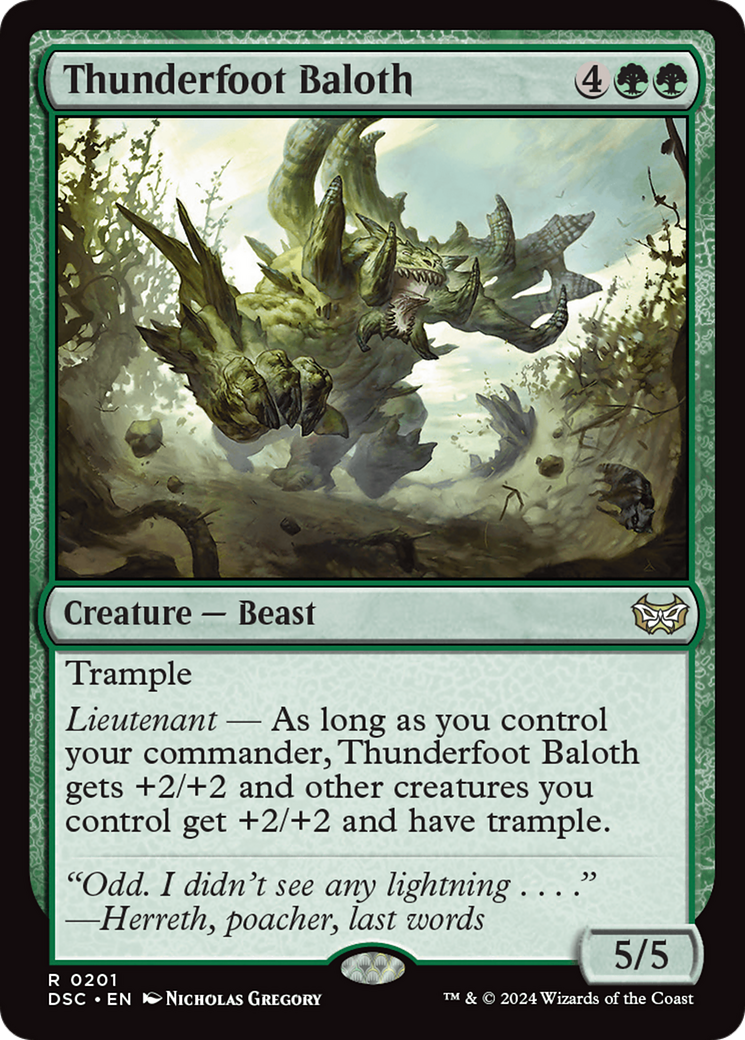
Thunderfoot Baloth
Thunderfoot Baloth
Creature — Beast
5/5
Trample
Lieutenant — As long as you control your commander, this creature gets +2/+2 and other creatures you control get +2/+2 and have trample.
- Lieutenant abilities apply only if your commander is on the battlefield and under your control.
- Lieutenant abilities refer only to whether you control your commander, not any other player's commander.
- If you gain control of a creature with a lieutenant ability owned by another player, that ability will check to see if you control your commander and will apply if you do. It won't check whether its owner controls their commander.
- If you lose control of your commander, lieutenant abilities of creatures you control will immediately stop applying. If this causes a creature's toughness to become less than or equal to the amount of damage marked on it, the creature will be destroyed.
- If a triggered ability granted by a lieutenant ability triggers, and in response to that trigger you lose control of your commander (causing the lieutenant to lose that ability), that triggered ability will still resolve.
-
1
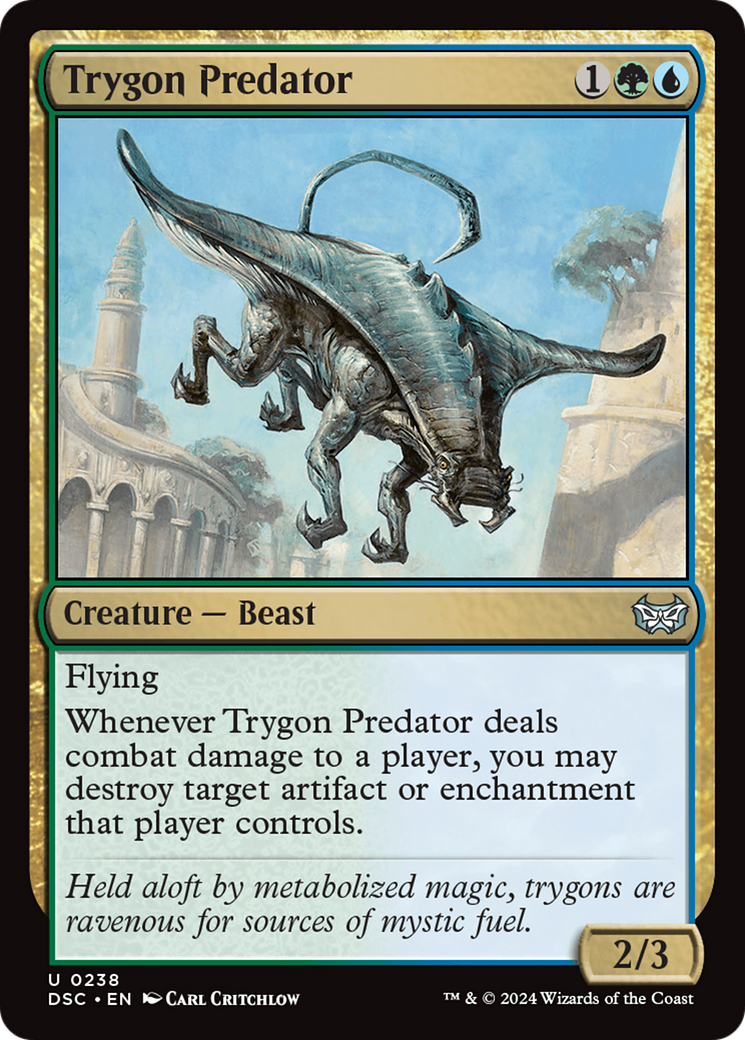
Trygon Predator
Trygon Predator
Creature — Beast
2/3
Flying
Whenever this creature deals combat damage to a player, you may destroy target artifact or enchantment that player controls.
-
1
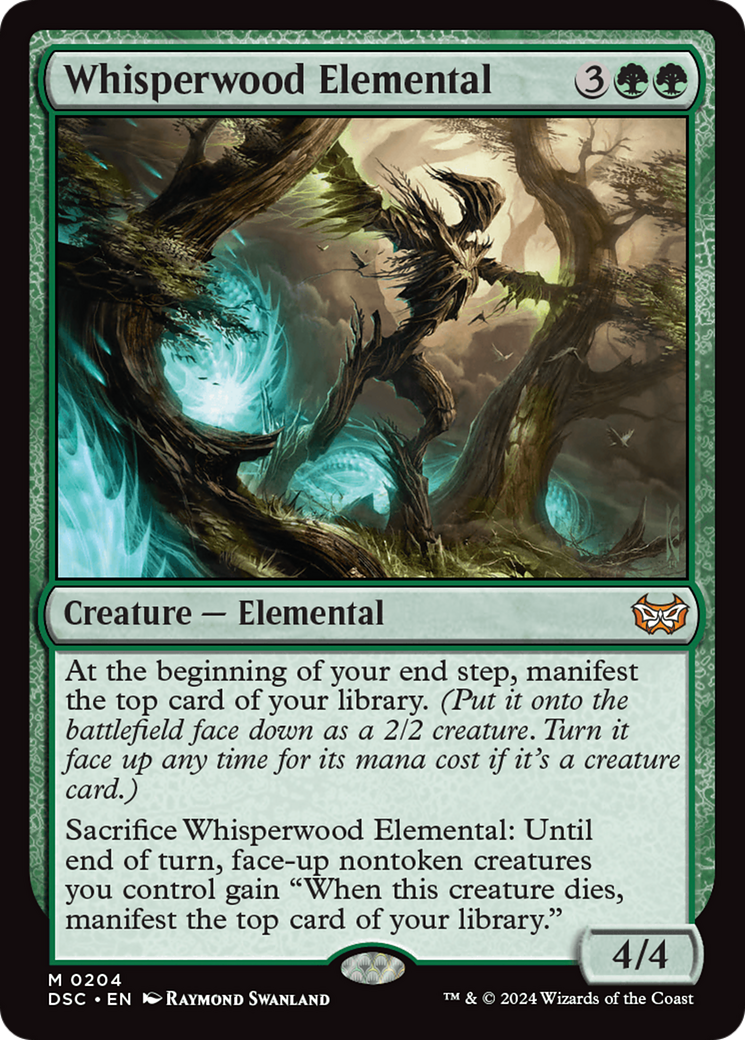
Whisperwood Elemental
Whisperwood Elemental
Creature — Elemental
4/4
At the beginning of your end step, manifest the top card of your library. (Put it onto the battlefield face down as a 2/2 creature. Turn it face up any time for its mana cost if it's a creature card.)
Sacrifice this creature: Until end of turn, face-up nontoken creatures you control gain "When this creature dies, manifest the top card of your library."
- The last ability grants that ability to face-up nontoken creatures you control as that ability resolves. Creatures that come under your control later in the turn won't have that ability.
- The face-down permanent is a 2/2 creature with no name, mana cost, creature types, or abilities. It's colorless and has a mana value of 0. Other effects that apply to the permanent can still grant or change any of these characteristics.
- Any time you have priority, you may turn a manifested creature face up by revealing that it's a creature card (ignoring any copy effects or type-changing effects that might be applying to it) and paying its mana cost. This is a special action. It doesn't use the stack and can't be responded to.
- If a manifested creature would have morph if it were face up, you may also turn it face up by paying its morph cost.
- Unlike a face-down creature that was cast using the morph ability, a manifested creature may still be turned face up after it loses its abilities if it's a creature card.
- Because the permanent is on the battlefield both before and after it's turned face up, turning a permanent face up doesn't cause any enters-the-battlefield abilities to trigger.
- Because face-down creatures don't have names, they can't have the same name as any other creature, even another face-down creature.
- A permanent that turns face up or face down changes characteristics but is otherwise the same permanent. Spells and abilities that were targeting that permanent, as well as Auras and Equipment that were attached to the permanent, aren't affected.
- Turning a permanent face up or face down doesn't change whether that permanent is tapped or untapped.
- At any time, you can look at a face-down permanent you control. You can't look at face-down permanents you don't control unless an effect allows you to or instructs you to.
- If a face-down permanent you control leaves the battlefield, you must reveal it. You must also reveal all face-down spells and permanents you control if you leave the game or if the game ends.
- You must ensure that your face-down spells and permanents can easily be differentiated from each other. You're not allowed to mix up the cards that represent them on the battlefield in order to confuse other players. The order they entered the battlefield should remain clear. Common methods for indicating this include using markers or dice, or simply placing them in order on the battlefield. You must also track how each became face down (manifested, cast face down using the morph ability, and so on).
- There are no cards in the Fate Reforged set that would turn a face-down instant or sorcery card on the battlefield face up, but some older cards can try to do this. If something tries to turn a face-down instant or sorcery card on the battlefield face up, reveal that card to show all players it's an instant or sorcery card. The permanent remains on the battlefield face down. Abilities that trigger when a permanent turns face up won't trigger, because even though you revealed the card, it never turned face up.
- If a double-faced card is manifested, it will be put onto the battlefield face down. While face down, it can't transform. If the front face of the card is a creature card, you can turn it face up by paying its mana cost. If you do, its front face will be up.
-
1
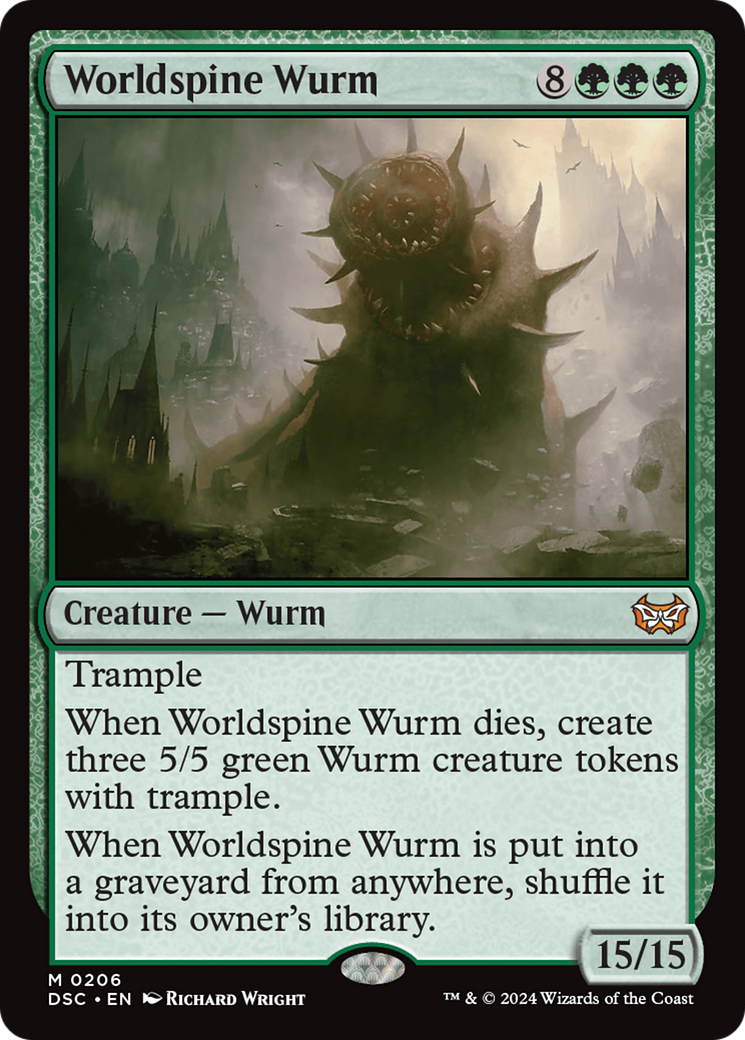
Worldspine Wurm
Worldspine Wurm
Creature — Wurm
15/15
Trample
When this creature dies, create three 5/5 green Wurm creature tokens with trample.
When Worldspine Wurm is put into a graveyard from anywhere, shuffle it into its owner's library.
- Worldspine Wurm's last ability is a triggered ability, not a replacement ability. Players can respond to this ability, for example, by trying to exile Worldspine Wurm from the graveyard before it's shuffled into a library.
-
1
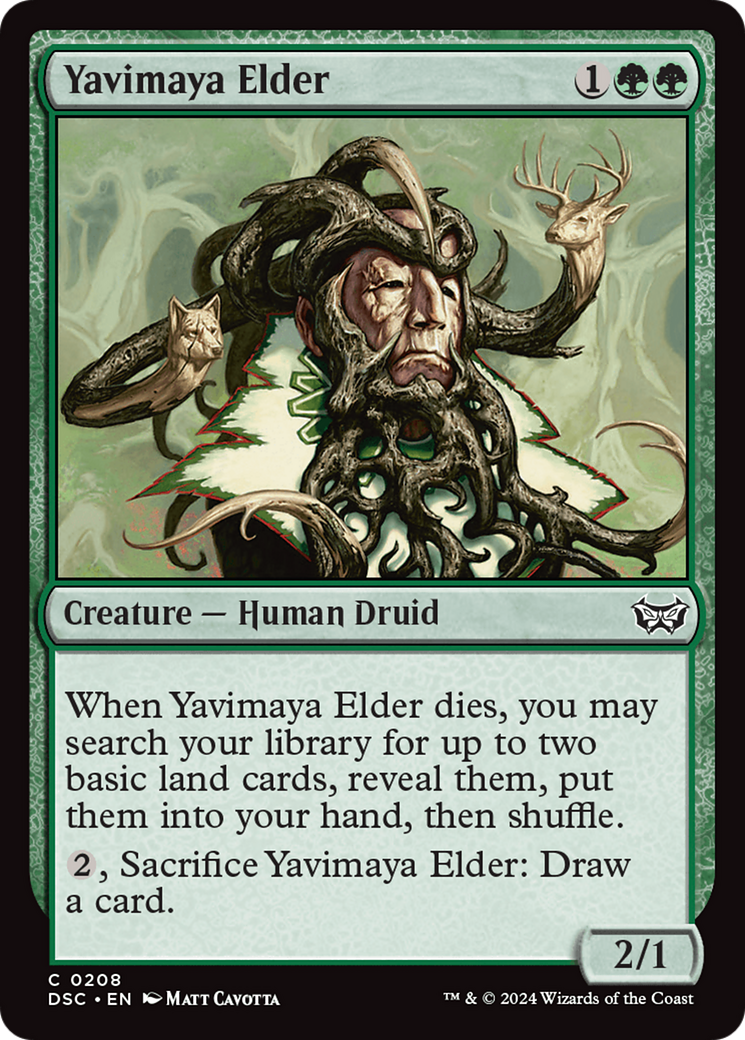
Yavimaya Elder
Yavimaya Elder
Creature — Human Druid
2/1
When this creature dies, you may search your library for up to two basic land cards, reveal them, put them into your hand, then shuffle.
, Sacrifice this creature: Draw a card.
- If you activate Yavimaya Elder's last ability, its triggered ability will trigger and go on the stack. It will resolve first, meaning you'll do the search and shuffle before drawing a card.
-
1
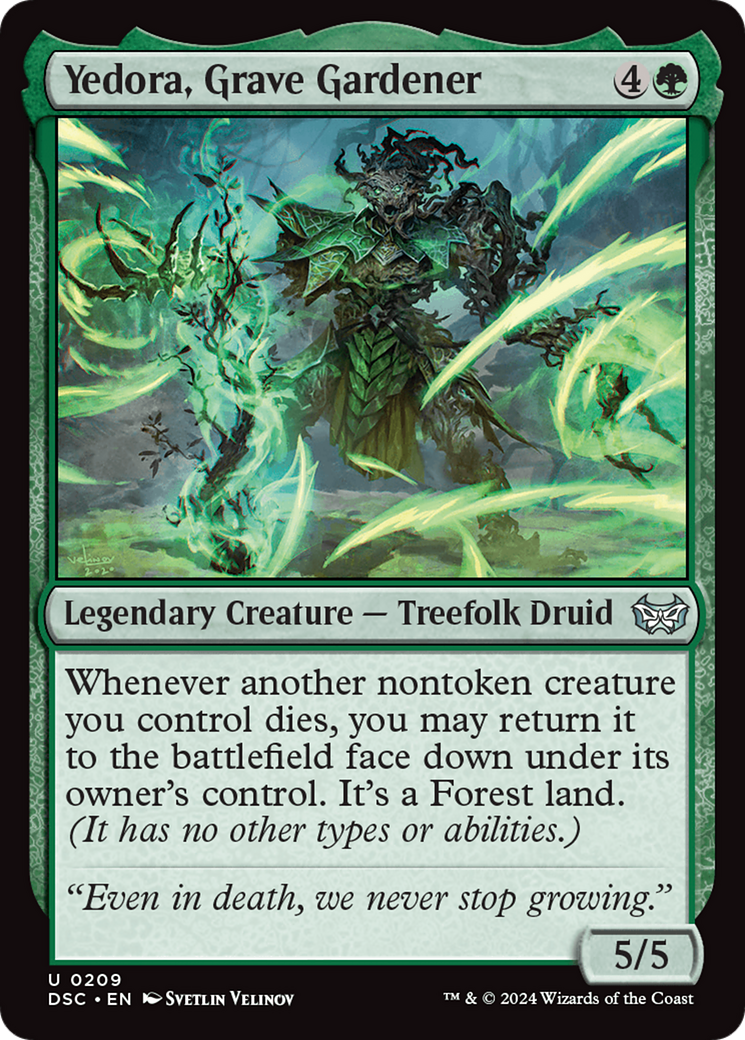
Yedora, Grave Gardener
Yedora, Grave Gardener
Legendary Creature — Treefolk Druid
5/5
Whenever another nontoken creature you control dies, you may return it to the battlefield face down under its owner's control. It's a Forest land. (It has no other types or abilities.)
- The face-down card has no name or colors. Its only type is land, its only subtype is Forest, and its only ability is " : Add ."
- If the face-down card has morph, you can pay its morph cost to turn it face up.
- If one of these Forests is turned face up, the effect making it a Forest land will expire. The face-up permanent will again have its printed name, type line, mana cost, abilities, and so on.
-
1
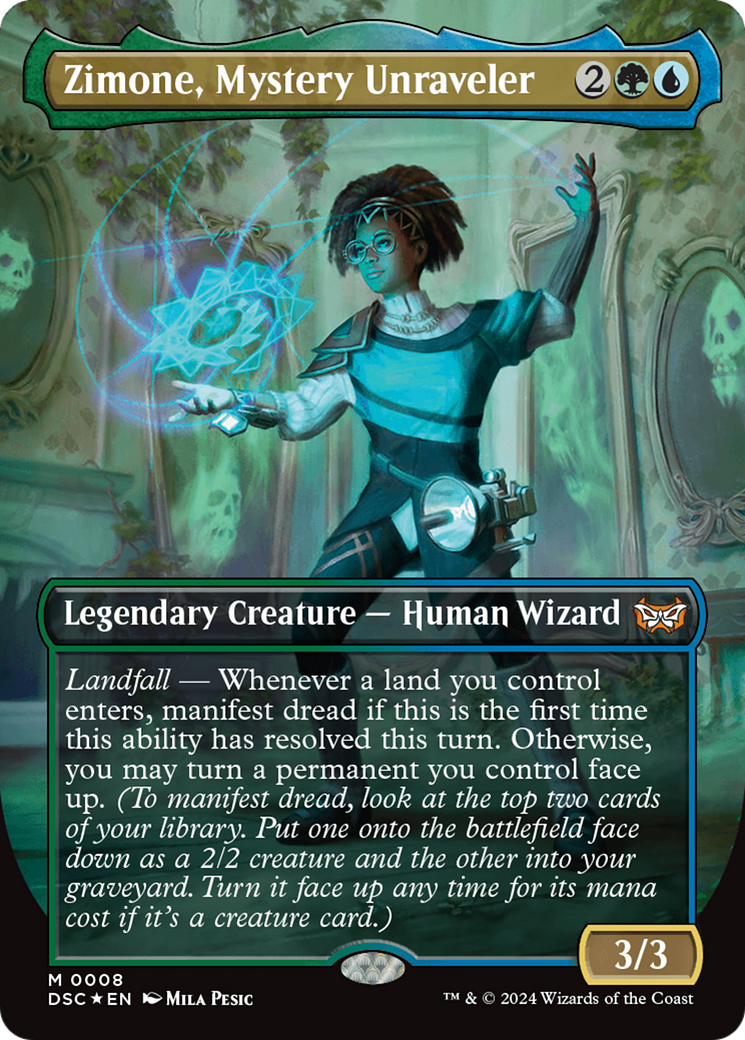
Zimone, Mystery Unraveler
Zimone, Mystery Unraveler
Legendary Creature — Human Wizard
3/3
Landfall — Whenever a land you control enters, manifest dread if this is the first time this ability has resolved this turn. Otherwise, you may turn a permanent you control face up. (To manifest dread, look at the top two cards of your library. Put one onto the battlefield face down as a 2/2 creature and the other into your graveyard. Turn it face up any time for its mana cost if it's a creature card.)
- A landfall ability triggers whenever a land you control enters for any reason. It triggers whenever you play a land, as well as whenever a spell or ability puts a land onto the battlefield under your control.
- A landfall ability doesn't trigger if a permanent already on the battlefield becomes a land.
- Whenever a land you control enters, each landfall ability of the permanents you control will trigger. You can put them on the stack in any order. The last ability you put on the stack will be the first one to resolve (As a result, you can have those abilities resolve in the order of your choosing.).
- Unlike a face-down creature that was cast using a disguise or morph ability, a manifested creature may still be turned face up after it loses its abilities if it's a creature card.
- If a double-faced card is manifested, it will be put onto the battlefield face down. While face down, it can't transform. If the front face of the card is a creature card, you can turn it face up by paying its mana cost. If you do, its front face will be up.
- If your library contains only one card when you manifest dread, you'll look at that card and put it onto the battlefield face down. You won't have the option to put it into your graveyard instead. If your library contains no cards when you manifest dread, you won't do anything.
- Some cards in the Duskmourn release have abilities that trigger "whenever you manifest dread." In circumstances where you are instructed to manifest dread but can't perform some or all of the steps of manifesting dread (probably because your library has one or fewer cards in it), these abilities will still trigger.
- At any time, you can look at a face-down spell or permanent you control. You can't look at face-down permanents or spells you don't control unless an effect instructs or allows you to do so.
- If a face-down creature loses its abilities, it can't be turned face up with a disguise or morph ability because it will no longer have that ability (or the associated cost) once face up.
- To manifest dread, look at the top two cards of your library. Manifest one (by putting it onto the battlefield face down) and put the other into your graveyard. The card you put onto the battlefield becomes a 2/2 face-down creature with no name, mana cost, creature types, or abilities. It's colorless and has a mana value of 0. Other effects that apply to the permanent can still grant it any characteristics it doesn't have or change the characteristics it does have.
- Because face-down creatures don't have a name, they can't have the same name as any other creature, even another face-down creature.
- A permanent that turns face up or face down changes characteristics but is otherwise the same permanent. Spells and abilities that were targeting that permanent and Auras and Equipment that were attached to that permanent aren't affected unless the new characteristics of the object change the legality of those targets or attachments.
- Turning a permanent face up or face down doesn't change whether that permanent is tapped or untapped.
- If a face-down spell leaves the stack and goes to any zone other than the battlefield (if it was countered, for example), you must reveal it. Similarly, if a face-down permanent leaves the battlefield, you must reveal it. You must also reveal all face-down spells and permanents you control if you leave the game or the game ends.
- You must ensure that your face-down spells and permanents can be easily differentiated from each other. You're not allowed to mix up the cards that represent them on the battlefield to confuse other players. The order in which they entered should remain clear, as well as what ability caused them to be face down. (This includes manifest, disguise, cloak, morph, and a few older effects that turn cards face down.) Common methods for doing this include using markers or dice, or simply placing them in order on the battlefield.
- If something tries to turn a face-down instant or sorcery card on the battlefield face up, reveal that card to show all players it's an instant or sorcery card. The permanent remains on the battlefield face down. Abilities that trigger when a permanent turns face up won't trigger, because even though you revealed the card, it never turned face up.
- Because the permanent is on the battlefield both before and after it's turned face up, turning a permanent face up doesn't cause any enters-the-battlefield abilities to trigger.
- Any time you have priority, you can turn a manifested permanent you control face up by revealing that it's a creature card (ignoring any copy effects or type-changing effects that might be applying to it) and paying its mana cost. This is a special action. It doesn't use the stack and can't be responded to.
- If a manifested creature would have disguise or morph if it were face up, you may also turn it face up by paying its disguise or morph cost, as appropriate.
Instants 9
-
1
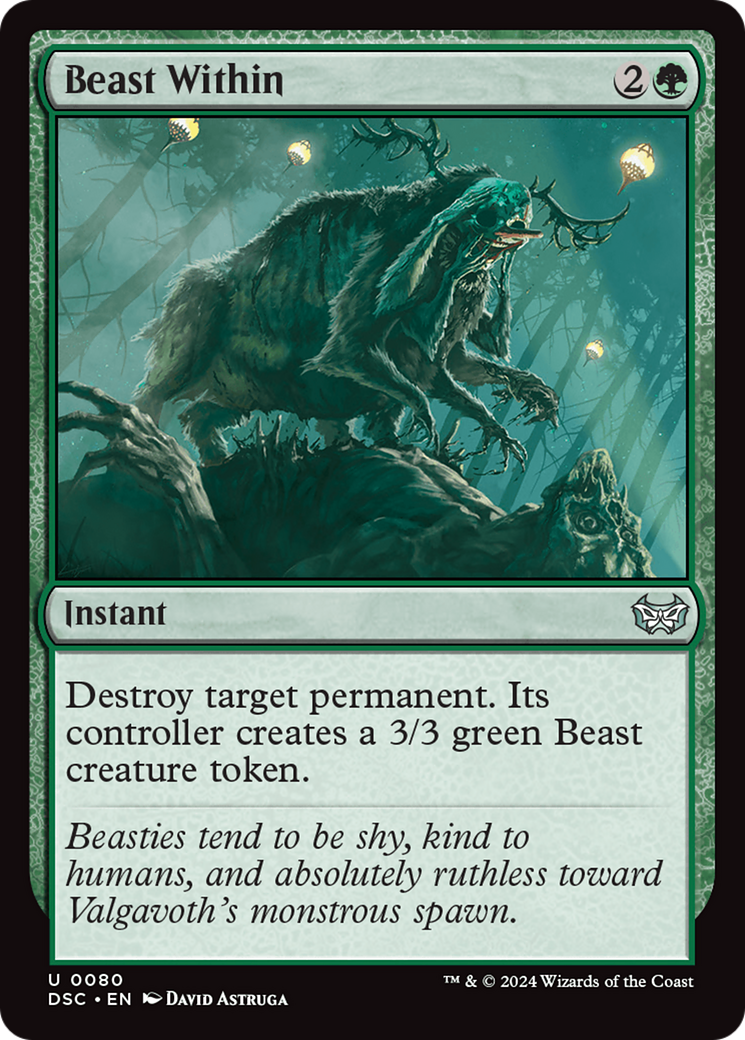
Beast Within
Beast Within
Instant
Destroy target permanent. Its controller creates a 3/3 green Beast creature token.
- If the target permanent is an illegal target by the time Beast Within tries to resolve, the spell won't resolve. No player creates a Beast token. If the target is legal but not destroyed (most likely because it has indestructible), its controller does create a Beast token.
-
1
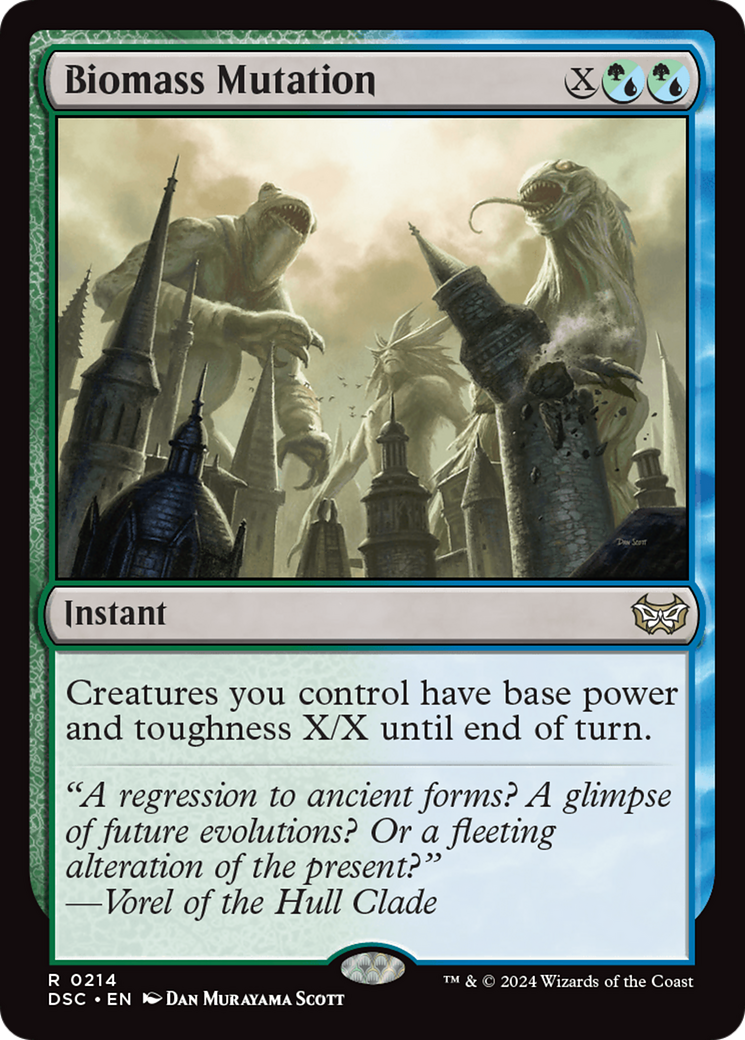
Biomass Mutation
Biomass Mutation
Instant
Creatures you control have base power and toughness X/X until end of turn.
- Choosing 0 as the value for X will likely cause creatures you control to become 0/0 and be put into the graveyard.
- Biomass Mutation overwrites any effects that set the power and/or toughness of a creature you control to a specific value. Effects that modify power and/or toughness but don't set them to a specific value (like the one created by Giant Growth), power/toughness changes from counters, and effects that switch a creature's power and toughness will continue to apply. For example, say you control a 1/1 creature that's getting +4/+2 from an Aura, has a +1/+1 counter on it, and is affected by an effect that switches its power and toughness. This creature is 4/6. If you cast Biomass Mutation with X equal to 4, the creature would become 7/9 (4/4, +4/+2 from the Aura, +1/+1 from the counter, then switch power and toughness).
-
1
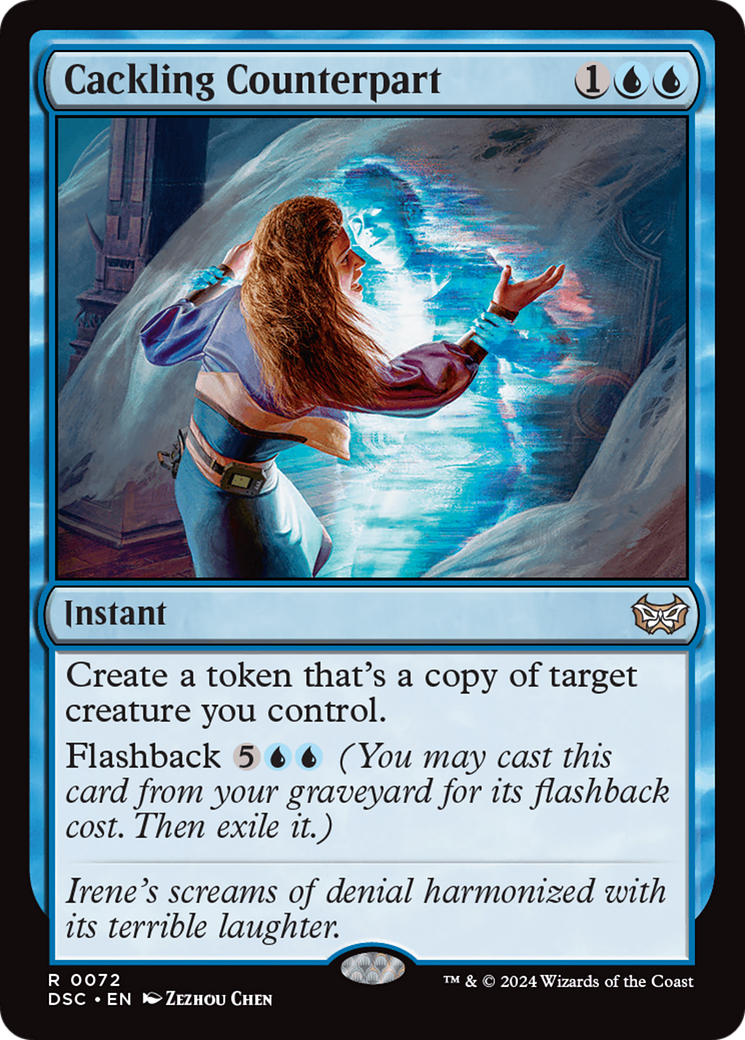
Cackling Counterpart
Cackling Counterpart
Instant
Create a token that's a copy of target creature you control.
Flashback (You may cast this card from your graveyard for its flashback cost. Then exile it.)
- The token copies exactly what was printed on the original creature and nothing else (unless that creature is copying something else or is a token; see below). It doesn’t copy whether that creature is tapped or untapped, whether it has any counters on it or Auras and Equipment attached to it, or any non-copy effects that have changed its power, toughness, types, color, or so on.
- If the copied creature has in its mana cost, X is considered to be 0.
- If the copied creature is a token, the token that’s created copies the original characteristics of that token as stated by the effect that created the token.
- If the copied creature is copying something else, then the token enters the battlefield as whatever that creature copied.
- Any “enters” triggered ability of the copied creature will trigger when the token enters the battlefield. Any “as [this creature] enters” or “[this creature] enters with” abilities of the chosen creature will also work.
- "Flashback [cost]" means "You may cast this card from your graveyard by paying [cost] rather than paying its mana cost" and "If the flashback cost was paid, exile this card instead of putting it anywhere else any time it would leave the stack."
- If a card with flashback is put into your graveyard during your turn, you can cast it if it's legal to do so before any other player can take any actions.
- You must still follow any timing restrictions and permissions, including those based on the card's type. For instance, you can cast a sorcery using flashback only when you could normally cast a sorcery.
- To determine the total cost of a spell, start with the mana cost or alternative cost (such as a flashback cost) you're paying, add any cost increases, then apply any cost reductions. The mana value of the spell is determined only by its mana cost, no matter what the total cost to cast the spell was.
- A spell cast using flashback will always be exiled afterward, whether it resolves, is countered, or leaves the stack in some other way.
- You can cast a spell using flashback even if it was somehow put into your graveyard without having been cast.
-
1
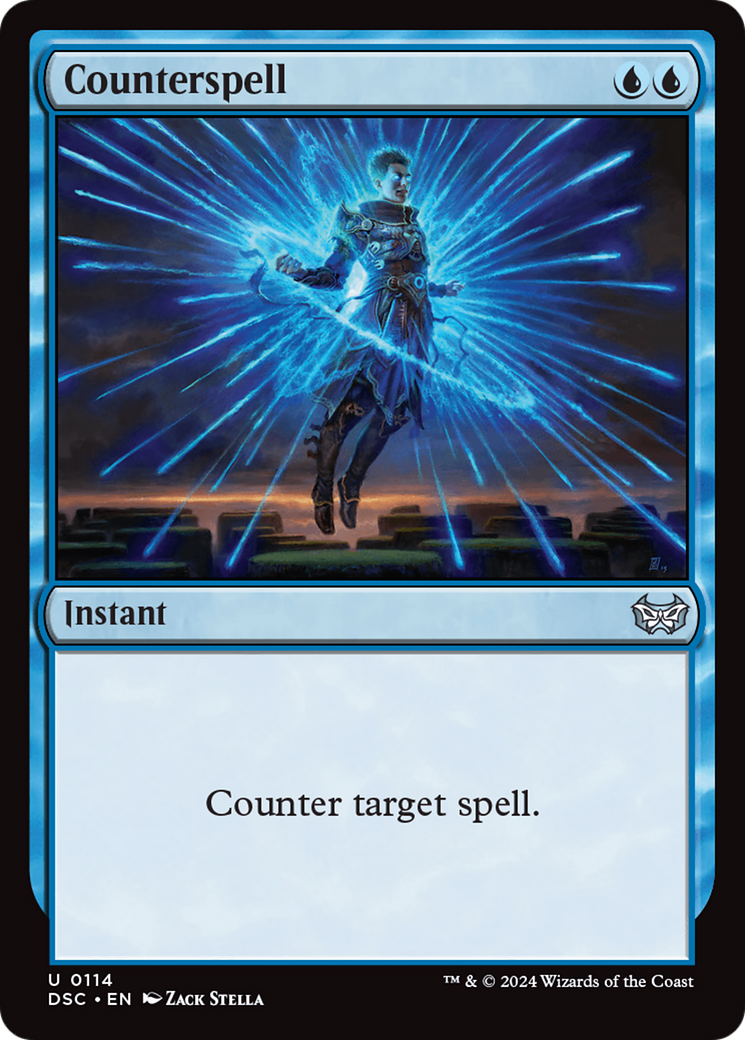
Counterspell
Counterspell
Instant
Counter target spell.
-
1
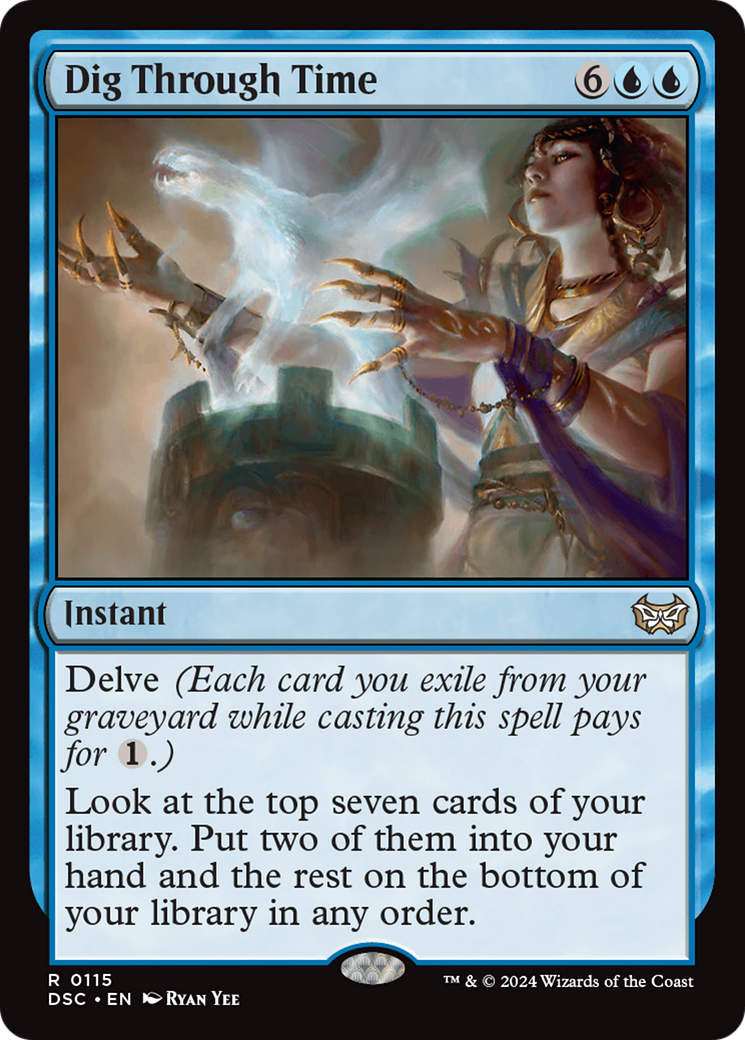
Dig Through Time
Dig Through Time
Instant
Delve (Each card you exile from your graveyard while casting this spell pays for .)
Look at the top seven cards of your library. Put two of them into your hand and the rest on the bottom of your library in any order.
- Because delve isn't an alternative cost, it can be used in conjunction with alternative costs, such as flashback. It can also be used to pay for additional costs that include generic mana.
- Delve doesn't change a spell's mana cost or mana value. For example, Treasure Cruise's mana value is 8 even if you exiled three cards to cast it.
- You can exile cards to pay only for generic mana, and you can't exile more cards than the generic mana requirement of a spell with delve. For example, you can't exile more than seven cards from your graveyard to cast Treasure Cruise unless an effect has increased its cost.
-
1
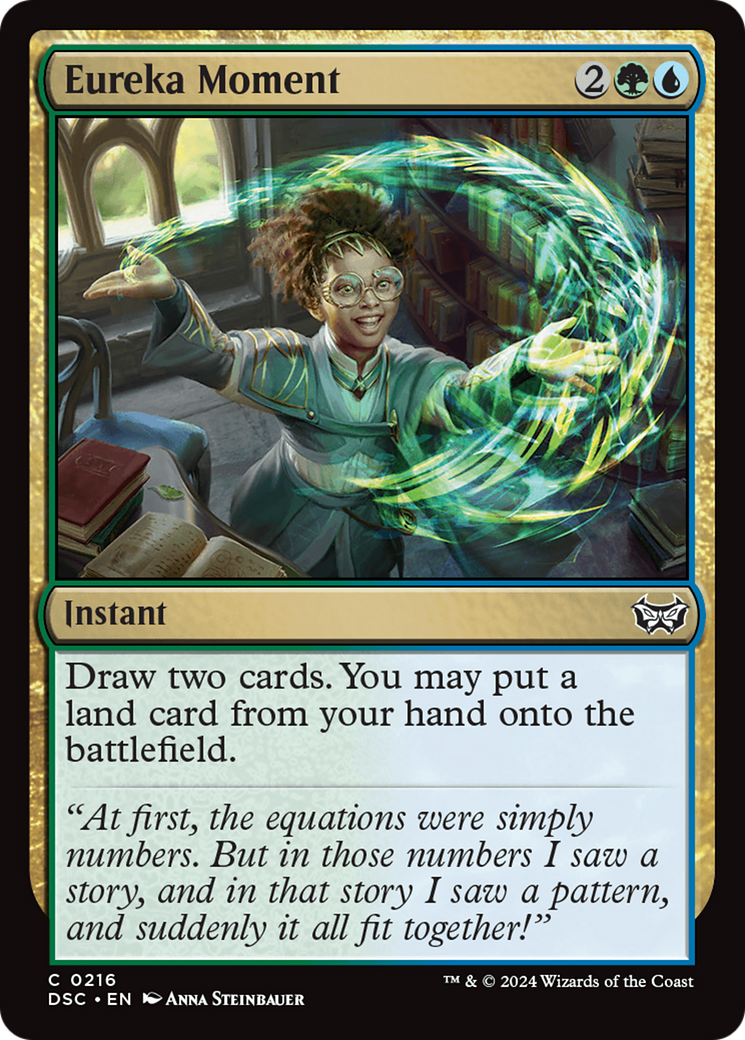
Eureka Moment
Eureka Moment
Instant
Draw two cards. You may put a land card from your hand onto the battlefield.
- Putting a land card from your hand onto the battlefield is not the same as playing a land. You may do it even if you have already played a land on your turn, or if you're casting Eureka Moment on your opponent's turn.
-
1
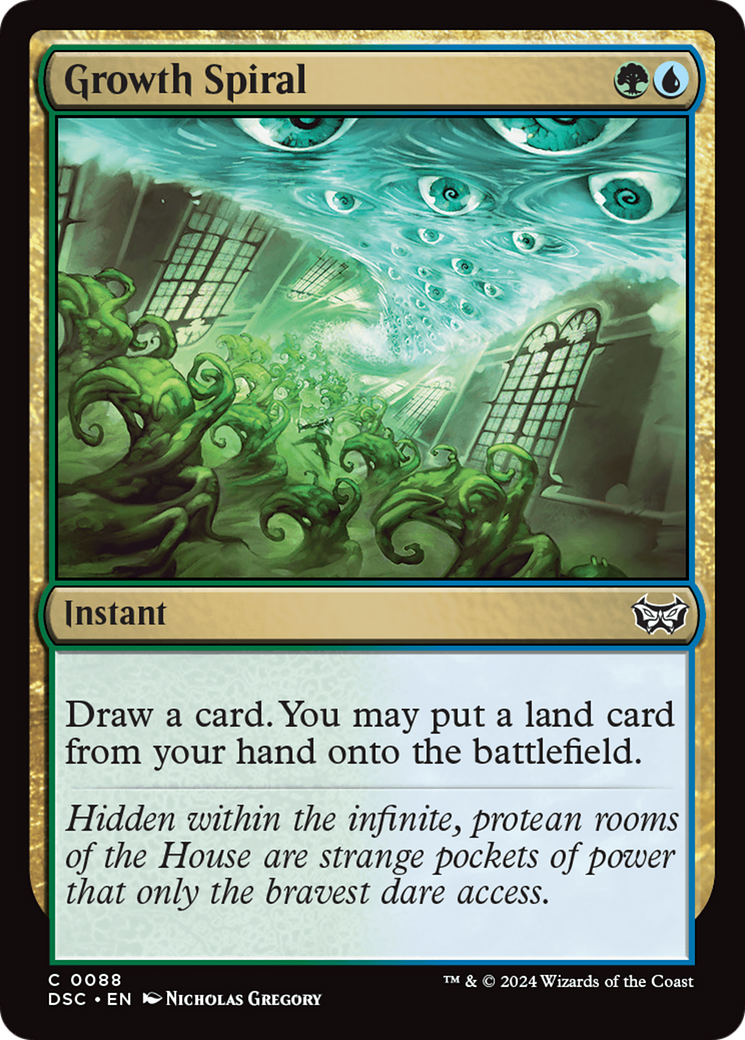
Growth Spiral
Growth Spiral
Instant
Draw a card. You may put a land card from your hand onto the battlefield.
- Growth Spiral's effect doesn't count as playing a land. It can put a land card onto the battlefield even if it's not your turn or if you've already played your land for the turn.
-
1
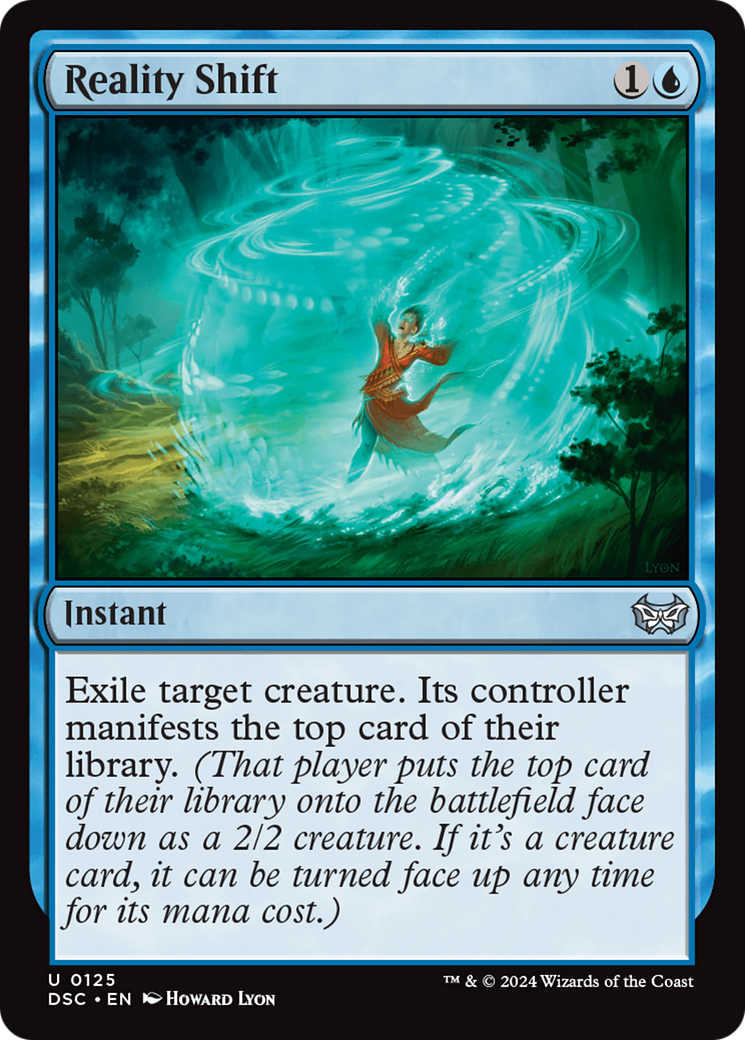
Reality Shift
Reality Shift
Instant
Exile target creature. Its controller manifests the top card of their library. (That player puts the top card of their library onto the battlefield face down as a 2/2 creature. If it's a creature card, it can be turned face up any time for its mana cost.)
- Any time you have priority, you may turn a manifested creature face up by revealing that it's a creature card (ignoring any copy effects or type-changing effects that might be applying to it) and paying its mana cost. This is a special action. It doesn't use the stack and can't be responded to.
- Because the permanent is on the battlefield both before and after it's turned face up, turning a permanent face up doesn't cause any enters-the-battlefield abilities to trigger.
- A permanent that turns face up or face down changes characteristics but is otherwise the same permanent. Spells and abilities that were targeting that permanent, as well as Auras and Equipment that were attached to the permanent, aren't affected.
- At any time, you can look at a face-down permanent you control. You can't look at face-down permanents you don't control unless an effect allows you to or instructs you to.
- The face-down permanent is a 2/2 creature with no name, mana cost, creature types, or abilities. It's colorless and has a mana value of 0. Other effects that apply to the permanent can still grant or change any of these characteristics.
- If a face-down permanent you control leaves the battlefield, you must reveal it. You must also reveal all face-down spells and permanents you control if you leave the game or if the game ends.
- If a manifested creature would have morph if it were face up, you may also turn it face up by paying its morph cost.
- Turning a permanent face up or face down doesn't change whether that permanent is tapped or untapped.
- Because face-down creatures don't have names, they can't have the same name as any other creature, even another face-down creature.
- If a double-faced card is manifested, it will be put onto the battlefield face down. While face down, it can't transform. If the front face of the card is a creature card, you can turn it face up by paying its mana cost. If you do, its front face will be up.
- There are no cards in the Fate Reforged set that would turn a face-down instant or sorcery card on the battlefield face up, but some older cards can try to do this. If something tries to turn a face-down instant or sorcery card on the battlefield face up, reveal that card to show all players it's an instant or sorcery card. The permanent remains on the battlefield face down. Abilities that trigger when a permanent turns face up won't trigger, because even though you revealed the card, it never turned face up.
- Unlike a face-down creature that was cast using the morph ability, a manifested creature may still be turned face up after it loses its abilities if it's a creature card.
- You must ensure that your face-down spells and permanents can easily be differentiated from each other. You're not allowed to mix up the cards that represent them on the battlefield in order to confuse other players. The order they entered the battlefield should remain clear. Common methods for indicating this include using markers or dice, or simply placing them in order on the battlefield. You must also track how each became face down (manifested, cast face down using the morph ability, and so on).
-
1
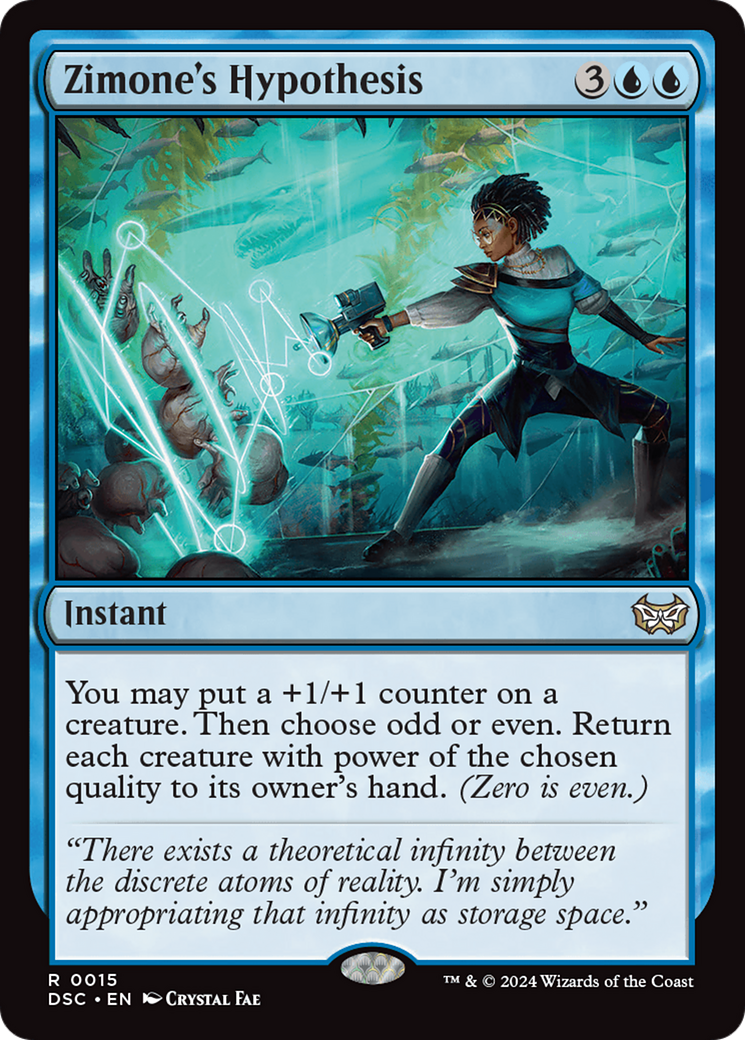
Zimone's Hypothesis
Zimone's Hypothesis
Instant
You may put a +1/+1 counter on a creature. Then choose odd or even. Return each creature with power of the chosen quality to its owner's hand. (Zero is even.)
- You choose odd or even while Zimone's Hypothesis is resolving. Players can't take any actions between the time you make that choice and the time creatures are returned to their owners' hands.
Sorceries 8
-
1
Aether Gale
Aether Gale
Sorcery
Return six target nonland permanents to their owners' hands.
- You must choose six different legal targets in order to cast Aether Gale. If some, but not all, of those targets become illegal before Aether Gale resolves, the remaining legal targets will be put into their owners' hands.
-
1
Cultivate
Cultivate
Sorcery
Search your library for up to two basic land cards, reveal those cards, put one onto the battlefield tapped and the other into your hand, then shuffle.
- If you choose to find only one basic land card, you put it onto the battlefield tapped.
-
1
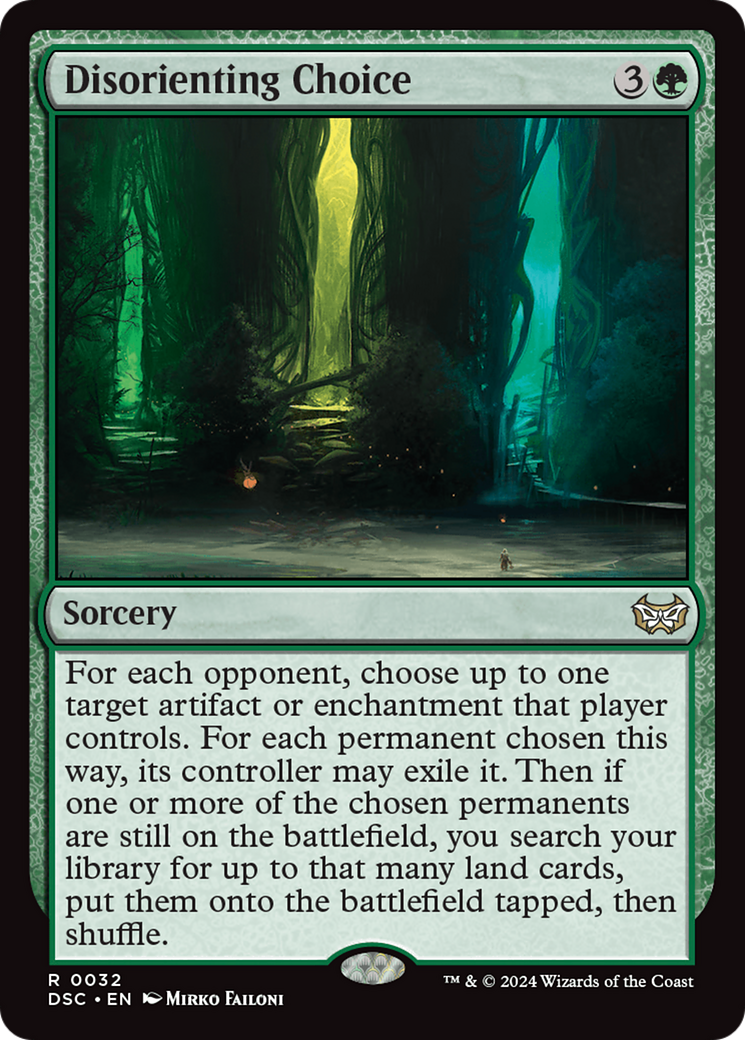
Disorienting Choice
Disorienting Choice
Sorcery
For each opponent, choose up to one target artifact or enchantment that player controls. For each permanent chosen this way, its controller may exile it. Then if one or more of the chosen permanents are still on the battlefield, you search your library for up to that many land cards, put them onto the battlefield tapped, then shuffle.
- When Disorienting Choice resolves, the next opponent in turn order that controls a permanent chosen with Disorienting Choice decides whether or not to exile that permanent. Then each other opponent in turn order does the same. Then all appropriate permanents are exiled simultaneously. Opponents will know what choices opponents earlier in the turn order made.
-
1
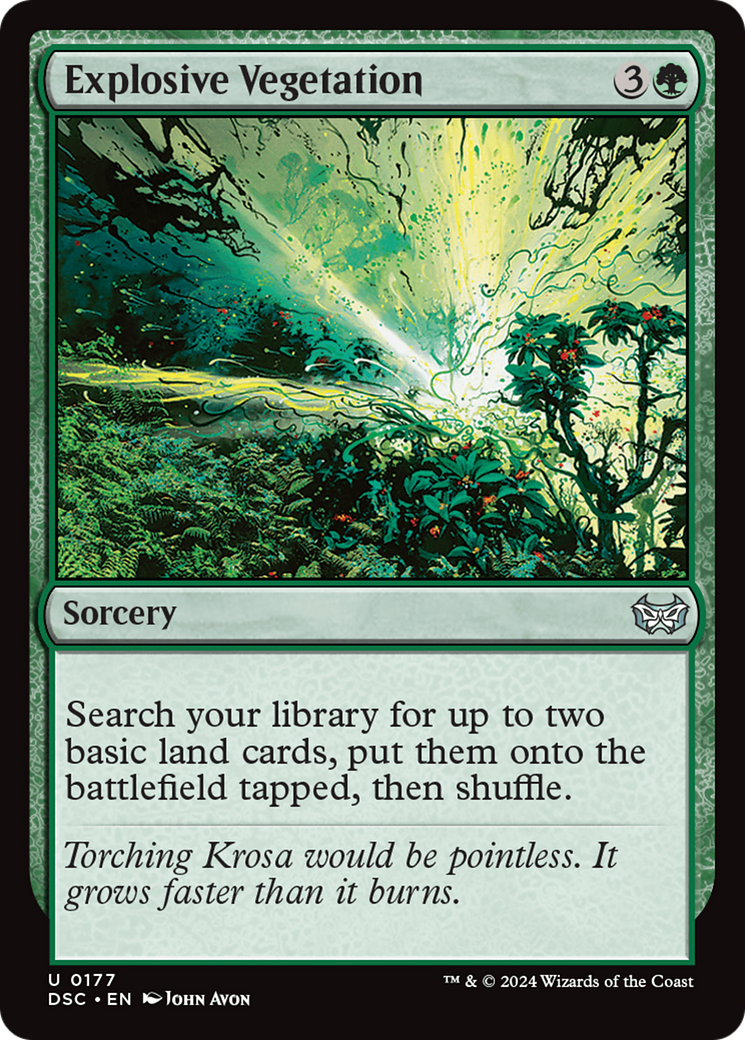
Explosive Vegetation
Explosive Vegetation
Sorcery
Search your library for up to two basic land cards, put them onto the battlefield tapped, then shuffle.
-
1
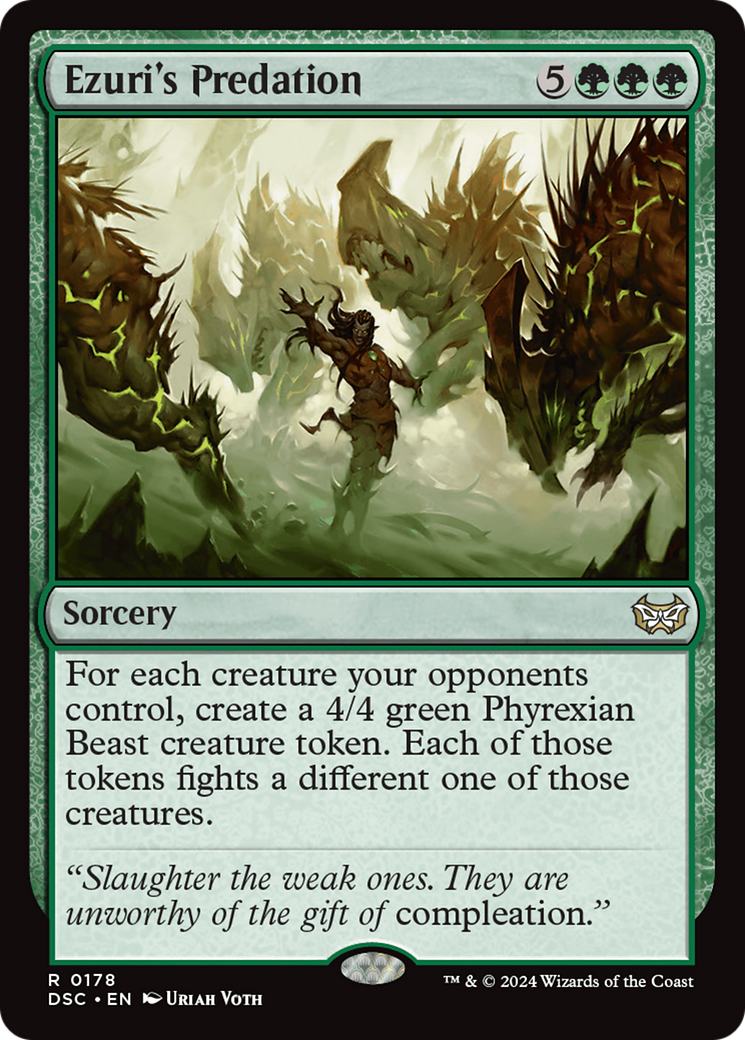
Ezuri's Predation
Ezuri's Predation
Sorcery
For each creature your opponents control, create a 4/4 green Phyrexian Beast creature token. Each of those tokens fights a different one of those creatures.
- Players can't cast spells or activate any abilities in between the Beasts entering the battlefield and fighting the other creatures. If the Beasts entering the battlefield cause any abilities to trigger, those abilities will be put onto the stack after Ezuri's Predation is finished resolving.
- You choose which Beast is fighting which creature an opponent controls.
- Each of the "fights" happens at the same time.
- If Ezuri's Predation creates more than one token for any given creature (due to an effect such as the one Doubling Season creates), the extra tokens won't fight any creature.
-
1
Oversimplify
Oversimplify
Sorcery
Exile all creatures. Each player creates a 0/0 green and blue Fractal creature token and puts a number of +1/+1 counters on it equal to the total power of creatures they controlled that were exiled this way.
- Oversimplify counts the total power of the creatures as they last existed on the battlefield, not the power of those cards in exile.
- If a commander is exiled this way, its power will be counted along with the other creatures. Once Oversimplify finishes resolving, that commander's owner may move it to the command zone.
-
1
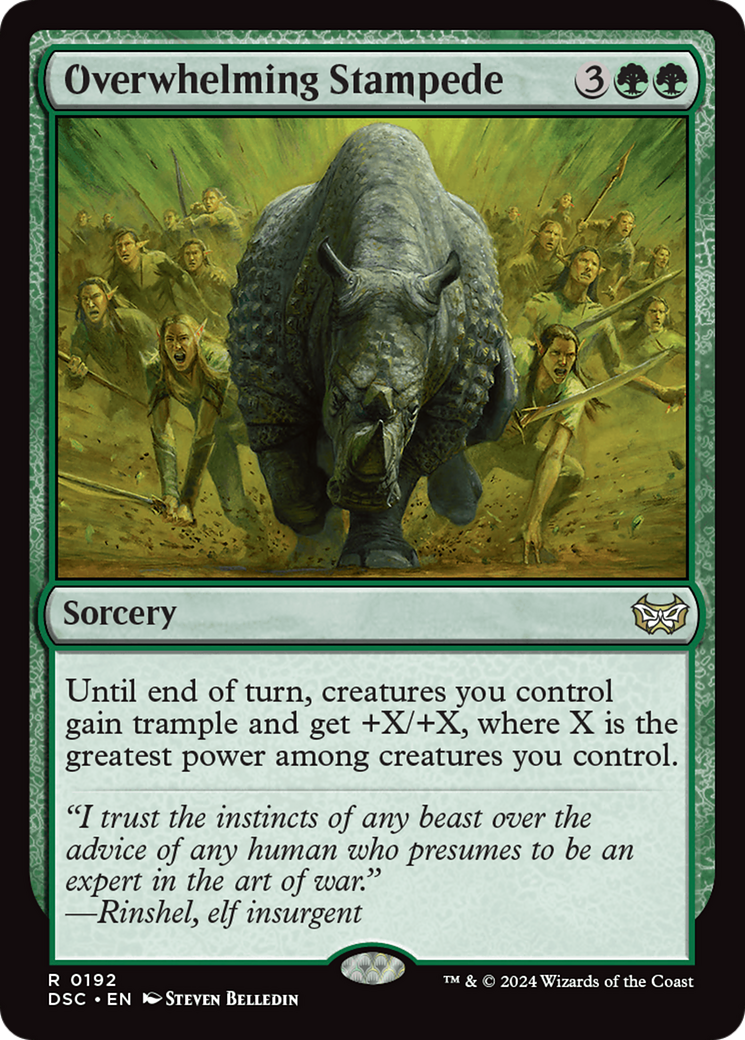
Overwhelming Stampede
Overwhelming Stampede
Sorcery
Until end of turn, creatures you control gain trample and get +X/+X, where X is the greatest power among creatures you control.
- You check the power of your creatures as Overwhelming Stampede resolves. For example, if you control a 2/1 creature, a 2/2 creature, a 2/4 creature, a 4/1 creature, a 5/5 creature, and a 5/6 creature at that time, each of your creatures gets +5/+5 and gains trample until end of turn.
-
1
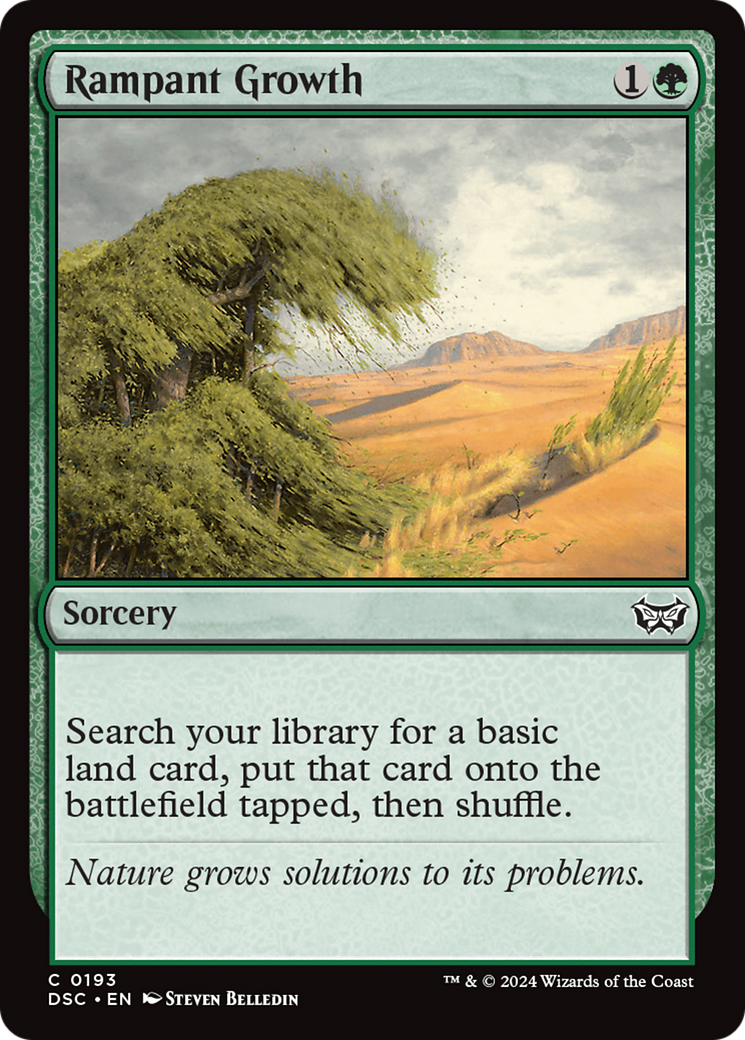
Rampant Growth
Rampant Growth
Sorcery
Search your library for a basic land card, put that card onto the battlefield tapped, then shuffle.
- The land does not count toward your one per turn limit because it was put onto the battlefield by an effect.
Artifacts 4
-
1
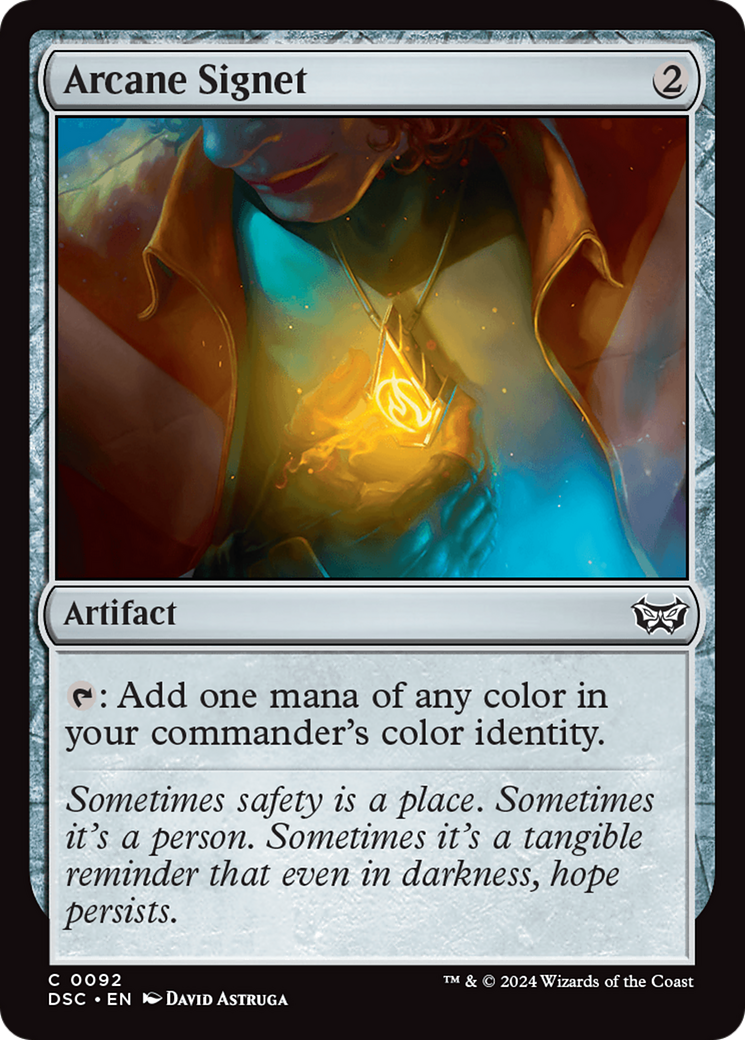
Arcane Signet
Arcane Signet
Artifact
: Add one mana of any color in your commander's color identity.
- If your commander is a card that has no colors in its color identity, Arcane Signet's ability produces no mana. It doesn't produce .
- If you have two commanders, the ability adds one mana of any color in their combined color identities.
- If you don't have a commander, Arcane Signet's ability produces no mana.
-
1
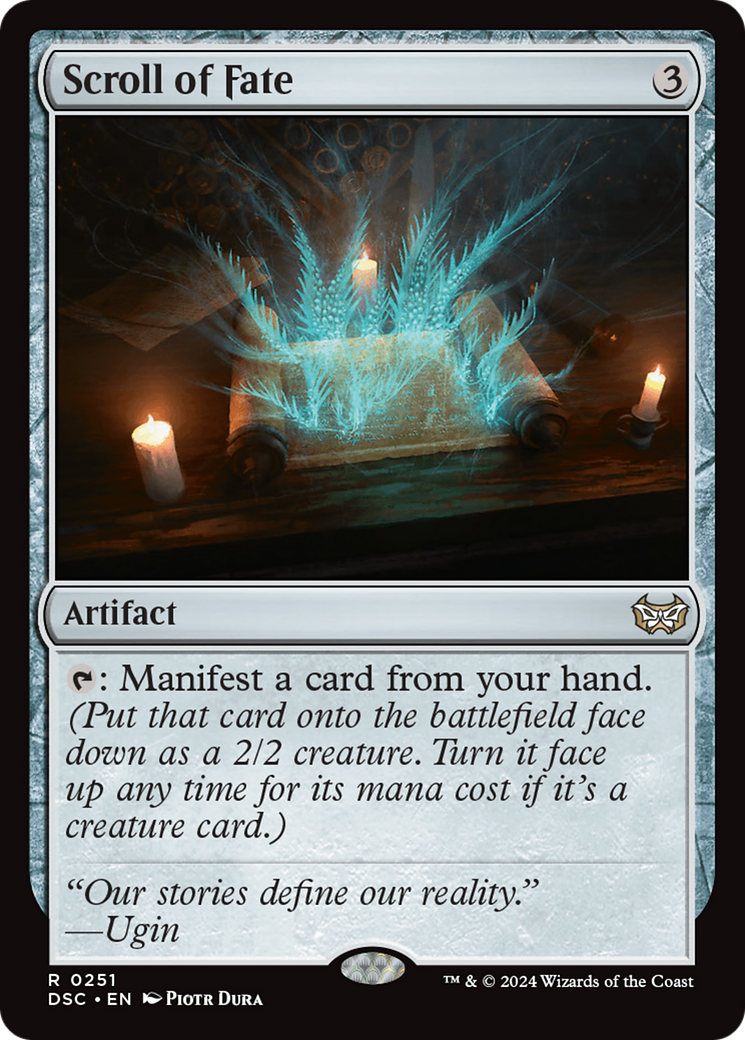
Scroll of Fate
Scroll of Fate
Artifact
: Manifest a card from your hand. (Put that card onto the battlefield face down as a 2/2 creature. Turn it face up any time for its mana cost if it's a creature card.)
-
1
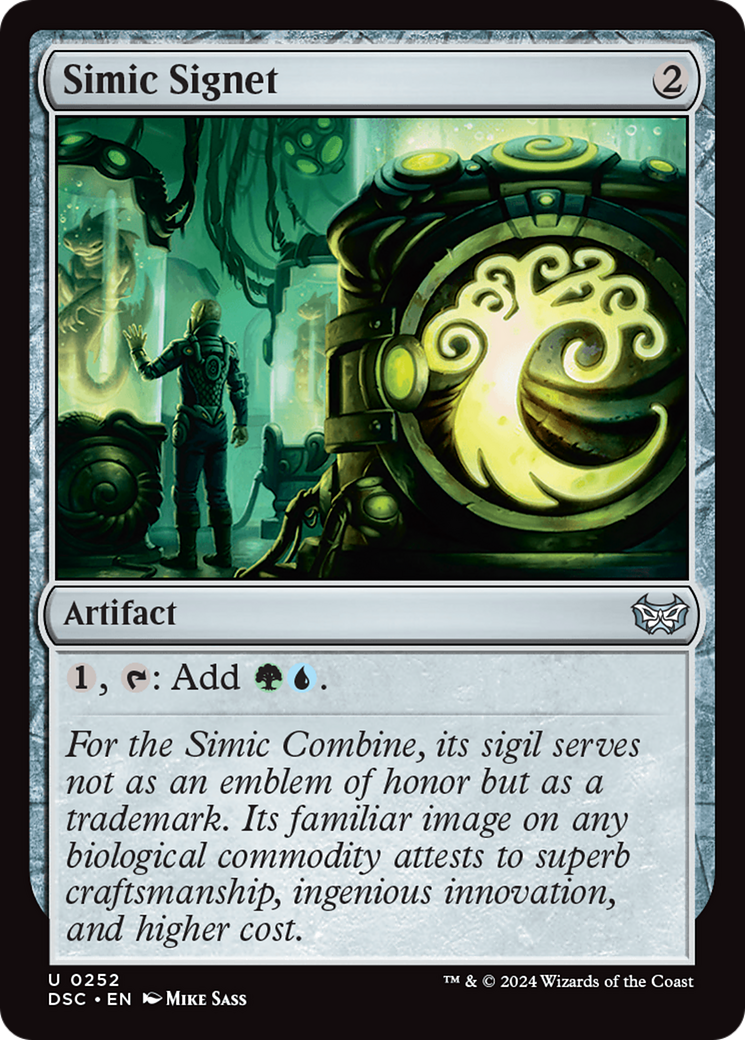
Simic Signet
Simic Signet
Artifact
, : Add .
-
1
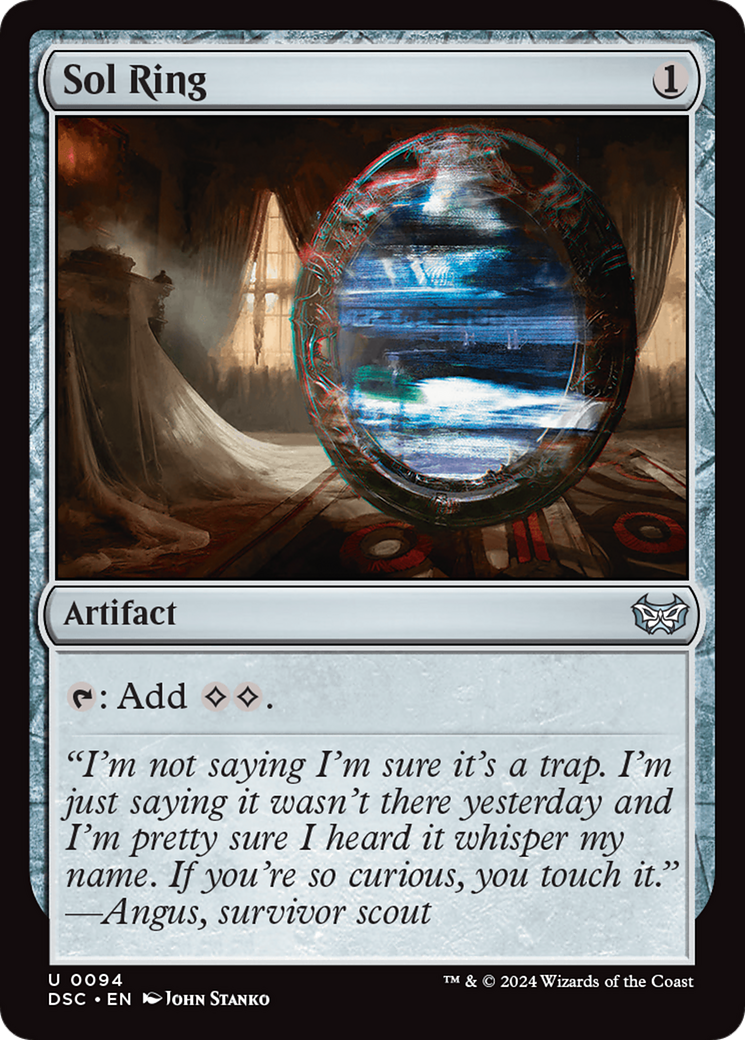
Sol Ring
Sol Ring
Artifact
: Add .
Enchantments 8
-
1
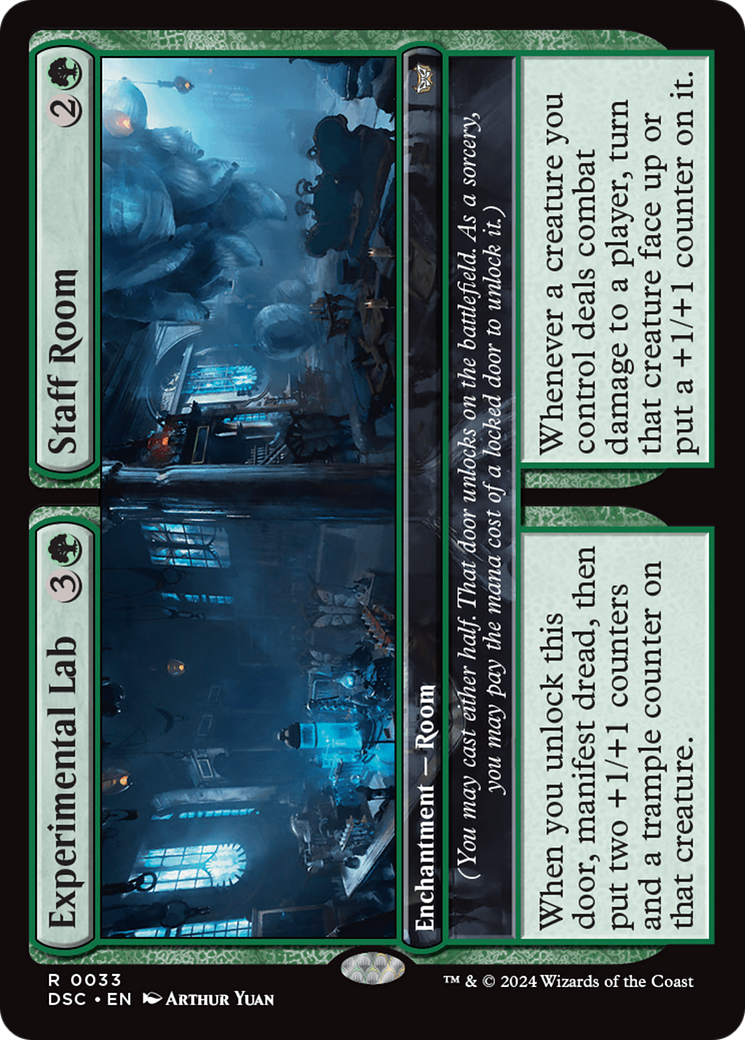
Experimental Lab // Staff Room
//
Experimental Lab
Enchantment — Room
- To cast a Room spell, choose a half (or "door") to cast. There's no way to cast both halves of a Room card. When the Room spell resolves, the corresponding door becomes unlocked as the Room enters.
- Room cards have two card faces with a shared type line on a single card. The characteristics of the door you didn't cast are ignored while the spell is on the stack.
- Each Room card is a single card. For example, if you discard a Room card, you've discarded one card, not two. If an effect counts the number of enchantment cards in your graveyard, Bottomless Pool // Locker Room counts once, not twice.
- Each Room card has two names. If an effect instructs you to choose a card name, you may choose one of those names, but not both.
- If an effect allows you to cast a spell with certain characteristics, consider only the characteristics of the door you're casting. For example, if an effect allows you to cast a permanent spell with mana value 3 or less from among cards in your graveyard, you could cast Bottomless Pool this way, but not Locker Room.
- While in any zone other than the stack or the battlefield, a Room card's characteristics are a combination of its two doors. For example, Bottomless Pool // Locker Room has a mana value of 6 while it's in your library. If an effect allows you to search your library for a card with mana value 4 or less, you can't find Bottomless Pool // Locker Room.
- While on the battlefield, a Room's characteristics are a combination of the characteristics of its unlocked doors. For example, if Bottomless Pool // Locker Room is on the battlefield with both doors unlocked, its names are Bottomless Pool and Locker Room, its mana value is 6, it's a Room Enchantment, and it has the abilities in each door's text box.
- If a spell or ability would create a copy of a Room spell on the stack, the copy retains the choice of which door was cast but also retains the full characteristics of the spell. The characteristics of the door that wasn't cast are still ignored while the copy is on the stack, and when the copy resolves, the token it becomes will enter with the appropriate door unlocked.
- If a Room enters from any zone other than the stack, it will enter with both halves locked.
- If neither door of a Room is unlocked, it's a Room enchantment with no name and no abilities.
- Any time you have priority during a main phase of your turn and the stack is empty, you may pay the mana cost of a locked door (also called its "unlock cost"). That door becomes unlocked. This is a special action. It doesn't use the stack and can't be responded to.
- An ability that triggers "when you unlock this door" triggers when that door becomes unlocked. This can happen one of two ways: (1) the door becomes unlocked on the battlefield or (2) the door becomes unlocked as the Room enters the battlefield because you cast the corresponding half. In the latter case, since the door becoming unlocked is what causes the ability to trigger, effects that cause abilities that trigger when a permanent enters to trigger an additional time (such as that of Panharmonicon) won't apply.
- Some abilities allow you to unlock a door of a Room you control. You can't choose to unlock a door that's already unlocked with such an ability. If such an ability requires a target, you can target a Room even if both of its doors are unlocked, but the ability won't do anything when it resolves.
- Some abilities allow you to lock a door of a Room you control. You can't choose to lock a door that's already locked with such an ability. If such an ability requires a target, you can target a Room even if both of its doors are locked, but the ability won't do anything when it resolves.
- Some doors have abilities that trigger whenever you unlock that door and require one or more targets. You can unlock that door even if there would be insufficient legal targets for that triggered ability. The triggered ability won't go on the stack.
- An ability that triggers "whenever you fully unlock a Room" triggers when a door becomes unlocked and the other door of that Room is already unlocked, or when both doors of that Room become unlocked simultaneously.
- To manifest dread, look at the top two cards of your library. Manifest one (by putting it onto the battlefield face down) and put the other into your graveyard. The card you put onto the battlefield becomes a 2/2 face-down creature with no name, mana cost, creature types, or abilities. It's colorless and has a mana value of 0. Other effects that apply to the permanent can still grant it any characteristics it doesn't have or change the characteristics it does have.
- Any time you have priority, you can turn a manifested permanent you control face up by revealing that it's a creature card (ignoring any copy effects or type-changing effects that might be applying to it) and paying its mana cost. This is a special action. It doesn't use the stack and can't be responded to.
- If a manifested creature would have disguise or morph if it were face up, you may also turn it face up by paying its disguise or morph cost, as appropriate.
- Unlike a face-down creature that was cast using a disguise or morph ability, a manifested creature may still be turned face up after it loses its abilities if it's a creature card.
- If a double-faced card is manifested, it will be put onto the battlefield face down. While face down, it can't transform. If the front face of the card is a creature card, you can turn it face up by paying its mana cost. If you do, its front face will be up.
- If your library contains only one card when you manifest dread, you'll look at that card and put it onto the battlefield face down. You won't have the option to put it into your graveyard instead. If your library contains no cards when you manifest dread, you won't do anything.
- Some cards in the Duskmourn release have abilities that trigger "whenever you manifest dread." In circumstances where you are instructed to manifest dread but can't perform some or all of the steps of manifesting dread (probably because your library has one or fewer cards in it), these abilities will still trigger.
- At any time, you can look at a face-down spell or permanent you control. You can't look at face-down permanents or spells you don't control unless an effect instructs or allows you to do so.
- If a face-down creature loses its abilities, it can't be turned face up with a disguise or morph ability because it will no longer have that ability (or the associated cost) once face up.
- Because the permanent is on the battlefield both before and after it's turned face up, turning a permanent face up doesn't cause any enters-the-battlefield abilities to trigger.
- Because face-down creatures don't have a name, they can't have the same name as any other creature, even another face-down creature.
- A permanent that turns face up or face down changes characteristics but is otherwise the same permanent. Spells and abilities that were targeting that permanent and Auras and Equipment that were attached to that permanent aren't affected unless the new characteristics of the object change the legality of those targets or attachments.
- Turning a permanent face up or face down doesn't change whether that permanent is tapped or untapped.
- If a face-down spell leaves the stack and goes to any zone other than the battlefield (if it was countered, for example), you must reveal it. Similarly, if a face-down permanent leaves the battlefield, you must reveal it. You must also reveal all face-down spells and permanents you control if you leave the game or the game ends.
- You must ensure that your face-down spells and permanents can be easily differentiated from each other. You're not allowed to mix up the cards that represent them on the battlefield to confuse other players. The order in which they entered should remain clear, as well as what ability caused them to be face down. (This includes manifest, disguise, cloak, morph, and a few older effects that turn cards face down.) Common methods for doing this include using markers or dice, or simply placing them in order on the battlefield.
- If something tries to turn a face-down instant or sorcery card on the battlefield face up, reveal that card to show all players it's an instant or sorcery card. The permanent remains on the battlefield face down. Abilities that trigger when a permanent turns face up won't trigger, because even though you revealed the card, it never turned face up.
-
1
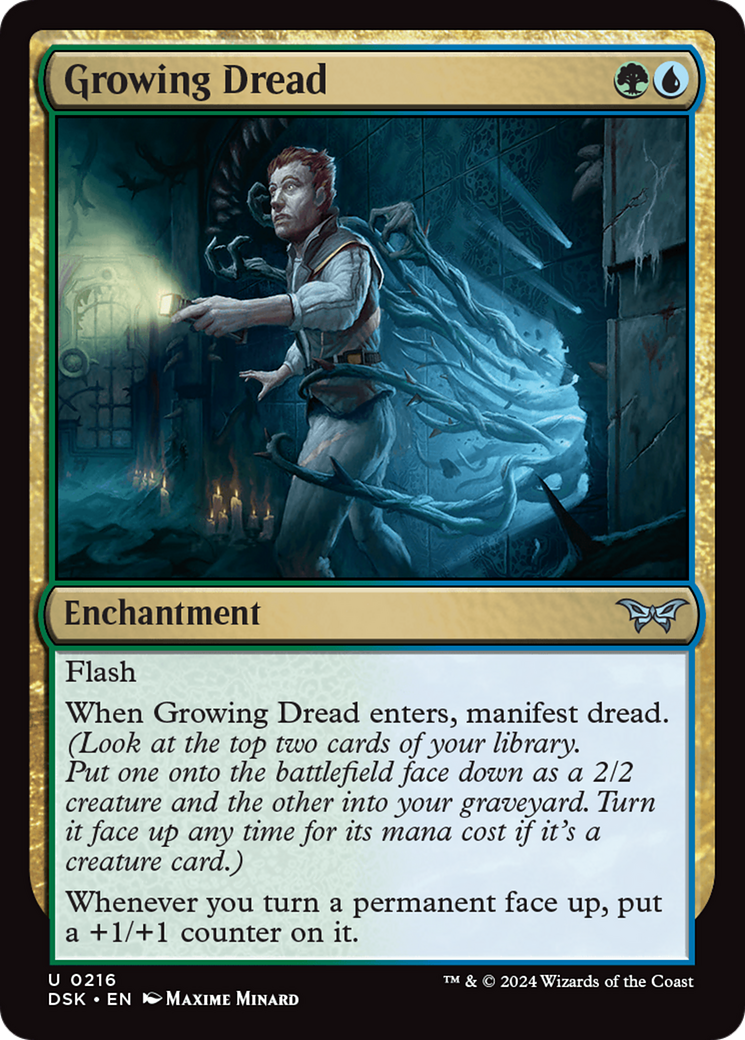
Growing Dread
Growing Dread
Enchantment
Flash
When this enchantment enters, manifest dread. (Look at the top two cards of your library. Put one onto the battlefield face down as a 2/2 creature and the other into your graveyard. Turn it face up any time for its mana cost if it's a creature card.)
Whenever you turn a permanent face up, put a +1/+1 counter on it.
-
1
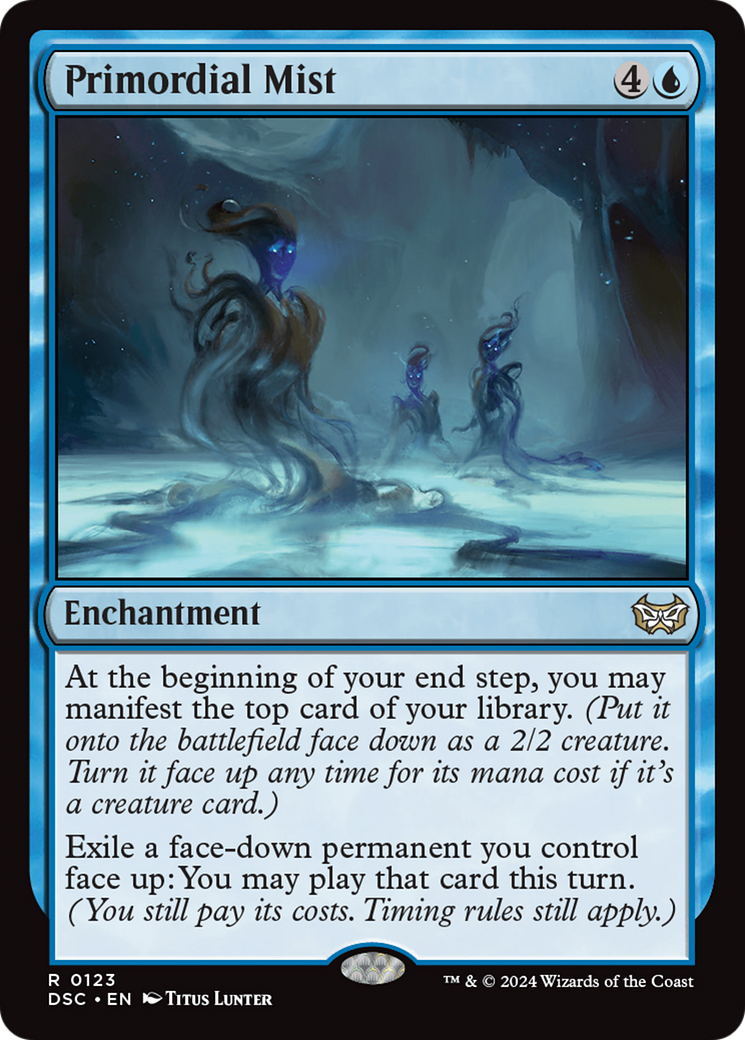
Primordial Mist
Primordial Mist
Enchantment
At the beginning of your end step, you may manifest the top card of your library. (Put it onto the battlefield face down as a 2/2 creature. Turn it face up any time for its mana cost if it's a creature card.)
Exile a face-down permanent you control face up: You may play that card this turn. (You still pay its costs. Timing rules still apply.)
- Activating Primordial Mist's last ability doesn't trigger abilities that trigger "when [something] is turned face up."
- If you activate Primordial Mist's last ability but don't play the exiled card this turn, it remains exiled.
- You must follow the normal timing permissions and restrictions of each card you play.
- You may play a land exiled this way only if you have an available land play this turn.
- You'll still pay all costs for a spell cast this way, including additional costs. You may also pay alternative costs such as evoke costs.
- Casting an exiled card causes it to leave exile. You can't cast it multiple times.
- If you somehow control a face-down token, you may exile it to activate Primordial Mist's last ability, but you won't be able to cast that token.
- The face-down permanent is a 2/2 creature with no name, mana cost, creature types, or abilities. It's colorless and has a mana value of 0. Other effects that apply to the permanent can still grant or change any of these characteristics.
- The face-down characteristics of a permanent are copiable values. If another object becomes a copy of a face-down creature or if a token is created that's a copy of a face-down creature, that new object is a 2/2 colorless face-up creature with no abilities.
- Any time you have priority, you may turn a manifested creature face up by revealing that it's a creature card (ignoring any type-changing effects that might be applying to it) and paying its mana cost. This is a special action. It doesn't use the stack and can't be responded to.
- Because face-down creatures don't have a name, they can't have the same name as any other creature or share any creature types with any other creature, even another face-down creature.
- Because the permanent is on the battlefield both before and after it's turned face up, turning a permanent face up doesn't cause any enters-the-battlefield abilities to trigger.
- A permanent that turns face up or face down changes characteristics but is otherwise the same permanent. Spells and abilities that were targeting that permanent, as well as Auras and Equipment that were attached to the permanent, aren't affected.
- Turning a permanent face up or face down doesn't change whether that permanent is tapped or untapped.
- At any time, you can look at a face-down permanent you control. You can't look at face-down permanents you don't control unless an effect instructs you to do so.
- If a face-down permanent you control leaves the battlefield, you must reveal it. You must also reveal all face-down spells and permanents you control if you leave the game or if the game ends.
- You must ensure that your face-down spells and permanents can easily be differentiated from each other. You're not allowed to mix up the cards that represent them on the battlefield to confuse other players. The order they entered the battlefield should remain clear. Common methods for indicating this include using markers or dice, or simply placing them in order on the battlefield. You must also track how each became face down (manifested, cast face down using a morph ability, and so on).
- There are no cards in this set that would turn a face-down instant or sorcery card on the battlefield face up, but some older cards can try to do this. If something tries to turn a face-down instant or sorcery card on the battlefield face up, reveal that card to show all players it's an instant or sorcery card. The permanent remains on the battlefield face down. Abilities that trigger when a permanent turns face up won't trigger, because even though you revealed the card, it never turned face up.
- If an effect tries to return a face-down creature to the battlefield after it leaves (such as Aminatou's second ability or Adarkar Valkyrie's delayed triggered ability), that effect returns the card face up. If it tries to put an instant or sorcery card onto the battlefield this way, that card remains in its current zone instead.
- Some previous Magic sets feature double-faced cards, which have a Magic card face on each side rather than a Magic card face on one side and a Magic card back on the other. If a double-faced card is manifested, it will be put onto the battlefield face down. While face down, it can't transform. If the front face of the card is a creature card, you can turn it face up by paying its mana cost. If you do, its front face will be up. Although a double-faced card can enter the battlefield face down, one already on the battlefield can't be turned face down.
-
1
Retreat to Coralhelm
Retreat to Coralhelm
Enchantment
Landfall — Whenever a land you control enters, choose one —
- You may tap or untap target creature.
- Scry 1. (Look at the top card of your library. You may put that card on the bottom.)
- A landfall ability triggers whenever a land you control enters for any reason. It triggers whenever you play a land, as well as whenever a spell or ability puts a land onto the battlefield under your control.
- A landfall ability doesn't trigger if a permanent already on the battlefield becomes a land.
- Whenever a land you control enters, each landfall ability of the permanents you control will trigger. You can put them on the stack in any order. The last ability you put on the stack will be the first one to resolve (As a result, you can have those abilities resolve in the order of your choosing.).
-
1
Sandwurm Convergence
Sandwurm Convergence
Enchantment
Creatures with flying can't attack you or planeswalkers you control.
At the beginning of your end step, create a 5/5 green Wurm creature token.
- Once a creature has attacked you or a planeswalker you control, it will remain in combat even if it gains flying. Similarly, if a creature with flying enters the battlefield attacking, Sandwurm Convergence's first ability can't undo that attack.
-
1
They Came from the Pipes
They Came from the Pipes
Enchantment
When this enchantment enters, manifest dread twice. (To manifest dread, look at the top two cards of your library. Put one onto the battlefield face down as a 2/2 creature and the other into your graveyard. Turn it face up any time for its mana cost if it's a creature card.)
Whenever a face-down creature you control enters, draw a card.
- Unlike a face-down creature that was cast using a disguise or morph ability, a manifested creature may still be turned face up after it loses its abilities if it's a creature card.
- To manifest dread, look at the top two cards of your library. Manifest one (by putting it onto the battlefield face down) and put the other into your graveyard. The card you put onto the battlefield becomes a 2/2 face-down creature with no name, mana cost, creature types, or abilities. It's colorless and has a mana value of 0. Other effects that apply to the permanent can still grant it any characteristics it doesn't have or change the characteristics it does have.
- Any time you have priority, you can turn a manifested permanent you control face up by revealing that it's a creature card (ignoring any copy effects or type-changing effects that might be applying to it) and paying its mana cost. This is a special action. It doesn't use the stack and can't be responded to.
- If a manifested creature would have disguise or morph if it were face up, you may also turn it face up by paying its disguise or morph cost, as appropriate.
- If a double-faced card is manifested, it will be put onto the battlefield face down. While face down, it can't transform. If the front face of the card is a creature card, you can turn it face up by paying its mana cost. If you do, its front face will be up.
- If your library contains only one card when you manifest dread, you'll look at that card and put it onto the battlefield face down. You won't have the option to put it into your graveyard instead. If your library contains no cards when you manifest dread, you won't do anything.
- Some cards in the Duskmourn release have abilities that trigger "whenever you manifest dread." In circumstances where you are instructed to manifest dread but can't perform some or all of the steps of manifesting dread (probably because your library has one or fewer cards in it), these abilities will still trigger.
- At any time, you can look at a face-down spell or permanent you control. You can't look at face-down permanents or spells you don't control unless an effect instructs or allows you to do so.
- If a face-down creature loses its abilities, it can't be turned face up with a disguise or morph ability because it will no longer have that ability (or the associated cost) once face up.
- Because the permanent is on the battlefield both before and after it's turned face up, turning a permanent face up doesn't cause any enters-the-battlefield abilities to trigger.
- Because face-down creatures don't have a name, they can't have the same name as any other creature, even another face-down creature.
- A permanent that turns face up or face down changes characteristics but is otherwise the same permanent. Spells and abilities that were targeting that permanent and Auras and Equipment that were attached to that permanent aren't affected unless the new characteristics of the object change the legality of those targets or attachments.
- Turning a permanent face up or face down doesn't change whether that permanent is tapped or untapped.
- If a face-down spell leaves the stack and goes to any zone other than the battlefield (if it was countered, for example), you must reveal it. Similarly, if a face-down permanent leaves the battlefield, you must reveal it. You must also reveal all face-down spells and permanents you control if you leave the game or the game ends.
- You must ensure that your face-down spells and permanents can be easily differentiated from each other. You're not allowed to mix up the cards that represent them on the battlefield to confuse other players. The order in which they entered should remain clear, as well as what ability caused them to be face down. (This includes manifest, disguise, cloak, morph, and a few older effects that turn cards face down.) Common methods for doing this include using markers or dice, or simply placing them in order on the battlefield.
- If something tries to turn a face-down instant or sorcery card on the battlefield face up, reveal that card to show all players it's an instant or sorcery card. The permanent remains on the battlefield face down. Abilities that trigger when a permanent turns face up won't trigger, because even though you revealed the card, it never turned face up.
-
1
Trail of Mystery
Trail of Mystery
Enchantment
Whenever a face-down creature you control enters, you may search your library for a basic land card, reveal it, put it into your hand, then shuffle.
Whenever a permanent you control is turned face up, if it's a creature, it gets +2/+2 until end of turn.
-
1
Wilderness Reclamation
Wilderness Reclamation
Enchantment
At the beginning of your end step, untap all lands you control.
Lands 38
-
1
Ash Barrens
Ash Barrens
Land
: Add .
Basic landcycling ( , Discard this card: Search your library for a basic land card, reveal it, put it into your hand, then shuffle.)
-
1
Castle Vantress
Castle Vantress
Land
This land enters tapped unless you control an Island.
: Add .
, : Scry 2.
- Once the common lands (such as Mystic Sanctuary) enter the battlefield tapped, there's no way to untap them with a spell or ability to make their last ability trigger.
- Although the common lands have basic land types, they aren't basic lands.
-
1
Command Tower
Command Tower
Land
: Add one mana of any color in your commander's color identity.
- If you don't have a commander, Command Tower's ability produces no mana.
- If your commander is a card that has no colors in its color identity, Command Tower's ability produces no mana. It doesn't produce .
- If you have two commanders, the ability adds one mana of any color in their combined color identities.
-
1
Drownyard Temple
Drownyard Temple
Land
: Add .
: Return this card from your graveyard to the battlefield tapped.
-
1
Evolving Wilds
Evolving Wilds
Land
, Sacrifice this land: Search your library for a basic land card, put it onto the battlefield tapped, then shuffle.
-
1
Flooded Grove
Flooded Grove
Land
: Add .
, : Add , , or .
-
9
Forest
Forest
Basic Land — Forest
( : Add .)
-
1
Hinterland Harbor
Hinterland Harbor
Land
This land enters tapped unless you control a Forest or an Island.
: Add or .
-
9
Island
Island
Basic Land — Island
( : Add .)
-
1
Mosswort Bridge
Mosswort Bridge
Land
Hideaway 4 (When this land enters, look at the top four cards of your library, exile one face down, then put the rest on the bottom in a random order.)
This land enters tapped.
: Add .
, : You may play the exiled card without paying its mana cost if creatures you control have total power 10 or greater.
- "Hideaway N" means "When this permanent enters the battlefield, look at the top N cards of your library. Exile one of them face down and put the rest on the bottom of your library in a random order. The exiled card gains 'The player who controls the permanent that exiled this card may look at this card in the exile zone.'"
- Any player who has controlled a permanent with a hideaway ability since a card was exiled with it may look at that card.
- Previously, permanents with hideaway entered the battlefield tapped. This ability has been removed from the definition of hideaway. Older cards have received errata to have an additional paragraph that reads "[This permanent] enters the battlefield tapped," and they now have hideaway 4.
- Hideaway now causes you to put the rest of the cards on the bottom of your library in a random order instead of any order.
-
1
Myriad Landscape
Myriad Landscape
Land
This land enters tapped.
: Add .
, , Sacrifice this land: Search your library for up to two basic land cards that share a land type, put them onto the battlefield tapped, then shuffle.
- You can choose to find one basic land card with Myriad Landscape's last ability.
-
1
Overflowing Basin
Overflowing Basin
Land
, : Add .
-
1
Quandrix Campus
Quandrix Campus
Land
This land enters tapped.
: Add or .
, : Scry 1.
-
1
Reliquary Tower
Reliquary Tower
Land
You have no maximum hand size.
: Add .
- If multiple effects modify your hand size, apply them in timestamp order. For example, if you put Null Profusion (an enchantment that says your maximum hand size is two) onto the battlefield and then put Reliquary Tower onto the battlefield, you'll have no maximum hand size. However, if those permanents enter in the opposite order, your maximum hand size would be two.
-
1
Simic Growth Chamber
Simic Growth Chamber
Land
This land enters tapped.
When this land enters, return a land you control to its owner's hand.
: Add .
- If this land enters the battlefield and you control no other lands, its ability will force you to return it to your hand.
-
1
Tangled Islet
Tangled Islet
Land — Forest Island
( : Add or .)
This land enters tapped.
-
1
Temple of Mystery
Temple of Mystery
Land
This land enters tapped.
When this land enters, scry 1. (Look at the top card of your library. You may put that card on the bottom.)
: Add or .
- When you scry, you may put all the cards you look at back on top of your library, you may put all of those cards on the bottom of your library, or you may put some of those cards on top and the rest of them on the bottom.
- You choose how to order cards returned to your library after scrying no matter where you put them.
- You perform the actions stated on a card in sequence. For some spells and abilities, that means you'll scry last. For others, that means you'll scry and then perform other actions.
- Scry appears on some spells and abilities with one or more targets. If all of the spell or ability's targets are illegal when it tries to resolve, it won't resolve and none of its effects will happen. You won't scry.
-
1
Temple of the False God
Temple of the False God
Land
: Add . Activate only if you control five or more lands.
-
1
Terramorphic Expanse
Terramorphic Expanse
Land
, Sacrifice this land: Search your library for a basic land card, put it onto the battlefield tapped, then shuffle.
-
1
Thornwood Falls
Thornwood Falls
Land
This land enters tapped.
When this land enters, you gain 1 life.
: Add or .
-
1
Vineglimmer Snarl
Vineglimmer Snarl
Land
As this land enters, you may reveal a Forest or Island card from your hand. If you don't, this land enters tapped.
: Add or .
- You may reveal any land card with either or both of the appropriate subtypes. It doesn't have to be a basic land card.
- The "Snarl" itself doesn't have any land subtypes. You can't reveal one to satisfy the ability of another.
- If a land card with an appropriate subtype is entering the battlefield from your hand at the same time as one of these lands, you may reveal the other land to have the "Snarl" enter untapped.
- If an effect instructs you to put one of these lands onto the battlefield tapped, it will still enter the battlefield tapped even if you reveal a land card from your hand.
-
1
Yavimaya Coast
Yavimaya Coast
Land
: Add .
: Add or . This land deals 1 damage to you.
- Like most lands, each land in this cycle is colorless. The damage dealt to you is dealt by a colorless source.
- The damage dealt to you is part of the second mana ability. It doesn't use the stack and can't be responded to.
Blue 14
-
1
Aether Gale
Aether Gale
Sorcery
Return six target nonland permanents to their owners' hands.
- You must choose six different legal targets in order to cast Aether Gale. If some, but not all, of those targets become illegal before Aether Gale resolves, the remaining legal targets will be put into their owners' hands.
-
1
Body of Knowledge
Body of Knowledge
Creature — Avatar
*/*
Body of Knowledge's power and toughness are each equal to the number of cards in your hand.
You have no maximum hand size.
Whenever this creature is dealt damage, draw that many cards.
- The ability that defines Body of Knowledge's power and toughness applies in all zones, not just the battlefield.
- As long as Body of Knowledge is in your hand, its ability will count itself.
- Creatures may be dealt damage greater than their toughness. For example, if Body of Knowledge is a 3/3 creature and a source deals 5 damage to it, you'll draw five cards. Note that if Body of Knowledge is dealt lethal damage, it dies before the cards are drawn, meaning they won't raise Body of Knowledge's toughness in time to save it.
-
1
Cackling Counterpart
Cackling Counterpart
Instant
Create a token that's a copy of target creature you control.
Flashback (You may cast this card from your graveyard for its flashback cost. Then exile it.)
- The token copies exactly what was printed on the original creature and nothing else (unless that creature is copying something else or is a token; see below). It doesn’t copy whether that creature is tapped or untapped, whether it has any counters on it or Auras and Equipment attached to it, or any non-copy effects that have changed its power, toughness, types, color, or so on.
- If the copied creature has in its mana cost, X is considered to be 0.
- If the copied creature is a token, the token that’s created copies the original characteristics of that token as stated by the effect that created the token.
- If the copied creature is copying something else, then the token enters the battlefield as whatever that creature copied.
- Any “enters” triggered ability of the copied creature will trigger when the token enters the battlefield. Any “as [this creature] enters” or “[this creature] enters with” abilities of the chosen creature will also work.
- "Flashback [cost]" means "You may cast this card from your graveyard by paying [cost] rather than paying its mana cost" and "If the flashback cost was paid, exile this card instead of putting it anywhere else any time it would leave the stack."
- If a card with flashback is put into your graveyard during your turn, you can cast it if it's legal to do so before any other player can take any actions.
- You must still follow any timing restrictions and permissions, including those based on the card's type. For instance, you can cast a sorcery using flashback only when you could normally cast a sorcery.
- To determine the total cost of a spell, start with the mana cost or alternative cost (such as a flashback cost) you're paying, add any cost increases, then apply any cost reductions. The mana value of the spell is determined only by its mana cost, no matter what the total cost to cast the spell was.
- A spell cast using flashback will always be exiled afterward, whether it resolves, is countered, or leaves the stack in some other way.
- You can cast a spell using flashback even if it was somehow put into your graveyard without having been cast.
-
1
Counterspell
Counterspell
Instant
Counter target spell.
-
1
Dig Through Time
Dig Through Time
Instant
Delve (Each card you exile from your graveyard while casting this spell pays for .)
Look at the top seven cards of your library. Put two of them into your hand and the rest on the bottom of your library in any order.
- Because delve isn't an alternative cost, it can be used in conjunction with alternative costs, such as flashback. It can also be used to pay for additional costs that include generic mana.
- Delve doesn't change a spell's mana cost or mana value. For example, Treasure Cruise's mana value is 8 even if you exiled three cards to cast it.
- You can exile cards to pay only for generic mana, and you can't exile more cards than the generic mana requirement of a spell with delve. For example, you can't exile more than seven cards from your graveyard to cast Treasure Cruise unless an effect has increased its cost.
-
1
Glitch Interpreter
Glitch Interpreter
Creature — Human Wizard
2/3
When this creature enters, if you control no face-down permanents, return this creature to its owner's hand and manifest dread.
Whenever one or more colorless creatures you control deal combat damage to a player, draw a card.
- Glitch Interpreter's first ability won't trigger at all if you control one or more face-down permanents when it enters. If it does trigger but you somehow control one or more face-down permanents when it resolves, the ability won't do anything. You won't return Glitch Interpreter to your hand, and you won't manifest dread.
- If Glitch Interpreter is no longer on the battlefield when its first ability resolves and you control no face-down permanents, you'll still manifest dread.
- To manifest dread, look at the top two cards of your library. Manifest one (by putting it onto the battlefield face down) and put the other into your graveyard. The card you put onto the battlefield becomes a 2/2 face-down creature with no name, mana cost, creature types, or abilities. It's colorless and has a mana value of 0. Other effects that apply to the permanent can still grant it any characteristics it doesn't have or change the characteristics it does have.
- Any time you have priority, you can turn a manifested permanent you control face up by revealing that it's a creature card (ignoring any copy effects or type-changing effects that might be applying to it) and paying its mana cost. This is a special action. It doesn't use the stack and can't be responded to.
- If a manifested creature would have disguise or morph if it were face up, you may also turn it face up by paying its disguise or morph cost, as appropriate.
- Unlike a face-down creature that was cast using a disguise or morph ability, a manifested creature may still be turned face up after it loses its abilities if it's a creature card.
- If a double-faced card is manifested, it will be put onto the battlefield face down. While face down, it can't transform. If the front face of the card is a creature card, you can turn it face up by paying its mana cost. If you do, its front face will be up.
- If your library contains only one card when you manifest dread, you'll look at that card and put it onto the battlefield face down. You won't have the option to put it into your graveyard instead. If your library contains no cards when you manifest dread, you won't do anything.
- Some cards in the Duskmourn release have abilities that trigger "whenever you manifest dread." In circumstances where you are instructed to manifest dread but can't perform some or all of the steps of manifesting dread (probably because your library has one or fewer cards in it), these abilities will still trigger.
- At any time, you can look at a face-down spell or permanent you control. You can't look at face-down permanents or spells you don't control unless an effect instructs or allows you to do so.
- If a face-down creature loses its abilities, it can't be turned face up with a disguise or morph ability because it will no longer have that ability (or the associated cost) once face up.
- Because the permanent is on the battlefield both before and after it's turned face up, turning a permanent face up doesn't cause any enters-the-battlefield abilities to trigger.
- Because face-down creatures don't have a name, they can't have the same name as any other creature, even another face-down creature.
- A permanent that turns face up or face down changes characteristics but is otherwise the same permanent. Spells and abilities that were targeting that permanent and Auras and Equipment that were attached to that permanent aren't affected unless the new characteristics of the object change the legality of those targets or attachments.
- Turning a permanent face up or face down doesn't change whether that permanent is tapped or untapped.
- If a face-down spell leaves the stack and goes to any zone other than the battlefield (if it was countered, for example), you must reveal it. Similarly, if a face-down permanent leaves the battlefield, you must reveal it. You must also reveal all face-down spells and permanents you control if you leave the game or the game ends.
- You must ensure that your face-down spells and permanents can be easily differentiated from each other. You're not allowed to mix up the cards that represent them on the battlefield to confuse other players. The order in which they entered should remain clear, as well as what ability caused them to be face down. (This includes manifest, disguise, cloak, morph, and a few older effects that turn cards face down.) Common methods for doing this include using markers or dice, or simply placing them in order on the battlefield.
- If something tries to turn a face-down instant or sorcery card on the battlefield face up, reveal that card to show all players it's an instant or sorcery card. The permanent remains on the battlefield face down. Abilities that trigger when a permanent turns face up won't trigger, because even though you revealed the card, it never turned face up.
-
1
Kefnet the Mindful
Kefnet the Mindful
Legendary Creature — God
5/5
Flying, indestructible
Kefnet can't attack or block unless you have seven or more cards in hand.
: Draw a card, then you may return a land you control to its owner's hand.
- Once Kefnet has attacked or blocked, it will remain in combat even if the number of cards in your hand becomes six or fewer.
- While resolving Kefnet's activated ability, you don't choose which land to return to its owner's hand (or whether you'll return one at all) until you see the card you draw.
-
1
Kheru Spellsnatcher
Kheru Spellsnatcher
Creature — Snake Wizard
3/3
Morph (You may cast this card face down as a 2/2 creature for . Turn it face up any time for its morph cost.)
When this creature is turned face up, counter target spell. If that spell is countered this way, exile it instead of putting it into its owner's graveyard. You may cast that card without paying its mana cost for as long as it remains exiled.
- You can target a spell you control with Kheru Spellsnatcher's triggered ability. This will give you the ability to cast the card later without paying its mana cost.
- Because you're already casting the card using an alternative cost (by casting it without paying its mana cost), you can't pay any other alternative costs for the card, including casting it face down using the morph ability. You can pay additional costs, such as kicker costs. If the card has any mandatory additional costs, you must pay those.
- If the card has in its mana cost, you must choose 0 as the value for X when casting it.
- Morph lets you cast a card face down by paying , and lets you turn the face-down permanent face up any time you have priority by paying its morph cost.
- The face-down spell has no mana cost and has a mana value of 0. When you cast a face-down spell, put it on the stack face down so no other player knows what it is, and pay . This is an alternative cost.
- When the spell resolves, it enters the battlefield as a 2/2 creature with no name, mana cost, creature types, or abilities. It's colorless and has a mana value of 0. Other effects that apply to the creature can still grant it any of these characteristics.
- Any time you have priority, you may turn the face-down creature face up by revealing what its morph cost is and paying that cost. This is a special action. It doesn't use the stack and can't be responded to. Only a face-down permanent can be turned face up this way; a face-down spell cannot.
- Because the permanent is on the battlefield both before and after it's turned face up, turning a permanent face up doesn't cause any enters-the-battlefield abilities to trigger.
- A permanent that turns face up or face down changes characteristics but is otherwise the same permanent. Spells and abilities that were targeting that permanent, as well as Auras and Equipment that were attached to the permanent, aren't affected.
- At any time, you can look at a face-down spell or permanent you control. You can't look at face-down spells or permanents you don't control unless an effect instructs you to do so.
- You must ensure that your face-down spells and permanents can easily be differentiated from each other. You're not allowed to mix up the cards that represent them on the battlefield in order to confuse other players. The order they entered the battlefield should remain clear. Common methods for doing this include using markers or dice, or simply placing them in order on the battlefield.
- If a face-down permanent leaves the battlefield, you must reveal it. You must also reveal all face-down spells and permanents you control if you leave the game or if the game ends.
-
1
Primordial Mist
Primordial Mist
Enchantment
At the beginning of your end step, you may manifest the top card of your library. (Put it onto the battlefield face down as a 2/2 creature. Turn it face up any time for its mana cost if it's a creature card.)
Exile a face-down permanent you control face up: You may play that card this turn. (You still pay its costs. Timing rules still apply.)
- Activating Primordial Mist's last ability doesn't trigger abilities that trigger "when [something] is turned face up."
- If you activate Primordial Mist's last ability but don't play the exiled card this turn, it remains exiled.
- You must follow the normal timing permissions and restrictions of each card you play.
- You may play a land exiled this way only if you have an available land play this turn.
- You'll still pay all costs for a spell cast this way, including additional costs. You may also pay alternative costs such as evoke costs.
- Casting an exiled card causes it to leave exile. You can't cast it multiple times.
- If you somehow control a face-down token, you may exile it to activate Primordial Mist's last ability, but you won't be able to cast that token.
- The face-down permanent is a 2/2 creature with no name, mana cost, creature types, or abilities. It's colorless and has a mana value of 0. Other effects that apply to the permanent can still grant or change any of these characteristics.
- The face-down characteristics of a permanent are copiable values. If another object becomes a copy of a face-down creature or if a token is created that's a copy of a face-down creature, that new object is a 2/2 colorless face-up creature with no abilities.
- Any time you have priority, you may turn a manifested creature face up by revealing that it's a creature card (ignoring any type-changing effects that might be applying to it) and paying its mana cost. This is a special action. It doesn't use the stack and can't be responded to.
- Because face-down creatures don't have a name, they can't have the same name as any other creature or share any creature types with any other creature, even another face-down creature.
- Because the permanent is on the battlefield both before and after it's turned face up, turning a permanent face up doesn't cause any enters-the-battlefield abilities to trigger.
- A permanent that turns face up or face down changes characteristics but is otherwise the same permanent. Spells and abilities that were targeting that permanent, as well as Auras and Equipment that were attached to the permanent, aren't affected.
- Turning a permanent face up or face down doesn't change whether that permanent is tapped or untapped.
- At any time, you can look at a face-down permanent you control. You can't look at face-down permanents you don't control unless an effect instructs you to do so.
- If a face-down permanent you control leaves the battlefield, you must reveal it. You must also reveal all face-down spells and permanents you control if you leave the game or if the game ends.
- You must ensure that your face-down spells and permanents can easily be differentiated from each other. You're not allowed to mix up the cards that represent them on the battlefield to confuse other players. The order they entered the battlefield should remain clear. Common methods for indicating this include using markers or dice, or simply placing them in order on the battlefield. You must also track how each became face down (manifested, cast face down using a morph ability, and so on).
- There are no cards in this set that would turn a face-down instant or sorcery card on the battlefield face up, but some older cards can try to do this. If something tries to turn a face-down instant or sorcery card on the battlefield face up, reveal that card to show all players it's an instant or sorcery card. The permanent remains on the battlefield face down. Abilities that trigger when a permanent turns face up won't trigger, because even though you revealed the card, it never turned face up.
- If an effect tries to return a face-down creature to the battlefield after it leaves (such as Aminatou's second ability or Adarkar Valkyrie's delayed triggered ability), that effect returns the card face up. If it tries to put an instant or sorcery card onto the battlefield this way, that card remains in its current zone instead.
- Some previous Magic sets feature double-faced cards, which have a Magic card face on each side rather than a Magic card face on one side and a Magic card back on the other. If a double-faced card is manifested, it will be put onto the battlefield face down. While face down, it can't transform. If the front face of the card is a creature card, you can turn it face up by paying its mana cost. If you do, its front face will be up. Although a double-faced card can enter the battlefield face down, one already on the battlefield can't be turned face down.
-
1
Reality Shift
Reality Shift
Instant
Exile target creature. Its controller manifests the top card of their library. (That player puts the top card of their library onto the battlefield face down as a 2/2 creature. If it's a creature card, it can be turned face up any time for its mana cost.)
- Any time you have priority, you may turn a manifested creature face up by revealing that it's a creature card (ignoring any copy effects or type-changing effects that might be applying to it) and paying its mana cost. This is a special action. It doesn't use the stack and can't be responded to.
- Because the permanent is on the battlefield both before and after it's turned face up, turning a permanent face up doesn't cause any enters-the-battlefield abilities to trigger.
- A permanent that turns face up or face down changes characteristics but is otherwise the same permanent. Spells and abilities that were targeting that permanent, as well as Auras and Equipment that were attached to the permanent, aren't affected.
- At any time, you can look at a face-down permanent you control. You can't look at face-down permanents you don't control unless an effect allows you to or instructs you to.
- The face-down permanent is a 2/2 creature with no name, mana cost, creature types, or abilities. It's colorless and has a mana value of 0. Other effects that apply to the permanent can still grant or change any of these characteristics.
- If a face-down permanent you control leaves the battlefield, you must reveal it. You must also reveal all face-down spells and permanents you control if you leave the game or if the game ends.
- If a manifested creature would have morph if it were face up, you may also turn it face up by paying its morph cost.
- Turning a permanent face up or face down doesn't change whether that permanent is tapped or untapped.
- Because face-down creatures don't have names, they can't have the same name as any other creature, even another face-down creature.
- If a double-faced card is manifested, it will be put onto the battlefield face down. While face down, it can't transform. If the front face of the card is a creature card, you can turn it face up by paying its mana cost. If you do, its front face will be up.
- There are no cards in the Fate Reforged set that would turn a face-down instant or sorcery card on the battlefield face up, but some older cards can try to do this. If something tries to turn a face-down instant or sorcery card on the battlefield face up, reveal that card to show all players it's an instant or sorcery card. The permanent remains on the battlefield face down. Abilities that trigger when a permanent turns face up won't trigger, because even though you revealed the card, it never turned face up.
- Unlike a face-down creature that was cast using the morph ability, a manifested creature may still be turned face up after it loses its abilities if it's a creature card.
- You must ensure that your face-down spells and permanents can easily be differentiated from each other. You're not allowed to mix up the cards that represent them on the battlefield in order to confuse other players. The order they entered the battlefield should remain clear. Common methods for indicating this include using markers or dice, or simply placing them in order on the battlefield. You must also track how each became face down (manifested, cast face down using the morph ability, and so on).
-
1
Retreat to Coralhelm
Retreat to Coralhelm
Enchantment
Landfall — Whenever a land you control enters, choose one —
- You may tap or untap target creature.
- Scry 1. (Look at the top card of your library. You may put that card on the bottom.)
- A landfall ability triggers whenever a land you control enters for any reason. It triggers whenever you play a land, as well as whenever a spell or ability puts a land onto the battlefield under your control.
- A landfall ability doesn't trigger if a permanent already on the battlefield becomes a land.
- Whenever a land you control enters, each landfall ability of the permanents you control will trigger. You can put them on the stack in any order. The last ability you put on the stack will be the first one to resolve (As a result, you can have those abilities resolve in the order of your choosing.).
-
1
Skaab Ruinator
Skaab Ruinator
Creature — Zombie Horror
5/6
As an additional cost to cast this spell, exile three creature cards from your graveyard.
Flying
You may cast this card from your graveyard.
- Skaab Ruinator is on the stack when you pay its costs. It can't be exiled to pay for itself.
- You must exile three creature cards from your graveyard no matter what zone you're casting Skaab Ruinator from.
-
1
They Came from the Pipes
They Came from the Pipes
Enchantment
When this enchantment enters, manifest dread twice. (To manifest dread, look at the top two cards of your library. Put one onto the battlefield face down as a 2/2 creature and the other into your graveyard. Turn it face up any time for its mana cost if it's a creature card.)
Whenever a face-down creature you control enters, draw a card.
- Unlike a face-down creature that was cast using a disguise or morph ability, a manifested creature may still be turned face up after it loses its abilities if it's a creature card.
- To manifest dread, look at the top two cards of your library. Manifest one (by putting it onto the battlefield face down) and put the other into your graveyard. The card you put onto the battlefield becomes a 2/2 face-down creature with no name, mana cost, creature types, or abilities. It's colorless and has a mana value of 0. Other effects that apply to the permanent can still grant it any characteristics it doesn't have or change the characteristics it does have.
- Any time you have priority, you can turn a manifested permanent you control face up by revealing that it's a creature card (ignoring any copy effects or type-changing effects that might be applying to it) and paying its mana cost. This is a special action. It doesn't use the stack and can't be responded to.
- If a manifested creature would have disguise or morph if it were face up, you may also turn it face up by paying its disguise or morph cost, as appropriate.
- If a double-faced card is manifested, it will be put onto the battlefield face down. While face down, it can't transform. If the front face of the card is a creature card, you can turn it face up by paying its mana cost. If you do, its front face will be up.
- If your library contains only one card when you manifest dread, you'll look at that card and put it onto the battlefield face down. You won't have the option to put it into your graveyard instead. If your library contains no cards when you manifest dread, you won't do anything.
- Some cards in the Duskmourn release have abilities that trigger "whenever you manifest dread." In circumstances where you are instructed to manifest dread but can't perform some or all of the steps of manifesting dread (probably because your library has one or fewer cards in it), these abilities will still trigger.
- At any time, you can look at a face-down spell or permanent you control. You can't look at face-down permanents or spells you don't control unless an effect instructs or allows you to do so.
- If a face-down creature loses its abilities, it can't be turned face up with a disguise or morph ability because it will no longer have that ability (or the associated cost) once face up.
- Because the permanent is on the battlefield both before and after it's turned face up, turning a permanent face up doesn't cause any enters-the-battlefield abilities to trigger.
- Because face-down creatures don't have a name, they can't have the same name as any other creature, even another face-down creature.
- A permanent that turns face up or face down changes characteristics but is otherwise the same permanent. Spells and abilities that were targeting that permanent and Auras and Equipment that were attached to that permanent aren't affected unless the new characteristics of the object change the legality of those targets or attachments.
- Turning a permanent face up or face down doesn't change whether that permanent is tapped or untapped.
- If a face-down spell leaves the stack and goes to any zone other than the battlefield (if it was countered, for example), you must reveal it. Similarly, if a face-down permanent leaves the battlefield, you must reveal it. You must also reveal all face-down spells and permanents you control if you leave the game or the game ends.
- You must ensure that your face-down spells and permanents can be easily differentiated from each other. You're not allowed to mix up the cards that represent them on the battlefield to confuse other players. The order in which they entered should remain clear, as well as what ability caused them to be face down. (This includes manifest, disguise, cloak, morph, and a few older effects that turn cards face down.) Common methods for doing this include using markers or dice, or simply placing them in order on the battlefield.
- If something tries to turn a face-down instant or sorcery card on the battlefield face up, reveal that card to show all players it's an instant or sorcery card. The permanent remains on the battlefield face down. Abilities that trigger when a permanent turns face up won't trigger, because even though you revealed the card, it never turned face up.
-
1
Zimone's Hypothesis
Zimone's Hypothesis
Instant
You may put a +1/+1 counter on a creature. Then choose odd or even. Return each creature with power of the chosen quality to its owner's hand. (Zero is even.)
- You choose odd or even while Zimone's Hypothesis is resolving. Players can't take any actions between the time you make that choice and the time creatures are returned to their owners' hands.
Green 31
-
1
Ashaya, Soul of the Wild
Ashaya, Soul of the Wild
Legendary Creature — Elemental
*/*
Ashaya's power and toughness are each equal to the number of lands you control.
Nontoken creatures you control are Forest lands in addition to their other types. (They're still affected by summoning sickness.)
- The ability that defines Ashaya's power and toughness applies in all zones, not just the battlefield.
- As long as Ashaya is on the battlefield, it's affected by its second ability and thus its first ability counts itself.
- Because damage remains marked on a creature until the damage is removed as the turn ends, nonlethal damage dealt to Ashaya may become lethal if lands you control leave the battlefield during that turn.
- You can't play creature cards as lands; you'll still have to cast them as spells, and they'll enter the battlefield as lands (in addition to their other types).
- A land that's a Forest has the intrinsic mana ability " : Add ."
-
1
Augur of Autumn
Augur of Autumn
Creature — Human Druid
2/3
You may look at the top card of your library any time.
You may play lands from the top of your library.
Coven — As long as you control three or more creatures with different powers, you may cast creature spells from the top of your library.
- While you have three creatures with different powers, Augur of Autumn allows you to cast the top card of your library if it's a creature card, it's your main phase, and the stack is empty. If that creature card has flash, you'll be able to cast it any time you could cast an instant, even on an opponent's turn.
- Essentially, Augur of Autumn lets you play with the top card of your library revealed only to you. Knowing what that card is becomes part of the information you have access to, just like you can look at the cards in your hand. You may look at the top card of your library whenever you want, even if you don't have priority. This action doesn't use the stack.
- Augur of Autumn doesn't change the times when you can play a land card from the top of your library. You can play a land only during your main phase when you have priority and the stack is empty. Doing so counts as your land play for the turn.
- If the top card of your library changes during the process of casting a spell or activating an ability, you can't look at the new top card until the process of casting the spell or activating the ability ends (all targets are chosen, all costs are paid, and so on).
- The top card of your library isn't in your hand, so you can't suspend it, cycle it, discard it, or activate any of its activated abilities.
- You still pay all costs for that spell, including additional costs. You may also pay alternative costs.
-
1
Beanstalk Giant // Fertile Footsteps
//
Beanstalk Giant
Creature — Giant
*/*
- The ability that defines Beanstalk Giant's power and toughness works in all zones, not just the battlefield.
- An adventurer card is a permanent card in every zone except the stack, as well as while on the stack if not cast as an Adventure. Ignore its alternative characteristics in those cases. For example, while it's in your graveyard, Giant Killer is a white creature card whose mana value is 1. It can't be the target of the triggered ability of Mystic Sanctuary.
- When casting a spell as an Adventure, use the alternative characteristics and ignore all of the card's normal characteristics. The spell's color, mana cost, mana value, and so on are determined by only those alternative characteristics. If the spell leaves the stack, it immediately resumes using its normal characteristics.
- If you cast an adventurer card as an Adventure, use only its alternative characteristics to determine whether it's legal to cast that spell. For example, if Giant Killer is exiled with the last ability of Vivien, Champion of the Wilds, you can't cast it as Chop Down.
- If a spell is cast as an Adventure, its controller exiles it instead of putting it into its owner's graveyard as it resolves. For as long as it remains exiled, that player may cast it as a permanent spell. If an Adventure spell leaves the stack in any way other than resolving (most likely by being countered or by failing to resolve because its targets have all become illegal), that card won't be exiled and the spell's controller won't be able to cast it as a permanent later.
- If an adventurer card ends up in exile for any other reason than by exiling itself while resolving, it won't give you permission to cast it as a permanent spell.
- You must still follow any timing restrictions and permissions for the permanent spell you cast from exile. Normally, you'll be able to cast it only during your main phase while the stack is empty.
- If an effect copies an Adventure spell, that copy is exiled as it resolves. It ceases to exist as a state-based action; it's not possible to cast the copy as a permanent.
- If an object becomes a copy of an object that has an Adventure, the copy also has an Adventure. If it changes zones, it will either cease to exist (if it's a token) or cease to be a copy (if it's a nontoken permanent), and so you won't be able to cast it as an Adventure.
- If an effect instructs you to choose a card name, you may choose the alternative Adventure name. Consider only the alternative characteristics to determine whether that is an appropriate name to choose.
- Casting a card as an Adventure isn't casting it for an alternative cost. Effects that allow you to cast a spell for an alternative cost or without paying its mana cost may allow you to apply those to the Adventure.
-
1
Beast Within
Beast Within
Instant
Destroy target permanent. Its controller creates a 3/3 green Beast creature token.
- If the target permanent is an illegal target by the time Beast Within tries to resolve, the spell won't resolve. No player creates a Beast token. If the target is legal but not destroyed (most likely because it has indestructible), its controller does create a Beast token.
-
1
Citanul Hierophants
Citanul Hierophants
Creature — Human Druid
3/2
Creatures you control have " : Add ."
-
1
Cultivate
Cultivate
Sorcery
Search your library for up to two basic land cards, reveal those cards, put one onto the battlefield tapped and the other into your hand, then shuffle.
- If you choose to find only one basic land card, you put it onto the battlefield tapped.
-
1
Curator Beastie
Curator Beastie
Creature — Beast
6/6
Reach
Colorless creatures you control enter with two additional +1/+1 counters on them.
Whenever this creature enters or attacks, manifest dread. (Look at the top two cards of your library. Put one onto the battlefield face down as a 2/2 creature and the other into your graveyard. Turn it face up any time for its mana cost if it's a creature card.)
- If Curator Beastie enters under your control at the same time as one or more colorless creatures, those colorless creatures won't enter with additional +1/+1 counters. This is because a replacement effect created by an object entering can only apply to that object.
- The face-down card put onto the battlefield by Curator Beastie's last ability is a colorless creature you control entering the battlefield (unless an effect gives it a color) so it will enter with +1/+1 counters if Curator Beastie is still on the battlefield.
- To manifest dread, look at the top two cards of your library. Manifest one (by putting it onto the battlefield face down) and put the other into your graveyard. The card you put onto the battlefield becomes a 2/2 face-down creature with no name, mana cost, creature types, or abilities. It's colorless and has a mana value of 0. Other effects that apply to the permanent can still grant it any characteristics it doesn't have or change the characteristics it does have.
- Any time you have priority, you can turn a manifested permanent you control face up by revealing that it's a creature card (ignoring any copy effects or type-changing effects that might be applying to it) and paying its mana cost. This is a special action. It doesn't use the stack and can't be responded to.
- If a manifested creature would have disguise or morph if it were face up, you may also turn it face up by paying its disguise or morph cost, as appropriate.
- Unlike a face-down creature that was cast using a disguise or morph ability, a manifested creature may still be turned face up after it loses its abilities if it's a creature card.
- If a double-faced card is manifested, it will be put onto the battlefield face down. While face down, it can't transform. If the front face of the card is a creature card, you can turn it face up by paying its mana cost. If you do, its front face will be up.
- If your library contains only one card when you manifest dread, you'll look at that card and put it onto the battlefield face down. You won't have the option to put it into your graveyard instead. If your library contains no cards when you manifest dread, you won't do anything.
- Some cards in the Duskmourn release have abilities that trigger "whenever you manifest dread." In circumstances where you are instructed to manifest dread but can't perform some or all of the steps of manifesting dread (probably because your library has one or fewer cards in it), these abilities will still trigger.
- At any time, you can look at a face-down spell or permanent you control. You can't look at face-down permanents or spells you don't control unless an effect instructs or allows you to do so.
- If a face-down creature loses its abilities, it can't be turned face up with a disguise or morph ability because it will no longer have that ability (or the associated cost) once face up.
- Because the permanent is on the battlefield both before and after it's turned face up, turning a permanent face up doesn't cause any enters-the-battlefield abilities to trigger.
- Because face-down creatures don't have a name, they can't have the same name as any other creature, even another face-down creature.
- A permanent that turns face up or face down changes characteristics but is otherwise the same permanent. Spells and abilities that were targeting that permanent and Auras and Equipment that were attached to that permanent aren't affected unless the new characteristics of the object change the legality of those targets or attachments.
- Turning a permanent face up or face down doesn't change whether that permanent is tapped or untapped.
- If a face-down spell leaves the stack and goes to any zone other than the battlefield (if it was countered, for example), you must reveal it. Similarly, if a face-down permanent leaves the battlefield, you must reveal it. You must also reveal all face-down spells and permanents you control if you leave the game or the game ends.
- You must ensure that your face-down spells and permanents can be easily differentiated from each other. You're not allowed to mix up the cards that represent them on the battlefield to confuse other players. The order in which they entered should remain clear, as well as what ability caused them to be face down. (This includes manifest, disguise, cloak, morph, and a few older effects that turn cards face down.) Common methods for doing this include using markers or dice, or simply placing them in order on the battlefield.
- If something tries to turn a face-down instant or sorcery card on the battlefield face up, reveal that card to show all players it's an instant or sorcery card. The permanent remains on the battlefield face down. Abilities that trigger when a permanent turns face up won't trigger, because even though you revealed the card, it never turned face up.
-
1
Deathmist Raptor
Deathmist Raptor
Creature — Dinosaur Beast
3/3
Deathtouch
Whenever a permanent you control is turned face up, you may return this card from your graveyard to the battlefield face up or face down.
Megamorph (You may cast this card face down as a 2/2 creature for . Turn it face up any time for its megamorph cost and put a +1/+1 counter on it.)
- Deathmist Raptor's second ability triggers only if Deathmist Raptor is in the graveyard when a permanent you control is turned face up.
- You choose whether Deathmist Raptor will enter the battlefield face up or face down as the ability resolves. You may also choose to leave it in the graveyard.
- Turning a face-down creature with megamorph face up and putting a +1/+1 counter on it is a special action. It doesn't use the stack and can't be responded to.
- If a face-down creature with megamorph is turned face up some other way (for example, if you manifest a card with megamorph and then pay its mana cost to turn it face up), you won't put a +1/+1 counter on it.
- Megamorph is a variant of the morph ability. You can find more information on morph on cards with morph from the Khans of Tarkir set.
-
1
Disorienting Choice
Disorienting Choice
Sorcery
For each opponent, choose up to one target artifact or enchantment that player controls. For each permanent chosen this way, its controller may exile it. Then if one or more of the chosen permanents are still on the battlefield, you search your library for up to that many land cards, put them onto the battlefield tapped, then shuffle.
- When Disorienting Choice resolves, the next opponent in turn order that controls a permanent chosen with Disorienting Choice decides whether or not to exile that permanent. Then each other opponent in turn order does the same. Then all appropriate permanents are exiled simultaneously. Opponents will know what choices opponents earlier in the turn order made.
-
1
Experimental Lab // Staff Room
//
Experimental Lab
Enchantment — Room
- To cast a Room spell, choose a half (or "door") to cast. There's no way to cast both halves of a Room card. When the Room spell resolves, the corresponding door becomes unlocked as the Room enters.
- Room cards have two card faces with a shared type line on a single card. The characteristics of the door you didn't cast are ignored while the spell is on the stack.
- Each Room card is a single card. For example, if you discard a Room card, you've discarded one card, not two. If an effect counts the number of enchantment cards in your graveyard, Bottomless Pool // Locker Room counts once, not twice.
- Each Room card has two names. If an effect instructs you to choose a card name, you may choose one of those names, but not both.
- If an effect allows you to cast a spell with certain characteristics, consider only the characteristics of the door you're casting. For example, if an effect allows you to cast a permanent spell with mana value 3 or less from among cards in your graveyard, you could cast Bottomless Pool this way, but not Locker Room.
- While in any zone other than the stack or the battlefield, a Room card's characteristics are a combination of its two doors. For example, Bottomless Pool // Locker Room has a mana value of 6 while it's in your library. If an effect allows you to search your library for a card with mana value 4 or less, you can't find Bottomless Pool // Locker Room.
- While on the battlefield, a Room's characteristics are a combination of the characteristics of its unlocked doors. For example, if Bottomless Pool // Locker Room is on the battlefield with both doors unlocked, its names are Bottomless Pool and Locker Room, its mana value is 6, it's a Room Enchantment, and it has the abilities in each door's text box.
- If a spell or ability would create a copy of a Room spell on the stack, the copy retains the choice of which door was cast but also retains the full characteristics of the spell. The characteristics of the door that wasn't cast are still ignored while the copy is on the stack, and when the copy resolves, the token it becomes will enter with the appropriate door unlocked.
- If a Room enters from any zone other than the stack, it will enter with both halves locked.
- If neither door of a Room is unlocked, it's a Room enchantment with no name and no abilities.
- Any time you have priority during a main phase of your turn and the stack is empty, you may pay the mana cost of a locked door (also called its "unlock cost"). That door becomes unlocked. This is a special action. It doesn't use the stack and can't be responded to.
- An ability that triggers "when you unlock this door" triggers when that door becomes unlocked. This can happen one of two ways: (1) the door becomes unlocked on the battlefield or (2) the door becomes unlocked as the Room enters the battlefield because you cast the corresponding half. In the latter case, since the door becoming unlocked is what causes the ability to trigger, effects that cause abilities that trigger when a permanent enters to trigger an additional time (such as that of Panharmonicon) won't apply.
- Some abilities allow you to unlock a door of a Room you control. You can't choose to unlock a door that's already unlocked with such an ability. If such an ability requires a target, you can target a Room even if both of its doors are unlocked, but the ability won't do anything when it resolves.
- Some abilities allow you to lock a door of a Room you control. You can't choose to lock a door that's already locked with such an ability. If such an ability requires a target, you can target a Room even if both of its doors are locked, but the ability won't do anything when it resolves.
- Some doors have abilities that trigger whenever you unlock that door and require one or more targets. You can unlock that door even if there would be insufficient legal targets for that triggered ability. The triggered ability won't go on the stack.
- An ability that triggers "whenever you fully unlock a Room" triggers when a door becomes unlocked and the other door of that Room is already unlocked, or when both doors of that Room become unlocked simultaneously.
- To manifest dread, look at the top two cards of your library. Manifest one (by putting it onto the battlefield face down) and put the other into your graveyard. The card you put onto the battlefield becomes a 2/2 face-down creature with no name, mana cost, creature types, or abilities. It's colorless and has a mana value of 0. Other effects that apply to the permanent can still grant it any characteristics it doesn't have or change the characteristics it does have.
- Any time you have priority, you can turn a manifested permanent you control face up by revealing that it's a creature card (ignoring any copy effects or type-changing effects that might be applying to it) and paying its mana cost. This is a special action. It doesn't use the stack and can't be responded to.
- If a manifested creature would have disguise or morph if it were face up, you may also turn it face up by paying its disguise or morph cost, as appropriate.
- Unlike a face-down creature that was cast using a disguise or morph ability, a manifested creature may still be turned face up after it loses its abilities if it's a creature card.
- If a double-faced card is manifested, it will be put onto the battlefield face down. While face down, it can't transform. If the front face of the card is a creature card, you can turn it face up by paying its mana cost. If you do, its front face will be up.
- If your library contains only one card when you manifest dread, you'll look at that card and put it onto the battlefield face down. You won't have the option to put it into your graveyard instead. If your library contains no cards when you manifest dread, you won't do anything.
- Some cards in the Duskmourn release have abilities that trigger "whenever you manifest dread." In circumstances where you are instructed to manifest dread but can't perform some or all of the steps of manifesting dread (probably because your library has one or fewer cards in it), these abilities will still trigger.
- At any time, you can look at a face-down spell or permanent you control. You can't look at face-down permanents or spells you don't control unless an effect instructs or allows you to do so.
- If a face-down creature loses its abilities, it can't be turned face up with a disguise or morph ability because it will no longer have that ability (or the associated cost) once face up.
- Because the permanent is on the battlefield both before and after it's turned face up, turning a permanent face up doesn't cause any enters-the-battlefield abilities to trigger.
- Because face-down creatures don't have a name, they can't have the same name as any other creature, even another face-down creature.
- A permanent that turns face up or face down changes characteristics but is otherwise the same permanent. Spells and abilities that were targeting that permanent and Auras and Equipment that were attached to that permanent aren't affected unless the new characteristics of the object change the legality of those targets or attachments.
- Turning a permanent face up or face down doesn't change whether that permanent is tapped or untapped.
- If a face-down spell leaves the stack and goes to any zone other than the battlefield (if it was countered, for example), you must reveal it. Similarly, if a face-down permanent leaves the battlefield, you must reveal it. You must also reveal all face-down spells and permanents you control if you leave the game or the game ends.
- You must ensure that your face-down spells and permanents can be easily differentiated from each other. You're not allowed to mix up the cards that represent them on the battlefield to confuse other players. The order in which they entered should remain clear, as well as what ability caused them to be face down. (This includes manifest, disguise, cloak, morph, and a few older effects that turn cards face down.) Common methods for doing this include using markers or dice, or simply placing them in order on the battlefield.
- If something tries to turn a face-down instant or sorcery card on the battlefield face up, reveal that card to show all players it's an instant or sorcery card. The permanent remains on the battlefield face down. Abilities that trigger when a permanent turns face up won't trigger, because even though you revealed the card, it never turned face up.
-
1
Explosive Vegetation
Explosive Vegetation
Sorcery
Search your library for up to two basic land cards, put them onto the battlefield tapped, then shuffle.
-
1
Ezuri's Predation
Ezuri's Predation
Sorcery
For each creature your opponents control, create a 4/4 green Phyrexian Beast creature token. Each of those tokens fights a different one of those creatures.
- Players can't cast spells or activate any abilities in between the Beasts entering the battlefield and fighting the other creatures. If the Beasts entering the battlefield cause any abilities to trigger, those abilities will be put onto the stack after Ezuri's Predation is finished resolving.
- You choose which Beast is fighting which creature an opponent controls.
- Each of the "fights" happens at the same time.
- If Ezuri's Predation creates more than one token for any given creature (due to an effect such as the one Doubling Season creates), the extra tokens won't fight any creature.
-
1
Greater Tanuki
Greater Tanuki
Enchantment Creature — Dog
6/5
Trample
Channel — , Discard this card: Search your library for a basic land card, put it onto the battlefield tapped, then shuffle.
- Discarding the card is part of the cost to activate a channel ability.
- If a channel ability requires a target, you may not activate it without a target just to discard the card.
-
1
Hydra Omnivore
Hydra Omnivore
Creature — Hydra
8/8
Whenever this creature deals combat damage to an opponent, it deals that much damage to each other opponent.
- The damage dealt by Hydra Omnivore as a result of its triggered ability is not combat damage (and doesn't cause the ability to trigger again).
-
1
Multani, Yavimaya's Avatar
Multani, Yavimaya's Avatar
Legendary Creature — Elemental Avatar
0/0
Reach, trample
Multani gets +1/+1 for each land you control and each land card in your graveyard.
, Return two lands you control to their owner's hand: Return Multani from your graveyard to your hand.
- Multani's ability that modifies its power and toughness applies only while it's on the battlefield. In all other zones, it's a 0/0 creature card.
- To activate Multani's last ability, you must return lands you control from the battlefield to their owner's hand. Land cards in your graveyard can't be returned this way.
-
1
Overgrown Zealot
Overgrown Zealot
Creature — Elf Druid
0/4
: Add one mana of any color.
: Add two mana of any one color. Spend this mana only to turn permanents face up.
-
1
Overwhelming Stampede
Overwhelming Stampede
Sorcery
Until end of turn, creatures you control gain trample and get +X/+X, where X is the greatest power among creatures you control.
- You check the power of your creatures as Overwhelming Stampede resolves. For example, if you control a 2/1 creature, a 2/2 creature, a 2/4 creature, a 4/1 creature, a 5/5 creature, and a 5/6 creature at that time, each of your creatures gets +5/+5 and gains trample until end of turn.
-
1
Rampant Growth
Rampant Growth
Sorcery
Search your library for a basic land card, put that card onto the battlefield tapped, then shuffle.
- The land does not count toward your one per turn limit because it was put onto the battlefield by an effect.
-
1
Sakura-Tribe Elder
Sakura-Tribe Elder
Creature — Snake Shaman
1/1
Sacrifice this creature: Search your library for a basic land card, put that card onto the battlefield tapped, then shuffle.
-
1
Sandwurm Convergence
Sandwurm Convergence
Enchantment
Creatures with flying can't attack you or planeswalkers you control.
At the beginning of your end step, create a 5/5 green Wurm creature token.
- Once a creature has attacked you or a planeswalker you control, it will remain in combat even if it gains flying. Similarly, if a creature with flying enters the battlefield attacking, Sandwurm Convergence's first ability can't undo that attack.
-
1
Scute Swarm
Scute Swarm
Creature — Insect
1/1
Landfall — Whenever a land you control enters, create a 1/1 green Insect creature token. If you control six or more lands, create a token that's a copy of this creature instead.
- A landfall ability triggers whenever a land you control enters for any reason. It triggers whenever you play a land, as well as whenever a spell or ability puts a land onto the battlefield under your control.
- A landfall ability doesn't trigger if a permanent already on the battlefield becomes a land.
- Whenever a land you control enters, each landfall ability of the permanents you control will trigger. You can put them on the stack in any order. The last ability you put on the stack will be the first one to resolve (As a result, you can have those abilities resolve in the order of your choosing.).
- The token copy will have Scute Swarm's ability. It will also be able to create copies of itself.
- The token copy won't copy counters or damage marked on Scute Swarm, nor will it copy other effects that have changed Scute Swarm's power, toughness, types, color, and so on. Normally, this means the token will simply be a Scute Swarm, but if any copy effects have affected the original Scute Swarm, the token will take those into account.
- If Scute Swarm leaves the battlefield before its triggered ability resolves, the token will still enter the battlefield as a copy of Scute Swarm, using Scute Swarm's copiable values from when it was last on the battlefield.
-
1
Shigeki, Jukai Visionary
Shigeki, Jukai Visionary
Legendary Enchantment Creature — Snake Druid
1/3
, , Return Shigeki to its owner's hand: Reveal the top four cards of your library. You may put a land card from among them onto the battlefield tapped. Put the rest into your graveyard.
Channel — , Discard this card: Return X target nonlegendary cards from your graveyard to your hand.
- Discarding the card is part of the cost to activate a channel ability.
- If a channel ability requires a target, you may not activate it without a target just to discard the card.
-
1
Shriekwood Devourer
Shriekwood Devourer
Creature — Treefolk
7/5
Trample
Whenever you attack with one or more creatures, untap up to X lands, where X is the greatest power among those creatures.
- The value of X is calculated only once, as Shriekwood Devourer's last ability resolves. This means that the value of X may be different than you had hoped when attackers were declared if attacking creatures have left the battlefield or their power has changed.
- Creatures that enter attacking were never declared as attackers, so Shriekwood Devourer's last ability won't take them into account.
-
1
Temur War Shaman
Temur War Shaman
Creature — Human Shaman
4/5
When this creature enters, manifest the top card of your library. (Put that card onto the battlefield face down as a 2/2 creature. Turn it face up any time for its mana cost if it's a creature card.)
Whenever a permanent you control is turned face up, if it's a creature, you may have it fight target creature you don't control.
- The face-down permanent is a 2/2 creature with no name, mana cost, creature types, or abilities. It's colorless and has a mana value of 0. Other effects that apply to the permanent can still grant or change any of these characteristics.
- Any time you have priority, you may turn a manifested creature face up by revealing that it's a creature card (ignoring any copy effects or type-changing effects that might be applying to it) and paying its mana cost. This is a special action. It doesn't use the stack and can't be responded to.
- If a manifested creature would have morph if it were face up, you may also turn it face up by paying its morph cost.
- Unlike a face-down creature that was cast using the morph ability, a manifested creature may still be turned face up after it loses its abilities if it's a creature card.
- Because the permanent is on the battlefield both before and after it's turned face up, turning a permanent face up doesn't cause any enters-the-battlefield abilities to trigger.
- Because face-down creatures don't have names, they can't have the same name as any other creature, even another face-down creature.
- A permanent that turns face up or face down changes characteristics but is otherwise the same permanent. Spells and abilities that were targeting that permanent, as well as Auras and Equipment that were attached to the permanent, aren't affected.
- Turning a permanent face up or face down doesn't change whether that permanent is tapped or untapped.
- At any time, you can look at a face-down permanent you control. You can't look at face-down permanents you don't control unless an effect allows you to or instructs you to.
- If a face-down permanent you control leaves the battlefield, you must reveal it. You must also reveal all face-down spells and permanents you control if you leave the game or if the game ends.
- You must ensure that your face-down spells and permanents can easily be differentiated from each other. You're not allowed to mix up the cards that represent them on the battlefield in order to confuse other players. The order they entered the battlefield should remain clear. Common methods for indicating this include using markers or dice, or simply placing them in order on the battlefield. You must also track how each became face down (manifested, cast face down using the morph ability, and so on).
- There are no cards in the Fate Reforged set that would turn a face-down instant or sorcery card on the battlefield face up, but some older cards can try to do this. If something tries to turn a face-down instant or sorcery card on the battlefield face up, reveal that card to show all players it's an instant or sorcery card. The permanent remains on the battlefield face down. Abilities that trigger when a permanent turns face up won't trigger, because even though you revealed the card, it never turned face up.
- If a double-faced card is manifested, it will be put onto the battlefield face down. While face down, it can't transform. If the front face of the card is a creature card, you can turn it face up by paying its mana cost. If you do, its front face will be up.
-
1
Thunderfoot Baloth
Thunderfoot Baloth
Creature — Beast
5/5
Trample
Lieutenant — As long as you control your commander, this creature gets +2/+2 and other creatures you control get +2/+2 and have trample.
- Lieutenant abilities apply only if your commander is on the battlefield and under your control.
- Lieutenant abilities refer only to whether you control your commander, not any other player's commander.
- If you gain control of a creature with a lieutenant ability owned by another player, that ability will check to see if you control your commander and will apply if you do. It won't check whether its owner controls their commander.
- If you lose control of your commander, lieutenant abilities of creatures you control will immediately stop applying. If this causes a creature's toughness to become less than or equal to the amount of damage marked on it, the creature will be destroyed.
- If a triggered ability granted by a lieutenant ability triggers, and in response to that trigger you lose control of your commander (causing the lieutenant to lose that ability), that triggered ability will still resolve.
-
1
Trail of Mystery
Trail of Mystery
Enchantment
Whenever a face-down creature you control enters, you may search your library for a basic land card, reveal it, put it into your hand, then shuffle.
Whenever a permanent you control is turned face up, if it's a creature, it gets +2/+2 until end of turn.
-
1
Whisperwood Elemental
Whisperwood Elemental
Creature — Elemental
4/4
At the beginning of your end step, manifest the top card of your library. (Put it onto the battlefield face down as a 2/2 creature. Turn it face up any time for its mana cost if it's a creature card.)
Sacrifice this creature: Until end of turn, face-up nontoken creatures you control gain "When this creature dies, manifest the top card of your library."
- The last ability grants that ability to face-up nontoken creatures you control as that ability resolves. Creatures that come under your control later in the turn won't have that ability.
- The face-down permanent is a 2/2 creature with no name, mana cost, creature types, or abilities. It's colorless and has a mana value of 0. Other effects that apply to the permanent can still grant or change any of these characteristics.
- Any time you have priority, you may turn a manifested creature face up by revealing that it's a creature card (ignoring any copy effects or type-changing effects that might be applying to it) and paying its mana cost. This is a special action. It doesn't use the stack and can't be responded to.
- If a manifested creature would have morph if it were face up, you may also turn it face up by paying its morph cost.
- Unlike a face-down creature that was cast using the morph ability, a manifested creature may still be turned face up after it loses its abilities if it's a creature card.
- Because the permanent is on the battlefield both before and after it's turned face up, turning a permanent face up doesn't cause any enters-the-battlefield abilities to trigger.
- Because face-down creatures don't have names, they can't have the same name as any other creature, even another face-down creature.
- A permanent that turns face up or face down changes characteristics but is otherwise the same permanent. Spells and abilities that were targeting that permanent, as well as Auras and Equipment that were attached to the permanent, aren't affected.
- Turning a permanent face up or face down doesn't change whether that permanent is tapped or untapped.
- At any time, you can look at a face-down permanent you control. You can't look at face-down permanents you don't control unless an effect allows you to or instructs you to.
- If a face-down permanent you control leaves the battlefield, you must reveal it. You must also reveal all face-down spells and permanents you control if you leave the game or if the game ends.
- You must ensure that your face-down spells and permanents can easily be differentiated from each other. You're not allowed to mix up the cards that represent them on the battlefield in order to confuse other players. The order they entered the battlefield should remain clear. Common methods for indicating this include using markers or dice, or simply placing them in order on the battlefield. You must also track how each became face down (manifested, cast face down using the morph ability, and so on).
- There are no cards in the Fate Reforged set that would turn a face-down instant or sorcery card on the battlefield face up, but some older cards can try to do this. If something tries to turn a face-down instant or sorcery card on the battlefield face up, reveal that card to show all players it's an instant or sorcery card. The permanent remains on the battlefield face down. Abilities that trigger when a permanent turns face up won't trigger, because even though you revealed the card, it never turned face up.
- If a double-faced card is manifested, it will be put onto the battlefield face down. While face down, it can't transform. If the front face of the card is a creature card, you can turn it face up by paying its mana cost. If you do, its front face will be up.
-
1
Wilderness Reclamation
Wilderness Reclamation
Enchantment
At the beginning of your end step, untap all lands you control.
-
1
Worldspine Wurm
Worldspine Wurm
Creature — Wurm
15/15
Trample
When this creature dies, create three 5/5 green Wurm creature tokens with trample.
When Worldspine Wurm is put into a graveyard from anywhere, shuffle it into its owner's library.
- Worldspine Wurm's last ability is a triggered ability, not a replacement ability. Players can respond to this ability, for example, by trying to exile Worldspine Wurm from the graveyard before it's shuffled into a library.
-
1
Yavimaya Elder
Yavimaya Elder
Creature — Human Druid
2/1
When this creature dies, you may search your library for up to two basic land cards, reveal them, put them into your hand, then shuffle.
, Sacrifice this creature: Draw a card.
- If you activate Yavimaya Elder's last ability, its triggered ability will trigger and go on the stack. It will resolve first, meaning you'll do the search and shuffle before drawing a card.
-
1
Yedora, Grave Gardener
Yedora, Grave Gardener
Legendary Creature — Treefolk Druid
5/5
Whenever another nontoken creature you control dies, you may return it to the battlefield face down under its owner's control. It's a Forest land. (It has no other types or abilities.)
- The face-down card has no name or colors. Its only type is land, its only subtype is Forest, and its only ability is " : Add ."
- If the face-down card has morph, you can pay its morph cost to turn it face up.
- If one of these Forests is turned face up, the effect making it a Forest land will expire. The face-up permanent will again have its printed name, type line, mana cost, abilities, and so on.
Multicolor 11
-
1
Aesi, Tyrant of Gyre Strait
Aesi, Tyrant of Gyre Strait
Legendary Creature — Serpent
5/5
You may play an additional land on each of your turns.
Landfall — Whenever a land you control enters, you may draw a card.
- A landfall ability triggers whenever a land you control enters for any reason. It triggers whenever you play a land, as well as whenever a spell or ability puts a land onto the battlefield under your control.
- A landfall ability doesn't trigger if a permanent already on the battlefield becomes a land.
- Whenever a land you control enters, each landfall ability of the permanents you control will trigger. You can put them on the stack in any order. The last ability you put on the stack will be the first one to resolve (As a result, you can have those abilities resolve in the order of your choosing.).
- Aesi's ability is cumulative with other effects that let you play additional lands, such as the one from Exploration.
-
1
Arixmethes, Slumbering Isle
Arixmethes, Slumbering Isle
Legendary Creature — Kraken
12/12
Arixmethes enters tapped with five slumber counters on it.
As long as Arixmethes has a slumber counter on it, it's a land. (It's not a creature.)
Whenever you cast a spell, you may remove a slumber counter from Arixmethes.
: Add .
- Arixmethes can't be played as a land.
- Arixmethes isn't a land until after it has entered the battlefield. Effects such as that of Blood Moon won't affect its enters-the-battlefield ability. Similarly, replacement effects that modify how creatures you control enter the battlefield will see Arixmethes entering as a creature rather than a land. However, triggered abilities (such as landfall abilities) will see that a land has entered the battlefield and not a creature.
- Arixmethes can tap for mana the turn it enters the battlefield as long as it has slumber counters on it. If you can figure out how to untap it, that is.
- While Arixmethes is a land, it's still green and blue, it's still legendary, and its mana value is still 4.
- Arixmethes's effect causing it to be a land overwrites any earlier effects that gave it additional types. For example, a Phyrexian Metamorph that copies Arixmethes will be a land, not an artifact land, until its slumber counters are removed.
- Arixmethes's triggered ability resolves before the spell that caused it to trigger, but after targets have been chosen for that spell. It resolves even if that spell is countered.
- Once Arixmethes is a creature again, it can attack on the same turn as long as you've controlled it since your most recent turn began.
-
1
Eureka Moment
Eureka Moment
Instant
Draw two cards. You may put a land card from your hand onto the battlefield.
- Putting a land card from your hand onto the battlefield is not the same as playing a land. You may do it even if you have already played a land on your turn, or if you're casting Eureka Moment on your opponent's turn.
-
1
Growing Dread
Growing Dread
Enchantment
Flash
When this enchantment enters, manifest dread. (Look at the top two cards of your library. Put one onto the battlefield face down as a 2/2 creature and the other into your graveyard. Turn it face up any time for its mana cost if it's a creature card.)
Whenever you turn a permanent face up, put a +1/+1 counter on it.
-
1
Growth Spiral
Growth Spiral
Instant
Draw a card. You may put a land card from your hand onto the battlefield.
- Growth Spiral's effect doesn't count as playing a land. It can put a land card onto the battlefield even if it's not your turn or if you've already played your land for the turn.
-
1
Kianne, Corrupted Memory
Kianne, Corrupted Memory
Legendary Creature — Illusion
2/2
As long as Kianne's power is even, you may cast noncreature spells as though they had flash.
As long as Kianne's power is odd, you may cast creature spells as though they had flash.
Whenever you draw a card, put a +1/+1 counter on Kianne.
-
1
Oversimplify
Oversimplify
Sorcery
Exile all creatures. Each player creates a 0/0 green and blue Fractal creature token and puts a number of +1/+1 counters on it equal to the total power of creatures they controlled that were exiled this way.
- Oversimplify counts the total power of the creatures as they last existed on the battlefield, not the power of those cards in exile.
- If a commander is exiled this way, its power will be counted along with the other creatures. Once Oversimplify finishes resolving, that commander's owner may move it to the command zone.
-
1
Rashmi, Eternities Crafter
Rashmi, Eternities Crafter
Legendary Creature — Elf Druid
2/3
Whenever you cast your first spell each turn, reveal the top card of your library. You may cast it without paying its mana cost if it's a spell with lesser mana value. If you don't cast it, put it into your hand.
- If the revealed card is a land card, you put it into your hand.
- Rashmi's ability triggers when you cast your first spell each turn, not just on your turn.
- Rashmi has to be on the battlefield at the moment you cast your first spell. If that spell is Rashmi itself, Rashmi's ability can't trigger. If that spell causes Rashmi to leave the battlefield as an additional cost to cast it, Rashmi's ability can't trigger.
- Rashmi's ability resolves before the spell that caused it to trigger. If you cast a spell using the ability, it will also resolve before the initial spell.
- For spells with in their mana costs, use the value chosen for X to determine the spell's mana value. For cards in your library with in their mana costs, X is considered to be 0.
- If Rashmi's ability resolves and the spell that caused it to trigger has been countered, use that spell's mana value as it last existed on the stack to determine whether or not you may cast the top card of your library.
- If you cast the top card of your library, you do so as part of the resolution of Rashmi's ability. You can't wait to cast it later in the turn. Timing permissions based on the card's type are ignored, but other restrictions (such as "Cast [this card] only during combat") are not.
- If you cast a card "without paying its mana cost," you can't choose to cast it for any alternative costs, such as emerge costs. You can, however, pay additional costs. If the card has any mandatory additional costs, such as that of Cathartic Reunion, those must be paid to cast the card.
- If the card has in its mana cost, you must choose 0 as the value of X when casting it without paying its mana cost.
-
1
Tatyova, Benthic Druid
Tatyova, Benthic Druid
Legendary Creature — Merfolk Druid
3/3
Landfall — Whenever a land you control enters, you gain 1 life and draw a card.
- A landfall ability triggers whenever a land you control enters for any reason. It triggers whenever you play a land, as well as whenever a spell or ability puts a land onto the battlefield under your control.
- A landfall ability doesn't trigger if a permanent already on the battlefield becomes a land.
- Whenever a land you control enters, each landfall ability of the permanents you control will trigger. You can put them on the stack in any order. The last ability you put on the stack will be the first one to resolve (As a result, you can have those abilities resolve in the order of your choosing.).
-
1
Trygon Predator
Trygon Predator
Creature — Beast
2/3
Flying
Whenever this creature deals combat damage to a player, you may destroy target artifact or enchantment that player controls.
-
1
Zimone, Mystery Unraveler
Zimone, Mystery Unraveler
Legendary Creature — Human Wizard
3/3
Landfall — Whenever a land you control enters, manifest dread if this is the first time this ability has resolved this turn. Otherwise, you may turn a permanent you control face up. (To manifest dread, look at the top two cards of your library. Put one onto the battlefield face down as a 2/2 creature and the other into your graveyard. Turn it face up any time for its mana cost if it's a creature card.)
- A landfall ability triggers whenever a land you control enters for any reason. It triggers whenever you play a land, as well as whenever a spell or ability puts a land onto the battlefield under your control.
- A landfall ability doesn't trigger if a permanent already on the battlefield becomes a land.
- Whenever a land you control enters, each landfall ability of the permanents you control will trigger. You can put them on the stack in any order. The last ability you put on the stack will be the first one to resolve (As a result, you can have those abilities resolve in the order of your choosing.).
- Unlike a face-down creature that was cast using a disguise or morph ability, a manifested creature may still be turned face up after it loses its abilities if it's a creature card.
- If a double-faced card is manifested, it will be put onto the battlefield face down. While face down, it can't transform. If the front face of the card is a creature card, you can turn it face up by paying its mana cost. If you do, its front face will be up.
- If your library contains only one card when you manifest dread, you'll look at that card and put it onto the battlefield face down. You won't have the option to put it into your graveyard instead. If your library contains no cards when you manifest dread, you won't do anything.
- Some cards in the Duskmourn release have abilities that trigger "whenever you manifest dread." In circumstances where you are instructed to manifest dread but can't perform some or all of the steps of manifesting dread (probably because your library has one or fewer cards in it), these abilities will still trigger.
- At any time, you can look at a face-down spell or permanent you control. You can't look at face-down permanents or spells you don't control unless an effect instructs or allows you to do so.
- If a face-down creature loses its abilities, it can't be turned face up with a disguise or morph ability because it will no longer have that ability (or the associated cost) once face up.
- To manifest dread, look at the top two cards of your library. Manifest one (by putting it onto the battlefield face down) and put the other into your graveyard. The card you put onto the battlefield becomes a 2/2 face-down creature with no name, mana cost, creature types, or abilities. It's colorless and has a mana value of 0. Other effects that apply to the permanent can still grant it any characteristics it doesn't have or change the characteristics it does have.
- Because face-down creatures don't have a name, they can't have the same name as any other creature, even another face-down creature.
- A permanent that turns face up or face down changes characteristics but is otherwise the same permanent. Spells and abilities that were targeting that permanent and Auras and Equipment that were attached to that permanent aren't affected unless the new characteristics of the object change the legality of those targets or attachments.
- Turning a permanent face up or face down doesn't change whether that permanent is tapped or untapped.
- If a face-down spell leaves the stack and goes to any zone other than the battlefield (if it was countered, for example), you must reveal it. Similarly, if a face-down permanent leaves the battlefield, you must reveal it. You must also reveal all face-down spells and permanents you control if you leave the game or the game ends.
- You must ensure that your face-down spells and permanents can be easily differentiated from each other. You're not allowed to mix up the cards that represent them on the battlefield to confuse other players. The order in which they entered should remain clear, as well as what ability caused them to be face down. (This includes manifest, disguise, cloak, morph, and a few older effects that turn cards face down.) Common methods for doing this include using markers or dice, or simply placing them in order on the battlefield.
- If something tries to turn a face-down instant or sorcery card on the battlefield face up, reveal that card to show all players it's an instant or sorcery card. The permanent remains on the battlefield face down. Abilities that trigger when a permanent turns face up won't trigger, because even though you revealed the card, it never turned face up.
- Because the permanent is on the battlefield both before and after it's turned face up, turning a permanent face up doesn't cause any enters-the-battlefield abilities to trigger.
- Any time you have priority, you can turn a manifested permanent you control face up by revealing that it's a creature card (ignoring any copy effects or type-changing effects that might be applying to it) and paying its mana cost. This is a special action. It doesn't use the stack and can't be responded to.
- If a manifested creature would have disguise or morph if it were face up, you may also turn it face up by paying its disguise or morph cost, as appropriate.
Colorless 6
-
1
Arcane Signet
Arcane Signet
Artifact
: Add one mana of any color in your commander's color identity.
- If your commander is a card that has no colors in its color identity, Arcane Signet's ability produces no mana. It doesn't produce .
- If you have two commanders, the ability adds one mana of any color in their combined color identities.
- If you don't have a commander, Arcane Signet's ability produces no mana.
-
1
Biomass Mutation
Biomass Mutation
Instant
Creatures you control have base power and toughness X/X until end of turn.
- Choosing 0 as the value for X will likely cause creatures you control to become 0/0 and be put into the graveyard.
- Biomass Mutation overwrites any effects that set the power and/or toughness of a creature you control to a specific value. Effects that modify power and/or toughness but don't set them to a specific value (like the one created by Giant Growth), power/toughness changes from counters, and effects that switch a creature's power and toughness will continue to apply. For example, say you control a 1/1 creature that's getting +4/+2 from an Aura, has a +1/+1 counter on it, and is affected by an effect that switches its power and toughness. This creature is 4/6. If you cast Biomass Mutation with X equal to 4, the creature would become 7/9 (4/4, +4/+2 from the Aura, +1/+1 from the counter, then switch power and toughness).
-
1
Giggling Skitterspike
Giggling Skitterspike
Artifact Creature — Toy
1/1
Indestructible
Whenever this creature attacks, blocks, or becomes the target of a spell, it deals damage equal to its power to each opponent.
: Monstrosity 5. (If this creature isn't monstrous, put five +1/+1 counters on it and it becomes monstrous.)
- Once a creature becomes monstrous, it can't become monstrous again. If the creature is already monstrous when the monstrosity ability resolves, nothing happens.
- Monstrous isn't an ability that a creature has. It's just something true about that creature. If the creature stops being a creature or loses its abilities, it will continue to be monstrous.
- If Giggling Skitterspike is no longer on the battlefield when its second ability resolves, use its power as it last existed on the battlefield to determine how much damage it deals.
-
1
Scroll of Fate
Scroll of Fate
Artifact
: Manifest a card from your hand. (Put that card onto the battlefield face down as a 2/2 creature. Turn it face up any time for its mana cost if it's a creature card.)
-
1
Simic Signet
Simic Signet
Artifact
, : Add .
-
1
Sol Ring
Sol Ring
Artifact
: Add .
Lands 38
-
1
Ash Barrens
Ash Barrens
Land
: Add .
Basic landcycling ( , Discard this card: Search your library for a basic land card, reveal it, put it into your hand, then shuffle.)
-
1
Castle Vantress
Castle Vantress
Land
This land enters tapped unless you control an Island.
: Add .
, : Scry 2.
- Once the common lands (such as Mystic Sanctuary) enter the battlefield tapped, there's no way to untap them with a spell or ability to make their last ability trigger.
- Although the common lands have basic land types, they aren't basic lands.
-
1
Command Tower
Command Tower
Land
: Add one mana of any color in your commander's color identity.
- If you don't have a commander, Command Tower's ability produces no mana.
- If your commander is a card that has no colors in its color identity, Command Tower's ability produces no mana. It doesn't produce .
- If you have two commanders, the ability adds one mana of any color in their combined color identities.
-
1
Drownyard Temple
Drownyard Temple
Land
: Add .
: Return this card from your graveyard to the battlefield tapped.
-
1
Evolving Wilds
Evolving Wilds
Land
, Sacrifice this land: Search your library for a basic land card, put it onto the battlefield tapped, then shuffle.
-
1
Flooded Grove
Flooded Grove
Land
: Add .
, : Add , , or .
-
9
Forest
Forest
Basic Land — Forest
( : Add .)
-
1
Hinterland Harbor
Hinterland Harbor
Land
This land enters tapped unless you control a Forest or an Island.
: Add or .
-
9
Island
Island
Basic Land — Island
( : Add .)
-
1
Mosswort Bridge
Mosswort Bridge
Land
Hideaway 4 (When this land enters, look at the top four cards of your library, exile one face down, then put the rest on the bottom in a random order.)
This land enters tapped.
: Add .
, : You may play the exiled card without paying its mana cost if creatures you control have total power 10 or greater.
- "Hideaway N" means "When this permanent enters the battlefield, look at the top N cards of your library. Exile one of them face down and put the rest on the bottom of your library in a random order. The exiled card gains 'The player who controls the permanent that exiled this card may look at this card in the exile zone.'"
- Any player who has controlled a permanent with a hideaway ability since a card was exiled with it may look at that card.
- Previously, permanents with hideaway entered the battlefield tapped. This ability has been removed from the definition of hideaway. Older cards have received errata to have an additional paragraph that reads "[This permanent] enters the battlefield tapped," and they now have hideaway 4.
- Hideaway now causes you to put the rest of the cards on the bottom of your library in a random order instead of any order.
-
1
Myriad Landscape
Myriad Landscape
Land
This land enters tapped.
: Add .
, , Sacrifice this land: Search your library for up to two basic land cards that share a land type, put them onto the battlefield tapped, then shuffle.
- You can choose to find one basic land card with Myriad Landscape's last ability.
-
1
Overflowing Basin
Overflowing Basin
Land
, : Add .
-
1
Quandrix Campus
Quandrix Campus
Land
This land enters tapped.
: Add or .
, : Scry 1.
-
1
Reliquary Tower
Reliquary Tower
Land
You have no maximum hand size.
: Add .
- If multiple effects modify your hand size, apply them in timestamp order. For example, if you put Null Profusion (an enchantment that says your maximum hand size is two) onto the battlefield and then put Reliquary Tower onto the battlefield, you'll have no maximum hand size. However, if those permanents enter in the opposite order, your maximum hand size would be two.
-
1
Simic Growth Chamber
Simic Growth Chamber
Land
This land enters tapped.
When this land enters, return a land you control to its owner's hand.
: Add .
- If this land enters the battlefield and you control no other lands, its ability will force you to return it to your hand.
-
1
Tangled Islet
Tangled Islet
Land — Forest Island
( : Add or .)
This land enters tapped.
-
1
Temple of Mystery
Temple of Mystery
Land
This land enters tapped.
When this land enters, scry 1. (Look at the top card of your library. You may put that card on the bottom.)
: Add or .
- When you scry, you may put all the cards you look at back on top of your library, you may put all of those cards on the bottom of your library, or you may put some of those cards on top and the rest of them on the bottom.
- You choose how to order cards returned to your library after scrying no matter where you put them.
- You perform the actions stated on a card in sequence. For some spells and abilities, that means you'll scry last. For others, that means you'll scry and then perform other actions.
- Scry appears on some spells and abilities with one or more targets. If all of the spell or ability's targets are illegal when it tries to resolve, it won't resolve and none of its effects will happen. You won't scry.
-
1
Temple of the False God
Temple of the False God
Land
: Add . Activate only if you control five or more lands.
-
1
Terramorphic Expanse
Terramorphic Expanse
Land
, Sacrifice this land: Search your library for a basic land card, put it onto the battlefield tapped, then shuffle.
-
1
Thornwood Falls
Thornwood Falls
Land
This land enters tapped.
When this land enters, you gain 1 life.
: Add or .
-
1
Vineglimmer Snarl
Vineglimmer Snarl
Land
As this land enters, you may reveal a Forest or Island card from your hand. If you don't, this land enters tapped.
: Add or .
- You may reveal any land card with either or both of the appropriate subtypes. It doesn't have to be a basic land card.
- The "Snarl" itself doesn't have any land subtypes. You can't reveal one to satisfy the ability of another.
- If a land card with an appropriate subtype is entering the battlefield from your hand at the same time as one of these lands, you may reveal the other land to have the "Snarl" enter untapped.
- If an effect instructs you to put one of these lands onto the battlefield tapped, it will still enter the battlefield tapped even if you reveal a land card from your hand.
-
1
Yavimaya Coast
Yavimaya Coast
Land
: Add .
: Add or . This land deals 1 damage to you.
- Like most lands, each land in this cycle is colorless. The damage dealt to you is dealt by a colorless source.
- The damage dealt to you is part of the second mana ability. It doesn't use the stack and can't be responded to.
2 12
-
1
Arcane Signet
Arcane Signet
Artifact
: Add one mana of any color in your commander's color identity.
- If your commander is a card that has no colors in its color identity, Arcane Signet's ability produces no mana. It doesn't produce .
- If you have two commanders, the ability adds one mana of any color in their combined color identities.
- If you don't have a commander, Arcane Signet's ability produces no mana.
-
1
Biomass Mutation
Biomass Mutation
Instant
Creatures you control have base power and toughness X/X until end of turn.
- Choosing 0 as the value for X will likely cause creatures you control to become 0/0 and be put into the graveyard.
- Biomass Mutation overwrites any effects that set the power and/or toughness of a creature you control to a specific value. Effects that modify power and/or toughness but don't set them to a specific value (like the one created by Giant Growth), power/toughness changes from counters, and effects that switch a creature's power and toughness will continue to apply. For example, say you control a 1/1 creature that's getting +4/+2 from an Aura, has a +1/+1 counter on it, and is affected by an effect that switches its power and toughness. This creature is 4/6. If you cast Biomass Mutation with X equal to 4, the creature would become 7/9 (4/4, +4/+2 from the Aura, +1/+1 from the counter, then switch power and toughness).
-
1
Counterspell
Counterspell
Instant
Counter target spell.
-
1
Growing Dread
Growing Dread
Enchantment
Flash
When this enchantment enters, manifest dread. (Look at the top two cards of your library. Put one onto the battlefield face down as a 2/2 creature and the other into your graveyard. Turn it face up any time for its mana cost if it's a creature card.)
Whenever you turn a permanent face up, put a +1/+1 counter on it.
-
1
Growth Spiral
Growth Spiral
Instant
Draw a card. You may put a land card from your hand onto the battlefield.
- Growth Spiral's effect doesn't count as playing a land. It can put a land card onto the battlefield even if it's not your turn or if you've already played your land for the turn.
-
1
Overgrown Zealot
Overgrown Zealot
Creature — Elf Druid
0/4
: Add one mana of any color.
: Add two mana of any one color. Spend this mana only to turn permanents face up.
-
1
Rampant Growth
Rampant Growth
Sorcery
Search your library for a basic land card, put that card onto the battlefield tapped, then shuffle.
- The land does not count toward your one per turn limit because it was put onto the battlefield by an effect.
-
1
Reality Shift
Reality Shift
Instant
Exile target creature. Its controller manifests the top card of their library. (That player puts the top card of their library onto the battlefield face down as a 2/2 creature. If it's a creature card, it can be turned face up any time for its mana cost.)
- Any time you have priority, you may turn a manifested creature face up by revealing that it's a creature card (ignoring any copy effects or type-changing effects that might be applying to it) and paying its mana cost. This is a special action. It doesn't use the stack and can't be responded to.
- Because the permanent is on the battlefield both before and after it's turned face up, turning a permanent face up doesn't cause any enters-the-battlefield abilities to trigger.
- A permanent that turns face up or face down changes characteristics but is otherwise the same permanent. Spells and abilities that were targeting that permanent, as well as Auras and Equipment that were attached to the permanent, aren't affected.
- At any time, you can look at a face-down permanent you control. You can't look at face-down permanents you don't control unless an effect allows you to or instructs you to.
- The face-down permanent is a 2/2 creature with no name, mana cost, creature types, or abilities. It's colorless and has a mana value of 0. Other effects that apply to the permanent can still grant or change any of these characteristics.
- If a face-down permanent you control leaves the battlefield, you must reveal it. You must also reveal all face-down spells and permanents you control if you leave the game or if the game ends.
- If a manifested creature would have morph if it were face up, you may also turn it face up by paying its morph cost.
- Turning a permanent face up or face down doesn't change whether that permanent is tapped or untapped.
- Because face-down creatures don't have names, they can't have the same name as any other creature, even another face-down creature.
- If a double-faced card is manifested, it will be put onto the battlefield face down. While face down, it can't transform. If the front face of the card is a creature card, you can turn it face up by paying its mana cost. If you do, its front face will be up.
- There are no cards in the Fate Reforged set that would turn a face-down instant or sorcery card on the battlefield face up, but some older cards can try to do this. If something tries to turn a face-down instant or sorcery card on the battlefield face up, reveal that card to show all players it's an instant or sorcery card. The permanent remains on the battlefield face down. Abilities that trigger when a permanent turns face up won't trigger, because even though you revealed the card, it never turned face up.
- Unlike a face-down creature that was cast using the morph ability, a manifested creature may still be turned face up after it loses its abilities if it's a creature card.
- You must ensure that your face-down spells and permanents can easily be differentiated from each other. You're not allowed to mix up the cards that represent them on the battlefield in order to confuse other players. The order they entered the battlefield should remain clear. Common methods for indicating this include using markers or dice, or simply placing them in order on the battlefield. You must also track how each became face down (manifested, cast face down using the morph ability, and so on).
-
1
Sakura-Tribe Elder
Sakura-Tribe Elder
Creature — Snake Shaman
1/1
Sacrifice this creature: Search your library for a basic land card, put that card onto the battlefield tapped, then shuffle.
-
1
Shigeki, Jukai Visionary
Shigeki, Jukai Visionary
Legendary Enchantment Creature — Snake Druid
1/3
, , Return Shigeki to its owner's hand: Reveal the top four cards of your library. You may put a land card from among them onto the battlefield tapped. Put the rest into your graveyard.
Channel — , Discard this card: Return X target nonlegendary cards from your graveyard to your hand.
- Discarding the card is part of the cost to activate a channel ability.
- If a channel ability requires a target, you may not activate it without a target just to discard the card.
-
1
Simic Signet
Simic Signet
Artifact
, : Add .
-
1
Trail of Mystery
Trail of Mystery
Enchantment
Whenever a face-down creature you control enters, you may search your library for a basic land card, reveal it, put it into your hand, then shuffle.
Whenever a permanent you control is turned face up, if it's a creature, it gets +2/+2 until end of turn.
3 13
-
1
Augur of Autumn
Augur of Autumn
Creature — Human Druid
2/3
You may look at the top card of your library any time.
You may play lands from the top of your library.
Coven — As long as you control three or more creatures with different powers, you may cast creature spells from the top of your library.
- While you have three creatures with different powers, Augur of Autumn allows you to cast the top card of your library if it's a creature card, it's your main phase, and the stack is empty. If that creature card has flash, you'll be able to cast it any time you could cast an instant, even on an opponent's turn.
- Essentially, Augur of Autumn lets you play with the top card of your library revealed only to you. Knowing what that card is becomes part of the information you have access to, just like you can look at the cards in your hand. You may look at the top card of your library whenever you want, even if you don't have priority. This action doesn't use the stack.
- Augur of Autumn doesn't change the times when you can play a land card from the top of your library. You can play a land only during your main phase when you have priority and the stack is empty. Doing so counts as your land play for the turn.
- If the top card of your library changes during the process of casting a spell or activating an ability, you can't look at the new top card until the process of casting the spell or activating the ability ends (all targets are chosen, all costs are paid, and so on).
- The top card of your library isn't in your hand, so you can't suspend it, cycle it, discard it, or activate any of its activated abilities.
- You still pay all costs for that spell, including additional costs. You may also pay alternative costs.
-
1
Beast Within
Beast Within
Instant
Destroy target permanent. Its controller creates a 3/3 green Beast creature token.
- If the target permanent is an illegal target by the time Beast Within tries to resolve, the spell won't resolve. No player creates a Beast token. If the target is legal but not destroyed (most likely because it has indestructible), its controller does create a Beast token.
-
1
Cackling Counterpart
Cackling Counterpart
Instant
Create a token that's a copy of target creature you control.
Flashback (You may cast this card from your graveyard for its flashback cost. Then exile it.)
- The token copies exactly what was printed on the original creature and nothing else (unless that creature is copying something else or is a token; see below). It doesn’t copy whether that creature is tapped or untapped, whether it has any counters on it or Auras and Equipment attached to it, or any non-copy effects that have changed its power, toughness, types, color, or so on.
- If the copied creature has in its mana cost, X is considered to be 0.
- If the copied creature is a token, the token that’s created copies the original characteristics of that token as stated by the effect that created the token.
- If the copied creature is copying something else, then the token enters the battlefield as whatever that creature copied.
- Any “enters” triggered ability of the copied creature will trigger when the token enters the battlefield. Any “as [this creature] enters” or “[this creature] enters with” abilities of the chosen creature will also work.
- "Flashback [cost]" means "You may cast this card from your graveyard by paying [cost] rather than paying its mana cost" and "If the flashback cost was paid, exile this card instead of putting it anywhere else any time it would leave the stack."
- If a card with flashback is put into your graveyard during your turn, you can cast it if it's legal to do so before any other player can take any actions.
- You must still follow any timing restrictions and permissions, including those based on the card's type. For instance, you can cast a sorcery using flashback only when you could normally cast a sorcery.
- To determine the total cost of a spell, start with the mana cost or alternative cost (such as a flashback cost) you're paying, add any cost increases, then apply any cost reductions. The mana value of the spell is determined only by its mana cost, no matter what the total cost to cast the spell was.
- A spell cast using flashback will always be exiled afterward, whether it resolves, is countered, or leaves the stack in some other way.
- You can cast a spell using flashback even if it was somehow put into your graveyard without having been cast.
-
1
Cultivate
Cultivate
Sorcery
Search your library for up to two basic land cards, reveal those cards, put one onto the battlefield tapped and the other into your hand, then shuffle.
- If you choose to find only one basic land card, you put it onto the battlefield tapped.
-
1
Deathmist Raptor
Deathmist Raptor
Creature — Dinosaur Beast
3/3
Deathtouch
Whenever a permanent you control is turned face up, you may return this card from your graveyard to the battlefield face up or face down.
Megamorph (You may cast this card face down as a 2/2 creature for . Turn it face up any time for its megamorph cost and put a +1/+1 counter on it.)
- Deathmist Raptor's second ability triggers only if Deathmist Raptor is in the graveyard when a permanent you control is turned face up.
- You choose whether Deathmist Raptor will enter the battlefield face up or face down as the ability resolves. You may also choose to leave it in the graveyard.
- Turning a face-down creature with megamorph face up and putting a +1/+1 counter on it is a special action. It doesn't use the stack and can't be responded to.
- If a face-down creature with megamorph is turned face up some other way (for example, if you manifest a card with megamorph and then pay its mana cost to turn it face up), you won't put a +1/+1 counter on it.
- Megamorph is a variant of the morph ability. You can find more information on morph on cards with morph from the Khans of Tarkir set.
-
1
Glitch Interpreter
Glitch Interpreter
Creature — Human Wizard
2/3
When this creature enters, if you control no face-down permanents, return this creature to its owner's hand and manifest dread.
Whenever one or more colorless creatures you control deal combat damage to a player, draw a card.
- Glitch Interpreter's first ability won't trigger at all if you control one or more face-down permanents when it enters. If it does trigger but you somehow control one or more face-down permanents when it resolves, the ability won't do anything. You won't return Glitch Interpreter to your hand, and you won't manifest dread.
- If Glitch Interpreter is no longer on the battlefield when its first ability resolves and you control no face-down permanents, you'll still manifest dread.
- To manifest dread, look at the top two cards of your library. Manifest one (by putting it onto the battlefield face down) and put the other into your graveyard. The card you put onto the battlefield becomes a 2/2 face-down creature with no name, mana cost, creature types, or abilities. It's colorless and has a mana value of 0. Other effects that apply to the permanent can still grant it any characteristics it doesn't have or change the characteristics it does have.
- Any time you have priority, you can turn a manifested permanent you control face up by revealing that it's a creature card (ignoring any copy effects or type-changing effects that might be applying to it) and paying its mana cost. This is a special action. It doesn't use the stack and can't be responded to.
- If a manifested creature would have disguise or morph if it were face up, you may also turn it face up by paying its disguise or morph cost, as appropriate.
- Unlike a face-down creature that was cast using a disguise or morph ability, a manifested creature may still be turned face up after it loses its abilities if it's a creature card.
- If a double-faced card is manifested, it will be put onto the battlefield face down. While face down, it can't transform. If the front face of the card is a creature card, you can turn it face up by paying its mana cost. If you do, its front face will be up.
- If your library contains only one card when you manifest dread, you'll look at that card and put it onto the battlefield face down. You won't have the option to put it into your graveyard instead. If your library contains no cards when you manifest dread, you won't do anything.
- Some cards in the Duskmourn release have abilities that trigger "whenever you manifest dread." In circumstances where you are instructed to manifest dread but can't perform some or all of the steps of manifesting dread (probably because your library has one or fewer cards in it), these abilities will still trigger.
- At any time, you can look at a face-down spell or permanent you control. You can't look at face-down permanents or spells you don't control unless an effect instructs or allows you to do so.
- If a face-down creature loses its abilities, it can't be turned face up with a disguise or morph ability because it will no longer have that ability (or the associated cost) once face up.
- Because the permanent is on the battlefield both before and after it's turned face up, turning a permanent face up doesn't cause any enters-the-battlefield abilities to trigger.
- Because face-down creatures don't have a name, they can't have the same name as any other creature, even another face-down creature.
- A permanent that turns face up or face down changes characteristics but is otherwise the same permanent. Spells and abilities that were targeting that permanent and Auras and Equipment that were attached to that permanent aren't affected unless the new characteristics of the object change the legality of those targets or attachments.
- Turning a permanent face up or face down doesn't change whether that permanent is tapped or untapped.
- If a face-down spell leaves the stack and goes to any zone other than the battlefield (if it was countered, for example), you must reveal it. Similarly, if a face-down permanent leaves the battlefield, you must reveal it. You must also reveal all face-down spells and permanents you control if you leave the game or the game ends.
- You must ensure that your face-down spells and permanents can be easily differentiated from each other. You're not allowed to mix up the cards that represent them on the battlefield to confuse other players. The order in which they entered should remain clear, as well as what ability caused them to be face down. (This includes manifest, disguise, cloak, morph, and a few older effects that turn cards face down.) Common methods for doing this include using markers or dice, or simply placing them in order on the battlefield.
- If something tries to turn a face-down instant or sorcery card on the battlefield face up, reveal that card to show all players it's an instant or sorcery card. The permanent remains on the battlefield face down. Abilities that trigger when a permanent turns face up won't trigger, because even though you revealed the card, it never turned face up.
-
1
Kefnet the Mindful
Kefnet the Mindful
Legendary Creature — God
5/5
Flying, indestructible
Kefnet can't attack or block unless you have seven or more cards in hand.
: Draw a card, then you may return a land you control to its owner's hand.
- Once Kefnet has attacked or blocked, it will remain in combat even if the number of cards in your hand becomes six or fewer.
- While resolving Kefnet's activated ability, you don't choose which land to return to its owner's hand (or whether you'll return one at all) until you see the card you draw.
-
1
Retreat to Coralhelm
Retreat to Coralhelm
Enchantment
Landfall — Whenever a land you control enters, choose one —
- You may tap or untap target creature.
- Scry 1. (Look at the top card of your library. You may put that card on the bottom.)
- A landfall ability triggers whenever a land you control enters for any reason. It triggers whenever you play a land, as well as whenever a spell or ability puts a land onto the battlefield under your control.
- A landfall ability doesn't trigger if a permanent already on the battlefield becomes a land.
- Whenever a land you control enters, each landfall ability of the permanents you control will trigger. You can put them on the stack in any order. The last ability you put on the stack will be the first one to resolve (As a result, you can have those abilities resolve in the order of your choosing.).
-
1
Scroll of Fate
Scroll of Fate
Artifact
: Manifest a card from your hand. (Put that card onto the battlefield face down as a 2/2 creature. Turn it face up any time for its mana cost if it's a creature card.)
-
1
Scute Swarm
Scute Swarm
Creature — Insect
1/1
Landfall — Whenever a land you control enters, create a 1/1 green Insect creature token. If you control six or more lands, create a token that's a copy of this creature instead.
- A landfall ability triggers whenever a land you control enters for any reason. It triggers whenever you play a land, as well as whenever a spell or ability puts a land onto the battlefield under your control.
- A landfall ability doesn't trigger if a permanent already on the battlefield becomes a land.
- Whenever a land you control enters, each landfall ability of the permanents you control will trigger. You can put them on the stack in any order. The last ability you put on the stack will be the first one to resolve (As a result, you can have those abilities resolve in the order of your choosing.).
- The token copy will have Scute Swarm's ability. It will also be able to create copies of itself.
- The token copy won't copy counters or damage marked on Scute Swarm, nor will it copy other effects that have changed Scute Swarm's power, toughness, types, color, and so on. Normally, this means the token will simply be a Scute Swarm, but if any copy effects have affected the original Scute Swarm, the token will take those into account.
- If Scute Swarm leaves the battlefield before its triggered ability resolves, the token will still enter the battlefield as a copy of Scute Swarm, using Scute Swarm's copiable values from when it was last on the battlefield.
-
1
Skaab Ruinator
Skaab Ruinator
Creature — Zombie Horror
5/6
As an additional cost to cast this spell, exile three creature cards from your graveyard.
Flying
You may cast this card from your graveyard.
- Skaab Ruinator is on the stack when you pay its costs. It can't be exiled to pay for itself.
- You must exile three creature cards from your graveyard no matter what zone you're casting Skaab Ruinator from.
-
1
Trygon Predator
Trygon Predator
Creature — Beast
2/3
Flying
Whenever this creature deals combat damage to a player, you may destroy target artifact or enchantment that player controls.
-
1
Yavimaya Elder
Yavimaya Elder
Creature — Human Druid
2/1
When this creature dies, you may search your library for up to two basic land cards, reveal them, put them into your hand, then shuffle.
, Sacrifice this creature: Draw a card.
- If you activate Yavimaya Elder's last ability, its triggered ability will trigger and go on the stack. It will resolve first, meaning you'll do the search and shuffle before drawing a card.
4 11
-
1
Arixmethes, Slumbering Isle
Arixmethes, Slumbering Isle
Legendary Creature — Kraken
12/12
Arixmethes enters tapped with five slumber counters on it.
As long as Arixmethes has a slumber counter on it, it's a land. (It's not a creature.)
Whenever you cast a spell, you may remove a slumber counter from Arixmethes.
: Add .
- Arixmethes can't be played as a land.
- Arixmethes isn't a land until after it has entered the battlefield. Effects such as that of Blood Moon won't affect its enters-the-battlefield ability. Similarly, replacement effects that modify how creatures you control enter the battlefield will see Arixmethes entering as a creature rather than a land. However, triggered abilities (such as landfall abilities) will see that a land has entered the battlefield and not a creature.
- Arixmethes can tap for mana the turn it enters the battlefield as long as it has slumber counters on it. If you can figure out how to untap it, that is.
- While Arixmethes is a land, it's still green and blue, it's still legendary, and its mana value is still 4.
- Arixmethes's effect causing it to be a land overwrites any earlier effects that gave it additional types. For example, a Phyrexian Metamorph that copies Arixmethes will be a land, not an artifact land, until its slumber counters are removed.
- Arixmethes's triggered ability resolves before the spell that caused it to trigger, but after targets have been chosen for that spell. It resolves even if that spell is countered.
- Once Arixmethes is a creature again, it can attack on the same turn as long as you've controlled it since your most recent turn began.
-
1
Citanul Hierophants
Citanul Hierophants
Creature — Human Druid
3/2
Creatures you control have " : Add ."
-
1
Disorienting Choice
Disorienting Choice
Sorcery
For each opponent, choose up to one target artifact or enchantment that player controls. For each permanent chosen this way, its controller may exile it. Then if one or more of the chosen permanents are still on the battlefield, you search your library for up to that many land cards, put them onto the battlefield tapped, then shuffle.
- When Disorienting Choice resolves, the next opponent in turn order that controls a permanent chosen with Disorienting Choice decides whether or not to exile that permanent. Then each other opponent in turn order does the same. Then all appropriate permanents are exiled simultaneously. Opponents will know what choices opponents earlier in the turn order made.
-
1
Eureka Moment
Eureka Moment
Instant
Draw two cards. You may put a land card from your hand onto the battlefield.
- Putting a land card from your hand onto the battlefield is not the same as playing a land. You may do it even if you have already played a land on your turn, or if you're casting Eureka Moment on your opponent's turn.
-
1
Explosive Vegetation
Explosive Vegetation
Sorcery
Search your library for up to two basic land cards, put them onto the battlefield tapped, then shuffle.
-
1
Giggling Skitterspike
Giggling Skitterspike
Artifact Creature — Toy
1/1
Indestructible
Whenever this creature attacks, blocks, or becomes the target of a spell, it deals damage equal to its power to each opponent.
: Monstrosity 5. (If this creature isn't monstrous, put five +1/+1 counters on it and it becomes monstrous.)
- Once a creature becomes monstrous, it can't become monstrous again. If the creature is already monstrous when the monstrosity ability resolves, nothing happens.
- Monstrous isn't an ability that a creature has. It's just something true about that creature. If the creature stops being a creature or loses its abilities, it will continue to be monstrous.
- If Giggling Skitterspike is no longer on the battlefield when its second ability resolves, use its power as it last existed on the battlefield to determine how much damage it deals.
-
1
Kheru Spellsnatcher
Kheru Spellsnatcher
Creature — Snake Wizard
3/3
Morph (You may cast this card face down as a 2/2 creature for . Turn it face up any time for its morph cost.)
When this creature is turned face up, counter target spell. If that spell is countered this way, exile it instead of putting it into its owner's graveyard. You may cast that card without paying its mana cost for as long as it remains exiled.
- You can target a spell you control with Kheru Spellsnatcher's triggered ability. This will give you the ability to cast the card later without paying its mana cost.
- Because you're already casting the card using an alternative cost (by casting it without paying its mana cost), you can't pay any other alternative costs for the card, including casting it face down using the morph ability. You can pay additional costs, such as kicker costs. If the card has any mandatory additional costs, you must pay those.
- If the card has in its mana cost, you must choose 0 as the value for X when casting it.
- Morph lets you cast a card face down by paying , and lets you turn the face-down permanent face up any time you have priority by paying its morph cost.
- The face-down spell has no mana cost and has a mana value of 0. When you cast a face-down spell, put it on the stack face down so no other player knows what it is, and pay . This is an alternative cost.
- When the spell resolves, it enters the battlefield as a 2/2 creature with no name, mana cost, creature types, or abilities. It's colorless and has a mana value of 0. Other effects that apply to the creature can still grant it any of these characteristics.
- Any time you have priority, you may turn the face-down creature face up by revealing what its morph cost is and paying that cost. This is a special action. It doesn't use the stack and can't be responded to. Only a face-down permanent can be turned face up this way; a face-down spell cannot.
- Because the permanent is on the battlefield both before and after it's turned face up, turning a permanent face up doesn't cause any enters-the-battlefield abilities to trigger.
- A permanent that turns face up or face down changes characteristics but is otherwise the same permanent. Spells and abilities that were targeting that permanent, as well as Auras and Equipment that were attached to the permanent, aren't affected.
- At any time, you can look at a face-down spell or permanent you control. You can't look at face-down spells or permanents you don't control unless an effect instructs you to do so.
- You must ensure that your face-down spells and permanents can easily be differentiated from each other. You're not allowed to mix up the cards that represent them on the battlefield in order to confuse other players. The order they entered the battlefield should remain clear. Common methods for doing this include using markers or dice, or simply placing them in order on the battlefield.
- If a face-down permanent leaves the battlefield, you must reveal it. You must also reveal all face-down spells and permanents you control if you leave the game or if the game ends.
-
1
Kianne, Corrupted Memory
Kianne, Corrupted Memory
Legendary Creature — Illusion
2/2
As long as Kianne's power is even, you may cast noncreature spells as though they had flash.
As long as Kianne's power is odd, you may cast creature spells as though they had flash.
Whenever you draw a card, put a +1/+1 counter on Kianne.
-
1
Rashmi, Eternities Crafter
Rashmi, Eternities Crafter
Legendary Creature — Elf Druid
2/3
Whenever you cast your first spell each turn, reveal the top card of your library. You may cast it without paying its mana cost if it's a spell with lesser mana value. If you don't cast it, put it into your hand.
- If the revealed card is a land card, you put it into your hand.
- Rashmi's ability triggers when you cast your first spell each turn, not just on your turn.
- Rashmi has to be on the battlefield at the moment you cast your first spell. If that spell is Rashmi itself, Rashmi's ability can't trigger. If that spell causes Rashmi to leave the battlefield as an additional cost to cast it, Rashmi's ability can't trigger.
- Rashmi's ability resolves before the spell that caused it to trigger. If you cast a spell using the ability, it will also resolve before the initial spell.
- For spells with in their mana costs, use the value chosen for X to determine the spell's mana value. For cards in your library with in their mana costs, X is considered to be 0.
- If Rashmi's ability resolves and the spell that caused it to trigger has been countered, use that spell's mana value as it last existed on the stack to determine whether or not you may cast the top card of your library.
- If you cast the top card of your library, you do so as part of the resolution of Rashmi's ability. You can't wait to cast it later in the turn. Timing permissions based on the card's type are ignored, but other restrictions (such as "Cast [this card] only during combat") are not.
- If you cast a card "without paying its mana cost," you can't choose to cast it for any alternative costs, such as emerge costs. You can, however, pay additional costs. If the card has any mandatory additional costs, such as that of Cathartic Reunion, those must be paid to cast the card.
- If the card has in its mana cost, you must choose 0 as the value of X when casting it without paying its mana cost.
-
1
Wilderness Reclamation
Wilderness Reclamation
Enchantment
At the beginning of your end step, untap all lands you control.
-
1
Zimone, Mystery Unraveler
Zimone, Mystery Unraveler
Legendary Creature — Human Wizard
3/3
Landfall — Whenever a land you control enters, manifest dread if this is the first time this ability has resolved this turn. Otherwise, you may turn a permanent you control face up. (To manifest dread, look at the top two cards of your library. Put one onto the battlefield face down as a 2/2 creature and the other into your graveyard. Turn it face up any time for its mana cost if it's a creature card.)
- A landfall ability triggers whenever a land you control enters for any reason. It triggers whenever you play a land, as well as whenever a spell or ability puts a land onto the battlefield under your control.
- A landfall ability doesn't trigger if a permanent already on the battlefield becomes a land.
- Whenever a land you control enters, each landfall ability of the permanents you control will trigger. You can put them on the stack in any order. The last ability you put on the stack will be the first one to resolve (As a result, you can have those abilities resolve in the order of your choosing.).
- Unlike a face-down creature that was cast using a disguise or morph ability, a manifested creature may still be turned face up after it loses its abilities if it's a creature card.
- If a double-faced card is manifested, it will be put onto the battlefield face down. While face down, it can't transform. If the front face of the card is a creature card, you can turn it face up by paying its mana cost. If you do, its front face will be up.
- If your library contains only one card when you manifest dread, you'll look at that card and put it onto the battlefield face down. You won't have the option to put it into your graveyard instead. If your library contains no cards when you manifest dread, you won't do anything.
- Some cards in the Duskmourn release have abilities that trigger "whenever you manifest dread." In circumstances where you are instructed to manifest dread but can't perform some or all of the steps of manifesting dread (probably because your library has one or fewer cards in it), these abilities will still trigger.
- At any time, you can look at a face-down spell or permanent you control. You can't look at face-down permanents or spells you don't control unless an effect instructs or allows you to do so.
- If a face-down creature loses its abilities, it can't be turned face up with a disguise or morph ability because it will no longer have that ability (or the associated cost) once face up.
- To manifest dread, look at the top two cards of your library. Manifest one (by putting it onto the battlefield face down) and put the other into your graveyard. The card you put onto the battlefield becomes a 2/2 face-down creature with no name, mana cost, creature types, or abilities. It's colorless and has a mana value of 0. Other effects that apply to the permanent can still grant it any characteristics it doesn't have or change the characteristics it does have.
- Because face-down creatures don't have a name, they can't have the same name as any other creature, even another face-down creature.
- A permanent that turns face up or face down changes characteristics but is otherwise the same permanent. Spells and abilities that were targeting that permanent and Auras and Equipment that were attached to that permanent aren't affected unless the new characteristics of the object change the legality of those targets or attachments.
- Turning a permanent face up or face down doesn't change whether that permanent is tapped or untapped.
- If a face-down spell leaves the stack and goes to any zone other than the battlefield (if it was countered, for example), you must reveal it. Similarly, if a face-down permanent leaves the battlefield, you must reveal it. You must also reveal all face-down spells and permanents you control if you leave the game or the game ends.
- You must ensure that your face-down spells and permanents can be easily differentiated from each other. You're not allowed to mix up the cards that represent them on the battlefield to confuse other players. The order in which they entered should remain clear, as well as what ability caused them to be face down. (This includes manifest, disguise, cloak, morph, and a few older effects that turn cards face down.) Common methods for doing this include using markers or dice, or simply placing them in order on the battlefield.
- If something tries to turn a face-down instant or sorcery card on the battlefield face up, reveal that card to show all players it's an instant or sorcery card. The permanent remains on the battlefield face down. Abilities that trigger when a permanent turns face up won't trigger, because even though you revealed the card, it never turned face up.
- Because the permanent is on the battlefield both before and after it's turned face up, turning a permanent face up doesn't cause any enters-the-battlefield abilities to trigger.
- Any time you have priority, you can turn a manifested permanent you control face up by revealing that it's a creature card (ignoring any copy effects or type-changing effects that might be applying to it) and paying its mana cost. This is a special action. It doesn't use the stack and can't be responded to.
- If a manifested creature would have disguise or morph if it were face up, you may also turn it face up by paying its disguise or morph cost, as appropriate.
5 11
-
1
Aether Gale
Aether Gale
Sorcery
Return six target nonland permanents to their owners' hands.
- You must choose six different legal targets in order to cast Aether Gale. If some, but not all, of those targets become illegal before Aether Gale resolves, the remaining legal targets will be put into their owners' hands.
-
1
Ashaya, Soul of the Wild
Ashaya, Soul of the Wild
Legendary Creature — Elemental
*/*
Ashaya's power and toughness are each equal to the number of lands you control.
Nontoken creatures you control are Forest lands in addition to their other types. (They're still affected by summoning sickness.)
- The ability that defines Ashaya's power and toughness applies in all zones, not just the battlefield.
- As long as Ashaya is on the battlefield, it's affected by its second ability and thus its first ability counts itself.
- Because damage remains marked on a creature until the damage is removed as the turn ends, nonlethal damage dealt to Ashaya may become lethal if lands you control leave the battlefield during that turn.
- You can't play creature cards as lands; you'll still have to cast them as spells, and they'll enter the battlefield as lands (in addition to their other types).
- A land that's a Forest has the intrinsic mana ability " : Add ."
-
1
Body of Knowledge
Body of Knowledge
Creature — Avatar
*/*
Body of Knowledge's power and toughness are each equal to the number of cards in your hand.
You have no maximum hand size.
Whenever this creature is dealt damage, draw that many cards.
- The ability that defines Body of Knowledge's power and toughness applies in all zones, not just the battlefield.
- As long as Body of Knowledge is in your hand, its ability will count itself.
- Creatures may be dealt damage greater than their toughness. For example, if Body of Knowledge is a 3/3 creature and a source deals 5 damage to it, you'll draw five cards. Note that if Body of Knowledge is dealt lethal damage, it dies before the cards are drawn, meaning they won't raise Body of Knowledge's toughness in time to save it.
-
1
Oversimplify
Oversimplify
Sorcery
Exile all creatures. Each player creates a 0/0 green and blue Fractal creature token and puts a number of +1/+1 counters on it equal to the total power of creatures they controlled that were exiled this way.
- Oversimplify counts the total power of the creatures as they last existed on the battlefield, not the power of those cards in exile.
- If a commander is exiled this way, its power will be counted along with the other creatures. Once Oversimplify finishes resolving, that commander's owner may move it to the command zone.
-
1
Overwhelming Stampede
Overwhelming Stampede
Sorcery
Until end of turn, creatures you control gain trample and get +X/+X, where X is the greatest power among creatures you control.
- You check the power of your creatures as Overwhelming Stampede resolves. For example, if you control a 2/1 creature, a 2/2 creature, a 2/4 creature, a 4/1 creature, a 5/5 creature, and a 5/6 creature at that time, each of your creatures gets +5/+5 and gains trample until end of turn.
-
1
Primordial Mist
Primordial Mist
Enchantment
At the beginning of your end step, you may manifest the top card of your library. (Put it onto the battlefield face down as a 2/2 creature. Turn it face up any time for its mana cost if it's a creature card.)
Exile a face-down permanent you control face up: You may play that card this turn. (You still pay its costs. Timing rules still apply.)
- Activating Primordial Mist's last ability doesn't trigger abilities that trigger "when [something] is turned face up."
- If you activate Primordial Mist's last ability but don't play the exiled card this turn, it remains exiled.
- You must follow the normal timing permissions and restrictions of each card you play.
- You may play a land exiled this way only if you have an available land play this turn.
- You'll still pay all costs for a spell cast this way, including additional costs. You may also pay alternative costs such as evoke costs.
- Casting an exiled card causes it to leave exile. You can't cast it multiple times.
- If you somehow control a face-down token, you may exile it to activate Primordial Mist's last ability, but you won't be able to cast that token.
- The face-down permanent is a 2/2 creature with no name, mana cost, creature types, or abilities. It's colorless and has a mana value of 0. Other effects that apply to the permanent can still grant or change any of these characteristics.
- The face-down characteristics of a permanent are copiable values. If another object becomes a copy of a face-down creature or if a token is created that's a copy of a face-down creature, that new object is a 2/2 colorless face-up creature with no abilities.
- Any time you have priority, you may turn a manifested creature face up by revealing that it's a creature card (ignoring any type-changing effects that might be applying to it) and paying its mana cost. This is a special action. It doesn't use the stack and can't be responded to.
- Because face-down creatures don't have a name, they can't have the same name as any other creature or share any creature types with any other creature, even another face-down creature.
- Because the permanent is on the battlefield both before and after it's turned face up, turning a permanent face up doesn't cause any enters-the-battlefield abilities to trigger.
- A permanent that turns face up or face down changes characteristics but is otherwise the same permanent. Spells and abilities that were targeting that permanent, as well as Auras and Equipment that were attached to the permanent, aren't affected.
- Turning a permanent face up or face down doesn't change whether that permanent is tapped or untapped.
- At any time, you can look at a face-down permanent you control. You can't look at face-down permanents you don't control unless an effect instructs you to do so.
- If a face-down permanent you control leaves the battlefield, you must reveal it. You must also reveal all face-down spells and permanents you control if you leave the game or if the game ends.
- You must ensure that your face-down spells and permanents can easily be differentiated from each other. You're not allowed to mix up the cards that represent them on the battlefield to confuse other players. The order they entered the battlefield should remain clear. Common methods for indicating this include using markers or dice, or simply placing them in order on the battlefield. You must also track how each became face down (manifested, cast face down using a morph ability, and so on).
- There are no cards in this set that would turn a face-down instant or sorcery card on the battlefield face up, but some older cards can try to do this. If something tries to turn a face-down instant or sorcery card on the battlefield face up, reveal that card to show all players it's an instant or sorcery card. The permanent remains on the battlefield face down. Abilities that trigger when a permanent turns face up won't trigger, because even though you revealed the card, it never turned face up.
- If an effect tries to return a face-down creature to the battlefield after it leaves (such as Aminatou's second ability or Adarkar Valkyrie's delayed triggered ability), that effect returns the card face up. If it tries to put an instant or sorcery card onto the battlefield this way, that card remains in its current zone instead.
- Some previous Magic sets feature double-faced cards, which have a Magic card face on each side rather than a Magic card face on one side and a Magic card back on the other. If a double-faced card is manifested, it will be put onto the battlefield face down. While face down, it can't transform. If the front face of the card is a creature card, you can turn it face up by paying its mana cost. If you do, its front face will be up. Although a double-faced card can enter the battlefield face down, one already on the battlefield can't be turned face down.
-
1
Tatyova, Benthic Druid
Tatyova, Benthic Druid
Legendary Creature — Merfolk Druid
3/3
Landfall — Whenever a land you control enters, you gain 1 life and draw a card.
- A landfall ability triggers whenever a land you control enters for any reason. It triggers whenever you play a land, as well as whenever a spell or ability puts a land onto the battlefield under your control.
- A landfall ability doesn't trigger if a permanent already on the battlefield becomes a land.
- Whenever a land you control enters, each landfall ability of the permanents you control will trigger. You can put them on the stack in any order. The last ability you put on the stack will be the first one to resolve (As a result, you can have those abilities resolve in the order of your choosing.).
-
1
They Came from the Pipes
They Came from the Pipes
Enchantment
When this enchantment enters, manifest dread twice. (To manifest dread, look at the top two cards of your library. Put one onto the battlefield face down as a 2/2 creature and the other into your graveyard. Turn it face up any time for its mana cost if it's a creature card.)
Whenever a face-down creature you control enters, draw a card.
- Unlike a face-down creature that was cast using a disguise or morph ability, a manifested creature may still be turned face up after it loses its abilities if it's a creature card.
- To manifest dread, look at the top two cards of your library. Manifest one (by putting it onto the battlefield face down) and put the other into your graveyard. The card you put onto the battlefield becomes a 2/2 face-down creature with no name, mana cost, creature types, or abilities. It's colorless and has a mana value of 0. Other effects that apply to the permanent can still grant it any characteristics it doesn't have or change the characteristics it does have.
- Any time you have priority, you can turn a manifested permanent you control face up by revealing that it's a creature card (ignoring any copy effects or type-changing effects that might be applying to it) and paying its mana cost. This is a special action. It doesn't use the stack and can't be responded to.
- If a manifested creature would have disguise or morph if it were face up, you may also turn it face up by paying its disguise or morph cost, as appropriate.
- If a double-faced card is manifested, it will be put onto the battlefield face down. While face down, it can't transform. If the front face of the card is a creature card, you can turn it face up by paying its mana cost. If you do, its front face will be up.
- If your library contains only one card when you manifest dread, you'll look at that card and put it onto the battlefield face down. You won't have the option to put it into your graveyard instead. If your library contains no cards when you manifest dread, you won't do anything.
- Some cards in the Duskmourn release have abilities that trigger "whenever you manifest dread." In circumstances where you are instructed to manifest dread but can't perform some or all of the steps of manifesting dread (probably because your library has one or fewer cards in it), these abilities will still trigger.
- At any time, you can look at a face-down spell or permanent you control. You can't look at face-down permanents or spells you don't control unless an effect instructs or allows you to do so.
- If a face-down creature loses its abilities, it can't be turned face up with a disguise or morph ability because it will no longer have that ability (or the associated cost) once face up.
- Because the permanent is on the battlefield both before and after it's turned face up, turning a permanent face up doesn't cause any enters-the-battlefield abilities to trigger.
- Because face-down creatures don't have a name, they can't have the same name as any other creature, even another face-down creature.
- A permanent that turns face up or face down changes characteristics but is otherwise the same permanent. Spells and abilities that were targeting that permanent and Auras and Equipment that were attached to that permanent aren't affected unless the new characteristics of the object change the legality of those targets or attachments.
- Turning a permanent face up or face down doesn't change whether that permanent is tapped or untapped.
- If a face-down spell leaves the stack and goes to any zone other than the battlefield (if it was countered, for example), you must reveal it. Similarly, if a face-down permanent leaves the battlefield, you must reveal it. You must also reveal all face-down spells and permanents you control if you leave the game or the game ends.
- You must ensure that your face-down spells and permanents can be easily differentiated from each other. You're not allowed to mix up the cards that represent them on the battlefield to confuse other players. The order in which they entered should remain clear, as well as what ability caused them to be face down. (This includes manifest, disguise, cloak, morph, and a few older effects that turn cards face down.) Common methods for doing this include using markers or dice, or simply placing them in order on the battlefield.
- If something tries to turn a face-down instant or sorcery card on the battlefield face up, reveal that card to show all players it's an instant or sorcery card. The permanent remains on the battlefield face down. Abilities that trigger when a permanent turns face up won't trigger, because even though you revealed the card, it never turned face up.
-
1
Whisperwood Elemental
Whisperwood Elemental
Creature — Elemental
4/4
At the beginning of your end step, manifest the top card of your library. (Put it onto the battlefield face down as a 2/2 creature. Turn it face up any time for its mana cost if it's a creature card.)
Sacrifice this creature: Until end of turn, face-up nontoken creatures you control gain "When this creature dies, manifest the top card of your library."
- The last ability grants that ability to face-up nontoken creatures you control as that ability resolves. Creatures that come under your control later in the turn won't have that ability.
- The face-down permanent is a 2/2 creature with no name, mana cost, creature types, or abilities. It's colorless and has a mana value of 0. Other effects that apply to the permanent can still grant or change any of these characteristics.
- Any time you have priority, you may turn a manifested creature face up by revealing that it's a creature card (ignoring any copy effects or type-changing effects that might be applying to it) and paying its mana cost. This is a special action. It doesn't use the stack and can't be responded to.
- If a manifested creature would have morph if it were face up, you may also turn it face up by paying its morph cost.
- Unlike a face-down creature that was cast using the morph ability, a manifested creature may still be turned face up after it loses its abilities if it's a creature card.
- Because the permanent is on the battlefield both before and after it's turned face up, turning a permanent face up doesn't cause any enters-the-battlefield abilities to trigger.
- Because face-down creatures don't have names, they can't have the same name as any other creature, even another face-down creature.
- A permanent that turns face up or face down changes characteristics but is otherwise the same permanent. Spells and abilities that were targeting that permanent, as well as Auras and Equipment that were attached to the permanent, aren't affected.
- Turning a permanent face up or face down doesn't change whether that permanent is tapped or untapped.
- At any time, you can look at a face-down permanent you control. You can't look at face-down permanents you don't control unless an effect allows you to or instructs you to.
- If a face-down permanent you control leaves the battlefield, you must reveal it. You must also reveal all face-down spells and permanents you control if you leave the game or if the game ends.
- You must ensure that your face-down spells and permanents can easily be differentiated from each other. You're not allowed to mix up the cards that represent them on the battlefield in order to confuse other players. The order they entered the battlefield should remain clear. Common methods for indicating this include using markers or dice, or simply placing them in order on the battlefield. You must also track how each became face down (manifested, cast face down using the morph ability, and so on).
- There are no cards in the Fate Reforged set that would turn a face-down instant or sorcery card on the battlefield face up, but some older cards can try to do this. If something tries to turn a face-down instant or sorcery card on the battlefield face up, reveal that card to show all players it's an instant or sorcery card. The permanent remains on the battlefield face down. Abilities that trigger when a permanent turns face up won't trigger, because even though you revealed the card, it never turned face up.
- If a double-faced card is manifested, it will be put onto the battlefield face down. While face down, it can't transform. If the front face of the card is a creature card, you can turn it face up by paying its mana cost. If you do, its front face will be up.
-
1
Yedora, Grave Gardener
Yedora, Grave Gardener
Legendary Creature — Treefolk Druid
5/5
Whenever another nontoken creature you control dies, you may return it to the battlefield face down under its owner's control. It's a Forest land. (It has no other types or abilities.)
- The face-down card has no name or colors. Its only type is land, its only subtype is Forest, and its only ability is " : Add ."
- If the face-down card has morph, you can pay its morph cost to turn it face up.
- If one of these Forests is turned face up, the effect making it a Forest land will expire. The face-up permanent will again have its printed name, type line, mana cost, abilities, and so on.
-
1
Zimone's Hypothesis
Zimone's Hypothesis
Instant
You may put a +1/+1 counter on a creature. Then choose odd or even. Return each creature with power of the chosen quality to its owner's hand. (Zero is even.)
- You choose odd or even while Zimone's Hypothesis is resolving. Players can't take any actions between the time you make that choice and the time creatures are returned to their owners' hands.
6 7
-
1
Aesi, Tyrant of Gyre Strait
Aesi, Tyrant of Gyre Strait
Legendary Creature — Serpent
5/5
You may play an additional land on each of your turns.
Landfall — Whenever a land you control enters, you may draw a card.
- A landfall ability triggers whenever a land you control enters for any reason. It triggers whenever you play a land, as well as whenever a spell or ability puts a land onto the battlefield under your control.
- A landfall ability doesn't trigger if a permanent already on the battlefield becomes a land.
- Whenever a land you control enters, each landfall ability of the permanents you control will trigger. You can put them on the stack in any order. The last ability you put on the stack will be the first one to resolve (As a result, you can have those abilities resolve in the order of your choosing.).
- Aesi's ability is cumulative with other effects that let you play additional lands, such as the one from Exploration.
-
1
Curator Beastie
Curator Beastie
Creature — Beast
6/6
Reach
Colorless creatures you control enter with two additional +1/+1 counters on them.
Whenever this creature enters or attacks, manifest dread. (Look at the top two cards of your library. Put one onto the battlefield face down as a 2/2 creature and the other into your graveyard. Turn it face up any time for its mana cost if it's a creature card.)
- If Curator Beastie enters under your control at the same time as one or more colorless creatures, those colorless creatures won't enter with additional +1/+1 counters. This is because a replacement effect created by an object entering can only apply to that object.
- The face-down card put onto the battlefield by Curator Beastie's last ability is a colorless creature you control entering the battlefield (unless an effect gives it a color) so it will enter with +1/+1 counters if Curator Beastie is still on the battlefield.
- To manifest dread, look at the top two cards of your library. Manifest one (by putting it onto the battlefield face down) and put the other into your graveyard. The card you put onto the battlefield becomes a 2/2 face-down creature with no name, mana cost, creature types, or abilities. It's colorless and has a mana value of 0. Other effects that apply to the permanent can still grant it any characteristics it doesn't have or change the characteristics it does have.
- Any time you have priority, you can turn a manifested permanent you control face up by revealing that it's a creature card (ignoring any copy effects or type-changing effects that might be applying to it) and paying its mana cost. This is a special action. It doesn't use the stack and can't be responded to.
- If a manifested creature would have disguise or morph if it were face up, you may also turn it face up by paying its disguise or morph cost, as appropriate.
- Unlike a face-down creature that was cast using a disguise or morph ability, a manifested creature may still be turned face up after it loses its abilities if it's a creature card.
- If a double-faced card is manifested, it will be put onto the battlefield face down. While face down, it can't transform. If the front face of the card is a creature card, you can turn it face up by paying its mana cost. If you do, its front face will be up.
- If your library contains only one card when you manifest dread, you'll look at that card and put it onto the battlefield face down. You won't have the option to put it into your graveyard instead. If your library contains no cards when you manifest dread, you won't do anything.
- Some cards in the Duskmourn release have abilities that trigger "whenever you manifest dread." In circumstances where you are instructed to manifest dread but can't perform some or all of the steps of manifesting dread (probably because your library has one or fewer cards in it), these abilities will still trigger.
- At any time, you can look at a face-down spell or permanent you control. You can't look at face-down permanents or spells you don't control unless an effect instructs or allows you to do so.
- If a face-down creature loses its abilities, it can't be turned face up with a disguise or morph ability because it will no longer have that ability (or the associated cost) once face up.
- Because the permanent is on the battlefield both before and after it's turned face up, turning a permanent face up doesn't cause any enters-the-battlefield abilities to trigger.
- Because face-down creatures don't have a name, they can't have the same name as any other creature, even another face-down creature.
- A permanent that turns face up or face down changes characteristics but is otherwise the same permanent. Spells and abilities that were targeting that permanent and Auras and Equipment that were attached to that permanent aren't affected unless the new characteristics of the object change the legality of those targets or attachments.
- Turning a permanent face up or face down doesn't change whether that permanent is tapped or untapped.
- If a face-down spell leaves the stack and goes to any zone other than the battlefield (if it was countered, for example), you must reveal it. Similarly, if a face-down permanent leaves the battlefield, you must reveal it. You must also reveal all face-down spells and permanents you control if you leave the game or the game ends.
- You must ensure that your face-down spells and permanents can be easily differentiated from each other. You're not allowed to mix up the cards that represent them on the battlefield to confuse other players. The order in which they entered should remain clear, as well as what ability caused them to be face down. (This includes manifest, disguise, cloak, morph, and a few older effects that turn cards face down.) Common methods for doing this include using markers or dice, or simply placing them in order on the battlefield.
- If something tries to turn a face-down instant or sorcery card on the battlefield face up, reveal that card to show all players it's an instant or sorcery card. The permanent remains on the battlefield face down. Abilities that trigger when a permanent turns face up won't trigger, because even though you revealed the card, it never turned face up.
-
1
Greater Tanuki
Greater Tanuki
Enchantment Creature — Dog
6/5
Trample
Channel — , Discard this card: Search your library for a basic land card, put it onto the battlefield tapped, then shuffle.
- Discarding the card is part of the cost to activate a channel ability.
- If a channel ability requires a target, you may not activate it without a target just to discard the card.
-
1
Hydra Omnivore
Hydra Omnivore
Creature — Hydra
8/8
Whenever this creature deals combat damage to an opponent, it deals that much damage to each other opponent.
- The damage dealt by Hydra Omnivore as a result of its triggered ability is not combat damage (and doesn't cause the ability to trigger again).
-
1
Multani, Yavimaya's Avatar
Multani, Yavimaya's Avatar
Legendary Creature — Elemental Avatar
0/0
Reach, trample
Multani gets +1/+1 for each land you control and each land card in your graveyard.
, Return two lands you control to their owner's hand: Return Multani from your graveyard to your hand.
- Multani's ability that modifies its power and toughness applies only while it's on the battlefield. In all other zones, it's a 0/0 creature card.
- To activate Multani's last ability, you must return lands you control from the battlefield to their owner's hand. Land cards in your graveyard can't be returned this way.
-
1
Temur War Shaman
Temur War Shaman
Creature — Human Shaman
4/5
When this creature enters, manifest the top card of your library. (Put that card onto the battlefield face down as a 2/2 creature. Turn it face up any time for its mana cost if it's a creature card.)
Whenever a permanent you control is turned face up, if it's a creature, you may have it fight target creature you don't control.
- The face-down permanent is a 2/2 creature with no name, mana cost, creature types, or abilities. It's colorless and has a mana value of 0. Other effects that apply to the permanent can still grant or change any of these characteristics.
- Any time you have priority, you may turn a manifested creature face up by revealing that it's a creature card (ignoring any copy effects or type-changing effects that might be applying to it) and paying its mana cost. This is a special action. It doesn't use the stack and can't be responded to.
- If a manifested creature would have morph if it were face up, you may also turn it face up by paying its morph cost.
- Unlike a face-down creature that was cast using the morph ability, a manifested creature may still be turned face up after it loses its abilities if it's a creature card.
- Because the permanent is on the battlefield both before and after it's turned face up, turning a permanent face up doesn't cause any enters-the-battlefield abilities to trigger.
- Because face-down creatures don't have names, they can't have the same name as any other creature, even another face-down creature.
- A permanent that turns face up or face down changes characteristics but is otherwise the same permanent. Spells and abilities that were targeting that permanent, as well as Auras and Equipment that were attached to the permanent, aren't affected.
- Turning a permanent face up or face down doesn't change whether that permanent is tapped or untapped.
- At any time, you can look at a face-down permanent you control. You can't look at face-down permanents you don't control unless an effect allows you to or instructs you to.
- If a face-down permanent you control leaves the battlefield, you must reveal it. You must also reveal all face-down spells and permanents you control if you leave the game or if the game ends.
- You must ensure that your face-down spells and permanents can easily be differentiated from each other. You're not allowed to mix up the cards that represent them on the battlefield in order to confuse other players. The order they entered the battlefield should remain clear. Common methods for indicating this include using markers or dice, or simply placing them in order on the battlefield. You must also track how each became face down (manifested, cast face down using the morph ability, and so on).
- There are no cards in the Fate Reforged set that would turn a face-down instant or sorcery card on the battlefield face up, but some older cards can try to do this. If something tries to turn a face-down instant or sorcery card on the battlefield face up, reveal that card to show all players it's an instant or sorcery card. The permanent remains on the battlefield face down. Abilities that trigger when a permanent turns face up won't trigger, because even though you revealed the card, it never turned face up.
- If a double-faced card is manifested, it will be put onto the battlefield face down. While face down, it can't transform. If the front face of the card is a creature card, you can turn it face up by paying its mana cost. If you do, its front face will be up.
-
1
Thunderfoot Baloth
Thunderfoot Baloth
Creature — Beast
5/5
Trample
Lieutenant — As long as you control your commander, this creature gets +2/+2 and other creatures you control get +2/+2 and have trample.
- Lieutenant abilities apply only if your commander is on the battlefield and under your control.
- Lieutenant abilities refer only to whether you control your commander, not any other player's commander.
- If you gain control of a creature with a lieutenant ability owned by another player, that ability will check to see if you control your commander and will apply if you do. It won't check whether its owner controls their commander.
- If you lose control of your commander, lieutenant abilities of creatures you control will immediately stop applying. If this causes a creature's toughness to become less than or equal to the amount of damage marked on it, the creature will be destroyed.
- If a triggered ability granted by a lieutenant ability triggers, and in response to that trigger you lose control of your commander (causing the lieutenant to lose that ability), that triggered ability will still resolve.
7+ 7
-
1
Beanstalk Giant // Fertile Footsteps
//
Beanstalk Giant
Creature — Giant
*/*
- The ability that defines Beanstalk Giant's power and toughness works in all zones, not just the battlefield.
- An adventurer card is a permanent card in every zone except the stack, as well as while on the stack if not cast as an Adventure. Ignore its alternative characteristics in those cases. For example, while it's in your graveyard, Giant Killer is a white creature card whose mana value is 1. It can't be the target of the triggered ability of Mystic Sanctuary.
- When casting a spell as an Adventure, use the alternative characteristics and ignore all of the card's normal characteristics. The spell's color, mana cost, mana value, and so on are determined by only those alternative characteristics. If the spell leaves the stack, it immediately resumes using its normal characteristics.
- If you cast an adventurer card as an Adventure, use only its alternative characteristics to determine whether it's legal to cast that spell. For example, if Giant Killer is exiled with the last ability of Vivien, Champion of the Wilds, you can't cast it as Chop Down.
- If a spell is cast as an Adventure, its controller exiles it instead of putting it into its owner's graveyard as it resolves. For as long as it remains exiled, that player may cast it as a permanent spell. If an Adventure spell leaves the stack in any way other than resolving (most likely by being countered or by failing to resolve because its targets have all become illegal), that card won't be exiled and the spell's controller won't be able to cast it as a permanent later.
- If an adventurer card ends up in exile for any other reason than by exiling itself while resolving, it won't give you permission to cast it as a permanent spell.
- You must still follow any timing restrictions and permissions for the permanent spell you cast from exile. Normally, you'll be able to cast it only during your main phase while the stack is empty.
- If an effect copies an Adventure spell, that copy is exiled as it resolves. It ceases to exist as a state-based action; it's not possible to cast the copy as a permanent.
- If an object becomes a copy of an object that has an Adventure, the copy also has an Adventure. If it changes zones, it will either cease to exist (if it's a token) or cease to be a copy (if it's a nontoken permanent), and so you won't be able to cast it as an Adventure.
- If an effect instructs you to choose a card name, you may choose the alternative Adventure name. Consider only the alternative characteristics to determine whether that is an appropriate name to choose.
- Casting a card as an Adventure isn't casting it for an alternative cost. Effects that allow you to cast a spell for an alternative cost or without paying its mana cost may allow you to apply those to the Adventure.
-
1
Dig Through Time
Dig Through Time
Instant
Delve (Each card you exile from your graveyard while casting this spell pays for .)
Look at the top seven cards of your library. Put two of them into your hand and the rest on the bottom of your library in any order.
- Because delve isn't an alternative cost, it can be used in conjunction with alternative costs, such as flashback. It can also be used to pay for additional costs that include generic mana.
- Delve doesn't change a spell's mana cost or mana value. For example, Treasure Cruise's mana value is 8 even if you exiled three cards to cast it.
- You can exile cards to pay only for generic mana, and you can't exile more cards than the generic mana requirement of a spell with delve. For example, you can't exile more than seven cards from your graveyard to cast Treasure Cruise unless an effect has increased its cost.
-
1
Experimental Lab // Staff Room
//
Experimental Lab
Enchantment — Room
- To cast a Room spell, choose a half (or "door") to cast. There's no way to cast both halves of a Room card. When the Room spell resolves, the corresponding door becomes unlocked as the Room enters.
- Room cards have two card faces with a shared type line on a single card. The characteristics of the door you didn't cast are ignored while the spell is on the stack.
- Each Room card is a single card. For example, if you discard a Room card, you've discarded one card, not two. If an effect counts the number of enchantment cards in your graveyard, Bottomless Pool // Locker Room counts once, not twice.
- Each Room card has two names. If an effect instructs you to choose a card name, you may choose one of those names, but not both.
- If an effect allows you to cast a spell with certain characteristics, consider only the characteristics of the door you're casting. For example, if an effect allows you to cast a permanent spell with mana value 3 or less from among cards in your graveyard, you could cast Bottomless Pool this way, but not Locker Room.
- While in any zone other than the stack or the battlefield, a Room card's characteristics are a combination of its two doors. For example, Bottomless Pool // Locker Room has a mana value of 6 while it's in your library. If an effect allows you to search your library for a card with mana value 4 or less, you can't find Bottomless Pool // Locker Room.
- While on the battlefield, a Room's characteristics are a combination of the characteristics of its unlocked doors. For example, if Bottomless Pool // Locker Room is on the battlefield with both doors unlocked, its names are Bottomless Pool and Locker Room, its mana value is 6, it's a Room Enchantment, and it has the abilities in each door's text box.
- If a spell or ability would create a copy of a Room spell on the stack, the copy retains the choice of which door was cast but also retains the full characteristics of the spell. The characteristics of the door that wasn't cast are still ignored while the copy is on the stack, and when the copy resolves, the token it becomes will enter with the appropriate door unlocked.
- If a Room enters from any zone other than the stack, it will enter with both halves locked.
- If neither door of a Room is unlocked, it's a Room enchantment with no name and no abilities.
- Any time you have priority during a main phase of your turn and the stack is empty, you may pay the mana cost of a locked door (also called its "unlock cost"). That door becomes unlocked. This is a special action. It doesn't use the stack and can't be responded to.
- An ability that triggers "when you unlock this door" triggers when that door becomes unlocked. This can happen one of two ways: (1) the door becomes unlocked on the battlefield or (2) the door becomes unlocked as the Room enters the battlefield because you cast the corresponding half. In the latter case, since the door becoming unlocked is what causes the ability to trigger, effects that cause abilities that trigger when a permanent enters to trigger an additional time (such as that of Panharmonicon) won't apply.
- Some abilities allow you to unlock a door of a Room you control. You can't choose to unlock a door that's already unlocked with such an ability. If such an ability requires a target, you can target a Room even if both of its doors are unlocked, but the ability won't do anything when it resolves.
- Some abilities allow you to lock a door of a Room you control. You can't choose to lock a door that's already locked with such an ability. If such an ability requires a target, you can target a Room even if both of its doors are locked, but the ability won't do anything when it resolves.
- Some doors have abilities that trigger whenever you unlock that door and require one or more targets. You can unlock that door even if there would be insufficient legal targets for that triggered ability. The triggered ability won't go on the stack.
- An ability that triggers "whenever you fully unlock a Room" triggers when a door becomes unlocked and the other door of that Room is already unlocked, or when both doors of that Room become unlocked simultaneously.
- To manifest dread, look at the top two cards of your library. Manifest one (by putting it onto the battlefield face down) and put the other into your graveyard. The card you put onto the battlefield becomes a 2/2 face-down creature with no name, mana cost, creature types, or abilities. It's colorless and has a mana value of 0. Other effects that apply to the permanent can still grant it any characteristics it doesn't have or change the characteristics it does have.
- Any time you have priority, you can turn a manifested permanent you control face up by revealing that it's a creature card (ignoring any copy effects or type-changing effects that might be applying to it) and paying its mana cost. This is a special action. It doesn't use the stack and can't be responded to.
- If a manifested creature would have disguise or morph if it were face up, you may also turn it face up by paying its disguise or morph cost, as appropriate.
- Unlike a face-down creature that was cast using a disguise or morph ability, a manifested creature may still be turned face up after it loses its abilities if it's a creature card.
- If a double-faced card is manifested, it will be put onto the battlefield face down. While face down, it can't transform. If the front face of the card is a creature card, you can turn it face up by paying its mana cost. If you do, its front face will be up.
- If your library contains only one card when you manifest dread, you'll look at that card and put it onto the battlefield face down. You won't have the option to put it into your graveyard instead. If your library contains no cards when you manifest dread, you won't do anything.
- Some cards in the Duskmourn release have abilities that trigger "whenever you manifest dread." In circumstances where you are instructed to manifest dread but can't perform some or all of the steps of manifesting dread (probably because your library has one or fewer cards in it), these abilities will still trigger.
- At any time, you can look at a face-down spell or permanent you control. You can't look at face-down permanents or spells you don't control unless an effect instructs or allows you to do so.
- If a face-down creature loses its abilities, it can't be turned face up with a disguise or morph ability because it will no longer have that ability (or the associated cost) once face up.
- Because the permanent is on the battlefield both before and after it's turned face up, turning a permanent face up doesn't cause any enters-the-battlefield abilities to trigger.
- Because face-down creatures don't have a name, they can't have the same name as any other creature, even another face-down creature.
- A permanent that turns face up or face down changes characteristics but is otherwise the same permanent. Spells and abilities that were targeting that permanent and Auras and Equipment that were attached to that permanent aren't affected unless the new characteristics of the object change the legality of those targets or attachments.
- Turning a permanent face up or face down doesn't change whether that permanent is tapped or untapped.
- If a face-down spell leaves the stack and goes to any zone other than the battlefield (if it was countered, for example), you must reveal it. Similarly, if a face-down permanent leaves the battlefield, you must reveal it. You must also reveal all face-down spells and permanents you control if you leave the game or the game ends.
- You must ensure that your face-down spells and permanents can be easily differentiated from each other. You're not allowed to mix up the cards that represent them on the battlefield to confuse other players. The order in which they entered should remain clear, as well as what ability caused them to be face down. (This includes manifest, disguise, cloak, morph, and a few older effects that turn cards face down.) Common methods for doing this include using markers or dice, or simply placing them in order on the battlefield.
- If something tries to turn a face-down instant or sorcery card on the battlefield face up, reveal that card to show all players it's an instant or sorcery card. The permanent remains on the battlefield face down. Abilities that trigger when a permanent turns face up won't trigger, because even though you revealed the card, it never turned face up.
-
1
Ezuri's Predation
Ezuri's Predation
Sorcery
For each creature your opponents control, create a 4/4 green Phyrexian Beast creature token. Each of those tokens fights a different one of those creatures.
- Players can't cast spells or activate any abilities in between the Beasts entering the battlefield and fighting the other creatures. If the Beasts entering the battlefield cause any abilities to trigger, those abilities will be put onto the stack after Ezuri's Predation is finished resolving.
- You choose which Beast is fighting which creature an opponent controls.
- Each of the "fights" happens at the same time.
- If Ezuri's Predation creates more than one token for any given creature (due to an effect such as the one Doubling Season creates), the extra tokens won't fight any creature.
-
1
Sandwurm Convergence
Sandwurm Convergence
Enchantment
Creatures with flying can't attack you or planeswalkers you control.
At the beginning of your end step, create a 5/5 green Wurm creature token.
- Once a creature has attacked you or a planeswalker you control, it will remain in combat even if it gains flying. Similarly, if a creature with flying enters the battlefield attacking, Sandwurm Convergence's first ability can't undo that attack.
-
1
Shriekwood Devourer
Shriekwood Devourer
Creature — Treefolk
7/5
Trample
Whenever you attack with one or more creatures, untap up to X lands, where X is the greatest power among those creatures.
- The value of X is calculated only once, as Shriekwood Devourer's last ability resolves. This means that the value of X may be different than you had hoped when attackers were declared if attacking creatures have left the battlefield or their power has changed.
- Creatures that enter attacking were never declared as attackers, so Shriekwood Devourer's last ability won't take them into account.
-
1
Worldspine Wurm
Worldspine Wurm
Creature — Wurm
15/15
Trample
When this creature dies, create three 5/5 green Wurm creature tokens with trample.
When Worldspine Wurm is put into a graveyard from anywhere, shuffle it into its owner's library.
- Worldspine Wurm's last ability is a triggered ability, not a replacement ability. Players can respond to this ability, for example, by trying to exile Worldspine Wurm from the graveyard before it's shuffled into a library.
Lands 38
-
1
Ash Barrens
Ash Barrens
Land
: Add .
Basic landcycling ( , Discard this card: Search your library for a basic land card, reveal it, put it into your hand, then shuffle.)
-
1
Castle Vantress
Castle Vantress
Land
This land enters tapped unless you control an Island.
: Add .
, : Scry 2.
- Once the common lands (such as Mystic Sanctuary) enter the battlefield tapped, there's no way to untap them with a spell or ability to make their last ability trigger.
- Although the common lands have basic land types, they aren't basic lands.
-
1
Command Tower
Command Tower
Land
: Add one mana of any color in your commander's color identity.
- If you don't have a commander, Command Tower's ability produces no mana.
- If your commander is a card that has no colors in its color identity, Command Tower's ability produces no mana. It doesn't produce .
- If you have two commanders, the ability adds one mana of any color in their combined color identities.
-
1
Drownyard Temple
Drownyard Temple
Land
: Add .
: Return this card from your graveyard to the battlefield tapped.
-
1
Evolving Wilds
Evolving Wilds
Land
, Sacrifice this land: Search your library for a basic land card, put it onto the battlefield tapped, then shuffle.
-
1
Flooded Grove
Flooded Grove
Land
: Add .
, : Add , , or .
-
9
Forest
Forest
Basic Land — Forest
( : Add .)
-
1
Hinterland Harbor
Hinterland Harbor
Land
This land enters tapped unless you control a Forest or an Island.
: Add or .
-
9
Island
Island
Basic Land — Island
( : Add .)
-
1
Mosswort Bridge
Mosswort Bridge
Land
Hideaway 4 (When this land enters, look at the top four cards of your library, exile one face down, then put the rest on the bottom in a random order.)
This land enters tapped.
: Add .
, : You may play the exiled card without paying its mana cost if creatures you control have total power 10 or greater.
- "Hideaway N" means "When this permanent enters the battlefield, look at the top N cards of your library. Exile one of them face down and put the rest on the bottom of your library in a random order. The exiled card gains 'The player who controls the permanent that exiled this card may look at this card in the exile zone.'"
- Any player who has controlled a permanent with a hideaway ability since a card was exiled with it may look at that card.
- Previously, permanents with hideaway entered the battlefield tapped. This ability has been removed from the definition of hideaway. Older cards have received errata to have an additional paragraph that reads "[This permanent] enters the battlefield tapped," and they now have hideaway 4.
- Hideaway now causes you to put the rest of the cards on the bottom of your library in a random order instead of any order.
-
1
Myriad Landscape
Myriad Landscape
Land
This land enters tapped.
: Add .
, , Sacrifice this land: Search your library for up to two basic land cards that share a land type, put them onto the battlefield tapped, then shuffle.
- You can choose to find one basic land card with Myriad Landscape's last ability.
-
1
Overflowing Basin
Overflowing Basin
Land
, : Add .
-
1
Quandrix Campus
Quandrix Campus
Land
This land enters tapped.
: Add or .
, : Scry 1.
-
1
Reliquary Tower
Reliquary Tower
Land
You have no maximum hand size.
: Add .
- If multiple effects modify your hand size, apply them in timestamp order. For example, if you put Null Profusion (an enchantment that says your maximum hand size is two) onto the battlefield and then put Reliquary Tower onto the battlefield, you'll have no maximum hand size. However, if those permanents enter in the opposite order, your maximum hand size would be two.
-
1
Simic Growth Chamber
Simic Growth Chamber
Land
This land enters tapped.
When this land enters, return a land you control to its owner's hand.
: Add .
- If this land enters the battlefield and you control no other lands, its ability will force you to return it to your hand.
-
1
Tangled Islet
Tangled Islet
Land — Forest Island
( : Add or .)
This land enters tapped.
-
1
Temple of Mystery
Temple of Mystery
Land
This land enters tapped.
When this land enters, scry 1. (Look at the top card of your library. You may put that card on the bottom.)
: Add or .
- When you scry, you may put all the cards you look at back on top of your library, you may put all of those cards on the bottom of your library, or you may put some of those cards on top and the rest of them on the bottom.
- You choose how to order cards returned to your library after scrying no matter where you put them.
- You perform the actions stated on a card in sequence. For some spells and abilities, that means you'll scry last. For others, that means you'll scry and then perform other actions.
- Scry appears on some spells and abilities with one or more targets. If all of the spell or ability's targets are illegal when it tries to resolve, it won't resolve and none of its effects will happen. You won't scry.
-
1
Temple of the False God
Temple of the False God
Land
: Add . Activate only if you control five or more lands.
-
1
Terramorphic Expanse
Terramorphic Expanse
Land
, Sacrifice this land: Search your library for a basic land card, put it onto the battlefield tapped, then shuffle.
-
1
Thornwood Falls
Thornwood Falls
Land
This land enters tapped.
When this land enters, you gain 1 life.
: Add or .
-
1
Vineglimmer Snarl
Vineglimmer Snarl
Land
As this land enters, you may reveal a Forest or Island card from your hand. If you don't, this land enters tapped.
: Add or .
- You may reveal any land card with either or both of the appropriate subtypes. It doesn't have to be a basic land card.
- The "Snarl" itself doesn't have any land subtypes. You can't reveal one to satisfy the ability of another.
- If a land card with an appropriate subtype is entering the battlefield from your hand at the same time as one of these lands, you may reveal the other land to have the "Snarl" enter untapped.
- If an effect instructs you to put one of these lands onto the battlefield tapped, it will still enter the battlefield tapped even if you reveal a land card from your hand.
-
1
Yavimaya Coast
Yavimaya Coast
Land
: Add .
: Add or . This land deals 1 damage to you.
- Like most lands, each land in this cycle is colorless. The damage dealt to you is dealt by a colorless source.
- The damage dealt to you is part of the second mana ability. It doesn't use the stack and can't be responded to.