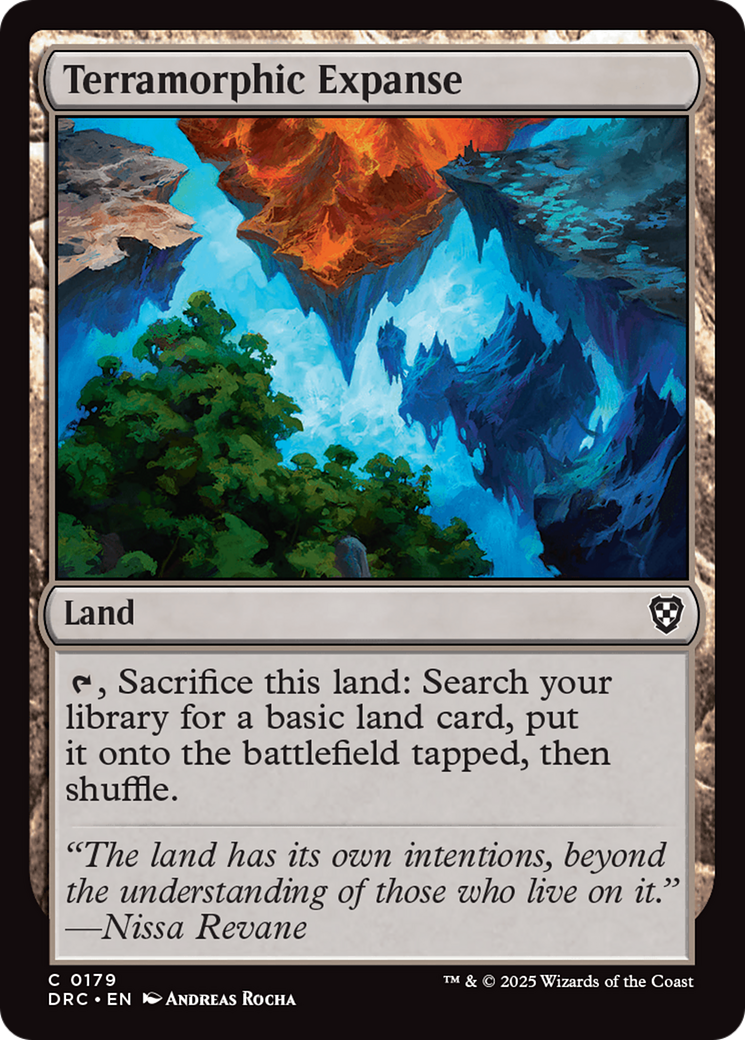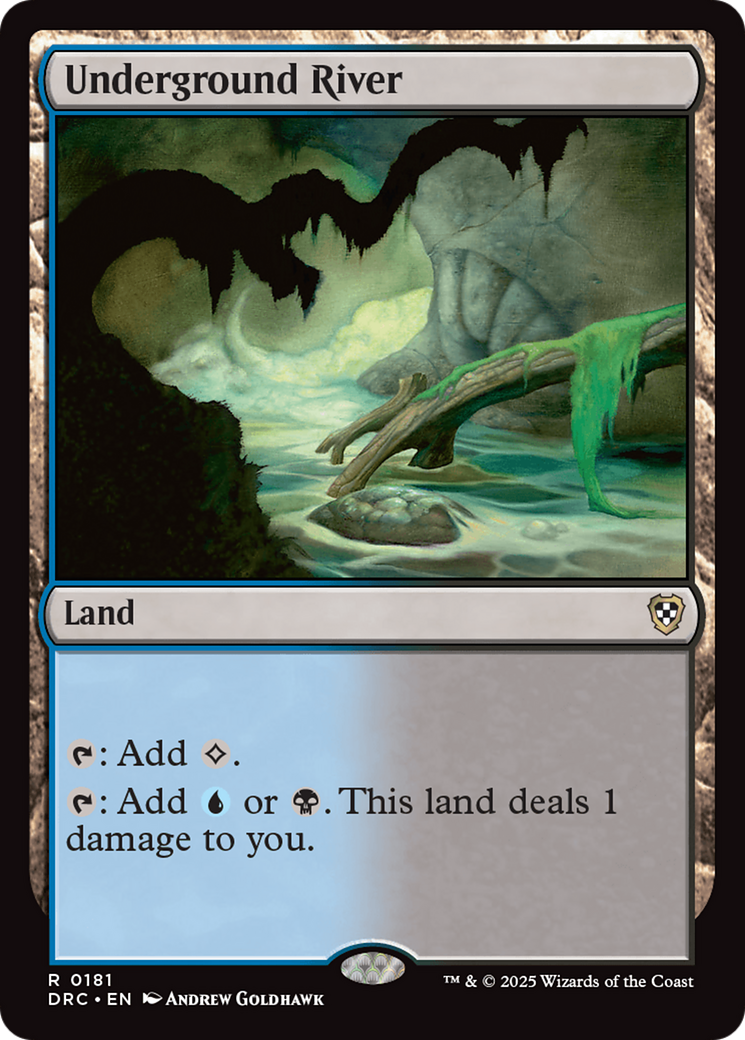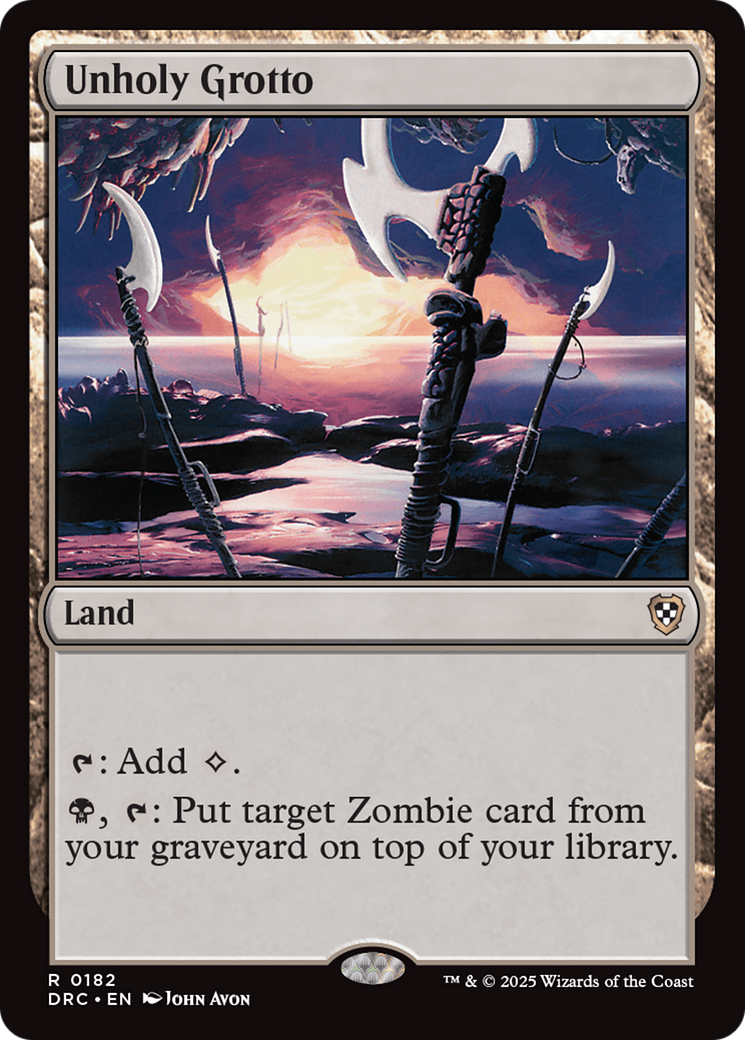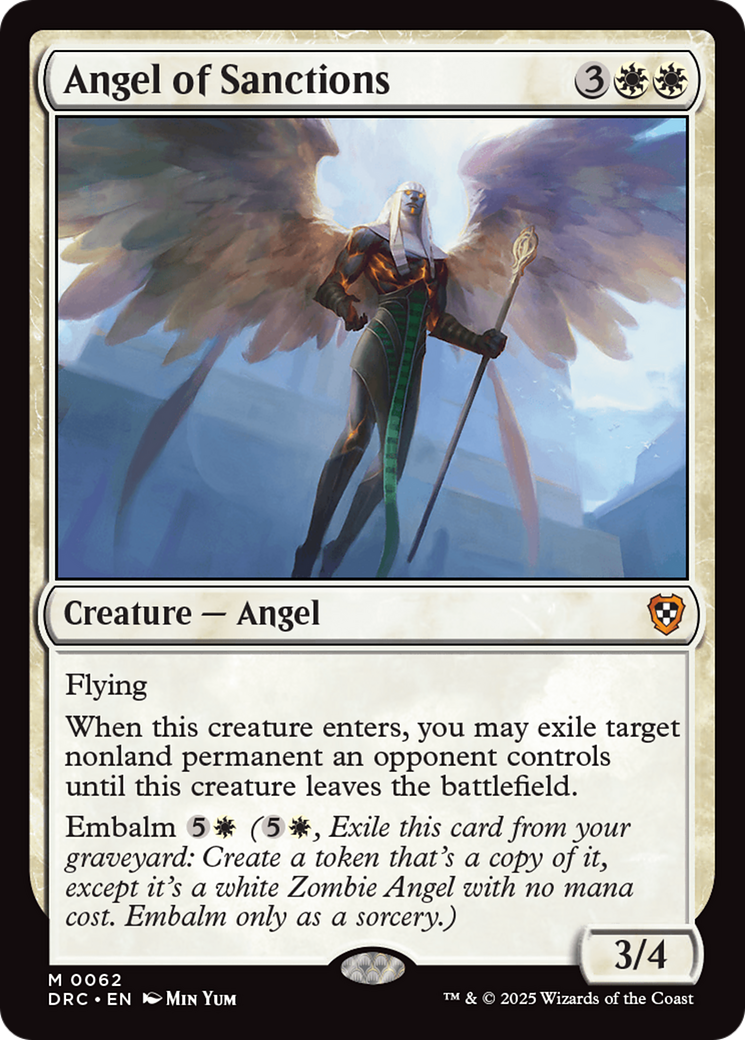
Creatures 36
-
1
Angel of Sanctions
Angel of Sanctions
Creature — Angel
3/4
Flying
When this creature enters, you may exile target nonland permanent an opponent controls until this creature leaves the battlefield.
Embalm ( , Exile this card from your graveyard: Create a token that's a copy of it, except it's a white Zombie Angel with no mana cost. Embalm only as a sorcery.)
- If a spell or ability puts a creature card with embalm into your graveyard during your main phase, you'll have priority immediately after that spell or ability resolves. You can activate the creature card's embalm ability before any player can exile it with an effect, such as that of Crook of Condemnation, if it's legal for you to do so.
- Once you've activated an embalm ability, the card is immediately exiled. Opponents can't try to stop the ability by exiling the card with an effect such as that of Crook of Condemnation.
- If a token is exiled this way, it will cease to exist and won't return to the battlefield.
- The exiled card returns to the battlefield immediately after Angel of Sanctions leaves the battlefield. Nothing happens between the two events, including state-based actions.
- In a multiplayer game, if Angel of Sanctions's owner leaves the game, the exiled card will return to the battlefield. Because the one-shot effect that returns the card isn't an ability that goes on the stack, it won't cease to exist along with the leaving player's spells and abilities on the stack.
- If Angel of Sanctions leaves the battlefield before its triggered ability resolves, the target permanent won't be exiled.
- The token copies exactly what was printed on the original card and nothing else. It doesn't copy any information about the object the card was before it was put into your graveyard.
- The token is a Zombie in addition to its other types and is white instead of its other colors. It has no mana cost, and thus its mana value is 0. These are copiable values of the token that other effects may copy.
- If the card copied by the token had any "when [this permanent] enters the battlefield" abilities, then the token also has those abilities and will trigger them when it's created. Similarly, any "as [this permanent] enters the battlefield" or "[this permanent] enters the battlefield with" abilities that the token has copied will also work.
- For each card with embalm, a corresponding game play supplement token can be found in some Amonkhet booster packs. These supplements are not required to play with cards with embalm; you can use the same items to represent an embalmed token as you would any other token.
- Auras attached to the exiled permanent will be put into their owners' graveyards. Any Equipment will become unattached and remain on the battlefield. Any counters on the exiled permanent will cease to exist.
-
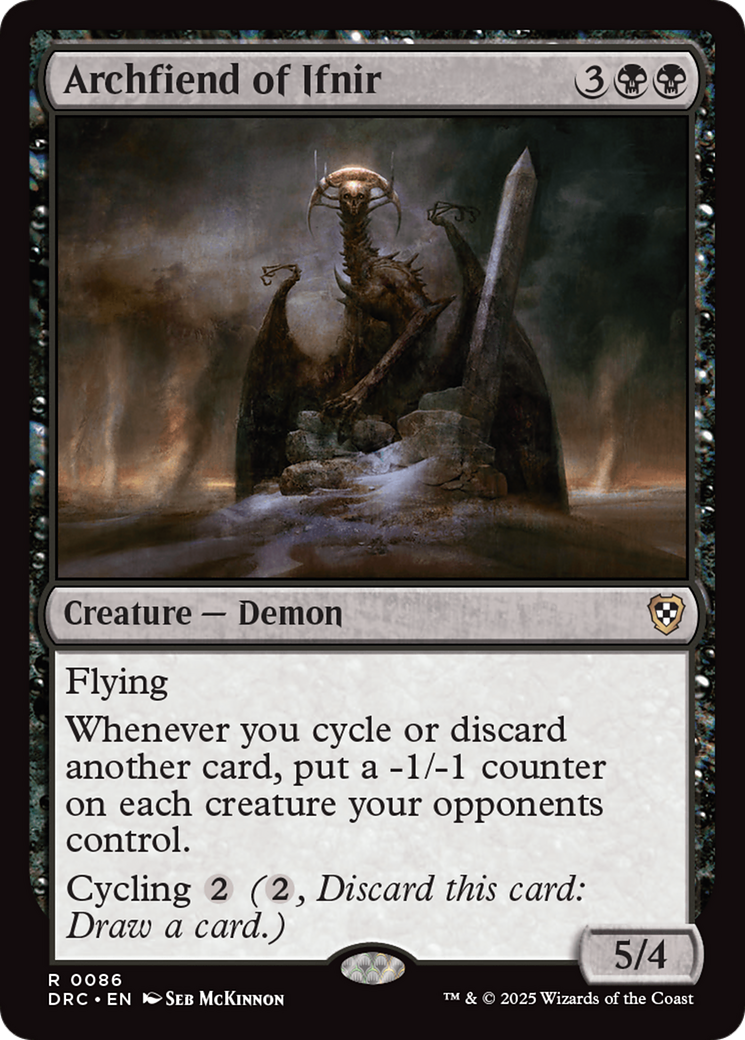
1
Archfiend of Ifnir
Archfiend of Ifnir
Creature — Demon
5/4
Flying
Whenever you cycle or discard another card, put a -1/-1 counter on each creature your opponents control.
Cycling ( , Discard this card: Draw a card.)
- Some cards have an ability that triggers whenever you cycle any card. These triggered abilities resolve before you draw from the cycling ability.
- An ability that triggers whenever you discard a card doesn’t give you permission to discard cards. You’ll need another effect that instructs or allows you to discard them.
- An ability that triggers whenever you “cycle or discard” a card triggers only once if you cycle a card. The ability “Whenever you discard a card” is functionally identical to this ability; cycling is mentioned for clarity.
- If a player discards a card during their cleanup step due to having too many cards in hand, any appropriate abilities that trigger on discarding that card trigger. If this happens, those triggered abilities are put onto the stack and players receive priority in that cleanup step to cast spells or activate abilities (normally, no players may take actions during a cleanup step). Another cleanup step is created following that one.
-
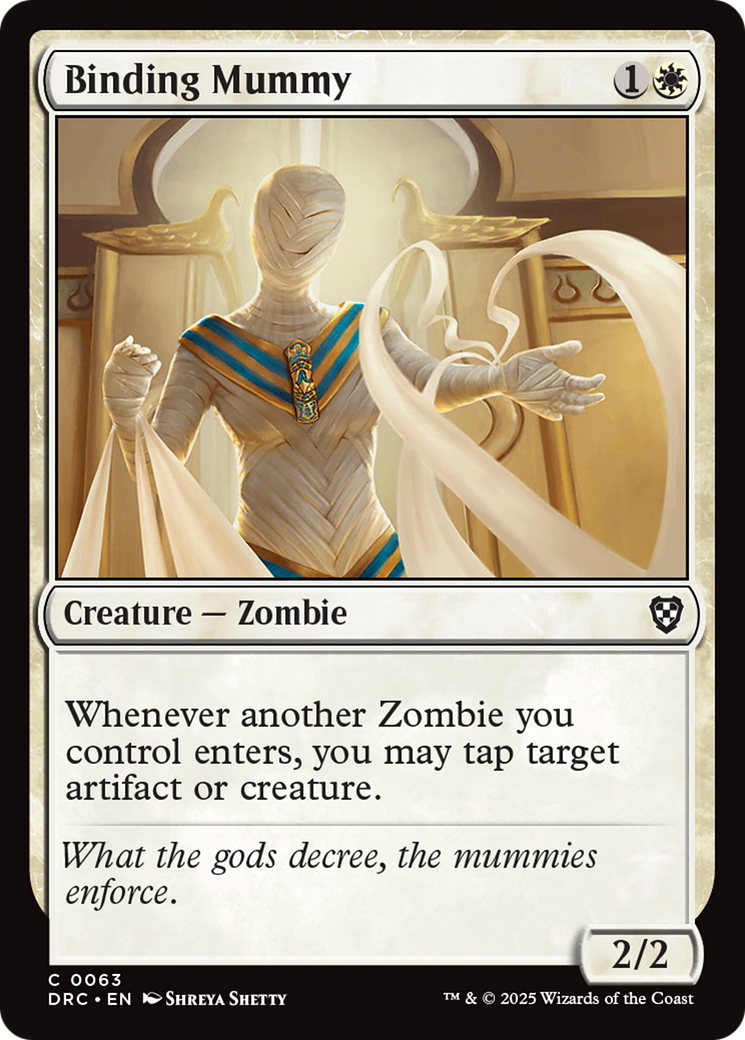
1
Binding Mummy
Binding Mummy
Creature — Zombie
2/2
Whenever another Zombie you control enters, you may tap target artifact or creature.
-
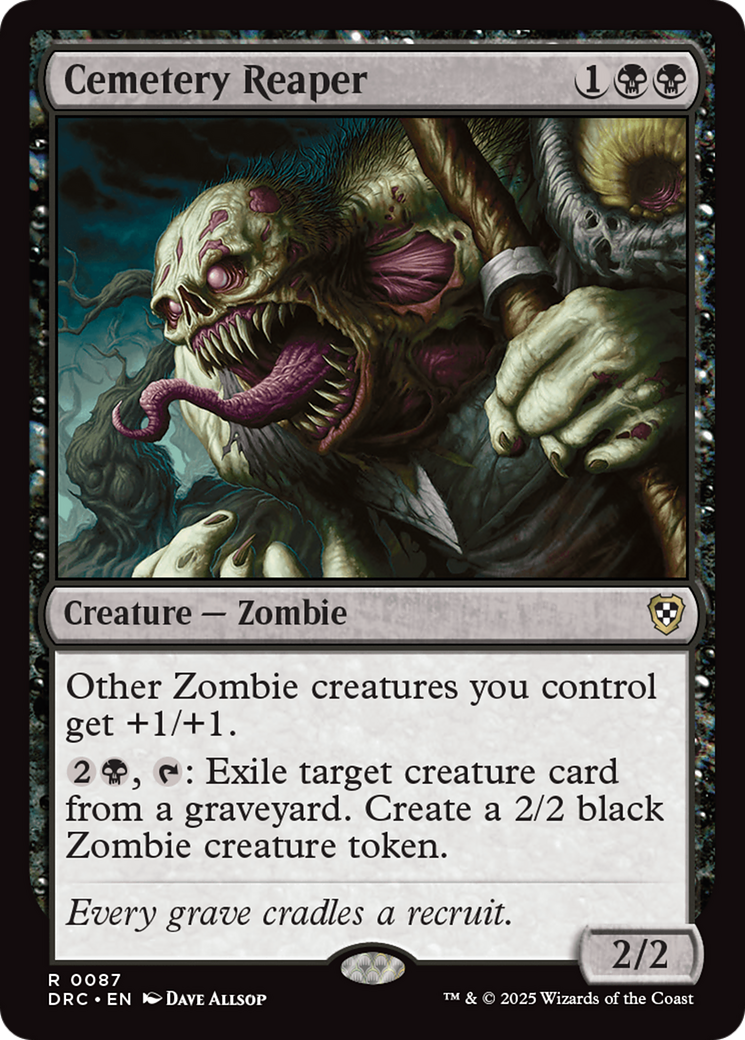
1
Cemetery Reaper
Cemetery Reaper
Creature — Zombie
2/2
Other Zombie creatures you control get +1/+1.
, : Exile target creature card from a graveyard. Create a 2/2 black Zombie creature token.
- Cemetery Reaper grants +1/+1 to all other Zombie creatures you control, not just the ones its ability puts onto the battlefield.
- The creature card in a graveyard is exiled as part of the activated ability's effect, not as a cost. If that card has left the graveyard by the time the ability would resolve, the ability doesn't resolve and you don't get a Zombie token.
- A "creature card" is any card with the type creature, even if it has other types such as artifact, enchantment, or land. Older cards of type summon are also creature cards.
-
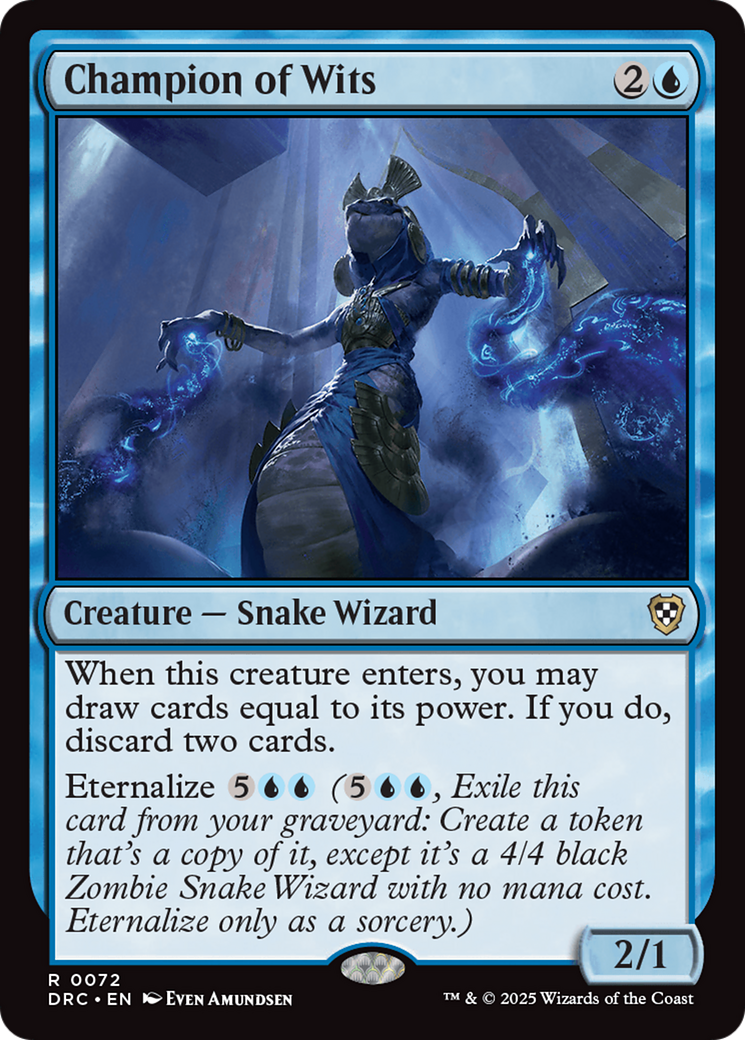
1
Champion of Wits
Champion of Wits
Creature — Snake Wizard
2/1
When this creature enters, you may draw cards equal to its power. If you do, discard two cards.
Eternalize ( , Exile this card from your graveyard: Create a token that's a copy of it, except it's a 4/4 black Zombie Snake Wizard with no mana cost. Eternalize only as a sorcery.)
- Use Champion of Wits's power as the first ability resolves to determine if you want to use the ability and how many cards you draw if you do. If you use the ability, you discard two cards regardless of how many cards you draw. If Champion of Wits leaves the battlefield before that ability resolves, use its last known power.
- For each card with eternalize, a corresponding game play supplement token can be found in some Hour of Devastation booster packs. These supplements are not required to play with cards with eternalize; you can use the same items to represent an eternalized token as you would any other token.
- If a creature card with eternalize is put into your graveyard during your main phase, you'll have priority immediately afterward. You can activate its eternalize ability before any player can try to exile it, such as with Crook of Condemnation, if it's legal for you to do so.
- Once you've activated an eternalize ability, the card is immediately exiled. Opponents can't try to stop the ability by exiling the card with an effect such as that of Crook of Condemnation.
- The token copies exactly what was printed on the original card and nothing else, except the characteristics specifically modified by eternalize. It doesn't copy any information about the object the card was before it was put into your graveyard.
- The token is a Zombie in addition to its other types and is black instead of its other colors. Its base power and toughness are 4/4. It has no mana cost, and thus its mana value is 0. These are copiable values of the token that other effects may copy.
- If the card copied by the token had any “when [this permanent] enters the battlefield” abilities, then the token also has those abilities and will trigger them when it's created. Similarly, any “as [this permanent] enters the battlefield” or “[this permanent] enters the battlefield with” abilities that the token has copied will also work.
-
1
Corpse Augur
Corpse Augur
Creature — Zombie Wizard
4/2
When this creature dies, you draw X cards and you lose X life, where X is the number of creature cards in target player's graveyard.
- You choose the target player as the ability goes on the stack, but you determine the value of X as that ability resolves. If you target yourself and Corpse Augur is still in the graveyard, its ability will count itself.
-
1
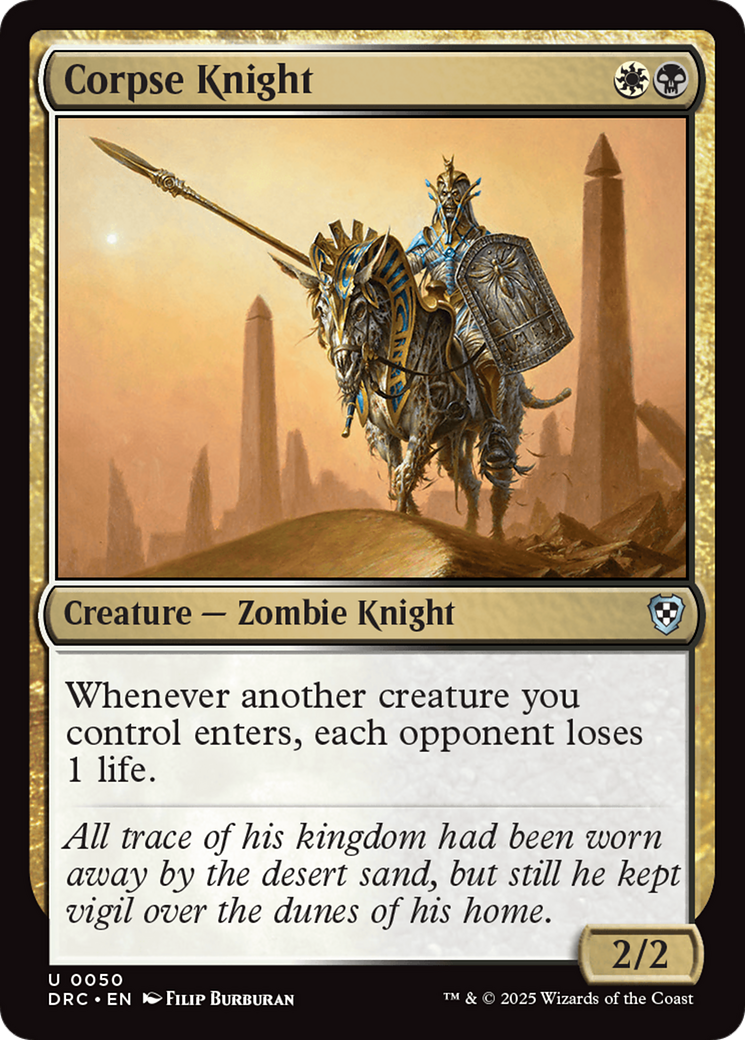
Corpse Knight
Corpse Knight
Creature — Zombie Knight
2/2
Whenever another creature you control enters, each opponent loses 1 life.
- In a Two-Headed Giant game, Corpse Knight's ability causes the opposing team to lose 1 life twice.
-
1
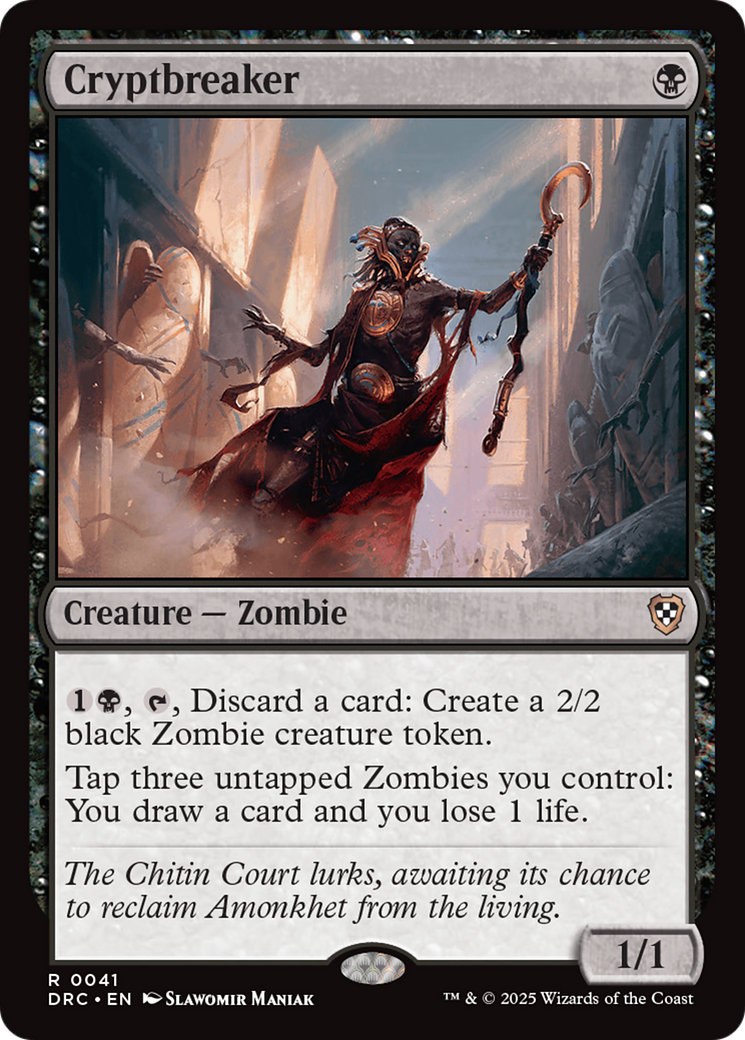
Cryptbreaker
Cryptbreaker
Creature — Zombie
1/1
, , Discard a card: Create a 2/2 black Zombie creature token.
Tap three untapped Zombies you control: You draw a card and you lose 1 life.
- You can tap any three untapped Zombies you control, including ones you haven’t controlled continuously since the beginning of your most recent turn, to pay the cost of Cryptbreaker’s second activated ability. This includes Cryptbreaker itself.
-
1
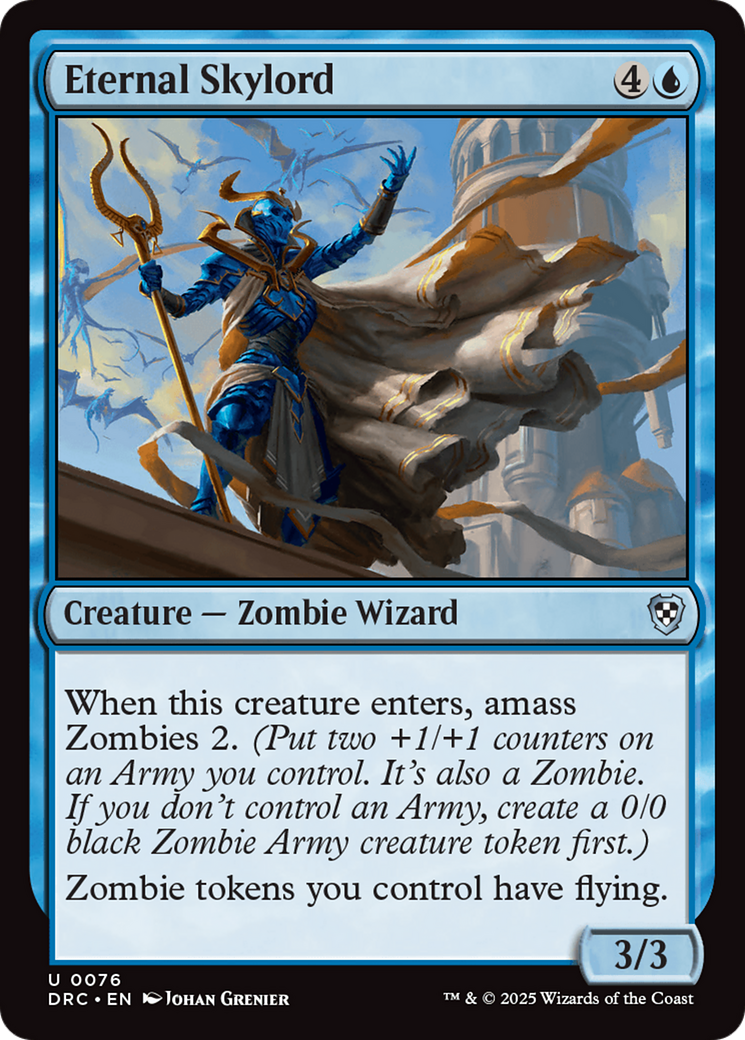
Eternal Skylord
Eternal Skylord
Creature — Zombie Wizard
3/3
When this creature enters, amass Zombies 2. (Put two +1/+1 counters on an Army you control. It's also a Zombie. If you don't control an Army, create a 0/0 black Zombie Army creature token first.)
Zombie tokens you control have flying.
- Amass abilities are now written as "amass [subtype] N." Previous cards with amass have received errata to say "amass Zombies N."
- To amass Zombies N, if you don't control an Army creature, create a 0/0 black Zombie Army creature token. Then you choose an Army creature you control and put N +1/+1 counters on it. If that Army isn't already a Zombie, it becomes a Zombie in addition to its other types.
- Amass Orcs works the same way, except you create a 0/0 black Orc Army creature token if you don't control an Army. If the Army creature you chose isn't already an Orc, it becomes an Orc in addition to its other types. By combining cards with amass Orcs and amass Zombies, you can end up with an Orc Zombie Army.
- In the rare case that you control multiple Army creatures (perhaps because you played a creature with changeling) while you amass Zombies, you choose which of your Army creatures to put the +1/+1 counters on. If that creature isn't a Zombie, it becomes a Zombie in addition to its other types.
- If you don't control an Army, the Zombie Army token you create enters the battlefield as a 0/0 creature before receiving counters. Any abilities that trigger when a creature with a certain power enters the battlefield, such as that of Mentor of the Meek, will see the token enter as a 0/0 creature before it gets +1/+1 counters.
- Some cards refer to the "amassed Army." That means the Army creature you chose to receive counters, even if no counters were placed on it for some reason.
- Some cards that cause you to amass Zombies also provide bonuses to "Zombie tokens." These affect any token that happens to be a Zombie, not just a Zombie Army you've amassed.
-
1
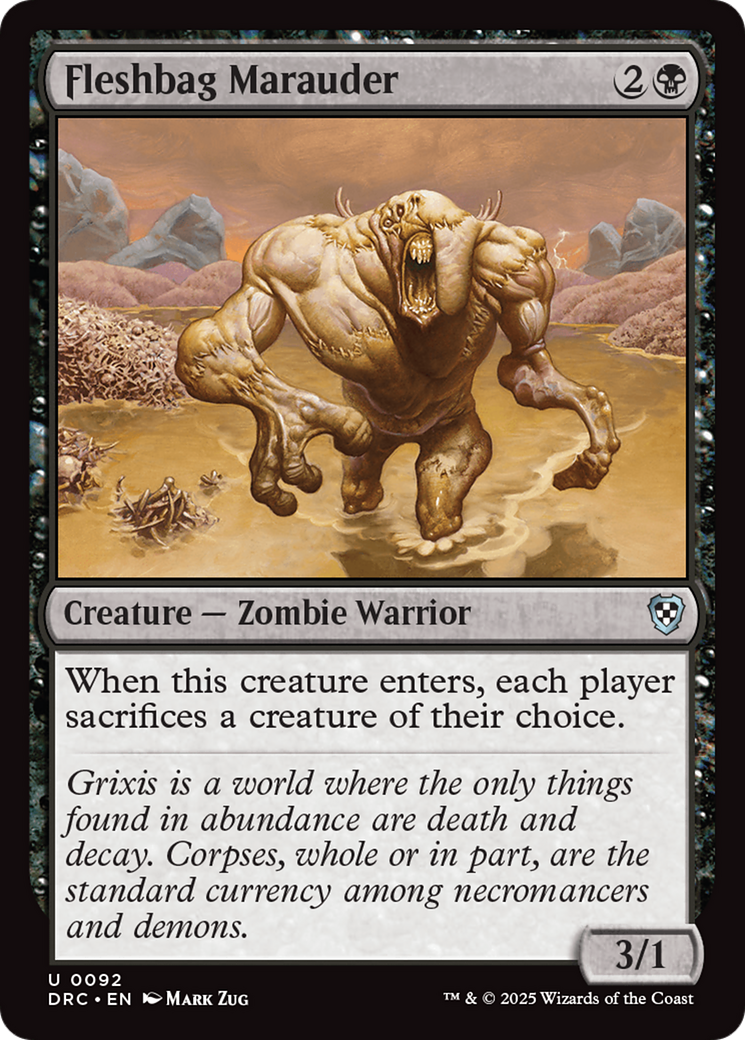
Fleshbag Marauder
Fleshbag Marauder
Creature — Zombie Warrior
3/1
When this creature enters, each player sacrifices a creature of their choice.
- When its ability resolves, you may sacrifice Fleshbag Marauder itself. If you control no other creatures, you'll have to sacrifice Fleshbag Marauder.
- As Fleshbag Marauder's ability resolves, first the player whose turn it is chooses a creature to sacrifice, then each other player in turn order does the same knowing the choices made before them. Then all those creatures are sacrificed simultaneously.
-
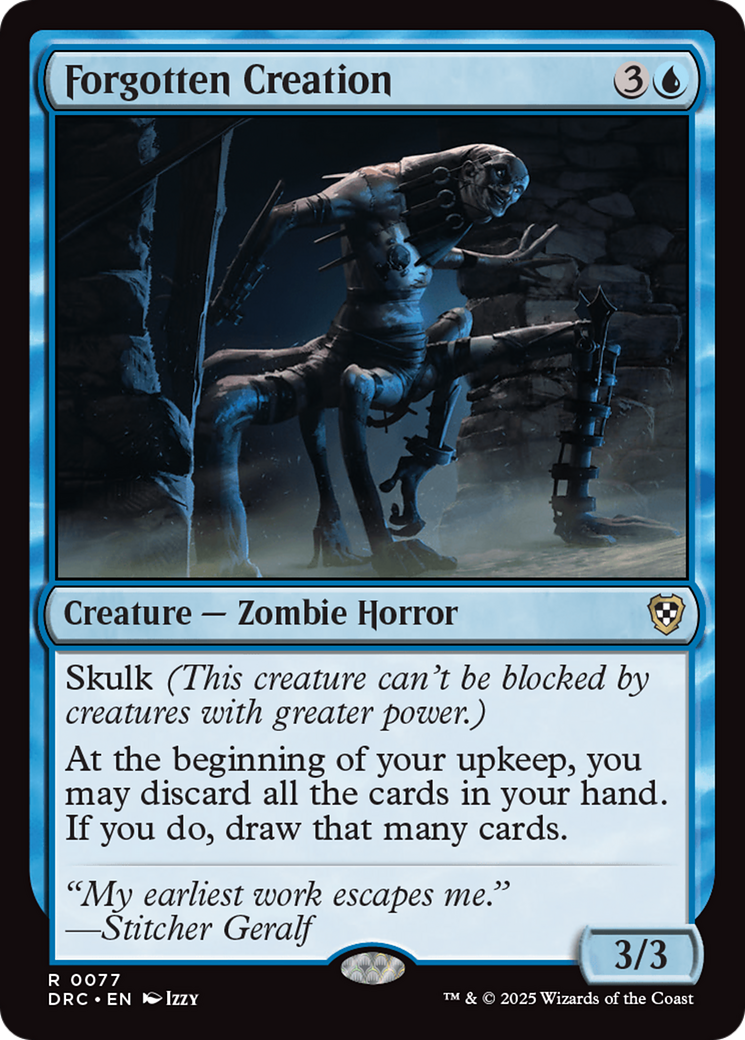
1
Forgotten Creation
Forgotten Creation
Creature — Zombie Horror
3/3
Skulk (This creature can't be blocked by creatures with greater power.)
At the beginning of your upkeep, you may discard all the cards in your hand. If you do, draw that many cards.
- The upkeep step is before the draw step, after the untap step. If you have no cards in hand, you can't draw for the turn and then discard that card to draw a new one because Forgotten Creation's last ability will already have triggered and resolved.
- Skulk matters only as blockers are chosen. Modifying either creature's power after blockers are chosen won't cause the attacking creature to become unblocked.
- If you cause a creature to have 0 power or less, use the actual value (which may be negative) to determine whether it can block or be blocked. A creature with skulk and 0 or less power most likely won't be blocked, but it won't deal combat damage and won't trigger any abilities that trigger when combat damage is dealt.
-
1
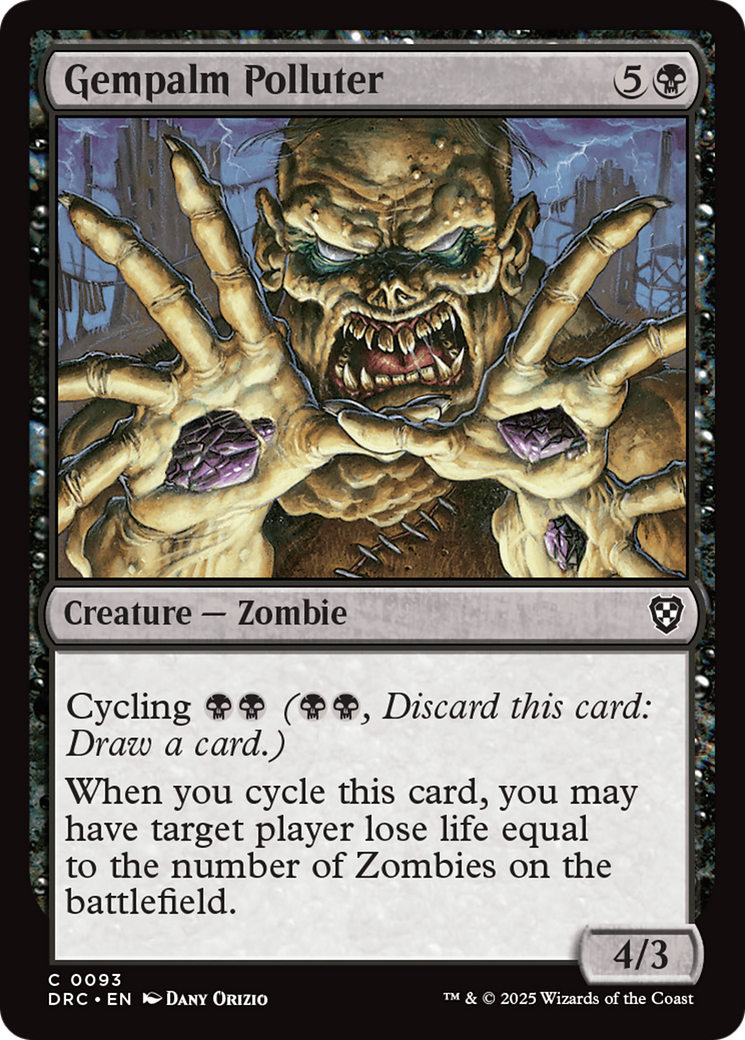
Gempalm Polluter
Gempalm Polluter
Creature — Zombie
4/3
Cycling ( , Discard this card: Draw a card.)
When you cycle this card, you may have target player lose life equal to the number of Zombies on the battlefield.
- When you cycle this card, first the cycling ability goes on the stack, then the triggered ability goes on the stack on top of it. The triggered ability will resolve before you draw a card from the cycling ability.
- The cycling ability and the triggered ability are separate. If the triggered ability doesn't resolve (because, for example, it has been countered, or all of its targets have become illegal), the cycling ability will still resolve, and you'll draw a card.
- You can cycle this card even if there are no legal targets for the triggered ability.
-
1
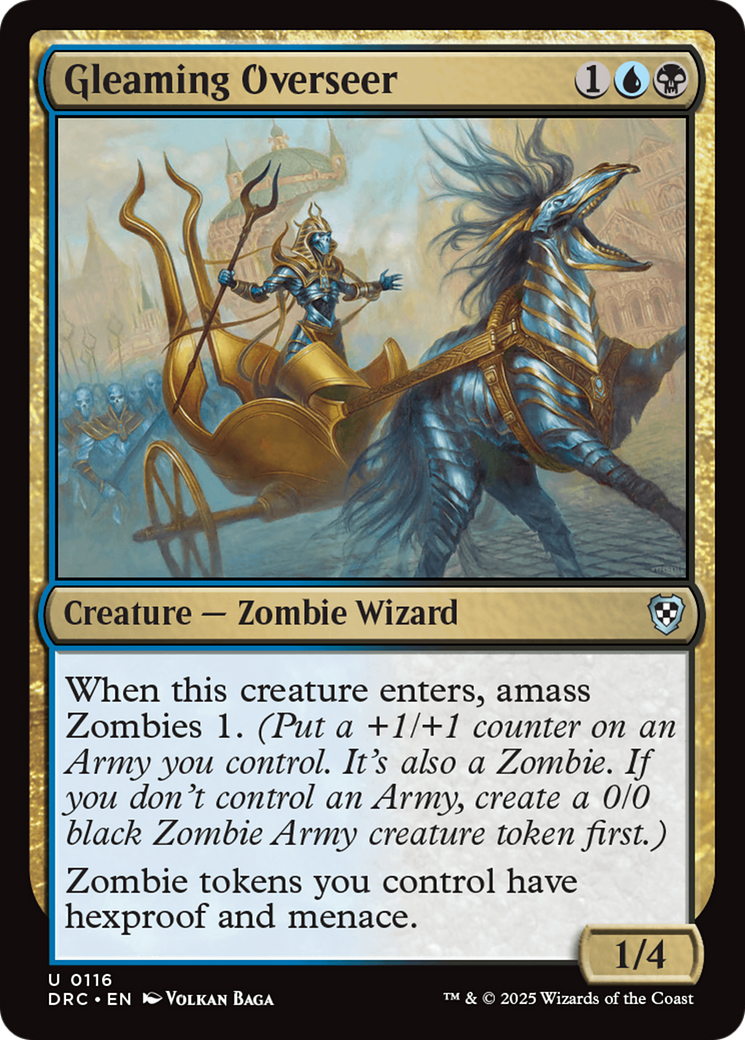
Gleaming Overseer
Gleaming Overseer
Creature — Zombie Wizard
1/4
When this creature enters, amass Zombies 1. (Put a +1/+1 counter on an Army you control. It's also a Zombie. If you don't control an Army, create a 0/0 black Zombie Army creature token first.)
Zombie tokens you control have hexproof and menace.
- Amass abilities are now written as "amass [subtype] N." Previous cards with amass have received errata to say "amass Zombies N."
- To amass Zombies N, if you don't control an Army creature, create a 0/0 black Zombie Army creature token. Then you choose an Army creature you control and put N +1/+1 counters on it. If that Army isn't already a Zombie, it becomes a Zombie in addition to its other types.
- Amass Orcs works the same way, except you create a 0/0 black Orc Army creature token if you don't control an Army. If the Army creature you chose isn't already an Orc, it becomes an Orc in addition to its other types. By combining cards with amass Orcs and amass Zombies, you can end up with an Orc Zombie Army.
- In the rare case that you control multiple Army creatures (perhaps because you played a creature with changeling) while you amass Zombies, you choose which of your Army creatures to put the +1/+1 counters on. If that creature isn't a Zombie, it becomes a Zombie in addition to its other types.
- If you don't control an Army, the Zombie Army token you create enters the battlefield as a 0/0 creature before receiving counters. Any abilities that trigger when a creature with a certain power enters the battlefield, such as that of Mentor of the Meek, will see the token enter as a 0/0 creature before it gets +1/+1 counters.
- Some cards refer to the "amassed Army." That means the Army creature you chose to receive counters, even if no counters were placed on it for some reason.
- Some cards that cause you to amass Zombies also provide bonuses to "Zombie tokens." These affect any token that happens to be a Zombie, not just a Zombie Army you've amassed.
-
1
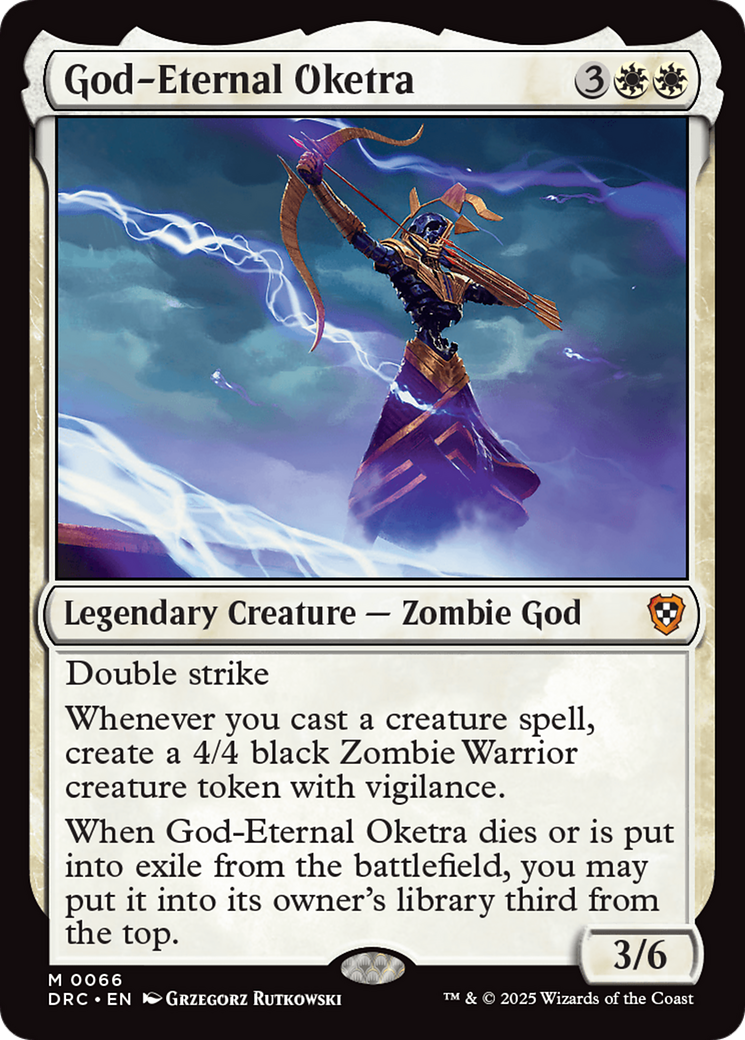
God-Eternal Oketra
God-Eternal Oketra
Legendary Creature — Zombie God
3/6
Double strike
Whenever you cast a creature spell, create a 4/4 black Zombie Warrior creature token with vigilance.
When God-Eternal Oketra dies or is put into exile from the battlefield, you may put it into its owner's library third from the top.
- Oketra's first triggered ability resolves before the spell that caused it to trigger. It resolves even if that spell is countered.
- In the Commander format, a commander's color identity isn't affected by color words (such as black) appearing in its text. If God-Eternal Oketra is your commander, your deck can't contain black mana symbols.
- If one of these Gods leaves the graveyard or exile while its last ability is on the stack, it will remain in its new zone, even if that zone is a graveyard or exile.
- If the God's owner has two or fewer cards in their library, the God is put on the bottom of their library as its last ability resolves.
- If you control another player's God when it dies, you decide whether to put that card into its owner's library.
- If an effect exiles the God and immediately returns it to the battlefield, its last ability triggers but will have no effect. However, if an effect exiles it and would return it to the battlefield at a later time, the God's ability may return that card to its owner's library first. If it does, the effect that exiled it won't return it later.
- In a multiplayer game, if you put another player's God onto the battlefield under your control, it will be exiled as you leave the game. If you were still the controller of that God, you would control its triggered ability but you have left the game; that ability won't resolve and the card remains in exile. Similarly, if you lose the game at the same time that another player's God that you put onto the battlefield is destroyed, it remains in its owner's graveyard.
- If one of these Gods dies and it's your commander, you may put it into the command zone before its ability puts it into your library. If you save your commander this way, it won't put it into your library. The same is true if it would be exiled.
-
1
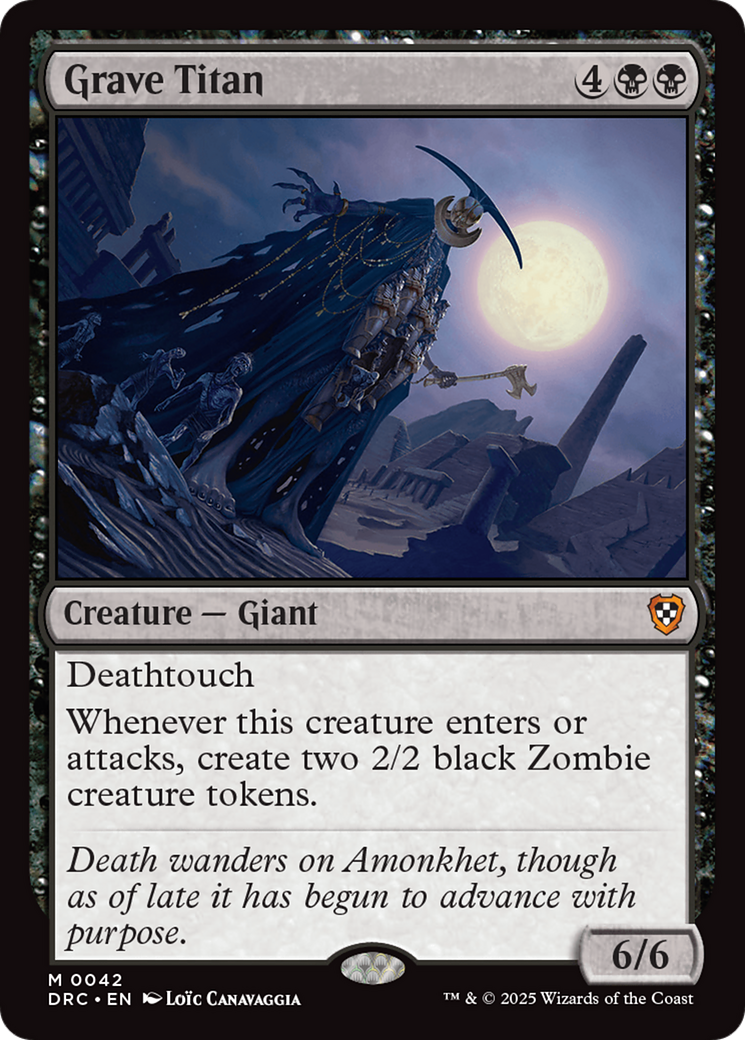
Grave Titan
Grave Titan
Creature — Giant
6/6
Deathtouch
Whenever this creature enters or attacks, create two 2/2 black Zombie creature tokens.
-
1
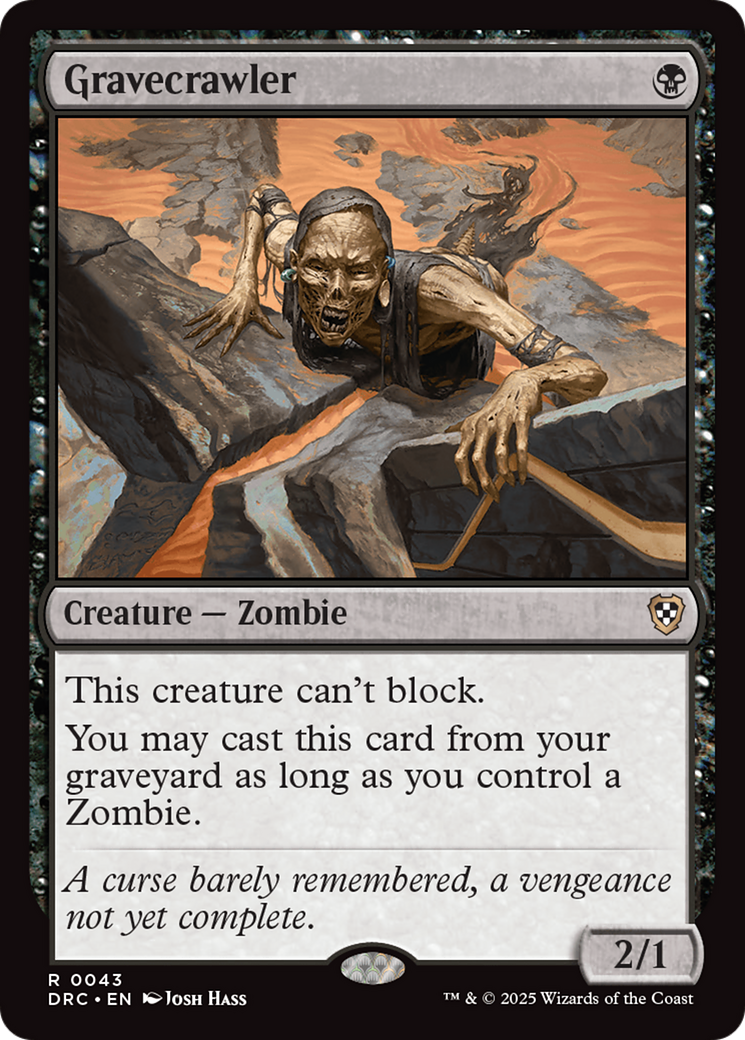
Gravecrawler
Gravecrawler
Creature — Zombie
2/1
This creature can't block.
You may cast this card from your graveyard as long as you control a Zombie.
- Gravecrawler's ability doesn't change when you could cast it.
- Once you've cast Gravecrawler and it's on the stack, it doesn't matter if you lose control of the other Zombie.
-
1
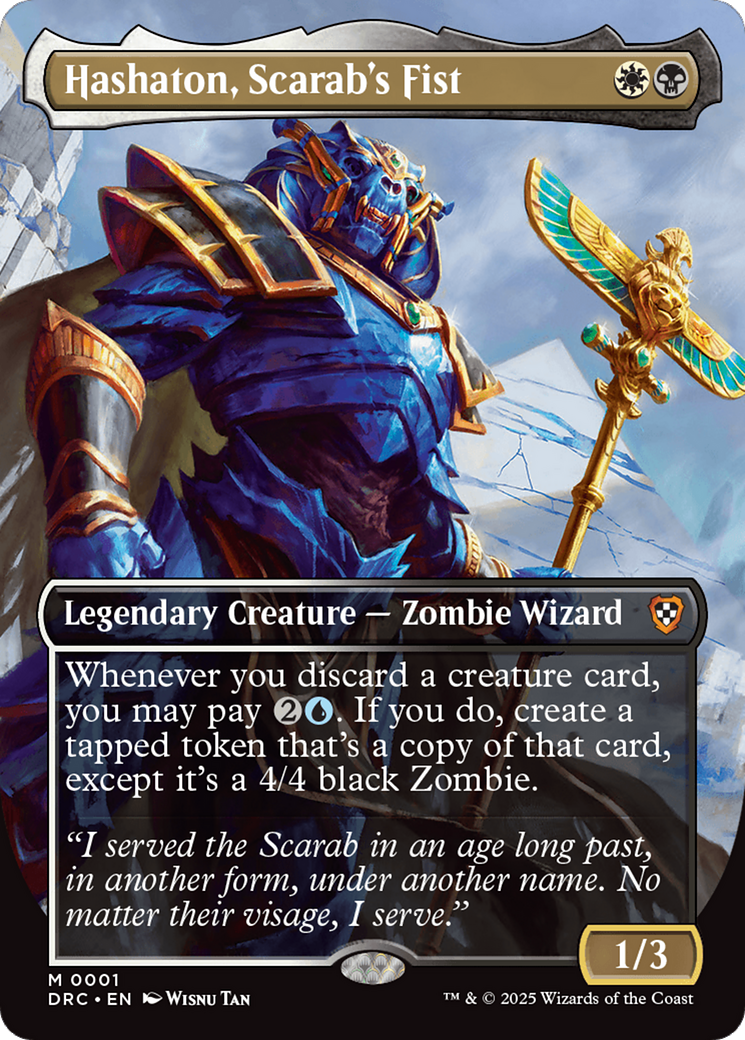
Hashaton, Scarab's Fist
Hashaton, Scarab's Fist
Legendary Creature — Zombie Wizard
1/3
Whenever you discard a creature card, you may pay . If you do, create a tapped token that's a copy of that card, except it's a 4/4 black Zombie.
-
1
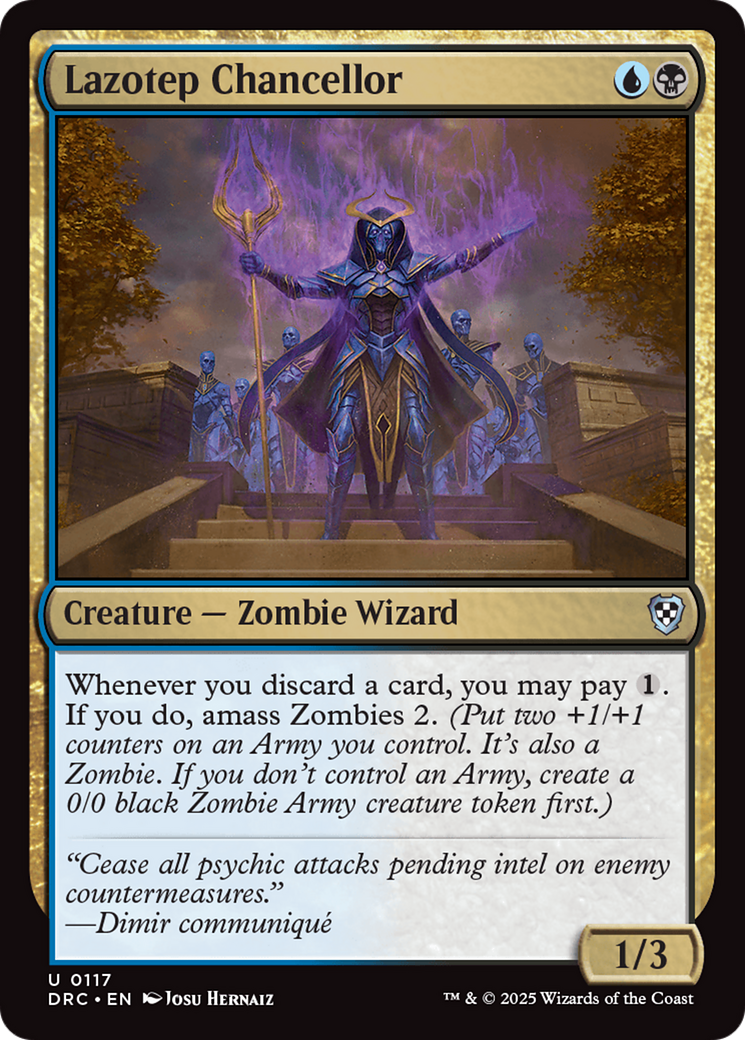
Lazotep Chancellor
Lazotep Chancellor
Creature — Zombie Wizard
1/3
Whenever you discard a card, you may pay . If you do, amass Zombies 2. (Put two +1/+1 counters on an Army you control. It's also a Zombie. If you don't control an Army, create a 0/0 black Zombie Army creature token first.)
- Amass abilities are now written as "amass [subtype] N." Previous cards with amass have received errata to say "amass Zombies N."
- To amass Zombies N, if you don't control an Army creature, create a 0/0 black Zombie Army creature token. Then you choose an Army creature you control and put N +1/+1 counters on it. If that Army isn't already a Zombie, it becomes a Zombie in addition to its other types.
- Amass Orcs works the same way, except you create a 0/0 black Orc Army creature token if you don't control an Army. If the Army creature you chose isn't already an Orc, it becomes an Orc in addition to its other types. By combining cards with amass Orcs and amass Zombies, you can end up with an Orc Zombie Army.
- In the rare case that you control multiple Army creatures (perhaps because you played a creature with changeling) while you amass Zombies, you choose which of your Army creatures to put the +1/+1 counters on. If that creature isn't a Zombie, it becomes a Zombie in addition to its other types.
- If you don't control an Army, the Zombie Army token you create enters the battlefield as a 0/0 creature before receiving counters. Any abilities that trigger when a creature with a certain power enters the battlefield, such as that of Mentor of the Meek, will see the token enter as a 0/0 creature before it gets +1/+1 counters.
- Some cards refer to the "amassed Army." That means the Army creature you chose to receive counters, even if no counters were placed on it for some reason.
-
1
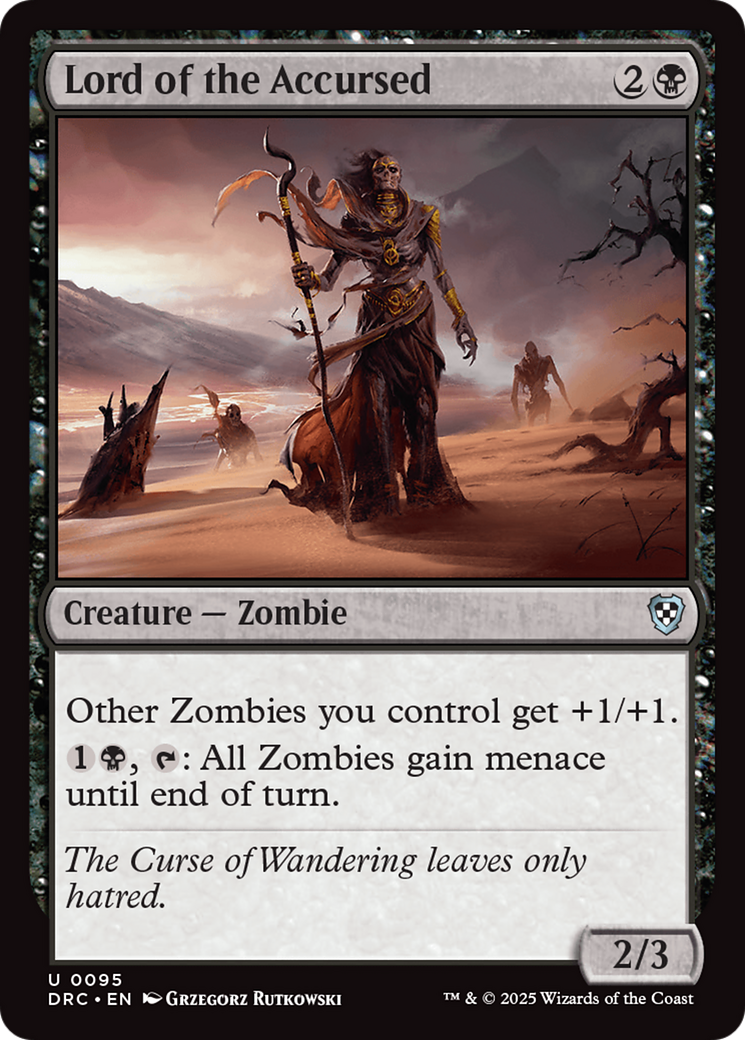
Lord of the Accursed
Lord of the Accursed
Creature — Zombie
2/3
Other Zombies you control get +1/+1.
, : All Zombies gain menace until end of turn.
-
1
Lost Monarch of Ifnir
Lost Monarch of Ifnir
Creature — Zombie Noble
4/4
Afflict 3 (Whenever this creature becomes blocked, defending player loses 3 life.)
Other Zombies you control have afflict 3.
At the beginning of your second main phase, if a player was dealt combat damage by a Zombie this turn, mill three cards, then you may return a creature card from your graveyard to your hand.
-
1
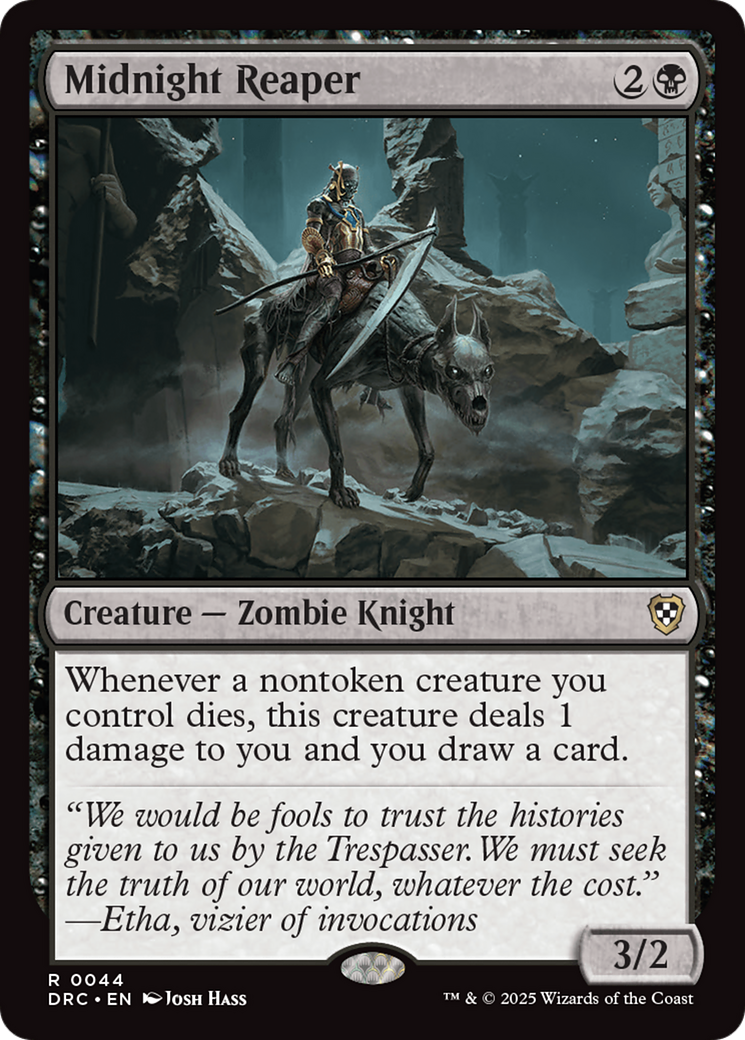
Midnight Reaper
Midnight Reaper
Creature — Zombie Knight
3/2
Whenever a nontoken creature you control dies, this creature deals 1 damage to you and you draw a card.
- Midnight Reaper's ability triggers when it dies if it's not a token.
- If Midnight Reaper dies at the same time as one or more other nontoken creatures you control, Midnight Reaper's ability triggers for each of them.
-
1
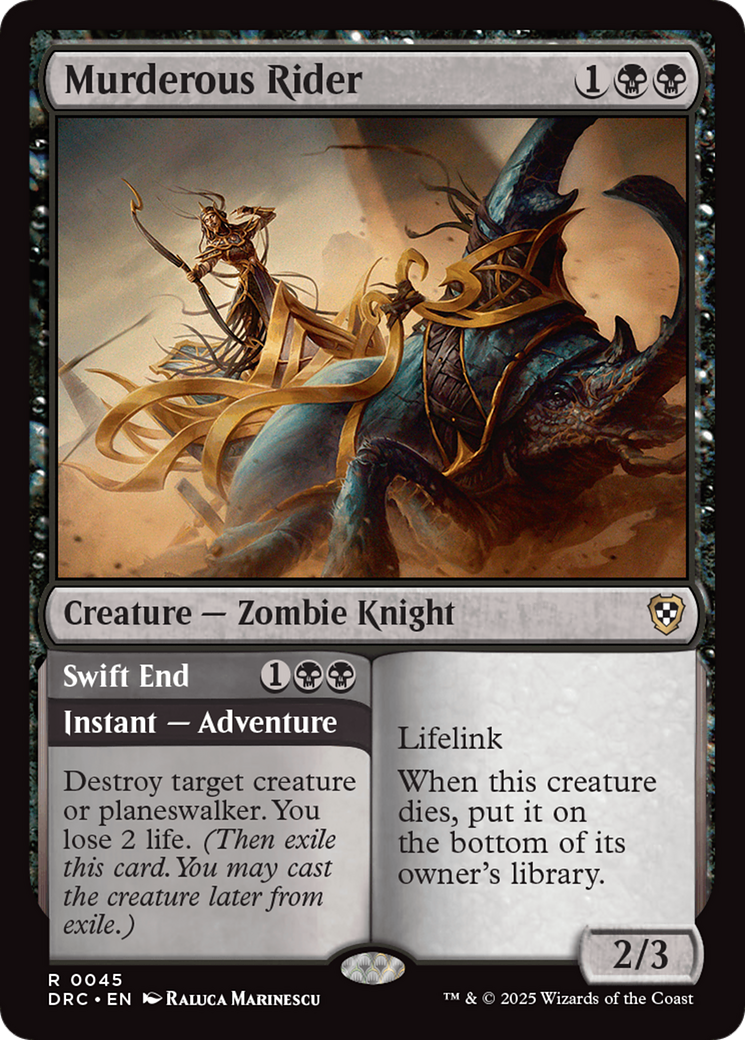
Murderous Rider // Swift End
//
Murderous Rider
Creature — Zombie Knight
2/3
- An adventurer card is a permanent card in every zone except the stack, as well as while on the stack if not cast as an Adventure. Ignore its alternative characteristics in those cases. For example, while it's in your graveyard, Giant Killer is a white creature card whose mana value is 1. It can't be the target of the triggered ability of Mystic Sanctuary.
- When casting a spell as an Adventure, use the alternative characteristics and ignore all of the card's normal characteristics. The spell's color, mana cost, mana value, and so on are determined by only those alternative characteristics. If the spell leaves the stack, it immediately resumes using its normal characteristics.
- If you cast an adventurer card as an Adventure, use only its alternative characteristics to determine whether it's legal to cast that spell. For example, if Giant Killer is exiled with the last ability of Vivien, Champion of the Wilds, you can't cast it as Chop Down.
- If a spell is cast as an Adventure, its controller exiles it instead of putting it into its owner's graveyard as it resolves. For as long as it remains exiled, that player may cast it as a permanent spell. If an Adventure spell leaves the stack in any way other than resolving (most likely by being countered or by failing to resolve because its targets have all become illegal), that card won't be exiled and the spell's controller won't be able to cast it as a permanent later.
- If an adventurer card ends up in exile for any other reason than by exiling itself while resolving, it won't give you permission to cast it as a permanent spell.
- You must still follow any timing restrictions and permissions for the permanent spell you cast from exile. Normally, you'll be able to cast it only during your main phase while the stack is empty.
- If an effect copies an Adventure spell, that copy is exiled as it resolves. It ceases to exist as a state-based action; it's not possible to cast the copy as a permanent.
- If an object becomes a copy of an object that has an Adventure, the copy also has an Adventure. If it changes zones, it will either cease to exist (if it's a token) or cease to be a copy (if it's a nontoken permanent), and so you won't be able to cast it as an Adventure.
- If an effect instructs you to choose a card name, you may choose the alternative Adventure name. Consider only the alternative characteristics to determine whether that is an appropriate name to choose.
- Casting a card as an Adventure isn't casting it for an alternative cost. Effects that allow you to cast a spell for an alternative cost or without paying its mana cost may allow you to apply those to the Adventure.
- If the target creature or planeswalker is an illegal target by the time Swift End tries to resolve, the spell won't resolve. You won't lose 2 life or exile Swift End. If the target is legal but not destroyed (most likely because it has indestructible), you do lose 2 life and exile Swift End.
-
1
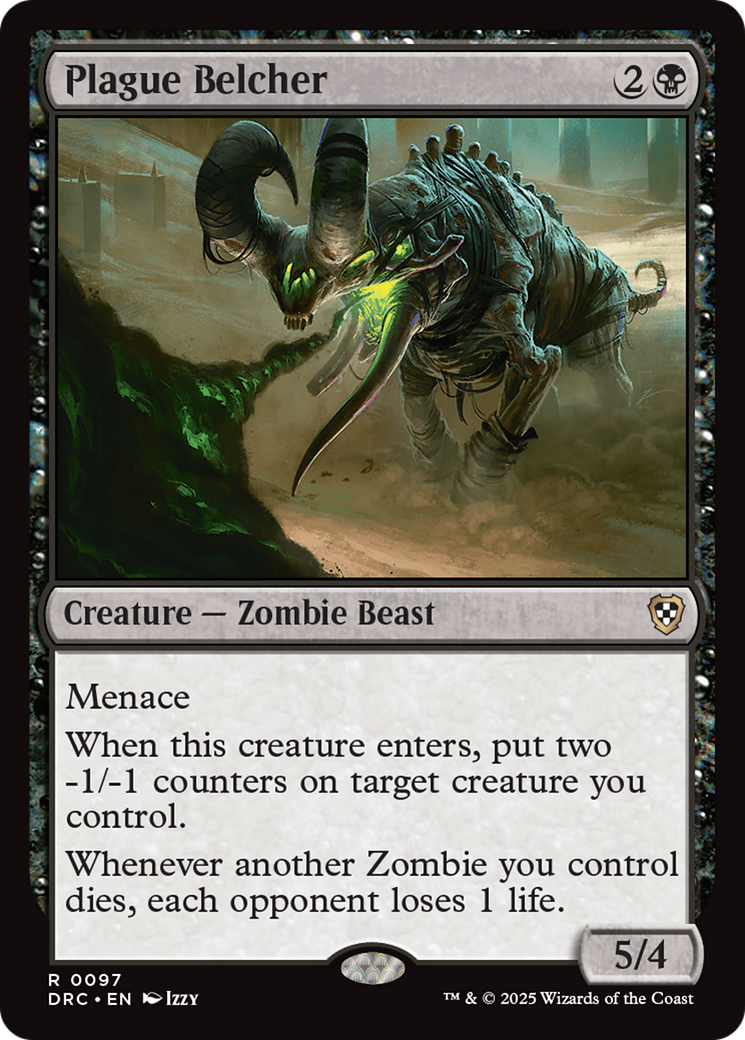
Plague Belcher
Plague Belcher
Creature — Zombie Beast
5/4
Menace
When this creature enters, put two -1/-1 counters on target creature you control.
Whenever another Zombie you control dies, each opponent loses 1 life.
- If another Zombie you control dies at the same time as Plague Belcher, Plague Belcher’s last ability will trigger for that Zombie.
- In a Two-Headed Giant game, the triggered ability of Plague Belcher causes the opposing team to lose 2 life.
-
1
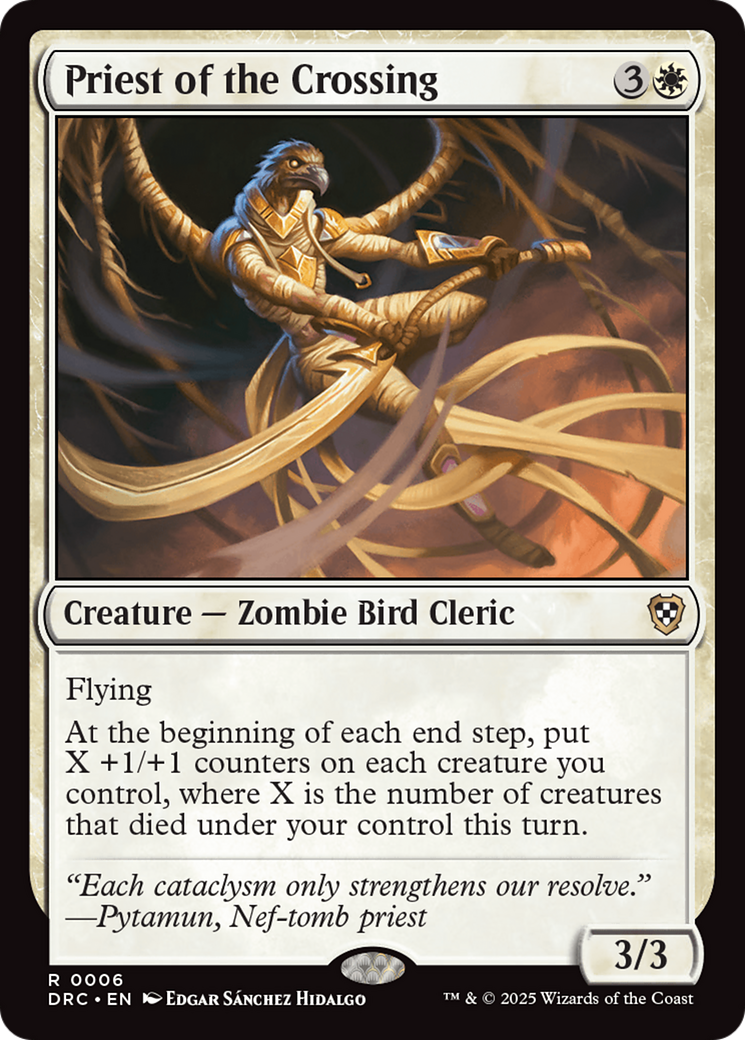
Priest of the Crossing
Priest of the Crossing
Creature — Zombie Bird Cleric
3/3
Flying
At the beginning of each end step, put X +1/+1 counters on each creature you control, where X is the number of creatures that died under your control this turn.
-
1
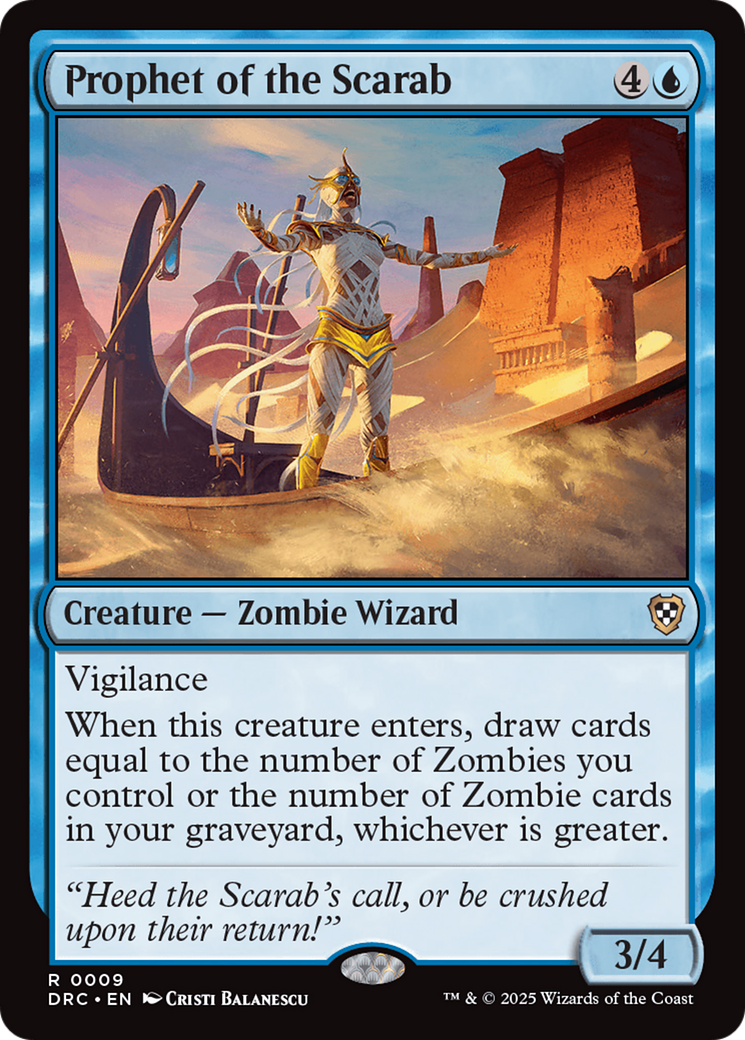
Prophet of the Scarab
Prophet of the Scarab
Creature — Zombie Wizard
3/4
Vigilance
When this creature enters, draw cards equal to the number of Zombies you control or the number of Zombie cards in your graveyard, whichever is greater.
-
1
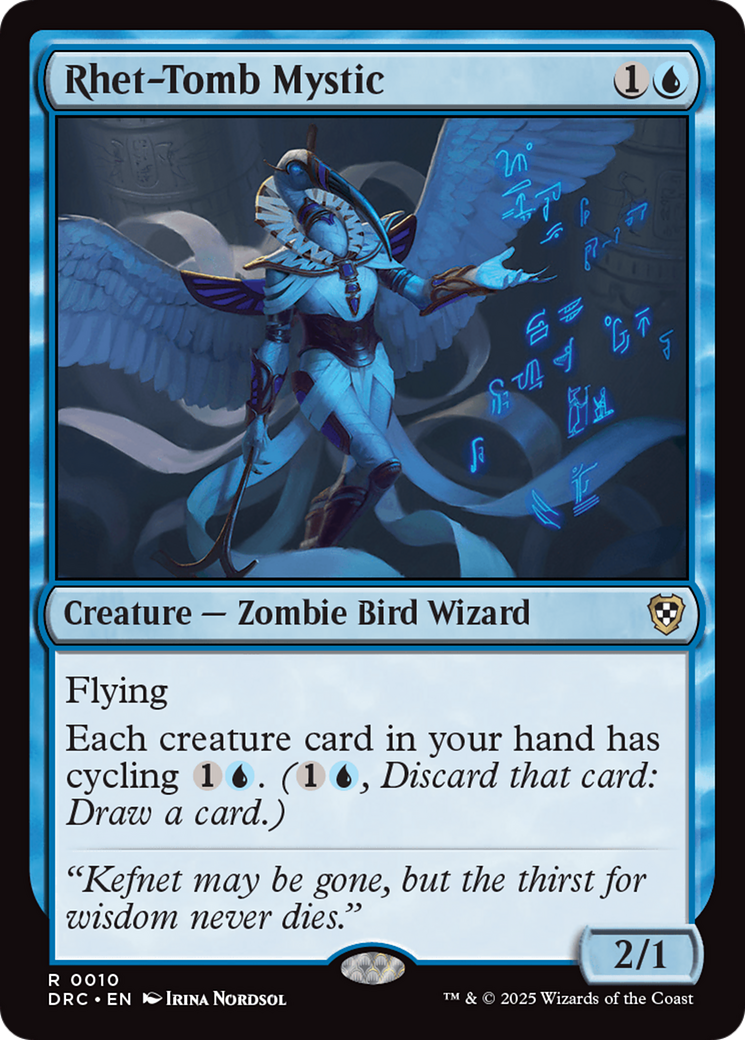
Rhet-Tomb Mystic
Rhet-Tomb Mystic
Creature — Zombie Bird Wizard
2/1
Flying
Each creature card in your hand has cycling . ( , Discard that card: Draw a card.)
-
1
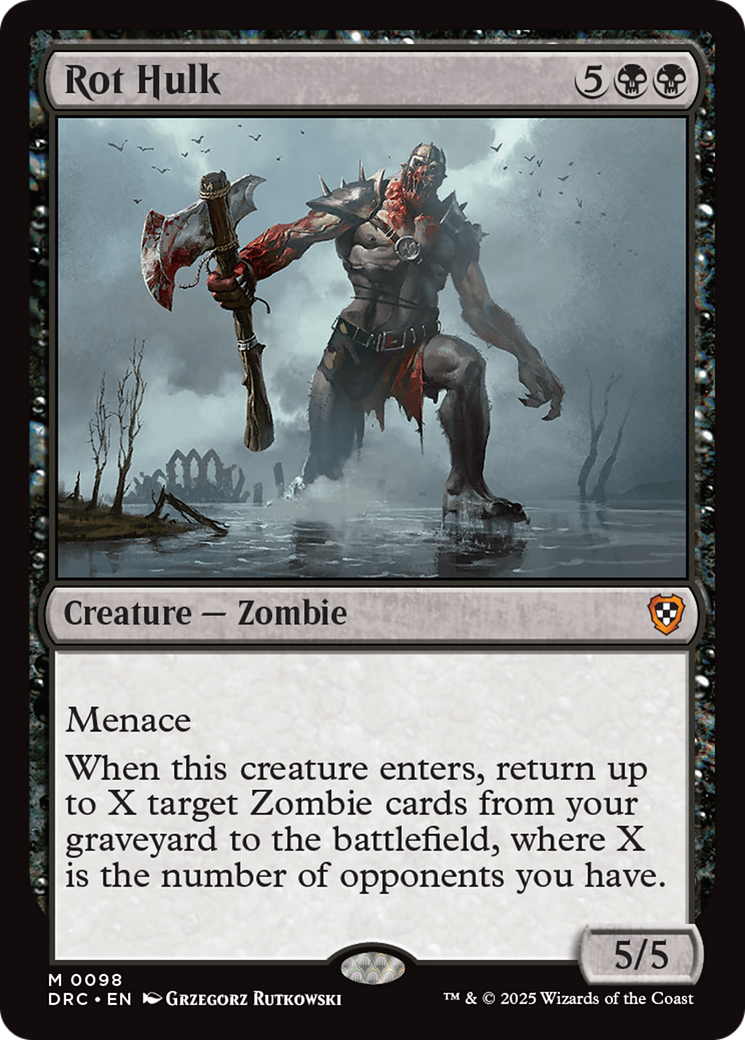
Rot Hulk
Rot Hulk
Creature — Zombie
5/5
Menace
When this creature enters, return up to X target Zombie cards from your graveyard to the battlefield, where X is the number of opponents you have.
-
1
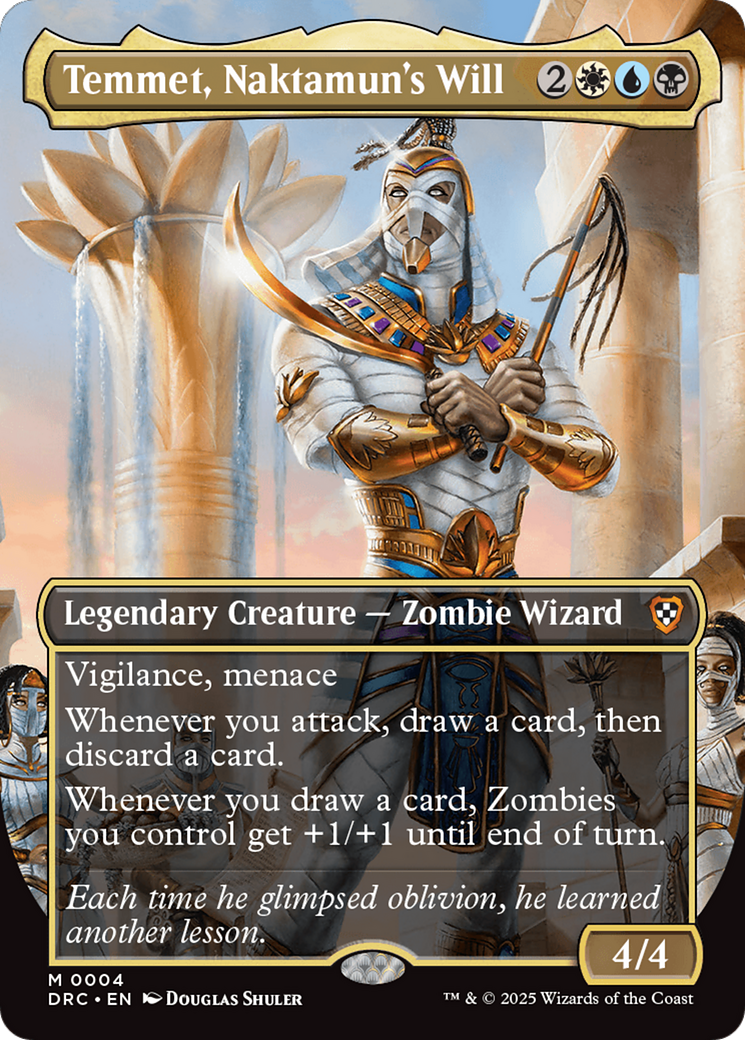
Temmet, Naktamun's Will
Temmet, Naktamun's Will
Legendary Creature — Zombie Wizard
4/4
Vigilance, menace
Whenever you attack, draw a card, then discard a card.
Whenever you draw a card, Zombies you control get +1/+1 until end of turn.
-
1
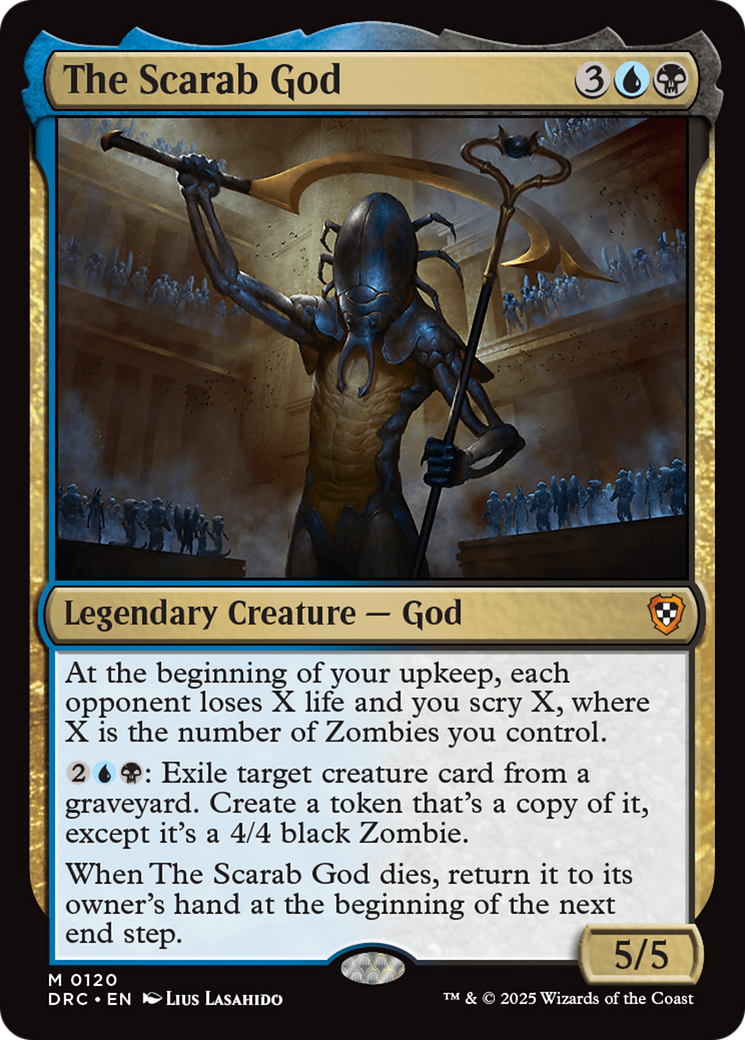
The Scarab God
The Scarab God
Legendary Creature — God
5/5
At the beginning of your upkeep, each opponent loses X life and you scry X, where X is the number of Zombies you control.
: Exile target creature card from a graveyard. Create a token that's a copy of it, except it's a 4/4 black Zombie.
When The Scarab God dies, return it to its owner's hand at the beginning of the next end step.
- The number of Zombies you control is counted as The Scarab God's first ability resolves. Players can try to change that number in response to the ability (perhaps by activating its second ability).
- In a Two-Headed Giant game, The Scarab God's first ability causes the opposing team to lose life equal to twice the number of Zombies you control, although you scry only equal to the number of Zombies you control.
- If this creature dies but leaves your graveyard before the next end step, it will remain in its new zone.
- The “next end step” refers to the next end step that occurs, not the end step of the next turn. If this creature dies before a turn's end step (for example, during combat), it will be returned to its owner's hand at the beginning of that turn's end step.
-
1
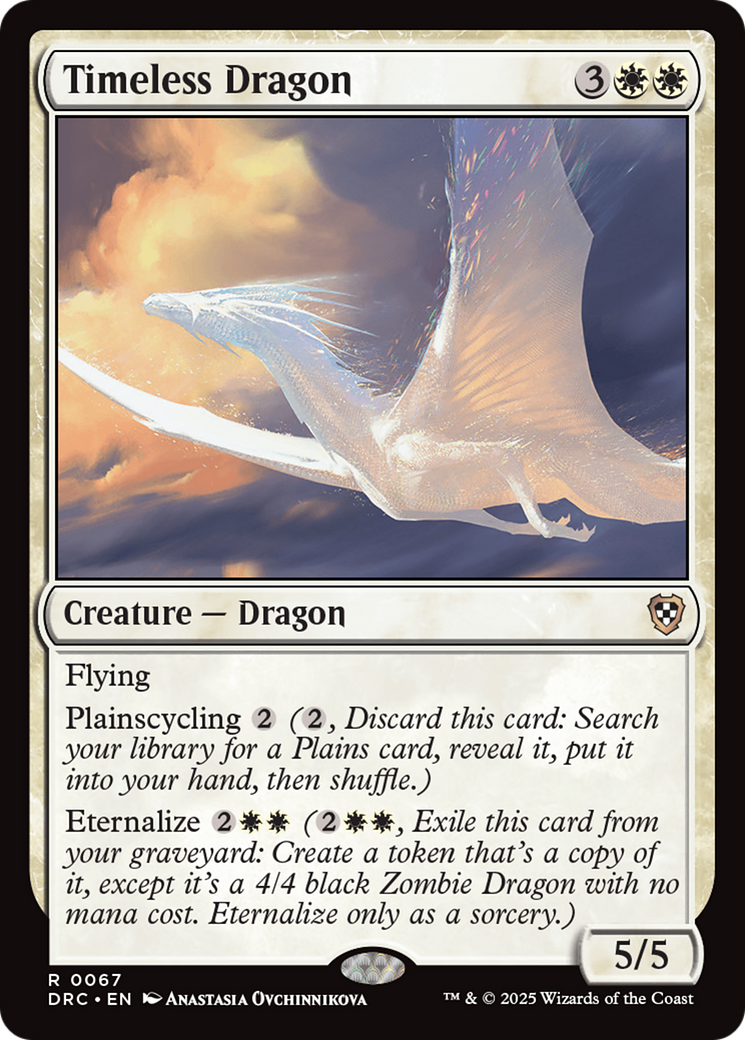
Timeless Dragon
Timeless Dragon
Creature — Dragon
5/5
Flying
Plainscycling ( , Discard this card: Search your library for a Plains card, reveal it, put it into your hand, then shuffle.)
Eternalize ( , Exile this card from your graveyard: Create a token that's a copy of it, except it's a 4/4 black Zombie Dragon with no mana cost. Eternalize only as a sorcery.)
- If a creature card with eternalize is put into your graveyard during your main phase, you'll have priority immediately afterward. You can activate its eternalize ability before any player can try to exile it, if it's legal for you to do so.
- Once you've activated an eternalize ability, the card is immediately exiled. Opponents can't try to stop the ability by exiling the card.
- The token copies exactly what was printed on the original card and nothing else, except the characteristics specifically modified by eternalize. It doesn't copy any information about the object the card was before it was put into your graveyard.
- The token is a Zombie in addition to its other types and is black instead of its other colors. Its base power and toughness are 4/4. It has no mana cost, and thus its mana value is 0. These are copiable values of the token that other effects may copy.
- Unlike the normal cycling ability, typecycling doesn't allow you to draw a card. Rather, it lets you search your library for a card with the type or types indicated by the ability name. For example, a card with basic landcycling lets you search for a basic land card, and a card with Wizardcycling lets you search for a Wizard card.
- Typecycling is a form of cycling. Any ability that triggers on a card being cycled also triggers on a card being typecycled. Any ability that stops a cycling ability from being activated also stops a typecycling ability from being activated.
-
1
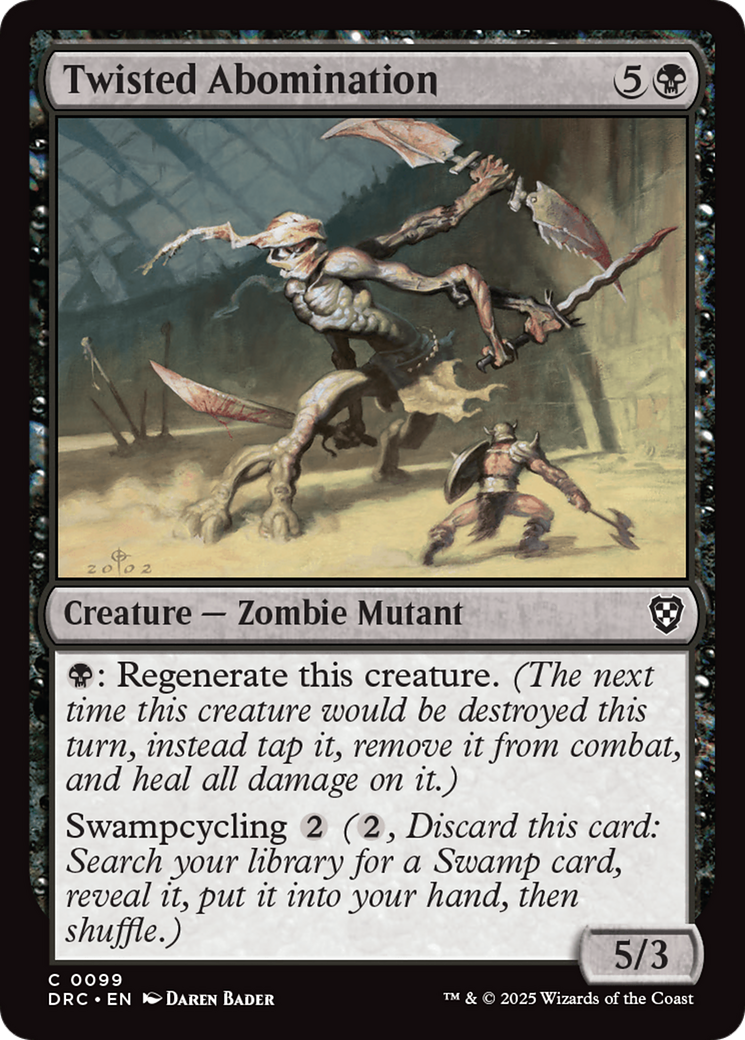
Twisted Abomination
Twisted Abomination
Creature — Zombie Mutant
5/3
: Regenerate this creature. (The next time this creature would be destroyed this turn, instead tap it, remove it from combat, and heal all damage on it.)
Swampcycling ( , Discard this card: Search your library for a Swamp card, reveal it, put it into your hand, then shuffle.)
- Unlike the normal cycling ability, Swampcycling doesn't allow you to draw a card. Instead, it lets you search your library for a Swamp card. After you find a Swamp card in your library, you reveal it, put it into your hand, then shuffle your library.
- Swampcycling is a form of cycling. Any ability that triggers on a card being cycled also triggers on Swampcycling this card. Any ability that stops a cycling ability from being activated also stops Swampcycling from being activated.
- Swampcycling is an activated ability. Effects that interact with activated abilities (such as Stifle or Rings of Brighthearth) will interact with Swampcycling. Effects that interact with spells (such as Remove Soul or Faerie Tauntings) will not.
- You can choose to find any card with the Swamp land type, including nonbasic lands. You can also choose not to find a card, even if there is a Swamp card in your library.
-
1
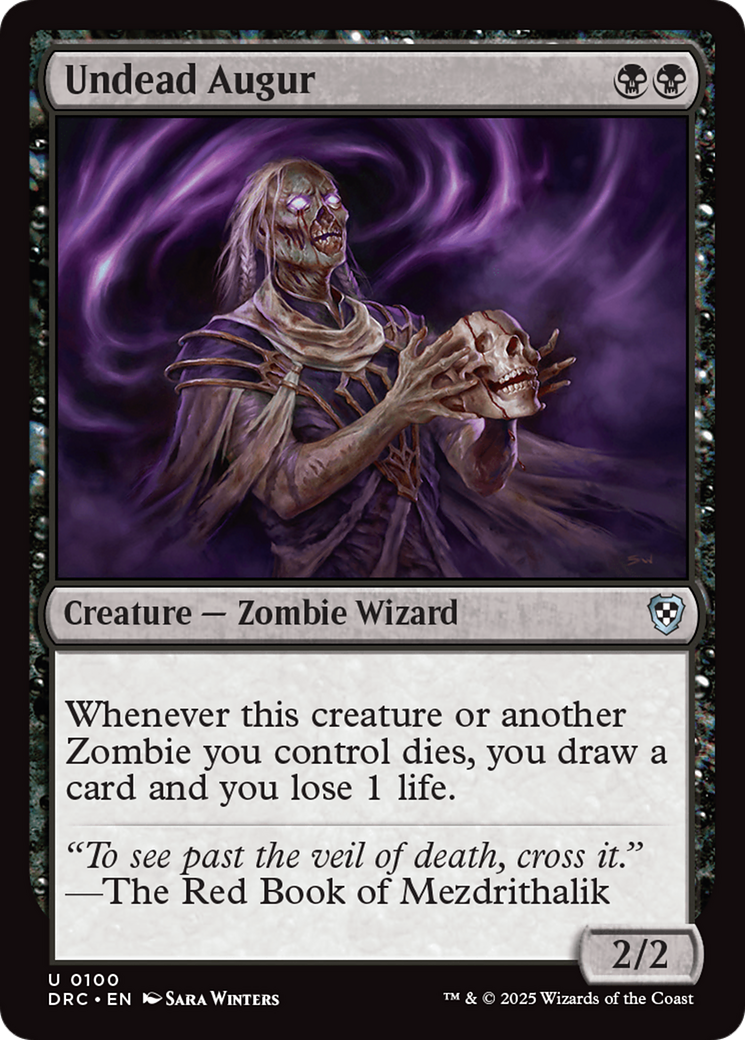
Undead Augur
Undead Augur
Creature — Zombie Wizard
2/2
Whenever this creature or another Zombie you control dies, you draw a card and you lose 1 life.
- If Undead Augur dies at the same time as one or more other Zombies you control, Undead Augur's ability triggers for each of them.
-
1
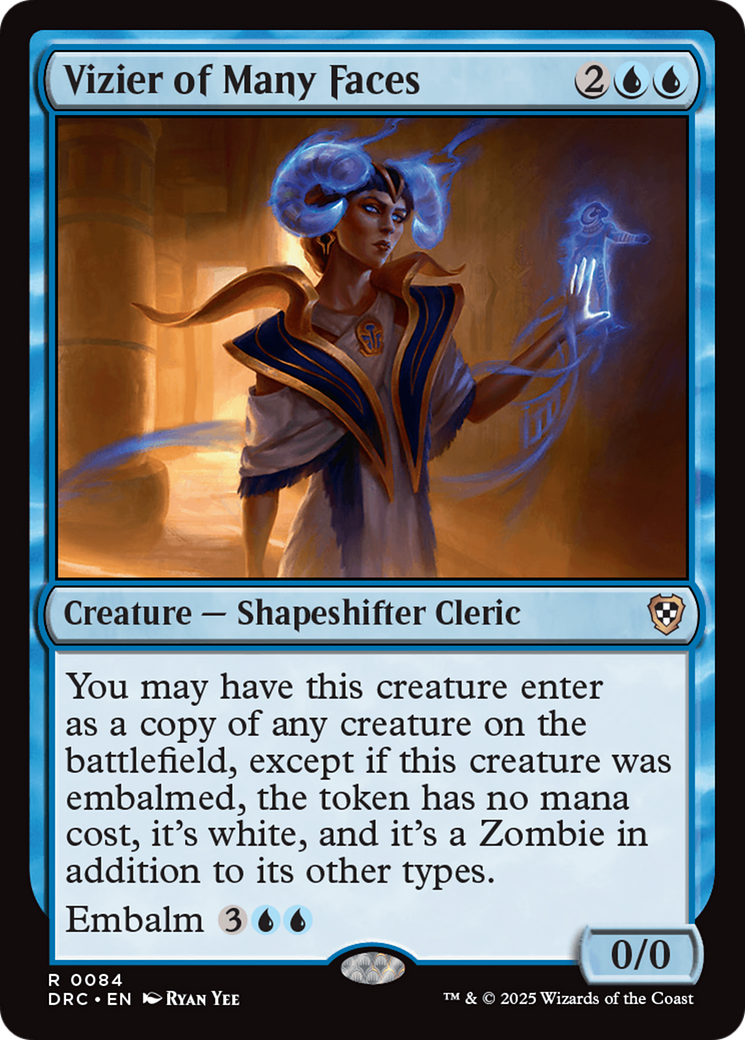
Vizier of Many Faces
Vizier of Many Faces
Creature — Shapeshifter Cleric
0/0
You may have this creature enter as a copy of any creature on the battlefield, except if this creature was embalmed, the token has no mana cost, it's white, and it's a Zombie in addition to its other types.
Embalm
- If a spell or ability puts a creature card with embalm into your graveyard during your main phase, you'll have priority immediately after that spell or ability resolves. You can activate the creature card's embalm ability before any player can exile it with an effect, such as that of Crook of Condemnation, if it's legal for you to do so.
- Once you've activated an embalm ability, the card is immediately exiled. Opponents can't try to stop the ability by exiling the card with an effect such as that of Crook of Condemnation.
- If the chosen creature has in its mana cost, X is considered to be 0.
- If the chosen creature is copying something else (for example, if the chosen creature is another Vizier of Many Faces), then Vizier of Many Faces enters the battlefield as whatever the chosen creature copied.
- If the chosen creature is a token, Vizier of Many Faces copies the original characteristics of that token as stated by the effect that created the token. Vizier of Many Faces is not a token in this case unless it's embalmed.
- Any enters-the-battlefield abilities of the copied creature will trigger when Vizier of Many Faces enters the battlefield. Any "as [this creature] enters the battlefield" or "[this creature] enters the battlefield with" abilities of the chosen creature will also work.
- Vizier of Many Faces copies exactly what was printed on the original creature (unless that creature is copying something else or is a token; see below). It doesn't copy whether that creature is tapped or untapped, whether it has any counters on it or Auras attached to it, or any non-copy effects that have changed its power, toughness, types, color, or so on.
- For each card with embalm, a corresponding game play supplement token can be found in some Amonkhet booster packs. These supplements are not required to play with cards with embalm; you can use the same items to represent an embalmed token as you would any other token.
- The token copies exactly what was printed on the original card and nothing else. It doesn't copy any information about the object the card was before it was put into your graveyard.
- The token is a Zombie in addition to its other types and is white instead of its other colors. It has no mana cost, and thus its mana value is 0. These are copiable values of the token that other effects may copy.
- If the card copied by the token had any "when [this permanent] enters the battlefield" abilities, then the token also has those abilities and will trigger them when it's created. Similarly, any "as [this permanent] enters the battlefield" or "[this permanent] enters the battlefield with" abilities that the token has copied will also work.
- If Vizier of Many Faces somehow enters the battlefield at the same time as another creature, Vizier of Many Faces can't become a copy of that creature. You may choose only a creature that's already on the battlefield.
- The characteristics Vizier of Many Faces gains as part of its copy effect are copiable values that other effects may copy.
-
1
Wayward Servant
Wayward Servant
Creature — Zombie
2/2
Whenever another Zombie you control enters, each opponent loses 1 life and you gain 1 life.
- If Wayward Servant enters the battlefield at the same time as another Zombie creature, its ability triggers for that Zombie.
- In a Two-Headed Giant game, the triggered ability of Wayward Servant causes the opposing team to lose 2 life and you gain 1 life.
-
1
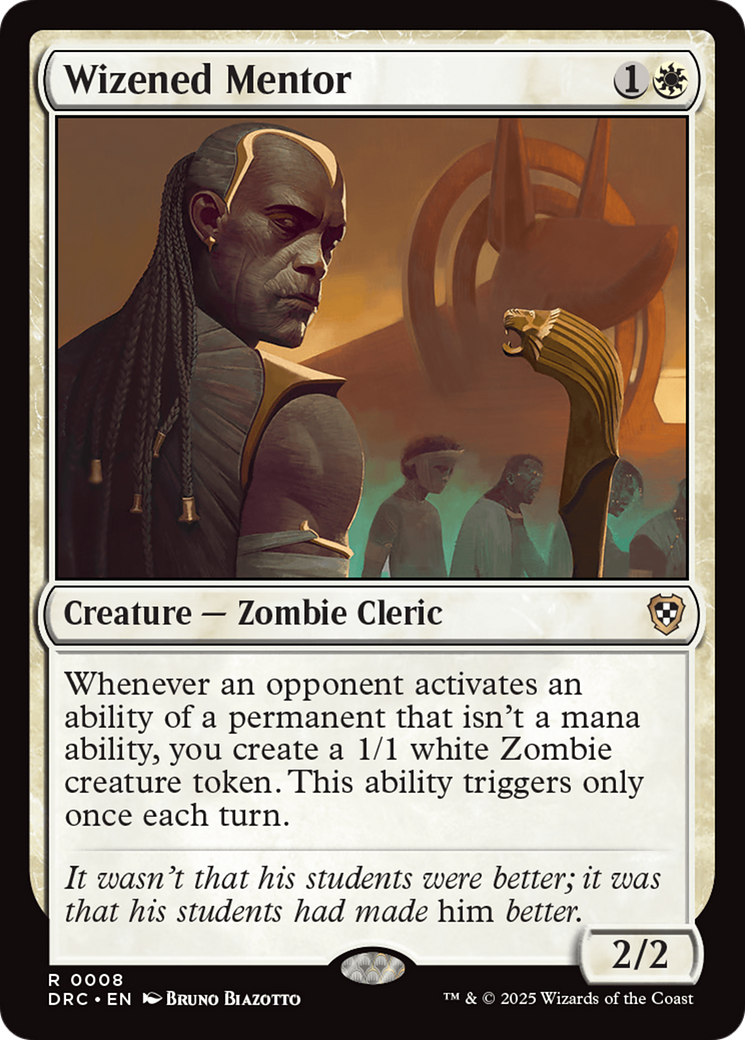
Wizened Mentor
Wizened Mentor
Creature — Zombie Cleric
2/2
Whenever an opponent activates an ability of a permanent that isn't a mana ability, you create a 1/1 white Zombie creature token. This ability triggers only once each turn.
-
1
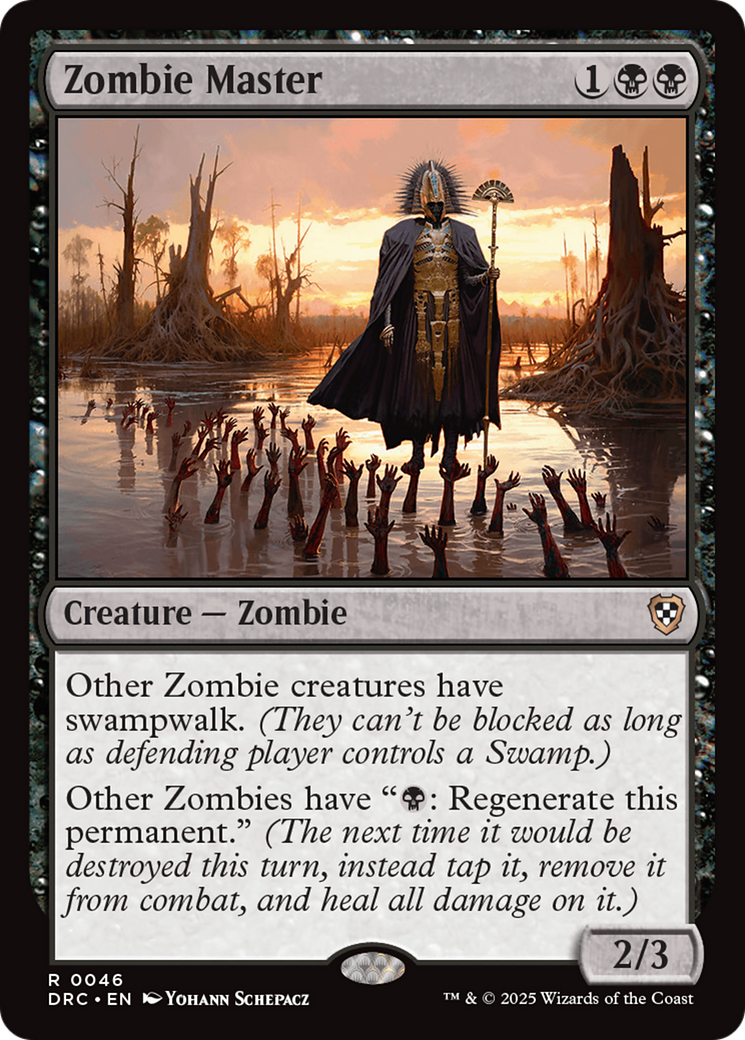
Zombie Master
Zombie Master
Creature — Zombie
2/3
Other Zombie creatures have swampwalk. (They can't be blocked as long as defending player controls a Swamp.)
Other Zombies have " : Regenerate this permanent."
Instants 4
-
1
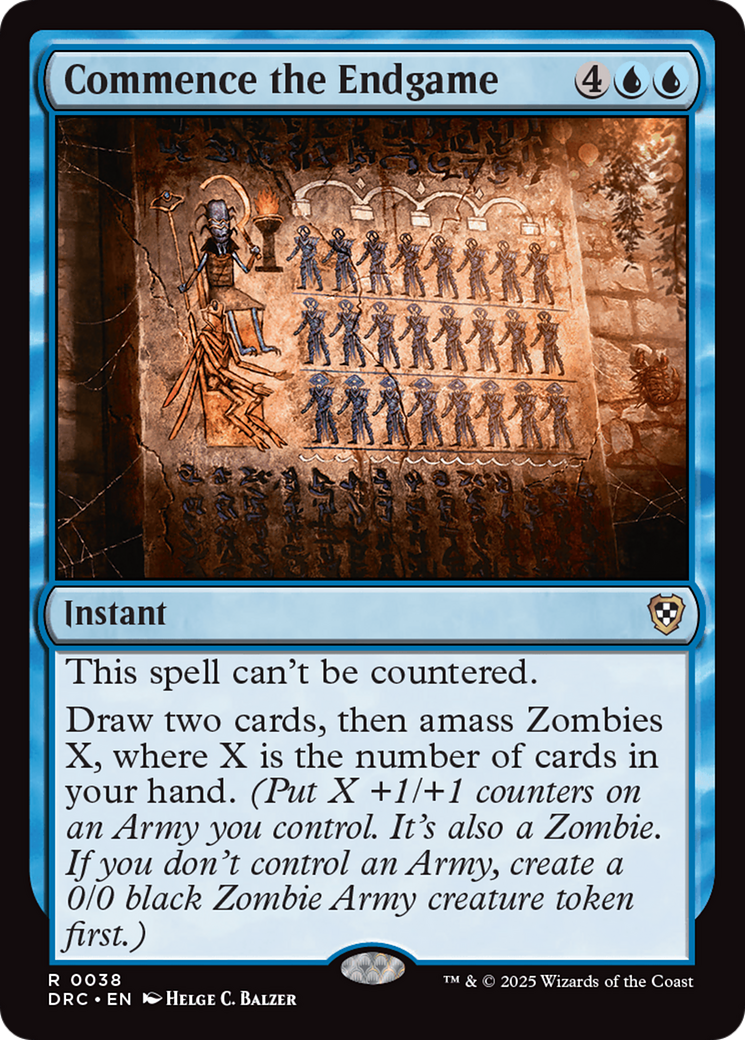
Commence the Endgame
Commence the Endgame
Instant
This spell can't be countered.
Draw two cards, then amass Zombies X, where X is the number of cards in your hand. (Put X +1/+1 counters on an Army you control. It's also a Zombie. If you don't control an Army, create a 0/0 black Zombie Army creature token first.)
- Some cards refer to the "amassed Army." That means the Army creature you chose to receive counters, even if no counters were placed on it for some reason.
- In the rare case that you control multiple Army creatures (perhaps because you played a creature with changeling) while you amass Zombies, you choose which of your Army creatures to put the +1/+1 counters on. If that creature isn't a Zombie, it becomes a Zombie in addition to its other types.
- If you don't control an Army, the Zombie Army token you create enters the battlefield as a 0/0 creature before receiving counters. Any abilities that trigger when a creature with a certain power enters the battlefield, such as that of Mentor of the Meek, will see the token enter as a 0/0 creature before it gets +1/+1 counters.
- Amass abilities are now written as "amass [subtype] N." Previous cards with amass have received errata to say "amass Zombies N."
- To amass Zombies N, if you don't control an Army creature, create a 0/0 black Zombie Army creature token. Then you choose an Army creature you control and put N +1/+1 counters on it. If that Army isn't already a Zombie, it becomes a Zombie in addition to its other types.
- Amass Orcs works the same way, except you create a 0/0 black Orc Army creature token if you don't control an Army. If the Army creature you chose isn't already an Orc, it becomes an Orc in addition to its other types. By combining cards with amass Orcs and amass Zombies, you can end up with an Orc Zombie Army.
- A spell or ability that counters spells can still target Commence the Endgame. When that spell or ability resolves, Commence the Endgame won't be countered, but any additional effects of that spell or ability will still happen.
- You draw two cards and amass X all while Commence the Endgame is resolving. Nothing can happen between the two, and no player may choose to take actions.
-
1
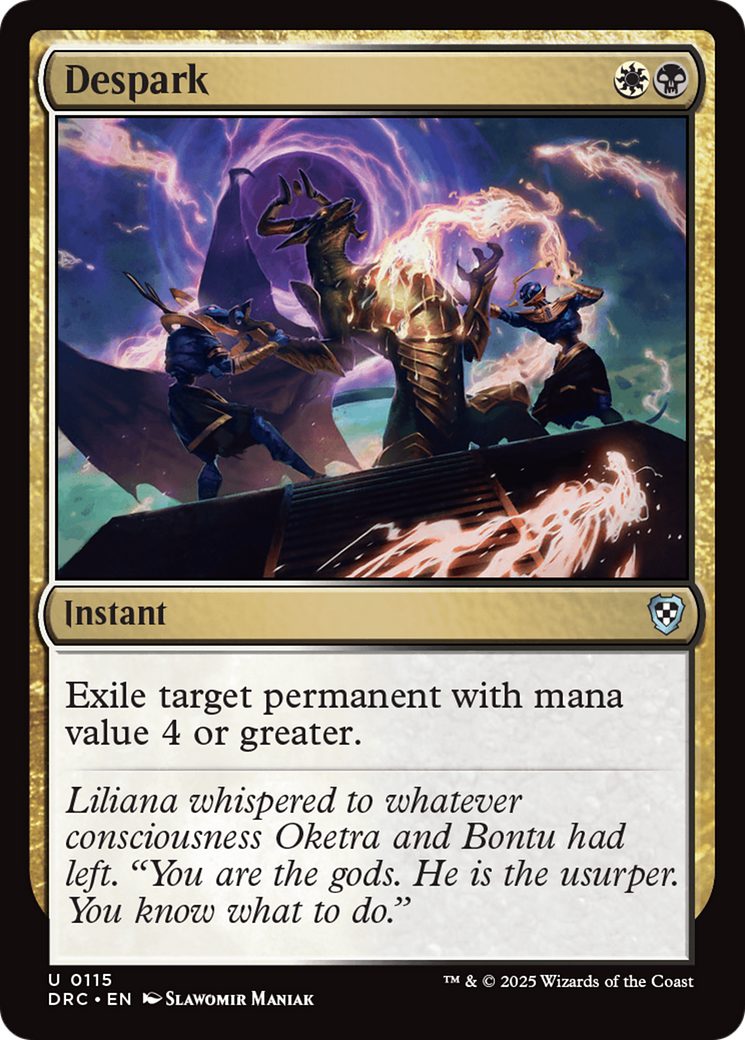
Despark
Despark
Instant
Exile target permanent with mana value 4 or greater.
- If a permanent has in its mana cost, X is considered to be 0.
-
1
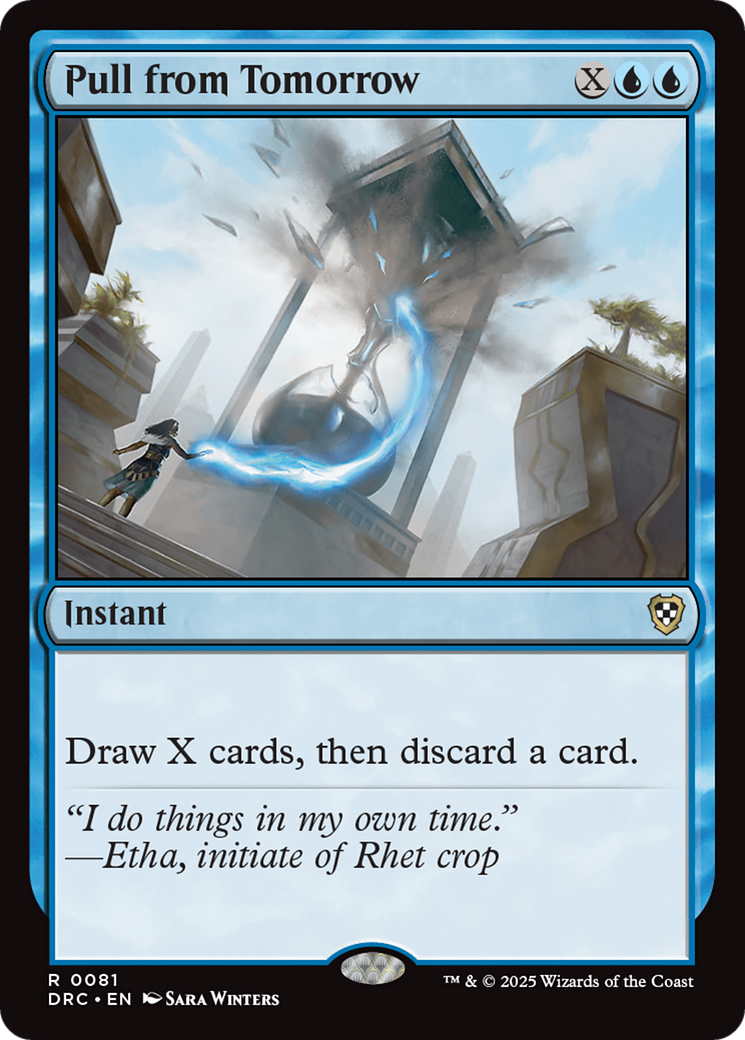
Pull from Tomorrow
Pull from Tomorrow
Instant
Draw X cards, then discard a card.
-
1
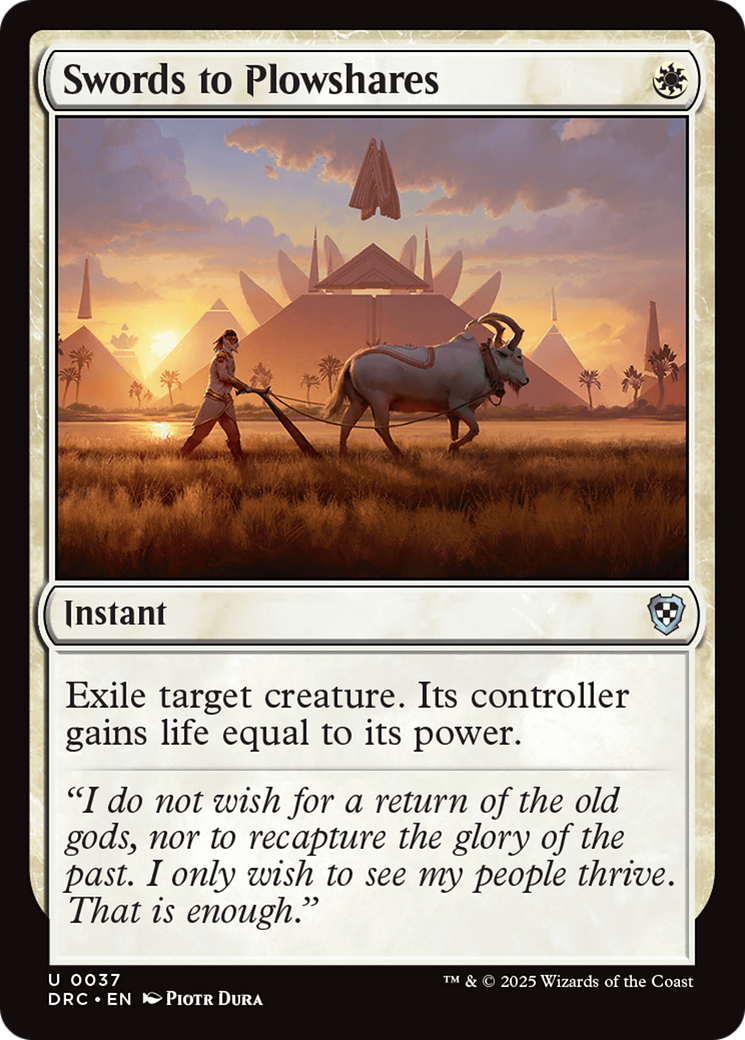
Swords to Plowshares
Swords to Plowshares
Instant
Exile target creature. Its controller gains life equal to its power.
- Use the power of the creature from when it was last on the battlefield to determine how much life is gained.
Sorceries 4
-
1
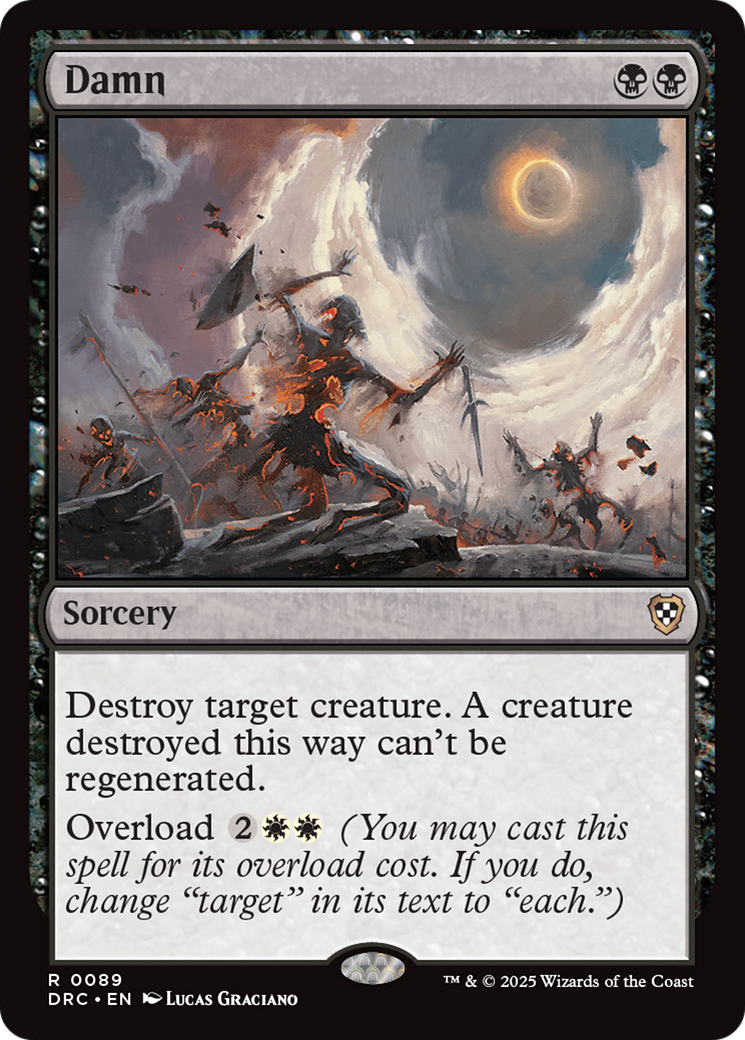
Damn
Damn
Sorcery
Destroy target creature. A creature destroyed this way can't be regenerated.
Overload (You may cast this spell for its overload cost. If you do, change "target" in its text to "each.")
- If you don't pay the overload cost of a spell with overload, that spell will have a single target. If you pay the overload cost, the spell won't have any targets.
- Because a spell with overload doesn't target when its overload cost is paid, it may affect permanents with hexproof or with protection from the appropriate color.
- To determine the total cost of a spell, start with the mana cost or alternative cost you're paying (such as an overload cost), add any cost increases, then apply any cost reductions. The mana value of the spell remains unchanged, no matter what the total cost to cast it was.
- If you are instructed to cast a spell with overload "without paying its mana cost," you can't choose to pay its overload cost instead.
-
1
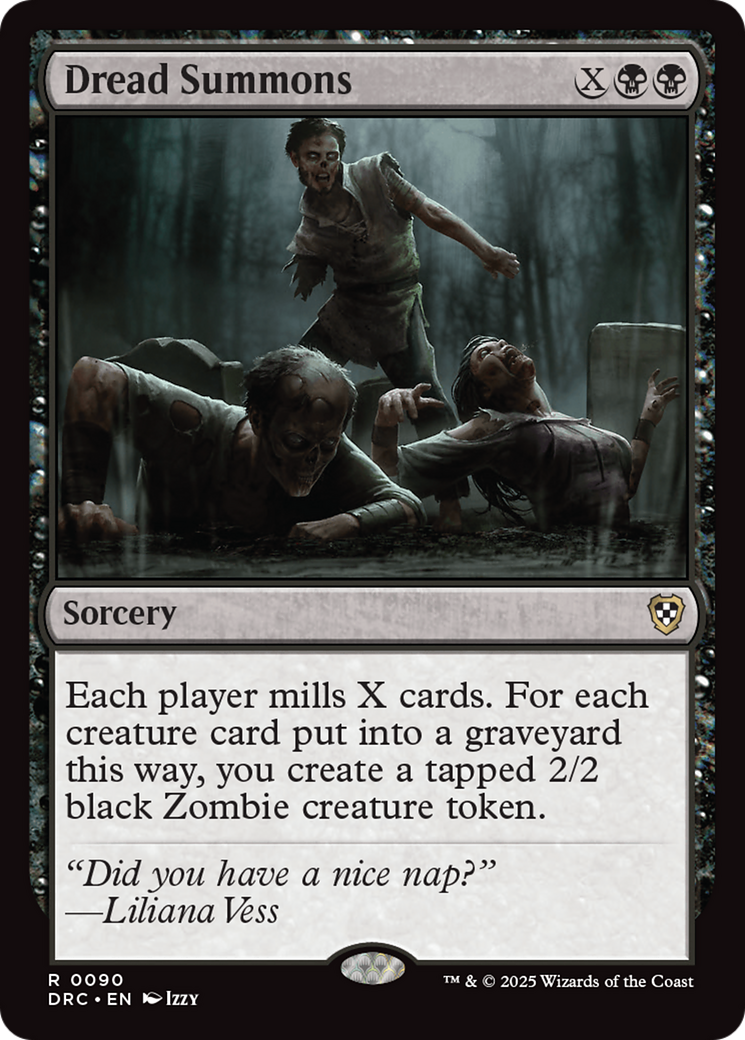
Dread Summons
Dread Summons
Sorcery
Each player mills X cards. For each creature card put into a graveyard this way, you create a tapped 2/2 black Zombie creature token. (To mill a card, a player puts the top card of their library into their graveyard.)
- If a creature card has an ability that replaces going to the graveyard with moving somewhere else "instead," that card won't count toward the number of Zombies you get. Conversely, creature cards with a triggered ability that removes them from the graveyard when they're put there from anywhere (or your library) will count toward that number.
-
1
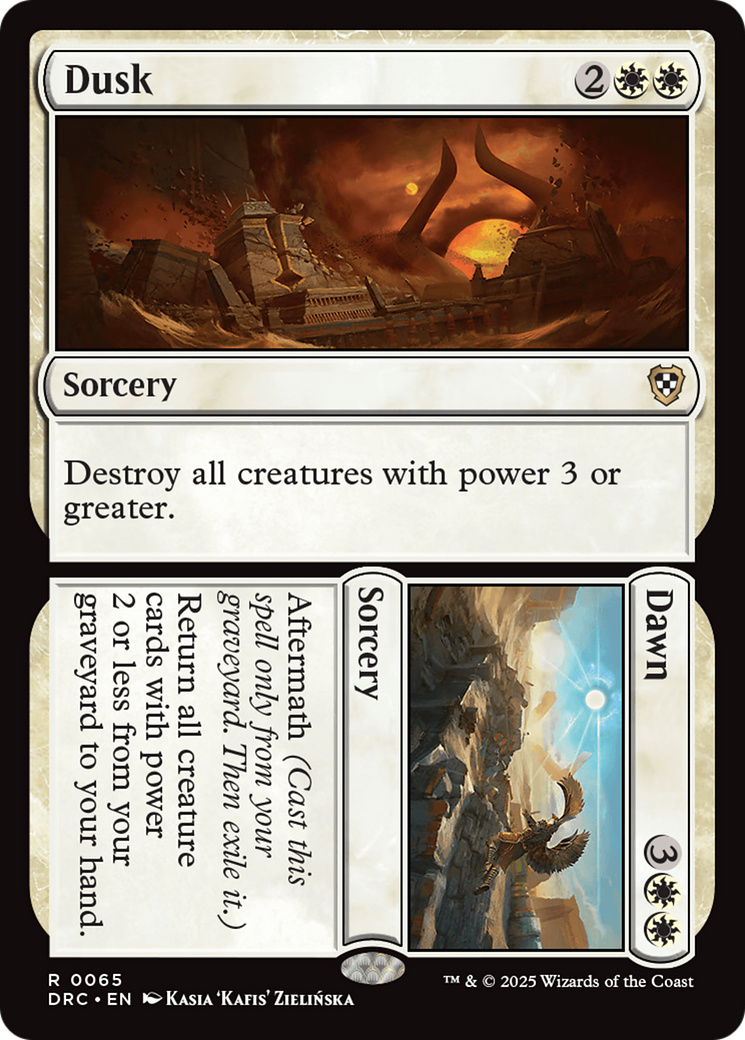
Dusk // Dawn
//
Dusk
Sorcery
- Once you've started to cast a spell with aftermath from your graveyard, the card is immediately moved to the stack. Opponents can't try to stop the ability by exiling the card with an effect such as that of Crook of Condemnation.
- All split cards have two card faces on a single card, and you put a split card onto the stack with only the half you're casting. The characteristics of the half of the card you didn't cast are ignored while the spell is on the stack. For example, if an effect prevents you from casting green spells, you can cast Destined of Destined // Lead, but not Lead.
- Each split card is a single card. For example, if you discard one, you've discarded one card, not two. If an effect counts the number of instant and sorcery cards in your graveyard, Destined // Lead counts once, not twice.
- Each split card has two names. If an effect instructs you to choose a card name, you may choose one, but not both.
- While not on the stack, the characteristics of a split card are the combination of its two halves. For example, Destined // Lead is a green and black card, it is both an instant card and a sorcery card, and its mana value is 6. This means that if an effect allows you to cast a card with mana value 2 from your hand, you can't cast Destined. This is a change from the previous rules for split cards.
- Split cards with aftermath have a new frame treatment—the half you can cast from your hand is oriented the same as other cards you'd cast from your hand, while the half you can cast from your graveyard is a traditional split card half. This frame treatment is for your convenience and has no rules significance.
- If another effect allows you to cast a split card with aftermath from any zone other than a graveyard, you can't cast the half with aftermath.
- If another effect allows you to cast a split card with aftermath from a graveyard, you may cast either half. If you cast the half that has aftermath, you'll exile the card if it would leave the stack.
- A spell with aftermath cast from a graveyard will always be exiled afterward, whether it resolves, it's countered, or it leaves the stack in some other way.
- If you cast the first half of a split card with aftermath during your turn, you'll have priority immediately after it resolves. You can cast the half with aftermath from your graveyard before any player can take any other action if it's legal for you to do so.
-
1
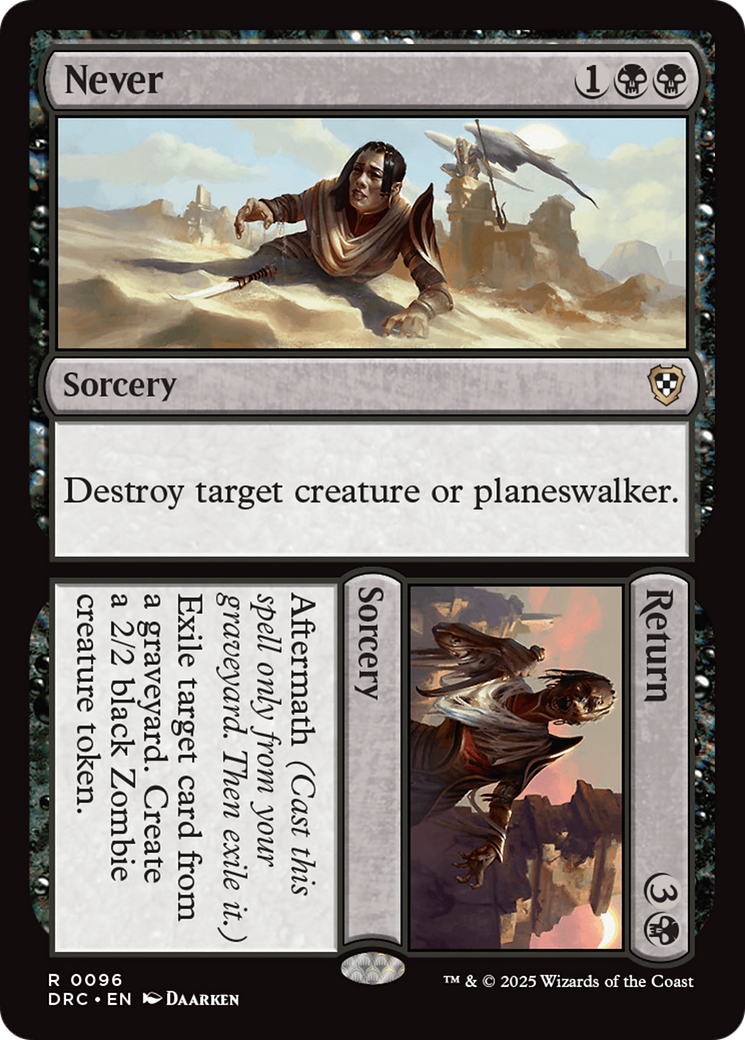
Never // Return
//
Never
Sorcery
- Once you've started to cast a spell with aftermath from your graveyard, the card is immediately moved to the stack. Opponents can't try to stop the ability by exiling the card with an effect such as that of Crook of Condemnation.
- All split cards have two card faces on a single card, and you put a split card onto the stack with only the half you're casting. The characteristics of the half of the card you didn't cast are ignored while the spell is on the stack. For example, if an effect prevents you from casting green spells, you can cast Destined of Destined // Lead, but not Lead.
- Each split card is a single card. For example, if you discard one, you've discarded one card, not two. If an effect counts the number of instant and sorcery cards in your graveyard, Destined // Lead counts once, not twice.
- Each split card has two names. If an effect instructs you to choose a card name, you may choose one, but not both.
- While not on the stack, the characteristics of a split card are the combination of its two halves. For example, Destined // Lead is a green and black card, it is both an instant card and a sorcery card, and its mana value is 6. This means that if an effect allows you to cast a card with mana value 2 from your hand, you can't cast Destined. This is a change from the previous rules for split cards.
- Split cards with aftermath have a new frame treatment—the half you can cast from your hand is oriented the same as other cards you'd cast from your hand, while the half you can cast from your graveyard is a traditional split card half. This frame treatment is for your convenience and has no rules significance.
- If another effect allows you to cast a split card with aftermath from any zone other than a graveyard, you can't cast the half with aftermath.
- If another effect allows you to cast a split card with aftermath from a graveyard, you may cast either half. If you cast the half that has aftermath, you'll exile the card if it would leave the stack.
- A spell with aftermath cast from a graveyard will always be exiled afterward, whether it resolves, it's countered, or it leaves the stack in some other way.
- If you cast the first half of a split card with aftermath during your turn, you'll have priority immediately after it resolves. You can cast the half with aftermath from your graveyard before any player can take any other action if it's legal for you to do so.
Artifacts 12
-
1
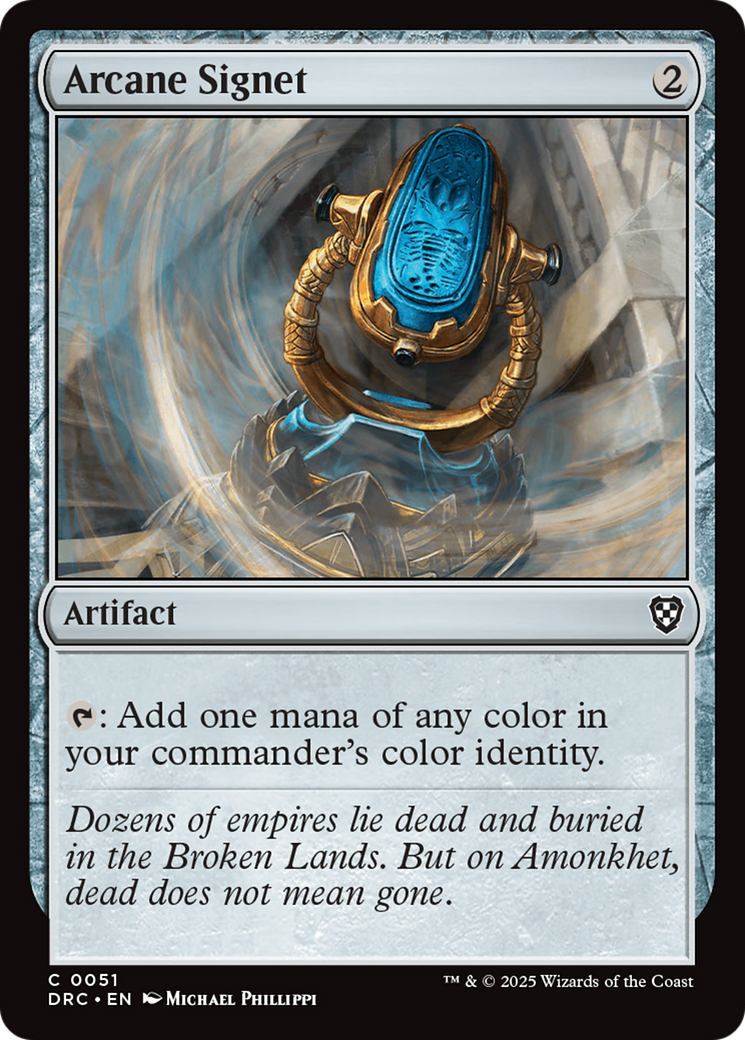
Arcane Signet
Arcane Signet
Artifact
: Add one mana of any color in your commander's color identity.
- If you have two commanders, the ability adds one mana of any color in their combined color identities.
- If your commander is a card that has no colors in its color identity, Arcane Signet's ability produces no mana. It doesn't produce .
- If you don't have a commander, Arcane Signet's ability produces no mana.
-
1
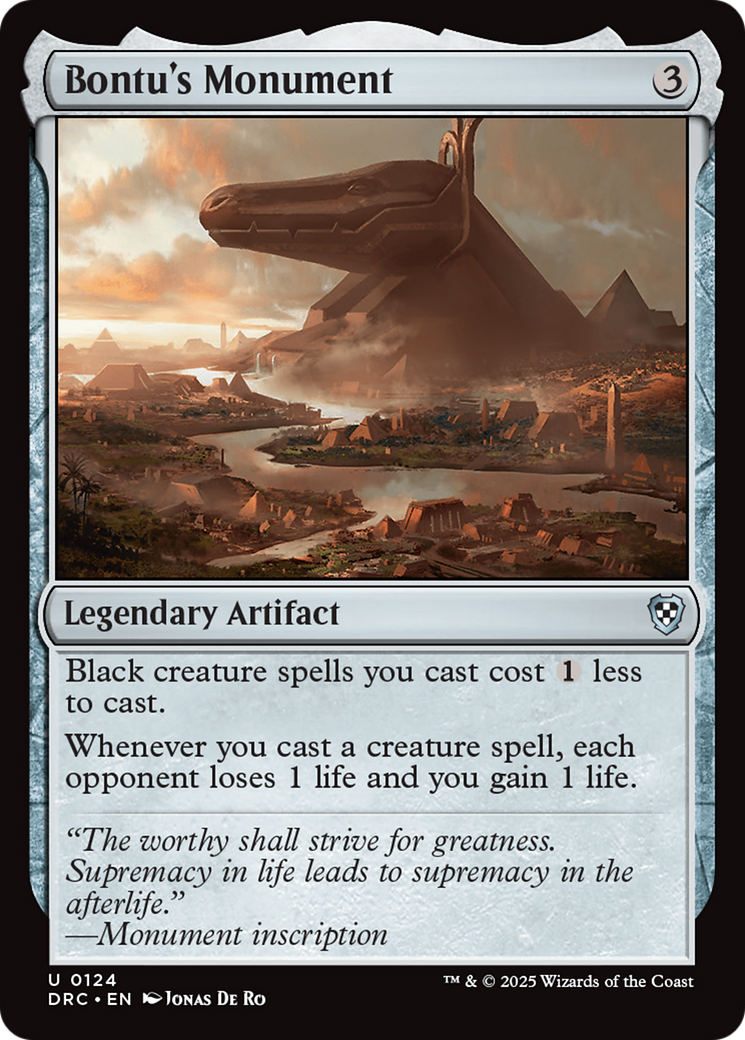
Bontu's Monument
Bontu's Monument
Legendary Artifact
Black creature spells you cast cost less to cast.
Whenever you cast a creature spell, each opponent loses 1 life and you gain 1 life.
- In a Two-Headed Giant game, the triggered ability of Bontu's Monument causes the opposing team to lose 2 life and you gain 1 life.
- Each Monument has one ability that reduces the cost of creature spells of a certain color, and a triggered ability that triggers whenever you cast any creature spell—not just a creature spell of that color.
- A creature spell that's multiple colors is each of those colors. For example, Ahn-Crop Champion is a white creature and a green creature, so it can benefit from either Oketra's Monument or Rhonas's Monument—or both at once.
- To determine the total cost of a creature spell, start with the mana cost or alternative cost you're paying, add any cost increases, then apply any cost reductions. The mana value of the creature remains unchanged, no matter what the total cost to cast it was.
- Each Monument's triggered ability triggers as the creature spell is cast and resolves before that creature spell resolves. The ability will resolve even if that creature spell is countered.
-
1
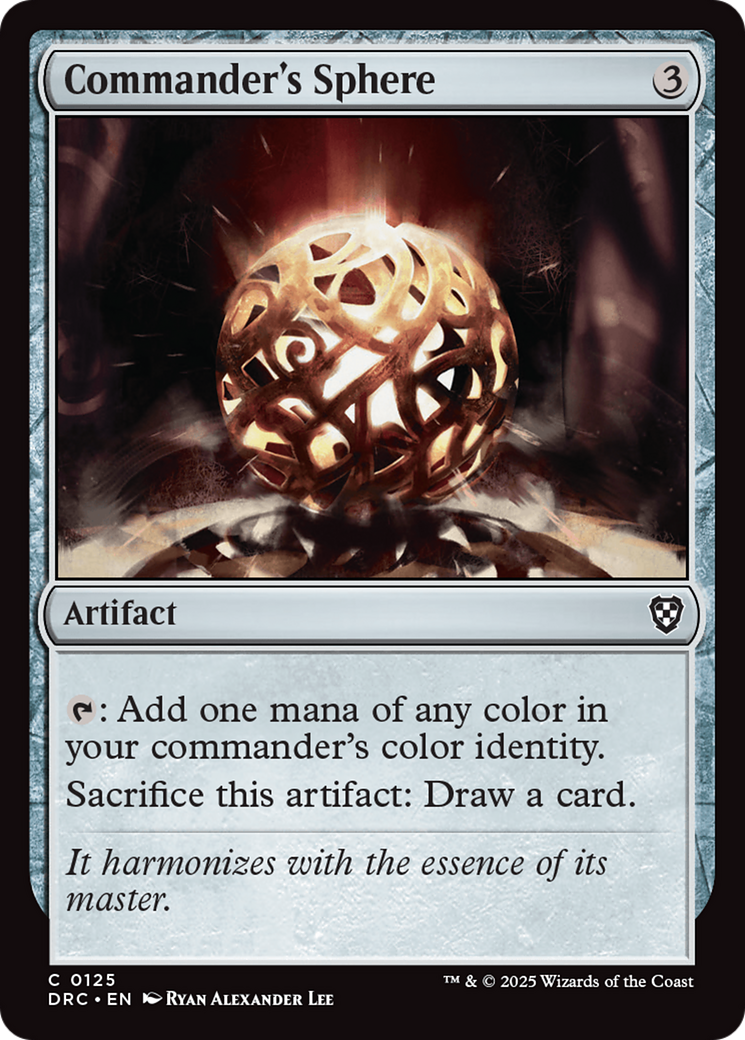
Commander's Sphere
Commander's Sphere
Artifact
: Add one mana of any color in your commander's color identity.
Sacrifice this artifact: Draw a card.
- If you have two commanders, the ability adds one mana of any color in their combined color identities.
- If your commander is a card that has no colors in its color identity, Commander's Sphere's first ability produces no mana. It doesn't produce .
- If you don't have a commander, Commander's Sphere's first ability produces no mana.
-
1
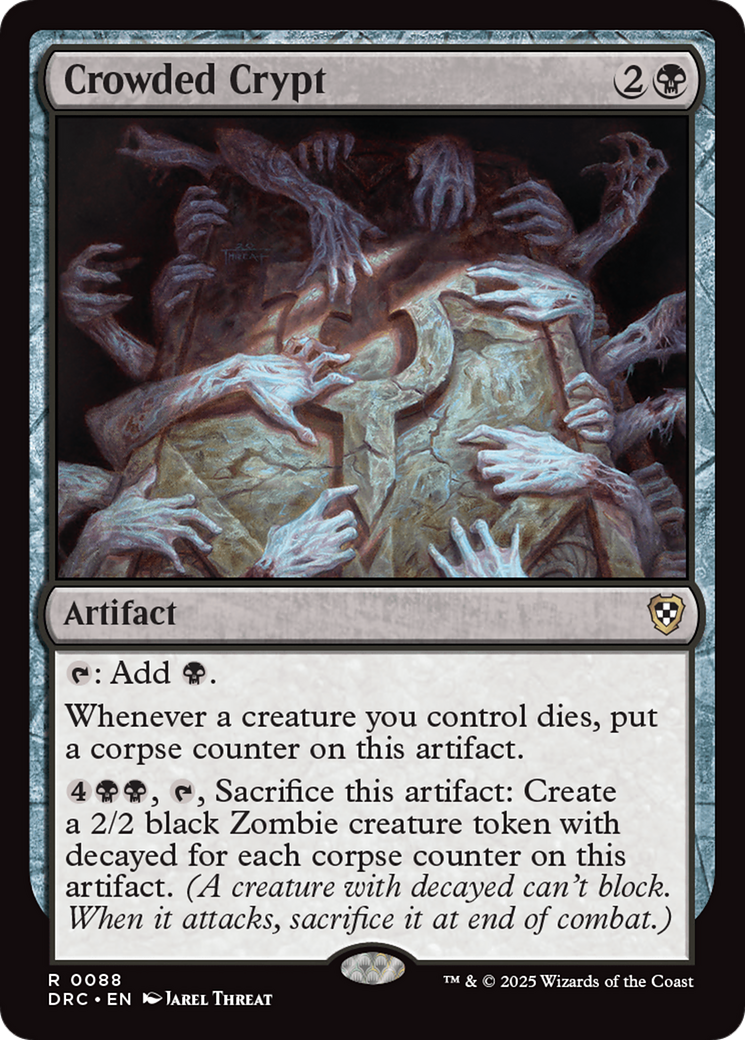
Crowded Crypt
Crowded Crypt
Artifact
: Add .
Whenever a creature you control dies, put a corpse counter on this artifact.
, , Sacrifice this artifact: Create a 2/2 black Zombie creature token with decayed for each corpse counter on this artifact. (A creature with decayed can't block. When it attacks, sacrifice it at end of combat.)
- Decayed represents a static ability and a triggered ability. “Decayed” means “This creature can't block” and “When this creature attacks, sacrifice it at end of combat.”
- Decayed does not create any attacking requirements. You may choose not to attack with a creature that has decayed.
- Decayed does not grant haste. Creatures with decayed that enter the battlefield during your turn may not attack until your next turn.
- Once a creature with decayed attacks, it will be sacrificed at end of combat, even if it no longer has decayed at that time.
-
1
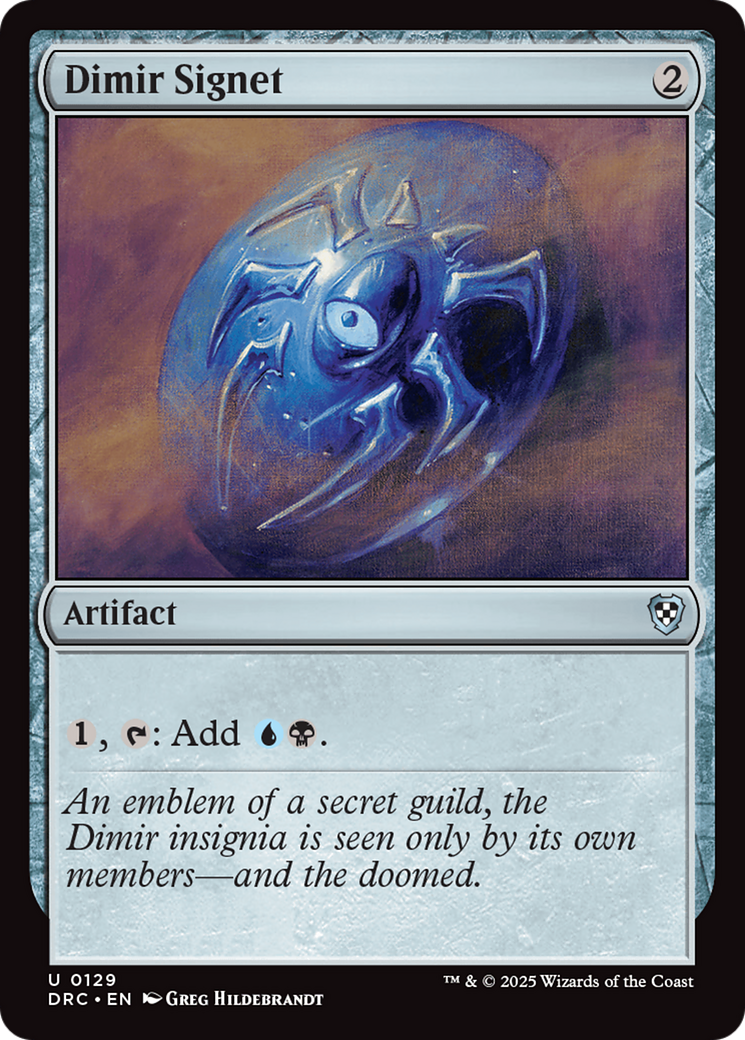
Dimir Signet
Dimir Signet
Artifact
, : Add .
-
1
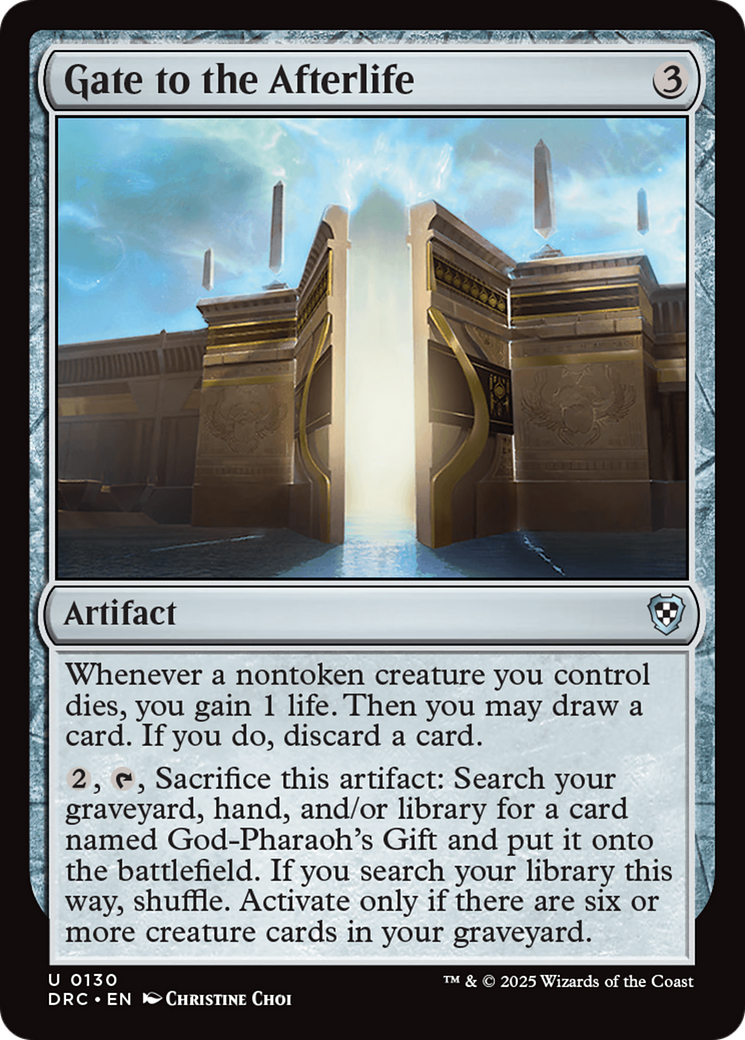
Gate to the Afterlife
Gate to the Afterlife
Artifact
Whenever a nontoken creature you control dies, you gain 1 life. Then you may draw a card. If you do, discard a card.
, , Sacrifice this artifact: Search your graveyard, hand, and/or library for a card named God-Pharaoh's Gift and put it onto the battlefield. If you search your library this way, shuffle. Activate only if there are six or more creature cards in your graveyard.
- If Gate to the Afterlife is put into a graveyard at the same time a nontoken creature you control dies, its first ability triggers for that creature.
- There is no card named God-Pharaoh’s Gift in this set. During the upcoming Hour of Devastation set, you may prove worthy of receiving it.
-
1
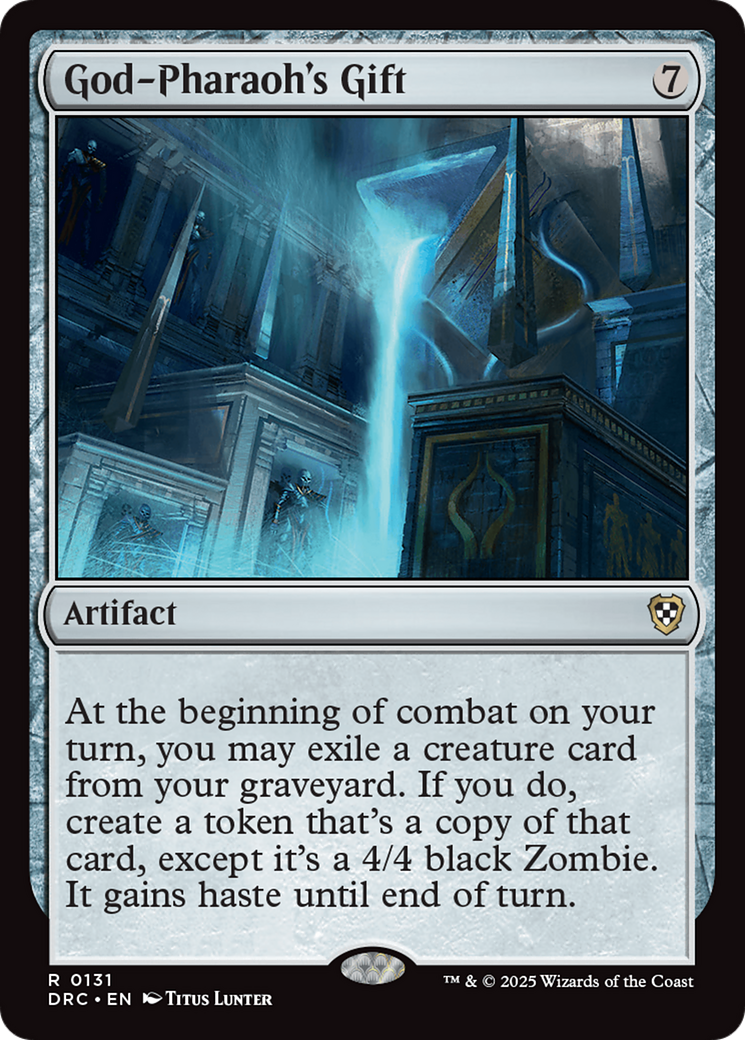
God-Pharaoh's Gift
God-Pharaoh's Gift
Artifact
At the beginning of combat on your turn, you may exile a creature card from your graveyard. If you do, create a token that's a copy of that card, except it's a 4/4 black Zombie. It gains haste until end of turn.
- The ability of God-Pharaoh's Gift doesn't target the creature card you'll exile. You choose one as the ability resolves. No player may take actions between the time you choose a creature card to exile and the time you create the token.
- The token copies exactly what was printed on the original card and nothing else, except the characteristics it specifically modifies. It doesn't copy any information about the object the card was before it was put into your graveyard.
- The token is a Zombie instead of its other types (unlike Zombies created by an eternalize ability) and is black instead of its other colors. Its power and toughness are 4/4. These are copiable values of the token that other effects may copy.
- Unlike the tokens created by an eternalize ability, this token has the mana cost and thus mana value of the card it's copying.
- If the card copied by the token had any "when [this permanent] enters the battlefield" abilities, then the token also has those abilities and will trigger them when it's created. Similarly, any "as [this permanent] enters the battlefield" or "[this permanent] enters the battlefield with" abilities that the token has copied will also work.
-
1
Maskwood Nexus
Maskwood Nexus
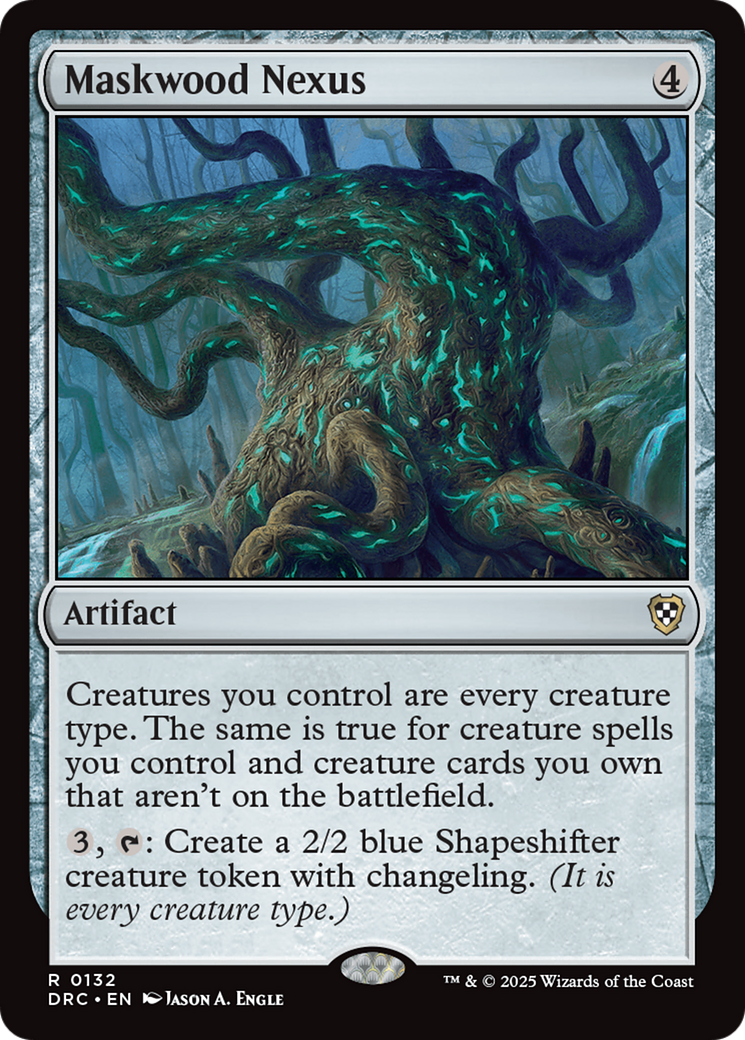
Artifact
Creatures you control are every creature type. The same is true for creature spells you control and creature cards you own that aren't on the battlefield.
, : Create a 2/2 blue Shapeshifter creature token with changeling. (It is every creature type.)
- Replacement effects that modify how creatures of a certain creature type enter the battlefield will apply after you apply the effect of Maskwood Nexus. For example, if you control Maskwood Nexus and an effect says that each Warrior you control enters the battlefield with an additional +1/+1 counter on it, any creature that enters the battlefield under your control will get that counter.
- The tokens created by the activated ability will continue to have all creature types if Maskwood Nexus leaves the battlefield because those tokens have changeling. Other creatures you control will revert to their usual creature types unless another relevant effect is affecting them.
- Changeling is a characteristic-defining ability. It functions in all zones, not only while a card that has it is on the battlefield.
- The subtype Shapeshifter that appears on the type line is mostly there to reinforce the flavor. A creature card with changeling is just as much an Elf, a Dwarf, a Sliver, a Goat, a Coward, and a Zombie as it is a Shapeshifter.
- If an effect causes a creature with changeling to become a new creature type, it will be only that new creature type. It will still have changeling; the effect making it all creature types will simply be overwritten.
- If an effect causes a creature with changeling to lose all abilities, it will remain all creature types, even though it will no longer have changeling. This is because changeling applies before the effect that removes it.
-
1
Orzhov Signet
Orzhov Signet
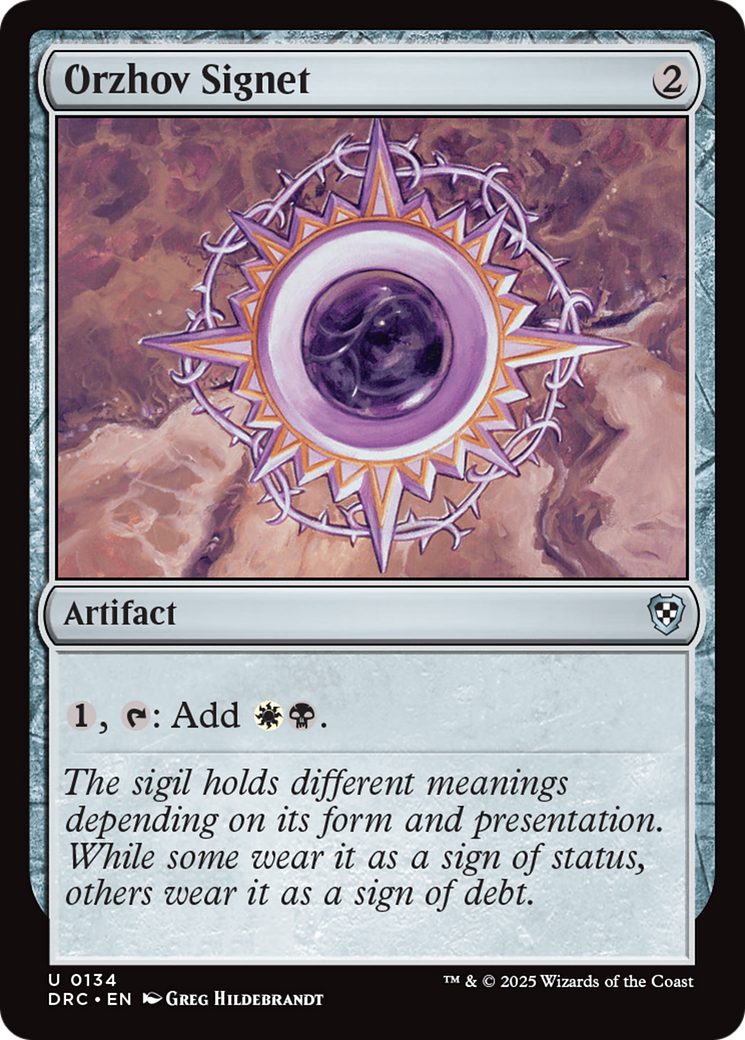
Artifact
, : Add .
-
1
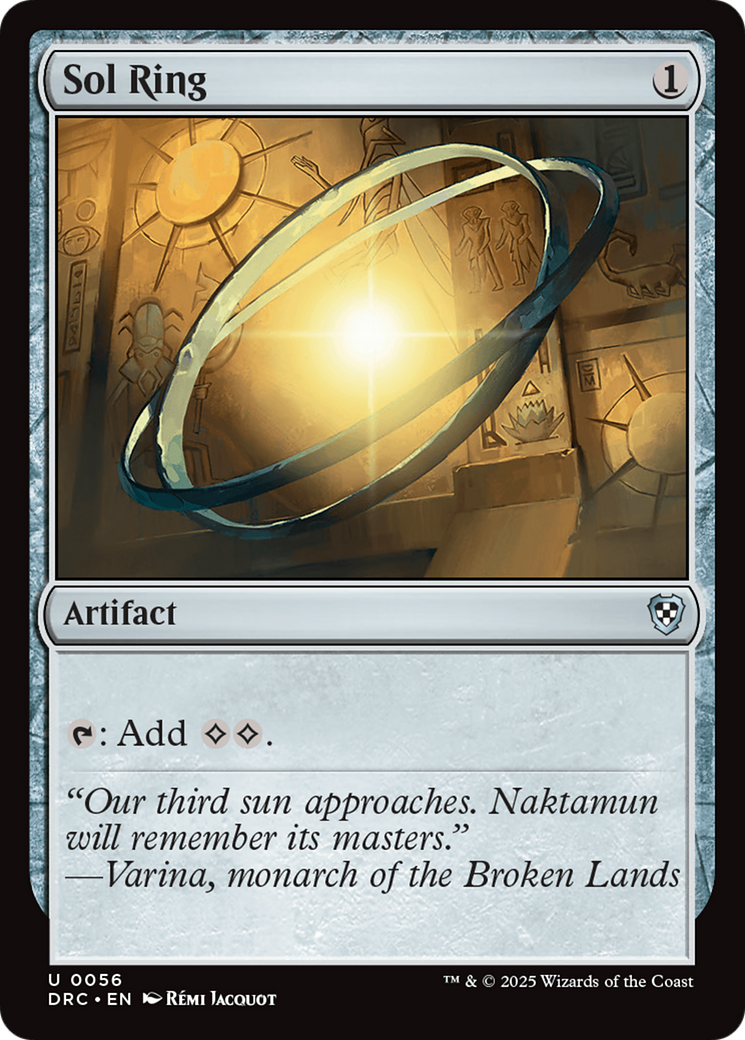
Sol Ring
Sol Ring
Artifact
: Add .
-
1
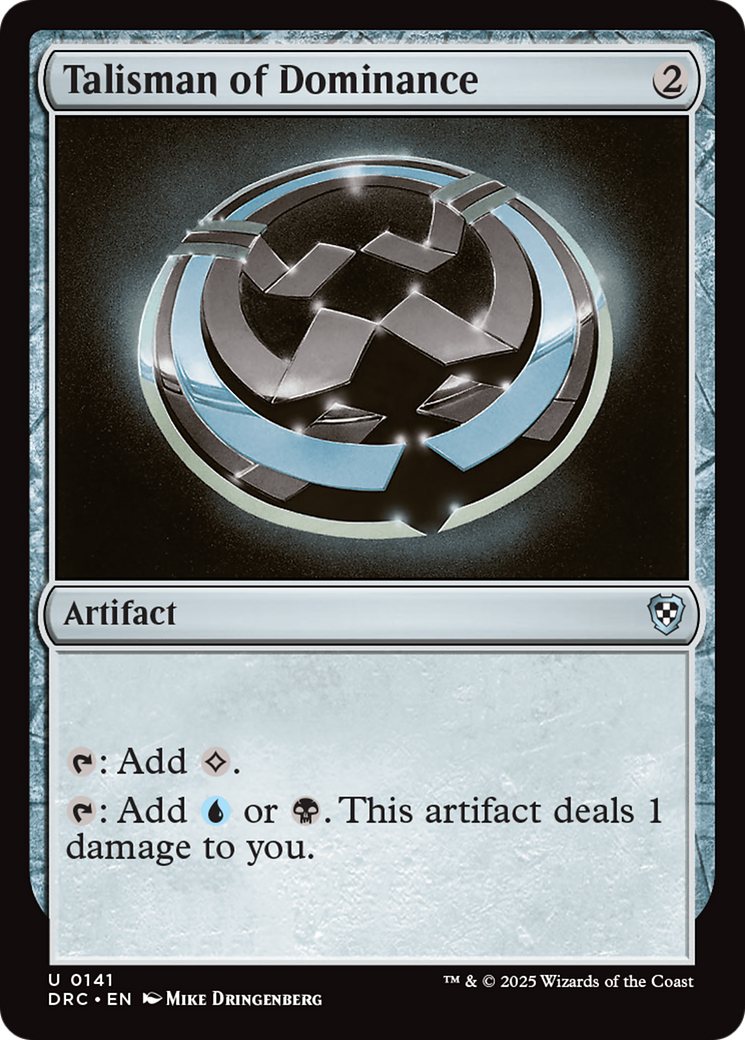
Talisman of Dominance
Talisman of Dominance
Artifact
: Add .
: Add or . This artifact deals 1 damage to you.
-
1
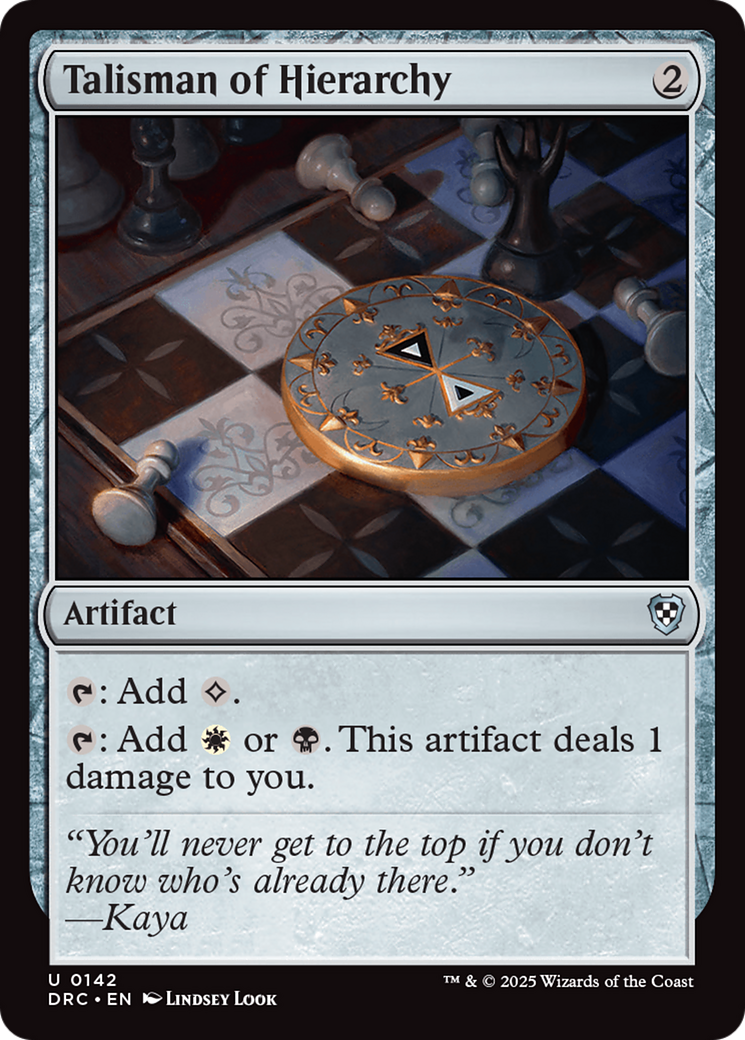
Talisman of Hierarchy
Talisman of Hierarchy
Artifact
: Add .
: Add or . This artifact deals 1 damage to you.
Enchantments 4
-
1
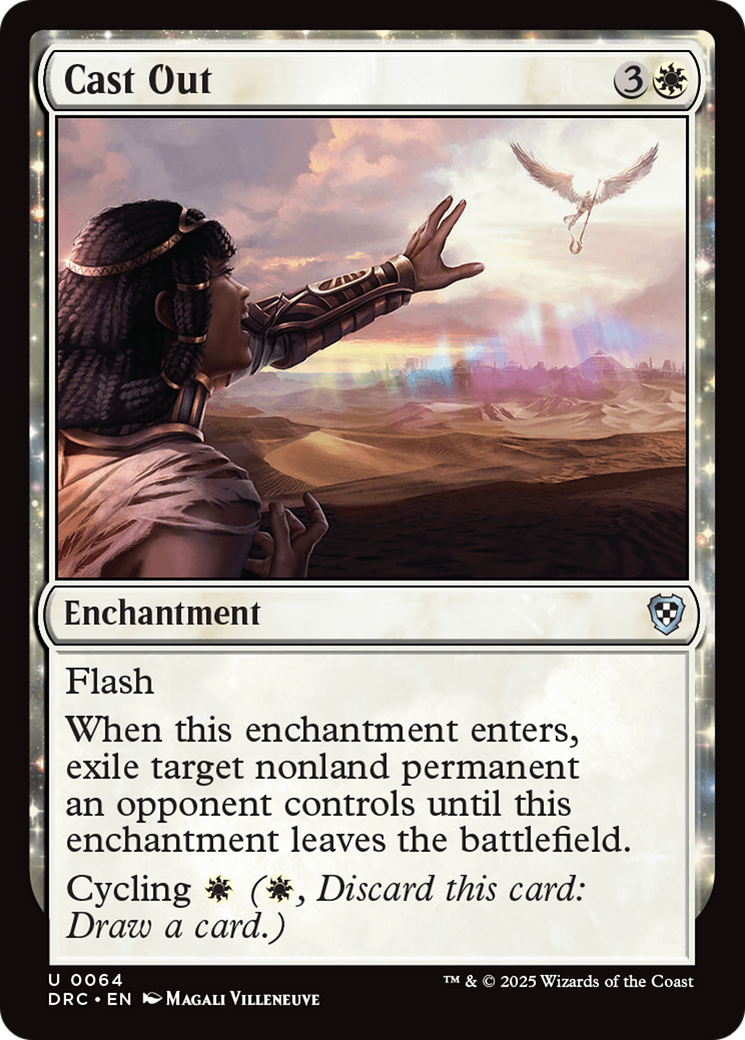
Cast Out
Cast Out
Enchantment
Flash
When this enchantment enters, exile target nonland permanent an opponent controls until this enchantment leaves the battlefield.
Cycling ( , Discard this card: Draw a card.)
- If Cast Out leaves the battlefield before its triggered ability resolves, the target permanent won't be exiled.
- Auras attached to the exiled permanent will be put into their owners' graveyards. Any Equipment will become unattached and remain on the battlefield. Any counters on the exiled permanent will cease to exist.
- If a token is exiled this way, it will cease to exist and won't return to the battlefield.
- The exiled card returns to the battlefield immediately after Cast Out leaves the battlefield. Nothing happens between the two events, including state-based actions.
- In a multiplayer game, if Cast Out's owner leaves the game, the exiled card will return to the battlefield. Because the one-shot effect that returns the card isn't an ability that goes on the stack, it won't cease to exist along with the leaving player's spells and abilities on the stack.
-
1
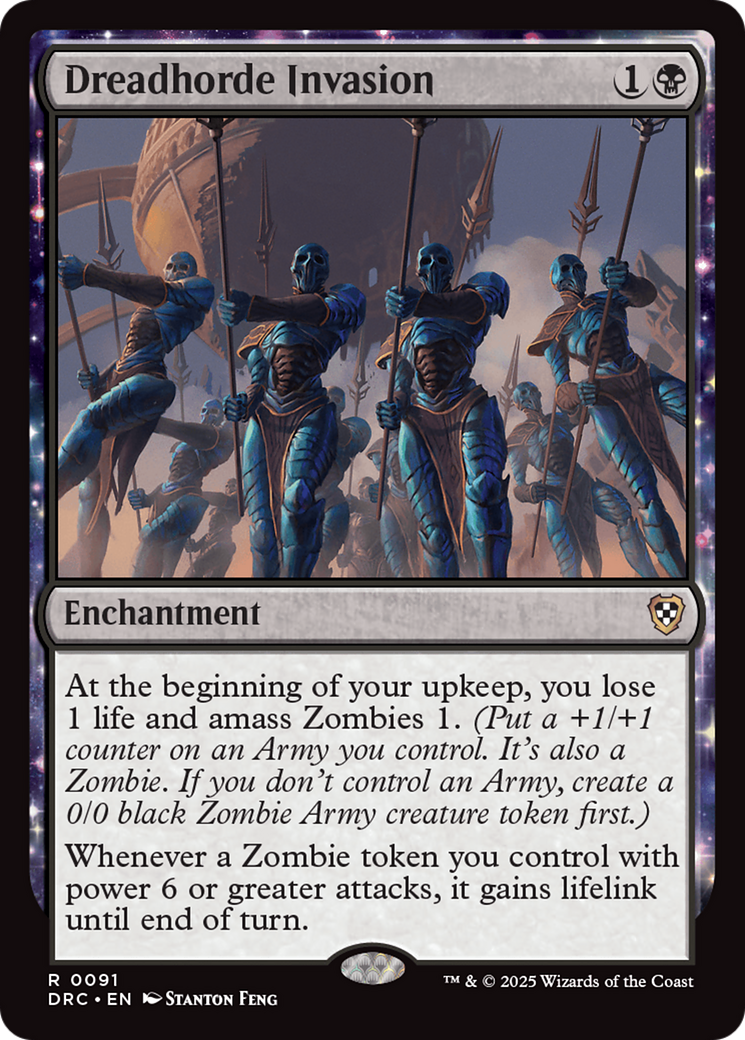
Dreadhorde Invasion
Dreadhorde Invasion
Enchantment
At the beginning of your upkeep, you lose 1 life and amass Zombies 1. (Put a +1/+1 counter on an Army you control. It's also a Zombie. If you don't control an Army, create a 0/0 black Zombie Army creature token first.)
Whenever a Zombie token you control with power 6 or greater attacks, it gains lifelink until end of turn.
- If you don't control an Army, the Zombie Army token you create enters the battlefield as a 0/0 creature before receiving counters. Any abilities that trigger when a creature with a certain power enters the battlefield, such as that of Mentor of the Meek, will see the token enter as a 0/0 creature before it gets +1/+1 counters.
- Some cards that cause you to amass Zombies also provide bonuses to "Zombie tokens." These affect any token that happens to be a Zombie, not just a Zombie Army you've amassed.
- In the rare case that you control multiple Army creatures (perhaps because you played a creature with changeling) while you amass Zombies, you choose which of your Army creatures to put the +1/+1 counters on. If that creature isn't a Zombie, it becomes a Zombie in addition to its other types.
- Some cards refer to the "amassed Army." That means the Army creature you chose to receive counters, even if no counters were placed on it for some reason.
- Amass abilities are now written as "amass [subtype] N." Previous cards with amass have received errata to say "amass Zombies N."
- To amass Zombies N, if you don't control an Army creature, create a 0/0 black Zombie Army creature token. Then you choose an Army creature you control and put N +1/+1 counters on it. If that Army isn't already a Zombie, it becomes a Zombie in addition to its other types.
- Amass Orcs works the same way, except you create a 0/0 black Orc Army creature token if you don't control an Army. If the Army creature you chose isn't already an Orc, it becomes an Orc in addition to its other types. By combining cards with amass Orcs and amass Zombies, you can end up with an Orc Zombie Army.
- The power of the Zombie token is checked only immediately after it attacks. Any other abilities that trigger when creatures you control attack won't have resolved yet.
- If the token's power changes later in the turn after it has attacked, including while Dreadhorde Invasion's second ability is on the stack, it won't cause the token to gain or lose lifelink.
-
1
On Wings of Gold
On Wings of Gold
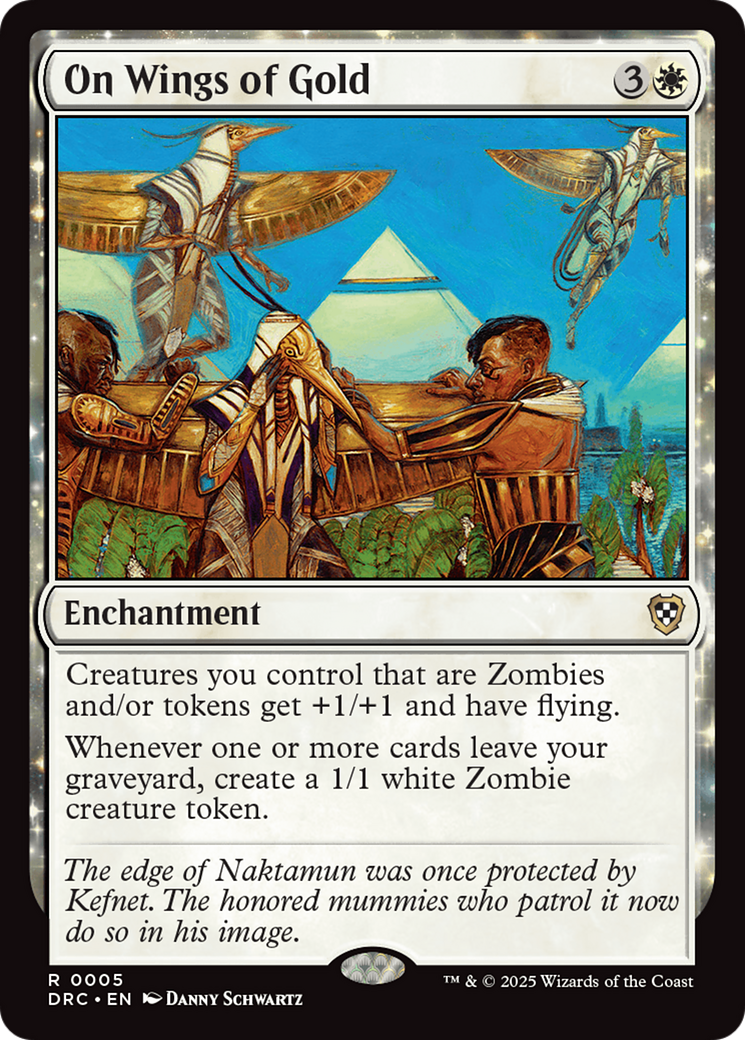
Enchantment
Creatures you control that are Zombies and/or tokens get +1/+1 and have flying.
Whenever one or more cards leave your graveyard, create a 1/1 white Zombie creature token.
-
1
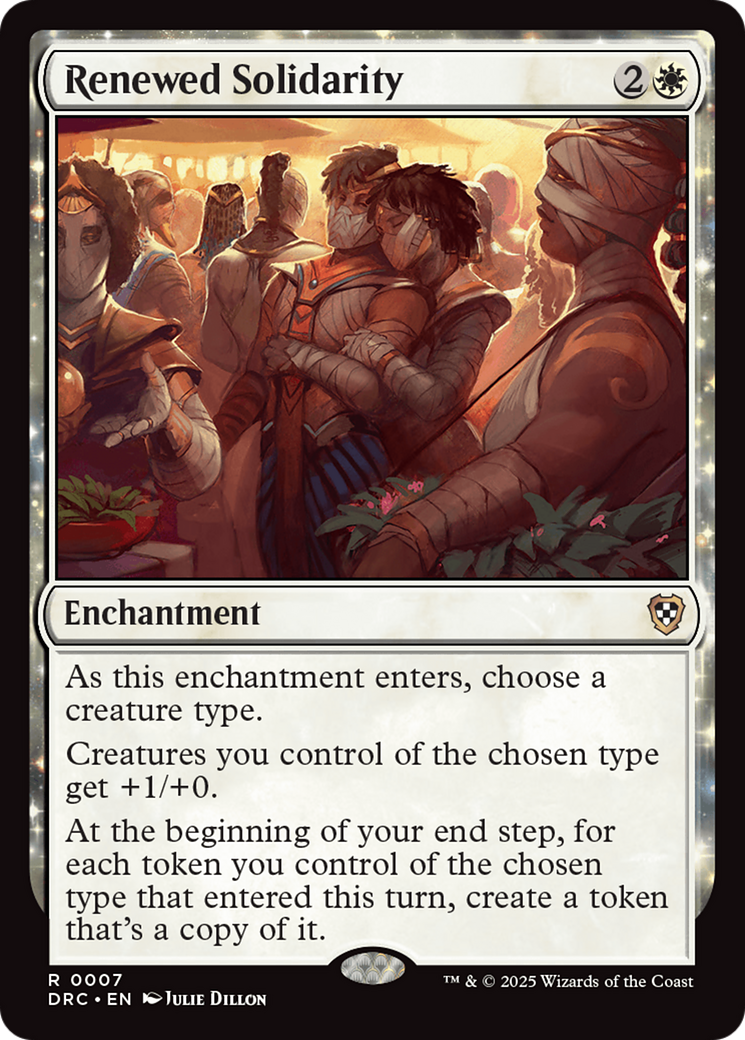
Renewed Solidarity
Renewed Solidarity
Enchantment
As this enchantment enters, choose a creature type.
Creatures you control of the chosen type get +1/+0.
At the beginning of your end step, for each token you control of the chosen type that entered this turn, create a token that's a copy of it.
- When this enchantment’s last ability resolves, for each applicable token you control that entered this turn, create a token that copies the original characteristics of that first token as stated by the effect that created it (unless that first token is copying something else; see below). It doesn’t copy whether that token is tapped or untapped, whether it has any counters on it or Auras or Equipment attached to it, or any non-copy effects that have changed its power, toughness, types, color, and so on.
- If the last ability creates a copy of a token that is copying something else, then the new token enters as a copy of whatever the original token copied.
- Any abilities of the copied token that trigger when that permanent enters will trigger. Any “as [this permanent] enters” or “[this permanent] enters with” abilities of the copied token will also work.
Lands 39
-
1
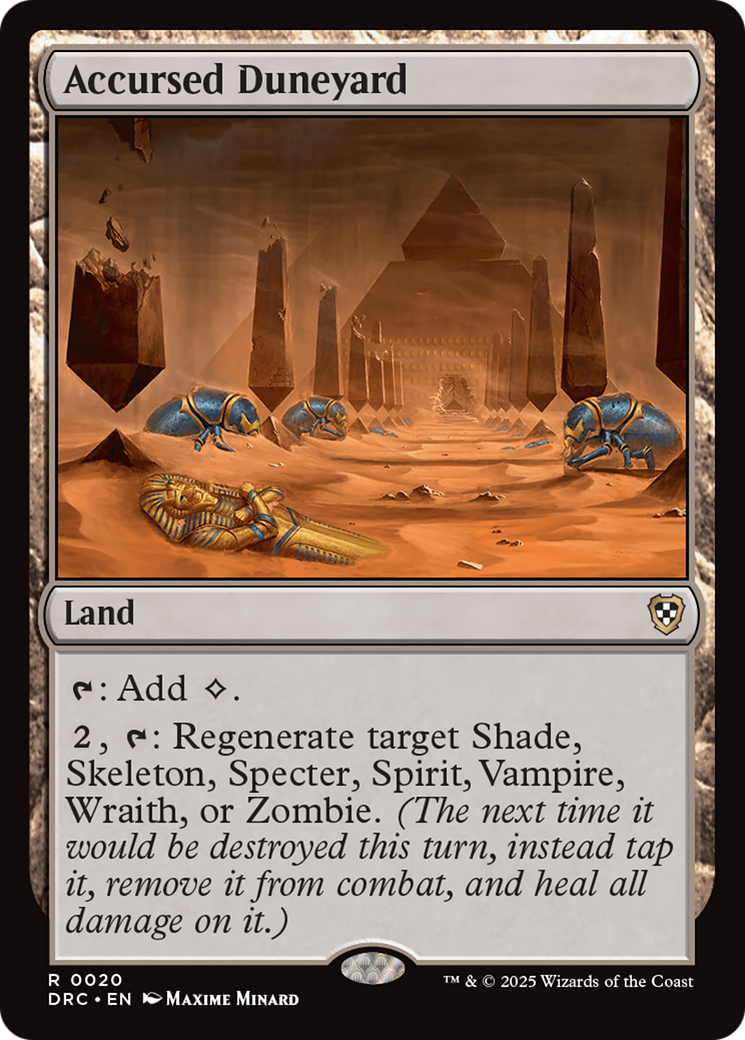
Accursed Duneyard
Accursed Duneyard
Land
: Add .
, : Regenerate target Shade, Skeleton, Specter, Spirit, Vampire, Wraith, or Zombie. (The next time it would be destroyed this turn, instead tap it, remove it from combat, and heal all damage on it.)
-
1
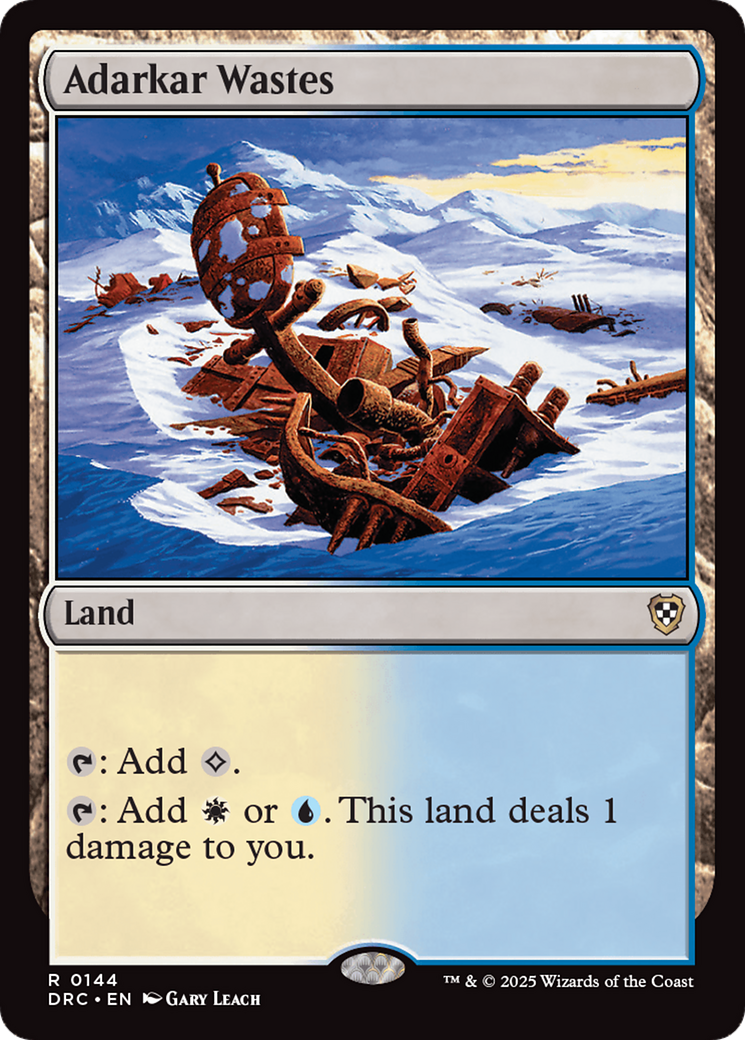
Adarkar Wastes
Adarkar Wastes
Land
: Add .
: Add or . This land deals 1 damage to you.
-
1
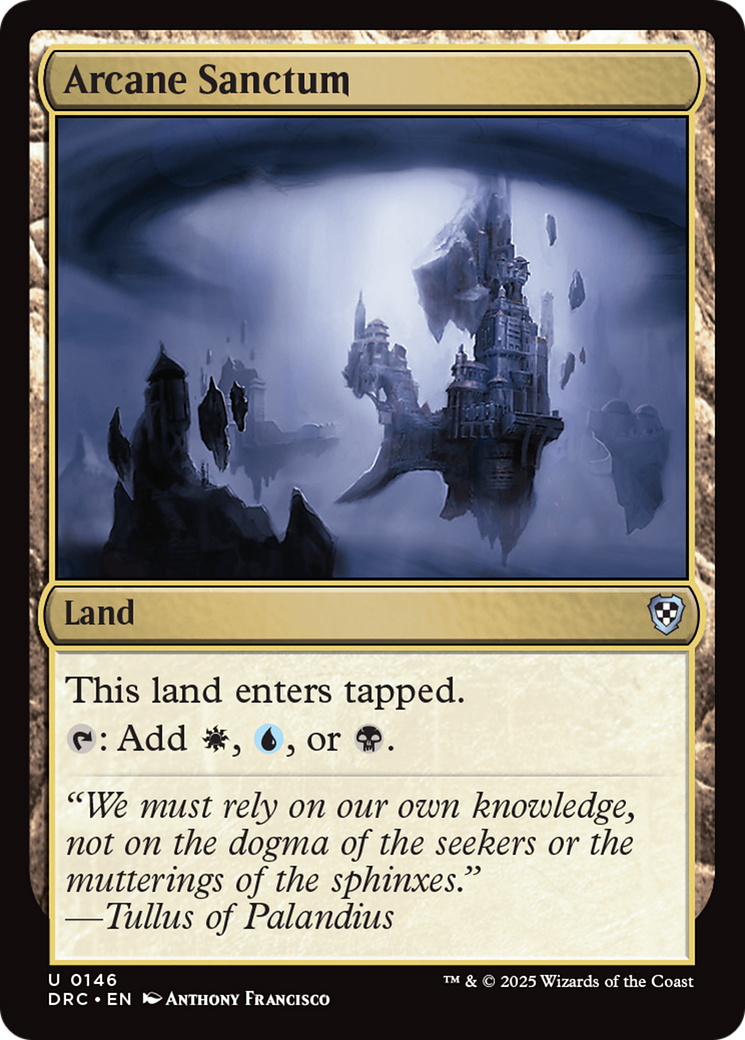
Arcane Sanctum
Arcane Sanctum
Land
This land enters tapped.
: Add , , or .
-
1
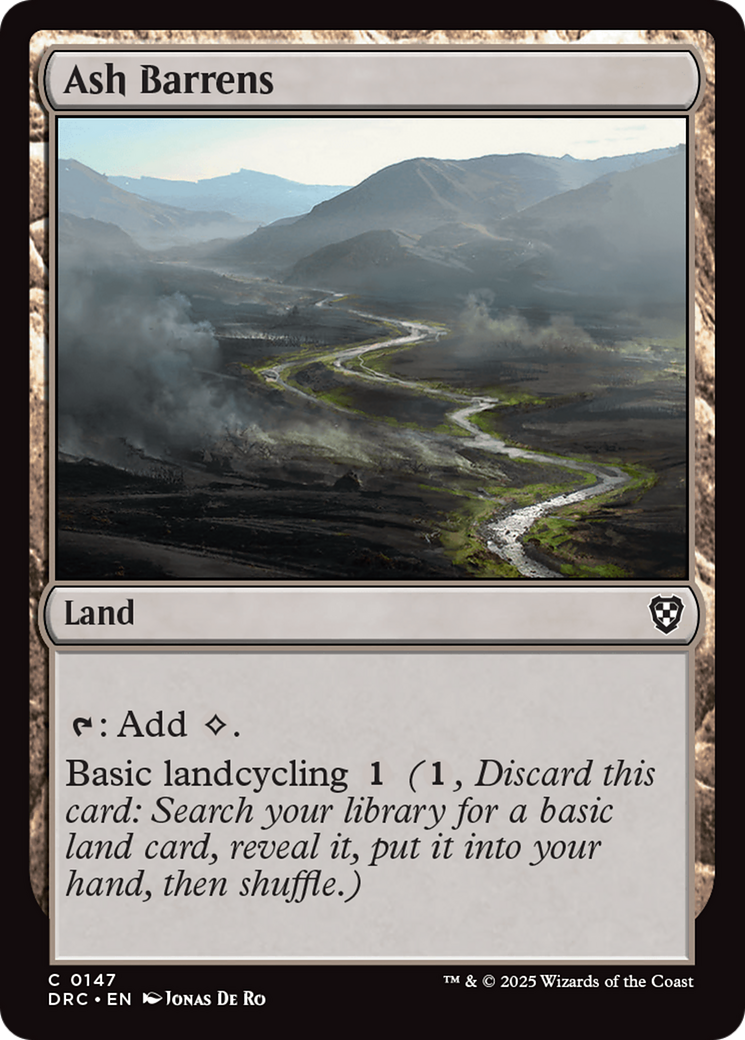
Ash Barrens
Ash Barrens
Land
: Add .
Basic landcycling ( , Discard this card: Search your library for a basic land card, reveal it, put it into your hand, then shuffle.)
-
1
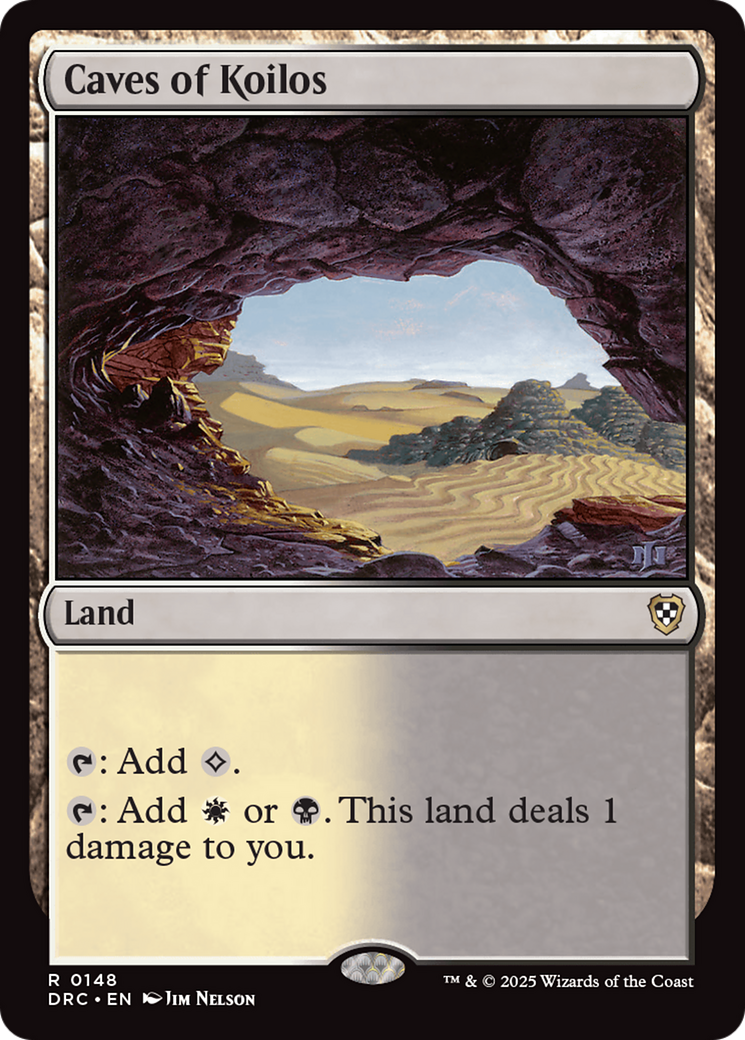
Caves of Koilos
Caves of Koilos
Land
: Add .
: Add or . This land deals 1 damage to you.
- The damage dealt to you is part of the second mana ability. It doesn't use the stack and can't be responded to.
- Like most lands, each land in this cycle is colorless. The damage dealt to you is dealt by a colorless source.
-
1
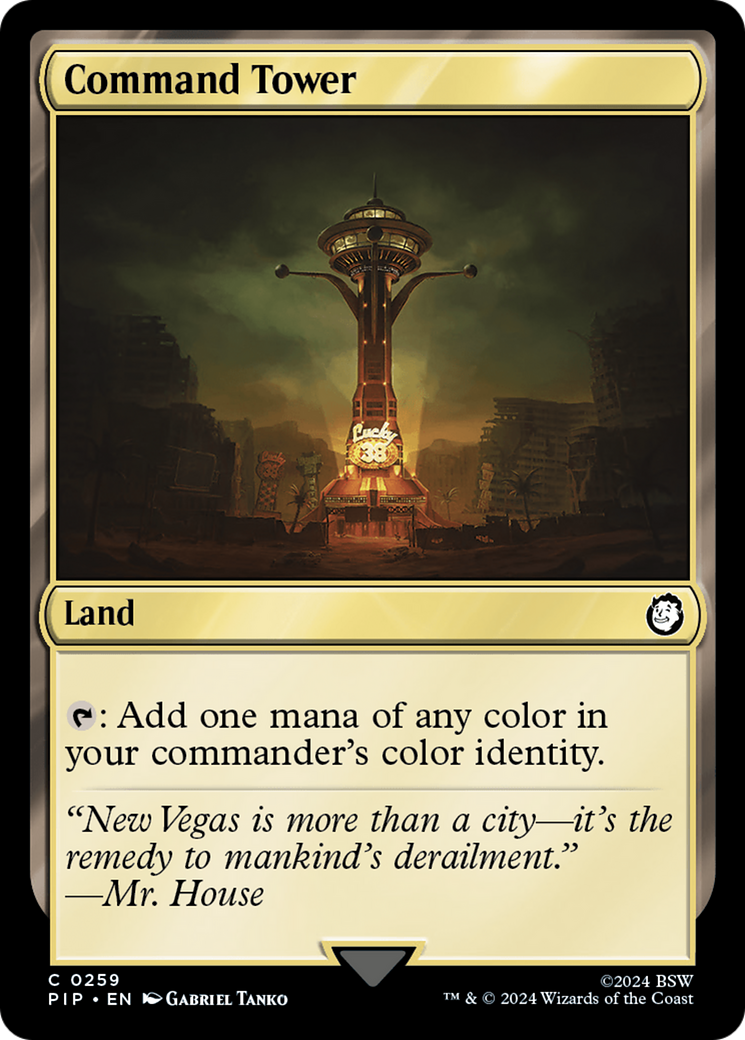
Command Tower
Command Tower
Land
: Add one mana of any color in your commander's color identity.
- If you don't have a commander, Command Tower's ability produces no mana.
- If your commander is a card that has no colors in its color identity, Command Tower's ability produces no mana. It doesn't produce .
- If you have two commanders, the ability adds one mana of any color in their combined color identities.
-
1
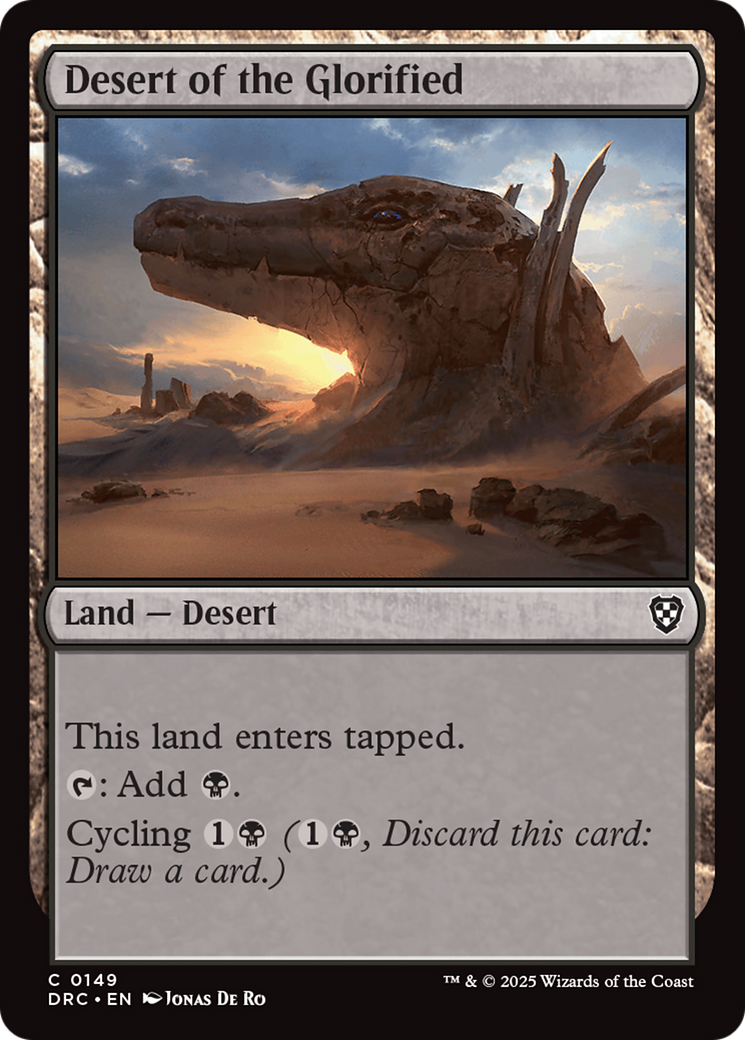
Desert of the Glorified
Desert of the Glorified
Land — Desert
This land enters tapped.
: Add .
Cycling ( , Discard this card: Draw a card.)
- Desert is a land subtype with no special meaning. It doesn't grant the land an intrinsic mana ability. Other cards may care about which lands are Deserts.
-
1
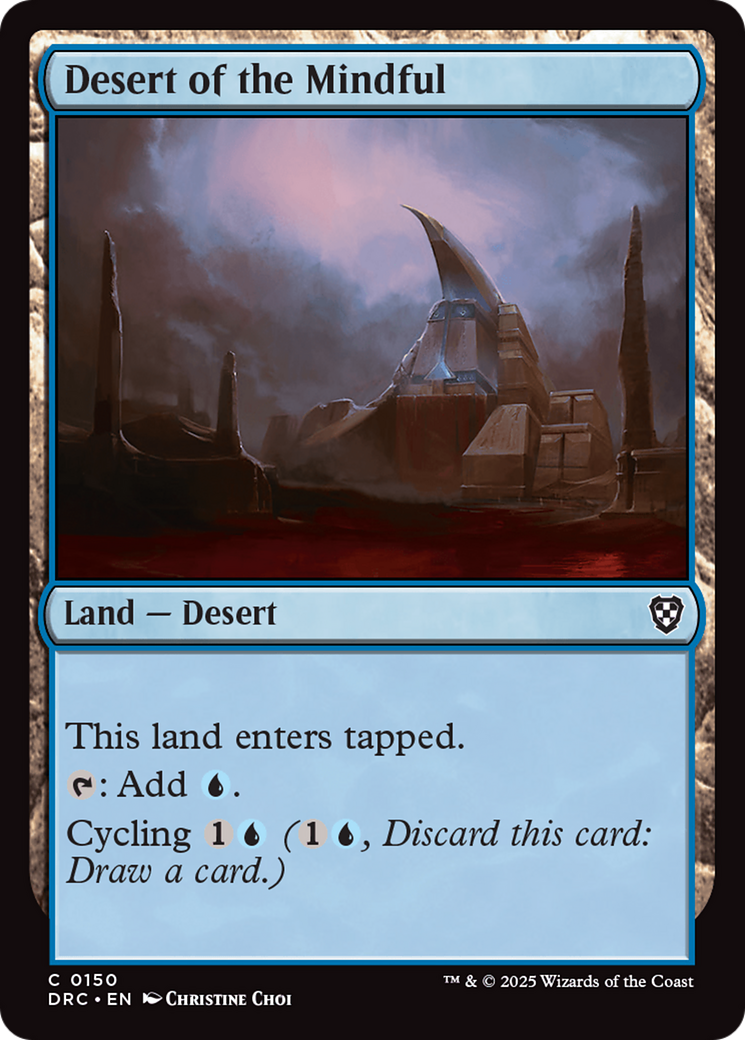
Desert of the Mindful
Desert of the Mindful
Land — Desert
This land enters tapped.
: Add .
Cycling ( , Discard this card: Draw a card.)
- Desert is a land subtype with no special meaning. It doesn’t grant the land an intrinsic mana ability. Other cards may care about which lands are Deserts.
-
1
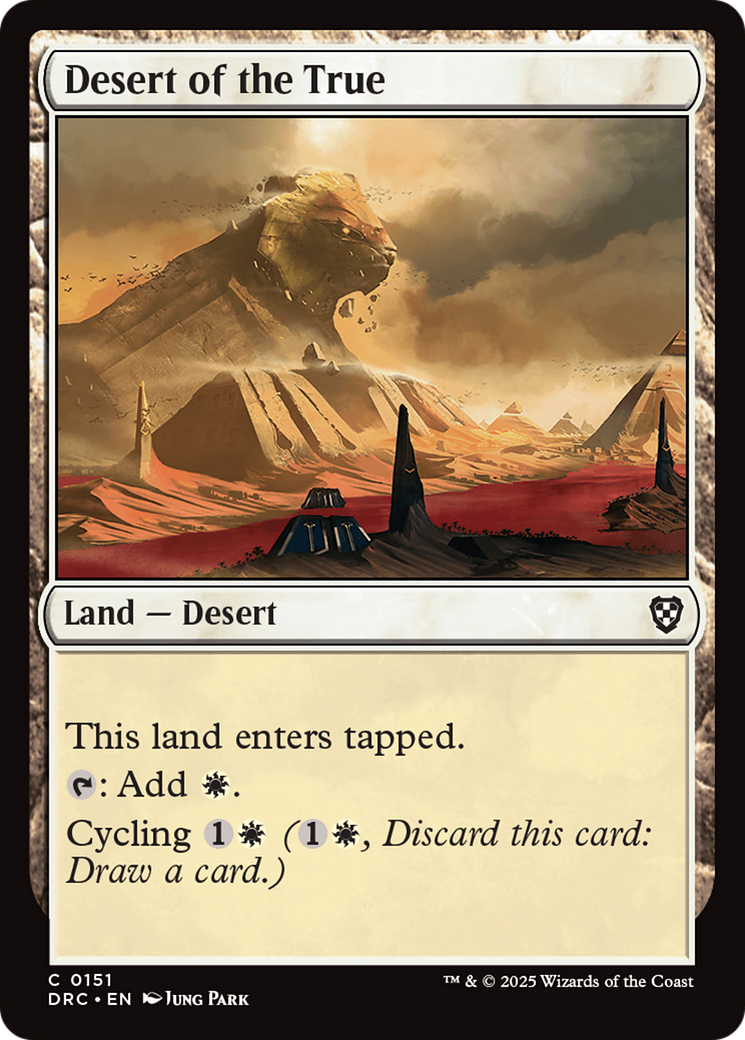
Desert of the True
Desert of the True
Land — Desert
This land enters tapped.
: Add .
Cycling ( , Discard this card: Draw a card.)
- Desert is a land subtype with no special meaning. It doesn't grant the land an intrinsic mana ability. Other cards may care about which lands are Deserts.
-
1
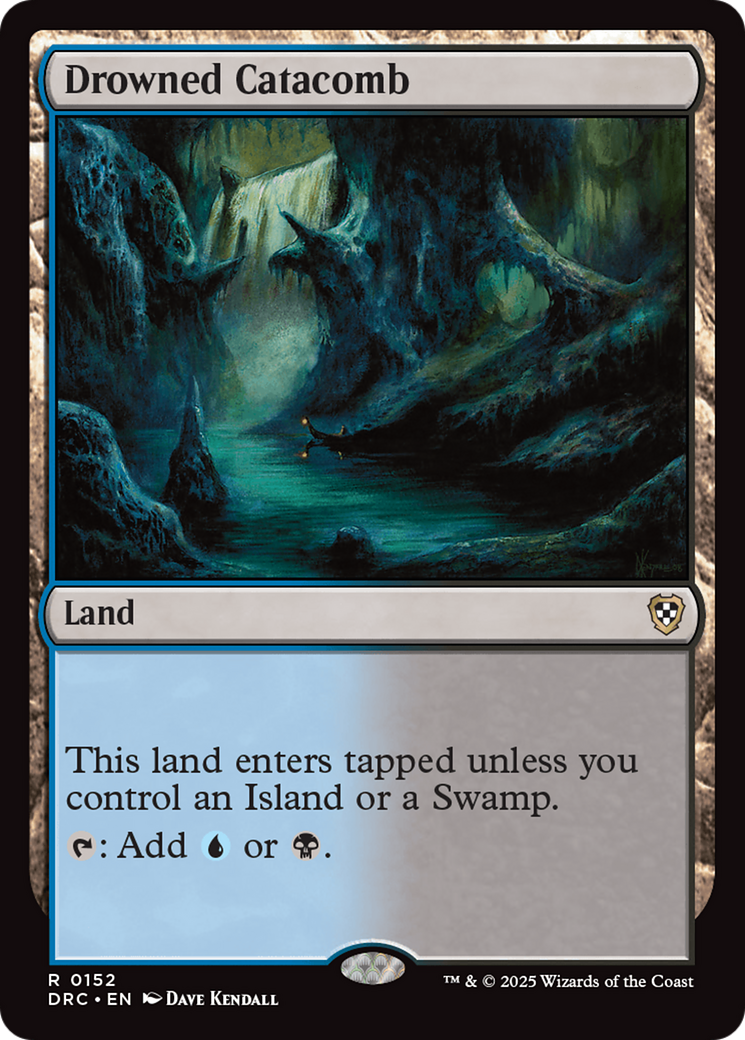
Drowned Catacomb
Drowned Catacomb
Land
This land enters tapped unless you control an Island or a Swamp.
: Add or .
- This checks for lands you control with the land type Island or Swamp, not for lands named Island or Swamp. The lands it checks for don't have to be basic lands. For example, if you control Blood Crypt (a nonbasic land with the land types Swamp and Mountain), Drowned Catacomb will enter untapped.
- As this is entering, it checks for lands that are already on the battlefield. It won't see lands that are entering at the same time (due to Warp World, for example).
-
1
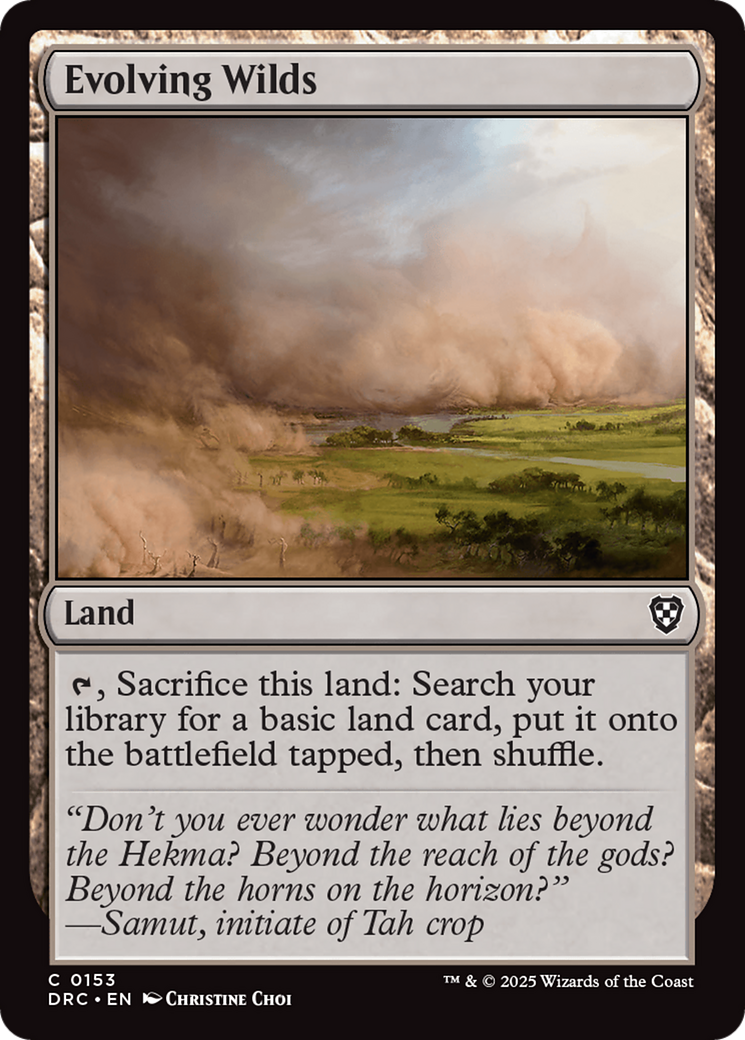
Evolving Wilds
Evolving Wilds
Land
, Sacrifice this land: Search your library for a basic land card, put it onto the battlefield tapped, then shuffle.
-
1
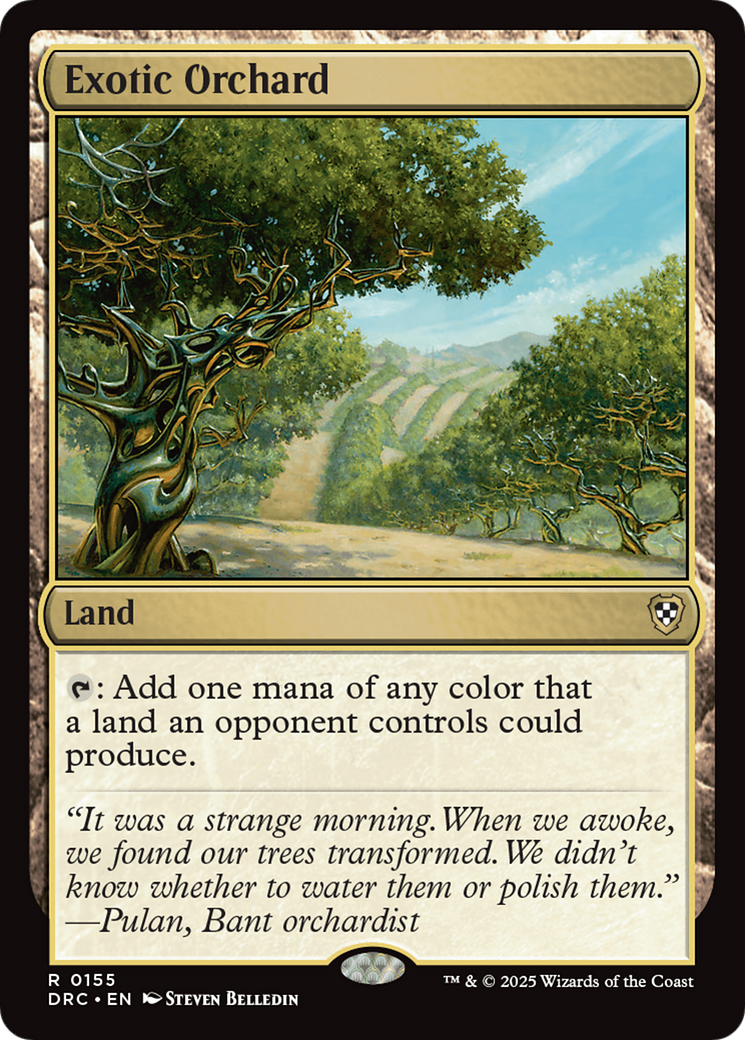
Exotic Orchard
Exotic Orchard
Land
: Add one mana of any color that a land an opponent controls could produce.
- The colors of mana are white, blue, black, red, and green. Exotic Orchard can't be tapped for colorless mana, even if a land an opponent controls could produce colorless mana.
- Exotic Orchard checks the effects of all mana-producing abilities of lands your opponents control, but it doesn't check their costs. For example, Vivid Crag has the ability " , Remove a charge counter from Vivid Crag: Add one mana of any color." If an opponent controls Vivid Crag and you control Exotic Orchard, you can tap Exotic Orchard for any color of mana. It doesn't matter whether Vivid Crag has a charge counter on it, and it doesn't matter whether it's untapped.
- When determining what colors of mana your opponents' lands could produce, Exotic Orchard takes into account any applicable replacement effects that would apply to those lands' mana abilities (such as Contamination's effect, for example). If there are more than one, consider them in any possible order.
- Exotic Orchard doesn't care about any restrictions or riders your opponents' lands (such as Ancient Ziggurat or Hall of the Bandit Lord) put on the mana they produce. It just cares about colors of mana.
- Lands that produce mana based only on what other lands "could produce" won't help each other unless some other land allows one of them to actually produce some type of mana. For example, if you control an Exotic Orchard and your opponent controls an Exotic Orchard and a Reflecting Pool, none of those lands would produce mana if their mana abilities were activated. On the other hand, if you control a Forest and an Exotic Orchard, and your opponent controls an Exotic Orchard and a Reflecting Pool, then each of those lands can be tapped to produce . Your opponent's Exotic Orchard can produce because you control a Forest. Your Exotic Orchard and your opponent's Reflecting Pool can each produce because your opponent's Exotic Orchard can produce .
-
1
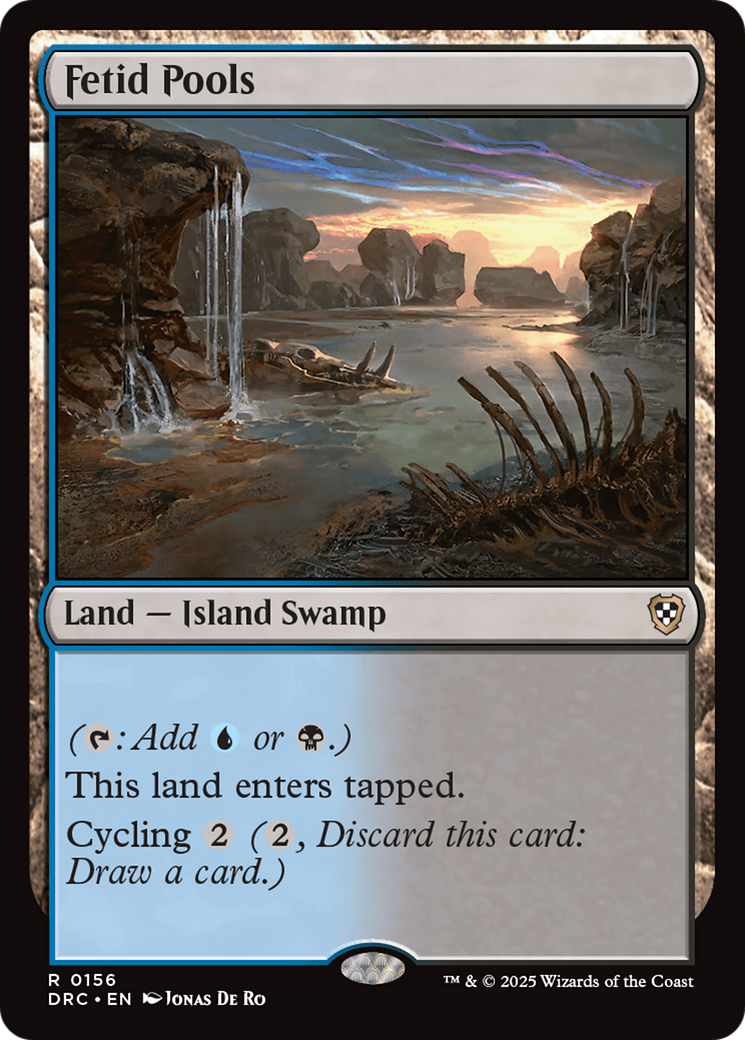
Fetid Pools
Fetid Pools
Land — Island Swamp
( : Add or .)
This land enters tapped.
Cycling ( , Discard this card: Draw a card.)
-
1
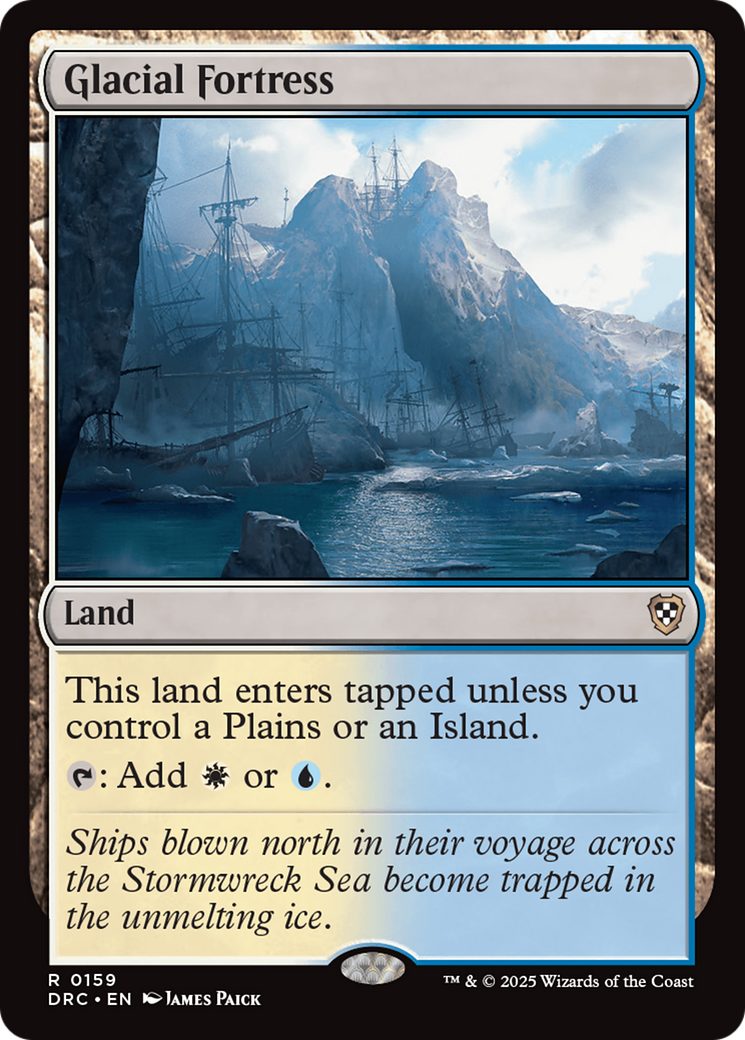
Glacial Fortress
Glacial Fortress
Land
This land enters tapped unless you control a Plains or an Island.
: Add or .
- This checks for lands you control with the land type Plains or Island, not for lands named Plains or Island. The lands it checks for don't have to be basic lands. For example, if you control Watery Grave (a nonbasic land with the land types Island and Swamp), Glacial Fortress will enter untapped.
- As this is entering, it checks for lands that are already on the battlefield. It won't see lands that are entering at the same time (due to Warp World, for example).
-
1
Irrigated Farmland
Irrigated Farmland
Land — Plains Island
( : Add or .)
This land enters tapped.
Cycling ( , Discard this card: Draw a card.)
-
4
Island
Island
Basic Land — Island
( : Add .)
-
1
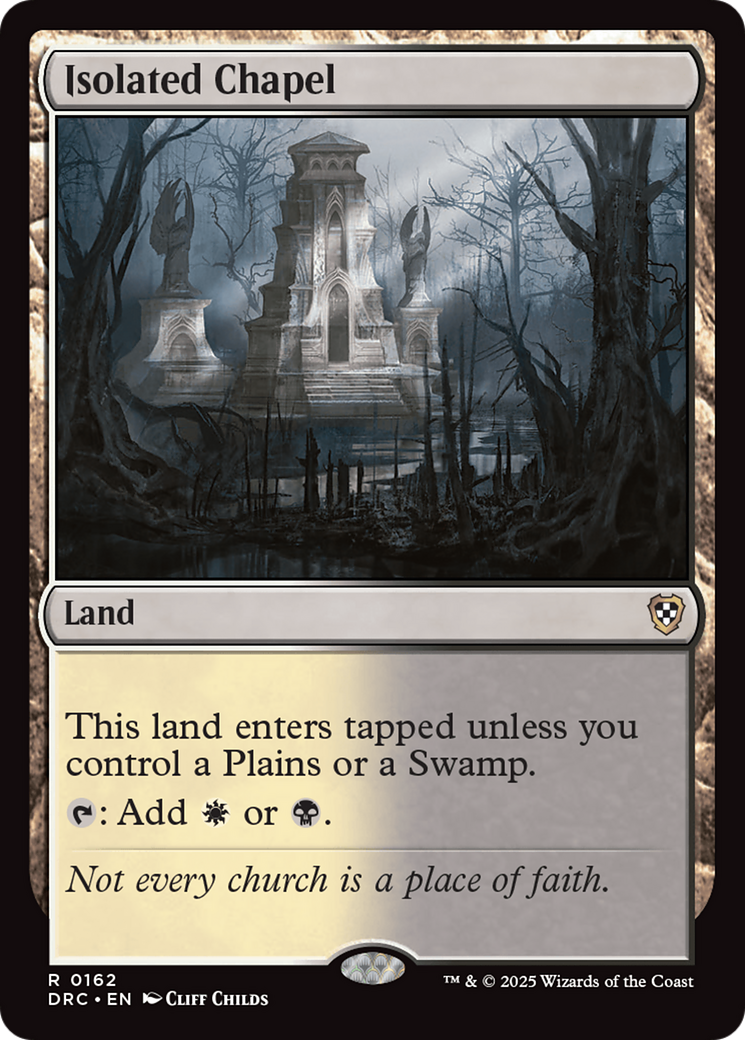
Isolated Chapel
Isolated Chapel
Land
This land enters tapped unless you control a Plains or a Swamp.
: Add or .
-
1
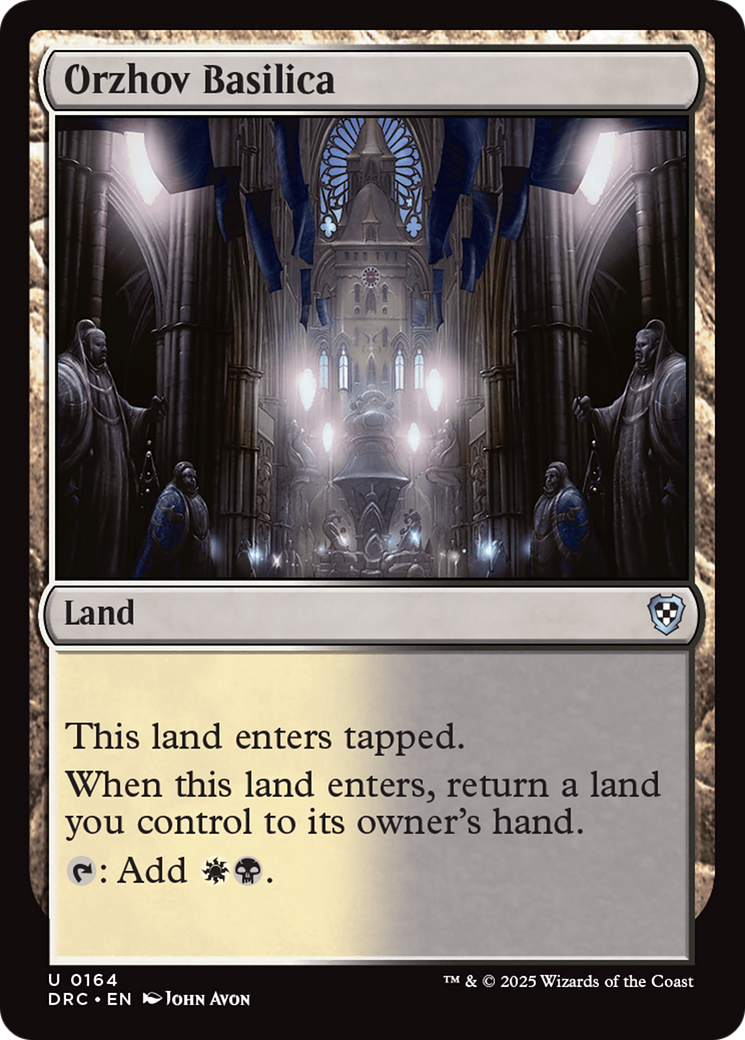
Orzhov Basilica
Orzhov Basilica
Land
This land enters tapped.
When this land enters, return a land you control to its owner's hand.
: Add .
- If this land enters the battlefield and you control no other lands, its ability will force you to return it to your hand.
-
1
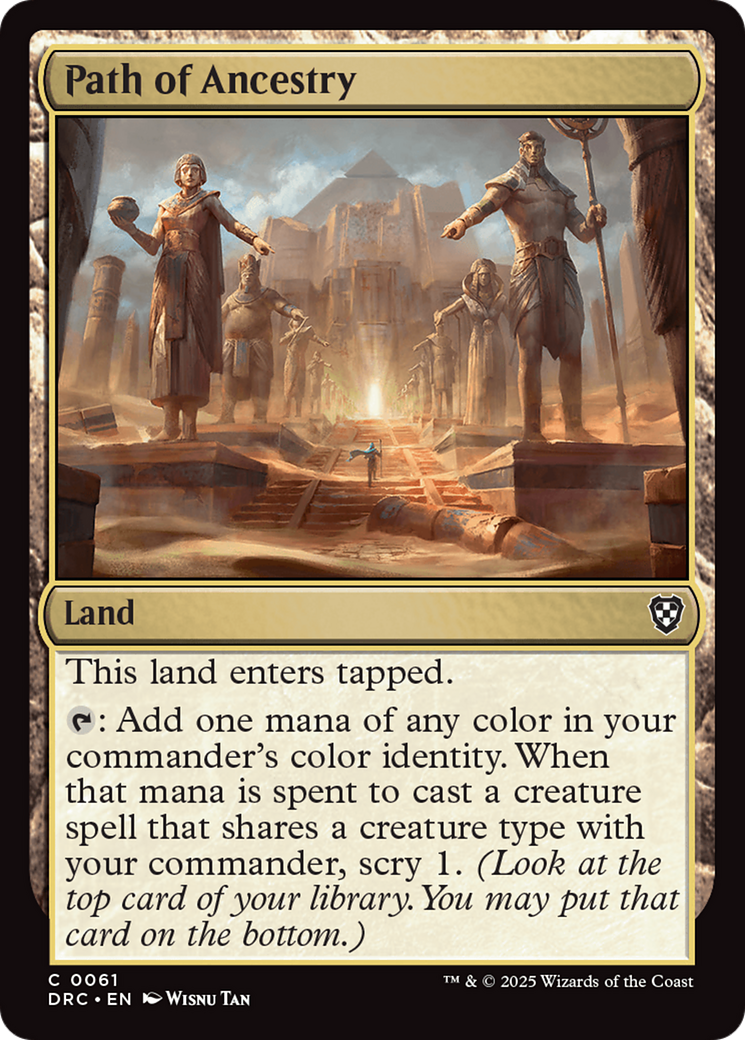
Path of Ancestry
Path of Ancestry
Land
This land enters tapped.
: Add one mana of any color in your commander's color identity. When that mana is spent to cast a creature spell that shares a creature type with your commander, scry 1. (Look at the top card of your library. You may put that card on the bottom.)
- If you have two commanders, the last ability adds one mana of any color in their combined color identities. When you spend that mana on a creature spell that shares a creature type with either of your commanders, you'll scry 1.
- Your commander's creature types are checked immediately after you cast a creature spell spending mana from Path of Ancestry's last ability. They aren't set before the game begins, and they may not be the same types your commander had when you activated that ability.
- If you cast your commander with mana from Path of Ancestry, and your commander hasn't somehow lost all of its creature types while on the stack, you'll scry 1.
- If your commander is a card that has no colors in its color identity, Path of Ancestry's ability produces no mana. It doesn't produce .
- If Path of Ancestry's last ability produces two mana (most likely due to Mana Reflection), spending those two mana to cast creature spells that share a creature type with your commander will cause two abilities to trigger. Each of those abilities will cause you to scry 1. You won't scry 2. This is true whether you spend the mana on one creature spell or two.
- If your commander has no creature types, it can't share a creature type with any spell that you cast.
- If you don't have a commander, Path of Ancestry's ability produces no mana.
-
5
Plains
Plains
Basic Land — Plains
( : Add .)
-
1
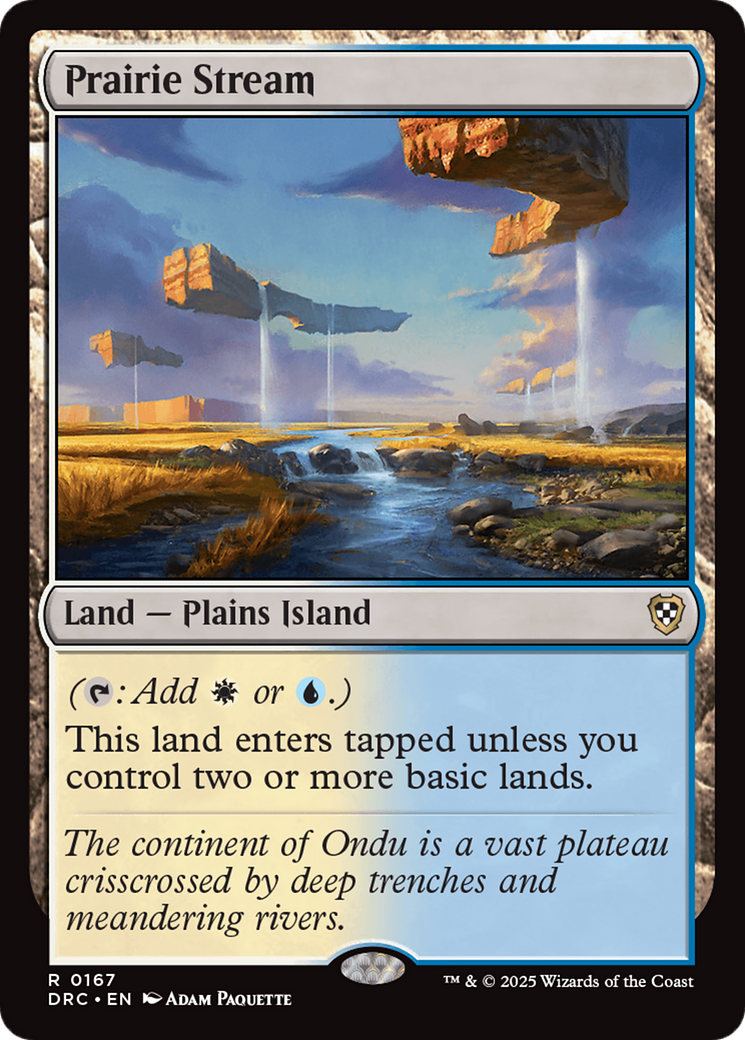
Prairie Stream
Prairie Stream
Land — Plains Island
( : Add or .)
This land enters tapped unless you control two or more basic lands.
- Even though these lands have basic land types, they are not basic lands because "basic" doesn't appear on their type line. Notably, controlling two or more of them won't allow others to enter the battlefield untapped.
- However, because these cards have basic land types, effects that specify a basic land type without also specifying that the land be basic can affect them. For example, a spell or ability that reads "Destroy target Forest" can target Canopy Vista, while one that reads "Destroy target basic Forest" cannot.
- If one of these lands enters the battlefield at the same time as any number of basic lands, those other lands are not counted when determining if this land enters the battlefield tapped or untapped.
-
1
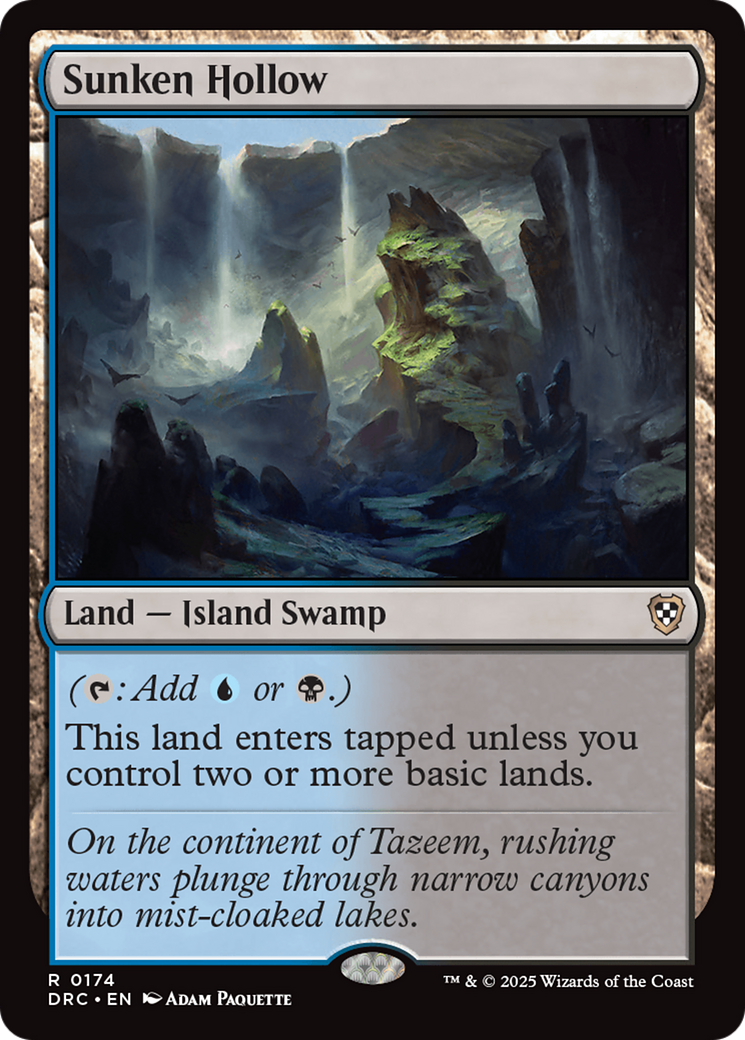
Sunken Hollow
Sunken Hollow
Land — Island Swamp
( : Add or .)
This land enters tapped unless you control two or more basic lands.
- Even though these lands have basic land types, they are not basic lands because "basic" doesn't appear on their type line. Notably, controlling two or more of them won't allow others to enter the battlefield untapped.
- However, because these cards have basic land types, effects that specify a basic land type without also specifying that the land be basic can affect them. For example, a spell or ability that reads "Destroy target Forest" can target Canopy Vista, while one that reads "Destroy target basic Forest" cannot.
- If one of these lands enters the battlefield at the same time as any number of basic lands, those other lands are not counted when determining if this land enters the battlefield tapped or untapped.
-
5
Swamp
Swamp
Basic Land — Swamp
( : Add .)
-
1
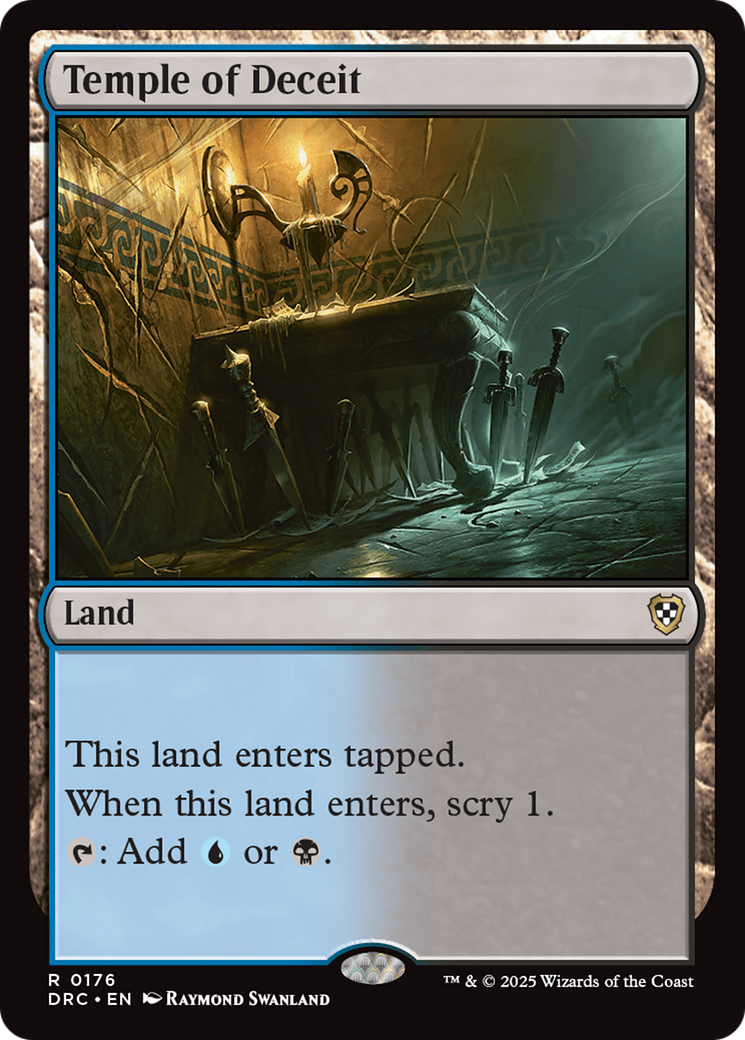
Temple of Deceit
Temple of Deceit
Land
This land enters tapped.
When this land enters, scry 1. (Look at the top card of your library. You may put that card on the bottom.)
: Add or .
- When you scry, you may put all the cards you look at back on top of your library, you may put all of those cards on the bottom of your library, or you may put some of those cards on top and the rest of them on the bottom.
- You choose how to order cards returned to your library after scrying no matter where you put them.
- You perform the actions stated on a card in sequence. For some spells and abilities, that means you'll scry last. For others, that means you'll scry and then perform other actions.
- Scry appears on some spells and abilities with one or more targets. If all of the spell or ability's targets are illegal when it tries to resolve, it won't resolve and none of its effects will happen. You won't scry.
-
1
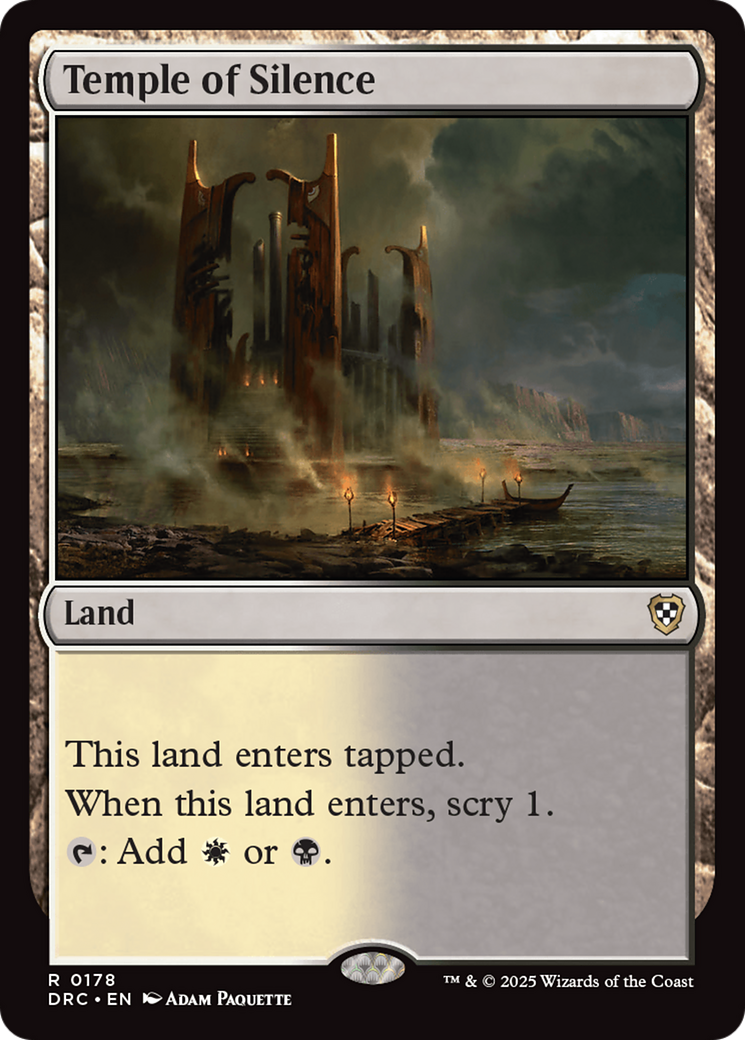
Temple of Silence
Temple of Silence
Land
This land enters tapped.
When this land enters, scry 1. (Look at the top card of your library. You may put that card on the bottom.)
: Add or .
- When you scry, you may put all the cards you look at back on top of your library, you may put all of those cards on the bottom of your library, or you may put some of those cards on top and the rest of them on the bottom.
- You choose how to order cards returned to your library after scrying no matter where you put them.
- You perform the actions stated on a card in sequence. For some spells and abilities, that means you'll scry last. For others, that means you'll scry and then perform other actions.
- Scry appears on some spells and abilities with one or more targets. If all of the spell or ability's targets are illegal when it tries to resolve, it won't resolve and none of its effects will happen. You won't scry.
-
1
Terramorphic Expanse
Terramorphic Expanse
Land
, Sacrifice this land: Search your library for a basic land card, put it onto the battlefield tapped, then shuffle.
-
1
Underground River
Underground River
Land
: Add .
: Add or . This land deals 1 damage to you.
-
1
Unholy Grotto
Unholy Grotto
Land
: Add .
, : Put target Zombie card from your graveyard on top of your library.
White 11
-
1
Angel of Sanctions
Angel of Sanctions
Creature — Angel
3/4
Flying
When this creature enters, you may exile target nonland permanent an opponent controls until this creature leaves the battlefield.
Embalm ( , Exile this card from your graveyard: Create a token that's a copy of it, except it's a white Zombie Angel with no mana cost. Embalm only as a sorcery.)
- If a spell or ability puts a creature card with embalm into your graveyard during your main phase, you'll have priority immediately after that spell or ability resolves. You can activate the creature card's embalm ability before any player can exile it with an effect, such as that of Crook of Condemnation, if it's legal for you to do so.
- Once you've activated an embalm ability, the card is immediately exiled. Opponents can't try to stop the ability by exiling the card with an effect such as that of Crook of Condemnation.
- If a token is exiled this way, it will cease to exist and won't return to the battlefield.
- The exiled card returns to the battlefield immediately after Angel of Sanctions leaves the battlefield. Nothing happens between the two events, including state-based actions.
- In a multiplayer game, if Angel of Sanctions's owner leaves the game, the exiled card will return to the battlefield. Because the one-shot effect that returns the card isn't an ability that goes on the stack, it won't cease to exist along with the leaving player's spells and abilities on the stack.
- If Angel of Sanctions leaves the battlefield before its triggered ability resolves, the target permanent won't be exiled.
- The token copies exactly what was printed on the original card and nothing else. It doesn't copy any information about the object the card was before it was put into your graveyard.
- The token is a Zombie in addition to its other types and is white instead of its other colors. It has no mana cost, and thus its mana value is 0. These are copiable values of the token that other effects may copy.
- If the card copied by the token had any "when [this permanent] enters the battlefield" abilities, then the token also has those abilities and will trigger them when it's created. Similarly, any "as [this permanent] enters the battlefield" or "[this permanent] enters the battlefield with" abilities that the token has copied will also work.
- For each card with embalm, a corresponding game play supplement token can be found in some Amonkhet booster packs. These supplements are not required to play with cards with embalm; you can use the same items to represent an embalmed token as you would any other token.
- Auras attached to the exiled permanent will be put into their owners' graveyards. Any Equipment will become unattached and remain on the battlefield. Any counters on the exiled permanent will cease to exist.
-
1
Binding Mummy
Binding Mummy
Creature — Zombie
2/2
Whenever another Zombie you control enters, you may tap target artifact or creature.
-
1
Cast Out
Cast Out
Enchantment
Flash
When this enchantment enters, exile target nonland permanent an opponent controls until this enchantment leaves the battlefield.
Cycling ( , Discard this card: Draw a card.)
- If Cast Out leaves the battlefield before its triggered ability resolves, the target permanent won't be exiled.
- Auras attached to the exiled permanent will be put into their owners' graveyards. Any Equipment will become unattached and remain on the battlefield. Any counters on the exiled permanent will cease to exist.
- If a token is exiled this way, it will cease to exist and won't return to the battlefield.
- The exiled card returns to the battlefield immediately after Cast Out leaves the battlefield. Nothing happens between the two events, including state-based actions.
- In a multiplayer game, if Cast Out's owner leaves the game, the exiled card will return to the battlefield. Because the one-shot effect that returns the card isn't an ability that goes on the stack, it won't cease to exist along with the leaving player's spells and abilities on the stack.
-
1
Dusk // Dawn
//
Dusk
Sorcery
- Once you've started to cast a spell with aftermath from your graveyard, the card is immediately moved to the stack. Opponents can't try to stop the ability by exiling the card with an effect such as that of Crook of Condemnation.
- All split cards have two card faces on a single card, and you put a split card onto the stack with only the half you're casting. The characteristics of the half of the card you didn't cast are ignored while the spell is on the stack. For example, if an effect prevents you from casting green spells, you can cast Destined of Destined // Lead, but not Lead.
- Each split card is a single card. For example, if you discard one, you've discarded one card, not two. If an effect counts the number of instant and sorcery cards in your graveyard, Destined // Lead counts once, not twice.
- Each split card has two names. If an effect instructs you to choose a card name, you may choose one, but not both.
- While not on the stack, the characteristics of a split card are the combination of its two halves. For example, Destined // Lead is a green and black card, it is both an instant card and a sorcery card, and its mana value is 6. This means that if an effect allows you to cast a card with mana value 2 from your hand, you can't cast Destined. This is a change from the previous rules for split cards.
- Split cards with aftermath have a new frame treatment—the half you can cast from your hand is oriented the same as other cards you'd cast from your hand, while the half you can cast from your graveyard is a traditional split card half. This frame treatment is for your convenience and has no rules significance.
- If another effect allows you to cast a split card with aftermath from any zone other than a graveyard, you can't cast the half with aftermath.
- If another effect allows you to cast a split card with aftermath from a graveyard, you may cast either half. If you cast the half that has aftermath, you'll exile the card if it would leave the stack.
- A spell with aftermath cast from a graveyard will always be exiled afterward, whether it resolves, it's countered, or it leaves the stack in some other way.
- If you cast the first half of a split card with aftermath during your turn, you'll have priority immediately after it resolves. You can cast the half with aftermath from your graveyard before any player can take any other action if it's legal for you to do so.
-
1
God-Eternal Oketra
God-Eternal Oketra
Legendary Creature — Zombie God
3/6
Double strike
Whenever you cast a creature spell, create a 4/4 black Zombie Warrior creature token with vigilance.
When God-Eternal Oketra dies or is put into exile from the battlefield, you may put it into its owner's library third from the top.
- Oketra's first triggered ability resolves before the spell that caused it to trigger. It resolves even if that spell is countered.
- In the Commander format, a commander's color identity isn't affected by color words (such as black) appearing in its text. If God-Eternal Oketra is your commander, your deck can't contain black mana symbols.
- If one of these Gods leaves the graveyard or exile while its last ability is on the stack, it will remain in its new zone, even if that zone is a graveyard or exile.
- If the God's owner has two or fewer cards in their library, the God is put on the bottom of their library as its last ability resolves.
- If you control another player's God when it dies, you decide whether to put that card into its owner's library.
- If an effect exiles the God and immediately returns it to the battlefield, its last ability triggers but will have no effect. However, if an effect exiles it and would return it to the battlefield at a later time, the God's ability may return that card to its owner's library first. If it does, the effect that exiled it won't return it later.
- In a multiplayer game, if you put another player's God onto the battlefield under your control, it will be exiled as you leave the game. If you were still the controller of that God, you would control its triggered ability but you have left the game; that ability won't resolve and the card remains in exile. Similarly, if you lose the game at the same time that another player's God that you put onto the battlefield is destroyed, it remains in its owner's graveyard.
- If one of these Gods dies and it's your commander, you may put it into the command zone before its ability puts it into your library. If you save your commander this way, it won't put it into your library. The same is true if it would be exiled.
-
1
On Wings of Gold
On Wings of Gold
Enchantment
Creatures you control that are Zombies and/or tokens get +1/+1 and have flying.
Whenever one or more cards leave your graveyard, create a 1/1 white Zombie creature token.
-
1
Priest of the Crossing
Priest of the Crossing
Creature — Zombie Bird Cleric
3/3
Flying
At the beginning of each end step, put X +1/+1 counters on each creature you control, where X is the number of creatures that died under your control this turn.
-
1
Renewed Solidarity
Renewed Solidarity
Enchantment
As this enchantment enters, choose a creature type.
Creatures you control of the chosen type get +1/+0.
At the beginning of your end step, for each token you control of the chosen type that entered this turn, create a token that's a copy of it.
- When this enchantment’s last ability resolves, for each applicable token you control that entered this turn, create a token that copies the original characteristics of that first token as stated by the effect that created it (unless that first token is copying something else; see below). It doesn’t copy whether that token is tapped or untapped, whether it has any counters on it or Auras or Equipment attached to it, or any non-copy effects that have changed its power, toughness, types, color, and so on.
- If the last ability creates a copy of a token that is copying something else, then the new token enters as a copy of whatever the original token copied.
- Any abilities of the copied token that trigger when that permanent enters will trigger. Any “as [this permanent] enters” or “[this permanent] enters with” abilities of the copied token will also work.
-
1
Swords to Plowshares
Swords to Plowshares
Instant
Exile target creature. Its controller gains life equal to its power.
- Use the power of the creature from when it was last on the battlefield to determine how much life is gained.
-
1
Timeless Dragon
Timeless Dragon
Creature — Dragon
5/5
Flying
Plainscycling ( , Discard this card: Search your library for a Plains card, reveal it, put it into your hand, then shuffle.)
Eternalize ( , Exile this card from your graveyard: Create a token that's a copy of it, except it's a 4/4 black Zombie Dragon with no mana cost. Eternalize only as a sorcery.)
- If a creature card with eternalize is put into your graveyard during your main phase, you'll have priority immediately afterward. You can activate its eternalize ability before any player can try to exile it, if it's legal for you to do so.
- Once you've activated an eternalize ability, the card is immediately exiled. Opponents can't try to stop the ability by exiling the card.
- The token copies exactly what was printed on the original card and nothing else, except the characteristics specifically modified by eternalize. It doesn't copy any information about the object the card was before it was put into your graveyard.
- The token is a Zombie in addition to its other types and is black instead of its other colors. Its base power and toughness are 4/4. It has no mana cost, and thus its mana value is 0. These are copiable values of the token that other effects may copy.
- Unlike the normal cycling ability, typecycling doesn't allow you to draw a card. Rather, it lets you search your library for a card with the type or types indicated by the ability name. For example, a card with basic landcycling lets you search for a basic land card, and a card with Wizardcycling lets you search for a Wizard card.
- Typecycling is a form of cycling. Any ability that triggers on a card being cycled also triggers on a card being typecycled. Any ability that stops a cycling ability from being activated also stops a typecycling ability from being activated.
-
1
Wizened Mentor
Wizened Mentor
Creature — Zombie Cleric
2/2
Whenever an opponent activates an ability of a permanent that isn't a mana ability, you create a 1/1 white Zombie creature token. This ability triggers only once each turn.
Blue 8
-
1
Champion of Wits
Champion of Wits
Creature — Snake Wizard
2/1
When this creature enters, you may draw cards equal to its power. If you do, discard two cards.
Eternalize ( , Exile this card from your graveyard: Create a token that's a copy of it, except it's a 4/4 black Zombie Snake Wizard with no mana cost. Eternalize only as a sorcery.)
- Use Champion of Wits's power as the first ability resolves to determine if you want to use the ability and how many cards you draw if you do. If you use the ability, you discard two cards regardless of how many cards you draw. If Champion of Wits leaves the battlefield before that ability resolves, use its last known power.
- For each card with eternalize, a corresponding game play supplement token can be found in some Hour of Devastation booster packs. These supplements are not required to play with cards with eternalize; you can use the same items to represent an eternalized token as you would any other token.
- If a creature card with eternalize is put into your graveyard during your main phase, you'll have priority immediately afterward. You can activate its eternalize ability before any player can try to exile it, such as with Crook of Condemnation, if it's legal for you to do so.
- Once you've activated an eternalize ability, the card is immediately exiled. Opponents can't try to stop the ability by exiling the card with an effect such as that of Crook of Condemnation.
- The token copies exactly what was printed on the original card and nothing else, except the characteristics specifically modified by eternalize. It doesn't copy any information about the object the card was before it was put into your graveyard.
- The token is a Zombie in addition to its other types and is black instead of its other colors. Its base power and toughness are 4/4. It has no mana cost, and thus its mana value is 0. These are copiable values of the token that other effects may copy.
- If the card copied by the token had any “when [this permanent] enters the battlefield” abilities, then the token also has those abilities and will trigger them when it's created. Similarly, any “as [this permanent] enters the battlefield” or “[this permanent] enters the battlefield with” abilities that the token has copied will also work.
-
1
Commence the Endgame
Commence the Endgame
Instant
This spell can't be countered.
Draw two cards, then amass Zombies X, where X is the number of cards in your hand. (Put X +1/+1 counters on an Army you control. It's also a Zombie. If you don't control an Army, create a 0/0 black Zombie Army creature token first.)
- Some cards refer to the "amassed Army." That means the Army creature you chose to receive counters, even if no counters were placed on it for some reason.
- In the rare case that you control multiple Army creatures (perhaps because you played a creature with changeling) while you amass Zombies, you choose which of your Army creatures to put the +1/+1 counters on. If that creature isn't a Zombie, it becomes a Zombie in addition to its other types.
- If you don't control an Army, the Zombie Army token you create enters the battlefield as a 0/0 creature before receiving counters. Any abilities that trigger when a creature with a certain power enters the battlefield, such as that of Mentor of the Meek, will see the token enter as a 0/0 creature before it gets +1/+1 counters.
- Amass abilities are now written as "amass [subtype] N." Previous cards with amass have received errata to say "amass Zombies N."
- To amass Zombies N, if you don't control an Army creature, create a 0/0 black Zombie Army creature token. Then you choose an Army creature you control and put N +1/+1 counters on it. If that Army isn't already a Zombie, it becomes a Zombie in addition to its other types.
- Amass Orcs works the same way, except you create a 0/0 black Orc Army creature token if you don't control an Army. If the Army creature you chose isn't already an Orc, it becomes an Orc in addition to its other types. By combining cards with amass Orcs and amass Zombies, you can end up with an Orc Zombie Army.
- A spell or ability that counters spells can still target Commence the Endgame. When that spell or ability resolves, Commence the Endgame won't be countered, but any additional effects of that spell or ability will still happen.
- You draw two cards and amass X all while Commence the Endgame is resolving. Nothing can happen between the two, and no player may choose to take actions.
-
1
Eternal Skylord
Eternal Skylord
Creature — Zombie Wizard
3/3
When this creature enters, amass Zombies 2. (Put two +1/+1 counters on an Army you control. It's also a Zombie. If you don't control an Army, create a 0/0 black Zombie Army creature token first.)
Zombie tokens you control have flying.
- Amass abilities are now written as "amass [subtype] N." Previous cards with amass have received errata to say "amass Zombies N."
- To amass Zombies N, if you don't control an Army creature, create a 0/0 black Zombie Army creature token. Then you choose an Army creature you control and put N +1/+1 counters on it. If that Army isn't already a Zombie, it becomes a Zombie in addition to its other types.
- Amass Orcs works the same way, except you create a 0/0 black Orc Army creature token if you don't control an Army. If the Army creature you chose isn't already an Orc, it becomes an Orc in addition to its other types. By combining cards with amass Orcs and amass Zombies, you can end up with an Orc Zombie Army.
- In the rare case that you control multiple Army creatures (perhaps because you played a creature with changeling) while you amass Zombies, you choose which of your Army creatures to put the +1/+1 counters on. If that creature isn't a Zombie, it becomes a Zombie in addition to its other types.
- If you don't control an Army, the Zombie Army token you create enters the battlefield as a 0/0 creature before receiving counters. Any abilities that trigger when a creature with a certain power enters the battlefield, such as that of Mentor of the Meek, will see the token enter as a 0/0 creature before it gets +1/+1 counters.
- Some cards refer to the "amassed Army." That means the Army creature you chose to receive counters, even if no counters were placed on it for some reason.
- Some cards that cause you to amass Zombies also provide bonuses to "Zombie tokens." These affect any token that happens to be a Zombie, not just a Zombie Army you've amassed.
-
1
Forgotten Creation
Forgotten Creation
Creature — Zombie Horror
3/3
Skulk (This creature can't be blocked by creatures with greater power.)
At the beginning of your upkeep, you may discard all the cards in your hand. If you do, draw that many cards.
- The upkeep step is before the draw step, after the untap step. If you have no cards in hand, you can't draw for the turn and then discard that card to draw a new one because Forgotten Creation's last ability will already have triggered and resolved.
- Skulk matters only as blockers are chosen. Modifying either creature's power after blockers are chosen won't cause the attacking creature to become unblocked.
- If you cause a creature to have 0 power or less, use the actual value (which may be negative) to determine whether it can block or be blocked. A creature with skulk and 0 or less power most likely won't be blocked, but it won't deal combat damage and won't trigger any abilities that trigger when combat damage is dealt.
-
1
Prophet of the Scarab
Prophet of the Scarab
Creature — Zombie Wizard
3/4
Vigilance
When this creature enters, draw cards equal to the number of Zombies you control or the number of Zombie cards in your graveyard, whichever is greater.
-
1
Pull from Tomorrow
Pull from Tomorrow
Instant
Draw X cards, then discard a card.
-
1
Rhet-Tomb Mystic
Rhet-Tomb Mystic
Creature — Zombie Bird Wizard
2/1
Flying
Each creature card in your hand has cycling . ( , Discard that card: Draw a card.)
-
1
Vizier of Many Faces
Vizier of Many Faces
Creature — Shapeshifter Cleric
0/0
You may have this creature enter as a copy of any creature on the battlefield, except if this creature was embalmed, the token has no mana cost, it's white, and it's a Zombie in addition to its other types.
Embalm
- If a spell or ability puts a creature card with embalm into your graveyard during your main phase, you'll have priority immediately after that spell or ability resolves. You can activate the creature card's embalm ability before any player can exile it with an effect, such as that of Crook of Condemnation, if it's legal for you to do so.
- Once you've activated an embalm ability, the card is immediately exiled. Opponents can't try to stop the ability by exiling the card with an effect such as that of Crook of Condemnation.
- If the chosen creature has in its mana cost, X is considered to be 0.
- If the chosen creature is copying something else (for example, if the chosen creature is another Vizier of Many Faces), then Vizier of Many Faces enters the battlefield as whatever the chosen creature copied.
- If the chosen creature is a token, Vizier of Many Faces copies the original characteristics of that token as stated by the effect that created the token. Vizier of Many Faces is not a token in this case unless it's embalmed.
- Any enters-the-battlefield abilities of the copied creature will trigger when Vizier of Many Faces enters the battlefield. Any "as [this creature] enters the battlefield" or "[this creature] enters the battlefield with" abilities of the chosen creature will also work.
- Vizier of Many Faces copies exactly what was printed on the original creature (unless that creature is copying something else or is a token; see below). It doesn't copy whether that creature is tapped or untapped, whether it has any counters on it or Auras attached to it, or any non-copy effects that have changed its power, toughness, types, color, or so on.
- For each card with embalm, a corresponding game play supplement token can be found in some Amonkhet booster packs. These supplements are not required to play with cards with embalm; you can use the same items to represent an embalmed token as you would any other token.
- The token copies exactly what was printed on the original card and nothing else. It doesn't copy any information about the object the card was before it was put into your graveyard.
- The token is a Zombie in addition to its other types and is white instead of its other colors. It has no mana cost, and thus its mana value is 0. These are copiable values of the token that other effects may copy.
- If the card copied by the token had any "when [this permanent] enters the battlefield" abilities, then the token also has those abilities and will trigger them when it's created. Similarly, any "as [this permanent] enters the battlefield" or "[this permanent] enters the battlefield with" abilities that the token has copied will also work.
- If Vizier of Many Faces somehow enters the battlefield at the same time as another creature, Vizier of Many Faces can't become a copy of that creature. You may choose only a creature that's already on the battlefield.
- The characteristics Vizier of Many Faces gains as part of its copy effect are copiable values that other effects may copy.
Black 23
-
1
Archfiend of Ifnir
Archfiend of Ifnir
Creature — Demon
5/4
Flying
Whenever you cycle or discard another card, put a -1/-1 counter on each creature your opponents control.
Cycling ( , Discard this card: Draw a card.)
- Some cards have an ability that triggers whenever you cycle any card. These triggered abilities resolve before you draw from the cycling ability.
- An ability that triggers whenever you discard a card doesn’t give you permission to discard cards. You’ll need another effect that instructs or allows you to discard them.
- An ability that triggers whenever you “cycle or discard” a card triggers only once if you cycle a card. The ability “Whenever you discard a card” is functionally identical to this ability; cycling is mentioned for clarity.
- If a player discards a card during their cleanup step due to having too many cards in hand, any appropriate abilities that trigger on discarding that card trigger. If this happens, those triggered abilities are put onto the stack and players receive priority in that cleanup step to cast spells or activate abilities (normally, no players may take actions during a cleanup step). Another cleanup step is created following that one.
-
1
Cemetery Reaper
Cemetery Reaper
Creature — Zombie
2/2
Other Zombie creatures you control get +1/+1.
, : Exile target creature card from a graveyard. Create a 2/2 black Zombie creature token.
- Cemetery Reaper grants +1/+1 to all other Zombie creatures you control, not just the ones its ability puts onto the battlefield.
- The creature card in a graveyard is exiled as part of the activated ability's effect, not as a cost. If that card has left the graveyard by the time the ability would resolve, the ability doesn't resolve and you don't get a Zombie token.
- A "creature card" is any card with the type creature, even if it has other types such as artifact, enchantment, or land. Older cards of type summon are also creature cards.
-
1
Corpse Augur
Corpse Augur
Creature — Zombie Wizard
4/2
When this creature dies, you draw X cards and you lose X life, where X is the number of creature cards in target player's graveyard.
- You choose the target player as the ability goes on the stack, but you determine the value of X as that ability resolves. If you target yourself and Corpse Augur is still in the graveyard, its ability will count itself.
-
1
Crowded Crypt
Crowded Crypt
Artifact
: Add .
Whenever a creature you control dies, put a corpse counter on this artifact.
, , Sacrifice this artifact: Create a 2/2 black Zombie creature token with decayed for each corpse counter on this artifact. (A creature with decayed can't block. When it attacks, sacrifice it at end of combat.)
- Decayed represents a static ability and a triggered ability. “Decayed” means “This creature can't block” and “When this creature attacks, sacrifice it at end of combat.”
- Decayed does not create any attacking requirements. You may choose not to attack with a creature that has decayed.
- Decayed does not grant haste. Creatures with decayed that enter the battlefield during your turn may not attack until your next turn.
- Once a creature with decayed attacks, it will be sacrificed at end of combat, even if it no longer has decayed at that time.
-
1
Cryptbreaker
Cryptbreaker
Creature — Zombie
1/1
, , Discard a card: Create a 2/2 black Zombie creature token.
Tap three untapped Zombies you control: You draw a card and you lose 1 life.
- You can tap any three untapped Zombies you control, including ones you haven’t controlled continuously since the beginning of your most recent turn, to pay the cost of Cryptbreaker’s second activated ability. This includes Cryptbreaker itself.
-
1
Damn
Damn
Sorcery
Destroy target creature. A creature destroyed this way can't be regenerated.
Overload (You may cast this spell for its overload cost. If you do, change "target" in its text to "each.")
- If you don't pay the overload cost of a spell with overload, that spell will have a single target. If you pay the overload cost, the spell won't have any targets.
- Because a spell with overload doesn't target when its overload cost is paid, it may affect permanents with hexproof or with protection from the appropriate color.
- To determine the total cost of a spell, start with the mana cost or alternative cost you're paying (such as an overload cost), add any cost increases, then apply any cost reductions. The mana value of the spell remains unchanged, no matter what the total cost to cast it was.
- If you are instructed to cast a spell with overload "without paying its mana cost," you can't choose to pay its overload cost instead.
-
1
Dread Summons
Dread Summons
Sorcery
Each player mills X cards. For each creature card put into a graveyard this way, you create a tapped 2/2 black Zombie creature token. (To mill a card, a player puts the top card of their library into their graveyard.)
- If a creature card has an ability that replaces going to the graveyard with moving somewhere else "instead," that card won't count toward the number of Zombies you get. Conversely, creature cards with a triggered ability that removes them from the graveyard when they're put there from anywhere (or your library) will count toward that number.
-
1
Dreadhorde Invasion
Dreadhorde Invasion
Enchantment
At the beginning of your upkeep, you lose 1 life and amass Zombies 1. (Put a +1/+1 counter on an Army you control. It's also a Zombie. If you don't control an Army, create a 0/0 black Zombie Army creature token first.)
Whenever a Zombie token you control with power 6 or greater attacks, it gains lifelink until end of turn.
- If you don't control an Army, the Zombie Army token you create enters the battlefield as a 0/0 creature before receiving counters. Any abilities that trigger when a creature with a certain power enters the battlefield, such as that of Mentor of the Meek, will see the token enter as a 0/0 creature before it gets +1/+1 counters.
- Some cards that cause you to amass Zombies also provide bonuses to "Zombie tokens." These affect any token that happens to be a Zombie, not just a Zombie Army you've amassed.
- In the rare case that you control multiple Army creatures (perhaps because you played a creature with changeling) while you amass Zombies, you choose which of your Army creatures to put the +1/+1 counters on. If that creature isn't a Zombie, it becomes a Zombie in addition to its other types.
- Some cards refer to the "amassed Army." That means the Army creature you chose to receive counters, even if no counters were placed on it for some reason.
- Amass abilities are now written as "amass [subtype] N." Previous cards with amass have received errata to say "amass Zombies N."
- To amass Zombies N, if you don't control an Army creature, create a 0/0 black Zombie Army creature token. Then you choose an Army creature you control and put N +1/+1 counters on it. If that Army isn't already a Zombie, it becomes a Zombie in addition to its other types.
- Amass Orcs works the same way, except you create a 0/0 black Orc Army creature token if you don't control an Army. If the Army creature you chose isn't already an Orc, it becomes an Orc in addition to its other types. By combining cards with amass Orcs and amass Zombies, you can end up with an Orc Zombie Army.
- The power of the Zombie token is checked only immediately after it attacks. Any other abilities that trigger when creatures you control attack won't have resolved yet.
- If the token's power changes later in the turn after it has attacked, including while Dreadhorde Invasion's second ability is on the stack, it won't cause the token to gain or lose lifelink.
-
1
Fleshbag Marauder
Fleshbag Marauder
Creature — Zombie Warrior
3/1
When this creature enters, each player sacrifices a creature of their choice.
- When its ability resolves, you may sacrifice Fleshbag Marauder itself. If you control no other creatures, you'll have to sacrifice Fleshbag Marauder.
- As Fleshbag Marauder's ability resolves, first the player whose turn it is chooses a creature to sacrifice, then each other player in turn order does the same knowing the choices made before them. Then all those creatures are sacrificed simultaneously.
-
1
Gempalm Polluter
Gempalm Polluter
Creature — Zombie
4/3
Cycling ( , Discard this card: Draw a card.)
When you cycle this card, you may have target player lose life equal to the number of Zombies on the battlefield.
- When you cycle this card, first the cycling ability goes on the stack, then the triggered ability goes on the stack on top of it. The triggered ability will resolve before you draw a card from the cycling ability.
- The cycling ability and the triggered ability are separate. If the triggered ability doesn't resolve (because, for example, it has been countered, or all of its targets have become illegal), the cycling ability will still resolve, and you'll draw a card.
- You can cycle this card even if there are no legal targets for the triggered ability.
-
1
Grave Titan
Grave Titan
Creature — Giant
6/6
Deathtouch
Whenever this creature enters or attacks, create two 2/2 black Zombie creature tokens.
-
1
Gravecrawler
Gravecrawler
Creature — Zombie
2/1
This creature can't block.
You may cast this card from your graveyard as long as you control a Zombie.
- Gravecrawler's ability doesn't change when you could cast it.
- Once you've cast Gravecrawler and it's on the stack, it doesn't matter if you lose control of the other Zombie.
-
1
Liliana, Death's Majesty
Liliana, Death's Majesty
Legendary Planeswalker — Liliana
+1: Create a 2/2 black Zombie creature token. Mill two cards.
−3: Return target creature card from your graveyard to the battlefield. That creature is a black Zombie in addition to its other colors and types.
−7: Destroy all non-Zombie creatures.
- A creature that is a Zombie and has other types, such as a Zombie Jackal, isn't a non-Zombie creature.
-
1
Lord of the Accursed
Lord of the Accursed
Creature — Zombie
2/3
Other Zombies you control get +1/+1.
, : All Zombies gain menace until end of turn.
-
1
Lost Monarch of Ifnir
Lost Monarch of Ifnir
Creature — Zombie Noble
4/4
Afflict 3 (Whenever this creature becomes blocked, defending player loses 3 life.)
Other Zombies you control have afflict 3.
At the beginning of your second main phase, if a player was dealt combat damage by a Zombie this turn, mill three cards, then you may return a creature card from your graveyard to your hand.
-
1
Midnight Reaper
Midnight Reaper
Creature — Zombie Knight
3/2
Whenever a nontoken creature you control dies, this creature deals 1 damage to you and you draw a card.
- Midnight Reaper's ability triggers when it dies if it's not a token.
- If Midnight Reaper dies at the same time as one or more other nontoken creatures you control, Midnight Reaper's ability triggers for each of them.
-
1
Murderous Rider // Swift End
//
Murderous Rider
Creature — Zombie Knight
2/3
- An adventurer card is a permanent card in every zone except the stack, as well as while on the stack if not cast as an Adventure. Ignore its alternative characteristics in those cases. For example, while it's in your graveyard, Giant Killer is a white creature card whose mana value is 1. It can't be the target of the triggered ability of Mystic Sanctuary.
- When casting a spell as an Adventure, use the alternative characteristics and ignore all of the card's normal characteristics. The spell's color, mana cost, mana value, and so on are determined by only those alternative characteristics. If the spell leaves the stack, it immediately resumes using its normal characteristics.
- If you cast an adventurer card as an Adventure, use only its alternative characteristics to determine whether it's legal to cast that spell. For example, if Giant Killer is exiled with the last ability of Vivien, Champion of the Wilds, you can't cast it as Chop Down.
- If a spell is cast as an Adventure, its controller exiles it instead of putting it into its owner's graveyard as it resolves. For as long as it remains exiled, that player may cast it as a permanent spell. If an Adventure spell leaves the stack in any way other than resolving (most likely by being countered or by failing to resolve because its targets have all become illegal), that card won't be exiled and the spell's controller won't be able to cast it as a permanent later.
- If an adventurer card ends up in exile for any other reason than by exiling itself while resolving, it won't give you permission to cast it as a permanent spell.
- You must still follow any timing restrictions and permissions for the permanent spell you cast from exile. Normally, you'll be able to cast it only during your main phase while the stack is empty.
- If an effect copies an Adventure spell, that copy is exiled as it resolves. It ceases to exist as a state-based action; it's not possible to cast the copy as a permanent.
- If an object becomes a copy of an object that has an Adventure, the copy also has an Adventure. If it changes zones, it will either cease to exist (if it's a token) or cease to be a copy (if it's a nontoken permanent), and so you won't be able to cast it as an Adventure.
- If an effect instructs you to choose a card name, you may choose the alternative Adventure name. Consider only the alternative characteristics to determine whether that is an appropriate name to choose.
- Casting a card as an Adventure isn't casting it for an alternative cost. Effects that allow you to cast a spell for an alternative cost or without paying its mana cost may allow you to apply those to the Adventure.
- If the target creature or planeswalker is an illegal target by the time Swift End tries to resolve, the spell won't resolve. You won't lose 2 life or exile Swift End. If the target is legal but not destroyed (most likely because it has indestructible), you do lose 2 life and exile Swift End.
-
1
Never // Return
//
Never
Sorcery
- Once you've started to cast a spell with aftermath from your graveyard, the card is immediately moved to the stack. Opponents can't try to stop the ability by exiling the card with an effect such as that of Crook of Condemnation.
- All split cards have two card faces on a single card, and you put a split card onto the stack with only the half you're casting. The characteristics of the half of the card you didn't cast are ignored while the spell is on the stack. For example, if an effect prevents you from casting green spells, you can cast Destined of Destined // Lead, but not Lead.
- Each split card is a single card. For example, if you discard one, you've discarded one card, not two. If an effect counts the number of instant and sorcery cards in your graveyard, Destined // Lead counts once, not twice.
- Each split card has two names. If an effect instructs you to choose a card name, you may choose one, but not both.
- While not on the stack, the characteristics of a split card are the combination of its two halves. For example, Destined // Lead is a green and black card, it is both an instant card and a sorcery card, and its mana value is 6. This means that if an effect allows you to cast a card with mana value 2 from your hand, you can't cast Destined. This is a change from the previous rules for split cards.
- Split cards with aftermath have a new frame treatment—the half you can cast from your hand is oriented the same as other cards you'd cast from your hand, while the half you can cast from your graveyard is a traditional split card half. This frame treatment is for your convenience and has no rules significance.
- If another effect allows you to cast a split card with aftermath from any zone other than a graveyard, you can't cast the half with aftermath.
- If another effect allows you to cast a split card with aftermath from a graveyard, you may cast either half. If you cast the half that has aftermath, you'll exile the card if it would leave the stack.
- A spell with aftermath cast from a graveyard will always be exiled afterward, whether it resolves, it's countered, or it leaves the stack in some other way.
- If you cast the first half of a split card with aftermath during your turn, you'll have priority immediately after it resolves. You can cast the half with aftermath from your graveyard before any player can take any other action if it's legal for you to do so.
-
1
Plague Belcher
Plague Belcher
Creature — Zombie Beast
5/4
Menace
When this creature enters, put two -1/-1 counters on target creature you control.
Whenever another Zombie you control dies, each opponent loses 1 life.
- If another Zombie you control dies at the same time as Plague Belcher, Plague Belcher’s last ability will trigger for that Zombie.
- In a Two-Headed Giant game, the triggered ability of Plague Belcher causes the opposing team to lose 2 life.
-
1
Rot Hulk
Rot Hulk
Creature — Zombie
5/5
Menace
When this creature enters, return up to X target Zombie cards from your graveyard to the battlefield, where X is the number of opponents you have.
-
1
Twisted Abomination
Twisted Abomination
Creature — Zombie Mutant
5/3
: Regenerate this creature. (The next time this creature would be destroyed this turn, instead tap it, remove it from combat, and heal all damage on it.)
Swampcycling ( , Discard this card: Search your library for a Swamp card, reveal it, put it into your hand, then shuffle.)
- Unlike the normal cycling ability, Swampcycling doesn't allow you to draw a card. Instead, it lets you search your library for a Swamp card. After you find a Swamp card in your library, you reveal it, put it into your hand, then shuffle your library.
- Swampcycling is a form of cycling. Any ability that triggers on a card being cycled also triggers on Swampcycling this card. Any ability that stops a cycling ability from being activated also stops Swampcycling from being activated.
- Swampcycling is an activated ability. Effects that interact with activated abilities (such as Stifle or Rings of Brighthearth) will interact with Swampcycling. Effects that interact with spells (such as Remove Soul or Faerie Tauntings) will not.
- You can choose to find any card with the Swamp land type, including nonbasic lands. You can also choose not to find a card, even if there is a Swamp card in your library.
-
1
Undead Augur
Undead Augur
Creature — Zombie Wizard
2/2
Whenever this creature or another Zombie you control dies, you draw a card and you lose 1 life.
- If Undead Augur dies at the same time as one or more other Zombies you control, Undead Augur's ability triggers for each of them.
-
1
Zombie Master
Zombie Master
Creature — Zombie
2/3
Other Zombie creatures have swampwalk. (They can't be blocked as long as defending player controls a Swamp.)
Other Zombies have " : Regenerate this permanent."
Multicolor 8
-
1
Corpse Knight
Corpse Knight
Creature — Zombie Knight
2/2
Whenever another creature you control enters, each opponent loses 1 life.
- In a Two-Headed Giant game, Corpse Knight's ability causes the opposing team to lose 1 life twice.
-
1
Despark
Despark
Instant
Exile target permanent with mana value 4 or greater.
- If a permanent has in its mana cost, X is considered to be 0.
-
1
Gleaming Overseer
Gleaming Overseer
Creature — Zombie Wizard
1/4
When this creature enters, amass Zombies 1. (Put a +1/+1 counter on an Army you control. It's also a Zombie. If you don't control an Army, create a 0/0 black Zombie Army creature token first.)
Zombie tokens you control have hexproof and menace.
- Amass abilities are now written as "amass [subtype] N." Previous cards with amass have received errata to say "amass Zombies N."
- To amass Zombies N, if you don't control an Army creature, create a 0/0 black Zombie Army creature token. Then you choose an Army creature you control and put N +1/+1 counters on it. If that Army isn't already a Zombie, it becomes a Zombie in addition to its other types.
- Amass Orcs works the same way, except you create a 0/0 black Orc Army creature token if you don't control an Army. If the Army creature you chose isn't already an Orc, it becomes an Orc in addition to its other types. By combining cards with amass Orcs and amass Zombies, you can end up with an Orc Zombie Army.
- In the rare case that you control multiple Army creatures (perhaps because you played a creature with changeling) while you amass Zombies, you choose which of your Army creatures to put the +1/+1 counters on. If that creature isn't a Zombie, it becomes a Zombie in addition to its other types.
- If you don't control an Army, the Zombie Army token you create enters the battlefield as a 0/0 creature before receiving counters. Any abilities that trigger when a creature with a certain power enters the battlefield, such as that of Mentor of the Meek, will see the token enter as a 0/0 creature before it gets +1/+1 counters.
- Some cards refer to the "amassed Army." That means the Army creature you chose to receive counters, even if no counters were placed on it for some reason.
- Some cards that cause you to amass Zombies also provide bonuses to "Zombie tokens." These affect any token that happens to be a Zombie, not just a Zombie Army you've amassed.
-
1
Hashaton, Scarab's Fist
Hashaton, Scarab's Fist
Legendary Creature — Zombie Wizard
1/3
Whenever you discard a creature card, you may pay . If you do, create a tapped token that's a copy of that card, except it's a 4/4 black Zombie.
-
1
Lazotep Chancellor
Lazotep Chancellor
Creature — Zombie Wizard
1/3
Whenever you discard a card, you may pay . If you do, amass Zombies 2. (Put two +1/+1 counters on an Army you control. It's also a Zombie. If you don't control an Army, create a 0/0 black Zombie Army creature token first.)
- Amass abilities are now written as "amass [subtype] N." Previous cards with amass have received errata to say "amass Zombies N."
- To amass Zombies N, if you don't control an Army creature, create a 0/0 black Zombie Army creature token. Then you choose an Army creature you control and put N +1/+1 counters on it. If that Army isn't already a Zombie, it becomes a Zombie in addition to its other types.
- Amass Orcs works the same way, except you create a 0/0 black Orc Army creature token if you don't control an Army. If the Army creature you chose isn't already an Orc, it becomes an Orc in addition to its other types. By combining cards with amass Orcs and amass Zombies, you can end up with an Orc Zombie Army.
- In the rare case that you control multiple Army creatures (perhaps because you played a creature with changeling) while you amass Zombies, you choose which of your Army creatures to put the +1/+1 counters on. If that creature isn't a Zombie, it becomes a Zombie in addition to its other types.
- If you don't control an Army, the Zombie Army token you create enters the battlefield as a 0/0 creature before receiving counters. Any abilities that trigger when a creature with a certain power enters the battlefield, such as that of Mentor of the Meek, will see the token enter as a 0/0 creature before it gets +1/+1 counters.
- Some cards refer to the "amassed Army." That means the Army creature you chose to receive counters, even if no counters were placed on it for some reason.
-
1
Temmet, Naktamun's Will
Temmet, Naktamun's Will
Legendary Creature — Zombie Wizard
4/4
Vigilance, menace
Whenever you attack, draw a card, then discard a card.
Whenever you draw a card, Zombies you control get +1/+1 until end of turn.
-
1
The Scarab God
The Scarab God
Legendary Creature — God
5/5
At the beginning of your upkeep, each opponent loses X life and you scry X, where X is the number of Zombies you control.
: Exile target creature card from a graveyard. Create a token that's a copy of it, except it's a 4/4 black Zombie.
When The Scarab God dies, return it to its owner's hand at the beginning of the next end step.
- The number of Zombies you control is counted as The Scarab God's first ability resolves. Players can try to change that number in response to the ability (perhaps by activating its second ability).
- In a Two-Headed Giant game, The Scarab God's first ability causes the opposing team to lose life equal to twice the number of Zombies you control, although you scry only equal to the number of Zombies you control.
- If this creature dies but leaves your graveyard before the next end step, it will remain in its new zone.
- The “next end step” refers to the next end step that occurs, not the end step of the next turn. If this creature dies before a turn's end step (for example, during combat), it will be returned to its owner's hand at the beginning of that turn's end step.
-
1
Wayward Servant
Wayward Servant
Creature — Zombie
2/2
Whenever another Zombie you control enters, each opponent loses 1 life and you gain 1 life.
- If Wayward Servant enters the battlefield at the same time as another Zombie creature, its ability triggers for that Zombie.
- In a Two-Headed Giant game, the triggered ability of Wayward Servant causes the opposing team to lose 2 life and you gain 1 life.
Colorless 11
-
1
Arcane Signet
Arcane Signet
Artifact
: Add one mana of any color in your commander's color identity.
- If you have two commanders, the ability adds one mana of any color in their combined color identities.
- If your commander is a card that has no colors in its color identity, Arcane Signet's ability produces no mana. It doesn't produce .
- If you don't have a commander, Arcane Signet's ability produces no mana.
-
1
Bontu's Monument
Bontu's Monument
Legendary Artifact
Black creature spells you cast cost less to cast.
Whenever you cast a creature spell, each opponent loses 1 life and you gain 1 life.
- In a Two-Headed Giant game, the triggered ability of Bontu's Monument causes the opposing team to lose 2 life and you gain 1 life.
- Each Monument has one ability that reduces the cost of creature spells of a certain color, and a triggered ability that triggers whenever you cast any creature spell—not just a creature spell of that color.
- A creature spell that's multiple colors is each of those colors. For example, Ahn-Crop Champion is a white creature and a green creature, so it can benefit from either Oketra's Monument or Rhonas's Monument—or both at once.
- To determine the total cost of a creature spell, start with the mana cost or alternative cost you're paying, add any cost increases, then apply any cost reductions. The mana value of the creature remains unchanged, no matter what the total cost to cast it was.
- Each Monument's triggered ability triggers as the creature spell is cast and resolves before that creature spell resolves. The ability will resolve even if that creature spell is countered.
-
1
Commander's Sphere
Commander's Sphere
Artifact
: Add one mana of any color in your commander's color identity.
Sacrifice this artifact: Draw a card.
- If you have two commanders, the ability adds one mana of any color in their combined color identities.
- If your commander is a card that has no colors in its color identity, Commander's Sphere's first ability produces no mana. It doesn't produce .
- If you don't have a commander, Commander's Sphere's first ability produces no mana.
-
1
Dimir Signet
Dimir Signet
Artifact
, : Add .
-
1
Gate to the Afterlife
Gate to the Afterlife
Artifact
Whenever a nontoken creature you control dies, you gain 1 life. Then you may draw a card. If you do, discard a card.
, , Sacrifice this artifact: Search your graveyard, hand, and/or library for a card named God-Pharaoh's Gift and put it onto the battlefield. If you search your library this way, shuffle. Activate only if there are six or more creature cards in your graveyard.
- If Gate to the Afterlife is put into a graveyard at the same time a nontoken creature you control dies, its first ability triggers for that creature.
- There is no card named God-Pharaoh’s Gift in this set. During the upcoming Hour of Devastation set, you may prove worthy of receiving it.
-
1
God-Pharaoh's Gift
God-Pharaoh's Gift
Artifact
At the beginning of combat on your turn, you may exile a creature card from your graveyard. If you do, create a token that's a copy of that card, except it's a 4/4 black Zombie. It gains haste until end of turn.
- The ability of God-Pharaoh's Gift doesn't target the creature card you'll exile. You choose one as the ability resolves. No player may take actions between the time you choose a creature card to exile and the time you create the token.
- The token copies exactly what was printed on the original card and nothing else, except the characteristics it specifically modifies. It doesn't copy any information about the object the card was before it was put into your graveyard.
- The token is a Zombie instead of its other types (unlike Zombies created by an eternalize ability) and is black instead of its other colors. Its power and toughness are 4/4. These are copiable values of the token that other effects may copy.
- Unlike the tokens created by an eternalize ability, this token has the mana cost and thus mana value of the card it's copying.
- If the card copied by the token had any "when [this permanent] enters the battlefield" abilities, then the token also has those abilities and will trigger them when it's created. Similarly, any "as [this permanent] enters the battlefield" or "[this permanent] enters the battlefield with" abilities that the token has copied will also work.
-
1
Maskwood Nexus
Maskwood Nexus
Artifact
Creatures you control are every creature type. The same is true for creature spells you control and creature cards you own that aren't on the battlefield.
, : Create a 2/2 blue Shapeshifter creature token with changeling. (It is every creature type.)
- Replacement effects that modify how creatures of a certain creature type enter the battlefield will apply after you apply the effect of Maskwood Nexus. For example, if you control Maskwood Nexus and an effect says that each Warrior you control enters the battlefield with an additional +1/+1 counter on it, any creature that enters the battlefield under your control will get that counter.
- The tokens created by the activated ability will continue to have all creature types if Maskwood Nexus leaves the battlefield because those tokens have changeling. Other creatures you control will revert to their usual creature types unless another relevant effect is affecting them.
- Changeling is a characteristic-defining ability. It functions in all zones, not only while a card that has it is on the battlefield.
- The subtype Shapeshifter that appears on the type line is mostly there to reinforce the flavor. A creature card with changeling is just as much an Elf, a Dwarf, a Sliver, a Goat, a Coward, and a Zombie as it is a Shapeshifter.
- If an effect causes a creature with changeling to become a new creature type, it will be only that new creature type. It will still have changeling; the effect making it all creature types will simply be overwritten.
- If an effect causes a creature with changeling to lose all abilities, it will remain all creature types, even though it will no longer have changeling. This is because changeling applies before the effect that removes it.
-
1
Orzhov Signet
Orzhov Signet
Artifact
, : Add .
-
1
Sol Ring
Sol Ring
Artifact
: Add .
-
1
Talisman of Dominance
Talisman of Dominance
Artifact
: Add .
: Add or . This artifact deals 1 damage to you.
-
1
Talisman of Hierarchy
Talisman of Hierarchy
Artifact
: Add .
: Add or . This artifact deals 1 damage to you.
Lands 39
-
1
Accursed Duneyard
Accursed Duneyard
Land
: Add .
, : Regenerate target Shade, Skeleton, Specter, Spirit, Vampire, Wraith, or Zombie. (The next time it would be destroyed this turn, instead tap it, remove it from combat, and heal all damage on it.)
-
1
Adarkar Wastes
Adarkar Wastes
Land
: Add .
: Add or . This land deals 1 damage to you.
-
1
Arcane Sanctum
Arcane Sanctum
Land
This land enters tapped.
: Add , , or .
-
1
Ash Barrens
Ash Barrens
Land
: Add .
Basic landcycling ( , Discard this card: Search your library for a basic land card, reveal it, put it into your hand, then shuffle.)
-
1
Caves of Koilos
Caves of Koilos
Land
: Add .
: Add or . This land deals 1 damage to you.
- The damage dealt to you is part of the second mana ability. It doesn't use the stack and can't be responded to.
- Like most lands, each land in this cycle is colorless. The damage dealt to you is dealt by a colorless source.
-
1
Command Tower
Command Tower
Land
: Add one mana of any color in your commander's color identity.
- If you don't have a commander, Command Tower's ability produces no mana.
- If your commander is a card that has no colors in its color identity, Command Tower's ability produces no mana. It doesn't produce .
- If you have two commanders, the ability adds one mana of any color in their combined color identities.
-
1
Desert of the Glorified
Desert of the Glorified
Land — Desert
This land enters tapped.
: Add .
Cycling ( , Discard this card: Draw a card.)
- Desert is a land subtype with no special meaning. It doesn't grant the land an intrinsic mana ability. Other cards may care about which lands are Deserts.
-
1
Desert of the Mindful
Desert of the Mindful
Land — Desert
This land enters tapped.
: Add .
Cycling ( , Discard this card: Draw a card.)
- Desert is a land subtype with no special meaning. It doesn’t grant the land an intrinsic mana ability. Other cards may care about which lands are Deserts.
-
1
Desert of the True
Desert of the True
Land — Desert
This land enters tapped.
: Add .
Cycling ( , Discard this card: Draw a card.)
- Desert is a land subtype with no special meaning. It doesn't grant the land an intrinsic mana ability. Other cards may care about which lands are Deserts.
-
1
Drowned Catacomb
Drowned Catacomb
Land
This land enters tapped unless you control an Island or a Swamp.
: Add or .
- This checks for lands you control with the land type Island or Swamp, not for lands named Island or Swamp. The lands it checks for don't have to be basic lands. For example, if you control Blood Crypt (a nonbasic land with the land types Swamp and Mountain), Drowned Catacomb will enter untapped.
- As this is entering, it checks for lands that are already on the battlefield. It won't see lands that are entering at the same time (due to Warp World, for example).
-
1
Evolving Wilds
Evolving Wilds
Land
, Sacrifice this land: Search your library for a basic land card, put it onto the battlefield tapped, then shuffle.
-
1
Exotic Orchard
Exotic Orchard
Land
: Add one mana of any color that a land an opponent controls could produce.
- The colors of mana are white, blue, black, red, and green. Exotic Orchard can't be tapped for colorless mana, even if a land an opponent controls could produce colorless mana.
- Exotic Orchard checks the effects of all mana-producing abilities of lands your opponents control, but it doesn't check their costs. For example, Vivid Crag has the ability " , Remove a charge counter from Vivid Crag: Add one mana of any color." If an opponent controls Vivid Crag and you control Exotic Orchard, you can tap Exotic Orchard for any color of mana. It doesn't matter whether Vivid Crag has a charge counter on it, and it doesn't matter whether it's untapped.
- When determining what colors of mana your opponents' lands could produce, Exotic Orchard takes into account any applicable replacement effects that would apply to those lands' mana abilities (such as Contamination's effect, for example). If there are more than one, consider them in any possible order.
- Exotic Orchard doesn't care about any restrictions or riders your opponents' lands (such as Ancient Ziggurat or Hall of the Bandit Lord) put on the mana they produce. It just cares about colors of mana.
- Lands that produce mana based only on what other lands "could produce" won't help each other unless some other land allows one of them to actually produce some type of mana. For example, if you control an Exotic Orchard and your opponent controls an Exotic Orchard and a Reflecting Pool, none of those lands would produce mana if their mana abilities were activated. On the other hand, if you control a Forest and an Exotic Orchard, and your opponent controls an Exotic Orchard and a Reflecting Pool, then each of those lands can be tapped to produce . Your opponent's Exotic Orchard can produce because you control a Forest. Your Exotic Orchard and your opponent's Reflecting Pool can each produce because your opponent's Exotic Orchard can produce .
-
1
Fetid Pools
Fetid Pools
Land — Island Swamp
( : Add or .)
This land enters tapped.
Cycling ( , Discard this card: Draw a card.)
-
1
Glacial Fortress
Glacial Fortress
Land
This land enters tapped unless you control a Plains or an Island.
: Add or .
- This checks for lands you control with the land type Plains or Island, not for lands named Plains or Island. The lands it checks for don't have to be basic lands. For example, if you control Watery Grave (a nonbasic land with the land types Island and Swamp), Glacial Fortress will enter untapped.
- As this is entering, it checks for lands that are already on the battlefield. It won't see lands that are entering at the same time (due to Warp World, for example).
-
1
Irrigated Farmland
Irrigated Farmland
Land — Plains Island
( : Add or .)
This land enters tapped.
Cycling ( , Discard this card: Draw a card.)
-
4
Island
Island
Basic Land — Island
( : Add .)
-
1
Isolated Chapel
Isolated Chapel
Land
This land enters tapped unless you control a Plains or a Swamp.
: Add or .
-
1
Orzhov Basilica
Orzhov Basilica
Land
This land enters tapped.
When this land enters, return a land you control to its owner's hand.
: Add .
- If this land enters the battlefield and you control no other lands, its ability will force you to return it to your hand.
-
1
Path of Ancestry
Path of Ancestry
Land
This land enters tapped.
: Add one mana of any color in your commander's color identity. When that mana is spent to cast a creature spell that shares a creature type with your commander, scry 1. (Look at the top card of your library. You may put that card on the bottom.)
- If you have two commanders, the last ability adds one mana of any color in their combined color identities. When you spend that mana on a creature spell that shares a creature type with either of your commanders, you'll scry 1.
- Your commander's creature types are checked immediately after you cast a creature spell spending mana from Path of Ancestry's last ability. They aren't set before the game begins, and they may not be the same types your commander had when you activated that ability.
- If you cast your commander with mana from Path of Ancestry, and your commander hasn't somehow lost all of its creature types while on the stack, you'll scry 1.
- If your commander is a card that has no colors in its color identity, Path of Ancestry's ability produces no mana. It doesn't produce .
- If Path of Ancestry's last ability produces two mana (most likely due to Mana Reflection), spending those two mana to cast creature spells that share a creature type with your commander will cause two abilities to trigger. Each of those abilities will cause you to scry 1. You won't scry 2. This is true whether you spend the mana on one creature spell or two.
- If your commander has no creature types, it can't share a creature type with any spell that you cast.
- If you don't have a commander, Path of Ancestry's ability produces no mana.
-
5
Plains
Plains
Basic Land — Plains
( : Add .)
-
1
Prairie Stream
Prairie Stream
Land — Plains Island
( : Add or .)
This land enters tapped unless you control two or more basic lands.
- Even though these lands have basic land types, they are not basic lands because "basic" doesn't appear on their type line. Notably, controlling two or more of them won't allow others to enter the battlefield untapped.
- However, because these cards have basic land types, effects that specify a basic land type without also specifying that the land be basic can affect them. For example, a spell or ability that reads "Destroy target Forest" can target Canopy Vista, while one that reads "Destroy target basic Forest" cannot.
- If one of these lands enters the battlefield at the same time as any number of basic lands, those other lands are not counted when determining if this land enters the battlefield tapped or untapped.
-
1
Sunken Hollow
Sunken Hollow
Land — Island Swamp
( : Add or .)
This land enters tapped unless you control two or more basic lands.
- Even though these lands have basic land types, they are not basic lands because "basic" doesn't appear on their type line. Notably, controlling two or more of them won't allow others to enter the battlefield untapped.
- However, because these cards have basic land types, effects that specify a basic land type without also specifying that the land be basic can affect them. For example, a spell or ability that reads "Destroy target Forest" can target Canopy Vista, while one that reads "Destroy target basic Forest" cannot.
- If one of these lands enters the battlefield at the same time as any number of basic lands, those other lands are not counted when determining if this land enters the battlefield tapped or untapped.
-
5
Swamp
Swamp
Basic Land — Swamp
( : Add .)
-
1
Temple of Deceit
Temple of Deceit
Land
This land enters tapped.
When this land enters, scry 1. (Look at the top card of your library. You may put that card on the bottom.)
: Add or .
- When you scry, you may put all the cards you look at back on top of your library, you may put all of those cards on the bottom of your library, or you may put some of those cards on top and the rest of them on the bottom.
- You choose how to order cards returned to your library after scrying no matter where you put them.
- You perform the actions stated on a card in sequence. For some spells and abilities, that means you'll scry last. For others, that means you'll scry and then perform other actions.
- Scry appears on some spells and abilities with one or more targets. If all of the spell or ability's targets are illegal when it tries to resolve, it won't resolve and none of its effects will happen. You won't scry.
-
1
Temple of Silence
Temple of Silence
Land
This land enters tapped.
When this land enters, scry 1. (Look at the top card of your library. You may put that card on the bottom.)
: Add or .
- When you scry, you may put all the cards you look at back on top of your library, you may put all of those cards on the bottom of your library, or you may put some of those cards on top and the rest of them on the bottom.
- You choose how to order cards returned to your library after scrying no matter where you put them.
- You perform the actions stated on a card in sequence. For some spells and abilities, that means you'll scry last. For others, that means you'll scry and then perform other actions.
- Scry appears on some spells and abilities with one or more targets. If all of the spell or ability's targets are illegal when it tries to resolve, it won't resolve and none of its effects will happen. You won't scry.
-
1
Terramorphic Expanse
Terramorphic Expanse
Land
, Sacrifice this land: Search your library for a basic land card, put it onto the battlefield tapped, then shuffle.
-
1
Underground River
Underground River
Land
: Add .
: Add or . This land deals 1 damage to you.
-
1
Unholy Grotto
Unholy Grotto
Land
: Add .
, : Put target Zombie card from your graveyard on top of your library.
1 4
-
1
Cryptbreaker
Cryptbreaker
Creature — Zombie
1/1
, , Discard a card: Create a 2/2 black Zombie creature token.
Tap three untapped Zombies you control: You draw a card and you lose 1 life.
- You can tap any three untapped Zombies you control, including ones you haven’t controlled continuously since the beginning of your most recent turn, to pay the cost of Cryptbreaker’s second activated ability. This includes Cryptbreaker itself.
-
1
Gravecrawler
Gravecrawler
Creature — Zombie
2/1
This creature can't block.
You may cast this card from your graveyard as long as you control a Zombie.
- Gravecrawler's ability doesn't change when you could cast it.
- Once you've cast Gravecrawler and it's on the stack, it doesn't matter if you lose control of the other Zombie.
-
1
Sol Ring
Sol Ring
Artifact
: Add .
-
1
Swords to Plowshares
Swords to Plowshares
Instant
Exile target creature. Its controller gains life equal to its power.
- Use the power of the creature from when it was last on the battlefield to determine how much life is gained.
2 18
-
1
Arcane Signet
Arcane Signet
Artifact
: Add one mana of any color in your commander's color identity.
- If you have two commanders, the ability adds one mana of any color in their combined color identities.
- If your commander is a card that has no colors in its color identity, Arcane Signet's ability produces no mana. It doesn't produce .
- If you don't have a commander, Arcane Signet's ability produces no mana.
-
1
Binding Mummy
Binding Mummy
Creature — Zombie
2/2
Whenever another Zombie you control enters, you may tap target artifact or creature.
-
1
Corpse Knight
Corpse Knight
Creature — Zombie Knight
2/2
Whenever another creature you control enters, each opponent loses 1 life.
- In a Two-Headed Giant game, Corpse Knight's ability causes the opposing team to lose 1 life twice.
-
1
Damn
Damn
Sorcery
Destroy target creature. A creature destroyed this way can't be regenerated.
Overload (You may cast this spell for its overload cost. If you do, change "target" in its text to "each.")
- If you don't pay the overload cost of a spell with overload, that spell will have a single target. If you pay the overload cost, the spell won't have any targets.
- Because a spell with overload doesn't target when its overload cost is paid, it may affect permanents with hexproof or with protection from the appropriate color.
- To determine the total cost of a spell, start with the mana cost or alternative cost you're paying (such as an overload cost), add any cost increases, then apply any cost reductions. The mana value of the spell remains unchanged, no matter what the total cost to cast it was.
- If you are instructed to cast a spell with overload "without paying its mana cost," you can't choose to pay its overload cost instead.
-
1
Despark
Despark
Instant
Exile target permanent with mana value 4 or greater.
- If a permanent has in its mana cost, X is considered to be 0.
-
1
Dimir Signet
Dimir Signet
Artifact
, : Add .
-
1
Dread Summons
Dread Summons
Sorcery
Each player mills X cards. For each creature card put into a graveyard this way, you create a tapped 2/2 black Zombie creature token. (To mill a card, a player puts the top card of their library into their graveyard.)
- If a creature card has an ability that replaces going to the graveyard with moving somewhere else "instead," that card won't count toward the number of Zombies you get. Conversely, creature cards with a triggered ability that removes them from the graveyard when they're put there from anywhere (or your library) will count toward that number.
-
1
Dreadhorde Invasion
Dreadhorde Invasion
Enchantment
At the beginning of your upkeep, you lose 1 life and amass Zombies 1. (Put a +1/+1 counter on an Army you control. It's also a Zombie. If you don't control an Army, create a 0/0 black Zombie Army creature token first.)
Whenever a Zombie token you control with power 6 or greater attacks, it gains lifelink until end of turn.
- If you don't control an Army, the Zombie Army token you create enters the battlefield as a 0/0 creature before receiving counters. Any abilities that trigger when a creature with a certain power enters the battlefield, such as that of Mentor of the Meek, will see the token enter as a 0/0 creature before it gets +1/+1 counters.
- Some cards that cause you to amass Zombies also provide bonuses to "Zombie tokens." These affect any token that happens to be a Zombie, not just a Zombie Army you've amassed.
- In the rare case that you control multiple Army creatures (perhaps because you played a creature with changeling) while you amass Zombies, you choose which of your Army creatures to put the +1/+1 counters on. If that creature isn't a Zombie, it becomes a Zombie in addition to its other types.
- Some cards refer to the "amassed Army." That means the Army creature you chose to receive counters, even if no counters were placed on it for some reason.
- Amass abilities are now written as "amass [subtype] N." Previous cards with amass have received errata to say "amass Zombies N."
- To amass Zombies N, if you don't control an Army creature, create a 0/0 black Zombie Army creature token. Then you choose an Army creature you control and put N +1/+1 counters on it. If that Army isn't already a Zombie, it becomes a Zombie in addition to its other types.
- Amass Orcs works the same way, except you create a 0/0 black Orc Army creature token if you don't control an Army. If the Army creature you chose isn't already an Orc, it becomes an Orc in addition to its other types. By combining cards with amass Orcs and amass Zombies, you can end up with an Orc Zombie Army.
- The power of the Zombie token is checked only immediately after it attacks. Any other abilities that trigger when creatures you control attack won't have resolved yet.
- If the token's power changes later in the turn after it has attacked, including while Dreadhorde Invasion's second ability is on the stack, it won't cause the token to gain or lose lifelink.
-
1
Hashaton, Scarab's Fist
Hashaton, Scarab's Fist
Legendary Creature — Zombie Wizard
1/3
Whenever you discard a creature card, you may pay . If you do, create a tapped token that's a copy of that card, except it's a 4/4 black Zombie.
-
1
Lazotep Chancellor
Lazotep Chancellor
Creature — Zombie Wizard
1/3
Whenever you discard a card, you may pay . If you do, amass Zombies 2. (Put two +1/+1 counters on an Army you control. It's also a Zombie. If you don't control an Army, create a 0/0 black Zombie Army creature token first.)
- Amass abilities are now written as "amass [subtype] N." Previous cards with amass have received errata to say "amass Zombies N."
- To amass Zombies N, if you don't control an Army creature, create a 0/0 black Zombie Army creature token. Then you choose an Army creature you control and put N +1/+1 counters on it. If that Army isn't already a Zombie, it becomes a Zombie in addition to its other types.
- Amass Orcs works the same way, except you create a 0/0 black Orc Army creature token if you don't control an Army. If the Army creature you chose isn't already an Orc, it becomes an Orc in addition to its other types. By combining cards with amass Orcs and amass Zombies, you can end up with an Orc Zombie Army.
- In the rare case that you control multiple Army creatures (perhaps because you played a creature with changeling) while you amass Zombies, you choose which of your Army creatures to put the +1/+1 counters on. If that creature isn't a Zombie, it becomes a Zombie in addition to its other types.
- If you don't control an Army, the Zombie Army token you create enters the battlefield as a 0/0 creature before receiving counters. Any abilities that trigger when a creature with a certain power enters the battlefield, such as that of Mentor of the Meek, will see the token enter as a 0/0 creature before it gets +1/+1 counters.
- Some cards refer to the "amassed Army." That means the Army creature you chose to receive counters, even if no counters were placed on it for some reason.
-
1
Orzhov Signet
Orzhov Signet
Artifact
, : Add .
-
1
Pull from Tomorrow
Pull from Tomorrow
Instant
Draw X cards, then discard a card.
-
1
Rhet-Tomb Mystic
Rhet-Tomb Mystic
Creature — Zombie Bird Wizard
2/1
Flying
Each creature card in your hand has cycling . ( , Discard that card: Draw a card.)
-
1
Talisman of Dominance
Talisman of Dominance
Artifact
: Add .
: Add or . This artifact deals 1 damage to you.
-
1
Talisman of Hierarchy
Talisman of Hierarchy
Artifact
: Add .
: Add or . This artifact deals 1 damage to you.
-
1
Undead Augur
Undead Augur
Creature — Zombie Wizard
2/2
Whenever this creature or another Zombie you control dies, you draw a card and you lose 1 life.
- If Undead Augur dies at the same time as one or more other Zombies you control, Undead Augur's ability triggers for each of them.
-
1
Wayward Servant
Wayward Servant
Creature — Zombie
2/2
Whenever another Zombie you control enters, each opponent loses 1 life and you gain 1 life.
- If Wayward Servant enters the battlefield at the same time as another Zombie creature, its ability triggers for that Zombie.
- In a Two-Headed Giant game, the triggered ability of Wayward Servant causes the opposing team to lose 2 life and you gain 1 life.
-
1
Wizened Mentor
Wizened Mentor
Creature — Zombie Cleric
2/2
Whenever an opponent activates an ability of a permanent that isn't a mana ability, you create a 1/1 white Zombie creature token. This ability triggers only once each turn.
3 14
-
1
Bontu's Monument
Bontu's Monument
Legendary Artifact
Black creature spells you cast cost less to cast.
Whenever you cast a creature spell, each opponent loses 1 life and you gain 1 life.
- In a Two-Headed Giant game, the triggered ability of Bontu's Monument causes the opposing team to lose 2 life and you gain 1 life.
- Each Monument has one ability that reduces the cost of creature spells of a certain color, and a triggered ability that triggers whenever you cast any creature spell—not just a creature spell of that color.
- A creature spell that's multiple colors is each of those colors. For example, Ahn-Crop Champion is a white creature and a green creature, so it can benefit from either Oketra's Monument or Rhonas's Monument—or both at once.
- To determine the total cost of a creature spell, start with the mana cost or alternative cost you're paying, add any cost increases, then apply any cost reductions. The mana value of the creature remains unchanged, no matter what the total cost to cast it was.
- Each Monument's triggered ability triggers as the creature spell is cast and resolves before that creature spell resolves. The ability will resolve even if that creature spell is countered.
-
1
Cemetery Reaper
Cemetery Reaper
Creature — Zombie
2/2
Other Zombie creatures you control get +1/+1.
, : Exile target creature card from a graveyard. Create a 2/2 black Zombie creature token.
- Cemetery Reaper grants +1/+1 to all other Zombie creatures you control, not just the ones its ability puts onto the battlefield.
- The creature card in a graveyard is exiled as part of the activated ability's effect, not as a cost. If that card has left the graveyard by the time the ability would resolve, the ability doesn't resolve and you don't get a Zombie token.
- A "creature card" is any card with the type creature, even if it has other types such as artifact, enchantment, or land. Older cards of type summon are also creature cards.
-
1
Champion of Wits
Champion of Wits
Creature — Snake Wizard
2/1
When this creature enters, you may draw cards equal to its power. If you do, discard two cards.
Eternalize ( , Exile this card from your graveyard: Create a token that's a copy of it, except it's a 4/4 black Zombie Snake Wizard with no mana cost. Eternalize only as a sorcery.)
- Use Champion of Wits's power as the first ability resolves to determine if you want to use the ability and how many cards you draw if you do. If you use the ability, you discard two cards regardless of how many cards you draw. If Champion of Wits leaves the battlefield before that ability resolves, use its last known power.
- For each card with eternalize, a corresponding game play supplement token can be found in some Hour of Devastation booster packs. These supplements are not required to play with cards with eternalize; you can use the same items to represent an eternalized token as you would any other token.
- If a creature card with eternalize is put into your graveyard during your main phase, you'll have priority immediately afterward. You can activate its eternalize ability before any player can try to exile it, such as with Crook of Condemnation, if it's legal for you to do so.
- Once you've activated an eternalize ability, the card is immediately exiled. Opponents can't try to stop the ability by exiling the card with an effect such as that of Crook of Condemnation.
- The token copies exactly what was printed on the original card and nothing else, except the characteristics specifically modified by eternalize. It doesn't copy any information about the object the card was before it was put into your graveyard.
- The token is a Zombie in addition to its other types and is black instead of its other colors. Its base power and toughness are 4/4. It has no mana cost, and thus its mana value is 0. These are copiable values of the token that other effects may copy.
- If the card copied by the token had any “when [this permanent] enters the battlefield” abilities, then the token also has those abilities and will trigger them when it's created. Similarly, any “as [this permanent] enters the battlefield” or “[this permanent] enters the battlefield with” abilities that the token has copied will also work.
-
1
Commander's Sphere
Commander's Sphere
Artifact
: Add one mana of any color in your commander's color identity.
Sacrifice this artifact: Draw a card.
- If you have two commanders, the ability adds one mana of any color in their combined color identities.
- If your commander is a card that has no colors in its color identity, Commander's Sphere's first ability produces no mana. It doesn't produce .
- If you don't have a commander, Commander's Sphere's first ability produces no mana.
-
1
Crowded Crypt
Crowded Crypt
Artifact
: Add .
Whenever a creature you control dies, put a corpse counter on this artifact.
, , Sacrifice this artifact: Create a 2/2 black Zombie creature token with decayed for each corpse counter on this artifact. (A creature with decayed can't block. When it attacks, sacrifice it at end of combat.)
- Decayed represents a static ability and a triggered ability. “Decayed” means “This creature can't block” and “When this creature attacks, sacrifice it at end of combat.”
- Decayed does not create any attacking requirements. You may choose not to attack with a creature that has decayed.
- Decayed does not grant haste. Creatures with decayed that enter the battlefield during your turn may not attack until your next turn.
- Once a creature with decayed attacks, it will be sacrificed at end of combat, even if it no longer has decayed at that time.
-
1
Fleshbag Marauder
Fleshbag Marauder
Creature — Zombie Warrior
3/1
When this creature enters, each player sacrifices a creature of their choice.
- When its ability resolves, you may sacrifice Fleshbag Marauder itself. If you control no other creatures, you'll have to sacrifice Fleshbag Marauder.
- As Fleshbag Marauder's ability resolves, first the player whose turn it is chooses a creature to sacrifice, then each other player in turn order does the same knowing the choices made before them. Then all those creatures are sacrificed simultaneously.
-
1
Gate to the Afterlife
Gate to the Afterlife
Artifact
Whenever a nontoken creature you control dies, you gain 1 life. Then you may draw a card. If you do, discard a card.
, , Sacrifice this artifact: Search your graveyard, hand, and/or library for a card named God-Pharaoh's Gift and put it onto the battlefield. If you search your library this way, shuffle. Activate only if there are six or more creature cards in your graveyard.
- If Gate to the Afterlife is put into a graveyard at the same time a nontoken creature you control dies, its first ability triggers for that creature.
- There is no card named God-Pharaoh’s Gift in this set. During the upcoming Hour of Devastation set, you may prove worthy of receiving it.
-
1
Gleaming Overseer
Gleaming Overseer
Creature — Zombie Wizard
1/4
When this creature enters, amass Zombies 1. (Put a +1/+1 counter on an Army you control. It's also a Zombie. If you don't control an Army, create a 0/0 black Zombie Army creature token first.)
Zombie tokens you control have hexproof and menace.
- Amass abilities are now written as "amass [subtype] N." Previous cards with amass have received errata to say "amass Zombies N."
- To amass Zombies N, if you don't control an Army creature, create a 0/0 black Zombie Army creature token. Then you choose an Army creature you control and put N +1/+1 counters on it. If that Army isn't already a Zombie, it becomes a Zombie in addition to its other types.
- Amass Orcs works the same way, except you create a 0/0 black Orc Army creature token if you don't control an Army. If the Army creature you chose isn't already an Orc, it becomes an Orc in addition to its other types. By combining cards with amass Orcs and amass Zombies, you can end up with an Orc Zombie Army.
- In the rare case that you control multiple Army creatures (perhaps because you played a creature with changeling) while you amass Zombies, you choose which of your Army creatures to put the +1/+1 counters on. If that creature isn't a Zombie, it becomes a Zombie in addition to its other types.
- If you don't control an Army, the Zombie Army token you create enters the battlefield as a 0/0 creature before receiving counters. Any abilities that trigger when a creature with a certain power enters the battlefield, such as that of Mentor of the Meek, will see the token enter as a 0/0 creature before it gets +1/+1 counters.
- Some cards refer to the "amassed Army." That means the Army creature you chose to receive counters, even if no counters were placed on it for some reason.
- Some cards that cause you to amass Zombies also provide bonuses to "Zombie tokens." These affect any token that happens to be a Zombie, not just a Zombie Army you've amassed.
-
1
Lord of the Accursed
Lord of the Accursed
Creature — Zombie
2/3
Other Zombies you control get +1/+1.
, : All Zombies gain menace until end of turn.
-
1
Midnight Reaper
Midnight Reaper
Creature — Zombie Knight
3/2
Whenever a nontoken creature you control dies, this creature deals 1 damage to you and you draw a card.
- Midnight Reaper's ability triggers when it dies if it's not a token.
- If Midnight Reaper dies at the same time as one or more other nontoken creatures you control, Midnight Reaper's ability triggers for each of them.
-
1
Murderous Rider // Swift End
//
Murderous Rider
Creature — Zombie Knight
2/3
- An adventurer card is a permanent card in every zone except the stack, as well as while on the stack if not cast as an Adventure. Ignore its alternative characteristics in those cases. For example, while it's in your graveyard, Giant Killer is a white creature card whose mana value is 1. It can't be the target of the triggered ability of Mystic Sanctuary.
- When casting a spell as an Adventure, use the alternative characteristics and ignore all of the card's normal characteristics. The spell's color, mana cost, mana value, and so on are determined by only those alternative characteristics. If the spell leaves the stack, it immediately resumes using its normal characteristics.
- If you cast an adventurer card as an Adventure, use only its alternative characteristics to determine whether it's legal to cast that spell. For example, if Giant Killer is exiled with the last ability of Vivien, Champion of the Wilds, you can't cast it as Chop Down.
- If a spell is cast as an Adventure, its controller exiles it instead of putting it into its owner's graveyard as it resolves. For as long as it remains exiled, that player may cast it as a permanent spell. If an Adventure spell leaves the stack in any way other than resolving (most likely by being countered or by failing to resolve because its targets have all become illegal), that card won't be exiled and the spell's controller won't be able to cast it as a permanent later.
- If an adventurer card ends up in exile for any other reason than by exiling itself while resolving, it won't give you permission to cast it as a permanent spell.
- You must still follow any timing restrictions and permissions for the permanent spell you cast from exile. Normally, you'll be able to cast it only during your main phase while the stack is empty.
- If an effect copies an Adventure spell, that copy is exiled as it resolves. It ceases to exist as a state-based action; it's not possible to cast the copy as a permanent.
- If an object becomes a copy of an object that has an Adventure, the copy also has an Adventure. If it changes zones, it will either cease to exist (if it's a token) or cease to be a copy (if it's a nontoken permanent), and so you won't be able to cast it as an Adventure.
- If an effect instructs you to choose a card name, you may choose the alternative Adventure name. Consider only the alternative characteristics to determine whether that is an appropriate name to choose.
- Casting a card as an Adventure isn't casting it for an alternative cost. Effects that allow you to cast a spell for an alternative cost or without paying its mana cost may allow you to apply those to the Adventure.
- If the target creature or planeswalker is an illegal target by the time Swift End tries to resolve, the spell won't resolve. You won't lose 2 life or exile Swift End. If the target is legal but not destroyed (most likely because it has indestructible), you do lose 2 life and exile Swift End.
-
1
Plague Belcher
Plague Belcher
Creature — Zombie Beast
5/4
Menace
When this creature enters, put two -1/-1 counters on target creature you control.
Whenever another Zombie you control dies, each opponent loses 1 life.
- If another Zombie you control dies at the same time as Plague Belcher, Plague Belcher’s last ability will trigger for that Zombie.
- In a Two-Headed Giant game, the triggered ability of Plague Belcher causes the opposing team to lose 2 life.
-
1
Renewed Solidarity
Renewed Solidarity
Enchantment
As this enchantment enters, choose a creature type.
Creatures you control of the chosen type get +1/+0.
At the beginning of your end step, for each token you control of the chosen type that entered this turn, create a token that's a copy of it.
- When this enchantment’s last ability resolves, for each applicable token you control that entered this turn, create a token that copies the original characteristics of that first token as stated by the effect that created it (unless that first token is copying something else; see below). It doesn’t copy whether that token is tapped or untapped, whether it has any counters on it or Auras or Equipment attached to it, or any non-copy effects that have changed its power, toughness, types, color, and so on.
- If the last ability creates a copy of a token that is copying something else, then the new token enters as a copy of whatever the original token copied.
- Any abilities of the copied token that trigger when that permanent enters will trigger. Any “as [this permanent] enters” or “[this permanent] enters with” abilities of the copied token will also work.
-
1
Zombie Master
Zombie Master
Creature — Zombie
2/3
Other Zombie creatures have swampwalk. (They can't be blocked as long as defending player controls a Swamp.)
Other Zombies have " : Regenerate this permanent."
4 8
-
1
Cast Out
Cast Out
Enchantment
Flash
When this enchantment enters, exile target nonland permanent an opponent controls until this enchantment leaves the battlefield.
Cycling ( , Discard this card: Draw a card.)
- If Cast Out leaves the battlefield before its triggered ability resolves, the target permanent won't be exiled.
- Auras attached to the exiled permanent will be put into their owners' graveyards. Any Equipment will become unattached and remain on the battlefield. Any counters on the exiled permanent will cease to exist.
- If a token is exiled this way, it will cease to exist and won't return to the battlefield.
- The exiled card returns to the battlefield immediately after Cast Out leaves the battlefield. Nothing happens between the two events, including state-based actions.
- In a multiplayer game, if Cast Out's owner leaves the game, the exiled card will return to the battlefield. Because the one-shot effect that returns the card isn't an ability that goes on the stack, it won't cease to exist along with the leaving player's spells and abilities on the stack.
-
1
Corpse Augur
Corpse Augur
Creature — Zombie Wizard
4/2
When this creature dies, you draw X cards and you lose X life, where X is the number of creature cards in target player's graveyard.
- You choose the target player as the ability goes on the stack, but you determine the value of X as that ability resolves. If you target yourself and Corpse Augur is still in the graveyard, its ability will count itself.
-
1
Forgotten Creation
Forgotten Creation
Creature — Zombie Horror
3/3
Skulk (This creature can't be blocked by creatures with greater power.)
At the beginning of your upkeep, you may discard all the cards in your hand. If you do, draw that many cards.
- The upkeep step is before the draw step, after the untap step. If you have no cards in hand, you can't draw for the turn and then discard that card to draw a new one because Forgotten Creation's last ability will already have triggered and resolved.
- Skulk matters only as blockers are chosen. Modifying either creature's power after blockers are chosen won't cause the attacking creature to become unblocked.
- If you cause a creature to have 0 power or less, use the actual value (which may be negative) to determine whether it can block or be blocked. A creature with skulk and 0 or less power most likely won't be blocked, but it won't deal combat damage and won't trigger any abilities that trigger when combat damage is dealt.
-
1
Lost Monarch of Ifnir
Lost Monarch of Ifnir
Creature — Zombie Noble
4/4
Afflict 3 (Whenever this creature becomes blocked, defending player loses 3 life.)
Other Zombies you control have afflict 3.
At the beginning of your second main phase, if a player was dealt combat damage by a Zombie this turn, mill three cards, then you may return a creature card from your graveyard to your hand.
-
1
Maskwood Nexus
Maskwood Nexus
Artifact
Creatures you control are every creature type. The same is true for creature spells you control and creature cards you own that aren't on the battlefield.
, : Create a 2/2 blue Shapeshifter creature token with changeling. (It is every creature type.)
- Replacement effects that modify how creatures of a certain creature type enter the battlefield will apply after you apply the effect of Maskwood Nexus. For example, if you control Maskwood Nexus and an effect says that each Warrior you control enters the battlefield with an additional +1/+1 counter on it, any creature that enters the battlefield under your control will get that counter.
- The tokens created by the activated ability will continue to have all creature types if Maskwood Nexus leaves the battlefield because those tokens have changeling. Other creatures you control will revert to their usual creature types unless another relevant effect is affecting them.
- Changeling is a characteristic-defining ability. It functions in all zones, not only while a card that has it is on the battlefield.
- The subtype Shapeshifter that appears on the type line is mostly there to reinforce the flavor. A creature card with changeling is just as much an Elf, a Dwarf, a Sliver, a Goat, a Coward, and a Zombie as it is a Shapeshifter.
- If an effect causes a creature with changeling to become a new creature type, it will be only that new creature type. It will still have changeling; the effect making it all creature types will simply be overwritten.
- If an effect causes a creature with changeling to lose all abilities, it will remain all creature types, even though it will no longer have changeling. This is because changeling applies before the effect that removes it.
-
1
On Wings of Gold
On Wings of Gold
Enchantment
Creatures you control that are Zombies and/or tokens get +1/+1 and have flying.
Whenever one or more cards leave your graveyard, create a 1/1 white Zombie creature token.
-
1
Priest of the Crossing
Priest of the Crossing
Creature — Zombie Bird Cleric
3/3
Flying
At the beginning of each end step, put X +1/+1 counters on each creature you control, where X is the number of creatures that died under your control this turn.
-
1
Vizier of Many Faces
Vizier of Many Faces
Creature — Shapeshifter Cleric
0/0
You may have this creature enter as a copy of any creature on the battlefield, except if this creature was embalmed, the token has no mana cost, it's white, and it's a Zombie in addition to its other types.
Embalm
- If a spell or ability puts a creature card with embalm into your graveyard during your main phase, you'll have priority immediately after that spell or ability resolves. You can activate the creature card's embalm ability before any player can exile it with an effect, such as that of Crook of Condemnation, if it's legal for you to do so.
- Once you've activated an embalm ability, the card is immediately exiled. Opponents can't try to stop the ability by exiling the card with an effect such as that of Crook of Condemnation.
- If the chosen creature has in its mana cost, X is considered to be 0.
- If the chosen creature is copying something else (for example, if the chosen creature is another Vizier of Many Faces), then Vizier of Many Faces enters the battlefield as whatever the chosen creature copied.
- If the chosen creature is a token, Vizier of Many Faces copies the original characteristics of that token as stated by the effect that created the token. Vizier of Many Faces is not a token in this case unless it's embalmed.
- Any enters-the-battlefield abilities of the copied creature will trigger when Vizier of Many Faces enters the battlefield. Any "as [this creature] enters the battlefield" or "[this creature] enters the battlefield with" abilities of the chosen creature will also work.
- Vizier of Many Faces copies exactly what was printed on the original creature (unless that creature is copying something else or is a token; see below). It doesn't copy whether that creature is tapped or untapped, whether it has any counters on it or Auras attached to it, or any non-copy effects that have changed its power, toughness, types, color, or so on.
- For each card with embalm, a corresponding game play supplement token can be found in some Amonkhet booster packs. These supplements are not required to play with cards with embalm; you can use the same items to represent an embalmed token as you would any other token.
- The token copies exactly what was printed on the original card and nothing else. It doesn't copy any information about the object the card was before it was put into your graveyard.
- The token is a Zombie in addition to its other types and is white instead of its other colors. It has no mana cost, and thus its mana value is 0. These are copiable values of the token that other effects may copy.
- If the card copied by the token had any "when [this permanent] enters the battlefield" abilities, then the token also has those abilities and will trigger them when it's created. Similarly, any "as [this permanent] enters the battlefield" or "[this permanent] enters the battlefield with" abilities that the token has copied will also work.
- If Vizier of Many Faces somehow enters the battlefield at the same time as another creature, Vizier of Many Faces can't become a copy of that creature. You may choose only a creature that's already on the battlefield.
- The characteristics Vizier of Many Faces gains as part of its copy effect are copiable values that other effects may copy.
5 9
-
1
Angel of Sanctions
Angel of Sanctions
Creature — Angel
3/4
Flying
When this creature enters, you may exile target nonland permanent an opponent controls until this creature leaves the battlefield.
Embalm ( , Exile this card from your graveyard: Create a token that's a copy of it, except it's a white Zombie Angel with no mana cost. Embalm only as a sorcery.)
- If a spell or ability puts a creature card with embalm into your graveyard during your main phase, you'll have priority immediately after that spell or ability resolves. You can activate the creature card's embalm ability before any player can exile it with an effect, such as that of Crook of Condemnation, if it's legal for you to do so.
- Once you've activated an embalm ability, the card is immediately exiled. Opponents can't try to stop the ability by exiling the card with an effect such as that of Crook of Condemnation.
- If a token is exiled this way, it will cease to exist and won't return to the battlefield.
- The exiled card returns to the battlefield immediately after Angel of Sanctions leaves the battlefield. Nothing happens between the two events, including state-based actions.
- In a multiplayer game, if Angel of Sanctions's owner leaves the game, the exiled card will return to the battlefield. Because the one-shot effect that returns the card isn't an ability that goes on the stack, it won't cease to exist along with the leaving player's spells and abilities on the stack.
- If Angel of Sanctions leaves the battlefield before its triggered ability resolves, the target permanent won't be exiled.
- The token copies exactly what was printed on the original card and nothing else. It doesn't copy any information about the object the card was before it was put into your graveyard.
- The token is a Zombie in addition to its other types and is white instead of its other colors. It has no mana cost, and thus its mana value is 0. These are copiable values of the token that other effects may copy.
- If the card copied by the token had any "when [this permanent] enters the battlefield" abilities, then the token also has those abilities and will trigger them when it's created. Similarly, any "as [this permanent] enters the battlefield" or "[this permanent] enters the battlefield with" abilities that the token has copied will also work.
- For each card with embalm, a corresponding game play supplement token can be found in some Amonkhet booster packs. These supplements are not required to play with cards with embalm; you can use the same items to represent an embalmed token as you would any other token.
- Auras attached to the exiled permanent will be put into their owners' graveyards. Any Equipment will become unattached and remain on the battlefield. Any counters on the exiled permanent will cease to exist.
-
1
Archfiend of Ifnir
Archfiend of Ifnir
Creature — Demon
5/4
Flying
Whenever you cycle or discard another card, put a -1/-1 counter on each creature your opponents control.
Cycling ( , Discard this card: Draw a card.)
- Some cards have an ability that triggers whenever you cycle any card. These triggered abilities resolve before you draw from the cycling ability.
- An ability that triggers whenever you discard a card doesn’t give you permission to discard cards. You’ll need another effect that instructs or allows you to discard them.
- An ability that triggers whenever you “cycle or discard” a card triggers only once if you cycle a card. The ability “Whenever you discard a card” is functionally identical to this ability; cycling is mentioned for clarity.
- If a player discards a card during their cleanup step due to having too many cards in hand, any appropriate abilities that trigger on discarding that card trigger. If this happens, those triggered abilities are put onto the stack and players receive priority in that cleanup step to cast spells or activate abilities (normally, no players may take actions during a cleanup step). Another cleanup step is created following that one.
-
1
Eternal Skylord
Eternal Skylord
Creature — Zombie Wizard
3/3
When this creature enters, amass Zombies 2. (Put two +1/+1 counters on an Army you control. It's also a Zombie. If you don't control an Army, create a 0/0 black Zombie Army creature token first.)
Zombie tokens you control have flying.
- Amass abilities are now written as "amass [subtype] N." Previous cards with amass have received errata to say "amass Zombies N."
- To amass Zombies N, if you don't control an Army creature, create a 0/0 black Zombie Army creature token. Then you choose an Army creature you control and put N +1/+1 counters on it. If that Army isn't already a Zombie, it becomes a Zombie in addition to its other types.
- Amass Orcs works the same way, except you create a 0/0 black Orc Army creature token if you don't control an Army. If the Army creature you chose isn't already an Orc, it becomes an Orc in addition to its other types. By combining cards with amass Orcs and amass Zombies, you can end up with an Orc Zombie Army.
- In the rare case that you control multiple Army creatures (perhaps because you played a creature with changeling) while you amass Zombies, you choose which of your Army creatures to put the +1/+1 counters on. If that creature isn't a Zombie, it becomes a Zombie in addition to its other types.
- If you don't control an Army, the Zombie Army token you create enters the battlefield as a 0/0 creature before receiving counters. Any abilities that trigger when a creature with a certain power enters the battlefield, such as that of Mentor of the Meek, will see the token enter as a 0/0 creature before it gets +1/+1 counters.
- Some cards refer to the "amassed Army." That means the Army creature you chose to receive counters, even if no counters were placed on it for some reason.
- Some cards that cause you to amass Zombies also provide bonuses to "Zombie tokens." These affect any token that happens to be a Zombie, not just a Zombie Army you've amassed.
-
1
God-Eternal Oketra
God-Eternal Oketra
Legendary Creature — Zombie God
3/6
Double strike
Whenever you cast a creature spell, create a 4/4 black Zombie Warrior creature token with vigilance.
When God-Eternal Oketra dies or is put into exile from the battlefield, you may put it into its owner's library third from the top.
- Oketra's first triggered ability resolves before the spell that caused it to trigger. It resolves even if that spell is countered.
- In the Commander format, a commander's color identity isn't affected by color words (such as black) appearing in its text. If God-Eternal Oketra is your commander, your deck can't contain black mana symbols.
- If one of these Gods leaves the graveyard or exile while its last ability is on the stack, it will remain in its new zone, even if that zone is a graveyard or exile.
- If the God's owner has two or fewer cards in their library, the God is put on the bottom of their library as its last ability resolves.
- If you control another player's God when it dies, you decide whether to put that card into its owner's library.
- If an effect exiles the God and immediately returns it to the battlefield, its last ability triggers but will have no effect. However, if an effect exiles it and would return it to the battlefield at a later time, the God's ability may return that card to its owner's library first. If it does, the effect that exiled it won't return it later.
- In a multiplayer game, if you put another player's God onto the battlefield under your control, it will be exiled as you leave the game. If you were still the controller of that God, you would control its triggered ability but you have left the game; that ability won't resolve and the card remains in exile. Similarly, if you lose the game at the same time that another player's God that you put onto the battlefield is destroyed, it remains in its owner's graveyard.
- If one of these Gods dies and it's your commander, you may put it into the command zone before its ability puts it into your library. If you save your commander this way, it won't put it into your library. The same is true if it would be exiled.
-
1
Liliana, Death's Majesty
Liliana, Death's Majesty
Legendary Planeswalker — Liliana
+1: Create a 2/2 black Zombie creature token. Mill two cards.
−3: Return target creature card from your graveyard to the battlefield. That creature is a black Zombie in addition to its other colors and types.
−7: Destroy all non-Zombie creatures.
- A creature that is a Zombie and has other types, such as a Zombie Jackal, isn't a non-Zombie creature.
-
1
Prophet of the Scarab
Prophet of the Scarab
Creature — Zombie Wizard
3/4
Vigilance
When this creature enters, draw cards equal to the number of Zombies you control or the number of Zombie cards in your graveyard, whichever is greater.
-
1
Temmet, Naktamun's Will
Temmet, Naktamun's Will
Legendary Creature — Zombie Wizard
4/4
Vigilance, menace
Whenever you attack, draw a card, then discard a card.
Whenever you draw a card, Zombies you control get +1/+1 until end of turn.
-
1
The Scarab God
The Scarab God
Legendary Creature — God
5/5
At the beginning of your upkeep, each opponent loses X life and you scry X, where X is the number of Zombies you control.
: Exile target creature card from a graveyard. Create a token that's a copy of it, except it's a 4/4 black Zombie.
When The Scarab God dies, return it to its owner's hand at the beginning of the next end step.
- The number of Zombies you control is counted as The Scarab God's first ability resolves. Players can try to change that number in response to the ability (perhaps by activating its second ability).
- In a Two-Headed Giant game, The Scarab God's first ability causes the opposing team to lose life equal to twice the number of Zombies you control, although you scry only equal to the number of Zombies you control.
- If this creature dies but leaves your graveyard before the next end step, it will remain in its new zone.
- The “next end step” refers to the next end step that occurs, not the end step of the next turn. If this creature dies before a turn's end step (for example, during combat), it will be returned to its owner's hand at the beginning of that turn's end step.
-
1
Timeless Dragon
Timeless Dragon
Creature — Dragon
5/5
Flying
Plainscycling ( , Discard this card: Search your library for a Plains card, reveal it, put it into your hand, then shuffle.)
Eternalize ( , Exile this card from your graveyard: Create a token that's a copy of it, except it's a 4/4 black Zombie Dragon with no mana cost. Eternalize only as a sorcery.)
- If a creature card with eternalize is put into your graveyard during your main phase, you'll have priority immediately afterward. You can activate its eternalize ability before any player can try to exile it, if it's legal for you to do so.
- Once you've activated an eternalize ability, the card is immediately exiled. Opponents can't try to stop the ability by exiling the card.
- The token copies exactly what was printed on the original card and nothing else, except the characteristics specifically modified by eternalize. It doesn't copy any information about the object the card was before it was put into your graveyard.
- The token is a Zombie in addition to its other types and is black instead of its other colors. Its base power and toughness are 4/4. It has no mana cost, and thus its mana value is 0. These are copiable values of the token that other effects may copy.
- Unlike the normal cycling ability, typecycling doesn't allow you to draw a card. Rather, it lets you search your library for a card with the type or types indicated by the ability name. For example, a card with basic landcycling lets you search for a basic land card, and a card with Wizardcycling lets you search for a Wizard card.
- Typecycling is a form of cycling. Any ability that triggers on a card being cycled also triggers on a card being typecycled. Any ability that stops a cycling ability from being activated also stops a typecycling ability from being activated.
6 4
-
1
Commence the Endgame
Commence the Endgame
Instant
This spell can't be countered.
Draw two cards, then amass Zombies X, where X is the number of cards in your hand. (Put X +1/+1 counters on an Army you control. It's also a Zombie. If you don't control an Army, create a 0/0 black Zombie Army creature token first.)
- Some cards refer to the "amassed Army." That means the Army creature you chose to receive counters, even if no counters were placed on it for some reason.
- In the rare case that you control multiple Army creatures (perhaps because you played a creature with changeling) while you amass Zombies, you choose which of your Army creatures to put the +1/+1 counters on. If that creature isn't a Zombie, it becomes a Zombie in addition to its other types.
- If you don't control an Army, the Zombie Army token you create enters the battlefield as a 0/0 creature before receiving counters. Any abilities that trigger when a creature with a certain power enters the battlefield, such as that of Mentor of the Meek, will see the token enter as a 0/0 creature before it gets +1/+1 counters.
- Amass abilities are now written as "amass [subtype] N." Previous cards with amass have received errata to say "amass Zombies N."
- To amass Zombies N, if you don't control an Army creature, create a 0/0 black Zombie Army creature token. Then you choose an Army creature you control and put N +1/+1 counters on it. If that Army isn't already a Zombie, it becomes a Zombie in addition to its other types.
- Amass Orcs works the same way, except you create a 0/0 black Orc Army creature token if you don't control an Army. If the Army creature you chose isn't already an Orc, it becomes an Orc in addition to its other types. By combining cards with amass Orcs and amass Zombies, you can end up with an Orc Zombie Army.
- A spell or ability that counters spells can still target Commence the Endgame. When that spell or ability resolves, Commence the Endgame won't be countered, but any additional effects of that spell or ability will still happen.
- You draw two cards and amass X all while Commence the Endgame is resolving. Nothing can happen between the two, and no player may choose to take actions.
-
1
Gempalm Polluter
Gempalm Polluter
Creature — Zombie
4/3
Cycling ( , Discard this card: Draw a card.)
When you cycle this card, you may have target player lose life equal to the number of Zombies on the battlefield.
- When you cycle this card, first the cycling ability goes on the stack, then the triggered ability goes on the stack on top of it. The triggered ability will resolve before you draw a card from the cycling ability.
- The cycling ability and the triggered ability are separate. If the triggered ability doesn't resolve (because, for example, it has been countered, or all of its targets have become illegal), the cycling ability will still resolve, and you'll draw a card.
- You can cycle this card even if there are no legal targets for the triggered ability.
-
1
Grave Titan
Grave Titan
Creature — Giant
6/6
Deathtouch
Whenever this creature enters or attacks, create two 2/2 black Zombie creature tokens.
-
1
Twisted Abomination
Twisted Abomination
Creature — Zombie Mutant
5/3
: Regenerate this creature. (The next time this creature would be destroyed this turn, instead tap it, remove it from combat, and heal all damage on it.)
Swampcycling ( , Discard this card: Search your library for a Swamp card, reveal it, put it into your hand, then shuffle.)
- Unlike the normal cycling ability, Swampcycling doesn't allow you to draw a card. Instead, it lets you search your library for a Swamp card. After you find a Swamp card in your library, you reveal it, put it into your hand, then shuffle your library.
- Swampcycling is a form of cycling. Any ability that triggers on a card being cycled also triggers on Swampcycling this card. Any ability that stops a cycling ability from being activated also stops Swampcycling from being activated.
- Swampcycling is an activated ability. Effects that interact with activated abilities (such as Stifle or Rings of Brighthearth) will interact with Swampcycling. Effects that interact with spells (such as Remove Soul or Faerie Tauntings) will not.
- You can choose to find any card with the Swamp land type, including nonbasic lands. You can also choose not to find a card, even if there is a Swamp card in your library.
7+ 4
-
1
Dusk // Dawn
//
Dusk
Sorcery
- Once you've started to cast a spell with aftermath from your graveyard, the card is immediately moved to the stack. Opponents can't try to stop the ability by exiling the card with an effect such as that of Crook of Condemnation.
- All split cards have two card faces on a single card, and you put a split card onto the stack with only the half you're casting. The characteristics of the half of the card you didn't cast are ignored while the spell is on the stack. For example, if an effect prevents you from casting green spells, you can cast Destined of Destined // Lead, but not Lead.
- Each split card is a single card. For example, if you discard one, you've discarded one card, not two. If an effect counts the number of instant and sorcery cards in your graveyard, Destined // Lead counts once, not twice.
- Each split card has two names. If an effect instructs you to choose a card name, you may choose one, but not both.
- While not on the stack, the characteristics of a split card are the combination of its two halves. For example, Destined // Lead is a green and black card, it is both an instant card and a sorcery card, and its mana value is 6. This means that if an effect allows you to cast a card with mana value 2 from your hand, you can't cast Destined. This is a change from the previous rules for split cards.
- Split cards with aftermath have a new frame treatment—the half you can cast from your hand is oriented the same as other cards you'd cast from your hand, while the half you can cast from your graveyard is a traditional split card half. This frame treatment is for your convenience and has no rules significance.
- If another effect allows you to cast a split card with aftermath from any zone other than a graveyard, you can't cast the half with aftermath.
- If another effect allows you to cast a split card with aftermath from a graveyard, you may cast either half. If you cast the half that has aftermath, you'll exile the card if it would leave the stack.
- A spell with aftermath cast from a graveyard will always be exiled afterward, whether it resolves, it's countered, or it leaves the stack in some other way.
- If you cast the first half of a split card with aftermath during your turn, you'll have priority immediately after it resolves. You can cast the half with aftermath from your graveyard before any player can take any other action if it's legal for you to do so.
-
1
God-Pharaoh's Gift
God-Pharaoh's Gift
Artifact
At the beginning of combat on your turn, you may exile a creature card from your graveyard. If you do, create a token that's a copy of that card, except it's a 4/4 black Zombie. It gains haste until end of turn.
- The ability of God-Pharaoh's Gift doesn't target the creature card you'll exile. You choose one as the ability resolves. No player may take actions between the time you choose a creature card to exile and the time you create the token.
- The token copies exactly what was printed on the original card and nothing else, except the characteristics it specifically modifies. It doesn't copy any information about the object the card was before it was put into your graveyard.
- The token is a Zombie instead of its other types (unlike Zombies created by an eternalize ability) and is black instead of its other colors. Its power and toughness are 4/4. These are copiable values of the token that other effects may copy.
- Unlike the tokens created by an eternalize ability, this token has the mana cost and thus mana value of the card it's copying.
- If the card copied by the token had any "when [this permanent] enters the battlefield" abilities, then the token also has those abilities and will trigger them when it's created. Similarly, any "as [this permanent] enters the battlefield" or "[this permanent] enters the battlefield with" abilities that the token has copied will also work.
-
1
Never // Return
//
Never
Sorcery
- Once you've started to cast a spell with aftermath from your graveyard, the card is immediately moved to the stack. Opponents can't try to stop the ability by exiling the card with an effect such as that of Crook of Condemnation.
- All split cards have two card faces on a single card, and you put a split card onto the stack with only the half you're casting. The characteristics of the half of the card you didn't cast are ignored while the spell is on the stack. For example, if an effect prevents you from casting green spells, you can cast Destined of Destined // Lead, but not Lead.
- Each split card is a single card. For example, if you discard one, you've discarded one card, not two. If an effect counts the number of instant and sorcery cards in your graveyard, Destined // Lead counts once, not twice.
- Each split card has two names. If an effect instructs you to choose a card name, you may choose one, but not both.
- While not on the stack, the characteristics of a split card are the combination of its two halves. For example, Destined // Lead is a green and black card, it is both an instant card and a sorcery card, and its mana value is 6. This means that if an effect allows you to cast a card with mana value 2 from your hand, you can't cast Destined. This is a change from the previous rules for split cards.
- Split cards with aftermath have a new frame treatment—the half you can cast from your hand is oriented the same as other cards you'd cast from your hand, while the half you can cast from your graveyard is a traditional split card half. This frame treatment is for your convenience and has no rules significance.
- If another effect allows you to cast a split card with aftermath from any zone other than a graveyard, you can't cast the half with aftermath.
- If another effect allows you to cast a split card with aftermath from a graveyard, you may cast either half. If you cast the half that has aftermath, you'll exile the card if it would leave the stack.
- A spell with aftermath cast from a graveyard will always be exiled afterward, whether it resolves, it's countered, or it leaves the stack in some other way.
- If you cast the first half of a split card with aftermath during your turn, you'll have priority immediately after it resolves. You can cast the half with aftermath from your graveyard before any player can take any other action if it's legal for you to do so.
-
1
Rot Hulk
Rot Hulk
Creature — Zombie
5/5
Menace
When this creature enters, return up to X target Zombie cards from your graveyard to the battlefield, where X is the number of opponents you have.
Lands 39
-
1
Accursed Duneyard
Accursed Duneyard
Land
: Add .
, : Regenerate target Shade, Skeleton, Specter, Spirit, Vampire, Wraith, or Zombie. (The next time it would be destroyed this turn, instead tap it, remove it from combat, and heal all damage on it.)
-
1
Adarkar Wastes
Adarkar Wastes
Land
: Add .
: Add or . This land deals 1 damage to you.
-
1
Arcane Sanctum
Arcane Sanctum
Land
This land enters tapped.
: Add , , or .
-
1
Ash Barrens
Ash Barrens
Land
: Add .
Basic landcycling ( , Discard this card: Search your library for a basic land card, reveal it, put it into your hand, then shuffle.)
-
1
Caves of Koilos
Caves of Koilos
Land
: Add .
: Add or . This land deals 1 damage to you.
- The damage dealt to you is part of the second mana ability. It doesn't use the stack and can't be responded to.
- Like most lands, each land in this cycle is colorless. The damage dealt to you is dealt by a colorless source.
-
1
Command Tower
Command Tower
Land
: Add one mana of any color in your commander's color identity.
- If you don't have a commander, Command Tower's ability produces no mana.
- If your commander is a card that has no colors in its color identity, Command Tower's ability produces no mana. It doesn't produce .
- If you have two commanders, the ability adds one mana of any color in their combined color identities.
-
1
Desert of the Glorified
Desert of the Glorified
Land — Desert
This land enters tapped.
: Add .
Cycling ( , Discard this card: Draw a card.)
- Desert is a land subtype with no special meaning. It doesn't grant the land an intrinsic mana ability. Other cards may care about which lands are Deserts.
-
1
Desert of the Mindful
Desert of the Mindful
Land — Desert
This land enters tapped.
: Add .
Cycling ( , Discard this card: Draw a card.)
- Desert is a land subtype with no special meaning. It doesn’t grant the land an intrinsic mana ability. Other cards may care about which lands are Deserts.
-
1
Desert of the True
Desert of the True
Land — Desert
This land enters tapped.
: Add .
Cycling ( , Discard this card: Draw a card.)
- Desert is a land subtype with no special meaning. It doesn't grant the land an intrinsic mana ability. Other cards may care about which lands are Deserts.
-
1
Drowned Catacomb
Drowned Catacomb
Land
This land enters tapped unless you control an Island or a Swamp.
: Add or .
- This checks for lands you control with the land type Island or Swamp, not for lands named Island or Swamp. The lands it checks for don't have to be basic lands. For example, if you control Blood Crypt (a nonbasic land with the land types Swamp and Mountain), Drowned Catacomb will enter untapped.
- As this is entering, it checks for lands that are already on the battlefield. It won't see lands that are entering at the same time (due to Warp World, for example).
-
1
Evolving Wilds
Evolving Wilds
Land
, Sacrifice this land: Search your library for a basic land card, put it onto the battlefield tapped, then shuffle.
-
1
Exotic Orchard
Exotic Orchard
Land
: Add one mana of any color that a land an opponent controls could produce.
- The colors of mana are white, blue, black, red, and green. Exotic Orchard can't be tapped for colorless mana, even if a land an opponent controls could produce colorless mana.
- Exotic Orchard checks the effects of all mana-producing abilities of lands your opponents control, but it doesn't check their costs. For example, Vivid Crag has the ability " , Remove a charge counter from Vivid Crag: Add one mana of any color." If an opponent controls Vivid Crag and you control Exotic Orchard, you can tap Exotic Orchard for any color of mana. It doesn't matter whether Vivid Crag has a charge counter on it, and it doesn't matter whether it's untapped.
- When determining what colors of mana your opponents' lands could produce, Exotic Orchard takes into account any applicable replacement effects that would apply to those lands' mana abilities (such as Contamination's effect, for example). If there are more than one, consider them in any possible order.
- Exotic Orchard doesn't care about any restrictions or riders your opponents' lands (such as Ancient Ziggurat or Hall of the Bandit Lord) put on the mana they produce. It just cares about colors of mana.
- Lands that produce mana based only on what other lands "could produce" won't help each other unless some other land allows one of them to actually produce some type of mana. For example, if you control an Exotic Orchard and your opponent controls an Exotic Orchard and a Reflecting Pool, none of those lands would produce mana if their mana abilities were activated. On the other hand, if you control a Forest and an Exotic Orchard, and your opponent controls an Exotic Orchard and a Reflecting Pool, then each of those lands can be tapped to produce . Your opponent's Exotic Orchard can produce because you control a Forest. Your Exotic Orchard and your opponent's Reflecting Pool can each produce because your opponent's Exotic Orchard can produce .
-
1
Fetid Pools
Fetid Pools
Land — Island Swamp
( : Add or .)
This land enters tapped.
Cycling ( , Discard this card: Draw a card.)
-
1
Glacial Fortress
Glacial Fortress
Land
This land enters tapped unless you control a Plains or an Island.
: Add or .
- This checks for lands you control with the land type Plains or Island, not for lands named Plains or Island. The lands it checks for don't have to be basic lands. For example, if you control Watery Grave (a nonbasic land with the land types Island and Swamp), Glacial Fortress will enter untapped.
- As this is entering, it checks for lands that are already on the battlefield. It won't see lands that are entering at the same time (due to Warp World, for example).
-
1
Irrigated Farmland
Irrigated Farmland
Land — Plains Island
( : Add or .)
This land enters tapped.
Cycling ( , Discard this card: Draw a card.)
-
4
Island
Island
Basic Land — Island
( : Add .)
-
1
Isolated Chapel
Isolated Chapel
Land
This land enters tapped unless you control a Plains or a Swamp.
: Add or .
-
1
Orzhov Basilica
Orzhov Basilica
Land
This land enters tapped.
When this land enters, return a land you control to its owner's hand.
: Add .
- If this land enters the battlefield and you control no other lands, its ability will force you to return it to your hand.
-
1
Path of Ancestry
Path of Ancestry
Land
This land enters tapped.
: Add one mana of any color in your commander's color identity. When that mana is spent to cast a creature spell that shares a creature type with your commander, scry 1. (Look at the top card of your library. You may put that card on the bottom.)
- If you have two commanders, the last ability adds one mana of any color in their combined color identities. When you spend that mana on a creature spell that shares a creature type with either of your commanders, you'll scry 1.
- Your commander's creature types are checked immediately after you cast a creature spell spending mana from Path of Ancestry's last ability. They aren't set before the game begins, and they may not be the same types your commander had when you activated that ability.
- If you cast your commander with mana from Path of Ancestry, and your commander hasn't somehow lost all of its creature types while on the stack, you'll scry 1.
- If your commander is a card that has no colors in its color identity, Path of Ancestry's ability produces no mana. It doesn't produce .
- If Path of Ancestry's last ability produces two mana (most likely due to Mana Reflection), spending those two mana to cast creature spells that share a creature type with your commander will cause two abilities to trigger. Each of those abilities will cause you to scry 1. You won't scry 2. This is true whether you spend the mana on one creature spell or two.
- If your commander has no creature types, it can't share a creature type with any spell that you cast.
- If you don't have a commander, Path of Ancestry's ability produces no mana.
-
5
Plains
Plains
Basic Land — Plains
( : Add .)
-
1
Prairie Stream
Prairie Stream
Land — Plains Island
( : Add or .)
This land enters tapped unless you control two or more basic lands.
- Even though these lands have basic land types, they are not basic lands because "basic" doesn't appear on their type line. Notably, controlling two or more of them won't allow others to enter the battlefield untapped.
- However, because these cards have basic land types, effects that specify a basic land type without also specifying that the land be basic can affect them. For example, a spell or ability that reads "Destroy target Forest" can target Canopy Vista, while one that reads "Destroy target basic Forest" cannot.
- If one of these lands enters the battlefield at the same time as any number of basic lands, those other lands are not counted when determining if this land enters the battlefield tapped or untapped.
-
1
Sunken Hollow
Sunken Hollow
Land — Island Swamp
( : Add or .)
This land enters tapped unless you control two or more basic lands.
- Even though these lands have basic land types, they are not basic lands because "basic" doesn't appear on their type line. Notably, controlling two or more of them won't allow others to enter the battlefield untapped.
- However, because these cards have basic land types, effects that specify a basic land type without also specifying that the land be basic can affect them. For example, a spell or ability that reads "Destroy target Forest" can target Canopy Vista, while one that reads "Destroy target basic Forest" cannot.
- If one of these lands enters the battlefield at the same time as any number of basic lands, those other lands are not counted when determining if this land enters the battlefield tapped or untapped.
-
5
Swamp
Swamp
Basic Land — Swamp
( : Add .)
-
1
Temple of Deceit
Temple of Deceit
Land
This land enters tapped.
When this land enters, scry 1. (Look at the top card of your library. You may put that card on the bottom.)
: Add or .
- When you scry, you may put all the cards you look at back on top of your library, you may put all of those cards on the bottom of your library, or you may put some of those cards on top and the rest of them on the bottom.
- You choose how to order cards returned to your library after scrying no matter where you put them.
- You perform the actions stated on a card in sequence. For some spells and abilities, that means you'll scry last. For others, that means you'll scry and then perform other actions.
- Scry appears on some spells and abilities with one or more targets. If all of the spell or ability's targets are illegal when it tries to resolve, it won't resolve and none of its effects will happen. You won't scry.
-
1
Temple of Silence
Temple of Silence
Land
This land enters tapped.
When this land enters, scry 1. (Look at the top card of your library. You may put that card on the bottom.)
: Add or .
- When you scry, you may put all the cards you look at back on top of your library, you may put all of those cards on the bottom of your library, or you may put some of those cards on top and the rest of them on the bottom.
- You choose how to order cards returned to your library after scrying no matter where you put them.
- You perform the actions stated on a card in sequence. For some spells and abilities, that means you'll scry last. For others, that means you'll scry and then perform other actions.
- Scry appears on some spells and abilities with one or more targets. If all of the spell or ability's targets are illegal when it tries to resolve, it won't resolve and none of its effects will happen. You won't scry.
-
1
Terramorphic Expanse
Terramorphic Expanse
Land
, Sacrifice this land: Search your library for a basic land card, put it onto the battlefield tapped, then shuffle.
-
1
Underground River
Underground River
Land
: Add .
: Add or . This land deals 1 damage to you.
-
1
Unholy Grotto
Unholy Grotto
Land
: Add .
, : Put target Zombie card from your graveyard on top of your library.