Creatures 28
-
1
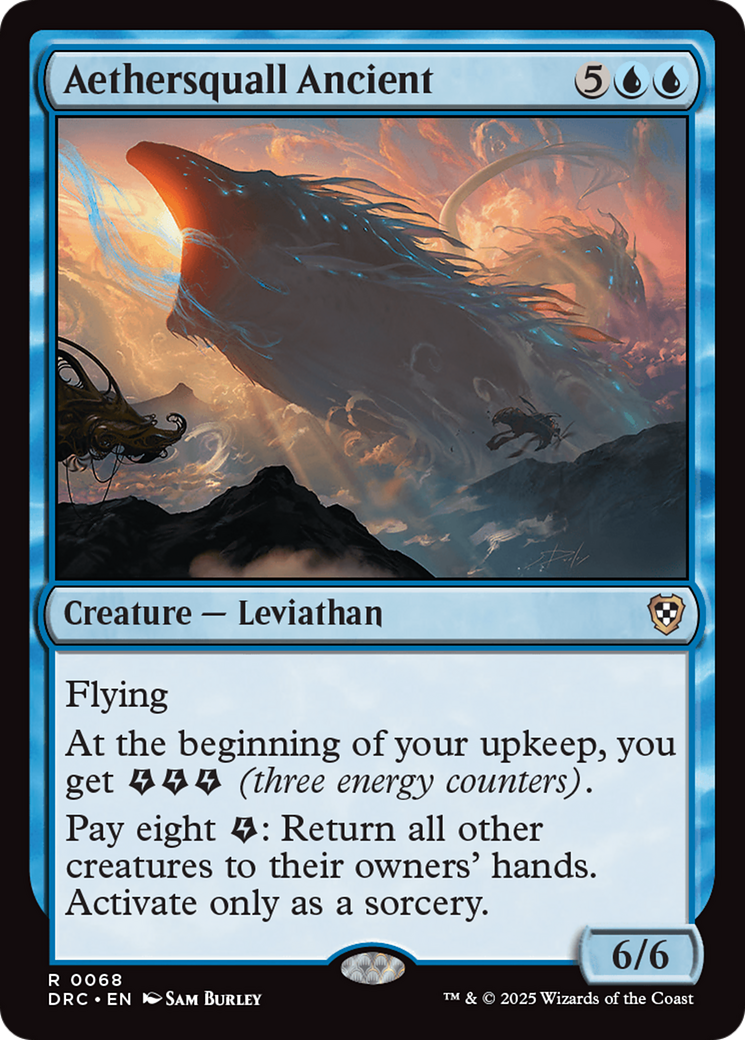
Aethersquall Ancient
Aethersquall Ancient
Creature — Leviathan
6/6
Flying
At the beginning of your upkeep, you get (three energy counters).
Pay eight : Return all other creatures to their owners' hands. Activate only as a sorcery.
- is the energy symbol. It represents one energy counter.
- Energy counters are a kind of counter that a player may have. They're not associated with any specific permanents.
- Keep track of how many energy counters each player has. Potential ways to track this include writing theme down on paper or using dice, but any method that is clear and mutually agreeable is fine. (At higher levels of tournament play, dice may not be allowed for tracking counters that players have.)
- If an effect says you get one or more , you get that many energy counters. To pay one or more , you lose that many energy counters. You can't pay more energy counters than you have. Any effects that interact with counters a player gets, has, or loses can interact with energy counters.
- Energy counters aren't mana. They don't go away as steps, phases, and turns end, and effects that add mana "of any type" can't give you energy counters.
- Some triggered abilities state that you "may pay" a certain amount of . You can't pay that amount multiple times to multiply the effect. You simply choose whether or not to pay that amount of as the ability resolves.
- Some triggered abilities that state that you "may pay" a certain amount of describe an effect that happens "If you do." In that case, no player may take actions to try to stop the ability's effect after you make your choice. If the payment is followed by the phrase "When you do," then you'll choose any targets for that reflexive triggered ability and put it on the stack before players can take actions.
- If a spell or ability with one or more targets states that you "may pay" some amount of , and each permanent that it targets has become an illegal target, the spell or ability won't resolve. You can't pay any even if you want to.
- Some spells and abilities that give you may require targets. If each target chosen is an illegal target as that spell or ability tries to resolve, it won't resolve. You won't get any .
-
1
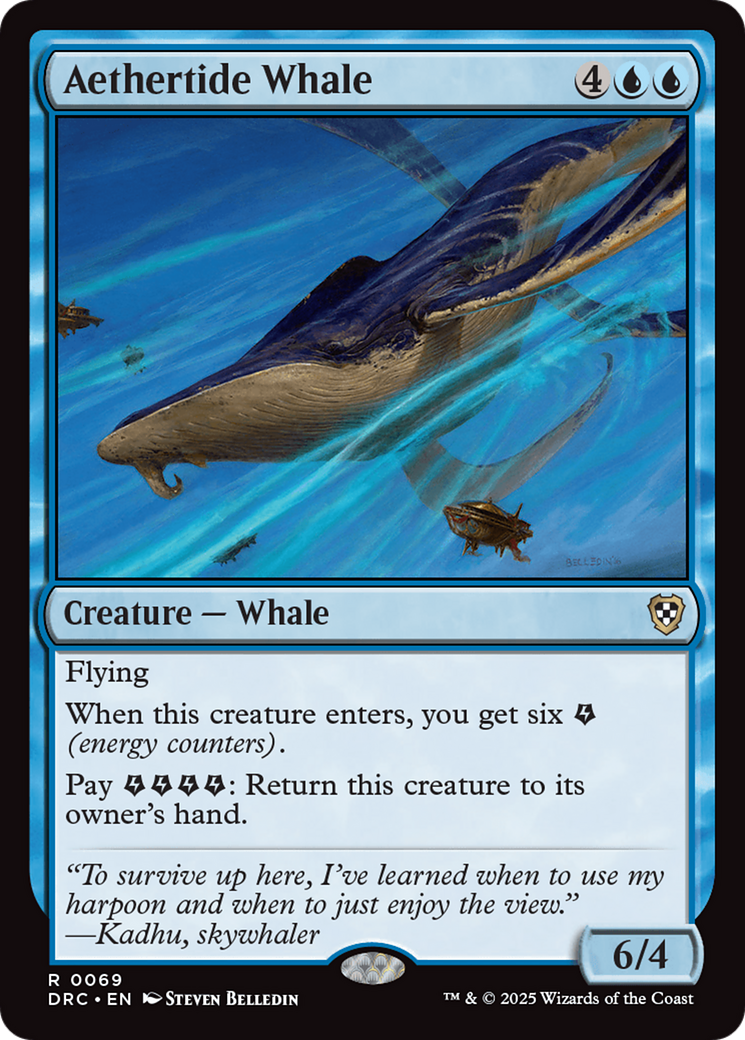
Aethertide Whale
Aethertide Whale
Creature — Whale
6/4
Flying
When this creature enters, you get six (energy counters).
Pay : Return this creature to its owner's hand.
- is the energy symbol. It represents one energy counter.
- Energy counters are a kind of counter that a player may have. They're not associated with any specific permanents.
- Keep track of how many energy counters each player has. Potential ways to track this include writing theme down on paper or using dice, but any method that is clear and mutually agreeable is fine. (At higher levels of tournament play, dice may not be allowed for tracking counters that players have.)
- If an effect says you get one or more , you get that many energy counters. To pay one or more , you lose that many energy counters. You can't pay more energy counters than you have. Any effects that interact with counters a player gets, has, or loses can interact with energy counters.
- Energy counters aren't mana. They don't go away as steps, phases, and turns end, and effects that add mana "of any type" can't give you energy counters.
- Some triggered abilities state that you "may pay" a certain amount of . You can't pay that amount multiple times to multiply the effect. You simply choose whether or not to pay that amount of as the ability resolves.
- Some triggered abilities that state that you "may pay" a certain amount of describe an effect that happens "If you do." In that case, no player may take actions to try to stop the ability's effect after you make your choice. If the payment is followed by the phrase "When you do," then you'll choose any targets for that reflexive triggered ability and put it on the stack before players can take actions.
- If a spell or ability with one or more targets states that you "may pay" some amount of , and each permanent that it targets has become an illegal target, the spell or ability won't resolve. You can't pay any even if you want to.
- Some spells and abilities that give you may require targets. If each target chosen is an illegal target as that spell or ability tries to resolve, it won't resolve. You won't get any .
-
1
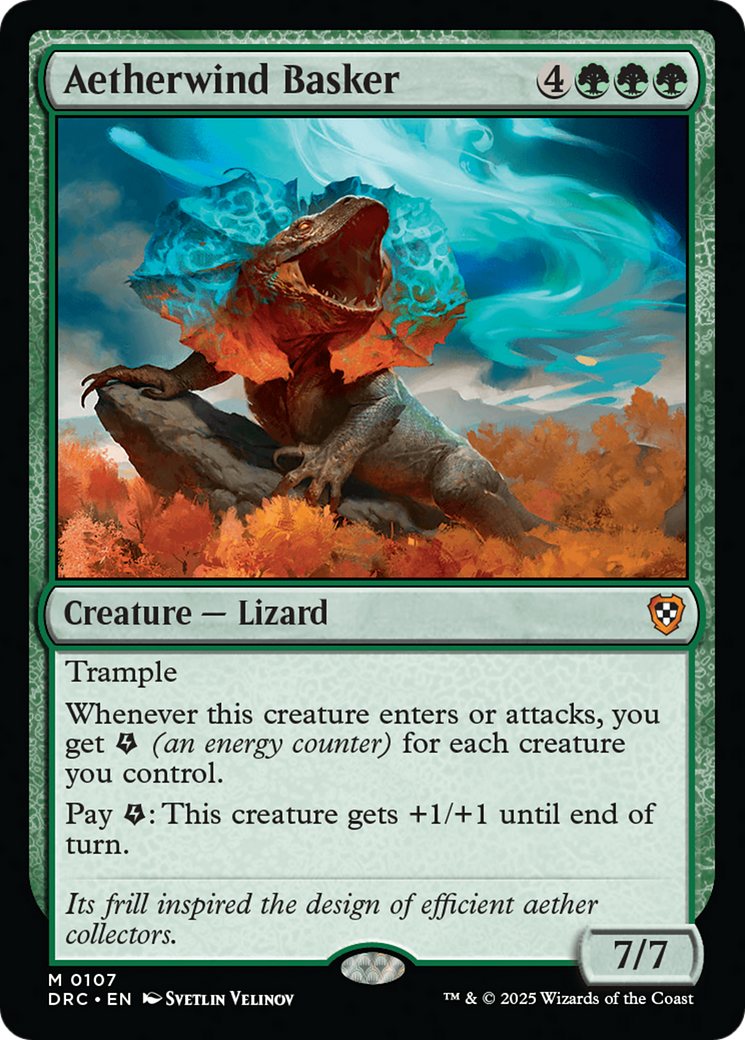
Aetherwind Basker
Aetherwind Basker
Creature — Lizard
7/7
Trample
Whenever this creature enters or attacks, you get (an energy counter) for each creature you control.
Pay : This creature gets +1/+1 until end of turn.
- Some spells and abilities that give you may require targets. If each target chosen is an illegal target as that spell or ability tries to resolve, it won't resolve. You won't get any .
- Some triggered abilities that state that you "may pay" a certain amount of describe an effect that happens "If you do." In that case, no player may take actions to try to stop the ability's effect after you make your choice. If the payment is followed by the phrase "When you do," then you'll choose any targets for that reflexive triggered ability and put it on the stack before players can take actions.
- If a spell or ability with one or more targets states that you "may pay" some amount of , and each permanent that it targets has become an illegal target, the spell or ability won't resolve. You can't pay any even if you want to.
- is the energy symbol. It represents one energy counter.
- Energy counters are a kind of counter that a player may have. They're not associated with any specific permanents.
- Keep track of how many energy counters each player has. Potential ways to track this include writing theme down on paper or using dice, but any method that is clear and mutually agreeable is fine. (At higher levels of tournament play, dice may not be allowed for tracking counters that players have.)
- If an effect says you get one or more , you get that many energy counters. To pay one or more , you lose that many energy counters. You can't pay more energy counters than you have. Any effects that interact with counters a player gets, has, or loses can interact with energy counters.
- Energy counters aren't mana. They don't go away as steps, phases, and turns end, and effects that add mana "of any type" can't give you energy counters.
- Some triggered abilities state that you "may pay" a certain amount of . You can't pay that amount multiple times to multiply the effect. You simply choose whether or not to pay that amount of as the ability resolves.
- Abilities that trigger "whenever you get one or more ," such as that of Fabrication Module from the Kaladesh set, trigger only once as Aetherwind Basker's triggered ability resolves.
- The triggered ability triggers both when Aetherwind Basker enters the battlefield and whenever it attacks. You don't have to choose only one.
-
1
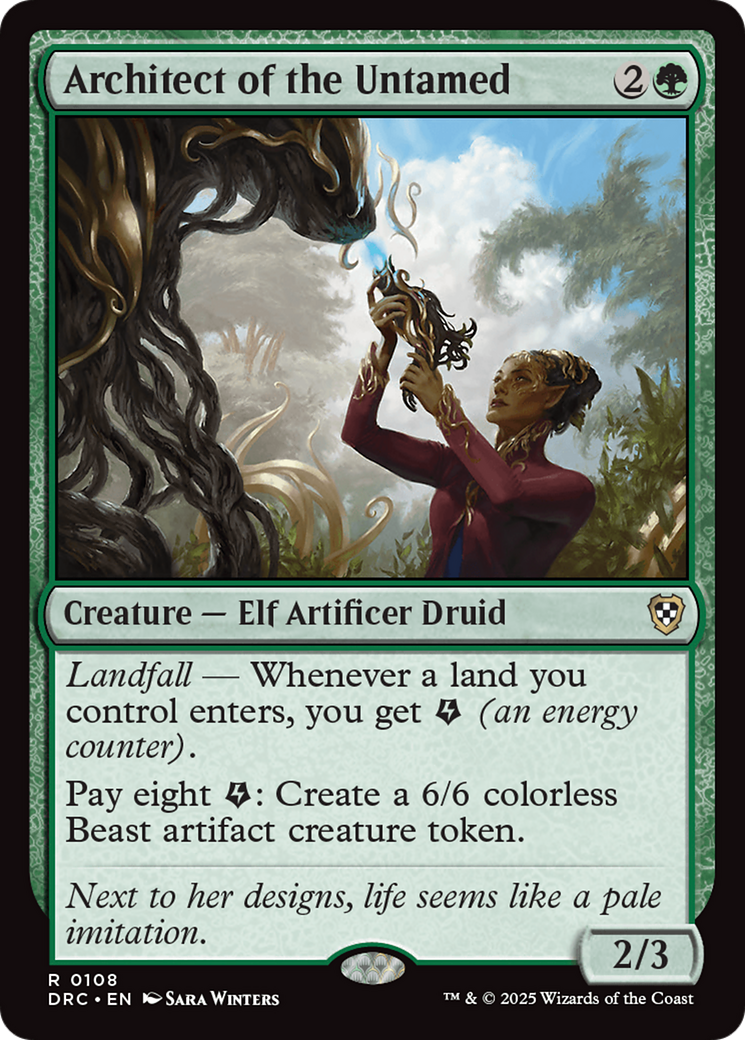
Architect of the Untamed
Architect of the Untamed
Creature — Elf Artificer Druid
2/3
Landfall — Whenever a land you control enters, you get (an energy counter).
Pay eight : Create a 6/6 colorless Beast artifact creature token.
- A landfall ability triggers whenever a land you control enters for any reason. It triggers whenever you play a land, as well as whenever a spell or ability puts a land onto the battlefield under your control.
- A landfall ability doesn't trigger if a permanent already on the battlefield becomes a land.
- Whenever a land you control enters, each landfall ability of the permanents you control will trigger. You can put them on the stack in any order. The last ability you put on the stack will be the first one to resolve (As a result, you can have those abilities resolve in the order of your choosing.).
- Keep track of how many energy counters each player has. Potential ways to track this include writing theme down on paper or using dice, but any method that is clear and mutually agreeable is fine. (At higher levels of tournament play, dice may not be allowed for tracking counters that players have.)
- If an effect says you get one or more , you get that many energy counters. To pay one or more , you lose that many energy counters. You can't pay more energy counters than you have. Any effects that interact with counters a player gets, has, or loses can interact with energy counters.
- Some spells and abilities that give you may require targets. If each target chosen is an illegal target as that spell or ability tries to resolve, it won't resolve. You won't get any .
- Some triggered abilities state that you "may pay" a certain amount of . You can't pay that amount multiple times to multiply the effect. You simply choose whether or not to pay that amount of as the ability resolves.
- Some triggered abilities that state that you "may pay" a certain amount of describe an effect that happens "If you do." In that case, no player may take actions to try to stop the ability's effect after you make your choice. If the payment is followed by the phrase "When you do," then you'll choose any targets for that reflexive triggered ability and put it on the stack before players can take actions.
- If a spell or ability with one or more targets states that you "may pay" some amount of , and each permanent that it targets has become an illegal target, the spell or ability won't resolve. You can't pay any even if you want to.
- Energy counters aren't mana. They don't go away as steps, phases, and turns end, and effects that add mana "of any type" can't give you energy counters.
- is the energy symbol. It represents one energy counter.
- Energy counters are a kind of counter that a player may have. They're not associated with any specific permanents.
-
1
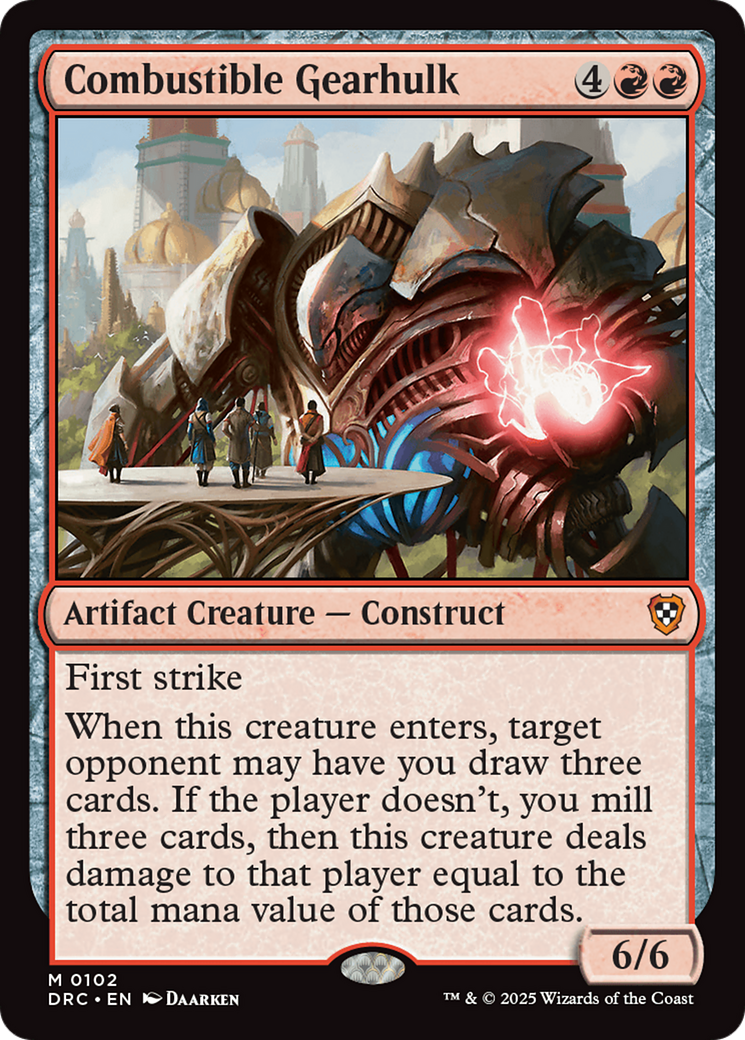
Combustible Gearhulk
Combustible Gearhulk
Artifact Creature — Construct
6/6
First strike
When this creature enters, target opponent may have you draw three cards. If the player doesn't, you mill three cards, then this creature deals damage to that player equal to the total mana value of those cards.
- If any of the cards put into your graveyard have in their mana cost, X is considered to be 0.
- If you have fewer than three cards in your library, the opponent may choose to have you draw three cards. If so, you'll lose the game as state-based actions are performed.
- While Combustible Gearhulk's triggered ability is resolving, no player may take any actions other than those specified by the Gearhulk. Once the opponent makes a choice, players can't cast spells or activate abilities until after the cards are drawn or put into the graveyard and damage has been dealt (if applicable).
-
1
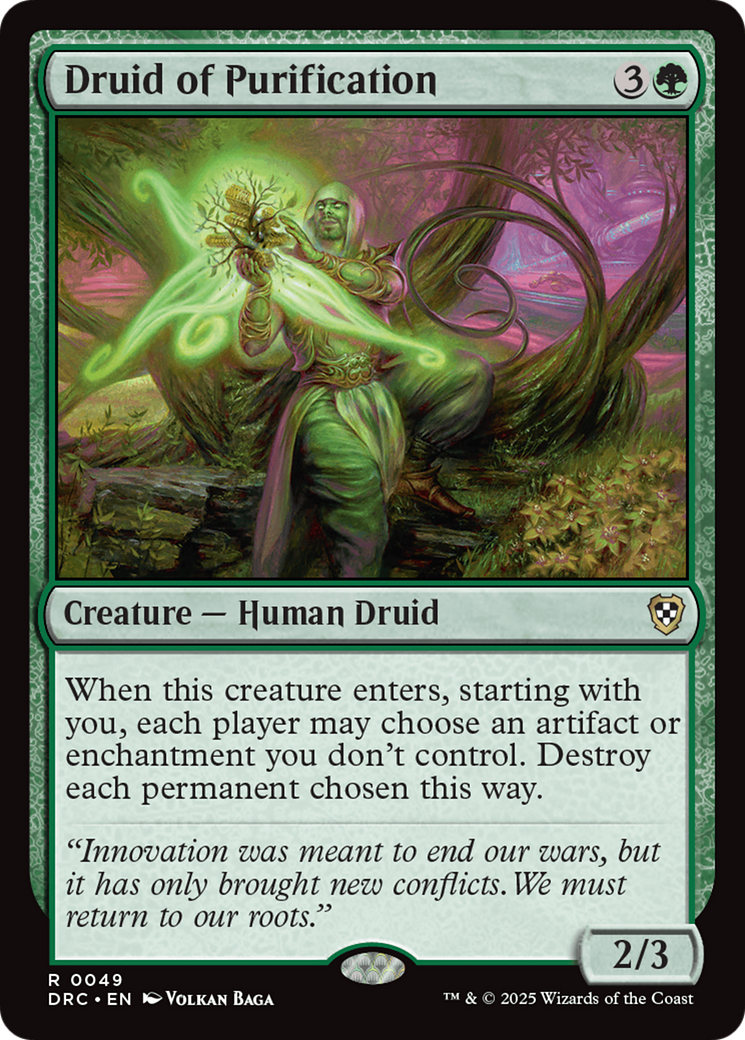
Druid of Purification
Druid of Purification
Creature — Human Druid
2/3
When this creature enters, starting with you, each player may choose an artifact or enchantment you don't control. Destroy each permanent chosen this way.
- Players make their choices in turn order and get to know what choices were made before theirs. They may choose an artifact or an enchantment that was already chosen by another player. Once all players have made their choices, the permanents are destroyed simultaneously.
- You choose whether Ebony Fly becomes a creature as the second ability resolves, after you see the result of the die roll. If you don't choose to make it a creature at that time, you can't choose to make it a creature later in the turn unless you activate the ability again.
-
1
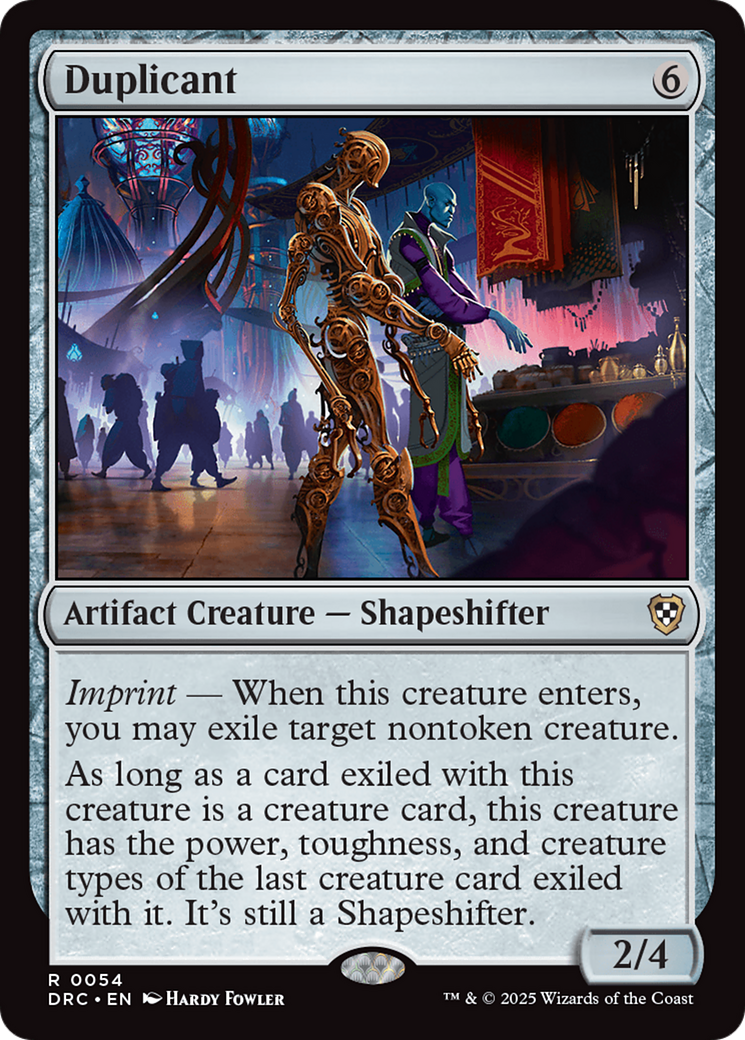
Duplicant
Duplicant
Artifact Creature — Shapeshifter
2/4
Imprint — When this creature enters, you may exile target nontoken creature.
As long as a card exiled with this creature is a creature card, this creature has the power, toughness, and creature types of the last creature card exiled with it. It's still a Shapeshifter.
- Duplicant's base power and toughness change to the imprinted card's power and toughness. Counters and other effects that modify Duplicant's power and toughness still apply.
- Abilities that define a * in a creature's power and toughness apply while that card is in exile, but abilities that add or subtract power and toughness don't. For example, the ability of Crusader of Odric applies to determine Duplicant's power and toughness, but the ability of Death's Shadow doesn't.
- Duplicant's power and toughness are constantly updated if the exiled card's power and/or toughness change.
- If a melded permanent or a merged permanent is exiled by Duplicant's triggered ability, that ability's controller chooses the relative timestamp of the exiled cards. Duplicant looks at the information of the one with the latest timestamp.
-
1
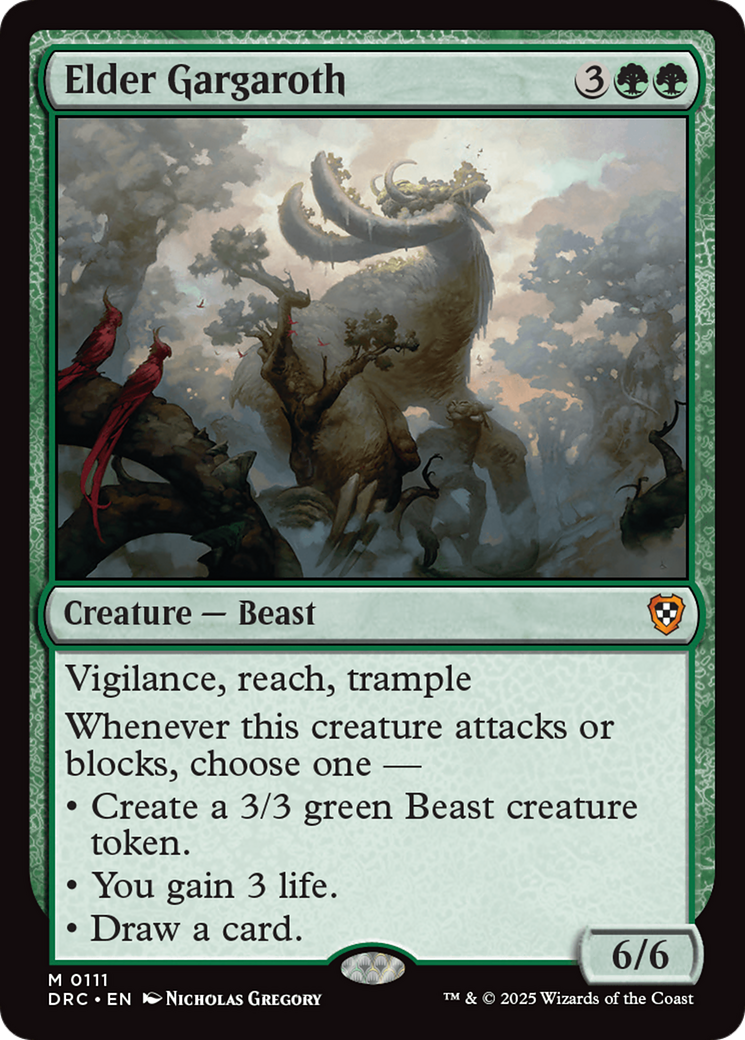
Elder Gargaroth
Elder Gargaroth
Creature — Beast
6/6
Vigilance, reach, trample
Whenever this creature attacks or blocks, choose one —
- Create a 3/3 green Beast creature token.
- You gain 3 life.
- Draw a card.
- If you create a Beast token, that token can't attack or block during the same combat, even if it gains haste.
- Players can cast spells after Elder Gargaroth's triggered ability has resolved but before blockers are declared (if it's attacking) or before combat damage is dealt (if it's blocking).
-
1
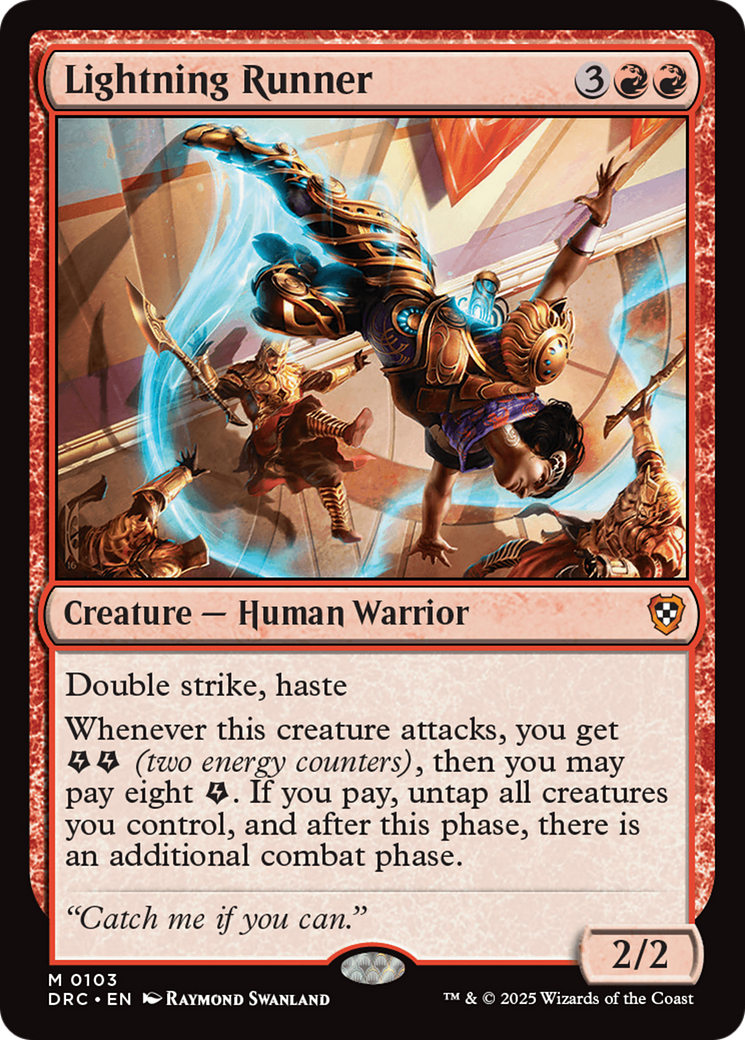
Lightning Runner
Lightning Runner
Creature — Human Warrior
2/2
Double strike, haste
Whenever this creature attacks, you get (two energy counters), then you may pay eight . If you pay, untap all creatures you control, and after this phase, there is an additional combat phase.
- Some spells and abilities that give you may require targets. If each target chosen is an illegal target as that spell or ability tries to resolve, it won't resolve. You won't get any .
- is the energy symbol. It represents one energy counter.
- Energy counters are a kind of counter that a player may have. They're not associated with any specific permanents.
- Keep track of how many energy counters each player has. Potential ways to track this include writing theme down on paper or using dice, but any method that is clear and mutually agreeable is fine. (At higher levels of tournament play, dice may not be allowed for tracking counters that players have.)
- If an effect says you get one or more , you get that many energy counters. To pay one or more , you lose that many energy counters. You can't pay more energy counters than you have. Any effects that interact with counters a player gets, has, or loses can interact with energy counters.
- Energy counters aren't mana. They don't go away as steps, phases, and turns end, and effects that add mana "of any type" can't give you energy counters.
- Some triggered abilities state that you "may pay" a certain amount of . You can't pay that amount multiple times to multiply the effect. You simply choose whether or not to pay that amount of as the ability resolves.
- Some triggered abilities that state that you "may pay" a certain amount of describe an effect that happens "If you do." In that case, no player may take actions to try to stop the ability's effect after you make your choice. If the payment is followed by the phrase "When you do," then you'll choose any targets for that reflexive triggered ability and put it on the stack before players can take actions.
- If a spell or ability with one or more targets states that you "may pay" some amount of , and each permanent that it targets has become an illegal target, the spell or ability won't resolve. You can't pay any even if you want to.
- You untap all creatures you control, including ones that aren't attacking.
-
1
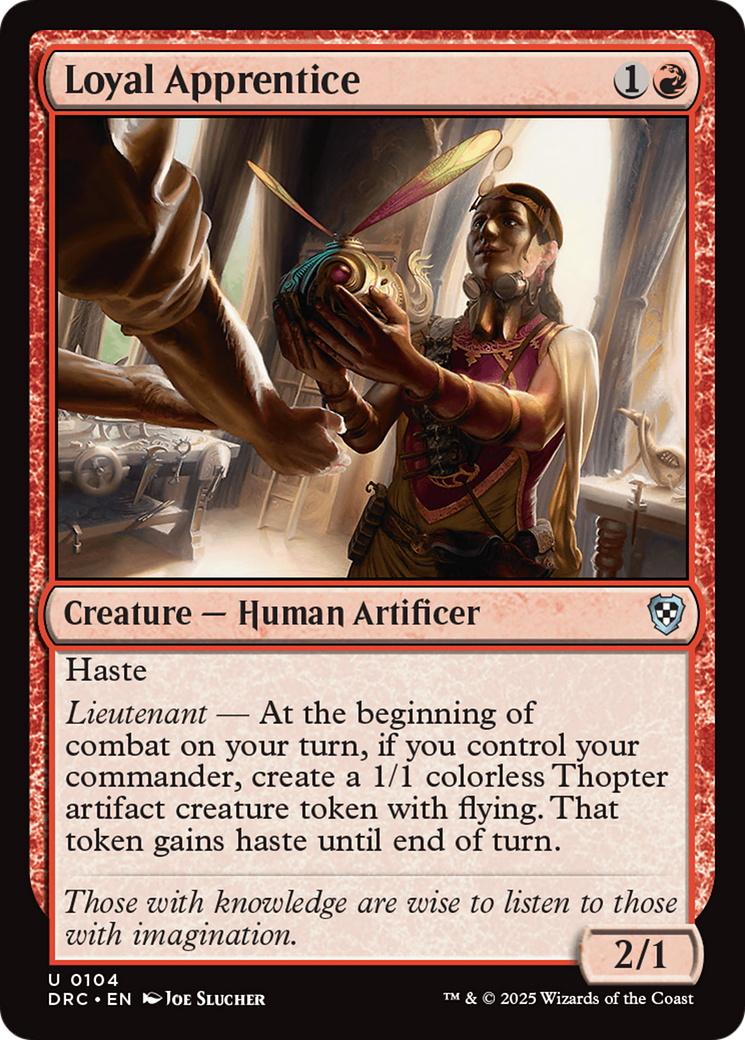
Loyal Apprentice
Loyal Apprentice
Creature — Human Artificer
2/1
Haste
Lieutenant — At the beginning of combat on your turn, if you control your commander, create a 1/1 colorless Thopter artifact creature token with flying. That token gains haste until end of turn.
- If you don't control your commander as the lieutenant ability resolves, you won't get its effect.
- The lieutenant effect happens only once each combat, even if you somehow control multiple commanders (perhaps because you have two commanders with a partner ability from the Battlebond™ set).
- If you have multiple commanders, you need to control only one for the lieutenant effect to happen.
-
1
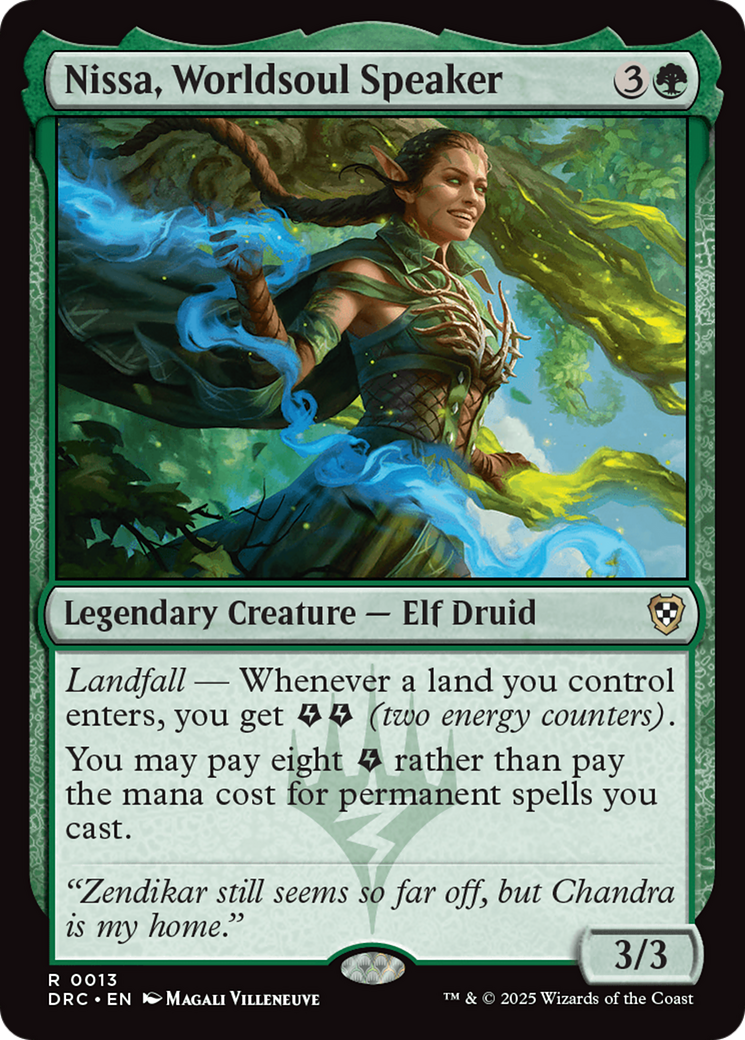
Nissa, Worldsoul Speaker
Nissa, Worldsoul Speaker
Legendary Creature — Elf Druid
3/3
Landfall — Whenever a land you control enters, you get (two energy counters).
You may pay eight rather than pay the mana cost for permanent spells you cast.
- is the energy symbol. It represents one energy counter.
- Energy counters are a kind of counter that a player may have. They’re not associated with any specific permanents.
- Keep track of how many energy counters each player has. Potential ways to track this include writing them down on paper or using dice, but any method that is clear and mutually agreeable is fine.
- If an effect says you get one or more , you get that many energy counters. To pay one or more , you lose that many energy counters. You can’t pay more energy counters than you have. Any effects that interact with counters a player gets, has, or loses can interact with energy counters.
- Energy counters aren’t mana. They don’t go away as steps, phases, and turns end, and effects that add mana “of any type” can’t give you energy counters.
- Some spells and abilities say that you “may pay” a certain amount of . You can’t pay that amount multiple times to multiply the effect. You simply choose whether or not to pay that amount of as the ability resolves.
- Some spells and abilities say that you “may pay” a certain amount of , then describes an effect that happens “if you do.” In that case, no player may take actions to try to stop the ability’s effect after you make your choice. If the payment is instead followed by the phrase “when you do” followed by an effect, then after you choose to pay , a new triggered ability called a reflexive trigger is put on the stack, and you choose targets for the reflexive trigger (if the effect asks for targets). Players may respond as normal to this new triggered ability. Once that reflexive trigger resolves, the effect will finally occur.
- Some spells and abilities which give you or say you “may pay” some amount of require one or more targets. If each target chosen is an illegal target as that spell or ability tries to resolve, it won’t resolve. None of its effects will happen, you won’t get any from it, and you won’t get the chance to pay any for its effects even if you want to.
-
1
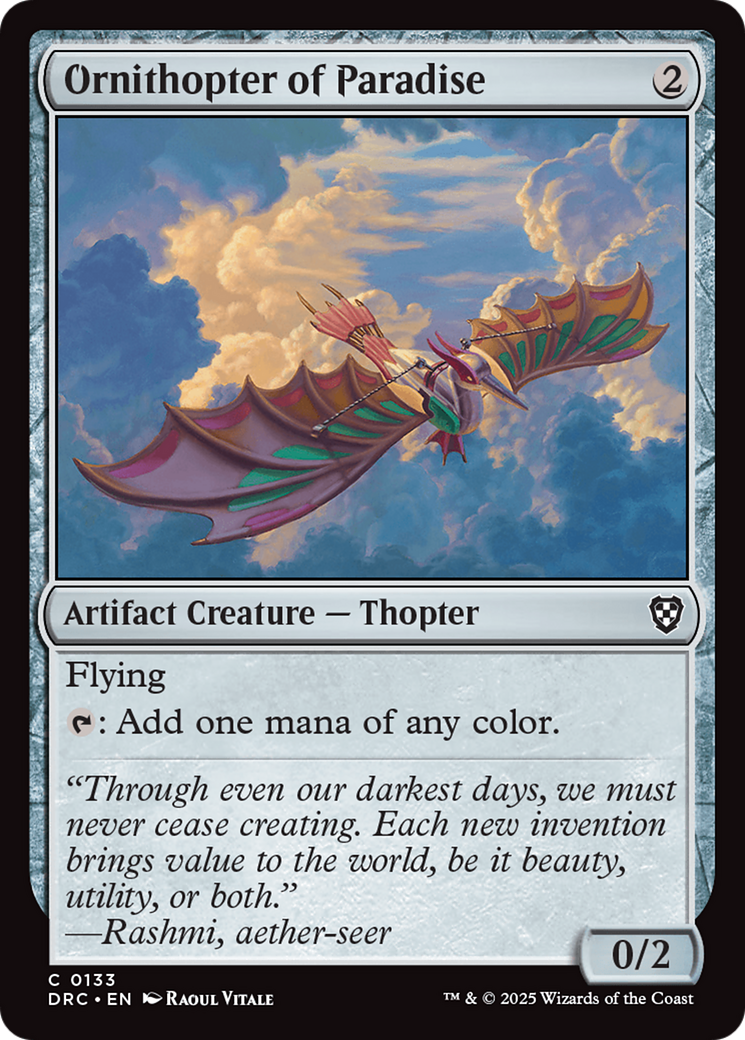
Ornithopter of Paradise
Ornithopter of Paradise
Artifact Creature — Thopter
0/2
Flying
: Add one mana of any color.
-
1
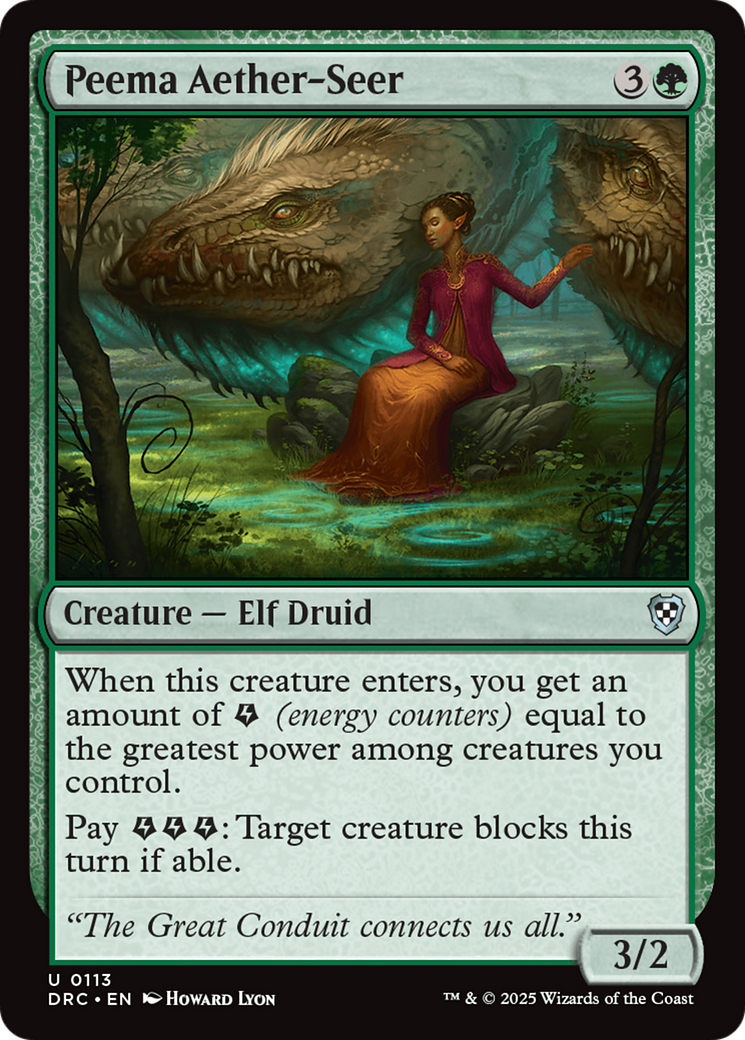
Peema Aether-Seer
Peema Aether-Seer
Creature — Elf Druid
3/2
When this creature enters, you get an amount of (energy counters) equal to the greatest power among creatures you control.
Pay : Target creature blocks this turn if able.
- Some spells and abilities that give you may require targets. If each target chosen is an illegal target as that spell or ability tries to resolve, it won't resolve. You won't get any .
- Some triggered abilities state that you "may pay" a certain amount of . You can't pay that amount multiple times to multiply the effect. You simply choose whether or not to pay that amount of as the ability resolves.
- Some triggered abilities that state that you "may pay" a certain amount of describe an effect that happens "If you do." In that case, no player may take actions to try to stop the ability's effect after you make your choice. If the payment is followed by the phrase "When you do," then you'll choose any targets for that reflexive triggered ability and put it on the stack before players can take actions.
- If a spell or ability with one or more targets states that you "may pay" some amount of , and each permanent that it targets has become an illegal target, the spell or ability won't resolve. You can't pay any even if you want to.
- is the energy symbol. It represents one energy counter.
- Energy counters are a kind of counter that a player may have. They're not associated with any specific permanents.
- Keep track of how many energy counters each player has. Potential ways to track this include writing theme down on paper or using dice, but any method that is clear and mutually agreeable is fine. (At higher levels of tournament play, dice may not be allowed for tracking counters that players have.)
- If an effect says you get one or more , you get that many energy counters. To pay one or more , you lose that many energy counters. You can't pay more energy counters than you have. Any effects that interact with counters a player gets, has, or loses can interact with energy counters.
- Energy counters aren't mana. They don't go away as steps, phases, and turns end, and effects that add mana "of any type" can't give you energy counters.
- The target creature blocks only if it's able to do so as the declare blockers step begins. If, at that time, the creature is tapped, it's affected by a spell or ability that says it can't block, or no creatures are attacking its controller or a planeswalker controlled by that player, then it doesn't block. If there's a cost associated with having the creature block, the player isn't forced to pay that cost. If that cost isn't paid, the creature won't block.
- The controller of the target creature chooses which attacking creature that creature blocks.
- The amount of you get is determined as Peema Aether-Seer's first ability resolves. If the greatest power among creatures you control is somehow negative, you don't get or lose any .
-
1
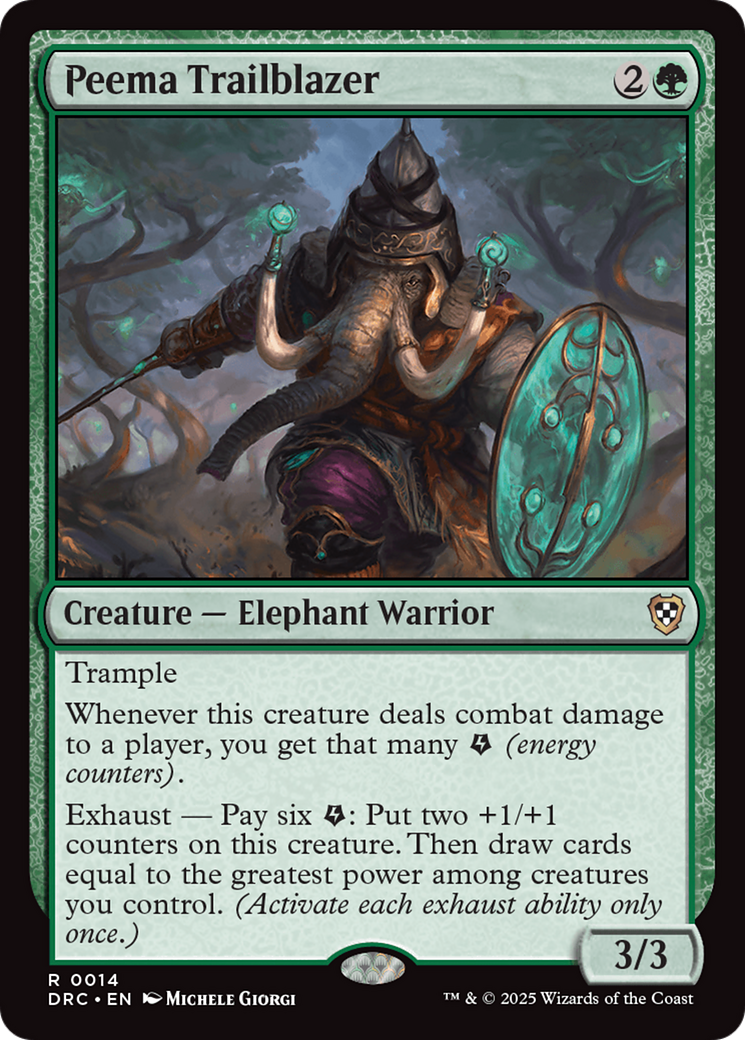
Peema Trailblazer
Peema Trailblazer
Creature — Elephant Warrior
3/3
Trample
Whenever this creature deals combat damage to a player, you get that many (energy counters).
Exhaust — Pay six : Put two +1/+1 counters on this creature. Then draw cards equal to the greatest power among creatures you control. (Activate each exhaust ability only once.)
- Exhaust abilities can be activated any time you could normally activate an ability.
- If an exhaust ability of a permanent is activated, and then that permanent leaves the battlefield and returns to the battlefield, it becomes a new object so its exhaust ability can be activated again.
- If an ability triggers whenever you activate an exhaust ability, that ability resolves before the exhaust ability resolves.
- is the energy symbol. It represents one energy counter.
- Energy counters are a kind of counter that a player may have. They’re not associated with any specific permanents.
- Keep track of how many energy counters each player has. Potential ways to track this include writing them down on paper or using dice, but any method that is clear and mutually agreeable is fine.
- If an effect says you get one or more , you get that many energy counters. To pay one or more , you lose that many energy counters. You can’t pay more energy counters than you have. Any effects that interact with counters a player gets, has, or loses can interact with energy counters.
- Energy counters aren’t mana. They don’t go away as steps, phases, and turns end, and effects that add mana “of any type” can’t give you energy counters.
- Some spells and abilities say that you “may pay” a certain amount of . You can’t pay that amount multiple times to multiply the effect. You simply choose whether or not to pay that amount of as the ability resolves.
- Some spells and abilities say that you “may pay” a certain amount of , then describes an effect that happens “if you do.” In that case, no player may take actions to try to stop the ability’s effect after you make your choice. If the payment is instead followed by the phrase “when you do” followed by an effect, then after you choose to pay , a new triggered ability called a reflexive trigger is put on the stack, and you choose targets for the reflexive trigger (if the effect asks for targets). Players may respond as normal to this new triggered ability. Once that reflexive trigger resolves, the effect will finally occur.
- Some spells and abilities which give you or say you “may pay” some amount of require one or more targets. If each target chosen is an illegal target as that spell or ability tries to resolve, it won’t resolve. None of its effects will happen, you won’t get any from it, and you won’t get the chance to pay any for its effects even if you want to.
-
1
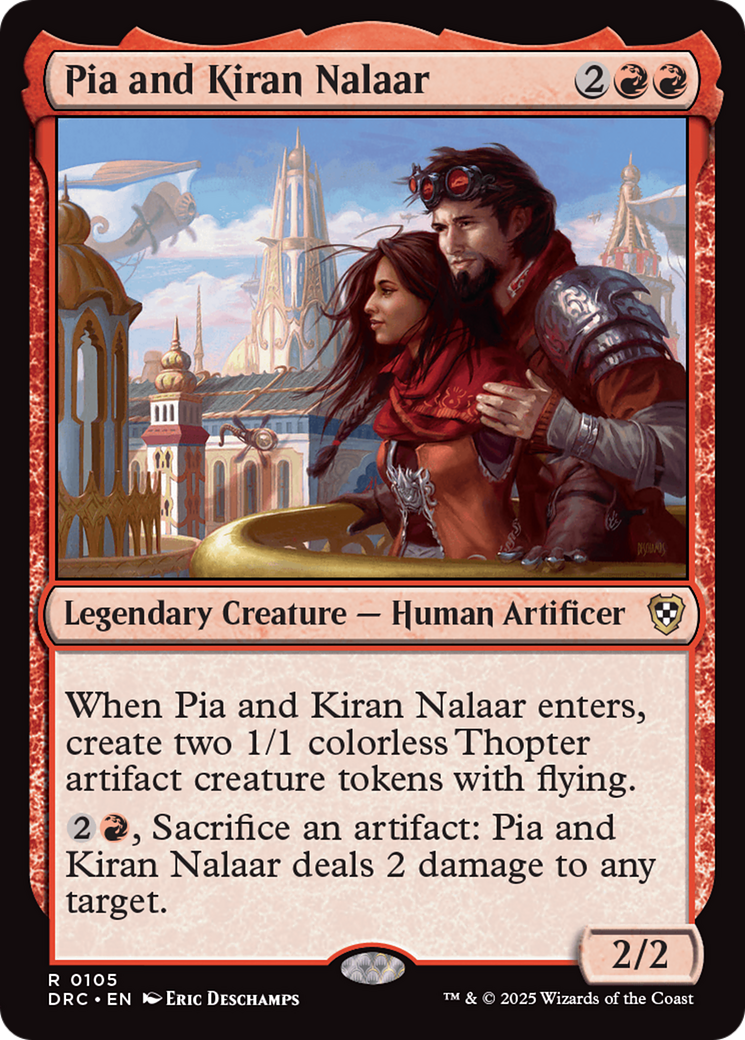
Pia and Kiran Nalaar
Pia and Kiran Nalaar
Legendary Creature — Human Artificer
2/2
When Pia and Kiran Nalaar enters, create two 1/1 colorless Thopter artifact creature tokens with flying.
, Sacrifice an artifact: Pia and Kiran Nalaar deals 2 damage to any target.
-
1
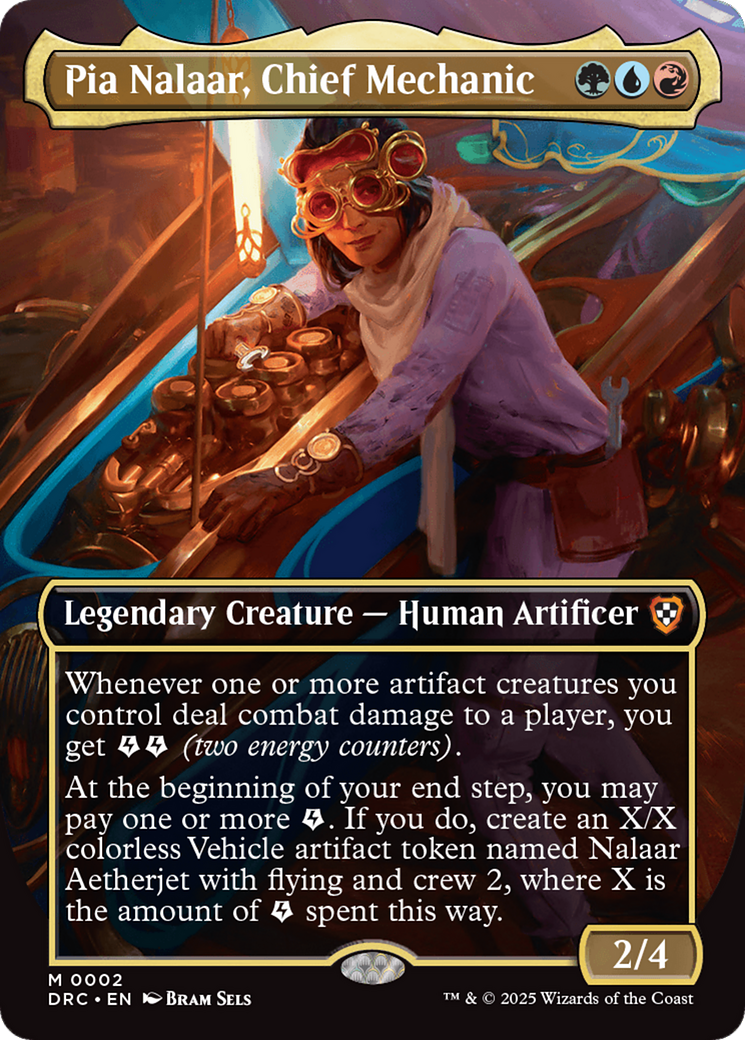
Pia Nalaar, Chief Mechanic
Pia Nalaar, Chief Mechanic
Legendary Creature — Human Artificer
2/4
Whenever one or more artifact creatures you control deal combat damage to a player, you get (two energy counters).
At the beginning of your end step, you may pay one or more . If you do, create an X/X colorless Vehicle artifact token named Nalaar Aetherjet with flying and crew 2, where X is the amount of spent this way.
- is the energy symbol. It represents one energy counter.
- Energy counters are a kind of counter that a player may have. They’re not associated with any specific permanents.
- Keep track of how many energy counters each player has. Potential ways to track this include writing them down on paper or using dice, but any method that is clear and mutually agreeable is fine.
- If an effect says you get one or more , you get that many energy counters. To pay one or more , you lose that many energy counters. You can’t pay more energy counters than you have. Any effects that interact with counters a player gets, has, or loses can interact with energy counters.
- Energy counters aren’t mana. They don’t go away as steps, phases, and turns end, and effects that add mana “of any type” can’t give you energy counters.
- Some spells and abilities say that you “may pay” a certain amount of . You can’t pay that amount multiple times to multiply the effect. You simply choose whether or not to pay that amount of as the ability resolves.
- Some spells and abilities say that you “may pay” a certain amount of , then describes an effect that happens “if you do.” In that case, no player may take actions to try to stop the ability’s effect after you make your choice. If the payment is instead followed by the phrase “when you do” followed by an effect, then after you choose to pay , a new triggered ability called a reflexive trigger is put on the stack, and you choose targets for the reflexive trigger (if the effect asks for targets). Players may respond as normal to this new triggered ability. Once that reflexive trigger resolves, the effect will finally occur.
- Some spells and abilities which give you or say you “may pay” some amount of require one or more targets. If each target chosen is an illegal target as that spell or ability tries to resolve, it won’t resolve. None of its effects will happen, you won’t get any from it, and you won’t get the chance to pay any for its effects even if you want to.
-
1
Rampaging Aetherhood
Rampaging Aetherhood
Creature — Snake Hydra
4/4
Trample, ward
At the beginning of your upkeep, you get an amount of (energy counters) equal to this creature's power. Then you may pay one or more . If you do, put that many +1/+1 counters on this creature.
- is the energy symbol. It represents one energy counter.
- Energy counters are a kind of counter that a player may have. They’re not associated with any specific permanents.
- Keep track of how many energy counters each player has. Potential ways to track this include writing them down on paper or using dice, but any method that is clear and mutually agreeable is fine.
- If an effect says you get one or more , you get that many energy counters. To pay one or more , you lose that many energy counters. You can’t pay more energy counters than you have. Any effects that interact with counters a player gets, has, or loses can interact with energy counters.
- Energy counters aren’t mana. They don’t go away as steps, phases, and turns end, and effects that add mana “of any type” can’t give you energy counters.
- Some spells and abilities say that you “may pay” a certain amount of . You can’t pay that amount multiple times to multiply the effect. You simply choose whether or not to pay that amount of as the ability resolves.
- Some spells and abilities say that you “may pay” a certain amount of , then describes an effect that happens “if you do.” In that case, no player may take actions to try to stop the ability’s effect after you make your choice. If the payment is instead followed by the phrase “when you do” followed by an effect, then after you choose to pay , a new triggered ability called a reflexive trigger is put on the stack, and you choose targets for the reflexive trigger (if the effect asks for targets). Players may respond as normal to this new triggered ability. Once that reflexive trigger resolves, the effect will finally occur.
- Some spells and abilities which give you or say you “may pay” some amount of require one or more targets. If each target chosen is an illegal target as that spell or ability tries to resolve, it won’t resolve. None of its effects will happen, you won’t get any from it, and you won’t get the chance to pay any for its effects even if you want to.
-
1
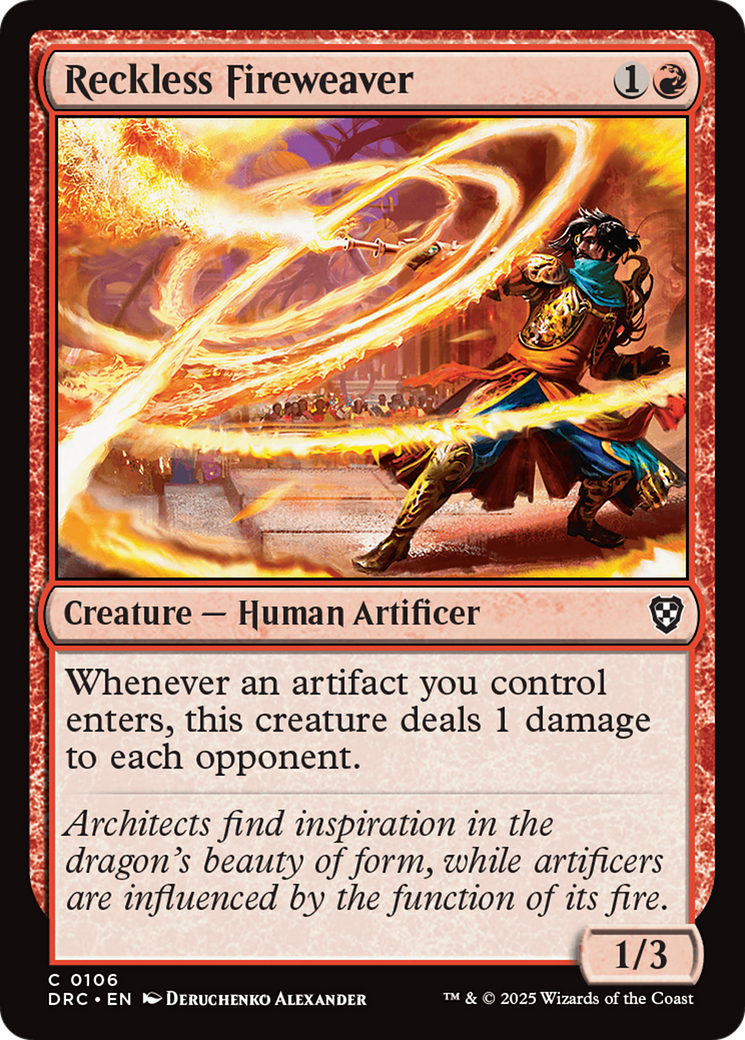
Reckless Fireweaver
Reckless Fireweaver
Creature — Human Artificer
1/3
Whenever an artifact you control enters, this creature deals 1 damage to each opponent.
- In a Two-Headed Giant game, Reckless Fireweaver's ability causes 2 damage total to be dealt to the opposing team.
-
1
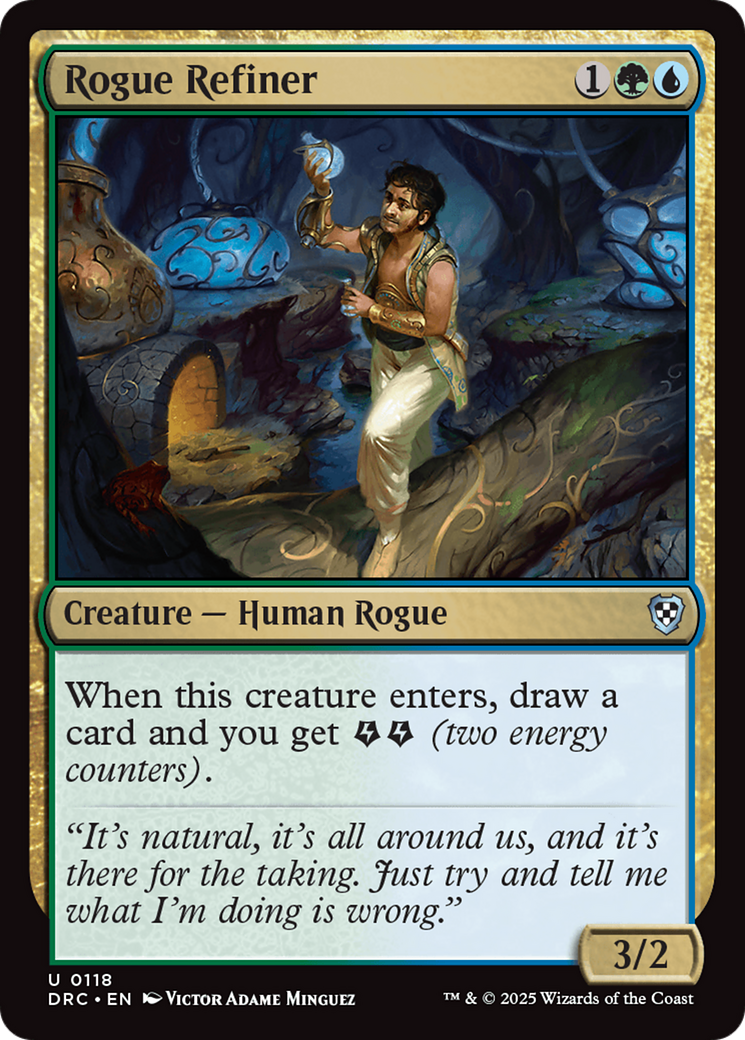
Rogue Refiner
Rogue Refiner
Creature — Human Rogue
3/2
When this creature enters, draw a card and you get (two energy counters).
- is the energy symbol. It represents one energy counter.
- Energy counters are a kind of counter that a player may have. They're not associated with any specific permanents.
- Keep track of how many energy counters each player has. Potential ways to track this include writing theme down on paper or using dice, but any method that is clear and mutually agreeable is fine. (At higher levels of tournament play, dice may not be allowed for tracking counters that players have.)
- If an effect says you get one or more , you get that many energy counters. To pay one or more , you lose that many energy counters. You can't pay more energy counters than you have. Any effects that interact with counters a player gets, has, or loses can interact with energy counters.
- Energy counters aren't mana. They don't go away as steps, phases, and turns end, and effects that add mana "of any type" can't give you energy counters.
- Some triggered abilities state that you "may pay" a certain amount of . You can't pay that amount multiple times to multiply the effect. You simply choose whether or not to pay that amount of as the ability resolves.
- Some triggered abilities that state that you "may pay" a certain amount of describe an effect that happens "If you do." In that case, no player may take actions to try to stop the ability's effect after you make your choice. If the payment is followed by the phrase "When you do," then you'll choose any targets for that reflexive triggered ability and put it on the stack before players can take actions.
- If a spell or ability with one or more targets states that you "may pay" some amount of , and each permanent that it targets has become an illegal target, the spell or ability won't resolve. You can't pay any even if you want to.
- Some spells and abilities that give you may require targets. If each target chosen is an illegal target as that spell or ability tries to resolve, it won't resolve. You won't get any .
-
1
Saheeli, Radiant Creator
Saheeli, Radiant Creator
Legendary Creature — Human Artificer
4/4
Whenever you cast an Artificer or artifact spell, you get (an energy counter).
At the beginning of combat on your turn, you may pay . When you do, create a token that's a copy of target permanent you control, except it's a 5/5 artifact creature in addition to its other types and has haste. Sacrifice it at the beginning of the next end step.
- The token you create copies the original characteristics of the permanent as printed on the card or, for a token, as stated by the effect that created that token (unless it’s copying something else; see below). It doesn’t copy whether that permanent is tapped or untapped, whether it has any counters on it or Auras or Equipment attached to it, or any non-copy effects that have changed its power, toughness, types, color, and so on.
- If the copied permanent has in its mana cost, X is 0.
- If the copied permanent is copying something else, then the token enters the battlefield as whatever that permanent copied.
- Any abilities of the copied permanent that trigger when that permanent enters will trigger. Any “as [this permanent] enters” or “[this permanent] enters with” abilities of the chosen permanent will also work.
- is the energy symbol. It represents one energy counter.
- Energy counters are a kind of counter that a player may have. They’re not associated with any specific permanents.
- Keep track of how many energy counters each player has. Potential ways to track this include writing them down on paper or using dice, but any method that is clear and mutually agreeable is fine.
- If an effect says you get one or more , you get that many energy counters. To pay one or more , you lose that many energy counters. You can’t pay more energy counters than you have. Any effects that interact with counters a player gets, has, or loses can interact with energy counters.
- Energy counters aren’t mana. They don’t go away as steps, phases, and turns end, and effects that add mana “of any type” can’t give you energy counters.
- Some spells and abilities say that you “may pay” a certain amount of . You can’t pay that amount multiple times to multiply the effect. You simply choose whether or not to pay that amount of as the ability resolves.
- Some spells and abilities say that you “may pay” a certain amount of , then describes an effect that happens “if you do.” In that case, no player may take actions to try to stop the ability’s effect after you make your choice. If the payment is instead followed by the phrase “when you do” followed by an effect, then after you choose to pay , a new triggered ability called a reflexive trigger is put on the stack, and you choose targets for the reflexive trigger (if the effect asks for targets). Players may respond as normal to this new triggered ability. Once that reflexive trigger resolves, the effect will finally occur.
- Some spells and abilities which give you or say you “may pay” some amount of require one or more targets. If each target chosen is an illegal target as that spell or ability tries to resolve, it won’t resolve. None of its effects will happen, you won’t get any from it, and you won’t get the chance to pay any for its effects even if you want to.
-
1
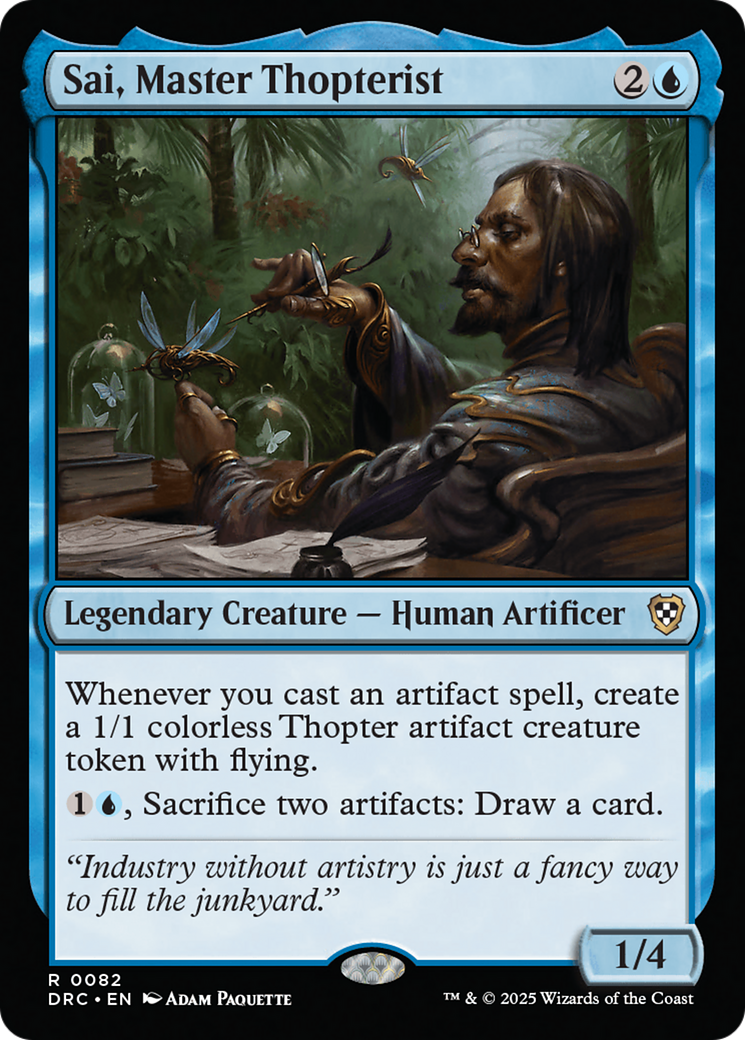
Sai, Master Thopterist
Sai, Master Thopterist
Legendary Creature — Human Artificer
1/4
Whenever you cast an artifact spell, create a 1/1 colorless Thopter artifact creature token with flying.
, Sacrifice two artifacts: Draw a card.
- Sai's triggered ability resolves before the spell that caused it to trigger. It resolves even if that spell is countered.
-
1
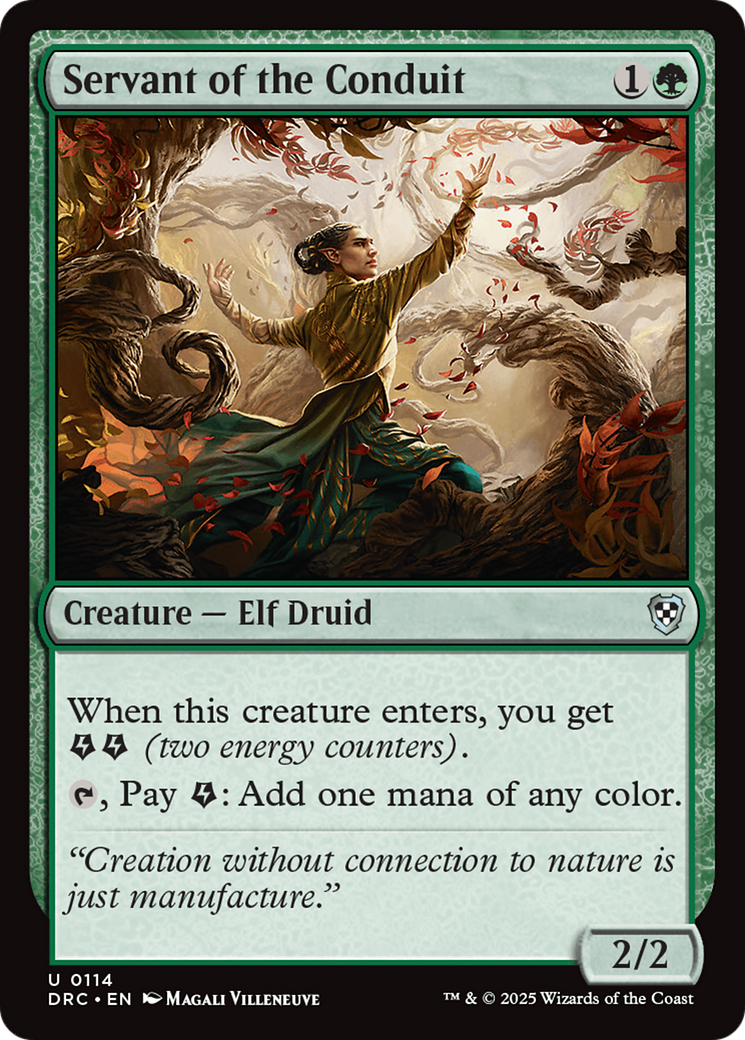
Servant of the Conduit
Servant of the Conduit
Creature — Elf Druid
2/2
When this creature enters, you get (two energy counters).
, Pay : Add one mana of any color.
- is the energy symbol. It represents one energy counter.
- Energy counters are a kind of counter that a player may have. They're not associated with any specific permanents.
- Keep track of how many energy counters each player has. Potential ways to track this include writing theme down on paper or using dice, but any method that is clear and mutually agreeable is fine. (At higher levels of tournament play, dice may not be allowed for tracking counters that players have.)
- If an effect says you get one or more , you get that many energy counters. To pay one or more , you lose that many energy counters. You can't pay more energy counters than you have. Any effects that interact with counters a player gets, has, or loses can interact with energy counters.
- Energy counters aren't mana. They don't go away as steps, phases, and turns end, and effects that add mana "of any type" can't give you energy counters.
- Some triggered abilities state that you "may pay" a certain amount of . You can't pay that amount multiple times to multiply the effect. You simply choose whether or not to pay that amount of as the ability resolves.
- Some triggered abilities that state that you "may pay" a certain amount of describe an effect that happens "If you do." In that case, no player may take actions to try to stop the ability's effect after you make your choice. If the payment is followed by the phrase "When you do," then you'll choose any targets for that reflexive triggered ability and put it on the stack before players can take actions.
- If a spell or ability with one or more targets states that you "may pay" some amount of , and each permanent that it targets has become an illegal target, the spell or ability won't resolve. You can't pay any even if you want to.
- Some spells and abilities that give you may require targets. If each target chosen is an illegal target as that spell or ability tries to resolve, it won't resolve. You won't get any .
-
1
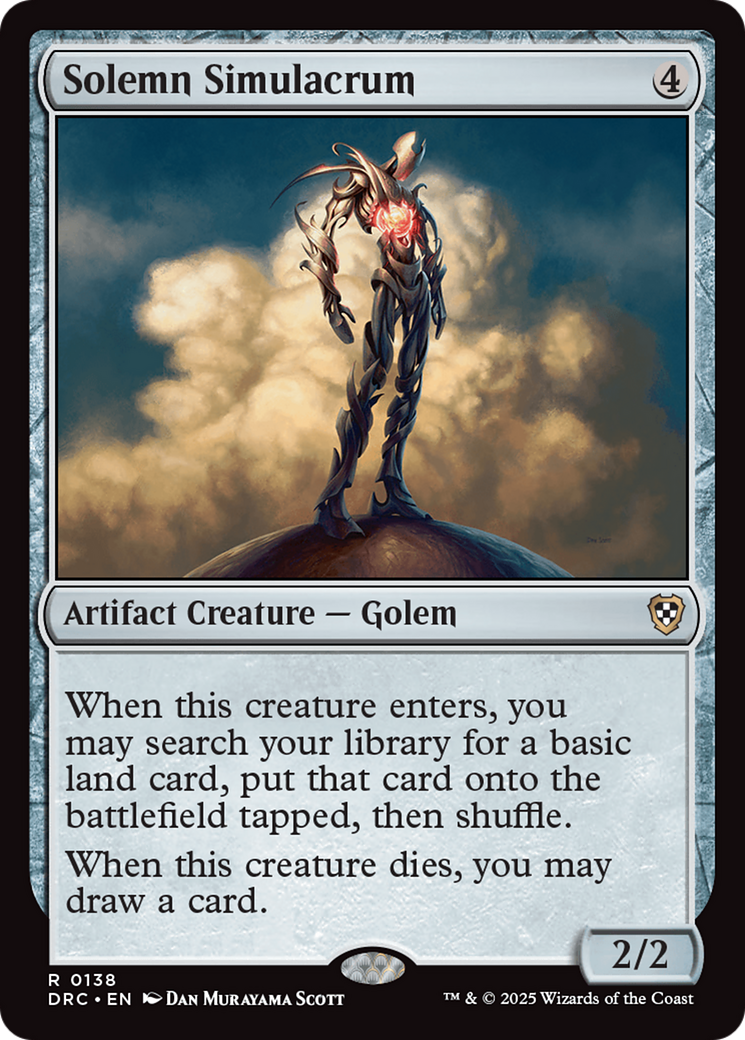
Solemn Simulacrum
Solemn Simulacrum
Artifact Creature — Golem
2/2
When this creature enters, you may search your library for a basic land card, put that card onto the battlefield tapped, then shuffle.
When this creature dies, you may draw a card.
-
1
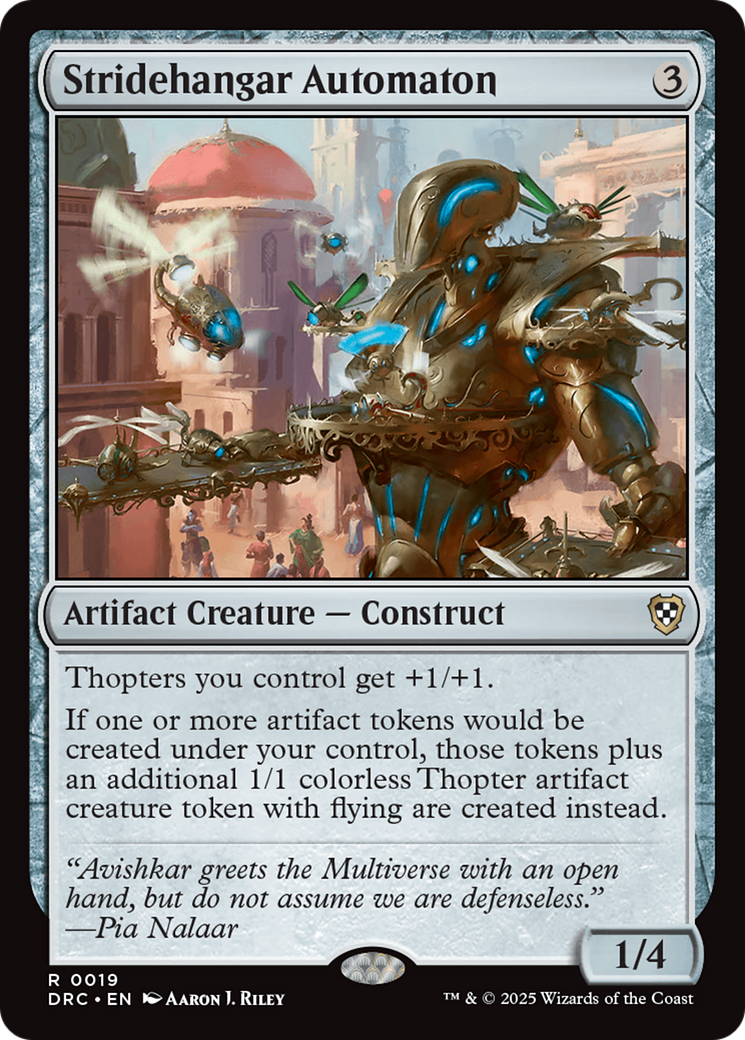
Stridehangar Automaton
Stridehangar Automaton
Artifact Creature — Construct
1/4
Thopters you control get +1/+1.
If one or more artifact tokens would be created under your control, those tokens plus an additional 1/1 colorless Thopter artifact creature token with flying are created instead.
- The additional Thopter token won’t have any abilities the other tokens were created with. Anything else specified in the effect creating the token (such as tapped, attacking, or “Exile that token at end of combat”) applies to both the original tokens and the Thopter. Similarly, if the effect that creates the token has an additional effect that gives the token an ability, such as “That token gains haste,” that effect will also apply to the Thopter.
- You don’t need to control the spell or ability that creates the tokens, but the tokens do need to be created under your control.
- If an effect changes under whose control a token would be created, that effect applies before this creature’s effect applies. If an effect changes under whose control a token would enter the battlefield, that effect applies after this creature’s effect is able to be applied.
- If another effect modifies which or how many tokens you create, you choose the order to apply those effects. For example, if you control this creature and Anointed Procession (“If an effect would create one or more tokens under your control, it creates twice that many of those tokens instead.”), each time you create tokens, you can choose to apply Anointed Procession’s effect to double those tokens first, then apply this creature’s effect to create an additional Thopter token. Or you can choose to apply this creature’s effect first followed by Anointed Procession’s effect, allowing you to create double the original tokens plus two additional Thopter tokens.
- If you copy a permanent spell, that copy becomes a token on the battlefield, but that’s not the same as creating a token. You won’t get an additional Thopter token that way.
-
1
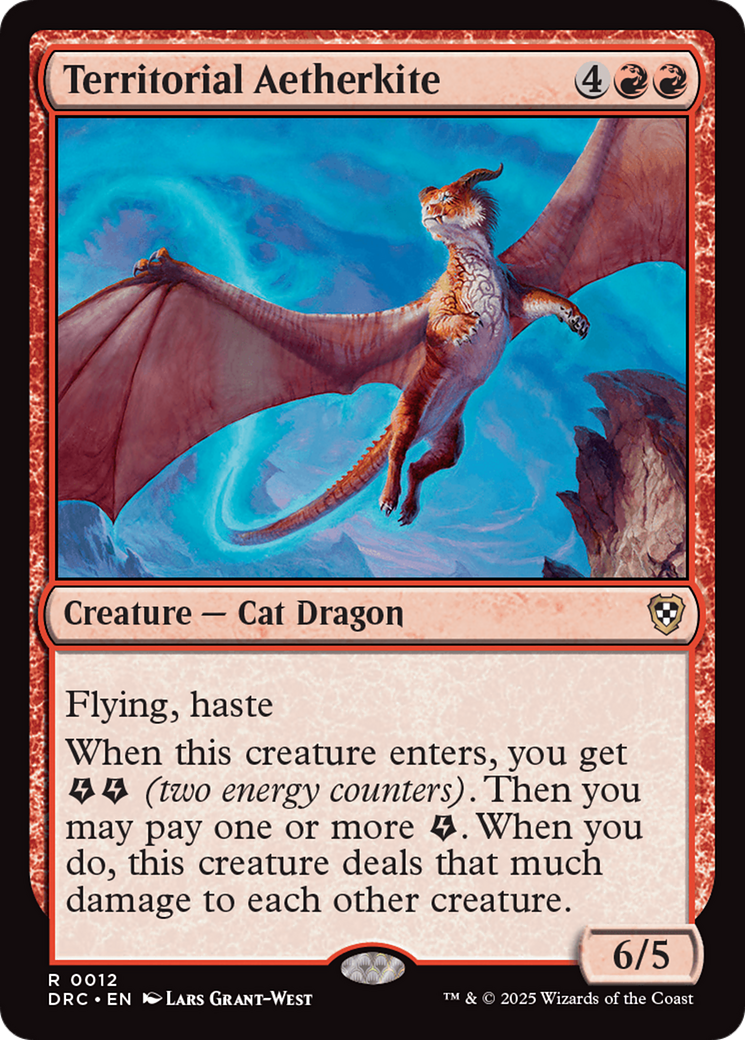
Territorial Aetherkite
Territorial Aetherkite
Creature — Cat Dragon
6/5
Flying, haste
When this creature enters, you get (two energy counters). Then you may pay one or more . When you do, this creature deals that much damage to each other creature.
- is the energy symbol. It represents one energy counter.
- Energy counters are a kind of counter that a player may have. They’re not associated with any specific permanents.
- Keep track of how many energy counters each player has. Potential ways to track this include writing them down on paper or using dice, but any method that is clear and mutually agreeable is fine.
- If an effect says you get one or more , you get that many energy counters. To pay one or more , you lose that many energy counters. You can’t pay more energy counters than you have. Any effects that interact with counters a player gets, has, or loses can interact with energy counters.
- Energy counters aren’t mana. They don’t go away as steps, phases, and turns end, and effects that add mana “of any type” can’t give you energy counters.
- Some spells and abilities say that you “may pay” a certain amount of . You can’t pay that amount multiple times to multiply the effect. You simply choose whether or not to pay that amount of as the ability resolves.
- Some spells and abilities say that you “may pay” a certain amount of , then describes an effect that happens “if you do.” In that case, no player may take actions to try to stop the ability’s effect after you make your choice. If the payment is instead followed by the phrase “when you do” followed by an effect, then after you choose to pay , a new triggered ability called a reflexive trigger is put on the stack, and you choose targets for the reflexive trigger (if the effect asks for targets). Players may respond as normal to this new triggered ability. Once that reflexive trigger resolves, the effect will finally occur.
- Some spells and abilities which give you or say you “may pay” some amount of require one or more targets. If each target chosen is an illegal target as that spell or ability tries to resolve, it won’t resolve. None of its effects will happen, you won’t get any from it, and you won’t get the chance to pay any for its effects even if you want to.
-
1
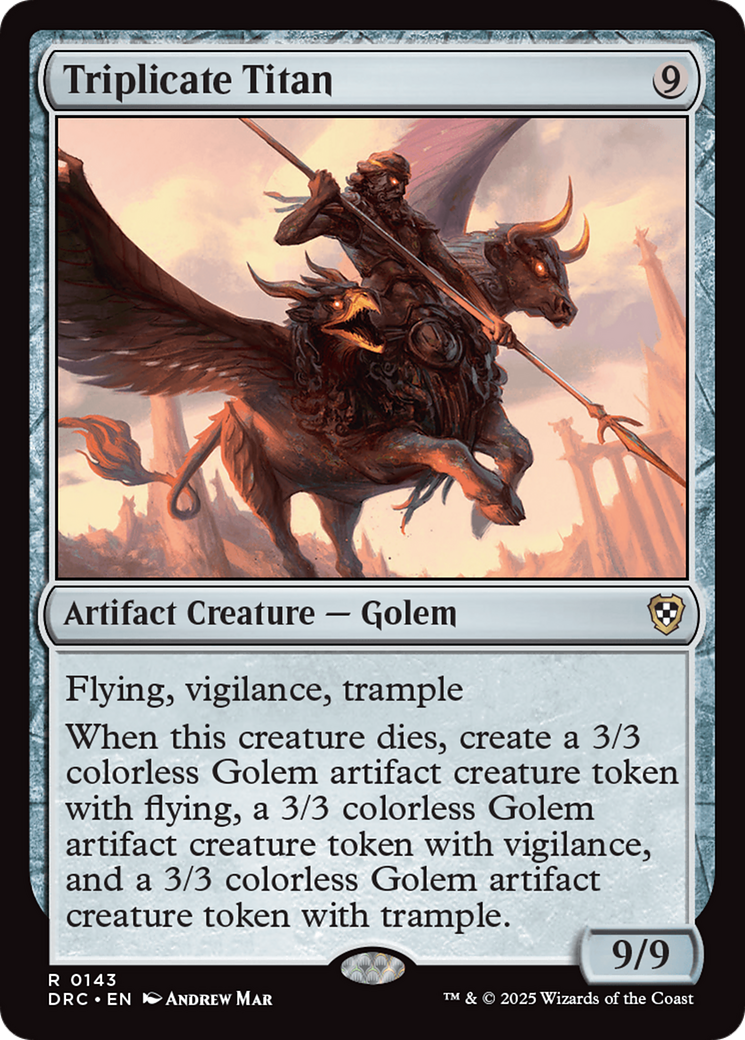
Triplicate Titan
Triplicate Titan
Artifact Creature — Golem
9/9
Flying, vigilance, trample
When this creature dies, create a 3/3 colorless Golem artifact creature token with flying, a 3/3 colorless Golem artifact creature token with vigilance, and a 3/3 colorless Golem artifact creature token with trample.
-
1
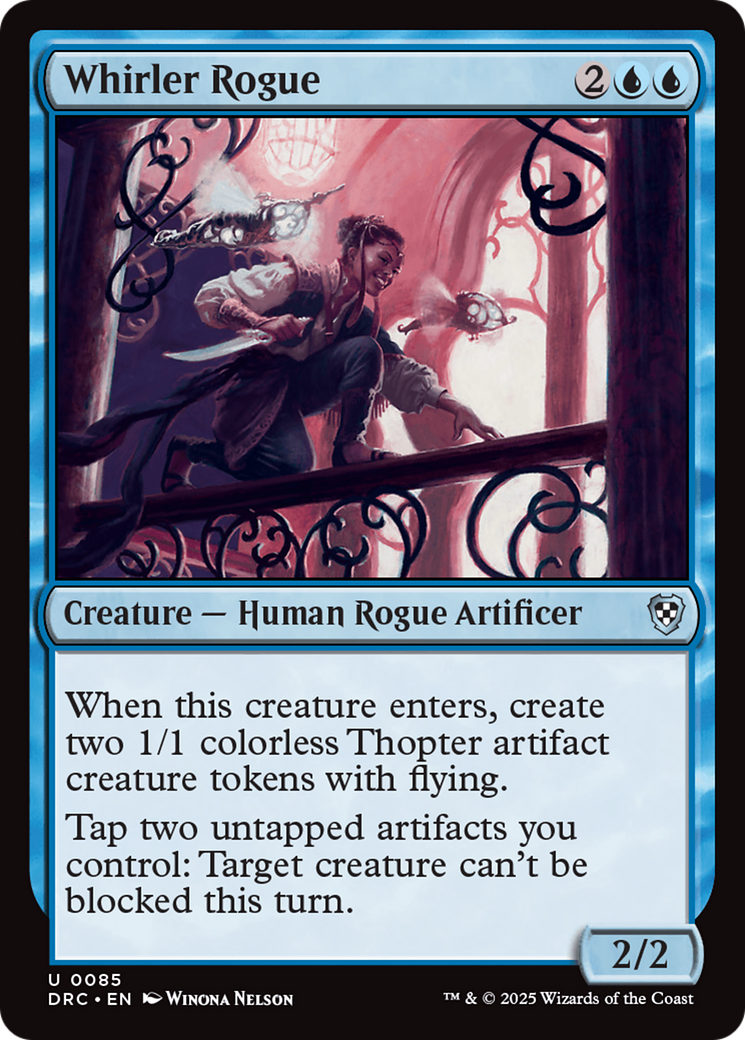
Whirler Rogue
Whirler Rogue
Creature — Human Rogue Artificer
2/2
When this creature enters, create two 1/1 colorless Thopter artifact creature tokens with flying.
Tap two untapped artifacts you control: Target creature can't be blocked this turn.
- You may tap any two untapped artifacts you control, including artifact creatures that haven't been under your control continuously since the beginning of your most recent turn.
- Activating the second ability of Whirler Rogue after a creature has become blocked won't cause it to become unblocked.
-
1
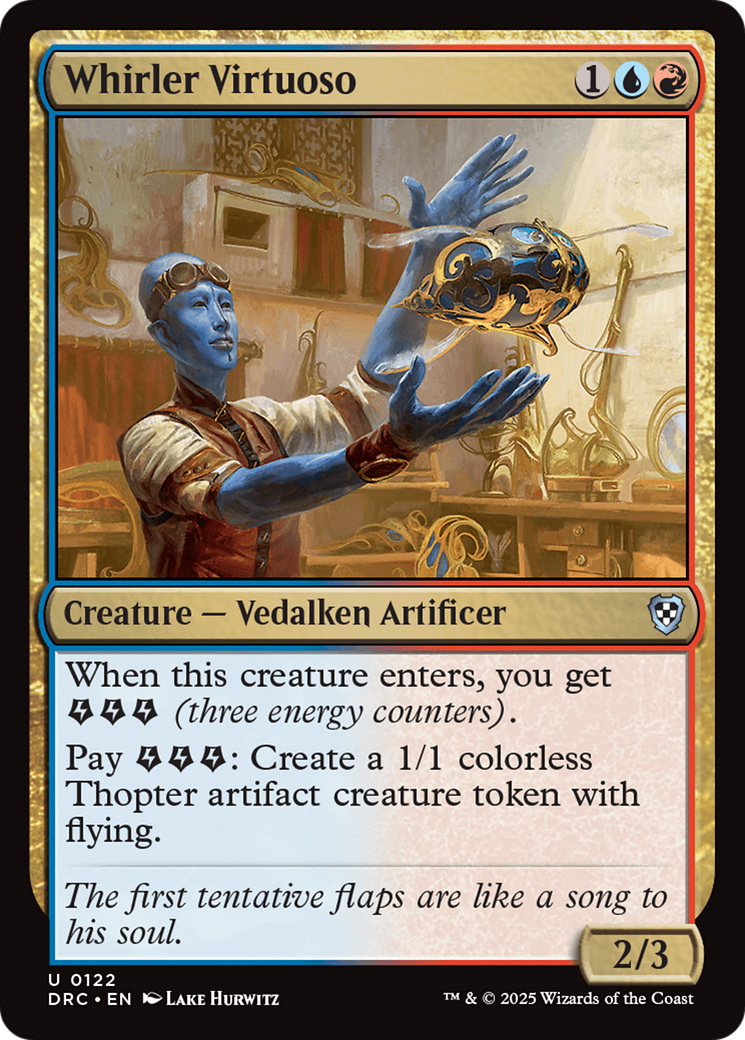
Whirler Virtuoso
Whirler Virtuoso
Creature — Vedalken Artificer
2/3
When this creature enters, you get (three energy counters).
Pay : Create a 1/1 colorless Thopter artifact creature token with flying.
- is the energy symbol. It represents one energy counter.
- Energy counters are a kind of counter that a player may have. They're not associated with any specific permanents.
- Keep track of how many energy counters each player has. Potential ways to track this include writing theme down on paper or using dice, but any method that is clear and mutually agreeable is fine. (At higher levels of tournament play, dice may not be allowed for tracking counters that players have.)
- If an effect says you get one or more , you get that many energy counters. To pay one or more , you lose that many energy counters. You can't pay more energy counters than you have. Any effects that interact with counters a player gets, has, or loses can interact with energy counters.
- Energy counters aren't mana. They don't go away as steps, phases, and turns end, and effects that add mana "of any type" can't give you energy counters.
- Some triggered abilities state that you "may pay" a certain amount of . You can't pay that amount multiple times to multiply the effect. You simply choose whether or not to pay that amount of as the ability resolves.
- Some triggered abilities that state that you "may pay" a certain amount of describe an effect that happens "If you do." In that case, no player may take actions to try to stop the ability's effect after you make your choice. If the payment is followed by the phrase "When you do," then you'll choose any targets for that reflexive triggered ability and put it on the stack before players can take actions.
- If a spell or ability with one or more targets states that you "may pay" some amount of , and each permanent that it targets has become an illegal target, the spell or ability won't resolve. You can't pay any even if you want to.
- Some spells and abilities that give you may require targets. If each target chosen is an illegal target as that spell or ability tries to resolve, it won't resolve. You won't get any .
Instants 5
-
1
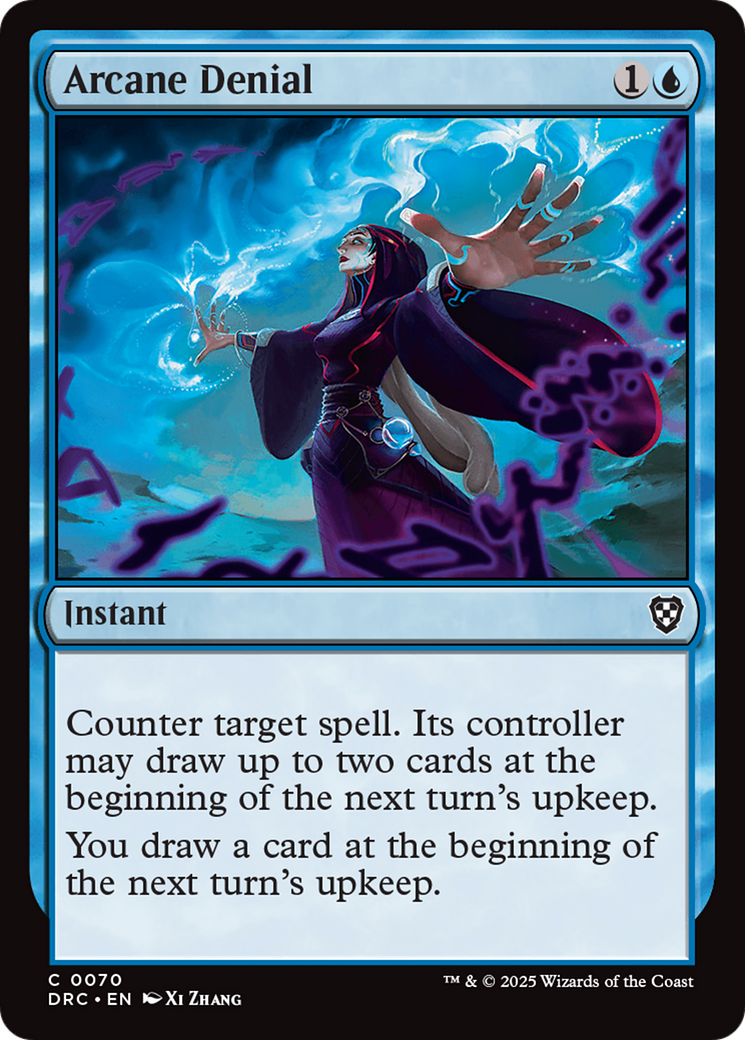
Arcane Denial
Arcane Denial
Instant
Counter target spell. Its controller may draw up to two cards at the beginning of the next turn's upkeep.
You draw a card at the beginning of the next turn's upkeep.
- The controller of the countered spell doesn't choose how many cards to draw until the relevant ability resolves. The player may draw 0, 1, or 2 cards. They choose the number before drawing any cards.
-
1
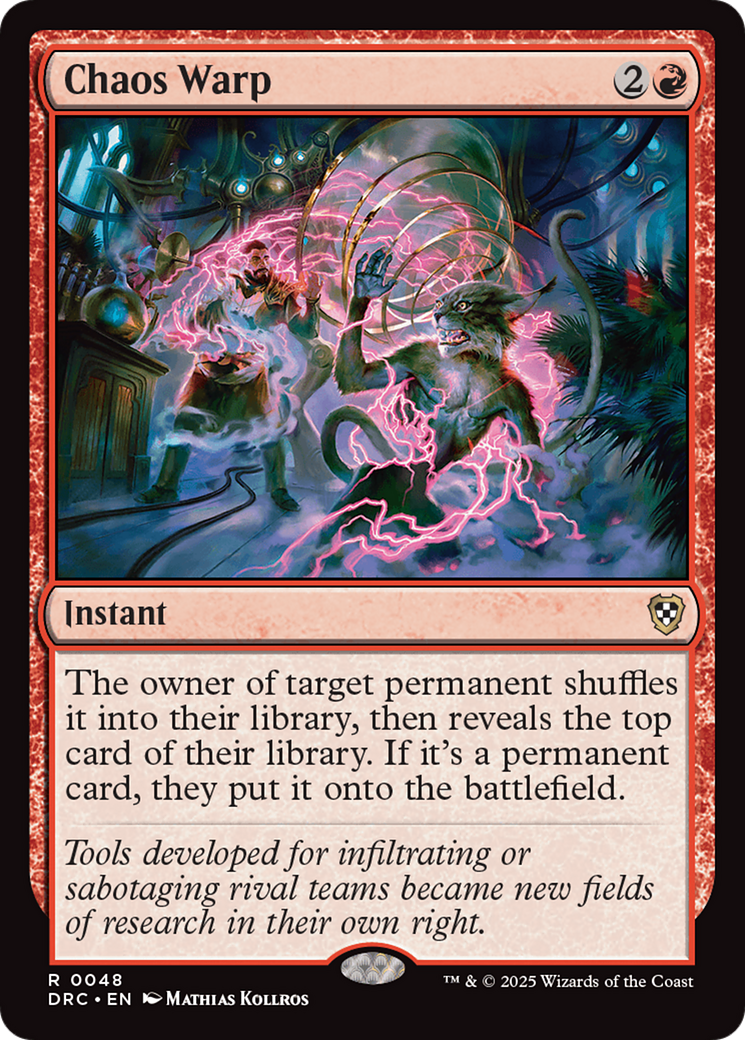
Chaos Warp
Chaos Warp
Instant
The owner of target permanent shuffles it into their library, then reveals the top card of their library. If it's a permanent card, they put it onto the battlefield.
- The owner of a token is the player under whose control the token was put onto the battlefield. If a token is shuffled into a player's library this way, that player shuffles before revealing the top card of that library.
- If the permanent is an illegal target by the time Chaos Warp tries to resolve, it won't resolve and none of its effects will occur. No library will be shuffled and no card will be revealed.
- A permanent card is a card with one or more of the following card types: artifact, creature, enchantment, land, or planeswalker.
- If the revealed card is a permanent card but can't enter (perhaps because it's an Aura with nothing to enchant), it remains on top of that library.
- If the revealed card is not a permanent card, it remains on top of that library.
-
1
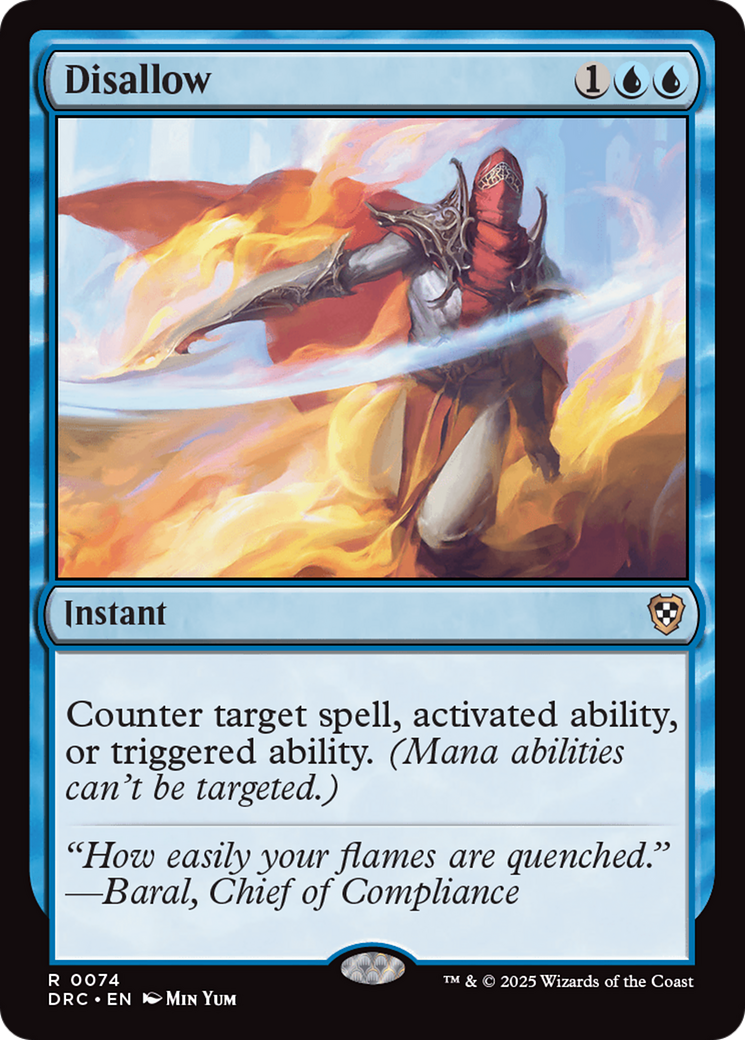
Disallow
Disallow
Instant
Counter target spell, activated ability, or triggered ability. (Mana abilities can't be targeted.)
- There are many important moments in the story, but the most crucial—called "story spotlights"—are shown on cards. These cards have the Planeswalker symbol in their text box; this symbol has no effect on gameplay. You can read more about these events in the official Magic fiction at http://www.mtgstory.com.
- Activated abilities are written in the form "Cost: Effect." Some keyword abilities, such as equip and crew, are activated abilities and will have colons in their reminder texts.
- Triggered abilities use the word "when," "whenever," or "at." They're often written as "[Trigger condition], [effect]." Some keyword abilities, such as prowess and fabricate, are triggered abilities and will have "when," "whenever," or "at" in their reminder text.
- If you counter a delayed triggered ability that triggers at the beginning of the "next" occurrence of a specified step or phase, that ability won't trigger again the following time that phase or step occurs.
- An activated mana ability is one that could add mana as it resolves, doesn't have a target, and isn't a loyalty ability. A triggered mana ability is one that could add mana and triggers on an activated mana ability.
- Abilities that create replacement effects, such as a permanent entering the battlefield tapped or with counters on it, can't be targeted. Abilities that apply "as [this creature] enters the battlefield" are also replacement effects and can't be targeted.
-
1
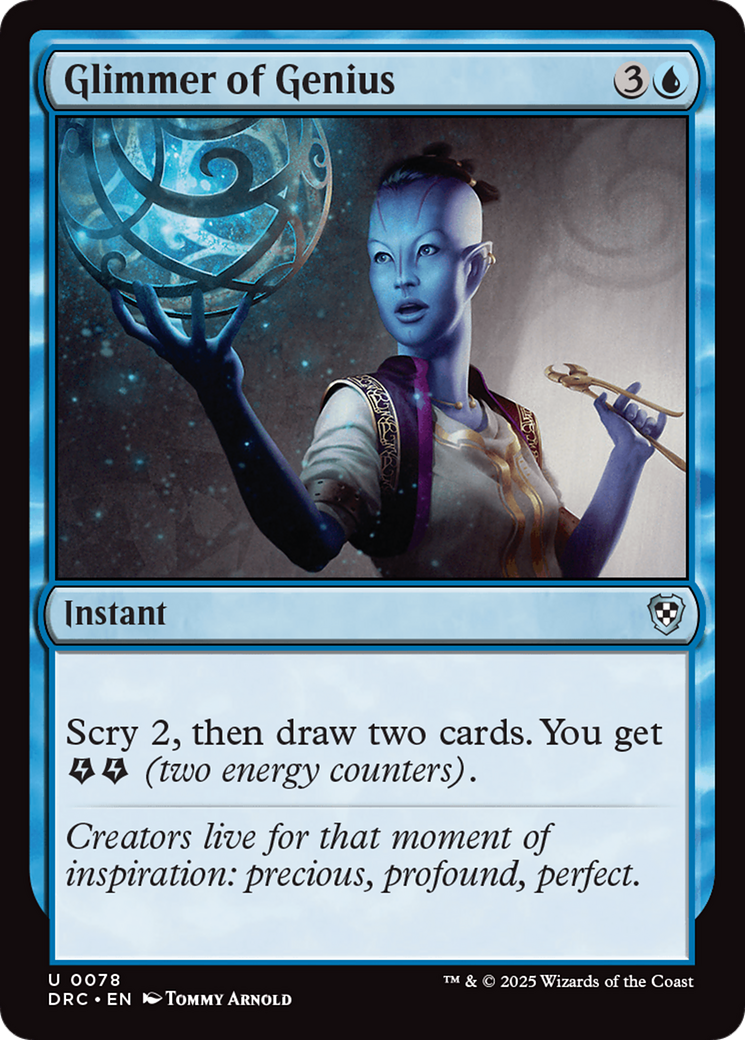
Glimmer of Genius
Glimmer of Genius
Instant
Scry 2, then draw two cards. You get (two energy counters).
- is the energy symbol. It represents one energy counter.
- Energy counters are a kind of counter that a player may have. They're not associated with any specific permanents.
- Keep track of how many energy counters each player has. Potential ways to track this include writing theme down on paper or using dice, but any method that is clear and mutually agreeable is fine. (At higher levels of tournament play, dice may not be allowed for tracking counters that players have.)
- If an effect says you get one or more , you get that many energy counters. To pay one or more , you lose that many energy counters. You can't pay more energy counters than you have. Any effects that interact with counters a player gets, has, or loses can interact with energy counters.
- Energy counters aren't mana. They don't go away as steps, phases, and turns end, and effects that add mana "of any type" can't give you energy counters.
- Some triggered abilities state that you "may pay" a certain amount of . You can't pay that amount multiple times to multiply the effect. You simply choose whether or not to pay that amount of as the ability resolves.
- Some triggered abilities that state that you "may pay" a certain amount of describe an effect that happens "If you do." In that case, no player may take actions to try to stop the ability's effect after you make your choice. If the payment is followed by the phrase "When you do," then you'll choose any targets for that reflexive triggered ability and put it on the stack before players can take actions.
- If a spell or ability with one or more targets states that you "may pay" some amount of , and each permanent that it targets has become an illegal target, the spell or ability won't resolve. You can't pay any even if you want to.
- Some spells and abilities that give you may require targets. If each target chosen is an illegal target as that spell or ability tries to resolve, it won't resolve. You won't get any .
-
1
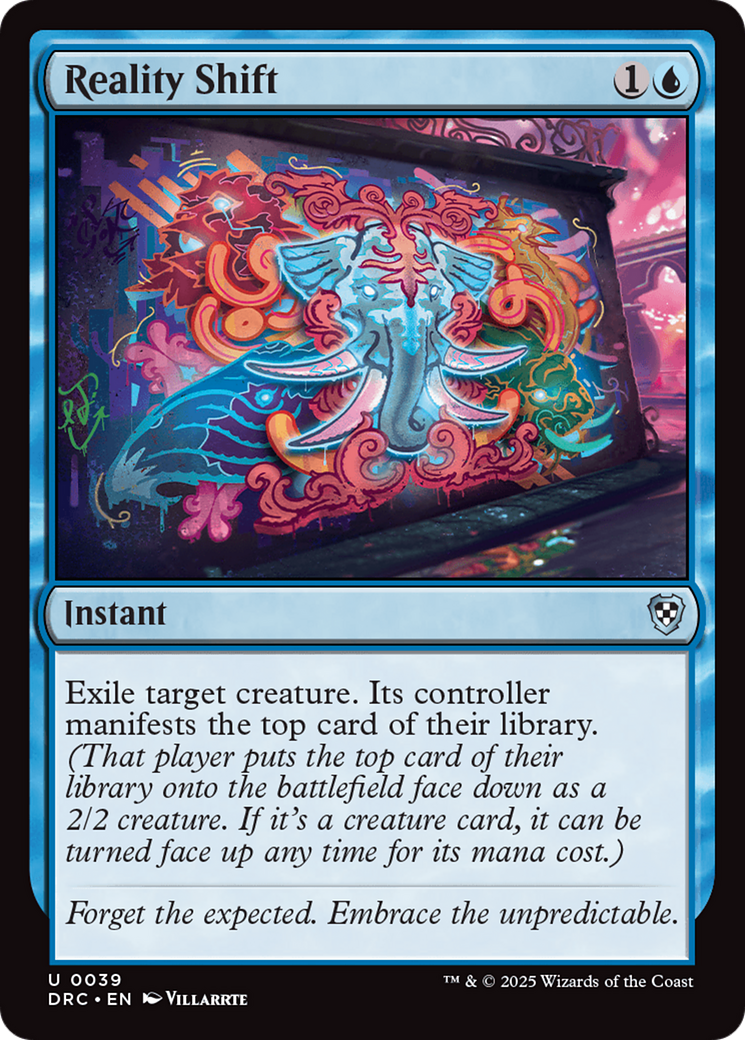
Reality Shift
Reality Shift
Instant
Exile target creature. Its controller manifests the top card of their library. (That player puts the top card of their library onto the battlefield face down as a 2/2 creature. If it's a creature card, it can be turned face up any time for its mana cost.)
- The face-down permanent is a 2/2 creature with no name, mana cost, creature types, or abilities. It's colorless and has a mana value of 0. Other effects that apply to the permanent can still grant or change any of these characteristics.
- Any time you have priority, you may turn a manifested creature face up by revealing that it's a creature card (ignoring any copy effects or type-changing effects that might be applying to it) and paying its mana cost. This is a special action. It doesn't use the stack and can't be responded to.
- If a manifested creature would have morph if it were face up, you may also turn it face up by paying its morph cost.
- Unlike a face-down creature that was cast using the morph ability, a manifested creature may still be turned face up after it loses its abilities if it's a creature card.
- Because the permanent is on the battlefield both before and after it's turned face up, turning a permanent face up doesn't cause any enters-the-battlefield abilities to trigger.
- Because face-down creatures don't have names, they can't have the same name as any other creature, even another face-down creature.
- A permanent that turns face up or face down changes characteristics but is otherwise the same permanent. Spells and abilities that were targeting that permanent, as well as Auras and Equipment that were attached to the permanent, aren't affected.
- Turning a permanent face up or face down doesn't change whether that permanent is tapped or untapped.
- At any time, you can look at a face-down permanent you control. You can't look at face-down permanents you don't control unless an effect allows you to or instructs you to.
- If a face-down permanent you control leaves the battlefield, you must reveal it. You must also reveal all face-down spells and permanents you control if you leave the game or if the game ends.
- You must ensure that your face-down spells and permanents can easily be differentiated from each other. You're not allowed to mix up the cards that represent them on the battlefield in order to confuse other players. The order they entered the battlefield should remain clear. Common methods for indicating this include using markers or dice, or simply placing them in order on the battlefield. You must also track how each became face down (manifested, cast face down using the morph ability, and so on).
- There are no cards in the Fate Reforged set that would turn a face-down instant or sorcery card on the battlefield face up, but some older cards can try to do this. If something tries to turn a face-down instant or sorcery card on the battlefield face up, reveal that card to show all players it's an instant or sorcery card. The permanent remains on the battlefield face down. Abilities that trigger when a permanent turns face up won't trigger, because even though you revealed the card, it never turned face up.
- If a double-faced card is manifested, it will be put onto the battlefield face down. While face down, it can't transform. If the front face of the card is a creature card, you can turn it face up by paying its mana cost. If you do, its front face will be up.
Sorceries 6
-
1
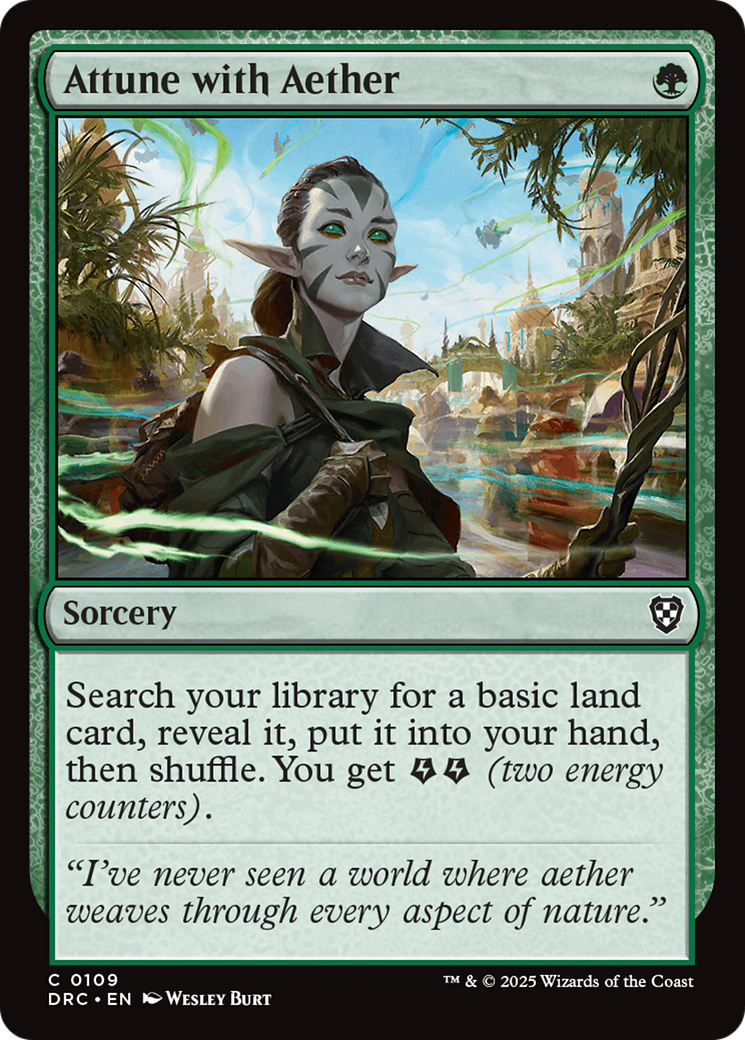
Attune with Aether
Attune with Aether
Sorcery
Search your library for a basic land card, reveal it, put it into your hand, then shuffle. You get (two energy counters).
- is the energy symbol. It represents one energy counter.
- Energy counters are a kind of counter that a player may have. They're not associated with any specific permanents.
- Keep track of how many energy counters each player has. Potential ways to track this include writing theme down on paper or using dice, but any method that is clear and mutually agreeable is fine. (At higher levels of tournament play, dice may not be allowed for tracking counters that players have.)
- If an effect says you get one or more , you get that many energy counters. To pay one or more , you lose that many energy counters. You can't pay more energy counters than you have. Any effects that interact with counters a player gets, has, or loses can interact with energy counters.
- Energy counters aren't mana. They don't go away as steps, phases, and turns end, and effects that add mana "of any type" can't give you energy counters.
- Some triggered abilities state that you "may pay" a certain amount of . You can't pay that amount multiple times to multiply the effect. You simply choose whether or not to pay that amount of as the ability resolves.
- Some triggered abilities that state that you "may pay" a certain amount of describe an effect that happens "If you do." In that case, no player may take actions to try to stop the ability's effect after you make your choice. If the payment is followed by the phrase "When you do," then you'll choose any targets for that reflexive triggered ability and put it on the stack before players can take actions.
- If a spell or ability with one or more targets states that you "may pay" some amount of , and each permanent that it targets has become an illegal target, the spell or ability won't resolve. You can't pay any even if you want to.
- Some spells and abilities that give you may require targets. If each target chosen is an illegal target as that spell or ability tries to resolve, it won't resolve. You won't get any .
-
1
Blasphemous Act
Blasphemous Act
Sorcery
This spell costs less to cast for each creature on the battlefield.
Blasphemous Act deals 13 damage to each creature.
- To determine the total cost of a spell, start with the mana cost or alternative cost you're paying, add any cost increases, then apply any cost reductions (such as that of Blasphemous Act). The mana value of the spell is determined only by its mana cost, no matter what the total cost to cast the spell was.
- Blasphemous Act's ability can't reduce the total cost to cast the spell below .
- The total cost to cast Blasphemous Act is locked in before you pay that cost. For example, if there are three creatures on the battlefield, including one you can sacrifice to add , the total cost of Blasphemous Act is . Then you can sacrifice the creature when you activate mana abilities just before paying the cost.
- Although players may respond to Blasphemous Act once it's been cast, once it's announced, they can't respond before the cost is calculated and paid.
-
1
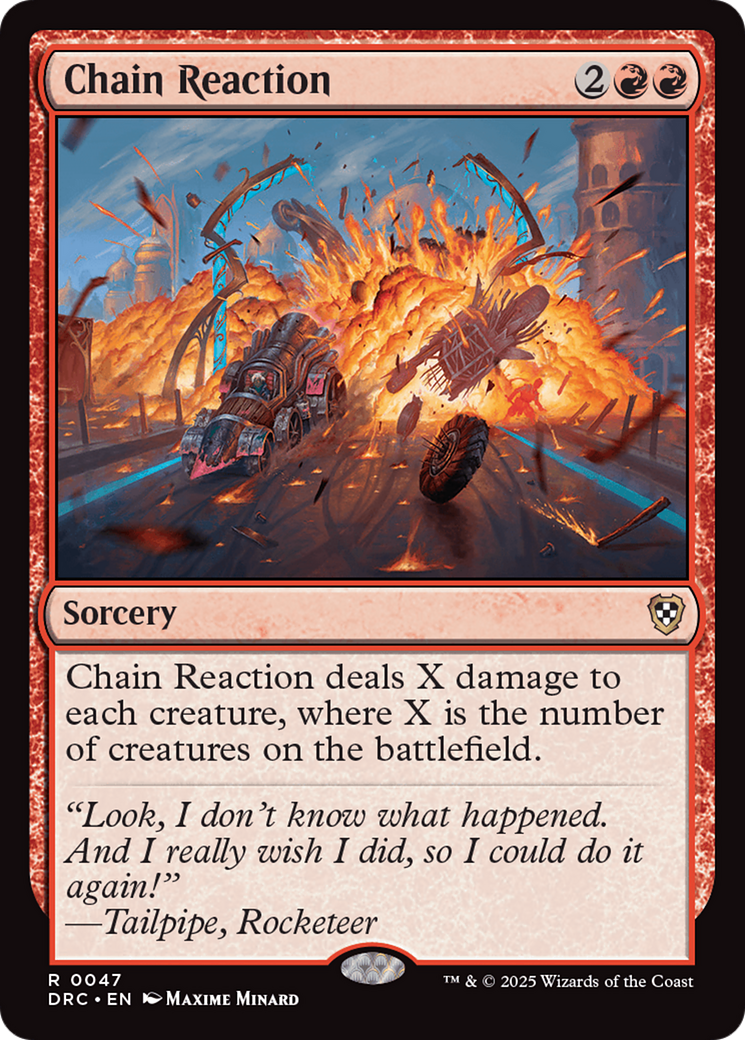
Chain Reaction
Chain Reaction
Sorcery
Chain Reaction deals X damage to each creature, where X is the number of creatures on the battlefield.
- The value of X is determined as Chain Reaction resolves.
-
1
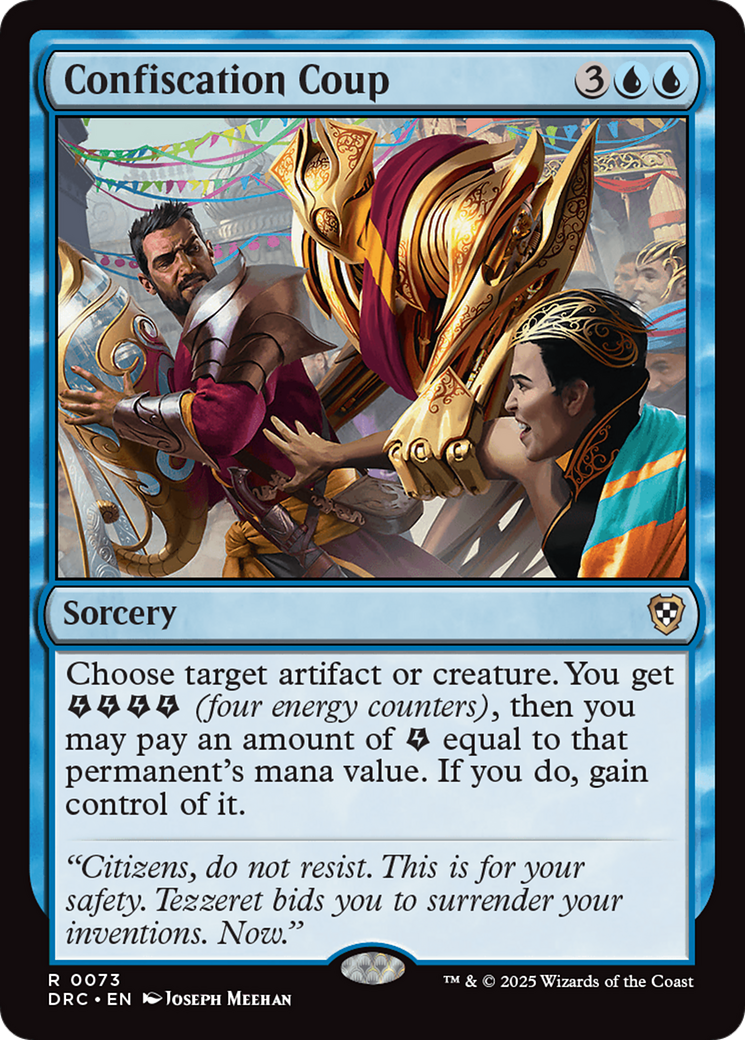
Confiscation Coup
Confiscation Coup
Sorcery
Choose target artifact or creature. You get (four energy counters), then you may pay an amount of equal to that permanent's mana value. If you do, gain control of it.
- Some spells and abilities that give you may require targets. If each target chosen is an illegal target as that spell or ability tries to resolve, it won't resolve. You won't get any .
- Keep track of how many energy counters each player has. Potential ways to track this include writing theme down on paper or using dice, but any method that is clear and mutually agreeable is fine. (At higher levels of tournament play, dice may not be allowed for tracking counters that players have.)
- If an effect says you get one or more , you get that many energy counters. To pay one or more , you lose that many energy counters. You can't pay more energy counters than you have. Any effects that interact with counters a player gets, has, or loses can interact with energy counters.
- Energy counters aren't mana. They don't go away as steps, phases, and turns end, and effects that add mana "of any type" can't give you energy counters.
- Some triggered abilities state that you "may pay" a certain amount of . You can't pay that amount multiple times to multiply the effect. You simply choose whether or not to pay that amount of as the ability resolves.
- Some triggered abilities that state that you "may pay" a certain amount of describe an effect that happens "If you do." In that case, no player may take actions to try to stop the ability's effect after you make your choice. If the payment is followed by the phrase "When you do," then you'll choose any targets for that reflexive triggered ability and put it on the stack before players can take actions.
- If a spell or ability with one or more targets states that you "may pay" some amount of , and each permanent that it targets has become an illegal target, the spell or ability won't resolve. You can't pay any even if you want to.
- is the energy symbol. It represents one energy counter.
- Energy counters are a kind of counter that a player may have. They're not associated with any specific permanents.
- There are many important moments in the story, but the most crucial—called "story spotlights"—are shown on cards. These cards have the Planeswalker symbol in their text box; this symbol has no effect on gameplay. You can read more about these events in the official Magic fiction at http://www.mtgstory.com.
- If the target artifact or creature has a mana value of 0, you may choose to pay zero energy and gain control of it.
- If a permanent has in its mana cost, X is considered to be 0.
- The mana value of a token that isn't a copy of another object is 0. A token that is a copy of another object has the same mana cost as that object.
- In a multiplayer game, if a permanent's owner leaves the game after you've gained control of it, the permanent leaves with that player. If you leave the game before that player, the control-change effect ends.
- You choose the target artifact or creature as you cast Confiscation Coup. You don't choose whether or not to pay an amount of until Confiscation Coup resolves. If the target becomes an illegal target, Confiscation Coup won't resolve and you won't get .
-
1
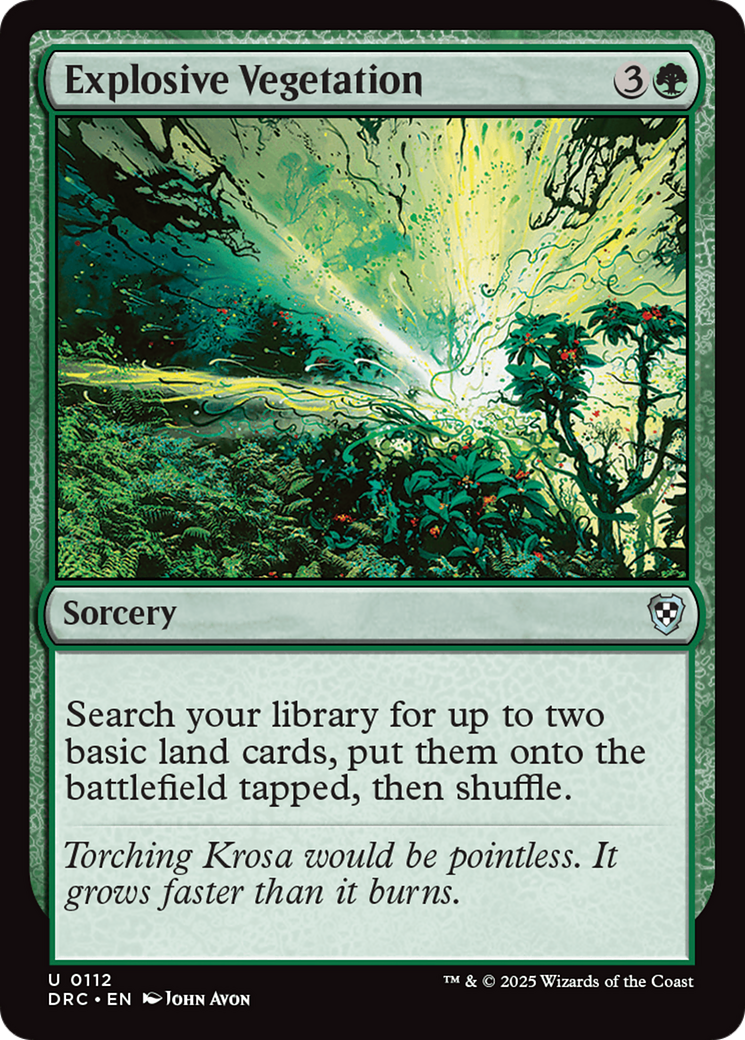
Explosive Vegetation
Explosive Vegetation
Sorcery
Search your library for up to two basic land cards, put them onto the battlefield tapped, then shuffle.
-
1
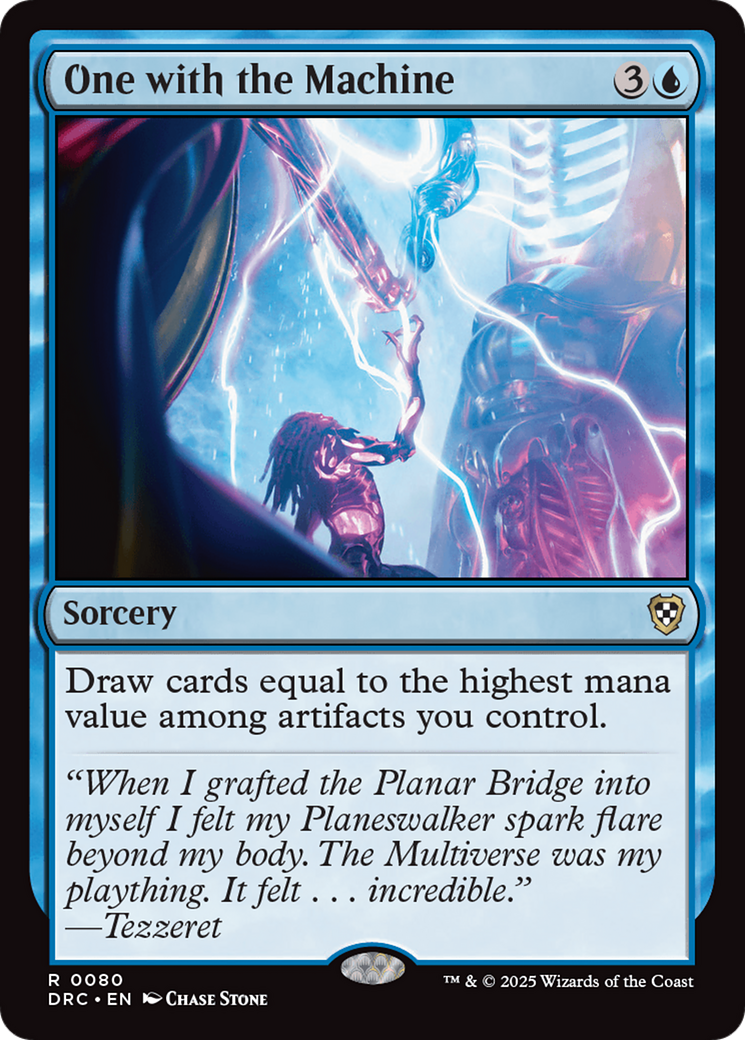
One with the Machine
One with the Machine
Sorcery
Draw cards equal to the highest mana value among artifacts you control.
- If a permanent has in its mana cost, X is considered to be 0.
Artifacts 20
-
1
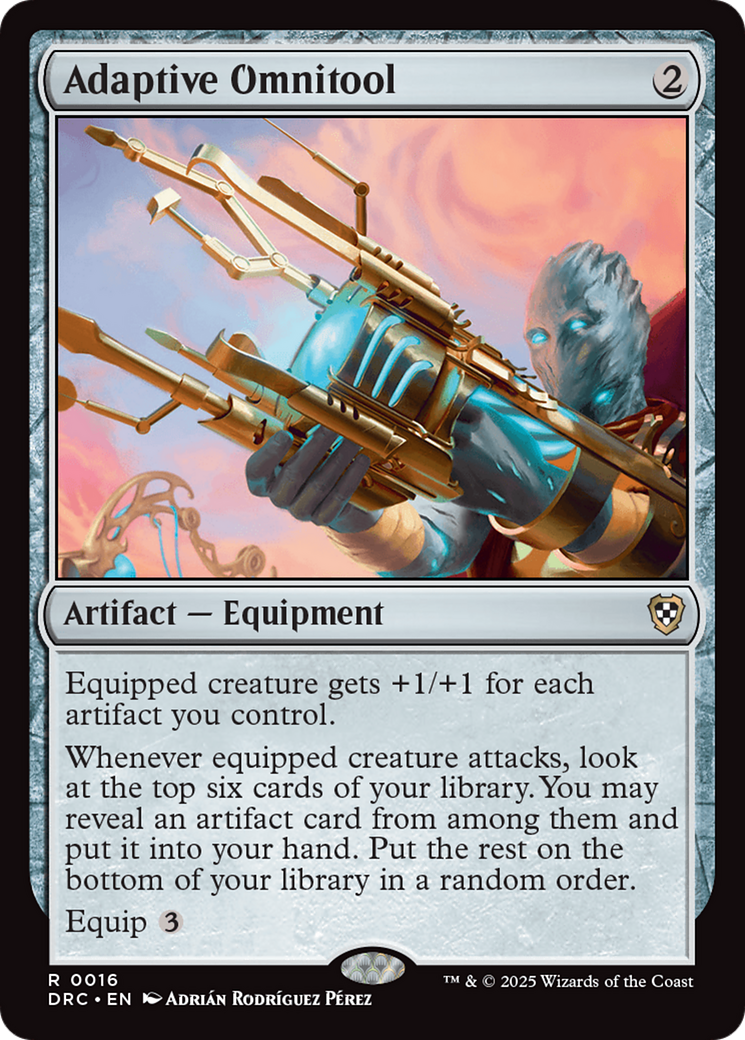
Adaptive Omnitool
Adaptive Omnitool
Artifact — Equipment
Equipped creature gets +1/+1 for each artifact you control.
Whenever equipped creature attacks, look at the top six cards of your library. You may reveal an artifact card from among them and put it into your hand. Put the rest on the bottom of your library in a random order.
Equip
-
1
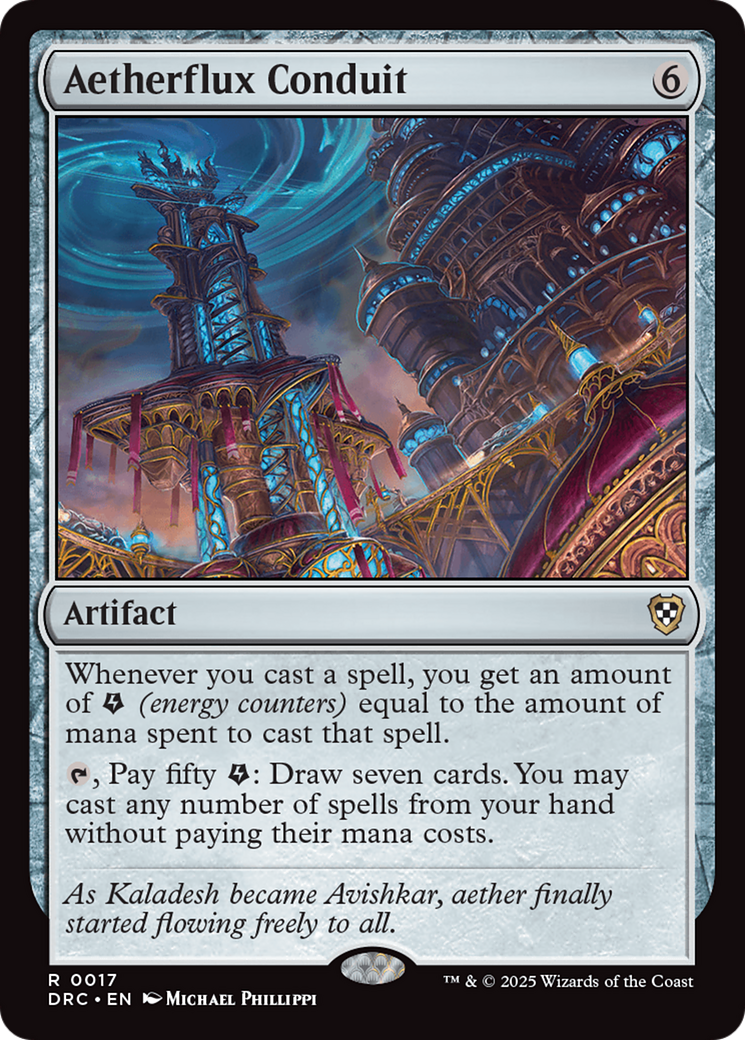
Aetherflux Conduit
Aetherflux Conduit
Artifact
Whenever you cast a spell, you get an amount of (energy counters) equal to the amount of mana spent to cast that spell.
, Pay fifty : Draw seven cards. You may cast any number of spells from your hand without paying their mana costs.
- is the energy symbol. It represents one energy counter.
- Energy counters are a kind of counter that a player may have. They’re not associated with any specific permanents.
- Keep track of how many energy counters each player has. Potential ways to track this include writing them down on paper or using dice, but any method that is clear and mutually agreeable is fine.
- If an effect says you get one or more , you get that many energy counters. To pay one or more , you lose that many energy counters. You can’t pay more energy counters than you have. Any effects that interact with counters a player gets, has, or loses can interact with energy counters.
- Energy counters aren’t mana. They don’t go away as steps, phases, and turns end, and effects that add mana “of any type” can’t give you energy counters.
- Some spells and abilities say that you “may pay” a certain amount of . You can’t pay that amount multiple times to multiply the effect. You simply choose whether or not to pay that amount of as the ability resolves.
- Some spells and abilities say that you “may pay” a certain amount of , then describes an effect that happens “if you do.” In that case, no player may take actions to try to stop the ability’s effect after you make your choice. If the payment is instead followed by the phrase “when you do” followed by an effect, then after you choose to pay , a new triggered ability called a reflexive trigger is put on the stack, and you choose targets for the reflexive trigger (if the effect asks for targets). Players may respond as normal to this new triggered ability. Once that reflexive trigger resolves, the effect will finally occur.
- Some spells and abilities which give you or say you “may pay” some amount of require one or more targets. If each target chosen is an illegal target as that spell or ability tries to resolve, it won’t resolve. None of its effects will happen, you won’t get any from it, and you won’t get the chance to pay any for its effects even if you want to.
-
1
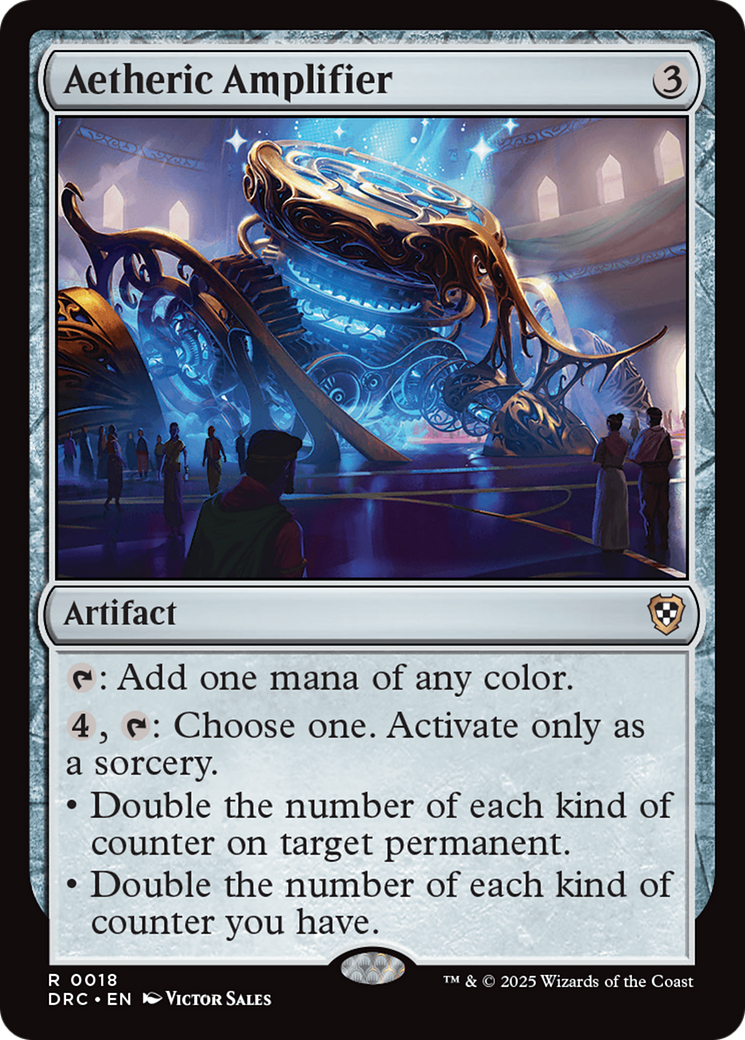
Aetheric Amplifier
Aetheric Amplifier
Artifact
: Add one mana of any color.
, : Choose one. Activate only as a sorcery.
- Double the number of each kind of counter on target permanent.
- Double the number of each kind of counter you have.
- To double the number of a kind of counters on a permanent, put a number of that kind of counters on it equal to the number it already has. Other cards that interact with putting counters on it will interact with this effect accordingly. The same is true for doubling the number of counters on a player.
-
1
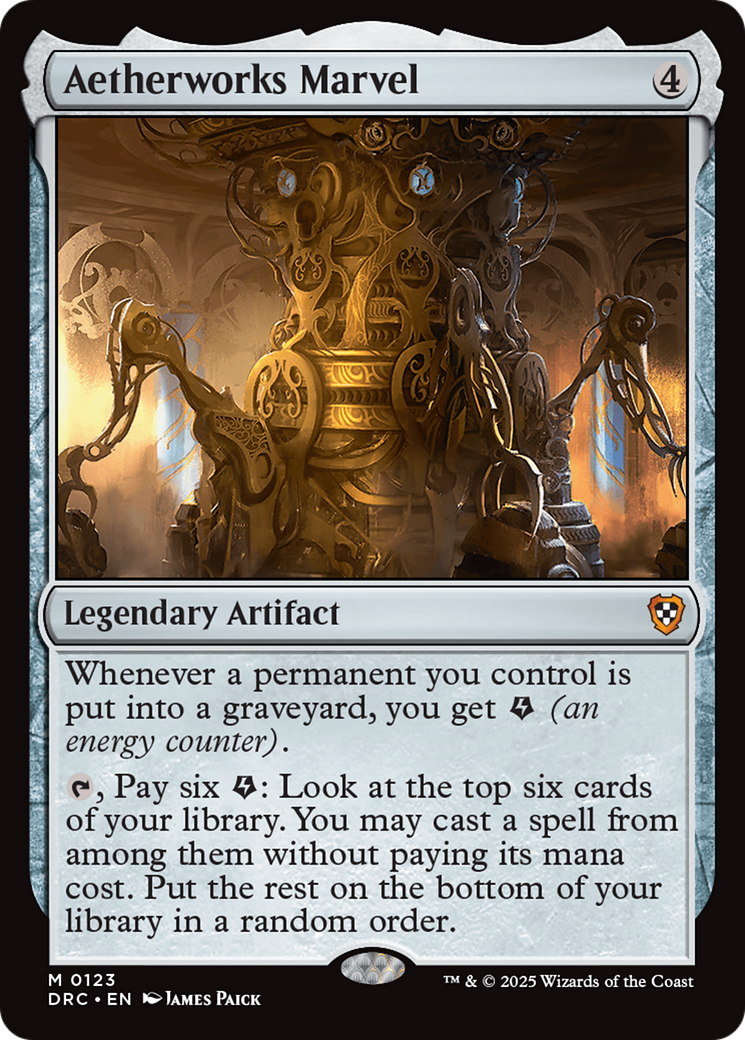
Aetherworks Marvel
Aetherworks Marvel
Legendary Artifact
Whenever a permanent you control is put into a graveyard, you get (an energy counter).
, Pay six : Look at the top six cards of your library. You may cast a spell from among them without paying its mana cost. Put the rest on the bottom of your library in a random order.
- Some spells and abilities that give you may require targets. If each target chosen is an illegal target as that spell or ability tries to resolve, it won't resolve. You won't get any .
- If an effect says you get one or more , you get that many energy counters. To pay one or more , you lose that many energy counters. You can't pay more energy counters than you have. Any effects that interact with counters a player gets, has, or loses can interact with energy counters.
- Energy counters aren't mana. They don't go away as steps, phases, and turns end, and effects that add mana "of any type" can't give you energy counters.
- Some triggered abilities state that you "may pay" a certain amount of . You can't pay that amount multiple times to multiply the effect. You simply choose whether or not to pay that amount of as the ability resolves.
- Some triggered abilities that state that you "may pay" a certain amount of describe an effect that happens "If you do." In that case, no player may take actions to try to stop the ability's effect after you make your choice. If the payment is followed by the phrase "When you do," then you'll choose any targets for that reflexive triggered ability and put it on the stack before players can take actions.
- If a spell or ability with one or more targets states that you "may pay" some amount of , and each permanent that it targets has become an illegal target, the spell or ability won't resolve. You can't pay any even if you want to.
- is the energy symbol. It represents one energy counter.
- Energy counters are a kind of counter that a player may have. They're not associated with any specific permanents.
- Keep track of how many energy counters each player has. Potential ways to track this include writing theme down on paper or using dice, but any method that is clear and mutually agreeable is fine. (At higher levels of tournament play, dice may not be allowed for tracking counters that players have.)
- Tokens that are sacrificed or destroyed are put into their owner's graveyard before ceasing to exist. If you controlled the token, Aetherworks Marvel's first ability will trigger.
- The card cast with Aetherworks Marvel's second ability is cast from your library.
- If you cast a card "without paying its mana cost," you can't choose to cast it for any alternative costs, such as emerge costs. You can, however, pay additional costs. If the card has any mandatory additional costs, such as that of Incendiary Sabotage, you must pay those to cast the card.
- If the card has in its mana cost, you must choose 0 as the value of X when casting it without paying its mana cost.
- Aetherworks Marvel's first ability triggers whenever any permanent you control is put into a graveyard from the battlefield, including Aetherworks Marvel itself and other permanents put into a graveyard at the same time as it.
-
1
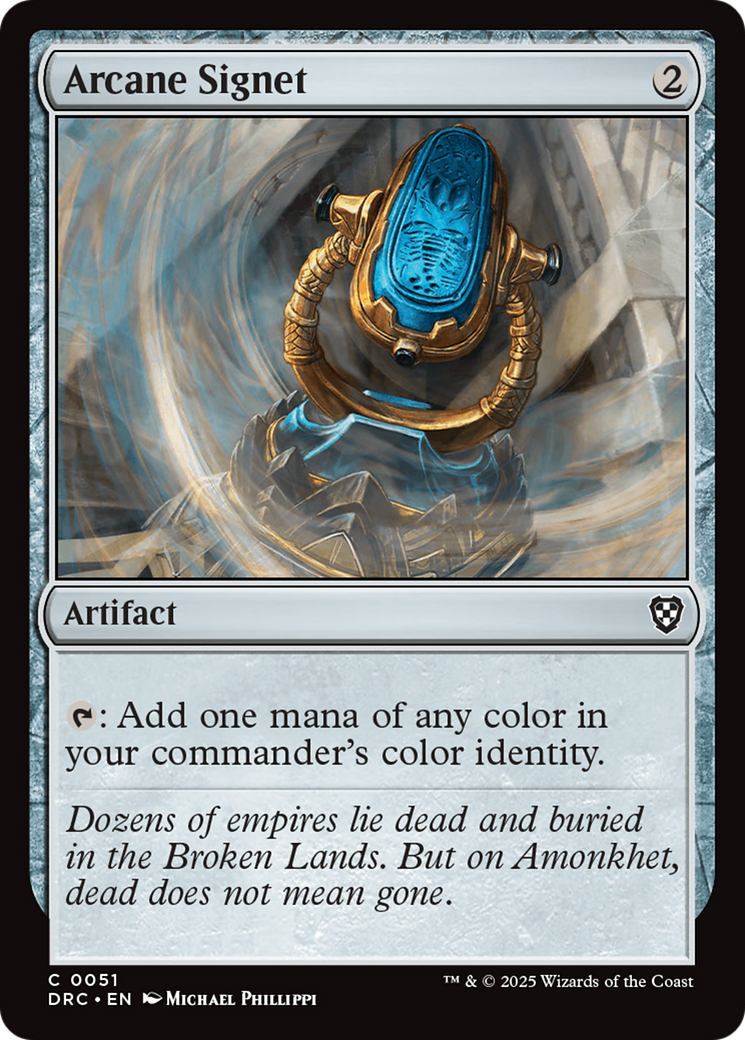
Arcane Signet
Arcane Signet
Artifact
: Add one mana of any color in your commander's color identity.
- If you have two commanders, the ability adds one mana of any color in their combined color identities.
- If your commander is a card that has no colors in its color identity, Arcane Signet's ability produces no mana. It doesn't produce .
- If you don't have a commander, Arcane Signet's ability produces no mana.
-
1
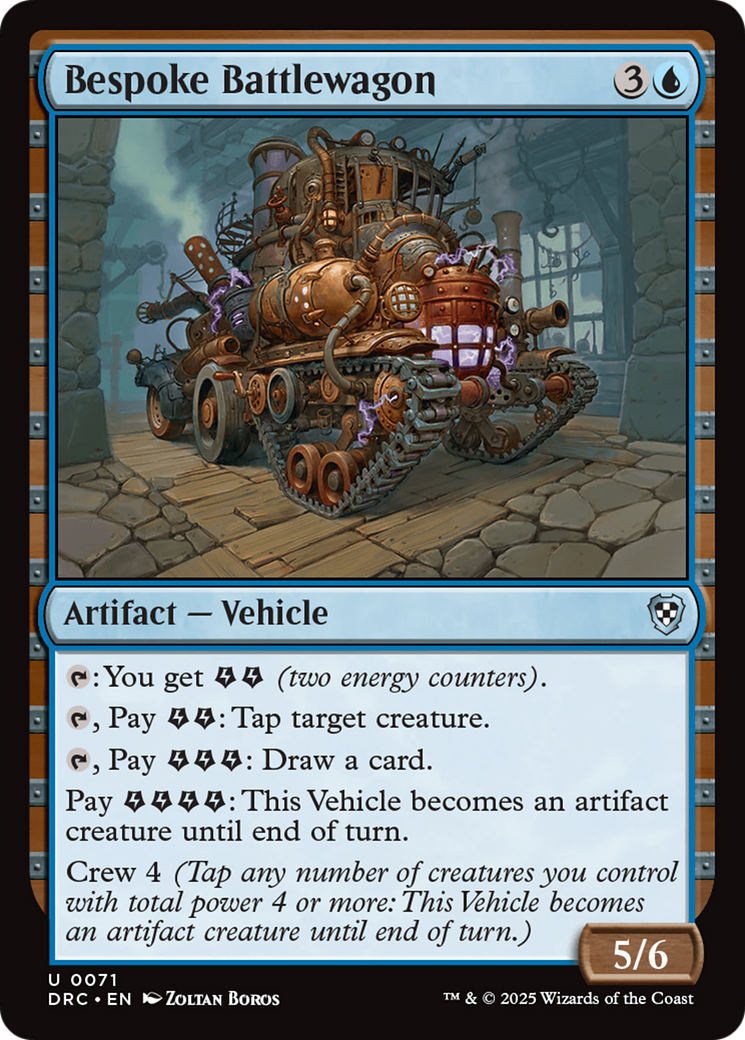
Bespoke Battlewagon
Bespoke Battlewagon
Artifact — Vehicle
5/6
: You get (two energy counters).
, Pay : Tap target creature.
, Pay : Draw a card.
Pay : This Vehicle becomes an artifact creature until end of turn.
Crew 4
- As long as Bespoke Battlewagon isn't a creature, its abilities can be activated even if you haven't controlled it continuously since the beginning of your most recent turn. If it is a creature, however, it's still subject to "summoning sickness" during that time period.
-
1
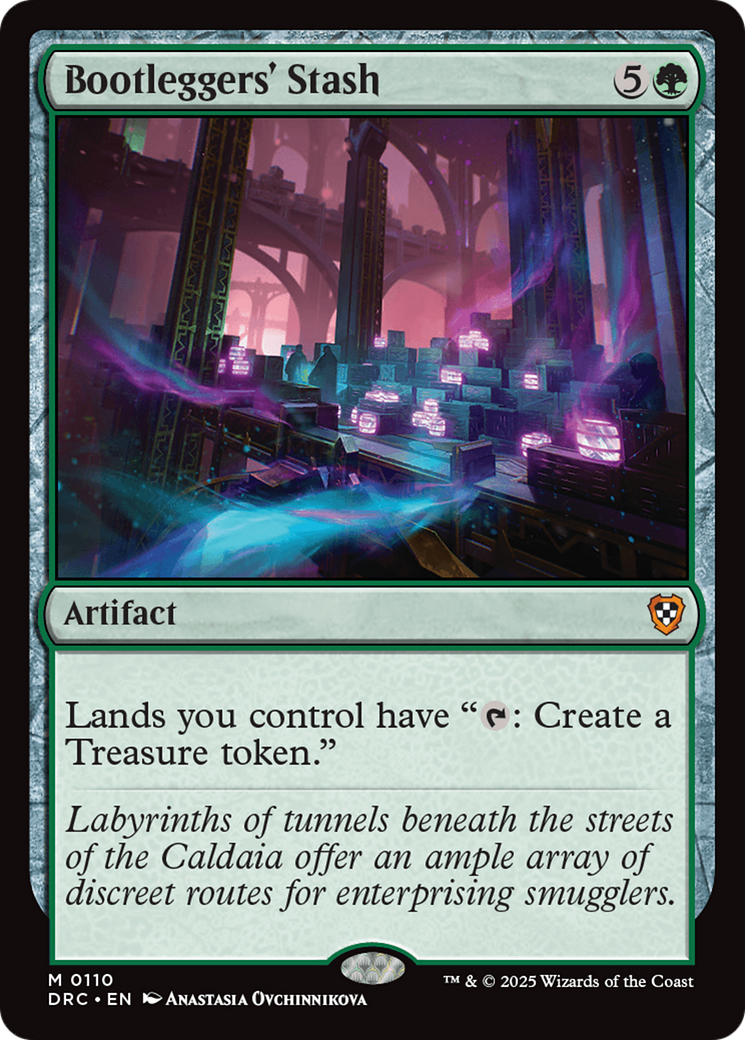
Bootleggers' Stash
Bootleggers' Stash
Artifact
Lands you control have " : Create a Treasure token."
-
1
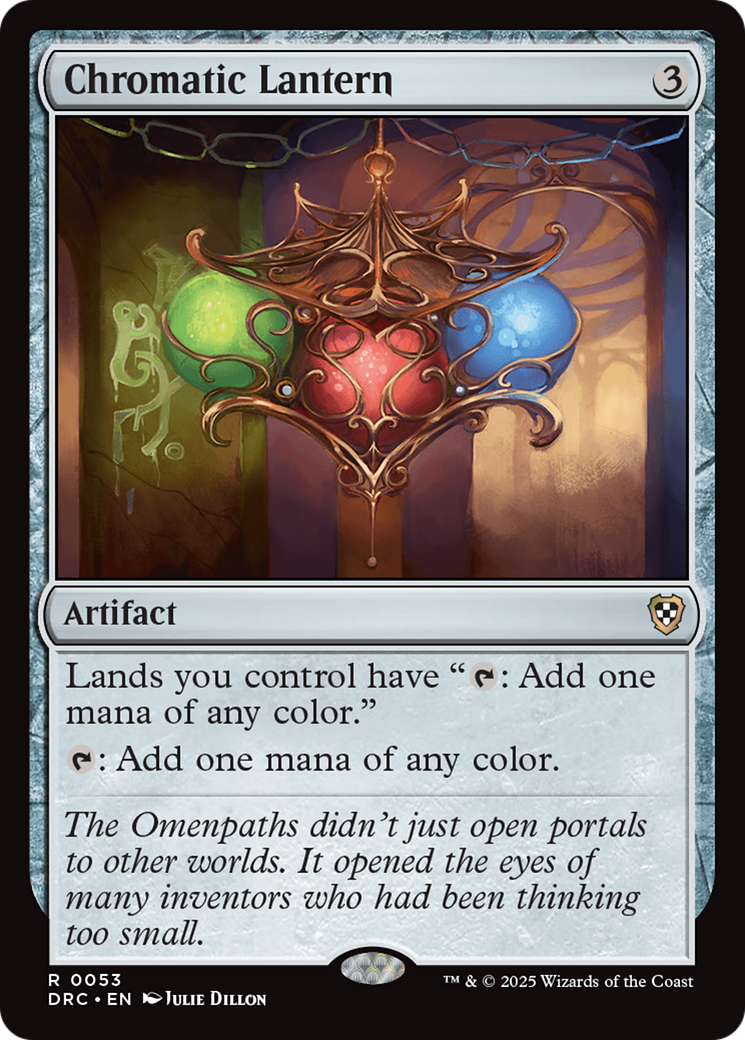
Chromatic Lantern
Chromatic Lantern
Artifact
Lands you control have " : Add one mana of any color."
: Add one mana of any color.
- Lands you control won't lose any other abilities they had. They also won't gain or lose any land types.
-
1
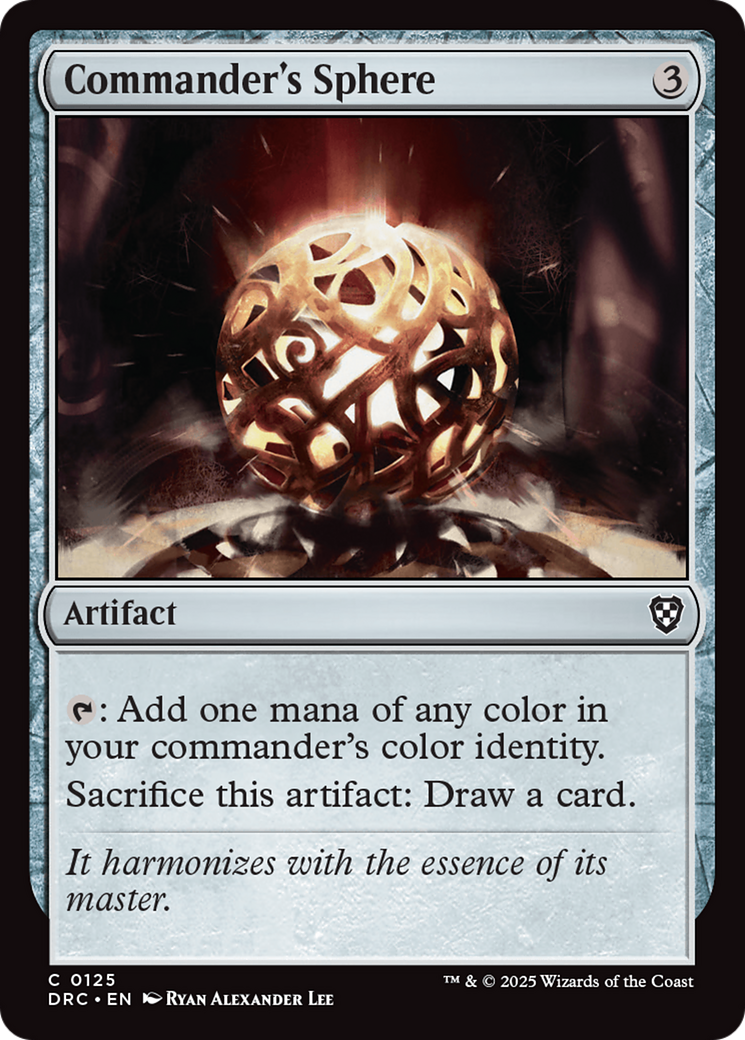
Commander's Sphere
Commander's Sphere
Artifact
: Add one mana of any color in your commander's color identity.
Sacrifice this artifact: Draw a card.
- If you have two commanders, the ability adds one mana of any color in their combined color identities.
- If your commander is a card that has no colors in its color identity, Commander's Sphere's first ability produces no mana. It doesn't produce .
- If you don't have a commander, Commander's Sphere's first ability produces no mana.
-
1
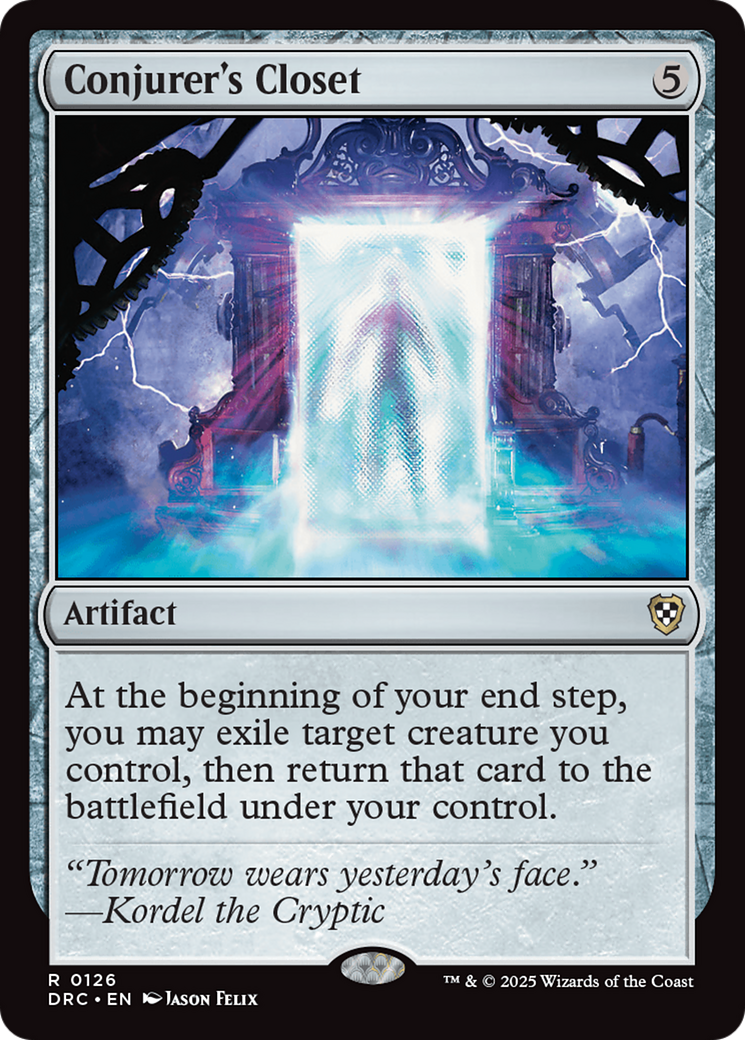
Conjurer's Closet
Conjurer's Closet
Artifact
At the beginning of your end step, you may exile target creature you control, then return that card to the battlefield under your control.
- Once the exiled creature returns, it's considered a new object with no relation to the object that it was. Auras attached to the exiled creature will be put into their owners' graveyards. Equipment attached to the exiled creature will become unattached and remain on the battlefield. Any counters on the exiled creature will cease to exist.
- If a token is exiled this way, it will cease to exist and won't return to the battlefield.
- If you gain control of a creature “until end of turn,” you control it during that turn's end step.
- When an effect returns the exiled card “under your control,” you control it indefinitely after that. In a multiplayer game, if a player leaves the game, all cards that player owns leave as well. If you leave the game, any creatures you control from Conjurer's Closet effect are exiled.
-
1
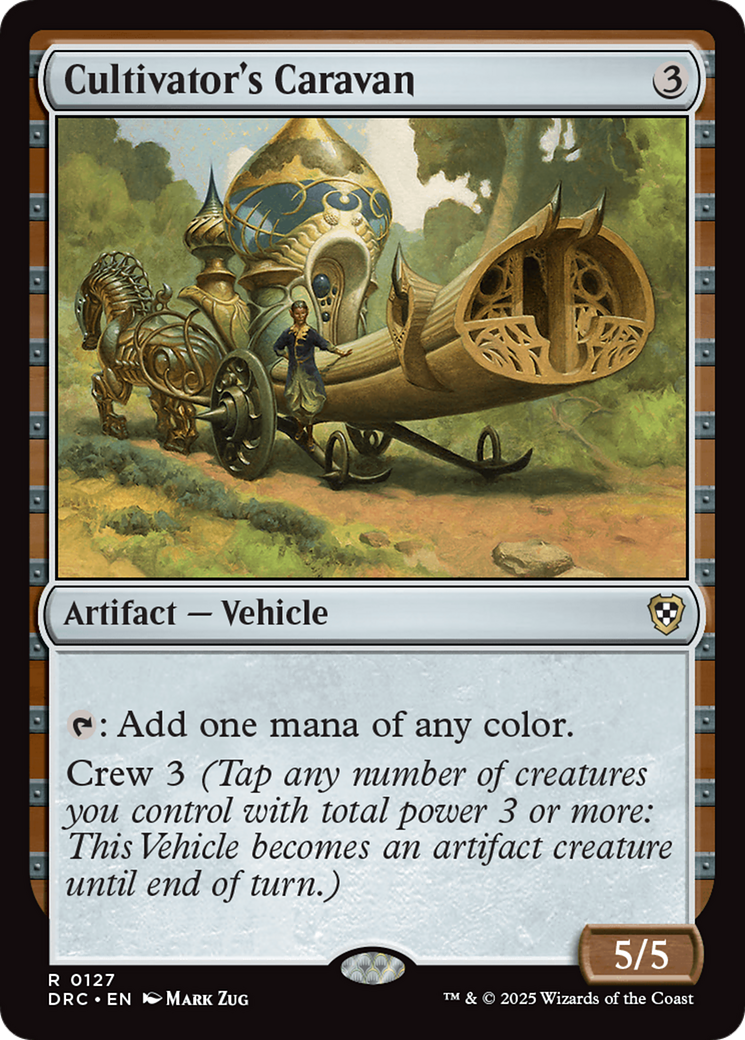
Cultivator's Caravan
Cultivator's Caravan
Artifact — Vehicle
5/5
: Add one mana of any color.
Crew 3 (Tap any number of creatures you control with total power 3 or more: This Vehicle becomes an artifact creature until end of turn.)
- If a permanent becomes a copy of a Vehicle, the copy won't be a creature, even if the Vehicle it's copying has become an artifact creature.
- Each Vehicle is printed with a power and toughness, but it's not a creature. If it becomes a creature (most likely through its crew ability), it will have that power and toughness.
- If an effect causes a Vehicle to become an artifact creature with a specified power and toughness, that effect overwrites the Vehicle's printed power and toughness.
- Vehicle is an artifact type, not a creature type. A Vehicle that's crewed won't normally have any creature type.
- Once a player announces that they are activating a crew ability, no player may take other actions until the ability has been paid for. Notably, players can't try to stop the ability by changing a creature's power or by removing or tapping a creature.
- Any untapped creature you control can be tapped to pay a crew cost, even one that just came under your control.
- You may tap more creatures than necessary to activate a crew ability.
- Creatures that crew a Vehicle aren't attached to it or related in any other way. Effects that affect the Vehicle, such as by destroying it or giving it a +1/+1 counter, don't affect the creatures that crewed it.
- Once a Vehicle becomes a creature, it behaves exactly like any other artifact creature. It can't attack unless you've controlled it continuously since your turn began, it can block if it's untapped, it can be tapped to pay a Vehicle's crew cost, and so on.
- You may activate a crew ability of a Vehicle even if it's already an artifact creature. Doing so has no effect on the Vehicle. It doesn't change its power and toughness.
- For a Vehicle to be able to attack, it must be a creature as the declare attackers step begins, so the latest you can activate its crew ability to attack with it is during the beginning of combat step. For a Vehicle to be able to block, it must be a creature as the declare blockers step begins, so the latest you can activate its crew ability to block with it is during the declare attackers step. In either case, players may take actions after the crew ability resolves but before the Vehicle has been declared as an attacking or blocking creature.
- When a Vehicle becomes a creature, that doesn't count as having a creature enter the battlefield. The permanent was already on the battlefield; it only changed its types. Abilities that trigger whenever a creature enters the battlefield won't trigger.
- As long as Cultivator's Caravan isn't an artifact creature, its ability can be activated if it came under your control this turn.
-
1
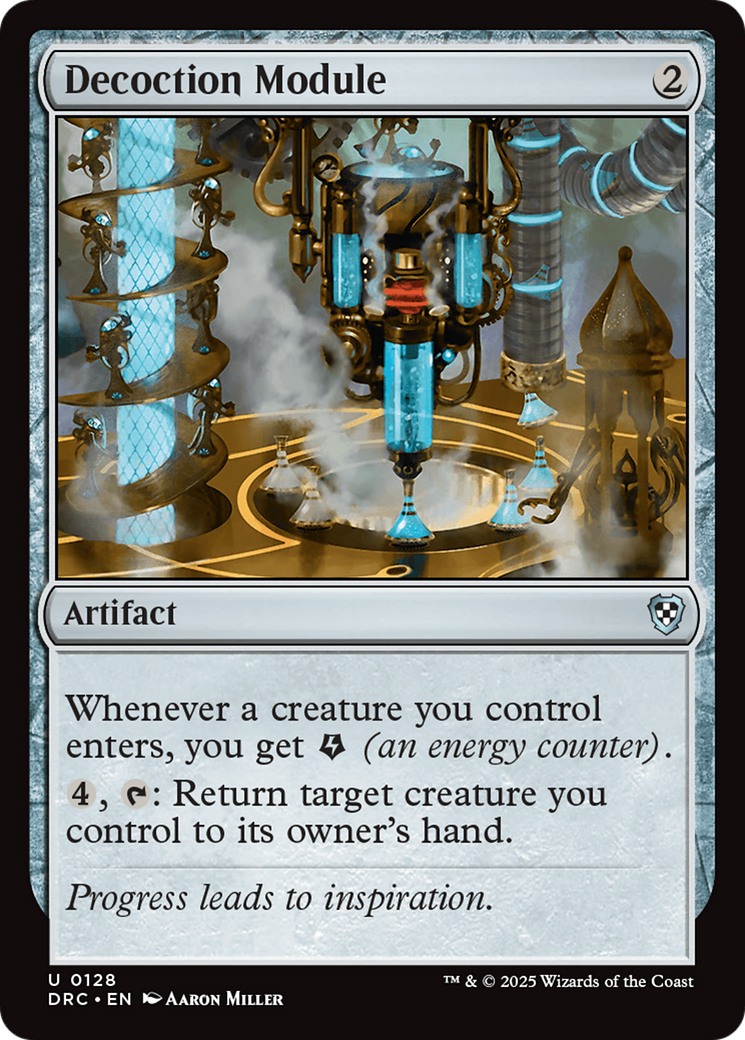
Decoction Module
Decoction Module
Artifact
Whenever a creature you control enters, you get (an energy counter).
, : Return target creature you control to its owner's hand.
- is the energy symbol. It represents one energy counter.
- Energy counters are a kind of counter that a player may have. They're not associated with any specific permanents.
- Keep track of how many energy counters each player has. Potential ways to track this include writing theme down on paper or using dice, but any method that is clear and mutually agreeable is fine. (At higher levels of tournament play, dice may not be allowed for tracking counters that players have.)
- If an effect says you get one or more , you get that many energy counters. To pay one or more , you lose that many energy counters. You can't pay more energy counters than you have. Any effects that interact with counters a player gets, has, or loses can interact with energy counters.
- Energy counters aren't mana. They don't go away as steps, phases, and turns end, and effects that add mana "of any type" can't give you energy counters.
- Some triggered abilities state that you "may pay" a certain amount of . You can't pay that amount multiple times to multiply the effect. You simply choose whether or not to pay that amount of as the ability resolves.
- Some triggered abilities that state that you "may pay" a certain amount of describe an effect that happens "If you do." In that case, no player may take actions to try to stop the ability's effect after you make your choice. If the payment is followed by the phrase "When you do," then you'll choose any targets for that reflexive triggered ability and put it on the stack before players can take actions.
- If a spell or ability with one or more targets states that you "may pay" some amount of , and each permanent that it targets has become an illegal target, the spell or ability won't resolve. You can't pay any even if you want to.
- Some spells and abilities that give you may require targets. If each target chosen is an illegal target as that spell or ability tries to resolve, it won't resolve. You won't get any .
-
1
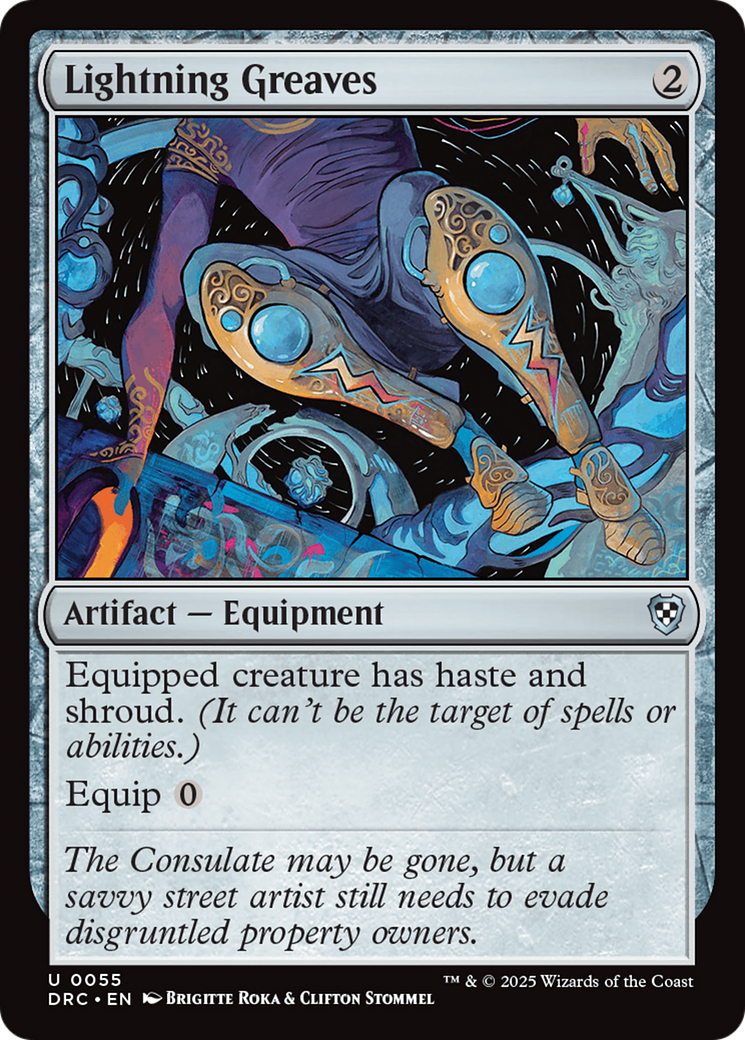
Lightning Greaves
Lightning Greaves
Artifact — Equipment
Equipped creature has haste and shroud. (It can't be the target of spells or abilities.)
Equip
- You can't simply unequip Equipment from a creature. If Lightning Greaves is attached to the only creature you control, you won't be able to attach other equipment to it (or target it with anything else) until you have another creature onto which you can move Lightning Greaves.
- If a creature enters the battlefield under your control and gains haste, but then loses it before attacking, it won't be able to attack that turn. This means that you can't use one Lightning Greaves to allow two new creatures to attack in the same turn.
-
1
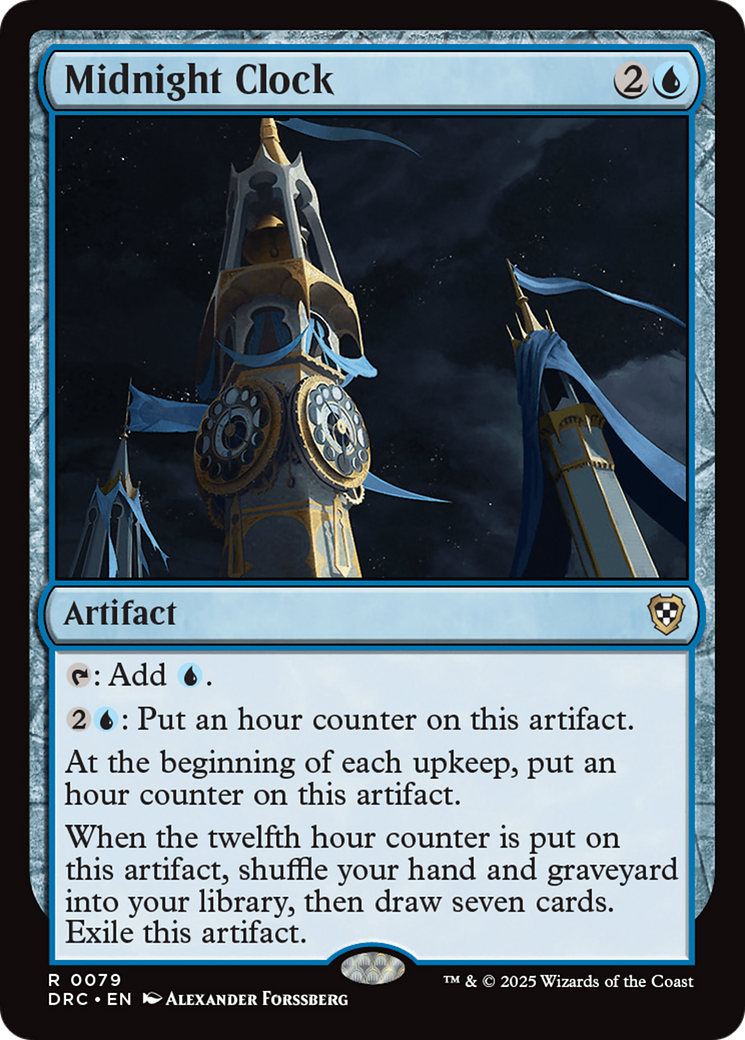
Midnight Clock
Midnight Clock
Artifact
: Add .
: Put an hour counter on this artifact.
At the beginning of each upkeep, put an hour counter on this artifact.
When the twelfth hour counter is put on this artifact, shuffle your hand and graveyard into your library, then draw seven cards. Exile this artifact.
- If Midnight Clock leaves the battlefield while its last ability is on the stack, it won't be exiled.
- You can activate Midnight Clock's mana ability to pay the cost of its second ability.
- Midnight Clock's last ability triggers after one or more counters are put onto it if it had fewer than twelve counters on it before those counters were put on it and it has twelve or more counters on it after.
- Midnight Clock's first triggered ability triggers at the beginning of each upkeep, not just your upkeep. In a Two-Headed Giant game, an ability that triggers at the beginning of each upkeep rather than each player's upkeep triggers only once during each team's upkeep.
-
1
Panharmonicon
Panharmonicon
Artifact
If an artifact or creature entering causes a triggered ability of a permanent you control to trigger, that ability triggers an additional time.
- Panharmonicon affects a permanent's own enters-the-battlefield triggered abilities as well as other triggered abilities that trigger when that permanent enters the battlefield. Such triggered abilities start with "when" or "whenever."
- Replacement effects are unaffected by Panharmonicon's ability. For example, a creature that enters the battlefield with one +1/+1 counter on it won't receive an additional +1/+1 counter.
- Abilities that apply "as [this artifact or creature] enters the battlefield," such as choosing a color with Gauntlet of Power, are also unaffected.
- You don't need to control the permanent entering the battlefield, only the permanent that has the triggered ability.
- Panharmonicon's effect doesn't copy the triggered ability; it just causes the ability to trigger twice. Any choices made as you put the ability onto the stack, such as modes and targets, are made separately for each instance of the ability. Any choices made on resolution, such as whether to put counters on a permanent, are also made individually.
- If you control two Panharmonicons, an artifact or creature entering the battlefield causes abilities to trigger three times, not four. A third Panharmonicon causes abilities to trigger four times, a fourth causes abilities to trigger five times, and so on.
- If an artifact or creature entering the battlefield at the same time as Panharmonicon (including Panharmonicon itself) causes a triggered ability of a permanent you control to trigger, that ability triggers an additional time.
- If a triggered ability is linked to a second ability, additional instances of that triggered ability are also linked to that second ability. If the second ability refers to "the exiled card," it refers to all cards exiled by instances of the triggered ability.
- In some cases involving linked abilities, an ability requires information about "the exiled card." When this happens, the ability gets multiple answers. If these answers are being used to determine the value of a variable, the sum is used. For example, if Elite Arcanist's enters-the-battlefield ability triggers twice, two cards are exiled. The value of X in the activation cost of Elite Arcanist's other ability is the sum of the two cards' mana values. As the ability resolves, you create copies of both cards and can cast none, one, or both of the copies in any order.
-
1
Retrofitter Foundry
Retrofitter Foundry
Artifact
: Untap this artifact.
, : Create a 1/1 colorless Servo artifact creature token.
, , Sacrifice a Servo: Create a 1/1 colorless Thopter artifact creature token with flying.
, Sacrifice a Thopter: Create a 4/4 colorless Construct artifact creature token.
-
1
Sol Ring
Sol Ring
Artifact
: Add .
-
1
Solar Transformer
Solar Transformer
Artifact
This artifact enters tapped.
When this artifact enters, you get (three energy counters).
: Add .
, Pay : Add one mana of any color.
- is the energy symbol. It represents one energy counter.
- Energy counters are a kind of counter that a player may have. They're not associated with any specific permanents.
- Keep track of how many energy counters each player has. Potential ways to track this include writing theme down on paper or using dice, but any method that is clear and mutually agreeable is fine. (At higher levels of tournament play, dice may not be allowed for tracking counters that players have.)
- If an effect says you get one or more , you get that many energy counters. To pay one or more , you lose that many energy counters. You can't pay more energy counters than you have. Any effects that interact with counters a player gets, has, or loses can interact with energy counters.
- Energy counters aren't mana. They don't go away as steps, phases, and turns end, and effects that add mana "of any type" can't give you energy counters.
- Some triggered abilities state that you "may pay" a certain amount of . You can't pay that amount multiple times to multiply the effect. You simply choose whether or not to pay that amount of as the ability resolves.
- Some triggered abilities that state that you "may pay" a certain amount of describe an effect that happens "If you do." In that case, no player may take actions to try to stop the ability's effect after you make your choice. If the payment is followed by the phrase "When you do," then you'll choose any targets for that reflexive triggered ability and put it on the stack before players can take actions.
- If a spell or ability with one or more targets states that you "may pay" some amount of , and each permanent that it targets has become an illegal target, the spell or ability won't resolve. You can't pay any even if you want to.
- Some spells and abilities that give you may require targets. If each target chosen is an illegal target as that spell or ability tries to resolve, it won't resolve. You won't get any .
-
1
Soul-Guide Lantern
Soul-Guide Lantern
Artifact
When this artifact enters, exile target card from a graveyard.
, Sacrifice this artifact: Exile each opponent's graveyard.
, , Sacrifice this artifact: Draw a card.
-
1
Talisman of Curiosity
Talisman of Curiosity
Artifact
: Add .
: Add or . This artifact deals 1 damage to you.
Enchantments 2
-
1
Era of Innovation
Era of Innovation
Enchantment
Whenever an artifact or Artificer you control enters, you may pay . If you do, you get (two energy counters).
Pay six , Sacrifice this enchantment: Draw three cards.
- Some spells and abilities that give you may require targets. If each target chosen is an illegal target as that spell or ability tries to resolve, it won't resolve. You won't get any .
- Some triggered abilities that state that you "may pay" a certain amount of describe an effect that happens "If you do." In that case, no player may take actions to try to stop the ability's effect after you make your choice. If the payment is followed by the phrase "When you do," then you'll choose any targets for that reflexive triggered ability and put it on the stack before players can take actions.
- If a spell or ability with one or more targets states that you "may pay" some amount of , and each permanent that it targets has become an illegal target, the spell or ability won't resolve. You can't pay any even if you want to.
- is the energy symbol. It represents one energy counter.
- Energy counters are a kind of counter that a player may have. They're not associated with any specific permanents.
- Keep track of how many energy counters each player has. Potential ways to track this include writing theme down on paper or using dice, but any method that is clear and mutually agreeable is fine. (At higher levels of tournament play, dice may not be allowed for tracking counters that players have.)
- If an effect says you get one or more , you get that many energy counters. To pay one or more , you lose that many energy counters. You can't pay more energy counters than you have. Any effects that interact with counters a player gets, has, or loses can interact with energy counters.
- Energy counters aren't mana. They don't go away as steps, phases, and turns end, and effects that add mana "of any type" can't give you energy counters.
- Some triggered abilities state that you "may pay" a certain amount of . You can't pay that amount multiple times to multiply the effect. You simply choose whether or not to pay that amount of as the ability resolves.
- You can pay only once each time Era of Innovation's first ability resolves. You can't pay more to get more than .
- If a creature that is both an artifact and an Artificer enters the battlefield under your control, Era of Innovation's triggered ability triggers only once.
-
1
Thopter Spy Network
Thopter Spy Network
Enchantment
At the beginning of your upkeep, if you control an artifact, create a 1/1 colorless Thopter artifact creature token with flying.
Whenever one or more artifact creatures you control deal combat damage to a player, draw a card.
- Thopter Spy Network's first ability has an “intervening ‘if' clause.” That means (1) the ability won't trigger at all unless you control an artifact as your upkeep begins, and (2) the ability will do nothing if you don't control an artifact as it resolves.
- The last ability will trigger, at most, once per combat damage step per player. However, if at least one artifact creature you control has first strike and others don't, or if an artifact creature you control has double strike, the ability could trigger twice per combat: once in each combat damage step.
Lands 38
-
1
Academy Ruins
Academy Ruins
Legendary Land
: Add .
, : Put target artifact card from your graveyard on top of your library.
-
1
Aether Hub
Aether Hub
Land
When this land enters, you get (an energy counter).
: Add .
, Pay : Add one mana of any color.
- is the energy symbol. It represents one energy counter.
- Energy counters are a kind of counter that a player may have. They're not associated with any specific permanents.
- Keep track of how many energy counters each player has. Potential ways to track this include writing theme down on paper or using dice, but any method that is clear and mutually agreeable is fine. (At higher levels of tournament play, dice may not be allowed for tracking counters that players have.)
- If an effect says you get one or more , you get that many energy counters. To pay one or more , you lose that many energy counters. You can't pay more energy counters than you have. Any effects that interact with counters a player gets, has, or loses can interact with energy counters.
- Energy counters aren't mana. They don't go away as steps, phases, and turns end, and effects that add mana "of any type" can't give you energy counters.
- Some triggered abilities state that you "may pay" a certain amount of . You can't pay that amount multiple times to multiply the effect. You simply choose whether or not to pay that amount of as the ability resolves.
- Some triggered abilities that state that you "may pay" a certain amount of describe an effect that happens "If you do." In that case, no player may take actions to try to stop the ability's effect after you make your choice. If the payment is followed by the phrase "When you do," then you'll choose any targets for that reflexive triggered ability and put it on the stack before players can take actions.
- If a spell or ability with one or more targets states that you "may pay" some amount of , and each permanent that it targets has become an illegal target, the spell or ability won't resolve. You can't pay any even if you want to.
- Some spells and abilities that give you may require targets. If each target chosen is an illegal target as that spell or ability tries to resolve, it won't resolve. You won't get any .
-
1
Command Tower
Command Tower
Land
: Add one mana of any color in your commander's color identity.
- If you don't have a commander, Command Tower's ability produces no mana.
- If your commander is a card that has no colors in its color identity, Command Tower's ability produces no mana. It doesn't produce .
- If you have two commanders, the ability adds one mana of any color in their combined color identities.
-
1
Evolving Wilds
Evolving Wilds
Land
, Sacrifice this land: Search your library for a basic land card, put it onto the battlefield tapped, then shuffle.
-
1
Exotic Orchard
Exotic Orchard
Land
: Add one mana of any color that a land an opponent controls could produce.
- The colors of mana are white, blue, black, red, and green. Exotic Orchard can't be tapped for colorless mana, even if a land an opponent controls could produce colorless mana.
- Exotic Orchard checks the effects of all mana-producing abilities of lands your opponents control, but it doesn't check their costs. For example, Vivid Crag has the ability " , Remove a charge counter from Vivid Crag: Add one mana of any color." If an opponent controls Vivid Crag and you control Exotic Orchard, you can tap Exotic Orchard for any color of mana. It doesn't matter whether Vivid Crag has a charge counter on it, and it doesn't matter whether it's untapped.
- When determining what colors of mana your opponents' lands could produce, Exotic Orchard takes into account any applicable replacement effects that would apply to those lands' mana abilities (such as Contamination's effect, for example). If there are more than one, consider them in any possible order.
- Exotic Orchard doesn't care about any restrictions or riders your opponents' lands (such as Ancient Ziggurat or Hall of the Bandit Lord) put on the mana they produce. It just cares about colors of mana.
- Lands that produce mana based only on what other lands "could produce" won't help each other unless some other land allows one of them to actually produce some type of mana. For example, if you control an Exotic Orchard and your opponent controls an Exotic Orchard and a Reflecting Pool, none of those lands would produce mana if their mana abilities were activated. On the other hand, if you control a Forest and an Exotic Orchard, and your opponent controls an Exotic Orchard and a Reflecting Pool, then each of those lands can be tapped to produce . Your opponent's Exotic Orchard can produce because you control a Forest. Your Exotic Orchard and your opponent's Reflecting Pool can each produce because your opponent's Exotic Orchard can produce .
-
6
Forest
Forest
Basic Land — Forest
( : Add .)
-
1
Frontier Bivouac
Frontier Bivouac
Land
This land enters tapped.
: Add , , or .
-
1
Frostboil Snarl
Frostboil Snarl
Land
As this land enters, you may reveal an Island or Mountain card from your hand. If you don't, this land enters tapped.
: Add or .
- You may reveal any land card with either or both of the appropriate subtypes. It doesn't have to be a basic land card.
- The "Snarl" itself doesn't have any land subtypes. You can't reveal one to satisfy the ability of another.
- If a land card with an appropriate subtype is entering the battlefield from your hand at the same time as one of these lands, you may reveal the other land to have the "Snarl" enter untapped.
- If an effect instructs you to put one of these lands onto the battlefield tapped, it will still enter the battlefield tapped even if you reveal a land card from your hand.
-
1
Hinterland Harbor
Hinterland Harbor
Land
This land enters tapped unless you control a Forest or an Island.
: Add or .
-
5
Island
Island
Basic Land — Island
( : Add .)
-
1
Karplusan Forest
Karplusan Forest
Land
: Add .
: Add or . This land deals 1 damage to you.
-
5
Mountain
Mountain
Basic Land — Mountain
( : Add .)
-
1
Overflowing Basin
Overflowing Basin
Land
, : Add .
-
1
Path of Ancestry
Path of Ancestry
Land
This land enters tapped.
: Add one mana of any color in your commander's color identity. When that mana is spent to cast a creature spell that shares a creature type with your commander, scry 1. (Look at the top card of your library. You may put that card on the bottom.)
- If you have two commanders, the last ability adds one mana of any color in their combined color identities. When you spend that mana on a creature spell that shares a creature type with either of your commanders, you'll scry 1.
- Your commander's creature types are checked immediately after you cast a creature spell spending mana from Path of Ancestry's last ability. They aren't set before the game begins, and they may not be the same types your commander had when you activated that ability.
- If you cast your commander with mana from Path of Ancestry, and your commander hasn't somehow lost all of its creature types while on the stack, you'll scry 1.
- If your commander is a card that has no colors in its color identity, Path of Ancestry's ability produces no mana. It doesn't produce .
- If Path of Ancestry's last ability produces two mana (most likely due to Mana Reflection), spending those two mana to cast creature spells that share a creature type with your commander will cause two abilities to trigger. Each of those abilities will cause you to scry 1. You won't scry 2. This is true whether you spend the mana on one creature spell or two.
- If your commander has no creature types, it can't share a creature type with any spell that you cast.
- If you don't have a commander, Path of Ancestry's ability produces no mana.
-
1
Rootbound Crag
Rootbound Crag
Land
This land enters tapped unless you control a Mountain or a Forest.
: Add or .
- This checks for lands you control with the land type Mountain or Forest, not for lands named Mountain or Forest. The lands it checks for don't have to be basic lands. For example, if you control Temple Garden (a nonbasic land with the land types Forest and Plains), Rootbound Crag will enter untapped.
- As this is entering, it checks for lands that are already on the battlefield. It won't see lands that are entering at the same time (due to Warp World, for example).
-
1
Sheltered Thicket
Sheltered Thicket
Land — Mountain Forest
( : Add or .)
This land enters tapped.
Cycling ( , Discard this card: Draw a card.)
-
1
Shivan Reef
Shivan Reef
Land
: Add .
: Add or . This land deals 1 damage to you.
- The damage dealt to you is part of the second mana ability. It doesn't use the stack and can't be responded to.
- Like most lands, each land in this cycle is colorless. The damage dealt to you is dealt by a colorless source.
-
1
Slagwoods Bridge
Slagwoods Bridge
Artifact Land
This land enters tapped.
Indestructible
: Add or .
-
1
Spire of Industry
Spire of Industry
Land
: Add .
, Pay 1 life: Add one mana of any color. Activate only if you control an artifact.
-
1
Sulfur Falls
Sulfur Falls
Land
This land enters tapped unless you control an Island or a Mountain.
: Add or .
-
1
Tanglepool Bridge
Tanglepool Bridge
Artifact Land
This land enters tapped.
Indestructible
: Add or .
-
1
Temple of Epiphany
Temple of Epiphany
Land
This land enters tapped.
When this land enters, scry 1. (Look at the top card of your library. You may put that card on the bottom.)
: Add or .
-
1
Treasure Vault
Treasure Vault
Artifact Land
: Add .
, , Sacrifice this land: Create X Treasure tokens.
-
1
Vineglimmer Snarl
Vineglimmer Snarl
Land
As this land enters, you may reveal a Forest or Island card from your hand. If you don't, this land enters tapped.
: Add or .
- You may reveal any land card with either or both of the appropriate subtypes. It doesn't have to be a basic land card.
- The "Snarl" itself doesn't have any land subtypes. You can't reveal one to satisfy the ability of another.
- If a land card with an appropriate subtype is entering the battlefield from your hand at the same time as one of these lands, you may reveal the other land to have the "Snarl" enter untapped.
- If an effect instructs you to put one of these lands onto the battlefield tapped, it will still enter the battlefield tapped even if you reveal a land card from your hand.
-
1
Yavimaya Coast
Yavimaya Coast
Land
: Add .
: Add or . This land deals 1 damage to you.
- The damage dealt to you is part of the second mana ability. It doesn't use the stack and can't be responded to.
- Like most lands, each land in this cycle is colorless. The damage dealt to you is dealt by a colorless source.
Blue 14
-
1
Aethersquall Ancient
Aethersquall Ancient
Creature — Leviathan
6/6
Flying
At the beginning of your upkeep, you get (three energy counters).
Pay eight : Return all other creatures to their owners' hands. Activate only as a sorcery.
- is the energy symbol. It represents one energy counter.
- Energy counters are a kind of counter that a player may have. They're not associated with any specific permanents.
- Keep track of how many energy counters each player has. Potential ways to track this include writing theme down on paper or using dice, but any method that is clear and mutually agreeable is fine. (At higher levels of tournament play, dice may not be allowed for tracking counters that players have.)
- If an effect says you get one or more , you get that many energy counters. To pay one or more , you lose that many energy counters. You can't pay more energy counters than you have. Any effects that interact with counters a player gets, has, or loses can interact with energy counters.
- Energy counters aren't mana. They don't go away as steps, phases, and turns end, and effects that add mana "of any type" can't give you energy counters.
- Some triggered abilities state that you "may pay" a certain amount of . You can't pay that amount multiple times to multiply the effect. You simply choose whether or not to pay that amount of as the ability resolves.
- Some triggered abilities that state that you "may pay" a certain amount of describe an effect that happens "If you do." In that case, no player may take actions to try to stop the ability's effect after you make your choice. If the payment is followed by the phrase "When you do," then you'll choose any targets for that reflexive triggered ability and put it on the stack before players can take actions.
- If a spell or ability with one or more targets states that you "may pay" some amount of , and each permanent that it targets has become an illegal target, the spell or ability won't resolve. You can't pay any even if you want to.
- Some spells and abilities that give you may require targets. If each target chosen is an illegal target as that spell or ability tries to resolve, it won't resolve. You won't get any .
-
1
Aethertide Whale
Aethertide Whale
Creature — Whale
6/4
Flying
When this creature enters, you get six (energy counters).
Pay : Return this creature to its owner's hand.
- is the energy symbol. It represents one energy counter.
- Energy counters are a kind of counter that a player may have. They're not associated with any specific permanents.
- Keep track of how many energy counters each player has. Potential ways to track this include writing theme down on paper or using dice, but any method that is clear and mutually agreeable is fine. (At higher levels of tournament play, dice may not be allowed for tracking counters that players have.)
- If an effect says you get one or more , you get that many energy counters. To pay one or more , you lose that many energy counters. You can't pay more energy counters than you have. Any effects that interact with counters a player gets, has, or loses can interact with energy counters.
- Energy counters aren't mana. They don't go away as steps, phases, and turns end, and effects that add mana "of any type" can't give you energy counters.
- Some triggered abilities state that you "may pay" a certain amount of . You can't pay that amount multiple times to multiply the effect. You simply choose whether or not to pay that amount of as the ability resolves.
- Some triggered abilities that state that you "may pay" a certain amount of describe an effect that happens "If you do." In that case, no player may take actions to try to stop the ability's effect after you make your choice. If the payment is followed by the phrase "When you do," then you'll choose any targets for that reflexive triggered ability and put it on the stack before players can take actions.
- If a spell or ability with one or more targets states that you "may pay" some amount of , and each permanent that it targets has become an illegal target, the spell or ability won't resolve. You can't pay any even if you want to.
- Some spells and abilities that give you may require targets. If each target chosen is an illegal target as that spell or ability tries to resolve, it won't resolve. You won't get any .
-
1
Arcane Denial
Arcane Denial
Instant
Counter target spell. Its controller may draw up to two cards at the beginning of the next turn's upkeep.
You draw a card at the beginning of the next turn's upkeep.
- The controller of the countered spell doesn't choose how many cards to draw until the relevant ability resolves. The player may draw 0, 1, or 2 cards. They choose the number before drawing any cards.
-
1
Bespoke Battlewagon
Bespoke Battlewagon
Artifact — Vehicle
5/6
: You get (two energy counters).
, Pay : Tap target creature.
, Pay : Draw a card.
Pay : This Vehicle becomes an artifact creature until end of turn.
Crew 4
- As long as Bespoke Battlewagon isn't a creature, its abilities can be activated even if you haven't controlled it continuously since the beginning of your most recent turn. If it is a creature, however, it's still subject to "summoning sickness" during that time period.
-
1
Confiscation Coup
Confiscation Coup
Sorcery
Choose target artifact or creature. You get (four energy counters), then you may pay an amount of equal to that permanent's mana value. If you do, gain control of it.
- Some spells and abilities that give you may require targets. If each target chosen is an illegal target as that spell or ability tries to resolve, it won't resolve. You won't get any .
- Keep track of how many energy counters each player has. Potential ways to track this include writing theme down on paper or using dice, but any method that is clear and mutually agreeable is fine. (At higher levels of tournament play, dice may not be allowed for tracking counters that players have.)
- If an effect says you get one or more , you get that many energy counters. To pay one or more , you lose that many energy counters. You can't pay more energy counters than you have. Any effects that interact with counters a player gets, has, or loses can interact with energy counters.
- Energy counters aren't mana. They don't go away as steps, phases, and turns end, and effects that add mana "of any type" can't give you energy counters.
- Some triggered abilities state that you "may pay" a certain amount of . You can't pay that amount multiple times to multiply the effect. You simply choose whether or not to pay that amount of as the ability resolves.
- Some triggered abilities that state that you "may pay" a certain amount of describe an effect that happens "If you do." In that case, no player may take actions to try to stop the ability's effect after you make your choice. If the payment is followed by the phrase "When you do," then you'll choose any targets for that reflexive triggered ability and put it on the stack before players can take actions.
- If a spell or ability with one or more targets states that you "may pay" some amount of , and each permanent that it targets has become an illegal target, the spell or ability won't resolve. You can't pay any even if you want to.
- is the energy symbol. It represents one energy counter.
- Energy counters are a kind of counter that a player may have. They're not associated with any specific permanents.
- There are many important moments in the story, but the most crucial—called "story spotlights"—are shown on cards. These cards have the Planeswalker symbol in their text box; this symbol has no effect on gameplay. You can read more about these events in the official Magic fiction at http://www.mtgstory.com.
- If the target artifact or creature has a mana value of 0, you may choose to pay zero energy and gain control of it.
- If a permanent has in its mana cost, X is considered to be 0.
- The mana value of a token that isn't a copy of another object is 0. A token that is a copy of another object has the same mana cost as that object.
- In a multiplayer game, if a permanent's owner leaves the game after you've gained control of it, the permanent leaves with that player. If you leave the game before that player, the control-change effect ends.
- You choose the target artifact or creature as you cast Confiscation Coup. You don't choose whether or not to pay an amount of until Confiscation Coup resolves. If the target becomes an illegal target, Confiscation Coup won't resolve and you won't get .
-
1
Disallow
Disallow
Instant
Counter target spell, activated ability, or triggered ability. (Mana abilities can't be targeted.)
- There are many important moments in the story, but the most crucial—called "story spotlights"—are shown on cards. These cards have the Planeswalker symbol in their text box; this symbol has no effect on gameplay. You can read more about these events in the official Magic fiction at http://www.mtgstory.com.
- Activated abilities are written in the form "Cost: Effect." Some keyword abilities, such as equip and crew, are activated abilities and will have colons in their reminder texts.
- Triggered abilities use the word "when," "whenever," or "at." They're often written as "[Trigger condition], [effect]." Some keyword abilities, such as prowess and fabricate, are triggered abilities and will have "when," "whenever," or "at" in their reminder text.
- If you counter a delayed triggered ability that triggers at the beginning of the "next" occurrence of a specified step or phase, that ability won't trigger again the following time that phase or step occurs.
- An activated mana ability is one that could add mana as it resolves, doesn't have a target, and isn't a loyalty ability. A triggered mana ability is one that could add mana and triggers on an activated mana ability.
- Abilities that create replacement effects, such as a permanent entering the battlefield tapped or with counters on it, can't be targeted. Abilities that apply "as [this creature] enters the battlefield" are also replacement effects and can't be targeted.
-
1
Era of Innovation
Era of Innovation
Enchantment
Whenever an artifact or Artificer you control enters, you may pay . If you do, you get (two energy counters).
Pay six , Sacrifice this enchantment: Draw three cards.
- Some spells and abilities that give you may require targets. If each target chosen is an illegal target as that spell or ability tries to resolve, it won't resolve. You won't get any .
- Some triggered abilities that state that you "may pay" a certain amount of describe an effect that happens "If you do." In that case, no player may take actions to try to stop the ability's effect after you make your choice. If the payment is followed by the phrase "When you do," then you'll choose any targets for that reflexive triggered ability and put it on the stack before players can take actions.
- If a spell or ability with one or more targets states that you "may pay" some amount of , and each permanent that it targets has become an illegal target, the spell or ability won't resolve. You can't pay any even if you want to.
- is the energy symbol. It represents one energy counter.
- Energy counters are a kind of counter that a player may have. They're not associated with any specific permanents.
- Keep track of how many energy counters each player has. Potential ways to track this include writing theme down on paper or using dice, but any method that is clear and mutually agreeable is fine. (At higher levels of tournament play, dice may not be allowed for tracking counters that players have.)
- If an effect says you get one or more , you get that many energy counters. To pay one or more , you lose that many energy counters. You can't pay more energy counters than you have. Any effects that interact with counters a player gets, has, or loses can interact with energy counters.
- Energy counters aren't mana. They don't go away as steps, phases, and turns end, and effects that add mana "of any type" can't give you energy counters.
- Some triggered abilities state that you "may pay" a certain amount of . You can't pay that amount multiple times to multiply the effect. You simply choose whether or not to pay that amount of as the ability resolves.
- You can pay only once each time Era of Innovation's first ability resolves. You can't pay more to get more than .
- If a creature that is both an artifact and an Artificer enters the battlefield under your control, Era of Innovation's triggered ability triggers only once.
-
1
Glimmer of Genius
Glimmer of Genius
Instant
Scry 2, then draw two cards. You get (two energy counters).
- is the energy symbol. It represents one energy counter.
- Energy counters are a kind of counter that a player may have. They're not associated with any specific permanents.
- Keep track of how many energy counters each player has. Potential ways to track this include writing theme down on paper or using dice, but any method that is clear and mutually agreeable is fine. (At higher levels of tournament play, dice may not be allowed for tracking counters that players have.)
- If an effect says you get one or more , you get that many energy counters. To pay one or more , you lose that many energy counters. You can't pay more energy counters than you have. Any effects that interact with counters a player gets, has, or loses can interact with energy counters.
- Energy counters aren't mana. They don't go away as steps, phases, and turns end, and effects that add mana "of any type" can't give you energy counters.
- Some triggered abilities state that you "may pay" a certain amount of . You can't pay that amount multiple times to multiply the effect. You simply choose whether or not to pay that amount of as the ability resolves.
- Some triggered abilities that state that you "may pay" a certain amount of describe an effect that happens "If you do." In that case, no player may take actions to try to stop the ability's effect after you make your choice. If the payment is followed by the phrase "When you do," then you'll choose any targets for that reflexive triggered ability and put it on the stack before players can take actions.
- If a spell or ability with one or more targets states that you "may pay" some amount of , and each permanent that it targets has become an illegal target, the spell or ability won't resolve. You can't pay any even if you want to.
- Some spells and abilities that give you may require targets. If each target chosen is an illegal target as that spell or ability tries to resolve, it won't resolve. You won't get any .
-
1
Midnight Clock
Midnight Clock
Artifact
: Add .
: Put an hour counter on this artifact.
At the beginning of each upkeep, put an hour counter on this artifact.
When the twelfth hour counter is put on this artifact, shuffle your hand and graveyard into your library, then draw seven cards. Exile this artifact.
- If Midnight Clock leaves the battlefield while its last ability is on the stack, it won't be exiled.
- You can activate Midnight Clock's mana ability to pay the cost of its second ability.
- Midnight Clock's last ability triggers after one or more counters are put onto it if it had fewer than twelve counters on it before those counters were put on it and it has twelve or more counters on it after.
- Midnight Clock's first triggered ability triggers at the beginning of each upkeep, not just your upkeep. In a Two-Headed Giant game, an ability that triggers at the beginning of each upkeep rather than each player's upkeep triggers only once during each team's upkeep.
-
1
One with the Machine
One with the Machine
Sorcery
Draw cards equal to the highest mana value among artifacts you control.
- If a permanent has in its mana cost, X is considered to be 0.
-
1
Reality Shift
Reality Shift
Instant
Exile target creature. Its controller manifests the top card of their library. (That player puts the top card of their library onto the battlefield face down as a 2/2 creature. If it's a creature card, it can be turned face up any time for its mana cost.)
- The face-down permanent is a 2/2 creature with no name, mana cost, creature types, or abilities. It's colorless and has a mana value of 0. Other effects that apply to the permanent can still grant or change any of these characteristics.
- Any time you have priority, you may turn a manifested creature face up by revealing that it's a creature card (ignoring any copy effects or type-changing effects that might be applying to it) and paying its mana cost. This is a special action. It doesn't use the stack and can't be responded to.
- If a manifested creature would have morph if it were face up, you may also turn it face up by paying its morph cost.
- Unlike a face-down creature that was cast using the morph ability, a manifested creature may still be turned face up after it loses its abilities if it's a creature card.
- Because the permanent is on the battlefield both before and after it's turned face up, turning a permanent face up doesn't cause any enters-the-battlefield abilities to trigger.
- Because face-down creatures don't have names, they can't have the same name as any other creature, even another face-down creature.
- A permanent that turns face up or face down changes characteristics but is otherwise the same permanent. Spells and abilities that were targeting that permanent, as well as Auras and Equipment that were attached to the permanent, aren't affected.
- Turning a permanent face up or face down doesn't change whether that permanent is tapped or untapped.
- At any time, you can look at a face-down permanent you control. You can't look at face-down permanents you don't control unless an effect allows you to or instructs you to.
- If a face-down permanent you control leaves the battlefield, you must reveal it. You must also reveal all face-down spells and permanents you control if you leave the game or if the game ends.
- You must ensure that your face-down spells and permanents can easily be differentiated from each other. You're not allowed to mix up the cards that represent them on the battlefield in order to confuse other players. The order they entered the battlefield should remain clear. Common methods for indicating this include using markers or dice, or simply placing them in order on the battlefield. You must also track how each became face down (manifested, cast face down using the morph ability, and so on).
- There are no cards in the Fate Reforged set that would turn a face-down instant or sorcery card on the battlefield face up, but some older cards can try to do this. If something tries to turn a face-down instant or sorcery card on the battlefield face up, reveal that card to show all players it's an instant or sorcery card. The permanent remains on the battlefield face down. Abilities that trigger when a permanent turns face up won't trigger, because even though you revealed the card, it never turned face up.
- If a double-faced card is manifested, it will be put onto the battlefield face down. While face down, it can't transform. If the front face of the card is a creature card, you can turn it face up by paying its mana cost. If you do, its front face will be up.
-
1
Sai, Master Thopterist
Sai, Master Thopterist
Legendary Creature — Human Artificer
1/4
Whenever you cast an artifact spell, create a 1/1 colorless Thopter artifact creature token with flying.
, Sacrifice two artifacts: Draw a card.
- Sai's triggered ability resolves before the spell that caused it to trigger. It resolves even if that spell is countered.
-
1
Thopter Spy Network
Thopter Spy Network
Enchantment
At the beginning of your upkeep, if you control an artifact, create a 1/1 colorless Thopter artifact creature token with flying.
Whenever one or more artifact creatures you control deal combat damage to a player, draw a card.
- Thopter Spy Network's first ability has an “intervening ‘if' clause.” That means (1) the ability won't trigger at all unless you control an artifact as your upkeep begins, and (2) the ability will do nothing if you don't control an artifact as it resolves.
- The last ability will trigger, at most, once per combat damage step per player. However, if at least one artifact creature you control has first strike and others don't, or if an artifact creature you control has double strike, the ability could trigger twice per combat: once in each combat damage step.
-
1
Whirler Rogue
Whirler Rogue
Creature — Human Rogue Artificer
2/2
When this creature enters, create two 1/1 colorless Thopter artifact creature tokens with flying.
Tap two untapped artifacts you control: Target creature can't be blocked this turn.
- You may tap any two untapped artifacts you control, including artifact creatures that haven't been under your control continuously since the beginning of your most recent turn.
- Activating the second ability of Whirler Rogue after a creature has become blocked won't cause it to become unblocked.
Red 9
-
1
Blasphemous Act
Blasphemous Act
Sorcery
This spell costs less to cast for each creature on the battlefield.
Blasphemous Act deals 13 damage to each creature.
- To determine the total cost of a spell, start with the mana cost or alternative cost you're paying, add any cost increases, then apply any cost reductions (such as that of Blasphemous Act). The mana value of the spell is determined only by its mana cost, no matter what the total cost to cast the spell was.
- Blasphemous Act's ability can't reduce the total cost to cast the spell below .
- The total cost to cast Blasphemous Act is locked in before you pay that cost. For example, if there are three creatures on the battlefield, including one you can sacrifice to add , the total cost of Blasphemous Act is . Then you can sacrifice the creature when you activate mana abilities just before paying the cost.
- Although players may respond to Blasphemous Act once it's been cast, once it's announced, they can't respond before the cost is calculated and paid.
-
1
Chain Reaction
Chain Reaction
Sorcery
Chain Reaction deals X damage to each creature, where X is the number of creatures on the battlefield.
- The value of X is determined as Chain Reaction resolves.
-
1
Chaos Warp
Chaos Warp
Instant
The owner of target permanent shuffles it into their library, then reveals the top card of their library. If it's a permanent card, they put it onto the battlefield.
- The owner of a token is the player under whose control the token was put onto the battlefield. If a token is shuffled into a player's library this way, that player shuffles before revealing the top card of that library.
- If the permanent is an illegal target by the time Chaos Warp tries to resolve, it won't resolve and none of its effects will occur. No library will be shuffled and no card will be revealed.
- A permanent card is a card with one or more of the following card types: artifact, creature, enchantment, land, or planeswalker.
- If the revealed card is a permanent card but can't enter (perhaps because it's an Aura with nothing to enchant), it remains on top of that library.
- If the revealed card is not a permanent card, it remains on top of that library.
-
1
Combustible Gearhulk
Combustible Gearhulk
Artifact Creature — Construct
6/6
First strike
When this creature enters, target opponent may have you draw three cards. If the player doesn't, you mill three cards, then this creature deals damage to that player equal to the total mana value of those cards.
- If any of the cards put into your graveyard have in their mana cost, X is considered to be 0.
- If you have fewer than three cards in your library, the opponent may choose to have you draw three cards. If so, you'll lose the game as state-based actions are performed.
- While Combustible Gearhulk's triggered ability is resolving, no player may take any actions other than those specified by the Gearhulk. Once the opponent makes a choice, players can't cast spells or activate abilities until after the cards are drawn or put into the graveyard and damage has been dealt (if applicable).
-
1
Lightning Runner
Lightning Runner
Creature — Human Warrior
2/2
Double strike, haste
Whenever this creature attacks, you get (two energy counters), then you may pay eight . If you pay, untap all creatures you control, and after this phase, there is an additional combat phase.
- Some spells and abilities that give you may require targets. If each target chosen is an illegal target as that spell or ability tries to resolve, it won't resolve. You won't get any .
- is the energy symbol. It represents one energy counter.
- Energy counters are a kind of counter that a player may have. They're not associated with any specific permanents.
- Keep track of how many energy counters each player has. Potential ways to track this include writing theme down on paper or using dice, but any method that is clear and mutually agreeable is fine. (At higher levels of tournament play, dice may not be allowed for tracking counters that players have.)
- If an effect says you get one or more , you get that many energy counters. To pay one or more , you lose that many energy counters. You can't pay more energy counters than you have. Any effects that interact with counters a player gets, has, or loses can interact with energy counters.
- Energy counters aren't mana. They don't go away as steps, phases, and turns end, and effects that add mana "of any type" can't give you energy counters.
- Some triggered abilities state that you "may pay" a certain amount of . You can't pay that amount multiple times to multiply the effect. You simply choose whether or not to pay that amount of as the ability resolves.
- Some triggered abilities that state that you "may pay" a certain amount of describe an effect that happens "If you do." In that case, no player may take actions to try to stop the ability's effect after you make your choice. If the payment is followed by the phrase "When you do," then you'll choose any targets for that reflexive triggered ability and put it on the stack before players can take actions.
- If a spell or ability with one or more targets states that you "may pay" some amount of , and each permanent that it targets has become an illegal target, the spell or ability won't resolve. You can't pay any even if you want to.
- You untap all creatures you control, including ones that aren't attacking.
-
1
Loyal Apprentice
Loyal Apprentice
Creature — Human Artificer
2/1
Haste
Lieutenant — At the beginning of combat on your turn, if you control your commander, create a 1/1 colorless Thopter artifact creature token with flying. That token gains haste until end of turn.
- If you don't control your commander as the lieutenant ability resolves, you won't get its effect.
- The lieutenant effect happens only once each combat, even if you somehow control multiple commanders (perhaps because you have two commanders with a partner ability from the Battlebond™ set).
- If you have multiple commanders, you need to control only one for the lieutenant effect to happen.
-
1
Pia and Kiran Nalaar
Pia and Kiran Nalaar
Legendary Creature — Human Artificer
2/2
When Pia and Kiran Nalaar enters, create two 1/1 colorless Thopter artifact creature tokens with flying.
, Sacrifice an artifact: Pia and Kiran Nalaar deals 2 damage to any target.
-
1
Reckless Fireweaver
Reckless Fireweaver
Creature — Human Artificer
1/3
Whenever an artifact you control enters, this creature deals 1 damage to each opponent.
- In a Two-Headed Giant game, Reckless Fireweaver's ability causes 2 damage total to be dealt to the opposing team.
-
1
Territorial Aetherkite
Territorial Aetherkite
Creature — Cat Dragon
6/5
Flying, haste
When this creature enters, you get (two energy counters). Then you may pay one or more . When you do, this creature deals that much damage to each other creature.
- is the energy symbol. It represents one energy counter.
- Energy counters are a kind of counter that a player may have. They’re not associated with any specific permanents.
- Keep track of how many energy counters each player has. Potential ways to track this include writing them down on paper or using dice, but any method that is clear and mutually agreeable is fine.
- If an effect says you get one or more , you get that many energy counters. To pay one or more , you lose that many energy counters. You can’t pay more energy counters than you have. Any effects that interact with counters a player gets, has, or loses can interact with energy counters.
- Energy counters aren’t mana. They don’t go away as steps, phases, and turns end, and effects that add mana “of any type” can’t give you energy counters.
- Some spells and abilities say that you “may pay” a certain amount of . You can’t pay that amount multiple times to multiply the effect. You simply choose whether or not to pay that amount of as the ability resolves.
- Some spells and abilities say that you “may pay” a certain amount of , then describes an effect that happens “if you do.” In that case, no player may take actions to try to stop the ability’s effect after you make your choice. If the payment is instead followed by the phrase “when you do” followed by an effect, then after you choose to pay , a new triggered ability called a reflexive trigger is put on the stack, and you choose targets for the reflexive trigger (if the effect asks for targets). Players may respond as normal to this new triggered ability. Once that reflexive trigger resolves, the effect will finally occur.
- Some spells and abilities which give you or say you “may pay” some amount of require one or more targets. If each target chosen is an illegal target as that spell or ability tries to resolve, it won’t resolve. None of its effects will happen, you won’t get any from it, and you won’t get the chance to pay any for its effects even if you want to.
Green 12
-
1
Aetherwind Basker
Aetherwind Basker
Creature — Lizard
7/7
Trample
Whenever this creature enters or attacks, you get (an energy counter) for each creature you control.
Pay : This creature gets +1/+1 until end of turn.
- Some spells and abilities that give you may require targets. If each target chosen is an illegal target as that spell or ability tries to resolve, it won't resolve. You won't get any .
- Some triggered abilities that state that you "may pay" a certain amount of describe an effect that happens "If you do." In that case, no player may take actions to try to stop the ability's effect after you make your choice. If the payment is followed by the phrase "When you do," then you'll choose any targets for that reflexive triggered ability and put it on the stack before players can take actions.
- If a spell or ability with one or more targets states that you "may pay" some amount of , and each permanent that it targets has become an illegal target, the spell or ability won't resolve. You can't pay any even if you want to.
- is the energy symbol. It represents one energy counter.
- Energy counters are a kind of counter that a player may have. They're not associated with any specific permanents.
- Keep track of how many energy counters each player has. Potential ways to track this include writing theme down on paper or using dice, but any method that is clear and mutually agreeable is fine. (At higher levels of tournament play, dice may not be allowed for tracking counters that players have.)
- If an effect says you get one or more , you get that many energy counters. To pay one or more , you lose that many energy counters. You can't pay more energy counters than you have. Any effects that interact with counters a player gets, has, or loses can interact with energy counters.
- Energy counters aren't mana. They don't go away as steps, phases, and turns end, and effects that add mana "of any type" can't give you energy counters.
- Some triggered abilities state that you "may pay" a certain amount of . You can't pay that amount multiple times to multiply the effect. You simply choose whether or not to pay that amount of as the ability resolves.
- Abilities that trigger "whenever you get one or more ," such as that of Fabrication Module from the Kaladesh set, trigger only once as Aetherwind Basker's triggered ability resolves.
- The triggered ability triggers both when Aetherwind Basker enters the battlefield and whenever it attacks. You don't have to choose only one.
-
1
Architect of the Untamed
Architect of the Untamed
Creature — Elf Artificer Druid
2/3
Landfall — Whenever a land you control enters, you get (an energy counter).
Pay eight : Create a 6/6 colorless Beast artifact creature token.
- A landfall ability triggers whenever a land you control enters for any reason. It triggers whenever you play a land, as well as whenever a spell or ability puts a land onto the battlefield under your control.
- A landfall ability doesn't trigger if a permanent already on the battlefield becomes a land.
- Whenever a land you control enters, each landfall ability of the permanents you control will trigger. You can put them on the stack in any order. The last ability you put on the stack will be the first one to resolve (As a result, you can have those abilities resolve in the order of your choosing.).
- Keep track of how many energy counters each player has. Potential ways to track this include writing theme down on paper or using dice, but any method that is clear and mutually agreeable is fine. (At higher levels of tournament play, dice may not be allowed for tracking counters that players have.)
- If an effect says you get one or more , you get that many energy counters. To pay one or more , you lose that many energy counters. You can't pay more energy counters than you have. Any effects that interact with counters a player gets, has, or loses can interact with energy counters.
- Some spells and abilities that give you may require targets. If each target chosen is an illegal target as that spell or ability tries to resolve, it won't resolve. You won't get any .
- Some triggered abilities state that you "may pay" a certain amount of . You can't pay that amount multiple times to multiply the effect. You simply choose whether or not to pay that amount of as the ability resolves.
- Some triggered abilities that state that you "may pay" a certain amount of describe an effect that happens "If you do." In that case, no player may take actions to try to stop the ability's effect after you make your choice. If the payment is followed by the phrase "When you do," then you'll choose any targets for that reflexive triggered ability and put it on the stack before players can take actions.
- If a spell or ability with one or more targets states that you "may pay" some amount of , and each permanent that it targets has become an illegal target, the spell or ability won't resolve. You can't pay any even if you want to.
- Energy counters aren't mana. They don't go away as steps, phases, and turns end, and effects that add mana "of any type" can't give you energy counters.
- is the energy symbol. It represents one energy counter.
- Energy counters are a kind of counter that a player may have. They're not associated with any specific permanents.
-
1
Attune with Aether
Attune with Aether
Sorcery
Search your library for a basic land card, reveal it, put it into your hand, then shuffle. You get (two energy counters).
- is the energy symbol. It represents one energy counter.
- Energy counters are a kind of counter that a player may have. They're not associated with any specific permanents.
- Keep track of how many energy counters each player has. Potential ways to track this include writing theme down on paper or using dice, but any method that is clear and mutually agreeable is fine. (At higher levels of tournament play, dice may not be allowed for tracking counters that players have.)
- If an effect says you get one or more , you get that many energy counters. To pay one or more , you lose that many energy counters. You can't pay more energy counters than you have. Any effects that interact with counters a player gets, has, or loses can interact with energy counters.
- Energy counters aren't mana. They don't go away as steps, phases, and turns end, and effects that add mana "of any type" can't give you energy counters.
- Some triggered abilities state that you "may pay" a certain amount of . You can't pay that amount multiple times to multiply the effect. You simply choose whether or not to pay that amount of as the ability resolves.
- Some triggered abilities that state that you "may pay" a certain amount of describe an effect that happens "If you do." In that case, no player may take actions to try to stop the ability's effect after you make your choice. If the payment is followed by the phrase "When you do," then you'll choose any targets for that reflexive triggered ability and put it on the stack before players can take actions.
- If a spell or ability with one or more targets states that you "may pay" some amount of , and each permanent that it targets has become an illegal target, the spell or ability won't resolve. You can't pay any even if you want to.
- Some spells and abilities that give you may require targets. If each target chosen is an illegal target as that spell or ability tries to resolve, it won't resolve. You won't get any .
-
1
Bootleggers' Stash
Bootleggers' Stash
Artifact
Lands you control have " : Create a Treasure token."
-
1
Druid of Purification
Druid of Purification
Creature — Human Druid
2/3
When this creature enters, starting with you, each player may choose an artifact or enchantment you don't control. Destroy each permanent chosen this way.
- Players make their choices in turn order and get to know what choices were made before theirs. They may choose an artifact or an enchantment that was already chosen by another player. Once all players have made their choices, the permanents are destroyed simultaneously.
- You choose whether Ebony Fly becomes a creature as the second ability resolves, after you see the result of the die roll. If you don't choose to make it a creature at that time, you can't choose to make it a creature later in the turn unless you activate the ability again.
-
1
Elder Gargaroth
Elder Gargaroth
Creature — Beast
6/6
Vigilance, reach, trample
Whenever this creature attacks or blocks, choose one —
- Create a 3/3 green Beast creature token.
- You gain 3 life.
- Draw a card.
- If you create a Beast token, that token can't attack or block during the same combat, even if it gains haste.
- Players can cast spells after Elder Gargaroth's triggered ability has resolved but before blockers are declared (if it's attacking) or before combat damage is dealt (if it's blocking).
-
1
Explosive Vegetation
Explosive Vegetation
Sorcery
Search your library for up to two basic land cards, put them onto the battlefield tapped, then shuffle.
-
1
Nissa, Worldsoul Speaker
Nissa, Worldsoul Speaker
Legendary Creature — Elf Druid
3/3
Landfall — Whenever a land you control enters, you get (two energy counters).
You may pay eight rather than pay the mana cost for permanent spells you cast.
- is the energy symbol. It represents one energy counter.
- Energy counters are a kind of counter that a player may have. They’re not associated with any specific permanents.
- Keep track of how many energy counters each player has. Potential ways to track this include writing them down on paper or using dice, but any method that is clear and mutually agreeable is fine.
- If an effect says you get one or more , you get that many energy counters. To pay one or more , you lose that many energy counters. You can’t pay more energy counters than you have. Any effects that interact with counters a player gets, has, or loses can interact with energy counters.
- Energy counters aren’t mana. They don’t go away as steps, phases, and turns end, and effects that add mana “of any type” can’t give you energy counters.
- Some spells and abilities say that you “may pay” a certain amount of . You can’t pay that amount multiple times to multiply the effect. You simply choose whether or not to pay that amount of as the ability resolves.
- Some spells and abilities say that you “may pay” a certain amount of , then describes an effect that happens “if you do.” In that case, no player may take actions to try to stop the ability’s effect after you make your choice. If the payment is instead followed by the phrase “when you do” followed by an effect, then after you choose to pay , a new triggered ability called a reflexive trigger is put on the stack, and you choose targets for the reflexive trigger (if the effect asks for targets). Players may respond as normal to this new triggered ability. Once that reflexive trigger resolves, the effect will finally occur.
- Some spells and abilities which give you or say you “may pay” some amount of require one or more targets. If each target chosen is an illegal target as that spell or ability tries to resolve, it won’t resolve. None of its effects will happen, you won’t get any from it, and you won’t get the chance to pay any for its effects even if you want to.
-
1
Peema Aether-Seer
Peema Aether-Seer
Creature — Elf Druid
3/2
When this creature enters, you get an amount of (energy counters) equal to the greatest power among creatures you control.
Pay : Target creature blocks this turn if able.
- Some spells and abilities that give you may require targets. If each target chosen is an illegal target as that spell or ability tries to resolve, it won't resolve. You won't get any .
- Some triggered abilities state that you "may pay" a certain amount of . You can't pay that amount multiple times to multiply the effect. You simply choose whether or not to pay that amount of as the ability resolves.
- Some triggered abilities that state that you "may pay" a certain amount of describe an effect that happens "If you do." In that case, no player may take actions to try to stop the ability's effect after you make your choice. If the payment is followed by the phrase "When you do," then you'll choose any targets for that reflexive triggered ability and put it on the stack before players can take actions.
- If a spell or ability with one or more targets states that you "may pay" some amount of , and each permanent that it targets has become an illegal target, the spell or ability won't resolve. You can't pay any even if you want to.
- is the energy symbol. It represents one energy counter.
- Energy counters are a kind of counter that a player may have. They're not associated with any specific permanents.
- Keep track of how many energy counters each player has. Potential ways to track this include writing theme down on paper or using dice, but any method that is clear and mutually agreeable is fine. (At higher levels of tournament play, dice may not be allowed for tracking counters that players have.)
- If an effect says you get one or more , you get that many energy counters. To pay one or more , you lose that many energy counters. You can't pay more energy counters than you have. Any effects that interact with counters a player gets, has, or loses can interact with energy counters.
- Energy counters aren't mana. They don't go away as steps, phases, and turns end, and effects that add mana "of any type" can't give you energy counters.
- The target creature blocks only if it's able to do so as the declare blockers step begins. If, at that time, the creature is tapped, it's affected by a spell or ability that says it can't block, or no creatures are attacking its controller or a planeswalker controlled by that player, then it doesn't block. If there's a cost associated with having the creature block, the player isn't forced to pay that cost. If that cost isn't paid, the creature won't block.
- The controller of the target creature chooses which attacking creature that creature blocks.
- The amount of you get is determined as Peema Aether-Seer's first ability resolves. If the greatest power among creatures you control is somehow negative, you don't get or lose any .
-
1
Peema Trailblazer
Peema Trailblazer
Creature — Elephant Warrior
3/3
Trample
Whenever this creature deals combat damage to a player, you get that many (energy counters).
Exhaust — Pay six : Put two +1/+1 counters on this creature. Then draw cards equal to the greatest power among creatures you control. (Activate each exhaust ability only once.)
- Exhaust abilities can be activated any time you could normally activate an ability.
- If an exhaust ability of a permanent is activated, and then that permanent leaves the battlefield and returns to the battlefield, it becomes a new object so its exhaust ability can be activated again.
- If an ability triggers whenever you activate an exhaust ability, that ability resolves before the exhaust ability resolves.
- is the energy symbol. It represents one energy counter.
- Energy counters are a kind of counter that a player may have. They’re not associated with any specific permanents.
- Keep track of how many energy counters each player has. Potential ways to track this include writing them down on paper or using dice, but any method that is clear and mutually agreeable is fine.
- If an effect says you get one or more , you get that many energy counters. To pay one or more , you lose that many energy counters. You can’t pay more energy counters than you have. Any effects that interact with counters a player gets, has, or loses can interact with energy counters.
- Energy counters aren’t mana. They don’t go away as steps, phases, and turns end, and effects that add mana “of any type” can’t give you energy counters.
- Some spells and abilities say that you “may pay” a certain amount of . You can’t pay that amount multiple times to multiply the effect. You simply choose whether or not to pay that amount of as the ability resolves.
- Some spells and abilities say that you “may pay” a certain amount of , then describes an effect that happens “if you do.” In that case, no player may take actions to try to stop the ability’s effect after you make your choice. If the payment is instead followed by the phrase “when you do” followed by an effect, then after you choose to pay , a new triggered ability called a reflexive trigger is put on the stack, and you choose targets for the reflexive trigger (if the effect asks for targets). Players may respond as normal to this new triggered ability. Once that reflexive trigger resolves, the effect will finally occur.
- Some spells and abilities which give you or say you “may pay” some amount of require one or more targets. If each target chosen is an illegal target as that spell or ability tries to resolve, it won’t resolve. None of its effects will happen, you won’t get any from it, and you won’t get the chance to pay any for its effects even if you want to.
-
1
Rampaging Aetherhood
Rampaging Aetherhood
Creature — Snake Hydra
4/4
Trample, ward
At the beginning of your upkeep, you get an amount of (energy counters) equal to this creature's power. Then you may pay one or more . If you do, put that many +1/+1 counters on this creature.
- is the energy symbol. It represents one energy counter.
- Energy counters are a kind of counter that a player may have. They’re not associated with any specific permanents.
- Keep track of how many energy counters each player has. Potential ways to track this include writing them down on paper or using dice, but any method that is clear and mutually agreeable is fine.
- If an effect says you get one or more , you get that many energy counters. To pay one or more , you lose that many energy counters. You can’t pay more energy counters than you have. Any effects that interact with counters a player gets, has, or loses can interact with energy counters.
- Energy counters aren’t mana. They don’t go away as steps, phases, and turns end, and effects that add mana “of any type” can’t give you energy counters.
- Some spells and abilities say that you “may pay” a certain amount of . You can’t pay that amount multiple times to multiply the effect. You simply choose whether or not to pay that amount of as the ability resolves.
- Some spells and abilities say that you “may pay” a certain amount of , then describes an effect that happens “if you do.” In that case, no player may take actions to try to stop the ability’s effect after you make your choice. If the payment is instead followed by the phrase “when you do” followed by an effect, then after you choose to pay , a new triggered ability called a reflexive trigger is put on the stack, and you choose targets for the reflexive trigger (if the effect asks for targets). Players may respond as normal to this new triggered ability. Once that reflexive trigger resolves, the effect will finally occur.
- Some spells and abilities which give you or say you “may pay” some amount of require one or more targets. If each target chosen is an illegal target as that spell or ability tries to resolve, it won’t resolve. None of its effects will happen, you won’t get any from it, and you won’t get the chance to pay any for its effects even if you want to.
-
1
Servant of the Conduit
Servant of the Conduit
Creature — Elf Druid
2/2
When this creature enters, you get (two energy counters).
, Pay : Add one mana of any color.
- is the energy symbol. It represents one energy counter.
- Energy counters are a kind of counter that a player may have. They're not associated with any specific permanents.
- Keep track of how many energy counters each player has. Potential ways to track this include writing theme down on paper or using dice, but any method that is clear and mutually agreeable is fine. (At higher levels of tournament play, dice may not be allowed for tracking counters that players have.)
- If an effect says you get one or more , you get that many energy counters. To pay one or more , you lose that many energy counters. You can't pay more energy counters than you have. Any effects that interact with counters a player gets, has, or loses can interact with energy counters.
- Energy counters aren't mana. They don't go away as steps, phases, and turns end, and effects that add mana "of any type" can't give you energy counters.
- Some triggered abilities state that you "may pay" a certain amount of . You can't pay that amount multiple times to multiply the effect. You simply choose whether or not to pay that amount of as the ability resolves.
- Some triggered abilities that state that you "may pay" a certain amount of describe an effect that happens "If you do." In that case, no player may take actions to try to stop the ability's effect after you make your choice. If the payment is followed by the phrase "When you do," then you'll choose any targets for that reflexive triggered ability and put it on the stack before players can take actions.
- If a spell or ability with one or more targets states that you "may pay" some amount of , and each permanent that it targets has become an illegal target, the spell or ability won't resolve. You can't pay any even if you want to.
- Some spells and abilities that give you may require targets. If each target chosen is an illegal target as that spell or ability tries to resolve, it won't resolve. You won't get any .
Multicolor 4
-
1
Pia Nalaar, Chief Mechanic
Pia Nalaar, Chief Mechanic
Legendary Creature — Human Artificer
2/4
Whenever one or more artifact creatures you control deal combat damage to a player, you get (two energy counters).
At the beginning of your end step, you may pay one or more . If you do, create an X/X colorless Vehicle artifact token named Nalaar Aetherjet with flying and crew 2, where X is the amount of spent this way.
- is the energy symbol. It represents one energy counter.
- Energy counters are a kind of counter that a player may have. They’re not associated with any specific permanents.
- Keep track of how many energy counters each player has. Potential ways to track this include writing them down on paper or using dice, but any method that is clear and mutually agreeable is fine.
- If an effect says you get one or more , you get that many energy counters. To pay one or more , you lose that many energy counters. You can’t pay more energy counters than you have. Any effects that interact with counters a player gets, has, or loses can interact with energy counters.
- Energy counters aren’t mana. They don’t go away as steps, phases, and turns end, and effects that add mana “of any type” can’t give you energy counters.
- Some spells and abilities say that you “may pay” a certain amount of . You can’t pay that amount multiple times to multiply the effect. You simply choose whether or not to pay that amount of as the ability resolves.
- Some spells and abilities say that you “may pay” a certain amount of , then describes an effect that happens “if you do.” In that case, no player may take actions to try to stop the ability’s effect after you make your choice. If the payment is instead followed by the phrase “when you do” followed by an effect, then after you choose to pay , a new triggered ability called a reflexive trigger is put on the stack, and you choose targets for the reflexive trigger (if the effect asks for targets). Players may respond as normal to this new triggered ability. Once that reflexive trigger resolves, the effect will finally occur.
- Some spells and abilities which give you or say you “may pay” some amount of require one or more targets. If each target chosen is an illegal target as that spell or ability tries to resolve, it won’t resolve. None of its effects will happen, you won’t get any from it, and you won’t get the chance to pay any for its effects even if you want to.
-
1
Rogue Refiner
Rogue Refiner
Creature — Human Rogue
3/2
When this creature enters, draw a card and you get (two energy counters).
- is the energy symbol. It represents one energy counter.
- Energy counters are a kind of counter that a player may have. They're not associated with any specific permanents.
- Keep track of how many energy counters each player has. Potential ways to track this include writing theme down on paper or using dice, but any method that is clear and mutually agreeable is fine. (At higher levels of tournament play, dice may not be allowed for tracking counters that players have.)
- If an effect says you get one or more , you get that many energy counters. To pay one or more , you lose that many energy counters. You can't pay more energy counters than you have. Any effects that interact with counters a player gets, has, or loses can interact with energy counters.
- Energy counters aren't mana. They don't go away as steps, phases, and turns end, and effects that add mana "of any type" can't give you energy counters.
- Some triggered abilities state that you "may pay" a certain amount of . You can't pay that amount multiple times to multiply the effect. You simply choose whether or not to pay that amount of as the ability resolves.
- Some triggered abilities that state that you "may pay" a certain amount of describe an effect that happens "If you do." In that case, no player may take actions to try to stop the ability's effect after you make your choice. If the payment is followed by the phrase "When you do," then you'll choose any targets for that reflexive triggered ability and put it on the stack before players can take actions.
- If a spell or ability with one or more targets states that you "may pay" some amount of , and each permanent that it targets has become an illegal target, the spell or ability won't resolve. You can't pay any even if you want to.
- Some spells and abilities that give you may require targets. If each target chosen is an illegal target as that spell or ability tries to resolve, it won't resolve. You won't get any .
-
1
Saheeli, Radiant Creator
Saheeli, Radiant Creator
Legendary Creature — Human Artificer
4/4
Whenever you cast an Artificer or artifact spell, you get (an energy counter).
At the beginning of combat on your turn, you may pay . When you do, create a token that's a copy of target permanent you control, except it's a 5/5 artifact creature in addition to its other types and has haste. Sacrifice it at the beginning of the next end step.
- The token you create copies the original characteristics of the permanent as printed on the card or, for a token, as stated by the effect that created that token (unless it’s copying something else; see below). It doesn’t copy whether that permanent is tapped or untapped, whether it has any counters on it or Auras or Equipment attached to it, or any non-copy effects that have changed its power, toughness, types, color, and so on.
- If the copied permanent has in its mana cost, X is 0.
- If the copied permanent is copying something else, then the token enters the battlefield as whatever that permanent copied.
- Any abilities of the copied permanent that trigger when that permanent enters will trigger. Any “as [this permanent] enters” or “[this permanent] enters with” abilities of the chosen permanent will also work.
- is the energy symbol. It represents one energy counter.
- Energy counters are a kind of counter that a player may have. They’re not associated with any specific permanents.
- Keep track of how many energy counters each player has. Potential ways to track this include writing them down on paper or using dice, but any method that is clear and mutually agreeable is fine.
- If an effect says you get one or more , you get that many energy counters. To pay one or more , you lose that many energy counters. You can’t pay more energy counters than you have. Any effects that interact with counters a player gets, has, or loses can interact with energy counters.
- Energy counters aren’t mana. They don’t go away as steps, phases, and turns end, and effects that add mana “of any type” can’t give you energy counters.
- Some spells and abilities say that you “may pay” a certain amount of . You can’t pay that amount multiple times to multiply the effect. You simply choose whether or not to pay that amount of as the ability resolves.
- Some spells and abilities say that you “may pay” a certain amount of , then describes an effect that happens “if you do.” In that case, no player may take actions to try to stop the ability’s effect after you make your choice. If the payment is instead followed by the phrase “when you do” followed by an effect, then after you choose to pay , a new triggered ability called a reflexive trigger is put on the stack, and you choose targets for the reflexive trigger (if the effect asks for targets). Players may respond as normal to this new triggered ability. Once that reflexive trigger resolves, the effect will finally occur.
- Some spells and abilities which give you or say you “may pay” some amount of require one or more targets. If each target chosen is an illegal target as that spell or ability tries to resolve, it won’t resolve. None of its effects will happen, you won’t get any from it, and you won’t get the chance to pay any for its effects even if you want to.
-
1
Whirler Virtuoso
Whirler Virtuoso
Creature — Vedalken Artificer
2/3
When this creature enters, you get (three energy counters).
Pay : Create a 1/1 colorless Thopter artifact creature token with flying.
- is the energy symbol. It represents one energy counter.
- Energy counters are a kind of counter that a player may have. They're not associated with any specific permanents.
- Keep track of how many energy counters each player has. Potential ways to track this include writing theme down on paper or using dice, but any method that is clear and mutually agreeable is fine. (At higher levels of tournament play, dice may not be allowed for tracking counters that players have.)
- If an effect says you get one or more , you get that many energy counters. To pay one or more , you lose that many energy counters. You can't pay more energy counters than you have. Any effects that interact with counters a player gets, has, or loses can interact with energy counters.
- Energy counters aren't mana. They don't go away as steps, phases, and turns end, and effects that add mana "of any type" can't give you energy counters.
- Some triggered abilities state that you "may pay" a certain amount of . You can't pay that amount multiple times to multiply the effect. You simply choose whether or not to pay that amount of as the ability resolves.
- Some triggered abilities that state that you "may pay" a certain amount of describe an effect that happens "If you do." In that case, no player may take actions to try to stop the ability's effect after you make your choice. If the payment is followed by the phrase "When you do," then you'll choose any targets for that reflexive triggered ability and put it on the stack before players can take actions.
- If a spell or ability with one or more targets states that you "may pay" some amount of , and each permanent that it targets has become an illegal target, the spell or ability won't resolve. You can't pay any even if you want to.
- Some spells and abilities that give you may require targets. If each target chosen is an illegal target as that spell or ability tries to resolve, it won't resolve. You won't get any .
Colorless 23
-
1
Adaptive Omnitool
Adaptive Omnitool
Artifact — Equipment
Equipped creature gets +1/+1 for each artifact you control.
Whenever equipped creature attacks, look at the top six cards of your library. You may reveal an artifact card from among them and put it into your hand. Put the rest on the bottom of your library in a random order.
Equip
-
1
Aetherflux Conduit
Aetherflux Conduit
Artifact
Whenever you cast a spell, you get an amount of (energy counters) equal to the amount of mana spent to cast that spell.
, Pay fifty : Draw seven cards. You may cast any number of spells from your hand without paying their mana costs.
- is the energy symbol. It represents one energy counter.
- Energy counters are a kind of counter that a player may have. They’re not associated with any specific permanents.
- Keep track of how many energy counters each player has. Potential ways to track this include writing them down on paper or using dice, but any method that is clear and mutually agreeable is fine.
- If an effect says you get one or more , you get that many energy counters. To pay one or more , you lose that many energy counters. You can’t pay more energy counters than you have. Any effects that interact with counters a player gets, has, or loses can interact with energy counters.
- Energy counters aren’t mana. They don’t go away as steps, phases, and turns end, and effects that add mana “of any type” can’t give you energy counters.
- Some spells and abilities say that you “may pay” a certain amount of . You can’t pay that amount multiple times to multiply the effect. You simply choose whether or not to pay that amount of as the ability resolves.
- Some spells and abilities say that you “may pay” a certain amount of , then describes an effect that happens “if you do.” In that case, no player may take actions to try to stop the ability’s effect after you make your choice. If the payment is instead followed by the phrase “when you do” followed by an effect, then after you choose to pay , a new triggered ability called a reflexive trigger is put on the stack, and you choose targets for the reflexive trigger (if the effect asks for targets). Players may respond as normal to this new triggered ability. Once that reflexive trigger resolves, the effect will finally occur.
- Some spells and abilities which give you or say you “may pay” some amount of require one or more targets. If each target chosen is an illegal target as that spell or ability tries to resolve, it won’t resolve. None of its effects will happen, you won’t get any from it, and you won’t get the chance to pay any for its effects even if you want to.
-
1
Aetheric Amplifier
Aetheric Amplifier
Artifact
: Add one mana of any color.
, : Choose one. Activate only as a sorcery.
- Double the number of each kind of counter on target permanent.
- Double the number of each kind of counter you have.
- To double the number of a kind of counters on a permanent, put a number of that kind of counters on it equal to the number it already has. Other cards that interact with putting counters on it will interact with this effect accordingly. The same is true for doubling the number of counters on a player.
-
1
Aetherworks Marvel
Aetherworks Marvel
Legendary Artifact
Whenever a permanent you control is put into a graveyard, you get (an energy counter).
, Pay six : Look at the top six cards of your library. You may cast a spell from among them without paying its mana cost. Put the rest on the bottom of your library in a random order.
- Some spells and abilities that give you may require targets. If each target chosen is an illegal target as that spell or ability tries to resolve, it won't resolve. You won't get any .
- If an effect says you get one or more , you get that many energy counters. To pay one or more , you lose that many energy counters. You can't pay more energy counters than you have. Any effects that interact with counters a player gets, has, or loses can interact with energy counters.
- Energy counters aren't mana. They don't go away as steps, phases, and turns end, and effects that add mana "of any type" can't give you energy counters.
- Some triggered abilities state that you "may pay" a certain amount of . You can't pay that amount multiple times to multiply the effect. You simply choose whether or not to pay that amount of as the ability resolves.
- Some triggered abilities that state that you "may pay" a certain amount of describe an effect that happens "If you do." In that case, no player may take actions to try to stop the ability's effect after you make your choice. If the payment is followed by the phrase "When you do," then you'll choose any targets for that reflexive triggered ability and put it on the stack before players can take actions.
- If a spell or ability with one or more targets states that you "may pay" some amount of , and each permanent that it targets has become an illegal target, the spell or ability won't resolve. You can't pay any even if you want to.
- is the energy symbol. It represents one energy counter.
- Energy counters are a kind of counter that a player may have. They're not associated with any specific permanents.
- Keep track of how many energy counters each player has. Potential ways to track this include writing theme down on paper or using dice, but any method that is clear and mutually agreeable is fine. (At higher levels of tournament play, dice may not be allowed for tracking counters that players have.)
- Tokens that are sacrificed or destroyed are put into their owner's graveyard before ceasing to exist. If you controlled the token, Aetherworks Marvel's first ability will trigger.
- The card cast with Aetherworks Marvel's second ability is cast from your library.
- If you cast a card "without paying its mana cost," you can't choose to cast it for any alternative costs, such as emerge costs. You can, however, pay additional costs. If the card has any mandatory additional costs, such as that of Incendiary Sabotage, you must pay those to cast the card.
- If the card has in its mana cost, you must choose 0 as the value of X when casting it without paying its mana cost.
- Aetherworks Marvel's first ability triggers whenever any permanent you control is put into a graveyard from the battlefield, including Aetherworks Marvel itself and other permanents put into a graveyard at the same time as it.
-
1
Arcane Signet
Arcane Signet
Artifact
: Add one mana of any color in your commander's color identity.
- If you have two commanders, the ability adds one mana of any color in their combined color identities.
- If your commander is a card that has no colors in its color identity, Arcane Signet's ability produces no mana. It doesn't produce .
- If you don't have a commander, Arcane Signet's ability produces no mana.
-
1
Chromatic Lantern
Chromatic Lantern
Artifact
Lands you control have " : Add one mana of any color."
: Add one mana of any color.
- Lands you control won't lose any other abilities they had. They also won't gain or lose any land types.
-
1
Commander's Sphere
Commander's Sphere
Artifact
: Add one mana of any color in your commander's color identity.
Sacrifice this artifact: Draw a card.
- If you have two commanders, the ability adds one mana of any color in their combined color identities.
- If your commander is a card that has no colors in its color identity, Commander's Sphere's first ability produces no mana. It doesn't produce .
- If you don't have a commander, Commander's Sphere's first ability produces no mana.
-
1
Conjurer's Closet
Conjurer's Closet
Artifact
At the beginning of your end step, you may exile target creature you control, then return that card to the battlefield under your control.
- Once the exiled creature returns, it's considered a new object with no relation to the object that it was. Auras attached to the exiled creature will be put into their owners' graveyards. Equipment attached to the exiled creature will become unattached and remain on the battlefield. Any counters on the exiled creature will cease to exist.
- If a token is exiled this way, it will cease to exist and won't return to the battlefield.
- If you gain control of a creature “until end of turn,” you control it during that turn's end step.
- When an effect returns the exiled card “under your control,” you control it indefinitely after that. In a multiplayer game, if a player leaves the game, all cards that player owns leave as well. If you leave the game, any creatures you control from Conjurer's Closet effect are exiled.
-
1
Cultivator's Caravan
Cultivator's Caravan
Artifact — Vehicle
5/5
: Add one mana of any color.
Crew 3 (Tap any number of creatures you control with total power 3 or more: This Vehicle becomes an artifact creature until end of turn.)
- If a permanent becomes a copy of a Vehicle, the copy won't be a creature, even if the Vehicle it's copying has become an artifact creature.
- Each Vehicle is printed with a power and toughness, but it's not a creature. If it becomes a creature (most likely through its crew ability), it will have that power and toughness.
- If an effect causes a Vehicle to become an artifact creature with a specified power and toughness, that effect overwrites the Vehicle's printed power and toughness.
- Vehicle is an artifact type, not a creature type. A Vehicle that's crewed won't normally have any creature type.
- Once a player announces that they are activating a crew ability, no player may take other actions until the ability has been paid for. Notably, players can't try to stop the ability by changing a creature's power or by removing or tapping a creature.
- Any untapped creature you control can be tapped to pay a crew cost, even one that just came under your control.
- You may tap more creatures than necessary to activate a crew ability.
- Creatures that crew a Vehicle aren't attached to it or related in any other way. Effects that affect the Vehicle, such as by destroying it or giving it a +1/+1 counter, don't affect the creatures that crewed it.
- Once a Vehicle becomes a creature, it behaves exactly like any other artifact creature. It can't attack unless you've controlled it continuously since your turn began, it can block if it's untapped, it can be tapped to pay a Vehicle's crew cost, and so on.
- You may activate a crew ability of a Vehicle even if it's already an artifact creature. Doing so has no effect on the Vehicle. It doesn't change its power and toughness.
- For a Vehicle to be able to attack, it must be a creature as the declare attackers step begins, so the latest you can activate its crew ability to attack with it is during the beginning of combat step. For a Vehicle to be able to block, it must be a creature as the declare blockers step begins, so the latest you can activate its crew ability to block with it is during the declare attackers step. In either case, players may take actions after the crew ability resolves but before the Vehicle has been declared as an attacking or blocking creature.
- When a Vehicle becomes a creature, that doesn't count as having a creature enter the battlefield. The permanent was already on the battlefield; it only changed its types. Abilities that trigger whenever a creature enters the battlefield won't trigger.
- As long as Cultivator's Caravan isn't an artifact creature, its ability can be activated if it came under your control this turn.
-
1
Decoction Module
Decoction Module
Artifact
Whenever a creature you control enters, you get (an energy counter).
, : Return target creature you control to its owner's hand.
- is the energy symbol. It represents one energy counter.
- Energy counters are a kind of counter that a player may have. They're not associated with any specific permanents.
- Keep track of how many energy counters each player has. Potential ways to track this include writing theme down on paper or using dice, but any method that is clear and mutually agreeable is fine. (At higher levels of tournament play, dice may not be allowed for tracking counters that players have.)
- If an effect says you get one or more , you get that many energy counters. To pay one or more , you lose that many energy counters. You can't pay more energy counters than you have. Any effects that interact with counters a player gets, has, or loses can interact with energy counters.
- Energy counters aren't mana. They don't go away as steps, phases, and turns end, and effects that add mana "of any type" can't give you energy counters.
- Some triggered abilities state that you "may pay" a certain amount of . You can't pay that amount multiple times to multiply the effect. You simply choose whether or not to pay that amount of as the ability resolves.
- Some triggered abilities that state that you "may pay" a certain amount of describe an effect that happens "If you do." In that case, no player may take actions to try to stop the ability's effect after you make your choice. If the payment is followed by the phrase "When you do," then you'll choose any targets for that reflexive triggered ability and put it on the stack before players can take actions.
- If a spell or ability with one or more targets states that you "may pay" some amount of , and each permanent that it targets has become an illegal target, the spell or ability won't resolve. You can't pay any even if you want to.
- Some spells and abilities that give you may require targets. If each target chosen is an illegal target as that spell or ability tries to resolve, it won't resolve. You won't get any .
-
1
Duplicant
Duplicant
Artifact Creature — Shapeshifter
2/4
Imprint — When this creature enters, you may exile target nontoken creature.
As long as a card exiled with this creature is a creature card, this creature has the power, toughness, and creature types of the last creature card exiled with it. It's still a Shapeshifter.
- Duplicant's base power and toughness change to the imprinted card's power and toughness. Counters and other effects that modify Duplicant's power and toughness still apply.
- Abilities that define a * in a creature's power and toughness apply while that card is in exile, but abilities that add or subtract power and toughness don't. For example, the ability of Crusader of Odric applies to determine Duplicant's power and toughness, but the ability of Death's Shadow doesn't.
- Duplicant's power and toughness are constantly updated if the exiled card's power and/or toughness change.
- If a melded permanent or a merged permanent is exiled by Duplicant's triggered ability, that ability's controller chooses the relative timestamp of the exiled cards. Duplicant looks at the information of the one with the latest timestamp.
-
1
Lightning Greaves
Lightning Greaves
Artifact — Equipment
Equipped creature has haste and shroud. (It can't be the target of spells or abilities.)
Equip
- You can't simply unequip Equipment from a creature. If Lightning Greaves is attached to the only creature you control, you won't be able to attach other equipment to it (or target it with anything else) until you have another creature onto which you can move Lightning Greaves.
- If a creature enters the battlefield under your control and gains haste, but then loses it before attacking, it won't be able to attack that turn. This means that you can't use one Lightning Greaves to allow two new creatures to attack in the same turn.
-
1
Ornithopter of Paradise
Ornithopter of Paradise
Artifact Creature — Thopter
0/2
Flying
: Add one mana of any color.
-
1
Panharmonicon
Panharmonicon
Artifact
If an artifact or creature entering causes a triggered ability of a permanent you control to trigger, that ability triggers an additional time.
- Panharmonicon affects a permanent's own enters-the-battlefield triggered abilities as well as other triggered abilities that trigger when that permanent enters the battlefield. Such triggered abilities start with "when" or "whenever."
- Replacement effects are unaffected by Panharmonicon's ability. For example, a creature that enters the battlefield with one +1/+1 counter on it won't receive an additional +1/+1 counter.
- Abilities that apply "as [this artifact or creature] enters the battlefield," such as choosing a color with Gauntlet of Power, are also unaffected.
- You don't need to control the permanent entering the battlefield, only the permanent that has the triggered ability.
- Panharmonicon's effect doesn't copy the triggered ability; it just causes the ability to trigger twice. Any choices made as you put the ability onto the stack, such as modes and targets, are made separately for each instance of the ability. Any choices made on resolution, such as whether to put counters on a permanent, are also made individually.
- If you control two Panharmonicons, an artifact or creature entering the battlefield causes abilities to trigger three times, not four. A third Panharmonicon causes abilities to trigger four times, a fourth causes abilities to trigger five times, and so on.
- If an artifact or creature entering the battlefield at the same time as Panharmonicon (including Panharmonicon itself) causes a triggered ability of a permanent you control to trigger, that ability triggers an additional time.
- If a triggered ability is linked to a second ability, additional instances of that triggered ability are also linked to that second ability. If the second ability refers to "the exiled card," it refers to all cards exiled by instances of the triggered ability.
- In some cases involving linked abilities, an ability requires information about "the exiled card." When this happens, the ability gets multiple answers. If these answers are being used to determine the value of a variable, the sum is used. For example, if Elite Arcanist's enters-the-battlefield ability triggers twice, two cards are exiled. The value of X in the activation cost of Elite Arcanist's other ability is the sum of the two cards' mana values. As the ability resolves, you create copies of both cards and can cast none, one, or both of the copies in any order.
-
1
Retrofitter Foundry
Retrofitter Foundry
Artifact
: Untap this artifact.
, : Create a 1/1 colorless Servo artifact creature token.
, , Sacrifice a Servo: Create a 1/1 colorless Thopter artifact creature token with flying.
, Sacrifice a Thopter: Create a 4/4 colorless Construct artifact creature token.
-
1
Saheeli, Sublime Artificer
Saheeli, Sublime Artificer
Legendary Planeswalker — Saheeli
Whenever you cast a noncreature spell, create a 1/1 colorless Servo artifact creature token.
−2: Target artifact you control becomes a copy of another target artifact or creature you control until end of turn, except it's an artifact in addition to its other types.
- Saheeli's first ability resolves before the spell that caused it to trigger. It resolves even if that spell is countered.
- Saheeli's loyalty ability causes the target artifact to copy the printed values of the target permanent, plus any copy effects that have been applied to it. It won't copy counters on that permanent or effects that have changed its power, toughness, types, color, or so on. Notably, it won't copy effects that made the target permanent become a creature.
- The target artifact is an artifact in addition to whatever types the second target has, and this exception is copiable. If something else copies the artifact later in the turn, that copy also will be an artifact.
- If the target artifact copies a permanent that's copying something else, it will become whatever the target is copying.
- If an effect begins to apply to the target artifact before it becomes a copy of another permanent, that effect will continue to apply.
- If the target artifact becomes a creature the same turn it enters the battlefield, you can't attack with it or use any of its abilities unless it has haste.
- If the target artifact isn't an Equipment and becomes a copy of an Equipment, it'll become unattached when it becomes a non-Equipment artifact again.
- If the target artifact is an Equipment attached to a creature and it becomes a copy of a non-Equipment permanent, it becomes unattached. If it becomes a copy of an Equipment, it remains attached.
-
1
Sol Ring
Sol Ring
Artifact
: Add .
-
1
Solar Transformer
Solar Transformer
Artifact
This artifact enters tapped.
When this artifact enters, you get (three energy counters).
: Add .
, Pay : Add one mana of any color.
- is the energy symbol. It represents one energy counter.
- Energy counters are a kind of counter that a player may have. They're not associated with any specific permanents.
- Keep track of how many energy counters each player has. Potential ways to track this include writing theme down on paper or using dice, but any method that is clear and mutually agreeable is fine. (At higher levels of tournament play, dice may not be allowed for tracking counters that players have.)
- If an effect says you get one or more , you get that many energy counters. To pay one or more , you lose that many energy counters. You can't pay more energy counters than you have. Any effects that interact with counters a player gets, has, or loses can interact with energy counters.
- Energy counters aren't mana. They don't go away as steps, phases, and turns end, and effects that add mana "of any type" can't give you energy counters.
- Some triggered abilities state that you "may pay" a certain amount of . You can't pay that amount multiple times to multiply the effect. You simply choose whether or not to pay that amount of as the ability resolves.
- Some triggered abilities that state that you "may pay" a certain amount of describe an effect that happens "If you do." In that case, no player may take actions to try to stop the ability's effect after you make your choice. If the payment is followed by the phrase "When you do," then you'll choose any targets for that reflexive triggered ability and put it on the stack before players can take actions.
- If a spell or ability with one or more targets states that you "may pay" some amount of , and each permanent that it targets has become an illegal target, the spell or ability won't resolve. You can't pay any even if you want to.
- Some spells and abilities that give you may require targets. If each target chosen is an illegal target as that spell or ability tries to resolve, it won't resolve. You won't get any .
-
1
Solemn Simulacrum
Solemn Simulacrum
Artifact Creature — Golem
2/2
When this creature enters, you may search your library for a basic land card, put that card onto the battlefield tapped, then shuffle.
When this creature dies, you may draw a card.
-
1
Soul-Guide Lantern
Soul-Guide Lantern
Artifact
When this artifact enters, exile target card from a graveyard.
, Sacrifice this artifact: Exile each opponent's graveyard.
, , Sacrifice this artifact: Draw a card.
-
1
Stridehangar Automaton
Stridehangar Automaton
Artifact Creature — Construct
1/4
Thopters you control get +1/+1.
If one or more artifact tokens would be created under your control, those tokens plus an additional 1/1 colorless Thopter artifact creature token with flying are created instead.
- The additional Thopter token won’t have any abilities the other tokens were created with. Anything else specified in the effect creating the token (such as tapped, attacking, or “Exile that token at end of combat”) applies to both the original tokens and the Thopter. Similarly, if the effect that creates the token has an additional effect that gives the token an ability, such as “That token gains haste,” that effect will also apply to the Thopter.
- You don’t need to control the spell or ability that creates the tokens, but the tokens do need to be created under your control.
- If an effect changes under whose control a token would be created, that effect applies before this creature’s effect applies. If an effect changes under whose control a token would enter the battlefield, that effect applies after this creature’s effect is able to be applied.
- If another effect modifies which or how many tokens you create, you choose the order to apply those effects. For example, if you control this creature and Anointed Procession (“If an effect would create one or more tokens under your control, it creates twice that many of those tokens instead.”), each time you create tokens, you can choose to apply Anointed Procession’s effect to double those tokens first, then apply this creature’s effect to create an additional Thopter token. Or you can choose to apply this creature’s effect first followed by Anointed Procession’s effect, allowing you to create double the original tokens plus two additional Thopter tokens.
- If you copy a permanent spell, that copy becomes a token on the battlefield, but that’s not the same as creating a token. You won’t get an additional Thopter token that way.
-
1
Talisman of Curiosity
Talisman of Curiosity
Artifact
: Add .
: Add or . This artifact deals 1 damage to you.
-
1
Triplicate Titan
Triplicate Titan
Artifact Creature — Golem
9/9
Flying, vigilance, trample
When this creature dies, create a 3/3 colorless Golem artifact creature token with flying, a 3/3 colorless Golem artifact creature token with vigilance, and a 3/3 colorless Golem artifact creature token with trample.
Lands 38
-
1
Academy Ruins
Academy Ruins
Legendary Land
: Add .
, : Put target artifact card from your graveyard on top of your library.
-
1
Aether Hub
Aether Hub
Land
When this land enters, you get (an energy counter).
: Add .
, Pay : Add one mana of any color.
- is the energy symbol. It represents one energy counter.
- Energy counters are a kind of counter that a player may have. They're not associated with any specific permanents.
- Keep track of how many energy counters each player has. Potential ways to track this include writing theme down on paper or using dice, but any method that is clear and mutually agreeable is fine. (At higher levels of tournament play, dice may not be allowed for tracking counters that players have.)
- If an effect says you get one or more , you get that many energy counters. To pay one or more , you lose that many energy counters. You can't pay more energy counters than you have. Any effects that interact with counters a player gets, has, or loses can interact with energy counters.
- Energy counters aren't mana. They don't go away as steps, phases, and turns end, and effects that add mana "of any type" can't give you energy counters.
- Some triggered abilities state that you "may pay" a certain amount of . You can't pay that amount multiple times to multiply the effect. You simply choose whether or not to pay that amount of as the ability resolves.
- Some triggered abilities that state that you "may pay" a certain amount of describe an effect that happens "If you do." In that case, no player may take actions to try to stop the ability's effect after you make your choice. If the payment is followed by the phrase "When you do," then you'll choose any targets for that reflexive triggered ability and put it on the stack before players can take actions.
- If a spell or ability with one or more targets states that you "may pay" some amount of , and each permanent that it targets has become an illegal target, the spell or ability won't resolve. You can't pay any even if you want to.
- Some spells and abilities that give you may require targets. If each target chosen is an illegal target as that spell or ability tries to resolve, it won't resolve. You won't get any .
-
1
Command Tower
Command Tower
Land
: Add one mana of any color in your commander's color identity.
- If you don't have a commander, Command Tower's ability produces no mana.
- If your commander is a card that has no colors in its color identity, Command Tower's ability produces no mana. It doesn't produce .
- If you have two commanders, the ability adds one mana of any color in their combined color identities.
-
1
Evolving Wilds
Evolving Wilds
Land
, Sacrifice this land: Search your library for a basic land card, put it onto the battlefield tapped, then shuffle.
-
1
Exotic Orchard
Exotic Orchard
Land
: Add one mana of any color that a land an opponent controls could produce.
- The colors of mana are white, blue, black, red, and green. Exotic Orchard can't be tapped for colorless mana, even if a land an opponent controls could produce colorless mana.
- Exotic Orchard checks the effects of all mana-producing abilities of lands your opponents control, but it doesn't check their costs. For example, Vivid Crag has the ability " , Remove a charge counter from Vivid Crag: Add one mana of any color." If an opponent controls Vivid Crag and you control Exotic Orchard, you can tap Exotic Orchard for any color of mana. It doesn't matter whether Vivid Crag has a charge counter on it, and it doesn't matter whether it's untapped.
- When determining what colors of mana your opponents' lands could produce, Exotic Orchard takes into account any applicable replacement effects that would apply to those lands' mana abilities (such as Contamination's effect, for example). If there are more than one, consider them in any possible order.
- Exotic Orchard doesn't care about any restrictions or riders your opponents' lands (such as Ancient Ziggurat or Hall of the Bandit Lord) put on the mana they produce. It just cares about colors of mana.
- Lands that produce mana based only on what other lands "could produce" won't help each other unless some other land allows one of them to actually produce some type of mana. For example, if you control an Exotic Orchard and your opponent controls an Exotic Orchard and a Reflecting Pool, none of those lands would produce mana if their mana abilities were activated. On the other hand, if you control a Forest and an Exotic Orchard, and your opponent controls an Exotic Orchard and a Reflecting Pool, then each of those lands can be tapped to produce . Your opponent's Exotic Orchard can produce because you control a Forest. Your Exotic Orchard and your opponent's Reflecting Pool can each produce because your opponent's Exotic Orchard can produce .
-
6
Forest
Forest
Basic Land — Forest
( : Add .)
-
1
Frontier Bivouac
Frontier Bivouac
Land
This land enters tapped.
: Add , , or .
-
1
Frostboil Snarl
Frostboil Snarl
Land
As this land enters, you may reveal an Island or Mountain card from your hand. If you don't, this land enters tapped.
: Add or .
- You may reveal any land card with either or both of the appropriate subtypes. It doesn't have to be a basic land card.
- The "Snarl" itself doesn't have any land subtypes. You can't reveal one to satisfy the ability of another.
- If a land card with an appropriate subtype is entering the battlefield from your hand at the same time as one of these lands, you may reveal the other land to have the "Snarl" enter untapped.
- If an effect instructs you to put one of these lands onto the battlefield tapped, it will still enter the battlefield tapped even if you reveal a land card from your hand.
-
1
Hinterland Harbor
Hinterland Harbor
Land
This land enters tapped unless you control a Forest or an Island.
: Add or .
-
5
Island
Island
Basic Land — Island
( : Add .)
-
1
Karplusan Forest
Karplusan Forest
Land
: Add .
: Add or . This land deals 1 damage to you.
-
5
Mountain
Mountain
Basic Land — Mountain
( : Add .)
-
1
Overflowing Basin
Overflowing Basin
Land
, : Add .
-
1
Path of Ancestry
Path of Ancestry
Land
This land enters tapped.
: Add one mana of any color in your commander's color identity. When that mana is spent to cast a creature spell that shares a creature type with your commander, scry 1. (Look at the top card of your library. You may put that card on the bottom.)
- If you have two commanders, the last ability adds one mana of any color in their combined color identities. When you spend that mana on a creature spell that shares a creature type with either of your commanders, you'll scry 1.
- Your commander's creature types are checked immediately after you cast a creature spell spending mana from Path of Ancestry's last ability. They aren't set before the game begins, and they may not be the same types your commander had when you activated that ability.
- If you cast your commander with mana from Path of Ancestry, and your commander hasn't somehow lost all of its creature types while on the stack, you'll scry 1.
- If your commander is a card that has no colors in its color identity, Path of Ancestry's ability produces no mana. It doesn't produce .
- If Path of Ancestry's last ability produces two mana (most likely due to Mana Reflection), spending those two mana to cast creature spells that share a creature type with your commander will cause two abilities to trigger. Each of those abilities will cause you to scry 1. You won't scry 2. This is true whether you spend the mana on one creature spell or two.
- If your commander has no creature types, it can't share a creature type with any spell that you cast.
- If you don't have a commander, Path of Ancestry's ability produces no mana.
-
1
Rootbound Crag
Rootbound Crag
Land
This land enters tapped unless you control a Mountain or a Forest.
: Add or .
- This checks for lands you control with the land type Mountain or Forest, not for lands named Mountain or Forest. The lands it checks for don't have to be basic lands. For example, if you control Temple Garden (a nonbasic land with the land types Forest and Plains), Rootbound Crag will enter untapped.
- As this is entering, it checks for lands that are already on the battlefield. It won't see lands that are entering at the same time (due to Warp World, for example).
-
1
Sheltered Thicket
Sheltered Thicket
Land — Mountain Forest
( : Add or .)
This land enters tapped.
Cycling ( , Discard this card: Draw a card.)
-
1
Shivan Reef
Shivan Reef
Land
: Add .
: Add or . This land deals 1 damage to you.
- The damage dealt to you is part of the second mana ability. It doesn't use the stack and can't be responded to.
- Like most lands, each land in this cycle is colorless. The damage dealt to you is dealt by a colorless source.
-
1
Slagwoods Bridge
Slagwoods Bridge
Artifact Land
This land enters tapped.
Indestructible
: Add or .
-
1
Spire of Industry
Spire of Industry
Land
: Add .
, Pay 1 life: Add one mana of any color. Activate only if you control an artifact.
-
1
Sulfur Falls
Sulfur Falls
Land
This land enters tapped unless you control an Island or a Mountain.
: Add or .
-
1
Tanglepool Bridge
Tanglepool Bridge
Artifact Land
This land enters tapped.
Indestructible
: Add or .
-
1
Temple of Epiphany
Temple of Epiphany
Land
This land enters tapped.
When this land enters, scry 1. (Look at the top card of your library. You may put that card on the bottom.)
: Add or .
-
1
Treasure Vault
Treasure Vault
Artifact Land
: Add .
, , Sacrifice this land: Create X Treasure tokens.
-
1
Vineglimmer Snarl
Vineglimmer Snarl
Land
As this land enters, you may reveal a Forest or Island card from your hand. If you don't, this land enters tapped.
: Add or .
- You may reveal any land card with either or both of the appropriate subtypes. It doesn't have to be a basic land card.
- The "Snarl" itself doesn't have any land subtypes. You can't reveal one to satisfy the ability of another.
- If a land card with an appropriate subtype is entering the battlefield from your hand at the same time as one of these lands, you may reveal the other land to have the "Snarl" enter untapped.
- If an effect instructs you to put one of these lands onto the battlefield tapped, it will still enter the battlefield tapped even if you reveal a land card from your hand.
-
1
Yavimaya Coast
Yavimaya Coast
Land
: Add .
: Add or . This land deals 1 damage to you.
- The damage dealt to you is part of the second mana ability. It doesn't use the stack and can't be responded to.
- Like most lands, each land in this cycle is colorless. The damage dealt to you is dealt by a colorless source.
1 4
-
1
Attune with Aether
Attune with Aether
Sorcery
Search your library for a basic land card, reveal it, put it into your hand, then shuffle. You get (two energy counters).
- is the energy symbol. It represents one energy counter.
- Energy counters are a kind of counter that a player may have. They're not associated with any specific permanents.
- Keep track of how many energy counters each player has. Potential ways to track this include writing theme down on paper or using dice, but any method that is clear and mutually agreeable is fine. (At higher levels of tournament play, dice may not be allowed for tracking counters that players have.)
- If an effect says you get one or more , you get that many energy counters. To pay one or more , you lose that many energy counters. You can't pay more energy counters than you have. Any effects that interact with counters a player gets, has, or loses can interact with energy counters.
- Energy counters aren't mana. They don't go away as steps, phases, and turns end, and effects that add mana "of any type" can't give you energy counters.
- Some triggered abilities state that you "may pay" a certain amount of . You can't pay that amount multiple times to multiply the effect. You simply choose whether or not to pay that amount of as the ability resolves.
- Some triggered abilities that state that you "may pay" a certain amount of describe an effect that happens "If you do." In that case, no player may take actions to try to stop the ability's effect after you make your choice. If the payment is followed by the phrase "When you do," then you'll choose any targets for that reflexive triggered ability and put it on the stack before players can take actions.
- If a spell or ability with one or more targets states that you "may pay" some amount of , and each permanent that it targets has become an illegal target, the spell or ability won't resolve. You can't pay any even if you want to.
- Some spells and abilities that give you may require targets. If each target chosen is an illegal target as that spell or ability tries to resolve, it won't resolve. You won't get any .
-
1
Retrofitter Foundry
Retrofitter Foundry
Artifact
: Untap this artifact.
, : Create a 1/1 colorless Servo artifact creature token.
, , Sacrifice a Servo: Create a 1/1 colorless Thopter artifact creature token with flying.
, Sacrifice a Thopter: Create a 4/4 colorless Construct artifact creature token.
-
1
Sol Ring
Sol Ring
Artifact
: Add .
-
1
Soul-Guide Lantern
Soul-Guide Lantern
Artifact
When this artifact enters, exile target card from a graveyard.
, Sacrifice this artifact: Exile each opponent's graveyard.
, , Sacrifice this artifact: Draw a card.
2 13
-
1
Adaptive Omnitool
Adaptive Omnitool
Artifact — Equipment
Equipped creature gets +1/+1 for each artifact you control.
Whenever equipped creature attacks, look at the top six cards of your library. You may reveal an artifact card from among them and put it into your hand. Put the rest on the bottom of your library in a random order.
Equip
-
1
Arcane Denial
Arcane Denial
Instant
Counter target spell. Its controller may draw up to two cards at the beginning of the next turn's upkeep.
You draw a card at the beginning of the next turn's upkeep.
- The controller of the countered spell doesn't choose how many cards to draw until the relevant ability resolves. The player may draw 0, 1, or 2 cards. They choose the number before drawing any cards.
-
1
Arcane Signet
Arcane Signet
Artifact
: Add one mana of any color in your commander's color identity.
- If you have two commanders, the ability adds one mana of any color in their combined color identities.
- If your commander is a card that has no colors in its color identity, Arcane Signet's ability produces no mana. It doesn't produce .
- If you don't have a commander, Arcane Signet's ability produces no mana.
-
1
Decoction Module
Decoction Module
Artifact
Whenever a creature you control enters, you get (an energy counter).
, : Return target creature you control to its owner's hand.
- is the energy symbol. It represents one energy counter.
- Energy counters are a kind of counter that a player may have. They're not associated with any specific permanents.
- Keep track of how many energy counters each player has. Potential ways to track this include writing theme down on paper or using dice, but any method that is clear and mutually agreeable is fine. (At higher levels of tournament play, dice may not be allowed for tracking counters that players have.)
- If an effect says you get one or more , you get that many energy counters. To pay one or more , you lose that many energy counters. You can't pay more energy counters than you have. Any effects that interact with counters a player gets, has, or loses can interact with energy counters.
- Energy counters aren't mana. They don't go away as steps, phases, and turns end, and effects that add mana "of any type" can't give you energy counters.
- Some triggered abilities state that you "may pay" a certain amount of . You can't pay that amount multiple times to multiply the effect. You simply choose whether or not to pay that amount of as the ability resolves.
- Some triggered abilities that state that you "may pay" a certain amount of describe an effect that happens "If you do." In that case, no player may take actions to try to stop the ability's effect after you make your choice. If the payment is followed by the phrase "When you do," then you'll choose any targets for that reflexive triggered ability and put it on the stack before players can take actions.
- If a spell or ability with one or more targets states that you "may pay" some amount of , and each permanent that it targets has become an illegal target, the spell or ability won't resolve. You can't pay any even if you want to.
- Some spells and abilities that give you may require targets. If each target chosen is an illegal target as that spell or ability tries to resolve, it won't resolve. You won't get any .
-
1
Era of Innovation
Era of Innovation
Enchantment
Whenever an artifact or Artificer you control enters, you may pay . If you do, you get (two energy counters).
Pay six , Sacrifice this enchantment: Draw three cards.
- Some spells and abilities that give you may require targets. If each target chosen is an illegal target as that spell or ability tries to resolve, it won't resolve. You won't get any .
- Some triggered abilities that state that you "may pay" a certain amount of describe an effect that happens "If you do." In that case, no player may take actions to try to stop the ability's effect after you make your choice. If the payment is followed by the phrase "When you do," then you'll choose any targets for that reflexive triggered ability and put it on the stack before players can take actions.
- If a spell or ability with one or more targets states that you "may pay" some amount of , and each permanent that it targets has become an illegal target, the spell or ability won't resolve. You can't pay any even if you want to.
- is the energy symbol. It represents one energy counter.
- Energy counters are a kind of counter that a player may have. They're not associated with any specific permanents.
- Keep track of how many energy counters each player has. Potential ways to track this include writing theme down on paper or using dice, but any method that is clear and mutually agreeable is fine. (At higher levels of tournament play, dice may not be allowed for tracking counters that players have.)
- If an effect says you get one or more , you get that many energy counters. To pay one or more , you lose that many energy counters. You can't pay more energy counters than you have. Any effects that interact with counters a player gets, has, or loses can interact with energy counters.
- Energy counters aren't mana. They don't go away as steps, phases, and turns end, and effects that add mana "of any type" can't give you energy counters.
- Some triggered abilities state that you "may pay" a certain amount of . You can't pay that amount multiple times to multiply the effect. You simply choose whether or not to pay that amount of as the ability resolves.
- You can pay only once each time Era of Innovation's first ability resolves. You can't pay more to get more than .
- If a creature that is both an artifact and an Artificer enters the battlefield under your control, Era of Innovation's triggered ability triggers only once.
-
1
Lightning Greaves
Lightning Greaves
Artifact — Equipment
Equipped creature has haste and shroud. (It can't be the target of spells or abilities.)
Equip
- You can't simply unequip Equipment from a creature. If Lightning Greaves is attached to the only creature you control, you won't be able to attach other equipment to it (or target it with anything else) until you have another creature onto which you can move Lightning Greaves.
- If a creature enters the battlefield under your control and gains haste, but then loses it before attacking, it won't be able to attack that turn. This means that you can't use one Lightning Greaves to allow two new creatures to attack in the same turn.
-
1
Loyal Apprentice
Loyal Apprentice
Creature — Human Artificer
2/1
Haste
Lieutenant — At the beginning of combat on your turn, if you control your commander, create a 1/1 colorless Thopter artifact creature token with flying. That token gains haste until end of turn.
- If you don't control your commander as the lieutenant ability resolves, you won't get its effect.
- The lieutenant effect happens only once each combat, even if you somehow control multiple commanders (perhaps because you have two commanders with a partner ability from the Battlebond™ set).
- If you have multiple commanders, you need to control only one for the lieutenant effect to happen.
-
1
Ornithopter of Paradise
Ornithopter of Paradise
Artifact Creature — Thopter
0/2
Flying
: Add one mana of any color.
-
1
Reality Shift
Reality Shift
Instant
Exile target creature. Its controller manifests the top card of their library. (That player puts the top card of their library onto the battlefield face down as a 2/2 creature. If it's a creature card, it can be turned face up any time for its mana cost.)
- The face-down permanent is a 2/2 creature with no name, mana cost, creature types, or abilities. It's colorless and has a mana value of 0. Other effects that apply to the permanent can still grant or change any of these characteristics.
- Any time you have priority, you may turn a manifested creature face up by revealing that it's a creature card (ignoring any copy effects or type-changing effects that might be applying to it) and paying its mana cost. This is a special action. It doesn't use the stack and can't be responded to.
- If a manifested creature would have morph if it were face up, you may also turn it face up by paying its morph cost.
- Unlike a face-down creature that was cast using the morph ability, a manifested creature may still be turned face up after it loses its abilities if it's a creature card.
- Because the permanent is on the battlefield both before and after it's turned face up, turning a permanent face up doesn't cause any enters-the-battlefield abilities to trigger.
- Because face-down creatures don't have names, they can't have the same name as any other creature, even another face-down creature.
- A permanent that turns face up or face down changes characteristics but is otherwise the same permanent. Spells and abilities that were targeting that permanent, as well as Auras and Equipment that were attached to the permanent, aren't affected.
- Turning a permanent face up or face down doesn't change whether that permanent is tapped or untapped.
- At any time, you can look at a face-down permanent you control. You can't look at face-down permanents you don't control unless an effect allows you to or instructs you to.
- If a face-down permanent you control leaves the battlefield, you must reveal it. You must also reveal all face-down spells and permanents you control if you leave the game or if the game ends.
- You must ensure that your face-down spells and permanents can easily be differentiated from each other. You're not allowed to mix up the cards that represent them on the battlefield in order to confuse other players. The order they entered the battlefield should remain clear. Common methods for indicating this include using markers or dice, or simply placing them in order on the battlefield. You must also track how each became face down (manifested, cast face down using the morph ability, and so on).
- There are no cards in the Fate Reforged set that would turn a face-down instant or sorcery card on the battlefield face up, but some older cards can try to do this. If something tries to turn a face-down instant or sorcery card on the battlefield face up, reveal that card to show all players it's an instant or sorcery card. The permanent remains on the battlefield face down. Abilities that trigger when a permanent turns face up won't trigger, because even though you revealed the card, it never turned face up.
- If a double-faced card is manifested, it will be put onto the battlefield face down. While face down, it can't transform. If the front face of the card is a creature card, you can turn it face up by paying its mana cost. If you do, its front face will be up.
-
1
Reckless Fireweaver
Reckless Fireweaver
Creature — Human Artificer
1/3
Whenever an artifact you control enters, this creature deals 1 damage to each opponent.
- In a Two-Headed Giant game, Reckless Fireweaver's ability causes 2 damage total to be dealt to the opposing team.
-
1
Servant of the Conduit
Servant of the Conduit
Creature — Elf Druid
2/2
When this creature enters, you get (two energy counters).
, Pay : Add one mana of any color.
- is the energy symbol. It represents one energy counter.
- Energy counters are a kind of counter that a player may have. They're not associated with any specific permanents.
- Keep track of how many energy counters each player has. Potential ways to track this include writing theme down on paper or using dice, but any method that is clear and mutually agreeable is fine. (At higher levels of tournament play, dice may not be allowed for tracking counters that players have.)
- If an effect says you get one or more , you get that many energy counters. To pay one or more , you lose that many energy counters. You can't pay more energy counters than you have. Any effects that interact with counters a player gets, has, or loses can interact with energy counters.
- Energy counters aren't mana. They don't go away as steps, phases, and turns end, and effects that add mana "of any type" can't give you energy counters.
- Some triggered abilities state that you "may pay" a certain amount of . You can't pay that amount multiple times to multiply the effect. You simply choose whether or not to pay that amount of as the ability resolves.
- Some triggered abilities that state that you "may pay" a certain amount of describe an effect that happens "If you do." In that case, no player may take actions to try to stop the ability's effect after you make your choice. If the payment is followed by the phrase "When you do," then you'll choose any targets for that reflexive triggered ability and put it on the stack before players can take actions.
- If a spell or ability with one or more targets states that you "may pay" some amount of , and each permanent that it targets has become an illegal target, the spell or ability won't resolve. You can't pay any even if you want to.
- Some spells and abilities that give you may require targets. If each target chosen is an illegal target as that spell or ability tries to resolve, it won't resolve. You won't get any .
-
1
Solar Transformer
Solar Transformer
Artifact
This artifact enters tapped.
When this artifact enters, you get (three energy counters).
: Add .
, Pay : Add one mana of any color.
- is the energy symbol. It represents one energy counter.
- Energy counters are a kind of counter that a player may have. They're not associated with any specific permanents.
- Keep track of how many energy counters each player has. Potential ways to track this include writing theme down on paper or using dice, but any method that is clear and mutually agreeable is fine. (At higher levels of tournament play, dice may not be allowed for tracking counters that players have.)
- If an effect says you get one or more , you get that many energy counters. To pay one or more , you lose that many energy counters. You can't pay more energy counters than you have. Any effects that interact with counters a player gets, has, or loses can interact with energy counters.
- Energy counters aren't mana. They don't go away as steps, phases, and turns end, and effects that add mana "of any type" can't give you energy counters.
- Some triggered abilities state that you "may pay" a certain amount of . You can't pay that amount multiple times to multiply the effect. You simply choose whether or not to pay that amount of as the ability resolves.
- Some triggered abilities that state that you "may pay" a certain amount of describe an effect that happens "If you do." In that case, no player may take actions to try to stop the ability's effect after you make your choice. If the payment is followed by the phrase "When you do," then you'll choose any targets for that reflexive triggered ability and put it on the stack before players can take actions.
- If a spell or ability with one or more targets states that you "may pay" some amount of , and each permanent that it targets has become an illegal target, the spell or ability won't resolve. You can't pay any even if you want to.
- Some spells and abilities that give you may require targets. If each target chosen is an illegal target as that spell or ability tries to resolve, it won't resolve. You won't get any .
-
1
Talisman of Curiosity
Talisman of Curiosity
Artifact
: Add .
: Add or . This artifact deals 1 damage to you.
3 15
-
1
Aetheric Amplifier
Aetheric Amplifier
Artifact
: Add one mana of any color.
, : Choose one. Activate only as a sorcery.
- Double the number of each kind of counter on target permanent.
- Double the number of each kind of counter you have.
- To double the number of a kind of counters on a permanent, put a number of that kind of counters on it equal to the number it already has. Other cards that interact with putting counters on it will interact with this effect accordingly. The same is true for doubling the number of counters on a player.
-
1
Architect of the Untamed
Architect of the Untamed
Creature — Elf Artificer Druid
2/3
Landfall — Whenever a land you control enters, you get (an energy counter).
Pay eight : Create a 6/6 colorless Beast artifact creature token.
- A landfall ability triggers whenever a land you control enters for any reason. It triggers whenever you play a land, as well as whenever a spell or ability puts a land onto the battlefield under your control.
- A landfall ability doesn't trigger if a permanent already on the battlefield becomes a land.
- Whenever a land you control enters, each landfall ability of the permanents you control will trigger. You can put them on the stack in any order. The last ability you put on the stack will be the first one to resolve (As a result, you can have those abilities resolve in the order of your choosing.).
- Keep track of how many energy counters each player has. Potential ways to track this include writing theme down on paper or using dice, but any method that is clear and mutually agreeable is fine. (At higher levels of tournament play, dice may not be allowed for tracking counters that players have.)
- If an effect says you get one or more , you get that many energy counters. To pay one or more , you lose that many energy counters. You can't pay more energy counters than you have. Any effects that interact with counters a player gets, has, or loses can interact with energy counters.
- Some spells and abilities that give you may require targets. If each target chosen is an illegal target as that spell or ability tries to resolve, it won't resolve. You won't get any .
- Some triggered abilities state that you "may pay" a certain amount of . You can't pay that amount multiple times to multiply the effect. You simply choose whether or not to pay that amount of as the ability resolves.
- Some triggered abilities that state that you "may pay" a certain amount of describe an effect that happens "If you do." In that case, no player may take actions to try to stop the ability's effect after you make your choice. If the payment is followed by the phrase "When you do," then you'll choose any targets for that reflexive triggered ability and put it on the stack before players can take actions.
- If a spell or ability with one or more targets states that you "may pay" some amount of , and each permanent that it targets has become an illegal target, the spell or ability won't resolve. You can't pay any even if you want to.
- Energy counters aren't mana. They don't go away as steps, phases, and turns end, and effects that add mana "of any type" can't give you energy counters.
- is the energy symbol. It represents one energy counter.
- Energy counters are a kind of counter that a player may have. They're not associated with any specific permanents.
-
1
Chaos Warp
Chaos Warp
Instant
The owner of target permanent shuffles it into their library, then reveals the top card of their library. If it's a permanent card, they put it onto the battlefield.
- The owner of a token is the player under whose control the token was put onto the battlefield. If a token is shuffled into a player's library this way, that player shuffles before revealing the top card of that library.
- If the permanent is an illegal target by the time Chaos Warp tries to resolve, it won't resolve and none of its effects will occur. No library will be shuffled and no card will be revealed.
- A permanent card is a card with one or more of the following card types: artifact, creature, enchantment, land, or planeswalker.
- If the revealed card is a permanent card but can't enter (perhaps because it's an Aura with nothing to enchant), it remains on top of that library.
- If the revealed card is not a permanent card, it remains on top of that library.
-
1
Chromatic Lantern
Chromatic Lantern
Artifact
Lands you control have " : Add one mana of any color."
: Add one mana of any color.
- Lands you control won't lose any other abilities they had. They also won't gain or lose any land types.
-
1
Commander's Sphere
Commander's Sphere
Artifact
: Add one mana of any color in your commander's color identity.
Sacrifice this artifact: Draw a card.
- If you have two commanders, the ability adds one mana of any color in their combined color identities.
- If your commander is a card that has no colors in its color identity, Commander's Sphere's first ability produces no mana. It doesn't produce .
- If you don't have a commander, Commander's Sphere's first ability produces no mana.
-
1
Cultivator's Caravan
Cultivator's Caravan
Artifact — Vehicle
5/5
: Add one mana of any color.
Crew 3 (Tap any number of creatures you control with total power 3 or more: This Vehicle becomes an artifact creature until end of turn.)
- If a permanent becomes a copy of a Vehicle, the copy won't be a creature, even if the Vehicle it's copying has become an artifact creature.
- Each Vehicle is printed with a power and toughness, but it's not a creature. If it becomes a creature (most likely through its crew ability), it will have that power and toughness.
- If an effect causes a Vehicle to become an artifact creature with a specified power and toughness, that effect overwrites the Vehicle's printed power and toughness.
- Vehicle is an artifact type, not a creature type. A Vehicle that's crewed won't normally have any creature type.
- Once a player announces that they are activating a crew ability, no player may take other actions until the ability has been paid for. Notably, players can't try to stop the ability by changing a creature's power or by removing or tapping a creature.
- Any untapped creature you control can be tapped to pay a crew cost, even one that just came under your control.
- You may tap more creatures than necessary to activate a crew ability.
- Creatures that crew a Vehicle aren't attached to it or related in any other way. Effects that affect the Vehicle, such as by destroying it or giving it a +1/+1 counter, don't affect the creatures that crewed it.
- Once a Vehicle becomes a creature, it behaves exactly like any other artifact creature. It can't attack unless you've controlled it continuously since your turn began, it can block if it's untapped, it can be tapped to pay a Vehicle's crew cost, and so on.
- You may activate a crew ability of a Vehicle even if it's already an artifact creature. Doing so has no effect on the Vehicle. It doesn't change its power and toughness.
- For a Vehicle to be able to attack, it must be a creature as the declare attackers step begins, so the latest you can activate its crew ability to attack with it is during the beginning of combat step. For a Vehicle to be able to block, it must be a creature as the declare blockers step begins, so the latest you can activate its crew ability to block with it is during the declare attackers step. In either case, players may take actions after the crew ability resolves but before the Vehicle has been declared as an attacking or blocking creature.
- When a Vehicle becomes a creature, that doesn't count as having a creature enter the battlefield. The permanent was already on the battlefield; it only changed its types. Abilities that trigger whenever a creature enters the battlefield won't trigger.
- As long as Cultivator's Caravan isn't an artifact creature, its ability can be activated if it came under your control this turn.
-
1
Disallow
Disallow
Instant
Counter target spell, activated ability, or triggered ability. (Mana abilities can't be targeted.)
- There are many important moments in the story, but the most crucial—called "story spotlights"—are shown on cards. These cards have the Planeswalker symbol in their text box; this symbol has no effect on gameplay. You can read more about these events in the official Magic fiction at http://www.mtgstory.com.
- Activated abilities are written in the form "Cost: Effect." Some keyword abilities, such as equip and crew, are activated abilities and will have colons in their reminder texts.
- Triggered abilities use the word "when," "whenever," or "at." They're often written as "[Trigger condition], [effect]." Some keyword abilities, such as prowess and fabricate, are triggered abilities and will have "when," "whenever," or "at" in their reminder text.
- If you counter a delayed triggered ability that triggers at the beginning of the "next" occurrence of a specified step or phase, that ability won't trigger again the following time that phase or step occurs.
- An activated mana ability is one that could add mana as it resolves, doesn't have a target, and isn't a loyalty ability. A triggered mana ability is one that could add mana and triggers on an activated mana ability.
- Abilities that create replacement effects, such as a permanent entering the battlefield tapped or with counters on it, can't be targeted. Abilities that apply "as [this creature] enters the battlefield" are also replacement effects and can't be targeted.
-
1
Midnight Clock
Midnight Clock
Artifact
: Add .
: Put an hour counter on this artifact.
At the beginning of each upkeep, put an hour counter on this artifact.
When the twelfth hour counter is put on this artifact, shuffle your hand and graveyard into your library, then draw seven cards. Exile this artifact.
- If Midnight Clock leaves the battlefield while its last ability is on the stack, it won't be exiled.
- You can activate Midnight Clock's mana ability to pay the cost of its second ability.
- Midnight Clock's last ability triggers after one or more counters are put onto it if it had fewer than twelve counters on it before those counters were put on it and it has twelve or more counters on it after.
- Midnight Clock's first triggered ability triggers at the beginning of each upkeep, not just your upkeep. In a Two-Headed Giant game, an ability that triggers at the beginning of each upkeep rather than each player's upkeep triggers only once during each team's upkeep.
-
1
Peema Trailblazer
Peema Trailblazer
Creature — Elephant Warrior
3/3
Trample
Whenever this creature deals combat damage to a player, you get that many (energy counters).
Exhaust — Pay six : Put two +1/+1 counters on this creature. Then draw cards equal to the greatest power among creatures you control. (Activate each exhaust ability only once.)
- Exhaust abilities can be activated any time you could normally activate an ability.
- If an exhaust ability of a permanent is activated, and then that permanent leaves the battlefield and returns to the battlefield, it becomes a new object so its exhaust ability can be activated again.
- If an ability triggers whenever you activate an exhaust ability, that ability resolves before the exhaust ability resolves.
- is the energy symbol. It represents one energy counter.
- Energy counters are a kind of counter that a player may have. They’re not associated with any specific permanents.
- Keep track of how many energy counters each player has. Potential ways to track this include writing them down on paper or using dice, but any method that is clear and mutually agreeable is fine.
- If an effect says you get one or more , you get that many energy counters. To pay one or more , you lose that many energy counters. You can’t pay more energy counters than you have. Any effects that interact with counters a player gets, has, or loses can interact with energy counters.
- Energy counters aren’t mana. They don’t go away as steps, phases, and turns end, and effects that add mana “of any type” can’t give you energy counters.
- Some spells and abilities say that you “may pay” a certain amount of . You can’t pay that amount multiple times to multiply the effect. You simply choose whether or not to pay that amount of as the ability resolves.
- Some spells and abilities say that you “may pay” a certain amount of , then describes an effect that happens “if you do.” In that case, no player may take actions to try to stop the ability’s effect after you make your choice. If the payment is instead followed by the phrase “when you do” followed by an effect, then after you choose to pay , a new triggered ability called a reflexive trigger is put on the stack, and you choose targets for the reflexive trigger (if the effect asks for targets). Players may respond as normal to this new triggered ability. Once that reflexive trigger resolves, the effect will finally occur.
- Some spells and abilities which give you or say you “may pay” some amount of require one or more targets. If each target chosen is an illegal target as that spell or ability tries to resolve, it won’t resolve. None of its effects will happen, you won’t get any from it, and you won’t get the chance to pay any for its effects even if you want to.
-
1
Pia Nalaar, Chief Mechanic
Pia Nalaar, Chief Mechanic
Legendary Creature — Human Artificer
2/4
Whenever one or more artifact creatures you control deal combat damage to a player, you get (two energy counters).
At the beginning of your end step, you may pay one or more . If you do, create an X/X colorless Vehicle artifact token named Nalaar Aetherjet with flying and crew 2, where X is the amount of spent this way.
- is the energy symbol. It represents one energy counter.
- Energy counters are a kind of counter that a player may have. They’re not associated with any specific permanents.
- Keep track of how many energy counters each player has. Potential ways to track this include writing them down on paper or using dice, but any method that is clear and mutually agreeable is fine.
- If an effect says you get one or more , you get that many energy counters. To pay one or more , you lose that many energy counters. You can’t pay more energy counters than you have. Any effects that interact with counters a player gets, has, or loses can interact with energy counters.
- Energy counters aren’t mana. They don’t go away as steps, phases, and turns end, and effects that add mana “of any type” can’t give you energy counters.
- Some spells and abilities say that you “may pay” a certain amount of . You can’t pay that amount multiple times to multiply the effect. You simply choose whether or not to pay that amount of as the ability resolves.
- Some spells and abilities say that you “may pay” a certain amount of , then describes an effect that happens “if you do.” In that case, no player may take actions to try to stop the ability’s effect after you make your choice. If the payment is instead followed by the phrase “when you do” followed by an effect, then after you choose to pay , a new triggered ability called a reflexive trigger is put on the stack, and you choose targets for the reflexive trigger (if the effect asks for targets). Players may respond as normal to this new triggered ability. Once that reflexive trigger resolves, the effect will finally occur.
- Some spells and abilities which give you or say you “may pay” some amount of require one or more targets. If each target chosen is an illegal target as that spell or ability tries to resolve, it won’t resolve. None of its effects will happen, you won’t get any from it, and you won’t get the chance to pay any for its effects even if you want to.
-
1
Rogue Refiner
Rogue Refiner
Creature — Human Rogue
3/2
When this creature enters, draw a card and you get (two energy counters).
- is the energy symbol. It represents one energy counter.
- Energy counters are a kind of counter that a player may have. They're not associated with any specific permanents.
- Keep track of how many energy counters each player has. Potential ways to track this include writing theme down on paper or using dice, but any method that is clear and mutually agreeable is fine. (At higher levels of tournament play, dice may not be allowed for tracking counters that players have.)
- If an effect says you get one or more , you get that many energy counters. To pay one or more , you lose that many energy counters. You can't pay more energy counters than you have. Any effects that interact with counters a player gets, has, or loses can interact with energy counters.
- Energy counters aren't mana. They don't go away as steps, phases, and turns end, and effects that add mana "of any type" can't give you energy counters.
- Some triggered abilities state that you "may pay" a certain amount of . You can't pay that amount multiple times to multiply the effect. You simply choose whether or not to pay that amount of as the ability resolves.
- Some triggered abilities that state that you "may pay" a certain amount of describe an effect that happens "If you do." In that case, no player may take actions to try to stop the ability's effect after you make your choice. If the payment is followed by the phrase "When you do," then you'll choose any targets for that reflexive triggered ability and put it on the stack before players can take actions.
- If a spell or ability with one or more targets states that you "may pay" some amount of , and each permanent that it targets has become an illegal target, the spell or ability won't resolve. You can't pay any even if you want to.
- Some spells and abilities that give you may require targets. If each target chosen is an illegal target as that spell or ability tries to resolve, it won't resolve. You won't get any .
-
1
Saheeli, Sublime Artificer
Saheeli, Sublime Artificer
Legendary Planeswalker — Saheeli
Whenever you cast a noncreature spell, create a 1/1 colorless Servo artifact creature token.
−2: Target artifact you control becomes a copy of another target artifact or creature you control until end of turn, except it's an artifact in addition to its other types.
- Saheeli's first ability resolves before the spell that caused it to trigger. It resolves even if that spell is countered.
- Saheeli's loyalty ability causes the target artifact to copy the printed values of the target permanent, plus any copy effects that have been applied to it. It won't copy counters on that permanent or effects that have changed its power, toughness, types, color, or so on. Notably, it won't copy effects that made the target permanent become a creature.
- The target artifact is an artifact in addition to whatever types the second target has, and this exception is copiable. If something else copies the artifact later in the turn, that copy also will be an artifact.
- If the target artifact copies a permanent that's copying something else, it will become whatever the target is copying.
- If an effect begins to apply to the target artifact before it becomes a copy of another permanent, that effect will continue to apply.
- If the target artifact becomes a creature the same turn it enters the battlefield, you can't attack with it or use any of its abilities unless it has haste.
- If the target artifact isn't an Equipment and becomes a copy of an Equipment, it'll become unattached when it becomes a non-Equipment artifact again.
- If the target artifact is an Equipment attached to a creature and it becomes a copy of a non-Equipment permanent, it becomes unattached. If it becomes a copy of an Equipment, it remains attached.
-
1
Sai, Master Thopterist
Sai, Master Thopterist
Legendary Creature — Human Artificer
1/4
Whenever you cast an artifact spell, create a 1/1 colorless Thopter artifact creature token with flying.
, Sacrifice two artifacts: Draw a card.
- Sai's triggered ability resolves before the spell that caused it to trigger. It resolves even if that spell is countered.
-
1
Stridehangar Automaton
Stridehangar Automaton
Artifact Creature — Construct
1/4
Thopters you control get +1/+1.
If one or more artifact tokens would be created under your control, those tokens plus an additional 1/1 colorless Thopter artifact creature token with flying are created instead.
- The additional Thopter token won’t have any abilities the other tokens were created with. Anything else specified in the effect creating the token (such as tapped, attacking, or “Exile that token at end of combat”) applies to both the original tokens and the Thopter. Similarly, if the effect that creates the token has an additional effect that gives the token an ability, such as “That token gains haste,” that effect will also apply to the Thopter.
- You don’t need to control the spell or ability that creates the tokens, but the tokens do need to be created under your control.
- If an effect changes under whose control a token would be created, that effect applies before this creature’s effect applies. If an effect changes under whose control a token would enter the battlefield, that effect applies after this creature’s effect is able to be applied.
- If another effect modifies which or how many tokens you create, you choose the order to apply those effects. For example, if you control this creature and Anointed Procession (“If an effect would create one or more tokens under your control, it creates twice that many of those tokens instead.”), each time you create tokens, you can choose to apply Anointed Procession’s effect to double those tokens first, then apply this creature’s effect to create an additional Thopter token. Or you can choose to apply this creature’s effect first followed by Anointed Procession’s effect, allowing you to create double the original tokens plus two additional Thopter tokens.
- If you copy a permanent spell, that copy becomes a token on the battlefield, but that’s not the same as creating a token. You won’t get an additional Thopter token that way.
-
1
Whirler Virtuoso
Whirler Virtuoso
Creature — Vedalken Artificer
2/3
When this creature enters, you get (three energy counters).
Pay : Create a 1/1 colorless Thopter artifact creature token with flying.
- is the energy symbol. It represents one energy counter.
- Energy counters are a kind of counter that a player may have. They're not associated with any specific permanents.
- Keep track of how many energy counters each player has. Potential ways to track this include writing theme down on paper or using dice, but any method that is clear and mutually agreeable is fine. (At higher levels of tournament play, dice may not be allowed for tracking counters that players have.)
- If an effect says you get one or more , you get that many energy counters. To pay one or more , you lose that many energy counters. You can't pay more energy counters than you have. Any effects that interact with counters a player gets, has, or loses can interact with energy counters.
- Energy counters aren't mana. They don't go away as steps, phases, and turns end, and effects that add mana "of any type" can't give you energy counters.
- Some triggered abilities state that you "may pay" a certain amount of . You can't pay that amount multiple times to multiply the effect. You simply choose whether or not to pay that amount of as the ability resolves.
- Some triggered abilities that state that you "may pay" a certain amount of describe an effect that happens "If you do." In that case, no player may take actions to try to stop the ability's effect after you make your choice. If the payment is followed by the phrase "When you do," then you'll choose any targets for that reflexive triggered ability and put it on the stack before players can take actions.
- If a spell or ability with one or more targets states that you "may pay" some amount of , and each permanent that it targets has become an illegal target, the spell or ability won't resolve. You can't pay any even if you want to.
- Some spells and abilities that give you may require targets. If each target chosen is an illegal target as that spell or ability tries to resolve, it won't resolve. You won't get any .
4 15
-
1
Aetherworks Marvel
Aetherworks Marvel
Legendary Artifact
Whenever a permanent you control is put into a graveyard, you get (an energy counter).
, Pay six : Look at the top six cards of your library. You may cast a spell from among them without paying its mana cost. Put the rest on the bottom of your library in a random order.
- Some spells and abilities that give you may require targets. If each target chosen is an illegal target as that spell or ability tries to resolve, it won't resolve. You won't get any .
- If an effect says you get one or more , you get that many energy counters. To pay one or more , you lose that many energy counters. You can't pay more energy counters than you have. Any effects that interact with counters a player gets, has, or loses can interact with energy counters.
- Energy counters aren't mana. They don't go away as steps, phases, and turns end, and effects that add mana "of any type" can't give you energy counters.
- Some triggered abilities state that you "may pay" a certain amount of . You can't pay that amount multiple times to multiply the effect. You simply choose whether or not to pay that amount of as the ability resolves.
- Some triggered abilities that state that you "may pay" a certain amount of describe an effect that happens "If you do." In that case, no player may take actions to try to stop the ability's effect after you make your choice. If the payment is followed by the phrase "When you do," then you'll choose any targets for that reflexive triggered ability and put it on the stack before players can take actions.
- If a spell or ability with one or more targets states that you "may pay" some amount of , and each permanent that it targets has become an illegal target, the spell or ability won't resolve. You can't pay any even if you want to.
- is the energy symbol. It represents one energy counter.
- Energy counters are a kind of counter that a player may have. They're not associated with any specific permanents.
- Keep track of how many energy counters each player has. Potential ways to track this include writing theme down on paper or using dice, but any method that is clear and mutually agreeable is fine. (At higher levels of tournament play, dice may not be allowed for tracking counters that players have.)
- Tokens that are sacrificed or destroyed are put into their owner's graveyard before ceasing to exist. If you controlled the token, Aetherworks Marvel's first ability will trigger.
- The card cast with Aetherworks Marvel's second ability is cast from your library.
- If you cast a card "without paying its mana cost," you can't choose to cast it for any alternative costs, such as emerge costs. You can, however, pay additional costs. If the card has any mandatory additional costs, such as that of Incendiary Sabotage, you must pay those to cast the card.
- If the card has in its mana cost, you must choose 0 as the value of X when casting it without paying its mana cost.
- Aetherworks Marvel's first ability triggers whenever any permanent you control is put into a graveyard from the battlefield, including Aetherworks Marvel itself and other permanents put into a graveyard at the same time as it.
-
1
Bespoke Battlewagon
Bespoke Battlewagon
Artifact — Vehicle
5/6
: You get (two energy counters).
, Pay : Tap target creature.
, Pay : Draw a card.
Pay : This Vehicle becomes an artifact creature until end of turn.
Crew 4
- As long as Bespoke Battlewagon isn't a creature, its abilities can be activated even if you haven't controlled it continuously since the beginning of your most recent turn. If it is a creature, however, it's still subject to "summoning sickness" during that time period.
-
1
Chain Reaction
Chain Reaction
Sorcery
Chain Reaction deals X damage to each creature, where X is the number of creatures on the battlefield.
- The value of X is determined as Chain Reaction resolves.
-
1
Druid of Purification
Druid of Purification
Creature — Human Druid
2/3
When this creature enters, starting with you, each player may choose an artifact or enchantment you don't control. Destroy each permanent chosen this way.
- Players make their choices in turn order and get to know what choices were made before theirs. They may choose an artifact or an enchantment that was already chosen by another player. Once all players have made their choices, the permanents are destroyed simultaneously.
- You choose whether Ebony Fly becomes a creature as the second ability resolves, after you see the result of the die roll. If you don't choose to make it a creature at that time, you can't choose to make it a creature later in the turn unless you activate the ability again.
-
1
Explosive Vegetation
Explosive Vegetation
Sorcery
Search your library for up to two basic land cards, put them onto the battlefield tapped, then shuffle.
-
1
Glimmer of Genius
Glimmer of Genius
Instant
Scry 2, then draw two cards. You get (two energy counters).
- is the energy symbol. It represents one energy counter.
- Energy counters are a kind of counter that a player may have. They're not associated with any specific permanents.
- Keep track of how many energy counters each player has. Potential ways to track this include writing theme down on paper or using dice, but any method that is clear and mutually agreeable is fine. (At higher levels of tournament play, dice may not be allowed for tracking counters that players have.)
- If an effect says you get one or more , you get that many energy counters. To pay one or more , you lose that many energy counters. You can't pay more energy counters than you have. Any effects that interact with counters a player gets, has, or loses can interact with energy counters.
- Energy counters aren't mana. They don't go away as steps, phases, and turns end, and effects that add mana "of any type" can't give you energy counters.
- Some triggered abilities state that you "may pay" a certain amount of . You can't pay that amount multiple times to multiply the effect. You simply choose whether or not to pay that amount of as the ability resolves.
- Some triggered abilities that state that you "may pay" a certain amount of describe an effect that happens "If you do." In that case, no player may take actions to try to stop the ability's effect after you make your choice. If the payment is followed by the phrase "When you do," then you'll choose any targets for that reflexive triggered ability and put it on the stack before players can take actions.
- If a spell or ability with one or more targets states that you "may pay" some amount of , and each permanent that it targets has become an illegal target, the spell or ability won't resolve. You can't pay any even if you want to.
- Some spells and abilities that give you may require targets. If each target chosen is an illegal target as that spell or ability tries to resolve, it won't resolve. You won't get any .
-
1
Nissa, Worldsoul Speaker
Nissa, Worldsoul Speaker
Legendary Creature — Elf Druid
3/3
Landfall — Whenever a land you control enters, you get (two energy counters).
You may pay eight rather than pay the mana cost for permanent spells you cast.
- is the energy symbol. It represents one energy counter.
- Energy counters are a kind of counter that a player may have. They’re not associated with any specific permanents.
- Keep track of how many energy counters each player has. Potential ways to track this include writing them down on paper or using dice, but any method that is clear and mutually agreeable is fine.
- If an effect says you get one or more , you get that many energy counters. To pay one or more , you lose that many energy counters. You can’t pay more energy counters than you have. Any effects that interact with counters a player gets, has, or loses can interact with energy counters.
- Energy counters aren’t mana. They don’t go away as steps, phases, and turns end, and effects that add mana “of any type” can’t give you energy counters.
- Some spells and abilities say that you “may pay” a certain amount of . You can’t pay that amount multiple times to multiply the effect. You simply choose whether or not to pay that amount of as the ability resolves.
- Some spells and abilities say that you “may pay” a certain amount of , then describes an effect that happens “if you do.” In that case, no player may take actions to try to stop the ability’s effect after you make your choice. If the payment is instead followed by the phrase “when you do” followed by an effect, then after you choose to pay , a new triggered ability called a reflexive trigger is put on the stack, and you choose targets for the reflexive trigger (if the effect asks for targets). Players may respond as normal to this new triggered ability. Once that reflexive trigger resolves, the effect will finally occur.
- Some spells and abilities which give you or say you “may pay” some amount of require one or more targets. If each target chosen is an illegal target as that spell or ability tries to resolve, it won’t resolve. None of its effects will happen, you won’t get any from it, and you won’t get the chance to pay any for its effects even if you want to.
-
1
One with the Machine
One with the Machine
Sorcery
Draw cards equal to the highest mana value among artifacts you control.
- If a permanent has in its mana cost, X is considered to be 0.
-
1
Panharmonicon
Panharmonicon
Artifact
If an artifact or creature entering causes a triggered ability of a permanent you control to trigger, that ability triggers an additional time.
- Panharmonicon affects a permanent's own enters-the-battlefield triggered abilities as well as other triggered abilities that trigger when that permanent enters the battlefield. Such triggered abilities start with "when" or "whenever."
- Replacement effects are unaffected by Panharmonicon's ability. For example, a creature that enters the battlefield with one +1/+1 counter on it won't receive an additional +1/+1 counter.
- Abilities that apply "as [this artifact or creature] enters the battlefield," such as choosing a color with Gauntlet of Power, are also unaffected.
- You don't need to control the permanent entering the battlefield, only the permanent that has the triggered ability.
- Panharmonicon's effect doesn't copy the triggered ability; it just causes the ability to trigger twice. Any choices made as you put the ability onto the stack, such as modes and targets, are made separately for each instance of the ability. Any choices made on resolution, such as whether to put counters on a permanent, are also made individually.
- If you control two Panharmonicons, an artifact or creature entering the battlefield causes abilities to trigger three times, not four. A third Panharmonicon causes abilities to trigger four times, a fourth causes abilities to trigger five times, and so on.
- If an artifact or creature entering the battlefield at the same time as Panharmonicon (including Panharmonicon itself) causes a triggered ability of a permanent you control to trigger, that ability triggers an additional time.
- If a triggered ability is linked to a second ability, additional instances of that triggered ability are also linked to that second ability. If the second ability refers to "the exiled card," it refers to all cards exiled by instances of the triggered ability.
- In some cases involving linked abilities, an ability requires information about "the exiled card." When this happens, the ability gets multiple answers. If these answers are being used to determine the value of a variable, the sum is used. For example, if Elite Arcanist's enters-the-battlefield ability triggers twice, two cards are exiled. The value of X in the activation cost of Elite Arcanist's other ability is the sum of the two cards' mana values. As the ability resolves, you create copies of both cards and can cast none, one, or both of the copies in any order.
-
1
Peema Aether-Seer
Peema Aether-Seer
Creature — Elf Druid
3/2
When this creature enters, you get an amount of (energy counters) equal to the greatest power among creatures you control.
Pay : Target creature blocks this turn if able.
- Some spells and abilities that give you may require targets. If each target chosen is an illegal target as that spell or ability tries to resolve, it won't resolve. You won't get any .
- Some triggered abilities state that you "may pay" a certain amount of . You can't pay that amount multiple times to multiply the effect. You simply choose whether or not to pay that amount of as the ability resolves.
- Some triggered abilities that state that you "may pay" a certain amount of describe an effect that happens "If you do." In that case, no player may take actions to try to stop the ability's effect after you make your choice. If the payment is followed by the phrase "When you do," then you'll choose any targets for that reflexive triggered ability and put it on the stack before players can take actions.
- If a spell or ability with one or more targets states that you "may pay" some amount of , and each permanent that it targets has become an illegal target, the spell or ability won't resolve. You can't pay any even if you want to.
- is the energy symbol. It represents one energy counter.
- Energy counters are a kind of counter that a player may have. They're not associated with any specific permanents.
- Keep track of how many energy counters each player has. Potential ways to track this include writing theme down on paper or using dice, but any method that is clear and mutually agreeable is fine. (At higher levels of tournament play, dice may not be allowed for tracking counters that players have.)
- If an effect says you get one or more , you get that many energy counters. To pay one or more , you lose that many energy counters. You can't pay more energy counters than you have. Any effects that interact with counters a player gets, has, or loses can interact with energy counters.
- Energy counters aren't mana. They don't go away as steps, phases, and turns end, and effects that add mana "of any type" can't give you energy counters.
- The target creature blocks only if it's able to do so as the declare blockers step begins. If, at that time, the creature is tapped, it's affected by a spell or ability that says it can't block, or no creatures are attacking its controller or a planeswalker controlled by that player, then it doesn't block. If there's a cost associated with having the creature block, the player isn't forced to pay that cost. If that cost isn't paid, the creature won't block.
- The controller of the target creature chooses which attacking creature that creature blocks.
- The amount of you get is determined as Peema Aether-Seer's first ability resolves. If the greatest power among creatures you control is somehow negative, you don't get or lose any .
-
1
Pia and Kiran Nalaar
Pia and Kiran Nalaar
Legendary Creature — Human Artificer
2/2
When Pia and Kiran Nalaar enters, create two 1/1 colorless Thopter artifact creature tokens with flying.
, Sacrifice an artifact: Pia and Kiran Nalaar deals 2 damage to any target.
-
1
Saheeli, Radiant Creator
Saheeli, Radiant Creator
Legendary Creature — Human Artificer
4/4
Whenever you cast an Artificer or artifact spell, you get (an energy counter).
At the beginning of combat on your turn, you may pay . When you do, create a token that's a copy of target permanent you control, except it's a 5/5 artifact creature in addition to its other types and has haste. Sacrifice it at the beginning of the next end step.
- The token you create copies the original characteristics of the permanent as printed on the card or, for a token, as stated by the effect that created that token (unless it’s copying something else; see below). It doesn’t copy whether that permanent is tapped or untapped, whether it has any counters on it or Auras or Equipment attached to it, or any non-copy effects that have changed its power, toughness, types, color, and so on.
- If the copied permanent has in its mana cost, X is 0.
- If the copied permanent is copying something else, then the token enters the battlefield as whatever that permanent copied.
- Any abilities of the copied permanent that trigger when that permanent enters will trigger. Any “as [this permanent] enters” or “[this permanent] enters with” abilities of the chosen permanent will also work.
- is the energy symbol. It represents one energy counter.
- Energy counters are a kind of counter that a player may have. They’re not associated with any specific permanents.
- Keep track of how many energy counters each player has. Potential ways to track this include writing them down on paper or using dice, but any method that is clear and mutually agreeable is fine.
- If an effect says you get one or more , you get that many energy counters. To pay one or more , you lose that many energy counters. You can’t pay more energy counters than you have. Any effects that interact with counters a player gets, has, or loses can interact with energy counters.
- Energy counters aren’t mana. They don’t go away as steps, phases, and turns end, and effects that add mana “of any type” can’t give you energy counters.
- Some spells and abilities say that you “may pay” a certain amount of . You can’t pay that amount multiple times to multiply the effect. You simply choose whether or not to pay that amount of as the ability resolves.
- Some spells and abilities say that you “may pay” a certain amount of , then describes an effect that happens “if you do.” In that case, no player may take actions to try to stop the ability’s effect after you make your choice. If the payment is instead followed by the phrase “when you do” followed by an effect, then after you choose to pay , a new triggered ability called a reflexive trigger is put on the stack, and you choose targets for the reflexive trigger (if the effect asks for targets). Players may respond as normal to this new triggered ability. Once that reflexive trigger resolves, the effect will finally occur.
- Some spells and abilities which give you or say you “may pay” some amount of require one or more targets. If each target chosen is an illegal target as that spell or ability tries to resolve, it won’t resolve. None of its effects will happen, you won’t get any from it, and you won’t get the chance to pay any for its effects even if you want to.
-
1
Solemn Simulacrum
Solemn Simulacrum
Artifact Creature — Golem
2/2
When this creature enters, you may search your library for a basic land card, put that card onto the battlefield tapped, then shuffle.
When this creature dies, you may draw a card.
-
1
Thopter Spy Network
Thopter Spy Network
Enchantment
At the beginning of your upkeep, if you control an artifact, create a 1/1 colorless Thopter artifact creature token with flying.
Whenever one or more artifact creatures you control deal combat damage to a player, draw a card.
- Thopter Spy Network's first ability has an “intervening ‘if' clause.” That means (1) the ability won't trigger at all unless you control an artifact as your upkeep begins, and (2) the ability will do nothing if you don't control an artifact as it resolves.
- The last ability will trigger, at most, once per combat damage step per player. However, if at least one artifact creature you control has first strike and others don't, or if an artifact creature you control has double strike, the ability could trigger twice per combat: once in each combat damage step.
-
1
Whirler Rogue
Whirler Rogue
Creature — Human Rogue Artificer
2/2
When this creature enters, create two 1/1 colorless Thopter artifact creature tokens with flying.
Tap two untapped artifacts you control: Target creature can't be blocked this turn.
- You may tap any two untapped artifacts you control, including artifact creatures that haven't been under your control continuously since the beginning of your most recent turn.
- Activating the second ability of Whirler Rogue after a creature has become blocked won't cause it to become unblocked.
5 5
-
1
Confiscation Coup
Confiscation Coup
Sorcery
Choose target artifact or creature. You get (four energy counters), then you may pay an amount of equal to that permanent's mana value. If you do, gain control of it.
- Some spells and abilities that give you may require targets. If each target chosen is an illegal target as that spell or ability tries to resolve, it won't resolve. You won't get any .
- Keep track of how many energy counters each player has. Potential ways to track this include writing theme down on paper or using dice, but any method that is clear and mutually agreeable is fine. (At higher levels of tournament play, dice may not be allowed for tracking counters that players have.)
- If an effect says you get one or more , you get that many energy counters. To pay one or more , you lose that many energy counters. You can't pay more energy counters than you have. Any effects that interact with counters a player gets, has, or loses can interact with energy counters.
- Energy counters aren't mana. They don't go away as steps, phases, and turns end, and effects that add mana "of any type" can't give you energy counters.
- Some triggered abilities state that you "may pay" a certain amount of . You can't pay that amount multiple times to multiply the effect. You simply choose whether or not to pay that amount of as the ability resolves.
- Some triggered abilities that state that you "may pay" a certain amount of describe an effect that happens "If you do." In that case, no player may take actions to try to stop the ability's effect after you make your choice. If the payment is followed by the phrase "When you do," then you'll choose any targets for that reflexive triggered ability and put it on the stack before players can take actions.
- If a spell or ability with one or more targets states that you "may pay" some amount of , and each permanent that it targets has become an illegal target, the spell or ability won't resolve. You can't pay any even if you want to.
- is the energy symbol. It represents one energy counter.
- Energy counters are a kind of counter that a player may have. They're not associated with any specific permanents.
- There are many important moments in the story, but the most crucial—called "story spotlights"—are shown on cards. These cards have the Planeswalker symbol in their text box; this symbol has no effect on gameplay. You can read more about these events in the official Magic fiction at http://www.mtgstory.com.
- If the target artifact or creature has a mana value of 0, you may choose to pay zero energy and gain control of it.
- If a permanent has in its mana cost, X is considered to be 0.
- The mana value of a token that isn't a copy of another object is 0. A token that is a copy of another object has the same mana cost as that object.
- In a multiplayer game, if a permanent's owner leaves the game after you've gained control of it, the permanent leaves with that player. If you leave the game before that player, the control-change effect ends.
- You choose the target artifact or creature as you cast Confiscation Coup. You don't choose whether or not to pay an amount of until Confiscation Coup resolves. If the target becomes an illegal target, Confiscation Coup won't resolve and you won't get .
-
1
Conjurer's Closet
Conjurer's Closet
Artifact
At the beginning of your end step, you may exile target creature you control, then return that card to the battlefield under your control.
- Once the exiled creature returns, it's considered a new object with no relation to the object that it was. Auras attached to the exiled creature will be put into their owners' graveyards. Equipment attached to the exiled creature will become unattached and remain on the battlefield. Any counters on the exiled creature will cease to exist.
- If a token is exiled this way, it will cease to exist and won't return to the battlefield.
- If you gain control of a creature “until end of turn,” you control it during that turn's end step.
- When an effect returns the exiled card “under your control,” you control it indefinitely after that. In a multiplayer game, if a player leaves the game, all cards that player owns leave as well. If you leave the game, any creatures you control from Conjurer's Closet effect are exiled.
-
1
Elder Gargaroth
Elder Gargaroth
Creature — Beast
6/6
Vigilance, reach, trample
Whenever this creature attacks or blocks, choose one —
- Create a 3/3 green Beast creature token.
- You gain 3 life.
- Draw a card.
- If you create a Beast token, that token can't attack or block during the same combat, even if it gains haste.
- Players can cast spells after Elder Gargaroth's triggered ability has resolved but before blockers are declared (if it's attacking) or before combat damage is dealt (if it's blocking).
-
1
Lightning Runner
Lightning Runner
Creature — Human Warrior
2/2
Double strike, haste
Whenever this creature attacks, you get (two energy counters), then you may pay eight . If you pay, untap all creatures you control, and after this phase, there is an additional combat phase.
- Some spells and abilities that give you may require targets. If each target chosen is an illegal target as that spell or ability tries to resolve, it won't resolve. You won't get any .
- is the energy symbol. It represents one energy counter.
- Energy counters are a kind of counter that a player may have. They're not associated with any specific permanents.
- Keep track of how many energy counters each player has. Potential ways to track this include writing theme down on paper or using dice, but any method that is clear and mutually agreeable is fine. (At higher levels of tournament play, dice may not be allowed for tracking counters that players have.)
- If an effect says you get one or more , you get that many energy counters. To pay one or more , you lose that many energy counters. You can't pay more energy counters than you have. Any effects that interact with counters a player gets, has, or loses can interact with energy counters.
- Energy counters aren't mana. They don't go away as steps, phases, and turns end, and effects that add mana "of any type" can't give you energy counters.
- Some triggered abilities state that you "may pay" a certain amount of . You can't pay that amount multiple times to multiply the effect. You simply choose whether or not to pay that amount of as the ability resolves.
- Some triggered abilities that state that you "may pay" a certain amount of describe an effect that happens "If you do." In that case, no player may take actions to try to stop the ability's effect after you make your choice. If the payment is followed by the phrase "When you do," then you'll choose any targets for that reflexive triggered ability and put it on the stack before players can take actions.
- If a spell or ability with one or more targets states that you "may pay" some amount of , and each permanent that it targets has become an illegal target, the spell or ability won't resolve. You can't pay any even if you want to.
- You untap all creatures you control, including ones that aren't attacking.
-
1
Rampaging Aetherhood
Rampaging Aetherhood
Creature — Snake Hydra
4/4
Trample, ward
At the beginning of your upkeep, you get an amount of (energy counters) equal to this creature's power. Then you may pay one or more . If you do, put that many +1/+1 counters on this creature.
- is the energy symbol. It represents one energy counter.
- Energy counters are a kind of counter that a player may have. They’re not associated with any specific permanents.
- Keep track of how many energy counters each player has. Potential ways to track this include writing them down on paper or using dice, but any method that is clear and mutually agreeable is fine.
- If an effect says you get one or more , you get that many energy counters. To pay one or more , you lose that many energy counters. You can’t pay more energy counters than you have. Any effects that interact with counters a player gets, has, or loses can interact with energy counters.
- Energy counters aren’t mana. They don’t go away as steps, phases, and turns end, and effects that add mana “of any type” can’t give you energy counters.
- Some spells and abilities say that you “may pay” a certain amount of . You can’t pay that amount multiple times to multiply the effect. You simply choose whether or not to pay that amount of as the ability resolves.
- Some spells and abilities say that you “may pay” a certain amount of , then describes an effect that happens “if you do.” In that case, no player may take actions to try to stop the ability’s effect after you make your choice. If the payment is instead followed by the phrase “when you do” followed by an effect, then after you choose to pay , a new triggered ability called a reflexive trigger is put on the stack, and you choose targets for the reflexive trigger (if the effect asks for targets). Players may respond as normal to this new triggered ability. Once that reflexive trigger resolves, the effect will finally occur.
- Some spells and abilities which give you or say you “may pay” some amount of require one or more targets. If each target chosen is an illegal target as that spell or ability tries to resolve, it won’t resolve. None of its effects will happen, you won’t get any from it, and you won’t get the chance to pay any for its effects even if you want to.
6 6
-
1
Aetherflux Conduit
Aetherflux Conduit
Artifact
Whenever you cast a spell, you get an amount of (energy counters) equal to the amount of mana spent to cast that spell.
, Pay fifty : Draw seven cards. You may cast any number of spells from your hand without paying their mana costs.
- is the energy symbol. It represents one energy counter.
- Energy counters are a kind of counter that a player may have. They’re not associated with any specific permanents.
- Keep track of how many energy counters each player has. Potential ways to track this include writing them down on paper or using dice, but any method that is clear and mutually agreeable is fine.
- If an effect says you get one or more , you get that many energy counters. To pay one or more , you lose that many energy counters. You can’t pay more energy counters than you have. Any effects that interact with counters a player gets, has, or loses can interact with energy counters.
- Energy counters aren’t mana. They don’t go away as steps, phases, and turns end, and effects that add mana “of any type” can’t give you energy counters.
- Some spells and abilities say that you “may pay” a certain amount of . You can’t pay that amount multiple times to multiply the effect. You simply choose whether or not to pay that amount of as the ability resolves.
- Some spells and abilities say that you “may pay” a certain amount of , then describes an effect that happens “if you do.” In that case, no player may take actions to try to stop the ability’s effect after you make your choice. If the payment is instead followed by the phrase “when you do” followed by an effect, then after you choose to pay , a new triggered ability called a reflexive trigger is put on the stack, and you choose targets for the reflexive trigger (if the effect asks for targets). Players may respond as normal to this new triggered ability. Once that reflexive trigger resolves, the effect will finally occur.
- Some spells and abilities which give you or say you “may pay” some amount of require one or more targets. If each target chosen is an illegal target as that spell or ability tries to resolve, it won’t resolve. None of its effects will happen, you won’t get any from it, and you won’t get the chance to pay any for its effects even if you want to.
-
1
Aethertide Whale
Aethertide Whale
Creature — Whale
6/4
Flying
When this creature enters, you get six (energy counters).
Pay : Return this creature to its owner's hand.
- is the energy symbol. It represents one energy counter.
- Energy counters are a kind of counter that a player may have. They're not associated with any specific permanents.
- Keep track of how many energy counters each player has. Potential ways to track this include writing theme down on paper or using dice, but any method that is clear and mutually agreeable is fine. (At higher levels of tournament play, dice may not be allowed for tracking counters that players have.)
- If an effect says you get one or more , you get that many energy counters. To pay one or more , you lose that many energy counters. You can't pay more energy counters than you have. Any effects that interact with counters a player gets, has, or loses can interact with energy counters.
- Energy counters aren't mana. They don't go away as steps, phases, and turns end, and effects that add mana "of any type" can't give you energy counters.
- Some triggered abilities state that you "may pay" a certain amount of . You can't pay that amount multiple times to multiply the effect. You simply choose whether or not to pay that amount of as the ability resolves.
- Some triggered abilities that state that you "may pay" a certain amount of describe an effect that happens "If you do." In that case, no player may take actions to try to stop the ability's effect after you make your choice. If the payment is followed by the phrase "When you do," then you'll choose any targets for that reflexive triggered ability and put it on the stack before players can take actions.
- If a spell or ability with one or more targets states that you "may pay" some amount of , and each permanent that it targets has become an illegal target, the spell or ability won't resolve. You can't pay any even if you want to.
- Some spells and abilities that give you may require targets. If each target chosen is an illegal target as that spell or ability tries to resolve, it won't resolve. You won't get any .
-
1
Bootleggers' Stash
Bootleggers' Stash
Artifact
Lands you control have " : Create a Treasure token."
-
1
Combustible Gearhulk
Combustible Gearhulk
Artifact Creature — Construct
6/6
First strike
When this creature enters, target opponent may have you draw three cards. If the player doesn't, you mill three cards, then this creature deals damage to that player equal to the total mana value of those cards.
- If any of the cards put into your graveyard have in their mana cost, X is considered to be 0.
- If you have fewer than three cards in your library, the opponent may choose to have you draw three cards. If so, you'll lose the game as state-based actions are performed.
- While Combustible Gearhulk's triggered ability is resolving, no player may take any actions other than those specified by the Gearhulk. Once the opponent makes a choice, players can't cast spells or activate abilities until after the cards are drawn or put into the graveyard and damage has been dealt (if applicable).
-
1
Duplicant
Duplicant
Artifact Creature — Shapeshifter
2/4
Imprint — When this creature enters, you may exile target nontoken creature.
As long as a card exiled with this creature is a creature card, this creature has the power, toughness, and creature types of the last creature card exiled with it. It's still a Shapeshifter.
- Duplicant's base power and toughness change to the imprinted card's power and toughness. Counters and other effects that modify Duplicant's power and toughness still apply.
- Abilities that define a * in a creature's power and toughness apply while that card is in exile, but abilities that add or subtract power and toughness don't. For example, the ability of Crusader of Odric applies to determine Duplicant's power and toughness, but the ability of Death's Shadow doesn't.
- Duplicant's power and toughness are constantly updated if the exiled card's power and/or toughness change.
- If a melded permanent or a merged permanent is exiled by Duplicant's triggered ability, that ability's controller chooses the relative timestamp of the exiled cards. Duplicant looks at the information of the one with the latest timestamp.
-
1
Territorial Aetherkite
Territorial Aetherkite
Creature — Cat Dragon
6/5
Flying, haste
When this creature enters, you get (two energy counters). Then you may pay one or more . When you do, this creature deals that much damage to each other creature.
- is the energy symbol. It represents one energy counter.
- Energy counters are a kind of counter that a player may have. They’re not associated with any specific permanents.
- Keep track of how many energy counters each player has. Potential ways to track this include writing them down on paper or using dice, but any method that is clear and mutually agreeable is fine.
- If an effect says you get one or more , you get that many energy counters. To pay one or more , you lose that many energy counters. You can’t pay more energy counters than you have. Any effects that interact with counters a player gets, has, or loses can interact with energy counters.
- Energy counters aren’t mana. They don’t go away as steps, phases, and turns end, and effects that add mana “of any type” can’t give you energy counters.
- Some spells and abilities say that you “may pay” a certain amount of . You can’t pay that amount multiple times to multiply the effect. You simply choose whether or not to pay that amount of as the ability resolves.
- Some spells and abilities say that you “may pay” a certain amount of , then describes an effect that happens “if you do.” In that case, no player may take actions to try to stop the ability’s effect after you make your choice. If the payment is instead followed by the phrase “when you do” followed by an effect, then after you choose to pay , a new triggered ability called a reflexive trigger is put on the stack, and you choose targets for the reflexive trigger (if the effect asks for targets). Players may respond as normal to this new triggered ability. Once that reflexive trigger resolves, the effect will finally occur.
- Some spells and abilities which give you or say you “may pay” some amount of require one or more targets. If each target chosen is an illegal target as that spell or ability tries to resolve, it won’t resolve. None of its effects will happen, you won’t get any from it, and you won’t get the chance to pay any for its effects even if you want to.
7+ 4
-
1
Aethersquall Ancient
Aethersquall Ancient
Creature — Leviathan
6/6
Flying
At the beginning of your upkeep, you get (three energy counters).
Pay eight : Return all other creatures to their owners' hands. Activate only as a sorcery.
- is the energy symbol. It represents one energy counter.
- Energy counters are a kind of counter that a player may have. They're not associated with any specific permanents.
- Keep track of how many energy counters each player has. Potential ways to track this include writing theme down on paper or using dice, but any method that is clear and mutually agreeable is fine. (At higher levels of tournament play, dice may not be allowed for tracking counters that players have.)
- If an effect says you get one or more , you get that many energy counters. To pay one or more , you lose that many energy counters. You can't pay more energy counters than you have. Any effects that interact with counters a player gets, has, or loses can interact with energy counters.
- Energy counters aren't mana. They don't go away as steps, phases, and turns end, and effects that add mana "of any type" can't give you energy counters.
- Some triggered abilities state that you "may pay" a certain amount of . You can't pay that amount multiple times to multiply the effect. You simply choose whether or not to pay that amount of as the ability resolves.
- Some triggered abilities that state that you "may pay" a certain amount of describe an effect that happens "If you do." In that case, no player may take actions to try to stop the ability's effect after you make your choice. If the payment is followed by the phrase "When you do," then you'll choose any targets for that reflexive triggered ability and put it on the stack before players can take actions.
- If a spell or ability with one or more targets states that you "may pay" some amount of , and each permanent that it targets has become an illegal target, the spell or ability won't resolve. You can't pay any even if you want to.
- Some spells and abilities that give you may require targets. If each target chosen is an illegal target as that spell or ability tries to resolve, it won't resolve. You won't get any .
-
1
Aetherwind Basker
Aetherwind Basker
Creature — Lizard
7/7
Trample
Whenever this creature enters or attacks, you get (an energy counter) for each creature you control.
Pay : This creature gets +1/+1 until end of turn.
- Some spells and abilities that give you may require targets. If each target chosen is an illegal target as that spell or ability tries to resolve, it won't resolve. You won't get any .
- Some triggered abilities that state that you "may pay" a certain amount of describe an effect that happens "If you do." In that case, no player may take actions to try to stop the ability's effect after you make your choice. If the payment is followed by the phrase "When you do," then you'll choose any targets for that reflexive triggered ability and put it on the stack before players can take actions.
- If a spell or ability with one or more targets states that you "may pay" some amount of , and each permanent that it targets has become an illegal target, the spell or ability won't resolve. You can't pay any even if you want to.
- is the energy symbol. It represents one energy counter.
- Energy counters are a kind of counter that a player may have. They're not associated with any specific permanents.
- Keep track of how many energy counters each player has. Potential ways to track this include writing theme down on paper or using dice, but any method that is clear and mutually agreeable is fine. (At higher levels of tournament play, dice may not be allowed for tracking counters that players have.)
- If an effect says you get one or more , you get that many energy counters. To pay one or more , you lose that many energy counters. You can't pay more energy counters than you have. Any effects that interact with counters a player gets, has, or loses can interact with energy counters.
- Energy counters aren't mana. They don't go away as steps, phases, and turns end, and effects that add mana "of any type" can't give you energy counters.
- Some triggered abilities state that you "may pay" a certain amount of . You can't pay that amount multiple times to multiply the effect. You simply choose whether or not to pay that amount of as the ability resolves.
- Abilities that trigger "whenever you get one or more ," such as that of Fabrication Module from the Kaladesh set, trigger only once as Aetherwind Basker's triggered ability resolves.
- The triggered ability triggers both when Aetherwind Basker enters the battlefield and whenever it attacks. You don't have to choose only one.
-
1
Blasphemous Act
Blasphemous Act
Sorcery
This spell costs less to cast for each creature on the battlefield.
Blasphemous Act deals 13 damage to each creature.
- To determine the total cost of a spell, start with the mana cost or alternative cost you're paying, add any cost increases, then apply any cost reductions (such as that of Blasphemous Act). The mana value of the spell is determined only by its mana cost, no matter what the total cost to cast the spell was.
- Blasphemous Act's ability can't reduce the total cost to cast the spell below .
- The total cost to cast Blasphemous Act is locked in before you pay that cost. For example, if there are three creatures on the battlefield, including one you can sacrifice to add , the total cost of Blasphemous Act is . Then you can sacrifice the creature when you activate mana abilities just before paying the cost.
- Although players may respond to Blasphemous Act once it's been cast, once it's announced, they can't respond before the cost is calculated and paid.
-
1
Triplicate Titan
Triplicate Titan
Artifact Creature — Golem
9/9
Flying, vigilance, trample
When this creature dies, create a 3/3 colorless Golem artifact creature token with flying, a 3/3 colorless Golem artifact creature token with vigilance, and a 3/3 colorless Golem artifact creature token with trample.
Lands 38
-
1
Academy Ruins
Academy Ruins
Legendary Land
: Add .
, : Put target artifact card from your graveyard on top of your library.
-
1
Aether Hub
Aether Hub
Land
When this land enters, you get (an energy counter).
: Add .
, Pay : Add one mana of any color.
- is the energy symbol. It represents one energy counter.
- Energy counters are a kind of counter that a player may have. They're not associated with any specific permanents.
- Keep track of how many energy counters each player has. Potential ways to track this include writing theme down on paper or using dice, but any method that is clear and mutually agreeable is fine. (At higher levels of tournament play, dice may not be allowed for tracking counters that players have.)
- If an effect says you get one or more , you get that many energy counters. To pay one or more , you lose that many energy counters. You can't pay more energy counters than you have. Any effects that interact with counters a player gets, has, or loses can interact with energy counters.
- Energy counters aren't mana. They don't go away as steps, phases, and turns end, and effects that add mana "of any type" can't give you energy counters.
- Some triggered abilities state that you "may pay" a certain amount of . You can't pay that amount multiple times to multiply the effect. You simply choose whether or not to pay that amount of as the ability resolves.
- Some triggered abilities that state that you "may pay" a certain amount of describe an effect that happens "If you do." In that case, no player may take actions to try to stop the ability's effect after you make your choice. If the payment is followed by the phrase "When you do," then you'll choose any targets for that reflexive triggered ability and put it on the stack before players can take actions.
- If a spell or ability with one or more targets states that you "may pay" some amount of , and each permanent that it targets has become an illegal target, the spell or ability won't resolve. You can't pay any even if you want to.
- Some spells and abilities that give you may require targets. If each target chosen is an illegal target as that spell or ability tries to resolve, it won't resolve. You won't get any .
-
1
Command Tower
Command Tower
Land
: Add one mana of any color in your commander's color identity.
- If you don't have a commander, Command Tower's ability produces no mana.
- If your commander is a card that has no colors in its color identity, Command Tower's ability produces no mana. It doesn't produce .
- If you have two commanders, the ability adds one mana of any color in their combined color identities.
-
1
Evolving Wilds
Evolving Wilds
Land
, Sacrifice this land: Search your library for a basic land card, put it onto the battlefield tapped, then shuffle.
-
1
Exotic Orchard
Exotic Orchard
Land
: Add one mana of any color that a land an opponent controls could produce.
- The colors of mana are white, blue, black, red, and green. Exotic Orchard can't be tapped for colorless mana, even if a land an opponent controls could produce colorless mana.
- Exotic Orchard checks the effects of all mana-producing abilities of lands your opponents control, but it doesn't check their costs. For example, Vivid Crag has the ability " , Remove a charge counter from Vivid Crag: Add one mana of any color." If an opponent controls Vivid Crag and you control Exotic Orchard, you can tap Exotic Orchard for any color of mana. It doesn't matter whether Vivid Crag has a charge counter on it, and it doesn't matter whether it's untapped.
- When determining what colors of mana your opponents' lands could produce, Exotic Orchard takes into account any applicable replacement effects that would apply to those lands' mana abilities (such as Contamination's effect, for example). If there are more than one, consider them in any possible order.
- Exotic Orchard doesn't care about any restrictions or riders your opponents' lands (such as Ancient Ziggurat or Hall of the Bandit Lord) put on the mana they produce. It just cares about colors of mana.
- Lands that produce mana based only on what other lands "could produce" won't help each other unless some other land allows one of them to actually produce some type of mana. For example, if you control an Exotic Orchard and your opponent controls an Exotic Orchard and a Reflecting Pool, none of those lands would produce mana if their mana abilities were activated. On the other hand, if you control a Forest and an Exotic Orchard, and your opponent controls an Exotic Orchard and a Reflecting Pool, then each of those lands can be tapped to produce . Your opponent's Exotic Orchard can produce because you control a Forest. Your Exotic Orchard and your opponent's Reflecting Pool can each produce because your opponent's Exotic Orchard can produce .
-
6
Forest
Forest
Basic Land — Forest
( : Add .)
-
1
Frontier Bivouac
Frontier Bivouac
Land
This land enters tapped.
: Add , , or .
-
1
Frostboil Snarl
Frostboil Snarl
Land
As this land enters, you may reveal an Island or Mountain card from your hand. If you don't, this land enters tapped.
: Add or .
- You may reveal any land card with either or both of the appropriate subtypes. It doesn't have to be a basic land card.
- The "Snarl" itself doesn't have any land subtypes. You can't reveal one to satisfy the ability of another.
- If a land card with an appropriate subtype is entering the battlefield from your hand at the same time as one of these lands, you may reveal the other land to have the "Snarl" enter untapped.
- If an effect instructs you to put one of these lands onto the battlefield tapped, it will still enter the battlefield tapped even if you reveal a land card from your hand.
-
1
Hinterland Harbor
Hinterland Harbor
Land
This land enters tapped unless you control a Forest or an Island.
: Add or .
-
5
Island
Island
Basic Land — Island
( : Add .)
-
1
Karplusan Forest
Karplusan Forest
Land
: Add .
: Add or . This land deals 1 damage to you.
-
5
Mountain
Mountain
Basic Land — Mountain
( : Add .)
-
1
Overflowing Basin
Overflowing Basin
Land
, : Add .
-
1
Path of Ancestry
Path of Ancestry
Land
This land enters tapped.
: Add one mana of any color in your commander's color identity. When that mana is spent to cast a creature spell that shares a creature type with your commander, scry 1. (Look at the top card of your library. You may put that card on the bottom.)
- If you have two commanders, the last ability adds one mana of any color in their combined color identities. When you spend that mana on a creature spell that shares a creature type with either of your commanders, you'll scry 1.
- Your commander's creature types are checked immediately after you cast a creature spell spending mana from Path of Ancestry's last ability. They aren't set before the game begins, and they may not be the same types your commander had when you activated that ability.
- If you cast your commander with mana from Path of Ancestry, and your commander hasn't somehow lost all of its creature types while on the stack, you'll scry 1.
- If your commander is a card that has no colors in its color identity, Path of Ancestry's ability produces no mana. It doesn't produce .
- If Path of Ancestry's last ability produces two mana (most likely due to Mana Reflection), spending those two mana to cast creature spells that share a creature type with your commander will cause two abilities to trigger. Each of those abilities will cause you to scry 1. You won't scry 2. This is true whether you spend the mana on one creature spell or two.
- If your commander has no creature types, it can't share a creature type with any spell that you cast.
- If you don't have a commander, Path of Ancestry's ability produces no mana.
-
1
Rootbound Crag
Rootbound Crag
Land
This land enters tapped unless you control a Mountain or a Forest.
: Add or .
- This checks for lands you control with the land type Mountain or Forest, not for lands named Mountain or Forest. The lands it checks for don't have to be basic lands. For example, if you control Temple Garden (a nonbasic land with the land types Forest and Plains), Rootbound Crag will enter untapped.
- As this is entering, it checks for lands that are already on the battlefield. It won't see lands that are entering at the same time (due to Warp World, for example).
-
1
Sheltered Thicket
Sheltered Thicket
Land — Mountain Forest
( : Add or .)
This land enters tapped.
Cycling ( , Discard this card: Draw a card.)
-
1
Shivan Reef
Shivan Reef
Land
: Add .
: Add or . This land deals 1 damage to you.
- The damage dealt to you is part of the second mana ability. It doesn't use the stack and can't be responded to.
- Like most lands, each land in this cycle is colorless. The damage dealt to you is dealt by a colorless source.
-
1
Slagwoods Bridge
Slagwoods Bridge
Artifact Land
This land enters tapped.
Indestructible
: Add or .
-
1
Spire of Industry
Spire of Industry
Land
: Add .
, Pay 1 life: Add one mana of any color. Activate only if you control an artifact.
-
1
Sulfur Falls
Sulfur Falls
Land
This land enters tapped unless you control an Island or a Mountain.
: Add or .
-
1
Tanglepool Bridge
Tanglepool Bridge
Artifact Land
This land enters tapped.
Indestructible
: Add or .
-
1
Temple of Epiphany
Temple of Epiphany
Land
This land enters tapped.
When this land enters, scry 1. (Look at the top card of your library. You may put that card on the bottom.)
: Add or .
-
1
Treasure Vault
Treasure Vault
Artifact Land
: Add .
, , Sacrifice this land: Create X Treasure tokens.
-
1
Vineglimmer Snarl
Vineglimmer Snarl
Land
As this land enters, you may reveal a Forest or Island card from your hand. If you don't, this land enters tapped.
: Add or .
- You may reveal any land card with either or both of the appropriate subtypes. It doesn't have to be a basic land card.
- The "Snarl" itself doesn't have any land subtypes. You can't reveal one to satisfy the ability of another.
- If a land card with an appropriate subtype is entering the battlefield from your hand at the same time as one of these lands, you may reveal the other land to have the "Snarl" enter untapped.
- If an effect instructs you to put one of these lands onto the battlefield tapped, it will still enter the battlefield tapped even if you reveal a land card from your hand.
-
1
Yavimaya Coast
Yavimaya Coast
Land
: Add .
: Add or . This land deals 1 damage to you.
- The damage dealt to you is part of the second mana ability. It doesn't use the stack and can't be responded to.
- Like most lands, each land in this cycle is colorless. The damage dealt to you is dealt by a colorless source.