Creatures 35
-
1
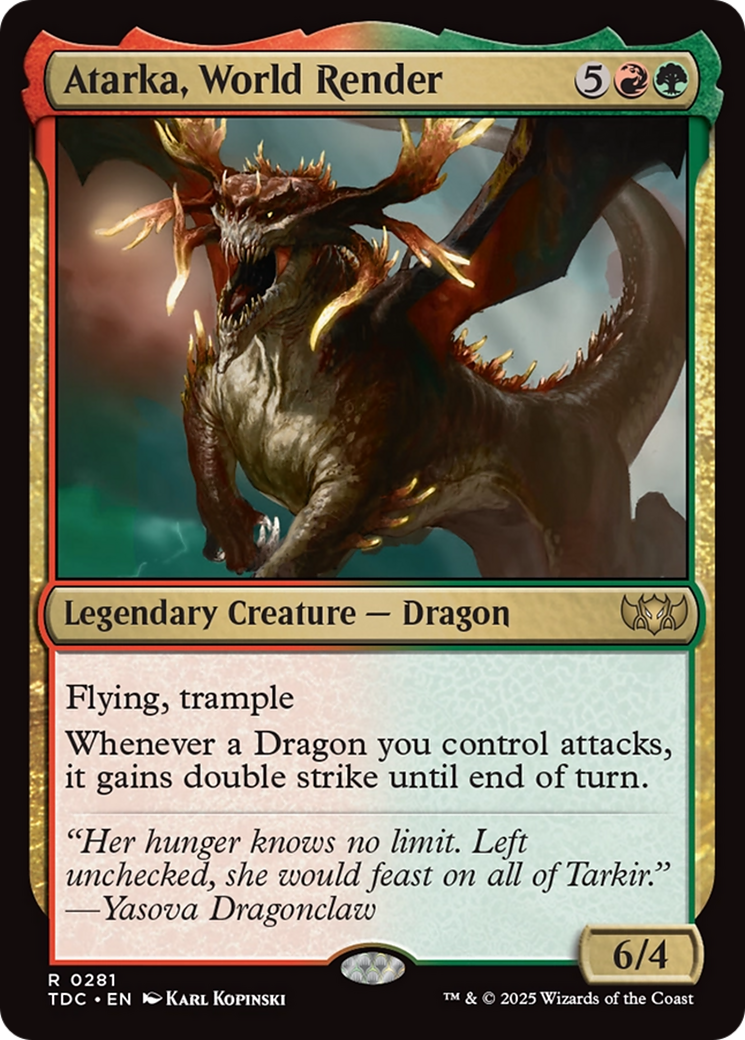
Atarka, World Render
Atarka, World Render
Legendary Creature — Dragon
6/4
Flying, trample
Whenever a Dragon you control attacks, it gains double strike until end of turn.
-
1
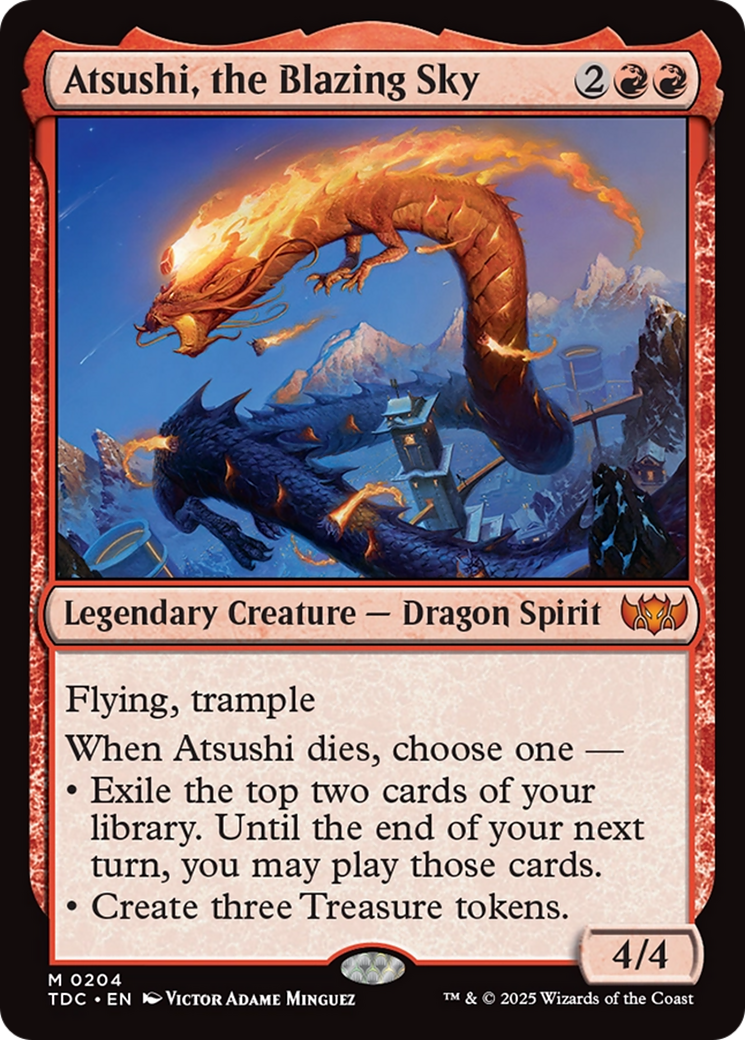
Atsushi, the Blazing Sky
Atsushi, the Blazing Sky
Legendary Creature — Dragon Spirit
4/4
Flying, trample
When Atsushi dies, choose one —
- Exile the top two cards of your library. Until the end of your next turn, you may play those cards.
- Create three Treasure tokens.
-
1
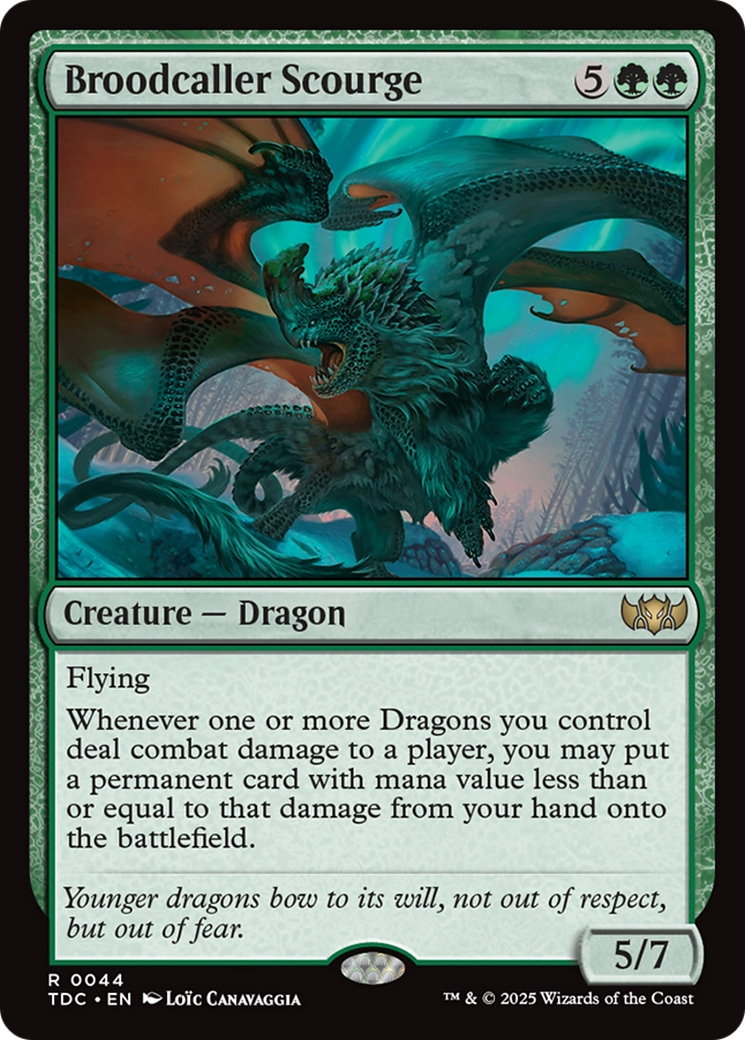
Broodcaller Scourge
Broodcaller Scourge
Creature — Dragon
5/7
Flying
Whenever one or more Dragons you control deal combat damage to a player, you may put a permanent card with mana value less than or equal to that damage from your hand onto the battlefield.
- If a card in your hand has in its mana cost, X is 0 for the purpose of determining its mana value.
-
1
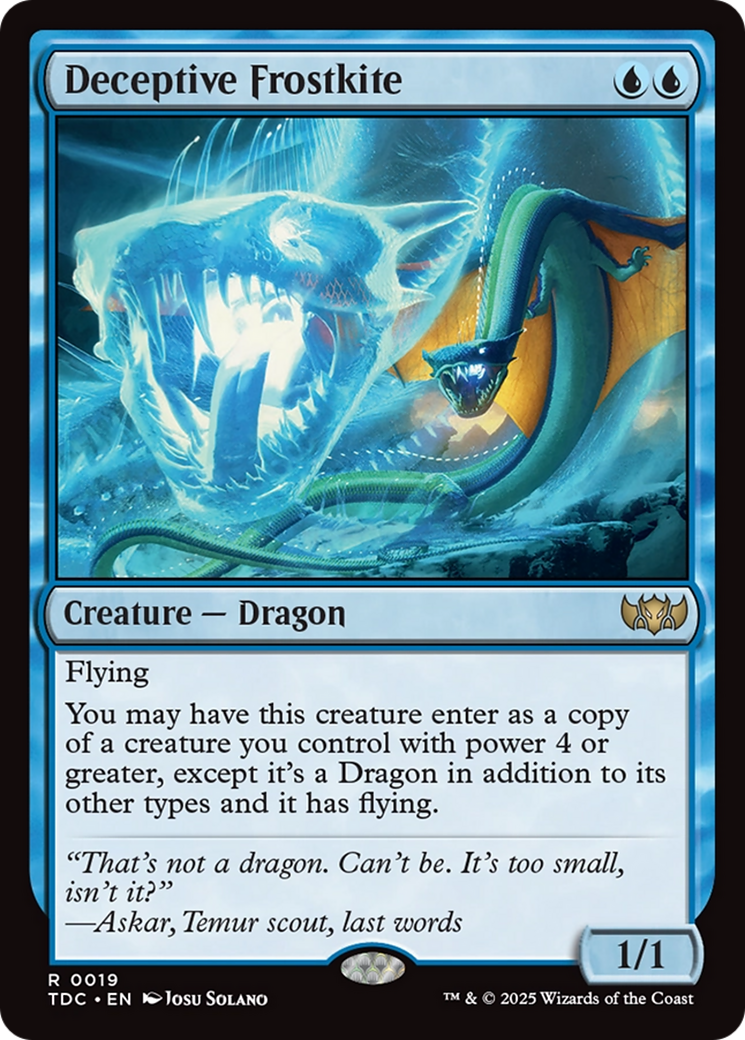
Deceptive Frostkite
Deceptive Frostkite
Creature — Dragon
1/1
Flying
You may have this creature enter as a copy of a creature you control with power 4 or greater, except it's a Dragon in addition to its other types and it has flying.
- Deceptive Frostkite copies exactly what was printed on the original creature and nothing else, with the listed exceptions (unless that creature is copying something else or is a token; see below). It doesn’t copy whether that creature is tapped or untapped, whether it has any counters on it or Auras and Equipment attached to it, or any non-copy effects that have changed its power, toughness, types, color, or so on.
- If the copied creature has in its mana cost, X is 0.
- If the copied creature is a token, Deceptive Frostkite copies the original characteristics of that token as stated by the effect that created the token, with the listed exceptions.
- If the copied creature is copying something else, then Deceptive Frostkite enters as whatever that creature copied, with the listed exceptions.
- Any enters abilities of the copied creature will trigger when Deceptive Frostkite enters. Any “as [this creature] enters” or “[this creature] enters with” abilities of the copied permanent will also work.
- You can choose not to have Deceptive Frostkite enter as a copy of another creature. If you do, it will just be a 1/1 Dragon with flying.
-
1
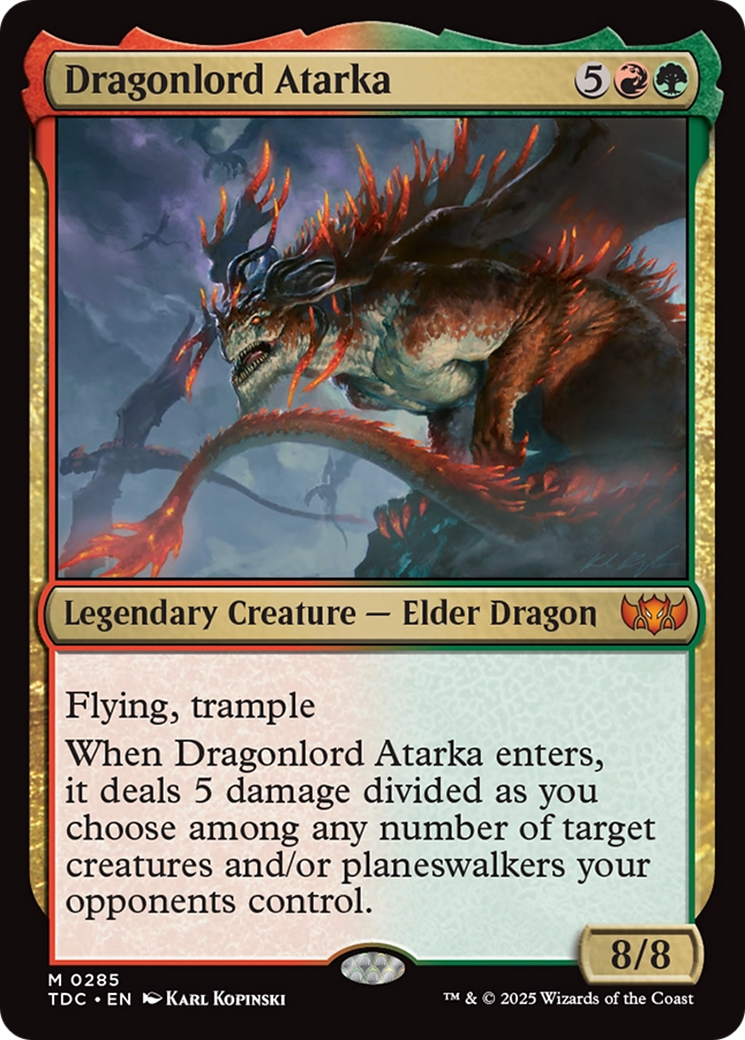
Dragonlord Atarka
Dragonlord Atarka
Legendary Creature — Elder Dragon
8/8
Flying, trample
When Dragonlord Atarka enters, it deals 5 damage divided as you choose among any number of target creatures and/or planeswalkers your opponents control.
- You choose how many targets the ability has and how the damage is divided as you put the ability on the stack. Each target must receive at least 1 damage.
- If some of the targets are illegal targets as the ability tries to resolve, the original division of damage still applies but no damage is dealt to the illegal targets. If all targets are illegal, the ability doesn’t resolve.
-
1
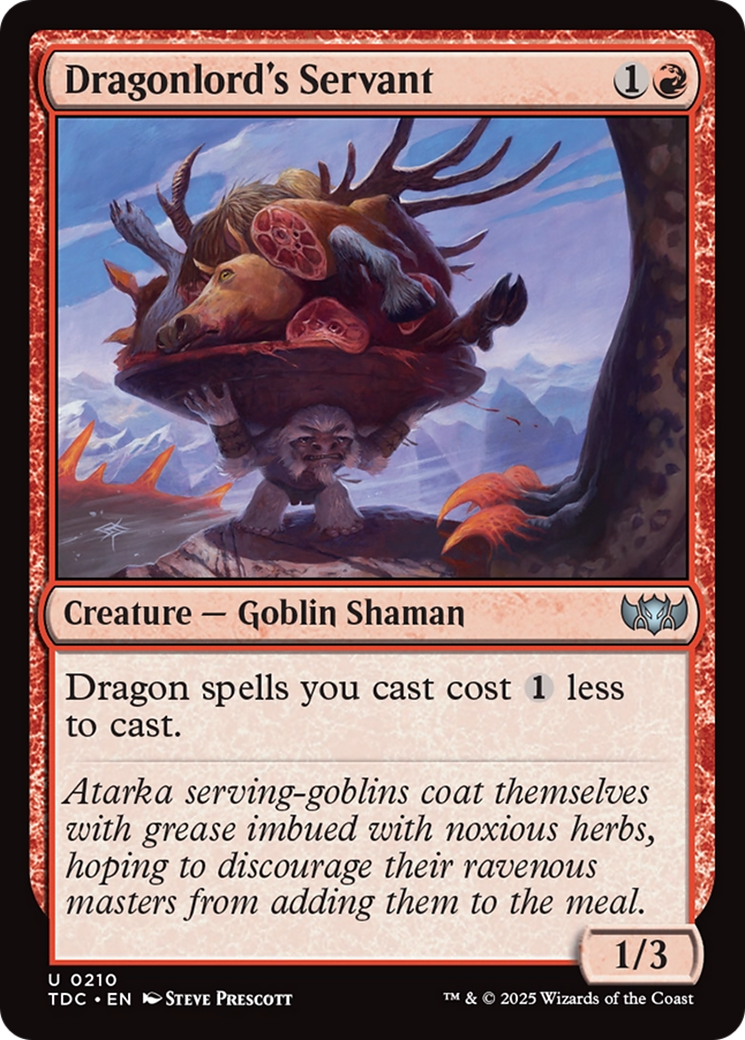
Dragonlord's Servant
Dragonlord's Servant
Creature — Goblin Shaman
1/3
Dragon spells you cast cost less to cast.
- Dragonlord's Servant's ability doesn't change the mana cost or mana value of any spell. It changes only the total cost you pay to cast Dragon spells.
- Dragonlord's Servant's ability can't reduce the amount of colored mana you pay for a spell. It reduces only the generic mana component of that spell.
- Dragonlord's Servant can't reduce the colored mana requirement of a Dragon spell you cast.
- If there are any additional costs to cast a Dragon spell, apply those before applying Dragonlord's Servant and any other cost reductions.
- The ability can apply to alternative costs to cast a Dragon spell.
- To determine the total cost of a spell, start with the mana cost or alternative cost (such as a flashback cost) you're paying, add any cost increases, then apply any cost reductions. The mana value of the spell is determined only by its mana cost, no matter what the total cost to cast the spell was.
-
1
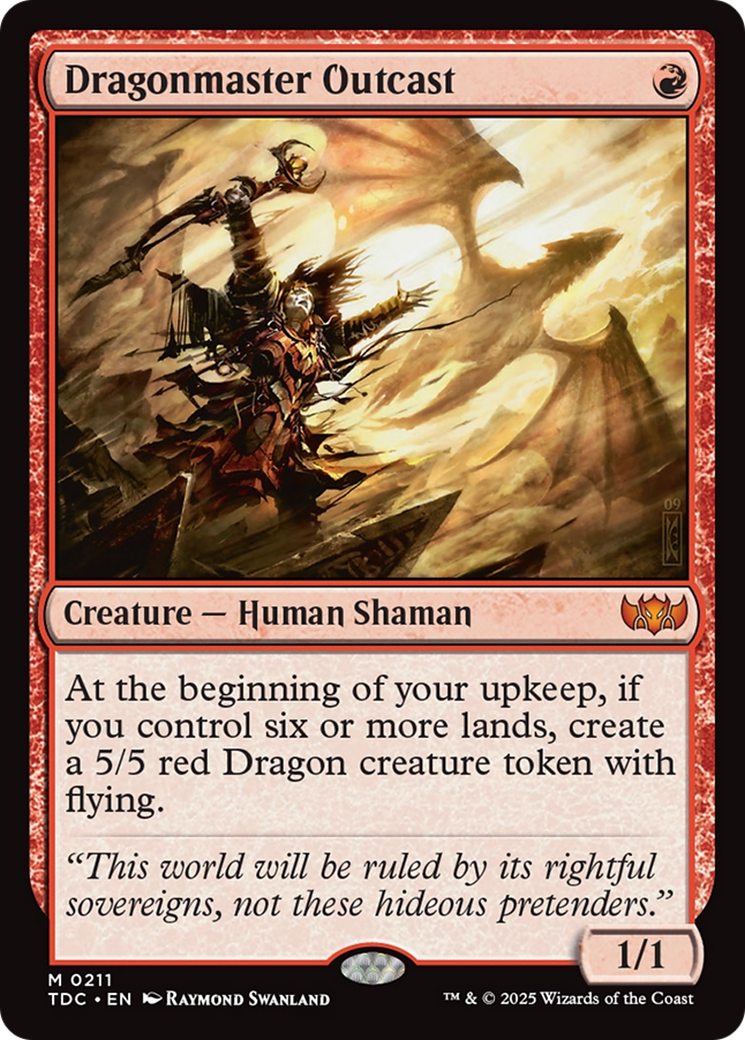
Dragonmaster Outcast
Dragonmaster Outcast
Creature — Human Shaman
1/1
At the beginning of your upkeep, if you control six or more lands, create a 5/5 red Dragon creature token with flying.
-
1
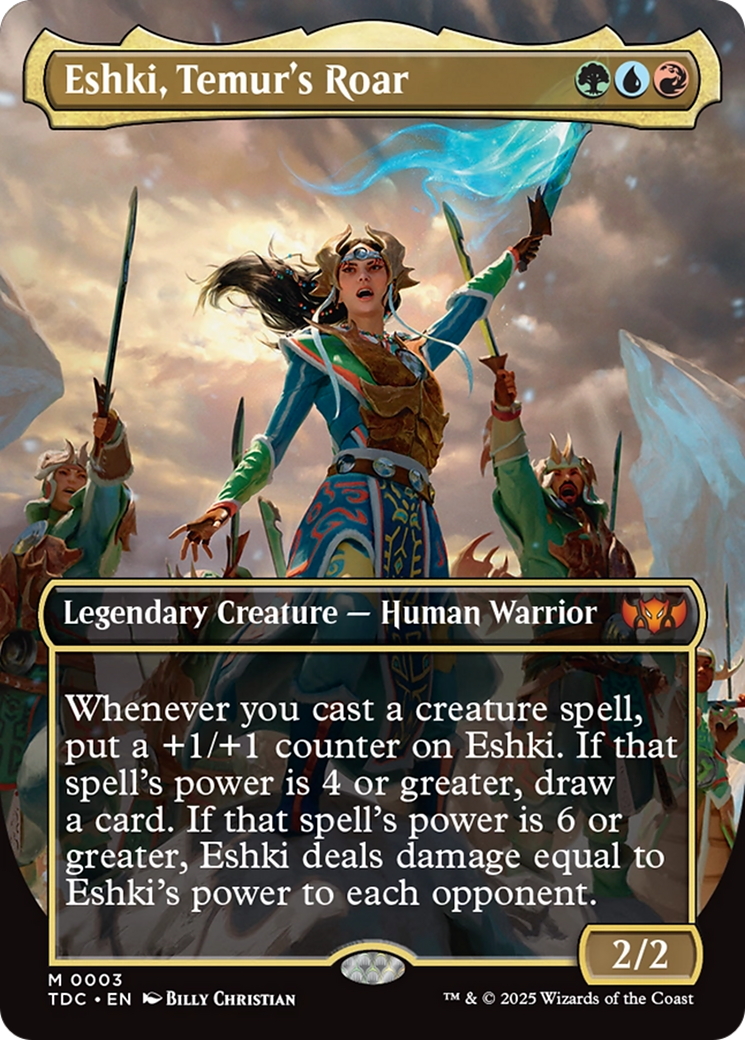
Eshki, Temur's Roar
Eshki, Temur's Roar
Legendary Creature — Human Warrior
2/2
Whenever you cast a creature spell, put a +1/+1 counter on Eshki. If that spell's power is 4 or greater, draw a card. If that spell's power is 6 or greater, Eshki deals damage equal to Eshki's power to each opponent.
-
1
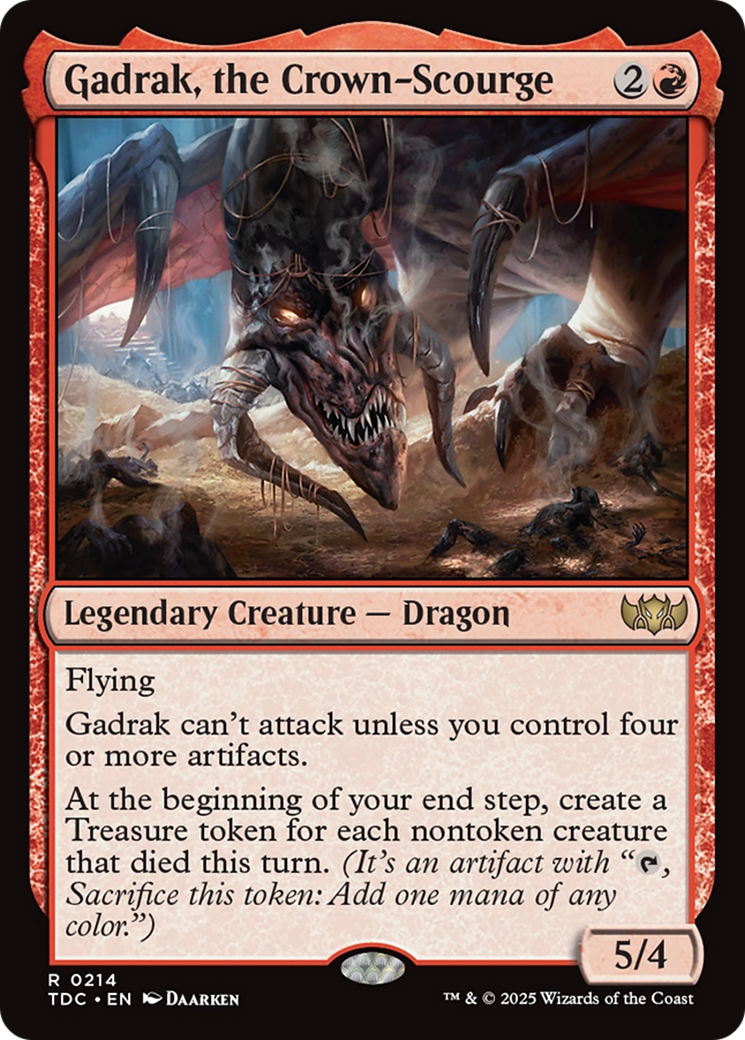
Gadrak, the Crown-Scourge
Gadrak, the Crown-Scourge
Legendary Creature — Dragon
5/4
Flying
Gadrak can't attack unless you control four or more artifacts.
At the beginning of your end step, create a Treasure token for each nontoken creature that died this turn. (It's an artifact with " , Sacrifice this token: Add one mana of any color.")
- Once Gadrak has attacked, it will remain an attacking creature even if you no longer control four or more artifacts.
- Gadrak's last ability counts creatures that died during the entire turn, even ones that died before Gadrak entered the battlefield.
-
1
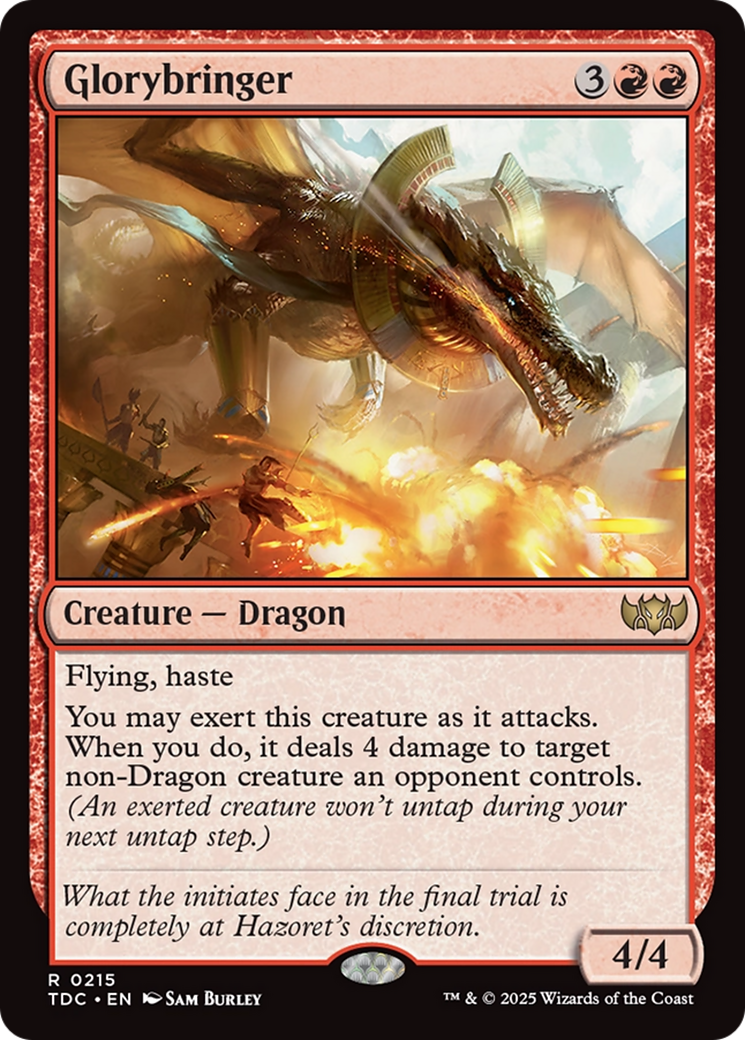
Glorybringer
Glorybringer
Creature — Dragon
4/4
Flying, haste
You may exert this creature as it attacks. When you do, it deals 4 damage to target non-Dragon creature an opponent controls. (An exerted creature won't untap during your next untap step.)
- You can’t exert a creature unless an effect allows you to do so. Similar effects that “tap and freeze” a creature (such as that of Decision Paralysis) don’t exert that creature.
- If an exerted creature is already untapped during your next untap step (most likely because it had vigilance or an effect untapped it), exert’s effect preventing it from untapping expires without having done anything.
- If you gain control of another player’s creature until end of turn and exert it, it will untap during that player’s untap step.
- If a creature has a targeted triggered ability that triggers when you exert it, you can exert it even if there isn’t a legal target for that triggered ability.
- All cards in the Amonkhet set that let you exert a creature let you do so as you declare it as an attacking creature, as do some of the cards in the Hour of Devastation set. You can’t do so later in combat, and creatures put onto the battlefield attacking can’t be exerted. Any abilities that trigger on exerting an attacking creature will resolve before blockers are declared.
-
1
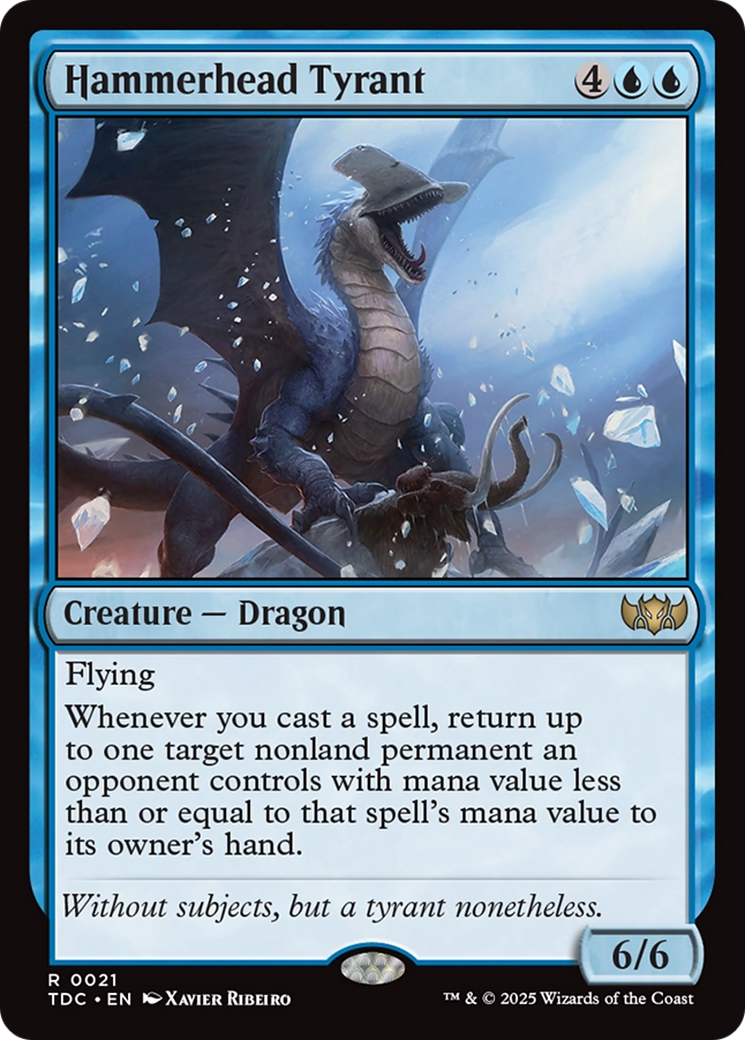
Hammerhead Tyrant
Hammerhead Tyrant
Creature — Dragon
6/6
Flying
Whenever you cast a spell, return up to one target nonland permanent an opponent controls with mana value less than or equal to that spell's mana value to its owner's hand.
- If a permanent has in its mana cost, X is 0 for the purpose of determining its mana value.
- If a spell has in its mana cost, use the value of X chosen as it was cast to determine that spell’s mana value.
-
1
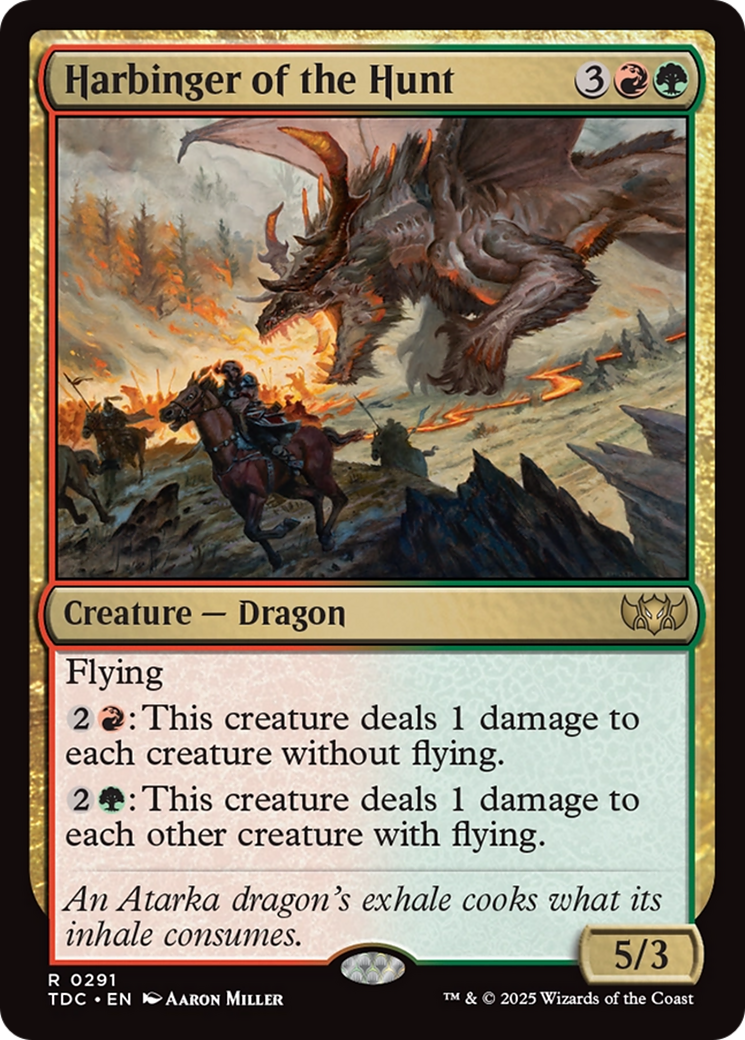
Harbinger of the Hunt
Harbinger of the Hunt
Creature — Dragon
5/3
Flying
: This creature deals 1 damage to each creature without flying.
: This creature deals 1 damage to each other creature with flying.
- If Harbinger of the Hunt loses flying, its first activated ability will cause it to deal damage to itself.
-
1
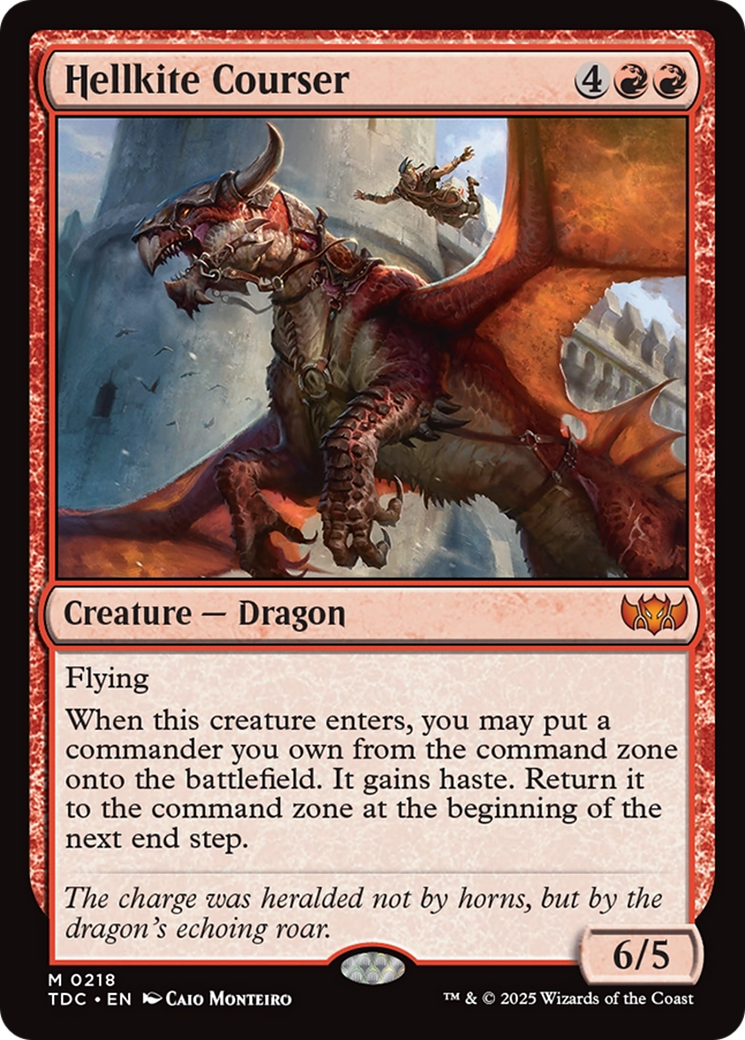
Hellkite Courser
Hellkite Courser
Creature — Dragon
6/5
Flying
When this creature enters, you may put a commander you own from the command zone onto the battlefield. It gains haste. Return it to the command zone at the beginning of the next end step.
- Putting your commander onto the battlefield this way isn't the same as casting that commander. The "commander tax" won't increase.
- You'll return the commander to the command zone only if it's still on the battlefield as the delayed triggered ability resolves. If it's in another zone, it will stay where it is.
-
1
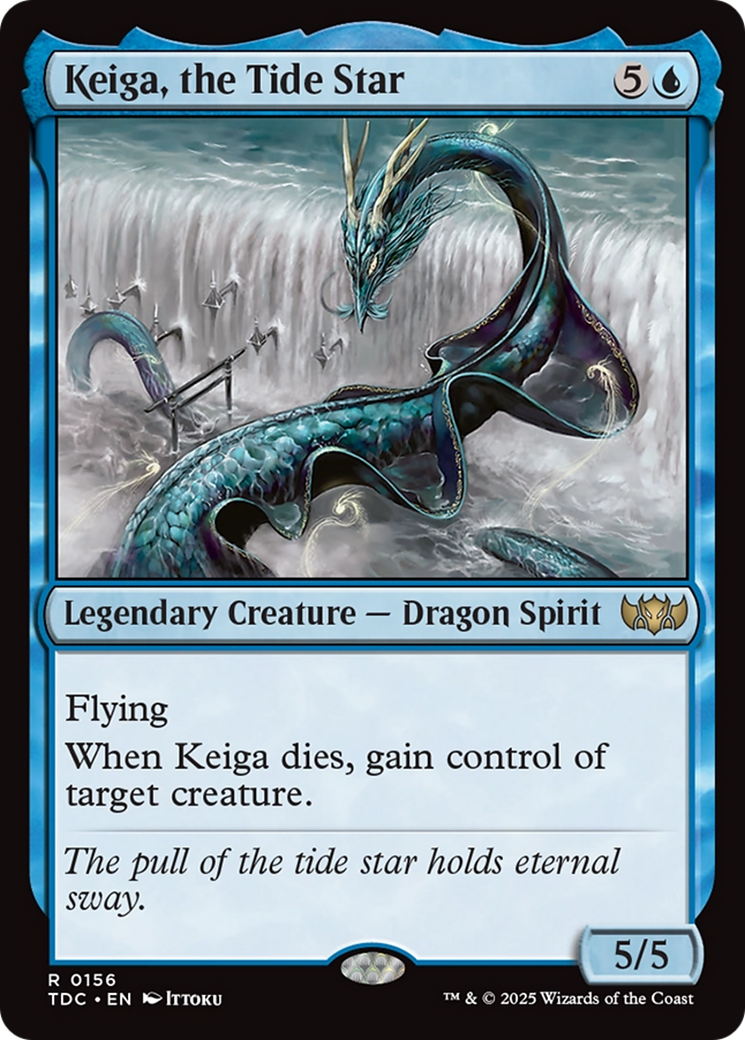
Keiga, the Tide Star
Keiga, the Tide Star
Legendary Creature — Dragon Spirit
5/5
Flying
When Keiga dies, gain control of target creature.
- Keiga's effect lasts indefinitely. It doesn't wear off during the cleanup step.
-
1
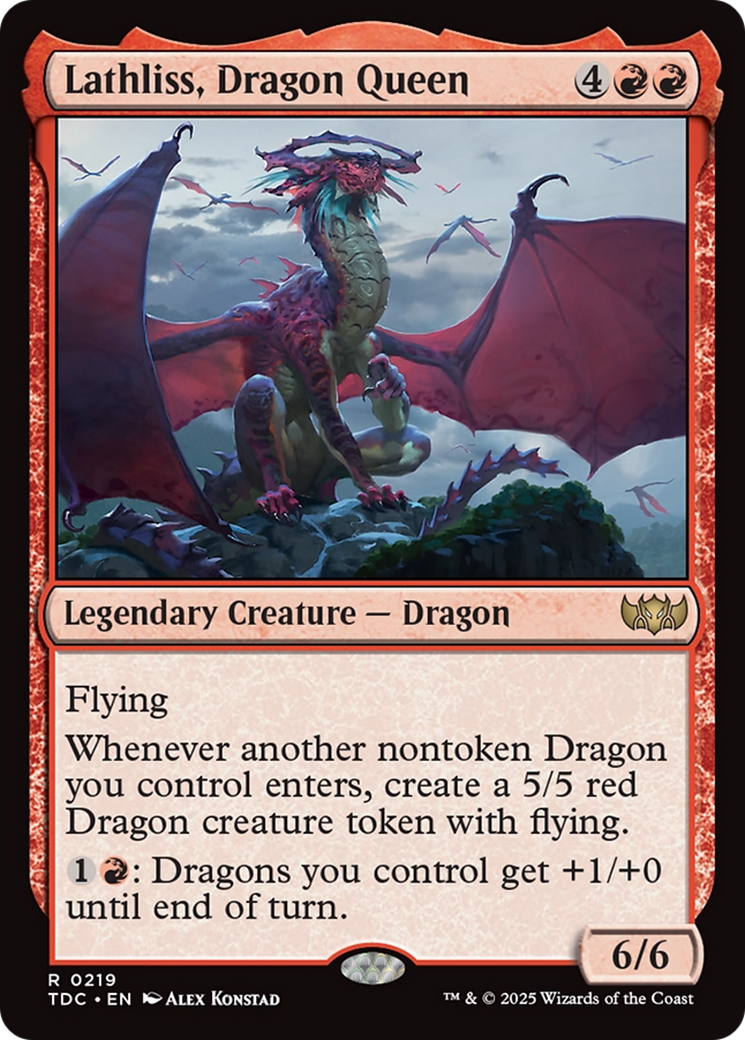
Lathliss, Dragon Queen
Lathliss, Dragon Queen
Legendary Creature — Dragon
6/6
Flying
Whenever another nontoken Dragon you control enters, create a 5/5 red Dragon creature token with flying.
: Dragons you control get +1/+0 until end of turn.
- If Lathliss enters at the same time as one or more other nontoken Dragons you control, its second ability will trigger once for each of those other Dragons.
-
1
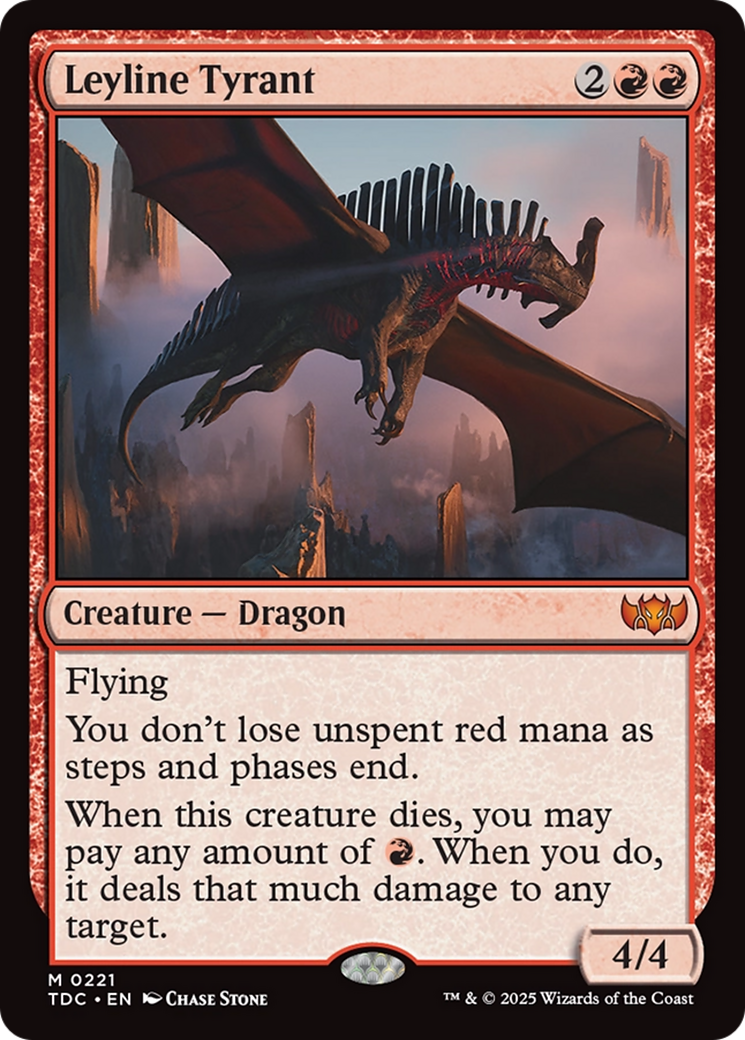
Leyline Tyrant
Leyline Tyrant
Creature — Dragon
4/4
Flying
You don't lose unspent red mana as steps and phases end.
When this creature dies, you may pay any amount of . When you do, it deals that much damage to any target.
- You can keep unspent red mana indefinitely while Leyline Tyrant is on the battlefield. That means if you add a red mana during one step or phase, you can spend it during a later step or phase, or even a later turn. Other types of mana will continue to be lost as normal as each step and phase ends.
- If a red mana you add has certain restrictions or riders associated with it (for example, if it was produced by Base Camp), they'll apply to that mana no matter when you spend it.
- Once Leyline Tyrant leaves the battlefield, you have until the end of the current step or phase to spend your unspent red mana before it is lost as normal. There is no penalty associated with this other than the loss of the mana.
- Leyline Tyrant's last ability goes on the stack without a target. While that ability is resolving, you may pay any amount of red mana, including from the unspent mana you have. If you do, a second ability triggers and you pick one target to be dealt that much damage. This is different from abilities that say "If you do . . ." in that players may cast spells and activate abilities after mana is paid but before the damage is dealt.
-
1
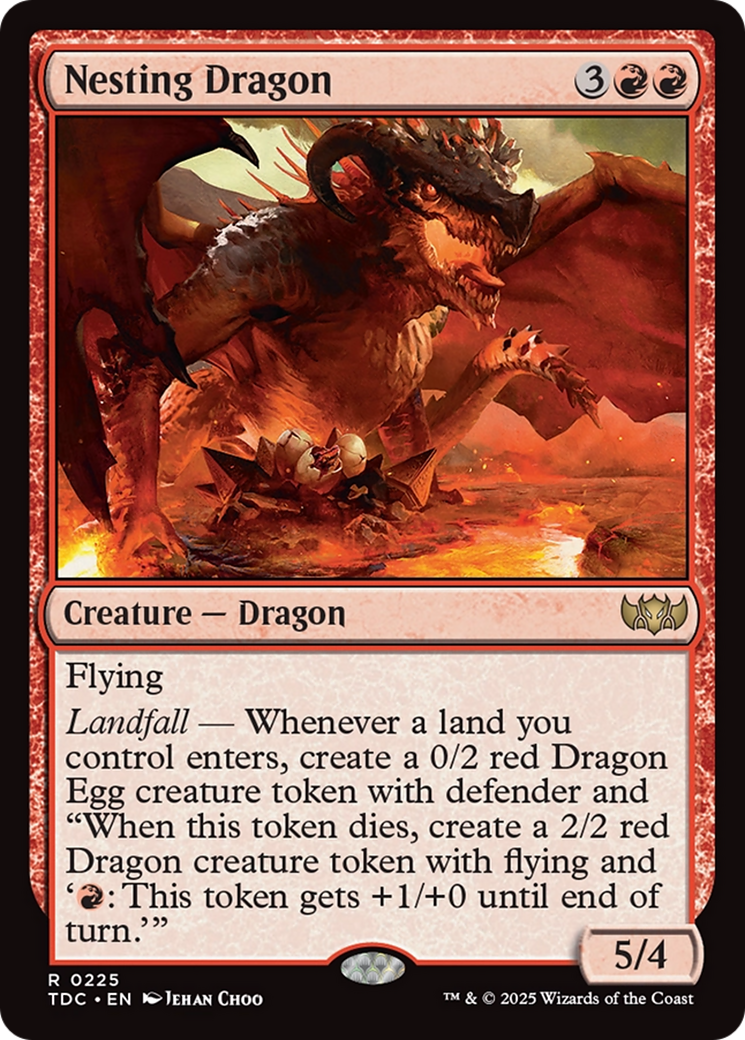
Nesting Dragon
Nesting Dragon
Creature — Dragon
5/4
Flying
Landfall — Whenever a land you control enters, create a 0/2 red Dragon Egg creature token with defender and "When this token dies, create a 2/2 red Dragon creature token with flying and ' : This token gets +1/+0 until end of turn.'"
-
1
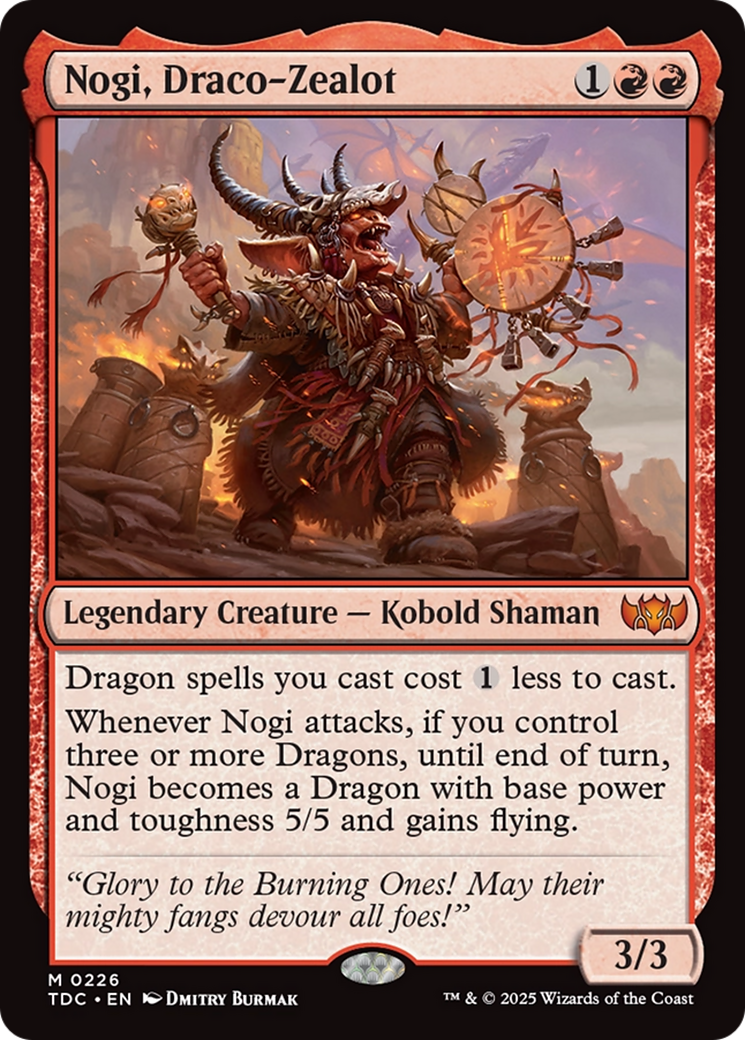
Nogi, Draco-Zealot
Nogi, Draco-Zealot
Legendary Creature — Kobold Shaman
3/3
Dragon spells you cast cost less to cast.
Whenever Nogi attacks, if you control three or more Dragons, until end of turn, Nogi becomes a Dragon with base power and toughness 5/5 and gains flying.
-
1
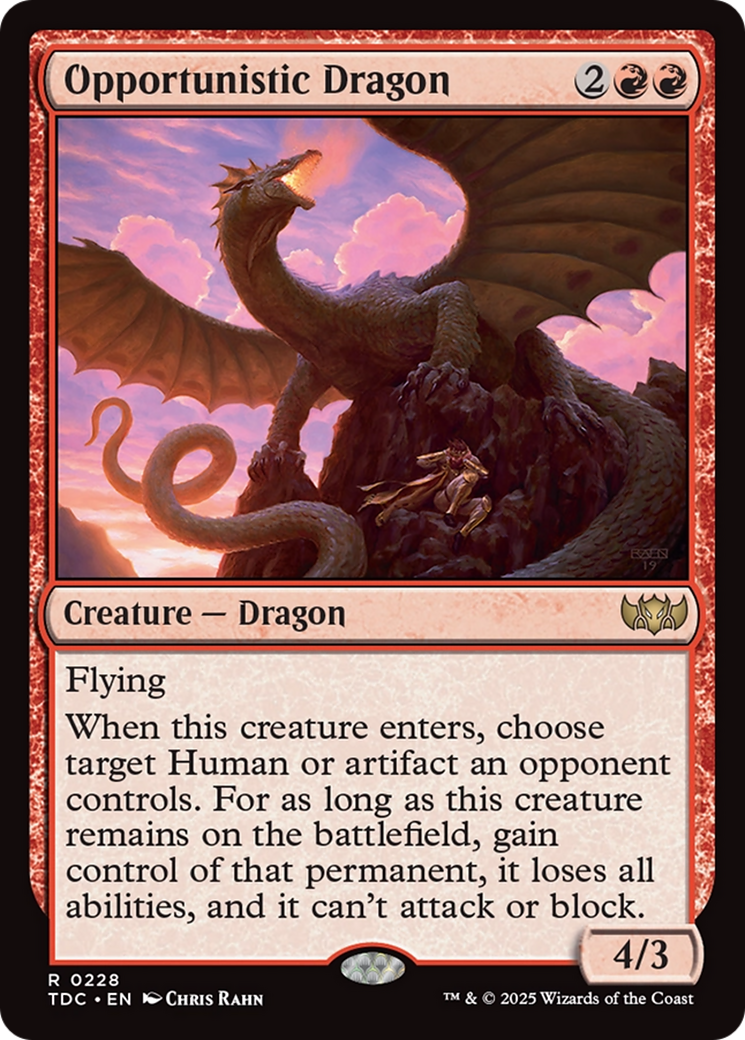
Opportunistic Dragon
Opportunistic Dragon
Creature — Dragon
4/3
Flying
When this creature enters, choose target Human or artifact an opponent controls. For as long as this creature remains on the battlefield, gain control of that permanent, it loses all abilities, and it can't attack or block.
- If Opportunistic Dragon leaves the battlefield before its triggered ability resolves, your opponent keeps control of their Human or artifact, it doesn't lose any abilities, and it can still attack or block as normal. You don't gain control of it at all.
- Opportunistic Dragon's effect doesn't expire if another player gains control of it or if it loses all abilities. The effect only expires once it's no longer on the battlefield.
- If another player gains control of the permanent Opportunistic Dragon has kidnapped, that permanent doesn't regain its abilities and still can't attack or block.
- If the stolen permanent normally has any abilities that would trigger when Opportunistic Dragon dies, those abilities won't trigger.
-
1
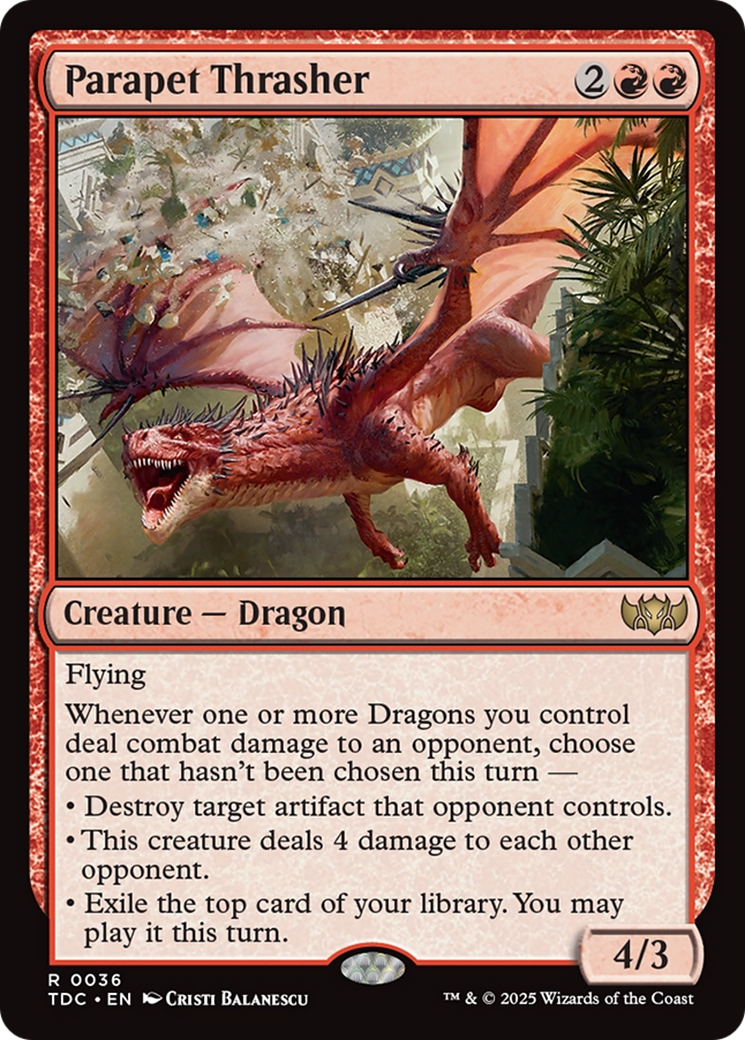
Parapet Thrasher
Parapet Thrasher
Creature — Dragon
4/3
Flying
Whenever one or more Dragons you control deal combat damage to an opponent, choose one that hasn't been chosen this turn —
- Destroy target artifact that opponent controls.
- This creature deals 4 damage to each other opponent.
- Exile the top card of your library. You may play it this turn.
- If the triggered ability triggers more than three times in a turn, no mode can be chosen for any instances of the ability after the third, and those will be removed from the stack and do nothing.
- You pay all costs and follow all timing rules for cards played this way. For example, if the exiled card is a land card, you may play it only during your main phase while the stack is empty.
-
1
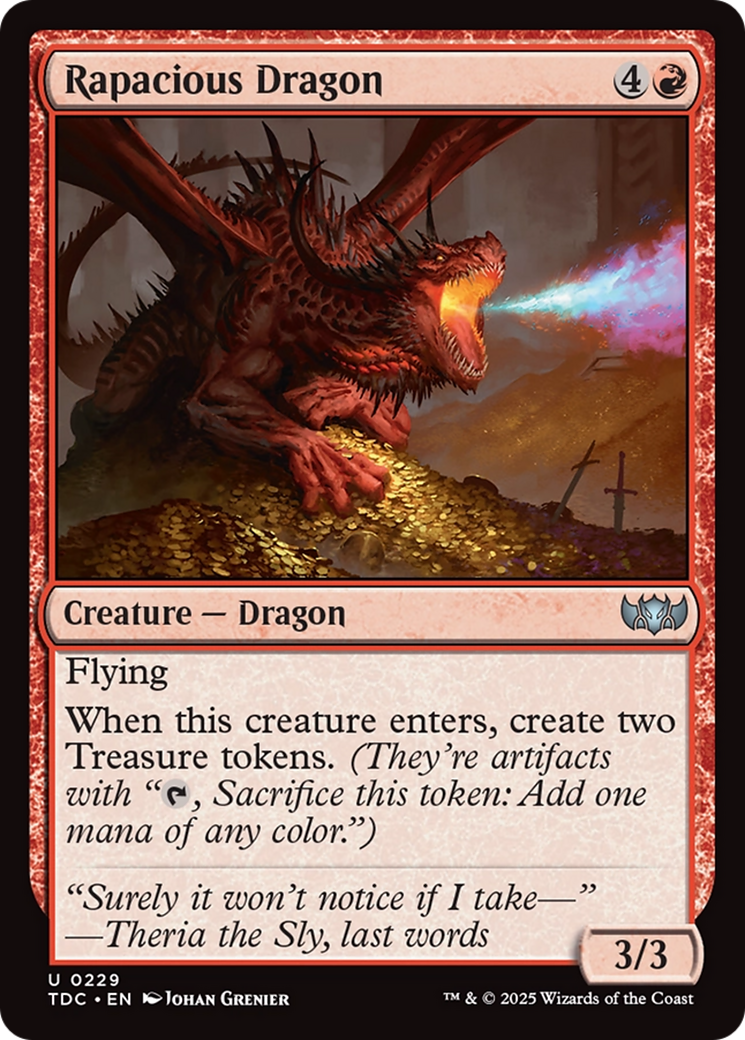
Rapacious Dragon
Rapacious Dragon
Creature — Dragon
3/3
Flying
When this creature enters, create two Treasure tokens. (They're artifacts with " , Sacrifice this token: Add one mana of any color.")
-
1
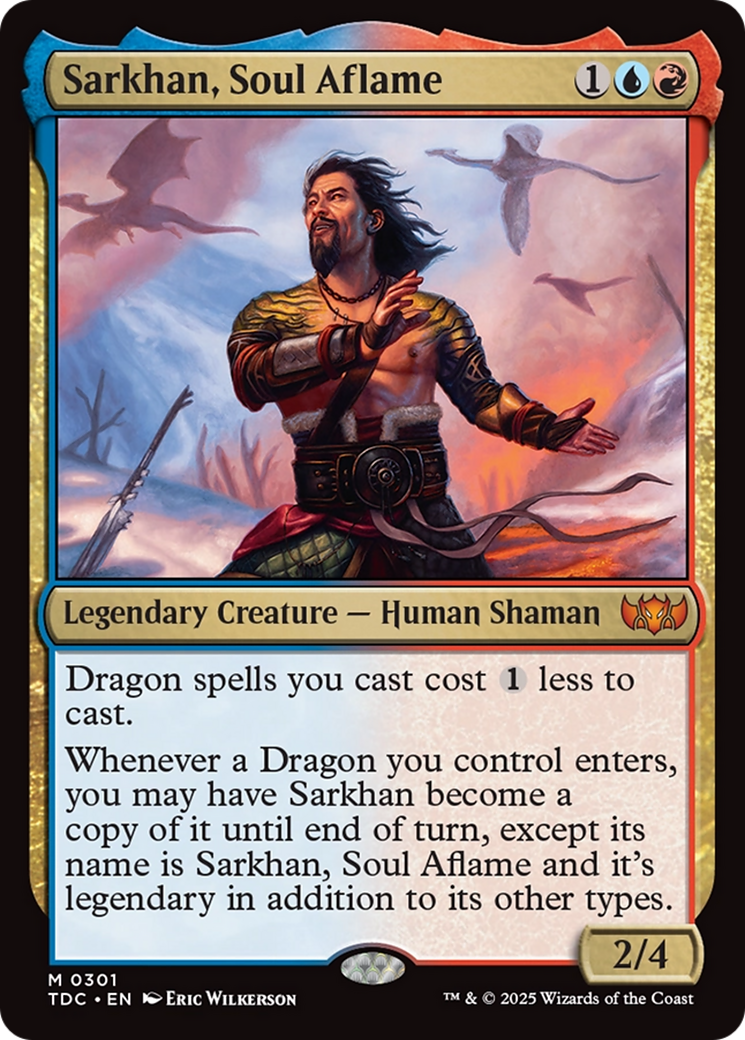
Sarkhan, Soul Aflame
Sarkhan, Soul Aflame
Legendary Creature — Human Shaman
2/4
Dragon spells you cast cost less to cast.
Whenever a Dragon you control enters, you may have Sarkhan become a copy of it until end of turn, except its name is Sarkhan, Soul Aflame and it's legendary in addition to its other types.
- Sarkhan's first ability doesn't change the mana cost or mana value of any Dragon spell. It changes only the total cost you pay.
- That ability can't reduce the amount of colored mana you pay for a Dragon spell. It reduces only the generic component of that cost.
- Sarkhan copies exactly what was printed on the original Dragon and nothing else, with the noted exceptions (unless that creature is a token; see below). It doesn't copy whether that creature is tapped or untapped, whether it has any counters on it or Auras and Equipment attached to it, or any non-copy effects that have changed its power, toughness, types, color, and so on in response to Sarkhan's ability.
- If the copied Dragon has in its mana cost, X is 0.
- If the copied Dragon is a token, Sarkhan copies the original characteristics of that token as stated by the effect that created that token, with the noted exceptions.
- In some unusual cases, the Dragon that entered the battlefield will be copying something else by the time Sarkhan's ability resolves. In such a case, Sarkhan will copy whatever the Dragon is copying, with the noted exceptions.
- If the Dragon that enters the battlefield is legendary and you have Sarkhan copy it, the two Dragons will have different names (unless the entering Dragon is somehow named Sarkhan, Soul Aflame). The "legend rule" won't apply.
-
1
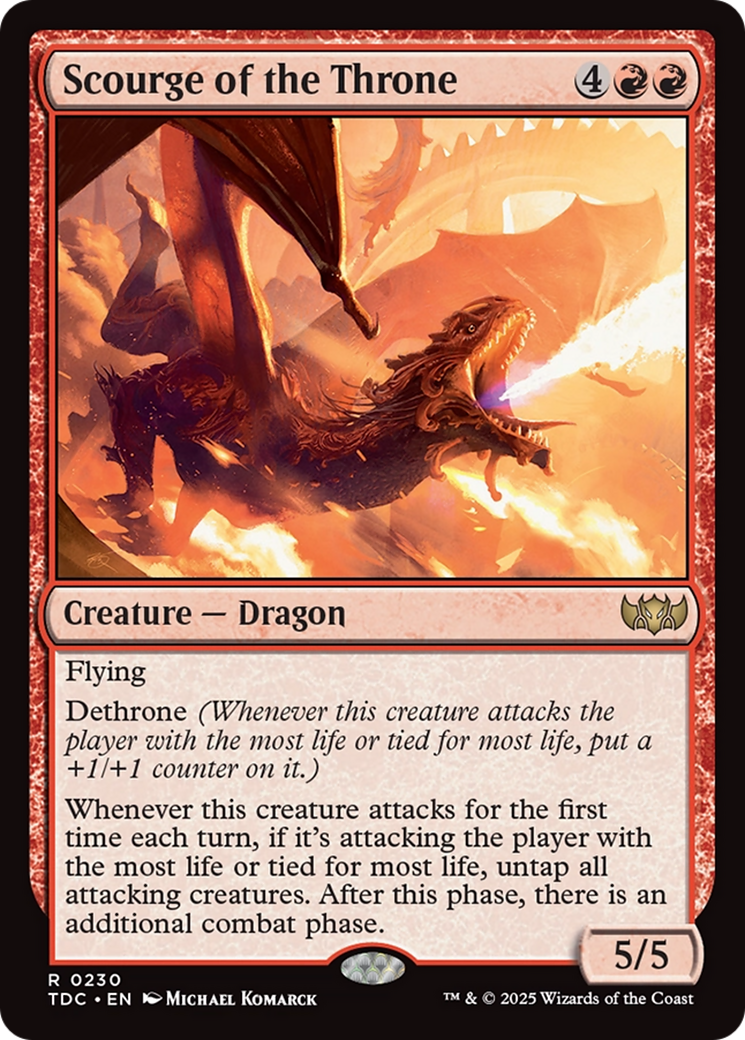
Scourge of the Throne
Scourge of the Throne
Creature — Dragon
5/5
Flying
Dethrone (Whenever this creature attacks the player with the most life or tied for most life, put a +1/+1 counter on it.)
Whenever this creature attacks for the first time each turn, if it's attacking the player with the most life or tied for most life, untap all attacking creatures. After this phase, there is an additional combat phase.
- Dethrone doesn't trigger if the creature attacks a planeswalker, even if its controller has the most life. The same is true if the creature attacks a battle, even if its protector has the most life.
- Scourge of the Throne's ability has an intervening "if" clause. It must be attacking the player with the most life or tied with the most life both when it's declared as an attacker and as it starts to resolve for it to have any effect. If, at either time, the player isn't the one with the most life or tied for the most life, the ability will have no effect. Notably, this is different than how dethrone works. (Dethrone checks only once to see if the ability triggers.)
- Once dethrone triggers, it doesn't matter what happens to the players' life totals before the ability resolves. You'll put a +1/+1 counter on the creature even if the defending player doesn't have the most life as the ability resolves.
- The +1/+1 counter is put on the creature before blockers are declared.
- In a Two-Headed Giant game, dethrone will trigger if the creature attacks either player on the team with the most life or tied for the most life.
-
1
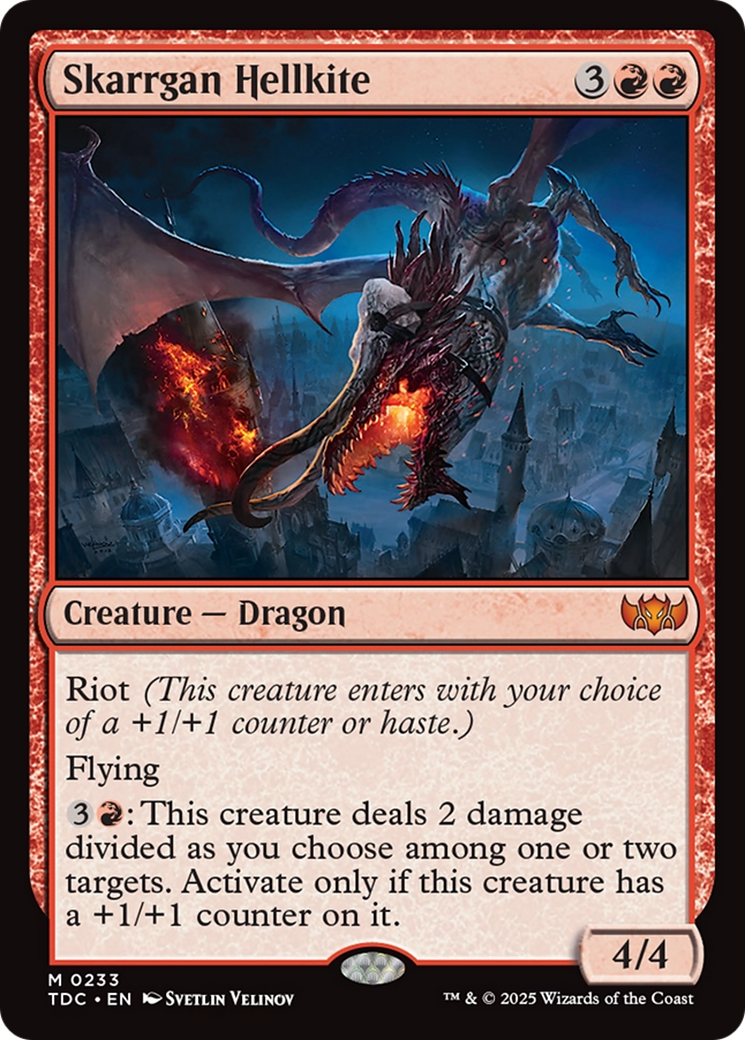
Skarrgan Hellkite
Skarrgan Hellkite
Creature — Dragon
4/4
Riot (This creature enters with your choice of a +1/+1 counter or haste.)
Flying
: This creature deals 2 damage divided as you choose among one or two targets. Activate only if this creature has a +1/+1 counter on it.
- You divide the damage as you activate Skarrgan Hellkite's ability, not as it resolves. Each target must be assigned at least 1 damage. In other words, as you activate the ability, you choose whether to have Skarrgan Hellkite deal 2 damage to a single target, or deal 1 damage to each of two targets.
- If Skarrgan Hellkite's ability has two targets and one becomes illegal, the remaining target is dealt 1 damage, not 2.
- Once Skarrgan Hellkite's ability has been activated, it resolves even if all +1/+1 counters are removed from it or if Skarrgan Hellkite leaves the battlefield.
- Riot is a replacement effect. Players can't respond to your choice of +1/+1 counter or haste, and they can't take actions while the creature is on the battlefield without one or the other.
- If a creature entering the battlefield has riot but can't have a +1/+1 counter put onto it, it gains haste.
- If you choose for the creature to gain haste, it gains haste indefinitely. It won't lose it as the turn ends or as another player gains control of it.
-
1
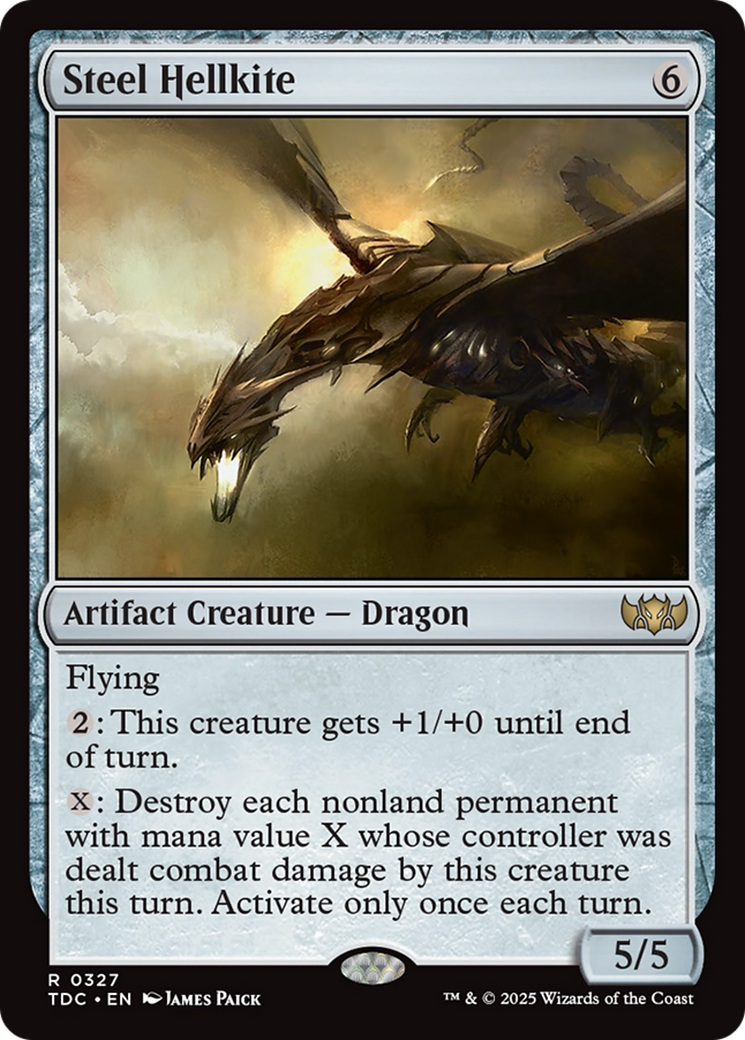
Steel Hellkite
Steel Hellkite
Artifact Creature — Dragon
5/5
Flying
: This creature gets +1/+0 until end of turn.
: Destroy each nonland permanent with mana value X whose controller was dealt combat damage by this creature this turn. Activate only once each turn.
- Steel Hellkite's last ability destroys only nonland permanents whose mana value is exactly equal to X, and only those controlled by players who have been dealt combat damage by Steel Hellkite this turn.
- It doesn't matter who controlled those permanents at the time Steel Hellkite dealt combat damage, or if those permanents were even on the battlefield at that time.
- You may activate the last ability even if Steel Hellkite hasn't dealt combat damage to any players that turn. If you do, the ability won't do anything.
- If Steel Hellkite's third ability is activated with X equal to 0, it will destroy each nonland permanent with mana value 0 the appropriate players control.
- The mana value of a permanent is determined solely by the mana symbols printed in its upper right corner, unless it's copying something else (see below). The mana value is the total amount of mana in that cost, regardless of color. For example, a card with mana cost has mana value 5.
- If a permanent is copying something else, its mana value is the mana value of whatever it's copying.
- In all cases, ignore any alternative costs or additional costs (such as kicker) paid when the permanent was cast.
- If the mana cost of a permanent includes , X is 0 for the purpose of determining its mana value.
- If a nonland permanent has no mana symbols in its upper right corner (because it's a token that's not copying something else, for example), its mana value is 0.
-
1
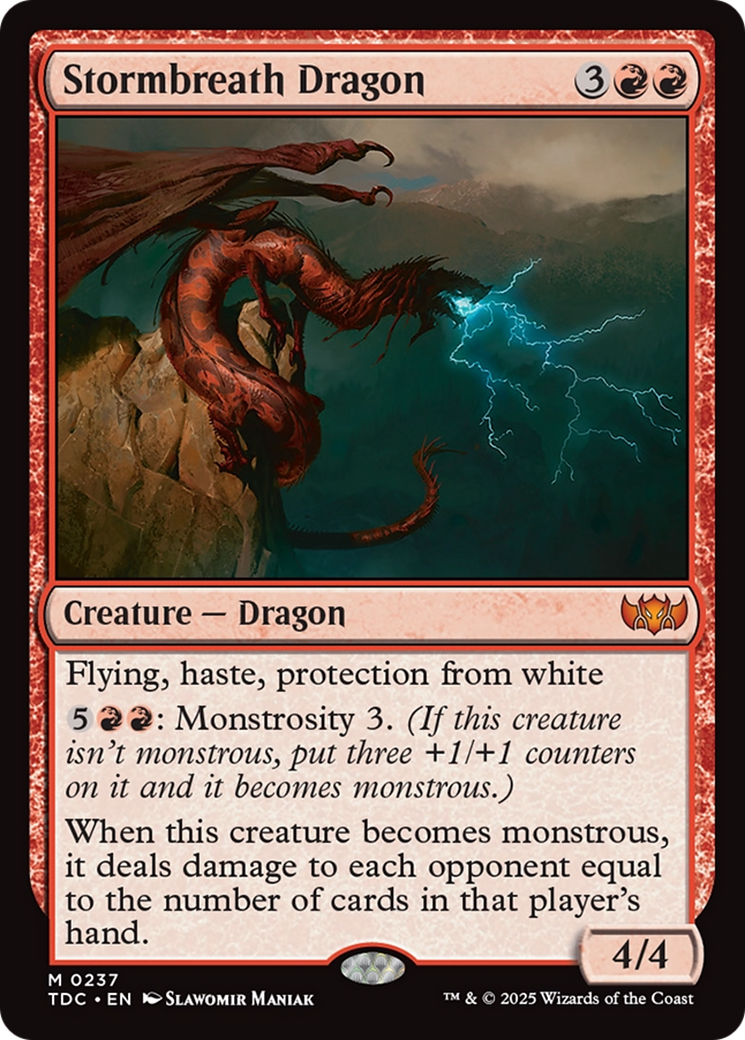
Stormbreath Dragon
Stormbreath Dragon
Creature — Dragon
4/4
Flying, haste, protection from white
: Monstrosity 3. (If this creature isn't monstrous, put three +1/+1 counters on it and it becomes monstrous.)
When this creature becomes monstrous, it deals damage to each opponent equal to the number of cards in that player's hand.
- For each opponent, count the number of cards in that player's hand when the last ability resolves to determine how much damage Stormbreath Dragon does to them.
- Once a creature becomes monstrous, it can't become monstrous again. If the creature is already monstrous when the monstrosity ability resolves, nothing happens.
- Monstrous isn't an ability that a creature has. It's just something true about that creature. If the creature stops being a creature or loses its abilities, it will continue to be monstrous.
- An ability that triggers when a creature becomes monstrous won't trigger if that creature isn't on the battlefield when its monstrosity ability resolves.
-
1
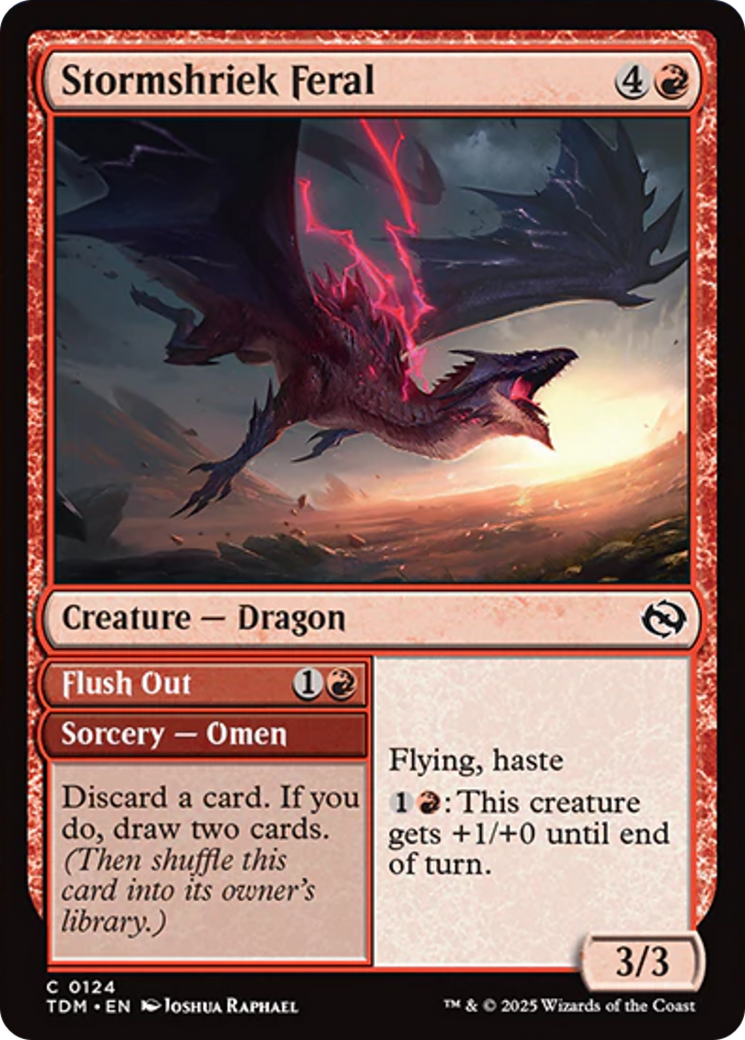
Stormshriek Feral // Flush Out
//
Stormshriek Feral
Creature — Dragon
3/3
-
1
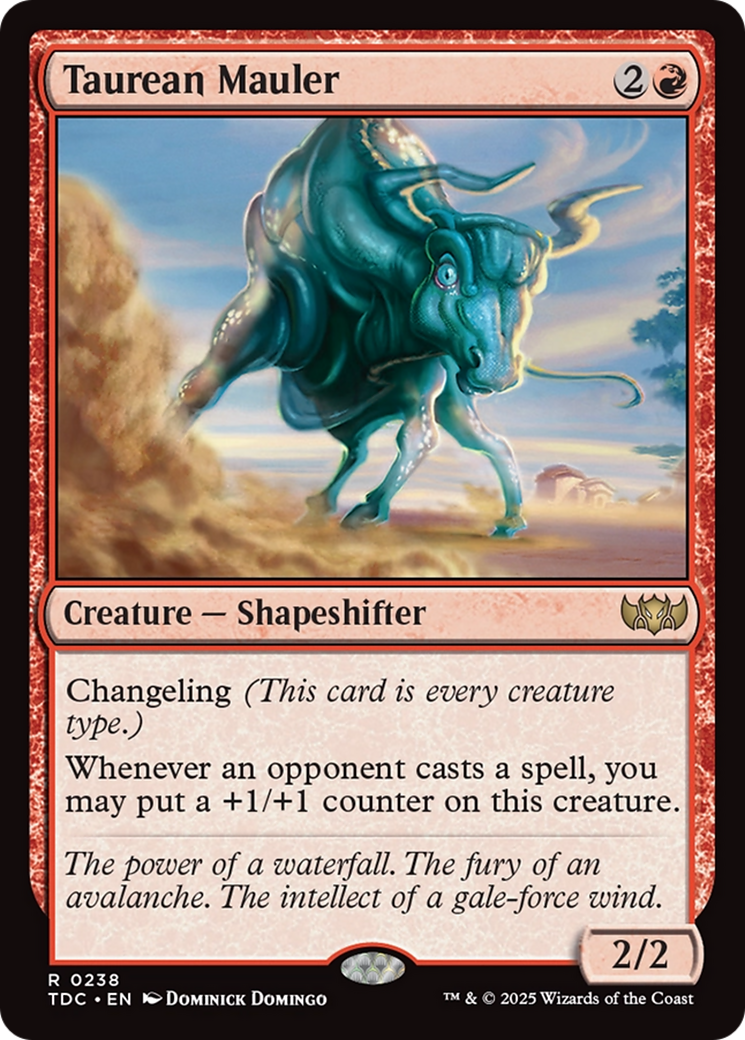
Taurean Mauler
Taurean Mauler
Creature — Shapeshifter
2/2
Changeling (This card is every creature type.)
Whenever an opponent casts a spell, you may put a +1/+1 counter on this creature.
- Taurean Mauler's last ability resolves before the spell that caused it to trigger. It resolves even if that spell is countered or otherwise leaves the stack without resolving.
-
1
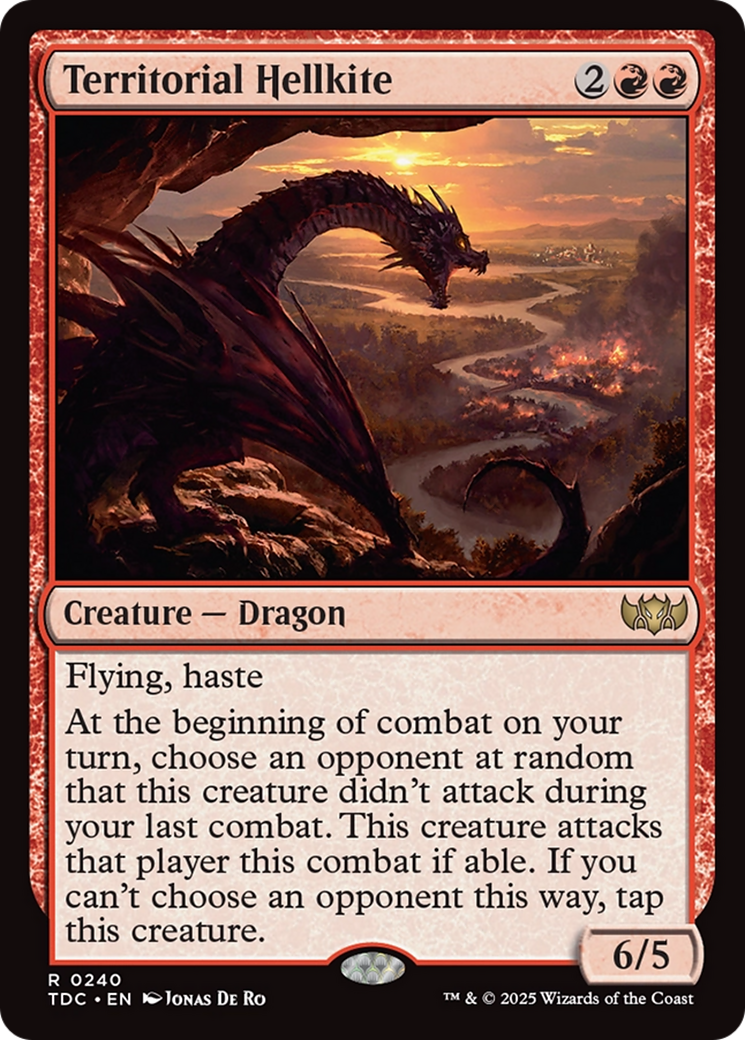
Territorial Hellkite
Territorial Hellkite
Creature — Dragon
6/5
Flying, haste
At the beginning of combat on your turn, choose an opponent at random that this creature didn't attack during your last combat. This creature attacks that player this combat if able. If you can't choose an opponent this way, tap this creature.
- If Territorial Hellkite didn't attack during your last combat, most likely because it was tapped or you didn't control it at that time, then any opponent can be chosen at random.
- If a player can't be attacked, that player can still be chosen at random.
- Territorial Hellkite must attack the chosen player if able, not a planeswalker that player controls.
- Players may cast spells and activate abilities after a player is chosen at random for Territorial Hellkite but before it attacks that player.
- If Territorial Hellkite can't attack the chosen player, it's free to attack any other player or planeswalker or to not attack. If there's a cost associated with attacking the chosen player, it's free to attack any other player or planeswalker or to not attack. But if there's a cost associated with Territorial Hellkite attacking at all, Territorial Hellkite has to attack the chosen player or not attack.
-
1
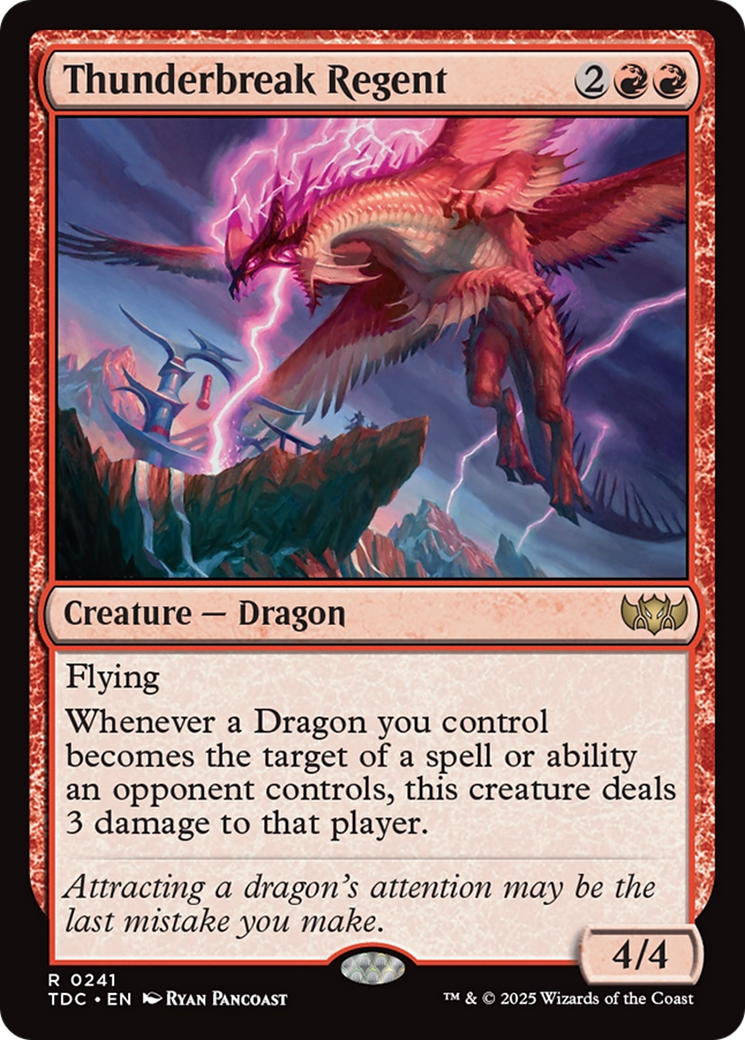
Thunderbreak Regent
Thunderbreak Regent
Creature — Dragon
4/4
Flying
Whenever a Dragon you control becomes the target of a spell or ability an opponent controls, this creature deals 3 damage to that player.
- Thunderbreak Regent's ability will resolve before the spell or ability that caused it to trigger.
-
1
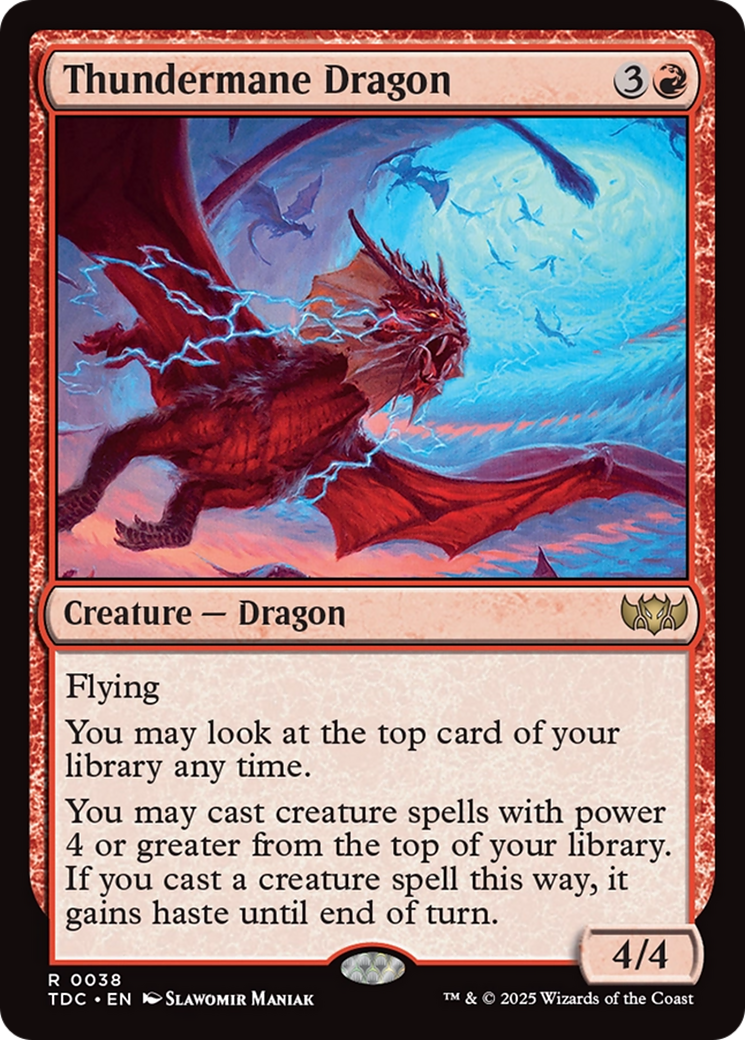
Thundermane Dragon
Thundermane Dragon
Creature — Dragon
4/4
Flying
You may look at the top card of your library any time.
You may cast creature spells with power 4 or greater from the top of your library. If you cast a creature spell this way, it gains haste until end of turn.
- Thundermane Dragon lets you look at the top card of your library whenever you want (with one restriction—see below), even if you don’t have priority. This action doesn’t use the stack. Knowing what that card is becomes part of the information you have access to, just like you can look at the cards in your hand.
- If the top card of your library changes while you’re casting a spell, playing a land, activating an ability, or taking a special action, you can’t look at the new top card until you finish doing so. This means that if you cast the top card of your library, you can’t look at the next one until you’re done paying for that spell.
- Thundermane Dragon’s last ability allows you to cast the top card of your library if the resulting spell is a creature spell with power 4 or greater, it’s your main phase, and the stack is empty. If that creature spell has flash, you’ll be able to cast it any time you could cast an instant, even on an opponent’s turn.
-
1
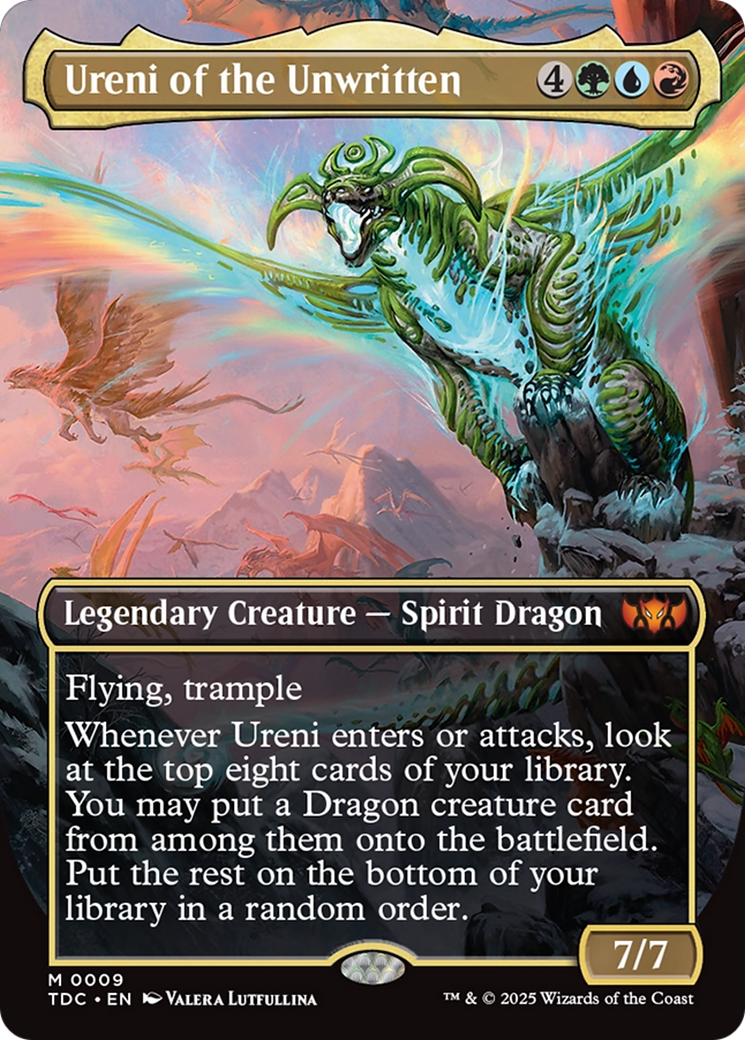
Ureni of the Unwritten
Ureni of the Unwritten
Legendary Creature — Spirit Dragon
7/7
Flying, trample
Whenever Ureni enters or attacks, look at the top eight cards of your library. You may put a Dragon creature card from among them onto the battlefield. Put the rest on the bottom of your library in a random order.
-
1
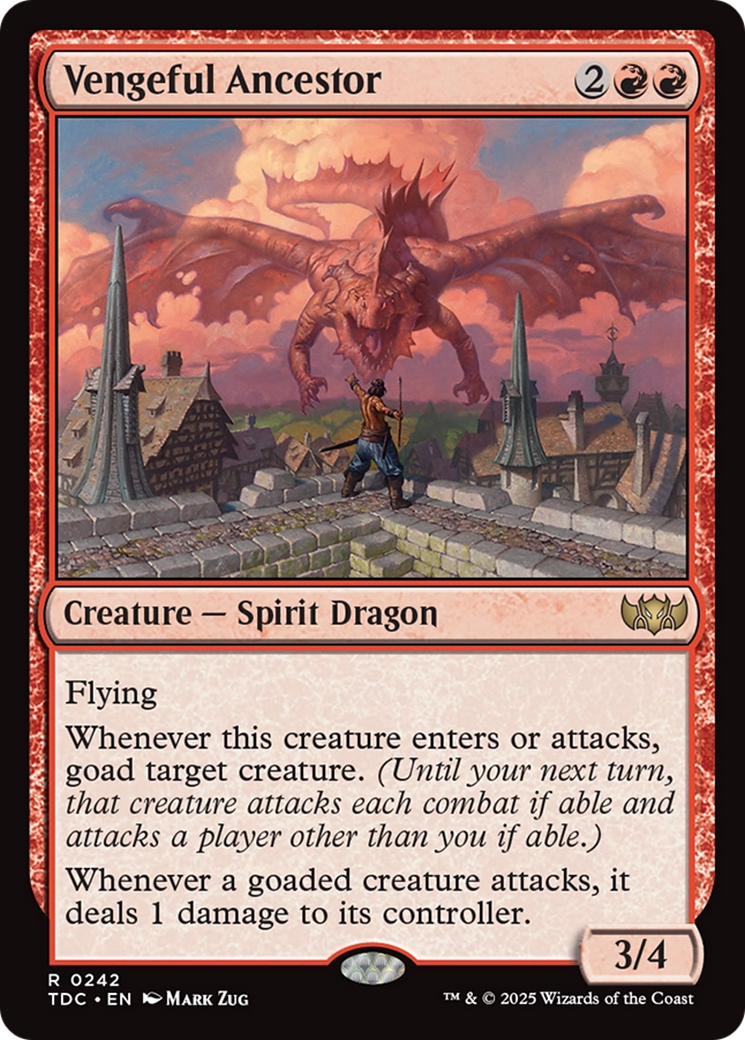
Vengeful Ancestor
Vengeful Ancestor
Creature — Spirit Dragon
3/4
Flying
Whenever this creature enters or attacks, goad target creature. (Until your next turn, that creature attacks each combat if able and attacks a player other than you if able.)
Whenever a goaded creature attacks, it deals 1 damage to its controller.
-
1
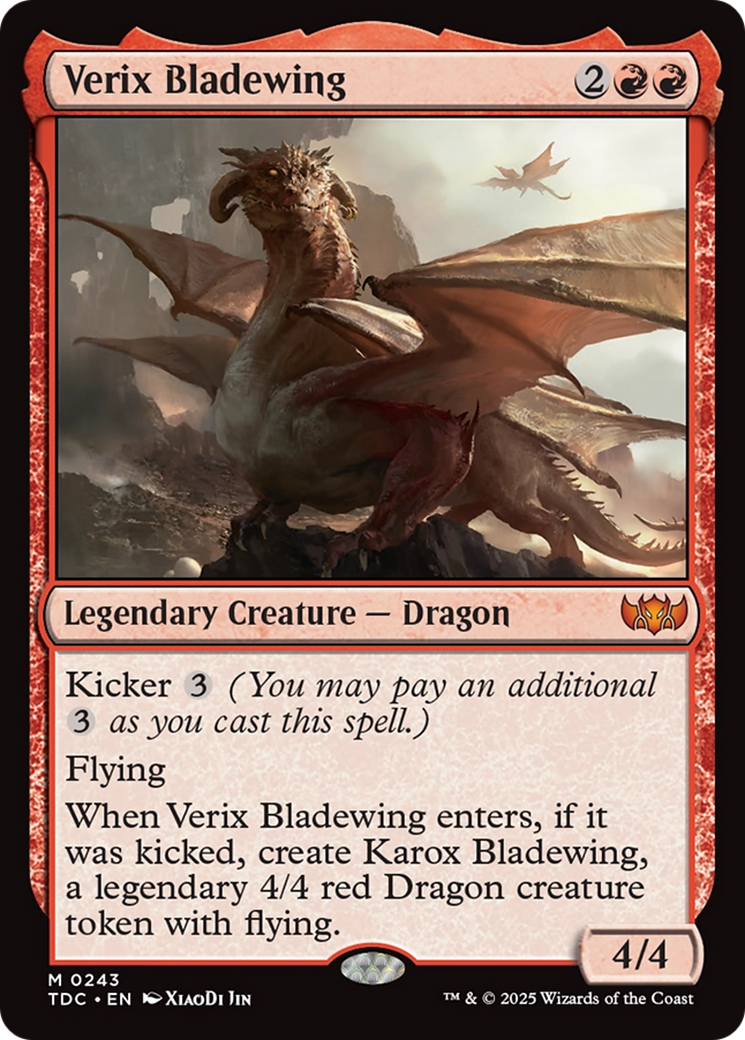
Verix Bladewing
Verix Bladewing
Legendary Creature — Dragon
4/4
Kicker (You may pay an additional as you cast this spell.)
Flying
When Verix enters, if it was kicked, create Karox Bladewing, a legendary 4/4 red Dragon creature token with flying.
- If you put a permanent with a kicker ability onto the battlefield without casting it, you can't kick it.
- If a spell's kicker cost was paid, the spell is "kicked."
- The kicker ability doesn't let you pay a kicker cost more than once.
- To determine a spell's total cost, start with the mana cost (or an alternative cost if another card's effect allows you to pay one instead), add any cost increases (such as kicker), then apply any cost reductions. The spell's mana value remains unchanged, no matter what the total cost to cast it was.
- If you copy a kicked spell on the stack, the copy is also kicked. If the copied spell is a permanent spell, the token the copy of that spell becomes when it enters is also kicked.
- If a card or token enters as a copy of a permanent, the new permanent isn't kicked, even if the original was.
- Verix Bladewing features a new template for creating legendary tokens. It's functionally identical to the text "create a legendary 4/4 red Dragon creature token with flying named Karox Bladewing."
-
1
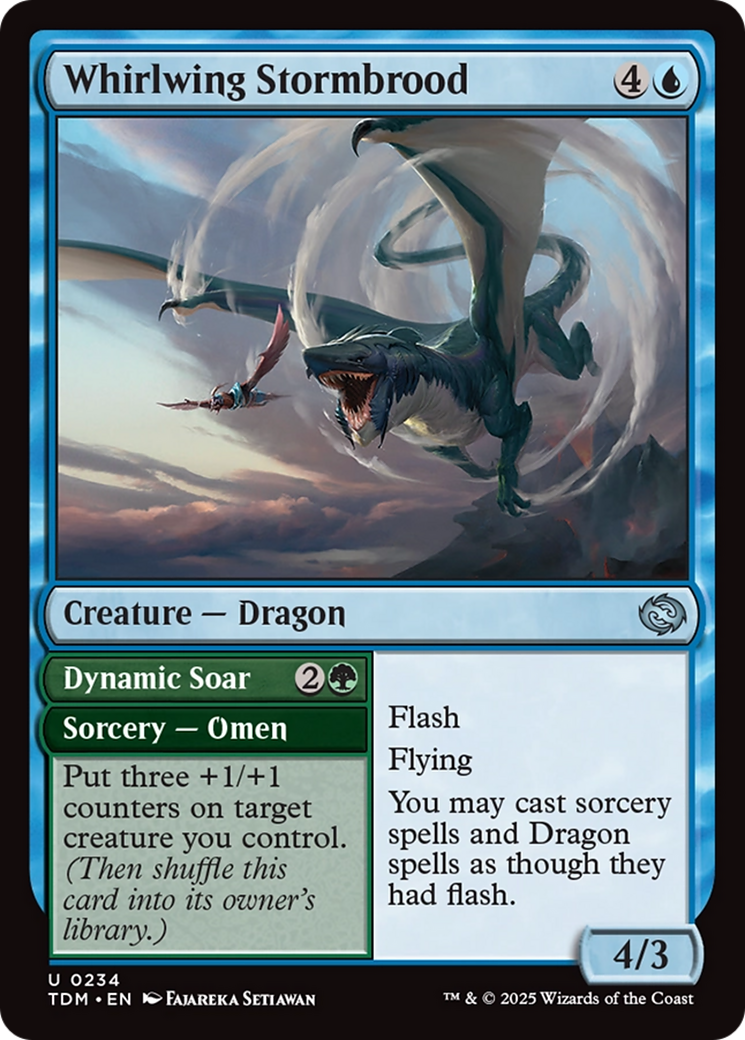
Whirlwing Stormbrood // Dynamic Soar
//
Whirlwing Stormbrood
Creature — Dragon
4/3
Instants 6
-
1
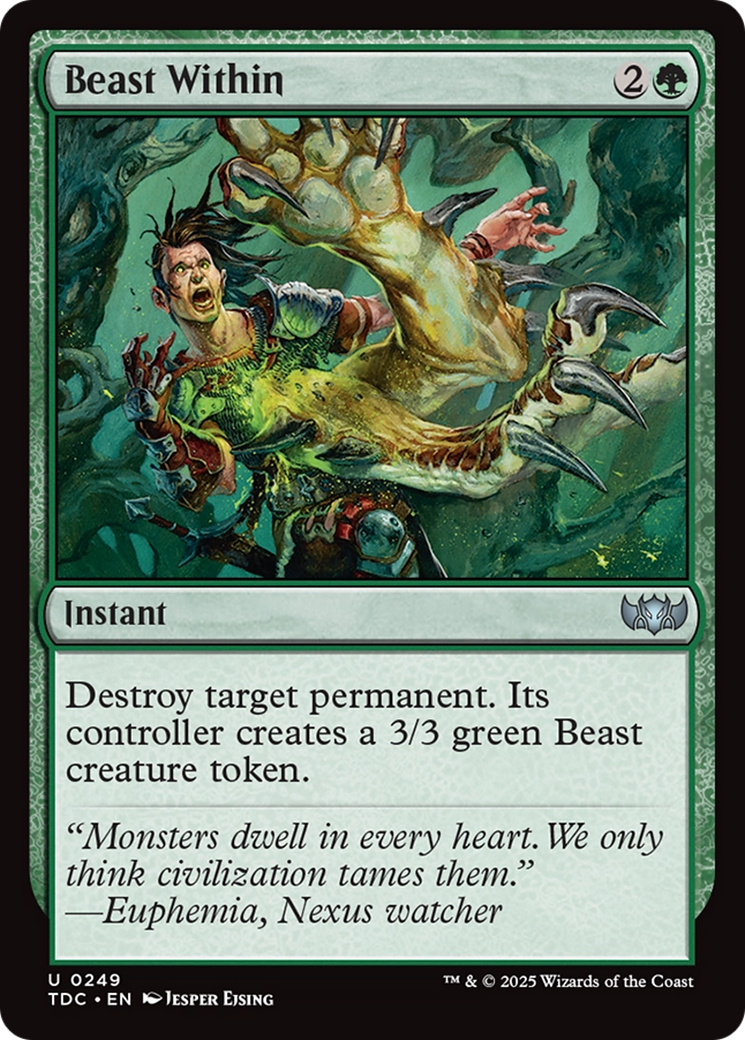
Beast Within
Beast Within
Instant
Destroy target permanent. Its controller creates a 3/3 green Beast creature token.
- If the target permanent is an illegal target by the time Beast Within tries to resolve, the spell won't resolve. No player creates a Beast token. If the target is legal but not destroyed (most likely because it has indestructible), its controller does create a Beast token.
- If the permanent is still a legal target but is not destroyed (perhaps because it regenerated or has indestructible), its controller still gets the Beast token.
-
1
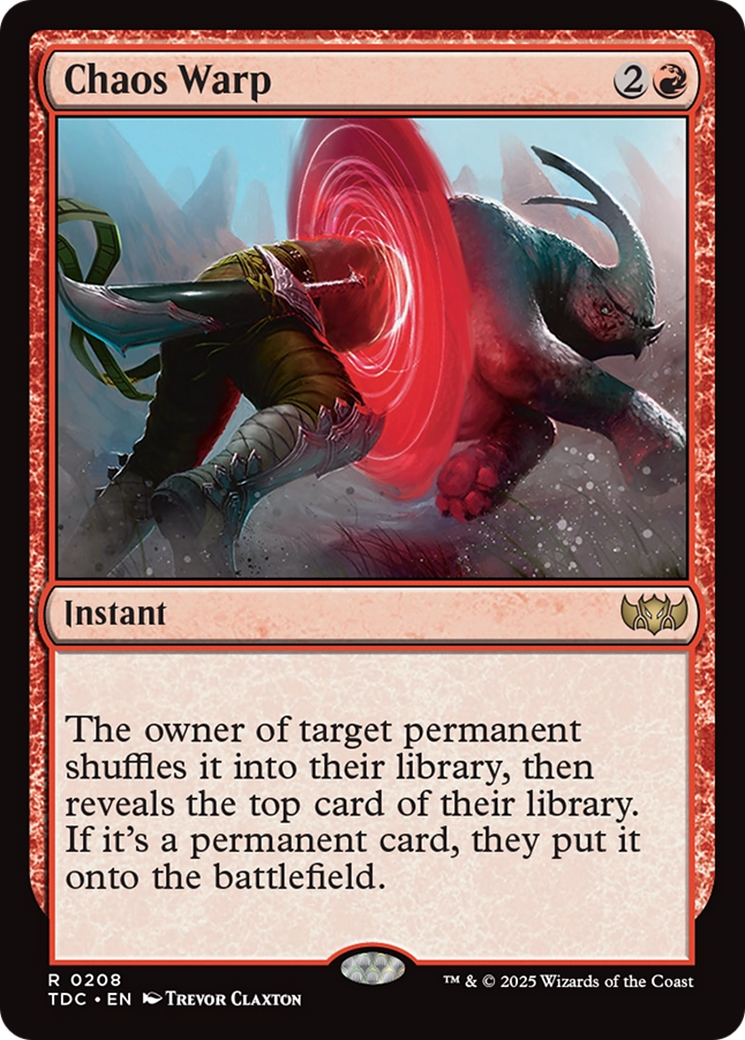
Chaos Warp
Chaos Warp
Instant
The owner of target permanent shuffles it into their library, then reveals the top card of their library. If it's a permanent card, they put it onto the battlefield.
- The owner of a token is the player under whose control the token was put onto the battlefield. If a token is shuffled into a player's library this way, that player shuffles before revealing the top card of that library.
- If the permanent is an illegal target by the time Chaos Warp tries to resolve, it won't resolve and none of its effects will occur. No library will be shuffled and no card will be revealed.
- A permanent card is a card with one or more of the following card types: artifact, creature, enchantment, land, or planeswalker.
- If the revealed card is a permanent card but can't enter (perhaps because it's an Aura with nothing to enchant), it remains on top of that library.
- If the revealed card is not a permanent card, it remains on top of that library.
-
1
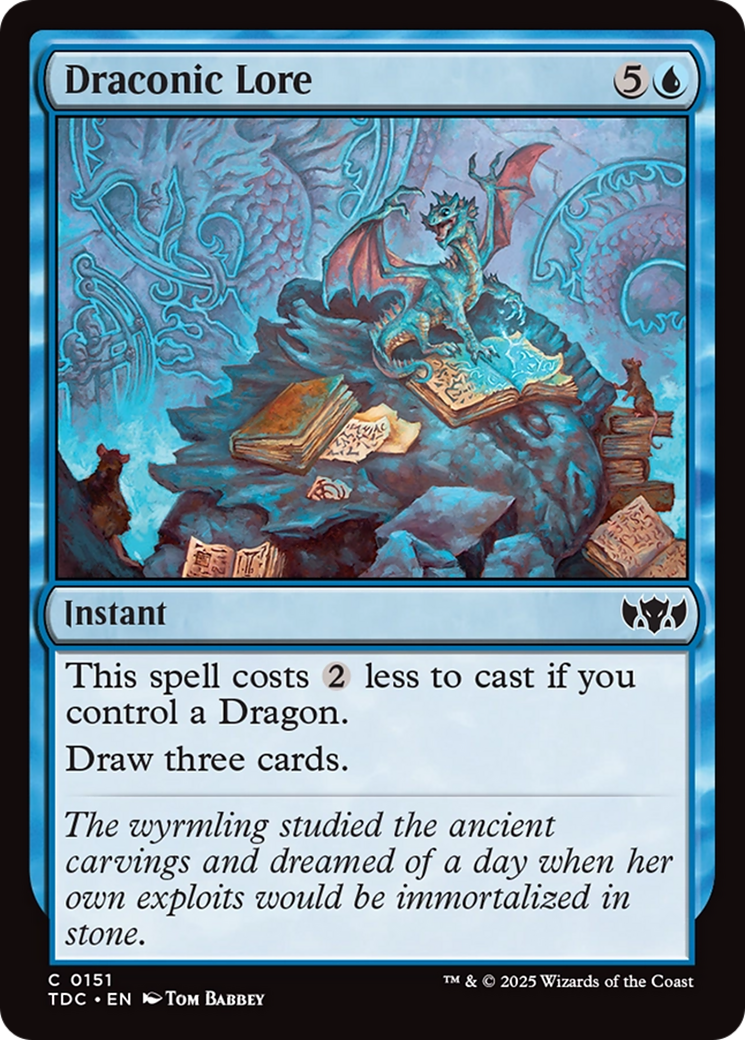
Draconic Lore
Draconic Lore
Instant
This spell costs less to cast if you control a Dragon.
Draw three cards.
- The cost of Draconic Lore is determined and locked in as you cast it before any mana abilities are activated and before any player can respond. Notably, this means that no player can respond to remove your Dragon before the cost is reduced, and if you sacrifice that Dragon as part of a mana ability, the cost won't be increased.
-
1
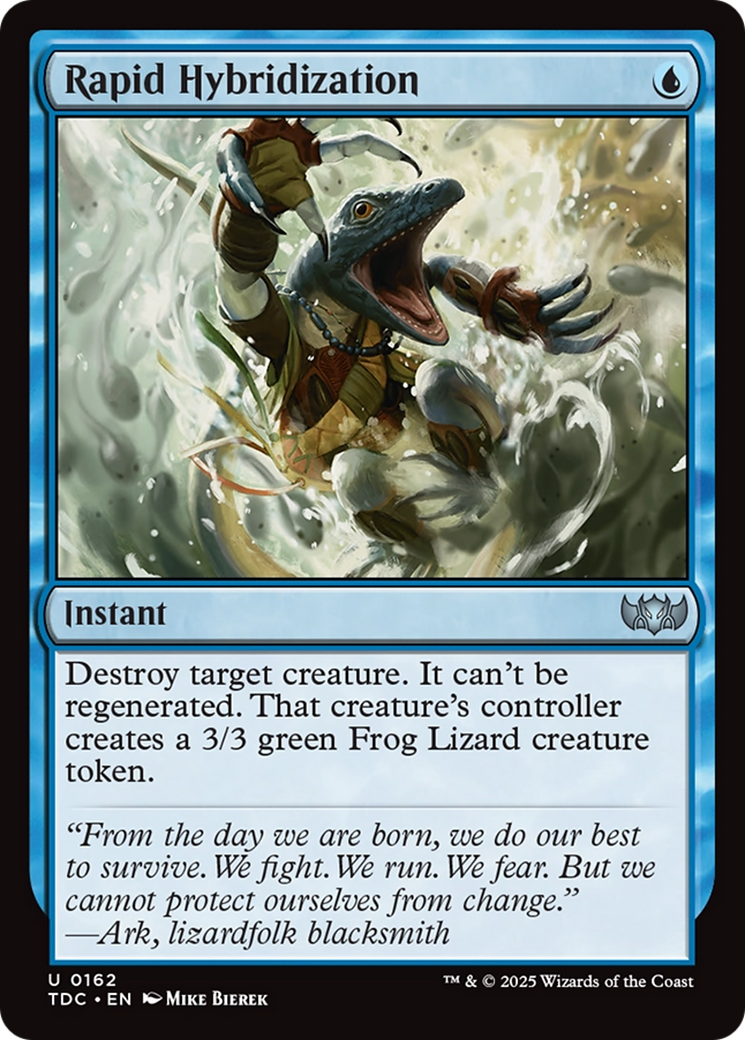
Rapid Hybridization
Rapid Hybridization
Instant
Destroy target creature. It can't be regenerated. That creature's controller creates a 3/3 green Frog Lizard creature token.
- If Rapid Hybridization resolves and the creature isn't destroyed (perhaps because it has indestructible), its controller will still get the Frog Lizard token.
- If the creature is an illegal target when Rapid Hybridization tries to resolve, it won't resolve and none of its effects will happen. No Frog Lizard token will be created.
-
1
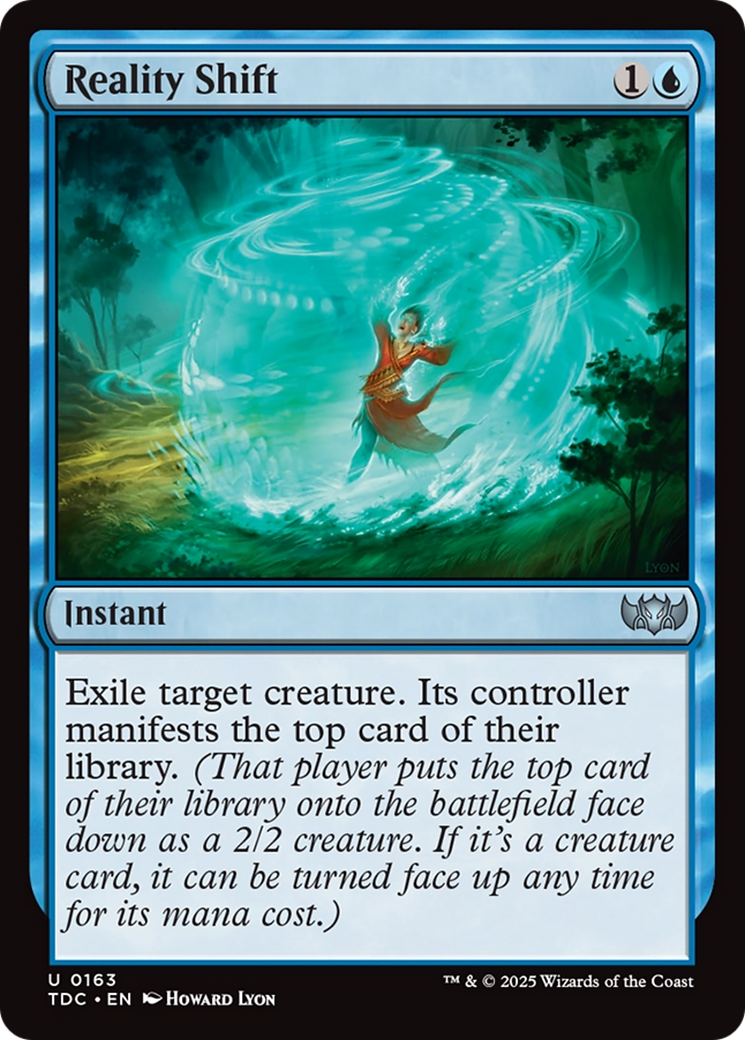
Reality Shift
Reality Shift
Instant
Exile target creature. Its controller manifests the top card of their library. (That player puts the top card of their library onto the battlefield face down as a 2/2 creature. If it's a creature card, it can be turned face up any time for its mana cost.)
- The face-down permanent is a 2/2 creature with no name, mana cost, creature types, or abilities. It's colorless and has a mana value of 0. Other effects that apply to the permanent can still grant or change any of these characteristics.
- Any time you have priority, you may turn a manifested creature face up by revealing that it's a creature card (ignoring any copy effects or type-changing effects that might be applying to it) and paying its mana cost. This is a special action. It doesn't use the stack and can't be responded to.
- If a manifested creature would have morph if it were face up, you may also turn it face up by paying its morph cost.
- Unlike a face-down creature that was cast using the morph ability, a manifested creature may still be turned face up after it loses its abilities if it's a creature card.
- Because the permanent is on the battlefield both before and after it's turned face up, turning a permanent face up doesn't cause any enters-the-battlefield abilities to trigger.
- Because face-down creatures don't have names, they can't have the same name as any other creature, even another face-down creature.
- A permanent that turns face up or face down changes characteristics but is otherwise the same permanent. Spells and abilities that were targeting that permanent, as well as Auras and Equipment that were attached to the permanent, aren't affected.
- Turning a permanent face up or face down doesn't change whether that permanent is tapped or untapped.
- At any time, you can look at a face-down permanent you control. You can't look at face-down permanents you don't control unless an effect allows you to or instructs you to.
- If a face-down permanent you control leaves the battlefield, you must reveal it. You must also reveal all face-down spells and permanents you control if you leave the game or if the game ends.
- You must ensure that your face-down spells and permanents can easily be differentiated from each other. You're not allowed to mix up the cards that represent them on the battlefield in order to confuse other players. The order they entered the battlefield should remain clear. Common methods for indicating this include using markers or dice, or simply placing them in order on the battlefield. You must also track how each became face down (manifested, cast face down using the morph ability, and so on).
- There are no cards in the Fate Reforged set that would turn a face-down instant or sorcery card on the battlefield face up, but some older cards can try to do this. If something tries to turn a face-down instant or sorcery card on the battlefield face up, reveal that card to show all players it's an instant or sorcery card. The permanent remains on the battlefield face down. Abilities that trigger when a permanent turns face up won't trigger, because even though you revealed the card, it never turned face up.
- If a double-faced card is manifested, it will be put onto the battlefield face down. While face down, it can't transform. If the front face of the card is a creature card, you can turn it face up by paying its mana cost. If you do, its front face will be up.
-
1
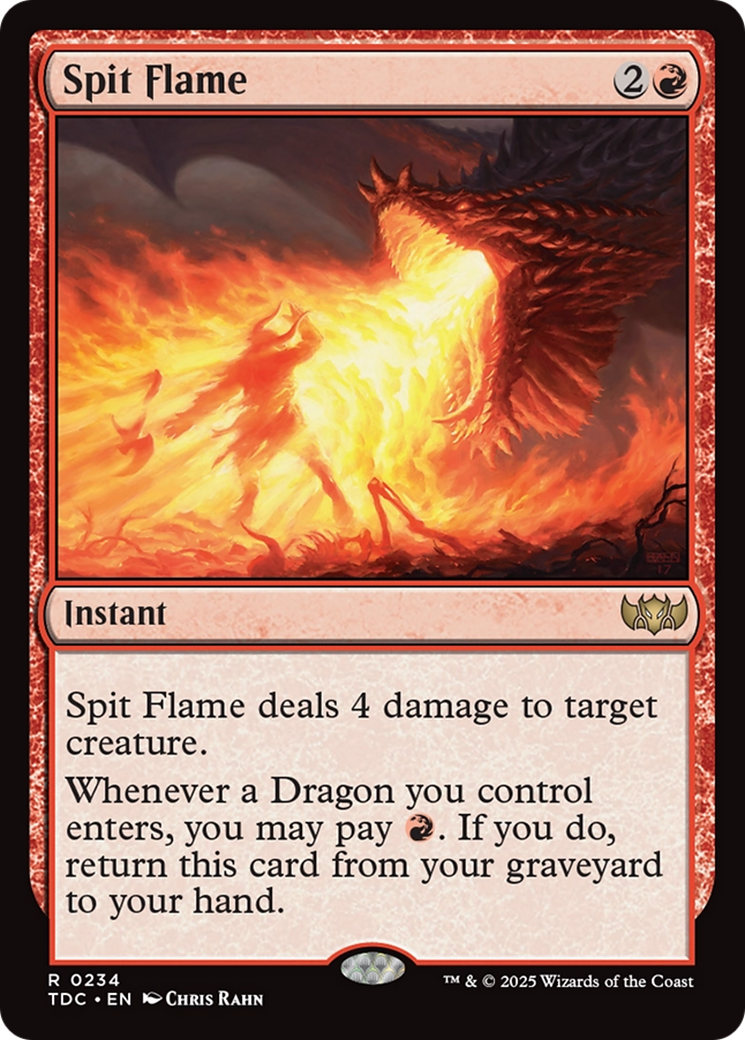
Spit Flame
Spit Flame
Instant
Spit Flame deals 4 damage to target creature.
Whenever a Dragon you control enters, you may pay . If you do, return this card from your graveyard to your hand.
Sorceries 9
-
1
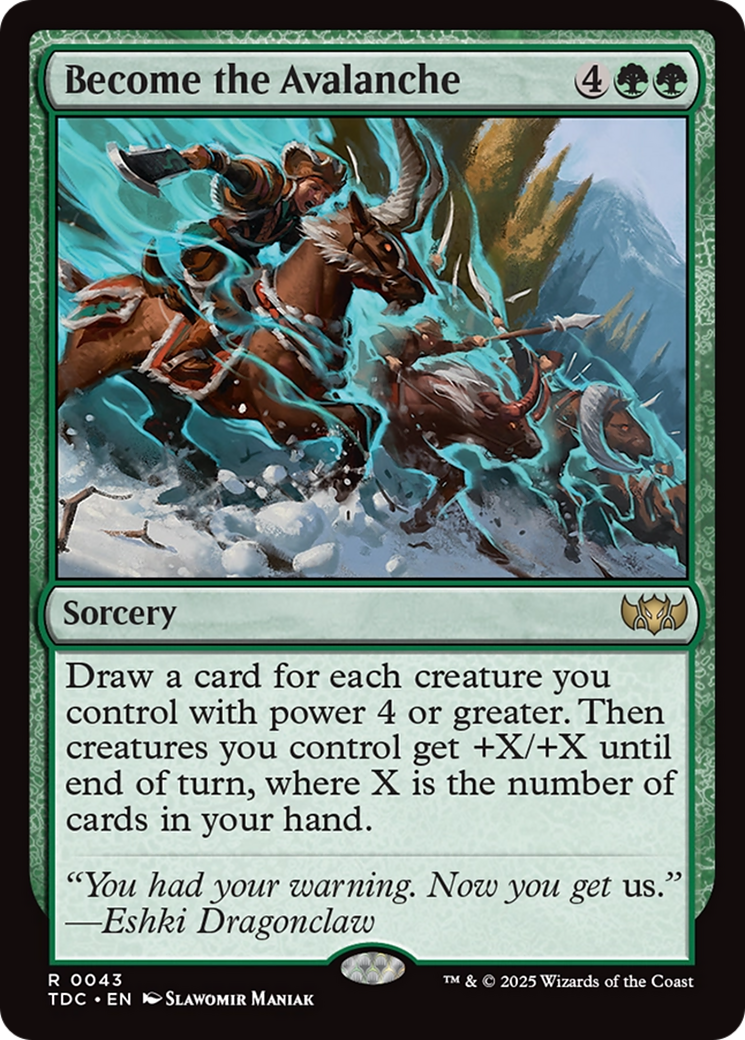
Become the Avalanche
Become the Avalanche
Sorcery
Draw a card for each creature you control with power 4 or greater. Then creatures you control get +X/+X until end of turn, where X is the number of cards in your hand.
-
1
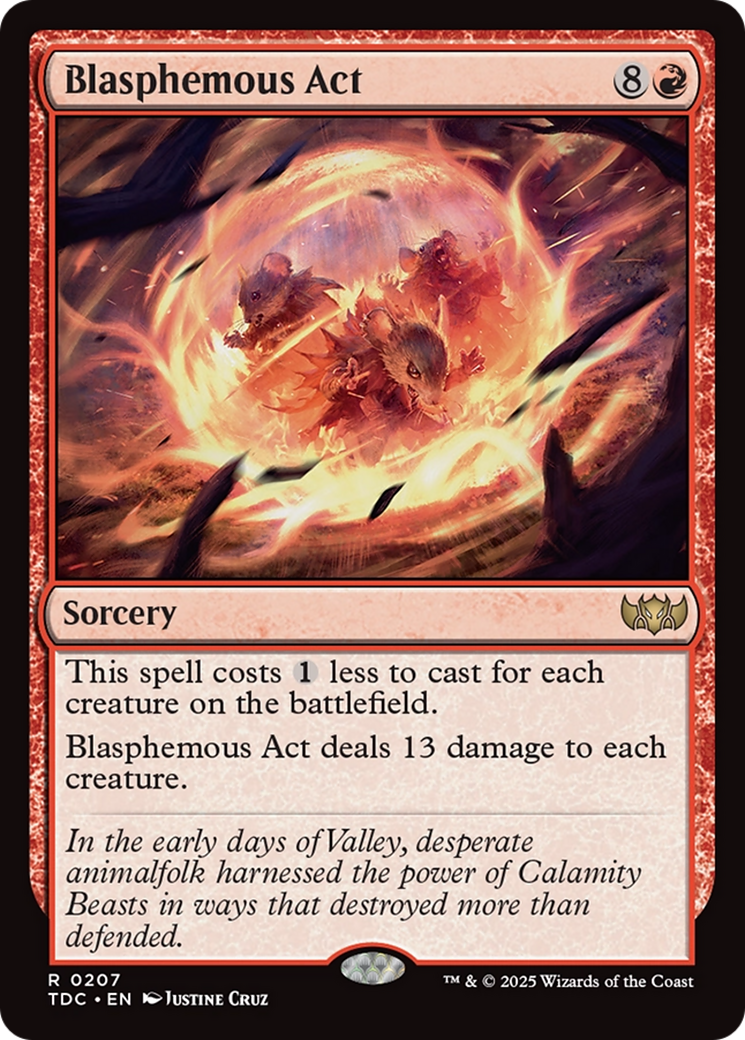
Blasphemous Act
Blasphemous Act
Sorcery
This spell costs less to cast for each creature on the battlefield.
Blasphemous Act deals 13 damage to each creature.
- To determine the total cost of a spell, start with the mana cost or alternative cost you're paying, add any cost increases, then apply any cost reductions (such as that of Blasphemous Act). The mana value of the spell is determined only by its mana cost, no matter what the total cost to cast the spell was.
- Blasphemous Act's ability can't reduce the total cost to cast the spell below .
- The total cost to cast Blasphemous Act is locked in before you pay that cost. For example, if there are three creatures on the battlefield, including one you can sacrifice to add , the total cost of Blasphemous Act is . Then you can sacrifice the creature when you activate mana abilities just before paying the cost.
- Although players may respond to Blasphemous Act once it's been cast, once it's announced, they can't respond before the cost is calculated and paid.
-
1
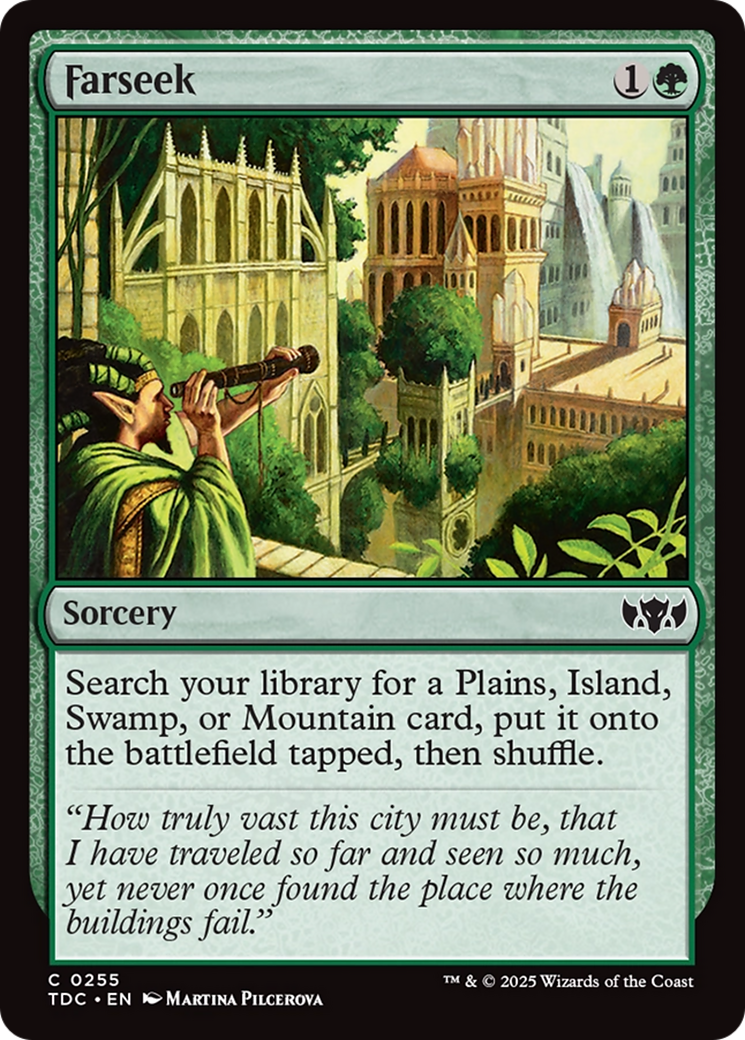
Farseek
Farseek
Sorcery
Search your library for a Plains, Island, Swamp, or Mountain card, put it onto the battlefield tapped, then shuffle.
- Farseek can find any land with any of the listed land types, including nonbasic ones, even if that land is a Forest in addition to one or more of those types.
-
1
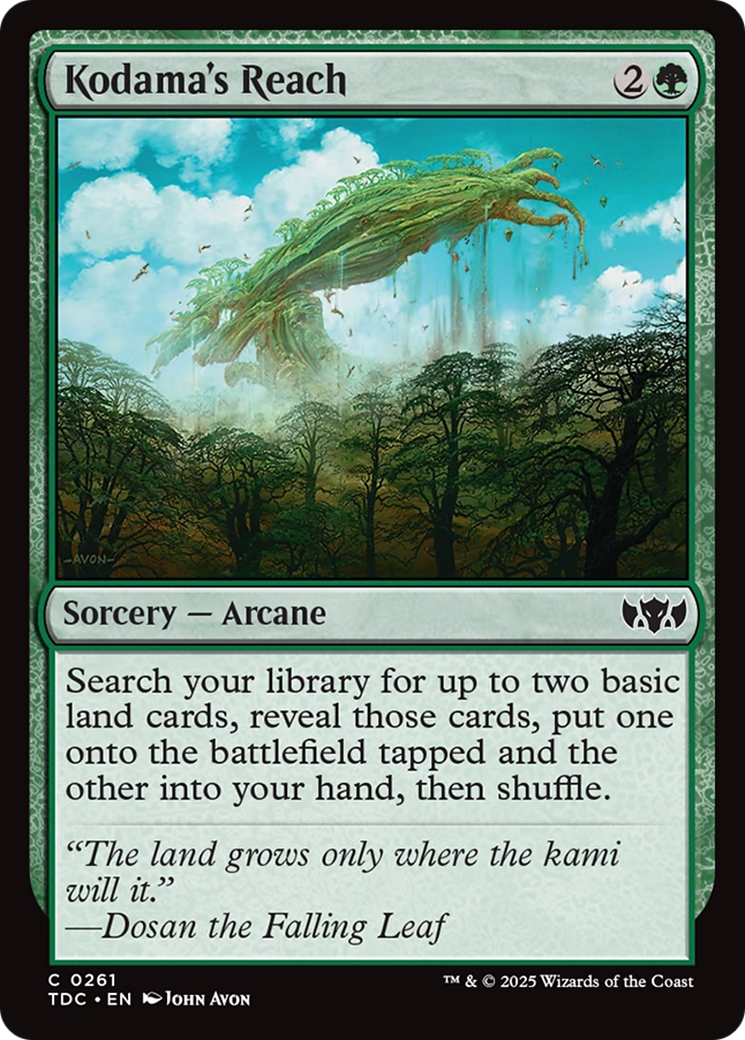
Kodama's Reach
Kodama's Reach
Sorcery — Arcane
Search your library for up to two basic land cards, reveal those cards, put one onto the battlefield tapped and the other into your hand, then shuffle.
- You can get just one basic land card if you wish (or even none at all). If you get only one land card, you put it onto the battlefield tapped.
-
1
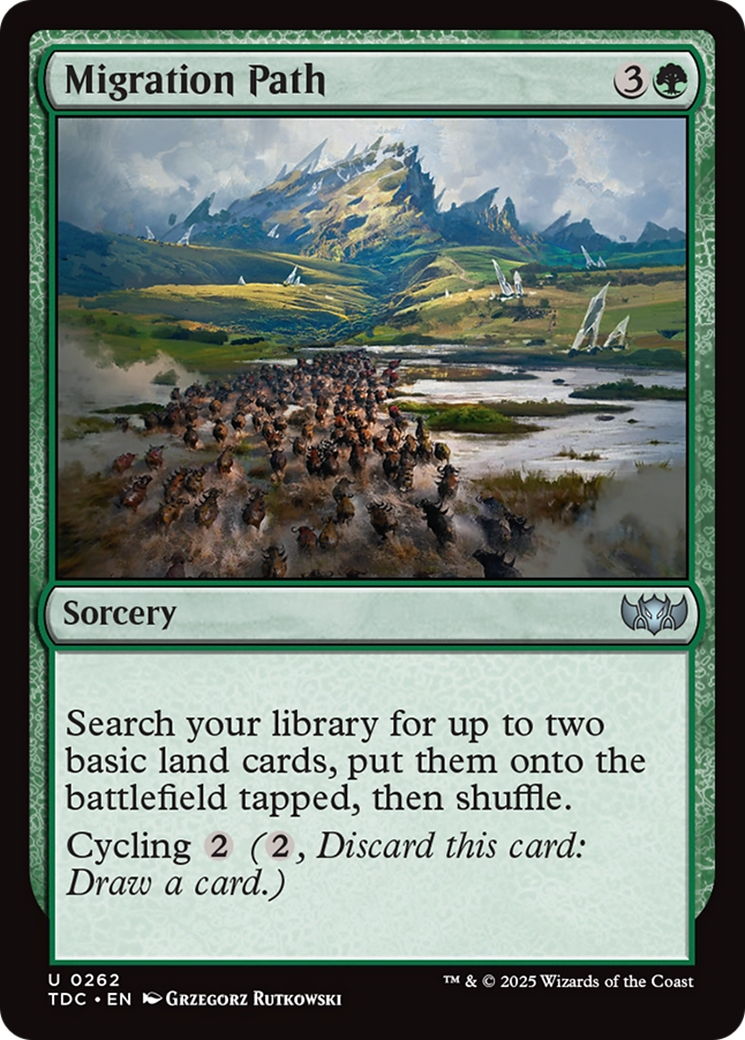
Migration Path
Migration Path
Sorcery
Search your library for up to two basic land cards, put them onto the battlefield tapped, then shuffle.
Cycling ( , Discard this card: Draw a card.)
-
1
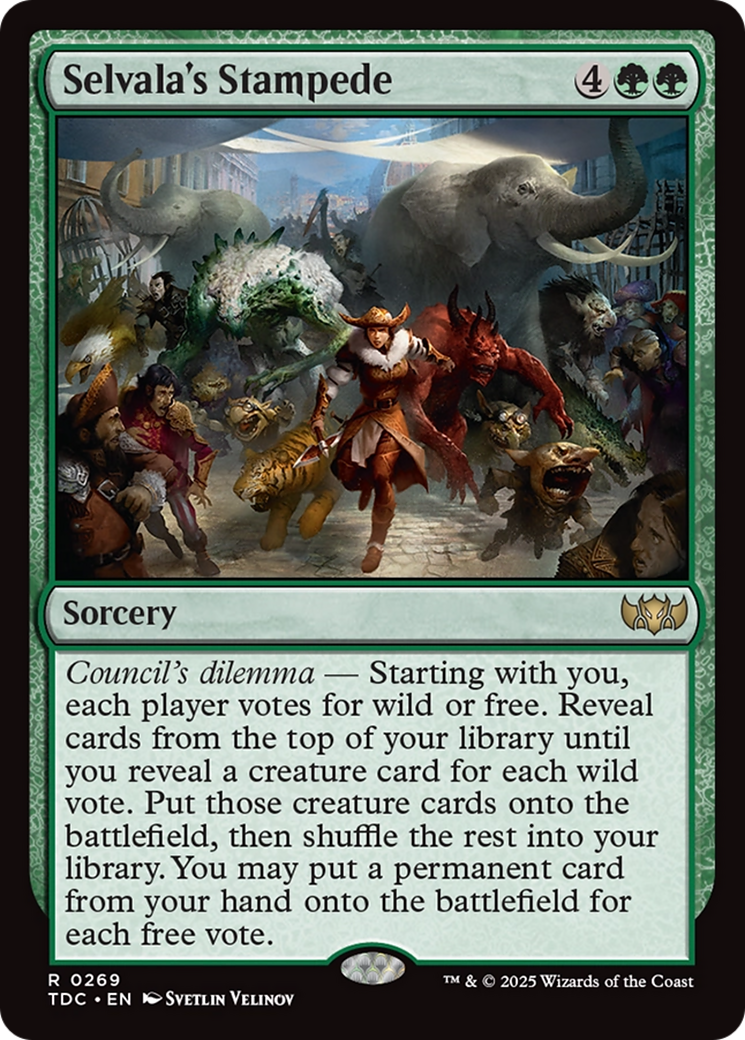
Selvala's Stampede
Selvala's Stampede
Sorcery
Council's dilemma — Starting with you, each player votes for wild or free. Reveal cards from the top of your library until you reveal a creature card for each wild vote. Put those creature cards onto the battlefield, then shuffle the rest into your library. You may put a permanent card from your hand onto the battlefield for each free vote.
- You must vote for one of the available options. You can’t abstain.
- The creature cards revealed for the wild votes all enter the battlefield at the same time, followed by the permanent cards put onto the battlefield from your hand for the free votes.
- Any abilities that trigger because of any of those cards entering the battlefield are put onto the stack at the same time, after Selvala’s Stampede finishes resolving. You choose the order that abilities you control go on the stack, followed by each other player in turn order choosing the order for abilities they control. The last ability to be put on the stack will resolve first.
- Unlike the will of the council cards from the original Conspiracy set, where a majority of votes determined what happened, each vote made for a council’s dilemma card adds to the ultimate effect.
- The effects of each council’s dilemma ability happen in the stated order. First the vote occurs, then the first effect, and finally the second effect.
- Because the votes are made in turn order, each player will know the votes of players who voted beforehand.
- If a creature with an enters-the-battlefield council’s dilemma ability leaves the battlefield before that ability resolves, players can still vote for any option that would put +1/+1 counters on that creature, even though—or perhaps especially because—those votes won’t generate an effect.
- No player votes until the spell or ability resolves. Any responses to that spell or ability must be made without knowing the outcome of the vote.
- Players can’t do anything between voting and finishing the resolution of the spell or ability that included the vote.
-
1
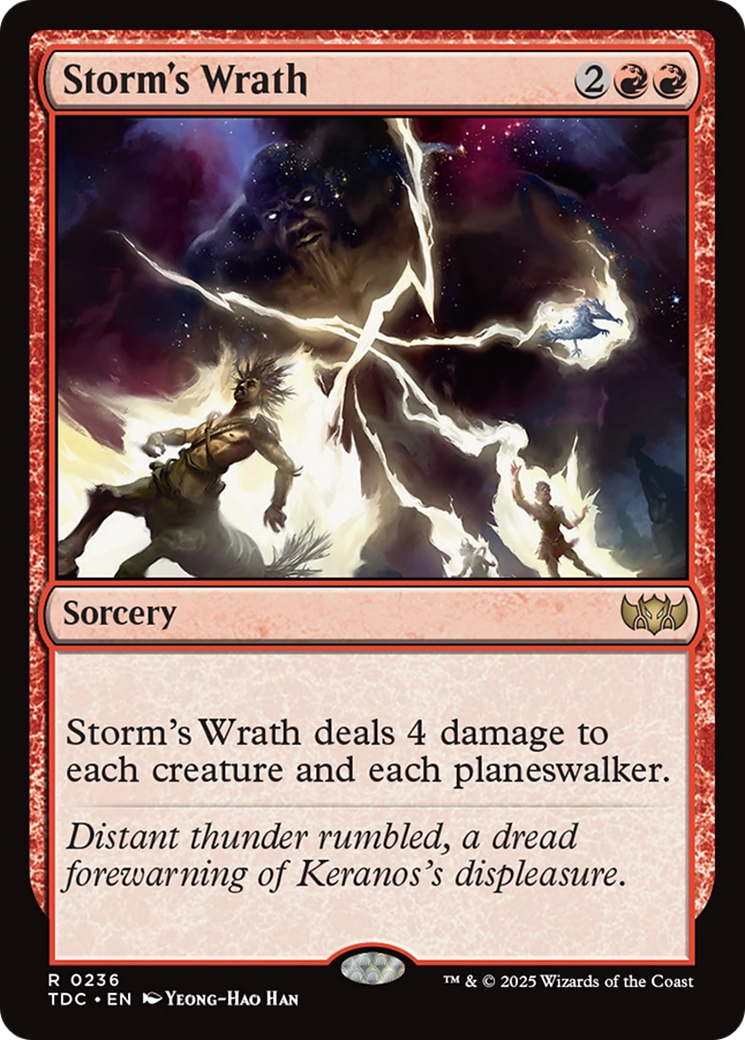
Storm's Wrath
Storm's Wrath
Sorcery
Storm's Wrath deals 4 damage to each creature and each planeswalker.
-
1
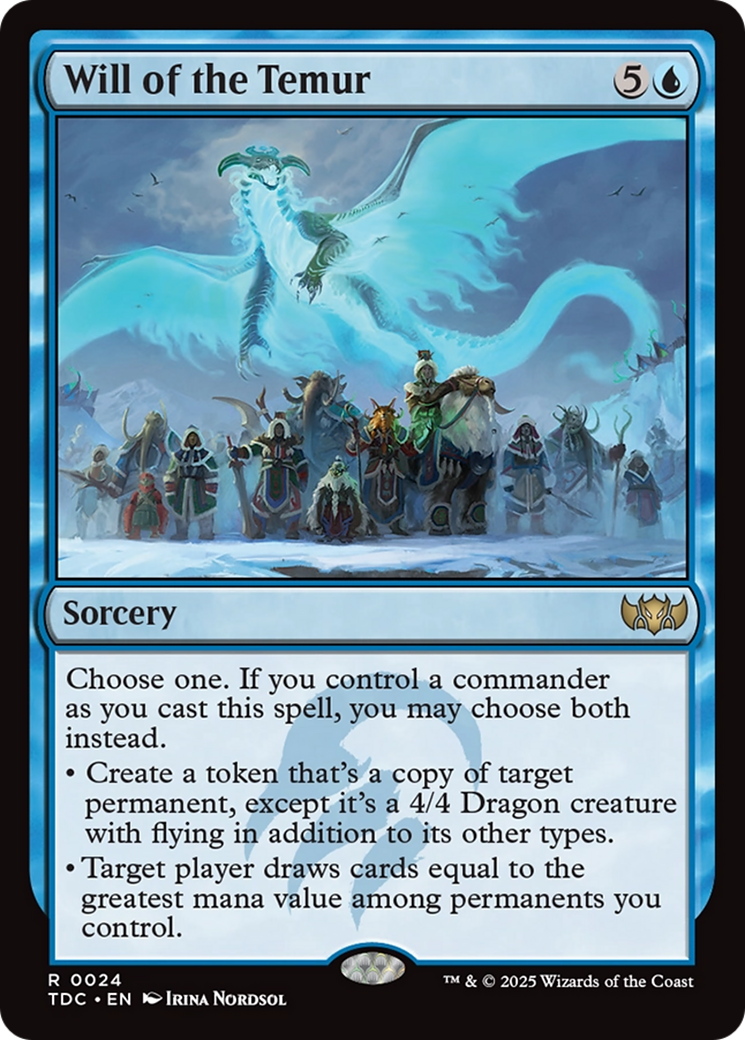
Will of the Temur
Will of the Temur
Sorcery
Choose one. If you control a commander as you cast this spell, you may choose both instead.
- Create a token that's a copy of target permanent, except it's a 4/4 Dragon creature with flying in addition to its other types.
- Target player draws cards equal to the greatest mana value among permanents you control.
- The token created by Will of the Temur’s first mode copies exactly what was printed on the original permanent and nothing else, with the listed exceptions (unless that permanent is copying something else or is a token; see below). It doesn’t copy whether that permanent is tapped or untapped, whether it has any counters on it or Auras and Equipment attached to it, or any non-copy effects that have changed its power, toughness, types, color, or so on.
- If the copied permanent is a token, the token that’s created copies the original characteristics of that token as stated by the effect that created the token, with the listed exceptions.
- If the copied permanent is copying something else, then the token enters as whatever that permanent copied, with the listed exceptions.
- Any enters abilities of the copied permanent will trigger when the token enters. Any “as [this permanent] enters” or “[this permanent] enters with” abilities of the copied permanent will also work.
- If a permanent has in its mana cost, X is 0 for the purpose of determining its mana value.
- The commander you control doesn’t have to be your commander.
- Once you’ve announced that you’re casting this spell, players can’t take any actions until you’ve finished doing so. Notably, opponents can’t try to remove your commander to change how many modes you may choose.
- Whether or not you control a commander is determined only once, as you choose the modes for this spell. If you somehow lose control of that commander before you finish casting the spell (perhaps because you sacrifice it to activate a mana ability), it won’t change the number of modes chosen.
-
1
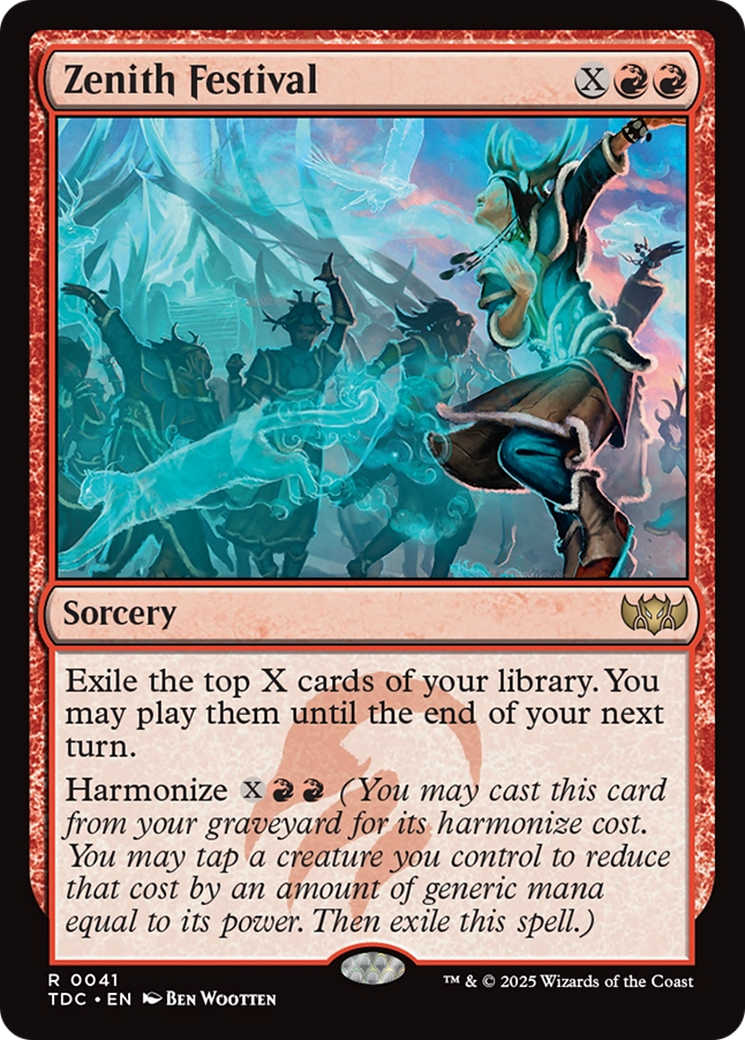
Zenith Festival
Zenith Festival
Sorcery
Exile the top X cards of your library. You may play them until the end of your next turn.
Harmonize (You may cast this card from your graveyard for its harmonize cost. You may tap a creature you control to reduce that cost by an amount of generic mana equal to its power. Then exile this spell.)
- You pay all costs and follow all timing rules for cards played this way. For example, if one of the exiled cards is a land card, you may play it only during your main phase while the stack is empty.
- “Harmonize [cost]” means “You may cast this card from your graveyard by paying [cost] and tapping up to one untapped creature you control rather than paying the spell’s mana cost,” “If you cast this spell using its harmonize ability, its total cost is reduced by an amount of generic mana equal to the tapped creature’s power,” and “If the harmonize cost was paid, exile this card instead of putting it anywhere else any time it would leave the stack.”
- Tapping a creature won’t reduce colored mana components of harmonize costs.
- You must still follow any timing restrictions and permissions, including those based on the card’s type. For instance, you can cast a sorcery using harmonize only when you could normally cast a sorcery.
- To determine the total cost of a spell, start with the mana cost or alternative cost (such as a harmonize cost) you’re paying, add any cost increases, then apply any cost reductions (such as the cost reduction from tapping a creature). The mana value of the spell is determined only by its mana cost, no matter what the total cost to cast the spell was.
- A spell cast using harmonize will always be exiled afterward, whether it resolves, is countered, or leaves the stack in some other way.
- You can cast a spell using harmonize even if it was somehow put into your graveyard without having been cast.
- If a card with harmonize is put into your graveyard during your turn, you can cast it if it’s legal to do so before any other player can take any actions.
Artifacts 6
-
1
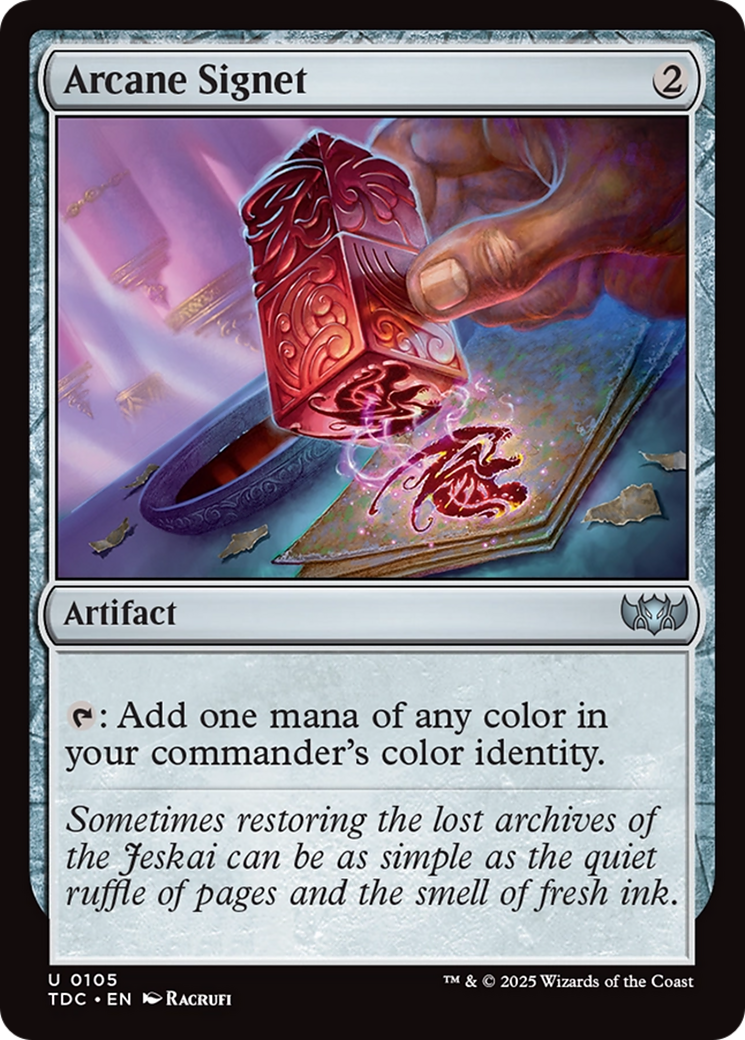
Arcane Signet
Arcane Signet
Artifact
: Add one mana of any color in your commander's color identity.
- If you have two commanders, the ability adds one mana of any color in their combined color identities.
- If your commander is a card that has no colors in its color identity, Arcane Signet's ability produces no mana. It doesn't produce .
- If you don't have a commander, Arcane Signet's ability produces no mana.
-
1
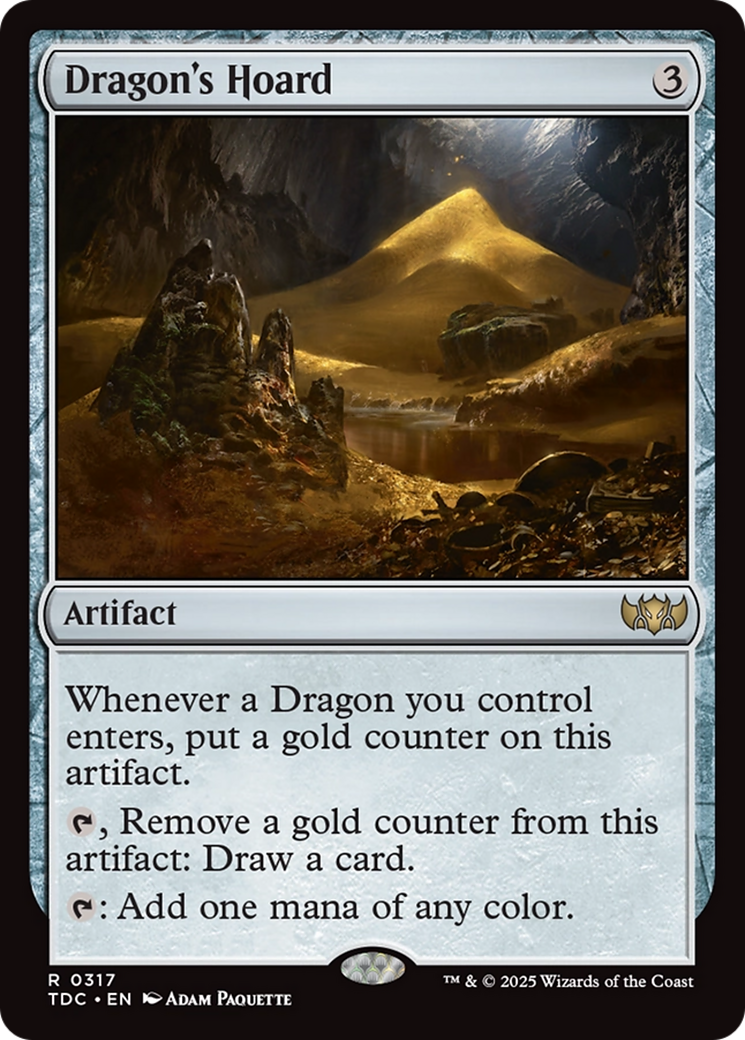
Dragon's Hoard
Dragon's Hoard
Artifact
Whenever a Dragon you control enters, put a gold counter on this artifact.
, Remove a gold counter from this artifact: Draw a card.
: Add one mana of any color.
-
1
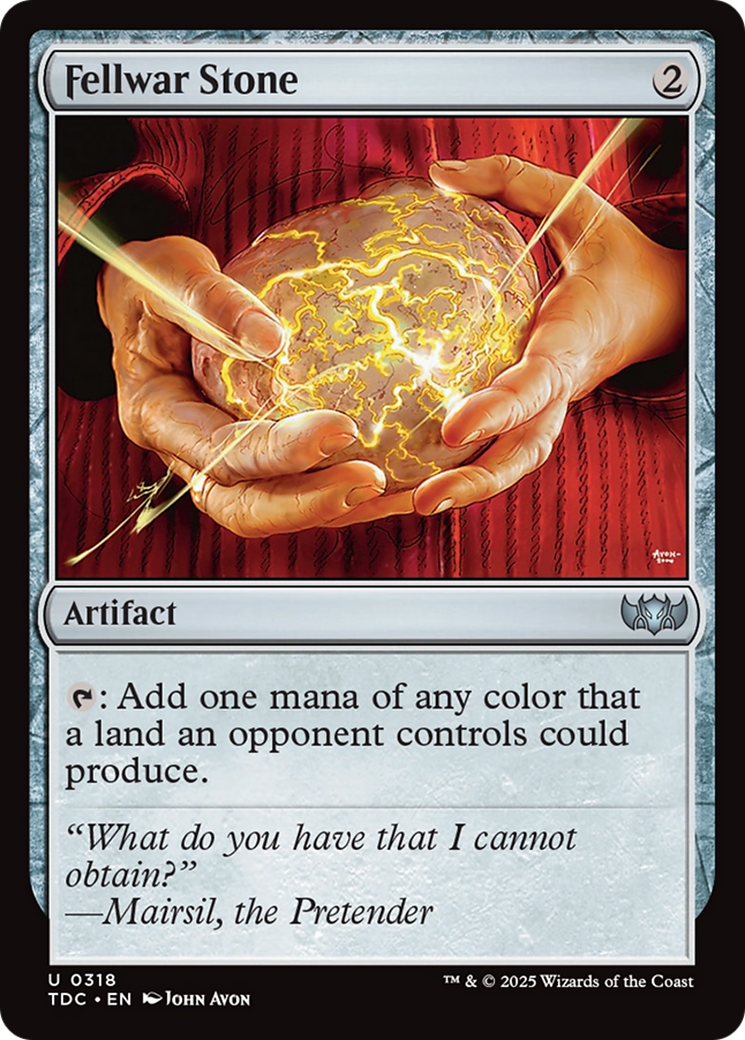
Fellwar Stone
Fellwar Stone
Artifact
: Add one mana of any color that a land an opponent controls could produce.
- The colors of mana are white, blue, black, red, and green. Fellwar Stone can't be tapped for colorless mana, even if a land an opponent controls could produce colorless mana.
- Fellwar Stone checks the effects of all mana-producing abilities of lands your opponents control, but it doesn't check their costs. For example, Vivid Crag has the ability " , Remove a charge counter from Vivid Crag: Add one mana of any color." If an opponent controls Vivid Crag and you control Fellwar Stone, you can tap Fellwar Stone for any color of mana. It doesn't matter whether Vivid Crag has a charge counter on it, and it doesn't matter whether it's untapped.
- When determining what colors of mana your opponents' lands could produce, take into account any applicable replacement effects that would apply to those lands' mana abilities (such as Contamination's effect, for example). If there is more than one, consider them in any possible order.
- Fellwar Stone doesn't care about any restrictions or riders your opponents' lands (such as Ancient Ziggurat or Hall of the Bandit Lord) put on the mana they produce. It just cares about colors of mana.
- This works even if the opponent's lands are tapped. It only checks what kinds of mana can be produced, not if the abilities that produce them are usable right now.
- The ability can be activated if the opponent has no lands that produce mana, but the effect will not be able to generate any mana.
- It only produces one mana even if the land can produce more than one.
-
1
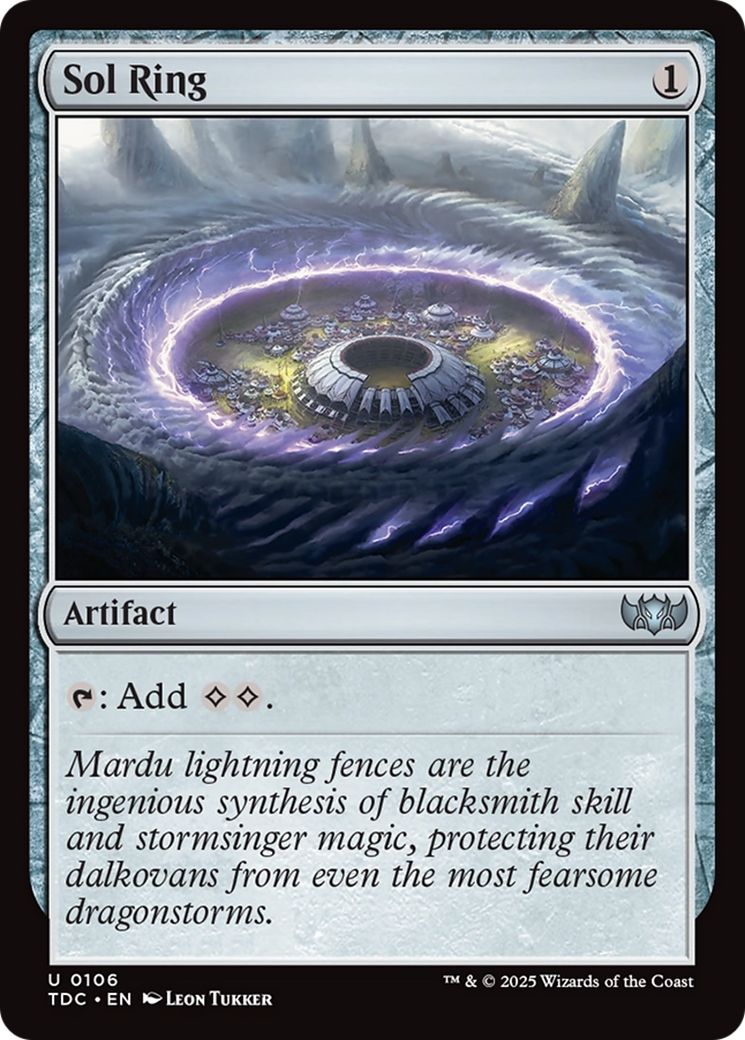
Sol Ring
Sol Ring
Artifact
: Add .
-
1
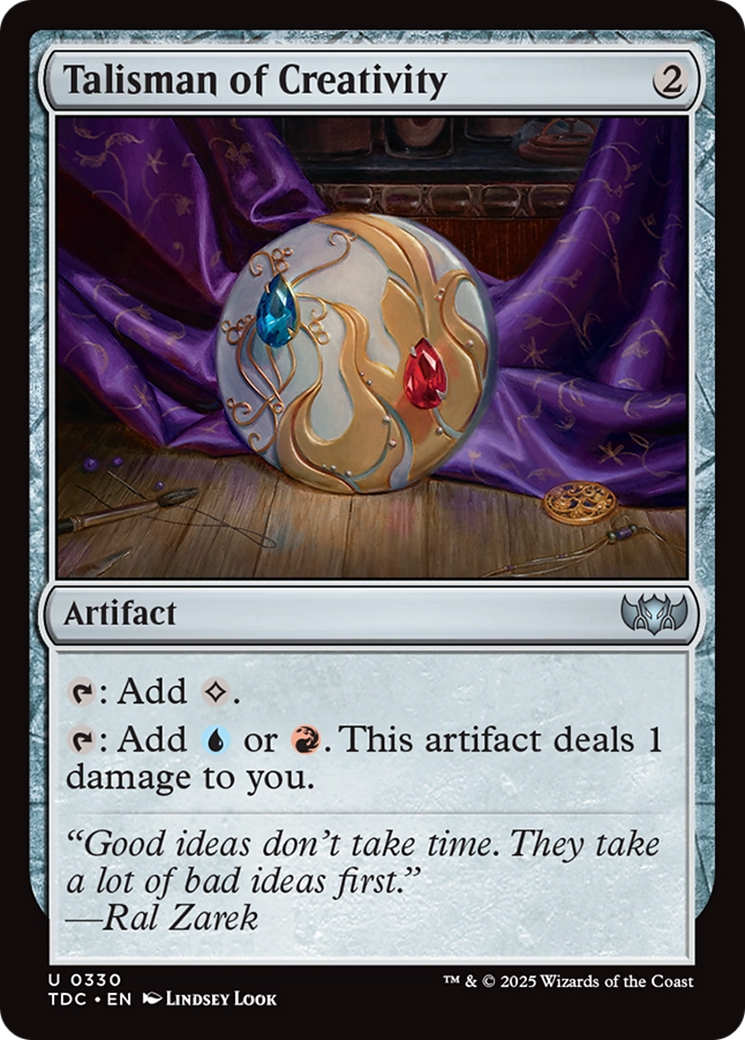
Talisman of Creativity
Talisman of Creativity
Artifact
: Add .
: Add or . This artifact deals 1 damage to you.
-
1
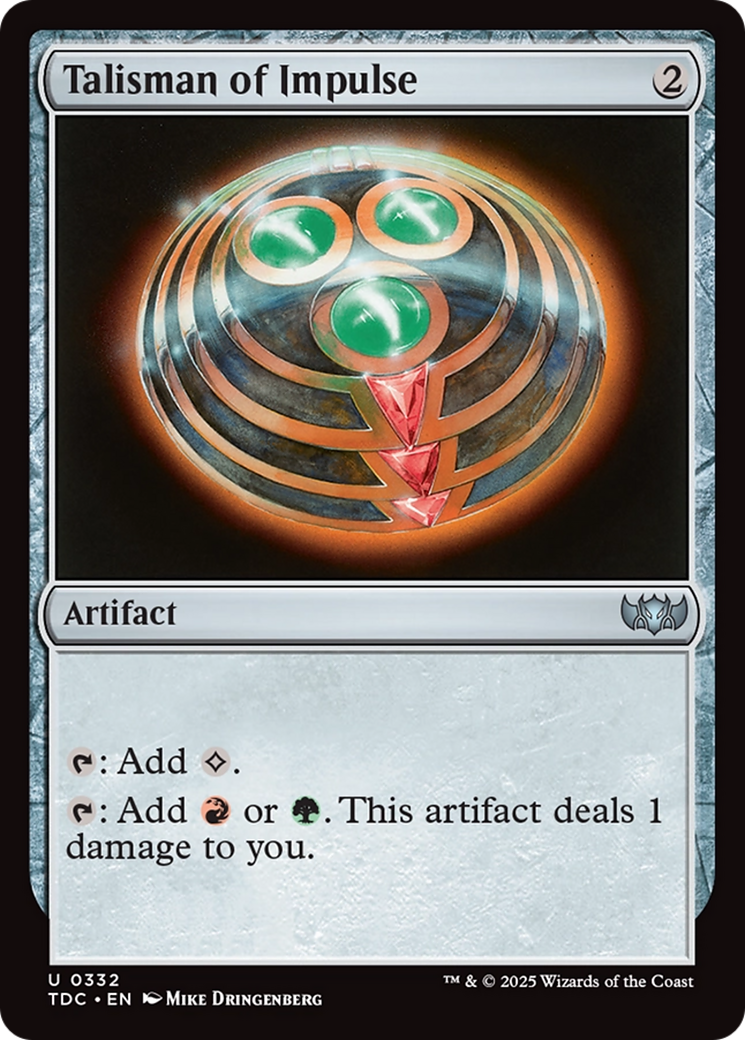
Talisman of Impulse
Talisman of Impulse
Artifact
: Add .
: Add or . This artifact deals 1 damage to you.
Enchantments 7
-
1
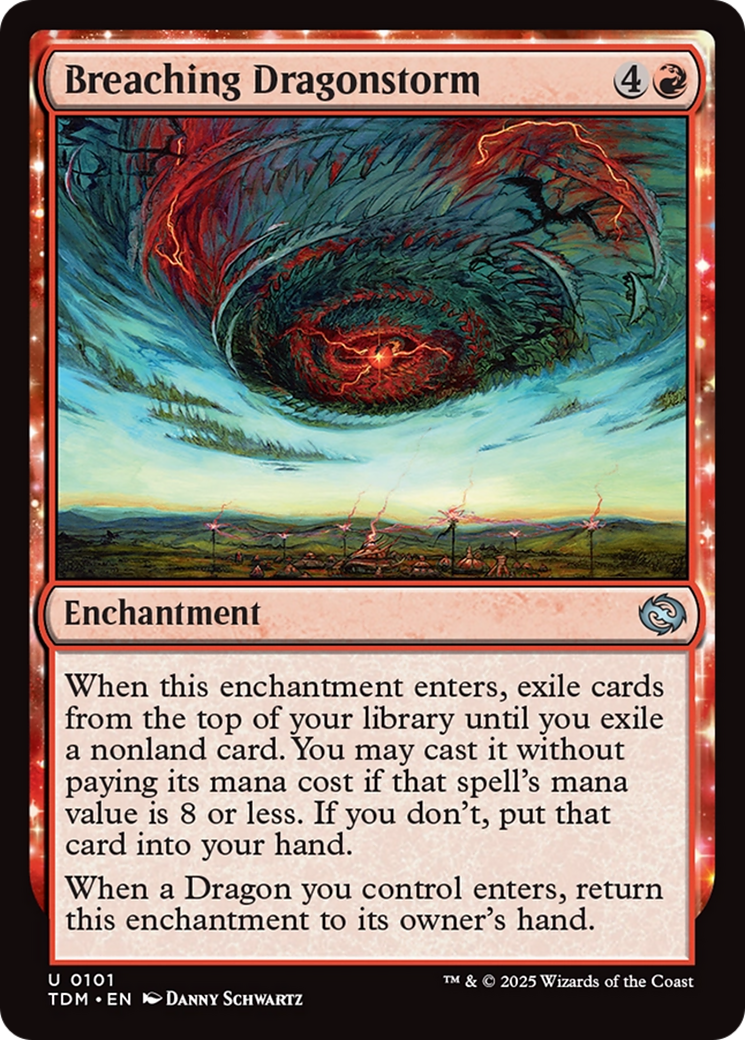
Breaching Dragonstorm
Breaching Dragonstorm
Enchantment
When this enchantment enters, exile cards from the top of your library until you exile a nonland card. You may cast it without paying its mana cost if that spell's mana value is 8 or less. If you don't, put that card into your hand.
When a Dragon you control enters, return this enchantment to its owner's hand.
-
1
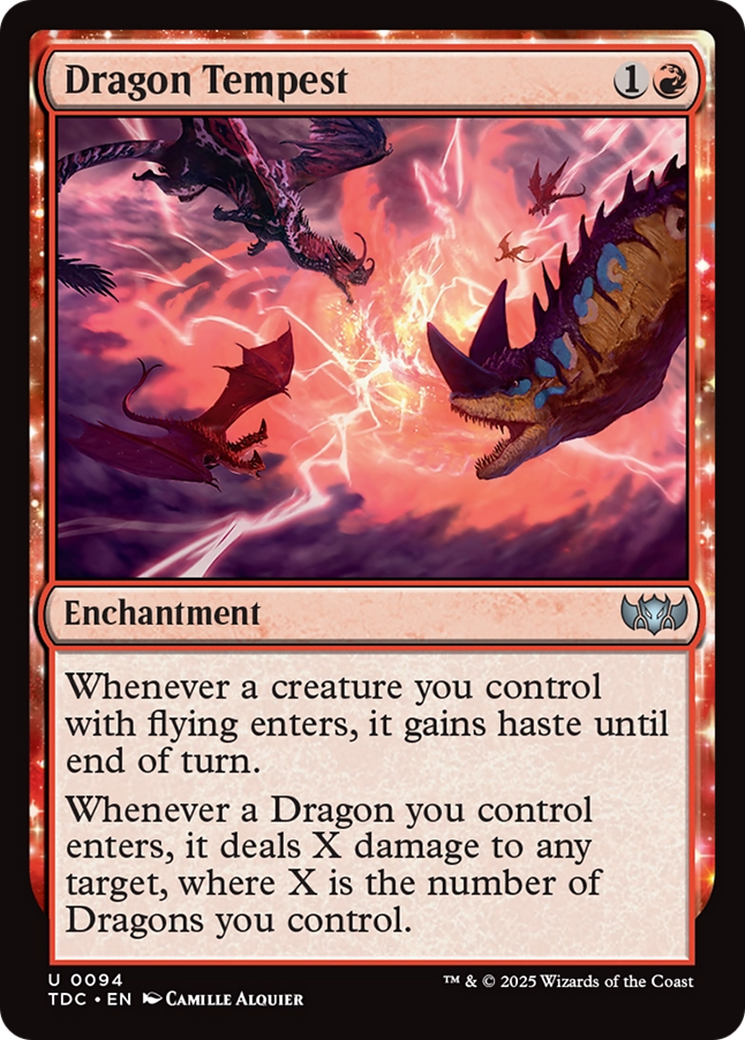
Dragon Tempest
Dragon Tempest
Enchantment
Whenever a creature you control with flying enters, it gains haste until end of turn.
Whenever a Dragon you control enters, it deals X damage to any target, where X is the number of Dragons you control.
- The amount of damage dealt by the Dragon that entered the battlefield is based on the number of Dragons you control when the ability resolves.
- If a Dragon entering the battlefield causes Dragon Tempest’s second ability to trigger but leaves the battlefield before that ability resolves, that Dragon still deals damage.
- The two abilities aren’t mutually exclusive. If a Dragon with flying (which is most of them) enters the battlefield under your control, both abilities will trigger.
-
1
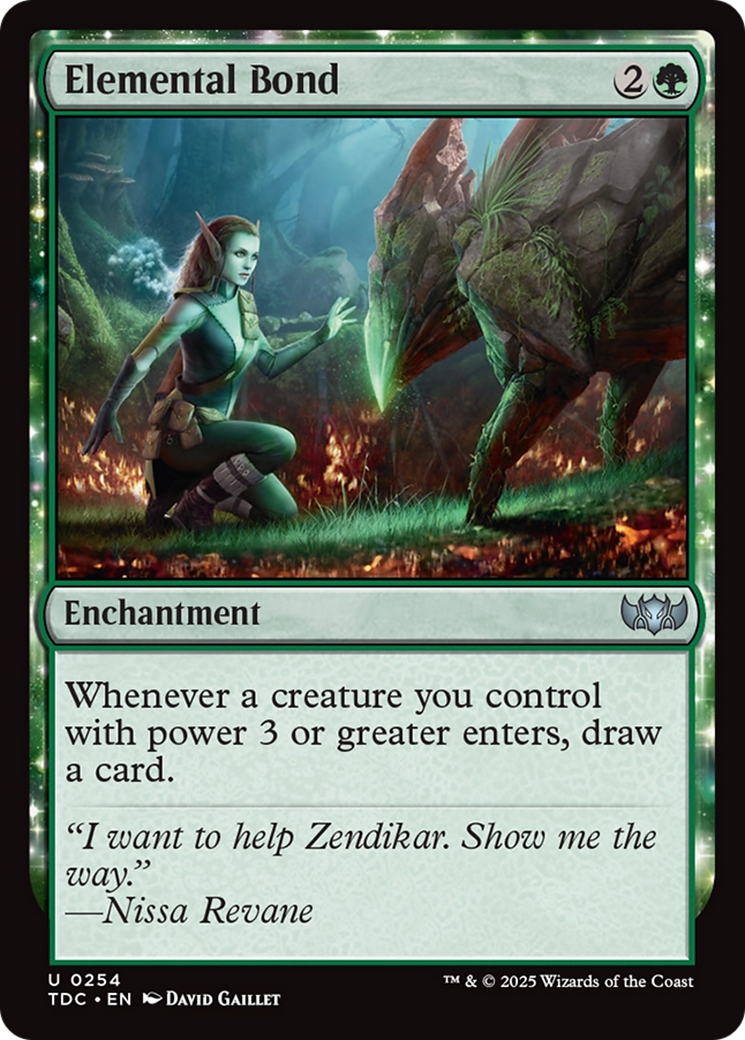
Elemental Bond
Elemental Bond
Enchantment
Whenever a creature you control with power 3 or greater enters, draw a card.
- The creature must have power 3 or greater as it enters the battlefield, or Elemental Bond’s ability won’t trigger. Static abilities that raise (or lower) a creature’s power are taken into account. However, you can’t have a creature with power 2 or less enter the battlefield and try to raise its power with a spell, an activated ability, or a triggered ability.
-
1
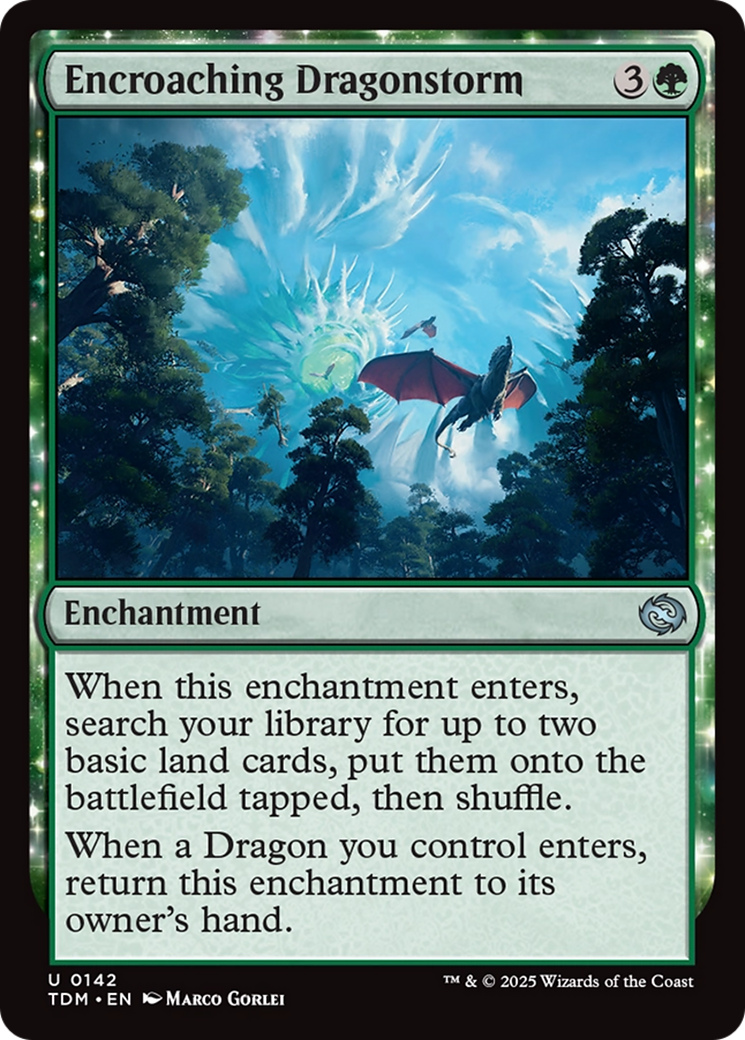
Encroaching Dragonstorm
Encroaching Dragonstorm
Enchantment
When this enchantment enters, search your library for up to two basic land cards, put them onto the battlefield tapped, then shuffle.
When a Dragon you control enters, return this enchantment to its owner's hand.
-
1
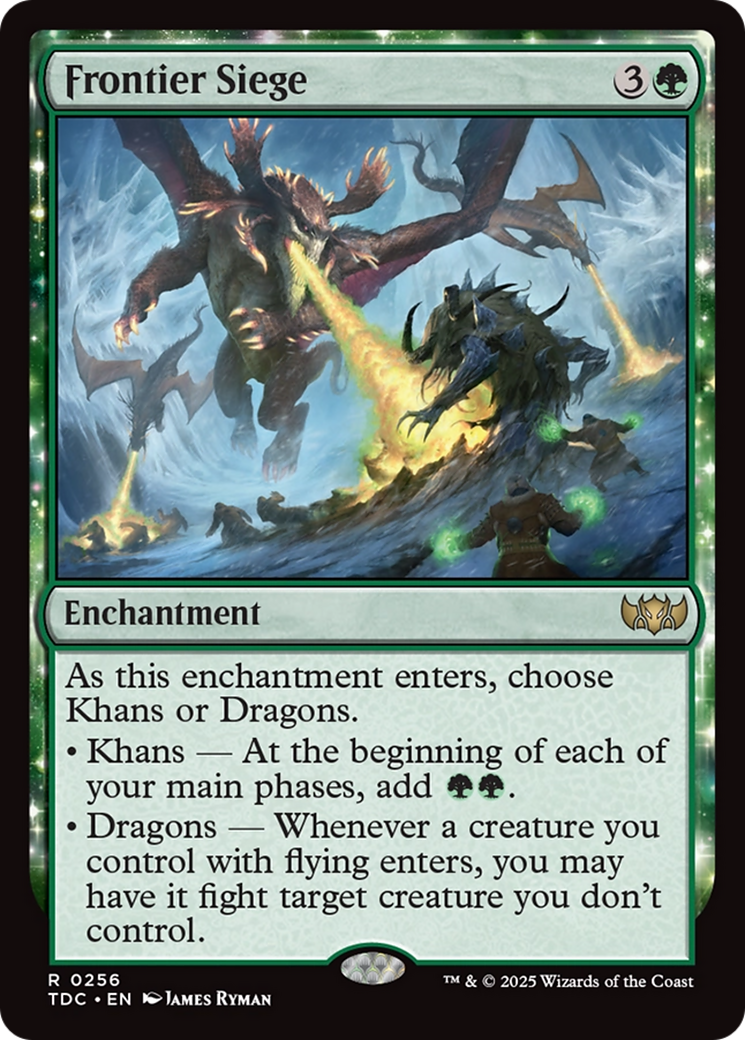
Frontier Siege
Frontier Siege
Enchantment
As this enchantment enters, choose Khans or Dragons.
- Khans — At the beginning of each of your main phases, add .
- Dragons — Whenever a creature you control with flying enters, you may have it fight target creature you don't control.
- The "Khans" ability triggers at the beginning of both your precombat main phase and your postcombat main phase. Unused mana is lost at the end of each step and phase.
- For the "Dragons" ability, you decide whether the creature with flying will fight the target creature you don't control as the ability resolves.
- Each Siege will have one of the two listed abilities, depending on your choice as it enters the battlefield.
- The words "Khans" and "Dragons" are anchor words, connecting your choice to the appropriate ability. Anchor words are a new rules concept. "[Anchor word] — [Ability]" means "As long as you chose [anchor word] as this permanent entered the battlefield, this permanent has [ability]." Notably, the anchor word "Dragons" has no connection to the creature type Dragon.
- Each of the last two abilities is linked to the first ability. They each refer only to the choice made as a result of the first ability. If a permanent enters the battlefield as a copy of one of the Sieges, its controller will make a new choice for that Siege. Which ability the copy has won't depend on the choice made for the original permanent.
-
1
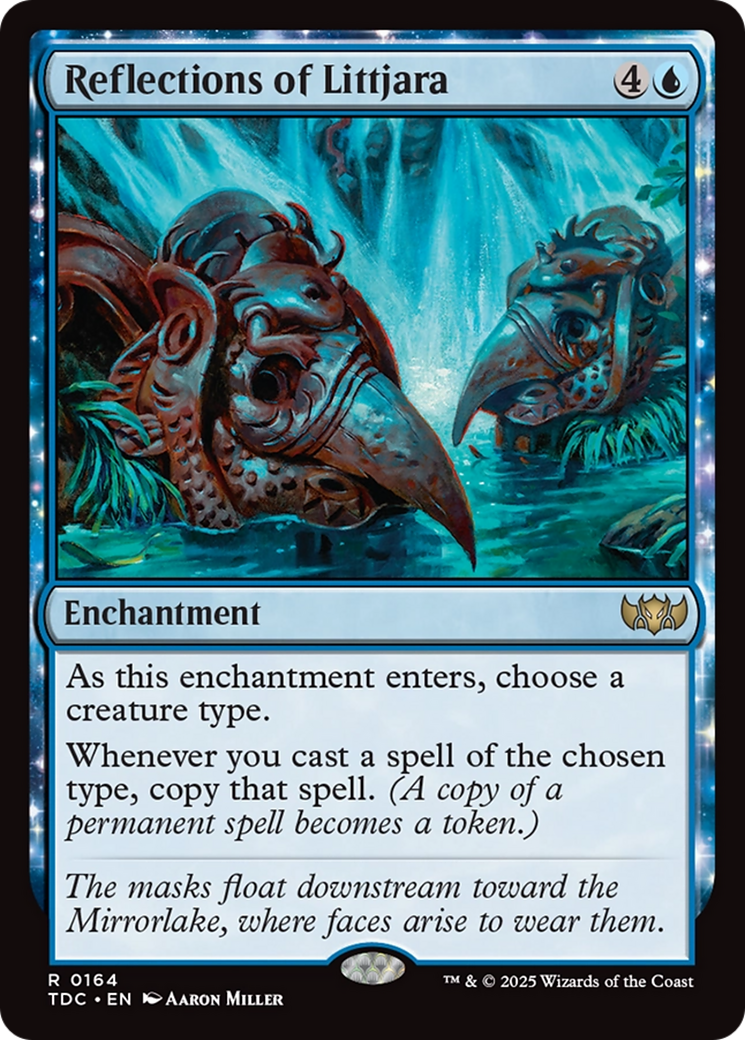
Reflections of Littjara
Reflections of Littjara
Enchantment
As this enchantment enters, choose a creature type.
Whenever you cast a spell of the chosen type, copy that spell. (A copy of a permanent spell becomes a token.)
- You must choose an existing creature type, such as Zombie or Angel. You can't choose card types (e.g., artifact) or supertypes (e.g., snow).
- The triggered ability and the copy it creates will resolve before the spell that caused the ability to trigger.
- As a copy of a permanent spell resolves, it's put onto the battlefield as a token rather than putting a copy of the spell onto the battlefield. The rules that apply to a permanent spell becoming a permanent apply to a copy of a spell becoming a token.
- The token that a resolving copy of a permanent spell becomes isn't "created." Abilities that refer to a copy being created won't interact with the copy resolving.
- If a spell has the kindred card type and the chosen creature type, Reflections of Littjara will copy it.
-
1
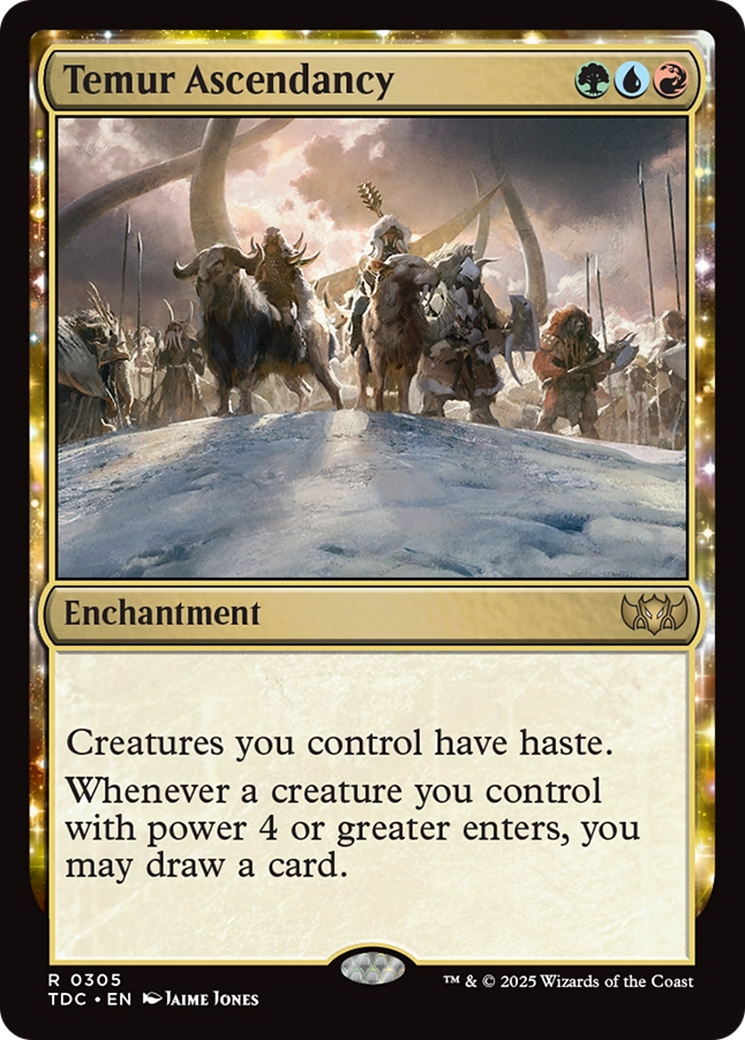
Temur Ascendancy
Temur Ascendancy
Enchantment
Creatures you control have haste.
Whenever a creature you control with power 4 or greater enters, you may draw a card.
- If a creature is entering the battlefield under your control, consider static abilities to determine whether its power is 4 or greater. Spells, activated abilities, and triggered abilities can't be used to raise the creature's power in time to have Temur Ascendancy's last ability trigger or to lower it in time to stop it from triggering.
- Once the last ability of Temur Ascendancy has triggered, lowering the power of the creature won't stop you from drawing a card.
- If Temur Ascendancy leaves the battlefield, creatures you control lose haste. If they haven't been under your control since the turn began and don't otherwise have haste, they can't attack this turn. If they've already attacked, they remain attacking creatures.
Lands 37
-
1
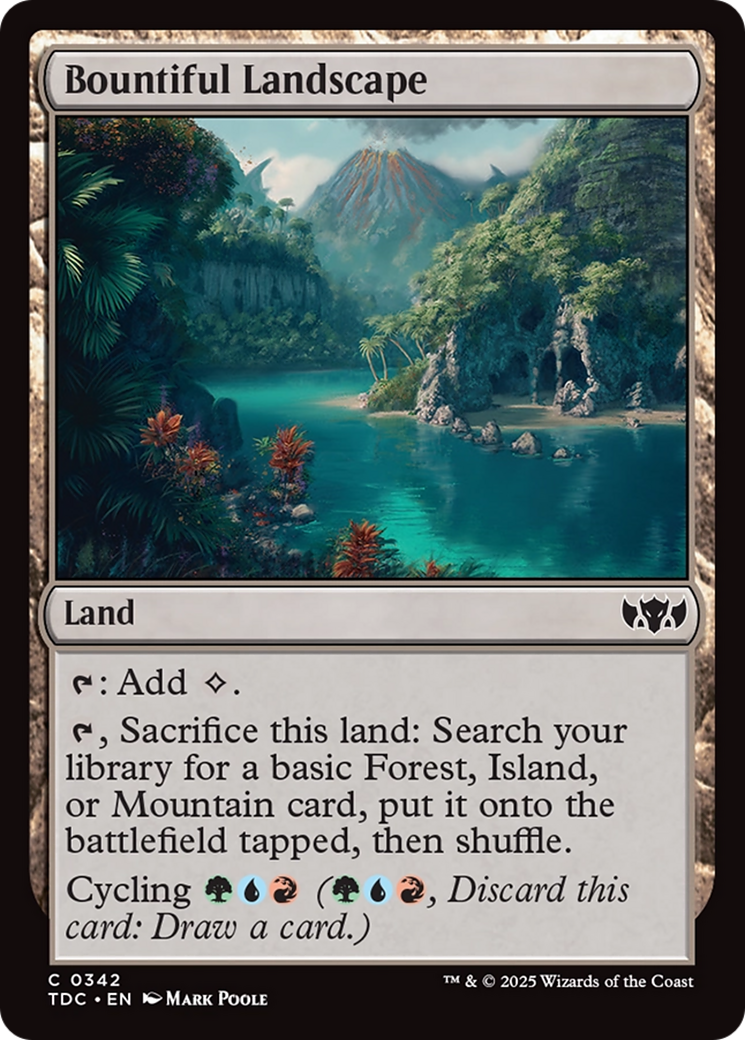
Bountiful Landscape
Bountiful Landscape
Land
: Add .
, Sacrifice this land: Search your library for a basic Forest, Island, or Mountain card, put it onto the battlefield tapped, then shuffle.
Cycling ( , Discard this card: Draw a card.)
-
1
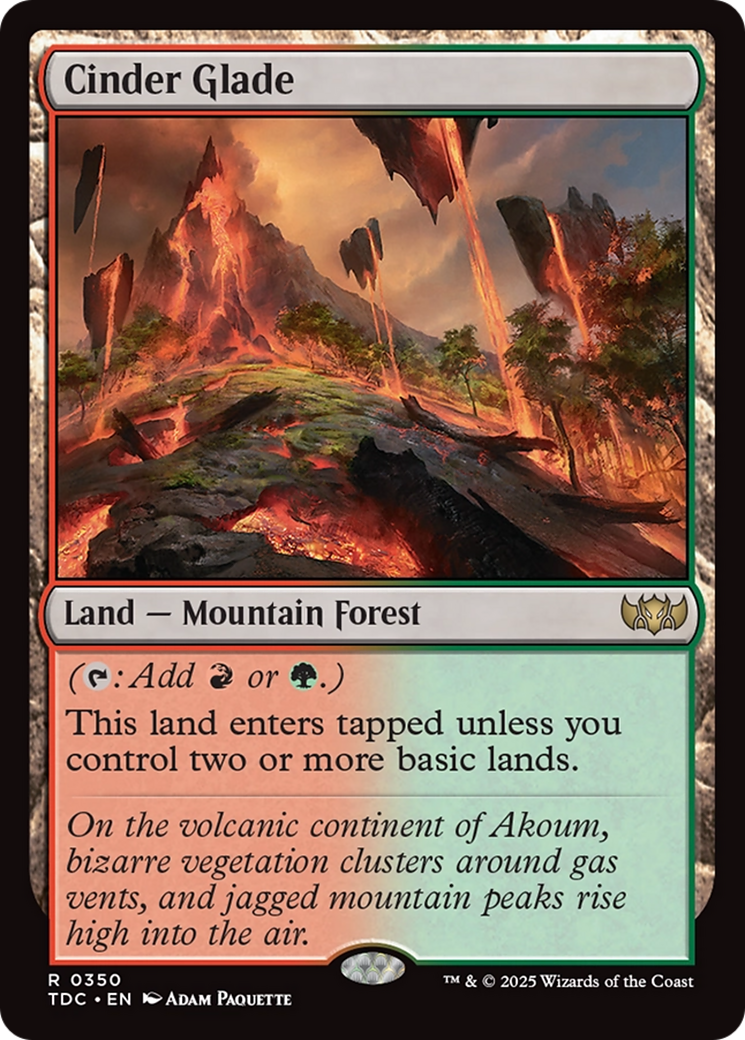
Cinder Glade
Cinder Glade
Land — Mountain Forest
( : Add or .)
This land enters tapped unless you control two or more basic lands.
- Even though these lands have basic land types, they are not basic lands because "basic" doesn't appear on their type line. Notably, controlling two or more of them won't allow others to enter the battlefield untapped.
- However, because these cards have basic land types, effects that specify a basic land type without also specifying that the land be basic can affect them. For example, a spell or ability that reads "Destroy target Forest" can target Canopy Vista, while one that reads "Destroy target basic Forest" cannot.
- If one of these lands enters the battlefield at the same time as any number of basic lands, those other lands are not counted when determining if this land enters the battlefield tapped or untapped.
-
1
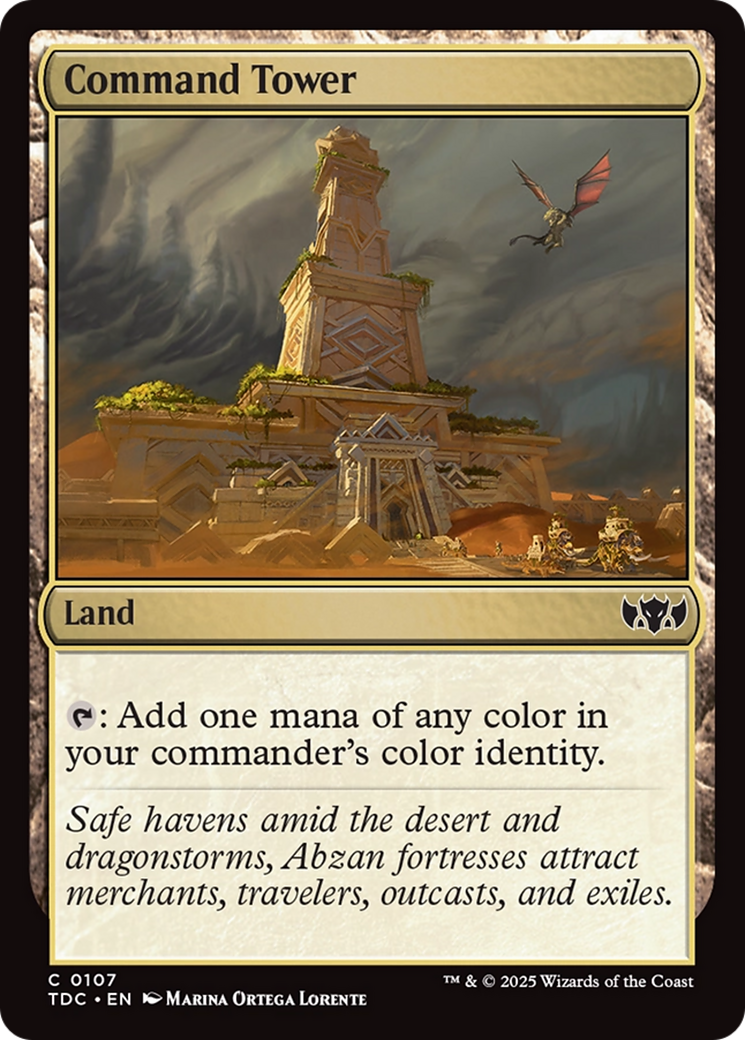
Command Tower
Command Tower
Land
: Add one mana of any color in your commander's color identity.
- If you have two commanders, the ability adds one mana of any color in their combined color identities.
- If your commander is a card that has no colors in its color identity, Command Tower's ability produces no mana. It doesn't produce .
- If you don't have a commander, Command Tower's ability produces no mana.
-
1
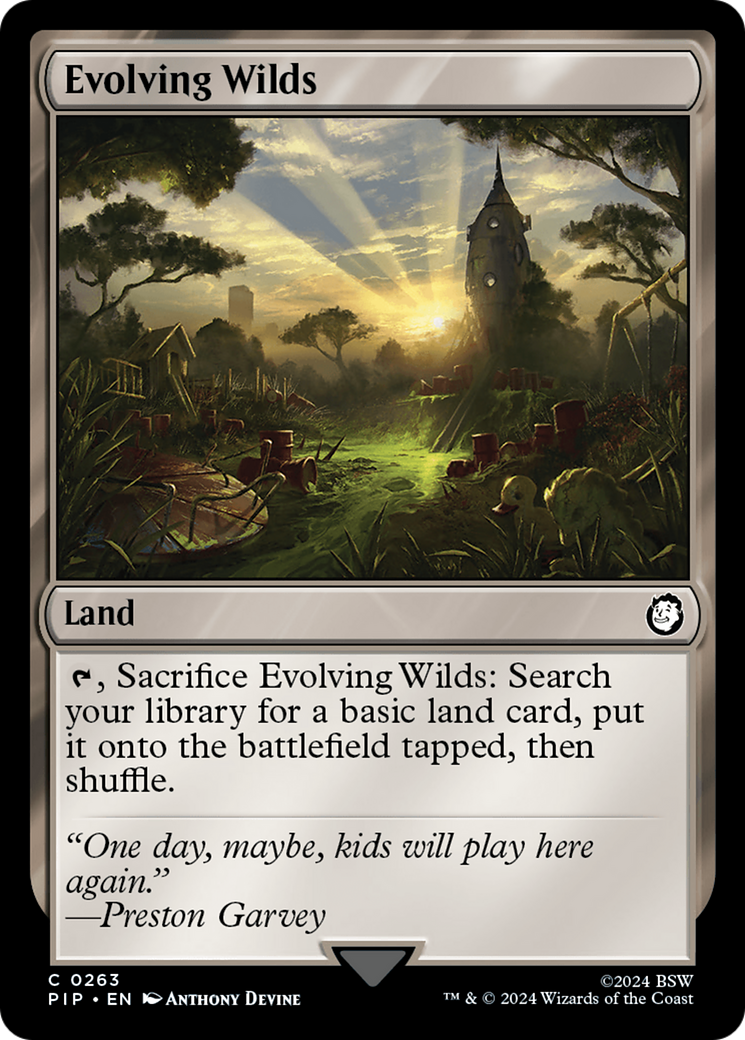
Evolving Wilds
Evolving Wilds
Land
, Sacrifice this land: Search your library for a basic land card, put it onto the battlefield tapped, then shuffle.
-
1
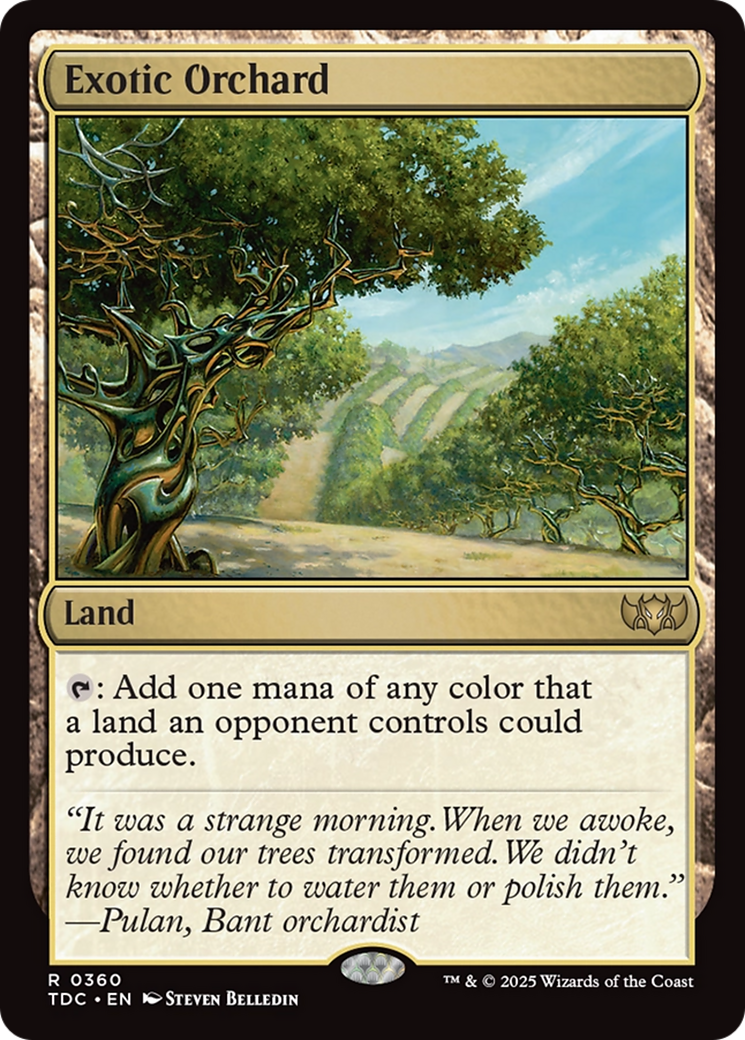
Exotic Orchard
Exotic Orchard
Land
: Add one mana of any color that a land an opponent controls could produce.
- The colors of mana are white, blue, black, red, and green. Exotic Orchard can't be tapped for colorless mana, even if a land an opponent controls could produce colorless mana.
- Exotic Orchard checks the effects of all mana-producing abilities of lands your opponents control, but it doesn't check their costs. For example, Vivid Crag has the ability " , Remove a charge counter from Vivid Crag: Add one mana of any color." If an opponent controls Vivid Crag and you control Exotic Orchard, you can tap Exotic Orchard for any color of mana. It doesn't matter whether Vivid Crag has a charge counter on it, and it doesn't matter whether it's untapped.
- When determining what colors of mana your opponents' lands could produce, Exotic Orchard takes into account any applicable replacement effects that would apply to those lands' mana abilities (such as Contamination's effect, for example). If there are more than one, consider them in any possible order.
- Exotic Orchard doesn't care about any restrictions or riders your opponents' lands (such as Ancient Ziggurat or Hall of the Bandit Lord) put on the mana they produce. It just cares about colors of mana.
- Lands that produce mana based only on what other lands "could produce" won't help each other unless some other land allows one of them to actually produce some type of mana. For example, if you control an Exotic Orchard and your opponent controls an Exotic Orchard and a Reflecting Pool, none of those lands would produce mana if their mana abilities were activated. On the other hand, if you control a Forest and an Exotic Orchard, and your opponent controls an Exotic Orchard and a Reflecting Pool, then each of those lands can be tapped to produce . Your opponent's Exotic Orchard can produce because you control a Forest. Your Exotic Orchard and your opponent's Reflecting Pool can each produce because your opponent's Exotic Orchard can produce .
-
1
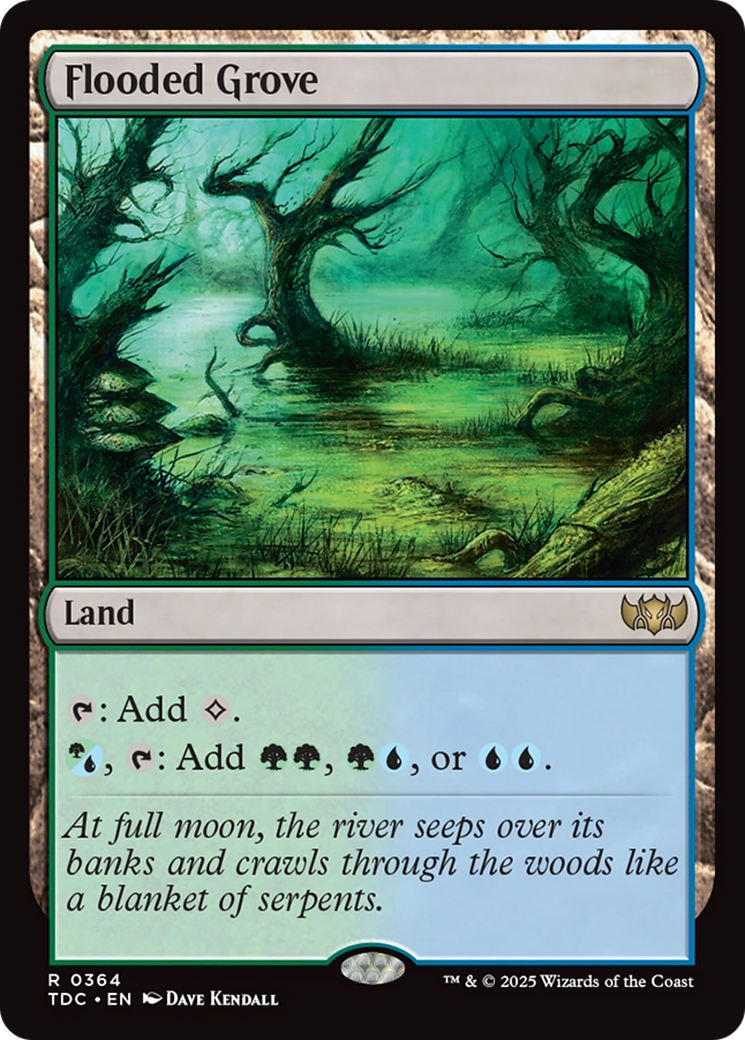
Flooded Grove
Flooded Grove
Land
: Add .
, : Add , , or .
-
5
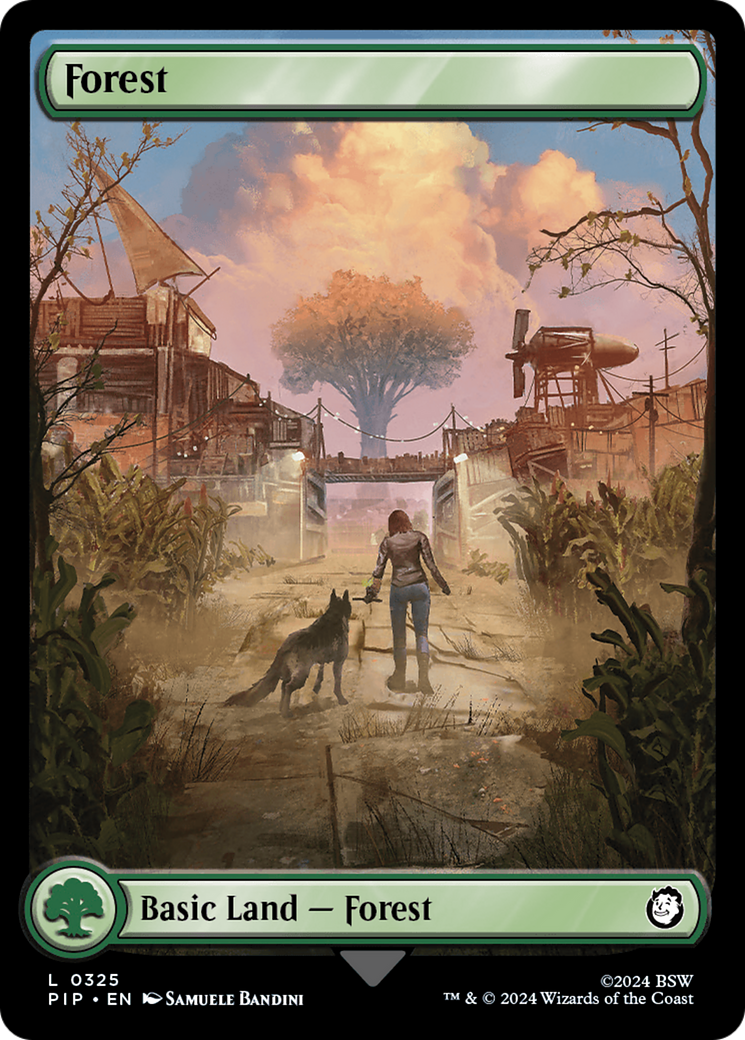
Forest
Forest
Basic Land — Forest
( : Add .)
-
1
Frontier Bivouac
Frontier Bivouac
Land
This land enters tapped.
: Add , , or .
-
1
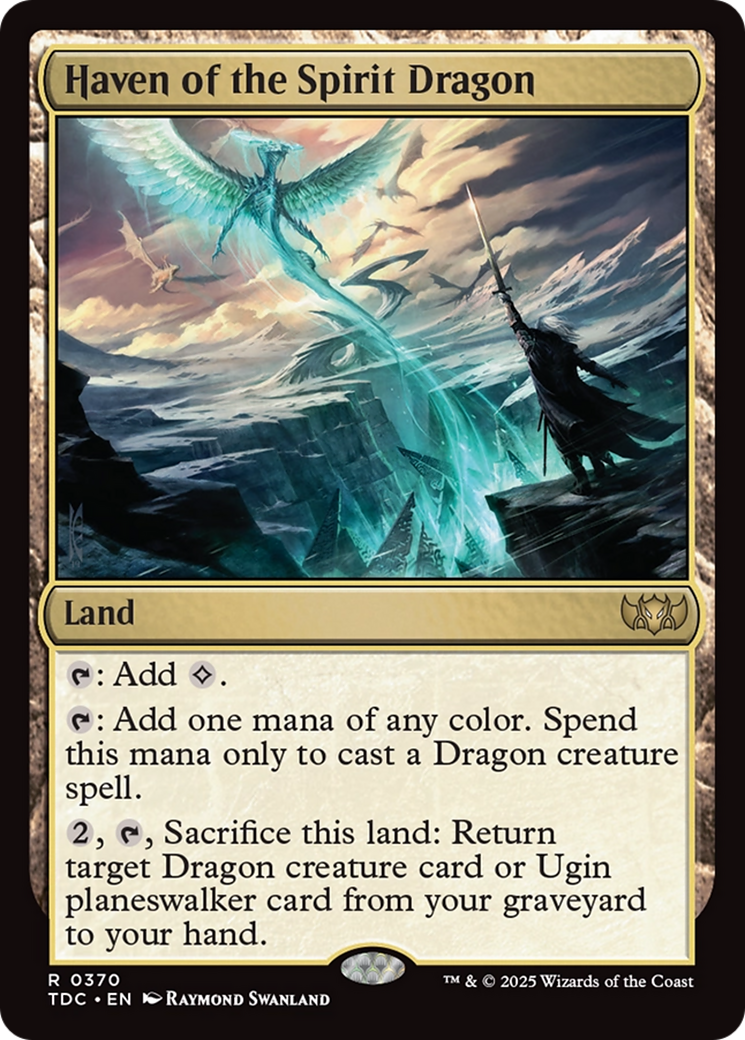
Haven of the Spirit Dragon
Haven of the Spirit Dragon
Land
: Add .
: Add one mana of any color. Spend this mana only to cast a Dragon creature spell.
, , Sacrifice this land: Return target Dragon creature card or Ugin planeswalker card from your graveyard to your hand.
- The mana produced by Haven of the Spirit Dragon's second ability can be used to pay for any additional or alternative costs (such as dash costs) involved in casting a Dragon creature spell.
-
1
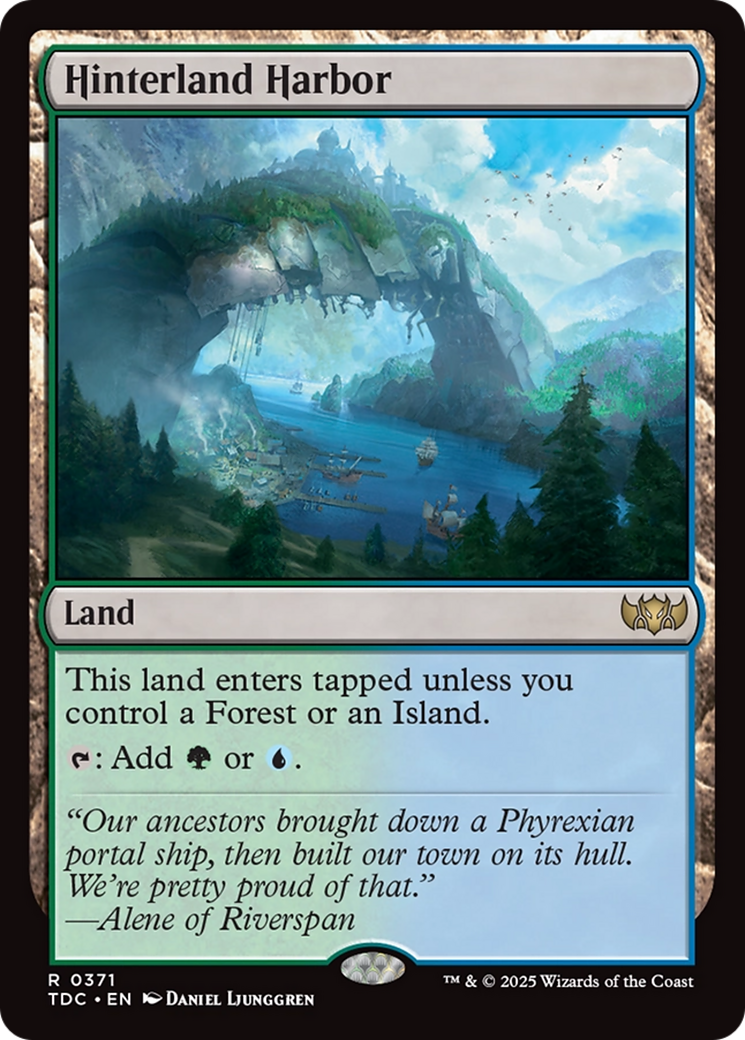
Hinterland Harbor
Hinterland Harbor
Land
This land enters tapped unless you control a Forest or an Island.
: Add or .
-
3
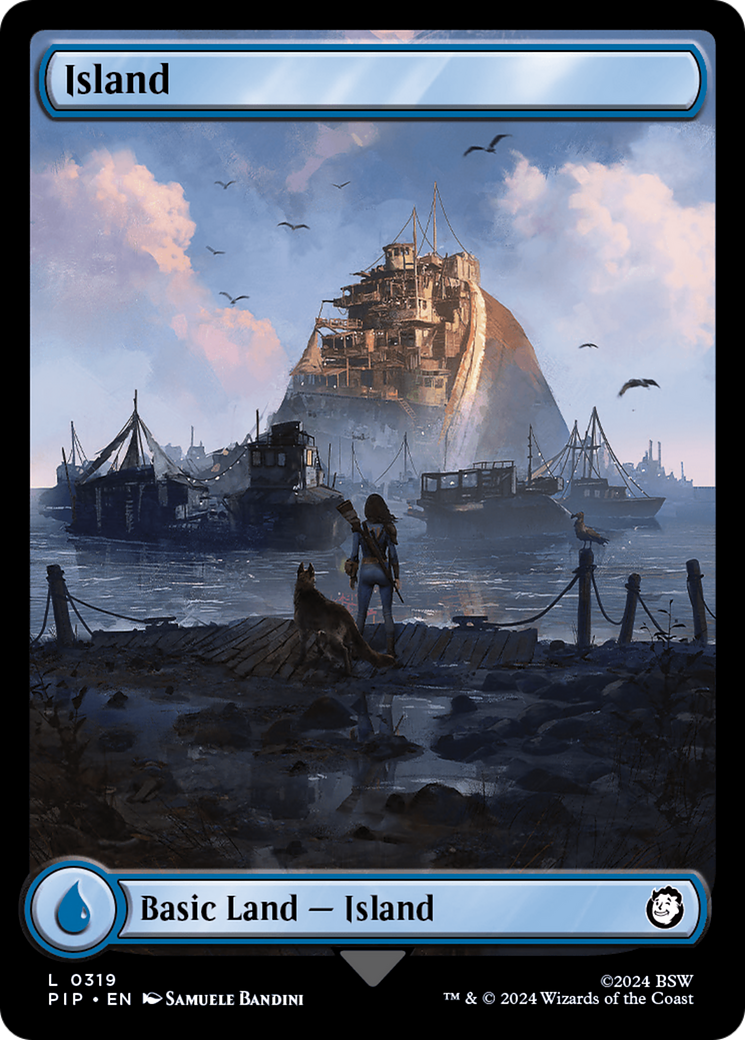
Island
Island
Basic Land — Island
( : Add .)
-
1
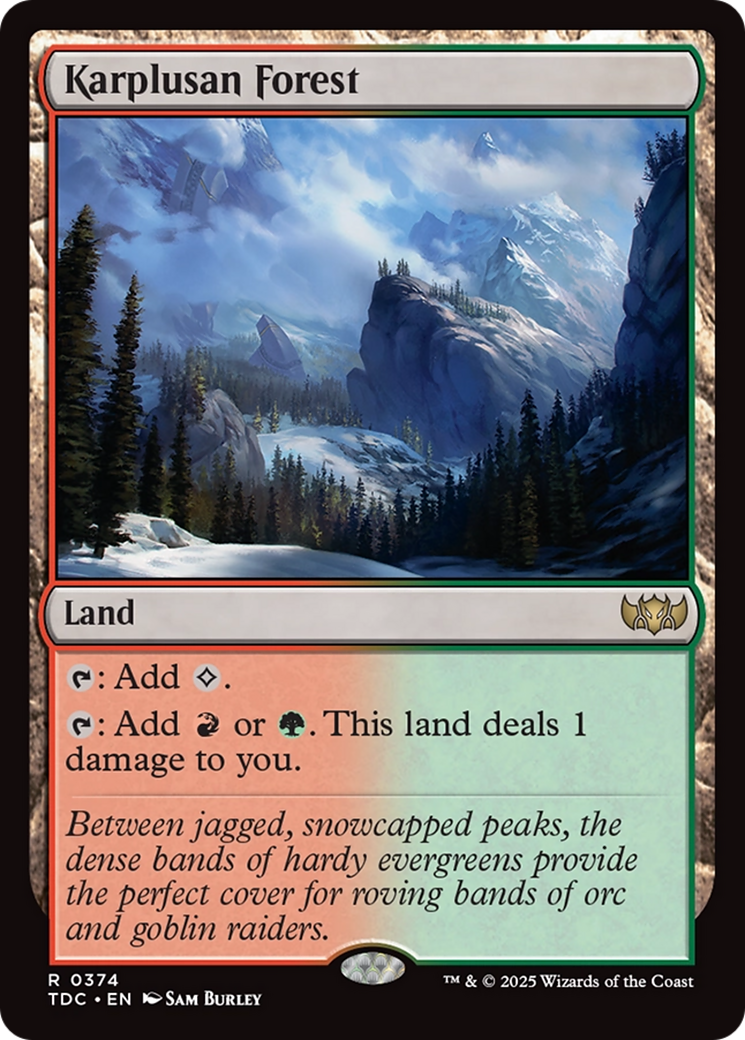
Karplusan Forest
Karplusan Forest
Land
: Add .
: Add or . This land deals 1 damage to you.
-
1
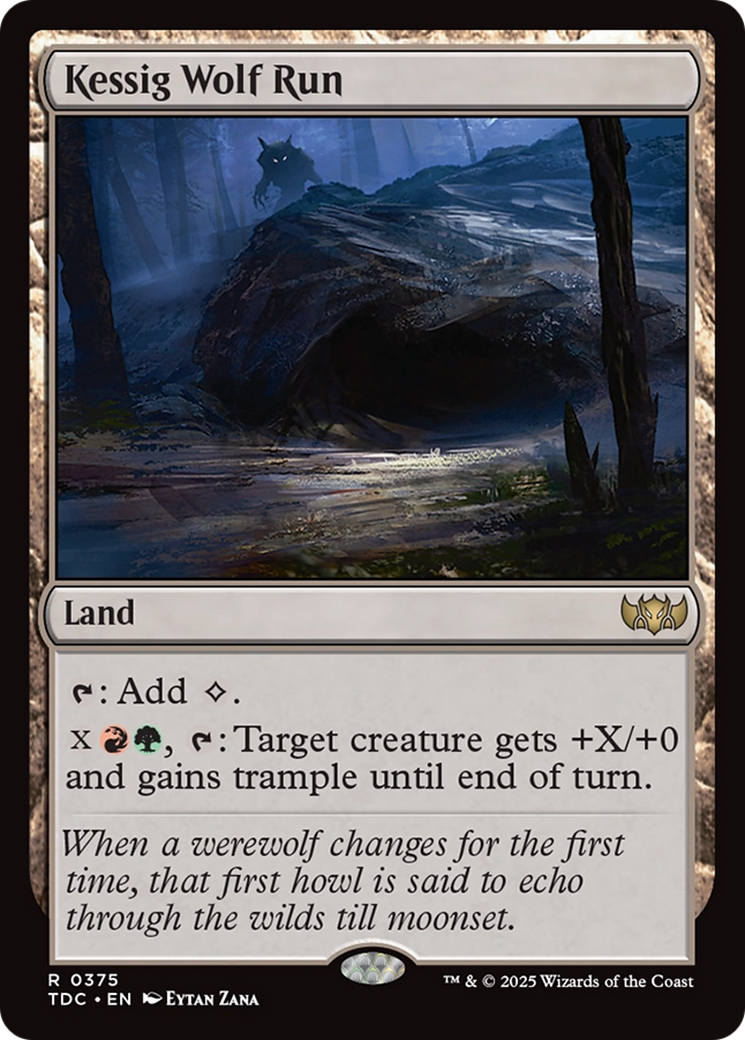
Kessig Wolf Run
Kessig Wolf Run
Land
: Add .
, : Target creature gets +X/+0 and gains trample until end of turn.
-
1
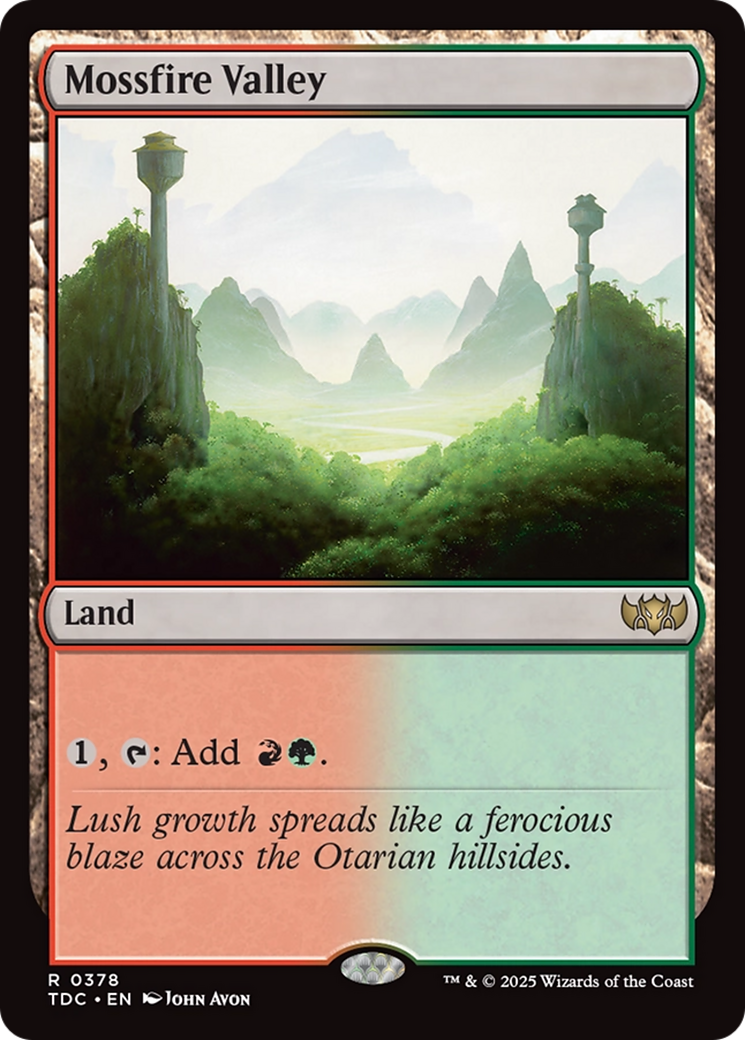
Mossfire Valley
Mossfire Valley
Land
, : Add .
-
1
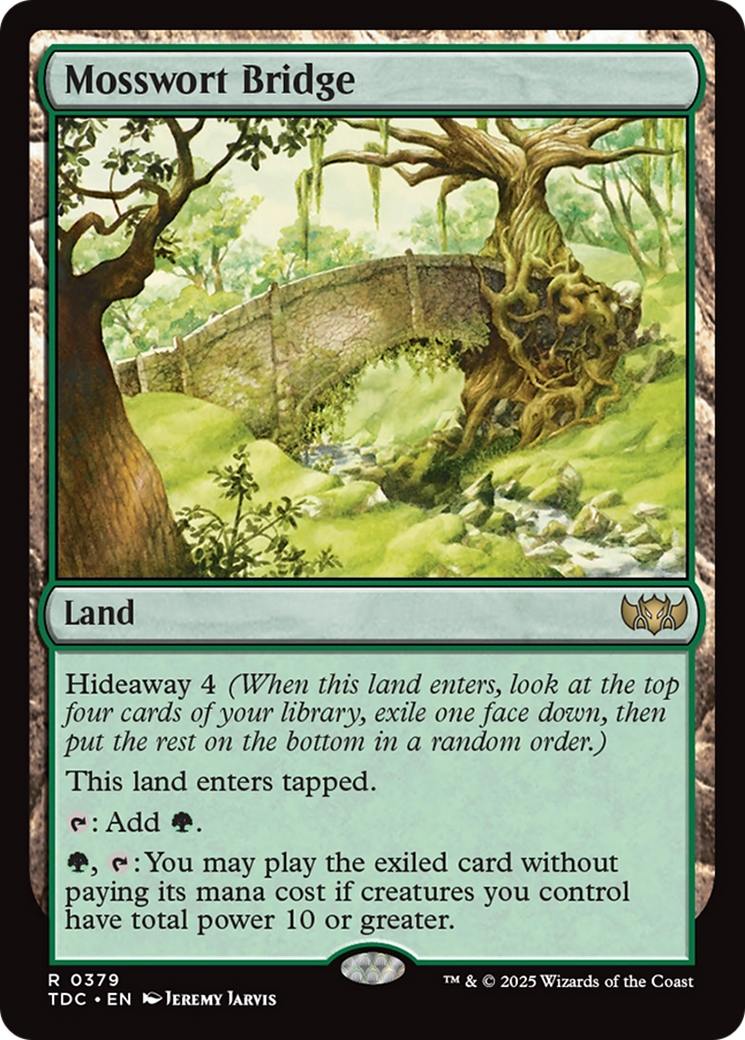
Mosswort Bridge
Mosswort Bridge
Land
Hideaway 4 (When this land enters, look at the top four cards of your library, exile one face down, then put the rest on the bottom in a random order.)
This land enters tapped.
: Add .
, : You may play the exiled card without paying its mana cost if creatures you control have total power 10 or greater.
- "Hideaway N" means "When this permanent enters the battlefield, look at the top N cards of your library. Exile one of them face down and put the rest on the bottom of your library in a random order. The exiled card gains 'The player who controls the permanent that exiled this card may look at this card in the exile zone.'"
- Any player who has controlled a permanent with a hideaway ability since a card was exiled with it may look at that card.
- Previously, permanents with hideaway entered the battlefield tapped. This ability has been removed from the definition of hideaway. Older cards have received errata to have an additional paragraph that reads "[This permanent] enters the battlefield tapped," and they now have hideaway 4.
- Hideaway now causes you to put the rest of the cards on the bottom of your library in a random order instead of any order.
-
6
Mountain
Mountain
Basic Land — Mountain
( : Add .)
-
1
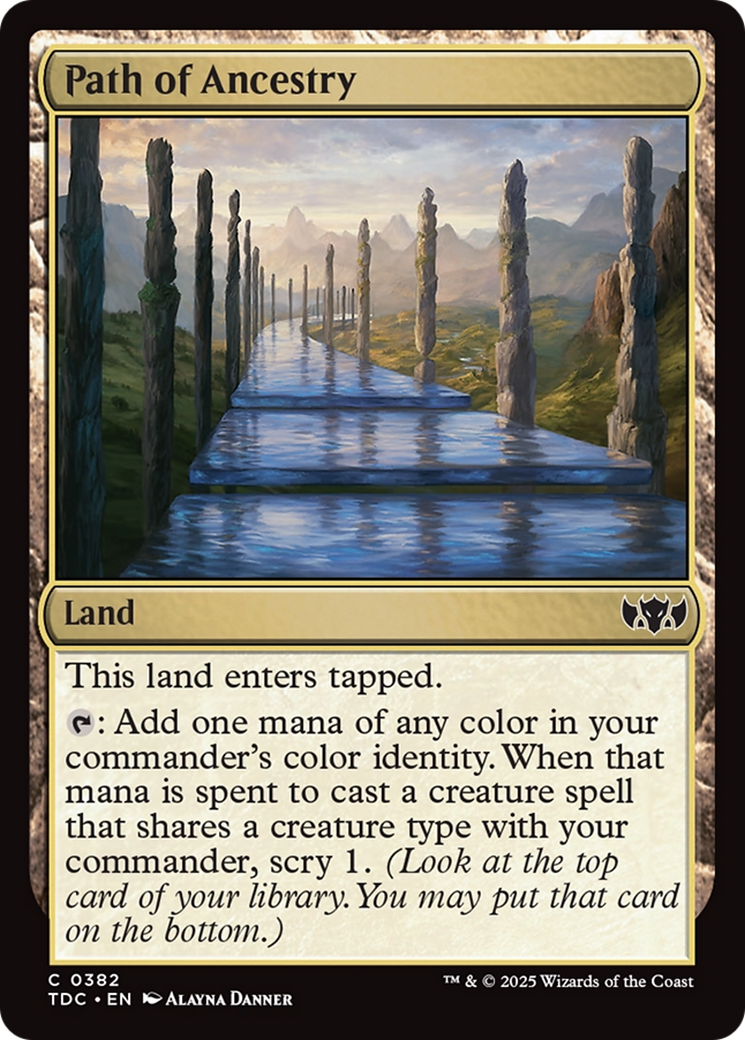
Path of Ancestry
Path of Ancestry
Land
This land enters tapped.
: Add one mana of any color in your commander's color identity. When that mana is spent to cast a creature spell that shares a creature type with your commander, scry 1. (Look at the top card of your library. You may put that card on the bottom.)
- If you have two commanders, the last ability adds one mana of any color in their combined color identities. When you spend that mana on a creature spell that shares a creature type with either of your commanders, you'll scry 1.
- Your commander's creature types are checked immediately after you cast a creature spell spending mana from Path of Ancestry's last ability. They aren't set before the game begins, and they may not be the same types your commander had when you activated that ability.
- If you cast your commander with mana from Path of Ancestry, and your commander hasn't somehow lost all of its creature types while on the stack, you'll scry 1.
- If your commander is a card that has no colors in its color identity, Path of Ancestry's ability produces no mana. It doesn't produce .
- If Path of Ancestry's last ability produces two mana (most likely due to Mana Reflection), spending those two mana to cast creature spells that share a creature type with your commander will cause two abilities to trigger. Each of those abilities will cause you to scry 1. You won't scry 2. This is true whether you spend the mana on one creature spell or two.
- If your commander has no creature types, it can't share a creature type with any spell that you cast.
- If you don't have a commander, Path of Ancestry's ability produces no mana.
-
1
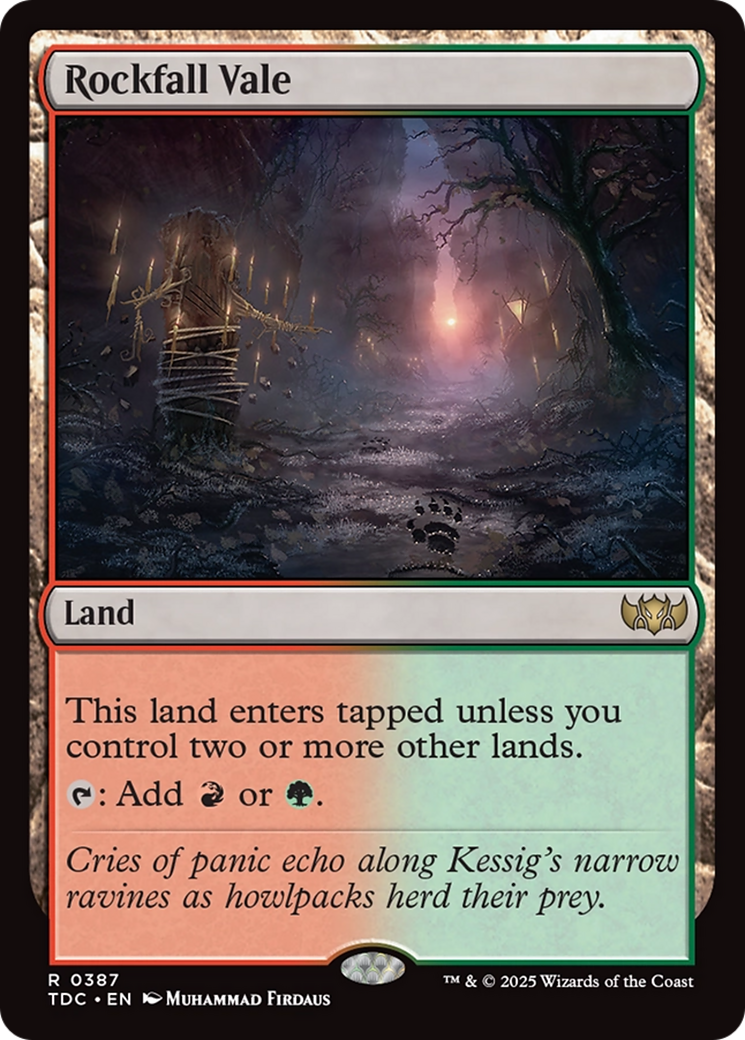
Rockfall Vale
Rockfall Vale
Land
This land enters tapped unless you control two or more other lands.
: Add or .
- If this land enters the battlefield at the same time as any number of other lands, those other lands are not counted when determining if this land enters the battlefield tapped or untapped.
-
1
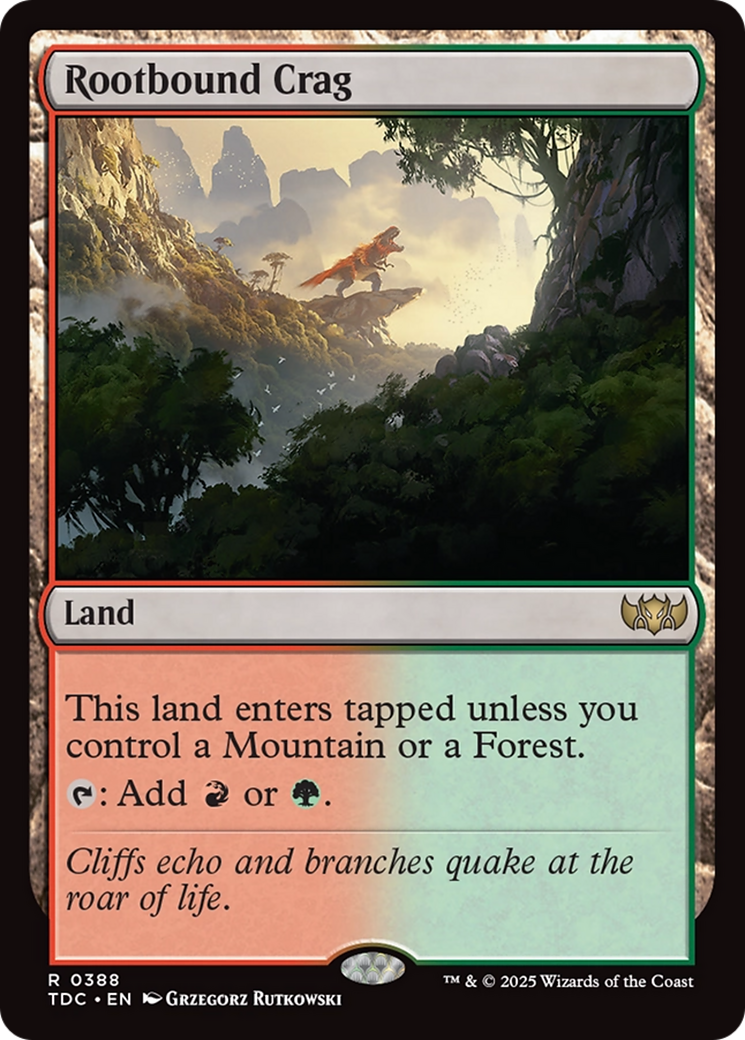
Rootbound Crag
Rootbound Crag
Land
This land enters tapped unless you control a Mountain or a Forest.
: Add or .
- This checks for lands you control with the land type Mountain or Forest, not for lands named Mountain or Forest. The lands it checks for don't have to be basic lands. For example, if you control Temple Garden (a nonbasic land with the land types Forest and Plains), Rootbound Crag will enter untapped.
- As this is entering, it checks for lands that are already on the battlefield. It won't see lands that are entering at the same time (due to Warp World, for example).
-
1
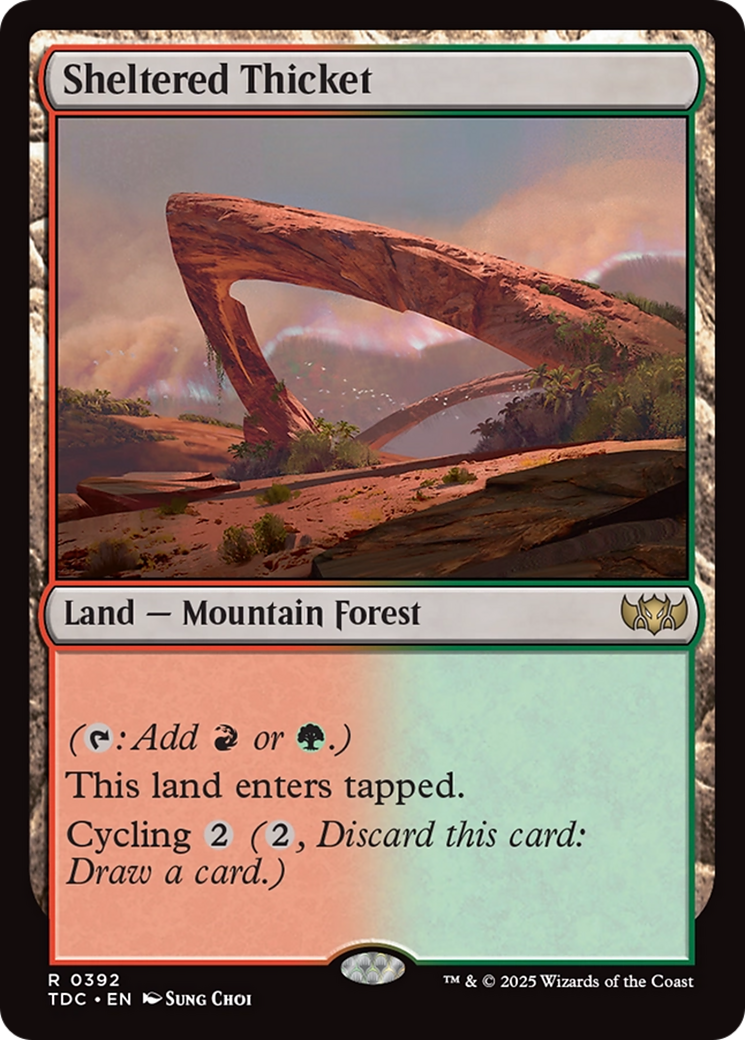
Sheltered Thicket
Sheltered Thicket
Land — Mountain Forest
( : Add or .)
This land enters tapped.
Cycling ( , Discard this card: Draw a card.)
-
1
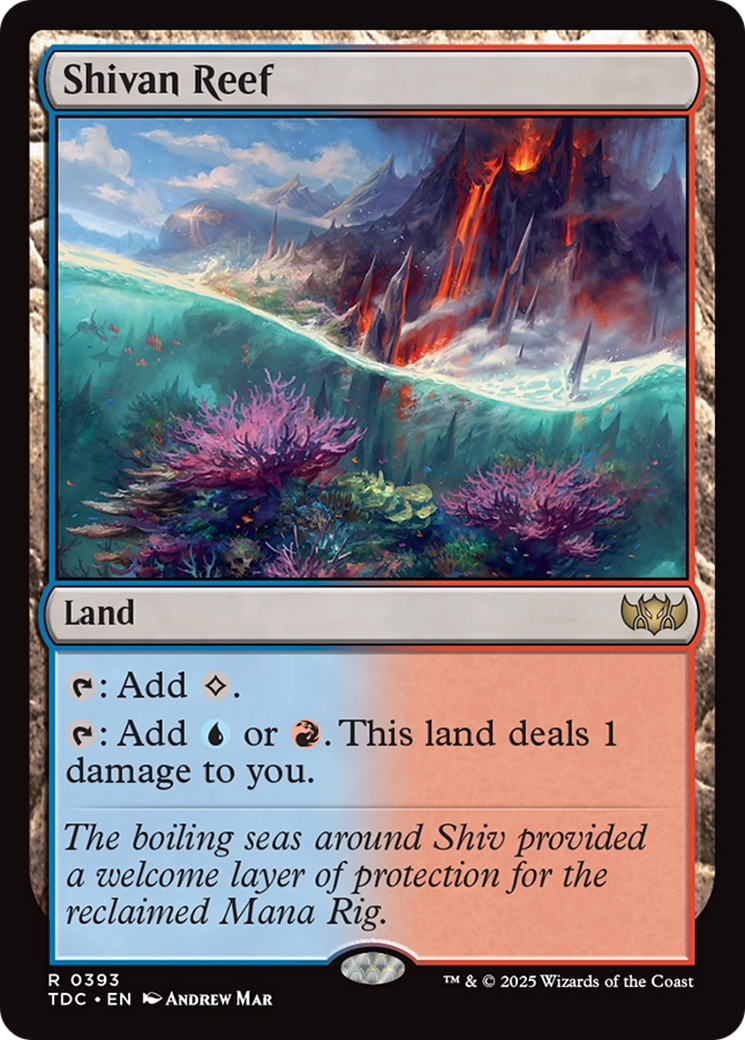
Shivan Reef
Shivan Reef
Land
: Add .
: Add or . This land deals 1 damage to you.
- The damage dealt to you is part of the second mana ability. It doesn't use the stack and can't be responded to.
- Like most lands, each land in this cycle is colorless. The damage dealt to you is dealt by a colorless source.
-
1
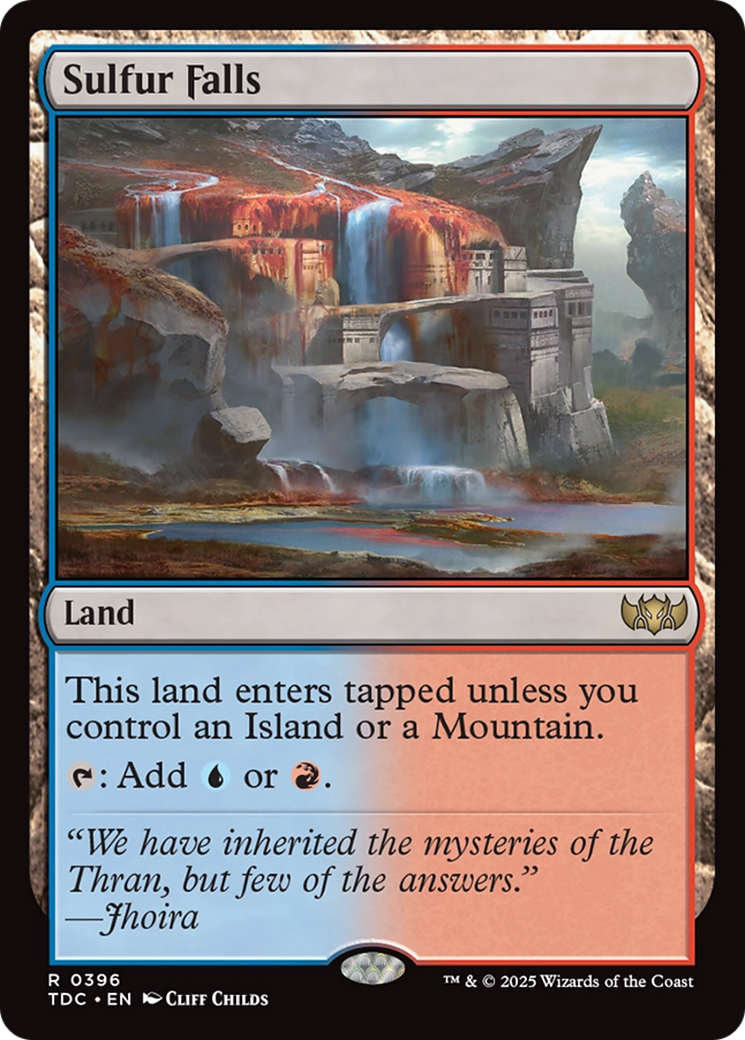
Sulfur Falls
Sulfur Falls
Land
This land enters tapped unless you control an Island or a Mountain.
: Add or .
-
1
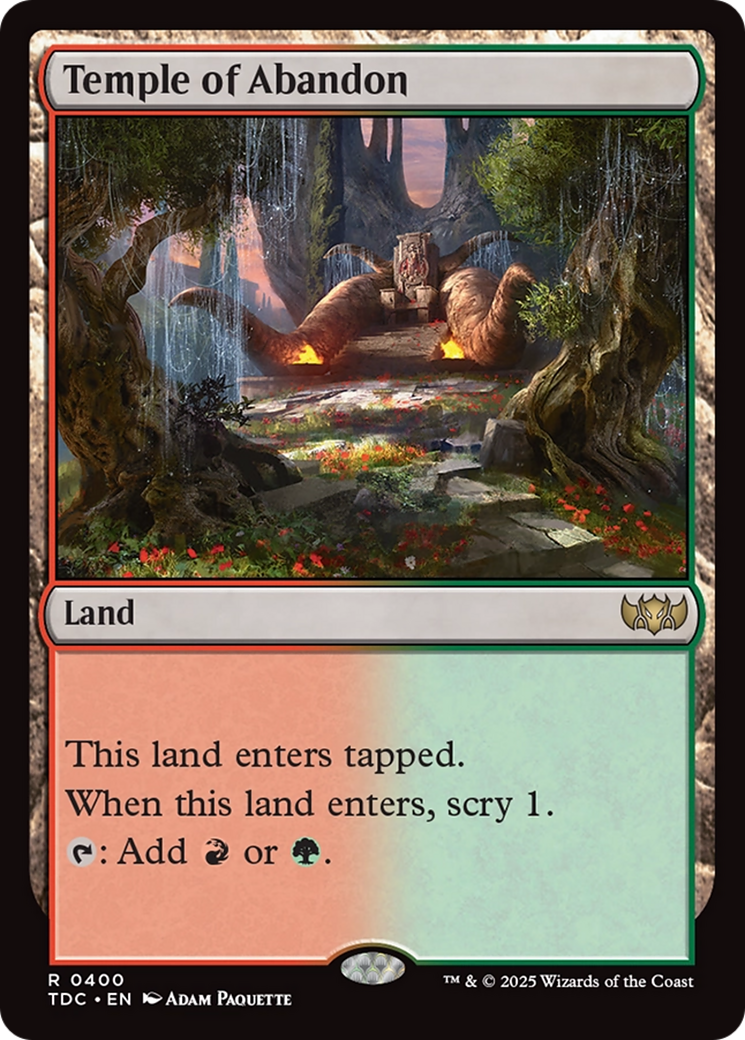
Temple of Abandon
Temple of Abandon
Land
This land enters tapped.
When this land enters, scry 1. (Look at the top card of your library. You may put that card on the bottom.)
: Add or .
- You perform the actions stated on a card in sequence. For some spells and abilities, that means you'll scry last. For others, that means you'll scry and then perform other actions.
- When you scry, you may put all the cards you look at back on top of your library, you may put all of those cards on the bottom of your library, or you may put some of those cards on top and the rest of them on the bottom.
- You choose how to order cards returned to your library after scrying no matter where you put them.
- Scry appears on some spells and abilities with one or more targets. If all of the spell or ability's targets are illegal when it tries to resolve, it won't resolve and none of its effects will happen. You won't scry.
-
1
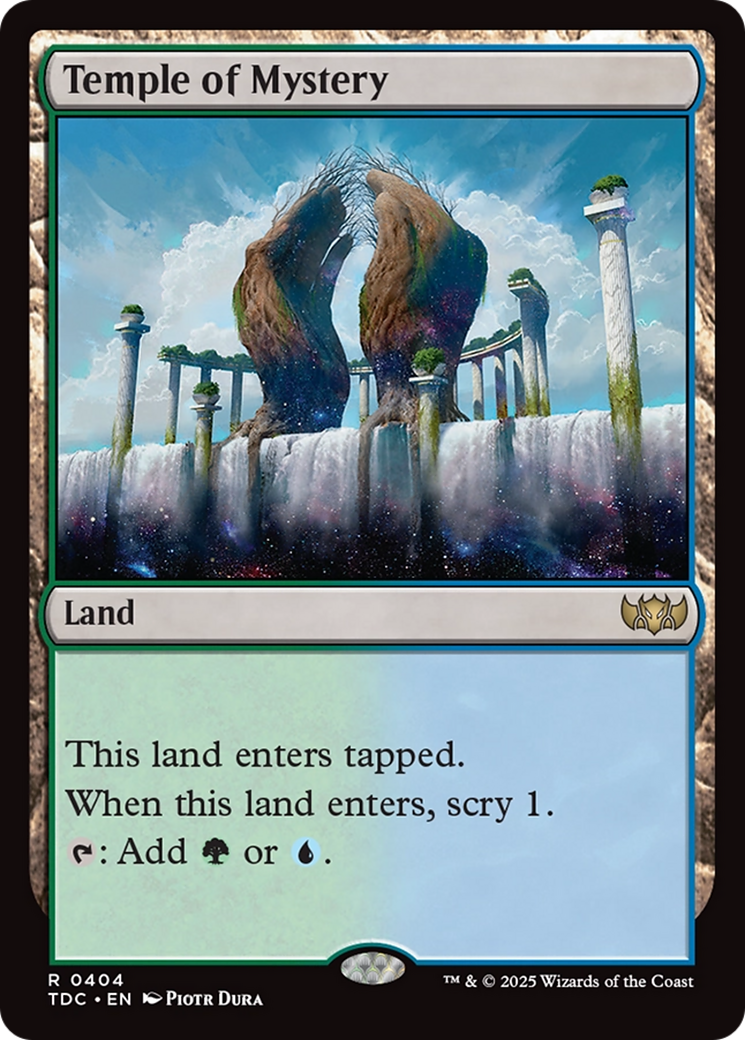
Temple of Mystery
Temple of Mystery
Land
This land enters tapped.
When this land enters, scry 1. (Look at the top card of your library. You may put that card on the bottom.)
: Add or .
- When you scry, you may put all the cards you look at back on top of your library, you may put all of those cards on the bottom of your library, or you may put some of those cards on top and the rest of them on the bottom.
- You choose how to order cards returned to your library after scrying no matter where you put them.
- You perform the actions stated on a card in sequence. For some spells and abilities, that means you'll scry last. For others, that means you'll scry and then perform other actions.
- Scry appears on some spells and abilities with one or more targets. If all of the spell or ability's targets are illegal when it tries to resolve, it won't resolve and none of its effects will happen. You won't scry.
-
1
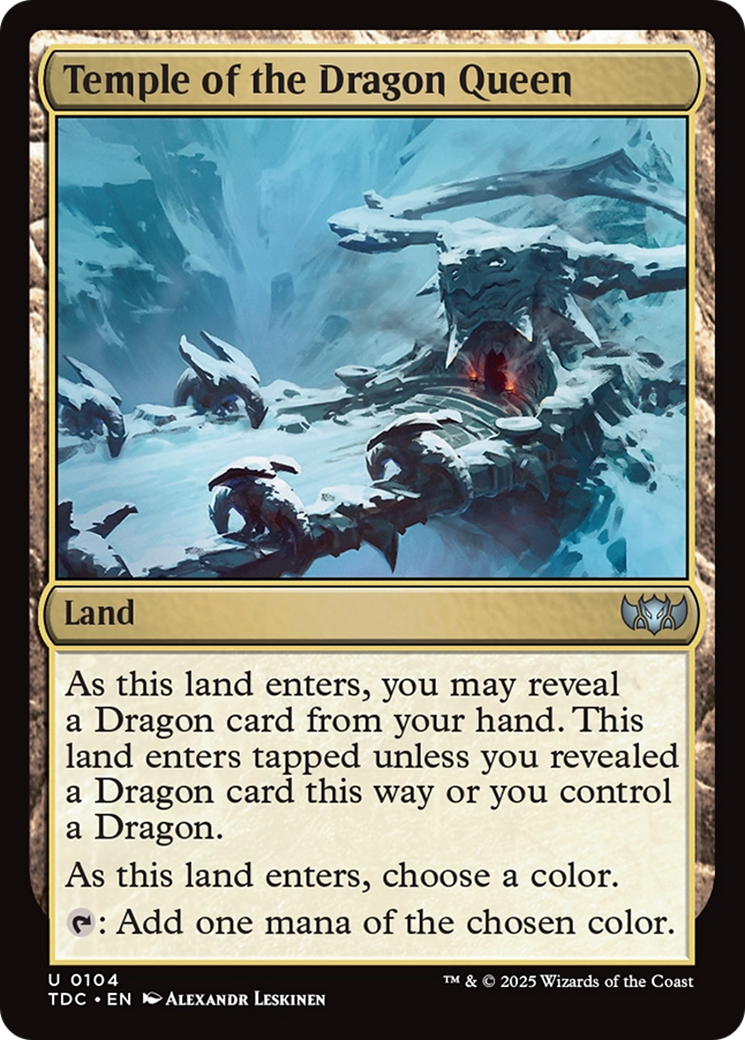
Temple of the Dragon Queen
Temple of the Dragon Queen
Land
As this land enters, you may reveal a Dragon card from your hand. This land enters tapped unless you revealed a Dragon card this way or you control a Dragon.
As this land enters, choose a color.
: Add one mana of the chosen color.
- A Dragon card is a card with the creature type Dragon in its type line. Similarly, a creature on the battlefield is a Dragon if it has the Dragon creature type. A card that has "Dragon" in the name (such as Temple of the Dragon Queen) isn't a Dragon card unless it also has the Dragon creature type.
-
1
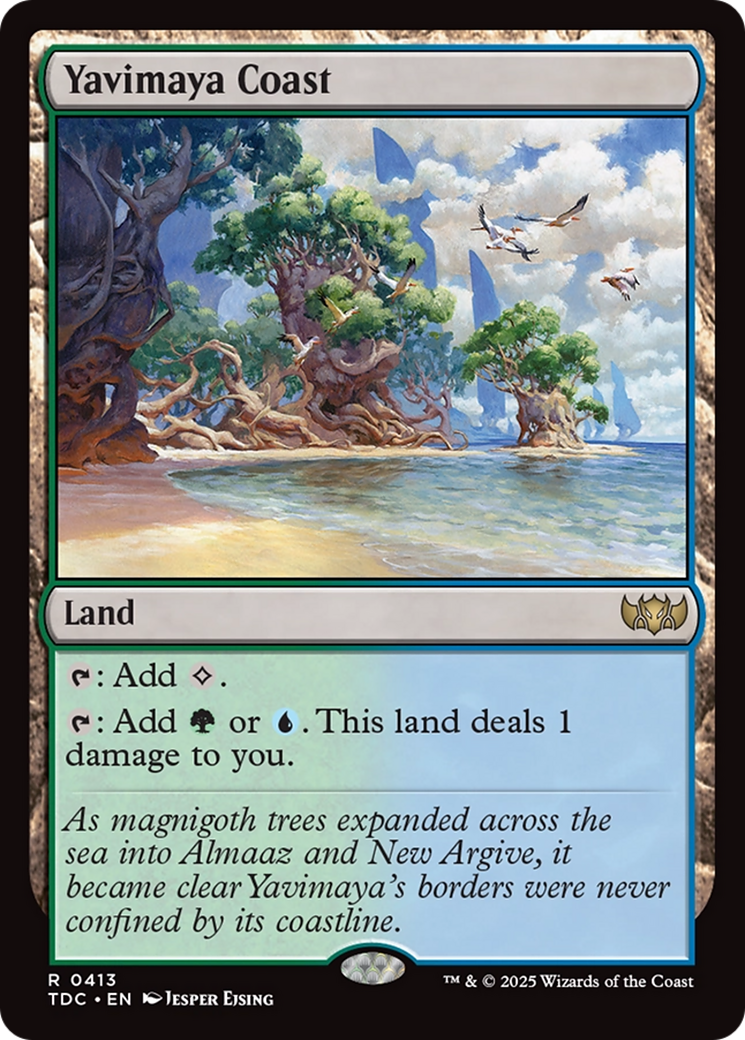
Yavimaya Coast
Yavimaya Coast
Land
: Add .
: Add or . This land deals 1 damage to you.
- The damage dealt to you is part of the second mana ability. It doesn't use the stack and can't be responded to.
- Like most lands, each land in this cycle is colorless. The damage dealt to you is dealt by a colorless source.
Blue 8
-
1
Deceptive Frostkite
Deceptive Frostkite
Creature — Dragon
1/1
Flying
You may have this creature enter as a copy of a creature you control with power 4 or greater, except it's a Dragon in addition to its other types and it has flying.
- Deceptive Frostkite copies exactly what was printed on the original creature and nothing else, with the listed exceptions (unless that creature is copying something else or is a token; see below). It doesn’t copy whether that creature is tapped or untapped, whether it has any counters on it or Auras and Equipment attached to it, or any non-copy effects that have changed its power, toughness, types, color, or so on.
- If the copied creature has in its mana cost, X is 0.
- If the copied creature is a token, Deceptive Frostkite copies the original characteristics of that token as stated by the effect that created the token, with the listed exceptions.
- If the copied creature is copying something else, then Deceptive Frostkite enters as whatever that creature copied, with the listed exceptions.
- Any enters abilities of the copied creature will trigger when Deceptive Frostkite enters. Any “as [this creature] enters” or “[this creature] enters with” abilities of the copied permanent will also work.
- You can choose not to have Deceptive Frostkite enter as a copy of another creature. If you do, it will just be a 1/1 Dragon with flying.
-
1
Draconic Lore
Draconic Lore
Instant
This spell costs less to cast if you control a Dragon.
Draw three cards.
- The cost of Draconic Lore is determined and locked in as you cast it before any mana abilities are activated and before any player can respond. Notably, this means that no player can respond to remove your Dragon before the cost is reduced, and if you sacrifice that Dragon as part of a mana ability, the cost won't be increased.
-
1
Hammerhead Tyrant
Hammerhead Tyrant
Creature — Dragon
6/6
Flying
Whenever you cast a spell, return up to one target nonland permanent an opponent controls with mana value less than or equal to that spell's mana value to its owner's hand.
- If a permanent has in its mana cost, X is 0 for the purpose of determining its mana value.
- If a spell has in its mana cost, use the value of X chosen as it was cast to determine that spell’s mana value.
-
1
Keiga, the Tide Star
Keiga, the Tide Star
Legendary Creature — Dragon Spirit
5/5
Flying
When Keiga dies, gain control of target creature.
- Keiga's effect lasts indefinitely. It doesn't wear off during the cleanup step.
-
1
Rapid Hybridization
Rapid Hybridization
Instant
Destroy target creature. It can't be regenerated. That creature's controller creates a 3/3 green Frog Lizard creature token.
- If Rapid Hybridization resolves and the creature isn't destroyed (perhaps because it has indestructible), its controller will still get the Frog Lizard token.
- If the creature is an illegal target when Rapid Hybridization tries to resolve, it won't resolve and none of its effects will happen. No Frog Lizard token will be created.
-
1
Reality Shift
Reality Shift
Instant
Exile target creature. Its controller manifests the top card of their library. (That player puts the top card of their library onto the battlefield face down as a 2/2 creature. If it's a creature card, it can be turned face up any time for its mana cost.)
- The face-down permanent is a 2/2 creature with no name, mana cost, creature types, or abilities. It's colorless and has a mana value of 0. Other effects that apply to the permanent can still grant or change any of these characteristics.
- Any time you have priority, you may turn a manifested creature face up by revealing that it's a creature card (ignoring any copy effects or type-changing effects that might be applying to it) and paying its mana cost. This is a special action. It doesn't use the stack and can't be responded to.
- If a manifested creature would have morph if it were face up, you may also turn it face up by paying its morph cost.
- Unlike a face-down creature that was cast using the morph ability, a manifested creature may still be turned face up after it loses its abilities if it's a creature card.
- Because the permanent is on the battlefield both before and after it's turned face up, turning a permanent face up doesn't cause any enters-the-battlefield abilities to trigger.
- Because face-down creatures don't have names, they can't have the same name as any other creature, even another face-down creature.
- A permanent that turns face up or face down changes characteristics but is otherwise the same permanent. Spells and abilities that were targeting that permanent, as well as Auras and Equipment that were attached to the permanent, aren't affected.
- Turning a permanent face up or face down doesn't change whether that permanent is tapped or untapped.
- At any time, you can look at a face-down permanent you control. You can't look at face-down permanents you don't control unless an effect allows you to or instructs you to.
- If a face-down permanent you control leaves the battlefield, you must reveal it. You must also reveal all face-down spells and permanents you control if you leave the game or if the game ends.
- You must ensure that your face-down spells and permanents can easily be differentiated from each other. You're not allowed to mix up the cards that represent them on the battlefield in order to confuse other players. The order they entered the battlefield should remain clear. Common methods for indicating this include using markers or dice, or simply placing them in order on the battlefield. You must also track how each became face down (manifested, cast face down using the morph ability, and so on).
- There are no cards in the Fate Reforged set that would turn a face-down instant or sorcery card on the battlefield face up, but some older cards can try to do this. If something tries to turn a face-down instant or sorcery card on the battlefield face up, reveal that card to show all players it's an instant or sorcery card. The permanent remains on the battlefield face down. Abilities that trigger when a permanent turns face up won't trigger, because even though you revealed the card, it never turned face up.
- If a double-faced card is manifested, it will be put onto the battlefield face down. While face down, it can't transform. If the front face of the card is a creature card, you can turn it face up by paying its mana cost. If you do, its front face will be up.
-
1
Reflections of Littjara
Reflections of Littjara
Enchantment
As this enchantment enters, choose a creature type.
Whenever you cast a spell of the chosen type, copy that spell. (A copy of a permanent spell becomes a token.)
- You must choose an existing creature type, such as Zombie or Angel. You can't choose card types (e.g., artifact) or supertypes (e.g., snow).
- The triggered ability and the copy it creates will resolve before the spell that caused the ability to trigger.
- As a copy of a permanent spell resolves, it's put onto the battlefield as a token rather than putting a copy of the spell onto the battlefield. The rules that apply to a permanent spell becoming a permanent apply to a copy of a spell becoming a token.
- The token that a resolving copy of a permanent spell becomes isn't "created." Abilities that refer to a copy being created won't interact with the copy resolving.
- If a spell has the kindred card type and the chosen creature type, Reflections of Littjara will copy it.
-
1
Will of the Temur
Will of the Temur
Sorcery
Choose one. If you control a commander as you cast this spell, you may choose both instead.
- Create a token that's a copy of target permanent, except it's a 4/4 Dragon creature with flying in addition to its other types.
- Target player draws cards equal to the greatest mana value among permanents you control.
- The token created by Will of the Temur’s first mode copies exactly what was printed on the original permanent and nothing else, with the listed exceptions (unless that permanent is copying something else or is a token; see below). It doesn’t copy whether that permanent is tapped or untapped, whether it has any counters on it or Auras and Equipment attached to it, or any non-copy effects that have changed its power, toughness, types, color, or so on.
- If the copied permanent is a token, the token that’s created copies the original characteristics of that token as stated by the effect that created the token, with the listed exceptions.
- If the copied permanent is copying something else, then the token enters as whatever that permanent copied, with the listed exceptions.
- Any enters abilities of the copied permanent will trigger when the token enters. Any “as [this permanent] enters” or “[this permanent] enters with” abilities of the copied permanent will also work.
- If a permanent has in its mana cost, X is 0 for the purpose of determining its mana value.
- The commander you control doesn’t have to be your commander.
- Once you’ve announced that you’re casting this spell, players can’t take any actions until you’ve finished doing so. Notably, opponents can’t try to remove your commander to change how many modes you may choose.
- Whether or not you control a commander is determined only once, as you choose the modes for this spell. If you somehow lose control of that commander before you finish casting the spell (perhaps because you sacrifice it to activate a mana ability), it won’t change the number of modes chosen.
Red 30
-
1
Atsushi, the Blazing Sky
Atsushi, the Blazing Sky
Legendary Creature — Dragon Spirit
4/4
Flying, trample
When Atsushi dies, choose one —
- Exile the top two cards of your library. Until the end of your next turn, you may play those cards.
- Create three Treasure tokens.
-
1
Blasphemous Act
Blasphemous Act
Sorcery
This spell costs less to cast for each creature on the battlefield.
Blasphemous Act deals 13 damage to each creature.
- To determine the total cost of a spell, start with the mana cost or alternative cost you're paying, add any cost increases, then apply any cost reductions (such as that of Blasphemous Act). The mana value of the spell is determined only by its mana cost, no matter what the total cost to cast the spell was.
- Blasphemous Act's ability can't reduce the total cost to cast the spell below .
- The total cost to cast Blasphemous Act is locked in before you pay that cost. For example, if there are three creatures on the battlefield, including one you can sacrifice to add , the total cost of Blasphemous Act is . Then you can sacrifice the creature when you activate mana abilities just before paying the cost.
- Although players may respond to Blasphemous Act once it's been cast, once it's announced, they can't respond before the cost is calculated and paid.
-
1
Breaching Dragonstorm
Breaching Dragonstorm
Enchantment
When this enchantment enters, exile cards from the top of your library until you exile a nonland card. You may cast it without paying its mana cost if that spell's mana value is 8 or less. If you don't, put that card into your hand.
When a Dragon you control enters, return this enchantment to its owner's hand.
-
1
Chaos Warp
Chaos Warp
Instant
The owner of target permanent shuffles it into their library, then reveals the top card of their library. If it's a permanent card, they put it onto the battlefield.
- The owner of a token is the player under whose control the token was put onto the battlefield. If a token is shuffled into a player's library this way, that player shuffles before revealing the top card of that library.
- If the permanent is an illegal target by the time Chaos Warp tries to resolve, it won't resolve and none of its effects will occur. No library will be shuffled and no card will be revealed.
- A permanent card is a card with one or more of the following card types: artifact, creature, enchantment, land, or planeswalker.
- If the revealed card is a permanent card but can't enter (perhaps because it's an Aura with nothing to enchant), it remains on top of that library.
- If the revealed card is not a permanent card, it remains on top of that library.
-
1
Dragon Tempest
Dragon Tempest
Enchantment
Whenever a creature you control with flying enters, it gains haste until end of turn.
Whenever a Dragon you control enters, it deals X damage to any target, where X is the number of Dragons you control.
- The amount of damage dealt by the Dragon that entered the battlefield is based on the number of Dragons you control when the ability resolves.
- If a Dragon entering the battlefield causes Dragon Tempest’s second ability to trigger but leaves the battlefield before that ability resolves, that Dragon still deals damage.
- The two abilities aren’t mutually exclusive. If a Dragon with flying (which is most of them) enters the battlefield under your control, both abilities will trigger.
-
1
Dragonlord's Servant
Dragonlord's Servant
Creature — Goblin Shaman
1/3
Dragon spells you cast cost less to cast.
- Dragonlord's Servant's ability doesn't change the mana cost or mana value of any spell. It changes only the total cost you pay to cast Dragon spells.
- Dragonlord's Servant's ability can't reduce the amount of colored mana you pay for a spell. It reduces only the generic mana component of that spell.
- Dragonlord's Servant can't reduce the colored mana requirement of a Dragon spell you cast.
- If there are any additional costs to cast a Dragon spell, apply those before applying Dragonlord's Servant and any other cost reductions.
- The ability can apply to alternative costs to cast a Dragon spell.
- To determine the total cost of a spell, start with the mana cost or alternative cost (such as a flashback cost) you're paying, add any cost increases, then apply any cost reductions. The mana value of the spell is determined only by its mana cost, no matter what the total cost to cast the spell was.
-
1
Dragonmaster Outcast
Dragonmaster Outcast
Creature — Human Shaman
1/1
At the beginning of your upkeep, if you control six or more lands, create a 5/5 red Dragon creature token with flying.
-
1
Gadrak, the Crown-Scourge
Gadrak, the Crown-Scourge
Legendary Creature — Dragon
5/4
Flying
Gadrak can't attack unless you control four or more artifacts.
At the beginning of your end step, create a Treasure token for each nontoken creature that died this turn. (It's an artifact with " , Sacrifice this token: Add one mana of any color.")
- Once Gadrak has attacked, it will remain an attacking creature even if you no longer control four or more artifacts.
- Gadrak's last ability counts creatures that died during the entire turn, even ones that died before Gadrak entered the battlefield.
-
1
Glorybringer
Glorybringer
Creature — Dragon
4/4
Flying, haste
You may exert this creature as it attacks. When you do, it deals 4 damage to target non-Dragon creature an opponent controls. (An exerted creature won't untap during your next untap step.)
- You can’t exert a creature unless an effect allows you to do so. Similar effects that “tap and freeze” a creature (such as that of Decision Paralysis) don’t exert that creature.
- If an exerted creature is already untapped during your next untap step (most likely because it had vigilance or an effect untapped it), exert’s effect preventing it from untapping expires without having done anything.
- If you gain control of another player’s creature until end of turn and exert it, it will untap during that player’s untap step.
- If a creature has a targeted triggered ability that triggers when you exert it, you can exert it even if there isn’t a legal target for that triggered ability.
- All cards in the Amonkhet set that let you exert a creature let you do so as you declare it as an attacking creature, as do some of the cards in the Hour of Devastation set. You can’t do so later in combat, and creatures put onto the battlefield attacking can’t be exerted. Any abilities that trigger on exerting an attacking creature will resolve before blockers are declared.
-
1
Hellkite Courser
Hellkite Courser
Creature — Dragon
6/5
Flying
When this creature enters, you may put a commander you own from the command zone onto the battlefield. It gains haste. Return it to the command zone at the beginning of the next end step.
- Putting your commander onto the battlefield this way isn't the same as casting that commander. The "commander tax" won't increase.
- You'll return the commander to the command zone only if it's still on the battlefield as the delayed triggered ability resolves. If it's in another zone, it will stay where it is.
-
1
Lathliss, Dragon Queen
Lathliss, Dragon Queen
Legendary Creature — Dragon
6/6
Flying
Whenever another nontoken Dragon you control enters, create a 5/5 red Dragon creature token with flying.
: Dragons you control get +1/+0 until end of turn.
- If Lathliss enters at the same time as one or more other nontoken Dragons you control, its second ability will trigger once for each of those other Dragons.
-
1
Leyline Tyrant
Leyline Tyrant
Creature — Dragon
4/4
Flying
You don't lose unspent red mana as steps and phases end.
When this creature dies, you may pay any amount of . When you do, it deals that much damage to any target.
- You can keep unspent red mana indefinitely while Leyline Tyrant is on the battlefield. That means if you add a red mana during one step or phase, you can spend it during a later step or phase, or even a later turn. Other types of mana will continue to be lost as normal as each step and phase ends.
- If a red mana you add has certain restrictions or riders associated with it (for example, if it was produced by Base Camp), they'll apply to that mana no matter when you spend it.
- Once Leyline Tyrant leaves the battlefield, you have until the end of the current step or phase to spend your unspent red mana before it is lost as normal. There is no penalty associated with this other than the loss of the mana.
- Leyline Tyrant's last ability goes on the stack without a target. While that ability is resolving, you may pay any amount of red mana, including from the unspent mana you have. If you do, a second ability triggers and you pick one target to be dealt that much damage. This is different from abilities that say "If you do . . ." in that players may cast spells and activate abilities after mana is paid but before the damage is dealt.
-
1
Nesting Dragon
Nesting Dragon
Creature — Dragon
5/4
Flying
Landfall — Whenever a land you control enters, create a 0/2 red Dragon Egg creature token with defender and "When this token dies, create a 2/2 red Dragon creature token with flying and ' : This token gets +1/+0 until end of turn.'"
-
1
Nogi, Draco-Zealot
Nogi, Draco-Zealot
Legendary Creature — Kobold Shaman
3/3
Dragon spells you cast cost less to cast.
Whenever Nogi attacks, if you control three or more Dragons, until end of turn, Nogi becomes a Dragon with base power and toughness 5/5 and gains flying.
-
1
Opportunistic Dragon
Opportunistic Dragon
Creature — Dragon
4/3
Flying
When this creature enters, choose target Human or artifact an opponent controls. For as long as this creature remains on the battlefield, gain control of that permanent, it loses all abilities, and it can't attack or block.
- If Opportunistic Dragon leaves the battlefield before its triggered ability resolves, your opponent keeps control of their Human or artifact, it doesn't lose any abilities, and it can still attack or block as normal. You don't gain control of it at all.
- Opportunistic Dragon's effect doesn't expire if another player gains control of it or if it loses all abilities. The effect only expires once it's no longer on the battlefield.
- If another player gains control of the permanent Opportunistic Dragon has kidnapped, that permanent doesn't regain its abilities and still can't attack or block.
- If the stolen permanent normally has any abilities that would trigger when Opportunistic Dragon dies, those abilities won't trigger.
-
1
Parapet Thrasher
Parapet Thrasher
Creature — Dragon
4/3
Flying
Whenever one or more Dragons you control deal combat damage to an opponent, choose one that hasn't been chosen this turn —
- Destroy target artifact that opponent controls.
- This creature deals 4 damage to each other opponent.
- Exile the top card of your library. You may play it this turn.
- If the triggered ability triggers more than three times in a turn, no mode can be chosen for any instances of the ability after the third, and those will be removed from the stack and do nothing.
- You pay all costs and follow all timing rules for cards played this way. For example, if the exiled card is a land card, you may play it only during your main phase while the stack is empty.
-
1
Rapacious Dragon
Rapacious Dragon
Creature — Dragon
3/3
Flying
When this creature enters, create two Treasure tokens. (They're artifacts with " , Sacrifice this token: Add one mana of any color.")
-
1
Scourge of the Throne
Scourge of the Throne
Creature — Dragon
5/5
Flying
Dethrone (Whenever this creature attacks the player with the most life or tied for most life, put a +1/+1 counter on it.)
Whenever this creature attacks for the first time each turn, if it's attacking the player with the most life or tied for most life, untap all attacking creatures. After this phase, there is an additional combat phase.
- Dethrone doesn't trigger if the creature attacks a planeswalker, even if its controller has the most life. The same is true if the creature attacks a battle, even if its protector has the most life.
- Scourge of the Throne's ability has an intervening "if" clause. It must be attacking the player with the most life or tied with the most life both when it's declared as an attacker and as it starts to resolve for it to have any effect. If, at either time, the player isn't the one with the most life or tied for the most life, the ability will have no effect. Notably, this is different than how dethrone works. (Dethrone checks only once to see if the ability triggers.)
- Once dethrone triggers, it doesn't matter what happens to the players' life totals before the ability resolves. You'll put a +1/+1 counter on the creature even if the defending player doesn't have the most life as the ability resolves.
- The +1/+1 counter is put on the creature before blockers are declared.
- In a Two-Headed Giant game, dethrone will trigger if the creature attacks either player on the team with the most life or tied for the most life.
-
1
Skarrgan Hellkite
Skarrgan Hellkite
Creature — Dragon
4/4
Riot (This creature enters with your choice of a +1/+1 counter or haste.)
Flying
: This creature deals 2 damage divided as you choose among one or two targets. Activate only if this creature has a +1/+1 counter on it.
- You divide the damage as you activate Skarrgan Hellkite's ability, not as it resolves. Each target must be assigned at least 1 damage. In other words, as you activate the ability, you choose whether to have Skarrgan Hellkite deal 2 damage to a single target, or deal 1 damage to each of two targets.
- If Skarrgan Hellkite's ability has two targets and one becomes illegal, the remaining target is dealt 1 damage, not 2.
- Once Skarrgan Hellkite's ability has been activated, it resolves even if all +1/+1 counters are removed from it or if Skarrgan Hellkite leaves the battlefield.
- Riot is a replacement effect. Players can't respond to your choice of +1/+1 counter or haste, and they can't take actions while the creature is on the battlefield without one or the other.
- If a creature entering the battlefield has riot but can't have a +1/+1 counter put onto it, it gains haste.
- If you choose for the creature to gain haste, it gains haste indefinitely. It won't lose it as the turn ends or as another player gains control of it.
-
1
Spit Flame
Spit Flame
Instant
Spit Flame deals 4 damage to target creature.
Whenever a Dragon you control enters, you may pay . If you do, return this card from your graveyard to your hand.
-
1
Storm's Wrath
Storm's Wrath
Sorcery
Storm's Wrath deals 4 damage to each creature and each planeswalker.
-
1
Stormbreath Dragon
Stormbreath Dragon
Creature — Dragon
4/4
Flying, haste, protection from white
: Monstrosity 3. (If this creature isn't monstrous, put three +1/+1 counters on it and it becomes monstrous.)
When this creature becomes monstrous, it deals damage to each opponent equal to the number of cards in that player's hand.
- For each opponent, count the number of cards in that player's hand when the last ability resolves to determine how much damage Stormbreath Dragon does to them.
- Once a creature becomes monstrous, it can't become monstrous again. If the creature is already monstrous when the monstrosity ability resolves, nothing happens.
- Monstrous isn't an ability that a creature has. It's just something true about that creature. If the creature stops being a creature or loses its abilities, it will continue to be monstrous.
- An ability that triggers when a creature becomes monstrous won't trigger if that creature isn't on the battlefield when its monstrosity ability resolves.
-
1
Stormshriek Feral // Flush Out
//
Stormshriek Feral
Creature — Dragon
3/3
-
1
Taurean Mauler
Taurean Mauler
Creature — Shapeshifter
2/2
Changeling (This card is every creature type.)
Whenever an opponent casts a spell, you may put a +1/+1 counter on this creature.
- Taurean Mauler's last ability resolves before the spell that caused it to trigger. It resolves even if that spell is countered or otherwise leaves the stack without resolving.
-
1
Territorial Hellkite
Territorial Hellkite
Creature — Dragon
6/5
Flying, haste
At the beginning of combat on your turn, choose an opponent at random that this creature didn't attack during your last combat. This creature attacks that player this combat if able. If you can't choose an opponent this way, tap this creature.
- If Territorial Hellkite didn't attack during your last combat, most likely because it was tapped or you didn't control it at that time, then any opponent can be chosen at random.
- If a player can't be attacked, that player can still be chosen at random.
- Territorial Hellkite must attack the chosen player if able, not a planeswalker that player controls.
- Players may cast spells and activate abilities after a player is chosen at random for Territorial Hellkite but before it attacks that player.
- If Territorial Hellkite can't attack the chosen player, it's free to attack any other player or planeswalker or to not attack. If there's a cost associated with attacking the chosen player, it's free to attack any other player or planeswalker or to not attack. But if there's a cost associated with Territorial Hellkite attacking at all, Territorial Hellkite has to attack the chosen player or not attack.
-
1
Thunderbreak Regent
Thunderbreak Regent
Creature — Dragon
4/4
Flying
Whenever a Dragon you control becomes the target of a spell or ability an opponent controls, this creature deals 3 damage to that player.
- Thunderbreak Regent's ability will resolve before the spell or ability that caused it to trigger.
-
1
Thundermane Dragon
Thundermane Dragon
Creature — Dragon
4/4
Flying
You may look at the top card of your library any time.
You may cast creature spells with power 4 or greater from the top of your library. If you cast a creature spell this way, it gains haste until end of turn.
- Thundermane Dragon lets you look at the top card of your library whenever you want (with one restriction—see below), even if you don’t have priority. This action doesn’t use the stack. Knowing what that card is becomes part of the information you have access to, just like you can look at the cards in your hand.
- If the top card of your library changes while you’re casting a spell, playing a land, activating an ability, or taking a special action, you can’t look at the new top card until you finish doing so. This means that if you cast the top card of your library, you can’t look at the next one until you’re done paying for that spell.
- Thundermane Dragon’s last ability allows you to cast the top card of your library if the resulting spell is a creature spell with power 4 or greater, it’s your main phase, and the stack is empty. If that creature spell has flash, you’ll be able to cast it any time you could cast an instant, even on an opponent’s turn.
-
1
Vengeful Ancestor
Vengeful Ancestor
Creature — Spirit Dragon
3/4
Flying
Whenever this creature enters or attacks, goad target creature. (Until your next turn, that creature attacks each combat if able and attacks a player other than you if able.)
Whenever a goaded creature attacks, it deals 1 damage to its controller.
-
1
Verix Bladewing
Verix Bladewing
Legendary Creature — Dragon
4/4
Kicker (You may pay an additional as you cast this spell.)
Flying
When Verix enters, if it was kicked, create Karox Bladewing, a legendary 4/4 red Dragon creature token with flying.
- If you put a permanent with a kicker ability onto the battlefield without casting it, you can't kick it.
- If a spell's kicker cost was paid, the spell is "kicked."
- The kicker ability doesn't let you pay a kicker cost more than once.
- To determine a spell's total cost, start with the mana cost (or an alternative cost if another card's effect allows you to pay one instead), add any cost increases (such as kicker), then apply any cost reductions. The spell's mana value remains unchanged, no matter what the total cost to cast it was.
- If you copy a kicked spell on the stack, the copy is also kicked. If the copied spell is a permanent spell, the token the copy of that spell becomes when it enters is also kicked.
- If a card or token enters as a copy of a permanent, the new permanent isn't kicked, even if the original was.
- Verix Bladewing features a new template for creating legendary tokens. It's functionally identical to the text "create a legendary 4/4 red Dragon creature token with flying named Karox Bladewing."
-
1
Zenith Festival
Zenith Festival
Sorcery
Exile the top X cards of your library. You may play them until the end of your next turn.
Harmonize (You may cast this card from your graveyard for its harmonize cost. You may tap a creature you control to reduce that cost by an amount of generic mana equal to its power. Then exile this spell.)
- You pay all costs and follow all timing rules for cards played this way. For example, if one of the exiled cards is a land card, you may play it only during your main phase while the stack is empty.
- “Harmonize [cost]” means “You may cast this card from your graveyard by paying [cost] and tapping up to one untapped creature you control rather than paying the spell’s mana cost,” “If you cast this spell using its harmonize ability, its total cost is reduced by an amount of generic mana equal to the tapped creature’s power,” and “If the harmonize cost was paid, exile this card instead of putting it anywhere else any time it would leave the stack.”
- Tapping a creature won’t reduce colored mana components of harmonize costs.
- You must still follow any timing restrictions and permissions, including those based on the card’s type. For instance, you can cast a sorcery using harmonize only when you could normally cast a sorcery.
- To determine the total cost of a spell, start with the mana cost or alternative cost (such as a harmonize cost) you’re paying, add any cost increases, then apply any cost reductions (such as the cost reduction from tapping a creature). The mana value of the spell is determined only by its mana cost, no matter what the total cost to cast the spell was.
- A spell cast using harmonize will always be exiled afterward, whether it resolves, is countered, or leaves the stack in some other way.
- You can cast a spell using harmonize even if it was somehow put into your graveyard without having been cast.
- If a card with harmonize is put into your graveyard during your turn, you can cast it if it’s legal to do so before any other player can take any actions.
Green 11
-
1
Beast Within
Beast Within
Instant
Destroy target permanent. Its controller creates a 3/3 green Beast creature token.
- If the target permanent is an illegal target by the time Beast Within tries to resolve, the spell won't resolve. No player creates a Beast token. If the target is legal but not destroyed (most likely because it has indestructible), its controller does create a Beast token.
- If the permanent is still a legal target but is not destroyed (perhaps because it regenerated or has indestructible), its controller still gets the Beast token.
-
1
Become the Avalanche
Become the Avalanche
Sorcery
Draw a card for each creature you control with power 4 or greater. Then creatures you control get +X/+X until end of turn, where X is the number of cards in your hand.
-
1
Broodcaller Scourge
Broodcaller Scourge
Creature — Dragon
5/7
Flying
Whenever one or more Dragons you control deal combat damage to a player, you may put a permanent card with mana value less than or equal to that damage from your hand onto the battlefield.
- If a card in your hand has in its mana cost, X is 0 for the purpose of determining its mana value.
-
1
Elemental Bond
Elemental Bond
Enchantment
Whenever a creature you control with power 3 or greater enters, draw a card.
- The creature must have power 3 or greater as it enters the battlefield, or Elemental Bond’s ability won’t trigger. Static abilities that raise (or lower) a creature’s power are taken into account. However, you can’t have a creature with power 2 or less enter the battlefield and try to raise its power with a spell, an activated ability, or a triggered ability.
-
1
Encroaching Dragonstorm
Encroaching Dragonstorm
Enchantment
When this enchantment enters, search your library for up to two basic land cards, put them onto the battlefield tapped, then shuffle.
When a Dragon you control enters, return this enchantment to its owner's hand.
-
1
Farseek
Farseek
Sorcery
Search your library for a Plains, Island, Swamp, or Mountain card, put it onto the battlefield tapped, then shuffle.
- Farseek can find any land with any of the listed land types, including nonbasic ones, even if that land is a Forest in addition to one or more of those types.
-
1
Frontier Siege
Frontier Siege
Enchantment
As this enchantment enters, choose Khans or Dragons.
- Khans — At the beginning of each of your main phases, add .
- Dragons — Whenever a creature you control with flying enters, you may have it fight target creature you don't control.
- The "Khans" ability triggers at the beginning of both your precombat main phase and your postcombat main phase. Unused mana is lost at the end of each step and phase.
- For the "Dragons" ability, you decide whether the creature with flying will fight the target creature you don't control as the ability resolves.
- Each Siege will have one of the two listed abilities, depending on your choice as it enters the battlefield.
- The words "Khans" and "Dragons" are anchor words, connecting your choice to the appropriate ability. Anchor words are a new rules concept. "[Anchor word] — [Ability]" means "As long as you chose [anchor word] as this permanent entered the battlefield, this permanent has [ability]." Notably, the anchor word "Dragons" has no connection to the creature type Dragon.
- Each of the last two abilities is linked to the first ability. They each refer only to the choice made as a result of the first ability. If a permanent enters the battlefield as a copy of one of the Sieges, its controller will make a new choice for that Siege. Which ability the copy has won't depend on the choice made for the original permanent.
-
1
Kodama's Reach
Kodama's Reach
Sorcery — Arcane
Search your library for up to two basic land cards, reveal those cards, put one onto the battlefield tapped and the other into your hand, then shuffle.
- You can get just one basic land card if you wish (or even none at all). If you get only one land card, you put it onto the battlefield tapped.
-
1
Migration Path
Migration Path
Sorcery
Search your library for up to two basic land cards, put them onto the battlefield tapped, then shuffle.
Cycling ( , Discard this card: Draw a card.)
-
1
Selvala's Stampede
Selvala's Stampede
Sorcery
Council's dilemma — Starting with you, each player votes for wild or free. Reveal cards from the top of your library until you reveal a creature card for each wild vote. Put those creature cards onto the battlefield, then shuffle the rest into your library. You may put a permanent card from your hand onto the battlefield for each free vote.
- You must vote for one of the available options. You can’t abstain.
- The creature cards revealed for the wild votes all enter the battlefield at the same time, followed by the permanent cards put onto the battlefield from your hand for the free votes.
- Any abilities that trigger because of any of those cards entering the battlefield are put onto the stack at the same time, after Selvala’s Stampede finishes resolving. You choose the order that abilities you control go on the stack, followed by each other player in turn order choosing the order for abilities they control. The last ability to be put on the stack will resolve first.
- Unlike the will of the council cards from the original Conspiracy set, where a majority of votes determined what happened, each vote made for a council’s dilemma card adds to the ultimate effect.
- The effects of each council’s dilemma ability happen in the stated order. First the vote occurs, then the first effect, and finally the second effect.
- Because the votes are made in turn order, each player will know the votes of players who voted beforehand.
- If a creature with an enters-the-battlefield council’s dilemma ability leaves the battlefield before that ability resolves, players can still vote for any option that would put +1/+1 counters on that creature, even though—or perhaps especially because—those votes won’t generate an effect.
- No player votes until the spell or ability resolves. Any responses to that spell or ability must be made without knowing the outcome of the vote.
- Players can’t do anything between voting and finishing the resolution of the spell or ability that included the vote.
-
1
Whirlwing Stormbrood // Dynamic Soar
//
Whirlwing Stormbrood
Creature — Dragon
4/3
Multicolor 7
-
1
Atarka, World Render
Atarka, World Render
Legendary Creature — Dragon
6/4
Flying, trample
Whenever a Dragon you control attacks, it gains double strike until end of turn.
-
1
Dragonlord Atarka
Dragonlord Atarka
Legendary Creature — Elder Dragon
8/8
Flying, trample
When Dragonlord Atarka enters, it deals 5 damage divided as you choose among any number of target creatures and/or planeswalkers your opponents control.
- You choose how many targets the ability has and how the damage is divided as you put the ability on the stack. Each target must receive at least 1 damage.
- If some of the targets are illegal targets as the ability tries to resolve, the original division of damage still applies but no damage is dealt to the illegal targets. If all targets are illegal, the ability doesn’t resolve.
-
1
Eshki, Temur's Roar
Eshki, Temur's Roar
Legendary Creature — Human Warrior
2/2
Whenever you cast a creature spell, put a +1/+1 counter on Eshki. If that spell's power is 4 or greater, draw a card. If that spell's power is 6 or greater, Eshki deals damage equal to Eshki's power to each opponent.
-
1
Harbinger of the Hunt
Harbinger of the Hunt
Creature — Dragon
5/3
Flying
: This creature deals 1 damage to each creature without flying.
: This creature deals 1 damage to each other creature with flying.
- If Harbinger of the Hunt loses flying, its first activated ability will cause it to deal damage to itself.
-
1
Sarkhan, Soul Aflame
Sarkhan, Soul Aflame
Legendary Creature — Human Shaman
2/4
Dragon spells you cast cost less to cast.
Whenever a Dragon you control enters, you may have Sarkhan become a copy of it until end of turn, except its name is Sarkhan, Soul Aflame and it's legendary in addition to its other types.
- Sarkhan's first ability doesn't change the mana cost or mana value of any Dragon spell. It changes only the total cost you pay.
- That ability can't reduce the amount of colored mana you pay for a Dragon spell. It reduces only the generic component of that cost.
- Sarkhan copies exactly what was printed on the original Dragon and nothing else, with the noted exceptions (unless that creature is a token; see below). It doesn't copy whether that creature is tapped or untapped, whether it has any counters on it or Auras and Equipment attached to it, or any non-copy effects that have changed its power, toughness, types, color, and so on in response to Sarkhan's ability.
- If the copied Dragon has in its mana cost, X is 0.
- If the copied Dragon is a token, Sarkhan copies the original characteristics of that token as stated by the effect that created that token, with the noted exceptions.
- In some unusual cases, the Dragon that entered the battlefield will be copying something else by the time Sarkhan's ability resolves. In such a case, Sarkhan will copy whatever the Dragon is copying, with the noted exceptions.
- If the Dragon that enters the battlefield is legendary and you have Sarkhan copy it, the two Dragons will have different names (unless the entering Dragon is somehow named Sarkhan, Soul Aflame). The "legend rule" won't apply.
-
1
Temur Ascendancy
Temur Ascendancy
Enchantment
Creatures you control have haste.
Whenever a creature you control with power 4 or greater enters, you may draw a card.
- If a creature is entering the battlefield under your control, consider static abilities to determine whether its power is 4 or greater. Spells, activated abilities, and triggered abilities can't be used to raise the creature's power in time to have Temur Ascendancy's last ability trigger or to lower it in time to stop it from triggering.
- Once the last ability of Temur Ascendancy has triggered, lowering the power of the creature won't stop you from drawing a card.
- If Temur Ascendancy leaves the battlefield, creatures you control lose haste. If they haven't been under your control since the turn began and don't otherwise have haste, they can't attack this turn. If they've already attacked, they remain attacking creatures.
-
1
Ureni of the Unwritten
Ureni of the Unwritten
Legendary Creature — Spirit Dragon
7/7
Flying, trample
Whenever Ureni enters or attacks, look at the top eight cards of your library. You may put a Dragon creature card from among them onto the battlefield. Put the rest on the bottom of your library in a random order.
Colorless 7
-
1
Arcane Signet
Arcane Signet
Artifact
: Add one mana of any color in your commander's color identity.
- If you have two commanders, the ability adds one mana of any color in their combined color identities.
- If your commander is a card that has no colors in its color identity, Arcane Signet's ability produces no mana. It doesn't produce .
- If you don't have a commander, Arcane Signet's ability produces no mana.
-
1
Dragon's Hoard
Dragon's Hoard
Artifact
Whenever a Dragon you control enters, put a gold counter on this artifact.
, Remove a gold counter from this artifact: Draw a card.
: Add one mana of any color.
-
1
Fellwar Stone
Fellwar Stone
Artifact
: Add one mana of any color that a land an opponent controls could produce.
- The colors of mana are white, blue, black, red, and green. Fellwar Stone can't be tapped for colorless mana, even if a land an opponent controls could produce colorless mana.
- Fellwar Stone checks the effects of all mana-producing abilities of lands your opponents control, but it doesn't check their costs. For example, Vivid Crag has the ability " , Remove a charge counter from Vivid Crag: Add one mana of any color." If an opponent controls Vivid Crag and you control Fellwar Stone, you can tap Fellwar Stone for any color of mana. It doesn't matter whether Vivid Crag has a charge counter on it, and it doesn't matter whether it's untapped.
- When determining what colors of mana your opponents' lands could produce, take into account any applicable replacement effects that would apply to those lands' mana abilities (such as Contamination's effect, for example). If there is more than one, consider them in any possible order.
- Fellwar Stone doesn't care about any restrictions or riders your opponents' lands (such as Ancient Ziggurat or Hall of the Bandit Lord) put on the mana they produce. It just cares about colors of mana.
- This works even if the opponent's lands are tapped. It only checks what kinds of mana can be produced, not if the abilities that produce them are usable right now.
- The ability can be activated if the opponent has no lands that produce mana, but the effect will not be able to generate any mana.
- It only produces one mana even if the land can produce more than one.
-
1
Sol Ring
Sol Ring
Artifact
: Add .
-
1
Steel Hellkite
Steel Hellkite
Artifact Creature — Dragon
5/5
Flying
: This creature gets +1/+0 until end of turn.
: Destroy each nonland permanent with mana value X whose controller was dealt combat damage by this creature this turn. Activate only once each turn.
- Steel Hellkite's last ability destroys only nonland permanents whose mana value is exactly equal to X, and only those controlled by players who have been dealt combat damage by Steel Hellkite this turn.
- It doesn't matter who controlled those permanents at the time Steel Hellkite dealt combat damage, or if those permanents were even on the battlefield at that time.
- You may activate the last ability even if Steel Hellkite hasn't dealt combat damage to any players that turn. If you do, the ability won't do anything.
- If Steel Hellkite's third ability is activated with X equal to 0, it will destroy each nonland permanent with mana value 0 the appropriate players control.
- The mana value of a permanent is determined solely by the mana symbols printed in its upper right corner, unless it's copying something else (see below). The mana value is the total amount of mana in that cost, regardless of color. For example, a card with mana cost has mana value 5.
- If a permanent is copying something else, its mana value is the mana value of whatever it's copying.
- In all cases, ignore any alternative costs or additional costs (such as kicker) paid when the permanent was cast.
- If the mana cost of a permanent includes , X is 0 for the purpose of determining its mana value.
- If a nonland permanent has no mana symbols in its upper right corner (because it's a token that's not copying something else, for example), its mana value is 0.
-
1
Talisman of Creativity
Talisman of Creativity
Artifact
: Add .
: Add or . This artifact deals 1 damage to you.
-
1
Talisman of Impulse
Talisman of Impulse
Artifact
: Add .
: Add or . This artifact deals 1 damage to you.
Lands 37
-
1
Bountiful Landscape
Bountiful Landscape
Land
: Add .
, Sacrifice this land: Search your library for a basic Forest, Island, or Mountain card, put it onto the battlefield tapped, then shuffle.
Cycling ( , Discard this card: Draw a card.)
-
1
Cinder Glade
Cinder Glade
Land — Mountain Forest
( : Add or .)
This land enters tapped unless you control two or more basic lands.
- Even though these lands have basic land types, they are not basic lands because "basic" doesn't appear on their type line. Notably, controlling two or more of them won't allow others to enter the battlefield untapped.
- However, because these cards have basic land types, effects that specify a basic land type without also specifying that the land be basic can affect them. For example, a spell or ability that reads "Destroy target Forest" can target Canopy Vista, while one that reads "Destroy target basic Forest" cannot.
- If one of these lands enters the battlefield at the same time as any number of basic lands, those other lands are not counted when determining if this land enters the battlefield tapped or untapped.
-
1
Command Tower
Command Tower
Land
: Add one mana of any color in your commander's color identity.
- If you have two commanders, the ability adds one mana of any color in their combined color identities.
- If your commander is a card that has no colors in its color identity, Command Tower's ability produces no mana. It doesn't produce .
- If you don't have a commander, Command Tower's ability produces no mana.
-
1
Evolving Wilds
Evolving Wilds
Land
, Sacrifice this land: Search your library for a basic land card, put it onto the battlefield tapped, then shuffle.
-
1
Exotic Orchard
Exotic Orchard
Land
: Add one mana of any color that a land an opponent controls could produce.
- The colors of mana are white, blue, black, red, and green. Exotic Orchard can't be tapped for colorless mana, even if a land an opponent controls could produce colorless mana.
- Exotic Orchard checks the effects of all mana-producing abilities of lands your opponents control, but it doesn't check their costs. For example, Vivid Crag has the ability " , Remove a charge counter from Vivid Crag: Add one mana of any color." If an opponent controls Vivid Crag and you control Exotic Orchard, you can tap Exotic Orchard for any color of mana. It doesn't matter whether Vivid Crag has a charge counter on it, and it doesn't matter whether it's untapped.
- When determining what colors of mana your opponents' lands could produce, Exotic Orchard takes into account any applicable replacement effects that would apply to those lands' mana abilities (such as Contamination's effect, for example). If there are more than one, consider them in any possible order.
- Exotic Orchard doesn't care about any restrictions or riders your opponents' lands (such as Ancient Ziggurat or Hall of the Bandit Lord) put on the mana they produce. It just cares about colors of mana.
- Lands that produce mana based only on what other lands "could produce" won't help each other unless some other land allows one of them to actually produce some type of mana. For example, if you control an Exotic Orchard and your opponent controls an Exotic Orchard and a Reflecting Pool, none of those lands would produce mana if their mana abilities were activated. On the other hand, if you control a Forest and an Exotic Orchard, and your opponent controls an Exotic Orchard and a Reflecting Pool, then each of those lands can be tapped to produce . Your opponent's Exotic Orchard can produce because you control a Forest. Your Exotic Orchard and your opponent's Reflecting Pool can each produce because your opponent's Exotic Orchard can produce .
-
1
Flooded Grove
Flooded Grove
Land
: Add .
, : Add , , or .
-
5
Forest
Forest
Basic Land — Forest
( : Add .)
-
1
Frontier Bivouac
Frontier Bivouac
Land
This land enters tapped.
: Add , , or .
-
1
Haven of the Spirit Dragon
Haven of the Spirit Dragon
Land
: Add .
: Add one mana of any color. Spend this mana only to cast a Dragon creature spell.
, , Sacrifice this land: Return target Dragon creature card or Ugin planeswalker card from your graveyard to your hand.
- The mana produced by Haven of the Spirit Dragon's second ability can be used to pay for any additional or alternative costs (such as dash costs) involved in casting a Dragon creature spell.
-
1
Hinterland Harbor
Hinterland Harbor
Land
This land enters tapped unless you control a Forest or an Island.
: Add or .
-
3
Island
Island
Basic Land — Island
( : Add .)
-
1
Karplusan Forest
Karplusan Forest
Land
: Add .
: Add or . This land deals 1 damage to you.
-
1
Kessig Wolf Run
Kessig Wolf Run
Land
: Add .
, : Target creature gets +X/+0 and gains trample until end of turn.
-
1
Mossfire Valley
Mossfire Valley
Land
, : Add .
-
1
Mosswort Bridge
Mosswort Bridge
Land
Hideaway 4 (When this land enters, look at the top four cards of your library, exile one face down, then put the rest on the bottom in a random order.)
This land enters tapped.
: Add .
, : You may play the exiled card without paying its mana cost if creatures you control have total power 10 or greater.
- "Hideaway N" means "When this permanent enters the battlefield, look at the top N cards of your library. Exile one of them face down and put the rest on the bottom of your library in a random order. The exiled card gains 'The player who controls the permanent that exiled this card may look at this card in the exile zone.'"
- Any player who has controlled a permanent with a hideaway ability since a card was exiled with it may look at that card.
- Previously, permanents with hideaway entered the battlefield tapped. This ability has been removed from the definition of hideaway. Older cards have received errata to have an additional paragraph that reads "[This permanent] enters the battlefield tapped," and they now have hideaway 4.
- Hideaway now causes you to put the rest of the cards on the bottom of your library in a random order instead of any order.
-
6
Mountain
Mountain
Basic Land — Mountain
( : Add .)
-
1
Path of Ancestry
Path of Ancestry
Land
This land enters tapped.
: Add one mana of any color in your commander's color identity. When that mana is spent to cast a creature spell that shares a creature type with your commander, scry 1. (Look at the top card of your library. You may put that card on the bottom.)
- If you have two commanders, the last ability adds one mana of any color in their combined color identities. When you spend that mana on a creature spell that shares a creature type with either of your commanders, you'll scry 1.
- Your commander's creature types are checked immediately after you cast a creature spell spending mana from Path of Ancestry's last ability. They aren't set before the game begins, and they may not be the same types your commander had when you activated that ability.
- If you cast your commander with mana from Path of Ancestry, and your commander hasn't somehow lost all of its creature types while on the stack, you'll scry 1.
- If your commander is a card that has no colors in its color identity, Path of Ancestry's ability produces no mana. It doesn't produce .
- If Path of Ancestry's last ability produces two mana (most likely due to Mana Reflection), spending those two mana to cast creature spells that share a creature type with your commander will cause two abilities to trigger. Each of those abilities will cause you to scry 1. You won't scry 2. This is true whether you spend the mana on one creature spell or two.
- If your commander has no creature types, it can't share a creature type with any spell that you cast.
- If you don't have a commander, Path of Ancestry's ability produces no mana.
-
1
Rockfall Vale
Rockfall Vale
Land
This land enters tapped unless you control two or more other lands.
: Add or .
- If this land enters the battlefield at the same time as any number of other lands, those other lands are not counted when determining if this land enters the battlefield tapped or untapped.
-
1
Rootbound Crag
Rootbound Crag
Land
This land enters tapped unless you control a Mountain or a Forest.
: Add or .
- This checks for lands you control with the land type Mountain or Forest, not for lands named Mountain or Forest. The lands it checks for don't have to be basic lands. For example, if you control Temple Garden (a nonbasic land with the land types Forest and Plains), Rootbound Crag will enter untapped.
- As this is entering, it checks for lands that are already on the battlefield. It won't see lands that are entering at the same time (due to Warp World, for example).
-
1
Sheltered Thicket
Sheltered Thicket
Land — Mountain Forest
( : Add or .)
This land enters tapped.
Cycling ( , Discard this card: Draw a card.)
-
1
Shivan Reef
Shivan Reef
Land
: Add .
: Add or . This land deals 1 damage to you.
- The damage dealt to you is part of the second mana ability. It doesn't use the stack and can't be responded to.
- Like most lands, each land in this cycle is colorless. The damage dealt to you is dealt by a colorless source.
-
1
Sulfur Falls
Sulfur Falls
Land
This land enters tapped unless you control an Island or a Mountain.
: Add or .
-
1
Temple of Abandon
Temple of Abandon
Land
This land enters tapped.
When this land enters, scry 1. (Look at the top card of your library. You may put that card on the bottom.)
: Add or .
- You perform the actions stated on a card in sequence. For some spells and abilities, that means you'll scry last. For others, that means you'll scry and then perform other actions.
- When you scry, you may put all the cards you look at back on top of your library, you may put all of those cards on the bottom of your library, or you may put some of those cards on top and the rest of them on the bottom.
- You choose how to order cards returned to your library after scrying no matter where you put them.
- Scry appears on some spells and abilities with one or more targets. If all of the spell or ability's targets are illegal when it tries to resolve, it won't resolve and none of its effects will happen. You won't scry.
-
1
Temple of Mystery
Temple of Mystery
Land
This land enters tapped.
When this land enters, scry 1. (Look at the top card of your library. You may put that card on the bottom.)
: Add or .
- When you scry, you may put all the cards you look at back on top of your library, you may put all of those cards on the bottom of your library, or you may put some of those cards on top and the rest of them on the bottom.
- You choose how to order cards returned to your library after scrying no matter where you put them.
- You perform the actions stated on a card in sequence. For some spells and abilities, that means you'll scry last. For others, that means you'll scry and then perform other actions.
- Scry appears on some spells and abilities with one or more targets. If all of the spell or ability's targets are illegal when it tries to resolve, it won't resolve and none of its effects will happen. You won't scry.
-
1
Temple of the Dragon Queen
Temple of the Dragon Queen
Land
As this land enters, you may reveal a Dragon card from your hand. This land enters tapped unless you revealed a Dragon card this way or you control a Dragon.
As this land enters, choose a color.
: Add one mana of the chosen color.
- A Dragon card is a card with the creature type Dragon in its type line. Similarly, a creature on the battlefield is a Dragon if it has the Dragon creature type. A card that has "Dragon" in the name (such as Temple of the Dragon Queen) isn't a Dragon card unless it also has the Dragon creature type.
-
1
Yavimaya Coast
Yavimaya Coast
Land
: Add .
: Add or . This land deals 1 damage to you.
- The damage dealt to you is part of the second mana ability. It doesn't use the stack and can't be responded to.
- Like most lands, each land in this cycle is colorless. The damage dealt to you is dealt by a colorless source.
1 3
-
1
Dragonmaster Outcast
Dragonmaster Outcast
Creature — Human Shaman
1/1
At the beginning of your upkeep, if you control six or more lands, create a 5/5 red Dragon creature token with flying.
-
1
Rapid Hybridization
Rapid Hybridization
Instant
Destroy target creature. It can't be regenerated. That creature's controller creates a 3/3 green Frog Lizard creature token.
- If Rapid Hybridization resolves and the creature isn't destroyed (perhaps because it has indestructible), its controller will still get the Frog Lizard token.
- If the creature is an illegal target when Rapid Hybridization tries to resolve, it won't resolve and none of its effects will happen. No Frog Lizard token will be created.
-
1
Sol Ring
Sol Ring
Artifact
: Add .
2 10
-
1
Arcane Signet
Arcane Signet
Artifact
: Add one mana of any color in your commander's color identity.
- If you have two commanders, the ability adds one mana of any color in their combined color identities.
- If your commander is a card that has no colors in its color identity, Arcane Signet's ability produces no mana. It doesn't produce .
- If you don't have a commander, Arcane Signet's ability produces no mana.
-
1
Deceptive Frostkite
Deceptive Frostkite
Creature — Dragon
1/1
Flying
You may have this creature enter as a copy of a creature you control with power 4 or greater, except it's a Dragon in addition to its other types and it has flying.
- Deceptive Frostkite copies exactly what was printed on the original creature and nothing else, with the listed exceptions (unless that creature is copying something else or is a token; see below). It doesn’t copy whether that creature is tapped or untapped, whether it has any counters on it or Auras and Equipment attached to it, or any non-copy effects that have changed its power, toughness, types, color, or so on.
- If the copied creature has in its mana cost, X is 0.
- If the copied creature is a token, Deceptive Frostkite copies the original characteristics of that token as stated by the effect that created the token, with the listed exceptions.
- If the copied creature is copying something else, then Deceptive Frostkite enters as whatever that creature copied, with the listed exceptions.
- Any enters abilities of the copied creature will trigger when Deceptive Frostkite enters. Any “as [this creature] enters” or “[this creature] enters with” abilities of the copied permanent will also work.
- You can choose not to have Deceptive Frostkite enter as a copy of another creature. If you do, it will just be a 1/1 Dragon with flying.
-
1
Dragon Tempest
Dragon Tempest
Enchantment
Whenever a creature you control with flying enters, it gains haste until end of turn.
Whenever a Dragon you control enters, it deals X damage to any target, where X is the number of Dragons you control.
- The amount of damage dealt by the Dragon that entered the battlefield is based on the number of Dragons you control when the ability resolves.
- If a Dragon entering the battlefield causes Dragon Tempest’s second ability to trigger but leaves the battlefield before that ability resolves, that Dragon still deals damage.
- The two abilities aren’t mutually exclusive. If a Dragon with flying (which is most of them) enters the battlefield under your control, both abilities will trigger.
-
1
Dragonlord's Servant
Dragonlord's Servant
Creature — Goblin Shaman
1/3
Dragon spells you cast cost less to cast.
- Dragonlord's Servant's ability doesn't change the mana cost or mana value of any spell. It changes only the total cost you pay to cast Dragon spells.
- Dragonlord's Servant's ability can't reduce the amount of colored mana you pay for a spell. It reduces only the generic mana component of that spell.
- Dragonlord's Servant can't reduce the colored mana requirement of a Dragon spell you cast.
- If there are any additional costs to cast a Dragon spell, apply those before applying Dragonlord's Servant and any other cost reductions.
- The ability can apply to alternative costs to cast a Dragon spell.
- To determine the total cost of a spell, start with the mana cost or alternative cost (such as a flashback cost) you're paying, add any cost increases, then apply any cost reductions. The mana value of the spell is determined only by its mana cost, no matter what the total cost to cast the spell was.
-
1
Farseek
Farseek
Sorcery
Search your library for a Plains, Island, Swamp, or Mountain card, put it onto the battlefield tapped, then shuffle.
- Farseek can find any land with any of the listed land types, including nonbasic ones, even if that land is a Forest in addition to one or more of those types.
-
1
Fellwar Stone
Fellwar Stone
Artifact
: Add one mana of any color that a land an opponent controls could produce.
- The colors of mana are white, blue, black, red, and green. Fellwar Stone can't be tapped for colorless mana, even if a land an opponent controls could produce colorless mana.
- Fellwar Stone checks the effects of all mana-producing abilities of lands your opponents control, but it doesn't check their costs. For example, Vivid Crag has the ability " , Remove a charge counter from Vivid Crag: Add one mana of any color." If an opponent controls Vivid Crag and you control Fellwar Stone, you can tap Fellwar Stone for any color of mana. It doesn't matter whether Vivid Crag has a charge counter on it, and it doesn't matter whether it's untapped.
- When determining what colors of mana your opponents' lands could produce, take into account any applicable replacement effects that would apply to those lands' mana abilities (such as Contamination's effect, for example). If there is more than one, consider them in any possible order.
- Fellwar Stone doesn't care about any restrictions or riders your opponents' lands (such as Ancient Ziggurat or Hall of the Bandit Lord) put on the mana they produce. It just cares about colors of mana.
- This works even if the opponent's lands are tapped. It only checks what kinds of mana can be produced, not if the abilities that produce them are usable right now.
- The ability can be activated if the opponent has no lands that produce mana, but the effect will not be able to generate any mana.
- It only produces one mana even if the land can produce more than one.
-
1
Reality Shift
Reality Shift
Instant
Exile target creature. Its controller manifests the top card of their library. (That player puts the top card of their library onto the battlefield face down as a 2/2 creature. If it's a creature card, it can be turned face up any time for its mana cost.)
- The face-down permanent is a 2/2 creature with no name, mana cost, creature types, or abilities. It's colorless and has a mana value of 0. Other effects that apply to the permanent can still grant or change any of these characteristics.
- Any time you have priority, you may turn a manifested creature face up by revealing that it's a creature card (ignoring any copy effects or type-changing effects that might be applying to it) and paying its mana cost. This is a special action. It doesn't use the stack and can't be responded to.
- If a manifested creature would have morph if it were face up, you may also turn it face up by paying its morph cost.
- Unlike a face-down creature that was cast using the morph ability, a manifested creature may still be turned face up after it loses its abilities if it's a creature card.
- Because the permanent is on the battlefield both before and after it's turned face up, turning a permanent face up doesn't cause any enters-the-battlefield abilities to trigger.
- Because face-down creatures don't have names, they can't have the same name as any other creature, even another face-down creature.
- A permanent that turns face up or face down changes characteristics but is otherwise the same permanent. Spells and abilities that were targeting that permanent, as well as Auras and Equipment that were attached to the permanent, aren't affected.
- Turning a permanent face up or face down doesn't change whether that permanent is tapped or untapped.
- At any time, you can look at a face-down permanent you control. You can't look at face-down permanents you don't control unless an effect allows you to or instructs you to.
- If a face-down permanent you control leaves the battlefield, you must reveal it. You must also reveal all face-down spells and permanents you control if you leave the game or if the game ends.
- You must ensure that your face-down spells and permanents can easily be differentiated from each other. You're not allowed to mix up the cards that represent them on the battlefield in order to confuse other players. The order they entered the battlefield should remain clear. Common methods for indicating this include using markers or dice, or simply placing them in order on the battlefield. You must also track how each became face down (manifested, cast face down using the morph ability, and so on).
- There are no cards in the Fate Reforged set that would turn a face-down instant or sorcery card on the battlefield face up, but some older cards can try to do this. If something tries to turn a face-down instant or sorcery card on the battlefield face up, reveal that card to show all players it's an instant or sorcery card. The permanent remains on the battlefield face down. Abilities that trigger when a permanent turns face up won't trigger, because even though you revealed the card, it never turned face up.
- If a double-faced card is manifested, it will be put onto the battlefield face down. While face down, it can't transform. If the front face of the card is a creature card, you can turn it face up by paying its mana cost. If you do, its front face will be up.
-
1
Talisman of Creativity
Talisman of Creativity
Artifact
: Add .
: Add or . This artifact deals 1 damage to you.
-
1
Talisman of Impulse
Talisman of Impulse
Artifact
: Add .
: Add or . This artifact deals 1 damage to you.
-
1
Zenith Festival
Zenith Festival
Sorcery
Exile the top X cards of your library. You may play them until the end of your next turn.
Harmonize (You may cast this card from your graveyard for its harmonize cost. You may tap a creature you control to reduce that cost by an amount of generic mana equal to its power. Then exile this spell.)
- You pay all costs and follow all timing rules for cards played this way. For example, if one of the exiled cards is a land card, you may play it only during your main phase while the stack is empty.
- “Harmonize [cost]” means “You may cast this card from your graveyard by paying [cost] and tapping up to one untapped creature you control rather than paying the spell’s mana cost,” “If you cast this spell using its harmonize ability, its total cost is reduced by an amount of generic mana equal to the tapped creature’s power,” and “If the harmonize cost was paid, exile this card instead of putting it anywhere else any time it would leave the stack.”
- Tapping a creature won’t reduce colored mana components of harmonize costs.
- You must still follow any timing restrictions and permissions, including those based on the card’s type. For instance, you can cast a sorcery using harmonize only when you could normally cast a sorcery.
- To determine the total cost of a spell, start with the mana cost or alternative cost (such as a harmonize cost) you’re paying, add any cost increases, then apply any cost reductions (such as the cost reduction from tapping a creature). The mana value of the spell is determined only by its mana cost, no matter what the total cost to cast the spell was.
- A spell cast using harmonize will always be exiled afterward, whether it resolves, is countered, or leaves the stack in some other way.
- You can cast a spell using harmonize even if it was somehow put into your graveyard without having been cast.
- If a card with harmonize is put into your graveyard during your turn, you can cast it if it’s legal to do so before any other player can take any actions.
3 12
-
1
Beast Within
Beast Within
Instant
Destroy target permanent. Its controller creates a 3/3 green Beast creature token.
- If the target permanent is an illegal target by the time Beast Within tries to resolve, the spell won't resolve. No player creates a Beast token. If the target is legal but not destroyed (most likely because it has indestructible), its controller does create a Beast token.
- If the permanent is still a legal target but is not destroyed (perhaps because it regenerated or has indestructible), its controller still gets the Beast token.
-
1
Chaos Warp
Chaos Warp
Instant
The owner of target permanent shuffles it into their library, then reveals the top card of their library. If it's a permanent card, they put it onto the battlefield.
- The owner of a token is the player under whose control the token was put onto the battlefield. If a token is shuffled into a player's library this way, that player shuffles before revealing the top card of that library.
- If the permanent is an illegal target by the time Chaos Warp tries to resolve, it won't resolve and none of its effects will occur. No library will be shuffled and no card will be revealed.
- A permanent card is a card with one or more of the following card types: artifact, creature, enchantment, land, or planeswalker.
- If the revealed card is a permanent card but can't enter (perhaps because it's an Aura with nothing to enchant), it remains on top of that library.
- If the revealed card is not a permanent card, it remains on top of that library.
-
1
Dragon's Hoard
Dragon's Hoard
Artifact
Whenever a Dragon you control enters, put a gold counter on this artifact.
, Remove a gold counter from this artifact: Draw a card.
: Add one mana of any color.
-
1
Elemental Bond
Elemental Bond
Enchantment
Whenever a creature you control with power 3 or greater enters, draw a card.
- The creature must have power 3 or greater as it enters the battlefield, or Elemental Bond’s ability won’t trigger. Static abilities that raise (or lower) a creature’s power are taken into account. However, you can’t have a creature with power 2 or less enter the battlefield and try to raise its power with a spell, an activated ability, or a triggered ability.
-
1
Eshki, Temur's Roar
Eshki, Temur's Roar
Legendary Creature — Human Warrior
2/2
Whenever you cast a creature spell, put a +1/+1 counter on Eshki. If that spell's power is 4 or greater, draw a card. If that spell's power is 6 or greater, Eshki deals damage equal to Eshki's power to each opponent.
-
1
Gadrak, the Crown-Scourge
Gadrak, the Crown-Scourge
Legendary Creature — Dragon
5/4
Flying
Gadrak can't attack unless you control four or more artifacts.
At the beginning of your end step, create a Treasure token for each nontoken creature that died this turn. (It's an artifact with " , Sacrifice this token: Add one mana of any color.")
- Once Gadrak has attacked, it will remain an attacking creature even if you no longer control four or more artifacts.
- Gadrak's last ability counts creatures that died during the entire turn, even ones that died before Gadrak entered the battlefield.
-
1
Kodama's Reach
Kodama's Reach
Sorcery — Arcane
Search your library for up to two basic land cards, reveal those cards, put one onto the battlefield tapped and the other into your hand, then shuffle.
- You can get just one basic land card if you wish (or even none at all). If you get only one land card, you put it onto the battlefield tapped.
-
1
Nogi, Draco-Zealot
Nogi, Draco-Zealot
Legendary Creature — Kobold Shaman
3/3
Dragon spells you cast cost less to cast.
Whenever Nogi attacks, if you control three or more Dragons, until end of turn, Nogi becomes a Dragon with base power and toughness 5/5 and gains flying.
-
1
Sarkhan, Soul Aflame
Sarkhan, Soul Aflame
Legendary Creature — Human Shaman
2/4
Dragon spells you cast cost less to cast.
Whenever a Dragon you control enters, you may have Sarkhan become a copy of it until end of turn, except its name is Sarkhan, Soul Aflame and it's legendary in addition to its other types.
- Sarkhan's first ability doesn't change the mana cost or mana value of any Dragon spell. It changes only the total cost you pay.
- That ability can't reduce the amount of colored mana you pay for a Dragon spell. It reduces only the generic component of that cost.
- Sarkhan copies exactly what was printed on the original Dragon and nothing else, with the noted exceptions (unless that creature is a token; see below). It doesn't copy whether that creature is tapped or untapped, whether it has any counters on it or Auras and Equipment attached to it, or any non-copy effects that have changed its power, toughness, types, color, and so on in response to Sarkhan's ability.
- If the copied Dragon has in its mana cost, X is 0.
- If the copied Dragon is a token, Sarkhan copies the original characteristics of that token as stated by the effect that created that token, with the noted exceptions.
- In some unusual cases, the Dragon that entered the battlefield will be copying something else by the time Sarkhan's ability resolves. In such a case, Sarkhan will copy whatever the Dragon is copying, with the noted exceptions.
- If the Dragon that enters the battlefield is legendary and you have Sarkhan copy it, the two Dragons will have different names (unless the entering Dragon is somehow named Sarkhan, Soul Aflame). The "legend rule" won't apply.
-
1
Spit Flame
Spit Flame
Instant
Spit Flame deals 4 damage to target creature.
Whenever a Dragon you control enters, you may pay . If you do, return this card from your graveyard to your hand.
-
1
Taurean Mauler
Taurean Mauler
Creature — Shapeshifter
2/2
Changeling (This card is every creature type.)
Whenever an opponent casts a spell, you may put a +1/+1 counter on this creature.
- Taurean Mauler's last ability resolves before the spell that caused it to trigger. It resolves even if that spell is countered or otherwise leaves the stack without resolving.
-
1
Temur Ascendancy
Temur Ascendancy
Enchantment
Creatures you control have haste.
Whenever a creature you control with power 4 or greater enters, you may draw a card.
- If a creature is entering the battlefield under your control, consider static abilities to determine whether its power is 4 or greater. Spells, activated abilities, and triggered abilities can't be used to raise the creature's power in time to have Temur Ascendancy's last ability trigger or to lower it in time to stop it from triggering.
- Once the last ability of Temur Ascendancy has triggered, lowering the power of the creature won't stop you from drawing a card.
- If Temur Ascendancy leaves the battlefield, creatures you control lose haste. If they haven't been under your control since the turn began and don't otherwise have haste, they can't attack this turn. If they've already attacked, they remain attacking creatures.
4 13
-
1
Atsushi, the Blazing Sky
Atsushi, the Blazing Sky
Legendary Creature — Dragon Spirit
4/4
Flying, trample
When Atsushi dies, choose one —
- Exile the top two cards of your library. Until the end of your next turn, you may play those cards.
- Create three Treasure tokens.
-
1
Encroaching Dragonstorm
Encroaching Dragonstorm
Enchantment
When this enchantment enters, search your library for up to two basic land cards, put them onto the battlefield tapped, then shuffle.
When a Dragon you control enters, return this enchantment to its owner's hand.
-
1
Frontier Siege
Frontier Siege
Enchantment
As this enchantment enters, choose Khans or Dragons.
- Khans — At the beginning of each of your main phases, add .
- Dragons — Whenever a creature you control with flying enters, you may have it fight target creature you don't control.
- The "Khans" ability triggers at the beginning of both your precombat main phase and your postcombat main phase. Unused mana is lost at the end of each step and phase.
- For the "Dragons" ability, you decide whether the creature with flying will fight the target creature you don't control as the ability resolves.
- Each Siege will have one of the two listed abilities, depending on your choice as it enters the battlefield.
- The words "Khans" and "Dragons" are anchor words, connecting your choice to the appropriate ability. Anchor words are a new rules concept. "[Anchor word] — [Ability]" means "As long as you chose [anchor word] as this permanent entered the battlefield, this permanent has [ability]." Notably, the anchor word "Dragons" has no connection to the creature type Dragon.
- Each of the last two abilities is linked to the first ability. They each refer only to the choice made as a result of the first ability. If a permanent enters the battlefield as a copy of one of the Sieges, its controller will make a new choice for that Siege. Which ability the copy has won't depend on the choice made for the original permanent.
-
1
Leyline Tyrant
Leyline Tyrant
Creature — Dragon
4/4
Flying
You don't lose unspent red mana as steps and phases end.
When this creature dies, you may pay any amount of . When you do, it deals that much damage to any target.
- You can keep unspent red mana indefinitely while Leyline Tyrant is on the battlefield. That means if you add a red mana during one step or phase, you can spend it during a later step or phase, or even a later turn. Other types of mana will continue to be lost as normal as each step and phase ends.
- If a red mana you add has certain restrictions or riders associated with it (for example, if it was produced by Base Camp), they'll apply to that mana no matter when you spend it.
- Once Leyline Tyrant leaves the battlefield, you have until the end of the current step or phase to spend your unspent red mana before it is lost as normal. There is no penalty associated with this other than the loss of the mana.
- Leyline Tyrant's last ability goes on the stack without a target. While that ability is resolving, you may pay any amount of red mana, including from the unspent mana you have. If you do, a second ability triggers and you pick one target to be dealt that much damage. This is different from abilities that say "If you do . . ." in that players may cast spells and activate abilities after mana is paid but before the damage is dealt.
-
1
Migration Path
Migration Path
Sorcery
Search your library for up to two basic land cards, put them onto the battlefield tapped, then shuffle.
Cycling ( , Discard this card: Draw a card.)
-
1
Opportunistic Dragon
Opportunistic Dragon
Creature — Dragon
4/3
Flying
When this creature enters, choose target Human or artifact an opponent controls. For as long as this creature remains on the battlefield, gain control of that permanent, it loses all abilities, and it can't attack or block.
- If Opportunistic Dragon leaves the battlefield before its triggered ability resolves, your opponent keeps control of their Human or artifact, it doesn't lose any abilities, and it can still attack or block as normal. You don't gain control of it at all.
- Opportunistic Dragon's effect doesn't expire if another player gains control of it or if it loses all abilities. The effect only expires once it's no longer on the battlefield.
- If another player gains control of the permanent Opportunistic Dragon has kidnapped, that permanent doesn't regain its abilities and still can't attack or block.
- If the stolen permanent normally has any abilities that would trigger when Opportunistic Dragon dies, those abilities won't trigger.
-
1
Parapet Thrasher
Parapet Thrasher
Creature — Dragon
4/3
Flying
Whenever one or more Dragons you control deal combat damage to an opponent, choose one that hasn't been chosen this turn —
- Destroy target artifact that opponent controls.
- This creature deals 4 damage to each other opponent.
- Exile the top card of your library. You may play it this turn.
- If the triggered ability triggers more than three times in a turn, no mode can be chosen for any instances of the ability after the third, and those will be removed from the stack and do nothing.
- You pay all costs and follow all timing rules for cards played this way. For example, if the exiled card is a land card, you may play it only during your main phase while the stack is empty.
-
1
Storm's Wrath
Storm's Wrath
Sorcery
Storm's Wrath deals 4 damage to each creature and each planeswalker.
-
1
Territorial Hellkite
Territorial Hellkite
Creature — Dragon
6/5
Flying, haste
At the beginning of combat on your turn, choose an opponent at random that this creature didn't attack during your last combat. This creature attacks that player this combat if able. If you can't choose an opponent this way, tap this creature.
- If Territorial Hellkite didn't attack during your last combat, most likely because it was tapped or you didn't control it at that time, then any opponent can be chosen at random.
- If a player can't be attacked, that player can still be chosen at random.
- Territorial Hellkite must attack the chosen player if able, not a planeswalker that player controls.
- Players may cast spells and activate abilities after a player is chosen at random for Territorial Hellkite but before it attacks that player.
- If Territorial Hellkite can't attack the chosen player, it's free to attack any other player or planeswalker or to not attack. If there's a cost associated with attacking the chosen player, it's free to attack any other player or planeswalker or to not attack. But if there's a cost associated with Territorial Hellkite attacking at all, Territorial Hellkite has to attack the chosen player or not attack.
-
1
Thunderbreak Regent
Thunderbreak Regent
Creature — Dragon
4/4
Flying
Whenever a Dragon you control becomes the target of a spell or ability an opponent controls, this creature deals 3 damage to that player.
- Thunderbreak Regent's ability will resolve before the spell or ability that caused it to trigger.
-
1
Thundermane Dragon
Thundermane Dragon
Creature — Dragon
4/4
Flying
You may look at the top card of your library any time.
You may cast creature spells with power 4 or greater from the top of your library. If you cast a creature spell this way, it gains haste until end of turn.
- Thundermane Dragon lets you look at the top card of your library whenever you want (with one restriction—see below), even if you don’t have priority. This action doesn’t use the stack. Knowing what that card is becomes part of the information you have access to, just like you can look at the cards in your hand.
- If the top card of your library changes while you’re casting a spell, playing a land, activating an ability, or taking a special action, you can’t look at the new top card until you finish doing so. This means that if you cast the top card of your library, you can’t look at the next one until you’re done paying for that spell.
- Thundermane Dragon’s last ability allows you to cast the top card of your library if the resulting spell is a creature spell with power 4 or greater, it’s your main phase, and the stack is empty. If that creature spell has flash, you’ll be able to cast it any time you could cast an instant, even on an opponent’s turn.
-
1
Vengeful Ancestor
Vengeful Ancestor
Creature — Spirit Dragon
3/4
Flying
Whenever this creature enters or attacks, goad target creature. (Until your next turn, that creature attacks each combat if able and attacks a player other than you if able.)
Whenever a goaded creature attacks, it deals 1 damage to its controller.
-
1
Verix Bladewing
Verix Bladewing
Legendary Creature — Dragon
4/4
Kicker (You may pay an additional as you cast this spell.)
Flying
When Verix enters, if it was kicked, create Karox Bladewing, a legendary 4/4 red Dragon creature token with flying.
- If you put a permanent with a kicker ability onto the battlefield without casting it, you can't kick it.
- If a spell's kicker cost was paid, the spell is "kicked."
- The kicker ability doesn't let you pay a kicker cost more than once.
- To determine a spell's total cost, start with the mana cost (or an alternative cost if another card's effect allows you to pay one instead), add any cost increases (such as kicker), then apply any cost reductions. The spell's mana value remains unchanged, no matter what the total cost to cast it was.
- If you copy a kicked spell on the stack, the copy is also kicked. If the copied spell is a permanent spell, the token the copy of that spell becomes when it enters is also kicked.
- If a card or token enters as a copy of a permanent, the new permanent isn't kicked, even if the original was.
- Verix Bladewing features a new template for creating legendary tokens. It's functionally identical to the text "create a legendary 4/4 red Dragon creature token with flying named Karox Bladewing."
5 10
-
1
Breaching Dragonstorm
Breaching Dragonstorm
Enchantment
When this enchantment enters, exile cards from the top of your library until you exile a nonland card. You may cast it without paying its mana cost if that spell's mana value is 8 or less. If you don't, put that card into your hand.
When a Dragon you control enters, return this enchantment to its owner's hand.
-
1
Glorybringer
Glorybringer
Creature — Dragon
4/4
Flying, haste
You may exert this creature as it attacks. When you do, it deals 4 damage to target non-Dragon creature an opponent controls. (An exerted creature won't untap during your next untap step.)
- You can’t exert a creature unless an effect allows you to do so. Similar effects that “tap and freeze” a creature (such as that of Decision Paralysis) don’t exert that creature.
- If an exerted creature is already untapped during your next untap step (most likely because it had vigilance or an effect untapped it), exert’s effect preventing it from untapping expires without having done anything.
- If you gain control of another player’s creature until end of turn and exert it, it will untap during that player’s untap step.
- If a creature has a targeted triggered ability that triggers when you exert it, you can exert it even if there isn’t a legal target for that triggered ability.
- All cards in the Amonkhet set that let you exert a creature let you do so as you declare it as an attacking creature, as do some of the cards in the Hour of Devastation set. You can’t do so later in combat, and creatures put onto the battlefield attacking can’t be exerted. Any abilities that trigger on exerting an attacking creature will resolve before blockers are declared.
-
1
Harbinger of the Hunt
Harbinger of the Hunt
Creature — Dragon
5/3
Flying
: This creature deals 1 damage to each creature without flying.
: This creature deals 1 damage to each other creature with flying.
- If Harbinger of the Hunt loses flying, its first activated ability will cause it to deal damage to itself.
-
1
Nesting Dragon
Nesting Dragon
Creature — Dragon
5/4
Flying
Landfall — Whenever a land you control enters, create a 0/2 red Dragon Egg creature token with defender and "When this token dies, create a 2/2 red Dragon creature token with flying and ' : This token gets +1/+0 until end of turn.'"
-
1
Rapacious Dragon
Rapacious Dragon
Creature — Dragon
3/3
Flying
When this creature enters, create two Treasure tokens. (They're artifacts with " , Sacrifice this token: Add one mana of any color.")
-
1
Reflections of Littjara
Reflections of Littjara
Enchantment
As this enchantment enters, choose a creature type.
Whenever you cast a spell of the chosen type, copy that spell. (A copy of a permanent spell becomes a token.)
- You must choose an existing creature type, such as Zombie or Angel. You can't choose card types (e.g., artifact) or supertypes (e.g., snow).
- The triggered ability and the copy it creates will resolve before the spell that caused the ability to trigger.
- As a copy of a permanent spell resolves, it's put onto the battlefield as a token rather than putting a copy of the spell onto the battlefield. The rules that apply to a permanent spell becoming a permanent apply to a copy of a spell becoming a token.
- The token that a resolving copy of a permanent spell becomes isn't "created." Abilities that refer to a copy being created won't interact with the copy resolving.
- If a spell has the kindred card type and the chosen creature type, Reflections of Littjara will copy it.
-
1
Skarrgan Hellkite
Skarrgan Hellkite
Creature — Dragon
4/4
Riot (This creature enters with your choice of a +1/+1 counter or haste.)
Flying
: This creature deals 2 damage divided as you choose among one or two targets. Activate only if this creature has a +1/+1 counter on it.
- You divide the damage as you activate Skarrgan Hellkite's ability, not as it resolves. Each target must be assigned at least 1 damage. In other words, as you activate the ability, you choose whether to have Skarrgan Hellkite deal 2 damage to a single target, or deal 1 damage to each of two targets.
- If Skarrgan Hellkite's ability has two targets and one becomes illegal, the remaining target is dealt 1 damage, not 2.
- Once Skarrgan Hellkite's ability has been activated, it resolves even if all +1/+1 counters are removed from it or if Skarrgan Hellkite leaves the battlefield.
- Riot is a replacement effect. Players can't respond to your choice of +1/+1 counter or haste, and they can't take actions while the creature is on the battlefield without one or the other.
- If a creature entering the battlefield has riot but can't have a +1/+1 counter put onto it, it gains haste.
- If you choose for the creature to gain haste, it gains haste indefinitely. It won't lose it as the turn ends or as another player gains control of it.
-
1
Stormbreath Dragon
Stormbreath Dragon
Creature — Dragon
4/4
Flying, haste, protection from white
: Monstrosity 3. (If this creature isn't monstrous, put three +1/+1 counters on it and it becomes monstrous.)
When this creature becomes monstrous, it deals damage to each opponent equal to the number of cards in that player's hand.
- For each opponent, count the number of cards in that player's hand when the last ability resolves to determine how much damage Stormbreath Dragon does to them.
- Once a creature becomes monstrous, it can't become monstrous again. If the creature is already monstrous when the monstrosity ability resolves, nothing happens.
- Monstrous isn't an ability that a creature has. It's just something true about that creature. If the creature stops being a creature or loses its abilities, it will continue to be monstrous.
- An ability that triggers when a creature becomes monstrous won't trigger if that creature isn't on the battlefield when its monstrosity ability resolves.
-
1
Stormshriek Feral // Flush Out
//
Stormshriek Feral
Creature — Dragon
3/3
-
1
Whirlwing Stormbrood // Dynamic Soar
//
Whirlwing Stormbrood
Creature — Dragon
4/3
6 10
-
1
Become the Avalanche
Become the Avalanche
Sorcery
Draw a card for each creature you control with power 4 or greater. Then creatures you control get +X/+X until end of turn, where X is the number of cards in your hand.
-
1
Draconic Lore
Draconic Lore
Instant
This spell costs less to cast if you control a Dragon.
Draw three cards.
- The cost of Draconic Lore is determined and locked in as you cast it before any mana abilities are activated and before any player can respond. Notably, this means that no player can respond to remove your Dragon before the cost is reduced, and if you sacrifice that Dragon as part of a mana ability, the cost won't be increased.
-
1
Hammerhead Tyrant
Hammerhead Tyrant
Creature — Dragon
6/6
Flying
Whenever you cast a spell, return up to one target nonland permanent an opponent controls with mana value less than or equal to that spell's mana value to its owner's hand.
- If a permanent has in its mana cost, X is 0 for the purpose of determining its mana value.
- If a spell has in its mana cost, use the value of X chosen as it was cast to determine that spell’s mana value.
-
1
Hellkite Courser
Hellkite Courser
Creature — Dragon
6/5
Flying
When this creature enters, you may put a commander you own from the command zone onto the battlefield. It gains haste. Return it to the command zone at the beginning of the next end step.
- Putting your commander onto the battlefield this way isn't the same as casting that commander. The "commander tax" won't increase.
- You'll return the commander to the command zone only if it's still on the battlefield as the delayed triggered ability resolves. If it's in another zone, it will stay where it is.
-
1
Keiga, the Tide Star
Keiga, the Tide Star
Legendary Creature — Dragon Spirit
5/5
Flying
When Keiga dies, gain control of target creature.
- Keiga's effect lasts indefinitely. It doesn't wear off during the cleanup step.
-
1
Lathliss, Dragon Queen
Lathliss, Dragon Queen
Legendary Creature — Dragon
6/6
Flying
Whenever another nontoken Dragon you control enters, create a 5/5 red Dragon creature token with flying.
: Dragons you control get +1/+0 until end of turn.
- If Lathliss enters at the same time as one or more other nontoken Dragons you control, its second ability will trigger once for each of those other Dragons.
-
1
Scourge of the Throne
Scourge of the Throne
Creature — Dragon
5/5
Flying
Dethrone (Whenever this creature attacks the player with the most life or tied for most life, put a +1/+1 counter on it.)
Whenever this creature attacks for the first time each turn, if it's attacking the player with the most life or tied for most life, untap all attacking creatures. After this phase, there is an additional combat phase.
- Dethrone doesn't trigger if the creature attacks a planeswalker, even if its controller has the most life. The same is true if the creature attacks a battle, even if its protector has the most life.
- Scourge of the Throne's ability has an intervening "if" clause. It must be attacking the player with the most life or tied with the most life both when it's declared as an attacker and as it starts to resolve for it to have any effect. If, at either time, the player isn't the one with the most life or tied for the most life, the ability will have no effect. Notably, this is different than how dethrone works. (Dethrone checks only once to see if the ability triggers.)
- Once dethrone triggers, it doesn't matter what happens to the players' life totals before the ability resolves. You'll put a +1/+1 counter on the creature even if the defending player doesn't have the most life as the ability resolves.
- The +1/+1 counter is put on the creature before blockers are declared.
- In a Two-Headed Giant game, dethrone will trigger if the creature attacks either player on the team with the most life or tied for the most life.
-
1
Selvala's Stampede
Selvala's Stampede
Sorcery
Council's dilemma — Starting with you, each player votes for wild or free. Reveal cards from the top of your library until you reveal a creature card for each wild vote. Put those creature cards onto the battlefield, then shuffle the rest into your library. You may put a permanent card from your hand onto the battlefield for each free vote.
- You must vote for one of the available options. You can’t abstain.
- The creature cards revealed for the wild votes all enter the battlefield at the same time, followed by the permanent cards put onto the battlefield from your hand for the free votes.
- Any abilities that trigger because of any of those cards entering the battlefield are put onto the stack at the same time, after Selvala’s Stampede finishes resolving. You choose the order that abilities you control go on the stack, followed by each other player in turn order choosing the order for abilities they control. The last ability to be put on the stack will resolve first.
- Unlike the will of the council cards from the original Conspiracy set, where a majority of votes determined what happened, each vote made for a council’s dilemma card adds to the ultimate effect.
- The effects of each council’s dilemma ability happen in the stated order. First the vote occurs, then the first effect, and finally the second effect.
- Because the votes are made in turn order, each player will know the votes of players who voted beforehand.
- If a creature with an enters-the-battlefield council’s dilemma ability leaves the battlefield before that ability resolves, players can still vote for any option that would put +1/+1 counters on that creature, even though—or perhaps especially because—those votes won’t generate an effect.
- No player votes until the spell or ability resolves. Any responses to that spell or ability must be made without knowing the outcome of the vote.
- Players can’t do anything between voting and finishing the resolution of the spell or ability that included the vote.
-
1
Steel Hellkite
Steel Hellkite
Artifact Creature — Dragon
5/5
Flying
: This creature gets +1/+0 until end of turn.
: Destroy each nonland permanent with mana value X whose controller was dealt combat damage by this creature this turn. Activate only once each turn.
- Steel Hellkite's last ability destroys only nonland permanents whose mana value is exactly equal to X, and only those controlled by players who have been dealt combat damage by Steel Hellkite this turn.
- It doesn't matter who controlled those permanents at the time Steel Hellkite dealt combat damage, or if those permanents were even on the battlefield at that time.
- You may activate the last ability even if Steel Hellkite hasn't dealt combat damage to any players that turn. If you do, the ability won't do anything.
- If Steel Hellkite's third ability is activated with X equal to 0, it will destroy each nonland permanent with mana value 0 the appropriate players control.
- The mana value of a permanent is determined solely by the mana symbols printed in its upper right corner, unless it's copying something else (see below). The mana value is the total amount of mana in that cost, regardless of color. For example, a card with mana cost has mana value 5.
- If a permanent is copying something else, its mana value is the mana value of whatever it's copying.
- In all cases, ignore any alternative costs or additional costs (such as kicker) paid when the permanent was cast.
- If the mana cost of a permanent includes , X is 0 for the purpose of determining its mana value.
- If a nonland permanent has no mana symbols in its upper right corner (because it's a token that's not copying something else, for example), its mana value is 0.
-
1
Will of the Temur
Will of the Temur
Sorcery
Choose one. If you control a commander as you cast this spell, you may choose both instead.
- Create a token that's a copy of target permanent, except it's a 4/4 Dragon creature with flying in addition to its other types.
- Target player draws cards equal to the greatest mana value among permanents you control.
- The token created by Will of the Temur’s first mode copies exactly what was printed on the original permanent and nothing else, with the listed exceptions (unless that permanent is copying something else or is a token; see below). It doesn’t copy whether that permanent is tapped or untapped, whether it has any counters on it or Auras and Equipment attached to it, or any non-copy effects that have changed its power, toughness, types, color, or so on.
- If the copied permanent is a token, the token that’s created copies the original characteristics of that token as stated by the effect that created the token, with the listed exceptions.
- If the copied permanent is copying something else, then the token enters as whatever that permanent copied, with the listed exceptions.
- Any enters abilities of the copied permanent will trigger when the token enters. Any “as [this permanent] enters” or “[this permanent] enters with” abilities of the copied permanent will also work.
- If a permanent has in its mana cost, X is 0 for the purpose of determining its mana value.
- The commander you control doesn’t have to be your commander.
- Once you’ve announced that you’re casting this spell, players can’t take any actions until you’ve finished doing so. Notably, opponents can’t try to remove your commander to change how many modes you may choose.
- Whether or not you control a commander is determined only once, as you choose the modes for this spell. If you somehow lose control of that commander before you finish casting the spell (perhaps because you sacrifice it to activate a mana ability), it won’t change the number of modes chosen.
7+ 5
-
1
Atarka, World Render
Atarka, World Render
Legendary Creature — Dragon
6/4
Flying, trample
Whenever a Dragon you control attacks, it gains double strike until end of turn.
-
1
Blasphemous Act
Blasphemous Act
Sorcery
This spell costs less to cast for each creature on the battlefield.
Blasphemous Act deals 13 damage to each creature.
- To determine the total cost of a spell, start with the mana cost or alternative cost you're paying, add any cost increases, then apply any cost reductions (such as that of Blasphemous Act). The mana value of the spell is determined only by its mana cost, no matter what the total cost to cast the spell was.
- Blasphemous Act's ability can't reduce the total cost to cast the spell below .
- The total cost to cast Blasphemous Act is locked in before you pay that cost. For example, if there are three creatures on the battlefield, including one you can sacrifice to add , the total cost of Blasphemous Act is . Then you can sacrifice the creature when you activate mana abilities just before paying the cost.
- Although players may respond to Blasphemous Act once it's been cast, once it's announced, they can't respond before the cost is calculated and paid.
-
1
Broodcaller Scourge
Broodcaller Scourge
Creature — Dragon
5/7
Flying
Whenever one or more Dragons you control deal combat damage to a player, you may put a permanent card with mana value less than or equal to that damage from your hand onto the battlefield.
- If a card in your hand has in its mana cost, X is 0 for the purpose of determining its mana value.
-
1
Dragonlord Atarka
Dragonlord Atarka
Legendary Creature — Elder Dragon
8/8
Flying, trample
When Dragonlord Atarka enters, it deals 5 damage divided as you choose among any number of target creatures and/or planeswalkers your opponents control.
- You choose how many targets the ability has and how the damage is divided as you put the ability on the stack. Each target must receive at least 1 damage.
- If some of the targets are illegal targets as the ability tries to resolve, the original division of damage still applies but no damage is dealt to the illegal targets. If all targets are illegal, the ability doesn’t resolve.
-
1
Ureni of the Unwritten
Ureni of the Unwritten
Legendary Creature — Spirit Dragon
7/7
Flying, trample
Whenever Ureni enters or attacks, look at the top eight cards of your library. You may put a Dragon creature card from among them onto the battlefield. Put the rest on the bottom of your library in a random order.
Lands 37
-
1
Bountiful Landscape
Bountiful Landscape
Land
: Add .
, Sacrifice this land: Search your library for a basic Forest, Island, or Mountain card, put it onto the battlefield tapped, then shuffle.
Cycling ( , Discard this card: Draw a card.)
-
1
Cinder Glade
Cinder Glade
Land — Mountain Forest
( : Add or .)
This land enters tapped unless you control two or more basic lands.
- Even though these lands have basic land types, they are not basic lands because "basic" doesn't appear on their type line. Notably, controlling two or more of them won't allow others to enter the battlefield untapped.
- However, because these cards have basic land types, effects that specify a basic land type without also specifying that the land be basic can affect them. For example, a spell or ability that reads "Destroy target Forest" can target Canopy Vista, while one that reads "Destroy target basic Forest" cannot.
- If one of these lands enters the battlefield at the same time as any number of basic lands, those other lands are not counted when determining if this land enters the battlefield tapped or untapped.
-
1
Command Tower
Command Tower
Land
: Add one mana of any color in your commander's color identity.
- If you have two commanders, the ability adds one mana of any color in their combined color identities.
- If your commander is a card that has no colors in its color identity, Command Tower's ability produces no mana. It doesn't produce .
- If you don't have a commander, Command Tower's ability produces no mana.
-
1
Evolving Wilds
Evolving Wilds
Land
, Sacrifice this land: Search your library for a basic land card, put it onto the battlefield tapped, then shuffle.
-
1
Exotic Orchard
Exotic Orchard
Land
: Add one mana of any color that a land an opponent controls could produce.
- The colors of mana are white, blue, black, red, and green. Exotic Orchard can't be tapped for colorless mana, even if a land an opponent controls could produce colorless mana.
- Exotic Orchard checks the effects of all mana-producing abilities of lands your opponents control, but it doesn't check their costs. For example, Vivid Crag has the ability " , Remove a charge counter from Vivid Crag: Add one mana of any color." If an opponent controls Vivid Crag and you control Exotic Orchard, you can tap Exotic Orchard for any color of mana. It doesn't matter whether Vivid Crag has a charge counter on it, and it doesn't matter whether it's untapped.
- When determining what colors of mana your opponents' lands could produce, Exotic Orchard takes into account any applicable replacement effects that would apply to those lands' mana abilities (such as Contamination's effect, for example). If there are more than one, consider them in any possible order.
- Exotic Orchard doesn't care about any restrictions or riders your opponents' lands (such as Ancient Ziggurat or Hall of the Bandit Lord) put on the mana they produce. It just cares about colors of mana.
- Lands that produce mana based only on what other lands "could produce" won't help each other unless some other land allows one of them to actually produce some type of mana. For example, if you control an Exotic Orchard and your opponent controls an Exotic Orchard and a Reflecting Pool, none of those lands would produce mana if their mana abilities were activated. On the other hand, if you control a Forest and an Exotic Orchard, and your opponent controls an Exotic Orchard and a Reflecting Pool, then each of those lands can be tapped to produce . Your opponent's Exotic Orchard can produce because you control a Forest. Your Exotic Orchard and your opponent's Reflecting Pool can each produce because your opponent's Exotic Orchard can produce .
-
1
Flooded Grove
Flooded Grove
Land
: Add .
, : Add , , or .
-
5
Forest
Forest
Basic Land — Forest
( : Add .)
-
1
Frontier Bivouac
Frontier Bivouac
Land
This land enters tapped.
: Add , , or .
-
1
Haven of the Spirit Dragon
Haven of the Spirit Dragon
Land
: Add .
: Add one mana of any color. Spend this mana only to cast a Dragon creature spell.
, , Sacrifice this land: Return target Dragon creature card or Ugin planeswalker card from your graveyard to your hand.
- The mana produced by Haven of the Spirit Dragon's second ability can be used to pay for any additional or alternative costs (such as dash costs) involved in casting a Dragon creature spell.
-
1
Hinterland Harbor
Hinterland Harbor
Land
This land enters tapped unless you control a Forest or an Island.
: Add or .
-
3
Island
Island
Basic Land — Island
( : Add .)
-
1
Karplusan Forest
Karplusan Forest
Land
: Add .
: Add or . This land deals 1 damage to you.
-
1
Kessig Wolf Run
Kessig Wolf Run
Land
: Add .
, : Target creature gets +X/+0 and gains trample until end of turn.
-
1
Mossfire Valley
Mossfire Valley
Land
, : Add .
-
1
Mosswort Bridge
Mosswort Bridge
Land
Hideaway 4 (When this land enters, look at the top four cards of your library, exile one face down, then put the rest on the bottom in a random order.)
This land enters tapped.
: Add .
, : You may play the exiled card without paying its mana cost if creatures you control have total power 10 or greater.
- "Hideaway N" means "When this permanent enters the battlefield, look at the top N cards of your library. Exile one of them face down and put the rest on the bottom of your library in a random order. The exiled card gains 'The player who controls the permanent that exiled this card may look at this card in the exile zone.'"
- Any player who has controlled a permanent with a hideaway ability since a card was exiled with it may look at that card.
- Previously, permanents with hideaway entered the battlefield tapped. This ability has been removed from the definition of hideaway. Older cards have received errata to have an additional paragraph that reads "[This permanent] enters the battlefield tapped," and they now have hideaway 4.
- Hideaway now causes you to put the rest of the cards on the bottom of your library in a random order instead of any order.
-
6
Mountain
Mountain
Basic Land — Mountain
( : Add .)
-
1
Path of Ancestry
Path of Ancestry
Land
This land enters tapped.
: Add one mana of any color in your commander's color identity. When that mana is spent to cast a creature spell that shares a creature type with your commander, scry 1. (Look at the top card of your library. You may put that card on the bottom.)
- If you have two commanders, the last ability adds one mana of any color in their combined color identities. When you spend that mana on a creature spell that shares a creature type with either of your commanders, you'll scry 1.
- Your commander's creature types are checked immediately after you cast a creature spell spending mana from Path of Ancestry's last ability. They aren't set before the game begins, and they may not be the same types your commander had when you activated that ability.
- If you cast your commander with mana from Path of Ancestry, and your commander hasn't somehow lost all of its creature types while on the stack, you'll scry 1.
- If your commander is a card that has no colors in its color identity, Path of Ancestry's ability produces no mana. It doesn't produce .
- If Path of Ancestry's last ability produces two mana (most likely due to Mana Reflection), spending those two mana to cast creature spells that share a creature type with your commander will cause two abilities to trigger. Each of those abilities will cause you to scry 1. You won't scry 2. This is true whether you spend the mana on one creature spell or two.
- If your commander has no creature types, it can't share a creature type with any spell that you cast.
- If you don't have a commander, Path of Ancestry's ability produces no mana.
-
1
Rockfall Vale
Rockfall Vale
Land
This land enters tapped unless you control two or more other lands.
: Add or .
- If this land enters the battlefield at the same time as any number of other lands, those other lands are not counted when determining if this land enters the battlefield tapped or untapped.
-
1
Rootbound Crag
Rootbound Crag
Land
This land enters tapped unless you control a Mountain or a Forest.
: Add or .
- This checks for lands you control with the land type Mountain or Forest, not for lands named Mountain or Forest. The lands it checks for don't have to be basic lands. For example, if you control Temple Garden (a nonbasic land with the land types Forest and Plains), Rootbound Crag will enter untapped.
- As this is entering, it checks for lands that are already on the battlefield. It won't see lands that are entering at the same time (due to Warp World, for example).
-
1
Sheltered Thicket
Sheltered Thicket
Land — Mountain Forest
( : Add or .)
This land enters tapped.
Cycling ( , Discard this card: Draw a card.)
-
1
Shivan Reef
Shivan Reef
Land
: Add .
: Add or . This land deals 1 damage to you.
- The damage dealt to you is part of the second mana ability. It doesn't use the stack and can't be responded to.
- Like most lands, each land in this cycle is colorless. The damage dealt to you is dealt by a colorless source.
-
1
Sulfur Falls
Sulfur Falls
Land
This land enters tapped unless you control an Island or a Mountain.
: Add or .
-
1
Temple of Abandon
Temple of Abandon
Land
This land enters tapped.
When this land enters, scry 1. (Look at the top card of your library. You may put that card on the bottom.)
: Add or .
- You perform the actions stated on a card in sequence. For some spells and abilities, that means you'll scry last. For others, that means you'll scry and then perform other actions.
- When you scry, you may put all the cards you look at back on top of your library, you may put all of those cards on the bottom of your library, or you may put some of those cards on top and the rest of them on the bottom.
- You choose how to order cards returned to your library after scrying no matter where you put them.
- Scry appears on some spells and abilities with one or more targets. If all of the spell or ability's targets are illegal when it tries to resolve, it won't resolve and none of its effects will happen. You won't scry.
-
1
Temple of Mystery
Temple of Mystery
Land
This land enters tapped.
When this land enters, scry 1. (Look at the top card of your library. You may put that card on the bottom.)
: Add or .
- When you scry, you may put all the cards you look at back on top of your library, you may put all of those cards on the bottom of your library, or you may put some of those cards on top and the rest of them on the bottom.
- You choose how to order cards returned to your library after scrying no matter where you put them.
- You perform the actions stated on a card in sequence. For some spells and abilities, that means you'll scry last. For others, that means you'll scry and then perform other actions.
- Scry appears on some spells and abilities with one or more targets. If all of the spell or ability's targets are illegal when it tries to resolve, it won't resolve and none of its effects will happen. You won't scry.
-
1
Temple of the Dragon Queen
Temple of the Dragon Queen
Land
As this land enters, you may reveal a Dragon card from your hand. This land enters tapped unless you revealed a Dragon card this way or you control a Dragon.
As this land enters, choose a color.
: Add one mana of the chosen color.
- A Dragon card is a card with the creature type Dragon in its type line. Similarly, a creature on the battlefield is a Dragon if it has the Dragon creature type. A card that has "Dragon" in the name (such as Temple of the Dragon Queen) isn't a Dragon card unless it also has the Dragon creature type.
-
1
Yavimaya Coast
Yavimaya Coast
Land
: Add .
: Add or . This land deals 1 damage to you.
- The damage dealt to you is part of the second mana ability. It doesn't use the stack and can't be responded to.
- Like most lands, each land in this cycle is colorless. The damage dealt to you is dealt by a colorless source.