Creatures 19
-
1
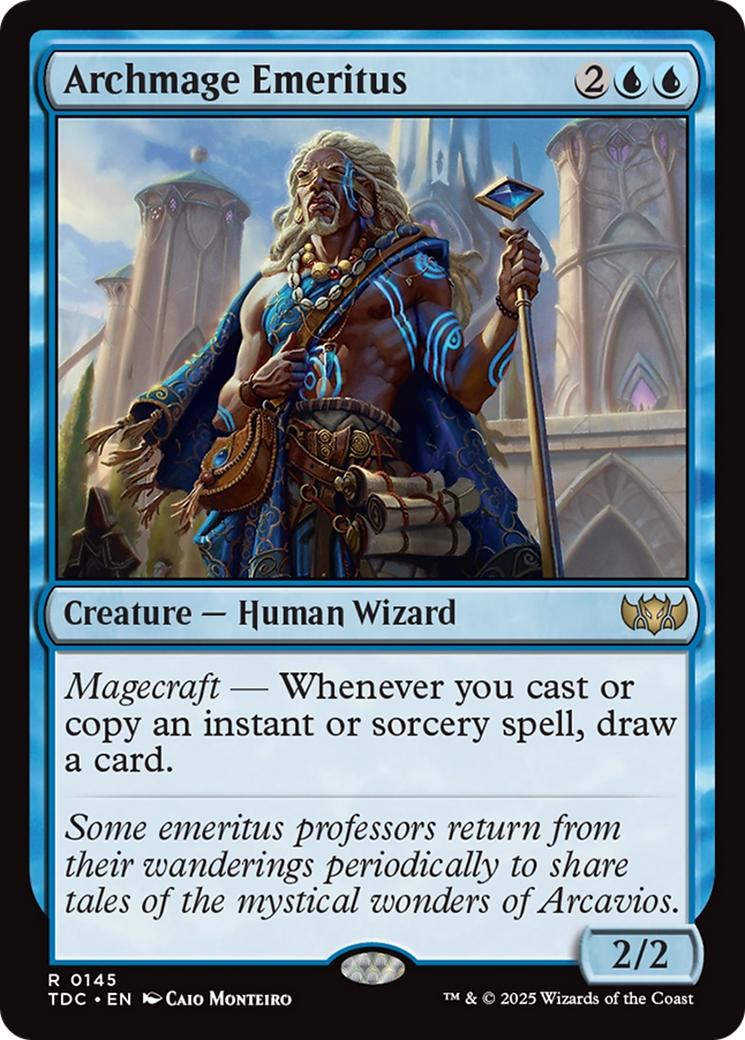
Archmage Emeritus
Archmage Emeritus
Creature — Human Wizard
2/2
Magecraft — Whenever you cast or copy an instant or sorcery spell, draw a card.
- Each magecraft ability has a different effect, although they all have the same trigger condition, whenever you cast or copy an instant or sorcery spell.
- For example, if you control Archmage Emeritus and cast an instant or sorcery spell, Archmage Emeritus's magecraft ability will trigger and you will draw a card.
- If an effect creates a copy of an instant or sorcery spell, this will also cause the magecraft ability to trigger.
- If an effect creates multiple copies of an instant or sorcery spell, magecraft abilities trigger once for each copy created by the effect.
- Some effects instruct you to copy an instant or sorcery card in a zone other than the stack. These copies do not cause magecraft abilities to trigger. However, most effects that do this also allow you to cast the copy, and casting the copy will cause magecraft abilities to trigger.
-
1
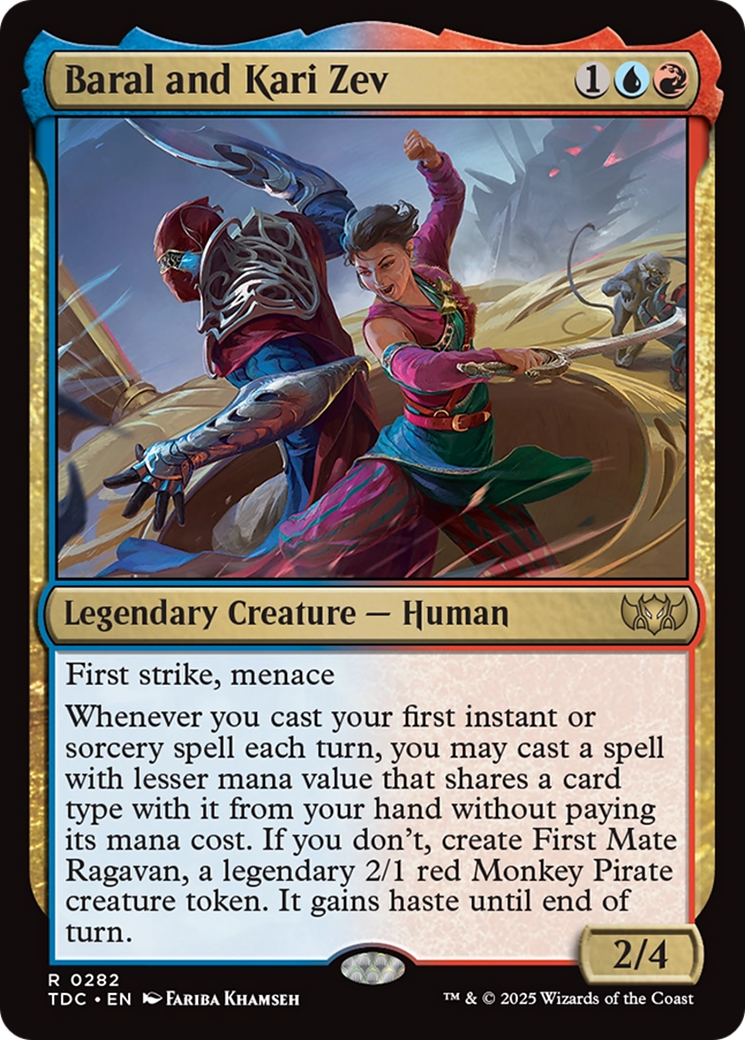
Baral and Kari Zev
Baral and Kari Zev
Legendary Creature — Human
2/4
First strike, menace
Whenever you cast your first instant or sorcery spell each turn, you may cast a spell with lesser mana value that shares a card type with it from your hand without paying its mana cost. If you don't, create First Mate Ragavan, a legendary 2/1 red Monkey Pirate creature token. It gains haste until end of turn.
- If the spell has in its mana cost, you must choose 0 as the value of X when casting it without paying its mana cost.
- Baral and Kari Zev will count any instant or sorcery spell you cast during a turn, even if it wasn’t on the battlefield at the time. This means if you cast an instant or sorcery spell, then Baral and Kari Zev comes under your control, its triggered ability won’t trigger that turn.
- The spell you cast from your hand without paying its mana cost is cast during the resolution of the triggered ability. Timing restrictions of that spell based on card type are ignored. It will resolve before the spell that caused the ability to trigger.
- If you cast a spell without paying its mana cost, you can’t choose to cast it for any alternative costs. You can, however, pay any additional costs. If the spell has any mandatory additional costs, you must pay those.
-
1
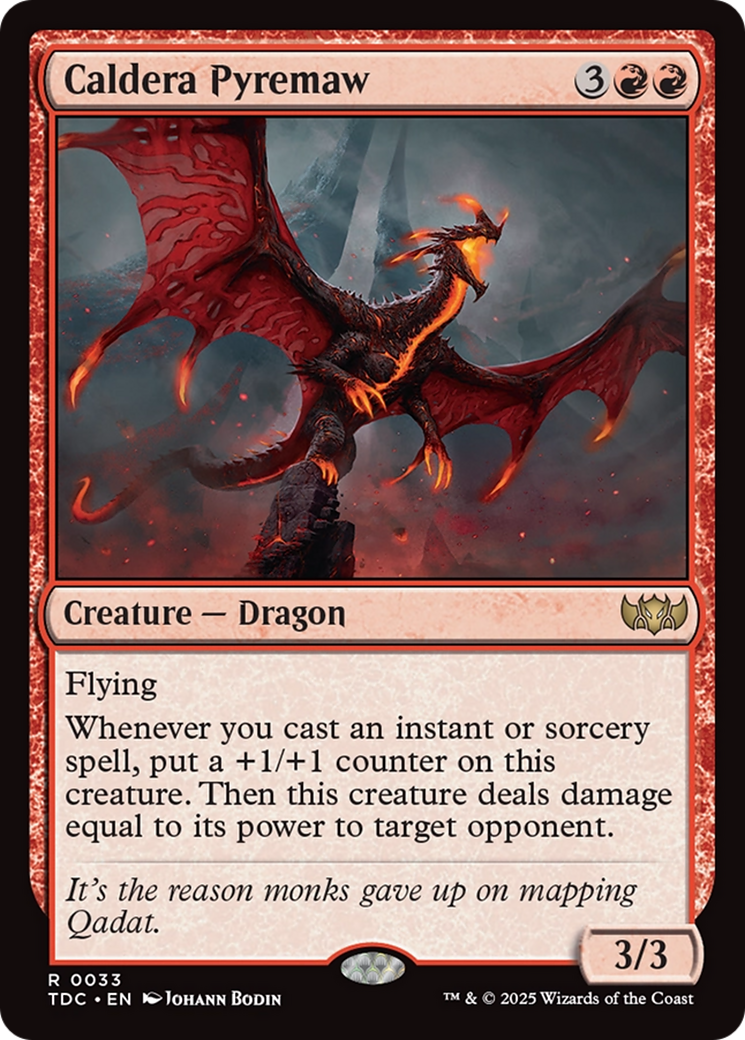
Caldera Pyremaw
Caldera Pyremaw
Creature — Dragon
3/3
Flying
Whenever you cast an instant or sorcery spell, put a +1/+1 counter on this creature. Then this creature deals damage equal to its power to target opponent.
- If Caldera Pyremaw leaves the battlefield in response to its ability, use its power the last time it existed on the battlefield to determine how much damage it deals as its ability resolves.
-
1
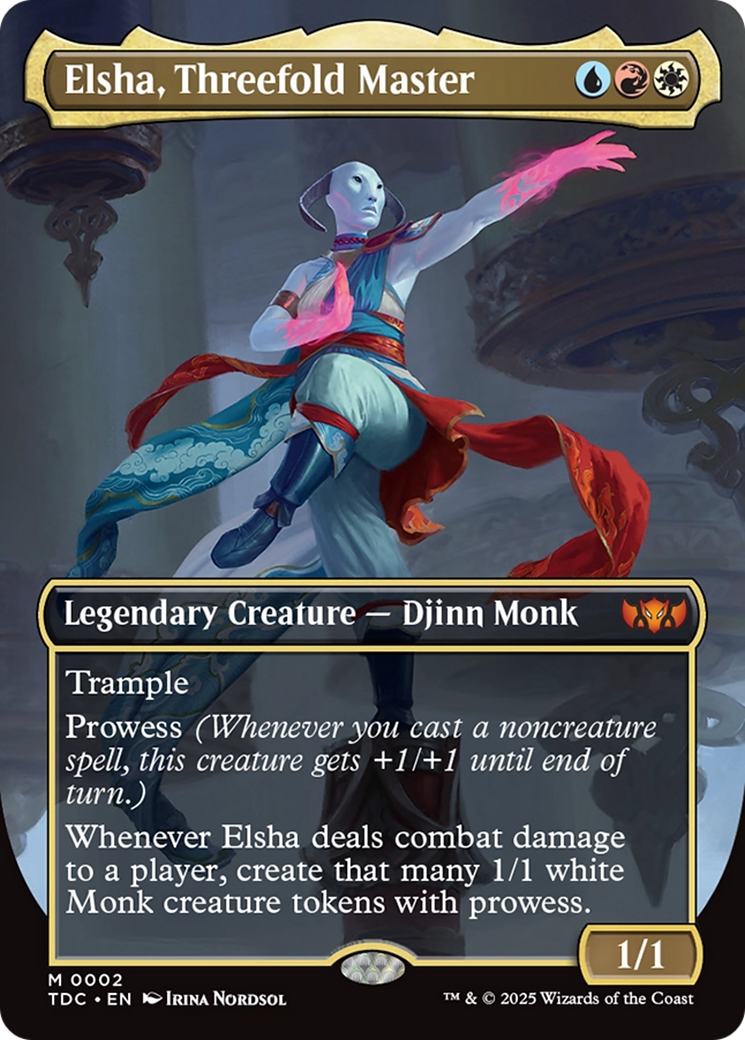
Elsha, Threefold Master
Elsha, Threefold Master
Legendary Creature — Djinn Monk
1/1
Trample
Prowess (Whenever you cast a noncreature spell, this creature gets +1/+1 until end of turn.)
Whenever Elsha deals combat damage to a player, create that many 1/1 white Monk creature tokens with prowess.
-
1
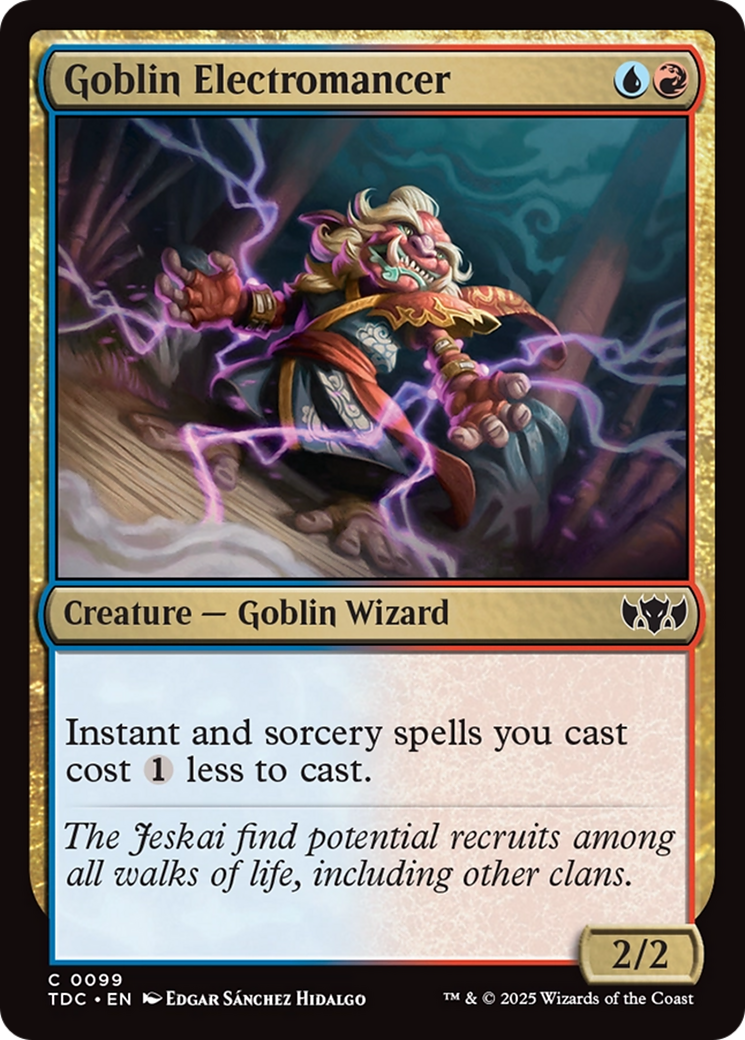
Goblin Electromancer
Goblin Electromancer
Creature — Goblin Wizard
2/2
Instant and sorcery spells you cast cost less to cast.
- To determine the total cost of a spell, start with the mana cost or alternative cost you're paying, add any cost increases, then apply any cost reductions. The mana value of the spell remains unchanged, no matter what the total cost to cast it was.
- Goblin Electromancer's effect reduces only generic mana in the spell's total cost.
- Two Goblin Electromancers will make instant and sorcery spells you cast cost less to cast, and so on.
-
1
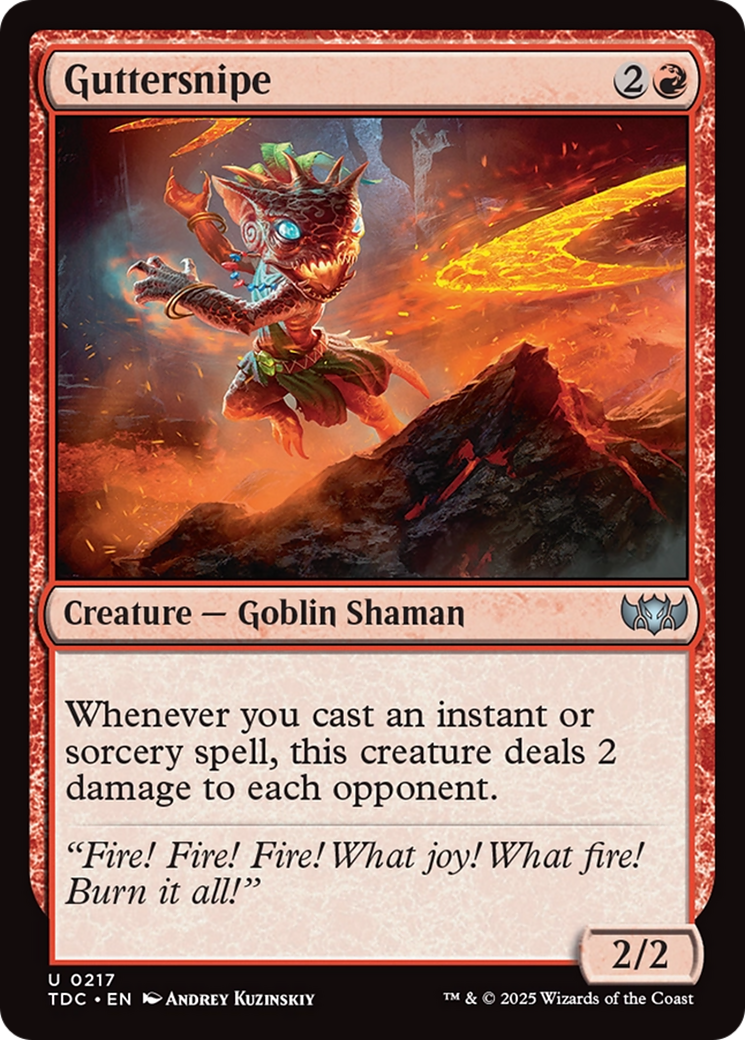
Guttersnipe
Guttersnipe
Creature — Goblin Shaman
2/2
Whenever you cast an instant or sorcery spell, this creature deals 2 damage to each opponent.
- Guttersnipe's triggered ability resolves before the spell that caused it to trigger. It resolves even if that spell is countered or otherwise leaves the stack without resolving.
- In a Two-Headed Giant game, Guttersnipe's ability causes the opposing team to lose 4 life.
-
1
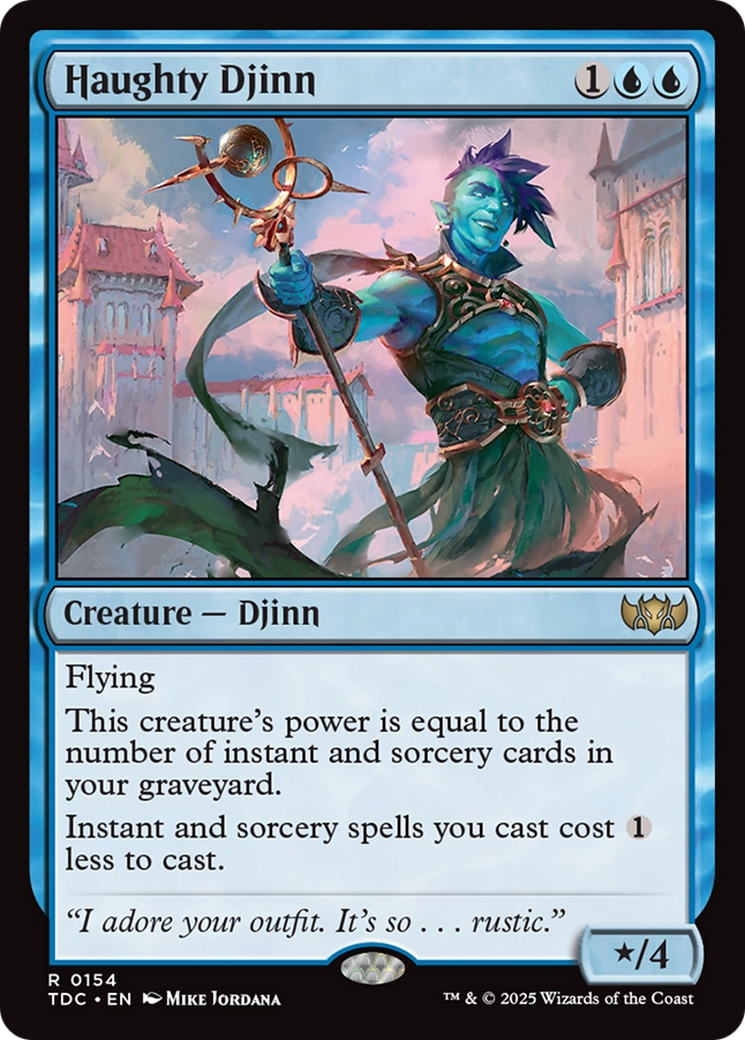
Haughty Djinn
Haughty Djinn
Creature — Djinn
*/4
Flying
Haughty Djinn's power is equal to the number of instant and sorcery cards in your graveyard.
Instant and sorcery spells you cast cost less to cast.
- The ability that defines Haughty Djinn's power functions in all zones.
- A split card in your graveyard only counts once for Haughty Djinn's power, even if it's both an instant and a sorcery.
-
1
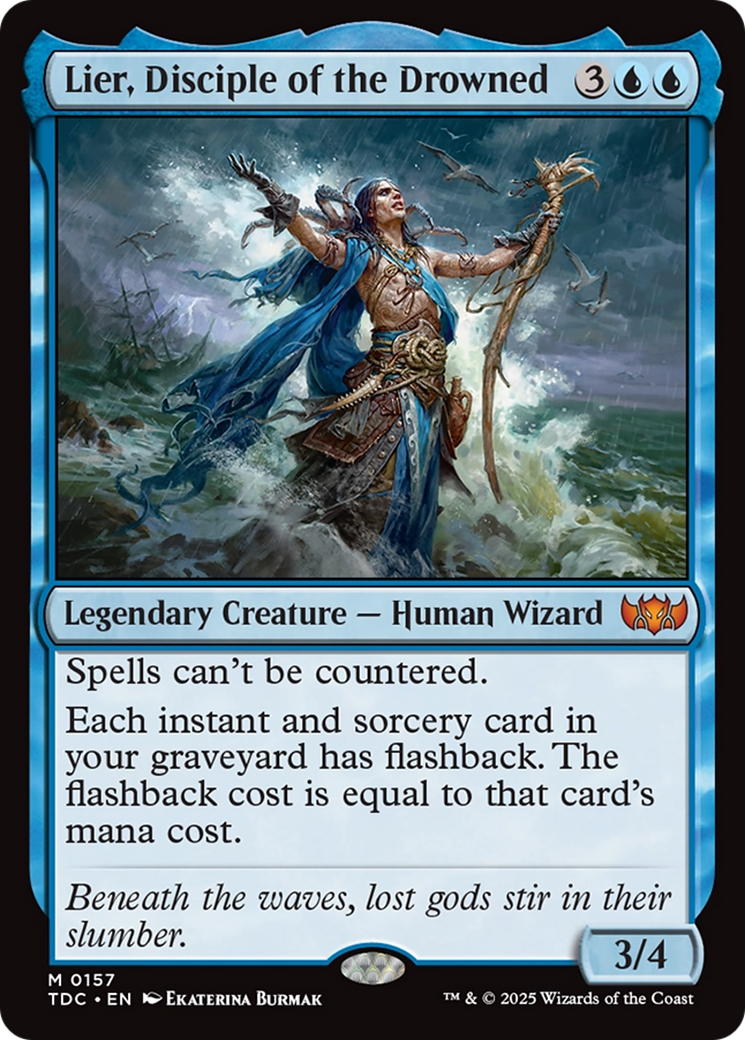
Lier, Disciple of the Drowned
Lier, Disciple of the Drowned
Legendary Creature — Human Wizard
3/4
Spells can't be countered.
Each instant and sorcery card in your graveyard has flashback. The flashback cost is equal to that card's mana cost.
- "Flashback [cost]" means "You may cast this card from your graveyard by paying [cost] rather than paying its mana cost" and "If the flashback cost was paid, exile this card instead of putting it anywhere else any time it would leave the stack."
- You must still follow any timing restrictions and permissions, including those based on the card's type. For instance, you can cast a sorcery using flashback only when you could normally cast a sorcery.
- To determine the total cost of a spell, start with the mana cost or alternative cost (such as a flashback cost) you're paying, add any cost increases, then apply any cost reductions. The mana value of the spell is determined only by its mana cost, no matter what the total cost to cast the spell was.
- A spell cast using flashback will always be exiled afterward, whether it resolves, is countered, or leaves the stack in some other way.
- You can cast a spell using flashback even if it was somehow put into your graveyard without having been cast.
- If a card with flashback is put into your graveyard during your turn, you can cast it if it's legal to do so before any other player can take any actions.
- If you cast an instant or sorcery with in its mana cost this way, you still choose the value of X as part of casting the spell and pay that cost.
- If you cast a spell with flashback, you can't pay any alternative costs such as overload costs. You can pay additional costs such as kicker costs. If the spell has any mandatory additional costs, you must pay those to cast the spell with flashback.
- If a card has multiple instances of flashback, you may choose any of its flashback costs to pay.
- If a split card gains flashback, you pay only the cost of the half you're casting.
- If a card with no mana cost gains flashback, it has no flashback cost. It can't be cast this way.
-
1
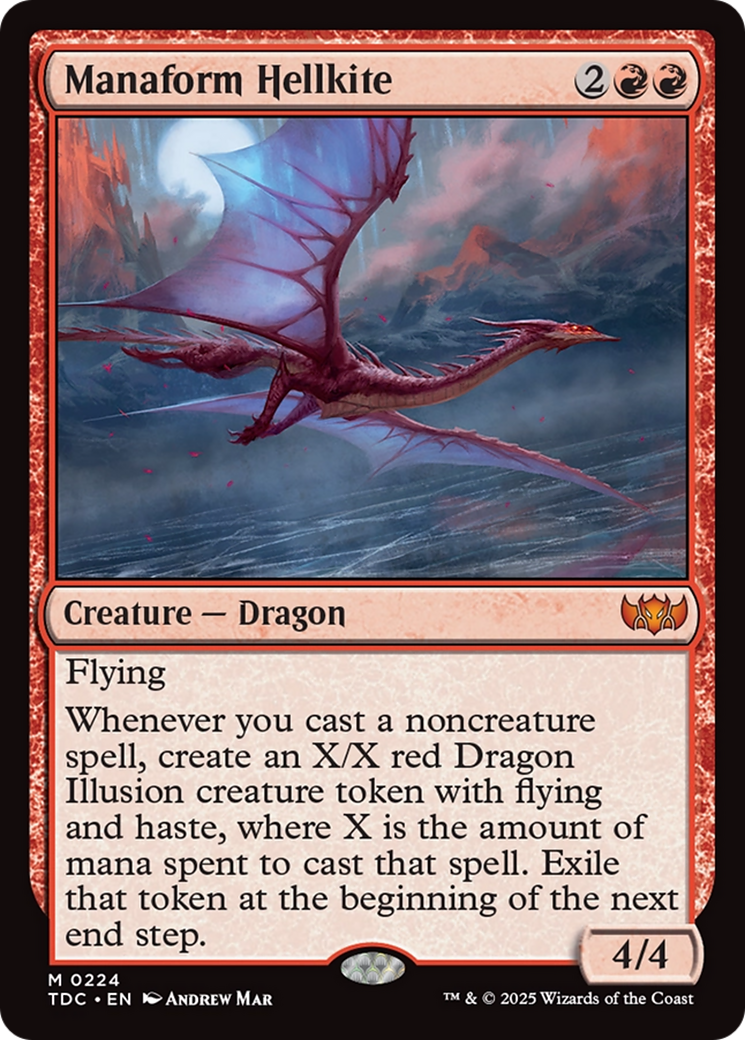
Manaform Hellkite
Manaform Hellkite
Creature — Dragon
4/4
Flying
Whenever you cast a noncreature spell, create an X/X red Dragon Illusion creature token with flying and haste, where X is the amount of mana spent to cast that spell. Exile that token at the beginning of the next end step.
- Manaform Hellkite's triggered ability looks at the mana that was actually spent to cast the spell, which may be different than the mana cost of that spell. For example, if you cast a noncreature spell without paying its mana cost, this ability creates a 0/0 Dragon Illusion token. In most cases, such a creature would immediately be put into your graveyard.
-
1
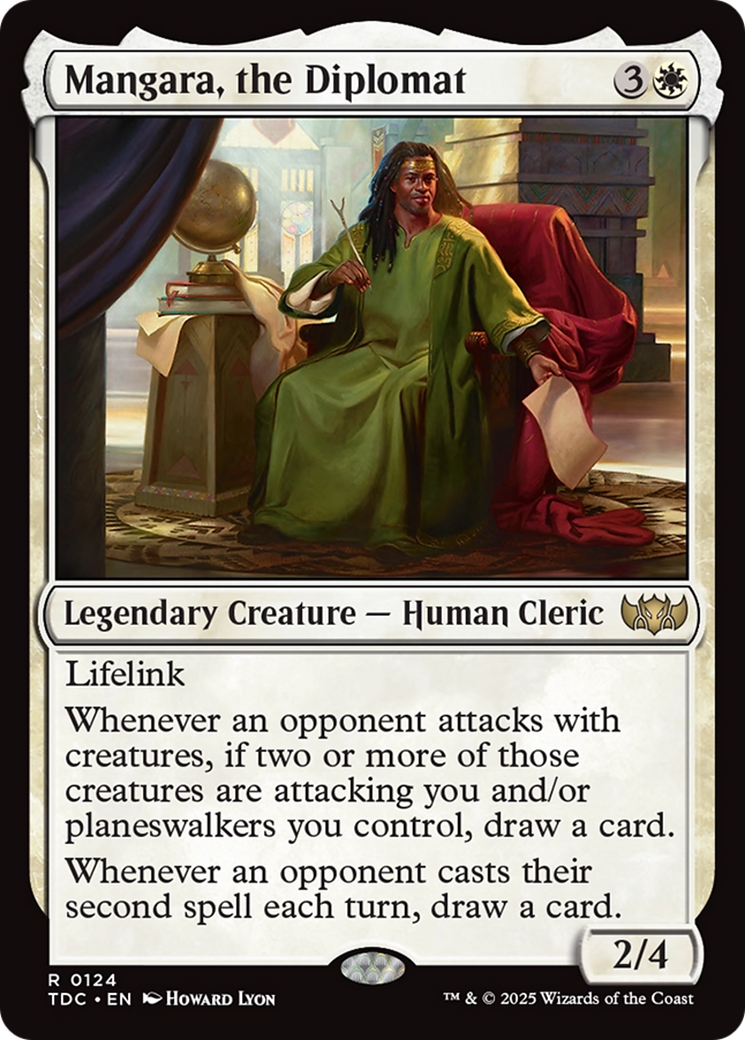
Mangara, the Diplomat
Mangara, the Diplomat
Legendary Creature — Human Cleric
2/4
Lifelink
Whenever an opponent attacks with creatures, if two or more of those creatures are attacking you and/or planeswalkers you control, draw a card.
Whenever an opponent casts their second spell each turn, draw a card.
- If some of the attacking creatures leave the battlefield while Mangara's triggered ability is on the stack, use the player or planeswalker they were attacking before they left to determine whether you draw a card. On the other hand, if they're removed from combat without leaving the battlefield, use their current information to determine that they're not attacking you or a planeswalker you control anymore.
- If your opponent attacks you with one creature and your planeswalker with another, you draw a card.
- You draw just one card, no matter how many creatures are attacking you and your planeswalkers beyond the second.
- An ability that triggers when a player casts a spell resolves before the spell that caused it to trigger. It resolves even if that spell is countered.
- Players can cast spells and activate abilities after the triggered ability resolves but before the spell that caused it to trigger does.
-
1
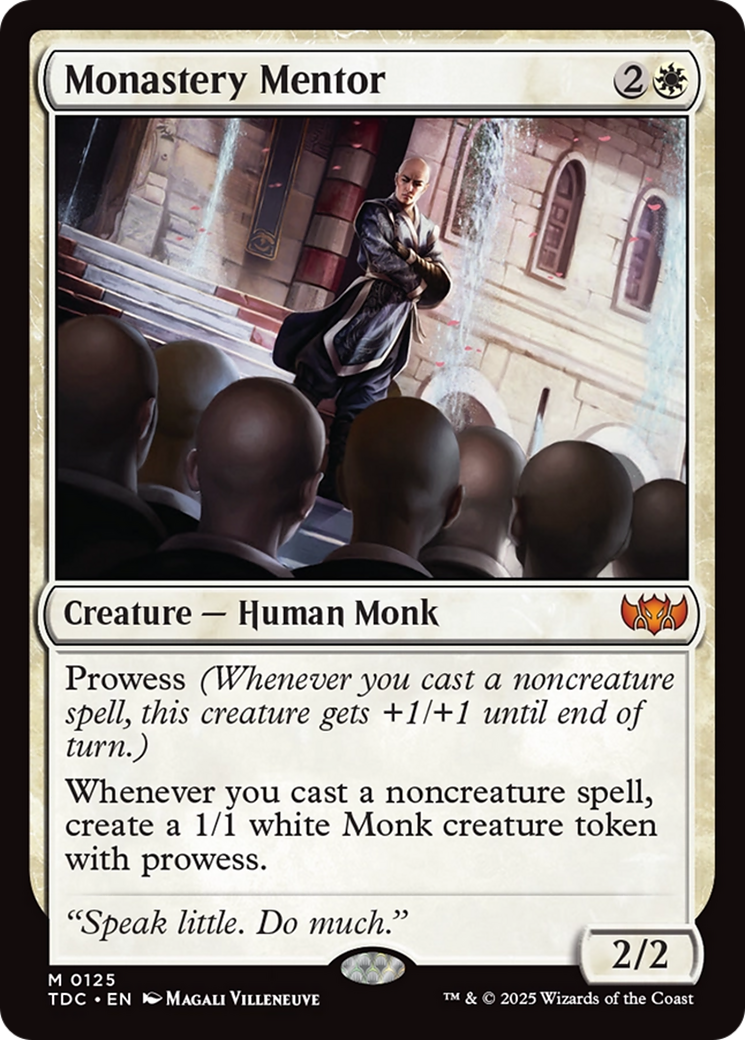
Monastery Mentor
Monastery Mentor
Creature — Human Monk
2/2
Prowess (Whenever you cast a noncreature spell, this creature gets +1/+1 until end of turn.)
Whenever you cast a noncreature spell, create a 1/1 white Monk creature token with prowess.
- Casting a noncreature spell will cause both prowess and Monastery Mentor's other ability to trigger. You can put these abilities on the stack in either order. Whichever ability is put on the stack last will resolve first.
- The spell that causes Monastery Mentor's second ability to trigger will not cause the prowess ability of the Monk token that's created to trigger.
- Any spell you cast that doesn't have the type creature will cause prowess to trigger. If a spell has multiple types, and one of those types is creature (such as an artifact creature), casting it won't cause prowess to trigger. Playing a land also won't cause prowess to trigger.
- Prowess triggers only once for any spell, even if that spell has multiple types.
- Prowess goes on the stack on top of the spell that caused it to trigger. It will resolve before that spell.
- Once it triggers, prowess isn't connected to the spell that caused it to trigger. If that spell is countered, prowess will still resolve.
-
1
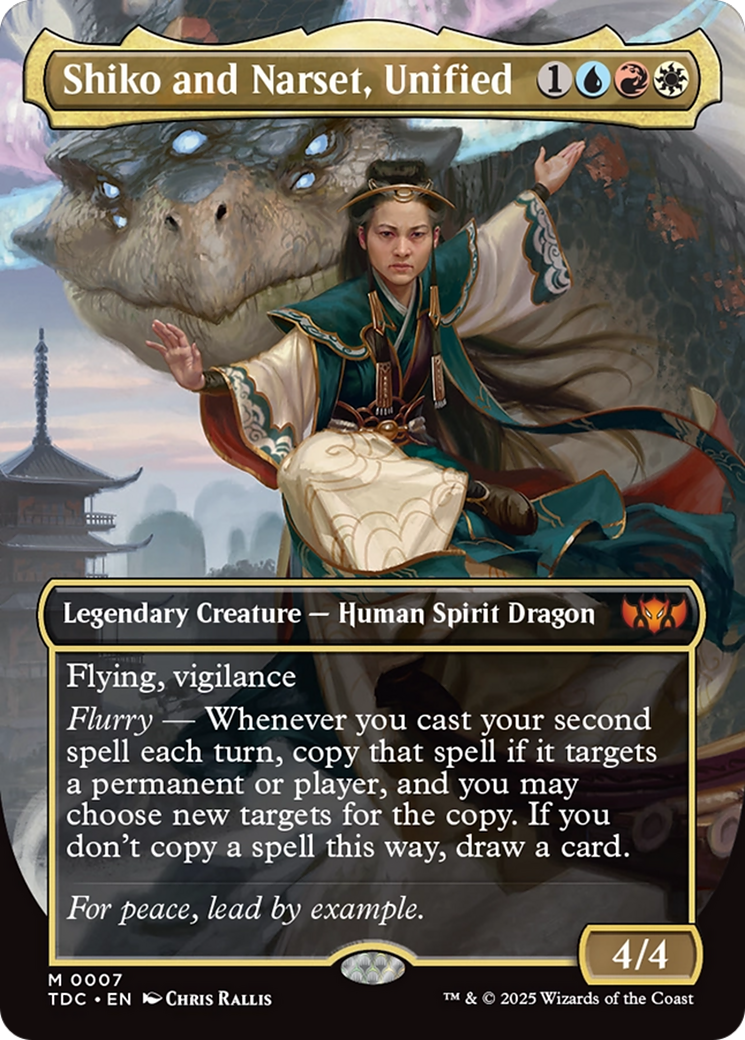
Shiko and Narset, Unified
Shiko and Narset, Unified
Legendary Creature — Human Spirit Dragon
4/4
Flying, vigilance
Flurry — Whenever you cast your second spell each turn, copy that spell if it targets a permanent or player, and you may choose new targets for the copy. If you don't copy a spell this way, draw a card.
- If the second spell you cast targets a permanent or player, you must copy that spell, even if it won’t be possible to choose legal targets for the copy. You can’t choose not to copy it in order to draw a card.
- Shiko and Narset, Unified’s last ability and the copy it creates resolve before the spell it’s copying. They resolve even if the original spell is countered before the copy is created.
- An Aura spell requires a target, as defined by its enchant ability.
- The copy will have the same targets unless you choose new ones. You may change any number of the targets, including all of them or none of them. The new targets must be legal.
- If the spell that’s copied is modal (that is, it says “Choose one —” or the like), the copy will have the same mode or modes. You can’t choose different ones.
- If the copied spell divides damage or distributes counters among a number of targets, the division and number of targets can’t be changed. If you choose new targets, you must choose the same number of targets.
- If the spell that’s copied has an X whose value was determined as it was cast, the copy will have the same value of X.
- You can’t choose to pay any additional costs for the copy. However, effects based on any additional costs that were paid for the original spell are copied as though those same costs were paid for the copy too.
- The copy is created on the stack, so it’s not “cast.” Abilities that trigger when a player casts a spell won’t trigger.
- A resolving copy of a permanent spell becomes a token. That token isn’t “created” and won’t interact with abilities that care about tokens being created.
- Spells that were cast before a permanent with flurry count. If that permanent was the first spell you cast that turn, the next spell you cast that turn is your second spell.
-
1
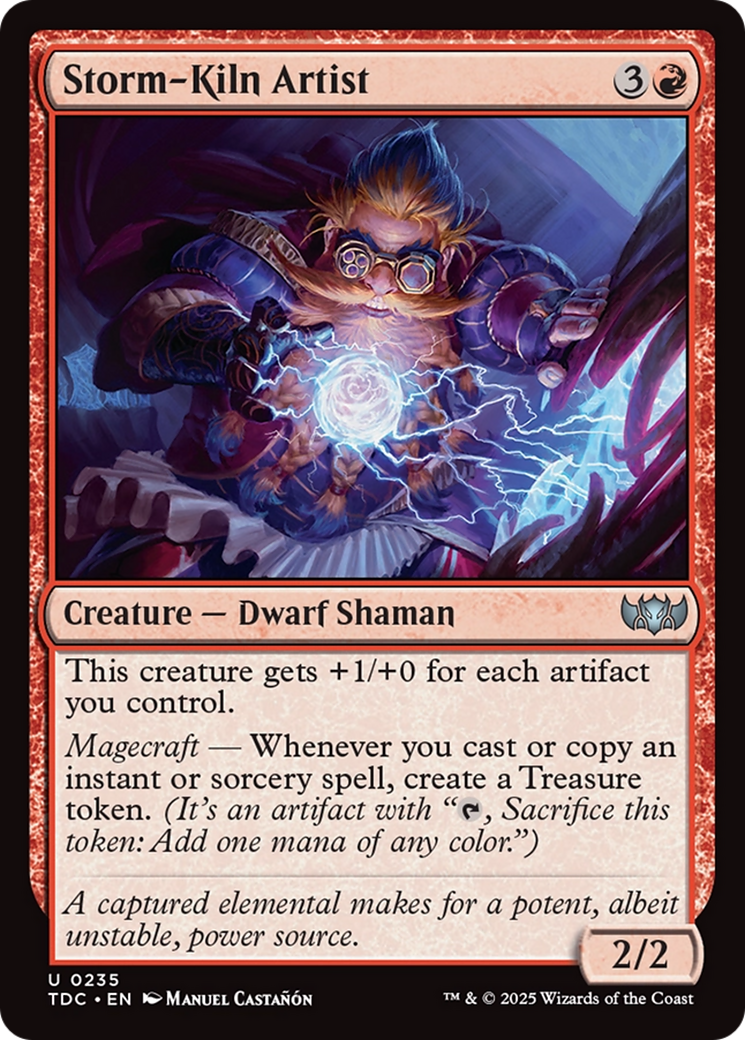
Storm-Kiln Artist
Storm-Kiln Artist
Creature — Dwarf Shaman
2/2
This creature gets +1/+0 for each artifact you control.
Magecraft — Whenever you cast or copy an instant or sorcery spell, create a Treasure token.
- If an effect creates multiple copies of an instant or sorcery spell, magecraft abilities trigger once for each copy created by the effect.
- Each magecraft ability has a different effect, although they all have the same trigger condition, whenever you cast or copy an instant or sorcery spell.
- For example, if you control Archmage Emeritus and cast an instant or sorcery spell, Archmage Emeritus's magecraft ability will trigger and you will draw a card.
- If an effect creates a copy of an instant or sorcery spell, this will also cause the magecraft ability to trigger.
- Some effects instruct you to copy an instant or sorcery card in a zone other than the stack. These copies do not cause magecraft abilities to trigger. However, most effects that do this also allow you to cast the copy, and casting the copy will cause magecraft abilities to trigger.
-
1
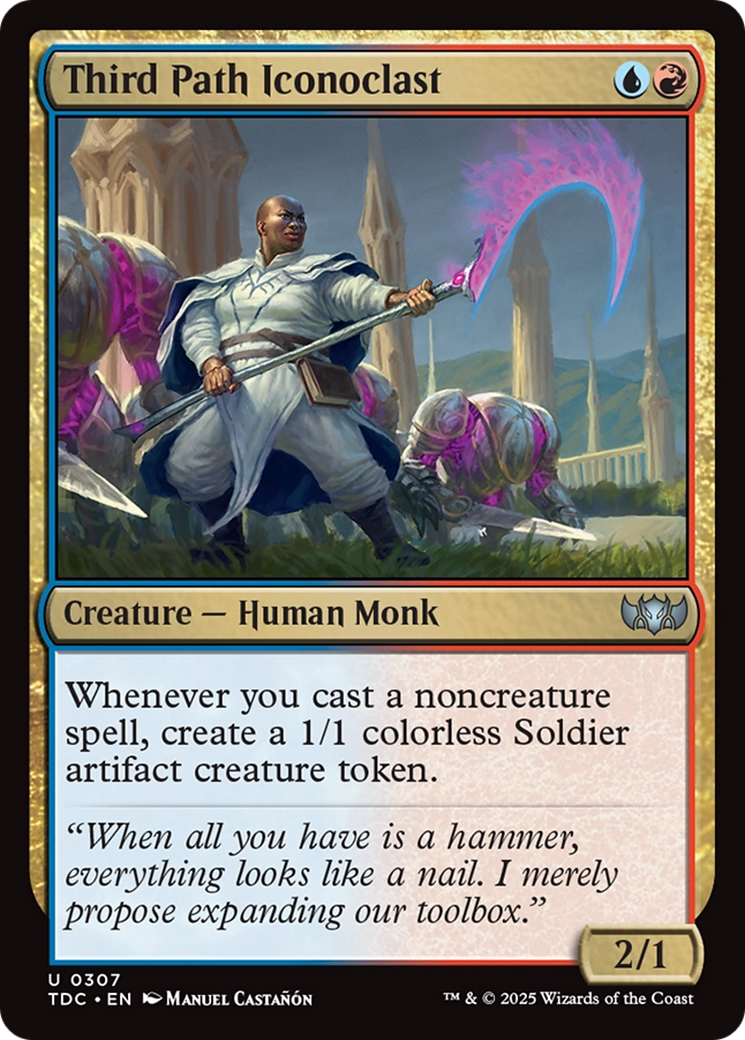
Third Path Iconoclast
Third Path Iconoclast
Creature — Human Monk
2/1
Whenever you cast a noncreature spell, create a 1/1 colorless Soldier artifact creature token.
-
1
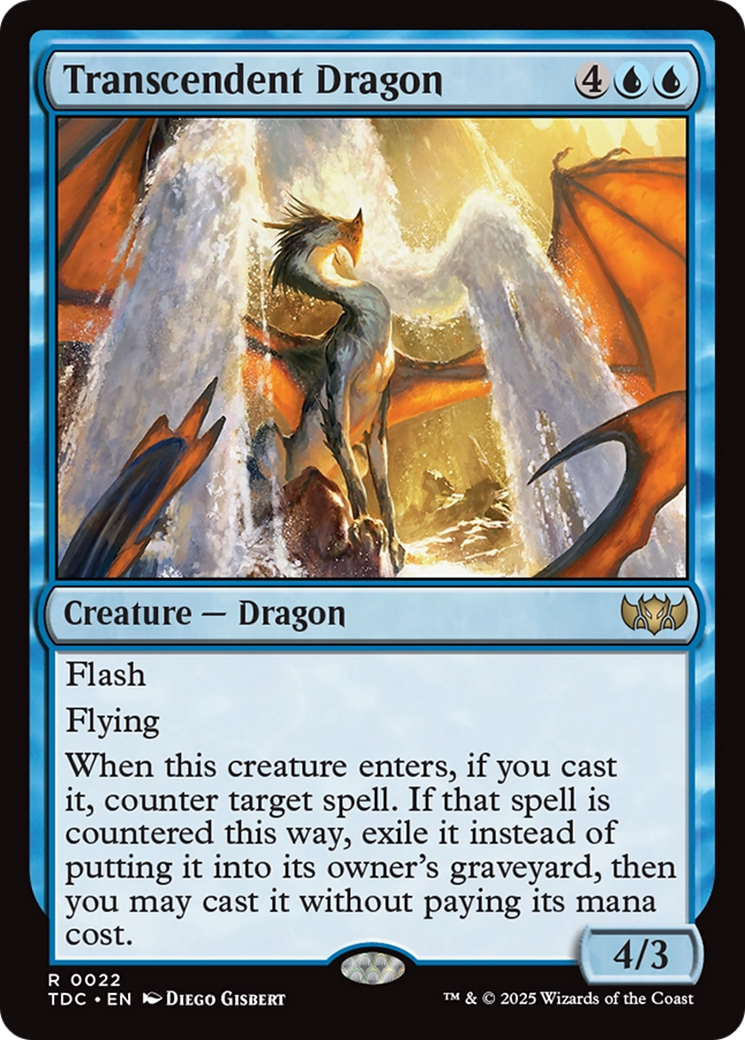
Transcendent Dragon
Transcendent Dragon
Creature — Dragon
4/3
Flash
Flying
When this creature enters, if you cast it, counter target spell. If that spell is countered this way, exile it instead of putting it into its owner's graveyard, then you may cast it without paying its mana cost.
- If you wish to cast the exiled card, you do so as part of the resolution of Transcendent Dragon’s last ability. You can’t wait to cast it later. Timing permissions based on the card’s type are ignored.
- If you cast a spell “without paying its mana cost,” you can’t choose to cast it for any alternative costs. You can, however, pay additional costs, such as kicker costs. If the spell has any mandatory additional costs those must be paid to cast the spell.
- If a spell has in its mana cost, you must choose 0 as the value of X when casting it without paying its mana cost.
-
1
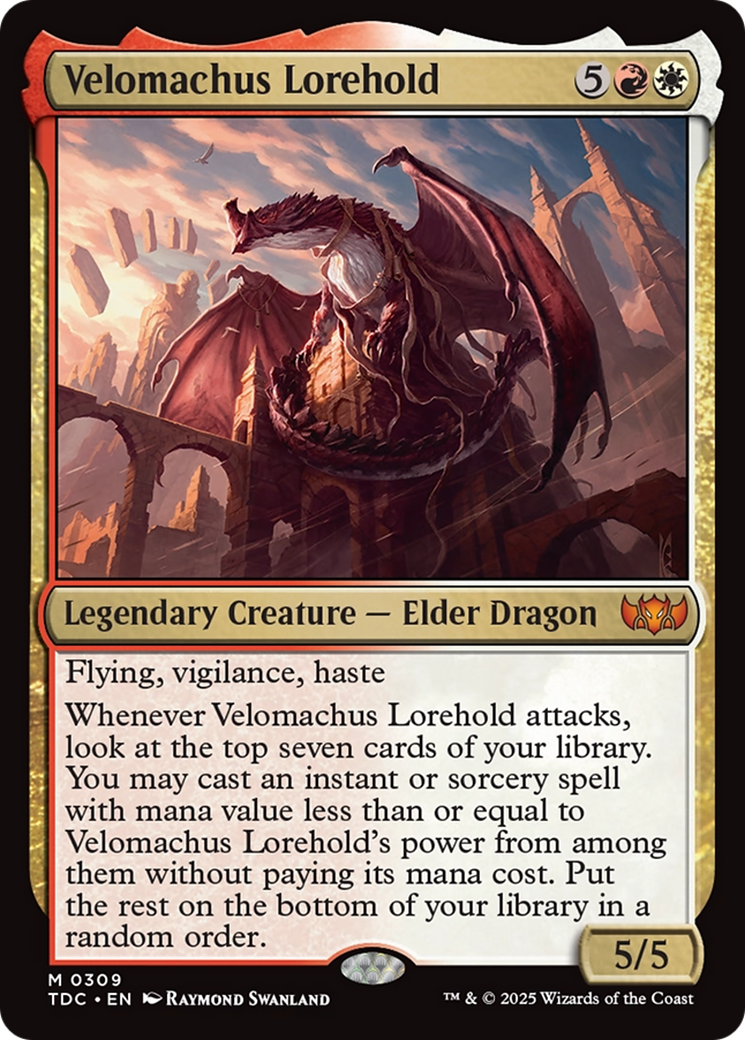
Velomachus Lorehold
Velomachus Lorehold
Legendary Creature — Elder Dragon
5/5
Flying, vigilance, haste
Whenever Velomachus Lorehold attacks, look at the top seven cards of your library. You may cast an instant or sorcery spell with mana value less than or equal to Velomachus Lorehold's power from among them without paying its mana cost. Put the rest on the bottom of your library in a random order.
- When Velomachus Lorehold’s triggered ability resolves, it lets you cast a spell immediately, ignoring timing restrictions. It does not let you cast that spell later in the turn.
- If you choose not to cast a spell this way, all of the cards will be put on the bottom of the library in a random order.
- If you’re casting a spell with in its cost without paying its mana cost, you must choose 0 for the value of X.
-
1
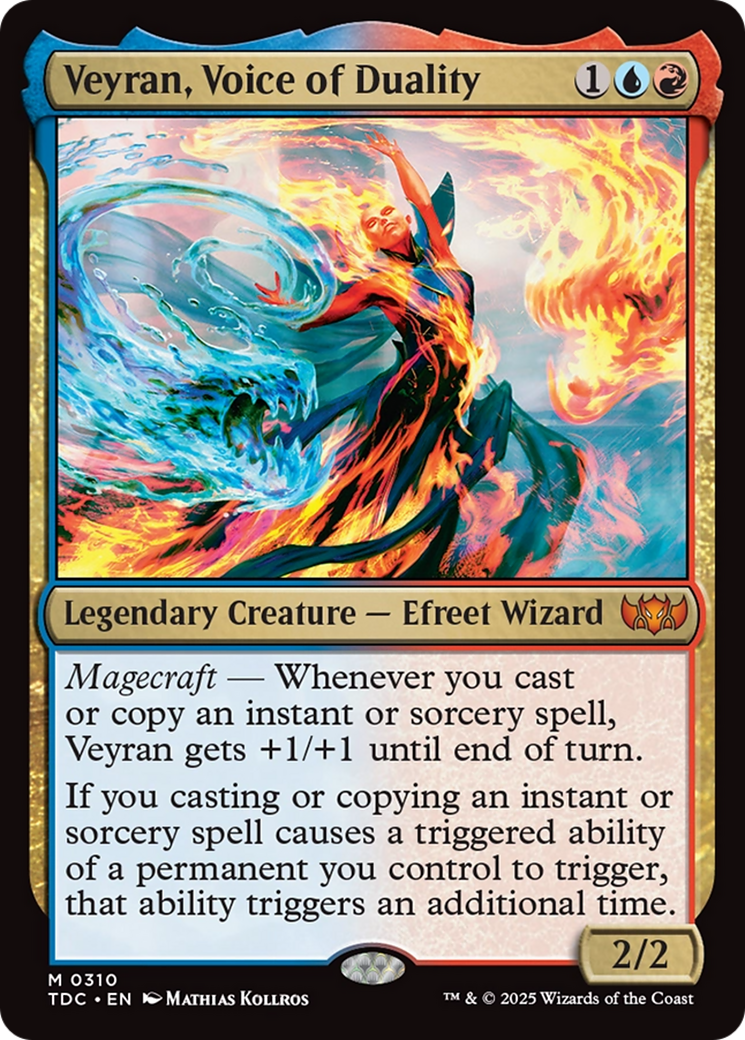
Veyran, Voice of Duality
Veyran, Voice of Duality
Legendary Creature — Efreet Wizard
2/2
Magecraft — Whenever you cast or copy an instant or sorcery spell, Veyran gets +1/+1 until end of turn.
If you casting or copying an instant or sorcery spell causes a triggered ability of a permanent you control to trigger, that ability triggers an additional time.
- Veyran, Voice of Duality's last ability causes each of your magecraft abilities, including Veyran's own, to trigger an additional time.
- Veyran's effect doesn't copy the triggered ability; it just causes the ability to trigger again. Any choices you make as you put the ability on the stack, such as modes and targets, are made separately for each instance of the ability. Any choices made on resolution are also made individually.
- If you somehow control two Veyrans (which would be poetic), you casting an instant or sorcery spell causes abilities to trigger three times. A third Veyran (less poetic) causes abilities to trigger four times, and so on.
- Each magecraft ability has a different effect, although they all have the same trigger condition, whenever you cast or copy an instant or sorcery spell.
- For example, if you control Archmage Emeritus and cast an instant or sorcery spell, Archmage Emeritus's magecraft ability will trigger and you will draw a card.
- If an effect creates a copy of an instant or sorcery spell, this will also cause the magecraft ability to trigger.
- If an effect creates multiple copies of an instant or sorcery spell, magecraft abilities trigger once for each copy created by the effect.
- Some effects instruct you to copy an instant or sorcery card in a zone other than the stack. These copies do not cause magecraft abilities to trigger. However, most effects that do this also allow you to cast the copy, and casting the copy will cause magecraft abilities to trigger.
-
1
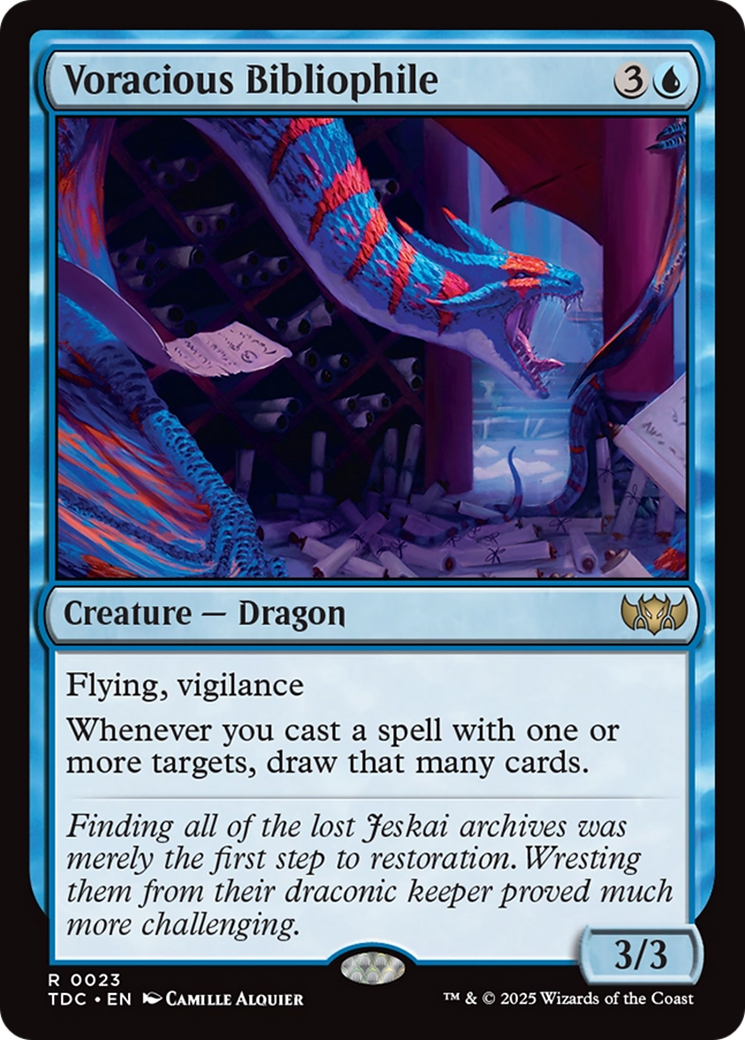
Voracious Bibliophile
Voracious Bibliophile
Creature — Dragon
3/3
Flying, vigilance
Whenever you cast a spell with one or more targets, draw that many cards.
- An Aura spell requires a target, as defined by its enchant ability.
-
1
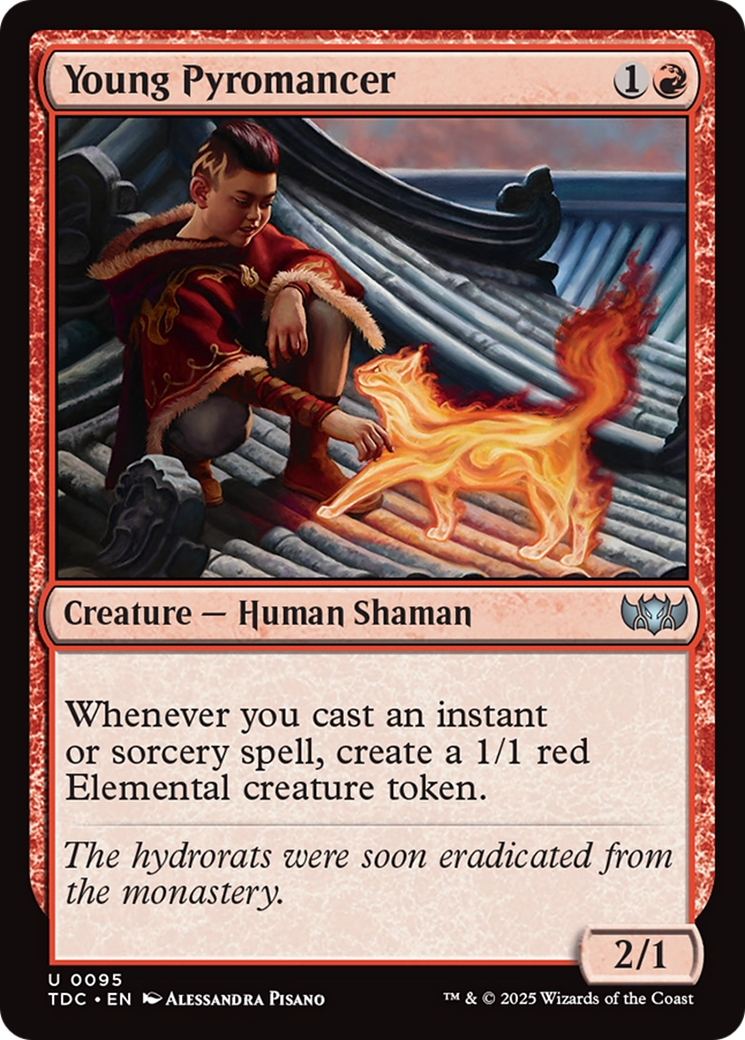
Young Pyromancer
Young Pyromancer
Creature — Human Shaman
2/1
Whenever you cast an instant or sorcery spell, create a 1/1 red Elemental creature token.
- An ability that triggers when a player casts a spell resolves before the spell that caused it to trigger, but after targets have been chosen for that spell. It resolves even if that spell is countered.
Instants 15
-
1
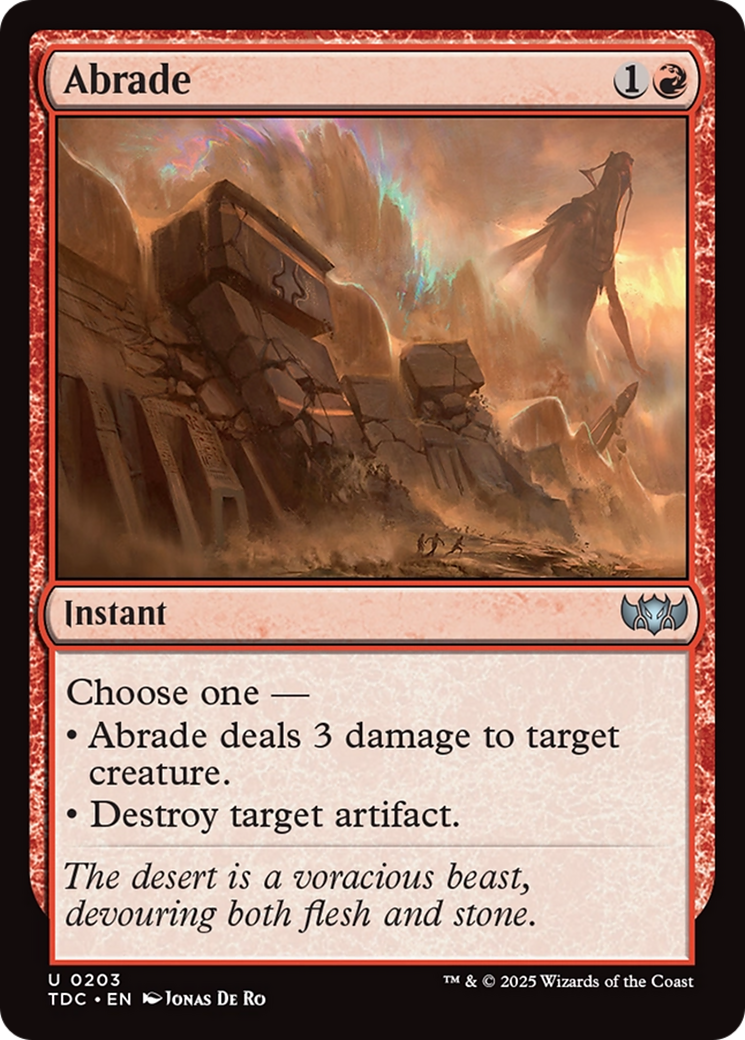
Abrade
Abrade
Instant
Choose one —
- Abrade deals 3 damage to target creature.
- Destroy target artifact.
-
1
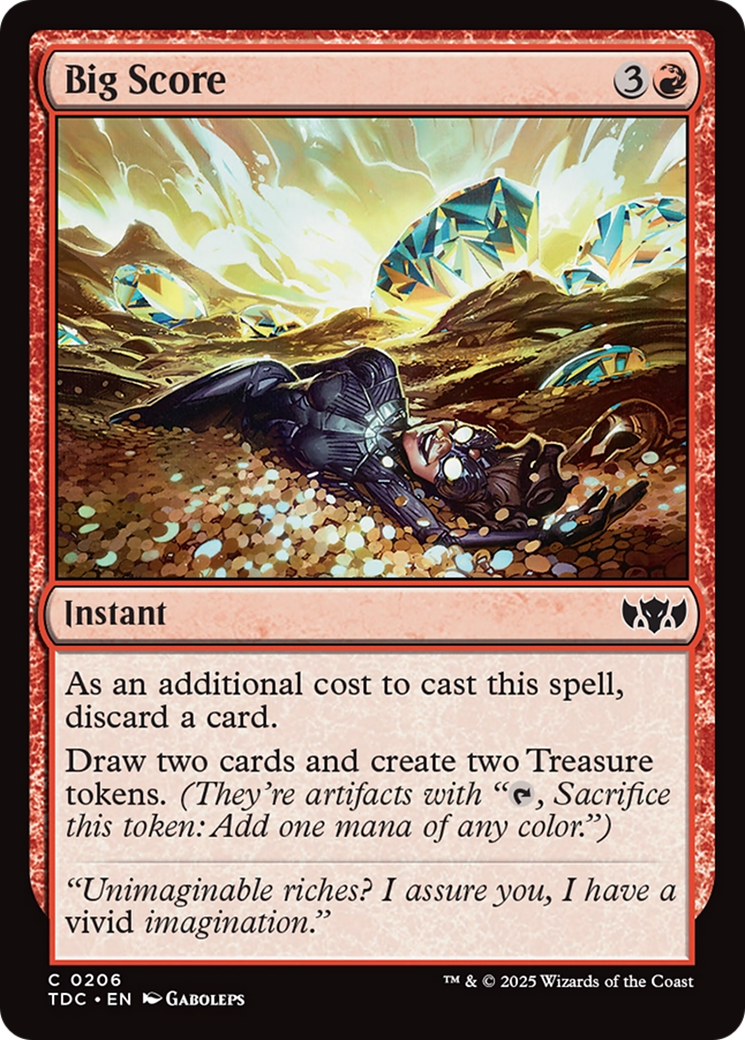
Big Score
Big Score
Instant
As an additional cost to cast this spell, discard a card.
Draw two cards and create two Treasure tokens. (They're artifacts with " , Sacrifice this token: Add one mana of any color.")
-
1
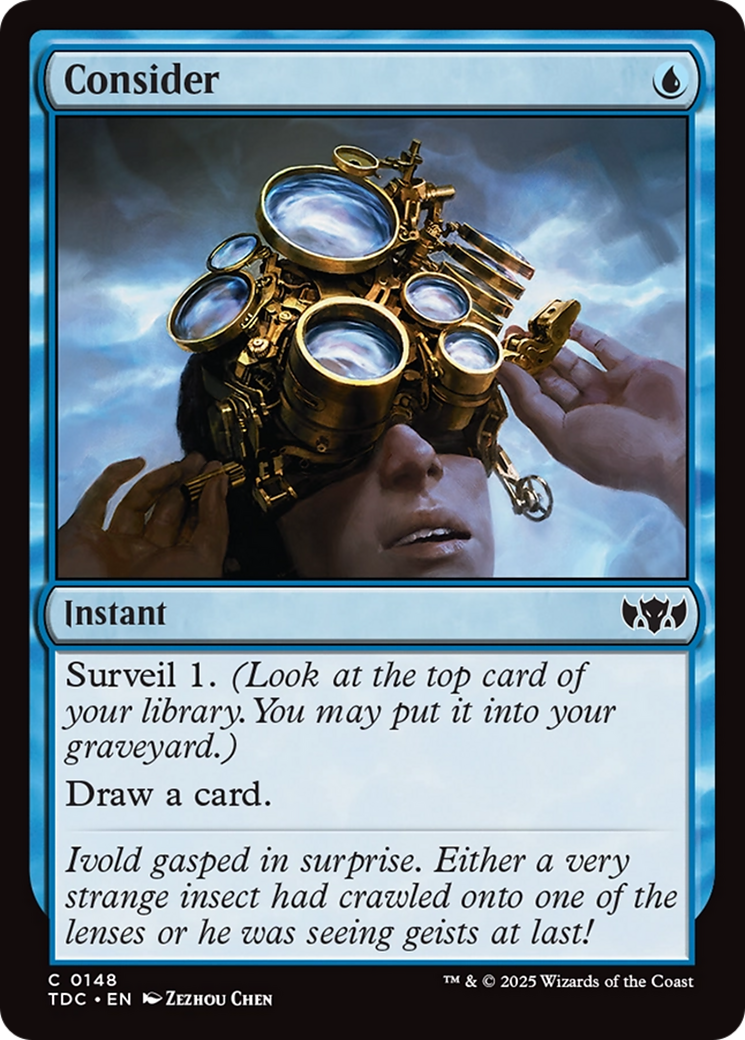
Consider
Consider
Instant
Surveil 1. (Look at the top card of your library. You may put it into your graveyard.)
Draw a card.
- You perform the actions stated on a card in sequence. For some spells and abilities, you'll surveil last. For others, you'll surveil and then perform other actions.
-
1
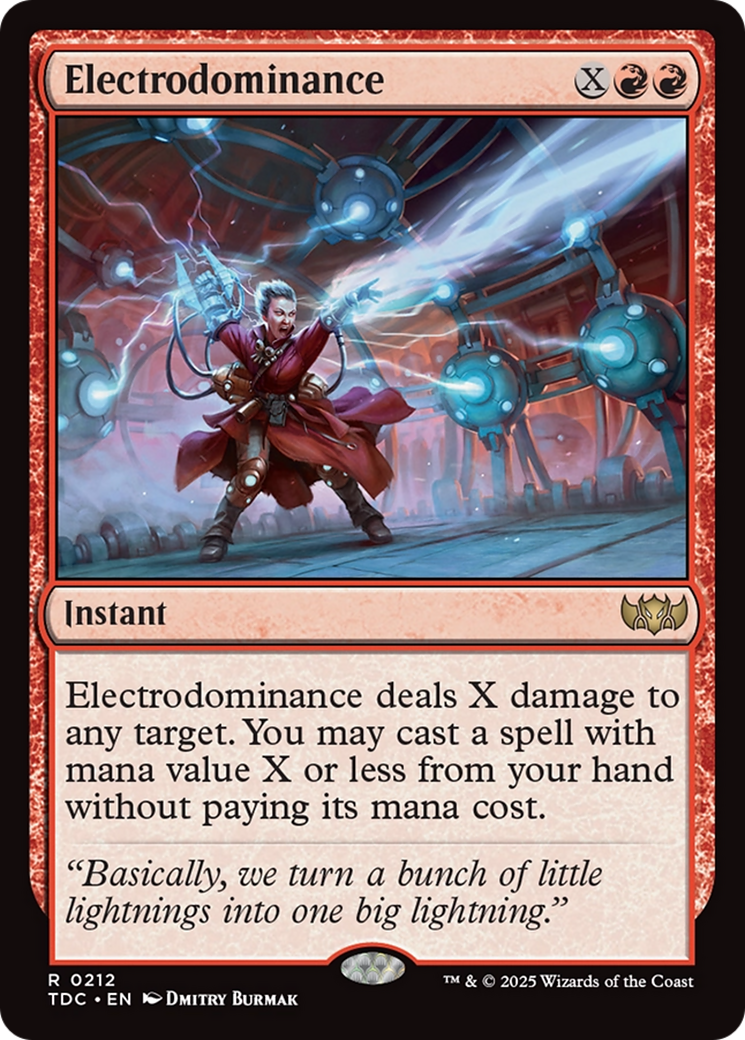
Electrodominance
Electrodominance
Instant
Electrodominance deals X damage to any target. You may cast a spell with mana value X or less from your hand without paying its mana cost.
- If the target is illegal as Electrodominance tries to resolve, it won't resolve and none of its effects will happen. You won't get to cast a spell from your hand.
- Effects that allow you to cast a spell don't allow you to play a land.
- If the target is dealt lethal damage this way, it will still be on the battlefield while you cast a spell from your hand. It won't die until after Electrodominance is finished resolving. If any of its abilities trigger while you cast that spell, those abilities will trigger but won't resolve until after the target has died.
- You cast the spell during the resolution of Electrodominance. Ignore timing restrictions based on the spell's type.
- If you cast a spell "without paying its mana cost," you can't choose to cast it for any alternative costs. You can, however, pay additional costs, such as kicker costs. If the spell has any mandatory additional costs, such as that of Bankrupt in Blood, those must be paid to cast the card.
- If a spell has in its mana cost, you must choose 0 as the value of X when casting it without paying its mana cost.
-
1
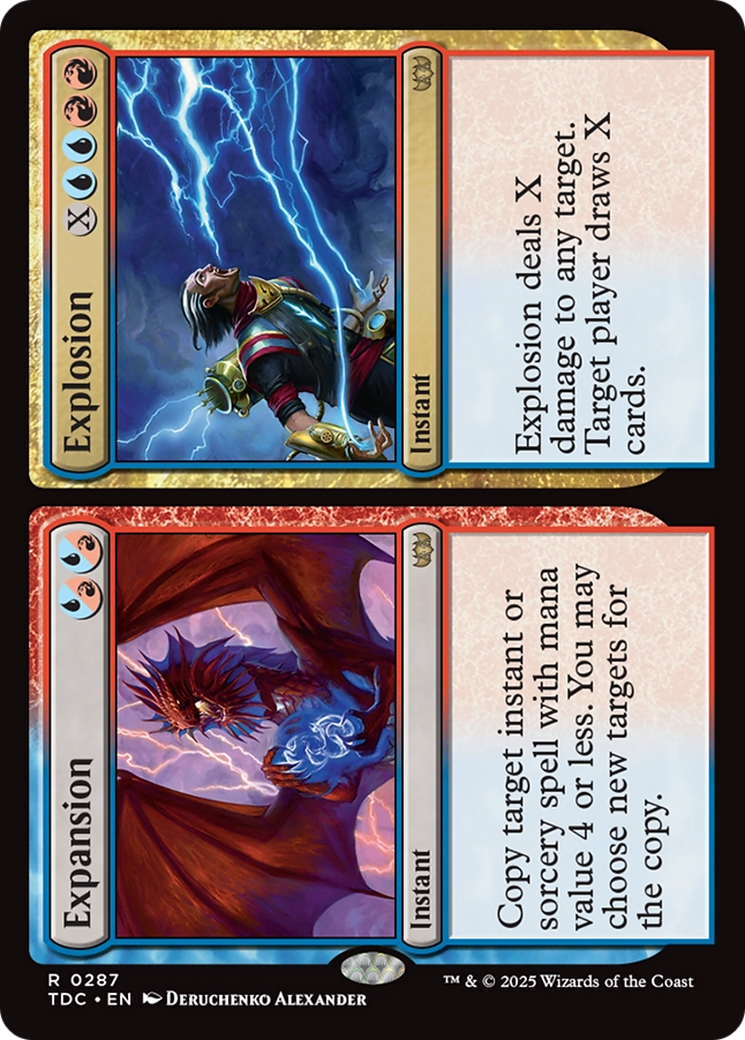
Expansion // Explosion
//
Expansion
Instant
- If one of Explosion's two targets becomes illegal, the other is affected as appropriate.
- The copy will have the same targets as the spell it's copying unless you choose new ones. You may change any number of the targets, including all of them or none of them. If, for one of the targets, you can't choose a new legal target, then it remains unchanged (even if the current target is illegal).
- If the spell that's copied is modal (that is, it says "Choose one —" or the like), the copy will have the same mode or modes. You can't choose different ones.
- If the spell that's copied has an X whose value was determined as it was cast (like Banefire does), the copy will have the same value of X.
- If the spell has damage divided as it was cast, the division can't be changed (although the targets receiving that damage still can). The same is true of spells that distribute counters.
- The controller of a copy can't choose to pay any alternative or additional costs for the copy. However, effects based on any alternative or additional costs that were paid for the original spell are copied as though those same costs were paid for the copy.
- Any choices made as a spell resolves won't have been made yet once it's copied. Any such choices will be made separately as the copy resolves.
- If you copy a spell, you control the copy. It will resolve before the original spell does.
- Expansion can copy any instant or sorcery spell with an appropriate mana value, not just one with targets.
- If a spell has in its mana cost, include the value chosen for that X when determining the mana value of that spell.
- The copy is created on the stack, so it's not "cast." Abilities that trigger when a player casts a spell won't trigger.
- Split cards have two card faces on a single card. The characteristics of the half you didn't cast are ignored while the spell is on the stack.
- Each split card is a single card. For example, if you discard a split card, you've discarded one card, not two. If an effect counts the number of sorcery cards in your graveyard, Assault // Battery counts once, not twice.
- Each split card has two names. If an effect instructs you to choose a card name, you may choose one of those names, but not both.
- A split card's characteristics are a combination of its two halves while it is not on the stack. For example, Assault // Battery has a mana value of 5 while it is in your library. If an effect allows you to search your library for a card with mana value 4 or less, you can't find Assault // Battery.
- If an effect allows you to cast a spell with certain characteristics, consider only the characteristics of the half you're casting. For example, if an effect allows you to cast a sorcery spell with mana value 2 or less from among cards in your graveyard, you could cast Assault this way, but not Battery.
- If you copy a spell that's half of a split card, the copy copies that same half. For example, if you copy Assault, the copy is also Assault, not Battery.
- To cast a split card, choose one of its halves to cast. There's no way to cast both halves of this split card.
-
1
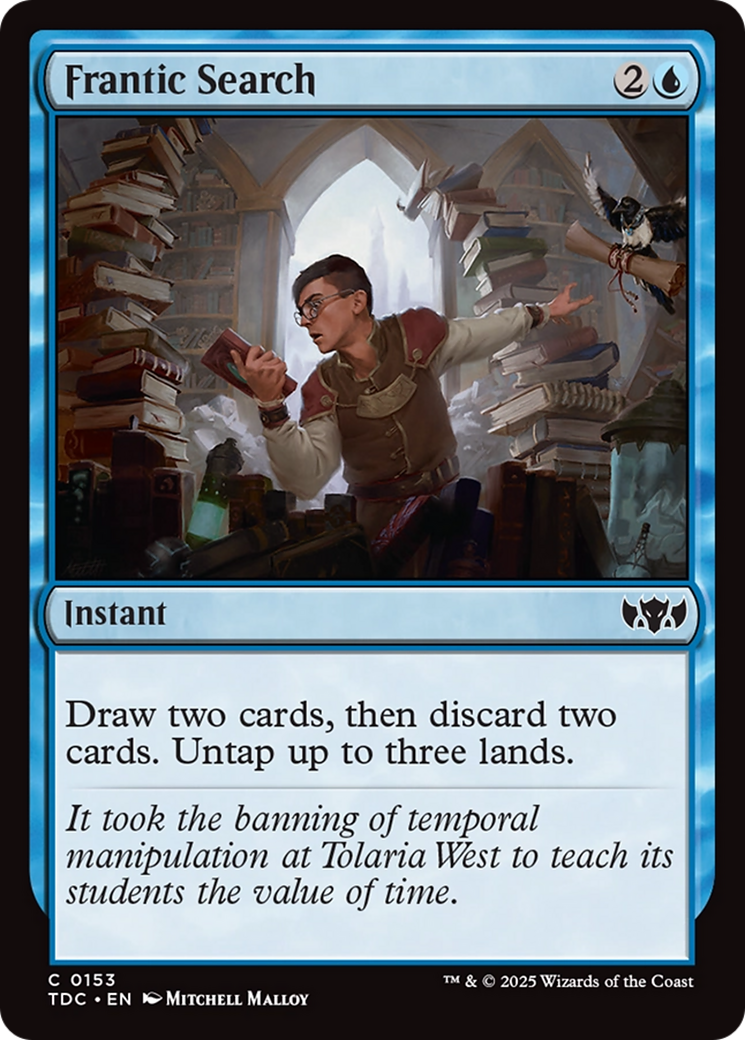
Frantic Search
Frantic Search
Instant
Draw two cards, then discard two cards. Untap up to three lands.
- You choose which lands to untap as the spell resolves. They aren't targeted, and they don't have to be lands that you control.
- You draw two cards and discard two cards all while Frantic Search is resolving. Nothing can happen between the two, and no player may choose to take actions.
-
1
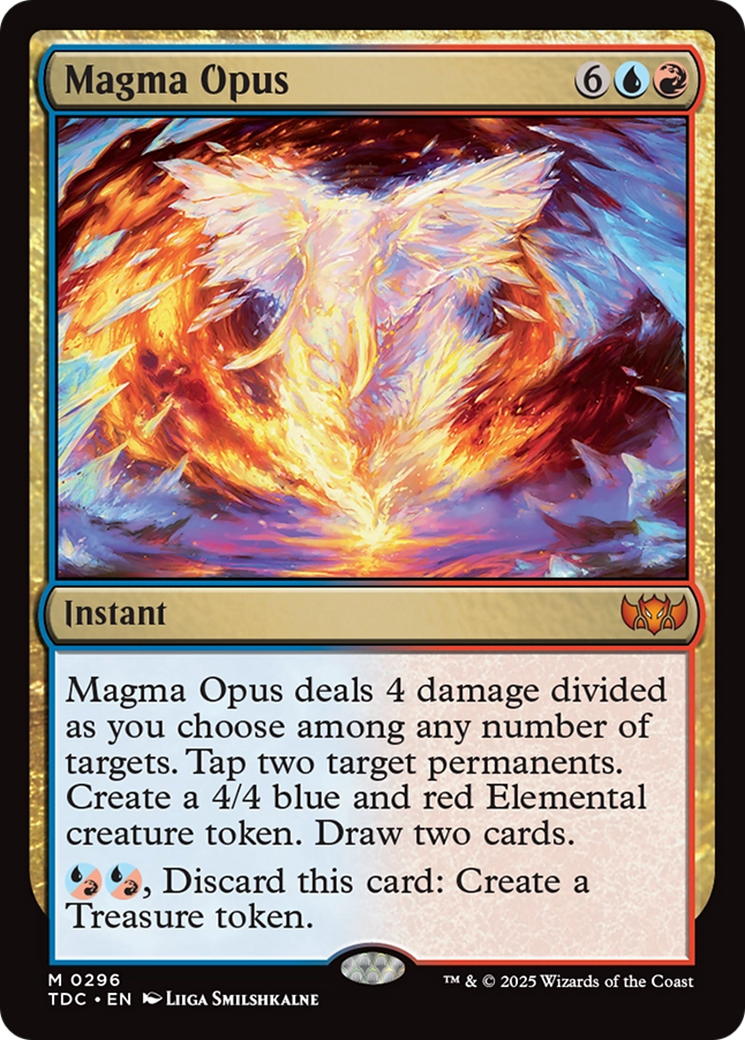
Magma Opus
Magma Opus
Instant
Magma Opus deals 4 damage divided as you choose among any number of targets. Tap two target permanents. Create a 4/4 blue and red Elemental creature token. Draw two cards.
, Discard this card: Create a Treasure token.
- You choose all targets for Magma Opus as you cast the spell. This includes up to four targets for the first effect and two target permanents for the second effect.
- You also choose how the 4 damage will be divided among the first group of targets as you cast Magma Opus. You must have at least 1 damage dealt to each of those targets.
- You must choose two different target permanents for the second effect. You may choose permanents that are already tapped.
- The same permanent can be chosen as a target for each of the two instances of "target." That is, you can have Magma Opus both deal damage to a creature or planeswalker and then tap it. (We're having a hard time imagining why you would, but you're the brilliant student.)
- If somehow all of Magma Opus's targets are illegal as it tries to resolve, none of its effects happen. You will not create an Elemental token or draw two cards.
-
1
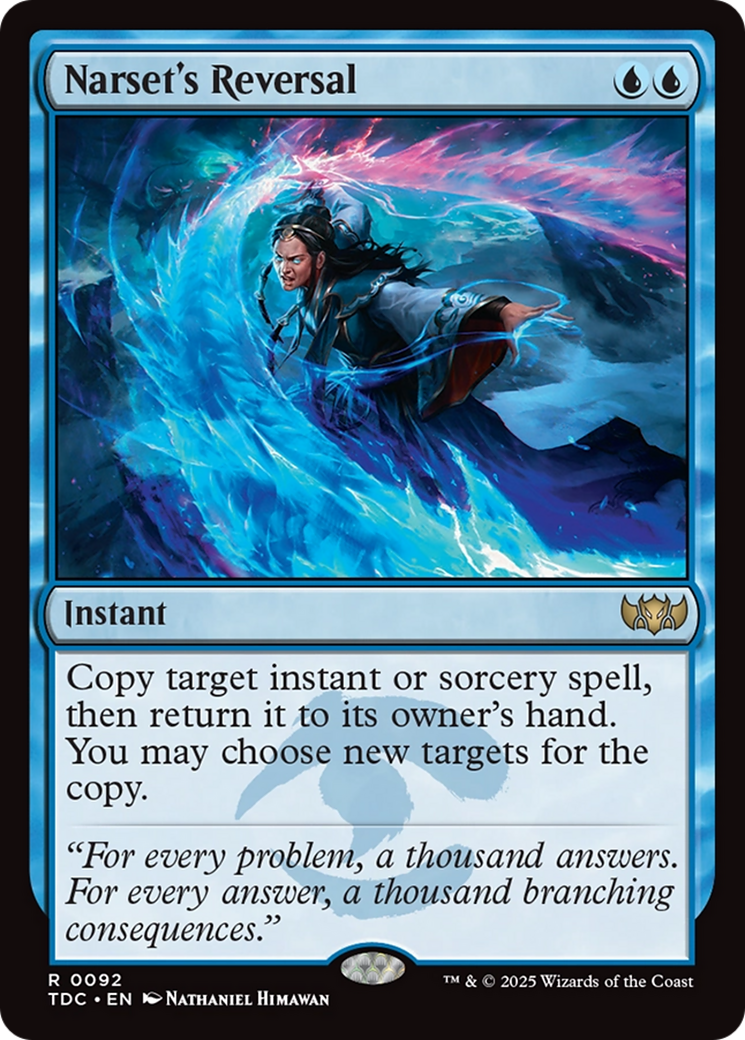
Narset's Reversal
Narset's Reversal
Instant
Copy target instant or sorcery spell, then return it to its owner's hand. You may choose new targets for the copy.
- Narset’s Reversal can copy any instant or sorcery spell, not just one with targets.
- The copy is created on the stack, so it’s not “cast.” Abilities that trigger when a player casts a spell won’t trigger.
- The copy will have the same targets as the spell it’s copying unless you choose new ones. You may change any number of the targets, including all of them or none of them. If, for one of the targets, you can’t choose a new legal target, then it remains unchanged (even if the current target is illegal).
- If the spell that’s copied is modal (that is, it says “Choose one —” or the like), the copy will have the same mode. A different mode can’t be chosen.
- If the spell that’s copied has an X whose value was determined as it was cast (like Finale of Promise does), the copy will have the same value of X.
- If the spell has damage divided as it was cast, the division can’t be changed (although the targets receiving that damage still can). The same is true of spells that distribute counters.
- The controller of a copy can’t choose to pay any alternative or additional costs for the copy. However, effects based on any alternative or additional costs that were paid for the original spell are copied as though those same costs were paid for the copy.
- If you copy a spell, you control the copy. Narset’s Reversal and the copy resolve before the original spell would have resolved.
- If a spell is returned to its owner’s hand, it’s removed from the stack and thus will not resolve. The spell isn’t countered; it just no longer exists. This works against a spell that can’t be countered.
- If a copy of a spell is returned to its owner’s hand, it’s moved there, then it will cease to exist as a state-based action.
-
1
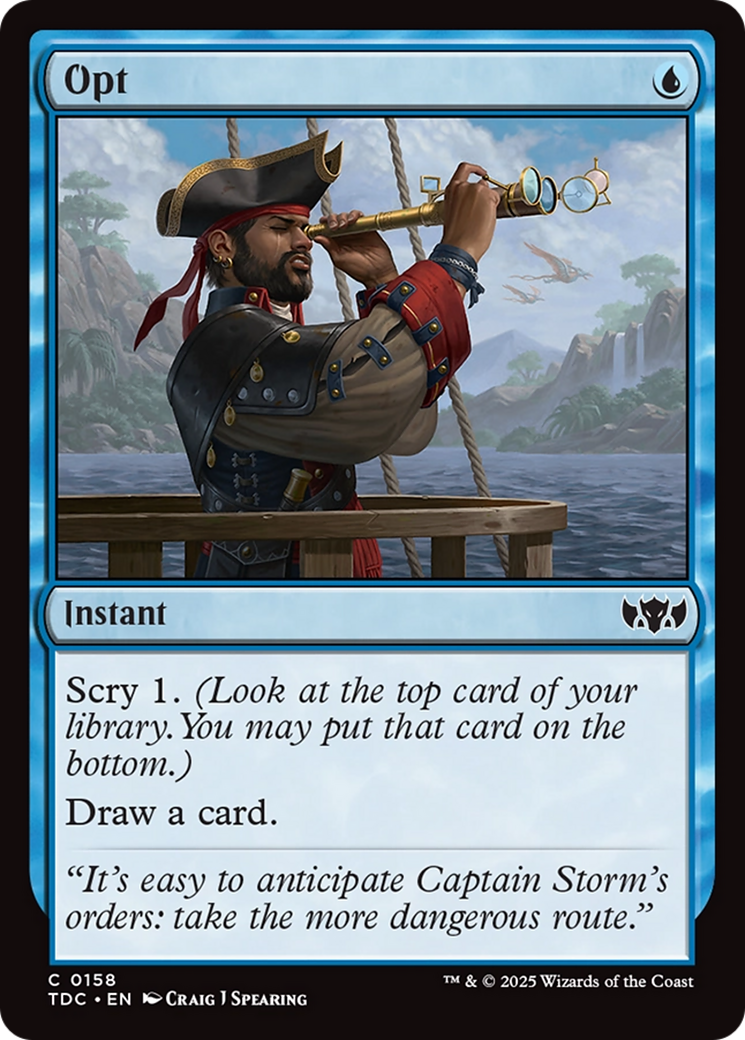
Opt
Opt
Instant
Scry 1. (Look at the top card of your library. You may put that card on the bottom.)
Draw a card.
-
1
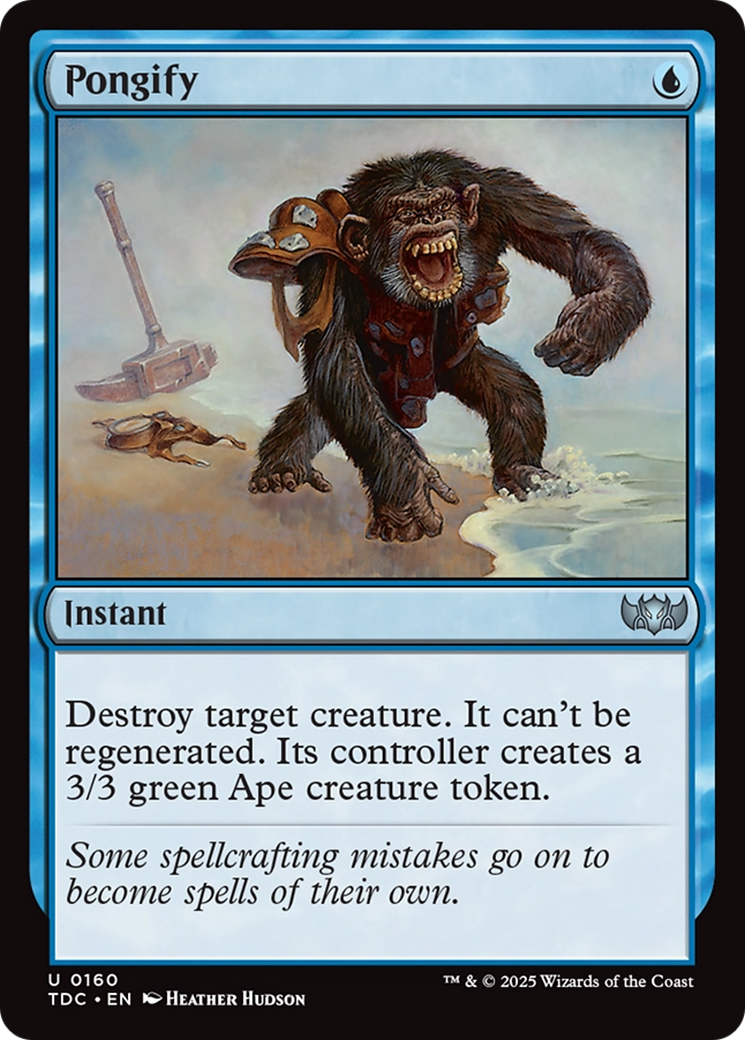
Pongify
Pongify
Instant
Destroy target creature. It can't be regenerated. Its controller creates a 3/3 green Ape creature token.
- If the target creature is an illegal target by the time Pongify tries to resolve, the spell won't resolve. No player creates an Ape token. If the target is legal but not destroyed (most likely because it has indestructible), its controller does create an Ape token.
-
1
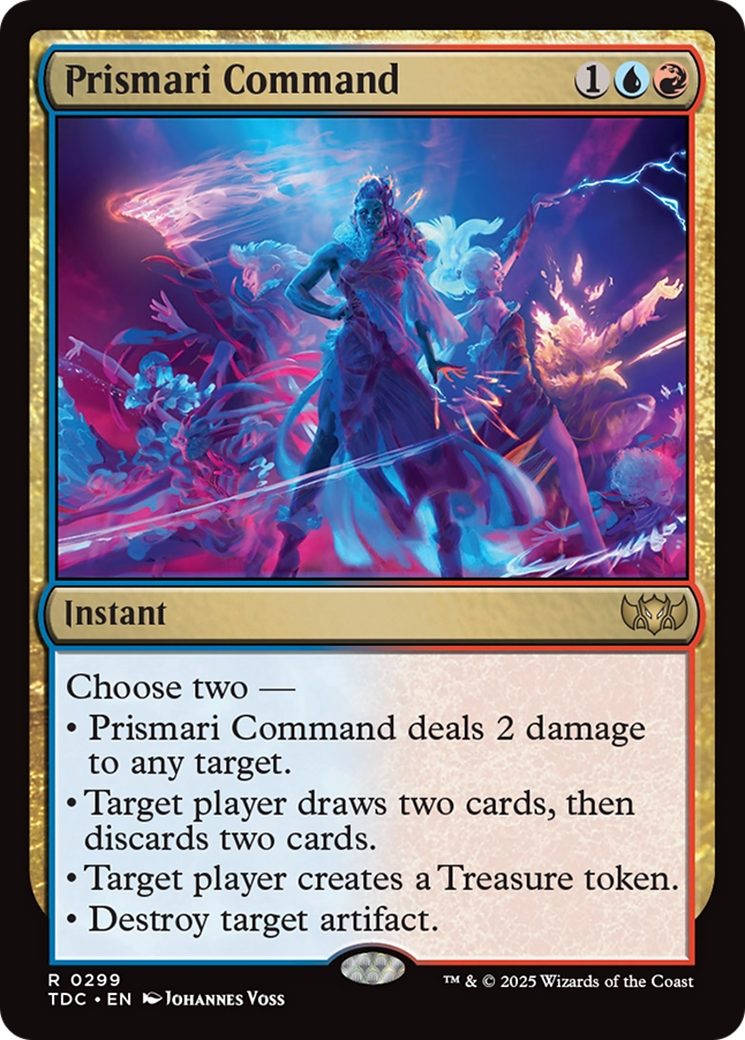
Prismari Command
Prismari Command
Instant
Choose two —
- Prismari Command deals 2 damage to any target.
- Target player draws two cards, then discards two cards.
- Target player creates a Treasure token.
- Destroy target artifact.
- If all of Prismari Command's targets are illegal as it tries to resolve, it will do nothing.
- If at least one target is still legal as Prismari Command tries to resolve, it will resolve and do as much as it can.
-
1
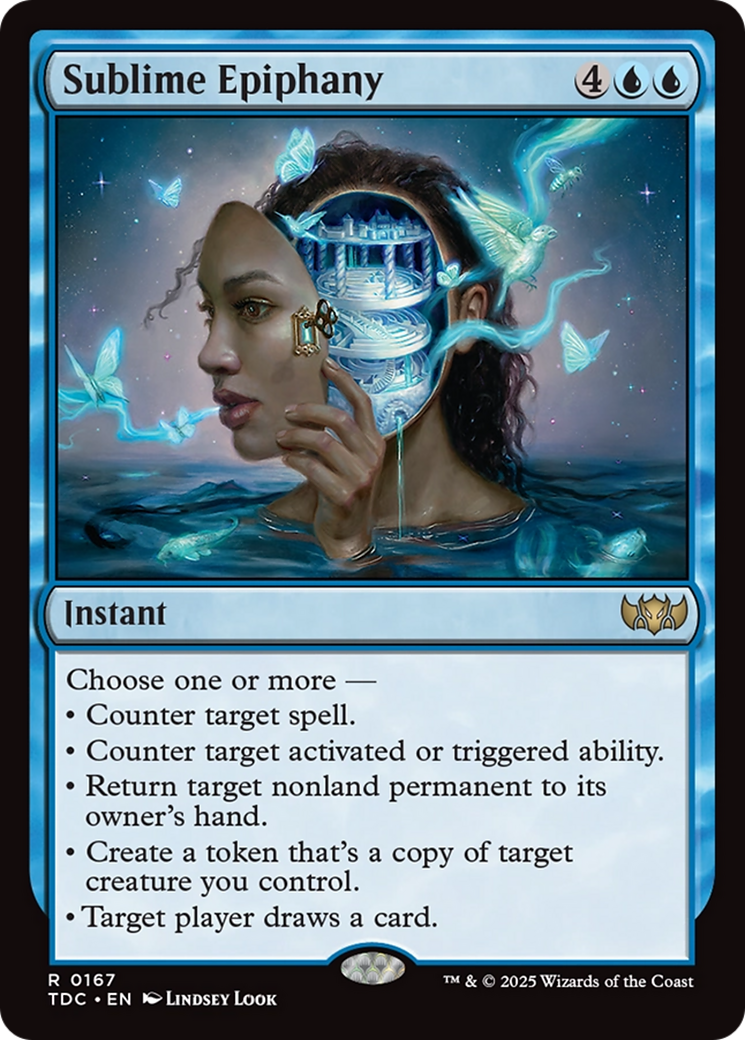
Sublime Epiphany
Sublime Epiphany
Instant
Choose one or more —
- Counter target spell.
- Counter target activated or triggered ability.
- Return target nonland permanent to its owner's hand.
- Create a token that's a copy of target creature you control.
- Target player draws a card.
- You can't choose any one mode more than once.
- If any of the targets become illegal, the remaining targets are affected as appropriate.
- If you choose more than one mode, you perform the modes in the order specified. For example, if you choose to counter target spell, return target nonland permanent to its owner's hand, and have target player draw a card, that permanent will be on the battlefield while that spell is countered (and may modify, affect, or trigger on that event) but will not be on the battlefield while that player draws a card.
- Sublime Epiphany's second mode counters only activated and triggered abilities already on the stack. It doesn't prevent abilities from being activated or from triggering later in the turn, and it has no effect on static abilities.
- Activated abilities are written in the form "[Cost]: [Effect]." Some keyword abilities (such as equip) are activated abilities and will have colons in their reminder texts.
- Triggered abilities use the word "when," "whenever," or "at." They're often written as "[Trigger condition], [effect]." Some keyword abilities (such as prowess) are triggered abilities and will have "when," "whenever," or "at" in their reminder text.
- Abilities that create replacement effects, such as a permanent entering the battlefield tapped or with counters on it, can't be countered. Abilities that apply "as [this creature] enters the battlefield" are also replacement effects and can't be countered.
- Sublime Epiphany's second mode can't counter an activated or triggered mana ability. An activated mana ability is one that could add mana as it resolves, doesn't have a target, and isn't a loyalty ability. A triggered mana ability is one that could add mana as it resolves and triggers on an activated mana ability.
- If you counter a delayed triggered ability that triggered at the beginning of the "next" occurrence of a specified step or phase, that ability won't trigger again the following time that phase or step occurs.
- If you choose the third and fourth modes and target the same creature you control both times, you'll return it and then create a token that's a copy of it, using its copiable values as it last appeared on the battlefield. This is because the legality of targets is checked only as the spell begins to resolve, before any actions are performed.
- The token copies exactly what is printed on the creature and nothing else (unless that creature is a token or is copying something else; see below). It doesn't copy whether that creature is tapped or untapped, whether it has any counters on it or Auras and/or Equipment attached to it, or any non-copy effects that changed its power, toughness, types, color, and so on.
- If the copied creature is itself a token, the token created by Sublime Epiphany copies the original characteristics of that token as stated by the effect that created it.
- If the copied creature is copying something else, the token enters the battlefield as whatever that creature is copying.
- If the copied creature has in its mana cost, X is 0.
- Any enters-the-battlefield abilities of the copied creature will trigger when the token enters the battlefield. Any "As [this creature] enters the battlefield" or "[This creature] enters the battlefield with" abilities of the copied creature will also work.
-
1
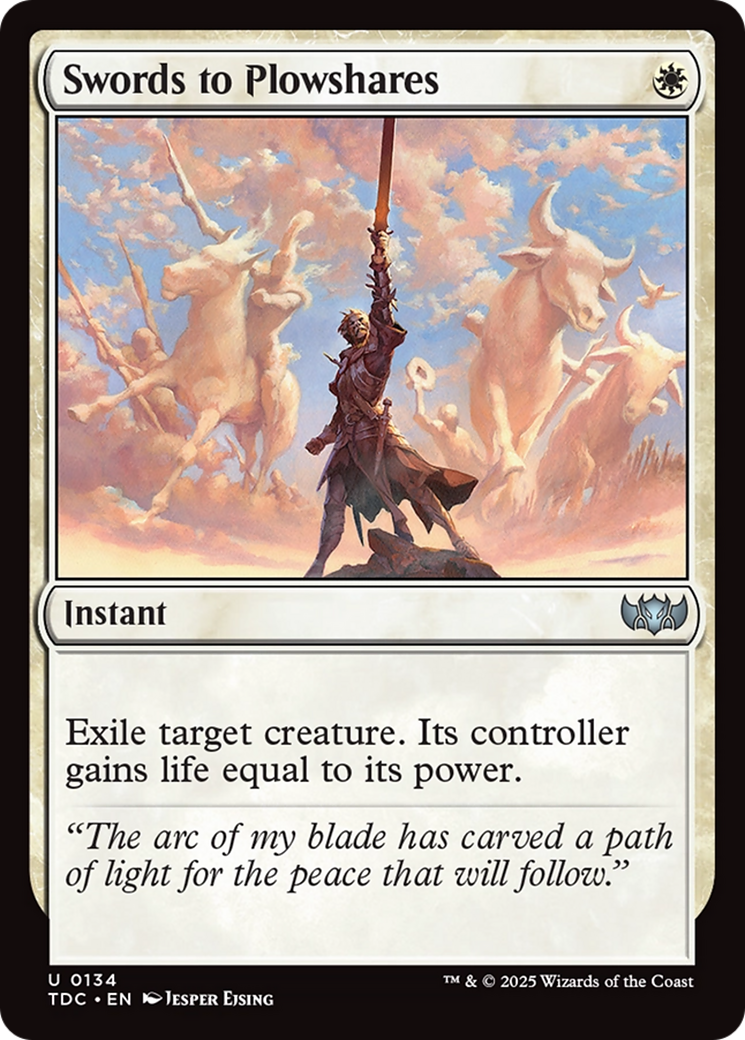
Swords to Plowshares
Swords to Plowshares
Instant
Exile target creature. Its controller gains life equal to its power.
- Use the power of the creature from when it was last on the battlefield to determine how much life is gained.
-
1
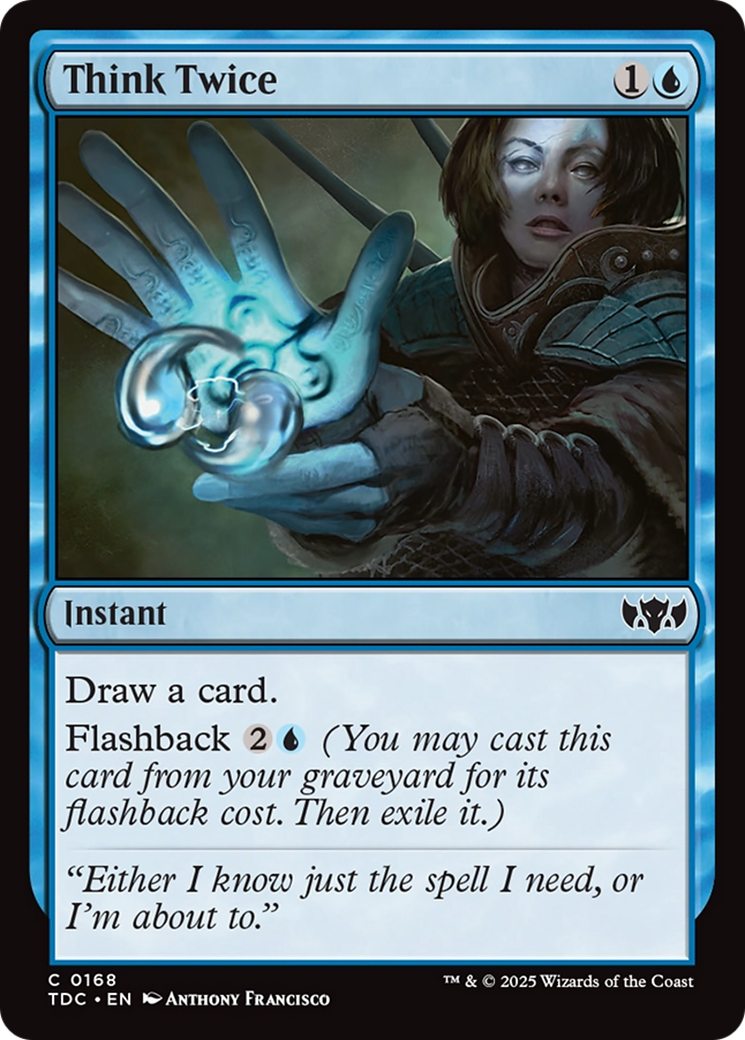
Think Twice
Think Twice
Instant
Draw a card.
Flashback (You may cast this card from your graveyard for its flashback cost. Then exile it.)
- "Flashback [cost]" means "You may cast this card from your graveyard by paying [cost] rather than paying its mana cost" and "If the flashback cost was paid, exile this card instead of putting it anywhere else any time it would leave the stack."
- You must still follow any timing restrictions and permissions, including those based on the card's type. For instance, you can cast a sorcery using flashback only when you could normally cast a sorcery.
- To determine the total cost of a spell, start with the mana cost or alternative cost (such as a flashback cost) you're paying, add any cost increases, then apply any cost reductions. The mana value of the spell is determined only by its mana cost, no matter what the total cost to cast the spell was.
- A spell cast using flashback will always be exiled afterward, whether it resolves, is countered, or leaves the stack in some other way.
- You can cast a spell using flashback even if it was somehow put into your graveyard without having been cast.
- If a card with flashback is put into your graveyard during your turn, you can cast it if it's legal to do so before any other player can take any actions.
-
1
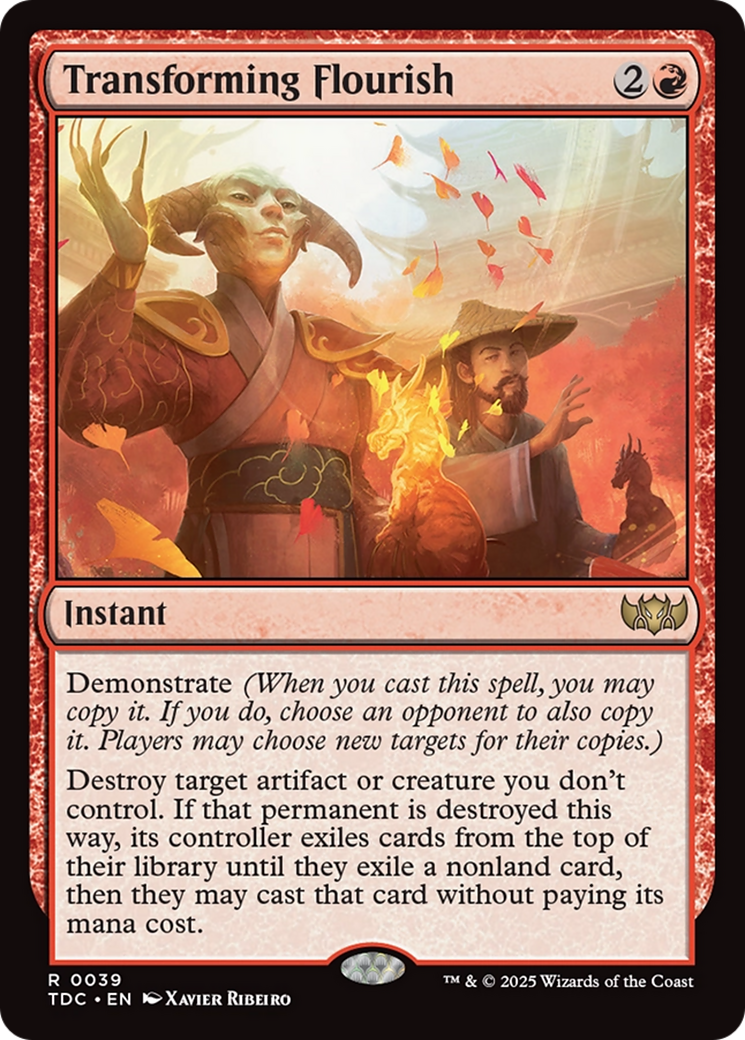
Transforming Flourish
Transforming Flourish
Instant
Demonstrate (When you cast this spell, you may copy it. If you do, choose an opponent to also copy it. Players may choose new targets for their copies.)
Destroy target artifact or creature you don't control. If that permanent is destroyed this way, its controller exiles cards from the top of their library until they exile a nonland card, then they may cast that card without paying its mana cost.
- You choose whether to make a copy as the demonstrate ability resolves. This happens before the original spell resolves. Your copy goes on the stack above the original spell.
- If you copy a spell with demonstrate, you then immediately choose an opponent. If they copy the spell, it goes on top of the stack.
- If the spell requires targets, you choose the target of the original spell as you cast it. If you create a copy of the spell, you may choose new targets for the copy as you create that copy. Similarly, the opponent you chose to create a copy may choose new targets for that copy as it’s created. In other words, your opponent will know the targets of your original spell and your copy when choosing the new targets, if any, for their copy.
- If you cast a spell with demonstrate and both you and an opponent copy it, the opponent’s copy will resolve first, then your copy will resolve, and finally the original spell will resolve.
- If you cast the spell and choose not to copy it, no opponent will get to copy it either.
- If the destroyed permanent’s controller chooses to cast the exiled card without paying its mana cost, they can’t choose to cast it for any alternative costs. They can, however, pay additional costs, such as kicker costs. If the spell has any mandatory additional costs, those must be paid to cast the spell.
- If the exiled card has in its mana cost, the destroyed permanent’s controller must choose 0 as the value of X when casting it without paying its mana cost.
Sorceries 15
-
1
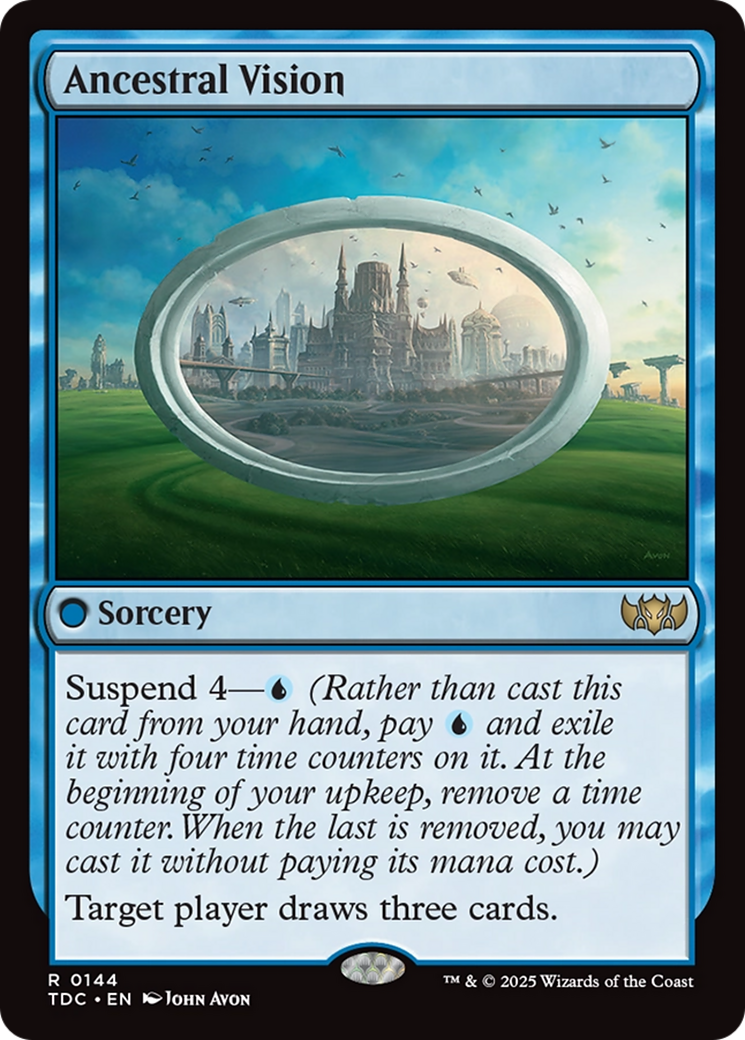
Ancestral Vision
Ancestral Vision
Sorcery
Suspend 4— (Rather than cast this card from your hand, pay and exile it with four time counters on it. At the beginning of your upkeep, remove a time counter. When the last is removed, you may cast it without paying its mana cost.)
Target player draws three cards.
- If a card with no mana cost is given an alternative cost equal to its mana cost (by Snapcaster Mage, for example), that cost cannot be paid and the card cannot be cast this way.
- Suspend is a keyword that represents three abilities. The first is a static ability that allows you to exile the card from your hand with the specified number of time counters (the number before the dash) on it by paying its suspend cost (listed after the dash). The second is a triggered ability that removes a time counter from the suspended card at the beginning of each of your upkeeps. The third is a triggered ability that gives you the option to cast the card when the last time counter is removed.
- You can exile a card in your hand using suspend any time you could cast that card. Consider its card type, any effects that modify when you could cast it (such as flash) and any other effects that stop you from casting it (such as from Meddling Mage's ability) to determine if and when you can do this. Whether you could actually complete all steps in casting the card is irrelevant. For example, you can exile a card with suspend that has no mana cost or that requires a target even if no legal targets are available at that time.
- Cards exiled with suspend are exiled face up.
- Exiling a card with suspend isn't casting that card. This action doesn't use the stack and can't be responded to.
- If the spell requires any targets, those targets are chosen when the spell is finally cast, not when it's exiled.
- If an effect refers to a "suspended card," that means a card that (1) has suspend, (2) is in exile, and (3) has one or more time counters on it.
- If the first triggered ability of suspend (the one that removes time counters) is countered, no time counter is removed. The ability will trigger again at the beginning of the card's owner's next upkeep.
- When the last time counter is removed, the second triggered ability of suspend (the one that lets you cast the card) triggers. It doesn't matter why the last time counter was removed or what effect removed it.
- If the second triggered ability is countered, the card can't be cast. It remains exiled with no time counters on it, and it's no longer suspended.
- Due to a recent rules change to suspend, you are no longer required to cast the suspended card as the second triggered ability of suspend resolves. Instead, as the second triggered ability resolves, you may cast the card. Timing permissions based on the card's type are ignored. If you don't cast the card, it remains exiled with no time counters on it, and it's no longer suspended.
- If you cast a card "without paying its mana cost," such as with suspend, you can't choose to cast it for any alternative costs. You can, however, pay additional costs. If the card has any mandatory additional costs, you must pay those if you want to cast the card.
- If the card has in its mana cost, you must choose 0 as the value of X when casting it without paying its mana cost.
- The mana value of a spell cast without paying its mana cost is determined by its mana cost, even though that cost wasn't paid.
- A card with no mana cost can't be cast normally; you'll need a way to cast it for an alternative cost or without paying its mana cost, such as by suspending it.
- Although originally printed with a characteristic-defining ability that defined its color, this card now has a color indicator. This color indicator can't be affected by text-changing effects (such as the one created by Crystal Spray), although color-changing effects can still overwrite it.
-
1
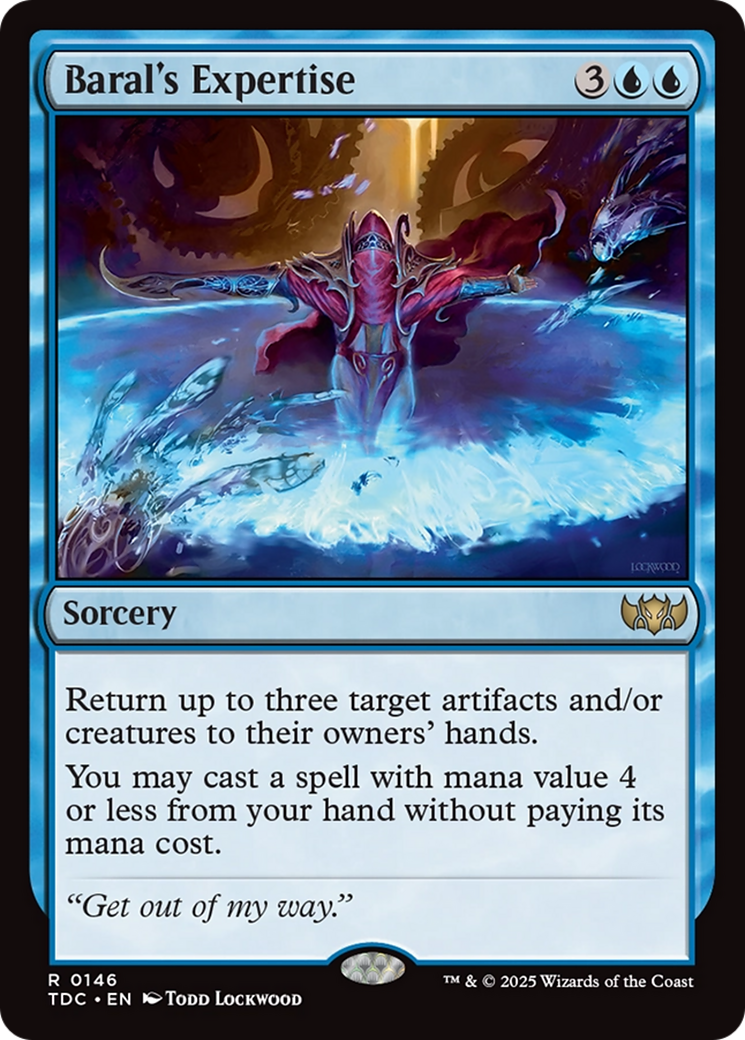
Baral's Expertise
Baral's Expertise
Sorcery
Return up to three target artifacts and/or creatures to their owners' hands.
You may cast a spell with mana value 4 or less from your hand without paying its mana cost.
- The mana value of a split card is determined by the combined mana cost of its two halves. If an expertise spell allows you to cast a split card, you may cast either half or, if that split card has fuse, both halves.
- If the card has in its mana cost, you must choose 0 as the value of X when casting it without paying its mana cost.
- The card that you cast may be an artifact or creature that was returned to your hand by this spell.
- If the Expertise spell you cast has any targets, and those targets become illegal before the spell resolves, the spell doesn't resolve and none of its effects happen. You won't get to cast a free spell.
- Effects that allow you to "cast" a card don't allow you to play a land card.
- If you cast a card "without paying its mana cost," you can't choose to cast it for any alternative costs, such as emerge costs. You can, however, pay additional costs. If the card has any mandatory additional costs, such as that of Cathartic Reunion, you must pay those to cast the card.
- While you're casting your free spell, the Expertise spell is still on the stack. It will be put into its owner's graveyard after the free spell is cast. The free spell can't target the Expertise card in your graveyard. It can target the Expertise spell on the stack, but the Expertise spell will become an illegal target before the free spell resolves.
- Any triggered abilities that trigger while performing the Expertise spell's first effect won't be put onto the stack until after you're done casting your free spell. They're put onto the stack at the same time as any abilities that triggered while casting that spell regardless of the order in which those abilities triggered.
- A card's mana value is determined solely by the mana symbols printed in its upper right corner. The mana value is the total amount of mana in that cost, regardless of color. For example, a card with mana cost has mana value 3. Ignore any alternative costs, additional costs, cost increases, or cost reductions that could apply to it. A card with no mana cost has a mana value of 0.
-
1
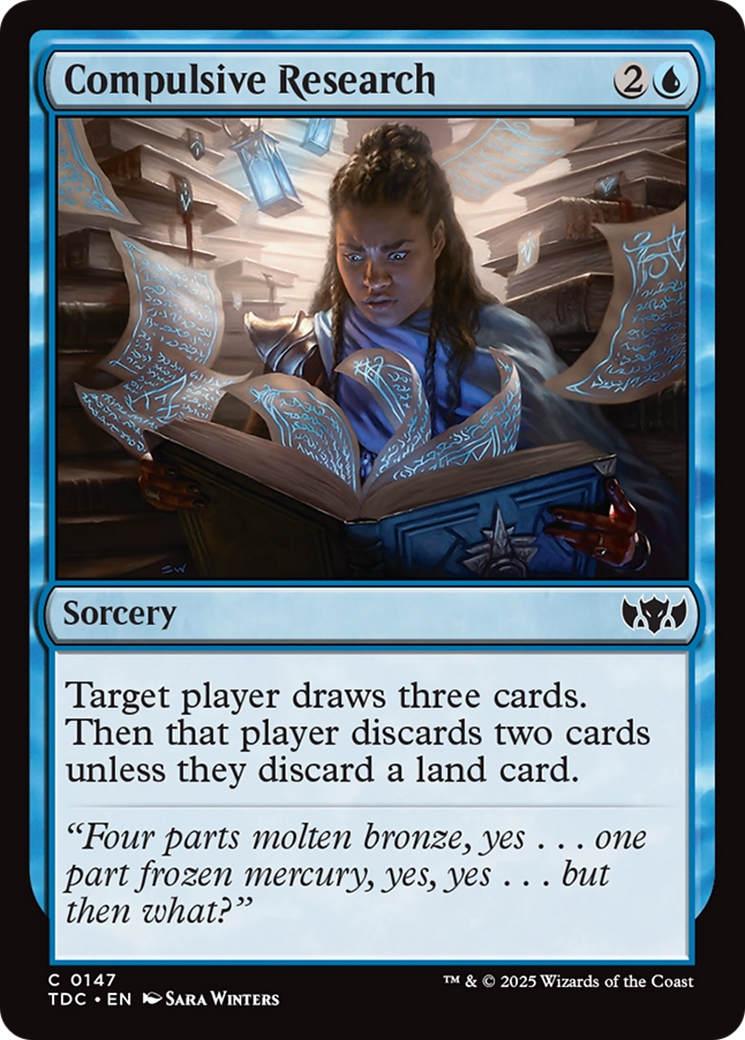
Compulsive Research
Compulsive Research
Sorcery
Target player draws three cards. Then that player discards two cards unless they discard a land card.
- The target player can discard either one land card or two cards which may or may not be lands. The player can discard one land and one other card or two land cards if they choose.
-
1
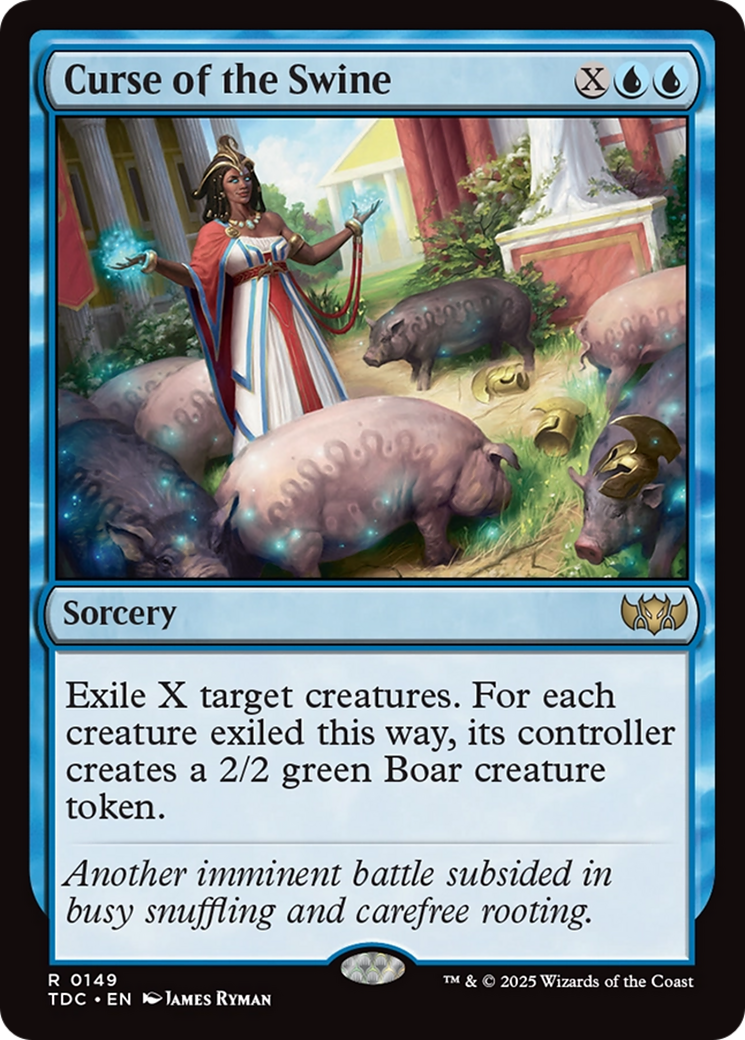
Curse of the Swine
Curse of the Swine
Sorcery
Exile X target creatures. For each creature exiled this way, its controller creates a 2/2 green Boar creature token.
-
1
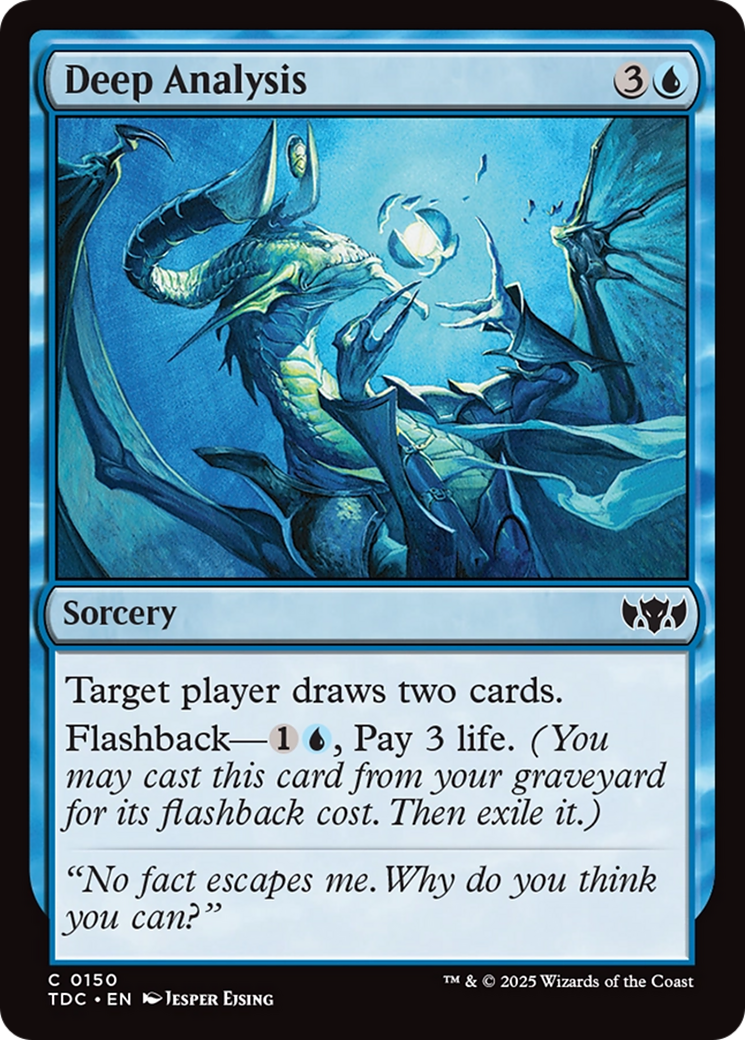
Deep Analysis
Deep Analysis
Sorcery
Target player draws two cards.
Flashback— , Pay 3 life. (You may cast this card from your graveyard for its flashback cost. Then exile it.)
- "Flashback [cost]" means "You may cast this card from your graveyard by paying [cost] rather than paying its mana cost" and "If the flashback cost was paid, exile this card instead of putting it anywhere else any time it would leave the stack."
- You must still follow any timing restrictions and permissions, including those based on the card's type. For instance, you can cast a sorcery using flashback only when you could normally cast a sorcery.
- To determine the total cost of a spell, start with the mana cost or alternative cost (such as a flashback cost) you're paying, add any cost increases, then apply any cost reductions. The mana value of the spell is determined only by its mana cost, no matter what the total cost to cast the spell was.
- A spell cast using flashback will always be exiled afterward, whether it resolves, is countered, or leaves the stack in some other way.
- You can cast a spell using flashback even if it was somehow put into your graveyard without having been cast.
- If a card with flashback is put into your graveyard during your turn, you can cast it if it's legal to do so before any other player can take any actions.
-
1
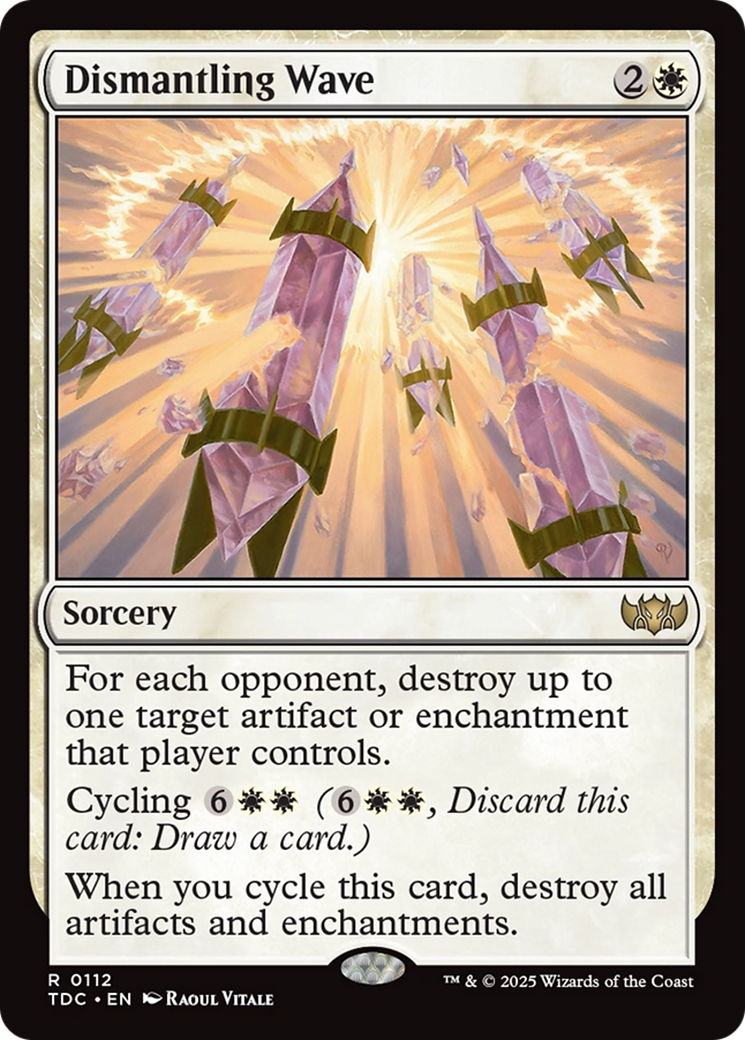
Dismantling Wave
Dismantling Wave
Sorcery
For each opponent, destroy up to one target artifact or enchantment that player controls.
Cycling ( , Discard this card: Draw a card.)
When you cycle this card, destroy all artifacts and enchantments.
- Some cards with cycling have an ability that triggers when you cycle them, and some cards have an ability that triggers whenever you cycle any card. These triggered abilities resolve before you draw from the cycling ability.
- Triggered abilities from cycling a card and the cycling ability itself aren't spells. Effects that interact with spells (such as that of Cancel) won't affect them.
- You can cycle a card even if it has a triggered ability from cycling that won't have a legal target. This is because the cycling ability and the triggered ability are separate. This also means that if either ability is countered (with Disallow, for example), the other ability will still resolve.
-
1
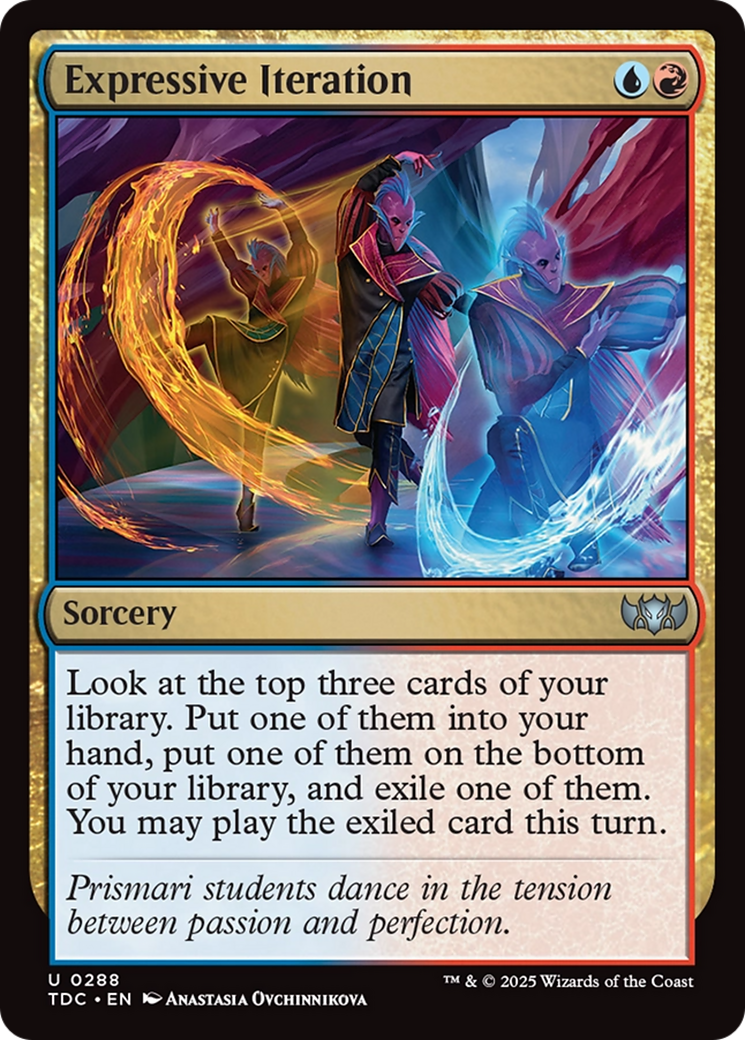
Expressive Iteration
Expressive Iteration
Sorcery
Look at the top three cards of your library. Put one of them into your hand, put one of them on the bottom of your library, and exile one of them. You may play the exiled card this turn.
- Cards exiled are always exiled face up unless specified otherwise by the effect that exiled it.
- If you choose to play the exiled card this turn, you must still pay all costs and follow all timing restrictions required by that card. If it's a land, you can't play it unless you have a land play available.
- If you don't play the exiled card, it remains exiled. It won't be available to be played on future turns.
-
1
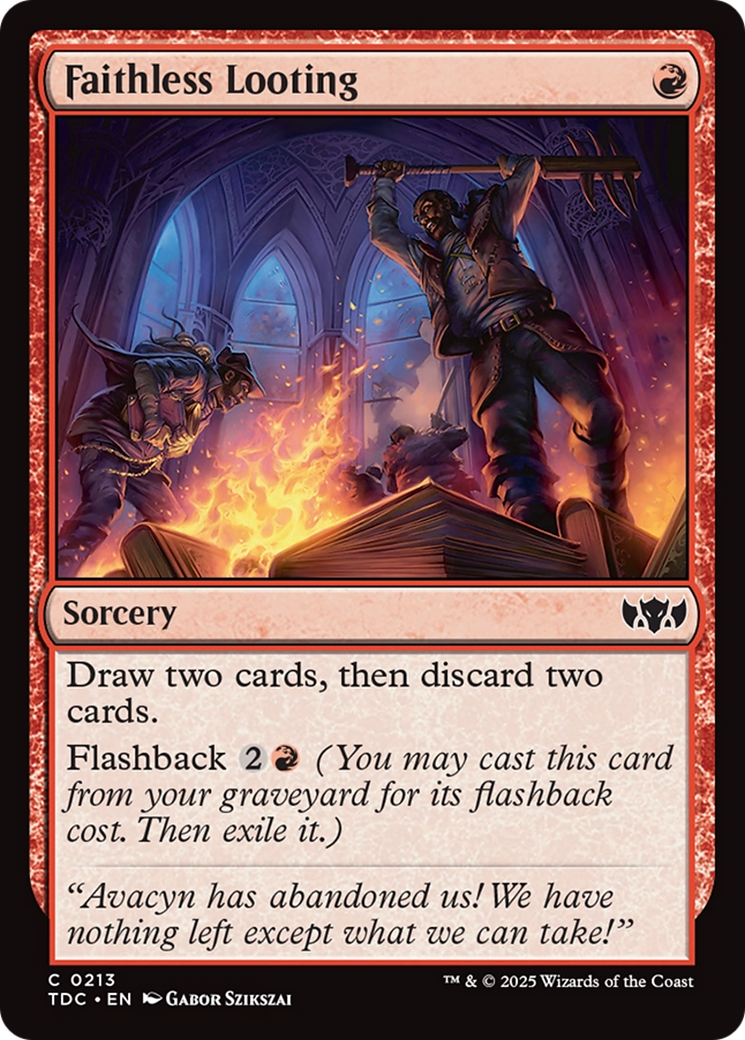
Faithless Looting
Faithless Looting
Sorcery
Draw two cards, then discard two cards.
Flashback (You may cast this card from your graveyard for its flashback cost. Then exile it.)
- To determine the total cost of a spell, start with the mana cost or alternative cost (such as a flashback cost) you're paying, add any cost increases, then apply any cost reductions. The mana value of the spell is determined only by its mana cost, no matter what the total cost to cast the spell was.
- "Flashback [cost]" means "You may cast this card from your graveyard by paying [cost] rather than paying its mana cost" and "If the flashback cost was paid, exile this card instead of putting it anywhere else any time it would leave the stack."
- You must still follow any timing restrictions and permissions, including those based on the card's type. For instance, you can cast a sorcery using flashback only when you could normally cast a sorcery.
- If a card with flashback is put into your graveyard during your turn, you can cast it if it's legal to do so before any other player can take any actions.
- A spell cast using flashback will always be exiled afterward, whether it resolves, is countered, or leaves the stack in some other way.
- You can cast a spell using flashback even if it was somehow put into your graveyard without having been cast.
- You draw two cards and discard two cards all while Faithless Looting is resolving. Nothing can happen between the two, and no player may choose to take actions.
-
1
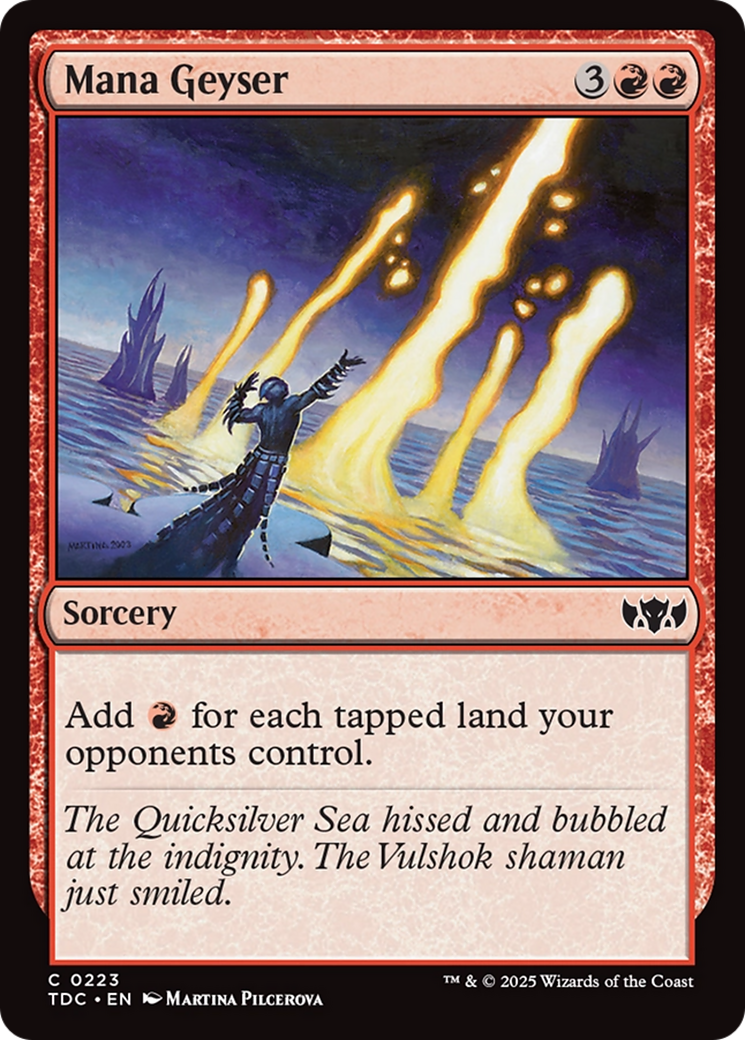
Mana Geyser
Mana Geyser
Sorcery
Add for each tapped land your opponents control.
-
1
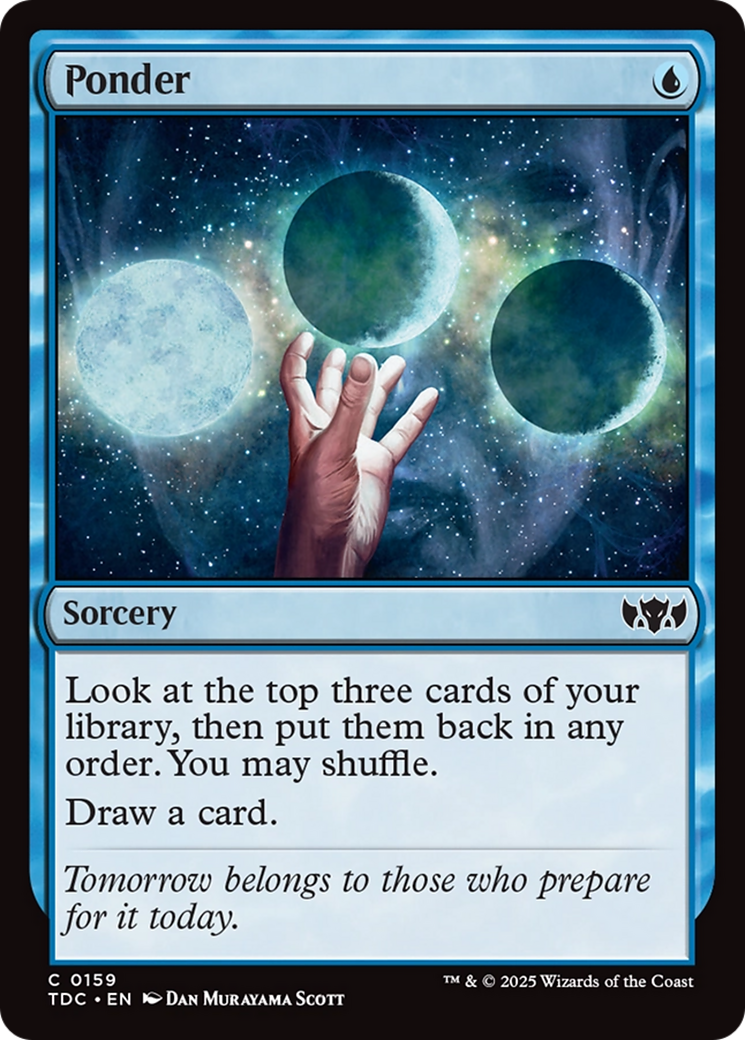
Ponder
Ponder
Sorcery
Look at the top three cards of your library, then put them back in any order. You may shuffle.
Draw a card.
- If you choose to shuffle your library, that includes the three cards you just looked at and put back on top of it.
-
1
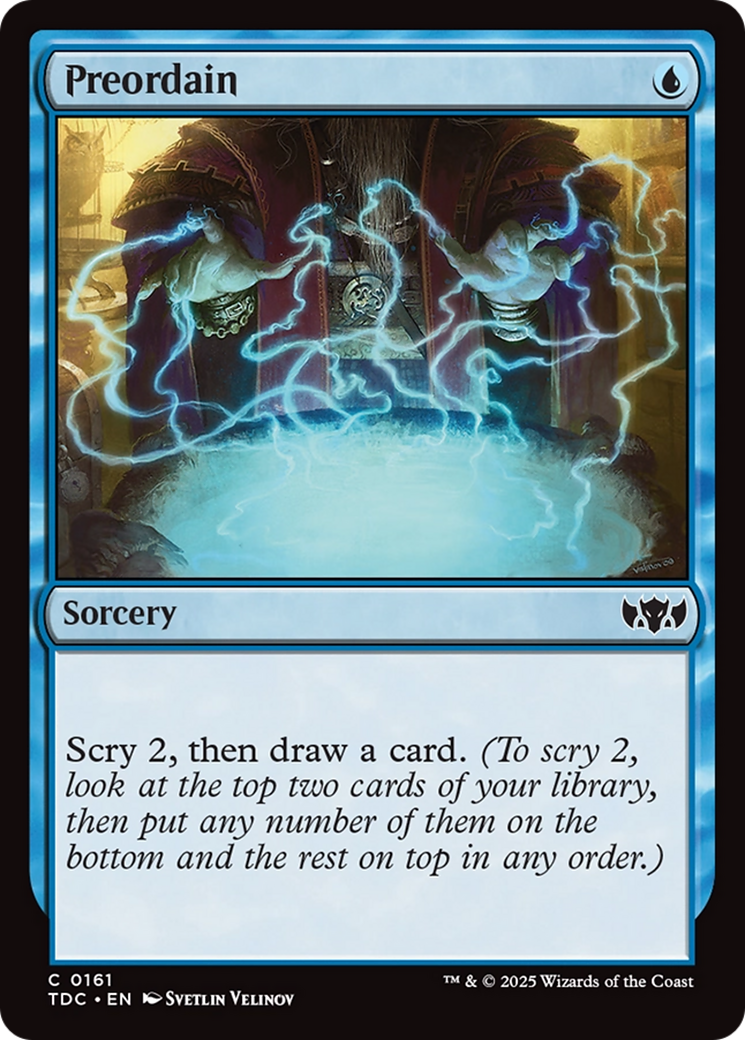
Preordain
Preordain
Sorcery
Scry 2, then draw a card. (To scry 2, look at the top two cards of your library, then put any number of them on the bottom and the rest on top in any order.)
-
1
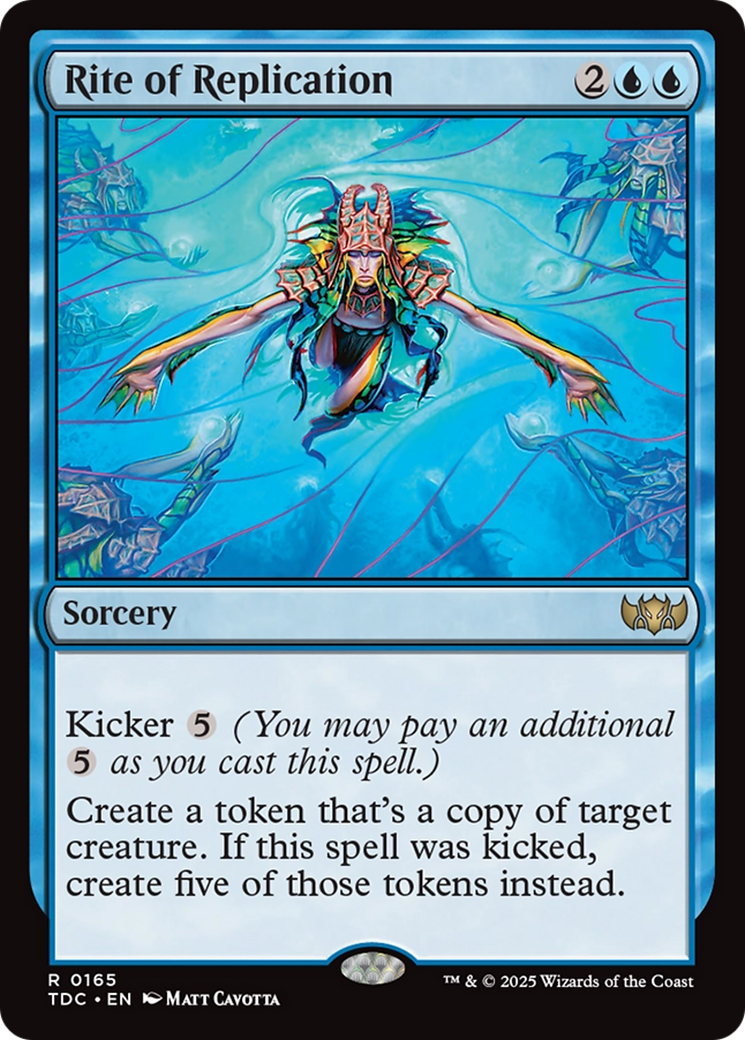
Rite of Replication
Rite of Replication
Sorcery
Kicker (You may pay an additional as you cast this spell.)
Create a token that's a copy of target creature. If this spell was kicked, create five of those tokens instead.
- If the targeted creature is an illegal target when Rite of Replication tries to resolve, it won't resolve and none of its effects will happen. You won't create any tokens.
- Each token copies exactly what was printed on the original creature (unless that permanent is copying something else or is a token; see below). It doesn't copy whether that creature is tapped or untapped, whether it has any counters on it or any Auras or Equipment attached to it, or any non-copy effects that have changed its types, color, power and toughness, and so on.
- If the copied creature has in its mana cost, X is 0.
- If the copied creature is a token, the new token that's created copies the original characteristics of that token as stated by the effect that created the token.
- If the copied creature is copying something else, then the token enters as whatever that creature copied.
- Any "enters" abilities of the copied creature will trigger when the token enters. Any "as [this creature] enters" or "[this creature] enters with" abilities of the target creature will also work.
- The tokens see each other enter. If they have a triggered ability that triggers when a creature enters, they'll all trigger for one another.
- If a spell's kicker cost was paid, the spell is "kicked."
- The kicker ability doesn't let you pay a kicker cost more than once.
- If you put a permanent with a kicker ability onto the battlefield without casting it, you can't kick it.
- If you copy a kicked spell on the stack, the copy is also kicked. If the copied spell is a permanent spell, the token the copy of that spell becomes when it enters is also kicked.
- If a card or token enters as a copy of a permanent, the new permanent isn't kicked, even if the original was.
- To determine a spell's total cost, start with the mana cost (or an alternative cost if another card's effect allows you to pay one instead), add any cost increases (such as kicker), then apply any cost reductions. The spell's mana value remains unchanged, no matter what the total cost to cast it was.
-
1
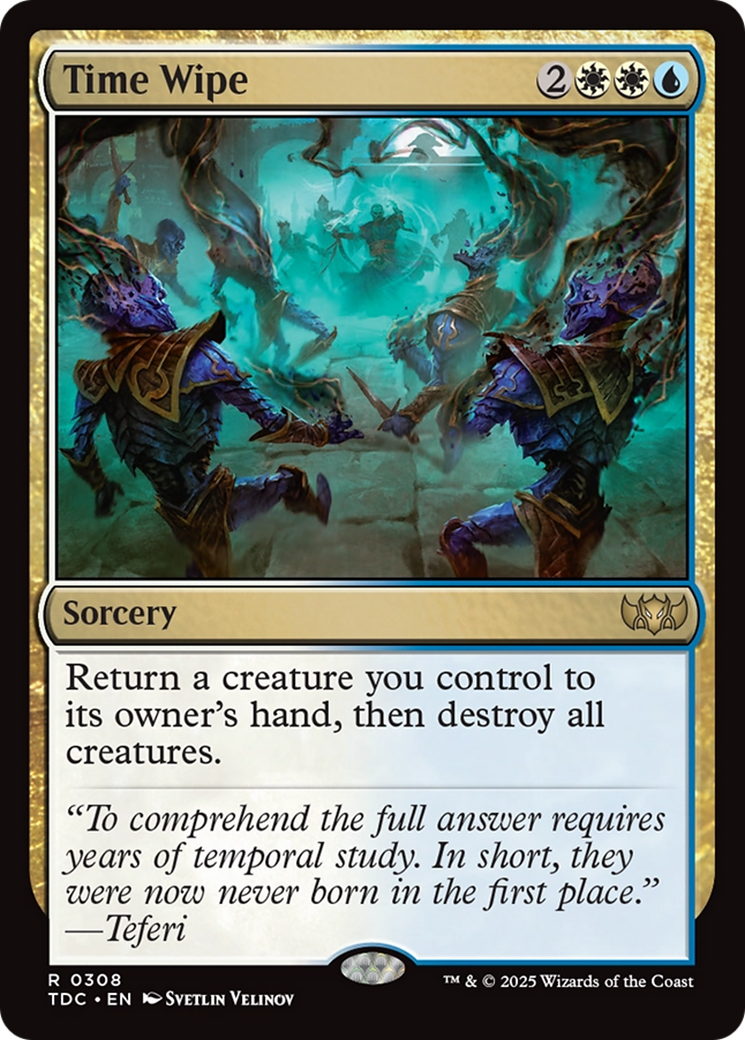
Time Wipe
Time Wipe
Sorcery
Return a creature you control to its owner's hand, then destroy all creatures.
- You chose which creature to return to its owner's hand while Time Wipe is resolving. No player may take any actions between the time you choose the creature to return and the time other creatures are destroyed.
- If you control no creatures, you simply destroy all creatures.
-
1
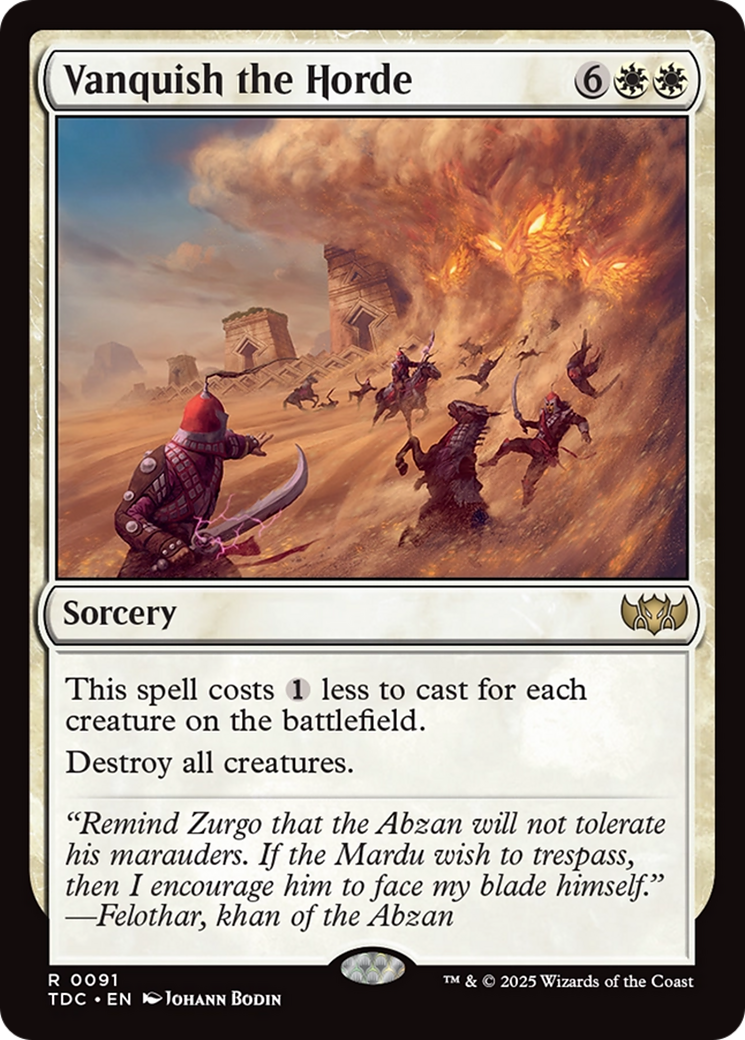
Vanquish the Horde
Vanquish the Horde
Sorcery
This spell costs less to cast for each creature on the battlefield.
Destroy all creatures.
-
1
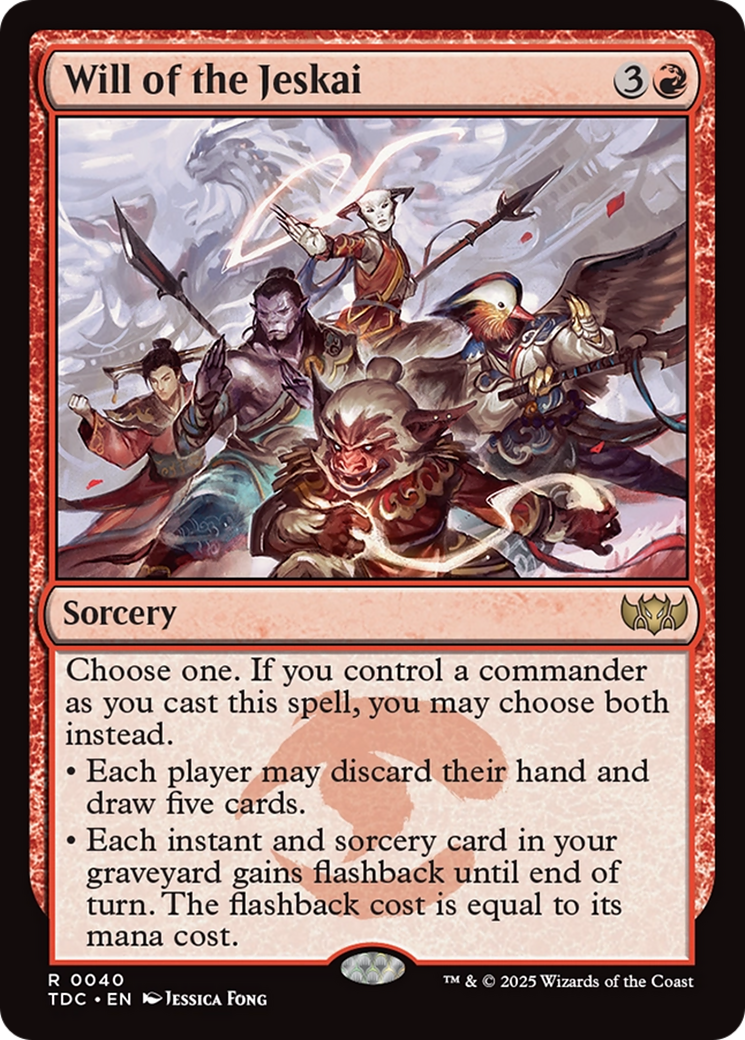
Will of the Jeskai
Will of the Jeskai
Sorcery
Choose one. If you control a commander as you cast this spell, you may choose both instead.
- Each player may discard their hand and draw five cards.
- Each instant and sorcery card in your graveyard gains flashback until end of turn. The flashback cost is equal to its mana cost.
- A player may discard their hand even if their hand contains zero cards.
- The commander you control doesn’t have to be your commander.
- Once you’ve announced that you’re casting this spell, players can’t take any actions until you’ve finished doing so. Notably, opponents can’t try to remove your commander to change how many modes you may choose.
- Whether or not you control a commander is determined only once, as you choose the modes for this spell. If you somehow lose control of that commander before you finish casting the spell (perhaps because you sacrifice it to activate a mana ability), it won’t change the number of modes chosen.
Artifacts 8
-
1
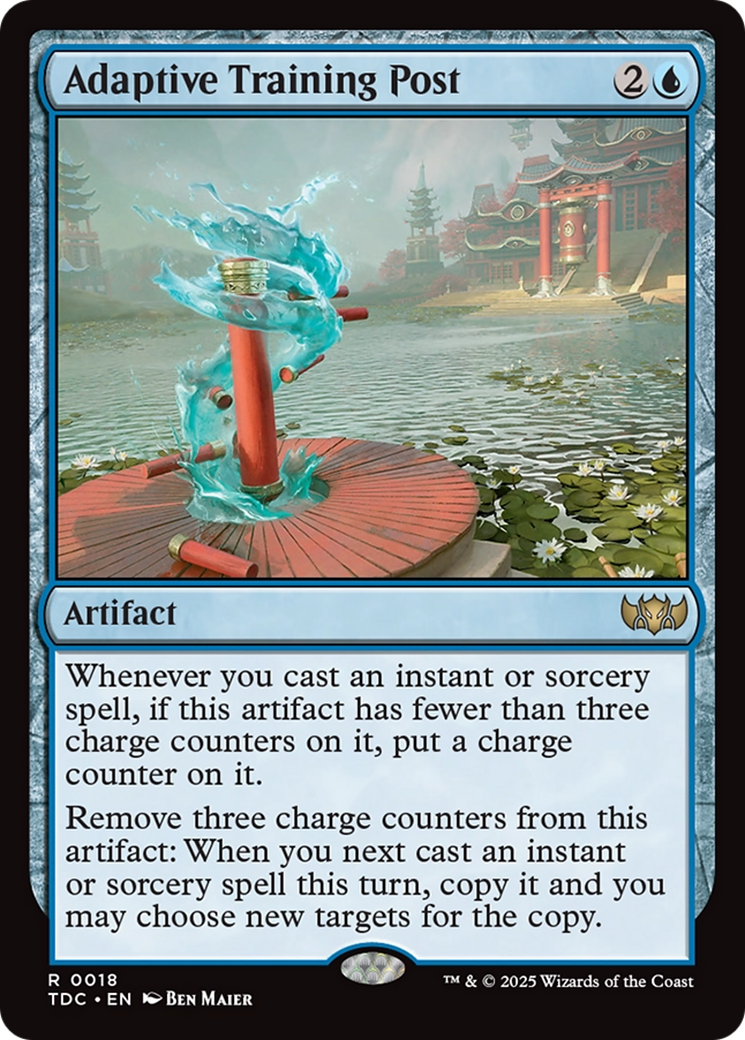
Adaptive Training Post
Adaptive Training Post
Artifact
Whenever you cast an instant or sorcery spell, if this artifact has fewer than three charge counters on it, put a charge counter on it.
Remove three charge counters from this artifact: When you next cast an instant or sorcery spell this turn, copy it and you may choose new targets for the copy.
- After Adaptive Training Post’s last ability resolves, the next instant or sorcery spell you cast that turn will be copied whether or not it has targets.
- The copy created by Adaptive Training Post’s last ability resolves before the spell it’s copying. It resolves even if the original spell is countered before the copy is created.
- If the spell has any targets, the copy will have the same targets unless you choose new ones. You may change any number of the targets, including all of them or none of them. The new targets must be legal.
- If the spell that’s copied is modal (that is, it says “Choose one —” or the like), the copy will have the same mode or modes. You can’t choose different ones.
- If the copied spell divides damage or distributes counters among a number of targets, the division and number of targets can’t be changed. If you choose new targets, you must choose the same number of targets.
- If the spell that’s copied has an X whose value was determined as it was cast, the copy will have the same value of X.
- You can’t choose to pay any additional costs for the copy. However, effects based on any additional costs that were paid for the original spell are copied as though those same costs were paid for the copy too.
- The copy is created on the stack, so it’s not “cast.” Abilities that trigger when a player casts a spell won’t trigger.
-
1
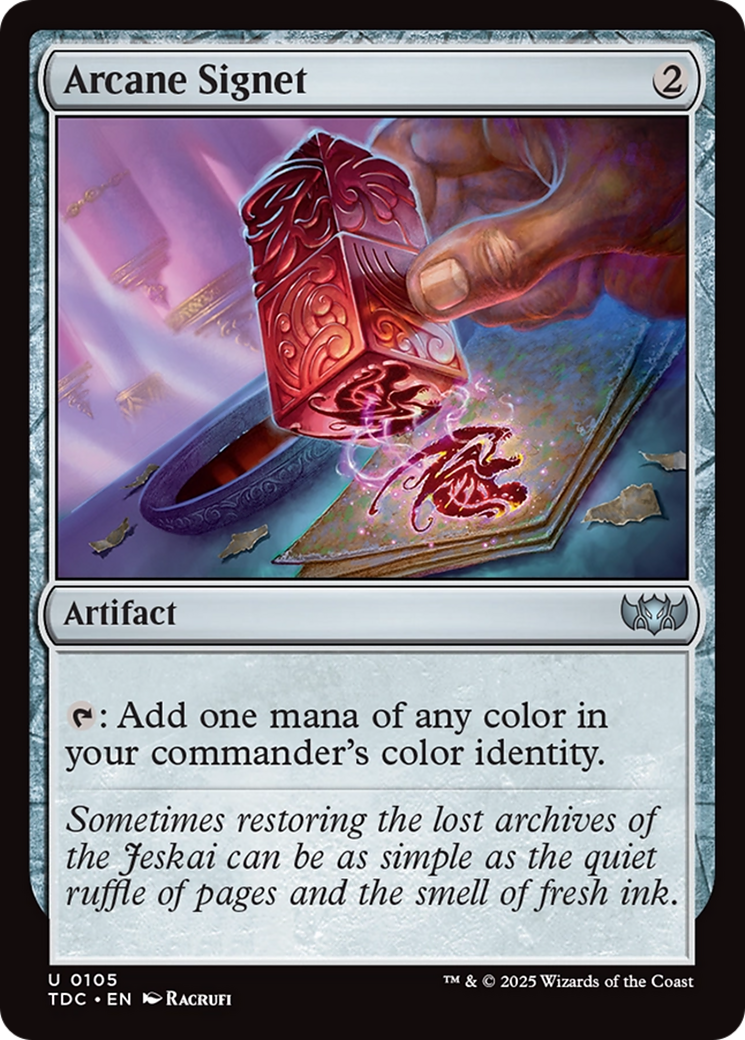
Arcane Signet
Arcane Signet
Artifact
: Add one mana of any color in your commander's color identity.
- If you have two commanders, the ability adds one mana of any color in their combined color identities.
- If your commander is a card that has no colors in its color identity, Arcane Signet's ability produces no mana. It doesn't produce .
- If you don't have a commander, Arcane Signet's ability produces no mana.
-
1
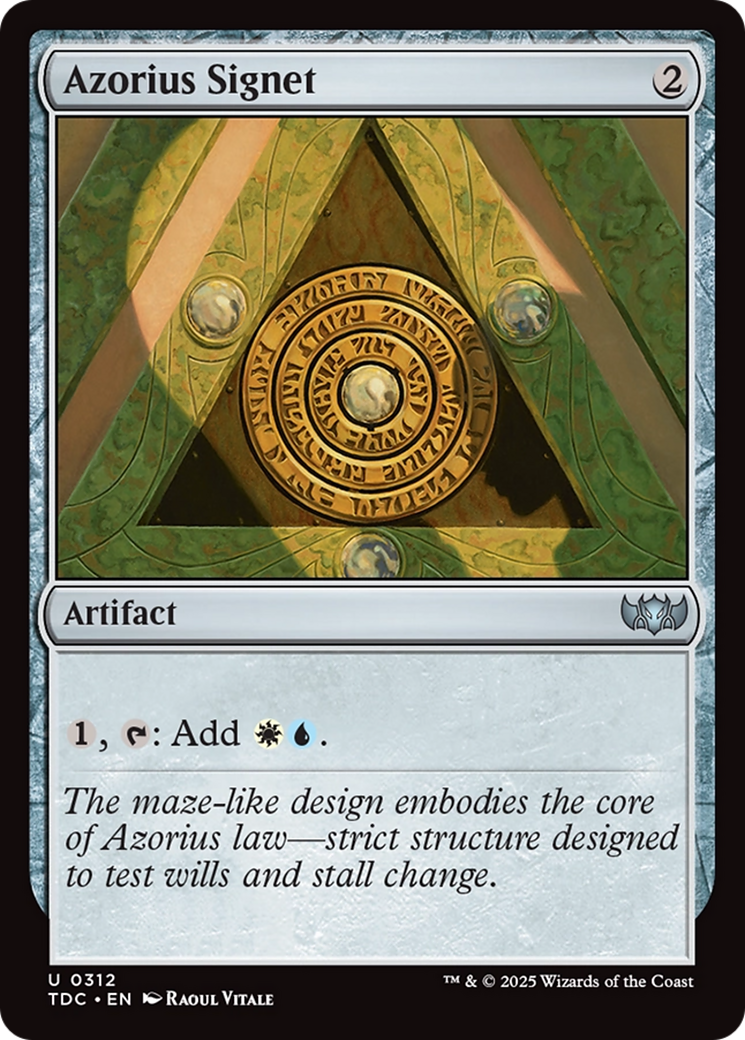
Azorius Signet
Azorius Signet
Artifact
, : Add .
-
1
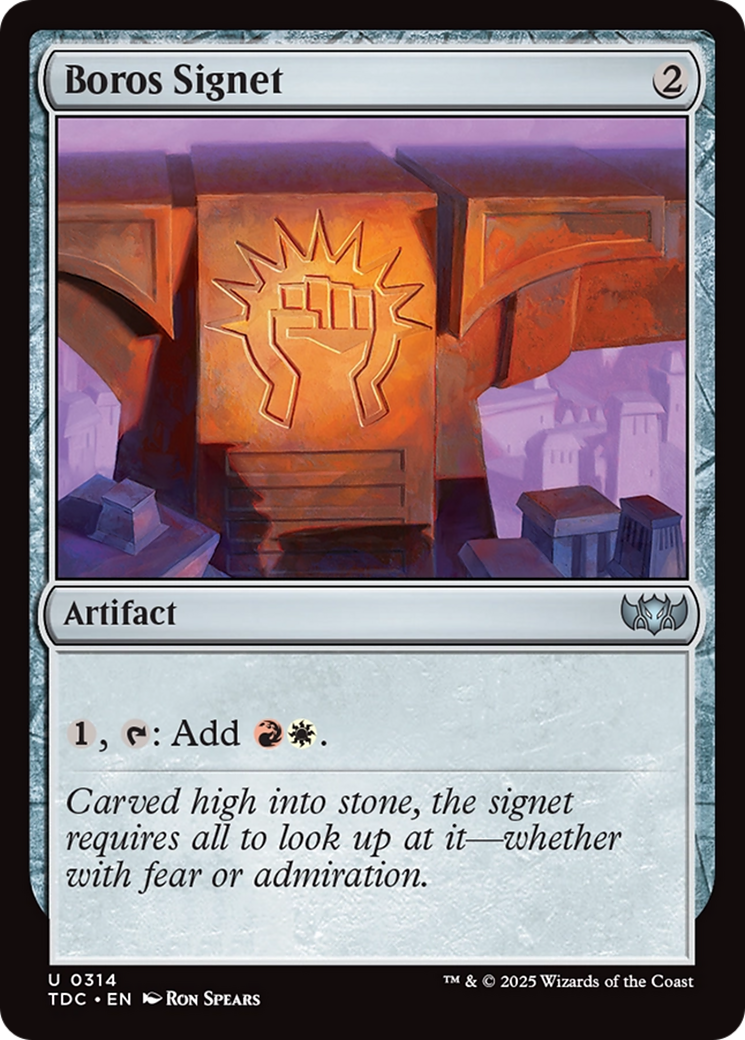
Boros Signet
Boros Signet
Artifact
, : Add .
-
1
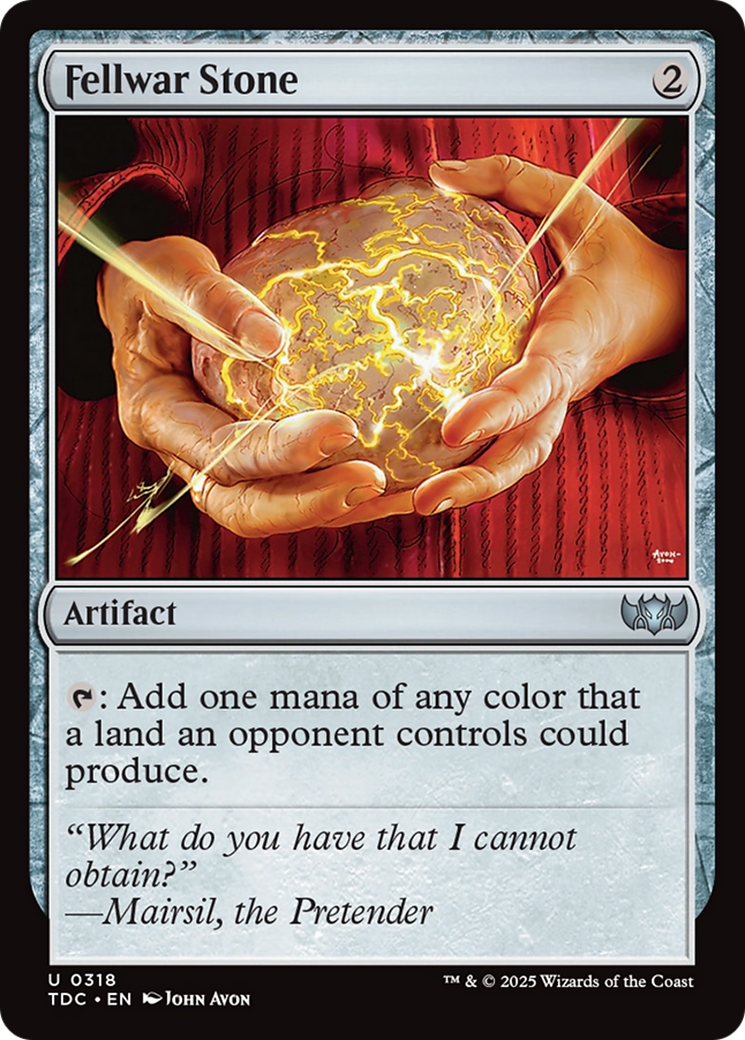
Fellwar Stone
Fellwar Stone
Artifact
: Add one mana of any color that a land an opponent controls could produce.
- The colors of mana are white, blue, black, red, and green. Fellwar Stone can't be tapped for colorless mana, even if a land an opponent controls could produce colorless mana.
- Fellwar Stone checks the effects of all mana-producing abilities of lands your opponents control, but it doesn't check their costs. For example, Vivid Crag has the ability " , Remove a charge counter from Vivid Crag: Add one mana of any color." If an opponent controls Vivid Crag and you control Fellwar Stone, you can tap Fellwar Stone for any color of mana. It doesn't matter whether Vivid Crag has a charge counter on it, and it doesn't matter whether it's untapped.
- When determining what colors of mana your opponents' lands could produce, take into account any applicable replacement effects that would apply to those lands' mana abilities (such as Contamination's effect, for example). If there is more than one, consider them in any possible order.
- Fellwar Stone doesn't care about any restrictions or riders your opponents' lands (such as Ancient Ziggurat or Hall of the Bandit Lord) put on the mana they produce. It just cares about colors of mana.
- This works even if the opponent's lands are tapped. It only checks what kinds of mana can be produced, not if the abilities that produce them are usable right now.
- The ability can be activated if the opponent has no lands that produce mana, but the effect will not be able to generate any mana.
- It only produces one mana even if the land can produce more than one.
-
1
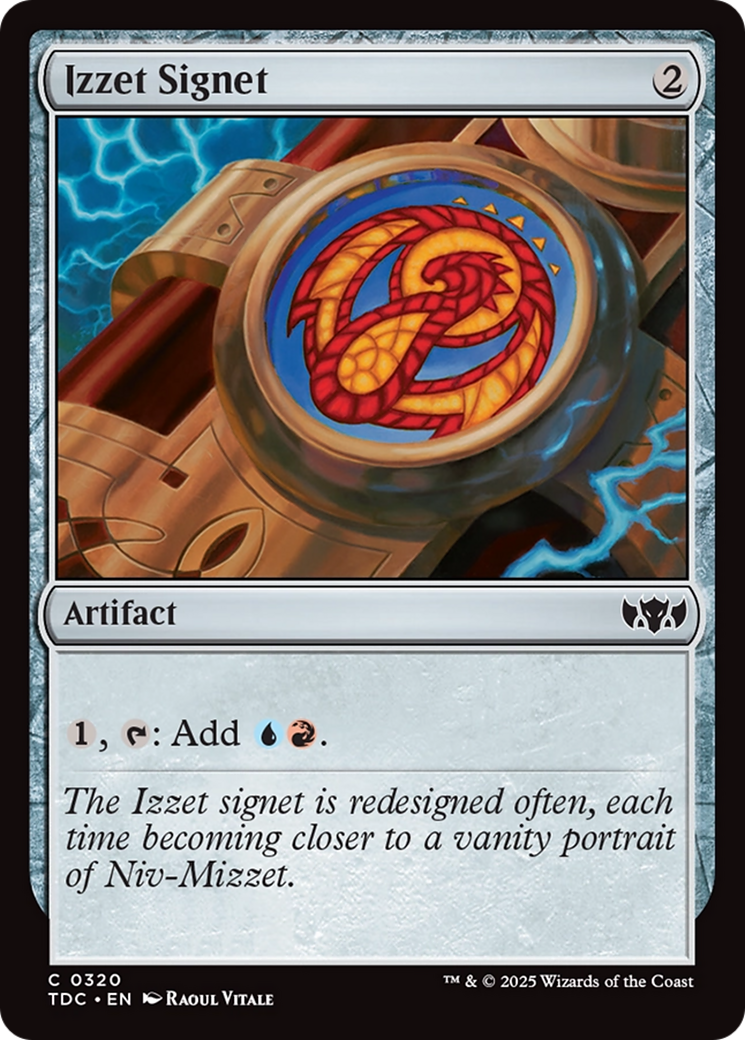
Izzet Signet
Izzet Signet
Artifact
, : Add .
-
1
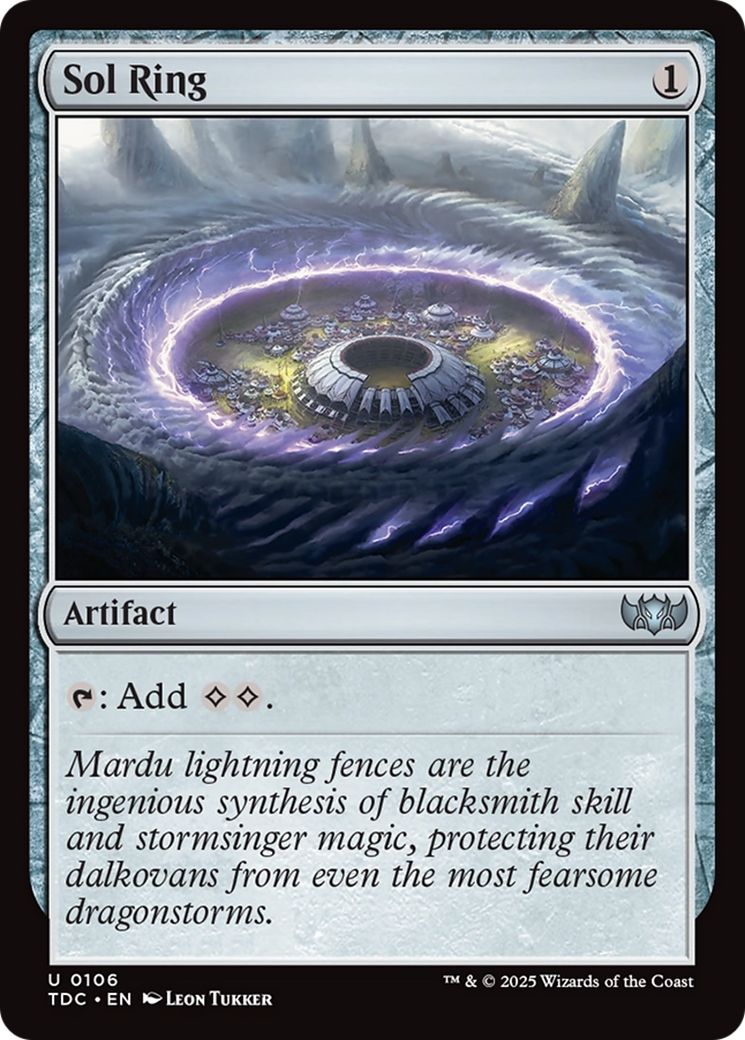
Sol Ring
Sol Ring
Artifact
: Add .
-
1
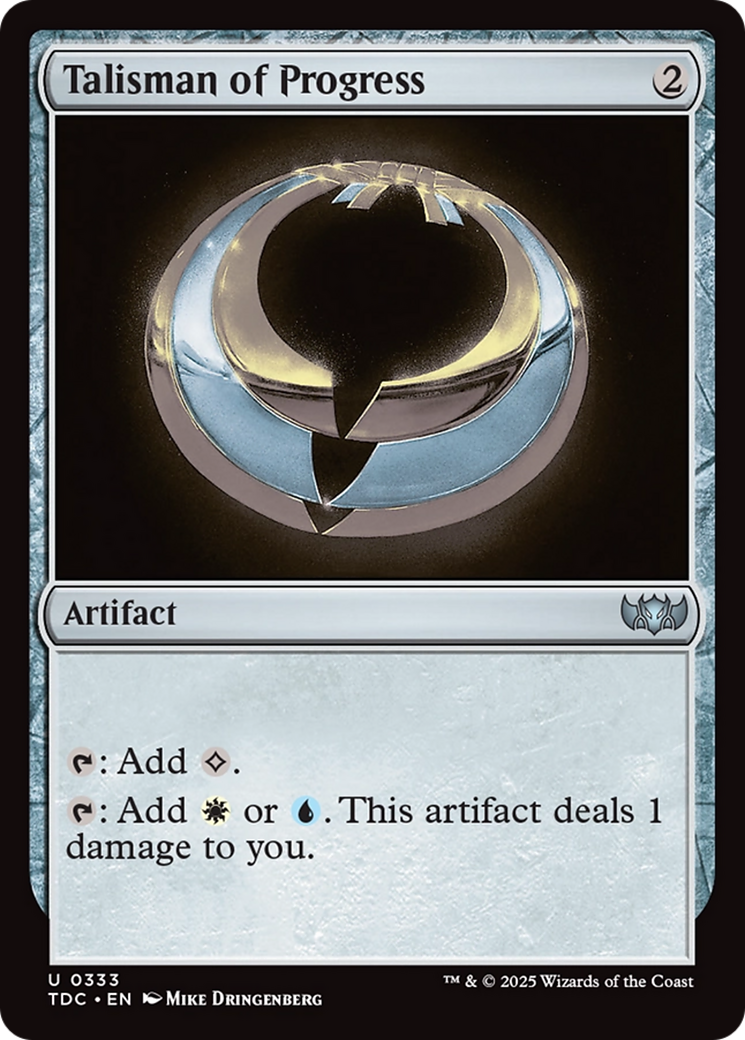
Talisman of Progress
Talisman of Progress
Artifact
: Add .
: Add or . This artifact deals 1 damage to you.
Enchantments 6
-
1
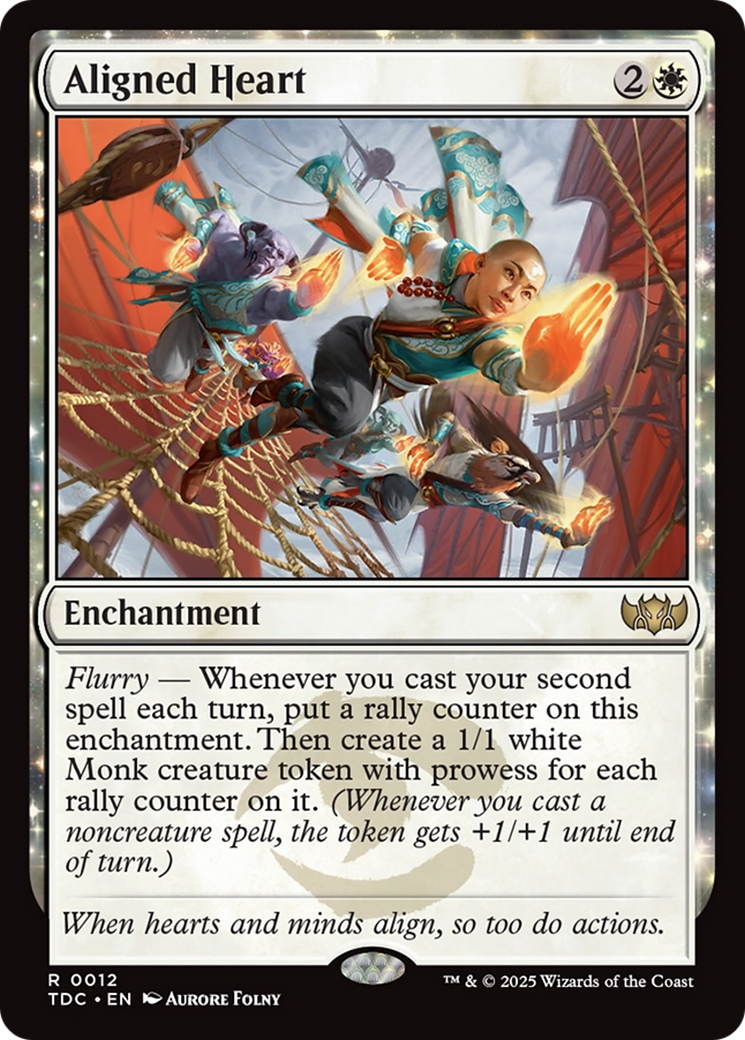
Aligned Heart
Aligned Heart
Enchantment
Flurry — Whenever you cast your second spell each turn, put a rally counter on this enchantment. Then create a 1/1 white Monk creature token with prowess for each rally counter on it. (Whenever you cast a noncreature spell, the token gets +1/+1 until end of turn.)
- Spells that were cast before a permanent with flurry count. If that permanent was the first spell you cast that turn, the next spell you cast that turn is your second spell.
-
1
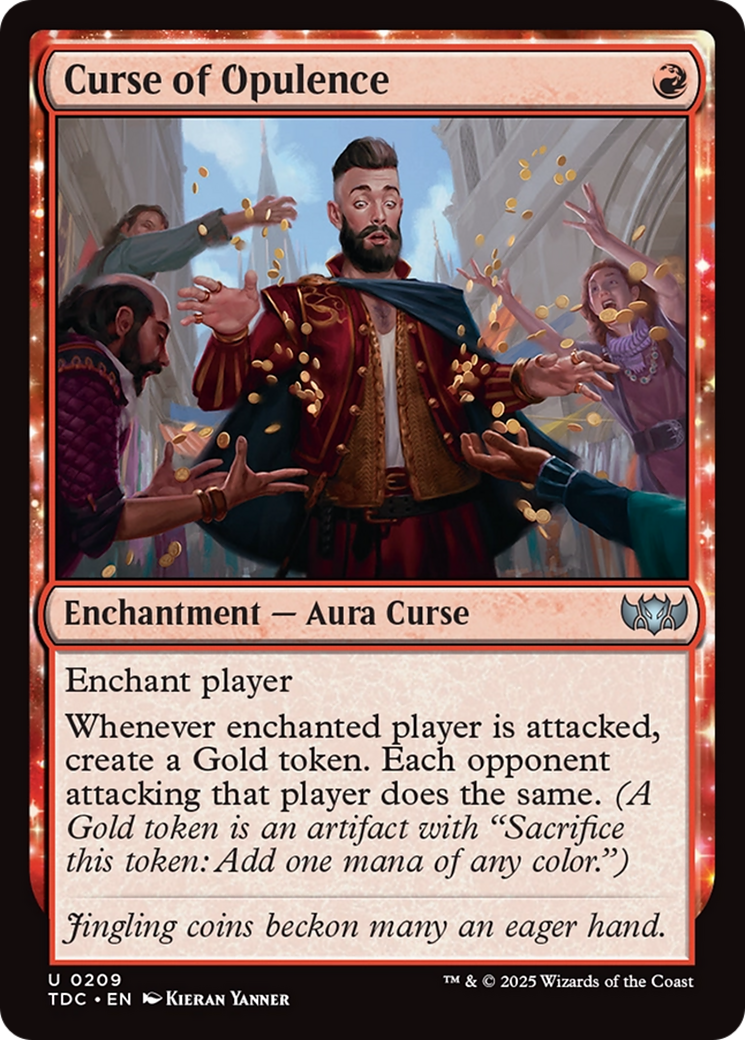
Curse of Opulence
Curse of Opulence
Enchantment — Aura Curse
Enchant player
Whenever enchanted player is attacked, create a Gold token. Each opponent attacking that player does the same. (A Gold token is an artifact with "Sacrifice this token: Add one mana of any color.")
- Curse of Opulence's triggered ability resolves after attackers have been declared. Any costs to attack must have already been paid before the attacking player creates the Gold.
- Each Curse's ability triggers only once, no matter how many creatures are attacking the enchanted player.
- A player is attacking another player if they control a creature that's attacking that player. If no creatures are attacking the enchanted player as a Curse's ability resolves (most likely because they've left the battlefield), only the Curse's controller performs its actions.
- The triggered ability of these Curses won't trigger if only a planeswalker controlled by the enchanted player is attacked.
- If you enchant yourself with one of these Curses, you'll get its effects whenever another player attacks you.
-
1
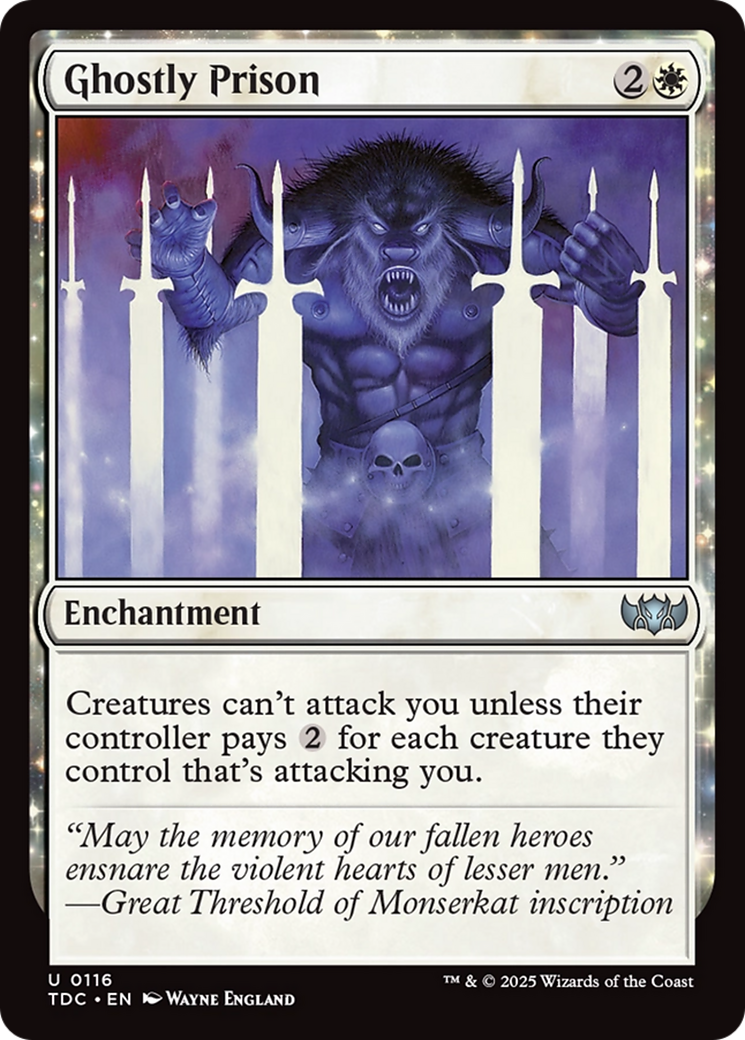
Ghostly Prison
Ghostly Prison
Enchantment
Creatures can't attack you unless their controller pays for each creature they control that's attacking you.
- Unless some effect explicitly says otherwise, a creature that can't attack you can still attack a planeswalker you control.
- In the Two-Headed Giant format, you still only have to pay once per creature.
-
1
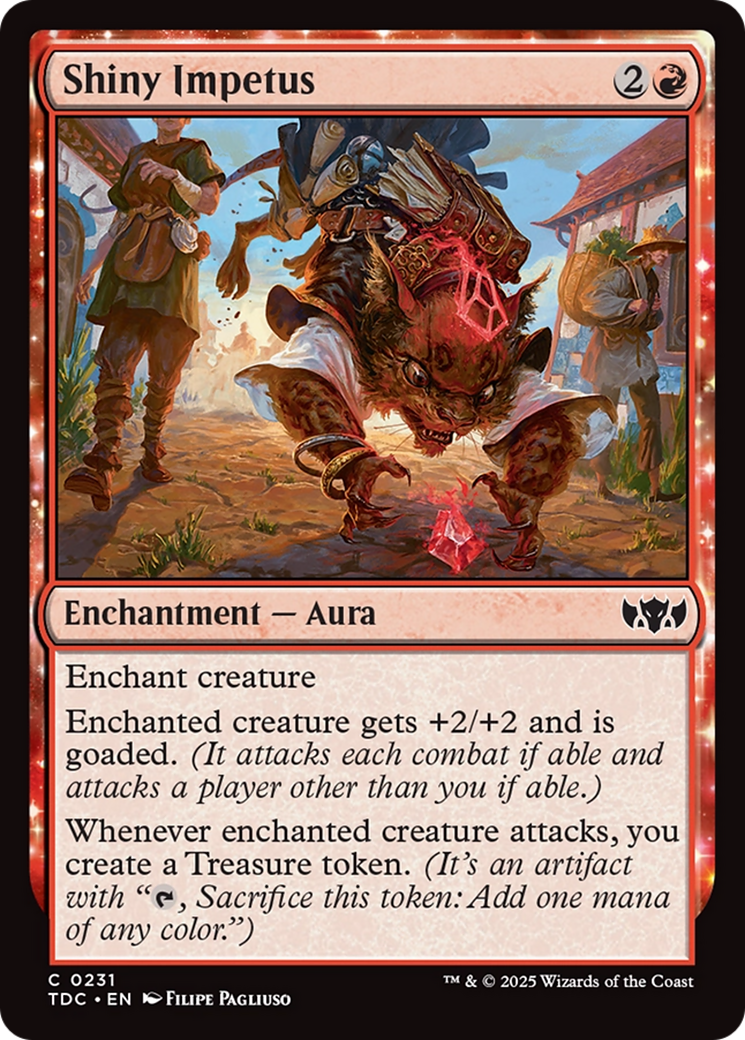
Shiny Impetus
Shiny Impetus
Enchantment — Aura
Enchant creature
Enchanted creature gets +2/+2 and is goaded. (It attacks each combat if able and attacks a player other than you if able.)
Whenever enchanted creature attacks, you create a Treasure token. (It's an artifact with " , Sacrifice this token: Add one mana of any color.")
- If, during a player's declare attackers step, a creature that player controls that's been goaded is tapped, is affected by a spell or ability that says it can't attack, or hasn't been under that player's control continuously since the turn began (and doesn't have haste), then it doesn't attack. If there's a cost associated with having a creature attack a player, its controller isn't forced to pay that cost, so it doesn't have to attack that player.
- If the creature doesn't meet any of the above exceptions and can attack, it must attack a player other than the controller of the spell or ability that goaded it if able. If the creature can't attack any of those players but could otherwise attack, it must attack a planeswalker an opponent controls, a battle an opponent controls, or a player who goaded it.
- Being goaded isn't an ability the creature has. Once it's been goaded, it must attack as detailed above even if it loses all abilities.
- Attacking with a goaded creature doesn't cause it to stop being goaded. If there is an additional combat phase that turn, or if another player gains control of it before it stops being goaded, it must attack again if able.
- If a creature you control has been goaded by multiple opponents, it must attack one of your opponents that hasn't goaded it, as that fulfills the maximum number of goad requirements. If a creature you control has been goaded by each of your opponents, the creature must attack an opponent (rather than a planeswalker or battle), but you choose which opponent it attacks.
- Shiny Impetus causes you to create a Treasure token, not the attacking creature's controller.
-
1
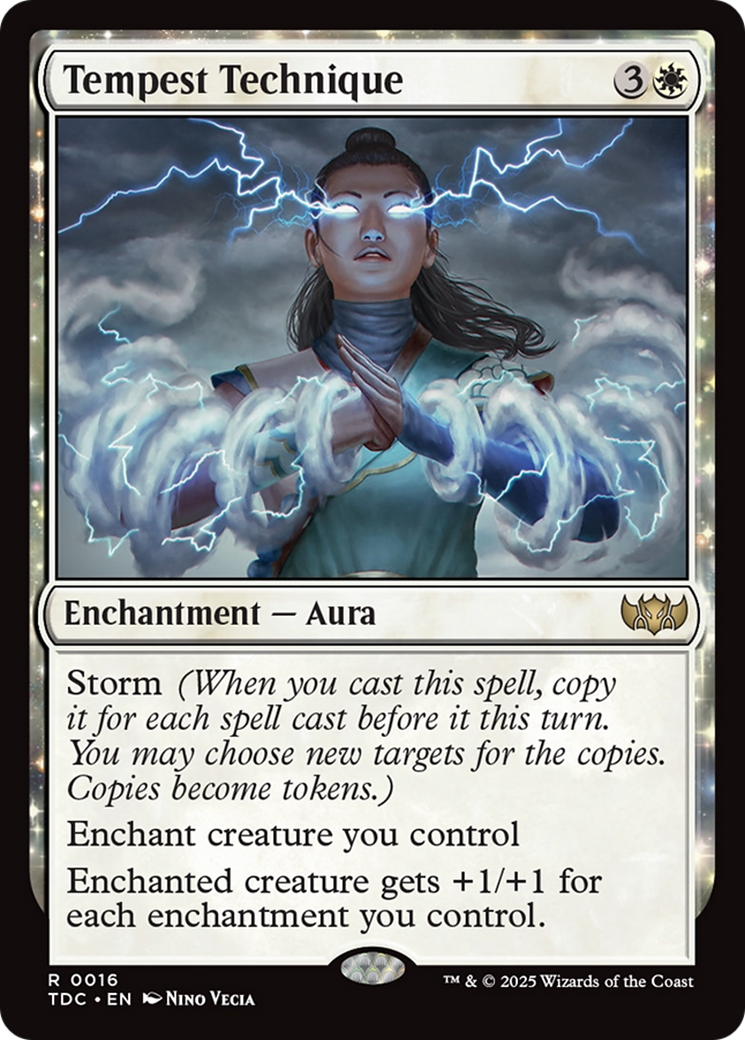
Tempest Technique
Tempest Technique
Enchantment — Aura
Storm (When you cast this spell, copy it for each spell cast before it this turn. You may choose new targets for the copies. Copies become tokens.)
Enchant creature you control
Enchanted creature gets +1/+1 for each enchantment you control.
- The copies are put directly onto the stack. They aren’t cast and won’t be counted by other spells with storm cast later in the turn.
- Spells cast from zones other than a player’s hand and spells that were countered or otherwise failed to resolve are counted by the storm ability.
- A copy of a spell can be countered like any other spell, but it must be countered individually. Countering a spell with storm won’t affect the copies.
- The triggered ability that creates the copies can itself be countered by anything that can counter a triggered ability. If it is countered, no copies will be put onto the stack.
- A resolving copy of a permanent spell becomes a token. That token isn’t “created” and won’t interact with abilities that care about tokens being created.
-
1
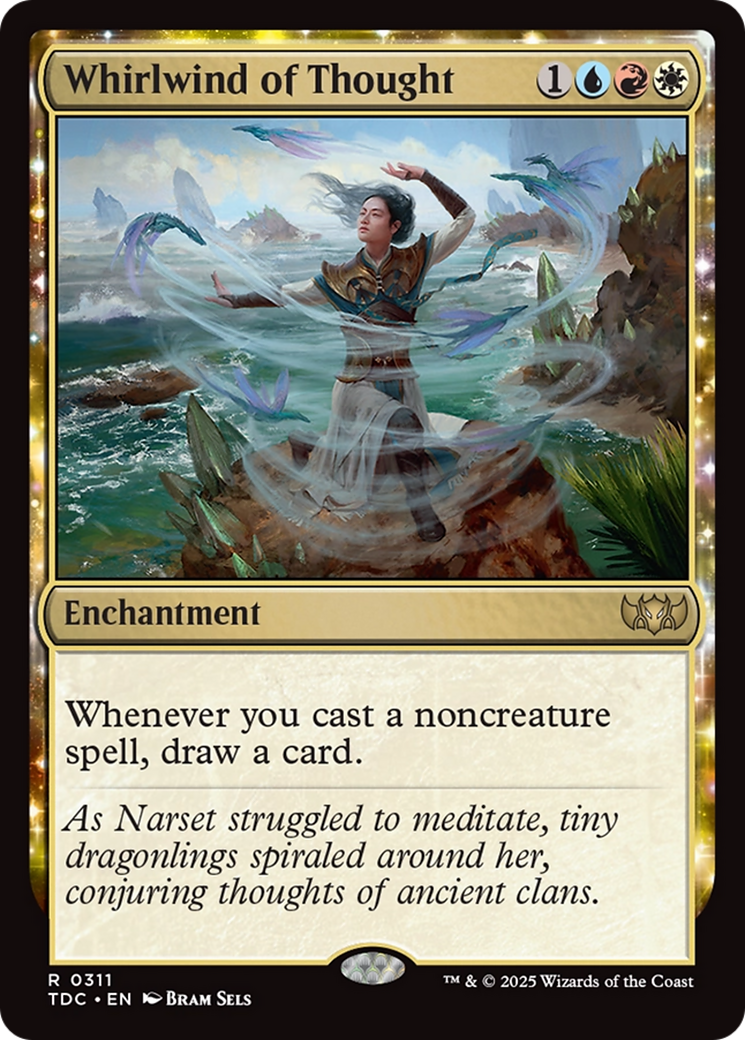
Whirlwind of Thought
Whirlwind of Thought
Enchantment
Whenever you cast a noncreature spell, draw a card.
- An ability that triggers when a player casts a spell resolves before the spell that caused it to trigger. It resolves even if that spell is countered.
- Players can cast spells and activate abilities after the triggered ability resolves but before the spell that caused it to trigger does.
Lands 37
-
1
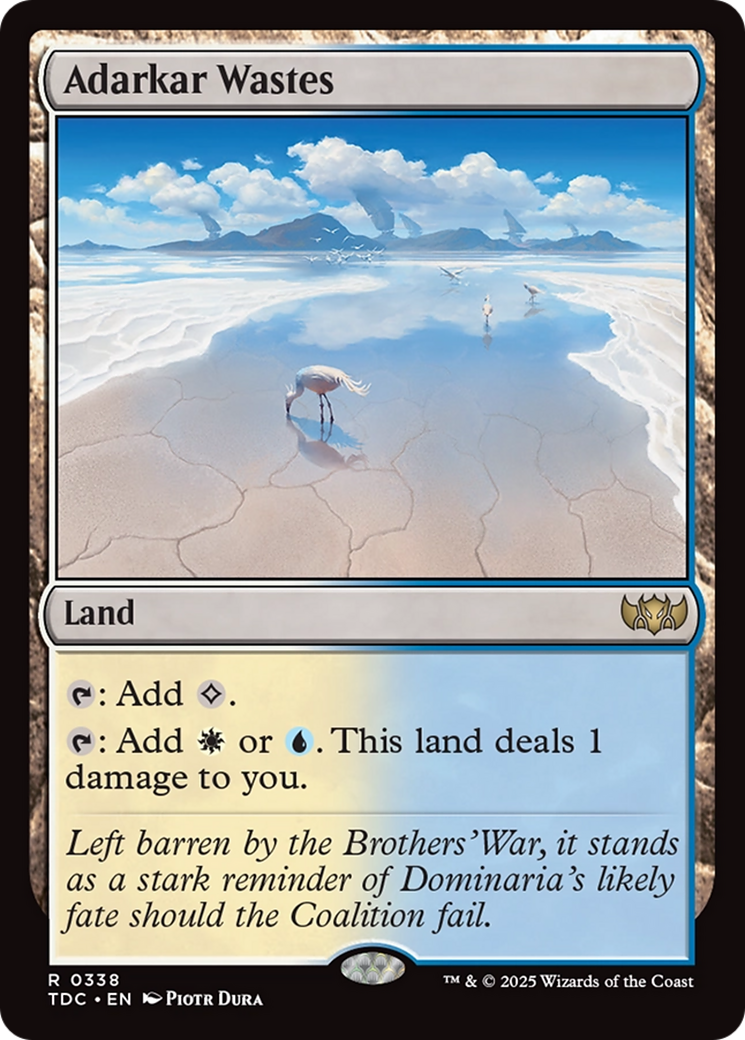
Adarkar Wastes
Adarkar Wastes
Land
: Add .
: Add or . This land deals 1 damage to you.
-
1
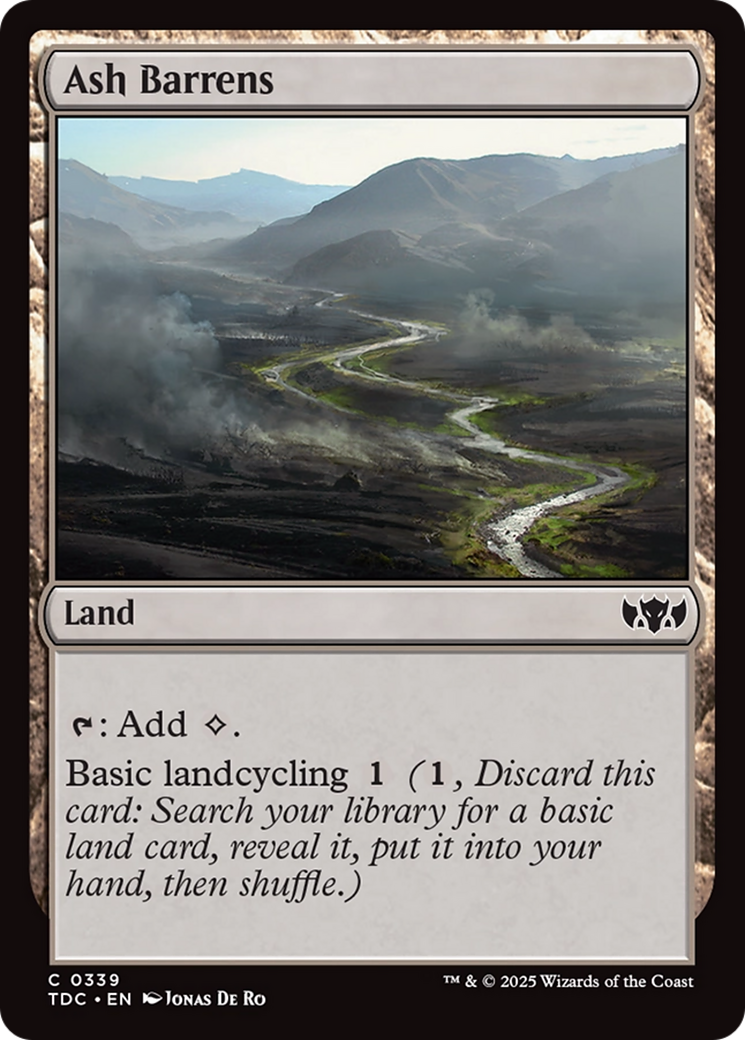
Ash Barrens
Ash Barrens
Land
: Add .
Basic landcycling ( , Discard this card: Search your library for a basic land card, reveal it, put it into your hand, then shuffle.)
-
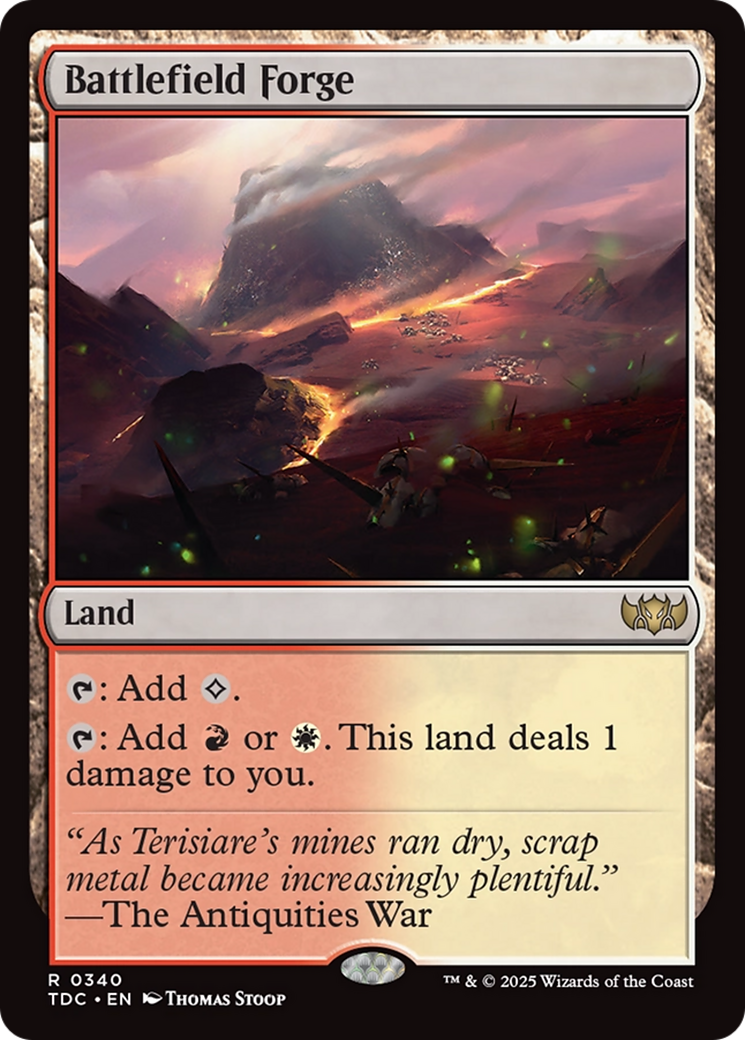
1
Battlefield Forge
Battlefield Forge
Land
: Add .
: Add or . This land deals 1 damage to you.
- The damage dealt to you is part of the second mana ability. It doesn't use the stack and can't be responded to.
- Like most lands, each land in this cycle is colorless. The damage dealt to you is dealt by a colorless source.
-
1
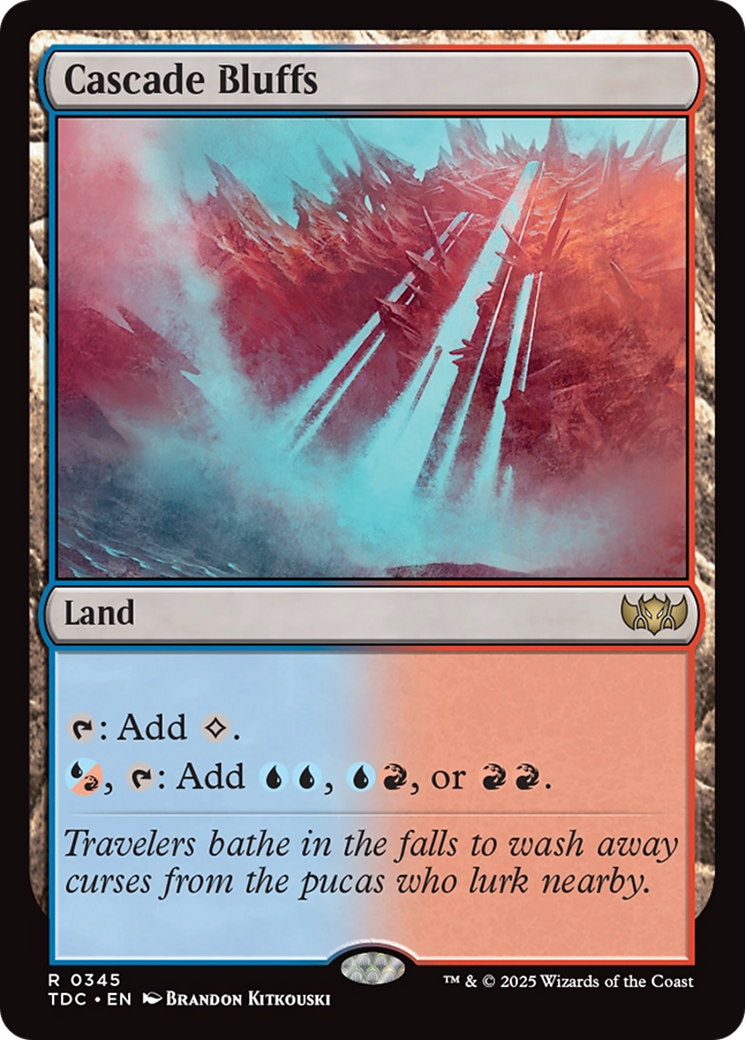
Cascade Bluffs
Cascade Bluffs
Land
: Add .
, : Add , , or .
-
1
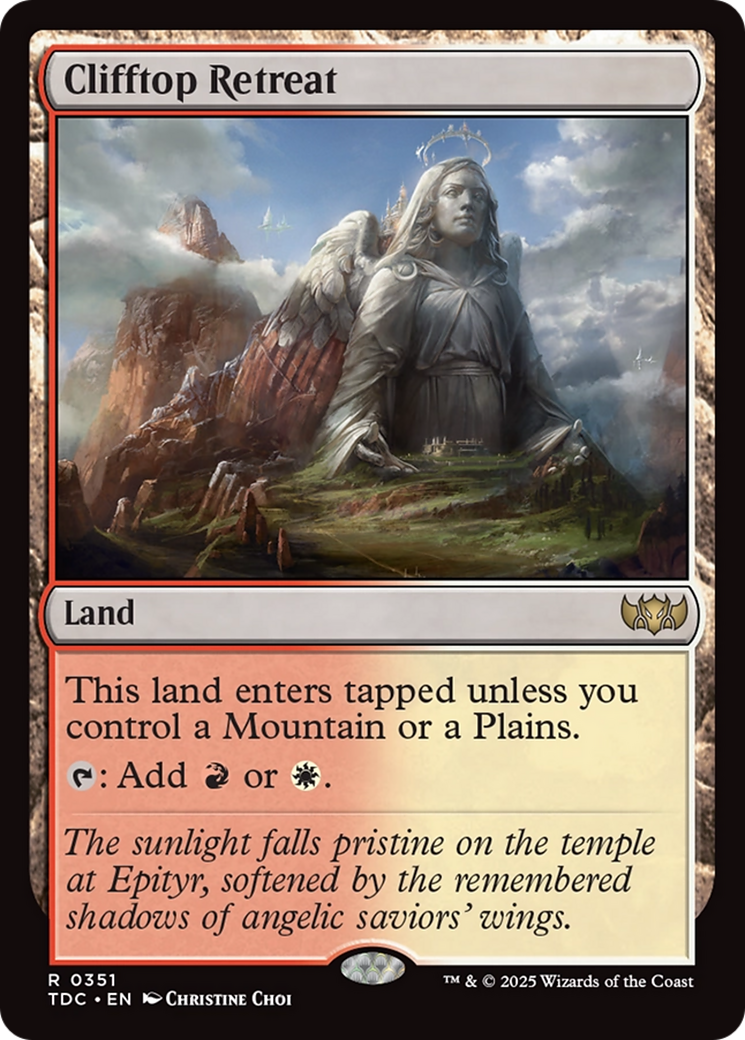
Clifftop Retreat
Clifftop Retreat
Land
This land enters tapped unless you control a Mountain or a Plains.
: Add or .
-
1
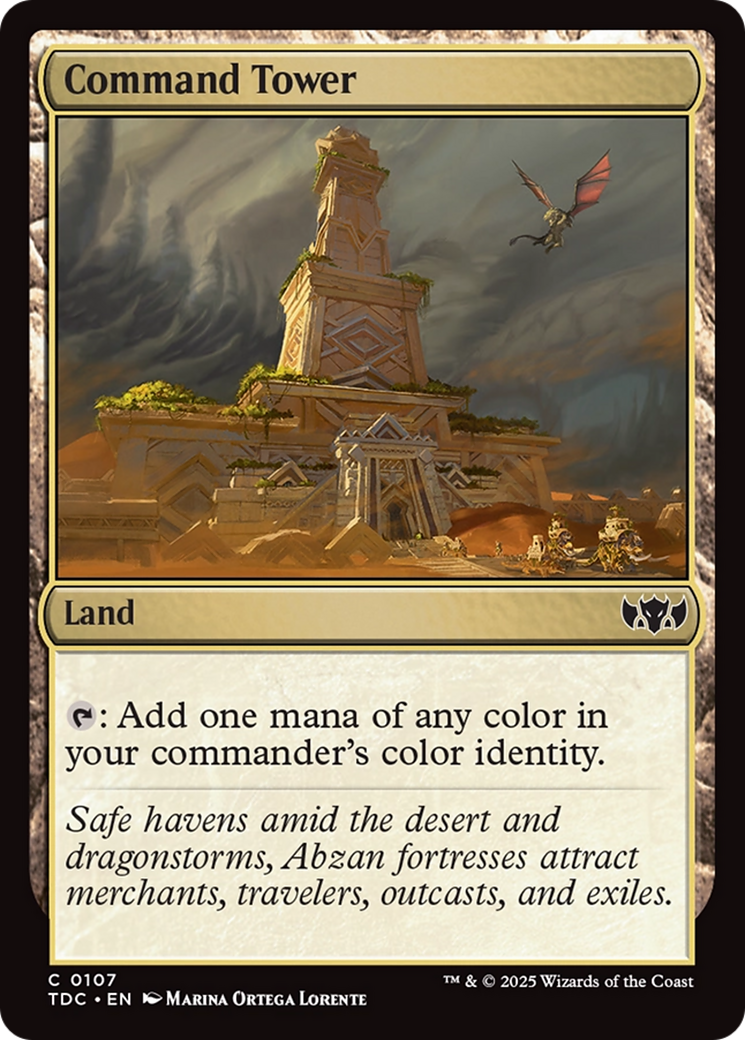
Command Tower
Command Tower
Land
: Add one mana of any color in your commander's color identity.
- If you have two commanders, the ability adds one mana of any color in their combined color identities.
- If your commander is a card that has no colors in its color identity, Command Tower's ability produces no mana. It doesn't produce .
- If you don't have a commander, Command Tower's ability produces no mana.
-
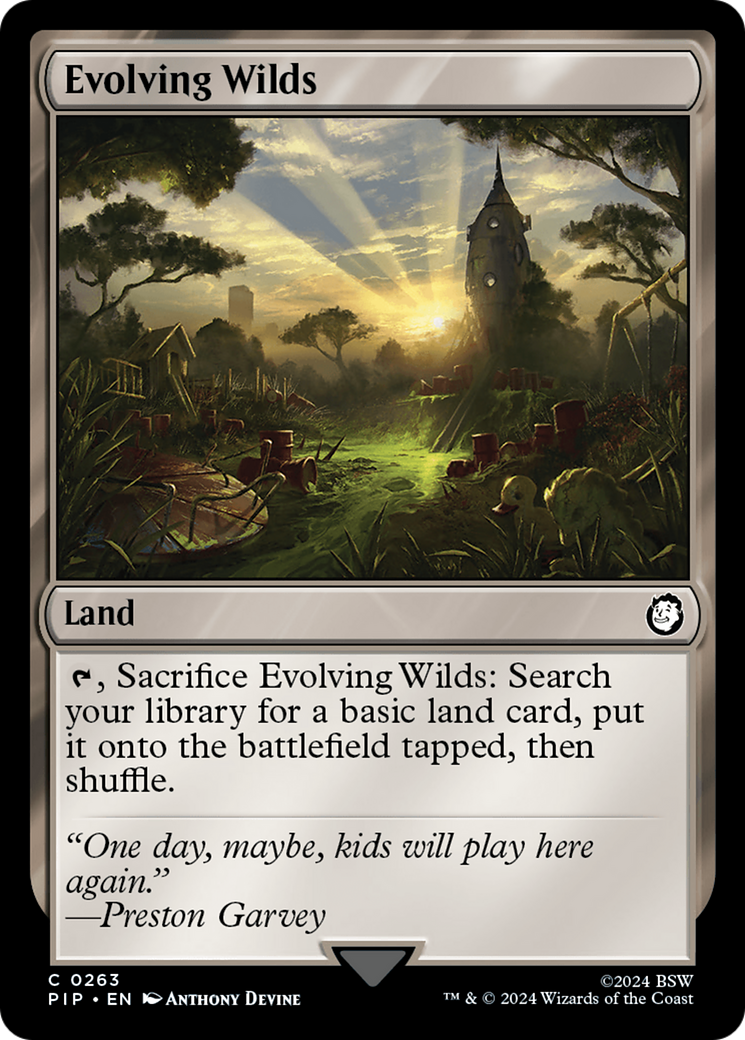
1
Evolving Wilds
Evolving Wilds
Land
, Sacrifice this land: Search your library for a basic land card, put it onto the battlefield tapped, then shuffle.
-
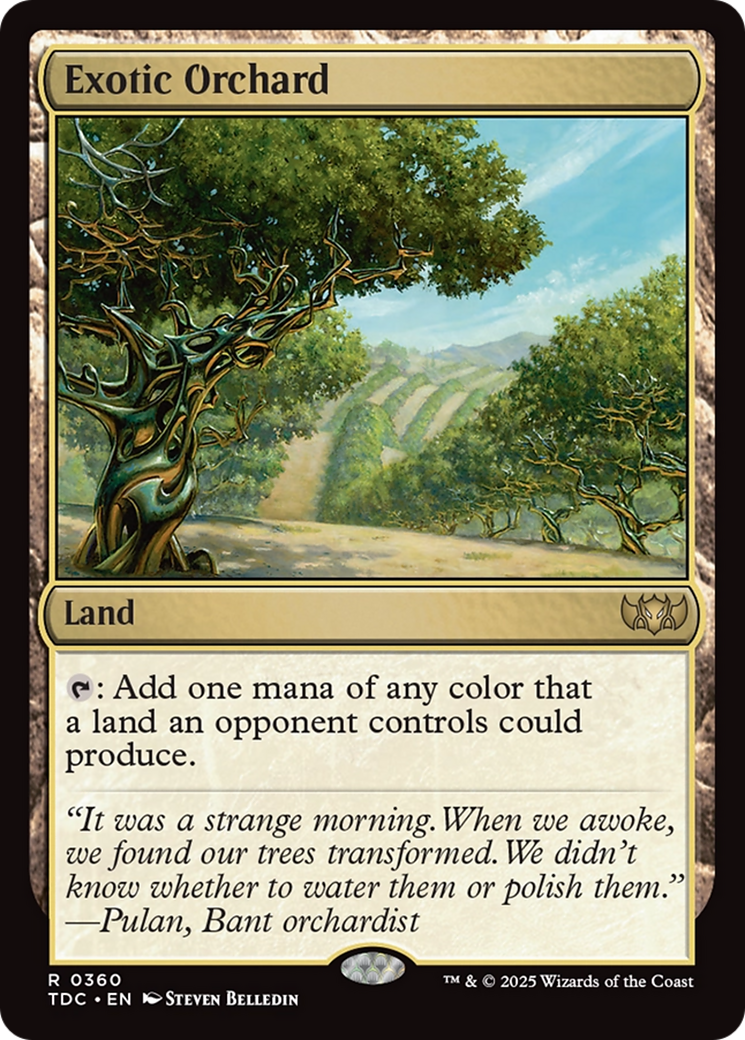
1
Exotic Orchard
Exotic Orchard
Land
: Add one mana of any color that a land an opponent controls could produce.
- The colors of mana are white, blue, black, red, and green. Exotic Orchard can't be tapped for colorless mana, even if a land an opponent controls could produce colorless mana.
- Exotic Orchard checks the effects of all mana-producing abilities of lands your opponents control, but it doesn't check their costs. For example, Vivid Crag has the ability " , Remove a charge counter from Vivid Crag: Add one mana of any color." If an opponent controls Vivid Crag and you control Exotic Orchard, you can tap Exotic Orchard for any color of mana. It doesn't matter whether Vivid Crag has a charge counter on it, and it doesn't matter whether it's untapped.
- When determining what colors of mana your opponents' lands could produce, Exotic Orchard takes into account any applicable replacement effects that would apply to those lands' mana abilities (such as Contamination's effect, for example). If there are more than one, consider them in any possible order.
- Exotic Orchard doesn't care about any restrictions or riders your opponents' lands (such as Ancient Ziggurat or Hall of the Bandit Lord) put on the mana they produce. It just cares about colors of mana.
- Lands that produce mana based only on what other lands "could produce" won't help each other unless some other land allows one of them to actually produce some type of mana. For example, if you control an Exotic Orchard and your opponent controls an Exotic Orchard and a Reflecting Pool, none of those lands would produce mana if their mana abilities were activated. On the other hand, if you control a Forest and an Exotic Orchard, and your opponent controls an Exotic Orchard and a Reflecting Pool, then each of those lands can be tapped to produce . Your opponent's Exotic Orchard can produce because you control a Forest. Your Exotic Orchard and your opponent's Reflecting Pool can each produce because your opponent's Exotic Orchard can produce .
-
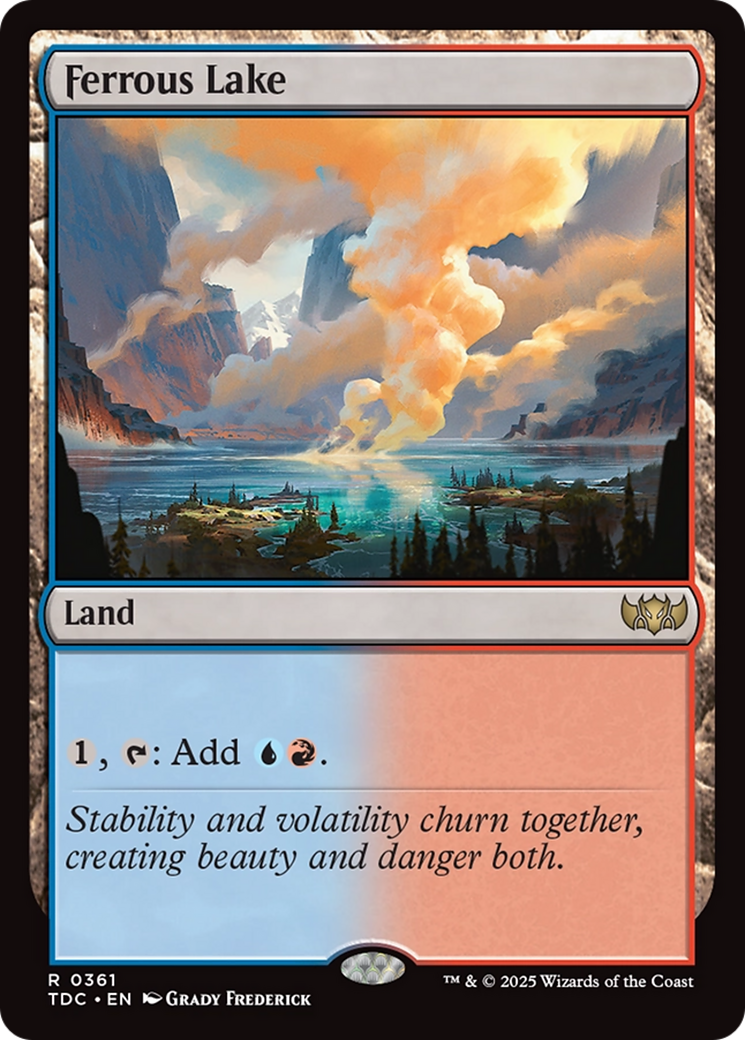
1
Ferrous Lake
Ferrous Lake
Land
, : Add .
-
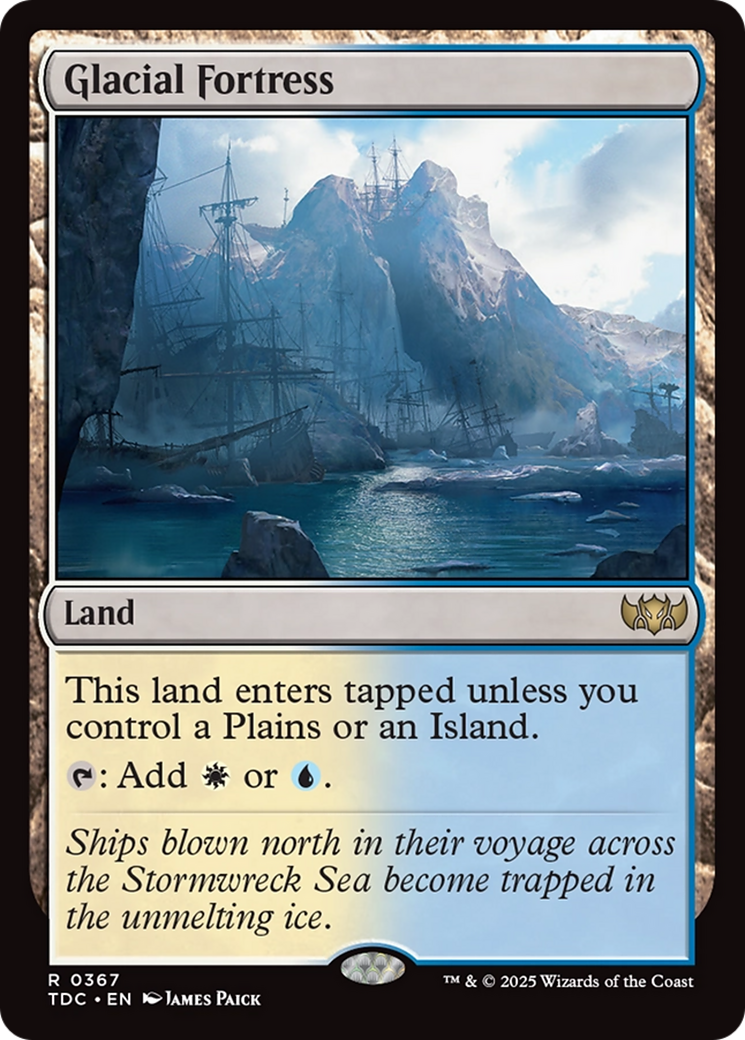
1
Glacial Fortress
Glacial Fortress
Land
This land enters tapped unless you control a Plains or an Island.
: Add or .
- This checks for lands you control with the land type Plains or Island, not for lands named Plains or Island. The lands it checks for don't have to be basic lands. For example, if you control Watery Grave (a nonbasic land with the land types Island and Swamp), Glacial Fortress will enter untapped.
- As this is entering, it checks for lands that are already on the battlefield. It won't see lands that are entering at the same time (due to Warp World, for example).
-
1
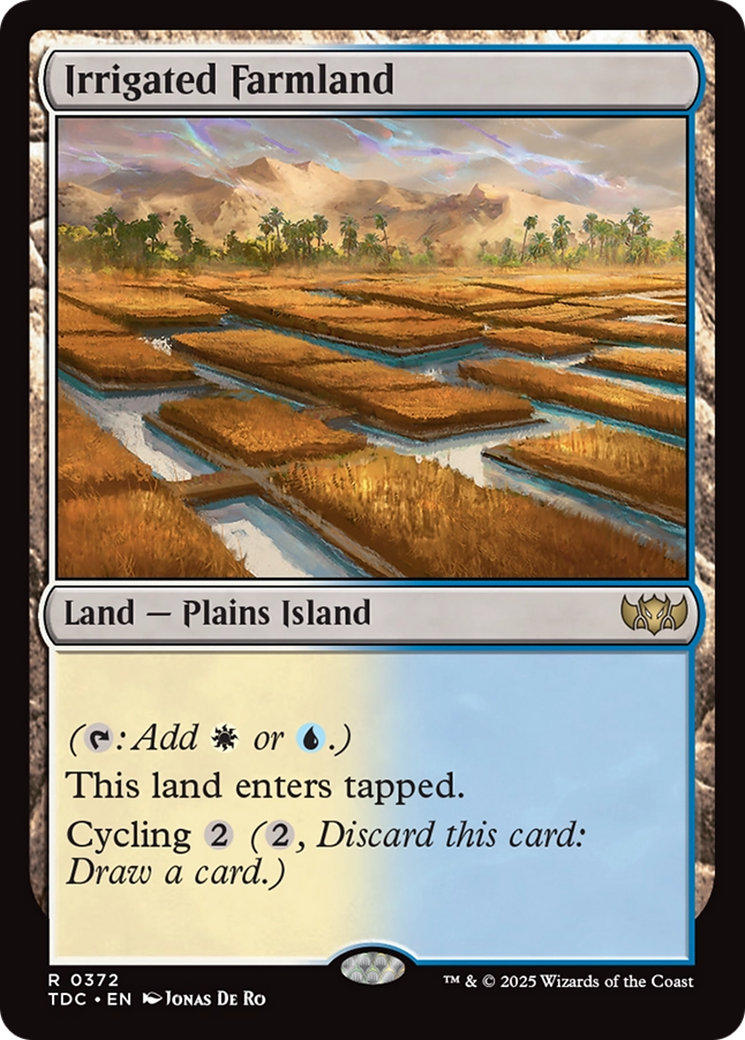
Irrigated Farmland
Irrigated Farmland
Land — Plains Island
( : Add or .)
This land enters tapped.
Cycling ( , Discard this card: Draw a card.)
-
5
Island
Island
Basic Land — Island
( : Add .)
-
5
Mountain
Mountain
Basic Land — Mountain
( : Add .)
-
1
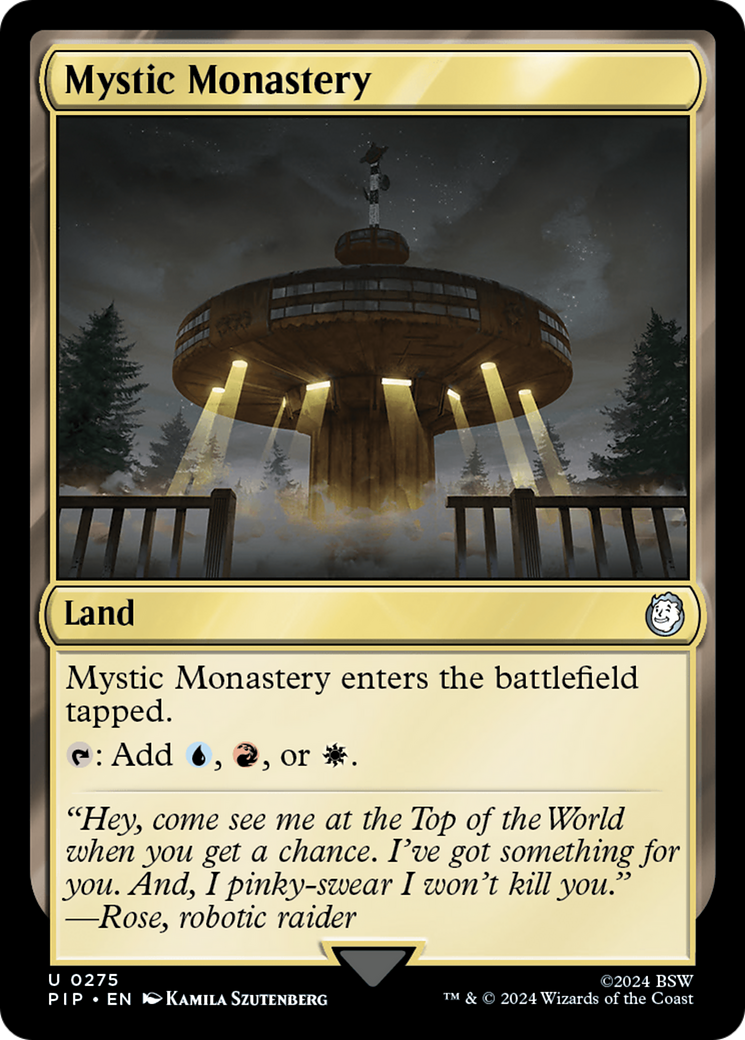
Mystic Monastery
Mystic Monastery
Land
This land enters tapped.
: Add , , or .
-
1
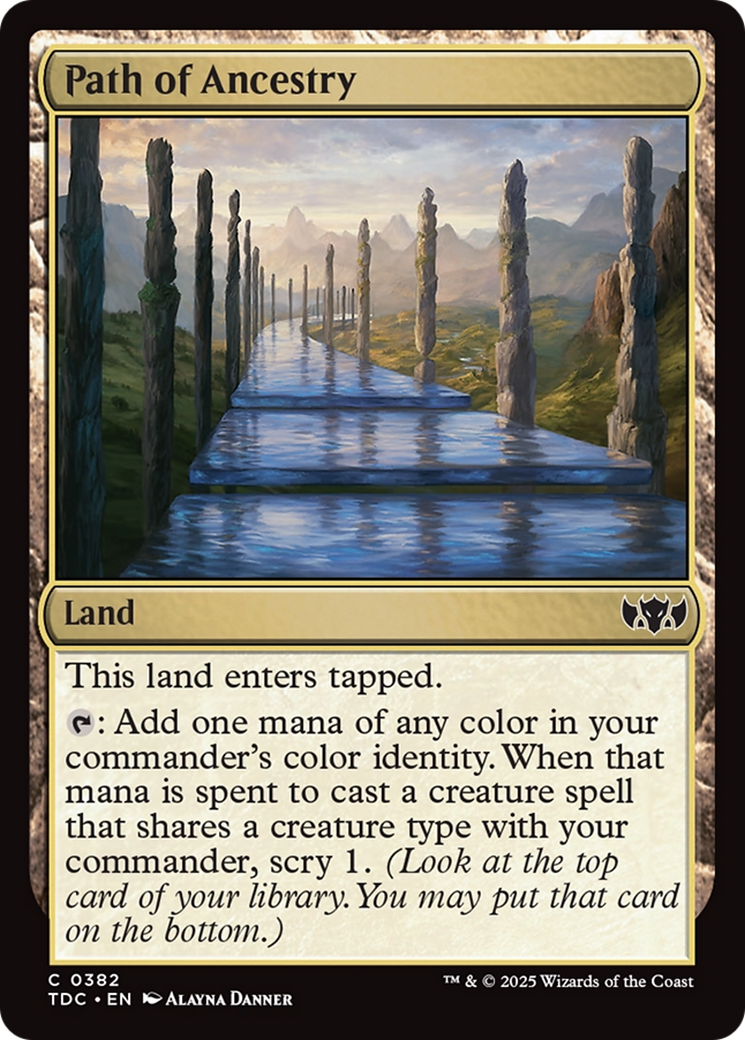
Path of Ancestry
Path of Ancestry
Land
This land enters tapped.
: Add one mana of any color in your commander's color identity. When that mana is spent to cast a creature spell that shares a creature type with your commander, scry 1. (Look at the top card of your library. You may put that card on the bottom.)
- If you have two commanders, the last ability adds one mana of any color in their combined color identities. When you spend that mana on a creature spell that shares a creature type with either of your commanders, you'll scry 1.
- Your commander's creature types are checked immediately after you cast a creature spell spending mana from Path of Ancestry's last ability. They aren't set before the game begins, and they may not be the same types your commander had when you activated that ability.
- If you cast your commander with mana from Path of Ancestry, and your commander hasn't somehow lost all of its creature types while on the stack, you'll scry 1.
- If your commander is a card that has no colors in its color identity, Path of Ancestry's ability produces no mana. It doesn't produce .
- If Path of Ancestry's last ability produces two mana (most likely due to Mana Reflection), spending those two mana to cast creature spells that share a creature type with your commander will cause two abilities to trigger. Each of those abilities will cause you to scry 1. You won't scry 2. This is true whether you spend the mana on one creature spell or two.
- If your commander has no creature types, it can't share a creature type with any spell that you cast.
- If you don't have a commander, Path of Ancestry's ability produces no mana.
-
1
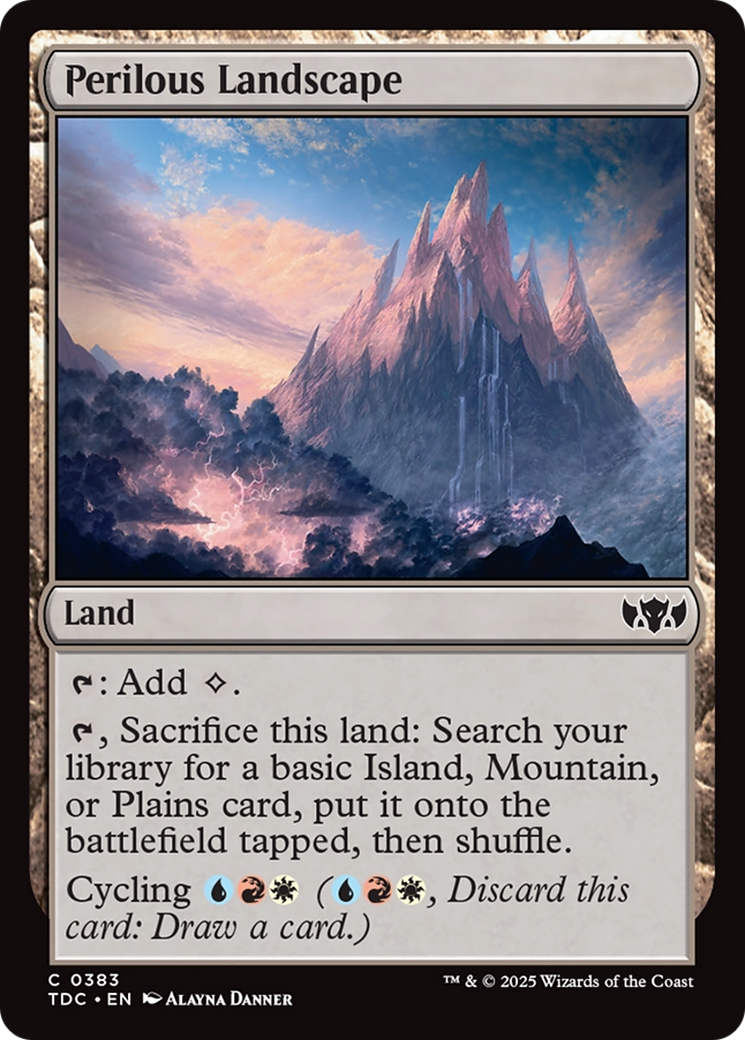
Perilous Landscape
Perilous Landscape
Land
: Add .
, Sacrifice this land: Search your library for a basic Island, Mountain, or Plains card, put it onto the battlefield tapped, then shuffle.
Cycling ( , Discard this card: Draw a card.)
-
4
Plains
Plains
Basic Land — Plains
( : Add .)
-
1
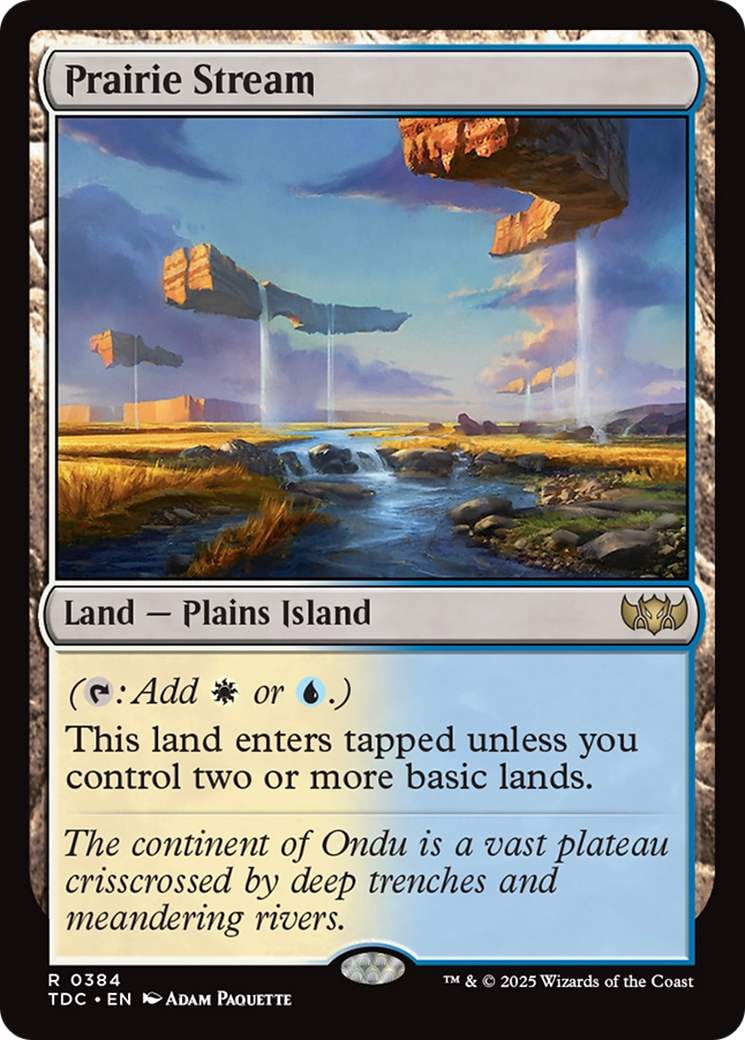
Prairie Stream
Prairie Stream
Land — Plains Island
( : Add or .)
This land enters tapped unless you control two or more basic lands.
- Even though these lands have basic land types, they are not basic lands because "basic" doesn't appear on their type line. Notably, controlling two or more of them won't allow others to enter the battlefield untapped.
- However, because these cards have basic land types, effects that specify a basic land type without also specifying that the land be basic can affect them. For example, a spell or ability that reads "Destroy target Forest" can target Canopy Vista, while one that reads "Destroy target basic Forest" cannot.
- If one of these lands enters the battlefield at the same time as any number of basic lands, those other lands are not counted when determining if this land enters the battlefield tapped or untapped.
-
1
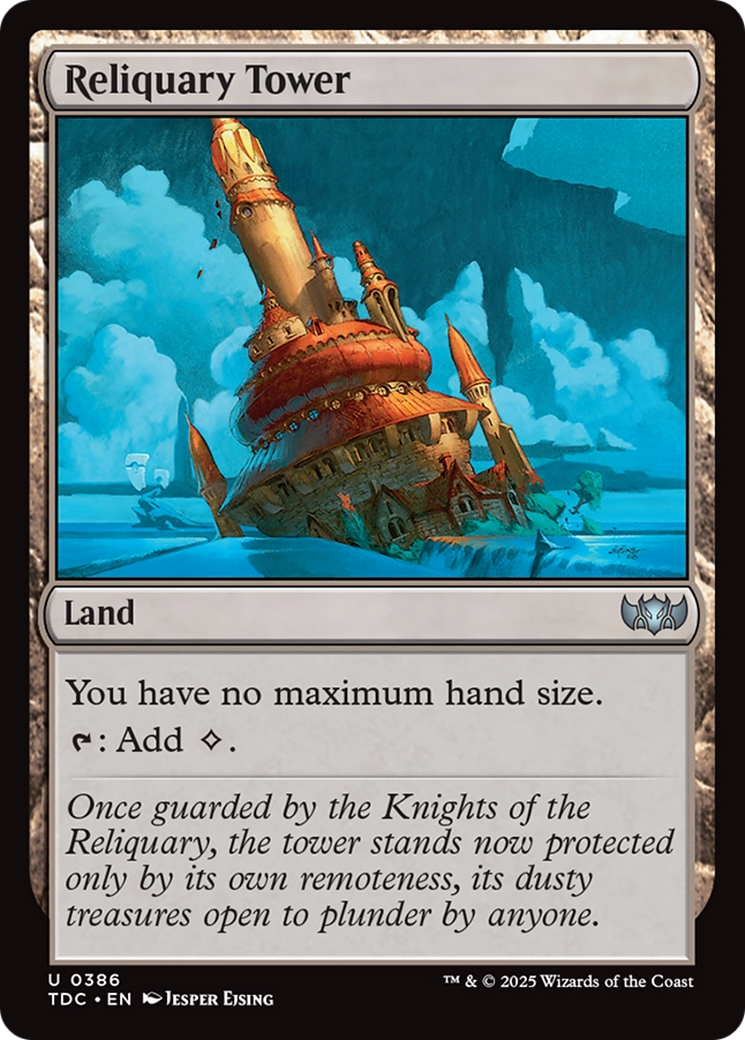
Reliquary Tower
Reliquary Tower
Land
You have no maximum hand size.
: Add .
- If multiple effects modify your hand size, apply them in timestamp order. For example, if you put Null Profusion (an enchantment that says your maximum hand size is two) onto the battlefield and then put Reliquary Tower onto the battlefield, you'll have no maximum hand size. However, if those permanents enter in the opposite order, your maximum hand size would be two.
-
1
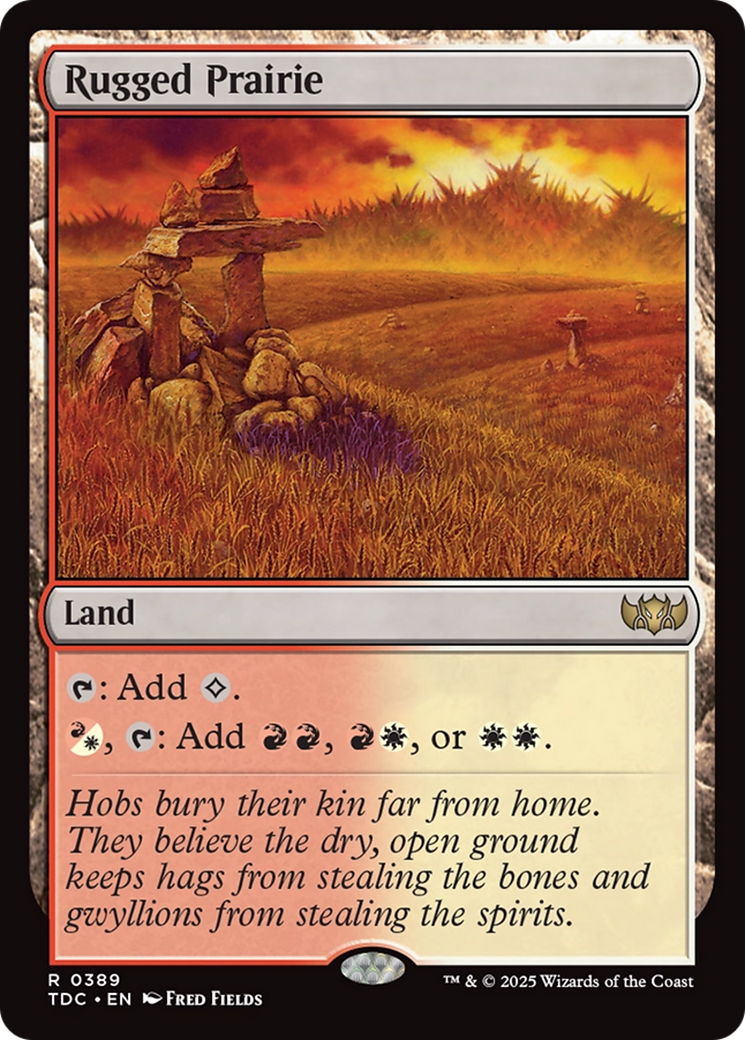
Rugged Prairie
Rugged Prairie
Land
: Add .
, : Add , , or .
-
1
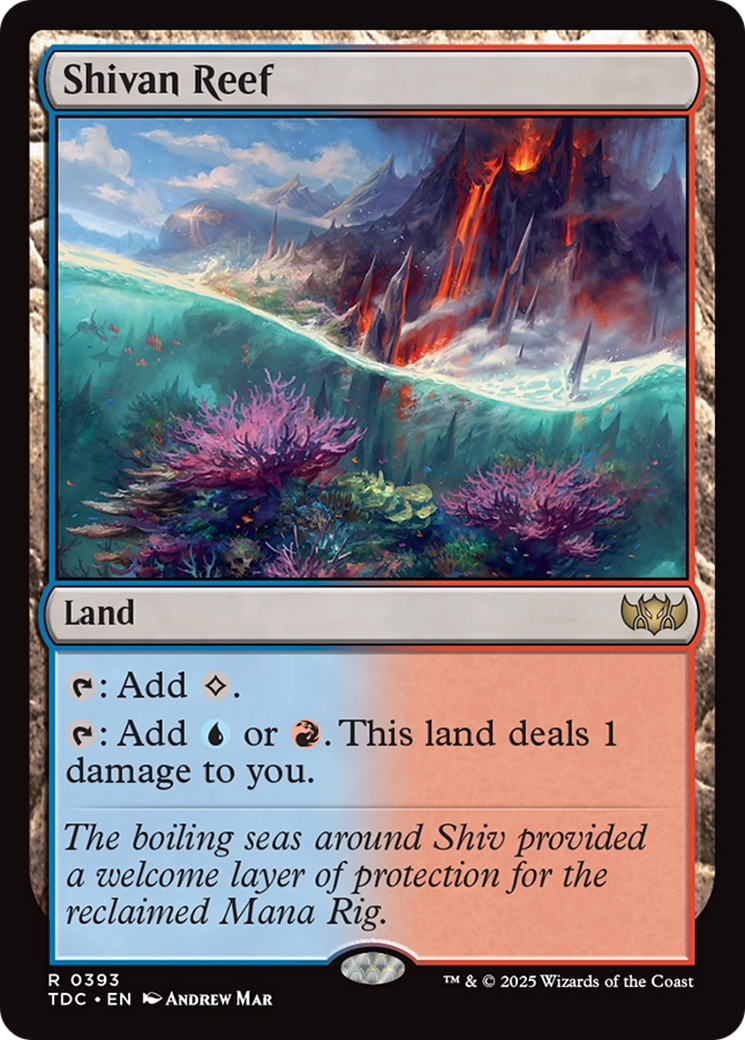
Shivan Reef
Shivan Reef
Land
: Add .
: Add or . This land deals 1 damage to you.
- The damage dealt to you is part of the second mana ability. It doesn't use the stack and can't be responded to.
- Like most lands, each land in this cycle is colorless. The damage dealt to you is dealt by a colorless source.
-
1
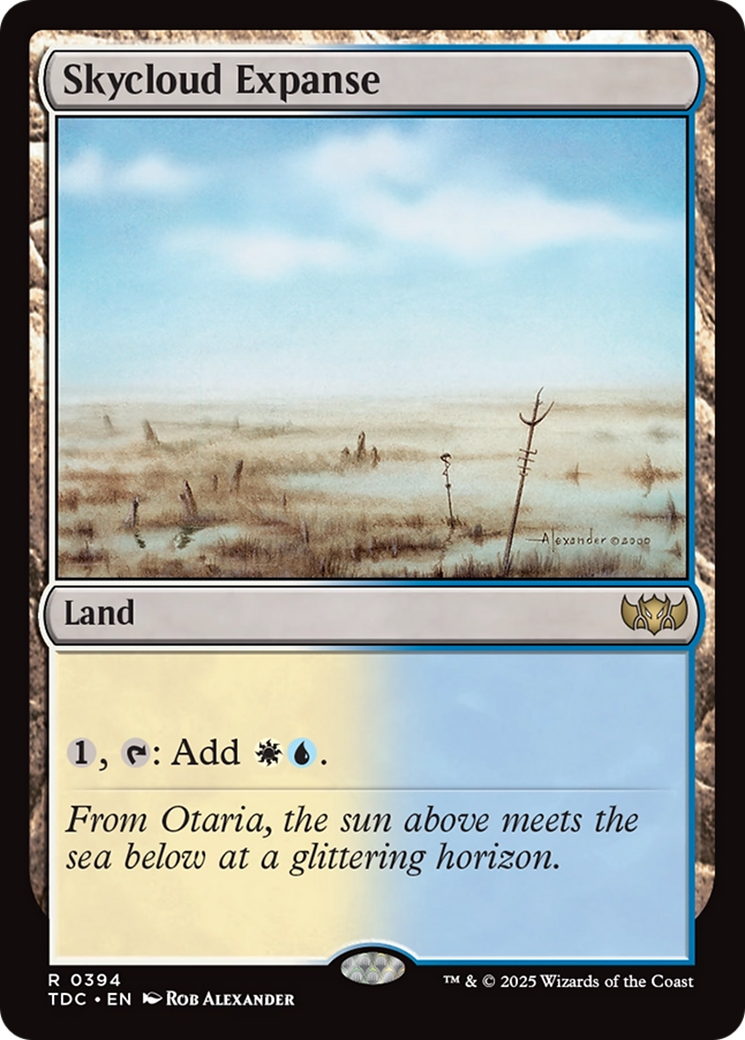
Skycloud Expanse
Skycloud Expanse
Land
, : Add .
-
1
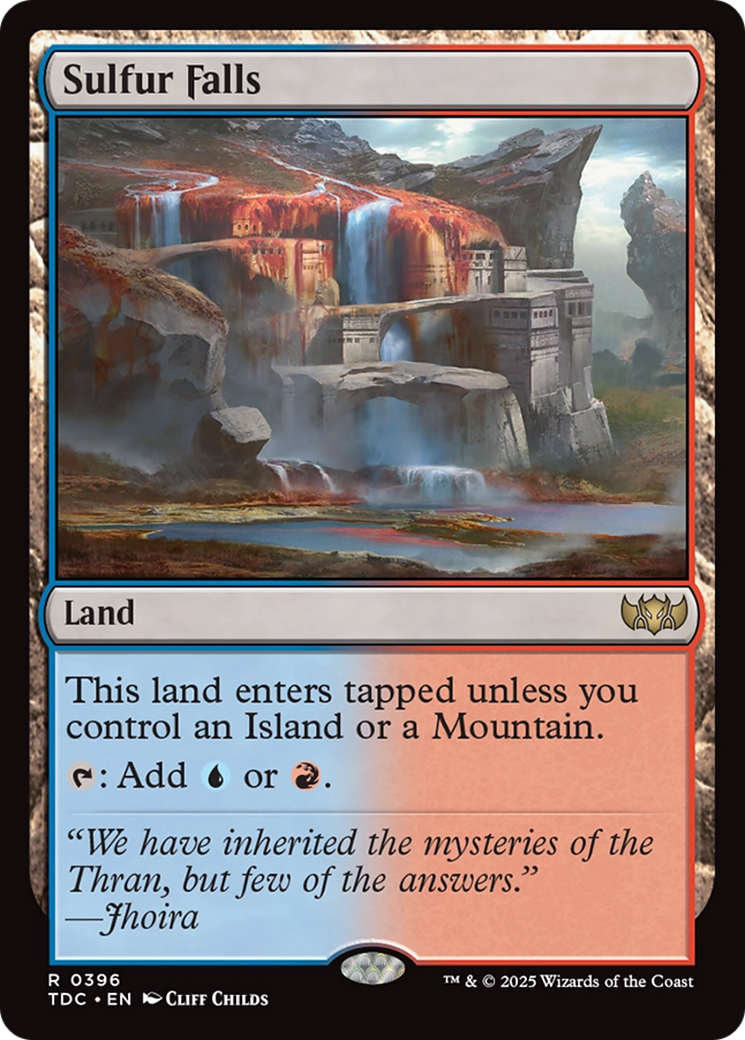
Sulfur Falls
Sulfur Falls
Land
This land enters tapped unless you control an Island or a Mountain.
: Add or .
-
1
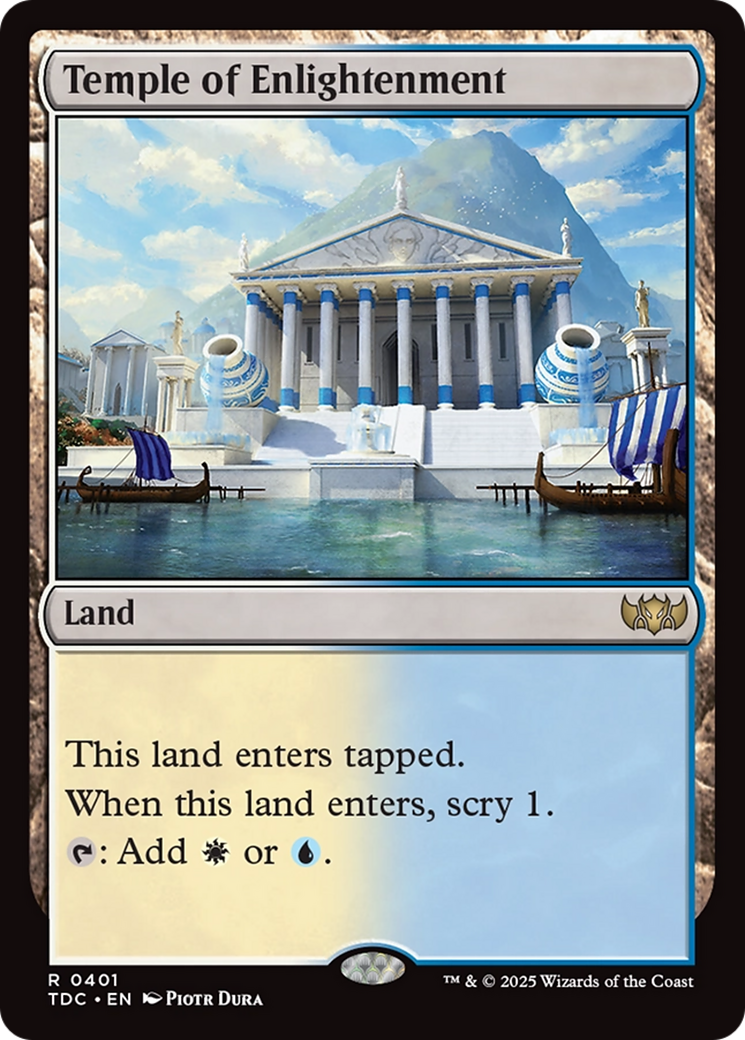
Temple of Enlightenment
Temple of Enlightenment
Land
This land enters tapped.
When this land enters, scry 1. (Look at the top card of your library. You may put that card on the bottom.)
: Add or .
- When you scry, you may put all the cards you look at back on top of your library, you may put all of those cards on the bottom of your library, or you may put some of those cards on top and the rest of them on the bottom.
- You choose how to order cards returned to your library after scrying no matter where you put them.
- You perform the actions stated on a card in sequence. For some spells and abilities, that means you'll scry last. For others, that means you'll scry and then perform other actions.
- Scry appears on some spells and abilities with one or more targets. If all of the spell or ability's targets are illegal when it tries to resolve, it won't resolve and none of its effects will happen. You won't scry.
-
1
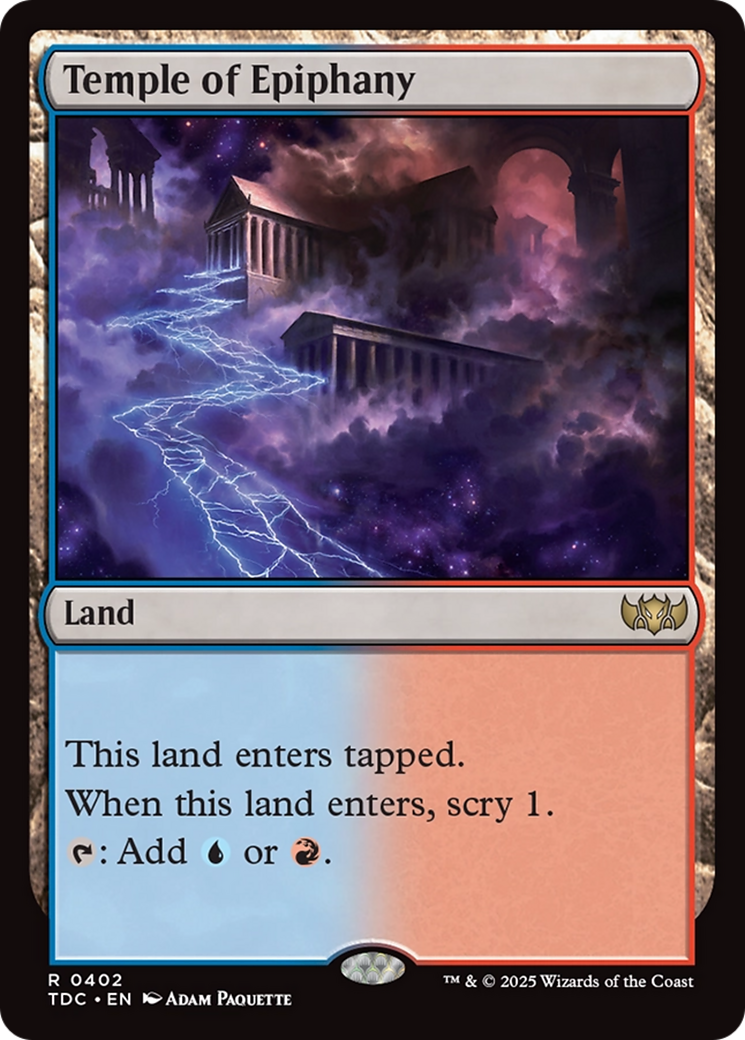
Temple of Epiphany
Temple of Epiphany
Land
This land enters tapped.
When this land enters, scry 1. (Look at the top card of your library. You may put that card on the bottom.)
: Add or .
-
1
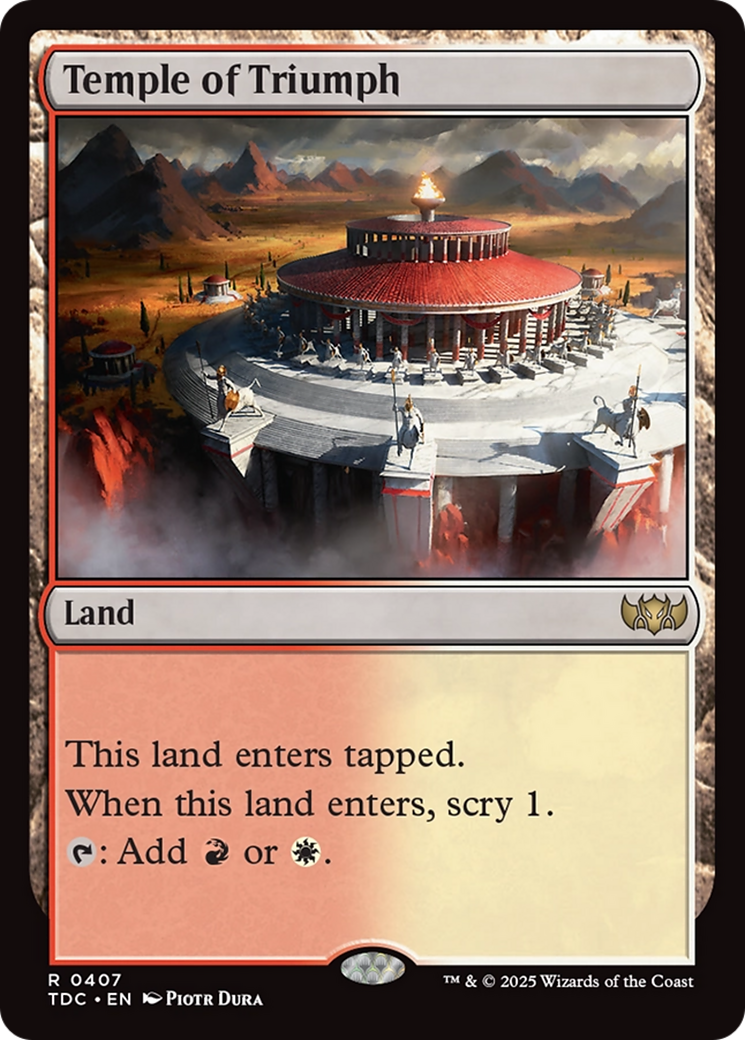
Temple of Triumph
Temple of Triumph
Land
This land enters tapped.
When this land enters, scry 1. (Look at the top card of your library. You may put that card on the bottom.)
: Add or .
- When you scry, you may put all the cards you look at back on top of your library, you may put all of those cards on the bottom of your library, or you may put some of those cards on top and the rest of them on the bottom.
- You choose how to order cards returned to your library after scrying no matter where you put them.
- You perform the actions stated on a card in sequence. For some spells and abilities, that means you'll scry last. For others, that means you'll scry and then perform other actions.
- Scry appears on some spells and abilities with one or more targets. If all of the spell or ability's targets are illegal when it tries to resolve, it won't resolve and none of its effects will happen. You won't scry.
White 8
-
1
Aligned Heart
Aligned Heart
Enchantment
Flurry — Whenever you cast your second spell each turn, put a rally counter on this enchantment. Then create a 1/1 white Monk creature token with prowess for each rally counter on it. (Whenever you cast a noncreature spell, the token gets +1/+1 until end of turn.)
- Spells that were cast before a permanent with flurry count. If that permanent was the first spell you cast that turn, the next spell you cast that turn is your second spell.
-
1
Dismantling Wave
Dismantling Wave
Sorcery
For each opponent, destroy up to one target artifact or enchantment that player controls.
Cycling ( , Discard this card: Draw a card.)
When you cycle this card, destroy all artifacts and enchantments.
- Some cards with cycling have an ability that triggers when you cycle them, and some cards have an ability that triggers whenever you cycle any card. These triggered abilities resolve before you draw from the cycling ability.
- Triggered abilities from cycling a card and the cycling ability itself aren't spells. Effects that interact with spells (such as that of Cancel) won't affect them.
- You can cycle a card even if it has a triggered ability from cycling that won't have a legal target. This is because the cycling ability and the triggered ability are separate. This also means that if either ability is countered (with Disallow, for example), the other ability will still resolve.
-
1
Ghostly Prison
Ghostly Prison
Enchantment
Creatures can't attack you unless their controller pays for each creature they control that's attacking you.
- Unless some effect explicitly says otherwise, a creature that can't attack you can still attack a planeswalker you control.
- In the Two-Headed Giant format, you still only have to pay once per creature.
-
1
Mangara, the Diplomat
Mangara, the Diplomat
Legendary Creature — Human Cleric
2/4
Lifelink
Whenever an opponent attacks with creatures, if two or more of those creatures are attacking you and/or planeswalkers you control, draw a card.
Whenever an opponent casts their second spell each turn, draw a card.
- If some of the attacking creatures leave the battlefield while Mangara's triggered ability is on the stack, use the player or planeswalker they were attacking before they left to determine whether you draw a card. On the other hand, if they're removed from combat without leaving the battlefield, use their current information to determine that they're not attacking you or a planeswalker you control anymore.
- If your opponent attacks you with one creature and your planeswalker with another, you draw a card.
- You draw just one card, no matter how many creatures are attacking you and your planeswalkers beyond the second.
- An ability that triggers when a player casts a spell resolves before the spell that caused it to trigger. It resolves even if that spell is countered.
- Players can cast spells and activate abilities after the triggered ability resolves but before the spell that caused it to trigger does.
-
1
Monastery Mentor
Monastery Mentor
Creature — Human Monk
2/2
Prowess (Whenever you cast a noncreature spell, this creature gets +1/+1 until end of turn.)
Whenever you cast a noncreature spell, create a 1/1 white Monk creature token with prowess.
- Casting a noncreature spell will cause both prowess and Monastery Mentor's other ability to trigger. You can put these abilities on the stack in either order. Whichever ability is put on the stack last will resolve first.
- The spell that causes Monastery Mentor's second ability to trigger will not cause the prowess ability of the Monk token that's created to trigger.
- Any spell you cast that doesn't have the type creature will cause prowess to trigger. If a spell has multiple types, and one of those types is creature (such as an artifact creature), casting it won't cause prowess to trigger. Playing a land also won't cause prowess to trigger.
- Prowess triggers only once for any spell, even if that spell has multiple types.
- Prowess goes on the stack on top of the spell that caused it to trigger. It will resolve before that spell.
- Once it triggers, prowess isn't connected to the spell that caused it to trigger. If that spell is countered, prowess will still resolve.
-
1
Swords to Plowshares
Swords to Plowshares
Instant
Exile target creature. Its controller gains life equal to its power.
- Use the power of the creature from when it was last on the battlefield to determine how much life is gained.
-
1
Tempest Technique
Tempest Technique
Enchantment — Aura
Storm (When you cast this spell, copy it for each spell cast before it this turn. You may choose new targets for the copies. Copies become tokens.)
Enchant creature you control
Enchanted creature gets +1/+1 for each enchantment you control.
- The copies are put directly onto the stack. They aren’t cast and won’t be counted by other spells with storm cast later in the turn.
- Spells cast from zones other than a player’s hand and spells that were countered or otherwise failed to resolve are counted by the storm ability.
- A copy of a spell can be countered like any other spell, but it must be countered individually. Countering a spell with storm won’t affect the copies.
- The triggered ability that creates the copies can itself be countered by anything that can counter a triggered ability. If it is countered, no copies will be put onto the stack.
- A resolving copy of a permanent spell becomes a token. That token isn’t “created” and won’t interact with abilities that care about tokens being created.
-
1
Vanquish the Horde
Vanquish the Horde
Sorcery
This spell costs less to cast for each creature on the battlefield.
Destroy all creatures.
Blue 20
-
1
Adaptive Training Post
Adaptive Training Post
Artifact
Whenever you cast an instant or sorcery spell, if this artifact has fewer than three charge counters on it, put a charge counter on it.
Remove three charge counters from this artifact: When you next cast an instant or sorcery spell this turn, copy it and you may choose new targets for the copy.
- After Adaptive Training Post’s last ability resolves, the next instant or sorcery spell you cast that turn will be copied whether or not it has targets.
- The copy created by Adaptive Training Post’s last ability resolves before the spell it’s copying. It resolves even if the original spell is countered before the copy is created.
- If the spell has any targets, the copy will have the same targets unless you choose new ones. You may change any number of the targets, including all of them or none of them. The new targets must be legal.
- If the spell that’s copied is modal (that is, it says “Choose one —” or the like), the copy will have the same mode or modes. You can’t choose different ones.
- If the copied spell divides damage or distributes counters among a number of targets, the division and number of targets can’t be changed. If you choose new targets, you must choose the same number of targets.
- If the spell that’s copied has an X whose value was determined as it was cast, the copy will have the same value of X.
- You can’t choose to pay any additional costs for the copy. However, effects based on any additional costs that were paid for the original spell are copied as though those same costs were paid for the copy too.
- The copy is created on the stack, so it’s not “cast.” Abilities that trigger when a player casts a spell won’t trigger.
-
1
Archmage Emeritus
Archmage Emeritus
Creature — Human Wizard
2/2
Magecraft — Whenever you cast or copy an instant or sorcery spell, draw a card.
- Each magecraft ability has a different effect, although they all have the same trigger condition, whenever you cast or copy an instant or sorcery spell.
- For example, if you control Archmage Emeritus and cast an instant or sorcery spell, Archmage Emeritus's magecraft ability will trigger and you will draw a card.
- If an effect creates a copy of an instant or sorcery spell, this will also cause the magecraft ability to trigger.
- If an effect creates multiple copies of an instant or sorcery spell, magecraft abilities trigger once for each copy created by the effect.
- Some effects instruct you to copy an instant or sorcery card in a zone other than the stack. These copies do not cause magecraft abilities to trigger. However, most effects that do this also allow you to cast the copy, and casting the copy will cause magecraft abilities to trigger.
-
1
Baral's Expertise
Baral's Expertise
Sorcery
Return up to three target artifacts and/or creatures to their owners' hands.
You may cast a spell with mana value 4 or less from your hand without paying its mana cost.
- The mana value of a split card is determined by the combined mana cost of its two halves. If an expertise spell allows you to cast a split card, you may cast either half or, if that split card has fuse, both halves.
- If the card has in its mana cost, you must choose 0 as the value of X when casting it without paying its mana cost.
- The card that you cast may be an artifact or creature that was returned to your hand by this spell.
- If the Expertise spell you cast has any targets, and those targets become illegal before the spell resolves, the spell doesn't resolve and none of its effects happen. You won't get to cast a free spell.
- Effects that allow you to "cast" a card don't allow you to play a land card.
- If you cast a card "without paying its mana cost," you can't choose to cast it for any alternative costs, such as emerge costs. You can, however, pay additional costs. If the card has any mandatory additional costs, such as that of Cathartic Reunion, you must pay those to cast the card.
- While you're casting your free spell, the Expertise spell is still on the stack. It will be put into its owner's graveyard after the free spell is cast. The free spell can't target the Expertise card in your graveyard. It can target the Expertise spell on the stack, but the Expertise spell will become an illegal target before the free spell resolves.
- Any triggered abilities that trigger while performing the Expertise spell's first effect won't be put onto the stack until after you're done casting your free spell. They're put onto the stack at the same time as any abilities that triggered while casting that spell regardless of the order in which those abilities triggered.
- A card's mana value is determined solely by the mana symbols printed in its upper right corner. The mana value is the total amount of mana in that cost, regardless of color. For example, a card with mana cost has mana value 3. Ignore any alternative costs, additional costs, cost increases, or cost reductions that could apply to it. A card with no mana cost has a mana value of 0.
-
1
Compulsive Research
Compulsive Research
Sorcery
Target player draws three cards. Then that player discards two cards unless they discard a land card.
- The target player can discard either one land card or two cards which may or may not be lands. The player can discard one land and one other card or two land cards if they choose.
-
1
Consider
Consider
Instant
Surveil 1. (Look at the top card of your library. You may put it into your graveyard.)
Draw a card.
- You perform the actions stated on a card in sequence. For some spells and abilities, you'll surveil last. For others, you'll surveil and then perform other actions.
-
1
Curse of the Swine
Curse of the Swine
Sorcery
Exile X target creatures. For each creature exiled this way, its controller creates a 2/2 green Boar creature token.
-
1
Deep Analysis
Deep Analysis
Sorcery
Target player draws two cards.
Flashback— , Pay 3 life. (You may cast this card from your graveyard for its flashback cost. Then exile it.)
- "Flashback [cost]" means "You may cast this card from your graveyard by paying [cost] rather than paying its mana cost" and "If the flashback cost was paid, exile this card instead of putting it anywhere else any time it would leave the stack."
- You must still follow any timing restrictions and permissions, including those based on the card's type. For instance, you can cast a sorcery using flashback only when you could normally cast a sorcery.
- To determine the total cost of a spell, start with the mana cost or alternative cost (such as a flashback cost) you're paying, add any cost increases, then apply any cost reductions. The mana value of the spell is determined only by its mana cost, no matter what the total cost to cast the spell was.
- A spell cast using flashback will always be exiled afterward, whether it resolves, is countered, or leaves the stack in some other way.
- You can cast a spell using flashback even if it was somehow put into your graveyard without having been cast.
- If a card with flashback is put into your graveyard during your turn, you can cast it if it's legal to do so before any other player can take any actions.
-
1
Frantic Search
Frantic Search
Instant
Draw two cards, then discard two cards. Untap up to three lands.
- You choose which lands to untap as the spell resolves. They aren't targeted, and they don't have to be lands that you control.
- You draw two cards and discard two cards all while Frantic Search is resolving. Nothing can happen between the two, and no player may choose to take actions.
-
1
Haughty Djinn
Haughty Djinn
Creature — Djinn
*/4
Flying
Haughty Djinn's power is equal to the number of instant and sorcery cards in your graveyard.
Instant and sorcery spells you cast cost less to cast.
- The ability that defines Haughty Djinn's power functions in all zones.
- A split card in your graveyard only counts once for Haughty Djinn's power, even if it's both an instant and a sorcery.
-
1
Lier, Disciple of the Drowned
Lier, Disciple of the Drowned
Legendary Creature — Human Wizard
3/4
Spells can't be countered.
Each instant and sorcery card in your graveyard has flashback. The flashback cost is equal to that card's mana cost.
- "Flashback [cost]" means "You may cast this card from your graveyard by paying [cost] rather than paying its mana cost" and "If the flashback cost was paid, exile this card instead of putting it anywhere else any time it would leave the stack."
- You must still follow any timing restrictions and permissions, including those based on the card's type. For instance, you can cast a sorcery using flashback only when you could normally cast a sorcery.
- To determine the total cost of a spell, start with the mana cost or alternative cost (such as a flashback cost) you're paying, add any cost increases, then apply any cost reductions. The mana value of the spell is determined only by its mana cost, no matter what the total cost to cast the spell was.
- A spell cast using flashback will always be exiled afterward, whether it resolves, is countered, or leaves the stack in some other way.
- You can cast a spell using flashback even if it was somehow put into your graveyard without having been cast.
- If a card with flashback is put into your graveyard during your turn, you can cast it if it's legal to do so before any other player can take any actions.
- If you cast an instant or sorcery with in its mana cost this way, you still choose the value of X as part of casting the spell and pay that cost.
- If you cast a spell with flashback, you can't pay any alternative costs such as overload costs. You can pay additional costs such as kicker costs. If the spell has any mandatory additional costs, you must pay those to cast the spell with flashback.
- If a card has multiple instances of flashback, you may choose any of its flashback costs to pay.
- If a split card gains flashback, you pay only the cost of the half you're casting.
- If a card with no mana cost gains flashback, it has no flashback cost. It can't be cast this way.
-
1
Narset's Reversal
Narset's Reversal
Instant
Copy target instant or sorcery spell, then return it to its owner's hand. You may choose new targets for the copy.
- Narset’s Reversal can copy any instant or sorcery spell, not just one with targets.
- The copy is created on the stack, so it’s not “cast.” Abilities that trigger when a player casts a spell won’t trigger.
- The copy will have the same targets as the spell it’s copying unless you choose new ones. You may change any number of the targets, including all of them or none of them. If, for one of the targets, you can’t choose a new legal target, then it remains unchanged (even if the current target is illegal).
- If the spell that’s copied is modal (that is, it says “Choose one —” or the like), the copy will have the same mode. A different mode can’t be chosen.
- If the spell that’s copied has an X whose value was determined as it was cast (like Finale of Promise does), the copy will have the same value of X.
- If the spell has damage divided as it was cast, the division can’t be changed (although the targets receiving that damage still can). The same is true of spells that distribute counters.
- The controller of a copy can’t choose to pay any alternative or additional costs for the copy. However, effects based on any alternative or additional costs that were paid for the original spell are copied as though those same costs were paid for the copy.
- If you copy a spell, you control the copy. Narset’s Reversal and the copy resolve before the original spell would have resolved.
- If a spell is returned to its owner’s hand, it’s removed from the stack and thus will not resolve. The spell isn’t countered; it just no longer exists. This works against a spell that can’t be countered.
- If a copy of a spell is returned to its owner’s hand, it’s moved there, then it will cease to exist as a state-based action.
-
1
Opt
Opt
Instant
Scry 1. (Look at the top card of your library. You may put that card on the bottom.)
Draw a card.
-
1
Ponder
Ponder
Sorcery
Look at the top three cards of your library, then put them back in any order. You may shuffle.
Draw a card.
- If you choose to shuffle your library, that includes the three cards you just looked at and put back on top of it.
-
1
Pongify
Pongify
Instant
Destroy target creature. It can't be regenerated. Its controller creates a 3/3 green Ape creature token.
- If the target creature is an illegal target by the time Pongify tries to resolve, the spell won't resolve. No player creates an Ape token. If the target is legal but not destroyed (most likely because it has indestructible), its controller does create an Ape token.
-
1
Preordain
Preordain
Sorcery
Scry 2, then draw a card. (To scry 2, look at the top two cards of your library, then put any number of them on the bottom and the rest on top in any order.)
-
1
Rite of Replication
Rite of Replication
Sorcery
Kicker (You may pay an additional as you cast this spell.)
Create a token that's a copy of target creature. If this spell was kicked, create five of those tokens instead.
- If the targeted creature is an illegal target when Rite of Replication tries to resolve, it won't resolve and none of its effects will happen. You won't create any tokens.
- Each token copies exactly what was printed on the original creature (unless that permanent is copying something else or is a token; see below). It doesn't copy whether that creature is tapped or untapped, whether it has any counters on it or any Auras or Equipment attached to it, or any non-copy effects that have changed its types, color, power and toughness, and so on.
- If the copied creature has in its mana cost, X is 0.
- If the copied creature is a token, the new token that's created copies the original characteristics of that token as stated by the effect that created the token.
- If the copied creature is copying something else, then the token enters as whatever that creature copied.
- Any "enters" abilities of the copied creature will trigger when the token enters. Any "as [this creature] enters" or "[this creature] enters with" abilities of the target creature will also work.
- The tokens see each other enter. If they have a triggered ability that triggers when a creature enters, they'll all trigger for one another.
- If a spell's kicker cost was paid, the spell is "kicked."
- The kicker ability doesn't let you pay a kicker cost more than once.
- If you put a permanent with a kicker ability onto the battlefield without casting it, you can't kick it.
- If you copy a kicked spell on the stack, the copy is also kicked. If the copied spell is a permanent spell, the token the copy of that spell becomes when it enters is also kicked.
- If a card or token enters as a copy of a permanent, the new permanent isn't kicked, even if the original was.
- To determine a spell's total cost, start with the mana cost (or an alternative cost if another card's effect allows you to pay one instead), add any cost increases (such as kicker), then apply any cost reductions. The spell's mana value remains unchanged, no matter what the total cost to cast it was.
-
1
Sublime Epiphany
Sublime Epiphany
Instant
Choose one or more —
- Counter target spell.
- Counter target activated or triggered ability.
- Return target nonland permanent to its owner's hand.
- Create a token that's a copy of target creature you control.
- Target player draws a card.
- You can't choose any one mode more than once.
- If any of the targets become illegal, the remaining targets are affected as appropriate.
- If you choose more than one mode, you perform the modes in the order specified. For example, if you choose to counter target spell, return target nonland permanent to its owner's hand, and have target player draw a card, that permanent will be on the battlefield while that spell is countered (and may modify, affect, or trigger on that event) but will not be on the battlefield while that player draws a card.
- Sublime Epiphany's second mode counters only activated and triggered abilities already on the stack. It doesn't prevent abilities from being activated or from triggering later in the turn, and it has no effect on static abilities.
- Activated abilities are written in the form "[Cost]: [Effect]." Some keyword abilities (such as equip) are activated abilities and will have colons in their reminder texts.
- Triggered abilities use the word "when," "whenever," or "at." They're often written as "[Trigger condition], [effect]." Some keyword abilities (such as prowess) are triggered abilities and will have "when," "whenever," or "at" in their reminder text.
- Abilities that create replacement effects, such as a permanent entering the battlefield tapped or with counters on it, can't be countered. Abilities that apply "as [this creature] enters the battlefield" are also replacement effects and can't be countered.
- Sublime Epiphany's second mode can't counter an activated or triggered mana ability. An activated mana ability is one that could add mana as it resolves, doesn't have a target, and isn't a loyalty ability. A triggered mana ability is one that could add mana as it resolves and triggers on an activated mana ability.
- If you counter a delayed triggered ability that triggered at the beginning of the "next" occurrence of a specified step or phase, that ability won't trigger again the following time that phase or step occurs.
- If you choose the third and fourth modes and target the same creature you control both times, you'll return it and then create a token that's a copy of it, using its copiable values as it last appeared on the battlefield. This is because the legality of targets is checked only as the spell begins to resolve, before any actions are performed.
- The token copies exactly what is printed on the creature and nothing else (unless that creature is a token or is copying something else; see below). It doesn't copy whether that creature is tapped or untapped, whether it has any counters on it or Auras and/or Equipment attached to it, or any non-copy effects that changed its power, toughness, types, color, and so on.
- If the copied creature is itself a token, the token created by Sublime Epiphany copies the original characteristics of that token as stated by the effect that created it.
- If the copied creature is copying something else, the token enters the battlefield as whatever that creature is copying.
- If the copied creature has in its mana cost, X is 0.
- Any enters-the-battlefield abilities of the copied creature will trigger when the token enters the battlefield. Any "As [this creature] enters the battlefield" or "[This creature] enters the battlefield with" abilities of the copied creature will also work.
-
1
Think Twice
Think Twice
Instant
Draw a card.
Flashback (You may cast this card from your graveyard for its flashback cost. Then exile it.)
- "Flashback [cost]" means "You may cast this card from your graveyard by paying [cost] rather than paying its mana cost" and "If the flashback cost was paid, exile this card instead of putting it anywhere else any time it would leave the stack."
- You must still follow any timing restrictions and permissions, including those based on the card's type. For instance, you can cast a sorcery using flashback only when you could normally cast a sorcery.
- To determine the total cost of a spell, start with the mana cost or alternative cost (such as a flashback cost) you're paying, add any cost increases, then apply any cost reductions. The mana value of the spell is determined only by its mana cost, no matter what the total cost to cast the spell was.
- A spell cast using flashback will always be exiled afterward, whether it resolves, is countered, or leaves the stack in some other way.
- You can cast a spell using flashback even if it was somehow put into your graveyard without having been cast.
- If a card with flashback is put into your graveyard during your turn, you can cast it if it's legal to do so before any other player can take any actions.
-
1
Transcendent Dragon
Transcendent Dragon
Creature — Dragon
4/3
Flash
Flying
When this creature enters, if you cast it, counter target spell. If that spell is countered this way, exile it instead of putting it into its owner's graveyard, then you may cast it without paying its mana cost.
- If you wish to cast the exiled card, you do so as part of the resolution of Transcendent Dragon’s last ability. You can’t wait to cast it later. Timing permissions based on the card’s type are ignored.
- If you cast a spell “without paying its mana cost,” you can’t choose to cast it for any alternative costs. You can, however, pay additional costs, such as kicker costs. If the spell has any mandatory additional costs those must be paid to cast the spell.
- If a spell has in its mana cost, you must choose 0 as the value of X when casting it without paying its mana cost.
-
1
Voracious Bibliophile
Voracious Bibliophile
Creature — Dragon
3/3
Flying, vigilance
Whenever you cast a spell with one or more targets, draw that many cards.
- An Aura spell requires a target, as defined by its enchant ability.
Red 14
-
1
Abrade
Abrade
Instant
Choose one —
- Abrade deals 3 damage to target creature.
- Destroy target artifact.
-
1
Big Score
Big Score
Instant
As an additional cost to cast this spell, discard a card.
Draw two cards and create two Treasure tokens. (They're artifacts with " , Sacrifice this token: Add one mana of any color.")
-
1
Caldera Pyremaw
Caldera Pyremaw
Creature — Dragon
3/3
Flying
Whenever you cast an instant or sorcery spell, put a +1/+1 counter on this creature. Then this creature deals damage equal to its power to target opponent.
- If Caldera Pyremaw leaves the battlefield in response to its ability, use its power the last time it existed on the battlefield to determine how much damage it deals as its ability resolves.
-
1
Curse of Opulence
Curse of Opulence
Enchantment — Aura Curse
Enchant player
Whenever enchanted player is attacked, create a Gold token. Each opponent attacking that player does the same. (A Gold token is an artifact with "Sacrifice this token: Add one mana of any color.")
- Curse of Opulence's triggered ability resolves after attackers have been declared. Any costs to attack must have already been paid before the attacking player creates the Gold.
- Each Curse's ability triggers only once, no matter how many creatures are attacking the enchanted player.
- A player is attacking another player if they control a creature that's attacking that player. If no creatures are attacking the enchanted player as a Curse's ability resolves (most likely because they've left the battlefield), only the Curse's controller performs its actions.
- The triggered ability of these Curses won't trigger if only a planeswalker controlled by the enchanted player is attacked.
- If you enchant yourself with one of these Curses, you'll get its effects whenever another player attacks you.
-
1
Electrodominance
Electrodominance
Instant
Electrodominance deals X damage to any target. You may cast a spell with mana value X or less from your hand without paying its mana cost.
- If the target is illegal as Electrodominance tries to resolve, it won't resolve and none of its effects will happen. You won't get to cast a spell from your hand.
- Effects that allow you to cast a spell don't allow you to play a land.
- If the target is dealt lethal damage this way, it will still be on the battlefield while you cast a spell from your hand. It won't die until after Electrodominance is finished resolving. If any of its abilities trigger while you cast that spell, those abilities will trigger but won't resolve until after the target has died.
- You cast the spell during the resolution of Electrodominance. Ignore timing restrictions based on the spell's type.
- If you cast a spell "without paying its mana cost," you can't choose to cast it for any alternative costs. You can, however, pay additional costs, such as kicker costs. If the spell has any mandatory additional costs, such as that of Bankrupt in Blood, those must be paid to cast the card.
- If a spell has in its mana cost, you must choose 0 as the value of X when casting it without paying its mana cost.
-
1
Faithless Looting
Faithless Looting
Sorcery
Draw two cards, then discard two cards.
Flashback (You may cast this card from your graveyard for its flashback cost. Then exile it.)
- To determine the total cost of a spell, start with the mana cost or alternative cost (such as a flashback cost) you're paying, add any cost increases, then apply any cost reductions. The mana value of the spell is determined only by its mana cost, no matter what the total cost to cast the spell was.
- "Flashback [cost]" means "You may cast this card from your graveyard by paying [cost] rather than paying its mana cost" and "If the flashback cost was paid, exile this card instead of putting it anywhere else any time it would leave the stack."
- You must still follow any timing restrictions and permissions, including those based on the card's type. For instance, you can cast a sorcery using flashback only when you could normally cast a sorcery.
- If a card with flashback is put into your graveyard during your turn, you can cast it if it's legal to do so before any other player can take any actions.
- A spell cast using flashback will always be exiled afterward, whether it resolves, is countered, or leaves the stack in some other way.
- You can cast a spell using flashback even if it was somehow put into your graveyard without having been cast.
- You draw two cards and discard two cards all while Faithless Looting is resolving. Nothing can happen between the two, and no player may choose to take actions.
-
1
Guttersnipe
Guttersnipe
Creature — Goblin Shaman
2/2
Whenever you cast an instant or sorcery spell, this creature deals 2 damage to each opponent.
- Guttersnipe's triggered ability resolves before the spell that caused it to trigger. It resolves even if that spell is countered or otherwise leaves the stack without resolving.
- In a Two-Headed Giant game, Guttersnipe's ability causes the opposing team to lose 4 life.
-
1
Mana Geyser
Mana Geyser
Sorcery
Add for each tapped land your opponents control.
-
1
Manaform Hellkite
Manaform Hellkite
Creature — Dragon
4/4
Flying
Whenever you cast a noncreature spell, create an X/X red Dragon Illusion creature token with flying and haste, where X is the amount of mana spent to cast that spell. Exile that token at the beginning of the next end step.
- Manaform Hellkite's triggered ability looks at the mana that was actually spent to cast the spell, which may be different than the mana cost of that spell. For example, if you cast a noncreature spell without paying its mana cost, this ability creates a 0/0 Dragon Illusion token. In most cases, such a creature would immediately be put into your graveyard.
-
1
Shiny Impetus
Shiny Impetus
Enchantment — Aura
Enchant creature
Enchanted creature gets +2/+2 and is goaded. (It attacks each combat if able and attacks a player other than you if able.)
Whenever enchanted creature attacks, you create a Treasure token. (It's an artifact with " , Sacrifice this token: Add one mana of any color.")
- If, during a player's declare attackers step, a creature that player controls that's been goaded is tapped, is affected by a spell or ability that says it can't attack, or hasn't been under that player's control continuously since the turn began (and doesn't have haste), then it doesn't attack. If there's a cost associated with having a creature attack a player, its controller isn't forced to pay that cost, so it doesn't have to attack that player.
- If the creature doesn't meet any of the above exceptions and can attack, it must attack a player other than the controller of the spell or ability that goaded it if able. If the creature can't attack any of those players but could otherwise attack, it must attack a planeswalker an opponent controls, a battle an opponent controls, or a player who goaded it.
- Being goaded isn't an ability the creature has. Once it's been goaded, it must attack as detailed above even if it loses all abilities.
- Attacking with a goaded creature doesn't cause it to stop being goaded. If there is an additional combat phase that turn, or if another player gains control of it before it stops being goaded, it must attack again if able.
- If a creature you control has been goaded by multiple opponents, it must attack one of your opponents that hasn't goaded it, as that fulfills the maximum number of goad requirements. If a creature you control has been goaded by each of your opponents, the creature must attack an opponent (rather than a planeswalker or battle), but you choose which opponent it attacks.
- Shiny Impetus causes you to create a Treasure token, not the attacking creature's controller.
-
1
Storm-Kiln Artist
Storm-Kiln Artist
Creature — Dwarf Shaman
2/2
This creature gets +1/+0 for each artifact you control.
Magecraft — Whenever you cast or copy an instant or sorcery spell, create a Treasure token.
- If an effect creates multiple copies of an instant or sorcery spell, magecraft abilities trigger once for each copy created by the effect.
- Each magecraft ability has a different effect, although they all have the same trigger condition, whenever you cast or copy an instant or sorcery spell.
- For example, if you control Archmage Emeritus and cast an instant or sorcery spell, Archmage Emeritus's magecraft ability will trigger and you will draw a card.
- If an effect creates a copy of an instant or sorcery spell, this will also cause the magecraft ability to trigger.
- Some effects instruct you to copy an instant or sorcery card in a zone other than the stack. These copies do not cause magecraft abilities to trigger. However, most effects that do this also allow you to cast the copy, and casting the copy will cause magecraft abilities to trigger.
-
1
Transforming Flourish
Transforming Flourish
Instant
Demonstrate (When you cast this spell, you may copy it. If you do, choose an opponent to also copy it. Players may choose new targets for their copies.)
Destroy target artifact or creature you don't control. If that permanent is destroyed this way, its controller exiles cards from the top of their library until they exile a nonland card, then they may cast that card without paying its mana cost.
- You choose whether to make a copy as the demonstrate ability resolves. This happens before the original spell resolves. Your copy goes on the stack above the original spell.
- If you copy a spell with demonstrate, you then immediately choose an opponent. If they copy the spell, it goes on top of the stack.
- If the spell requires targets, you choose the target of the original spell as you cast it. If you create a copy of the spell, you may choose new targets for the copy as you create that copy. Similarly, the opponent you chose to create a copy may choose new targets for that copy as it’s created. In other words, your opponent will know the targets of your original spell and your copy when choosing the new targets, if any, for their copy.
- If you cast a spell with demonstrate and both you and an opponent copy it, the opponent’s copy will resolve first, then your copy will resolve, and finally the original spell will resolve.
- If you cast the spell and choose not to copy it, no opponent will get to copy it either.
- If the destroyed permanent’s controller chooses to cast the exiled card without paying its mana cost, they can’t choose to cast it for any alternative costs. They can, however, pay additional costs, such as kicker costs. If the spell has any mandatory additional costs, those must be paid to cast the spell.
- If the exiled card has in its mana cost, the destroyed permanent’s controller must choose 0 as the value of X when casting it without paying its mana cost.
-
1
Will of the Jeskai
Will of the Jeskai
Sorcery
Choose one. If you control a commander as you cast this spell, you may choose both instead.
- Each player may discard their hand and draw five cards.
- Each instant and sorcery card in your graveyard gains flashback until end of turn. The flashback cost is equal to its mana cost.
- A player may discard their hand even if their hand contains zero cards.
- The commander you control doesn’t have to be your commander.
- Once you’ve announced that you’re casting this spell, players can’t take any actions until you’ve finished doing so. Notably, opponents can’t try to remove your commander to change how many modes you may choose.
- Whether or not you control a commander is determined only once, as you choose the modes for this spell. If you somehow lose control of that commander before you finish casting the spell (perhaps because you sacrifice it to activate a mana ability), it won’t change the number of modes chosen.
-
1
Young Pyromancer
Young Pyromancer
Creature — Human Shaman
2/1
Whenever you cast an instant or sorcery spell, create a 1/1 red Elemental creature token.
- An ability that triggers when a player casts a spell resolves before the spell that caused it to trigger, but after targets have been chosen for that spell. It resolves even if that spell is countered.
Multicolor 13
-
1
Baral and Kari Zev
Baral and Kari Zev
Legendary Creature — Human
2/4
First strike, menace
Whenever you cast your first instant or sorcery spell each turn, you may cast a spell with lesser mana value that shares a card type with it from your hand without paying its mana cost. If you don't, create First Mate Ragavan, a legendary 2/1 red Monkey Pirate creature token. It gains haste until end of turn.
- If the spell has in its mana cost, you must choose 0 as the value of X when casting it without paying its mana cost.
- Baral and Kari Zev will count any instant or sorcery spell you cast during a turn, even if it wasn’t on the battlefield at the time. This means if you cast an instant or sorcery spell, then Baral and Kari Zev comes under your control, its triggered ability won’t trigger that turn.
- The spell you cast from your hand without paying its mana cost is cast during the resolution of the triggered ability. Timing restrictions of that spell based on card type are ignored. It will resolve before the spell that caused the ability to trigger.
- If you cast a spell without paying its mana cost, you can’t choose to cast it for any alternative costs. You can, however, pay any additional costs. If the spell has any mandatory additional costs, you must pay those.
-
1
Elsha, Threefold Master
Elsha, Threefold Master
Legendary Creature — Djinn Monk
1/1
Trample
Prowess (Whenever you cast a noncreature spell, this creature gets +1/+1 until end of turn.)
Whenever Elsha deals combat damage to a player, create that many 1/1 white Monk creature tokens with prowess.
-
1
Expansion // Explosion
//
Expansion
Instant
- If one of Explosion's two targets becomes illegal, the other is affected as appropriate.
- The copy will have the same targets as the spell it's copying unless you choose new ones. You may change any number of the targets, including all of them or none of them. If, for one of the targets, you can't choose a new legal target, then it remains unchanged (even if the current target is illegal).
- If the spell that's copied is modal (that is, it says "Choose one —" or the like), the copy will have the same mode or modes. You can't choose different ones.
- If the spell that's copied has an X whose value was determined as it was cast (like Banefire does), the copy will have the same value of X.
- If the spell has damage divided as it was cast, the division can't be changed (although the targets receiving that damage still can). The same is true of spells that distribute counters.
- The controller of a copy can't choose to pay any alternative or additional costs for the copy. However, effects based on any alternative or additional costs that were paid for the original spell are copied as though those same costs were paid for the copy.
- Any choices made as a spell resolves won't have been made yet once it's copied. Any such choices will be made separately as the copy resolves.
- If you copy a spell, you control the copy. It will resolve before the original spell does.
- Expansion can copy any instant or sorcery spell with an appropriate mana value, not just one with targets.
- If a spell has in its mana cost, include the value chosen for that X when determining the mana value of that spell.
- The copy is created on the stack, so it's not "cast." Abilities that trigger when a player casts a spell won't trigger.
- Split cards have two card faces on a single card. The characteristics of the half you didn't cast are ignored while the spell is on the stack.
- Each split card is a single card. For example, if you discard a split card, you've discarded one card, not two. If an effect counts the number of sorcery cards in your graveyard, Assault // Battery counts once, not twice.
- Each split card has two names. If an effect instructs you to choose a card name, you may choose one of those names, but not both.
- A split card's characteristics are a combination of its two halves while it is not on the stack. For example, Assault // Battery has a mana value of 5 while it is in your library. If an effect allows you to search your library for a card with mana value 4 or less, you can't find Assault // Battery.
- If an effect allows you to cast a spell with certain characteristics, consider only the characteristics of the half you're casting. For example, if an effect allows you to cast a sorcery spell with mana value 2 or less from among cards in your graveyard, you could cast Assault this way, but not Battery.
- If you copy a spell that's half of a split card, the copy copies that same half. For example, if you copy Assault, the copy is also Assault, not Battery.
- To cast a split card, choose one of its halves to cast. There's no way to cast both halves of this split card.
-
1
Expressive Iteration
Expressive Iteration
Sorcery
Look at the top three cards of your library. Put one of them into your hand, put one of them on the bottom of your library, and exile one of them. You may play the exiled card this turn.
- Cards exiled are always exiled face up unless specified otherwise by the effect that exiled it.
- If you choose to play the exiled card this turn, you must still pay all costs and follow all timing restrictions required by that card. If it's a land, you can't play it unless you have a land play available.
- If you don't play the exiled card, it remains exiled. It won't be available to be played on future turns.
-
1
Goblin Electromancer
Goblin Electromancer
Creature — Goblin Wizard
2/2
Instant and sorcery spells you cast cost less to cast.
- To determine the total cost of a spell, start with the mana cost or alternative cost you're paying, add any cost increases, then apply any cost reductions. The mana value of the spell remains unchanged, no matter what the total cost to cast it was.
- Goblin Electromancer's effect reduces only generic mana in the spell's total cost.
- Two Goblin Electromancers will make instant and sorcery spells you cast cost less to cast, and so on.
-
1
Magma Opus
Magma Opus
Instant
Magma Opus deals 4 damage divided as you choose among any number of targets. Tap two target permanents. Create a 4/4 blue and red Elemental creature token. Draw two cards.
, Discard this card: Create a Treasure token.
- You choose all targets for Magma Opus as you cast the spell. This includes up to four targets for the first effect and two target permanents for the second effect.
- You also choose how the 4 damage will be divided among the first group of targets as you cast Magma Opus. You must have at least 1 damage dealt to each of those targets.
- You must choose two different target permanents for the second effect. You may choose permanents that are already tapped.
- The same permanent can be chosen as a target for each of the two instances of "target." That is, you can have Magma Opus both deal damage to a creature or planeswalker and then tap it. (We're having a hard time imagining why you would, but you're the brilliant student.)
- If somehow all of Magma Opus's targets are illegal as it tries to resolve, none of its effects happen. You will not create an Elemental token or draw two cards.
-
1
Prismari Command
Prismari Command
Instant
Choose two —
- Prismari Command deals 2 damage to any target.
- Target player draws two cards, then discards two cards.
- Target player creates a Treasure token.
- Destroy target artifact.
- If all of Prismari Command's targets are illegal as it tries to resolve, it will do nothing.
- If at least one target is still legal as Prismari Command tries to resolve, it will resolve and do as much as it can.
-
1
Shiko and Narset, Unified
Shiko and Narset, Unified
Legendary Creature — Human Spirit Dragon
4/4
Flying, vigilance
Flurry — Whenever you cast your second spell each turn, copy that spell if it targets a permanent or player, and you may choose new targets for the copy. If you don't copy a spell this way, draw a card.
- If the second spell you cast targets a permanent or player, you must copy that spell, even if it won’t be possible to choose legal targets for the copy. You can’t choose not to copy it in order to draw a card.
- Shiko and Narset, Unified’s last ability and the copy it creates resolve before the spell it’s copying. They resolve even if the original spell is countered before the copy is created.
- An Aura spell requires a target, as defined by its enchant ability.
- The copy will have the same targets unless you choose new ones. You may change any number of the targets, including all of them or none of them. The new targets must be legal.
- If the spell that’s copied is modal (that is, it says “Choose one —” or the like), the copy will have the same mode or modes. You can’t choose different ones.
- If the copied spell divides damage or distributes counters among a number of targets, the division and number of targets can’t be changed. If you choose new targets, you must choose the same number of targets.
- If the spell that’s copied has an X whose value was determined as it was cast, the copy will have the same value of X.
- You can’t choose to pay any additional costs for the copy. However, effects based on any additional costs that were paid for the original spell are copied as though those same costs were paid for the copy too.
- The copy is created on the stack, so it’s not “cast.” Abilities that trigger when a player casts a spell won’t trigger.
- A resolving copy of a permanent spell becomes a token. That token isn’t “created” and won’t interact with abilities that care about tokens being created.
- Spells that were cast before a permanent with flurry count. If that permanent was the first spell you cast that turn, the next spell you cast that turn is your second spell.
-
1
Third Path Iconoclast
Third Path Iconoclast
Creature — Human Monk
2/1
Whenever you cast a noncreature spell, create a 1/1 colorless Soldier artifact creature token.
-
1
Time Wipe
Time Wipe
Sorcery
Return a creature you control to its owner's hand, then destroy all creatures.
- You chose which creature to return to its owner's hand while Time Wipe is resolving. No player may take any actions between the time you choose the creature to return and the time other creatures are destroyed.
- If you control no creatures, you simply destroy all creatures.
-
1
Velomachus Lorehold
Velomachus Lorehold
Legendary Creature — Elder Dragon
5/5
Flying, vigilance, haste
Whenever Velomachus Lorehold attacks, look at the top seven cards of your library. You may cast an instant or sorcery spell with mana value less than or equal to Velomachus Lorehold's power from among them without paying its mana cost. Put the rest on the bottom of your library in a random order.
- When Velomachus Lorehold’s triggered ability resolves, it lets you cast a spell immediately, ignoring timing restrictions. It does not let you cast that spell later in the turn.
- If you choose not to cast a spell this way, all of the cards will be put on the bottom of the library in a random order.
- If you’re casting a spell with in its cost without paying its mana cost, you must choose 0 for the value of X.
-
1
Veyran, Voice of Duality
Veyran, Voice of Duality
Legendary Creature — Efreet Wizard
2/2
Magecraft — Whenever you cast or copy an instant or sorcery spell, Veyran gets +1/+1 until end of turn.
If you casting or copying an instant or sorcery spell causes a triggered ability of a permanent you control to trigger, that ability triggers an additional time.
- Veyran, Voice of Duality's last ability causes each of your magecraft abilities, including Veyran's own, to trigger an additional time.
- Veyran's effect doesn't copy the triggered ability; it just causes the ability to trigger again. Any choices you make as you put the ability on the stack, such as modes and targets, are made separately for each instance of the ability. Any choices made on resolution are also made individually.
- If you somehow control two Veyrans (which would be poetic), you casting an instant or sorcery spell causes abilities to trigger three times. A third Veyran (less poetic) causes abilities to trigger four times, and so on.
- Each magecraft ability has a different effect, although they all have the same trigger condition, whenever you cast or copy an instant or sorcery spell.
- For example, if you control Archmage Emeritus and cast an instant or sorcery spell, Archmage Emeritus's magecraft ability will trigger and you will draw a card.
- If an effect creates a copy of an instant or sorcery spell, this will also cause the magecraft ability to trigger.
- If an effect creates multiple copies of an instant or sorcery spell, magecraft abilities trigger once for each copy created by the effect.
- Some effects instruct you to copy an instant or sorcery card in a zone other than the stack. These copies do not cause magecraft abilities to trigger. However, most effects that do this also allow you to cast the copy, and casting the copy will cause magecraft abilities to trigger.
-
1
Whirlwind of Thought
Whirlwind of Thought
Enchantment
Whenever you cast a noncreature spell, draw a card.
- An ability that triggers when a player casts a spell resolves before the spell that caused it to trigger. It resolves even if that spell is countered.
- Players can cast spells and activate abilities after the triggered ability resolves but before the spell that caused it to trigger does.
Colorless 8
-
1
Ancestral Vision
Ancestral Vision
Sorcery
Suspend 4— (Rather than cast this card from your hand, pay and exile it with four time counters on it. At the beginning of your upkeep, remove a time counter. When the last is removed, you may cast it without paying its mana cost.)
Target player draws three cards.
- If a card with no mana cost is given an alternative cost equal to its mana cost (by Snapcaster Mage, for example), that cost cannot be paid and the card cannot be cast this way.
- Suspend is a keyword that represents three abilities. The first is a static ability that allows you to exile the card from your hand with the specified number of time counters (the number before the dash) on it by paying its suspend cost (listed after the dash). The second is a triggered ability that removes a time counter from the suspended card at the beginning of each of your upkeeps. The third is a triggered ability that gives you the option to cast the card when the last time counter is removed.
- You can exile a card in your hand using suspend any time you could cast that card. Consider its card type, any effects that modify when you could cast it (such as flash) and any other effects that stop you from casting it (such as from Meddling Mage's ability) to determine if and when you can do this. Whether you could actually complete all steps in casting the card is irrelevant. For example, you can exile a card with suspend that has no mana cost or that requires a target even if no legal targets are available at that time.
- Cards exiled with suspend are exiled face up.
- Exiling a card with suspend isn't casting that card. This action doesn't use the stack and can't be responded to.
- If the spell requires any targets, those targets are chosen when the spell is finally cast, not when it's exiled.
- If an effect refers to a "suspended card," that means a card that (1) has suspend, (2) is in exile, and (3) has one or more time counters on it.
- If the first triggered ability of suspend (the one that removes time counters) is countered, no time counter is removed. The ability will trigger again at the beginning of the card's owner's next upkeep.
- When the last time counter is removed, the second triggered ability of suspend (the one that lets you cast the card) triggers. It doesn't matter why the last time counter was removed or what effect removed it.
- If the second triggered ability is countered, the card can't be cast. It remains exiled with no time counters on it, and it's no longer suspended.
- Due to a recent rules change to suspend, you are no longer required to cast the suspended card as the second triggered ability of suspend resolves. Instead, as the second triggered ability resolves, you may cast the card. Timing permissions based on the card's type are ignored. If you don't cast the card, it remains exiled with no time counters on it, and it's no longer suspended.
- If you cast a card "without paying its mana cost," such as with suspend, you can't choose to cast it for any alternative costs. You can, however, pay additional costs. If the card has any mandatory additional costs, you must pay those if you want to cast the card.
- If the card has in its mana cost, you must choose 0 as the value of X when casting it without paying its mana cost.
- The mana value of a spell cast without paying its mana cost is determined by its mana cost, even though that cost wasn't paid.
- A card with no mana cost can't be cast normally; you'll need a way to cast it for an alternative cost or without paying its mana cost, such as by suspending it.
- Although originally printed with a characteristic-defining ability that defined its color, this card now has a color indicator. This color indicator can't be affected by text-changing effects (such as the one created by Crystal Spray), although color-changing effects can still overwrite it.
-
1
Arcane Signet
Arcane Signet
Artifact
: Add one mana of any color in your commander's color identity.
- If you have two commanders, the ability adds one mana of any color in their combined color identities.
- If your commander is a card that has no colors in its color identity, Arcane Signet's ability produces no mana. It doesn't produce .
- If you don't have a commander, Arcane Signet's ability produces no mana.
-
1
Azorius Signet
Azorius Signet
Artifact
, : Add .
-
1
Boros Signet
Boros Signet
Artifact
, : Add .
-
1
Fellwar Stone
Fellwar Stone
Artifact
: Add one mana of any color that a land an opponent controls could produce.
- The colors of mana are white, blue, black, red, and green. Fellwar Stone can't be tapped for colorless mana, even if a land an opponent controls could produce colorless mana.
- Fellwar Stone checks the effects of all mana-producing abilities of lands your opponents control, but it doesn't check their costs. For example, Vivid Crag has the ability " , Remove a charge counter from Vivid Crag: Add one mana of any color." If an opponent controls Vivid Crag and you control Fellwar Stone, you can tap Fellwar Stone for any color of mana. It doesn't matter whether Vivid Crag has a charge counter on it, and it doesn't matter whether it's untapped.
- When determining what colors of mana your opponents' lands could produce, take into account any applicable replacement effects that would apply to those lands' mana abilities (such as Contamination's effect, for example). If there is more than one, consider them in any possible order.
- Fellwar Stone doesn't care about any restrictions or riders your opponents' lands (such as Ancient Ziggurat or Hall of the Bandit Lord) put on the mana they produce. It just cares about colors of mana.
- This works even if the opponent's lands are tapped. It only checks what kinds of mana can be produced, not if the abilities that produce them are usable right now.
- The ability can be activated if the opponent has no lands that produce mana, but the effect will not be able to generate any mana.
- It only produces one mana even if the land can produce more than one.
-
1
Izzet Signet
Izzet Signet
Artifact
, : Add .
-
1
Sol Ring
Sol Ring
Artifact
: Add .
-
1
Talisman of Progress
Talisman of Progress
Artifact
: Add .
: Add or . This artifact deals 1 damage to you.
Lands 37
-
1
Adarkar Wastes
Adarkar Wastes
Land
: Add .
: Add or . This land deals 1 damage to you.
-
1
Ash Barrens
Ash Barrens
Land
: Add .
Basic landcycling ( , Discard this card: Search your library for a basic land card, reveal it, put it into your hand, then shuffle.)
-
1
Battlefield Forge
Battlefield Forge
Land
: Add .
: Add or . This land deals 1 damage to you.
- The damage dealt to you is part of the second mana ability. It doesn't use the stack and can't be responded to.
- Like most lands, each land in this cycle is colorless. The damage dealt to you is dealt by a colorless source.
-
1
Cascade Bluffs
Cascade Bluffs
Land
: Add .
, : Add , , or .
-
1
Clifftop Retreat
Clifftop Retreat
Land
This land enters tapped unless you control a Mountain or a Plains.
: Add or .
-
1
Command Tower
Command Tower
Land
: Add one mana of any color in your commander's color identity.
- If you have two commanders, the ability adds one mana of any color in their combined color identities.
- If your commander is a card that has no colors in its color identity, Command Tower's ability produces no mana. It doesn't produce .
- If you don't have a commander, Command Tower's ability produces no mana.
-
1
Evolving Wilds
Evolving Wilds
Land
, Sacrifice this land: Search your library for a basic land card, put it onto the battlefield tapped, then shuffle.
-
1
Exotic Orchard
Exotic Orchard
Land
: Add one mana of any color that a land an opponent controls could produce.
- The colors of mana are white, blue, black, red, and green. Exotic Orchard can't be tapped for colorless mana, even if a land an opponent controls could produce colorless mana.
- Exotic Orchard checks the effects of all mana-producing abilities of lands your opponents control, but it doesn't check their costs. For example, Vivid Crag has the ability " , Remove a charge counter from Vivid Crag: Add one mana of any color." If an opponent controls Vivid Crag and you control Exotic Orchard, you can tap Exotic Orchard for any color of mana. It doesn't matter whether Vivid Crag has a charge counter on it, and it doesn't matter whether it's untapped.
- When determining what colors of mana your opponents' lands could produce, Exotic Orchard takes into account any applicable replacement effects that would apply to those lands' mana abilities (such as Contamination's effect, for example). If there are more than one, consider them in any possible order.
- Exotic Orchard doesn't care about any restrictions or riders your opponents' lands (such as Ancient Ziggurat or Hall of the Bandit Lord) put on the mana they produce. It just cares about colors of mana.
- Lands that produce mana based only on what other lands "could produce" won't help each other unless some other land allows one of them to actually produce some type of mana. For example, if you control an Exotic Orchard and your opponent controls an Exotic Orchard and a Reflecting Pool, none of those lands would produce mana if their mana abilities were activated. On the other hand, if you control a Forest and an Exotic Orchard, and your opponent controls an Exotic Orchard and a Reflecting Pool, then each of those lands can be tapped to produce . Your opponent's Exotic Orchard can produce because you control a Forest. Your Exotic Orchard and your opponent's Reflecting Pool can each produce because your opponent's Exotic Orchard can produce .
-
1
Ferrous Lake
Ferrous Lake
Land
, : Add .
-
1
Glacial Fortress
Glacial Fortress
Land
This land enters tapped unless you control a Plains or an Island.
: Add or .
- This checks for lands you control with the land type Plains or Island, not for lands named Plains or Island. The lands it checks for don't have to be basic lands. For example, if you control Watery Grave (a nonbasic land with the land types Island and Swamp), Glacial Fortress will enter untapped.
- As this is entering, it checks for lands that are already on the battlefield. It won't see lands that are entering at the same time (due to Warp World, for example).
-
1
Irrigated Farmland
Irrigated Farmland
Land — Plains Island
( : Add or .)
This land enters tapped.
Cycling ( , Discard this card: Draw a card.)
-
5
Island
Island
Basic Land — Island
( : Add .)
-
5
Mountain
Mountain
Basic Land — Mountain
( : Add .)
-
1
Mystic Monastery
Mystic Monastery
Land
This land enters tapped.
: Add , , or .
-
1
Path of Ancestry
Path of Ancestry
Land
This land enters tapped.
: Add one mana of any color in your commander's color identity. When that mana is spent to cast a creature spell that shares a creature type with your commander, scry 1. (Look at the top card of your library. You may put that card on the bottom.)
- If you have two commanders, the last ability adds one mana of any color in their combined color identities. When you spend that mana on a creature spell that shares a creature type with either of your commanders, you'll scry 1.
- Your commander's creature types are checked immediately after you cast a creature spell spending mana from Path of Ancestry's last ability. They aren't set before the game begins, and they may not be the same types your commander had when you activated that ability.
- If you cast your commander with mana from Path of Ancestry, and your commander hasn't somehow lost all of its creature types while on the stack, you'll scry 1.
- If your commander is a card that has no colors in its color identity, Path of Ancestry's ability produces no mana. It doesn't produce .
- If Path of Ancestry's last ability produces two mana (most likely due to Mana Reflection), spending those two mana to cast creature spells that share a creature type with your commander will cause two abilities to trigger. Each of those abilities will cause you to scry 1. You won't scry 2. This is true whether you spend the mana on one creature spell or two.
- If your commander has no creature types, it can't share a creature type with any spell that you cast.
- If you don't have a commander, Path of Ancestry's ability produces no mana.
-
1
Perilous Landscape
Perilous Landscape
Land
: Add .
, Sacrifice this land: Search your library for a basic Island, Mountain, or Plains card, put it onto the battlefield tapped, then shuffle.
Cycling ( , Discard this card: Draw a card.)
-
4
Plains
Plains
Basic Land — Plains
( : Add .)
-
1
Prairie Stream
Prairie Stream
Land — Plains Island
( : Add or .)
This land enters tapped unless you control two or more basic lands.
- Even though these lands have basic land types, they are not basic lands because "basic" doesn't appear on their type line. Notably, controlling two or more of them won't allow others to enter the battlefield untapped.
- However, because these cards have basic land types, effects that specify a basic land type without also specifying that the land be basic can affect them. For example, a spell or ability that reads "Destroy target Forest" can target Canopy Vista, while one that reads "Destroy target basic Forest" cannot.
- If one of these lands enters the battlefield at the same time as any number of basic lands, those other lands are not counted when determining if this land enters the battlefield tapped or untapped.
-
1
Reliquary Tower
Reliquary Tower
Land
You have no maximum hand size.
: Add .
- If multiple effects modify your hand size, apply them in timestamp order. For example, if you put Null Profusion (an enchantment that says your maximum hand size is two) onto the battlefield and then put Reliquary Tower onto the battlefield, you'll have no maximum hand size. However, if those permanents enter in the opposite order, your maximum hand size would be two.
-
1
Rugged Prairie
Rugged Prairie
Land
: Add .
, : Add , , or .
-
1
Shivan Reef
Shivan Reef
Land
: Add .
: Add or . This land deals 1 damage to you.
- The damage dealt to you is part of the second mana ability. It doesn't use the stack and can't be responded to.
- Like most lands, each land in this cycle is colorless. The damage dealt to you is dealt by a colorless source.
-
1
Skycloud Expanse
Skycloud Expanse
Land
, : Add .
-
1
Sulfur Falls
Sulfur Falls
Land
This land enters tapped unless you control an Island or a Mountain.
: Add or .
-
1
Temple of Enlightenment
Temple of Enlightenment
Land
This land enters tapped.
When this land enters, scry 1. (Look at the top card of your library. You may put that card on the bottom.)
: Add or .
- When you scry, you may put all the cards you look at back on top of your library, you may put all of those cards on the bottom of your library, or you may put some of those cards on top and the rest of them on the bottom.
- You choose how to order cards returned to your library after scrying no matter where you put them.
- You perform the actions stated on a card in sequence. For some spells and abilities, that means you'll scry last. For others, that means you'll scry and then perform other actions.
- Scry appears on some spells and abilities with one or more targets. If all of the spell or ability's targets are illegal when it tries to resolve, it won't resolve and none of its effects will happen. You won't scry.
-
1
Temple of Epiphany
Temple of Epiphany
Land
This land enters tapped.
When this land enters, scry 1. (Look at the top card of your library. You may put that card on the bottom.)
: Add or .
-
1
Temple of Triumph
Temple of Triumph
Land
This land enters tapped.
When this land enters, scry 1. (Look at the top card of your library. You may put that card on the bottom.)
: Add or .
- When you scry, you may put all the cards you look at back on top of your library, you may put all of those cards on the bottom of your library, or you may put some of those cards on top and the rest of them on the bottom.
- You choose how to order cards returned to your library after scrying no matter where you put them.
- You perform the actions stated on a card in sequence. For some spells and abilities, that means you'll scry last. For others, that means you'll scry and then perform other actions.
- Scry appears on some spells and abilities with one or more targets. If all of the spell or ability's targets are illegal when it tries to resolve, it won't resolve and none of its effects will happen. You won't scry.
1 9
-
1
Consider
Consider
Instant
Surveil 1. (Look at the top card of your library. You may put it into your graveyard.)
Draw a card.
- You perform the actions stated on a card in sequence. For some spells and abilities, you'll surveil last. For others, you'll surveil and then perform other actions.
-
1
Curse of Opulence
Curse of Opulence
Enchantment — Aura Curse
Enchant player
Whenever enchanted player is attacked, create a Gold token. Each opponent attacking that player does the same. (A Gold token is an artifact with "Sacrifice this token: Add one mana of any color.")
- Curse of Opulence's triggered ability resolves after attackers have been declared. Any costs to attack must have already been paid before the attacking player creates the Gold.
- Each Curse's ability triggers only once, no matter how many creatures are attacking the enchanted player.
- A player is attacking another player if they control a creature that's attacking that player. If no creatures are attacking the enchanted player as a Curse's ability resolves (most likely because they've left the battlefield), only the Curse's controller performs its actions.
- The triggered ability of these Curses won't trigger if only a planeswalker controlled by the enchanted player is attacked.
- If you enchant yourself with one of these Curses, you'll get its effects whenever another player attacks you.
-
1
Faithless Looting
Faithless Looting
Sorcery
Draw two cards, then discard two cards.
Flashback (You may cast this card from your graveyard for its flashback cost. Then exile it.)
- To determine the total cost of a spell, start with the mana cost or alternative cost (such as a flashback cost) you're paying, add any cost increases, then apply any cost reductions. The mana value of the spell is determined only by its mana cost, no matter what the total cost to cast the spell was.
- "Flashback [cost]" means "You may cast this card from your graveyard by paying [cost] rather than paying its mana cost" and "If the flashback cost was paid, exile this card instead of putting it anywhere else any time it would leave the stack."
- You must still follow any timing restrictions and permissions, including those based on the card's type. For instance, you can cast a sorcery using flashback only when you could normally cast a sorcery.
- If a card with flashback is put into your graveyard during your turn, you can cast it if it's legal to do so before any other player can take any actions.
- A spell cast using flashback will always be exiled afterward, whether it resolves, is countered, or leaves the stack in some other way.
- You can cast a spell using flashback even if it was somehow put into your graveyard without having been cast.
- You draw two cards and discard two cards all while Faithless Looting is resolving. Nothing can happen between the two, and no player may choose to take actions.
-
1
Opt
Opt
Instant
Scry 1. (Look at the top card of your library. You may put that card on the bottom.)
Draw a card.
-
1
Ponder
Ponder
Sorcery
Look at the top three cards of your library, then put them back in any order. You may shuffle.
Draw a card.
- If you choose to shuffle your library, that includes the three cards you just looked at and put back on top of it.
-
1
Pongify
Pongify
Instant
Destroy target creature. It can't be regenerated. Its controller creates a 3/3 green Ape creature token.
- If the target creature is an illegal target by the time Pongify tries to resolve, the spell won't resolve. No player creates an Ape token. If the target is legal but not destroyed (most likely because it has indestructible), its controller does create an Ape token.
-
1
Preordain
Preordain
Sorcery
Scry 2, then draw a card. (To scry 2, look at the top two cards of your library, then put any number of them on the bottom and the rest on top in any order.)
-
1
Sol Ring
Sol Ring
Artifact
: Add .
-
1
Swords to Plowshares
Swords to Plowshares
Instant
Exile target creature. Its controller gains life equal to its power.
- Use the power of the creature from when it was last on the battlefield to determine how much life is gained.
2 15
-
1
Abrade
Abrade
Instant
Choose one —
- Abrade deals 3 damage to target creature.
- Destroy target artifact.
-
1
Arcane Signet
Arcane Signet
Artifact
: Add one mana of any color in your commander's color identity.
- If you have two commanders, the ability adds one mana of any color in their combined color identities.
- If your commander is a card that has no colors in its color identity, Arcane Signet's ability produces no mana. It doesn't produce .
- If you don't have a commander, Arcane Signet's ability produces no mana.
-
1
Azorius Signet
Azorius Signet
Artifact
, : Add .
-
1
Boros Signet
Boros Signet
Artifact
, : Add .
-
1
Curse of the Swine
Curse of the Swine
Sorcery
Exile X target creatures. For each creature exiled this way, its controller creates a 2/2 green Boar creature token.
-
1
Electrodominance
Electrodominance
Instant
Electrodominance deals X damage to any target. You may cast a spell with mana value X or less from your hand without paying its mana cost.
- If the target is illegal as Electrodominance tries to resolve, it won't resolve and none of its effects will happen. You won't get to cast a spell from your hand.
- Effects that allow you to cast a spell don't allow you to play a land.
- If the target is dealt lethal damage this way, it will still be on the battlefield while you cast a spell from your hand. It won't die until after Electrodominance is finished resolving. If any of its abilities trigger while you cast that spell, those abilities will trigger but won't resolve until after the target has died.
- You cast the spell during the resolution of Electrodominance. Ignore timing restrictions based on the spell's type.
- If you cast a spell "without paying its mana cost," you can't choose to cast it for any alternative costs. You can, however, pay additional costs, such as kicker costs. If the spell has any mandatory additional costs, such as that of Bankrupt in Blood, those must be paid to cast the card.
- If a spell has in its mana cost, you must choose 0 as the value of X when casting it without paying its mana cost.
-
1
Expressive Iteration
Expressive Iteration
Sorcery
Look at the top three cards of your library. Put one of them into your hand, put one of them on the bottom of your library, and exile one of them. You may play the exiled card this turn.
- Cards exiled are always exiled face up unless specified otherwise by the effect that exiled it.
- If you choose to play the exiled card this turn, you must still pay all costs and follow all timing restrictions required by that card. If it's a land, you can't play it unless you have a land play available.
- If you don't play the exiled card, it remains exiled. It won't be available to be played on future turns.
-
1
Fellwar Stone
Fellwar Stone
Artifact
: Add one mana of any color that a land an opponent controls could produce.
- The colors of mana are white, blue, black, red, and green. Fellwar Stone can't be tapped for colorless mana, even if a land an opponent controls could produce colorless mana.
- Fellwar Stone checks the effects of all mana-producing abilities of lands your opponents control, but it doesn't check their costs. For example, Vivid Crag has the ability " , Remove a charge counter from Vivid Crag: Add one mana of any color." If an opponent controls Vivid Crag and you control Fellwar Stone, you can tap Fellwar Stone for any color of mana. It doesn't matter whether Vivid Crag has a charge counter on it, and it doesn't matter whether it's untapped.
- When determining what colors of mana your opponents' lands could produce, take into account any applicable replacement effects that would apply to those lands' mana abilities (such as Contamination's effect, for example). If there is more than one, consider them in any possible order.
- Fellwar Stone doesn't care about any restrictions or riders your opponents' lands (such as Ancient Ziggurat or Hall of the Bandit Lord) put on the mana they produce. It just cares about colors of mana.
- This works even if the opponent's lands are tapped. It only checks what kinds of mana can be produced, not if the abilities that produce them are usable right now.
- The ability can be activated if the opponent has no lands that produce mana, but the effect will not be able to generate any mana.
- It only produces one mana even if the land can produce more than one.
-
1
Goblin Electromancer
Goblin Electromancer
Creature — Goblin Wizard
2/2
Instant and sorcery spells you cast cost less to cast.
- To determine the total cost of a spell, start with the mana cost or alternative cost you're paying, add any cost increases, then apply any cost reductions. The mana value of the spell remains unchanged, no matter what the total cost to cast it was.
- Goblin Electromancer's effect reduces only generic mana in the spell's total cost.
- Two Goblin Electromancers will make instant and sorcery spells you cast cost less to cast, and so on.
-
1
Izzet Signet
Izzet Signet
Artifact
, : Add .
-
1
Narset's Reversal
Narset's Reversal
Instant
Copy target instant or sorcery spell, then return it to its owner's hand. You may choose new targets for the copy.
- Narset’s Reversal can copy any instant or sorcery spell, not just one with targets.
- The copy is created on the stack, so it’s not “cast.” Abilities that trigger when a player casts a spell won’t trigger.
- The copy will have the same targets as the spell it’s copying unless you choose new ones. You may change any number of the targets, including all of them or none of them. If, for one of the targets, you can’t choose a new legal target, then it remains unchanged (even if the current target is illegal).
- If the spell that’s copied is modal (that is, it says “Choose one —” or the like), the copy will have the same mode. A different mode can’t be chosen.
- If the spell that’s copied has an X whose value was determined as it was cast (like Finale of Promise does), the copy will have the same value of X.
- If the spell has damage divided as it was cast, the division can’t be changed (although the targets receiving that damage still can). The same is true of spells that distribute counters.
- The controller of a copy can’t choose to pay any alternative or additional costs for the copy. However, effects based on any alternative or additional costs that were paid for the original spell are copied as though those same costs were paid for the copy.
- If you copy a spell, you control the copy. Narset’s Reversal and the copy resolve before the original spell would have resolved.
- If a spell is returned to its owner’s hand, it’s removed from the stack and thus will not resolve. The spell isn’t countered; it just no longer exists. This works against a spell that can’t be countered.
- If a copy of a spell is returned to its owner’s hand, it’s moved there, then it will cease to exist as a state-based action.
-
1
Talisman of Progress
Talisman of Progress
Artifact
: Add .
: Add or . This artifact deals 1 damage to you.
-
1
Think Twice
Think Twice
Instant
Draw a card.
Flashback (You may cast this card from your graveyard for its flashback cost. Then exile it.)
- "Flashback [cost]" means "You may cast this card from your graveyard by paying [cost] rather than paying its mana cost" and "If the flashback cost was paid, exile this card instead of putting it anywhere else any time it would leave the stack."
- You must still follow any timing restrictions and permissions, including those based on the card's type. For instance, you can cast a sorcery using flashback only when you could normally cast a sorcery.
- To determine the total cost of a spell, start with the mana cost or alternative cost (such as a flashback cost) you're paying, add any cost increases, then apply any cost reductions. The mana value of the spell is determined only by its mana cost, no matter what the total cost to cast the spell was.
- A spell cast using flashback will always be exiled afterward, whether it resolves, is countered, or leaves the stack in some other way.
- You can cast a spell using flashback even if it was somehow put into your graveyard without having been cast.
- If a card with flashback is put into your graveyard during your turn, you can cast it if it's legal to do so before any other player can take any actions.
-
1
Third Path Iconoclast
Third Path Iconoclast
Creature — Human Monk
2/1
Whenever you cast a noncreature spell, create a 1/1 colorless Soldier artifact creature token.
-
1
Young Pyromancer
Young Pyromancer
Creature — Human Shaman
2/1
Whenever you cast an instant or sorcery spell, create a 1/1 red Elemental creature token.
- An ability that triggers when a player casts a spell resolves before the spell that caused it to trigger, but after targets have been chosen for that spell. It resolves even if that spell is countered.
3 15
-
1
Adaptive Training Post
Adaptive Training Post
Artifact
Whenever you cast an instant or sorcery spell, if this artifact has fewer than three charge counters on it, put a charge counter on it.
Remove three charge counters from this artifact: When you next cast an instant or sorcery spell this turn, copy it and you may choose new targets for the copy.
- After Adaptive Training Post’s last ability resolves, the next instant or sorcery spell you cast that turn will be copied whether or not it has targets.
- The copy created by Adaptive Training Post’s last ability resolves before the spell it’s copying. It resolves even if the original spell is countered before the copy is created.
- If the spell has any targets, the copy will have the same targets unless you choose new ones. You may change any number of the targets, including all of them or none of them. The new targets must be legal.
- If the spell that’s copied is modal (that is, it says “Choose one —” or the like), the copy will have the same mode or modes. You can’t choose different ones.
- If the copied spell divides damage or distributes counters among a number of targets, the division and number of targets can’t be changed. If you choose new targets, you must choose the same number of targets.
- If the spell that’s copied has an X whose value was determined as it was cast, the copy will have the same value of X.
- You can’t choose to pay any additional costs for the copy. However, effects based on any additional costs that were paid for the original spell are copied as though those same costs were paid for the copy too.
- The copy is created on the stack, so it’s not “cast.” Abilities that trigger when a player casts a spell won’t trigger.
-
1
Aligned Heart
Aligned Heart
Enchantment
Flurry — Whenever you cast your second spell each turn, put a rally counter on this enchantment. Then create a 1/1 white Monk creature token with prowess for each rally counter on it. (Whenever you cast a noncreature spell, the token gets +1/+1 until end of turn.)
- Spells that were cast before a permanent with flurry count. If that permanent was the first spell you cast that turn, the next spell you cast that turn is your second spell.
-
1
Baral and Kari Zev
Baral and Kari Zev
Legendary Creature — Human
2/4
First strike, menace
Whenever you cast your first instant or sorcery spell each turn, you may cast a spell with lesser mana value that shares a card type with it from your hand without paying its mana cost. If you don't, create First Mate Ragavan, a legendary 2/1 red Monkey Pirate creature token. It gains haste until end of turn.
- If the spell has in its mana cost, you must choose 0 as the value of X when casting it without paying its mana cost.
- Baral and Kari Zev will count any instant or sorcery spell you cast during a turn, even if it wasn’t on the battlefield at the time. This means if you cast an instant or sorcery spell, then Baral and Kari Zev comes under your control, its triggered ability won’t trigger that turn.
- The spell you cast from your hand without paying its mana cost is cast during the resolution of the triggered ability. Timing restrictions of that spell based on card type are ignored. It will resolve before the spell that caused the ability to trigger.
- If you cast a spell without paying its mana cost, you can’t choose to cast it for any alternative costs. You can, however, pay any additional costs. If the spell has any mandatory additional costs, you must pay those.
-
1
Compulsive Research
Compulsive Research
Sorcery
Target player draws three cards. Then that player discards two cards unless they discard a land card.
- The target player can discard either one land card or two cards which may or may not be lands. The player can discard one land and one other card or two land cards if they choose.
-
1
Dismantling Wave
Dismantling Wave
Sorcery
For each opponent, destroy up to one target artifact or enchantment that player controls.
Cycling ( , Discard this card: Draw a card.)
When you cycle this card, destroy all artifacts and enchantments.
- Some cards with cycling have an ability that triggers when you cycle them, and some cards have an ability that triggers whenever you cycle any card. These triggered abilities resolve before you draw from the cycling ability.
- Triggered abilities from cycling a card and the cycling ability itself aren't spells. Effects that interact with spells (such as that of Cancel) won't affect them.
- You can cycle a card even if it has a triggered ability from cycling that won't have a legal target. This is because the cycling ability and the triggered ability are separate. This also means that if either ability is countered (with Disallow, for example), the other ability will still resolve.
-
1
Elsha, Threefold Master
Elsha, Threefold Master
Legendary Creature — Djinn Monk
1/1
Trample
Prowess (Whenever you cast a noncreature spell, this creature gets +1/+1 until end of turn.)
Whenever Elsha deals combat damage to a player, create that many 1/1 white Monk creature tokens with prowess.
-
1
Frantic Search
Frantic Search
Instant
Draw two cards, then discard two cards. Untap up to three lands.
- You choose which lands to untap as the spell resolves. They aren't targeted, and they don't have to be lands that you control.
- You draw two cards and discard two cards all while Frantic Search is resolving. Nothing can happen between the two, and no player may choose to take actions.
-
1
Ghostly Prison
Ghostly Prison
Enchantment
Creatures can't attack you unless their controller pays for each creature they control that's attacking you.
- Unless some effect explicitly says otherwise, a creature that can't attack you can still attack a planeswalker you control.
- In the Two-Headed Giant format, you still only have to pay once per creature.
-
1
Guttersnipe
Guttersnipe
Creature — Goblin Shaman
2/2
Whenever you cast an instant or sorcery spell, this creature deals 2 damage to each opponent.
- Guttersnipe's triggered ability resolves before the spell that caused it to trigger. It resolves even if that spell is countered or otherwise leaves the stack without resolving.
- In a Two-Headed Giant game, Guttersnipe's ability causes the opposing team to lose 4 life.
-
1
Haughty Djinn
Haughty Djinn
Creature — Djinn
*/4
Flying
Haughty Djinn's power is equal to the number of instant and sorcery cards in your graveyard.
Instant and sorcery spells you cast cost less to cast.
- The ability that defines Haughty Djinn's power functions in all zones.
- A split card in your graveyard only counts once for Haughty Djinn's power, even if it's both an instant and a sorcery.
-
1
Monastery Mentor
Monastery Mentor
Creature — Human Monk
2/2
Prowess (Whenever you cast a noncreature spell, this creature gets +1/+1 until end of turn.)
Whenever you cast a noncreature spell, create a 1/1 white Monk creature token with prowess.
- Casting a noncreature spell will cause both prowess and Monastery Mentor's other ability to trigger. You can put these abilities on the stack in either order. Whichever ability is put on the stack last will resolve first.
- The spell that causes Monastery Mentor's second ability to trigger will not cause the prowess ability of the Monk token that's created to trigger.
- Any spell you cast that doesn't have the type creature will cause prowess to trigger. If a spell has multiple types, and one of those types is creature (such as an artifact creature), casting it won't cause prowess to trigger. Playing a land also won't cause prowess to trigger.
- Prowess triggers only once for any spell, even if that spell has multiple types.
- Prowess goes on the stack on top of the spell that caused it to trigger. It will resolve before that spell.
- Once it triggers, prowess isn't connected to the spell that caused it to trigger. If that spell is countered, prowess will still resolve.
-
1
Prismari Command
Prismari Command
Instant
Choose two —
- Prismari Command deals 2 damage to any target.
- Target player draws two cards, then discards two cards.
- Target player creates a Treasure token.
- Destroy target artifact.
- If all of Prismari Command's targets are illegal as it tries to resolve, it will do nothing.
- If at least one target is still legal as Prismari Command tries to resolve, it will resolve and do as much as it can.
-
1
Shiny Impetus
Shiny Impetus
Enchantment — Aura
Enchant creature
Enchanted creature gets +2/+2 and is goaded. (It attacks each combat if able and attacks a player other than you if able.)
Whenever enchanted creature attacks, you create a Treasure token. (It's an artifact with " , Sacrifice this token: Add one mana of any color.")
- If, during a player's declare attackers step, a creature that player controls that's been goaded is tapped, is affected by a spell or ability that says it can't attack, or hasn't been under that player's control continuously since the turn began (and doesn't have haste), then it doesn't attack. If there's a cost associated with having a creature attack a player, its controller isn't forced to pay that cost, so it doesn't have to attack that player.
- If the creature doesn't meet any of the above exceptions and can attack, it must attack a player other than the controller of the spell or ability that goaded it if able. If the creature can't attack any of those players but could otherwise attack, it must attack a planeswalker an opponent controls, a battle an opponent controls, or a player who goaded it.
- Being goaded isn't an ability the creature has. Once it's been goaded, it must attack as detailed above even if it loses all abilities.
- Attacking with a goaded creature doesn't cause it to stop being goaded. If there is an additional combat phase that turn, or if another player gains control of it before it stops being goaded, it must attack again if able.
- If a creature you control has been goaded by multiple opponents, it must attack one of your opponents that hasn't goaded it, as that fulfills the maximum number of goad requirements. If a creature you control has been goaded by each of your opponents, the creature must attack an opponent (rather than a planeswalker or battle), but you choose which opponent it attacks.
- Shiny Impetus causes you to create a Treasure token, not the attacking creature's controller.
-
1
Transforming Flourish
Transforming Flourish
Instant
Demonstrate (When you cast this spell, you may copy it. If you do, choose an opponent to also copy it. Players may choose new targets for their copies.)
Destroy target artifact or creature you don't control. If that permanent is destroyed this way, its controller exiles cards from the top of their library until they exile a nonland card, then they may cast that card without paying its mana cost.
- You choose whether to make a copy as the demonstrate ability resolves. This happens before the original spell resolves. Your copy goes on the stack above the original spell.
- If you copy a spell with demonstrate, you then immediately choose an opponent. If they copy the spell, it goes on top of the stack.
- If the spell requires targets, you choose the target of the original spell as you cast it. If you create a copy of the spell, you may choose new targets for the copy as you create that copy. Similarly, the opponent you chose to create a copy may choose new targets for that copy as it’s created. In other words, your opponent will know the targets of your original spell and your copy when choosing the new targets, if any, for their copy.
- If you cast a spell with demonstrate and both you and an opponent copy it, the opponent’s copy will resolve first, then your copy will resolve, and finally the original spell will resolve.
- If you cast the spell and choose not to copy it, no opponent will get to copy it either.
- If the destroyed permanent’s controller chooses to cast the exiled card without paying its mana cost, they can’t choose to cast it for any alternative costs. They can, however, pay additional costs, such as kicker costs. If the spell has any mandatory additional costs, those must be paid to cast the spell.
- If the exiled card has in its mana cost, the destroyed permanent’s controller must choose 0 as the value of X when casting it without paying its mana cost.
-
1
Veyran, Voice of Duality
Veyran, Voice of Duality
Legendary Creature — Efreet Wizard
2/2
Magecraft — Whenever you cast or copy an instant or sorcery spell, Veyran gets +1/+1 until end of turn.
If you casting or copying an instant or sorcery spell causes a triggered ability of a permanent you control to trigger, that ability triggers an additional time.
- Veyran, Voice of Duality's last ability causes each of your magecraft abilities, including Veyran's own, to trigger an additional time.
- Veyran's effect doesn't copy the triggered ability; it just causes the ability to trigger again. Any choices you make as you put the ability on the stack, such as modes and targets, are made separately for each instance of the ability. Any choices made on resolution are also made individually.
- If you somehow control two Veyrans (which would be poetic), you casting an instant or sorcery spell causes abilities to trigger three times. A third Veyran (less poetic) causes abilities to trigger four times, and so on.
- Each magecraft ability has a different effect, although they all have the same trigger condition, whenever you cast or copy an instant or sorcery spell.
- For example, if you control Archmage Emeritus and cast an instant or sorcery spell, Archmage Emeritus's magecraft ability will trigger and you will draw a card.
- If an effect creates a copy of an instant or sorcery spell, this will also cause the magecraft ability to trigger.
- If an effect creates multiple copies of an instant or sorcery spell, magecraft abilities trigger once for each copy created by the effect.
- Some effects instruct you to copy an instant or sorcery card in a zone other than the stack. These copies do not cause magecraft abilities to trigger. However, most effects that do this also allow you to cast the copy, and casting the copy will cause magecraft abilities to trigger.
4 12
-
1
Archmage Emeritus
Archmage Emeritus
Creature — Human Wizard
2/2
Magecraft — Whenever you cast or copy an instant or sorcery spell, draw a card.
- Each magecraft ability has a different effect, although they all have the same trigger condition, whenever you cast or copy an instant or sorcery spell.
- For example, if you control Archmage Emeritus and cast an instant or sorcery spell, Archmage Emeritus's magecraft ability will trigger and you will draw a card.
- If an effect creates a copy of an instant or sorcery spell, this will also cause the magecraft ability to trigger.
- If an effect creates multiple copies of an instant or sorcery spell, magecraft abilities trigger once for each copy created by the effect.
- Some effects instruct you to copy an instant or sorcery card in a zone other than the stack. These copies do not cause magecraft abilities to trigger. However, most effects that do this also allow you to cast the copy, and casting the copy will cause magecraft abilities to trigger.
-
1
Big Score
Big Score
Instant
As an additional cost to cast this spell, discard a card.
Draw two cards and create two Treasure tokens. (They're artifacts with " , Sacrifice this token: Add one mana of any color.")
-
1
Deep Analysis
Deep Analysis
Sorcery
Target player draws two cards.
Flashback— , Pay 3 life. (You may cast this card from your graveyard for its flashback cost. Then exile it.)
- "Flashback [cost]" means "You may cast this card from your graveyard by paying [cost] rather than paying its mana cost" and "If the flashback cost was paid, exile this card instead of putting it anywhere else any time it would leave the stack."
- You must still follow any timing restrictions and permissions, including those based on the card's type. For instance, you can cast a sorcery using flashback only when you could normally cast a sorcery.
- To determine the total cost of a spell, start with the mana cost or alternative cost (such as a flashback cost) you're paying, add any cost increases, then apply any cost reductions. The mana value of the spell is determined only by its mana cost, no matter what the total cost to cast the spell was.
- A spell cast using flashback will always be exiled afterward, whether it resolves, is countered, or leaves the stack in some other way.
- You can cast a spell using flashback even if it was somehow put into your graveyard without having been cast.
- If a card with flashback is put into your graveyard during your turn, you can cast it if it's legal to do so before any other player can take any actions.
-
1
Manaform Hellkite
Manaform Hellkite
Creature — Dragon
4/4
Flying
Whenever you cast a noncreature spell, create an X/X red Dragon Illusion creature token with flying and haste, where X is the amount of mana spent to cast that spell. Exile that token at the beginning of the next end step.
- Manaform Hellkite's triggered ability looks at the mana that was actually spent to cast the spell, which may be different than the mana cost of that spell. For example, if you cast a noncreature spell without paying its mana cost, this ability creates a 0/0 Dragon Illusion token. In most cases, such a creature would immediately be put into your graveyard.
-
1
Mangara, the Diplomat
Mangara, the Diplomat
Legendary Creature — Human Cleric
2/4
Lifelink
Whenever an opponent attacks with creatures, if two or more of those creatures are attacking you and/or planeswalkers you control, draw a card.
Whenever an opponent casts their second spell each turn, draw a card.
- If some of the attacking creatures leave the battlefield while Mangara's triggered ability is on the stack, use the player or planeswalker they were attacking before they left to determine whether you draw a card. On the other hand, if they're removed from combat without leaving the battlefield, use their current information to determine that they're not attacking you or a planeswalker you control anymore.
- If your opponent attacks you with one creature and your planeswalker with another, you draw a card.
- You draw just one card, no matter how many creatures are attacking you and your planeswalkers beyond the second.
- An ability that triggers when a player casts a spell resolves before the spell that caused it to trigger. It resolves even if that spell is countered.
- Players can cast spells and activate abilities after the triggered ability resolves but before the spell that caused it to trigger does.
-
1
Rite of Replication
Rite of Replication
Sorcery
Kicker (You may pay an additional as you cast this spell.)
Create a token that's a copy of target creature. If this spell was kicked, create five of those tokens instead.
- If the targeted creature is an illegal target when Rite of Replication tries to resolve, it won't resolve and none of its effects will happen. You won't create any tokens.
- Each token copies exactly what was printed on the original creature (unless that permanent is copying something else or is a token; see below). It doesn't copy whether that creature is tapped or untapped, whether it has any counters on it or any Auras or Equipment attached to it, or any non-copy effects that have changed its types, color, power and toughness, and so on.
- If the copied creature has in its mana cost, X is 0.
- If the copied creature is a token, the new token that's created copies the original characteristics of that token as stated by the effect that created the token.
- If the copied creature is copying something else, then the token enters as whatever that creature copied.
- Any "enters" abilities of the copied creature will trigger when the token enters. Any "as [this creature] enters" or "[this creature] enters with" abilities of the target creature will also work.
- The tokens see each other enter. If they have a triggered ability that triggers when a creature enters, they'll all trigger for one another.
- If a spell's kicker cost was paid, the spell is "kicked."
- The kicker ability doesn't let you pay a kicker cost more than once.
- If you put a permanent with a kicker ability onto the battlefield without casting it, you can't kick it.
- If you copy a kicked spell on the stack, the copy is also kicked. If the copied spell is a permanent spell, the token the copy of that spell becomes when it enters is also kicked.
- If a card or token enters as a copy of a permanent, the new permanent isn't kicked, even if the original was.
- To determine a spell's total cost, start with the mana cost (or an alternative cost if another card's effect allows you to pay one instead), add any cost increases (such as kicker), then apply any cost reductions. The spell's mana value remains unchanged, no matter what the total cost to cast it was.
-
1
Shiko and Narset, Unified
Shiko and Narset, Unified
Legendary Creature — Human Spirit Dragon
4/4
Flying, vigilance
Flurry — Whenever you cast your second spell each turn, copy that spell if it targets a permanent or player, and you may choose new targets for the copy. If you don't copy a spell this way, draw a card.
- If the second spell you cast targets a permanent or player, you must copy that spell, even if it won’t be possible to choose legal targets for the copy. You can’t choose not to copy it in order to draw a card.
- Shiko and Narset, Unified’s last ability and the copy it creates resolve before the spell it’s copying. They resolve even if the original spell is countered before the copy is created.
- An Aura spell requires a target, as defined by its enchant ability.
- The copy will have the same targets unless you choose new ones. You may change any number of the targets, including all of them or none of them. The new targets must be legal.
- If the spell that’s copied is modal (that is, it says “Choose one —” or the like), the copy will have the same mode or modes. You can’t choose different ones.
- If the copied spell divides damage or distributes counters among a number of targets, the division and number of targets can’t be changed. If you choose new targets, you must choose the same number of targets.
- If the spell that’s copied has an X whose value was determined as it was cast, the copy will have the same value of X.
- You can’t choose to pay any additional costs for the copy. However, effects based on any additional costs that were paid for the original spell are copied as though those same costs were paid for the copy too.
- The copy is created on the stack, so it’s not “cast.” Abilities that trigger when a player casts a spell won’t trigger.
- A resolving copy of a permanent spell becomes a token. That token isn’t “created” and won’t interact with abilities that care about tokens being created.
- Spells that were cast before a permanent with flurry count. If that permanent was the first spell you cast that turn, the next spell you cast that turn is your second spell.
-
1
Storm-Kiln Artist
Storm-Kiln Artist
Creature — Dwarf Shaman
2/2
This creature gets +1/+0 for each artifact you control.
Magecraft — Whenever you cast or copy an instant or sorcery spell, create a Treasure token.
- If an effect creates multiple copies of an instant or sorcery spell, magecraft abilities trigger once for each copy created by the effect.
- Each magecraft ability has a different effect, although they all have the same trigger condition, whenever you cast or copy an instant or sorcery spell.
- For example, if you control Archmage Emeritus and cast an instant or sorcery spell, Archmage Emeritus's magecraft ability will trigger and you will draw a card.
- If an effect creates a copy of an instant or sorcery spell, this will also cause the magecraft ability to trigger.
- Some effects instruct you to copy an instant or sorcery card in a zone other than the stack. These copies do not cause magecraft abilities to trigger. However, most effects that do this also allow you to cast the copy, and casting the copy will cause magecraft abilities to trigger.
-
1
Tempest Technique
Tempest Technique
Enchantment — Aura
Storm (When you cast this spell, copy it for each spell cast before it this turn. You may choose new targets for the copies. Copies become tokens.)
Enchant creature you control
Enchanted creature gets +1/+1 for each enchantment you control.
- The copies are put directly onto the stack. They aren’t cast and won’t be counted by other spells with storm cast later in the turn.
- Spells cast from zones other than a player’s hand and spells that were countered or otherwise failed to resolve are counted by the storm ability.
- A copy of a spell can be countered like any other spell, but it must be countered individually. Countering a spell with storm won’t affect the copies.
- The triggered ability that creates the copies can itself be countered by anything that can counter a triggered ability. If it is countered, no copies will be put onto the stack.
- A resolving copy of a permanent spell becomes a token. That token isn’t “created” and won’t interact with abilities that care about tokens being created.
-
1
Voracious Bibliophile
Voracious Bibliophile
Creature — Dragon
3/3
Flying, vigilance
Whenever you cast a spell with one or more targets, draw that many cards.
- An Aura spell requires a target, as defined by its enchant ability.
-
1
Whirlwind of Thought
Whirlwind of Thought
Enchantment
Whenever you cast a noncreature spell, draw a card.
- An ability that triggers when a player casts a spell resolves before the spell that caused it to trigger. It resolves even if that spell is countered.
- Players can cast spells and activate abilities after the triggered ability resolves but before the spell that caused it to trigger does.
-
1
Will of the Jeskai
Will of the Jeskai
Sorcery
Choose one. If you control a commander as you cast this spell, you may choose both instead.
- Each player may discard their hand and draw five cards.
- Each instant and sorcery card in your graveyard gains flashback until end of turn. The flashback cost is equal to its mana cost.
- A player may discard their hand even if their hand contains zero cards.
- The commander you control doesn’t have to be your commander.
- Once you’ve announced that you’re casting this spell, players can’t take any actions until you’ve finished doing so. Notably, opponents can’t try to remove your commander to change how many modes you may choose.
- Whether or not you control a commander is determined only once, as you choose the modes for this spell. If you somehow lose control of that commander before you finish casting the spell (perhaps because you sacrifice it to activate a mana ability), it won’t change the number of modes chosen.
5 5
-
1
Baral's Expertise
Baral's Expertise
Sorcery
Return up to three target artifacts and/or creatures to their owners' hands.
You may cast a spell with mana value 4 or less from your hand without paying its mana cost.
- The mana value of a split card is determined by the combined mana cost of its two halves. If an expertise spell allows you to cast a split card, you may cast either half or, if that split card has fuse, both halves.
- If the card has in its mana cost, you must choose 0 as the value of X when casting it without paying its mana cost.
- The card that you cast may be an artifact or creature that was returned to your hand by this spell.
- If the Expertise spell you cast has any targets, and those targets become illegal before the spell resolves, the spell doesn't resolve and none of its effects happen. You won't get to cast a free spell.
- Effects that allow you to "cast" a card don't allow you to play a land card.
- If you cast a card "without paying its mana cost," you can't choose to cast it for any alternative costs, such as emerge costs. You can, however, pay additional costs. If the card has any mandatory additional costs, such as that of Cathartic Reunion, you must pay those to cast the card.
- While you're casting your free spell, the Expertise spell is still on the stack. It will be put into its owner's graveyard after the free spell is cast. The free spell can't target the Expertise card in your graveyard. It can target the Expertise spell on the stack, but the Expertise spell will become an illegal target before the free spell resolves.
- Any triggered abilities that trigger while performing the Expertise spell's first effect won't be put onto the stack until after you're done casting your free spell. They're put onto the stack at the same time as any abilities that triggered while casting that spell regardless of the order in which those abilities triggered.
- A card's mana value is determined solely by the mana symbols printed in its upper right corner. The mana value is the total amount of mana in that cost, regardless of color. For example, a card with mana cost has mana value 3. Ignore any alternative costs, additional costs, cost increases, or cost reductions that could apply to it. A card with no mana cost has a mana value of 0.
-
1
Caldera Pyremaw
Caldera Pyremaw
Creature — Dragon
3/3
Flying
Whenever you cast an instant or sorcery spell, put a +1/+1 counter on this creature. Then this creature deals damage equal to its power to target opponent.
- If Caldera Pyremaw leaves the battlefield in response to its ability, use its power the last time it existed on the battlefield to determine how much damage it deals as its ability resolves.
-
1
Lier, Disciple of the Drowned
Lier, Disciple of the Drowned
Legendary Creature — Human Wizard
3/4
Spells can't be countered.
Each instant and sorcery card in your graveyard has flashback. The flashback cost is equal to that card's mana cost.
- "Flashback [cost]" means "You may cast this card from your graveyard by paying [cost] rather than paying its mana cost" and "If the flashback cost was paid, exile this card instead of putting it anywhere else any time it would leave the stack."
- You must still follow any timing restrictions and permissions, including those based on the card's type. For instance, you can cast a sorcery using flashback only when you could normally cast a sorcery.
- To determine the total cost of a spell, start with the mana cost or alternative cost (such as a flashback cost) you're paying, add any cost increases, then apply any cost reductions. The mana value of the spell is determined only by its mana cost, no matter what the total cost to cast the spell was.
- A spell cast using flashback will always be exiled afterward, whether it resolves, is countered, or leaves the stack in some other way.
- You can cast a spell using flashback even if it was somehow put into your graveyard without having been cast.
- If a card with flashback is put into your graveyard during your turn, you can cast it if it's legal to do so before any other player can take any actions.
- If you cast an instant or sorcery with in its mana cost this way, you still choose the value of X as part of casting the spell and pay that cost.
- If you cast a spell with flashback, you can't pay any alternative costs such as overload costs. You can pay additional costs such as kicker costs. If the spell has any mandatory additional costs, you must pay those to cast the spell with flashback.
- If a card has multiple instances of flashback, you may choose any of its flashback costs to pay.
- If a split card gains flashback, you pay only the cost of the half you're casting.
- If a card with no mana cost gains flashback, it has no flashback cost. It can't be cast this way.
-
1
Mana Geyser
Mana Geyser
Sorcery
Add for each tapped land your opponents control.
-
1
Time Wipe
Time Wipe
Sorcery
Return a creature you control to its owner's hand, then destroy all creatures.
- You chose which creature to return to its owner's hand while Time Wipe is resolving. No player may take any actions between the time you choose the creature to return and the time other creatures are destroyed.
- If you control no creatures, you simply destroy all creatures.
6 3
-
1
Expansion // Explosion
//
Expansion
Instant
- If one of Explosion's two targets becomes illegal, the other is affected as appropriate.
- The copy will have the same targets as the spell it's copying unless you choose new ones. You may change any number of the targets, including all of them or none of them. If, for one of the targets, you can't choose a new legal target, then it remains unchanged (even if the current target is illegal).
- If the spell that's copied is modal (that is, it says "Choose one —" or the like), the copy will have the same mode or modes. You can't choose different ones.
- If the spell that's copied has an X whose value was determined as it was cast (like Banefire does), the copy will have the same value of X.
- If the spell has damage divided as it was cast, the division can't be changed (although the targets receiving that damage still can). The same is true of spells that distribute counters.
- The controller of a copy can't choose to pay any alternative or additional costs for the copy. However, effects based on any alternative or additional costs that were paid for the original spell are copied as though those same costs were paid for the copy.
- Any choices made as a spell resolves won't have been made yet once it's copied. Any such choices will be made separately as the copy resolves.
- If you copy a spell, you control the copy. It will resolve before the original spell does.
- Expansion can copy any instant or sorcery spell with an appropriate mana value, not just one with targets.
- If a spell has in its mana cost, include the value chosen for that X when determining the mana value of that spell.
- The copy is created on the stack, so it's not "cast." Abilities that trigger when a player casts a spell won't trigger.
- Split cards have two card faces on a single card. The characteristics of the half you didn't cast are ignored while the spell is on the stack.
- Each split card is a single card. For example, if you discard a split card, you've discarded one card, not two. If an effect counts the number of sorcery cards in your graveyard, Assault // Battery counts once, not twice.
- Each split card has two names. If an effect instructs you to choose a card name, you may choose one of those names, but not both.
- A split card's characteristics are a combination of its two halves while it is not on the stack. For example, Assault // Battery has a mana value of 5 while it is in your library. If an effect allows you to search your library for a card with mana value 4 or less, you can't find Assault // Battery.
- If an effect allows you to cast a spell with certain characteristics, consider only the characteristics of the half you're casting. For example, if an effect allows you to cast a sorcery spell with mana value 2 or less from among cards in your graveyard, you could cast Assault this way, but not Battery.
- If you copy a spell that's half of a split card, the copy copies that same half. For example, if you copy Assault, the copy is also Assault, not Battery.
- To cast a split card, choose one of its halves to cast. There's no way to cast both halves of this split card.
-
1
Sublime Epiphany
Sublime Epiphany
Instant
Choose one or more —
- Counter target spell.
- Counter target activated or triggered ability.
- Return target nonland permanent to its owner's hand.
- Create a token that's a copy of target creature you control.
- Target player draws a card.
- You can't choose any one mode more than once.
- If any of the targets become illegal, the remaining targets are affected as appropriate.
- If you choose more than one mode, you perform the modes in the order specified. For example, if you choose to counter target spell, return target nonland permanent to its owner's hand, and have target player draw a card, that permanent will be on the battlefield while that spell is countered (and may modify, affect, or trigger on that event) but will not be on the battlefield while that player draws a card.
- Sublime Epiphany's second mode counters only activated and triggered abilities already on the stack. It doesn't prevent abilities from being activated or from triggering later in the turn, and it has no effect on static abilities.
- Activated abilities are written in the form "[Cost]: [Effect]." Some keyword abilities (such as equip) are activated abilities and will have colons in their reminder texts.
- Triggered abilities use the word "when," "whenever," or "at." They're often written as "[Trigger condition], [effect]." Some keyword abilities (such as prowess) are triggered abilities and will have "when," "whenever," or "at" in their reminder text.
- Abilities that create replacement effects, such as a permanent entering the battlefield tapped or with counters on it, can't be countered. Abilities that apply "as [this creature] enters the battlefield" are also replacement effects and can't be countered.
- Sublime Epiphany's second mode can't counter an activated or triggered mana ability. An activated mana ability is one that could add mana as it resolves, doesn't have a target, and isn't a loyalty ability. A triggered mana ability is one that could add mana as it resolves and triggers on an activated mana ability.
- If you counter a delayed triggered ability that triggered at the beginning of the "next" occurrence of a specified step or phase, that ability won't trigger again the following time that phase or step occurs.
- If you choose the third and fourth modes and target the same creature you control both times, you'll return it and then create a token that's a copy of it, using its copiable values as it last appeared on the battlefield. This is because the legality of targets is checked only as the spell begins to resolve, before any actions are performed.
- The token copies exactly what is printed on the creature and nothing else (unless that creature is a token or is copying something else; see below). It doesn't copy whether that creature is tapped or untapped, whether it has any counters on it or Auras and/or Equipment attached to it, or any non-copy effects that changed its power, toughness, types, color, and so on.
- If the copied creature is itself a token, the token created by Sublime Epiphany copies the original characteristics of that token as stated by the effect that created it.
- If the copied creature is copying something else, the token enters the battlefield as whatever that creature is copying.
- If the copied creature has in its mana cost, X is 0.
- Any enters-the-battlefield abilities of the copied creature will trigger when the token enters the battlefield. Any "As [this creature] enters the battlefield" or "[This creature] enters the battlefield with" abilities of the copied creature will also work.
-
1
Transcendent Dragon
Transcendent Dragon
Creature — Dragon
4/3
Flash
Flying
When this creature enters, if you cast it, counter target spell. If that spell is countered this way, exile it instead of putting it into its owner's graveyard, then you may cast it without paying its mana cost.
- If you wish to cast the exiled card, you do so as part of the resolution of Transcendent Dragon’s last ability. You can’t wait to cast it later. Timing permissions based on the card’s type are ignored.
- If you cast a spell “without paying its mana cost,” you can’t choose to cast it for any alternative costs. You can, however, pay additional costs, such as kicker costs. If the spell has any mandatory additional costs those must be paid to cast the spell.
- If a spell has in its mana cost, you must choose 0 as the value of X when casting it without paying its mana cost.
7+ 3
-
1
Magma Opus
Magma Opus
Instant
Magma Opus deals 4 damage divided as you choose among any number of targets. Tap two target permanents. Create a 4/4 blue and red Elemental creature token. Draw two cards.
, Discard this card: Create a Treasure token.
- You choose all targets for Magma Opus as you cast the spell. This includes up to four targets for the first effect and two target permanents for the second effect.
- You also choose how the 4 damage will be divided among the first group of targets as you cast Magma Opus. You must have at least 1 damage dealt to each of those targets.
- You must choose two different target permanents for the second effect. You may choose permanents that are already tapped.
- The same permanent can be chosen as a target for each of the two instances of "target." That is, you can have Magma Opus both deal damage to a creature or planeswalker and then tap it. (We're having a hard time imagining why you would, but you're the brilliant student.)
- If somehow all of Magma Opus's targets are illegal as it tries to resolve, none of its effects happen. You will not create an Elemental token or draw two cards.
-
1
Vanquish the Horde
Vanquish the Horde
Sorcery
This spell costs less to cast for each creature on the battlefield.
Destroy all creatures.
-
1
Velomachus Lorehold
Velomachus Lorehold
Legendary Creature — Elder Dragon
5/5
Flying, vigilance, haste
Whenever Velomachus Lorehold attacks, look at the top seven cards of your library. You may cast an instant or sorcery spell with mana value less than or equal to Velomachus Lorehold's power from among them without paying its mana cost. Put the rest on the bottom of your library in a random order.
- When Velomachus Lorehold’s triggered ability resolves, it lets you cast a spell immediately, ignoring timing restrictions. It does not let you cast that spell later in the turn.
- If you choose not to cast a spell this way, all of the cards will be put on the bottom of the library in a random order.
- If you’re casting a spell with in its cost without paying its mana cost, you must choose 0 for the value of X.
Lands 37
-
1
Adarkar Wastes
Adarkar Wastes
Land
: Add .
: Add or . This land deals 1 damage to you.
-
1
Ash Barrens
Ash Barrens
Land
: Add .
Basic landcycling ( , Discard this card: Search your library for a basic land card, reveal it, put it into your hand, then shuffle.)
-
1
Battlefield Forge
Battlefield Forge
Land
: Add .
: Add or . This land deals 1 damage to you.
- The damage dealt to you is part of the second mana ability. It doesn't use the stack and can't be responded to.
- Like most lands, each land in this cycle is colorless. The damage dealt to you is dealt by a colorless source.
-
1
Cascade Bluffs
Cascade Bluffs
Land
: Add .
, : Add , , or .
-
1
Clifftop Retreat
Clifftop Retreat
Land
This land enters tapped unless you control a Mountain or a Plains.
: Add or .
-
1
Command Tower
Command Tower
Land
: Add one mana of any color in your commander's color identity.
- If you have two commanders, the ability adds one mana of any color in their combined color identities.
- If your commander is a card that has no colors in its color identity, Command Tower's ability produces no mana. It doesn't produce .
- If you don't have a commander, Command Tower's ability produces no mana.
-
1
Evolving Wilds
Evolving Wilds
Land
, Sacrifice this land: Search your library for a basic land card, put it onto the battlefield tapped, then shuffle.
-
1
Exotic Orchard
Exotic Orchard
Land
: Add one mana of any color that a land an opponent controls could produce.
- The colors of mana are white, blue, black, red, and green. Exotic Orchard can't be tapped for colorless mana, even if a land an opponent controls could produce colorless mana.
- Exotic Orchard checks the effects of all mana-producing abilities of lands your opponents control, but it doesn't check their costs. For example, Vivid Crag has the ability " , Remove a charge counter from Vivid Crag: Add one mana of any color." If an opponent controls Vivid Crag and you control Exotic Orchard, you can tap Exotic Orchard for any color of mana. It doesn't matter whether Vivid Crag has a charge counter on it, and it doesn't matter whether it's untapped.
- When determining what colors of mana your opponents' lands could produce, Exotic Orchard takes into account any applicable replacement effects that would apply to those lands' mana abilities (such as Contamination's effect, for example). If there are more than one, consider them in any possible order.
- Exotic Orchard doesn't care about any restrictions or riders your opponents' lands (such as Ancient Ziggurat or Hall of the Bandit Lord) put on the mana they produce. It just cares about colors of mana.
- Lands that produce mana based only on what other lands "could produce" won't help each other unless some other land allows one of them to actually produce some type of mana. For example, if you control an Exotic Orchard and your opponent controls an Exotic Orchard and a Reflecting Pool, none of those lands would produce mana if their mana abilities were activated. On the other hand, if you control a Forest and an Exotic Orchard, and your opponent controls an Exotic Orchard and a Reflecting Pool, then each of those lands can be tapped to produce . Your opponent's Exotic Orchard can produce because you control a Forest. Your Exotic Orchard and your opponent's Reflecting Pool can each produce because your opponent's Exotic Orchard can produce .
-
1
Ferrous Lake
Ferrous Lake
Land
, : Add .
-
1
Glacial Fortress
Glacial Fortress
Land
This land enters tapped unless you control a Plains or an Island.
: Add or .
- This checks for lands you control with the land type Plains or Island, not for lands named Plains or Island. The lands it checks for don't have to be basic lands. For example, if you control Watery Grave (a nonbasic land with the land types Island and Swamp), Glacial Fortress will enter untapped.
- As this is entering, it checks for lands that are already on the battlefield. It won't see lands that are entering at the same time (due to Warp World, for example).
-
1
Irrigated Farmland
Irrigated Farmland
Land — Plains Island
( : Add or .)
This land enters tapped.
Cycling ( , Discard this card: Draw a card.)
-
5
Island
Island
Basic Land — Island
( : Add .)
-
5
Mountain
Mountain
Basic Land — Mountain
( : Add .)
-
1
Mystic Monastery
Mystic Monastery
Land
This land enters tapped.
: Add , , or .
-
1
Path of Ancestry
Path of Ancestry
Land
This land enters tapped.
: Add one mana of any color in your commander's color identity. When that mana is spent to cast a creature spell that shares a creature type with your commander, scry 1. (Look at the top card of your library. You may put that card on the bottom.)
- If you have two commanders, the last ability adds one mana of any color in their combined color identities. When you spend that mana on a creature spell that shares a creature type with either of your commanders, you'll scry 1.
- Your commander's creature types are checked immediately after you cast a creature spell spending mana from Path of Ancestry's last ability. They aren't set before the game begins, and they may not be the same types your commander had when you activated that ability.
- If you cast your commander with mana from Path of Ancestry, and your commander hasn't somehow lost all of its creature types while on the stack, you'll scry 1.
- If your commander is a card that has no colors in its color identity, Path of Ancestry's ability produces no mana. It doesn't produce .
- If Path of Ancestry's last ability produces two mana (most likely due to Mana Reflection), spending those two mana to cast creature spells that share a creature type with your commander will cause two abilities to trigger. Each of those abilities will cause you to scry 1. You won't scry 2. This is true whether you spend the mana on one creature spell or two.
- If your commander has no creature types, it can't share a creature type with any spell that you cast.
- If you don't have a commander, Path of Ancestry's ability produces no mana.
-
1
Perilous Landscape
Perilous Landscape
Land
: Add .
, Sacrifice this land: Search your library for a basic Island, Mountain, or Plains card, put it onto the battlefield tapped, then shuffle.
Cycling ( , Discard this card: Draw a card.)
-
4
Plains
Plains
Basic Land — Plains
( : Add .)
-
1
Prairie Stream
Prairie Stream
Land — Plains Island
( : Add or .)
This land enters tapped unless you control two or more basic lands.
- Even though these lands have basic land types, they are not basic lands because "basic" doesn't appear on their type line. Notably, controlling two or more of them won't allow others to enter the battlefield untapped.
- However, because these cards have basic land types, effects that specify a basic land type without also specifying that the land be basic can affect them. For example, a spell or ability that reads "Destroy target Forest" can target Canopy Vista, while one that reads "Destroy target basic Forest" cannot.
- If one of these lands enters the battlefield at the same time as any number of basic lands, those other lands are not counted when determining if this land enters the battlefield tapped or untapped.
-
1
Reliquary Tower
Reliquary Tower
Land
You have no maximum hand size.
: Add .
- If multiple effects modify your hand size, apply them in timestamp order. For example, if you put Null Profusion (an enchantment that says your maximum hand size is two) onto the battlefield and then put Reliquary Tower onto the battlefield, you'll have no maximum hand size. However, if those permanents enter in the opposite order, your maximum hand size would be two.
-
1
Rugged Prairie
Rugged Prairie
Land
: Add .
, : Add , , or .
-
1
Shivan Reef
Shivan Reef
Land
: Add .
: Add or . This land deals 1 damage to you.
- The damage dealt to you is part of the second mana ability. It doesn't use the stack and can't be responded to.
- Like most lands, each land in this cycle is colorless. The damage dealt to you is dealt by a colorless source.
-
1
Skycloud Expanse
Skycloud Expanse
Land
, : Add .
-
1
Sulfur Falls
Sulfur Falls
Land
This land enters tapped unless you control an Island or a Mountain.
: Add or .
-
1
Temple of Enlightenment
Temple of Enlightenment
Land
This land enters tapped.
When this land enters, scry 1. (Look at the top card of your library. You may put that card on the bottom.)
: Add or .
- When you scry, you may put all the cards you look at back on top of your library, you may put all of those cards on the bottom of your library, or you may put some of those cards on top and the rest of them on the bottom.
- You choose how to order cards returned to your library after scrying no matter where you put them.
- You perform the actions stated on a card in sequence. For some spells and abilities, that means you'll scry last. For others, that means you'll scry and then perform other actions.
- Scry appears on some spells and abilities with one or more targets. If all of the spell or ability's targets are illegal when it tries to resolve, it won't resolve and none of its effects will happen. You won't scry.
-
1
Temple of Epiphany
Temple of Epiphany
Land
This land enters tapped.
When this land enters, scry 1. (Look at the top card of your library. You may put that card on the bottom.)
: Add or .
-
1
Temple of Triumph
Temple of Triumph
Land
This land enters tapped.
When this land enters, scry 1. (Look at the top card of your library. You may put that card on the bottom.)
: Add or .
- When you scry, you may put all the cards you look at back on top of your library, you may put all of those cards on the bottom of your library, or you may put some of those cards on top and the rest of them on the bottom.
- You choose how to order cards returned to your library after scrying no matter where you put them.
- You perform the actions stated on a card in sequence. For some spells and abilities, that means you'll scry last. For others, that means you'll scry and then perform other actions.
- Scry appears on some spells and abilities with one or more targets. If all of the spell or ability's targets are illegal when it tries to resolve, it won't resolve and none of its effects will happen. You won't scry.