Creatures 41
-
1
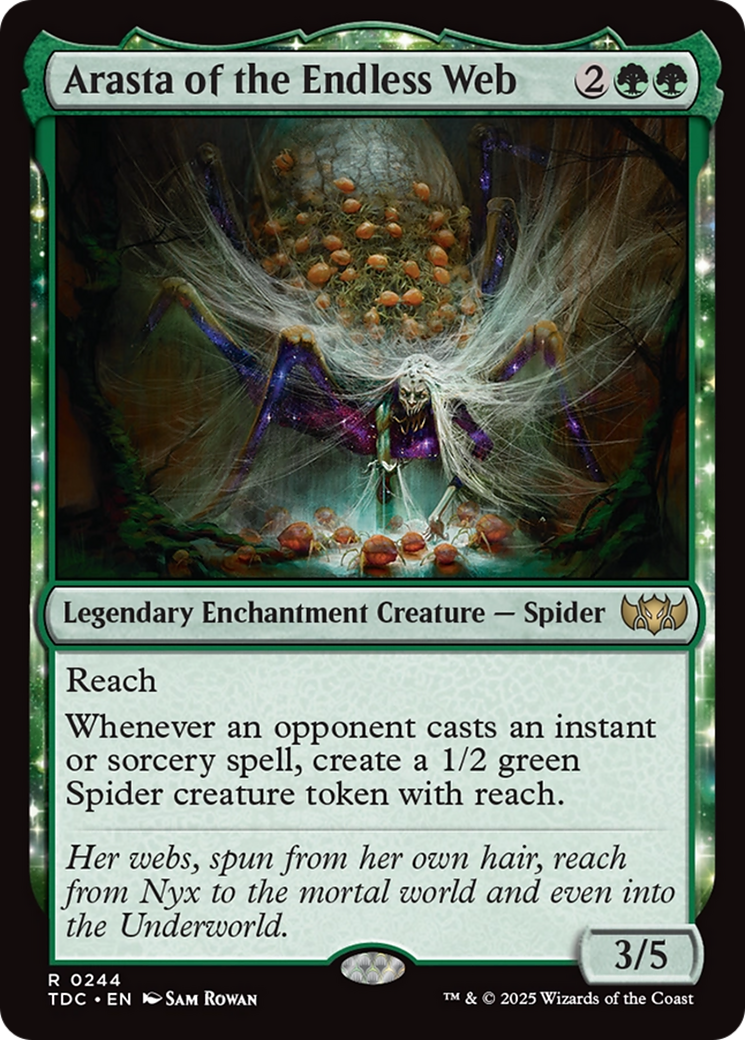
Arasta of the Endless Web
Arasta of the Endless Web
Legendary Enchantment Creature — Spider
3/5
Reach
Whenever an opponent casts an instant or sorcery spell, create a 1/2 green Spider creature token with reach.
- An ability that triggers when a player casts a spell resolves before the spell that caused it to trigger. It resolves even if that spell is countered.
-
1
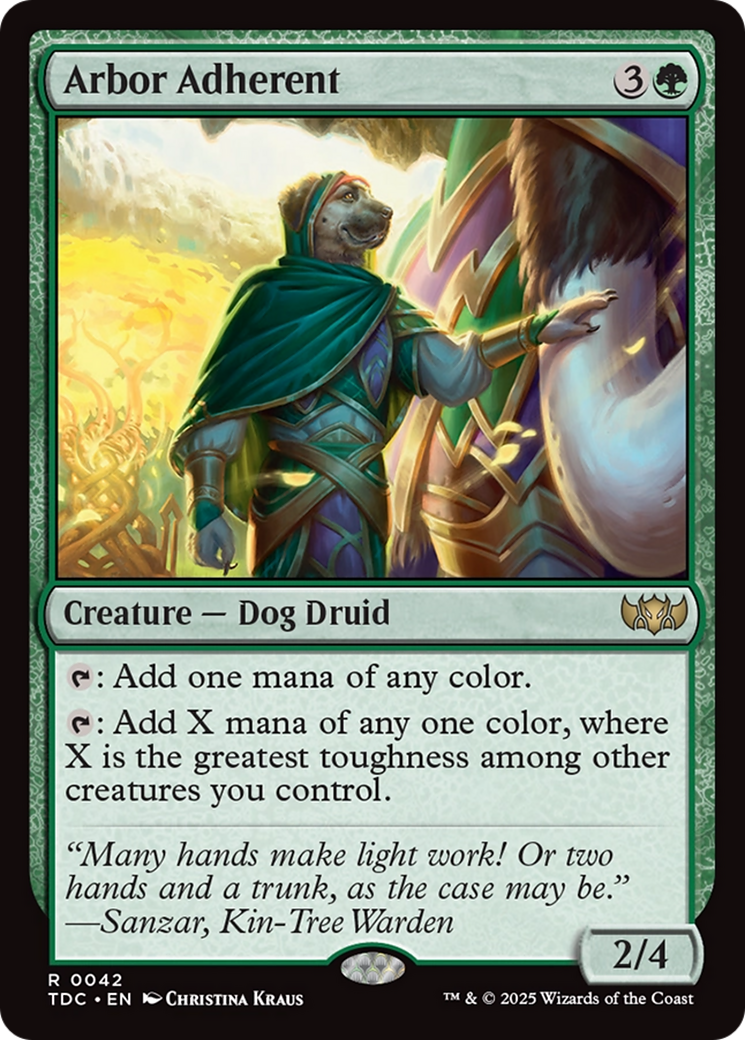
Arbor Adherent
Arbor Adherent
Creature — Dog Druid
2/4
: Add one mana of any color.
: Add X mana of any one color, where X is the greatest toughness among other creatures you control.
-
1
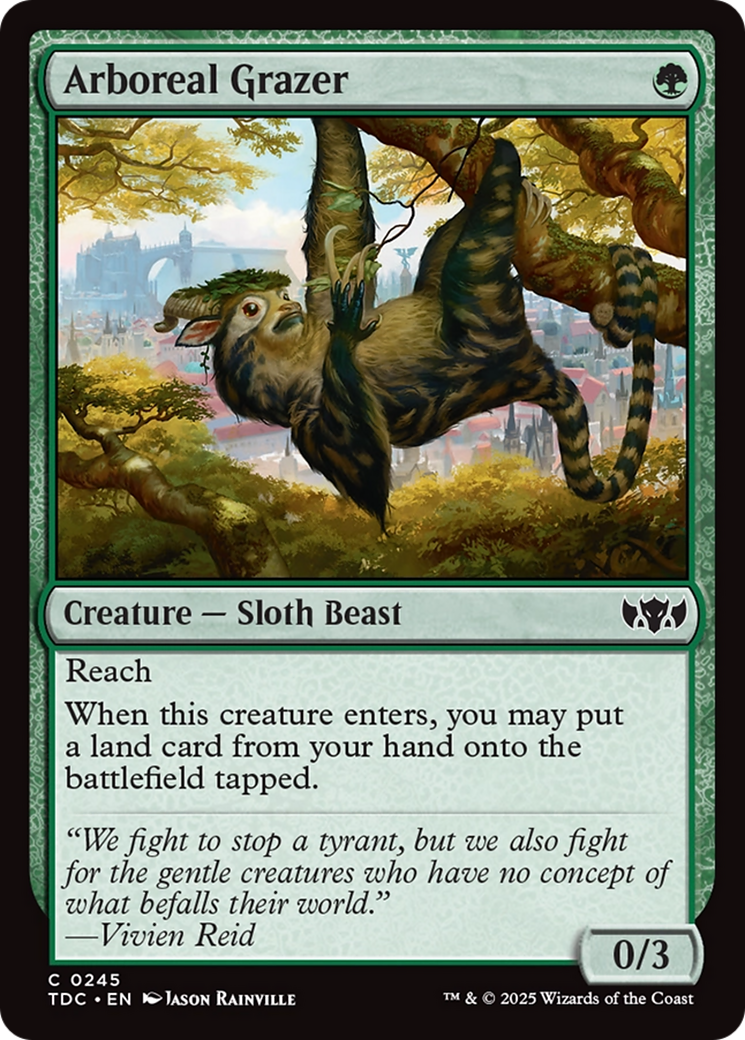
Arboreal Grazer
Arboreal Grazer
Creature — Sloth Beast
0/3
Reach
When this creature enters, you may put a land card from your hand onto the battlefield tapped.
- Arboreal Grazer’s effect doesn’t count as playing a land. It can put a land card onto the battlefield even if you’ve already played your land for the turn.
-
1
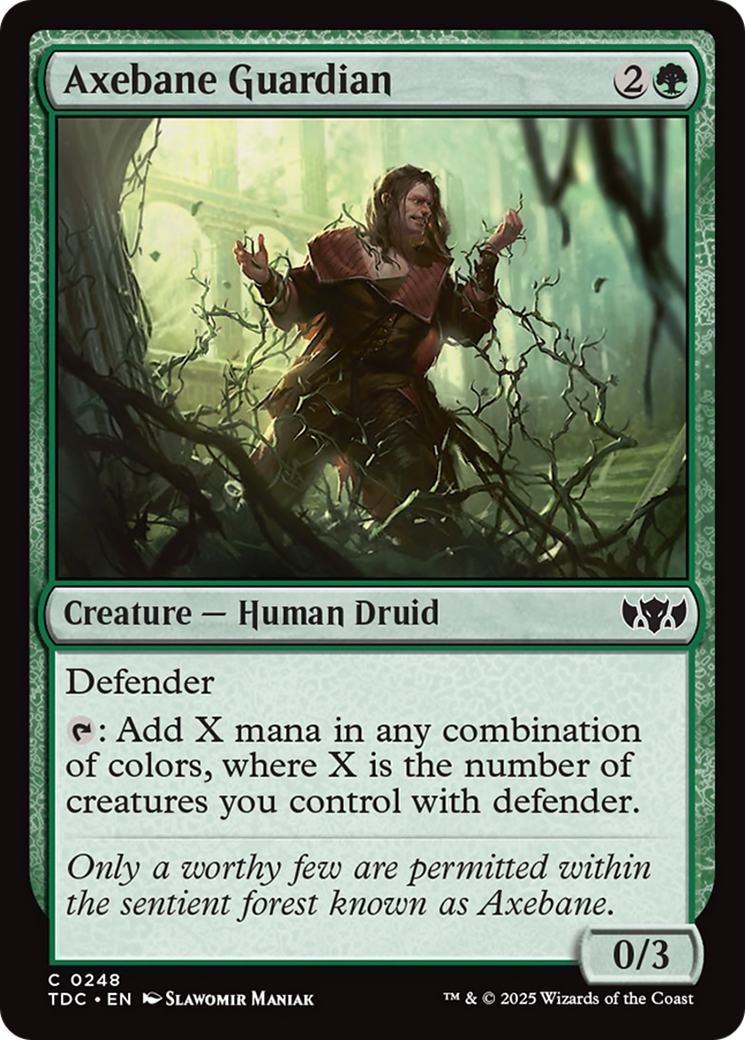
Axebane Guardian
Axebane Guardian
Creature — Human Druid
0/3
Defender
: Add X mana in any combination of colors, where X is the number of creatures you control with defender.
- Axebane Guardian’s activated ability is a mana ability. It doesn’t use the stack and can’t be responded to. The number of creatures with defender you control is counted, and the color(s) of mana produced chosen, immediately after the ability is activated when the ability resolves.
-
1
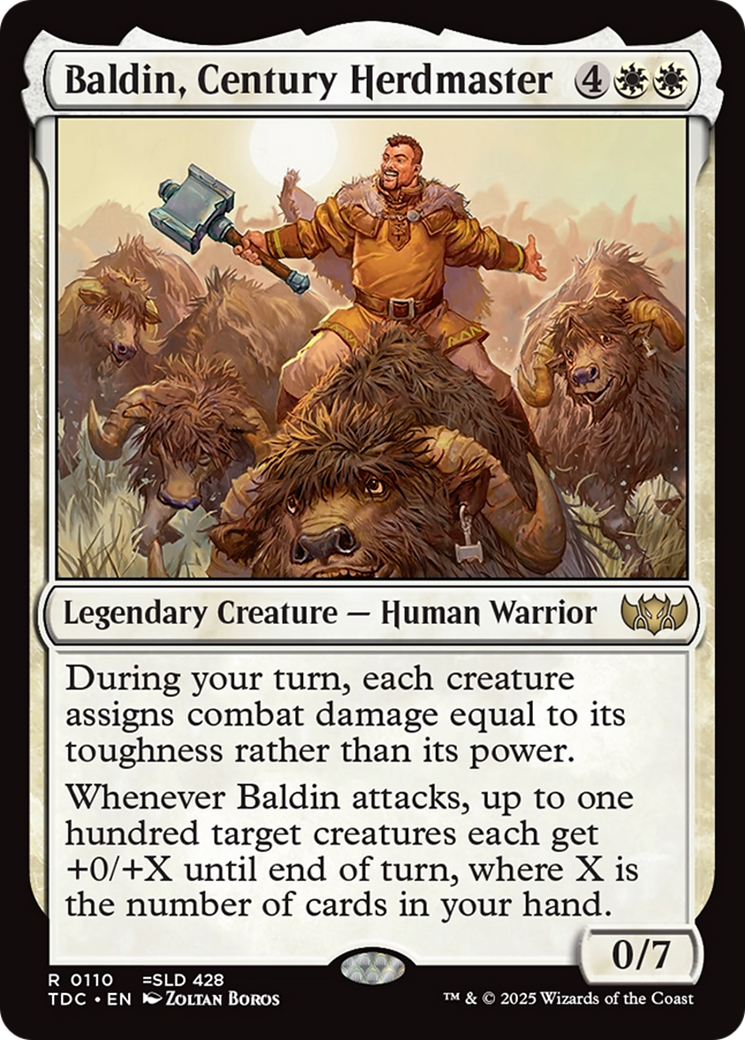
Baldin, Century Herdmaster
Baldin, Century Herdmaster
Legendary Creature — Human Warrior
0/7
As long as it's your turn, each creature assigns combat damage equal to its toughness rather than its power.
Whenever Baldin, Century Herdmaster attacks, up to one hundred target creatures each get +0/+X until end of turn, where X is the number of cards in your hand.
- For the purposes of deck construction, format legality, and all rules, abilities, and effects that refer to a card’s name, this card’s name is the same as that of E. Honda, Sumo Champion.
-
1
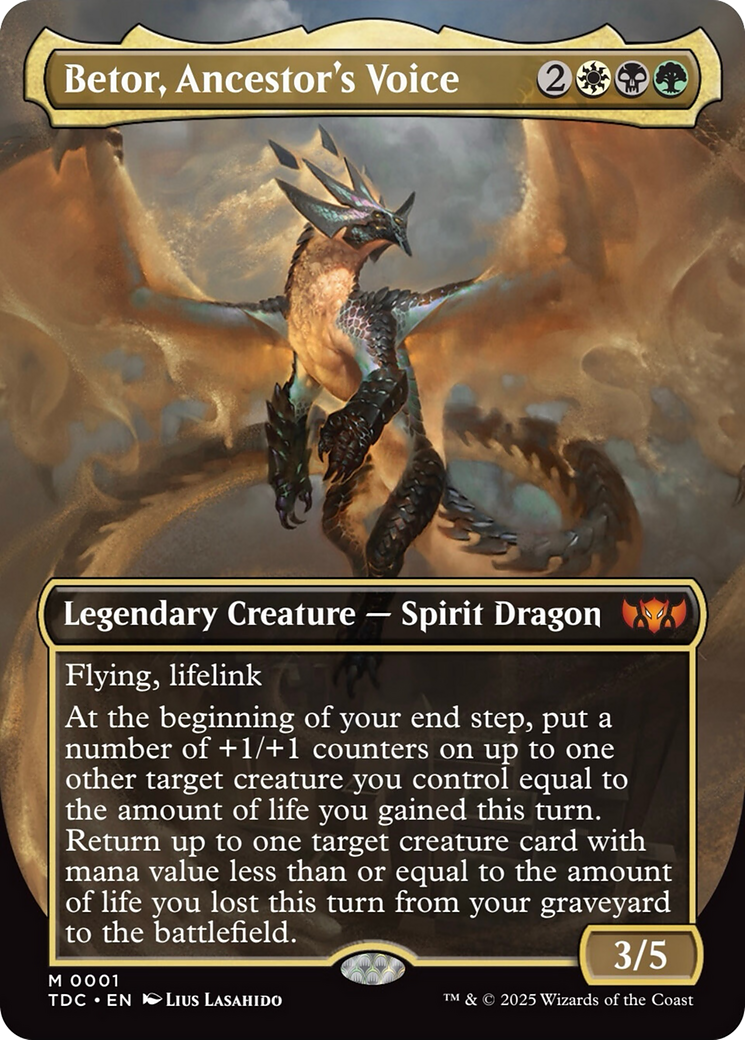
Betor, Ancestor's Voice
Betor, Ancestor's Voice
Legendary Creature — Spirit Dragon
3/5
Flying, lifelink
At the beginning of your end step, put a number of +1/+1 counters on up to one other target creature you control equal to the amount of life you gained this turn. Return up to one target creature card with mana value less than or equal to the amount of life you lost this turn from your graveyard to the battlefield.
-
1
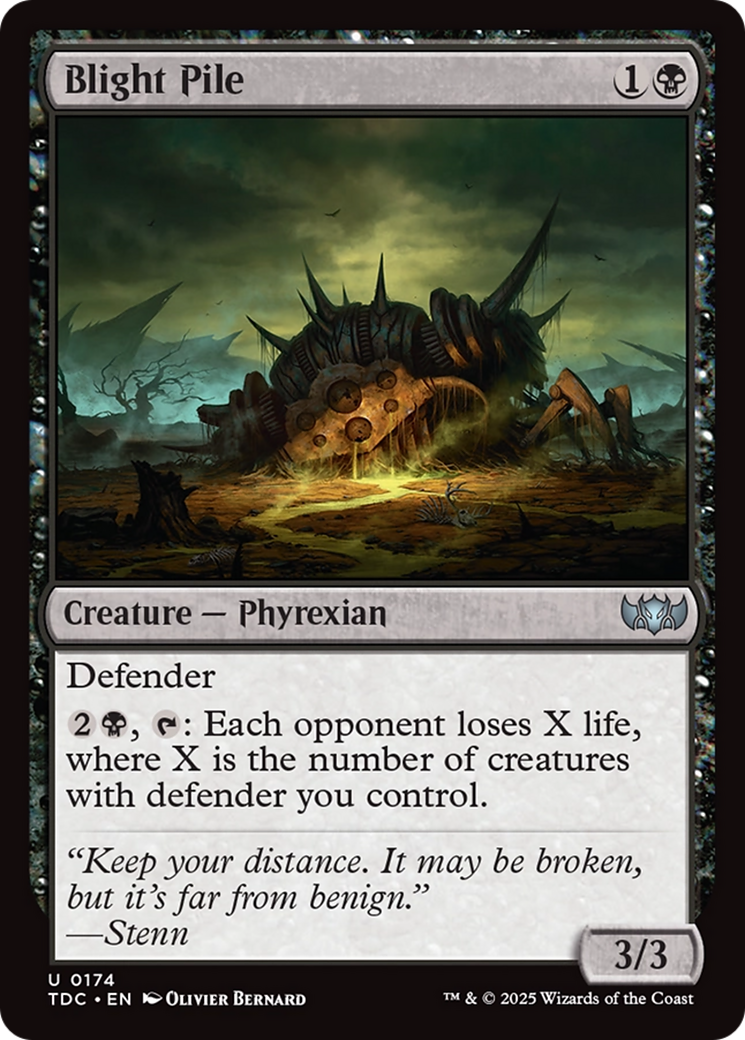
Blight Pile
Blight Pile
Creature — Phyrexian
3/3
Defender
, : Each opponent loses X life, where X is the number of creatures with defender you control.
- In a Two-Headed Giant game, Blight Pile causes the opposing team to lose X life twice.
-
1
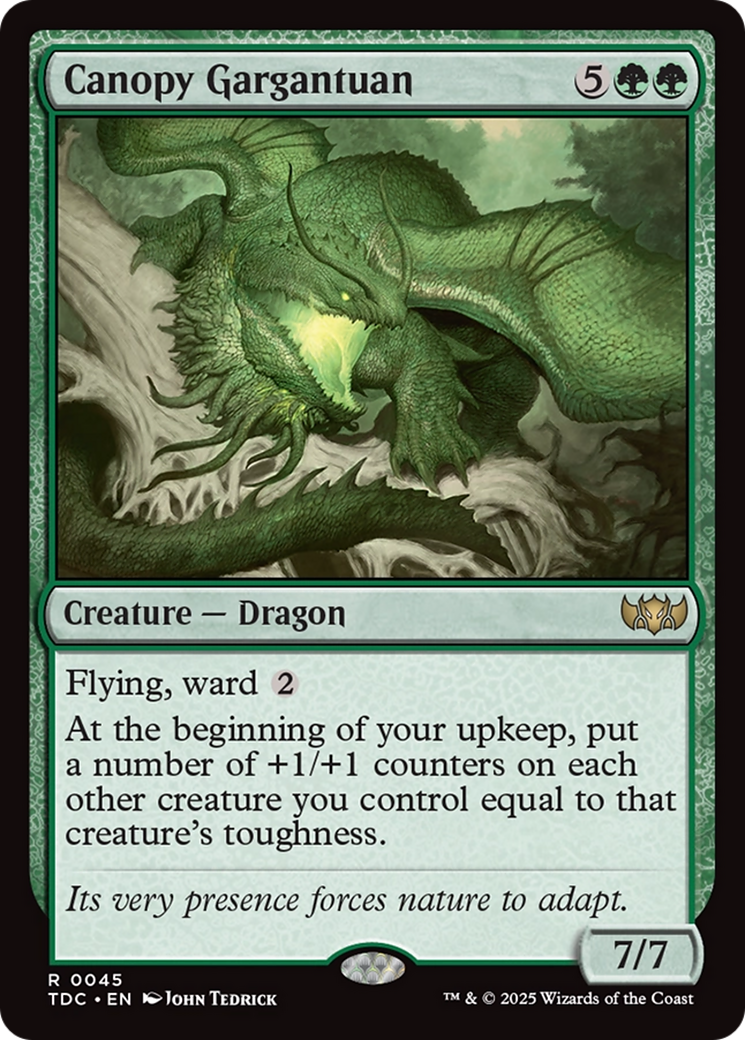
Canopy Gargantuan
Canopy Gargantuan
Creature — Dragon
7/7
Flying, ward
At the beginning of your upkeep, put a number of +1/+1 counters on each other creature you control equal to that creature's toughness.
-
1
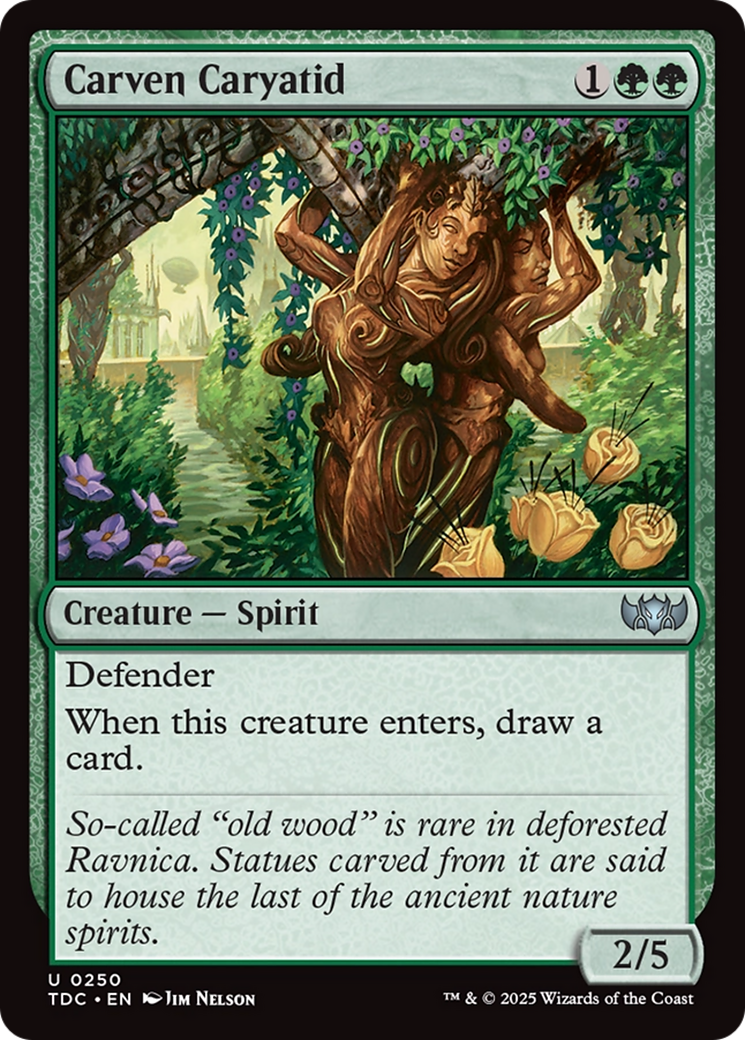
Carven Caryatid
Carven Caryatid
Creature — Spirit
2/5
Defender (This creature can't attack.)
When this creature enters, draw a card.
-
1
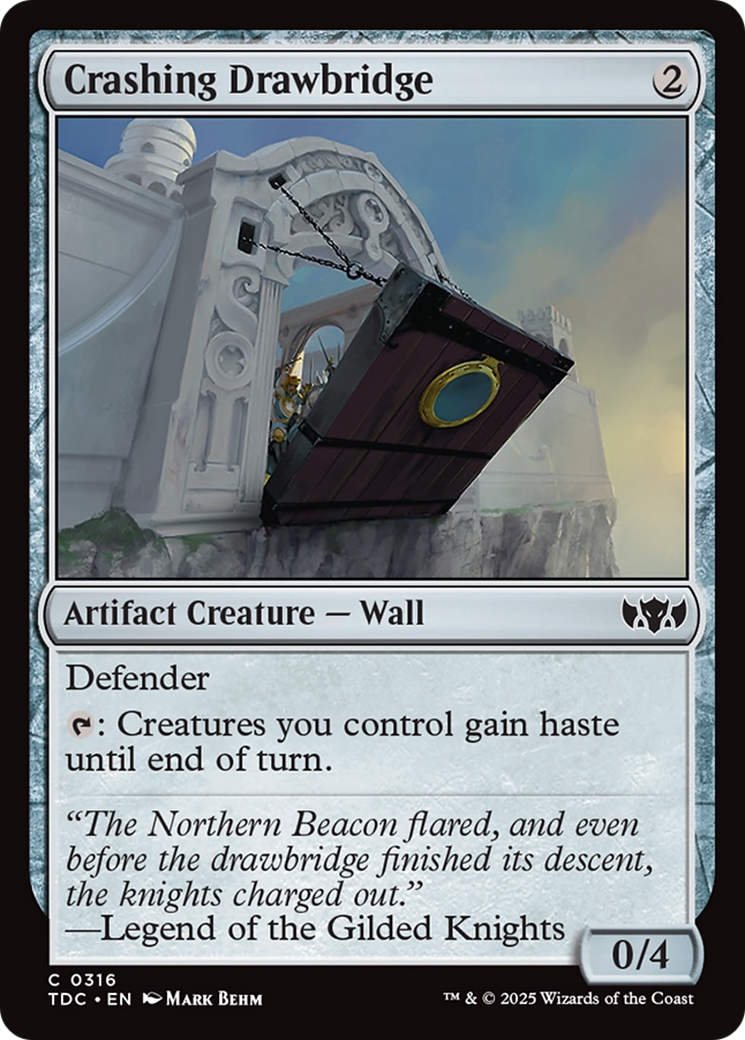
Crashing Drawbridge
Crashing Drawbridge
Artifact Creature — Wall
0/4
Defender
: Creatures you control gain haste until end of turn.
-
1
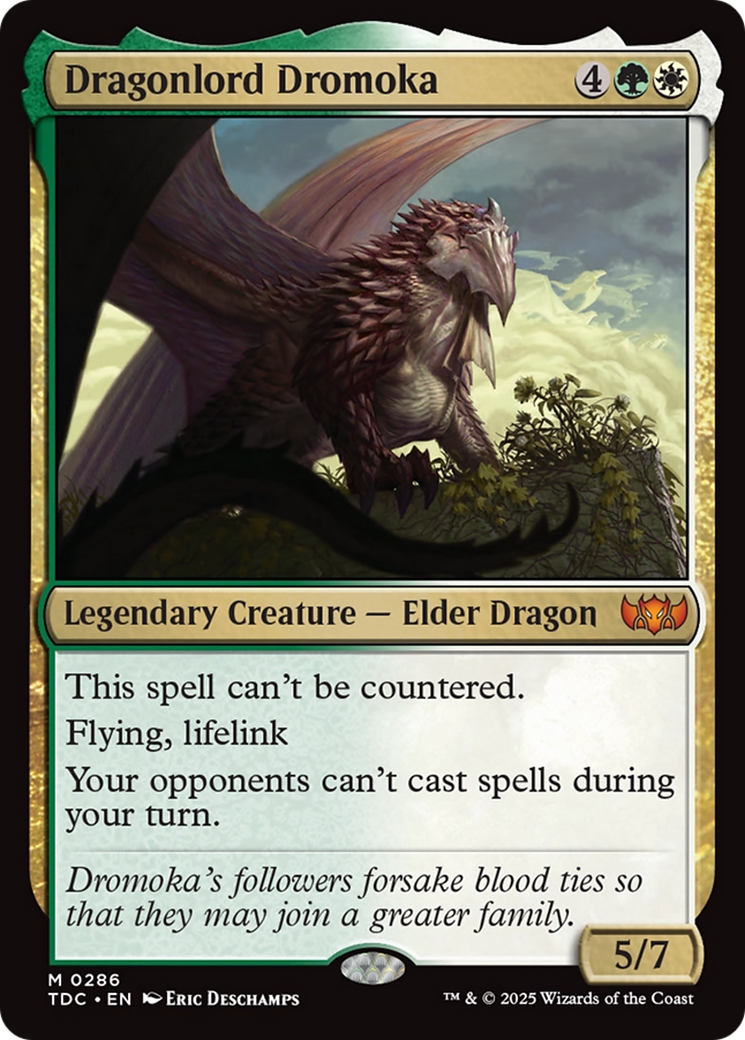
Dragonlord Dromoka
Dragonlord Dromoka
Legendary Creature — Elder Dragon
5/7
This spell can't be countered.
Flying, lifelink
Your opponents can't cast spells during your turn.
-
1
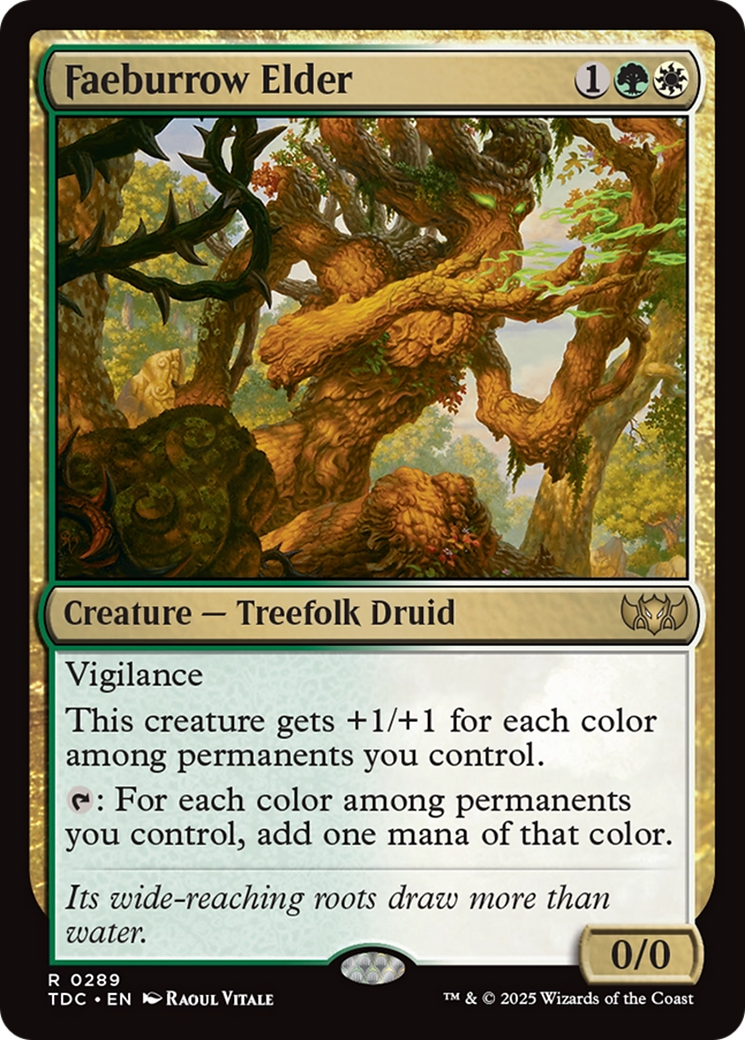
Faeburrow Elder
Faeburrow Elder
Creature — Treefolk Druid
0/0
Vigilance
This creature gets +1/+1 for each color among permanents you control.
: For each color among permanents you control, add one mana of that color.
- Faeburrow Elder's middle ability can give it at most +5/+5, that is, +1/+1 each for white, blue, black, red, and green. "Gold," "multicolor," and "colorless" aren't colors. Similarly, Faeburrow Elder's last ability can produce at most five mana.
- Since Faeburrow Elder is a green and white permanent, its middle ability usually gives it at least +2/+2 and its last ability usually produces at least .
-
1
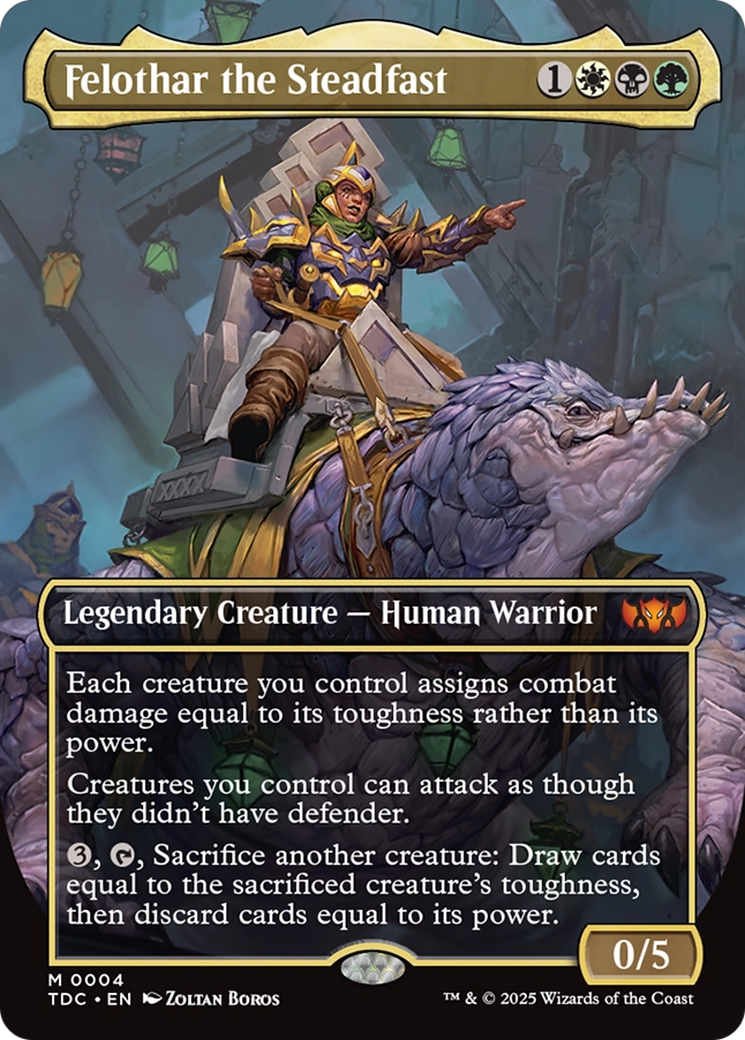
Felothar the Steadfast
Felothar the Steadfast
Legendary Creature — Human Warrior
0/5
Each creature you control assigns combat damage equal to its toughness rather than its power.
Creatures you control can attack as though they didn't have defender.
, , Sacrifice another creature: Draw cards equal to the sacrificed creature's toughness, then discard cards equal to its power.
- Felothar’s first ability doesn’t actually change any creature’s power. It changes only the amount of combat damage those creatures assign. All other rules and effects that check power or toughness use the real values.
-
1
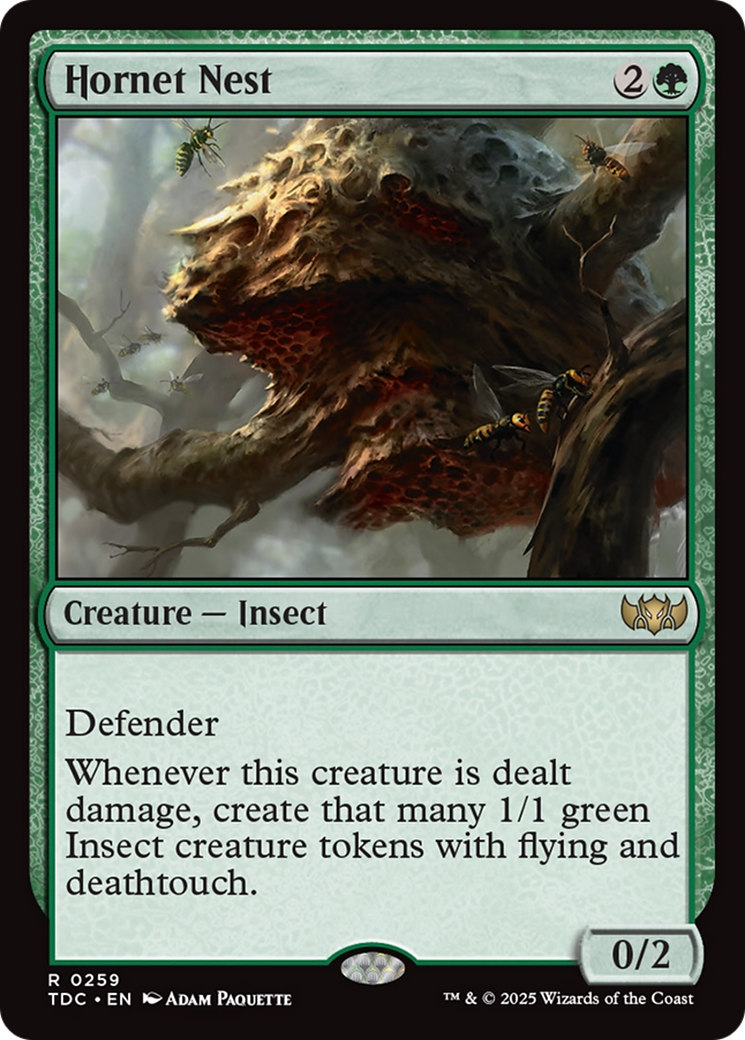
Hornet Nest
Hornet Nest
Creature — Insect
0/2
Defender (This creature can't attack.)
Whenever this creature is dealt damage, create that many 1/1 green Insect creature tokens with flying and deathtouch. (Any amount of damage a creature with deathtouch deals to a creature is enough to destroy it.)
- Hornet Nest’s triggered ability will trigger even if it’s dealt lethal damage. For example, if it’s dealt 7 damage, its ability will trigger and you’ll put seven Insect creature tokens onto the battlefield.
-
1
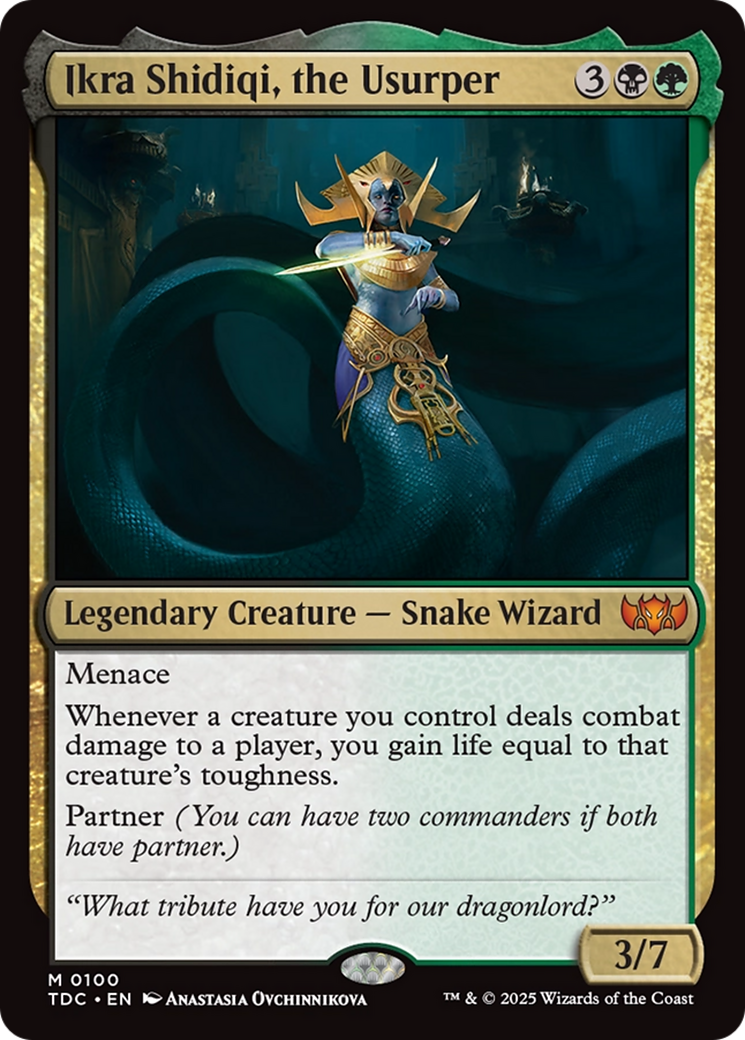
Ikra Shidiqi, the Usurper
Ikra Shidiqi, the Usurper
Legendary Creature — Snake Wizard
3/7
Menace
Whenever a creature you control deals combat damage to a player, you gain life equal to that creature's toughness.
Partner (You can have two commanders if both have partner.)
- The amount of life you gain is determined as Ikra Shidiqi's triggered ability resolves. If that creature is no longer on the battlefield, use its toughness as it last existed on the battlefield to determine how much life to gain.
- If your Commander deck has two commanders, you can only include cards whose own color identities are also found in your commanders' combined color identities. If Falthis and Kediss are your commanders, your deck may contain cards with black and/or red in their color identity, but not cards with green, white, or blue.
- Both commanders start in the command zone, and the remaining 98 cards (or 58 cards in a Commander Draft game) of your deck are shuffled to become your library.
- To have two commanders, both must have the partner ability as the game begins. Losing the ability during the game doesn't cause either to cease to be your commander.
- Once the game begins, your two commanders are tracked separately. If you cast one, you won't have to pay an additional the first time you cast the other. A player loses the game after having been dealt 21 damage from any one of them, not from both of them combined.
- If something refers to your commander while you have two commanders, it refers to one of them of your choice. If you are instructed to perform an action on your commander (e.g. put it from the command zone into your hand due to Command Beacon), you choose one of your commanders at the time the effect happens.
- An effect that checks whether you control your commander is satisfied if you control one or both of your two commanders.
- You can choose two commanders with partner that are the same color or colors. In Commander Draft, you can even choose two of the same commander with partner if you drafted them. If you do this, make sure you keep the number of times you've cast each from the command zone clear for "commander tax" purposes.
-
1
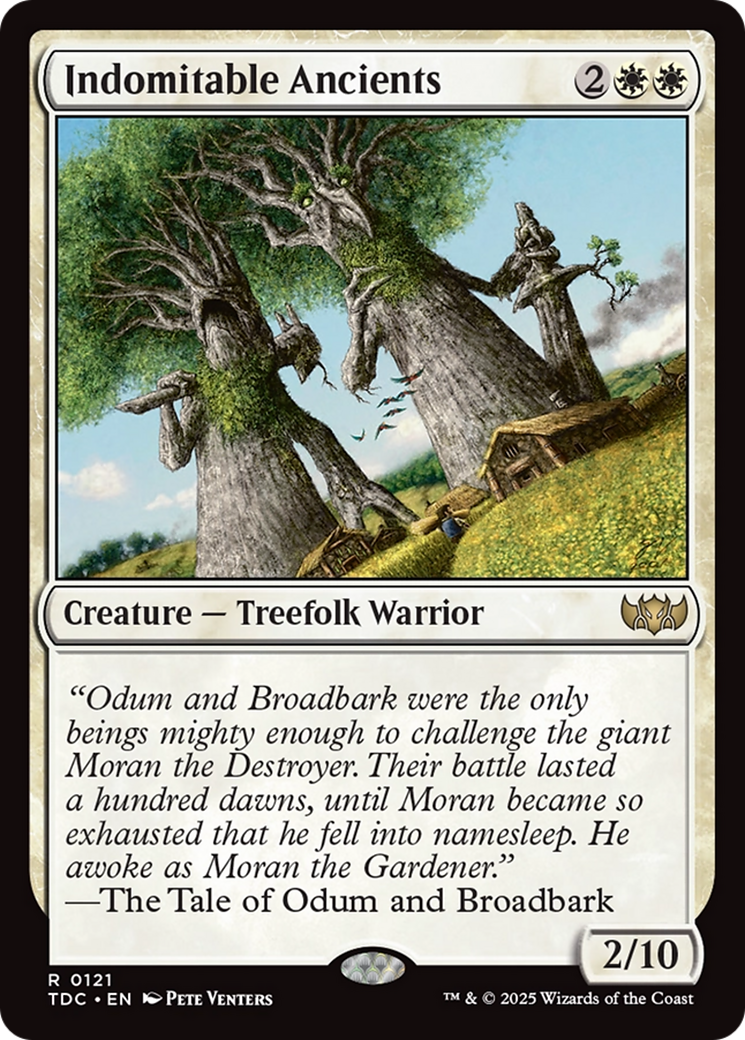
Indomitable Ancients
Indomitable Ancients
Creature — Treefolk Warrior
2/10
-
1
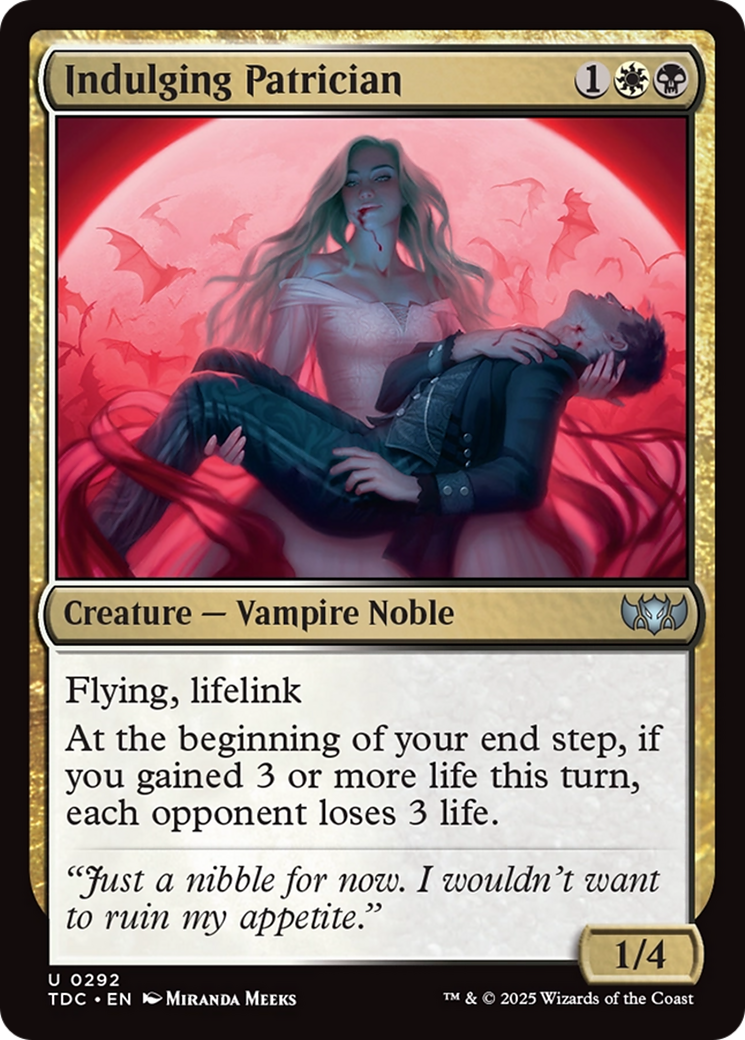
Indulging Patrician
Indulging Patrician
Creature — Vampire Noble
1/4
Flying
Lifelink (Damage dealt by this creature also causes you to gain that much life.)
At the beginning of your end step, if you gained 3 or more life this turn, each opponent loses 3 life.
- Each opponent loses just 3 life, no matter how much life you've gained past 3 life.
- Indulging Patrician's last ability looks at how much life you've gained in the turn, even if it wasn't on the battlefield when you gained life. It doesn't care if you also lost life, even if you lost more life than you gained.
- If you haven't gained 3 life by the time your end step begins, Indulging Patrician's last ability won't trigger at all.
- In a Two-Headed Giant game, Indulging Patrician's last ability causes the opposing team to lose 6 life.
-
1
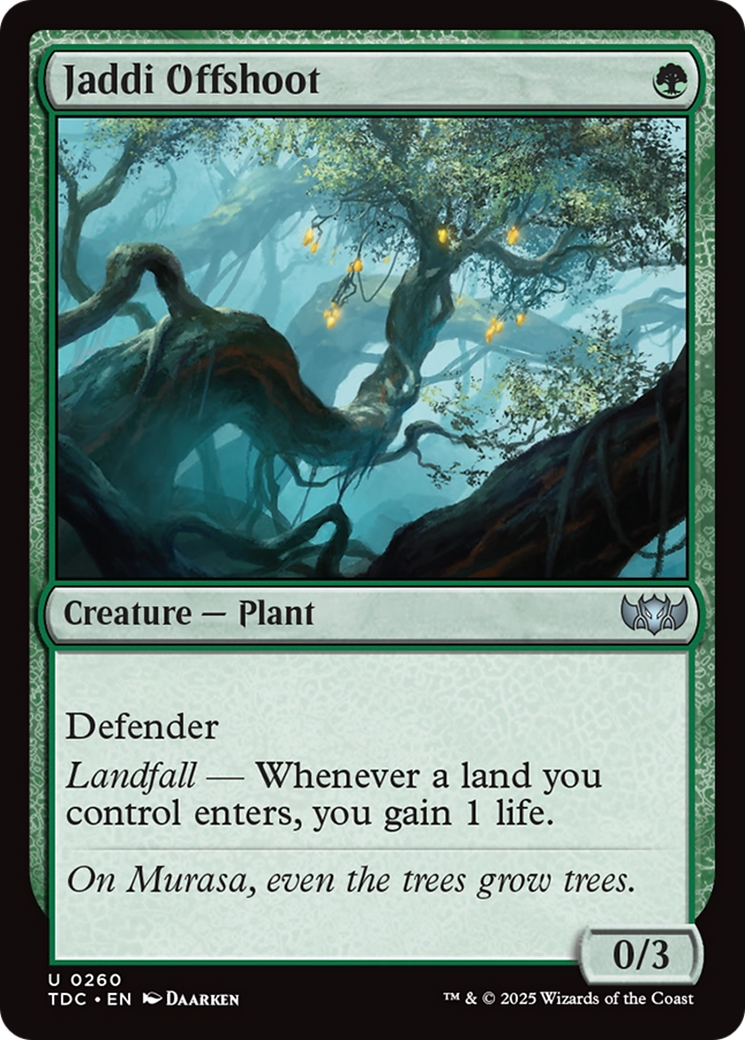
Jaddi Offshoot
Jaddi Offshoot
Creature — Plant
0/3
Defender
Landfall — Whenever a land you control enters, you gain 1 life.
- A landfall ability triggers whenever a land you control enters for any reason. It triggers whenever you play a land, as well as whenever a spell or ability puts a land onto the battlefield under your control.
- A landfall ability doesn't trigger if a permanent already on the battlefield becomes a land.
- Whenever a land you control enters, each landfall ability of the permanents you control will trigger. You can put them on the stack in any order. The last ability you put on the stack will be the first one to resolve (As a result, you can have those abilities resolve in the order of your choosing.).
-
1
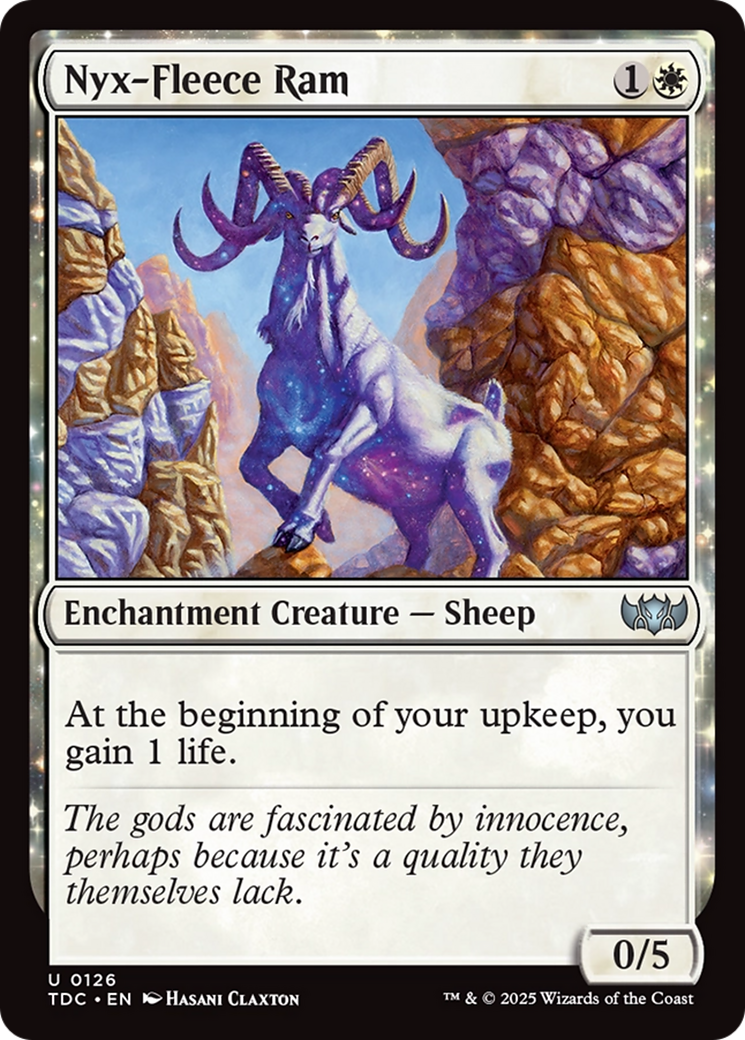
Nyx-Fleece Ram
Nyx-Fleece Ram
Enchantment Creature — Sheep
0/5
At the beginning of your upkeep, you gain 1 life.
-
1
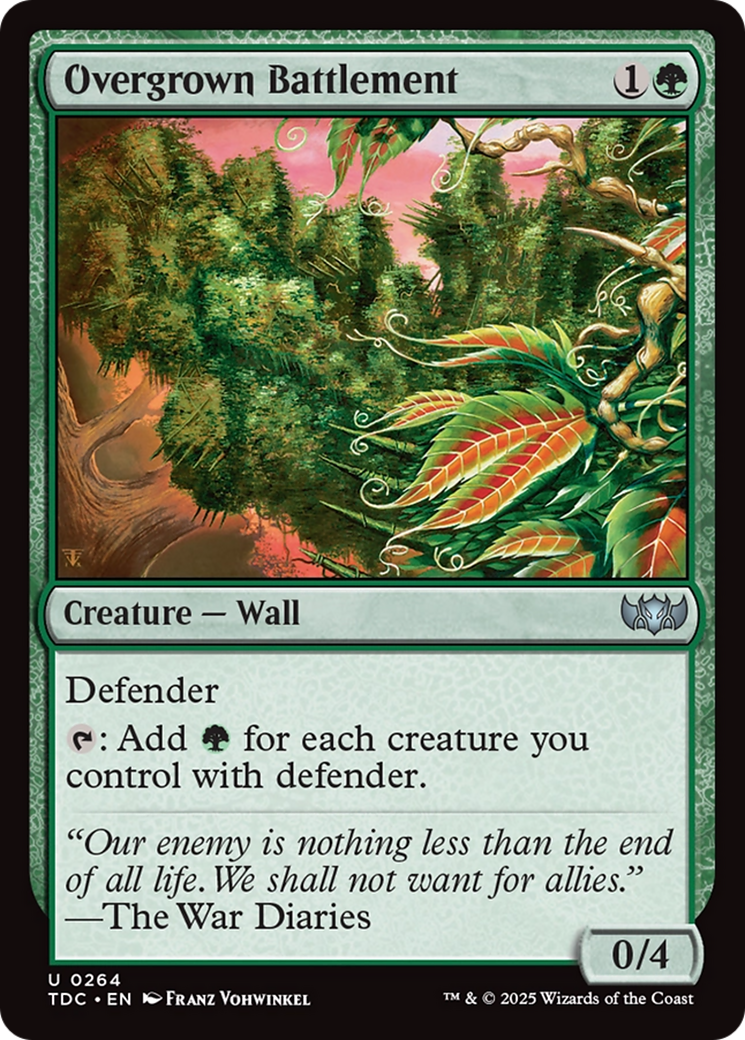
Overgrown Battlement
Overgrown Battlement
Creature — Wall
0/4
Defender
: Add for each creature you control with defender.
- Overgrown Battlement's last ability is a mana ability. It doesn't use the stack and can't be responded to (such as by removing creatures with defender you control).
-
1
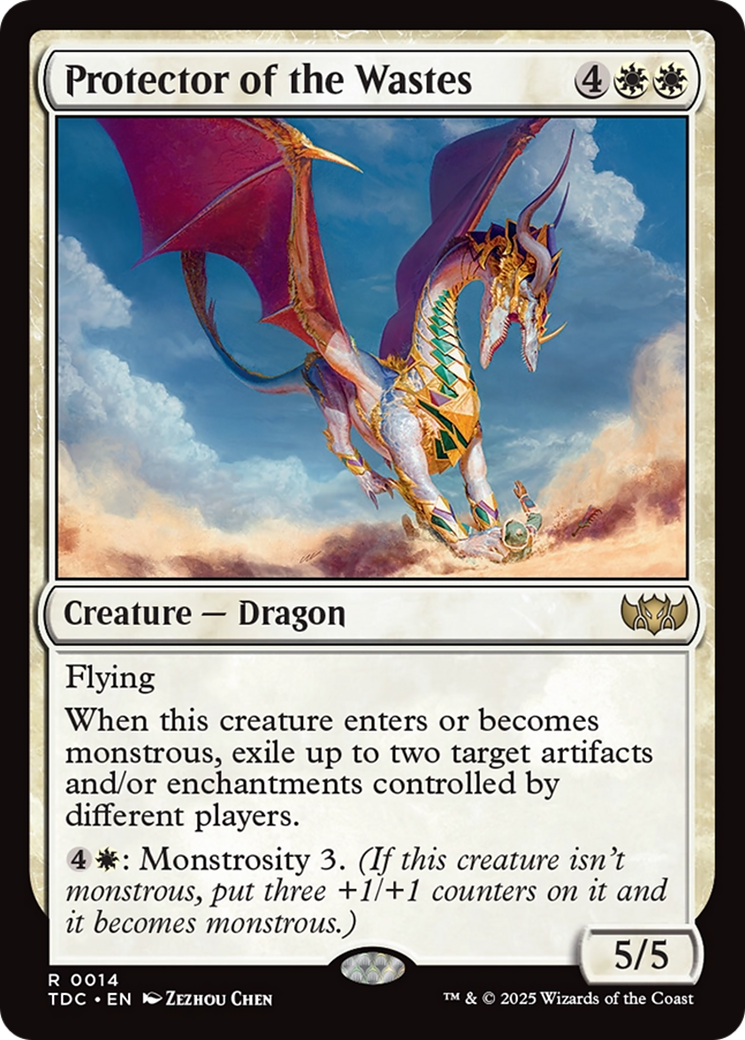
Protector of the Wastes
Protector of the Wastes
Creature — Dragon
5/5
Flying
When this creature enters or becomes monstrous, exile up to two target artifacts and/or enchantments controlled by different players.
: Monstrosity 3. (If this creature isn't monstrous, put three +1/+1 counters on it and it becomes monstrous.)
- Once a creature becomes monstrous, it can’t become monstrous again. If the creature is already monstrous when the monstrosity ability resolves, nothing happens.
- Monstrous isn’t an ability that a creature has. It’s just something true about that creature. If the creature stops being a creature or loses its abilities, it will continue to be monstrous.
-
1
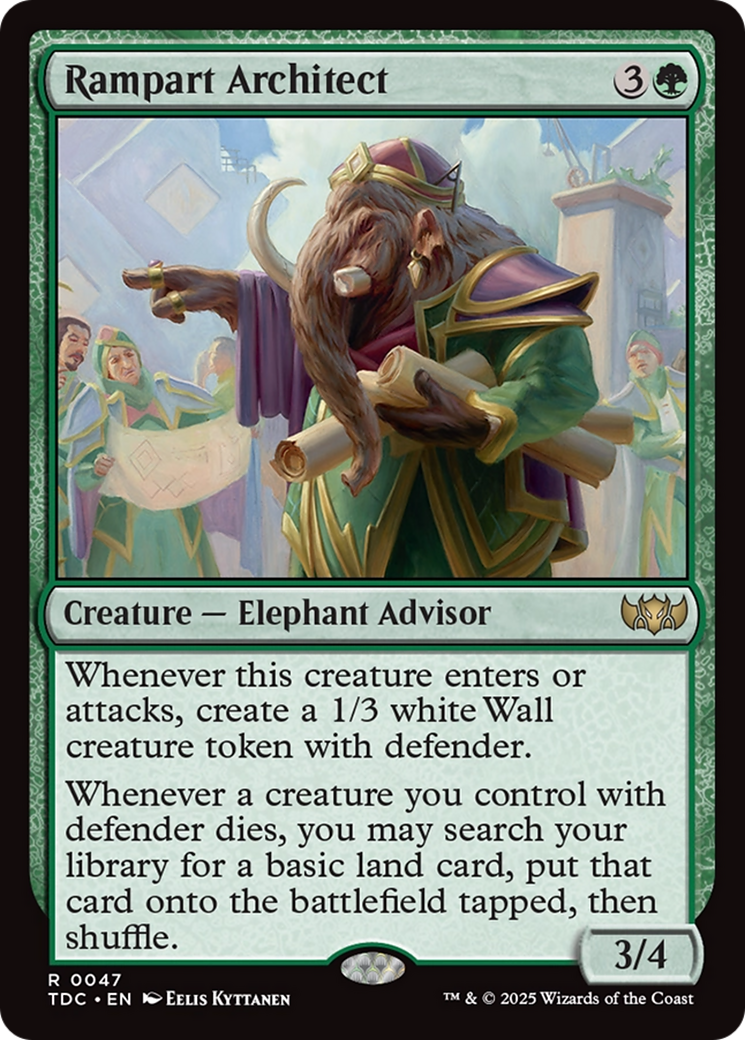
Rampart Architect
Rampart Architect
Creature — Elephant Advisor
3/4
Whenever this creature enters or attacks, create a 1/3 white Wall creature token with defender.
Whenever a creature you control with defender dies, you may search your library for a basic land card, put that card onto the battlefield tapped, then shuffle.
-
1
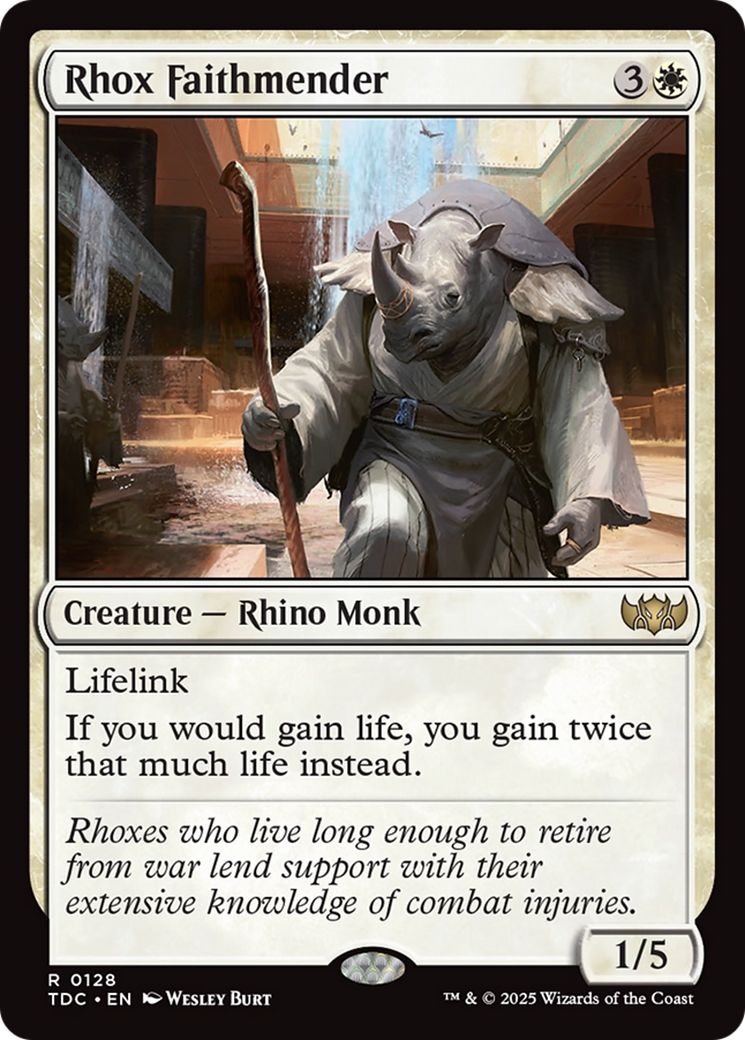
Rhox Faithmender
Rhox Faithmender
Creature — Rhino Monk
1/5
Lifelink (Damage dealt by this creature also causes you to gain that much life.)
If you would gain life, you gain twice that much life instead.
- If you control two Rhox Faithmenders, life you gain will be multiplied by four. Three Rhox Faithmenders will multiply any life gain by eight, and so on.
- If an effect sets your life total to a specific number, and that number is higher than your current life total, the effect will cause you to gain life equal to the difference. Rhox Faithmender will then double that number. For example, if you have 3 life and an effect says that your life total "becomes 10," your life total will actually become 17.
- In a Two-Headed Giant game, only Rhox Faithmender's controller is affected by it. If that player's teammate gains life, Rhox Faithmender will have no effect, even when that life gain is applied to the shared team life total.
-
1
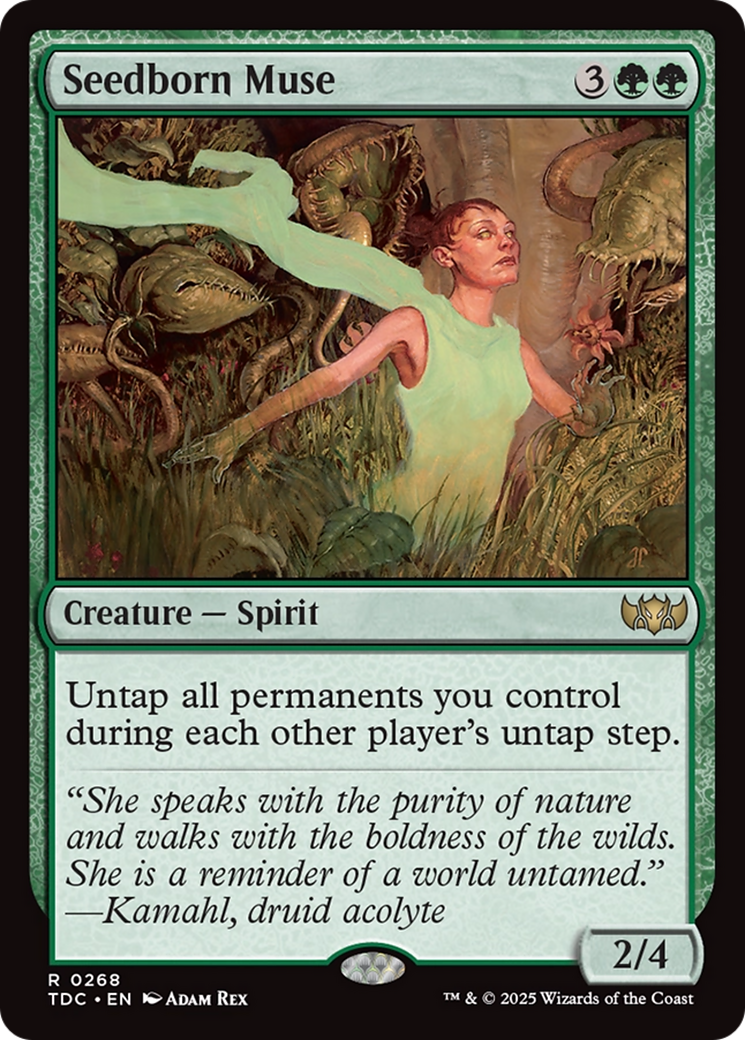
Seedborn Muse
Seedborn Muse
Creature — Spirit
2/4
Untap all permanents you control during each other player's untap step.
- All your permanents untap during each other player's untap step. You have no choice about what untaps.
- Other effects can prevent a permanent from untapping during an untap step. You do need to look carefully, however, as many effects say that the permanent does not untap during its controller's untap step, and this card's ability occurs during other players' untap steps. If a card does say this, then Seedborn Muse can untap it. But some other abilities are not written this way and can still prevent a card from untapping.
-
1
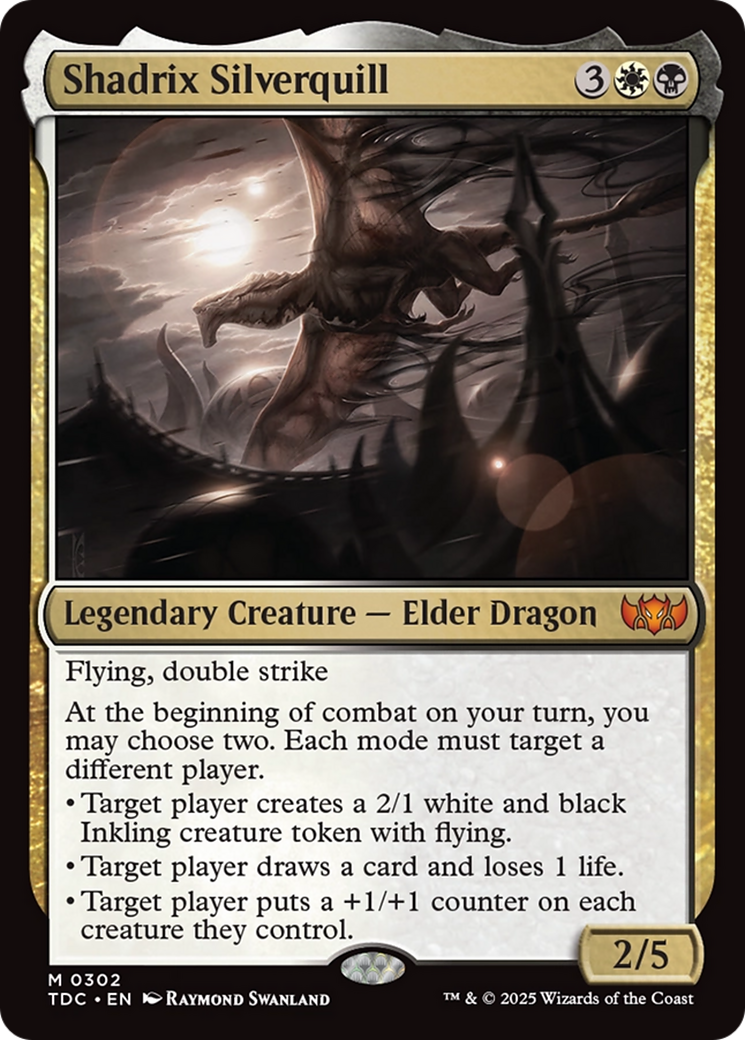
Shadrix Silverquill
Shadrix Silverquill
Legendary Creature — Elder Dragon
2/5
Flying, double strike
At the beginning of combat on your turn, you may choose two. Each mode must target a different player.
- Target player creates a 2/1 white and black Inkling creature token with flying.
- Target player draws a card and loses 1 life.
- Target player puts a +1/+1 counter on each creature they control.
- You may choose exactly zero modes or two modes. You can’t choose only one mode. If you choose two modes, you choose which two and the target players as you put the triggered ability on the stack.
- You can target a player with the third mode even if they control no creatures.
-
1
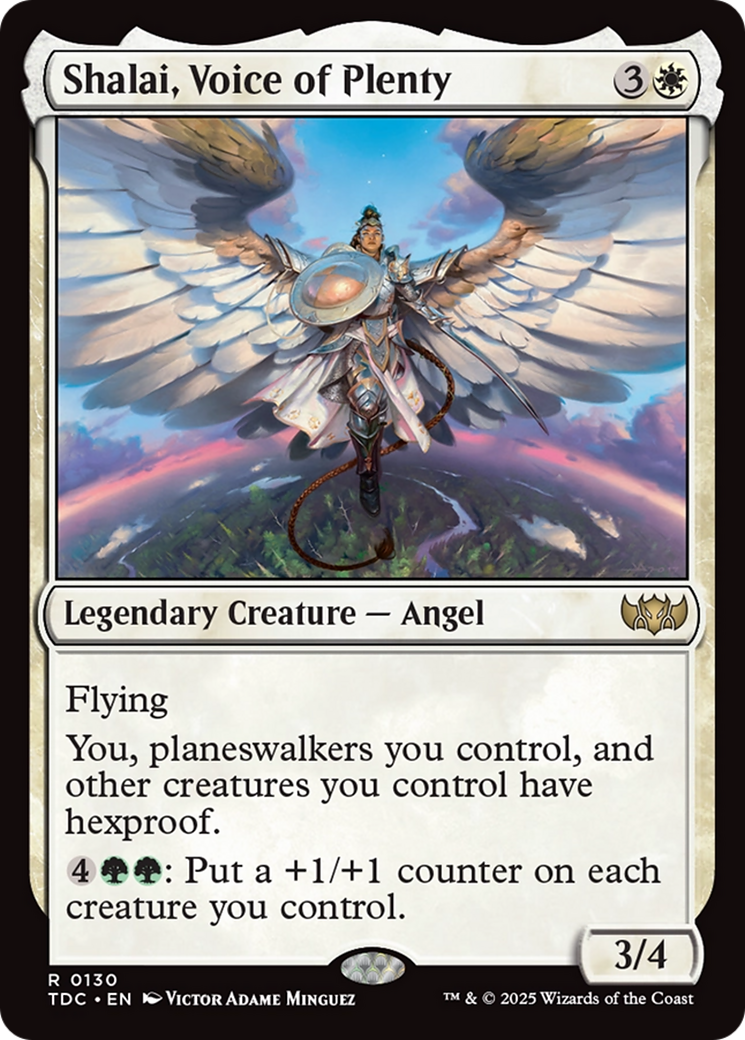
Shalai, Voice of Plenty
Shalai, Voice of Plenty
Legendary Creature — Angel
3/4
Flying
You, planeswalkers you control, and other creatures you control have hexproof.
: Put a +1/+1 counter on each creature you control.
-
1
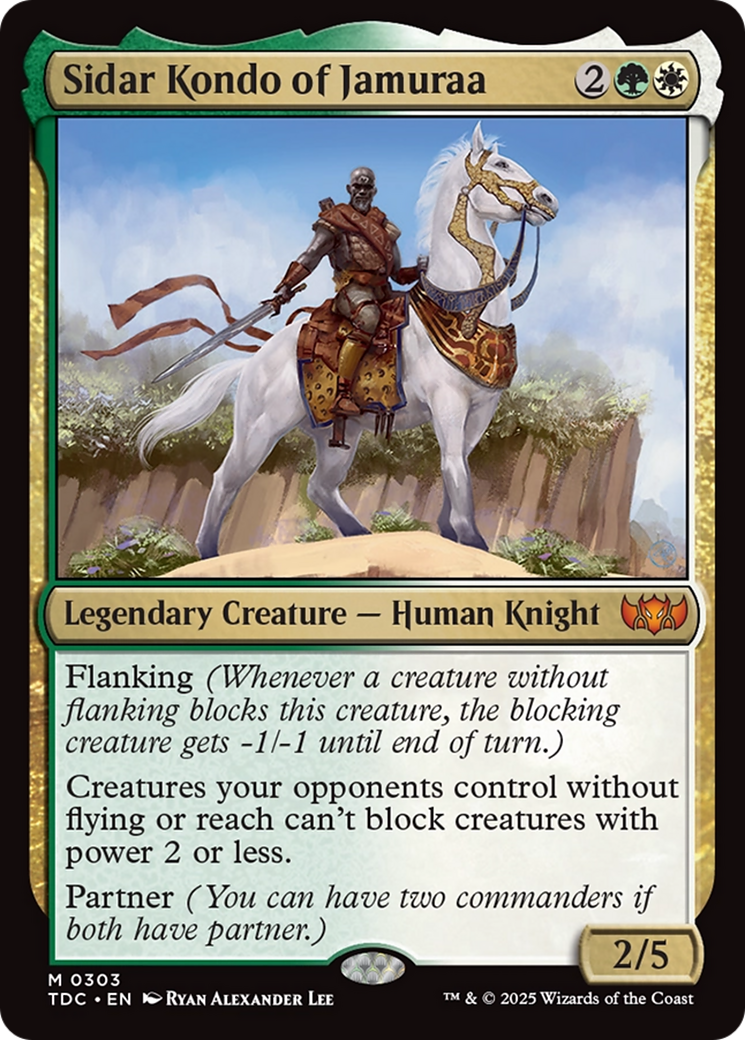
Sidar Kondo of Jamuraa
Sidar Kondo of Jamuraa
Legendary Creature — Human Knight
2/5
Flanking (Whenever a creature without flanking blocks this creature, the blocking creature gets -1/-1 until end of turn.)
Creatures your opponents control without flying or reach can't block creatures with power 2 or less.
Partner (You can have two commanders if both have partner.)
- If something refers to your commander while you have two commanders, it refers to one of them of your choice. If you are instructed to perform an action on your commander (e.g. put it from the command zone into your hand due to Command Beacon), you choose one of your commanders at the time the effect happens.
- Sidar Kondo's blocking restriction applies to creatures your opponents control even when an opponent is being attacked by a player other than you.
- Once an attacking creature has been blocked by a creature without flying or reach, reducing its power to 2 or less won't change or undo that block.
- If your Commander deck has two commanders, you can only include cards whose own color identities are also found in your commanders' combined color identities. If Falthis and Kediss are your commanders, your deck may contain cards with black and/or red in their color identity, but not cards with green, white, or blue.
- Both commanders start in the command zone, and the remaining 98 cards (or 58 cards in a Commander Draft game) of your deck are shuffled to become your library.
- To have two commanders, both must have the partner ability as the game begins. Losing the ability during the game doesn't cause either to cease to be your commander.
- Once the game begins, your two commanders are tracked separately. If you cast one, you won't have to pay an additional the first time you cast the other. A player loses the game after having been dealt 21 damage from any one of them, not from both of them combined.
- An effect that checks whether you control your commander is satisfied if you control one or both of your two commanders.
- You can choose two commanders with partner that are the same color or colors. In Commander Draft, you can even choose two of the same commander with partner if you drafted them. If you do this, make sure you keep the number of times you've cast each from the command zone clear for "commander tax" purposes.
-
1
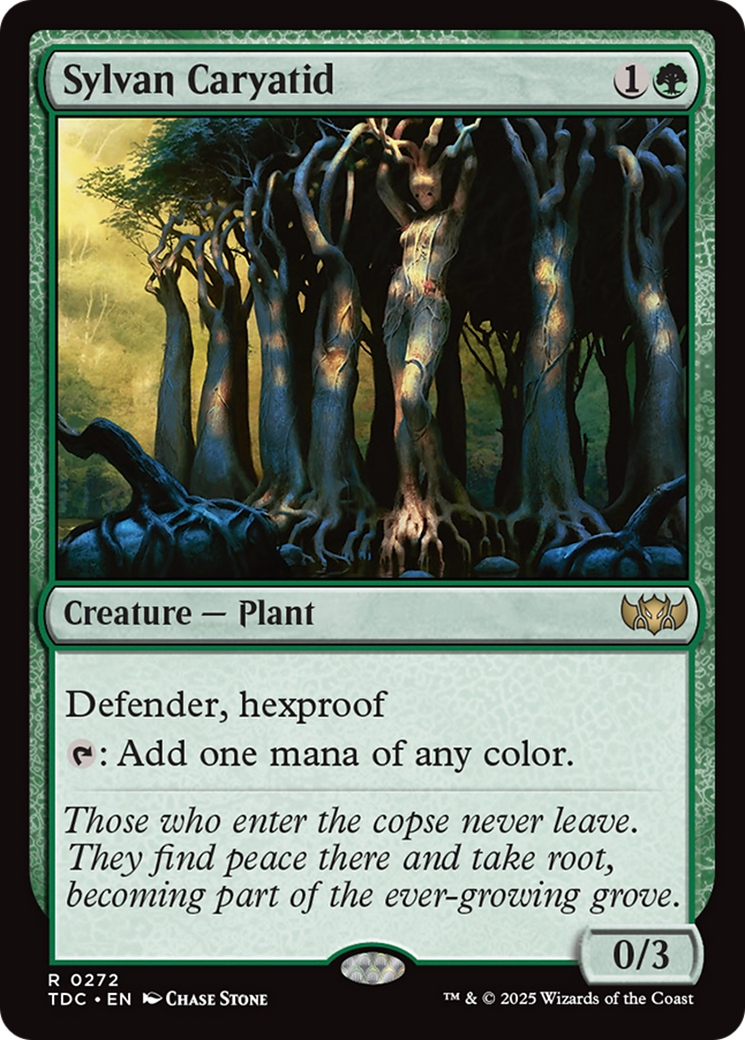
Sylvan Caryatid
Sylvan Caryatid
Creature — Plant
0/3
Defender, hexproof
: Add one mana of any color.
-
1
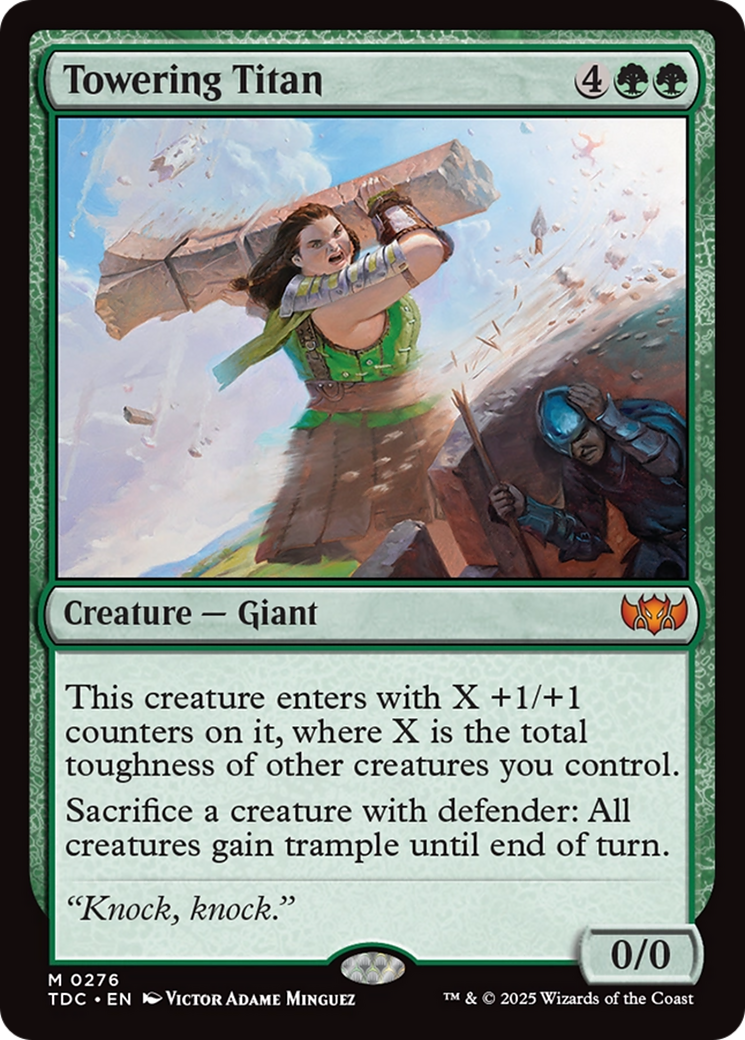
Towering Titan
Towering Titan
Creature — Giant
0/0
This creature enters with X +1/+1 counters on it, where X is the total toughness of other creatures you control.
Sacrifice a creature with defender: All creatures gain trample until end of turn.
- If another creature is entering the battlefield at the same time as Towering Titan, its toughness won’t contribute to the +1/+1 counters on Towering Titan.
- Once Towering Titan has entered the battlefield, it doesn’t gain or lose counters as the total toughness of other creatures you control changes.
-
1
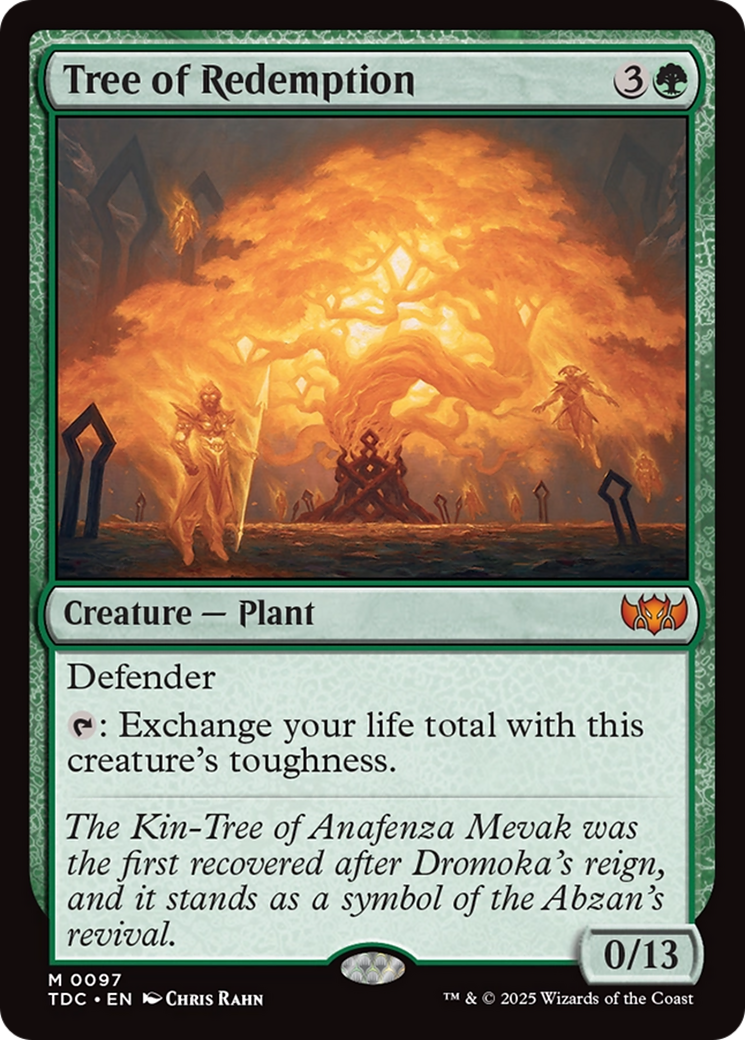
Tree of Redemption
Tree of Redemption
Creature — Plant
0/13
Defender
: Exchange your life total with this creature's toughness.
- If Tree of Redemption isn't on the battlefield when its activated ability resolves, the exchange can't happen and the ability will have no effect.
- When its activated ability resolves, Tree of Redemption's toughness will become your former life total and you will gain or lose an amount of life necessary so that your life total equals Tree of Redemption's former toughness. Other effects that interact with life gain or life loss will interact with this effect accordingly.
- Any toughness-modifying effects, counters, Auras, or Equipment will apply after its toughness is set to your former life total. For example, say Tree of Redemption is enchanted with Lunarch Mantle (which makes it 2/15) and your life total is 7. After the exchange, Tree of Redemption would be a 2/9 creature (its toughness became 7, which was then modified by Lunarch Mantle) and your life total would be 15.
-
1
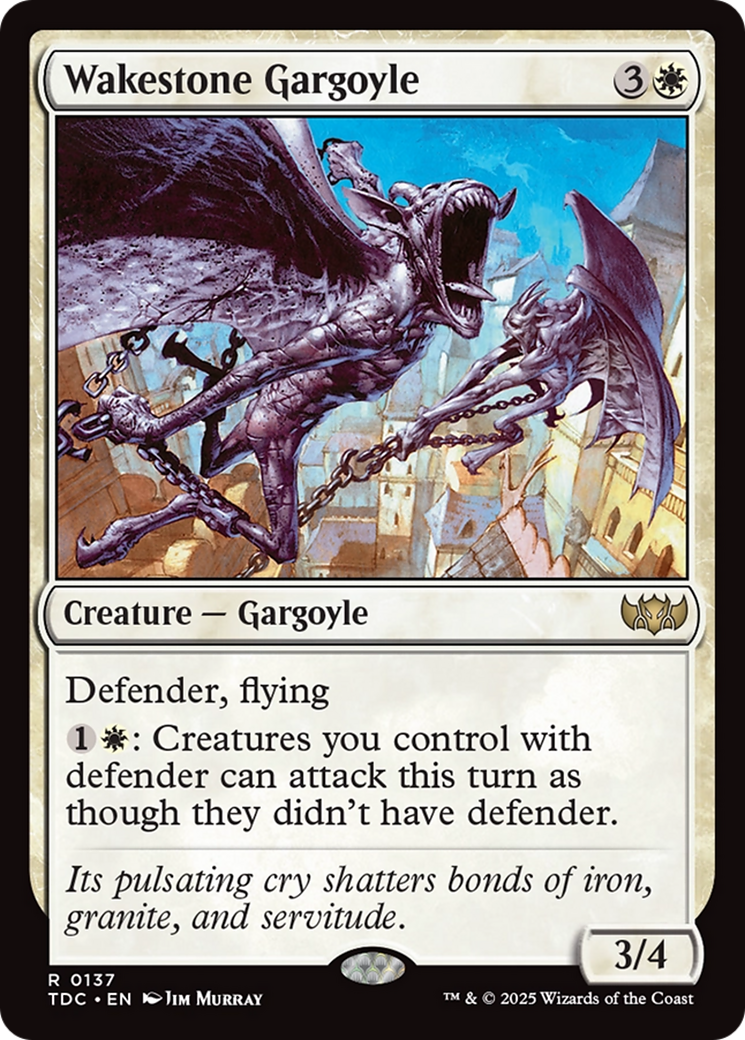
Wakestone Gargoyle
Wakestone Gargoyle
Creature — Gargoyle
3/4
Defender, flying
: Creatures you control with defender can attack this turn as though they didn't have defender.
- Wakestone Gargoyle’s ability allows itself to attack.
- Wakestone Gargoyle’s ability will affect creatures with defender that come under your control after the ability resolves but before you declare attackers (though those creatures still can’t attack unless they have haste).
-
1
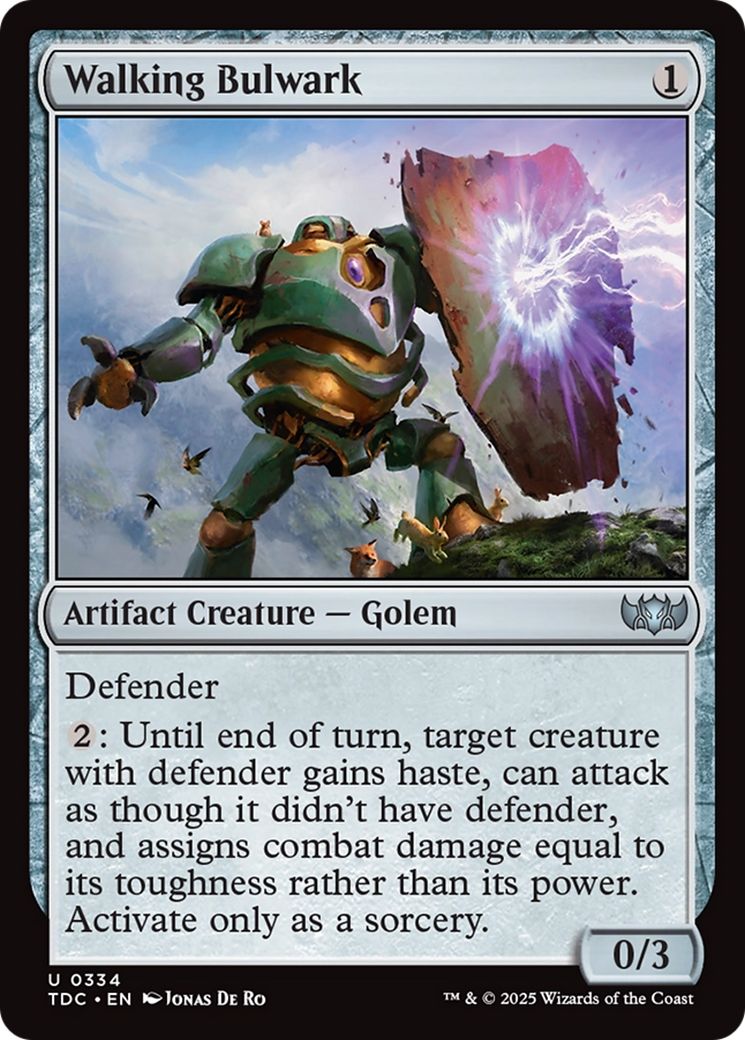
Walking Bulwark
Walking Bulwark
Artifact Creature — Golem
0/3
Defender
: Until end of turn, target creature with defender gains haste, can attack as though it didn't have defender, and assigns combat damage equal to its toughness rather than its power. Activate only as a sorcery.
- Walking Bulwark’s last ability doesn’t actually change any creature’s power. It changes only the amount of combat damage it assigns. All other rules and effects that check power or toughness use the real values. For example, since having two creatures fight doesn’t result in combat damage, an effect that causes the affected creature to fight another creature will still use its power to determine how much damage is dealt.
-
1
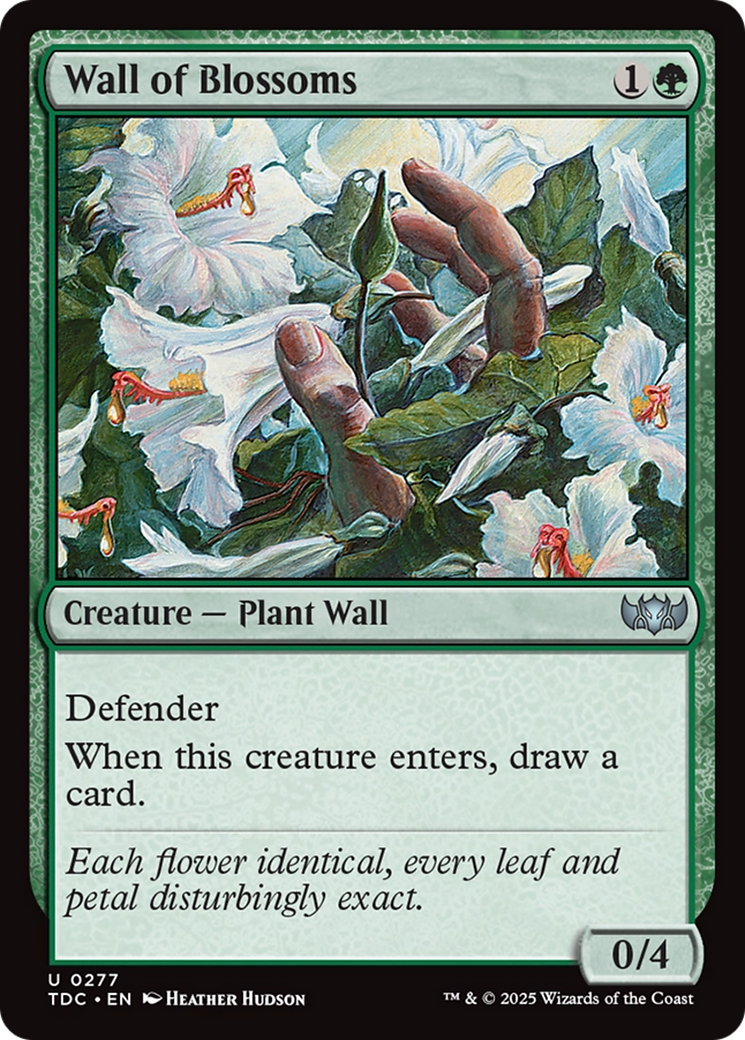
Wall of Blossoms
Wall of Blossoms
Creature — Plant Wall
0/4
Defender
When this creature enters, draw a card.
-
1
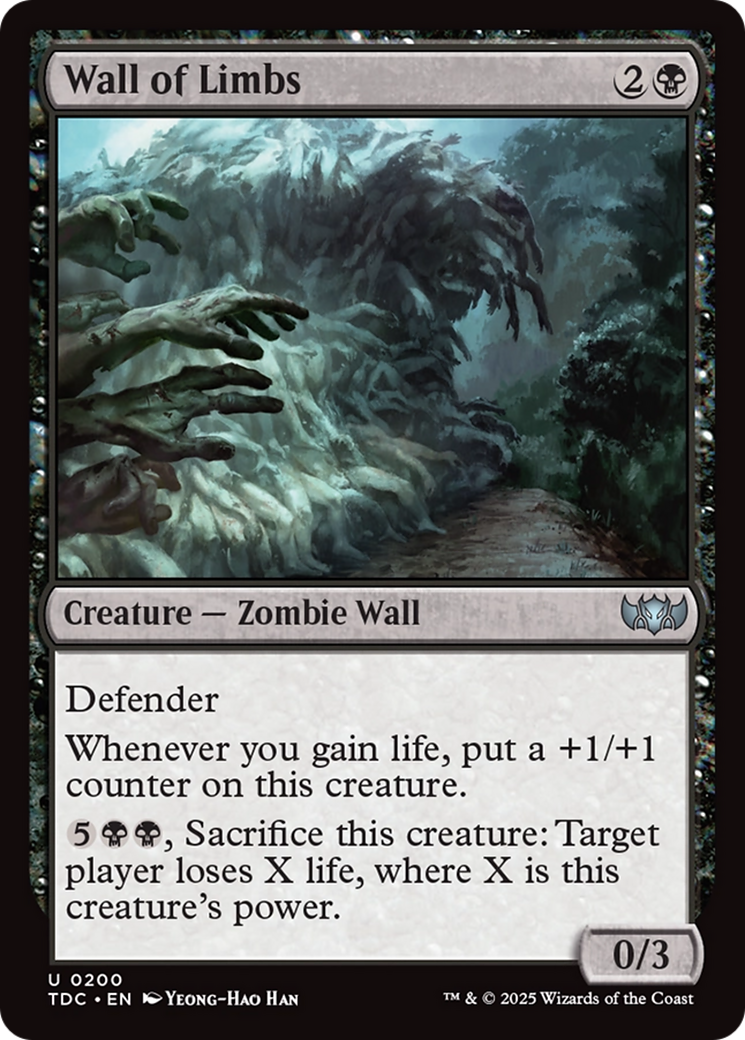
Wall of Limbs
Wall of Limbs
Creature — Zombie Wall
0/3
Defender (This creature can't attack.)
Whenever you gain life, put a +1/+1 counter on this creature.
, Sacrifice this creature: Target player loses X life, where X is this creature's power.
- The ability triggers just once for each life-gaining event, whether it’s 1 life from Soulmender or 8 life from Meditation Puzzle.
- Use Wall of Limbs’s power as it last existed on the battlefield, including any +1/+1 counters it had, to determine the value of X.
- If you gain life at the same time Wall of Limbs is dealt lethal damage (probably because you control a blocking creature with lifelink), Wall of Limbs’s triggered ability will trigger, but Wall of Limbs will be destroyed before the ability resolves.
-
1
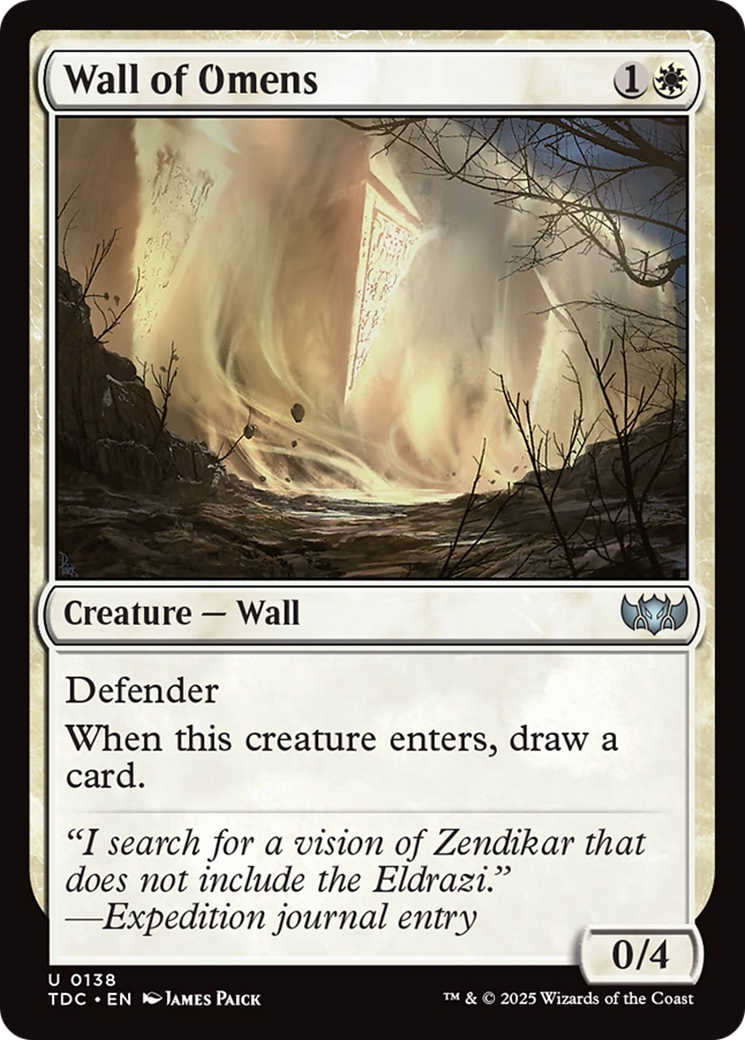
Wall of Omens
Wall of Omens
Creature — Wall
0/4
Defender
When this creature enters, draw a card.
-
1
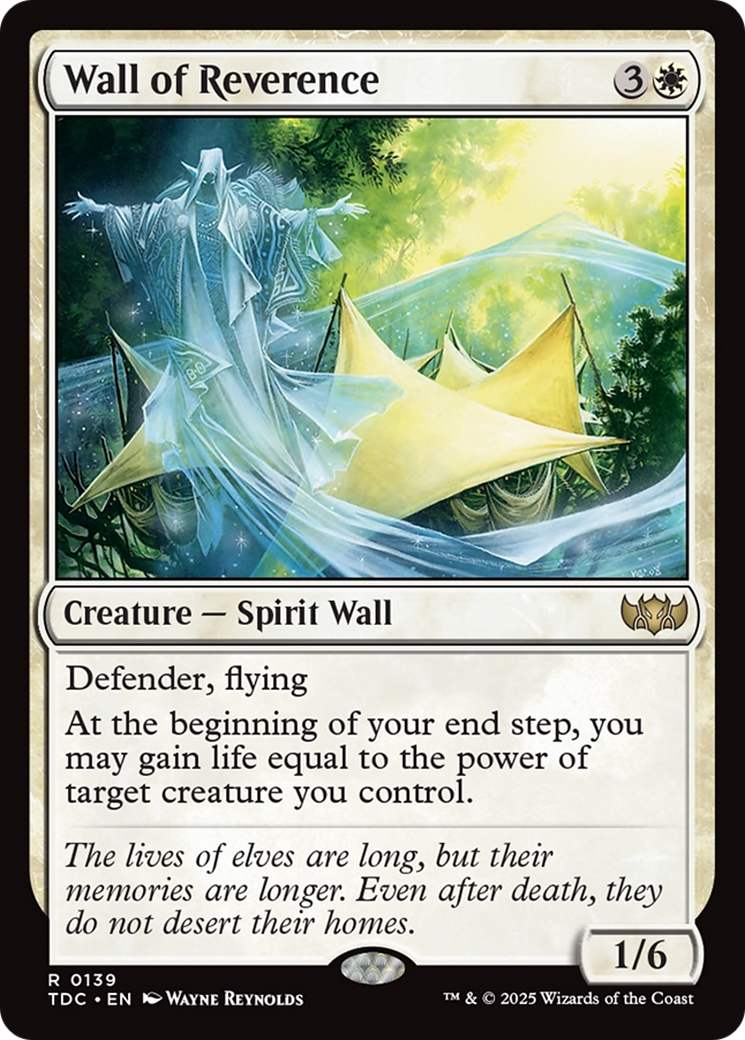
Wall of Reverence
Wall of Reverence
Creature — Spirit Wall
1/6
Defender, flying
At the beginning of your end step, you may gain life equal to the power of target creature you control.
- If an effect changes a creature’s power “until end of turn,” it will still have the modified power during your end step.
-
1
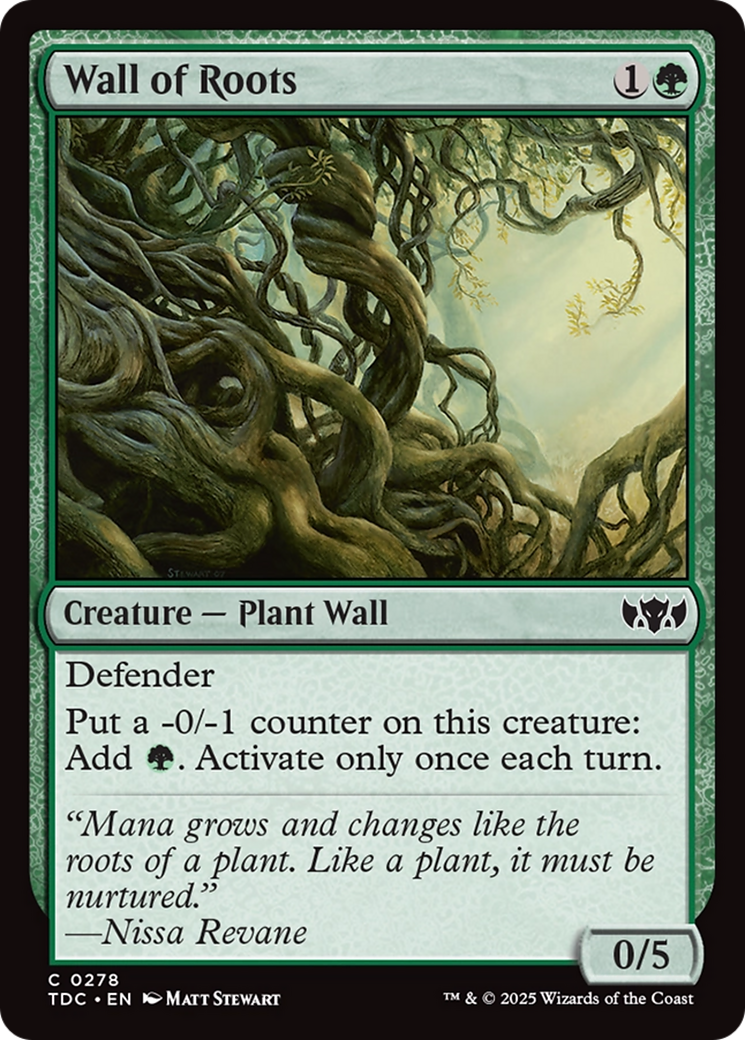
Wall of Roots
Wall of Roots
Creature — Plant Wall
0/5
Defender
Put a -0/-1 counter on this creature: Add . Activate only once each turn.
- If you must sacrifice a creature to pay a casting or activation cost that also includes mana, such as that of Bubbling Cauldron's abilities, you may put a -0/-1 counter on Wall of Roots to make its toughness 0 and then sacrifice it to pay that cost.
-
1
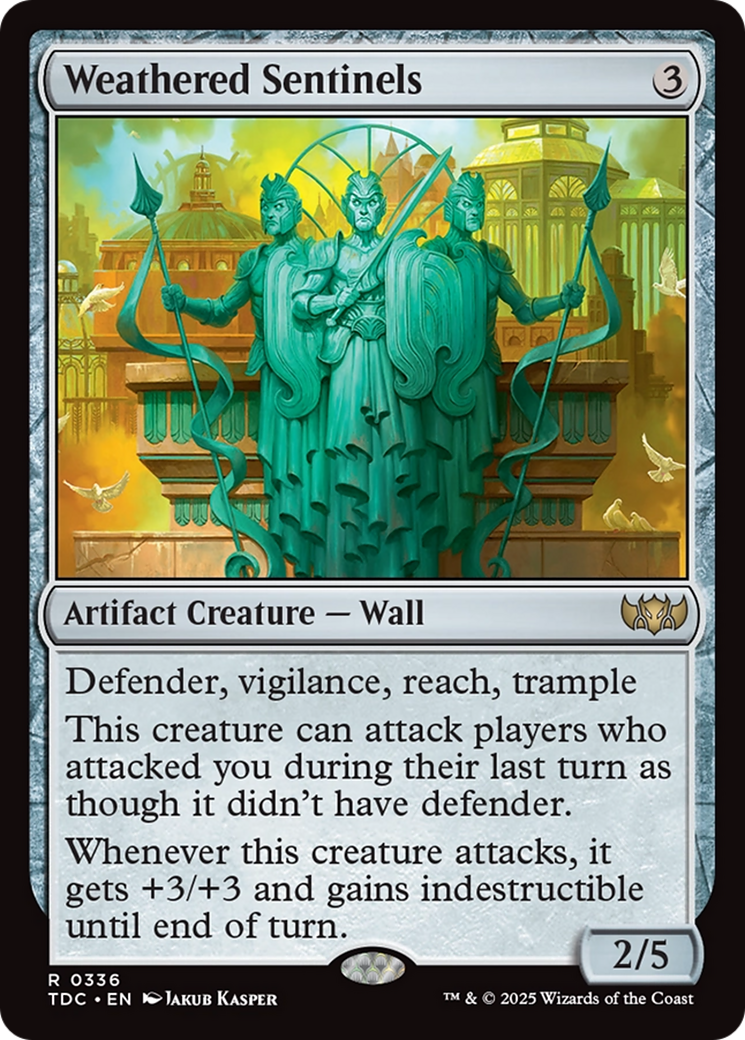
Weathered Sentinels
Weathered Sentinels
Artifact Creature — Wall
2/5
Defender, vigilance, reach, trample
This creature can attack players who attacked you during their last turn as though it didn't have defender.
Whenever this creature attacks, it gets +3/+3 and gains indestructible until end of turn.
-
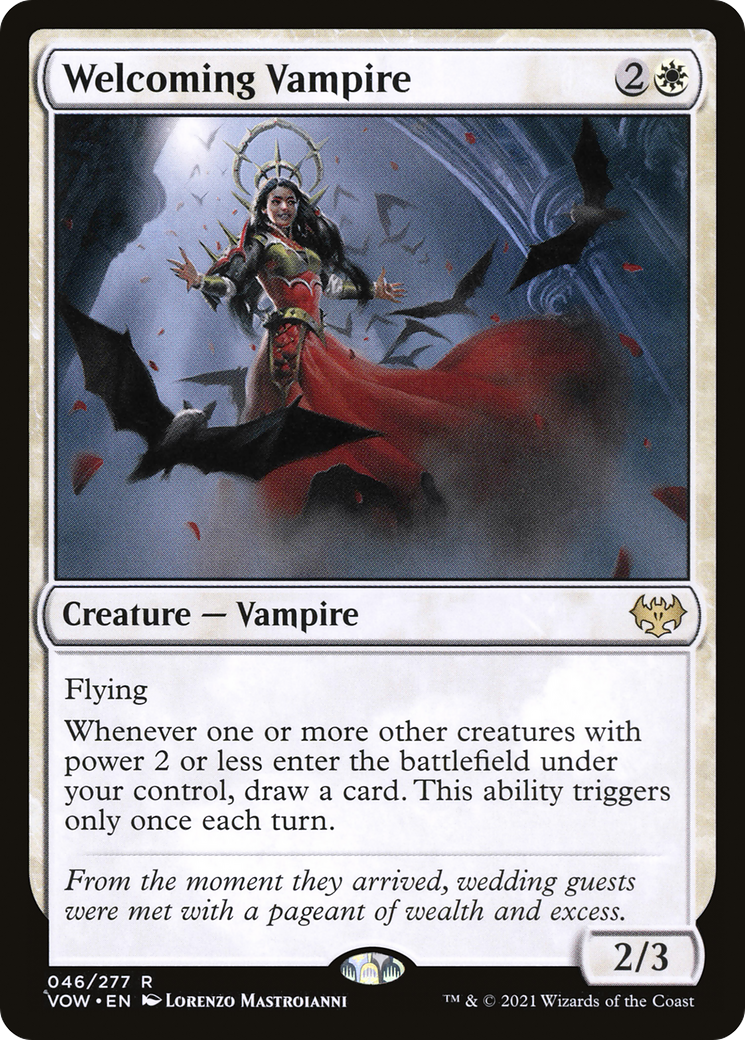
1
Welcoming Vampire
Welcoming Vampire
Creature — Vampire
2/3
Flying
Whenever one or more other creatures you control with power 2 or less enter, draw a card. This ability triggers only once each turn.
-
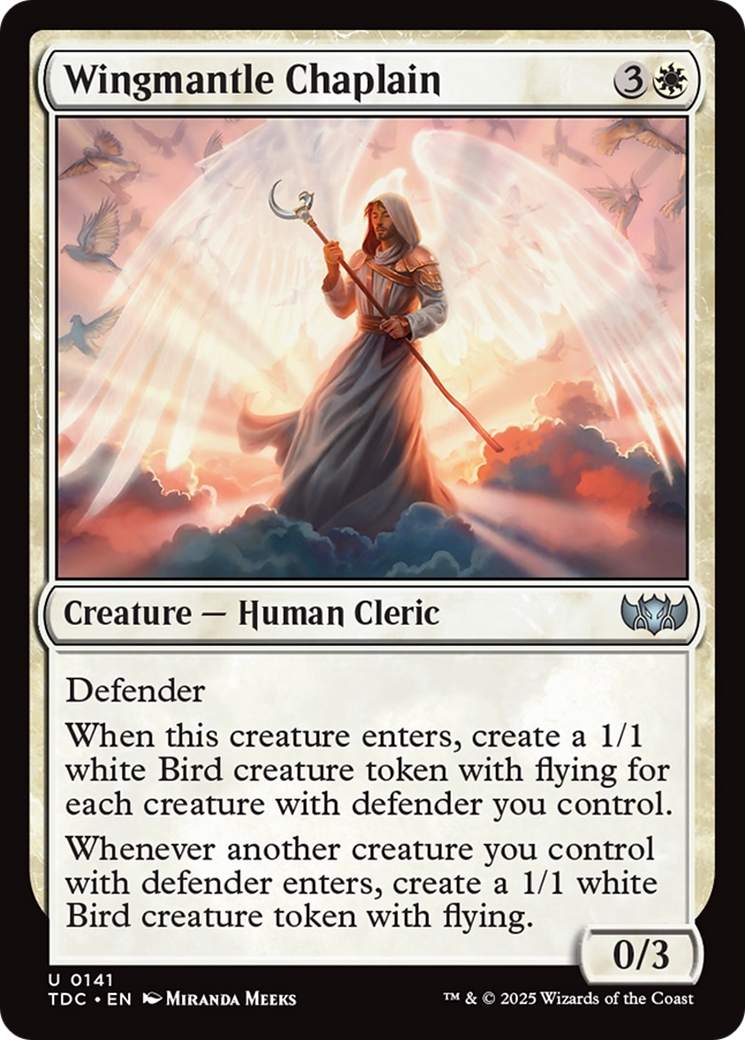
1
Wingmantle Chaplain
Wingmantle Chaplain
Creature — Human Cleric
0/3
Defender
When this creature enters, create a 1/1 white Bird creature token with flying for each creature with defender you control.
Whenever another creature you control with defender enters, create a 1/1 white Bird creature token with flying.
- Count the number of creatures with defender you control as the second ability resolves to determine how many Bird tokens you create. If Wingmantle Chaplain’s still under your control at that time, it will count itself.
- If Wingmantle Chaplain enters the battlefield under your control at the same time as other creatures with defender, the second ability will trigger once and the last ability will trigger once for each of those other creatures.
-
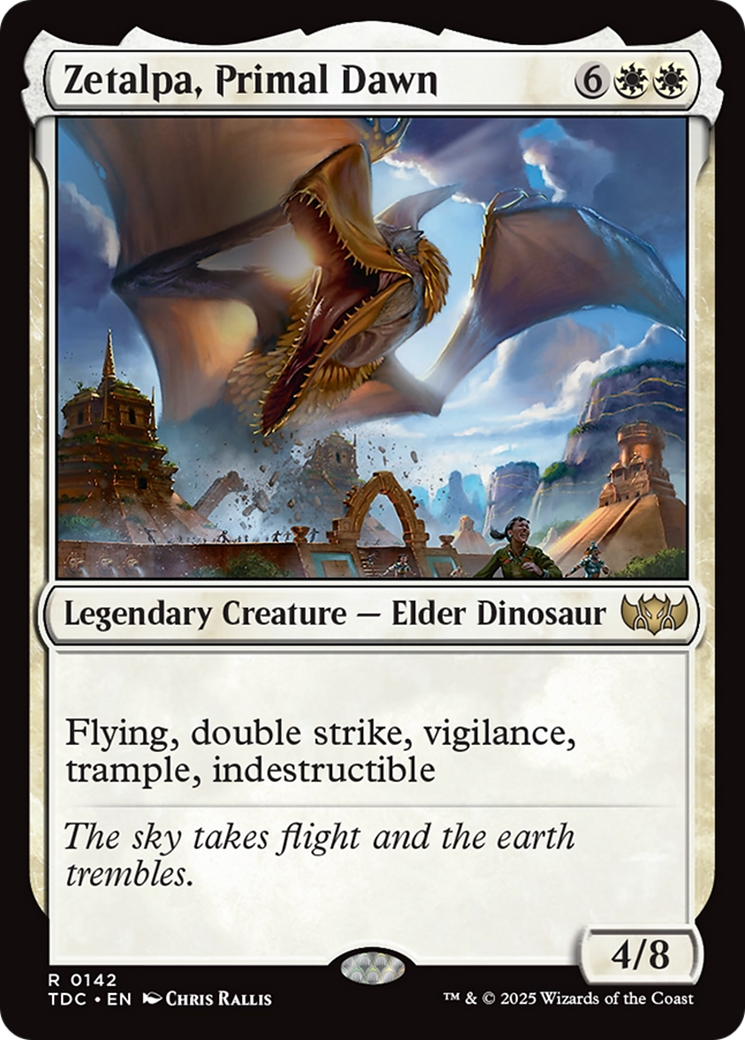
1
Zetalpa, Primal Dawn
Zetalpa, Primal Dawn
Legendary Creature — Elder Dinosaur
4/8
Flying, double strike, vigilance, trample, indestructible
- If an attacking creature with double strike and trample destroys all of its blocking creatures with first-strike combat damage, all of its normal combat damage is assigned to the player, planeswalker, or battle that creature's attacking.
Instants 5
-
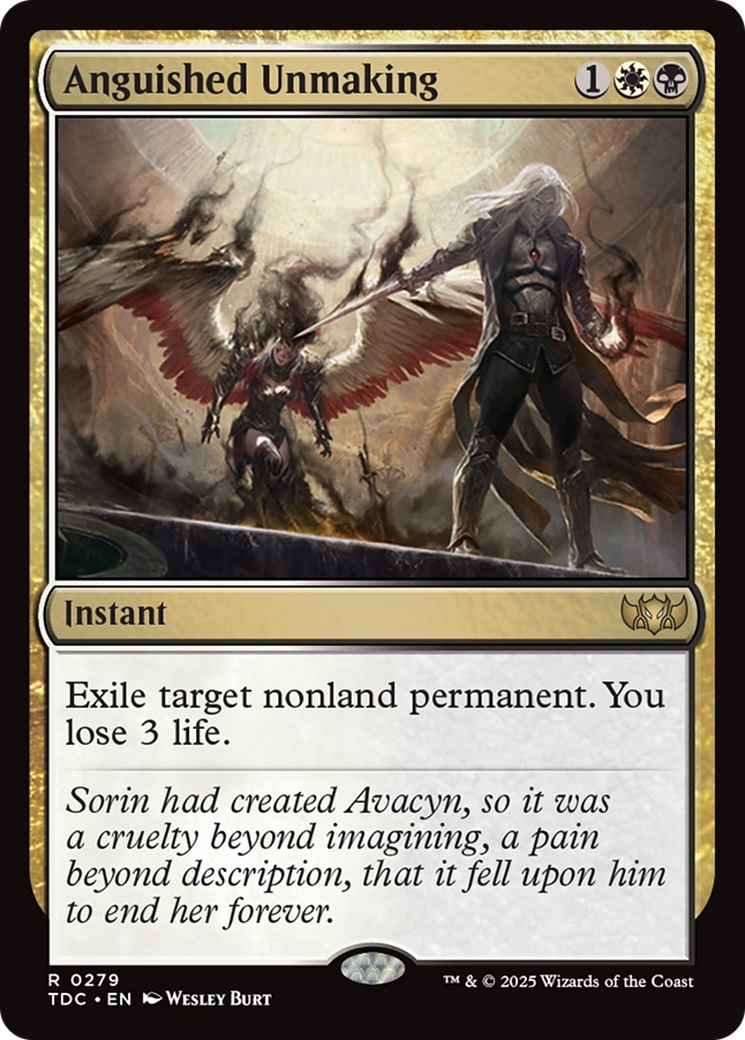
1
Anguished Unmaking
Anguished Unmaking
Instant
Exile target nonland permanent. You lose 3 life.
- If the target nonland permanent is an illegal target as Anguished Unmaking tries to resolve, it won't resolve and none of its effects will happen. You won't lose 3 life.
-
1
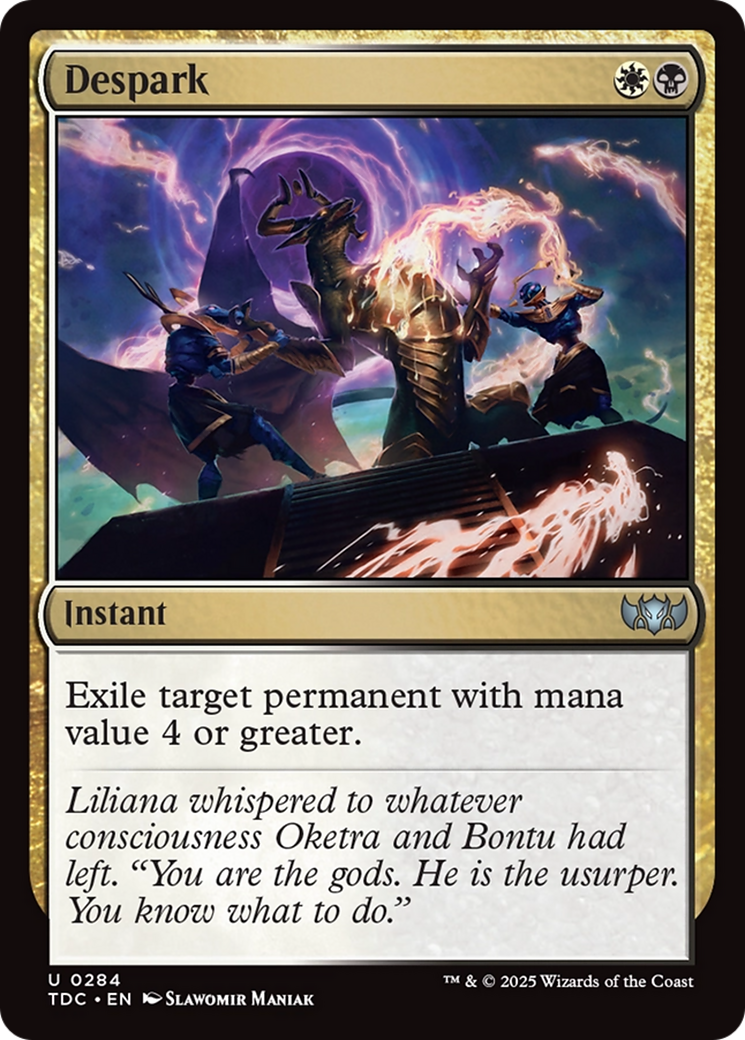
Despark
Despark
Instant
Exile target permanent with mana value 4 or greater.
- If a permanent has in its mana cost, X is considered to be 0.
-
1
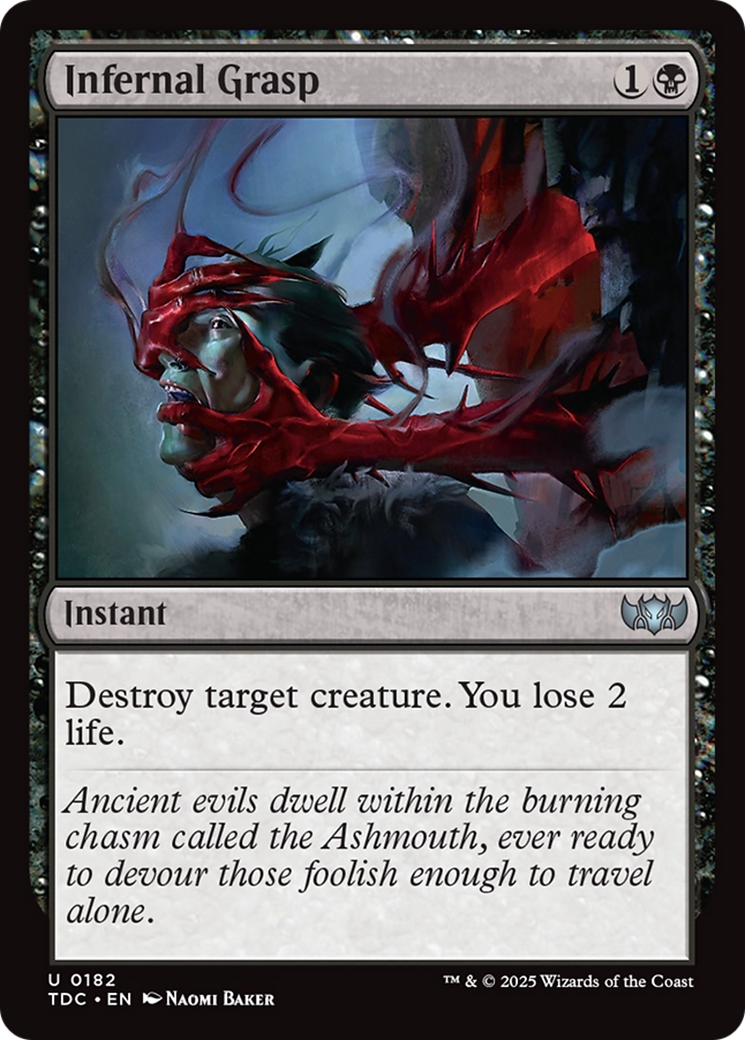
Infernal Grasp
Infernal Grasp
Instant
Destroy target creature. You lose 2 life.
-
1
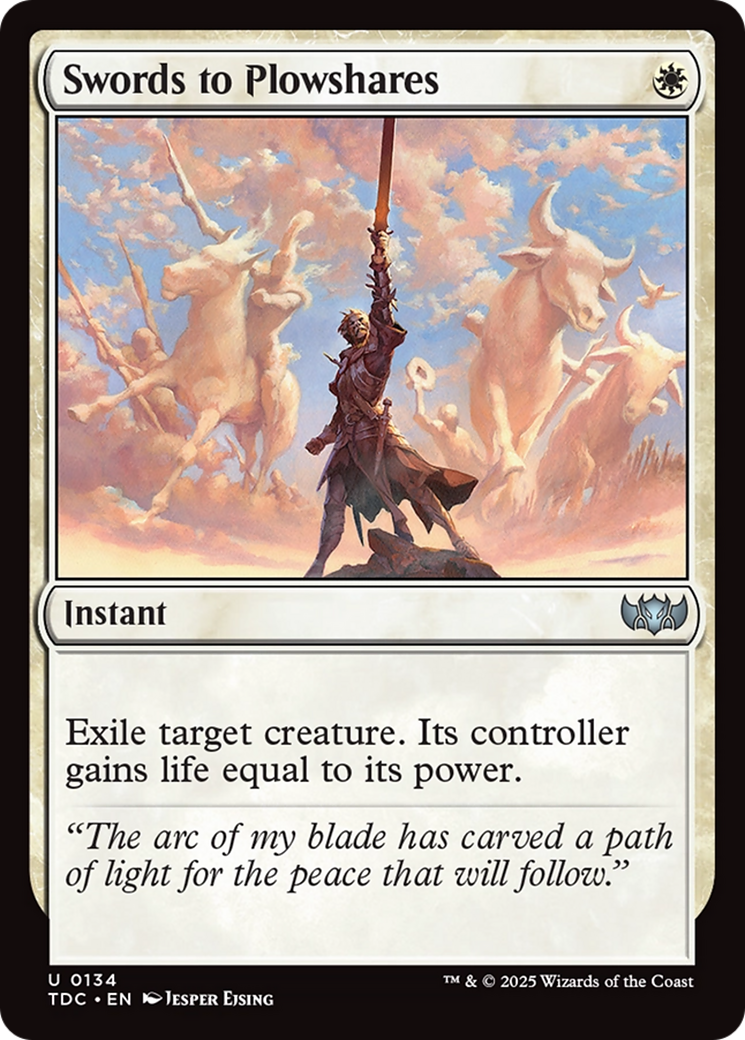
Swords to Plowshares
Swords to Plowshares
Instant
Exile target creature. Its controller gains life equal to its power.
- Use the power of the creature from when it was last on the battlefield to determine how much life is gained.
-
1
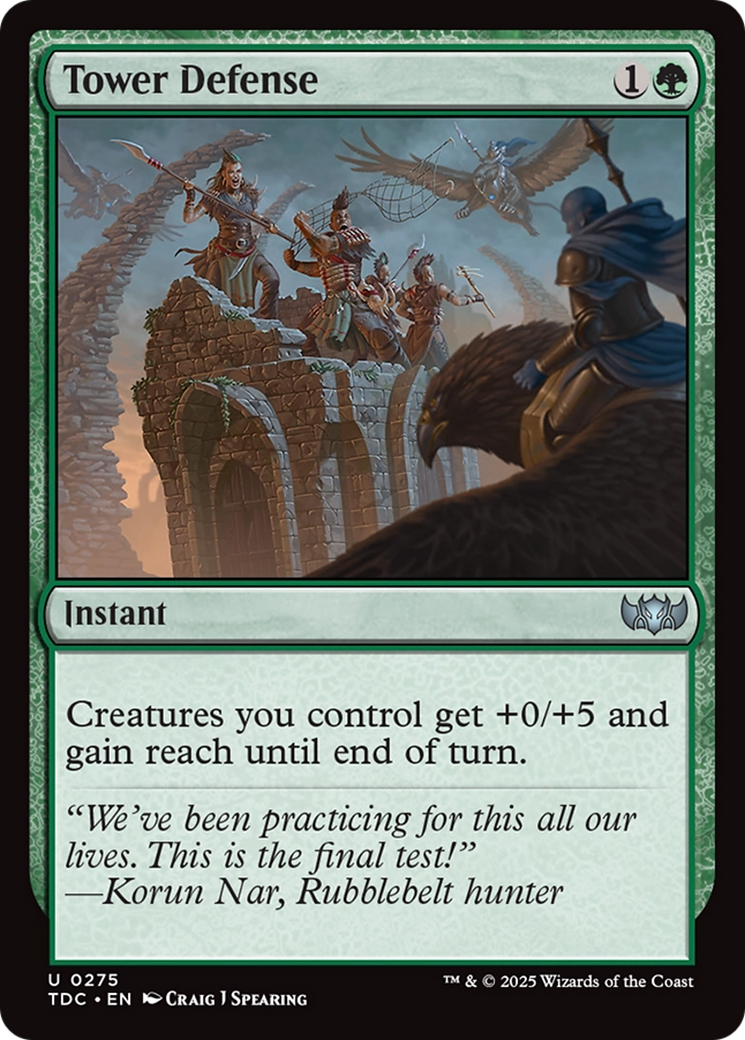
Tower Defense
Tower Defense
Instant
Creatures you control get +0/+5 and gain reach until end of turn.
- Only creatures you control when Tower Defense resolves will get the bonuses. Creatures that come under your control later that turn will not.
Sorceries 6
-
1
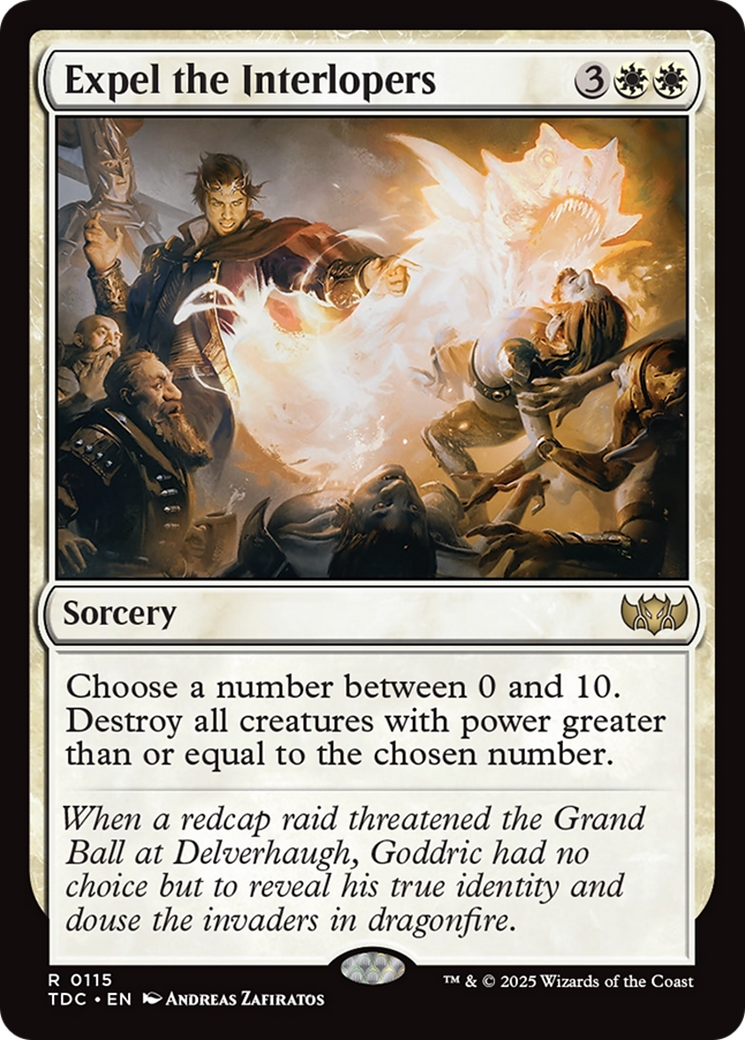
Expel the Interlopers
Expel the Interlopers
Sorcery
Choose a number between 0 and 10. Destroy all creatures with power greater than or equal to the chosen number.
- The numbers you may choose include 0 and 10.
-
1
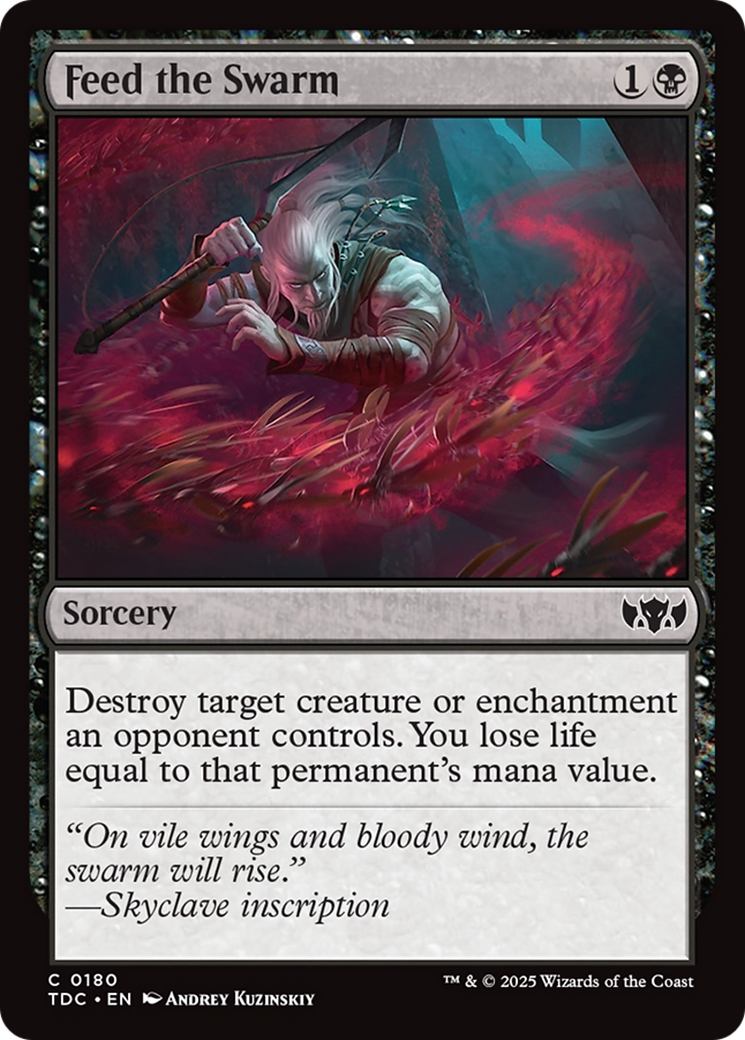
Feed the Swarm
Feed the Swarm
Sorcery
Destroy target creature or enchantment an opponent controls. You lose life equal to that permanent's mana value.
- The amount of life you lose is determined by the permanent's mana value as it last existed on the battlefield.
- If a permanent on the battlefield has in its mana cost, X is 0 for the purpose of determining its mana value.
- If the target permanent is an illegal target by the time Feed the Swarm tries to resolve, the spell doesn't resolve. You don't lose any life. If the target is legal but not destroyed (most likely because it has indestructible), you do lose life.
-
1
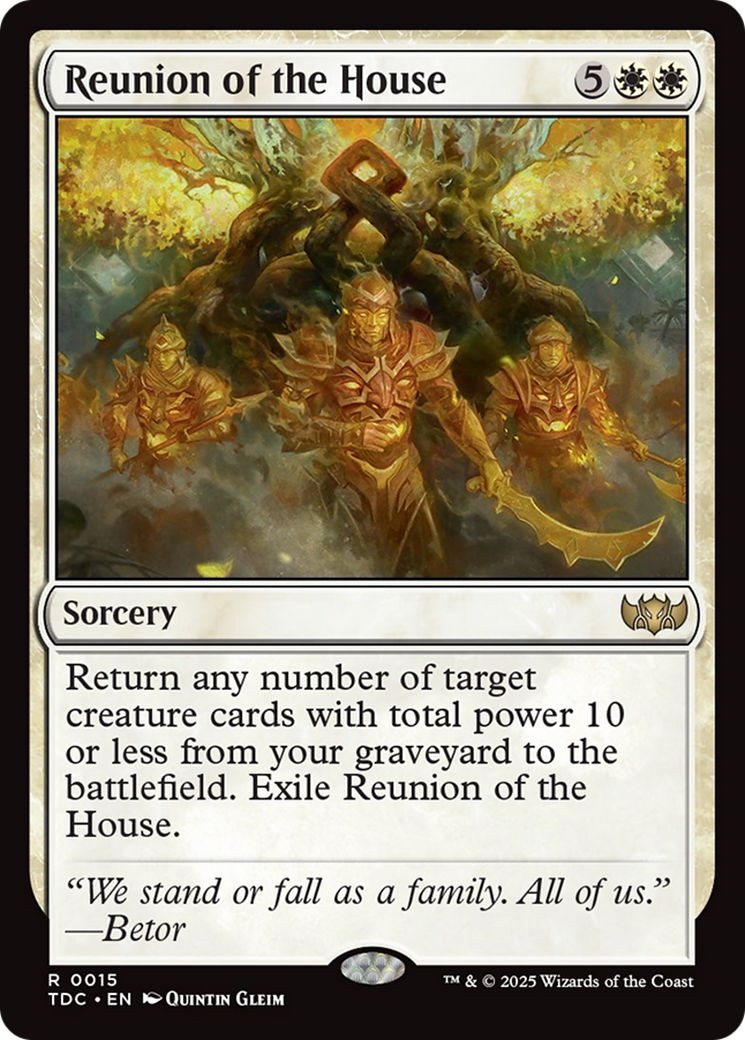
Reunion of the House
Reunion of the House
Sorcery
Return any number of target creature cards with total power 10 or less from your graveyard to the battlefield. Exile Reunion of the House.
- Reunion of the House can return any combination of creature cards whose powers total 10 or less. For example, it could target ten 1/1 creature cards, two 5/5 creature cards, and so on. Regardless of what other creature cards you choose as targets, you can also choose any number of creature cards with power 0 as targets.
- Use the power of the creature cards as they exist in your graveyard to determine whether they can be the targets of Reunion of the House. For example, a 0/0 creature card that will enter the battlefield as a copy of a 15/15 creature can be returned, as can five 0/0 creature cards that will each enter the battlefield with three +1/+1 counters on them.
- If the power of the target creature cards changes while in your graveyard, most likely because one has a characteristic-defining ability that defines a * in its power, the total power of the creature cards may become greater than 10. If this happens, the entire selection of targets is illegal. In this case, Reunion of the House won’t resolve and none of its effects will happen. Nothing will be returned to the battlefield, and Reunion of the House will be put into its owner’s graveyard.
-
1
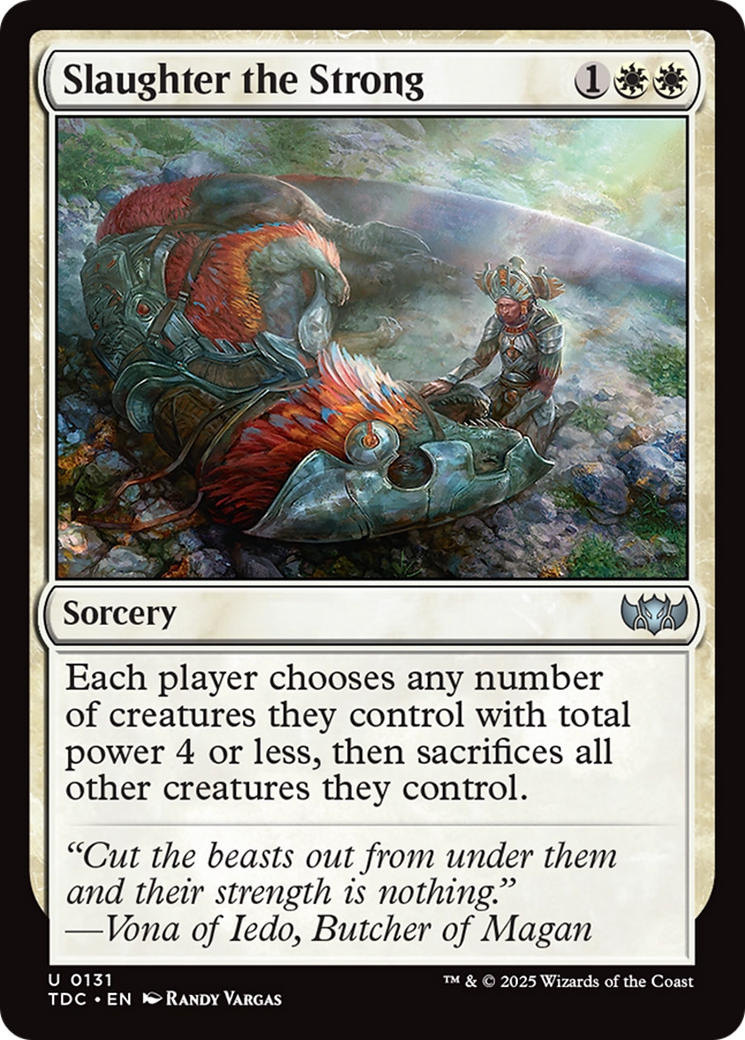
Slaughter the Strong
Slaughter the Strong
Sorcery
Each player chooses any number of creatures they control with total power 4 or less, then sacrifices all other creatures they control.
- Slaughter the Strong has each player choose any number of creatures and then checks that the total power of creatures each player chose this way is 4 or less. For example, you could save two 2/2 creatures, or a 1/1 and a 3/3 creature, but not all four of those creatures.
- As Slaughter the Strong resolves, first the player whose turn it is chooses which creatures will be spared, then each other player in turn order does the same knowing the choices made before them. Then all the creatures not chosen are sacrificed simultaneously.
- If a creature's power is somehow less than 0, it subtracts from the total power of the other creatures its controller chooses. This can cause creatures with power 5 or greater to survive.
-
1
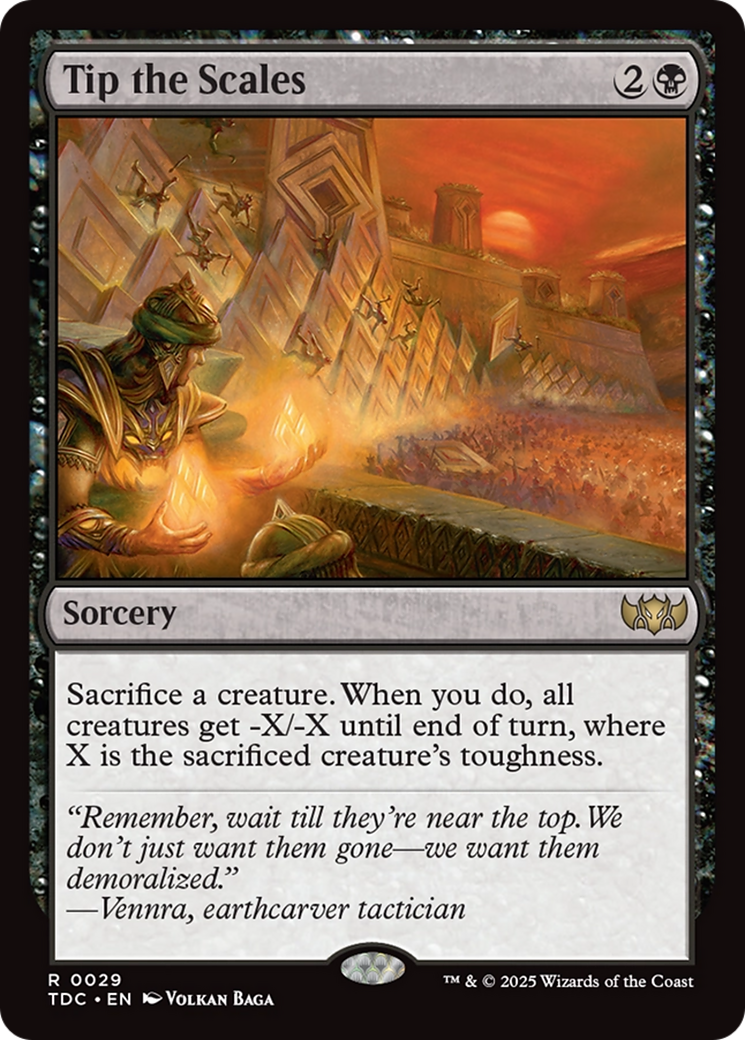
Tip the Scales
Tip the Scales
Sorcery
Sacrifice a creature. When you do, all creatures get -X/-X until end of turn, where X is the sacrificed creature's toughness.
- You don’t choose which creature to sacrifice until Tip the Scales resolves. You must sacrifice exactly one creature if you control one at that time. Doing so causes a “reflexive” ability to trigger. Players may respond to that ability knowing the value of X.
- Use the sacrificed creature’s toughness as it last existed on the battlefield to determine the value of X.
-
1
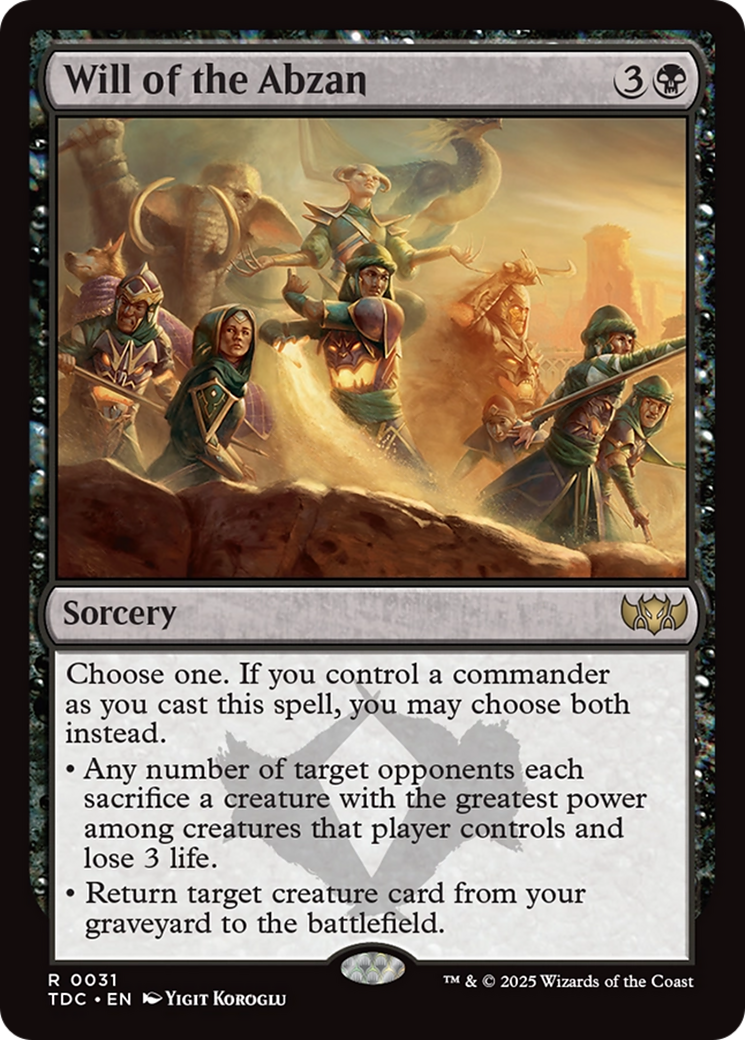
Will of the Abzan
Will of the Abzan
Sorcery
Choose one. If you control a commander as you cast this spell, you may choose both instead.
- Any number of target opponents each sacrifice a creature with the greatest power among creatures that player controls and lose 3 life.
- Return target creature card from your graveyard to the battlefield.
- The commander you control doesn’t have to be your commander.
- Once you’ve announced that you’re casting this spell, players can’t take any actions until you’ve finished doing so. Notably, opponents can’t try to remove your commander to change how many modes you may choose.
- Whether or not you control a commander is determined only once, as you choose the modes for this spell. If you somehow lose control of that commander before you finish casting the spell (perhaps because you sacrifice it to activate a mana ability), it won’t change the number of modes chosen.
Artifacts 7
-
1
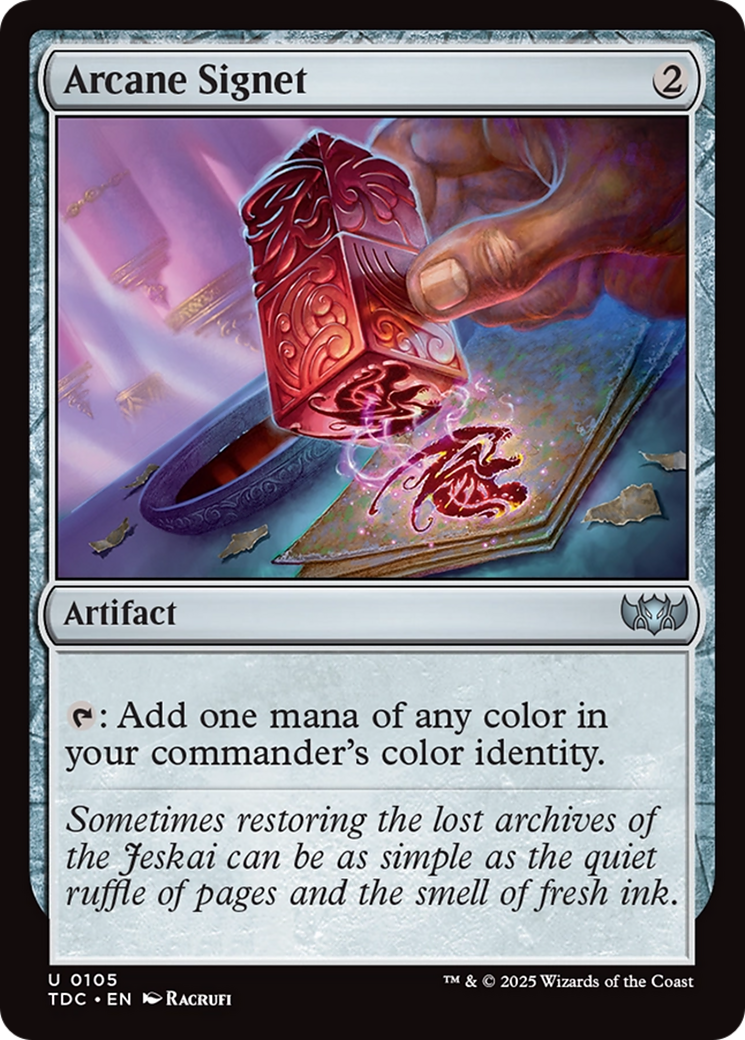
Arcane Signet
Arcane Signet
Artifact
: Add one mana of any color in your commander's color identity.
- If you have two commanders, the ability adds one mana of any color in their combined color identities.
- If your commander is a card that has no colors in its color identity, Arcane Signet's ability produces no mana. It doesn't produce .
- If you don't have a commander, Arcane Signet's ability produces no mana.
-
1
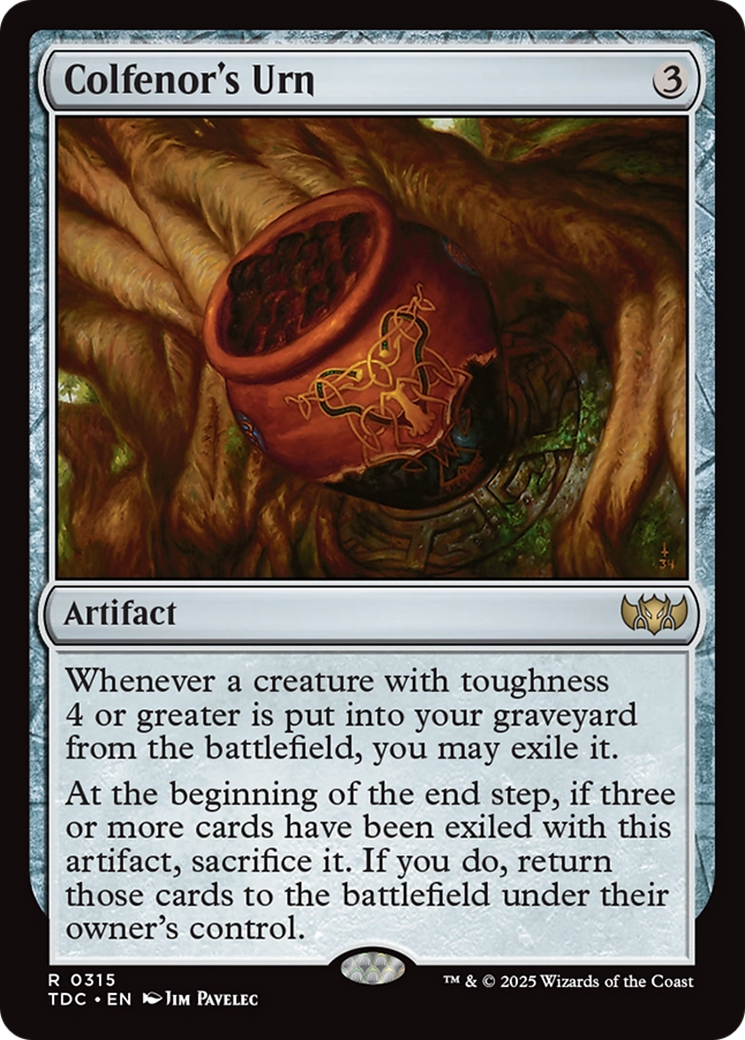
Colfenor's Urn
Colfenor's Urn
Artifact
Whenever a creature with toughness 4 or greater is put into your graveyard from the battlefield, you may exile it.
At the beginning of the end step, if three or more cards have been exiled with this artifact, sacrifice it. If you do, return those cards to the battlefield under their owner's control.
- The second ability checks how many creatures have been exiled with Colfenor’s Urn over the course of the entire game.
- The second ability forces you to sacrifice Colfenor’s Urn. If the ability triggers and the Urn isn’t sacrificed (because it left the battlefield or changed controllers, for example), the exiled cards won’t be returned to the battlefield.
- The first ability triggers when a token creature with toughness 4 or greater is put into your graveyard. However, that token will cease to exist before Colfenor’s Plans can exile it.
-
1
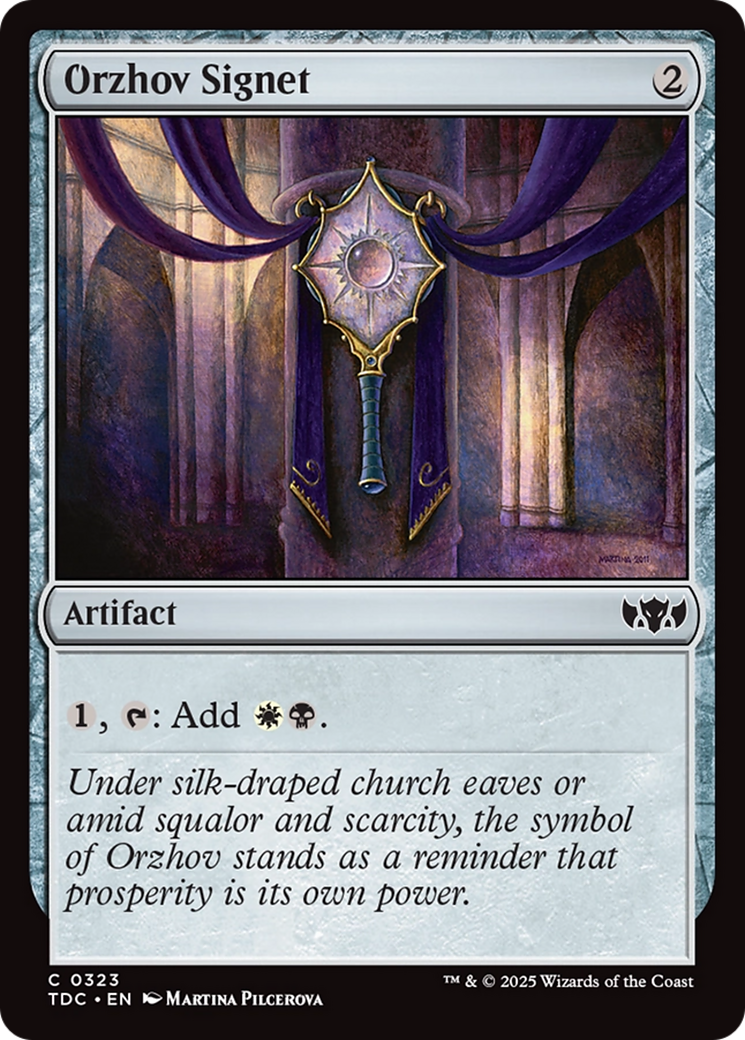
Orzhov Signet
Orzhov Signet
Artifact
, : Add .
-
1
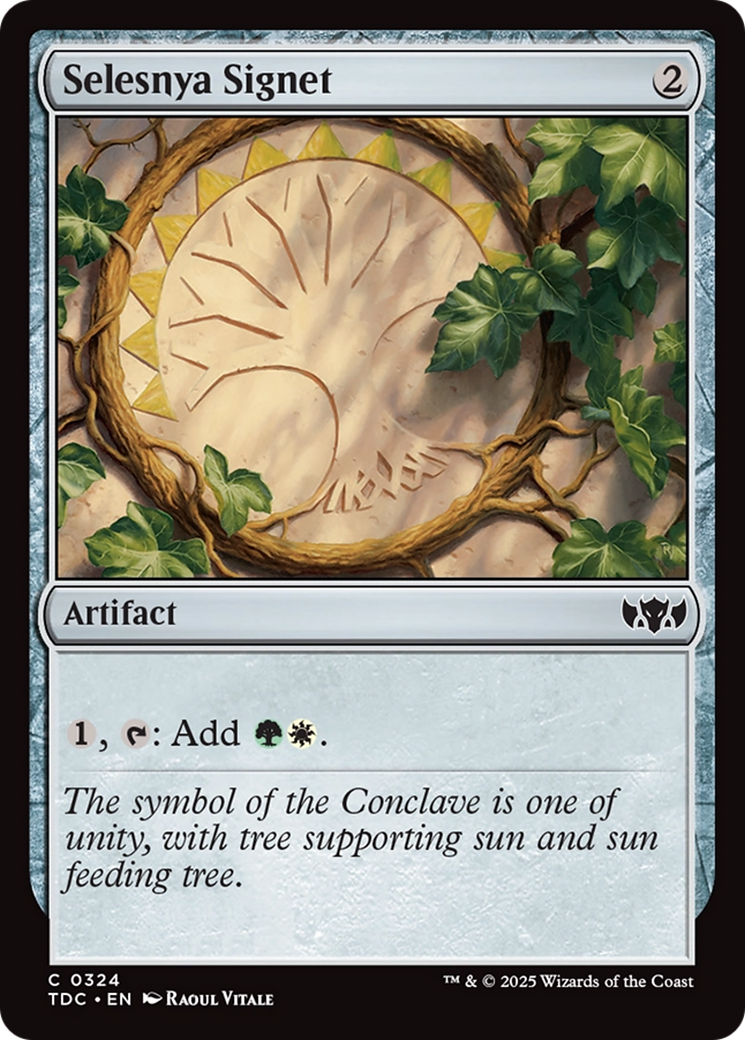
Selesnya Signet
Selesnya Signet
Artifact
, : Add .
-
1
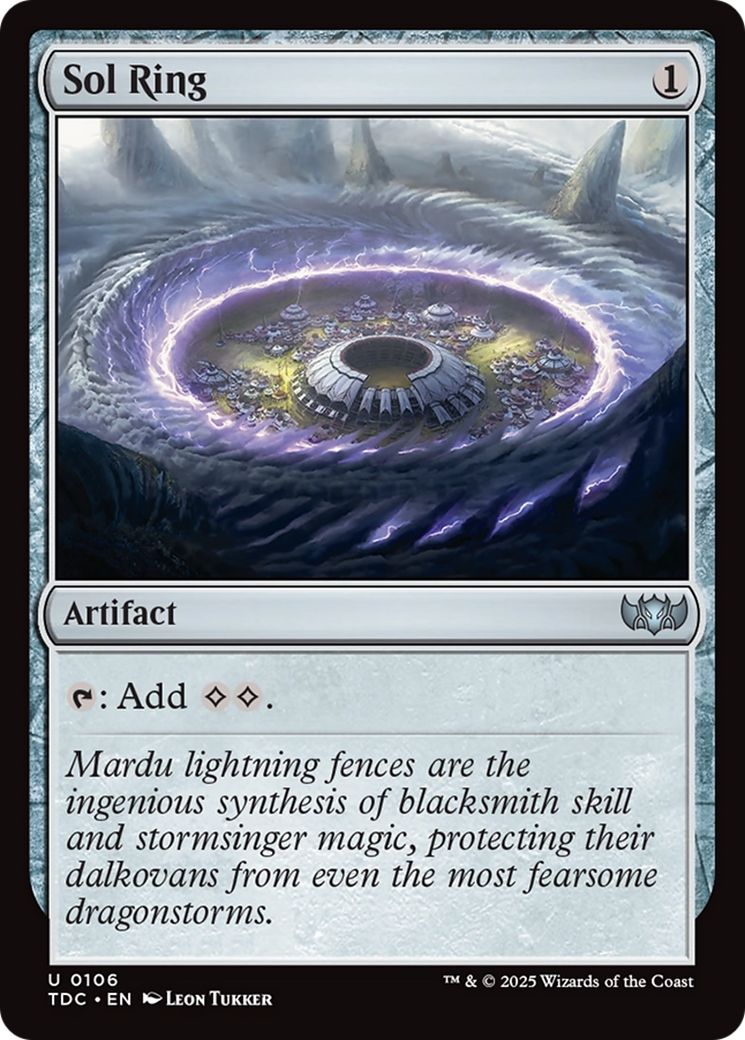
Sol Ring
Sol Ring
Artifact
: Add .
-
1
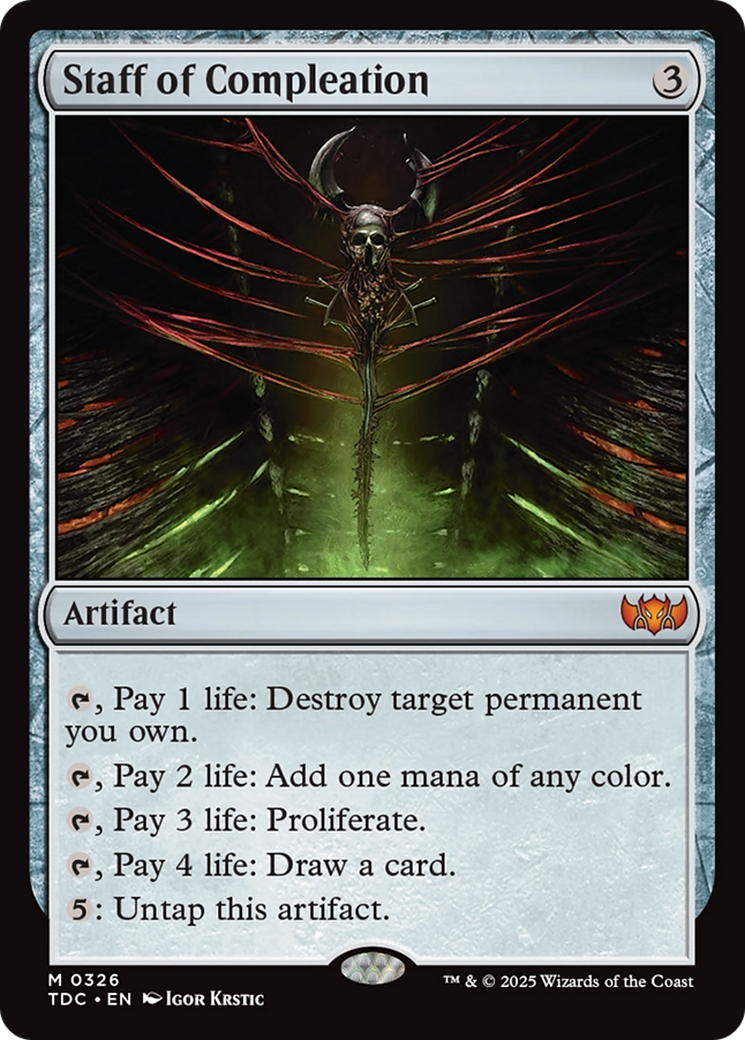
Staff of Compleation
Staff of Compleation
Artifact
, Pay 1 life: Destroy target permanent you own.
, Pay 2 life: Add one mana of any color.
, Pay 3 life: Proliferate.
, Pay 4 life: Draw a card.
: Untap this artifact.
-
1
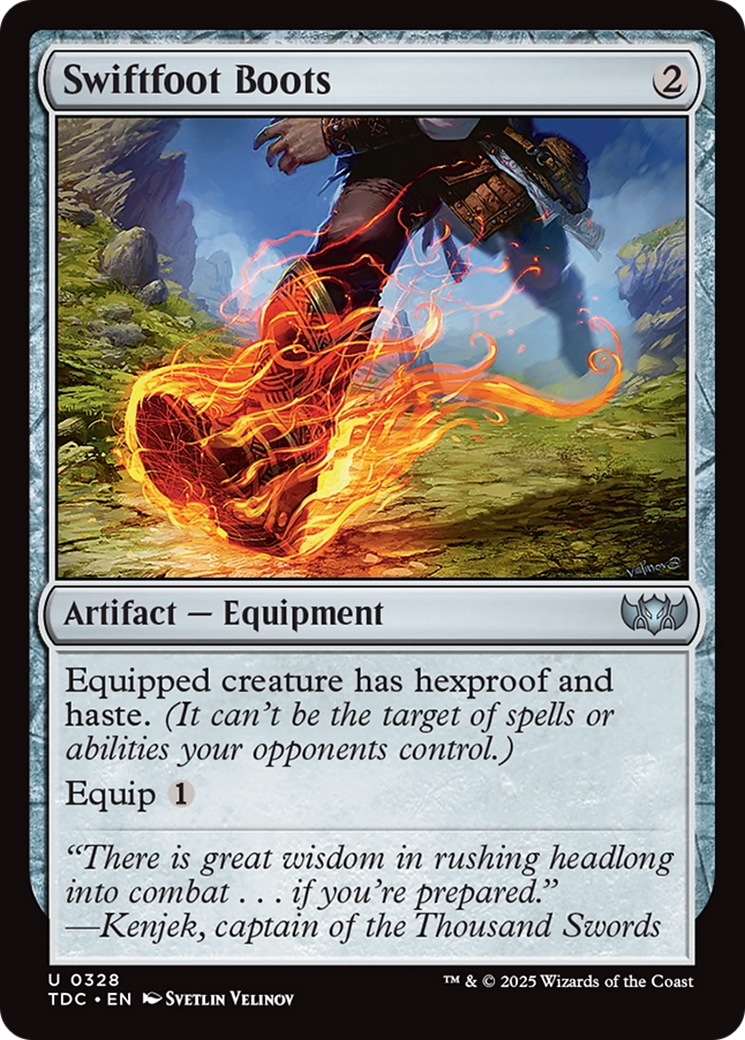
Swiftfoot Boots
Swiftfoot Boots
Artifact — Equipment
Equipped creature has hexproof and haste. (It can't be the target of spells or abilities your opponents control. It can attack and no matter when it came under your control.)
Equip ( : Attach to target creature you control. Equip only as a sorcery.)
- If a creature enters the battlefield under your control and gains haste, but then loses it before attacking, it won't be able to attack that turn. This means that you can't use one Swiftfoot Boots to allow two new creatures to attack in the same turn.
Enchantments 3
-
1
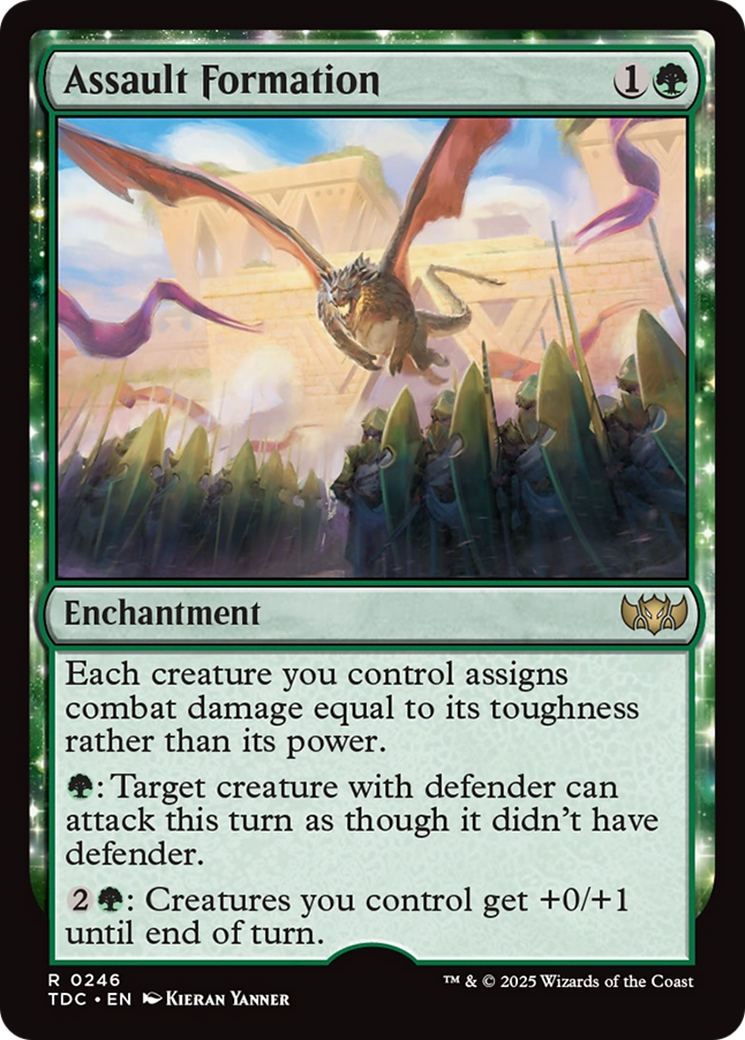
Assault Formation
Assault Formation
Enchantment
Each creature you control assigns combat damage equal to its toughness rather than its power.
: Target creature with defender can attack this turn as though it didn't have defender.
: Creatures you control get +0/+1 until end of turn.
- For example, a 2/3 creature will assign 3 combat damage rather than 2.
- Assault Formation’s first ability doesn’t actually change any creature’s power. It changes only the amount of combat damage it assigns. All other rules and effects that check power or toughness use the real values. For example, Hunt the Weak won’t cause a creature to fight with its toughness.
-
1
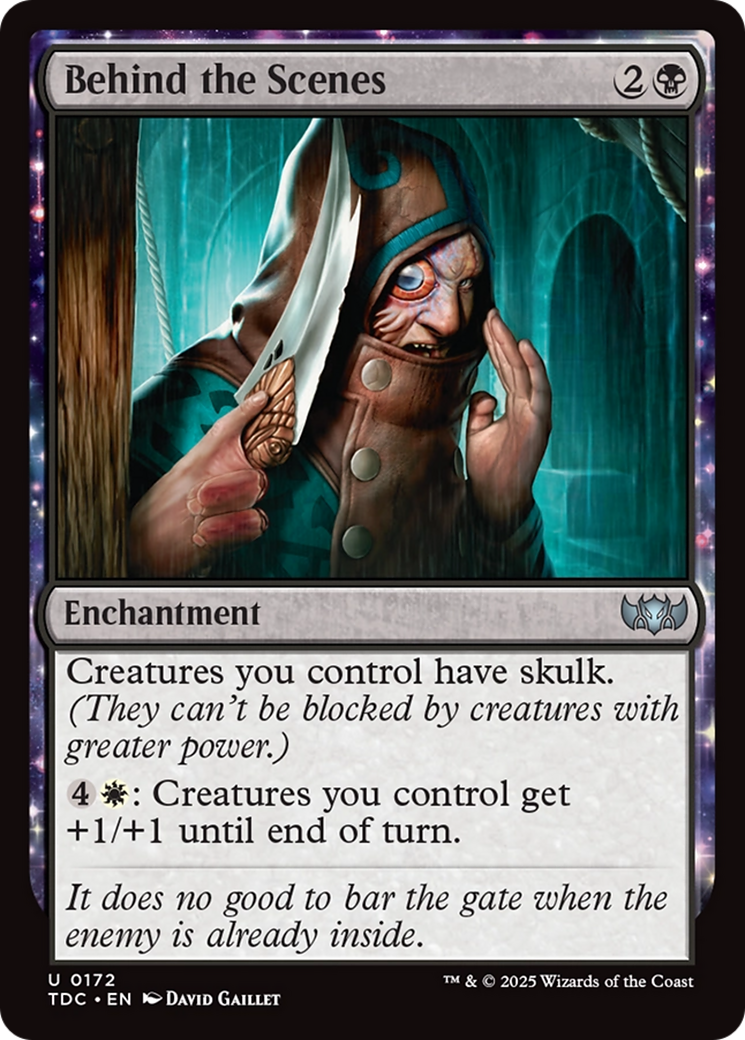
Behind the Scenes
Behind the Scenes
Enchantment
Creatures you control have skulk. (They can't be blocked by creatures with greater power.)
: Creatures you control get +1/+1 until end of turn.
- Skulk matters only as blockers are chosen. Modifying either creature’s power after blockers are chosen won’t cause the attacking creature to become unblocked.
- If you cause a creature to have 0 power or less, use the actual value (which may be negative) to determine whether it can block or be blocked. A creature with skulk and 0 or less power most likely won’t be blocked, but it won’t deal combat damage and won’t trigger any abilities that trigger when combat damage is dealt.
-
1
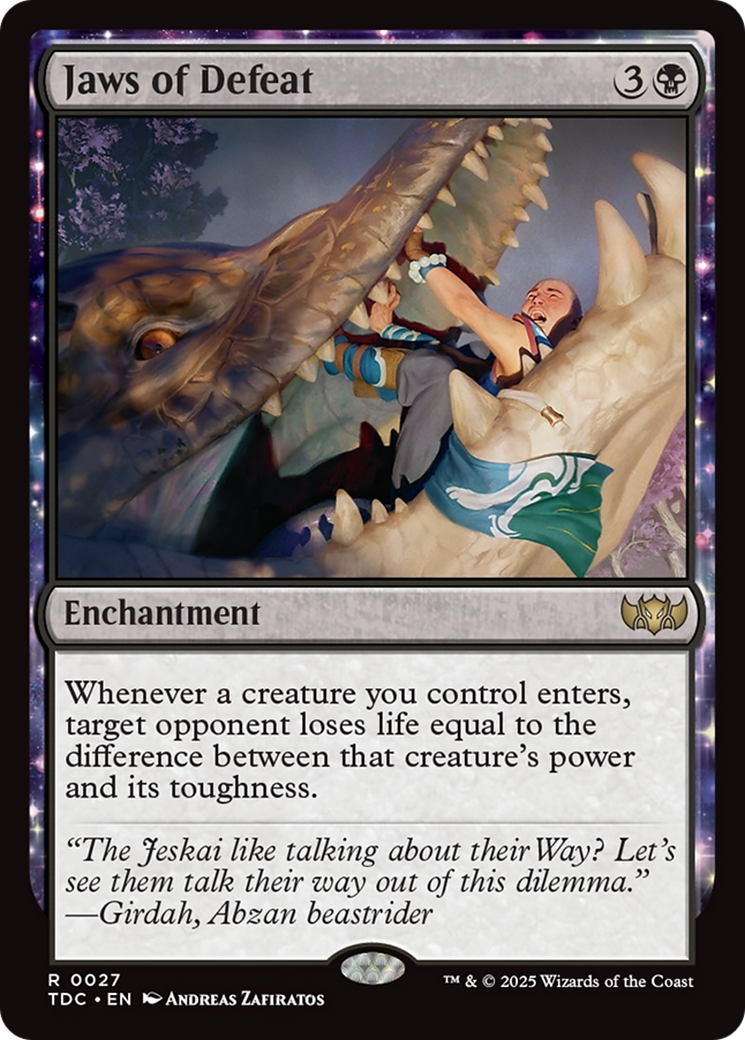
Jaws of Defeat
Jaws of Defeat
Enchantment
Whenever a creature you control enters, target opponent loses life equal to the difference between that creature's power and its toughness.
- To find the difference between a creature’s power and its toughness, subtract the smaller of those two numbers from the larger one. For example, the difference between the power and toughness of a 3/5 creature is 2. The difference between the power and toughness of a 5/3 creature is also 2.
Lands 38
-
1
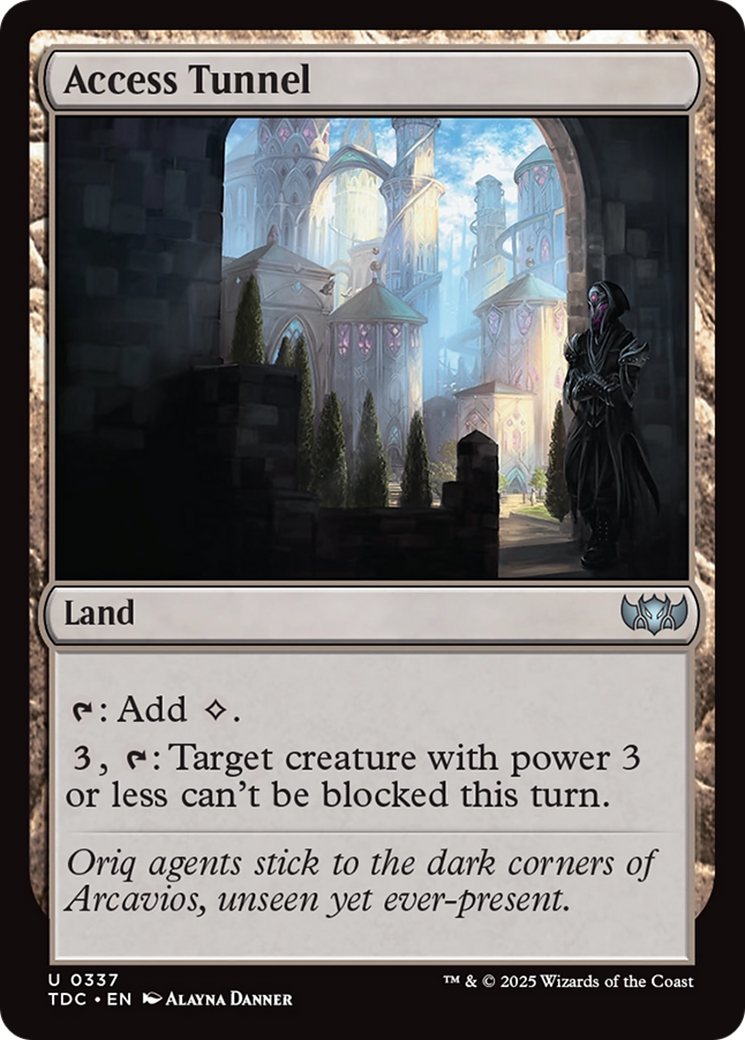
Access Tunnel
Access Tunnel
Land
: Add .
, : Target creature with power 3 or less can't be blocked this turn.
- Once a creature with power 3 or less has been blocked, Access Tunnel's second ability won't cause it to become unblocked.
- If the target creature's power is greater than 3 as Access Tunnel's second ability tries to resolve, the ability doesn't resolve. However, if instead the creature's power is raised above 3 after the ability resolves, it still can't be blocked that turn.
-
1
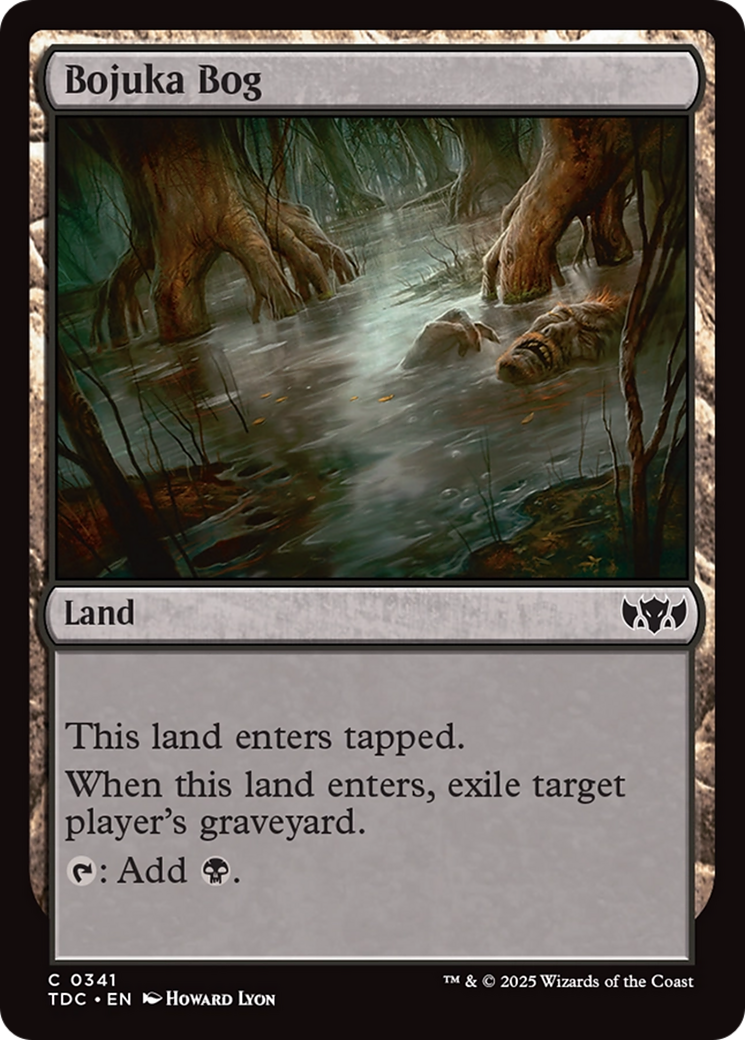
Bojuka Bog
Bojuka Bog
Land
This land enters tapped.
When this land enters, exile target player's graveyard.
: Add .
-
1
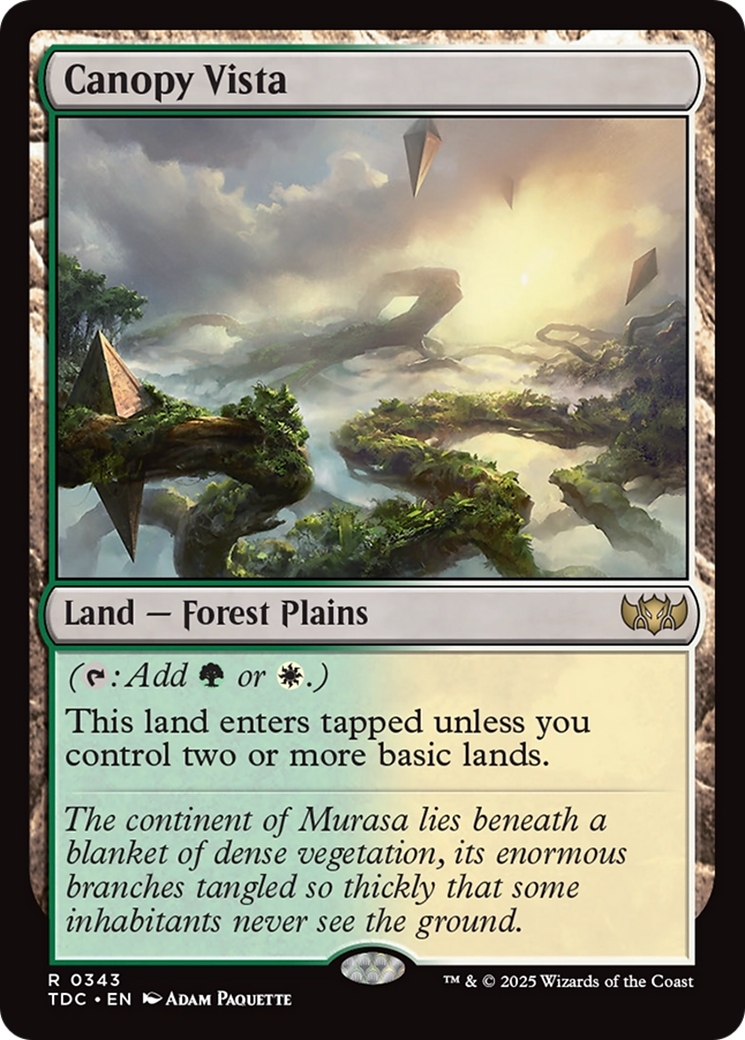
Canopy Vista
Canopy Vista
Land — Forest Plains
( : Add or .)
This land enters tapped unless you control two or more basic lands.
- Even though these lands have basic land types, they are not basic lands because "basic" doesn't appear on their type line. Notably, controlling two or more of them won't allow others to enter the battlefield untapped.
- However, because these cards have basic land types, effects that specify a basic land type without also specifying that the land be basic can affect them. For example, a spell or ability that reads "Destroy target Forest" can target Canopy Vista, while one that reads "Destroy target basic Forest" cannot.
- If one of these lands enters the battlefield at the same time as any number of basic lands, those other lands are not counted when determining if this land enters the battlefield tapped or untapped.
-
1
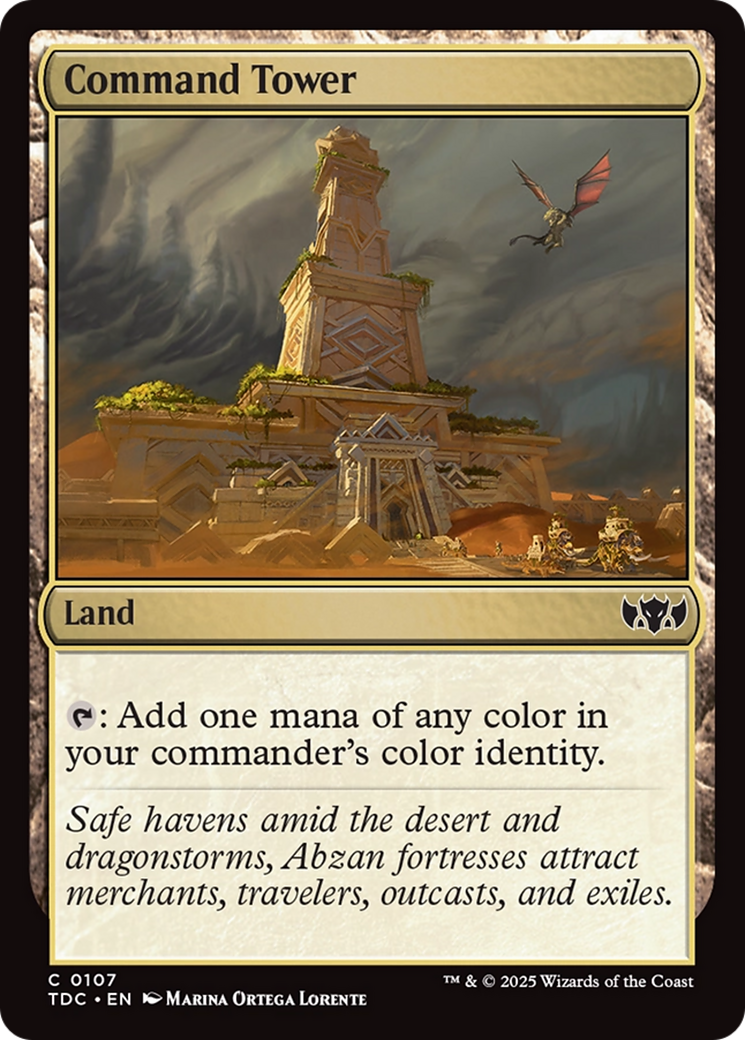
Command Tower
Command Tower
Land
: Add one mana of any color in your commander's color identity.
- If you have two commanders, the ability adds one mana of any color in their combined color identities.
- If your commander is a card that has no colors in its color identity, Command Tower's ability produces no mana. It doesn't produce .
- If you don't have a commander, Command Tower's ability produces no mana.
-
1
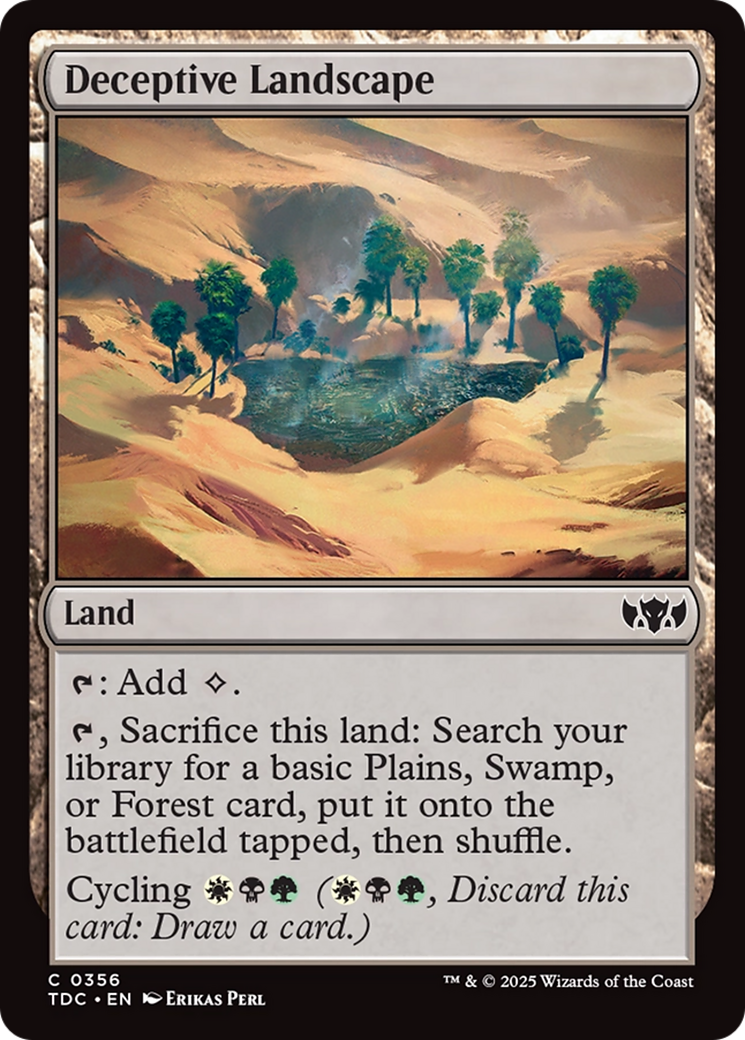
Deceptive Landscape
Deceptive Landscape
Land
: Add .
, Sacrifice this land: Search your library for a basic Plains, Swamp, or Forest card, put it onto the battlefield tapped, then shuffle.
Cycling ( , Discard this card: Draw a card.)
-
1
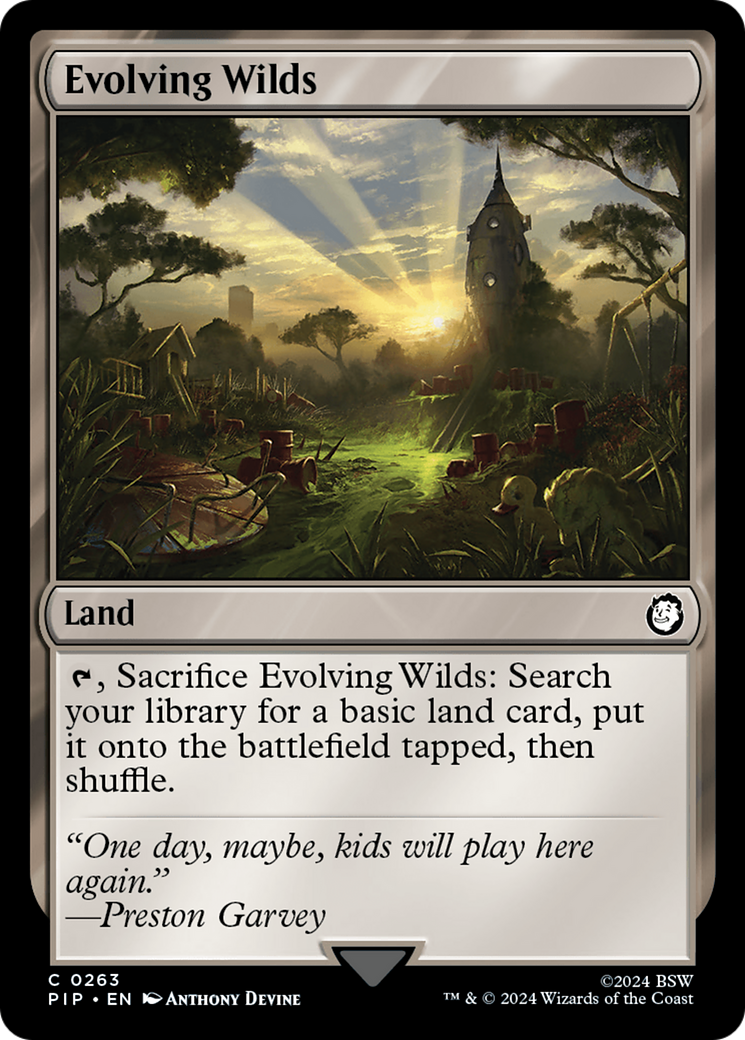
Evolving Wilds
Evolving Wilds
Land
, Sacrifice this land: Search your library for a basic land card, put it onto the battlefield tapped, then shuffle.
-
1
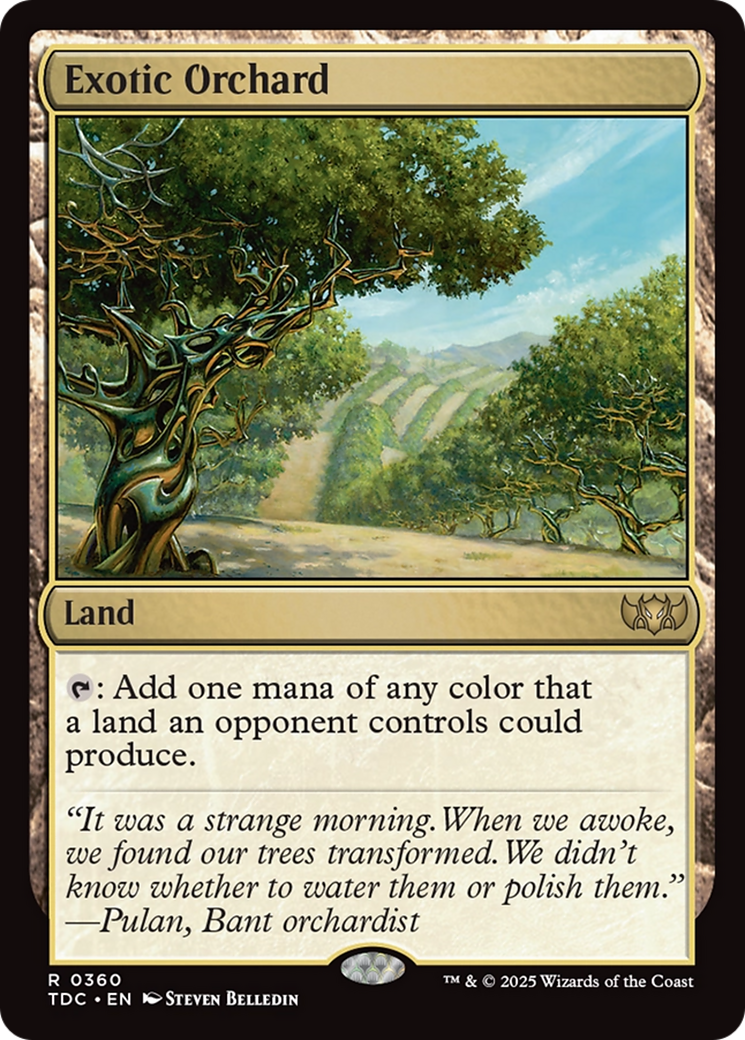
Exotic Orchard
Exotic Orchard
Land
: Add one mana of any color that a land an opponent controls could produce.
- The colors of mana are white, blue, black, red, and green. Exotic Orchard can't be tapped for colorless mana, even if a land an opponent controls could produce colorless mana.
- Exotic Orchard checks the effects of all mana-producing abilities of lands your opponents control, but it doesn't check their costs. For example, Vivid Crag has the ability " , Remove a charge counter from Vivid Crag: Add one mana of any color." If an opponent controls Vivid Crag and you control Exotic Orchard, you can tap Exotic Orchard for any color of mana. It doesn't matter whether Vivid Crag has a charge counter on it, and it doesn't matter whether it's untapped.
- When determining what colors of mana your opponents' lands could produce, Exotic Orchard takes into account any applicable replacement effects that would apply to those lands' mana abilities (such as Contamination's effect, for example). If there are more than one, consider them in any possible order.
- Exotic Orchard doesn't care about any restrictions or riders your opponents' lands (such as Ancient Ziggurat or Hall of the Bandit Lord) put on the mana they produce. It just cares about colors of mana.
- Lands that produce mana based only on what other lands "could produce" won't help each other unless some other land allows one of them to actually produce some type of mana. For example, if you control an Exotic Orchard and your opponent controls an Exotic Orchard and a Reflecting Pool, none of those lands would produce mana if their mana abilities were activated. On the other hand, if you control a Forest and an Exotic Orchard, and your opponent controls an Exotic Orchard and a Reflecting Pool, then each of those lands can be tapped to produce . Your opponent's Exotic Orchard can produce because you control a Forest. Your Exotic Orchard and your opponent's Reflecting Pool can each produce because your opponent's Exotic Orchard can produce .
-
7
Forest
Forest
Basic Land — Forest
( : Add .)
-
1
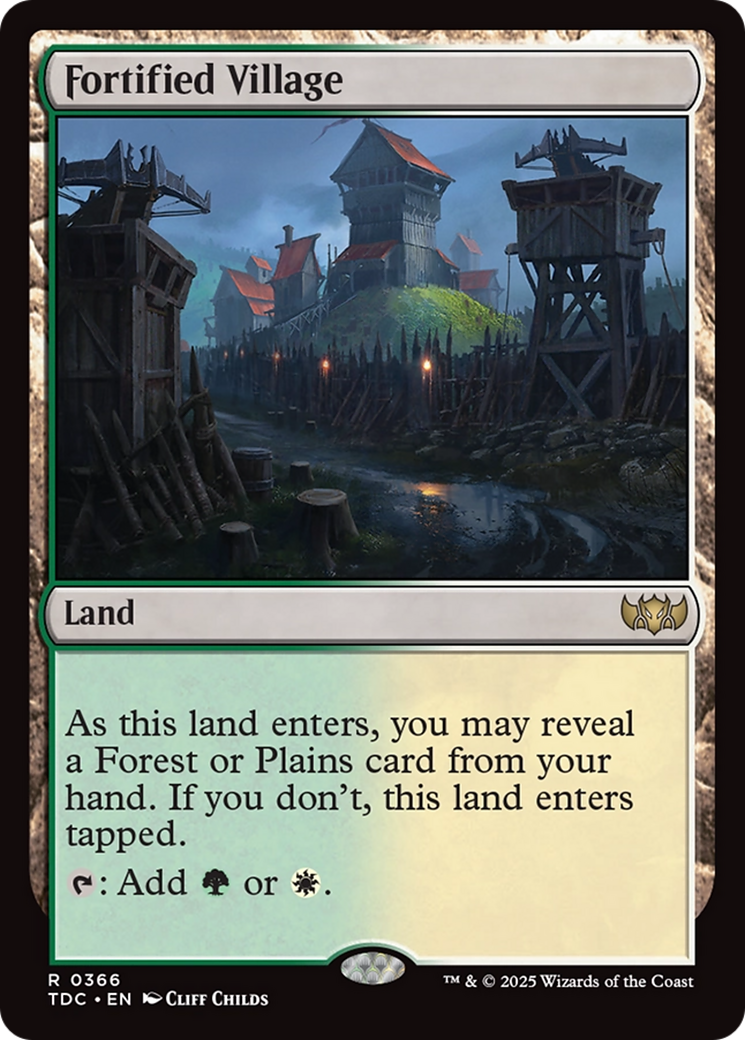
Fortified Village
Fortified Village
Land
As this land enters, you may reveal a Forest or Plains card from your hand. If you don't, this land enters tapped.
: Add or .
- You may reveal any land card with either or both of the appropriate subtypes. It doesn't have to be a basic land. For example, you could reveal Prairie Stream from the Battle for Zendikar set to satisfy the ability of Fortified Village.
- Lands don't have a subtype just because they can produce mana of the corresponding color. Fortified Village itself is neither a Forest nor a Plains, even though it produces green and white mana, so you can't reveal one to satisfy the ability of another.
- If a Forest or Plains is entering the battlefield from your hand at the same time as Fortified Village, you may reveal the other land to have Fortified Village enter untapped.
- If an effect instructs you to put Fortified Village onto the battlefield tapped, it will still enter the battlefield tapped even if you reveal a land card from your hand.
-
1
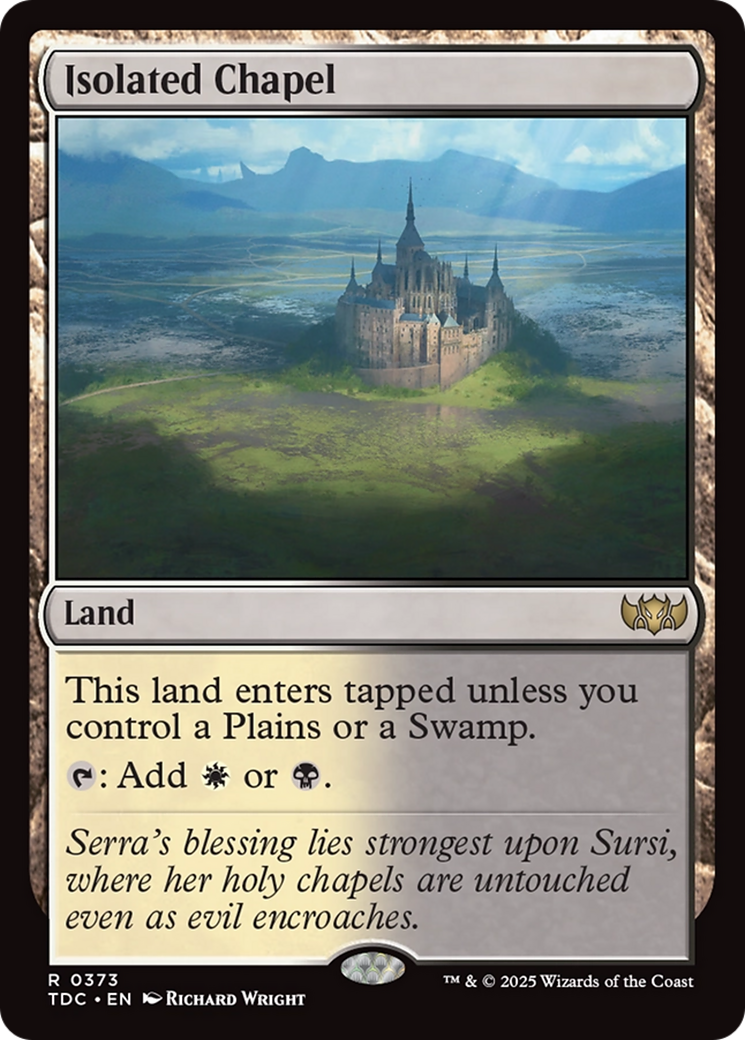
Isolated Chapel
Isolated Chapel
Land
This land enters tapped unless you control a Plains or a Swamp.
: Add or .
-
1
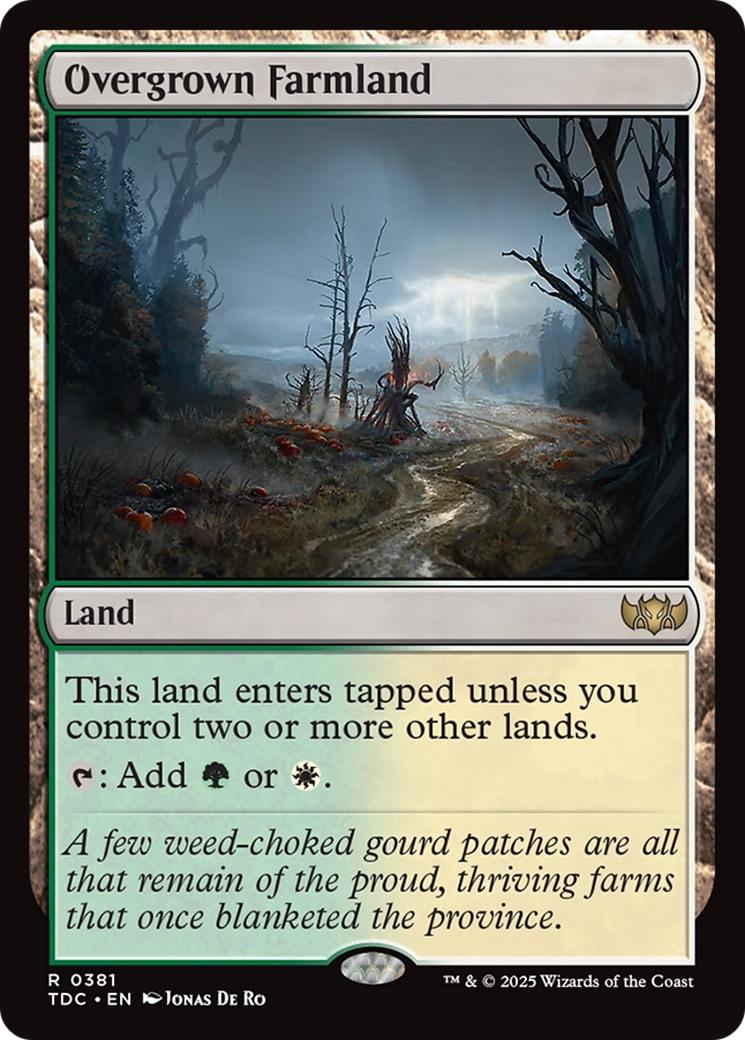
Overgrown Farmland
Overgrown Farmland
Land
This land enters tapped unless you control two or more other lands.
: Add or .
- If this land enters the battlefield at the same time as any number of other lands, those other lands are not counted when determining if this land enters the battlefield tapped or untapped.
-
1
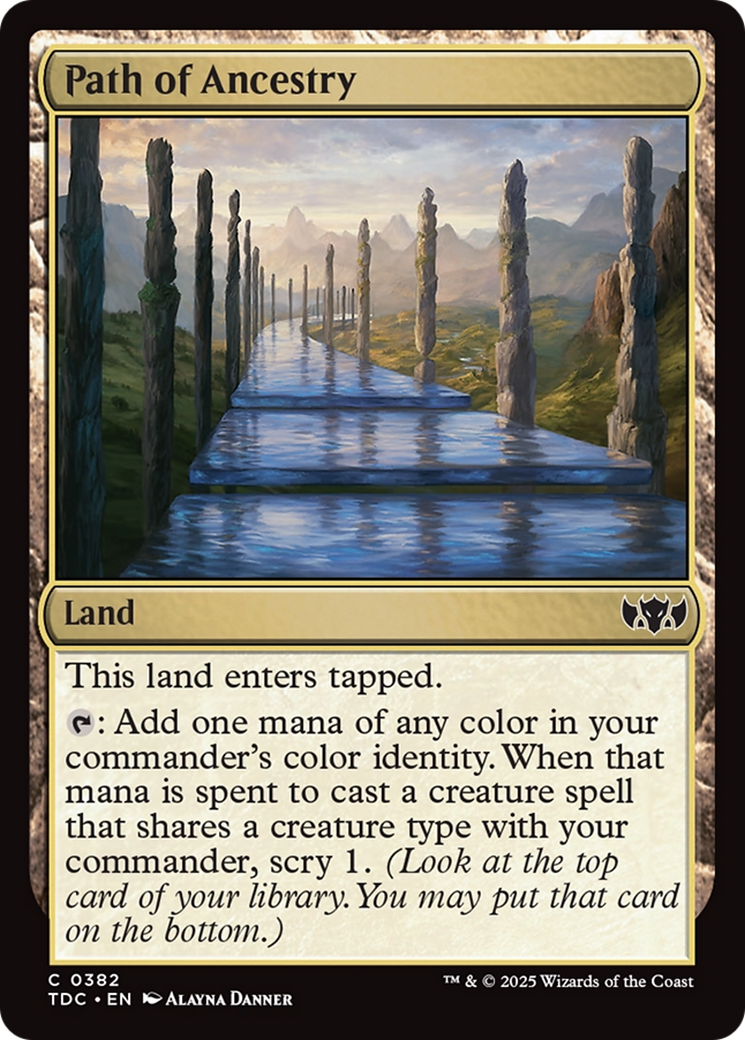
Path of Ancestry
Path of Ancestry
Land
This land enters tapped.
: Add one mana of any color in your commander's color identity. When that mana is spent to cast a creature spell that shares a creature type with your commander, scry 1. (Look at the top card of your library. You may put that card on the bottom.)
- If you have two commanders, the last ability adds one mana of any color in their combined color identities. When you spend that mana on a creature spell that shares a creature type with either of your commanders, you'll scry 1.
- Your commander's creature types are checked immediately after you cast a creature spell spending mana from Path of Ancestry's last ability. They aren't set before the game begins, and they may not be the same types your commander had when you activated that ability.
- If you cast your commander with mana from Path of Ancestry, and your commander hasn't somehow lost all of its creature types while on the stack, you'll scry 1.
- If your commander is a card that has no colors in its color identity, Path of Ancestry's ability produces no mana. It doesn't produce .
- If Path of Ancestry's last ability produces two mana (most likely due to Mana Reflection), spending those two mana to cast creature spells that share a creature type with your commander will cause two abilities to trigger. Each of those abilities will cause you to scry 1. You won't scry 2. This is true whether you spend the mana on one creature spell or two.
- If your commander has no creature types, it can't share a creature type with any spell that you cast.
- If you don't have a commander, Path of Ancestry's ability produces no mana.
-
6
Plains
Plains
Basic Land — Plains
( : Add .)
-
1
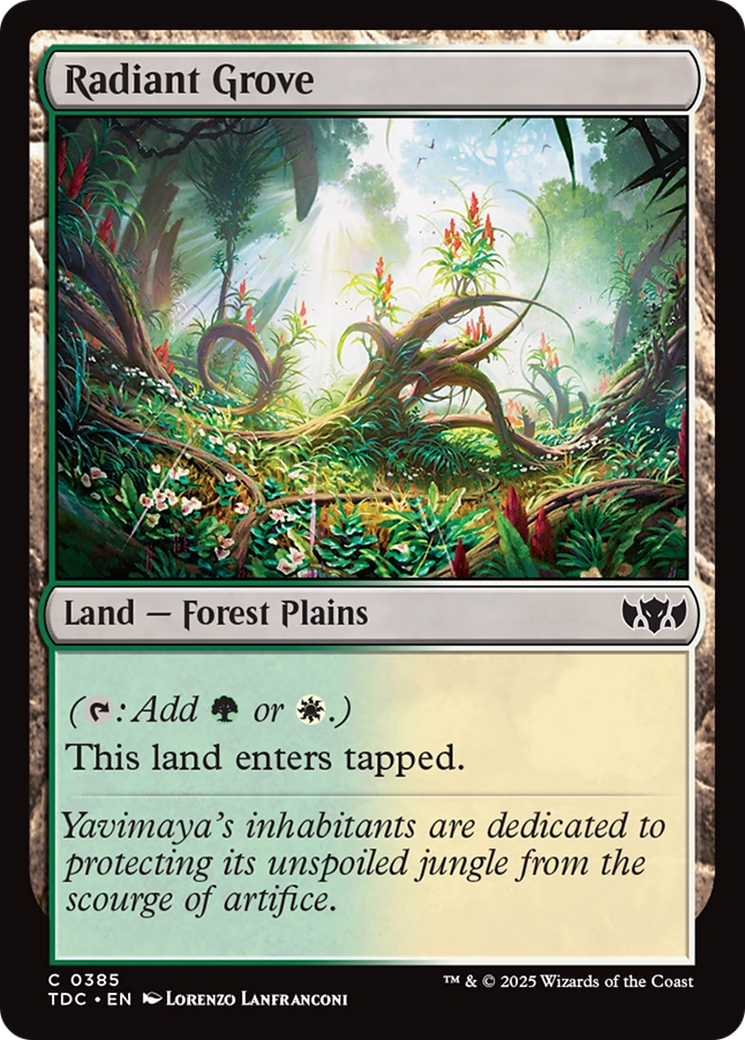
Radiant Grove
Radiant Grove
Land — Forest Plains
( : Add or .)
This land enters tapped.
-
1
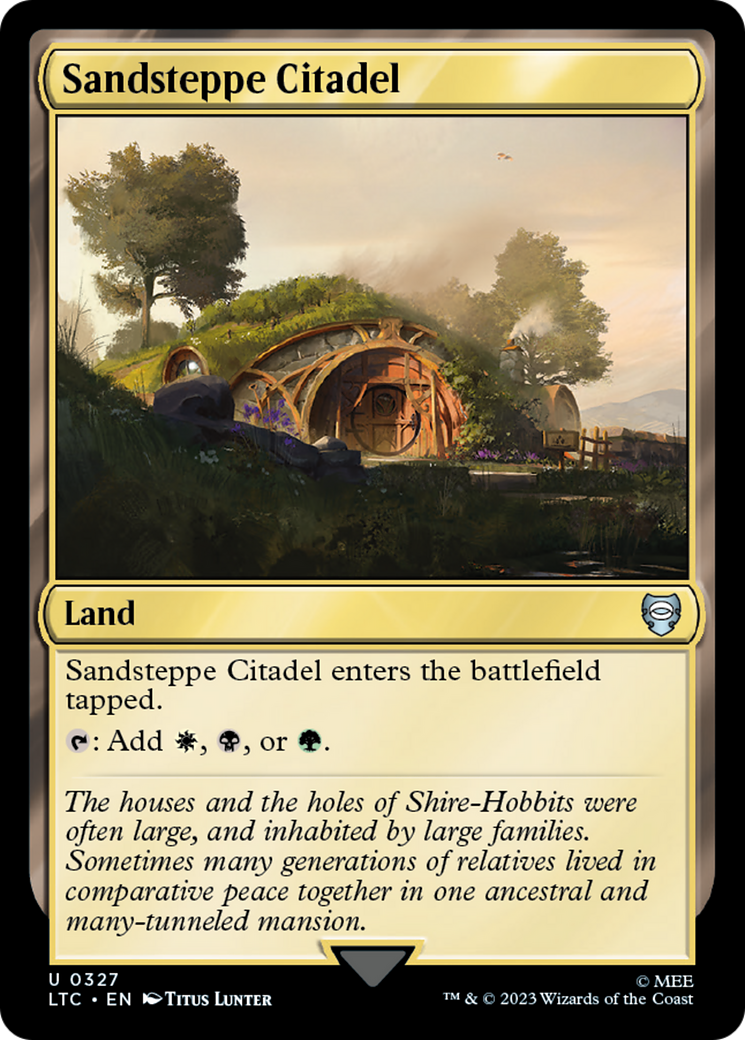
Sandsteppe Citadel
Sandsteppe Citadel
Land
This land enters tapped.
: Add , , or .
-
1
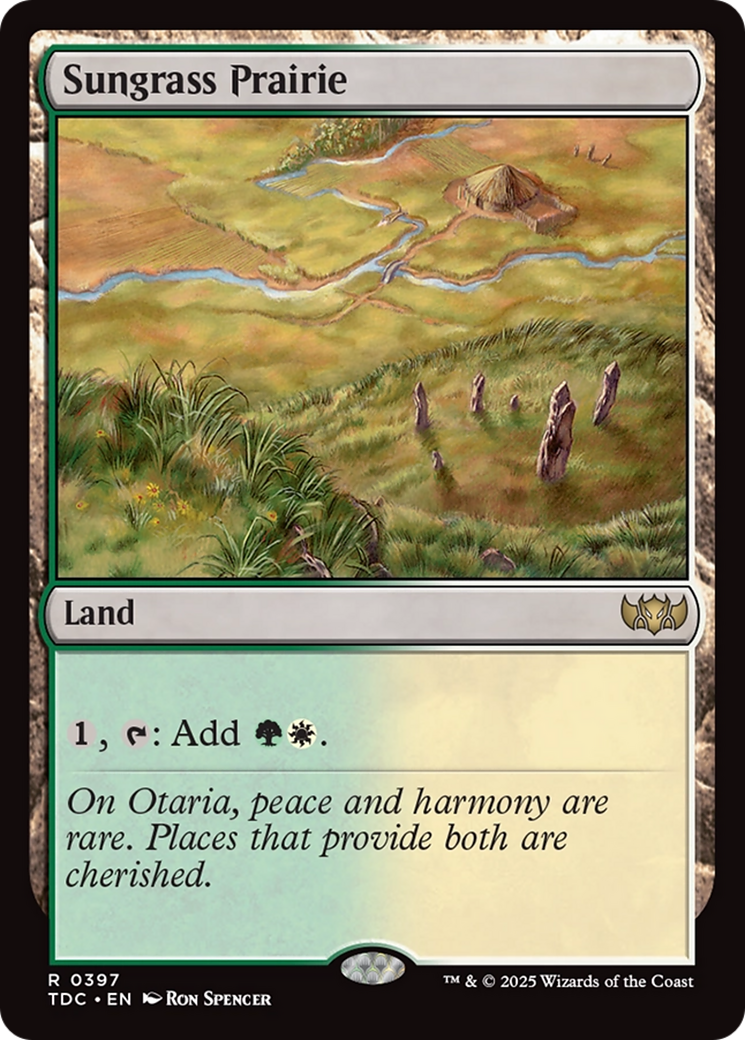
Sungrass Prairie
Sungrass Prairie
Land
, : Add .
-
1
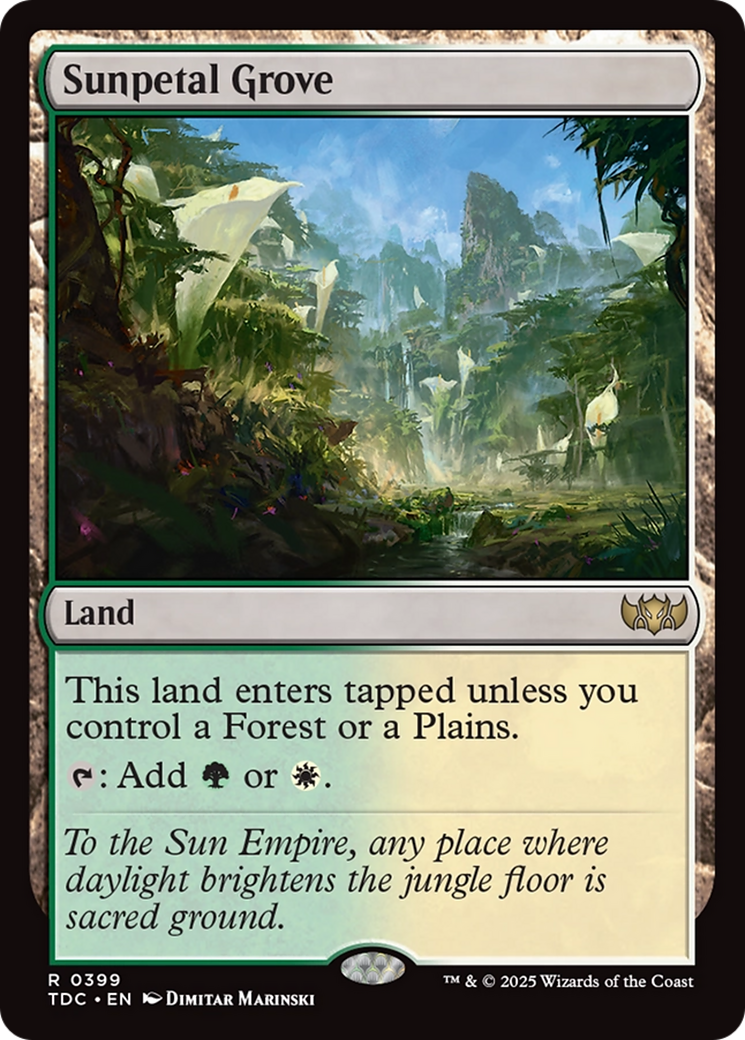
Sunpetal Grove
Sunpetal Grove
Land
This land enters tapped unless you control a Forest or a Plains.
: Add or .
- This checks for lands you control with the land type Forest or Plains, not for lands named Forest or Plains. The lands it checks for don't have to be basic lands. For example, if you control Hallowed Fountain (a nonbasic land with the land types Plains and Island), Sunpetal Grove will enter untapped.
- As this is entering, it checks for lands that are already on the battlefield. It won't see lands that are entering at the same time (due to Warp World, for example).
-
5
Swamp
Swamp
Basic Land — Swamp
( : Add .)
-
1
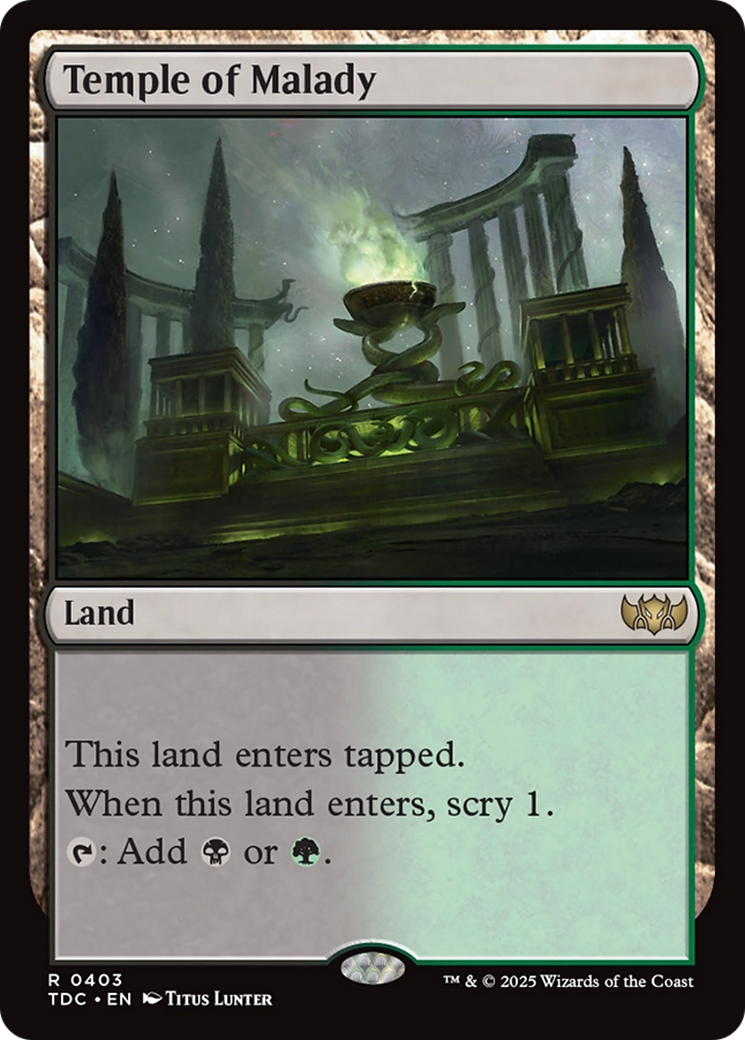
Temple of Malady
Temple of Malady
Land
This land enters tapped.
When this land enters, scry 1. (Look at the top card of your library. You may put that card on the bottom.)
: Add or .
-
1
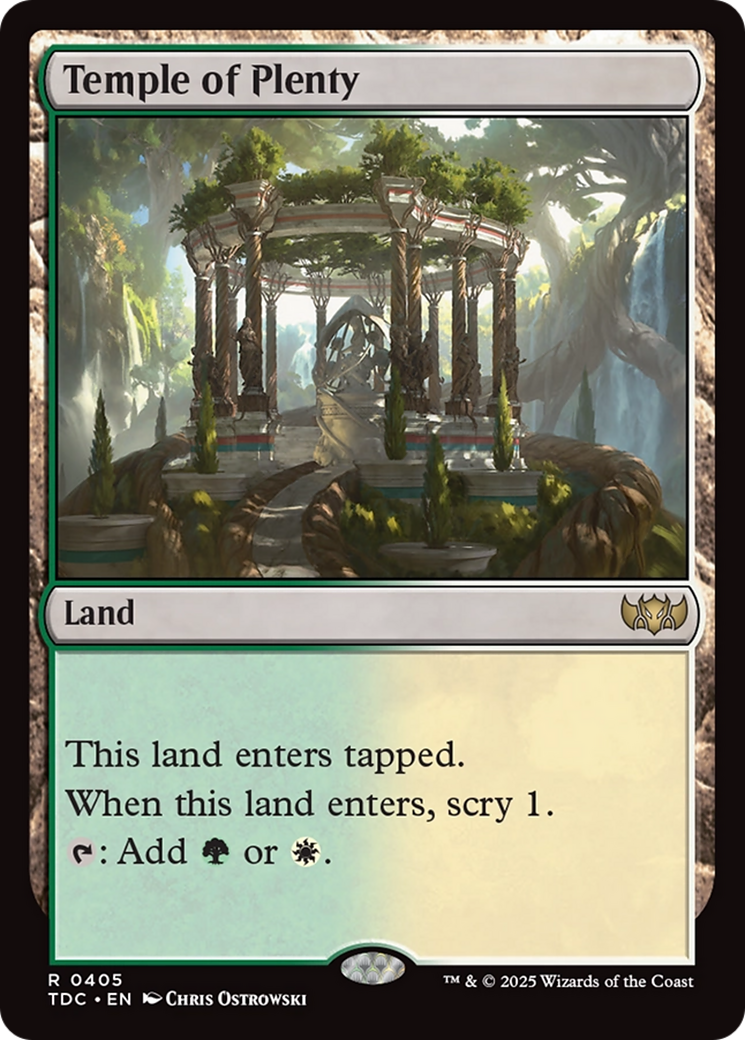
Temple of Plenty
Temple of Plenty
Land
This land enters tapped.
When this land enters, scry 1. (Look at the top card of your library. You may put that card on the bottom.)
: Add or .
- You perform the actions stated on a card in sequence. For some spells and abilities, that means you'll scry last. For others, that means you'll scry and then perform other actions.
- You choose how to order cards returned to your library after scrying no matter where you put them.
- When you scry, you may put all the cards you look at back on top of your library, you may put all of those cards on the bottom of your library, or you may put some of those cards on top and the rest of them on the bottom.
- Scry appears on some spells and abilities with one or more targets. If all of the spell or ability's targets are illegal when it tries to resolve, it won't resolve and none of its effects will happen. You won't scry.
-
1
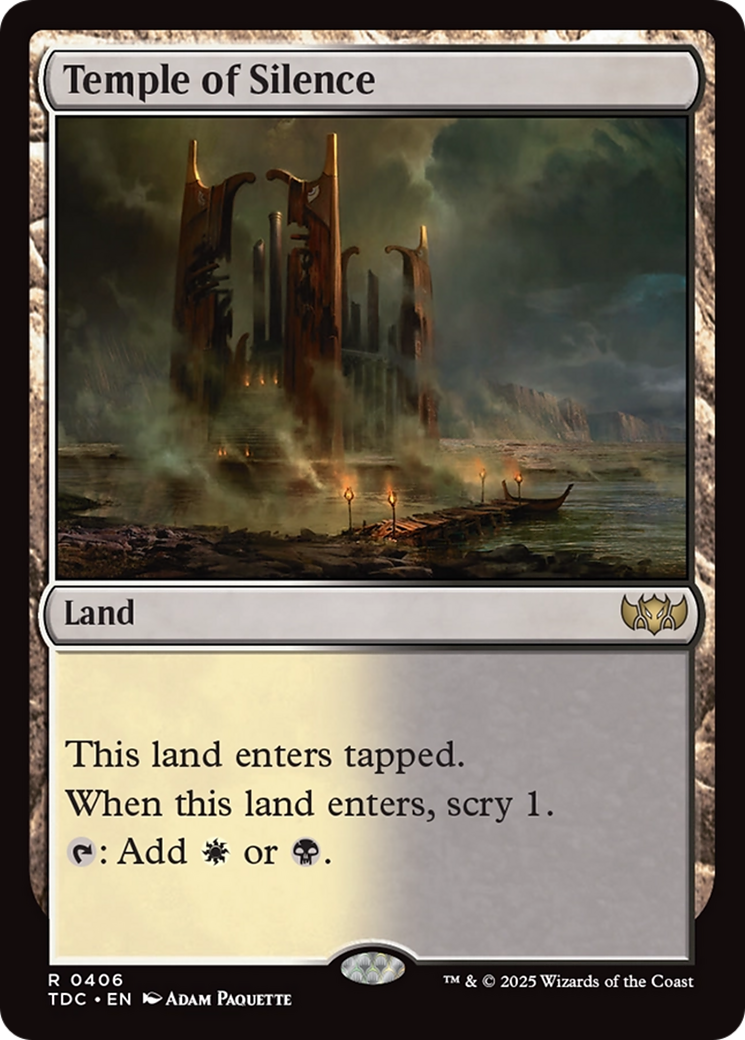
Temple of Silence
Temple of Silence
Land
This land enters tapped.
When this land enters, scry 1. (Look at the top card of your library. You may put that card on the bottom.)
: Add or .
- When you scry, you may put all the cards you look at back on top of your library, you may put all of those cards on the bottom of your library, or you may put some of those cards on top and the rest of them on the bottom.
- You choose how to order cards returned to your library after scrying no matter where you put them.
- You perform the actions stated on a card in sequence. For some spells and abilities, that means you'll scry last. For others, that means you'll scry and then perform other actions.
- Scry appears on some spells and abilities with one or more targets. If all of the spell or ability's targets are illegal when it tries to resolve, it won't resolve and none of its effects will happen. You won't scry.
-
1
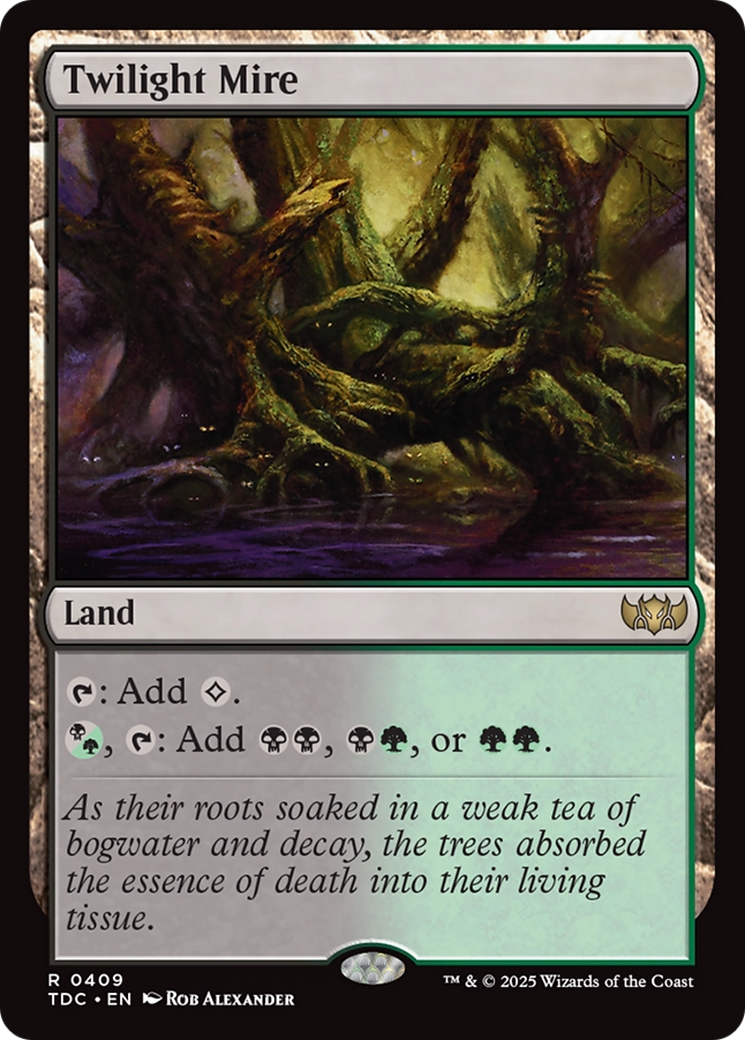
Twilight Mire
Twilight Mire
Land
: Add .
, : Add , , or .
-
1
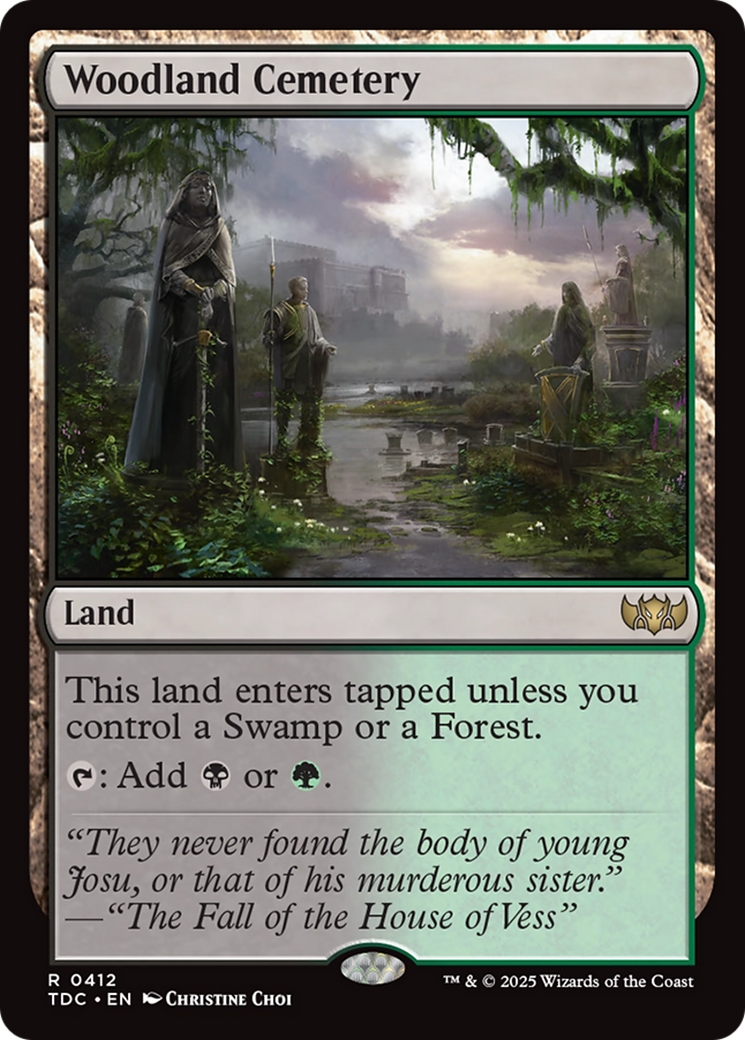
Woodland Cemetery
Woodland Cemetery
Land
This land enters tapped unless you control a Swamp or a Forest.
: Add or .
White 16
-
1
Baldin, Century Herdmaster
Baldin, Century Herdmaster
Legendary Creature — Human Warrior
0/7
As long as it's your turn, each creature assigns combat damage equal to its toughness rather than its power.
Whenever Baldin, Century Herdmaster attacks, up to one hundred target creatures each get +0/+X until end of turn, where X is the number of cards in your hand.
- For the purposes of deck construction, format legality, and all rules, abilities, and effects that refer to a card’s name, this card’s name is the same as that of E. Honda, Sumo Champion.
-
1
Expel the Interlopers
Expel the Interlopers
Sorcery
Choose a number between 0 and 10. Destroy all creatures with power greater than or equal to the chosen number.
- The numbers you may choose include 0 and 10.
-
1
Indomitable Ancients
Indomitable Ancients
Creature — Treefolk Warrior
2/10
-
1
Nyx-Fleece Ram
Nyx-Fleece Ram
Enchantment Creature — Sheep
0/5
At the beginning of your upkeep, you gain 1 life.
-
1
Protector of the Wastes
Protector of the Wastes
Creature — Dragon
5/5
Flying
When this creature enters or becomes monstrous, exile up to two target artifacts and/or enchantments controlled by different players.
: Monstrosity 3. (If this creature isn't monstrous, put three +1/+1 counters on it and it becomes monstrous.)
- Once a creature becomes monstrous, it can’t become monstrous again. If the creature is already monstrous when the monstrosity ability resolves, nothing happens.
- Monstrous isn’t an ability that a creature has. It’s just something true about that creature. If the creature stops being a creature or loses its abilities, it will continue to be monstrous.
-
1
Reunion of the House
Reunion of the House
Sorcery
Return any number of target creature cards with total power 10 or less from your graveyard to the battlefield. Exile Reunion of the House.
- Reunion of the House can return any combination of creature cards whose powers total 10 or less. For example, it could target ten 1/1 creature cards, two 5/5 creature cards, and so on. Regardless of what other creature cards you choose as targets, you can also choose any number of creature cards with power 0 as targets.
- Use the power of the creature cards as they exist in your graveyard to determine whether they can be the targets of Reunion of the House. For example, a 0/0 creature card that will enter the battlefield as a copy of a 15/15 creature can be returned, as can five 0/0 creature cards that will each enter the battlefield with three +1/+1 counters on them.
- If the power of the target creature cards changes while in your graveyard, most likely because one has a characteristic-defining ability that defines a * in its power, the total power of the creature cards may become greater than 10. If this happens, the entire selection of targets is illegal. In this case, Reunion of the House won’t resolve and none of its effects will happen. Nothing will be returned to the battlefield, and Reunion of the House will be put into its owner’s graveyard.
-
1
Rhox Faithmender
Rhox Faithmender
Creature — Rhino Monk
1/5
Lifelink (Damage dealt by this creature also causes you to gain that much life.)
If you would gain life, you gain twice that much life instead.
- If you control two Rhox Faithmenders, life you gain will be multiplied by four. Three Rhox Faithmenders will multiply any life gain by eight, and so on.
- If an effect sets your life total to a specific number, and that number is higher than your current life total, the effect will cause you to gain life equal to the difference. Rhox Faithmender will then double that number. For example, if you have 3 life and an effect says that your life total "becomes 10," your life total will actually become 17.
- In a Two-Headed Giant game, only Rhox Faithmender's controller is affected by it. If that player's teammate gains life, Rhox Faithmender will have no effect, even when that life gain is applied to the shared team life total.
-
1
Shalai, Voice of Plenty
Shalai, Voice of Plenty
Legendary Creature — Angel
3/4
Flying
You, planeswalkers you control, and other creatures you control have hexproof.
: Put a +1/+1 counter on each creature you control.
-
1
Slaughter the Strong
Slaughter the Strong
Sorcery
Each player chooses any number of creatures they control with total power 4 or less, then sacrifices all other creatures they control.
- Slaughter the Strong has each player choose any number of creatures and then checks that the total power of creatures each player chose this way is 4 or less. For example, you could save two 2/2 creatures, or a 1/1 and a 3/3 creature, but not all four of those creatures.
- As Slaughter the Strong resolves, first the player whose turn it is chooses which creatures will be spared, then each other player in turn order does the same knowing the choices made before them. Then all the creatures not chosen are sacrificed simultaneously.
- If a creature's power is somehow less than 0, it subtracts from the total power of the other creatures its controller chooses. This can cause creatures with power 5 or greater to survive.
-
1
Swords to Plowshares
Swords to Plowshares
Instant
Exile target creature. Its controller gains life equal to its power.
- Use the power of the creature from when it was last on the battlefield to determine how much life is gained.
-
1
Wakestone Gargoyle
Wakestone Gargoyle
Creature — Gargoyle
3/4
Defender, flying
: Creatures you control with defender can attack this turn as though they didn't have defender.
- Wakestone Gargoyle’s ability allows itself to attack.
- Wakestone Gargoyle’s ability will affect creatures with defender that come under your control after the ability resolves but before you declare attackers (though those creatures still can’t attack unless they have haste).
-
1
Wall of Omens
Wall of Omens
Creature — Wall
0/4
Defender
When this creature enters, draw a card.
-
1
Wall of Reverence
Wall of Reverence
Creature — Spirit Wall
1/6
Defender, flying
At the beginning of your end step, you may gain life equal to the power of target creature you control.
- If an effect changes a creature’s power “until end of turn,” it will still have the modified power during your end step.
-
1
Welcoming Vampire
Welcoming Vampire
Creature — Vampire
2/3
Flying
Whenever one or more other creatures you control with power 2 or less enter, draw a card. This ability triggers only once each turn.
-
1
Wingmantle Chaplain
Wingmantle Chaplain
Creature — Human Cleric
0/3
Defender
When this creature enters, create a 1/1 white Bird creature token with flying for each creature with defender you control.
Whenever another creature you control with defender enters, create a 1/1 white Bird creature token with flying.
- Count the number of creatures with defender you control as the second ability resolves to determine how many Bird tokens you create. If Wingmantle Chaplain’s still under your control at that time, it will count itself.
- If Wingmantle Chaplain enters the battlefield under your control at the same time as other creatures with defender, the second ability will trigger once and the last ability will trigger once for each of those other creatures.
-
1
Zetalpa, Primal Dawn
Zetalpa, Primal Dawn
Legendary Creature — Elder Dinosaur
4/8
Flying, double strike, vigilance, trample, indestructible
- If an attacking creature with double strike and trample destroys all of its blocking creatures with first-strike combat damage, all of its normal combat damage is assigned to the player, planeswalker, or battle that creature's attacking.
Black 8
-
1
Behind the Scenes
Behind the Scenes
Enchantment
Creatures you control have skulk. (They can't be blocked by creatures with greater power.)
: Creatures you control get +1/+1 until end of turn.
- Skulk matters only as blockers are chosen. Modifying either creature’s power after blockers are chosen won’t cause the attacking creature to become unblocked.
- If you cause a creature to have 0 power or less, use the actual value (which may be negative) to determine whether it can block or be blocked. A creature with skulk and 0 or less power most likely won’t be blocked, but it won’t deal combat damage and won’t trigger any abilities that trigger when combat damage is dealt.
-
1
Blight Pile
Blight Pile
Creature — Phyrexian
3/3
Defender
, : Each opponent loses X life, where X is the number of creatures with defender you control.
- In a Two-Headed Giant game, Blight Pile causes the opposing team to lose X life twice.
-
1
Feed the Swarm
Feed the Swarm
Sorcery
Destroy target creature or enchantment an opponent controls. You lose life equal to that permanent's mana value.
- The amount of life you lose is determined by the permanent's mana value as it last existed on the battlefield.
- If a permanent on the battlefield has in its mana cost, X is 0 for the purpose of determining its mana value.
- If the target permanent is an illegal target by the time Feed the Swarm tries to resolve, the spell doesn't resolve. You don't lose any life. If the target is legal but not destroyed (most likely because it has indestructible), you do lose life.
-
1
Infernal Grasp
Infernal Grasp
Instant
Destroy target creature. You lose 2 life.
-
1
Jaws of Defeat
Jaws of Defeat
Enchantment
Whenever a creature you control enters, target opponent loses life equal to the difference between that creature's power and its toughness.
- To find the difference between a creature’s power and its toughness, subtract the smaller of those two numbers from the larger one. For example, the difference between the power and toughness of a 3/5 creature is 2. The difference between the power and toughness of a 5/3 creature is also 2.
-
1
Tip the Scales
Tip the Scales
Sorcery
Sacrifice a creature. When you do, all creatures get -X/-X until end of turn, where X is the sacrificed creature's toughness.
- You don’t choose which creature to sacrifice until Tip the Scales resolves. You must sacrifice exactly one creature if you control one at that time. Doing so causes a “reflexive” ability to trigger. Players may respond to that ability knowing the value of X.
- Use the sacrificed creature’s toughness as it last existed on the battlefield to determine the value of X.
-
1
Wall of Limbs
Wall of Limbs
Creature — Zombie Wall
0/3
Defender (This creature can't attack.)
Whenever you gain life, put a +1/+1 counter on this creature.
, Sacrifice this creature: Target player loses X life, where X is this creature's power.
- The ability triggers just once for each life-gaining event, whether it’s 1 life from Soulmender or 8 life from Meditation Puzzle.
- Use Wall of Limbs’s power as it last existed on the battlefield, including any +1/+1 counters it had, to determine the value of X.
- If you gain life at the same time Wall of Limbs is dealt lethal damage (probably because you control a blocking creature with lifelink), Wall of Limbs’s triggered ability will trigger, but Wall of Limbs will be destroyed before the ability resolves.
-
1
Will of the Abzan
Will of the Abzan
Sorcery
Choose one. If you control a commander as you cast this spell, you may choose both instead.
- Any number of target opponents each sacrifice a creature with the greatest power among creatures that player controls and lose 3 life.
- Return target creature card from your graveyard to the battlefield.
- The commander you control doesn’t have to be your commander.
- Once you’ve announced that you’re casting this spell, players can’t take any actions until you’ve finished doing so. Notably, opponents can’t try to remove your commander to change how many modes you may choose.
- Whether or not you control a commander is determined only once, as you choose the modes for this spell. If you somehow lose control of that commander before you finish casting the spell (perhaps because you sacrifice it to activate a mana ability), it won’t change the number of modes chosen.
Green 18
-
1
Arasta of the Endless Web
Arasta of the Endless Web
Legendary Enchantment Creature — Spider
3/5
Reach
Whenever an opponent casts an instant or sorcery spell, create a 1/2 green Spider creature token with reach.
- An ability that triggers when a player casts a spell resolves before the spell that caused it to trigger. It resolves even if that spell is countered.
-
1
Arbor Adherent
Arbor Adherent
Creature — Dog Druid
2/4
: Add one mana of any color.
: Add X mana of any one color, where X is the greatest toughness among other creatures you control.
-
1
Arboreal Grazer
Arboreal Grazer
Creature — Sloth Beast
0/3
Reach
When this creature enters, you may put a land card from your hand onto the battlefield tapped.
- Arboreal Grazer’s effect doesn’t count as playing a land. It can put a land card onto the battlefield even if you’ve already played your land for the turn.
-
1
Assault Formation
Assault Formation
Enchantment
Each creature you control assigns combat damage equal to its toughness rather than its power.
: Target creature with defender can attack this turn as though it didn't have defender.
: Creatures you control get +0/+1 until end of turn.
- For example, a 2/3 creature will assign 3 combat damage rather than 2.
- Assault Formation’s first ability doesn’t actually change any creature’s power. It changes only the amount of combat damage it assigns. All other rules and effects that check power or toughness use the real values. For example, Hunt the Weak won’t cause a creature to fight with its toughness.
-
1
Axebane Guardian
Axebane Guardian
Creature — Human Druid
0/3
Defender
: Add X mana in any combination of colors, where X is the number of creatures you control with defender.
- Axebane Guardian’s activated ability is a mana ability. It doesn’t use the stack and can’t be responded to. The number of creatures with defender you control is counted, and the color(s) of mana produced chosen, immediately after the ability is activated when the ability resolves.
-
1
Canopy Gargantuan
Canopy Gargantuan
Creature — Dragon
7/7
Flying, ward
At the beginning of your upkeep, put a number of +1/+1 counters on each other creature you control equal to that creature's toughness.
-
1
Carven Caryatid
Carven Caryatid
Creature — Spirit
2/5
Defender (This creature can't attack.)
When this creature enters, draw a card.
-
1
Hornet Nest
Hornet Nest
Creature — Insect
0/2
Defender (This creature can't attack.)
Whenever this creature is dealt damage, create that many 1/1 green Insect creature tokens with flying and deathtouch. (Any amount of damage a creature with deathtouch deals to a creature is enough to destroy it.)
- Hornet Nest’s triggered ability will trigger even if it’s dealt lethal damage. For example, if it’s dealt 7 damage, its ability will trigger and you’ll put seven Insect creature tokens onto the battlefield.
-
1
Jaddi Offshoot
Jaddi Offshoot
Creature — Plant
0/3
Defender
Landfall — Whenever a land you control enters, you gain 1 life.
- A landfall ability triggers whenever a land you control enters for any reason. It triggers whenever you play a land, as well as whenever a spell or ability puts a land onto the battlefield under your control.
- A landfall ability doesn't trigger if a permanent already on the battlefield becomes a land.
- Whenever a land you control enters, each landfall ability of the permanents you control will trigger. You can put them on the stack in any order. The last ability you put on the stack will be the first one to resolve (As a result, you can have those abilities resolve in the order of your choosing.).
-
1
Overgrown Battlement
Overgrown Battlement
Creature — Wall
0/4
Defender
: Add for each creature you control with defender.
- Overgrown Battlement's last ability is a mana ability. It doesn't use the stack and can't be responded to (such as by removing creatures with defender you control).
-
1
Rampart Architect
Rampart Architect
Creature — Elephant Advisor
3/4
Whenever this creature enters or attacks, create a 1/3 white Wall creature token with defender.
Whenever a creature you control with defender dies, you may search your library for a basic land card, put that card onto the battlefield tapped, then shuffle.
-
1
Seedborn Muse
Seedborn Muse
Creature — Spirit
2/4
Untap all permanents you control during each other player's untap step.
- All your permanents untap during each other player's untap step. You have no choice about what untaps.
- Other effects can prevent a permanent from untapping during an untap step. You do need to look carefully, however, as many effects say that the permanent does not untap during its controller's untap step, and this card's ability occurs during other players' untap steps. If a card does say this, then Seedborn Muse can untap it. But some other abilities are not written this way and can still prevent a card from untapping.
-
1
Sylvan Caryatid
Sylvan Caryatid
Creature — Plant
0/3
Defender, hexproof
: Add one mana of any color.
-
1
Tower Defense
Tower Defense
Instant
Creatures you control get +0/+5 and gain reach until end of turn.
- Only creatures you control when Tower Defense resolves will get the bonuses. Creatures that come under your control later that turn will not.
-
1
Towering Titan
Towering Titan
Creature — Giant
0/0
This creature enters with X +1/+1 counters on it, where X is the total toughness of other creatures you control.
Sacrifice a creature with defender: All creatures gain trample until end of turn.
- If another creature is entering the battlefield at the same time as Towering Titan, its toughness won’t contribute to the +1/+1 counters on Towering Titan.
- Once Towering Titan has entered the battlefield, it doesn’t gain or lose counters as the total toughness of other creatures you control changes.
-
1
Tree of Redemption
Tree of Redemption
Creature — Plant
0/13
Defender
: Exchange your life total with this creature's toughness.
- If Tree of Redemption isn't on the battlefield when its activated ability resolves, the exchange can't happen and the ability will have no effect.
- When its activated ability resolves, Tree of Redemption's toughness will become your former life total and you will gain or lose an amount of life necessary so that your life total equals Tree of Redemption's former toughness. Other effects that interact with life gain or life loss will interact with this effect accordingly.
- Any toughness-modifying effects, counters, Auras, or Equipment will apply after its toughness is set to your former life total. For example, say Tree of Redemption is enchanted with Lunarch Mantle (which makes it 2/15) and your life total is 7. After the exchange, Tree of Redemption would be a 2/9 creature (its toughness became 7, which was then modified by Lunarch Mantle) and your life total would be 15.
-
1
Wall of Blossoms
Wall of Blossoms
Creature — Plant Wall
0/4
Defender
When this creature enters, draw a card.
-
1
Wall of Roots
Wall of Roots
Creature — Plant Wall
0/5
Defender
Put a -0/-1 counter on this creature: Add . Activate only once each turn.
- If you must sacrifice a creature to pay a casting or activation cost that also includes mana, such as that of Bubbling Cauldron's abilities, you may put a -0/-1 counter on Wall of Roots to make its toughness 0 and then sacrifice it to pay that cost.
Multicolor 10
-
1
Anguished Unmaking
Anguished Unmaking
Instant
Exile target nonland permanent. You lose 3 life.
- If the target nonland permanent is an illegal target as Anguished Unmaking tries to resolve, it won't resolve and none of its effects will happen. You won't lose 3 life.
-
1
Betor, Ancestor's Voice
Betor, Ancestor's Voice
Legendary Creature — Spirit Dragon
3/5
Flying, lifelink
At the beginning of your end step, put a number of +1/+1 counters on up to one other target creature you control equal to the amount of life you gained this turn. Return up to one target creature card with mana value less than or equal to the amount of life you lost this turn from your graveyard to the battlefield.
-
1
Despark
Despark
Instant
Exile target permanent with mana value 4 or greater.
- If a permanent has in its mana cost, X is considered to be 0.
-
1
Dragonlord Dromoka
Dragonlord Dromoka
Legendary Creature — Elder Dragon
5/7
This spell can't be countered.
Flying, lifelink
Your opponents can't cast spells during your turn.
-
1
Faeburrow Elder
Faeburrow Elder
Creature — Treefolk Druid
0/0
Vigilance
This creature gets +1/+1 for each color among permanents you control.
: For each color among permanents you control, add one mana of that color.
- Faeburrow Elder's middle ability can give it at most +5/+5, that is, +1/+1 each for white, blue, black, red, and green. "Gold," "multicolor," and "colorless" aren't colors. Similarly, Faeburrow Elder's last ability can produce at most five mana.
- Since Faeburrow Elder is a green and white permanent, its middle ability usually gives it at least +2/+2 and its last ability usually produces at least .
-
1
Felothar the Steadfast
Felothar the Steadfast
Legendary Creature — Human Warrior
0/5
Each creature you control assigns combat damage equal to its toughness rather than its power.
Creatures you control can attack as though they didn't have defender.
, , Sacrifice another creature: Draw cards equal to the sacrificed creature's toughness, then discard cards equal to its power.
- Felothar’s first ability doesn’t actually change any creature’s power. It changes only the amount of combat damage those creatures assign. All other rules and effects that check power or toughness use the real values.
-
1
Ikra Shidiqi, the Usurper
Ikra Shidiqi, the Usurper
Legendary Creature — Snake Wizard
3/7
Menace
Whenever a creature you control deals combat damage to a player, you gain life equal to that creature's toughness.
Partner (You can have two commanders if both have partner.)
- The amount of life you gain is determined as Ikra Shidiqi's triggered ability resolves. If that creature is no longer on the battlefield, use its toughness as it last existed on the battlefield to determine how much life to gain.
- If your Commander deck has two commanders, you can only include cards whose own color identities are also found in your commanders' combined color identities. If Falthis and Kediss are your commanders, your deck may contain cards with black and/or red in their color identity, but not cards with green, white, or blue.
- Both commanders start in the command zone, and the remaining 98 cards (or 58 cards in a Commander Draft game) of your deck are shuffled to become your library.
- To have two commanders, both must have the partner ability as the game begins. Losing the ability during the game doesn't cause either to cease to be your commander.
- Once the game begins, your two commanders are tracked separately. If you cast one, you won't have to pay an additional the first time you cast the other. A player loses the game after having been dealt 21 damage from any one of them, not from both of them combined.
- If something refers to your commander while you have two commanders, it refers to one of them of your choice. If you are instructed to perform an action on your commander (e.g. put it from the command zone into your hand due to Command Beacon), you choose one of your commanders at the time the effect happens.
- An effect that checks whether you control your commander is satisfied if you control one or both of your two commanders.
- You can choose two commanders with partner that are the same color or colors. In Commander Draft, you can even choose two of the same commander with partner if you drafted them. If you do this, make sure you keep the number of times you've cast each from the command zone clear for "commander tax" purposes.
-
1
Indulging Patrician
Indulging Patrician
Creature — Vampire Noble
1/4
Flying
Lifelink (Damage dealt by this creature also causes you to gain that much life.)
At the beginning of your end step, if you gained 3 or more life this turn, each opponent loses 3 life.
- Each opponent loses just 3 life, no matter how much life you've gained past 3 life.
- Indulging Patrician's last ability looks at how much life you've gained in the turn, even if it wasn't on the battlefield when you gained life. It doesn't care if you also lost life, even if you lost more life than you gained.
- If you haven't gained 3 life by the time your end step begins, Indulging Patrician's last ability won't trigger at all.
- In a Two-Headed Giant game, Indulging Patrician's last ability causes the opposing team to lose 6 life.
-
1
Shadrix Silverquill
Shadrix Silverquill
Legendary Creature — Elder Dragon
2/5
Flying, double strike
At the beginning of combat on your turn, you may choose two. Each mode must target a different player.
- Target player creates a 2/1 white and black Inkling creature token with flying.
- Target player draws a card and loses 1 life.
- Target player puts a +1/+1 counter on each creature they control.
- You may choose exactly zero modes or two modes. You can’t choose only one mode. If you choose two modes, you choose which two and the target players as you put the triggered ability on the stack.
- You can target a player with the third mode even if they control no creatures.
-
1
Sidar Kondo of Jamuraa
Sidar Kondo of Jamuraa
Legendary Creature — Human Knight
2/5
Flanking (Whenever a creature without flanking blocks this creature, the blocking creature gets -1/-1 until end of turn.)
Creatures your opponents control without flying or reach can't block creatures with power 2 or less.
Partner (You can have two commanders if both have partner.)
- If something refers to your commander while you have two commanders, it refers to one of them of your choice. If you are instructed to perform an action on your commander (e.g. put it from the command zone into your hand due to Command Beacon), you choose one of your commanders at the time the effect happens.
- Sidar Kondo's blocking restriction applies to creatures your opponents control even when an opponent is being attacked by a player other than you.
- Once an attacking creature has been blocked by a creature without flying or reach, reducing its power to 2 or less won't change or undo that block.
- If your Commander deck has two commanders, you can only include cards whose own color identities are also found in your commanders' combined color identities. If Falthis and Kediss are your commanders, your deck may contain cards with black and/or red in their color identity, but not cards with green, white, or blue.
- Both commanders start in the command zone, and the remaining 98 cards (or 58 cards in a Commander Draft game) of your deck are shuffled to become your library.
- To have two commanders, both must have the partner ability as the game begins. Losing the ability during the game doesn't cause either to cease to be your commander.
- Once the game begins, your two commanders are tracked separately. If you cast one, you won't have to pay an additional the first time you cast the other. A player loses the game after having been dealt 21 damage from any one of them, not from both of them combined.
- An effect that checks whether you control your commander is satisfied if you control one or both of your two commanders.
- You can choose two commanders with partner that are the same color or colors. In Commander Draft, you can even choose two of the same commander with partner if you drafted them. If you do this, make sure you keep the number of times you've cast each from the command zone clear for "commander tax" purposes.
Colorless 10
-
1
Arcane Signet
Arcane Signet
Artifact
: Add one mana of any color in your commander's color identity.
- If you have two commanders, the ability adds one mana of any color in their combined color identities.
- If your commander is a card that has no colors in its color identity, Arcane Signet's ability produces no mana. It doesn't produce .
- If you don't have a commander, Arcane Signet's ability produces no mana.
-
1
Colfenor's Urn
Colfenor's Urn
Artifact
Whenever a creature with toughness 4 or greater is put into your graveyard from the battlefield, you may exile it.
At the beginning of the end step, if three or more cards have been exiled with this artifact, sacrifice it. If you do, return those cards to the battlefield under their owner's control.
- The second ability checks how many creatures have been exiled with Colfenor’s Urn over the course of the entire game.
- The second ability forces you to sacrifice Colfenor’s Urn. If the ability triggers and the Urn isn’t sacrificed (because it left the battlefield or changed controllers, for example), the exiled cards won’t be returned to the battlefield.
- The first ability triggers when a token creature with toughness 4 or greater is put into your graveyard. However, that token will cease to exist before Colfenor’s Plans can exile it.
-
1
Crashing Drawbridge
Crashing Drawbridge
Artifact Creature — Wall
0/4
Defender
: Creatures you control gain haste until end of turn.
-
1
Orzhov Signet
Orzhov Signet
Artifact
, : Add .
-
1
Selesnya Signet
Selesnya Signet
Artifact
, : Add .
-
1
Sol Ring
Sol Ring
Artifact
: Add .
-
1
Staff of Compleation
Staff of Compleation
Artifact
, Pay 1 life: Destroy target permanent you own.
, Pay 2 life: Add one mana of any color.
, Pay 3 life: Proliferate.
, Pay 4 life: Draw a card.
: Untap this artifact.
-
1
Swiftfoot Boots
Swiftfoot Boots
Artifact — Equipment
Equipped creature has hexproof and haste. (It can't be the target of spells or abilities your opponents control. It can attack and no matter when it came under your control.)
Equip ( : Attach to target creature you control. Equip only as a sorcery.)
- If a creature enters the battlefield under your control and gains haste, but then loses it before attacking, it won't be able to attack that turn. This means that you can't use one Swiftfoot Boots to allow two new creatures to attack in the same turn.
-
1
Walking Bulwark
Walking Bulwark
Artifact Creature — Golem
0/3
Defender
: Until end of turn, target creature with defender gains haste, can attack as though it didn't have defender, and assigns combat damage equal to its toughness rather than its power. Activate only as a sorcery.
- Walking Bulwark’s last ability doesn’t actually change any creature’s power. It changes only the amount of combat damage it assigns. All other rules and effects that check power or toughness use the real values. For example, since having two creatures fight doesn’t result in combat damage, an effect that causes the affected creature to fight another creature will still use its power to determine how much damage is dealt.
-
1
Weathered Sentinels
Weathered Sentinels
Artifact Creature — Wall
2/5
Defender, vigilance, reach, trample
This creature can attack players who attacked you during their last turn as though it didn't have defender.
Whenever this creature attacks, it gets +3/+3 and gains indestructible until end of turn.
Lands 38
-
1
Access Tunnel
Access Tunnel
Land
: Add .
, : Target creature with power 3 or less can't be blocked this turn.
- Once a creature with power 3 or less has been blocked, Access Tunnel's second ability won't cause it to become unblocked.
- If the target creature's power is greater than 3 as Access Tunnel's second ability tries to resolve, the ability doesn't resolve. However, if instead the creature's power is raised above 3 after the ability resolves, it still can't be blocked that turn.
-
1
Bojuka Bog
Bojuka Bog
Land
This land enters tapped.
When this land enters, exile target player's graveyard.
: Add .
-
1
Canopy Vista
Canopy Vista
Land — Forest Plains
( : Add or .)
This land enters tapped unless you control two or more basic lands.
- Even though these lands have basic land types, they are not basic lands because "basic" doesn't appear on their type line. Notably, controlling two or more of them won't allow others to enter the battlefield untapped.
- However, because these cards have basic land types, effects that specify a basic land type without also specifying that the land be basic can affect them. For example, a spell or ability that reads "Destroy target Forest" can target Canopy Vista, while one that reads "Destroy target basic Forest" cannot.
- If one of these lands enters the battlefield at the same time as any number of basic lands, those other lands are not counted when determining if this land enters the battlefield tapped or untapped.
-
1
Command Tower
Command Tower
Land
: Add one mana of any color in your commander's color identity.
- If you have two commanders, the ability adds one mana of any color in their combined color identities.
- If your commander is a card that has no colors in its color identity, Command Tower's ability produces no mana. It doesn't produce .
- If you don't have a commander, Command Tower's ability produces no mana.
-
1
Deceptive Landscape
Deceptive Landscape
Land
: Add .
, Sacrifice this land: Search your library for a basic Plains, Swamp, or Forest card, put it onto the battlefield tapped, then shuffle.
Cycling ( , Discard this card: Draw a card.)
-
1
Evolving Wilds
Evolving Wilds
Land
, Sacrifice this land: Search your library for a basic land card, put it onto the battlefield tapped, then shuffle.
-
1
Exotic Orchard
Exotic Orchard
Land
: Add one mana of any color that a land an opponent controls could produce.
- The colors of mana are white, blue, black, red, and green. Exotic Orchard can't be tapped for colorless mana, even if a land an opponent controls could produce colorless mana.
- Exotic Orchard checks the effects of all mana-producing abilities of lands your opponents control, but it doesn't check their costs. For example, Vivid Crag has the ability " , Remove a charge counter from Vivid Crag: Add one mana of any color." If an opponent controls Vivid Crag and you control Exotic Orchard, you can tap Exotic Orchard for any color of mana. It doesn't matter whether Vivid Crag has a charge counter on it, and it doesn't matter whether it's untapped.
- When determining what colors of mana your opponents' lands could produce, Exotic Orchard takes into account any applicable replacement effects that would apply to those lands' mana abilities (such as Contamination's effect, for example). If there are more than one, consider them in any possible order.
- Exotic Orchard doesn't care about any restrictions or riders your opponents' lands (such as Ancient Ziggurat or Hall of the Bandit Lord) put on the mana they produce. It just cares about colors of mana.
- Lands that produce mana based only on what other lands "could produce" won't help each other unless some other land allows one of them to actually produce some type of mana. For example, if you control an Exotic Orchard and your opponent controls an Exotic Orchard and a Reflecting Pool, none of those lands would produce mana if their mana abilities were activated. On the other hand, if you control a Forest and an Exotic Orchard, and your opponent controls an Exotic Orchard and a Reflecting Pool, then each of those lands can be tapped to produce . Your opponent's Exotic Orchard can produce because you control a Forest. Your Exotic Orchard and your opponent's Reflecting Pool can each produce because your opponent's Exotic Orchard can produce .
-
7
Forest
Forest
Basic Land — Forest
( : Add .)
-
1
Fortified Village
Fortified Village
Land
As this land enters, you may reveal a Forest or Plains card from your hand. If you don't, this land enters tapped.
: Add or .
- You may reveal any land card with either or both of the appropriate subtypes. It doesn't have to be a basic land. For example, you could reveal Prairie Stream from the Battle for Zendikar set to satisfy the ability of Fortified Village.
- Lands don't have a subtype just because they can produce mana of the corresponding color. Fortified Village itself is neither a Forest nor a Plains, even though it produces green and white mana, so you can't reveal one to satisfy the ability of another.
- If a Forest or Plains is entering the battlefield from your hand at the same time as Fortified Village, you may reveal the other land to have Fortified Village enter untapped.
- If an effect instructs you to put Fortified Village onto the battlefield tapped, it will still enter the battlefield tapped even if you reveal a land card from your hand.
-
1
Isolated Chapel
Isolated Chapel
Land
This land enters tapped unless you control a Plains or a Swamp.
: Add or .
-
1
Overgrown Farmland
Overgrown Farmland
Land
This land enters tapped unless you control two or more other lands.
: Add or .
- If this land enters the battlefield at the same time as any number of other lands, those other lands are not counted when determining if this land enters the battlefield tapped or untapped.
-
1
Path of Ancestry
Path of Ancestry
Land
This land enters tapped.
: Add one mana of any color in your commander's color identity. When that mana is spent to cast a creature spell that shares a creature type with your commander, scry 1. (Look at the top card of your library. You may put that card on the bottom.)
- If you have two commanders, the last ability adds one mana of any color in their combined color identities. When you spend that mana on a creature spell that shares a creature type with either of your commanders, you'll scry 1.
- Your commander's creature types are checked immediately after you cast a creature spell spending mana from Path of Ancestry's last ability. They aren't set before the game begins, and they may not be the same types your commander had when you activated that ability.
- If you cast your commander with mana from Path of Ancestry, and your commander hasn't somehow lost all of its creature types while on the stack, you'll scry 1.
- If your commander is a card that has no colors in its color identity, Path of Ancestry's ability produces no mana. It doesn't produce .
- If Path of Ancestry's last ability produces two mana (most likely due to Mana Reflection), spending those two mana to cast creature spells that share a creature type with your commander will cause two abilities to trigger. Each of those abilities will cause you to scry 1. You won't scry 2. This is true whether you spend the mana on one creature spell or two.
- If your commander has no creature types, it can't share a creature type with any spell that you cast.
- If you don't have a commander, Path of Ancestry's ability produces no mana.
-
6
Plains
Plains
Basic Land — Plains
( : Add .)
-
1
Radiant Grove
Radiant Grove
Land — Forest Plains
( : Add or .)
This land enters tapped.
-
1
Sandsteppe Citadel
Sandsteppe Citadel
Land
This land enters tapped.
: Add , , or .
-
1
Sungrass Prairie
Sungrass Prairie
Land
, : Add .
-
1
Sunpetal Grove
Sunpetal Grove
Land
This land enters tapped unless you control a Forest or a Plains.
: Add or .
- This checks for lands you control with the land type Forest or Plains, not for lands named Forest or Plains. The lands it checks for don't have to be basic lands. For example, if you control Hallowed Fountain (a nonbasic land with the land types Plains and Island), Sunpetal Grove will enter untapped.
- As this is entering, it checks for lands that are already on the battlefield. It won't see lands that are entering at the same time (due to Warp World, for example).
-
5
Swamp
Swamp
Basic Land — Swamp
( : Add .)
-
1
Temple of Malady
Temple of Malady
Land
This land enters tapped.
When this land enters, scry 1. (Look at the top card of your library. You may put that card on the bottom.)
: Add or .
-
1
Temple of Plenty
Temple of Plenty
Land
This land enters tapped.
When this land enters, scry 1. (Look at the top card of your library. You may put that card on the bottom.)
: Add or .
- You perform the actions stated on a card in sequence. For some spells and abilities, that means you'll scry last. For others, that means you'll scry and then perform other actions.
- You choose how to order cards returned to your library after scrying no matter where you put them.
- When you scry, you may put all the cards you look at back on top of your library, you may put all of those cards on the bottom of your library, or you may put some of those cards on top and the rest of them on the bottom.
- Scry appears on some spells and abilities with one or more targets. If all of the spell or ability's targets are illegal when it tries to resolve, it won't resolve and none of its effects will happen. You won't scry.
-
1
Temple of Silence
Temple of Silence
Land
This land enters tapped.
When this land enters, scry 1. (Look at the top card of your library. You may put that card on the bottom.)
: Add or .
- When you scry, you may put all the cards you look at back on top of your library, you may put all of those cards on the bottom of your library, or you may put some of those cards on top and the rest of them on the bottom.
- You choose how to order cards returned to your library after scrying no matter where you put them.
- You perform the actions stated on a card in sequence. For some spells and abilities, that means you'll scry last. For others, that means you'll scry and then perform other actions.
- Scry appears on some spells and abilities with one or more targets. If all of the spell or ability's targets are illegal when it tries to resolve, it won't resolve and none of its effects will happen. You won't scry.
-
1
Twilight Mire
Twilight Mire
Land
: Add .
, : Add , , or .
-
1
Woodland Cemetery
Woodland Cemetery
Land
This land enters tapped unless you control a Swamp or a Forest.
: Add or .
1 5
-
1
Arboreal Grazer
Arboreal Grazer
Creature — Sloth Beast
0/3
Reach
When this creature enters, you may put a land card from your hand onto the battlefield tapped.
- Arboreal Grazer’s effect doesn’t count as playing a land. It can put a land card onto the battlefield even if you’ve already played your land for the turn.
-
1
Jaddi Offshoot
Jaddi Offshoot
Creature — Plant
0/3
Defender
Landfall — Whenever a land you control enters, you gain 1 life.
- A landfall ability triggers whenever a land you control enters for any reason. It triggers whenever you play a land, as well as whenever a spell or ability puts a land onto the battlefield under your control.
- A landfall ability doesn't trigger if a permanent already on the battlefield becomes a land.
- Whenever a land you control enters, each landfall ability of the permanents you control will trigger. You can put them on the stack in any order. The last ability you put on the stack will be the first one to resolve (As a result, you can have those abilities resolve in the order of your choosing.).
-
1
Sol Ring
Sol Ring
Artifact
: Add .
-
1
Swords to Plowshares
Swords to Plowshares
Instant
Exile target creature. Its controller gains life equal to its power.
- Use the power of the creature from when it was last on the battlefield to determine how much life is gained.
-
1
Walking Bulwark
Walking Bulwark
Artifact Creature — Golem
0/3
Defender
: Until end of turn, target creature with defender gains haste, can attack as though it didn't have defender, and assigns combat damage equal to its toughness rather than its power. Activate only as a sorcery.
- Walking Bulwark’s last ability doesn’t actually change any creature’s power. It changes only the amount of combat damage it assigns. All other rules and effects that check power or toughness use the real values. For example, since having two creatures fight doesn’t result in combat damage, an effect that causes the affected creature to fight another creature will still use its power to determine how much damage is dealt.
2 17
-
1
Arcane Signet
Arcane Signet
Artifact
: Add one mana of any color in your commander's color identity.
- If you have two commanders, the ability adds one mana of any color in their combined color identities.
- If your commander is a card that has no colors in its color identity, Arcane Signet's ability produces no mana. It doesn't produce .
- If you don't have a commander, Arcane Signet's ability produces no mana.
-
1
Assault Formation
Assault Formation
Enchantment
Each creature you control assigns combat damage equal to its toughness rather than its power.
: Target creature with defender can attack this turn as though it didn't have defender.
: Creatures you control get +0/+1 until end of turn.
- For example, a 2/3 creature will assign 3 combat damage rather than 2.
- Assault Formation’s first ability doesn’t actually change any creature’s power. It changes only the amount of combat damage it assigns. All other rules and effects that check power or toughness use the real values. For example, Hunt the Weak won’t cause a creature to fight with its toughness.
-
1
Blight Pile
Blight Pile
Creature — Phyrexian
3/3
Defender
, : Each opponent loses X life, where X is the number of creatures with defender you control.
- In a Two-Headed Giant game, Blight Pile causes the opposing team to lose X life twice.
-
1
Crashing Drawbridge
Crashing Drawbridge
Artifact Creature — Wall
0/4
Defender
: Creatures you control gain haste until end of turn.
-
1
Despark
Despark
Instant
Exile target permanent with mana value 4 or greater.
- If a permanent has in its mana cost, X is considered to be 0.
-
1
Feed the Swarm
Feed the Swarm
Sorcery
Destroy target creature or enchantment an opponent controls. You lose life equal to that permanent's mana value.
- The amount of life you lose is determined by the permanent's mana value as it last existed on the battlefield.
- If a permanent on the battlefield has in its mana cost, X is 0 for the purpose of determining its mana value.
- If the target permanent is an illegal target by the time Feed the Swarm tries to resolve, the spell doesn't resolve. You don't lose any life. If the target is legal but not destroyed (most likely because it has indestructible), you do lose life.
-
1
Infernal Grasp
Infernal Grasp
Instant
Destroy target creature. You lose 2 life.
-
1
Nyx-Fleece Ram
Nyx-Fleece Ram
Enchantment Creature — Sheep
0/5
At the beginning of your upkeep, you gain 1 life.
-
1
Orzhov Signet
Orzhov Signet
Artifact
, : Add .
-
1
Overgrown Battlement
Overgrown Battlement
Creature — Wall
0/4
Defender
: Add for each creature you control with defender.
- Overgrown Battlement's last ability is a mana ability. It doesn't use the stack and can't be responded to (such as by removing creatures with defender you control).
-
1
Selesnya Signet
Selesnya Signet
Artifact
, : Add .
-
1
Swiftfoot Boots
Swiftfoot Boots
Artifact — Equipment
Equipped creature has hexproof and haste. (It can't be the target of spells or abilities your opponents control. It can attack and no matter when it came under your control.)
Equip ( : Attach to target creature you control. Equip only as a sorcery.)
- If a creature enters the battlefield under your control and gains haste, but then loses it before attacking, it won't be able to attack that turn. This means that you can't use one Swiftfoot Boots to allow two new creatures to attack in the same turn.
-
1
Sylvan Caryatid
Sylvan Caryatid
Creature — Plant
0/3
Defender, hexproof
: Add one mana of any color.
-
1
Tower Defense
Tower Defense
Instant
Creatures you control get +0/+5 and gain reach until end of turn.
- Only creatures you control when Tower Defense resolves will get the bonuses. Creatures that come under your control later that turn will not.
-
1
Wall of Blossoms
Wall of Blossoms
Creature — Plant Wall
0/4
Defender
When this creature enters, draw a card.
-
1
Wall of Omens
Wall of Omens
Creature — Wall
0/4
Defender
When this creature enters, draw a card.
-
1
Wall of Roots
Wall of Roots
Creature — Plant Wall
0/5
Defender
Put a -0/-1 counter on this creature: Add . Activate only once each turn.
- If you must sacrifice a creature to pay a casting or activation cost that also includes mana, such as that of Bubbling Cauldron's abilities, you may put a -0/-1 counter on Wall of Roots to make its toughness 0 and then sacrifice it to pay that cost.
3 14
-
1
Anguished Unmaking
Anguished Unmaking
Instant
Exile target nonland permanent. You lose 3 life.
- If the target nonland permanent is an illegal target as Anguished Unmaking tries to resolve, it won't resolve and none of its effects will happen. You won't lose 3 life.
-
1
Axebane Guardian
Axebane Guardian
Creature — Human Druid
0/3
Defender
: Add X mana in any combination of colors, where X is the number of creatures you control with defender.
- Axebane Guardian’s activated ability is a mana ability. It doesn’t use the stack and can’t be responded to. The number of creatures with defender you control is counted, and the color(s) of mana produced chosen, immediately after the ability is activated when the ability resolves.
-
1
Behind the Scenes
Behind the Scenes
Enchantment
Creatures you control have skulk. (They can't be blocked by creatures with greater power.)
: Creatures you control get +1/+1 until end of turn.
- Skulk matters only as blockers are chosen. Modifying either creature’s power after blockers are chosen won’t cause the attacking creature to become unblocked.
- If you cause a creature to have 0 power or less, use the actual value (which may be negative) to determine whether it can block or be blocked. A creature with skulk and 0 or less power most likely won’t be blocked, but it won’t deal combat damage and won’t trigger any abilities that trigger when combat damage is dealt.
-
1
Carven Caryatid
Carven Caryatid
Creature — Spirit
2/5
Defender (This creature can't attack.)
When this creature enters, draw a card.
-
1
Colfenor's Urn
Colfenor's Urn
Artifact
Whenever a creature with toughness 4 or greater is put into your graveyard from the battlefield, you may exile it.
At the beginning of the end step, if three or more cards have been exiled with this artifact, sacrifice it. If you do, return those cards to the battlefield under their owner's control.
- The second ability checks how many creatures have been exiled with Colfenor’s Urn over the course of the entire game.
- The second ability forces you to sacrifice Colfenor’s Urn. If the ability triggers and the Urn isn’t sacrificed (because it left the battlefield or changed controllers, for example), the exiled cards won’t be returned to the battlefield.
- The first ability triggers when a token creature with toughness 4 or greater is put into your graveyard. However, that token will cease to exist before Colfenor’s Plans can exile it.
-
1
Faeburrow Elder
Faeburrow Elder
Creature — Treefolk Druid
0/0
Vigilance
This creature gets +1/+1 for each color among permanents you control.
: For each color among permanents you control, add one mana of that color.
- Faeburrow Elder's middle ability can give it at most +5/+5, that is, +1/+1 each for white, blue, black, red, and green. "Gold," "multicolor," and "colorless" aren't colors. Similarly, Faeburrow Elder's last ability can produce at most five mana.
- Since Faeburrow Elder is a green and white permanent, its middle ability usually gives it at least +2/+2 and its last ability usually produces at least .
-
1
Hornet Nest
Hornet Nest
Creature — Insect
0/2
Defender (This creature can't attack.)
Whenever this creature is dealt damage, create that many 1/1 green Insect creature tokens with flying and deathtouch. (Any amount of damage a creature with deathtouch deals to a creature is enough to destroy it.)
- Hornet Nest’s triggered ability will trigger even if it’s dealt lethal damage. For example, if it’s dealt 7 damage, its ability will trigger and you’ll put seven Insect creature tokens onto the battlefield.
-
1
Indulging Patrician
Indulging Patrician
Creature — Vampire Noble
1/4
Flying
Lifelink (Damage dealt by this creature also causes you to gain that much life.)
At the beginning of your end step, if you gained 3 or more life this turn, each opponent loses 3 life.
- Each opponent loses just 3 life, no matter how much life you've gained past 3 life.
- Indulging Patrician's last ability looks at how much life you've gained in the turn, even if it wasn't on the battlefield when you gained life. It doesn't care if you also lost life, even if you lost more life than you gained.
- If you haven't gained 3 life by the time your end step begins, Indulging Patrician's last ability won't trigger at all.
- In a Two-Headed Giant game, Indulging Patrician's last ability causes the opposing team to lose 6 life.
-
1
Slaughter the Strong
Slaughter the Strong
Sorcery
Each player chooses any number of creatures they control with total power 4 or less, then sacrifices all other creatures they control.
- Slaughter the Strong has each player choose any number of creatures and then checks that the total power of creatures each player chose this way is 4 or less. For example, you could save two 2/2 creatures, or a 1/1 and a 3/3 creature, but not all four of those creatures.
- As Slaughter the Strong resolves, first the player whose turn it is chooses which creatures will be spared, then each other player in turn order does the same knowing the choices made before them. Then all the creatures not chosen are sacrificed simultaneously.
- If a creature's power is somehow less than 0, it subtracts from the total power of the other creatures its controller chooses. This can cause creatures with power 5 or greater to survive.
-
1
Staff of Compleation
Staff of Compleation
Artifact
, Pay 1 life: Destroy target permanent you own.
, Pay 2 life: Add one mana of any color.
, Pay 3 life: Proliferate.
, Pay 4 life: Draw a card.
: Untap this artifact.
-
1
Tip the Scales
Tip the Scales
Sorcery
Sacrifice a creature. When you do, all creatures get -X/-X until end of turn, where X is the sacrificed creature's toughness.
- You don’t choose which creature to sacrifice until Tip the Scales resolves. You must sacrifice exactly one creature if you control one at that time. Doing so causes a “reflexive” ability to trigger. Players may respond to that ability knowing the value of X.
- Use the sacrificed creature’s toughness as it last existed on the battlefield to determine the value of X.
-
1
Wall of Limbs
Wall of Limbs
Creature — Zombie Wall
0/3
Defender (This creature can't attack.)
Whenever you gain life, put a +1/+1 counter on this creature.
, Sacrifice this creature: Target player loses X life, where X is this creature's power.
- The ability triggers just once for each life-gaining event, whether it’s 1 life from Soulmender or 8 life from Meditation Puzzle.
- Use Wall of Limbs’s power as it last existed on the battlefield, including any +1/+1 counters it had, to determine the value of X.
- If you gain life at the same time Wall of Limbs is dealt lethal damage (probably because you control a blocking creature with lifelink), Wall of Limbs’s triggered ability will trigger, but Wall of Limbs will be destroyed before the ability resolves.
-
1
Weathered Sentinels
Weathered Sentinels
Artifact Creature — Wall
2/5
Defender, vigilance, reach, trample
This creature can attack players who attacked you during their last turn as though it didn't have defender.
Whenever this creature attacks, it gets +3/+3 and gains indestructible until end of turn.
-
1
Welcoming Vampire
Welcoming Vampire
Creature — Vampire
2/3
Flying
Whenever one or more other creatures you control with power 2 or less enter, draw a card. This ability triggers only once each turn.
4 14
-
1
Arasta of the Endless Web
Arasta of the Endless Web
Legendary Enchantment Creature — Spider
3/5
Reach
Whenever an opponent casts an instant or sorcery spell, create a 1/2 green Spider creature token with reach.
- An ability that triggers when a player casts a spell resolves before the spell that caused it to trigger. It resolves even if that spell is countered.
-
1
Arbor Adherent
Arbor Adherent
Creature — Dog Druid
2/4
: Add one mana of any color.
: Add X mana of any one color, where X is the greatest toughness among other creatures you control.
-
1
Felothar the Steadfast
Felothar the Steadfast
Legendary Creature — Human Warrior
0/5
Each creature you control assigns combat damage equal to its toughness rather than its power.
Creatures you control can attack as though they didn't have defender.
, , Sacrifice another creature: Draw cards equal to the sacrificed creature's toughness, then discard cards equal to its power.
- Felothar’s first ability doesn’t actually change any creature’s power. It changes only the amount of combat damage those creatures assign. All other rules and effects that check power or toughness use the real values.
-
1
Indomitable Ancients
Indomitable Ancients
Creature — Treefolk Warrior
2/10
-
1
Jaws of Defeat
Jaws of Defeat
Enchantment
Whenever a creature you control enters, target opponent loses life equal to the difference between that creature's power and its toughness.
- To find the difference between a creature’s power and its toughness, subtract the smaller of those two numbers from the larger one. For example, the difference between the power and toughness of a 3/5 creature is 2. The difference between the power and toughness of a 5/3 creature is also 2.
-
1
Rampart Architect
Rampart Architect
Creature — Elephant Advisor
3/4
Whenever this creature enters or attacks, create a 1/3 white Wall creature token with defender.
Whenever a creature you control with defender dies, you may search your library for a basic land card, put that card onto the battlefield tapped, then shuffle.
-
1
Rhox Faithmender
Rhox Faithmender
Creature — Rhino Monk
1/5
Lifelink (Damage dealt by this creature also causes you to gain that much life.)
If you would gain life, you gain twice that much life instead.
- If you control two Rhox Faithmenders, life you gain will be multiplied by four. Three Rhox Faithmenders will multiply any life gain by eight, and so on.
- If an effect sets your life total to a specific number, and that number is higher than your current life total, the effect will cause you to gain life equal to the difference. Rhox Faithmender will then double that number. For example, if you have 3 life and an effect says that your life total "becomes 10," your life total will actually become 17.
- In a Two-Headed Giant game, only Rhox Faithmender's controller is affected by it. If that player's teammate gains life, Rhox Faithmender will have no effect, even when that life gain is applied to the shared team life total.
-
1
Shalai, Voice of Plenty
Shalai, Voice of Plenty
Legendary Creature — Angel
3/4
Flying
You, planeswalkers you control, and other creatures you control have hexproof.
: Put a +1/+1 counter on each creature you control.
-
1
Sidar Kondo of Jamuraa
Sidar Kondo of Jamuraa
Legendary Creature — Human Knight
2/5
Flanking (Whenever a creature without flanking blocks this creature, the blocking creature gets -1/-1 until end of turn.)
Creatures your opponents control without flying or reach can't block creatures with power 2 or less.
Partner (You can have two commanders if both have partner.)
- If something refers to your commander while you have two commanders, it refers to one of them of your choice. If you are instructed to perform an action on your commander (e.g. put it from the command zone into your hand due to Command Beacon), you choose one of your commanders at the time the effect happens.
- Sidar Kondo's blocking restriction applies to creatures your opponents control even when an opponent is being attacked by a player other than you.
- Once an attacking creature has been blocked by a creature without flying or reach, reducing its power to 2 or less won't change or undo that block.
- If your Commander deck has two commanders, you can only include cards whose own color identities are also found in your commanders' combined color identities. If Falthis and Kediss are your commanders, your deck may contain cards with black and/or red in their color identity, but not cards with green, white, or blue.
- Both commanders start in the command zone, and the remaining 98 cards (or 58 cards in a Commander Draft game) of your deck are shuffled to become your library.
- To have two commanders, both must have the partner ability as the game begins. Losing the ability during the game doesn't cause either to cease to be your commander.
- Once the game begins, your two commanders are tracked separately. If you cast one, you won't have to pay an additional the first time you cast the other. A player loses the game after having been dealt 21 damage from any one of them, not from both of them combined.
- An effect that checks whether you control your commander is satisfied if you control one or both of your two commanders.
- You can choose two commanders with partner that are the same color or colors. In Commander Draft, you can even choose two of the same commander with partner if you drafted them. If you do this, make sure you keep the number of times you've cast each from the command zone clear for "commander tax" purposes.
-
1
Tree of Redemption
Tree of Redemption
Creature — Plant
0/13
Defender
: Exchange your life total with this creature's toughness.
- If Tree of Redemption isn't on the battlefield when its activated ability resolves, the exchange can't happen and the ability will have no effect.
- When its activated ability resolves, Tree of Redemption's toughness will become your former life total and you will gain or lose an amount of life necessary so that your life total equals Tree of Redemption's former toughness. Other effects that interact with life gain or life loss will interact with this effect accordingly.
- Any toughness-modifying effects, counters, Auras, or Equipment will apply after its toughness is set to your former life total. For example, say Tree of Redemption is enchanted with Lunarch Mantle (which makes it 2/15) and your life total is 7. After the exchange, Tree of Redemption would be a 2/9 creature (its toughness became 7, which was then modified by Lunarch Mantle) and your life total would be 15.
-
1
Wakestone Gargoyle
Wakestone Gargoyle
Creature — Gargoyle
3/4
Defender, flying
: Creatures you control with defender can attack this turn as though they didn't have defender.
- Wakestone Gargoyle’s ability allows itself to attack.
- Wakestone Gargoyle’s ability will affect creatures with defender that come under your control after the ability resolves but before you declare attackers (though those creatures still can’t attack unless they have haste).
-
1
Wall of Reverence
Wall of Reverence
Creature — Spirit Wall
1/6
Defender, flying
At the beginning of your end step, you may gain life equal to the power of target creature you control.
- If an effect changes a creature’s power “until end of turn,” it will still have the modified power during your end step.
-
1
Will of the Abzan
Will of the Abzan
Sorcery
Choose one. If you control a commander as you cast this spell, you may choose both instead.
- Any number of target opponents each sacrifice a creature with the greatest power among creatures that player controls and lose 3 life.
- Return target creature card from your graveyard to the battlefield.
- The commander you control doesn’t have to be your commander.
- Once you’ve announced that you’re casting this spell, players can’t take any actions until you’ve finished doing so. Notably, opponents can’t try to remove your commander to change how many modes you may choose.
- Whether or not you control a commander is determined only once, as you choose the modes for this spell. If you somehow lose control of that commander before you finish casting the spell (perhaps because you sacrifice it to activate a mana ability), it won’t change the number of modes chosen.
-
1
Wingmantle Chaplain
Wingmantle Chaplain
Creature — Human Cleric
0/3
Defender
When this creature enters, create a 1/1 white Bird creature token with flying for each creature with defender you control.
Whenever another creature you control with defender enters, create a 1/1 white Bird creature token with flying.
- Count the number of creatures with defender you control as the second ability resolves to determine how many Bird tokens you create. If Wingmantle Chaplain’s still under your control at that time, it will count itself.
- If Wingmantle Chaplain enters the battlefield under your control at the same time as other creatures with defender, the second ability will trigger once and the last ability will trigger once for each of those other creatures.
5 5
-
1
Betor, Ancestor's Voice
Betor, Ancestor's Voice
Legendary Creature — Spirit Dragon
3/5
Flying, lifelink
At the beginning of your end step, put a number of +1/+1 counters on up to one other target creature you control equal to the amount of life you gained this turn. Return up to one target creature card with mana value less than or equal to the amount of life you lost this turn from your graveyard to the battlefield.
-
1
Expel the Interlopers
Expel the Interlopers
Sorcery
Choose a number between 0 and 10. Destroy all creatures with power greater than or equal to the chosen number.
- The numbers you may choose include 0 and 10.
-
1
Ikra Shidiqi, the Usurper
Ikra Shidiqi, the Usurper
Legendary Creature — Snake Wizard
3/7
Menace
Whenever a creature you control deals combat damage to a player, you gain life equal to that creature's toughness.
Partner (You can have two commanders if both have partner.)
- The amount of life you gain is determined as Ikra Shidiqi's triggered ability resolves. If that creature is no longer on the battlefield, use its toughness as it last existed on the battlefield to determine how much life to gain.
- If your Commander deck has two commanders, you can only include cards whose own color identities are also found in your commanders' combined color identities. If Falthis and Kediss are your commanders, your deck may contain cards with black and/or red in their color identity, but not cards with green, white, or blue.
- Both commanders start in the command zone, and the remaining 98 cards (or 58 cards in a Commander Draft game) of your deck are shuffled to become your library.
- To have two commanders, both must have the partner ability as the game begins. Losing the ability during the game doesn't cause either to cease to be your commander.
- Once the game begins, your two commanders are tracked separately. If you cast one, you won't have to pay an additional the first time you cast the other. A player loses the game after having been dealt 21 damage from any one of them, not from both of them combined.
- If something refers to your commander while you have two commanders, it refers to one of them of your choice. If you are instructed to perform an action on your commander (e.g. put it from the command zone into your hand due to Command Beacon), you choose one of your commanders at the time the effect happens.
- An effect that checks whether you control your commander is satisfied if you control one or both of your two commanders.
- You can choose two commanders with partner that are the same color or colors. In Commander Draft, you can even choose two of the same commander with partner if you drafted them. If you do this, make sure you keep the number of times you've cast each from the command zone clear for "commander tax" purposes.
-
1
Seedborn Muse
Seedborn Muse
Creature — Spirit
2/4
Untap all permanents you control during each other player's untap step.
- All your permanents untap during each other player's untap step. You have no choice about what untaps.
- Other effects can prevent a permanent from untapping during an untap step. You do need to look carefully, however, as many effects say that the permanent does not untap during its controller's untap step, and this card's ability occurs during other players' untap steps. If a card does say this, then Seedborn Muse can untap it. But some other abilities are not written this way and can still prevent a card from untapping.
-
1
Shadrix Silverquill
Shadrix Silverquill
Legendary Creature — Elder Dragon
2/5
Flying, double strike
At the beginning of combat on your turn, you may choose two. Each mode must target a different player.
- Target player creates a 2/1 white and black Inkling creature token with flying.
- Target player draws a card and loses 1 life.
- Target player puts a +1/+1 counter on each creature they control.
- You may choose exactly zero modes or two modes. You can’t choose only one mode. If you choose two modes, you choose which two and the target players as you put the triggered ability on the stack.
- You can target a player with the third mode even if they control no creatures.
6 4
-
1
Baldin, Century Herdmaster
Baldin, Century Herdmaster
Legendary Creature — Human Warrior
0/7
As long as it's your turn, each creature assigns combat damage equal to its toughness rather than its power.
Whenever Baldin, Century Herdmaster attacks, up to one hundred target creatures each get +0/+X until end of turn, where X is the number of cards in your hand.
- For the purposes of deck construction, format legality, and all rules, abilities, and effects that refer to a card’s name, this card’s name is the same as that of E. Honda, Sumo Champion.
-
1
Dragonlord Dromoka
Dragonlord Dromoka
Legendary Creature — Elder Dragon
5/7
This spell can't be countered.
Flying, lifelink
Your opponents can't cast spells during your turn.
-
1
Protector of the Wastes
Protector of the Wastes
Creature — Dragon
5/5
Flying
When this creature enters or becomes monstrous, exile up to two target artifacts and/or enchantments controlled by different players.
: Monstrosity 3. (If this creature isn't monstrous, put three +1/+1 counters on it and it becomes monstrous.)
- Once a creature becomes monstrous, it can’t become monstrous again. If the creature is already monstrous when the monstrosity ability resolves, nothing happens.
- Monstrous isn’t an ability that a creature has. It’s just something true about that creature. If the creature stops being a creature or loses its abilities, it will continue to be monstrous.
-
1
Towering Titan
Towering Titan
Creature — Giant
0/0
This creature enters with X +1/+1 counters on it, where X is the total toughness of other creatures you control.
Sacrifice a creature with defender: All creatures gain trample until end of turn.
- If another creature is entering the battlefield at the same time as Towering Titan, its toughness won’t contribute to the +1/+1 counters on Towering Titan.
- Once Towering Titan has entered the battlefield, it doesn’t gain or lose counters as the total toughness of other creatures you control changes.
7+ 3
-
1
Canopy Gargantuan
Canopy Gargantuan
Creature — Dragon
7/7
Flying, ward
At the beginning of your upkeep, put a number of +1/+1 counters on each other creature you control equal to that creature's toughness.
-
1
Reunion of the House
Reunion of the House
Sorcery
Return any number of target creature cards with total power 10 or less from your graveyard to the battlefield. Exile Reunion of the House.
- Reunion of the House can return any combination of creature cards whose powers total 10 or less. For example, it could target ten 1/1 creature cards, two 5/5 creature cards, and so on. Regardless of what other creature cards you choose as targets, you can also choose any number of creature cards with power 0 as targets.
- Use the power of the creature cards as they exist in your graveyard to determine whether they can be the targets of Reunion of the House. For example, a 0/0 creature card that will enter the battlefield as a copy of a 15/15 creature can be returned, as can five 0/0 creature cards that will each enter the battlefield with three +1/+1 counters on them.
- If the power of the target creature cards changes while in your graveyard, most likely because one has a characteristic-defining ability that defines a * in its power, the total power of the creature cards may become greater than 10. If this happens, the entire selection of targets is illegal. In this case, Reunion of the House won’t resolve and none of its effects will happen. Nothing will be returned to the battlefield, and Reunion of the House will be put into its owner’s graveyard.
-
1
Zetalpa, Primal Dawn
Zetalpa, Primal Dawn
Legendary Creature — Elder Dinosaur
4/8
Flying, double strike, vigilance, trample, indestructible
- If an attacking creature with double strike and trample destroys all of its blocking creatures with first-strike combat damage, all of its normal combat damage is assigned to the player, planeswalker, or battle that creature's attacking.
Lands 38
-
1
Access Tunnel
Access Tunnel
Land
: Add .
, : Target creature with power 3 or less can't be blocked this turn.
- Once a creature with power 3 or less has been blocked, Access Tunnel's second ability won't cause it to become unblocked.
- If the target creature's power is greater than 3 as Access Tunnel's second ability tries to resolve, the ability doesn't resolve. However, if instead the creature's power is raised above 3 after the ability resolves, it still can't be blocked that turn.
-
1
Bojuka Bog
Bojuka Bog
Land
This land enters tapped.
When this land enters, exile target player's graveyard.
: Add .
-
1
Canopy Vista
Canopy Vista
Land — Forest Plains
( : Add or .)
This land enters tapped unless you control two or more basic lands.
- Even though these lands have basic land types, they are not basic lands because "basic" doesn't appear on their type line. Notably, controlling two or more of them won't allow others to enter the battlefield untapped.
- However, because these cards have basic land types, effects that specify a basic land type without also specifying that the land be basic can affect them. For example, a spell or ability that reads "Destroy target Forest" can target Canopy Vista, while one that reads "Destroy target basic Forest" cannot.
- If one of these lands enters the battlefield at the same time as any number of basic lands, those other lands are not counted when determining if this land enters the battlefield tapped or untapped.
-
1
Command Tower
Command Tower
Land
: Add one mana of any color in your commander's color identity.
- If you have two commanders, the ability adds one mana of any color in their combined color identities.
- If your commander is a card that has no colors in its color identity, Command Tower's ability produces no mana. It doesn't produce .
- If you don't have a commander, Command Tower's ability produces no mana.
-
1
Deceptive Landscape
Deceptive Landscape
Land
: Add .
, Sacrifice this land: Search your library for a basic Plains, Swamp, or Forest card, put it onto the battlefield tapped, then shuffle.
Cycling ( , Discard this card: Draw a card.)
-
1
Evolving Wilds
Evolving Wilds
Land
, Sacrifice this land: Search your library for a basic land card, put it onto the battlefield tapped, then shuffle.
-
1
Exotic Orchard
Exotic Orchard
Land
: Add one mana of any color that a land an opponent controls could produce.
- The colors of mana are white, blue, black, red, and green. Exotic Orchard can't be tapped for colorless mana, even if a land an opponent controls could produce colorless mana.
- Exotic Orchard checks the effects of all mana-producing abilities of lands your opponents control, but it doesn't check their costs. For example, Vivid Crag has the ability " , Remove a charge counter from Vivid Crag: Add one mana of any color." If an opponent controls Vivid Crag and you control Exotic Orchard, you can tap Exotic Orchard for any color of mana. It doesn't matter whether Vivid Crag has a charge counter on it, and it doesn't matter whether it's untapped.
- When determining what colors of mana your opponents' lands could produce, Exotic Orchard takes into account any applicable replacement effects that would apply to those lands' mana abilities (such as Contamination's effect, for example). If there are more than one, consider them in any possible order.
- Exotic Orchard doesn't care about any restrictions or riders your opponents' lands (such as Ancient Ziggurat or Hall of the Bandit Lord) put on the mana they produce. It just cares about colors of mana.
- Lands that produce mana based only on what other lands "could produce" won't help each other unless some other land allows one of them to actually produce some type of mana. For example, if you control an Exotic Orchard and your opponent controls an Exotic Orchard and a Reflecting Pool, none of those lands would produce mana if their mana abilities were activated. On the other hand, if you control a Forest and an Exotic Orchard, and your opponent controls an Exotic Orchard and a Reflecting Pool, then each of those lands can be tapped to produce . Your opponent's Exotic Orchard can produce because you control a Forest. Your Exotic Orchard and your opponent's Reflecting Pool can each produce because your opponent's Exotic Orchard can produce .
-
7
Forest
Forest
Basic Land — Forest
( : Add .)
-
1
Fortified Village
Fortified Village
Land
As this land enters, you may reveal a Forest or Plains card from your hand. If you don't, this land enters tapped.
: Add or .
- You may reveal any land card with either or both of the appropriate subtypes. It doesn't have to be a basic land. For example, you could reveal Prairie Stream from the Battle for Zendikar set to satisfy the ability of Fortified Village.
- Lands don't have a subtype just because they can produce mana of the corresponding color. Fortified Village itself is neither a Forest nor a Plains, even though it produces green and white mana, so you can't reveal one to satisfy the ability of another.
- If a Forest or Plains is entering the battlefield from your hand at the same time as Fortified Village, you may reveal the other land to have Fortified Village enter untapped.
- If an effect instructs you to put Fortified Village onto the battlefield tapped, it will still enter the battlefield tapped even if you reveal a land card from your hand.
-
1
Isolated Chapel
Isolated Chapel
Land
This land enters tapped unless you control a Plains or a Swamp.
: Add or .
-
1
Overgrown Farmland
Overgrown Farmland
Land
This land enters tapped unless you control two or more other lands.
: Add or .
- If this land enters the battlefield at the same time as any number of other lands, those other lands are not counted when determining if this land enters the battlefield tapped or untapped.
-
1
Path of Ancestry
Path of Ancestry
Land
This land enters tapped.
: Add one mana of any color in your commander's color identity. When that mana is spent to cast a creature spell that shares a creature type with your commander, scry 1. (Look at the top card of your library. You may put that card on the bottom.)
- If you have two commanders, the last ability adds one mana of any color in their combined color identities. When you spend that mana on a creature spell that shares a creature type with either of your commanders, you'll scry 1.
- Your commander's creature types are checked immediately after you cast a creature spell spending mana from Path of Ancestry's last ability. They aren't set before the game begins, and they may not be the same types your commander had when you activated that ability.
- If you cast your commander with mana from Path of Ancestry, and your commander hasn't somehow lost all of its creature types while on the stack, you'll scry 1.
- If your commander is a card that has no colors in its color identity, Path of Ancestry's ability produces no mana. It doesn't produce .
- If Path of Ancestry's last ability produces two mana (most likely due to Mana Reflection), spending those two mana to cast creature spells that share a creature type with your commander will cause two abilities to trigger. Each of those abilities will cause you to scry 1. You won't scry 2. This is true whether you spend the mana on one creature spell or two.
- If your commander has no creature types, it can't share a creature type with any spell that you cast.
- If you don't have a commander, Path of Ancestry's ability produces no mana.
-
6
Plains
Plains
Basic Land — Plains
( : Add .)
-
1
Radiant Grove
Radiant Grove
Land — Forest Plains
( : Add or .)
This land enters tapped.
-
1
Sandsteppe Citadel
Sandsteppe Citadel
Land
This land enters tapped.
: Add , , or .
-
1
Sungrass Prairie
Sungrass Prairie
Land
, : Add .
-
1
Sunpetal Grove
Sunpetal Grove
Land
This land enters tapped unless you control a Forest or a Plains.
: Add or .
- This checks for lands you control with the land type Forest or Plains, not for lands named Forest or Plains. The lands it checks for don't have to be basic lands. For example, if you control Hallowed Fountain (a nonbasic land with the land types Plains and Island), Sunpetal Grove will enter untapped.
- As this is entering, it checks for lands that are already on the battlefield. It won't see lands that are entering at the same time (due to Warp World, for example).
-
5
Swamp
Swamp
Basic Land — Swamp
( : Add .)
-
1
Temple of Malady
Temple of Malady
Land
This land enters tapped.
When this land enters, scry 1. (Look at the top card of your library. You may put that card on the bottom.)
: Add or .
-
1
Temple of Plenty
Temple of Plenty
Land
This land enters tapped.
When this land enters, scry 1. (Look at the top card of your library. You may put that card on the bottom.)
: Add or .
- You perform the actions stated on a card in sequence. For some spells and abilities, that means you'll scry last. For others, that means you'll scry and then perform other actions.
- You choose how to order cards returned to your library after scrying no matter where you put them.
- When you scry, you may put all the cards you look at back on top of your library, you may put all of those cards on the bottom of your library, or you may put some of those cards on top and the rest of them on the bottom.
- Scry appears on some spells and abilities with one or more targets. If all of the spell or ability's targets are illegal when it tries to resolve, it won't resolve and none of its effects will happen. You won't scry.
-
1
Temple of Silence
Temple of Silence
Land
This land enters tapped.
When this land enters, scry 1. (Look at the top card of your library. You may put that card on the bottom.)
: Add or .
- When you scry, you may put all the cards you look at back on top of your library, you may put all of those cards on the bottom of your library, or you may put some of those cards on top and the rest of them on the bottom.
- You choose how to order cards returned to your library after scrying no matter where you put them.
- You perform the actions stated on a card in sequence. For some spells and abilities, that means you'll scry last. For others, that means you'll scry and then perform other actions.
- Scry appears on some spells and abilities with one or more targets. If all of the spell or ability's targets are illegal when it tries to resolve, it won't resolve and none of its effects will happen. You won't scry.
-
1
Twilight Mire
Twilight Mire
Land
: Add .
, : Add , , or .
-
1
Woodland Cemetery
Woodland Cemetery
Land
This land enters tapped unless you control a Swamp or a Forest.
: Add or .