Creatures 22
-
1
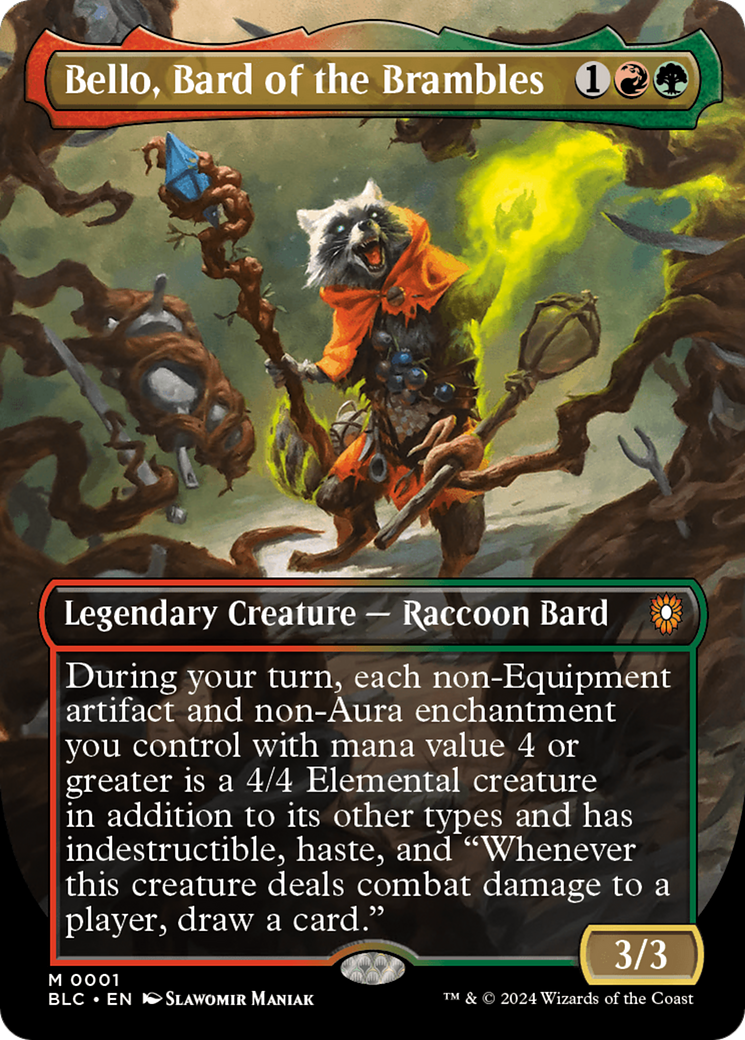
Bello, Bard of the Brambles
Bello, Bard of the Brambles
Legendary Creature — Raccoon Bard
3/3
During your turn, each non-Equipment artifact and non-Aura enchantment you control with mana value 4 or greater is a 4/4 Elemental creature in addition to its other types and has indestructible, haste, and "Whenever this creature deals combat damage to a player, draw a card."
- If an effect causes Bello to lose all abilities during your turn, its effect will still apply to non-Equipment artifacts and non-Aura enchantments you control.
- If an Equipment becomes attached to an artifact or enchantment that's currently a creature because of Bello's ability, it'll become unattached during the next upkeep that isn't yours. Similarly, any Auras that become attached to those artifacts or enchantments that can't enchant the appropriate permanent type will be put into their owners' graveyards.
- Any counters that are put on an artifact or enchantment while it's a creature because of Bello's ability remain on that artifact or enchantment while it's not a creature, even if they have no effect on a noncreature permanent.
-
1
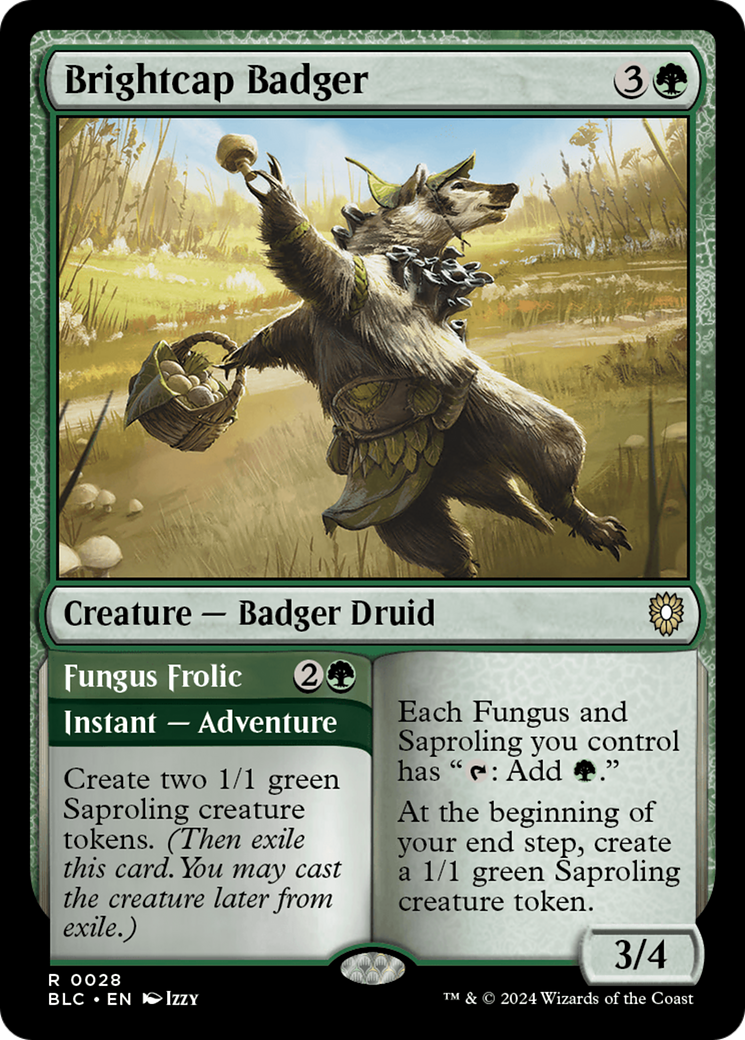
Brightcap Badger // Fungus Frolic
//
Brightcap Badger
Creature — Badger Druid
3/4
- An adventurer card is a permanent card in every zone except the stack, as well as while on the stack if not cast as an Adventure. Ignore its alternative characteristics in those cases. For example, while it's in your graveyard, Brightcap Badger is a green creature card whose mana value is 4.
- When casting a spell as an Adventure, use the alternative characteristics and ignore all of the card's normal characteristics. The spell's color, mana cost, mana value, and so on are determined by only those alternative characteristics. If the spell leaves the stack, it immediately resumes using its normal characteristics.
- If you cast an adventurer card as an Adventure, use only its alternative characteristics to determine whether it's legal to cast that spell. For example, if you control Johann, Apprentice Sorcerer ("Once each turn, you may cast an instant or sorcery spell from the top of your library") and Brightcap Badger is on top of your library, you can cast Fungus Frolic, but not Brightcap Badger.
- If a spell is cast as an Adventure, its controller exiles it instead of putting it into its owner's graveyard as it resolves. For as long as it remains exiled, that player may cast it as a permanent spell. If an Adventure spell leaves the stack in any way other than resolving (most likely by being countered or by failing to resolve because its targets have all become illegal), that card won't be exiled and the spell's controller won't be able to cast it as a permanent later.
- If an adventurer card ends up in exile for any other reason than by exiling itself while resolving, it won't give you permission to cast it as a permanent spell.
- You must still follow any timing restrictions and permissions for the permanent spell you cast from exile. Normally, you'll be able to cast it only during your main phase while the stack is empty.
- If an effect copies an Adventure spell, that copy is exiled as it resolves. It ceases to exist as a state-based action; it's not possible to cast the copy as a permanent.
- An effect may refer to a card, spell, or permanent that "has an Adventure." This refers to a card, spell, or permanent that has an adventurer card's set of alternative characteristics, even if they're not being used and even if that card was never cast as an Adventure.
- If an effect refers to a card, spell, or permanent that has an Adventure, it won't find an instant or sorcery spell on the stack that's been cast as an Adventure.
- If an object becomes a copy of an object that has an Adventure, the copy also has an Adventure. If it changes zones, it will either cease to exist (if it's a token) or cease to be a copy (if it's a nontoken permanent), and so you won't be able to cast it as an Adventure.
- If an effect instructs you to choose a card name, you may choose the alternative Adventure name. Consider only the alternative characteristics to determine whether that is an appropriate name to choose.
- Casting a card as an Adventure isn't casting it for an alternative cost. Effects that allow you to cast a spell for an alternative cost or without paying its mana cost may allow you to apply those to the Adventure.
-
1
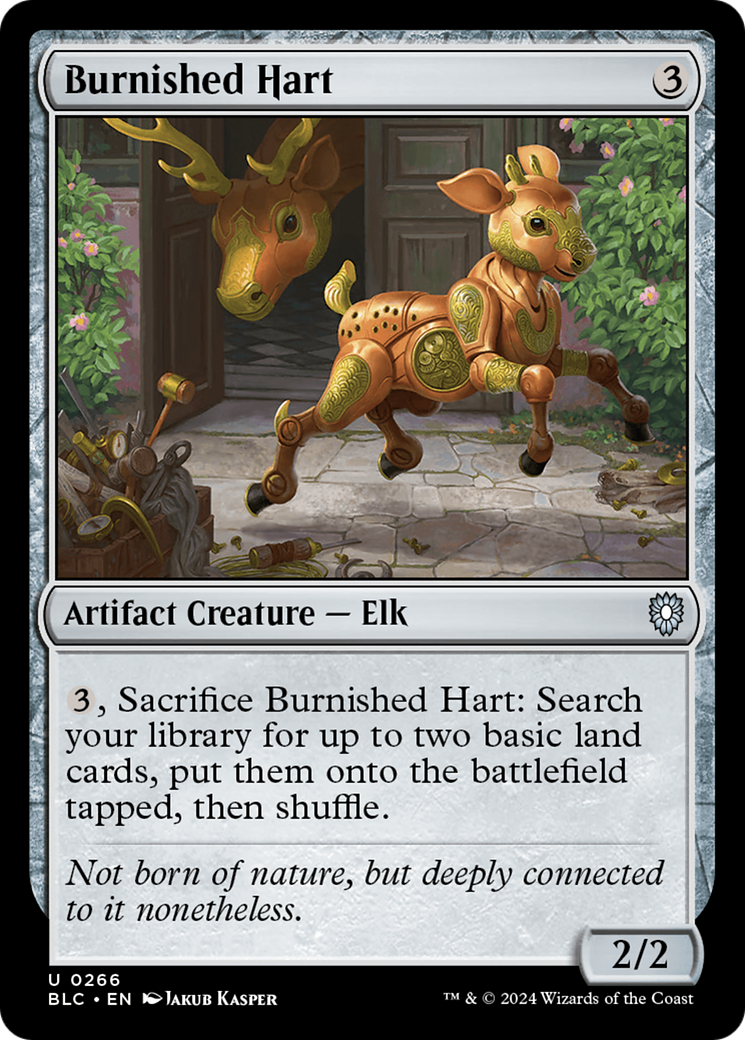
Burnished Hart
Burnished Hart
Artifact Creature — Elk
2/2
, Sacrifice this creature: Search your library for up to two basic land cards, put them onto the battlefield tapped, then shuffle.
-
1
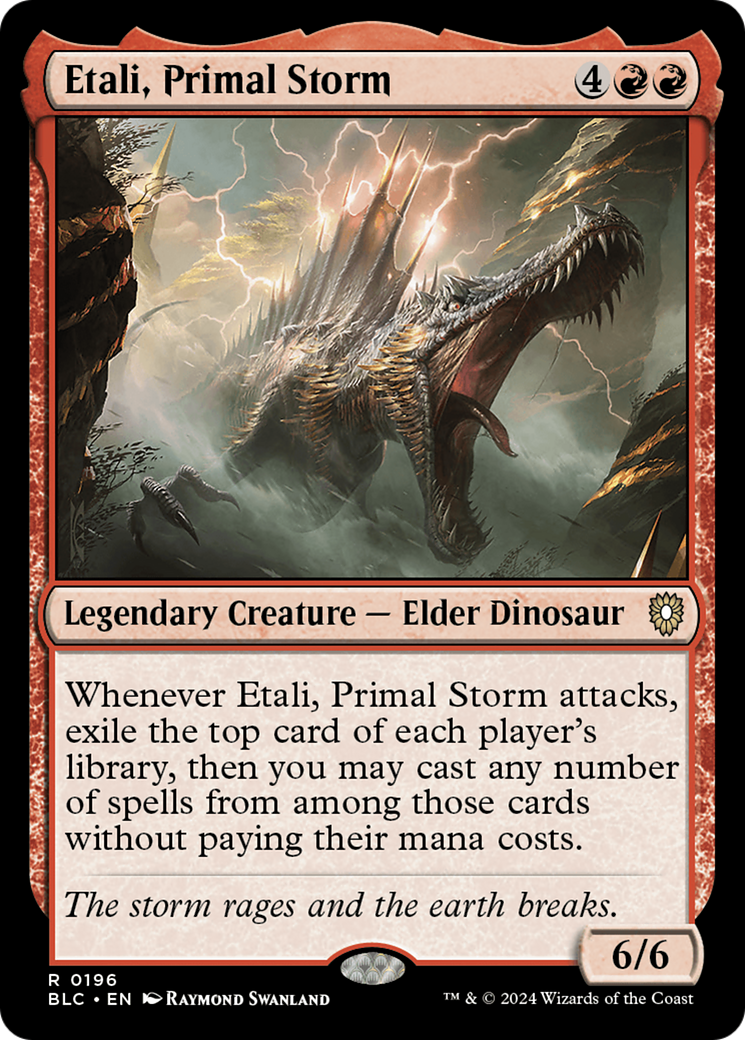
Etali, Primal Storm
Etali, Primal Storm
Legendary Creature — Elder Dinosaur
6/6
Whenever Etali attacks, exile the top card of each player's library, then you may cast any number of spells from among those cards without paying their mana costs.
- If an exiled card has in its mana cost, you must choose 0 as the value of X when casting it without paying its mana cost.
- If you cast any of the exiled cards, you do so as part of the resolution of the triggered ability. You can't wait to cast them later in the turn. Timing permissions based on a card's type are ignored, and the spells resolve before blockers are declared.
- If you cast a card "without paying its mana cost," you can't pay any alternative costs. You can, however, pay additional costs. If the card has any mandatory additional costs, those must be paid to cast the card.
- If you cast more than one of the exiled cards, you choose the order in which to cast them. A spell you cast this way can be the target of a later spell you cast this way. However, permanent spells cast this way won't resolve until you're done casting spells, so the permanents they become can't be the target of spells cast this way. For example, if you exile Twincast and Lightning Strike, you can cast Lightning Strike and then cast Twincast targeting it; but if you exile a creature card and an Aura card, you can't cast that Aura targeting that creature.
- Any cards not cast, including land cards, remain in exile. They can't be cast on later turns, even if Etali attacks again.
- Because all attacking creatures are chosen at once, a creature cast this way can't attack during the same combat as Etali, even if it has haste.
- In a multiplayer game, if a player leaves the game, all cards that player owns leave as well. If you leave the game, any spells or permanents you control from Etali's ability are exiled.
-
1
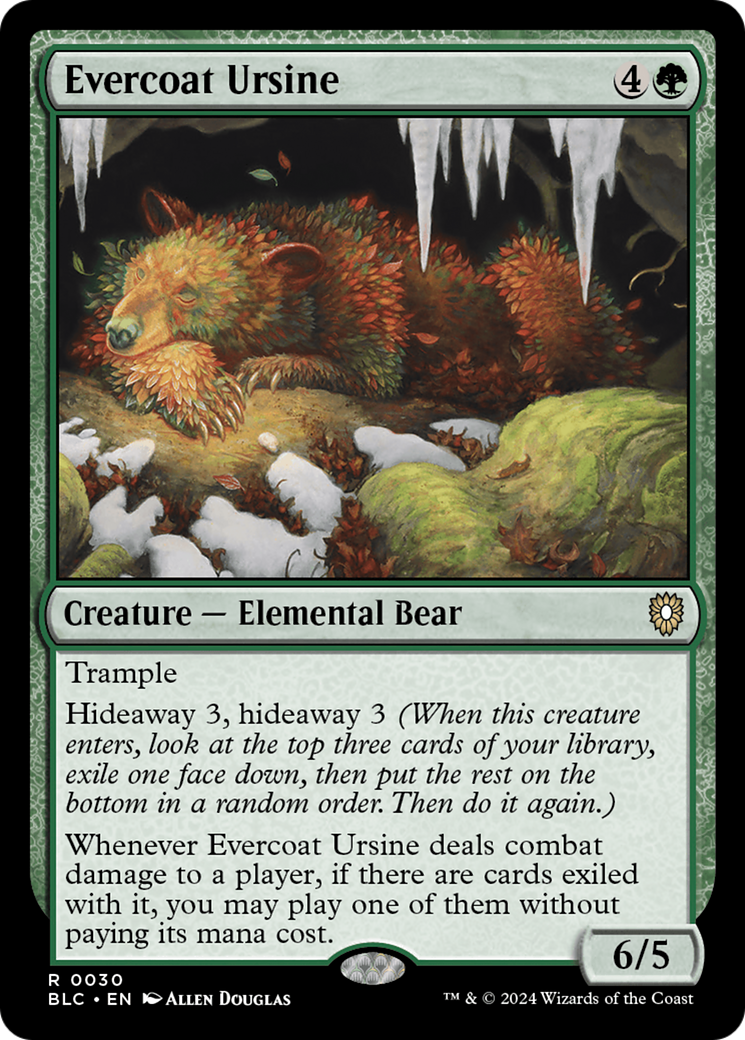
Evercoat Ursine
Evercoat Ursine
Creature — Elemental Bear
6/5
Trample
Hideaway 3, hideaway 3 (When this creature enters, look at the top three cards of your library, exile one face down, then put the rest on the bottom in a random order. Then do it again.)
Whenever this creature deals combat damage to a player, if there are cards exiled with it, you may play one of them without paying its mana cost.
- "Hideaway N" means "When this permanent enters, look at the top N cards of your library. Exile one of them face down and put the rest on the bottom of your library in a random order. The exiled card gains ‘The player who controls the permanent that exiled this card may look at this card in the exile zone.'"
- Any player who has controlled a permanent with a hideaway ability since a card was exiled with it may look at that card.
- You choose and play the card while Evercoat Ursine's last ability is resolving and still on the stack. You can't wait to play it later in the turn.
- If one of the exiled cards is a land card, you may play it only if you have an available land play remaining this turn.
- If a spell has in its mana cost, you must choose 0 as the value of X when playing it without paying its mana cost.
- If you cast a spell "without paying its mana cost," you can't choose to cast it for any alternative costs. You can, however, pay additional costs. If the spell has any mandatory additional costs, those must be paid to cast the spell.
-
1
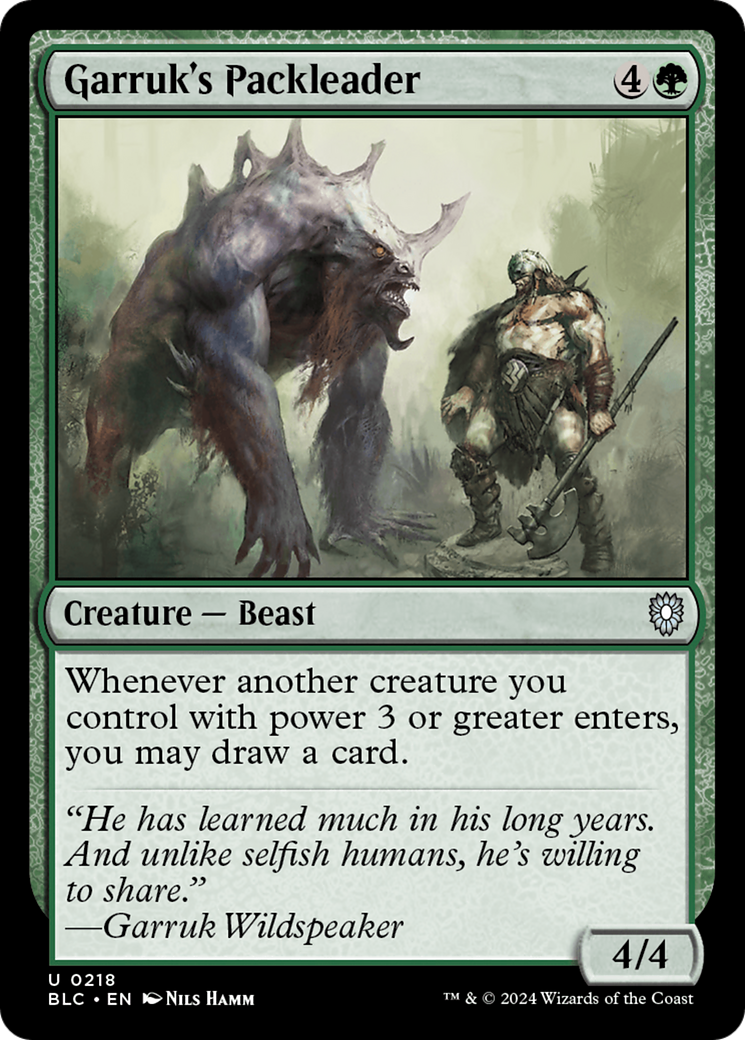
Garruk's Packleader
Garruk's Packleader
Creature — Beast
4/4
Whenever another creature you control with power 3 or greater enters, you may draw a card.
- The ability checks the power of each creature as it enters. It will take into account counters the permanent enters with and static abilities that affect its power (such as Flinthoof Boar's ability). After the creature is on the battlefield, raising its power with a spell (such as Titanic Growth), an activated ability, or a triggered ability won't cause this ability to retroactively trigger.
- The creature's power is checked only to see if the ability triggers. It doesn't matter what the creature's power is when the ability resolves.
- If Garruk's Packleader and another creature with power 3 or greater enter under your control at the same time, the ability will trigger.
-
1
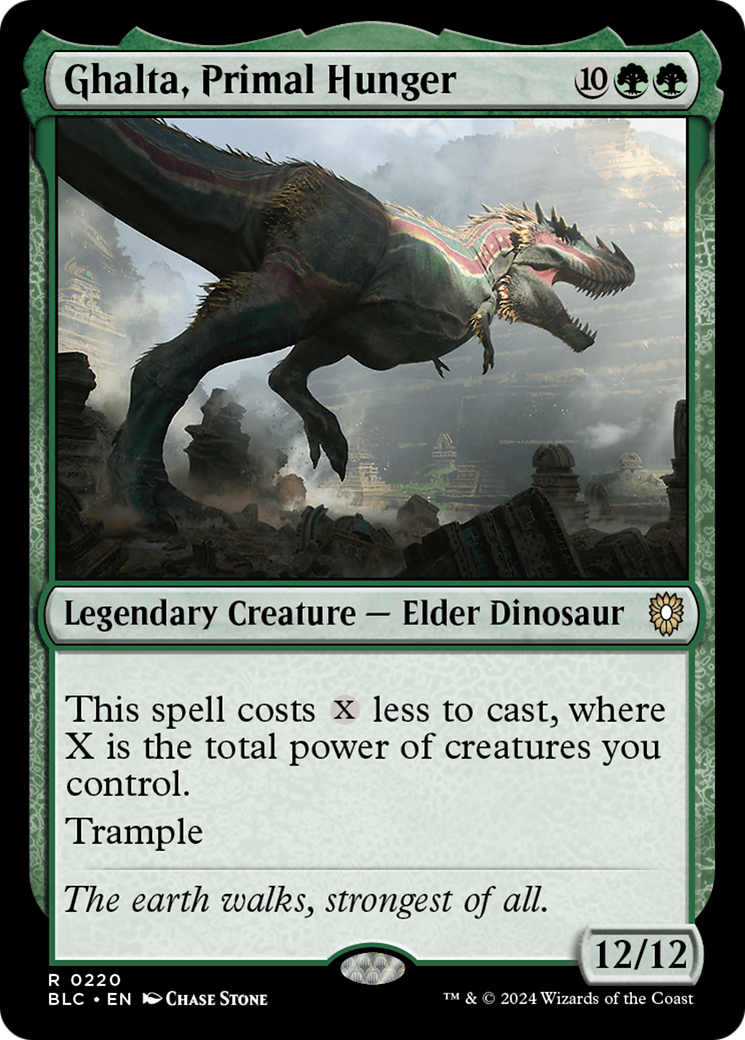
Ghalta, Primal Hunger
Ghalta, Primal Hunger
Legendary Creature — Elder Dinosaur
12/12
This spell costs less to cast, where X is the total power of creatures you control.
Trample (This creature can deal excess combat damage to the player or planeswalker it's attacking.)
- To determine Ghalta's total cost, start with the mana cost (or an alternative cost if another card's effect allows you to pay one instead), add any cost increases, then apply any cost reductions. Ghalta's mana value remains unchanged, no matter what the total cost to cast it was.
- The total cost to cast Ghalta is locked in before you pay that cost. For example, if you control three 2/2 creatures, including one you can sacrifice to add , the total cost of Ghalta is . Then you can sacrifice the creature when you activate mana abilities just before paying the cost.
- If a creature's power is somehow less than 0, it subtracts from the total power of your other creatures. If the total power of your creatures is 0 or less, Ghalta's cost remains .
- Ghalta's first ability can't reduce its cost below .
-
1
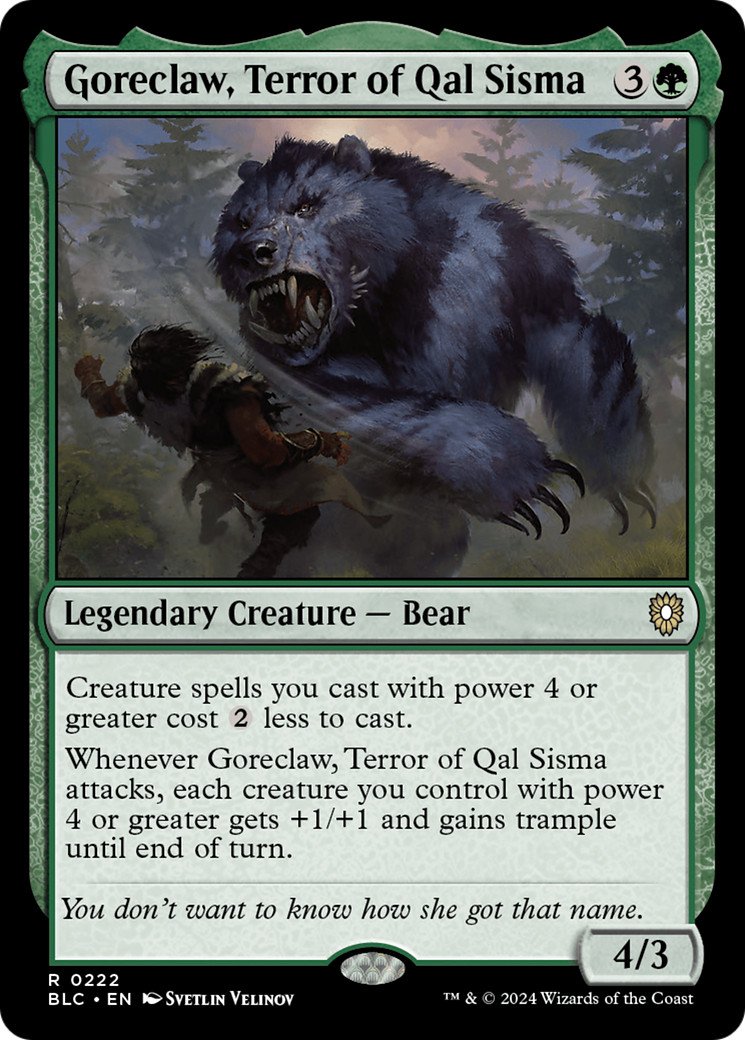
Goreclaw, Terror of Qal Sisma
Goreclaw, Terror of Qal Sisma
Legendary Creature — Bear
4/3
Creature spells you cast with power 4 or greater cost less to cast.
Whenever Goreclaw attacks, each creature you control with power 4 or greater gets +1/+1 and gains trample until end of turn.
- If you cast a creature spell that will enter the battlefield with a number of +1/+1 counters, such as Hungering Hydra, those counters aren't considered when determining whether Goreclaw reduces that spell's cost. Similarly, effects that will raise the creature's power once it has entered the battlefield won't apply.
- If another creature has an ability that changes its power when it attacks, such as Brawl-Bash Ogre, you may have that ability resolve before Goreclaw's last ability.
- Goreclaw's last ability affects only creatures you control with the appropriate power at the time it resolves. Creatures you begin to control later in the turn won't get either bonus, and a creature you control whose power decreases later in the turn won't lose either bonus.
-
1
Grothama, All-Devouring
Grothama, All-Devouring
Legendary Creature — Wurm
10/8
Other creatures have "Whenever this creature attacks, you may have it fight Grothama, All-Devouring."
When Grothama leaves the battlefield, each player draws cards equal to the amount of damage dealt to Grothama this turn by sources they controlled.
- The controller of the attacking creature chooses whether that creature fights Grothama.
- If multiple creatures attack, each desired fight happens individually in the order the attacking players choose. Once Grothama has been defeated, any remaining attacking creatures can't fight it.
- Creatures fight Grothama before blockers are declared. Any creatures that die in the fight can't be blocked. Any attacking creatures that survive the fight will still be attacking, may be blocked as normal, and will deal damage to the player or planeswalker they're attacking if unblocked.
- Grothama's last ability triggers even if it dies without being fought by attacking creatures. For example, if you use Blaze to deal 10 damage to Grothama, you draw ten cards.
-
1
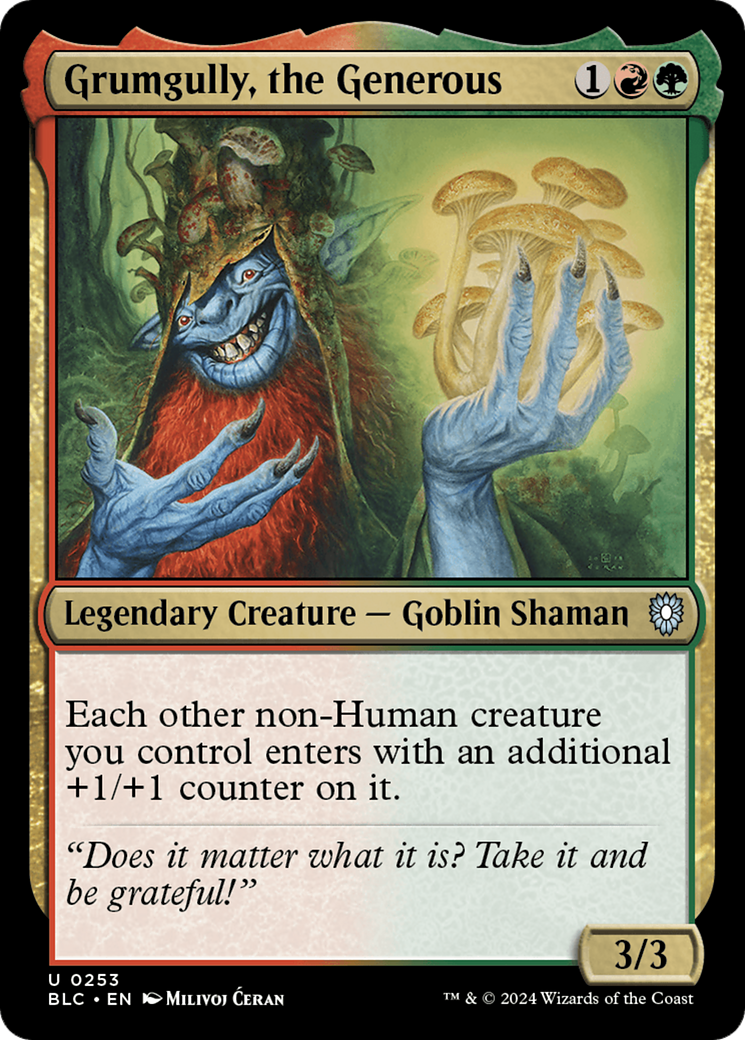
Grumgully, the Generous
Grumgully, the Generous
Legendary Creature — Goblin Shaman
3/3
Each other non-Human creature you control enters with an additional +1/+1 counter on it.
- A non-Human creature you control that would enter the battlefield with no +1/+1 counters on it enters with one +1/+1 counter on it.
- Any other non-Human creatures that enter the battlefield at the same time as Grumgully won't get a +1/+1 counter.
- If a non-Human creature enters the battlefield as a copy of a Human creature, it won't get a +1/+1 counter. Similarly, if a Human enters as a non-Human creature, it will get a +1/+1 counter.
-
1
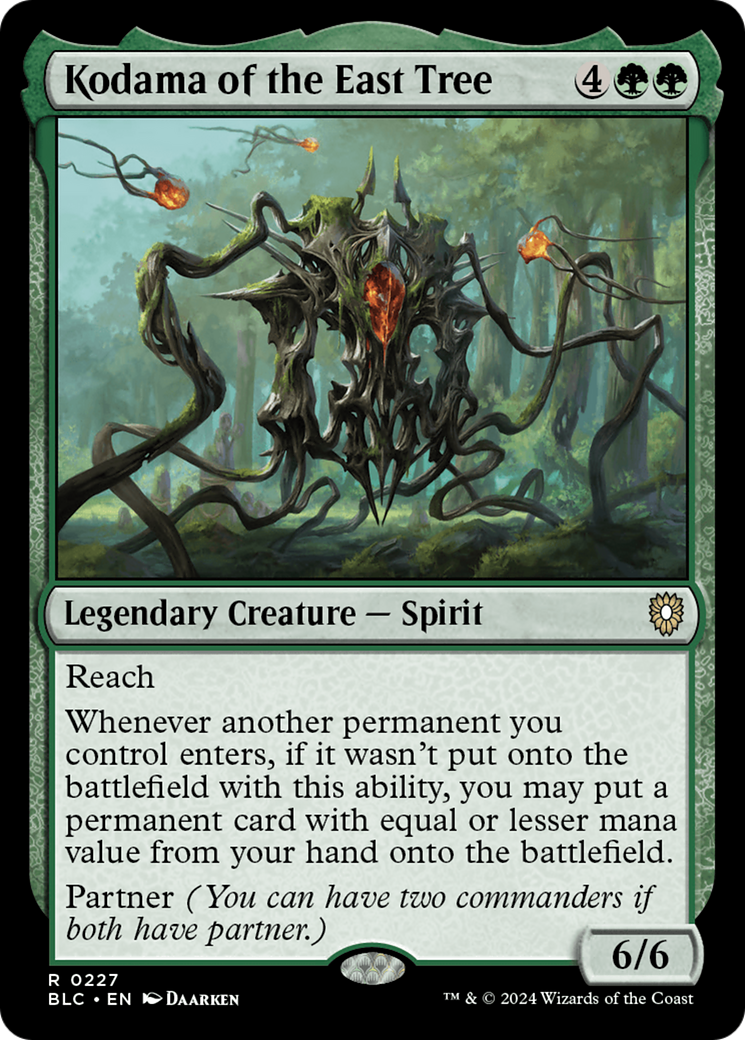
Kodama of the East Tree
Kodama of the East Tree
Legendary Creature — Spirit
6/6
Reach
Whenever another permanent you control enters, if it wasn't put onto the battlefield with this ability, you may put a permanent card with equal or lesser mana value from your hand onto the battlefield.
Partner (You can have two commanders if both have partner.)
- If a permanent or a permanent card in your hand has in its mana cost, is considered to be 0.
- If your Commander deck has two commanders, you can only include cards whose own color identities are also found in your commanders' combined color identities. If Falthis and Kediss are your commanders, your deck may contain cards with black and/or red in their color identity, but not cards with green, white, or blue.
- Both commanders start in the command zone, and the remaining 98 cards (or 58 cards in a Commander Draft game) of your deck are shuffled to become your library.
- To have two commanders, both must have the partner ability as the game begins. Losing the ability during the game doesn't cause either to cease to be your commander.
- Once the game begins, your two commanders are tracked separately. If you cast one, you won't have to pay an additional the first time you cast the other. A player loses the game after having been dealt 21 damage from any one of them, not from both of them combined.
- If something refers to your commander while you have two commanders, it refers to one of them of your choice. If you are instructed to perform an action on your commander (e.g. put it from the command zone into your hand due to Command Beacon), you choose one of your commanders at the time the effect happens.
- An effect that checks whether you control your commander is satisfied if you control one or both of your two commanders.
- You can choose two commanders with partner that are the same color or colors. In Commander Draft, you can even choose two of the same commander with partner if you drafted them. If you do this, make sure you keep the number of times you've cast each from the command zone clear for "commander tax" purposes.
-
1
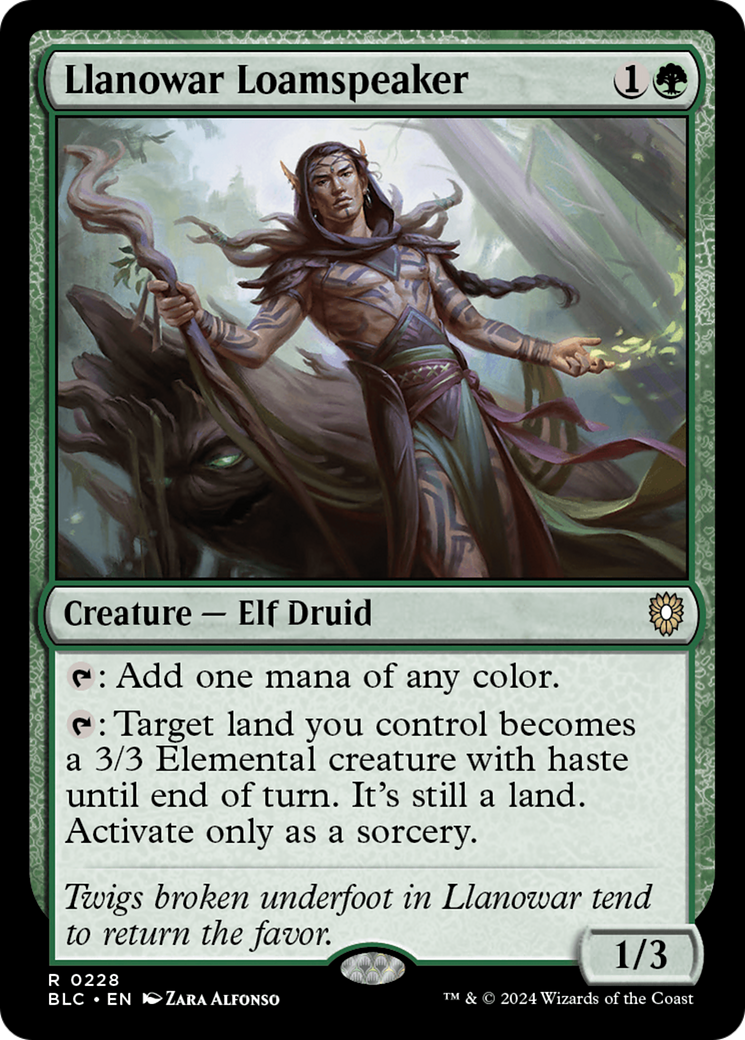
Llanowar Loamspeaker
Llanowar Loamspeaker
Creature — Elf Druid
1/3
: Add one mana of any color.
: Target land you control becomes a 3/3 Elemental creature with haste until end of turn. It's still a land. Activate only as a sorcery.
- Llanowar Loamspeaker's second ability doesn't untap the land that becomes a creature.
-
1
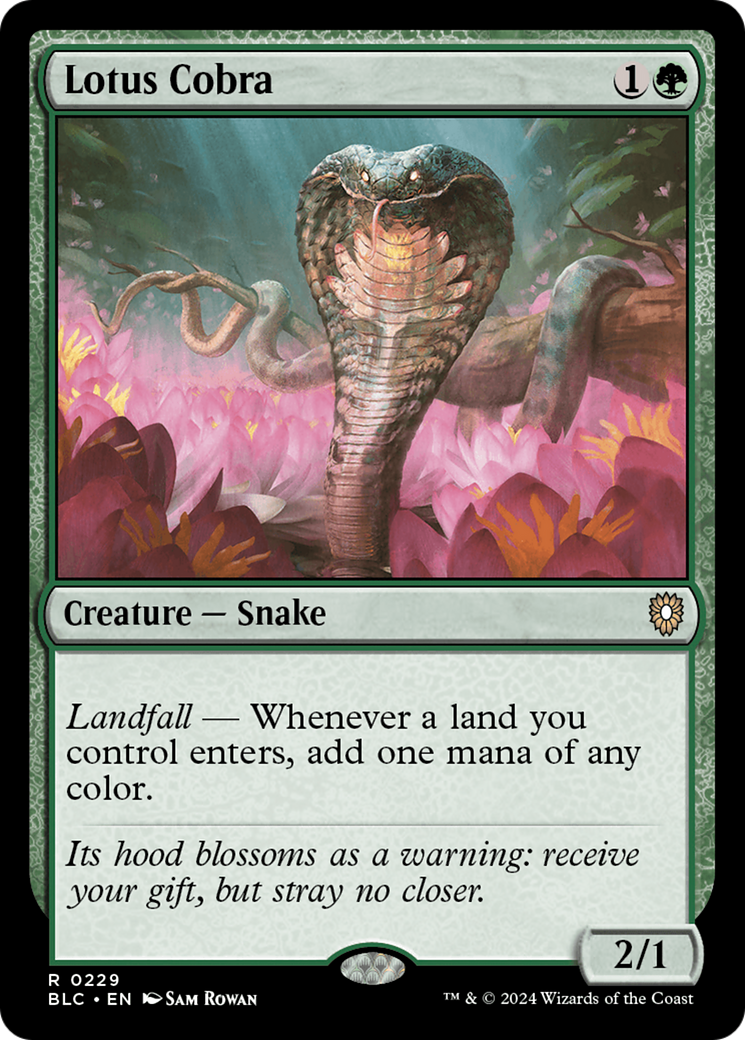
Lotus Cobra
Lotus Cobra
Creature — Snake
2/1
Landfall — Whenever a land you control enters, add one mana of any color.
- Whenever a land you control enters, each landfall ability of the permanents you control will trigger. You can put them on the stack in any order. The last ability you put on the stack will be the first one to resolve (As a result, you can have those abilities resolve in the order of your choosing.).
- A landfall ability triggers whenever a land you control enters for any reason. It triggers whenever you play a land, as well as whenever a spell or ability puts a land onto the battlefield under your control.
- A landfall ability doesn't trigger if a permanent already on the battlefield becomes a land.
- A landfall ability triggers whenever a land you control enters for any reason. It triggers whenever you play a land, as well as whenever a spell or ability puts a land onto the battlefield under your control.
- A landfall ability doesn't trigger if a permanent already on the battlefield becomes a land.
- Whenever a land you control enters, each landfall ability of the permanents you control will trigger. You can put them on the stack in any order. The last ability you put on the stack will be the first one to resolve (As a result, you can have those abilities resolve in the order of your choosing.).
- Lotus Cobra's ability uses the stack and players may respond to it. It isn't a mana ability because the event that causes it to trigger isn't a mana ability.
- Lotus Cobra's ability isn't a mana ability. Opponents may respond to it before you have that mana.
-
1
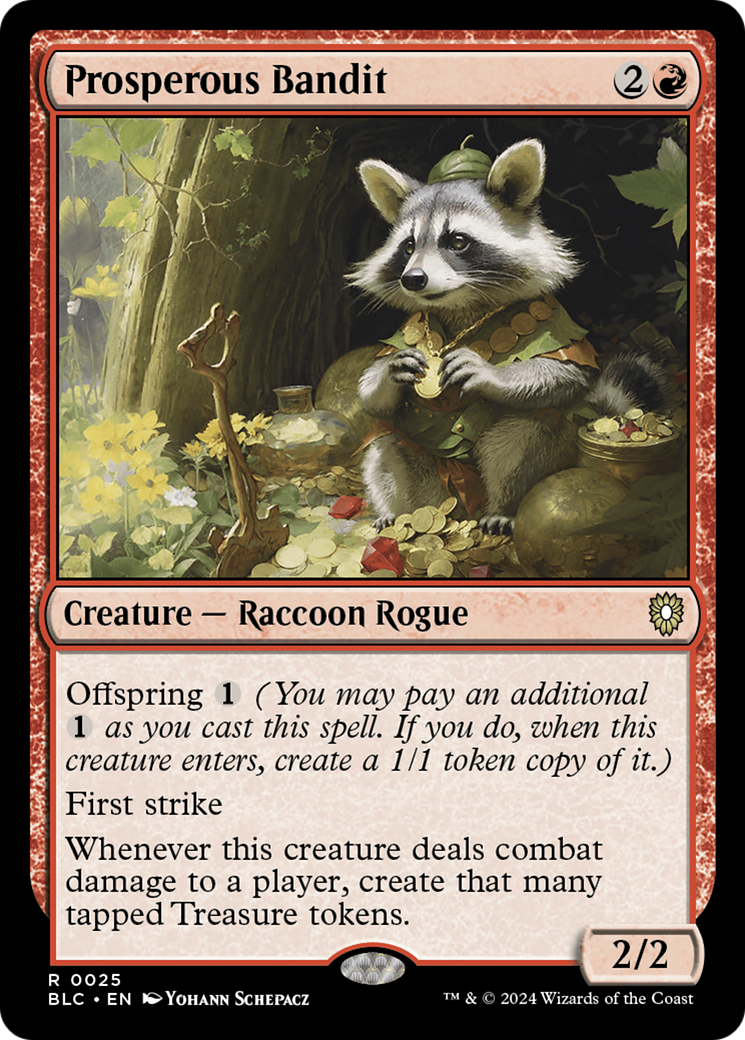
Prosperous Bandit
Prosperous Bandit
Creature — Raccoon Rogue
2/2
Offspring (You may pay an additional as you cast this spell. If you do, when this creature enters, create a 1/1 token copy of it.)
First strike
Whenever this creature deals combat damage to a player, create that many tapped Treasure tokens.
- In the rare case where the original creature is copying something else when the offspring ability resolves, the token enters as whatever that creature copied, except it's a 1/1.
- You can pay an offspring cost only once as you cast a spell with offspring. You can't try to pay it multiple times to get more token copies.
- If the spell is countered, the offspring ability will not trigger, and no token will be created.
- If the spell resolves but the creature with offspring leaves the battlefield before the offspring ability resolves, you'll still create a token copy of it.
- The token copies exactly what was printed on the original creature and nothing else, except it's a 1/1 (unless that creature is copying something else; see below). It doesn't copy whether that creature is tapped or untapped, whether it has any counters on it or Auras and Equipment attached to it, or any non-copy effects that have changed its types, color, or so on.
- Many creatures with offspring abilities have other abilities that refer to them as "this creature" rather than referring to them by name. This difference is for clarity purposes and does not change the function of any of these abilities.
- Any "enters" abilities of the copied creature will trigger when the token enters. Any "as [this creature] enters" or "[this creature] enters with" abilities of the copied creature will also work.
- The token created by the offspring ability isn't "cast", so abilities that trigger when a creature spell is cast won't trigger for the copy.
- In the rare case where the creature doesn't have the offspring ability when it enters, the ability won't trigger even if you paid the offspring cost.
-
1
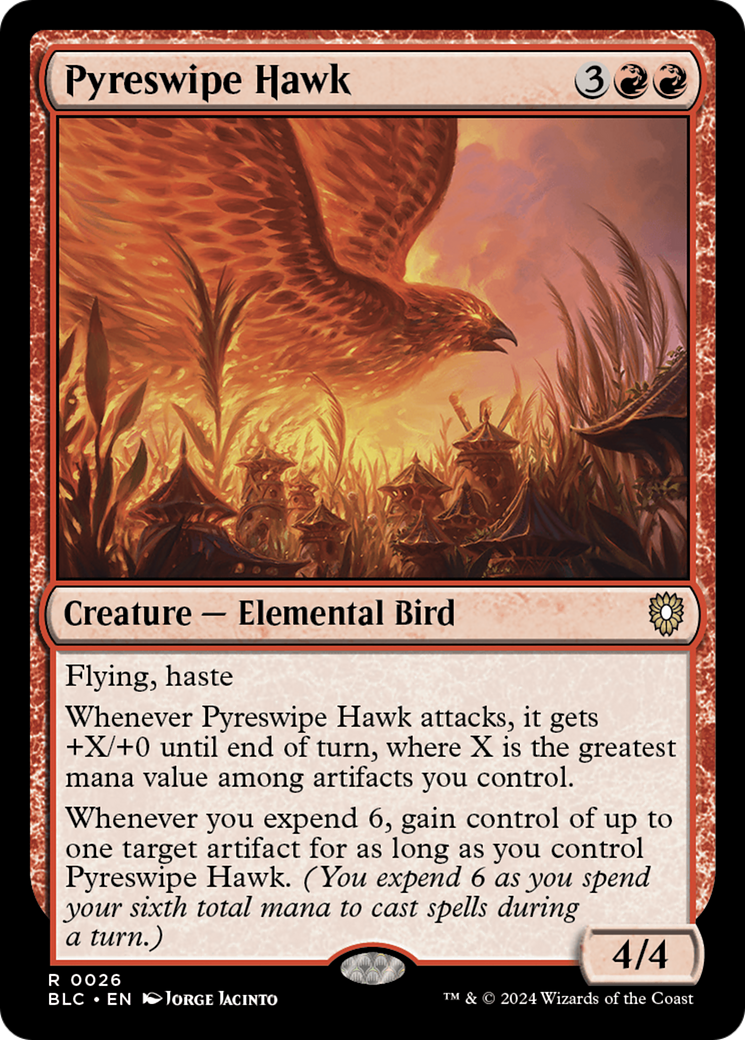
Pyreswipe Hawk
Pyreswipe Hawk
Creature — Elemental Bird
4/4
Flying, haste
Whenever this creature attacks, it gets +X/+0 until end of turn, where X is the greatest mana value among artifacts you control.
Whenever you expend 6, gain control of up to one target artifact for as long as you control this creature. (You expend 6 as you spend your sixth total mana to cast spells during a turn.)
- The value of X is calculated only once, as Pyreswipe Hawk's third ability resolves.
- If Pyreswipe Hawk leaves the battlefield before its last ability resolves, control of the target artifact won't change at all.
- Abilities that trigger whenever you "expend N" only trigger when you reach that specific amount of mana spent on casting spells that turn. This can only happen once per turn. For example, if you've spent three mana on spells so far this turn and you control a permanent with an ability that triggers "whenever you expend 4," that ability will trigger the next time you spend at least one mana to cast a spell this turn. It won't trigger again if you spend another four mana to cast spells later in the turn.
- If the cost to cast a spell is increased, decreased, or changed because of additional or alternative costs, expend counts only the mana you actually spent.
- A permanent with an ability that triggers whenever you "expend N" will see mana you spent to cast spells the turn it enters, including mana you spent before it entered. For example, if you cast Junkblade Bruiser (a creature with a mana value of 5 and an ability that triggers whenever you expend 4) by paying its full cost of five mana, you'll already have spent four mana on spells before Junkblade Bruiser enters, and therefore its ability that triggers whenever you expend 4 won't be able to trigger at all that turn.
-
1
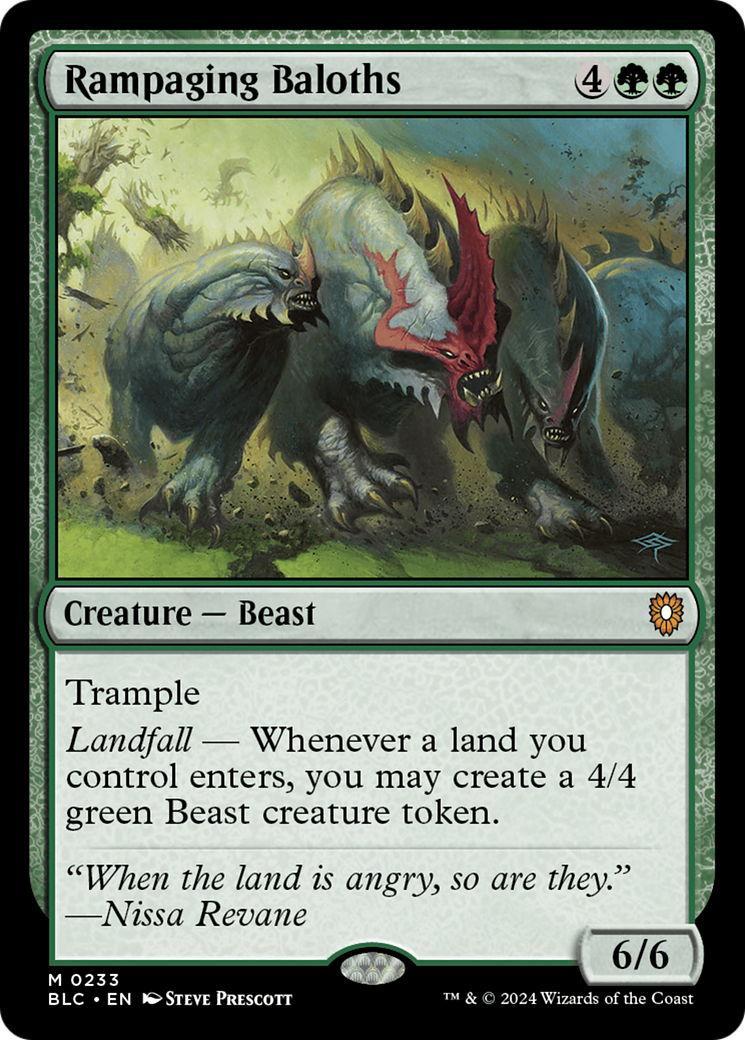
Rampaging Baloths
Rampaging Baloths
Creature — Beast
6/6
Trample
Landfall — Whenever a land you control enters, you may create a 4/4 green Beast creature token.
- A landfall ability triggers whenever a land you control enters for any reason. It triggers whenever you play a land, as well as whenever a spell or ability puts a land onto the battlefield under your control.
- A landfall ability doesn't trigger if a permanent already on the battlefield becomes a land.
- Whenever a land you control enters, each landfall ability of the permanents you control will trigger. You can put them on the stack in any order. The last ability you put on the stack will be the first one to resolve (As a result, you can have those abilities resolve in the order of your choosing.).
-
1
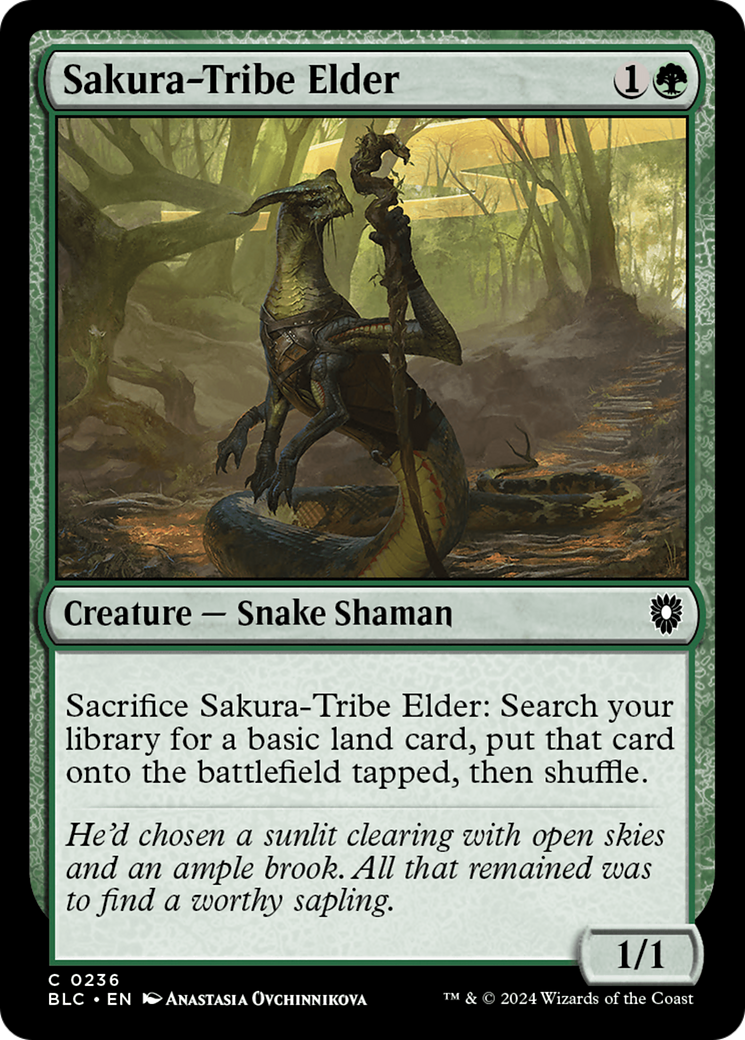
Sakura-Tribe Elder
Sakura-Tribe Elder
Creature — Snake Shaman
1/1
Sacrifice this creature: Search your library for a basic land card, put that card onto the battlefield tapped, then shuffle.
-
1
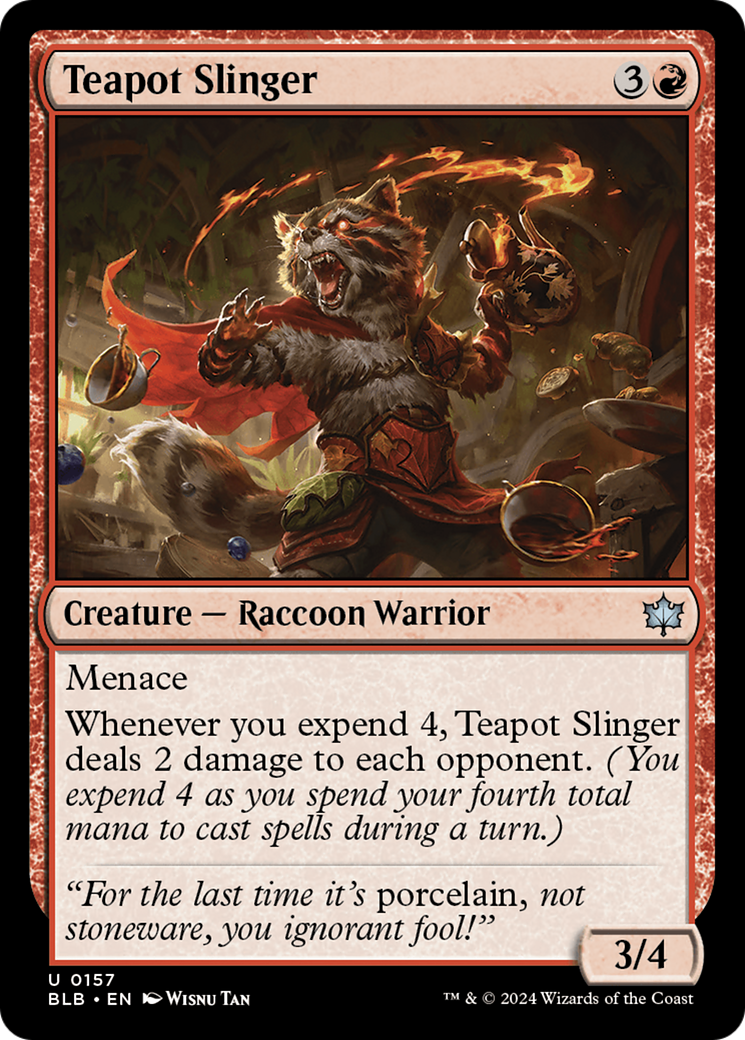
Teapot Slinger
Teapot Slinger
Creature — Raccoon Warrior
3/4
Menace
Whenever you expend 4, this creature deals 2 damage to each opponent. (You expend 4 as you spend your fourth total mana to cast spells during a turn.)
- Abilities that trigger whenever you “expend N” only trigger when you reach that specific amount of mana spent on casting spells that turn. This can only happen once per turn. For example, if you’ve spent three mana on spells so far this turn and you control a permanent with an ability that triggers “whenever you expend 4,” that ability will trigger the next time you spend at least one mana to cast a spell this turn. It won’t trigger again if you spend another four mana to cast spells later in the turn.
- If the cost to cast a spell is increased, decreased, or changed because of additional or alternative costs, expend counts only the mana you actually spent.
- A permanent with an ability that triggers whenever you “expend N” will see mana you spent to cast spells the turn it enters, including mana you spent before it entered. For example, if you cast Junkblade Bruiser (a creature with a mana value of 5 and an ability that triggers whenever you expend 4) by paying its full cost of five mana, you’ll already have spent four mana on spells before Junkblade Bruiser enters, and therefore its ability that triggers whenever you expend 4 won’t be able to trigger at all that turn.
-
1
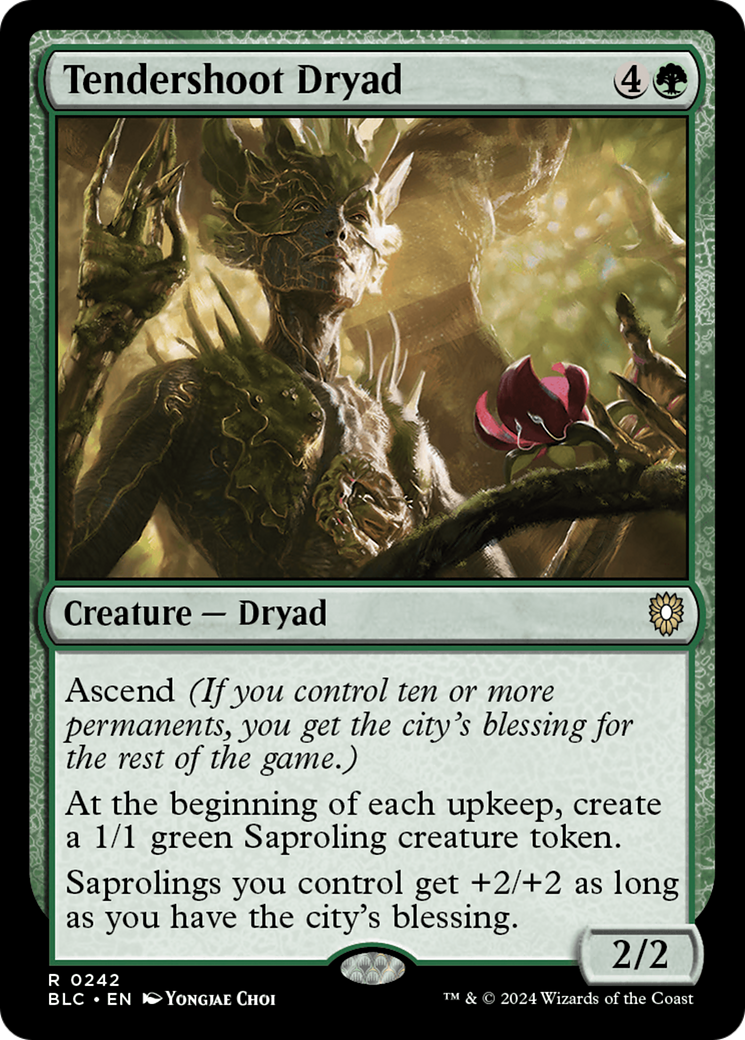
Tendershoot Dryad
Tendershoot Dryad
Creature — Dryad
2/2
Ascend (If you control ten or more permanents, you get the city's blessing for the rest of the game.)
At the beginning of each upkeep, create a 1/1 green Saproling creature token.
Saprolings you control get +2/+2 as long as you have the city's blessing.
- Because damage remains marked on a creature until it's removed as the turn ends, nonlethal damage dealt to a Saproling you control may become lethal if Tendershoot Dryad leaves the battlefield during that turn.
- Once you have the city's blessing, you have it for the rest of the game, even if you lose control of some or all of your permanents. The city's blessing isn't a permanent itself and can't be removed by any effect.
- A permanent is any object on the battlefield, including tokens and lands. Spells and emblems aren't permanents.
- If you cast a spell with ascend, you don't get the city's blessing until it resolves. Players may respond to that spell by trying to change whether you get the city's blessing.
- If you control ten permanents but don't control a permanent or resolving spell with ascend, you don't get the city's blessing. For example, if you control ten permanents, lose control of one, then cast Golden Demise, you won't have the city's blessing and the spell will affect creatures you control.
- If your tenth permanent enters the battlefield and then a permanent leaves the battlefield immediately afterwards (most likely due to the "Legend Rule" or due to being a creature with 0 toughness), you get the city's blessing before it leaves the battlefield.
- Ascend on a permanent isn't a triggered ability and doesn't use the stack. Players can respond to a spell that will give you your tenth permanent, but they can't respond to getting the city's blessing once you control that tenth permanent. This means that if your tenth permanent is a land you play, players can't respond before you get the city's blessing.
- Some cards get power, toughness, and/or abilities once you have the city's blessing. If another card has an ability that triggers when creatures with certain characteristics enter the battlefield (such as Mentor of the Meek or Elemental Bond do), use the entering permanent's characteristics after you have the city's blessing to determine whether those abilities trigger. This is true even if the entering permanent is your tenth permanent.
-
1
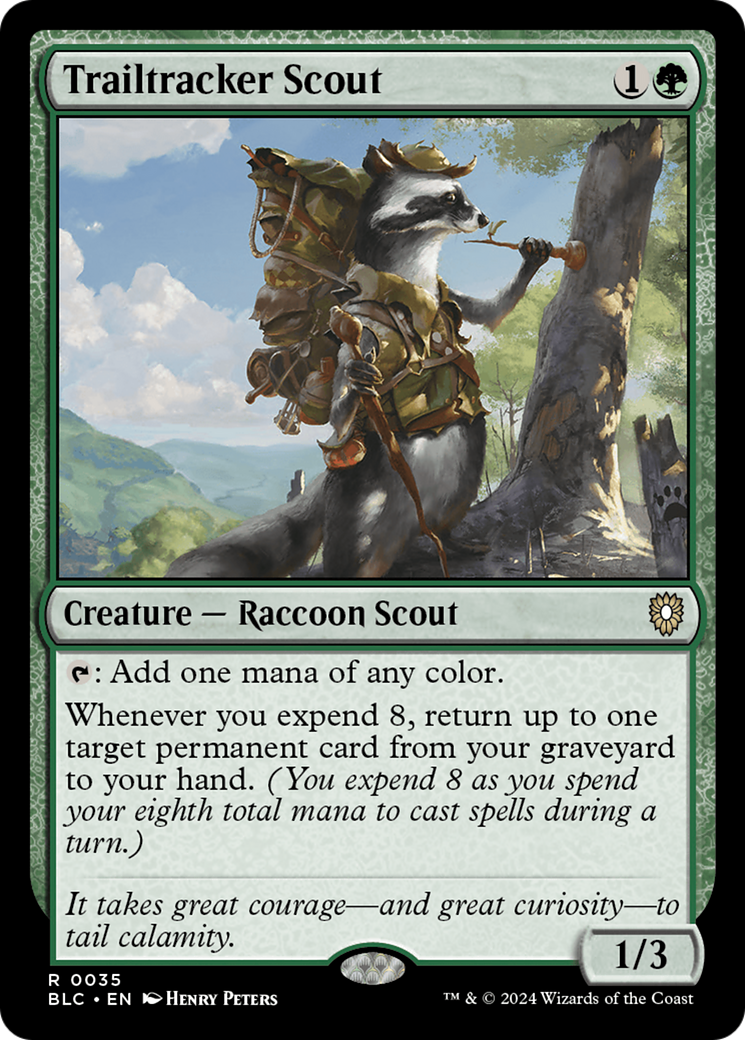
Trailtracker Scout
Trailtracker Scout
Creature — Raccoon Scout
1/3
: Add one mana of any color.
Whenever you expend 8, return up to one target permanent card from your graveyard to your hand. (You expend 8 as you spend your eighth total mana to cast spells during a turn.)
- Abilities that trigger whenever you "expend N" only trigger when you reach that specific amount of mana spent on casting spells that turn. This can only happen once per turn. For example, if you've spent three mana on spells so far this turn and you control a permanent with an ability that triggers "whenever you expend 4," that ability will trigger the next time you spend at least one mana to cast a spell this turn. It won't trigger again if you spend another four mana to cast spells later in the turn.
- If the cost to cast a spell is increased, decreased, or changed because of additional or alternative costs, expend counts only the mana you actually spent.
- A permanent with an ability that triggers whenever you "expend N" will see mana you spent to cast spells the turn it enters, including mana you spent before it entered. For example, if you cast Junkblade Bruiser (a creature with a mana value of 5 and an ability that triggers whenever you expend 4) by paying its full cost of five mana, you'll already have spent four mana on spells before Junkblade Bruiser enters, and therefore its ability that triggers whenever you expend 4 won't be able to trigger at all that turn.
-
1
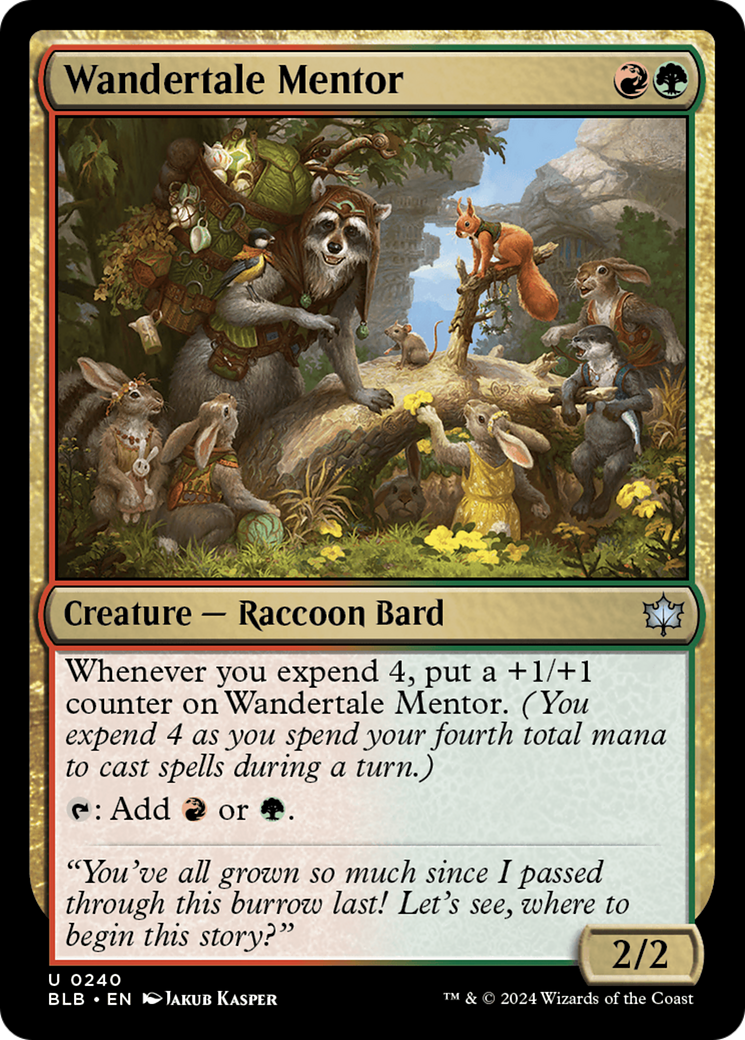
Wandertale Mentor
Wandertale Mentor
Creature — Raccoon Bard
2/2
Whenever you expend 4, put a +1/+1 counter on this creature. (You expend 4 as you spend your fourth total mana to cast spells during a turn.)
: Add or .
- Abilities that trigger whenever you “expend N” only trigger when you reach that specific amount of mana spent on casting spells that turn. This can only happen once per turn. For example, if you’ve spent three mana on spells so far this turn and you control a permanent with an ability that triggers “whenever you expend 4,” that ability will trigger the next time you spend at least one mana to cast a spell this turn. It won’t trigger again if you spend another four mana to cast spells later in the turn.
- If the cost to cast a spell is increased, decreased, or changed because of additional or alternative costs, expend counts only the mana you actually spent.
- A permanent with an ability that triggers whenever you “expend N” will see mana you spent to cast spells the turn it enters, including mana you spent before it entered. For example, if you cast Junkblade Bruiser (a creature with a mana value of 5 and an ability that triggers whenever you expend 4) by paying its full cost of five mana, you’ll already have spent four mana on spells before Junkblade Bruiser enters, and therefore its ability that triggers whenever you expend 4 won’t be able to trigger at all that turn.
-
1
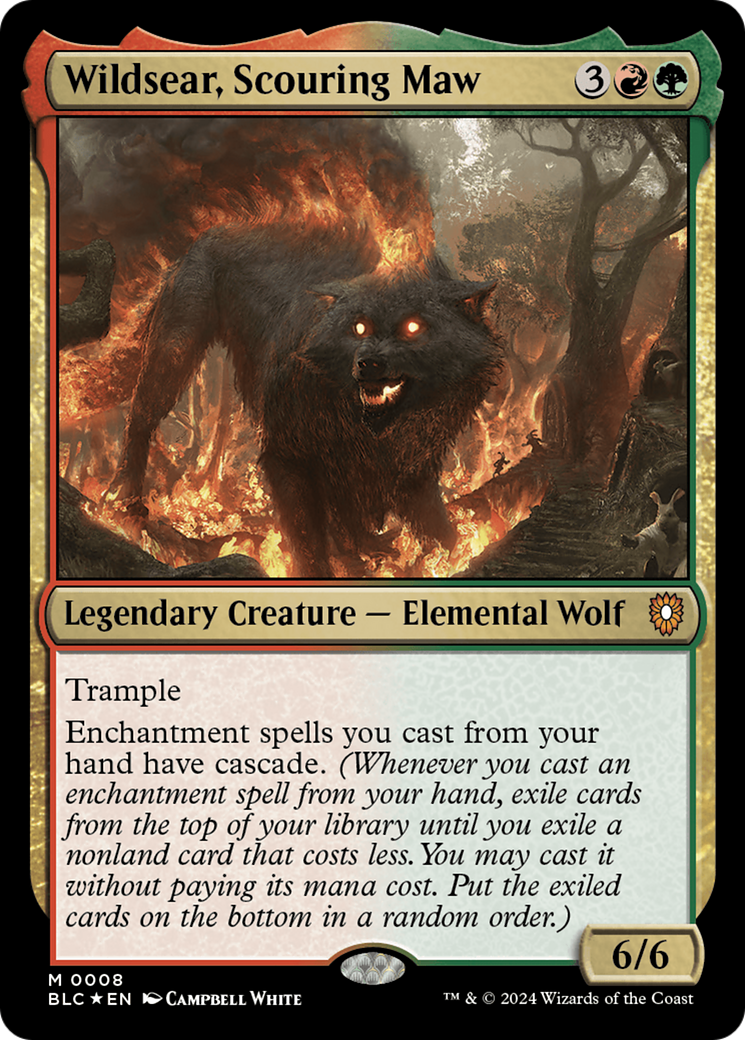
Wildsear, Scouring Maw
Wildsear, Scouring Maw
Legendary Creature — Elemental Wolf
6/6
Trample
Enchantment spells you cast from your hand have cascade. (Whenever you cast an enchantment spell from your hand, exile cards from the top of your library until you exile a nonland card that costs less. You may cast it without paying its mana cost. Put the exiled cards on the bottom in a random order.)
- Once you announce that you're casting a spell, players can't take actions until you've finished casting it. Causing Wildsear to leave the battlefield after you've cast an enchantment spell from your hand won't stop that spell's cascade ability from resolving.
- In some unusual situations, you may lose control of Wildsear during the process of casting an enchantment spell from your hand. In those situations, that spell won't have cascade.
- A spell's mana value is determined only by its mana cost. Ignore any alternative costs, additional costs, cost increases, or cost reductions.
- Cascade triggers when you cast the spell, meaning that it resolves before that spell. If you end up casting the exiled card, it will go on the stack above the spell with cascade.
- When the cascade ability resolves, you must exile cards. The only optional part of the ability is whether or not you cast the last card exiled.
- If a spell with cascade is countered, the cascade ability will still resolve normally.
- You exile the cards face up. All players will be able to see them.
- If you cast a card "without paying its mana cost," you can't choose to cast it for any alternative costs. You can, however, pay additional costs. If the card has any mandatory additional costs, you must pay those to cast the card.
- If the card has in its mana cost, you must choose 0 as the value of X when casting it without paying its mana cost.
- Due to a 2021 rules change to cascade, not only do you stop exiling cards if you exile a nonland card with lesser mana value than the spell with cascade, but the resulting spell you cast must also have lesser mana value. Previously, in cases where a card's mana value differed from the resulting spell, such as with some modal double-faced cards or cards with an Adventure, you could cast a spell with a higher mana value than the exiled card.
- The mana value of a split card is determined by the combined mana cost of its two halves. If cascade allows you to cast a split card, you may cast either half but not both halves.
Instants 5
-
1
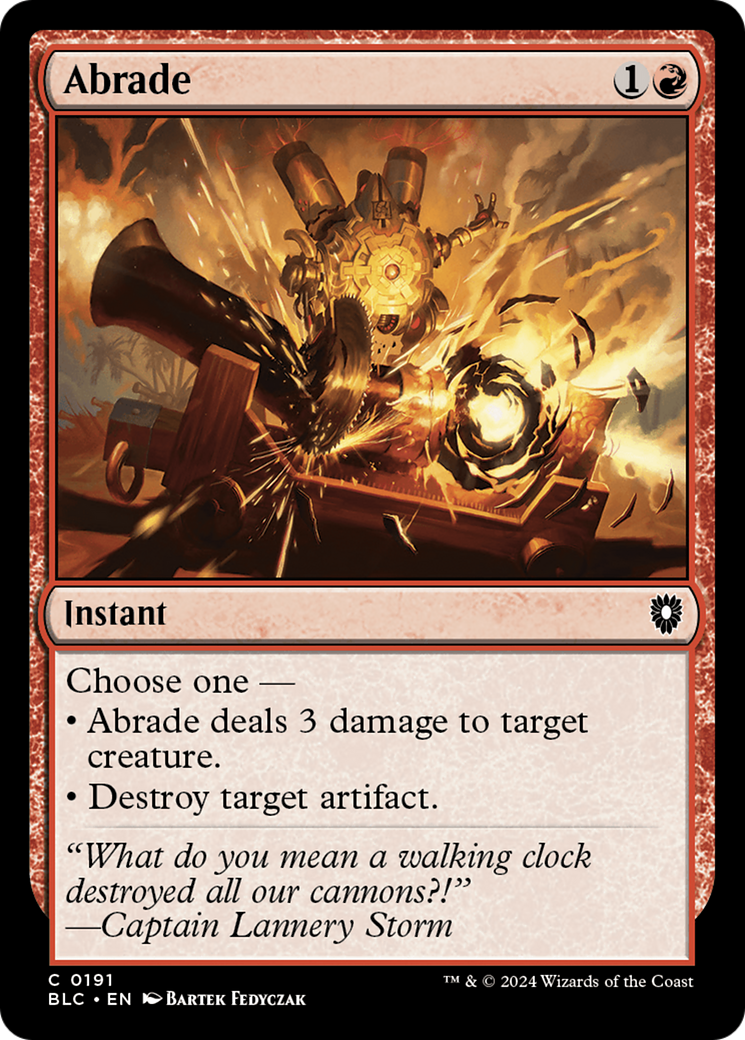
Abrade
Abrade
Instant
Choose one —
- Abrade deals 3 damage to target creature.
- Destroy target artifact.
-
1
Beast Within
Beast Within
Instant
Destroy target permanent. Its controller creates a 3/3 green Beast creature token.
- If the target permanent is an illegal target by the time Beast Within tries to resolve, the spell won't resolve. No player creates a Beast token. If the target is legal but not destroyed (most likely because it has indestructible), its controller does create a Beast token.
- If the permanent is still a legal target but is not destroyed (perhaps because it regenerated or has indestructible), its controller still gets the Beast token.
-
1
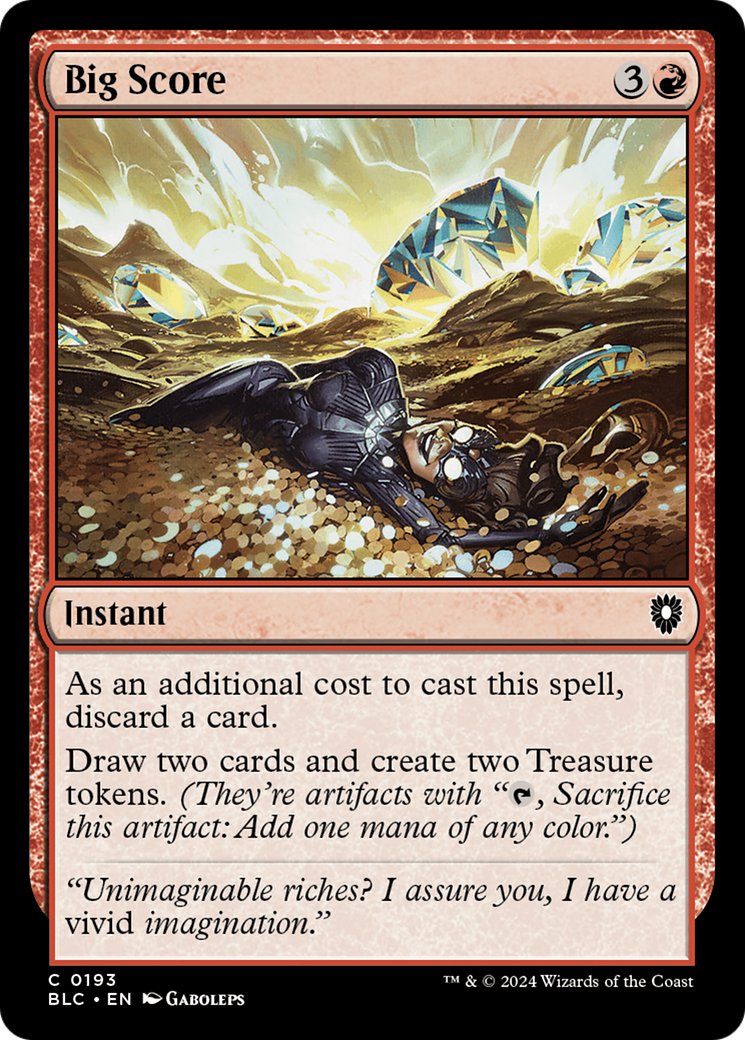
Big Score
Big Score
Instant
As an additional cost to cast this spell, discard a card.
Draw two cards and create two Treasure tokens. (They're artifacts with " , Sacrifice this token: Add one mana of any color.")
-
1
Chaos Warp
Chaos Warp
Instant
The owner of target permanent shuffles it into their library, then reveals the top card of their library. If it's a permanent card, they put it onto the battlefield.
- The owner of a token is the player under whose control the token was put onto the battlefield. If a token is shuffled into a player's library this way, that player shuffles before revealing the top card of that library.
- If the permanent is an illegal target by the time Chaos Warp tries to resolve, it won't resolve and none of its effects will occur. No library will be shuffled and no card will be revealed.
- A permanent card is a card with one or more of the following card types: artifact, creature, enchantment, land, or planeswalker.
- If the revealed card is a permanent card but can't enter (perhaps because it's an Aura with nothing to enchant), it remains on top of that library.
- If the revealed card is not a permanent card, it remains on top of that library.
-
1
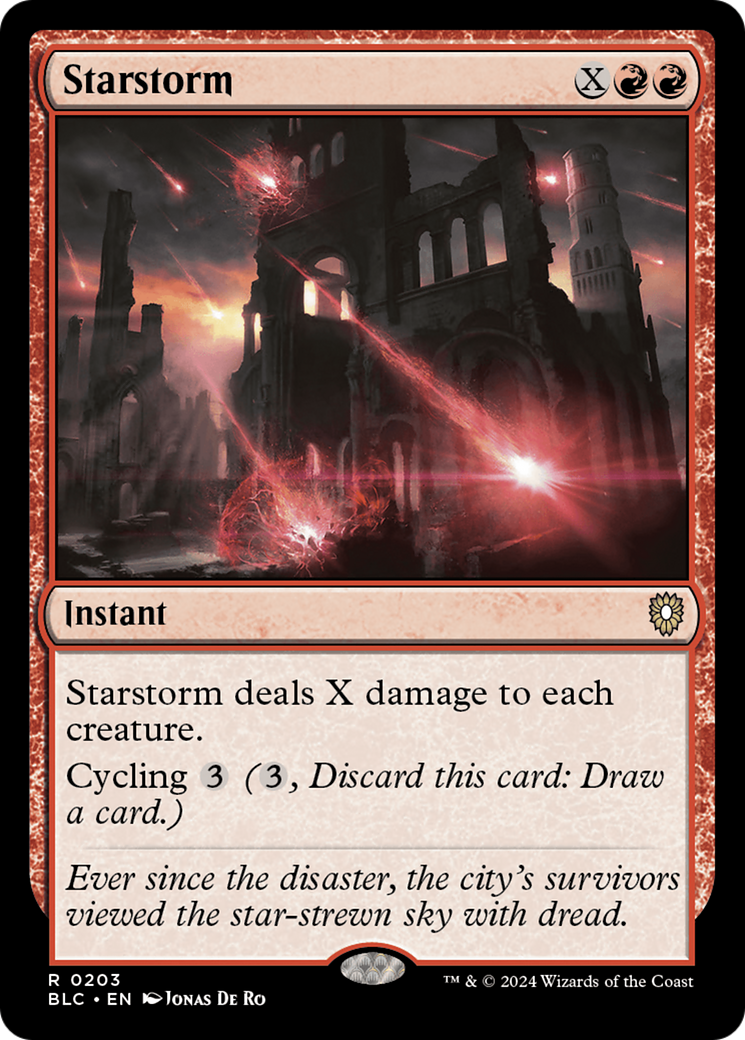
Starstorm
Starstorm
Instant
Starstorm deals X damage to each creature.
Cycling ( , Discard this card: Draw a card.)
- Cycling is an activated ability. Effects that interact with activated abilities (such as Stifle or Rings of Brighthearth) will interact with cycling. Effects that interact with spells (such as Remove Soul or Faerie Tauntings) will not.
Sorceries 7
-
1
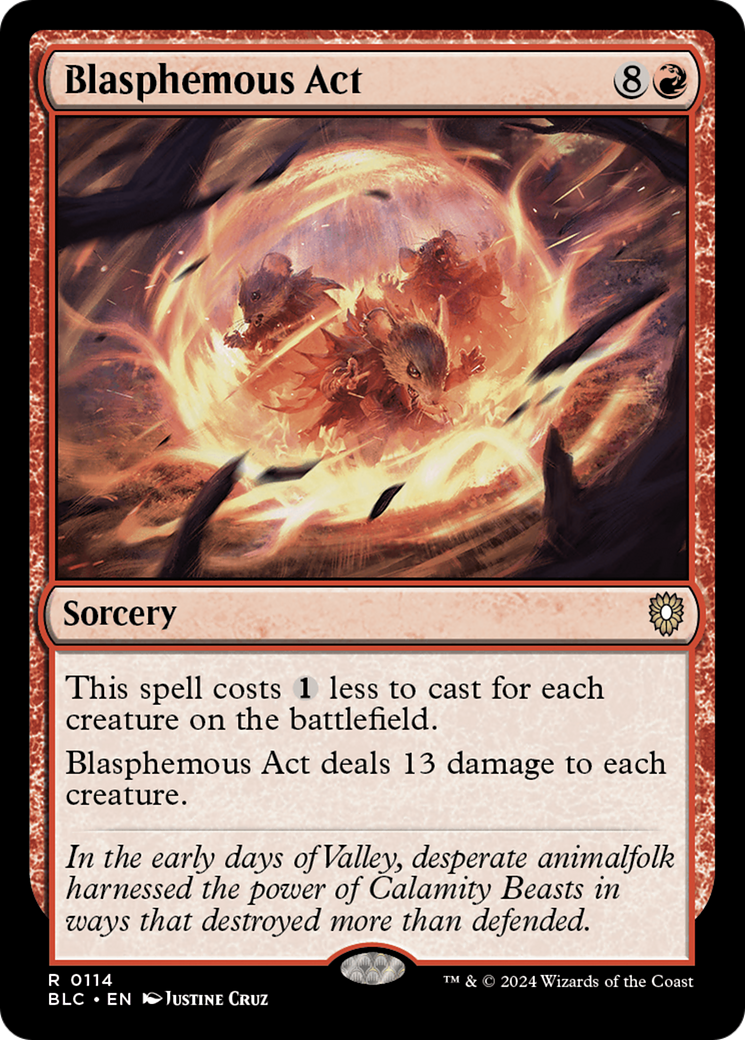
Blasphemous Act
Blasphemous Act
Sorcery
This spell costs less to cast for each creature on the battlefield.
Blasphemous Act deals 13 damage to each creature.
- To determine the total cost of a spell, start with the mana cost or alternative cost you're paying, add any cost increases, then apply any cost reductions (such as that of Blasphemous Act). The mana value of the spell is determined only by its mana cost, no matter what the total cost to cast the spell was.
- Blasphemous Act's ability can't reduce the total cost to cast the spell below .
- The total cost to cast Blasphemous Act is locked in before you pay that cost. For example, if there are three creatures on the battlefield, including one you can sacrifice to add , the total cost of Blasphemous Act is . Then you can sacrifice the creature when you activate mana abilities just before paying the cost.
- Although players may respond to Blasphemous Act once it's been cast, once it's announced, they can't respond before the cost is calculated and paid.
-
1
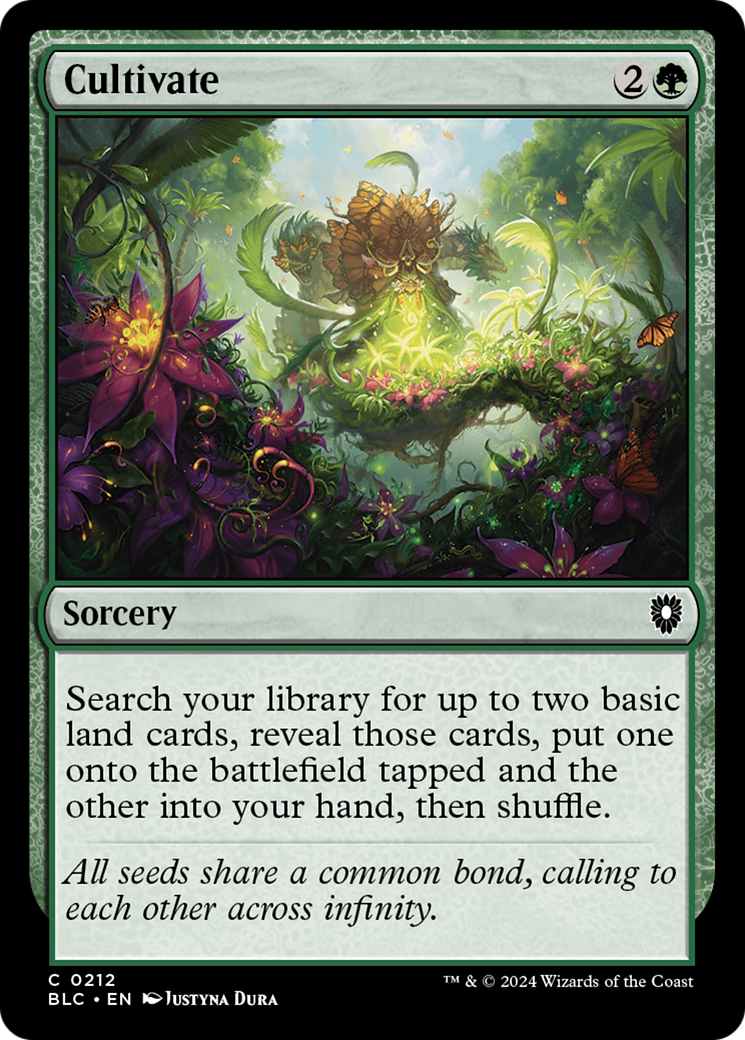
Cultivate
Cultivate
Sorcery
Search your library for up to two basic land cards, reveal those cards, put one onto the battlefield tapped and the other into your hand, then shuffle.
- If you choose to find only one basic land card, you put it onto the battlefield tapped.
-
1
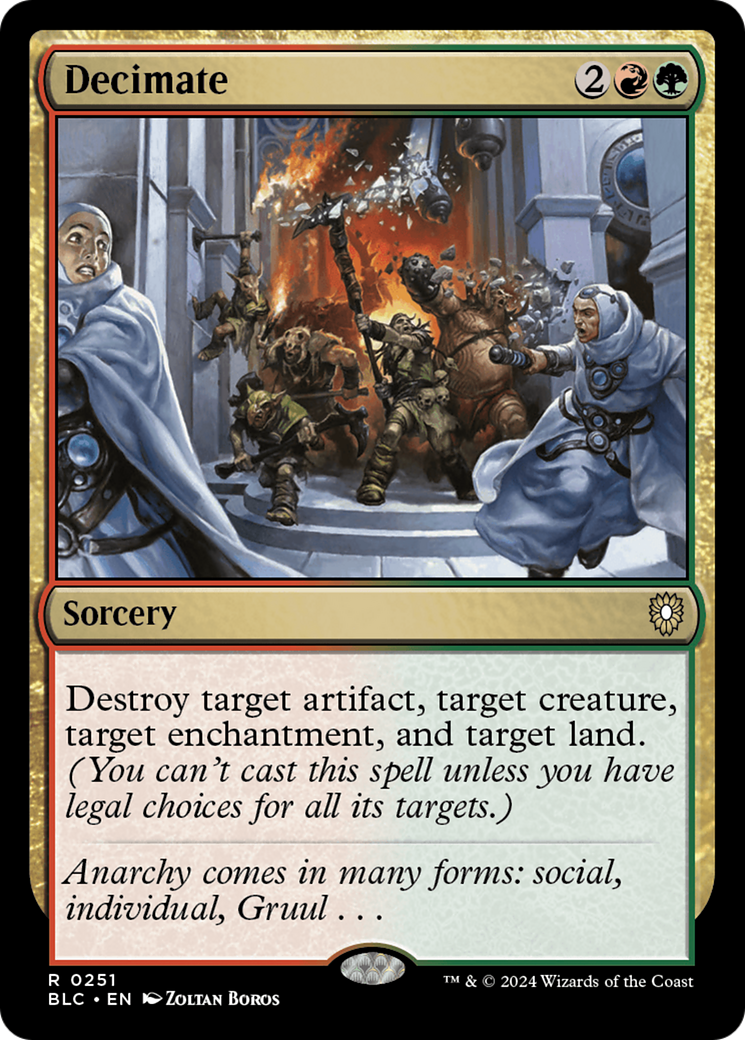
Decimate
Decimate
Sorcery
Destroy target artifact, target creature, target enchantment, and target land. (You can't cast this spell unless you have legal choices for all its targets.)
- You must choose a legal target for each target required by Decimate. However, if a permanent has multiple card types, it may be chosen as the target for more than one instance of the word "target." For example, you could cast Decimate targeting an artifact creature, an enchantment, and a land.
-
1
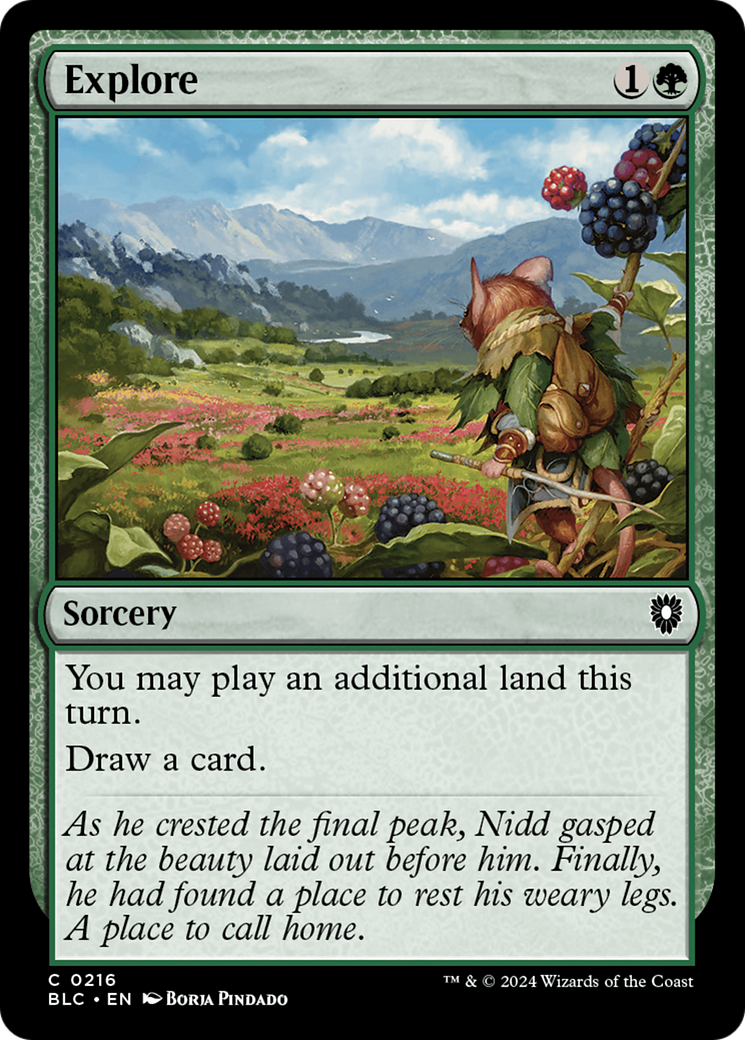
Explore
Explore
Sorcery
You may play an additional land this turn.
Draw a card.
- Explore's effect allows you to play an additional land during your main phase. Doing so follows the normal timing rules for playing lands. In particular, you don't get to play a land as Explore resolves; Explore fully resolves first and you draw a card, perhaps a land you'll play later.
- The effects of multiple Explores in the same turn are cumulative. They're also cumulative with other effects that let you play additional lands, such as the one from Urban Evolution.
- If you somehow manage to cast Explore when it's not your turn, you'll draw a card when it resolves, but you won't be able to play a land that turn.
-
1
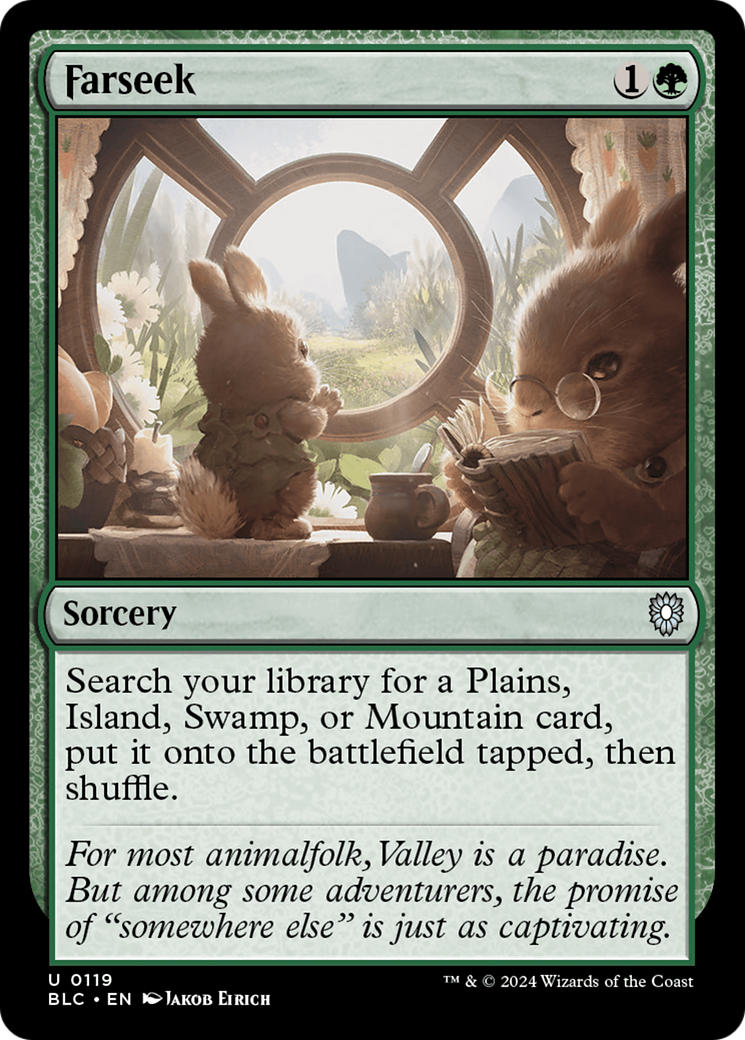
Farseek
Farseek
Sorcery
Search your library for a Plains, Island, Swamp, or Mountain card, put it onto the battlefield tapped, then shuffle.
- Farseek can find any land with any of the listed land types, including nonbasic ones, even if that land is a Forest in addition to one or more of those types.
-
1
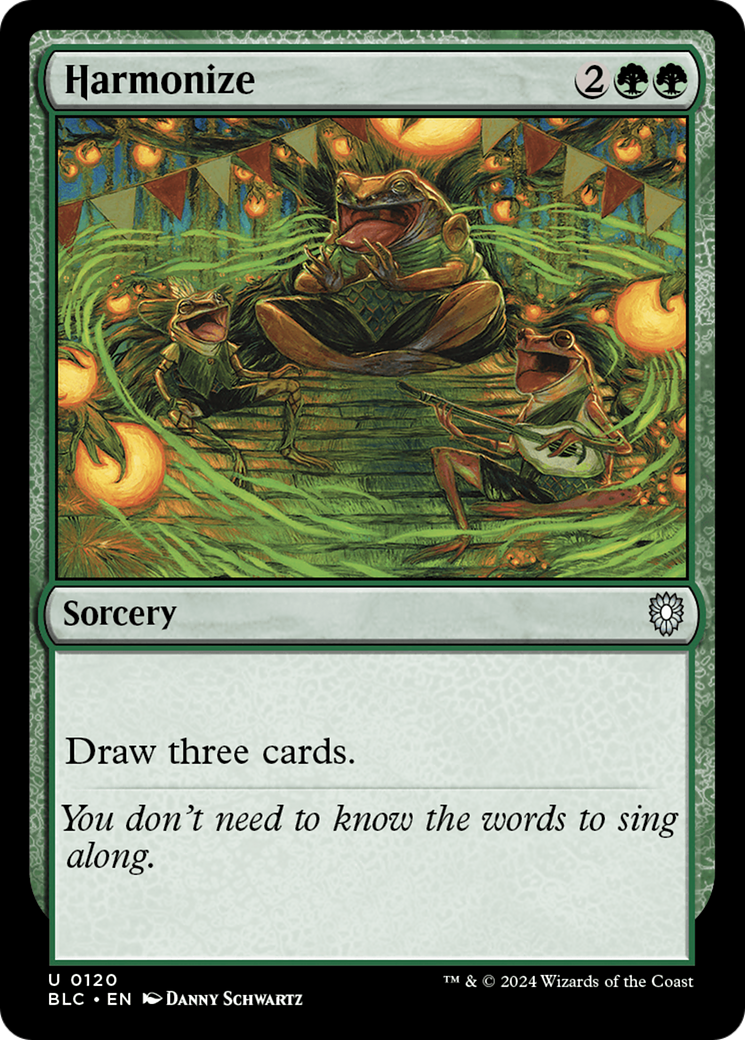
Harmonize
Harmonize
Sorcery
Draw three cards.
-
1
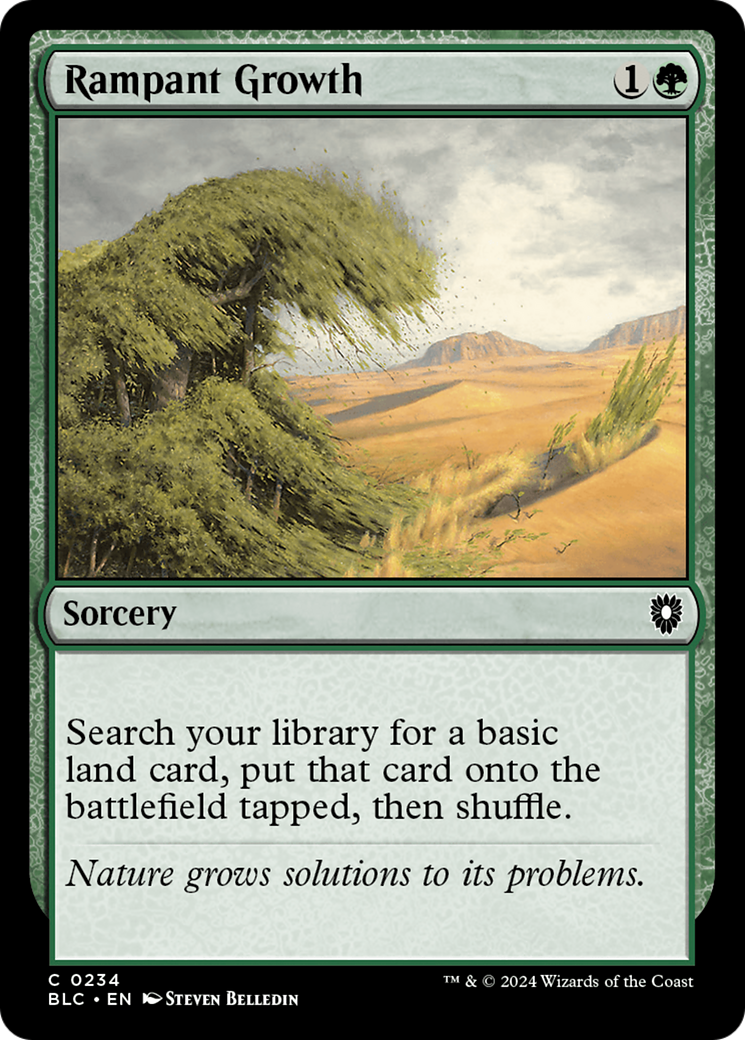
Rampant Growth
Rampant Growth
Sorcery
Search your library for a basic land card, put that card onto the battlefield tapped, then shuffle.
- The land does not count toward your one per turn limit because it was put onto the battlefield by an effect.
- Because the "search" requires you to find a card with certain characteristics, you don't have to find the card if you don't want to.
Artifacts 14
-
1
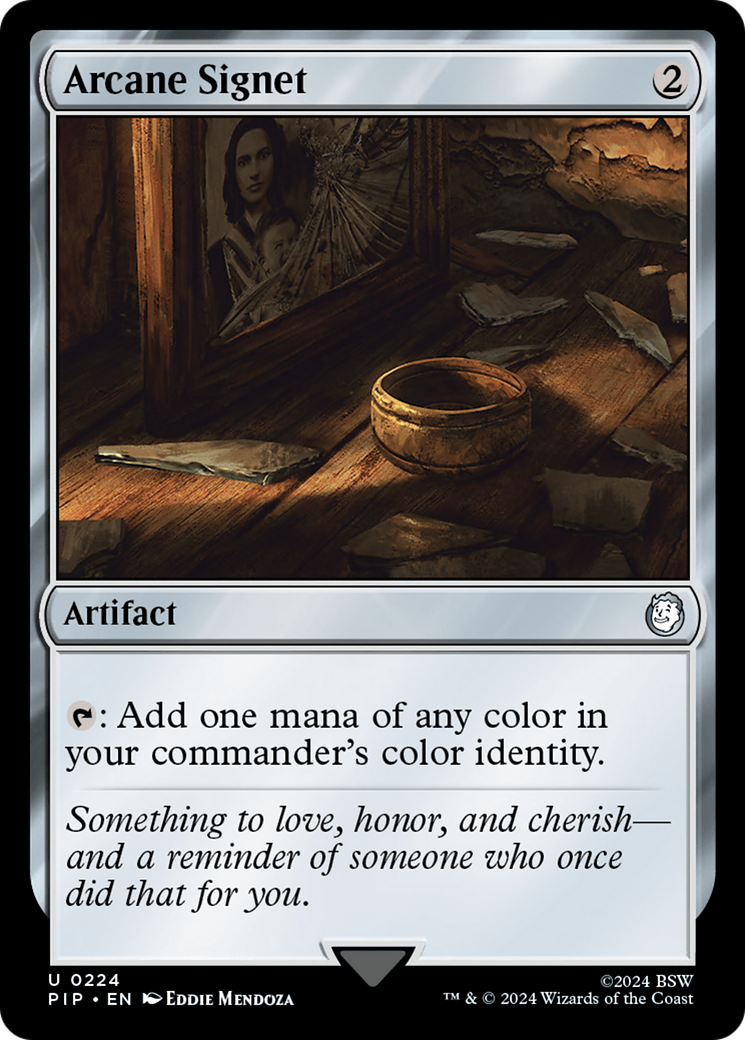
Arcane Signet
Arcane Signet
Artifact
: Add one mana of any color in your commander's color identity.
- If your commander is a card that has no colors in its color identity, Arcane Signet's ability produces no mana. It doesn't produce .
- If you have two commanders, the ability adds one mana of any color in their combined color identities.
- If you don't have a commander, Arcane Signet's ability produces no mana.
-
1
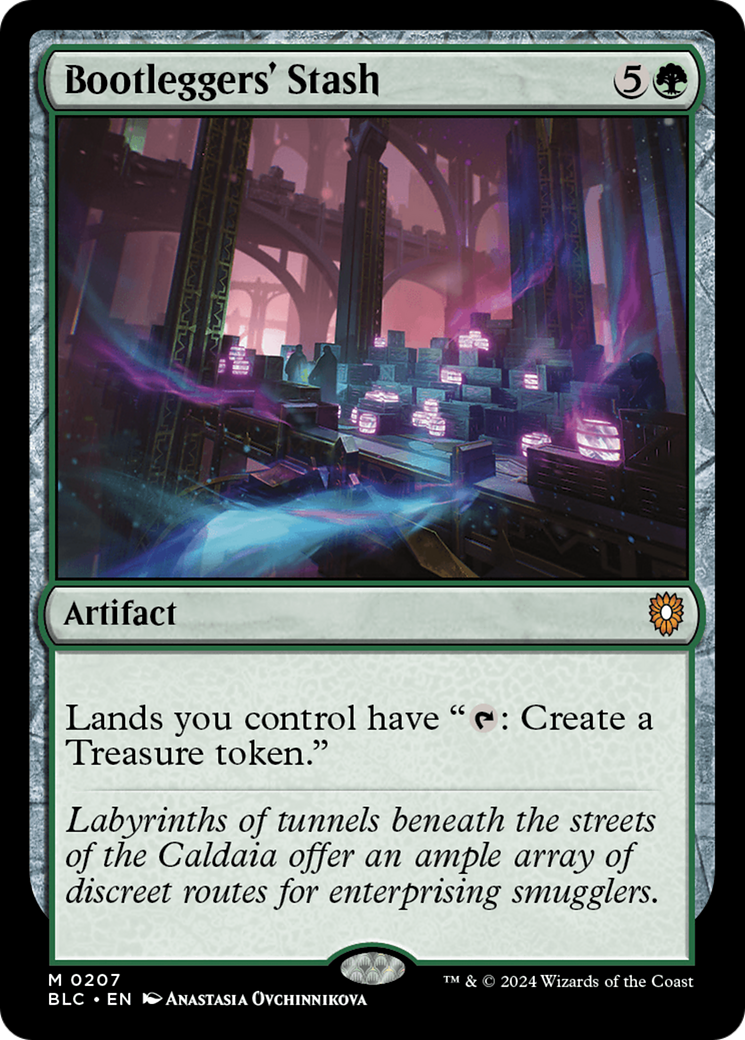
Bootleggers' Stash
Bootleggers' Stash
Artifact
Lands you control have " : Create a Treasure token."
-
1
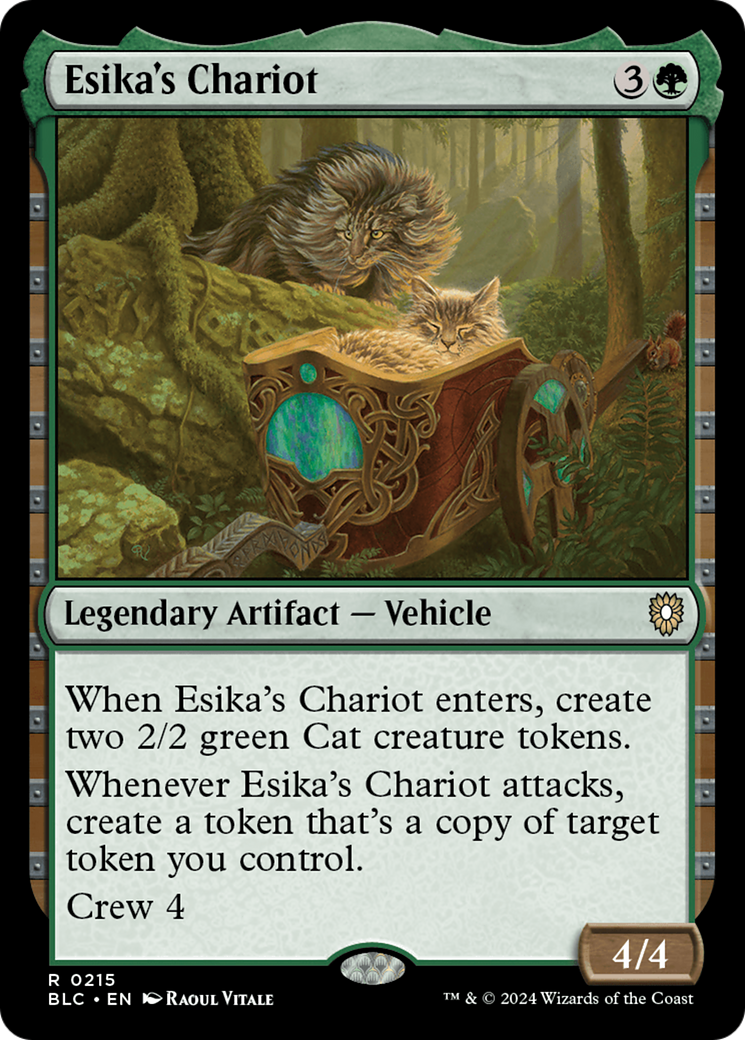
Esika's Chariot
Esika's Chariot
Legendary Artifact — Vehicle
4/4
When Esika's Chariot enters, create two 2/2 green Cat creature tokens.
Whenever Esika's Chariot attacks, create a token that's a copy of target token you control.
Crew 4
- The token you create copies the original characteristics of the token it's copying as stated by the effect that created that token. The newly created token doesn't copy whether the original token is tapped or untapped, whether it has any counters on it, whether it has any Auras and/or Equipment attached to it, or any non-copy effects that changed its power, toughness, types, color, and so on. Notably, the token you create won't be attacking, even if the original token is.
- If the original token is copying something else, the token you create will use the copiable values of the original token. In most cases, it will be a copy of whatever the original token is copying. If it's copying a permanent or card with in its mana cost, X is 0.
- Any enters-the-battlefield abilities of the token you create will trigger when it enters the battlefield. Any "As [this permanent] enters the battlefield" or "[This permanent] enters the battlefield with" abilities of the copied token will also work.
- If the original token is an Aura, the token you create is put onto the battlefield without being cast. The Aura's controller-to-be chooses what it will enchant as it enters the battlefield. An Aura put onto the battlefield this way doesn't target anything (so it could be attached to an opponent's permanent with hexproof, for example), but the Aura's enchant ability restricts what it can be attached to. If an Aura token can't legally be attached to anything, it isn't created.
-
1
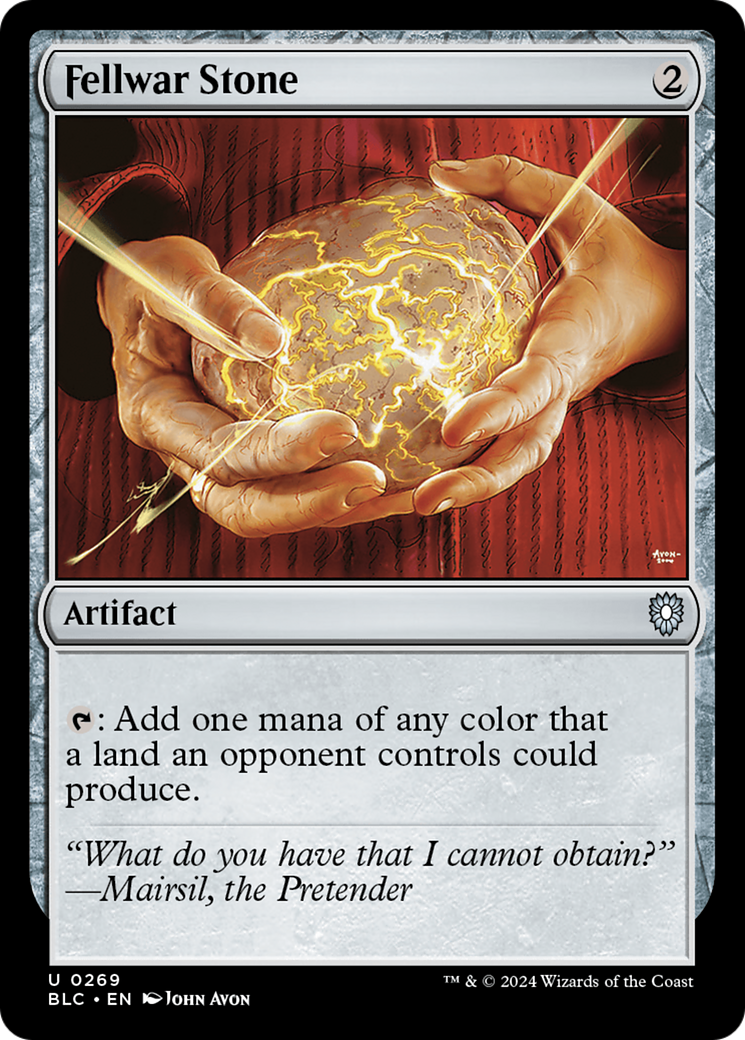
Fellwar Stone
Fellwar Stone
Artifact
: Add one mana of any color that a land an opponent controls could produce.
- The colors of mana are white, blue, black, red, and green. Fellwar Stone can't be tapped for colorless mana, even if a land an opponent controls could produce colorless mana.
- Fellwar Stone checks the effects of all mana-producing abilities of lands your opponents control, but it doesn't check their costs. For example, Vivid Crag has the ability " , Remove a charge counter from Vivid Crag: Add one mana of any color." If an opponent controls Vivid Crag and you control Fellwar Stone, you can tap Fellwar Stone for any color of mana. It doesn't matter whether Vivid Crag has a charge counter on it, and it doesn't matter whether it's untapped.
- When determining what colors of mana your opponents' lands could produce, take into account any applicable replacement effects that would apply to those lands' mana abilities (such as Contamination's effect, for example). If there is more than one, consider them in any possible order.
- Fellwar Stone doesn't care about any restrictions or riders your opponents' lands (such as Ancient Ziggurat or Hall of the Bandit Lord) put on the mana they produce. It just cares about colors of mana.
- This works even if the opponent's lands are tapped. It only checks what kinds of mana can be produced, not if the abilities that produce them are usable right now.
- The ability can be activated if the opponent has no lands that produce mana, but the effect will not be able to generate any mana.
- It only produces one mana even if the land can produce more than one.
-
1
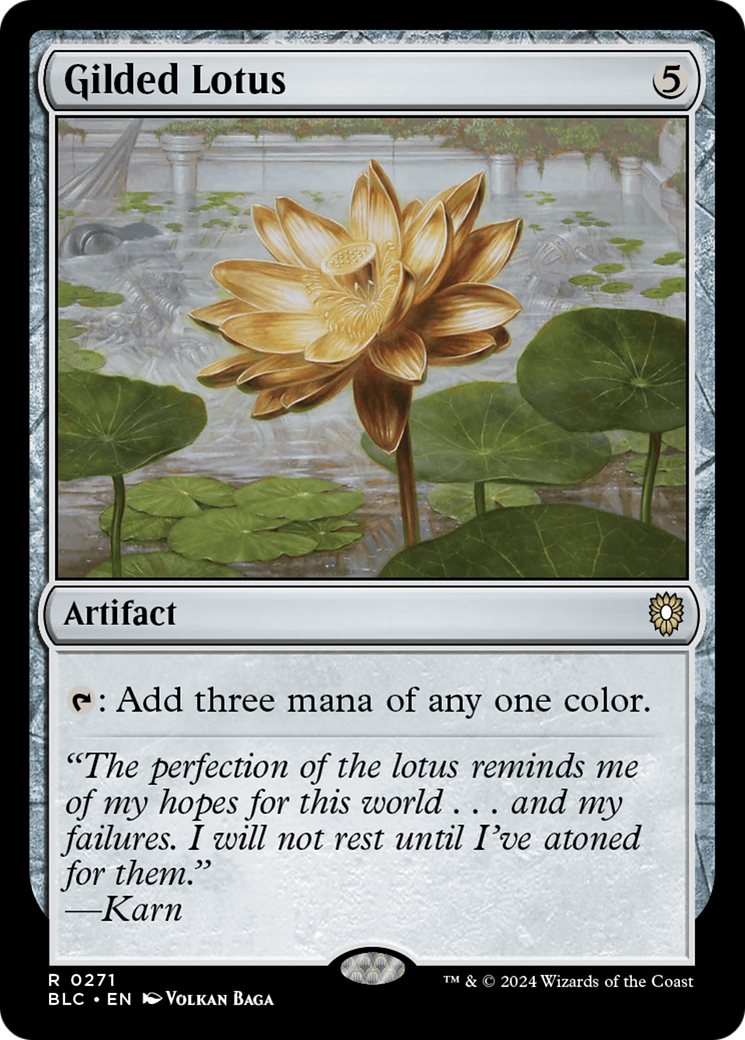
Gilded Lotus
Gilded Lotus
Artifact
: Add three mana of any one color.
-
1
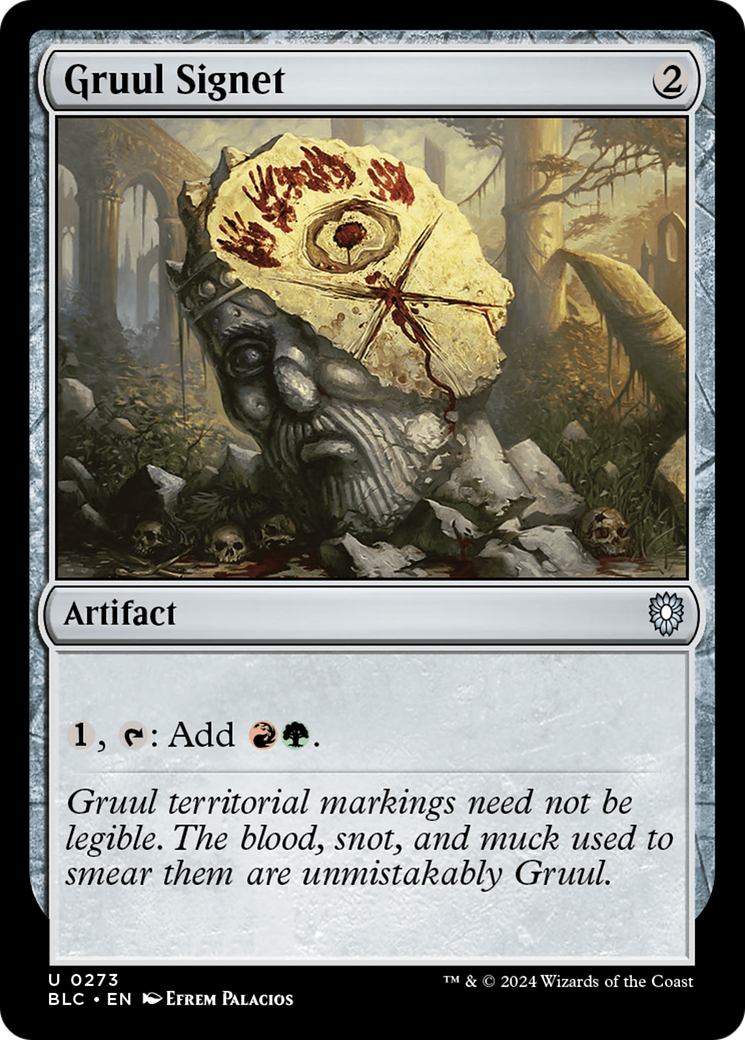
Gruul Signet
Gruul Signet
Artifact
, : Add .
-
1
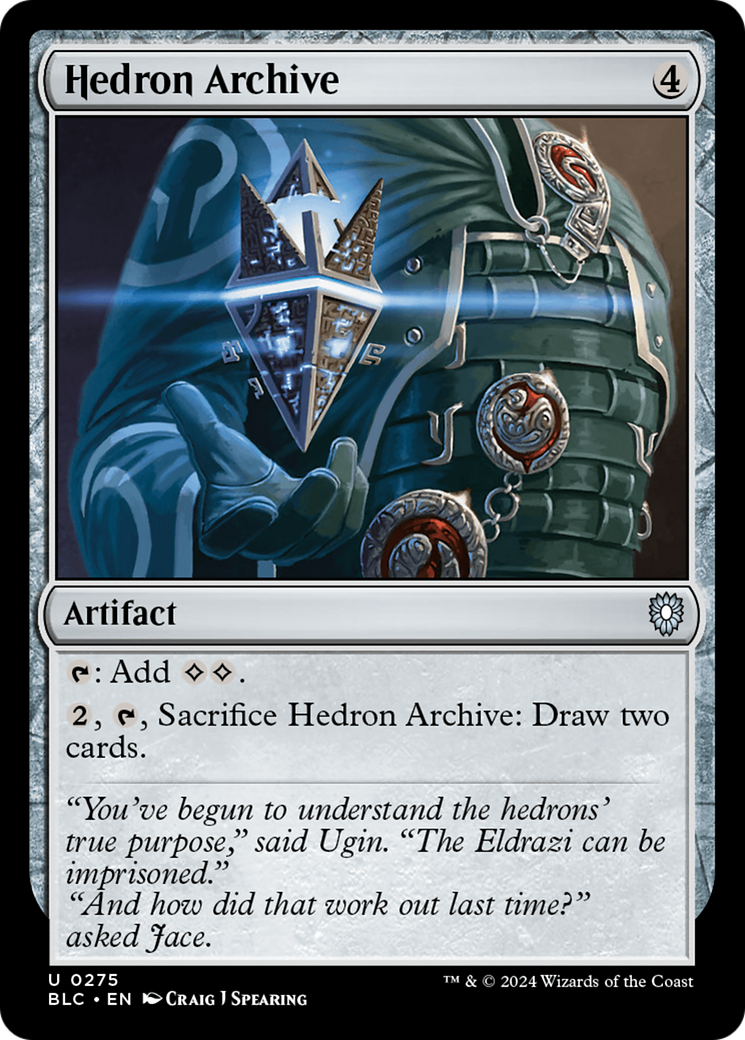
Hedron Archive
Hedron Archive
Artifact
: Add .
, , Sacrifice this artifact: Draw two cards.
-
1
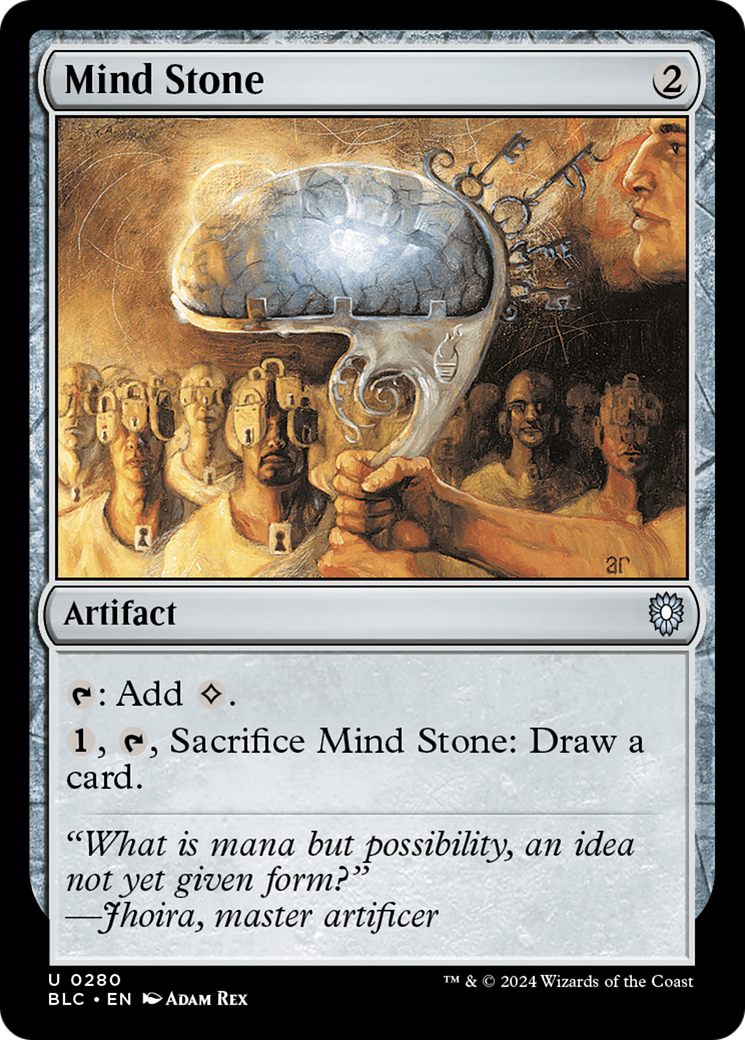
Mind Stone
Mind Stone
Artifact
: Add .
, , Sacrifice this artifact: Draw a card.
-
1
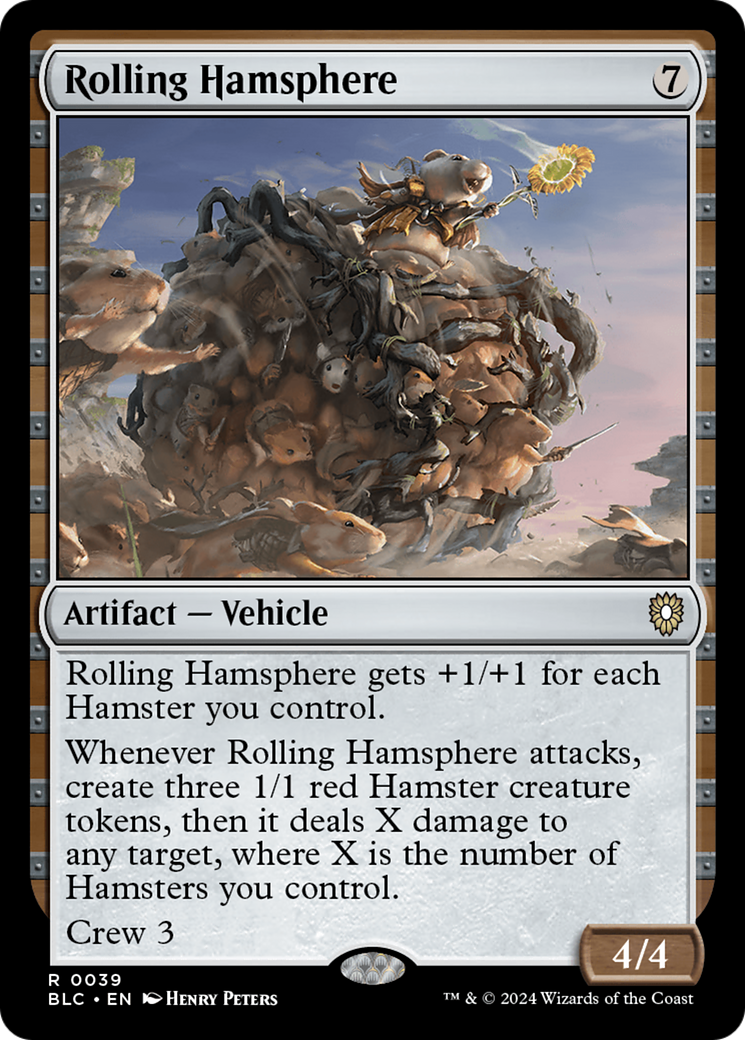
Rolling Hamsphere
Rolling Hamsphere
Artifact — Vehicle
4/4
This Vehicle gets +1/+1 for each Hamster you control.
Whenever this Vehicle attacks, create three 1/1 red Hamster creature tokens, then it deals X damage to any target, where X is the number of Hamsters you control.
Crew 3
- The value of X is determined only once, as Rolling Hamsphere's second ability resolves.
-
1
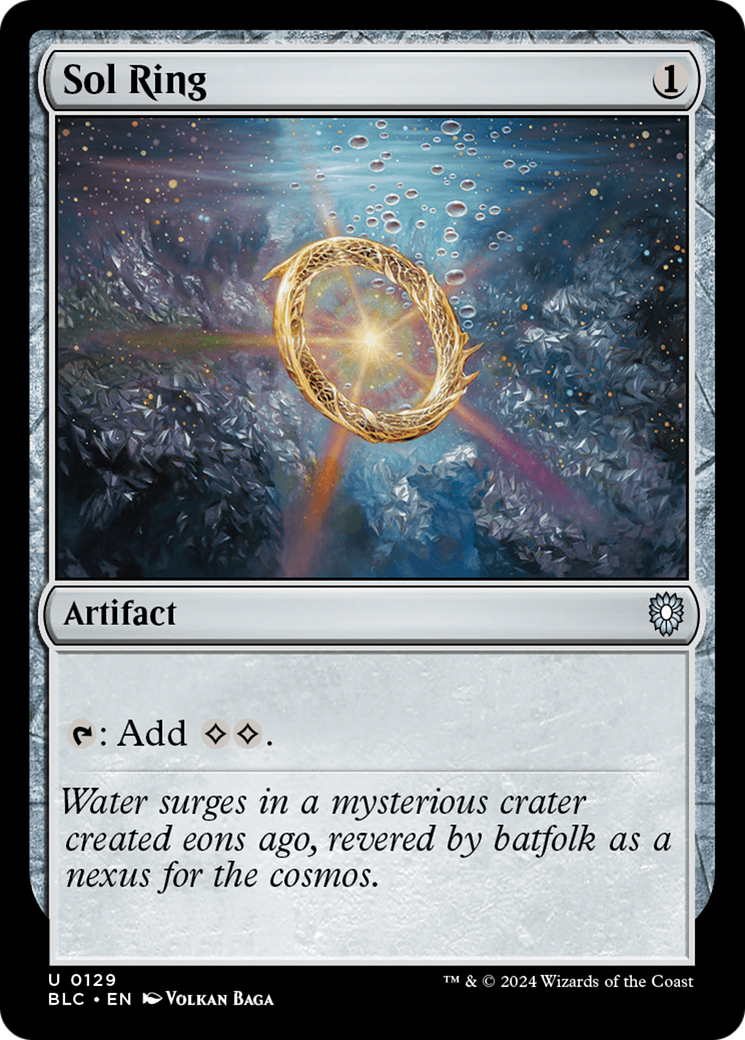
Sol Ring
Sol Ring
Artifact
: Add .
-
1
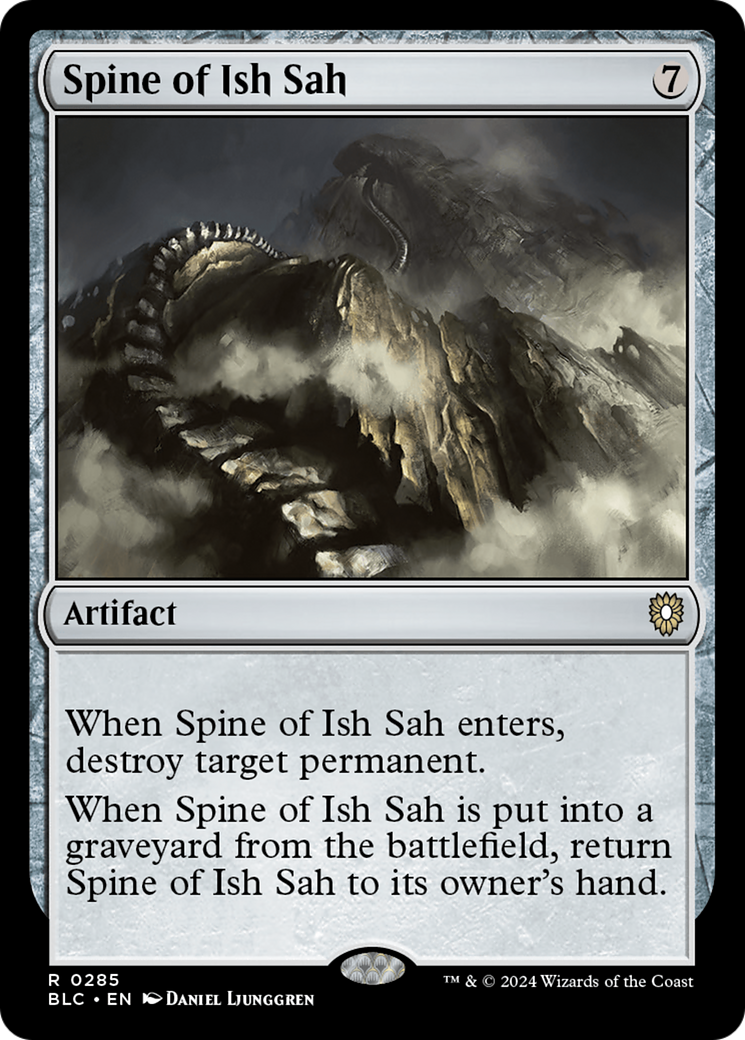
Spine of Ish Sah
Spine of Ish Sah
Artifact
When this artifact enters, destroy target permanent.
When this artifact is put into a graveyard from the battlefield, return it to its owner's hand.
- Spine of Ish Sah's last ability doesn't allow you to sacrifice it. You must find another way to get Spine of Ish Sah into the graveyard.
-
1
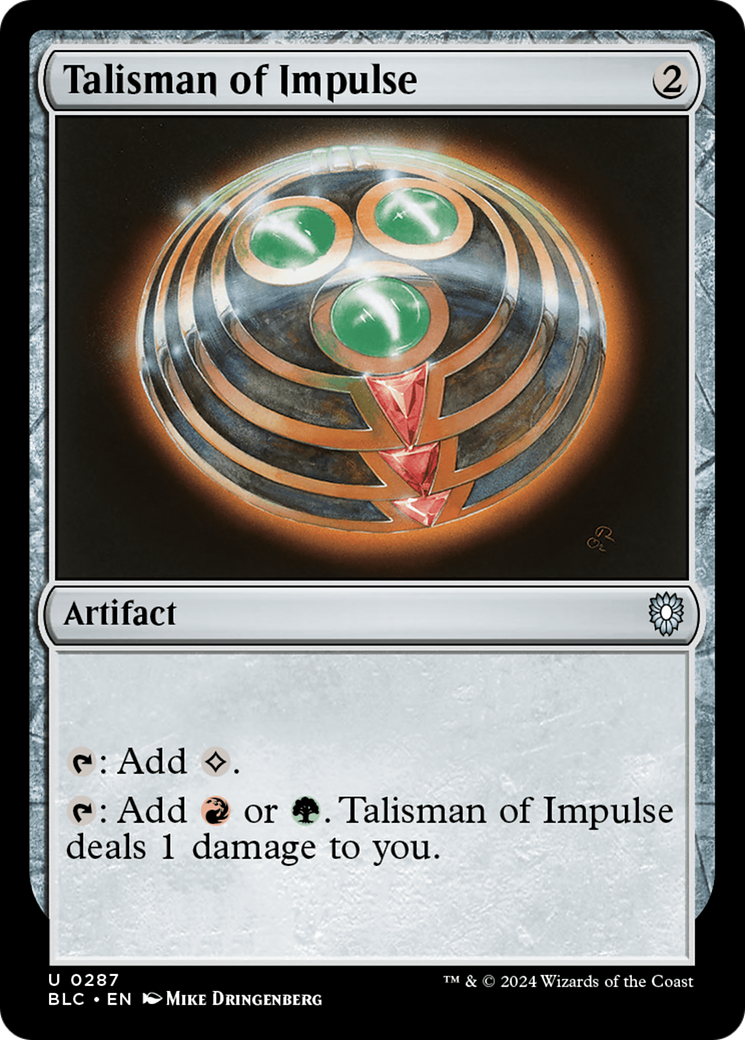
Talisman of Impulse
Talisman of Impulse
Artifact
: Add .
: Add or . This artifact deals 1 damage to you.
-
1
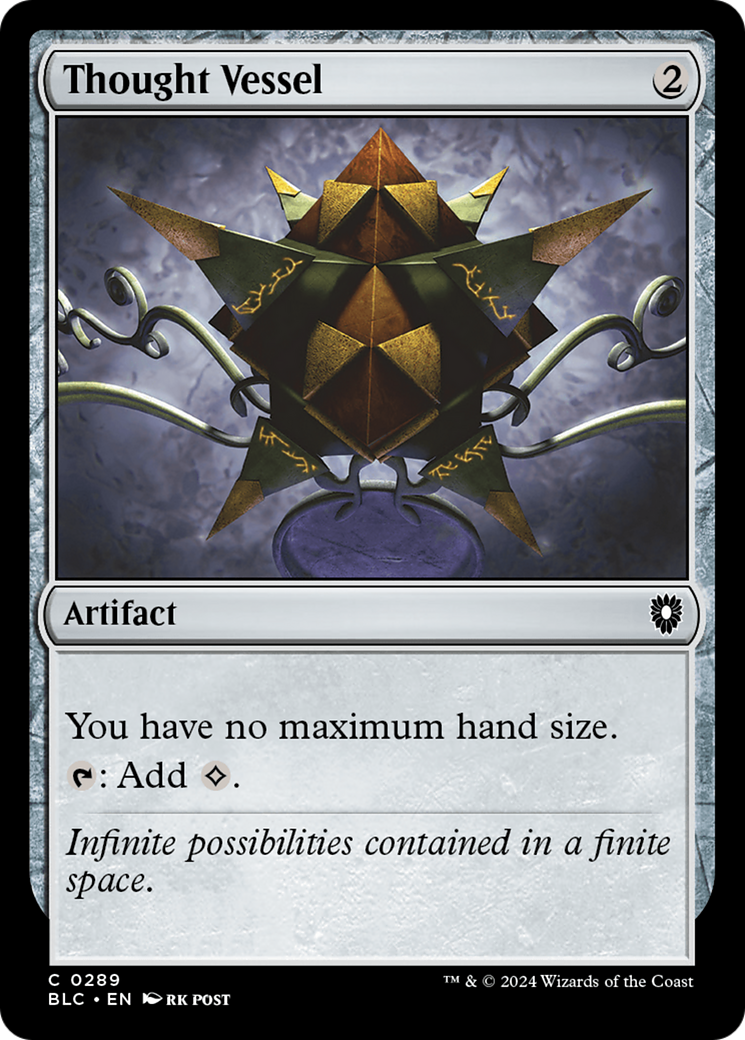
Thought Vessel
Thought Vessel
Artifact
You have no maximum hand size.
: Add .
-
1
Thran Dynamo
Thran Dynamo
Artifact
: Add .
Enchantments 13
-
1
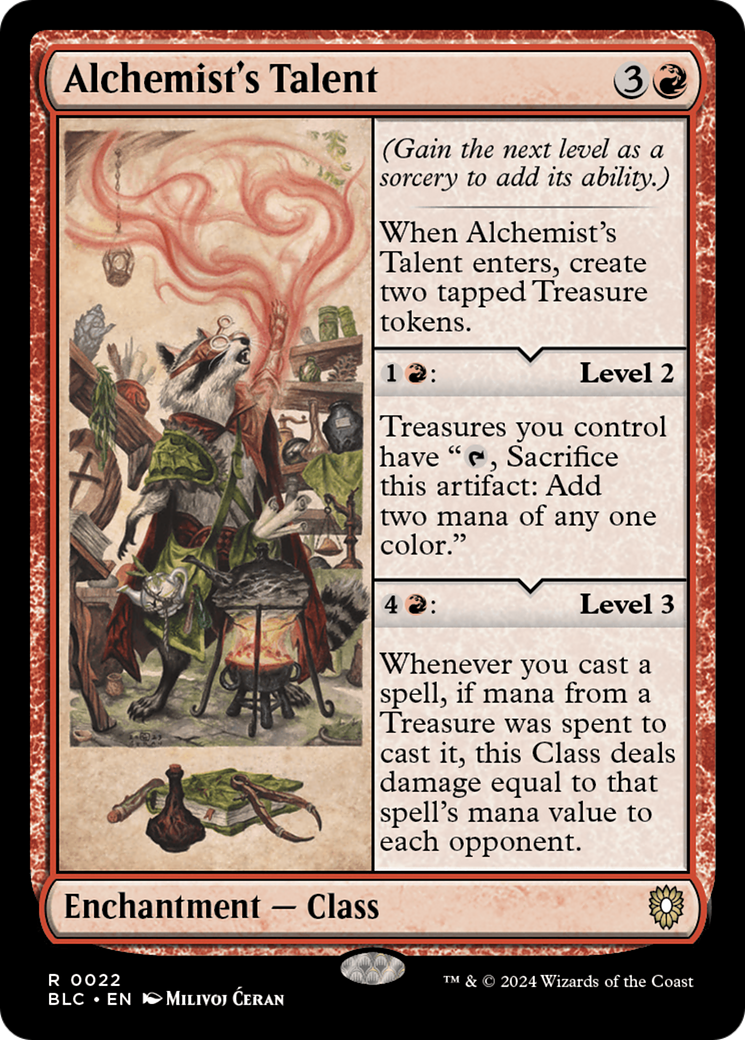
Alchemist's Talent
Alchemist's Talent
Enchantment — Class
(Gain the next level as a sorcery to add its ability.)
When this Class enters, create two tapped Treasure tokens.
: Level 2
Treasures you control have " , Sacrifice this artifact: Add two mana of any one color."
: Level 3
Whenever you cast a spell, if mana from a Treasure was spent to cast it, this Class deals damage equal to that spell's mana value to each opponent.
- If a spell has in its mana cost, use the value chosen for X to determine that spell's mana value.
- Each Class has five abilities. The three in the major sections of its text box are class abilities. Class abilities can be static, activated, or triggered abilities. The other two are level abilities, one activated ability to advance the Class to level 2 and another to advance the Class to level 3.
- Each Class starts with only the first of its three class abilities. As the first level ability resolves, the Class becomes level 2 and gains the second class ability. As the second level ability resolves, the Class becomes level 3 and gains the third class ability.
- Gaining a level won't remove abilities that a Class had at a previous level.
- Gaining a level is a normal activated ability. It uses the stack and can be responded to.
- You can't activate the first level ability of a Class unless that Class is level 1. Similarly, you can't activate the second level ability of a Class unless that Class is level 2.
- There's no restriction on how many Class permanents you can control, whether they're the same or different classes. Each Class permanent tracks its own level separately.
-
1
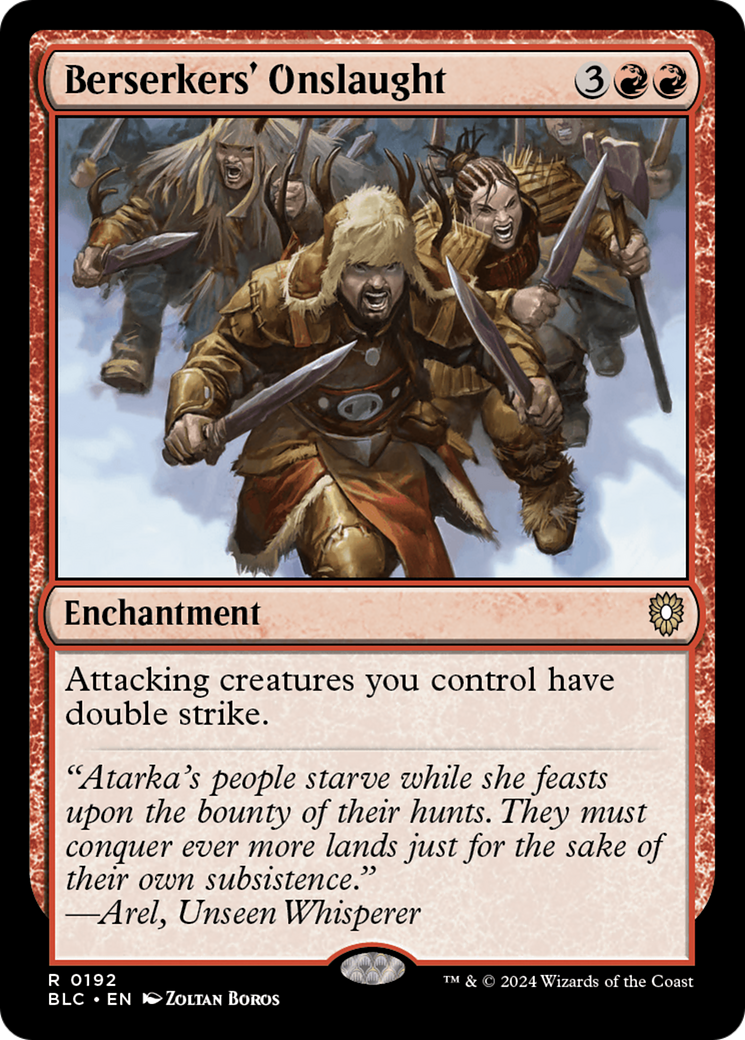
Berserkers' Onslaught
Berserkers' Onslaught
Enchantment
Attacking creatures you control have double strike.
-
1
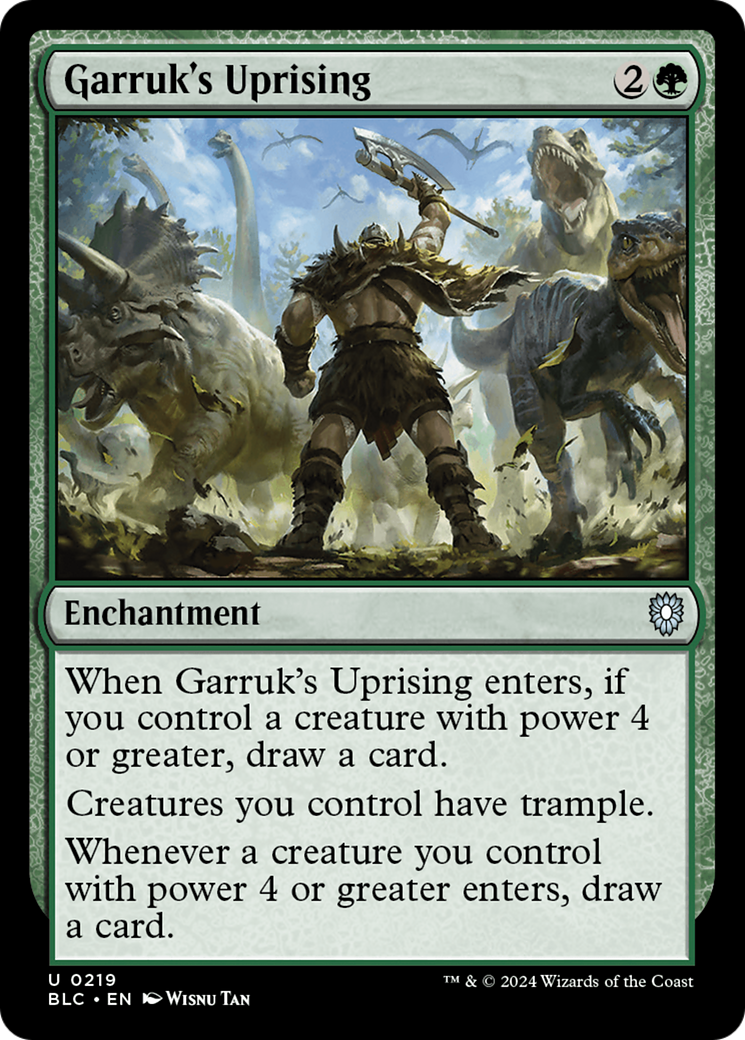
Garruk's Uprising
Garruk's Uprising
Enchantment
When this enchantment enters, if you control a creature with power 4 or greater, draw a card.
Creatures you control have trample. (Each of those creatures can deal excess combat damage to the player or planeswalker it's attacking.)
Whenever a creature you control with power 4 or greater enters, draw a card.
- The first ability of Garruk's Uprising has you draw just one card, no matter how many creatures you control with power 4 or greater.
- If you don't control a creature with power 4 or greater immediately after Garruk's Uprising enters, its first ability won't trigger. If you don't control one as the ability resolves, you don't draw a card. They don't have to be the same creature both times, however.
- If one or more static abilities that apply to a creature entering change its power, those abilities are considered when determining whether Garruk's Uprising's last ability triggers. The same is true for replacement effects that apply to it, such as entering with one or more +1/+1 counters or entering as a copy of another creature.
- Once the last ability of Garruk's Uprising has triggered, lowering the power of the creature or removing it from the battlefield won't stop you from drawing a card.
-
1
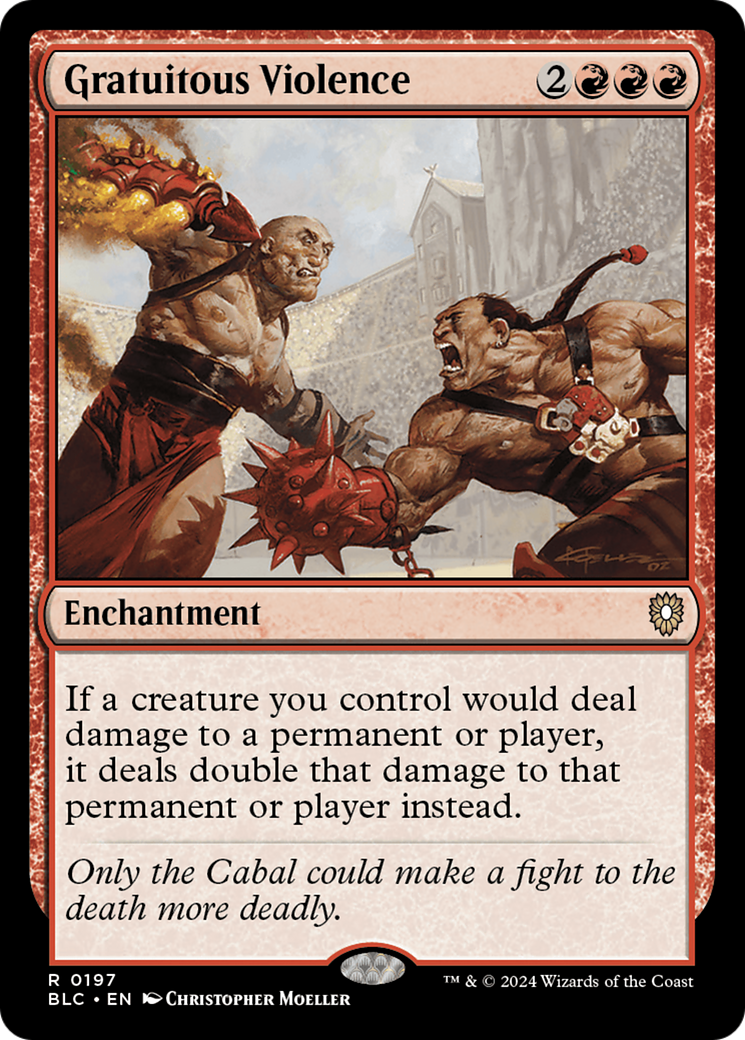
Gratuitous Violence
Gratuitous Violence
Enchantment
If a creature you control would deal damage to a permanent or player, it deals double that damage instead.
-
1
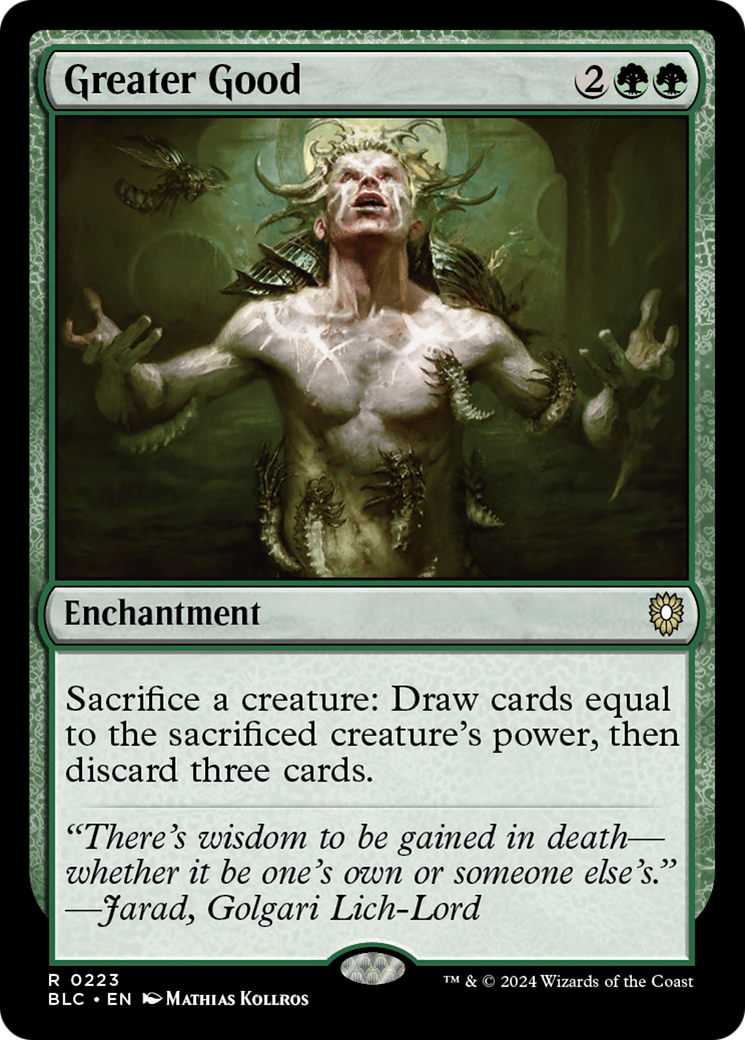
Greater Good
Greater Good
Enchantment
Sacrifice a creature: Draw cards equal to the sacrificed creature's power, then discard three cards.
- Use the sacrificed creature's power as it last existed on the battlefield to determine how many cards you draw.
- If you don't have three cards in hand when instructed to discard three cards, you discard your hand.
- You draw and discard cards all while Greater Good's ability is resolving. Nothing can happen between the two, and no player may choose to take actions.
-
1
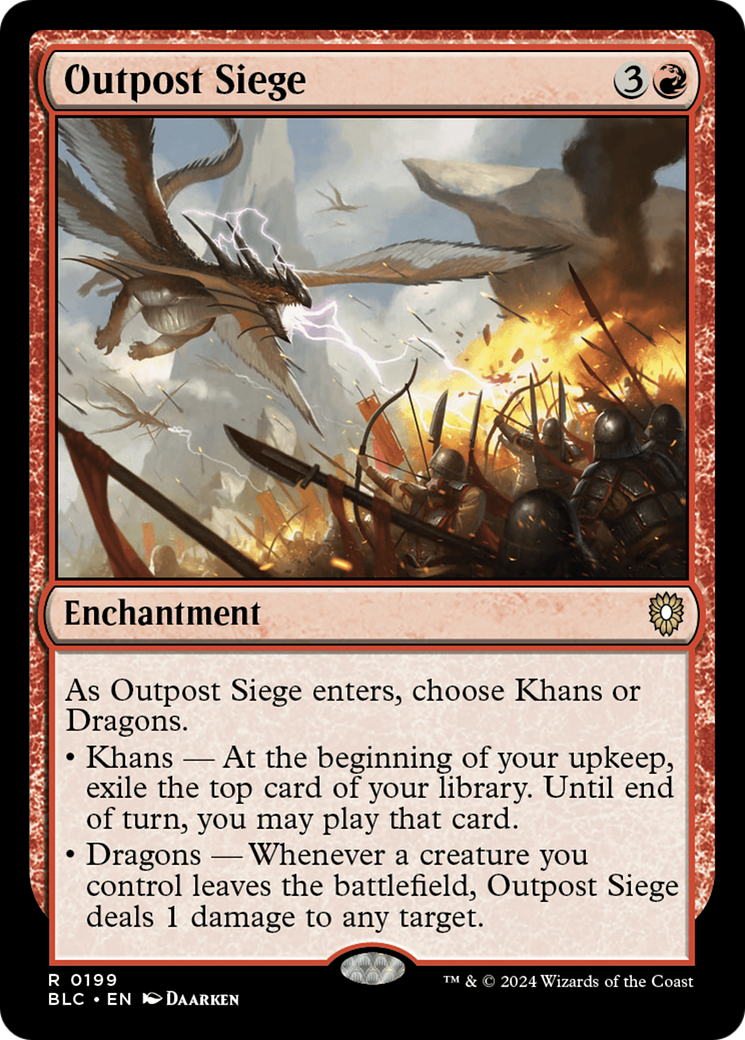
Outpost Siege
Outpost Siege
Enchantment
As this enchantment enters, choose Khans or Dragons.
- Khans — At the beginning of your upkeep, exile the top card of your library. Until end of turn, you may play that card.
- Dragons — Whenever a creature you control leaves the battlefield, this enchantment deals 1 damage to any target.
- The card exiled by the "Khans" ability is exiled face up. Playing a card exiled with the "Khans" ability follows the normal rules for playing the card. You must pay its costs, and you must follow all applicable timing rules. For example, if it's a creature card, you can cast it only during your main phase while the stack is empty.
- If you exile a land card using the "Khans" ability, you may play that land only if you have any available land plays. Normally, this means you can play the land only if you haven't played a land yet that turn.
- If a noncreature card is manifested and then leaves the battlefield while face down, the "Dragons" ability will trigger.
- Each Siege will have one of the two listed abilities, depending on your choice as it enters the battlefield.
- The words "Khans" and "Dragons" are anchor words, connecting your choice to the appropriate ability. Anchor words are a new rules concept. "[Anchor word] — [Ability]" means "As long as you chose [anchor word] as this permanent entered the battlefield, this permanent has [ability]." Notably, the anchor word "Dragons" has no connection to the creature type Dragon.
- Each of the last two abilities is linked to the first ability. They each refer only to the choice made as a result of the first ability. If a permanent enters the battlefield as a copy of one of the Sieges, its controller will make a new choice for that Siege. Which ability the copy has won't depend on the choice made for the original permanent.
-
1
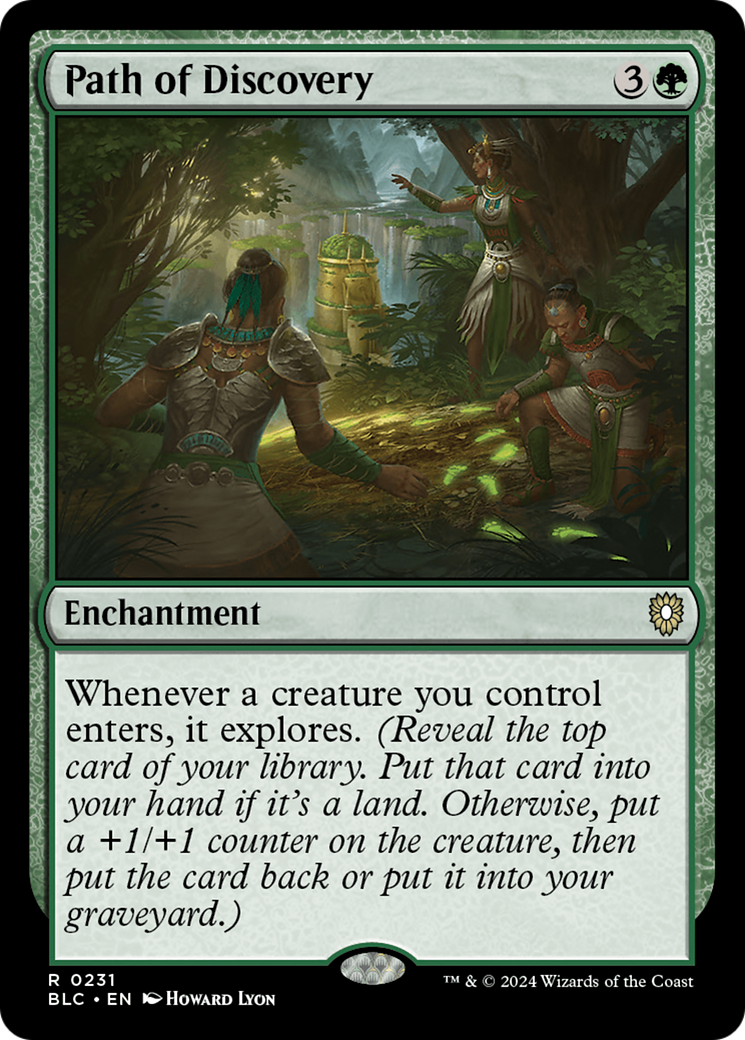
Path of Discovery
Path of Discovery
Enchantment
Whenever a creature you control enters, it explores. (Reveal the top card of your library. Put that card into your hand if it's a land. Otherwise, put a +1/+1 counter on the creature, then put the card back or put it into your graveyard.)
- Path of Discovery's triggered ability triggers along with any other abilities that say that the creature explores when it enters the battlefield, including abilities that come from the creature itself or from multiples of Path of Discovery. You may take actions between each resolving ability's exploration.
- If an ability instructs a creature to explore, its controller reveals the top card of their library. If it's a land card, they'll put it into their hand. Otherwise, they'll put a +1/+1 counter on that creature, then choose to either leave that card on top of their library or put it into their graveyard.
- Once an ability that causes a creature to explore begins to resolve, no player may take any other actions until it's done. Notably, opponents can't try to remove the exploring creature after you reveal a nonland card but before it receives a counter.
- If no card is revealed, most likely because that player's library is empty, the exploring creature receives a +1/+1 counter.
- If a resolving spell or ability instructs a specific creature to explore but that creature has left the battlefield, the creature still explores. If you reveal a nonland card this way, you won't put a +1/+1 counter on anything, but you may put the revealed card into your graveyard. Effects that trigger "whenever a creature explores" trigger as appropriate.
- Some spells or abilities might cause a creature to explore multiple times in a row. If you reveal a nonland card when a creature explores and leave it on top of your library, then the creature explores again immediately afterwards, you'll reveal the same card again.
- In some unusual cases, noncreature permanents may explore. For example, if the creature card returned by Defossilize is somehow not a creature once it's on the battlefield, it can still explore. You'll take all the same actions, and you may end up putting a +1/+1 counter on the permanent. (Note that some effects target a creature, and those effects would still require a legal target to have it explore.)
- If a resolving spell or ability instructs a specific creature to explore but that creature has left the battlefield, the creature still explores. If you reveal a nonland card this way, you won't put a +1/+1 counter on anything, but you may put the revealed card into your graveyard. Effects that trigger "whenever a creature you control explores" trigger if appropriate.
-
1
Primeval Bounty
Primeval Bounty
Enchantment
Whenever you cast a creature spell, create a 3/3 green Beast creature token.
Whenever you cast a noncreature spell, put three +1/+1 counters on target creature you control.
Landfall — Whenever a land you control enters, you gain 3 life.
- Primeval Bounty's first and second abilities will each resolve before the spell that caused them to trigger. They will resolve even if that spell is countered or otherwise leaves the stack without resolving.
-
1
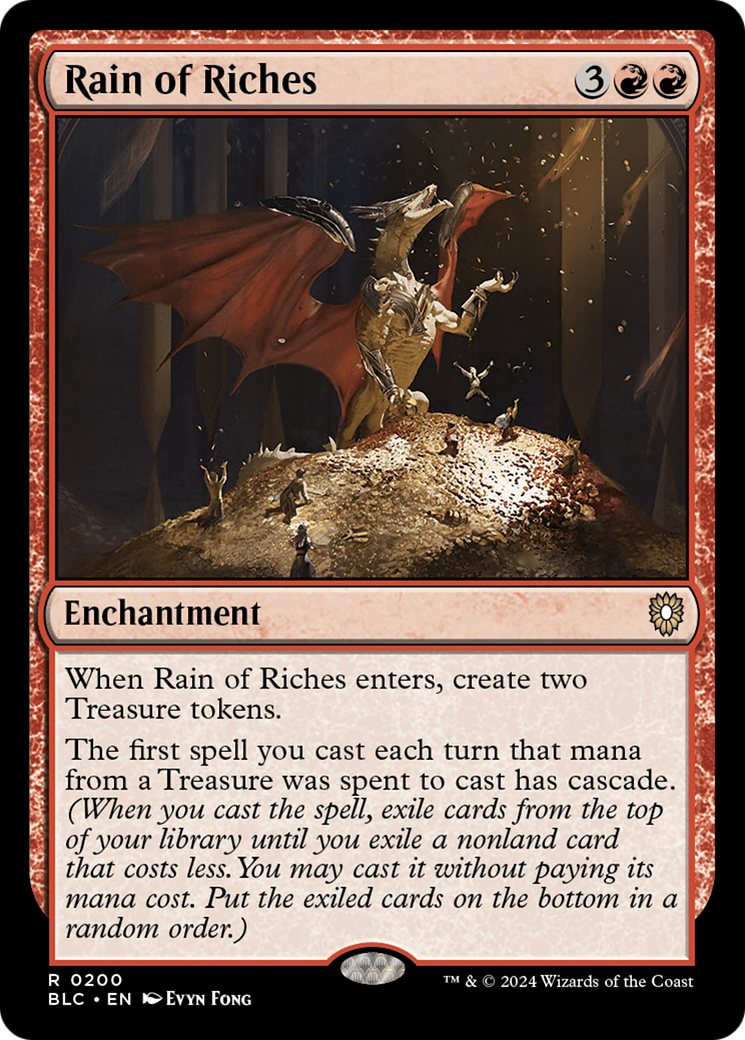
Rain of Riches
Rain of Riches
Enchantment
When this enchantment enters, create two Treasure tokens.
The first spell you cast each turn that mana from a Treasure was spent to cast has cascade. (When you cast the spell, exile cards from the top of your library until you exile a nonland card that costs less. You may cast it without paying its mana cost. Put the exiled cards on the bottom in a random order.)
-
1
Sunbird's Invocation
Sunbird's Invocation
Enchantment
Whenever you cast a spell from your hand, reveal the top X cards of your library, where X is that spell's mana value. You may cast a spell with mana value X or less from among cards revealed this way without paying its mana cost. Put the rest on the bottom of your library in a random order.
- If a revealed card in your library has in its mana cost, you must choose 0 as the value of X when casting it without paying its mana cost.
- For spells with in their mana costs, use the value chosen for X to determine the spell's mana value.
- If the spell's mana value is 0, you do nothing as the ability of Sunbird's Invocation resolves.
- Casting Sunbird's Invocation won't cause its own ability to trigger.
- The ability of Sunbird's Invocation resolves before the spell that caused it to trigger. It will resolve even if that spell is countered. If you cast a spell as part of the resolution of the ability, that spell resolves before the spell that caused the ability to trigger.
- If you cast one of the revealed cards, you do so as part of the resolution of the triggered ability. You can't wait to cast it later in the turn. Timing permissions based on the card's type are ignored, but other restrictions (such as "Cast [this card] only during combat") are not.
- If you cast a card "without paying its mana cost," you can't pay any alternative costs. You can, however, pay additional costs. If the card has any mandatory additional costs, such as that of Costly Plunder, those must be paid to cast the card.
- The mana value of a split card, such as cards with aftermath from the Amonkhet block, is based on the combined mana cost of its two halves. The mana value of the resulting spell is based only on the half you cast.
-
1
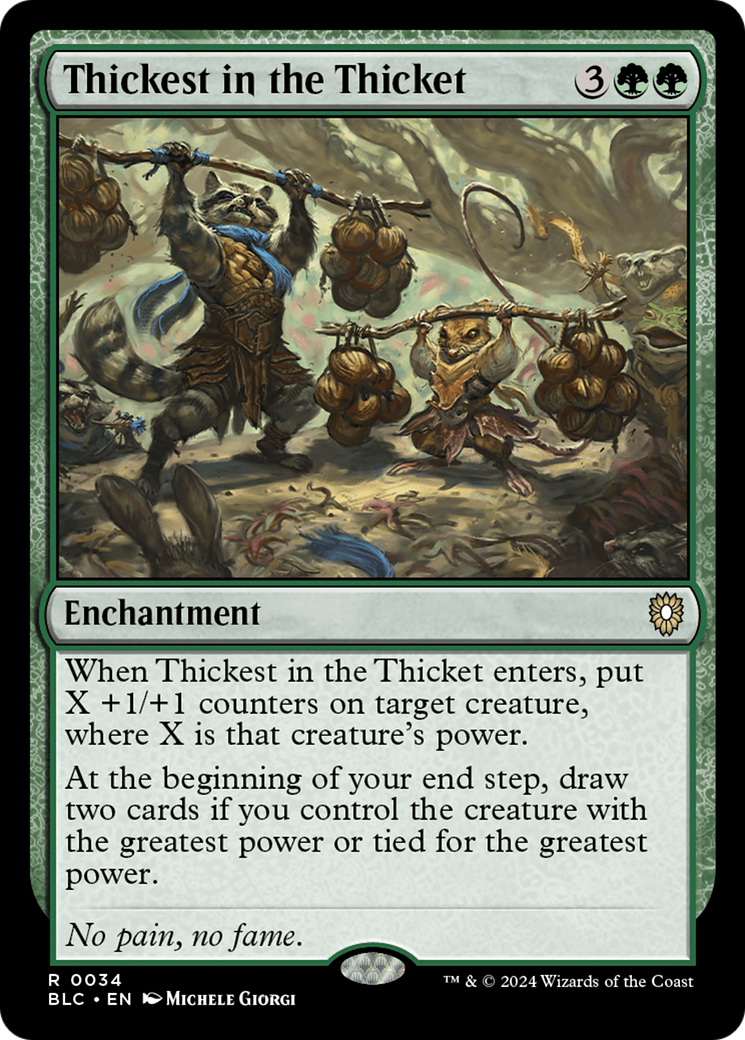
Thickest in the Thicket
Thickest in the Thicket
Enchantment
When this enchantment enters, put X +1/+1 counters on target creature, where X is that creature's power.
At the beginning of your end step, draw two cards if you control the creature with the greatest power or tied for the greatest power.
- The value of X is calculated only once, as Thickest in the Thicket's first ability resolves.
- Thickest in the Thicket's last ability will trigger at the beginning of your end step regardless of who controls the creature with the greatest power. As long as you control the creature with the greatest power or tied for the greatest power when the ability resolves, you'll draw two cards.
-
1
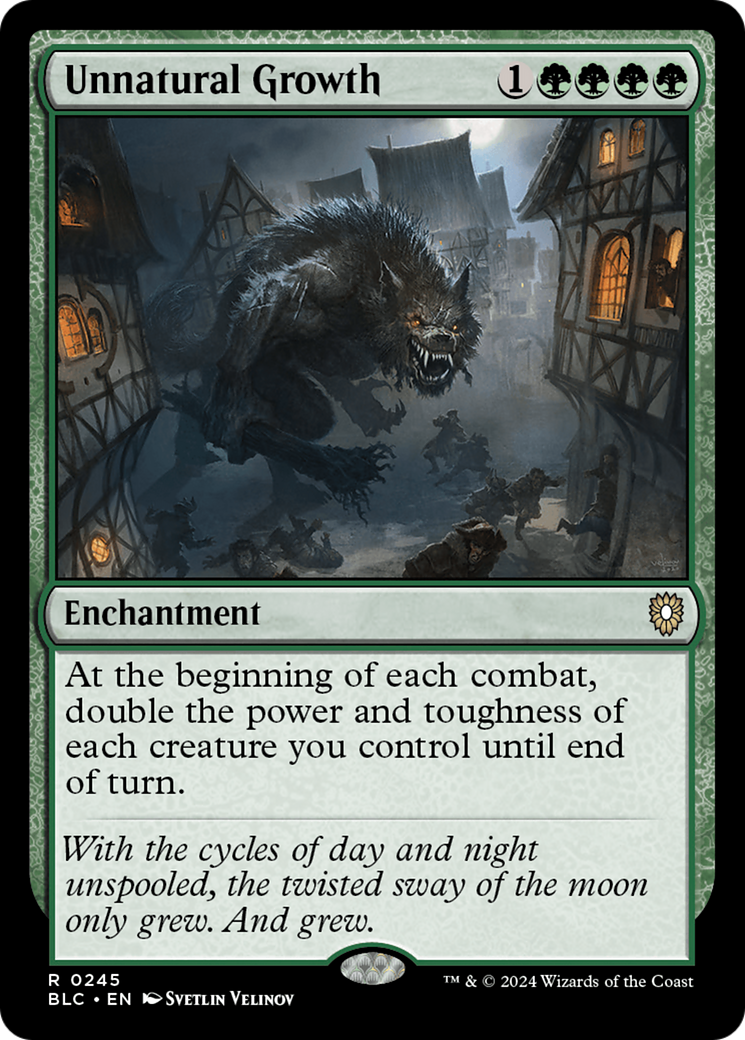
Unnatural Growth
Unnatural Growth
Enchantment
At the beginning of each combat, double the power and toughness of each creature you control until end of turn.
- If an effect instructs you to "double" a creature's power, that creature gets +X/+0, where X is its power as that effect begins to apply. Similarly, a creature whose toughness is doubled gets +0/+X, where X is its toughness as the effect begins to apply.
- If a creature's power is less than 0 when it's doubled, instead that creature gets -X/-0, where X is how much less than 0 its power is. For example, if an effect has given Bear Cub, a 2/2 creature, -4/-0 so that it's a -2/2 creature, doubling its power and toughness gives it -2/+2, and it becomes a -4/4 creature.
- If you control more than one Unnatural Growth, each one applies independently. For example, if you control two copies of Unnatural Growth, a 2/2 Bear Cub becomes a 4/4 creature when the first ability resolves and then becomes an 8/8 creature when the second one resolves.
-
1
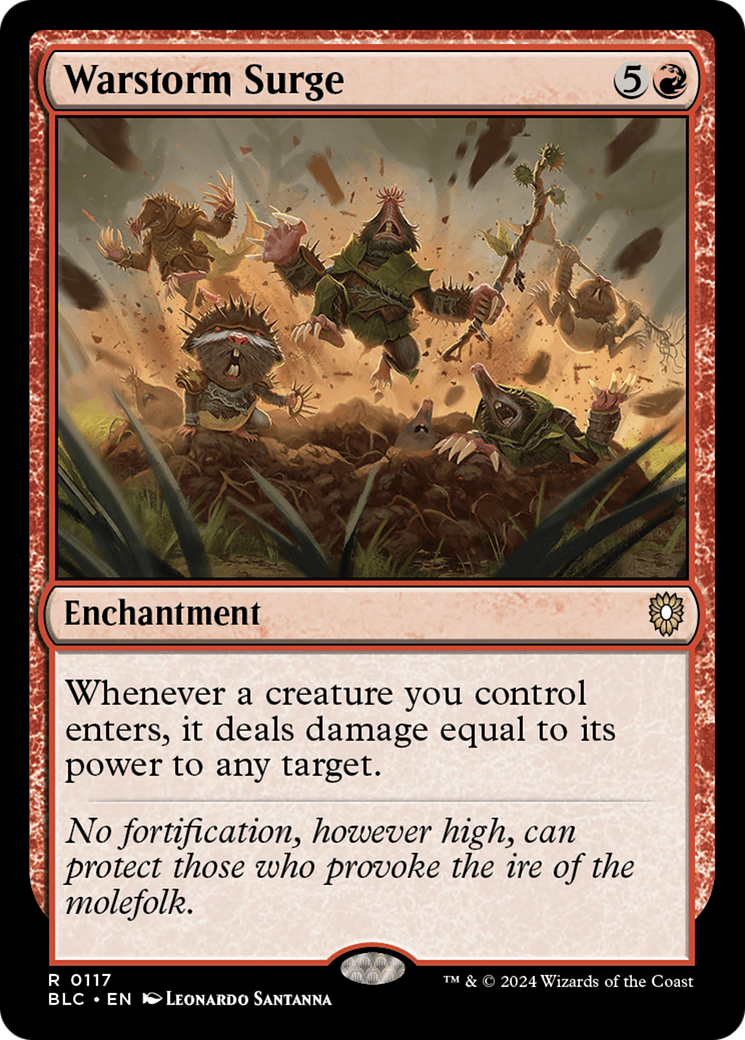
Warstorm Surge
Warstorm Surge
Enchantment
Whenever a creature you control enters, it deals damage equal to its power to any target.
- The creature that entered deals damage equal to its current power to the targeted permanent or player. If it's no longer on the battlefield, its last known existence on the battlefield is checked to determine its power.
- Warstorm Surge is the source of the ability, but the creature is the source of the damage. The ability couldn't target a creature with protection from red, for example. It could target a creature with protection from creatures, but all the damage would be prevented. Since damage is dealt by the creature, abilities like lifelink, deathtouch and infect are taken into account, even if the creature has left the battlefield by the time it deals damage.
Lands 38
-
1
Cinder Glade
Cinder Glade
Land — Mountain Forest
( : Add or .)
This land enters tapped unless you control two or more basic lands.
- Even though these lands have basic land types, they are not basic lands because "basic" doesn't appear on their type line. Notably, controlling two or more of them won't allow others to enter the battlefield untapped.
- However, because these cards have basic land types, effects that specify a basic land type without also specifying that the land be basic can affect them. For example, a spell or ability that reads "Destroy target Forest" can target Canopy Vista, while one that reads "Destroy target basic Forest" cannot.
- If one of these lands enters the battlefield at the same time as any number of basic lands, those other lands are not counted when determining if this land enters the battlefield tapped or untapped.
-
1
Command Tower
Command Tower
Land
: Add one mana of any color in your commander's color identity.
- If you have two commanders, the ability adds one mana of any color in their combined color identities.
- If your commander is a card that has no colors in its color identity, Command Tower's ability produces no mana. It doesn't produce .
- If you don't have a commander, Command Tower's ability produces no mana.
-
1
Copperline Gorge
Copperline Gorge
Land
This land enters tapped unless you control two or fewer other lands.
: Add or .
- If one of these lands enters the battlefield under your control and you control zero, one, or two other lands, it enters the battlefield untapped. If you control three or more other lands, however, it enters the battlefield tapped.
- If one of these lands enters the battlefield at the same time as one or more other lands (due to Oblivion Sower or Warp World, perhaps), it doesn't take those lands into consideration when determining how many other lands you control.
-
1
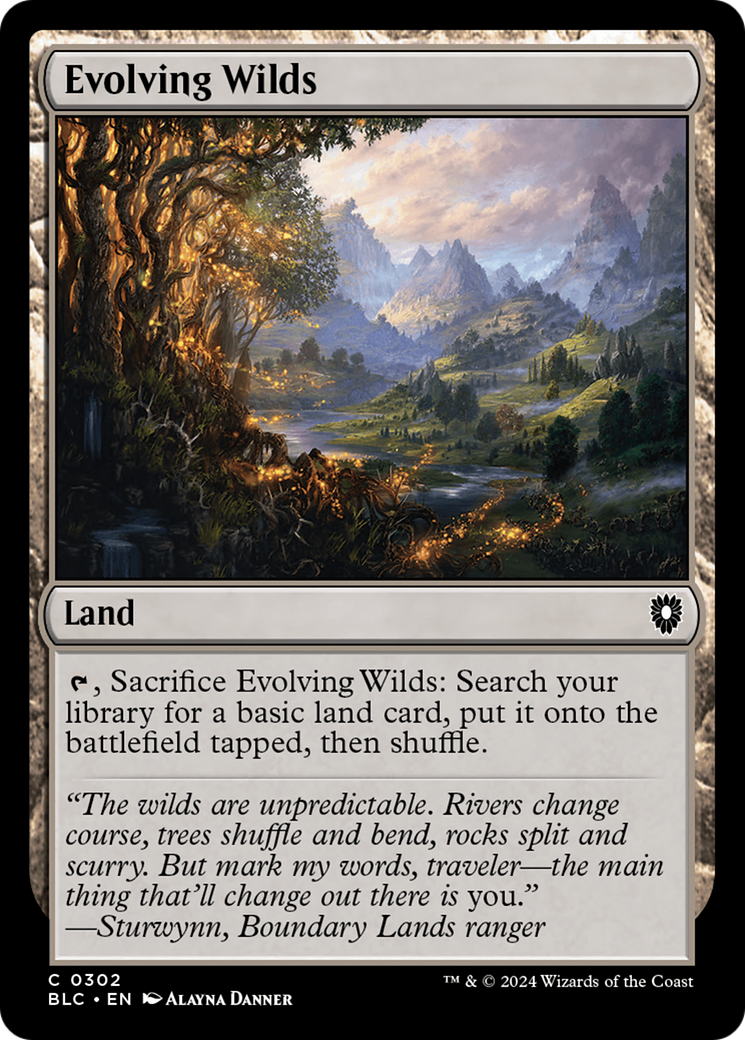
Evolving Wilds
Evolving Wilds
Land
, Sacrifice this land: Search your library for a basic land card, put it onto the battlefield tapped, then shuffle.
-
1
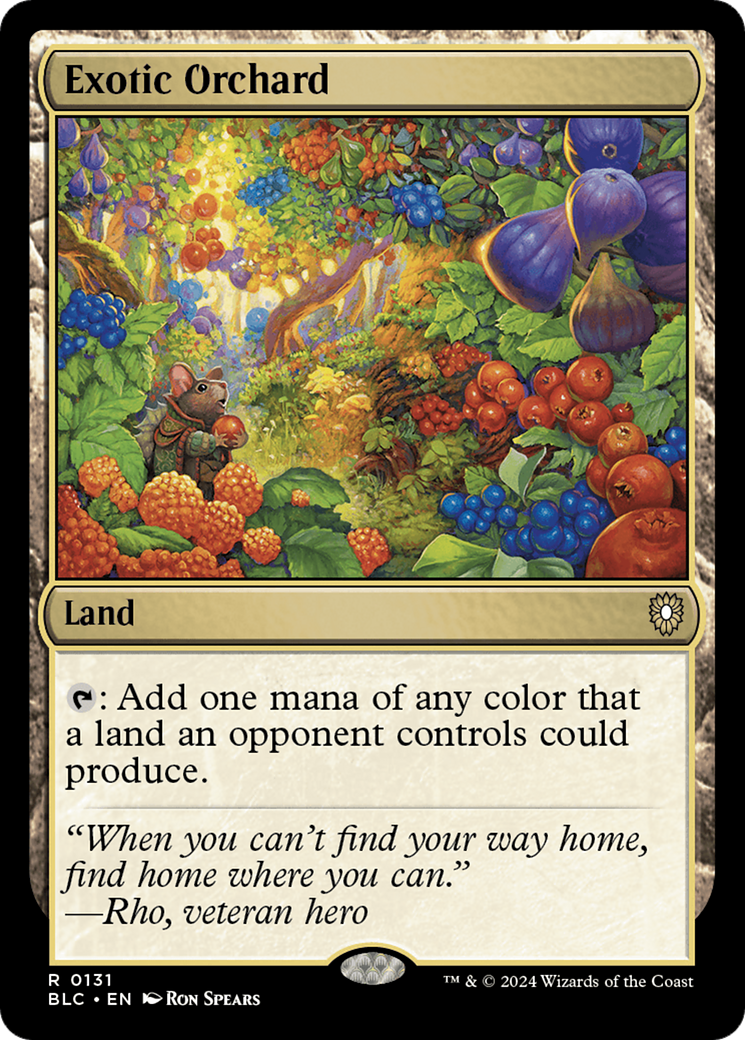
Exotic Orchard
Exotic Orchard
Land
: Add one mana of any color that a land an opponent controls could produce.
- The colors of mana are white, blue, black, red, and green. Exotic Orchard can't be tapped for colorless mana, even if a land an opponent controls could produce colorless mana.
- Exotic Orchard checks the effects of all mana-producing abilities of lands your opponents control, but it doesn't check their costs. For example, Vivid Crag has the ability " , Remove a charge counter from Vivid Crag: Add one mana of any color." If an opponent controls Vivid Crag and you control Exotic Orchard, you can tap Exotic Orchard for any color of mana. It doesn't matter whether Vivid Crag has a charge counter on it, and it doesn't matter whether it's untapped.
- When determining what colors of mana your opponents' lands could produce, Exotic Orchard takes into account any applicable replacement effects that would apply to those lands' mana abilities (such as Contamination's effect, for example). If there are more than one, consider them in any possible order.
- Exotic Orchard doesn't care about any restrictions or riders your opponents' lands (such as Ancient Ziggurat or Hall of the Bandit Lord) put on the mana they produce. It just cares about colors of mana.
- Lands that produce mana based only on what other lands "could produce" won't help each other unless some other land allows one of them to actually produce some type of mana. For example, if you control an Exotic Orchard and your opponent controls an Exotic Orchard and a Reflecting Pool, none of those lands would produce mana if their mana abilities were activated. On the other hand, if you control a Forest and an Exotic Orchard, and your opponent controls an Exotic Orchard and a Reflecting Pool, then each of those lands can be tapped to produce . Your opponent's Exotic Orchard can produce because you control a Forest. Your Exotic Orchard and your opponent's Reflecting Pool can each produce because your opponent's Exotic Orchard can produce .
-
10
Forest
Forest
Basic Land — Forest
( : Add .)
-
1
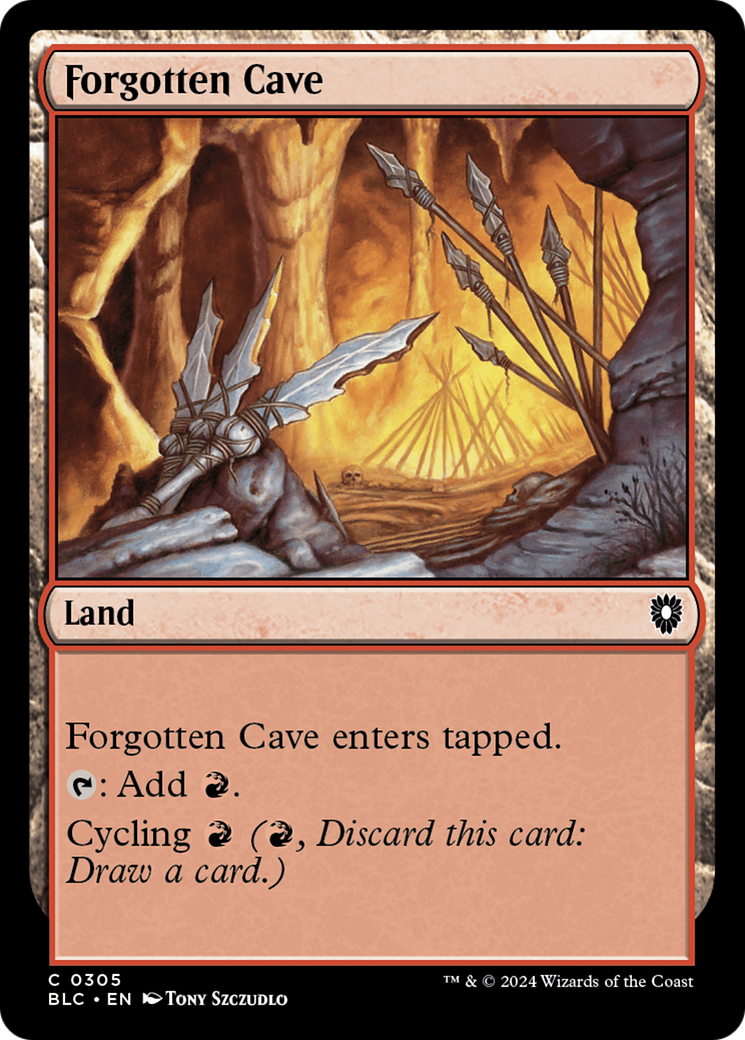
Forgotten Cave
Forgotten Cave
Land
This land enters tapped.
: Add .
Cycling ( , Discard this card: Draw a card.)
-
1
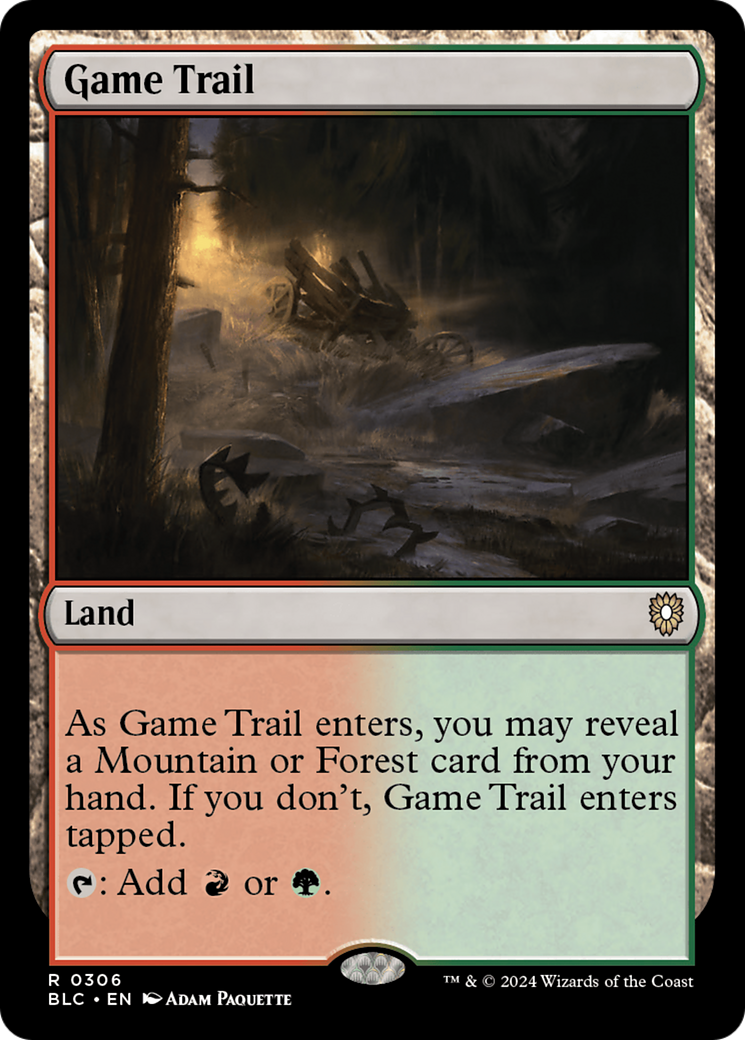
Game Trail
Game Trail
Land
As this land enters, you may reveal a Mountain or Forest card from your hand. If you don't, this land enters tapped.
: Add or .
- You may reveal any land card with either or both of the appropriate subtypes. It doesn't have to be a basic land. For example, you could reveal Canopy Vista from the Battle for Zendikar set to satisfy the ability of Game Trail.
- Lands don't have a subtype just because they can produce mana of the corresponding color. Game Trail itself is neither a Mountain nor a Forest, even though it produces red and green mana, so you can't reveal one to satisfy the ability of another.
- If a Mountain or Forest is entering the battlefield from your hand at the same time as Game Trail, you may reveal the other land to have Game Trail enter untapped.
- If an effect instructs you to put Game Trail onto the battlefield tapped, it will still enter the battlefield tapped even if you reveal a land card from your hand.
-
1
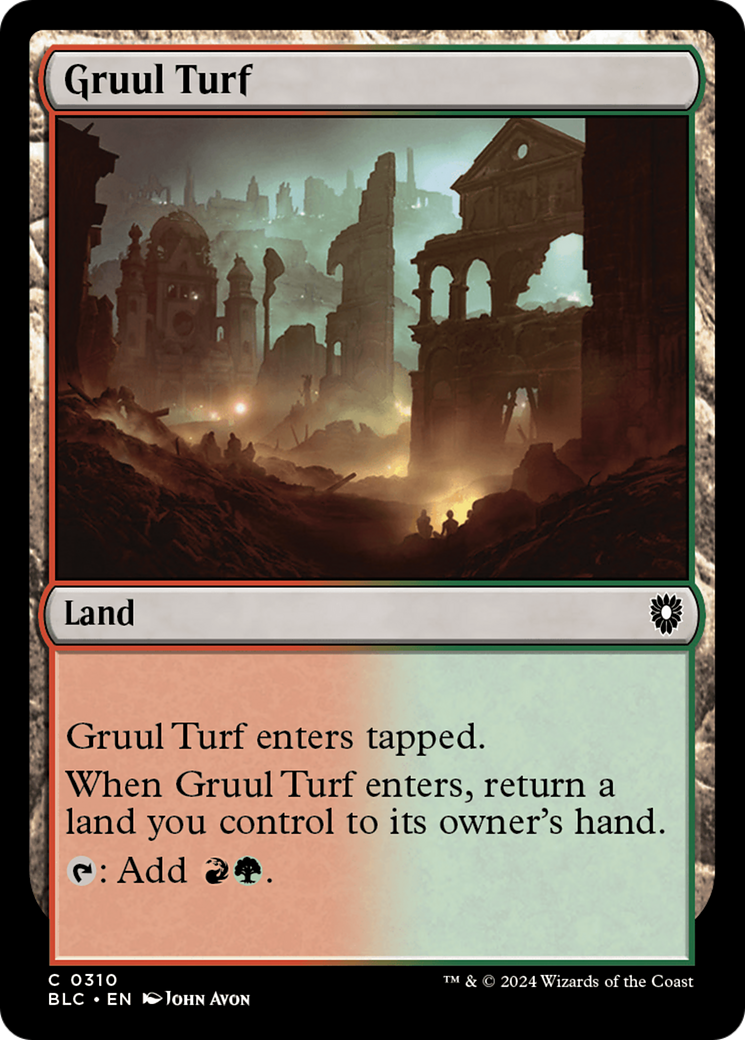
Gruul Turf
Gruul Turf
Land
This land enters tapped.
When this land enters, return a land you control to its owner's hand.
: Add .
- If this land enters the battlefield and you control no other lands, its ability will force you to return it to your hand.
-
1
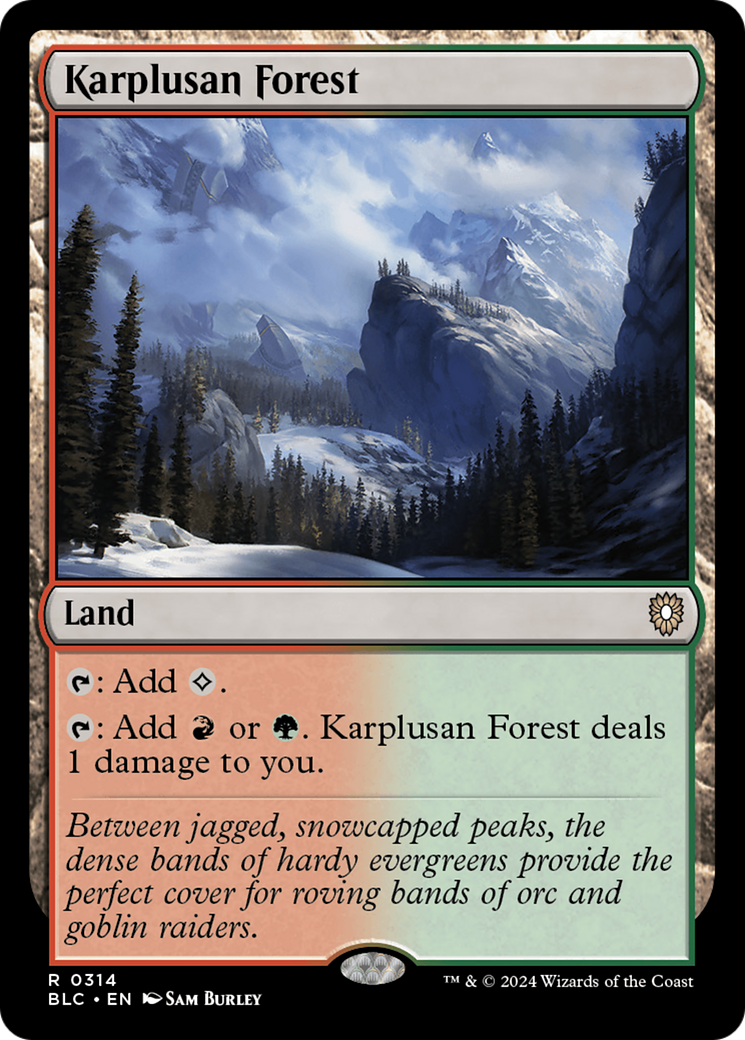
Karplusan Forest
Karplusan Forest
Land
: Add .
: Add or . This land deals 1 damage to you.
-
1
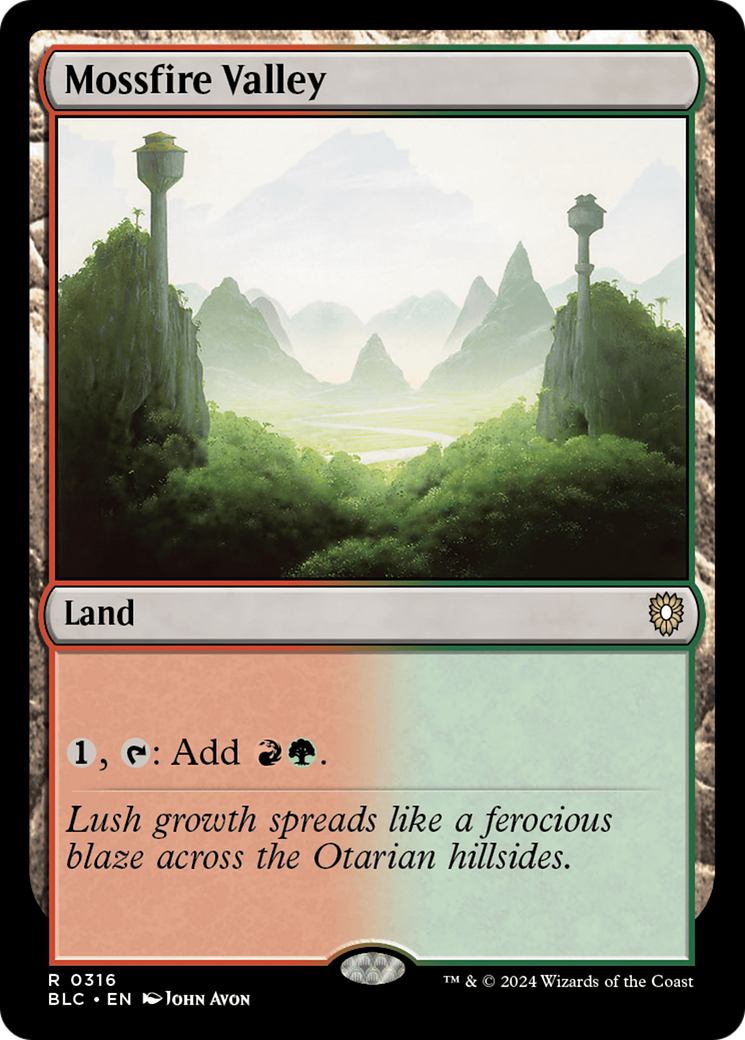
Mossfire Valley
Mossfire Valley
Land
, : Add .
-
1
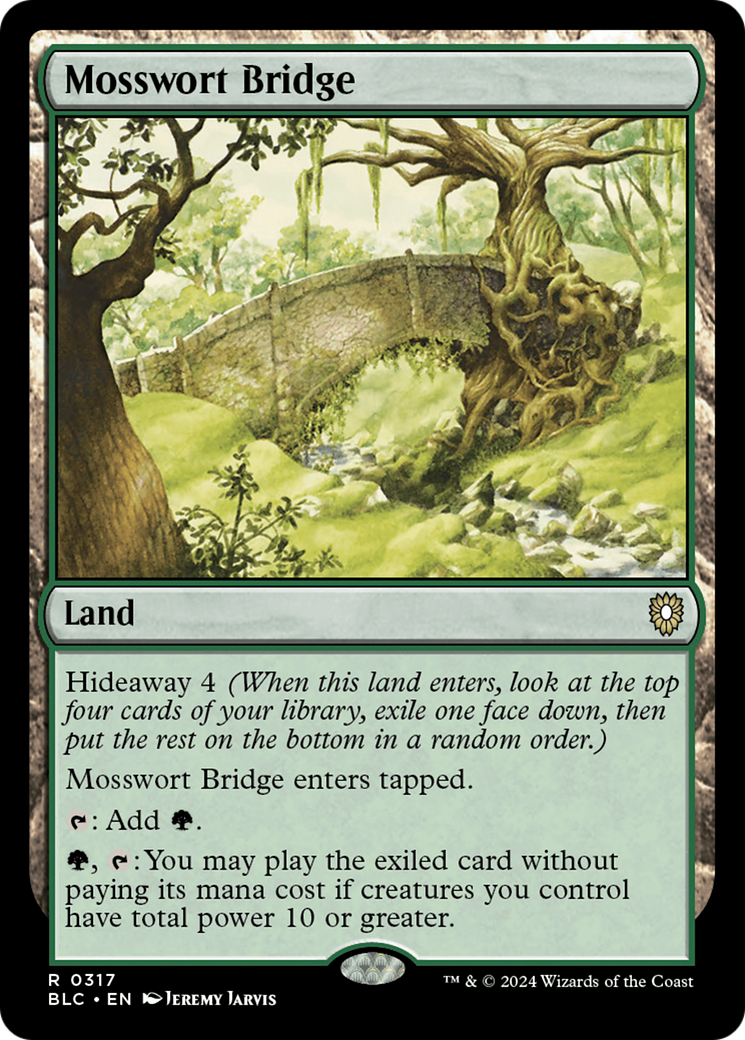
Mosswort Bridge
Mosswort Bridge
Land
Hideaway 4 (When this land enters, look at the top four cards of your library, exile one face down, then put the rest on the bottom in a random order.)
This land enters tapped.
: Add .
, : You may play the exiled card without paying its mana cost if creatures you control have total power 10 or greater.
- "Hideaway N" means "When this permanent enters the battlefield, look at the top N cards of your library. Exile one of them face down and put the rest on the bottom of your library in a random order. The exiled card gains 'The player who controls the permanent that exiled this card may look at this card in the exile zone.'"
- Any player who has controlled a permanent with a hideaway ability since a card was exiled with it may look at that card.
- Previously, permanents with hideaway entered the battlefield tapped. This ability has been removed from the definition of hideaway. Older cards have received errata to have an additional paragraph that reads "[This permanent] enters the battlefield tapped," and they now have hideaway 4.
- Hideaway now causes you to put the rest of the cards on the bottom of your library in a random order instead of any order.
-
8
Mountain
Mountain
Basic Land — Mountain
( : Add .)
-
1
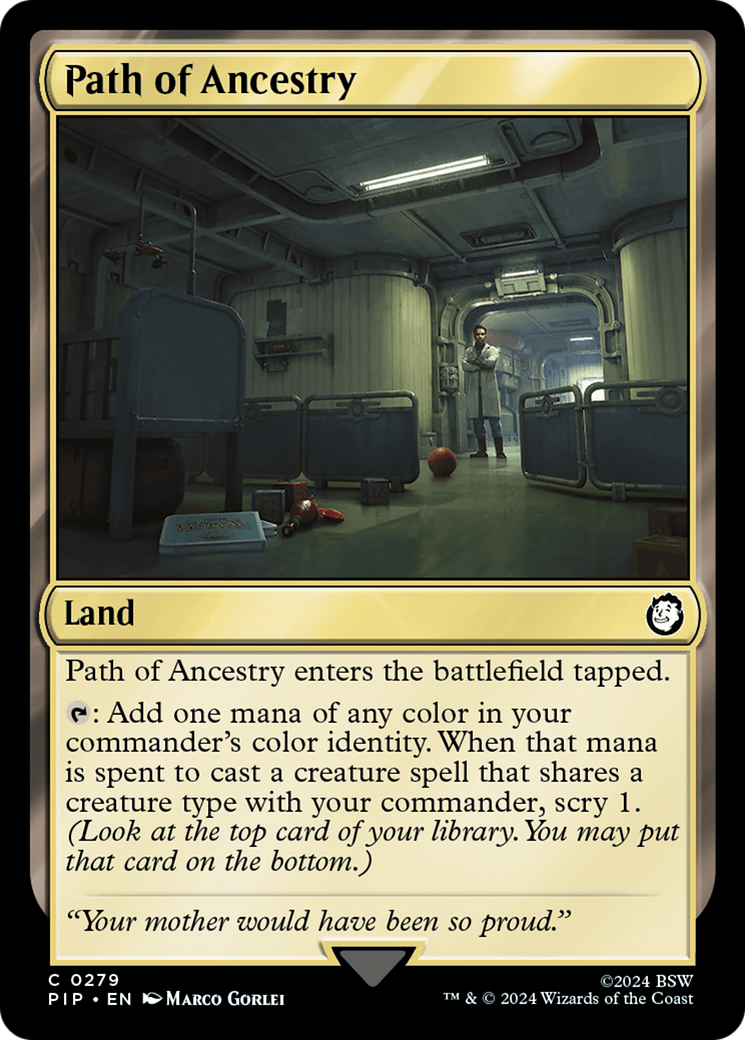
Path of Ancestry
Path of Ancestry
Land
This land enters tapped.
: Add one mana of any color in your commander's color identity. When that mana is spent to cast a creature spell that shares a creature type with your commander, scry 1. (Look at the top card of your library. You may put that card on the bottom.)
- Your commander's creature types are checked immediately after you cast a creature spell spending mana from Path of Ancestry's last ability. They aren't set before the game begins, and they may not be the same types your commander had when you activated that ability.
- If you have two commanders, the last ability adds one mana of any color in their combined color identities. When you spend that mana on a creature spell that shares a creature type with either of your commanders, you'll scry 1.
- If Path of Ancestry's last ability produces two mana (most likely due to Mana Reflection), spending those two mana to cast creature spells that share a creature type with your commander will cause two abilities to trigger. Each of those abilities will cause you to scry 1. You won't scry 2. This is true whether you spend the mana on one creature spell or two.
- If your commander has no creature types, it can't share a creature type with any spell that you cast.
- If you cast your commander with mana from Path of Ancestry, and your commander hasn't somehow lost all of its creature types while on the stack, you'll scry 1.
- If you don't have a commander, Path of Ancestry's ability produces no mana.
- If your commander is a card that has no colors in its color identity, Path of Ancestry's ability produces no mana. It doesn't produce .
-
1
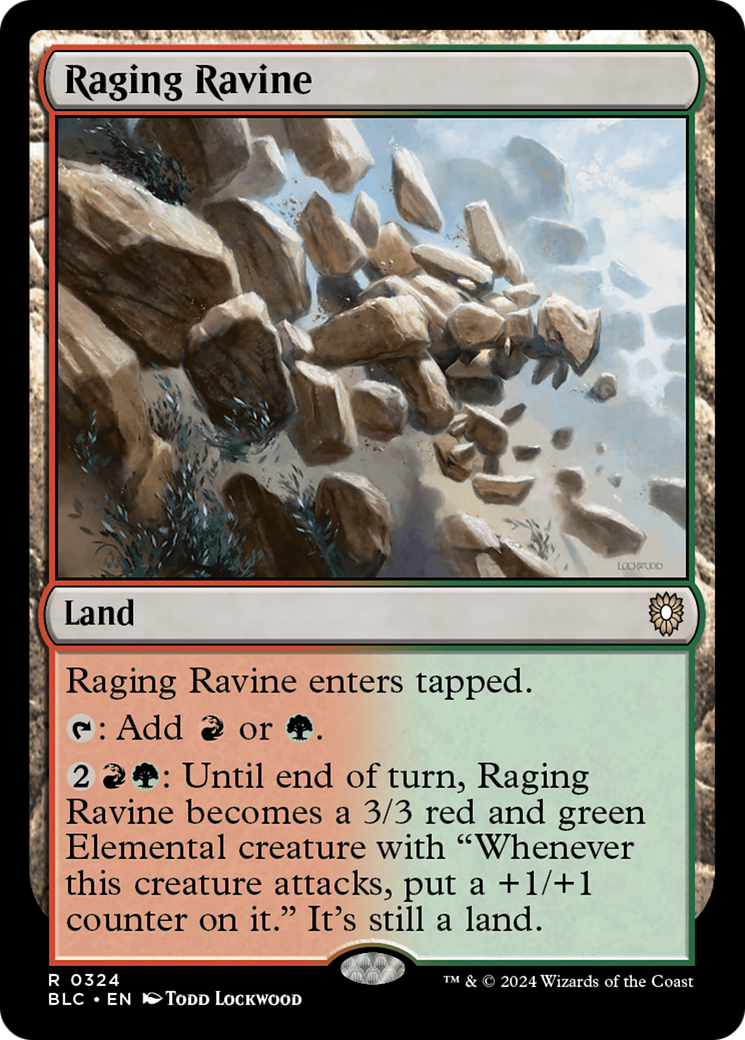
Raging Ravine
Raging Ravine
Land
This land enters tapped.
: Add or .
: Until end of turn, this land becomes a 3/3 red and green Elemental creature with "Whenever this creature attacks, put a +1/+1 counter on it." It's still a land.
- Each time you activate Raging Ravine's last ability, it gains an instance of the triggered ability. For example, if you activate the last ability twice and then attack with Raging Ravine, both of the triggered abilities it gained will trigger. It will get a total of two +1/+1 counters.
- Any +1/+1 counters put on Raging Ravine remain on it even after it stops being a creature. They'll have no effect until it becomes a creature again.
- A land that becomes a creature may be affected by "summoning sickness." You can't attack with it or use any of its abilities (including its mana abilities) unless it began your most recent turn on the battlefield under your control. Note that summoning sickness cares about when that permanent came under your control, not when it became a creature.
- When a land becomes a creature, that doesn't count as having a creature enter. The permanent was already on the battlefield; it only changed its types. Abilities that trigger whenever a creature enters won't trigger.
-
1
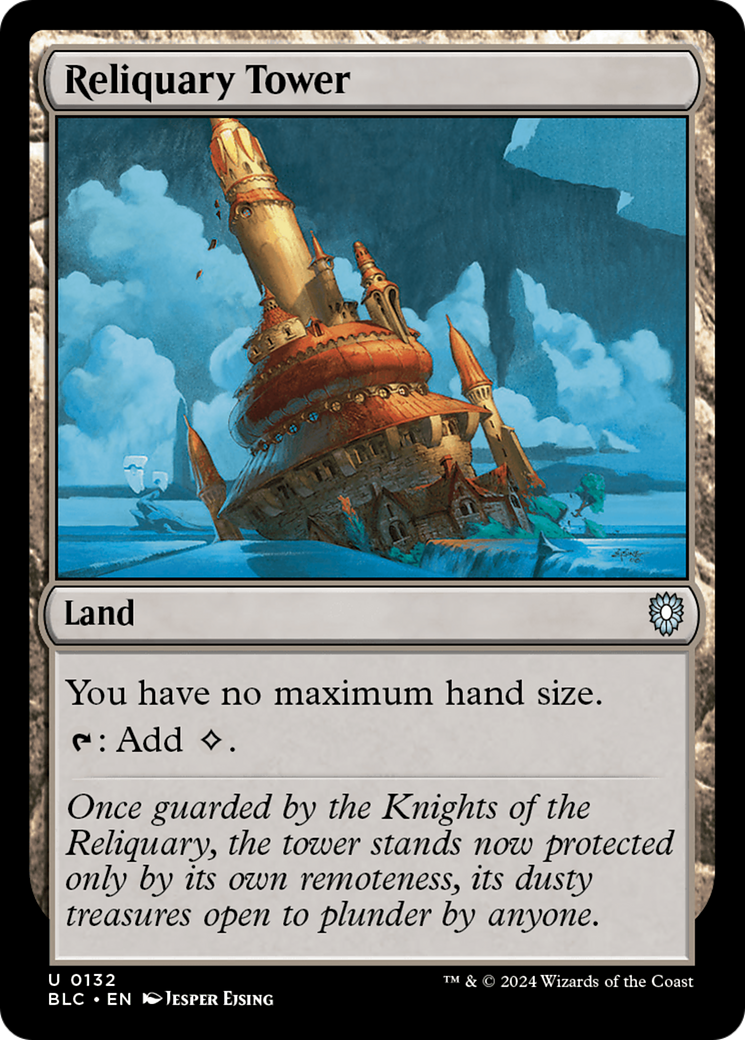
Reliquary Tower
Reliquary Tower
Land
You have no maximum hand size.
: Add .
- If multiple effects modify your hand size, apply them in timestamp order. For example, if you put Null Profusion (an enchantment that says your maximum hand size is two) onto the battlefield and then put Reliquary Tower onto the battlefield, you'll have no maximum hand size. However, if those permanents enter in the opposite order, your maximum hand size would be two.
-
1
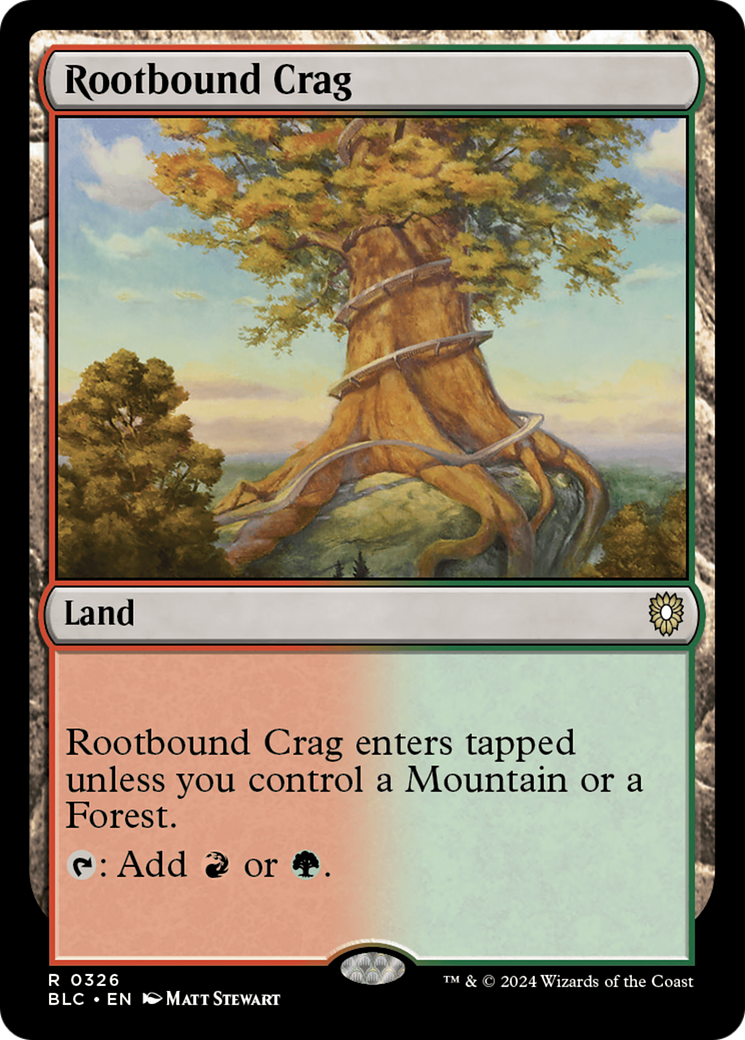
Rootbound Crag
Rootbound Crag
Land
This land enters tapped unless you control a Mountain or a Forest.
: Add or .
- This checks for lands you control with the land type Mountain or Forest, not for lands named Mountain or Forest. The lands it checks for don't have to be basic lands. For example, if you control Temple Garden (a nonbasic land with the land types Forest and Plains), Rootbound Crag will enter untapped.
- As this is entering, it checks for lands that are already on the battlefield. It won't see lands that are entering at the same time (due to Warp World, for example).
-
1
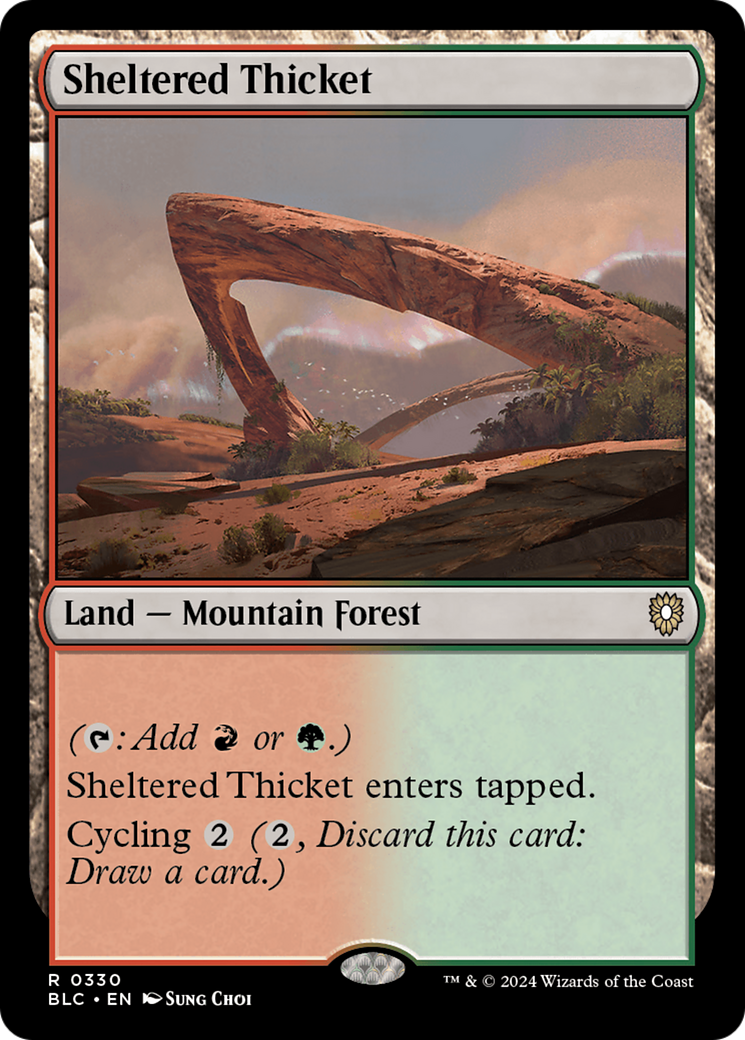
Sheltered Thicket
Sheltered Thicket
Land — Mountain Forest
( : Add or .)
This land enters tapped.
Cycling ( , Discard this card: Draw a card.)
-
1
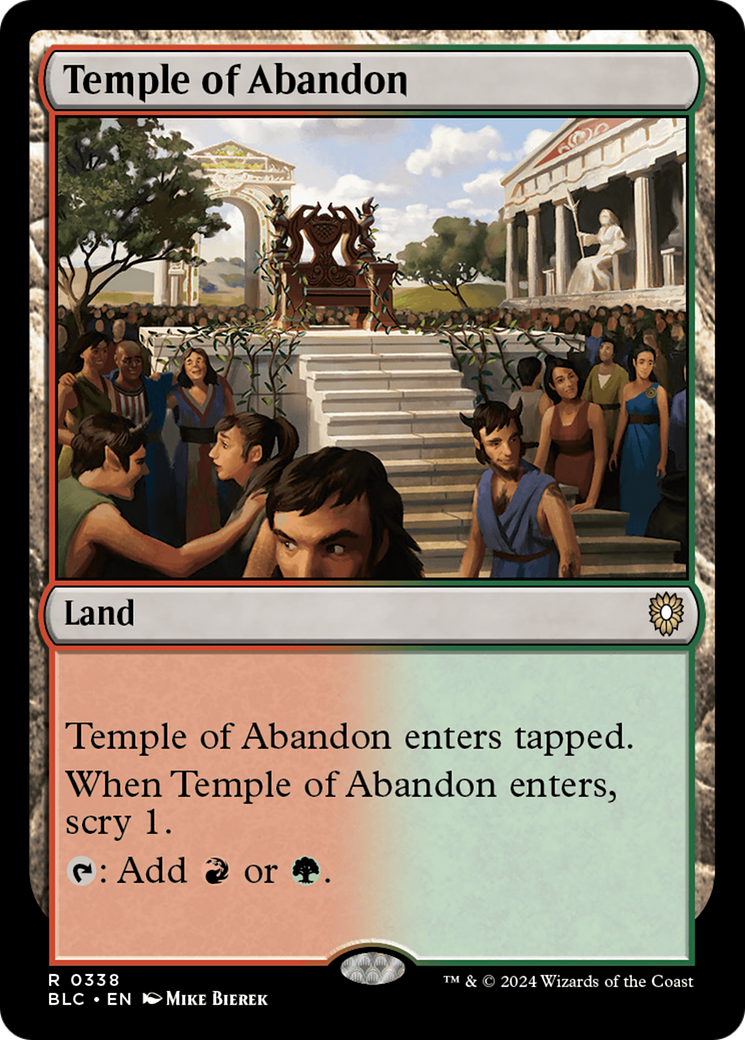
Temple of Abandon
Temple of Abandon
Land
This land enters tapped.
When this land enters, scry 1. (Look at the top card of your library. You may put that card on the bottom.)
: Add or .
- You perform the actions stated on a card in sequence. For some spells and abilities, that means you'll scry last. For others, that means you'll scry and then perform other actions.
- When you scry, you may put all the cards you look at back on top of your library, you may put all of those cards on the bottom of your library, or you may put some of those cards on top and the rest of them on the bottom.
- You choose how to order cards returned to your library after scrying no matter where you put them.
- Scry appears on some spells and abilities with one or more targets. If all of the spell or ability's targets are illegal when it tries to resolve, it won't resolve and none of its effects will happen. You won't scry.
-
1
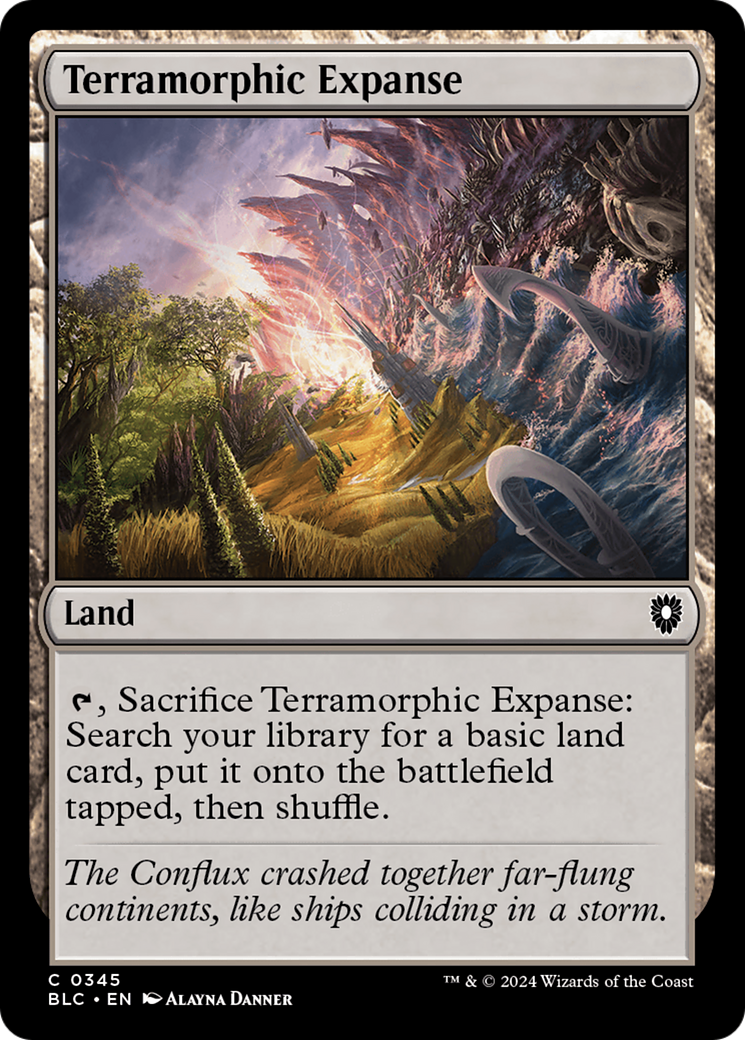
Terramorphic Expanse
Terramorphic Expanse
Land
, Sacrifice this land: Search your library for a basic land card, put it onto the battlefield tapped, then shuffle.
-
1
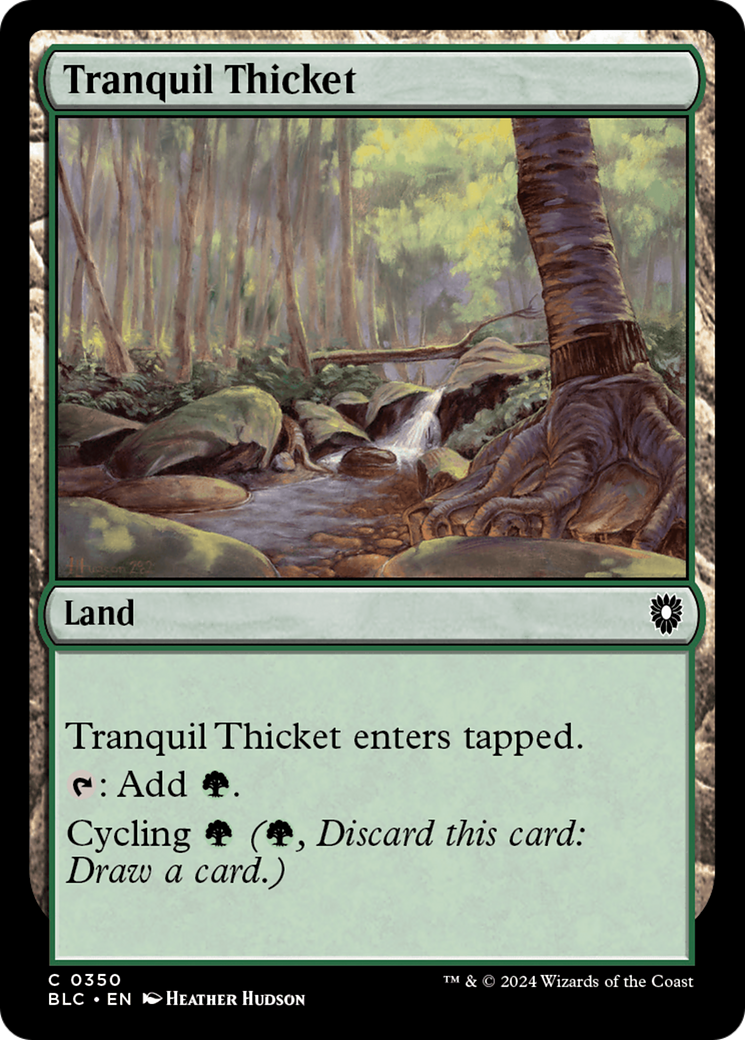
Tranquil Thicket
Tranquil Thicket
Land
This land enters tapped.
: Add .
Cycling ( , Discard this card: Draw a card.)
-
1
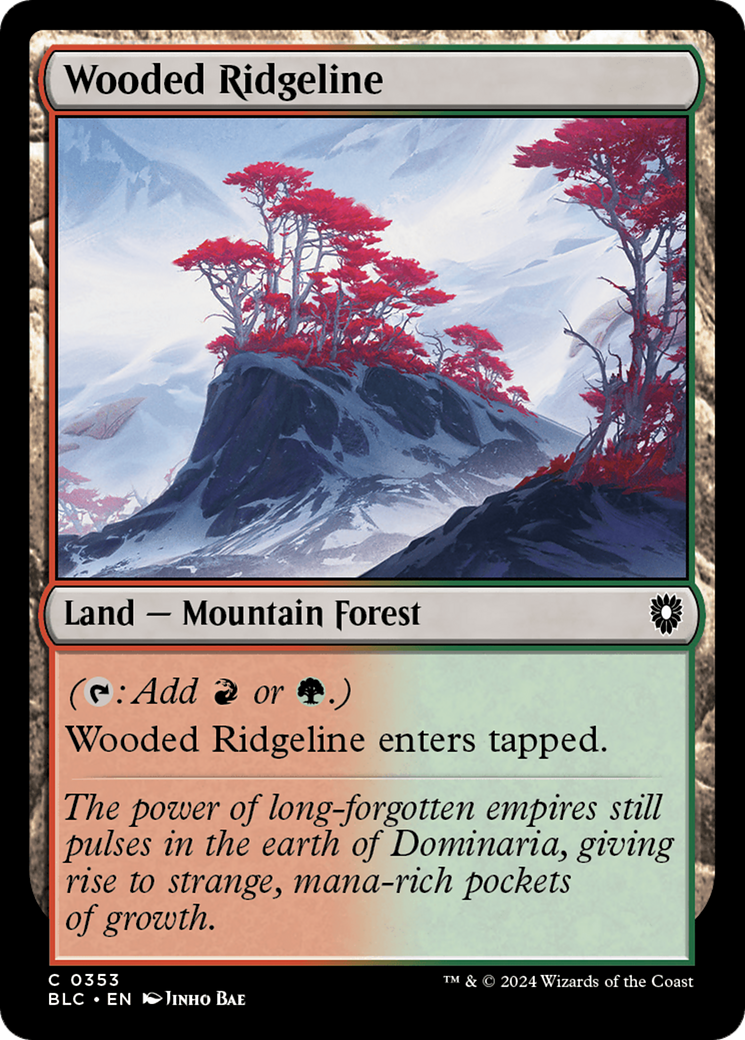
Wooded Ridgeline
Wooded Ridgeline
Land — Mountain Forest
( : Add or .)
This land enters tapped.
Red 16
-
1
Abrade
Abrade
Instant
Choose one —
- Abrade deals 3 damage to target creature.
- Destroy target artifact.
-
1
Alchemist's Talent
Alchemist's Talent
Enchantment — Class
(Gain the next level as a sorcery to add its ability.)
When this Class enters, create two tapped Treasure tokens.
: Level 2
Treasures you control have " , Sacrifice this artifact: Add two mana of any one color."
: Level 3
Whenever you cast a spell, if mana from a Treasure was spent to cast it, this Class deals damage equal to that spell's mana value to each opponent.
- If a spell has in its mana cost, use the value chosen for X to determine that spell's mana value.
- Each Class has five abilities. The three in the major sections of its text box are class abilities. Class abilities can be static, activated, or triggered abilities. The other two are level abilities, one activated ability to advance the Class to level 2 and another to advance the Class to level 3.
- Each Class starts with only the first of its three class abilities. As the first level ability resolves, the Class becomes level 2 and gains the second class ability. As the second level ability resolves, the Class becomes level 3 and gains the third class ability.
- Gaining a level won't remove abilities that a Class had at a previous level.
- Gaining a level is a normal activated ability. It uses the stack and can be responded to.
- You can't activate the first level ability of a Class unless that Class is level 1. Similarly, you can't activate the second level ability of a Class unless that Class is level 2.
- There's no restriction on how many Class permanents you can control, whether they're the same or different classes. Each Class permanent tracks its own level separately.
-
1
Berserkers' Onslaught
Berserkers' Onslaught
Enchantment
Attacking creatures you control have double strike.
-
1
Big Score
Big Score
Instant
As an additional cost to cast this spell, discard a card.
Draw two cards and create two Treasure tokens. (They're artifacts with " , Sacrifice this token: Add one mana of any color.")
-
1
Blasphemous Act
Blasphemous Act
Sorcery
This spell costs less to cast for each creature on the battlefield.
Blasphemous Act deals 13 damage to each creature.
- To determine the total cost of a spell, start with the mana cost or alternative cost you're paying, add any cost increases, then apply any cost reductions (such as that of Blasphemous Act). The mana value of the spell is determined only by its mana cost, no matter what the total cost to cast the spell was.
- Blasphemous Act's ability can't reduce the total cost to cast the spell below .
- The total cost to cast Blasphemous Act is locked in before you pay that cost. For example, if there are three creatures on the battlefield, including one you can sacrifice to add , the total cost of Blasphemous Act is . Then you can sacrifice the creature when you activate mana abilities just before paying the cost.
- Although players may respond to Blasphemous Act once it's been cast, once it's announced, they can't respond before the cost is calculated and paid.
-
1
Chaos Warp
Chaos Warp
Instant
The owner of target permanent shuffles it into their library, then reveals the top card of their library. If it's a permanent card, they put it onto the battlefield.
- The owner of a token is the player under whose control the token was put onto the battlefield. If a token is shuffled into a player's library this way, that player shuffles before revealing the top card of that library.
- If the permanent is an illegal target by the time Chaos Warp tries to resolve, it won't resolve and none of its effects will occur. No library will be shuffled and no card will be revealed.
- A permanent card is a card with one or more of the following card types: artifact, creature, enchantment, land, or planeswalker.
- If the revealed card is a permanent card but can't enter (perhaps because it's an Aura with nothing to enchant), it remains on top of that library.
- If the revealed card is not a permanent card, it remains on top of that library.
-
1
Etali, Primal Storm
Etali, Primal Storm
Legendary Creature — Elder Dinosaur
6/6
Whenever Etali attacks, exile the top card of each player's library, then you may cast any number of spells from among those cards without paying their mana costs.
- If an exiled card has in its mana cost, you must choose 0 as the value of X when casting it without paying its mana cost.
- If you cast any of the exiled cards, you do so as part of the resolution of the triggered ability. You can't wait to cast them later in the turn. Timing permissions based on a card's type are ignored, and the spells resolve before blockers are declared.
- If you cast a card "without paying its mana cost," you can't pay any alternative costs. You can, however, pay additional costs. If the card has any mandatory additional costs, those must be paid to cast the card.
- If you cast more than one of the exiled cards, you choose the order in which to cast them. A spell you cast this way can be the target of a later spell you cast this way. However, permanent spells cast this way won't resolve until you're done casting spells, so the permanents they become can't be the target of spells cast this way. For example, if you exile Twincast and Lightning Strike, you can cast Lightning Strike and then cast Twincast targeting it; but if you exile a creature card and an Aura card, you can't cast that Aura targeting that creature.
- Any cards not cast, including land cards, remain in exile. They can't be cast on later turns, even if Etali attacks again.
- Because all attacking creatures are chosen at once, a creature cast this way can't attack during the same combat as Etali, even if it has haste.
- In a multiplayer game, if a player leaves the game, all cards that player owns leave as well. If you leave the game, any spells or permanents you control from Etali's ability are exiled.
-
1
Gratuitous Violence
Gratuitous Violence
Enchantment
If a creature you control would deal damage to a permanent or player, it deals double that damage instead.
-
1
Outpost Siege
Outpost Siege
Enchantment
As this enchantment enters, choose Khans or Dragons.
- Khans — At the beginning of your upkeep, exile the top card of your library. Until end of turn, you may play that card.
- Dragons — Whenever a creature you control leaves the battlefield, this enchantment deals 1 damage to any target.
- The card exiled by the "Khans" ability is exiled face up. Playing a card exiled with the "Khans" ability follows the normal rules for playing the card. You must pay its costs, and you must follow all applicable timing rules. For example, if it's a creature card, you can cast it only during your main phase while the stack is empty.
- If you exile a land card using the "Khans" ability, you may play that land only if you have any available land plays. Normally, this means you can play the land only if you haven't played a land yet that turn.
- If a noncreature card is manifested and then leaves the battlefield while face down, the "Dragons" ability will trigger.
- Each Siege will have one of the two listed abilities, depending on your choice as it enters the battlefield.
- The words "Khans" and "Dragons" are anchor words, connecting your choice to the appropriate ability. Anchor words are a new rules concept. "[Anchor word] — [Ability]" means "As long as you chose [anchor word] as this permanent entered the battlefield, this permanent has [ability]." Notably, the anchor word "Dragons" has no connection to the creature type Dragon.
- Each of the last two abilities is linked to the first ability. They each refer only to the choice made as a result of the first ability. If a permanent enters the battlefield as a copy of one of the Sieges, its controller will make a new choice for that Siege. Which ability the copy has won't depend on the choice made for the original permanent.
-
1
Prosperous Bandit
Prosperous Bandit
Creature — Raccoon Rogue
2/2
Offspring (You may pay an additional as you cast this spell. If you do, when this creature enters, create a 1/1 token copy of it.)
First strike
Whenever this creature deals combat damage to a player, create that many tapped Treasure tokens.
- In the rare case where the original creature is copying something else when the offspring ability resolves, the token enters as whatever that creature copied, except it's a 1/1.
- You can pay an offspring cost only once as you cast a spell with offspring. You can't try to pay it multiple times to get more token copies.
- If the spell is countered, the offspring ability will not trigger, and no token will be created.
- If the spell resolves but the creature with offspring leaves the battlefield before the offspring ability resolves, you'll still create a token copy of it.
- The token copies exactly what was printed on the original creature and nothing else, except it's a 1/1 (unless that creature is copying something else; see below). It doesn't copy whether that creature is tapped or untapped, whether it has any counters on it or Auras and Equipment attached to it, or any non-copy effects that have changed its types, color, or so on.
- Many creatures with offspring abilities have other abilities that refer to them as "this creature" rather than referring to them by name. This difference is for clarity purposes and does not change the function of any of these abilities.
- Any "enters" abilities of the copied creature will trigger when the token enters. Any "as [this creature] enters" or "[this creature] enters with" abilities of the copied creature will also work.
- The token created by the offspring ability isn't "cast", so abilities that trigger when a creature spell is cast won't trigger for the copy.
- In the rare case where the creature doesn't have the offspring ability when it enters, the ability won't trigger even if you paid the offspring cost.
-
1
Pyreswipe Hawk
Pyreswipe Hawk
Creature — Elemental Bird
4/4
Flying, haste
Whenever this creature attacks, it gets +X/+0 until end of turn, where X is the greatest mana value among artifacts you control.
Whenever you expend 6, gain control of up to one target artifact for as long as you control this creature. (You expend 6 as you spend your sixth total mana to cast spells during a turn.)
- The value of X is calculated only once, as Pyreswipe Hawk's third ability resolves.
- If Pyreswipe Hawk leaves the battlefield before its last ability resolves, control of the target artifact won't change at all.
- Abilities that trigger whenever you "expend N" only trigger when you reach that specific amount of mana spent on casting spells that turn. This can only happen once per turn. For example, if you've spent three mana on spells so far this turn and you control a permanent with an ability that triggers "whenever you expend 4," that ability will trigger the next time you spend at least one mana to cast a spell this turn. It won't trigger again if you spend another four mana to cast spells later in the turn.
- If the cost to cast a spell is increased, decreased, or changed because of additional or alternative costs, expend counts only the mana you actually spent.
- A permanent with an ability that triggers whenever you "expend N" will see mana you spent to cast spells the turn it enters, including mana you spent before it entered. For example, if you cast Junkblade Bruiser (a creature with a mana value of 5 and an ability that triggers whenever you expend 4) by paying its full cost of five mana, you'll already have spent four mana on spells before Junkblade Bruiser enters, and therefore its ability that triggers whenever you expend 4 won't be able to trigger at all that turn.
-
1
Rain of Riches
Rain of Riches
Enchantment
When this enchantment enters, create two Treasure tokens.
The first spell you cast each turn that mana from a Treasure was spent to cast has cascade. (When you cast the spell, exile cards from the top of your library until you exile a nonland card that costs less. You may cast it without paying its mana cost. Put the exiled cards on the bottom in a random order.)
-
1
Starstorm
Starstorm
Instant
Starstorm deals X damage to each creature.
Cycling ( , Discard this card: Draw a card.)
- Cycling is an activated ability. Effects that interact with activated abilities (such as Stifle or Rings of Brighthearth) will interact with cycling. Effects that interact with spells (such as Remove Soul or Faerie Tauntings) will not.
-
1
Sunbird's Invocation
Sunbird's Invocation
Enchantment
Whenever you cast a spell from your hand, reveal the top X cards of your library, where X is that spell's mana value. You may cast a spell with mana value X or less from among cards revealed this way without paying its mana cost. Put the rest on the bottom of your library in a random order.
- If a revealed card in your library has in its mana cost, you must choose 0 as the value of X when casting it without paying its mana cost.
- For spells with in their mana costs, use the value chosen for X to determine the spell's mana value.
- If the spell's mana value is 0, you do nothing as the ability of Sunbird's Invocation resolves.
- Casting Sunbird's Invocation won't cause its own ability to trigger.
- The ability of Sunbird's Invocation resolves before the spell that caused it to trigger. It will resolve even if that spell is countered. If you cast a spell as part of the resolution of the ability, that spell resolves before the spell that caused the ability to trigger.
- If you cast one of the revealed cards, you do so as part of the resolution of the triggered ability. You can't wait to cast it later in the turn. Timing permissions based on the card's type are ignored, but other restrictions (such as "Cast [this card] only during combat") are not.
- If you cast a card "without paying its mana cost," you can't pay any alternative costs. You can, however, pay additional costs. If the card has any mandatory additional costs, such as that of Costly Plunder, those must be paid to cast the card.
- The mana value of a split card, such as cards with aftermath from the Amonkhet block, is based on the combined mana cost of its two halves. The mana value of the resulting spell is based only on the half you cast.
-
1
Teapot Slinger
Teapot Slinger
Creature — Raccoon Warrior
3/4
Menace
Whenever you expend 4, this creature deals 2 damage to each opponent. (You expend 4 as you spend your fourth total mana to cast spells during a turn.)
- Abilities that trigger whenever you “expend N” only trigger when you reach that specific amount of mana spent on casting spells that turn. This can only happen once per turn. For example, if you’ve spent three mana on spells so far this turn and you control a permanent with an ability that triggers “whenever you expend 4,” that ability will trigger the next time you spend at least one mana to cast a spell this turn. It won’t trigger again if you spend another four mana to cast spells later in the turn.
- If the cost to cast a spell is increased, decreased, or changed because of additional or alternative costs, expend counts only the mana you actually spent.
- A permanent with an ability that triggers whenever you “expend N” will see mana you spent to cast spells the turn it enters, including mana you spent before it entered. For example, if you cast Junkblade Bruiser (a creature with a mana value of 5 and an ability that triggers whenever you expend 4) by paying its full cost of five mana, you’ll already have spent four mana on spells before Junkblade Bruiser enters, and therefore its ability that triggers whenever you expend 4 won’t be able to trigger at all that turn.
-
1
Warstorm Surge
Warstorm Surge
Enchantment
Whenever a creature you control enters, it deals damage equal to its power to any target.
- The creature that entered deals damage equal to its current power to the targeted permanent or player. If it's no longer on the battlefield, its last known existence on the battlefield is checked to determine its power.
- Warstorm Surge is the source of the ability, but the creature is the source of the damage. The ability couldn't target a creature with protection from red, for example. It could target a creature with protection from creatures, but all the damage would be prevented. Since damage is dealt by the creature, abilities like lifelink, deathtouch and infect are taken into account, even if the creature has left the battlefield by the time it deals damage.
Green 27
-
1
Beast Within
Beast Within
Instant
Destroy target permanent. Its controller creates a 3/3 green Beast creature token.
- If the target permanent is an illegal target by the time Beast Within tries to resolve, the spell won't resolve. No player creates a Beast token. If the target is legal but not destroyed (most likely because it has indestructible), its controller does create a Beast token.
- If the permanent is still a legal target but is not destroyed (perhaps because it regenerated or has indestructible), its controller still gets the Beast token.
-
1
Bootleggers' Stash
Bootleggers' Stash
Artifact
Lands you control have " : Create a Treasure token."
-
1
Brightcap Badger // Fungus Frolic
//
Brightcap Badger
Creature — Badger Druid
3/4
- An adventurer card is a permanent card in every zone except the stack, as well as while on the stack if not cast as an Adventure. Ignore its alternative characteristics in those cases. For example, while it's in your graveyard, Brightcap Badger is a green creature card whose mana value is 4.
- When casting a spell as an Adventure, use the alternative characteristics and ignore all of the card's normal characteristics. The spell's color, mana cost, mana value, and so on are determined by only those alternative characteristics. If the spell leaves the stack, it immediately resumes using its normal characteristics.
- If you cast an adventurer card as an Adventure, use only its alternative characteristics to determine whether it's legal to cast that spell. For example, if you control Johann, Apprentice Sorcerer ("Once each turn, you may cast an instant or sorcery spell from the top of your library") and Brightcap Badger is on top of your library, you can cast Fungus Frolic, but not Brightcap Badger.
- If a spell is cast as an Adventure, its controller exiles it instead of putting it into its owner's graveyard as it resolves. For as long as it remains exiled, that player may cast it as a permanent spell. If an Adventure spell leaves the stack in any way other than resolving (most likely by being countered or by failing to resolve because its targets have all become illegal), that card won't be exiled and the spell's controller won't be able to cast it as a permanent later.
- If an adventurer card ends up in exile for any other reason than by exiling itself while resolving, it won't give you permission to cast it as a permanent spell.
- You must still follow any timing restrictions and permissions for the permanent spell you cast from exile. Normally, you'll be able to cast it only during your main phase while the stack is empty.
- If an effect copies an Adventure spell, that copy is exiled as it resolves. It ceases to exist as a state-based action; it's not possible to cast the copy as a permanent.
- An effect may refer to a card, spell, or permanent that "has an Adventure." This refers to a card, spell, or permanent that has an adventurer card's set of alternative characteristics, even if they're not being used and even if that card was never cast as an Adventure.
- If an effect refers to a card, spell, or permanent that has an Adventure, it won't find an instant or sorcery spell on the stack that's been cast as an Adventure.
- If an object becomes a copy of an object that has an Adventure, the copy also has an Adventure. If it changes zones, it will either cease to exist (if it's a token) or cease to be a copy (if it's a nontoken permanent), and so you won't be able to cast it as an Adventure.
- If an effect instructs you to choose a card name, you may choose the alternative Adventure name. Consider only the alternative characteristics to determine whether that is an appropriate name to choose.
- Casting a card as an Adventure isn't casting it for an alternative cost. Effects that allow you to cast a spell for an alternative cost or without paying its mana cost may allow you to apply those to the Adventure.
-
1
Cultivate
Cultivate
Sorcery
Search your library for up to two basic land cards, reveal those cards, put one onto the battlefield tapped and the other into your hand, then shuffle.
- If you choose to find only one basic land card, you put it onto the battlefield tapped.
-
1
Esika's Chariot
Esika's Chariot
Legendary Artifact — Vehicle
4/4
When Esika's Chariot enters, create two 2/2 green Cat creature tokens.
Whenever Esika's Chariot attacks, create a token that's a copy of target token you control.
Crew 4
- The token you create copies the original characteristics of the token it's copying as stated by the effect that created that token. The newly created token doesn't copy whether the original token is tapped or untapped, whether it has any counters on it, whether it has any Auras and/or Equipment attached to it, or any non-copy effects that changed its power, toughness, types, color, and so on. Notably, the token you create won't be attacking, even if the original token is.
- If the original token is copying something else, the token you create will use the copiable values of the original token. In most cases, it will be a copy of whatever the original token is copying. If it's copying a permanent or card with in its mana cost, X is 0.
- Any enters-the-battlefield abilities of the token you create will trigger when it enters the battlefield. Any "As [this permanent] enters the battlefield" or "[This permanent] enters the battlefield with" abilities of the copied token will also work.
- If the original token is an Aura, the token you create is put onto the battlefield without being cast. The Aura's controller-to-be chooses what it will enchant as it enters the battlefield. An Aura put onto the battlefield this way doesn't target anything (so it could be attached to an opponent's permanent with hexproof, for example), but the Aura's enchant ability restricts what it can be attached to. If an Aura token can't legally be attached to anything, it isn't created.
-
1
Evercoat Ursine
Evercoat Ursine
Creature — Elemental Bear
6/5
Trample
Hideaway 3, hideaway 3 (When this creature enters, look at the top three cards of your library, exile one face down, then put the rest on the bottom in a random order. Then do it again.)
Whenever this creature deals combat damage to a player, if there are cards exiled with it, you may play one of them without paying its mana cost.
- "Hideaway N" means "When this permanent enters, look at the top N cards of your library. Exile one of them face down and put the rest on the bottom of your library in a random order. The exiled card gains ‘The player who controls the permanent that exiled this card may look at this card in the exile zone.'"
- Any player who has controlled a permanent with a hideaway ability since a card was exiled with it may look at that card.
- You choose and play the card while Evercoat Ursine's last ability is resolving and still on the stack. You can't wait to play it later in the turn.
- If one of the exiled cards is a land card, you may play it only if you have an available land play remaining this turn.
- If a spell has in its mana cost, you must choose 0 as the value of X when playing it without paying its mana cost.
- If you cast a spell "without paying its mana cost," you can't choose to cast it for any alternative costs. You can, however, pay additional costs. If the spell has any mandatory additional costs, those must be paid to cast the spell.
-
1
Explore
Explore
Sorcery
You may play an additional land this turn.
Draw a card.
- Explore's effect allows you to play an additional land during your main phase. Doing so follows the normal timing rules for playing lands. In particular, you don't get to play a land as Explore resolves; Explore fully resolves first and you draw a card, perhaps a land you'll play later.
- The effects of multiple Explores in the same turn are cumulative. They're also cumulative with other effects that let you play additional lands, such as the one from Urban Evolution.
- If you somehow manage to cast Explore when it's not your turn, you'll draw a card when it resolves, but you won't be able to play a land that turn.
-
1
Farseek
Farseek
Sorcery
Search your library for a Plains, Island, Swamp, or Mountain card, put it onto the battlefield tapped, then shuffle.
- Farseek can find any land with any of the listed land types, including nonbasic ones, even if that land is a Forest in addition to one or more of those types.
-
1
Garruk's Packleader
Garruk's Packleader
Creature — Beast
4/4
Whenever another creature you control with power 3 or greater enters, you may draw a card.
- The ability checks the power of each creature as it enters. It will take into account counters the permanent enters with and static abilities that affect its power (such as Flinthoof Boar's ability). After the creature is on the battlefield, raising its power with a spell (such as Titanic Growth), an activated ability, or a triggered ability won't cause this ability to retroactively trigger.
- The creature's power is checked only to see if the ability triggers. It doesn't matter what the creature's power is when the ability resolves.
- If Garruk's Packleader and another creature with power 3 or greater enter under your control at the same time, the ability will trigger.
-
1
Garruk's Uprising
Garruk's Uprising
Enchantment
When this enchantment enters, if you control a creature with power 4 or greater, draw a card.
Creatures you control have trample. (Each of those creatures can deal excess combat damage to the player or planeswalker it's attacking.)
Whenever a creature you control with power 4 or greater enters, draw a card.
- The first ability of Garruk's Uprising has you draw just one card, no matter how many creatures you control with power 4 or greater.
- If you don't control a creature with power 4 or greater immediately after Garruk's Uprising enters, its first ability won't trigger. If you don't control one as the ability resolves, you don't draw a card. They don't have to be the same creature both times, however.
- If one or more static abilities that apply to a creature entering change its power, those abilities are considered when determining whether Garruk's Uprising's last ability triggers. The same is true for replacement effects that apply to it, such as entering with one or more +1/+1 counters or entering as a copy of another creature.
- Once the last ability of Garruk's Uprising has triggered, lowering the power of the creature or removing it from the battlefield won't stop you from drawing a card.
-
1
Ghalta, Primal Hunger
Ghalta, Primal Hunger
Legendary Creature — Elder Dinosaur
12/12
This spell costs less to cast, where X is the total power of creatures you control.
Trample (This creature can deal excess combat damage to the player or planeswalker it's attacking.)
- To determine Ghalta's total cost, start with the mana cost (or an alternative cost if another card's effect allows you to pay one instead), add any cost increases, then apply any cost reductions. Ghalta's mana value remains unchanged, no matter what the total cost to cast it was.
- The total cost to cast Ghalta is locked in before you pay that cost. For example, if you control three 2/2 creatures, including one you can sacrifice to add , the total cost of Ghalta is . Then you can sacrifice the creature when you activate mana abilities just before paying the cost.
- If a creature's power is somehow less than 0, it subtracts from the total power of your other creatures. If the total power of your creatures is 0 or less, Ghalta's cost remains .
- Ghalta's first ability can't reduce its cost below .
-
1
Goreclaw, Terror of Qal Sisma
Goreclaw, Terror of Qal Sisma
Legendary Creature — Bear
4/3
Creature spells you cast with power 4 or greater cost less to cast.
Whenever Goreclaw attacks, each creature you control with power 4 or greater gets +1/+1 and gains trample until end of turn.
- If you cast a creature spell that will enter the battlefield with a number of +1/+1 counters, such as Hungering Hydra, those counters aren't considered when determining whether Goreclaw reduces that spell's cost. Similarly, effects that will raise the creature's power once it has entered the battlefield won't apply.
- If another creature has an ability that changes its power when it attacks, such as Brawl-Bash Ogre, you may have that ability resolve before Goreclaw's last ability.
- Goreclaw's last ability affects only creatures you control with the appropriate power at the time it resolves. Creatures you begin to control later in the turn won't get either bonus, and a creature you control whose power decreases later in the turn won't lose either bonus.
-
1
Greater Good
Greater Good
Enchantment
Sacrifice a creature: Draw cards equal to the sacrificed creature's power, then discard three cards.
- Use the sacrificed creature's power as it last existed on the battlefield to determine how many cards you draw.
- If you don't have three cards in hand when instructed to discard three cards, you discard your hand.
- You draw and discard cards all while Greater Good's ability is resolving. Nothing can happen between the two, and no player may choose to take actions.
-
1
Grothama, All-Devouring
Grothama, All-Devouring
Legendary Creature — Wurm
10/8
Other creatures have "Whenever this creature attacks, you may have it fight Grothama, All-Devouring."
When Grothama leaves the battlefield, each player draws cards equal to the amount of damage dealt to Grothama this turn by sources they controlled.
- The controller of the attacking creature chooses whether that creature fights Grothama.
- If multiple creatures attack, each desired fight happens individually in the order the attacking players choose. Once Grothama has been defeated, any remaining attacking creatures can't fight it.
- Creatures fight Grothama before blockers are declared. Any creatures that die in the fight can't be blocked. Any attacking creatures that survive the fight will still be attacking, may be blocked as normal, and will deal damage to the player or planeswalker they're attacking if unblocked.
- Grothama's last ability triggers even if it dies without being fought by attacking creatures. For example, if you use Blaze to deal 10 damage to Grothama, you draw ten cards.
-
1
Harmonize
Harmonize
Sorcery
Draw three cards.
-
1
Kodama of the East Tree
Kodama of the East Tree
Legendary Creature — Spirit
6/6
Reach
Whenever another permanent you control enters, if it wasn't put onto the battlefield with this ability, you may put a permanent card with equal or lesser mana value from your hand onto the battlefield.
Partner (You can have two commanders if both have partner.)
- If a permanent or a permanent card in your hand has in its mana cost, is considered to be 0.
- If your Commander deck has two commanders, you can only include cards whose own color identities are also found in your commanders' combined color identities. If Falthis and Kediss are your commanders, your deck may contain cards with black and/or red in their color identity, but not cards with green, white, or blue.
- Both commanders start in the command zone, and the remaining 98 cards (or 58 cards in a Commander Draft game) of your deck are shuffled to become your library.
- To have two commanders, both must have the partner ability as the game begins. Losing the ability during the game doesn't cause either to cease to be your commander.
- Once the game begins, your two commanders are tracked separately. If you cast one, you won't have to pay an additional the first time you cast the other. A player loses the game after having been dealt 21 damage from any one of them, not from both of them combined.
- If something refers to your commander while you have two commanders, it refers to one of them of your choice. If you are instructed to perform an action on your commander (e.g. put it from the command zone into your hand due to Command Beacon), you choose one of your commanders at the time the effect happens.
- An effect that checks whether you control your commander is satisfied if you control one or both of your two commanders.
- You can choose two commanders with partner that are the same color or colors. In Commander Draft, you can even choose two of the same commander with partner if you drafted them. If you do this, make sure you keep the number of times you've cast each from the command zone clear for "commander tax" purposes.
-
1
Llanowar Loamspeaker
Llanowar Loamspeaker
Creature — Elf Druid
1/3
: Add one mana of any color.
: Target land you control becomes a 3/3 Elemental creature with haste until end of turn. It's still a land. Activate only as a sorcery.
- Llanowar Loamspeaker's second ability doesn't untap the land that becomes a creature.
-
1
Lotus Cobra
Lotus Cobra
Creature — Snake
2/1
Landfall — Whenever a land you control enters, add one mana of any color.
- Whenever a land you control enters, each landfall ability of the permanents you control will trigger. You can put them on the stack in any order. The last ability you put on the stack will be the first one to resolve (As a result, you can have those abilities resolve in the order of your choosing.).
- A landfall ability triggers whenever a land you control enters for any reason. It triggers whenever you play a land, as well as whenever a spell or ability puts a land onto the battlefield under your control.
- A landfall ability doesn't trigger if a permanent already on the battlefield becomes a land.
- A landfall ability triggers whenever a land you control enters for any reason. It triggers whenever you play a land, as well as whenever a spell or ability puts a land onto the battlefield under your control.
- A landfall ability doesn't trigger if a permanent already on the battlefield becomes a land.
- Whenever a land you control enters, each landfall ability of the permanents you control will trigger. You can put them on the stack in any order. The last ability you put on the stack will be the first one to resolve (As a result, you can have those abilities resolve in the order of your choosing.).
- Lotus Cobra's ability uses the stack and players may respond to it. It isn't a mana ability because the event that causes it to trigger isn't a mana ability.
- Lotus Cobra's ability isn't a mana ability. Opponents may respond to it before you have that mana.
-
1
Path of Discovery
Path of Discovery
Enchantment
Whenever a creature you control enters, it explores. (Reveal the top card of your library. Put that card into your hand if it's a land. Otherwise, put a +1/+1 counter on the creature, then put the card back or put it into your graveyard.)
- Path of Discovery's triggered ability triggers along with any other abilities that say that the creature explores when it enters the battlefield, including abilities that come from the creature itself or from multiples of Path of Discovery. You may take actions between each resolving ability's exploration.
- If an ability instructs a creature to explore, its controller reveals the top card of their library. If it's a land card, they'll put it into their hand. Otherwise, they'll put a +1/+1 counter on that creature, then choose to either leave that card on top of their library or put it into their graveyard.
- Once an ability that causes a creature to explore begins to resolve, no player may take any other actions until it's done. Notably, opponents can't try to remove the exploring creature after you reveal a nonland card but before it receives a counter.
- If no card is revealed, most likely because that player's library is empty, the exploring creature receives a +1/+1 counter.
- If a resolving spell or ability instructs a specific creature to explore but that creature has left the battlefield, the creature still explores. If you reveal a nonland card this way, you won't put a +1/+1 counter on anything, but you may put the revealed card into your graveyard. Effects that trigger "whenever a creature explores" trigger as appropriate.
- Some spells or abilities might cause a creature to explore multiple times in a row. If you reveal a nonland card when a creature explores and leave it on top of your library, then the creature explores again immediately afterwards, you'll reveal the same card again.
- In some unusual cases, noncreature permanents may explore. For example, if the creature card returned by Defossilize is somehow not a creature once it's on the battlefield, it can still explore. You'll take all the same actions, and you may end up putting a +1/+1 counter on the permanent. (Note that some effects target a creature, and those effects would still require a legal target to have it explore.)
- If a resolving spell or ability instructs a specific creature to explore but that creature has left the battlefield, the creature still explores. If you reveal a nonland card this way, you won't put a +1/+1 counter on anything, but you may put the revealed card into your graveyard. Effects that trigger "whenever a creature you control explores" trigger if appropriate.
-
1
Primeval Bounty
Primeval Bounty
Enchantment
Whenever you cast a creature spell, create a 3/3 green Beast creature token.
Whenever you cast a noncreature spell, put three +1/+1 counters on target creature you control.
Landfall — Whenever a land you control enters, you gain 3 life.
- Primeval Bounty's first and second abilities will each resolve before the spell that caused them to trigger. They will resolve even if that spell is countered or otherwise leaves the stack without resolving.
-
1
Rampaging Baloths
Rampaging Baloths
Creature — Beast
6/6
Trample
Landfall — Whenever a land you control enters, you may create a 4/4 green Beast creature token.
- A landfall ability triggers whenever a land you control enters for any reason. It triggers whenever you play a land, as well as whenever a spell or ability puts a land onto the battlefield under your control.
- A landfall ability doesn't trigger if a permanent already on the battlefield becomes a land.
- Whenever a land you control enters, each landfall ability of the permanents you control will trigger. You can put them on the stack in any order. The last ability you put on the stack will be the first one to resolve (As a result, you can have those abilities resolve in the order of your choosing.).
-
1
Rampant Growth
Rampant Growth
Sorcery
Search your library for a basic land card, put that card onto the battlefield tapped, then shuffle.
- The land does not count toward your one per turn limit because it was put onto the battlefield by an effect.
- Because the "search" requires you to find a card with certain characteristics, you don't have to find the card if you don't want to.
-
1
Sakura-Tribe Elder
Sakura-Tribe Elder
Creature — Snake Shaman
1/1
Sacrifice this creature: Search your library for a basic land card, put that card onto the battlefield tapped, then shuffle.
-
1
Tendershoot Dryad
Tendershoot Dryad
Creature — Dryad
2/2
Ascend (If you control ten or more permanents, you get the city's blessing for the rest of the game.)
At the beginning of each upkeep, create a 1/1 green Saproling creature token.
Saprolings you control get +2/+2 as long as you have the city's blessing.
- Because damage remains marked on a creature until it's removed as the turn ends, nonlethal damage dealt to a Saproling you control may become lethal if Tendershoot Dryad leaves the battlefield during that turn.
- Once you have the city's blessing, you have it for the rest of the game, even if you lose control of some or all of your permanents. The city's blessing isn't a permanent itself and can't be removed by any effect.
- A permanent is any object on the battlefield, including tokens and lands. Spells and emblems aren't permanents.
- If you cast a spell with ascend, you don't get the city's blessing until it resolves. Players may respond to that spell by trying to change whether you get the city's blessing.
- If you control ten permanents but don't control a permanent or resolving spell with ascend, you don't get the city's blessing. For example, if you control ten permanents, lose control of one, then cast Golden Demise, you won't have the city's blessing and the spell will affect creatures you control.
- If your tenth permanent enters the battlefield and then a permanent leaves the battlefield immediately afterwards (most likely due to the "Legend Rule" or due to being a creature with 0 toughness), you get the city's blessing before it leaves the battlefield.
- Ascend on a permanent isn't a triggered ability and doesn't use the stack. Players can respond to a spell that will give you your tenth permanent, but they can't respond to getting the city's blessing once you control that tenth permanent. This means that if your tenth permanent is a land you play, players can't respond before you get the city's blessing.
- Some cards get power, toughness, and/or abilities once you have the city's blessing. If another card has an ability that triggers when creatures with certain characteristics enter the battlefield (such as Mentor of the Meek or Elemental Bond do), use the entering permanent's characteristics after you have the city's blessing to determine whether those abilities trigger. This is true even if the entering permanent is your tenth permanent.
-
1
Thickest in the Thicket
Thickest in the Thicket
Enchantment
When this enchantment enters, put X +1/+1 counters on target creature, where X is that creature's power.
At the beginning of your end step, draw two cards if you control the creature with the greatest power or tied for the greatest power.
- The value of X is calculated only once, as Thickest in the Thicket's first ability resolves.
- Thickest in the Thicket's last ability will trigger at the beginning of your end step regardless of who controls the creature with the greatest power. As long as you control the creature with the greatest power or tied for the greatest power when the ability resolves, you'll draw two cards.
-
1
Trailtracker Scout
Trailtracker Scout
Creature — Raccoon Scout
1/3
: Add one mana of any color.
Whenever you expend 8, return up to one target permanent card from your graveyard to your hand. (You expend 8 as you spend your eighth total mana to cast spells during a turn.)
- Abilities that trigger whenever you "expend N" only trigger when you reach that specific amount of mana spent on casting spells that turn. This can only happen once per turn. For example, if you've spent three mana on spells so far this turn and you control a permanent with an ability that triggers "whenever you expend 4," that ability will trigger the next time you spend at least one mana to cast a spell this turn. It won't trigger again if you spend another four mana to cast spells later in the turn.
- If the cost to cast a spell is increased, decreased, or changed because of additional or alternative costs, expend counts only the mana you actually spent.
- A permanent with an ability that triggers whenever you "expend N" will see mana you spent to cast spells the turn it enters, including mana you spent before it entered. For example, if you cast Junkblade Bruiser (a creature with a mana value of 5 and an ability that triggers whenever you expend 4) by paying its full cost of five mana, you'll already have spent four mana on spells before Junkblade Bruiser enters, and therefore its ability that triggers whenever you expend 4 won't be able to trigger at all that turn.
-
1
Unnatural Growth
Unnatural Growth
Enchantment
At the beginning of each combat, double the power and toughness of each creature you control until end of turn.
- If an effect instructs you to "double" a creature's power, that creature gets +X/+0, where X is its power as that effect begins to apply. Similarly, a creature whose toughness is doubled gets +0/+X, where X is its toughness as the effect begins to apply.
- If a creature's power is less than 0 when it's doubled, instead that creature gets -X/-0, where X is how much less than 0 its power is. For example, if an effect has given Bear Cub, a 2/2 creature, -4/-0 so that it's a -2/2 creature, doubling its power and toughness gives it -2/+2, and it becomes a -4/4 creature.
- If you control more than one Unnatural Growth, each one applies independently. For example, if you control two copies of Unnatural Growth, a 2/2 Bear Cub becomes a 4/4 creature when the first ability resolves and then becomes an 8/8 creature when the second one resolves.
Multicolor 6
-
1
Bello, Bard of the Brambles
Bello, Bard of the Brambles
Legendary Creature — Raccoon Bard
3/3
During your turn, each non-Equipment artifact and non-Aura enchantment you control with mana value 4 or greater is a 4/4 Elemental creature in addition to its other types and has indestructible, haste, and "Whenever this creature deals combat damage to a player, draw a card."
- If an effect causes Bello to lose all abilities during your turn, its effect will still apply to non-Equipment artifacts and non-Aura enchantments you control.
- If an Equipment becomes attached to an artifact or enchantment that's currently a creature because of Bello's ability, it'll become unattached during the next upkeep that isn't yours. Similarly, any Auras that become attached to those artifacts or enchantments that can't enchant the appropriate permanent type will be put into their owners' graveyards.
- Any counters that are put on an artifact or enchantment while it's a creature because of Bello's ability remain on that artifact or enchantment while it's not a creature, even if they have no effect on a noncreature permanent.
-
1
Decimate
Decimate
Sorcery
Destroy target artifact, target creature, target enchantment, and target land. (You can't cast this spell unless you have legal choices for all its targets.)
- You must choose a legal target for each target required by Decimate. However, if a permanent has multiple card types, it may be chosen as the target for more than one instance of the word "target." For example, you could cast Decimate targeting an artifact creature, an enchantment, and a land.
-
1
Domri, Anarch of Bolas
Domri, Anarch of Bolas
Legendary Planeswalker — Domri
Creatures you control get +1/+0.
+1: Add or . Creature spells you cast this turn can't be countered.
−2: Target creature you control fights target creature you don't control.
- Because it's a loyalty ability, Domri's first loyalty ability isn't a mana ability. It can be activated only any time you could cast a sorcery. It uses the stack and can be responded to.
- After Domri's first loyalty ability has resolved, no creature spells you cast can be countered during that turn, not just the one you spend the mana on.
- A spell or ability that counters spells can still target a creature spell you control after Domri's first loyalty ability has resolved. When that spell or ability resolves, the creature spell won't be countered, but any additional effects of that spell or ability will still happen.
- If Domri leaves the battlefield before his last ability resolves, most likely because he only had 2 loyalty when you activated the ability, the creature won't have +1/+0 from Domri's static ability while it fights.
- If either target is an illegal target as Domri's last ability resolves, no creature will deal or be dealt damage.
-
1
Grumgully, the Generous
Grumgully, the Generous
Legendary Creature — Goblin Shaman
3/3
Each other non-Human creature you control enters with an additional +1/+1 counter on it.
- A non-Human creature you control that would enter the battlefield with no +1/+1 counters on it enters with one +1/+1 counter on it.
- Any other non-Human creatures that enter the battlefield at the same time as Grumgully won't get a +1/+1 counter.
- If a non-Human creature enters the battlefield as a copy of a Human creature, it won't get a +1/+1 counter. Similarly, if a Human enters as a non-Human creature, it will get a +1/+1 counter.
-
1
Wandertale Mentor
Wandertale Mentor
Creature — Raccoon Bard
2/2
Whenever you expend 4, put a +1/+1 counter on this creature. (You expend 4 as you spend your fourth total mana to cast spells during a turn.)
: Add or .
- Abilities that trigger whenever you “expend N” only trigger when you reach that specific amount of mana spent on casting spells that turn. This can only happen once per turn. For example, if you’ve spent three mana on spells so far this turn and you control a permanent with an ability that triggers “whenever you expend 4,” that ability will trigger the next time you spend at least one mana to cast a spell this turn. It won’t trigger again if you spend another four mana to cast spells later in the turn.
- If the cost to cast a spell is increased, decreased, or changed because of additional or alternative costs, expend counts only the mana you actually spent.
- A permanent with an ability that triggers whenever you “expend N” will see mana you spent to cast spells the turn it enters, including mana you spent before it entered. For example, if you cast Junkblade Bruiser (a creature with a mana value of 5 and an ability that triggers whenever you expend 4) by paying its full cost of five mana, you’ll already have spent four mana on spells before Junkblade Bruiser enters, and therefore its ability that triggers whenever you expend 4 won’t be able to trigger at all that turn.
-
1
Wildsear, Scouring Maw
Wildsear, Scouring Maw
Legendary Creature — Elemental Wolf
6/6
Trample
Enchantment spells you cast from your hand have cascade. (Whenever you cast an enchantment spell from your hand, exile cards from the top of your library until you exile a nonland card that costs less. You may cast it without paying its mana cost. Put the exiled cards on the bottom in a random order.)
- Once you announce that you're casting a spell, players can't take actions until you've finished casting it. Causing Wildsear to leave the battlefield after you've cast an enchantment spell from your hand won't stop that spell's cascade ability from resolving.
- In some unusual situations, you may lose control of Wildsear during the process of casting an enchantment spell from your hand. In those situations, that spell won't have cascade.
- A spell's mana value is determined only by its mana cost. Ignore any alternative costs, additional costs, cost increases, or cost reductions.
- Cascade triggers when you cast the spell, meaning that it resolves before that spell. If you end up casting the exiled card, it will go on the stack above the spell with cascade.
- When the cascade ability resolves, you must exile cards. The only optional part of the ability is whether or not you cast the last card exiled.
- If a spell with cascade is countered, the cascade ability will still resolve normally.
- You exile the cards face up. All players will be able to see them.
- If you cast a card "without paying its mana cost," you can't choose to cast it for any alternative costs. You can, however, pay additional costs. If the card has any mandatory additional costs, you must pay those to cast the card.
- If the card has in its mana cost, you must choose 0 as the value of X when casting it without paying its mana cost.
- Due to a 2021 rules change to cascade, not only do you stop exiling cards if you exile a nonland card with lesser mana value than the spell with cascade, but the resulting spell you cast must also have lesser mana value. Previously, in cases where a card's mana value differed from the resulting spell, such as with some modal double-faced cards or cards with an Adventure, you could cast a spell with a higher mana value than the exiled card.
- The mana value of a split card is determined by the combined mana cost of its two halves. If cascade allows you to cast a split card, you may cast either half but not both halves.
Colorless 13
-
1
Arcane Signet
Arcane Signet
Artifact
: Add one mana of any color in your commander's color identity.
- If your commander is a card that has no colors in its color identity, Arcane Signet's ability produces no mana. It doesn't produce .
- If you have two commanders, the ability adds one mana of any color in their combined color identities.
- If you don't have a commander, Arcane Signet's ability produces no mana.
-
1
Burnished Hart
Burnished Hart
Artifact Creature — Elk
2/2
, Sacrifice this creature: Search your library for up to two basic land cards, put them onto the battlefield tapped, then shuffle.
-
1
Fellwar Stone
Fellwar Stone
Artifact
: Add one mana of any color that a land an opponent controls could produce.
- The colors of mana are white, blue, black, red, and green. Fellwar Stone can't be tapped for colorless mana, even if a land an opponent controls could produce colorless mana.
- Fellwar Stone checks the effects of all mana-producing abilities of lands your opponents control, but it doesn't check their costs. For example, Vivid Crag has the ability " , Remove a charge counter from Vivid Crag: Add one mana of any color." If an opponent controls Vivid Crag and you control Fellwar Stone, you can tap Fellwar Stone for any color of mana. It doesn't matter whether Vivid Crag has a charge counter on it, and it doesn't matter whether it's untapped.
- When determining what colors of mana your opponents' lands could produce, take into account any applicable replacement effects that would apply to those lands' mana abilities (such as Contamination's effect, for example). If there is more than one, consider them in any possible order.
- Fellwar Stone doesn't care about any restrictions or riders your opponents' lands (such as Ancient Ziggurat or Hall of the Bandit Lord) put on the mana they produce. It just cares about colors of mana.
- This works even if the opponent's lands are tapped. It only checks what kinds of mana can be produced, not if the abilities that produce them are usable right now.
- The ability can be activated if the opponent has no lands that produce mana, but the effect will not be able to generate any mana.
- It only produces one mana even if the land can produce more than one.
-
1
Gilded Lotus
Gilded Lotus
Artifact
: Add three mana of any one color.
-
1
Gruul Signet
Gruul Signet
Artifact
, : Add .
-
1
Hedron Archive
Hedron Archive
Artifact
: Add .
, , Sacrifice this artifact: Draw two cards.
-
1
Mind Stone
Mind Stone
Artifact
: Add .
, , Sacrifice this artifact: Draw a card.
-
1
Rolling Hamsphere
Rolling Hamsphere
Artifact — Vehicle
4/4
This Vehicle gets +1/+1 for each Hamster you control.
Whenever this Vehicle attacks, create three 1/1 red Hamster creature tokens, then it deals X damage to any target, where X is the number of Hamsters you control.
Crew 3
- The value of X is determined only once, as Rolling Hamsphere's second ability resolves.
-
1
Sol Ring
Sol Ring
Artifact
: Add .
-
1
Spine of Ish Sah
Spine of Ish Sah
Artifact
When this artifact enters, destroy target permanent.
When this artifact is put into a graveyard from the battlefield, return it to its owner's hand.
- Spine of Ish Sah's last ability doesn't allow you to sacrifice it. You must find another way to get Spine of Ish Sah into the graveyard.
-
1
Talisman of Impulse
Talisman of Impulse
Artifact
: Add .
: Add or . This artifact deals 1 damage to you.
-
1
Thought Vessel
Thought Vessel
Artifact
You have no maximum hand size.
: Add .
-
1
Thran Dynamo
Thran Dynamo
Artifact
: Add .
Lands 38
-
1
Cinder Glade
Cinder Glade
Land — Mountain Forest
( : Add or .)
This land enters tapped unless you control two or more basic lands.
- Even though these lands have basic land types, they are not basic lands because "basic" doesn't appear on their type line. Notably, controlling two or more of them won't allow others to enter the battlefield untapped.
- However, because these cards have basic land types, effects that specify a basic land type without also specifying that the land be basic can affect them. For example, a spell or ability that reads "Destroy target Forest" can target Canopy Vista, while one that reads "Destroy target basic Forest" cannot.
- If one of these lands enters the battlefield at the same time as any number of basic lands, those other lands are not counted when determining if this land enters the battlefield tapped or untapped.
-
1
Command Tower
Command Tower
Land
: Add one mana of any color in your commander's color identity.
- If you have two commanders, the ability adds one mana of any color in their combined color identities.
- If your commander is a card that has no colors in its color identity, Command Tower's ability produces no mana. It doesn't produce .
- If you don't have a commander, Command Tower's ability produces no mana.
-
1
Copperline Gorge
Copperline Gorge
Land
This land enters tapped unless you control two or fewer other lands.
: Add or .
- If one of these lands enters the battlefield under your control and you control zero, one, or two other lands, it enters the battlefield untapped. If you control three or more other lands, however, it enters the battlefield tapped.
- If one of these lands enters the battlefield at the same time as one or more other lands (due to Oblivion Sower or Warp World, perhaps), it doesn't take those lands into consideration when determining how many other lands you control.
-
1
Evolving Wilds
Evolving Wilds
Land
, Sacrifice this land: Search your library for a basic land card, put it onto the battlefield tapped, then shuffle.
-
1
Exotic Orchard
Exotic Orchard
Land
: Add one mana of any color that a land an opponent controls could produce.
- The colors of mana are white, blue, black, red, and green. Exotic Orchard can't be tapped for colorless mana, even if a land an opponent controls could produce colorless mana.
- Exotic Orchard checks the effects of all mana-producing abilities of lands your opponents control, but it doesn't check their costs. For example, Vivid Crag has the ability " , Remove a charge counter from Vivid Crag: Add one mana of any color." If an opponent controls Vivid Crag and you control Exotic Orchard, you can tap Exotic Orchard for any color of mana. It doesn't matter whether Vivid Crag has a charge counter on it, and it doesn't matter whether it's untapped.
- When determining what colors of mana your opponents' lands could produce, Exotic Orchard takes into account any applicable replacement effects that would apply to those lands' mana abilities (such as Contamination's effect, for example). If there are more than one, consider them in any possible order.
- Exotic Orchard doesn't care about any restrictions or riders your opponents' lands (such as Ancient Ziggurat or Hall of the Bandit Lord) put on the mana they produce. It just cares about colors of mana.
- Lands that produce mana based only on what other lands "could produce" won't help each other unless some other land allows one of them to actually produce some type of mana. For example, if you control an Exotic Orchard and your opponent controls an Exotic Orchard and a Reflecting Pool, none of those lands would produce mana if their mana abilities were activated. On the other hand, if you control a Forest and an Exotic Orchard, and your opponent controls an Exotic Orchard and a Reflecting Pool, then each of those lands can be tapped to produce . Your opponent's Exotic Orchard can produce because you control a Forest. Your Exotic Orchard and your opponent's Reflecting Pool can each produce because your opponent's Exotic Orchard can produce .
-
10
Forest
Forest
Basic Land — Forest
( : Add .)
-
1
Forgotten Cave
Forgotten Cave
Land
This land enters tapped.
: Add .
Cycling ( , Discard this card: Draw a card.)
-
1
Game Trail
Game Trail
Land
As this land enters, you may reveal a Mountain or Forest card from your hand. If you don't, this land enters tapped.
: Add or .
- You may reveal any land card with either or both of the appropriate subtypes. It doesn't have to be a basic land. For example, you could reveal Canopy Vista from the Battle for Zendikar set to satisfy the ability of Game Trail.
- Lands don't have a subtype just because they can produce mana of the corresponding color. Game Trail itself is neither a Mountain nor a Forest, even though it produces red and green mana, so you can't reveal one to satisfy the ability of another.
- If a Mountain or Forest is entering the battlefield from your hand at the same time as Game Trail, you may reveal the other land to have Game Trail enter untapped.
- If an effect instructs you to put Game Trail onto the battlefield tapped, it will still enter the battlefield tapped even if you reveal a land card from your hand.
-
1
Gruul Turf
Gruul Turf
Land
This land enters tapped.
When this land enters, return a land you control to its owner's hand.
: Add .
- If this land enters the battlefield and you control no other lands, its ability will force you to return it to your hand.
-
1
Karplusan Forest
Karplusan Forest
Land
: Add .
: Add or . This land deals 1 damage to you.
-
1
Mossfire Valley
Mossfire Valley
Land
, : Add .
-
1
Mosswort Bridge
Mosswort Bridge
Land
Hideaway 4 (When this land enters, look at the top four cards of your library, exile one face down, then put the rest on the bottom in a random order.)
This land enters tapped.
: Add .
, : You may play the exiled card without paying its mana cost if creatures you control have total power 10 or greater.
- "Hideaway N" means "When this permanent enters the battlefield, look at the top N cards of your library. Exile one of them face down and put the rest on the bottom of your library in a random order. The exiled card gains 'The player who controls the permanent that exiled this card may look at this card in the exile zone.'"
- Any player who has controlled a permanent with a hideaway ability since a card was exiled with it may look at that card.
- Previously, permanents with hideaway entered the battlefield tapped. This ability has been removed from the definition of hideaway. Older cards have received errata to have an additional paragraph that reads "[This permanent] enters the battlefield tapped," and they now have hideaway 4.
- Hideaway now causes you to put the rest of the cards on the bottom of your library in a random order instead of any order.
-
8
Mountain
Mountain
Basic Land — Mountain
( : Add .)
-
1
Path of Ancestry
Path of Ancestry
Land
This land enters tapped.
: Add one mana of any color in your commander's color identity. When that mana is spent to cast a creature spell that shares a creature type with your commander, scry 1. (Look at the top card of your library. You may put that card on the bottom.)
- Your commander's creature types are checked immediately after you cast a creature spell spending mana from Path of Ancestry's last ability. They aren't set before the game begins, and they may not be the same types your commander had when you activated that ability.
- If you have two commanders, the last ability adds one mana of any color in their combined color identities. When you spend that mana on a creature spell that shares a creature type with either of your commanders, you'll scry 1.
- If Path of Ancestry's last ability produces two mana (most likely due to Mana Reflection), spending those two mana to cast creature spells that share a creature type with your commander will cause two abilities to trigger. Each of those abilities will cause you to scry 1. You won't scry 2. This is true whether you spend the mana on one creature spell or two.
- If your commander has no creature types, it can't share a creature type with any spell that you cast.
- If you cast your commander with mana from Path of Ancestry, and your commander hasn't somehow lost all of its creature types while on the stack, you'll scry 1.
- If you don't have a commander, Path of Ancestry's ability produces no mana.
- If your commander is a card that has no colors in its color identity, Path of Ancestry's ability produces no mana. It doesn't produce .
-
1
Raging Ravine
Raging Ravine
Land
This land enters tapped.
: Add or .
: Until end of turn, this land becomes a 3/3 red and green Elemental creature with "Whenever this creature attacks, put a +1/+1 counter on it." It's still a land.
- Each time you activate Raging Ravine's last ability, it gains an instance of the triggered ability. For example, if you activate the last ability twice and then attack with Raging Ravine, both of the triggered abilities it gained will trigger. It will get a total of two +1/+1 counters.
- Any +1/+1 counters put on Raging Ravine remain on it even after it stops being a creature. They'll have no effect until it becomes a creature again.
- A land that becomes a creature may be affected by "summoning sickness." You can't attack with it or use any of its abilities (including its mana abilities) unless it began your most recent turn on the battlefield under your control. Note that summoning sickness cares about when that permanent came under your control, not when it became a creature.
- When a land becomes a creature, that doesn't count as having a creature enter. The permanent was already on the battlefield; it only changed its types. Abilities that trigger whenever a creature enters won't trigger.
-
1
Reliquary Tower
Reliquary Tower
Land
You have no maximum hand size.
: Add .
- If multiple effects modify your hand size, apply them in timestamp order. For example, if you put Null Profusion (an enchantment that says your maximum hand size is two) onto the battlefield and then put Reliquary Tower onto the battlefield, you'll have no maximum hand size. However, if those permanents enter in the opposite order, your maximum hand size would be two.
-
1
Rootbound Crag
Rootbound Crag
Land
This land enters tapped unless you control a Mountain or a Forest.
: Add or .
- This checks for lands you control with the land type Mountain or Forest, not for lands named Mountain or Forest. The lands it checks for don't have to be basic lands. For example, if you control Temple Garden (a nonbasic land with the land types Forest and Plains), Rootbound Crag will enter untapped.
- As this is entering, it checks for lands that are already on the battlefield. It won't see lands that are entering at the same time (due to Warp World, for example).
-
1
Sheltered Thicket
Sheltered Thicket
Land — Mountain Forest
( : Add or .)
This land enters tapped.
Cycling ( , Discard this card: Draw a card.)
-
1
Temple of Abandon
Temple of Abandon
Land
This land enters tapped.
When this land enters, scry 1. (Look at the top card of your library. You may put that card on the bottom.)
: Add or .
- You perform the actions stated on a card in sequence. For some spells and abilities, that means you'll scry last. For others, that means you'll scry and then perform other actions.
- When you scry, you may put all the cards you look at back on top of your library, you may put all of those cards on the bottom of your library, or you may put some of those cards on top and the rest of them on the bottom.
- You choose how to order cards returned to your library after scrying no matter where you put them.
- Scry appears on some spells and abilities with one or more targets. If all of the spell or ability's targets are illegal when it tries to resolve, it won't resolve and none of its effects will happen. You won't scry.
-
1
Terramorphic Expanse
Terramorphic Expanse
Land
, Sacrifice this land: Search your library for a basic land card, put it onto the battlefield tapped, then shuffle.
-
1
Tranquil Thicket
Tranquil Thicket
Land
This land enters tapped.
: Add .
Cycling ( , Discard this card: Draw a card.)
-
1
Wooded Ridgeline
Wooded Ridgeline
Land — Mountain Forest
( : Add or .)
This land enters tapped.
2 16
-
1
Abrade
Abrade
Instant
Choose one —
- Abrade deals 3 damage to target creature.
- Destroy target artifact.
-
1
Arcane Signet
Arcane Signet
Artifact
: Add one mana of any color in your commander's color identity.
- If your commander is a card that has no colors in its color identity, Arcane Signet's ability produces no mana. It doesn't produce .
- If you have two commanders, the ability adds one mana of any color in their combined color identities.
- If you don't have a commander, Arcane Signet's ability produces no mana.
-
1
Explore
Explore
Sorcery
You may play an additional land this turn.
Draw a card.
- Explore's effect allows you to play an additional land during your main phase. Doing so follows the normal timing rules for playing lands. In particular, you don't get to play a land as Explore resolves; Explore fully resolves first and you draw a card, perhaps a land you'll play later.
- The effects of multiple Explores in the same turn are cumulative. They're also cumulative with other effects that let you play additional lands, such as the one from Urban Evolution.
- If you somehow manage to cast Explore when it's not your turn, you'll draw a card when it resolves, but you won't be able to play a land that turn.
-
1
Farseek
Farseek
Sorcery
Search your library for a Plains, Island, Swamp, or Mountain card, put it onto the battlefield tapped, then shuffle.
- Farseek can find any land with any of the listed land types, including nonbasic ones, even if that land is a Forest in addition to one or more of those types.
-
1
Fellwar Stone
Fellwar Stone
Artifact
: Add one mana of any color that a land an opponent controls could produce.
- The colors of mana are white, blue, black, red, and green. Fellwar Stone can't be tapped for colorless mana, even if a land an opponent controls could produce colorless mana.
- Fellwar Stone checks the effects of all mana-producing abilities of lands your opponents control, but it doesn't check their costs. For example, Vivid Crag has the ability " , Remove a charge counter from Vivid Crag: Add one mana of any color." If an opponent controls Vivid Crag and you control Fellwar Stone, you can tap Fellwar Stone for any color of mana. It doesn't matter whether Vivid Crag has a charge counter on it, and it doesn't matter whether it's untapped.
- When determining what colors of mana your opponents' lands could produce, take into account any applicable replacement effects that would apply to those lands' mana abilities (such as Contamination's effect, for example). If there is more than one, consider them in any possible order.
- Fellwar Stone doesn't care about any restrictions or riders your opponents' lands (such as Ancient Ziggurat or Hall of the Bandit Lord) put on the mana they produce. It just cares about colors of mana.
- This works even if the opponent's lands are tapped. It only checks what kinds of mana can be produced, not if the abilities that produce them are usable right now.
- The ability can be activated if the opponent has no lands that produce mana, but the effect will not be able to generate any mana.
- It only produces one mana even if the land can produce more than one.
-
1
Gruul Signet
Gruul Signet
Artifact
, : Add .
-
1
Llanowar Loamspeaker
Llanowar Loamspeaker
Creature — Elf Druid
1/3
: Add one mana of any color.
: Target land you control becomes a 3/3 Elemental creature with haste until end of turn. It's still a land. Activate only as a sorcery.
- Llanowar Loamspeaker's second ability doesn't untap the land that becomes a creature.
-
1
Lotus Cobra
Lotus Cobra
Creature — Snake
2/1
Landfall — Whenever a land you control enters, add one mana of any color.
- Whenever a land you control enters, each landfall ability of the permanents you control will trigger. You can put them on the stack in any order. The last ability you put on the stack will be the first one to resolve (As a result, you can have those abilities resolve in the order of your choosing.).
- A landfall ability triggers whenever a land you control enters for any reason. It triggers whenever you play a land, as well as whenever a spell or ability puts a land onto the battlefield under your control.
- A landfall ability doesn't trigger if a permanent already on the battlefield becomes a land.
- A landfall ability triggers whenever a land you control enters for any reason. It triggers whenever you play a land, as well as whenever a spell or ability puts a land onto the battlefield under your control.
- A landfall ability doesn't trigger if a permanent already on the battlefield becomes a land.
- Whenever a land you control enters, each landfall ability of the permanents you control will trigger. You can put them on the stack in any order. The last ability you put on the stack will be the first one to resolve (As a result, you can have those abilities resolve in the order of your choosing.).
- Lotus Cobra's ability uses the stack and players may respond to it. It isn't a mana ability because the event that causes it to trigger isn't a mana ability.
- Lotus Cobra's ability isn't a mana ability. Opponents may respond to it before you have that mana.
-
1
Mind Stone
Mind Stone
Artifact
: Add .
, , Sacrifice this artifact: Draw a card.
-
1
Rampant Growth
Rampant Growth
Sorcery
Search your library for a basic land card, put that card onto the battlefield tapped, then shuffle.
- The land does not count toward your one per turn limit because it was put onto the battlefield by an effect.
- Because the "search" requires you to find a card with certain characteristics, you don't have to find the card if you don't want to.
-
1
Sakura-Tribe Elder
Sakura-Tribe Elder
Creature — Snake Shaman
1/1
Sacrifice this creature: Search your library for a basic land card, put that card onto the battlefield tapped, then shuffle.
-
1
Starstorm
Starstorm
Instant
Starstorm deals X damage to each creature.
Cycling ( , Discard this card: Draw a card.)
- Cycling is an activated ability. Effects that interact with activated abilities (such as Stifle or Rings of Brighthearth) will interact with cycling. Effects that interact with spells (such as Remove Soul or Faerie Tauntings) will not.
-
1
Talisman of Impulse
Talisman of Impulse
Artifact
: Add .
: Add or . This artifact deals 1 damage to you.
-
1
Thought Vessel
Thought Vessel
Artifact
You have no maximum hand size.
: Add .
-
1
Trailtracker Scout
Trailtracker Scout
Creature — Raccoon Scout
1/3
: Add one mana of any color.
Whenever you expend 8, return up to one target permanent card from your graveyard to your hand. (You expend 8 as you spend your eighth total mana to cast spells during a turn.)
- Abilities that trigger whenever you "expend N" only trigger when you reach that specific amount of mana spent on casting spells that turn. This can only happen once per turn. For example, if you've spent three mana on spells so far this turn and you control a permanent with an ability that triggers "whenever you expend 4," that ability will trigger the next time you spend at least one mana to cast a spell this turn. It won't trigger again if you spend another four mana to cast spells later in the turn.
- If the cost to cast a spell is increased, decreased, or changed because of additional or alternative costs, expend counts only the mana you actually spent.
- A permanent with an ability that triggers whenever you "expend N" will see mana you spent to cast spells the turn it enters, including mana you spent before it entered. For example, if you cast Junkblade Bruiser (a creature with a mana value of 5 and an ability that triggers whenever you expend 4) by paying its full cost of five mana, you'll already have spent four mana on spells before Junkblade Bruiser enters, and therefore its ability that triggers whenever you expend 4 won't be able to trigger at all that turn.
-
1
Wandertale Mentor
Wandertale Mentor
Creature — Raccoon Bard
2/2
Whenever you expend 4, put a +1/+1 counter on this creature. (You expend 4 as you spend your fourth total mana to cast spells during a turn.)
: Add or .
- Abilities that trigger whenever you “expend N” only trigger when you reach that specific amount of mana spent on casting spells that turn. This can only happen once per turn. For example, if you’ve spent three mana on spells so far this turn and you control a permanent with an ability that triggers “whenever you expend 4,” that ability will trigger the next time you spend at least one mana to cast a spell this turn. It won’t trigger again if you spend another four mana to cast spells later in the turn.
- If the cost to cast a spell is increased, decreased, or changed because of additional or alternative costs, expend counts only the mana you actually spent.
- A permanent with an ability that triggers whenever you “expend N” will see mana you spent to cast spells the turn it enters, including mana you spent before it entered. For example, if you cast Junkblade Bruiser (a creature with a mana value of 5 and an ability that triggers whenever you expend 4) by paying its full cost of five mana, you’ll already have spent four mana on spells before Junkblade Bruiser enters, and therefore its ability that triggers whenever you expend 4 won’t be able to trigger at all that turn.
3 9
-
1
Beast Within
Beast Within
Instant
Destroy target permanent. Its controller creates a 3/3 green Beast creature token.
- If the target permanent is an illegal target by the time Beast Within tries to resolve, the spell won't resolve. No player creates a Beast token. If the target is legal but not destroyed (most likely because it has indestructible), its controller does create a Beast token.
- If the permanent is still a legal target but is not destroyed (perhaps because it regenerated or has indestructible), its controller still gets the Beast token.
-
1
Bello, Bard of the Brambles
Bello, Bard of the Brambles
Legendary Creature — Raccoon Bard
3/3
During your turn, each non-Equipment artifact and non-Aura enchantment you control with mana value 4 or greater is a 4/4 Elemental creature in addition to its other types and has indestructible, haste, and "Whenever this creature deals combat damage to a player, draw a card."
- If an effect causes Bello to lose all abilities during your turn, its effect will still apply to non-Equipment artifacts and non-Aura enchantments you control.
- If an Equipment becomes attached to an artifact or enchantment that's currently a creature because of Bello's ability, it'll become unattached during the next upkeep that isn't yours. Similarly, any Auras that become attached to those artifacts or enchantments that can't enchant the appropriate permanent type will be put into their owners' graveyards.
- Any counters that are put on an artifact or enchantment while it's a creature because of Bello's ability remain on that artifact or enchantment while it's not a creature, even if they have no effect on a noncreature permanent.
-
1
Burnished Hart
Burnished Hart
Artifact Creature — Elk
2/2
, Sacrifice this creature: Search your library for up to two basic land cards, put them onto the battlefield tapped, then shuffle.
-
1
Chaos Warp
Chaos Warp
Instant
The owner of target permanent shuffles it into their library, then reveals the top card of their library. If it's a permanent card, they put it onto the battlefield.
- The owner of a token is the player under whose control the token was put onto the battlefield. If a token is shuffled into a player's library this way, that player shuffles before revealing the top card of that library.
- If the permanent is an illegal target by the time Chaos Warp tries to resolve, it won't resolve and none of its effects will occur. No library will be shuffled and no card will be revealed.
- A permanent card is a card with one or more of the following card types: artifact, creature, enchantment, land, or planeswalker.
- If the revealed card is a permanent card but can't enter (perhaps because it's an Aura with nothing to enchant), it remains on top of that library.
- If the revealed card is not a permanent card, it remains on top of that library.
-
1
Cultivate
Cultivate
Sorcery
Search your library for up to two basic land cards, reveal those cards, put one onto the battlefield tapped and the other into your hand, then shuffle.
- If you choose to find only one basic land card, you put it onto the battlefield tapped.
-
1
Domri, Anarch of Bolas
Domri, Anarch of Bolas
Legendary Planeswalker — Domri
Creatures you control get +1/+0.
+1: Add or . Creature spells you cast this turn can't be countered.
−2: Target creature you control fights target creature you don't control.
- Because it's a loyalty ability, Domri's first loyalty ability isn't a mana ability. It can be activated only any time you could cast a sorcery. It uses the stack and can be responded to.
- After Domri's first loyalty ability has resolved, no creature spells you cast can be countered during that turn, not just the one you spend the mana on.
- A spell or ability that counters spells can still target a creature spell you control after Domri's first loyalty ability has resolved. When that spell or ability resolves, the creature spell won't be countered, but any additional effects of that spell or ability will still happen.
- If Domri leaves the battlefield before his last ability resolves, most likely because he only had 2 loyalty when you activated the ability, the creature won't have +1/+0 from Domri's static ability while it fights.
- If either target is an illegal target as Domri's last ability resolves, no creature will deal or be dealt damage.
-
1
Garruk's Uprising
Garruk's Uprising
Enchantment
When this enchantment enters, if you control a creature with power 4 or greater, draw a card.
Creatures you control have trample. (Each of those creatures can deal excess combat damage to the player or planeswalker it's attacking.)
Whenever a creature you control with power 4 or greater enters, draw a card.
- The first ability of Garruk's Uprising has you draw just one card, no matter how many creatures you control with power 4 or greater.
- If you don't control a creature with power 4 or greater immediately after Garruk's Uprising enters, its first ability won't trigger. If you don't control one as the ability resolves, you don't draw a card. They don't have to be the same creature both times, however.
- If one or more static abilities that apply to a creature entering change its power, those abilities are considered when determining whether Garruk's Uprising's last ability triggers. The same is true for replacement effects that apply to it, such as entering with one or more +1/+1 counters or entering as a copy of another creature.
- Once the last ability of Garruk's Uprising has triggered, lowering the power of the creature or removing it from the battlefield won't stop you from drawing a card.
-
1
Grumgully, the Generous
Grumgully, the Generous
Legendary Creature — Goblin Shaman
3/3
Each other non-Human creature you control enters with an additional +1/+1 counter on it.
- A non-Human creature you control that would enter the battlefield with no +1/+1 counters on it enters with one +1/+1 counter on it.
- Any other non-Human creatures that enter the battlefield at the same time as Grumgully won't get a +1/+1 counter.
- If a non-Human creature enters the battlefield as a copy of a Human creature, it won't get a +1/+1 counter. Similarly, if a Human enters as a non-Human creature, it will get a +1/+1 counter.
-
1
Prosperous Bandit
Prosperous Bandit
Creature — Raccoon Rogue
2/2
Offspring (You may pay an additional as you cast this spell. If you do, when this creature enters, create a 1/1 token copy of it.)
First strike
Whenever this creature deals combat damage to a player, create that many tapped Treasure tokens.
- In the rare case where the original creature is copying something else when the offspring ability resolves, the token enters as whatever that creature copied, except it's a 1/1.
- You can pay an offspring cost only once as you cast a spell with offspring. You can't try to pay it multiple times to get more token copies.
- If the spell is countered, the offspring ability will not trigger, and no token will be created.
- If the spell resolves but the creature with offspring leaves the battlefield before the offspring ability resolves, you'll still create a token copy of it.
- The token copies exactly what was printed on the original creature and nothing else, except it's a 1/1 (unless that creature is copying something else; see below). It doesn't copy whether that creature is tapped or untapped, whether it has any counters on it or Auras and Equipment attached to it, or any non-copy effects that have changed its types, color, or so on.
- Many creatures with offspring abilities have other abilities that refer to them as "this creature" rather than referring to them by name. This difference is for clarity purposes and does not change the function of any of these abilities.
- Any "enters" abilities of the copied creature will trigger when the token enters. Any "as [this creature] enters" or "[this creature] enters with" abilities of the copied creature will also work.
- The token created by the offspring ability isn't "cast", so abilities that trigger when a creature spell is cast won't trigger for the copy.
- In the rare case where the creature doesn't have the offspring ability when it enters, the ability won't trigger even if you paid the offspring cost.
4 13
-
1
Alchemist's Talent
Alchemist's Talent
Enchantment — Class
(Gain the next level as a sorcery to add its ability.)
When this Class enters, create two tapped Treasure tokens.
: Level 2
Treasures you control have " , Sacrifice this artifact: Add two mana of any one color."
: Level 3
Whenever you cast a spell, if mana from a Treasure was spent to cast it, this Class deals damage equal to that spell's mana value to each opponent.
- If a spell has in its mana cost, use the value chosen for X to determine that spell's mana value.
- Each Class has five abilities. The three in the major sections of its text box are class abilities. Class abilities can be static, activated, or triggered abilities. The other two are level abilities, one activated ability to advance the Class to level 2 and another to advance the Class to level 3.
- Each Class starts with only the first of its three class abilities. As the first level ability resolves, the Class becomes level 2 and gains the second class ability. As the second level ability resolves, the Class becomes level 3 and gains the third class ability.
- Gaining a level won't remove abilities that a Class had at a previous level.
- Gaining a level is a normal activated ability. It uses the stack and can be responded to.
- You can't activate the first level ability of a Class unless that Class is level 1. Similarly, you can't activate the second level ability of a Class unless that Class is level 2.
- There's no restriction on how many Class permanents you can control, whether they're the same or different classes. Each Class permanent tracks its own level separately.
-
1
Big Score
Big Score
Instant
As an additional cost to cast this spell, discard a card.
Draw two cards and create two Treasure tokens. (They're artifacts with " , Sacrifice this token: Add one mana of any color.")
-
1
Brightcap Badger // Fungus Frolic
//
Brightcap Badger
Creature — Badger Druid
3/4
- An adventurer card is a permanent card in every zone except the stack, as well as while on the stack if not cast as an Adventure. Ignore its alternative characteristics in those cases. For example, while it's in your graveyard, Brightcap Badger is a green creature card whose mana value is 4.
- When casting a spell as an Adventure, use the alternative characteristics and ignore all of the card's normal characteristics. The spell's color, mana cost, mana value, and so on are determined by only those alternative characteristics. If the spell leaves the stack, it immediately resumes using its normal characteristics.
- If you cast an adventurer card as an Adventure, use only its alternative characteristics to determine whether it's legal to cast that spell. For example, if you control Johann, Apprentice Sorcerer ("Once each turn, you may cast an instant or sorcery spell from the top of your library") and Brightcap Badger is on top of your library, you can cast Fungus Frolic, but not Brightcap Badger.
- If a spell is cast as an Adventure, its controller exiles it instead of putting it into its owner's graveyard as it resolves. For as long as it remains exiled, that player may cast it as a permanent spell. If an Adventure spell leaves the stack in any way other than resolving (most likely by being countered or by failing to resolve because its targets have all become illegal), that card won't be exiled and the spell's controller won't be able to cast it as a permanent later.
- If an adventurer card ends up in exile for any other reason than by exiling itself while resolving, it won't give you permission to cast it as a permanent spell.
- You must still follow any timing restrictions and permissions for the permanent spell you cast from exile. Normally, you'll be able to cast it only during your main phase while the stack is empty.
- If an effect copies an Adventure spell, that copy is exiled as it resolves. It ceases to exist as a state-based action; it's not possible to cast the copy as a permanent.
- An effect may refer to a card, spell, or permanent that "has an Adventure." This refers to a card, spell, or permanent that has an adventurer card's set of alternative characteristics, even if they're not being used and even if that card was never cast as an Adventure.
- If an effect refers to a card, spell, or permanent that has an Adventure, it won't find an instant or sorcery spell on the stack that's been cast as an Adventure.
- If an object becomes a copy of an object that has an Adventure, the copy also has an Adventure. If it changes zones, it will either cease to exist (if it's a token) or cease to be a copy (if it's a nontoken permanent), and so you won't be able to cast it as an Adventure.
- If an effect instructs you to choose a card name, you may choose the alternative Adventure name. Consider only the alternative characteristics to determine whether that is an appropriate name to choose.
- Casting a card as an Adventure isn't casting it for an alternative cost. Effects that allow you to cast a spell for an alternative cost or without paying its mana cost may allow you to apply those to the Adventure.
-
1
Decimate
Decimate
Sorcery
Destroy target artifact, target creature, target enchantment, and target land. (You can't cast this spell unless you have legal choices for all its targets.)
- You must choose a legal target for each target required by Decimate. However, if a permanent has multiple card types, it may be chosen as the target for more than one instance of the word "target." For example, you could cast Decimate targeting an artifact creature, an enchantment, and a land.
-
1
Esika's Chariot
Esika's Chariot
Legendary Artifact — Vehicle
4/4
When Esika's Chariot enters, create two 2/2 green Cat creature tokens.
Whenever Esika's Chariot attacks, create a token that's a copy of target token you control.
Crew 4
- The token you create copies the original characteristics of the token it's copying as stated by the effect that created that token. The newly created token doesn't copy whether the original token is tapped or untapped, whether it has any counters on it, whether it has any Auras and/or Equipment attached to it, or any non-copy effects that changed its power, toughness, types, color, and so on. Notably, the token you create won't be attacking, even if the original token is.
- If the original token is copying something else, the token you create will use the copiable values of the original token. In most cases, it will be a copy of whatever the original token is copying. If it's copying a permanent or card with in its mana cost, X is 0.
- Any enters-the-battlefield abilities of the token you create will trigger when it enters the battlefield. Any "As [this permanent] enters the battlefield" or "[This permanent] enters the battlefield with" abilities of the copied token will also work.
- If the original token is an Aura, the token you create is put onto the battlefield without being cast. The Aura's controller-to-be chooses what it will enchant as it enters the battlefield. An Aura put onto the battlefield this way doesn't target anything (so it could be attached to an opponent's permanent with hexproof, for example), but the Aura's enchant ability restricts what it can be attached to. If an Aura token can't legally be attached to anything, it isn't created.
-
1
Goreclaw, Terror of Qal Sisma
Goreclaw, Terror of Qal Sisma
Legendary Creature — Bear
4/3
Creature spells you cast with power 4 or greater cost less to cast.
Whenever Goreclaw attacks, each creature you control with power 4 or greater gets +1/+1 and gains trample until end of turn.
- If you cast a creature spell that will enter the battlefield with a number of +1/+1 counters, such as Hungering Hydra, those counters aren't considered when determining whether Goreclaw reduces that spell's cost. Similarly, effects that will raise the creature's power once it has entered the battlefield won't apply.
- If another creature has an ability that changes its power when it attacks, such as Brawl-Bash Ogre, you may have that ability resolve before Goreclaw's last ability.
- Goreclaw's last ability affects only creatures you control with the appropriate power at the time it resolves. Creatures you begin to control later in the turn won't get either bonus, and a creature you control whose power decreases later in the turn won't lose either bonus.
-
1
Greater Good
Greater Good
Enchantment
Sacrifice a creature: Draw cards equal to the sacrificed creature's power, then discard three cards.
- Use the sacrificed creature's power as it last existed on the battlefield to determine how many cards you draw.
- If you don't have three cards in hand when instructed to discard three cards, you discard your hand.
- You draw and discard cards all while Greater Good's ability is resolving. Nothing can happen between the two, and no player may choose to take actions.
-
1
Harmonize
Harmonize
Sorcery
Draw three cards.
-
1
Hedron Archive
Hedron Archive
Artifact
: Add .
, , Sacrifice this artifact: Draw two cards.
-
1
Outpost Siege
Outpost Siege
Enchantment
As this enchantment enters, choose Khans or Dragons.
- Khans — At the beginning of your upkeep, exile the top card of your library. Until end of turn, you may play that card.
- Dragons — Whenever a creature you control leaves the battlefield, this enchantment deals 1 damage to any target.
- The card exiled by the "Khans" ability is exiled face up. Playing a card exiled with the "Khans" ability follows the normal rules for playing the card. You must pay its costs, and you must follow all applicable timing rules. For example, if it's a creature card, you can cast it only during your main phase while the stack is empty.
- If you exile a land card using the "Khans" ability, you may play that land only if you have any available land plays. Normally, this means you can play the land only if you haven't played a land yet that turn.
- If a noncreature card is manifested and then leaves the battlefield while face down, the "Dragons" ability will trigger.
- Each Siege will have one of the two listed abilities, depending on your choice as it enters the battlefield.
- The words "Khans" and "Dragons" are anchor words, connecting your choice to the appropriate ability. Anchor words are a new rules concept. "[Anchor word] — [Ability]" means "As long as you chose [anchor word] as this permanent entered the battlefield, this permanent has [ability]." Notably, the anchor word "Dragons" has no connection to the creature type Dragon.
- Each of the last two abilities is linked to the first ability. They each refer only to the choice made as a result of the first ability. If a permanent enters the battlefield as a copy of one of the Sieges, its controller will make a new choice for that Siege. Which ability the copy has won't depend on the choice made for the original permanent.
-
1
Path of Discovery
Path of Discovery
Enchantment
Whenever a creature you control enters, it explores. (Reveal the top card of your library. Put that card into your hand if it's a land. Otherwise, put a +1/+1 counter on the creature, then put the card back or put it into your graveyard.)
- Path of Discovery's triggered ability triggers along with any other abilities that say that the creature explores when it enters the battlefield, including abilities that come from the creature itself or from multiples of Path of Discovery. You may take actions between each resolving ability's exploration.
- If an ability instructs a creature to explore, its controller reveals the top card of their library. If it's a land card, they'll put it into their hand. Otherwise, they'll put a +1/+1 counter on that creature, then choose to either leave that card on top of their library or put it into their graveyard.
- Once an ability that causes a creature to explore begins to resolve, no player may take any other actions until it's done. Notably, opponents can't try to remove the exploring creature after you reveal a nonland card but before it receives a counter.
- If no card is revealed, most likely because that player's library is empty, the exploring creature receives a +1/+1 counter.
- If a resolving spell or ability instructs a specific creature to explore but that creature has left the battlefield, the creature still explores. If you reveal a nonland card this way, you won't put a +1/+1 counter on anything, but you may put the revealed card into your graveyard. Effects that trigger "whenever a creature explores" trigger as appropriate.
- Some spells or abilities might cause a creature to explore multiple times in a row. If you reveal a nonland card when a creature explores and leave it on top of your library, then the creature explores again immediately afterwards, you'll reveal the same card again.
- In some unusual cases, noncreature permanents may explore. For example, if the creature card returned by Defossilize is somehow not a creature once it's on the battlefield, it can still explore. You'll take all the same actions, and you may end up putting a +1/+1 counter on the permanent. (Note that some effects target a creature, and those effects would still require a legal target to have it explore.)
- If a resolving spell or ability instructs a specific creature to explore but that creature has left the battlefield, the creature still explores. If you reveal a nonland card this way, you won't put a +1/+1 counter on anything, but you may put the revealed card into your graveyard. Effects that trigger "whenever a creature you control explores" trigger if appropriate.
-
1
Teapot Slinger
Teapot Slinger
Creature — Raccoon Warrior
3/4
Menace
Whenever you expend 4, this creature deals 2 damage to each opponent. (You expend 4 as you spend your fourth total mana to cast spells during a turn.)
- Abilities that trigger whenever you “expend N” only trigger when you reach that specific amount of mana spent on casting spells that turn. This can only happen once per turn. For example, if you’ve spent three mana on spells so far this turn and you control a permanent with an ability that triggers “whenever you expend 4,” that ability will trigger the next time you spend at least one mana to cast a spell this turn. It won’t trigger again if you spend another four mana to cast spells later in the turn.
- If the cost to cast a spell is increased, decreased, or changed because of additional or alternative costs, expend counts only the mana you actually spent.
- A permanent with an ability that triggers whenever you “expend N” will see mana you spent to cast spells the turn it enters, including mana you spent before it entered. For example, if you cast Junkblade Bruiser (a creature with a mana value of 5 and an ability that triggers whenever you expend 4) by paying its full cost of five mana, you’ll already have spent four mana on spells before Junkblade Bruiser enters, and therefore its ability that triggers whenever you expend 4 won’t be able to trigger at all that turn.
-
1
Thran Dynamo
Thran Dynamo
Artifact
: Add .
5 12
-
1
Berserkers' Onslaught
Berserkers' Onslaught
Enchantment
Attacking creatures you control have double strike.
-
1
Evercoat Ursine
Evercoat Ursine
Creature — Elemental Bear
6/5
Trample
Hideaway 3, hideaway 3 (When this creature enters, look at the top three cards of your library, exile one face down, then put the rest on the bottom in a random order. Then do it again.)
Whenever this creature deals combat damage to a player, if there are cards exiled with it, you may play one of them without paying its mana cost.
- "Hideaway N" means "When this permanent enters, look at the top N cards of your library. Exile one of them face down and put the rest on the bottom of your library in a random order. The exiled card gains ‘The player who controls the permanent that exiled this card may look at this card in the exile zone.'"
- Any player who has controlled a permanent with a hideaway ability since a card was exiled with it may look at that card.
- You choose and play the card while Evercoat Ursine's last ability is resolving and still on the stack. You can't wait to play it later in the turn.
- If one of the exiled cards is a land card, you may play it only if you have an available land play remaining this turn.
- If a spell has in its mana cost, you must choose 0 as the value of X when playing it without paying its mana cost.
- If you cast a spell "without paying its mana cost," you can't choose to cast it for any alternative costs. You can, however, pay additional costs. If the spell has any mandatory additional costs, those must be paid to cast the spell.
-
1
Garruk's Packleader
Garruk's Packleader
Creature — Beast
4/4
Whenever another creature you control with power 3 or greater enters, you may draw a card.
- The ability checks the power of each creature as it enters. It will take into account counters the permanent enters with and static abilities that affect its power (such as Flinthoof Boar's ability). After the creature is on the battlefield, raising its power with a spell (such as Titanic Growth), an activated ability, or a triggered ability won't cause this ability to retroactively trigger.
- The creature's power is checked only to see if the ability triggers. It doesn't matter what the creature's power is when the ability resolves.
- If Garruk's Packleader and another creature with power 3 or greater enter under your control at the same time, the ability will trigger.
-
1
Gilded Lotus
Gilded Lotus
Artifact
: Add three mana of any one color.
-
1
Gratuitous Violence
Gratuitous Violence
Enchantment
If a creature you control would deal damage to a permanent or player, it deals double that damage instead.
-
1
Grothama, All-Devouring
Grothama, All-Devouring
Legendary Creature — Wurm
10/8
Other creatures have "Whenever this creature attacks, you may have it fight Grothama, All-Devouring."
When Grothama leaves the battlefield, each player draws cards equal to the amount of damage dealt to Grothama this turn by sources they controlled.
- The controller of the attacking creature chooses whether that creature fights Grothama.
- If multiple creatures attack, each desired fight happens individually in the order the attacking players choose. Once Grothama has been defeated, any remaining attacking creatures can't fight it.
- Creatures fight Grothama before blockers are declared. Any creatures that die in the fight can't be blocked. Any attacking creatures that survive the fight will still be attacking, may be blocked as normal, and will deal damage to the player or planeswalker they're attacking if unblocked.
- Grothama's last ability triggers even if it dies without being fought by attacking creatures. For example, if you use Blaze to deal 10 damage to Grothama, you draw ten cards.
-
1
Pyreswipe Hawk
Pyreswipe Hawk
Creature — Elemental Bird
4/4
Flying, haste
Whenever this creature attacks, it gets +X/+0 until end of turn, where X is the greatest mana value among artifacts you control.
Whenever you expend 6, gain control of up to one target artifact for as long as you control this creature. (You expend 6 as you spend your sixth total mana to cast spells during a turn.)
- The value of X is calculated only once, as Pyreswipe Hawk's third ability resolves.
- If Pyreswipe Hawk leaves the battlefield before its last ability resolves, control of the target artifact won't change at all.
- Abilities that trigger whenever you "expend N" only trigger when you reach that specific amount of mana spent on casting spells that turn. This can only happen once per turn. For example, if you've spent three mana on spells so far this turn and you control a permanent with an ability that triggers "whenever you expend 4," that ability will trigger the next time you spend at least one mana to cast a spell this turn. It won't trigger again if you spend another four mana to cast spells later in the turn.
- If the cost to cast a spell is increased, decreased, or changed because of additional or alternative costs, expend counts only the mana you actually spent.
- A permanent with an ability that triggers whenever you "expend N" will see mana you spent to cast spells the turn it enters, including mana you spent before it entered. For example, if you cast Junkblade Bruiser (a creature with a mana value of 5 and an ability that triggers whenever you expend 4) by paying its full cost of five mana, you'll already have spent four mana on spells before Junkblade Bruiser enters, and therefore its ability that triggers whenever you expend 4 won't be able to trigger at all that turn.
-
1
Rain of Riches
Rain of Riches
Enchantment
When this enchantment enters, create two Treasure tokens.
The first spell you cast each turn that mana from a Treasure was spent to cast has cascade. (When you cast the spell, exile cards from the top of your library until you exile a nonland card that costs less. You may cast it without paying its mana cost. Put the exiled cards on the bottom in a random order.)
-
1
Tendershoot Dryad
Tendershoot Dryad
Creature — Dryad
2/2
Ascend (If you control ten or more permanents, you get the city's blessing for the rest of the game.)
At the beginning of each upkeep, create a 1/1 green Saproling creature token.
Saprolings you control get +2/+2 as long as you have the city's blessing.
- Because damage remains marked on a creature until it's removed as the turn ends, nonlethal damage dealt to a Saproling you control may become lethal if Tendershoot Dryad leaves the battlefield during that turn.
- Once you have the city's blessing, you have it for the rest of the game, even if you lose control of some or all of your permanents. The city's blessing isn't a permanent itself and can't be removed by any effect.
- A permanent is any object on the battlefield, including tokens and lands. Spells and emblems aren't permanents.
- If you cast a spell with ascend, you don't get the city's blessing until it resolves. Players may respond to that spell by trying to change whether you get the city's blessing.
- If you control ten permanents but don't control a permanent or resolving spell with ascend, you don't get the city's blessing. For example, if you control ten permanents, lose control of one, then cast Golden Demise, you won't have the city's blessing and the spell will affect creatures you control.
- If your tenth permanent enters the battlefield and then a permanent leaves the battlefield immediately afterwards (most likely due to the "Legend Rule" or due to being a creature with 0 toughness), you get the city's blessing before it leaves the battlefield.
- Ascend on a permanent isn't a triggered ability and doesn't use the stack. Players can respond to a spell that will give you your tenth permanent, but they can't respond to getting the city's blessing once you control that tenth permanent. This means that if your tenth permanent is a land you play, players can't respond before you get the city's blessing.
- Some cards get power, toughness, and/or abilities once you have the city's blessing. If another card has an ability that triggers when creatures with certain characteristics enter the battlefield (such as Mentor of the Meek or Elemental Bond do), use the entering permanent's characteristics after you have the city's blessing to determine whether those abilities trigger. This is true even if the entering permanent is your tenth permanent.
-
1
Thickest in the Thicket
Thickest in the Thicket
Enchantment
When this enchantment enters, put X +1/+1 counters on target creature, where X is that creature's power.
At the beginning of your end step, draw two cards if you control the creature with the greatest power or tied for the greatest power.
- The value of X is calculated only once, as Thickest in the Thicket's first ability resolves.
- Thickest in the Thicket's last ability will trigger at the beginning of your end step regardless of who controls the creature with the greatest power. As long as you control the creature with the greatest power or tied for the greatest power when the ability resolves, you'll draw two cards.
-
1
Unnatural Growth
Unnatural Growth
Enchantment
At the beginning of each combat, double the power and toughness of each creature you control until end of turn.
- If an effect instructs you to "double" a creature's power, that creature gets +X/+0, where X is its power as that effect begins to apply. Similarly, a creature whose toughness is doubled gets +0/+X, where X is its toughness as the effect begins to apply.
- If a creature's power is less than 0 when it's doubled, instead that creature gets -X/-0, where X is how much less than 0 its power is. For example, if an effect has given Bear Cub, a 2/2 creature, -4/-0 so that it's a -2/2 creature, doubling its power and toughness gives it -2/+2, and it becomes a -4/4 creature.
- If you control more than one Unnatural Growth, each one applies independently. For example, if you control two copies of Unnatural Growth, a 2/2 Bear Cub becomes a 4/4 creature when the first ability resolves and then becomes an 8/8 creature when the second one resolves.
-
1
Wildsear, Scouring Maw
Wildsear, Scouring Maw
Legendary Creature — Elemental Wolf
6/6
Trample
Enchantment spells you cast from your hand have cascade. (Whenever you cast an enchantment spell from your hand, exile cards from the top of your library until you exile a nonland card that costs less. You may cast it without paying its mana cost. Put the exiled cards on the bottom in a random order.)
- Once you announce that you're casting a spell, players can't take actions until you've finished casting it. Causing Wildsear to leave the battlefield after you've cast an enchantment spell from your hand won't stop that spell's cascade ability from resolving.
- In some unusual situations, you may lose control of Wildsear during the process of casting an enchantment spell from your hand. In those situations, that spell won't have cascade.
- A spell's mana value is determined only by its mana cost. Ignore any alternative costs, additional costs, cost increases, or cost reductions.
- Cascade triggers when you cast the spell, meaning that it resolves before that spell. If you end up casting the exiled card, it will go on the stack above the spell with cascade.
- When the cascade ability resolves, you must exile cards. The only optional part of the ability is whether or not you cast the last card exiled.
- If a spell with cascade is countered, the cascade ability will still resolve normally.
- You exile the cards face up. All players will be able to see them.
- If you cast a card "without paying its mana cost," you can't choose to cast it for any alternative costs. You can, however, pay additional costs. If the card has any mandatory additional costs, you must pay those to cast the card.
- If the card has in its mana cost, you must choose 0 as the value of X when casting it without paying its mana cost.
- Due to a 2021 rules change to cascade, not only do you stop exiling cards if you exile a nonland card with lesser mana value than the spell with cascade, but the resulting spell you cast must also have lesser mana value. Previously, in cases where a card's mana value differed from the resulting spell, such as with some modal double-faced cards or cards with an Adventure, you could cast a spell with a higher mana value than the exiled card.
- The mana value of a split card is determined by the combined mana cost of its two halves. If cascade allows you to cast a split card, you may cast either half but not both halves.
6 7
-
1
Bootleggers' Stash
Bootleggers' Stash
Artifact
Lands you control have " : Create a Treasure token."
-
1
Etali, Primal Storm
Etali, Primal Storm
Legendary Creature — Elder Dinosaur
6/6
Whenever Etali attacks, exile the top card of each player's library, then you may cast any number of spells from among those cards without paying their mana costs.
- If an exiled card has in its mana cost, you must choose 0 as the value of X when casting it without paying its mana cost.
- If you cast any of the exiled cards, you do so as part of the resolution of the triggered ability. You can't wait to cast them later in the turn. Timing permissions based on a card's type are ignored, and the spells resolve before blockers are declared.
- If you cast a card "without paying its mana cost," you can't pay any alternative costs. You can, however, pay additional costs. If the card has any mandatory additional costs, those must be paid to cast the card.
- If you cast more than one of the exiled cards, you choose the order in which to cast them. A spell you cast this way can be the target of a later spell you cast this way. However, permanent spells cast this way won't resolve until you're done casting spells, so the permanents they become can't be the target of spells cast this way. For example, if you exile Twincast and Lightning Strike, you can cast Lightning Strike and then cast Twincast targeting it; but if you exile a creature card and an Aura card, you can't cast that Aura targeting that creature.
- Any cards not cast, including land cards, remain in exile. They can't be cast on later turns, even if Etali attacks again.
- Because all attacking creatures are chosen at once, a creature cast this way can't attack during the same combat as Etali, even if it has haste.
- In a multiplayer game, if a player leaves the game, all cards that player owns leave as well. If you leave the game, any spells or permanents you control from Etali's ability are exiled.
-
1
Kodama of the East Tree
Kodama of the East Tree
Legendary Creature — Spirit
6/6
Reach
Whenever another permanent you control enters, if it wasn't put onto the battlefield with this ability, you may put a permanent card with equal or lesser mana value from your hand onto the battlefield.
Partner (You can have two commanders if both have partner.)
- If a permanent or a permanent card in your hand has in its mana cost, is considered to be 0.
- If your Commander deck has two commanders, you can only include cards whose own color identities are also found in your commanders' combined color identities. If Falthis and Kediss are your commanders, your deck may contain cards with black and/or red in their color identity, but not cards with green, white, or blue.
- Both commanders start in the command zone, and the remaining 98 cards (or 58 cards in a Commander Draft game) of your deck are shuffled to become your library.
- To have two commanders, both must have the partner ability as the game begins. Losing the ability during the game doesn't cause either to cease to be your commander.
- Once the game begins, your two commanders are tracked separately. If you cast one, you won't have to pay an additional the first time you cast the other. A player loses the game after having been dealt 21 damage from any one of them, not from both of them combined.
- If something refers to your commander while you have two commanders, it refers to one of them of your choice. If you are instructed to perform an action on your commander (e.g. put it from the command zone into your hand due to Command Beacon), you choose one of your commanders at the time the effect happens.
- An effect that checks whether you control your commander is satisfied if you control one or both of your two commanders.
- You can choose two commanders with partner that are the same color or colors. In Commander Draft, you can even choose two of the same commander with partner if you drafted them. If you do this, make sure you keep the number of times you've cast each from the command zone clear for "commander tax" purposes.
-
1
Primeval Bounty
Primeval Bounty
Enchantment
Whenever you cast a creature spell, create a 3/3 green Beast creature token.
Whenever you cast a noncreature spell, put three +1/+1 counters on target creature you control.
Landfall — Whenever a land you control enters, you gain 3 life.
- Primeval Bounty's first and second abilities will each resolve before the spell that caused them to trigger. They will resolve even if that spell is countered or otherwise leaves the stack without resolving.
-
1
Rampaging Baloths
Rampaging Baloths
Creature — Beast
6/6
Trample
Landfall — Whenever a land you control enters, you may create a 4/4 green Beast creature token.
- A landfall ability triggers whenever a land you control enters for any reason. It triggers whenever you play a land, as well as whenever a spell or ability puts a land onto the battlefield under your control.
- A landfall ability doesn't trigger if a permanent already on the battlefield becomes a land.
- Whenever a land you control enters, each landfall ability of the permanents you control will trigger. You can put them on the stack in any order. The last ability you put on the stack will be the first one to resolve (As a result, you can have those abilities resolve in the order of your choosing.).
-
1
Sunbird's Invocation
Sunbird's Invocation
Enchantment
Whenever you cast a spell from your hand, reveal the top X cards of your library, where X is that spell's mana value. You may cast a spell with mana value X or less from among cards revealed this way without paying its mana cost. Put the rest on the bottom of your library in a random order.
- If a revealed card in your library has in its mana cost, you must choose 0 as the value of X when casting it without paying its mana cost.
- For spells with in their mana costs, use the value chosen for X to determine the spell's mana value.
- If the spell's mana value is 0, you do nothing as the ability of Sunbird's Invocation resolves.
- Casting Sunbird's Invocation won't cause its own ability to trigger.
- The ability of Sunbird's Invocation resolves before the spell that caused it to trigger. It will resolve even if that spell is countered. If you cast a spell as part of the resolution of the ability, that spell resolves before the spell that caused the ability to trigger.
- If you cast one of the revealed cards, you do so as part of the resolution of the triggered ability. You can't wait to cast it later in the turn. Timing permissions based on the card's type are ignored, but other restrictions (such as "Cast [this card] only during combat") are not.
- If you cast a card "without paying its mana cost," you can't pay any alternative costs. You can, however, pay additional costs. If the card has any mandatory additional costs, such as that of Costly Plunder, those must be paid to cast the card.
- The mana value of a split card, such as cards with aftermath from the Amonkhet block, is based on the combined mana cost of its two halves. The mana value of the resulting spell is based only on the half you cast.
-
1
Warstorm Surge
Warstorm Surge
Enchantment
Whenever a creature you control enters, it deals damage equal to its power to any target.
- The creature that entered deals damage equal to its current power to the targeted permanent or player. If it's no longer on the battlefield, its last known existence on the battlefield is checked to determine its power.
- Warstorm Surge is the source of the ability, but the creature is the source of the damage. The ability couldn't target a creature with protection from red, for example. It could target a creature with protection from creatures, but all the damage would be prevented. Since damage is dealt by the creature, abilities like lifelink, deathtouch and infect are taken into account, even if the creature has left the battlefield by the time it deals damage.
7+ 4
-
1
Blasphemous Act
Blasphemous Act
Sorcery
This spell costs less to cast for each creature on the battlefield.
Blasphemous Act deals 13 damage to each creature.
- To determine the total cost of a spell, start with the mana cost or alternative cost you're paying, add any cost increases, then apply any cost reductions (such as that of Blasphemous Act). The mana value of the spell is determined only by its mana cost, no matter what the total cost to cast the spell was.
- Blasphemous Act's ability can't reduce the total cost to cast the spell below .
- The total cost to cast Blasphemous Act is locked in before you pay that cost. For example, if there are three creatures on the battlefield, including one you can sacrifice to add , the total cost of Blasphemous Act is . Then you can sacrifice the creature when you activate mana abilities just before paying the cost.
- Although players may respond to Blasphemous Act once it's been cast, once it's announced, they can't respond before the cost is calculated and paid.
-
1
Ghalta, Primal Hunger
Ghalta, Primal Hunger
Legendary Creature — Elder Dinosaur
12/12
This spell costs less to cast, where X is the total power of creatures you control.
Trample (This creature can deal excess combat damage to the player or planeswalker it's attacking.)
- To determine Ghalta's total cost, start with the mana cost (or an alternative cost if another card's effect allows you to pay one instead), add any cost increases, then apply any cost reductions. Ghalta's mana value remains unchanged, no matter what the total cost to cast it was.
- The total cost to cast Ghalta is locked in before you pay that cost. For example, if you control three 2/2 creatures, including one you can sacrifice to add , the total cost of Ghalta is . Then you can sacrifice the creature when you activate mana abilities just before paying the cost.
- If a creature's power is somehow less than 0, it subtracts from the total power of your other creatures. If the total power of your creatures is 0 or less, Ghalta's cost remains .
- Ghalta's first ability can't reduce its cost below .
-
1
Rolling Hamsphere
Rolling Hamsphere
Artifact — Vehicle
4/4
This Vehicle gets +1/+1 for each Hamster you control.
Whenever this Vehicle attacks, create three 1/1 red Hamster creature tokens, then it deals X damage to any target, where X is the number of Hamsters you control.
Crew 3
- The value of X is determined only once, as Rolling Hamsphere's second ability resolves.
-
1
Spine of Ish Sah
Spine of Ish Sah
Artifact
When this artifact enters, destroy target permanent.
When this artifact is put into a graveyard from the battlefield, return it to its owner's hand.
- Spine of Ish Sah's last ability doesn't allow you to sacrifice it. You must find another way to get Spine of Ish Sah into the graveyard.
Lands 38
-
1
Cinder Glade
Cinder Glade
Land — Mountain Forest
( : Add or .)
This land enters tapped unless you control two or more basic lands.
- Even though these lands have basic land types, they are not basic lands because "basic" doesn't appear on their type line. Notably, controlling two or more of them won't allow others to enter the battlefield untapped.
- However, because these cards have basic land types, effects that specify a basic land type without also specifying that the land be basic can affect them. For example, a spell or ability that reads "Destroy target Forest" can target Canopy Vista, while one that reads "Destroy target basic Forest" cannot.
- If one of these lands enters the battlefield at the same time as any number of basic lands, those other lands are not counted when determining if this land enters the battlefield tapped or untapped.
-
1
Command Tower
Command Tower
Land
: Add one mana of any color in your commander's color identity.
- If you have two commanders, the ability adds one mana of any color in their combined color identities.
- If your commander is a card that has no colors in its color identity, Command Tower's ability produces no mana. It doesn't produce .
- If you don't have a commander, Command Tower's ability produces no mana.
-
1
Copperline Gorge
Copperline Gorge
Land
This land enters tapped unless you control two or fewer other lands.
: Add or .
- If one of these lands enters the battlefield under your control and you control zero, one, or two other lands, it enters the battlefield untapped. If you control three or more other lands, however, it enters the battlefield tapped.
- If one of these lands enters the battlefield at the same time as one or more other lands (due to Oblivion Sower or Warp World, perhaps), it doesn't take those lands into consideration when determining how many other lands you control.
-
1
Evolving Wilds
Evolving Wilds
Land
, Sacrifice this land: Search your library for a basic land card, put it onto the battlefield tapped, then shuffle.
-
1
Exotic Orchard
Exotic Orchard
Land
: Add one mana of any color that a land an opponent controls could produce.
- The colors of mana are white, blue, black, red, and green. Exotic Orchard can't be tapped for colorless mana, even if a land an opponent controls could produce colorless mana.
- Exotic Orchard checks the effects of all mana-producing abilities of lands your opponents control, but it doesn't check their costs. For example, Vivid Crag has the ability " , Remove a charge counter from Vivid Crag: Add one mana of any color." If an opponent controls Vivid Crag and you control Exotic Orchard, you can tap Exotic Orchard for any color of mana. It doesn't matter whether Vivid Crag has a charge counter on it, and it doesn't matter whether it's untapped.
- When determining what colors of mana your opponents' lands could produce, Exotic Orchard takes into account any applicable replacement effects that would apply to those lands' mana abilities (such as Contamination's effect, for example). If there are more than one, consider them in any possible order.
- Exotic Orchard doesn't care about any restrictions or riders your opponents' lands (such as Ancient Ziggurat or Hall of the Bandit Lord) put on the mana they produce. It just cares about colors of mana.
- Lands that produce mana based only on what other lands "could produce" won't help each other unless some other land allows one of them to actually produce some type of mana. For example, if you control an Exotic Orchard and your opponent controls an Exotic Orchard and a Reflecting Pool, none of those lands would produce mana if their mana abilities were activated. On the other hand, if you control a Forest and an Exotic Orchard, and your opponent controls an Exotic Orchard and a Reflecting Pool, then each of those lands can be tapped to produce . Your opponent's Exotic Orchard can produce because you control a Forest. Your Exotic Orchard and your opponent's Reflecting Pool can each produce because your opponent's Exotic Orchard can produce .
-
10
Forest
Forest
Basic Land — Forest
( : Add .)
-
1
Forgotten Cave
Forgotten Cave
Land
This land enters tapped.
: Add .
Cycling ( , Discard this card: Draw a card.)
-
1
Game Trail
Game Trail
Land
As this land enters, you may reveal a Mountain or Forest card from your hand. If you don't, this land enters tapped.
: Add or .
- You may reveal any land card with either or both of the appropriate subtypes. It doesn't have to be a basic land. For example, you could reveal Canopy Vista from the Battle for Zendikar set to satisfy the ability of Game Trail.
- Lands don't have a subtype just because they can produce mana of the corresponding color. Game Trail itself is neither a Mountain nor a Forest, even though it produces red and green mana, so you can't reveal one to satisfy the ability of another.
- If a Mountain or Forest is entering the battlefield from your hand at the same time as Game Trail, you may reveal the other land to have Game Trail enter untapped.
- If an effect instructs you to put Game Trail onto the battlefield tapped, it will still enter the battlefield tapped even if you reveal a land card from your hand.
-
1
Gruul Turf
Gruul Turf
Land
This land enters tapped.
When this land enters, return a land you control to its owner's hand.
: Add .
- If this land enters the battlefield and you control no other lands, its ability will force you to return it to your hand.
-
1
Karplusan Forest
Karplusan Forest
Land
: Add .
: Add or . This land deals 1 damage to you.
-
1
Mossfire Valley
Mossfire Valley
Land
, : Add .
-
1
Mosswort Bridge
Mosswort Bridge
Land
Hideaway 4 (When this land enters, look at the top four cards of your library, exile one face down, then put the rest on the bottom in a random order.)
This land enters tapped.
: Add .
, : You may play the exiled card without paying its mana cost if creatures you control have total power 10 or greater.
- "Hideaway N" means "When this permanent enters the battlefield, look at the top N cards of your library. Exile one of them face down and put the rest on the bottom of your library in a random order. The exiled card gains 'The player who controls the permanent that exiled this card may look at this card in the exile zone.'"
- Any player who has controlled a permanent with a hideaway ability since a card was exiled with it may look at that card.
- Previously, permanents with hideaway entered the battlefield tapped. This ability has been removed from the definition of hideaway. Older cards have received errata to have an additional paragraph that reads "[This permanent] enters the battlefield tapped," and they now have hideaway 4.
- Hideaway now causes you to put the rest of the cards on the bottom of your library in a random order instead of any order.
-
8
Mountain
Mountain
Basic Land — Mountain
( : Add .)
-
1
Path of Ancestry
Path of Ancestry
Land
This land enters tapped.
: Add one mana of any color in your commander's color identity. When that mana is spent to cast a creature spell that shares a creature type with your commander, scry 1. (Look at the top card of your library. You may put that card on the bottom.)
- Your commander's creature types are checked immediately after you cast a creature spell spending mana from Path of Ancestry's last ability. They aren't set before the game begins, and they may not be the same types your commander had when you activated that ability.
- If you have two commanders, the last ability adds one mana of any color in their combined color identities. When you spend that mana on a creature spell that shares a creature type with either of your commanders, you'll scry 1.
- If Path of Ancestry's last ability produces two mana (most likely due to Mana Reflection), spending those two mana to cast creature spells that share a creature type with your commander will cause two abilities to trigger. Each of those abilities will cause you to scry 1. You won't scry 2. This is true whether you spend the mana on one creature spell or two.
- If your commander has no creature types, it can't share a creature type with any spell that you cast.
- If you cast your commander with mana from Path of Ancestry, and your commander hasn't somehow lost all of its creature types while on the stack, you'll scry 1.
- If you don't have a commander, Path of Ancestry's ability produces no mana.
- If your commander is a card that has no colors in its color identity, Path of Ancestry's ability produces no mana. It doesn't produce .
-
1
Raging Ravine
Raging Ravine
Land
This land enters tapped.
: Add or .
: Until end of turn, this land becomes a 3/3 red and green Elemental creature with "Whenever this creature attacks, put a +1/+1 counter on it." It's still a land.
- Each time you activate Raging Ravine's last ability, it gains an instance of the triggered ability. For example, if you activate the last ability twice and then attack with Raging Ravine, both of the triggered abilities it gained will trigger. It will get a total of two +1/+1 counters.
- Any +1/+1 counters put on Raging Ravine remain on it even after it stops being a creature. They'll have no effect until it becomes a creature again.
- A land that becomes a creature may be affected by "summoning sickness." You can't attack with it or use any of its abilities (including its mana abilities) unless it began your most recent turn on the battlefield under your control. Note that summoning sickness cares about when that permanent came under your control, not when it became a creature.
- When a land becomes a creature, that doesn't count as having a creature enter. The permanent was already on the battlefield; it only changed its types. Abilities that trigger whenever a creature enters won't trigger.
-
1
Reliquary Tower
Reliquary Tower
Land
You have no maximum hand size.
: Add .
- If multiple effects modify your hand size, apply them in timestamp order. For example, if you put Null Profusion (an enchantment that says your maximum hand size is two) onto the battlefield and then put Reliquary Tower onto the battlefield, you'll have no maximum hand size. However, if those permanents enter in the opposite order, your maximum hand size would be two.
-
1
Rootbound Crag
Rootbound Crag
Land
This land enters tapped unless you control a Mountain or a Forest.
: Add or .
- This checks for lands you control with the land type Mountain or Forest, not for lands named Mountain or Forest. The lands it checks for don't have to be basic lands. For example, if you control Temple Garden (a nonbasic land with the land types Forest and Plains), Rootbound Crag will enter untapped.
- As this is entering, it checks for lands that are already on the battlefield. It won't see lands that are entering at the same time (due to Warp World, for example).
-
1
Sheltered Thicket
Sheltered Thicket
Land — Mountain Forest
( : Add or .)
This land enters tapped.
Cycling ( , Discard this card: Draw a card.)
-
1
Temple of Abandon
Temple of Abandon
Land
This land enters tapped.
When this land enters, scry 1. (Look at the top card of your library. You may put that card on the bottom.)
: Add or .
- You perform the actions stated on a card in sequence. For some spells and abilities, that means you'll scry last. For others, that means you'll scry and then perform other actions.
- When you scry, you may put all the cards you look at back on top of your library, you may put all of those cards on the bottom of your library, or you may put some of those cards on top and the rest of them on the bottom.
- You choose how to order cards returned to your library after scrying no matter where you put them.
- Scry appears on some spells and abilities with one or more targets. If all of the spell or ability's targets are illegal when it tries to resolve, it won't resolve and none of its effects will happen. You won't scry.
-
1
Terramorphic Expanse
Terramorphic Expanse
Land
, Sacrifice this land: Search your library for a basic land card, put it onto the battlefield tapped, then shuffle.
-
1
Tranquil Thicket
Tranquil Thicket
Land
This land enters tapped.
: Add .
Cycling ( , Discard this card: Draw a card.)
-
1
Wooded Ridgeline
Wooded Ridgeline
Land — Mountain Forest
( : Add or .)
This land enters tapped.