Creatures 23
-
1
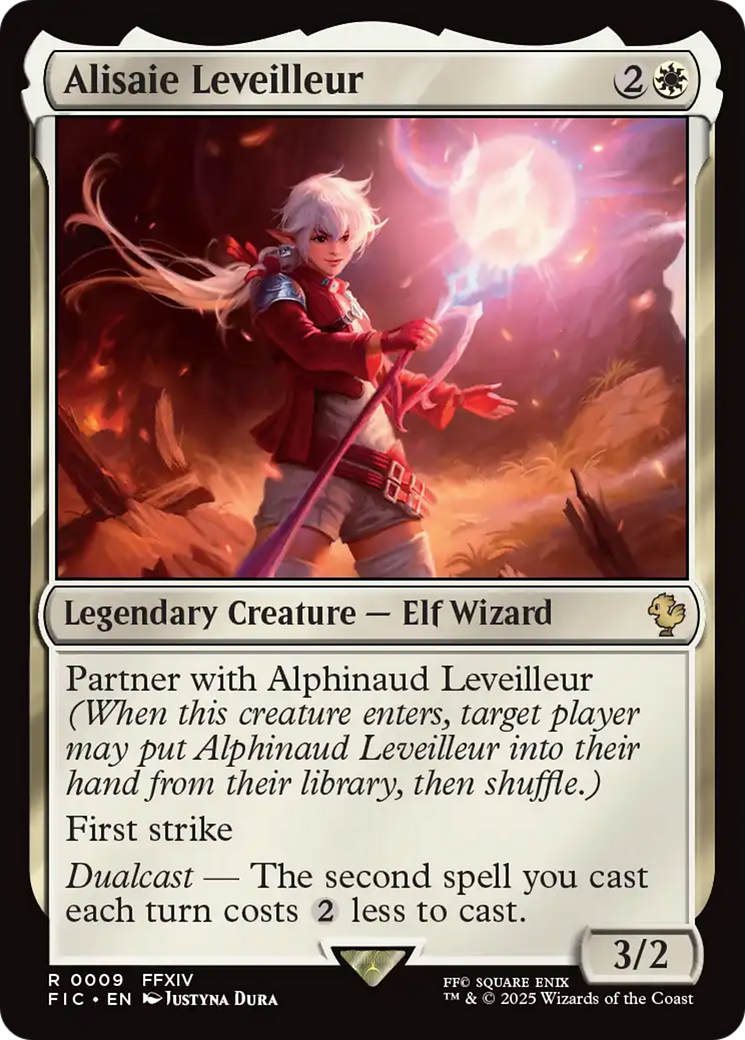
Alisaie Leveilleur
Alisaie Leveilleur
Legendary Creature — Elf Wizard
3/2
Partner with Alphinaud Leveilleur (When this creature enters, target player may put Alphinaud Leveilleur into their hand from their library, then shuffle.)
First strike
Dualcast — The second spell you cast each turn costs less to cast.
- The cost reduction applies only to generic mana in the total cost of the second spell you cast each turn.
- Spells that were cast before Alisaie Leveilleur entered count. If Alisaie Leveilleur was the first spell you cast this turn, the next spell you cast this turn is your second spell.
- Both commanders start in the command zone, and the remaining 98 cards (or 58 cards in a Commander Draft game) of your deck are shuffled to become your library.
- Once the game begins, your two commanders are tracked separately. If you cast one, you won't have to pay an additional the first time you cast the other. A player loses the game after having been dealt 21 damage from one of them, not from both of them combined. Command Beacon's effect puts one into your hand from the command zone, not both.
- The triggered ability of the "partner with" keyword still triggers in a Commander game. If your other commander has somehow ended up in your library, you can find it. You can also target another player, whether or not they have that card in their library.
- "Partner with [name]" represents two abilities. The first is a triggered ability: "When this permanent enters, target player may search their library for a card named [name], reveal it, put it into their hand, then shuffle."
- Note that the target player searches their library (which may be affected by effects such as that of Stranglehold) and that the card they find is revealed, even though these words aren't included in the ability's reminder text.
- The second ability represented by the "partner with [name]" keyword modifies the rules for deck construction in the Commander variant and has no function outside of that variant. If a legendary creature card with "partner with [name]" is designated as your commander, the named legendary creature card can also be designated as your commander.
- If your Commander deck has two commanders, you can only include cards whose own color identities are also found in your commanders' combined color identities. If Alisaie Leveilleur and Alphinaud Leveilleur are your commanders, your deck may contain cards with white and/or blue in their color identity, but not black, red, or green.
- To have two commanders, both must have the partner ability or corresponding "partner with" abilities as the game begins. A creature with a "partner with" ability can't partner with any creature other than its designated partner. Losing a partner ability during the game doesn't cause either to cease to be your commander.
- An effect that checks whether you control your commander is satisfied if you control one or both of your two commanders.
-
1
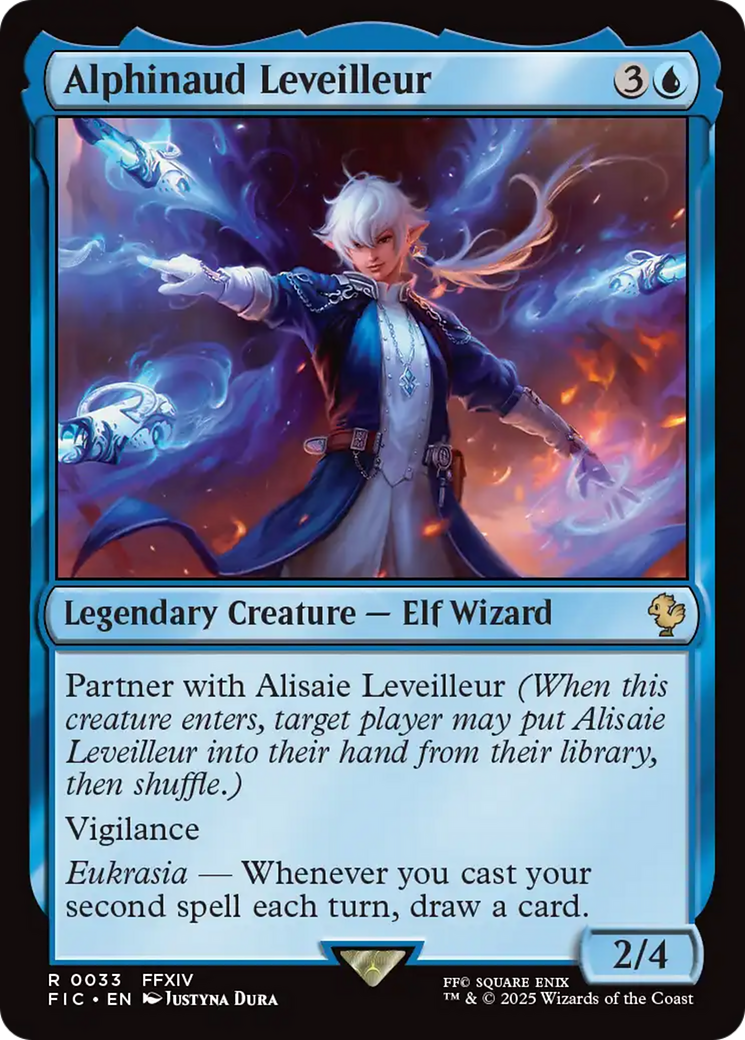
Alphinaud Leveilleur
Alphinaud Leveilleur
Legendary Creature — Elf Wizard
2/4
Partner with Alisaie Leveilleur (When this creature enters, target player may put Alisaie Leveilleur into their hand from their library, then shuffle.)
Vigilance
Eukrasia — Whenever you cast your second spell each turn, draw a card.
- Alphinaud Leveilleur's last ability resolves before the spell that caused it to trigger. It resolves even if that spell is countered or otherwise leaves the stack.
- "Partner with [name]" represents two abilities. The first is a triggered ability: "When this permanent enters, target player may search their library for a card named [name], reveal it, put it into their hand, then shuffle."
- The second ability represented by the "partner with [name]" keyword modifies the rules for deck construction in the Commander variant and has no function outside of that variant. If a legendary creature card with "partner with [name]" is designated as your commander, the named legendary creature card can also be designated as your commander.
- Both commanders start in the command zone, and the remaining 98 cards (or 58 cards in a Commander Draft game) of your deck are shuffled to become your library.
- Once the game begins, your two commanders are tracked separately. If you cast one, you won't have to pay an additional the first time you cast the other. A player loses the game after having been dealt 21 damage from one of them, not from both of them combined. Command Beacon's effect puts one into your hand from the command zone, not both.
- Spells that were cast before Alphinaud Leveilleur entered count. If Alphinaud Leveilleur was the first spell you cast this turn, the next spell you cast this turn is your second spell.
- Note that the target player searches their library (which may be affected by effects such as that of Stranglehold) and that the card they find is revealed, even though these words aren't included in the ability's reminder text.
- If your Commander deck has two commanders, you can only include cards whose own color identities are also found in your commanders' combined color identities. If Alisaie Leveilleur and Alphinaud Leveilleur are your commanders, your deck may contain cards with white and/or blue in their color identity, but not black, red, or green.
- To have two commanders, both must have the partner ability or corresponding "partner with" abilities as the game begins. A creature with a "partner with" ability can't partner with any creature other than its designated partner. Losing a partner ability during the game doesn't cause either to cease to be your commander.
- An effect that checks whether you control your commander is satisfied if you control one or both of your two commanders.
- The triggered ability of the "partner with" keyword still triggers in a Commander game. If your other commander has somehow ended up in your library, you can find it. You can also target another player, whether or not they have that card in their library.
-
1
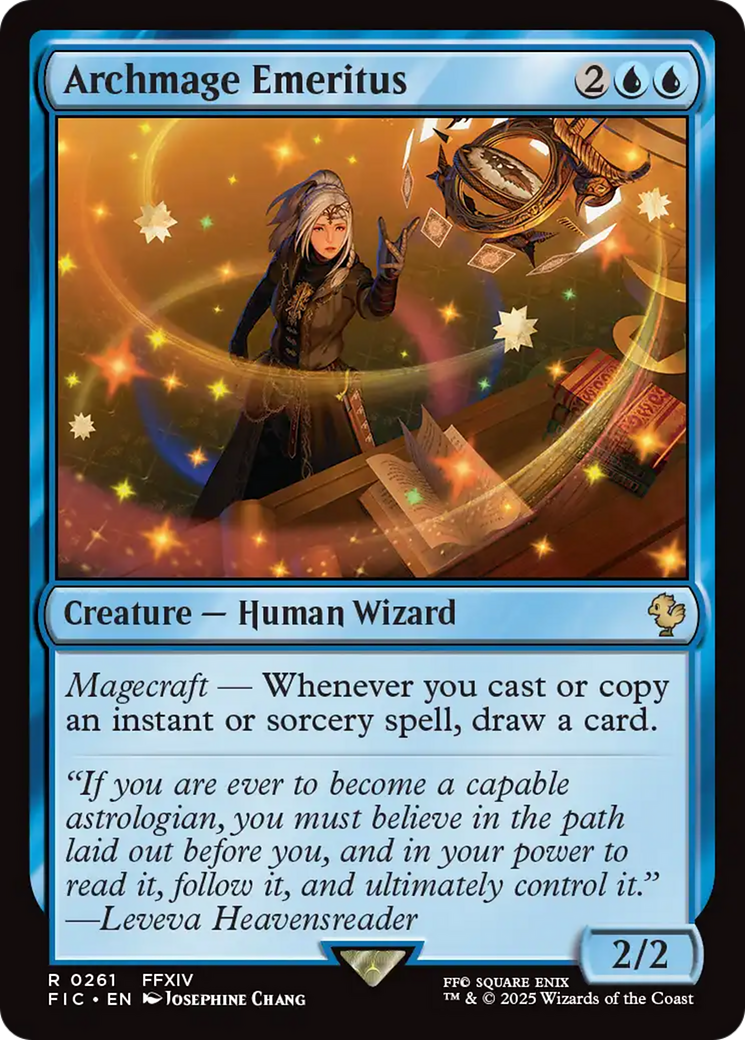
Archmage Emeritus
Archmage Emeritus
Creature — Human Wizard
2/2
Magecraft — Whenever you cast or copy an instant or sorcery spell, draw a card.
- If an effect creates multiple copies of an instant or sorcery spell, magecraft abilities trigger once for each copy created by the effect.
- If an effect creates a copy of an instant or sorcery spell, this will also cause the magecraft ability to trigger.
- Each magecraft ability has a different effect, although they all have the same trigger condition, whenever you cast or copy an instant or sorcery spell.
- Some effects instruct you to copy an instant or sorcery card in a zone other than the stack. These copies do not cause magecraft abilities to trigger. However, most effects that do this also allow you to cast the copy, and casting the copy will cause magecraft abilities to trigger.
-
1
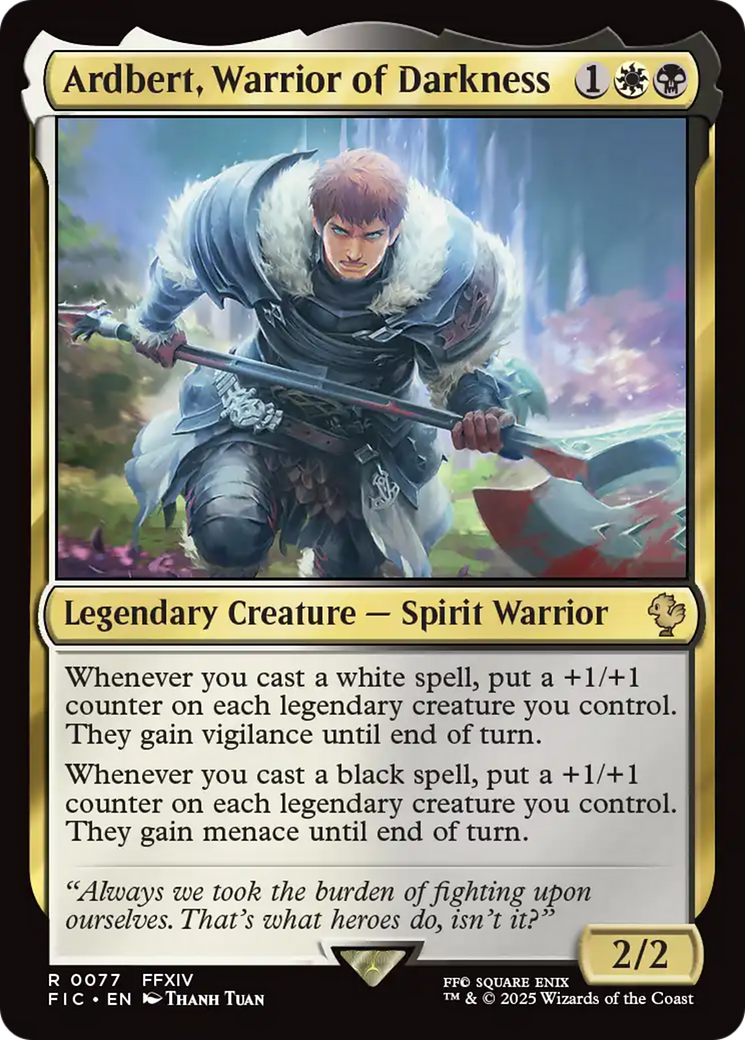
Ardbert, Warrior of Darkness
Ardbert, Warrior of Darkness
Legendary Creature — Spirit Warrior
2/2
Whenever you cast a white spell, put a +1/+1 counter on each legendary creature you control. They gain vigilance until end of turn.
Whenever you cast a black spell, put a +1/+1 counter on each legendary creature you control. They gain menace until end of turn.
- Each of Ardbert's abilities resolves before the spell that caused it to trigger. It resolves even if that spell is countered or otherwise leaves the stack.
-
1
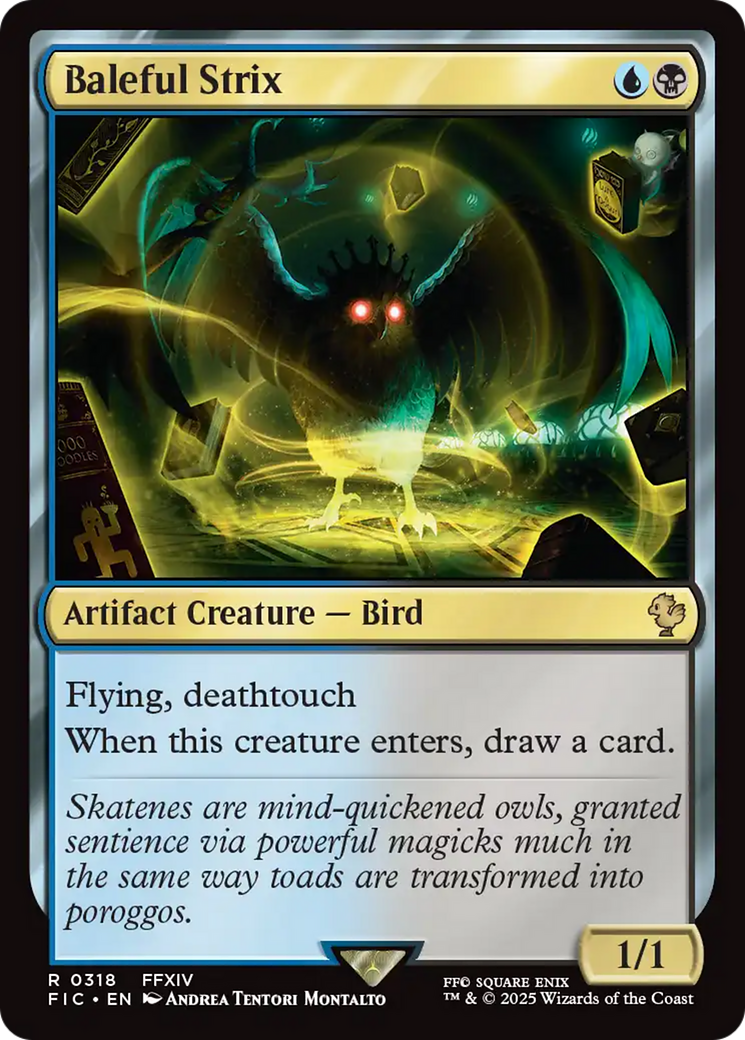
Baleful Strix
Baleful Strix
Artifact Creature — Bird
1/1
Flying, deathtouch
When this creature enters, draw a card.
-
1
Emet-Selch of the Third Seat
Emet-Selch of the Third Seat
Legendary Creature — Elder Wizard
3/4
Spells you cast from your graveyard cost less to cast.
Whenever one or more opponents lose life, you may cast target instant or sorcery card from your graveyard. If that spell would be put into your graveyard, exile it instead. Do this only once each turn.
- To determine the total cost of a spell, start with the mana cost or alternative cost you're paying (such as a flashback cost), add any cost increases (such as kicker costs), then apply any cost reductions (such as that of Emet-Selch of the Third Seat's first ability). The mana value of the spell is determined by only its mana cost, no matter what the total cost to cast that spell was.
- The cost reduction applies only to generic mana in the total cost of spells you cast from your graveyard.
- You choose whether to cast the target card while Emet-Selch of the Third Seat's second ability is still on the stack. You can't wait to cast it later in the turn. Timing restrictions based on the card's type are ignored.
-
1
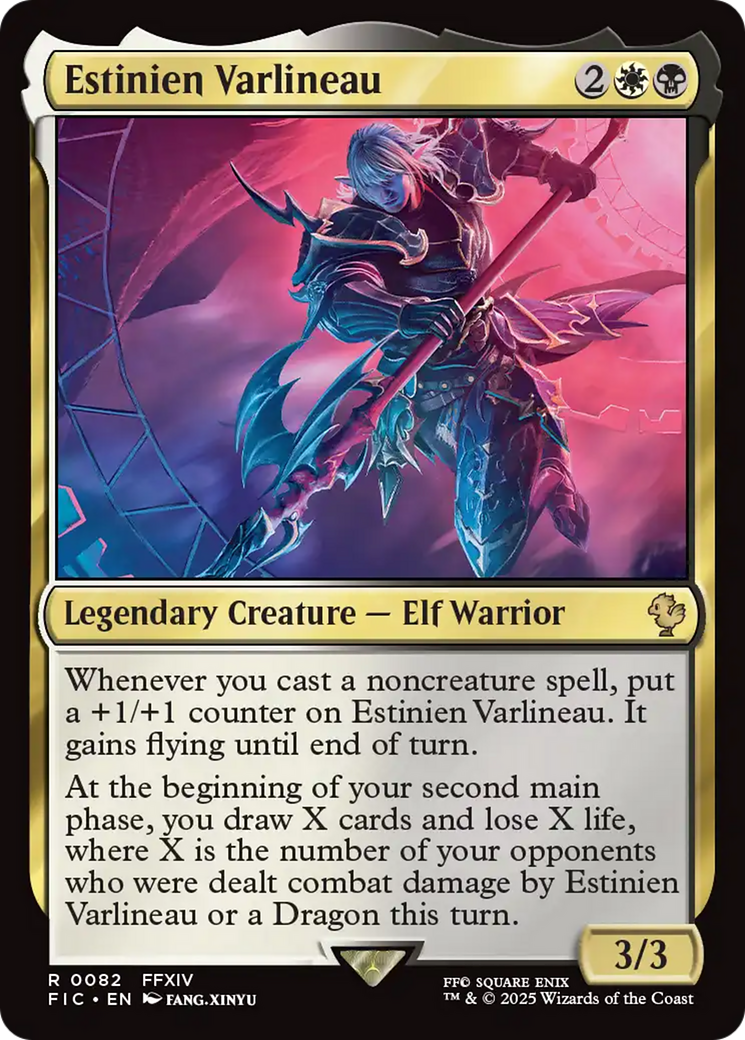
Estinien Varlineau
Estinien Varlineau
Legendary Creature — Elf Warrior
3/3
Whenever you cast a noncreature spell, put a +1/+1 counter on Estinien Varlineau. It gains flying until end of turn.
At the beginning of your second main phase, you draw X cards and lose X life, where X is the number of your opponents who were dealt combat damage by Estinien Varlineau or a Dragon this turn.
- Estinien Varlineau's first ability resolves before the spell that caused it to trigger. It resolves even if that spell is countered or otherwise leaves the stack.
-
1
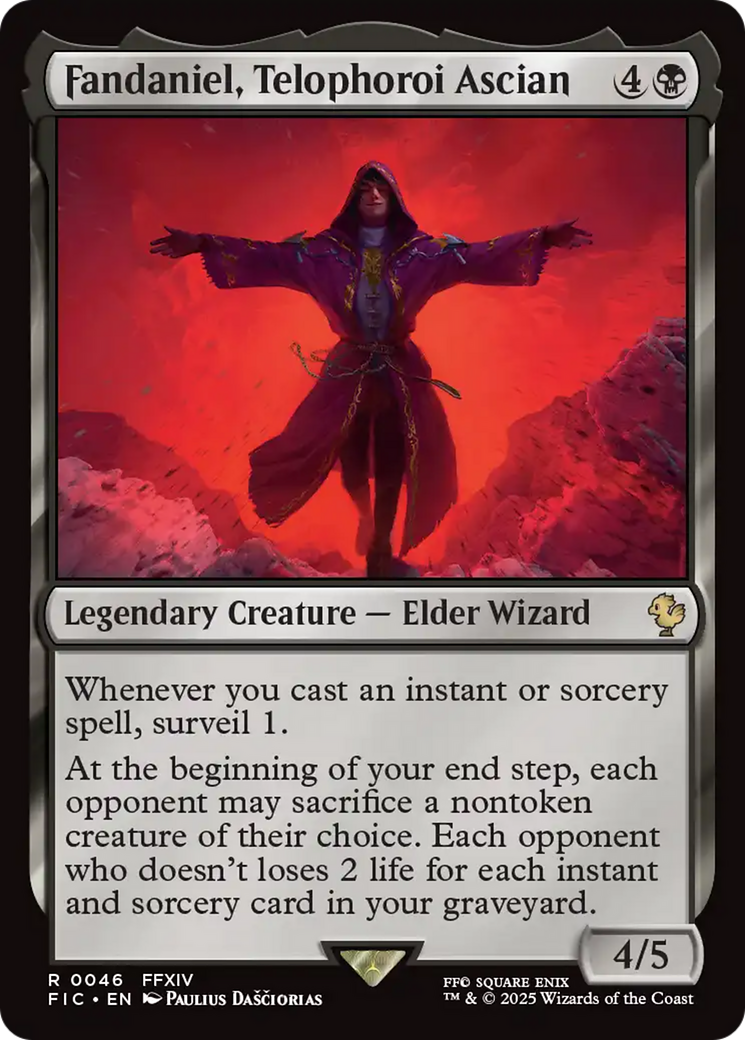
Fandaniel, Telophoroi Ascian
Fandaniel, Telophoroi Ascian
Legendary Creature — Elder Wizard
4/5
Whenever you cast an instant or sorcery spell, surveil 1.
At the beginning of your end step, each opponent may sacrifice a nontoken creature of their choice. Each opponent who doesn't loses 2 life for each instant and sorcery card in your graveyard.
- Fandaniel's first ability resolves before the spell that caused it to trigger. It resolves even if that spell is countered or otherwise leaves the stack.
- While resolving Fandaniel's second ability, the next opponent in turn order chooses up to one nontoken creature to be sacrificed, then each other opponent in turn order does the same. Then each of the chosen creatures are sacrificed simultaneously. Finally, each opponent who didn't sacrifice a creature this way loses 2 life for each instant and sorcery card in your graveyard.
-
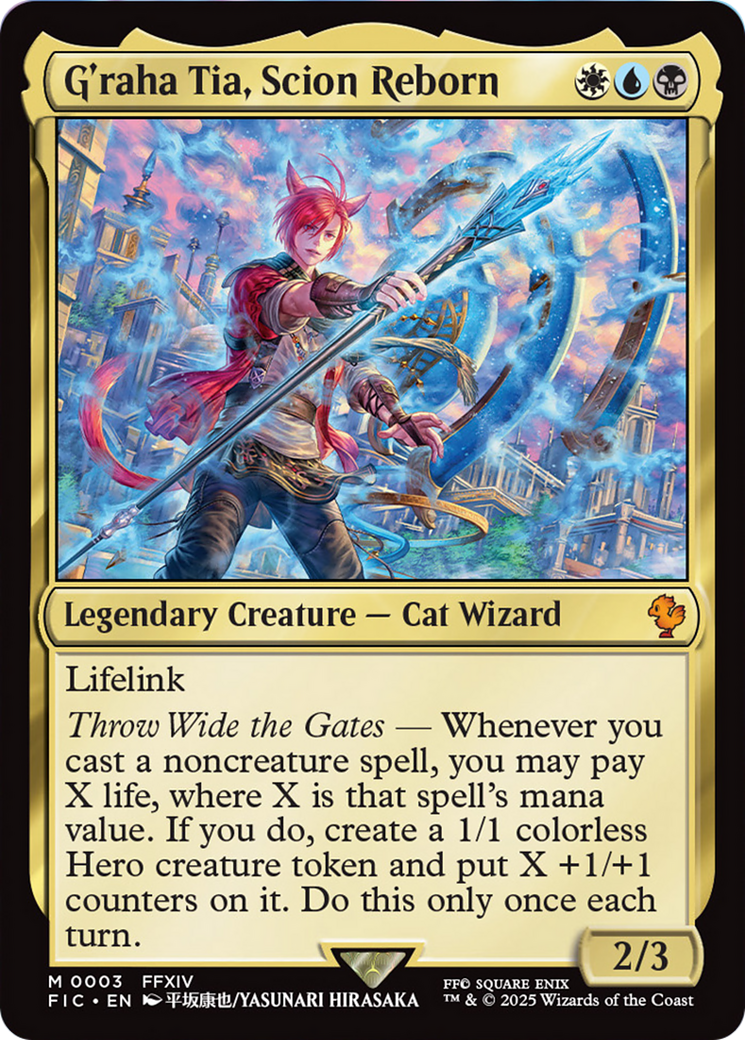
1
G'raha Tia, Scion Reborn
G'raha Tia, Scion Reborn
Legendary Creature — Cat Wizard
2/3
Lifelink
Throw Wide the Gates — Whenever you cast a noncreature spell, you may pay X life, where X is that spell's mana value. If you do, create a 1/1 colorless Hero creature token and put X +1/+1 counters on it. Do this only once each turn.
- Alternative costs, additional costs, and cost reductions don't change a spell's mana value. Its mana value is still based on its mana cost.
- G'raha Tia's last ability resolves before the spell that caused it to trigger. It resolves even if that spell is countered or otherwise leaves the stack.
- For spells on the stack with in their mana costs, use the value chosen for X to determine the spell's mana value.
-
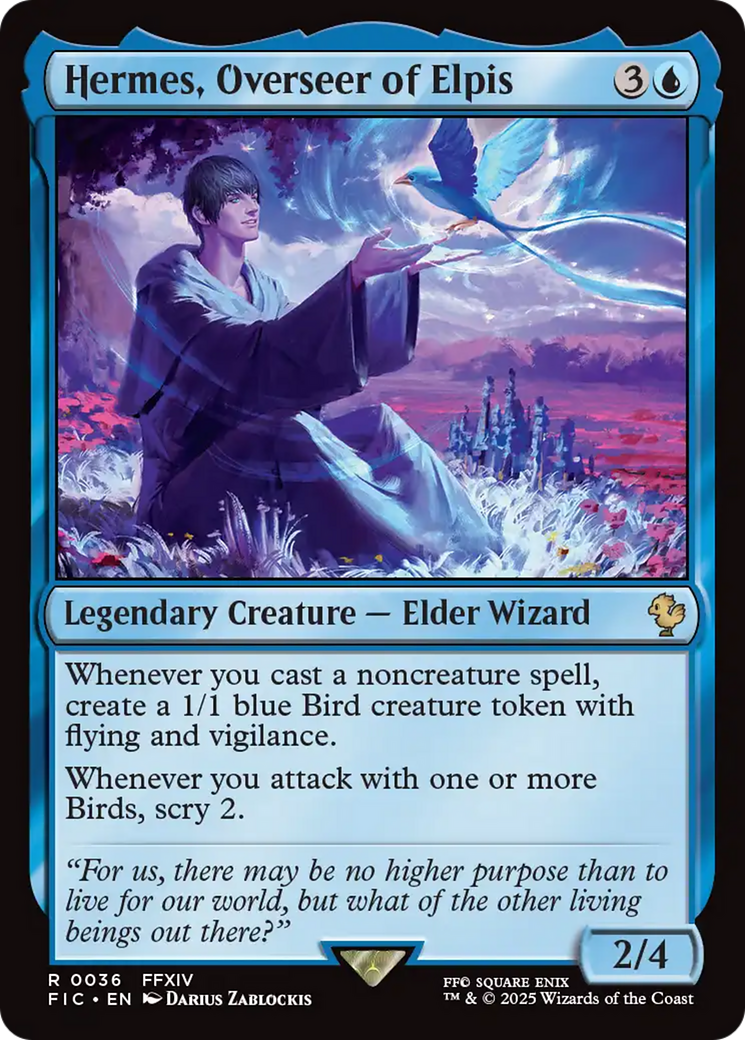
1
Hermes, Overseer of Elpis
Hermes, Overseer of Elpis
Legendary Creature — Elder Wizard
2/4
Whenever you cast a noncreature spell, create a 1/1 blue Bird creature token with flying and vigilance.
Whenever you attack with one or more Birds, scry 2.
- Hermes's first ability resolves before the spell that caused it to trigger. It resolves even if that spell is countered or otherwise leaves the stack.
-
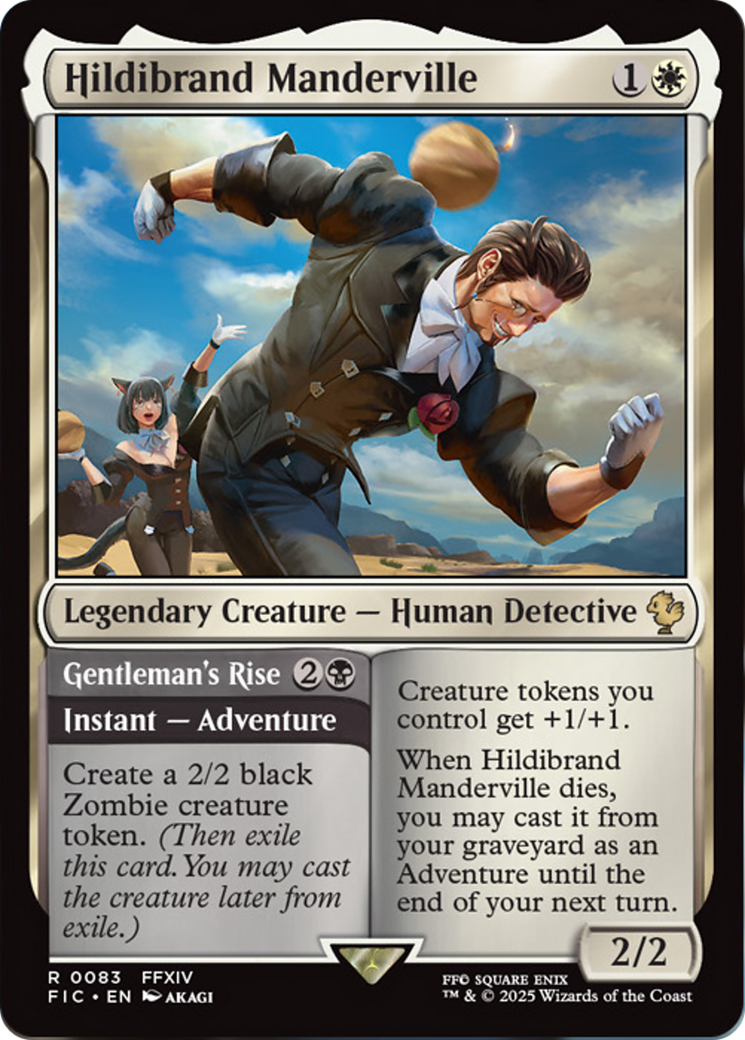
1
Hildibrand Manderville // Gentleman's Rise
//
Hildibrand Manderville
Legendary Creature — Human Detective
2/2
- An adventurer card uses only its non-Adventure characteristics in every zone except the stack, as well as while on the stack if not cast as an Adventure. Ignore its alternative characteristics in those cases. For example, while it's in your graveyard, Jidoor, Aristocratic Capital is a colorless Town land card whose mana value is 0. It can't be the target of Sorceress's Schemes, which reads in part "Return target instant or sorcery card from your graveyard or exiled card with flashback you own to your hand."
- When playing a card as an Adventure, use the alternative characteristics and ignore all of the card's normal characteristics. The resulting spell's color, mana cost, mana value, and so on are determined by only those alternative characteristics. If the spell leaves the stack, it immediately resumes using its normal characteristics.
- If you cast an adventurer card as an Adventure, use only its alternative characteristics to determine whether it's legal to cast that spell. For example, if you control Traveling Chocobo ("You may play lands and cast Bird spells from the top of your library.") and Jidoor, Aristocratic Capital is on top of your library, you can play Jidoor, Aristocratic Capital, but you can't cast Overture.
- If a spell is cast as an Adventure, its controller exiles it instead of putting it into its owner's graveyard as it resolves. For as long as it remains exiled, that player may play it using its primary characteristics. If an Adventure spell leaves the stack in any way other than resolving (most likely by being countered or by failing to resolve because its targets have all become illegal), that card won't be exiled and the spell's controller won't be able to play that card from exile later.
- You must still follow any timing restrictions and permissions for the card you play from exile. In the case of any of the five lands in this release, you'll be able to play it only during your main phase while the stack is empty and only if you have an available land play remaining.
- An effect may refer to a card, spell, or permanent that "has an Adventure." This refers to a card, spell, or permanent that has an adventurer card's set of alternative characteristics, even if they're not being used and even if that card was never cast as an Adventure.
- If an object becomes a copy of an object that has an Adventure, the copy also has an Adventure. If it changes zones, it will either cease to exist (if it's a token) or cease to be a copy (if it's a nontoken permanent), and so you won't be able to cast it as an Adventure.
- Casting a card as an Adventure isn't casting it for an alternative cost. Effects that allow you to cast a spell for an alternative cost or without paying its mana cost may allow you to apply those to the Adventure.
- If an adventurer card ends up in exile for any other reason than by exiling itself while resolving, it won't give you permission to play it with its primary characteristics.
- If an effect copies an Adventure spell, that copy is exiled as it resolves. It ceases to exist as a state-based action; it's not possible to play the copy as a permanent.
- If an effect refers to a card, spell, or permanent that has an Adventure, it won't find an instant or sorcery spell on the stack that's been cast as an Adventure.
- If an effect instructs you to choose a card name, you may choose the alternative Adventure name. Consider only the alternative characteristics to determine whether that is an appropriate name to choose.
- You must follow the normal timing permissions and restrictions for Gentleman's Rise when casting it with the permission of Hildibrand Manderville's triggered ability. You must pay its mana cost (or, if another effect allows, an alternative cost).
-
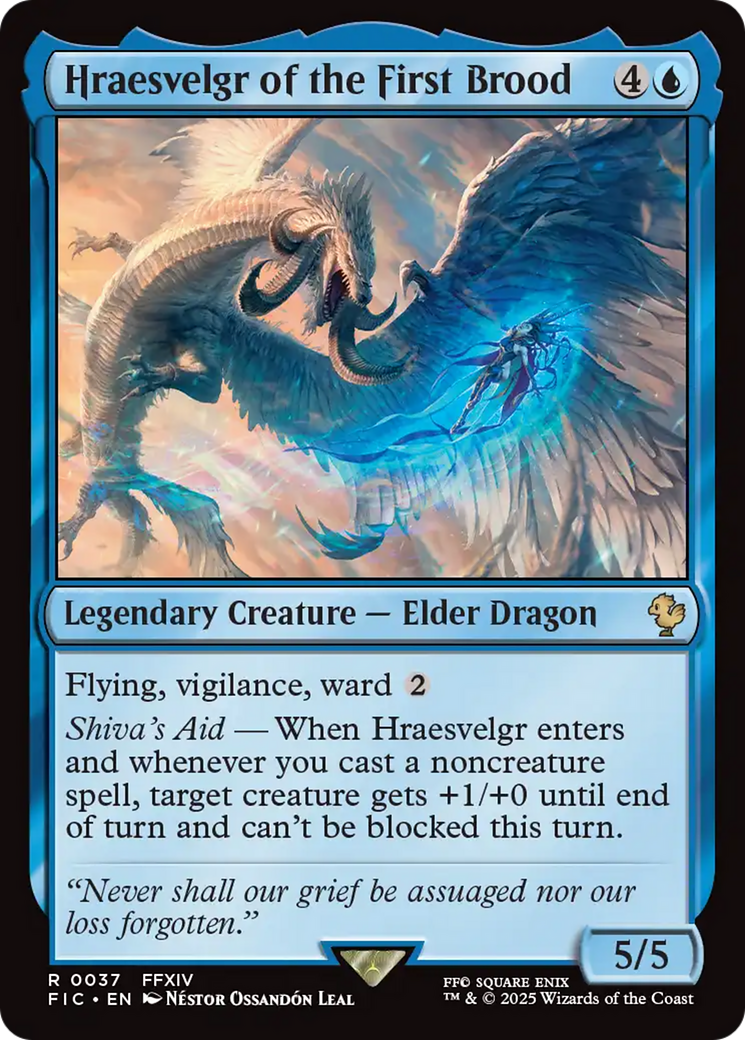
1
Hraesvelgr of the First Brood
Hraesvelgr of the First Brood
Legendary Creature — Elder Dragon
5/5
Flying, vigilance, ward
Shiva's Aid — When Hraesvelgr enters and whenever you cast a noncreature spell, target creature gets +1/+0 until end of turn and can't be blocked this turn.
- Hraesvelgr's last ability resolves before the spell that caused it to trigger. It resolves even if that spell is countered or otherwise leaves the stack.
- Once a creature has been blocked, Hraesvelgr's last ability won't cause it to become unblocked.
-
1
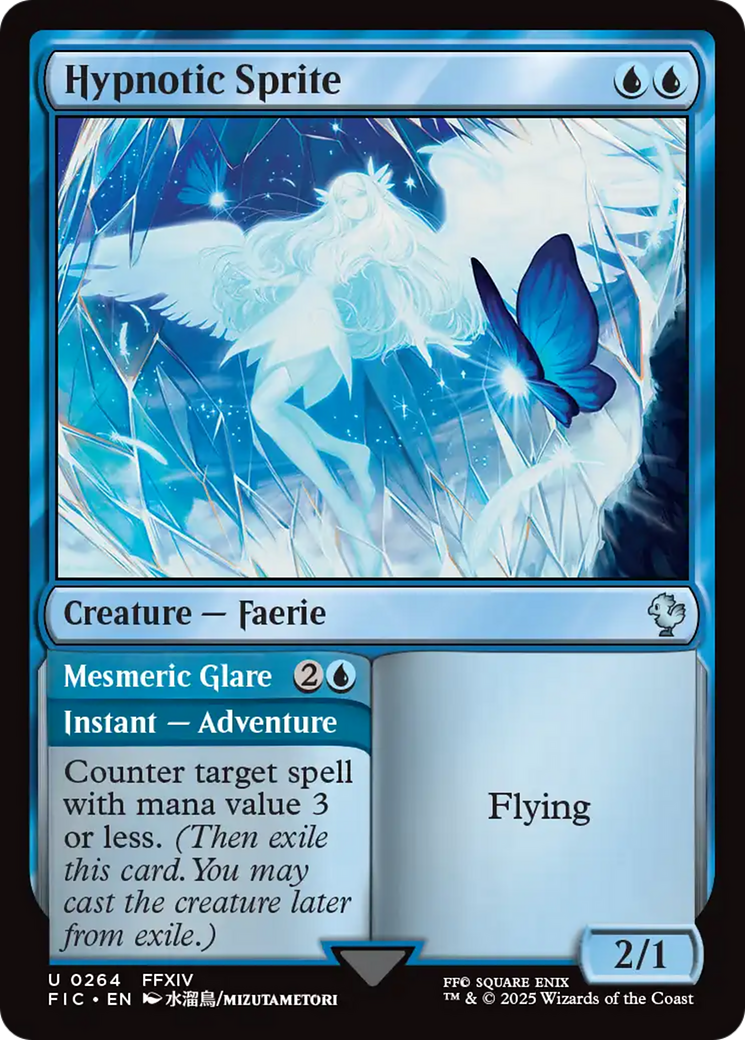
Hypnotic Sprite // Mesmeric Glare
//
Hypnotic Sprite
Creature — Faerie
2/1
- An adventurer card is a permanent card in every zone except the stack, as well as while on the stack if not cast as an Adventure. Ignore its alternative characteristics in those cases. For example, while it's in your graveyard, Giant Killer is a white creature card whose mana value is 1. It can't be the target of the triggered ability of Mystic Sanctuary.
- When casting a spell as an Adventure, use the alternative characteristics and ignore all of the card's normal characteristics. The spell's color, mana cost, mana value, and so on are determined by only those alternative characteristics. If the spell leaves the stack, it immediately resumes using its normal characteristics.
- If you cast an adventurer card as an Adventure, use only its alternative characteristics to determine whether it's legal to cast that spell. For example, if Giant Killer is exiled with the last ability of Vivien, Champion of the Wilds, you can't cast it as Chop Down.
- If a spell is cast as an Adventure, its controller exiles it instead of putting it into its owner's graveyard as it resolves. For as long as it remains exiled, that player may cast it as a permanent spell. If an Adventure spell leaves the stack in any way other than resolving (most likely by being countered or by failing to resolve because its targets have all become illegal), that card won't be exiled and the spell's controller won't be able to cast it as a permanent later.
- If an adventurer card ends up in exile for any other reason than by exiling itself while resolving, it won't give you permission to cast it as a permanent spell.
- You must still follow any timing restrictions and permissions for the permanent spell you cast from exile. Normally, you'll be able to cast it only during your main phase while the stack is empty.
- If an effect copies an Adventure spell, that copy is exiled as it resolves. It ceases to exist as a state-based action; it's not possible to cast the copy as a permanent.
- If an object becomes a copy of an object that has an Adventure, the copy also has an Adventure. If it changes zones, it will either cease to exist (if it's a token) or cease to be a copy (if it's a nontoken permanent), and so you won't be able to cast it as an Adventure.
- If an effect instructs you to choose a card name, you may choose the alternative Adventure name. Consider only the alternative characteristics to determine whether that is an appropriate name to choose.
- Casting a card as an Adventure isn't casting it for an alternative cost. Effects that allow you to cast a spell for an alternative cost or without paying its mana cost may allow you to apply those to the Adventure.
- For spells with in their mana costs, use the value chosen for X to determine the spell's mana value.
- A spell that can't be countered is a legal target for Mesmeric Glare. The spell won't be countered when Mesmeric Glare resolves, but you'll still exile Mesmeric Glare.
-
1
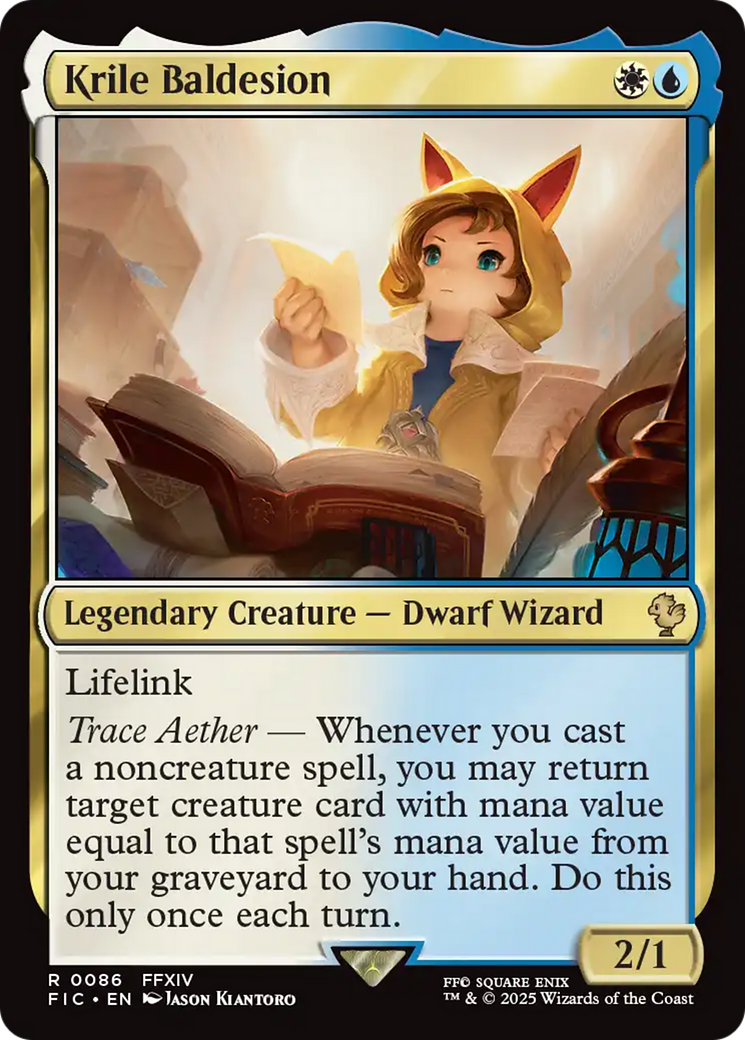
Krile Baldesion
Krile Baldesion
Legendary Creature — Dwarf Wizard
2/1
Lifelink
Trace Aether — Whenever you cast a noncreature spell, you may return target creature card with mana value equal to that spell's mana value from your graveyard to your hand. Do this only once each turn.
- Krile Baldesion's last ability resolves before the spell that caused it to trigger. It resolves even if that spell is countered or otherwise leaves the stack.
- If a card in your graveyard has in its mana cost, X is 0 for the purpose of determining its mana value.
- For spells on the stack with in their mana costs, use the value chosen for X to determine the spell's mana value.
-
1
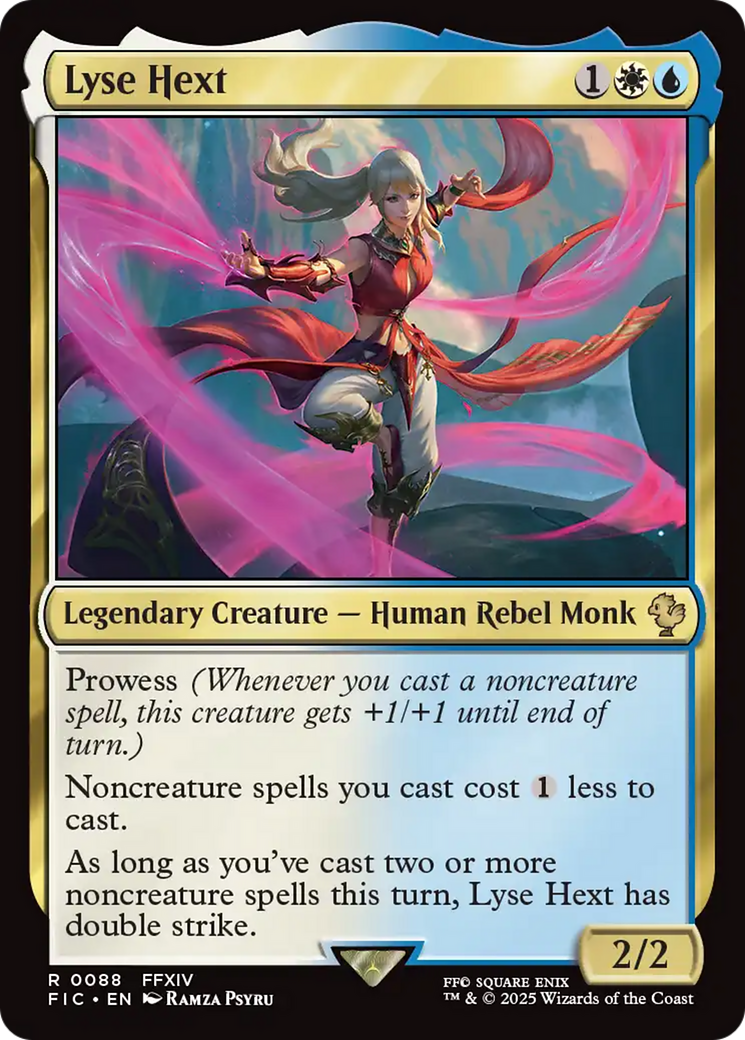
Lyse Hext
Lyse Hext
Legendary Creature — Human Rebel Monk
2/2
Prowess (Whenever you cast a noncreature spell, this creature gets +1/+1 until end of turn.)
Noncreature spells you cast cost less to cast.
As long as you've cast two or more noncreature spells this turn, Lyse Hext has double strike.
- The cost reduction applies only to generic mana in the total cost of noncreature spells you cast.
- To determine the total cost of a spell, start with the mana cost or alternative cost you're paying (such as a flashback cost), add any cost increases (such as kicker costs), then apply any cost reductions (such as that of Lyse Hext's second ability). The mana value of the spell is determined by only its mana cost, no matter what the total cost to cast that spell was.
- Noncreature spells that were cast before Lyse Hext entered count. For example, if Lyse Hext enters on a turn where you've already cast two noncreature spells, she'll have double strike immediately.
-
1
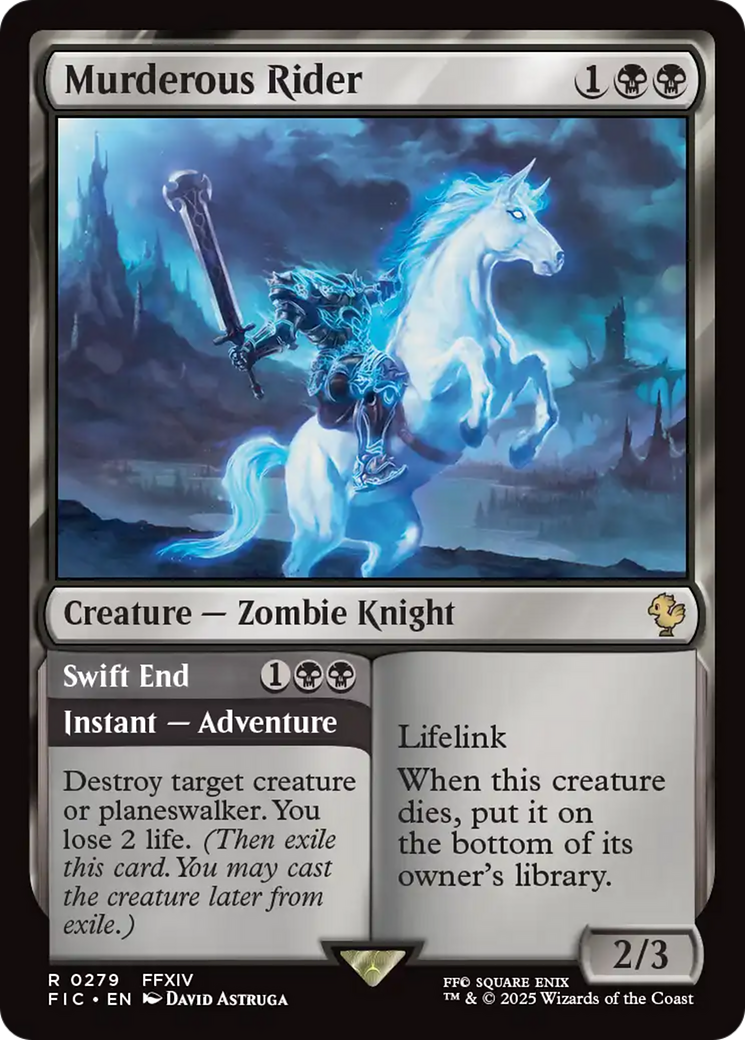
Murderous Rider // Swift End
//
Murderous Rider
Creature — Zombie Knight
2/3
- An adventurer card is a permanent card in every zone except the stack, as well as while on the stack if not cast as an Adventure. Ignore its alternative characteristics in those cases. For example, while it's in your graveyard, Giant Killer is a white creature card whose mana value is 1. It can't be the target of the triggered ability of Mystic Sanctuary.
- When casting a spell as an Adventure, use the alternative characteristics and ignore all of the card's normal characteristics. The spell's color, mana cost, mana value, and so on are determined by only those alternative characteristics. If the spell leaves the stack, it immediately resumes using its normal characteristics.
- If you cast an adventurer card as an Adventure, use only its alternative characteristics to determine whether it's legal to cast that spell. For example, if Giant Killer is exiled with the last ability of Vivien, Champion of the Wilds, you can't cast it as Chop Down.
- If a spell is cast as an Adventure, its controller exiles it instead of putting it into its owner's graveyard as it resolves. For as long as it remains exiled, that player may cast it as a permanent spell. If an Adventure spell leaves the stack in any way other than resolving (most likely by being countered or by failing to resolve because its targets have all become illegal), that card won't be exiled and the spell's controller won't be able to cast it as a permanent later.
- If an adventurer card ends up in exile for any other reason than by exiling itself while resolving, it won't give you permission to cast it as a permanent spell.
- You must still follow any timing restrictions and permissions for the permanent spell you cast from exile. Normally, you'll be able to cast it only during your main phase while the stack is empty.
- If an effect copies an Adventure spell, that copy is exiled as it resolves. It ceases to exist as a state-based action; it's not possible to cast the copy as a permanent.
- If an object becomes a copy of an object that has an Adventure, the copy also has an Adventure. If it changes zones, it will either cease to exist (if it's a token) or cease to be a copy (if it's a nontoken permanent), and so you won't be able to cast it as an Adventure.
- If an effect instructs you to choose a card name, you may choose the alternative Adventure name. Consider only the alternative characteristics to determine whether that is an appropriate name to choose.
- Casting a card as an Adventure isn't casting it for an alternative cost. Effects that allow you to cast a spell for an alternative cost or without paying its mana cost may allow you to apply those to the Adventure.
- If the target creature or planeswalker is an illegal target by the time Swift End tries to resolve, the spell won't resolve. You won't lose 2 life or exile Swift End. If the target is legal but not destroyed (most likely because it has indestructible), you do lose 2 life and exile Swift End.
-
1
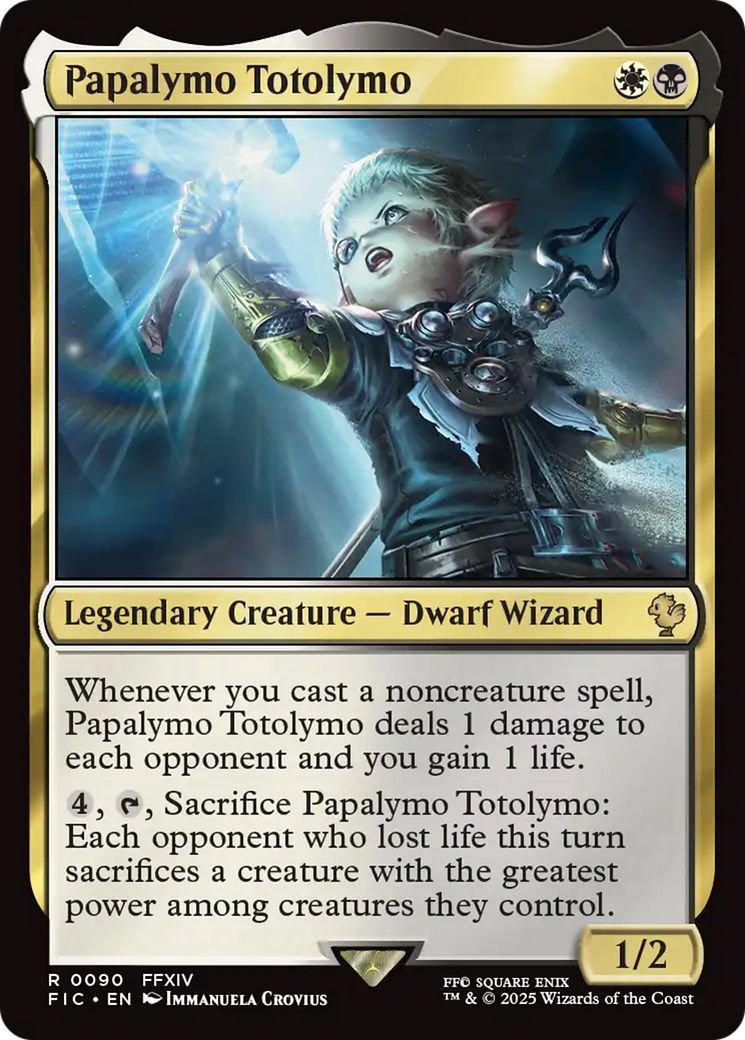
Papalymo Totolymo
Papalymo Totolymo
Legendary Creature — Dwarf Wizard
1/2
Whenever you cast a noncreature spell, Papalymo Totolymo deals 1 damage to each opponent and you gain 1 life.
, , Sacrifice Papalymo Totolymo: Each opponent who lost life this turn sacrifices a creature with the greatest power among creatures they control.
- Papalymo Totolymo's first ability resolves before the spell that caused it to trigger. It resolves even if that spell is countered or otherwise leaves the stack.
- While resolving Papalymo Totolymo's second ability, the next opponent in turn order who lost life this turn chooses a creature with the greatest power among creatures they control, then each other opponent who lost life this turn in turn order does the same. Then each of the chosen creatures are sacrificed simultaneously.
-
1
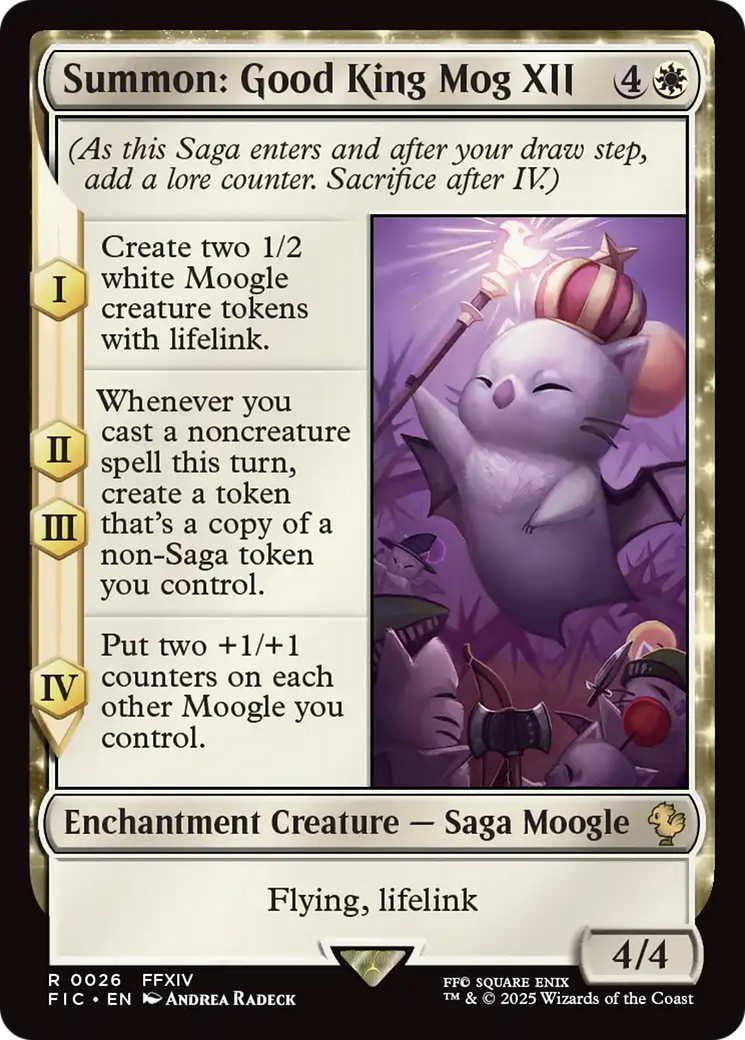
Summon: Good King Mog XII
Summon: Good King Mog XII
Enchantment Creature — Saga Moogle
4/4
(As this Saga enters and after your draw step, add a lore counter. Sacrifice after IV.)
I — Create two 1/2 white Moogle creature tokens with lifelink.
II, III — Whenever you cast a noncreature spell this turn, create a token that's a copy of a non-Saga token you control.
IV — Put two +1/+1 counters on each other Moogle you control.
Flying, lifelink
- The delayed triggered ability set up by Summon: Good King Mog XII's second and third chapter abilities resolves before the spell that caused it to trigger. It resolves even if that spell is countered or otherwise leaves the stack.
- The new token copies the original characteristics of the copied token as stated by the effect that created that token.
- Any "as [this permanent] enters" or "[this permanent] enters with" abilities of the new token will work.
- The new token doesn't copy whether the original token is tapped or untapped, whether it has any counters on it or Auras and Equipment attached to it, or any non-copy effects that have changed its power, toughness, color, and so on.
-
1
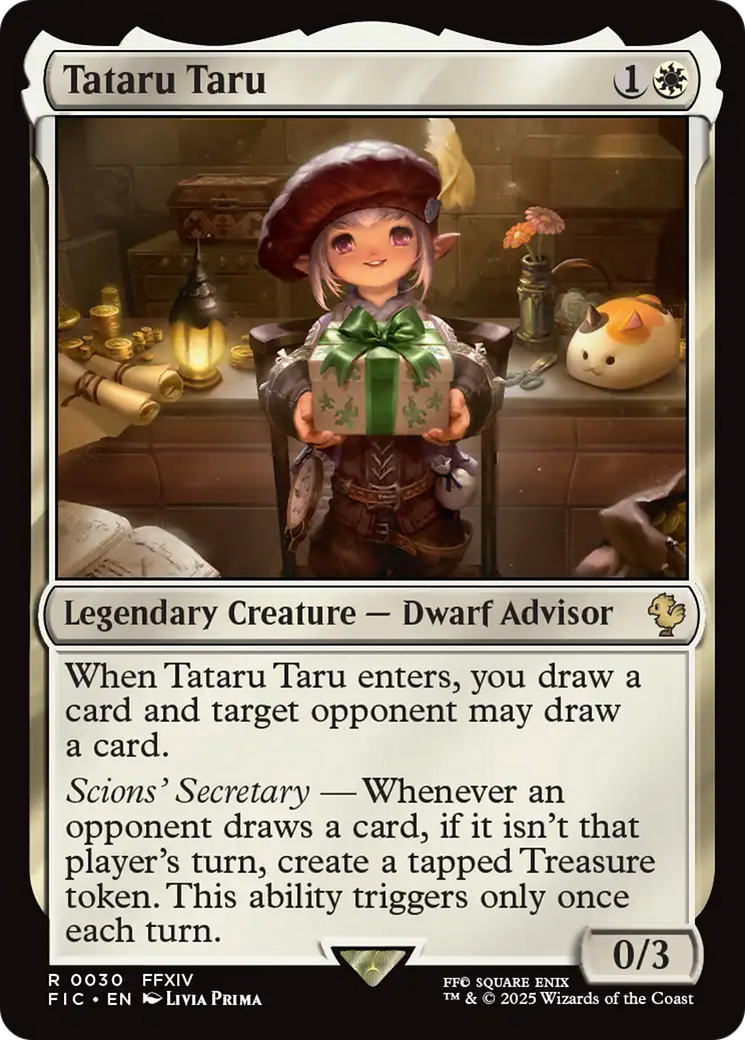
Tataru Taru
Tataru Taru
Legendary Creature — Dwarf Advisor
0/3
When Tataru Taru enters, you draw a card and target opponent may draw a card.
Scions' Secretary — Whenever an opponent draws a card, if it isn't that player's turn, create a tapped Treasure token. This ability triggers only once each turn.
- If the target opponent is an illegal target as Tataru Taru's first ability tries to resolve, it won't resolve and none of its effects will happen. You won't draw a card.
-
1
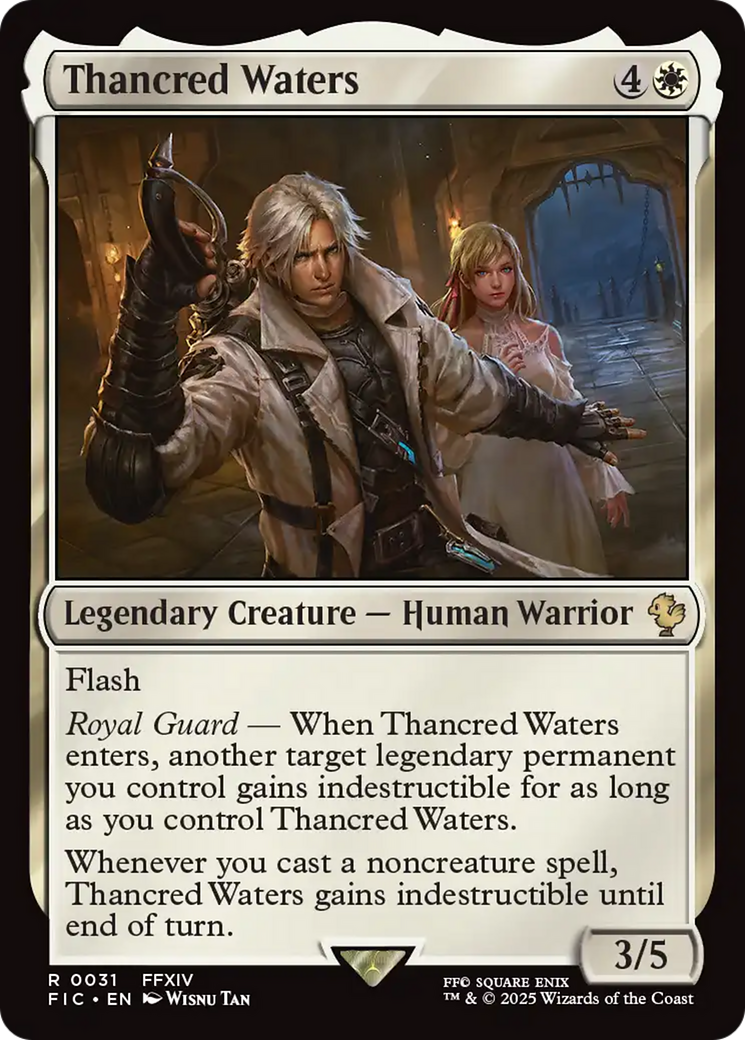
Thancred Waters
Thancred Waters
Legendary Creature — Human Warrior
3/5
Flash
Royal Guard — When Thancred Waters enters, another target legendary permanent you control gains indestructible for as long as you control Thancred Waters.
Whenever you cast a noncreature spell, Thancred Waters gains indestructible until end of turn.
- If Thancred Waters leaves the battlefield or you lose control of it before its triggered ability resolves, the target legendary permanent won't gain indestructible at all.
- Thancred Waters's last ability resolves before the spell that caused it to trigger. It resolves even if that spell is countered or otherwise leaves the stack.
-
1
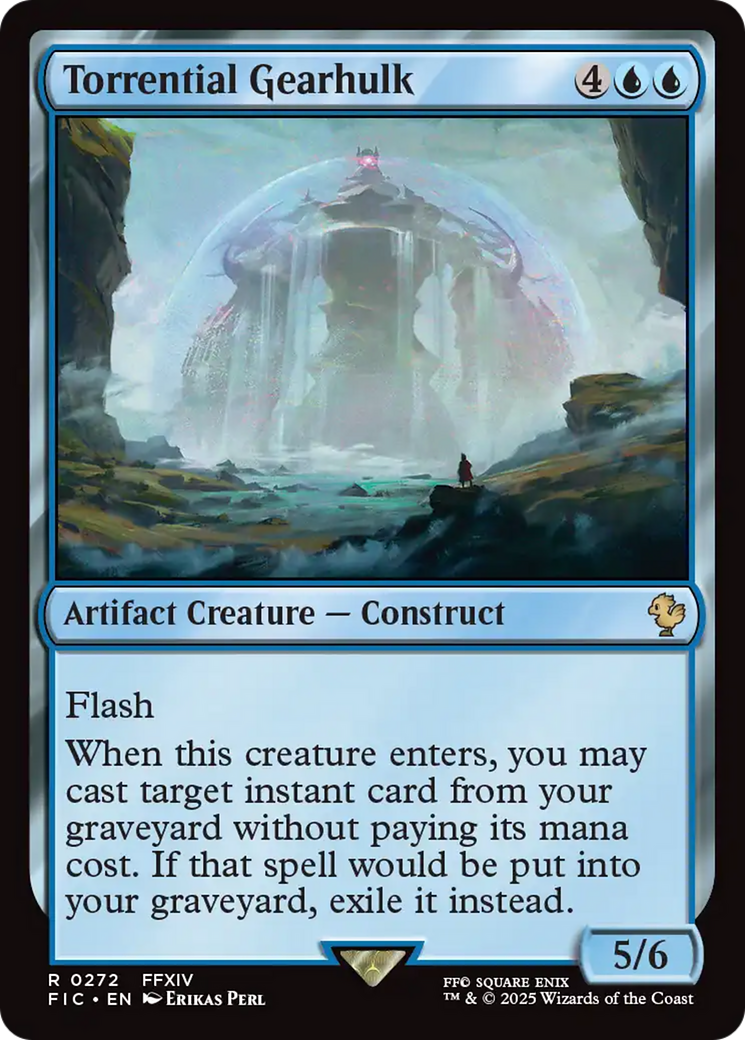
Torrential Gearhulk
Torrential Gearhulk
Artifact Creature — Construct
5/6
Flash
When this creature enters, you may cast target instant card from your graveyard without paying its mana cost. If that spell would be put into your graveyard, exile it instead.
- If you cast the card, you do so as part of the resolution of Torrential Gearhulk's triggered ability. You can't wait to cast it later in the turn. Timing restrictions (such as "Cast [this card] only during combat") still apply.
- If the card has in its mana cost, you must choose 0 as the value of X when casting it without paying its mana cost.
- If you cast a card "without paying its mana cost," you can't choose to cast it for any alternative costs, such as emerge costs. You can, however, pay additional costs. If the card has any mandatory additional costs, such as that of Incendiary Sabotage, you must pay those to cast the card.
-
1
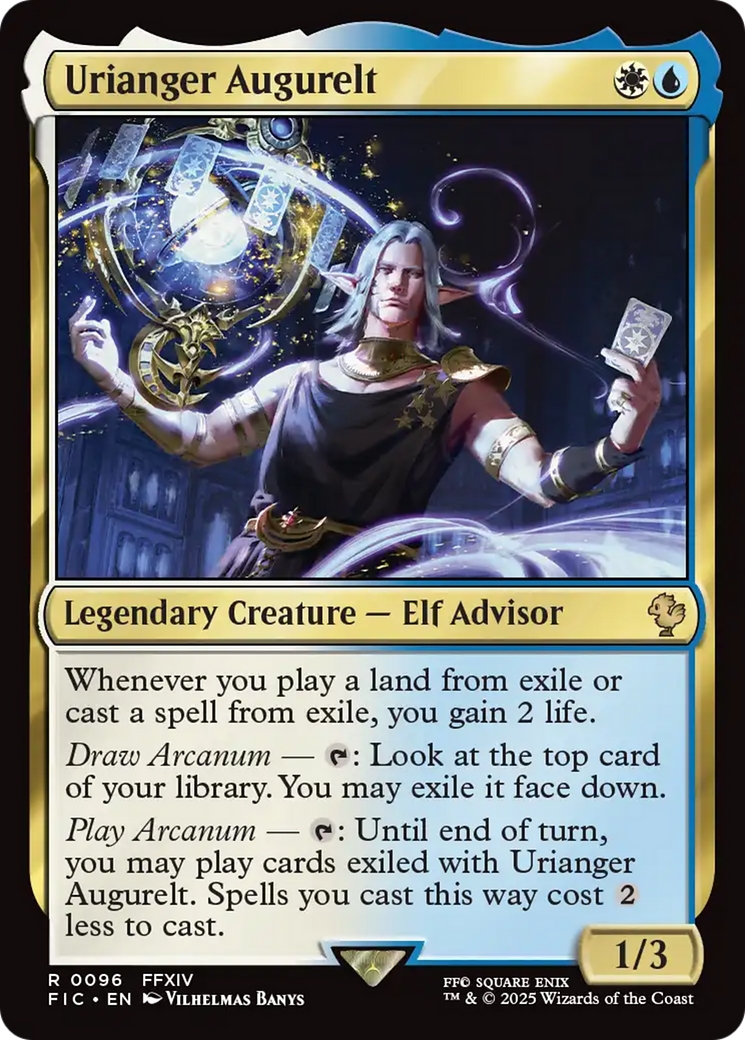
Urianger Augurelt
Urianger Augurelt
Legendary Creature — Elf Advisor
1/3
Whenever you play a land from exile or cast a spell from exile, you gain 2 life.
Draw Arcanum — : Look at the top card of your library. You may exile it face down.
Play Arcanum — : Until end of turn, you may play cards exiled with Urianger Augurelt. Spells you cast this way cost less to cast.
- You pay all costs and follow all timing rules for cards played with the permission granted by Urianger Augurelt's last ability.
- The cost reduction applies only to generic mana in the total cost of spells you cast with the permission granted by Urianger Augurelt's last ability.
- Urianger Augurelt's first ability resolves before the spell that caused it to trigger. It resolves even if that spell is countered or otherwise leaves the stack. (Playing a land doesn't use the stack.)
- If one of the exiled cards is a land card, you may play it only if you have an available land play remaining this turn.
- To determine the total cost of a spell, start with the mana cost or alternative cost you're paying (such as a flashback cost), add any cost increases (such as kicker costs), then apply any cost reductions (such as that of Urianger Augurelt's last ability). The mana value of the spell is determined by only its mana cost, no matter what the total cost to cast that spell was.
-
1
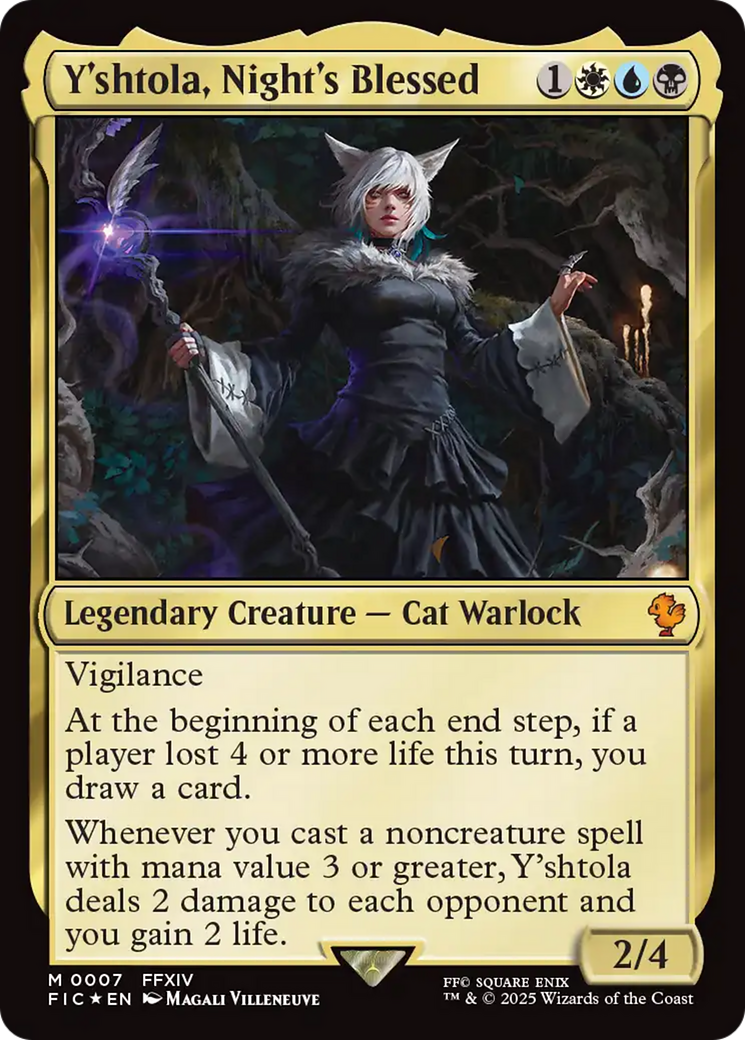
Y'shtola, Night's Blessed
Y'shtola, Night's Blessed
Legendary Creature — Cat Warlock
2/4
Vigilance
At the beginning of each end step, if a player lost 4 or more life this turn, you draw a card.
Whenever you cast a noncreature spell with mana value 3 or greater, Y'shtola deals 2 damage to each opponent and you gain 2 life.
- Y'shtola's second ability checks at the moment it would trigger to see if a player lost 4 or more life this turn. If none did, the ability won't trigger at all. Once an end step begins, it's too late to cause a player to lose life in order to cause this ability to trigger.
- Y'shtola's last ability resolves before the spell that caused it to trigger. It resolves even if that spell is countered or otherwise leaves the stack.
- For spells on the stack with in their mana costs, use the value chosen for X to determine the spell's mana value.
Instants 8
-
1
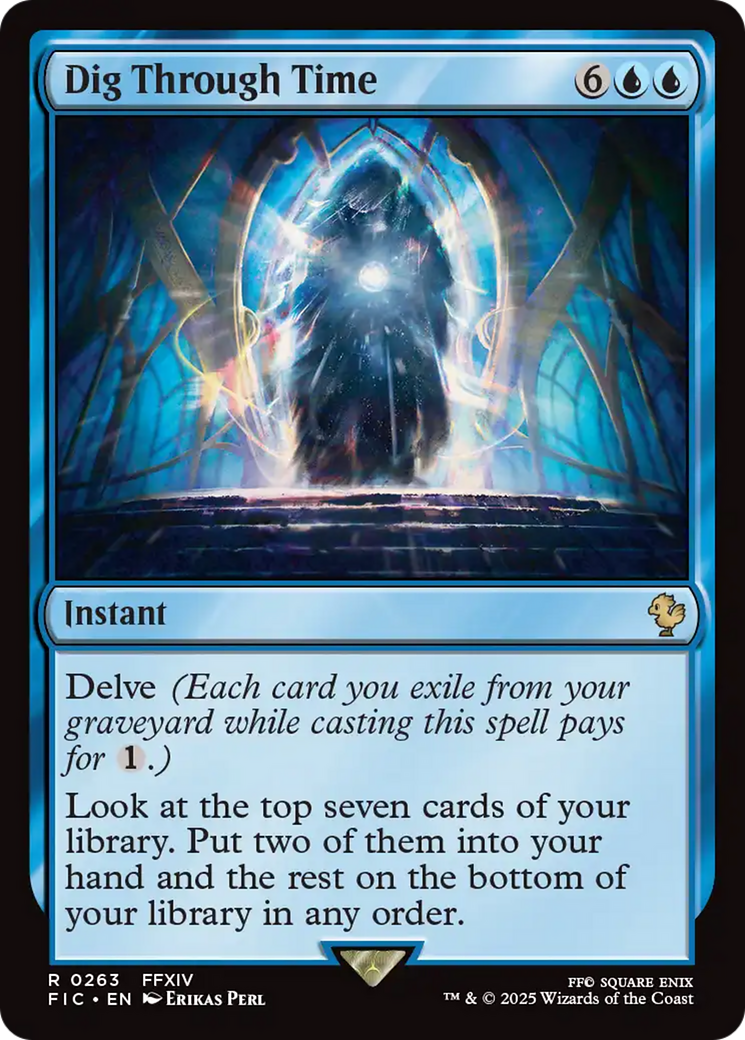
Dig Through Time
Dig Through Time
Instant
Delve (Each card you exile from your graveyard while casting this spell pays for .)
Look at the top seven cards of your library. Put two of them into your hand and the rest on the bottom of your library in any order.
- Because delve isn't an alternative cost, it can be used in conjunction with alternative costs, such as flashback. It can also be used to pay for additional costs that include generic mana.
- Delve doesn't change a spell's mana cost or mana value. For example, Treasure Cruise's mana value is 8 even if you exiled three cards to cast it.
- You can exile cards to pay only for generic mana, and you can't exile more cards than the generic mana requirement of a spell with delve. For example, you can't exile more than seven cards from your graveyard to cast Treasure Cruise unless an effect has increased its cost.
-
1
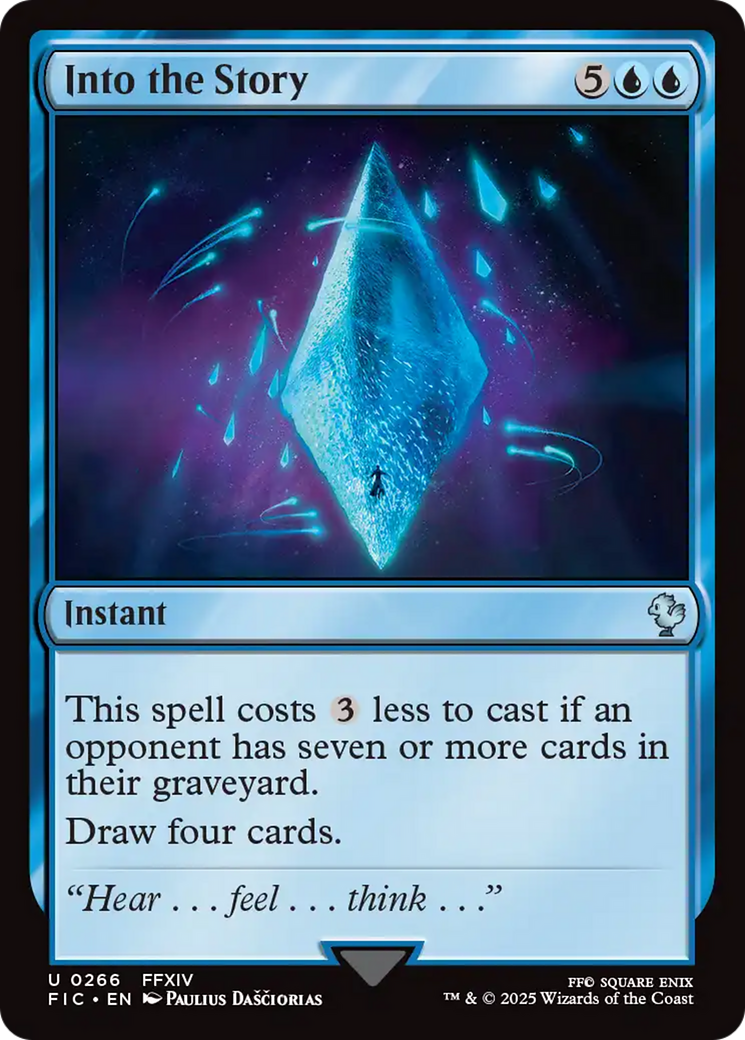
Into the Story
Into the Story
Instant
This spell costs less to cast if an opponent has seven or more cards in their graveyard.
Draw four cards.
- Into the Story's cost reduction can only reduce its cost by . It doesn't reduce the cost further if more than one opponent has seven cards in their graveyard or if an opponent has fourteen cards in their graveyard.
- To determine the total cost of a spell, start with the mana cost or alternative cost you're paying, add any cost increases, then apply any cost reductions (such as that of Into the Story). The mana value of the spell remains unchanged, no matter what the total cost to cast it was.
-
1
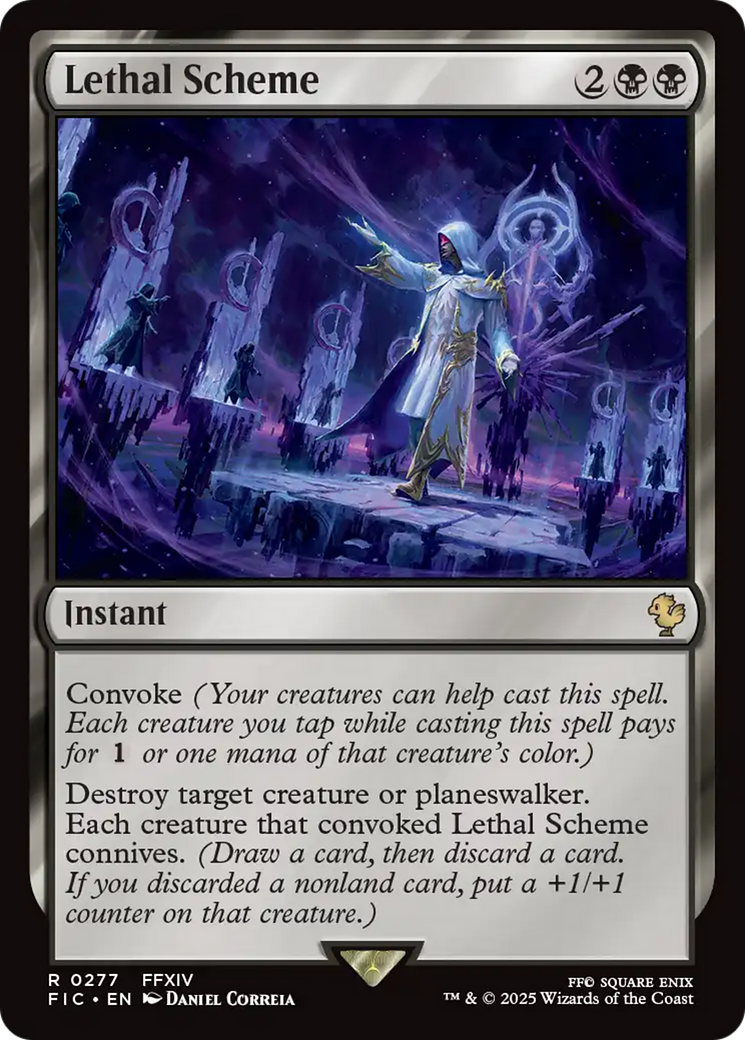
Lethal Scheme
Lethal Scheme
Instant
Convoke (Your creatures can help cast this spell. Each creature you tap while casting this spell pays for or one mana of that creature's color.)
Destroy target creature or planeswalker. Each creature that convoked this spell connives. (Draw a card, then discard a card. If you discarded a nonland card, put a +1/+1 counter on that creature.)
- When multiple creatures are instructed to connive simultaneously, they connive one at a time in the order of their controller's choice.
- You can't tap more creatures to convoke Lethal Scheme than it takes to pay for its total cost. This means that normally no more than four creatures can convoke it.
-
1
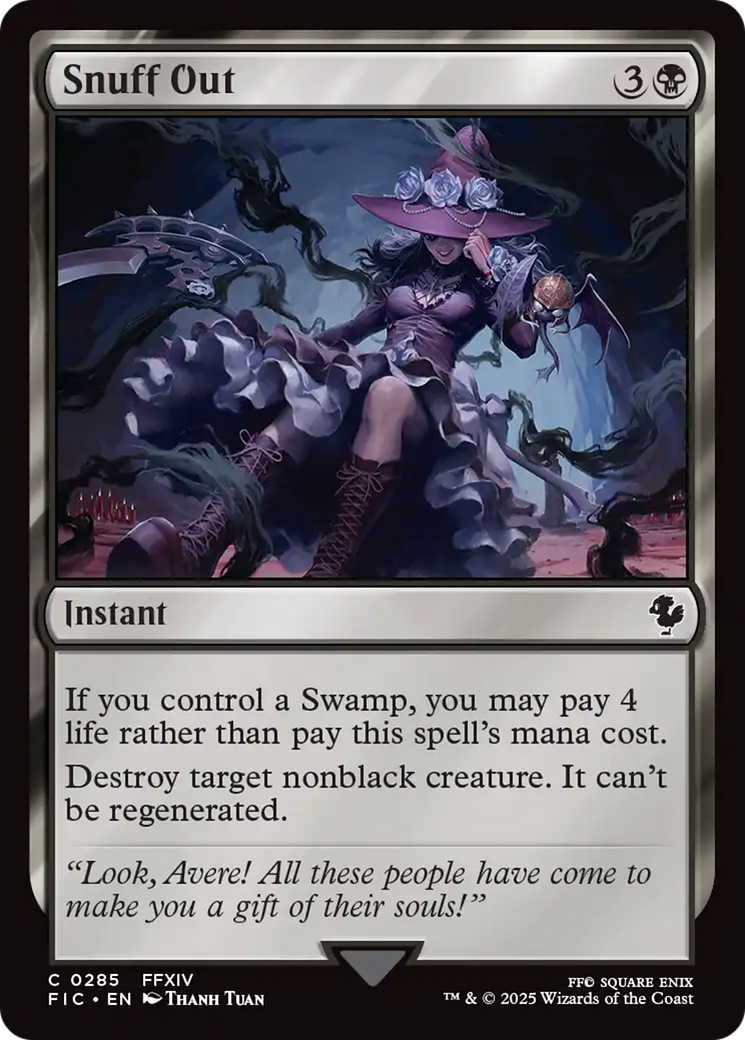
Snuff Out
Snuff Out
Instant
If you control a Swamp, you may pay 4 life rather than pay this spell's mana cost.
Destroy target nonblack creature. It can't be regenerated.
-
1
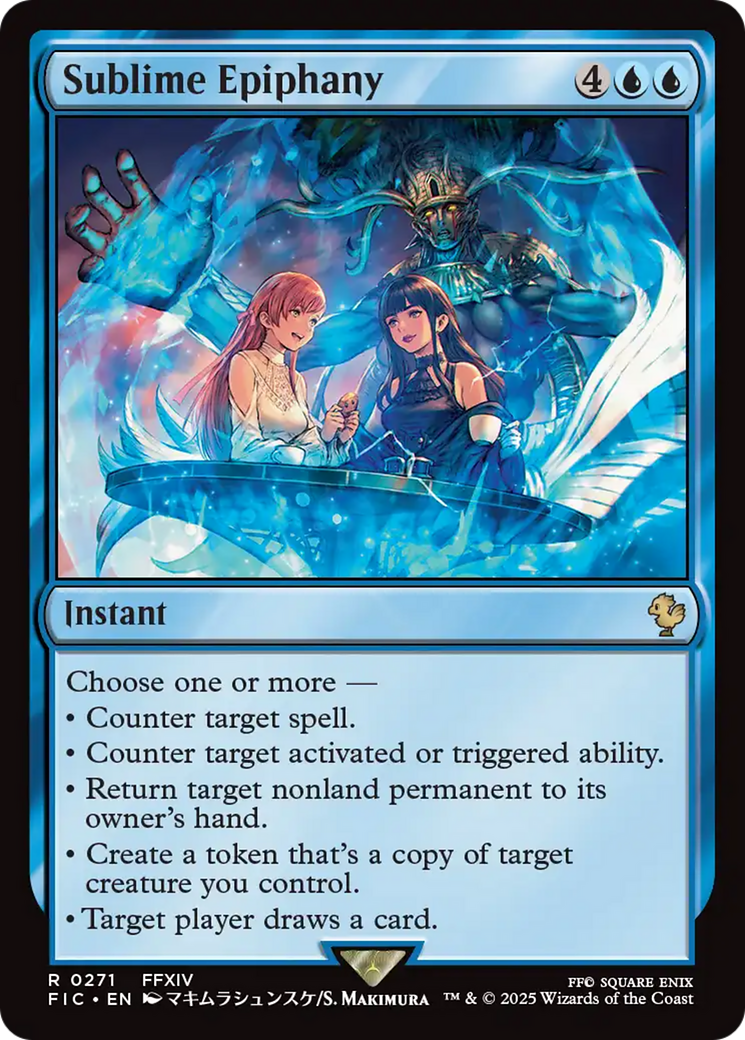
Sublime Epiphany
Sublime Epiphany
Instant
Choose one or more —
- Counter target spell.
- Counter target activated or triggered ability.
- Return target nonland permanent to its owner's hand.
- Create a token that's a copy of target creature you control.
- Target player draws a card.
- You can't choose any one mode more than once.
- If any of the targets become illegal, the remaining targets are affected as appropriate.
- Activated abilities are written in the form "[Cost]: [Effect]." Some keyword abilities (such as equip) are activated abilities and will have colons in their reminder texts.
- Abilities that create replacement effects, such as a permanent entering the battlefield tapped or with counters on it, can't be countered. Abilities that apply "as [this creature] enters the battlefield" are also replacement effects and can't be countered.
- If you counter a delayed triggered ability that triggered at the beginning of the "next" occurrence of a specified step or phase, that ability won't trigger again the following time that phase or step occurs.
- The token copies exactly what is printed on the creature and nothing else (unless that creature is a token or is copying something else; see below). It doesn't copy whether that creature is tapped or untapped, whether it has any counters on it or Auras and/or Equipment attached to it, or any non-copy effects that changed its power, toughness, types, color, and so on.
- If the copied creature is copying something else, the token enters the battlefield as whatever that creature is copying.
- Any enters-the-battlefield abilities of the copied creature will trigger when the token enters the battlefield. Any "As [this creature] enters the battlefield" or "[This creature] enters the battlefield with" abilities of the copied creature will also work.
- If you choose more than one mode, you perform the modes in the order specified. For example, if you choose to counter target spell, return target nonland permanent to its owner's hand, and have target player draw a card, that permanent will be on the battlefield while that spell is countered (and may modify, affect, or trigger on that event) but will not be on the battlefield while that player draws a card.
- Sublime Epiphany's second mode counters only activated and triggered abilities already on the stack. It doesn't prevent abilities from being activated or from triggering later in the turn, and it has no effect on static abilities.
- Triggered abilities use the word "when," "whenever," or "at." They're often written as "[Trigger condition], [effect]." Some keyword abilities (such as prowess) are triggered abilities and will have "when," "whenever," or "at" in their reminder text.
- Sublime Epiphany's second mode can't counter an activated or triggered mana ability. An activated mana ability is one that could add mana as it resolves, doesn't have a target, and isn't a loyalty ability. A triggered mana ability is one that could add mana as it resolves and triggers on an activated mana ability.
- If you choose the third and fourth modes and target the same creature you control both times, you'll return it and then create a token that's a copy of it, using its copiable values as it last appeared on the battlefield. This is because the legality of targets is checked only as the spell begins to resolve, before any actions are performed.
- If the copied creature is itself a token, the token created by Sublime Epiphany copies the original characteristics of that token as stated by the effect that created it.
- If the copied creature has in its mana cost, X is 0.
-
1
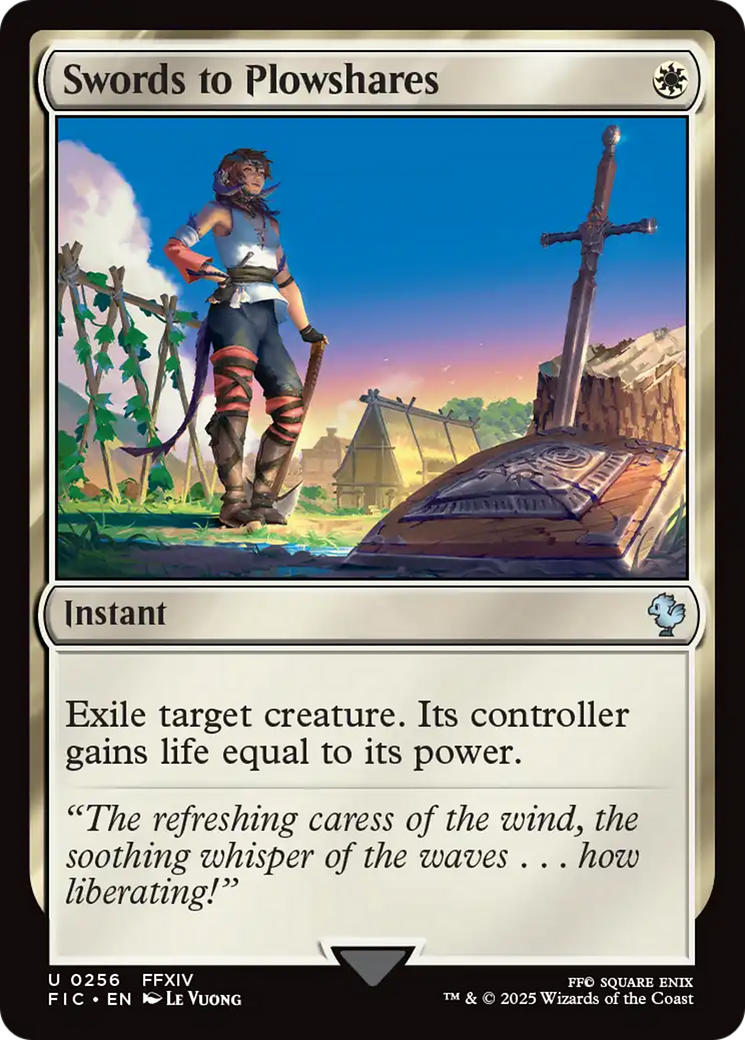
Swords to Plowshares
Swords to Plowshares
Instant
Exile target creature. Its controller gains life equal to its power.
- Use the power of the creature from when it was last on the battlefield to determine how much life is gained.
-
1
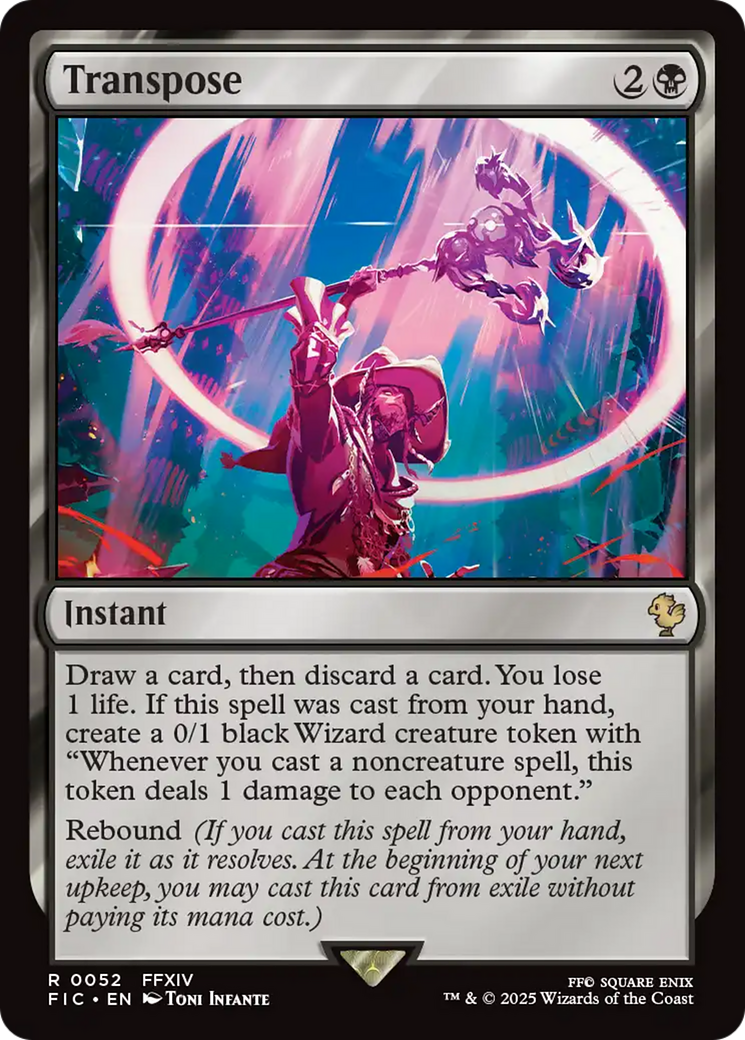
Transpose
Transpose
Instant
Draw a card, then discard a card. You lose 1 life. If this spell was cast from your hand, create a 0/1 black Wizard creature token with "Whenever you cast a noncreature spell, this token deals 1 damage to each opponent."
Rebound (If you cast this spell from your hand, exile it as it resolves. At the beginning of your next upkeep, you may cast this card from exile without paying its mana cost.)
- Casting the card again due to rebound's delayed triggered ability is optional. If you choose not to cast the card, or if you can't because an effect prohibits it, the card will stay exiled. You won't get another chance to cast it on a future turn. If you do cast the card, it's put into its owner's graveyard as normal once it resolves.
- The Wizard token's ability resolves before the spell that caused it to trigger. It resolves even if that spell is countered or otherwise leaves the stack.
- If a spell with rebound that you cast from your hand doesn't resolve for any reason, including being countered, that spell won't resolve and none of its effects will happen, including rebound. The spell will be put into its owner's graveyard and you won't get to cast it again on your next turn.
-
1
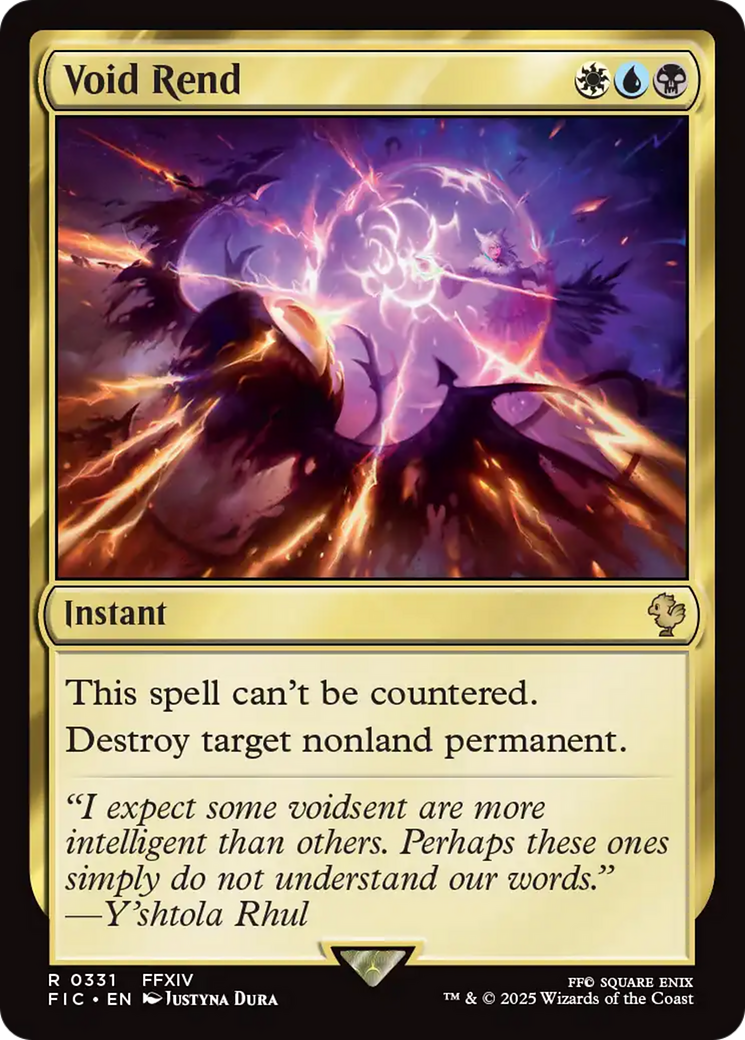
Void Rend
Void Rend
Instant
This spell can't be countered.
Destroy target nonland permanent.
- A spell or ability that counters spells can still target Void Rend. When that spell or ability resolves, Void Rend won't be countered, but any additional effects of the countering spell or ability will still happen.
- If you target a creature with ward, you may still pay the ward cost, but Void Rend won't be countered even if you don't.
Sorceries 10
-
1
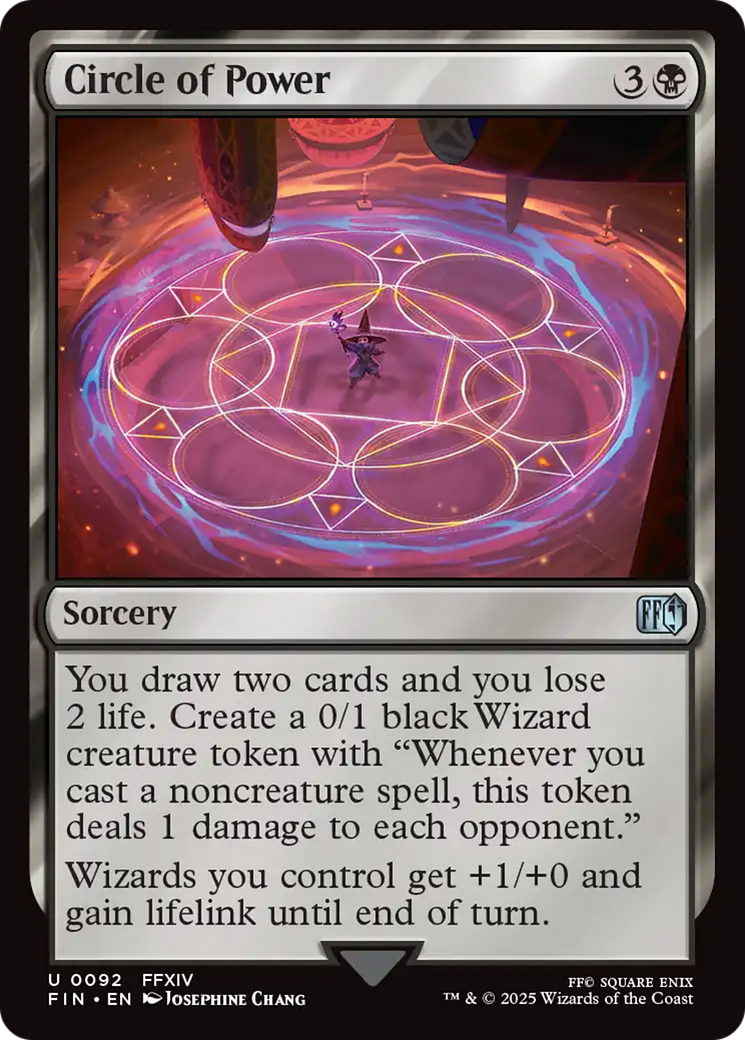
Circle of Power
Circle of Power
Sorcery
You draw two cards and you lose 2 life. Create a 0/1 black Wizard creature token with "Whenever you cast a noncreature spell, this token deals 1 damage to each opponent."
Wizards you control get +1/+0 and gain lifelink until end of turn.
-
1
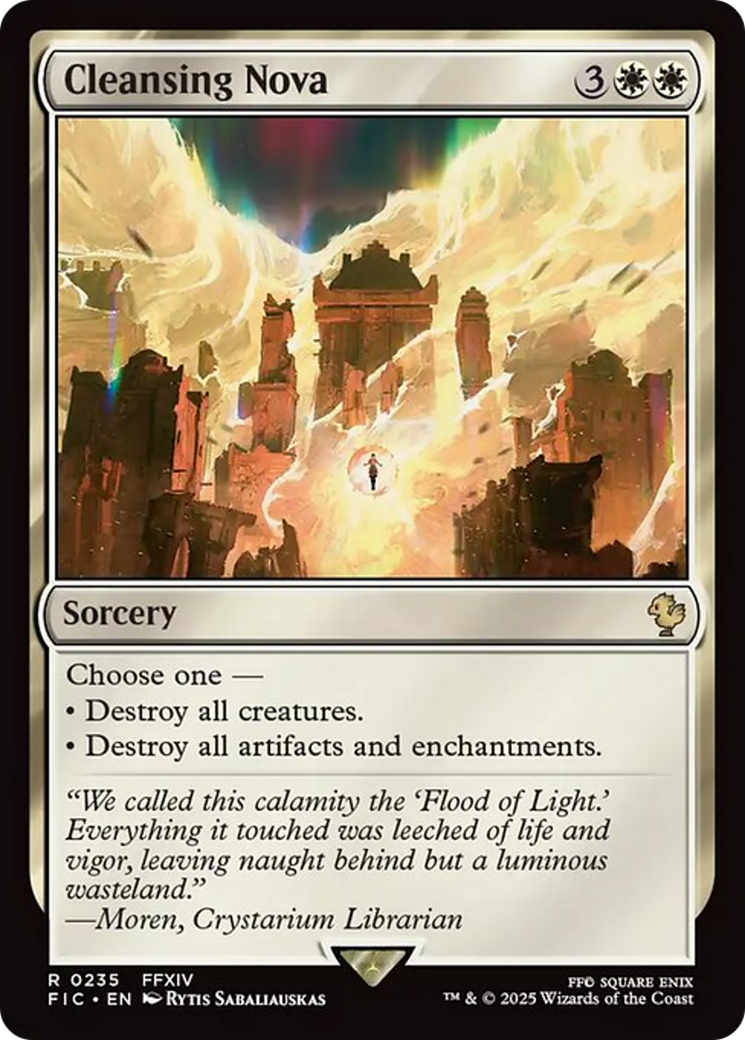
Cleansing Nova
Cleansing Nova
Sorcery
Choose one —
- Destroy all creatures.
- Destroy all artifacts and enchantments.
-
1
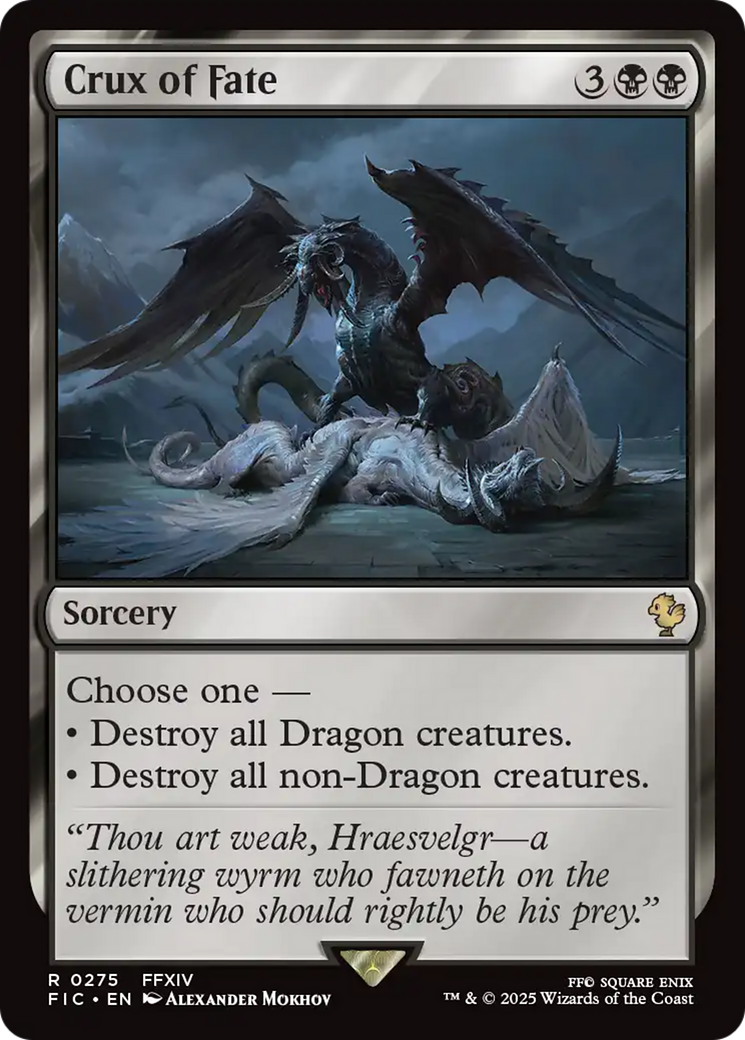
Crux of Fate
Crux of Fate
Sorcery
Choose one —
- Destroy all Dragon creatures.
- Destroy all non-Dragon creatures.
-
1
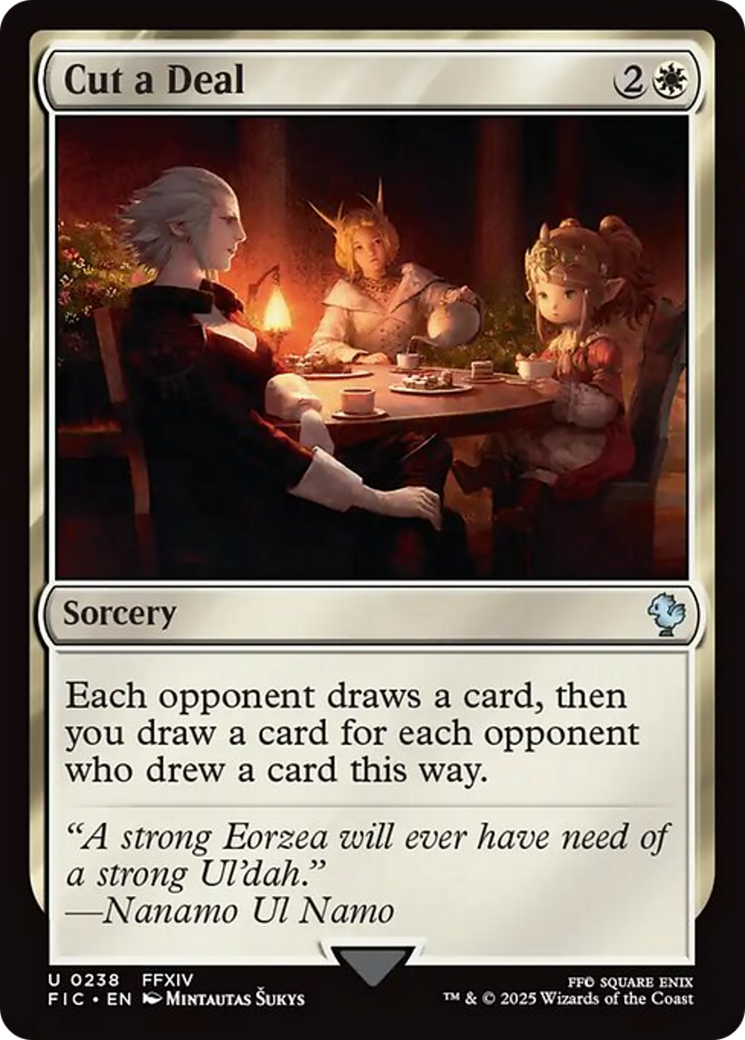
Cut a Deal
Cut a Deal
Sorcery
Each opponent draws a card, then you draw a card for each opponent who drew a card this way.
- Although the draws are not optional, if an opponent doesn't draw a card, perhaps because a replacement effect replaced the draw with another effect, that player is not counted when determining how many cards you draw.
- If an opponent drew more than one card this way due to a replacement effect, you still draw only one card for that player.
-
1
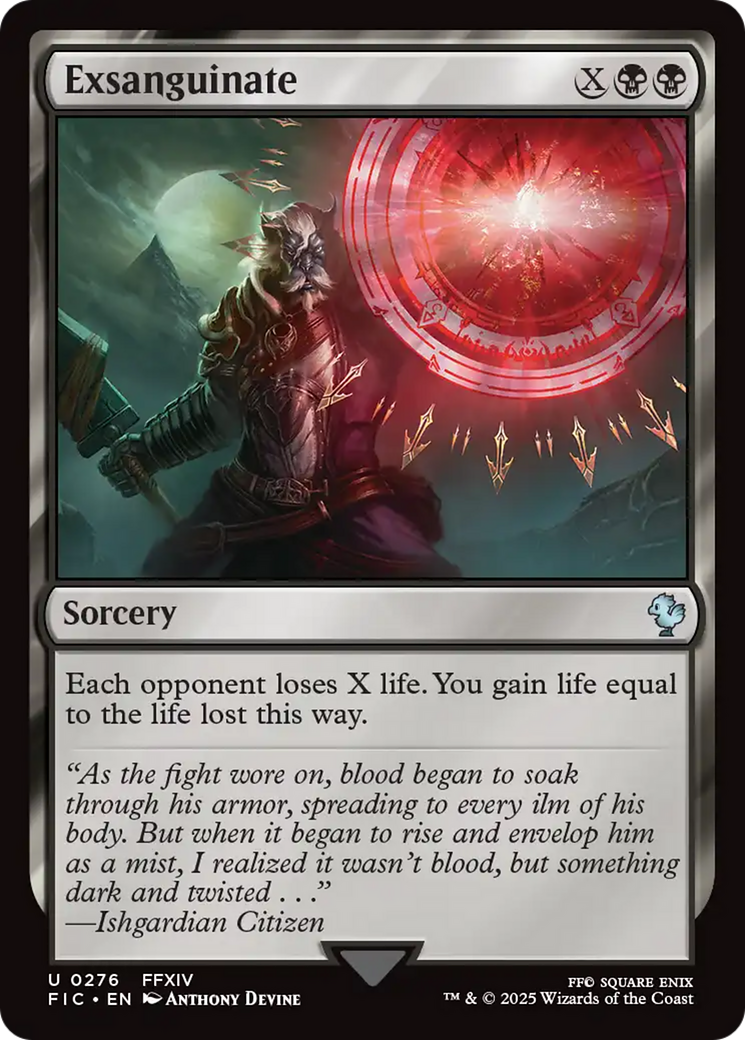
Exsanguinate
Exsanguinate
Sorcery
Each opponent loses X life. You gain life equal to the life lost this way.
- Players can lose more life than they have. For example, say you're playing a multiplayer game in which one of your opponents has 3 life and your other opponent has 10 life. If you cast Exsanguinate with X of 4, your opponents will wind up at -1 life and 6 life, respectively. You'll gain 8 life.
-
1
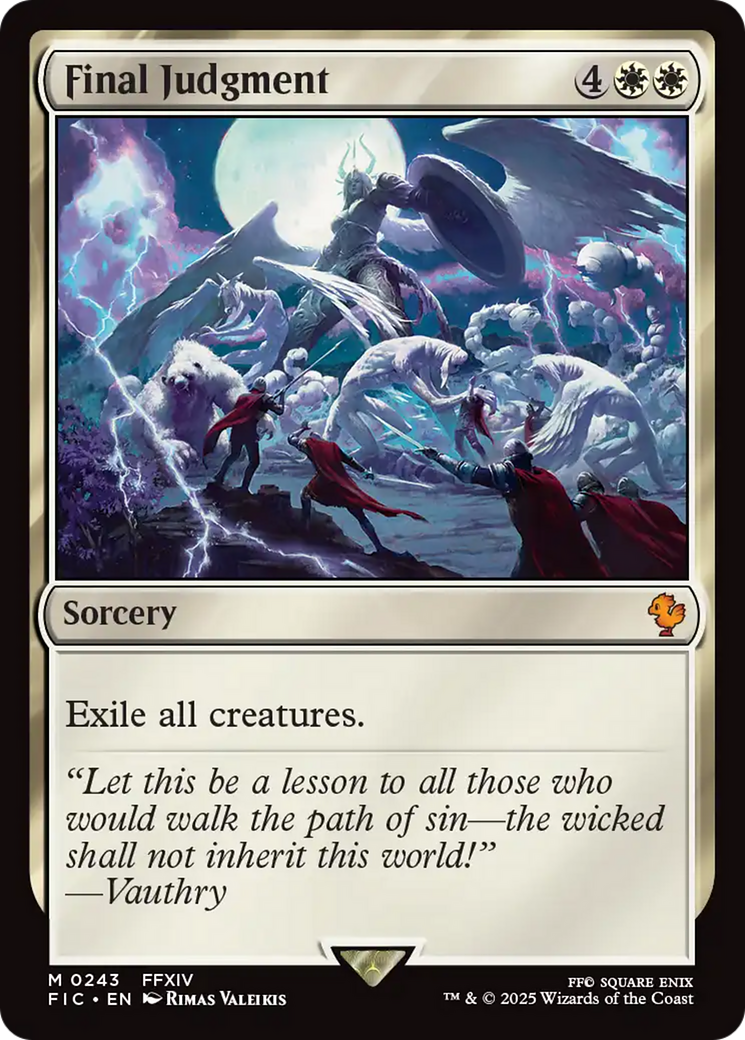
Final Judgment
Final Judgment
Sorcery
Exile all creatures.
-
1
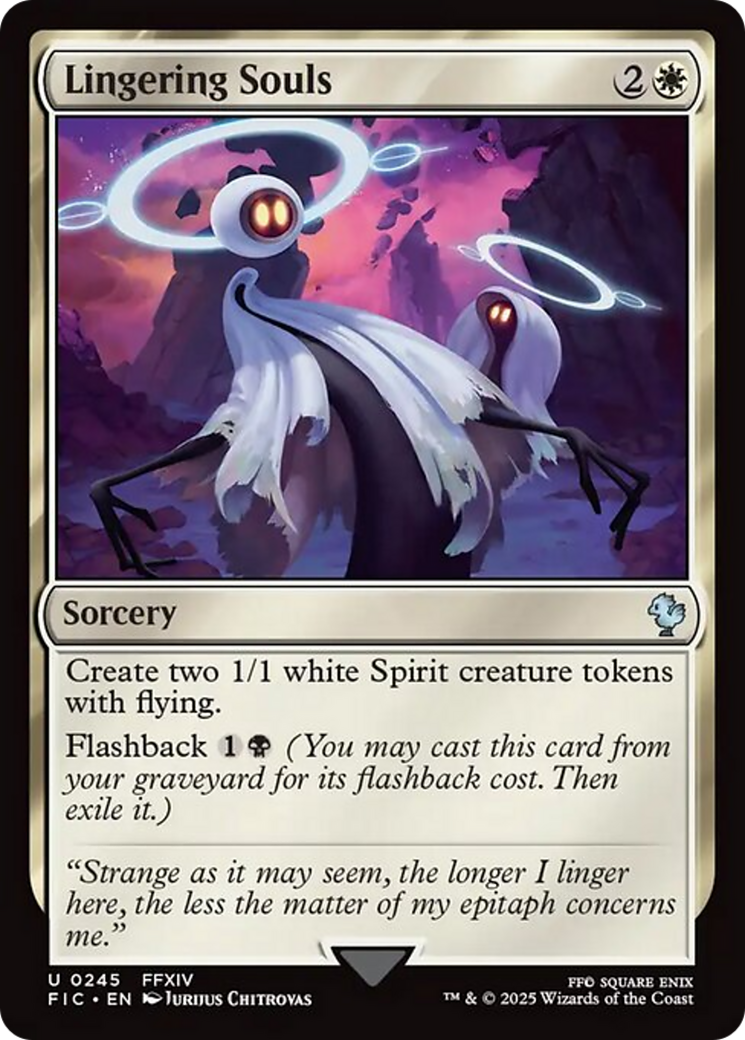
Lingering Souls
Lingering Souls
Sorcery
Create two 1/1 white Spirit creature tokens with flying.
Flashback (You may cast this card from your graveyard for its flashback cost. Then exile it.)
- "Flashback [cost]" means "You may cast this card from your graveyard by paying [cost] rather than paying its mana cost" and "If the flashback cost was paid, exile this card instead of putting it anywhere else any time it would leave the stack."
- You must still follow any timing restrictions and permissions, including those based on the card's type. For instance, you can cast a sorcery using flashback only when you could normally cast a sorcery.
- To determine the total cost of a spell, start with the mana cost or alternative cost (such as a flashback cost) you're paying, add any cost increases, then apply any cost reductions. The mana value of the spell is determined only by its mana cost, no matter what the total cost to cast the spell was.
- A spell cast using flashback will always be exiled afterward, whether it resolves, is countered, or leaves the stack in some other way.
- You can cast a spell using flashback even if it was somehow put into your graveyard without having been cast.
- If a card with flashback is put into your graveyard during your turn, you can cast it if it's legal to do so before any other player can take any actions.
-
1
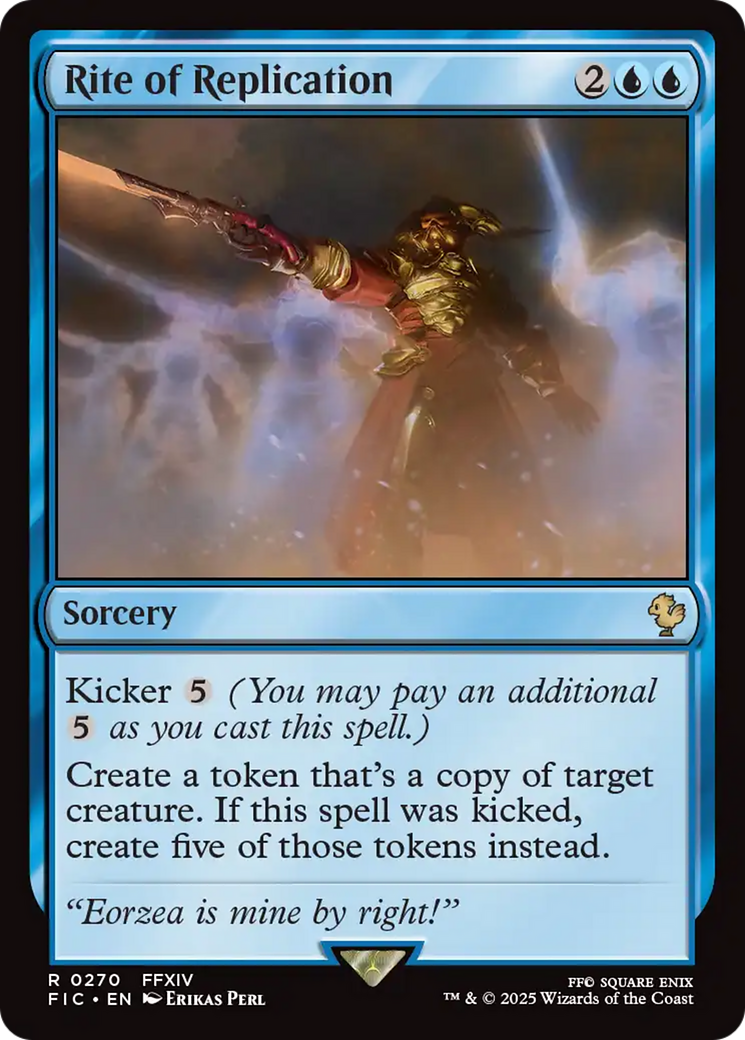
Rite of Replication
Rite of Replication
Sorcery
Kicker (You may pay an additional as you cast this spell.)
Create a token that's a copy of target creature. If this spell was kicked, create five of those tokens instead.
- If the copied creature is a token, the tokens created copy the original characteristics of that token as stated by the effect that created that token.
- Any enters-the-battlefield abilities of the copied creature will trigger when the token enters the battlefield. Any "as [this creature] enters" or "[this creature] enters with" abilities of the creature will also work.
- If the copied creature has in its mana cost, X is 0.
- The tokens copy exactly what was printed on the original creature and nothing else (unless that permanent is itself copying something else; see below). It doesn't copy whether that permanent is tapped or untapped, whether it has any counters on it or Auras attached to it, or any non-copy effects that have changed its power, toughness, types, color, and so on.
- If the copied creature is copying something else, then the tokens enter the battlefield as whatever that creature copied.
- "Kicker [cost]" means "You may pay an additional [cost] as you cast this spell."
- To determine a spell's total cost, start with the mana cost (or an alternative cost if another card's effect allows you to pay one instead), add any cost increases (such as kicker), then apply any cost reductions. The spell's mana value remains unchanged, no matter what the total cost to cast it was.
- If a spell's kicker cost was paid, the spell is "kicked."
- If you put a permanent with a kicker ability onto the battlefield without casting it, you can't kick it.
- If you copy a kicked spell on the stack, the copy is also kicked. If the copied spell is a permanent spell, the token the copy of that spell becomes when it enters is also kicked.
- The kicker ability doesn't let you pay a kicker cost more than once.
- If a card or token enters as a copy of a permanent, the new permanent isn't kicked, even if the original was.
-
1
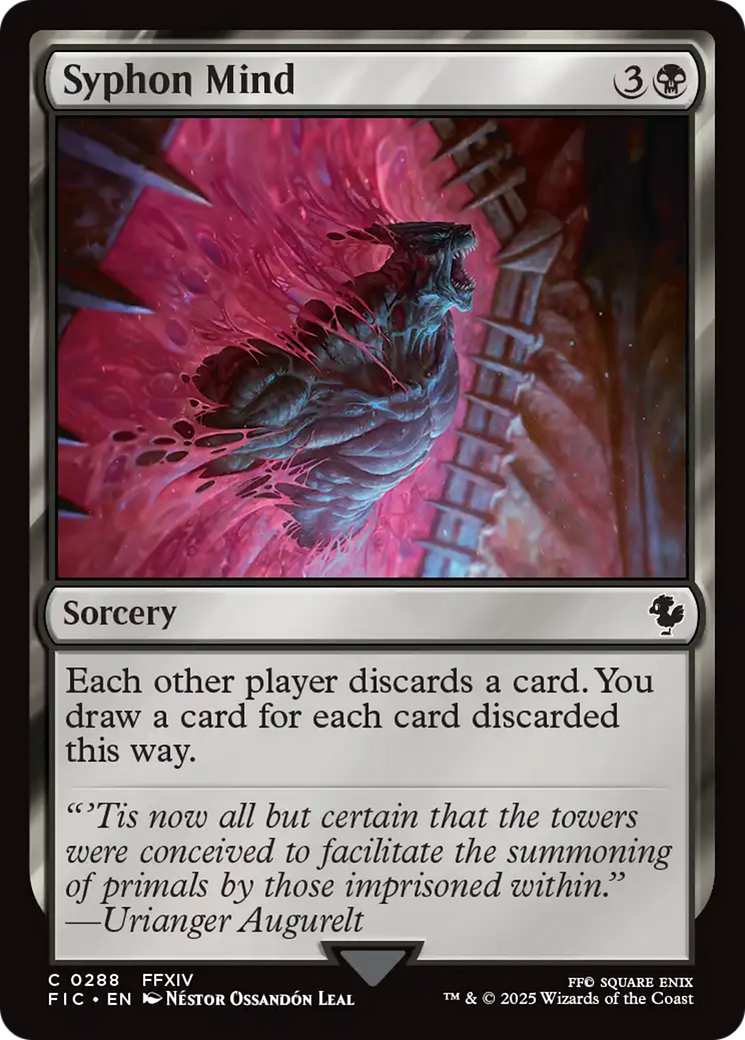
Syphon Mind
Syphon Mind
Sorcery
Each other player discards a card. You draw a card for each card discarded this way.
-
1
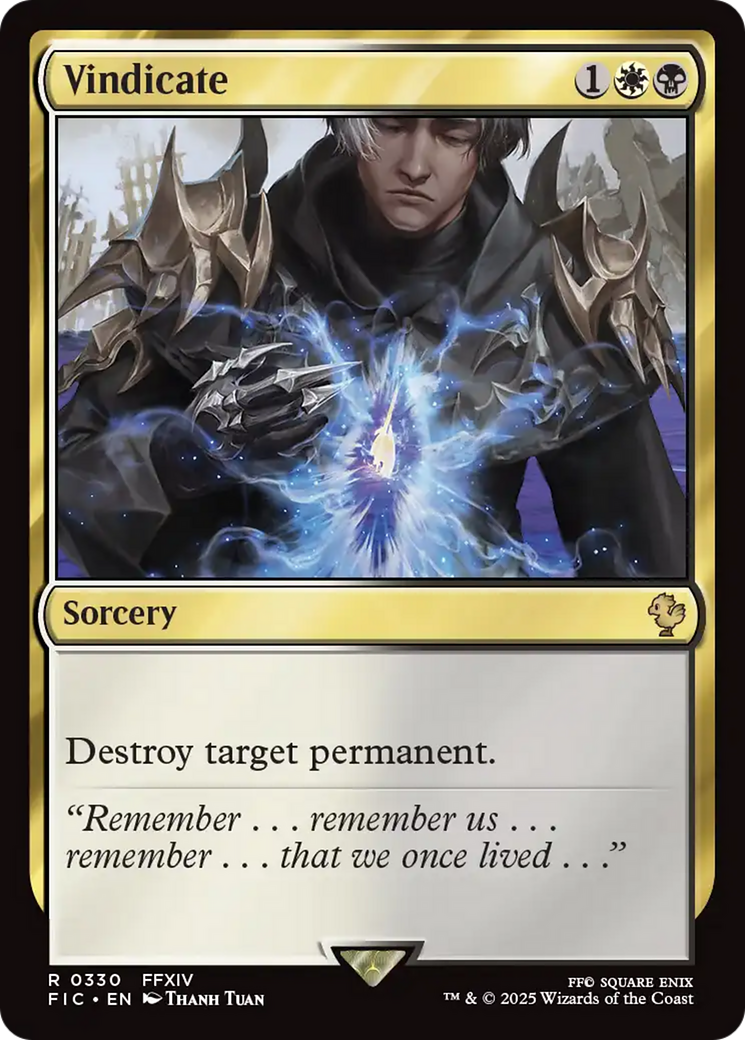
Vindicate
Vindicate
Sorcery
Destroy target permanent.
Artifacts 16
-
1
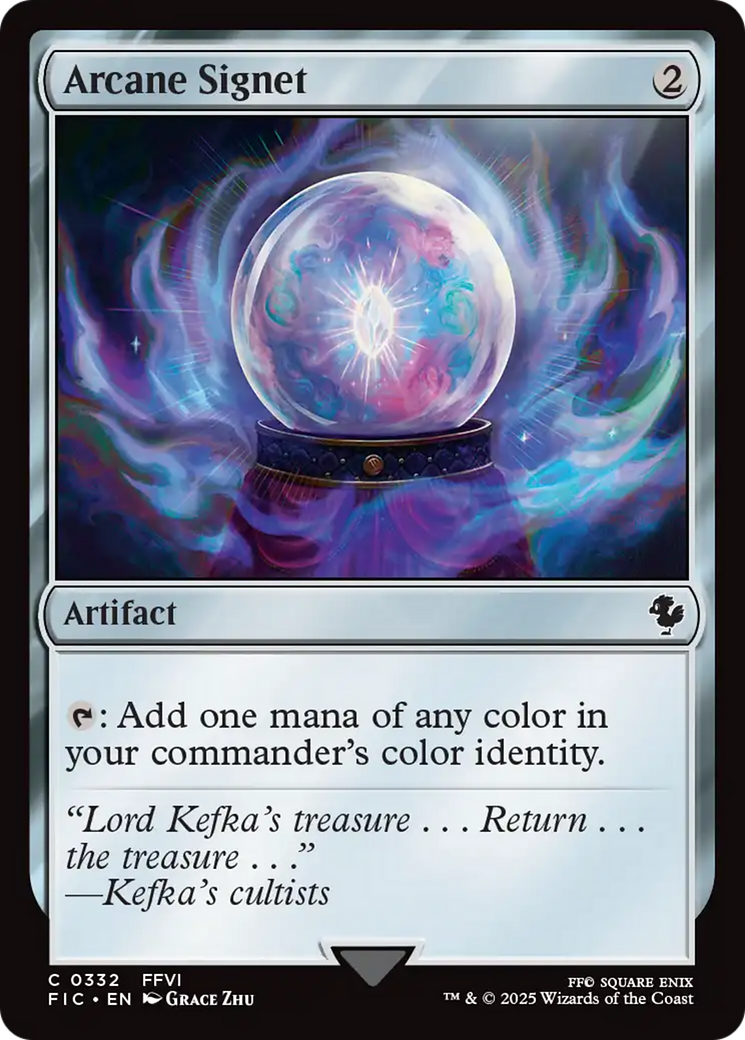
Arcane Signet
Arcane Signet
Artifact
: Add one mana of any color in your commander's color identity.
- If your commander is a card that has no colors in its color identity, Arcane Signet's ability produces no mana. It doesn't produce .
- If you have two commanders, the ability adds one mana of any color in their combined color identities.
- If you don't have a commander, Arcane Signet's ability produces no mana.
-
1
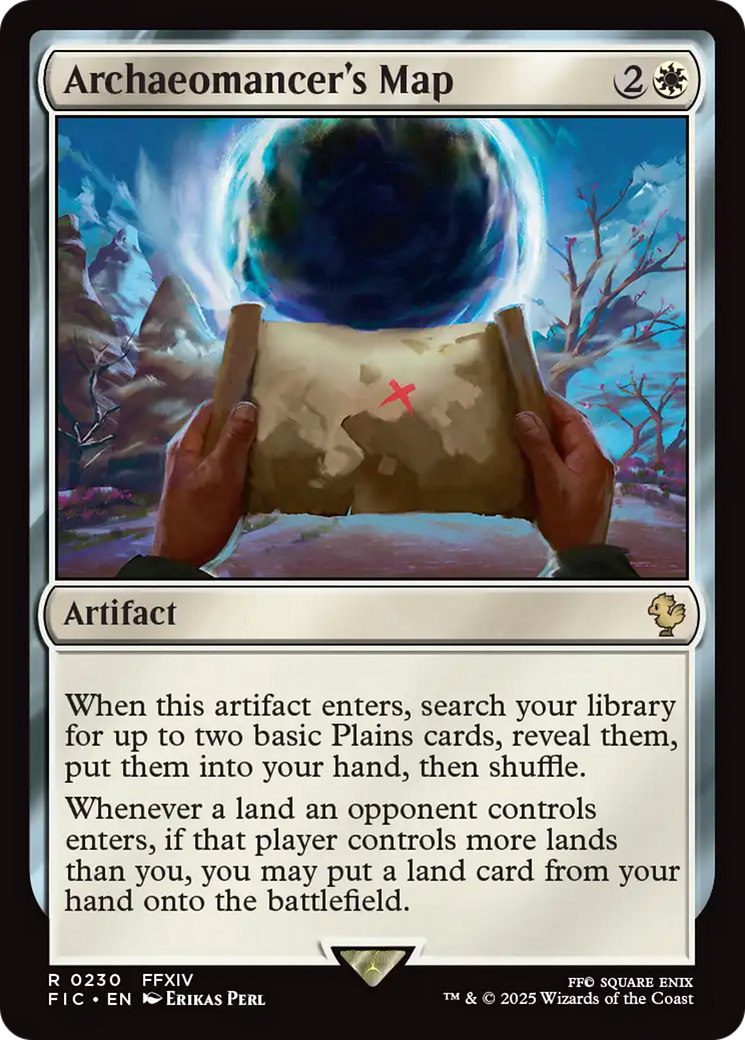
Archaeomancer's Map
Archaeomancer's Map
Artifact
When this artifact enters, search your library for up to two basic Plains cards, reveal them, put them into your hand, then shuffle.
Whenever a land an opponent controls enters, if that player controls more lands than you, you may put a land card from your hand onto the battlefield.
- The last ability triggers only if that opponent controls more lands than you after the land enters the battlefield. The ability will check again as it tries to resolve. If that opponent doesn't still control more lands than you at that time, the ability won't resolve.
-
1
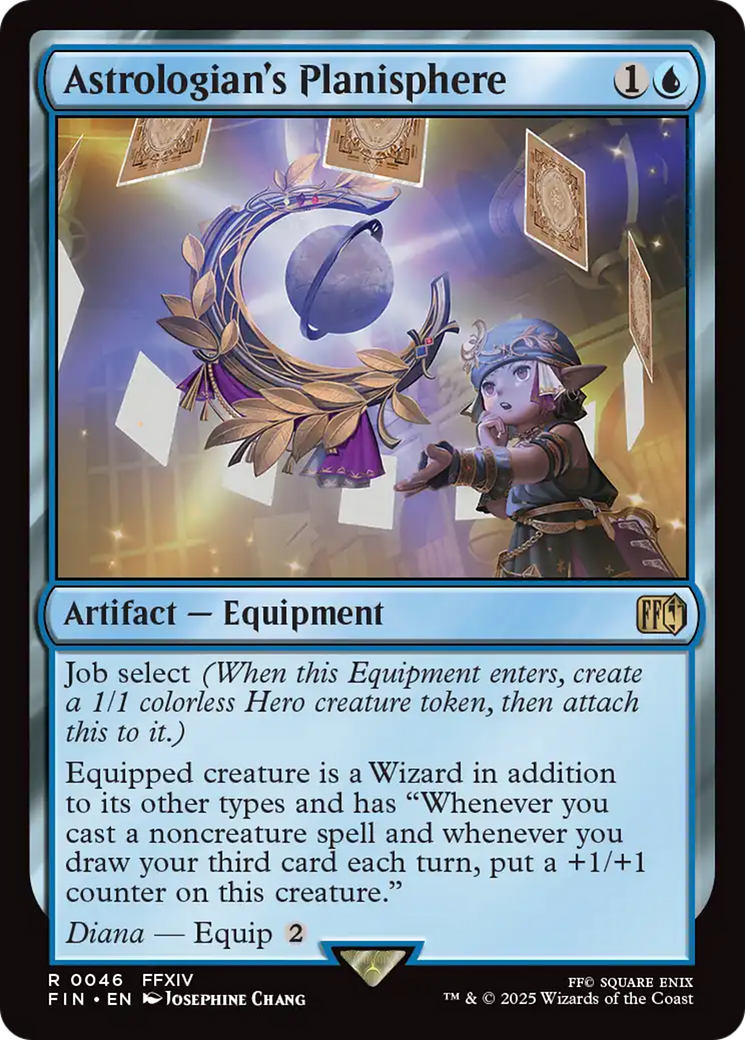
Astrologian's Planisphere
Astrologian's Planisphere
Artifact — Equipment
Job select (When this Equipment enters, create a 1/1 colorless Hero creature token, then attach this to it.)
Equipped creature is a Wizard in addition to its other types and has "Whenever you cast a noncreature spell and whenever you draw your third card each turn, put a +1/+1 counter on this creature."
Diana — Equip
-
1
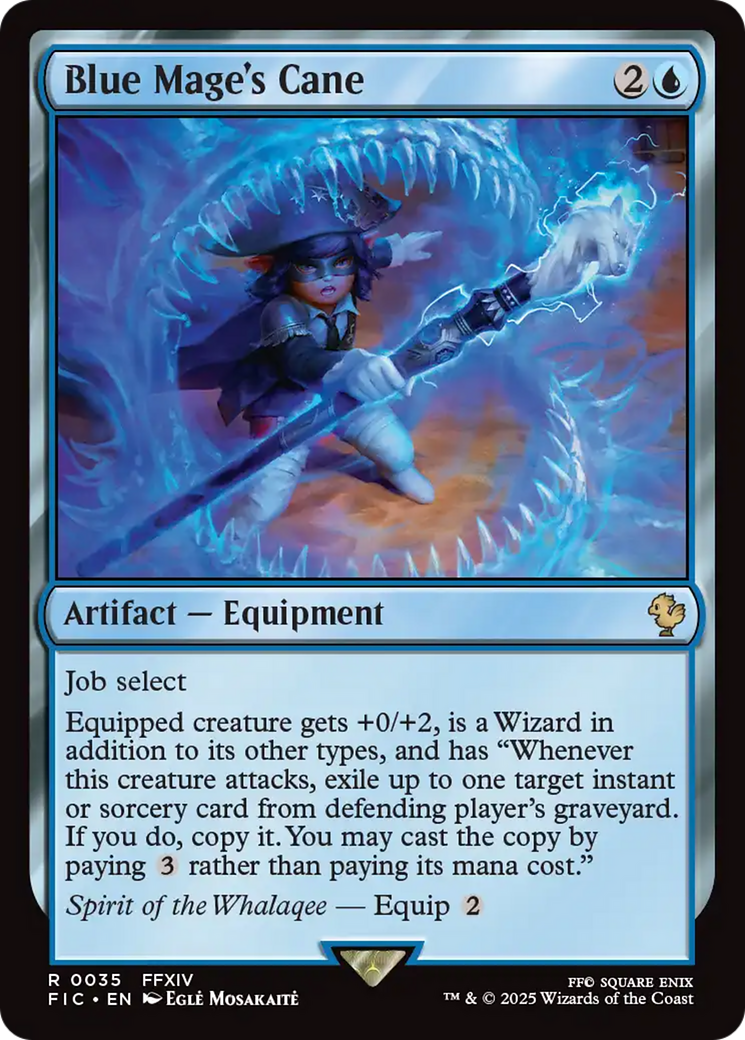
Blue Mage's Cane
Blue Mage's Cane
Artifact — Equipment
Job select
Equipped creature gets +0/+2, is a Wizard in addition to its other types, and has "Whenever this creature attacks, exile up to one target instant or sorcery card from defending player's graveyard. If you do, copy it. You may cast the copy by paying rather than paying its mana cost."
Spirit of the Whalaqee — Equip
- If the spell has in its mana cost, you must choose 0 as the value of X when casting it by paying rather than paying its mana cost.
- If you don't want to cast the copy, you can choose not to; the copy ceases to exist the next time state-based actions are performed.
- You cast the copy while the ability is resolving and still on the stack. You can't wait to cast it later in the turn.
- If you cast a spell by paying rather than paying its mana cost, you can't choose to cast it for any other alternative cost. You can, however, pay additional costs. If the spell has any mandatory additional costs, those must be paid to cast the card.
-
1
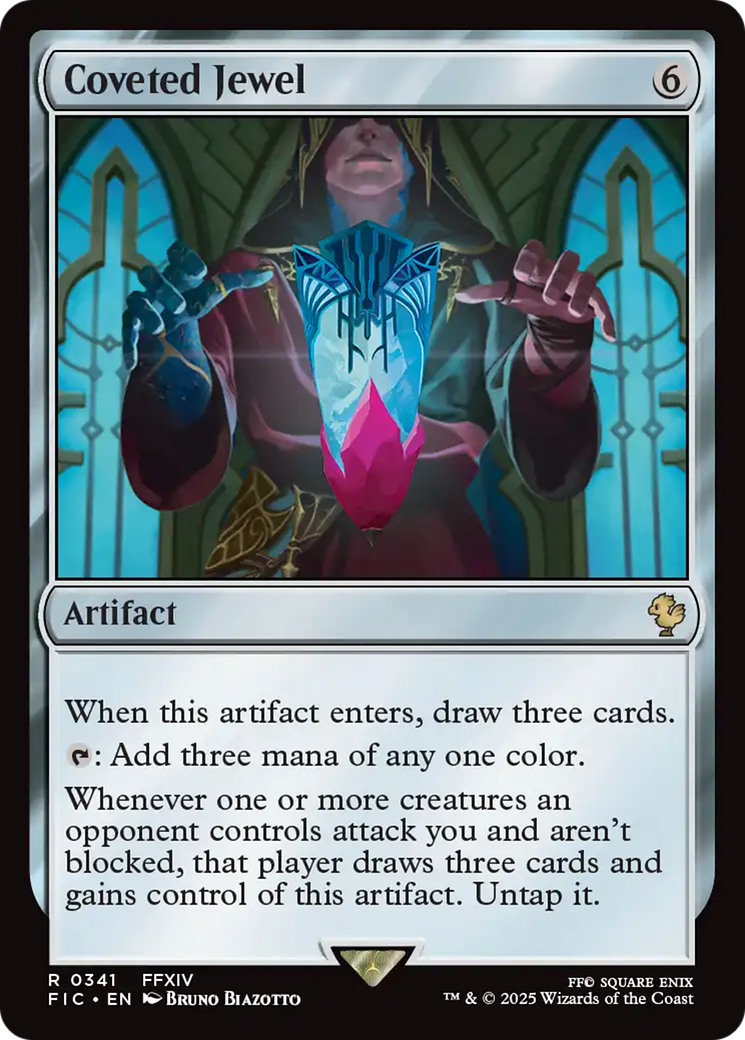
Coveted Jewel
Coveted Jewel
Artifact
When this artifact enters, draw three cards.
: Add three mana of any one color.
Whenever one or more creatures an opponent controls attack you and aren't blocked, that player draws three cards and gains control of this artifact. Untap it.
- Coveted Jewel's last ability triggers after you declare blockers (or declare no blockers at all) if any attacking creatures are unblocked. It doesn't matter if some attacking creatures were blocked.
- If more than one opponent attacks you at the same time, Coveted Jewel's last ability triggers for each of them. You choose which player ends up with Coveted Jewel, but each of them draws three cards and has a chance to activate its mana ability.
- A creature attacking a planeswalker you control won't cause Coveted Jewel's last ability to trigger.
- Coveted Jewel's last ability resolves after blockers are chosen but before combat damage is dealt.
-
1
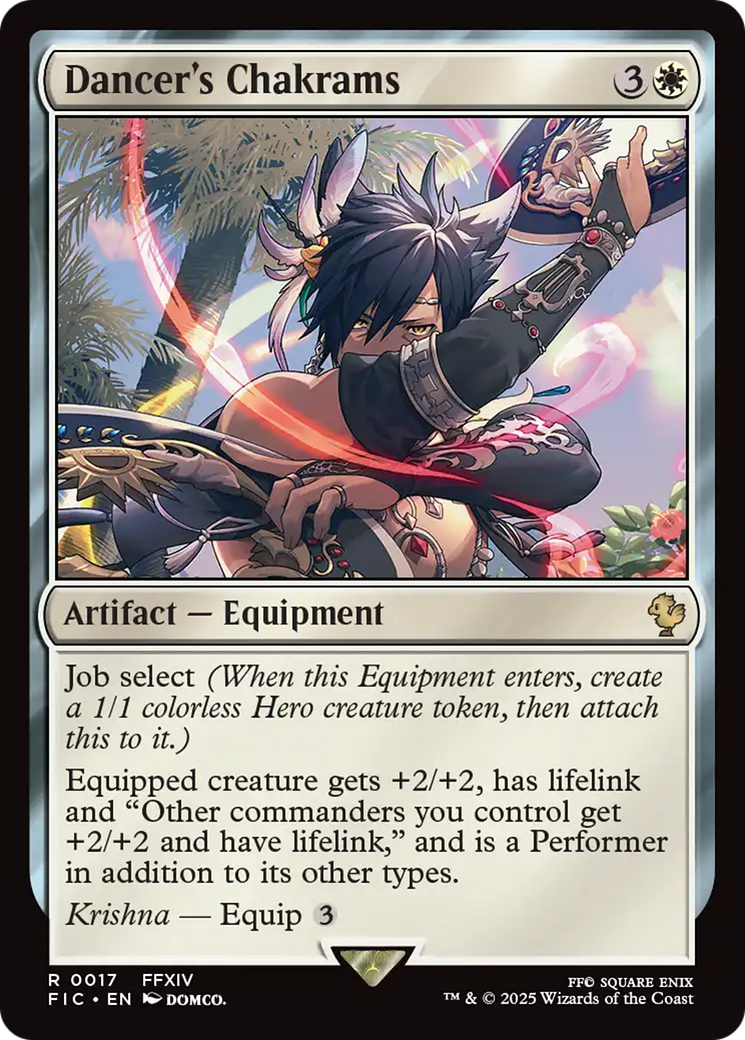
Dancer's Chakrams
Dancer's Chakrams
Artifact — Equipment
Job select (When this Equipment enters, create a 1/1 colorless Hero creature token, then attach this to it.)
Equipped creature gets +2/+2, has lifelink and "Other commanders you control get +2/+2 and have lifelink," and is a Performer in addition to its other types.
Krishna — Equip
- The last ability granted by Dancer's Chakrams to the equipped creature applies whether or not Dancer's Chakrams is attached to a commander.
-
1
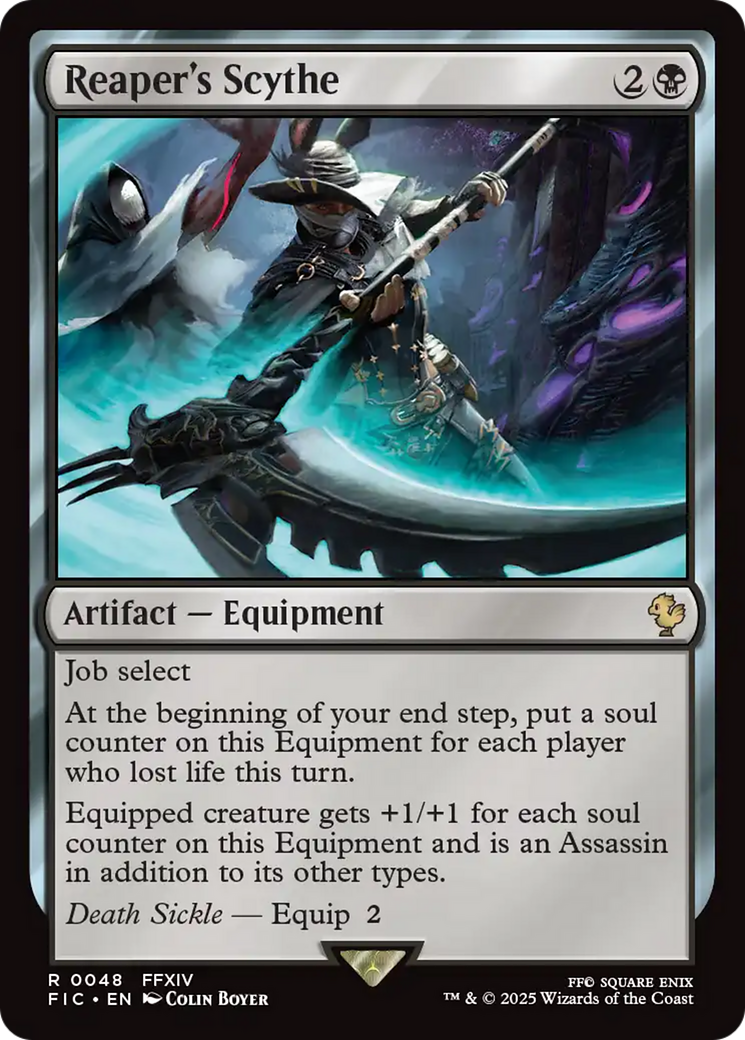
Reaper's Scythe
Reaper's Scythe
Artifact — Equipment
Job select
At the beginning of your end step, put a soul counter on this Equipment for each player who lost life this turn.
Equipped creature gets +1/+1 for each soul counter on this Equipment and is an Assassin in addition to its other types.
Death Sickle — Equip
-
1
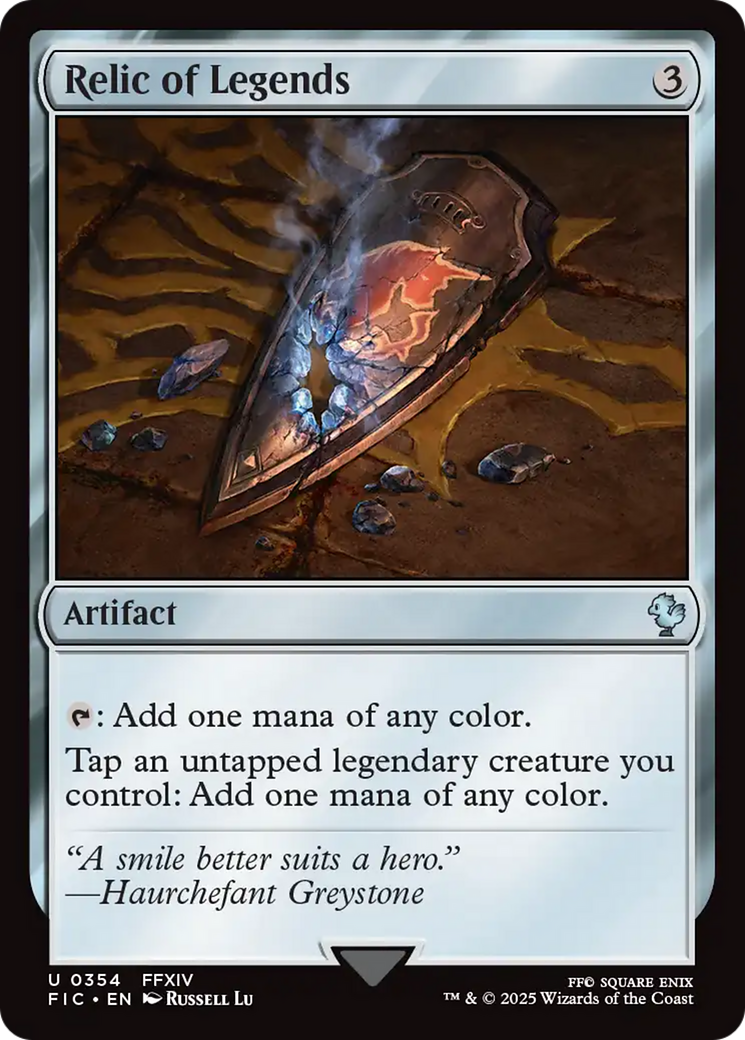
Relic of Legends
Relic of Legends
Artifact
: Add one mana of any color.
Tap an untapped legendary creature you control: Add one mana of any color.
- You can tap any untapped legendary creature you control, including one you haven't controlled continuously since the beginning of your most recent turn, to pay the cost of Relic of Legends's activated ability.
-
1
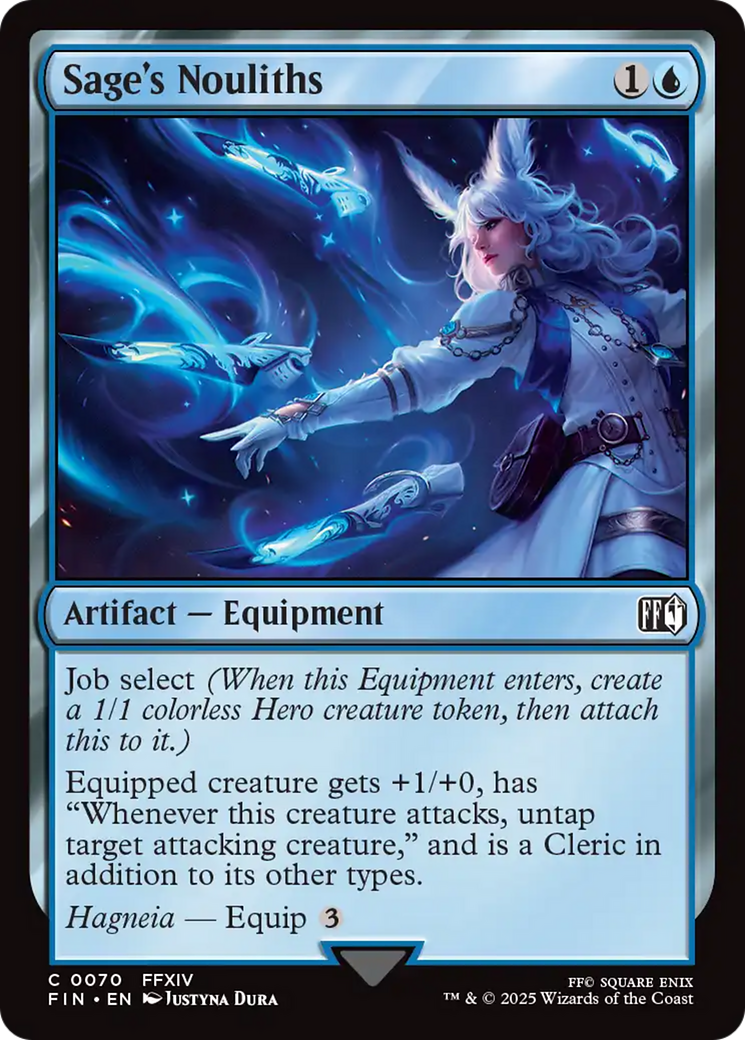
Sage's Nouliths
Sage's Nouliths
Artifact — Equipment
Job select (When this Equipment enters, create a 1/1 colorless Hero creature token, then attach this to it.)
Equipped creature gets +1/+0, has "Whenever this creature attacks, untap target attacking creature," and is a Cleric in addition to its other types.
Hagneia — Equip
-
1
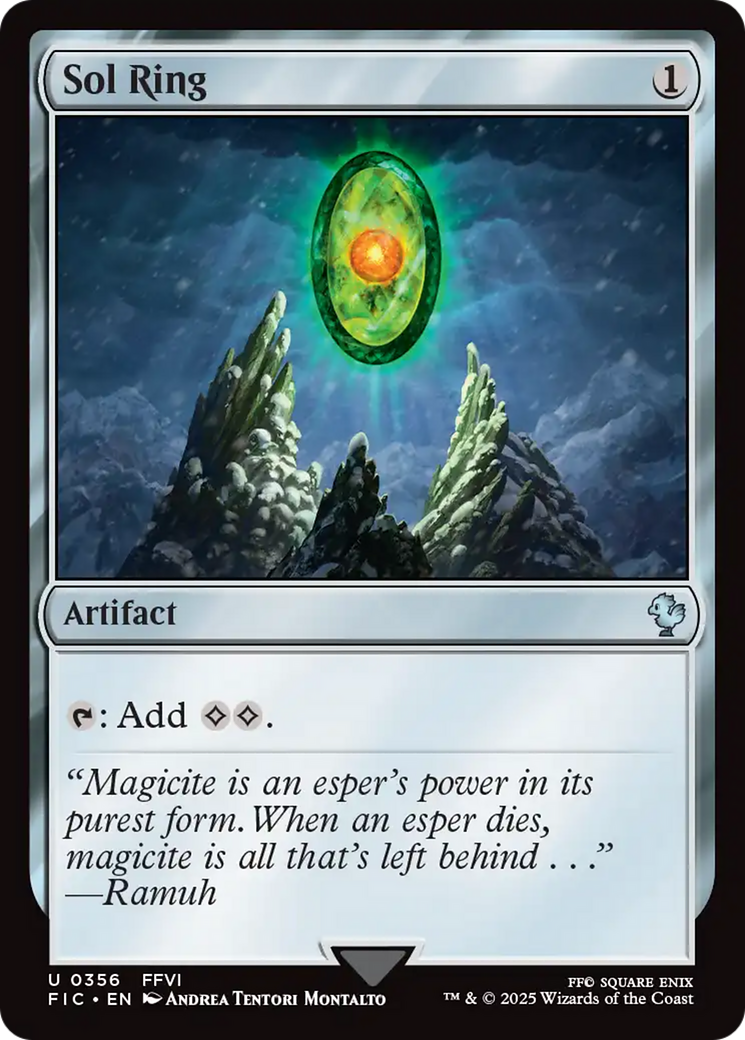
Sol Ring
Sol Ring
Artifact
: Add .
-
1
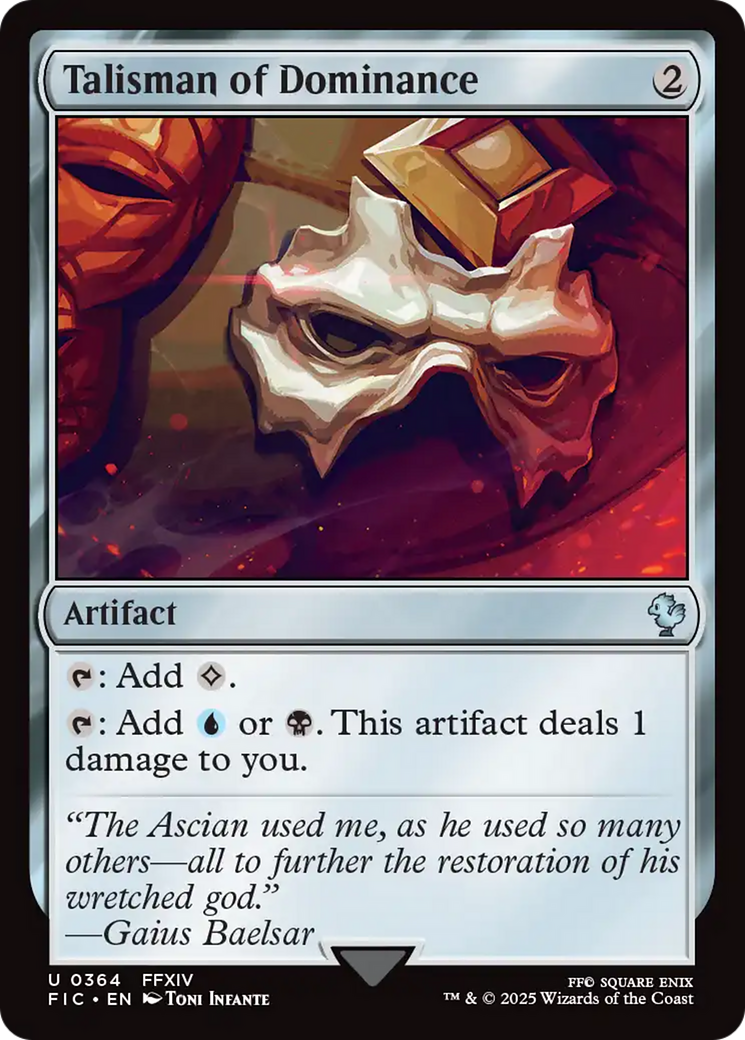
Talisman of Dominance
Talisman of Dominance
Artifact
: Add .
: Add or . This artifact deals 1 damage to you.
-
1
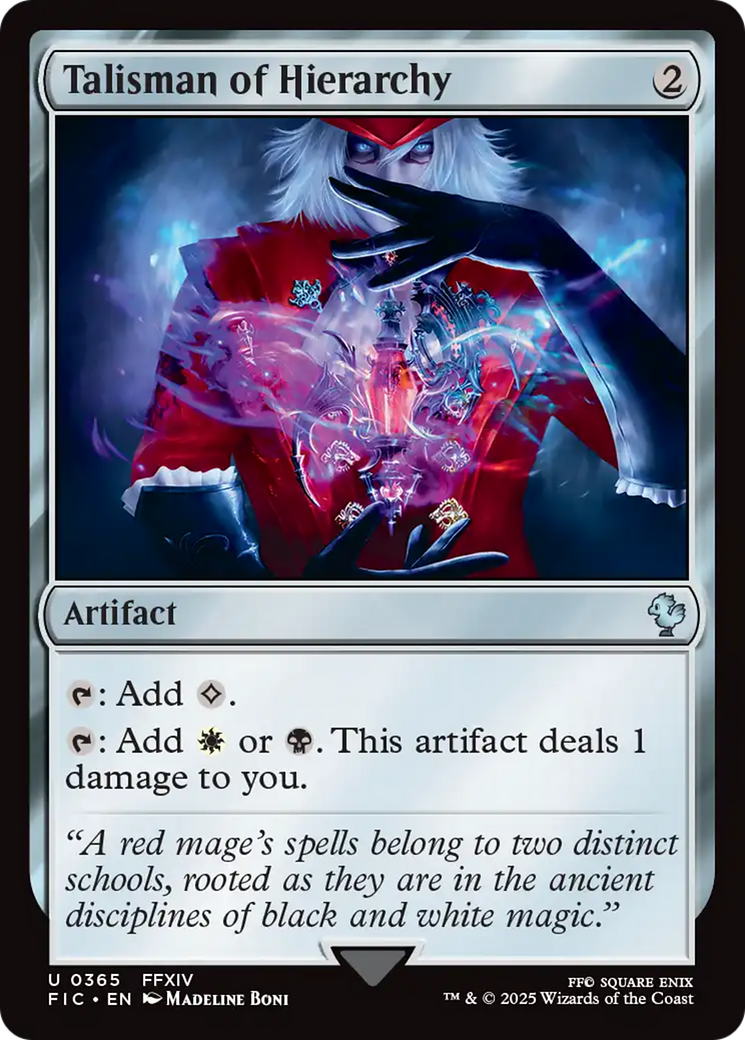
Talisman of Hierarchy
Talisman of Hierarchy
Artifact
: Add .
: Add or . This artifact deals 1 damage to you.
-
1
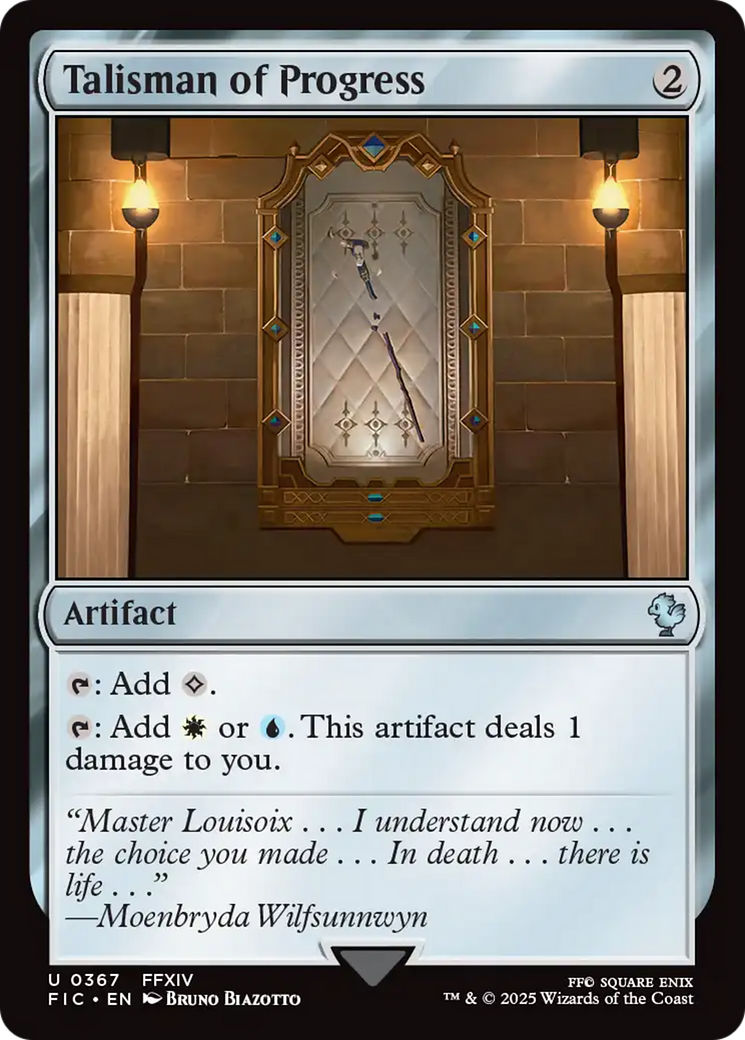
Talisman of Progress
Talisman of Progress
Artifact
: Add .
: Add or . This artifact deals 1 damage to you.
-
1
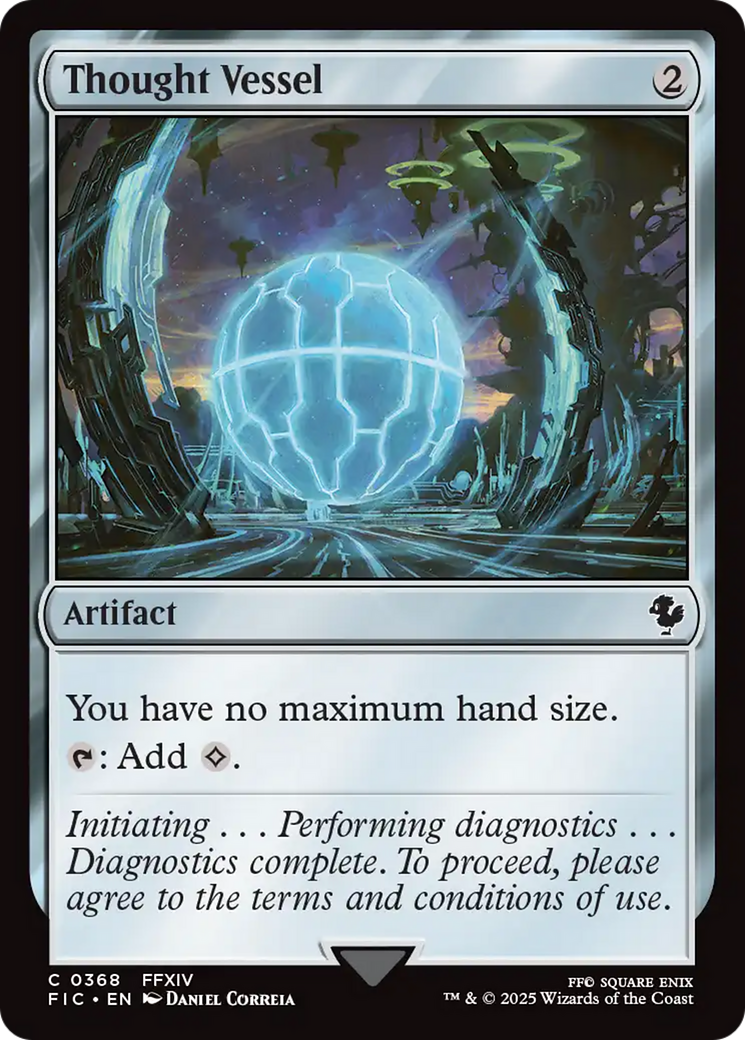
Thought Vessel
Thought Vessel
Artifact
You have no maximum hand size.
: Add .
-
1
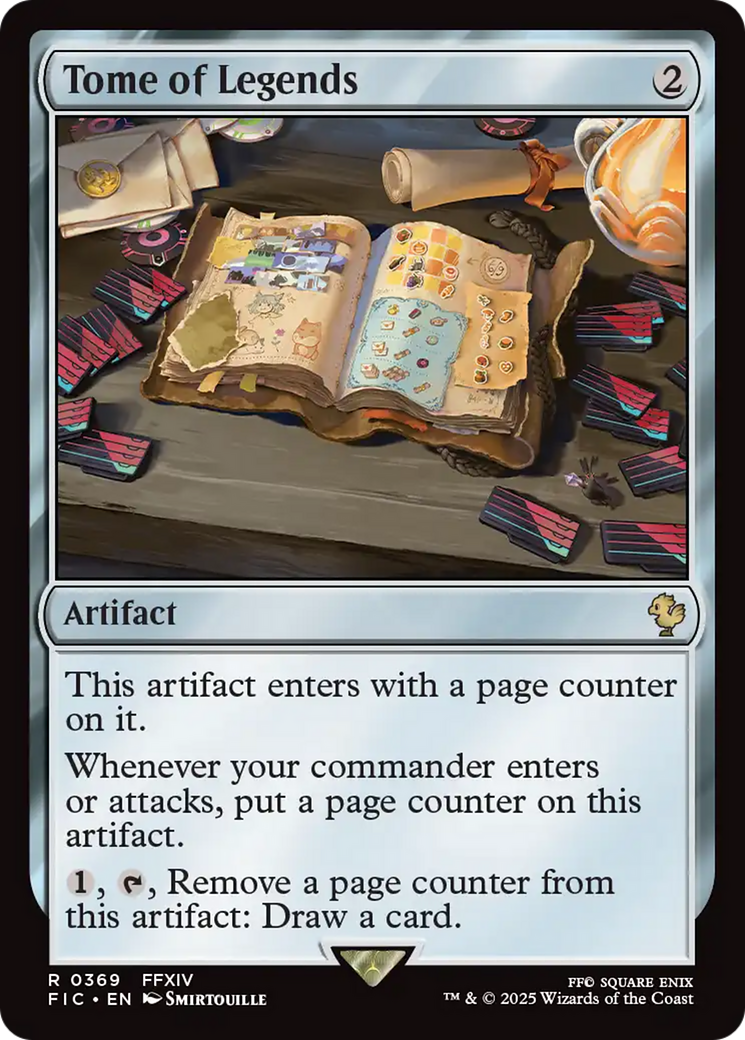
Tome of Legends
Tome of Legends
Artifact — Book
This artifact enters with a page counter on it.
Whenever your commander enters or attacks, put a page counter on this artifact.
, , Remove a page counter from this artifact: Draw a card.
- If you control another player's commander, you won't put a page counter on Tome of Legends when you attack with that creature. Similarly, if another player controls your commander, you'll still put a page counter on Tome of Legends if it attacks. (Perhaps the page is about your commander's shocking betrayal.)
-
1
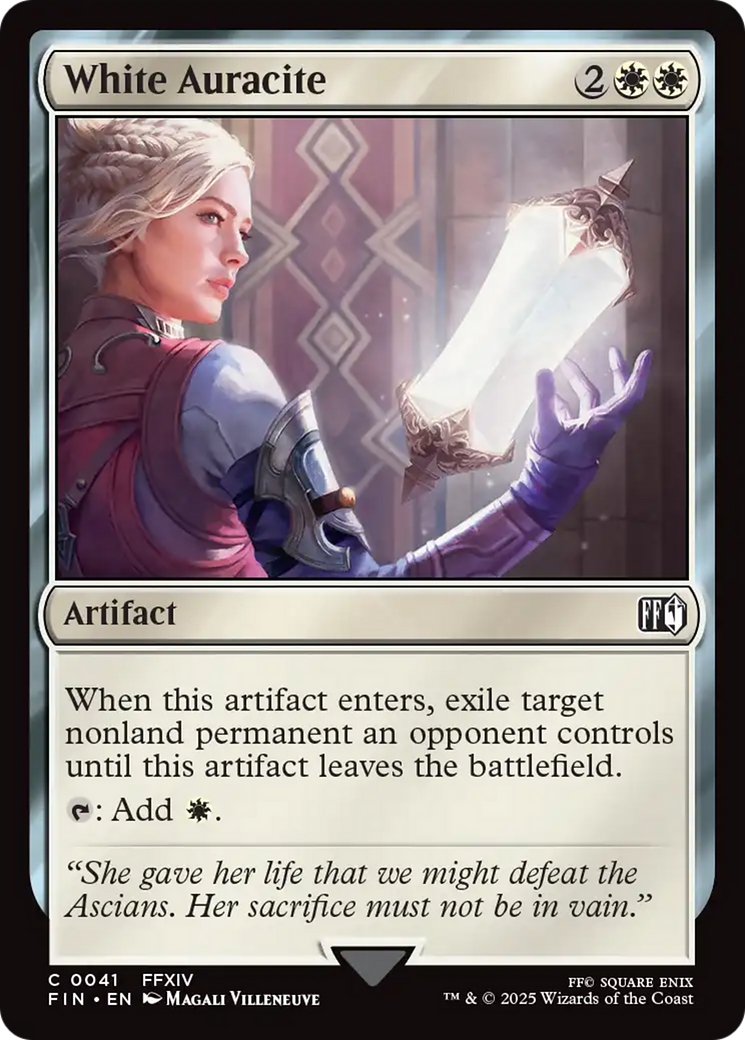
White Auracite
White Auracite
Artifact
When this artifact enters, exile target nonland permanent an opponent controls until this artifact leaves the battlefield.
: Add .
Enchantments 6
-
1
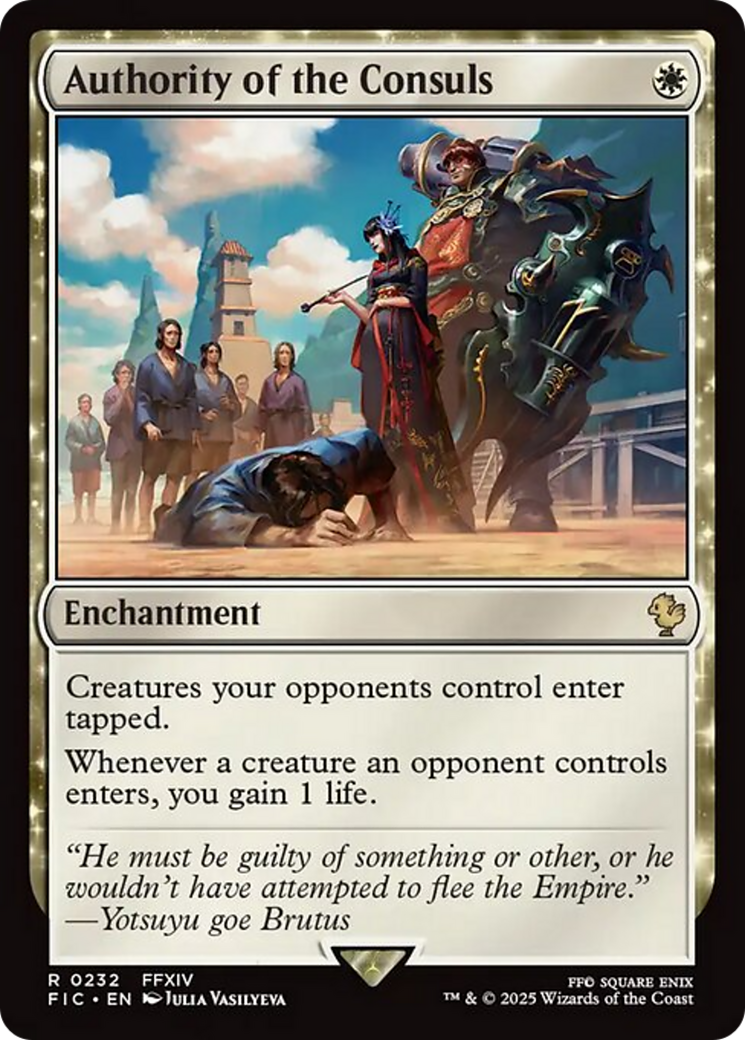
Authority of the Consuls
Authority of the Consuls
Enchantment
Creatures your opponents control enter tapped.
Whenever a creature an opponent controls enters, you gain 1 life.
-
1
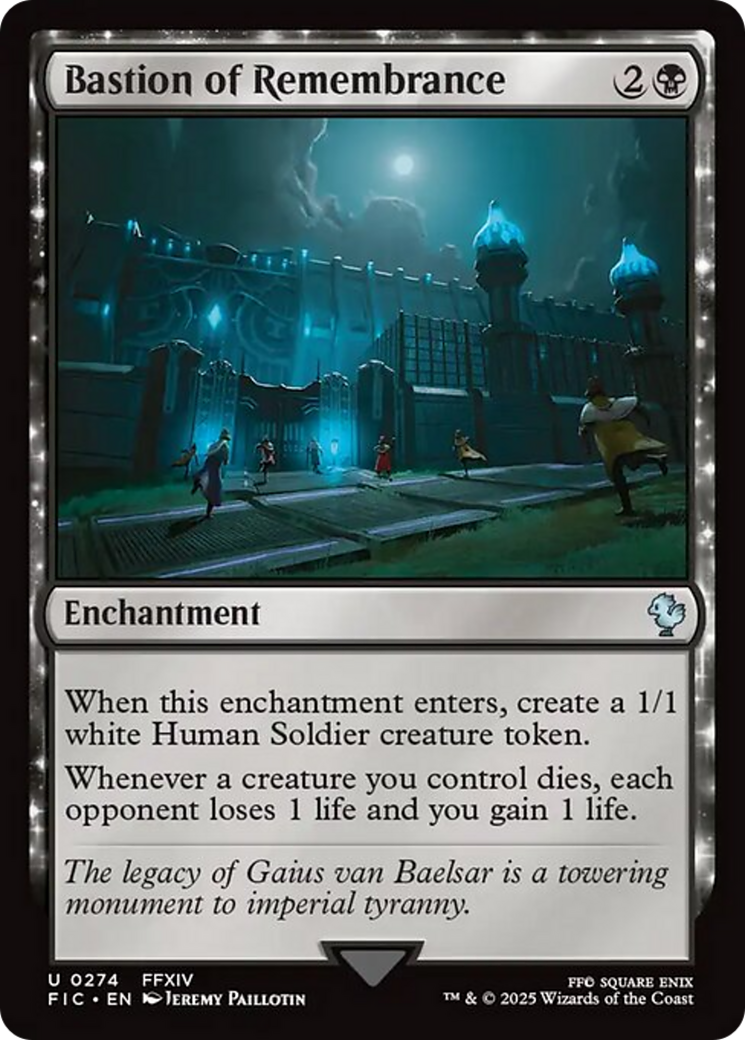
Bastion of Remembrance
Bastion of Remembrance
Enchantment
When this enchantment enters, create a 1/1 white Human Soldier creature token.
Whenever a creature you control dies, each opponent loses 1 life and you gain 1 life.
- If your life total is brought to 0 or less at the same time that creatures you control are dealt lethal damage, you lose the game before the last ability goes on the stack.
- In a Two-Headed Giant game, Bastion of Remembrance's last ability causes the opposing team to lose 2 life and you to gain 1 life.
- If one or more creatures you control die at the same time that Bastion of Remembrance leaves the battlefield, its last ability triggers for each of those creatures.
-
1
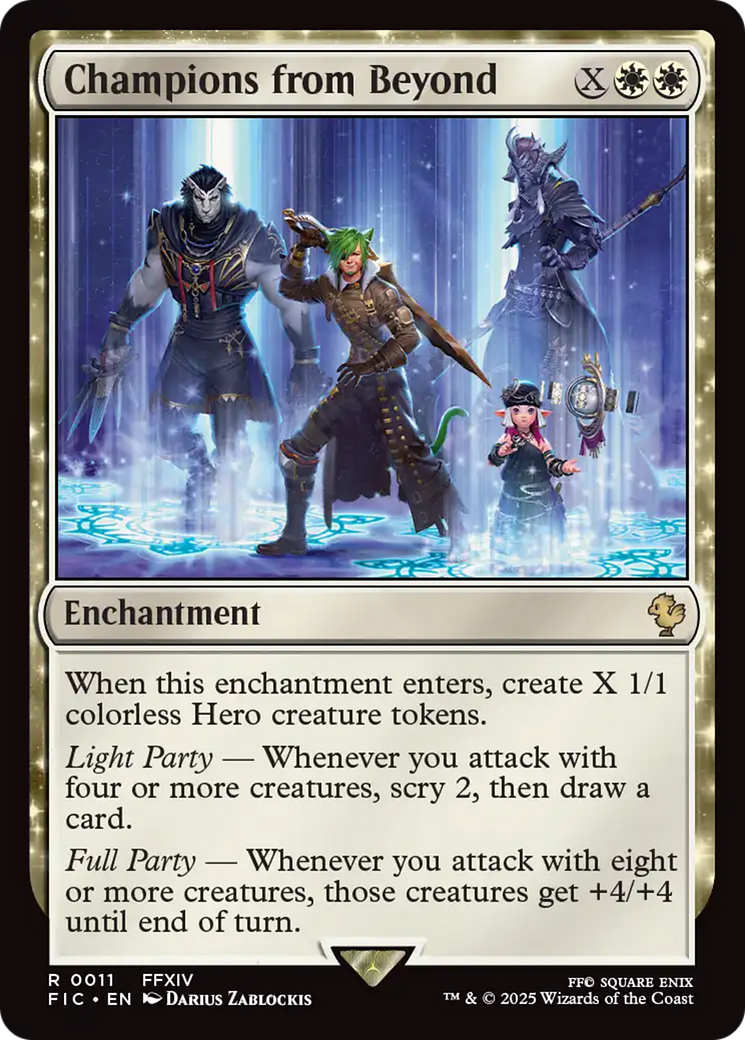
Champions from Beyond
Champions from Beyond
Enchantment
When this enchantment enters, create X 1/1 colorless Hero creature tokens.
Light Party — Whenever you attack with four or more creatures, scry 2, then draw a card.
Full Party — Whenever you attack with eight or more creatures, those creatures get +4/+4 until end of turn.
- The second and third abilities of Champions from Beyond don't care what happens to those creatures after you attack with them. Once the second ability triggers, you'll scry 2 and then draw a card when it resolves even if one or more of those creatures left the battlefield or were otherwise removed from combat. Similarly, once the third ability triggers, those creatures will get +4/+4 when it resolves, even if one or more of those creatures left the battlefield. Any of those creatures that were removed from combat but are still on the battlefield will still get +4/+4.
- While the second and third abilities of Champions from Beyond have "Party" in their flavor words, neither of them refer to a player's party (a mechanic from previous releases that also uses the term "full party").
-
1
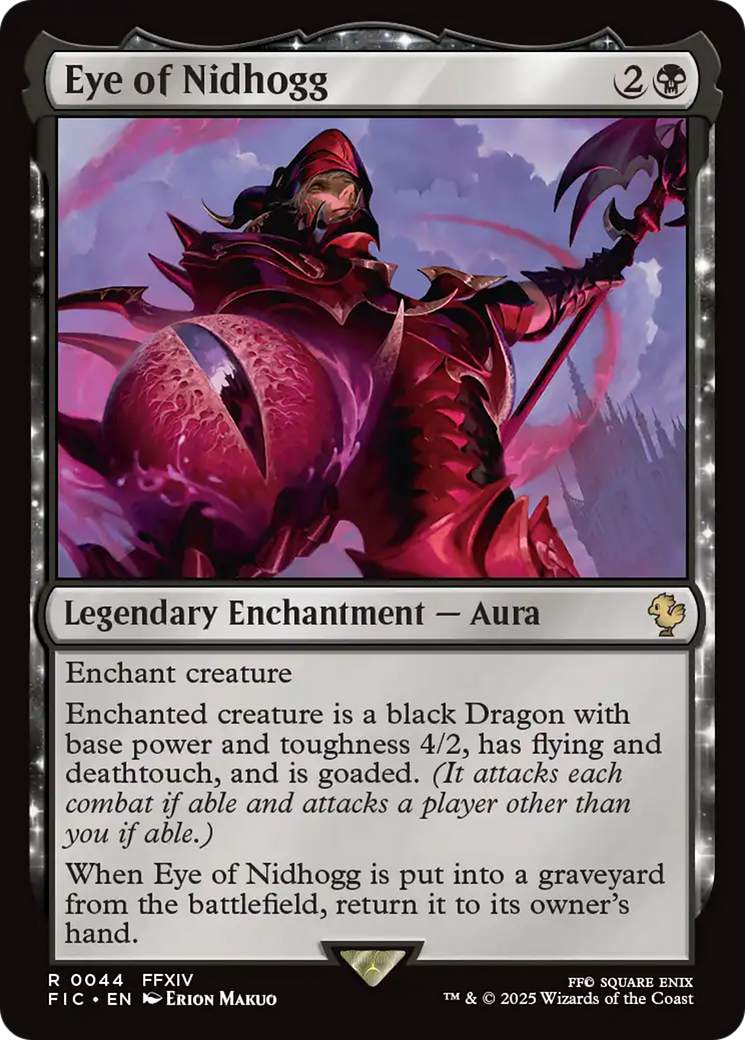
Eye of Nidhogg
Eye of Nidhogg
Legendary Enchantment — Aura
Enchant creature
Enchanted creature is a black Dragon with base power and toughness 4/2, has flying and deathtouch, and is goaded. (It attacks each combat if able and attacks a player other than you if able.)
When Eye of Nidhogg is put into a graveyard from the battlefield, return it to its owner's hand.
- Eye of Nidhogg overwrites all previous effects that set the creature's base power and toughness to specific values. Any power- or toughness-setting effects that start to apply afterward will overwrite this effect.
- Eye of Nidhogg overwrites all colors and creature types the enchanted creature has. It's just a black Dragon. The creature keeps any supertypes it has (such as legendary), as well as any other card types it has (such as enchantment).
- Because damage remains marked on a creature until the damage is removed as the turn ends, nonlethal damage dealt to a creature may become lethal if Eye of Nidhogg becomes attached to it or unattached from it during that turn.
- If the creature doesn't meet any of the above exceptions and can attack, it must attack a player other than the controller of the spell or ability that goaded it if able. If the creature can't attack any of those players but could otherwise attack, it must attack a planeswalker an opponent controls, a battle an opponent protects, or the player that goaded it.
- Attacking with a goaded creature doesn't cause it to stop being goaded. If there is an additional combat phase that turn, or if another player gains control of it before it stops being goaded, it must attack again if able.
- Effects that modify the creature's power and/or toughness without setting base power and/or toughness will apply to the creature no matter when they started to take effect. The same is true for counters that change its power and/or toughness and effects that switch its power and toughness.
- Eye of Nidhogg may enchant a permanent that is only temporarily a creature, such as a Vehicle. If this happens, Eye of Nidhogg will be put into its owner's graveyard as a state-based action once the creature stops being a creature.
- If, during a player's declare attackers step, a creature that player controls that's been goaded is tapped, is affected by a spell or ability that says it can't attack, or hasn't been under that player's control continuously since the turn began (and doesn't have haste), then it doesn't attack. If there's a cost associated with having a creature attack a player, its controller isn't forced to pay that cost, so it doesn't have to attack that player.
- Being goaded isn't an ability the creature has. Once it's been goaded, it must attack as detailed above even if it loses all abilities.
- If a creature you control has been goaded by multiple opponents, it must attack one of your opponents that hasn't goaded it, as that fulfills the maximum number of goad requirements. If a creature you control has been goaded by each of your opponents, the creature must attack an opponent (rather than a planeswalker or battle), but you choose which opponent it attacks.
-
1
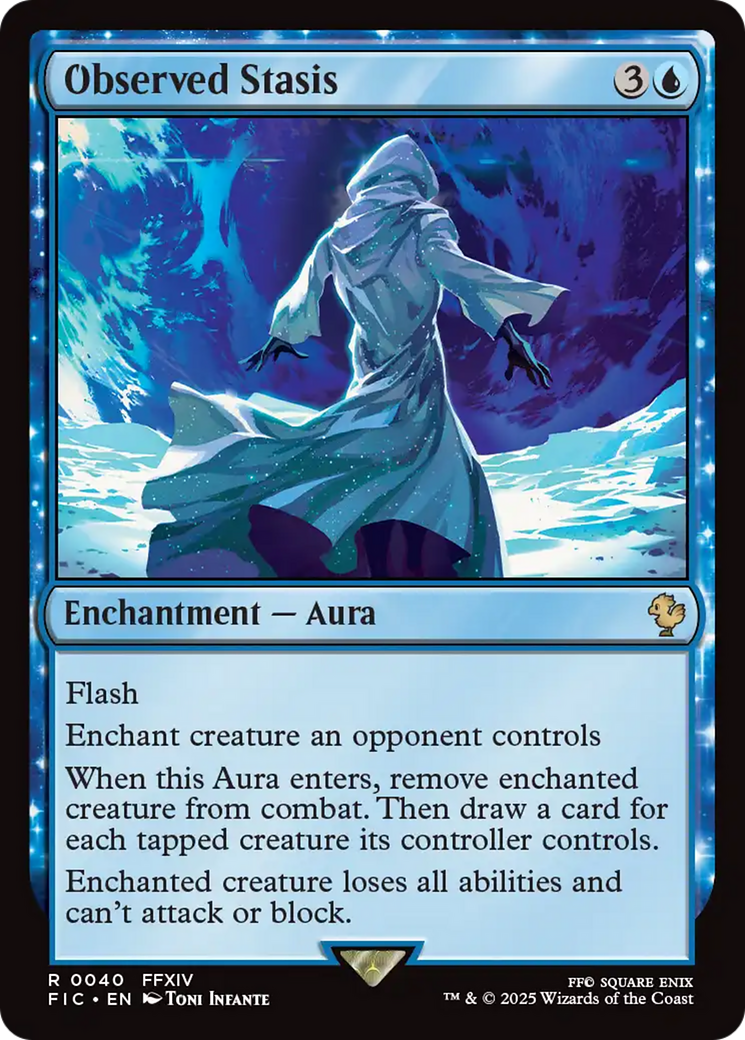
Observed Stasis
Observed Stasis
Enchantment — Aura
Flash
Enchant creature an opponent controls
When this Aura enters, remove enchanted creature from combat. Then draw a card for each tapped creature its controller controls.
Enchanted creature loses all abilities and can't attack or block.
- Removing the enchanted creature from combat doesn't cause it to untap.
-
1
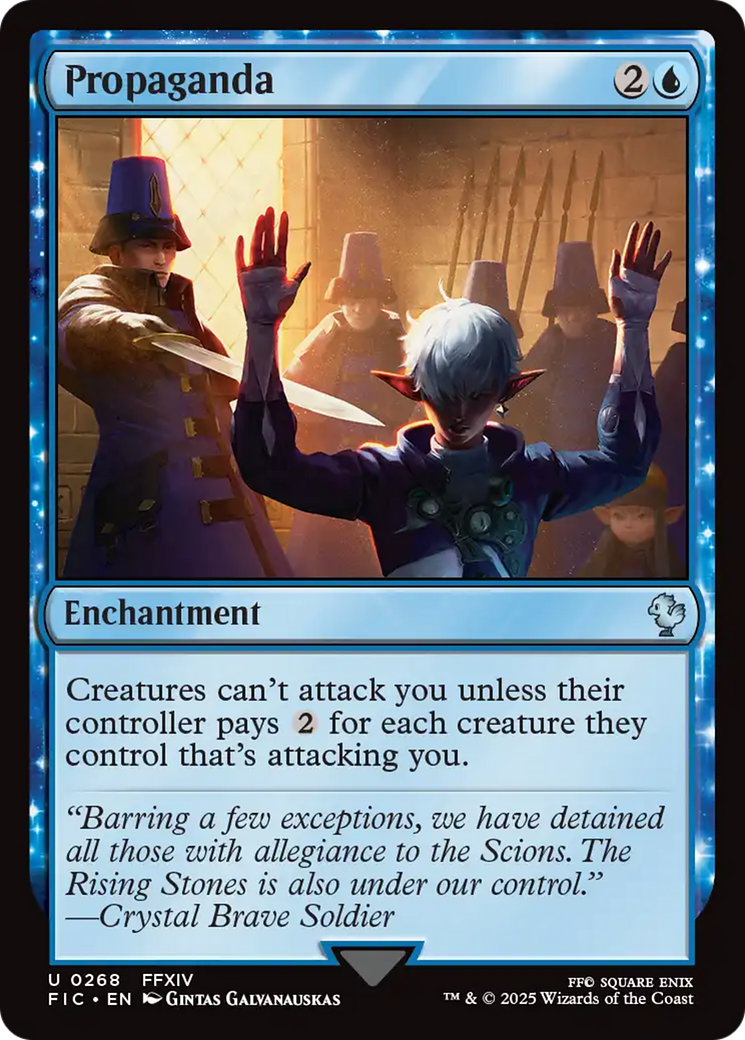
Propaganda
Propaganda
Enchantment
Creatures can't attack you unless their controller pays for each creature they control that's attacking you.
- The payment is made during the declare attackers step at the same time you are declaring the attacker.
- If there are multiple attacks in a turn, then you have to pay for each attack.
- If there is more than one Propaganda on the battlefield, the cost is cumulative.
- Paying this cost is not an instant or any other kind of ability, it is an additional cost on the declaration of the attacker.
Lands 37
-
1
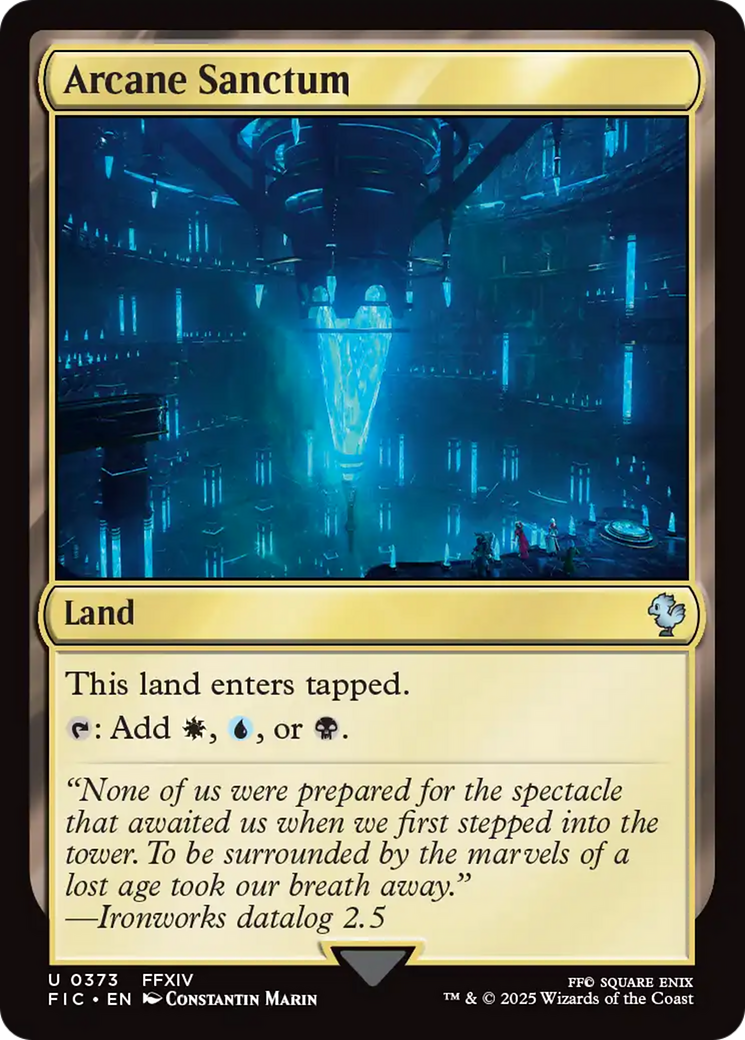
Arcane Sanctum
Arcane Sanctum
Land
This land enters tapped.
: Add , , or .
-
1
Ash Barrens
Ash Barrens
Land
: Add .
Basic landcycling ( , Discard this card: Search your library for a basic land card, reveal it, put it into your hand, then shuffle.)
-
1
Choked Estuary
Choked Estuary
Land
As this land enters, you may reveal an Island or Swamp card from your hand. If you don't, this land enters tapped.
: Add or .
- Lands don't have a subtype just because they can produce mana of the corresponding color. Choked Estuary itself is neither an Island nor a Swamp, even though it produces blue and black mana, so you can't reveal one to satisfy the ability of another.
- If an effect instructs you to put Choked Estuary onto the battlefield tapped, it will still enter the battlefield tapped even if you reveal a land card from your hand.
- You may reveal any land card with either or both of the appropriate subtypes. It doesn't have to be a basic land. For example, you could reveal Prairie Stream from the Battle for Zendikar set to satisfy the ability of Choked Estuary.
- If an Island or Swamp is entering the battlefield from your hand at the same time as Choked Estuary, you may reveal the other land to have Choked Estuary enter untapped.
-
1
Command Tower
Command Tower
Land
: Add one mana of any color in your commander's color identity.
- If you don't have a commander, Command Tower's ability produces no mana.
- If your commander is a card that has no colors in its color identity, Command Tower's ability produces no mana. It doesn't produce .
- If you have two commanders, the ability adds one mana of any color in their combined color identities.
-
1
Contaminated Aquifer
Contaminated Aquifer
Land — Island Swamp
( : Add or .)
This land enters tapped.
-
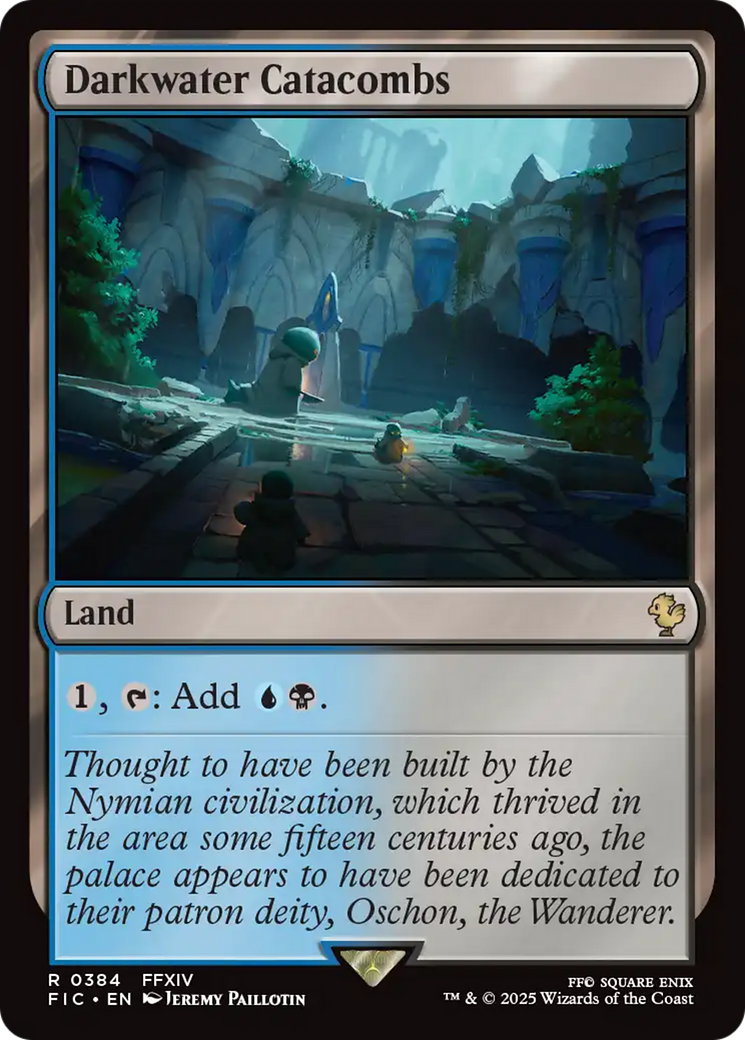
1
Darkwater Catacombs
Darkwater Catacombs
Land
, : Add .
-
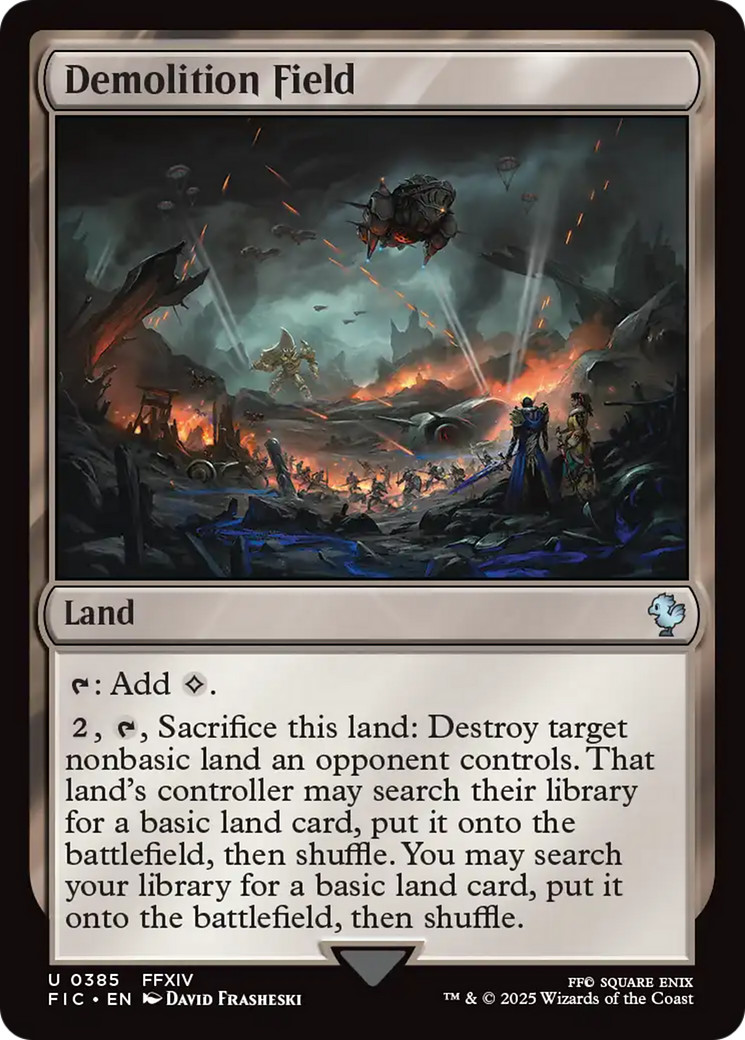
1
Demolition Field
Demolition Field
Land
: Add .
, , Sacrifice this land: Destroy target nonbasic land an opponent controls. That land's controller may search their library for a basic land card, put it onto the battlefield, then shuffle. You may search your library for a basic land card, put it onto the battlefield, then shuffle.
- The target land's controller gets to search for a basic land card even if that land wasn't destroyed by Demolition Field's ability. This may happen because the land has indestructible.
- If the targeted land is an illegal target by the time Demolition Field's ability resolves, it won't resolve and none of its effects will happen. Neither player will get to search for a basic land card.
-
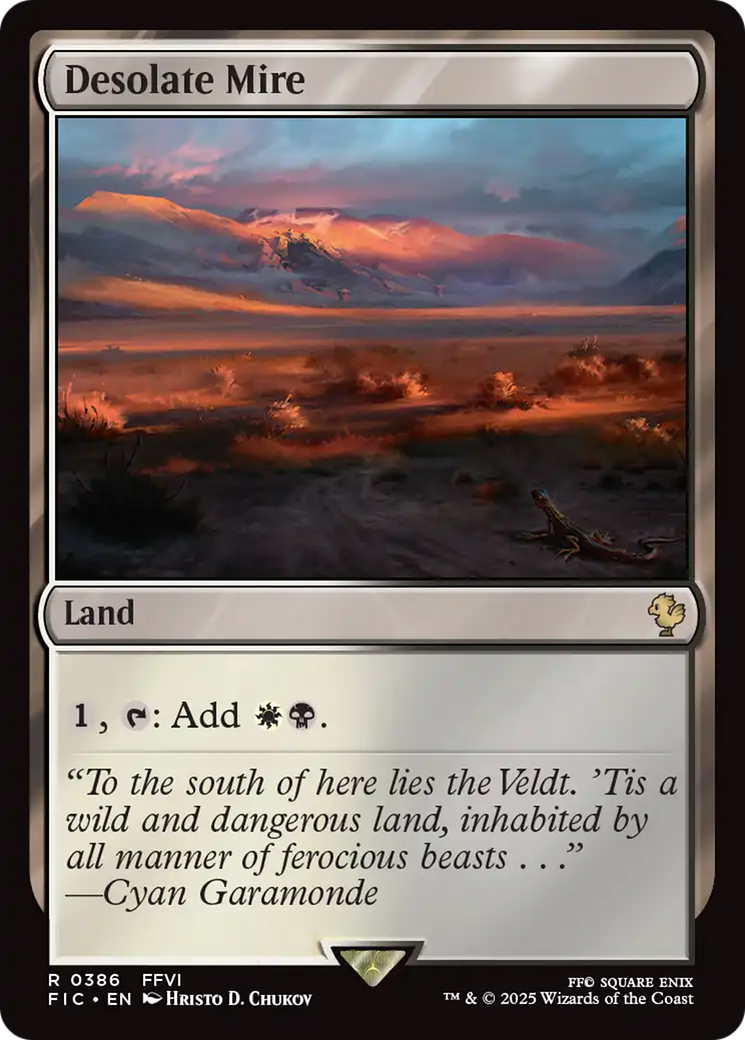
1
Desolate Mire
Desolate Mire
Land
, : Add .
-
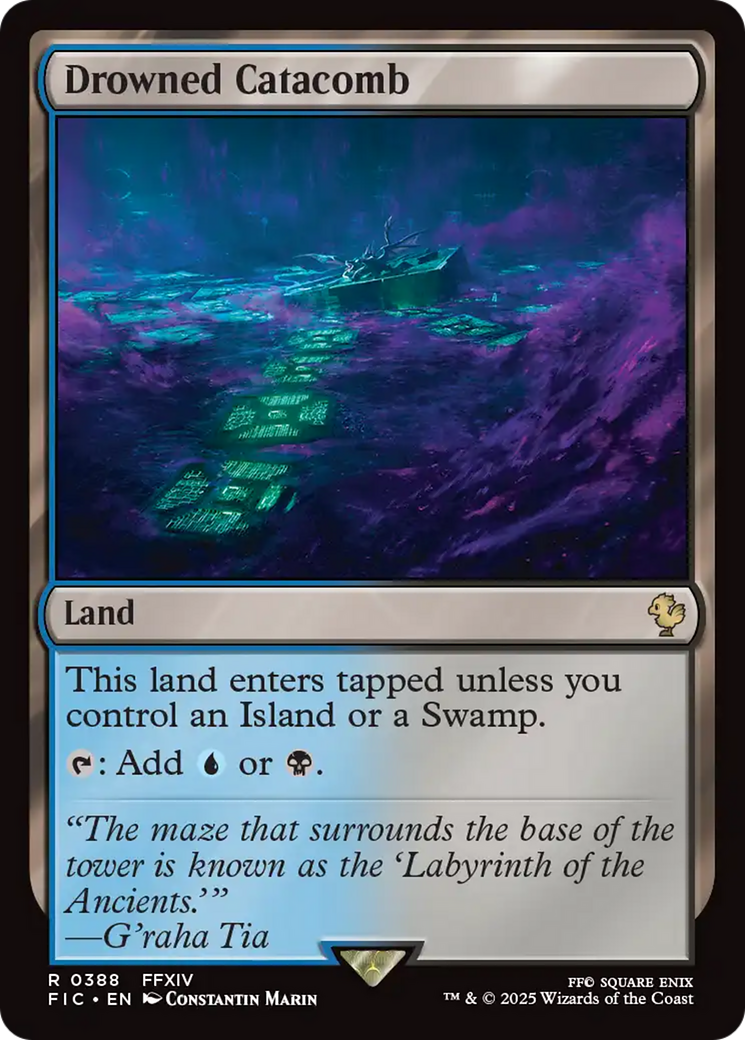
1
Drowned Catacomb
Drowned Catacomb
Land
This land enters tapped unless you control an Island or a Swamp.
: Add or .
- As this is entering, it checks for lands that are already on the battlefield. It won't see lands that are entering at the same time (due to Warp World, for example).
- This checks for lands you control with the land type Island or Swamp, not for lands named Island or Swamp. The lands it checks for don't have to be basic lands. For example, if you control Blood Crypt (a nonbasic land with the land types Swamp and Mountain), Drowned Catacomb will enter untapped.
-
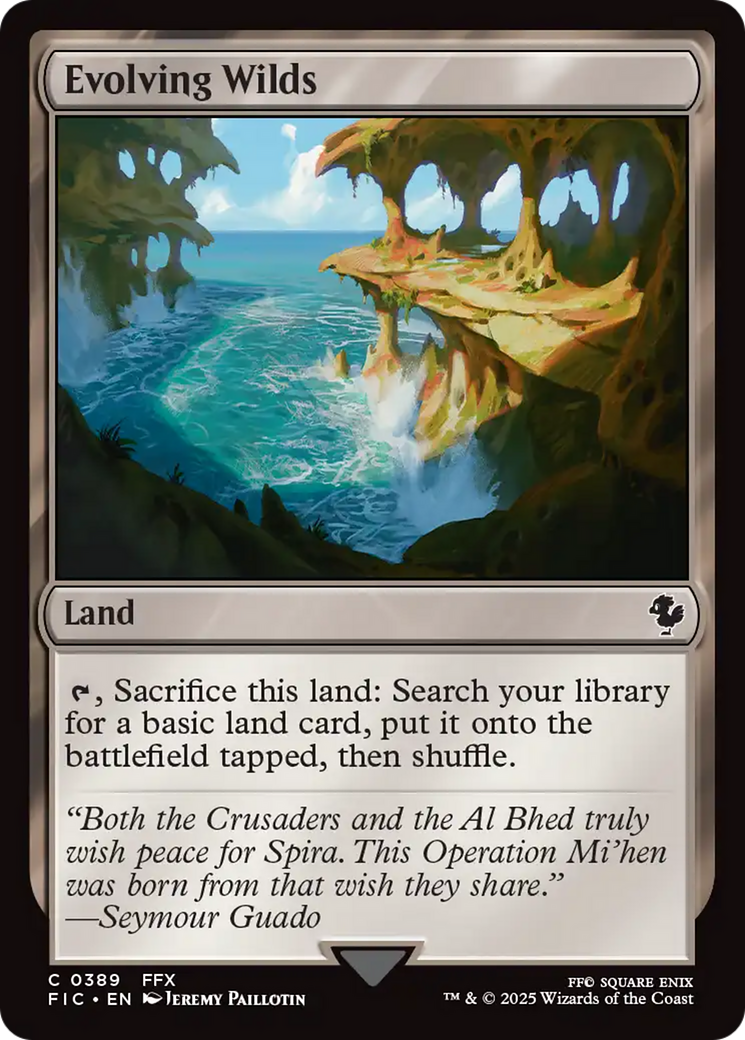
1
Evolving Wilds
Evolving Wilds
Land
, Sacrifice this land: Search your library for a basic land card, put it onto the battlefield tapped, then shuffle.
-
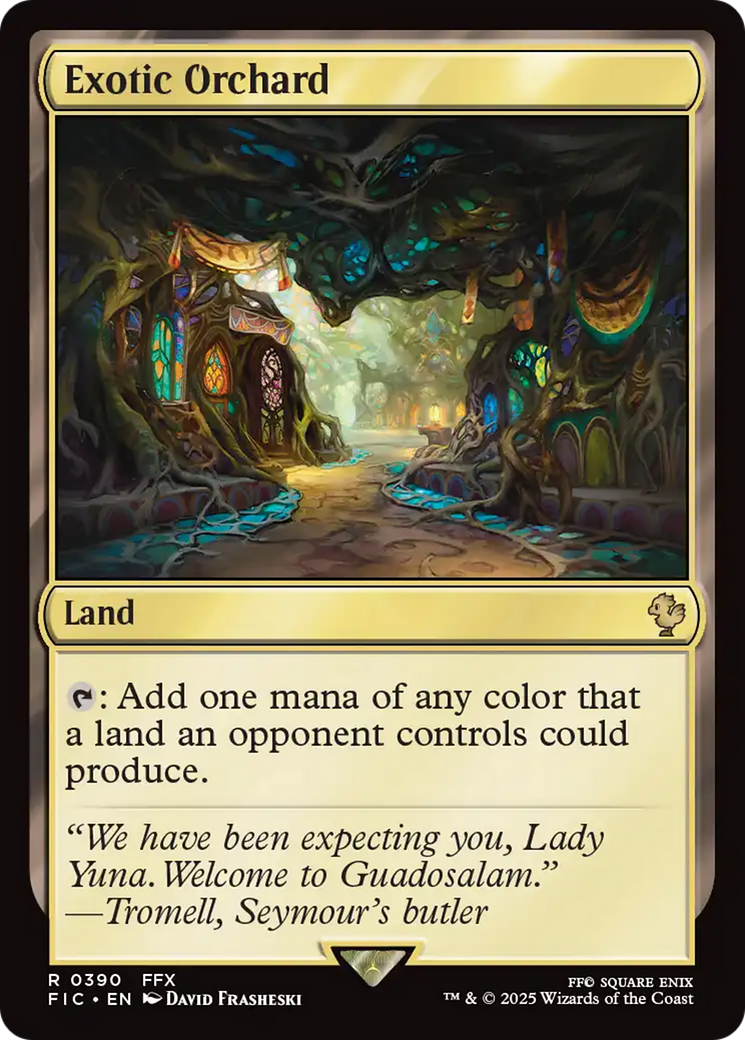
1
Exotic Orchard
Exotic Orchard
Land
: Add one mana of any color that a land an opponent controls could produce.
- Lands that produce mana based only on what other lands "could produce" won't help each other unless some other land allows one of them to actually produce some type of mana. For example, if you control an Exotic Orchard and your opponent controls an Exotic Orchard and a Reflecting Pool, none of those lands would produce mana if their mana abilities were activated. On the other hand, if you control a Forest and an Exotic Orchard, and your opponent controls an Exotic Orchard and a Reflecting Pool, then each of those lands can be tapped to produce . Your opponent's Exotic Orchard can produce because you control a Forest. Your Exotic Orchard and your opponent's Reflecting Pool can each produce because your opponent's Exotic Orchard can produce .
- When determining what colors of mana your opponents' lands could produce, Exotic Orchard takes into account any applicable replacement effects that would apply to those lands' mana abilities (such as Contamination's effect, for example). If there are more than one, consider them in any possible order.
- The colors of mana are white, blue, black, red, and green. Exotic Orchard can't be tapped for colorless mana, even if a land an opponent controls could produce colorless mana.
- Exotic Orchard doesn't care about any restrictions or riders your opponents' lands (such as Ancient Ziggurat or Hall of the Bandit Lord) put on the mana they produce. It just cares about colors of mana.
- Exotic Orchard checks the effects of all mana-producing abilities of lands your opponents control, but it doesn't check their costs. For example, Vivid Crag has the ability " , Remove a charge counter from Vivid Crag: Add one mana of any color." If an opponent controls Vivid Crag and you control Exotic Orchard, you can tap Exotic Orchard for any color of mana. It doesn't matter whether Vivid Crag has a charge counter on it, and it doesn't matter whether it's untapped.
-
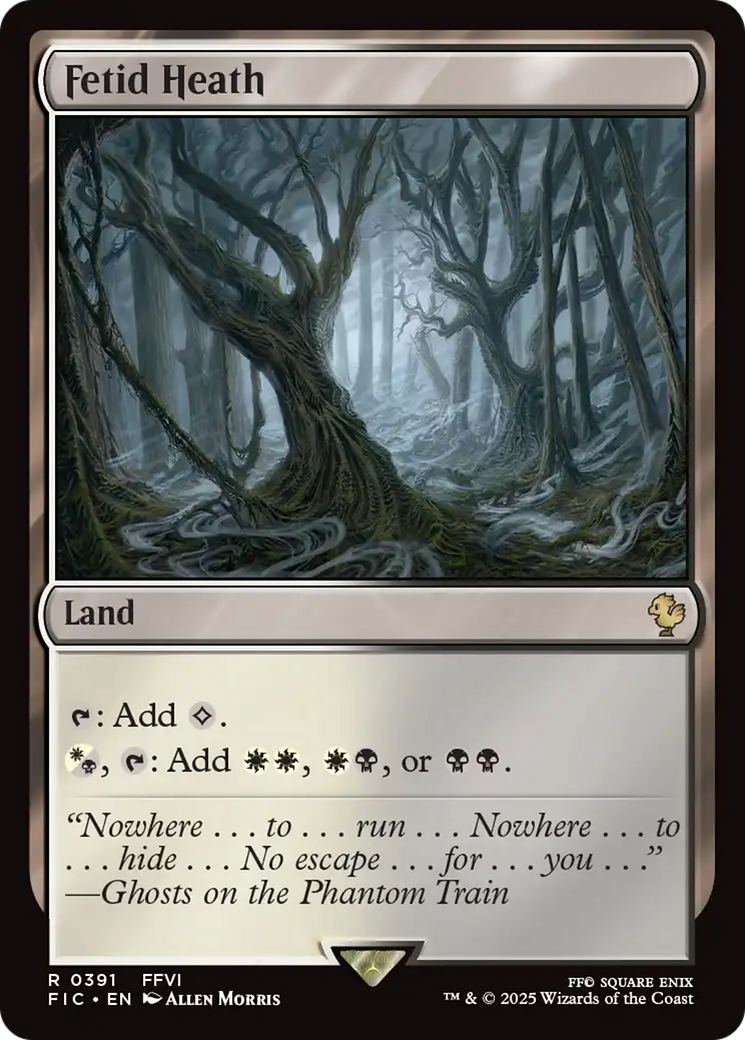
1
Fetid Heath
Fetid Heath
Land
: Add .
, : Add , , or .
-
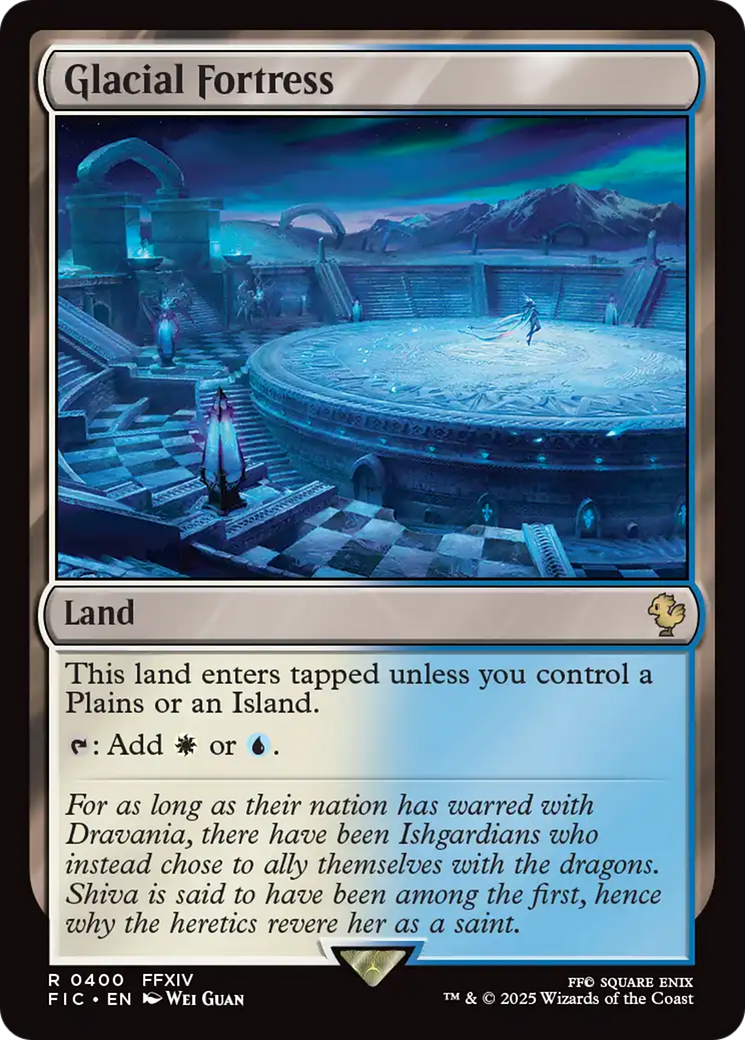
1
Glacial Fortress
Glacial Fortress
Land
This land enters tapped unless you control a Plains or an Island.
: Add or .
- This checks for lands you control with the land type Plains or Island, not for lands named Plains or Island. The lands it checks for don't have to be basic lands. For example, if you control Watery Grave (a nonbasic land with the land types Island and Swamp), Glacial Fortress will enter untapped.
- As this is entering, it checks for lands that are already on the battlefield. It won't see lands that are entering at the same time (due to Warp World, for example).
-
1
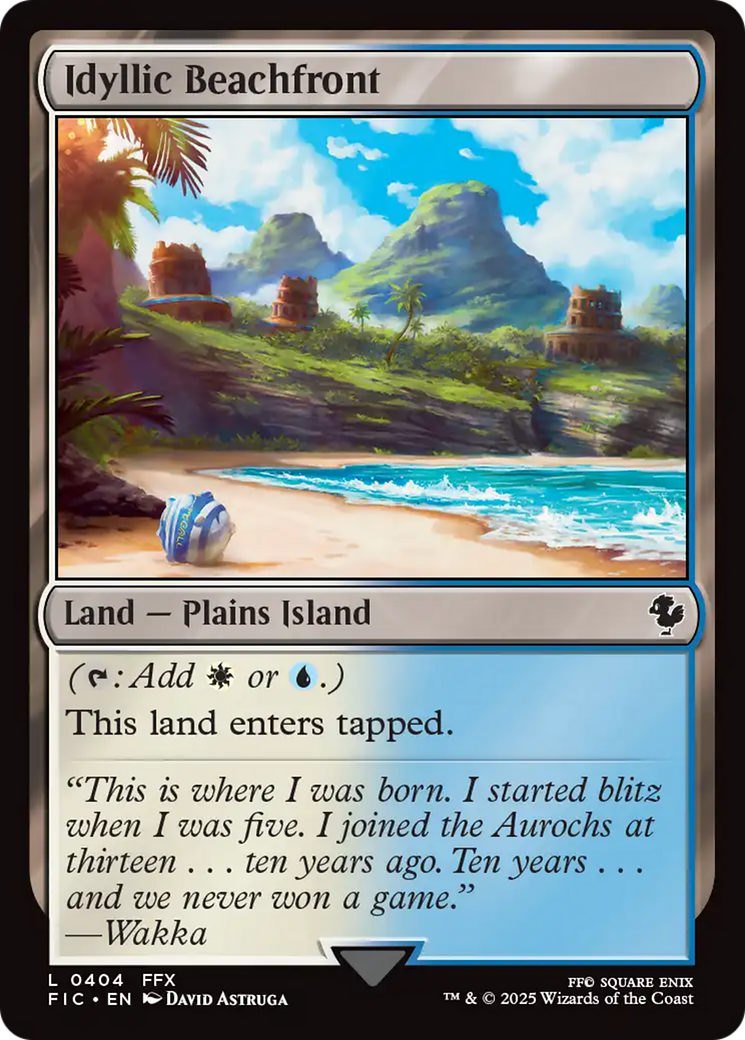
Idyllic Beachfront
Idyllic Beachfront
Land — Plains Island
( : Add or .)
This land enters tapped.
-
3
Island
Island
Basic Land — Island
( : Add .)
-
1
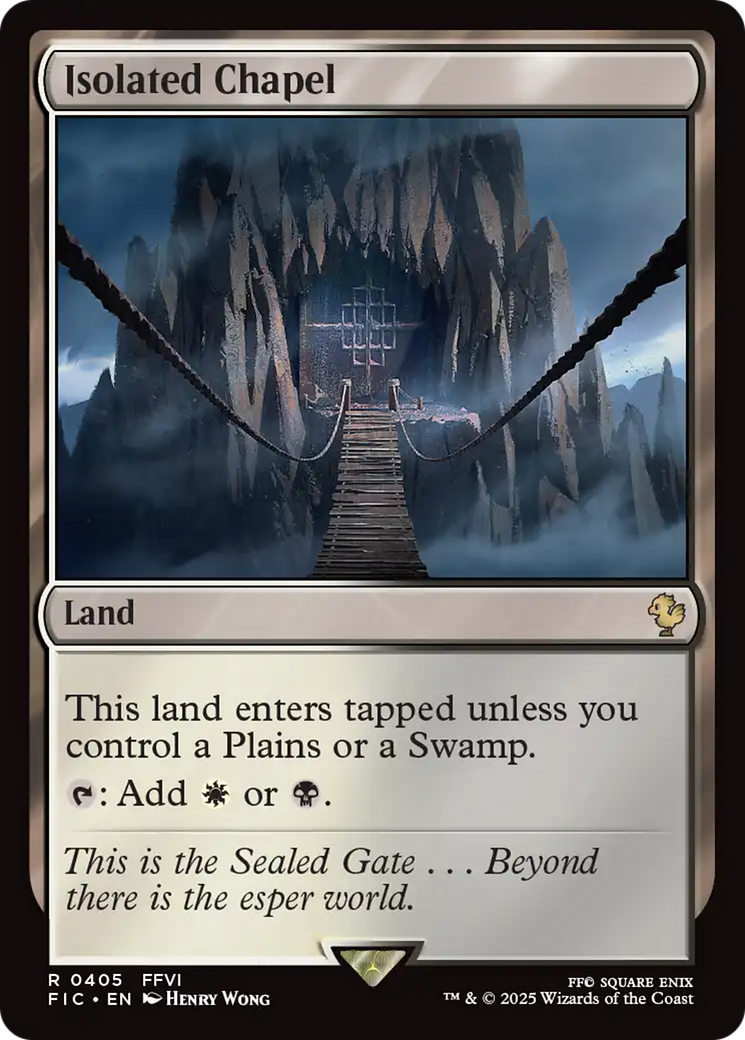
Isolated Chapel
Isolated Chapel
Land
This land enters tapped unless you control a Plains or a Swamp.
: Add or .
-
1
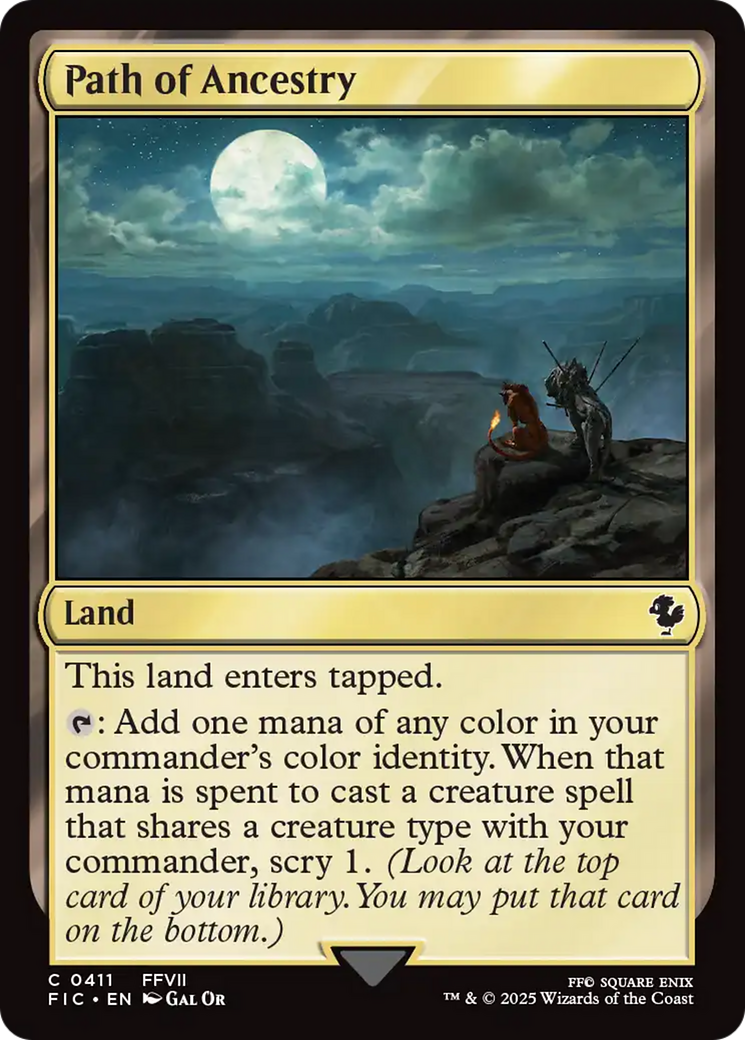
Path of Ancestry
Path of Ancestry
Land
This land enters tapped.
: Add one mana of any color in your commander's color identity. When that mana is spent to cast a creature spell that shares a creature type with your commander, scry 1. (Look at the top card of your library. You may put that card on the bottom.)
- Your commander's creature types are checked immediately after you cast a creature spell spending mana from Path of Ancestry's last ability. They aren't set before the game begins, and they may not be the same types your commander had when you activated that ability.
- If you have two commanders, the last ability adds one mana of any color in their combined color identities. When you spend that mana on a creature spell that shares a creature type with either of your commanders, you'll scry 1.
- If Path of Ancestry's last ability produces two mana (most likely due to Mana Reflection), spending those two mana to cast creature spells that share a creature type with your commander will cause two abilities to trigger. Each of those abilities will cause you to scry 1. You won't scry 2. This is true whether you spend the mana on one creature spell or two.
- If your commander has no creature types, it can't share a creature type with any spell that you cast.
- If you cast your commander with mana from Path of Ancestry, and your commander hasn't somehow lost all of its creature types while on the stack, you'll scry 1.
- If you don't have a commander, Path of Ancestry's ability produces no mana.
- If your commander is a card that has no colors in its color identity, Path of Ancestry's ability produces no mana. It doesn't produce .
-
4
Plains
Plains
Basic Land — Plains
( : Add .)
-
1
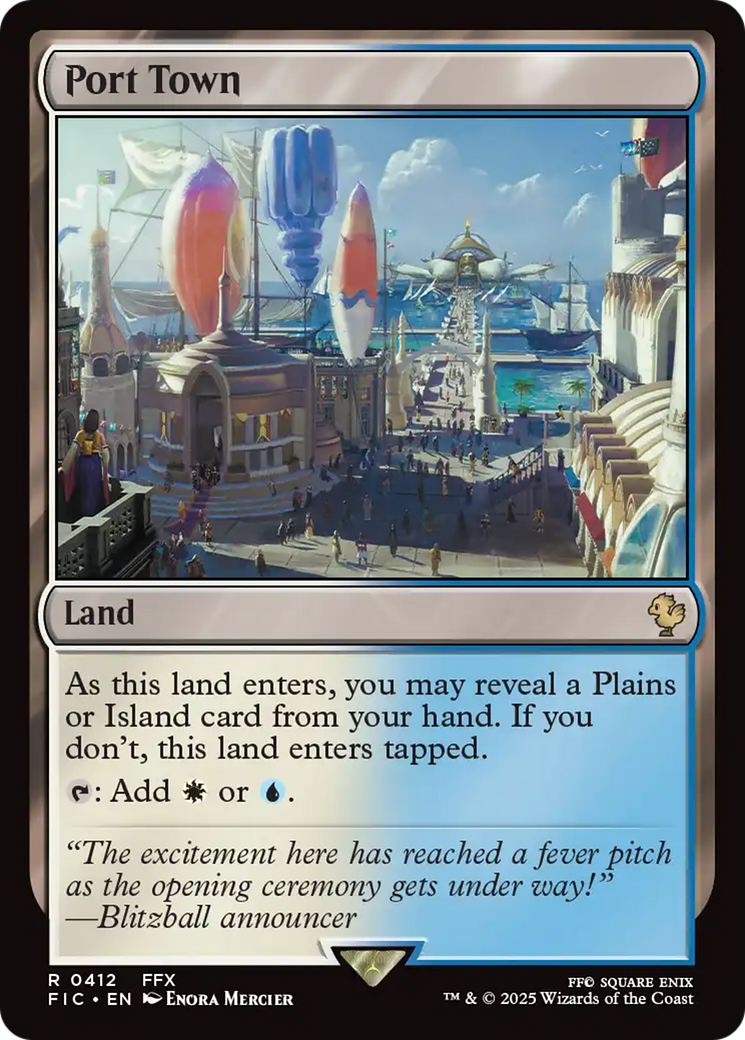
Port Town
Port Town
Land
As this land enters, you may reveal a Plains or Island card from your hand. If you don't, this land enters tapped.
: Add or .
- You may reveal any land card with either or both of the appropriate subtypes. It doesn't have to be a basic land. For example, you could reveal Canopy Vista from the Battle for Zendikar set to satisfy the ability of Port Town.
- Lands don't have a subtype just because they can produce mana of the corresponding color. Port Town itself is neither a Plains nor an Island, even though it produces white and blue mana, so you can't reveal one to satisfy the ability of another.
- If a Plains or Island is entering the battlefield from your hand at the same time as Port Town, you may reveal the other land to have Port Town enter untapped.
- If an effect instructs you to put Port Town onto the battlefield tapped, it will still enter the battlefield tapped even if you reveal a land card from your hand.
-
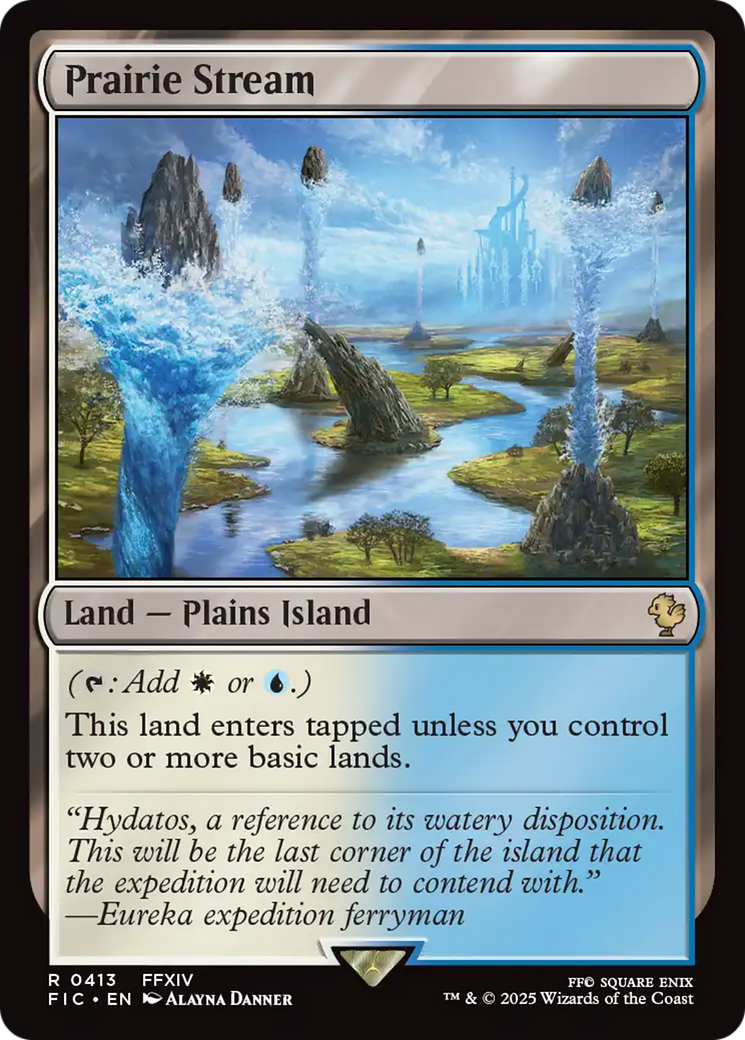
1
Prairie Stream
Prairie Stream
Land — Plains Island
( : Add or .)
This land enters tapped unless you control two or more basic lands.
- Even though these lands have basic land types, they are not basic lands because "basic" doesn't appear on their type line. Notably, controlling two or more of them won't allow others to enter the battlefield untapped.
- However, because these cards have basic land types, effects that specify a basic land type without also specifying that the land be basic can affect them. For example, a spell or ability that reads "Destroy target Forest" can target Canopy Vista, while one that reads "Destroy target basic Forest" cannot.
- If one of these lands enters the battlefield at the same time as any number of basic lands, those other lands are not counted when determining if this land enters the battlefield tapped or untapped.
-
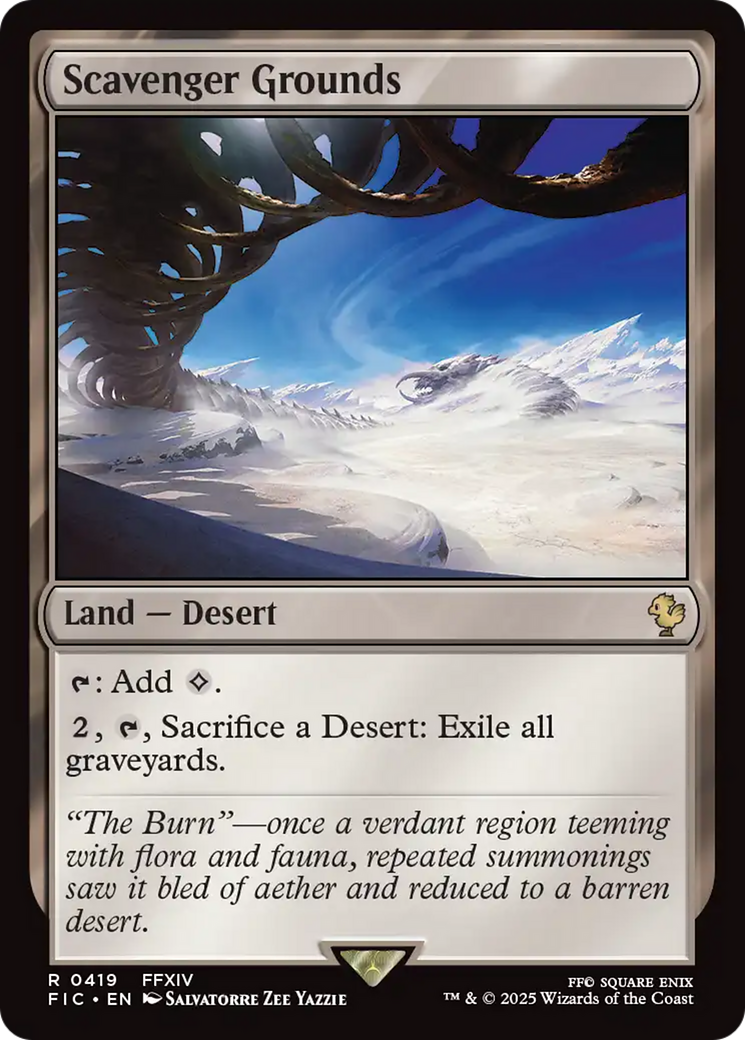
1
Scavenger Grounds
Scavenger Grounds
Land — Desert
: Add .
, , Sacrifice a Desert: Exile all graveyards.
- The sacrificed Desert will be in your graveyard to be exiled by the last ability of Scavenger Grounds.
-
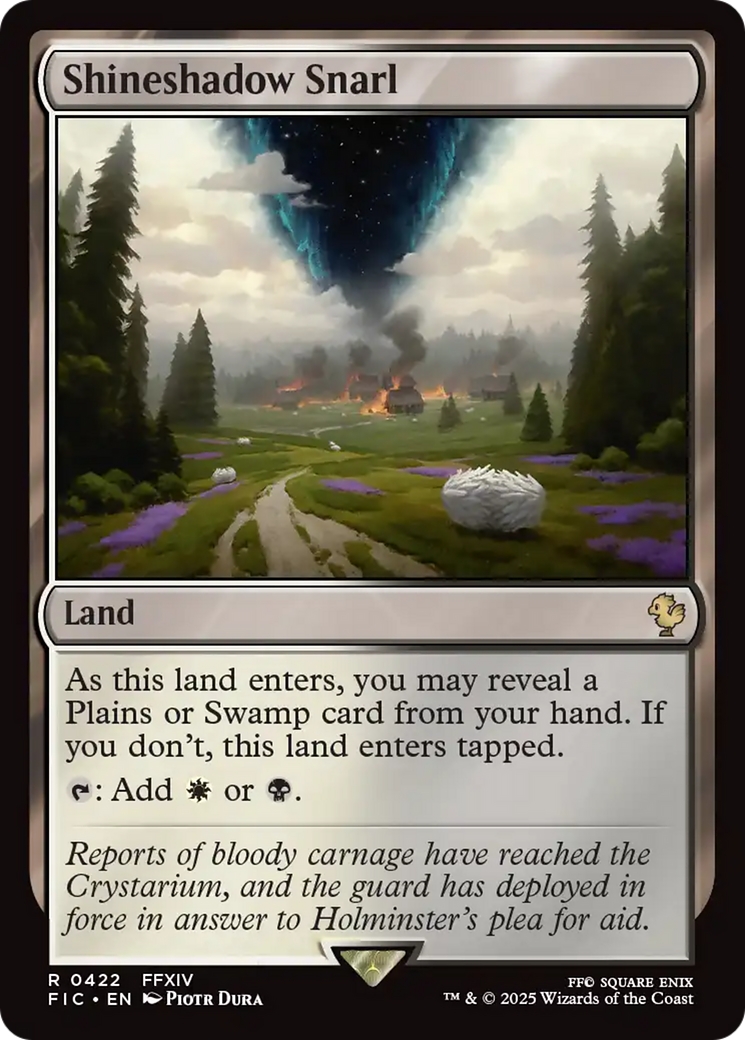
1
Shineshadow Snarl
Shineshadow Snarl
Land
As this land enters, you may reveal a Plains or Swamp card from your hand. If you don't, this land enters tapped.
: Add or .
- If a land card with an appropriate subtype is entering the battlefield from your hand at the same time as one of these lands, you may reveal the other land to have the "Snarl" enter untapped.
- If an effect instructs you to put one of these lands onto the battlefield tapped, it will still enter the battlefield tapped even if you reveal a land card from your hand.
- The "Snarl" itself doesn't have any land subtypes. You can't reveal one to satisfy the ability of another.
- You may reveal any land card with either or both of the appropriate subtypes. It doesn't have to be a basic land card.
-
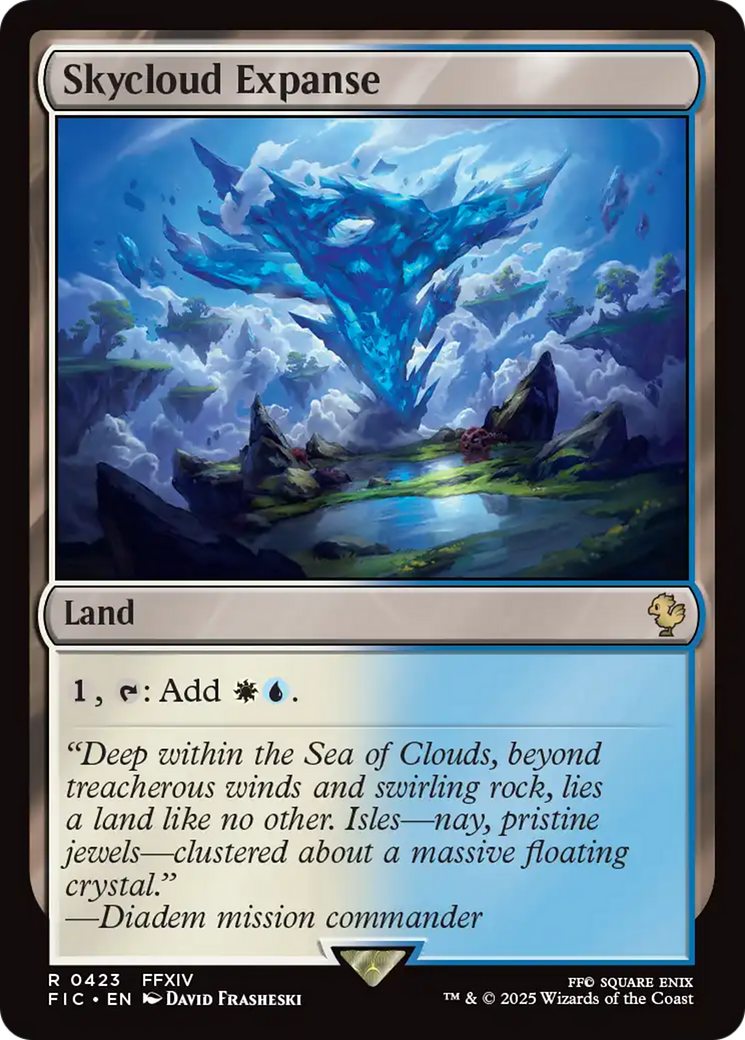
1
Skycloud Expanse
Skycloud Expanse
Land
, : Add .
-
1
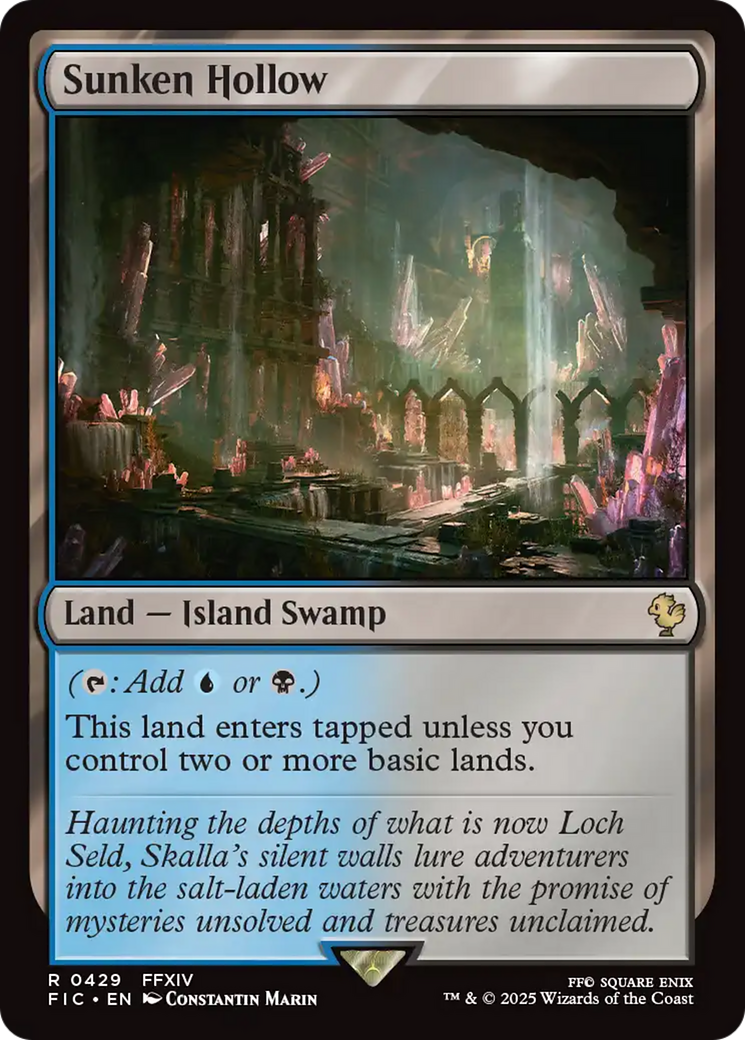
Sunken Hollow
Sunken Hollow
Land — Island Swamp
( : Add or .)
This land enters tapped unless you control two or more basic lands.
- Even though these lands have basic land types, they are not basic lands because "basic" doesn't appear on their type line. Notably, controlling two or more of them won't allow others to enter the battlefield untapped.
- However, because these cards have basic land types, effects that specify a basic land type without also specifying that the land be basic can affect them. For example, a spell or ability that reads "Destroy target Forest" can target Canopy Vista, while one that reads "Destroy target basic Forest" cannot.
- If one of these lands enters the battlefield at the same time as any number of basic lands, those other lands are not counted when determining if this land enters the battlefield tapped or untapped.
-
1
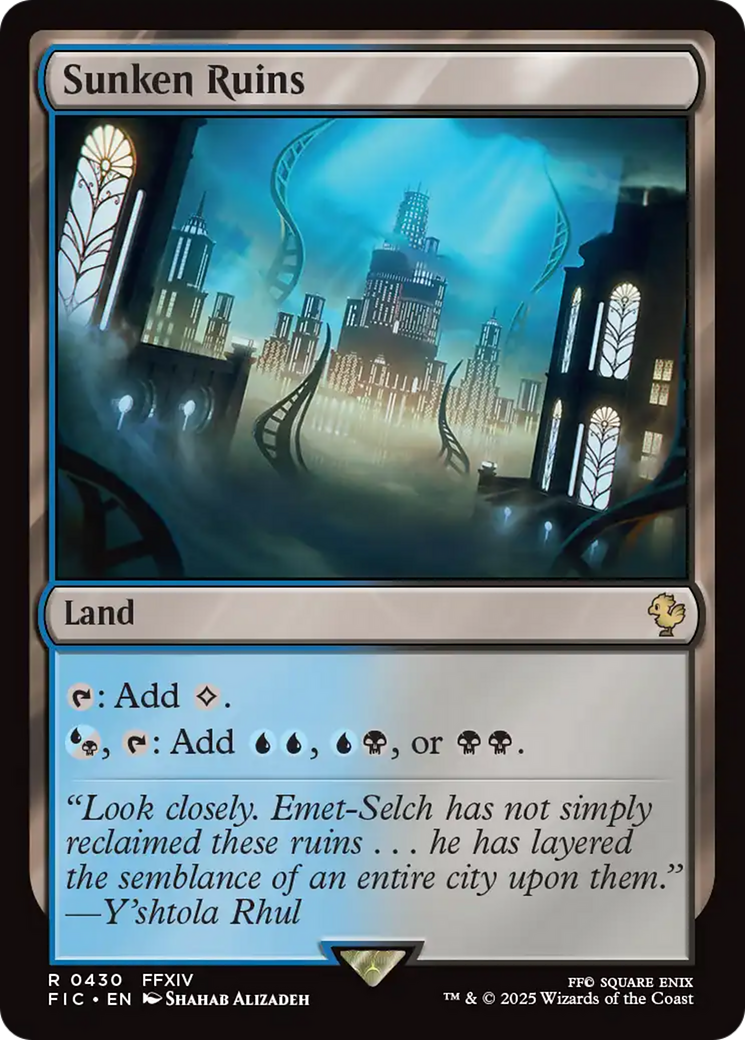
Sunken Ruins
Sunken Ruins
Land
: Add .
, : Add , , or .
-
1
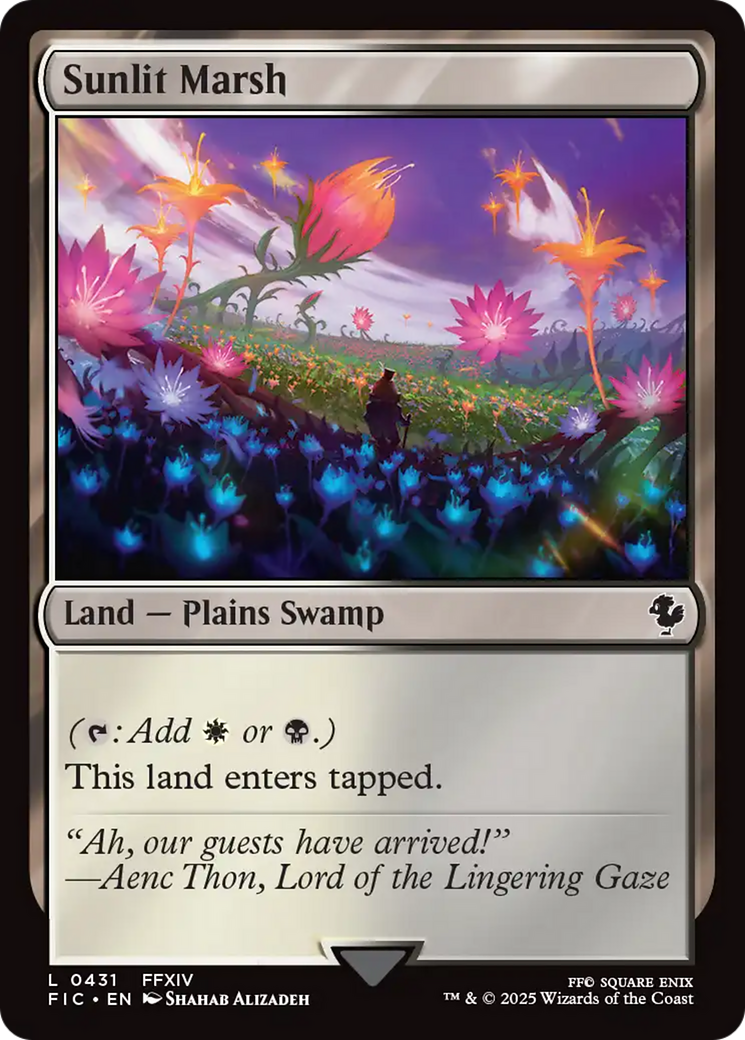
Sunlit Marsh
Sunlit Marsh
Land — Plains Swamp
( : Add or .)
This land enters tapped.
-
4
Swamp
Swamp
Basic Land — Swamp
( : Add .)
-
1
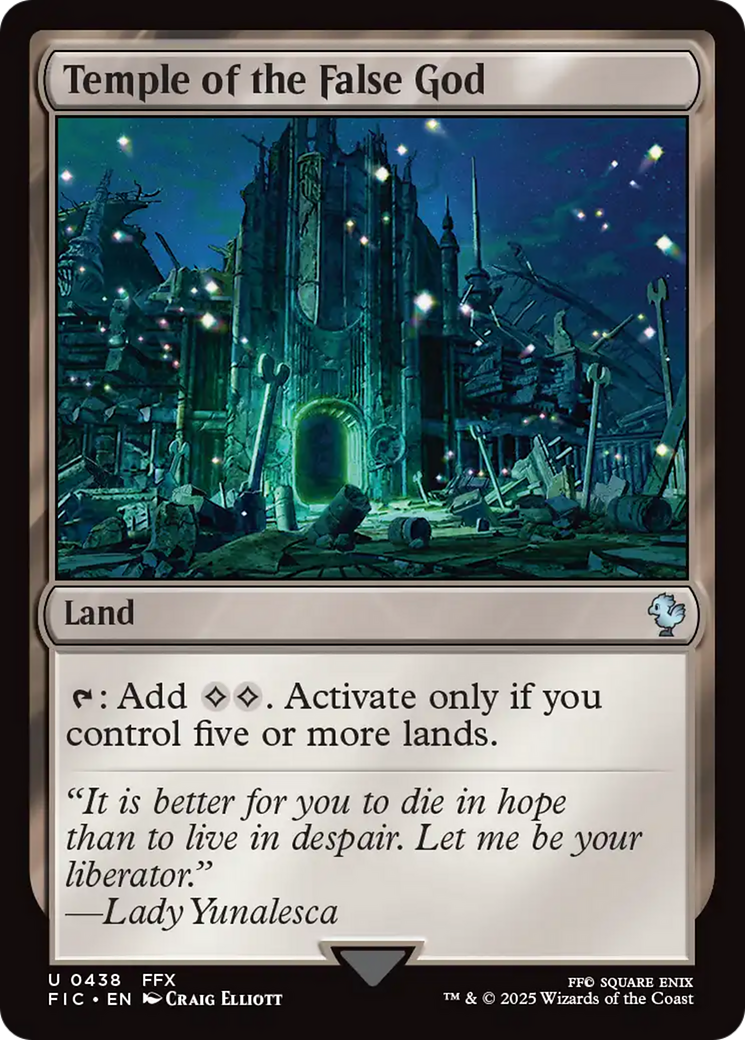
Temple of the False God
Temple of the False God
Land
: Add . Activate only if you control five or more lands.
-
1
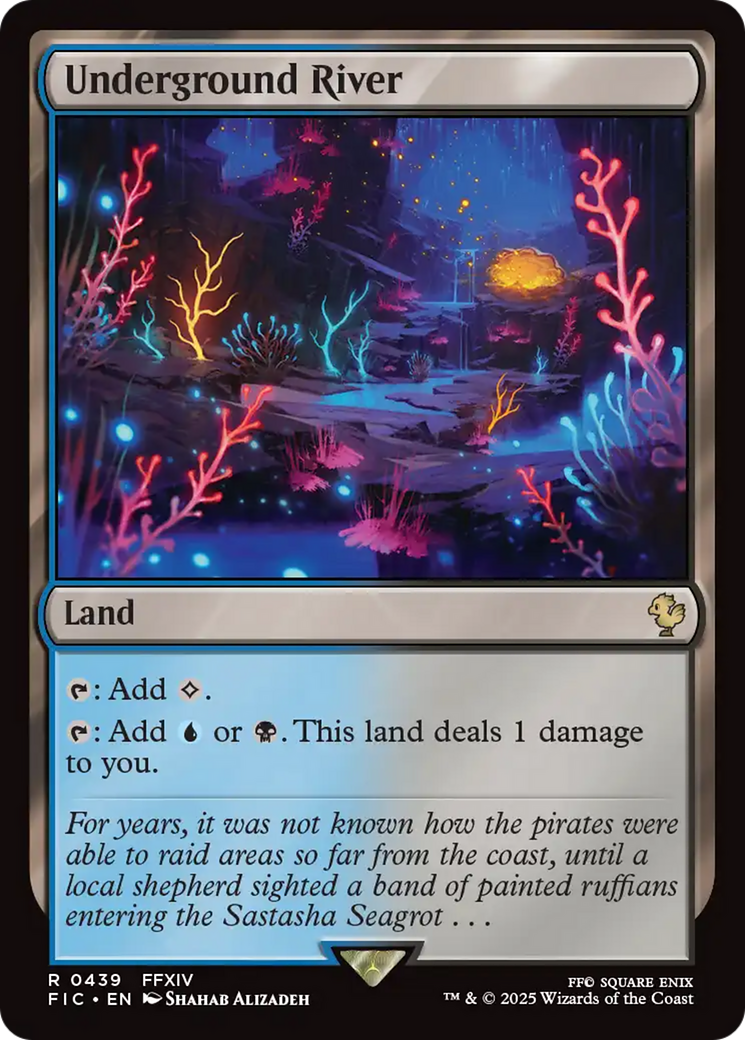
Underground River
Underground River
Land
: Add .
: Add or . This land deals 1 damage to you.
White 14
-
1
Alisaie Leveilleur
Alisaie Leveilleur
Legendary Creature — Elf Wizard
3/2
Partner with Alphinaud Leveilleur (When this creature enters, target player may put Alphinaud Leveilleur into their hand from their library, then shuffle.)
First strike
Dualcast — The second spell you cast each turn costs less to cast.
- The cost reduction applies only to generic mana in the total cost of the second spell you cast each turn.
- Spells that were cast before Alisaie Leveilleur entered count. If Alisaie Leveilleur was the first spell you cast this turn, the next spell you cast this turn is your second spell.
- Both commanders start in the command zone, and the remaining 98 cards (or 58 cards in a Commander Draft game) of your deck are shuffled to become your library.
- Once the game begins, your two commanders are tracked separately. If you cast one, you won't have to pay an additional the first time you cast the other. A player loses the game after having been dealt 21 damage from one of them, not from both of them combined. Command Beacon's effect puts one into your hand from the command zone, not both.
- The triggered ability of the "partner with" keyword still triggers in a Commander game. If your other commander has somehow ended up in your library, you can find it. You can also target another player, whether or not they have that card in their library.
- "Partner with [name]" represents two abilities. The first is a triggered ability: "When this permanent enters, target player may search their library for a card named [name], reveal it, put it into their hand, then shuffle."
- Note that the target player searches their library (which may be affected by effects such as that of Stranglehold) and that the card they find is revealed, even though these words aren't included in the ability's reminder text.
- The second ability represented by the "partner with [name]" keyword modifies the rules for deck construction in the Commander variant and has no function outside of that variant. If a legendary creature card with "partner with [name]" is designated as your commander, the named legendary creature card can also be designated as your commander.
- If your Commander deck has two commanders, you can only include cards whose own color identities are also found in your commanders' combined color identities. If Alisaie Leveilleur and Alphinaud Leveilleur are your commanders, your deck may contain cards with white and/or blue in their color identity, but not black, red, or green.
- To have two commanders, both must have the partner ability or corresponding "partner with" abilities as the game begins. A creature with a "partner with" ability can't partner with any creature other than its designated partner. Losing a partner ability during the game doesn't cause either to cease to be your commander.
- An effect that checks whether you control your commander is satisfied if you control one or both of your two commanders.
-
1
Archaeomancer's Map
Archaeomancer's Map
Artifact
When this artifact enters, search your library for up to two basic Plains cards, reveal them, put them into your hand, then shuffle.
Whenever a land an opponent controls enters, if that player controls more lands than you, you may put a land card from your hand onto the battlefield.
- The last ability triggers only if that opponent controls more lands than you after the land enters the battlefield. The ability will check again as it tries to resolve. If that opponent doesn't still control more lands than you at that time, the ability won't resolve.
-
1
Authority of the Consuls
Authority of the Consuls
Enchantment
Creatures your opponents control enter tapped.
Whenever a creature an opponent controls enters, you gain 1 life.
-
1
Champions from Beyond
Champions from Beyond
Enchantment
When this enchantment enters, create X 1/1 colorless Hero creature tokens.
Light Party — Whenever you attack with four or more creatures, scry 2, then draw a card.
Full Party — Whenever you attack with eight or more creatures, those creatures get +4/+4 until end of turn.
- The second and third abilities of Champions from Beyond don't care what happens to those creatures after you attack with them. Once the second ability triggers, you'll scry 2 and then draw a card when it resolves even if one or more of those creatures left the battlefield or were otherwise removed from combat. Similarly, once the third ability triggers, those creatures will get +4/+4 when it resolves, even if one or more of those creatures left the battlefield. Any of those creatures that were removed from combat but are still on the battlefield will still get +4/+4.
- While the second and third abilities of Champions from Beyond have "Party" in their flavor words, neither of them refer to a player's party (a mechanic from previous releases that also uses the term "full party").
-
1
Cleansing Nova
Cleansing Nova
Sorcery
Choose one —
- Destroy all creatures.
- Destroy all artifacts and enchantments.
-
1
Cut a Deal
Cut a Deal
Sorcery
Each opponent draws a card, then you draw a card for each opponent who drew a card this way.
- Although the draws are not optional, if an opponent doesn't draw a card, perhaps because a replacement effect replaced the draw with another effect, that player is not counted when determining how many cards you draw.
- If an opponent drew more than one card this way due to a replacement effect, you still draw only one card for that player.
-
1
Dancer's Chakrams
Dancer's Chakrams
Artifact — Equipment
Job select (When this Equipment enters, create a 1/1 colorless Hero creature token, then attach this to it.)
Equipped creature gets +2/+2, has lifelink and "Other commanders you control get +2/+2 and have lifelink," and is a Performer in addition to its other types.
Krishna — Equip
- The last ability granted by Dancer's Chakrams to the equipped creature applies whether or not Dancer's Chakrams is attached to a commander.
-
1
Final Judgment
Final Judgment
Sorcery
Exile all creatures.
-
1
Lingering Souls
Lingering Souls
Sorcery
Create two 1/1 white Spirit creature tokens with flying.
Flashback (You may cast this card from your graveyard for its flashback cost. Then exile it.)
- "Flashback [cost]" means "You may cast this card from your graveyard by paying [cost] rather than paying its mana cost" and "If the flashback cost was paid, exile this card instead of putting it anywhere else any time it would leave the stack."
- You must still follow any timing restrictions and permissions, including those based on the card's type. For instance, you can cast a sorcery using flashback only when you could normally cast a sorcery.
- To determine the total cost of a spell, start with the mana cost or alternative cost (such as a flashback cost) you're paying, add any cost increases, then apply any cost reductions. The mana value of the spell is determined only by its mana cost, no matter what the total cost to cast the spell was.
- A spell cast using flashback will always be exiled afterward, whether it resolves, is countered, or leaves the stack in some other way.
- You can cast a spell using flashback even if it was somehow put into your graveyard without having been cast.
- If a card with flashback is put into your graveyard during your turn, you can cast it if it's legal to do so before any other player can take any actions.
-
1
Summon: Good King Mog XII
Summon: Good King Mog XII
Enchantment Creature — Saga Moogle
4/4
(As this Saga enters and after your draw step, add a lore counter. Sacrifice after IV.)
I — Create two 1/2 white Moogle creature tokens with lifelink.
II, III — Whenever you cast a noncreature spell this turn, create a token that's a copy of a non-Saga token you control.
IV — Put two +1/+1 counters on each other Moogle you control.
Flying, lifelink
- The delayed triggered ability set up by Summon: Good King Mog XII's second and third chapter abilities resolves before the spell that caused it to trigger. It resolves even if that spell is countered or otherwise leaves the stack.
- The new token copies the original characteristics of the copied token as stated by the effect that created that token.
- Any "as [this permanent] enters" or "[this permanent] enters with" abilities of the new token will work.
- The new token doesn't copy whether the original token is tapped or untapped, whether it has any counters on it or Auras and Equipment attached to it, or any non-copy effects that have changed its power, toughness, color, and so on.
-
1
Swords to Plowshares
Swords to Plowshares
Instant
Exile target creature. Its controller gains life equal to its power.
- Use the power of the creature from when it was last on the battlefield to determine how much life is gained.
-
1
Tataru Taru
Tataru Taru
Legendary Creature — Dwarf Advisor
0/3
When Tataru Taru enters, you draw a card and target opponent may draw a card.
Scions' Secretary — Whenever an opponent draws a card, if it isn't that player's turn, create a tapped Treasure token. This ability triggers only once each turn.
- If the target opponent is an illegal target as Tataru Taru's first ability tries to resolve, it won't resolve and none of its effects will happen. You won't draw a card.
-
1
Thancred Waters
Thancred Waters
Legendary Creature — Human Warrior
3/5
Flash
Royal Guard — When Thancred Waters enters, another target legendary permanent you control gains indestructible for as long as you control Thancred Waters.
Whenever you cast a noncreature spell, Thancred Waters gains indestructible until end of turn.
- If Thancred Waters leaves the battlefield or you lose control of it before its triggered ability resolves, the target legendary permanent won't gain indestructible at all.
- Thancred Waters's last ability resolves before the spell that caused it to trigger. It resolves even if that spell is countered or otherwise leaves the stack.
-
1
White Auracite
White Auracite
Artifact
When this artifact enters, exile target nonland permanent an opponent controls until this artifact leaves the battlefield.
: Add .
Blue 15
-
1
Alphinaud Leveilleur
Alphinaud Leveilleur
Legendary Creature — Elf Wizard
2/4
Partner with Alisaie Leveilleur (When this creature enters, target player may put Alisaie Leveilleur into their hand from their library, then shuffle.)
Vigilance
Eukrasia — Whenever you cast your second spell each turn, draw a card.
- Alphinaud Leveilleur's last ability resolves before the spell that caused it to trigger. It resolves even if that spell is countered or otherwise leaves the stack.
- "Partner with [name]" represents two abilities. The first is a triggered ability: "When this permanent enters, target player may search their library for a card named [name], reveal it, put it into their hand, then shuffle."
- The second ability represented by the "partner with [name]" keyword modifies the rules for deck construction in the Commander variant and has no function outside of that variant. If a legendary creature card with "partner with [name]" is designated as your commander, the named legendary creature card can also be designated as your commander.
- Both commanders start in the command zone, and the remaining 98 cards (or 58 cards in a Commander Draft game) of your deck are shuffled to become your library.
- Once the game begins, your two commanders are tracked separately. If you cast one, you won't have to pay an additional the first time you cast the other. A player loses the game after having been dealt 21 damage from one of them, not from both of them combined. Command Beacon's effect puts one into your hand from the command zone, not both.
- Spells that were cast before Alphinaud Leveilleur entered count. If Alphinaud Leveilleur was the first spell you cast this turn, the next spell you cast this turn is your second spell.
- Note that the target player searches their library (which may be affected by effects such as that of Stranglehold) and that the card they find is revealed, even though these words aren't included in the ability's reminder text.
- If your Commander deck has two commanders, you can only include cards whose own color identities are also found in your commanders' combined color identities. If Alisaie Leveilleur and Alphinaud Leveilleur are your commanders, your deck may contain cards with white and/or blue in their color identity, but not black, red, or green.
- To have two commanders, both must have the partner ability or corresponding "partner with" abilities as the game begins. A creature with a "partner with" ability can't partner with any creature other than its designated partner. Losing a partner ability during the game doesn't cause either to cease to be your commander.
- An effect that checks whether you control your commander is satisfied if you control one or both of your two commanders.
- The triggered ability of the "partner with" keyword still triggers in a Commander game. If your other commander has somehow ended up in your library, you can find it. You can also target another player, whether or not they have that card in their library.
-
1
Archmage Emeritus
Archmage Emeritus
Creature — Human Wizard
2/2
Magecraft — Whenever you cast or copy an instant or sorcery spell, draw a card.
- If an effect creates multiple copies of an instant or sorcery spell, magecraft abilities trigger once for each copy created by the effect.
- If an effect creates a copy of an instant or sorcery spell, this will also cause the magecraft ability to trigger.
- Each magecraft ability has a different effect, although they all have the same trigger condition, whenever you cast or copy an instant or sorcery spell.
- Some effects instruct you to copy an instant or sorcery card in a zone other than the stack. These copies do not cause magecraft abilities to trigger. However, most effects that do this also allow you to cast the copy, and casting the copy will cause magecraft abilities to trigger.
-
1
Astrologian's Planisphere
Astrologian's Planisphere
Artifact — Equipment
Job select (When this Equipment enters, create a 1/1 colorless Hero creature token, then attach this to it.)
Equipped creature is a Wizard in addition to its other types and has "Whenever you cast a noncreature spell and whenever you draw your third card each turn, put a +1/+1 counter on this creature."
Diana — Equip
-
1
Blue Mage's Cane
Blue Mage's Cane
Artifact — Equipment
Job select
Equipped creature gets +0/+2, is a Wizard in addition to its other types, and has "Whenever this creature attacks, exile up to one target instant or sorcery card from defending player's graveyard. If you do, copy it. You may cast the copy by paying rather than paying its mana cost."
Spirit of the Whalaqee — Equip
- If the spell has in its mana cost, you must choose 0 as the value of X when casting it by paying rather than paying its mana cost.
- If you don't want to cast the copy, you can choose not to; the copy ceases to exist the next time state-based actions are performed.
- You cast the copy while the ability is resolving and still on the stack. You can't wait to cast it later in the turn.
- If you cast a spell by paying rather than paying its mana cost, you can't choose to cast it for any other alternative cost. You can, however, pay additional costs. If the spell has any mandatory additional costs, those must be paid to cast the card.
-
1
Dig Through Time
Dig Through Time
Instant
Delve (Each card you exile from your graveyard while casting this spell pays for .)
Look at the top seven cards of your library. Put two of them into your hand and the rest on the bottom of your library in any order.
- Because delve isn't an alternative cost, it can be used in conjunction with alternative costs, such as flashback. It can also be used to pay for additional costs that include generic mana.
- Delve doesn't change a spell's mana cost or mana value. For example, Treasure Cruise's mana value is 8 even if you exiled three cards to cast it.
- You can exile cards to pay only for generic mana, and you can't exile more cards than the generic mana requirement of a spell with delve. For example, you can't exile more than seven cards from your graveyard to cast Treasure Cruise unless an effect has increased its cost.
-
1
Hermes, Overseer of Elpis
Hermes, Overseer of Elpis
Legendary Creature — Elder Wizard
2/4
Whenever you cast a noncreature spell, create a 1/1 blue Bird creature token with flying and vigilance.
Whenever you attack with one or more Birds, scry 2.
- Hermes's first ability resolves before the spell that caused it to trigger. It resolves even if that spell is countered or otherwise leaves the stack.
-
1
Hraesvelgr of the First Brood
Hraesvelgr of the First Brood
Legendary Creature — Elder Dragon
5/5
Flying, vigilance, ward
Shiva's Aid — When Hraesvelgr enters and whenever you cast a noncreature spell, target creature gets +1/+0 until end of turn and can't be blocked this turn.
- Hraesvelgr's last ability resolves before the spell that caused it to trigger. It resolves even if that spell is countered or otherwise leaves the stack.
- Once a creature has been blocked, Hraesvelgr's last ability won't cause it to become unblocked.
-
1
Hypnotic Sprite // Mesmeric Glare
//
Hypnotic Sprite
Creature — Faerie
2/1
- An adventurer card is a permanent card in every zone except the stack, as well as while on the stack if not cast as an Adventure. Ignore its alternative characteristics in those cases. For example, while it's in your graveyard, Giant Killer is a white creature card whose mana value is 1. It can't be the target of the triggered ability of Mystic Sanctuary.
- When casting a spell as an Adventure, use the alternative characteristics and ignore all of the card's normal characteristics. The spell's color, mana cost, mana value, and so on are determined by only those alternative characteristics. If the spell leaves the stack, it immediately resumes using its normal characteristics.
- If you cast an adventurer card as an Adventure, use only its alternative characteristics to determine whether it's legal to cast that spell. For example, if Giant Killer is exiled with the last ability of Vivien, Champion of the Wilds, you can't cast it as Chop Down.
- If a spell is cast as an Adventure, its controller exiles it instead of putting it into its owner's graveyard as it resolves. For as long as it remains exiled, that player may cast it as a permanent spell. If an Adventure spell leaves the stack in any way other than resolving (most likely by being countered or by failing to resolve because its targets have all become illegal), that card won't be exiled and the spell's controller won't be able to cast it as a permanent later.
- If an adventurer card ends up in exile for any other reason than by exiling itself while resolving, it won't give you permission to cast it as a permanent spell.
- You must still follow any timing restrictions and permissions for the permanent spell you cast from exile. Normally, you'll be able to cast it only during your main phase while the stack is empty.
- If an effect copies an Adventure spell, that copy is exiled as it resolves. It ceases to exist as a state-based action; it's not possible to cast the copy as a permanent.
- If an object becomes a copy of an object that has an Adventure, the copy also has an Adventure. If it changes zones, it will either cease to exist (if it's a token) or cease to be a copy (if it's a nontoken permanent), and so you won't be able to cast it as an Adventure.
- If an effect instructs you to choose a card name, you may choose the alternative Adventure name. Consider only the alternative characteristics to determine whether that is an appropriate name to choose.
- Casting a card as an Adventure isn't casting it for an alternative cost. Effects that allow you to cast a spell for an alternative cost or without paying its mana cost may allow you to apply those to the Adventure.
- For spells with in their mana costs, use the value chosen for X to determine the spell's mana value.
- A spell that can't be countered is a legal target for Mesmeric Glare. The spell won't be countered when Mesmeric Glare resolves, but you'll still exile Mesmeric Glare.
-
1
Into the Story
Into the Story
Instant
This spell costs less to cast if an opponent has seven or more cards in their graveyard.
Draw four cards.
- Into the Story's cost reduction can only reduce its cost by . It doesn't reduce the cost further if more than one opponent has seven cards in their graveyard or if an opponent has fourteen cards in their graveyard.
- To determine the total cost of a spell, start with the mana cost or alternative cost you're paying, add any cost increases, then apply any cost reductions (such as that of Into the Story). The mana value of the spell remains unchanged, no matter what the total cost to cast it was.
-
1
Observed Stasis
Observed Stasis
Enchantment — Aura
Flash
Enchant creature an opponent controls
When this Aura enters, remove enchanted creature from combat. Then draw a card for each tapped creature its controller controls.
Enchanted creature loses all abilities and can't attack or block.
- Removing the enchanted creature from combat doesn't cause it to untap.
-
1
Propaganda
Propaganda
Enchantment
Creatures can't attack you unless their controller pays for each creature they control that's attacking you.
- The payment is made during the declare attackers step at the same time you are declaring the attacker.
- If there are multiple attacks in a turn, then you have to pay for each attack.
- If there is more than one Propaganda on the battlefield, the cost is cumulative.
- Paying this cost is not an instant or any other kind of ability, it is an additional cost on the declaration of the attacker.
-
1
Rite of Replication
Rite of Replication
Sorcery
Kicker (You may pay an additional as you cast this spell.)
Create a token that's a copy of target creature. If this spell was kicked, create five of those tokens instead.
- If the copied creature is a token, the tokens created copy the original characteristics of that token as stated by the effect that created that token.
- Any enters-the-battlefield abilities of the copied creature will trigger when the token enters the battlefield. Any "as [this creature] enters" or "[this creature] enters with" abilities of the creature will also work.
- If the copied creature has in its mana cost, X is 0.
- The tokens copy exactly what was printed on the original creature and nothing else (unless that permanent is itself copying something else; see below). It doesn't copy whether that permanent is tapped or untapped, whether it has any counters on it or Auras attached to it, or any non-copy effects that have changed its power, toughness, types, color, and so on.
- If the copied creature is copying something else, then the tokens enter the battlefield as whatever that creature copied.
- "Kicker [cost]" means "You may pay an additional [cost] as you cast this spell."
- To determine a spell's total cost, start with the mana cost (or an alternative cost if another card's effect allows you to pay one instead), add any cost increases (such as kicker), then apply any cost reductions. The spell's mana value remains unchanged, no matter what the total cost to cast it was.
- If a spell's kicker cost was paid, the spell is "kicked."
- If you put a permanent with a kicker ability onto the battlefield without casting it, you can't kick it.
- If you copy a kicked spell on the stack, the copy is also kicked. If the copied spell is a permanent spell, the token the copy of that spell becomes when it enters is also kicked.
- The kicker ability doesn't let you pay a kicker cost more than once.
- If a card or token enters as a copy of a permanent, the new permanent isn't kicked, even if the original was.
-
1
Sage's Nouliths
Sage's Nouliths
Artifact — Equipment
Job select (When this Equipment enters, create a 1/1 colorless Hero creature token, then attach this to it.)
Equipped creature gets +1/+0, has "Whenever this creature attacks, untap target attacking creature," and is a Cleric in addition to its other types.
Hagneia — Equip
-
1
Sublime Epiphany
Sublime Epiphany
Instant
Choose one or more —
- Counter target spell.
- Counter target activated or triggered ability.
- Return target nonland permanent to its owner's hand.
- Create a token that's a copy of target creature you control.
- Target player draws a card.
- You can't choose any one mode more than once.
- If any of the targets become illegal, the remaining targets are affected as appropriate.
- Activated abilities are written in the form "[Cost]: [Effect]." Some keyword abilities (such as equip) are activated abilities and will have colons in their reminder texts.
- Abilities that create replacement effects, such as a permanent entering the battlefield tapped or with counters on it, can't be countered. Abilities that apply "as [this creature] enters the battlefield" are also replacement effects and can't be countered.
- If you counter a delayed triggered ability that triggered at the beginning of the "next" occurrence of a specified step or phase, that ability won't trigger again the following time that phase or step occurs.
- The token copies exactly what is printed on the creature and nothing else (unless that creature is a token or is copying something else; see below). It doesn't copy whether that creature is tapped or untapped, whether it has any counters on it or Auras and/or Equipment attached to it, or any non-copy effects that changed its power, toughness, types, color, and so on.
- If the copied creature is copying something else, the token enters the battlefield as whatever that creature is copying.
- Any enters-the-battlefield abilities of the copied creature will trigger when the token enters the battlefield. Any "As [this creature] enters the battlefield" or "[This creature] enters the battlefield with" abilities of the copied creature will also work.
- If you choose more than one mode, you perform the modes in the order specified. For example, if you choose to counter target spell, return target nonland permanent to its owner's hand, and have target player draw a card, that permanent will be on the battlefield while that spell is countered (and may modify, affect, or trigger on that event) but will not be on the battlefield while that player draws a card.
- Sublime Epiphany's second mode counters only activated and triggered abilities already on the stack. It doesn't prevent abilities from being activated or from triggering later in the turn, and it has no effect on static abilities.
- Triggered abilities use the word "when," "whenever," or "at." They're often written as "[Trigger condition], [effect]." Some keyword abilities (such as prowess) are triggered abilities and will have "when," "whenever," or "at" in their reminder text.
- Sublime Epiphany's second mode can't counter an activated or triggered mana ability. An activated mana ability is one that could add mana as it resolves, doesn't have a target, and isn't a loyalty ability. A triggered mana ability is one that could add mana as it resolves and triggers on an activated mana ability.
- If you choose the third and fourth modes and target the same creature you control both times, you'll return it and then create a token that's a copy of it, using its copiable values as it last appeared on the battlefield. This is because the legality of targets is checked only as the spell begins to resolve, before any actions are performed.
- If the copied creature is itself a token, the token created by Sublime Epiphany copies the original characteristics of that token as stated by the effect that created it.
- If the copied creature has in its mana cost, X is 0.
-
1
Torrential Gearhulk
Torrential Gearhulk
Artifact Creature — Construct
5/6
Flash
When this creature enters, you may cast target instant card from your graveyard without paying its mana cost. If that spell would be put into your graveyard, exile it instead.
- If you cast the card, you do so as part of the resolution of Torrential Gearhulk's triggered ability. You can't wait to cast it later in the turn. Timing restrictions (such as "Cast [this card] only during combat") still apply.
- If the card has in its mana cost, you must choose 0 as the value of X when casting it without paying its mana cost.
- If you cast a card "without paying its mana cost," you can't choose to cast it for any alternative costs, such as emerge costs. You can, however, pay additional costs. If the card has any mandatory additional costs, such as that of Incendiary Sabotage, you must pay those to cast the card.
Black 13
-
1
Bastion of Remembrance
Bastion of Remembrance
Enchantment
When this enchantment enters, create a 1/1 white Human Soldier creature token.
Whenever a creature you control dies, each opponent loses 1 life and you gain 1 life.
- If your life total is brought to 0 or less at the same time that creatures you control are dealt lethal damage, you lose the game before the last ability goes on the stack.
- In a Two-Headed Giant game, Bastion of Remembrance's last ability causes the opposing team to lose 2 life and you to gain 1 life.
- If one or more creatures you control die at the same time that Bastion of Remembrance leaves the battlefield, its last ability triggers for each of those creatures.
-
1
Circle of Power
Circle of Power
Sorcery
You draw two cards and you lose 2 life. Create a 0/1 black Wizard creature token with "Whenever you cast a noncreature spell, this token deals 1 damage to each opponent."
Wizards you control get +1/+0 and gain lifelink until end of turn.
-
1
Crux of Fate
Crux of Fate
Sorcery
Choose one —
- Destroy all Dragon creatures.
- Destroy all non-Dragon creatures.
-
1
Exsanguinate
Exsanguinate
Sorcery
Each opponent loses X life. You gain life equal to the life lost this way.
- Players can lose more life than they have. For example, say you're playing a multiplayer game in which one of your opponents has 3 life and your other opponent has 10 life. If you cast Exsanguinate with X of 4, your opponents will wind up at -1 life and 6 life, respectively. You'll gain 8 life.
-
1
Eye of Nidhogg
Eye of Nidhogg
Legendary Enchantment — Aura
Enchant creature
Enchanted creature is a black Dragon with base power and toughness 4/2, has flying and deathtouch, and is goaded. (It attacks each combat if able and attacks a player other than you if able.)
When Eye of Nidhogg is put into a graveyard from the battlefield, return it to its owner's hand.
- Eye of Nidhogg overwrites all previous effects that set the creature's base power and toughness to specific values. Any power- or toughness-setting effects that start to apply afterward will overwrite this effect.
- Eye of Nidhogg overwrites all colors and creature types the enchanted creature has. It's just a black Dragon. The creature keeps any supertypes it has (such as legendary), as well as any other card types it has (such as enchantment).
- Because damage remains marked on a creature until the damage is removed as the turn ends, nonlethal damage dealt to a creature may become lethal if Eye of Nidhogg becomes attached to it or unattached from it during that turn.
- If the creature doesn't meet any of the above exceptions and can attack, it must attack a player other than the controller of the spell or ability that goaded it if able. If the creature can't attack any of those players but could otherwise attack, it must attack a planeswalker an opponent controls, a battle an opponent protects, or the player that goaded it.
- Attacking with a goaded creature doesn't cause it to stop being goaded. If there is an additional combat phase that turn, or if another player gains control of it before it stops being goaded, it must attack again if able.
- Effects that modify the creature's power and/or toughness without setting base power and/or toughness will apply to the creature no matter when they started to take effect. The same is true for counters that change its power and/or toughness and effects that switch its power and toughness.
- Eye of Nidhogg may enchant a permanent that is only temporarily a creature, such as a Vehicle. If this happens, Eye of Nidhogg will be put into its owner's graveyard as a state-based action once the creature stops being a creature.
- If, during a player's declare attackers step, a creature that player controls that's been goaded is tapped, is affected by a spell or ability that says it can't attack, or hasn't been under that player's control continuously since the turn began (and doesn't have haste), then it doesn't attack. If there's a cost associated with having a creature attack a player, its controller isn't forced to pay that cost, so it doesn't have to attack that player.
- Being goaded isn't an ability the creature has. Once it's been goaded, it must attack as detailed above even if it loses all abilities.
- If a creature you control has been goaded by multiple opponents, it must attack one of your opponents that hasn't goaded it, as that fulfills the maximum number of goad requirements. If a creature you control has been goaded by each of your opponents, the creature must attack an opponent (rather than a planeswalker or battle), but you choose which opponent it attacks.
-
1
Fandaniel, Telophoroi Ascian
Fandaniel, Telophoroi Ascian
Legendary Creature — Elder Wizard
4/5
Whenever you cast an instant or sorcery spell, surveil 1.
At the beginning of your end step, each opponent may sacrifice a nontoken creature of their choice. Each opponent who doesn't loses 2 life for each instant and sorcery card in your graveyard.
- Fandaniel's first ability resolves before the spell that caused it to trigger. It resolves even if that spell is countered or otherwise leaves the stack.
- While resolving Fandaniel's second ability, the next opponent in turn order chooses up to one nontoken creature to be sacrificed, then each other opponent in turn order does the same. Then each of the chosen creatures are sacrificed simultaneously. Finally, each opponent who didn't sacrifice a creature this way loses 2 life for each instant and sorcery card in your graveyard.
-
1
Hildibrand Manderville // Gentleman's Rise
//
Hildibrand Manderville
Legendary Creature — Human Detective
2/2
- An adventurer card uses only its non-Adventure characteristics in every zone except the stack, as well as while on the stack if not cast as an Adventure. Ignore its alternative characteristics in those cases. For example, while it's in your graveyard, Jidoor, Aristocratic Capital is a colorless Town land card whose mana value is 0. It can't be the target of Sorceress's Schemes, which reads in part "Return target instant or sorcery card from your graveyard or exiled card with flashback you own to your hand."
- When playing a card as an Adventure, use the alternative characteristics and ignore all of the card's normal characteristics. The resulting spell's color, mana cost, mana value, and so on are determined by only those alternative characteristics. If the spell leaves the stack, it immediately resumes using its normal characteristics.
- If you cast an adventurer card as an Adventure, use only its alternative characteristics to determine whether it's legal to cast that spell. For example, if you control Traveling Chocobo ("You may play lands and cast Bird spells from the top of your library.") and Jidoor, Aristocratic Capital is on top of your library, you can play Jidoor, Aristocratic Capital, but you can't cast Overture.
- If a spell is cast as an Adventure, its controller exiles it instead of putting it into its owner's graveyard as it resolves. For as long as it remains exiled, that player may play it using its primary characteristics. If an Adventure spell leaves the stack in any way other than resolving (most likely by being countered or by failing to resolve because its targets have all become illegal), that card won't be exiled and the spell's controller won't be able to play that card from exile later.
- You must still follow any timing restrictions and permissions for the card you play from exile. In the case of any of the five lands in this release, you'll be able to play it only during your main phase while the stack is empty and only if you have an available land play remaining.
- An effect may refer to a card, spell, or permanent that "has an Adventure." This refers to a card, spell, or permanent that has an adventurer card's set of alternative characteristics, even if they're not being used and even if that card was never cast as an Adventure.
- If an object becomes a copy of an object that has an Adventure, the copy also has an Adventure. If it changes zones, it will either cease to exist (if it's a token) or cease to be a copy (if it's a nontoken permanent), and so you won't be able to cast it as an Adventure.
- Casting a card as an Adventure isn't casting it for an alternative cost. Effects that allow you to cast a spell for an alternative cost or without paying its mana cost may allow you to apply those to the Adventure.
- If an adventurer card ends up in exile for any other reason than by exiling itself while resolving, it won't give you permission to play it with its primary characteristics.
- If an effect copies an Adventure spell, that copy is exiled as it resolves. It ceases to exist as a state-based action; it's not possible to play the copy as a permanent.
- If an effect refers to a card, spell, or permanent that has an Adventure, it won't find an instant or sorcery spell on the stack that's been cast as an Adventure.
- If an effect instructs you to choose a card name, you may choose the alternative Adventure name. Consider only the alternative characteristics to determine whether that is an appropriate name to choose.
- You must follow the normal timing permissions and restrictions for Gentleman's Rise when casting it with the permission of Hildibrand Manderville's triggered ability. You must pay its mana cost (or, if another effect allows, an alternative cost).
-
1
Lethal Scheme
Lethal Scheme
Instant
Convoke (Your creatures can help cast this spell. Each creature you tap while casting this spell pays for or one mana of that creature's color.)
Destroy target creature or planeswalker. Each creature that convoked this spell connives. (Draw a card, then discard a card. If you discarded a nonland card, put a +1/+1 counter on that creature.)
- When multiple creatures are instructed to connive simultaneously, they connive one at a time in the order of their controller's choice.
- You can't tap more creatures to convoke Lethal Scheme than it takes to pay for its total cost. This means that normally no more than four creatures can convoke it.
-
1
Murderous Rider // Swift End
//
Murderous Rider
Creature — Zombie Knight
2/3
- An adventurer card is a permanent card in every zone except the stack, as well as while on the stack if not cast as an Adventure. Ignore its alternative characteristics in those cases. For example, while it's in your graveyard, Giant Killer is a white creature card whose mana value is 1. It can't be the target of the triggered ability of Mystic Sanctuary.
- When casting a spell as an Adventure, use the alternative characteristics and ignore all of the card's normal characteristics. The spell's color, mana cost, mana value, and so on are determined by only those alternative characteristics. If the spell leaves the stack, it immediately resumes using its normal characteristics.
- If you cast an adventurer card as an Adventure, use only its alternative characteristics to determine whether it's legal to cast that spell. For example, if Giant Killer is exiled with the last ability of Vivien, Champion of the Wilds, you can't cast it as Chop Down.
- If a spell is cast as an Adventure, its controller exiles it instead of putting it into its owner's graveyard as it resolves. For as long as it remains exiled, that player may cast it as a permanent spell. If an Adventure spell leaves the stack in any way other than resolving (most likely by being countered or by failing to resolve because its targets have all become illegal), that card won't be exiled and the spell's controller won't be able to cast it as a permanent later.
- If an adventurer card ends up in exile for any other reason than by exiling itself while resolving, it won't give you permission to cast it as a permanent spell.
- You must still follow any timing restrictions and permissions for the permanent spell you cast from exile. Normally, you'll be able to cast it only during your main phase while the stack is empty.
- If an effect copies an Adventure spell, that copy is exiled as it resolves. It ceases to exist as a state-based action; it's not possible to cast the copy as a permanent.
- If an object becomes a copy of an object that has an Adventure, the copy also has an Adventure. If it changes zones, it will either cease to exist (if it's a token) or cease to be a copy (if it's a nontoken permanent), and so you won't be able to cast it as an Adventure.
- If an effect instructs you to choose a card name, you may choose the alternative Adventure name. Consider only the alternative characteristics to determine whether that is an appropriate name to choose.
- Casting a card as an Adventure isn't casting it for an alternative cost. Effects that allow you to cast a spell for an alternative cost or without paying its mana cost may allow you to apply those to the Adventure.
- If the target creature or planeswalker is an illegal target by the time Swift End tries to resolve, the spell won't resolve. You won't lose 2 life or exile Swift End. If the target is legal but not destroyed (most likely because it has indestructible), you do lose 2 life and exile Swift End.
-
1
Reaper's Scythe
Reaper's Scythe
Artifact — Equipment
Job select
At the beginning of your end step, put a soul counter on this Equipment for each player who lost life this turn.
Equipped creature gets +1/+1 for each soul counter on this Equipment and is an Assassin in addition to its other types.
Death Sickle — Equip
-
1
Snuff Out
Snuff Out
Instant
If you control a Swamp, you may pay 4 life rather than pay this spell's mana cost.
Destroy target nonblack creature. It can't be regenerated.
-
1
Syphon Mind
Syphon Mind
Sorcery
Each other player discards a card. You draw a card for each card discarded this way.
-
1
Transpose
Transpose
Instant
Draw a card, then discard a card. You lose 1 life. If this spell was cast from your hand, create a 0/1 black Wizard creature token with "Whenever you cast a noncreature spell, this token deals 1 damage to each opponent."
Rebound (If you cast this spell from your hand, exile it as it resolves. At the beginning of your next upkeep, you may cast this card from exile without paying its mana cost.)
- Casting the card again due to rebound's delayed triggered ability is optional. If you choose not to cast the card, or if you can't because an effect prohibits it, the card will stay exiled. You won't get another chance to cast it on a future turn. If you do cast the card, it's put into its owner's graveyard as normal once it resolves.
- The Wizard token's ability resolves before the spell that caused it to trigger. It resolves even if that spell is countered or otherwise leaves the stack.
- If a spell with rebound that you cast from your hand doesn't resolve for any reason, including being countered, that spell won't resolve and none of its effects will happen, including rebound. The spell will be put into its owner's graveyard and you won't get to cast it again on your next turn.
Multicolor 12
-
1
Ardbert, Warrior of Darkness
Ardbert, Warrior of Darkness
Legendary Creature — Spirit Warrior
2/2
Whenever you cast a white spell, put a +1/+1 counter on each legendary creature you control. They gain vigilance until end of turn.
Whenever you cast a black spell, put a +1/+1 counter on each legendary creature you control. They gain menace until end of turn.
- Each of Ardbert's abilities resolves before the spell that caused it to trigger. It resolves even if that spell is countered or otherwise leaves the stack.
-
1
Baleful Strix
Baleful Strix
Artifact Creature — Bird
1/1
Flying, deathtouch
When this creature enters, draw a card.
-
1
Emet-Selch of the Third Seat
Emet-Selch of the Third Seat
Legendary Creature — Elder Wizard
3/4
Spells you cast from your graveyard cost less to cast.
Whenever one or more opponents lose life, you may cast target instant or sorcery card from your graveyard. If that spell would be put into your graveyard, exile it instead. Do this only once each turn.
- To determine the total cost of a spell, start with the mana cost or alternative cost you're paying (such as a flashback cost), add any cost increases (such as kicker costs), then apply any cost reductions (such as that of Emet-Selch of the Third Seat's first ability). The mana value of the spell is determined by only its mana cost, no matter what the total cost to cast that spell was.
- The cost reduction applies only to generic mana in the total cost of spells you cast from your graveyard.
- You choose whether to cast the target card while Emet-Selch of the Third Seat's second ability is still on the stack. You can't wait to cast it later in the turn. Timing restrictions based on the card's type are ignored.
-
1
Estinien Varlineau
Estinien Varlineau
Legendary Creature — Elf Warrior
3/3
Whenever you cast a noncreature spell, put a +1/+1 counter on Estinien Varlineau. It gains flying until end of turn.
At the beginning of your second main phase, you draw X cards and lose X life, where X is the number of your opponents who were dealt combat damage by Estinien Varlineau or a Dragon this turn.
- Estinien Varlineau's first ability resolves before the spell that caused it to trigger. It resolves even if that spell is countered or otherwise leaves the stack.
-
1
G'raha Tia, Scion Reborn
G'raha Tia, Scion Reborn
Legendary Creature — Cat Wizard
2/3
Lifelink
Throw Wide the Gates — Whenever you cast a noncreature spell, you may pay X life, where X is that spell's mana value. If you do, create a 1/1 colorless Hero creature token and put X +1/+1 counters on it. Do this only once each turn.
- Alternative costs, additional costs, and cost reductions don't change a spell's mana value. Its mana value is still based on its mana cost.
- G'raha Tia's last ability resolves before the spell that caused it to trigger. It resolves even if that spell is countered or otherwise leaves the stack.
- For spells on the stack with in their mana costs, use the value chosen for X to determine the spell's mana value.
-
1
Krile Baldesion
Krile Baldesion
Legendary Creature — Dwarf Wizard
2/1
Lifelink
Trace Aether — Whenever you cast a noncreature spell, you may return target creature card with mana value equal to that spell's mana value from your graveyard to your hand. Do this only once each turn.
- Krile Baldesion's last ability resolves before the spell that caused it to trigger. It resolves even if that spell is countered or otherwise leaves the stack.
- If a card in your graveyard has in its mana cost, X is 0 for the purpose of determining its mana value.
- For spells on the stack with in their mana costs, use the value chosen for X to determine the spell's mana value.
-
1
Lyse Hext
Lyse Hext
Legendary Creature — Human Rebel Monk
2/2
Prowess (Whenever you cast a noncreature spell, this creature gets +1/+1 until end of turn.)
Noncreature spells you cast cost less to cast.
As long as you've cast two or more noncreature spells this turn, Lyse Hext has double strike.
- The cost reduction applies only to generic mana in the total cost of noncreature spells you cast.
- To determine the total cost of a spell, start with the mana cost or alternative cost you're paying (such as a flashback cost), add any cost increases (such as kicker costs), then apply any cost reductions (such as that of Lyse Hext's second ability). The mana value of the spell is determined by only its mana cost, no matter what the total cost to cast that spell was.
- Noncreature spells that were cast before Lyse Hext entered count. For example, if Lyse Hext enters on a turn where you've already cast two noncreature spells, she'll have double strike immediately.
-
1
Papalymo Totolymo
Papalymo Totolymo
Legendary Creature — Dwarf Wizard
1/2
Whenever you cast a noncreature spell, Papalymo Totolymo deals 1 damage to each opponent and you gain 1 life.
, , Sacrifice Papalymo Totolymo: Each opponent who lost life this turn sacrifices a creature with the greatest power among creatures they control.
- Papalymo Totolymo's first ability resolves before the spell that caused it to trigger. It resolves even if that spell is countered or otherwise leaves the stack.
- While resolving Papalymo Totolymo's second ability, the next opponent in turn order who lost life this turn chooses a creature with the greatest power among creatures they control, then each other opponent who lost life this turn in turn order does the same. Then each of the chosen creatures are sacrificed simultaneously.
-
1
Urianger Augurelt
Urianger Augurelt
Legendary Creature — Elf Advisor
1/3
Whenever you play a land from exile or cast a spell from exile, you gain 2 life.
Draw Arcanum — : Look at the top card of your library. You may exile it face down.
Play Arcanum — : Until end of turn, you may play cards exiled with Urianger Augurelt. Spells you cast this way cost less to cast.
- You pay all costs and follow all timing rules for cards played with the permission granted by Urianger Augurelt's last ability.
- The cost reduction applies only to generic mana in the total cost of spells you cast with the permission granted by Urianger Augurelt's last ability.
- Urianger Augurelt's first ability resolves before the spell that caused it to trigger. It resolves even if that spell is countered or otherwise leaves the stack. (Playing a land doesn't use the stack.)
- If one of the exiled cards is a land card, you may play it only if you have an available land play remaining this turn.
- To determine the total cost of a spell, start with the mana cost or alternative cost you're paying (such as a flashback cost), add any cost increases (such as kicker costs), then apply any cost reductions (such as that of Urianger Augurelt's last ability). The mana value of the spell is determined by only its mana cost, no matter what the total cost to cast that spell was.
-
1
Vindicate
Vindicate
Sorcery
Destroy target permanent.
-
1
Void Rend
Void Rend
Instant
This spell can't be countered.
Destroy target nonland permanent.
- A spell or ability that counters spells can still target Void Rend. When that spell or ability resolves, Void Rend won't be countered, but any additional effects of the countering spell or ability will still happen.
- If you target a creature with ward, you may still pay the ward cost, but Void Rend won't be countered even if you don't.
-
1
Y'shtola, Night's Blessed
Y'shtola, Night's Blessed
Legendary Creature — Cat Warlock
2/4
Vigilance
At the beginning of each end step, if a player lost 4 or more life this turn, you draw a card.
Whenever you cast a noncreature spell with mana value 3 or greater, Y'shtola deals 2 damage to each opponent and you gain 2 life.
- Y'shtola's second ability checks at the moment it would trigger to see if a player lost 4 or more life this turn. If none did, the ability won't trigger at all. Once an end step begins, it's too late to cause a player to lose life in order to cause this ability to trigger.
- Y'shtola's last ability resolves before the spell that caused it to trigger. It resolves even if that spell is countered or otherwise leaves the stack.
- For spells on the stack with in their mana costs, use the value chosen for X to determine the spell's mana value.
Colorless 9
-
1
Arcane Signet
Arcane Signet
Artifact
: Add one mana of any color in your commander's color identity.
- If your commander is a card that has no colors in its color identity, Arcane Signet's ability produces no mana. It doesn't produce .
- If you have two commanders, the ability adds one mana of any color in their combined color identities.
- If you don't have a commander, Arcane Signet's ability produces no mana.
-
1
Coveted Jewel
Coveted Jewel
Artifact
When this artifact enters, draw three cards.
: Add three mana of any one color.
Whenever one or more creatures an opponent controls attack you and aren't blocked, that player draws three cards and gains control of this artifact. Untap it.
- Coveted Jewel's last ability triggers after you declare blockers (or declare no blockers at all) if any attacking creatures are unblocked. It doesn't matter if some attacking creatures were blocked.
- If more than one opponent attacks you at the same time, Coveted Jewel's last ability triggers for each of them. You choose which player ends up with Coveted Jewel, but each of them draws three cards and has a chance to activate its mana ability.
- A creature attacking a planeswalker you control won't cause Coveted Jewel's last ability to trigger.
- Coveted Jewel's last ability resolves after blockers are chosen but before combat damage is dealt.
-
1
Relic of Legends
Relic of Legends
Artifact
: Add one mana of any color.
Tap an untapped legendary creature you control: Add one mana of any color.
- You can tap any untapped legendary creature you control, including one you haven't controlled continuously since the beginning of your most recent turn, to pay the cost of Relic of Legends's activated ability.
-
1
Sol Ring
Sol Ring
Artifact
: Add .
-
1
Talisman of Dominance
Talisman of Dominance
Artifact
: Add .
: Add or . This artifact deals 1 damage to you.
-
1
Talisman of Hierarchy
Talisman of Hierarchy
Artifact
: Add .
: Add or . This artifact deals 1 damage to you.
-
1
Talisman of Progress
Talisman of Progress
Artifact
: Add .
: Add or . This artifact deals 1 damage to you.
-
1
Thought Vessel
Thought Vessel
Artifact
You have no maximum hand size.
: Add .
-
1
Tome of Legends
Tome of Legends
Artifact — Book
This artifact enters with a page counter on it.
Whenever your commander enters or attacks, put a page counter on this artifact.
, , Remove a page counter from this artifact: Draw a card.
- If you control another player's commander, you won't put a page counter on Tome of Legends when you attack with that creature. Similarly, if another player controls your commander, you'll still put a page counter on Tome of Legends if it attacks. (Perhaps the page is about your commander's shocking betrayal.)
Lands 37
-
1
Arcane Sanctum
Arcane Sanctum
Land
This land enters tapped.
: Add , , or .
-
1
Ash Barrens
Ash Barrens
Land
: Add .
Basic landcycling ( , Discard this card: Search your library for a basic land card, reveal it, put it into your hand, then shuffle.)
-
1
Choked Estuary
Choked Estuary
Land
As this land enters, you may reveal an Island or Swamp card from your hand. If you don't, this land enters tapped.
: Add or .
- Lands don't have a subtype just because they can produce mana of the corresponding color. Choked Estuary itself is neither an Island nor a Swamp, even though it produces blue and black mana, so you can't reveal one to satisfy the ability of another.
- If an effect instructs you to put Choked Estuary onto the battlefield tapped, it will still enter the battlefield tapped even if you reveal a land card from your hand.
- You may reveal any land card with either or both of the appropriate subtypes. It doesn't have to be a basic land. For example, you could reveal Prairie Stream from the Battle for Zendikar set to satisfy the ability of Choked Estuary.
- If an Island or Swamp is entering the battlefield from your hand at the same time as Choked Estuary, you may reveal the other land to have Choked Estuary enter untapped.
-
1
Command Tower
Command Tower
Land
: Add one mana of any color in your commander's color identity.
- If you don't have a commander, Command Tower's ability produces no mana.
- If your commander is a card that has no colors in its color identity, Command Tower's ability produces no mana. It doesn't produce .
- If you have two commanders, the ability adds one mana of any color in their combined color identities.
-
1
Contaminated Aquifer
Contaminated Aquifer
Land — Island Swamp
( : Add or .)
This land enters tapped.
-
1
Darkwater Catacombs
Darkwater Catacombs
Land
, : Add .
-
1
Demolition Field
Demolition Field
Land
: Add .
, , Sacrifice this land: Destroy target nonbasic land an opponent controls. That land's controller may search their library for a basic land card, put it onto the battlefield, then shuffle. You may search your library for a basic land card, put it onto the battlefield, then shuffle.
- The target land's controller gets to search for a basic land card even if that land wasn't destroyed by Demolition Field's ability. This may happen because the land has indestructible.
- If the targeted land is an illegal target by the time Demolition Field's ability resolves, it won't resolve and none of its effects will happen. Neither player will get to search for a basic land card.
-
1
Desolate Mire
Desolate Mire
Land
, : Add .
-
1
Drowned Catacomb
Drowned Catacomb
Land
This land enters tapped unless you control an Island or a Swamp.
: Add or .
- As this is entering, it checks for lands that are already on the battlefield. It won't see lands that are entering at the same time (due to Warp World, for example).
- This checks for lands you control with the land type Island or Swamp, not for lands named Island or Swamp. The lands it checks for don't have to be basic lands. For example, if you control Blood Crypt (a nonbasic land with the land types Swamp and Mountain), Drowned Catacomb will enter untapped.
-
1
Evolving Wilds
Evolving Wilds
Land
, Sacrifice this land: Search your library for a basic land card, put it onto the battlefield tapped, then shuffle.
-
1
Exotic Orchard
Exotic Orchard
Land
: Add one mana of any color that a land an opponent controls could produce.
- Lands that produce mana based only on what other lands "could produce" won't help each other unless some other land allows one of them to actually produce some type of mana. For example, if you control an Exotic Orchard and your opponent controls an Exotic Orchard and a Reflecting Pool, none of those lands would produce mana if their mana abilities were activated. On the other hand, if you control a Forest and an Exotic Orchard, and your opponent controls an Exotic Orchard and a Reflecting Pool, then each of those lands can be tapped to produce . Your opponent's Exotic Orchard can produce because you control a Forest. Your Exotic Orchard and your opponent's Reflecting Pool can each produce because your opponent's Exotic Orchard can produce .
- When determining what colors of mana your opponents' lands could produce, Exotic Orchard takes into account any applicable replacement effects that would apply to those lands' mana abilities (such as Contamination's effect, for example). If there are more than one, consider them in any possible order.
- The colors of mana are white, blue, black, red, and green. Exotic Orchard can't be tapped for colorless mana, even if a land an opponent controls could produce colorless mana.
- Exotic Orchard doesn't care about any restrictions or riders your opponents' lands (such as Ancient Ziggurat or Hall of the Bandit Lord) put on the mana they produce. It just cares about colors of mana.
- Exotic Orchard checks the effects of all mana-producing abilities of lands your opponents control, but it doesn't check their costs. For example, Vivid Crag has the ability " , Remove a charge counter from Vivid Crag: Add one mana of any color." If an opponent controls Vivid Crag and you control Exotic Orchard, you can tap Exotic Orchard for any color of mana. It doesn't matter whether Vivid Crag has a charge counter on it, and it doesn't matter whether it's untapped.
-
1
Fetid Heath
Fetid Heath
Land
: Add .
, : Add , , or .
-
1
Glacial Fortress
Glacial Fortress
Land
This land enters tapped unless you control a Plains or an Island.
: Add or .
- This checks for lands you control with the land type Plains or Island, not for lands named Plains or Island. The lands it checks for don't have to be basic lands. For example, if you control Watery Grave (a nonbasic land with the land types Island and Swamp), Glacial Fortress will enter untapped.
- As this is entering, it checks for lands that are already on the battlefield. It won't see lands that are entering at the same time (due to Warp World, for example).
-
1
Idyllic Beachfront
Idyllic Beachfront
Land — Plains Island
( : Add or .)
This land enters tapped.
-
3
Island
Island
Basic Land — Island
( : Add .)
-
1
Isolated Chapel
Isolated Chapel
Land
This land enters tapped unless you control a Plains or a Swamp.
: Add or .
-
1
Path of Ancestry
Path of Ancestry
Land
This land enters tapped.
: Add one mana of any color in your commander's color identity. When that mana is spent to cast a creature spell that shares a creature type with your commander, scry 1. (Look at the top card of your library. You may put that card on the bottom.)
- Your commander's creature types are checked immediately after you cast a creature spell spending mana from Path of Ancestry's last ability. They aren't set before the game begins, and they may not be the same types your commander had when you activated that ability.
- If you have two commanders, the last ability adds one mana of any color in their combined color identities. When you spend that mana on a creature spell that shares a creature type with either of your commanders, you'll scry 1.
- If Path of Ancestry's last ability produces two mana (most likely due to Mana Reflection), spending those two mana to cast creature spells that share a creature type with your commander will cause two abilities to trigger. Each of those abilities will cause you to scry 1. You won't scry 2. This is true whether you spend the mana on one creature spell or two.
- If your commander has no creature types, it can't share a creature type with any spell that you cast.
- If you cast your commander with mana from Path of Ancestry, and your commander hasn't somehow lost all of its creature types while on the stack, you'll scry 1.
- If you don't have a commander, Path of Ancestry's ability produces no mana.
- If your commander is a card that has no colors in its color identity, Path of Ancestry's ability produces no mana. It doesn't produce .
-
4
Plains
Plains
Basic Land — Plains
( : Add .)
-
1
Port Town
Port Town
Land
As this land enters, you may reveal a Plains or Island card from your hand. If you don't, this land enters tapped.
: Add or .
- You may reveal any land card with either or both of the appropriate subtypes. It doesn't have to be a basic land. For example, you could reveal Canopy Vista from the Battle for Zendikar set to satisfy the ability of Port Town.
- Lands don't have a subtype just because they can produce mana of the corresponding color. Port Town itself is neither a Plains nor an Island, even though it produces white and blue mana, so you can't reveal one to satisfy the ability of another.
- If a Plains or Island is entering the battlefield from your hand at the same time as Port Town, you may reveal the other land to have Port Town enter untapped.
- If an effect instructs you to put Port Town onto the battlefield tapped, it will still enter the battlefield tapped even if you reveal a land card from your hand.
-
1
Prairie Stream
Prairie Stream
Land — Plains Island
( : Add or .)
This land enters tapped unless you control two or more basic lands.
- Even though these lands have basic land types, they are not basic lands because "basic" doesn't appear on their type line. Notably, controlling two or more of them won't allow others to enter the battlefield untapped.
- However, because these cards have basic land types, effects that specify a basic land type without also specifying that the land be basic can affect them. For example, a spell or ability that reads "Destroy target Forest" can target Canopy Vista, while one that reads "Destroy target basic Forest" cannot.
- If one of these lands enters the battlefield at the same time as any number of basic lands, those other lands are not counted when determining if this land enters the battlefield tapped or untapped.
-
1
Scavenger Grounds
Scavenger Grounds
Land — Desert
: Add .
, , Sacrifice a Desert: Exile all graveyards.
- The sacrificed Desert will be in your graveyard to be exiled by the last ability of Scavenger Grounds.
-
1
Shineshadow Snarl
Shineshadow Snarl
Land
As this land enters, you may reveal a Plains or Swamp card from your hand. If you don't, this land enters tapped.
: Add or .
- If a land card with an appropriate subtype is entering the battlefield from your hand at the same time as one of these lands, you may reveal the other land to have the "Snarl" enter untapped.
- If an effect instructs you to put one of these lands onto the battlefield tapped, it will still enter the battlefield tapped even if you reveal a land card from your hand.
- The "Snarl" itself doesn't have any land subtypes. You can't reveal one to satisfy the ability of another.
- You may reveal any land card with either or both of the appropriate subtypes. It doesn't have to be a basic land card.
-
1
Skycloud Expanse
Skycloud Expanse
Land
, : Add .
-
1
Sunken Hollow
Sunken Hollow
Land — Island Swamp
( : Add or .)
This land enters tapped unless you control two or more basic lands.
- Even though these lands have basic land types, they are not basic lands because "basic" doesn't appear on their type line. Notably, controlling two or more of them won't allow others to enter the battlefield untapped.
- However, because these cards have basic land types, effects that specify a basic land type without also specifying that the land be basic can affect them. For example, a spell or ability that reads "Destroy target Forest" can target Canopy Vista, while one that reads "Destroy target basic Forest" cannot.
- If one of these lands enters the battlefield at the same time as any number of basic lands, those other lands are not counted when determining if this land enters the battlefield tapped or untapped.
-
1
Sunken Ruins
Sunken Ruins
Land
: Add .
, : Add , , or .
-
1
Sunlit Marsh
Sunlit Marsh
Land — Plains Swamp
( : Add or .)
This land enters tapped.
-
4
Swamp
Swamp
Basic Land — Swamp
( : Add .)
-
1
Temple of the False God
Temple of the False God
Land
: Add . Activate only if you control five or more lands.
-
1
Underground River
Underground River
Land
: Add .
: Add or . This land deals 1 damage to you.
1 3
-
1
Authority of the Consuls
Authority of the Consuls
Enchantment
Creatures your opponents control enter tapped.
Whenever a creature an opponent controls enters, you gain 1 life.
-
1
Sol Ring
Sol Ring
Artifact
: Add .
-
1
Swords to Plowshares
Swords to Plowshares
Instant
Exile target creature. Its controller gains life equal to its power.
- Use the power of the creature from when it was last on the battlefield to determine how much life is gained.
2 17
-
1
Arcane Signet
Arcane Signet
Artifact
: Add one mana of any color in your commander's color identity.
- If your commander is a card that has no colors in its color identity, Arcane Signet's ability produces no mana. It doesn't produce .
- If you have two commanders, the ability adds one mana of any color in their combined color identities.
- If you don't have a commander, Arcane Signet's ability produces no mana.
-
1
Astrologian's Planisphere
Astrologian's Planisphere
Artifact — Equipment
Job select (When this Equipment enters, create a 1/1 colorless Hero creature token, then attach this to it.)
Equipped creature is a Wizard in addition to its other types and has "Whenever you cast a noncreature spell and whenever you draw your third card each turn, put a +1/+1 counter on this creature."
Diana — Equip
-
1
Baleful Strix
Baleful Strix
Artifact Creature — Bird
1/1
Flying, deathtouch
When this creature enters, draw a card.
-
1
Champions from Beyond
Champions from Beyond
Enchantment
When this enchantment enters, create X 1/1 colorless Hero creature tokens.
Light Party — Whenever you attack with four or more creatures, scry 2, then draw a card.
Full Party — Whenever you attack with eight or more creatures, those creatures get +4/+4 until end of turn.
- The second and third abilities of Champions from Beyond don't care what happens to those creatures after you attack with them. Once the second ability triggers, you'll scry 2 and then draw a card when it resolves even if one or more of those creatures left the battlefield or were otherwise removed from combat. Similarly, once the third ability triggers, those creatures will get +4/+4 when it resolves, even if one or more of those creatures left the battlefield. Any of those creatures that were removed from combat but are still on the battlefield will still get +4/+4.
- While the second and third abilities of Champions from Beyond have "Party" in their flavor words, neither of them refer to a player's party (a mechanic from previous releases that also uses the term "full party").
-
1
Exsanguinate
Exsanguinate
Sorcery
Each opponent loses X life. You gain life equal to the life lost this way.
- Players can lose more life than they have. For example, say you're playing a multiplayer game in which one of your opponents has 3 life and your other opponent has 10 life. If you cast Exsanguinate with X of 4, your opponents will wind up at -1 life and 6 life, respectively. You'll gain 8 life.
-
1
Hildibrand Manderville // Gentleman's Rise
//
Hildibrand Manderville
Legendary Creature — Human Detective
2/2
- An adventurer card uses only its non-Adventure characteristics in every zone except the stack, as well as while on the stack if not cast as an Adventure. Ignore its alternative characteristics in those cases. For example, while it's in your graveyard, Jidoor, Aristocratic Capital is a colorless Town land card whose mana value is 0. It can't be the target of Sorceress's Schemes, which reads in part "Return target instant or sorcery card from your graveyard or exiled card with flashback you own to your hand."
- When playing a card as an Adventure, use the alternative characteristics and ignore all of the card's normal characteristics. The resulting spell's color, mana cost, mana value, and so on are determined by only those alternative characteristics. If the spell leaves the stack, it immediately resumes using its normal characteristics.
- If you cast an adventurer card as an Adventure, use only its alternative characteristics to determine whether it's legal to cast that spell. For example, if you control Traveling Chocobo ("You may play lands and cast Bird spells from the top of your library.") and Jidoor, Aristocratic Capital is on top of your library, you can play Jidoor, Aristocratic Capital, but you can't cast Overture.
- If a spell is cast as an Adventure, its controller exiles it instead of putting it into its owner's graveyard as it resolves. For as long as it remains exiled, that player may play it using its primary characteristics. If an Adventure spell leaves the stack in any way other than resolving (most likely by being countered or by failing to resolve because its targets have all become illegal), that card won't be exiled and the spell's controller won't be able to play that card from exile later.
- You must still follow any timing restrictions and permissions for the card you play from exile. In the case of any of the five lands in this release, you'll be able to play it only during your main phase while the stack is empty and only if you have an available land play remaining.
- An effect may refer to a card, spell, or permanent that "has an Adventure." This refers to a card, spell, or permanent that has an adventurer card's set of alternative characteristics, even if they're not being used and even if that card was never cast as an Adventure.
- If an object becomes a copy of an object that has an Adventure, the copy also has an Adventure. If it changes zones, it will either cease to exist (if it's a token) or cease to be a copy (if it's a nontoken permanent), and so you won't be able to cast it as an Adventure.
- Casting a card as an Adventure isn't casting it for an alternative cost. Effects that allow you to cast a spell for an alternative cost or without paying its mana cost may allow you to apply those to the Adventure.
- If an adventurer card ends up in exile for any other reason than by exiling itself while resolving, it won't give you permission to play it with its primary characteristics.
- If an effect copies an Adventure spell, that copy is exiled as it resolves. It ceases to exist as a state-based action; it's not possible to play the copy as a permanent.
- If an effect refers to a card, spell, or permanent that has an Adventure, it won't find an instant or sorcery spell on the stack that's been cast as an Adventure.
- If an effect instructs you to choose a card name, you may choose the alternative Adventure name. Consider only the alternative characteristics to determine whether that is an appropriate name to choose.
- You must follow the normal timing permissions and restrictions for Gentleman's Rise when casting it with the permission of Hildibrand Manderville's triggered ability. You must pay its mana cost (or, if another effect allows, an alternative cost).
-
1
Hypnotic Sprite // Mesmeric Glare
//
Hypnotic Sprite
Creature — Faerie
2/1
- An adventurer card is a permanent card in every zone except the stack, as well as while on the stack if not cast as an Adventure. Ignore its alternative characteristics in those cases. For example, while it's in your graveyard, Giant Killer is a white creature card whose mana value is 1. It can't be the target of the triggered ability of Mystic Sanctuary.
- When casting a spell as an Adventure, use the alternative characteristics and ignore all of the card's normal characteristics. The spell's color, mana cost, mana value, and so on are determined by only those alternative characteristics. If the spell leaves the stack, it immediately resumes using its normal characteristics.
- If you cast an adventurer card as an Adventure, use only its alternative characteristics to determine whether it's legal to cast that spell. For example, if Giant Killer is exiled with the last ability of Vivien, Champion of the Wilds, you can't cast it as Chop Down.
- If a spell is cast as an Adventure, its controller exiles it instead of putting it into its owner's graveyard as it resolves. For as long as it remains exiled, that player may cast it as a permanent spell. If an Adventure spell leaves the stack in any way other than resolving (most likely by being countered or by failing to resolve because its targets have all become illegal), that card won't be exiled and the spell's controller won't be able to cast it as a permanent later.
- If an adventurer card ends up in exile for any other reason than by exiling itself while resolving, it won't give you permission to cast it as a permanent spell.
- You must still follow any timing restrictions and permissions for the permanent spell you cast from exile. Normally, you'll be able to cast it only during your main phase while the stack is empty.
- If an effect copies an Adventure spell, that copy is exiled as it resolves. It ceases to exist as a state-based action; it's not possible to cast the copy as a permanent.
- If an object becomes a copy of an object that has an Adventure, the copy also has an Adventure. If it changes zones, it will either cease to exist (if it's a token) or cease to be a copy (if it's a nontoken permanent), and so you won't be able to cast it as an Adventure.
- If an effect instructs you to choose a card name, you may choose the alternative Adventure name. Consider only the alternative characteristics to determine whether that is an appropriate name to choose.
- Casting a card as an Adventure isn't casting it for an alternative cost. Effects that allow you to cast a spell for an alternative cost or without paying its mana cost may allow you to apply those to the Adventure.
- For spells with in their mana costs, use the value chosen for X to determine the spell's mana value.
- A spell that can't be countered is a legal target for Mesmeric Glare. The spell won't be countered when Mesmeric Glare resolves, but you'll still exile Mesmeric Glare.
-
1
Krile Baldesion
Krile Baldesion
Legendary Creature — Dwarf Wizard
2/1
Lifelink
Trace Aether — Whenever you cast a noncreature spell, you may return target creature card with mana value equal to that spell's mana value from your graveyard to your hand. Do this only once each turn.
- Krile Baldesion's last ability resolves before the spell that caused it to trigger. It resolves even if that spell is countered or otherwise leaves the stack.
- If a card in your graveyard has in its mana cost, X is 0 for the purpose of determining its mana value.
- For spells on the stack with in their mana costs, use the value chosen for X to determine the spell's mana value.
-
1
Papalymo Totolymo
Papalymo Totolymo
Legendary Creature — Dwarf Wizard
1/2
Whenever you cast a noncreature spell, Papalymo Totolymo deals 1 damage to each opponent and you gain 1 life.
, , Sacrifice Papalymo Totolymo: Each opponent who lost life this turn sacrifices a creature with the greatest power among creatures they control.
- Papalymo Totolymo's first ability resolves before the spell that caused it to trigger. It resolves even if that spell is countered or otherwise leaves the stack.
- While resolving Papalymo Totolymo's second ability, the next opponent in turn order who lost life this turn chooses a creature with the greatest power among creatures they control, then each other opponent who lost life this turn in turn order does the same. Then each of the chosen creatures are sacrificed simultaneously.
-
1
Sage's Nouliths
Sage's Nouliths
Artifact — Equipment
Job select (When this Equipment enters, create a 1/1 colorless Hero creature token, then attach this to it.)
Equipped creature gets +1/+0, has "Whenever this creature attacks, untap target attacking creature," and is a Cleric in addition to its other types.
Hagneia — Equip
-
1
Talisman of Dominance
Talisman of Dominance
Artifact
: Add .
: Add or . This artifact deals 1 damage to you.
-
1
Talisman of Hierarchy
Talisman of Hierarchy
Artifact
: Add .
: Add or . This artifact deals 1 damage to you.
-
1
Talisman of Progress
Talisman of Progress
Artifact
: Add .
: Add or . This artifact deals 1 damage to you.
-
1
Tataru Taru
Tataru Taru
Legendary Creature — Dwarf Advisor
0/3
When Tataru Taru enters, you draw a card and target opponent may draw a card.
Scions' Secretary — Whenever an opponent draws a card, if it isn't that player's turn, create a tapped Treasure token. This ability triggers only once each turn.
- If the target opponent is an illegal target as Tataru Taru's first ability tries to resolve, it won't resolve and none of its effects will happen. You won't draw a card.
-
1
Thought Vessel
Thought Vessel
Artifact
You have no maximum hand size.
: Add .
-
1
Tome of Legends
Tome of Legends
Artifact — Book
This artifact enters with a page counter on it.
Whenever your commander enters or attacks, put a page counter on this artifact.
, , Remove a page counter from this artifact: Draw a card.
- If you control another player's commander, you won't put a page counter on Tome of Legends when you attack with that creature. Similarly, if another player controls your commander, you'll still put a page counter on Tome of Legends if it attacks. (Perhaps the page is about your commander's shocking betrayal.)
-
1
Urianger Augurelt
Urianger Augurelt
Legendary Creature — Elf Advisor
1/3
Whenever you play a land from exile or cast a spell from exile, you gain 2 life.
Draw Arcanum — : Look at the top card of your library. You may exile it face down.
Play Arcanum — : Until end of turn, you may play cards exiled with Urianger Augurelt. Spells you cast this way cost less to cast.
- You pay all costs and follow all timing rules for cards played with the permission granted by Urianger Augurelt's last ability.
- The cost reduction applies only to generic mana in the total cost of spells you cast with the permission granted by Urianger Augurelt's last ability.
- Urianger Augurelt's first ability resolves before the spell that caused it to trigger. It resolves even if that spell is countered or otherwise leaves the stack. (Playing a land doesn't use the stack.)
- If one of the exiled cards is a land card, you may play it only if you have an available land play remaining this turn.
- To determine the total cost of a spell, start with the mana cost or alternative cost you're paying (such as a flashback cost), add any cost increases (such as kicker costs), then apply any cost reductions (such as that of Urianger Augurelt's last ability). The mana value of the spell is determined by only its mana cost, no matter what the total cost to cast that spell was.
3 17
-
1
Alisaie Leveilleur
Alisaie Leveilleur
Legendary Creature — Elf Wizard
3/2
Partner with Alphinaud Leveilleur (When this creature enters, target player may put Alphinaud Leveilleur into their hand from their library, then shuffle.)
First strike
Dualcast — The second spell you cast each turn costs less to cast.
- The cost reduction applies only to generic mana in the total cost of the second spell you cast each turn.
- Spells that were cast before Alisaie Leveilleur entered count. If Alisaie Leveilleur was the first spell you cast this turn, the next spell you cast this turn is your second spell.
- Both commanders start in the command zone, and the remaining 98 cards (or 58 cards in a Commander Draft game) of your deck are shuffled to become your library.
- Once the game begins, your two commanders are tracked separately. If you cast one, you won't have to pay an additional the first time you cast the other. A player loses the game after having been dealt 21 damage from one of them, not from both of them combined. Command Beacon's effect puts one into your hand from the command zone, not both.
- The triggered ability of the "partner with" keyword still triggers in a Commander game. If your other commander has somehow ended up in your library, you can find it. You can also target another player, whether or not they have that card in their library.
- "Partner with [name]" represents two abilities. The first is a triggered ability: "When this permanent enters, target player may search their library for a card named [name], reveal it, put it into their hand, then shuffle."
- Note that the target player searches their library (which may be affected by effects such as that of Stranglehold) and that the card they find is revealed, even though these words aren't included in the ability's reminder text.
- The second ability represented by the "partner with [name]" keyword modifies the rules for deck construction in the Commander variant and has no function outside of that variant. If a legendary creature card with "partner with [name]" is designated as your commander, the named legendary creature card can also be designated as your commander.
- If your Commander deck has two commanders, you can only include cards whose own color identities are also found in your commanders' combined color identities. If Alisaie Leveilleur and Alphinaud Leveilleur are your commanders, your deck may contain cards with white and/or blue in their color identity, but not black, red, or green.
- To have two commanders, both must have the partner ability or corresponding "partner with" abilities as the game begins. A creature with a "partner with" ability can't partner with any creature other than its designated partner. Losing a partner ability during the game doesn't cause either to cease to be your commander.
- An effect that checks whether you control your commander is satisfied if you control one or both of your two commanders.
-
1
Archaeomancer's Map
Archaeomancer's Map
Artifact
When this artifact enters, search your library for up to two basic Plains cards, reveal them, put them into your hand, then shuffle.
Whenever a land an opponent controls enters, if that player controls more lands than you, you may put a land card from your hand onto the battlefield.
- The last ability triggers only if that opponent controls more lands than you after the land enters the battlefield. The ability will check again as it tries to resolve. If that opponent doesn't still control more lands than you at that time, the ability won't resolve.
-
1
Ardbert, Warrior of Darkness
Ardbert, Warrior of Darkness
Legendary Creature — Spirit Warrior
2/2
Whenever you cast a white spell, put a +1/+1 counter on each legendary creature you control. They gain vigilance until end of turn.
Whenever you cast a black spell, put a +1/+1 counter on each legendary creature you control. They gain menace until end of turn.
- Each of Ardbert's abilities resolves before the spell that caused it to trigger. It resolves even if that spell is countered or otherwise leaves the stack.
-
1
Bastion of Remembrance
Bastion of Remembrance
Enchantment
When this enchantment enters, create a 1/1 white Human Soldier creature token.
Whenever a creature you control dies, each opponent loses 1 life and you gain 1 life.
- If your life total is brought to 0 or less at the same time that creatures you control are dealt lethal damage, you lose the game before the last ability goes on the stack.
- In a Two-Headed Giant game, Bastion of Remembrance's last ability causes the opposing team to lose 2 life and you to gain 1 life.
- If one or more creatures you control die at the same time that Bastion of Remembrance leaves the battlefield, its last ability triggers for each of those creatures.
-
1
Blue Mage's Cane
Blue Mage's Cane
Artifact — Equipment
Job select
Equipped creature gets +0/+2, is a Wizard in addition to its other types, and has "Whenever this creature attacks, exile up to one target instant or sorcery card from defending player's graveyard. If you do, copy it. You may cast the copy by paying rather than paying its mana cost."
Spirit of the Whalaqee — Equip
- If the spell has in its mana cost, you must choose 0 as the value of X when casting it by paying rather than paying its mana cost.
- If you don't want to cast the copy, you can choose not to; the copy ceases to exist the next time state-based actions are performed.
- You cast the copy while the ability is resolving and still on the stack. You can't wait to cast it later in the turn.
- If you cast a spell by paying rather than paying its mana cost, you can't choose to cast it for any other alternative cost. You can, however, pay additional costs. If the spell has any mandatory additional costs, those must be paid to cast the card.
-
1
Cut a Deal
Cut a Deal
Sorcery
Each opponent draws a card, then you draw a card for each opponent who drew a card this way.
- Although the draws are not optional, if an opponent doesn't draw a card, perhaps because a replacement effect replaced the draw with another effect, that player is not counted when determining how many cards you draw.
- If an opponent drew more than one card this way due to a replacement effect, you still draw only one card for that player.
-
1
Eye of Nidhogg
Eye of Nidhogg
Legendary Enchantment — Aura
Enchant creature
Enchanted creature is a black Dragon with base power and toughness 4/2, has flying and deathtouch, and is goaded. (It attacks each combat if able and attacks a player other than you if able.)
When Eye of Nidhogg is put into a graveyard from the battlefield, return it to its owner's hand.
- Eye of Nidhogg overwrites all previous effects that set the creature's base power and toughness to specific values. Any power- or toughness-setting effects that start to apply afterward will overwrite this effect.
- Eye of Nidhogg overwrites all colors and creature types the enchanted creature has. It's just a black Dragon. The creature keeps any supertypes it has (such as legendary), as well as any other card types it has (such as enchantment).
- Because damage remains marked on a creature until the damage is removed as the turn ends, nonlethal damage dealt to a creature may become lethal if Eye of Nidhogg becomes attached to it or unattached from it during that turn.
- If the creature doesn't meet any of the above exceptions and can attack, it must attack a player other than the controller of the spell or ability that goaded it if able. If the creature can't attack any of those players but could otherwise attack, it must attack a planeswalker an opponent controls, a battle an opponent protects, or the player that goaded it.
- Attacking with a goaded creature doesn't cause it to stop being goaded. If there is an additional combat phase that turn, or if another player gains control of it before it stops being goaded, it must attack again if able.
- Effects that modify the creature's power and/or toughness without setting base power and/or toughness will apply to the creature no matter when they started to take effect. The same is true for counters that change its power and/or toughness and effects that switch its power and toughness.
- Eye of Nidhogg may enchant a permanent that is only temporarily a creature, such as a Vehicle. If this happens, Eye of Nidhogg will be put into its owner's graveyard as a state-based action once the creature stops being a creature.
- If, during a player's declare attackers step, a creature that player controls that's been goaded is tapped, is affected by a spell or ability that says it can't attack, or hasn't been under that player's control continuously since the turn began (and doesn't have haste), then it doesn't attack. If there's a cost associated with having a creature attack a player, its controller isn't forced to pay that cost, so it doesn't have to attack that player.
- Being goaded isn't an ability the creature has. Once it's been goaded, it must attack as detailed above even if it loses all abilities.
- If a creature you control has been goaded by multiple opponents, it must attack one of your opponents that hasn't goaded it, as that fulfills the maximum number of goad requirements. If a creature you control has been goaded by each of your opponents, the creature must attack an opponent (rather than a planeswalker or battle), but you choose which opponent it attacks.
-
1
G'raha Tia, Scion Reborn
G'raha Tia, Scion Reborn
Legendary Creature — Cat Wizard
2/3
Lifelink
Throw Wide the Gates — Whenever you cast a noncreature spell, you may pay X life, where X is that spell's mana value. If you do, create a 1/1 colorless Hero creature token and put X +1/+1 counters on it. Do this only once each turn.
- Alternative costs, additional costs, and cost reductions don't change a spell's mana value. Its mana value is still based on its mana cost.
- G'raha Tia's last ability resolves before the spell that caused it to trigger. It resolves even if that spell is countered or otherwise leaves the stack.
- For spells on the stack with in their mana costs, use the value chosen for X to determine the spell's mana value.
-
1
Lingering Souls
Lingering Souls
Sorcery
Create two 1/1 white Spirit creature tokens with flying.
Flashback (You may cast this card from your graveyard for its flashback cost. Then exile it.)
- "Flashback [cost]" means "You may cast this card from your graveyard by paying [cost] rather than paying its mana cost" and "If the flashback cost was paid, exile this card instead of putting it anywhere else any time it would leave the stack."
- You must still follow any timing restrictions and permissions, including those based on the card's type. For instance, you can cast a sorcery using flashback only when you could normally cast a sorcery.
- To determine the total cost of a spell, start with the mana cost or alternative cost (such as a flashback cost) you're paying, add any cost increases, then apply any cost reductions. The mana value of the spell is determined only by its mana cost, no matter what the total cost to cast the spell was.
- A spell cast using flashback will always be exiled afterward, whether it resolves, is countered, or leaves the stack in some other way.
- You can cast a spell using flashback even if it was somehow put into your graveyard without having been cast.
- If a card with flashback is put into your graveyard during your turn, you can cast it if it's legal to do so before any other player can take any actions.
-
1
Lyse Hext
Lyse Hext
Legendary Creature — Human Rebel Monk
2/2
Prowess (Whenever you cast a noncreature spell, this creature gets +1/+1 until end of turn.)
Noncreature spells you cast cost less to cast.
As long as you've cast two or more noncreature spells this turn, Lyse Hext has double strike.
- The cost reduction applies only to generic mana in the total cost of noncreature spells you cast.
- To determine the total cost of a spell, start with the mana cost or alternative cost you're paying (such as a flashback cost), add any cost increases (such as kicker costs), then apply any cost reductions (such as that of Lyse Hext's second ability). The mana value of the spell is determined by only its mana cost, no matter what the total cost to cast that spell was.
- Noncreature spells that were cast before Lyse Hext entered count. For example, if Lyse Hext enters on a turn where you've already cast two noncreature spells, she'll have double strike immediately.
-
1
Murderous Rider // Swift End
//
Murderous Rider
Creature — Zombie Knight
2/3
- An adventurer card is a permanent card in every zone except the stack, as well as while on the stack if not cast as an Adventure. Ignore its alternative characteristics in those cases. For example, while it's in your graveyard, Giant Killer is a white creature card whose mana value is 1. It can't be the target of the triggered ability of Mystic Sanctuary.
- When casting a spell as an Adventure, use the alternative characteristics and ignore all of the card's normal characteristics. The spell's color, mana cost, mana value, and so on are determined by only those alternative characteristics. If the spell leaves the stack, it immediately resumes using its normal characteristics.
- If you cast an adventurer card as an Adventure, use only its alternative characteristics to determine whether it's legal to cast that spell. For example, if Giant Killer is exiled with the last ability of Vivien, Champion of the Wilds, you can't cast it as Chop Down.
- If a spell is cast as an Adventure, its controller exiles it instead of putting it into its owner's graveyard as it resolves. For as long as it remains exiled, that player may cast it as a permanent spell. If an Adventure spell leaves the stack in any way other than resolving (most likely by being countered or by failing to resolve because its targets have all become illegal), that card won't be exiled and the spell's controller won't be able to cast it as a permanent later.
- If an adventurer card ends up in exile for any other reason than by exiling itself while resolving, it won't give you permission to cast it as a permanent spell.
- You must still follow any timing restrictions and permissions for the permanent spell you cast from exile. Normally, you'll be able to cast it only during your main phase while the stack is empty.
- If an effect copies an Adventure spell, that copy is exiled as it resolves. It ceases to exist as a state-based action; it's not possible to cast the copy as a permanent.
- If an object becomes a copy of an object that has an Adventure, the copy also has an Adventure. If it changes zones, it will either cease to exist (if it's a token) or cease to be a copy (if it's a nontoken permanent), and so you won't be able to cast it as an Adventure.
- If an effect instructs you to choose a card name, you may choose the alternative Adventure name. Consider only the alternative characteristics to determine whether that is an appropriate name to choose.
- Casting a card as an Adventure isn't casting it for an alternative cost. Effects that allow you to cast a spell for an alternative cost or without paying its mana cost may allow you to apply those to the Adventure.
- If the target creature or planeswalker is an illegal target by the time Swift End tries to resolve, the spell won't resolve. You won't lose 2 life or exile Swift End. If the target is legal but not destroyed (most likely because it has indestructible), you do lose 2 life and exile Swift End.
-
1
Propaganda
Propaganda
Enchantment
Creatures can't attack you unless their controller pays for each creature they control that's attacking you.
- The payment is made during the declare attackers step at the same time you are declaring the attacker.
- If there are multiple attacks in a turn, then you have to pay for each attack.
- If there is more than one Propaganda on the battlefield, the cost is cumulative.
- Paying this cost is not an instant or any other kind of ability, it is an additional cost on the declaration of the attacker.
-
1
Reaper's Scythe
Reaper's Scythe
Artifact — Equipment
Job select
At the beginning of your end step, put a soul counter on this Equipment for each player who lost life this turn.
Equipped creature gets +1/+1 for each soul counter on this Equipment and is an Assassin in addition to its other types.
Death Sickle — Equip
-
1
Relic of Legends
Relic of Legends
Artifact
: Add one mana of any color.
Tap an untapped legendary creature you control: Add one mana of any color.
- You can tap any untapped legendary creature you control, including one you haven't controlled continuously since the beginning of your most recent turn, to pay the cost of Relic of Legends's activated ability.
-
1
Transpose
Transpose
Instant
Draw a card, then discard a card. You lose 1 life. If this spell was cast from your hand, create a 0/1 black Wizard creature token with "Whenever you cast a noncreature spell, this token deals 1 damage to each opponent."
Rebound (If you cast this spell from your hand, exile it as it resolves. At the beginning of your next upkeep, you may cast this card from exile without paying its mana cost.)
- Casting the card again due to rebound's delayed triggered ability is optional. If you choose not to cast the card, or if you can't because an effect prohibits it, the card will stay exiled. You won't get another chance to cast it on a future turn. If you do cast the card, it's put into its owner's graveyard as normal once it resolves.
- The Wizard token's ability resolves before the spell that caused it to trigger. It resolves even if that spell is countered or otherwise leaves the stack.
- If a spell with rebound that you cast from your hand doesn't resolve for any reason, including being countered, that spell won't resolve and none of its effects will happen, including rebound. The spell will be put into its owner's graveyard and you won't get to cast it again on your next turn.
-
1
Vindicate
Vindicate
Sorcery
Destroy target permanent.
-
1
Void Rend
Void Rend
Instant
This spell can't be countered.
Destroy target nonland permanent.
- A spell or ability that counters spells can still target Void Rend. When that spell or ability resolves, Void Rend won't be countered, but any additional effects of the countering spell or ability will still happen.
- If you target a creature with ward, you may still pay the ward cost, but Void Rend won't be countered even if you don't.
4 14
-
1
Alphinaud Leveilleur
Alphinaud Leveilleur
Legendary Creature — Elf Wizard
2/4
Partner with Alisaie Leveilleur (When this creature enters, target player may put Alisaie Leveilleur into their hand from their library, then shuffle.)
Vigilance
Eukrasia — Whenever you cast your second spell each turn, draw a card.
- Alphinaud Leveilleur's last ability resolves before the spell that caused it to trigger. It resolves even if that spell is countered or otherwise leaves the stack.
- "Partner with [name]" represents two abilities. The first is a triggered ability: "When this permanent enters, target player may search their library for a card named [name], reveal it, put it into their hand, then shuffle."
- The second ability represented by the "partner with [name]" keyword modifies the rules for deck construction in the Commander variant and has no function outside of that variant. If a legendary creature card with "partner with [name]" is designated as your commander, the named legendary creature card can also be designated as your commander.
- Both commanders start in the command zone, and the remaining 98 cards (or 58 cards in a Commander Draft game) of your deck are shuffled to become your library.
- Once the game begins, your two commanders are tracked separately. If you cast one, you won't have to pay an additional the first time you cast the other. A player loses the game after having been dealt 21 damage from one of them, not from both of them combined. Command Beacon's effect puts one into your hand from the command zone, not both.
- Spells that were cast before Alphinaud Leveilleur entered count. If Alphinaud Leveilleur was the first spell you cast this turn, the next spell you cast this turn is your second spell.
- Note that the target player searches their library (which may be affected by effects such as that of Stranglehold) and that the card they find is revealed, even though these words aren't included in the ability's reminder text.
- If your Commander deck has two commanders, you can only include cards whose own color identities are also found in your commanders' combined color identities. If Alisaie Leveilleur and Alphinaud Leveilleur are your commanders, your deck may contain cards with white and/or blue in their color identity, but not black, red, or green.
- To have two commanders, both must have the partner ability or corresponding "partner with" abilities as the game begins. A creature with a "partner with" ability can't partner with any creature other than its designated partner. Losing a partner ability during the game doesn't cause either to cease to be your commander.
- An effect that checks whether you control your commander is satisfied if you control one or both of your two commanders.
- The triggered ability of the "partner with" keyword still triggers in a Commander game. If your other commander has somehow ended up in your library, you can find it. You can also target another player, whether or not they have that card in their library.
-
1
Archmage Emeritus
Archmage Emeritus
Creature — Human Wizard
2/2
Magecraft — Whenever you cast or copy an instant or sorcery spell, draw a card.
- If an effect creates multiple copies of an instant or sorcery spell, magecraft abilities trigger once for each copy created by the effect.
- If an effect creates a copy of an instant or sorcery spell, this will also cause the magecraft ability to trigger.
- Each magecraft ability has a different effect, although they all have the same trigger condition, whenever you cast or copy an instant or sorcery spell.
- Some effects instruct you to copy an instant or sorcery card in a zone other than the stack. These copies do not cause magecraft abilities to trigger. However, most effects that do this also allow you to cast the copy, and casting the copy will cause magecraft abilities to trigger.
-
1
Circle of Power
Circle of Power
Sorcery
You draw two cards and you lose 2 life. Create a 0/1 black Wizard creature token with "Whenever you cast a noncreature spell, this token deals 1 damage to each opponent."
Wizards you control get +1/+0 and gain lifelink until end of turn.
-
1
Dancer's Chakrams
Dancer's Chakrams
Artifact — Equipment
Job select (When this Equipment enters, create a 1/1 colorless Hero creature token, then attach this to it.)
Equipped creature gets +2/+2, has lifelink and "Other commanders you control get +2/+2 and have lifelink," and is a Performer in addition to its other types.
Krishna — Equip
- The last ability granted by Dancer's Chakrams to the equipped creature applies whether or not Dancer's Chakrams is attached to a commander.
-
1
Emet-Selch of the Third Seat
Emet-Selch of the Third Seat
Legendary Creature — Elder Wizard
3/4
Spells you cast from your graveyard cost less to cast.
Whenever one or more opponents lose life, you may cast target instant or sorcery card from your graveyard. If that spell would be put into your graveyard, exile it instead. Do this only once each turn.
- To determine the total cost of a spell, start with the mana cost or alternative cost you're paying (such as a flashback cost), add any cost increases (such as kicker costs), then apply any cost reductions (such as that of Emet-Selch of the Third Seat's first ability). The mana value of the spell is determined by only its mana cost, no matter what the total cost to cast that spell was.
- The cost reduction applies only to generic mana in the total cost of spells you cast from your graveyard.
- You choose whether to cast the target card while Emet-Selch of the Third Seat's second ability is still on the stack. You can't wait to cast it later in the turn. Timing restrictions based on the card's type are ignored.
-
1
Estinien Varlineau
Estinien Varlineau
Legendary Creature — Elf Warrior
3/3
Whenever you cast a noncreature spell, put a +1/+1 counter on Estinien Varlineau. It gains flying until end of turn.
At the beginning of your second main phase, you draw X cards and lose X life, where X is the number of your opponents who were dealt combat damage by Estinien Varlineau or a Dragon this turn.
- Estinien Varlineau's first ability resolves before the spell that caused it to trigger. It resolves even if that spell is countered or otherwise leaves the stack.
-
1
Hermes, Overseer of Elpis
Hermes, Overseer of Elpis
Legendary Creature — Elder Wizard
2/4
Whenever you cast a noncreature spell, create a 1/1 blue Bird creature token with flying and vigilance.
Whenever you attack with one or more Birds, scry 2.
- Hermes's first ability resolves before the spell that caused it to trigger. It resolves even if that spell is countered or otherwise leaves the stack.
-
1
Lethal Scheme
Lethal Scheme
Instant
Convoke (Your creatures can help cast this spell. Each creature you tap while casting this spell pays for or one mana of that creature's color.)
Destroy target creature or planeswalker. Each creature that convoked this spell connives. (Draw a card, then discard a card. If you discarded a nonland card, put a +1/+1 counter on that creature.)
- When multiple creatures are instructed to connive simultaneously, they connive one at a time in the order of their controller's choice.
- You can't tap more creatures to convoke Lethal Scheme than it takes to pay for its total cost. This means that normally no more than four creatures can convoke it.
-
1
Observed Stasis
Observed Stasis
Enchantment — Aura
Flash
Enchant creature an opponent controls
When this Aura enters, remove enchanted creature from combat. Then draw a card for each tapped creature its controller controls.
Enchanted creature loses all abilities and can't attack or block.
- Removing the enchanted creature from combat doesn't cause it to untap.
-
1
Rite of Replication
Rite of Replication
Sorcery
Kicker (You may pay an additional as you cast this spell.)
Create a token that's a copy of target creature. If this spell was kicked, create five of those tokens instead.
- If the copied creature is a token, the tokens created copy the original characteristics of that token as stated by the effect that created that token.
- Any enters-the-battlefield abilities of the copied creature will trigger when the token enters the battlefield. Any "as [this creature] enters" or "[this creature] enters with" abilities of the creature will also work.
- If the copied creature has in its mana cost, X is 0.
- The tokens copy exactly what was printed on the original creature and nothing else (unless that permanent is itself copying something else; see below). It doesn't copy whether that permanent is tapped or untapped, whether it has any counters on it or Auras attached to it, or any non-copy effects that have changed its power, toughness, types, color, and so on.
- If the copied creature is copying something else, then the tokens enter the battlefield as whatever that creature copied.
- "Kicker [cost]" means "You may pay an additional [cost] as you cast this spell."
- To determine a spell's total cost, start with the mana cost (or an alternative cost if another card's effect allows you to pay one instead), add any cost increases (such as kicker), then apply any cost reductions. The spell's mana value remains unchanged, no matter what the total cost to cast it was.
- If a spell's kicker cost was paid, the spell is "kicked."
- If you put a permanent with a kicker ability onto the battlefield without casting it, you can't kick it.
- If you copy a kicked spell on the stack, the copy is also kicked. If the copied spell is a permanent spell, the token the copy of that spell becomes when it enters is also kicked.
- The kicker ability doesn't let you pay a kicker cost more than once.
- If a card or token enters as a copy of a permanent, the new permanent isn't kicked, even if the original was.
-
1
Snuff Out
Snuff Out
Instant
If you control a Swamp, you may pay 4 life rather than pay this spell's mana cost.
Destroy target nonblack creature. It can't be regenerated.
-
1
Syphon Mind
Syphon Mind
Sorcery
Each other player discards a card. You draw a card for each card discarded this way.
-
1
White Auracite
White Auracite
Artifact
When this artifact enters, exile target nonland permanent an opponent controls until this artifact leaves the battlefield.
: Add .
-
1
Y'shtola, Night's Blessed
Y'shtola, Night's Blessed
Legendary Creature — Cat Warlock
2/4
Vigilance
At the beginning of each end step, if a player lost 4 or more life this turn, you draw a card.
Whenever you cast a noncreature spell with mana value 3 or greater, Y'shtola deals 2 damage to each opponent and you gain 2 life.
- Y'shtola's second ability checks at the moment it would trigger to see if a player lost 4 or more life this turn. If none did, the ability won't trigger at all. Once an end step begins, it's too late to cause a player to lose life in order to cause this ability to trigger.
- Y'shtola's last ability resolves before the spell that caused it to trigger. It resolves even if that spell is countered or otherwise leaves the stack.
- For spells on the stack with in their mana costs, use the value chosen for X to determine the spell's mana value.
5 6
-
1
Cleansing Nova
Cleansing Nova
Sorcery
Choose one —
- Destroy all creatures.
- Destroy all artifacts and enchantments.
-
1
Crux of Fate
Crux of Fate
Sorcery
Choose one —
- Destroy all Dragon creatures.
- Destroy all non-Dragon creatures.
-
1
Fandaniel, Telophoroi Ascian
Fandaniel, Telophoroi Ascian
Legendary Creature — Elder Wizard
4/5
Whenever you cast an instant or sorcery spell, surveil 1.
At the beginning of your end step, each opponent may sacrifice a nontoken creature of their choice. Each opponent who doesn't loses 2 life for each instant and sorcery card in your graveyard.
- Fandaniel's first ability resolves before the spell that caused it to trigger. It resolves even if that spell is countered or otherwise leaves the stack.
- While resolving Fandaniel's second ability, the next opponent in turn order chooses up to one nontoken creature to be sacrificed, then each other opponent in turn order does the same. Then each of the chosen creatures are sacrificed simultaneously. Finally, each opponent who didn't sacrifice a creature this way loses 2 life for each instant and sorcery card in your graveyard.
-
1
Hraesvelgr of the First Brood
Hraesvelgr of the First Brood
Legendary Creature — Elder Dragon
5/5
Flying, vigilance, ward
Shiva's Aid — When Hraesvelgr enters and whenever you cast a noncreature spell, target creature gets +1/+0 until end of turn and can't be blocked this turn.
- Hraesvelgr's last ability resolves before the spell that caused it to trigger. It resolves even if that spell is countered or otherwise leaves the stack.
- Once a creature has been blocked, Hraesvelgr's last ability won't cause it to become unblocked.
-
1
Summon: Good King Mog XII
Summon: Good King Mog XII
Enchantment Creature — Saga Moogle
4/4
(As this Saga enters and after your draw step, add a lore counter. Sacrifice after IV.)
I — Create two 1/2 white Moogle creature tokens with lifelink.
II, III — Whenever you cast a noncreature spell this turn, create a token that's a copy of a non-Saga token you control.
IV — Put two +1/+1 counters on each other Moogle you control.
Flying, lifelink
- The delayed triggered ability set up by Summon: Good King Mog XII's second and third chapter abilities resolves before the spell that caused it to trigger. It resolves even if that spell is countered or otherwise leaves the stack.
- The new token copies the original characteristics of the copied token as stated by the effect that created that token.
- Any "as [this permanent] enters" or "[this permanent] enters with" abilities of the new token will work.
- The new token doesn't copy whether the original token is tapped or untapped, whether it has any counters on it or Auras and Equipment attached to it, or any non-copy effects that have changed its power, toughness, color, and so on.
-
1
Thancred Waters
Thancred Waters
Legendary Creature — Human Warrior
3/5
Flash
Royal Guard — When Thancred Waters enters, another target legendary permanent you control gains indestructible for as long as you control Thancred Waters.
Whenever you cast a noncreature spell, Thancred Waters gains indestructible until end of turn.
- If Thancred Waters leaves the battlefield or you lose control of it before its triggered ability resolves, the target legendary permanent won't gain indestructible at all.
- Thancred Waters's last ability resolves before the spell that caused it to trigger. It resolves even if that spell is countered or otherwise leaves the stack.
6 4
-
1
Coveted Jewel
Coveted Jewel
Artifact
When this artifact enters, draw three cards.
: Add three mana of any one color.
Whenever one or more creatures an opponent controls attack you and aren't blocked, that player draws three cards and gains control of this artifact. Untap it.
- Coveted Jewel's last ability triggers after you declare blockers (or declare no blockers at all) if any attacking creatures are unblocked. It doesn't matter if some attacking creatures were blocked.
- If more than one opponent attacks you at the same time, Coveted Jewel's last ability triggers for each of them. You choose which player ends up with Coveted Jewel, but each of them draws three cards and has a chance to activate its mana ability.
- A creature attacking a planeswalker you control won't cause Coveted Jewel's last ability to trigger.
- Coveted Jewel's last ability resolves after blockers are chosen but before combat damage is dealt.
-
1
Final Judgment
Final Judgment
Sorcery
Exile all creatures.
-
1
Sublime Epiphany
Sublime Epiphany
Instant
Choose one or more —
- Counter target spell.
- Counter target activated or triggered ability.
- Return target nonland permanent to its owner's hand.
- Create a token that's a copy of target creature you control.
- Target player draws a card.
- You can't choose any one mode more than once.
- If any of the targets become illegal, the remaining targets are affected as appropriate.
- Activated abilities are written in the form "[Cost]: [Effect]." Some keyword abilities (such as equip) are activated abilities and will have colons in their reminder texts.
- Abilities that create replacement effects, such as a permanent entering the battlefield tapped or with counters on it, can't be countered. Abilities that apply "as [this creature] enters the battlefield" are also replacement effects and can't be countered.
- If you counter a delayed triggered ability that triggered at the beginning of the "next" occurrence of a specified step or phase, that ability won't trigger again the following time that phase or step occurs.
- The token copies exactly what is printed on the creature and nothing else (unless that creature is a token or is copying something else; see below). It doesn't copy whether that creature is tapped or untapped, whether it has any counters on it or Auras and/or Equipment attached to it, or any non-copy effects that changed its power, toughness, types, color, and so on.
- If the copied creature is copying something else, the token enters the battlefield as whatever that creature is copying.
- Any enters-the-battlefield abilities of the copied creature will trigger when the token enters the battlefield. Any "As [this creature] enters the battlefield" or "[This creature] enters the battlefield with" abilities of the copied creature will also work.
- If you choose more than one mode, you perform the modes in the order specified. For example, if you choose to counter target spell, return target nonland permanent to its owner's hand, and have target player draw a card, that permanent will be on the battlefield while that spell is countered (and may modify, affect, or trigger on that event) but will not be on the battlefield while that player draws a card.
- Sublime Epiphany's second mode counters only activated and triggered abilities already on the stack. It doesn't prevent abilities from being activated or from triggering later in the turn, and it has no effect on static abilities.
- Triggered abilities use the word "when," "whenever," or "at." They're often written as "[Trigger condition], [effect]." Some keyword abilities (such as prowess) are triggered abilities and will have "when," "whenever," or "at" in their reminder text.
- Sublime Epiphany's second mode can't counter an activated or triggered mana ability. An activated mana ability is one that could add mana as it resolves, doesn't have a target, and isn't a loyalty ability. A triggered mana ability is one that could add mana as it resolves and triggers on an activated mana ability.
- If you choose the third and fourth modes and target the same creature you control both times, you'll return it and then create a token that's a copy of it, using its copiable values as it last appeared on the battlefield. This is because the legality of targets is checked only as the spell begins to resolve, before any actions are performed.
- If the copied creature is itself a token, the token created by Sublime Epiphany copies the original characteristics of that token as stated by the effect that created it.
- If the copied creature has in its mana cost, X is 0.
-
1
Torrential Gearhulk
Torrential Gearhulk
Artifact Creature — Construct
5/6
Flash
When this creature enters, you may cast target instant card from your graveyard without paying its mana cost. If that spell would be put into your graveyard, exile it instead.
- If you cast the card, you do so as part of the resolution of Torrential Gearhulk's triggered ability. You can't wait to cast it later in the turn. Timing restrictions (such as "Cast [this card] only during combat") still apply.
- If the card has in its mana cost, you must choose 0 as the value of X when casting it without paying its mana cost.
- If you cast a card "without paying its mana cost," you can't choose to cast it for any alternative costs, such as emerge costs. You can, however, pay additional costs. If the card has any mandatory additional costs, such as that of Incendiary Sabotage, you must pay those to cast the card.
7+ 2
-
1
Dig Through Time
Dig Through Time
Instant
Delve (Each card you exile from your graveyard while casting this spell pays for .)
Look at the top seven cards of your library. Put two of them into your hand and the rest on the bottom of your library in any order.
- Because delve isn't an alternative cost, it can be used in conjunction with alternative costs, such as flashback. It can also be used to pay for additional costs that include generic mana.
- Delve doesn't change a spell's mana cost or mana value. For example, Treasure Cruise's mana value is 8 even if you exiled three cards to cast it.
- You can exile cards to pay only for generic mana, and you can't exile more cards than the generic mana requirement of a spell with delve. For example, you can't exile more than seven cards from your graveyard to cast Treasure Cruise unless an effect has increased its cost.
-
1
Into the Story
Into the Story
Instant
This spell costs less to cast if an opponent has seven or more cards in their graveyard.
Draw four cards.
- Into the Story's cost reduction can only reduce its cost by . It doesn't reduce the cost further if more than one opponent has seven cards in their graveyard or if an opponent has fourteen cards in their graveyard.
- To determine the total cost of a spell, start with the mana cost or alternative cost you're paying, add any cost increases, then apply any cost reductions (such as that of Into the Story). The mana value of the spell remains unchanged, no matter what the total cost to cast it was.
Lands 37
-
1
Arcane Sanctum
Arcane Sanctum
Land
This land enters tapped.
: Add , , or .
-
1
Ash Barrens
Ash Barrens
Land
: Add .
Basic landcycling ( , Discard this card: Search your library for a basic land card, reveal it, put it into your hand, then shuffle.)
-
1
Choked Estuary
Choked Estuary
Land
As this land enters, you may reveal an Island or Swamp card from your hand. If you don't, this land enters tapped.
: Add or .
- Lands don't have a subtype just because they can produce mana of the corresponding color. Choked Estuary itself is neither an Island nor a Swamp, even though it produces blue and black mana, so you can't reveal one to satisfy the ability of another.
- If an effect instructs you to put Choked Estuary onto the battlefield tapped, it will still enter the battlefield tapped even if you reveal a land card from your hand.
- You may reveal any land card with either or both of the appropriate subtypes. It doesn't have to be a basic land. For example, you could reveal Prairie Stream from the Battle for Zendikar set to satisfy the ability of Choked Estuary.
- If an Island or Swamp is entering the battlefield from your hand at the same time as Choked Estuary, you may reveal the other land to have Choked Estuary enter untapped.
-
1
Command Tower
Command Tower
Land
: Add one mana of any color in your commander's color identity.
- If you don't have a commander, Command Tower's ability produces no mana.
- If your commander is a card that has no colors in its color identity, Command Tower's ability produces no mana. It doesn't produce .
- If you have two commanders, the ability adds one mana of any color in their combined color identities.
-
1
Contaminated Aquifer
Contaminated Aquifer
Land — Island Swamp
( : Add or .)
This land enters tapped.
-
1
Darkwater Catacombs
Darkwater Catacombs
Land
, : Add .
-
1
Demolition Field
Demolition Field
Land
: Add .
, , Sacrifice this land: Destroy target nonbasic land an opponent controls. That land's controller may search their library for a basic land card, put it onto the battlefield, then shuffle. You may search your library for a basic land card, put it onto the battlefield, then shuffle.
- The target land's controller gets to search for a basic land card even if that land wasn't destroyed by Demolition Field's ability. This may happen because the land has indestructible.
- If the targeted land is an illegal target by the time Demolition Field's ability resolves, it won't resolve and none of its effects will happen. Neither player will get to search for a basic land card.
-
1
Desolate Mire
Desolate Mire
Land
, : Add .
-
1
Drowned Catacomb
Drowned Catacomb
Land
This land enters tapped unless you control an Island or a Swamp.
: Add or .
- As this is entering, it checks for lands that are already on the battlefield. It won't see lands that are entering at the same time (due to Warp World, for example).
- This checks for lands you control with the land type Island or Swamp, not for lands named Island or Swamp. The lands it checks for don't have to be basic lands. For example, if you control Blood Crypt (a nonbasic land with the land types Swamp and Mountain), Drowned Catacomb will enter untapped.
-
1
Evolving Wilds
Evolving Wilds
Land
, Sacrifice this land: Search your library for a basic land card, put it onto the battlefield tapped, then shuffle.
-
1
Exotic Orchard
Exotic Orchard
Land
: Add one mana of any color that a land an opponent controls could produce.
- Lands that produce mana based only on what other lands "could produce" won't help each other unless some other land allows one of them to actually produce some type of mana. For example, if you control an Exotic Orchard and your opponent controls an Exotic Orchard and a Reflecting Pool, none of those lands would produce mana if their mana abilities were activated. On the other hand, if you control a Forest and an Exotic Orchard, and your opponent controls an Exotic Orchard and a Reflecting Pool, then each of those lands can be tapped to produce . Your opponent's Exotic Orchard can produce because you control a Forest. Your Exotic Orchard and your opponent's Reflecting Pool can each produce because your opponent's Exotic Orchard can produce .
- When determining what colors of mana your opponents' lands could produce, Exotic Orchard takes into account any applicable replacement effects that would apply to those lands' mana abilities (such as Contamination's effect, for example). If there are more than one, consider them in any possible order.
- The colors of mana are white, blue, black, red, and green. Exotic Orchard can't be tapped for colorless mana, even if a land an opponent controls could produce colorless mana.
- Exotic Orchard doesn't care about any restrictions or riders your opponents' lands (such as Ancient Ziggurat or Hall of the Bandit Lord) put on the mana they produce. It just cares about colors of mana.
- Exotic Orchard checks the effects of all mana-producing abilities of lands your opponents control, but it doesn't check their costs. For example, Vivid Crag has the ability " , Remove a charge counter from Vivid Crag: Add one mana of any color." If an opponent controls Vivid Crag and you control Exotic Orchard, you can tap Exotic Orchard for any color of mana. It doesn't matter whether Vivid Crag has a charge counter on it, and it doesn't matter whether it's untapped.
-
1
Fetid Heath
Fetid Heath
Land
: Add .
, : Add , , or .
-
1
Glacial Fortress
Glacial Fortress
Land
This land enters tapped unless you control a Plains or an Island.
: Add or .
- This checks for lands you control with the land type Plains or Island, not for lands named Plains or Island. The lands it checks for don't have to be basic lands. For example, if you control Watery Grave (a nonbasic land with the land types Island and Swamp), Glacial Fortress will enter untapped.
- As this is entering, it checks for lands that are already on the battlefield. It won't see lands that are entering at the same time (due to Warp World, for example).
-
1
Idyllic Beachfront
Idyllic Beachfront
Land — Plains Island
( : Add or .)
This land enters tapped.
-
3
Island
Island
Basic Land — Island
( : Add .)
-
1
Isolated Chapel
Isolated Chapel
Land
This land enters tapped unless you control a Plains or a Swamp.
: Add or .
-
1
Path of Ancestry
Path of Ancestry
Land
This land enters tapped.
: Add one mana of any color in your commander's color identity. When that mana is spent to cast a creature spell that shares a creature type with your commander, scry 1. (Look at the top card of your library. You may put that card on the bottom.)
- Your commander's creature types are checked immediately after you cast a creature spell spending mana from Path of Ancestry's last ability. They aren't set before the game begins, and they may not be the same types your commander had when you activated that ability.
- If you have two commanders, the last ability adds one mana of any color in their combined color identities. When you spend that mana on a creature spell that shares a creature type with either of your commanders, you'll scry 1.
- If Path of Ancestry's last ability produces two mana (most likely due to Mana Reflection), spending those two mana to cast creature spells that share a creature type with your commander will cause two abilities to trigger. Each of those abilities will cause you to scry 1. You won't scry 2. This is true whether you spend the mana on one creature spell or two.
- If your commander has no creature types, it can't share a creature type with any spell that you cast.
- If you cast your commander with mana from Path of Ancestry, and your commander hasn't somehow lost all of its creature types while on the stack, you'll scry 1.
- If you don't have a commander, Path of Ancestry's ability produces no mana.
- If your commander is a card that has no colors in its color identity, Path of Ancestry's ability produces no mana. It doesn't produce .
-
4
Plains
Plains
Basic Land — Plains
( : Add .)
-
1
Port Town
Port Town
Land
As this land enters, you may reveal a Plains or Island card from your hand. If you don't, this land enters tapped.
: Add or .
- You may reveal any land card with either or both of the appropriate subtypes. It doesn't have to be a basic land. For example, you could reveal Canopy Vista from the Battle for Zendikar set to satisfy the ability of Port Town.
- Lands don't have a subtype just because they can produce mana of the corresponding color. Port Town itself is neither a Plains nor an Island, even though it produces white and blue mana, so you can't reveal one to satisfy the ability of another.
- If a Plains or Island is entering the battlefield from your hand at the same time as Port Town, you may reveal the other land to have Port Town enter untapped.
- If an effect instructs you to put Port Town onto the battlefield tapped, it will still enter the battlefield tapped even if you reveal a land card from your hand.
-
1
Prairie Stream
Prairie Stream
Land — Plains Island
( : Add or .)
This land enters tapped unless you control two or more basic lands.
- Even though these lands have basic land types, they are not basic lands because "basic" doesn't appear on their type line. Notably, controlling two or more of them won't allow others to enter the battlefield untapped.
- However, because these cards have basic land types, effects that specify a basic land type without also specifying that the land be basic can affect them. For example, a spell or ability that reads "Destroy target Forest" can target Canopy Vista, while one that reads "Destroy target basic Forest" cannot.
- If one of these lands enters the battlefield at the same time as any number of basic lands, those other lands are not counted when determining if this land enters the battlefield tapped or untapped.
-
1
Scavenger Grounds
Scavenger Grounds
Land — Desert
: Add .
, , Sacrifice a Desert: Exile all graveyards.
- The sacrificed Desert will be in your graveyard to be exiled by the last ability of Scavenger Grounds.
-
1
Shineshadow Snarl
Shineshadow Snarl
Land
As this land enters, you may reveal a Plains or Swamp card from your hand. If you don't, this land enters tapped.
: Add or .
- If a land card with an appropriate subtype is entering the battlefield from your hand at the same time as one of these lands, you may reveal the other land to have the "Snarl" enter untapped.
- If an effect instructs you to put one of these lands onto the battlefield tapped, it will still enter the battlefield tapped even if you reveal a land card from your hand.
- The "Snarl" itself doesn't have any land subtypes. You can't reveal one to satisfy the ability of another.
- You may reveal any land card with either or both of the appropriate subtypes. It doesn't have to be a basic land card.
-
1
Skycloud Expanse
Skycloud Expanse
Land
, : Add .
-
1
Sunken Hollow
Sunken Hollow
Land — Island Swamp
( : Add or .)
This land enters tapped unless you control two or more basic lands.
- Even though these lands have basic land types, they are not basic lands because "basic" doesn't appear on their type line. Notably, controlling two or more of them won't allow others to enter the battlefield untapped.
- However, because these cards have basic land types, effects that specify a basic land type without also specifying that the land be basic can affect them. For example, a spell or ability that reads "Destroy target Forest" can target Canopy Vista, while one that reads "Destroy target basic Forest" cannot.
- If one of these lands enters the battlefield at the same time as any number of basic lands, those other lands are not counted when determining if this land enters the battlefield tapped or untapped.
-
1
Sunken Ruins
Sunken Ruins
Land
: Add .
, : Add , , or .
-
1
Sunlit Marsh
Sunlit Marsh
Land — Plains Swamp
( : Add or .)
This land enters tapped.
-
4
Swamp
Swamp
Basic Land — Swamp
( : Add .)
-
1
Temple of the False God
Temple of the False God
Land
: Add . Activate only if you control five or more lands.
-
1
Underground River
Underground River
Land
: Add .
: Add or . This land deals 1 damage to you.