Creatures 28
-
1
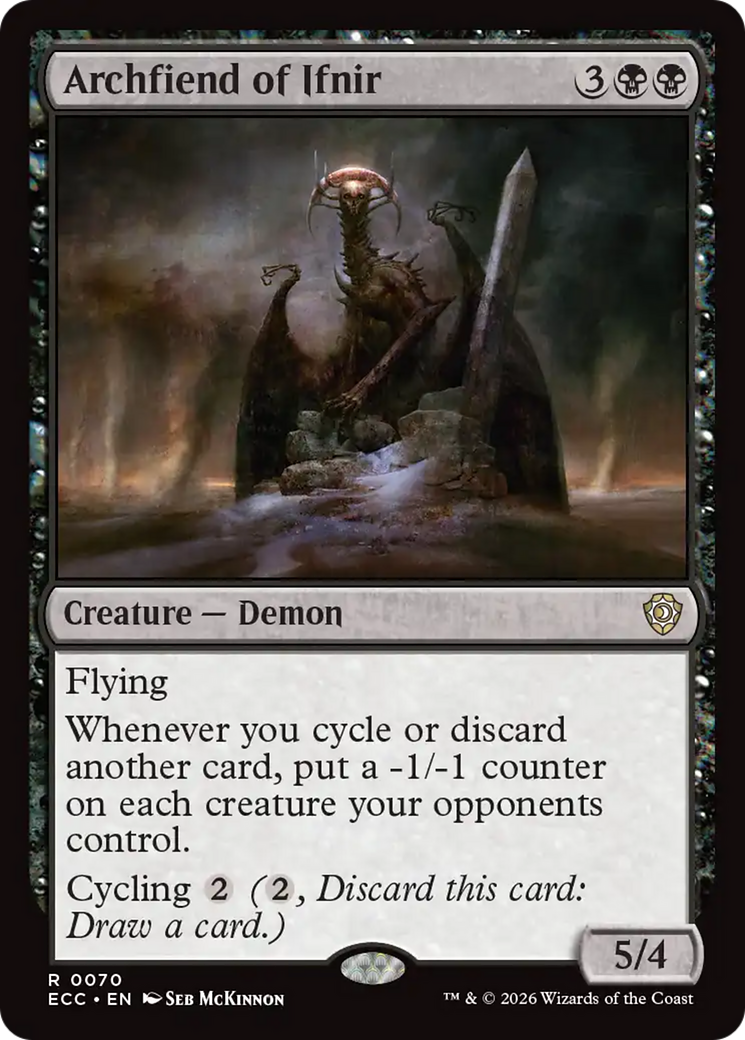
Archfiend of Ifnir
Archfiend of Ifnir
Creature — Demon
5/4
Flying
Whenever you cycle or discard another card, put a -1/-1 counter on each creature your opponents control.
Cycling ( , Discard this card: Draw a card.)
- Some cards have an ability that triggers whenever you cycle any card. These triggered abilities resolve before you draw from the cycling ability.
- If a player discards a card during their cleanup step due to having too many cards in hand, any appropriate abilities that trigger on discarding that card trigger. If this happens, those triggered abilities are put onto the stack and players receive priority in that cleanup step to cast spells or activate abilities (normally, no players may take actions during a cleanup step). Another cleanup step is created following that one.
- An ability that triggers whenever you discard a card doesn't give you permission to discard cards. You'll need another effect that instructs or allows you to discard them.
- An ability that triggers whenever you "cycle or discard" a card triggers only once if you cycle a card. The ability "Whenever you discard a card" is functionally identical to this ability; cycling is mentioned for clarity.
-
1
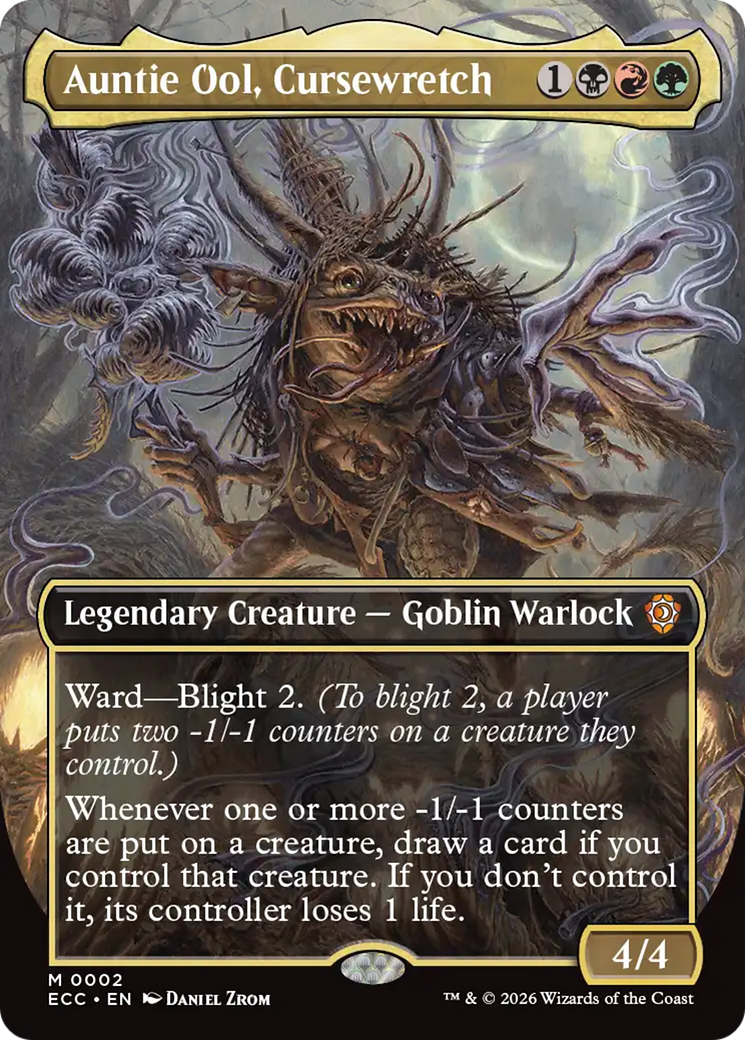
Auntie Ool, Cursewretch
Auntie Ool, Cursewretch
Legendary Creature — Goblin Warlock
4/4
Ward—Blight 2. (To blight 2, a player puts two -1/-1 counters on a creature they control.)
Whenever one or more -1/-1 counters are put on a creature, draw a card if you control that creature. If you don't control it, its controller loses 1 life.
- If a creature that has +1/+1 counters on it receives enough -1/-1 counters to cause it to be destroyed by lethal damage or put into its owner's graveyard for having 0 or less toughness, effects that refer to the counters on that creature when it died will see all of those +1/+1 and -1/-1 counters.
- If you can't place -1/-1 counters on any creatures you control (probably because you control no creatures), you can't choose to blight.
- All of the -1/-1 counters must be put on a single creature. You can't choose to split them up between multiple creatures.
- The creature you choose to put -1/-1 counters on doesn't have to have enough toughness to survive the process. For example, if you blight 2, you can choose to put the counters on a 1/1 creature you control.
- Once you've announced that you're casting a spell or activating an ability, players can't take actions until you've finished doing so. Notably, opponents can't try to destroy or otherwise remove your creatures to stop you from blighting as part of paying the cost of that spell or ability.
- If a creature has +1/+1 counters and -1/-1 counters on it, state-based actions remove the same number of each so that it has only one kind of those counters on it. For example, if a creature has three +1/+1 counters on it and two -1/-1 counters are put on it, state-based actions will remove two of each of those kinds of counters, leaving the creature with just one +1/+1 counter.
-
1
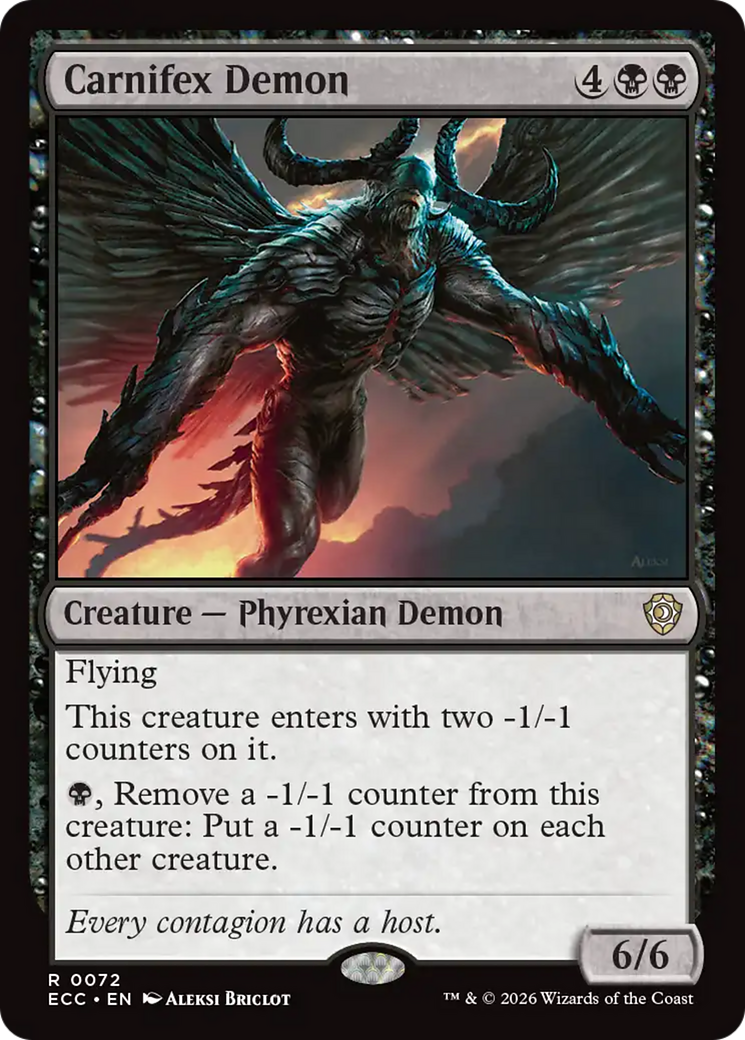
Carnifex Demon
Carnifex Demon
Creature — Phyrexian Demon
6/6
Flying
This creature enters with two -1/-1 counters on it.
, Remove a -1/-1 counter from this creature: Put a -1/-1 counter on each other creature.
- As Carnifex Demon's last ability resolves, you'll put a -1/-1 counter on each creature on the battlefield — including creatures you control — except for that Carnifex Demon.
-
1
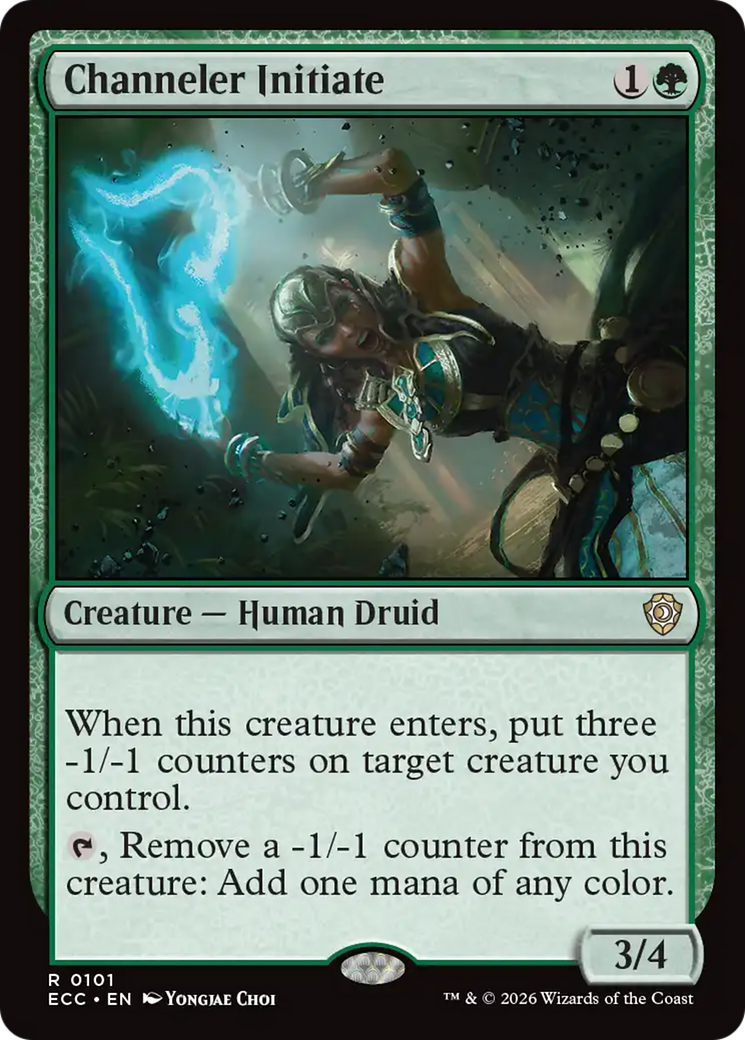
Channeler Initiate
Channeler Initiate
Creature — Human Druid
3/4
When this creature enters, put three -1/-1 counters on target creature you control.
, Remove a -1/-1 counter from this creature: Add one mana of any color.
-
1
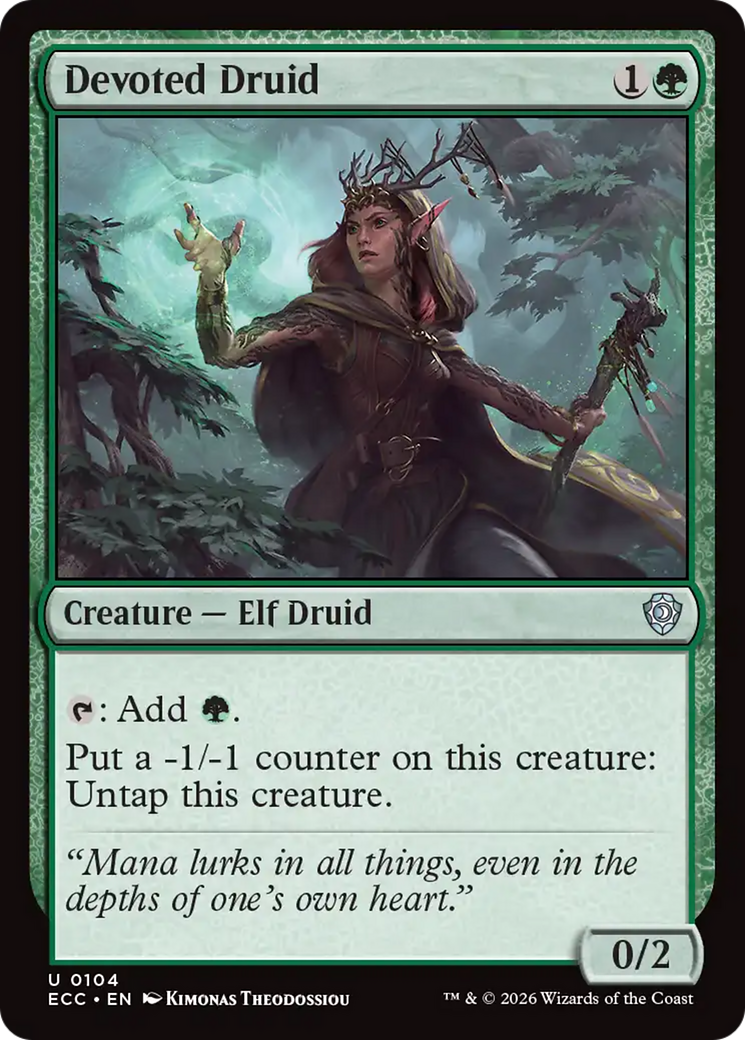
Devoted Druid
Devoted Druid
Creature — Elf Druid
0/2
: Add .
Put a -1/-1 counter on this creature: Untap this creature.
- If you can't put -1/-1 counters on Devoted Druid (due to an effect such as that of Solemnity), you can't activate its second ability. If you can put counters on it, but that is modified by an effect (such as that of Vizier of Remedies), you can activate the ability even if paying the cost causes no counters to be put on Devoted Druid.
- You put the -1/-1 counter on Devoted Druid as a cost to activate its ability, not when it resolves. If paying the cost causes Devoted Druid to have 0 toughness, it's put into your graveyard before you can untap it and before you can even pay the cost again.
-
1
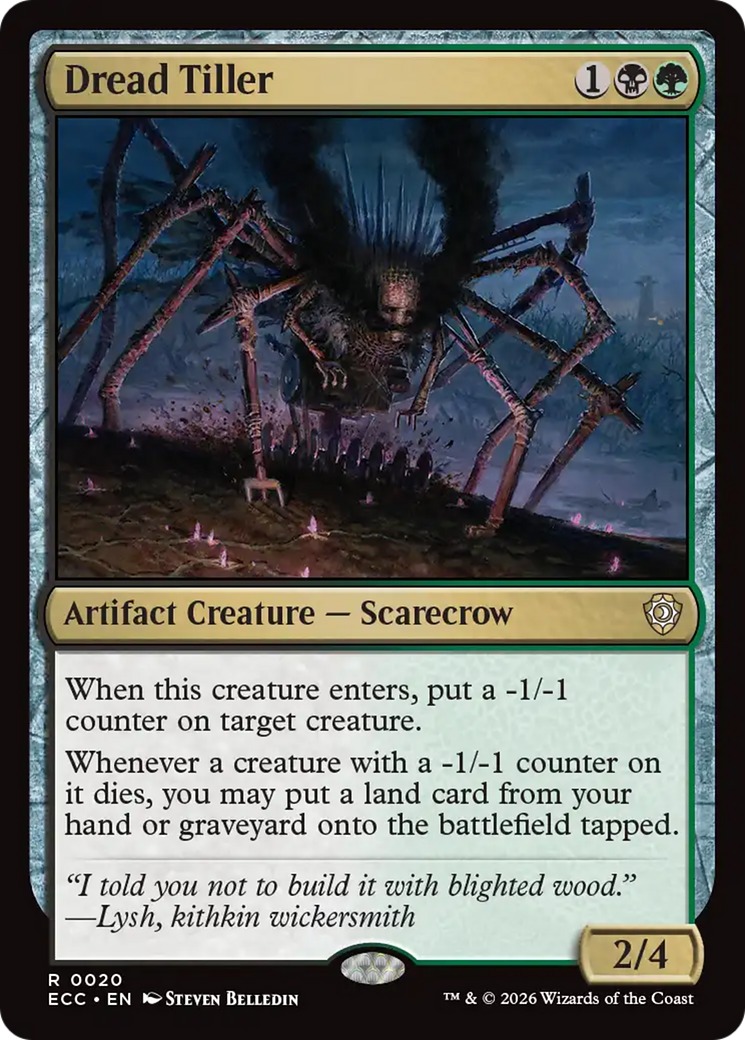
Dread Tiller
Dread Tiller
Artifact Creature — Scarecrow
2/4
When this creature enters, put a -1/-1 counter on target creature.
Whenever a creature with a -1/-1 counter on it dies, you may put a land card from your hand or graveyard onto the battlefield tapped.
-
1
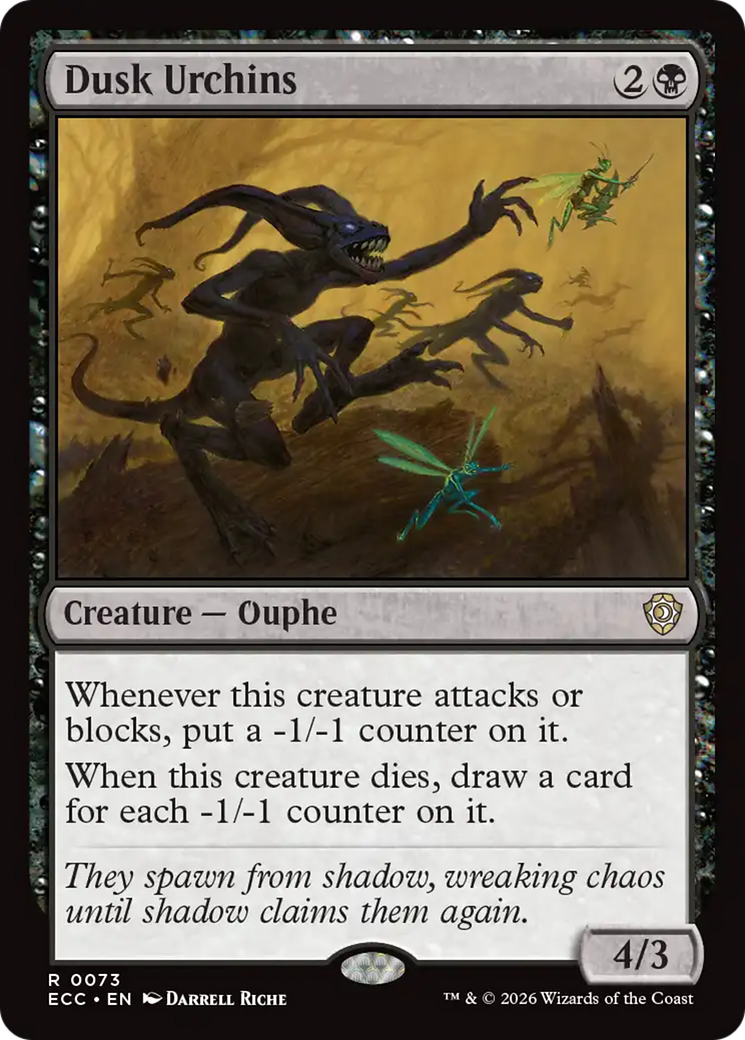
Dusk Urchins
Dusk Urchins
Creature — Ouphe
4/3
Whenever this creature attacks or blocks, put a -1/-1 counter on it.
When this creature dies, draw a card for each -1/-1 counter on it.
- If Dusk Urchins has just 1 toughness when it blocks, it will get a -1/-1 counter and be put into the graveyard. The creature that it blocked remains blocked, however.
- The -1/-1 counter is put on Dusk Urchins during the declare attackers or declare blockers step, whichever is appropriate, so it will be smaller by the time combat damage is dealt. (Note that this is different from how the _Shadowmoor_ card Wicker Warcrawler works.)
-
1
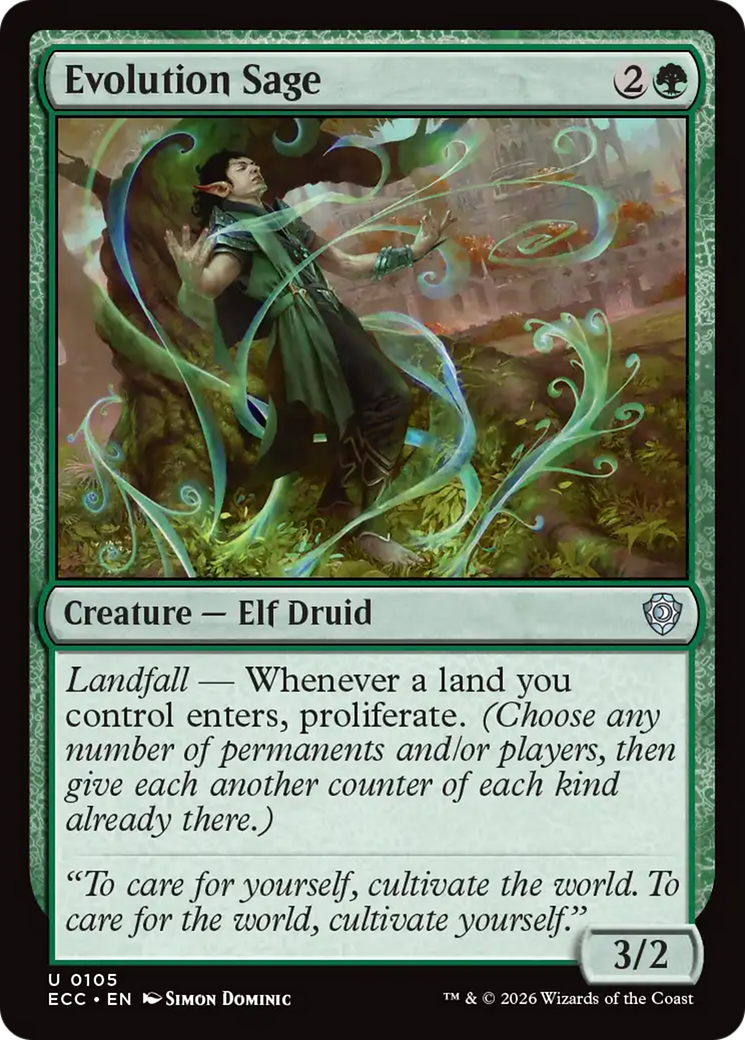
Evolution Sage
Evolution Sage
Creature — Elf Druid
3/2
Landfall — Whenever a land you control enters, proliferate. (Choose any number of permanents and/or players, then give each another counter of each kind already there.)
- A landfall ability triggers whenever a land you control enters for any reason. It triggers whenever you play a land, as well as whenever a spell or ability puts a land onto the battlefield under your control.
- A landfall ability doesn't trigger if a permanent already on the battlefield becomes a land.
- Whenever a land you control enters, each landfall ability of the permanents you control will trigger. You can put them on the stack in any order. The last ability you put on the stack will be the first one to resolve (As a result, you can have those abilities resolve in the order of your choosing.).
- An ability that triggers "Whenever you proliferate" triggers even if you chose no permanents or players while doing so.
- To proliferate, you can choose any permanent that has a counter, including ones controlled by opponents. You can choose any player who has a counter, including opponents. You can't choose cards in any zone other than the battlefield, even if they have counters on them.
- If a permanent ever has both +1/+1 counters and -1/-1 counters on it at the same time, they're removed in pairs as a state-based action so that the permanent has only one of those kinds of counters on it.
- Players can respond to a spell or ability whose effect includes proliferating. Once that spell or ability starts to resolve, however, and its controller chooses which permanents and players will get new counters, it's too late for anyone to respond.
- You don't have to choose every permanent or player that has a counter, only the ones you want to add another counter to. Since "any number" includes zero, you don't have to choose any permanents at all, and you don't have to choose any players at all.
- If a player or permanent has more than one kind of counter on it, and you choose for it to get additional counters, it must get one of each kind of counter it already has. You can't have it get just one kind of counter it already has and not the others.
-
1
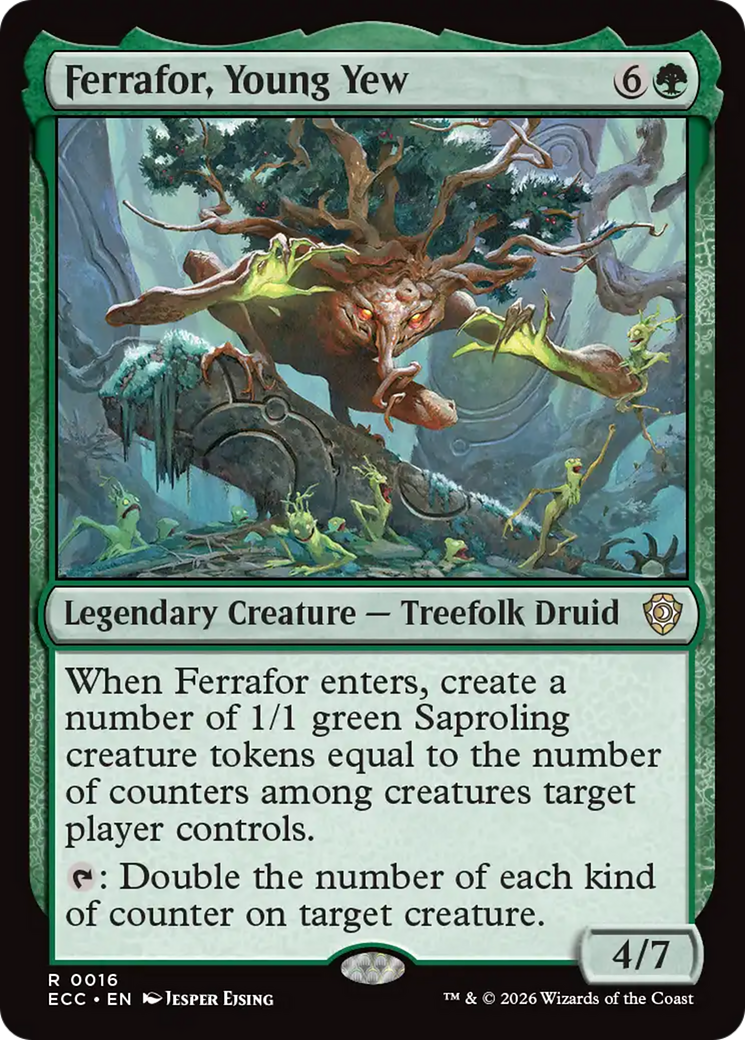
Ferrafor, Young Yew
Ferrafor, Young Yew
Legendary Creature — Treefolk Druid
4/7
When Ferrafor enters, create a number of 1/1 green Saproling creature tokens equal to the number of counters among creatures target player controls.
: Double the number of each kind of counter on target creature.
- To double the number of each kind of counter on a creature, put another counter on it for each counter it already has. Effects that interact with counters being put onto creatures apply as appropriate.
- Use the number of counters among creatures the target player controls when Ferrafor's first ability resolves to determine how many Saprolings are created.
-
1
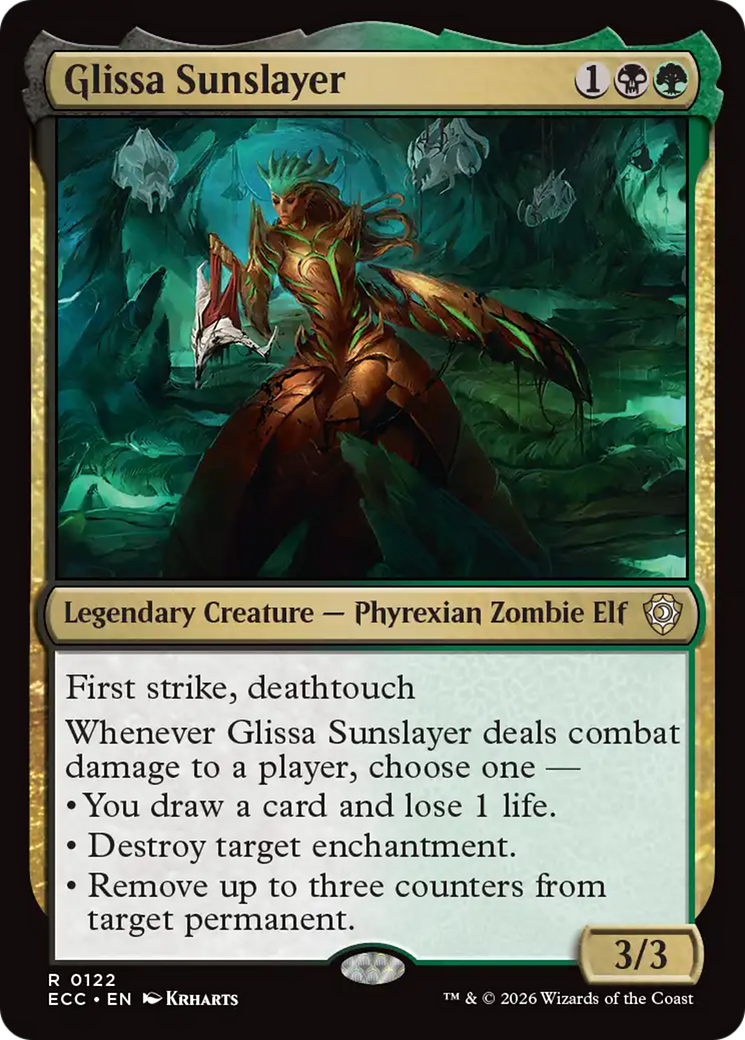
Glissa Sunslayer
Glissa Sunslayer
Legendary Creature — Phyrexian Zombie Elf
3/3
First strike, deathtouch
Whenever Glissa Sunslayer deals combat damage to a player, choose one —
- You draw a card and lose 1 life.
- Destroy target enchantment.
- Remove up to three counters from target permanent.
- For the third mode, you choose which counters to remove as the ability resolves. You may remove any three (or fewer) counters, even if the permanent has multiple kinds of counters on it.
-
1
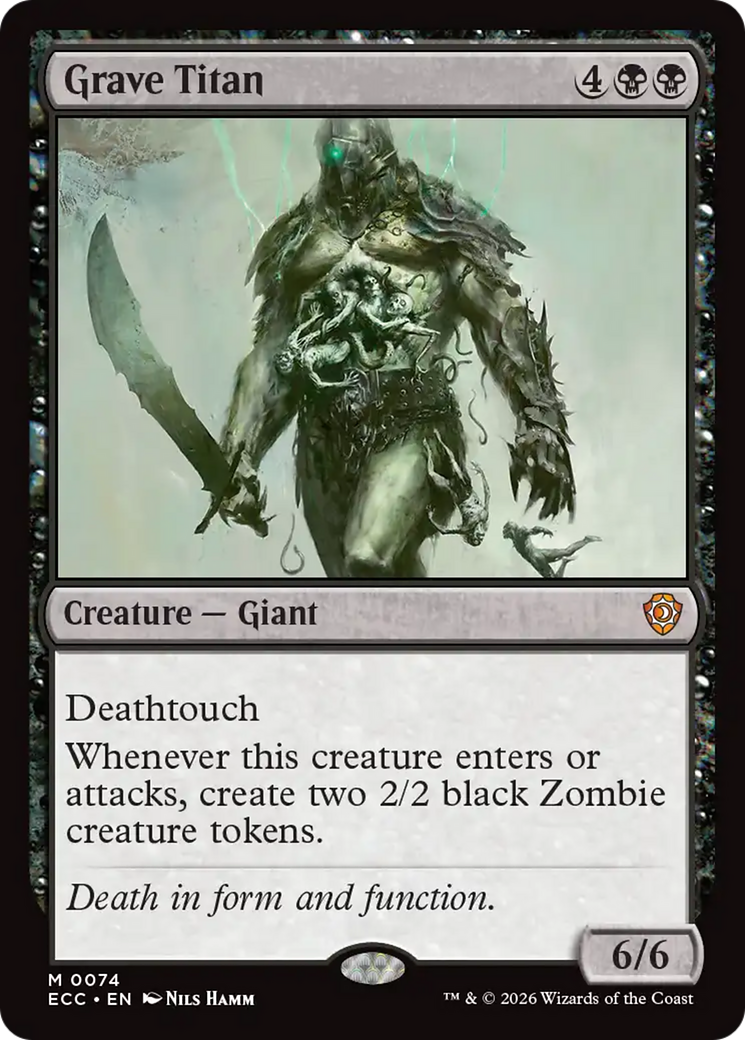
Grave Titan
Grave Titan
Creature — Giant
6/6
Deathtouch
Whenever this creature enters or attacks, create two 2/2 black Zombie creature tokens.
-
1
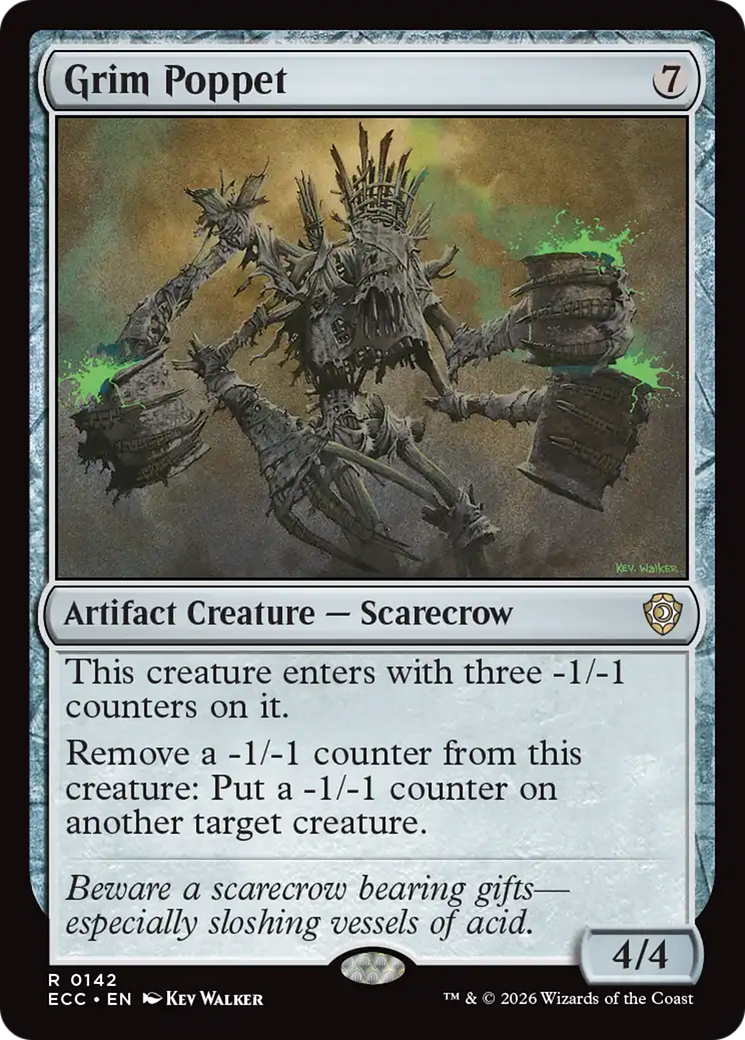
Grim Poppet
Grim Poppet
Artifact Creature — Scarecrow
4/4
This creature enters with three -1/-1 counters on it.
Remove a -1/-1 counter from this creature: Put a -1/-1 counter on another target creature.
- The second ability can target any creature except the Grim Poppet whose ability is being activated. It can target a different Grim Poppet. It can be activated multiple times targeting the same creature.
-
1
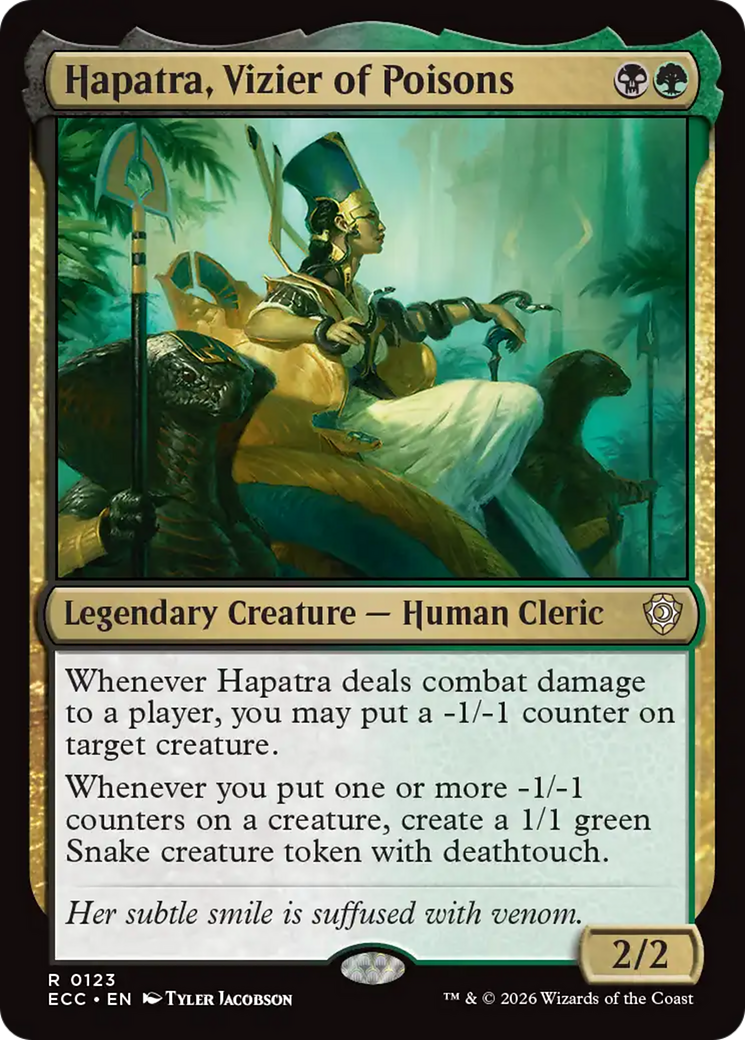
Hapatra, Vizier of Poisons
Hapatra, Vizier of Poisons
Legendary Creature — Human Cleric
2/2
Whenever Hapatra deals combat damage to a player, you may put a -1/-1 counter on target creature.
Whenever you put one or more -1/-1 counters on a creature, create a 1/1 green Snake creature token with deathtouch.
- If you put enough -1/-1 counters on Hapatra so that its toughness is 0 or less, its last ability triggers.
- If you put any number of -1/-1 counters on more than one creature at once, Hapatra's last ability triggers once for each of those creatures.
-
1
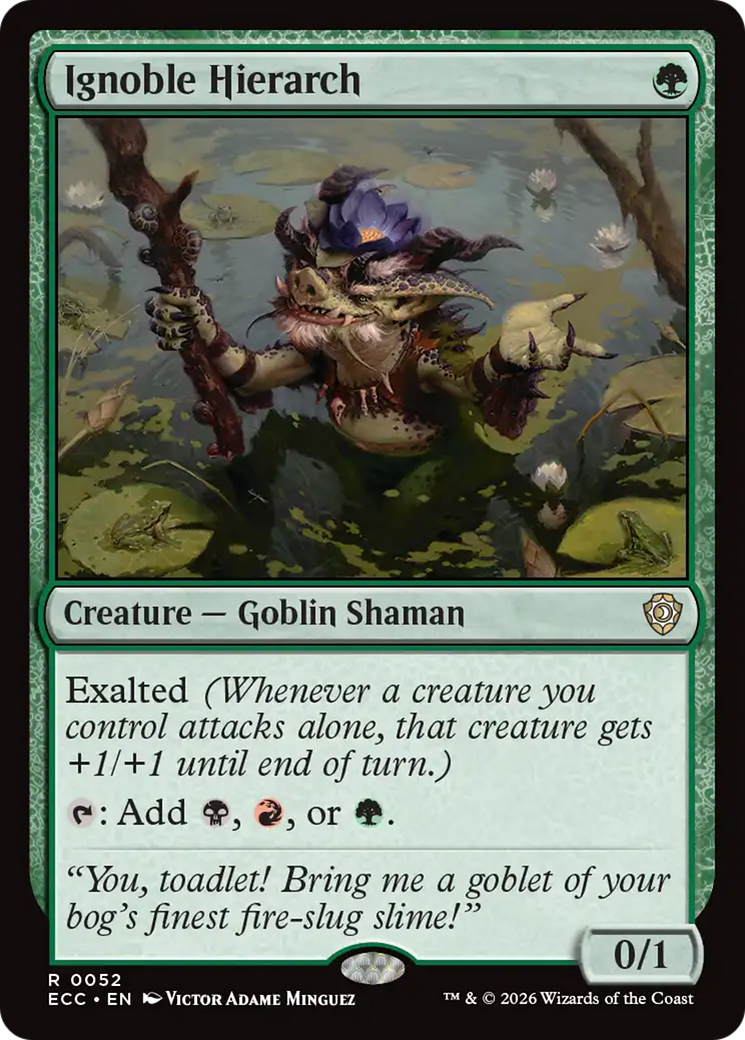
Ignoble Hierarch
Ignoble Hierarch
Creature — Goblin Shaman
0/1
Exalted (Whenever a creature you control attacks alone, that creature gets +1/+1 until end of turn.)
: Add , , or .
- A creature attacks alone if it's the only creature declared as an attacker during the declare attackers step (including creatures controlled by your teammates, if applicable). For example, exalted won't trigger if you attack with multiple creatures and all but one of them are removed from combat.
-
1
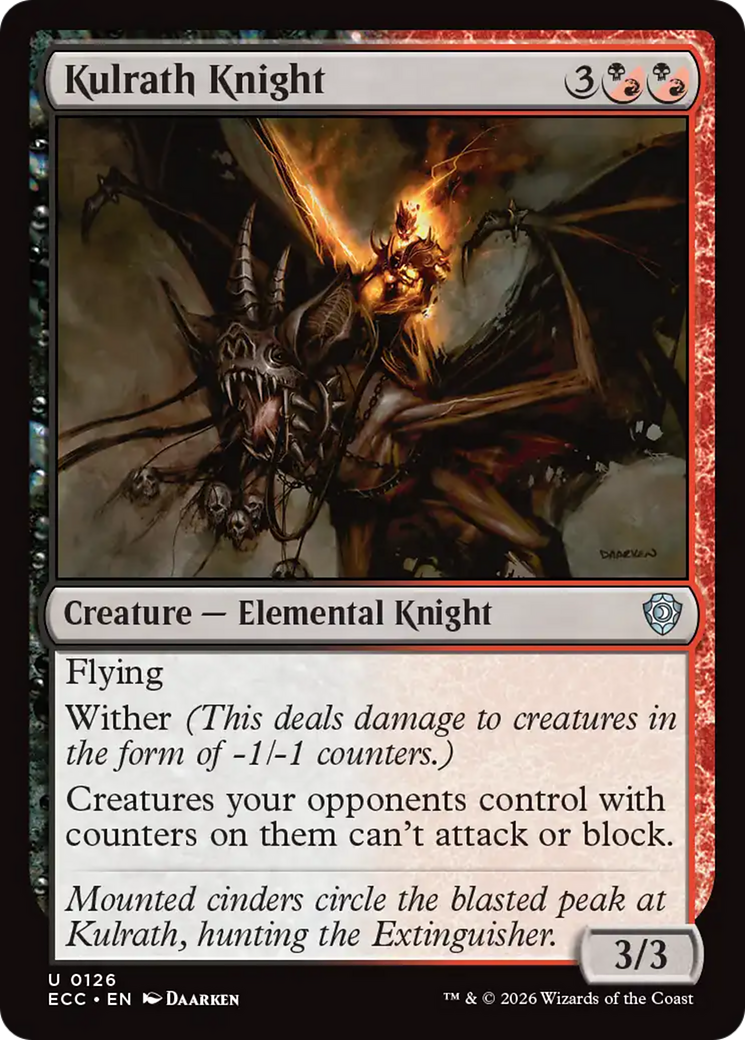
Kulrath Knight
Kulrath Knight
Creature — Elemental Knight
3/3
Flying
Wither (This deals damage to creatures in the form of -1/-1 counters.)
Creatures your opponents control with counters on them can't attack or block.
- This checks your opponents' creatures for any kind of counters, not just -1/-1 counters.
-
1
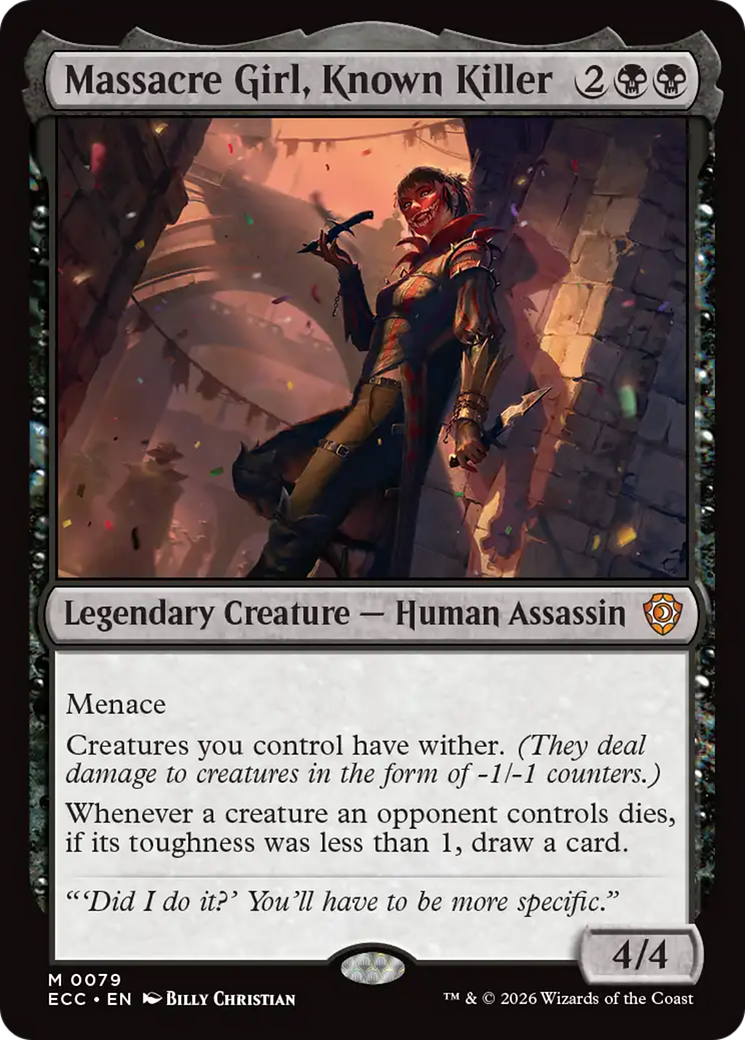
Massacre Girl, Known Killer
Massacre Girl, Known Killer
Legendary Creature — Human Assassin
4/4
Menace
Creatures you control have wither. (They deal damage to creatures in the form of -1/-1 counters.)
Whenever a creature an opponent controls dies, if its toughness was less than 1, draw a card.
- Use the toughness of the creature as it last existed on the battlefield to determine whether or not Massacre Girl's ability triggers.
- Wither applies to any damage dealt to creatures by creatures you control. This includes combat damage as well as anything that causes creatures you control to deal noncombat damage, such as Incinerator of the Guilty's reflexive triggered ability or the effect of Hard-Hitting Question.
-
1
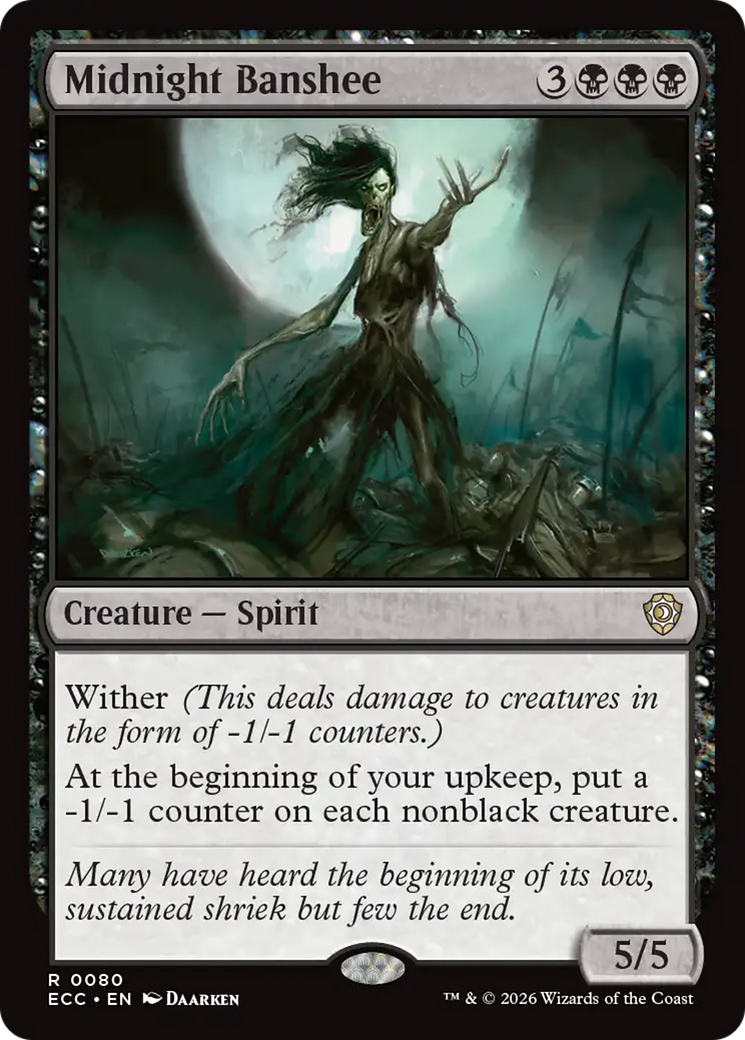
Midnight Banshee
Midnight Banshee
Creature — Spirit
5/5
Wither (This deals damage to creatures in the form of -1/-1 counters.)
At the beginning of your upkeep, put a -1/-1 counter on each nonblack creature.
-
1
Necroskitter
Necroskitter
Creature — Elemental
1/4
Wither (This deals damage to creatures in the form of -1/-1 counters.)
Whenever a creature an opponent controls with a -1/-1 counter on it dies, you may return that card to the battlefield under your control.
- It doesn't matter how many -1/-1 counters were on the creature when it was put into a graveyard from the battlefield, as long as it had at least one.
- The card returns to the battlefield without any -1/-1 counters on it (unless some other effect causes it to enter with some).
- It doesn't matter whose graveyard the creature is put into. It matters only that an opponent controlled it when it left the battlefield.
-
1
Oft-Nabbed Goat
Oft-Nabbed Goat
Creature — Goat
0/5
: Draw a card. Gain control of this creature and put a -1/-1 counter on it. Only your opponents may activate this ability and only as a sorcery.
When this creature dies, if it had one or more -1/-1 counters on it, its owner draws that many cards and each other player loses that much life.
- Only the opponents of Oft-Nabbed Goat's controller can activate its first ability. For the purposes of the first ability, it doesn't matter who owns Oft-Nabbed Goat.
-
1
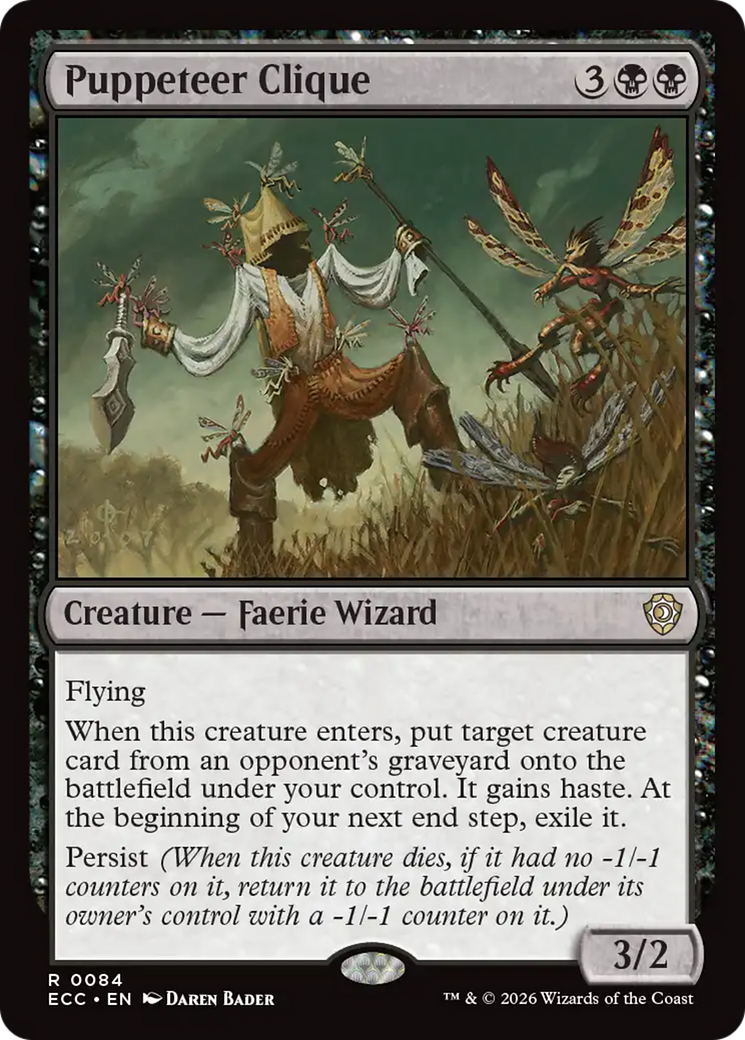
Puppeteer Clique
Puppeteer Clique
Creature — Faerie Wizard
3/2
Flying
When this creature enters, put target creature card from an opponent's graveyard onto the battlefield under your control. It gains haste. At the beginning of your next end step, exile it.
Persist (When this creature dies, if it had no -1/-1 counters on it, return it to the battlefield under its owner's control with a -1/-1 counter on it.)
- When a permanent with persist returns to the battlefield, it's a new object with no memory of or connection to its previous existence.
- If multiple creatures with persist are put into the graveyard at the same time (due to combat damage or a spell that destroys all creatures, for example), the active player (the player whose turn it is) puts all of their persist triggers on the stack in any order, then each other player in turn order does the same. The last trigger put on the stack is the first one that resolves. That means that in a two-player game, the nonactive player's persist creatures will return to the battlefield first, then the active player's persist creatures do the same. The creatures return to the battlefield one at a time.
- If a creature with persist that has +1/+1 counters on it receives enough -1/-1 counters to cause it to be destroyed by lethal damage or put into its owner's graveyard for having 0 or less toughness, persist won't trigger and the card won't return to the battlefield. That's because persist checks the creature's existence just before it leaves the battlefield, and it still has all those counters on it at that point.
- If a creature with persist stops being a creature, persist will still work.
- The persist ability triggers when the permanent is put into a graveyard. Its last known information (that is, how the creature last existed on the battlefield) is used to determine whether it had a -1/-1 counter on it.
- If a permanent has multiple instances of persist, they'll each trigger separately, but the redundant instances will have no effect. If one instance returns the card to the battlefield, the next to resolve will do nothing.
- If a token with no -1/-1 counters on it has persist, the ability will trigger when the token is put into the graveyard. However, the token will cease to exist and can't return to the battlefield.
-
1
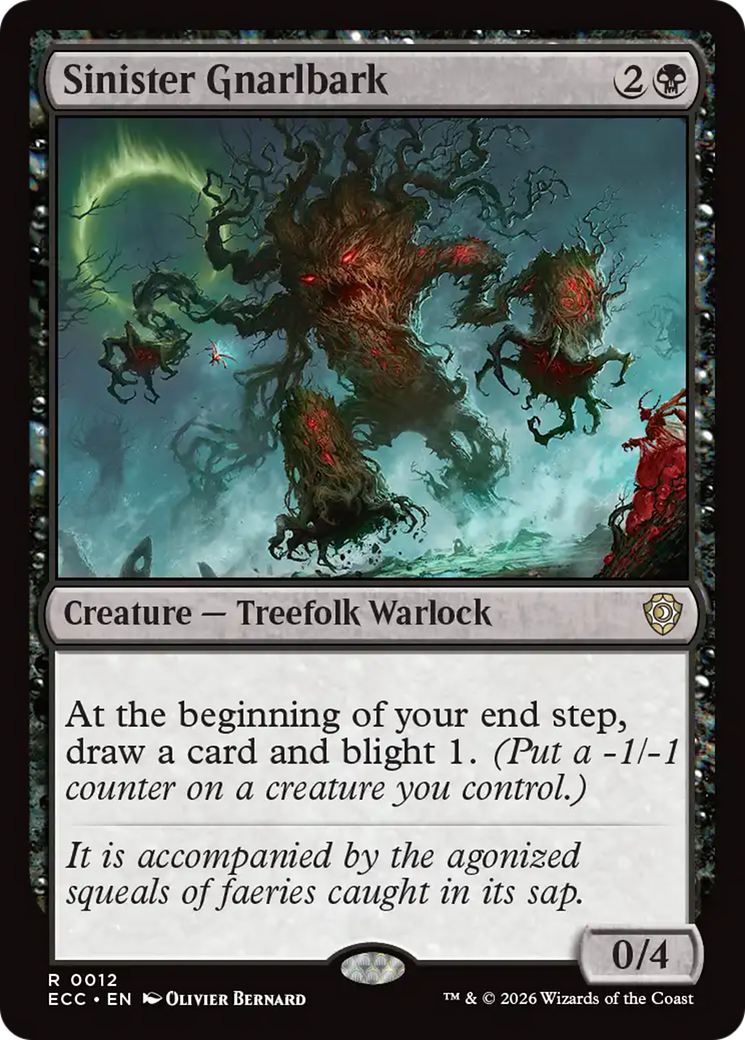
Sinister Gnarlbark
Sinister Gnarlbark
Creature — Treefolk Warlock
0/4
At the beginning of your end step, draw a card and blight 1. (Put a -1/-1 counter on a creature you control.)
-
1
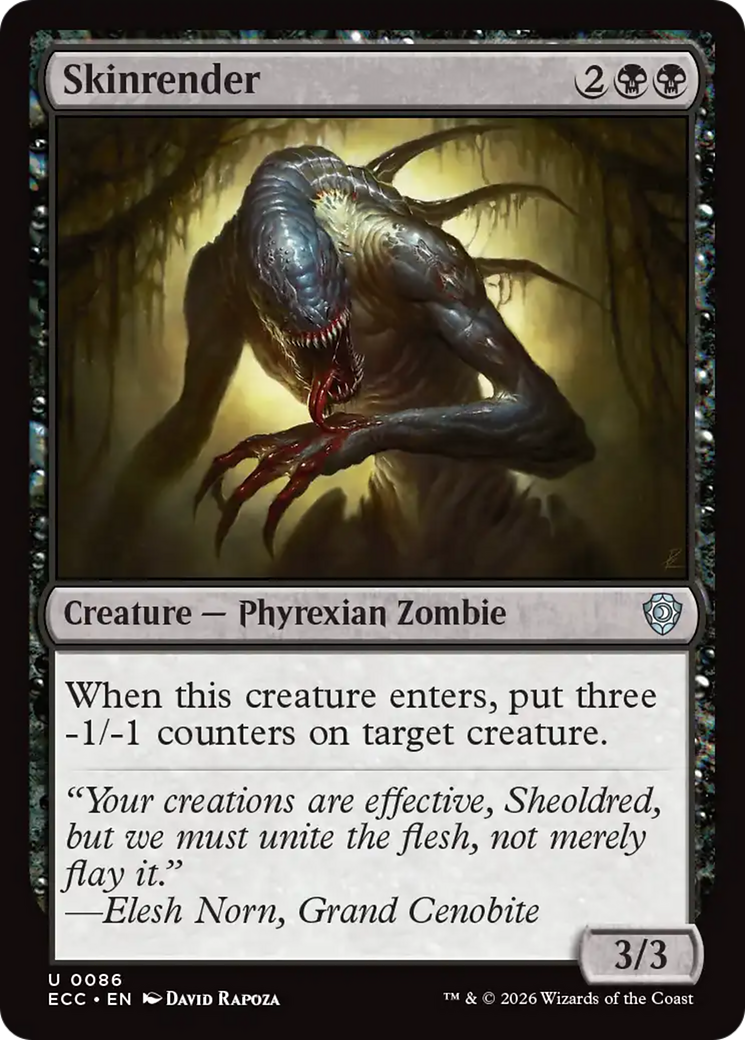
Skinrender
Skinrender
Creature — Phyrexian Zombie
3/3
When this creature enters, put three -1/-1 counters on target creature.
- This ability is mandatory. If there are no other creatures on the battlefield, you must target Skinrender itself.
-
1
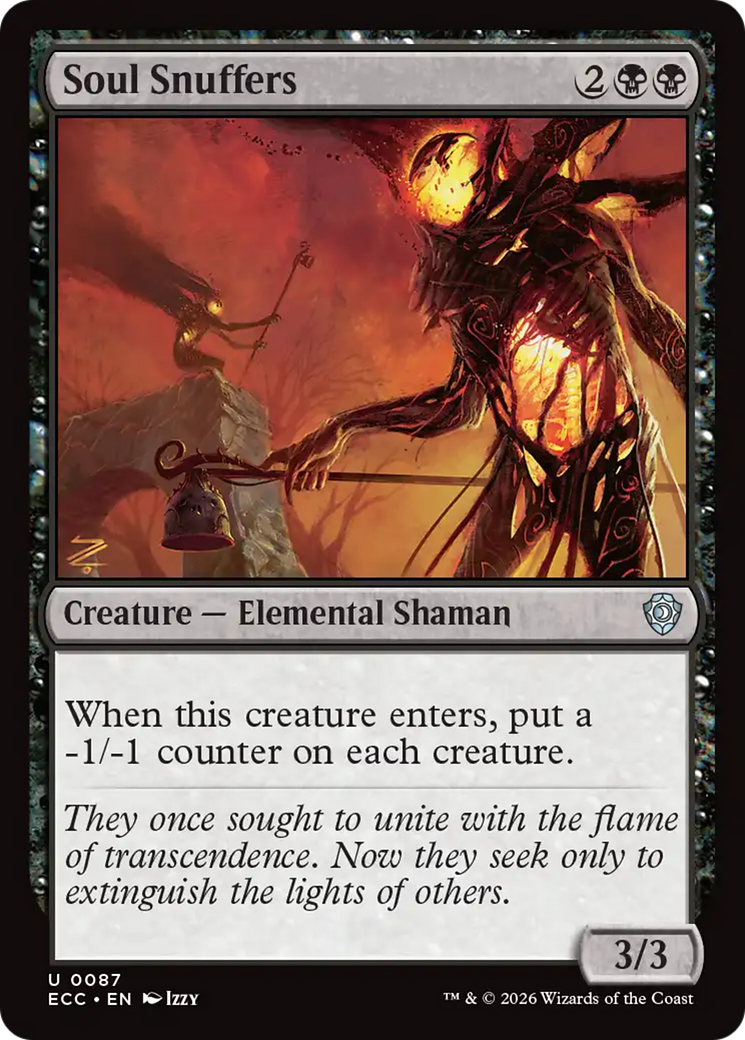
Soul Snuffers
Soul Snuffers
Creature — Elemental Shaman
3/3
When this creature enters, put a -1/-1 counter on each creature.
- The ability puts a -1/-1 counter on Soul Snuffers, too.
-
1
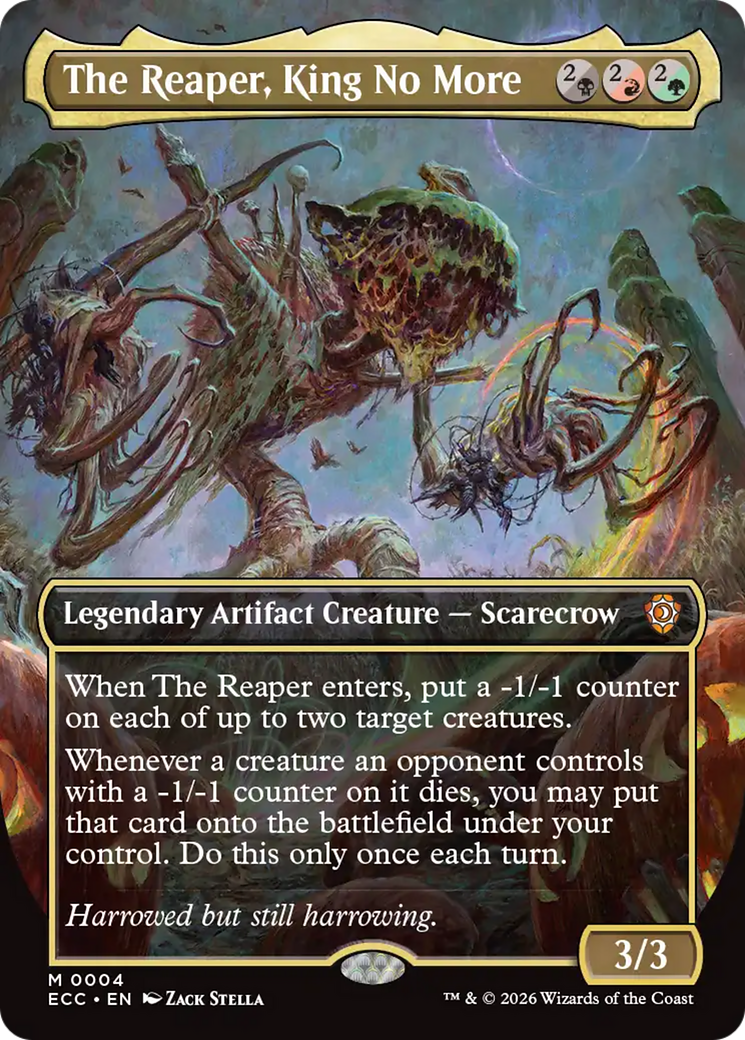
The Reaper, King No More
The Reaper, King No More
Legendary Artifact Creature — Scarecrow
3/3
When The Reaper enters, put a -1/-1 counter on each of up to two target creatures.
Whenever a creature an opponent controls with a -1/-1 counter on it dies, you may put that card onto the battlefield under your control. Do this only once each turn.
-
1
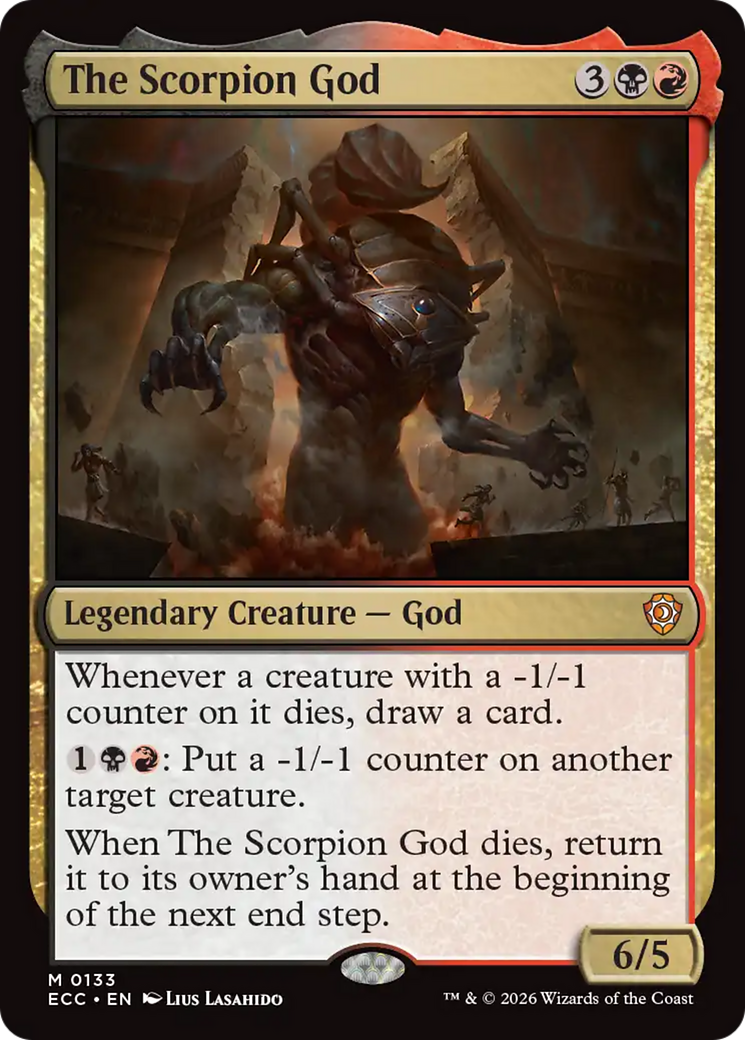
The Scorpion God
The Scorpion God
Legendary Creature — God
6/5
Whenever a creature with a -1/-1 counter on it dies, draw a card.
: Put a -1/-1 counter on another target creature.
When The Scorpion God dies, return it to its owner's hand at the beginning of the next end step.
- If a creature with a -1/-1 counter on it dies at the same time as The Scorpion God does, you'll draw a card. The same is true if The Scorpion God dies with a -1/-1 counter on it.
- You'll draw only one card when a creature with more than one -1/-1 counter on it dies.
-
1
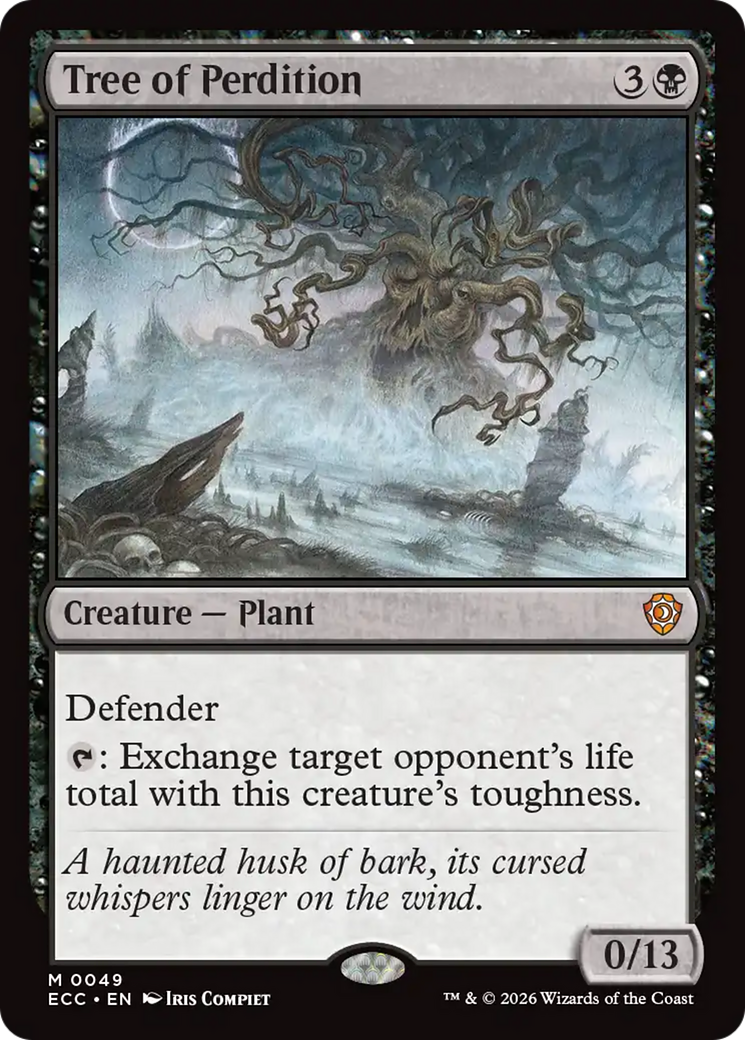
Tree of Perdition
Tree of Perdition
Creature — Plant
0/13
Defender
: Exchange target opponent's life total with this creature's toughness.
- When the ability resolves, Tree of Perdition's toughness becomes the targeted opponent's former life total and that player gains or loses an amount of life necessary so that their life total equals Tree of Perdition's former toughness. Other effects that interact with life gain or life loss will interact with this effect accordingly.
- Any toughness-modifying effects, counters, Auras, or Equipment will apply after its toughness is set to the player's former life total. For example, say Tree of Perdition is equipped with Cultist's Staff (which makes it 2/15) and the player's life total is 7. After the exchange, Tree of Perdition would be a 2/9 creature (its toughness became 7, which was then modified by Cultist's Staff) and the player's life total would be 15.
- If Tree of Perdition isn't on the battlefield when the ability resolves, the exchange can't happen and the ability will have no effect. Notably, activating the ability and giving Tree of Perdition -13/-13 in response won't cause your opponent to lose the game.
-
1
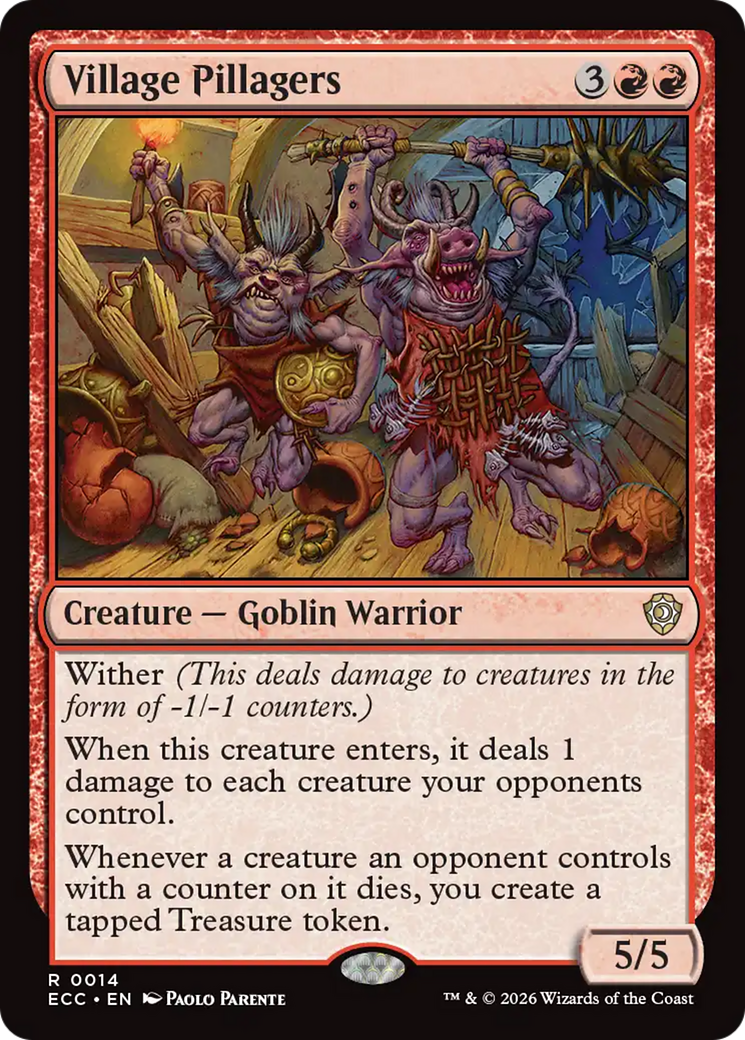
Village Pillagers
Village Pillagers
Creature — Goblin Warrior
5/5
Wither (This deals damage to creatures in the form of -1/-1 counters.)
When this creature enters, it deals 1 damage to each creature your opponents control.
Whenever a creature an opponent controls with a counter on it dies, you create a tapped Treasure token.
- Wither applies to any damage dealt to creatures by Village Pillagers. This includes combat damage as well as anything that causes it to deal noncombat damage, such as the effect of its second ability.
-
1
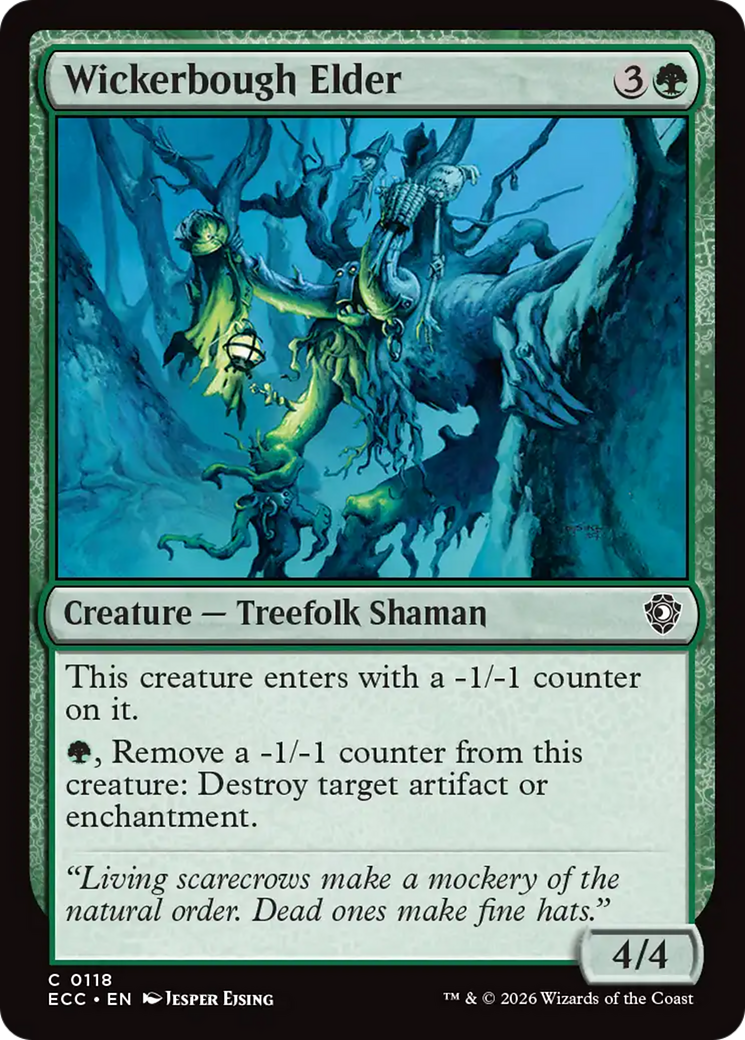
Wickerbough Elder
Wickerbough Elder
Creature — Treefolk Shaman
4/4
This creature enters with a -1/-1 counter on it.
, Remove a -1/-1 counter from this creature: Destroy target artifact or enchantment.
- You must choose a target artifact or enchantment to activate Wickerbough Elder's last ability. You can't pay just to remove a -1/-1 counter from it without a legal target.
- If an effect puts Wickerbough Elder onto the battlefield with one or more +1/+1 counters, its -1/-1 counter and one of those +1/+1 counters are removed as a state-based action before you can activate its ability.
Planeswalkers 2
-
1
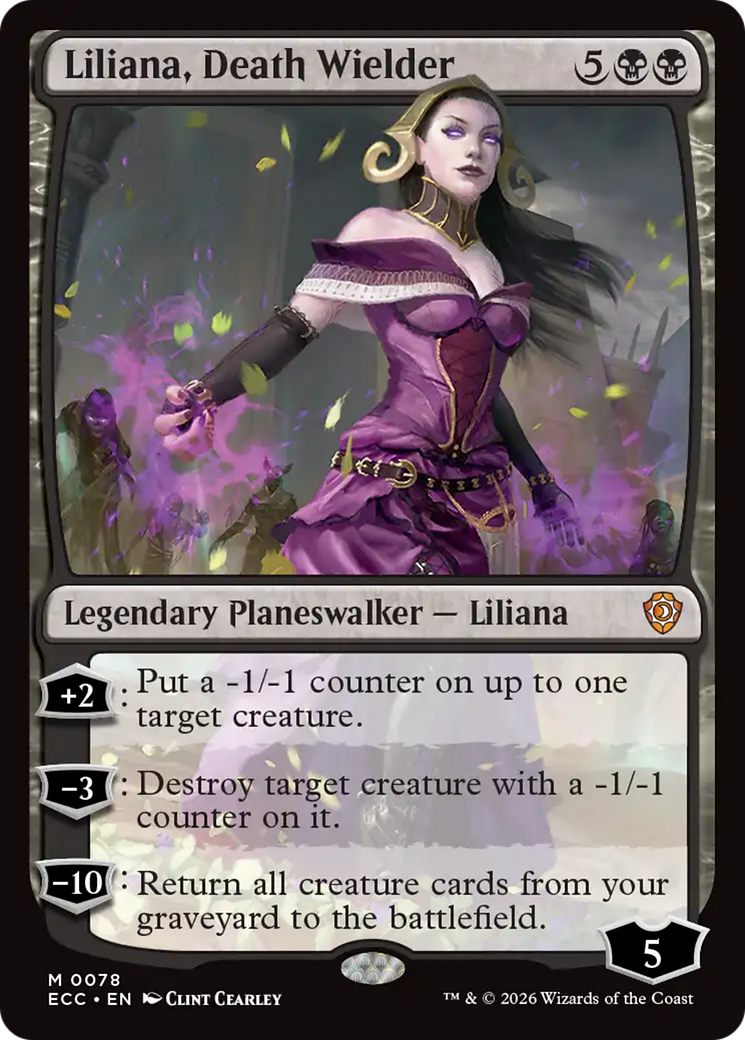
Liliana, Death Wielder
Liliana, Death Wielder
Legendary Planeswalker — Liliana
+2: Put a -1/-1 counter on up to one target creature.
−3: Destroy target creature with a -1/-1 counter on it.
−10: Return all creature cards from your graveyard to the battlefield.
-
1
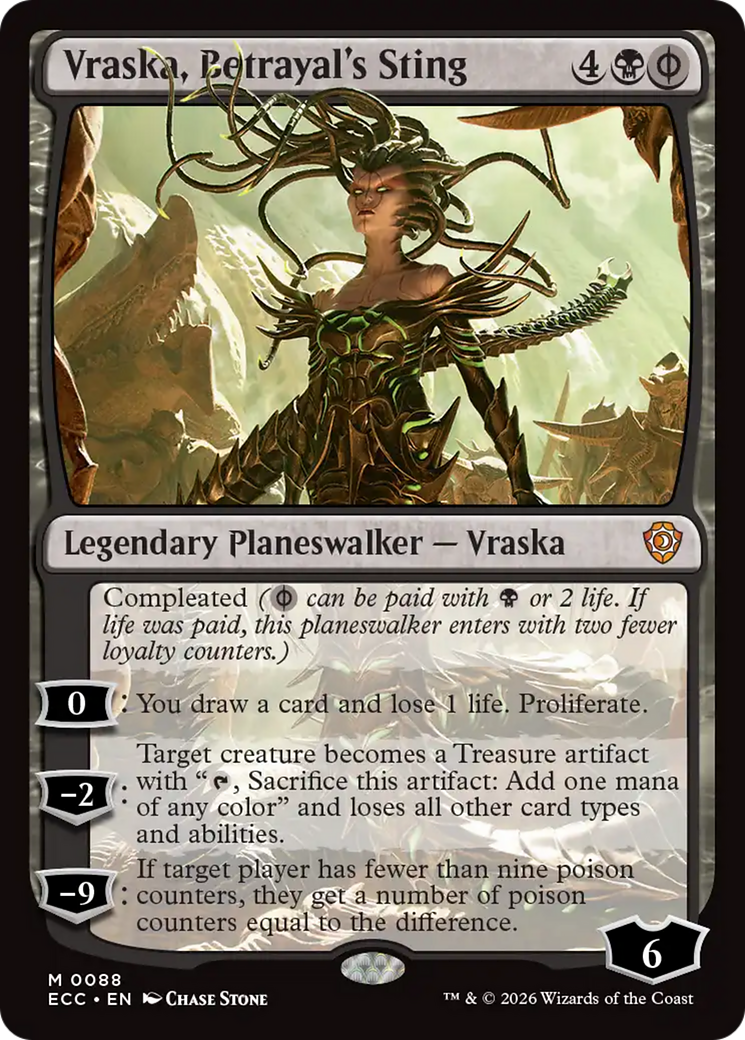
Vraska, Betrayal's Sting
Vraska, Betrayal's Sting
Legendary Planeswalker — Vraska
Compleated ( can be paid with or 2 life. If life was paid, this planeswalker enters with two fewer loyalty counters.)
0: You draw a card and lose 1 life. Proliferate.
−2: Target creature becomes a Treasure artifact with " , Sacrifice this artifact: Add one mana of any color" and loses all other card types and abilities.
−9: If target player has fewer than nine poison counters, they get a number of poison counters equal to the difference.
- A Phyrexian mana symbol contributes 1 toward the mana value of a card, even if life is paid for it. Specifically, Vraska's mana value is always 6.
- In most cases, the target of Vraska's last loyalty ability will end up with nine poison counters. However, once you calculate what the difference is, replacement effects can change how many poison counters the player actually gets. For example, if the player controls Melira, the Living Cure, they will end up getting one poison counter if they had eight or fewer to begin with.
- Other replacement effects that would change the number of loyalty counters Vraska enters with will apply as normal.
- The target of Vraska's second loyalty ability will lose any other subtypes and card types it previously had and will be only a Treasure artifact. It will retain any supertypes it had.
- The compleated ability looks only at whether a player chose to pay 2 life for a Phyrexian mana symbol as they were casting the spell. If a player paid life for some other reason while casting the spell, that will not reduce the number of loyalty counters the planeswalker enters the battlefield with.
Instants 6
-
1
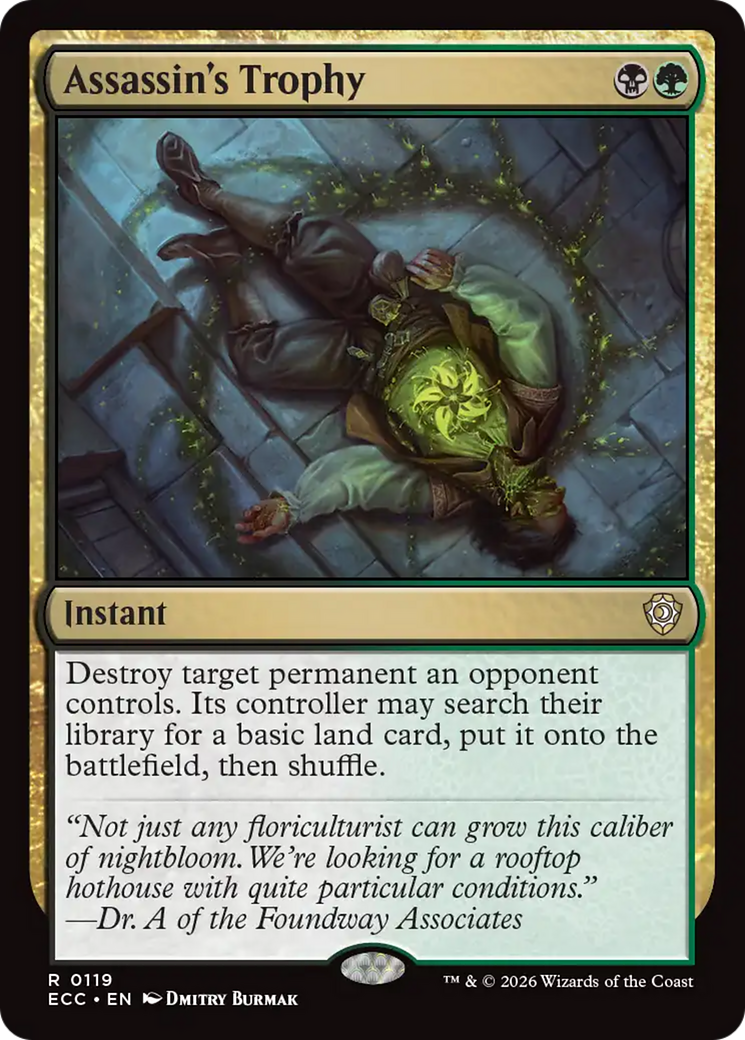
Assassin's Trophy
Assassin's Trophy
Instant
Destroy target permanent an opponent controls. Its controller may search their library for a basic land card, put it onto the battlefield, then shuffle.
- If the target permanent is a legal target but isn't destroyed, most likely because it has indestructible, its controller may search their library.
- If the target permanent is an illegal target by the time Assassin's Trophy tries to resolve, the spell doesn't resolve. No player searches their library.
- If the permanent's controller doesn't search their library, they don't shuffle their library.
- If the target permanent is a legal target but isn't destroyed, most likely because it has indestructible, its controller may search their library.
- If the permanent's controller doesn't search their library, they don't shuffle their library.
- If the target permanent is an illegal target by the time Assassin's Trophy tries to resolve, the spell doesn't resolve. No player searches their library.
-
1
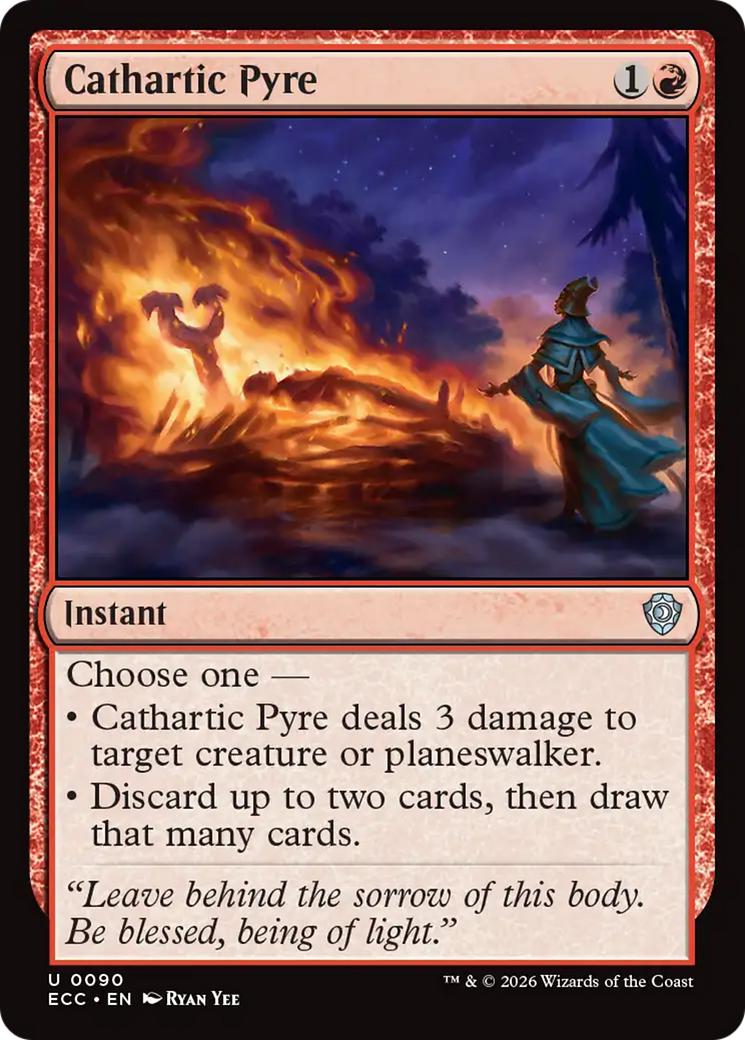
Cathartic Pyre
Cathartic Pyre
Instant
Choose one —
- Cathartic Pyre deals 3 damage to target creature or planeswalker.
- Discard up to two cards, then draw that many cards.
-
1
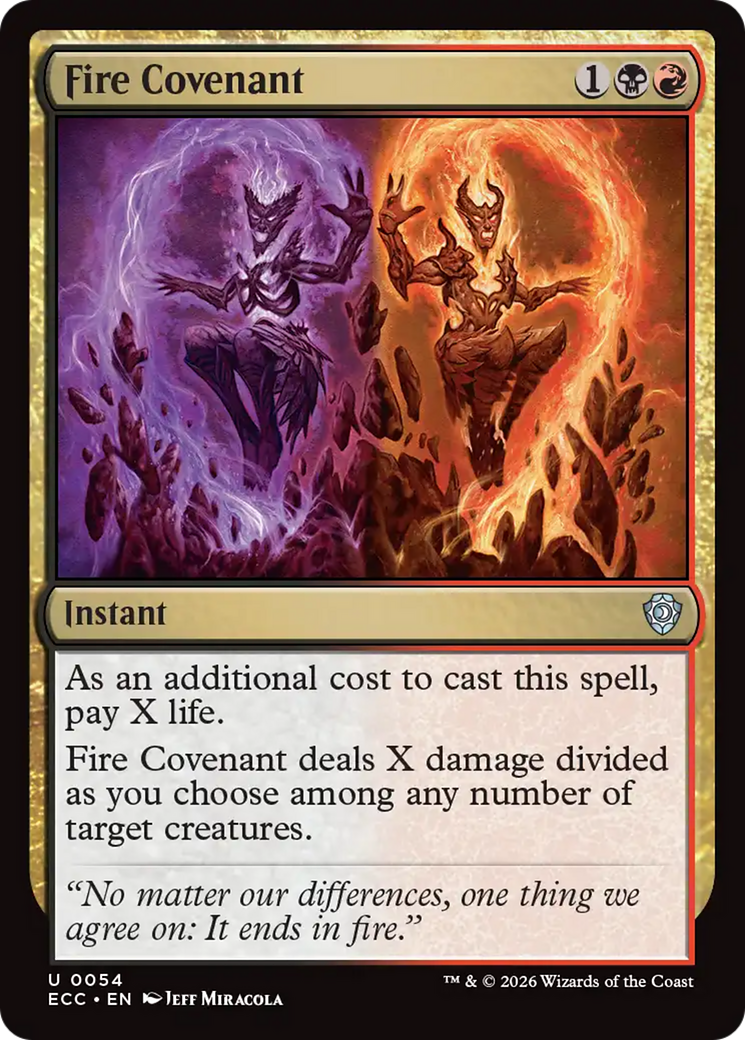
Fire Covenant
Fire Covenant
Instant
As an additional cost to cast this spell, pay X life.
Fire Covenant deals X damage divided as you choose among any number of target creatures.
- If X is 0, the number of targets must also be 0.
- You must distribute at least 1 damage to each target.
- You divide the damage as you cast the spell. You can't redistribute the damage if any of the target creatures becomes illegal before the spell resolves.
-
1
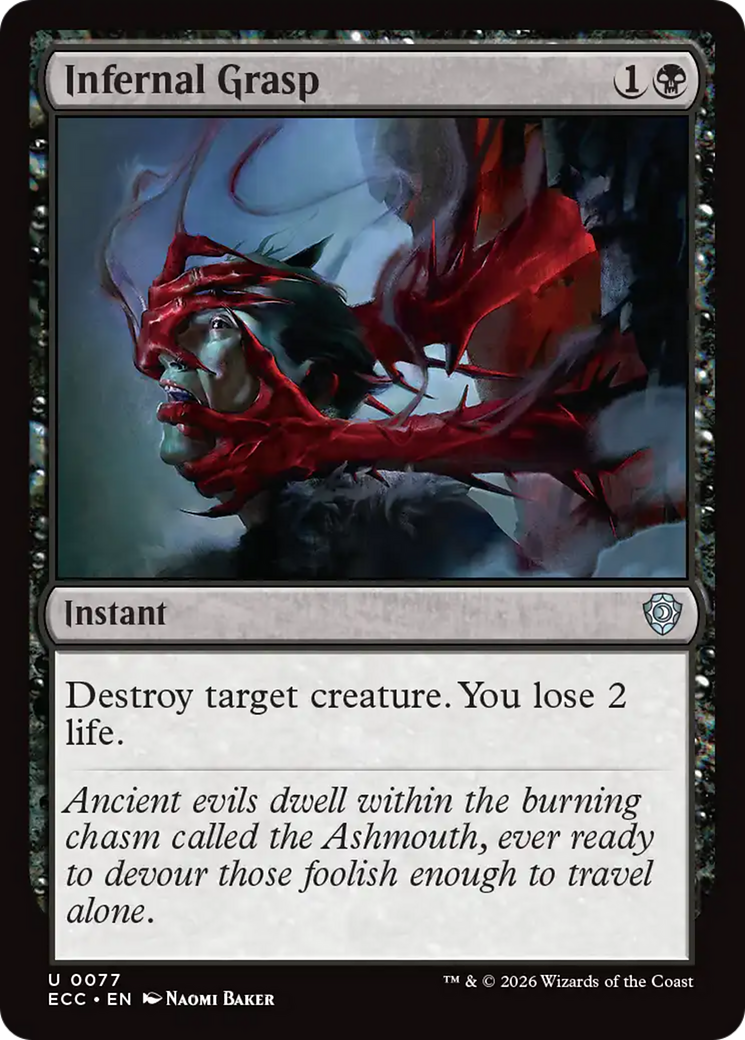
Infernal Grasp
Infernal Grasp
Instant
Destroy target creature. You lose 2 life.
-
1
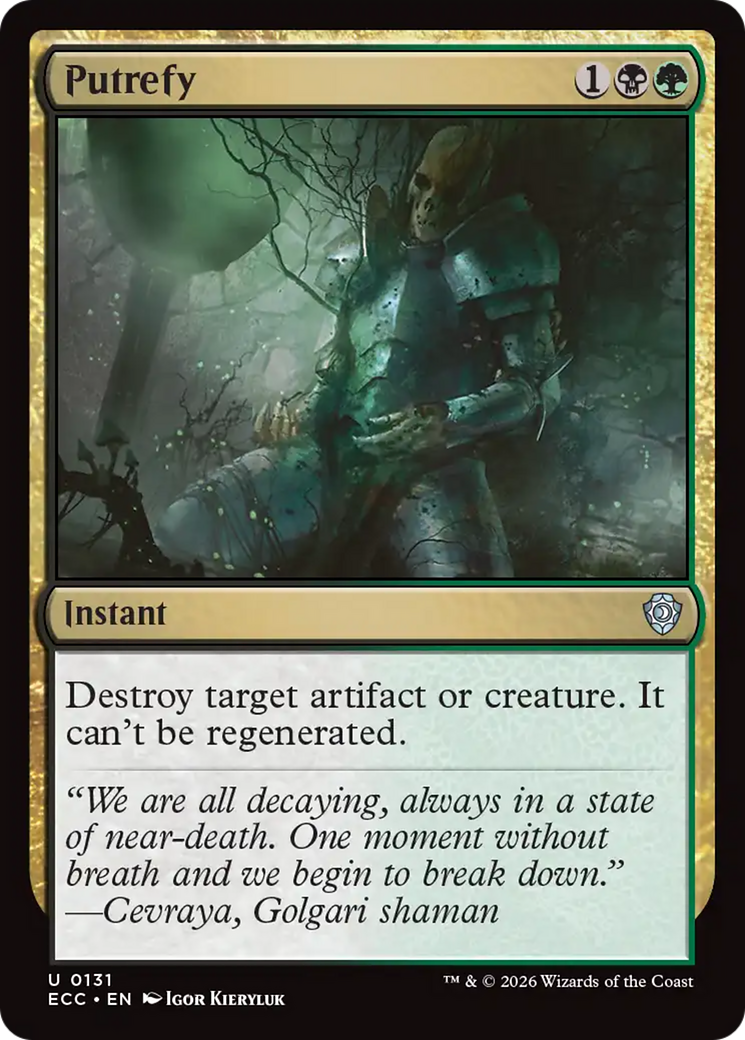
Putrefy
Putrefy
Instant
Destroy target artifact or creature. It can't be regenerated.
- This spell isn't modal. When it resolves, it will destroy the target if it's a creature or an artifact, even if it changed from one to the other between targeting and resolution.
-
1
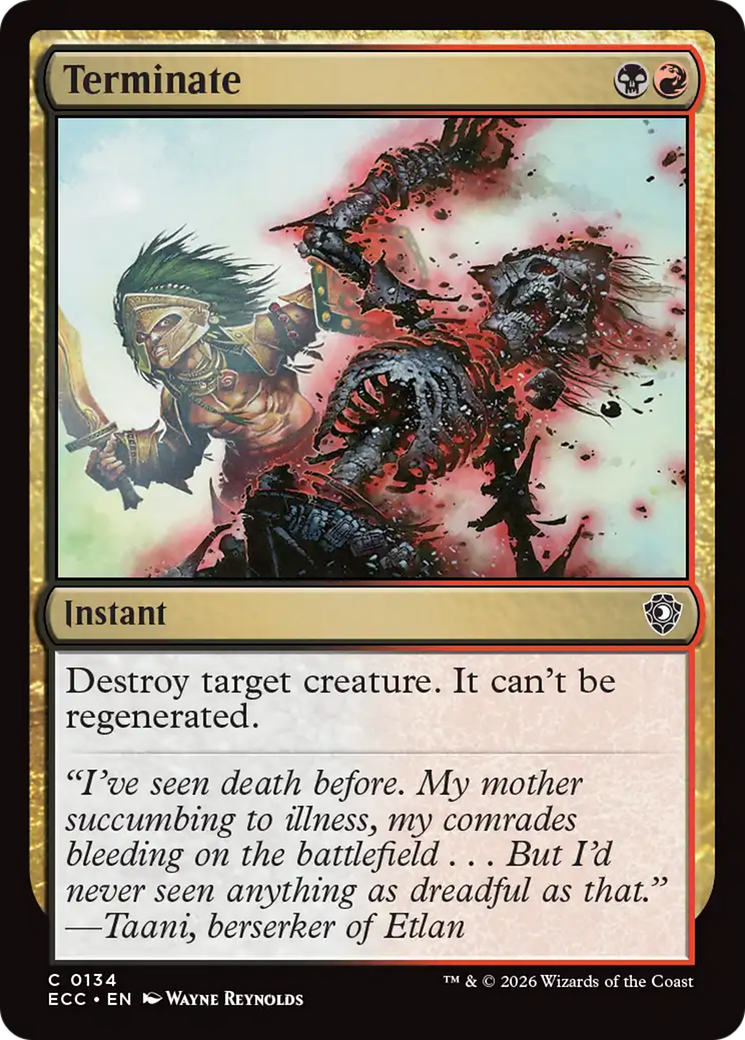
Terminate
Terminate
Instant
Destroy target creature. It can't be regenerated.
Sorceries 12
-
1
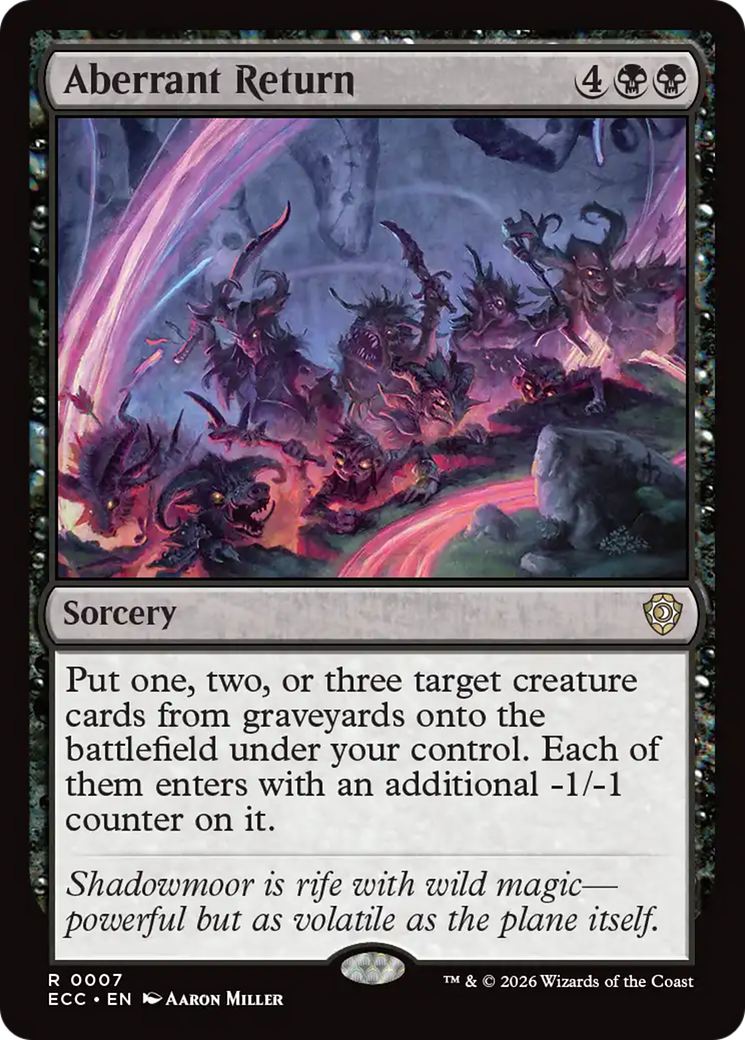
Aberrant Return
Aberrant Return
Sorcery
Put one, two, or three target creature cards from graveyards onto the battlefield under your control. Each of them enters with an additional -1/-1 counter on it.
-
1
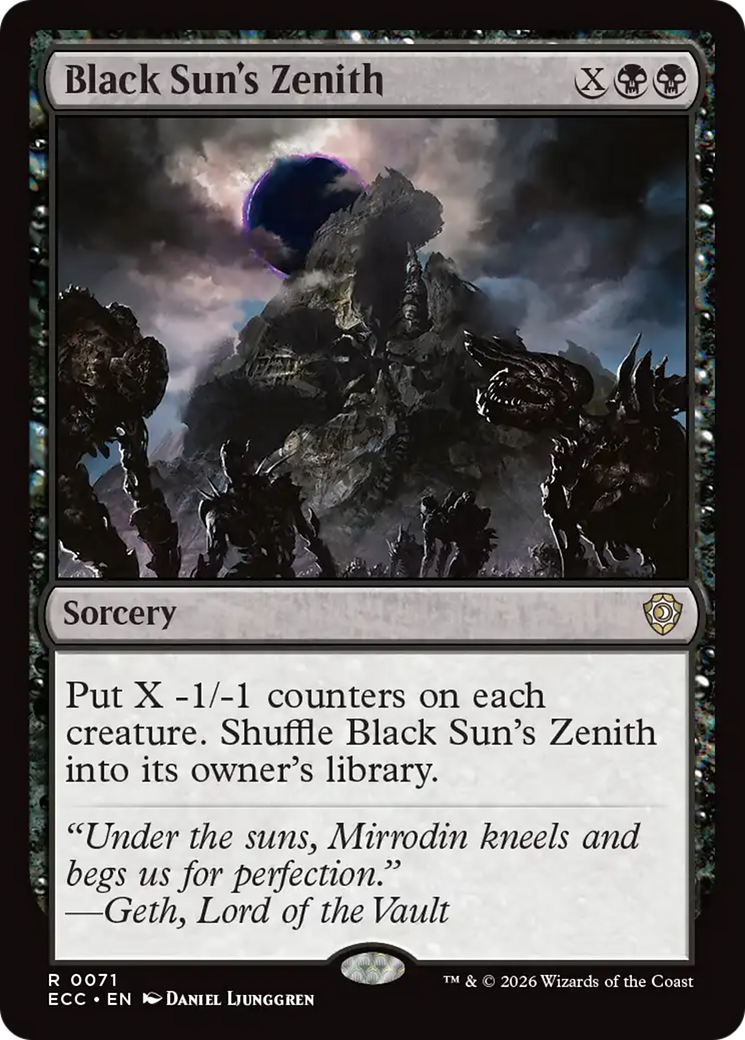
Black Sun's Zenith
Black Sun's Zenith
Sorcery
Put X -1/-1 counters on each creature. Shuffle Black Sun's Zenith into its owner's library.
- If this spell doesn't resolve, none of its effects occur. In particular, it will go to the graveyard rather than to its owner's library.
-
1
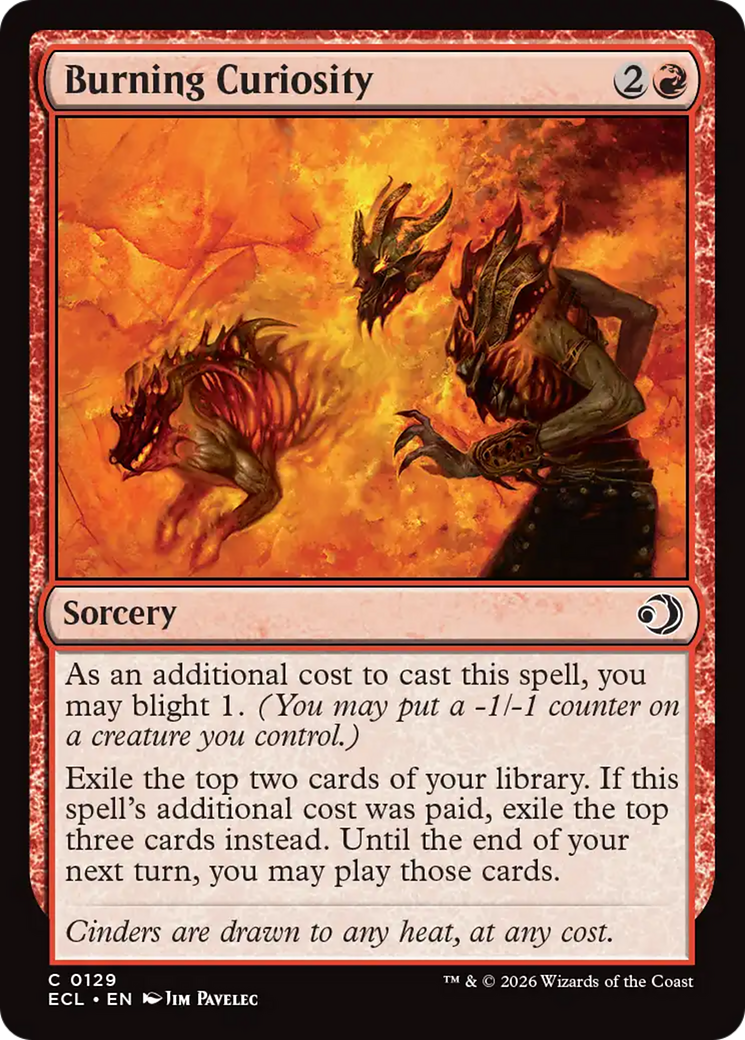
Burning Curiosity
Burning Curiosity
Sorcery
As an additional cost to cast this spell, you may blight 1. (You may put a -1/-1 counter on a creature you control.)
Exile the top two cards of your library. If this spell's additional cost was paid, exile the top three cards instead. Until the end of your next turn, you may play those cards.
- You pay all costs and follow all timing rules for cards played this way. For example, if an exiled card is a land card, you may play it only during your main phase while the stack is empty.
-
1
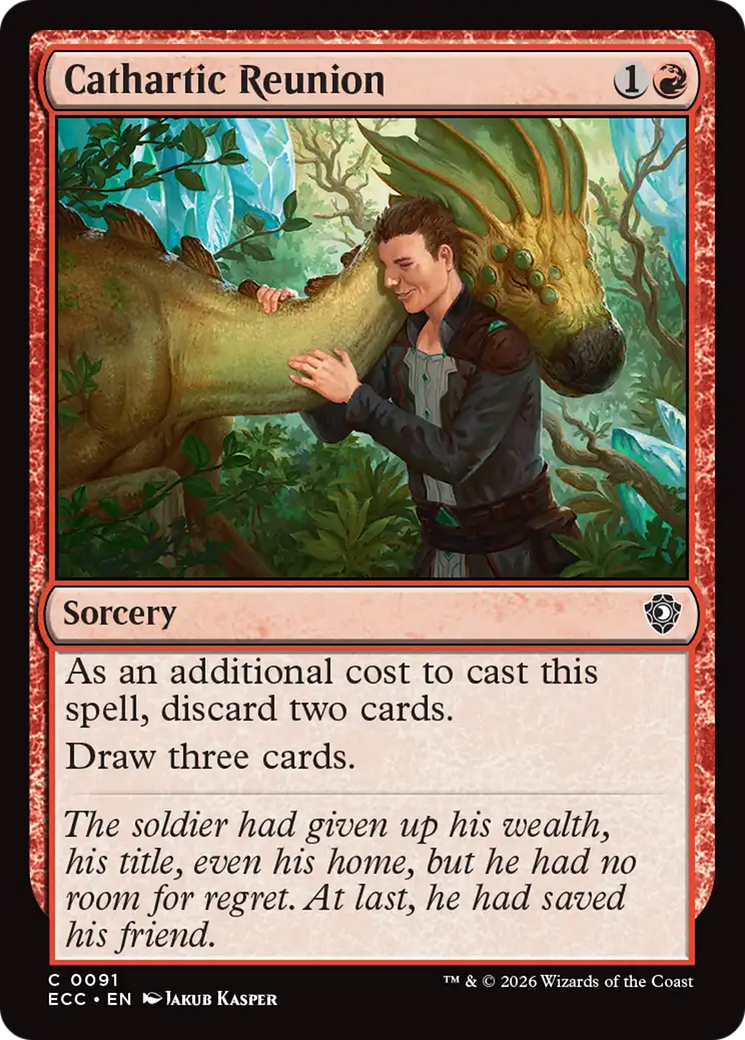
Cathartic Reunion
Cathartic Reunion
Sorcery
As an additional cost to cast this spell, discard two cards.
Draw three cards.
- Because discarding two cards is an additional cost, you can't cast Cathartic Reunion if you don't have at least two other cards in hand.
-
1
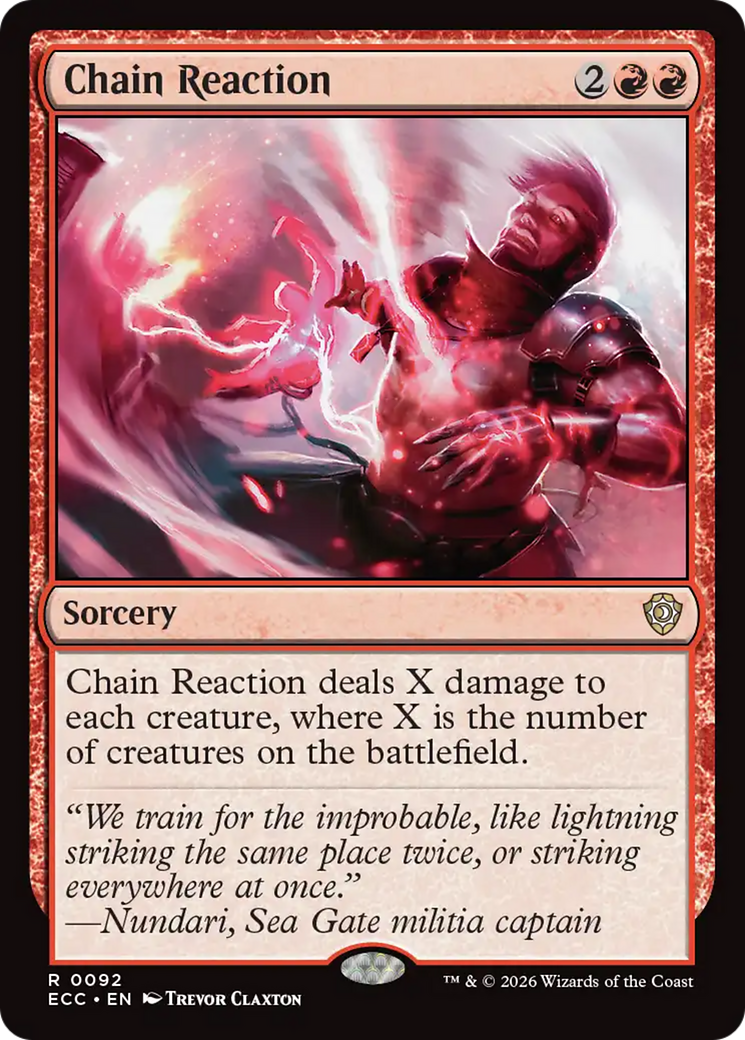
Chain Reaction
Chain Reaction
Sorcery
Chain Reaction deals X damage to each creature, where X is the number of creatures on the battlefield.
- The value of X is determined as Chain Reaction resolves.
-
1
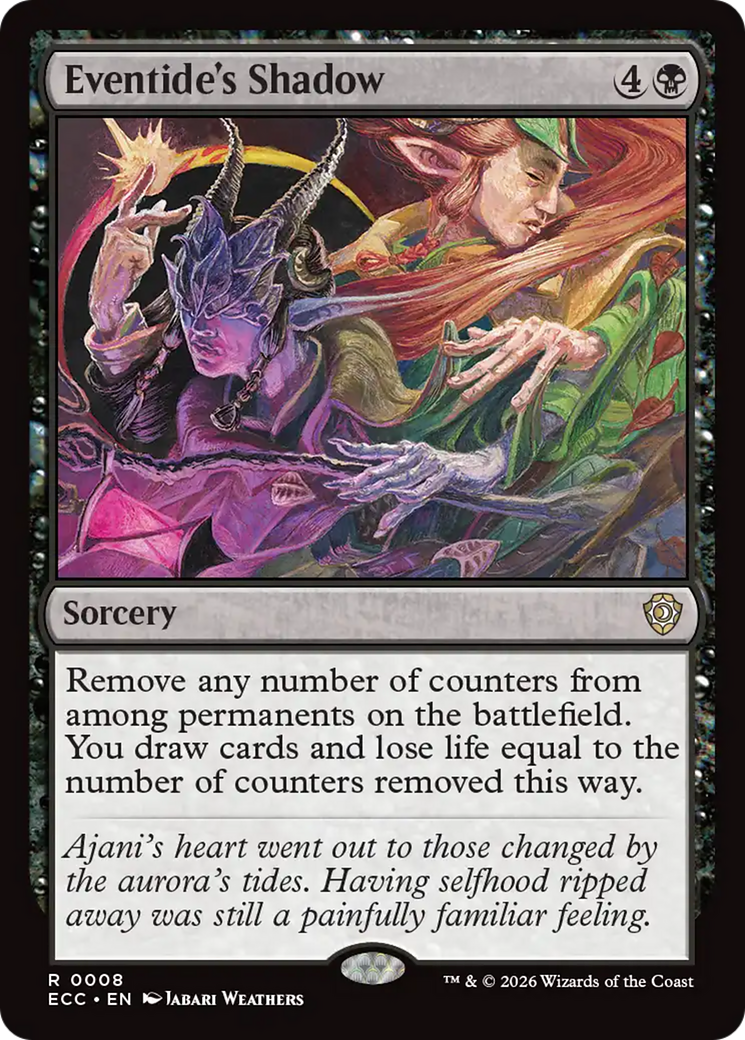
Eventide's Shadow
Eventide's Shadow
Sorcery
Remove any number of counters from among permanents on the battlefield. You draw cards and lose life equal to the number of counters removed this way.
- Eventide's Shadow allows you to remove counters from permanents controlled by any player, not just permanents you control.
-
1
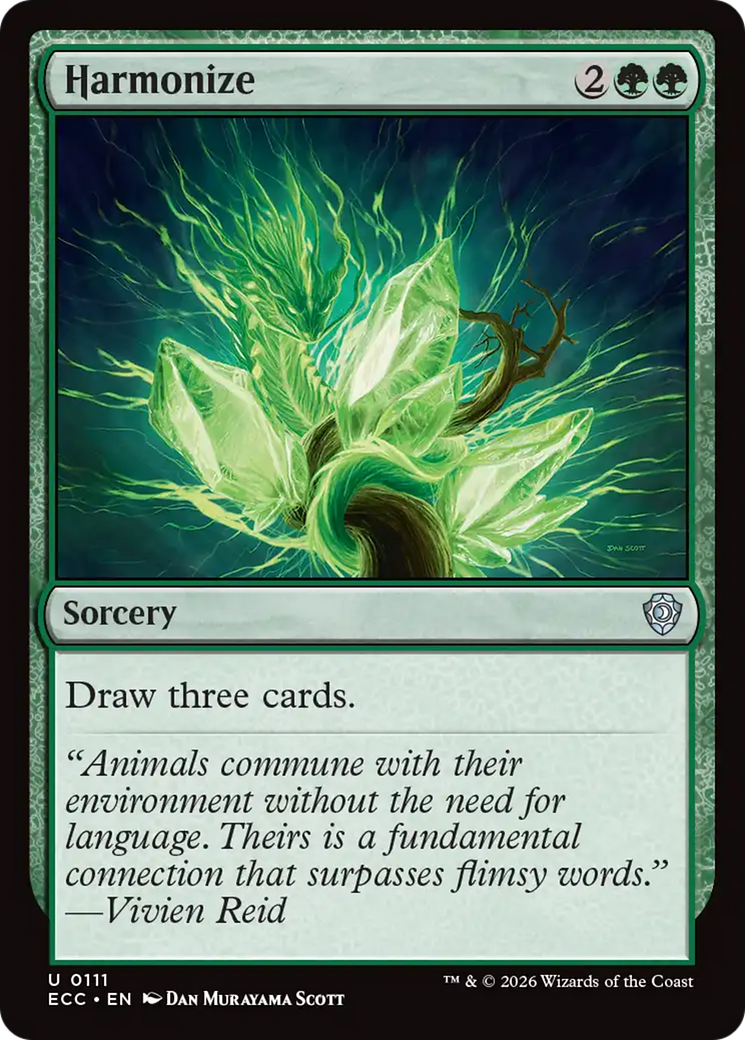
Harmonize
Harmonize
Sorcery
Draw three cards.
-
1
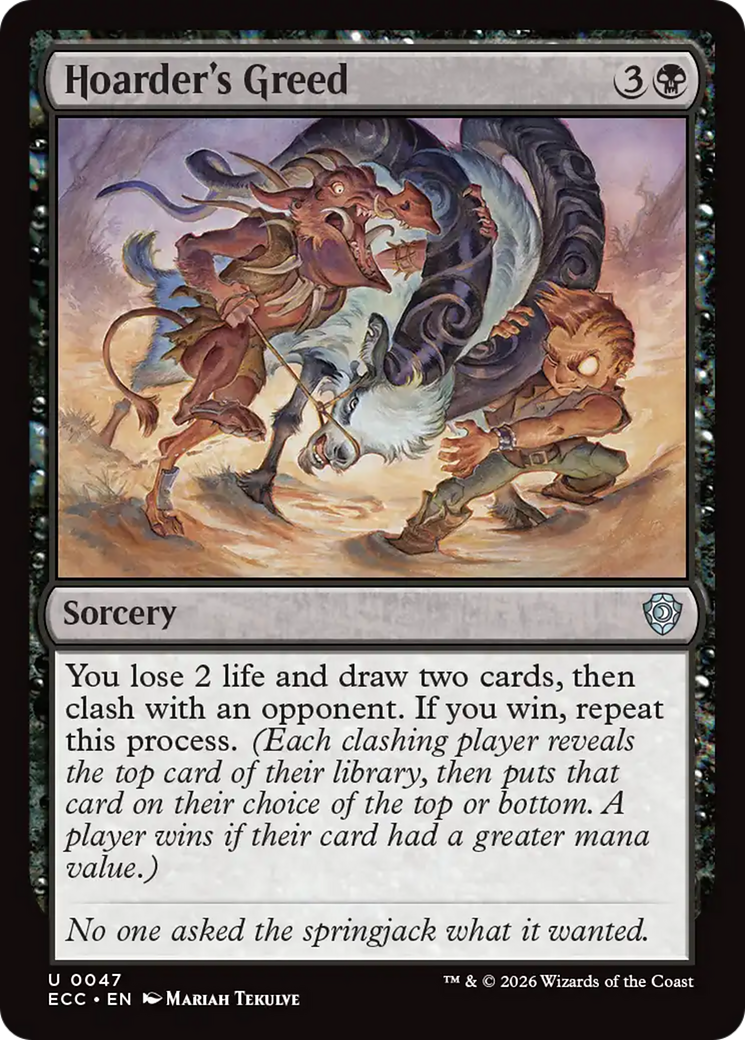
Hoarder's Greed
Hoarder's Greed
Sorcery
You lose 2 life and draw two cards, then clash with an opponent. If you win, repeat this process. (Each clashing player reveals the top card of their library, then puts that card on their choice of the top or bottom. A player wins if their card had a greater mana value.)
- The effect will automatically repeat itself until its controller doesn't win the clash. There's no other way to stop it.
-
1
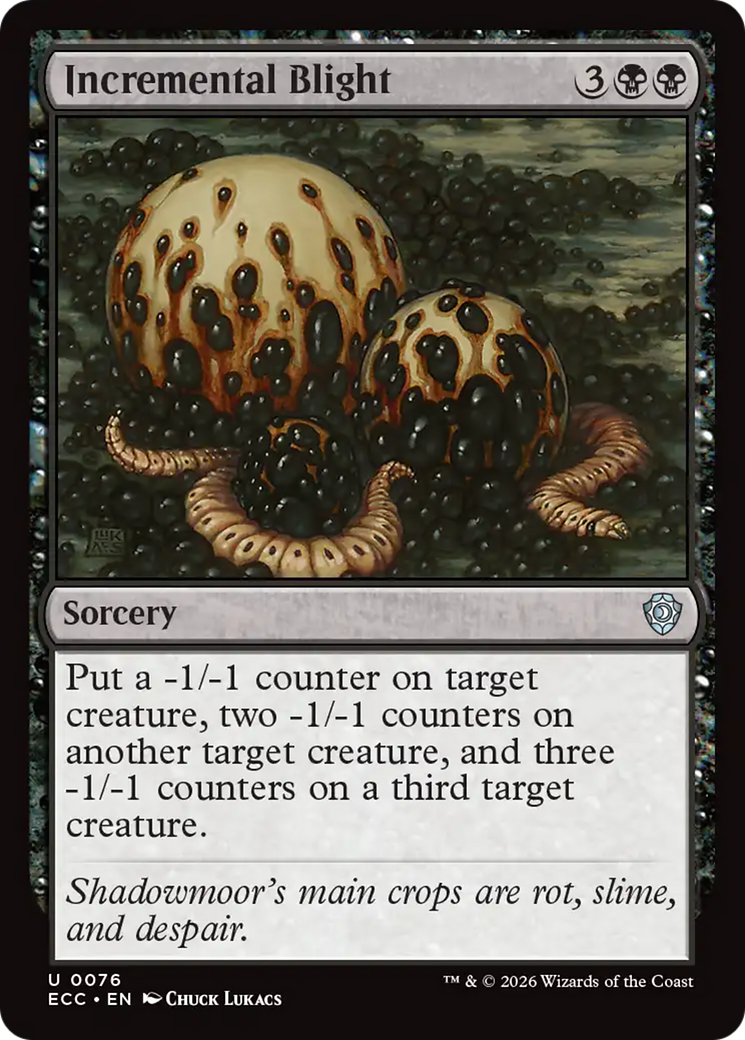
Incremental Blight
Incremental Blight
Sorcery
Put a -1/-1 counter on target creature, two -1/-1 counters on another target creature, and three -1/-1 counters on a third target creature.
- You must target three different creatures. If you can't, you can't cast Incremental Blight.
-
1
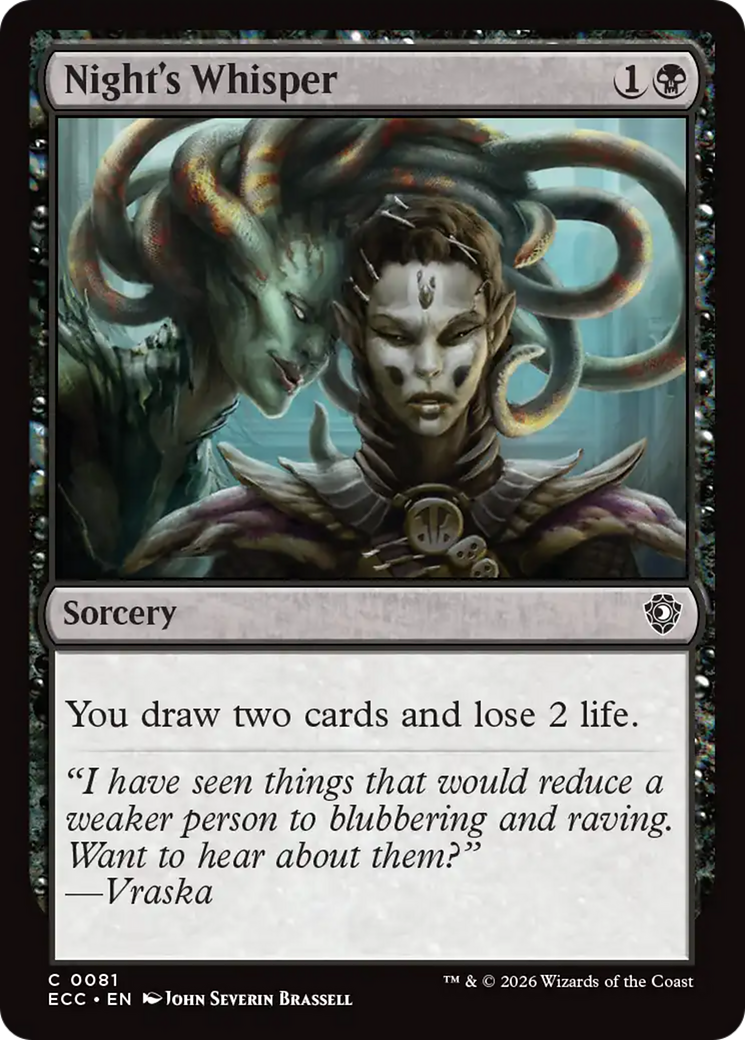
Night's Whisper
Night's Whisper
Sorcery
You draw two cards and lose 2 life.
-
1
Painful Truths
Painful Truths
Sorcery
Converge — You draw X cards and lose X life, where X is the number of colors of mana spent to cast this spell.
- The maximum number of colors of mana you can spend to cast a spell is five. Colorless is not a color. Note that the cost of a spell with converge may limit how many colors of mana you can spend.
- Unless a spell or ability allows you to, you can't choose to pay more mana for a spell with a converge ability just to spend more colors of mana. Likewise, if a spell or ability reduces the amount of mana it costs you to cast a spell with converge, you can't ignore that cost reduction in order to spend more colors of mana.
- If there are any alternative or additional costs to cast a spell with a converge ability, the mana spent to pay those costs will count. For example, if an effect makes sorcery spells cost more to cast, you could pay to cast Radiant Flames and deal 4 damage to each creature.
- If you cast a spell with converge without spending any mana to cast it (perhaps because an effect allowed you to cast it without paying its mana cost), then the number of colors spent to cast it will be zero.
- If a spell with a converge ability is copied, no mana was spent to cast the copy, so the number of colors of mana spent to cast the spell will be zero. The number of colors spent to cast the original spell is not copied.
-
1
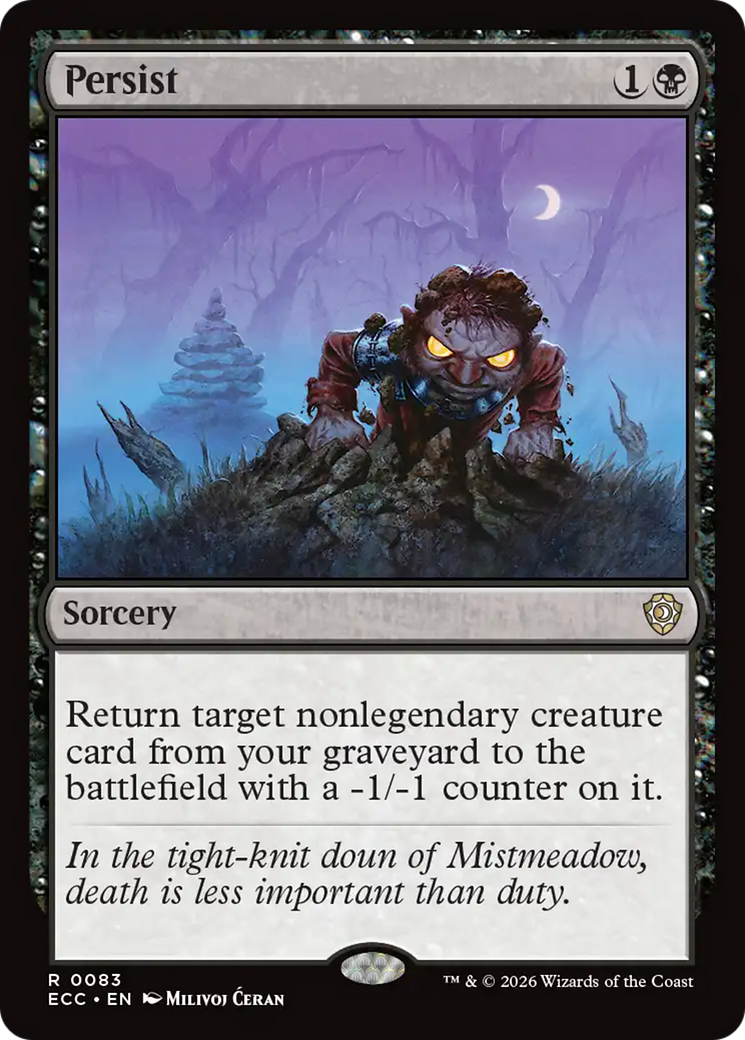
Persist
Persist
Sorcery
Return target nonlegendary creature card from your graveyard to the battlefield with a -1/-1 counter on it.
Artifacts 6
-
1
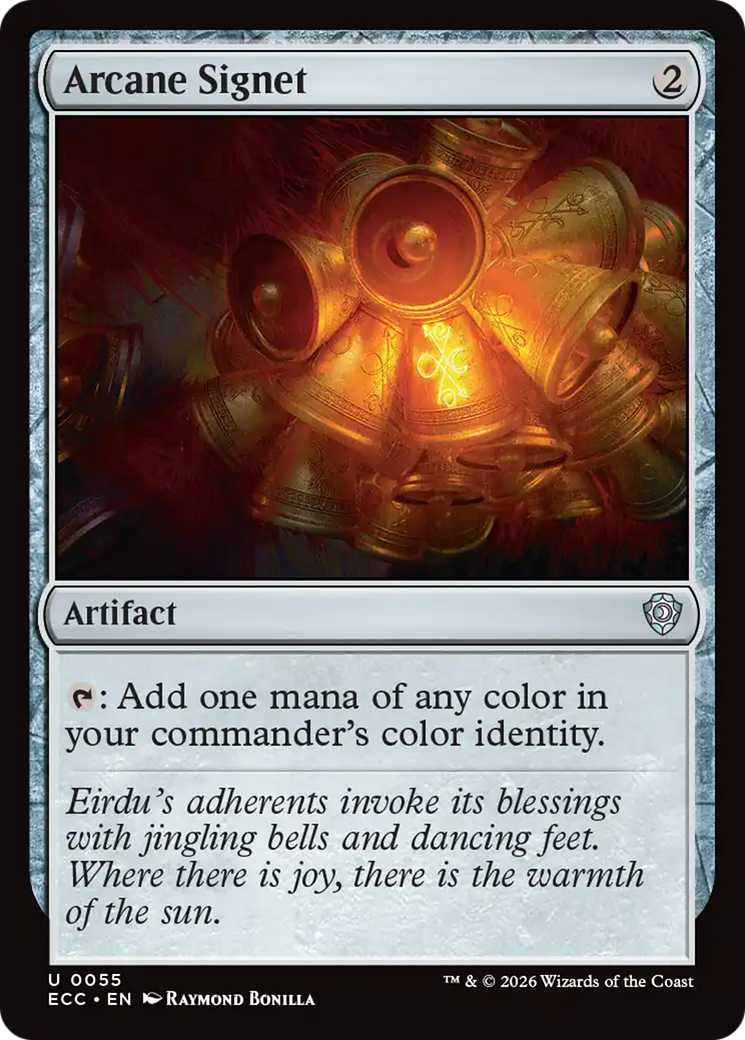
Arcane Signet
Arcane Signet
Artifact
: Add one mana of any color in your commander's color identity.
- If your commander is a card that has no colors in its color identity, Arcane Signet's ability produces no mana. It doesn't produce .
- If you have two commanders, the ability adds one mana of any color in their combined color identities.
- If you don't have a commander, Arcane Signet's ability produces no mana.
-
1
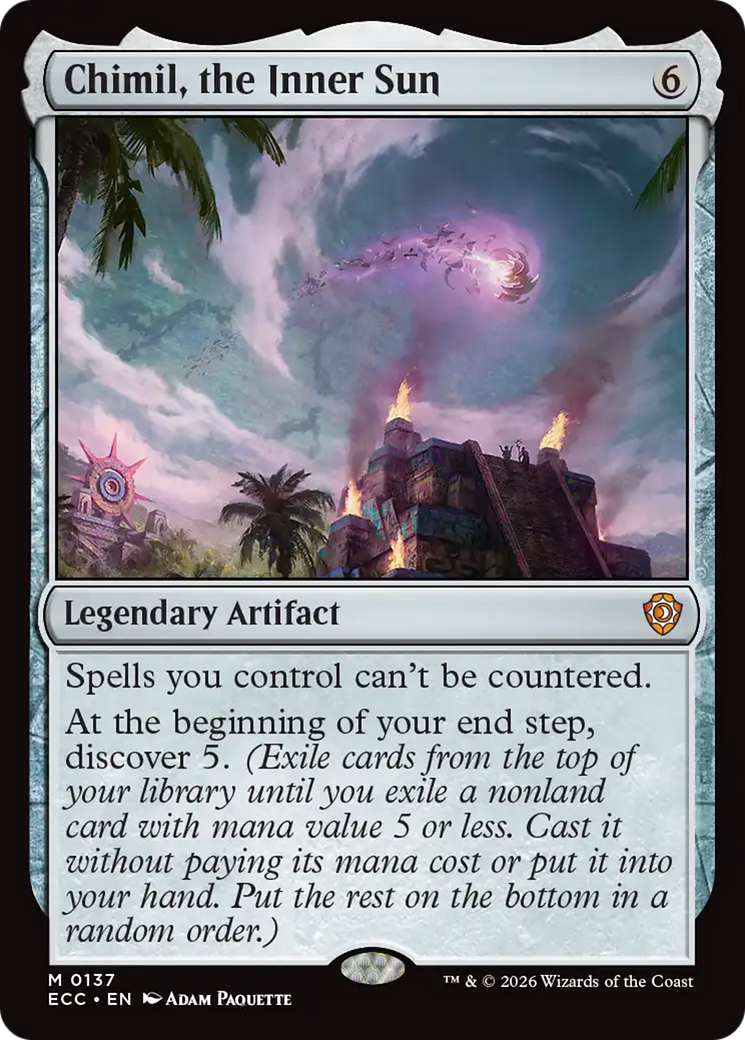
Chimil, the Inner Sun
Chimil, the Inner Sun
Legendary Artifact
Spells you control can't be countered.
At the beginning of your end step, discover 5. (Exile cards from the top of your library until you exile a nonland card with mana value 5 or less. Cast it without paying its mana cost or put it into your hand. Put the rest on the bottom in a random order.)
- Chimil, the Inner Sun's first ability applies only while it's on the battlefield. While it's a spell, it can be countered.
- A spell or ability that counters spells can still target spells that can't be countered. When that spell or ability resolves, the uncounterable spell won't be countered, but any additional effects of the countering spell or ability will still happen.
-
1
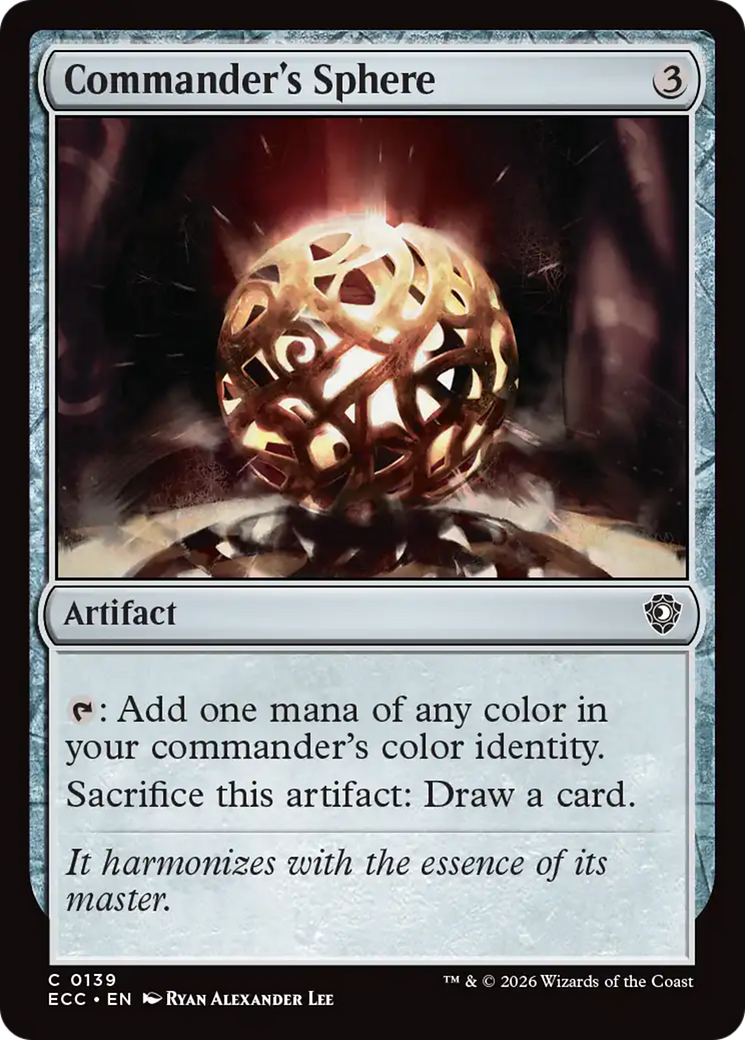
Commander's Sphere
Commander's Sphere
Artifact
: Add one mana of any color in your commander's color identity.
Sacrifice this artifact: Draw a card.
- If your commander is a card that has no colors in its color identity, Commander's Sphere's first ability produces no mana. It doesn't produce .
- If you don't have a commander, Commander's Sphere's first ability produces no mana.
- If you have two commanders, the ability adds one mana of any color in their combined color identities.
-
1
Contagion Clasp
Contagion Clasp
Artifact
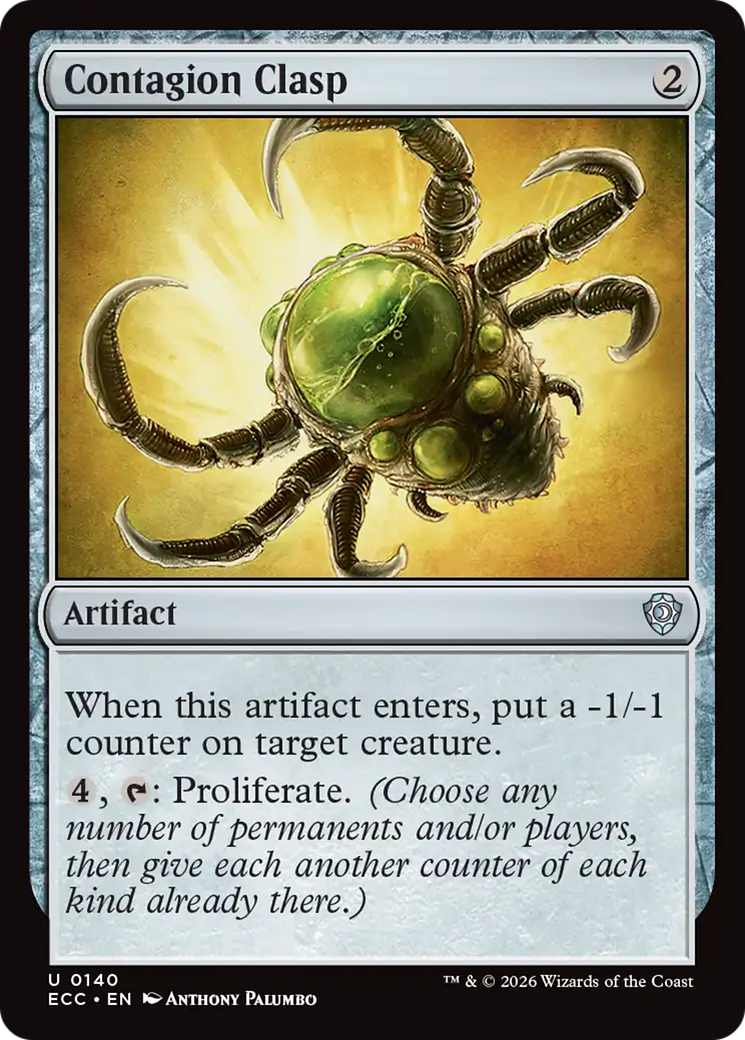
When this artifact enters, put a -1/-1 counter on target creature.
, : Proliferate. (Choose any number of permanents and/or players, then give each another counter of each kind already there.)
- An ability that triggers "Whenever you proliferate" triggers even if you chose no permanents or players while doing so.
- To proliferate, you can choose any permanent that has a counter, including ones controlled by opponents. You can choose any player who has a counter, including opponents. You can't choose cards in any zone other than the battlefield, even if they have counters on them.
- Players can respond to a spell or ability whose effect includes proliferating. Once that spell or ability starts to resolve, however, and its controller chooses which permanents and players will get new counters, it's too late for anyone to respond.
- If a permanent ever has both +1/+1 counters and -1/-1 counters on it at the same time, they're removed in pairs as a state-based action so that the permanent has only one of those kinds of counters on it.
- You don't have to choose every permanent or player that has a counter, only the ones you want to add another counter to. Since "any number" includes zero, you don't have to choose any permanents at all, and you don't have to choose any players at all.
- If a player or permanent has more than one kind of counter on it, and you choose for it to get additional counters, it must get one of each kind of counter it already has. You can't have it get just one kind of counter it already has and not the others.
- Contagion Clasp's first ability is mandatory. If you're the only player who controls a creature, you must target one of them.
-
1
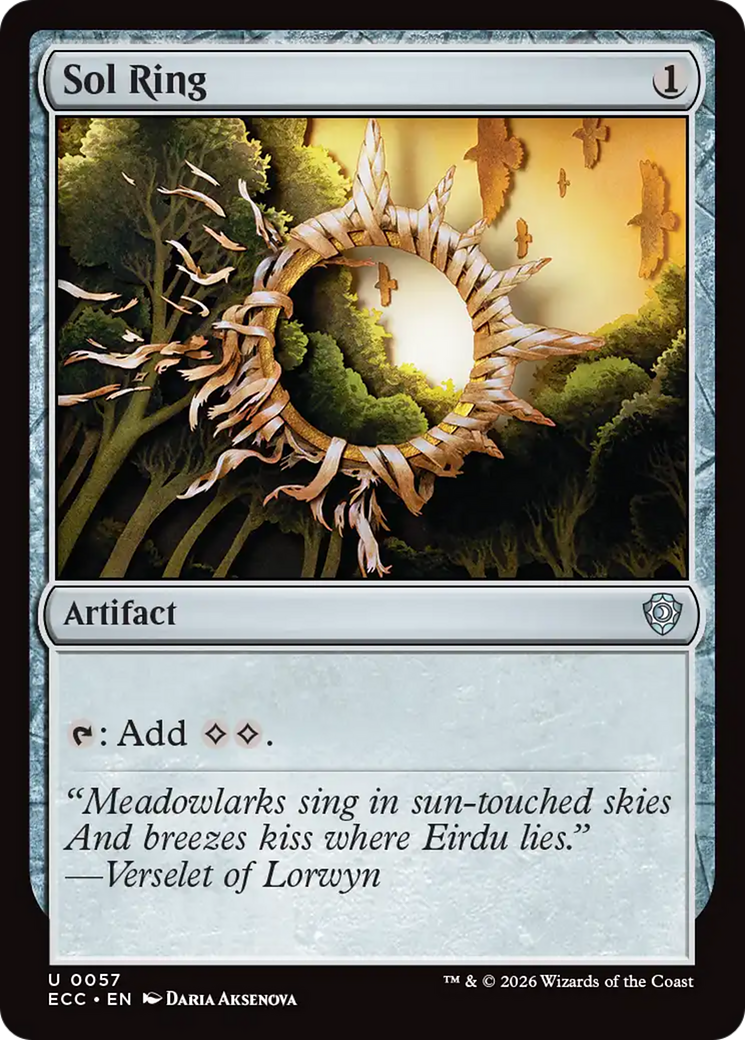
Sol Ring
Sol Ring
Artifact
: Add .
-
1
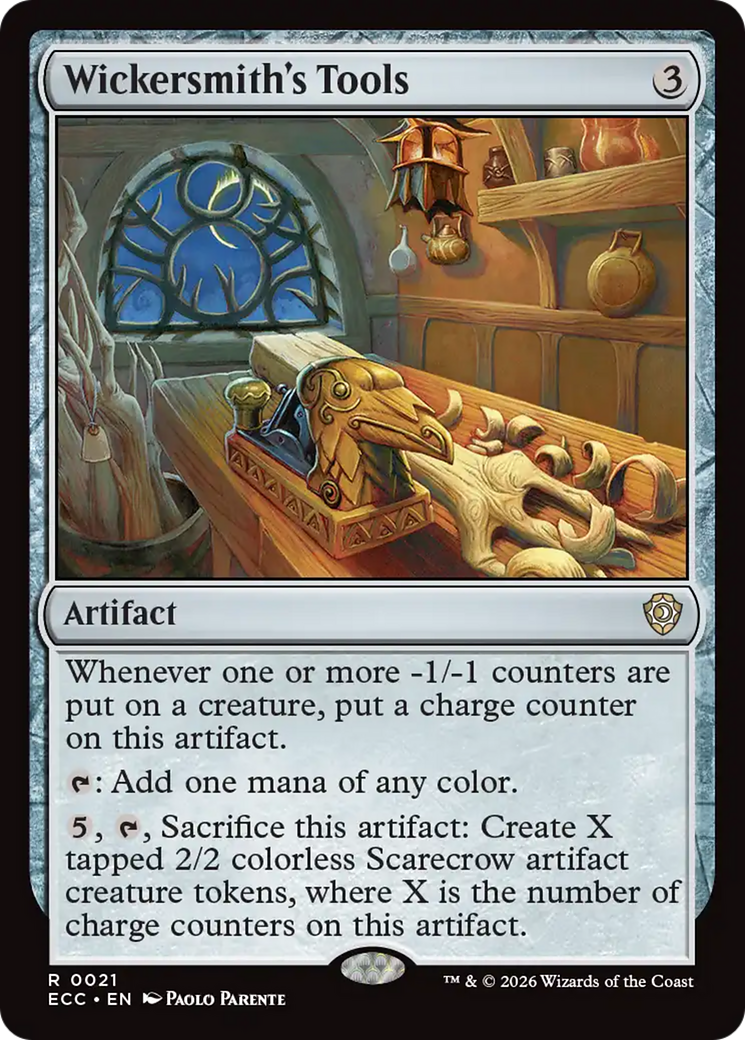
Wickersmith's Tools
Wickersmith's Tools
Artifact
Whenever one or more -1/-1 counters are put on a creature, put a charge counter on this artifact.
: Add one mana of any color.
, , Sacrifice this artifact: Create X tapped 2/2 colorless Scarecrow artifact creature tokens, where X is the number of charge counters on this artifact.
- The value of X is calculated only once, as Wickersmith's Tools's last ability resolves.
Enchantments 7
-
1
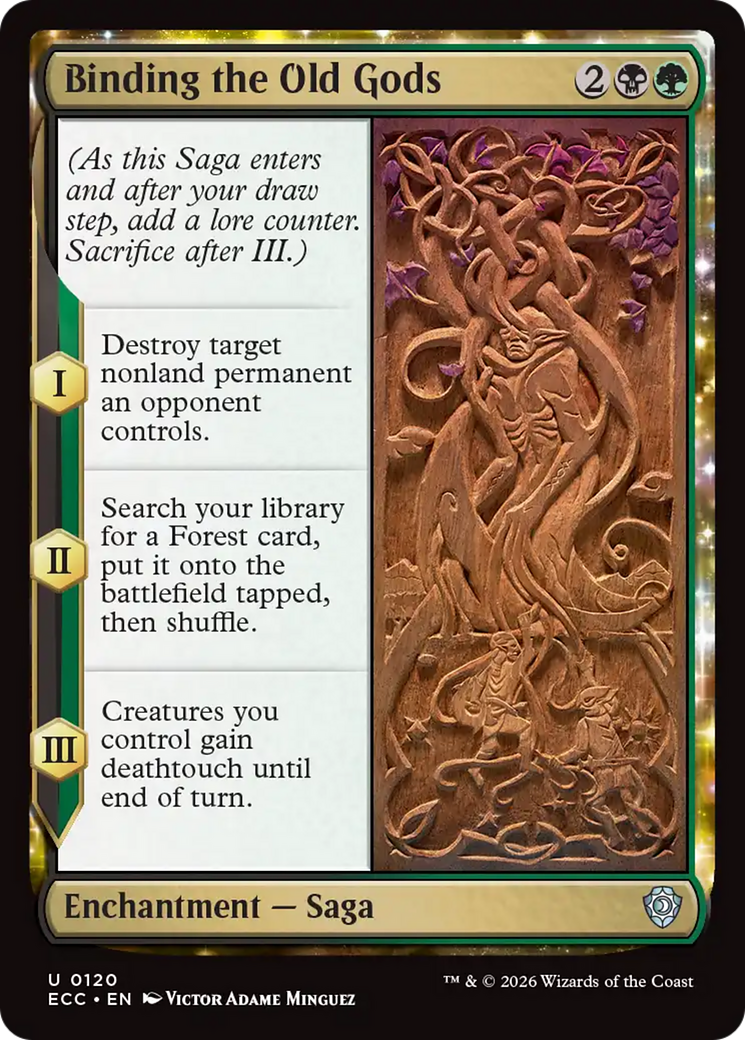
Binding the Old Gods
Binding the Old Gods
Enchantment — Saga
(As this Saga enters and after your draw step, add a lore counter. Sacrifice after III.)
I — Destroy target nonland permanent an opponent controls.
II — Search your library for a Forest card, put it onto the battlefield tapped, then shuffle.
III — Creatures you control gain deathtouch until end of turn.
- As a Saga enters the battlefield, its controller puts a lore counter on it. As your precombat main phase begins (immediately after your draw step), you put another lore counter on each Saga you control. Putting a lore counter on a Saga in either of these ways doesn't use the stack.
- Each symbol on the left of a Saga's text box represents a chapter ability. A chapter ability is a triggered ability that triggers when a lore counter that is put on the Saga causes the number of lore counters on the Saga to become equal to or greater than the ability's chapter number. Chapter abilities are put onto the stack and may be responded to.
- A chapter ability doesn't trigger if a lore counter is put on a Saga that already had a number of lore counters greater than or equal to that chapter's number. For example, the third lore counter put on a Saga causes the chapter III ability to trigger, but chapters I and II won't trigger again.
- Once a chapter ability has triggered, the ability on the stack won't be affected if the Saga gains or loses counters, or if it leaves the battlefield.
- If multiple chapter abilities trigger at the same time, their controller puts them on the stack in any order. If any of them require targets, those targets are chosen as you put the abilities on the stack, before any of those abilities resolve.
- Removing lore counters won't cause a previous chapter ability to trigger. If lore counters are removed from a Saga, the appropriate chapter abilities will trigger again when the Saga receives more lore counters.
- Once the number of lore counters on a Saga is greater than or equal to the greatest number among its chapter abilities, the Saga's controller sacrifices it as soon as its chapter ability has left the stack, most likely by resolving or being countered. This state-based action doesn't use the stack.
-
1
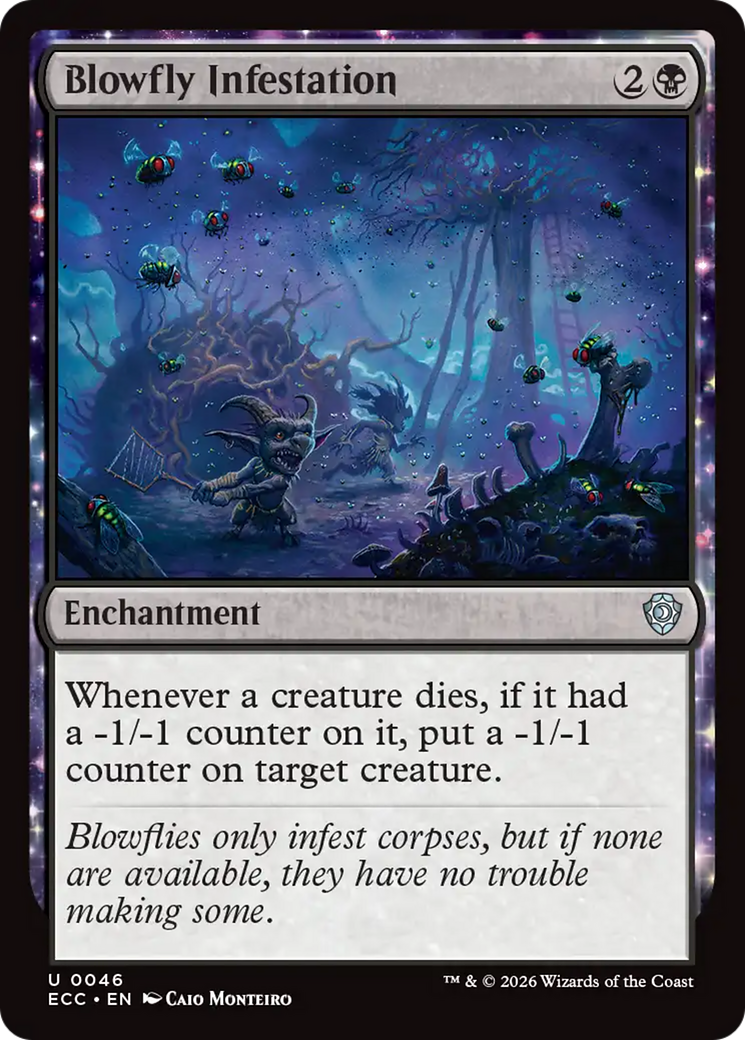
Blowfly Infestation
Blowfly Infestation
Enchantment
Whenever a creature dies, if it had a -1/-1 counter on it, put a -1/-1 counter on target creature.
- When Blowfly Infestation's ability resolves, it will put a single -1/-1 counter on the targeted creature. It doesn't matter how many -1/-1 counters were on the creature that went to a graveyard as long as it had at least one on it.
- This ability is mandatory. If you're the only player who controls any creatures when this ability triggers, you must target one of them.
-
1
Everlasting Torment
Everlasting Torment
Enchantment
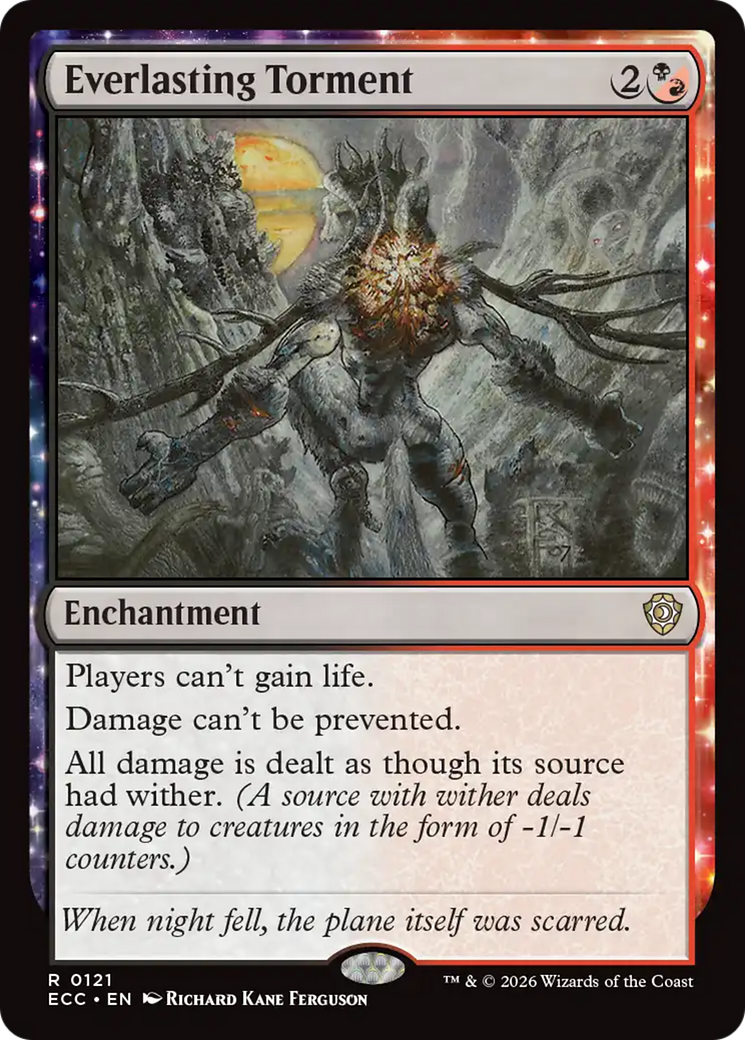
Players can't gain life.
Damage can't be prevented.
All damage is dealt as though its source had wither. (A source with wither deals damage to creatures in the form of -1/-1 counters.)
- Effects that replace an event with gaining life (like Words of Worship's effect does) will end up replacing the event with nothing.
- Effects that would replace gaining life with some other effect won't be able to do anything because it's impossible for players to gain life.
- The "damage can't be prevented" statement overrides all forms of preventing damage, including protection abilities. Damage prevention spells and abilities can still be cast and played; they just don't do anything.
- Spells and abilities that would normally cause a player to gain life still resolve, but the life-gain part simply has no effect.
- If an effect says to set your life total to a certain number, and that number is higher than your current life total, that effect will normally cause you to gain life equal to the difference. With Everlasting Torment on the battlefield, that part of the effect won't do anything. (If the number is lower than your current life total, the effect will work as normal.)
- Spells and abilities that replace or redirect damage aren't affected by Everlasting Torment's second ability. They'll work as normal.
- If a cost includes life gain (like Invigorate's alternative cost does), that cost can't be paid.
- The last ability affects all damage, whether it's dealt by creatures, other permanents, spells, or cards that aren't on the battlefield. Wither works everywhere.
-
1
Flourishing Defenses
Flourishing Defenses
Enchantment
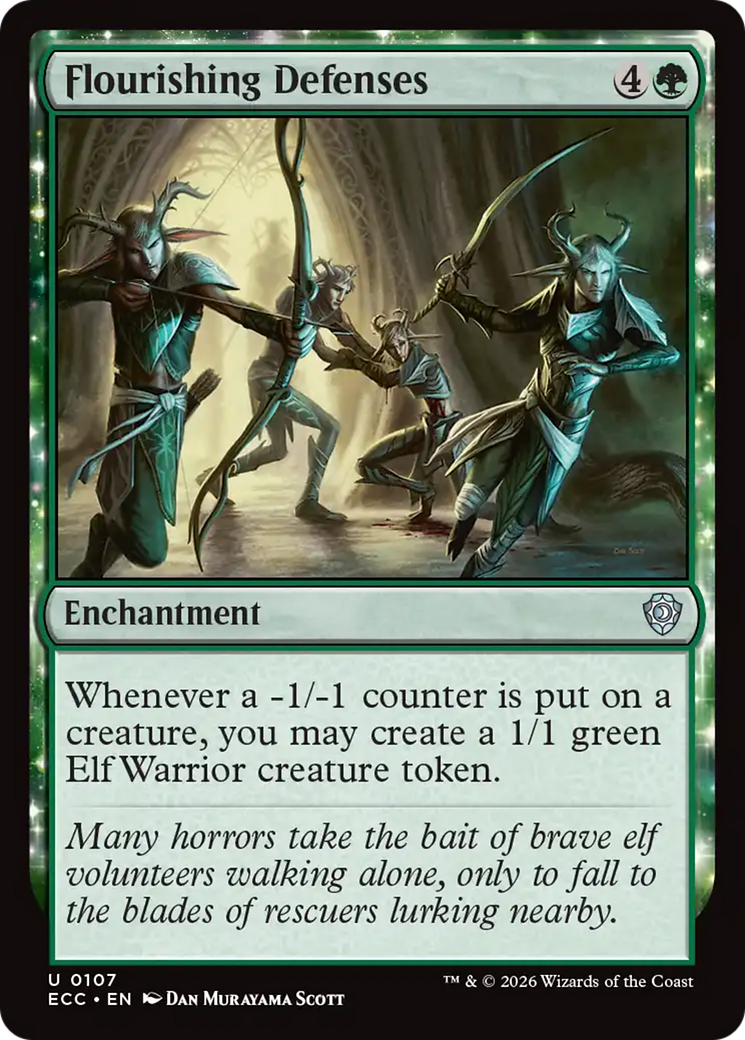
Whenever a -1/-1 counter is put on a creature, you may create a 1/1 green Elf Warrior creature token.
- This ability triggers both when a -1/-1 counter is put on a creature on the battlefield and when a creature enters with a -1/-1 counter on it. This includes when a creature returns to the battlefield as a result of persist.
- This ability triggers once for each -1/-1 counter. For example, if Leech Bonder (a creature that enters with two -1/-1 counters on it) entered, Flourishing Defenses's ability would trigger twice.
-
1
Grave Venerations
Grave Venerations
Enchantment
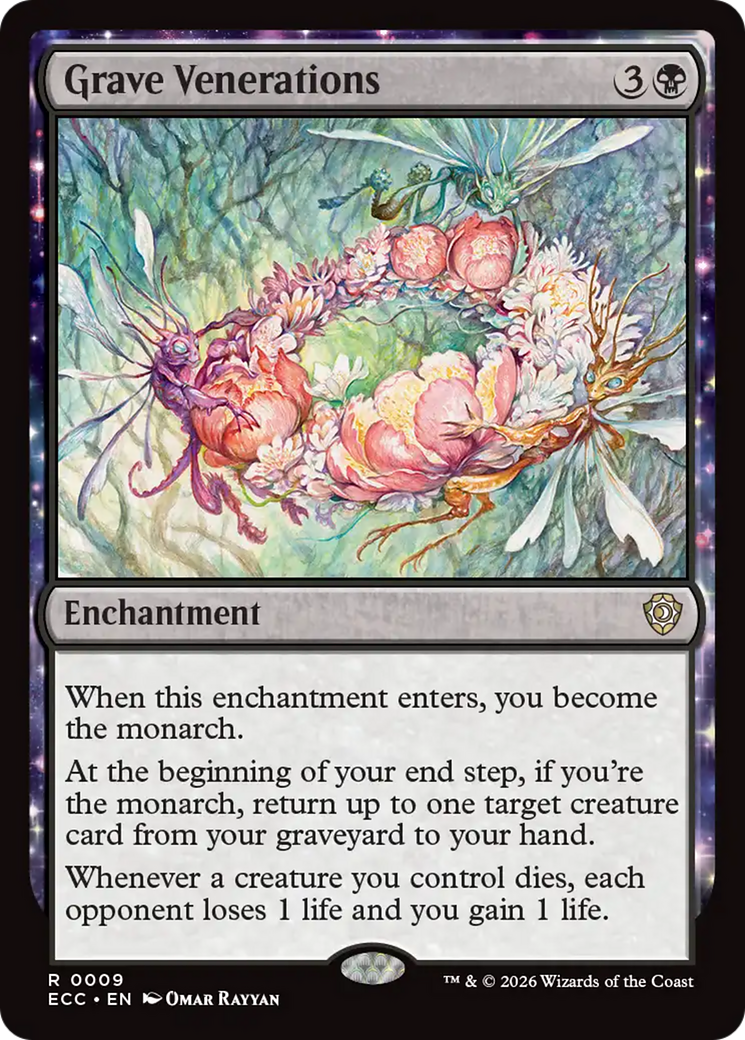
When this enchantment enters, you become the monarch.
At the beginning of your end step, if you're the monarch, return up to one target creature card from your graveyard to your hand.
Whenever a creature you control dies, each opponent loses 1 life and you gain 1 life.
- The game starts with no monarch. As a player becomes the monarch, the current monarch (if any) ceases being the monarch. There is never more than one monarch at a time.
- If the monarch leaves the game during another player's turn, that player becomes the monarch. If the monarch leaves the game during their turn, the next player in turn order becomes the monarch.
- There are two inherent triggered abilities associated with being the monarch. These triggered abilities have no source and are controlled by the player who was the monarch at the time the abilities triggered. The full texts of these abilities are "At the beginning of the monarch's end step, that player draws a card" and "Whenever a creature deals combat damage to the monarch, its controller becomes the monarch."
- If the triggered ability that causes the monarch to draw a card goes on the stack and a different player becomes the monarch before that ability resolves, the first player will still draw the card.
- If combat damage dealt to the monarch causes that player to lose the game, the triggered ability that causes the controller of the attacking creature to become the monarch doesn't resolve. In most cases, the controller of the attacking creature will still become the monarch as it is likely their turn.
-
1
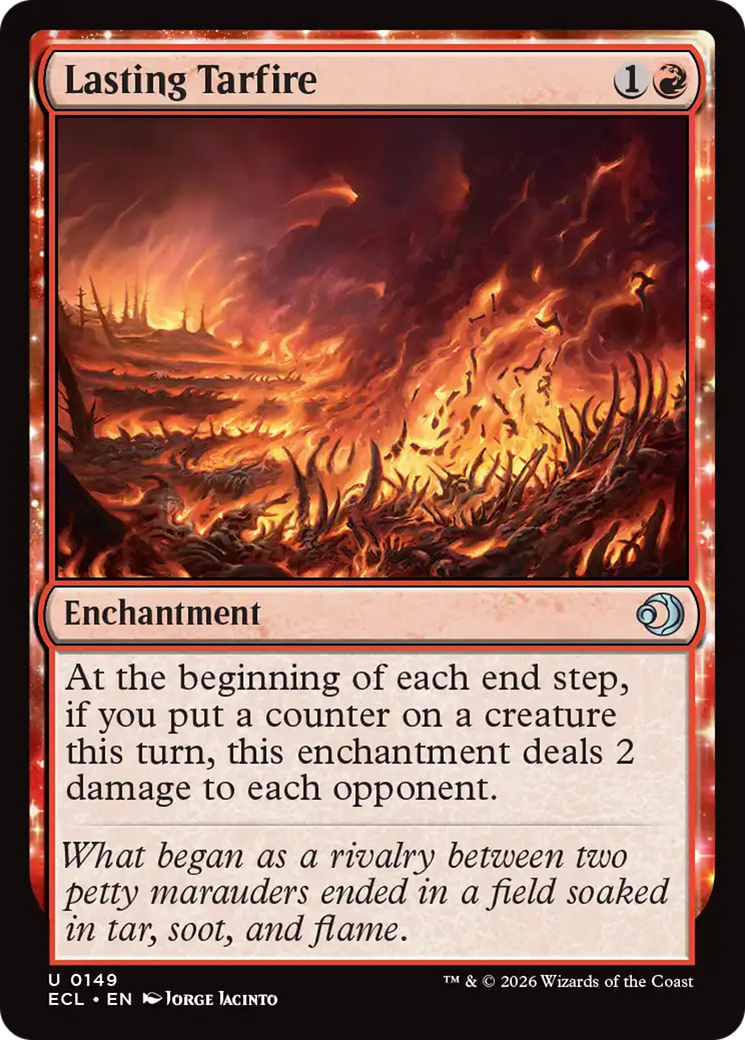
Lasting Tarfire
Lasting Tarfire
Enchantment
At the beginning of each end step, if you put a counter on a creature this turn, this enchantment deals 2 damage to each opponent.
- Lasting Tarfire's ability will check as your end step starts to see if you put a counter on a creature this turn. If you didn't, the ability won't trigger at all. Putting a counter on a creature during your end step won't cause the ability to trigger.
-
1
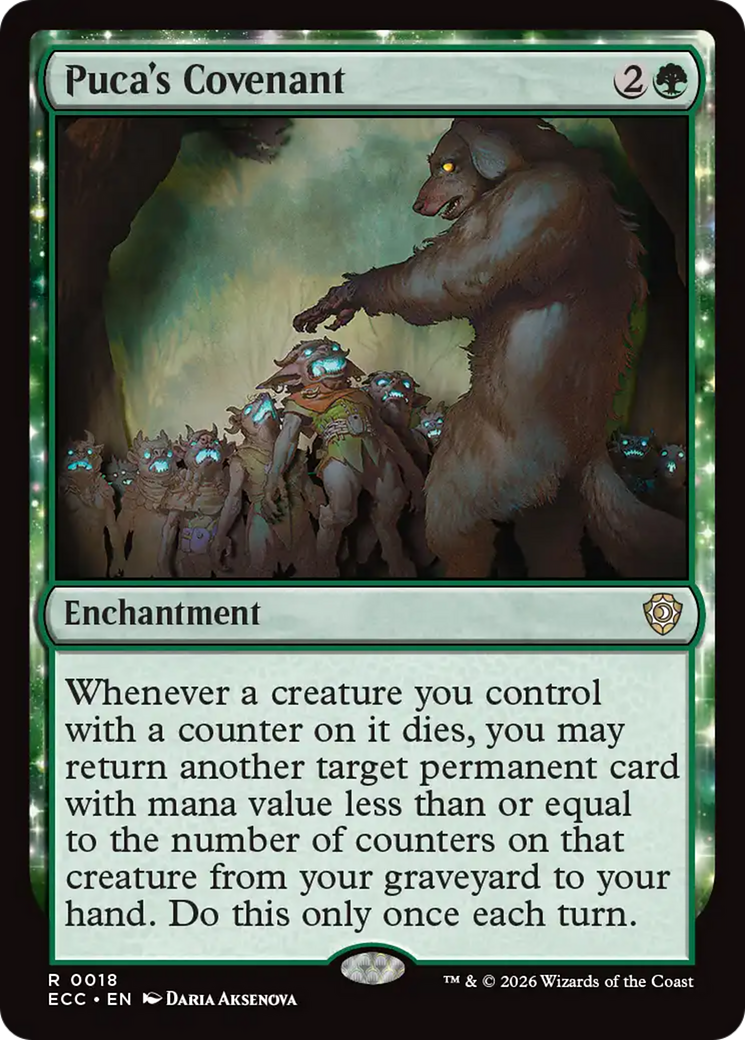
Puca's Covenant
Puca's Covenant
Enchantment
Whenever a creature you control with a counter on it dies, you may return another target permanent card with mana value less than or equal to the number of counters on that creature from your graveyard to your hand. Do this only once each turn.
- If a permanent card in a graveyard has in its mana cost, X is 0 for the purpose of determining its mana value.
Lands 39
-
1
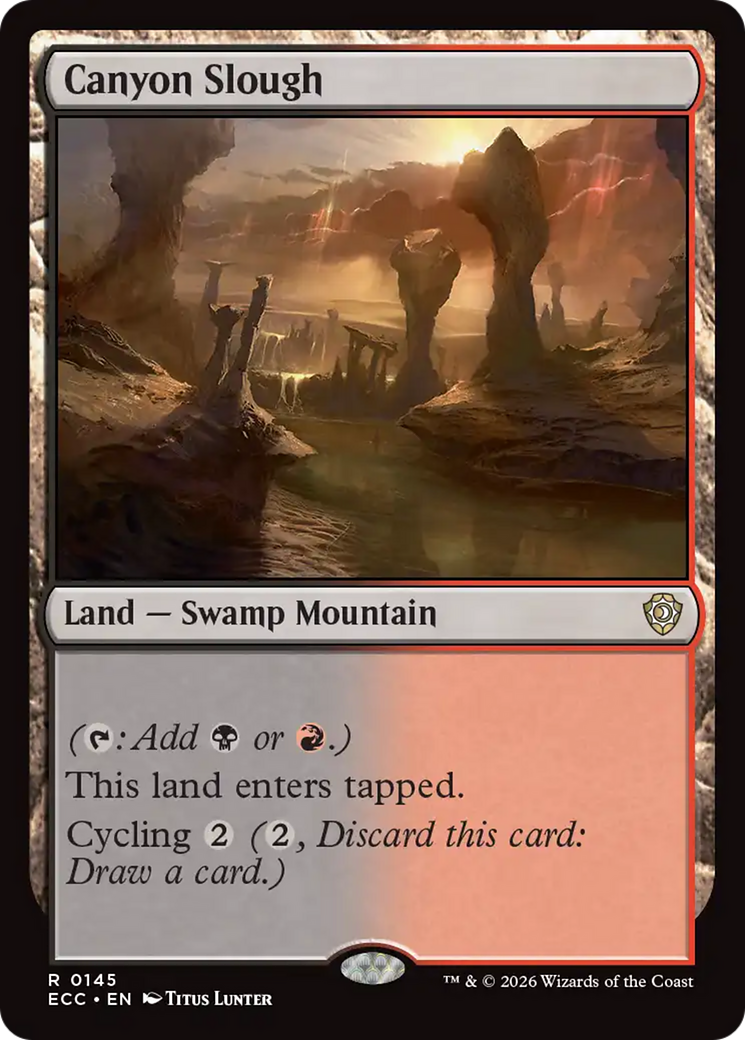
Canyon Slough
Canyon Slough
Land — Swamp Mountain
( : Add or .)
This land enters tapped.
Cycling ( , Discard this card: Draw a card.)
-
1
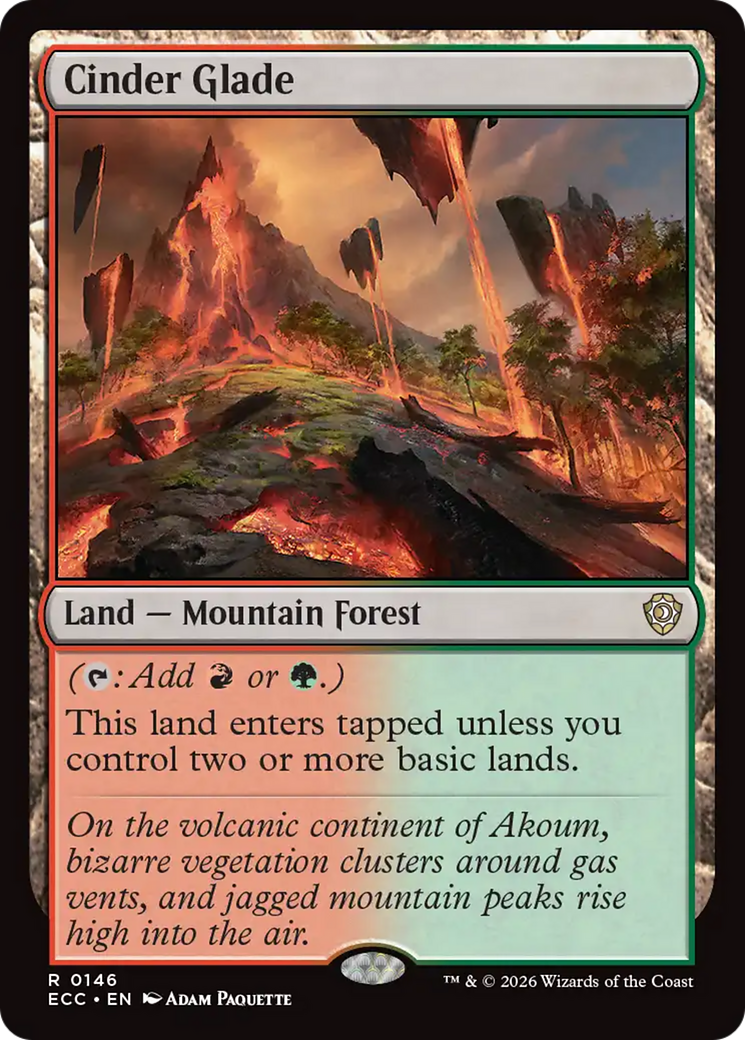
Cinder Glade
Cinder Glade
Land — Mountain Forest
( : Add or .)
This land enters tapped unless you control two or more basic lands.
- If one of these lands enters the battlefield at the same time as any number of basic lands, those other lands are not counted when determining if this land enters the battlefield tapped or untapped.
- However, because these cards have basic land types, effects that specify a basic land type without also specifying that the land be basic can affect them. For example, a spell or ability that reads "Destroy target Forest" can target Canopy Vista, while one that reads "Destroy target basic Forest" cannot.
- Even though these lands have basic land types, they are not basic lands because "basic" doesn't appear on their type line. Notably, controlling two or more of them won't allow others to enter the battlefield untapped.
-
1
Command Tower
Command Tower
Land
: Add one mana of any color in your commander's color identity.
- If you don't have a commander, Command Tower's ability produces no mana.
- If your commander is a card that has no colors in its color identity, Command Tower's ability produces no mana. It doesn't produce .
- If you have two commanders, the ability adds one mana of any color in their combined color identities.
-
1
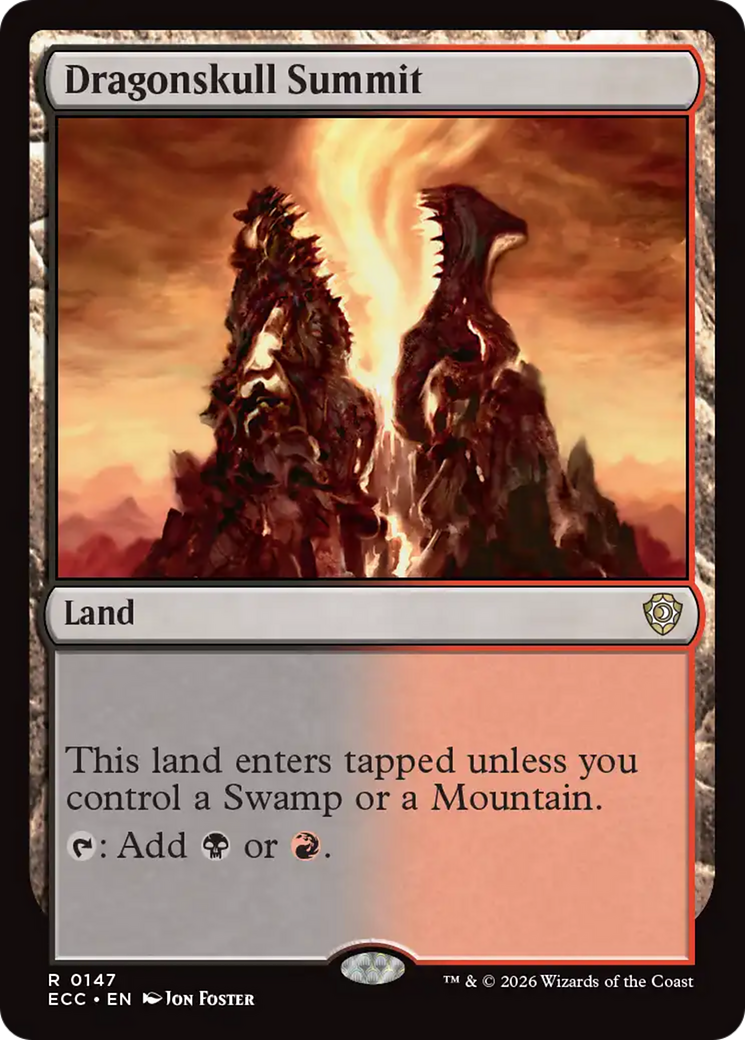
Dragonskull Summit
Dragonskull Summit
Land
This land enters tapped unless you control a Swamp or a Mountain.
: Add or .
- This checks for lands you control with the land type Swamp or Mountain, not for lands named Swamp or Mountain. The lands it checks for don't have to be basic lands. For example, if you control Stomping Ground (a nonbasic land with the land types Mountain and Forest), Dragonskull Summit will enter untapped.
- As this is entering, it checks for lands that are already on the battlefield. It won't see lands that are entering at the same time (due to Warp World, for example).
-
1
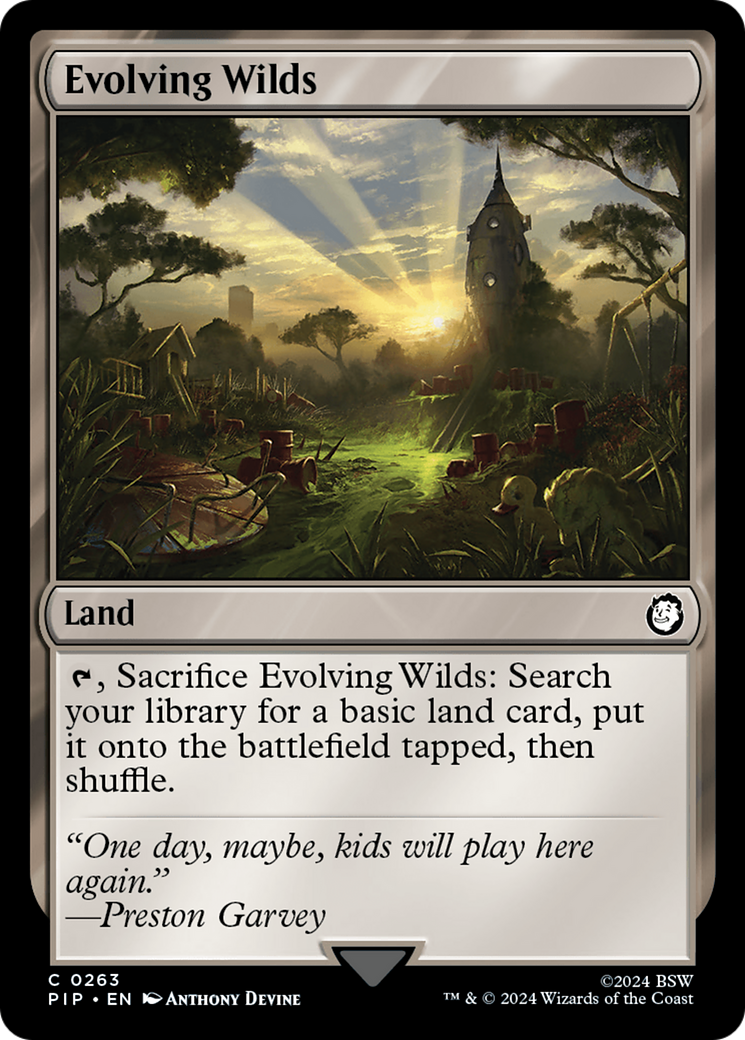
Evolving Wilds
Evolving Wilds
Land
, Sacrifice this land: Search your library for a basic land card, put it onto the battlefield tapped, then shuffle.
-
1
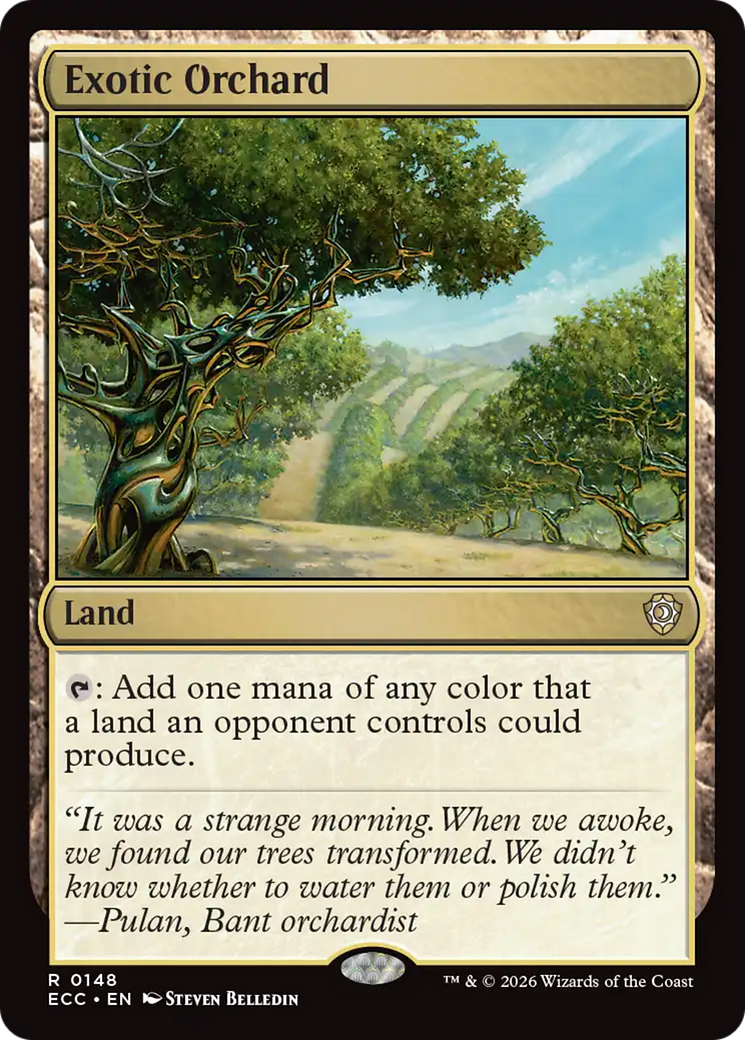
Exotic Orchard
Exotic Orchard
Land
: Add one mana of any color that a land an opponent controls could produce.
- Lands that produce mana based only on what other lands "could produce" won't help each other unless some other land allows one of them to actually produce some type of mana. For example, if you control an Exotic Orchard and your opponent controls an Exotic Orchard and a Reflecting Pool, none of those lands would produce mana if their mana abilities were activated. On the other hand, if you control a Forest and an Exotic Orchard, and your opponent controls an Exotic Orchard and a Reflecting Pool, then each of those lands can be tapped to produce . Your opponent's Exotic Orchard can produce because you control a Forest. Your Exotic Orchard and your opponent's Reflecting Pool can each produce because your opponent's Exotic Orchard can produce .
- When determining what colors of mana your opponents' lands could produce, Exotic Orchard takes into account any applicable replacement effects that would apply to those lands' mana abilities (such as Contamination's effect, for example). If there are more than one, consider them in any possible order.
- The colors of mana are white, blue, black, red, and green. Exotic Orchard can't be tapped for colorless mana, even if a land an opponent controls could produce colorless mana.
- Exotic Orchard doesn't care about any restrictions or riders your opponents' lands (such as Ancient Ziggurat or Hall of the Bandit Lord) put on the mana they produce. It just cares about colors of mana.
- Exotic Orchard checks the effects of all mana-producing abilities of lands your opponents control, but it doesn't check their costs. For example, Vivid Crag has the ability " , Remove a charge counter from Vivid Crag: Add one mana of any color." If an opponent controls Vivid Crag and you control Exotic Orchard, you can tap Exotic Orchard for any color of mana. It doesn't matter whether Vivid Crag has a charge counter on it, and it doesn't matter whether it's untapped.
-
1
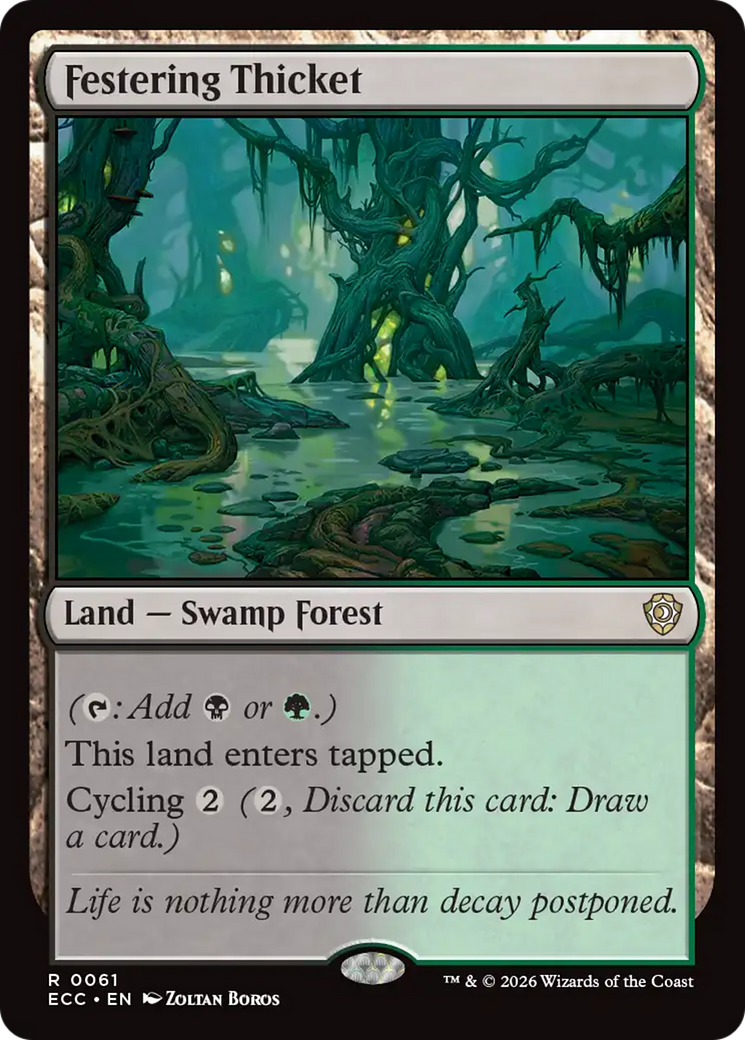
Festering Thicket
Festering Thicket
Land — Swamp Forest
( : Add or .)
This land enters tapped.
Cycling ( , Discard this card: Draw a card.)
- Unlike some other dual lands, Festering Thicket has two basic land types. It’s not basic, so effects that search for basic lands (such as the ability of a Lander token) can’t find it, but it does have the appropriate land types for effects such as that of Wastewood Verge (from the Aetherdrift release).
-
6
Forest
Forest
Basic Land — Forest
( : Add .)
-
1
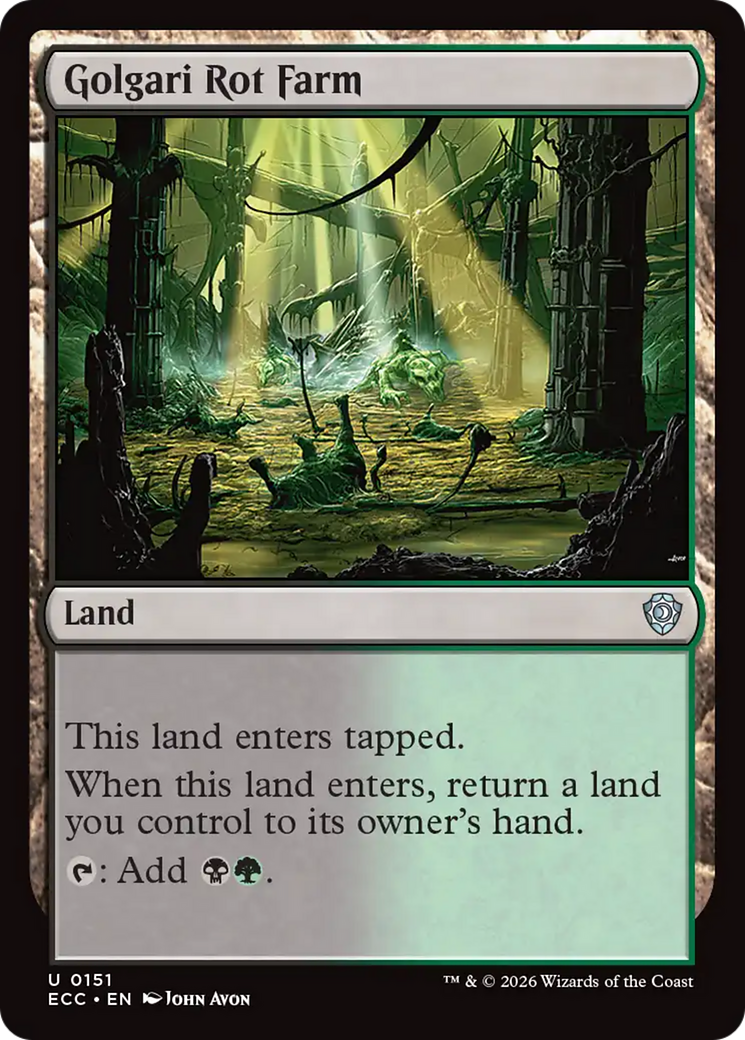
Golgari Rot Farm
Golgari Rot Farm
Land
This land enters tapped.
When this land enters, return a land you control to its owner's hand.
: Add .
- If this land enters the battlefield and you control no other lands, its ability will force you to return it to your hand.
-
1
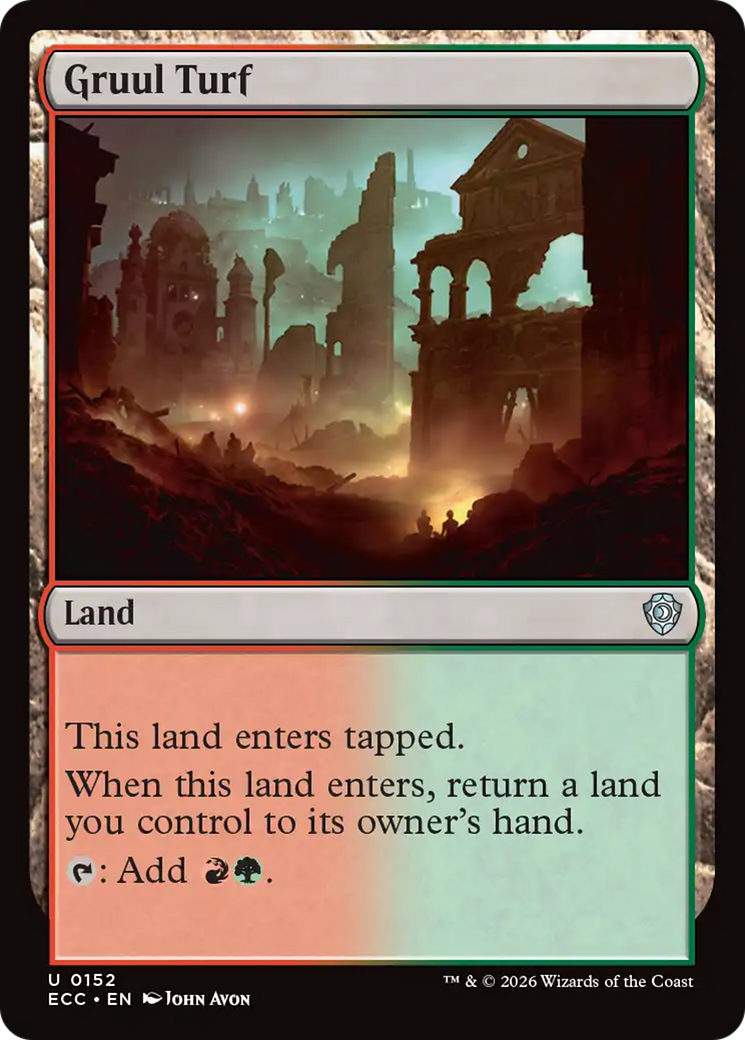
Gruul Turf
Gruul Turf
Land
This land enters tapped.
When this land enters, return a land you control to its owner's hand.
: Add .
- If this land enters the battlefield and you control no other lands, its ability will force you to return it to your hand.
-
1
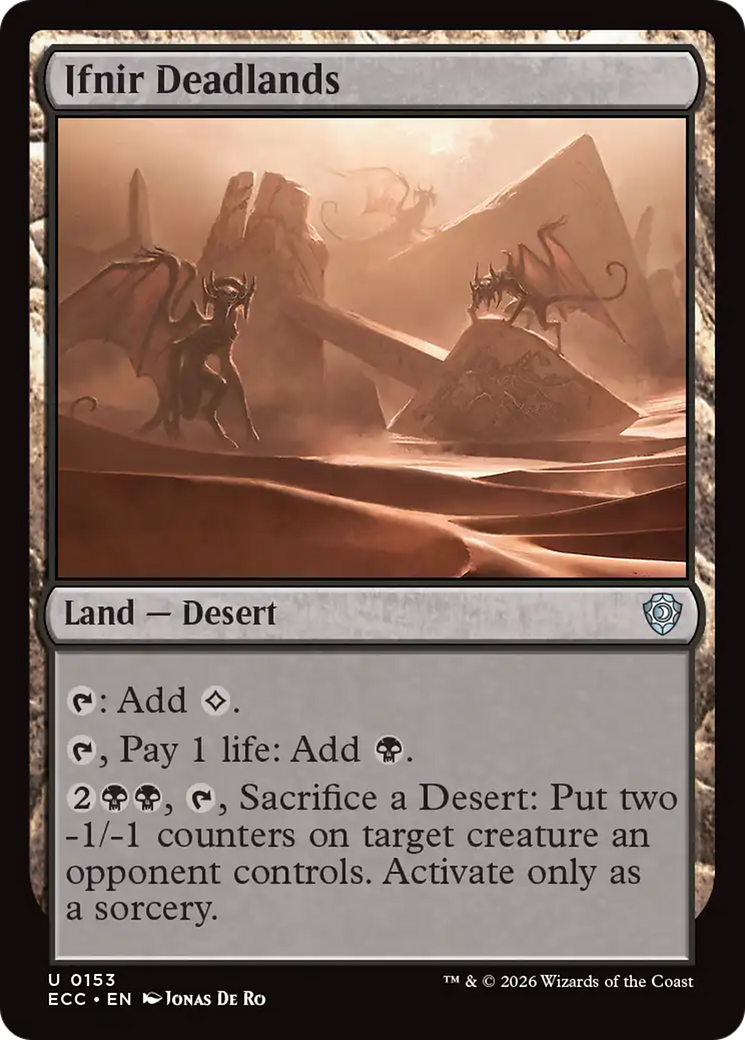
Ifnir Deadlands
Ifnir Deadlands
Land — Desert
: Add .
, Pay 1 life: Add .
, , Sacrifice a Desert: Put two -1/-1 counters on target creature an opponent controls. Activate only as a sorcery.
- If a Desert has an ability with a cost of “Sacrifice a Desert,” you can sacrifice that Desert to pay the cost for its own ability.
- Desert is a land subtype with no special meaning. It doesn’t grant the land an intrinsic mana ability. Other cards may care about which lands are Deserts.
-
4
Mountain
Mountain
Basic Land — Mountain
( : Add .)
-
1
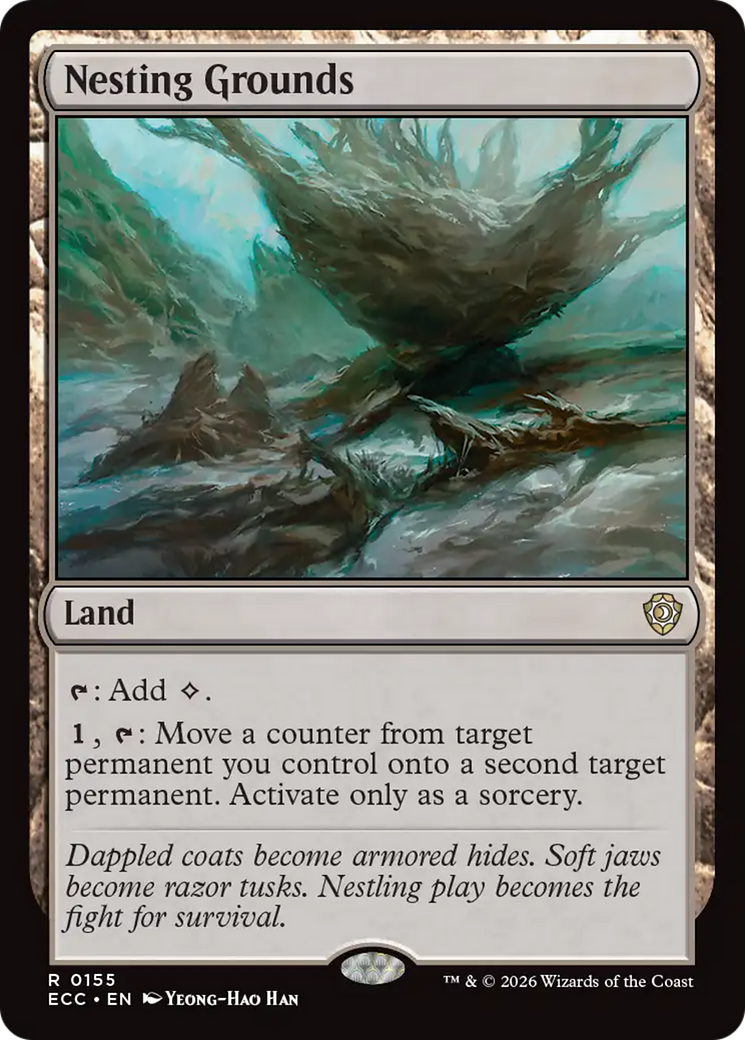
Nesting Grounds
Nesting Grounds
Land
: Add .
, : Move a counter from target permanent you control onto a second target permanent. Activate only as a sorcery.
- You choose the two target permanents as Nesting Grounds's second ability is put onto the stack. You choose which kind of counter to move as that ability resolves.
- If either permanent becomes an illegal target, no counter is removed or put.
- To move a counter from one creature to another, the counter is removed from the first permanent and put on the second. Any abilities that care about a counter being removed from or put onto a permanent will apply.
- The two target permanents don't have to share a type, which can result in some counters on permanents that would not occur normally, such as loyalty counters on creatures or +1/+1 counters on lands. Keyword counters will grant the permanent that keyword even if it's meaningless (such as trample on an enchantment); +1/+1 counters won't affect the permanent unless it's a creature; and many named counters (such as soul counters) won't have an effect unless the recipient permanent refers to them in some way.
-
1
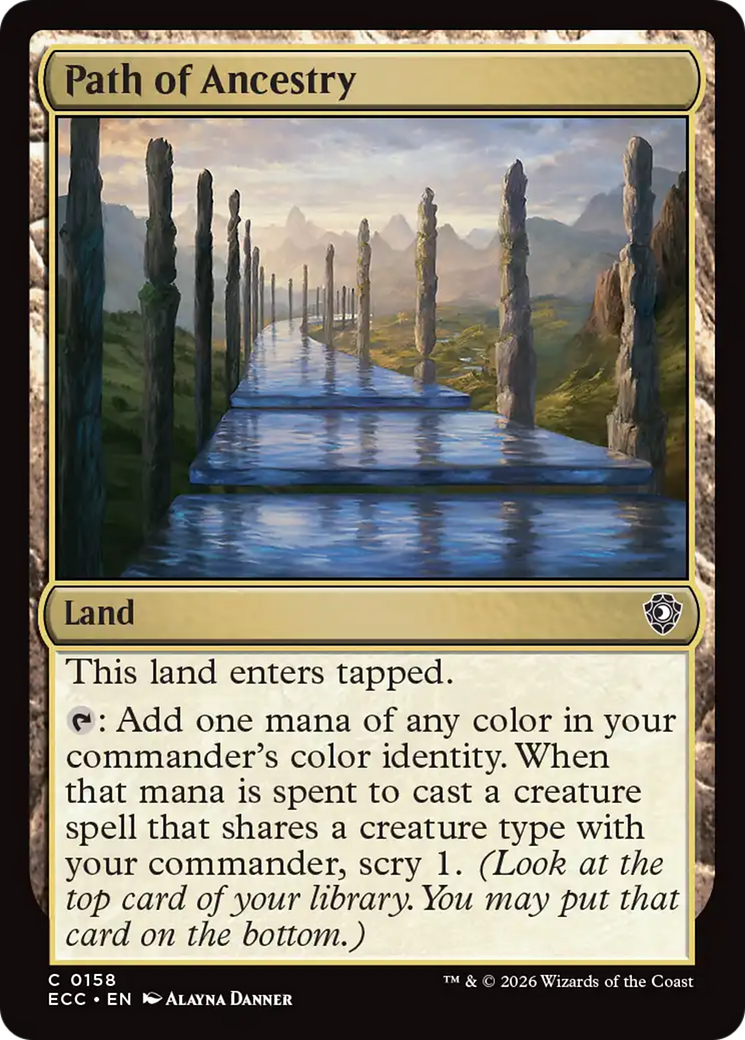
Path of Ancestry
Path of Ancestry
Land
This land enters tapped.
: Add one mana of any color in your commander's color identity. When that mana is spent to cast a creature spell that shares a creature type with your commander, scry 1. (Look at the top card of your library. You may put that card on the bottom.)
- Your commander's creature types are checked immediately after you cast a creature spell spending mana from Path of Ancestry's last ability. They aren't set before the game begins, and they may not be the same types your commander had when you activated that ability.
- If you have two commanders, the last ability adds one mana of any color in their combined color identities. When you spend that mana on a creature spell that shares a creature type with either of your commanders, you'll scry 1.
- If Path of Ancestry's last ability produces two mana (most likely due to Mana Reflection), spending those two mana to cast creature spells that share a creature type with your commander will cause two abilities to trigger. Each of those abilities will cause you to scry 1. You won't scry 2. This is true whether you spend the mana on one creature spell or two.
- If your commander has no creature types, it can't share a creature type with any spell that you cast.
- If you cast your commander with mana from Path of Ancestry, and your commander hasn't somehow lost all of its creature types while on the stack, you'll scry 1.
- If you don't have a commander, Path of Ancestry's ability produces no mana.
- If your commander is a card that has no colors in its color identity, Path of Ancestry's ability produces no mana. It doesn't produce .
-
1
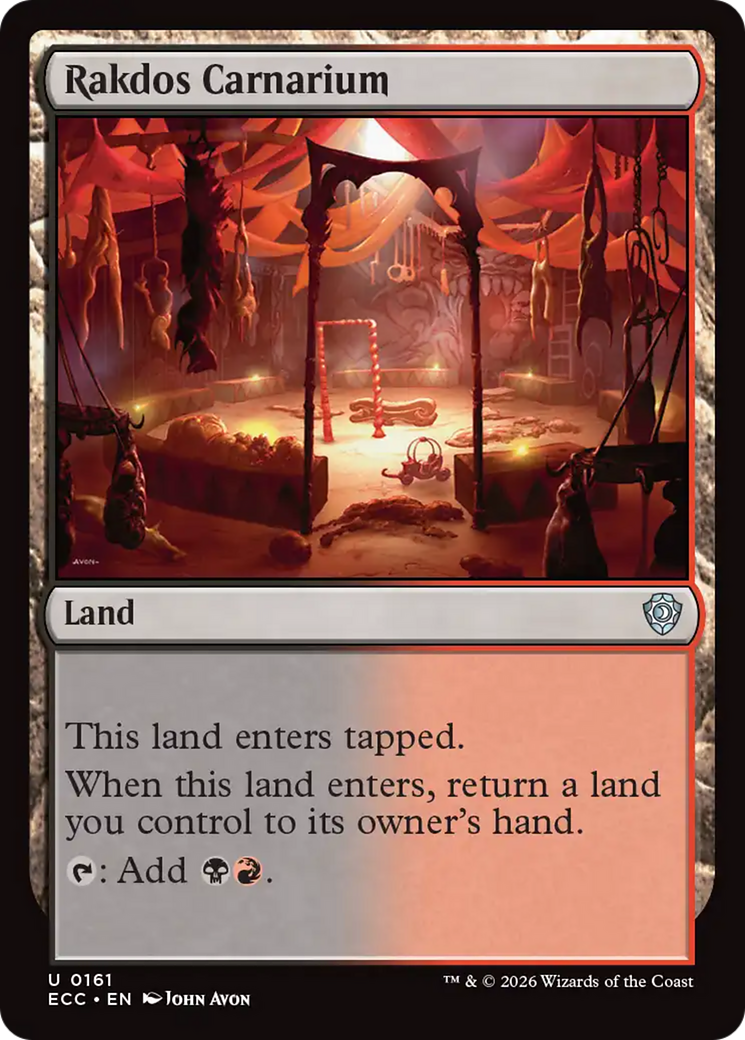
Rakdos Carnarium
Rakdos Carnarium
Land
This land enters tapped.
When this land enters, return a land you control to its owner's hand.
: Add .
- If this land enters the battlefield and you control no other lands, its ability will force you to return it to your hand.
-
1
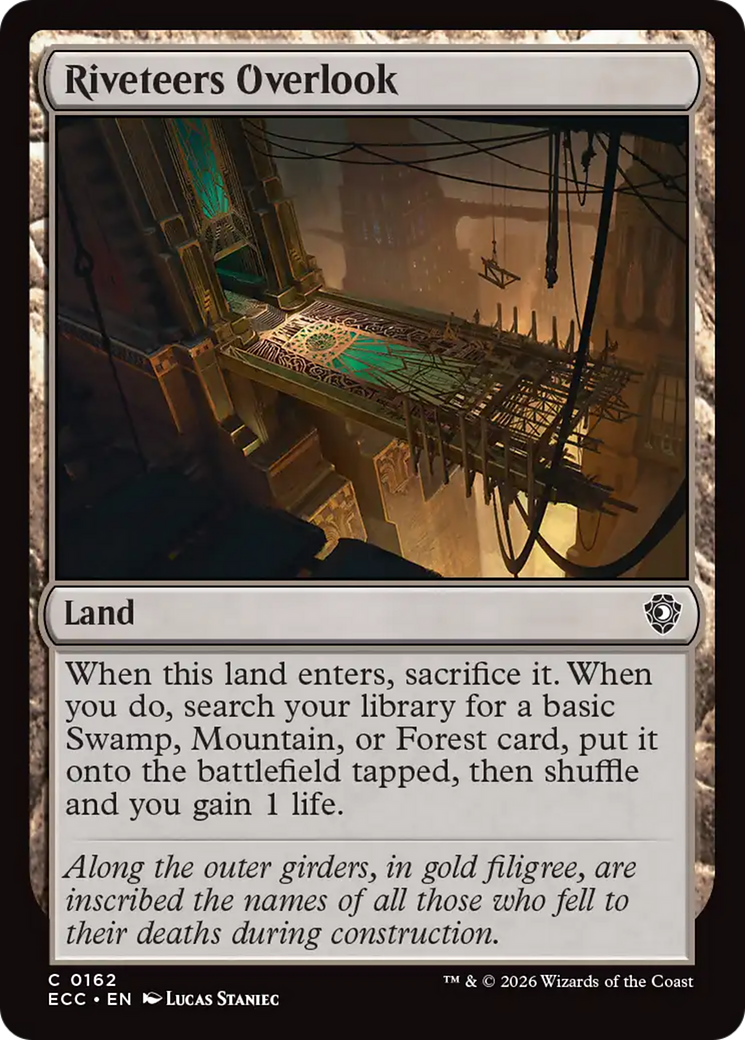
Riveteers Overlook
Riveteers Overlook
Land
When this land enters, sacrifice it. When you do, search your library for a basic Swamp, Mountain, or Forest card, put it onto the battlefield tapped, then shuffle and you gain 1 life.
-
1
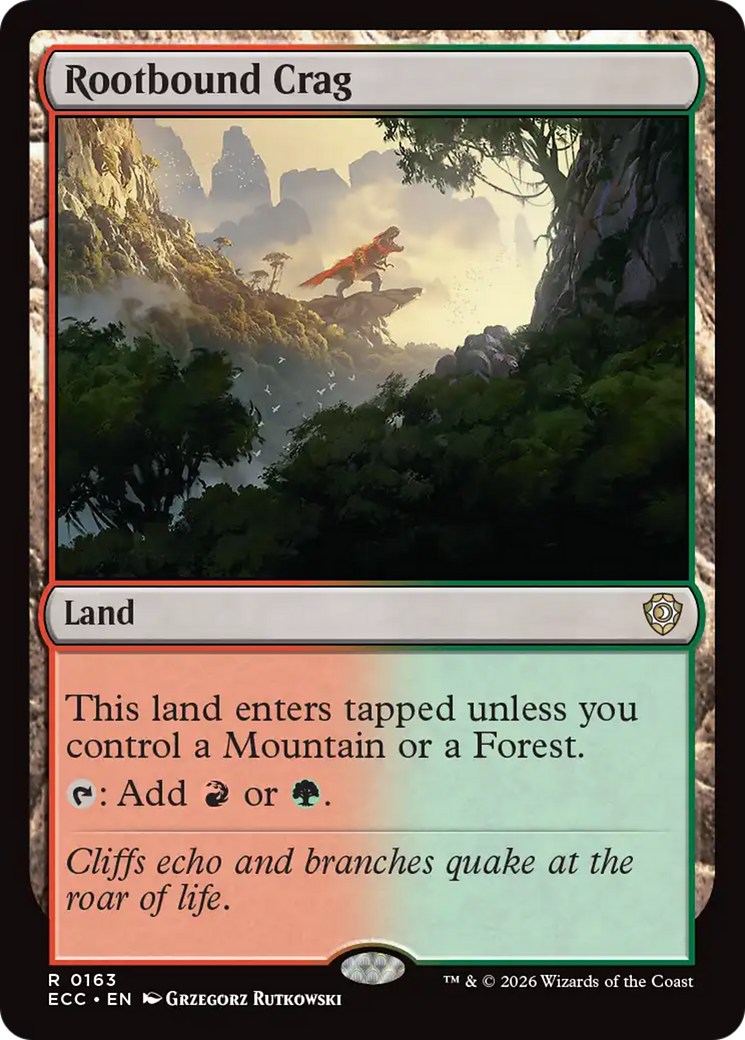
Rootbound Crag
Rootbound Crag
Land
This land enters tapped unless you control a Mountain or a Forest.
: Add or .
- This checks for lands you control with the land type Mountain or Forest, not for lands named Mountain or Forest. The lands it checks for don't have to be basic lands. For example, if you control Temple Garden (a nonbasic land with the land types Forest and Plains), Rootbound Crag will enter untapped.
- As this is entering, it checks for lands that are already on the battlefield. It won't see lands that are entering at the same time (due to Warp World, for example).
-
1
Savage Lands
Savage Lands
Land
This land enters tapped.
: Add , , or .
-
1
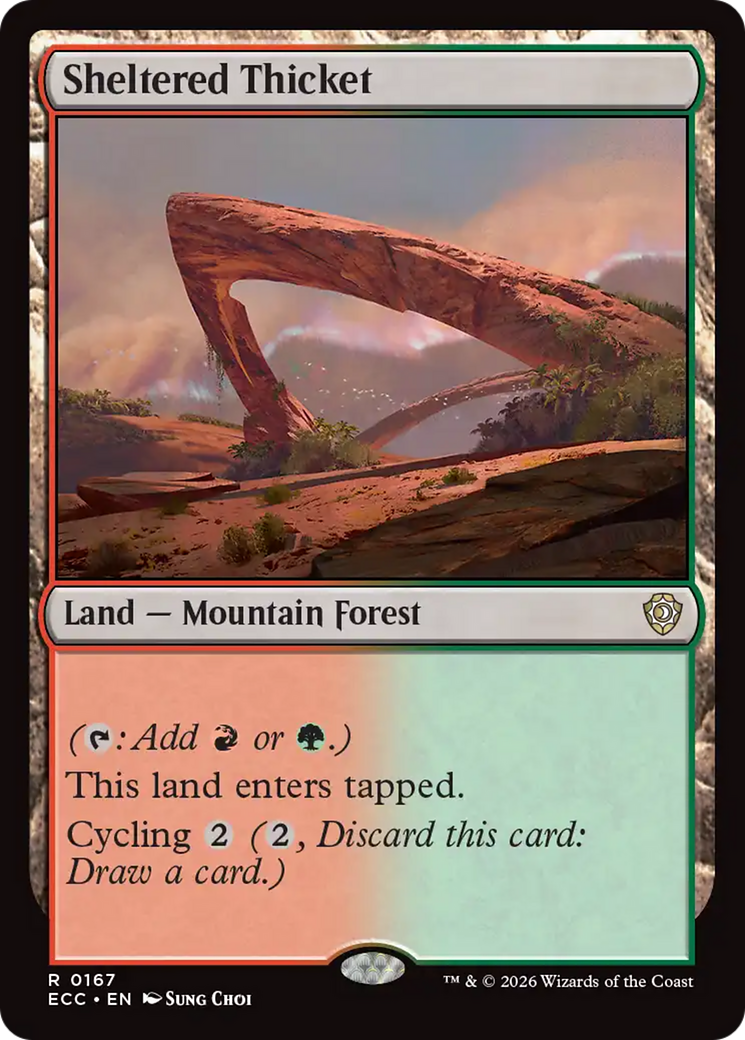
Sheltered Thicket
Sheltered Thicket
Land — Mountain Forest
( : Add or .)
This land enters tapped.
Cycling ( , Discard this card: Draw a card.)
-
1
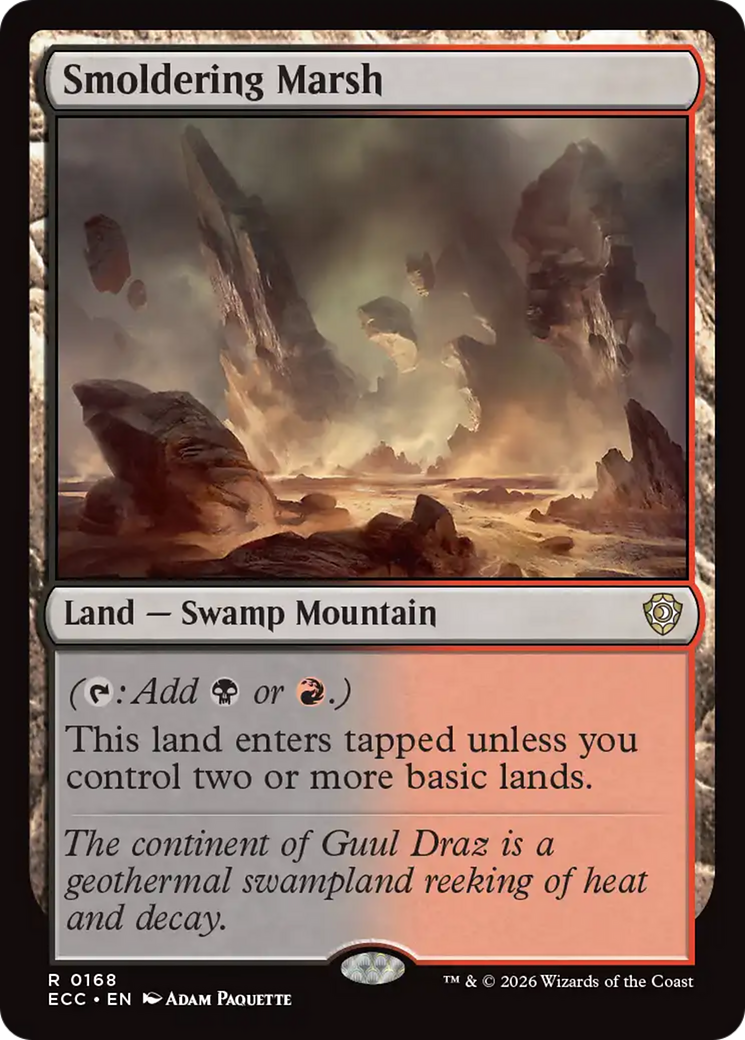
Smoldering Marsh
Smoldering Marsh
Land — Swamp Mountain
( : Add or .)
This land enters tapped unless you control two or more basic lands.
- However, because these cards have basic land types, effects that specify a basic land type without also specifying that the land be basic can affect them. For example, a spell or ability that reads "Destroy target Forest" can target Canopy Vista, while one that reads "Destroy target basic Forest" cannot.
- Even though these lands have basic land types, they are not basic lands because "basic" doesn't appear on their type line. Notably, controlling two or more of them won't allow others to enter the battlefield untapped.
- If one of these lands enters the battlefield at the same time as any number of basic lands, those other lands are not counted when determining if this land enters the battlefield tapped or untapped.
-
8
Swamp
Swamp
Basic Land — Swamp
( : Add .)
-
1
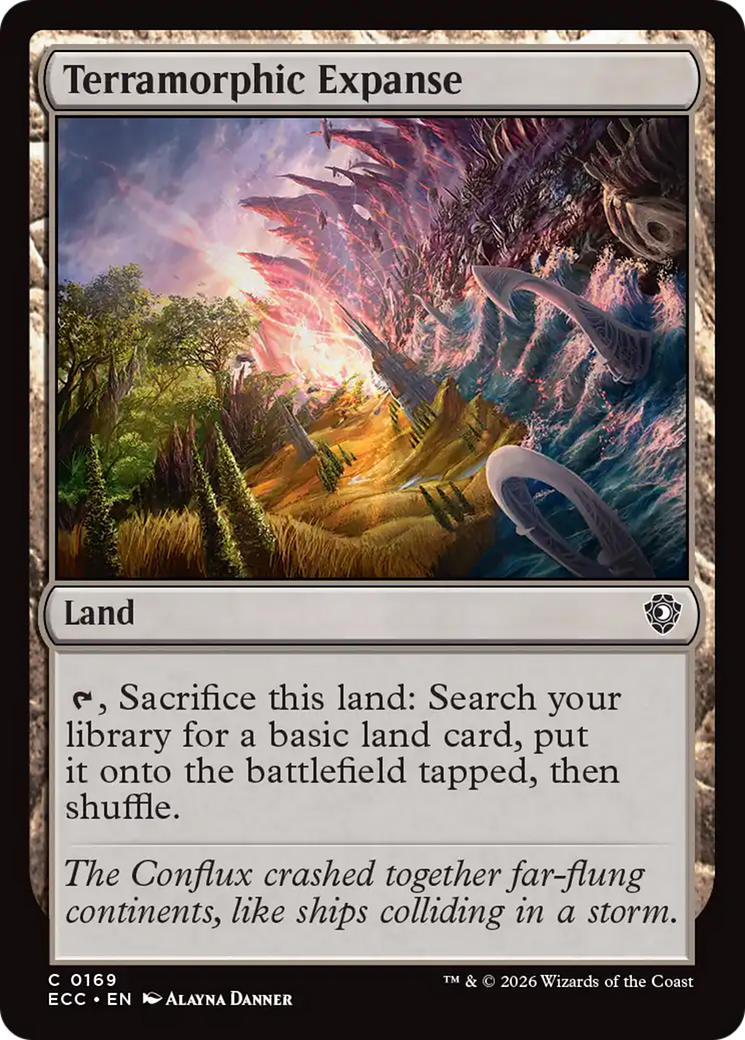
Terramorphic Expanse
Terramorphic Expanse
Land
, Sacrifice this land: Search your library for a basic land card, put it onto the battlefield tapped, then shuffle.
-
1
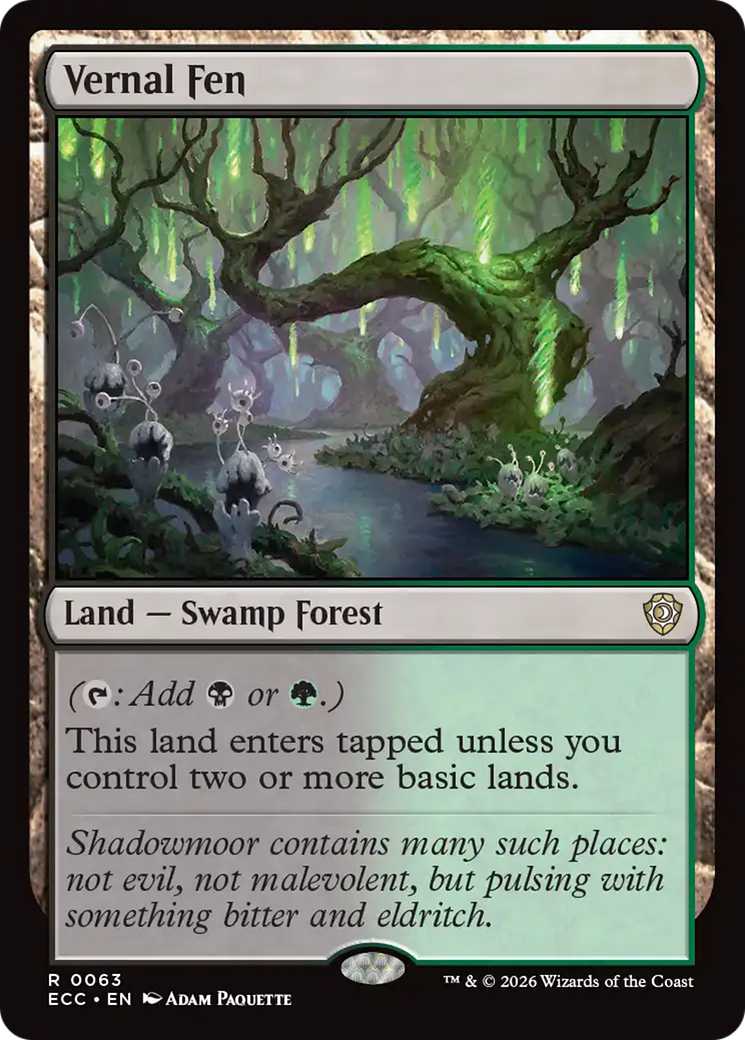
Vernal Fen
Vernal Fen
Land — Swamp Forest
( : Add or .)
This land enters tapped unless you control two or more basic lands.
- Unlike some other dual lands, Vernal Fen has two basic land types. It’s not basic, so effects that search for basic lands (such as the ability of a Lander token) can’t find it, but it does have the appropriate land types for effects such as that of Wastewood Verge (from the Aetherdrift release).
-
1
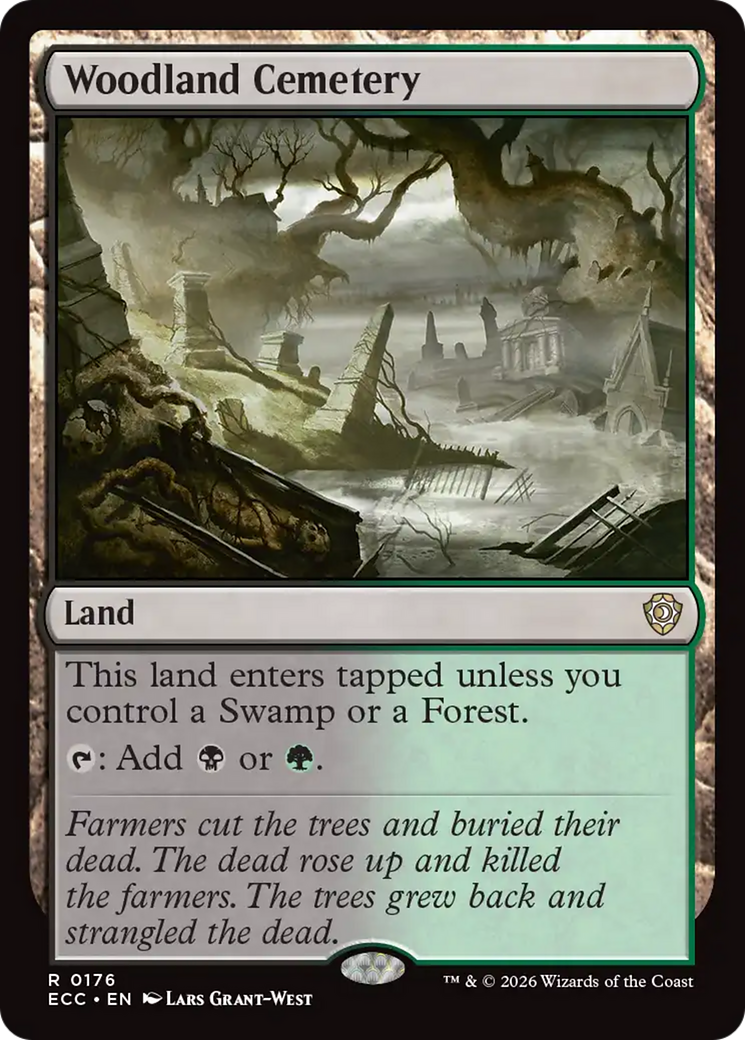
Woodland Cemetery
Woodland Cemetery
Land
This land enters tapped unless you control a Swamp or a Forest.
: Add or .
Black 26
-
1
Aberrant Return
Aberrant Return
Sorcery
Put one, two, or three target creature cards from graveyards onto the battlefield under your control. Each of them enters with an additional -1/-1 counter on it.
-
1
Archfiend of Ifnir
Archfiend of Ifnir
Creature — Demon
5/4
Flying
Whenever you cycle or discard another card, put a -1/-1 counter on each creature your opponents control.
Cycling ( , Discard this card: Draw a card.)
- Some cards have an ability that triggers whenever you cycle any card. These triggered abilities resolve before you draw from the cycling ability.
- If a player discards a card during their cleanup step due to having too many cards in hand, any appropriate abilities that trigger on discarding that card trigger. If this happens, those triggered abilities are put onto the stack and players receive priority in that cleanup step to cast spells or activate abilities (normally, no players may take actions during a cleanup step). Another cleanup step is created following that one.
- An ability that triggers whenever you discard a card doesn't give you permission to discard cards. You'll need another effect that instructs or allows you to discard them.
- An ability that triggers whenever you "cycle or discard" a card triggers only once if you cycle a card. The ability "Whenever you discard a card" is functionally identical to this ability; cycling is mentioned for clarity.
-
1
Black Sun's Zenith
Black Sun's Zenith
Sorcery
Put X -1/-1 counters on each creature. Shuffle Black Sun's Zenith into its owner's library.
- If this spell doesn't resolve, none of its effects occur. In particular, it will go to the graveyard rather than to its owner's library.
-
1
Blowfly Infestation
Blowfly Infestation
Enchantment
Whenever a creature dies, if it had a -1/-1 counter on it, put a -1/-1 counter on target creature.
- When Blowfly Infestation's ability resolves, it will put a single -1/-1 counter on the targeted creature. It doesn't matter how many -1/-1 counters were on the creature that went to a graveyard as long as it had at least one on it.
- This ability is mandatory. If you're the only player who controls any creatures when this ability triggers, you must target one of them.
-
1
Carnifex Demon
Carnifex Demon
Creature — Phyrexian Demon
6/6
Flying
This creature enters with two -1/-1 counters on it.
, Remove a -1/-1 counter from this creature: Put a -1/-1 counter on each other creature.
- As Carnifex Demon's last ability resolves, you'll put a -1/-1 counter on each creature on the battlefield — including creatures you control — except for that Carnifex Demon.
-
1
Dusk Urchins
Dusk Urchins
Creature — Ouphe
4/3
Whenever this creature attacks or blocks, put a -1/-1 counter on it.
When this creature dies, draw a card for each -1/-1 counter on it.
- If Dusk Urchins has just 1 toughness when it blocks, it will get a -1/-1 counter and be put into the graveyard. The creature that it blocked remains blocked, however.
- The -1/-1 counter is put on Dusk Urchins during the declare attackers or declare blockers step, whichever is appropriate, so it will be smaller by the time combat damage is dealt. (Note that this is different from how the _Shadowmoor_ card Wicker Warcrawler works.)
-
1
Eventide's Shadow
Eventide's Shadow
Sorcery
Remove any number of counters from among permanents on the battlefield. You draw cards and lose life equal to the number of counters removed this way.
- Eventide's Shadow allows you to remove counters from permanents controlled by any player, not just permanents you control.
-
1
Grave Titan
Grave Titan
Creature — Giant
6/6
Deathtouch
Whenever this creature enters or attacks, create two 2/2 black Zombie creature tokens.
-
1
Grave Venerations
Grave Venerations
Enchantment
When this enchantment enters, you become the monarch.
At the beginning of your end step, if you're the monarch, return up to one target creature card from your graveyard to your hand.
Whenever a creature you control dies, each opponent loses 1 life and you gain 1 life.
- The game starts with no monarch. As a player becomes the monarch, the current monarch (if any) ceases being the monarch. There is never more than one monarch at a time.
- If the monarch leaves the game during another player's turn, that player becomes the monarch. If the monarch leaves the game during their turn, the next player in turn order becomes the monarch.
- There are two inherent triggered abilities associated with being the monarch. These triggered abilities have no source and are controlled by the player who was the monarch at the time the abilities triggered. The full texts of these abilities are "At the beginning of the monarch's end step, that player draws a card" and "Whenever a creature deals combat damage to the monarch, its controller becomes the monarch."
- If the triggered ability that causes the monarch to draw a card goes on the stack and a different player becomes the monarch before that ability resolves, the first player will still draw the card.
- If combat damage dealt to the monarch causes that player to lose the game, the triggered ability that causes the controller of the attacking creature to become the monarch doesn't resolve. In most cases, the controller of the attacking creature will still become the monarch as it is likely their turn.
-
1
Hoarder's Greed
Hoarder's Greed
Sorcery
You lose 2 life and draw two cards, then clash with an opponent. If you win, repeat this process. (Each clashing player reveals the top card of their library, then puts that card on their choice of the top or bottom. A player wins if their card had a greater mana value.)
- The effect will automatically repeat itself until its controller doesn't win the clash. There's no other way to stop it.
-
1
Incremental Blight
Incremental Blight
Sorcery
Put a -1/-1 counter on target creature, two -1/-1 counters on another target creature, and three -1/-1 counters on a third target creature.
- You must target three different creatures. If you can't, you can't cast Incremental Blight.
-
1
Infernal Grasp
Infernal Grasp
Instant
Destroy target creature. You lose 2 life.
-
1
Liliana, Death Wielder
Liliana, Death Wielder
Legendary Planeswalker — Liliana
+2: Put a -1/-1 counter on up to one target creature.
−3: Destroy target creature with a -1/-1 counter on it.
−10: Return all creature cards from your graveyard to the battlefield.
-
1
Massacre Girl, Known Killer
Massacre Girl, Known Killer
Legendary Creature — Human Assassin
4/4
Menace
Creatures you control have wither. (They deal damage to creatures in the form of -1/-1 counters.)
Whenever a creature an opponent controls dies, if its toughness was less than 1, draw a card.
- Use the toughness of the creature as it last existed on the battlefield to determine whether or not Massacre Girl's ability triggers.
- Wither applies to any damage dealt to creatures by creatures you control. This includes combat damage as well as anything that causes creatures you control to deal noncombat damage, such as Incinerator of the Guilty's reflexive triggered ability or the effect of Hard-Hitting Question.
-
1
Midnight Banshee
Midnight Banshee
Creature — Spirit
5/5
Wither (This deals damage to creatures in the form of -1/-1 counters.)
At the beginning of your upkeep, put a -1/-1 counter on each nonblack creature.
-
1
Necroskitter
Necroskitter
Creature — Elemental
1/4
Wither (This deals damage to creatures in the form of -1/-1 counters.)
Whenever a creature an opponent controls with a -1/-1 counter on it dies, you may return that card to the battlefield under your control.
- It doesn't matter how many -1/-1 counters were on the creature when it was put into a graveyard from the battlefield, as long as it had at least one.
- The card returns to the battlefield without any -1/-1 counters on it (unless some other effect causes it to enter with some).
- It doesn't matter whose graveyard the creature is put into. It matters only that an opponent controlled it when it left the battlefield.
-
1
Night's Whisper
Night's Whisper
Sorcery
You draw two cards and lose 2 life.
-
1
Oft-Nabbed Goat
Oft-Nabbed Goat
Creature — Goat
0/5
: Draw a card. Gain control of this creature and put a -1/-1 counter on it. Only your opponents may activate this ability and only as a sorcery.
When this creature dies, if it had one or more -1/-1 counters on it, its owner draws that many cards and each other player loses that much life.
- Only the opponents of Oft-Nabbed Goat's controller can activate its first ability. For the purposes of the first ability, it doesn't matter who owns Oft-Nabbed Goat.
-
1
Painful Truths
Painful Truths
Sorcery
Converge — You draw X cards and lose X life, where X is the number of colors of mana spent to cast this spell.
- The maximum number of colors of mana you can spend to cast a spell is five. Colorless is not a color. Note that the cost of a spell with converge may limit how many colors of mana you can spend.
- Unless a spell or ability allows you to, you can't choose to pay more mana for a spell with a converge ability just to spend more colors of mana. Likewise, if a spell or ability reduces the amount of mana it costs you to cast a spell with converge, you can't ignore that cost reduction in order to spend more colors of mana.
- If there are any alternative or additional costs to cast a spell with a converge ability, the mana spent to pay those costs will count. For example, if an effect makes sorcery spells cost more to cast, you could pay to cast Radiant Flames and deal 4 damage to each creature.
- If you cast a spell with converge without spending any mana to cast it (perhaps because an effect allowed you to cast it without paying its mana cost), then the number of colors spent to cast it will be zero.
- If a spell with a converge ability is copied, no mana was spent to cast the copy, so the number of colors of mana spent to cast the spell will be zero. The number of colors spent to cast the original spell is not copied.
-
1
Persist
Persist
Sorcery
Return target nonlegendary creature card from your graveyard to the battlefield with a -1/-1 counter on it.
-
1
Puppeteer Clique
Puppeteer Clique
Creature — Faerie Wizard
3/2
Flying
When this creature enters, put target creature card from an opponent's graveyard onto the battlefield under your control. It gains haste. At the beginning of your next end step, exile it.
Persist (When this creature dies, if it had no -1/-1 counters on it, return it to the battlefield under its owner's control with a -1/-1 counter on it.)
- When a permanent with persist returns to the battlefield, it's a new object with no memory of or connection to its previous existence.
- If multiple creatures with persist are put into the graveyard at the same time (due to combat damage or a spell that destroys all creatures, for example), the active player (the player whose turn it is) puts all of their persist triggers on the stack in any order, then each other player in turn order does the same. The last trigger put on the stack is the first one that resolves. That means that in a two-player game, the nonactive player's persist creatures will return to the battlefield first, then the active player's persist creatures do the same. The creatures return to the battlefield one at a time.
- If a creature with persist that has +1/+1 counters on it receives enough -1/-1 counters to cause it to be destroyed by lethal damage or put into its owner's graveyard for having 0 or less toughness, persist won't trigger and the card won't return to the battlefield. That's because persist checks the creature's existence just before it leaves the battlefield, and it still has all those counters on it at that point.
- If a creature with persist stops being a creature, persist will still work.
- The persist ability triggers when the permanent is put into a graveyard. Its last known information (that is, how the creature last existed on the battlefield) is used to determine whether it had a -1/-1 counter on it.
- If a permanent has multiple instances of persist, they'll each trigger separately, but the redundant instances will have no effect. If one instance returns the card to the battlefield, the next to resolve will do nothing.
- If a token with no -1/-1 counters on it has persist, the ability will trigger when the token is put into the graveyard. However, the token will cease to exist and can't return to the battlefield.
-
1
Sinister Gnarlbark
Sinister Gnarlbark
Creature — Treefolk Warlock
0/4
At the beginning of your end step, draw a card and blight 1. (Put a -1/-1 counter on a creature you control.)
-
1
Skinrender
Skinrender
Creature — Phyrexian Zombie
3/3
When this creature enters, put three -1/-1 counters on target creature.
- This ability is mandatory. If there are no other creatures on the battlefield, you must target Skinrender itself.
-
1
Soul Snuffers
Soul Snuffers
Creature — Elemental Shaman
3/3
When this creature enters, put a -1/-1 counter on each creature.
- The ability puts a -1/-1 counter on Soul Snuffers, too.
-
1
Tree of Perdition
Tree of Perdition
Creature — Plant
0/13
Defender
: Exchange target opponent's life total with this creature's toughness.
- When the ability resolves, Tree of Perdition's toughness becomes the targeted opponent's former life total and that player gains or loses an amount of life necessary so that their life total equals Tree of Perdition's former toughness. Other effects that interact with life gain or life loss will interact with this effect accordingly.
- Any toughness-modifying effects, counters, Auras, or Equipment will apply after its toughness is set to the player's former life total. For example, say Tree of Perdition is equipped with Cultist's Staff (which makes it 2/15) and the player's life total is 7. After the exchange, Tree of Perdition would be a 2/9 creature (its toughness became 7, which was then modified by Cultist's Staff) and the player's life total would be 15.
- If Tree of Perdition isn't on the battlefield when the ability resolves, the exchange can't happen and the ability will have no effect. Notably, activating the ability and giving Tree of Perdition -13/-13 in response won't cause your opponent to lose the game.
-
1
Vraska, Betrayal's Sting
Vraska, Betrayal's Sting
Legendary Planeswalker — Vraska
Compleated ( can be paid with or 2 life. If life was paid, this planeswalker enters with two fewer loyalty counters.)
0: You draw a card and lose 1 life. Proliferate.
−2: Target creature becomes a Treasure artifact with " , Sacrifice this artifact: Add one mana of any color" and loses all other card types and abilities.
−9: If target player has fewer than nine poison counters, they get a number of poison counters equal to the difference.
- A Phyrexian mana symbol contributes 1 toward the mana value of a card, even if life is paid for it. Specifically, Vraska's mana value is always 6.
- In most cases, the target of Vraska's last loyalty ability will end up with nine poison counters. However, once you calculate what the difference is, replacement effects can change how many poison counters the player actually gets. For example, if the player controls Melira, the Living Cure, they will end up getting one poison counter if they had eight or fewer to begin with.
- Other replacement effects that would change the number of loyalty counters Vraska enters with will apply as normal.
- The target of Vraska's second loyalty ability will lose any other subtypes and card types it previously had and will be only a Treasure artifact. It will retain any supertypes it had.
- The compleated ability looks only at whether a player chose to pay 2 life for a Phyrexian mana symbol as they were casting the spell. If a player paid life for some other reason while casting the spell, that will not reduce the number of loyalty counters the planeswalker enters the battlefield with.
Red 6
-
1
Burning Curiosity
Burning Curiosity
Sorcery
As an additional cost to cast this spell, you may blight 1. (You may put a -1/-1 counter on a creature you control.)
Exile the top two cards of your library. If this spell's additional cost was paid, exile the top three cards instead. Until the end of your next turn, you may play those cards.
- You pay all costs and follow all timing rules for cards played this way. For example, if an exiled card is a land card, you may play it only during your main phase while the stack is empty.
-
1
Cathartic Pyre
Cathartic Pyre
Instant
Choose one —
- Cathartic Pyre deals 3 damage to target creature or planeswalker.
- Discard up to two cards, then draw that many cards.
-
1
Cathartic Reunion
Cathartic Reunion
Sorcery
As an additional cost to cast this spell, discard two cards.
Draw three cards.
- Because discarding two cards is an additional cost, you can't cast Cathartic Reunion if you don't have at least two other cards in hand.
-
1
Chain Reaction
Chain Reaction
Sorcery
Chain Reaction deals X damage to each creature, where X is the number of creatures on the battlefield.
- The value of X is determined as Chain Reaction resolves.
-
1
Lasting Tarfire
Lasting Tarfire
Enchantment
At the beginning of each end step, if you put a counter on a creature this turn, this enchantment deals 2 damage to each opponent.
- Lasting Tarfire's ability will check as your end step starts to see if you put a counter on a creature this turn. If you didn't, the ability won't trigger at all. Putting a counter on a creature during your end step won't cause the ability to trigger.
-
1
Village Pillagers
Village Pillagers
Creature — Goblin Warrior
5/5
Wither (This deals damage to creatures in the form of -1/-1 counters.)
When this creature enters, it deals 1 damage to each creature your opponents control.
Whenever a creature an opponent controls with a counter on it dies, you create a tapped Treasure token.
- Wither applies to any damage dealt to creatures by Village Pillagers. This includes combat damage as well as anything that causes it to deal noncombat damage, such as the effect of its second ability.
Green 9
-
1
Channeler Initiate
Channeler Initiate
Creature — Human Druid
3/4
When this creature enters, put three -1/-1 counters on target creature you control.
, Remove a -1/-1 counter from this creature: Add one mana of any color.
-
1
Devoted Druid
Devoted Druid
Creature — Elf Druid
0/2
: Add .
Put a -1/-1 counter on this creature: Untap this creature.
- If you can't put -1/-1 counters on Devoted Druid (due to an effect such as that of Solemnity), you can't activate its second ability. If you can put counters on it, but that is modified by an effect (such as that of Vizier of Remedies), you can activate the ability even if paying the cost causes no counters to be put on Devoted Druid.
- You put the -1/-1 counter on Devoted Druid as a cost to activate its ability, not when it resolves. If paying the cost causes Devoted Druid to have 0 toughness, it's put into your graveyard before you can untap it and before you can even pay the cost again.
-
1
Evolution Sage
Evolution Sage
Creature — Elf Druid
3/2
Landfall — Whenever a land you control enters, proliferate. (Choose any number of permanents and/or players, then give each another counter of each kind already there.)
- A landfall ability triggers whenever a land you control enters for any reason. It triggers whenever you play a land, as well as whenever a spell or ability puts a land onto the battlefield under your control.
- A landfall ability doesn't trigger if a permanent already on the battlefield becomes a land.
- Whenever a land you control enters, each landfall ability of the permanents you control will trigger. You can put them on the stack in any order. The last ability you put on the stack will be the first one to resolve (As a result, you can have those abilities resolve in the order of your choosing.).
- An ability that triggers "Whenever you proliferate" triggers even if you chose no permanents or players while doing so.
- To proliferate, you can choose any permanent that has a counter, including ones controlled by opponents. You can choose any player who has a counter, including opponents. You can't choose cards in any zone other than the battlefield, even if they have counters on them.
- If a permanent ever has both +1/+1 counters and -1/-1 counters on it at the same time, they're removed in pairs as a state-based action so that the permanent has only one of those kinds of counters on it.
- Players can respond to a spell or ability whose effect includes proliferating. Once that spell or ability starts to resolve, however, and its controller chooses which permanents and players will get new counters, it's too late for anyone to respond.
- You don't have to choose every permanent or player that has a counter, only the ones you want to add another counter to. Since "any number" includes zero, you don't have to choose any permanents at all, and you don't have to choose any players at all.
- If a player or permanent has more than one kind of counter on it, and you choose for it to get additional counters, it must get one of each kind of counter it already has. You can't have it get just one kind of counter it already has and not the others.
-
1
Ferrafor, Young Yew
Ferrafor, Young Yew
Legendary Creature — Treefolk Druid
4/7
When Ferrafor enters, create a number of 1/1 green Saproling creature tokens equal to the number of counters among creatures target player controls.
: Double the number of each kind of counter on target creature.
- To double the number of each kind of counter on a creature, put another counter on it for each counter it already has. Effects that interact with counters being put onto creatures apply as appropriate.
- Use the number of counters among creatures the target player controls when Ferrafor's first ability resolves to determine how many Saprolings are created.
-
1
Flourishing Defenses
Flourishing Defenses
Enchantment
Whenever a -1/-1 counter is put on a creature, you may create a 1/1 green Elf Warrior creature token.
- This ability triggers both when a -1/-1 counter is put on a creature on the battlefield and when a creature enters with a -1/-1 counter on it. This includes when a creature returns to the battlefield as a result of persist.
- This ability triggers once for each -1/-1 counter. For example, if Leech Bonder (a creature that enters with two -1/-1 counters on it) entered, Flourishing Defenses's ability would trigger twice.
-
1
Harmonize
Harmonize
Sorcery
Draw three cards.
-
1
Ignoble Hierarch
Ignoble Hierarch
Creature — Goblin Shaman
0/1
Exalted (Whenever a creature you control attacks alone, that creature gets +1/+1 until end of turn.)
: Add , , or .
- A creature attacks alone if it's the only creature declared as an attacker during the declare attackers step (including creatures controlled by your teammates, if applicable). For example, exalted won't trigger if you attack with multiple creatures and all but one of them are removed from combat.
-
1
Puca's Covenant
Puca's Covenant
Enchantment
Whenever a creature you control with a counter on it dies, you may return another target permanent card with mana value less than or equal to the number of counters on that creature from your graveyard to your hand. Do this only once each turn.
- If a permanent card in a graveyard has in its mana cost, X is 0 for the purpose of determining its mana value.
-
1
Wickerbough Elder
Wickerbough Elder
Creature — Treefolk Shaman
4/4
This creature enters with a -1/-1 counter on it.
, Remove a -1/-1 counter from this creature: Destroy target artifact or enchantment.
- You must choose a target artifact or enchantment to activate Wickerbough Elder's last ability. You can't pay just to remove a -1/-1 counter from it without a legal target.
- If an effect puts Wickerbough Elder onto the battlefield with one or more +1/+1 counters, its -1/-1 counter and one of those +1/+1 counters are removed as a state-based action before you can activate its ability.
Multicolor 10
-
1
Assassin's Trophy
Assassin's Trophy
Instant
Destroy target permanent an opponent controls. Its controller may search their library for a basic land card, put it onto the battlefield, then shuffle.
- If the target permanent is a legal target but isn't destroyed, most likely because it has indestructible, its controller may search their library.
- If the target permanent is an illegal target by the time Assassin's Trophy tries to resolve, the spell doesn't resolve. No player searches their library.
- If the permanent's controller doesn't search their library, they don't shuffle their library.
- If the target permanent is a legal target but isn't destroyed, most likely because it has indestructible, its controller may search their library.
- If the permanent's controller doesn't search their library, they don't shuffle their library.
- If the target permanent is an illegal target by the time Assassin's Trophy tries to resolve, the spell doesn't resolve. No player searches their library.
-
1
Auntie Ool, Cursewretch
Auntie Ool, Cursewretch
Legendary Creature — Goblin Warlock
4/4
Ward—Blight 2. (To blight 2, a player puts two -1/-1 counters on a creature they control.)
Whenever one or more -1/-1 counters are put on a creature, draw a card if you control that creature. If you don't control it, its controller loses 1 life.
- If a creature that has +1/+1 counters on it receives enough -1/-1 counters to cause it to be destroyed by lethal damage or put into its owner's graveyard for having 0 or less toughness, effects that refer to the counters on that creature when it died will see all of those +1/+1 and -1/-1 counters.
- If you can't place -1/-1 counters on any creatures you control (probably because you control no creatures), you can't choose to blight.
- All of the -1/-1 counters must be put on a single creature. You can't choose to split them up between multiple creatures.
- The creature you choose to put -1/-1 counters on doesn't have to have enough toughness to survive the process. For example, if you blight 2, you can choose to put the counters on a 1/1 creature you control.
- Once you've announced that you're casting a spell or activating an ability, players can't take actions until you've finished doing so. Notably, opponents can't try to destroy or otherwise remove your creatures to stop you from blighting as part of paying the cost of that spell or ability.
- If a creature has +1/+1 counters and -1/-1 counters on it, state-based actions remove the same number of each so that it has only one kind of those counters on it. For example, if a creature has three +1/+1 counters on it and two -1/-1 counters are put on it, state-based actions will remove two of each of those kinds of counters, leaving the creature with just one +1/+1 counter.
-
1
Binding the Old Gods
Binding the Old Gods
Enchantment — Saga
(As this Saga enters and after your draw step, add a lore counter. Sacrifice after III.)
I — Destroy target nonland permanent an opponent controls.
II — Search your library for a Forest card, put it onto the battlefield tapped, then shuffle.
III — Creatures you control gain deathtouch until end of turn.
- As a Saga enters the battlefield, its controller puts a lore counter on it. As your precombat main phase begins (immediately after your draw step), you put another lore counter on each Saga you control. Putting a lore counter on a Saga in either of these ways doesn't use the stack.
- Each symbol on the left of a Saga's text box represents a chapter ability. A chapter ability is a triggered ability that triggers when a lore counter that is put on the Saga causes the number of lore counters on the Saga to become equal to or greater than the ability's chapter number. Chapter abilities are put onto the stack and may be responded to.
- A chapter ability doesn't trigger if a lore counter is put on a Saga that already had a number of lore counters greater than or equal to that chapter's number. For example, the third lore counter put on a Saga causes the chapter III ability to trigger, but chapters I and II won't trigger again.
- Once a chapter ability has triggered, the ability on the stack won't be affected if the Saga gains or loses counters, or if it leaves the battlefield.
- If multiple chapter abilities trigger at the same time, their controller puts them on the stack in any order. If any of them require targets, those targets are chosen as you put the abilities on the stack, before any of those abilities resolve.
- Removing lore counters won't cause a previous chapter ability to trigger. If lore counters are removed from a Saga, the appropriate chapter abilities will trigger again when the Saga receives more lore counters.
- Once the number of lore counters on a Saga is greater than or equal to the greatest number among its chapter abilities, the Saga's controller sacrifices it as soon as its chapter ability has left the stack, most likely by resolving or being countered. This state-based action doesn't use the stack.
-
1
Dread Tiller
Dread Tiller
Artifact Creature — Scarecrow
2/4
When this creature enters, put a -1/-1 counter on target creature.
Whenever a creature with a -1/-1 counter on it dies, you may put a land card from your hand or graveyard onto the battlefield tapped.
-
1
Fire Covenant
Fire Covenant
Instant
As an additional cost to cast this spell, pay X life.
Fire Covenant deals X damage divided as you choose among any number of target creatures.
- If X is 0, the number of targets must also be 0.
- You must distribute at least 1 damage to each target.
- You divide the damage as you cast the spell. You can't redistribute the damage if any of the target creatures becomes illegal before the spell resolves.
-
1
Glissa Sunslayer
Glissa Sunslayer
Legendary Creature — Phyrexian Zombie Elf
3/3
First strike, deathtouch
Whenever Glissa Sunslayer deals combat damage to a player, choose one —
- You draw a card and lose 1 life.
- Destroy target enchantment.
- Remove up to three counters from target permanent.
- For the third mode, you choose which counters to remove as the ability resolves. You may remove any three (or fewer) counters, even if the permanent has multiple kinds of counters on it.
-
1
Hapatra, Vizier of Poisons
Hapatra, Vizier of Poisons
Legendary Creature — Human Cleric
2/2
Whenever Hapatra deals combat damage to a player, you may put a -1/-1 counter on target creature.
Whenever you put one or more -1/-1 counters on a creature, create a 1/1 green Snake creature token with deathtouch.
- If you put enough -1/-1 counters on Hapatra so that its toughness is 0 or less, its last ability triggers.
- If you put any number of -1/-1 counters on more than one creature at once, Hapatra's last ability triggers once for each of those creatures.
-
1
Putrefy
Putrefy
Instant
Destroy target artifact or creature. It can't be regenerated.
- This spell isn't modal. When it resolves, it will destroy the target if it's a creature or an artifact, even if it changed from one to the other between targeting and resolution.
-
1
Terminate
Terminate
Instant
Destroy target creature. It can't be regenerated.
-
1
The Scorpion God
The Scorpion God
Legendary Creature — God
6/5
Whenever a creature with a -1/-1 counter on it dies, draw a card.
: Put a -1/-1 counter on another target creature.
When The Scorpion God dies, return it to its owner's hand at the beginning of the next end step.
- If a creature with a -1/-1 counter on it dies at the same time as The Scorpion God does, you'll draw a card. The same is true if The Scorpion God dies with a -1/-1 counter on it.
- You'll draw only one card when a creature with more than one -1/-1 counter on it dies.
Colorless 10
-
1
Arcane Signet
Arcane Signet
Artifact
: Add one mana of any color in your commander's color identity.
- If your commander is a card that has no colors in its color identity, Arcane Signet's ability produces no mana. It doesn't produce .
- If you have two commanders, the ability adds one mana of any color in their combined color identities.
- If you don't have a commander, Arcane Signet's ability produces no mana.
-
1
Chimil, the Inner Sun
Chimil, the Inner Sun
Legendary Artifact
Spells you control can't be countered.
At the beginning of your end step, discover 5. (Exile cards from the top of your library until you exile a nonland card with mana value 5 or less. Cast it without paying its mana cost or put it into your hand. Put the rest on the bottom in a random order.)
- Chimil, the Inner Sun's first ability applies only while it's on the battlefield. While it's a spell, it can be countered.
- A spell or ability that counters spells can still target spells that can't be countered. When that spell or ability resolves, the uncounterable spell won't be countered, but any additional effects of the countering spell or ability will still happen.
-
1
Commander's Sphere
Commander's Sphere
Artifact
: Add one mana of any color in your commander's color identity.
Sacrifice this artifact: Draw a card.
- If your commander is a card that has no colors in its color identity, Commander's Sphere's first ability produces no mana. It doesn't produce .
- If you don't have a commander, Commander's Sphere's first ability produces no mana.
- If you have two commanders, the ability adds one mana of any color in their combined color identities.
-
1
Contagion Clasp
Contagion Clasp
Artifact
When this artifact enters, put a -1/-1 counter on target creature.
, : Proliferate. (Choose any number of permanents and/or players, then give each another counter of each kind already there.)
- An ability that triggers "Whenever you proliferate" triggers even if you chose no permanents or players while doing so.
- To proliferate, you can choose any permanent that has a counter, including ones controlled by opponents. You can choose any player who has a counter, including opponents. You can't choose cards in any zone other than the battlefield, even if they have counters on them.
- Players can respond to a spell or ability whose effect includes proliferating. Once that spell or ability starts to resolve, however, and its controller chooses which permanents and players will get new counters, it's too late for anyone to respond.
- If a permanent ever has both +1/+1 counters and -1/-1 counters on it at the same time, they're removed in pairs as a state-based action so that the permanent has only one of those kinds of counters on it.
- You don't have to choose every permanent or player that has a counter, only the ones you want to add another counter to. Since "any number" includes zero, you don't have to choose any permanents at all, and you don't have to choose any players at all.
- If a player or permanent has more than one kind of counter on it, and you choose for it to get additional counters, it must get one of each kind of counter it already has. You can't have it get just one kind of counter it already has and not the others.
- Contagion Clasp's first ability is mandatory. If you're the only player who controls a creature, you must target one of them.
-
1
Everlasting Torment
Everlasting Torment
Enchantment
Players can't gain life.
Damage can't be prevented.
All damage is dealt as though its source had wither. (A source with wither deals damage to creatures in the form of -1/-1 counters.)
- Effects that replace an event with gaining life (like Words of Worship's effect does) will end up replacing the event with nothing.
- Effects that would replace gaining life with some other effect won't be able to do anything because it's impossible for players to gain life.
- The "damage can't be prevented" statement overrides all forms of preventing damage, including protection abilities. Damage prevention spells and abilities can still be cast and played; they just don't do anything.
- Spells and abilities that would normally cause a player to gain life still resolve, but the life-gain part simply has no effect.
- If an effect says to set your life total to a certain number, and that number is higher than your current life total, that effect will normally cause you to gain life equal to the difference. With Everlasting Torment on the battlefield, that part of the effect won't do anything. (If the number is lower than your current life total, the effect will work as normal.)
- Spells and abilities that replace or redirect damage aren't affected by Everlasting Torment's second ability. They'll work as normal.
- If a cost includes life gain (like Invigorate's alternative cost does), that cost can't be paid.
- The last ability affects all damage, whether it's dealt by creatures, other permanents, spells, or cards that aren't on the battlefield. Wither works everywhere.
-
1
Grim Poppet
Grim Poppet
Artifact Creature — Scarecrow
4/4
This creature enters with three -1/-1 counters on it.
Remove a -1/-1 counter from this creature: Put a -1/-1 counter on another target creature.
- The second ability can target any creature except the Grim Poppet whose ability is being activated. It can target a different Grim Poppet. It can be activated multiple times targeting the same creature.
-
1
Kulrath Knight
Kulrath Knight
Creature — Elemental Knight
3/3
Flying
Wither (This deals damage to creatures in the form of -1/-1 counters.)
Creatures your opponents control with counters on them can't attack or block.
- This checks your opponents' creatures for any kind of counters, not just -1/-1 counters.
-
1
Sol Ring
Sol Ring
Artifact
: Add .
-
1
The Reaper, King No More
The Reaper, King No More
Legendary Artifact Creature — Scarecrow
3/3
When The Reaper enters, put a -1/-1 counter on each of up to two target creatures.
Whenever a creature an opponent controls with a -1/-1 counter on it dies, you may put that card onto the battlefield under your control. Do this only once each turn.
-
1
Wickersmith's Tools
Wickersmith's Tools
Artifact
Whenever one or more -1/-1 counters are put on a creature, put a charge counter on this artifact.
: Add one mana of any color.
, , Sacrifice this artifact: Create X tapped 2/2 colorless Scarecrow artifact creature tokens, where X is the number of charge counters on this artifact.
- The value of X is calculated only once, as Wickersmith's Tools's last ability resolves.
Lands 39
-
1
Canyon Slough
Canyon Slough
Land — Swamp Mountain
( : Add or .)
This land enters tapped.
Cycling ( , Discard this card: Draw a card.)
-
1
Cinder Glade
Cinder Glade
Land — Mountain Forest
( : Add or .)
This land enters tapped unless you control two or more basic lands.
- If one of these lands enters the battlefield at the same time as any number of basic lands, those other lands are not counted when determining if this land enters the battlefield tapped or untapped.
- However, because these cards have basic land types, effects that specify a basic land type without also specifying that the land be basic can affect them. For example, a spell or ability that reads "Destroy target Forest" can target Canopy Vista, while one that reads "Destroy target basic Forest" cannot.
- Even though these lands have basic land types, they are not basic lands because "basic" doesn't appear on their type line. Notably, controlling two or more of them won't allow others to enter the battlefield untapped.
-
1
Command Tower
Command Tower
Land
: Add one mana of any color in your commander's color identity.
- If you don't have a commander, Command Tower's ability produces no mana.
- If your commander is a card that has no colors in its color identity, Command Tower's ability produces no mana. It doesn't produce .
- If you have two commanders, the ability adds one mana of any color in their combined color identities.
-
1
Dragonskull Summit
Dragonskull Summit
Land
This land enters tapped unless you control a Swamp or a Mountain.
: Add or .
- This checks for lands you control with the land type Swamp or Mountain, not for lands named Swamp or Mountain. The lands it checks for don't have to be basic lands. For example, if you control Stomping Ground (a nonbasic land with the land types Mountain and Forest), Dragonskull Summit will enter untapped.
- As this is entering, it checks for lands that are already on the battlefield. It won't see lands that are entering at the same time (due to Warp World, for example).
-
1
Evolving Wilds
Evolving Wilds
Land
, Sacrifice this land: Search your library for a basic land card, put it onto the battlefield tapped, then shuffle.
-
1
Exotic Orchard
Exotic Orchard
Land
: Add one mana of any color that a land an opponent controls could produce.
- Lands that produce mana based only on what other lands "could produce" won't help each other unless some other land allows one of them to actually produce some type of mana. For example, if you control an Exotic Orchard and your opponent controls an Exotic Orchard and a Reflecting Pool, none of those lands would produce mana if their mana abilities were activated. On the other hand, if you control a Forest and an Exotic Orchard, and your opponent controls an Exotic Orchard and a Reflecting Pool, then each of those lands can be tapped to produce . Your opponent's Exotic Orchard can produce because you control a Forest. Your Exotic Orchard and your opponent's Reflecting Pool can each produce because your opponent's Exotic Orchard can produce .
- When determining what colors of mana your opponents' lands could produce, Exotic Orchard takes into account any applicable replacement effects that would apply to those lands' mana abilities (such as Contamination's effect, for example). If there are more than one, consider them in any possible order.
- The colors of mana are white, blue, black, red, and green. Exotic Orchard can't be tapped for colorless mana, even if a land an opponent controls could produce colorless mana.
- Exotic Orchard doesn't care about any restrictions or riders your opponents' lands (such as Ancient Ziggurat or Hall of the Bandit Lord) put on the mana they produce. It just cares about colors of mana.
- Exotic Orchard checks the effects of all mana-producing abilities of lands your opponents control, but it doesn't check their costs. For example, Vivid Crag has the ability " , Remove a charge counter from Vivid Crag: Add one mana of any color." If an opponent controls Vivid Crag and you control Exotic Orchard, you can tap Exotic Orchard for any color of mana. It doesn't matter whether Vivid Crag has a charge counter on it, and it doesn't matter whether it's untapped.
-
1
Festering Thicket
Festering Thicket
Land — Swamp Forest
( : Add or .)
This land enters tapped.
Cycling ( , Discard this card: Draw a card.)
- Unlike some other dual lands, Festering Thicket has two basic land types. It’s not basic, so effects that search for basic lands (such as the ability of a Lander token) can’t find it, but it does have the appropriate land types for effects such as that of Wastewood Verge (from the Aetherdrift release).
-
6
Forest
Forest
Basic Land — Forest
( : Add .)
-
1
Golgari Rot Farm
Golgari Rot Farm
Land
This land enters tapped.
When this land enters, return a land you control to its owner's hand.
: Add .
- If this land enters the battlefield and you control no other lands, its ability will force you to return it to your hand.
-
1
Gruul Turf
Gruul Turf
Land
This land enters tapped.
When this land enters, return a land you control to its owner's hand.
: Add .
- If this land enters the battlefield and you control no other lands, its ability will force you to return it to your hand.
-
1
Ifnir Deadlands
Ifnir Deadlands
Land — Desert
: Add .
, Pay 1 life: Add .
, , Sacrifice a Desert: Put two -1/-1 counters on target creature an opponent controls. Activate only as a sorcery.
- If a Desert has an ability with a cost of “Sacrifice a Desert,” you can sacrifice that Desert to pay the cost for its own ability.
- Desert is a land subtype with no special meaning. It doesn’t grant the land an intrinsic mana ability. Other cards may care about which lands are Deserts.
-
4
Mountain
Mountain
Basic Land — Mountain
( : Add .)
-
1
Nesting Grounds
Nesting Grounds
Land
: Add .
, : Move a counter from target permanent you control onto a second target permanent. Activate only as a sorcery.
- You choose the two target permanents as Nesting Grounds's second ability is put onto the stack. You choose which kind of counter to move as that ability resolves.
- If either permanent becomes an illegal target, no counter is removed or put.
- To move a counter from one creature to another, the counter is removed from the first permanent and put on the second. Any abilities that care about a counter being removed from or put onto a permanent will apply.
- The two target permanents don't have to share a type, which can result in some counters on permanents that would not occur normally, such as loyalty counters on creatures or +1/+1 counters on lands. Keyword counters will grant the permanent that keyword even if it's meaningless (such as trample on an enchantment); +1/+1 counters won't affect the permanent unless it's a creature; and many named counters (such as soul counters) won't have an effect unless the recipient permanent refers to them in some way.
-
1
Path of Ancestry
Path of Ancestry
Land
This land enters tapped.
: Add one mana of any color in your commander's color identity. When that mana is spent to cast a creature spell that shares a creature type with your commander, scry 1. (Look at the top card of your library. You may put that card on the bottom.)
- Your commander's creature types are checked immediately after you cast a creature spell spending mana from Path of Ancestry's last ability. They aren't set before the game begins, and they may not be the same types your commander had when you activated that ability.
- If you have two commanders, the last ability adds one mana of any color in their combined color identities. When you spend that mana on a creature spell that shares a creature type with either of your commanders, you'll scry 1.
- If Path of Ancestry's last ability produces two mana (most likely due to Mana Reflection), spending those two mana to cast creature spells that share a creature type with your commander will cause two abilities to trigger. Each of those abilities will cause you to scry 1. You won't scry 2. This is true whether you spend the mana on one creature spell or two.
- If your commander has no creature types, it can't share a creature type with any spell that you cast.
- If you cast your commander with mana from Path of Ancestry, and your commander hasn't somehow lost all of its creature types while on the stack, you'll scry 1.
- If you don't have a commander, Path of Ancestry's ability produces no mana.
- If your commander is a card that has no colors in its color identity, Path of Ancestry's ability produces no mana. It doesn't produce .
-
1
Rakdos Carnarium
Rakdos Carnarium
Land
This land enters tapped.
When this land enters, return a land you control to its owner's hand.
: Add .
- If this land enters the battlefield and you control no other lands, its ability will force you to return it to your hand.
-
1
Riveteers Overlook
Riveteers Overlook
Land
When this land enters, sacrifice it. When you do, search your library for a basic Swamp, Mountain, or Forest card, put it onto the battlefield tapped, then shuffle and you gain 1 life.
-
1
Rootbound Crag
Rootbound Crag
Land
This land enters tapped unless you control a Mountain or a Forest.
: Add or .
- This checks for lands you control with the land type Mountain or Forest, not for lands named Mountain or Forest. The lands it checks for don't have to be basic lands. For example, if you control Temple Garden (a nonbasic land with the land types Forest and Plains), Rootbound Crag will enter untapped.
- As this is entering, it checks for lands that are already on the battlefield. It won't see lands that are entering at the same time (due to Warp World, for example).
-
1
Savage Lands
Savage Lands
Land
This land enters tapped.
: Add , , or .
-
1
Sheltered Thicket
Sheltered Thicket
Land — Mountain Forest
( : Add or .)
This land enters tapped.
Cycling ( , Discard this card: Draw a card.)
-
1
Smoldering Marsh
Smoldering Marsh
Land — Swamp Mountain
( : Add or .)
This land enters tapped unless you control two or more basic lands.
- However, because these cards have basic land types, effects that specify a basic land type without also specifying that the land be basic can affect them. For example, a spell or ability that reads "Destroy target Forest" can target Canopy Vista, while one that reads "Destroy target basic Forest" cannot.
- Even though these lands have basic land types, they are not basic lands because "basic" doesn't appear on their type line. Notably, controlling two or more of them won't allow others to enter the battlefield untapped.
- If one of these lands enters the battlefield at the same time as any number of basic lands, those other lands are not counted when determining if this land enters the battlefield tapped or untapped.
-
8
Swamp
Swamp
Basic Land — Swamp
( : Add .)
-
1
Terramorphic Expanse
Terramorphic Expanse
Land
, Sacrifice this land: Search your library for a basic land card, put it onto the battlefield tapped, then shuffle.
-
1
Vernal Fen
Vernal Fen
Land — Swamp Forest
( : Add or .)
This land enters tapped unless you control two or more basic lands.
- Unlike some other dual lands, Vernal Fen has two basic land types. It’s not basic, so effects that search for basic lands (such as the ability of a Lander token) can’t find it, but it does have the appropriate land types for effects such as that of Wastewood Verge (from the Aetherdrift release).
-
1
Woodland Cemetery
Woodland Cemetery
Land
This land enters tapped unless you control a Swamp or a Forest.
: Add or .
1 2
-
1
Ignoble Hierarch
Ignoble Hierarch
Creature — Goblin Shaman
0/1
Exalted (Whenever a creature you control attacks alone, that creature gets +1/+1 until end of turn.)
: Add , , or .
- A creature attacks alone if it's the only creature declared as an attacker during the declare attackers step (including creatures controlled by your teammates, if applicable). For example, exalted won't trigger if you attack with multiple creatures and all but one of them are removed from combat.
-
1
Sol Ring
Sol Ring
Artifact
: Add .
2 15
-
1
Arcane Signet
Arcane Signet
Artifact
: Add one mana of any color in your commander's color identity.
- If your commander is a card that has no colors in its color identity, Arcane Signet's ability produces no mana. It doesn't produce .
- If you have two commanders, the ability adds one mana of any color in their combined color identities.
- If you don't have a commander, Arcane Signet's ability produces no mana.
-
1
Assassin's Trophy
Assassin's Trophy
Instant
Destroy target permanent an opponent controls. Its controller may search their library for a basic land card, put it onto the battlefield, then shuffle.
- If the target permanent is a legal target but isn't destroyed, most likely because it has indestructible, its controller may search their library.
- If the target permanent is an illegal target by the time Assassin's Trophy tries to resolve, the spell doesn't resolve. No player searches their library.
- If the permanent's controller doesn't search their library, they don't shuffle their library.
- If the target permanent is a legal target but isn't destroyed, most likely because it has indestructible, its controller may search their library.
- If the permanent's controller doesn't search their library, they don't shuffle their library.
- If the target permanent is an illegal target by the time Assassin's Trophy tries to resolve, the spell doesn't resolve. No player searches their library.
-
1
Black Sun's Zenith
Black Sun's Zenith
Sorcery
Put X -1/-1 counters on each creature. Shuffle Black Sun's Zenith into its owner's library.
- If this spell doesn't resolve, none of its effects occur. In particular, it will go to the graveyard rather than to its owner's library.
-
1
Cathartic Pyre
Cathartic Pyre
Instant
Choose one —
- Cathartic Pyre deals 3 damage to target creature or planeswalker.
- Discard up to two cards, then draw that many cards.
-
1
Cathartic Reunion
Cathartic Reunion
Sorcery
As an additional cost to cast this spell, discard two cards.
Draw three cards.
- Because discarding two cards is an additional cost, you can't cast Cathartic Reunion if you don't have at least two other cards in hand.
-
1
Channeler Initiate
Channeler Initiate
Creature — Human Druid
3/4
When this creature enters, put three -1/-1 counters on target creature you control.
, Remove a -1/-1 counter from this creature: Add one mana of any color.
-
1
Contagion Clasp
Contagion Clasp
Artifact
When this artifact enters, put a -1/-1 counter on target creature.
, : Proliferate. (Choose any number of permanents and/or players, then give each another counter of each kind already there.)
- An ability that triggers "Whenever you proliferate" triggers even if you chose no permanents or players while doing so.
- To proliferate, you can choose any permanent that has a counter, including ones controlled by opponents. You can choose any player who has a counter, including opponents. You can't choose cards in any zone other than the battlefield, even if they have counters on them.
- Players can respond to a spell or ability whose effect includes proliferating. Once that spell or ability starts to resolve, however, and its controller chooses which permanents and players will get new counters, it's too late for anyone to respond.
- If a permanent ever has both +1/+1 counters and -1/-1 counters on it at the same time, they're removed in pairs as a state-based action so that the permanent has only one of those kinds of counters on it.
- You don't have to choose every permanent or player that has a counter, only the ones you want to add another counter to. Since "any number" includes zero, you don't have to choose any permanents at all, and you don't have to choose any players at all.
- If a player or permanent has more than one kind of counter on it, and you choose for it to get additional counters, it must get one of each kind of counter it already has. You can't have it get just one kind of counter it already has and not the others.
- Contagion Clasp's first ability is mandatory. If you're the only player who controls a creature, you must target one of them.
-
1
Devoted Druid
Devoted Druid
Creature — Elf Druid
0/2
: Add .
Put a -1/-1 counter on this creature: Untap this creature.
- If you can't put -1/-1 counters on Devoted Druid (due to an effect such as that of Solemnity), you can't activate its second ability. If you can put counters on it, but that is modified by an effect (such as that of Vizier of Remedies), you can activate the ability even if paying the cost causes no counters to be put on Devoted Druid.
- You put the -1/-1 counter on Devoted Druid as a cost to activate its ability, not when it resolves. If paying the cost causes Devoted Druid to have 0 toughness, it's put into your graveyard before you can untap it and before you can even pay the cost again.
-
1
Hapatra, Vizier of Poisons
Hapatra, Vizier of Poisons
Legendary Creature — Human Cleric
2/2
Whenever Hapatra deals combat damage to a player, you may put a -1/-1 counter on target creature.
Whenever you put one or more -1/-1 counters on a creature, create a 1/1 green Snake creature token with deathtouch.
- If you put enough -1/-1 counters on Hapatra so that its toughness is 0 or less, its last ability triggers.
- If you put any number of -1/-1 counters on more than one creature at once, Hapatra's last ability triggers once for each of those creatures.
-
1
Infernal Grasp
Infernal Grasp
Instant
Destroy target creature. You lose 2 life.
-
1
Lasting Tarfire
Lasting Tarfire
Enchantment
At the beginning of each end step, if you put a counter on a creature this turn, this enchantment deals 2 damage to each opponent.
- Lasting Tarfire's ability will check as your end step starts to see if you put a counter on a creature this turn. If you didn't, the ability won't trigger at all. Putting a counter on a creature during your end step won't cause the ability to trigger.
-
1
Night's Whisper
Night's Whisper
Sorcery
You draw two cards and lose 2 life.
-
1
Oft-Nabbed Goat
Oft-Nabbed Goat
Creature — Goat
0/5
: Draw a card. Gain control of this creature and put a -1/-1 counter on it. Only your opponents may activate this ability and only as a sorcery.
When this creature dies, if it had one or more -1/-1 counters on it, its owner draws that many cards and each other player loses that much life.
- Only the opponents of Oft-Nabbed Goat's controller can activate its first ability. For the purposes of the first ability, it doesn't matter who owns Oft-Nabbed Goat.
-
1
Persist
Persist
Sorcery
Return target nonlegendary creature card from your graveyard to the battlefield with a -1/-1 counter on it.
-
1
Terminate
Terminate
Instant
Destroy target creature. It can't be regenerated.
3 15
-
1
Blowfly Infestation
Blowfly Infestation
Enchantment
Whenever a creature dies, if it had a -1/-1 counter on it, put a -1/-1 counter on target creature.
- When Blowfly Infestation's ability resolves, it will put a single -1/-1 counter on the targeted creature. It doesn't matter how many -1/-1 counters were on the creature that went to a graveyard as long as it had at least one on it.
- This ability is mandatory. If you're the only player who controls any creatures when this ability triggers, you must target one of them.
-
1
Burning Curiosity
Burning Curiosity
Sorcery
As an additional cost to cast this spell, you may blight 1. (You may put a -1/-1 counter on a creature you control.)
Exile the top two cards of your library. If this spell's additional cost was paid, exile the top three cards instead. Until the end of your next turn, you may play those cards.
- You pay all costs and follow all timing rules for cards played this way. For example, if an exiled card is a land card, you may play it only during your main phase while the stack is empty.
-
1
Commander's Sphere
Commander's Sphere
Artifact
: Add one mana of any color in your commander's color identity.
Sacrifice this artifact: Draw a card.
- If your commander is a card that has no colors in its color identity, Commander's Sphere's first ability produces no mana. It doesn't produce .
- If you don't have a commander, Commander's Sphere's first ability produces no mana.
- If you have two commanders, the ability adds one mana of any color in their combined color identities.
-
1
Dread Tiller
Dread Tiller
Artifact Creature — Scarecrow
2/4
When this creature enters, put a -1/-1 counter on target creature.
Whenever a creature with a -1/-1 counter on it dies, you may put a land card from your hand or graveyard onto the battlefield tapped.
-
1
Dusk Urchins
Dusk Urchins
Creature — Ouphe
4/3
Whenever this creature attacks or blocks, put a -1/-1 counter on it.
When this creature dies, draw a card for each -1/-1 counter on it.
- If Dusk Urchins has just 1 toughness when it blocks, it will get a -1/-1 counter and be put into the graveyard. The creature that it blocked remains blocked, however.
- The -1/-1 counter is put on Dusk Urchins during the declare attackers or declare blockers step, whichever is appropriate, so it will be smaller by the time combat damage is dealt. (Note that this is different from how the _Shadowmoor_ card Wicker Warcrawler works.)
-
1
Everlasting Torment
Everlasting Torment
Enchantment
Players can't gain life.
Damage can't be prevented.
All damage is dealt as though its source had wither. (A source with wither deals damage to creatures in the form of -1/-1 counters.)
- Effects that replace an event with gaining life (like Words of Worship's effect does) will end up replacing the event with nothing.
- Effects that would replace gaining life with some other effect won't be able to do anything because it's impossible for players to gain life.
- The "damage can't be prevented" statement overrides all forms of preventing damage, including protection abilities. Damage prevention spells and abilities can still be cast and played; they just don't do anything.
- Spells and abilities that would normally cause a player to gain life still resolve, but the life-gain part simply has no effect.
- If an effect says to set your life total to a certain number, and that number is higher than your current life total, that effect will normally cause you to gain life equal to the difference. With Everlasting Torment on the battlefield, that part of the effect won't do anything. (If the number is lower than your current life total, the effect will work as normal.)
- Spells and abilities that replace or redirect damage aren't affected by Everlasting Torment's second ability. They'll work as normal.
- If a cost includes life gain (like Invigorate's alternative cost does), that cost can't be paid.
- The last ability affects all damage, whether it's dealt by creatures, other permanents, spells, or cards that aren't on the battlefield. Wither works everywhere.
-
1
Evolution Sage
Evolution Sage
Creature — Elf Druid
3/2
Landfall — Whenever a land you control enters, proliferate. (Choose any number of permanents and/or players, then give each another counter of each kind already there.)
- A landfall ability triggers whenever a land you control enters for any reason. It triggers whenever you play a land, as well as whenever a spell or ability puts a land onto the battlefield under your control.
- A landfall ability doesn't trigger if a permanent already on the battlefield becomes a land.
- Whenever a land you control enters, each landfall ability of the permanents you control will trigger. You can put them on the stack in any order. The last ability you put on the stack will be the first one to resolve (As a result, you can have those abilities resolve in the order of your choosing.).
- An ability that triggers "Whenever you proliferate" triggers even if you chose no permanents or players while doing so.
- To proliferate, you can choose any permanent that has a counter, including ones controlled by opponents. You can choose any player who has a counter, including opponents. You can't choose cards in any zone other than the battlefield, even if they have counters on them.
- If a permanent ever has both +1/+1 counters and -1/-1 counters on it at the same time, they're removed in pairs as a state-based action so that the permanent has only one of those kinds of counters on it.
- Players can respond to a spell or ability whose effect includes proliferating. Once that spell or ability starts to resolve, however, and its controller chooses which permanents and players will get new counters, it's too late for anyone to respond.
- You don't have to choose every permanent or player that has a counter, only the ones you want to add another counter to. Since "any number" includes zero, you don't have to choose any permanents at all, and you don't have to choose any players at all.
- If a player or permanent has more than one kind of counter on it, and you choose for it to get additional counters, it must get one of each kind of counter it already has. You can't have it get just one kind of counter it already has and not the others.
-
1
Fire Covenant
Fire Covenant
Instant
As an additional cost to cast this spell, pay X life.
Fire Covenant deals X damage divided as you choose among any number of target creatures.
- If X is 0, the number of targets must also be 0.
- You must distribute at least 1 damage to each target.
- You divide the damage as you cast the spell. You can't redistribute the damage if any of the target creatures becomes illegal before the spell resolves.
-
1
Glissa Sunslayer
Glissa Sunslayer
Legendary Creature — Phyrexian Zombie Elf
3/3
First strike, deathtouch
Whenever Glissa Sunslayer deals combat damage to a player, choose one —
- You draw a card and lose 1 life.
- Destroy target enchantment.
- Remove up to three counters from target permanent.
- For the third mode, you choose which counters to remove as the ability resolves. You may remove any three (or fewer) counters, even if the permanent has multiple kinds of counters on it.
-
1
Necroskitter
Necroskitter
Creature — Elemental
1/4
Wither (This deals damage to creatures in the form of -1/-1 counters.)
Whenever a creature an opponent controls with a -1/-1 counter on it dies, you may return that card to the battlefield under your control.
- It doesn't matter how many -1/-1 counters were on the creature when it was put into a graveyard from the battlefield, as long as it had at least one.
- The card returns to the battlefield without any -1/-1 counters on it (unless some other effect causes it to enter with some).
- It doesn't matter whose graveyard the creature is put into. It matters only that an opponent controlled it when it left the battlefield.
-
1
Painful Truths
Painful Truths
Sorcery
Converge — You draw X cards and lose X life, where X is the number of colors of mana spent to cast this spell.
- The maximum number of colors of mana you can spend to cast a spell is five. Colorless is not a color. Note that the cost of a spell with converge may limit how many colors of mana you can spend.
- Unless a spell or ability allows you to, you can't choose to pay more mana for a spell with a converge ability just to spend more colors of mana. Likewise, if a spell or ability reduces the amount of mana it costs you to cast a spell with converge, you can't ignore that cost reduction in order to spend more colors of mana.
- If there are any alternative or additional costs to cast a spell with a converge ability, the mana spent to pay those costs will count. For example, if an effect makes sorcery spells cost more to cast, you could pay to cast Radiant Flames and deal 4 damage to each creature.
- If you cast a spell with converge without spending any mana to cast it (perhaps because an effect allowed you to cast it without paying its mana cost), then the number of colors spent to cast it will be zero.
- If a spell with a converge ability is copied, no mana was spent to cast the copy, so the number of colors of mana spent to cast the spell will be zero. The number of colors spent to cast the original spell is not copied.
-
1
Puca's Covenant
Puca's Covenant
Enchantment
Whenever a creature you control with a counter on it dies, you may return another target permanent card with mana value less than or equal to the number of counters on that creature from your graveyard to your hand. Do this only once each turn.
- If a permanent card in a graveyard has in its mana cost, X is 0 for the purpose of determining its mana value.
-
1
Putrefy
Putrefy
Instant
Destroy target artifact or creature. It can't be regenerated.
- This spell isn't modal. When it resolves, it will destroy the target if it's a creature or an artifact, even if it changed from one to the other between targeting and resolution.
-
1
Sinister Gnarlbark
Sinister Gnarlbark
Creature — Treefolk Warlock
0/4
At the beginning of your end step, draw a card and blight 1. (Put a -1/-1 counter on a creature you control.)
-
1
Wickersmith's Tools
Wickersmith's Tools
Artifact
Whenever one or more -1/-1 counters are put on a creature, put a charge counter on this artifact.
: Add one mana of any color.
, , Sacrifice this artifact: Create X tapped 2/2 colorless Scarecrow artifact creature tokens, where X is the number of charge counters on this artifact.
- The value of X is calculated only once, as Wickersmith's Tools's last ability resolves.
4 11
-
1
Auntie Ool, Cursewretch
Auntie Ool, Cursewretch
Legendary Creature — Goblin Warlock
4/4
Ward—Blight 2. (To blight 2, a player puts two -1/-1 counters on a creature they control.)
Whenever one or more -1/-1 counters are put on a creature, draw a card if you control that creature. If you don't control it, its controller loses 1 life.
- If a creature that has +1/+1 counters on it receives enough -1/-1 counters to cause it to be destroyed by lethal damage or put into its owner's graveyard for having 0 or less toughness, effects that refer to the counters on that creature when it died will see all of those +1/+1 and -1/-1 counters.
- If you can't place -1/-1 counters on any creatures you control (probably because you control no creatures), you can't choose to blight.
- All of the -1/-1 counters must be put on a single creature. You can't choose to split them up between multiple creatures.
- The creature you choose to put -1/-1 counters on doesn't have to have enough toughness to survive the process. For example, if you blight 2, you can choose to put the counters on a 1/1 creature you control.
- Once you've announced that you're casting a spell or activating an ability, players can't take actions until you've finished doing so. Notably, opponents can't try to destroy or otherwise remove your creatures to stop you from blighting as part of paying the cost of that spell or ability.
- If a creature has +1/+1 counters and -1/-1 counters on it, state-based actions remove the same number of each so that it has only one kind of those counters on it. For example, if a creature has three +1/+1 counters on it and two -1/-1 counters are put on it, state-based actions will remove two of each of those kinds of counters, leaving the creature with just one +1/+1 counter.
-
1
Binding the Old Gods
Binding the Old Gods
Enchantment — Saga
(As this Saga enters and after your draw step, add a lore counter. Sacrifice after III.)
I — Destroy target nonland permanent an opponent controls.
II — Search your library for a Forest card, put it onto the battlefield tapped, then shuffle.
III — Creatures you control gain deathtouch until end of turn.
- As a Saga enters the battlefield, its controller puts a lore counter on it. As your precombat main phase begins (immediately after your draw step), you put another lore counter on each Saga you control. Putting a lore counter on a Saga in either of these ways doesn't use the stack.
- Each symbol on the left of a Saga's text box represents a chapter ability. A chapter ability is a triggered ability that triggers when a lore counter that is put on the Saga causes the number of lore counters on the Saga to become equal to or greater than the ability's chapter number. Chapter abilities are put onto the stack and may be responded to.
- A chapter ability doesn't trigger if a lore counter is put on a Saga that already had a number of lore counters greater than or equal to that chapter's number. For example, the third lore counter put on a Saga causes the chapter III ability to trigger, but chapters I and II won't trigger again.
- Once a chapter ability has triggered, the ability on the stack won't be affected if the Saga gains or loses counters, or if it leaves the battlefield.
- If multiple chapter abilities trigger at the same time, their controller puts them on the stack in any order. If any of them require targets, those targets are chosen as you put the abilities on the stack, before any of those abilities resolve.
- Removing lore counters won't cause a previous chapter ability to trigger. If lore counters are removed from a Saga, the appropriate chapter abilities will trigger again when the Saga receives more lore counters.
- Once the number of lore counters on a Saga is greater than or equal to the greatest number among its chapter abilities, the Saga's controller sacrifices it as soon as its chapter ability has left the stack, most likely by resolving or being countered. This state-based action doesn't use the stack.
-
1
Chain Reaction
Chain Reaction
Sorcery
Chain Reaction deals X damage to each creature, where X is the number of creatures on the battlefield.
- The value of X is determined as Chain Reaction resolves.
-
1
Grave Venerations
Grave Venerations
Enchantment
When this enchantment enters, you become the monarch.
At the beginning of your end step, if you're the monarch, return up to one target creature card from your graveyard to your hand.
Whenever a creature you control dies, each opponent loses 1 life and you gain 1 life.
- The game starts with no monarch. As a player becomes the monarch, the current monarch (if any) ceases being the monarch. There is never more than one monarch at a time.
- If the monarch leaves the game during another player's turn, that player becomes the monarch. If the monarch leaves the game during their turn, the next player in turn order becomes the monarch.
- There are two inherent triggered abilities associated with being the monarch. These triggered abilities have no source and are controlled by the player who was the monarch at the time the abilities triggered. The full texts of these abilities are "At the beginning of the monarch's end step, that player draws a card" and "Whenever a creature deals combat damage to the monarch, its controller becomes the monarch."
- If the triggered ability that causes the monarch to draw a card goes on the stack and a different player becomes the monarch before that ability resolves, the first player will still draw the card.
- If combat damage dealt to the monarch causes that player to lose the game, the triggered ability that causes the controller of the attacking creature to become the monarch doesn't resolve. In most cases, the controller of the attacking creature will still become the monarch as it is likely their turn.
-
1
Harmonize
Harmonize
Sorcery
Draw three cards.
-
1
Hoarder's Greed
Hoarder's Greed
Sorcery
You lose 2 life and draw two cards, then clash with an opponent. If you win, repeat this process. (Each clashing player reveals the top card of their library, then puts that card on their choice of the top or bottom. A player wins if their card had a greater mana value.)
- The effect will automatically repeat itself until its controller doesn't win the clash. There's no other way to stop it.
-
1
Massacre Girl, Known Killer
Massacre Girl, Known Killer
Legendary Creature — Human Assassin
4/4
Menace
Creatures you control have wither. (They deal damage to creatures in the form of -1/-1 counters.)
Whenever a creature an opponent controls dies, if its toughness was less than 1, draw a card.
- Use the toughness of the creature as it last existed on the battlefield to determine whether or not Massacre Girl's ability triggers.
- Wither applies to any damage dealt to creatures by creatures you control. This includes combat damage as well as anything that causes creatures you control to deal noncombat damage, such as Incinerator of the Guilty's reflexive triggered ability or the effect of Hard-Hitting Question.
-
1
Skinrender
Skinrender
Creature — Phyrexian Zombie
3/3
When this creature enters, put three -1/-1 counters on target creature.
- This ability is mandatory. If there are no other creatures on the battlefield, you must target Skinrender itself.
-
1
Soul Snuffers
Soul Snuffers
Creature — Elemental Shaman
3/3
When this creature enters, put a -1/-1 counter on each creature.
- The ability puts a -1/-1 counter on Soul Snuffers, too.
-
1
Tree of Perdition
Tree of Perdition
Creature — Plant
0/13
Defender
: Exchange target opponent's life total with this creature's toughness.
- When the ability resolves, Tree of Perdition's toughness becomes the targeted opponent's former life total and that player gains or loses an amount of life necessary so that their life total equals Tree of Perdition's former toughness. Other effects that interact with life gain or life loss will interact with this effect accordingly.
- Any toughness-modifying effects, counters, Auras, or Equipment will apply after its toughness is set to the player's former life total. For example, say Tree of Perdition is equipped with Cultist's Staff (which makes it 2/15) and the player's life total is 7. After the exchange, Tree of Perdition would be a 2/9 creature (its toughness became 7, which was then modified by Cultist's Staff) and the player's life total would be 15.
- If Tree of Perdition isn't on the battlefield when the ability resolves, the exchange can't happen and the ability will have no effect. Notably, activating the ability and giving Tree of Perdition -13/-13 in response won't cause your opponent to lose the game.
-
1
Wickerbough Elder
Wickerbough Elder
Creature — Treefolk Shaman
4/4
This creature enters with a -1/-1 counter on it.
, Remove a -1/-1 counter from this creature: Destroy target artifact or enchantment.
- You must choose a target artifact or enchantment to activate Wickerbough Elder's last ability. You can't pay just to remove a -1/-1 counter from it without a legal target.
- If an effect puts Wickerbough Elder onto the battlefield with one or more +1/+1 counters, its -1/-1 counter and one of those +1/+1 counters are removed as a state-based action before you can activate its ability.
5 8
-
1
Archfiend of Ifnir
Archfiend of Ifnir
Creature — Demon
5/4
Flying
Whenever you cycle or discard another card, put a -1/-1 counter on each creature your opponents control.
Cycling ( , Discard this card: Draw a card.)
- Some cards have an ability that triggers whenever you cycle any card. These triggered abilities resolve before you draw from the cycling ability.
- If a player discards a card during their cleanup step due to having too many cards in hand, any appropriate abilities that trigger on discarding that card trigger. If this happens, those triggered abilities are put onto the stack and players receive priority in that cleanup step to cast spells or activate abilities (normally, no players may take actions during a cleanup step). Another cleanup step is created following that one.
- An ability that triggers whenever you discard a card doesn't give you permission to discard cards. You'll need another effect that instructs or allows you to discard them.
- An ability that triggers whenever you "cycle or discard" a card triggers only once if you cycle a card. The ability "Whenever you discard a card" is functionally identical to this ability; cycling is mentioned for clarity.
-
1
Eventide's Shadow
Eventide's Shadow
Sorcery
Remove any number of counters from among permanents on the battlefield. You draw cards and lose life equal to the number of counters removed this way.
- Eventide's Shadow allows you to remove counters from permanents controlled by any player, not just permanents you control.
-
1
Flourishing Defenses
Flourishing Defenses
Enchantment
Whenever a -1/-1 counter is put on a creature, you may create a 1/1 green Elf Warrior creature token.
- This ability triggers both when a -1/-1 counter is put on a creature on the battlefield and when a creature enters with a -1/-1 counter on it. This includes when a creature returns to the battlefield as a result of persist.
- This ability triggers once for each -1/-1 counter. For example, if Leech Bonder (a creature that enters with two -1/-1 counters on it) entered, Flourishing Defenses's ability would trigger twice.
-
1
Incremental Blight
Incremental Blight
Sorcery
Put a -1/-1 counter on target creature, two -1/-1 counters on another target creature, and three -1/-1 counters on a third target creature.
- You must target three different creatures. If you can't, you can't cast Incremental Blight.
-
1
Kulrath Knight
Kulrath Knight
Creature — Elemental Knight
3/3
Flying
Wither (This deals damage to creatures in the form of -1/-1 counters.)
Creatures your opponents control with counters on them can't attack or block.
- This checks your opponents' creatures for any kind of counters, not just -1/-1 counters.
-
1
Puppeteer Clique
Puppeteer Clique
Creature — Faerie Wizard
3/2
Flying
When this creature enters, put target creature card from an opponent's graveyard onto the battlefield under your control. It gains haste. At the beginning of your next end step, exile it.
Persist (When this creature dies, if it had no -1/-1 counters on it, return it to the battlefield under its owner's control with a -1/-1 counter on it.)
- When a permanent with persist returns to the battlefield, it's a new object with no memory of or connection to its previous existence.
- If multiple creatures with persist are put into the graveyard at the same time (due to combat damage or a spell that destroys all creatures, for example), the active player (the player whose turn it is) puts all of their persist triggers on the stack in any order, then each other player in turn order does the same. The last trigger put on the stack is the first one that resolves. That means that in a two-player game, the nonactive player's persist creatures will return to the battlefield first, then the active player's persist creatures do the same. The creatures return to the battlefield one at a time.
- If a creature with persist that has +1/+1 counters on it receives enough -1/-1 counters to cause it to be destroyed by lethal damage or put into its owner's graveyard for having 0 or less toughness, persist won't trigger and the card won't return to the battlefield. That's because persist checks the creature's existence just before it leaves the battlefield, and it still has all those counters on it at that point.
- If a creature with persist stops being a creature, persist will still work.
- The persist ability triggers when the permanent is put into a graveyard. Its last known information (that is, how the creature last existed on the battlefield) is used to determine whether it had a -1/-1 counter on it.
- If a permanent has multiple instances of persist, they'll each trigger separately, but the redundant instances will have no effect. If one instance returns the card to the battlefield, the next to resolve will do nothing.
- If a token with no -1/-1 counters on it has persist, the ability will trigger when the token is put into the graveyard. However, the token will cease to exist and can't return to the battlefield.
-
1
The Scorpion God
The Scorpion God
Legendary Creature — God
6/5
Whenever a creature with a -1/-1 counter on it dies, draw a card.
: Put a -1/-1 counter on another target creature.
When The Scorpion God dies, return it to its owner's hand at the beginning of the next end step.
- If a creature with a -1/-1 counter on it dies at the same time as The Scorpion God does, you'll draw a card. The same is true if The Scorpion God dies with a -1/-1 counter on it.
- You'll draw only one card when a creature with more than one -1/-1 counter on it dies.
-
1
Village Pillagers
Village Pillagers
Creature — Goblin Warrior
5/5
Wither (This deals damage to creatures in the form of -1/-1 counters.)
When this creature enters, it deals 1 damage to each creature your opponents control.
Whenever a creature an opponent controls with a counter on it dies, you create a tapped Treasure token.
- Wither applies to any damage dealt to creatures by Village Pillagers. This includes combat damage as well as anything that causes it to deal noncombat damage, such as the effect of its second ability.
6 7
-
1
Aberrant Return
Aberrant Return
Sorcery
Put one, two, or three target creature cards from graveyards onto the battlefield under your control. Each of them enters with an additional -1/-1 counter on it.
-
1
Carnifex Demon
Carnifex Demon
Creature — Phyrexian Demon
6/6
Flying
This creature enters with two -1/-1 counters on it.
, Remove a -1/-1 counter from this creature: Put a -1/-1 counter on each other creature.
- As Carnifex Demon's last ability resolves, you'll put a -1/-1 counter on each creature on the battlefield — including creatures you control — except for that Carnifex Demon.
-
1
Chimil, the Inner Sun
Chimil, the Inner Sun
Legendary Artifact
Spells you control can't be countered.
At the beginning of your end step, discover 5. (Exile cards from the top of your library until you exile a nonland card with mana value 5 or less. Cast it without paying its mana cost or put it into your hand. Put the rest on the bottom in a random order.)
- Chimil, the Inner Sun's first ability applies only while it's on the battlefield. While it's a spell, it can be countered.
- A spell or ability that counters spells can still target spells that can't be countered. When that spell or ability resolves, the uncounterable spell won't be countered, but any additional effects of the countering spell or ability will still happen.
-
1
Grave Titan
Grave Titan
Creature — Giant
6/6
Deathtouch
Whenever this creature enters or attacks, create two 2/2 black Zombie creature tokens.
-
1
Midnight Banshee
Midnight Banshee
Creature — Spirit
5/5
Wither (This deals damage to creatures in the form of -1/-1 counters.)
At the beginning of your upkeep, put a -1/-1 counter on each nonblack creature.
-
1
The Reaper, King No More
The Reaper, King No More
Legendary Artifact Creature — Scarecrow
3/3
When The Reaper enters, put a -1/-1 counter on each of up to two target creatures.
Whenever a creature an opponent controls with a -1/-1 counter on it dies, you may put that card onto the battlefield under your control. Do this only once each turn.
-
1
Vraska, Betrayal's Sting
Vraska, Betrayal's Sting
Legendary Planeswalker — Vraska
Compleated ( can be paid with or 2 life. If life was paid, this planeswalker enters with two fewer loyalty counters.)
0: You draw a card and lose 1 life. Proliferate.
−2: Target creature becomes a Treasure artifact with " , Sacrifice this artifact: Add one mana of any color" and loses all other card types and abilities.
−9: If target player has fewer than nine poison counters, they get a number of poison counters equal to the difference.
- A Phyrexian mana symbol contributes 1 toward the mana value of a card, even if life is paid for it. Specifically, Vraska's mana value is always 6.
- In most cases, the target of Vraska's last loyalty ability will end up with nine poison counters. However, once you calculate what the difference is, replacement effects can change how many poison counters the player actually gets. For example, if the player controls Melira, the Living Cure, they will end up getting one poison counter if they had eight or fewer to begin with.
- Other replacement effects that would change the number of loyalty counters Vraska enters with will apply as normal.
- The target of Vraska's second loyalty ability will lose any other subtypes and card types it previously had and will be only a Treasure artifact. It will retain any supertypes it had.
- The compleated ability looks only at whether a player chose to pay 2 life for a Phyrexian mana symbol as they were casting the spell. If a player paid life for some other reason while casting the spell, that will not reduce the number of loyalty counters the planeswalker enters the battlefield with.
7+ 3
-
1
Ferrafor, Young Yew
Ferrafor, Young Yew
Legendary Creature — Treefolk Druid
4/7
When Ferrafor enters, create a number of 1/1 green Saproling creature tokens equal to the number of counters among creatures target player controls.
: Double the number of each kind of counter on target creature.
- To double the number of each kind of counter on a creature, put another counter on it for each counter it already has. Effects that interact with counters being put onto creatures apply as appropriate.
- Use the number of counters among creatures the target player controls when Ferrafor's first ability resolves to determine how many Saprolings are created.
-
1
Grim Poppet
Grim Poppet
Artifact Creature — Scarecrow
4/4
This creature enters with three -1/-1 counters on it.
Remove a -1/-1 counter from this creature: Put a -1/-1 counter on another target creature.
- The second ability can target any creature except the Grim Poppet whose ability is being activated. It can target a different Grim Poppet. It can be activated multiple times targeting the same creature.
-
1
Liliana, Death Wielder
Liliana, Death Wielder
Legendary Planeswalker — Liliana
+2: Put a -1/-1 counter on up to one target creature.
−3: Destroy target creature with a -1/-1 counter on it.
−10: Return all creature cards from your graveyard to the battlefield.
Lands 39
-
1
Canyon Slough
Canyon Slough
Land — Swamp Mountain
( : Add or .)
This land enters tapped.
Cycling ( , Discard this card: Draw a card.)
-
1
Cinder Glade
Cinder Glade
Land — Mountain Forest
( : Add or .)
This land enters tapped unless you control two or more basic lands.
- If one of these lands enters the battlefield at the same time as any number of basic lands, those other lands are not counted when determining if this land enters the battlefield tapped or untapped.
- However, because these cards have basic land types, effects that specify a basic land type without also specifying that the land be basic can affect them. For example, a spell or ability that reads "Destroy target Forest" can target Canopy Vista, while one that reads "Destroy target basic Forest" cannot.
- Even though these lands have basic land types, they are not basic lands because "basic" doesn't appear on their type line. Notably, controlling two or more of them won't allow others to enter the battlefield untapped.
-
1
Command Tower
Command Tower
Land
: Add one mana of any color in your commander's color identity.
- If you don't have a commander, Command Tower's ability produces no mana.
- If your commander is a card that has no colors in its color identity, Command Tower's ability produces no mana. It doesn't produce .
- If you have two commanders, the ability adds one mana of any color in their combined color identities.
-
1
Dragonskull Summit
Dragonskull Summit
Land
This land enters tapped unless you control a Swamp or a Mountain.
: Add or .
- This checks for lands you control with the land type Swamp or Mountain, not for lands named Swamp or Mountain. The lands it checks for don't have to be basic lands. For example, if you control Stomping Ground (a nonbasic land with the land types Mountain and Forest), Dragonskull Summit will enter untapped.
- As this is entering, it checks for lands that are already on the battlefield. It won't see lands that are entering at the same time (due to Warp World, for example).
-
1
Evolving Wilds
Evolving Wilds
Land
, Sacrifice this land: Search your library for a basic land card, put it onto the battlefield tapped, then shuffle.
-
1
Exotic Orchard
Exotic Orchard
Land
: Add one mana of any color that a land an opponent controls could produce.
- Lands that produce mana based only on what other lands "could produce" won't help each other unless some other land allows one of them to actually produce some type of mana. For example, if you control an Exotic Orchard and your opponent controls an Exotic Orchard and a Reflecting Pool, none of those lands would produce mana if their mana abilities were activated. On the other hand, if you control a Forest and an Exotic Orchard, and your opponent controls an Exotic Orchard and a Reflecting Pool, then each of those lands can be tapped to produce . Your opponent's Exotic Orchard can produce because you control a Forest. Your Exotic Orchard and your opponent's Reflecting Pool can each produce because your opponent's Exotic Orchard can produce .
- When determining what colors of mana your opponents' lands could produce, Exotic Orchard takes into account any applicable replacement effects that would apply to those lands' mana abilities (such as Contamination's effect, for example). If there are more than one, consider them in any possible order.
- The colors of mana are white, blue, black, red, and green. Exotic Orchard can't be tapped for colorless mana, even if a land an opponent controls could produce colorless mana.
- Exotic Orchard doesn't care about any restrictions or riders your opponents' lands (such as Ancient Ziggurat or Hall of the Bandit Lord) put on the mana they produce. It just cares about colors of mana.
- Exotic Orchard checks the effects of all mana-producing abilities of lands your opponents control, but it doesn't check their costs. For example, Vivid Crag has the ability " , Remove a charge counter from Vivid Crag: Add one mana of any color." If an opponent controls Vivid Crag and you control Exotic Orchard, you can tap Exotic Orchard for any color of mana. It doesn't matter whether Vivid Crag has a charge counter on it, and it doesn't matter whether it's untapped.
-
1
Festering Thicket
Festering Thicket
Land — Swamp Forest
( : Add or .)
This land enters tapped.
Cycling ( , Discard this card: Draw a card.)
- Unlike some other dual lands, Festering Thicket has two basic land types. It’s not basic, so effects that search for basic lands (such as the ability of a Lander token) can’t find it, but it does have the appropriate land types for effects such as that of Wastewood Verge (from the Aetherdrift release).
-
6
Forest
Forest
Basic Land — Forest
( : Add .)
-
1
Golgari Rot Farm
Golgari Rot Farm
Land
This land enters tapped.
When this land enters, return a land you control to its owner's hand.
: Add .
- If this land enters the battlefield and you control no other lands, its ability will force you to return it to your hand.
-
1
Gruul Turf
Gruul Turf
Land
This land enters tapped.
When this land enters, return a land you control to its owner's hand.
: Add .
- If this land enters the battlefield and you control no other lands, its ability will force you to return it to your hand.
-
1
Ifnir Deadlands
Ifnir Deadlands
Land — Desert
: Add .
, Pay 1 life: Add .
, , Sacrifice a Desert: Put two -1/-1 counters on target creature an opponent controls. Activate only as a sorcery.
- If a Desert has an ability with a cost of “Sacrifice a Desert,” you can sacrifice that Desert to pay the cost for its own ability.
- Desert is a land subtype with no special meaning. It doesn’t grant the land an intrinsic mana ability. Other cards may care about which lands are Deserts.
-
4
Mountain
Mountain
Basic Land — Mountain
( : Add .)
-
1
Nesting Grounds
Nesting Grounds
Land
: Add .
, : Move a counter from target permanent you control onto a second target permanent. Activate only as a sorcery.
- You choose the two target permanents as Nesting Grounds's second ability is put onto the stack. You choose which kind of counter to move as that ability resolves.
- If either permanent becomes an illegal target, no counter is removed or put.
- To move a counter from one creature to another, the counter is removed from the first permanent and put on the second. Any abilities that care about a counter being removed from or put onto a permanent will apply.
- The two target permanents don't have to share a type, which can result in some counters on permanents that would not occur normally, such as loyalty counters on creatures or +1/+1 counters on lands. Keyword counters will grant the permanent that keyword even if it's meaningless (such as trample on an enchantment); +1/+1 counters won't affect the permanent unless it's a creature; and many named counters (such as soul counters) won't have an effect unless the recipient permanent refers to them in some way.
-
1
Path of Ancestry
Path of Ancestry
Land
This land enters tapped.
: Add one mana of any color in your commander's color identity. When that mana is spent to cast a creature spell that shares a creature type with your commander, scry 1. (Look at the top card of your library. You may put that card on the bottom.)
- Your commander's creature types are checked immediately after you cast a creature spell spending mana from Path of Ancestry's last ability. They aren't set before the game begins, and they may not be the same types your commander had when you activated that ability.
- If you have two commanders, the last ability adds one mana of any color in their combined color identities. When you spend that mana on a creature spell that shares a creature type with either of your commanders, you'll scry 1.
- If Path of Ancestry's last ability produces two mana (most likely due to Mana Reflection), spending those two mana to cast creature spells that share a creature type with your commander will cause two abilities to trigger. Each of those abilities will cause you to scry 1. You won't scry 2. This is true whether you spend the mana on one creature spell or two.
- If your commander has no creature types, it can't share a creature type with any spell that you cast.
- If you cast your commander with mana from Path of Ancestry, and your commander hasn't somehow lost all of its creature types while on the stack, you'll scry 1.
- If you don't have a commander, Path of Ancestry's ability produces no mana.
- If your commander is a card that has no colors in its color identity, Path of Ancestry's ability produces no mana. It doesn't produce .
-
1
Rakdos Carnarium
Rakdos Carnarium
Land
This land enters tapped.
When this land enters, return a land you control to its owner's hand.
: Add .
- If this land enters the battlefield and you control no other lands, its ability will force you to return it to your hand.
-
1
Riveteers Overlook
Riveteers Overlook
Land
When this land enters, sacrifice it. When you do, search your library for a basic Swamp, Mountain, or Forest card, put it onto the battlefield tapped, then shuffle and you gain 1 life.
-
1
Rootbound Crag
Rootbound Crag
Land
This land enters tapped unless you control a Mountain or a Forest.
: Add or .
- This checks for lands you control with the land type Mountain or Forest, not for lands named Mountain or Forest. The lands it checks for don't have to be basic lands. For example, if you control Temple Garden (a nonbasic land with the land types Forest and Plains), Rootbound Crag will enter untapped.
- As this is entering, it checks for lands that are already on the battlefield. It won't see lands that are entering at the same time (due to Warp World, for example).
-
1
Savage Lands
Savage Lands
Land
This land enters tapped.
: Add , , or .
-
1
Sheltered Thicket
Sheltered Thicket
Land — Mountain Forest
( : Add or .)
This land enters tapped.
Cycling ( , Discard this card: Draw a card.)
-
1
Smoldering Marsh
Smoldering Marsh
Land — Swamp Mountain
( : Add or .)
This land enters tapped unless you control two or more basic lands.
- However, because these cards have basic land types, effects that specify a basic land type without also specifying that the land be basic can affect them. For example, a spell or ability that reads "Destroy target Forest" can target Canopy Vista, while one that reads "Destroy target basic Forest" cannot.
- Even though these lands have basic land types, they are not basic lands because "basic" doesn't appear on their type line. Notably, controlling two or more of them won't allow others to enter the battlefield untapped.
- If one of these lands enters the battlefield at the same time as any number of basic lands, those other lands are not counted when determining if this land enters the battlefield tapped or untapped.
-
8
Swamp
Swamp
Basic Land — Swamp
( : Add .)
-
1
Terramorphic Expanse
Terramorphic Expanse
Land
, Sacrifice this land: Search your library for a basic land card, put it onto the battlefield tapped, then shuffle.
-
1
Vernal Fen
Vernal Fen
Land — Swamp Forest
( : Add or .)
This land enters tapped unless you control two or more basic lands.
- Unlike some other dual lands, Vernal Fen has two basic land types. It’s not basic, so effects that search for basic lands (such as the ability of a Lander token) can’t find it, but it does have the appropriate land types for effects such as that of Wastewood Verge (from the Aetherdrift release).
-
1
Woodland Cemetery
Woodland Cemetery
Land
This land enters tapped unless you control a Swamp or a Forest.
: Add or .