Creatures 26
-
1
Ajani's Chosen
Ajani's Chosen
Creature — Cat Soldier
3/3
Whenever an enchantment you control enters, create a 2/2 white Cat creature token. If that enchantment is an Aura, you may attach it to the token.
- If you cast an Aura targeting an opponent or a permanent controlled by an opponent, you control that Aura when it enters the battlefield. The ability of Ajani's Chosen will trigger.
- You may attach the Aura to the token only if it can legally enchant that token. For example, if the enchantment that entered the battlefield is an Aura with "enchant land," it won't become attached to that token.
- The ability doesn't trigger until the enchantment enters the battlefield. This means that, for example, you can't cast an Aura with enchant creature if there are no legal targets available, hoping to enchant the Cat token. Ajani's Chosen itself, however, may be a legal target for the Aura.
- You may attach the Aura to the Cat token only if the Aura and the token are both on the battlefield when the triggered ability resolves. If the Aura leaves the battlefield before the ability resolves, it won't become attached to the token. If the token leaves the battlefield before the ability resolves, the Aura won't become attached to that token.
-
1
Archon of Sun's Grace
Archon of Sun's Grace
Creature — Archon
3/4
Flying
Lifelink (Damage dealt by this creature also causes you to gain that much life.)
Pegasus creatures you control have lifelink.
Constellation — Whenever an enchantment you control enters, create a 2/2 white Pegasus creature token with flying.
- Multiple instances of lifelink on the same creature are redundant.
- A constellation ability triggers whenever an enchantment enters the battlefield under your control for any reason. Enchantments with other card types, such as enchantment creatures, will also cause constellation abilities to trigger.
- An Aura spell that has an illegal target when it tries to resolve doesn't resolve and is instead put into its owner's graveyard. It doesn't enter the battlefield, so constellation abilities don't trigger.
-
1
Armored Skyhunter
Armored Skyhunter
Creature — Cat Knight
3/3
Flying
Whenever this creature attacks, look at the top six cards of your library. You may put an Aura or Equipment card from among them onto the battlefield. If an Equipment is put onto the battlefield this way, you may attach it to a creature you control. Put the rest of those cards on the bottom of your library in a random order.
- An Aura put onto the battlefield this way doesn't target anything (so it could be attached to an opponent's permanent with hexproof, for example), but the Aura's enchant ability restricts what it can be attached to. If the Aura can't legally be attached to anything, you can't choose to put it onto the battlefield at all.
-
1
Breena, the Demagogue
Breena, the Demagogue
Legendary Creature — Bird Warlock
1/3
Flying
Whenever a player attacks one of your opponents, if that opponent has more life than another of your opponents, that attacking player draws a card and you put two +1/+1 counters on a creature you control.
- Breena's triggered ability will trigger even if you control no creatures.
- If the attacking player is one of your opponents and has less life than the player being attacked, then the condition is satisfied.
- You choose which creature to put +1/+1 counters on as the ability is resolving. Once you make the choice, no player may take actions until the counters are placed.
-
1
Combat Calligrapher
Combat Calligrapher
Creature — Bird Cleric
3/3
Flying
Inklings can't attack you or planeswalkers you control.
Whenever a player attacks one of your opponents, that attacking player creates a tapped 2/1 white and black Inkling creature token with flying that's attacking that opponent.
-
1
Defacing Duskmage // Vandal's Edit
//
Defacing Duskmage
Creature — Dog Warlock
2/2
- A creature without a prepare spell can't become prepared.
- As an effect causes a creature with a prepare spell to become prepared (including effects that state that a creature "enters prepared"), that creature's controller creates a copy of that creature's prepare spell in exile. That copy remains in exile for as long as that permanent is on the battlefield and is prepared. That creature's controller may cast that copy as long as it remains in exile. As they cast it, that creature stops being prepared.
- While copies of spells in zones other than the stack cease to exist when state-based actions are checked, this does not apply to copies of prepare spells in exile that were created as a creature became prepared.
- If a prepared creature loses all abilities, it won't stop being prepared, and nothing will happen to its alternative characteristics or to the copy of its prepare spell in exile.
- Preparation cards can only be cast with their base characteristics.
- Being prepared isn't a copiable value. If a permanent becomes a copy of a prepared creature, it won't be prepared. That permanent will have the alternative characteristics, though, and some other effect could cause it to become prepared later.
- If an effect instructs you to choose a card name, you may choose the alternative prepare spell's name. Consider only the alternative characteristics to determine whether that is an appropriate name to choose.
- If a prepare spell with one or more targets has no legal targets when it tries to resolve, it won't resolve and none of its effects will happen. Since the spell was cast, the associated permanent will still not be prepared.
- If a prepared creature stops being a creature, it will still be prepared, and the copy of its prepare spell will remain in exile. That permanent's controller will still be able to cast it. The same is true if a prepared creature becomes a copy of something else, even if it's then a permanent without a prepare spell.
- A creature with a prepare spell can't become prepared more than once at the same time. For example, Emeritus of Ideation is on the battlefield and is prepared. When it attacks, its last ability triggers. When that ability resolves, its controller may still exile eight cards from their graveyard, but doing so won't cause Emeritus of Ideation to become prepared a second time or create a second copy of Ancestral Recall in exile.
- Casting a copy of a prepare spell from exile isn't casting it for an alternative cost. Effects that allow you to cast a spell for an alternative cost or without paying its mana cost may allow you to apply those to a copy of a prepare spell cast from exile.
- Defacing Duskmage doesn't need to have been under your control when the first card is drawn for its ability to trigger. As long as you control it when an opponent draws their second card in a turn, that ability will trigger.
- A preparation card is a creature card in every zone. For example, while it's in your graveyard, Emeritus of Ideation is a blue creature whose mana value is 5. It can't be the target of Zealous Lorecaster's triggered ability ("When this creature enters, return target instant or sorcery card from your graveyard to your hand.").
- Only the current controller of a prepared creature can cast the copy of its prepare spell in exile. It doesn't matter who owns that creature or who controlled it when it became prepared.
- If an effect causes a creature to become unprepared, a prepared creature stops being prepared and the associated copy of its prepare spell in exile ceases to exist. If it wasn't prepared at that time, nothing happens.
- Creating a copy of a creature's prepare spell in exile ignores copy exceptions applied to that creature that would affect the copiable values of that spell. For example, say a player casts Croaking Counterpart (a sorcery that says "Create a token that's a copy of target non-Frog creature, except it's a 1/1 green Frog.") targeting Goblin Glasswright. The token copy of Goblin Glasswright will enter prepared as a 1/1 green Frog creature, but the copy of Craft with Pride in exile will still be a red sorcery. The copy of Craft with Pride won't be green, a creature, or a Frog, and it won't have power or toughness.
-
1
Doomwake Giant
Doomwake Giant
Enchantment Creature — Giant
4/6
Constellation — Whenever this creature or another enchantment you control enters, creatures your opponents control get -1/-1 until end of turn.
- A constellation ability triggers whenever an enchantment enters the battlefield under your control for any reason. Enchantments with other card types, such as enchantment creatures, will also cause constellation abilities to trigger.
- When an enchantment enters the battlefield under your control, each constellation ability of permanents you control will trigger. You can put these abilities on the stack in any order. The last ability you put on the stack will be the first one that resolves.
- An Aura spell without bestow that has an illegal target when it tries to resolve won't resolve and will be put into its owner's graveyard. It won't enter the battlefield and constellation abilities won't trigger. An Aura spell with bestow won't be countered this way. It will revert to being an enchantment creature and resolve, entering the battlefield and triggering constellation abilities.
-
1
Eidolon of Countless Battles
Eidolon of Countless Battles
Enchantment Creature — Spirit
0/0
Bestow (If you cast this card for its bestow cost, it's an Aura spell with enchant creature. It becomes a creature again if it's not attached.)
This creature and enchanted creature each get +1/+1 for each creature you control and +1/+1 for each Aura you control.
- A permanent with bestow is either a creature or an Aura, not both (although it's an enchantment either way). It will contribute just +1/+1 toward the bonus given by Eidolon of Countless Battles.
- Eidolon of Countless Battles's last ability functions only on the battlefield. In other zones, it is a 0/0 enchantment creature card.
- On the stack, a spell with bestow is either a creature spell or an Aura spell. It's never both, although it's an enchantment spell in either case.
- Auras attached to a creature don't become tapped when the creature becomes tapped. Except in some rare cases, an Aura with bestow remains untapped when it becomes unattached and becomes a creature.
- If a permanent with bestow enters the battlefield by any method other than being cast, it will be an enchantment creature. You can't choose to pay the bestow cost and have it become an Aura.
- Unlike other Aura spells, an Aura spell with bestow isn't countered if its target is illegal as it begins to resolve. Rather, the effect making it an Aura spell ends, it loses enchant creature, it returns to being an enchantment creature spell, and it resolves and enters the battlefield as an enchantment creature.
- Unlike other Auras, an Aura with bestow isn't put into its owner's graveyard if it becomes unattached. Rather, the effect making it an Aura ends, it loses enchant creature, and it remains on the battlefield as an enchantment creature. It can attack (and its abilities can be activated, if it has any) on the turn it becomes unattached if it's been under your control continuously, even as an Aura, since your most recent turn began.
-
1
Eiganjo Dynastorian // Replenish
//
Eiganjo Dynastorian
Creature — Fox Advisor
2/3
- Once Eiganjo Dynastorian's last ability triggers, it doesn't matter what happens to the attacking creatures in response.
- While copies of spells in zones other than the stack cease to exist when state-based actions are checked, this does not apply to copies of prepare spells in exile that were created as a creature became prepared.
- A preparation card is a creature card in every zone. For example, while it's in your graveyard, Emeritus of Ideation is a blue creature whose mana value is 5. It can't be the target of Zealous Lorecaster's triggered ability ("When this creature enters, return target instant or sorcery card from your graveyard to your hand.").
- Only the current controller of a prepared creature can cast the copy of its prepare spell in exile. It doesn't matter who owns that creature or who controlled it when it became prepared.
- If a prepared creature stops being a creature, it will still be prepared, and the copy of its prepare spell will remain in exile. That permanent's controller will still be able to cast it. The same is true if a prepared creature becomes a copy of something else, even if it's then a permanent without a prepare spell.
- Casting a copy of a prepare spell from exile isn't casting it for an alternative cost. Effects that allow you to cast a spell for an alternative cost or without paying its mana cost may allow you to apply those to a copy of a prepare spell cast from exile.
- Preparation cards can only be cast with their base characteristics.
- A creature without a prepare spell can't become prepared.
- Creating a copy of a creature's prepare spell in exile ignores copy exceptions applied to that creature that would affect the copiable values of that spell. For example, say a player casts Croaking Counterpart (a sorcery that says "Create a token that's a copy of target non-Frog creature, except it's a 1/1 green Frog.") targeting Goblin Glasswright. The token copy of Goblin Glasswright will enter prepared as a 1/1 green Frog creature, but the copy of Craft with Pride in exile will still be a red sorcery. The copy of Craft with Pride won't be green, a creature, or a Frog, and it won't have power or toughness.
- A creature with a prepare spell can't become prepared more than once at the same time. For example, Emeritus of Ideation is on the battlefield and is prepared. When it attacks, its last ability triggers. When that ability resolves, its controller may still exile eight cards from their graveyard, but doing so won't cause Emeritus of Ideation to become prepared a second time or create a second copy of Ancestral Recall in exile.
- If a prepare spell with one or more targets has no legal targets when it tries to resolve, it won't resolve and none of its effects will happen. Since the spell was cast, the associated permanent will still not be prepared.
- If a prepared creature loses all abilities, it won't stop being prepared, and nothing will happen to its alternative characteristics or to the copy of its prepare spell in exile.
- If an effect instructs you to choose a card name, you may choose the alternative prepare spell's name. Consider only the alternative characteristics to determine whether that is an appropriate name to choose.
- An Aura put onto the battlefield this way can't enchant an enchantment that's also being put onto the battlefield with Replenish.
- As an effect causes a creature with a prepare spell to become prepared (including effects that state that a creature "enters prepared"), that creature's controller creates a copy of that creature's prepare spell in exile. That copy remains in exile for as long as that permanent is on the battlefield and is prepared. That creature's controller may cast that copy as long as it remains in exile. As they cast it, that creature stops being prepared.
- Being prepared isn't a copiable value. If a permanent becomes a copy of a prepared creature, it won't be prepared. That permanent will have the alternative characteristics, though, and some other effect could cause it to become prepared later.
- If an effect causes a creature to become unprepared, a prepared creature stops being prepared and the associated copy of its prepare spell in exile ceases to exist. If it wasn't prepared at that time, nothing happens.
- If an Aura is put onto the battlefield without being cast, the Aura's controller-to-be chooses what it will enchant as it enters the battlefield. An Aura put onto the battlefield this way doesn't target anything (so it could be attached to an opponent's permanent with hexproof, for example), but the Aura's enchant ability restricts what it can be attached to. If the Aura can't legally be attached to anything, it remains in its current zone.
-
1
Eriette of the Charmed Apple
Eriette of the Charmed Apple
Legendary Creature — Human Warlock
2/4
Each creature that's enchanted by an Aura you control can't attack you or planeswalkers you control.
At the beginning of your end step, each opponent loses X life and you gain X life, where X is the number of Auras you control.
- By default, the controller of a Role token is the player who created it, even if that Role token is attached to a creature they don't control.
- Count the number of Auras you control as the ability resolves to determine the value of X.
-
1
Firemane Commando
Firemane Commando
Creature — Angel Soldier
4/3
Flying
Whenever you attack with two or more creatures, draw a card.
Whenever another player attacks with two or more creatures, they draw a card if none of those creatures attacked you.
- The last triggered ability cares only that none of the attacking creatures attacked you. The other player will draw a card if they attacked a planeswalker you control or a battle you protect with two or more creatures, for example.
- No matter how many creatures another player attacks with, Firemane Commando's last ability will look at all of them to make sure none of them attacked you. If any of them did, the player won't draw a card.
- For both triggered abilities, once the ability triggers, it doesn't matter what happens to the attacking creatures in response.
-
1
Hateful Eidolon
Hateful Eidolon
Enchantment Creature — Spirit
1/2
Lifelink
Whenever an enchanted creature dies, draw a card for each Aura you controlled that was attached to it.
- If an Aura you control is destroyed at the same time as the creature it enchants, Hateful Eidolon's triggered ability counts that Aura to determine whether it triggers and how many cards you'll draw.
- If Hateful Eidolon dies at the same time as one or more enchanted creatures, its last ability triggers for each of those creatures. This includes Hateful Eidolon itself if it's enchanted.
-
1
Herald of Amity
Herald of Amity
Creature — Griffin
2/2
Flying
When this creature enters, exile the top eight cards of your library. You may cast an Aura spell from among them without paying its mana cost. Then put the rest on the bottom of your library in a random order.
Whenever this creature attacks, it gets +X/+X until end of turn, where X is the number of Auras you control.
- If you cast a spell "without paying its mana cost," you can't choose to cast it for any alternative costs. You can, however, pay additional costs. If the spell has any mandatory additional costs, you must pay those to cast the spell.
- You cast the spell while Herald of Amity's second ability is resolving and still on the stack. You can't wait to cast it later in the turn. Timing restrictions based on the card's types are ignored.
- If the exiled Aura has in its mana cost, you must choose 0 as the value of X when casting it without paying its mana cost.
- The value of X is calculated at the time Herald of Amity's last ability resolves.
-
1
Keen Duelist
Keen Duelist
Creature — Human Wizard
2/2
At the beginning of your upkeep, you and target opponent each reveal the top card of your library. You each lose life equal to the mana value of the card revealed by the other player. You each put the card you revealed into your hand.
-
1
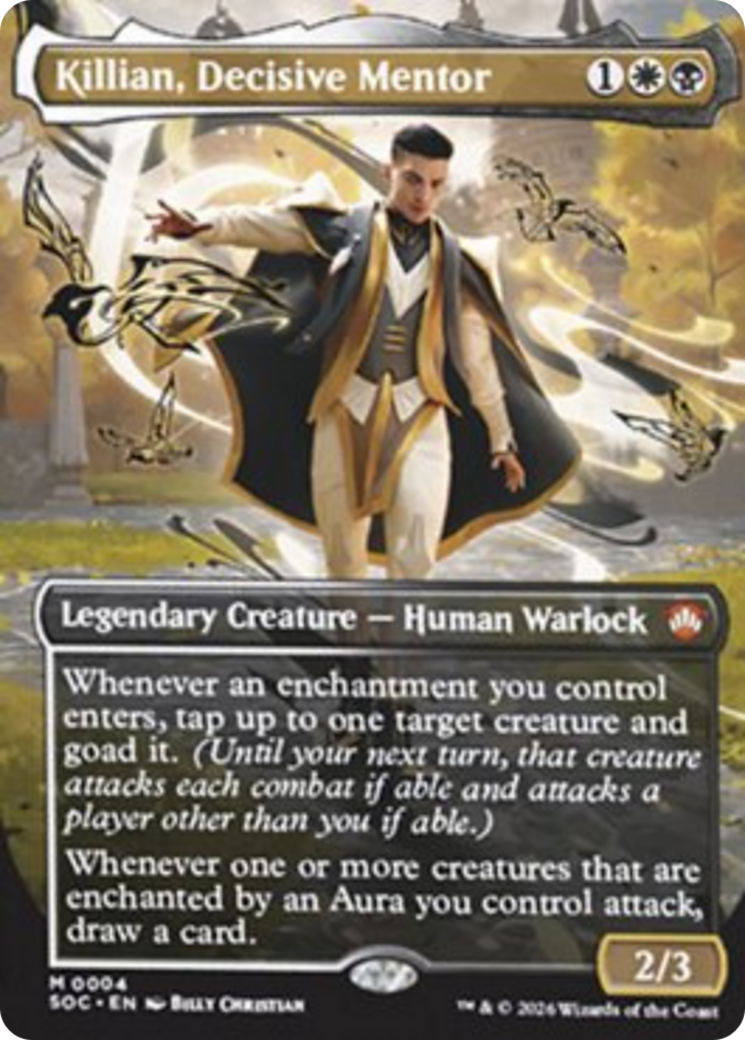
Killian, Decisive Mentor
Killian, Decisive Mentor
Legendary Creature — Human Warlock
2/3
Whenever an enchantment you control enters, tap up to one target creature and goad it. (Until your next turn, that creature attacks each combat if able and attacks a player other than you if able.)
Whenever one or more creatures that are enchanted by an Aura you control attack, draw a card.
- If the creature doesn't meet any of the above exceptions and can attack, it must attack a player other than the controller of the spell or ability that goaded it if able. If the creature can't attack any of those players but could otherwise attack, it must attack a planeswalker an opponent controls, a battle an opponent protects, or the player that goaded it.
- If, during a player's declare attackers step, a creature that player controls that's been goaded is tapped, is affected by a spell or ability that says it can't attack, or hasn't been under that player's control continuously since the turn began (and doesn't have haste), then it doesn't attack. If there's a cost associated with having a creature attack a player, its controller isn't forced to pay that cost, so it doesn't have to attack that player.
- Being goaded isn't an ability the creature has. Once it's been goaded, it must attack as detailed above even if it loses all abilities.
- Attacking with a goaded creature doesn't cause it to stop being goaded. If there is an additional combat phase that turn, or if another player gains control of it before it stops being goaded, it must attack again if able.
- If a creature you control has been goaded by multiple opponents, it must attack one of your opponents that hasn't goaded it, as that fulfills the maximum number of goad requirements. If a creature you control has been goaded by each of your opponents, the creature must attack an opponent (rather than a planeswalker or battle), but you choose which opponent it attacks.
-
1
Killian, Ink Duelist
Killian, Ink Duelist
Legendary Creature — Human Warlock
2/2
Lifelink
Menace (This creature can't be blocked except by two or more creatures.)
Spells you cast that target a creature cost less to cast.
- If a spell has additional costs, apply those increases before applying cost reductions.
- Killian, Ink Duelist can't reduce the colored mana requirement of a spell's mana cost.
- Killian can reduce alternative costs. For example, if you choose to pay the alternative cost for Baleful Mastery while targeting a creature, that cost would be reduced to .
-
1
Kor Spiritdancer
Kor Spiritdancer
Creature — Kor Wizard
0/2
This creature gets +2/+2 for each Aura attached to it.
Whenever you cast an Aura spell, you may draw a card.
- The second ability triggers when you cast any Aura spell, not just one that targets Kor Spiritdancer.
- If you cast an Aura spell, Kor Spiritdancer's second ability triggers and goes on the stack on top of it. The ability will resolve before the spell does.
-
1
Mangara, the Diplomat
Mangara, the Diplomat
Legendary Creature — Human Cleric
2/4
Lifelink
Whenever an opponent attacks with creatures, if two or more of those creatures are attacking you and/or planeswalkers you control, draw a card.
Whenever an opponent casts their second spell each turn, draw a card.
- If your opponent attacks you with one creature and your planeswalker with another, you draw a card.
- Players can cast spells and activate abilities after the triggered ability resolves but before the spell that caused it to trigger does.
- If some of the attacking creatures leave the battlefield while Mangara's triggered ability is on the stack, use the player or planeswalker they were attacking before they left to determine whether you draw a card. On the other hand, if they're removed from combat without leaving the battlefield, use their current information to determine that they're not attacking you or a planeswalker you control anymore.
- An ability that triggers when a player casts a spell resolves before the spell that caused it to trigger. It resolves even if that spell is countered.
- You draw just one card, no matter how many creatures are attacking you and your planeswalkers beyond the second.
-
1
Nils, Discipline Enforcer
Nils, Discipline Enforcer
Legendary Creature — Human Cleric
2/2
At the beginning of your end step, for each player, put a +1/+1 counter on up to one target creature that player controls.
Each creature with one or more counters on it can't attack you or planeswalkers you control unless its controller pays , where X is the number of counters on that creature.
- All counters on a creature are considered when determining the value of X, not only +1/+1 counters.
- For each player, choosing a target creature that player controls is optional.
- Your opponents can choose not to pay to attack with a creature with one or more counters on it that attacks "if able." If there's no other player or planeswalker to attack, the creature simply doesn't attack.
-
1
Pearl-Ear, Imperial Advisor
Pearl-Ear, Imperial Advisor
Legendary Creature — Fox Advisor
3/4
Lifelink
Enchantment spells you cast have affinity for Auras. (They cost less to cast for each Aura you control.)
Whenever you cast an Aura spell that targets a modified permanent you control, draw a card. (Equipment, Auras you control, and counters are modifications.)
- If a spell has multiple instances of affinity, each one applies. For example, if you somehow control two Pearl-Ear, Imperial Advisors and you control two Auras, each enchantment spell you cast will cost less to cast.
- A creature you control that's the target of an Aura spell isn't modified unless it already has a counter on it, an Equipment attached to it, or an Aura you control attached to it.
- A creature that is equipped is considered modified no matter who controls the Equipment that's attached to it.
- A creature with a counter on it is considered modified no matter what kind of counter it is or which player put it on that creature.
- An Aura controlled by another player does not cause a creature you control to be modified.
- If you put an Aura on an opponent's permanent, you still control the Aura, and it still counts for your spells that have affinity for Auras.
-
1
Scriv, the Obligator
Scriv, the Obligator
Legendary Creature — Inkling Bird
2/3
Flying, deathtouch
Whenever Scriv enters or attacks, create a white Aura enchantment token named Contract attached to target creature an opponent controls. The token has enchant creature and "Whenever enchanted creature attacks, it gets +2/+0 until end of turn if it's attacking one of your opponents. Otherwise, its controller loses 2 life."
- If the target creature is an illegal target as Scriv's last ability tries to resolve, it won't resolve and none of its effects will happen. The Contract token won't be created.
- In the rare case that the target creature is a legal target as Scriv's first ability resolves but the target creature can't legally be enchanted by the Contract token, the token won't be created at all.
-
1
Shadrix Silverquill
Shadrix Silverquill
Legendary Creature — Elder Dragon
2/5
Flying, double strike
At the beginning of combat on your turn, you may choose two. Each mode must target a different player.
- Target player creates a 2/1 white and black Inkling creature token with flying.
- Target player draws a card and loses 1 life.
- Target player puts a +1/+1 counter on each creature they control.
- You may choose exactly zero modes or two modes. You can't choose only one mode. If you choose two modes, you choose which two and the target players as you put the triggered ability on the stack.
- You can target a player with the third mode even if they control no creatures.
-
1
Sram, Senior Edificer
Sram, Senior Edificer
Legendary Creature — Dwarf Advisor
2/2
Whenever you cast an Aura, Equipment, or Vehicle spell, draw a card.
- Sram's ability resolves before the spell that caused it to trigger. It resolves even if that spell is countered or otherwise leaves the stack.
-
1
Starfield Mystic
Starfield Mystic
Creature — Human Cleric
2/2
Enchantment spells you cast cost less to cast.
Whenever an enchantment you control is put into a graveyard from the battlefield, put a +1/+1 counter on this creature.
- If you cast an Aura spell targeting an opponent's permanent, you still control the Aura after it resolves.
-
1
Tomik, Wielder of Law
Tomik, Wielder of Law
Legendary Creature — Human Advisor
2/4
Affinity for planeswalkers (This spell costs less to cast for each planeswalker you control.)
Flying, vigilance
Whenever an opponent attacks with creatures, if two or more of those creatures are attacking you and/or planeswalkers you control, that opponent loses 3 life and you draw a card.
-
1
Transcendent Envoy
Transcendent Envoy
Enchantment Creature — Griffin
1/2
Flying
Aura spells you cast cost less to cast.
Instants 4
-
1
Anguished Unmaking
Anguished Unmaking
Instant
Exile target nonland permanent. You lose 3 life.
- If the target nonland permanent is an illegal target as Anguished Unmaking tries to resolve, it won't resolve and none of its effects will happen. You won't lose 3 life.
-
1
Fracture
Fracture
Instant
Destroy target artifact, enchantment, or planeswalker.
-
1
Inkshield
Inkshield
Instant
Prevent all combat damage that would be dealt to you this turn. For each 1 damage prevented this way, create a 2/1 white and black Inkling creature token with flying.
- If multiple damage prevention effects would apply to combat damage that would be dealt to you, you get to choose the order the prevention effects are applied in.
-
1
Vanishing Verse
Vanishing Verse
Instant
Exile target monocolored permanent.
- A monocolored permanent is exactly one color. Colorless permanents aren't monocolored.
Sorceries 3
-
1
Promise of Loyalty
Promise of Loyalty
Sorcery
Each player puts a vow counter on a creature they control and sacrifices the rest. Each of those creatures can't attack you or planeswalkers you control for as long as it has a vow counter on it.
- If the vow counter is removed from the creature, it can attack as normal.
- Each player, including you, must put a vow counter on a creature they control if able. They can't choose to opt out and sacrifice all of their creatures. The creature you put a vow counter on will remember its promise if another player gains control of it.
- If the vow counter is moved to another creature, it won't prevent the second creature from attacking normally.
-
1
Secret Rendezvous
Secret Rendezvous
Sorcery
You and target opponent each draw three cards.
- If the opponent is an illegal target as Secret Rendezvous tries to resolve, neither player will draw cards.
-
1
Winds of Rath
Winds of Rath
Sorcery
Destroy all creatures that aren't enchanted. They can't be regenerated.
- A creature is "enchanted" if it has any Auras attached to it.
Artifacts 4
-
1
Arcane Signet
Arcane Signet
Artifact
: Add one mana of any color in your commander's color identity.
- If your commander is a card that has no colors in its color identity, Arcane Signet's ability produces no mana. It doesn't produce .
- If you have two commanders, the ability adds one mana of any color in their combined color identities.
- If you don't have a commander, Arcane Signet's ability produces no mana.
-
1
Fellwar Stone
Fellwar Stone
Artifact
: Add one mana of any color that a land an opponent controls could produce.
- When determining what colors of mana your opponents' lands could produce, take into account any applicable replacement effects that would apply to those lands' mana abilities (such as Contamination's effect, for example). If there is more than one, consider them in any possible order.
- Fellwar Stone doesn't care about any restrictions or riders your opponents' lands (such as Ancient Ziggurat or Hall of the Bandit Lord) put on the mana they produce. It just cares about colors of mana.
- The colors of mana are white, blue, black, red, and green. Fellwar Stone can't be tapped for colorless mana, even if a land an opponent controls could produce colorless mana.
- Fellwar Stone checks the effects of all mana-producing abilities of lands your opponents control, but it doesn't check their costs. For example, Vivid Crag has the ability " , Remove a charge counter from Vivid Crag: Add one mana of any color." If an opponent controls Vivid Crag and you control Fellwar Stone, you can tap Fellwar Stone for any color of mana. It doesn't matter whether Vivid Crag has a charge counter on it, and it doesn't matter whether it's untapped.
- This works even if the opponent's lands are tapped. It only checks what kinds of mana can be produced, not if the abilities that produce them are usable right now.
- It only produces one mana even if the land can produce more than one.
- The ability can be activated if the opponent has no lands that produce mana, but the effect will not be able to generate any mana.
-
1
Sol Ring
Sol Ring
Artifact
: Add .
-
1
Talisman of Hierarchy
Talisman of Hierarchy
Artifact
: Add .
: Add or . This artifact deals 1 damage to you.
Enchantments 26
-
1
Angelic Destiny
Angelic Destiny
Enchantment — Aura
Enchant creature
Enchanted creature gets +4/+4, has flying and first strike, and is an Angel in addition to its other types.
When enchanted creature dies, return this card to its owner's hand.
- If the creature dies before the Angelic Destiny spell resolves, Angelic Destiny will go to its owner's graveyard. It won't return to its owner's hand.
- If Angelic Destiny is no longer in a graveyard when its triggered ability resolves, it won't be returned to its owner's hand.
-
1
Animate Dead
Animate Dead
Enchantment — Aura
Enchant creature card in a graveyard
When this Aura enters, if it's on the battlefield, it loses "enchant creature card in a graveyard" and gains "enchant creature put onto the battlefield with this Aura." Return enchanted creature card to the battlefield under your control and attach this Aura to it. When this Aura leaves the battlefield, that creature's controller sacrifices it.
Enchanted creature gets -1/-0.
- If Animate Dead isn't on the battlefield as its triggered ability resolves, none of its effects happen. The creature card won't be returned to the battlefield.
- Animate Dead is an Aura, albeit with an unusual enchant ability. You target a creature card in a graveyard when you cast it. It enters the battlefield attached to that card. Then it returns that card to the battlefield, and attaches itself to the card again (since the card is a new object on the battlefield). Animate Dead itself never moves into a graveyard during this process.
- Once the creature is returned to the battlefield, Animate Dead can't be attached to anything other than it (unless Animate Dead somehow manages to put a different creature onto the battlefield). Attempting to move Animate Dead to another creature won't work.
- Abilities such as shroud and protection function only on the battlefield unless otherwise specified. A creature card with shroud may be targeted by Animate Dead, and Animate Dead will become attached to the creature that enters the battlefield.
- If the creature put onto the battlefield has protection from black—or if the creature can't legally be enchanted by Animate Dead for another reason—Animate Dead won't be able to attach to it. It will be put into the graveyard as a state-based action, causing its delayed triggered ability to trigger. When the trigger resolves, if the creature's still on the battlefield, its controller will sacrifice it.
-
1
Chains of Custody
Chains of Custody
Enchantment — Aura
Enchant creature you control
When this Aura enters, exile target nonland permanent an opponent controls until this Aura leaves the battlefield.
Enchanted creature has ward . (Whenever it becomes the target of a spell or ability an opponent controls, counter it unless that player pays .)
- Auras attached to the exiled permanent will be put into their owners' graveyards. Any Equipment will become unattached and remain on the battlefield. Any counters on the exiled permanent will cease to exist. When the card returns to the battlefield, it will be a new object with no connection to the card that was exiled.
- If an Aura is exiled this way, its owner chooses what it will enchant as it returns to the battlefield. An Aura put onto the battlefield this way doesn't target anything (so it could be attached to a permanent with shroud, for example), but the Aura's enchant ability restricts what it can be attached to. If the Aura can't legally be attached to anything, it remains in exile for the rest of the game.
- If a token is exiled this way, it will cease to exist and won't return to the battlefield.
- If Chains of Custody leaves the battlefield before its second ability resolves, the target permanent won't be exiled.
-
1
Changing Loyalty
Changing Loyalty
Enchantment — Aura
Flash
Replicate (When you cast this spell, copy it for each time you paid its replicate cost. You may choose new targets for the copies. Copies become tokens.)
Enchant creature
When enchanted creature dies, return it to the battlefield under your control.
- The replicate triggered ability that creates the copies can itself be countered by anything that can counter a triggered ability. If the ability countered, no copies will be put onto the stack.
- The copies that replicate creates are created on the stack, so they're not "cast." Abilities that trigger when a player casts a spell won't trigger.
- A copy of a spell can be countered like any other spell, but it must be countered individually. Countering a spell with replicate won't affect the copies.
- As the replicate triggered ability resolves, you'll copy Changing Loyalty for each time you paid its replicate cost, even if the original spell is no longer on the stack at that time (perhaps because it was countered).
-
1
Coercive Impetus
Coercive Impetus
Enchantment — Aura
Enchant creature
Enchanted creature gets +1/+1 and is goaded. (It attacks each combat if able and attacks a player other than you if able.)
Whenever enchanted creature attacks, you draw a card and lose 1 life.
- Attacking with a goaded creature doesn't cause it to stop being goaded. If there is an additional combat phase that turn, or if another player gains control of it before it stops being goaded, it must attack again if able.
- If, during a player's declare attackers step, a creature that player controls that's been goaded is tapped, is affected by a spell or ability that says it can't attack, or hasn't been under that player's control continuously since the turn began (and doesn't have haste), then it doesn't attack. If there's a cost associated with having a creature attack a player, its controller isn't forced to pay that cost, so it doesn't have to attack that player.
- If a creature you control has been goaded by multiple opponents, it must attack one of your opponents that hasn't goaded it, as that fulfills the maximum number of goad requirements. If a creature you control has been goaded by each of your opponents, the creature must attack an opponent (rather than a planeswalker or battle), but you choose which opponent it attacks.
- If the creature doesn't meet any of the above exceptions and can attack, it must attack a player other than the controller of the spell or ability that goaded it if able. If the creature can't attack any of those players but could otherwise attack, it must attack a planeswalker an opponent controls, a battle an opponent protects, or the player that goaded it.
- Being goaded isn't an ability the creature has. Once it's been goaded, it must attack as detailed above even if it loses all abilities.
-
1
Darksteel Mutation
Darksteel Mutation
Enchantment — Aura
Enchant creature
Enchanted creature is an Insect artifact creature with base power and toughness 0/1 and has indestructible, and it loses all other abilities, card types, and creature types.
- In some rare cases, the creature may have subtypes other than creature types before becoming enchanted with Darksteel Mutation. If it had any other artifact subtypes (such as Equipment), it will retain those. If it had any subtypes other than artifact types and creature types (such as Shrine), it won't retain those.
- Darksteel Mutation overwrites the printed power and toughness of the enchanted creature, as well as any characteristic-defining abilities that define power and/or toughness.
- The enchanted creature will be only an artifact and a creature, not any other card types. It will be only an Insect, not any other creature types.
- However, Darksteel Mutation does not overwrite effects that change the enchanted creature's power or toughness without setting it to a specific value (such as the ones created by Giant Growth or Glorious Anthem). It also won't overwrite the effect of counters.
- Darksteel Mutation doesn't affect the enchanted creature's colors, if any. It will continue to be whatever color or colors it was before Darksteel Mutation entered the battlefield.
- The creature will keep any supertypes it previously had. Notably, if Darksteel Mutation is enchanting a legendary creature, that creature will continue to be legendary. Also, if it's enchanting a commander, that creature will continue to be a commander.
- Darksteel Mutation causes the enchanted creature to lose all abilities except indestructible at the time it becomes enchanted. Any abilities the creature gains after that point will work normally.
- Darksteel Mutation overwrites any previous effects that set the enchanted creature's power or toughness to a specific value. Any such effects that start to apply after Darksteel Mutation entered the battlefield will work normally.
-
1
Eldrazi Conscription
Eldrazi Conscription
Kindred Enchantment — Eldrazi Aura
Enchant creature
Enchanted creature gets +10/+10 and has trample and annihilator 2. (Whenever it attacks, defending player sacrifices two permanents of their choice.)
- Kindred is a card type that allows noncreature cards to have creature types. For example, Echoes of Eternity is an Eldrazi (although not a creature) while on the battlefield and an Eldrazi card (although not a creature card) in zones other than the battlefield.
- This card was originally printed with the "tribal" card type. That card type has been replaced with "kindred". This change does not affect the gameplay function of this card.
- While it appears only on cards that already have other card types, kindred is a card type and will be counted by effects that refer to the number of card types among cards in a zone.
- If a creature has multiple instances of annihilator, each triggers separately when that creature attacks.
- Annihilator abilities trigger and resolve during the declare attackers step. The defending player chooses and sacrifices the required number of permanents before they declare blockers. Any creatures sacrificed this way won't be able to block.
- Eldrazi Conscription is an Eldrazi. However, it doesn't turn the enchanted creature into an Eldrazi.
- If a creature with annihilator is attacking a planeswalker, and the defending player chooses to sacrifice that planeswalker, the attacking creature continues to attack. It may be blocked. If it isn't blocked, it simply won't deal combat damage to anything.
-
1
Fallen Ideal
Fallen Ideal
Enchantment — Aura
Enchant creature
Enchanted creature has flying and "Sacrifice a creature: This creature gets +2/+1 until end of turn."
When this Aura is put into a graveyard from the battlefield, return it to its owner's hand.
- The creature's controller (not Fallen Ideal's controller) can activate the "sacrifice a creature" ability.
-
1
Flickering Ward
Flickering Ward
Enchantment — Aura
Enchant creature
As this Aura enters, choose a color.
Enchanted creature has protection from the chosen color. This effect doesn't remove this Aura.
: Return this Aura to its owner's hand.
- If you choose White, the enchanted creature will have Protection from White. This will cause any other white Auras attached to that creature to be put into their owner's graveyard, but Flickering Ward will remain on the battlefield.
-
1
Forum Filibuster
Forum Filibuster
Enchantment
At the beginning of your upkeep, create a 2/1 white and black Inkling creature token with flying. When you do, return up to one target Aura or Equipment card from your graveyard to the battlefield attached to that token.
- You don't choose a target for Forum Filibuster's ability at the time it triggers. Instead, a second "reflexive" ability triggers whenever you create the specified token this way. You choose a target for that ability as it goes on the stack. Each player may respond to that triggered ability as normal.
-
1
Ghostly Prison
Ghostly Prison
Enchantment
Creatures can't attack you unless their controller pays for each creature they control that's attacking you.
- Unless some effect explicitly says otherwise, a creature that can't attack you can still attack a planeswalker you control.
- In the Two-Headed Giant format, you still only have to pay once per creature.
-
1
Ghoulish Impetus
Ghoulish Impetus
Enchantment — Aura
Enchant creature
Enchanted creature gets +1/+1, has deathtouch, and is goaded. (It attacks each combat if able and attacks a player other than you if able.)
When enchanted creature dies, return this card to the battlefield at the beginning of the next end step.
- If, during a player's declare attackers step, a creature that player controls that's been goaded is tapped, is affected by a spell or ability that says it can't attack, or hasn't been under that player's control continuously since the turn began (and doesn't have haste), then it doesn't attack. If there's a cost associated with having a creature attack a player, its controller isn't forced to pay that cost, so it doesn't have to attack that player.
- Attacking with a goaded creature doesn't cause it to stop being goaded. If a creature you control has been goaded by multiple opponents, it must attack one of your opponents that hasn't goaded it, as that fulfills the maximum number of goad requirements. If a creature you control has been goaded by each of your opponents, the creature must attack an opponent (rather than a planeswalker or battle), but you choose which opponent it attacks.
- Being goaded isn't an ability the creature has. Once it's been goaded, it must attack as detailed above even if it loses all abilities.
- If the creature doesn't meet any of the above exceptions and can attack, it must attack a player other than the controller of the spell or ability that goaded it if able. If the creature can't attack any of those players but could otherwise attack, it must attack a planeswalker an opponent controls, a battle an opponent protects, or a player who goaded it.
-
1
Gift of Immortality
Gift of Immortality
Enchantment — Aura
Enchant creature
When enchanted creature dies, return that card to the battlefield under its owner's control. Return this card to the battlefield attached to that creature at the beginning of the next end step.
- If the enchanted creature is a token, neither it nor Gift of Immortality will return to the battlefield.
- If the creature is no longer on the battlefield at the beginning of the next end step after it's returned to the battlefield, Gift of Immortality will remain in its owner's graveyard.
-
1
Intermediate Chirography
Intermediate Chirography
Enchantment — Class
(Gain the next level as a sorcery to add its ability.)
When this Class enters, create a 2/1 white and black Inkling creature token with flying.
: Level 2
Whenever you lose life for the first time each turn, put a +1/+1 counter on target creature you control.
: Level 3
At the beginning of each end step, if a modified creature died under your control this turn, create a 2/1 white and black Inkling creature token with flying. (Equipment, Auras you control, and counters are modifications.)
- Intermediate Chirography's level 3 ability will check as your end step starts to see if any modified creatures died under your control this turn. If none did, the ability won't trigger at all. It's not possible to cause creatures to die during your end step in time to have the ability trigger.
- A creature with a counter on it is considered modified no matter what kind of counter it is or which player put it on that creature.
- Intermediate Chirography's level 2 ability triggers just once for your first life-losing event on each turn, no matter how much life you lose.
- An Aura controlled by another player does not cause a creature you control to be modified.
- A creature that is equipped is considered modified no matter who controls the Equipment that's attached to it.
- If you lose life during a turn before Intermediate Chirography has its level 2 ability, that ability won't trigger that turn even if you lose life again later in the turn.
-
1
Land Tax
Land Tax
Enchantment
At the beginning of your upkeep, if an opponent controls more lands than you, you may search your library for up to three basic land cards, reveal them, put them into your hand, then shuffle.
- You shuffle your library if you search, even if you don't put any basic land cards into your hand.
- This ability has an "intervening 'if' clause." That means (1) the ability won't trigger at all unless any one of your opponents controls more lands than you, and (2) the ability will do nothing if you control at least as many lands as each of your opponents by the time it resolves.
- You can fetch any of the "Snow-Covered" lands, since they all also have the supertype basic.
-
1
Martial Impetus
Martial Impetus
Enchantment — Aura
Enchant creature
Enchanted creature gets +1/+1 and is goaded. (It attacks each combat if able and attacks a player other than you if able.)
Whenever enchanted creature attacks, each other creature that's attacking one of your opponents gets +1/+1 until end of turn.
- If the creature doesn't meet any of the above exceptions and can attack, it must attack a player other than the controller of the spell or ability that goaded it if able. If the creature can't attack any of those players but could otherwise attack, it must attack a planeswalker an opponent controls, a battle an opponent controls, or a player who goaded it.
- If, during a player's declare attackers step, a creature that player controls that's been goaded is tapped, is affected by a spell or ability that says it can't attack, or hasn't been under that player's control continuously since the turn began (and doesn't have haste), then it doesn't attack. If there's a cost associated with having a creature attack a player, its controller isn't forced to pay that cost, so it doesn't have to attack that player.
- Attacking with a goaded creature doesn't cause it to stop being goaded. If there is an additional combat phase that turn, or if another player gains control of it before it stops being goaded, it must attack again if able.
- If a creature you control has been goaded by multiple opponents, it must attack one of your opponents that hasn't goaded it, as that fulfills the maximum number of goad requirements. If a creature you control has been goaded by each of your opponents, the creature must attack an opponent (rather than a planeswalker or battle), but you choose which opponent it attacks.
- Being goaded isn't an ability the creature has. Once it's been goaded, it must attack as detailed above even if it loses all abilities.
-
1
Parasitic Impetus
Parasitic Impetus
Enchantment — Aura
Enchant creature
Enchanted creature gets +2/+2 and is goaded. (It attacks each combat if able and attacks a player other than you if able.)
Whenever enchanted creature attacks, its controller loses 2 life and you gain 2 life.
- Being goaded isn't an ability the creature has. Once it's been goaded, it must attack as detailed above even if it loses all abilities.
- If, during a player's declare attackers step, a creature that player controls that's been goaded is tapped, is affected by a spell or ability that says it can't attack, or hasn't been under that player's control continuously since the turn began (and doesn't have haste), then it doesn't attack. If there's a cost associated with having a creature attack a player, its controller isn't forced to pay that cost, so it doesn't have to attack that player.
- If a creature you control has been goaded by multiple opponents, it must attack one of your opponents that hasn't goaded it, as that fulfills the maximum number of goad requirements. If a creature you control has been goaded by each of your opponents, the creature must attack an opponent (rather than a planeswalker or battle), but you choose which opponent it attacks.
- Attacking with a goaded creature doesn't cause it to stop being goaded. If there is an additional combat phase that turn, or if another player gains control of it before it stops being goaded, it must attack again if able.
- If the creature doesn't meet any of the above exceptions and can attack, it must attack a player other than the controller of the spell or ability that goaded it if able. If the creature can't attack any of those players but could otherwise attack, it must attack a planeswalker an opponent controls, a battle an opponent controls, or a player who goaded it.
- If you are the attacking creature's controller, you lose 2 life and gain 2 life. You won't lose the game if your life total is 0 in between these two events.
- Parasitic Impetus causes you to gain life, not the attacking creature's controller.
-
1
Raffine's Guidance
Raffine's Guidance
Enchantment — Aura
Enchant creature
Enchanted creature gets +1/+1.
You may cast this card from your graveyard by paying rather than paying its mana cost.
-
1
Redemption Arc
Redemption Arc
Enchantment — Aura
Enchant creature
Enchanted creature has indestructible and is goaded. (It attacks each combat if able and attacks a player other than you if able.)
: Exile enchanted creature.
-
1
Sage's Reverie
Sage's Reverie
Enchantment — Aura
Enchant creature
When this Aura enters, draw a card for each Aura you control that's attached to a creature.
Enchanted creature gets +1/+1 for each Aura you control that's attached to a creature.
- Count the number of Auras you control attached to creatures as the enters-the-battlefield ability resolves to determine how many cards to draw. This will include Sage's Reverie as long as it's still on the battlefield at that time.
- An Aura doesn't necessarily need the enchant creature ability for the abilities of Sage's Reverie to count it. For example, an Aura with enchant permanent that's attached to a creature will count.
-
1
Screams from Within
Screams from Within
Enchantment — Aura
Enchant creature
Enchanted creature gets -1/-1.
When enchanted creature dies, return this card from your graveyard to the battlefield.
- If Screams from Within returns to the battlefield from your graveyard, you choose the creature that Screams from Within enchants (just as you would for any Aura that you're putting onto the battlefield without casting it). If your opponent doesn't control any creatures, you must choose one of your creatures. If there's nothing at all that Screams from Within can enchant, it remains in your graveyard.
- If another player has gained control of Screams from Within, its triggered ability does nothing when it's put into a graveyard. Cards are always put into their owner's graveyard, but Screams from Within's ability looks for the card only in its controller's graveyard.
-
1
Sentinel's Eyes
Sentinel's Eyes
Enchantment — Aura
Enchant creature
Enchanted creature gets +1/+1 and has vigilance.
Escape— , Exile two other cards from your graveyard. (You may cast this card from your graveyard for its escape cost.)
- If a card has multiple abilities giving you permission to cast it, such as two escape abilities or an escape ability and a flashback ability, you choose which one to apply. The others have no effect.
- Escape's permission doesn't change when you may cast the spell from your graveyard.
- If you cast a spell with its escape permission, you can't choose to apply any other alternative costs or to cast it without paying its mana cost. If it has any additional costs, you must pay those.
- If a card with escape is put into your graveyard during your turn, you'll be able to cast it right away if it's legal to do so, before an opponent can take any actions.
- After an escaped spell resolves, it returns to its owner's graveyard if it's not a permanent spell. If it is a permanent spell, it enters the battlefield and will return to its owner's graveyard if it dies later. Perhaps it will escape again—good underworld security is so hard to come by these days.
- Once you begin casting a spell with escape, it immediately moves to the stack. Players can't take any other actions until you're done casting the spell.
- To determine the total cost of a spell, start with the mana cost or alternative cost you're paying (such as an escape cost), add any cost increases, then apply any cost reductions. The mana value of the spell remains unchanged, no matter what the total cost to cast it was and no matter whether an alternative cost was paid.
-
1
Sheltered by Ghosts
Sheltered by Ghosts
Enchantment — Aura
Enchant creature you control
When this Aura enters, exile target nonland permanent an opponent controls until this Aura leaves the battlefield.
Enchanted creature gets +1/+0 and has lifelink and ward .
- If Sheltered by Ghosts leaves the battlefield before its triggered ability resolves, the target permanent won't be exiled at all.
- Auras attached to the exiled permanent will be put into their owners' graveyards. Any Equipment will become unattached and remain on the battlefield. Any counters on the exiled permanent will cease to exist. When the card returns to the battlefield, it will be a new object with no connection to the card that was exiled.
- If a token is exiled this way, it will cease to exist and won't return to the battlefield.
-
1
Shielded by Faith
Shielded by Faith
Enchantment — Aura
Enchant creature
Enchanted creature has indestructible.
Whenever a creature enters, you may attach this Aura to that creature.
-
1
Songbirds' Blessing
Songbirds' Blessing
Enchantment — Aura
Enchant creature
Whenever enchanted creature attacks, reveal cards from the top of your library until you reveal an Aura card. You may put that card onto the battlefield. If you don't, put it into your hand. Put the rest on the bottom of your library in a random order.
- If you put an Aura card onto the battlefield with Songbirds' Blessing's triggered ability, you choose what it will enchant as it enters the battlefield. An Aura put onto the battlefield this way doesn't target anything (so it could be attached to an opponent's permanent with hexproof, for example), but the Aura's enchant ability restricts what it can be attached to. If the Aura can't legally be attached to anything, you won't be able to put it onto the battlefield, and it will be put into your hand by the next part of the effect.
-
1
Spirit Mantle
Spirit Mantle
Enchantment — Aura
Enchant creature
Enchanted creature gets +1/+1 and has protection from creatures.
Lands 37
-
1
Arcane Lighthouse
Arcane Lighthouse
Land
: Add .
, : Until end of turn, creatures your opponents control lose hexproof and shroud and can't have hexproof or shroud.
- After the second ability resolves, continuous effects generated by the resolution of spells and abilities that would give hexproof or shroud to one of the affected creatures aren't created. For example, after the second ability resolves, a spell cast by an opponent that gives creatures they control hexproof wouldn't cause the creatures to have hexproof. (If that spell has additional effects, such as raising the power of the creatures, those effects will apply as normal.)
- Continuous effects generated by static abilities (such as an Aura that grants hexproof to a creature) will not apply during the turn, but will resume applying once the turn ends.
- The second ability applies only to creatures controlled by your opponents when it resolves. Creatures that enter the battlefield or come under an opponent's control later in the turn won't be affected.
-
1
Bojuka Bog
Bojuka Bog
Land
This land enters tapped.
When this land enters, exile target player's graveyard.
: Add .
-
1
Caves of Koilos
Caves of Koilos
Land
: Add .
: Add or . This land deals 1 damage to you.
- The damage dealt to you is part of the second mana ability. It doesn't use the stack and can't be responded to.
- Like most lands, each land in this cycle is colorless. The damage dealt to you is dealt by a colorless source.
-
1
Command Tower
Command Tower
Land
: Add one mana of any color in your commander's color identity.
- If you don't have a commander, Command Tower's ability produces no mana.
- If your commander is a card that has no colors in its color identity, Command Tower's ability produces no mana. It doesn't produce .
- If you have two commanders, the ability adds one mana of any color in their combined color identities.
-
1
Desolate Mire
Desolate Mire
Land
, : Add .
-
1
Eclipsed Steppe
Eclipsed Steppe
Land — Plains Swamp
( : Add or .)
This land enters tapped unless you control two or more basic lands.
- If this land enters the battlefield at the same time as any number of basic lands, those other lands are not counted when determining if this land enters the battlefield tapped or untapped.
- Unlike some other dual lands, Eclipsed Steppe has two basic land types. It's not basic, so effects that search for basic lands can't find it, but it does have the appropriate land types for effects such as that of Shineshadow Snarl (included in the Secrets of Strixhaven Commander decks).
-
1
Exotic Orchard
Exotic Orchard
Land
: Add one mana of any color that a land an opponent controls could produce.
- Lands that produce mana based only on what other lands "could produce" won't help each other unless some other land allows one of them to actually produce some type of mana. For example, if you control an Exotic Orchard and your opponent controls an Exotic Orchard and a Reflecting Pool, none of those lands would produce mana if their mana abilities were activated. On the other hand, if you control a Forest and an Exotic Orchard, and your opponent controls an Exotic Orchard and a Reflecting Pool, then each of those lands can be tapped to produce . Your opponent's Exotic Orchard can produce because you control a Forest. Your Exotic Orchard and your opponent's Reflecting Pool can each produce because your opponent's Exotic Orchard can produce .
- When determining what colors of mana your opponents' lands could produce, Exotic Orchard takes into account any applicable replacement effects that would apply to those lands' mana abilities (such as Contamination's effect, for example). If there are more than one, consider them in any possible order.
- The colors of mana are white, blue, black, red, and green. Exotic Orchard can't be tapped for colorless mana, even if a land an opponent controls could produce colorless mana.
- Exotic Orchard doesn't care about any restrictions or riders your opponents' lands (such as Ancient Ziggurat or Hall of the Bandit Lord) put on the mana they produce. It just cares about colors of mana.
- Exotic Orchard checks the effects of all mana-producing abilities of lands your opponents control, but it doesn't check their costs. For example, Vivid Crag has the ability " , Remove a charge counter from Vivid Crag: Add one mana of any color." If an opponent controls Vivid Crag and you control Exotic Orchard, you can tap Exotic Orchard for any color of mana. It doesn't matter whether Vivid Crag has a charge counter on it, and it doesn't matter whether it's untapped.
-
1
Fabled Passage
Fabled Passage
Land
, Sacrifice this land: Search your library for a basic land card, put it onto the battlefield tapped, then shuffle. Then if you control four or more lands, untap that land.
- If you control four or more lands, the basic land doesn't enter untapped; it enters tapped and then you untap it.
- The land that you put onto the battlefield will be counted when determining whether you control four or more lands, but Fabled Passage will not.
-
1
Fetid Heath
Fetid Heath
Land
: Add .
, : Add , , or .
-
1
Forum of Amity
Forum of Amity
Land
This land enters tapped.
: Add or .
, : Surveil 1. (Look at the top card of your library. You may put it into your graveyard.)
-
1
Isolated Chapel
Isolated Chapel
Land
This land enters tapped unless you control a Plains or a Swamp.
: Add or .
-
1
Path of Ancestry
Path of Ancestry
Land
This land enters tapped.
: Add one mana of any color in your commander's color identity. When that mana is spent to cast a creature spell that shares a creature type with your commander, scry 1. (Look at the top card of your library. You may put that card on the bottom.)
- Your commander's creature types are checked immediately after you cast a creature spell spending mana from Path of Ancestry's last ability. They aren't set before the game begins, and they may not be the same types your commander had when you activated that ability.
- If you have two commanders, the last ability adds one mana of any color in their combined color identities. When you spend that mana on a creature spell that shares a creature type with either of your commanders, you'll scry 1.
- If Path of Ancestry's last ability produces two mana (most likely due to Mana Reflection), spending those two mana to cast creature spells that share a creature type with your commander will cause two abilities to trigger. Each of those abilities will cause you to scry 1. You won't scry 2. This is true whether you spend the mana on one creature spell or two.
- If your commander has no creature types, it can't share a creature type with any spell that you cast.
- If you cast your commander with mana from Path of Ancestry, and your commander hasn't somehow lost all of its creature types while on the stack, you'll scry 1.
- If you don't have a commander, Path of Ancestry's ability produces no mana.
- If your commander is a card that has no colors in its color identity, Path of Ancestry's ability produces no mana. It doesn't produce .
-
8
Plains
Plains
Basic Land — Plains
( : Add .)
-
1
Shineshadow Snarl
Shineshadow Snarl
Land
As this land enters, you may reveal a Plains or Swamp card from your hand. If you don't, this land enters tapped.
: Add or .
- If a land card with an appropriate subtype is entering the battlefield from your hand at the same time as one of these lands, you may reveal the other land to have the "Snarl" enter untapped.
- If an effect instructs you to put one of these lands onto the battlefield tapped, it will still enter the battlefield tapped even if you reveal a land card from your hand.
- The "Snarl" itself doesn't have any land subtypes. You can't reveal one to satisfy the ability of another.
- You may reveal any land card with either or both of the appropriate subtypes. It doesn't have to be a basic land card.
-
1
Silverquill Campus
Silverquill Campus
Land
This land enters tapped.
: Add or .
, : Scry 1. (Look at the top card of your library. You may put that card on the bottom.)
-
1
Study Hall
Study Hall
Land
: Add .
, : Add one mana of any color. When you spend this mana to cast your commander, scry X, where X is the number of times it's been cast from the command zone this game.
-
1
Sunlit Marsh
Sunlit Marsh
Land — Plains Swamp
( : Add or .)
This land enters tapped.
-
8
Swamp
Swamp
Basic Land — Swamp
( : Add .)
-
1
Temple of Silence
Temple of Silence
Land
This land enters tapped.
When this land enters, scry 1. (Look at the top card of your library. You may put that card on the bottom.)
: Add or .
- When you scry, you may put all the cards you look at back on top of your library, you may put all of those cards on the bottom of your library, or you may put some of those cards on top and the rest of them on the bottom.
- You choose how to order cards returned to your library after scrying no matter where you put them.
- You perform the actions stated on a card in sequence. For some spells and abilities, that means you'll scry last. For others, that means you'll scry and then perform other actions.
- Scry appears on some spells and abilities with one or more targets. If all of the spell or ability's targets are illegal when it tries to resolve, it won't resolve and none of its effects will happen. You won't scry.
-
1
Terramorphic Expanse
Terramorphic Expanse
Land
, Sacrifice this land: Search your library for a basic land card, put it onto the battlefield tapped, then shuffle.
-
1
Turbulent Moor
Turbulent Moor
Land — Plains Swamp
( : Add or .)
This land enters tapped unless your opponents control eight or more lands.
- Unlike some other dual lands, Turbulent Moor has two basic land types. It's not basic, so effects that search for basic lands can't find it, but it does have the appropriate land types for effects such as that of Shineshadow Snarl (included in the Secrets of Strixhaven Commander decks).
- If this land enters the battlefield at the same time as any number of lands your opponents control, those other lands are not counted when determining if this land enters the battlefield tapped or untapped.
-
1
Umbral Expanse
Umbral Expanse
Land — Plains Swamp
( : Add or .)
This land enters tapped.
Cycling ( , Discard this card: Draw a card.)
- Unlike some other dual lands, Umbral Expanse has two basic land types. It's not basic, so effects that search for basic lands can't find it, but it does have the appropriate land types for effects such as that of Shineshadow Snarl (included in the Secrets of Strixhaven Commander decks).
-
1
War Room
War Room
Land
: Add .
, , Pay life equal to the number of colors in your commanders' color identity: Draw a card.
- Color identity is set before the game begins and doesn't change during the game, even if your commander is in a hidden zone (like the hand or library) or an effect changes your commander's color.
- If you don't have a commander, you can't activate War Room's last ability at all.
- If your commander has no colors in its color identity, you pay no life to activate War Room's last ability.
White 35
-
1
Ajani's Chosen
Ajani's Chosen
Creature — Cat Soldier
3/3
Whenever an enchantment you control enters, create a 2/2 white Cat creature token. If that enchantment is an Aura, you may attach it to the token.
- If you cast an Aura targeting an opponent or a permanent controlled by an opponent, you control that Aura when it enters the battlefield. The ability of Ajani's Chosen will trigger.
- You may attach the Aura to the token only if it can legally enchant that token. For example, if the enchantment that entered the battlefield is an Aura with "enchant land," it won't become attached to that token.
- The ability doesn't trigger until the enchantment enters the battlefield. This means that, for example, you can't cast an Aura with enchant creature if there are no legal targets available, hoping to enchant the Cat token. Ajani's Chosen itself, however, may be a legal target for the Aura.
- You may attach the Aura to the Cat token only if the Aura and the token are both on the battlefield when the triggered ability resolves. If the Aura leaves the battlefield before the ability resolves, it won't become attached to the token. If the token leaves the battlefield before the ability resolves, the Aura won't become attached to that token.
-
1
Angelic Destiny
Angelic Destiny
Enchantment — Aura
Enchant creature
Enchanted creature gets +4/+4, has flying and first strike, and is an Angel in addition to its other types.
When enchanted creature dies, return this card to its owner's hand.
- If the creature dies before the Angelic Destiny spell resolves, Angelic Destiny will go to its owner's graveyard. It won't return to its owner's hand.
- If Angelic Destiny is no longer in a graveyard when its triggered ability resolves, it won't be returned to its owner's hand.
-
1
Archon of Sun's Grace
Archon of Sun's Grace
Creature — Archon
3/4
Flying
Lifelink (Damage dealt by this creature also causes you to gain that much life.)
Pegasus creatures you control have lifelink.
Constellation — Whenever an enchantment you control enters, create a 2/2 white Pegasus creature token with flying.
- Multiple instances of lifelink on the same creature are redundant.
- A constellation ability triggers whenever an enchantment enters the battlefield under your control for any reason. Enchantments with other card types, such as enchantment creatures, will also cause constellation abilities to trigger.
- An Aura spell that has an illegal target when it tries to resolve doesn't resolve and is instead put into its owner's graveyard. It doesn't enter the battlefield, so constellation abilities don't trigger.
-
1
Armored Skyhunter
Armored Skyhunter
Creature — Cat Knight
3/3
Flying
Whenever this creature attacks, look at the top six cards of your library. You may put an Aura or Equipment card from among them onto the battlefield. If an Equipment is put onto the battlefield this way, you may attach it to a creature you control. Put the rest of those cards on the bottom of your library in a random order.
- An Aura put onto the battlefield this way doesn't target anything (so it could be attached to an opponent's permanent with hexproof, for example), but the Aura's enchant ability restricts what it can be attached to. If the Aura can't legally be attached to anything, you can't choose to put it onto the battlefield at all.
-
1
Chains of Custody
Chains of Custody
Enchantment — Aura
Enchant creature you control
When this Aura enters, exile target nonland permanent an opponent controls until this Aura leaves the battlefield.
Enchanted creature has ward . (Whenever it becomes the target of a spell or ability an opponent controls, counter it unless that player pays .)
- Auras attached to the exiled permanent will be put into their owners' graveyards. Any Equipment will become unattached and remain on the battlefield. Any counters on the exiled permanent will cease to exist. When the card returns to the battlefield, it will be a new object with no connection to the card that was exiled.
- If an Aura is exiled this way, its owner chooses what it will enchant as it returns to the battlefield. An Aura put onto the battlefield this way doesn't target anything (so it could be attached to a permanent with shroud, for example), but the Aura's enchant ability restricts what it can be attached to. If the Aura can't legally be attached to anything, it remains in exile for the rest of the game.
- If a token is exiled this way, it will cease to exist and won't return to the battlefield.
- If Chains of Custody leaves the battlefield before its second ability resolves, the target permanent won't be exiled.
-
1
Combat Calligrapher
Combat Calligrapher
Creature — Bird Cleric
3/3
Flying
Inklings can't attack you or planeswalkers you control.
Whenever a player attacks one of your opponents, that attacking player creates a tapped 2/1 white and black Inkling creature token with flying that's attacking that opponent.
-
1
Darksteel Mutation
Darksteel Mutation
Enchantment — Aura
Enchant creature
Enchanted creature is an Insect artifact creature with base power and toughness 0/1 and has indestructible, and it loses all other abilities, card types, and creature types.
- In some rare cases, the creature may have subtypes other than creature types before becoming enchanted with Darksteel Mutation. If it had any other artifact subtypes (such as Equipment), it will retain those. If it had any subtypes other than artifact types and creature types (such as Shrine), it won't retain those.
- Darksteel Mutation overwrites the printed power and toughness of the enchanted creature, as well as any characteristic-defining abilities that define power and/or toughness.
- The enchanted creature will be only an artifact and a creature, not any other card types. It will be only an Insect, not any other creature types.
- However, Darksteel Mutation does not overwrite effects that change the enchanted creature's power or toughness without setting it to a specific value (such as the ones created by Giant Growth or Glorious Anthem). It also won't overwrite the effect of counters.
- Darksteel Mutation doesn't affect the enchanted creature's colors, if any. It will continue to be whatever color or colors it was before Darksteel Mutation entered the battlefield.
- The creature will keep any supertypes it previously had. Notably, if Darksteel Mutation is enchanting a legendary creature, that creature will continue to be legendary. Also, if it's enchanting a commander, that creature will continue to be a commander.
- Darksteel Mutation causes the enchanted creature to lose all abilities except indestructible at the time it becomes enchanted. Any abilities the creature gains after that point will work normally.
- Darksteel Mutation overwrites any previous effects that set the enchanted creature's power or toughness to a specific value. Any such effects that start to apply after Darksteel Mutation entered the battlefield will work normally.
-
1
Eidolon of Countless Battles
Eidolon of Countless Battles
Enchantment Creature — Spirit
0/0
Bestow (If you cast this card for its bestow cost, it's an Aura spell with enchant creature. It becomes a creature again if it's not attached.)
This creature and enchanted creature each get +1/+1 for each creature you control and +1/+1 for each Aura you control.
- A permanent with bestow is either a creature or an Aura, not both (although it's an enchantment either way). It will contribute just +1/+1 toward the bonus given by Eidolon of Countless Battles.
- Eidolon of Countless Battles's last ability functions only on the battlefield. In other zones, it is a 0/0 enchantment creature card.
- On the stack, a spell with bestow is either a creature spell or an Aura spell. It's never both, although it's an enchantment spell in either case.
- Auras attached to a creature don't become tapped when the creature becomes tapped. Except in some rare cases, an Aura with bestow remains untapped when it becomes unattached and becomes a creature.
- If a permanent with bestow enters the battlefield by any method other than being cast, it will be an enchantment creature. You can't choose to pay the bestow cost and have it become an Aura.
- Unlike other Aura spells, an Aura spell with bestow isn't countered if its target is illegal as it begins to resolve. Rather, the effect making it an Aura spell ends, it loses enchant creature, it returns to being an enchantment creature spell, and it resolves and enters the battlefield as an enchantment creature.
- Unlike other Auras, an Aura with bestow isn't put into its owner's graveyard if it becomes unattached. Rather, the effect making it an Aura ends, it loses enchant creature, and it remains on the battlefield as an enchantment creature. It can attack (and its abilities can be activated, if it has any) on the turn it becomes unattached if it's been under your control continuously, even as an Aura, since your most recent turn began.
-
1
Eiganjo Dynastorian // Replenish
//
Eiganjo Dynastorian
Creature — Fox Advisor
2/3
- Once Eiganjo Dynastorian's last ability triggers, it doesn't matter what happens to the attacking creatures in response.
- While copies of spells in zones other than the stack cease to exist when state-based actions are checked, this does not apply to copies of prepare spells in exile that were created as a creature became prepared.
- A preparation card is a creature card in every zone. For example, while it's in your graveyard, Emeritus of Ideation is a blue creature whose mana value is 5. It can't be the target of Zealous Lorecaster's triggered ability ("When this creature enters, return target instant or sorcery card from your graveyard to your hand.").
- Only the current controller of a prepared creature can cast the copy of its prepare spell in exile. It doesn't matter who owns that creature or who controlled it when it became prepared.
- If a prepared creature stops being a creature, it will still be prepared, and the copy of its prepare spell will remain in exile. That permanent's controller will still be able to cast it. The same is true if a prepared creature becomes a copy of something else, even if it's then a permanent without a prepare spell.
- Casting a copy of a prepare spell from exile isn't casting it for an alternative cost. Effects that allow you to cast a spell for an alternative cost or without paying its mana cost may allow you to apply those to a copy of a prepare spell cast from exile.
- Preparation cards can only be cast with their base characteristics.
- A creature without a prepare spell can't become prepared.
- Creating a copy of a creature's prepare spell in exile ignores copy exceptions applied to that creature that would affect the copiable values of that spell. For example, say a player casts Croaking Counterpart (a sorcery that says "Create a token that's a copy of target non-Frog creature, except it's a 1/1 green Frog.") targeting Goblin Glasswright. The token copy of Goblin Glasswright will enter prepared as a 1/1 green Frog creature, but the copy of Craft with Pride in exile will still be a red sorcery. The copy of Craft with Pride won't be green, a creature, or a Frog, and it won't have power or toughness.
- A creature with a prepare spell can't become prepared more than once at the same time. For example, Emeritus of Ideation is on the battlefield and is prepared. When it attacks, its last ability triggers. When that ability resolves, its controller may still exile eight cards from their graveyard, but doing so won't cause Emeritus of Ideation to become prepared a second time or create a second copy of Ancestral Recall in exile.
- If a prepare spell with one or more targets has no legal targets when it tries to resolve, it won't resolve and none of its effects will happen. Since the spell was cast, the associated permanent will still not be prepared.
- If a prepared creature loses all abilities, it won't stop being prepared, and nothing will happen to its alternative characteristics or to the copy of its prepare spell in exile.
- If an effect instructs you to choose a card name, you may choose the alternative prepare spell's name. Consider only the alternative characteristics to determine whether that is an appropriate name to choose.
- An Aura put onto the battlefield this way can't enchant an enchantment that's also being put onto the battlefield with Replenish.
- As an effect causes a creature with a prepare spell to become prepared (including effects that state that a creature "enters prepared"), that creature's controller creates a copy of that creature's prepare spell in exile. That copy remains in exile for as long as that permanent is on the battlefield and is prepared. That creature's controller may cast that copy as long as it remains in exile. As they cast it, that creature stops being prepared.
- Being prepared isn't a copiable value. If a permanent becomes a copy of a prepared creature, it won't be prepared. That permanent will have the alternative characteristics, though, and some other effect could cause it to become prepared later.
- If an effect causes a creature to become unprepared, a prepared creature stops being prepared and the associated copy of its prepare spell in exile ceases to exist. If it wasn't prepared at that time, nothing happens.
- If an Aura is put onto the battlefield without being cast, the Aura's controller-to-be chooses what it will enchant as it enters the battlefield. An Aura put onto the battlefield this way doesn't target anything (so it could be attached to an opponent's permanent with hexproof, for example), but the Aura's enchant ability restricts what it can be attached to. If the Aura can't legally be attached to anything, it remains in its current zone.
-
1
Firemane Commando
Firemane Commando
Creature — Angel Soldier
4/3
Flying
Whenever you attack with two or more creatures, draw a card.
Whenever another player attacks with two or more creatures, they draw a card if none of those creatures attacked you.
- The last triggered ability cares only that none of the attacking creatures attacked you. The other player will draw a card if they attacked a planeswalker you control or a battle you protect with two or more creatures, for example.
- No matter how many creatures another player attacks with, Firemane Commando's last ability will look at all of them to make sure none of them attacked you. If any of them did, the player won't draw a card.
- For both triggered abilities, once the ability triggers, it doesn't matter what happens to the attacking creatures in response.
-
1
Flickering Ward
Flickering Ward
Enchantment — Aura
Enchant creature
As this Aura enters, choose a color.
Enchanted creature has protection from the chosen color. This effect doesn't remove this Aura.
: Return this Aura to its owner's hand.
- If you choose White, the enchanted creature will have Protection from White. This will cause any other white Auras attached to that creature to be put into their owner's graveyard, but Flickering Ward will remain on the battlefield.
-
1
Forum Filibuster
Forum Filibuster
Enchantment
At the beginning of your upkeep, create a 2/1 white and black Inkling creature token with flying. When you do, return up to one target Aura or Equipment card from your graveyard to the battlefield attached to that token.
- You don't choose a target for Forum Filibuster's ability at the time it triggers. Instead, a second "reflexive" ability triggers whenever you create the specified token this way. You choose a target for that ability as it goes on the stack. Each player may respond to that triggered ability as normal.
-
1
Ghostly Prison
Ghostly Prison
Enchantment
Creatures can't attack you unless their controller pays for each creature they control that's attacking you.
- Unless some effect explicitly says otherwise, a creature that can't attack you can still attack a planeswalker you control.
- In the Two-Headed Giant format, you still only have to pay once per creature.
-
1
Gift of Immortality
Gift of Immortality
Enchantment — Aura
Enchant creature
When enchanted creature dies, return that card to the battlefield under its owner's control. Return this card to the battlefield attached to that creature at the beginning of the next end step.
- If the enchanted creature is a token, neither it nor Gift of Immortality will return to the battlefield.
- If the creature is no longer on the battlefield at the beginning of the next end step after it's returned to the battlefield, Gift of Immortality will remain in its owner's graveyard.
-
1
Herald of Amity
Herald of Amity
Creature — Griffin
2/2
Flying
When this creature enters, exile the top eight cards of your library. You may cast an Aura spell from among them without paying its mana cost. Then put the rest on the bottom of your library in a random order.
Whenever this creature attacks, it gets +X/+X until end of turn, where X is the number of Auras you control.
- If you cast a spell "without paying its mana cost," you can't choose to cast it for any alternative costs. You can, however, pay additional costs. If the spell has any mandatory additional costs, you must pay those to cast the spell.
- You cast the spell while Herald of Amity's second ability is resolving and still on the stack. You can't wait to cast it later in the turn. Timing restrictions based on the card's types are ignored.
- If the exiled Aura has in its mana cost, you must choose 0 as the value of X when casting it without paying its mana cost.
- The value of X is calculated at the time Herald of Amity's last ability resolves.
-
1
Kor Spiritdancer
Kor Spiritdancer
Creature — Kor Wizard
0/2
This creature gets +2/+2 for each Aura attached to it.
Whenever you cast an Aura spell, you may draw a card.
- The second ability triggers when you cast any Aura spell, not just one that targets Kor Spiritdancer.
- If you cast an Aura spell, Kor Spiritdancer's second ability triggers and goes on the stack on top of it. The ability will resolve before the spell does.
-
1
Land Tax
Land Tax
Enchantment
At the beginning of your upkeep, if an opponent controls more lands than you, you may search your library for up to three basic land cards, reveal them, put them into your hand, then shuffle.
- You shuffle your library if you search, even if you don't put any basic land cards into your hand.
- This ability has an "intervening 'if' clause." That means (1) the ability won't trigger at all unless any one of your opponents controls more lands than you, and (2) the ability will do nothing if you control at least as many lands as each of your opponents by the time it resolves.
- You can fetch any of the "Snow-Covered" lands, since they all also have the supertype basic.
-
1
Mangara, the Diplomat
Mangara, the Diplomat
Legendary Creature — Human Cleric
2/4
Lifelink
Whenever an opponent attacks with creatures, if two or more of those creatures are attacking you and/or planeswalkers you control, draw a card.
Whenever an opponent casts their second spell each turn, draw a card.
- If your opponent attacks you with one creature and your planeswalker with another, you draw a card.
- Players can cast spells and activate abilities after the triggered ability resolves but before the spell that caused it to trigger does.
- If some of the attacking creatures leave the battlefield while Mangara's triggered ability is on the stack, use the player or planeswalker they were attacking before they left to determine whether you draw a card. On the other hand, if they're removed from combat without leaving the battlefield, use their current information to determine that they're not attacking you or a planeswalker you control anymore.
- An ability that triggers when a player casts a spell resolves before the spell that caused it to trigger. It resolves even if that spell is countered.
- You draw just one card, no matter how many creatures are attacking you and your planeswalkers beyond the second.
-
1
Martial Impetus
Martial Impetus
Enchantment — Aura
Enchant creature
Enchanted creature gets +1/+1 and is goaded. (It attacks each combat if able and attacks a player other than you if able.)
Whenever enchanted creature attacks, each other creature that's attacking one of your opponents gets +1/+1 until end of turn.
- If the creature doesn't meet any of the above exceptions and can attack, it must attack a player other than the controller of the spell or ability that goaded it if able. If the creature can't attack any of those players but could otherwise attack, it must attack a planeswalker an opponent controls, a battle an opponent controls, or a player who goaded it.
- If, during a player's declare attackers step, a creature that player controls that's been goaded is tapped, is affected by a spell or ability that says it can't attack, or hasn't been under that player's control continuously since the turn began (and doesn't have haste), then it doesn't attack. If there's a cost associated with having a creature attack a player, its controller isn't forced to pay that cost, so it doesn't have to attack that player.
- Attacking with a goaded creature doesn't cause it to stop being goaded. If there is an additional combat phase that turn, or if another player gains control of it before it stops being goaded, it must attack again if able.
- If a creature you control has been goaded by multiple opponents, it must attack one of your opponents that hasn't goaded it, as that fulfills the maximum number of goad requirements. If a creature you control has been goaded by each of your opponents, the creature must attack an opponent (rather than a planeswalker or battle), but you choose which opponent it attacks.
- Being goaded isn't an ability the creature has. Once it's been goaded, it must attack as detailed above even if it loses all abilities.
-
1
Nils, Discipline Enforcer
Nils, Discipline Enforcer
Legendary Creature — Human Cleric
2/2
At the beginning of your end step, for each player, put a +1/+1 counter on up to one target creature that player controls.
Each creature with one or more counters on it can't attack you or planeswalkers you control unless its controller pays , where X is the number of counters on that creature.
- All counters on a creature are considered when determining the value of X, not only +1/+1 counters.
- For each player, choosing a target creature that player controls is optional.
- Your opponents can choose not to pay to attack with a creature with one or more counters on it that attacks "if able." If there's no other player or planeswalker to attack, the creature simply doesn't attack.
-
1
Pearl-Ear, Imperial Advisor
Pearl-Ear, Imperial Advisor
Legendary Creature — Fox Advisor
3/4
Lifelink
Enchantment spells you cast have affinity for Auras. (They cost less to cast for each Aura you control.)
Whenever you cast an Aura spell that targets a modified permanent you control, draw a card. (Equipment, Auras you control, and counters are modifications.)
- If a spell has multiple instances of affinity, each one applies. For example, if you somehow control two Pearl-Ear, Imperial Advisors and you control two Auras, each enchantment spell you cast will cost less to cast.
- A creature you control that's the target of an Aura spell isn't modified unless it already has a counter on it, an Equipment attached to it, or an Aura you control attached to it.
- A creature that is equipped is considered modified no matter who controls the Equipment that's attached to it.
- A creature with a counter on it is considered modified no matter what kind of counter it is or which player put it on that creature.
- An Aura controlled by another player does not cause a creature you control to be modified.
- If you put an Aura on an opponent's permanent, you still control the Aura, and it still counts for your spells that have affinity for Auras.
-
1
Promise of Loyalty
Promise of Loyalty
Sorcery
Each player puts a vow counter on a creature they control and sacrifices the rest. Each of those creatures can't attack you or planeswalkers you control for as long as it has a vow counter on it.
- If the vow counter is removed from the creature, it can attack as normal.
- Each player, including you, must put a vow counter on a creature they control if able. They can't choose to opt out and sacrifice all of their creatures. The creature you put a vow counter on will remember its promise if another player gains control of it.
- If the vow counter is moved to another creature, it won't prevent the second creature from attacking normally.
-
1
Raffine's Guidance
Raffine's Guidance
Enchantment — Aura
Enchant creature
Enchanted creature gets +1/+1.
You may cast this card from your graveyard by paying rather than paying its mana cost.
-
1
Redemption Arc
Redemption Arc
Enchantment — Aura
Enchant creature
Enchanted creature has indestructible and is goaded. (It attacks each combat if able and attacks a player other than you if able.)
: Exile enchanted creature.
-
1
Sage's Reverie
Sage's Reverie
Enchantment — Aura
Enchant creature
When this Aura enters, draw a card for each Aura you control that's attached to a creature.
Enchanted creature gets +1/+1 for each Aura you control that's attached to a creature.
- Count the number of Auras you control attached to creatures as the enters-the-battlefield ability resolves to determine how many cards to draw. This will include Sage's Reverie as long as it's still on the battlefield at that time.
- An Aura doesn't necessarily need the enchant creature ability for the abilities of Sage's Reverie to count it. For example, an Aura with enchant permanent that's attached to a creature will count.
-
1
Secret Rendezvous
Secret Rendezvous
Sorcery
You and target opponent each draw three cards.
- If the opponent is an illegal target as Secret Rendezvous tries to resolve, neither player will draw cards.
-
1
Sentinel's Eyes
Sentinel's Eyes
Enchantment — Aura
Enchant creature
Enchanted creature gets +1/+1 and has vigilance.
Escape— , Exile two other cards from your graveyard. (You may cast this card from your graveyard for its escape cost.)
- If a card has multiple abilities giving you permission to cast it, such as two escape abilities or an escape ability and a flashback ability, you choose which one to apply. The others have no effect.
- Escape's permission doesn't change when you may cast the spell from your graveyard.
- If you cast a spell with its escape permission, you can't choose to apply any other alternative costs or to cast it without paying its mana cost. If it has any additional costs, you must pay those.
- If a card with escape is put into your graveyard during your turn, you'll be able to cast it right away if it's legal to do so, before an opponent can take any actions.
- After an escaped spell resolves, it returns to its owner's graveyard if it's not a permanent spell. If it is a permanent spell, it enters the battlefield and will return to its owner's graveyard if it dies later. Perhaps it will escape again—good underworld security is so hard to come by these days.
- Once you begin casting a spell with escape, it immediately moves to the stack. Players can't take any other actions until you're done casting the spell.
- To determine the total cost of a spell, start with the mana cost or alternative cost you're paying (such as an escape cost), add any cost increases, then apply any cost reductions. The mana value of the spell remains unchanged, no matter what the total cost to cast it was and no matter whether an alternative cost was paid.
-
1
Sheltered by Ghosts
Sheltered by Ghosts
Enchantment — Aura
Enchant creature you control
When this Aura enters, exile target nonland permanent an opponent controls until this Aura leaves the battlefield.
Enchanted creature gets +1/+0 and has lifelink and ward .
- If Sheltered by Ghosts leaves the battlefield before its triggered ability resolves, the target permanent won't be exiled at all.
- Auras attached to the exiled permanent will be put into their owners' graveyards. Any Equipment will become unattached and remain on the battlefield. Any counters on the exiled permanent will cease to exist. When the card returns to the battlefield, it will be a new object with no connection to the card that was exiled.
- If a token is exiled this way, it will cease to exist and won't return to the battlefield.
-
1
Shielded by Faith
Shielded by Faith
Enchantment — Aura
Enchant creature
Enchanted creature has indestructible.
Whenever a creature enters, you may attach this Aura to that creature.
-
1
Songbirds' Blessing
Songbirds' Blessing
Enchantment — Aura
Enchant creature
Whenever enchanted creature attacks, reveal cards from the top of your library until you reveal an Aura card. You may put that card onto the battlefield. If you don't, put it into your hand. Put the rest on the bottom of your library in a random order.
- If you put an Aura card onto the battlefield with Songbirds' Blessing's triggered ability, you choose what it will enchant as it enters the battlefield. An Aura put onto the battlefield this way doesn't target anything (so it could be attached to an opponent's permanent with hexproof, for example), but the Aura's enchant ability restricts what it can be attached to. If the Aura can't legally be attached to anything, you won't be able to put it onto the battlefield, and it will be put into your hand by the next part of the effect.
-
1
Spirit Mantle
Spirit Mantle
Enchantment — Aura
Enchant creature
Enchanted creature gets +1/+1 and has protection from creatures.
-
1
Sram, Senior Edificer
Sram, Senior Edificer
Legendary Creature — Dwarf Advisor
2/2
Whenever you cast an Aura, Equipment, or Vehicle spell, draw a card.
- Sram's ability resolves before the spell that caused it to trigger. It resolves even if that spell is countered or otherwise leaves the stack.
-
1
Starfield Mystic
Starfield Mystic
Creature — Human Cleric
2/2
Enchantment spells you cast cost less to cast.
Whenever an enchantment you control is put into a graveyard from the battlefield, put a +1/+1 counter on this creature.
- If you cast an Aura spell targeting an opponent's permanent, you still control the Aura after it resolves.
-
1
Transcendent Envoy
Transcendent Envoy
Enchantment Creature — Griffin
1/2
Flying
Aura spells you cast cost less to cast.
-
1
Winds of Rath
Winds of Rath
Sorcery
Destroy all creatures that aren't enchanted. They can't be regenerated.
- A creature is "enchanted" if it has any Auras attached to it.
Black 11
-
1
Animate Dead
Animate Dead
Enchantment — Aura
Enchant creature card in a graveyard
When this Aura enters, if it's on the battlefield, it loses "enchant creature card in a graveyard" and gains "enchant creature put onto the battlefield with this Aura." Return enchanted creature card to the battlefield under your control and attach this Aura to it. When this Aura leaves the battlefield, that creature's controller sacrifices it.
Enchanted creature gets -1/-0.
- If Animate Dead isn't on the battlefield as its triggered ability resolves, none of its effects happen. The creature card won't be returned to the battlefield.
- Animate Dead is an Aura, albeit with an unusual enchant ability. You target a creature card in a graveyard when you cast it. It enters the battlefield attached to that card. Then it returns that card to the battlefield, and attaches itself to the card again (since the card is a new object on the battlefield). Animate Dead itself never moves into a graveyard during this process.
- Once the creature is returned to the battlefield, Animate Dead can't be attached to anything other than it (unless Animate Dead somehow manages to put a different creature onto the battlefield). Attempting to move Animate Dead to another creature won't work.
- Abilities such as shroud and protection function only on the battlefield unless otherwise specified. A creature card with shroud may be targeted by Animate Dead, and Animate Dead will become attached to the creature that enters the battlefield.
- If the creature put onto the battlefield has protection from black—or if the creature can't legally be enchanted by Animate Dead for another reason—Animate Dead won't be able to attach to it. It will be put into the graveyard as a state-based action, causing its delayed triggered ability to trigger. When the trigger resolves, if the creature's still on the battlefield, its controller will sacrifice it.
-
1
Changing Loyalty
Changing Loyalty
Enchantment — Aura
Flash
Replicate (When you cast this spell, copy it for each time you paid its replicate cost. You may choose new targets for the copies. Copies become tokens.)
Enchant creature
When enchanted creature dies, return it to the battlefield under your control.
- The replicate triggered ability that creates the copies can itself be countered by anything that can counter a triggered ability. If the ability countered, no copies will be put onto the stack.
- The copies that replicate creates are created on the stack, so they're not "cast." Abilities that trigger when a player casts a spell won't trigger.
- A copy of a spell can be countered like any other spell, but it must be countered individually. Countering a spell with replicate won't affect the copies.
- As the replicate triggered ability resolves, you'll copy Changing Loyalty for each time you paid its replicate cost, even if the original spell is no longer on the stack at that time (perhaps because it was countered).
-
1
Coercive Impetus
Coercive Impetus
Enchantment — Aura
Enchant creature
Enchanted creature gets +1/+1 and is goaded. (It attacks each combat if able and attacks a player other than you if able.)
Whenever enchanted creature attacks, you draw a card and lose 1 life.
- Attacking with a goaded creature doesn't cause it to stop being goaded. If there is an additional combat phase that turn, or if another player gains control of it before it stops being goaded, it must attack again if able.
- If, during a player's declare attackers step, a creature that player controls that's been goaded is tapped, is affected by a spell or ability that says it can't attack, or hasn't been under that player's control continuously since the turn began (and doesn't have haste), then it doesn't attack. If there's a cost associated with having a creature attack a player, its controller isn't forced to pay that cost, so it doesn't have to attack that player.
- If a creature you control has been goaded by multiple opponents, it must attack one of your opponents that hasn't goaded it, as that fulfills the maximum number of goad requirements. If a creature you control has been goaded by each of your opponents, the creature must attack an opponent (rather than a planeswalker or battle), but you choose which opponent it attacks.
- If the creature doesn't meet any of the above exceptions and can attack, it must attack a player other than the controller of the spell or ability that goaded it if able. If the creature can't attack any of those players but could otherwise attack, it must attack a planeswalker an opponent controls, a battle an opponent protects, or the player that goaded it.
- Being goaded isn't an ability the creature has. Once it's been goaded, it must attack as detailed above even if it loses all abilities.
-
1
Doomwake Giant
Doomwake Giant
Enchantment Creature — Giant
4/6
Constellation — Whenever this creature or another enchantment you control enters, creatures your opponents control get -1/-1 until end of turn.
- A constellation ability triggers whenever an enchantment enters the battlefield under your control for any reason. Enchantments with other card types, such as enchantment creatures, will also cause constellation abilities to trigger.
- When an enchantment enters the battlefield under your control, each constellation ability of permanents you control will trigger. You can put these abilities on the stack in any order. The last ability you put on the stack will be the first one that resolves.
- An Aura spell without bestow that has an illegal target when it tries to resolve won't resolve and will be put into its owner's graveyard. It won't enter the battlefield and constellation abilities won't trigger. An Aura spell with bestow won't be countered this way. It will revert to being an enchantment creature and resolve, entering the battlefield and triggering constellation abilities.
-
1
Fallen Ideal
Fallen Ideal
Enchantment — Aura
Enchant creature
Enchanted creature has flying and "Sacrifice a creature: This creature gets +2/+1 until end of turn."
When this Aura is put into a graveyard from the battlefield, return it to its owner's hand.
- The creature's controller (not Fallen Ideal's controller) can activate the "sacrifice a creature" ability.
-
1
Ghoulish Impetus
Ghoulish Impetus
Enchantment — Aura
Enchant creature
Enchanted creature gets +1/+1, has deathtouch, and is goaded. (It attacks each combat if able and attacks a player other than you if able.)
When enchanted creature dies, return this card to the battlefield at the beginning of the next end step.
- If, during a player's declare attackers step, a creature that player controls that's been goaded is tapped, is affected by a spell or ability that says it can't attack, or hasn't been under that player's control continuously since the turn began (and doesn't have haste), then it doesn't attack. If there's a cost associated with having a creature attack a player, its controller isn't forced to pay that cost, so it doesn't have to attack that player.
- Attacking with a goaded creature doesn't cause it to stop being goaded. If a creature you control has been goaded by multiple opponents, it must attack one of your opponents that hasn't goaded it, as that fulfills the maximum number of goad requirements. If a creature you control has been goaded by each of your opponents, the creature must attack an opponent (rather than a planeswalker or battle), but you choose which opponent it attacks.
- Being goaded isn't an ability the creature has. Once it's been goaded, it must attack as detailed above even if it loses all abilities.
- If the creature doesn't meet any of the above exceptions and can attack, it must attack a player other than the controller of the spell or ability that goaded it if able. If the creature can't attack any of those players but could otherwise attack, it must attack a planeswalker an opponent controls, a battle an opponent protects, or a player who goaded it.
-
1
Hateful Eidolon
Hateful Eidolon
Enchantment Creature — Spirit
1/2
Lifelink
Whenever an enchanted creature dies, draw a card for each Aura you controlled that was attached to it.
- If an Aura you control is destroyed at the same time as the creature it enchants, Hateful Eidolon's triggered ability counts that Aura to determine whether it triggers and how many cards you'll draw.
- If Hateful Eidolon dies at the same time as one or more enchanted creatures, its last ability triggers for each of those creatures. This includes Hateful Eidolon itself if it's enchanted.
-
1
Intermediate Chirography
Intermediate Chirography
Enchantment — Class
(Gain the next level as a sorcery to add its ability.)
When this Class enters, create a 2/1 white and black Inkling creature token with flying.
: Level 2
Whenever you lose life for the first time each turn, put a +1/+1 counter on target creature you control.
: Level 3
At the beginning of each end step, if a modified creature died under your control this turn, create a 2/1 white and black Inkling creature token with flying. (Equipment, Auras you control, and counters are modifications.)
- Intermediate Chirography's level 3 ability will check as your end step starts to see if any modified creatures died under your control this turn. If none did, the ability won't trigger at all. It's not possible to cause creatures to die during your end step in time to have the ability trigger.
- A creature with a counter on it is considered modified no matter what kind of counter it is or which player put it on that creature.
- Intermediate Chirography's level 2 ability triggers just once for your first life-losing event on each turn, no matter how much life you lose.
- An Aura controlled by another player does not cause a creature you control to be modified.
- A creature that is equipped is considered modified no matter who controls the Equipment that's attached to it.
- If you lose life during a turn before Intermediate Chirography has its level 2 ability, that ability won't trigger that turn even if you lose life again later in the turn.
-
1
Keen Duelist
Keen Duelist
Creature — Human Wizard
2/2
At the beginning of your upkeep, you and target opponent each reveal the top card of your library. You each lose life equal to the mana value of the card revealed by the other player. You each put the card you revealed into your hand.
-
1
Parasitic Impetus
Parasitic Impetus
Enchantment — Aura
Enchant creature
Enchanted creature gets +2/+2 and is goaded. (It attacks each combat if able and attacks a player other than you if able.)
Whenever enchanted creature attacks, its controller loses 2 life and you gain 2 life.
- Being goaded isn't an ability the creature has. Once it's been goaded, it must attack as detailed above even if it loses all abilities.
- If, during a player's declare attackers step, a creature that player controls that's been goaded is tapped, is affected by a spell or ability that says it can't attack, or hasn't been under that player's control continuously since the turn began (and doesn't have haste), then it doesn't attack. If there's a cost associated with having a creature attack a player, its controller isn't forced to pay that cost, so it doesn't have to attack that player.
- If a creature you control has been goaded by multiple opponents, it must attack one of your opponents that hasn't goaded it, as that fulfills the maximum number of goad requirements. If a creature you control has been goaded by each of your opponents, the creature must attack an opponent (rather than a planeswalker or battle), but you choose which opponent it attacks.
- Attacking with a goaded creature doesn't cause it to stop being goaded. If there is an additional combat phase that turn, or if another player gains control of it before it stops being goaded, it must attack again if able.
- If the creature doesn't meet any of the above exceptions and can attack, it must attack a player other than the controller of the spell or ability that goaded it if able. If the creature can't attack any of those players but could otherwise attack, it must attack a planeswalker an opponent controls, a battle an opponent controls, or a player who goaded it.
- If you are the attacking creature's controller, you lose 2 life and gain 2 life. You won't lose the game if your life total is 0 in between these two events.
- Parasitic Impetus causes you to gain life, not the attacking creature's controller.
-
1
Screams from Within
Screams from Within
Enchantment — Aura
Enchant creature
Enchanted creature gets -1/-1.
When enchanted creature dies, return this card from your graveyard to the battlefield.
- If Screams from Within returns to the battlefield from your graveyard, you choose the creature that Screams from Within enchants (just as you would for any Aura that you're putting onto the battlefield without casting it). If your opponent doesn't control any creatures, you must choose one of your creatures. If there's nothing at all that Screams from Within can enchant, it remains in your graveyard.
- If another player has gained control of Screams from Within, its triggered ability does nothing when it's put into a graveyard. Cards are always put into their owner's graveyard, but Screams from Within's ability looks for the card only in its controller's graveyard.
Multicolor 12
-
1
Anguished Unmaking
Anguished Unmaking
Instant
Exile target nonland permanent. You lose 3 life.
- If the target nonland permanent is an illegal target as Anguished Unmaking tries to resolve, it won't resolve and none of its effects will happen. You won't lose 3 life.
-
1
Breena, the Demagogue
Breena, the Demagogue
Legendary Creature — Bird Warlock
1/3
Flying
Whenever a player attacks one of your opponents, if that opponent has more life than another of your opponents, that attacking player draws a card and you put two +1/+1 counters on a creature you control.
- Breena's triggered ability will trigger even if you control no creatures.
- If the attacking player is one of your opponents and has less life than the player being attacked, then the condition is satisfied.
- You choose which creature to put +1/+1 counters on as the ability is resolving. Once you make the choice, no player may take actions until the counters are placed.
-
1
Defacing Duskmage // Vandal's Edit
//
Defacing Duskmage
Creature — Dog Warlock
2/2
- A creature without a prepare spell can't become prepared.
- As an effect causes a creature with a prepare spell to become prepared (including effects that state that a creature "enters prepared"), that creature's controller creates a copy of that creature's prepare spell in exile. That copy remains in exile for as long as that permanent is on the battlefield and is prepared. That creature's controller may cast that copy as long as it remains in exile. As they cast it, that creature stops being prepared.
- While copies of spells in zones other than the stack cease to exist when state-based actions are checked, this does not apply to copies of prepare spells in exile that were created as a creature became prepared.
- If a prepared creature loses all abilities, it won't stop being prepared, and nothing will happen to its alternative characteristics or to the copy of its prepare spell in exile.
- Preparation cards can only be cast with their base characteristics.
- Being prepared isn't a copiable value. If a permanent becomes a copy of a prepared creature, it won't be prepared. That permanent will have the alternative characteristics, though, and some other effect could cause it to become prepared later.
- If an effect instructs you to choose a card name, you may choose the alternative prepare spell's name. Consider only the alternative characteristics to determine whether that is an appropriate name to choose.
- If a prepare spell with one or more targets has no legal targets when it tries to resolve, it won't resolve and none of its effects will happen. Since the spell was cast, the associated permanent will still not be prepared.
- If a prepared creature stops being a creature, it will still be prepared, and the copy of its prepare spell will remain in exile. That permanent's controller will still be able to cast it. The same is true if a prepared creature becomes a copy of something else, even if it's then a permanent without a prepare spell.
- A creature with a prepare spell can't become prepared more than once at the same time. For example, Emeritus of Ideation is on the battlefield and is prepared. When it attacks, its last ability triggers. When that ability resolves, its controller may still exile eight cards from their graveyard, but doing so won't cause Emeritus of Ideation to become prepared a second time or create a second copy of Ancestral Recall in exile.
- Casting a copy of a prepare spell from exile isn't casting it for an alternative cost. Effects that allow you to cast a spell for an alternative cost or without paying its mana cost may allow you to apply those to a copy of a prepare spell cast from exile.
- Defacing Duskmage doesn't need to have been under your control when the first card is drawn for its ability to trigger. As long as you control it when an opponent draws their second card in a turn, that ability will trigger.
- A preparation card is a creature card in every zone. For example, while it's in your graveyard, Emeritus of Ideation is a blue creature whose mana value is 5. It can't be the target of Zealous Lorecaster's triggered ability ("When this creature enters, return target instant or sorcery card from your graveyard to your hand.").
- Only the current controller of a prepared creature can cast the copy of its prepare spell in exile. It doesn't matter who owns that creature or who controlled it when it became prepared.
- If an effect causes a creature to become unprepared, a prepared creature stops being prepared and the associated copy of its prepare spell in exile ceases to exist. If it wasn't prepared at that time, nothing happens.
- Creating a copy of a creature's prepare spell in exile ignores copy exceptions applied to that creature that would affect the copiable values of that spell. For example, say a player casts Croaking Counterpart (a sorcery that says "Create a token that's a copy of target non-Frog creature, except it's a 1/1 green Frog.") targeting Goblin Glasswright. The token copy of Goblin Glasswright will enter prepared as a 1/1 green Frog creature, but the copy of Craft with Pride in exile will still be a red sorcery. The copy of Craft with Pride won't be green, a creature, or a Frog, and it won't have power or toughness.
-
1
Eriette of the Charmed Apple
Eriette of the Charmed Apple
Legendary Creature — Human Warlock
2/4
Each creature that's enchanted by an Aura you control can't attack you or planeswalkers you control.
At the beginning of your end step, each opponent loses X life and you gain X life, where X is the number of Auras you control.
- By default, the controller of a Role token is the player who created it, even if that Role token is attached to a creature they don't control.
- Count the number of Auras you control as the ability resolves to determine the value of X.
-
1
Fracture
Fracture
Instant
Destroy target artifact, enchantment, or planeswalker.
-
1
Inkshield
Inkshield
Instant
Prevent all combat damage that would be dealt to you this turn. For each 1 damage prevented this way, create a 2/1 white and black Inkling creature token with flying.
- If multiple damage prevention effects would apply to combat damage that would be dealt to you, you get to choose the order the prevention effects are applied in.
-
1
Killian, Decisive Mentor
Killian, Decisive Mentor
Legendary Creature — Human Warlock
2/3
Whenever an enchantment you control enters, tap up to one target creature and goad it. (Until your next turn, that creature attacks each combat if able and attacks a player other than you if able.)
Whenever one or more creatures that are enchanted by an Aura you control attack, draw a card.
- If the creature doesn't meet any of the above exceptions and can attack, it must attack a player other than the controller of the spell or ability that goaded it if able. If the creature can't attack any of those players but could otherwise attack, it must attack a planeswalker an opponent controls, a battle an opponent protects, or the player that goaded it.
- If, during a player's declare attackers step, a creature that player controls that's been goaded is tapped, is affected by a spell or ability that says it can't attack, or hasn't been under that player's control continuously since the turn began (and doesn't have haste), then it doesn't attack. If there's a cost associated with having a creature attack a player, its controller isn't forced to pay that cost, so it doesn't have to attack that player.
- Being goaded isn't an ability the creature has. Once it's been goaded, it must attack as detailed above even if it loses all abilities.
- Attacking with a goaded creature doesn't cause it to stop being goaded. If there is an additional combat phase that turn, or if another player gains control of it before it stops being goaded, it must attack again if able.
- If a creature you control has been goaded by multiple opponents, it must attack one of your opponents that hasn't goaded it, as that fulfills the maximum number of goad requirements. If a creature you control has been goaded by each of your opponents, the creature must attack an opponent (rather than a planeswalker or battle), but you choose which opponent it attacks.
-
1
Killian, Ink Duelist
Killian, Ink Duelist
Legendary Creature — Human Warlock
2/2
Lifelink
Menace (This creature can't be blocked except by two or more creatures.)
Spells you cast that target a creature cost less to cast.
- If a spell has additional costs, apply those increases before applying cost reductions.
- Killian, Ink Duelist can't reduce the colored mana requirement of a spell's mana cost.
- Killian can reduce alternative costs. For example, if you choose to pay the alternative cost for Baleful Mastery while targeting a creature, that cost would be reduced to .
-
1
Scriv, the Obligator
Scriv, the Obligator
Legendary Creature — Inkling Bird
2/3
Flying, deathtouch
Whenever Scriv enters or attacks, create a white Aura enchantment token named Contract attached to target creature an opponent controls. The token has enchant creature and "Whenever enchanted creature attacks, it gets +2/+0 until end of turn if it's attacking one of your opponents. Otherwise, its controller loses 2 life."
- If the target creature is an illegal target as Scriv's last ability tries to resolve, it won't resolve and none of its effects will happen. The Contract token won't be created.
- In the rare case that the target creature is a legal target as Scriv's first ability resolves but the target creature can't legally be enchanted by the Contract token, the token won't be created at all.
-
1
Shadrix Silverquill
Shadrix Silverquill
Legendary Creature — Elder Dragon
2/5
Flying, double strike
At the beginning of combat on your turn, you may choose two. Each mode must target a different player.
- Target player creates a 2/1 white and black Inkling creature token with flying.
- Target player draws a card and loses 1 life.
- Target player puts a +1/+1 counter on each creature they control.
- You may choose exactly zero modes or two modes. You can't choose only one mode. If you choose two modes, you choose which two and the target players as you put the triggered ability on the stack.
- You can target a player with the third mode even if they control no creatures.
-
1
Tomik, Wielder of Law
Tomik, Wielder of Law
Legendary Creature — Human Advisor
2/4
Affinity for planeswalkers (This spell costs less to cast for each planeswalker you control.)
Flying, vigilance
Whenever an opponent attacks with creatures, if two or more of those creatures are attacking you and/or planeswalkers you control, that opponent loses 3 life and you draw a card.
-
1
Vanishing Verse
Vanishing Verse
Instant
Exile target monocolored permanent.
- A monocolored permanent is exactly one color. Colorless permanents aren't monocolored.
Colorless 5
-
1
Arcane Signet
Arcane Signet
Artifact
: Add one mana of any color in your commander's color identity.
- If your commander is a card that has no colors in its color identity, Arcane Signet's ability produces no mana. It doesn't produce .
- If you have two commanders, the ability adds one mana of any color in their combined color identities.
- If you don't have a commander, Arcane Signet's ability produces no mana.
-
1
Eldrazi Conscription
Eldrazi Conscription
Kindred Enchantment — Eldrazi Aura
Enchant creature
Enchanted creature gets +10/+10 and has trample and annihilator 2. (Whenever it attacks, defending player sacrifices two permanents of their choice.)
- Kindred is a card type that allows noncreature cards to have creature types. For example, Echoes of Eternity is an Eldrazi (although not a creature) while on the battlefield and an Eldrazi card (although not a creature card) in zones other than the battlefield.
- This card was originally printed with the "tribal" card type. That card type has been replaced with "kindred". This change does not affect the gameplay function of this card.
- While it appears only on cards that already have other card types, kindred is a card type and will be counted by effects that refer to the number of card types among cards in a zone.
- If a creature has multiple instances of annihilator, each triggers separately when that creature attacks.
- Annihilator abilities trigger and resolve during the declare attackers step. The defending player chooses and sacrifices the required number of permanents before they declare blockers. Any creatures sacrificed this way won't be able to block.
- Eldrazi Conscription is an Eldrazi. However, it doesn't turn the enchanted creature into an Eldrazi.
- If a creature with annihilator is attacking a planeswalker, and the defending player chooses to sacrifice that planeswalker, the attacking creature continues to attack. It may be blocked. If it isn't blocked, it simply won't deal combat damage to anything.
-
1
Fellwar Stone
Fellwar Stone
Artifact
: Add one mana of any color that a land an opponent controls could produce.
- When determining what colors of mana your opponents' lands could produce, take into account any applicable replacement effects that would apply to those lands' mana abilities (such as Contamination's effect, for example). If there is more than one, consider them in any possible order.
- Fellwar Stone doesn't care about any restrictions or riders your opponents' lands (such as Ancient Ziggurat or Hall of the Bandit Lord) put on the mana they produce. It just cares about colors of mana.
- The colors of mana are white, blue, black, red, and green. Fellwar Stone can't be tapped for colorless mana, even if a land an opponent controls could produce colorless mana.
- Fellwar Stone checks the effects of all mana-producing abilities of lands your opponents control, but it doesn't check their costs. For example, Vivid Crag has the ability " , Remove a charge counter from Vivid Crag: Add one mana of any color." If an opponent controls Vivid Crag and you control Fellwar Stone, you can tap Fellwar Stone for any color of mana. It doesn't matter whether Vivid Crag has a charge counter on it, and it doesn't matter whether it's untapped.
- This works even if the opponent's lands are tapped. It only checks what kinds of mana can be produced, not if the abilities that produce them are usable right now.
- It only produces one mana even if the land can produce more than one.
- The ability can be activated if the opponent has no lands that produce mana, but the effect will not be able to generate any mana.
-
1
Sol Ring
Sol Ring
Artifact
: Add .
-
1
Talisman of Hierarchy
Talisman of Hierarchy
Artifact
: Add .
: Add or . This artifact deals 1 damage to you.
Lands 37
-
1
Arcane Lighthouse
Arcane Lighthouse
Land
: Add .
, : Until end of turn, creatures your opponents control lose hexproof and shroud and can't have hexproof or shroud.
- After the second ability resolves, continuous effects generated by the resolution of spells and abilities that would give hexproof or shroud to one of the affected creatures aren't created. For example, after the second ability resolves, a spell cast by an opponent that gives creatures they control hexproof wouldn't cause the creatures to have hexproof. (If that spell has additional effects, such as raising the power of the creatures, those effects will apply as normal.)
- Continuous effects generated by static abilities (such as an Aura that grants hexproof to a creature) will not apply during the turn, but will resume applying once the turn ends.
- The second ability applies only to creatures controlled by your opponents when it resolves. Creatures that enter the battlefield or come under an opponent's control later in the turn won't be affected.
-
1
Bojuka Bog
Bojuka Bog
Land
This land enters tapped.
When this land enters, exile target player's graveyard.
: Add .
-
1
Caves of Koilos
Caves of Koilos
Land
: Add .
: Add or . This land deals 1 damage to you.
- The damage dealt to you is part of the second mana ability. It doesn't use the stack and can't be responded to.
- Like most lands, each land in this cycle is colorless. The damage dealt to you is dealt by a colorless source.
-
1
Command Tower
Command Tower
Land
: Add one mana of any color in your commander's color identity.
- If you don't have a commander, Command Tower's ability produces no mana.
- If your commander is a card that has no colors in its color identity, Command Tower's ability produces no mana. It doesn't produce .
- If you have two commanders, the ability adds one mana of any color in their combined color identities.
-
1
Desolate Mire
Desolate Mire
Land
, : Add .
-
1
Eclipsed Steppe
Eclipsed Steppe
Land — Plains Swamp
( : Add or .)
This land enters tapped unless you control two or more basic lands.
- If this land enters the battlefield at the same time as any number of basic lands, those other lands are not counted when determining if this land enters the battlefield tapped or untapped.
- Unlike some other dual lands, Eclipsed Steppe has two basic land types. It's not basic, so effects that search for basic lands can't find it, but it does have the appropriate land types for effects such as that of Shineshadow Snarl (included in the Secrets of Strixhaven Commander decks).
-
1
Exotic Orchard
Exotic Orchard
Land
: Add one mana of any color that a land an opponent controls could produce.
- Lands that produce mana based only on what other lands "could produce" won't help each other unless some other land allows one of them to actually produce some type of mana. For example, if you control an Exotic Orchard and your opponent controls an Exotic Orchard and a Reflecting Pool, none of those lands would produce mana if their mana abilities were activated. On the other hand, if you control a Forest and an Exotic Orchard, and your opponent controls an Exotic Orchard and a Reflecting Pool, then each of those lands can be tapped to produce . Your opponent's Exotic Orchard can produce because you control a Forest. Your Exotic Orchard and your opponent's Reflecting Pool can each produce because your opponent's Exotic Orchard can produce .
- When determining what colors of mana your opponents' lands could produce, Exotic Orchard takes into account any applicable replacement effects that would apply to those lands' mana abilities (such as Contamination's effect, for example). If there are more than one, consider them in any possible order.
- The colors of mana are white, blue, black, red, and green. Exotic Orchard can't be tapped for colorless mana, even if a land an opponent controls could produce colorless mana.
- Exotic Orchard doesn't care about any restrictions or riders your opponents' lands (such as Ancient Ziggurat or Hall of the Bandit Lord) put on the mana they produce. It just cares about colors of mana.
- Exotic Orchard checks the effects of all mana-producing abilities of lands your opponents control, but it doesn't check their costs. For example, Vivid Crag has the ability " , Remove a charge counter from Vivid Crag: Add one mana of any color." If an opponent controls Vivid Crag and you control Exotic Orchard, you can tap Exotic Orchard for any color of mana. It doesn't matter whether Vivid Crag has a charge counter on it, and it doesn't matter whether it's untapped.
-
1
Fabled Passage
Fabled Passage
Land
, Sacrifice this land: Search your library for a basic land card, put it onto the battlefield tapped, then shuffle. Then if you control four or more lands, untap that land.
- If you control four or more lands, the basic land doesn't enter untapped; it enters tapped and then you untap it.
- The land that you put onto the battlefield will be counted when determining whether you control four or more lands, but Fabled Passage will not.
-
1
Fetid Heath
Fetid Heath
Land
: Add .
, : Add , , or .
-
1
Forum of Amity
Forum of Amity
Land
This land enters tapped.
: Add or .
, : Surveil 1. (Look at the top card of your library. You may put it into your graveyard.)
-
1
Isolated Chapel
Isolated Chapel
Land
This land enters tapped unless you control a Plains or a Swamp.
: Add or .
-
1
Path of Ancestry
Path of Ancestry
Land
This land enters tapped.
: Add one mana of any color in your commander's color identity. When that mana is spent to cast a creature spell that shares a creature type with your commander, scry 1. (Look at the top card of your library. You may put that card on the bottom.)
- Your commander's creature types are checked immediately after you cast a creature spell spending mana from Path of Ancestry's last ability. They aren't set before the game begins, and they may not be the same types your commander had when you activated that ability.
- If you have two commanders, the last ability adds one mana of any color in their combined color identities. When you spend that mana on a creature spell that shares a creature type with either of your commanders, you'll scry 1.
- If Path of Ancestry's last ability produces two mana (most likely due to Mana Reflection), spending those two mana to cast creature spells that share a creature type with your commander will cause two abilities to trigger. Each of those abilities will cause you to scry 1. You won't scry 2. This is true whether you spend the mana on one creature spell or two.
- If your commander has no creature types, it can't share a creature type with any spell that you cast.
- If you cast your commander with mana from Path of Ancestry, and your commander hasn't somehow lost all of its creature types while on the stack, you'll scry 1.
- If you don't have a commander, Path of Ancestry's ability produces no mana.
- If your commander is a card that has no colors in its color identity, Path of Ancestry's ability produces no mana. It doesn't produce .
-
8
Plains
Plains
Basic Land — Plains
( : Add .)
-
1
Shineshadow Snarl
Shineshadow Snarl
Land
As this land enters, you may reveal a Plains or Swamp card from your hand. If you don't, this land enters tapped.
: Add or .
- If a land card with an appropriate subtype is entering the battlefield from your hand at the same time as one of these lands, you may reveal the other land to have the "Snarl" enter untapped.
- If an effect instructs you to put one of these lands onto the battlefield tapped, it will still enter the battlefield tapped even if you reveal a land card from your hand.
- The "Snarl" itself doesn't have any land subtypes. You can't reveal one to satisfy the ability of another.
- You may reveal any land card with either or both of the appropriate subtypes. It doesn't have to be a basic land card.
-
1
Silverquill Campus
Silverquill Campus
Land
This land enters tapped.
: Add or .
, : Scry 1. (Look at the top card of your library. You may put that card on the bottom.)
-
1
Study Hall
Study Hall
Land
: Add .
, : Add one mana of any color. When you spend this mana to cast your commander, scry X, where X is the number of times it's been cast from the command zone this game.
-
1
Sunlit Marsh
Sunlit Marsh
Land — Plains Swamp
( : Add or .)
This land enters tapped.
-
8
Swamp
Swamp
Basic Land — Swamp
( : Add .)
-
1
Temple of Silence
Temple of Silence
Land
This land enters tapped.
When this land enters, scry 1. (Look at the top card of your library. You may put that card on the bottom.)
: Add or .
- When you scry, you may put all the cards you look at back on top of your library, you may put all of those cards on the bottom of your library, or you may put some of those cards on top and the rest of them on the bottom.
- You choose how to order cards returned to your library after scrying no matter where you put them.
- You perform the actions stated on a card in sequence. For some spells and abilities, that means you'll scry last. For others, that means you'll scry and then perform other actions.
- Scry appears on some spells and abilities with one or more targets. If all of the spell or ability's targets are illegal when it tries to resolve, it won't resolve and none of its effects will happen. You won't scry.
-
1
Terramorphic Expanse
Terramorphic Expanse
Land
, Sacrifice this land: Search your library for a basic land card, put it onto the battlefield tapped, then shuffle.
-
1
Turbulent Moor
Turbulent Moor
Land — Plains Swamp
( : Add or .)
This land enters tapped unless your opponents control eight or more lands.
- Unlike some other dual lands, Turbulent Moor has two basic land types. It's not basic, so effects that search for basic lands can't find it, but it does have the appropriate land types for effects such as that of Shineshadow Snarl (included in the Secrets of Strixhaven Commander decks).
- If this land enters the battlefield at the same time as any number of lands your opponents control, those other lands are not counted when determining if this land enters the battlefield tapped or untapped.
-
1
Umbral Expanse
Umbral Expanse
Land — Plains Swamp
( : Add or .)
This land enters tapped.
Cycling ( , Discard this card: Draw a card.)
- Unlike some other dual lands, Umbral Expanse has two basic land types. It's not basic, so effects that search for basic lands can't find it, but it does have the appropriate land types for effects such as that of Shineshadow Snarl (included in the Secrets of Strixhaven Commander decks).
-
1
War Room
War Room
Land
: Add .
, , Pay life equal to the number of colors in your commanders' color identity: Draw a card.
- Color identity is set before the game begins and doesn't change during the game, even if your commander is in a hidden zone (like the hand or library) or an effect changes your commander's color.
- If you don't have a commander, you can't activate War Room's last ability at all.
- If your commander has no colors in its color identity, you pay no life to activate War Room's last ability.
1 6
-
1
Flickering Ward
Flickering Ward
Enchantment — Aura
Enchant creature
As this Aura enters, choose a color.
Enchanted creature has protection from the chosen color. This effect doesn't remove this Aura.
: Return this Aura to its owner's hand.
- If you choose White, the enchanted creature will have Protection from White. This will cause any other white Auras attached to that creature to be put into their owner's graveyard, but Flickering Ward will remain on the battlefield.
-
1
Hateful Eidolon
Hateful Eidolon
Enchantment Creature — Spirit
1/2
Lifelink
Whenever an enchanted creature dies, draw a card for each Aura you controlled that was attached to it.
- If an Aura you control is destroyed at the same time as the creature it enchants, Hateful Eidolon's triggered ability counts that Aura to determine whether it triggers and how many cards you'll draw.
- If Hateful Eidolon dies at the same time as one or more enchanted creatures, its last ability triggers for each of those creatures. This includes Hateful Eidolon itself if it's enchanted.
-
1
Land Tax
Land Tax
Enchantment
At the beginning of your upkeep, if an opponent controls more lands than you, you may search your library for up to three basic land cards, reveal them, put them into your hand, then shuffle.
- You shuffle your library if you search, even if you don't put any basic land cards into your hand.
- This ability has an "intervening 'if' clause." That means (1) the ability won't trigger at all unless any one of your opponents controls more lands than you, and (2) the ability will do nothing if you control at least as many lands as each of your opponents by the time it resolves.
- You can fetch any of the "Snow-Covered" lands, since they all also have the supertype basic.
-
1
Raffine's Guidance
Raffine's Guidance
Enchantment — Aura
Enchant creature
Enchanted creature gets +1/+1.
You may cast this card from your graveyard by paying rather than paying its mana cost.
-
1
Sentinel's Eyes
Sentinel's Eyes
Enchantment — Aura
Enchant creature
Enchanted creature gets +1/+1 and has vigilance.
Escape— , Exile two other cards from your graveyard. (You may cast this card from your graveyard for its escape cost.)
- If a card has multiple abilities giving you permission to cast it, such as two escape abilities or an escape ability and a flashback ability, you choose which one to apply. The others have no effect.
- Escape's permission doesn't change when you may cast the spell from your graveyard.
- If you cast a spell with its escape permission, you can't choose to apply any other alternative costs or to cast it without paying its mana cost. If it has any additional costs, you must pay those.
- If a card with escape is put into your graveyard during your turn, you'll be able to cast it right away if it's legal to do so, before an opponent can take any actions.
- After an escaped spell resolves, it returns to its owner's graveyard if it's not a permanent spell. If it is a permanent spell, it enters the battlefield and will return to its owner's graveyard if it dies later. Perhaps it will escape again—good underworld security is so hard to come by these days.
- Once you begin casting a spell with escape, it immediately moves to the stack. Players can't take any other actions until you're done casting the spell.
- To determine the total cost of a spell, start with the mana cost or alternative cost you're paying (such as an escape cost), add any cost increases, then apply any cost reductions. The mana value of the spell remains unchanged, no matter what the total cost to cast it was and no matter whether an alternative cost was paid.
-
1
Sol Ring
Sol Ring
Artifact
: Add .
2 18
-
1
Animate Dead
Animate Dead
Enchantment — Aura
Enchant creature card in a graveyard
When this Aura enters, if it's on the battlefield, it loses "enchant creature card in a graveyard" and gains "enchant creature put onto the battlefield with this Aura." Return enchanted creature card to the battlefield under your control and attach this Aura to it. When this Aura leaves the battlefield, that creature's controller sacrifices it.
Enchanted creature gets -1/-0.
- If Animate Dead isn't on the battlefield as its triggered ability resolves, none of its effects happen. The creature card won't be returned to the battlefield.
- Animate Dead is an Aura, albeit with an unusual enchant ability. You target a creature card in a graveyard when you cast it. It enters the battlefield attached to that card. Then it returns that card to the battlefield, and attaches itself to the card again (since the card is a new object on the battlefield). Animate Dead itself never moves into a graveyard during this process.
- Once the creature is returned to the battlefield, Animate Dead can't be attached to anything other than it (unless Animate Dead somehow manages to put a different creature onto the battlefield). Attempting to move Animate Dead to another creature won't work.
- Abilities such as shroud and protection function only on the battlefield unless otherwise specified. A creature card with shroud may be targeted by Animate Dead, and Animate Dead will become attached to the creature that enters the battlefield.
- If the creature put onto the battlefield has protection from black—or if the creature can't legally be enchanted by Animate Dead for another reason—Animate Dead won't be able to attach to it. It will be put into the graveyard as a state-based action, causing its delayed triggered ability to trigger. When the trigger resolves, if the creature's still on the battlefield, its controller will sacrifice it.
-
1
Arcane Signet
Arcane Signet
Artifact
: Add one mana of any color in your commander's color identity.
- If your commander is a card that has no colors in its color identity, Arcane Signet's ability produces no mana. It doesn't produce .
- If you have two commanders, the ability adds one mana of any color in their combined color identities.
- If you don't have a commander, Arcane Signet's ability produces no mana.
-
1
Changing Loyalty
Changing Loyalty
Enchantment — Aura
Flash
Replicate (When you cast this spell, copy it for each time you paid its replicate cost. You may choose new targets for the copies. Copies become tokens.)
Enchant creature
When enchanted creature dies, return it to the battlefield under your control.
- The replicate triggered ability that creates the copies can itself be countered by anything that can counter a triggered ability. If the ability countered, no copies will be put onto the stack.
- The copies that replicate creates are created on the stack, so they're not "cast." Abilities that trigger when a player casts a spell won't trigger.
- A copy of a spell can be countered like any other spell, but it must be countered individually. Countering a spell with replicate won't affect the copies.
- As the replicate triggered ability resolves, you'll copy Changing Loyalty for each time you paid its replicate cost, even if the original spell is no longer on the stack at that time (perhaps because it was countered).
-
1
Darksteel Mutation
Darksteel Mutation
Enchantment — Aura
Enchant creature
Enchanted creature is an Insect artifact creature with base power and toughness 0/1 and has indestructible, and it loses all other abilities, card types, and creature types.
- In some rare cases, the creature may have subtypes other than creature types before becoming enchanted with Darksteel Mutation. If it had any other artifact subtypes (such as Equipment), it will retain those. If it had any subtypes other than artifact types and creature types (such as Shrine), it won't retain those.
- Darksteel Mutation overwrites the printed power and toughness of the enchanted creature, as well as any characteristic-defining abilities that define power and/or toughness.
- The enchanted creature will be only an artifact and a creature, not any other card types. It will be only an Insect, not any other creature types.
- However, Darksteel Mutation does not overwrite effects that change the enchanted creature's power or toughness without setting it to a specific value (such as the ones created by Giant Growth or Glorious Anthem). It also won't overwrite the effect of counters.
- Darksteel Mutation doesn't affect the enchanted creature's colors, if any. It will continue to be whatever color or colors it was before Darksteel Mutation entered the battlefield.
- The creature will keep any supertypes it previously had. Notably, if Darksteel Mutation is enchanting a legendary creature, that creature will continue to be legendary. Also, if it's enchanting a commander, that creature will continue to be a commander.
- Darksteel Mutation causes the enchanted creature to lose all abilities except indestructible at the time it becomes enchanted. Any abilities the creature gains after that point will work normally.
- Darksteel Mutation overwrites any previous effects that set the enchanted creature's power or toughness to a specific value. Any such effects that start to apply after Darksteel Mutation entered the battlefield will work normally.
-
1
Defacing Duskmage // Vandal's Edit
//
Defacing Duskmage
Creature — Dog Warlock
2/2
- A creature without a prepare spell can't become prepared.
- As an effect causes a creature with a prepare spell to become prepared (including effects that state that a creature "enters prepared"), that creature's controller creates a copy of that creature's prepare spell in exile. That copy remains in exile for as long as that permanent is on the battlefield and is prepared. That creature's controller may cast that copy as long as it remains in exile. As they cast it, that creature stops being prepared.
- While copies of spells in zones other than the stack cease to exist when state-based actions are checked, this does not apply to copies of prepare spells in exile that were created as a creature became prepared.
- If a prepared creature loses all abilities, it won't stop being prepared, and nothing will happen to its alternative characteristics or to the copy of its prepare spell in exile.
- Preparation cards can only be cast with their base characteristics.
- Being prepared isn't a copiable value. If a permanent becomes a copy of a prepared creature, it won't be prepared. That permanent will have the alternative characteristics, though, and some other effect could cause it to become prepared later.
- If an effect instructs you to choose a card name, you may choose the alternative prepare spell's name. Consider only the alternative characteristics to determine whether that is an appropriate name to choose.
- If a prepare spell with one or more targets has no legal targets when it tries to resolve, it won't resolve and none of its effects will happen. Since the spell was cast, the associated permanent will still not be prepared.
- If a prepared creature stops being a creature, it will still be prepared, and the copy of its prepare spell will remain in exile. That permanent's controller will still be able to cast it. The same is true if a prepared creature becomes a copy of something else, even if it's then a permanent without a prepare spell.
- A creature with a prepare spell can't become prepared more than once at the same time. For example, Emeritus of Ideation is on the battlefield and is prepared. When it attacks, its last ability triggers. When that ability resolves, its controller may still exile eight cards from their graveyard, but doing so won't cause Emeritus of Ideation to become prepared a second time or create a second copy of Ancestral Recall in exile.
- Casting a copy of a prepare spell from exile isn't casting it for an alternative cost. Effects that allow you to cast a spell for an alternative cost or without paying its mana cost may allow you to apply those to a copy of a prepare spell cast from exile.
- Defacing Duskmage doesn't need to have been under your control when the first card is drawn for its ability to trigger. As long as you control it when an opponent draws their second card in a turn, that ability will trigger.
- A preparation card is a creature card in every zone. For example, while it's in your graveyard, Emeritus of Ideation is a blue creature whose mana value is 5. It can't be the target of Zealous Lorecaster's triggered ability ("When this creature enters, return target instant or sorcery card from your graveyard to your hand.").
- Only the current controller of a prepared creature can cast the copy of its prepare spell in exile. It doesn't matter who owns that creature or who controlled it when it became prepared.
- If an effect causes a creature to become unprepared, a prepared creature stops being prepared and the associated copy of its prepare spell in exile ceases to exist. If it wasn't prepared at that time, nothing happens.
- Creating a copy of a creature's prepare spell in exile ignores copy exceptions applied to that creature that would affect the copiable values of that spell. For example, say a player casts Croaking Counterpart (a sorcery that says "Create a token that's a copy of target non-Frog creature, except it's a 1/1 green Frog.") targeting Goblin Glasswright. The token copy of Goblin Glasswright will enter prepared as a 1/1 green Frog creature, but the copy of Craft with Pride in exile will still be a red sorcery. The copy of Craft with Pride won't be green, a creature, or a Frog, and it won't have power or toughness.
-
1
Fellwar Stone
Fellwar Stone
Artifact
: Add one mana of any color that a land an opponent controls could produce.
- When determining what colors of mana your opponents' lands could produce, take into account any applicable replacement effects that would apply to those lands' mana abilities (such as Contamination's effect, for example). If there is more than one, consider them in any possible order.
- Fellwar Stone doesn't care about any restrictions or riders your opponents' lands (such as Ancient Ziggurat or Hall of the Bandit Lord) put on the mana they produce. It just cares about colors of mana.
- The colors of mana are white, blue, black, red, and green. Fellwar Stone can't be tapped for colorless mana, even if a land an opponent controls could produce colorless mana.
- Fellwar Stone checks the effects of all mana-producing abilities of lands your opponents control, but it doesn't check their costs. For example, Vivid Crag has the ability " , Remove a charge counter from Vivid Crag: Add one mana of any color." If an opponent controls Vivid Crag and you control Fellwar Stone, you can tap Fellwar Stone for any color of mana. It doesn't matter whether Vivid Crag has a charge counter on it, and it doesn't matter whether it's untapped.
- This works even if the opponent's lands are tapped. It only checks what kinds of mana can be produced, not if the abilities that produce them are usable right now.
- It only produces one mana even if the land can produce more than one.
- The ability can be activated if the opponent has no lands that produce mana, but the effect will not be able to generate any mana.
-
1
Fracture
Fracture
Instant
Destroy target artifact, enchantment, or planeswalker.
-
1
Intermediate Chirography
Intermediate Chirography
Enchantment — Class
(Gain the next level as a sorcery to add its ability.)
When this Class enters, create a 2/1 white and black Inkling creature token with flying.
: Level 2
Whenever you lose life for the first time each turn, put a +1/+1 counter on target creature you control.
: Level 3
At the beginning of each end step, if a modified creature died under your control this turn, create a 2/1 white and black Inkling creature token with flying. (Equipment, Auras you control, and counters are modifications.)
- Intermediate Chirography's level 3 ability will check as your end step starts to see if any modified creatures died under your control this turn. If none did, the ability won't trigger at all. It's not possible to cause creatures to die during your end step in time to have the ability trigger.
- A creature with a counter on it is considered modified no matter what kind of counter it is or which player put it on that creature.
- Intermediate Chirography's level 2 ability triggers just once for your first life-losing event on each turn, no matter how much life you lose.
- An Aura controlled by another player does not cause a creature you control to be modified.
- A creature that is equipped is considered modified no matter who controls the Equipment that's attached to it.
- If you lose life during a turn before Intermediate Chirography has its level 2 ability, that ability won't trigger that turn even if you lose life again later in the turn.
-
1
Keen Duelist
Keen Duelist
Creature — Human Wizard
2/2
At the beginning of your upkeep, you and target opponent each reveal the top card of your library. You each lose life equal to the mana value of the card revealed by the other player. You each put the card you revealed into your hand.
-
1
Killian, Ink Duelist
Killian, Ink Duelist
Legendary Creature — Human Warlock
2/2
Lifelink
Menace (This creature can't be blocked except by two or more creatures.)
Spells you cast that target a creature cost less to cast.
- If a spell has additional costs, apply those increases before applying cost reductions.
- Killian, Ink Duelist can't reduce the colored mana requirement of a spell's mana cost.
- Killian can reduce alternative costs. For example, if you choose to pay the alternative cost for Baleful Mastery while targeting a creature, that cost would be reduced to .
-
1
Kor Spiritdancer
Kor Spiritdancer
Creature — Kor Wizard
0/2
This creature gets +2/+2 for each Aura attached to it.
Whenever you cast an Aura spell, you may draw a card.
- The second ability triggers when you cast any Aura spell, not just one that targets Kor Spiritdancer.
- If you cast an Aura spell, Kor Spiritdancer's second ability triggers and goes on the stack on top of it. The ability will resolve before the spell does.
-
1
Sheltered by Ghosts
Sheltered by Ghosts
Enchantment — Aura
Enchant creature you control
When this Aura enters, exile target nonland permanent an opponent controls until this Aura leaves the battlefield.
Enchanted creature gets +1/+0 and has lifelink and ward .
- If Sheltered by Ghosts leaves the battlefield before its triggered ability resolves, the target permanent won't be exiled at all.
- Auras attached to the exiled permanent will be put into their owners' graveyards. Any Equipment will become unattached and remain on the battlefield. Any counters on the exiled permanent will cease to exist. When the card returns to the battlefield, it will be a new object with no connection to the card that was exiled.
- If a token is exiled this way, it will cease to exist and won't return to the battlefield.
-
1
Spirit Mantle
Spirit Mantle
Enchantment — Aura
Enchant creature
Enchanted creature gets +1/+1 and has protection from creatures.
-
1
Sram, Senior Edificer
Sram, Senior Edificer
Legendary Creature — Dwarf Advisor
2/2
Whenever you cast an Aura, Equipment, or Vehicle spell, draw a card.
- Sram's ability resolves before the spell that caused it to trigger. It resolves even if that spell is countered or otherwise leaves the stack.
-
1
Starfield Mystic
Starfield Mystic
Creature — Human Cleric
2/2
Enchantment spells you cast cost less to cast.
Whenever an enchantment you control is put into a graveyard from the battlefield, put a +1/+1 counter on this creature.
- If you cast an Aura spell targeting an opponent's permanent, you still control the Aura after it resolves.
-
1
Talisman of Hierarchy
Talisman of Hierarchy
Artifact
: Add .
: Add or . This artifact deals 1 damage to you.
-
1
Transcendent Envoy
Transcendent Envoy
Enchantment Creature — Griffin
1/2
Flying
Aura spells you cast cost less to cast.
-
1
Vanishing Verse
Vanishing Verse
Instant
Exile target monocolored permanent.
- A monocolored permanent is exactly one color. Colorless permanents aren't monocolored.
3 21
-
1
Anguished Unmaking
Anguished Unmaking
Instant
Exile target nonland permanent. You lose 3 life.
- If the target nonland permanent is an illegal target as Anguished Unmaking tries to resolve, it won't resolve and none of its effects will happen. You won't lose 3 life.
-
1
Breena, the Demagogue
Breena, the Demagogue
Legendary Creature — Bird Warlock
1/3
Flying
Whenever a player attacks one of your opponents, if that opponent has more life than another of your opponents, that attacking player draws a card and you put two +1/+1 counters on a creature you control.
- Breena's triggered ability will trigger even if you control no creatures.
- If the attacking player is one of your opponents and has less life than the player being attacked, then the condition is satisfied.
- You choose which creature to put +1/+1 counters on as the ability is resolving. Once you make the choice, no player may take actions until the counters are placed.
-
1
Chains of Custody
Chains of Custody
Enchantment — Aura
Enchant creature you control
When this Aura enters, exile target nonland permanent an opponent controls until this Aura leaves the battlefield.
Enchanted creature has ward . (Whenever it becomes the target of a spell or ability an opponent controls, counter it unless that player pays .)
- Auras attached to the exiled permanent will be put into their owners' graveyards. Any Equipment will become unattached and remain on the battlefield. Any counters on the exiled permanent will cease to exist. When the card returns to the battlefield, it will be a new object with no connection to the card that was exiled.
- If an Aura is exiled this way, its owner chooses what it will enchant as it returns to the battlefield. An Aura put onto the battlefield this way doesn't target anything (so it could be attached to a permanent with shroud, for example), but the Aura's enchant ability restricts what it can be attached to. If the Aura can't legally be attached to anything, it remains in exile for the rest of the game.
- If a token is exiled this way, it will cease to exist and won't return to the battlefield.
- If Chains of Custody leaves the battlefield before its second ability resolves, the target permanent won't be exiled.
-
1
Coercive Impetus
Coercive Impetus
Enchantment — Aura
Enchant creature
Enchanted creature gets +1/+1 and is goaded. (It attacks each combat if able and attacks a player other than you if able.)
Whenever enchanted creature attacks, you draw a card and lose 1 life.
- Attacking with a goaded creature doesn't cause it to stop being goaded. If there is an additional combat phase that turn, or if another player gains control of it before it stops being goaded, it must attack again if able.
- If, during a player's declare attackers step, a creature that player controls that's been goaded is tapped, is affected by a spell or ability that says it can't attack, or hasn't been under that player's control continuously since the turn began (and doesn't have haste), then it doesn't attack. If there's a cost associated with having a creature attack a player, its controller isn't forced to pay that cost, so it doesn't have to attack that player.
- If a creature you control has been goaded by multiple opponents, it must attack one of your opponents that hasn't goaded it, as that fulfills the maximum number of goad requirements. If a creature you control has been goaded by each of your opponents, the creature must attack an opponent (rather than a planeswalker or battle), but you choose which opponent it attacks.
- If the creature doesn't meet any of the above exceptions and can attack, it must attack a player other than the controller of the spell or ability that goaded it if able. If the creature can't attack any of those players but could otherwise attack, it must attack a planeswalker an opponent controls, a battle an opponent protects, or the player that goaded it.
- Being goaded isn't an ability the creature has. Once it's been goaded, it must attack as detailed above even if it loses all abilities.
-
1
Eidolon of Countless Battles
Eidolon of Countless Battles
Enchantment Creature — Spirit
0/0
Bestow (If you cast this card for its bestow cost, it's an Aura spell with enchant creature. It becomes a creature again if it's not attached.)
This creature and enchanted creature each get +1/+1 for each creature you control and +1/+1 for each Aura you control.
- A permanent with bestow is either a creature or an Aura, not both (although it's an enchantment either way). It will contribute just +1/+1 toward the bonus given by Eidolon of Countless Battles.
- Eidolon of Countless Battles's last ability functions only on the battlefield. In other zones, it is a 0/0 enchantment creature card.
- On the stack, a spell with bestow is either a creature spell or an Aura spell. It's never both, although it's an enchantment spell in either case.
- Auras attached to a creature don't become tapped when the creature becomes tapped. Except in some rare cases, an Aura with bestow remains untapped when it becomes unattached and becomes a creature.
- If a permanent with bestow enters the battlefield by any method other than being cast, it will be an enchantment creature. You can't choose to pay the bestow cost and have it become an Aura.
- Unlike other Aura spells, an Aura spell with bestow isn't countered if its target is illegal as it begins to resolve. Rather, the effect making it an Aura spell ends, it loses enchant creature, it returns to being an enchantment creature spell, and it resolves and enters the battlefield as an enchantment creature.
- Unlike other Auras, an Aura with bestow isn't put into its owner's graveyard if it becomes unattached. Rather, the effect making it an Aura ends, it loses enchant creature, and it remains on the battlefield as an enchantment creature. It can attack (and its abilities can be activated, if it has any) on the turn it becomes unattached if it's been under your control continuously, even as an Aura, since your most recent turn began.
-
1
Eiganjo Dynastorian // Replenish
//
Eiganjo Dynastorian
Creature — Fox Advisor
2/3
- Once Eiganjo Dynastorian's last ability triggers, it doesn't matter what happens to the attacking creatures in response.
- While copies of spells in zones other than the stack cease to exist when state-based actions are checked, this does not apply to copies of prepare spells in exile that were created as a creature became prepared.
- A preparation card is a creature card in every zone. For example, while it's in your graveyard, Emeritus of Ideation is a blue creature whose mana value is 5. It can't be the target of Zealous Lorecaster's triggered ability ("When this creature enters, return target instant or sorcery card from your graveyard to your hand.").
- Only the current controller of a prepared creature can cast the copy of its prepare spell in exile. It doesn't matter who owns that creature or who controlled it when it became prepared.
- If a prepared creature stops being a creature, it will still be prepared, and the copy of its prepare spell will remain in exile. That permanent's controller will still be able to cast it. The same is true if a prepared creature becomes a copy of something else, even if it's then a permanent without a prepare spell.
- Casting a copy of a prepare spell from exile isn't casting it for an alternative cost. Effects that allow you to cast a spell for an alternative cost or without paying its mana cost may allow you to apply those to a copy of a prepare spell cast from exile.
- Preparation cards can only be cast with their base characteristics.
- A creature without a prepare spell can't become prepared.
- Creating a copy of a creature's prepare spell in exile ignores copy exceptions applied to that creature that would affect the copiable values of that spell. For example, say a player casts Croaking Counterpart (a sorcery that says "Create a token that's a copy of target non-Frog creature, except it's a 1/1 green Frog.") targeting Goblin Glasswright. The token copy of Goblin Glasswright will enter prepared as a 1/1 green Frog creature, but the copy of Craft with Pride in exile will still be a red sorcery. The copy of Craft with Pride won't be green, a creature, or a Frog, and it won't have power or toughness.
- A creature with a prepare spell can't become prepared more than once at the same time. For example, Emeritus of Ideation is on the battlefield and is prepared. When it attacks, its last ability triggers. When that ability resolves, its controller may still exile eight cards from their graveyard, but doing so won't cause Emeritus of Ideation to become prepared a second time or create a second copy of Ancestral Recall in exile.
- If a prepare spell with one or more targets has no legal targets when it tries to resolve, it won't resolve and none of its effects will happen. Since the spell was cast, the associated permanent will still not be prepared.
- If a prepared creature loses all abilities, it won't stop being prepared, and nothing will happen to its alternative characteristics or to the copy of its prepare spell in exile.
- If an effect instructs you to choose a card name, you may choose the alternative prepare spell's name. Consider only the alternative characteristics to determine whether that is an appropriate name to choose.
- An Aura put onto the battlefield this way can't enchant an enchantment that's also being put onto the battlefield with Replenish.
- As an effect causes a creature with a prepare spell to become prepared (including effects that state that a creature "enters prepared"), that creature's controller creates a copy of that creature's prepare spell in exile. That copy remains in exile for as long as that permanent is on the battlefield and is prepared. That creature's controller may cast that copy as long as it remains in exile. As they cast it, that creature stops being prepared.
- Being prepared isn't a copiable value. If a permanent becomes a copy of a prepared creature, it won't be prepared. That permanent will have the alternative characteristics, though, and some other effect could cause it to become prepared later.
- If an effect causes a creature to become unprepared, a prepared creature stops being prepared and the associated copy of its prepare spell in exile ceases to exist. If it wasn't prepared at that time, nothing happens.
- If an Aura is put onto the battlefield without being cast, the Aura's controller-to-be chooses what it will enchant as it enters the battlefield. An Aura put onto the battlefield this way doesn't target anything (so it could be attached to an opponent's permanent with hexproof, for example), but the Aura's enchant ability restricts what it can be attached to. If the Aura can't legally be attached to anything, it remains in its current zone.
-
1
Eriette of the Charmed Apple
Eriette of the Charmed Apple
Legendary Creature — Human Warlock
2/4
Each creature that's enchanted by an Aura you control can't attack you or planeswalkers you control.
At the beginning of your end step, each opponent loses X life and you gain X life, where X is the number of Auras you control.
- By default, the controller of a Role token is the player who created it, even if that Role token is attached to a creature they don't control.
- Count the number of Auras you control as the ability resolves to determine the value of X.
-
1
Fallen Ideal
Fallen Ideal
Enchantment — Aura
Enchant creature
Enchanted creature has flying and "Sacrifice a creature: This creature gets +2/+1 until end of turn."
When this Aura is put into a graveyard from the battlefield, return it to its owner's hand.
- The creature's controller (not Fallen Ideal's controller) can activate the "sacrifice a creature" ability.
-
1
Ghostly Prison
Ghostly Prison
Enchantment
Creatures can't attack you unless their controller pays for each creature they control that's attacking you.
- Unless some effect explicitly says otherwise, a creature that can't attack you can still attack a planeswalker you control.
- In the Two-Headed Giant format, you still only have to pay once per creature.
-
1
Ghoulish Impetus
Ghoulish Impetus
Enchantment — Aura
Enchant creature
Enchanted creature gets +1/+1, has deathtouch, and is goaded. (It attacks each combat if able and attacks a player other than you if able.)
When enchanted creature dies, return this card to the battlefield at the beginning of the next end step.
- If, during a player's declare attackers step, a creature that player controls that's been goaded is tapped, is affected by a spell or ability that says it can't attack, or hasn't been under that player's control continuously since the turn began (and doesn't have haste), then it doesn't attack. If there's a cost associated with having a creature attack a player, its controller isn't forced to pay that cost, so it doesn't have to attack that player.
- Attacking with a goaded creature doesn't cause it to stop being goaded. If a creature you control has been goaded by multiple opponents, it must attack one of your opponents that hasn't goaded it, as that fulfills the maximum number of goad requirements. If a creature you control has been goaded by each of your opponents, the creature must attack an opponent (rather than a planeswalker or battle), but you choose which opponent it attacks.
- Being goaded isn't an ability the creature has. Once it's been goaded, it must attack as detailed above even if it loses all abilities.
- If the creature doesn't meet any of the above exceptions and can attack, it must attack a player other than the controller of the spell or ability that goaded it if able. If the creature can't attack any of those players but could otherwise attack, it must attack a planeswalker an opponent controls, a battle an opponent protects, or a player who goaded it.
-
1
Gift of Immortality
Gift of Immortality
Enchantment — Aura
Enchant creature
When enchanted creature dies, return that card to the battlefield under its owner's control. Return this card to the battlefield attached to that creature at the beginning of the next end step.
- If the enchanted creature is a token, neither it nor Gift of Immortality will return to the battlefield.
- If the creature is no longer on the battlefield at the beginning of the next end step after it's returned to the battlefield, Gift of Immortality will remain in its owner's graveyard.
-
1
Killian, Decisive Mentor
Killian, Decisive Mentor
Legendary Creature — Human Warlock
2/3
Whenever an enchantment you control enters, tap up to one target creature and goad it. (Until your next turn, that creature attacks each combat if able and attacks a player other than you if able.)
Whenever one or more creatures that are enchanted by an Aura you control attack, draw a card.
- If the creature doesn't meet any of the above exceptions and can attack, it must attack a player other than the controller of the spell or ability that goaded it if able. If the creature can't attack any of those players but could otherwise attack, it must attack a planeswalker an opponent controls, a battle an opponent protects, or the player that goaded it.
- If, during a player's declare attackers step, a creature that player controls that's been goaded is tapped, is affected by a spell or ability that says it can't attack, or hasn't been under that player's control continuously since the turn began (and doesn't have haste), then it doesn't attack. If there's a cost associated with having a creature attack a player, its controller isn't forced to pay that cost, so it doesn't have to attack that player.
- Being goaded isn't an ability the creature has. Once it's been goaded, it must attack as detailed above even if it loses all abilities.
- Attacking with a goaded creature doesn't cause it to stop being goaded. If there is an additional combat phase that turn, or if another player gains control of it before it stops being goaded, it must attack again if able.
- If a creature you control has been goaded by multiple opponents, it must attack one of your opponents that hasn't goaded it, as that fulfills the maximum number of goad requirements. If a creature you control has been goaded by each of your opponents, the creature must attack an opponent (rather than a planeswalker or battle), but you choose which opponent it attacks.
-
1
Martial Impetus
Martial Impetus
Enchantment — Aura
Enchant creature
Enchanted creature gets +1/+1 and is goaded. (It attacks each combat if able and attacks a player other than you if able.)
Whenever enchanted creature attacks, each other creature that's attacking one of your opponents gets +1/+1 until end of turn.
- If the creature doesn't meet any of the above exceptions and can attack, it must attack a player other than the controller of the spell or ability that goaded it if able. If the creature can't attack any of those players but could otherwise attack, it must attack a planeswalker an opponent controls, a battle an opponent controls, or a player who goaded it.
- If, during a player's declare attackers step, a creature that player controls that's been goaded is tapped, is affected by a spell or ability that says it can't attack, or hasn't been under that player's control continuously since the turn began (and doesn't have haste), then it doesn't attack. If there's a cost associated with having a creature attack a player, its controller isn't forced to pay that cost, so it doesn't have to attack that player.
- Attacking with a goaded creature doesn't cause it to stop being goaded. If there is an additional combat phase that turn, or if another player gains control of it before it stops being goaded, it must attack again if able.
- If a creature you control has been goaded by multiple opponents, it must attack one of your opponents that hasn't goaded it, as that fulfills the maximum number of goad requirements. If a creature you control has been goaded by each of your opponents, the creature must attack an opponent (rather than a planeswalker or battle), but you choose which opponent it attacks.
- Being goaded isn't an ability the creature has. Once it's been goaded, it must attack as detailed above even if it loses all abilities.
-
1
Nils, Discipline Enforcer
Nils, Discipline Enforcer
Legendary Creature — Human Cleric
2/2
At the beginning of your end step, for each player, put a +1/+1 counter on up to one target creature that player controls.
Each creature with one or more counters on it can't attack you or planeswalkers you control unless its controller pays , where X is the number of counters on that creature.
- All counters on a creature are considered when determining the value of X, not only +1/+1 counters.
- For each player, choosing a target creature that player controls is optional.
- Your opponents can choose not to pay to attack with a creature with one or more counters on it that attacks "if able." If there's no other player or planeswalker to attack, the creature simply doesn't attack.
-
1
Parasitic Impetus
Parasitic Impetus
Enchantment — Aura
Enchant creature
Enchanted creature gets +2/+2 and is goaded. (It attacks each combat if able and attacks a player other than you if able.)
Whenever enchanted creature attacks, its controller loses 2 life and you gain 2 life.
- Being goaded isn't an ability the creature has. Once it's been goaded, it must attack as detailed above even if it loses all abilities.
- If, during a player's declare attackers step, a creature that player controls that's been goaded is tapped, is affected by a spell or ability that says it can't attack, or hasn't been under that player's control continuously since the turn began (and doesn't have haste), then it doesn't attack. If there's a cost associated with having a creature attack a player, its controller isn't forced to pay that cost, so it doesn't have to attack that player.
- If a creature you control has been goaded by multiple opponents, it must attack one of your opponents that hasn't goaded it, as that fulfills the maximum number of goad requirements. If a creature you control has been goaded by each of your opponents, the creature must attack an opponent (rather than a planeswalker or battle), but you choose which opponent it attacks.
- Attacking with a goaded creature doesn't cause it to stop being goaded. If there is an additional combat phase that turn, or if another player gains control of it before it stops being goaded, it must attack again if able.
- If the creature doesn't meet any of the above exceptions and can attack, it must attack a player other than the controller of the spell or ability that goaded it if able. If the creature can't attack any of those players but could otherwise attack, it must attack a planeswalker an opponent controls, a battle an opponent controls, or a player who goaded it.
- If you are the attacking creature's controller, you lose 2 life and gain 2 life. You won't lose the game if your life total is 0 in between these two events.
- Parasitic Impetus causes you to gain life, not the attacking creature's controller.
-
1
Pearl-Ear, Imperial Advisor
Pearl-Ear, Imperial Advisor
Legendary Creature — Fox Advisor
3/4
Lifelink
Enchantment spells you cast have affinity for Auras. (They cost less to cast for each Aura you control.)
Whenever you cast an Aura spell that targets a modified permanent you control, draw a card. (Equipment, Auras you control, and counters are modifications.)
- If a spell has multiple instances of affinity, each one applies. For example, if you somehow control two Pearl-Ear, Imperial Advisors and you control two Auras, each enchantment spell you cast will cost less to cast.
- A creature you control that's the target of an Aura spell isn't modified unless it already has a counter on it, an Equipment attached to it, or an Aura you control attached to it.
- A creature that is equipped is considered modified no matter who controls the Equipment that's attached to it.
- A creature with a counter on it is considered modified no matter what kind of counter it is or which player put it on that creature.
- An Aura controlled by another player does not cause a creature you control to be modified.
- If you put an Aura on an opponent's permanent, you still control the Aura, and it still counts for your spells that have affinity for Auras.
-
1
Redemption Arc
Redemption Arc
Enchantment — Aura
Enchant creature
Enchanted creature has indestructible and is goaded. (It attacks each combat if able and attacks a player other than you if able.)
: Exile enchanted creature.
-
1
Screams from Within
Screams from Within
Enchantment — Aura
Enchant creature
Enchanted creature gets -1/-1.
When enchanted creature dies, return this card from your graveyard to the battlefield.
- If Screams from Within returns to the battlefield from your graveyard, you choose the creature that Screams from Within enchants (just as you would for any Aura that you're putting onto the battlefield without casting it). If your opponent doesn't control any creatures, you must choose one of your creatures. If there's nothing at all that Screams from Within can enchant, it remains in your graveyard.
- If another player has gained control of Screams from Within, its triggered ability does nothing when it's put into a graveyard. Cards are always put into their owner's graveyard, but Screams from Within's ability looks for the card only in its controller's graveyard.
-
1
Secret Rendezvous
Secret Rendezvous
Sorcery
You and target opponent each draw three cards.
- If the opponent is an illegal target as Secret Rendezvous tries to resolve, neither player will draw cards.
-
1
Shielded by Faith
Shielded by Faith
Enchantment — Aura
Enchant creature
Enchanted creature has indestructible.
Whenever a creature enters, you may attach this Aura to that creature.
-
1
Tomik, Wielder of Law
Tomik, Wielder of Law
Legendary Creature — Human Advisor
2/4
Affinity for planeswalkers (This spell costs less to cast for each planeswalker you control.)
Flying, vigilance
Whenever an opponent attacks with creatures, if two or more of those creatures are attacking you and/or planeswalkers you control, that opponent loses 3 life and you draw a card.
4 11
-
1
Ajani's Chosen
Ajani's Chosen
Creature — Cat Soldier
3/3
Whenever an enchantment you control enters, create a 2/2 white Cat creature token. If that enchantment is an Aura, you may attach it to the token.
- If you cast an Aura targeting an opponent or a permanent controlled by an opponent, you control that Aura when it enters the battlefield. The ability of Ajani's Chosen will trigger.
- You may attach the Aura to the token only if it can legally enchant that token. For example, if the enchantment that entered the battlefield is an Aura with "enchant land," it won't become attached to that token.
- The ability doesn't trigger until the enchantment enters the battlefield. This means that, for example, you can't cast an Aura with enchant creature if there are no legal targets available, hoping to enchant the Cat token. Ajani's Chosen itself, however, may be a legal target for the Aura.
- You may attach the Aura to the Cat token only if the Aura and the token are both on the battlefield when the triggered ability resolves. If the Aura leaves the battlefield before the ability resolves, it won't become attached to the token. If the token leaves the battlefield before the ability resolves, the Aura won't become attached to that token.
-
1
Angelic Destiny
Angelic Destiny
Enchantment — Aura
Enchant creature
Enchanted creature gets +4/+4, has flying and first strike, and is an Angel in addition to its other types.
When enchanted creature dies, return this card to its owner's hand.
- If the creature dies before the Angelic Destiny spell resolves, Angelic Destiny will go to its owner's graveyard. It won't return to its owner's hand.
- If Angelic Destiny is no longer in a graveyard when its triggered ability resolves, it won't be returned to its owner's hand.
-
1
Archon of Sun's Grace
Archon of Sun's Grace
Creature — Archon
3/4
Flying
Lifelink (Damage dealt by this creature also causes you to gain that much life.)
Pegasus creatures you control have lifelink.
Constellation — Whenever an enchantment you control enters, create a 2/2 white Pegasus creature token with flying.
- Multiple instances of lifelink on the same creature are redundant.
- A constellation ability triggers whenever an enchantment enters the battlefield under your control for any reason. Enchantments with other card types, such as enchantment creatures, will also cause constellation abilities to trigger.
- An Aura spell that has an illegal target when it tries to resolve doesn't resolve and is instead put into its owner's graveyard. It doesn't enter the battlefield, so constellation abilities don't trigger.
-
1
Armored Skyhunter
Armored Skyhunter
Creature — Cat Knight
3/3
Flying
Whenever this creature attacks, look at the top six cards of your library. You may put an Aura or Equipment card from among them onto the battlefield. If an Equipment is put onto the battlefield this way, you may attach it to a creature you control. Put the rest of those cards on the bottom of your library in a random order.
- An Aura put onto the battlefield this way doesn't target anything (so it could be attached to an opponent's permanent with hexproof, for example), but the Aura's enchant ability restricts what it can be attached to. If the Aura can't legally be attached to anything, you can't choose to put it onto the battlefield at all.
-
1
Combat Calligrapher
Combat Calligrapher
Creature — Bird Cleric
3/3
Flying
Inklings can't attack you or planeswalkers you control.
Whenever a player attacks one of your opponents, that attacking player creates a tapped 2/1 white and black Inkling creature token with flying that's attacking that opponent.
-
1
Firemane Commando
Firemane Commando
Creature — Angel Soldier
4/3
Flying
Whenever you attack with two or more creatures, draw a card.
Whenever another player attacks with two or more creatures, they draw a card if none of those creatures attacked you.
- The last triggered ability cares only that none of the attacking creatures attacked you. The other player will draw a card if they attacked a planeswalker you control or a battle you protect with two or more creatures, for example.
- No matter how many creatures another player attacks with, Firemane Commando's last ability will look at all of them to make sure none of them attacked you. If any of them did, the player won't draw a card.
- For both triggered abilities, once the ability triggers, it doesn't matter what happens to the attacking creatures in response.
-
1
Herald of Amity
Herald of Amity
Creature — Griffin
2/2
Flying
When this creature enters, exile the top eight cards of your library. You may cast an Aura spell from among them without paying its mana cost. Then put the rest on the bottom of your library in a random order.
Whenever this creature attacks, it gets +X/+X until end of turn, where X is the number of Auras you control.
- If you cast a spell "without paying its mana cost," you can't choose to cast it for any alternative costs. You can, however, pay additional costs. If the spell has any mandatory additional costs, you must pay those to cast the spell.
- You cast the spell while Herald of Amity's second ability is resolving and still on the stack. You can't wait to cast it later in the turn. Timing restrictions based on the card's types are ignored.
- If the exiled Aura has in its mana cost, you must choose 0 as the value of X when casting it without paying its mana cost.
- The value of X is calculated at the time Herald of Amity's last ability resolves.
-
1
Mangara, the Diplomat
Mangara, the Diplomat
Legendary Creature — Human Cleric
2/4
Lifelink
Whenever an opponent attacks with creatures, if two or more of those creatures are attacking you and/or planeswalkers you control, draw a card.
Whenever an opponent casts their second spell each turn, draw a card.
- If your opponent attacks you with one creature and your planeswalker with another, you draw a card.
- Players can cast spells and activate abilities after the triggered ability resolves but before the spell that caused it to trigger does.
- If some of the attacking creatures leave the battlefield while Mangara's triggered ability is on the stack, use the player or planeswalker they were attacking before they left to determine whether you draw a card. On the other hand, if they're removed from combat without leaving the battlefield, use their current information to determine that they're not attacking you or a planeswalker you control anymore.
- An ability that triggers when a player casts a spell resolves before the spell that caused it to trigger. It resolves even if that spell is countered.
- You draw just one card, no matter how many creatures are attacking you and your planeswalkers beyond the second.
-
1
Sage's Reverie
Sage's Reverie
Enchantment — Aura
Enchant creature
When this Aura enters, draw a card for each Aura you control that's attached to a creature.
Enchanted creature gets +1/+1 for each Aura you control that's attached to a creature.
- Count the number of Auras you control attached to creatures as the enters-the-battlefield ability resolves to determine how many cards to draw. This will include Sage's Reverie as long as it's still on the battlefield at that time.
- An Aura doesn't necessarily need the enchant creature ability for the abilities of Sage's Reverie to count it. For example, an Aura with enchant permanent that's attached to a creature will count.
-
1
Scriv, the Obligator
Scriv, the Obligator
Legendary Creature — Inkling Bird
2/3
Flying, deathtouch
Whenever Scriv enters or attacks, create a white Aura enchantment token named Contract attached to target creature an opponent controls. The token has enchant creature and "Whenever enchanted creature attacks, it gets +2/+0 until end of turn if it's attacking one of your opponents. Otherwise, its controller loses 2 life."
- If the target creature is an illegal target as Scriv's last ability tries to resolve, it won't resolve and none of its effects will happen. The Contract token won't be created.
- In the rare case that the target creature is a legal target as Scriv's first ability resolves but the target creature can't legally be enchanted by the Contract token, the token won't be created at all.
-
1
Songbirds' Blessing
Songbirds' Blessing
Enchantment — Aura
Enchant creature
Whenever enchanted creature attacks, reveal cards from the top of your library until you reveal an Aura card. You may put that card onto the battlefield. If you don't, put it into your hand. Put the rest on the bottom of your library in a random order.
- If you put an Aura card onto the battlefield with Songbirds' Blessing's triggered ability, you choose what it will enchant as it enters the battlefield. An Aura put onto the battlefield this way doesn't target anything (so it could be attached to an opponent's permanent with hexproof, for example), but the Aura's enchant ability restricts what it can be attached to. If the Aura can't legally be attached to anything, you won't be able to put it onto the battlefield, and it will be put into your hand by the next part of the effect.
5 6
-
1
Doomwake Giant
Doomwake Giant
Enchantment Creature — Giant
4/6
Constellation — Whenever this creature or another enchantment you control enters, creatures your opponents control get -1/-1 until end of turn.
- A constellation ability triggers whenever an enchantment enters the battlefield under your control for any reason. Enchantments with other card types, such as enchantment creatures, will also cause constellation abilities to trigger.
- When an enchantment enters the battlefield under your control, each constellation ability of permanents you control will trigger. You can put these abilities on the stack in any order. The last ability you put on the stack will be the first one that resolves.
- An Aura spell without bestow that has an illegal target when it tries to resolve won't resolve and will be put into its owner's graveyard. It won't enter the battlefield and constellation abilities won't trigger. An Aura spell with bestow won't be countered this way. It will revert to being an enchantment creature and resolve, entering the battlefield and triggering constellation abilities.
-
1
Forum Filibuster
Forum Filibuster
Enchantment
At the beginning of your upkeep, create a 2/1 white and black Inkling creature token with flying. When you do, return up to one target Aura or Equipment card from your graveyard to the battlefield attached to that token.
- You don't choose a target for Forum Filibuster's ability at the time it triggers. Instead, a second "reflexive" ability triggers whenever you create the specified token this way. You choose a target for that ability as it goes on the stack. Each player may respond to that triggered ability as normal.
-
1
Inkshield
Inkshield
Instant
Prevent all combat damage that would be dealt to you this turn. For each 1 damage prevented this way, create a 2/1 white and black Inkling creature token with flying.
- If multiple damage prevention effects would apply to combat damage that would be dealt to you, you get to choose the order the prevention effects are applied in.
-
1
Promise of Loyalty
Promise of Loyalty
Sorcery
Each player puts a vow counter on a creature they control and sacrifices the rest. Each of those creatures can't attack you or planeswalkers you control for as long as it has a vow counter on it.
- If the vow counter is removed from the creature, it can attack as normal.
- Each player, including you, must put a vow counter on a creature they control if able. They can't choose to opt out and sacrifice all of their creatures. The creature you put a vow counter on will remember its promise if another player gains control of it.
- If the vow counter is moved to another creature, it won't prevent the second creature from attacking normally.
-
1
Shadrix Silverquill
Shadrix Silverquill
Legendary Creature — Elder Dragon
2/5
Flying, double strike
At the beginning of combat on your turn, you may choose two. Each mode must target a different player.
- Target player creates a 2/1 white and black Inkling creature token with flying.
- Target player draws a card and loses 1 life.
- Target player puts a +1/+1 counter on each creature they control.
- You may choose exactly zero modes or two modes. You can't choose only one mode. If you choose two modes, you choose which two and the target players as you put the triggered ability on the stack.
- You can target a player with the third mode even if they control no creatures.
-
1
Winds of Rath
Winds of Rath
Sorcery
Destroy all creatures that aren't enchanted. They can't be regenerated.
- A creature is "enchanted" if it has any Auras attached to it.
Lands 37
-
1
Arcane Lighthouse
Arcane Lighthouse
Land
: Add .
, : Until end of turn, creatures your opponents control lose hexproof and shroud and can't have hexproof or shroud.
- After the second ability resolves, continuous effects generated by the resolution of spells and abilities that would give hexproof or shroud to one of the affected creatures aren't created. For example, after the second ability resolves, a spell cast by an opponent that gives creatures they control hexproof wouldn't cause the creatures to have hexproof. (If that spell has additional effects, such as raising the power of the creatures, those effects will apply as normal.)
- Continuous effects generated by static abilities (such as an Aura that grants hexproof to a creature) will not apply during the turn, but will resume applying once the turn ends.
- The second ability applies only to creatures controlled by your opponents when it resolves. Creatures that enter the battlefield or come under an opponent's control later in the turn won't be affected.
-
1
Bojuka Bog
Bojuka Bog
Land
This land enters tapped.
When this land enters, exile target player's graveyard.
: Add .
-
1
Caves of Koilos
Caves of Koilos
Land
: Add .
: Add or . This land deals 1 damage to you.
- The damage dealt to you is part of the second mana ability. It doesn't use the stack and can't be responded to.
- Like most lands, each land in this cycle is colorless. The damage dealt to you is dealt by a colorless source.
-
1
Command Tower
Command Tower
Land
: Add one mana of any color in your commander's color identity.
- If you don't have a commander, Command Tower's ability produces no mana.
- If your commander is a card that has no colors in its color identity, Command Tower's ability produces no mana. It doesn't produce .
- If you have two commanders, the ability adds one mana of any color in their combined color identities.
-
1
Desolate Mire
Desolate Mire
Land
, : Add .
-
1
Eclipsed Steppe
Eclipsed Steppe
Land — Plains Swamp
( : Add or .)
This land enters tapped unless you control two or more basic lands.
- If this land enters the battlefield at the same time as any number of basic lands, those other lands are not counted when determining if this land enters the battlefield tapped or untapped.
- Unlike some other dual lands, Eclipsed Steppe has two basic land types. It's not basic, so effects that search for basic lands can't find it, but it does have the appropriate land types for effects such as that of Shineshadow Snarl (included in the Secrets of Strixhaven Commander decks).
-
1
Exotic Orchard
Exotic Orchard
Land
: Add one mana of any color that a land an opponent controls could produce.
- Lands that produce mana based only on what other lands "could produce" won't help each other unless some other land allows one of them to actually produce some type of mana. For example, if you control an Exotic Orchard and your opponent controls an Exotic Orchard and a Reflecting Pool, none of those lands would produce mana if their mana abilities were activated. On the other hand, if you control a Forest and an Exotic Orchard, and your opponent controls an Exotic Orchard and a Reflecting Pool, then each of those lands can be tapped to produce . Your opponent's Exotic Orchard can produce because you control a Forest. Your Exotic Orchard and your opponent's Reflecting Pool can each produce because your opponent's Exotic Orchard can produce .
- When determining what colors of mana your opponents' lands could produce, Exotic Orchard takes into account any applicable replacement effects that would apply to those lands' mana abilities (such as Contamination's effect, for example). If there are more than one, consider them in any possible order.
- The colors of mana are white, blue, black, red, and green. Exotic Orchard can't be tapped for colorless mana, even if a land an opponent controls could produce colorless mana.
- Exotic Orchard doesn't care about any restrictions or riders your opponents' lands (such as Ancient Ziggurat or Hall of the Bandit Lord) put on the mana they produce. It just cares about colors of mana.
- Exotic Orchard checks the effects of all mana-producing abilities of lands your opponents control, but it doesn't check their costs. For example, Vivid Crag has the ability " , Remove a charge counter from Vivid Crag: Add one mana of any color." If an opponent controls Vivid Crag and you control Exotic Orchard, you can tap Exotic Orchard for any color of mana. It doesn't matter whether Vivid Crag has a charge counter on it, and it doesn't matter whether it's untapped.
-
1
Fabled Passage
Fabled Passage
Land
, Sacrifice this land: Search your library for a basic land card, put it onto the battlefield tapped, then shuffle. Then if you control four or more lands, untap that land.
- If you control four or more lands, the basic land doesn't enter untapped; it enters tapped and then you untap it.
- The land that you put onto the battlefield will be counted when determining whether you control four or more lands, but Fabled Passage will not.
-
1
Fetid Heath
Fetid Heath
Land
: Add .
, : Add , , or .
-
1
Forum of Amity
Forum of Amity
Land
This land enters tapped.
: Add or .
, : Surveil 1. (Look at the top card of your library. You may put it into your graveyard.)
-
1
Isolated Chapel
Isolated Chapel
Land
This land enters tapped unless you control a Plains or a Swamp.
: Add or .
-
1
Path of Ancestry
Path of Ancestry
Land
This land enters tapped.
: Add one mana of any color in your commander's color identity. When that mana is spent to cast a creature spell that shares a creature type with your commander, scry 1. (Look at the top card of your library. You may put that card on the bottom.)
- Your commander's creature types are checked immediately after you cast a creature spell spending mana from Path of Ancestry's last ability. They aren't set before the game begins, and they may not be the same types your commander had when you activated that ability.
- If you have two commanders, the last ability adds one mana of any color in their combined color identities. When you spend that mana on a creature spell that shares a creature type with either of your commanders, you'll scry 1.
- If Path of Ancestry's last ability produces two mana (most likely due to Mana Reflection), spending those two mana to cast creature spells that share a creature type with your commander will cause two abilities to trigger. Each of those abilities will cause you to scry 1. You won't scry 2. This is true whether you spend the mana on one creature spell or two.
- If your commander has no creature types, it can't share a creature type with any spell that you cast.
- If you cast your commander with mana from Path of Ancestry, and your commander hasn't somehow lost all of its creature types while on the stack, you'll scry 1.
- If you don't have a commander, Path of Ancestry's ability produces no mana.
- If your commander is a card that has no colors in its color identity, Path of Ancestry's ability produces no mana. It doesn't produce .
-
8
Plains
Plains
Basic Land — Plains
( : Add .)
-
1
Shineshadow Snarl
Shineshadow Snarl
Land
As this land enters, you may reveal a Plains or Swamp card from your hand. If you don't, this land enters tapped.
: Add or .
- If a land card with an appropriate subtype is entering the battlefield from your hand at the same time as one of these lands, you may reveal the other land to have the "Snarl" enter untapped.
- If an effect instructs you to put one of these lands onto the battlefield tapped, it will still enter the battlefield tapped even if you reveal a land card from your hand.
- The "Snarl" itself doesn't have any land subtypes. You can't reveal one to satisfy the ability of another.
- You may reveal any land card with either or both of the appropriate subtypes. It doesn't have to be a basic land card.
-
1
Silverquill Campus
Silverquill Campus
Land
This land enters tapped.
: Add or .
, : Scry 1. (Look at the top card of your library. You may put that card on the bottom.)
-
1
Study Hall
Study Hall
Land
: Add .
, : Add one mana of any color. When you spend this mana to cast your commander, scry X, where X is the number of times it's been cast from the command zone this game.
-
1
Sunlit Marsh
Sunlit Marsh
Land — Plains Swamp
( : Add or .)
This land enters tapped.
-
8
Swamp
Swamp
Basic Land — Swamp
( : Add .)
-
1
Temple of Silence
Temple of Silence
Land
This land enters tapped.
When this land enters, scry 1. (Look at the top card of your library. You may put that card on the bottom.)
: Add or .
- When you scry, you may put all the cards you look at back on top of your library, you may put all of those cards on the bottom of your library, or you may put some of those cards on top and the rest of them on the bottom.
- You choose how to order cards returned to your library after scrying no matter where you put them.
- You perform the actions stated on a card in sequence. For some spells and abilities, that means you'll scry last. For others, that means you'll scry and then perform other actions.
- Scry appears on some spells and abilities with one or more targets. If all of the spell or ability's targets are illegal when it tries to resolve, it won't resolve and none of its effects will happen. You won't scry.
-
1
Terramorphic Expanse
Terramorphic Expanse
Land
, Sacrifice this land: Search your library for a basic land card, put it onto the battlefield tapped, then shuffle.
-
1
Turbulent Moor
Turbulent Moor
Land — Plains Swamp
( : Add or .)
This land enters tapped unless your opponents control eight or more lands.
- Unlike some other dual lands, Turbulent Moor has two basic land types. It's not basic, so effects that search for basic lands can't find it, but it does have the appropriate land types for effects such as that of Shineshadow Snarl (included in the Secrets of Strixhaven Commander decks).
- If this land enters the battlefield at the same time as any number of lands your opponents control, those other lands are not counted when determining if this land enters the battlefield tapped or untapped.
-
1
Umbral Expanse
Umbral Expanse
Land — Plains Swamp
( : Add or .)
This land enters tapped.
Cycling ( , Discard this card: Draw a card.)
- Unlike some other dual lands, Umbral Expanse has two basic land types. It's not basic, so effects that search for basic lands can't find it, but it does have the appropriate land types for effects such as that of Shineshadow Snarl (included in the Secrets of Strixhaven Commander decks).
-
1
War Room
War Room
Land
: Add .
, , Pay life equal to the number of colors in your commanders' color identity: Draw a card.
- Color identity is set before the game begins and doesn't change during the game, even if your commander is in a hidden zone (like the hand or library) or an effect changes your commander's color.
- If you don't have a commander, you can't activate War Room's last ability at all.
- If your commander has no colors in its color identity, you pay no life to activate War Room's last ability.