Creatures 36
-
1
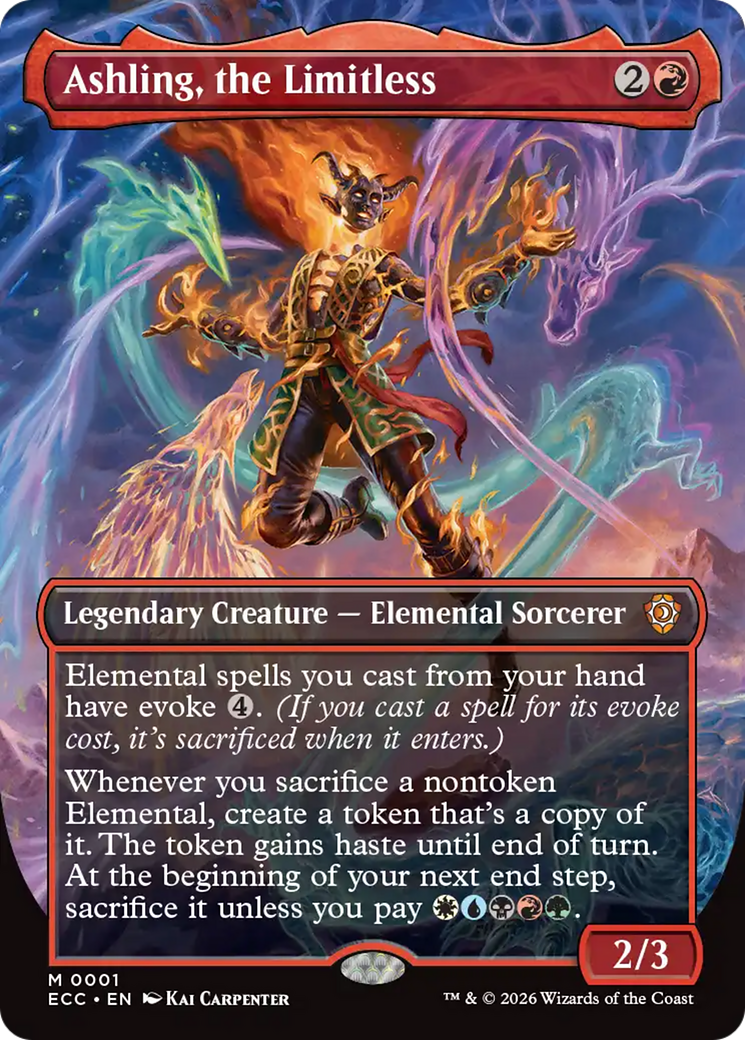
Ashling, the Limitless
Ashling, the Limitless
Legendary Creature — Elemental Sorcerer
2/3
Elemental permanent spells you cast from your hand gain evoke as you cast them. (If you cast a spell for its evoke cost, it's sacrificed when it enters.)
Whenever you sacrifice a nontoken Elemental, create a token that's a copy of it. The token gains haste until end of turn. At the beginning of your next end step, sacrifice it unless you pay .
- If the copied permanent had in its mana cost, X is 0.
- The token created by Ashling's last ability copies exactly what was printed on the original permanent and nothing else (unless that creature was copying something else; see below). It doesn't copy whether that permanent was tapped or untapped, whether it had any counters on it or Auras and Equipment attached to it, or any non-copy effects that changed its power, toughness, types, color, and so on.
- If the copied permanent was copying something else, then the token enters as whatever that permanent copied.
- Any enters abilities of the copied permanent will trigger when the token enters. Any "as [this permanent] enters" or "[this permanent] enters with" abilities of the copied permanent will also work.
- If Ashling leaves the battlefield after you've cast an Elemental permanent spell and paid its evoke cost but before that spell resolves, the permanent that spell becomes will still have evoke when it enters. As such, the triggered ability represented by evoke will still trigger, and when that abiltiy resolves, you'll still have to sacrifice that permanent.
- To determine the total cost of a spell, start with the mana cost or alternative cost you're paying (such as an evoke cost), add any cost increases, then apply any cost reductions. The mana value of the spell is determined by only its mana cost, no matter what the total cost to cast that spell was.
- If you pay the evoke cost, you can have the creature's own triggered ability or abilities resolve before the evoke triggered ability. You can cast spells after that ability resolves but before you have to sacrifice the creature.
-
1
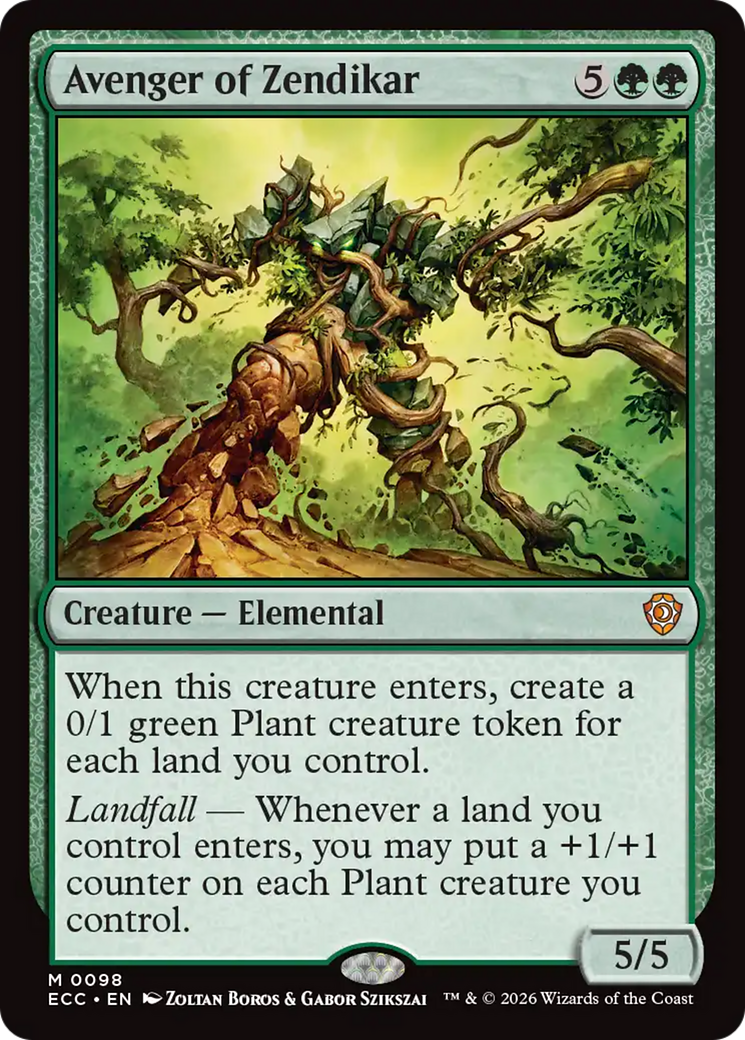
Avenger of Zendikar
Avenger of Zendikar
Creature — Elemental
5/5
When this creature enters, create a 0/1 green Plant creature token for each land you control.
Landfall — Whenever a land you control enters, you may put a +1/+1 counter on each Plant creature you control.
- A landfall ability triggers whenever a land you control enters for any reason. It triggers whenever you play a land, as well as whenever a spell or ability puts a land onto the battlefield under your control.
- A landfall ability doesn't trigger if a permanent already on the battlefield becomes a land.
- Whenever a land you control enters, each landfall ability of the permanents you control will trigger. You can put them on the stack in any order. The last ability you put on the stack will be the first one to resolve (As a result, you can have those abilities resolve in the order of your choosing.).
-
1
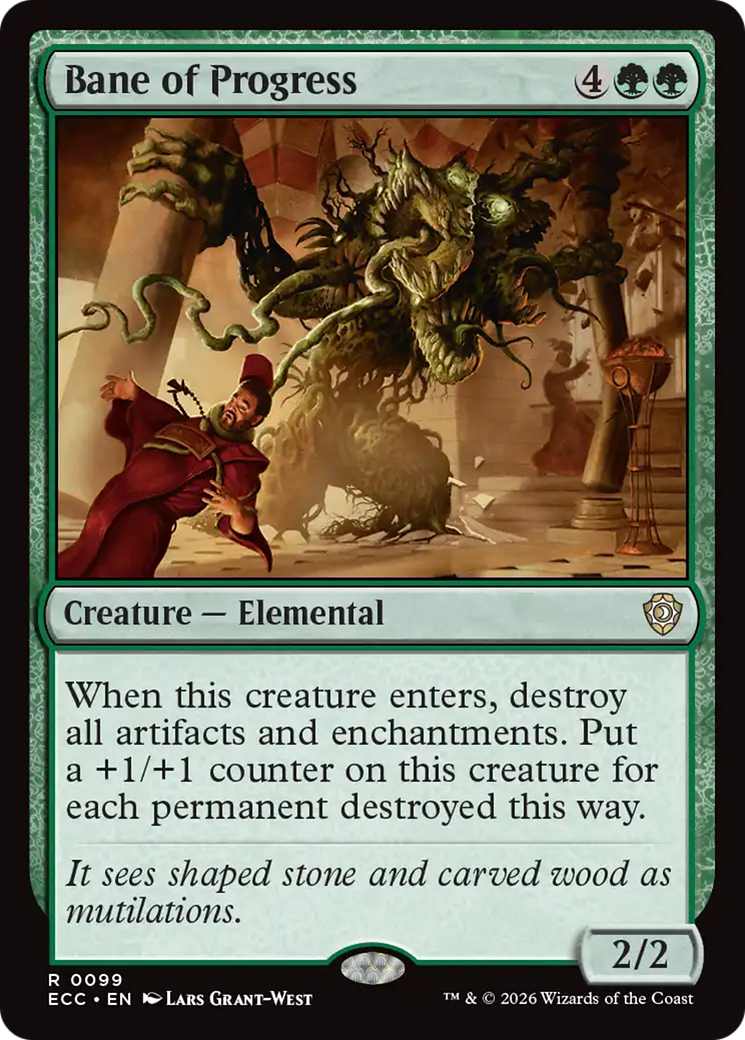
Bane of Progress
Bane of Progress
Creature — Elemental
2/2
When this creature enters, destroy all artifacts and enchantments. Put a +1/+1 counter on this creature for each permanent destroyed this way.
- If an artifact or enchantment isn't destroyed (perhaps because it has indestructible or it regenerated), it won't count toward the number of +1/+1 counters put on Bane of Progress. However, if an artifact or enchantment is destroyed but doesn't go to its owner's graveyard due to a replacement effect (like the one Rest in Peace creates), it will count.
- Bane of Progress's ability destroys all artifacts and enchantments, including those you control.
-
1
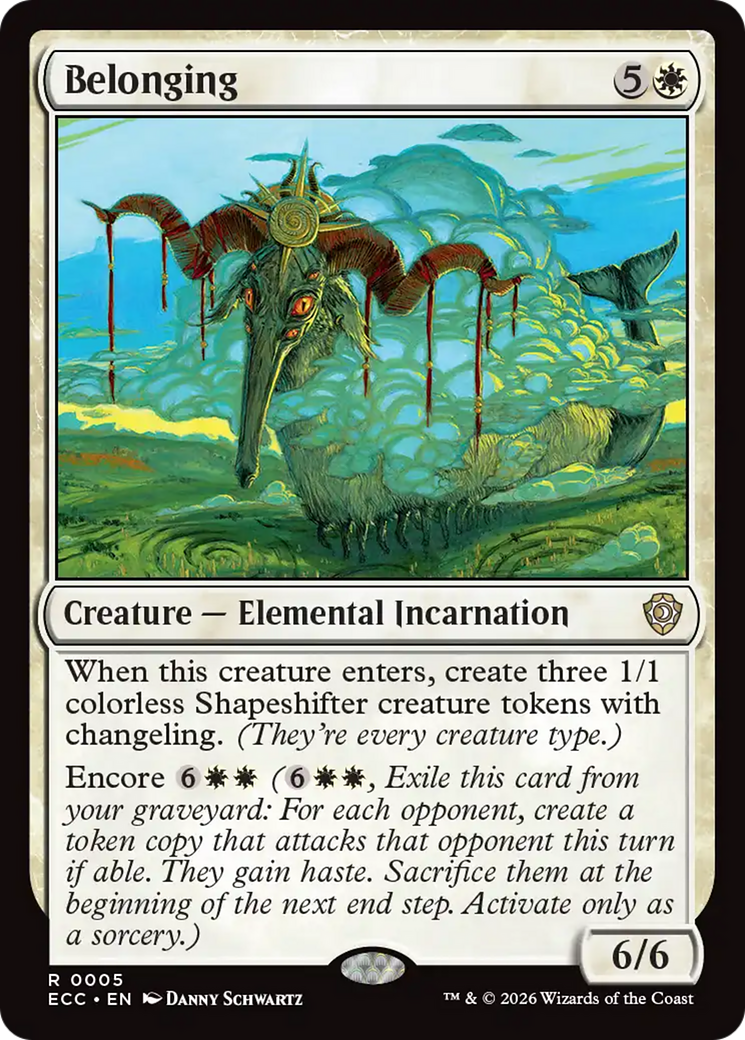
Belonging
Belonging
Creature — Elemental Incarnation
6/6
When this creature enters, create three 1/1 colorless Shapeshifter creature tokens with changeling. (They're every creature type.)
Encore ( , Exile this card from your graveyard: For each opponent, create a token copy that attacks that opponent this turn if able. They gain haste. Sacrifice them at the beginning of the next end step. Activate only as a sorcery.)
- The tokens copy only what's on the original card. Effects that modified that creature when it was previously on the battlefield won't be copied.
- Opponents who have left the game aren't counted when determining how many tokens to create.
- Exiling the card with encore is a cost to activate the encore ability. Once you announce that you're activating it, no player may take actions until you've finished. They can't try to remove the card from your graveyard to stop you from paying the cost.
- Each token must attack the appropriate player if able.
- If one of the tokens somehow is under another player's control as the delayed triggered ability resolves, you can't sacrifice that token. It remains on the battlefield indefinitely, even if you regain control of it later.
- Encore is an activated ability that functions from the graveyard. "Encore [cost]" means "[Cost], Exile this card from your graveyard: For each opponent, create a token that's a copy of this card that attacks that opponent this turn if able. The tokens gain haste. Sacrifice them at the beginning of the next end step. Activate only as a sorcery."
- If one of the tokens can't attack for any reason (such as being tapped), then it doesn't attack. If there's a cost associated with having it attack, you aren't forced to pay that cost, so it doesn't have to attack in that case either.
- If an effect stops a token from attacking a specific player, that token can attack any player, planeswalker, or battle, or not attack at all. If the effect stops the token from attacking a specific player unless a cost is paid, you don't have to pay that cost unless you want to attack that player.
-
1
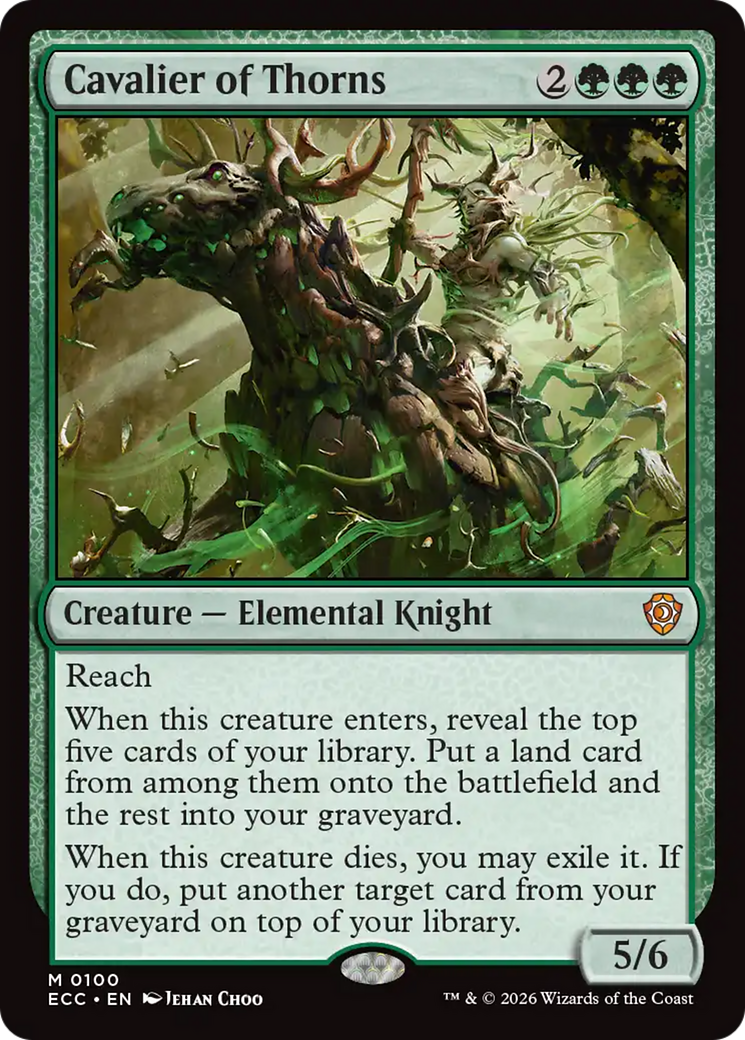
Cavalier of Thorns
Cavalier of Thorns
Creature — Elemental Knight
5/6
Reach
When this creature enters, reveal the top five cards of your library. Put a land card from among them onto the battlefield and the rest into your graveyard.
When this creature dies, you may exile it. If you do, put another target card from your graveyard on top of your library.
-
1
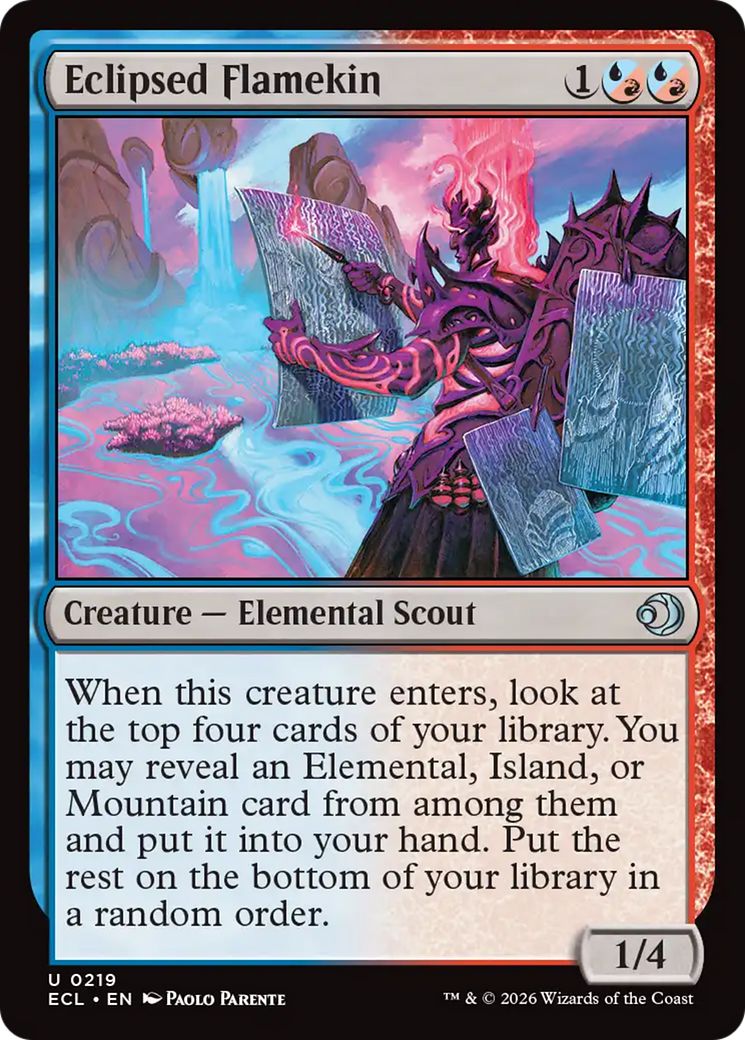
Eclipsed Flamekin
Eclipsed Flamekin
Creature — Elemental Scout
1/4
When this creature enters, look at the top four cards of your library. You may reveal an Elemental, Island, or Mountain card from among them and put it into your hand. Put the rest on the bottom of your library in a random order.
-
1
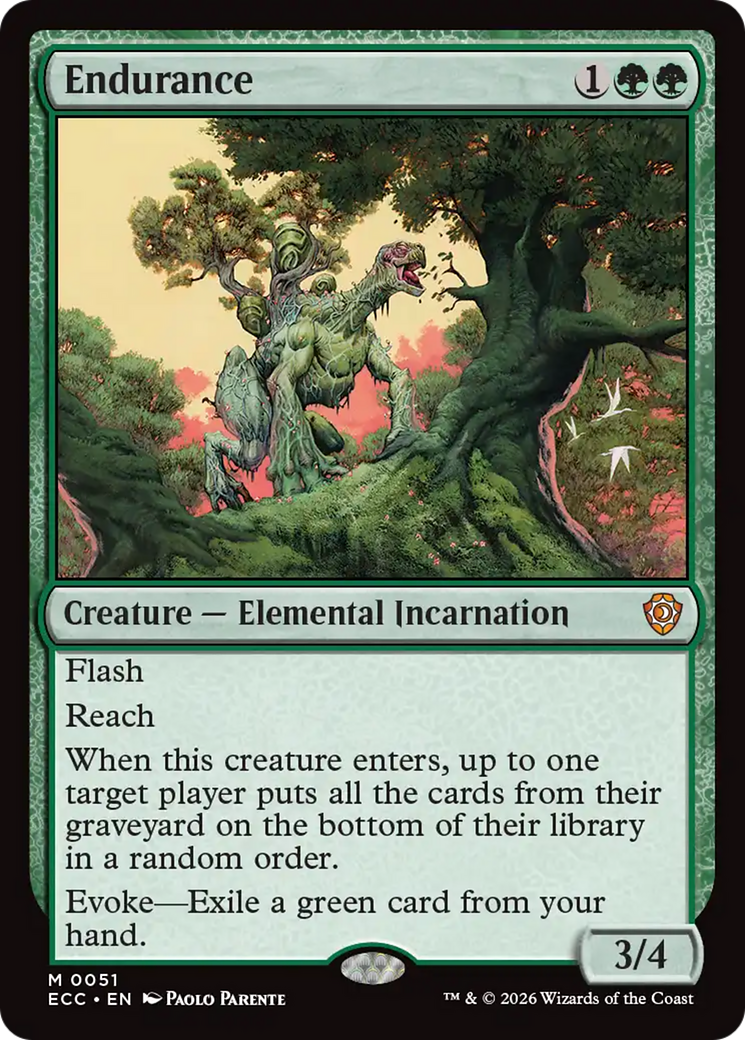
Endurance
Endurance
Creature — Elemental Incarnation
3/4
Flash
Reach
When this creature enters, up to one target player puts all the cards from their graveyard on the bottom of their library in a random order.
Evoke—Exile a green card from your hand.
- To determine the total cost of a spell, start with the mana cost or alternative cost you're paying (such as an evoke cost), add any cost increases, then apply any cost reductions. The mana value of the spell is determined by only its mana cost, no matter what the total cost to cast that spell was.
- If you pay the evoke cost, you can have the creature's own triggered ability resolve before the evoke triggered ability. You can cast spells after that ability resolves but before you have to sacrifice the creature.
-
1
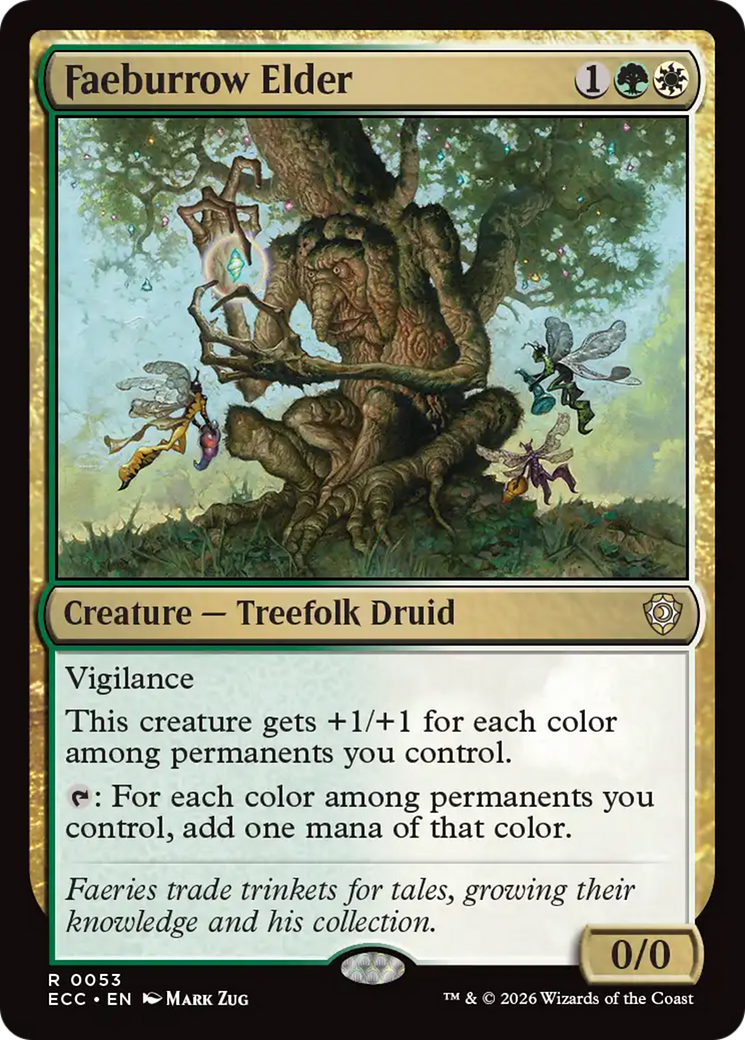
Faeburrow Elder
Faeburrow Elder
Creature — Treefolk Druid
0/0
Vigilance
This creature gets +1/+1 for each color among permanents you control.
: For each color among permanents you control, add one mana of that color.
- Faeburrow Elder's middle ability can give it at most +5/+5, that is, +1/+1 each for white, blue, black, red, and green. "Gold," "multicolor," and "colorless" aren't colors. Similarly, Faeburrow Elder's last ability can produce at most five mana.
- Since Faeburrow Elder is a green and white permanent, its middle ability usually gives it at least +2/+2 and its last ability usually produces at least .
-
1
Flamebraider
Flamebraider
Creature — Elemental Bard
2/2
: Add two mana in any combination of colors. Spend this mana only to cast Elemental spells or activate abilities of Elemental sources.
- "Elemental sources" include any objects with the creature type Elemental. For example, you could spend the mana to activate the ability of an Elemental permanent you control or an Elemental card in your hand or graveyard.
-
1
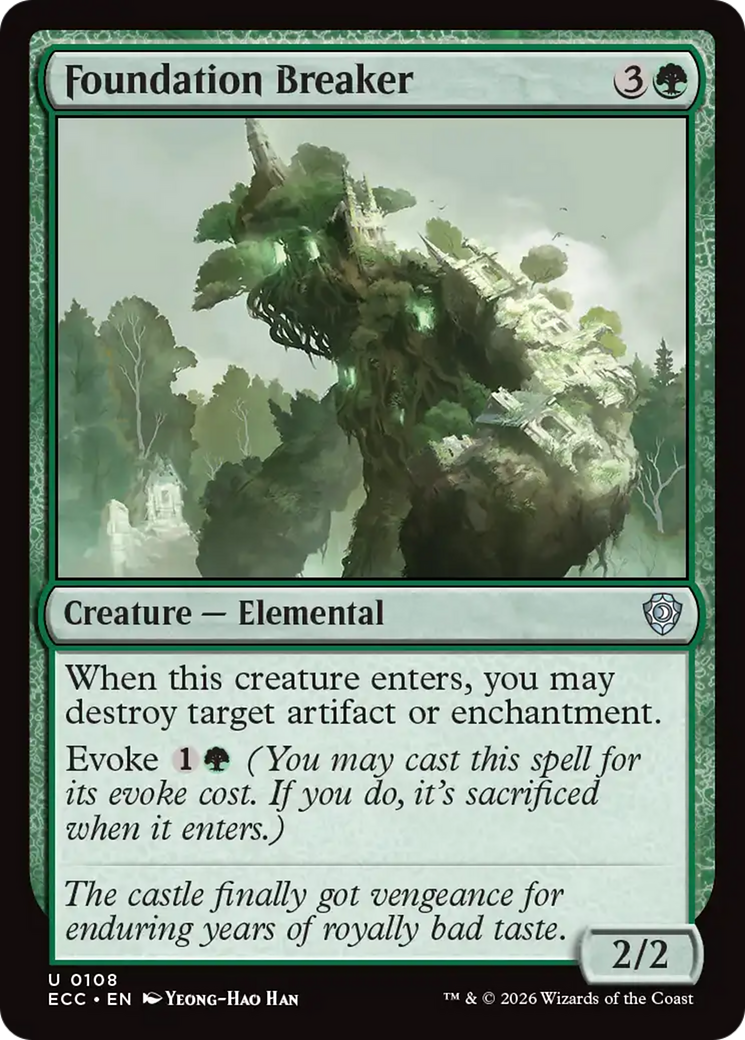
Foundation Breaker
Foundation Breaker
Creature — Elemental
2/2
When this creature enters, you may destroy target artifact or enchantment.
Evoke (You may cast this spell for its evoke cost. If you do, it's sacrificed when it enters.)
- To determine the total cost of a spell, start with the mana cost or alternative cost you're paying (such as an evoke cost), add any cost increases, then apply any cost reductions. The mana value of the spell is determined by only its mana cost, no matter what the total cost to cast that spell was.
- If you pay the evoke cost, you can have the creature's own triggered ability resolve before the evoke triggered ability. You can cast spells after that ability resolves but before you have to sacrifice the creature.
-
1
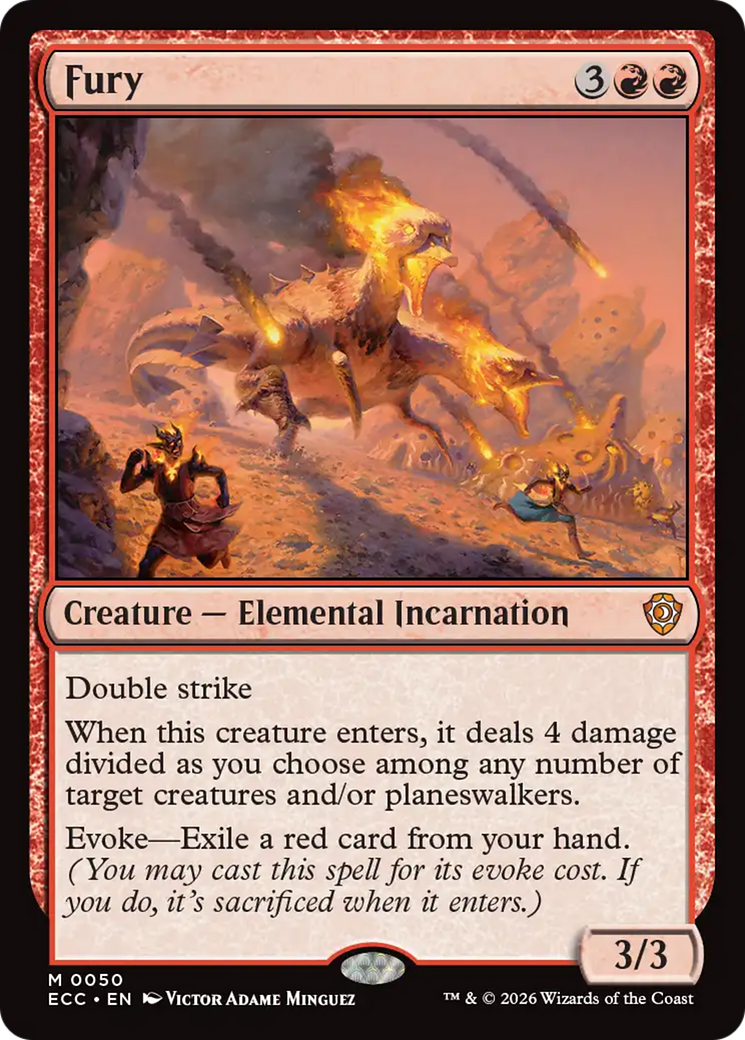
Fury
Fury
Creature — Elemental Incarnation
3/3
Double strike
When this creature enters, it deals 4 damage divided as you choose among any number of target creatures and/or planeswalkers.
Evoke—Exile a red card from your hand.
- If some of the targets are illegal as the triggered ability tries to resolve, the original division of damage still applies, but the damage that would have been dealt to the illegal targets isn't dealt at all.
- If you pay the evoke cost, you can have the creature's own triggered ability resolve before the evoke triggered ability. You can cast spells after that ability resolves but before you have to sacrifice the creature.
- You divide the damage as you put the triggered ability on the stack, not as it resolves. Each target must be assigned at least 1 damage. You can't choose more than four targets and deal 0 damage to some of them.
- To determine the total cost of a spell, start with the mana cost or alternative cost you're paying (such as an evoke cost), add any cost increases, then apply any cost reductions. The mana value of the spell is determined by only its mana cost, no matter what the total cost to cast that spell was.
-
1
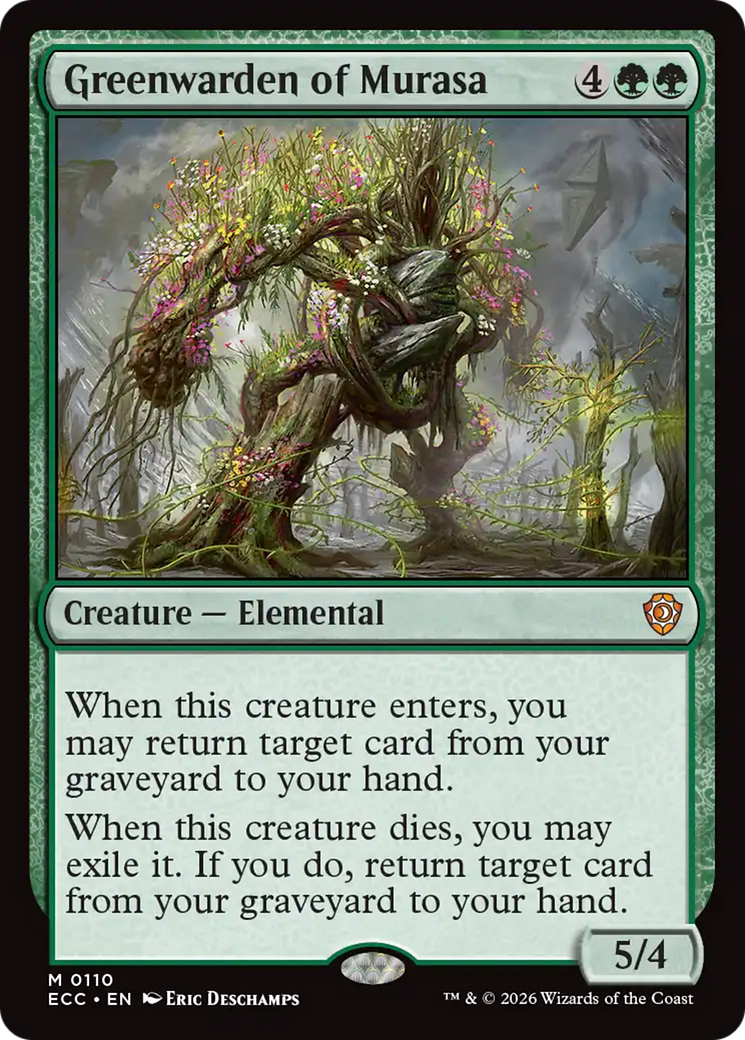
Greenwarden of Murasa
Greenwarden of Murasa
Creature — Elemental
5/4
When this creature enters, you may return target card from your graveyard to your hand.
When this creature dies, you may exile it. If you do, return target card from your graveyard to your hand.
- You decide whether to exile Greenwarden of Murasa as the last ability resolves. Players can respond to this ability triggering, but once it starts resolving and you decide to exile Greenwarden of Murasa, it's too late for anyone to respond.
- If the target card becomes illegal before the last ability resolves, it won't resolve. You can't exile Greenwarden of Murasa in that case, even if you want to.
-
1
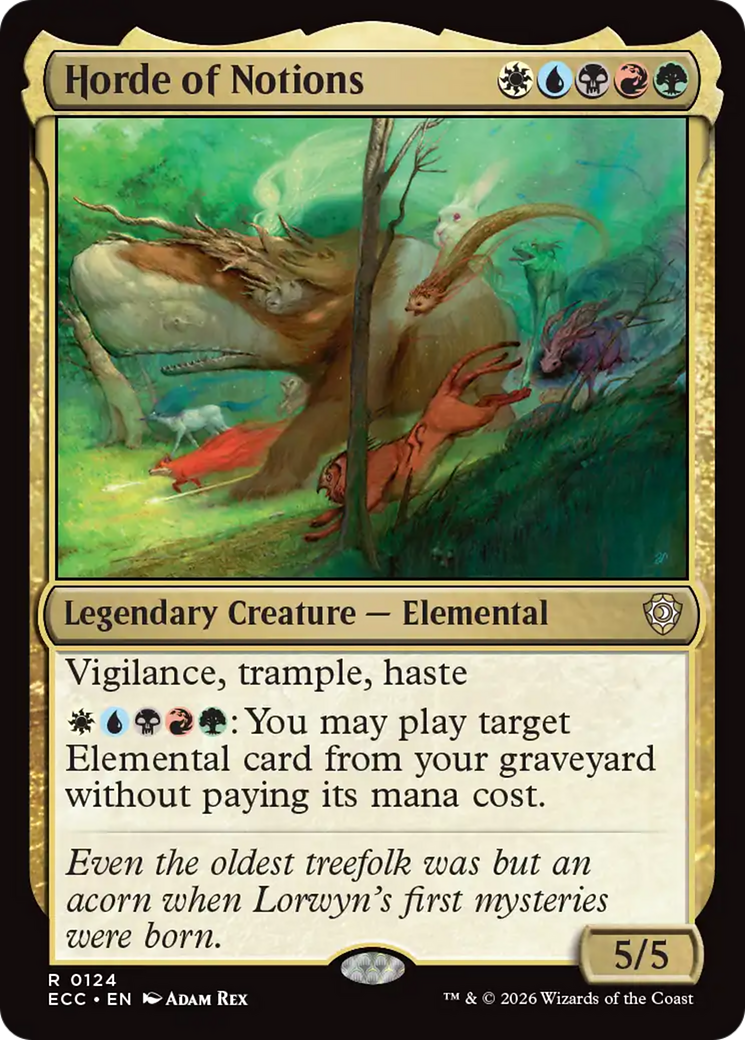
Horde of Notions
Horde of Notions
Legendary Creature — Elemental
5/5
Vigilance, trample, haste
: You may play target Elemental card from your graveyard without paying its mana cost.
- This ability does not allow you to pay the evoke cost of the targeted Elemental card.
-
1
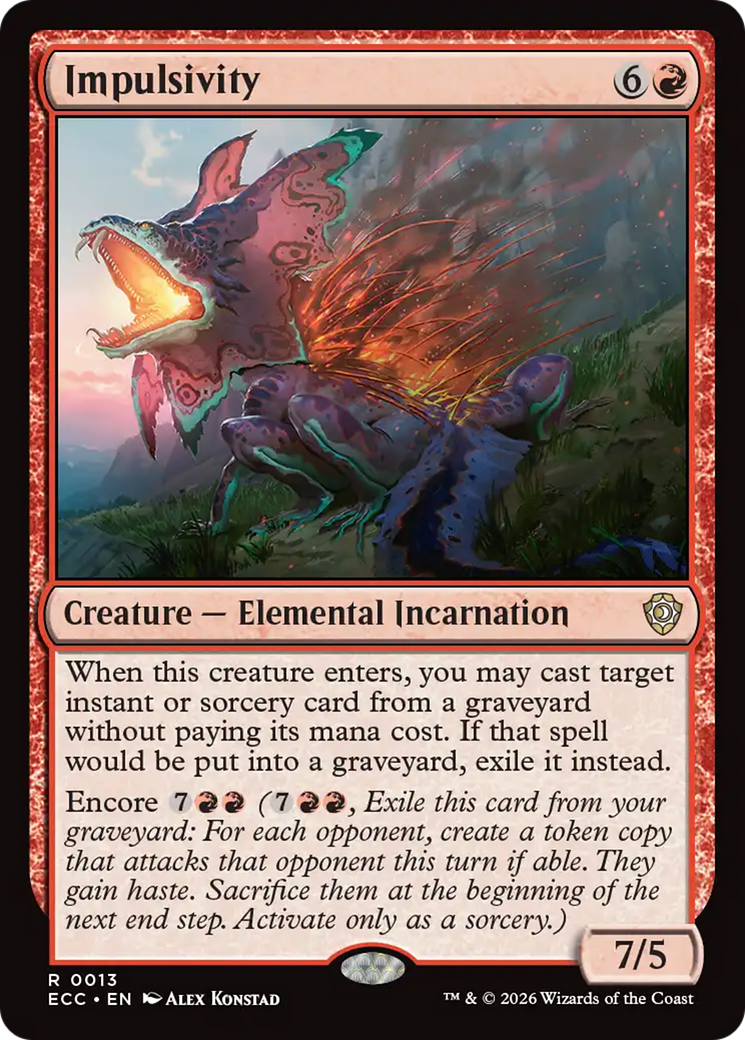
Impulsivity
Impulsivity
Creature — Elemental Incarnation
7/5
When this creature enters, you may cast target instant or sorcery card from a graveyard without paying its mana cost. If that spell would be put into a graveyard, exile it instead.
Encore ( , Exile this card from your graveyard: For each opponent, create a token copy that attacks that opponent this turn if able. They gain haste. Sacrifice them at the beginning of the next end step. Activate only as a sorcery.)
- Exiling the card with encore is a cost to activate the encore ability. Once you announce that you're activating it, no player may take actions until you've finished. They can't try to remove the card from your graveyard to stop you from paying the cost.
- Since you are using an alternative cost to cast the spell, you can't pay any other alternative costs. You can, however, pay additional costs, such as kicker costs. If the card has any mandatory additional costs, you must pay those.
- If an effect stops a token from attacking a specific player, that token can attack any player, planeswalker, or battle, or not attack at all. If the effect stops the token from attacking a specific player unless a cost is paid, you don't have to pay that cost unless you want to attack that player.
- The tokens copy only what's on the original card. Effects that modified that creature when it was previously on the battlefield won't be copied.
- If one of the tokens somehow is under another player's control as the delayed triggered ability resolves, you can't sacrifice that token. It remains on the battlefield indefinitely, even if you regain control of it later.
- If one of the tokens can't attack for any reason (such as being tapped), then it doesn't attack. If there's a cost associated with having it attack, you aren't forced to pay that cost, so it doesn't have to attack in that case either.
- Encore is an activated ability that functions from the graveyard. "Encore [cost]" means "[Cost], Exile this card from your graveyard: For each opponent, create a token that's a copy of this card that attacks that opponent this turn if able. The tokens gain haste. Sacrifice them at the beginning of the next end step. Activate only as a sorcery."
- If the spell you cast has in its mana cost, you must choose 0 as the value of X when casting it without paying its mana cost.
- If you choose to cast the instant or sorcery card, you do so while Impulsivity's first ability is resolving and still on the stack. You can't wait to cast it later in the turn. Timing restrictions based on the card's type are ignored.
- Each token must attack the appropriate player if able.
- Opponents who have left the game aren't counted when determining how many tokens to create.
-
1
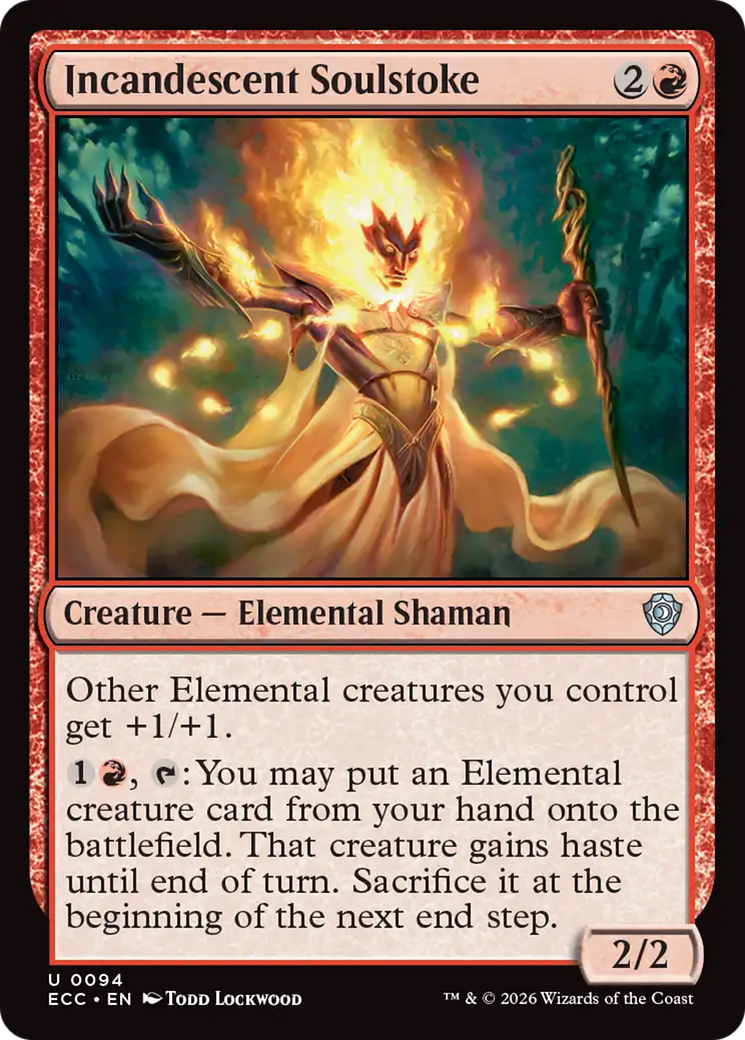
Incandescent Soulstoke
Incandescent Soulstoke
Creature — Elemental Shaman
2/2
Other Elemental creatures you control get +1/+1.
, : You may put an Elemental creature card from your hand onto the battlefield. That creature gains haste until end of turn. Sacrifice it at the beginning of the next end step.
-
1
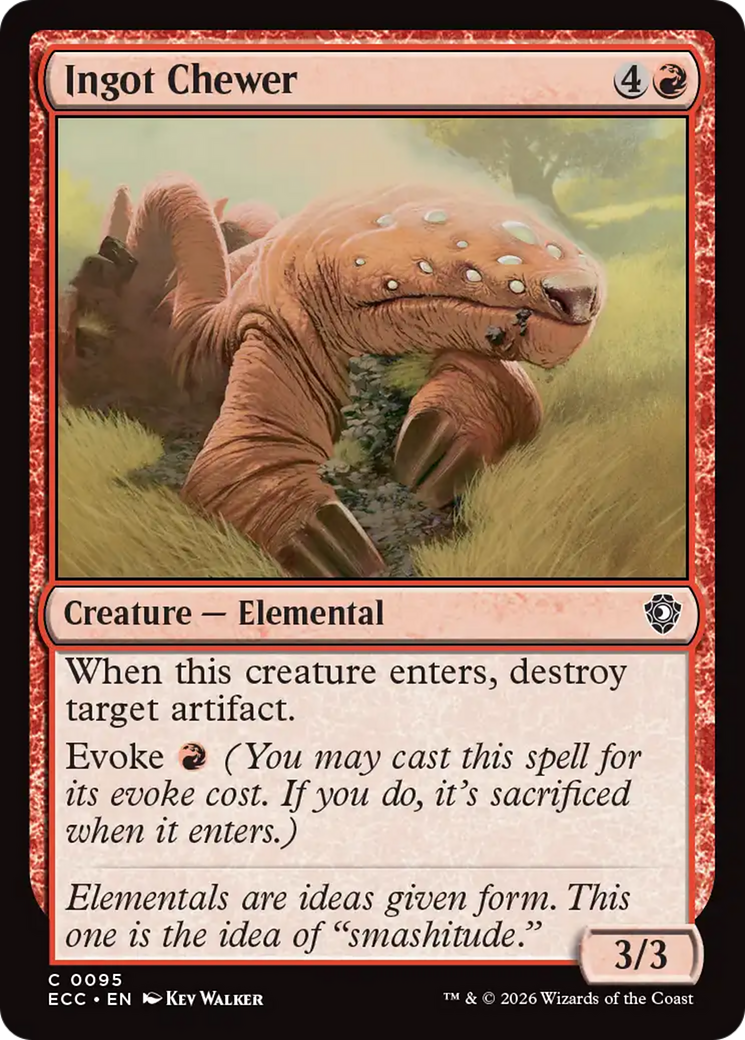
Ingot Chewer
Ingot Chewer
Creature — Elemental
3/3
When this creature enters, destroy target artifact.
Evoke (You may cast this spell for its evoke cost. If you do, it's sacrificed when it enters.)
- If you cast this card for its evoke cost, you may put the sacrifice trigger and the regular enters-the-battlefield trigger on the stack in either order. The one put on the stack last will resolve first.
-
1
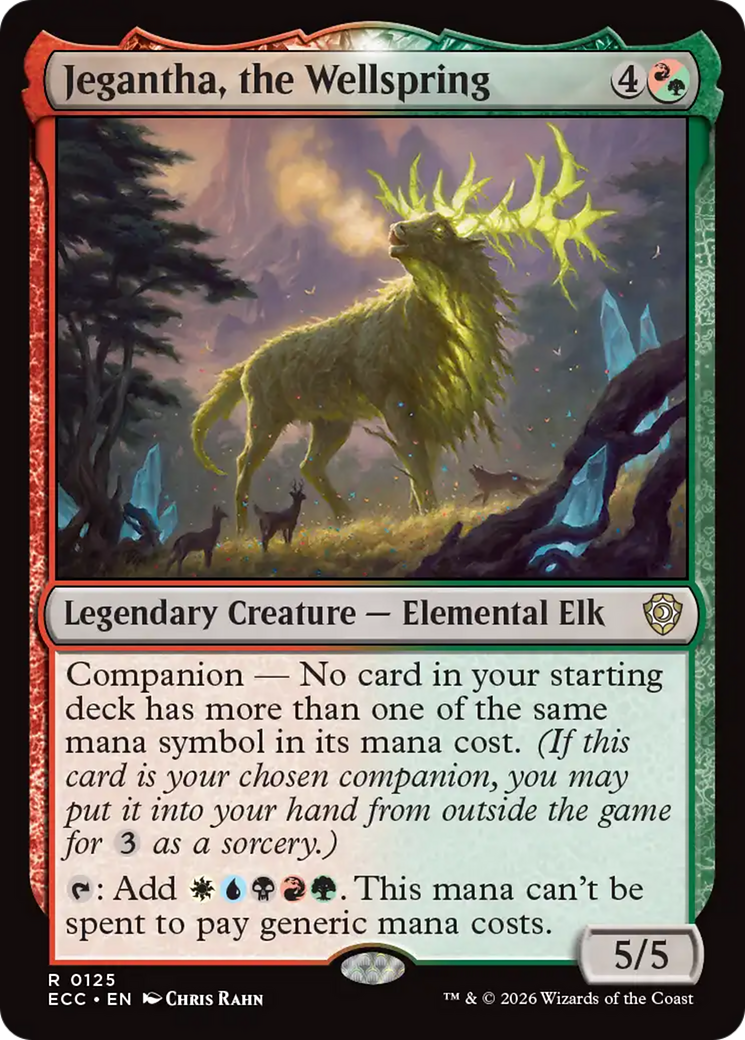
Jegantha, the Wellspring
Jegantha, the Wellspring
Legendary Creature — Elemental Elk
5/5
Companion — No card in your starting deck has more than one of the same mana symbol in its mana cost. (If this card is your chosen companion, you may put it into your hand from outside the game for as a sorcery.)
: Add . This mana can't be spent to pay generic mana costs.
- Once you put your companion into your hand, it behaves like any other card you’ve brought into the game. For example, if it’s countered or destroyed, it’s put into your graveyard, remaining in the game.
- Wizards of the Coast has issued functional errata for the Companion mechanic. Instead of casting companions from outside the game: Once per game, any time you could cast a sorcery (during your main phase when the stack is empty), you can pay to put your companion from your sideboard into your hand. This is a special action, not an activated ability. It happens immediately and can’t be responded to. It can’t be countered or stopped by cards like Phyrexian Revoker. For more information please see https://magic.wizards.com/en/articles/archive/news/june-1-2020-banned-and-restricted-announcement
- You can spend mana from Jegantha's mana ability to pay for a hybrid symbol such as , but only if you choose to pay the colored mana component, not the generic mana component.
- A generic mana cost is usually represented by numeric mana symbols ( , , and so on) and also . It is any cost requiring mana where that cost isn't , , , , , or .
- Jegantha's companion ability compares the exact symbols in the mana costs of cards in your deck. If any one card has the same symbol twice, such as or {(r/g)}{(r/g)}, the companion condition isn't satisfied.
-
1
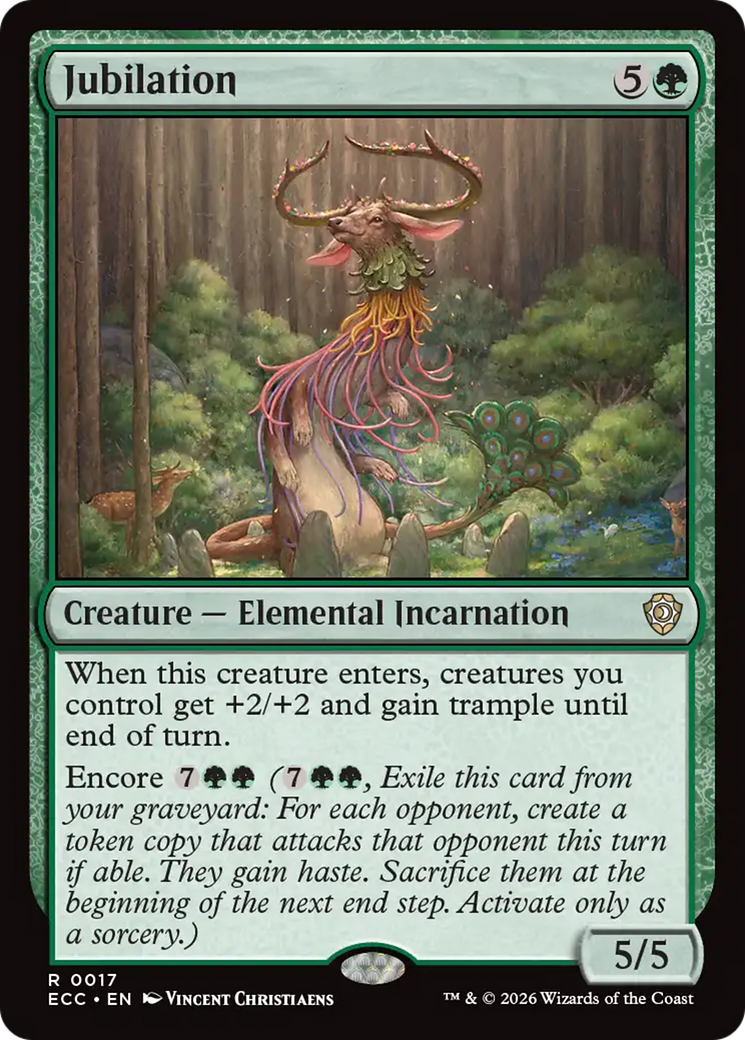
Jubilation
Jubilation
Creature — Elemental Incarnation
5/5
When this creature enters, creatures you control get +2/+2 and gain trample until end of turn.
Encore ( , Exile this card from your graveyard: For each opponent, create a token copy that attacks that opponent this turn if able. They gain haste. Sacrifice them at the beginning of the next end step. Activate only as a sorcery.)
- Exiling the card with encore is a cost to activate the encore ability. Once you announce that you're activating it, no player may take actions until you've finished. They can't try to remove the card from your graveyard to stop you from paying the cost.
- If an effect stops a token from attacking a specific player, that token can attack any player, planeswalker, or battle, or not attack at all. If the effect stops the token from attacking a specific player unless a cost is paid, you don't have to pay that cost unless you want to attack that player.
- If one of the tokens can't attack for any reason (such as being tapped), then it doesn't attack. If there's a cost associated with having it attack, you aren't forced to pay that cost, so it doesn't have to attack in that case either.
- The tokens copy only what's on the original card. Effects that modified that creature when it was previously on the battlefield won't be copied.
- If one of the tokens somehow is under another player's control as the delayed triggered ability resolves, you can't sacrifice that token. It remains on the battlefield indefinitely, even if you regain control of it later.
- Opponents who have left the game aren't counted when determining how many tokens to create.
- Encore is an activated ability that functions from the graveyard. "Encore [cost]" means "[Cost], Exile this card from your graveyard: For each opponent, create a token that's a copy of this card that attacks that opponent this turn if able. The tokens gain haste. Sacrifice them at the beginning of the next end step. Activate only as a sorcery."
- Each token must attack the appropriate player if able.
-
1
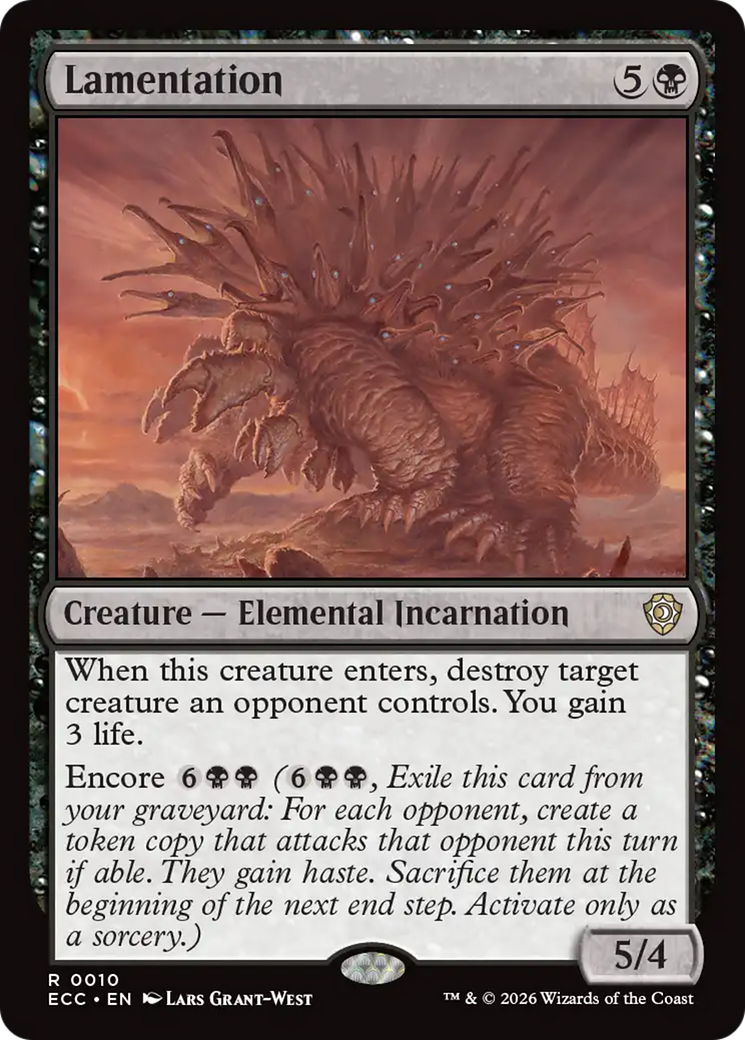
Lamentation
Lamentation
Creature — Elemental Incarnation
5/4
When this creature enters, destroy target creature an opponent controls. You gain 3 life.
Encore ( , Exile this card from your graveyard: For each opponent, create a token copy that attacks that opponent this turn if able. They gain haste. Sacrifice them at the beginning of the next end step. Activate only as a sorcery.)
- If one of the tokens can't attack for any reason (such as being tapped), then it doesn't attack. If there's a cost associated with having it attack, you aren't forced to pay that cost, so it doesn't have to attack in that case either.
- The tokens copy only what's on the original card. Effects that modified that creature when it was previously on the battlefield won't be copied.
- If one of the tokens somehow is under another player's control as the delayed triggered ability resolves, you can't sacrifice that token. It remains on the battlefield indefinitely, even if you regain control of it later.
- Opponents who have left the game aren't counted when determining how many tokens to create.
- Encore is an activated ability that functions from the graveyard. "Encore [cost]" means "[Cost], Exile this card from your graveyard: For each opponent, create a token that's a copy of this card that attacks that opponent this turn if able. The tokens gain haste. Sacrifice them at the beginning of the next end step. Activate only as a sorcery."
- Each token must attack the appropriate player if able.
- If the target creature is an illegal target as Lamentation's first ability tries to resolve, it won't resolve and none of its effects will happen. You won't gain life.
- If an effect stops a token from attacking a specific player, that token can attack any player, planeswalker, or battle, or not attack at all. If the effect stops the token from attacking a specific player unless a cost is paid, you don't have to pay that cost unless you want to attack that player.
- Exiling the card with encore is a cost to activate the encore ability. Once you announce that you're activating it, no player may take actions until you've finished. They can't try to remove the card from your graveyard to stop you from paying the cost.
-
1
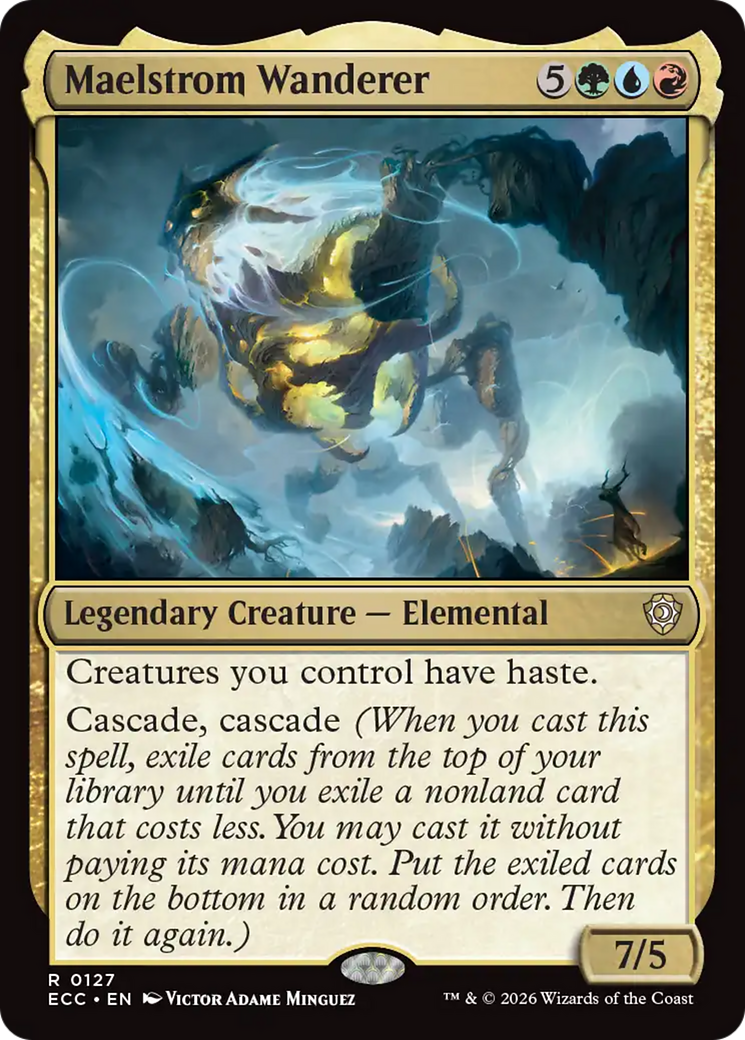
Maelstrom Wanderer
Maelstrom Wanderer
Legendary Creature — Elemental
7/5
Creatures you control have haste.
Cascade, cascade (When you cast this spell, exile cards from the top of your library until you exile a nonland card that costs less. You may cast it without paying its mana cost. Put the exiled cards on the bottom in a random order. Then do it again.)
- Maelstrom Wanderer gives itself haste.
- No matter what spell you cast with the first cascade trigger (or with any cascade triggers that result from casting that spell), the second cascade trigger will look for a spell with mana value less than Maelstrom Wanderer's mana value of 8.
- Each instance of cascade triggers and resolves separately. The spell you cast due to the first cascade ability will go on the stack on top of the second cascade ability. That spell will resolve before you exile cards for the second cascade ability.
-
1
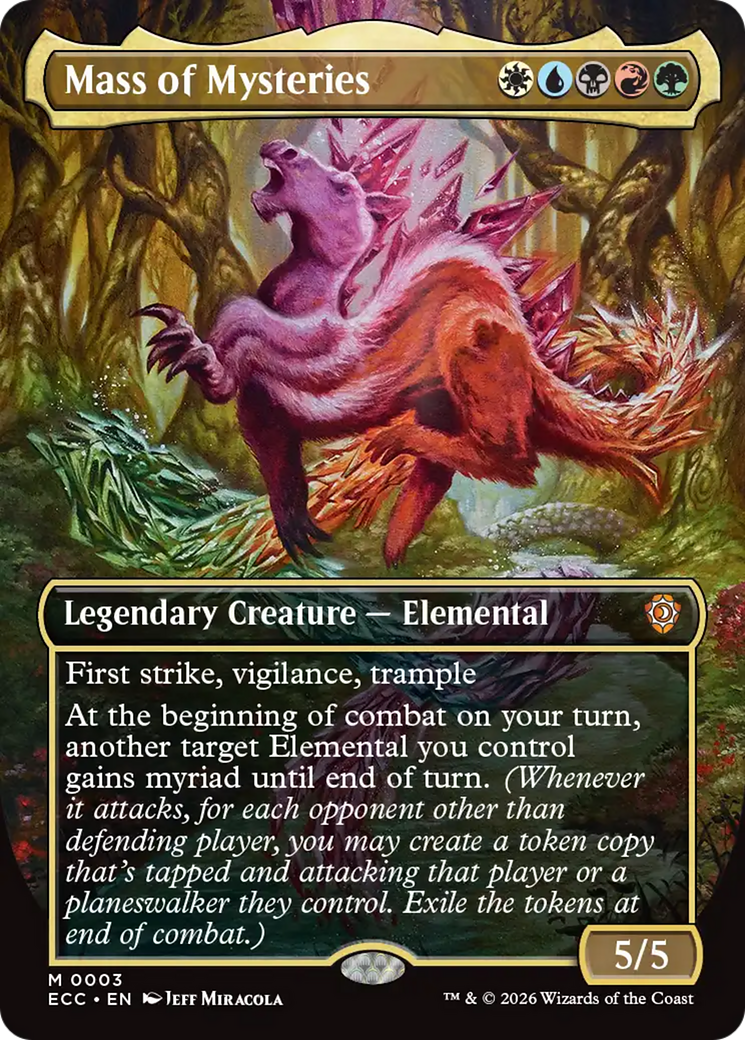
Mass of Mysteries
Mass of Mysteries
Legendary Creature — Elemental
5/5
First strike, vigilance, trample
At the beginning of combat on your turn, another target Elemental you control gains myriad until end of turn. (Whenever it attacks, for each opponent other than defending player, you may create a token copy that's tapped and attacking that player or a planeswalker they control. Exile the tokens at end of combat.)
- If the defending player is your only opponent, no tokens are put onto the battlefield.
- The term "defending player" in the myriad rules (or any other ability of an attacking creature) refers to the player the creature with myriad was attacking, the controller of the planeswalker it was attacking, or the protector of the battle it was attacking at the time the ability resolves. If that creature is no longer attacking, it refers to the appropriate player based on who or what the creature was last attacking.
- You choose whether each token is attacking the player or a planeswalker they control as the token is created. If it's attacking a planeswalker, you choose which one. You can't have any of the tokens attack a battle.
- Although the tokens enter attacking, they were never declared as attackers. Abilities that trigger whenever a creature attacks won't trigger, including the myriad ability of the tokens. If there are any costs to have a creature attack, those costs won't apply to the tokens.
- The tokens created by a single instance of myriad all enter at the same time.
- Each token copies exactly what was printed on the original creature and nothing else. It doesn't copy whether that creature is tapped or untapped, whether it has any counters on it or Auras and Equipment attached to it, or any non-copy effects that have changed its power, toughness, types, color, and so on.
- Any "enters" abilities of the copied creature will trigger when the tokens enter. Any "as [this creature] enters" or "[this creature] enters with" abilities of the copied creature will also work.
- If an instance of myriad creates more than one token for any given player (due to an effect such as the one Doubling Season creates), you may choose separately for each token whether it's attacking the player or a planeswalker they control.
-
1
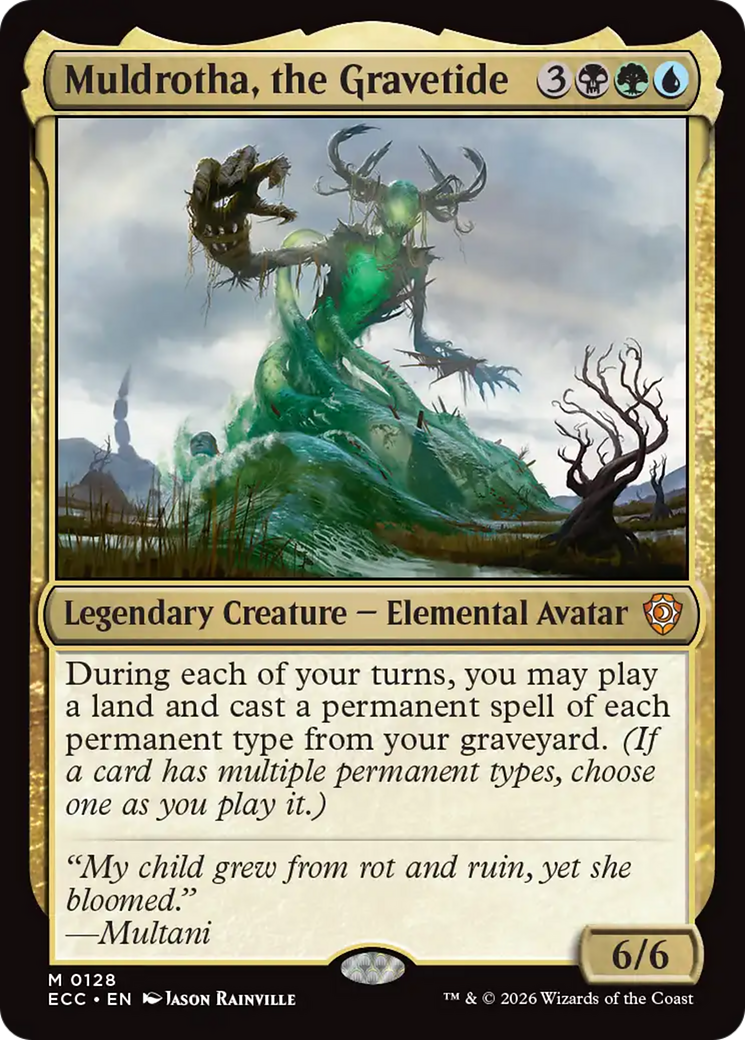
Muldrotha, the Gravetide
Muldrotha, the Gravetide
Legendary Creature — Elemental Avatar
6/6
During each of your turns, you may play a land and cast a permanent spell of each permanent type from your graveyard. (If a card has multiple permanent types, choose one as you play it.)
- For example, you may cast an artifact creature spell as your artifact spell and cast another artifact creature spell as your creature spell.
- If you play a card from your graveyard and then have a new Muldrotha come under your control in the same turn, you may play another land or spell of that type from your graveyard that turn.
- Use the type of the card as it's played or cast to determine which permanent type to count it as. For example, if you cast a creature spell from your graveyard, you can cast a card with bestow as an enchantment spell.
- If multiple effects allow you to play a card from your graveyard, you must announce which permission you're using as you begin to play the card.
- You must pay the costs to cast a spell this way. If it has an alternative cost, you may cast it for that cost instead.
- Once you begin to cast a spell, losing control of Muldrotha won't affect the spell.
- You must follow the normal timing permissions and restrictions of the cards you play from your graveyard. For example, you can't use Muldrotha to play a land if you don't have an available land play or to cast a planeswalker spell during your end step.
- If a permanent card is put into your graveyard during your main phase and the stack is empty, you have a chance to cast it before any player may attempt to remove that card from your graveyard.
-
1
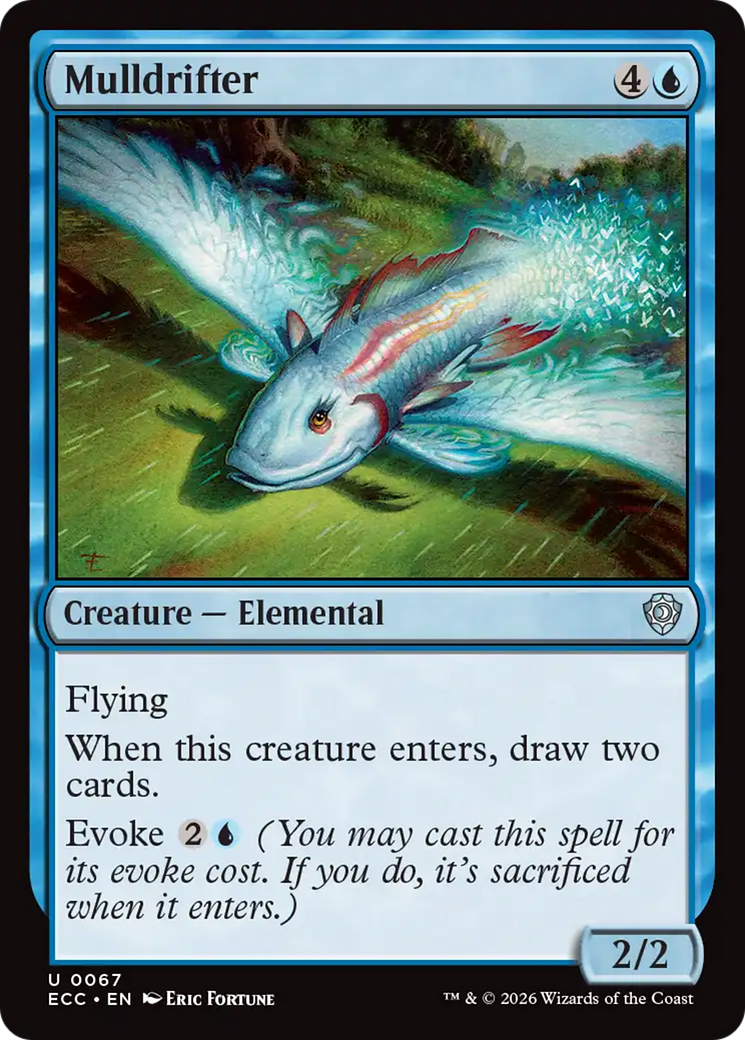
Mulldrifter
Mulldrifter
Creature — Elemental
2/2
Flying
When this creature enters, draw two cards.
Evoke (You may cast this spell for its evoke cost. If you do, it's sacrificed when it enters.)
- To determine the total cost of a spell, start with the mana cost or alternative cost you're paying (such as an evoke cost), add any cost increases, then apply any cost reductions. The mana value of the spell is determined by only its mana cost, no matter what the total cost to cast that spell was.
- If you pay the evoke cost, you can have Mulldrifter's own triggered ability resolve before the evoke triggered ability. You can cast spells after that ability resolves but before you have to sacrifice Mulldrifter.
-
1
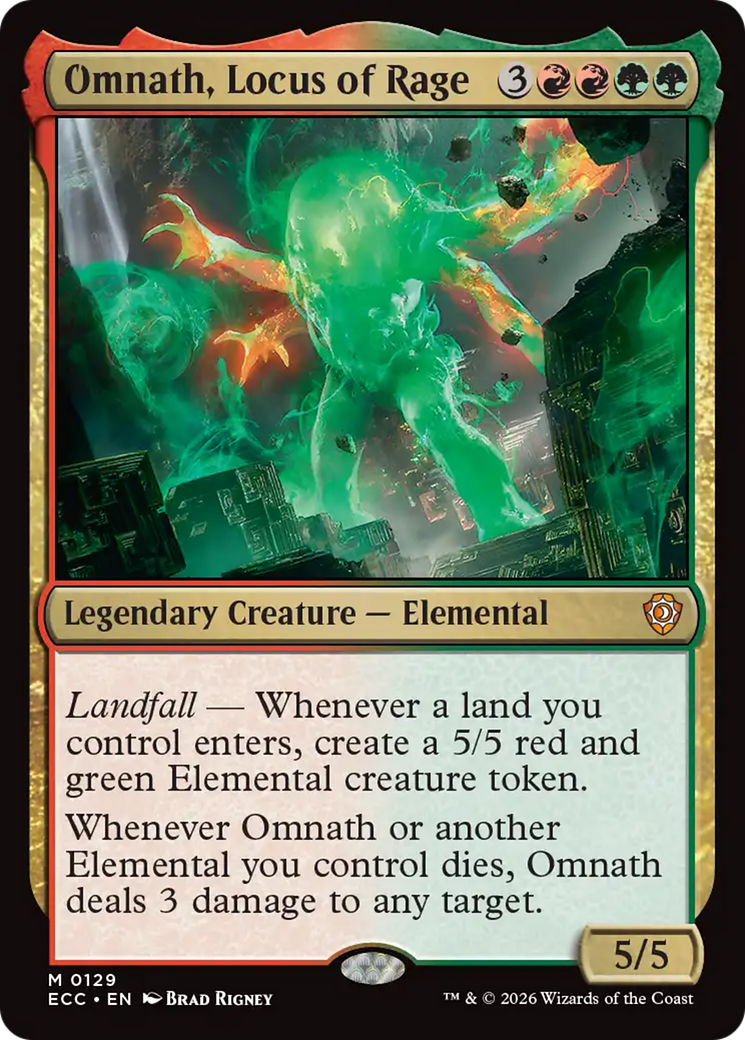
Omnath, Locus of Rage
Omnath, Locus of Rage
Legendary Creature — Elemental
5/5
Landfall — Whenever a land you control enters, create a 5/5 red and green Elemental creature token.
Whenever Omnath or another Elemental you control dies, Omnath deals 3 damage to any target.
- Omanth doesn't have the land type Locus.
- If Omnath dies at the same time as any other Elementals you control, Omnath's last ability will trigger for each of them (and once for itself).
-
1
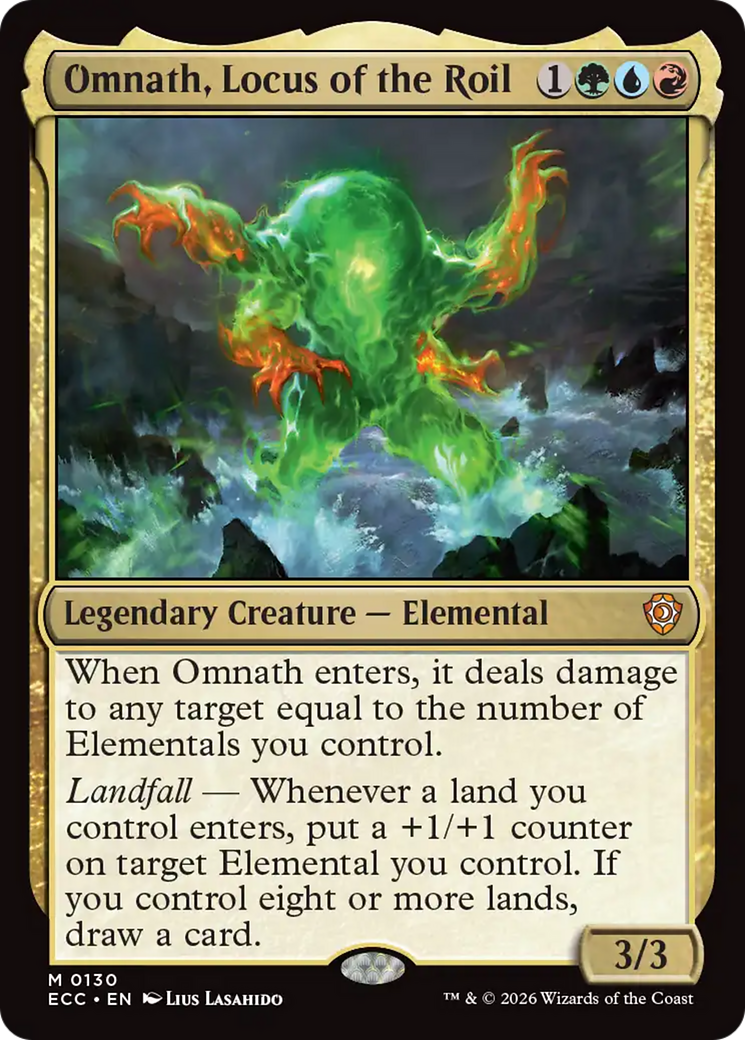
Omnath, Locus of the Roil
Omnath, Locus of the Roil
Legendary Creature — Elemental
3/3
When Omnath enters, it deals damage to any target equal to the number of Elementals you control.
Landfall — Whenever a land you control enters, put a +1/+1 counter on target Elemental you control. If you control eight or more lands, draw a card.
- You may choose Omnath as the target of its own second ability.
- The number of Elementals you control is counted as Omnath's first ability resolves. If Omnath is still on the battlefield, it will count itself.
- If the target Elemental is an illegal target by the time Omnath's second ability tries to resolve, the ability doesn't resolve. You don't draw a card if you control eight or more lands. If the target is legal but can't have a +1/+1 counter put on it (most likely because an opponent controls Blightbeetle), you do draw a card if you control eight or more lands.
-
1
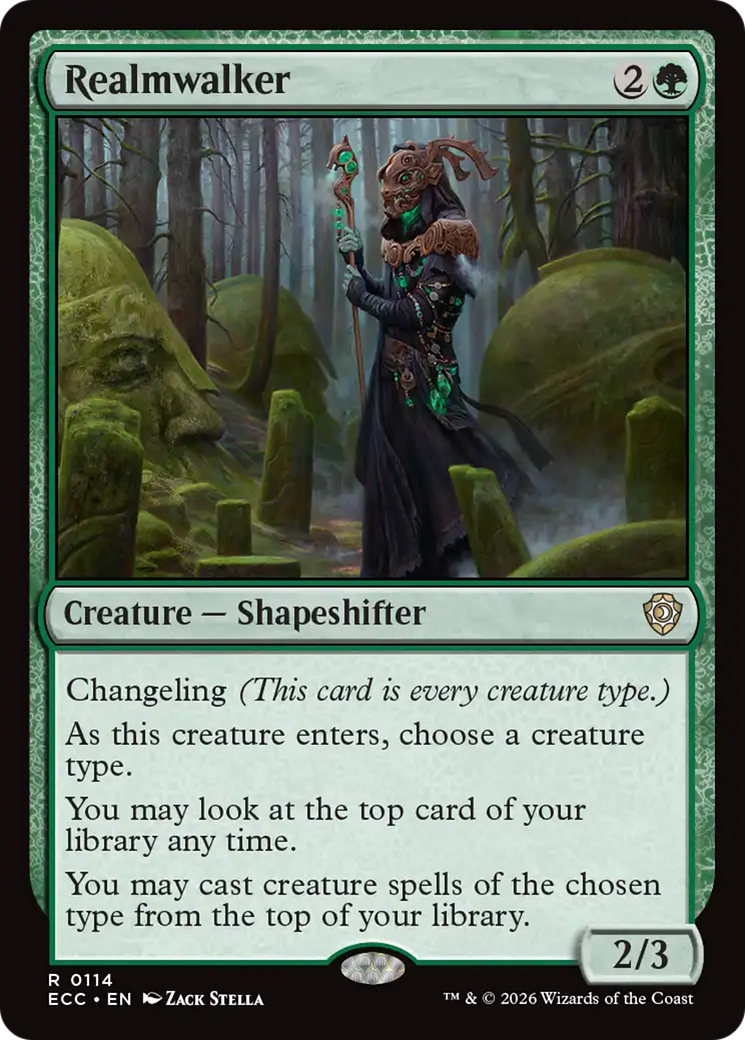
Realmwalker
Realmwalker
Creature — Shapeshifter
2/3
Changeling (This card is every creature type.)
As this creature enters, choose a creature type.
You may look at the top card of your library any time.
You may cast creature spells of the chosen type from the top of your library.
- The top card of your library isn't in your hand, so you can't foretell it, discard it, or activate any of its activated abilities.
- Realmwalker doesn't change when you can cast creature spells. Normally, this means during your main phase when the stack is empty, although flash may change this.
- If Realmwalker is somehow on the battlefield with no choice having been made for it, you may still look at the top card of your library any time. You won't be able to cast any creature spells from the top of your library, even if they have no creature types.
- You can look at the top card of your library whenever you want (with one restriction; see below), even if you don't have priority. This action doesn't use the stack. Knowing what that card is becomes part of the information you have access to, just like you can look at the cards in your hand.
- You must choose an existing creature type, such as Elk or Advisor. You can't choose card types (e.g., artifact) or supertypes (e.g., snow).
- You'll still pay all costs for the spell, including additional costs. You may also pay alternative costs if any are available.
- If the top card of your library changes while you're casting a spell, playing a land, or activating an ability, you can't look at the new top card until you finish doing so. This means that if you cast a spell from the top of your library, you can't look at the next one until you're done paying for that spell.
-
1
Risen Reef
Risen Reef
Creature — Elemental
1/1
Whenever this creature or another Elemental you control enters, look at the top card of your library. If it's a land card, you may put it onto the battlefield tapped. If you don't put the card onto the battlefield, put it into your hand.
- If you put the card into your hand, you don't have to reveal it. You also don't have to tell your opponent whether it's a nonland card or a land card you decided not to put onto the battlefield tapped.
-
1
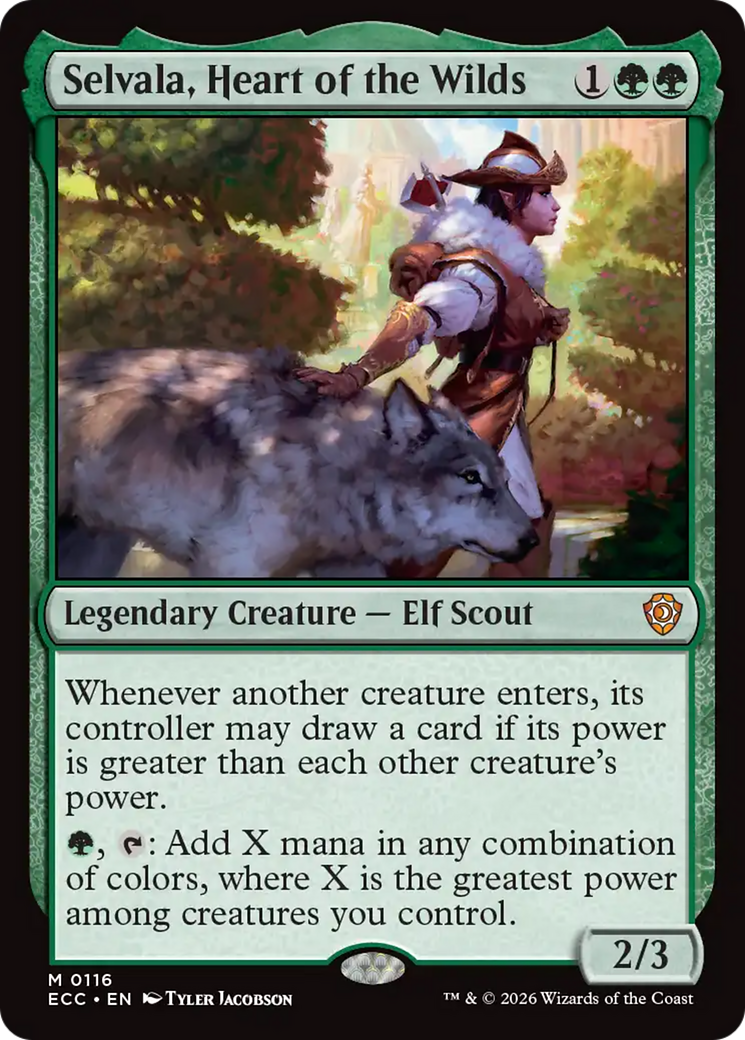
Selvala, Heart of the Wilds
Selvala, Heart of the Wilds
Legendary Creature — Elf Scout
2/3
Whenever another creature enters, its controller may draw a card if its power is greater than each other creature's power.
, : Add X mana in any combination of colors, where X is the greatest power among creatures you control.
- Selvala's last ability is a mana ability. It doesn't use the stack and can't be responded to. If the greatest power among creatures you control is 0 or less at that time, no mana is added.
- The new creature's power is compared to the power of each other creature on the battlefield as the first ability resolves. If another creature has the same or higher power than the new creature's power, no one may draw a card.
- If the new creature isn't on the battlefield as the first ability resolves, use its power when it left the battlefield to determine whether its controller may draw a card. Note that effects that reduced its power before it left the battlefield will apply.
-
1
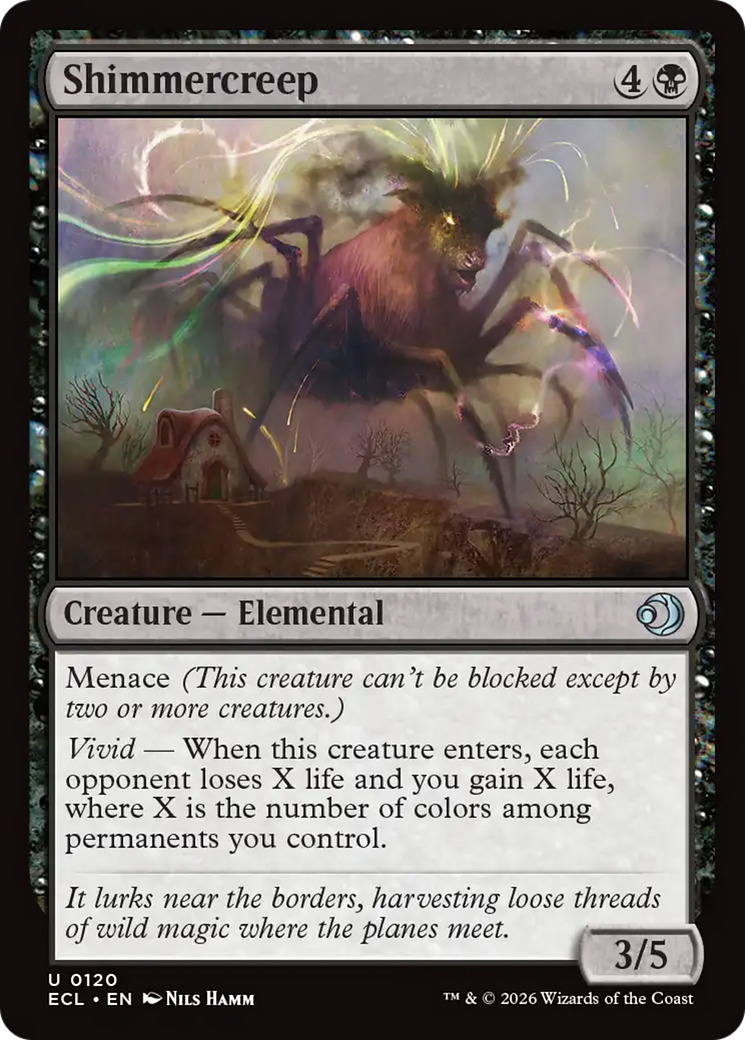
Shimmercreep
Shimmercreep
Creature — Elemental
3/5
Menace (This creature can't be blocked except by two or more creatures.)
Vivid — When this creature enters, each opponent loses X life and you gain X life, where X is the number of colors among permanents you control.
- The value of X is calculated only once, as Shimmercreep's last ability resolves.
-
1
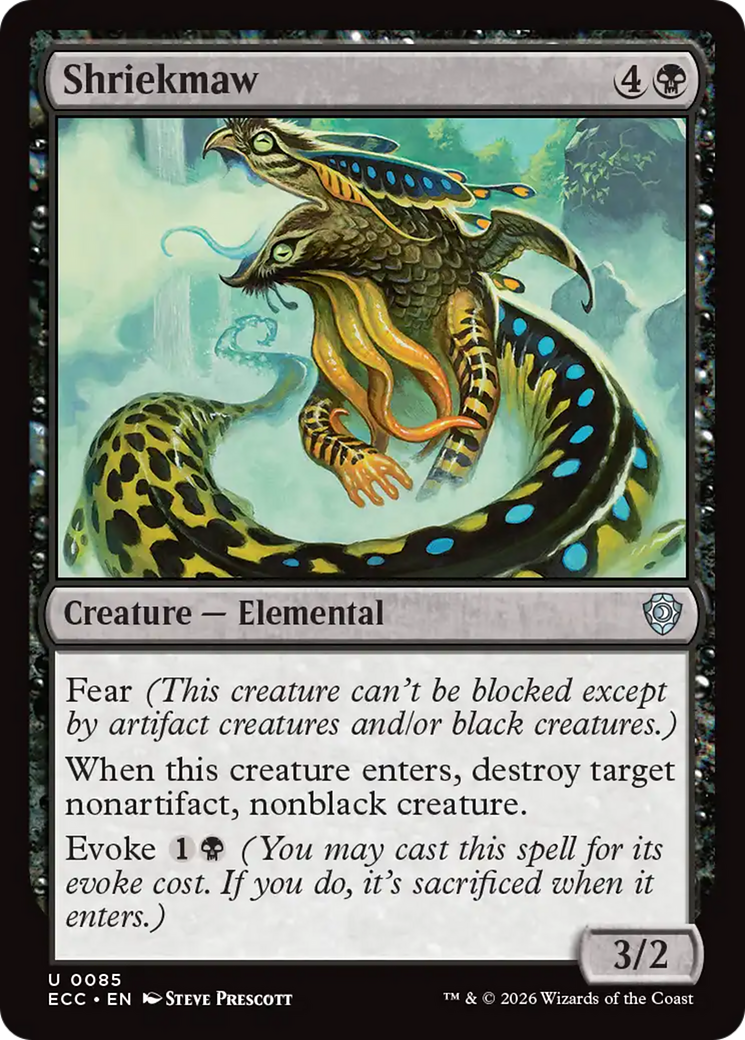
Shriekmaw
Shriekmaw
Creature — Elemental
3/2
Fear (This creature can't be blocked except by artifact creatures and/or black creatures.)
When this creature enters, destroy target nonartifact, nonblack creature.
Evoke (You may cast this spell for its evoke cost. If you do, it's sacrificed when it enters.)
- To determine the total cost of a spell, start with the mana cost or alternative cost you're paying (such as an evoke cost), add any cost increases, then apply any cost reductions. The mana value of the spell is determined by only its mana cost, no matter what the total cost to cast that spell was.
- If you pay the evoke cost, you can have Shriekmaw's own triggered ability resolve before the evoke triggered ability. You can cast spells after that ability resolves but before you have to sacrifice Shriekmaw.
-
1
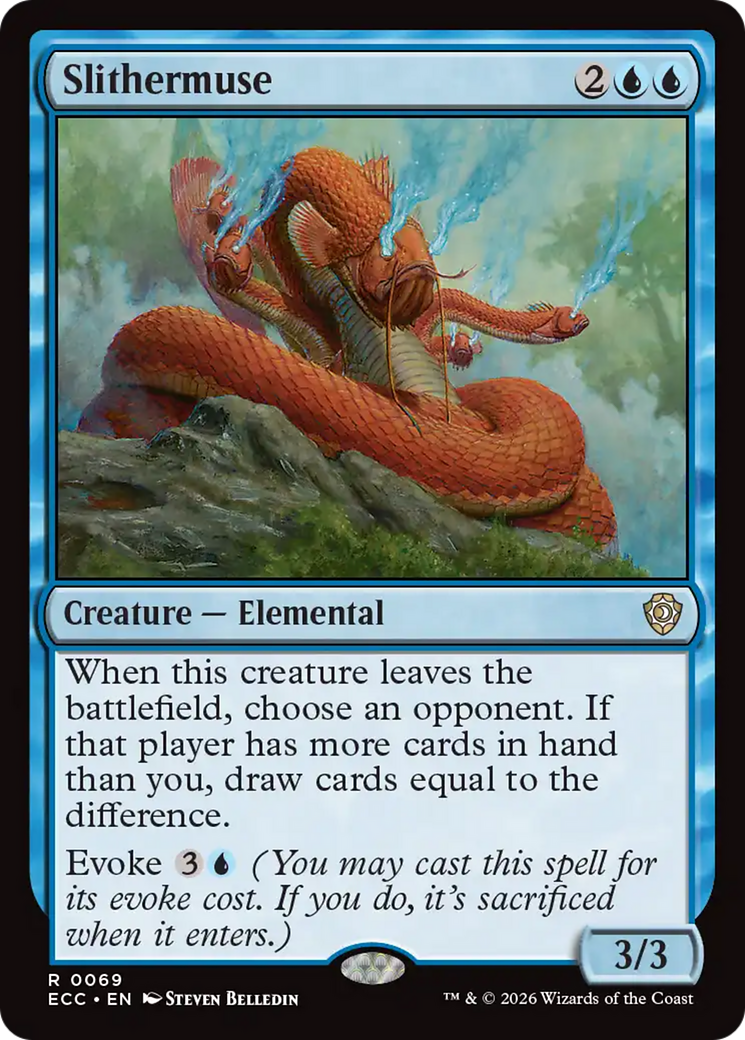
Slithermuse
Slithermuse
Creature — Elemental
3/3
When this creature leaves the battlefield, choose an opponent. If that player has more cards in hand than you, draw cards equal to the difference.
Evoke (You may cast this spell for its evoke cost. If you do, it's sacrificed when it enters.)
- You choose an opponent when the ability resolves. Once you determine how many more cards than you that player has, that number is locked in as the amount you'll draw.
-
1
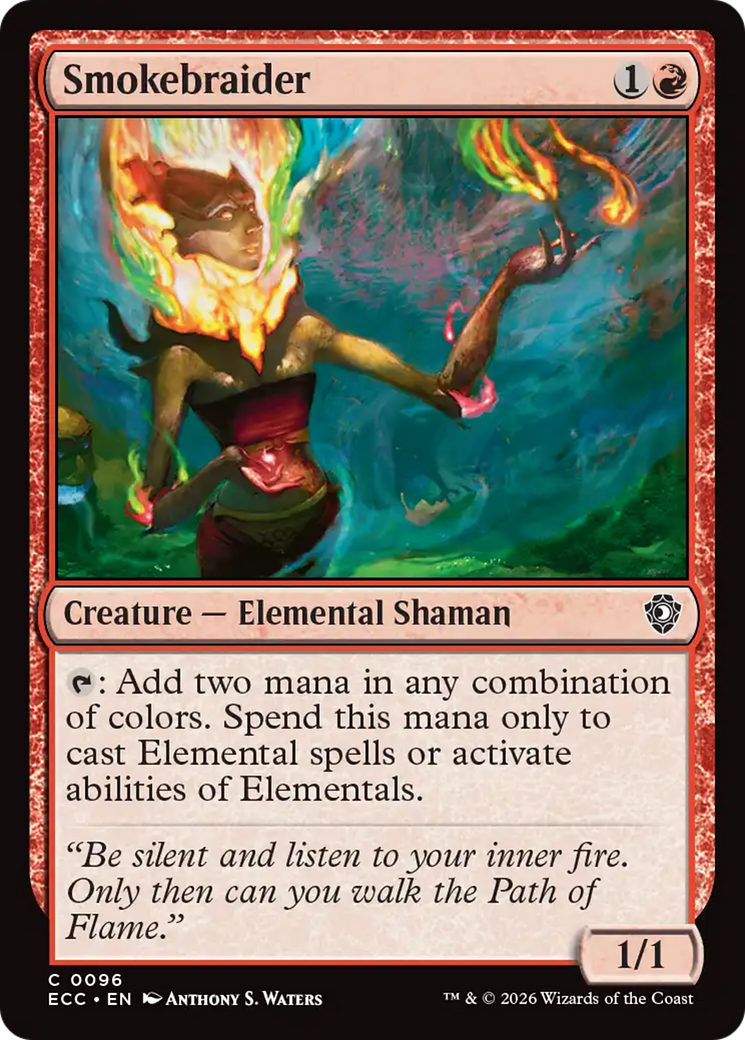
Smokebraider
Smokebraider
Creature — Elemental Shaman
1/1
: Add two mana in any combination of colors. Spend this mana only to cast Elemental spells or activate abilities of Elementals.
- The mana can't be spent to activate activated abilities of Elemental sources that aren't on the battlefield.
- The mana can be two mana of the same color, or one mana of each of two different colors. The mana can't be colorless.
- You can use this mana to pay an alternative cost (such as evoke) or additional cost incurred while casting an Elemental spell. It's not limited to just that spell's mana cost.
-
1
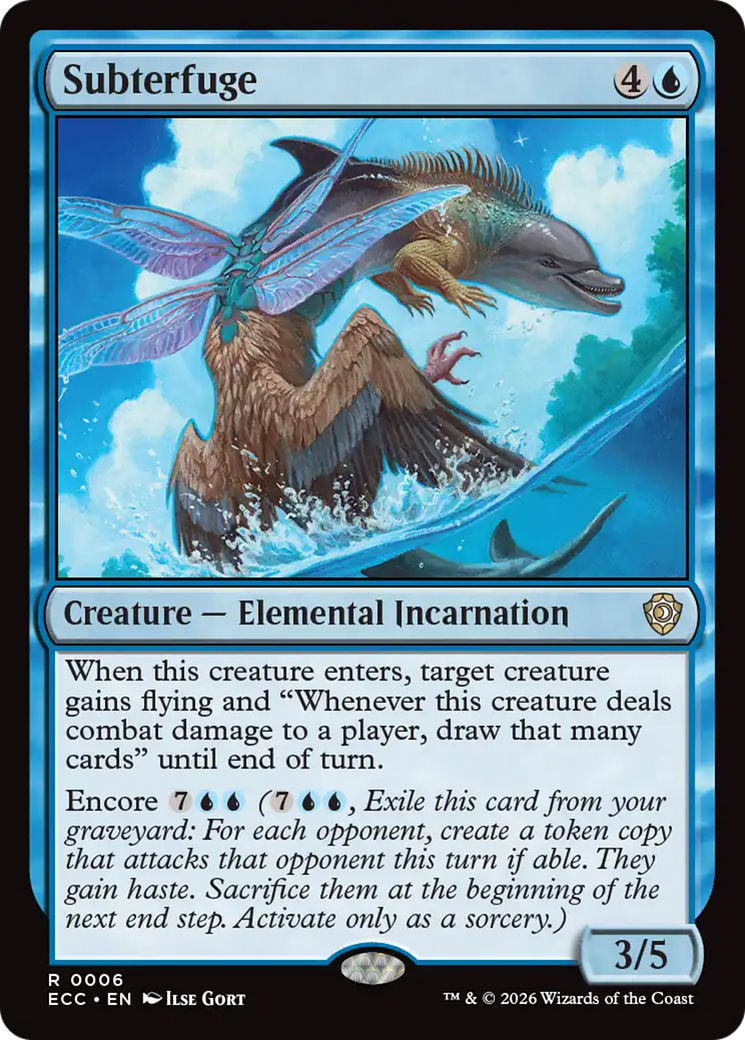
Subterfuge
Subterfuge
Creature — Elemental Incarnation
3/5
When this creature enters, target creature gains flying and "Whenever this creature deals combat damage to a player, draw that many cards" until end of turn.
Encore ( , Exile this card from your graveyard: For each opponent, create a token copy that attacks that opponent this turn if able. They gain haste. Sacrifice them at the beginning of the next end step. Activate only as a sorcery.)
- Each token must attack the appropriate player if able.
- If one of the tokens somehow is under another player's control as the delayed triggered ability resolves, you can't sacrifice that token. It remains on the battlefield indefinitely, even if you regain control of it later.
- Opponents who have left the game aren't counted when determining how many tokens to create.
- If an effect stops a token from attacking a specific player, that token can attack any player, planeswalker, or battle, or not attack at all. If the effect stops the token from attacking a specific player unless a cost is paid, you don't have to pay that cost unless you want to attack that player.
- Encore is an activated ability that functions from the graveyard. "Encore [cost]" means "[Cost], Exile this card from your graveyard: For each opponent, create a token that's a copy of this card that attacks that opponent this turn if able. The tokens gain haste. Sacrifice them at the beginning of the next end step. Activate only as a sorcery."
- If one of the tokens can't attack for any reason (such as being tapped), then it doesn't attack. If there's a cost associated with having it attack, you aren't forced to pay that cost, so it doesn't have to attack in that case either.
- Exiling the card with encore is a cost to activate the encore ability. Once you announce that you're activating it, no player may take actions until you've finished. They can't try to remove the card from your graveyard to stop you from paying the cost.
- The tokens copy only what's on the original card. Effects that modified that creature when it was previously on the battlefield won't be copied.
-
1
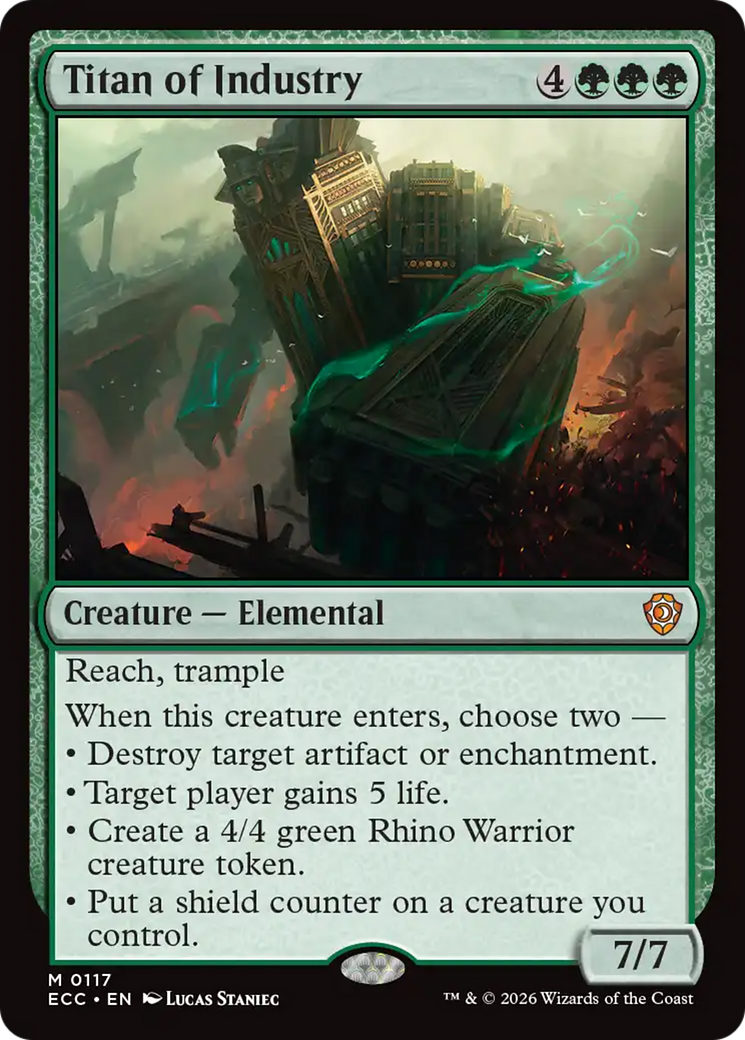
Titan of Industry
Titan of Industry
Creature — Elemental
7/7
Reach, trample
When this creature enters, choose two —
- Destroy target artifact or enchantment.
- Target player gains 5 life.
- Create a 4/4 green Rhino Warrior creature token.
- Put a shield counter on a creature you control.
- Only the first and second modes of Titan of Industry's triggered ability have a target. If one of those modes is chosen with either the third or fourth mode and the only target is an illegal target when the ability would resolve, the ability does not resolve and the other chosen mode has no effect.
-
1
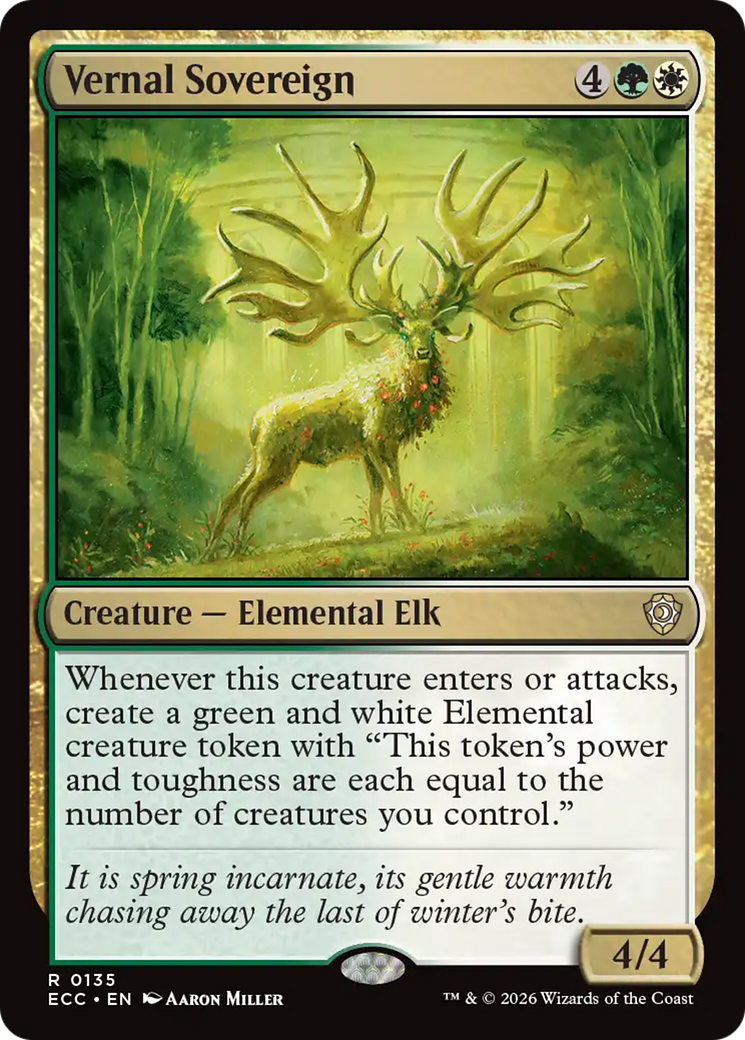
Vernal Sovereign
Vernal Sovereign
Creature — Elemental Elk
4/4
Whenever this creature enters or attacks, create a green and white Elemental creature token with "This token's power and toughness are each equal to the number of creatures you control."
-
1
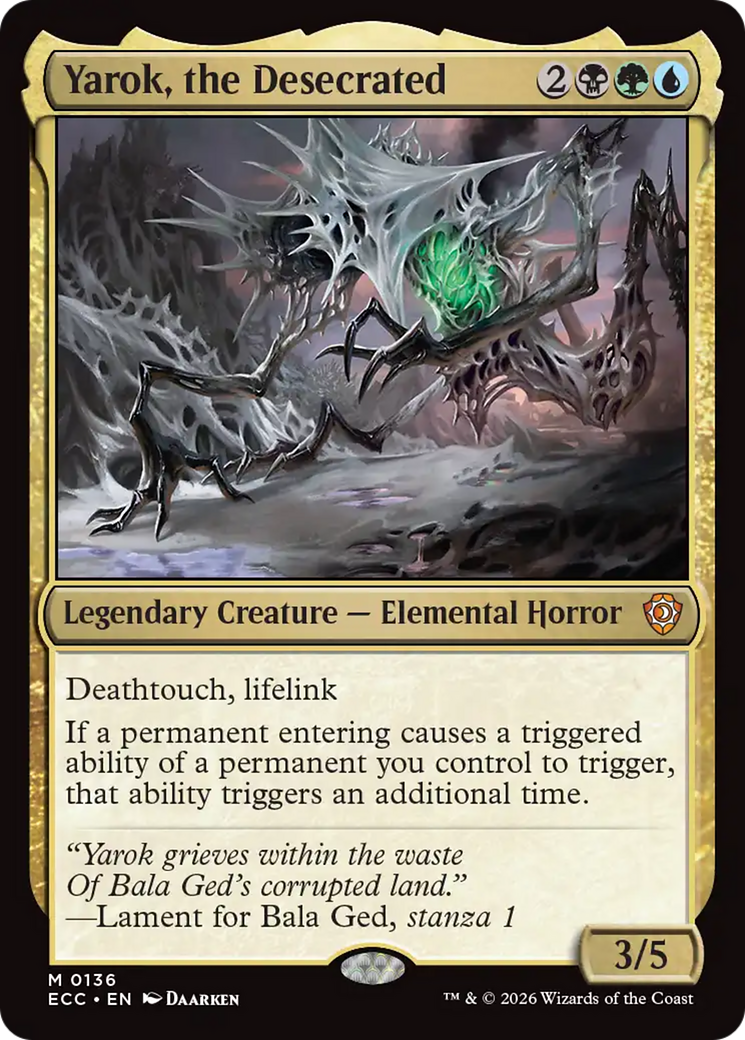
Yarok, the Desecrated
Yarok, the Desecrated
Legendary Creature — Elemental Horror
3/5
Deathtouch, lifelink
If a permanent entering causes a triggered ability of a permanent you control to trigger, that ability triggers an additional time.
- Yarok affects a permanent's own enters-the-battlefield triggered abilities as well as other triggered abilities that trigger when that permanent enters the battlefield. Such triggered abilities start with "when" or "whenever."
- Yarok's effect doesn't copy the triggered ability; it just causes the ability to trigger twice. Any choices made as you put the ability onto the stack, such as modes and targets, are made separately for each instance of the ability. Any choices made on resolution, such as whether to put counters on a permanent, are also made individually.
- If a permanent entering the battlefield at the same time as Yarok (including Yarok itself) causes a triggered ability of a permanent you control to trigger, that ability triggers an additional time.
- Abilities that apply "as [this creature] enters the battlefield," such as choosing a color with Diamond Knight, are also unaffected.
- If a triggered ability is linked to a second ability, additional instances of that triggered ability are also linked to that second ability. If the second ability refers to "the exiled card," it refers to all cards exiled by instances of the triggered ability.
- If you somehow control two Yaroks, a permanent entering the battlefield causes abilities to trigger three times, not four. A third Yarok causes abilities to trigger four times, a fourth causes abilities to trigger five times, and so on.
- Replacement effects are unaffected by Yarok's ability. For example, a creature that enters the battlefield with one +1/+1 counter on it won't receive an additional +1/+1 counter.
- You don't need to control the permanent entering the battlefield, only the permanent that has the triggered ability.
- In some cases involving linked abilities, an ability requires information about "the exiled card." When this happens, the ability gets multiple answers. If these answers are being used to determine the value of a variable, the sum is used. For example, if Elite Arcanist's enters-the-battlefield ability triggers twice, two cards are exiled. The value of X in the activation cost of Elite Arcanist's other ability is the sum of the two cards' mana values. As the ability resolves, you create copies of both cards and can cast none, one, or both of the copies in any order.
Instants 5
-
1
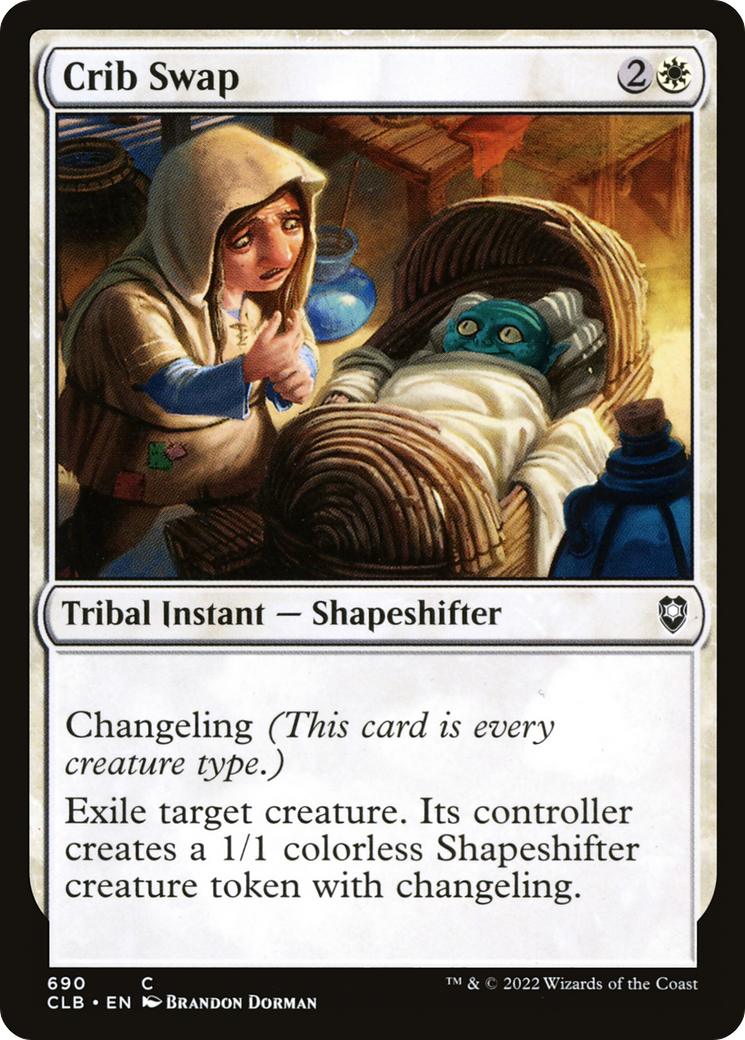
Crib Swap
Crib Swap
Kindred Instant — Shapeshifter
Changeling (This card is every creature type.)
Exile target creature. Its controller creates a 1/1 colorless Shapeshifter creature token with changeling.
-
1
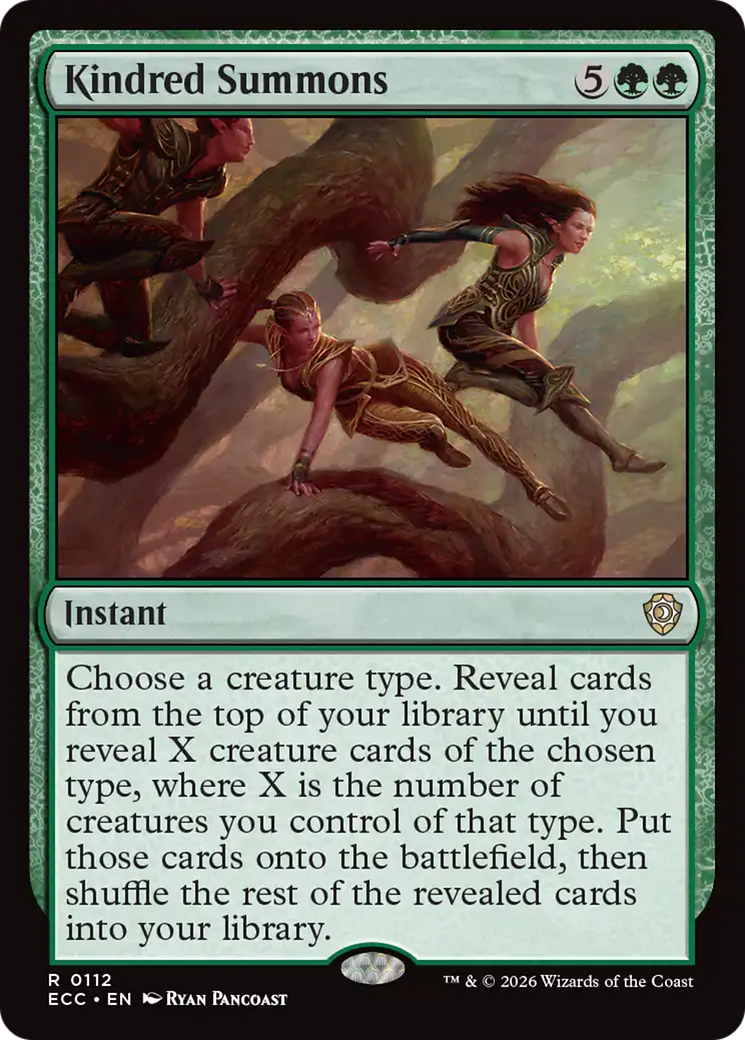
Kindred Summons
Kindred Summons
Instant
Choose a creature type. Reveal cards from the top of your library until you reveal X creature cards of the chosen type, where X is the number of creatures you control of that type. Put those cards onto the battlefield, then shuffle the rest of the revealed cards into your library.
- If you reveal your entire library and reveal fewer than X creature cards of the chosen type, you'll put the cards of the chosen type that you did reveal onto the battlefield and shuffle your library.
-
1
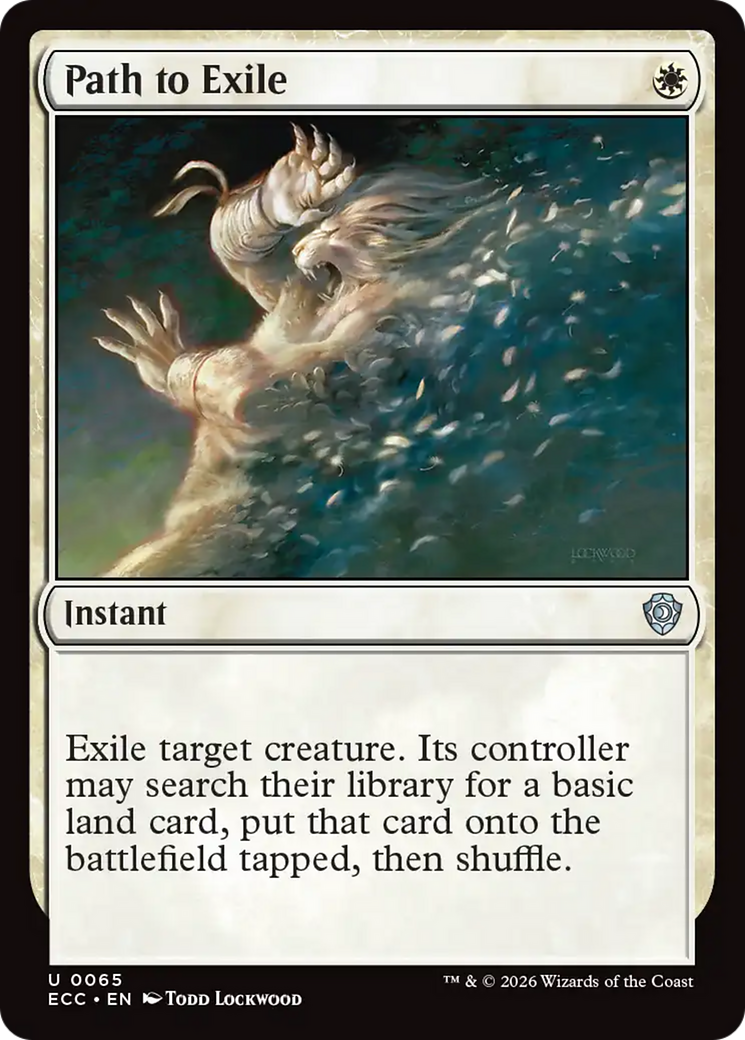
Path to Exile
Path to Exile
Instant
Exile target creature. Its controller may search their library for a basic land card, put that card onto the battlefield tapped, then shuffle.
- The controller of the exiled creature isn't required to search their library for a basic land. If that player doesn't, the player won't shuffle their library.
- If the target creature is an illegal target by the time Path to Exile tries to resolve, it won't resolve and none of its effects will happen. The creature's controller won't search for a basic land card.
-
1
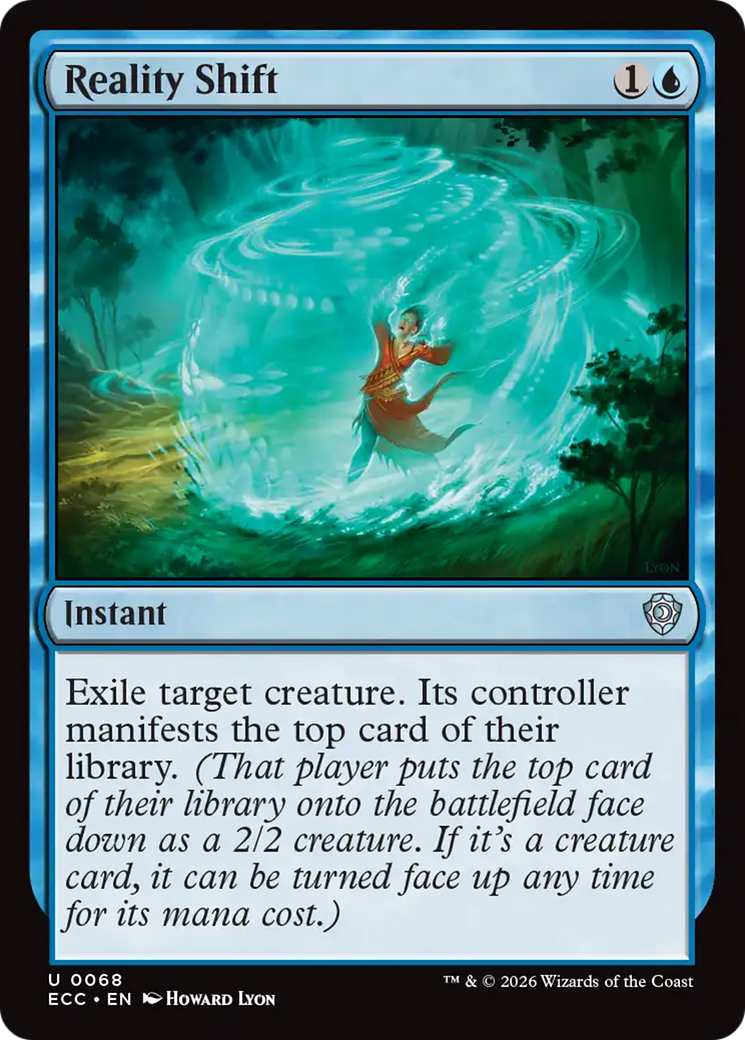
Reality Shift
Reality Shift
Instant
Exile target creature. Its controller manifests the top card of their library. (That player puts the top card of their library onto the battlefield face down as a 2/2 creature. If it's a creature card, it can be turned face up any time for its mana cost.)
- Any time you have priority, you may turn a manifested creature face up by revealing that it's a creature card (ignoring any copy effects or type-changing effects that might be applying to it) and paying its mana cost. This is a special action. It doesn't use the stack and can't be responded to.
- Because the permanent is on the battlefield both before and after it's turned face up, turning a permanent face up doesn't cause any enters-the-battlefield abilities to trigger.
- A permanent that turns face up or face down changes characteristics but is otherwise the same permanent. Spells and abilities that were targeting that permanent, as well as Auras and Equipment that were attached to the permanent, aren't affected.
- At any time, you can look at a face-down permanent you control. You can't look at face-down permanents you don't control unless an effect allows you to or instructs you to.
- The face-down permanent is a 2/2 creature with no name, mana cost, creature types, or abilities. It's colorless and has a mana value of 0. Other effects that apply to the permanent can still grant or change any of these characteristics.
- If a face-down permanent you control leaves the battlefield, you must reveal it. You must also reveal all face-down spells and permanents you control if you leave the game or if the game ends.
- If a manifested creature would have morph if it were face up, you may also turn it face up by paying its morph cost.
- Turning a permanent face up or face down doesn't change whether that permanent is tapped or untapped.
- Because face-down creatures don't have names, they can't have the same name as any other creature, even another face-down creature.
- If a double-faced card is manifested, it will be put onto the battlefield face down. While face down, it can't transform. If the front face of the card is a creature card, you can turn it face up by paying its mana cost. If you do, its front face will be up.
- There are no cards in the Fate Reforged set that would turn a face-down instant or sorcery card on the battlefield face up, but some older cards can try to do this. If something tries to turn a face-down instant or sorcery card on the battlefield face up, reveal that card to show all players it's an instant or sorcery card. The permanent remains on the battlefield face down. Abilities that trigger when a permanent turns face up won't trigger, because even though you revealed the card, it never turned face up.
- Unlike a face-down creature that was cast using the morph ability, a manifested creature may still be turned face up after it loses its abilities if it's a creature card.
- You must ensure that your face-down spells and permanents can easily be differentiated from each other. You're not allowed to mix up the cards that represent them on the battlefield in order to confuse other players. The order they entered the battlefield should remain clear. Common methods for indicating this include using markers or dice, or simply placing them in order on the battlefield. You must also track how each became face down (manifested, cast face down using the morph ability, and so on).
-
1
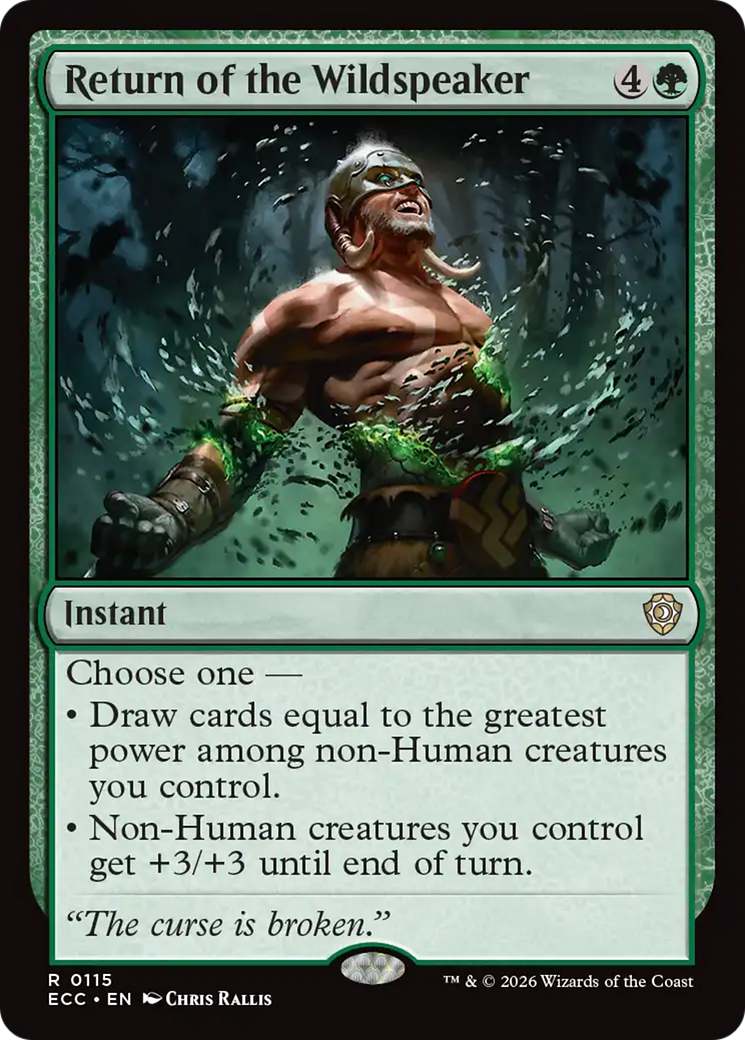
Return of the Wildspeaker
Return of the Wildspeaker
Instant
Choose one —
- Draw cards equal to the greatest power among non-Human creatures you control.
- Non-Human creatures you control get +3/+3 until end of turn.
Sorceries 7
-
1
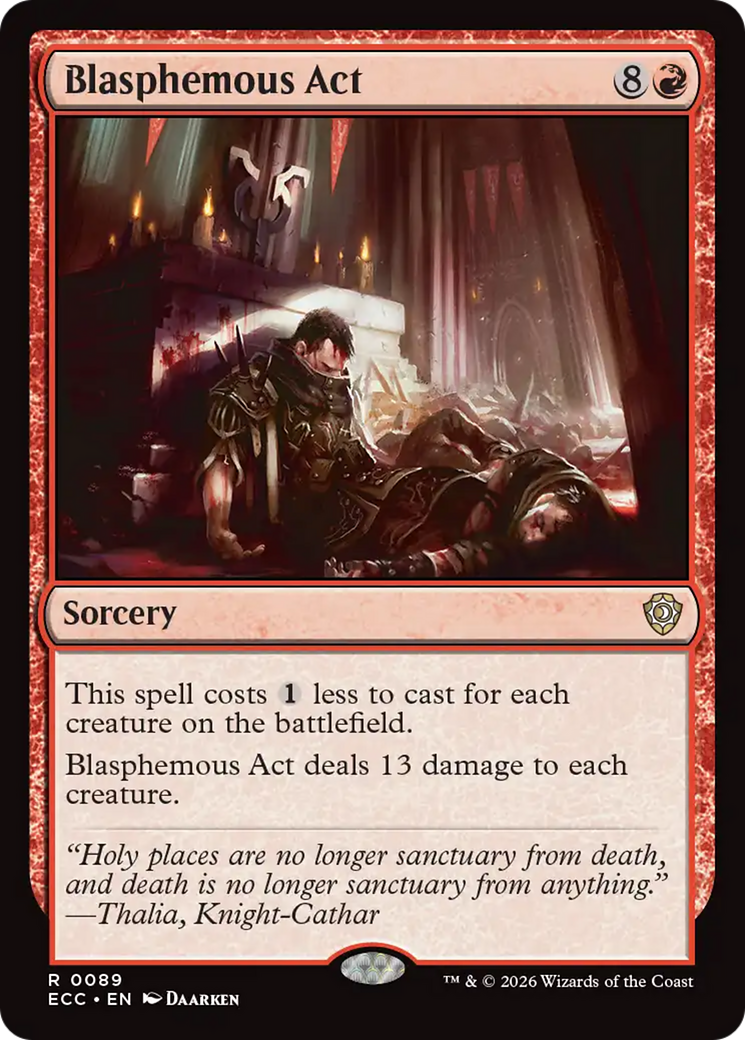
Blasphemous Act
Blasphemous Act
Sorcery
This spell costs less to cast for each creature on the battlefield.
Blasphemous Act deals 13 damage to each creature.
- Although players may respond to Blasphemous Act once it's been cast, once it's announced, they can't respond before the cost is calculated and paid.
- Blasphemous Act's ability can't reduce the total cost to cast the spell below .
- The total cost to cast Blasphemous Act is locked in before you pay that cost. For example, if there are three creatures on the battlefield, including one you can sacrifice to add , the total cost of Blasphemous Act is . Then you can sacrifice the creature when you activate mana abilities just before paying the cost.
- To determine the total cost of a spell, start with the mana cost or alternative cost you're paying, add any cost increases, then apply any cost reductions (such as that of Blasphemous Act). The mana value of the spell is determined only by its mana cost, no matter what the total cost to cast the spell was.
-
1
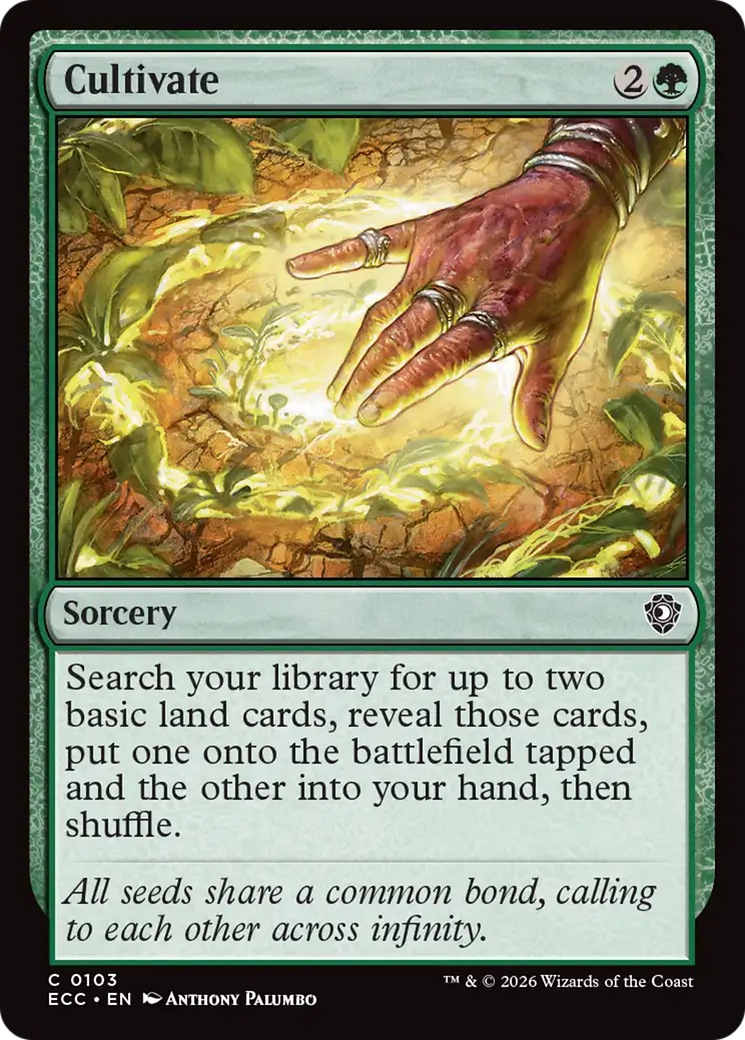
Cultivate
Cultivate
Sorcery
Search your library for up to two basic land cards, reveal those cards, put one onto the battlefield tapped and the other into your hand, then shuffle.
- If you choose to find only one basic land card, you put it onto the battlefield tapped.
-
1
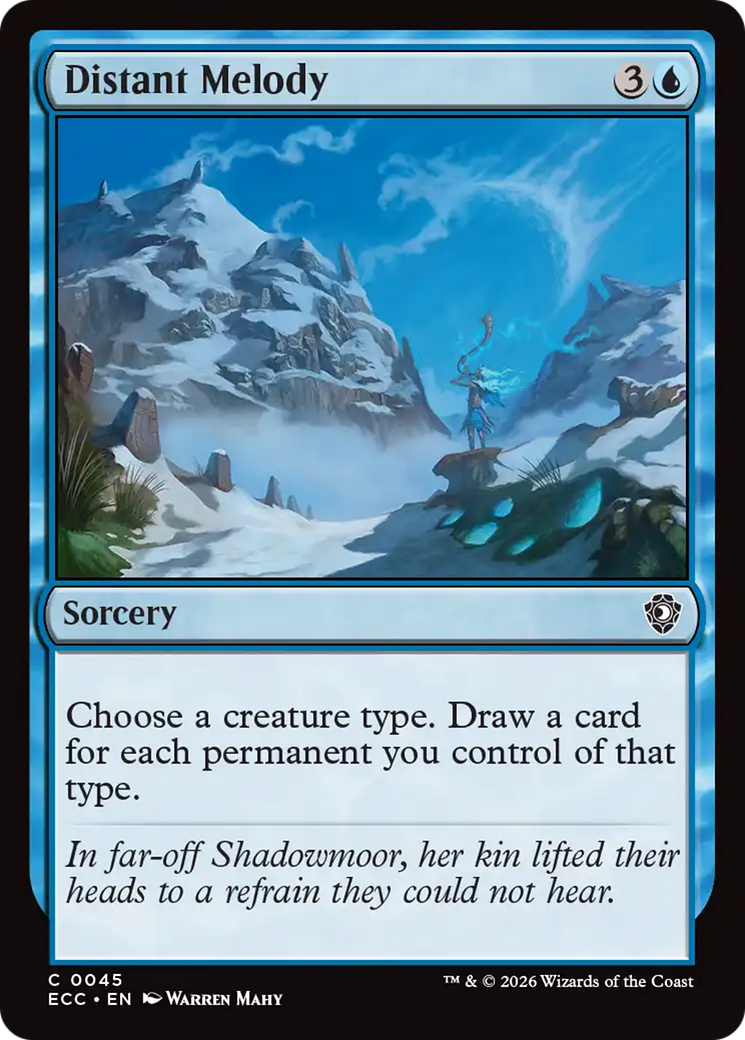
Distant Melody
Distant Melody
Sorcery
Choose a creature type. Draw a card for each permanent you control of that type.
- Note that this spell counts the number of permanents you control of the chosen type, not just the number of creatures you control. It will also take your kindred permanents of the chosen type into account.
-
1
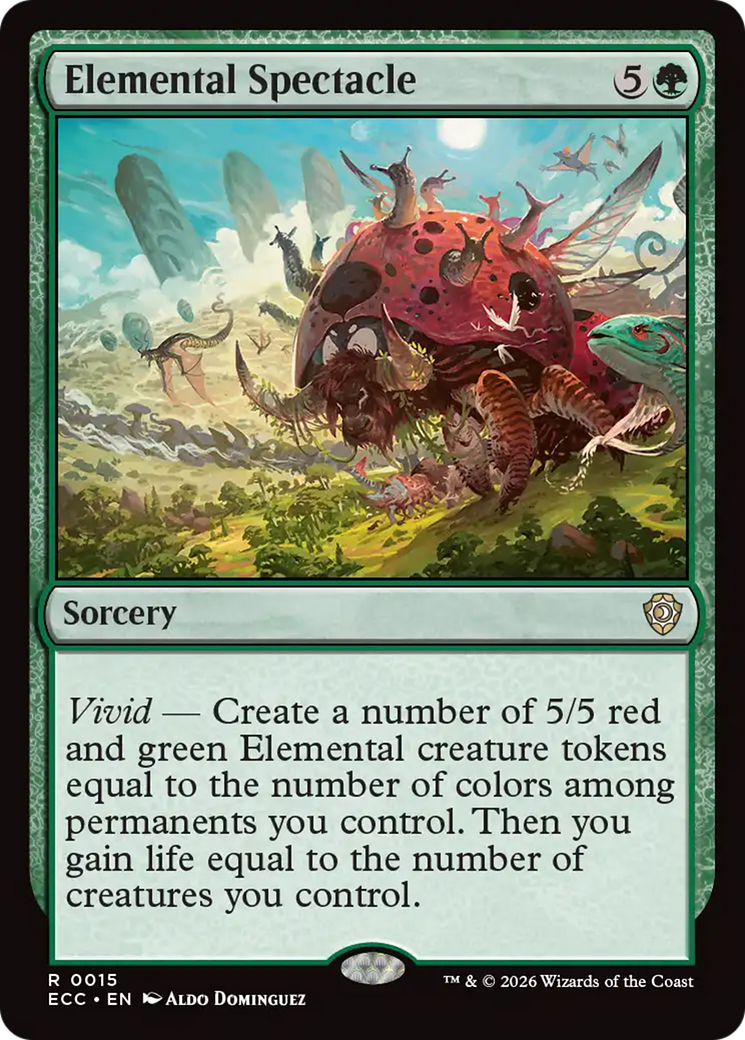
Elemental Spectacle
Elemental Spectacle
Sorcery
Vivid — Create a number of 5/5 red and green Elemental creature tokens equal to the number of colors among permanents you control. Then you gain life equal to the number of creatures you control.
-
1
Haunting Voyage
Haunting Voyage
Sorcery
Choose a creature type. Return up to two creature cards of that type from your graveyard to the battlefield. If this spell was foretold, return all creature cards of that type from your graveyard to the battlefield instead.
Foretell (During your turn, you may pay and exile this card from your hand face down. Cast it on a later turn for its foretell cost.)
- Haunting Voyage doesn't target any creature cards. You choose the creature type as Haunting Voyage resolves, then you choose up to two creature cards of that type to return (or all of them if Haunting Voyage was foretold).
- You must choose an existing creature type, such as Ox or Coward. You can't choose card types (e.g., artifact), supertypes (e.g., snow), or noncreature subtypes (e.g., Aura).
-
1
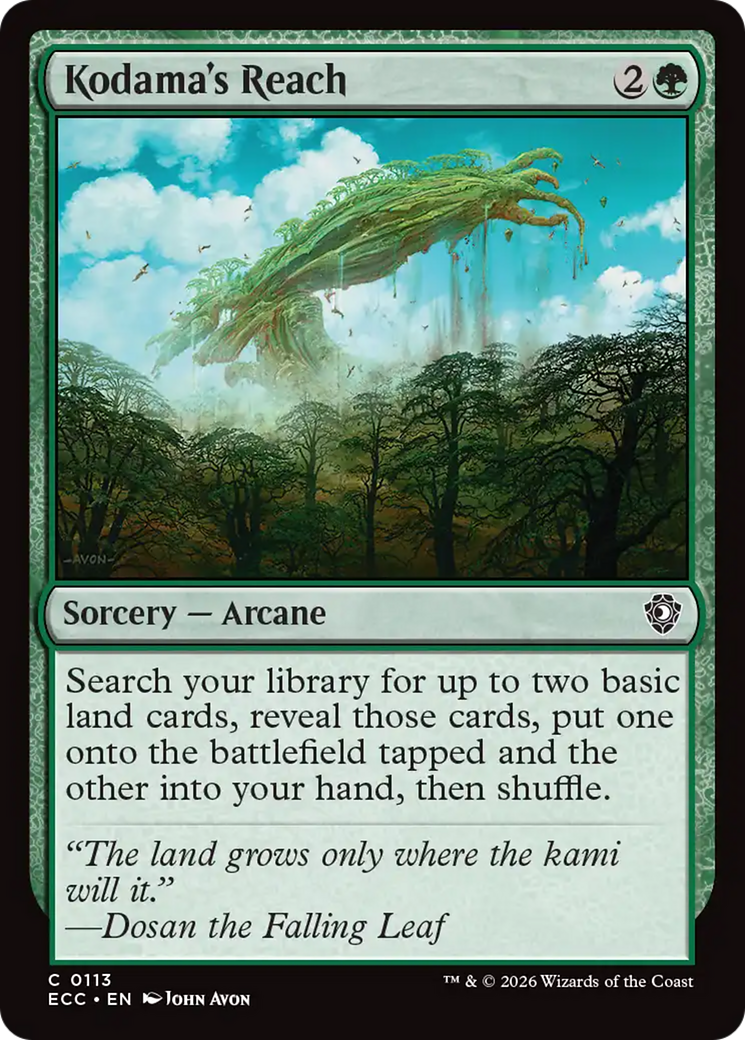
Kodama's Reach
Kodama's Reach
Sorcery — Arcane
Search your library for up to two basic land cards, reveal those cards, put one onto the battlefield tapped and the other into your hand, then shuffle.
- You can get just one basic land card if you wish (or even none at all). If you get only one land card, you put it onto the battlefield tapped.
-
1
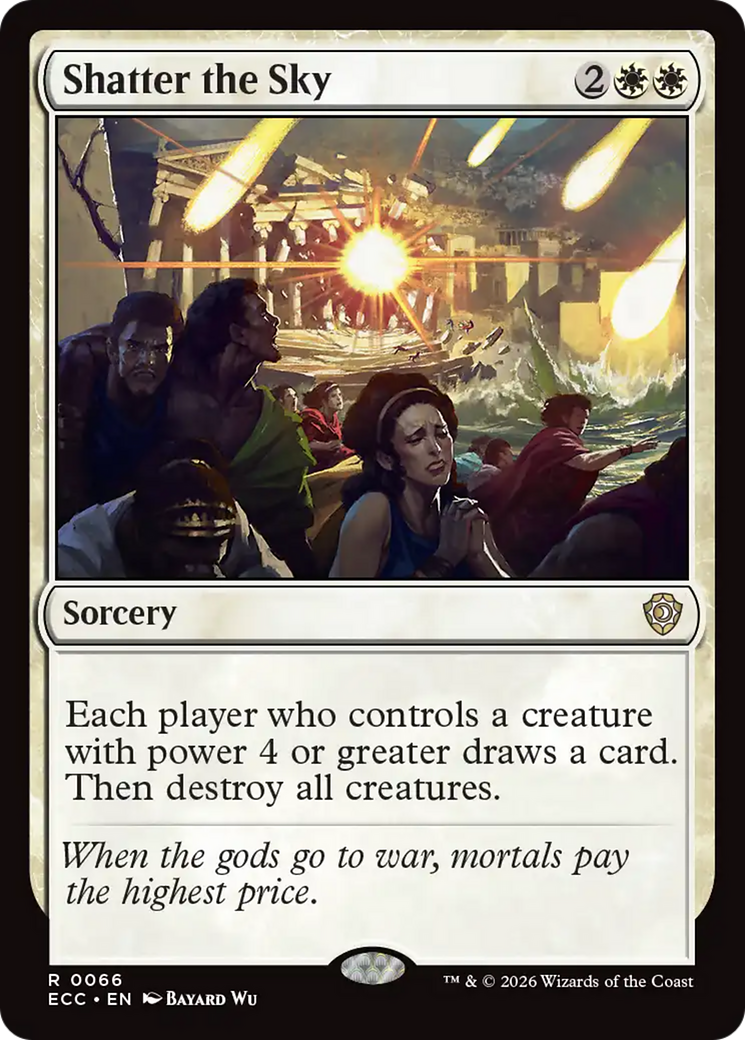
Shatter the Sky
Shatter the Sky
Sorcery
Each player who controls a creature with power 4 or greater draws a card. Then destroy all creatures.
- Shatter the Sky destroys all creatures, even if no player draws a card.
- No player may take any actions between the time each qualifying player draws a card and the time all creatures are destroyed.
Artifacts 5
-
1
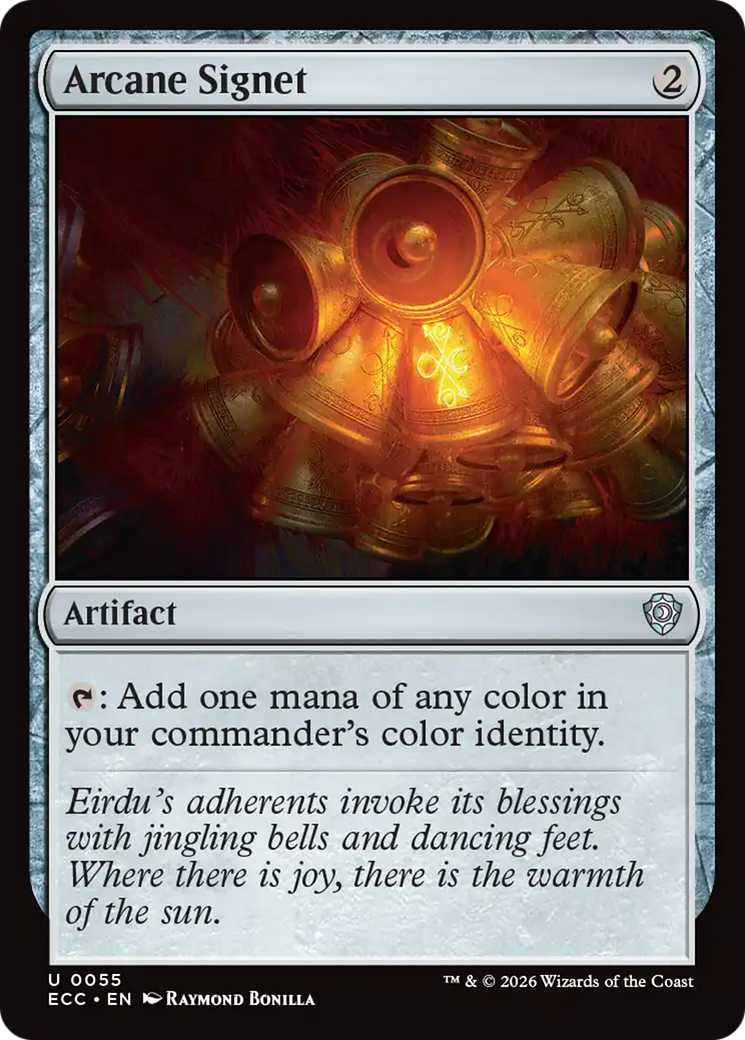
Arcane Signet
Arcane Signet
Artifact
: Add one mana of any color in your commander's color identity.
- If your commander is a card that has no colors in its color identity, Arcane Signet's ability produces no mana. It doesn't produce .
- If you have two commanders, the ability adds one mana of any color in their combined color identities.
- If you don't have a commander, Arcane Signet's ability produces no mana.
-
1
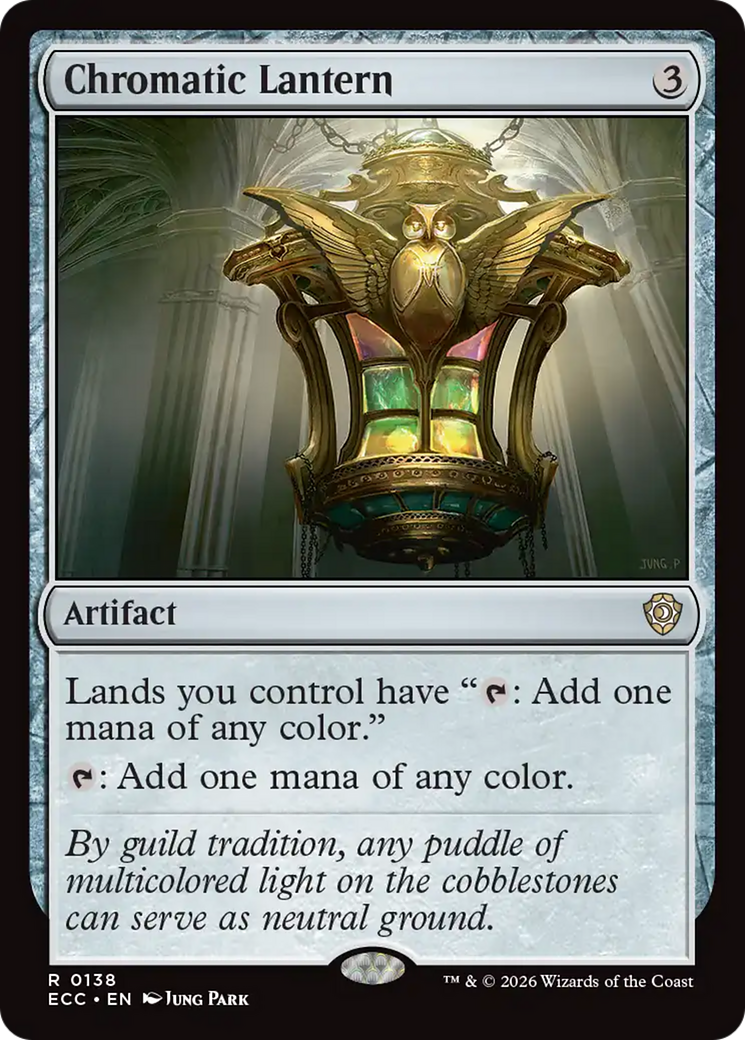
Chromatic Lantern
Chromatic Lantern
Artifact
Lands you control have " : Add one mana of any color."
: Add one mana of any color.
- Lands you control won't lose any other abilities they had. They also won't gain or lose any land types.
-
1
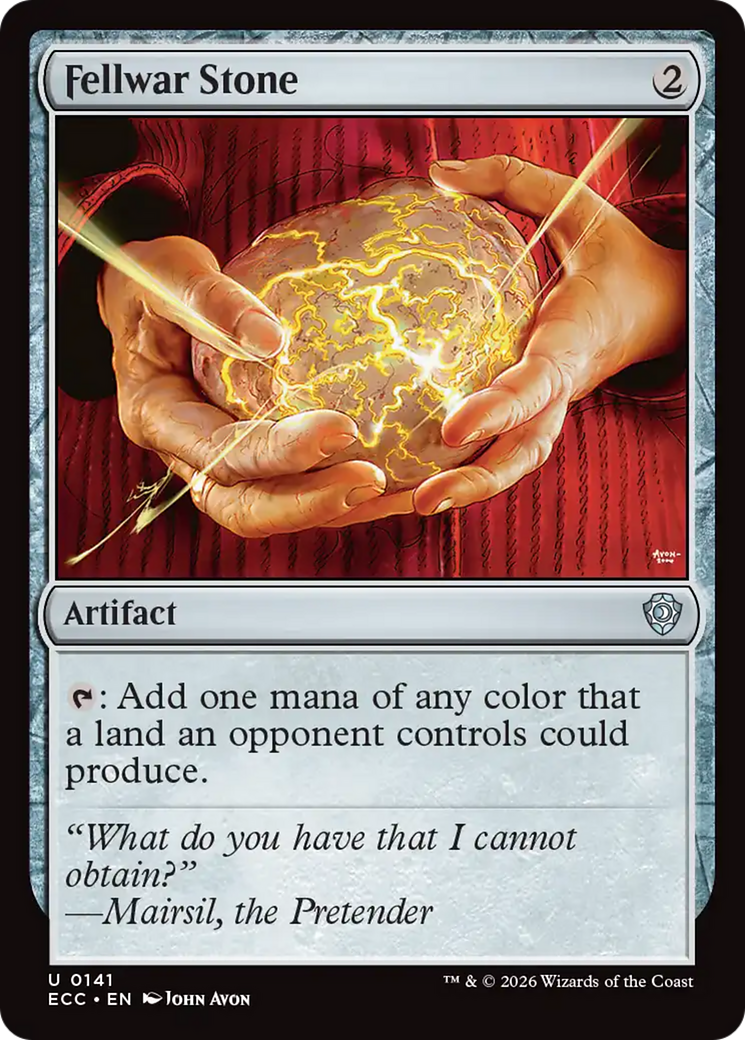
Fellwar Stone
Fellwar Stone
Artifact
: Add one mana of any color that a land an opponent controls could produce.
- When determining what colors of mana your opponents' lands could produce, take into account any applicable replacement effects that would apply to those lands' mana abilities (such as Contamination's effect, for example). If there is more than one, consider them in any possible order.
- Fellwar Stone doesn't care about any restrictions or riders your opponents' lands (such as Ancient Ziggurat or Hall of the Bandit Lord) put on the mana they produce. It just cares about colors of mana.
- The colors of mana are white, blue, black, red, and green. Fellwar Stone can't be tapped for colorless mana, even if a land an opponent controls could produce colorless mana.
- Fellwar Stone checks the effects of all mana-producing abilities of lands your opponents control, but it doesn't check their costs. For example, Vivid Crag has the ability " , Remove a charge counter from Vivid Crag: Add one mana of any color." If an opponent controls Vivid Crag and you control Fellwar Stone, you can tap Fellwar Stone for any color of mana. It doesn't matter whether Vivid Crag has a charge counter on it, and it doesn't matter whether it's untapped.
- This works even if the opponent's lands are tapped. It only checks what kinds of mana can be produced, not if the abilities that produce them are usable right now.
- It only produces one mana even if the land can produce more than one.
- The ability can be activated if the opponent has no lands that produce mana, but the effect will not be able to generate any mana.
-
1
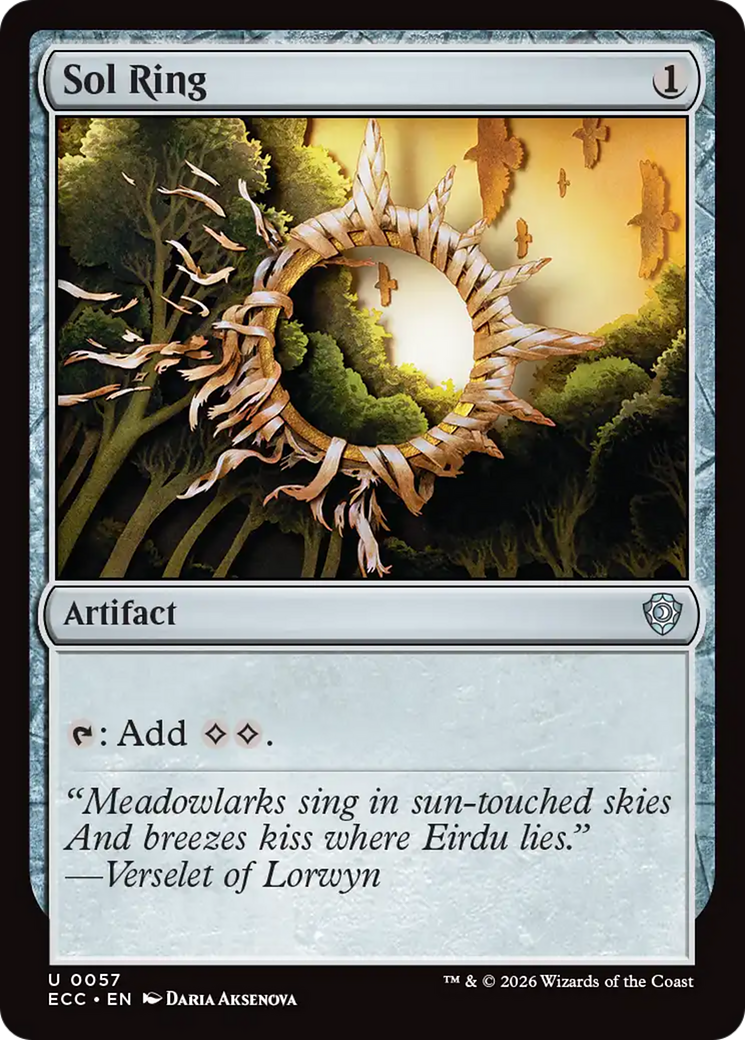
Sol Ring
Sol Ring
Artifact
: Add .
-
1
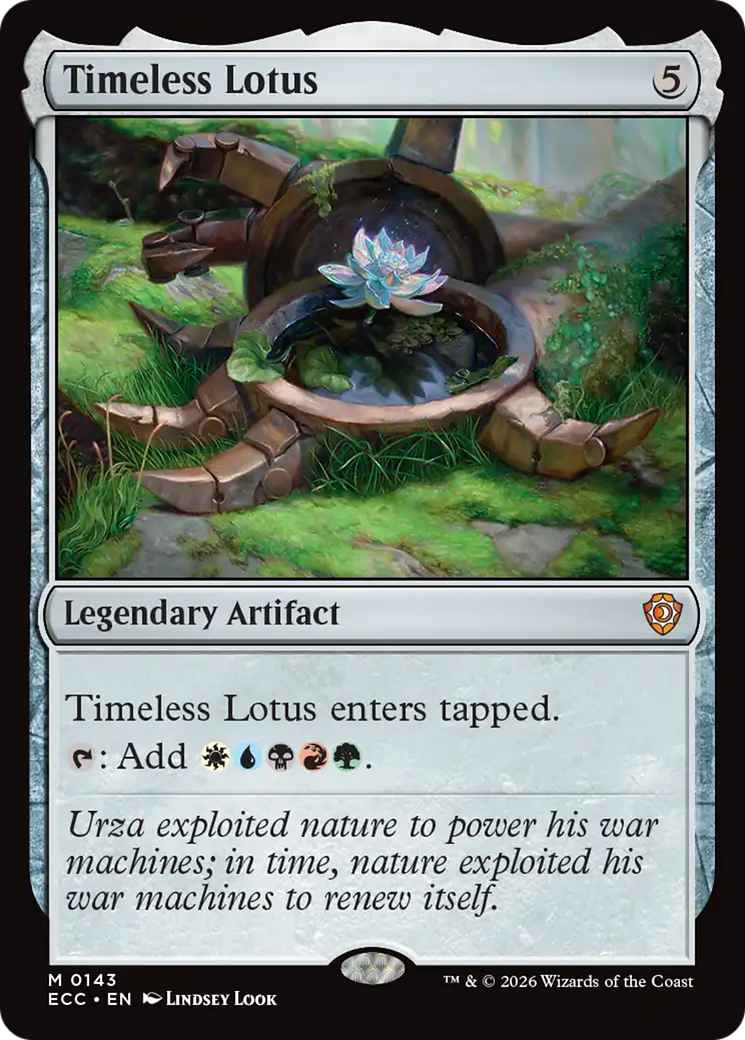
Timeless Lotus
Timeless Lotus
Legendary Artifact
Timeless Lotus enters tapped.
: Add .
Enchantments 7
-
1
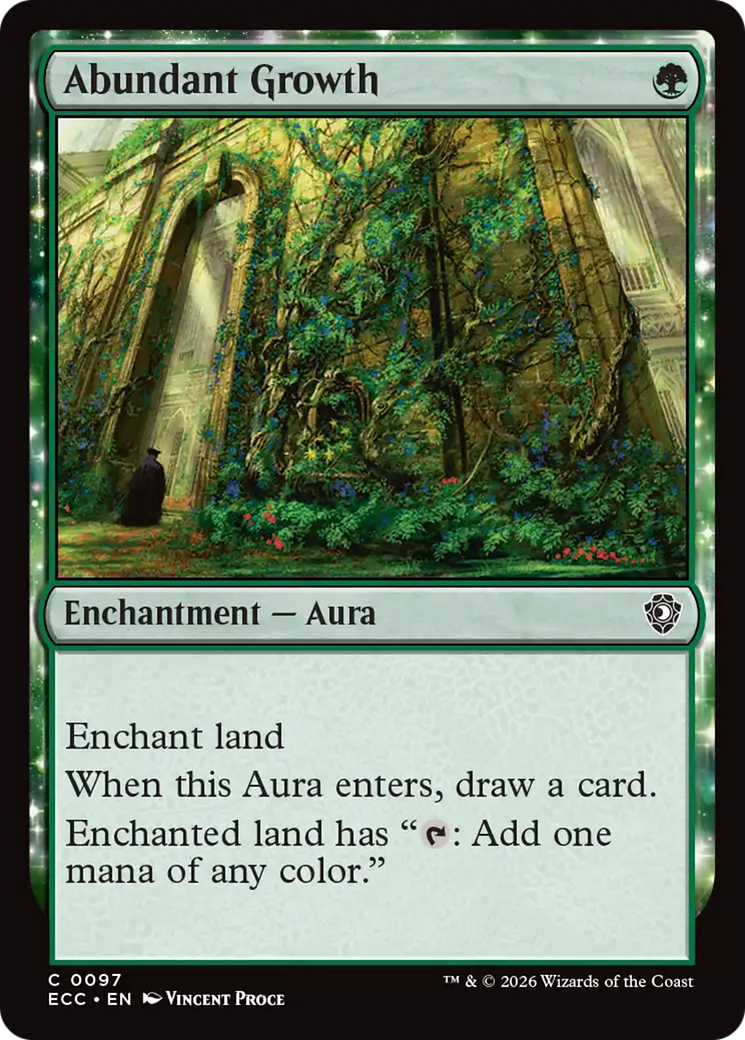
Abundant Growth
Abundant Growth
Enchantment — Aura
Enchant land
When this Aura enters, draw a card.
Enchanted land has " : Add one mana of any color."
- The enchanted land retains any other abilities it has. Activating one of the land's activated abilities won't cause the other(s) to be activated.
-
1
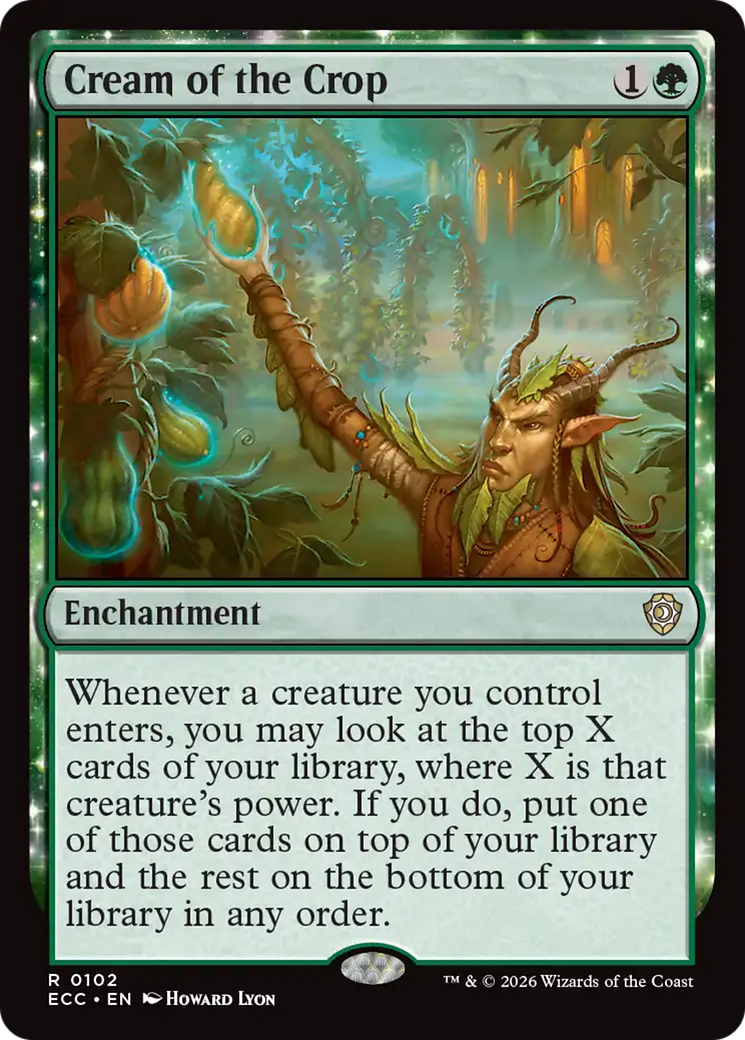
Cream of the Crop
Cream of the Crop
Enchantment
Whenever a creature you control enters, you may look at the top X cards of your library, where X is that creature's power. If you do, put one of those cards on top of your library and the rest on the bottom of your library in any order.
- If the creature has 0 power, this ability has no effect.
- The creature's power is checked as this ability resolves. If the creature has left the battlefield, use its last known information.
- If the creature has 1 power, this ability lets you look at the top card of your library, then you'll have to leave it there.
-
1
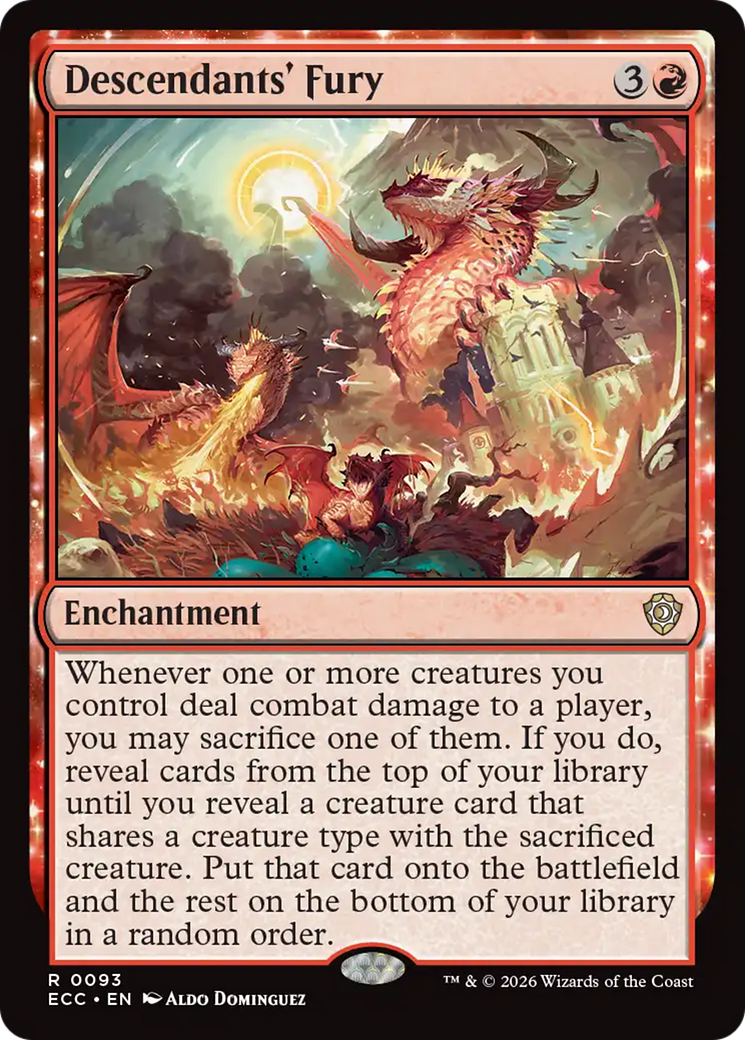
Descendants' Fury
Descendants' Fury
Enchantment
Whenever one or more creatures you control deal combat damage to a player, you may sacrifice one of them. If you do, reveal cards from the top of your library until you reveal a creature card that shares a creature type with the sacrificed creature. Put that card onto the battlefield and the rest on the bottom of your library in a random order.
- If you don't reveal a creature card that shares a creature type with the creature you sacrificed, you'll just reveal and randomize your library.
- If the sacrificed creature has no creature type, no card can share a creature type with it.
- You'll reveal cards until you find one that shares at least one creature type with the creature you sacrificed. For example, if you sacrificed a Cat Wizard, you'll stop if you reveal a Human Wizard or Cat Soldier.
- Compare the revealed cards to the creature as it last existed before it was sacrificed, not to the creature card as it exists in its owner's graveyard, to determine which card from your library you put onto the battlefield.
-
1
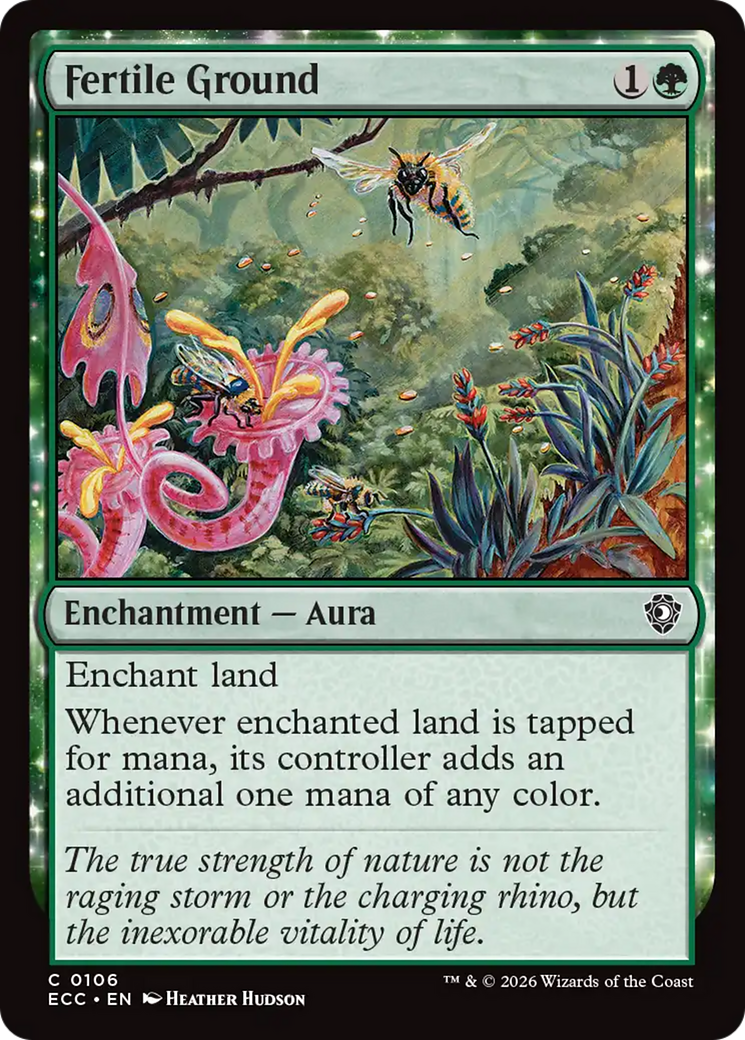
Fertile Ground
Fertile Ground
Enchantment — Aura
Enchant land
Whenever enchanted land is tapped for mana, its controller adds an additional one mana of any color.
-
1
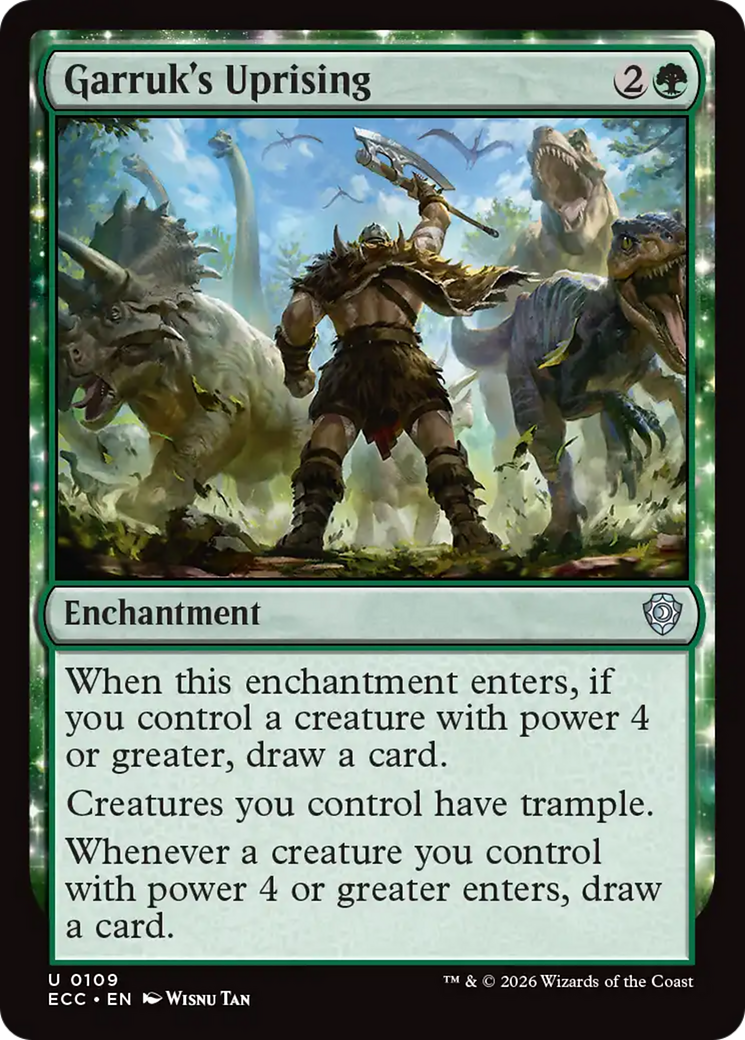
Garruk's Uprising
Garruk's Uprising
Enchantment
When this enchantment enters, if you control a creature with power 4 or greater, draw a card.
Creatures you control have trample. (Each of those creatures can deal excess combat damage to the player or planeswalker it's attacking.)
Whenever a creature you control with power 4 or greater enters, draw a card.
- The first ability of Garruk's Uprising has you draw just one card, no matter how many creatures you control with power 4 or greater.
- If one or more static abilities that apply to a creature entering change its power, those abilities are considered when determining whether Garruk's Uprising's last ability triggers. The same is true for replacement effects that apply to it, such as entering with one or more +1/+1 counters or entering as a copy of another creature.
- If you don't control a creature with power 4 or greater immediately after Garruk's Uprising enters, its first ability won't trigger. If you don't control one as the ability resolves, you don't draw a card. They don't have to be the same creature both times, however.
- Once the last ability of Garruk's Uprising has triggered, lowering the power of the creature or removing it from the battlefield won't stop you from drawing a card.
-
1
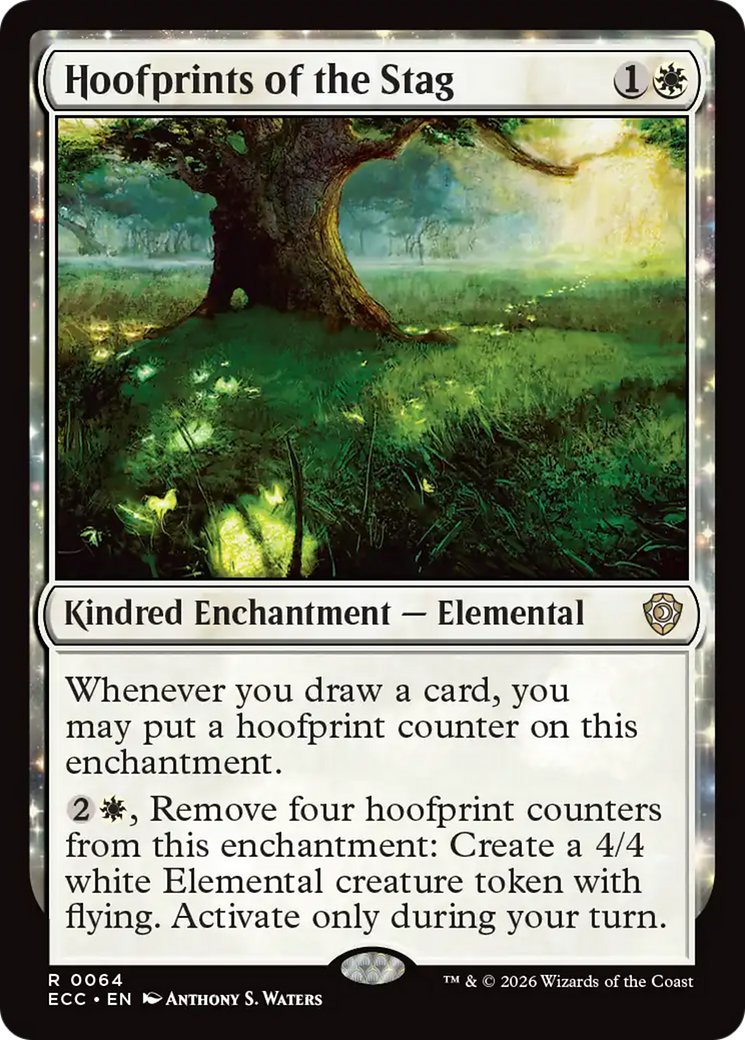
Hoofprints of the Stag
Hoofprints of the Stag
Kindred Enchantment — Elemental
Whenever you draw a card, you may put a hoofprint counter on this enchantment.
, Remove four hoofprint counters from this enchantment: Create a 4/4 white Elemental creature token with flying. Activate only during your turn.
- If a spell or ability has you draw multiple cards, Hoofprints of the Stag's ability triggers that many times.
-
1
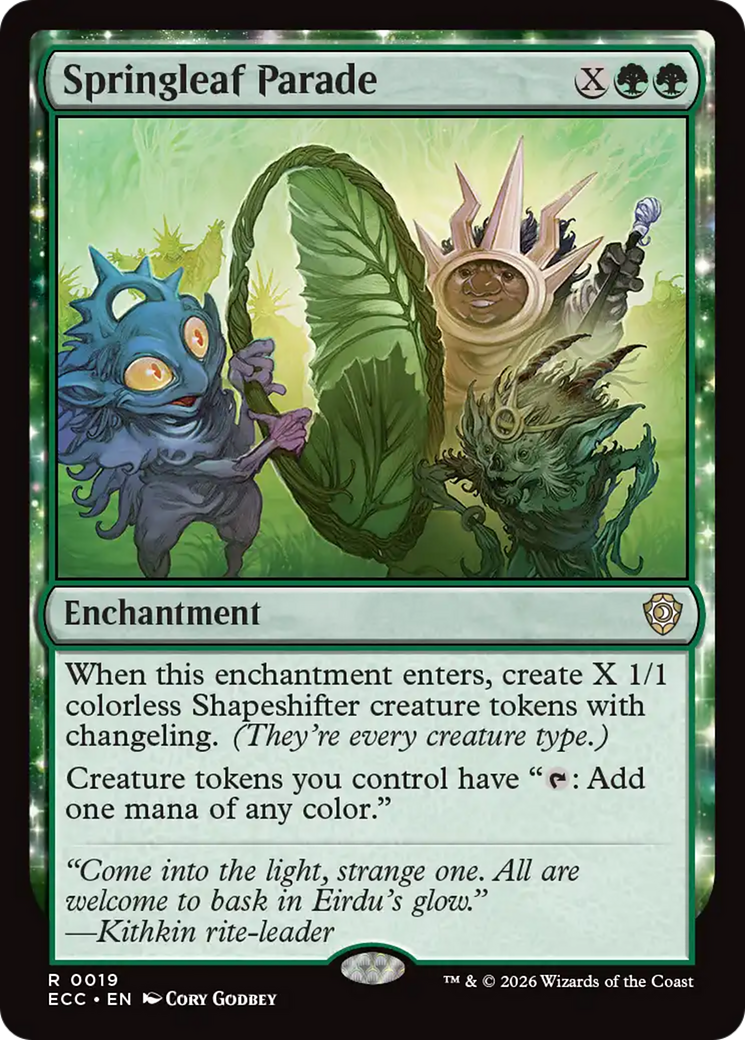
Springleaf Parade
Springleaf Parade
Enchantment
When this enchantment enters, create X 1/1 colorless Shapeshifter creature tokens with changeling. (They're every creature type.)
Creature tokens you control have " : Add one mana of any color."
Lands 40
-
1
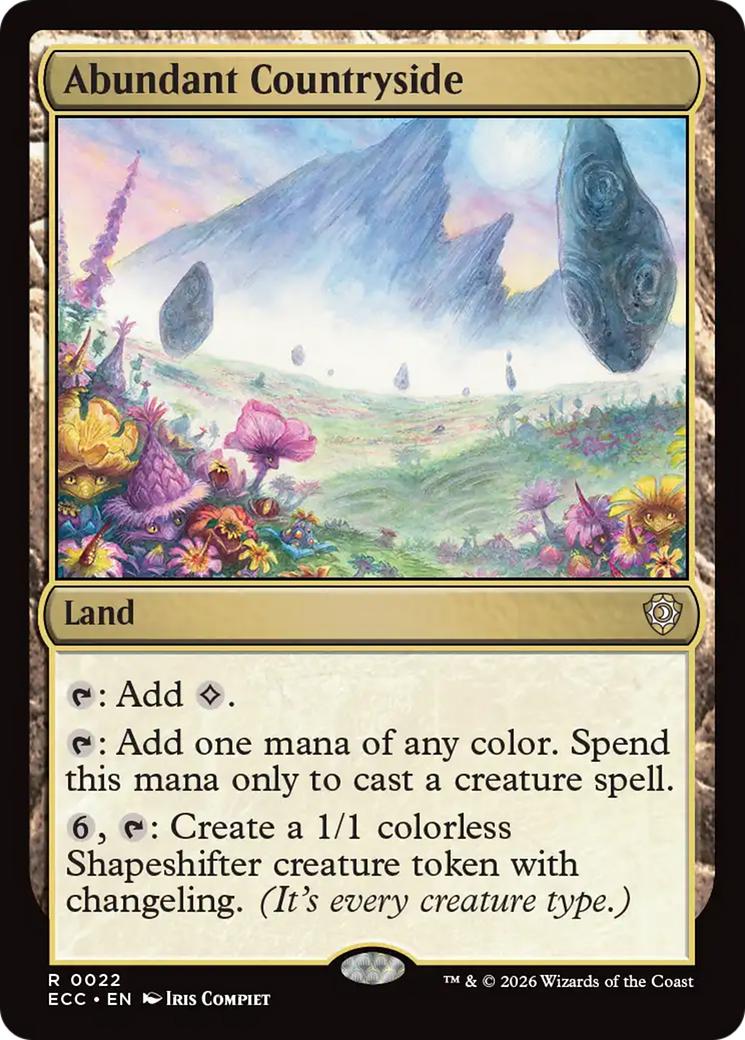
Abundant Countryside
Abundant Countryside
Land
: Add .
: Add one mana of any color. Spend this mana only to cast a creature spell.
, : Create a 1/1 colorless Shapeshifter creature token with changeling. (It's every creature type.)
- If an effect causes a creature with changeling to become a new creature type, it will be only that new creature type (unless the effect says "in addition" or similar). It will still have changeling; the effect making it all creature types will simply be overwritten.
- Changeling is a characteristic-defining ability. It functions in all zones, not only while a card that has it is on the battlefield.
- If an effect causes a creature with changeling to lose all abilities, it will remain all creature types, even though it will no longer have changeling. This is because changeling applies before the effect that removes it.
- The subtype Shapeshifter that appears on the type line is mostly there to reinforce the flavor. A creature card with changeling is just as much a Kithkin, a Goblin, a Merfolk, and a Brushwagg as it is a Shapeshifter.
-
1
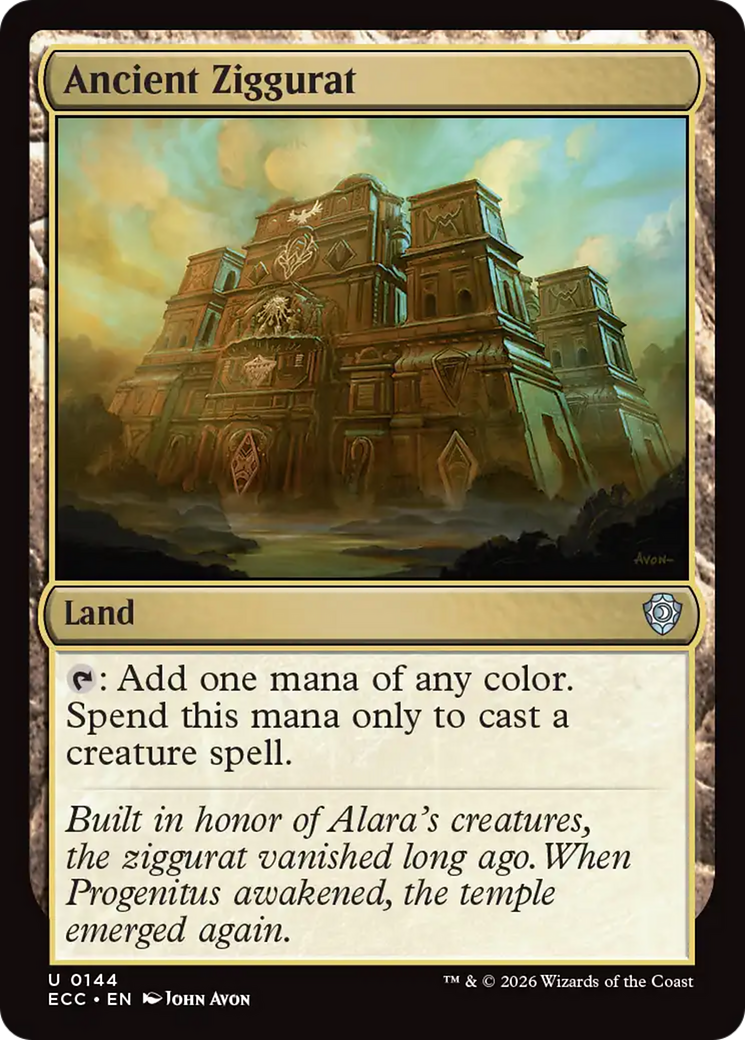
Ancient Ziggurat
Ancient Ziggurat
Land
: Add one mana of any color. Spend this mana only to cast a creature spell.
- Mana produced by Ancient Ziggurat can't be spent on activated abilities that put a creature card directly onto the battlefield, such as unearth or ninjutsu.
- Mana produced by Ancient Ziggurat can be spent on any part of a creature spell's total cost. This includes additional costs (such as kicker) and alternative costs (such as evoke or Worldheart Phoenix's alternative cost).
-
1
Command Tower
Command Tower
Land
: Add one mana of any color in your commander's color identity.
- If you don't have a commander, Command Tower's ability produces no mana.
- If your commander is a card that has no colors in its color identity, Command Tower's ability produces no mana. It doesn't produce .
- If you have two commanders, the ability adds one mana of any color in their combined color identities.
-
1
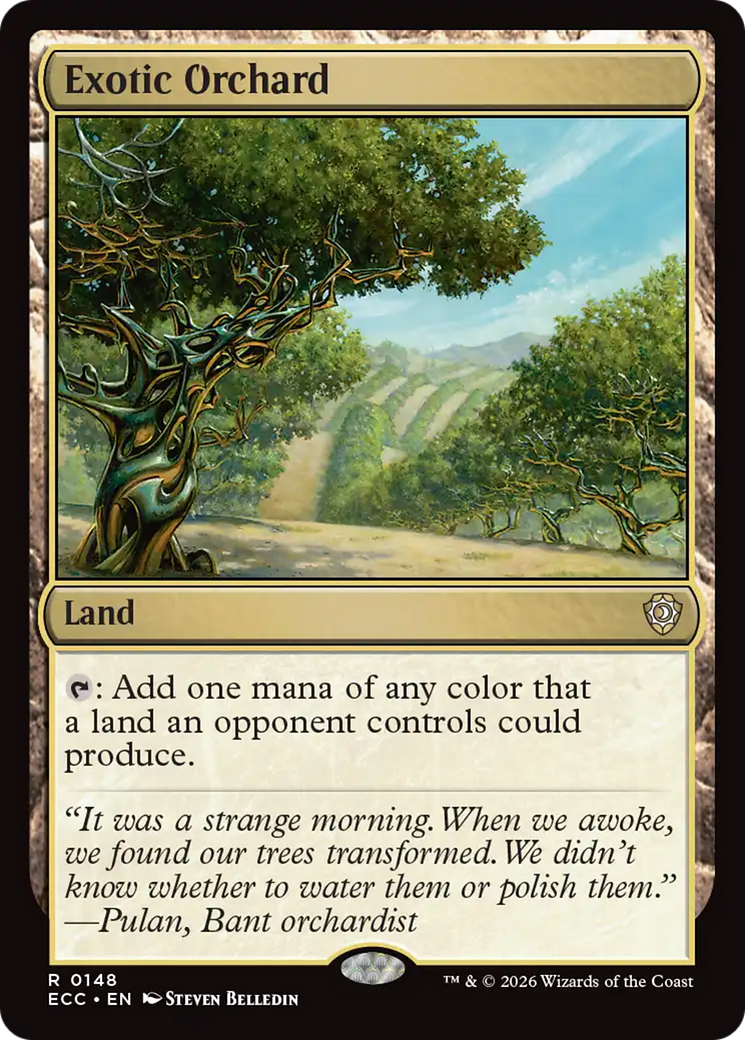
Exotic Orchard
Exotic Orchard
Land
: Add one mana of any color that a land an opponent controls could produce.
- Lands that produce mana based only on what other lands "could produce" won't help each other unless some other land allows one of them to actually produce some type of mana. For example, if you control an Exotic Orchard and your opponent controls an Exotic Orchard and a Reflecting Pool, none of those lands would produce mana if their mana abilities were activated. On the other hand, if you control a Forest and an Exotic Orchard, and your opponent controls an Exotic Orchard and a Reflecting Pool, then each of those lands can be tapped to produce . Your opponent's Exotic Orchard can produce because you control a Forest. Your Exotic Orchard and your opponent's Reflecting Pool can each produce because your opponent's Exotic Orchard can produce .
- When determining what colors of mana your opponents' lands could produce, Exotic Orchard takes into account any applicable replacement effects that would apply to those lands' mana abilities (such as Contamination's effect, for example). If there are more than one, consider them in any possible order.
- The colors of mana are white, blue, black, red, and green. Exotic Orchard can't be tapped for colorless mana, even if a land an opponent controls could produce colorless mana.
- Exotic Orchard doesn't care about any restrictions or riders your opponents' lands (such as Ancient Ziggurat or Hall of the Bandit Lord) put on the mana they produce. It just cares about colors of mana.
- Exotic Orchard checks the effects of all mana-producing abilities of lands your opponents control, but it doesn't check their costs. For example, Vivid Crag has the ability " , Remove a charge counter from Vivid Crag: Add one mana of any color." If an opponent controls Vivid Crag and you control Exotic Orchard, you can tap Exotic Orchard for any color of mana. It doesn't matter whether Vivid Crag has a charge counter on it, and it doesn't matter whether it's untapped.
-
1
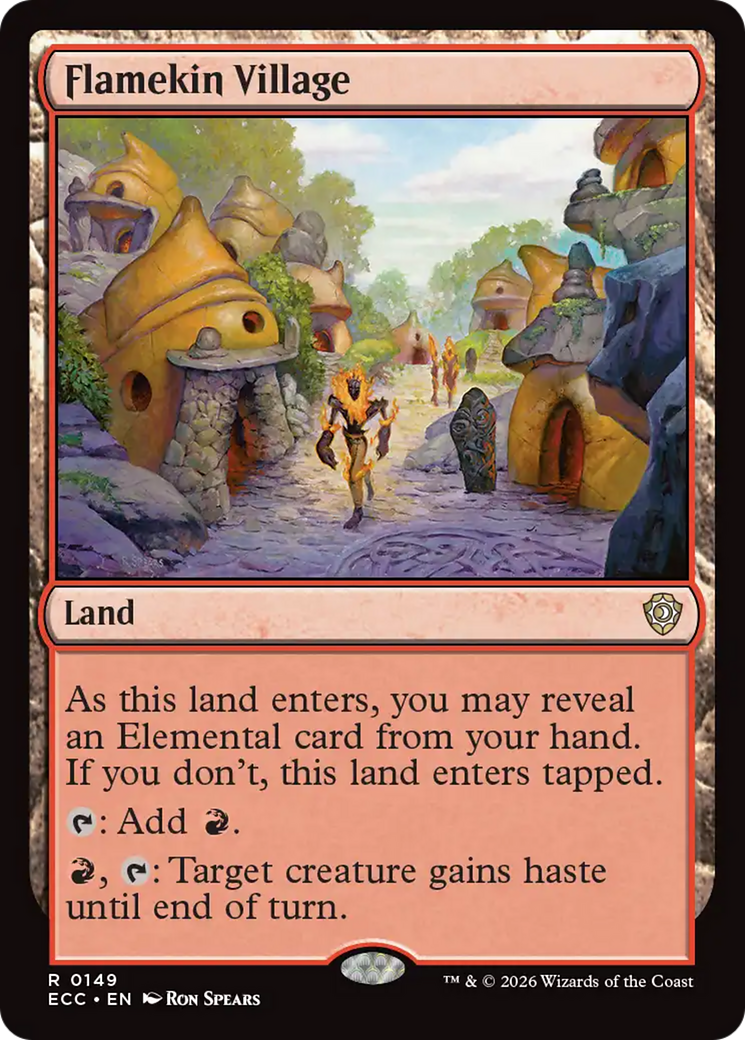
Flamekin Village
Flamekin Village
Land
As this land enters, you may reveal an Elemental card from your hand. If you don't, this land enters tapped.
: Add .
, : Target creature gains haste until end of turn.
-
8
Forest
Forest
Basic Land — Forest
( : Add .)
-
1
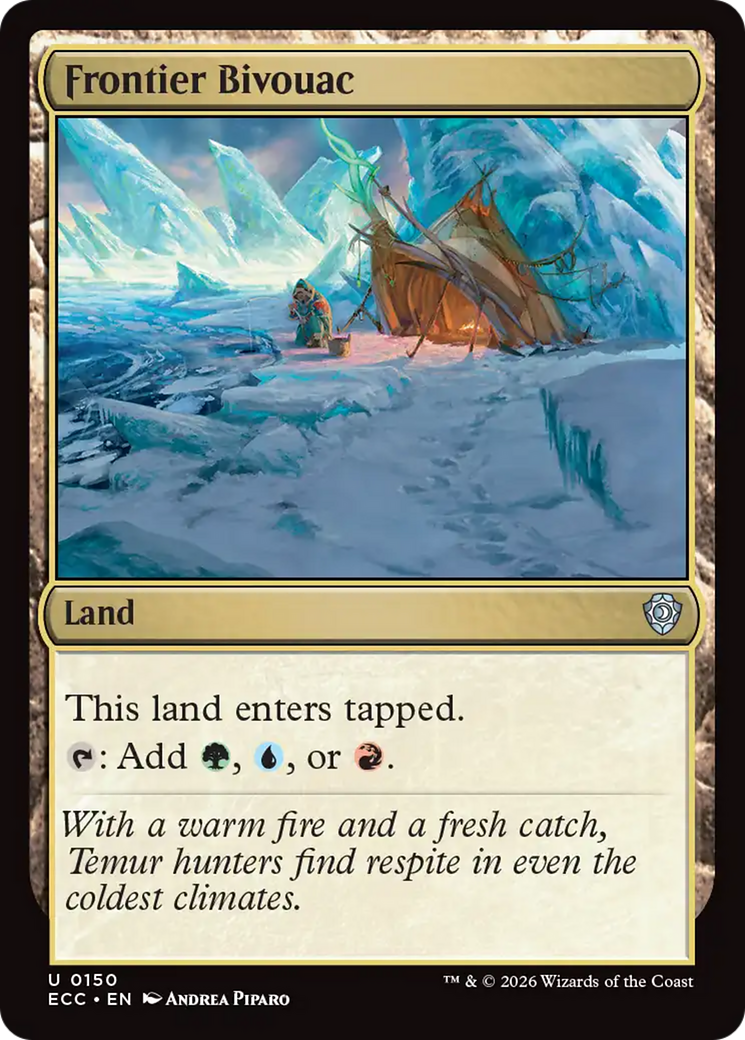
Frontier Bivouac
Frontier Bivouac
Land
This land enters tapped.
: Add , , or .
-
2
Island
Island
Basic Land — Island
( : Add .)
-
1
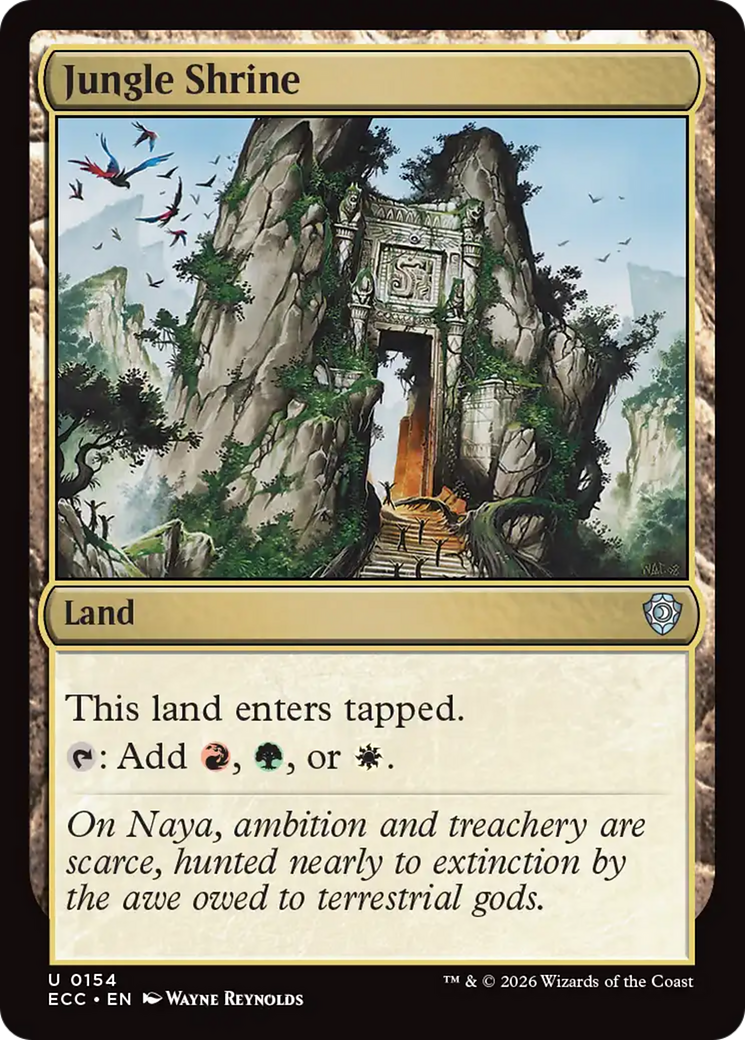
Jungle Shrine
Jungle Shrine
Land
This land enters tapped.
: Add , , or .
-
2
Mountain
Mountain
Basic Land — Mountain
( : Add .)
-
1
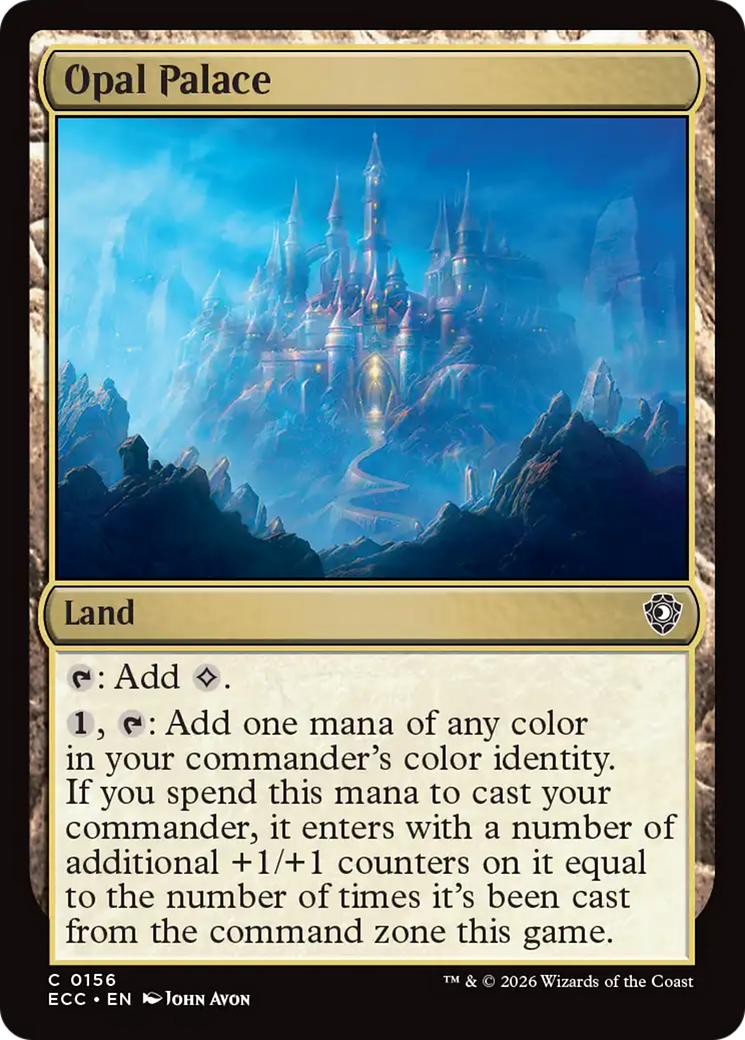
Opal Palace
Opal Palace
Land
: Add .
, : Add one mana of any color in your commander's color identity. If you spend this mana to cast your commander, it enters with a number of additional +1/+1 counters on it equal to the number of times it's been cast from the command zone this game.
- The "number of times it's been cast from the command zone" includes the most recent time. For example, the first time you cast your commander from the command zone in a game, if you spent mana from Opal Palace's last ability to do so, it will enter the battlefield with a +1/+1 counter.
- If you have two commanders, the last ability adds one mana of any color in their combined color identities.
- If Opal Palace's last ability produces two mana (most likely due to Mana Reflection) and you spend them to cast a commander, that commander enters with two counters for each time it's been cast from the command zone this game.
- If you don't have a commander, Opal Palace's last ability produces no mana.
- If your commander is a card that has no colors in its color identity, Opal Palace's last ability produces no mana. It doesn't produce .
-
1
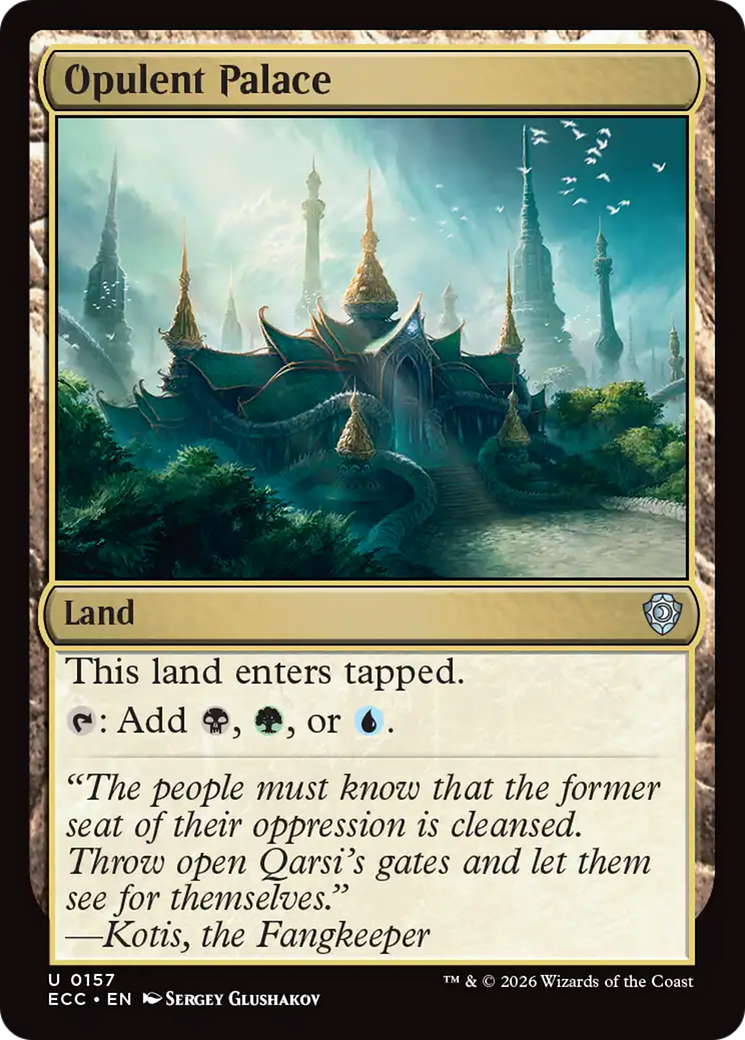
Opulent Palace
Opulent Palace
Land
This land enters tapped.
: Add , , or .
-
1
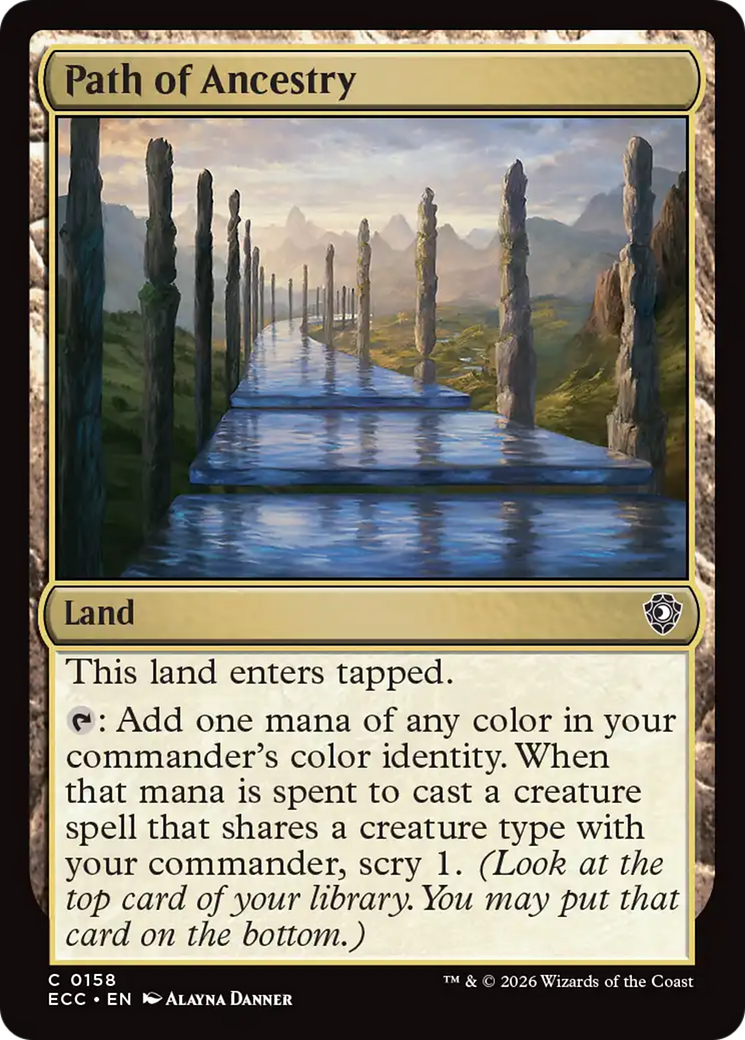
Path of Ancestry
Path of Ancestry
Land
This land enters tapped.
: Add one mana of any color in your commander's color identity. When that mana is spent to cast a creature spell that shares a creature type with your commander, scry 1. (Look at the top card of your library. You may put that card on the bottom.)
- Your commander's creature types are checked immediately after you cast a creature spell spending mana from Path of Ancestry's last ability. They aren't set before the game begins, and they may not be the same types your commander had when you activated that ability.
- If you have two commanders, the last ability adds one mana of any color in their combined color identities. When you spend that mana on a creature spell that shares a creature type with either of your commanders, you'll scry 1.
- If Path of Ancestry's last ability produces two mana (most likely due to Mana Reflection), spending those two mana to cast creature spells that share a creature type with your commander will cause two abilities to trigger. Each of those abilities will cause you to scry 1. You won't scry 2. This is true whether you spend the mana on one creature spell or two.
- If your commander has no creature types, it can't share a creature type with any spell that you cast.
- If you cast your commander with mana from Path of Ancestry, and your commander hasn't somehow lost all of its creature types while on the stack, you'll scry 1.
- If you don't have a commander, Path of Ancestry's ability produces no mana.
- If your commander is a card that has no colors in its color identity, Path of Ancestry's ability produces no mana. It doesn't produce .
-
2
Plains
Plains
Basic Land — Plains
( : Add .)
-
1
Primal Beyond
Primal Beyond
Land
As this land enters, you may reveal an Elemental card from your hand. If you don't, this land enters tapped.
: Add .
: Add one mana of any color. Spend this mana only to cast an Elemental spell or activate an ability of an Elemental.
- The mana can't be spent to activate activated abilities of Elemental sources that aren't on the battlefield (such as the reinforce ability of an Elemental card in your hand).
- You can use the mana produced by Primal Beyond's last ability to pay an alternative cost (such as evoke) or additional cost incurred while casting an Elemental spell. It's not limited to just that spell's mana cost.
-
1
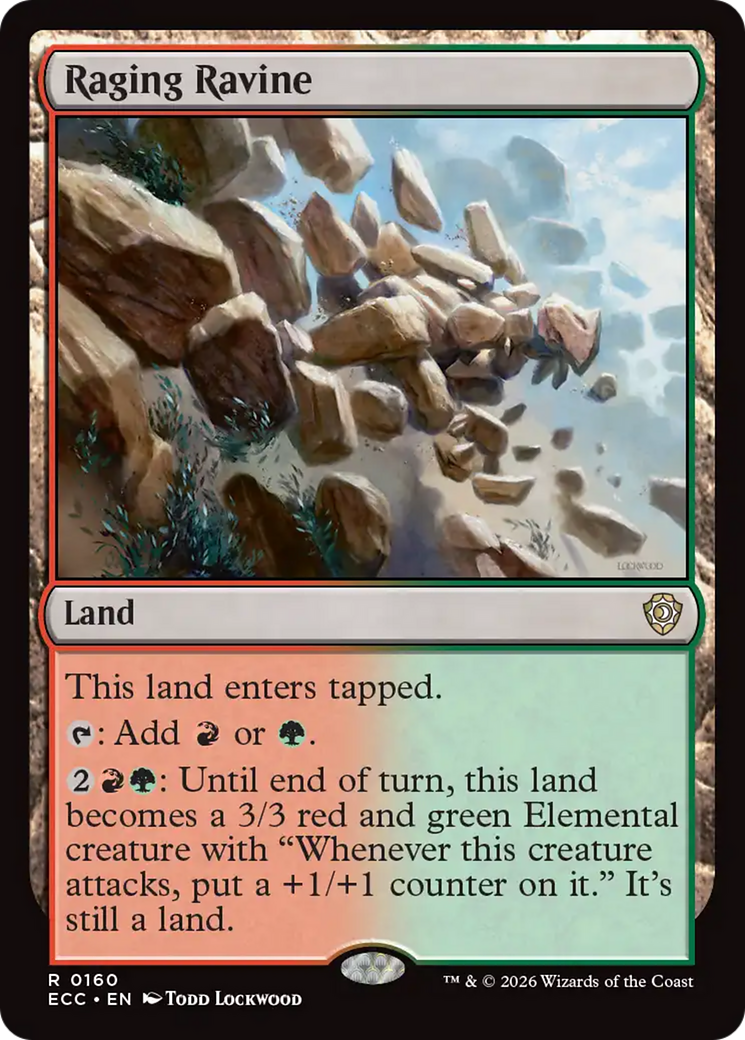
Raging Ravine
Raging Ravine
Land
This land enters tapped.
: Add or .
: Until end of turn, this land becomes a 3/3 red and green Elemental creature with "Whenever this creature attacks, put a +1/+1 counter on it." It's still a land.
- If this land becomes a creature but you haven’t controlled it continuously since your most recent turn began, you won’t be able to activate its mana ability or attack with it that turn.
- Any +1/+1 counters put on Raging Ravine remain on it even after it stops being a creature. They’ll have no effect until it becomes a creature again. (In other words, the land continues to rage, but to no effect.)
- If Raging Ravine’s last ability is activated multiple times in a turn, it will get that many instances of the granted triggered ability. For example, if you activate Raging Ravine’s last ability twice and then attack with it, you’ll put a +1/+1 counter on it twice.
-
1
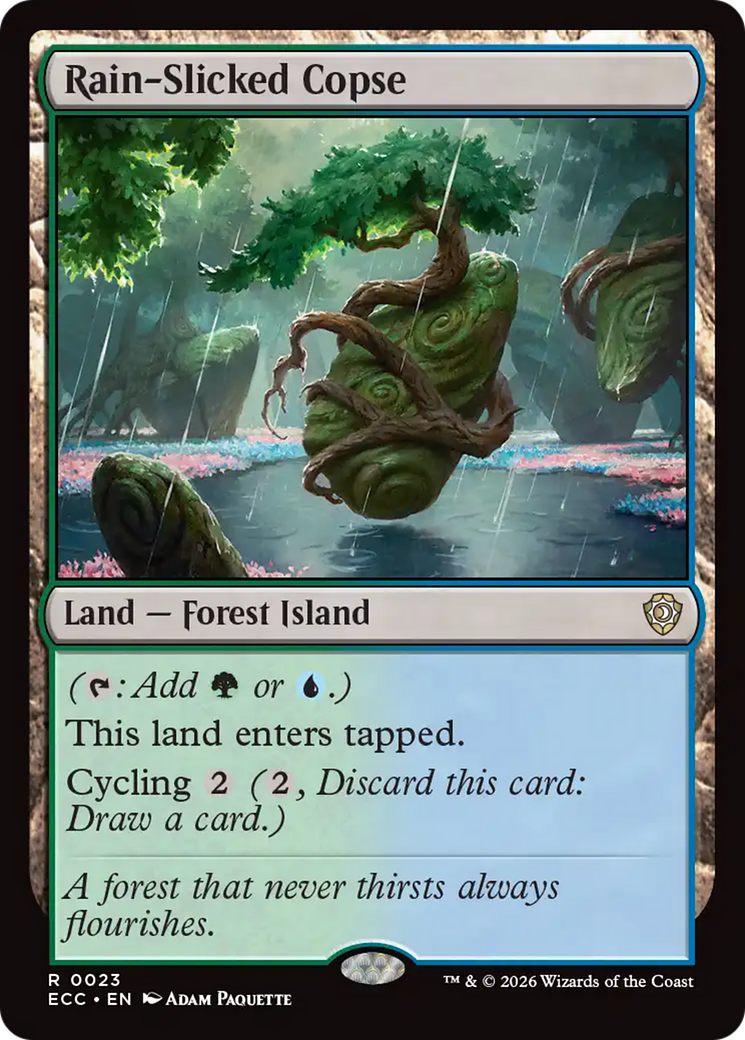
Rain-Slicked Copse
Rain-Slicked Copse
Land — Forest Island
( : Add or .)
This land enters tapped.
Cycling ( , Discard this card: Draw a card.)
- This land has two basic land types. It's not basic, so cards such as Tend the Sprigs can't find it, but it does have the appropriate land types for effects such as that of Kishla Village (from the Tarkir: Dragonstorm release).
-
1
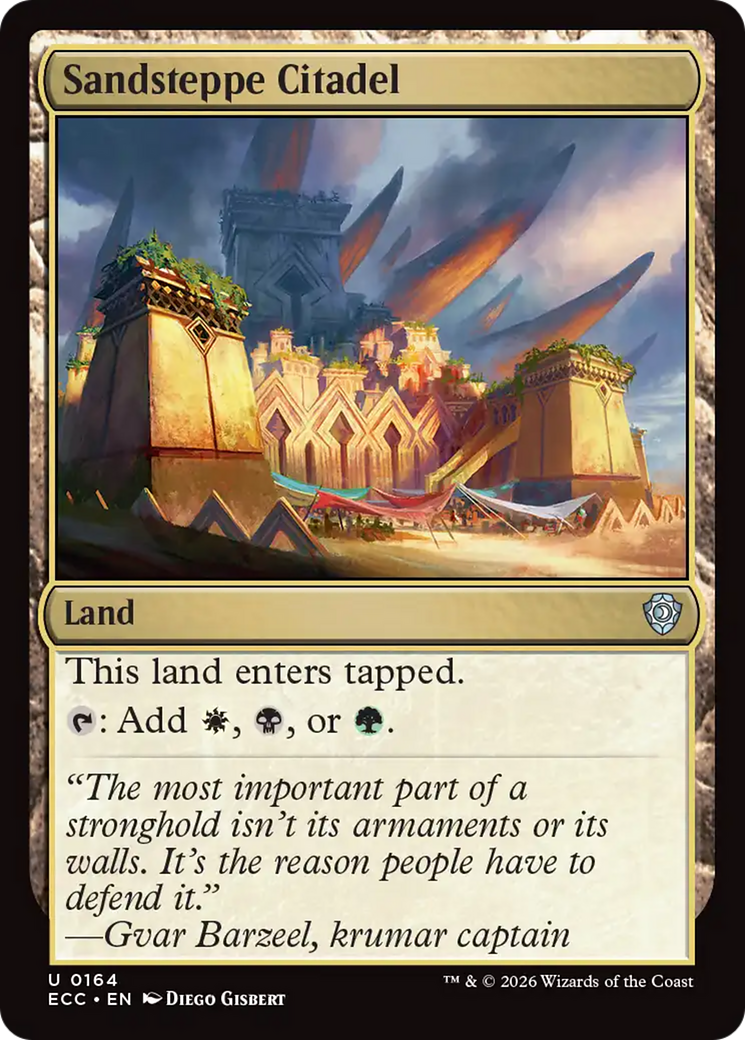
Sandsteppe Citadel
Sandsteppe Citadel
Land
This land enters tapped.
: Add , , or .
-
1
Savage Lands
Savage Lands
Land
This land enters tapped.
: Add , , or .
-
1
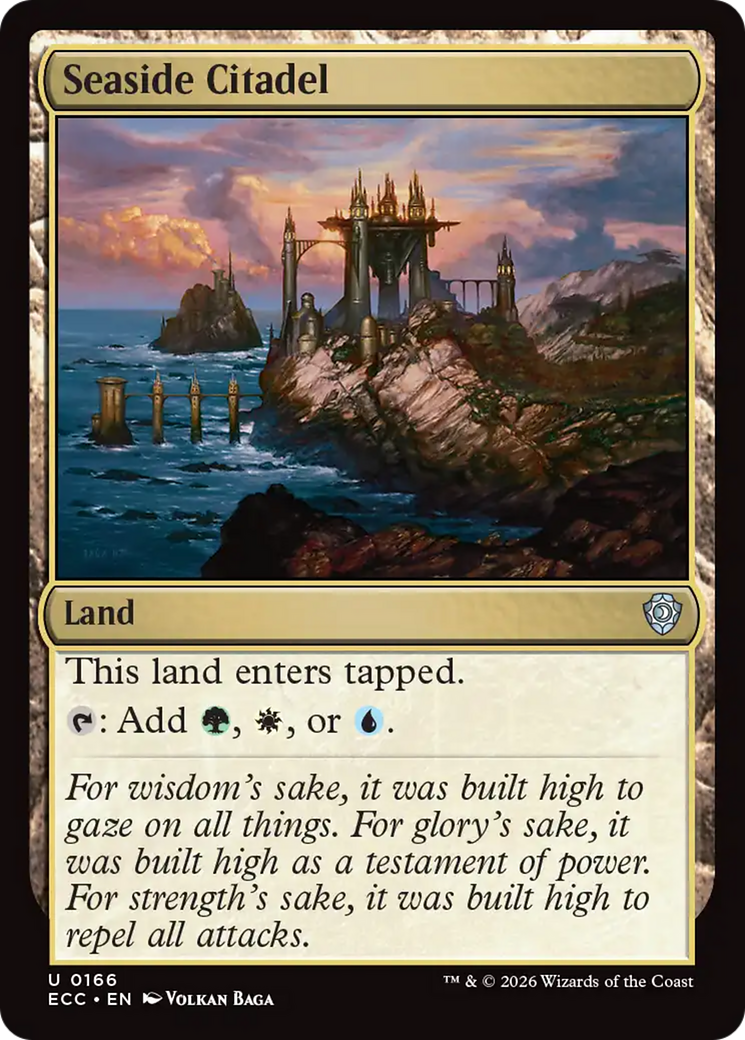
Seaside Citadel
Seaside Citadel
Land
This land enters tapped.
: Add , , or .
-
1
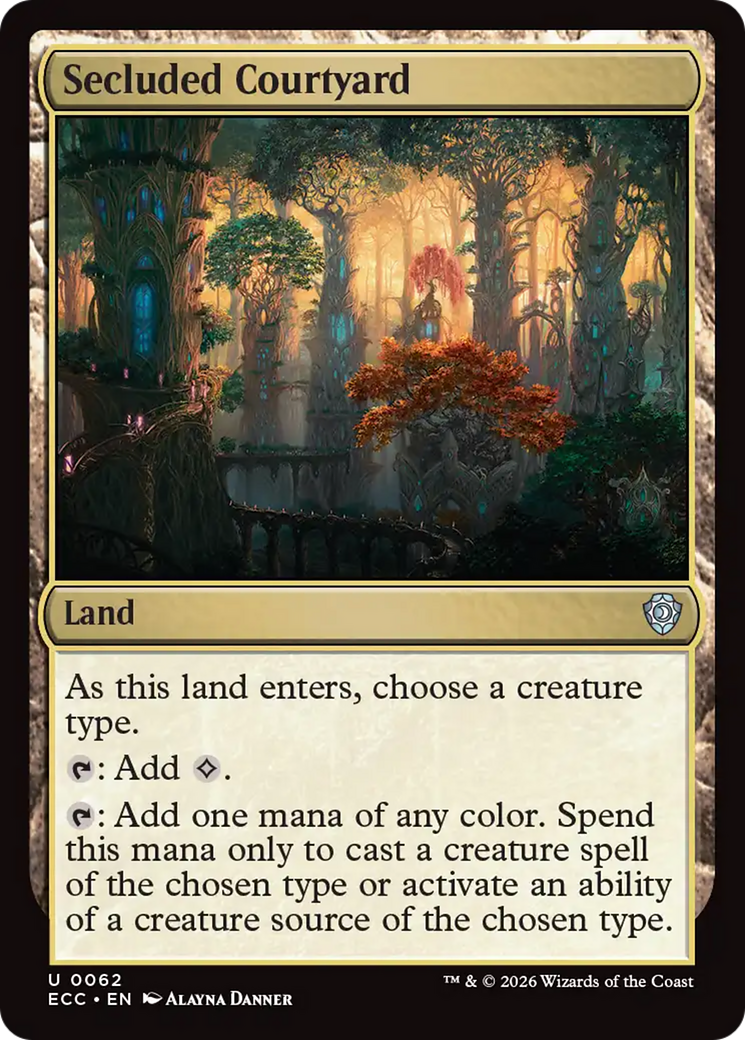
Secluded Courtyard
Secluded Courtyard
Land
As this land enters, choose a creature type.
: Add .
: Add one mana of any color. Spend this mana only to cast a creature spell of the chosen type or activate an ability of a creature source of the chosen type.
- If Secluded Courtyard is somehow on the battlefield without a chosen type, mana from its second mana ability can't be spent on anything.
-
1
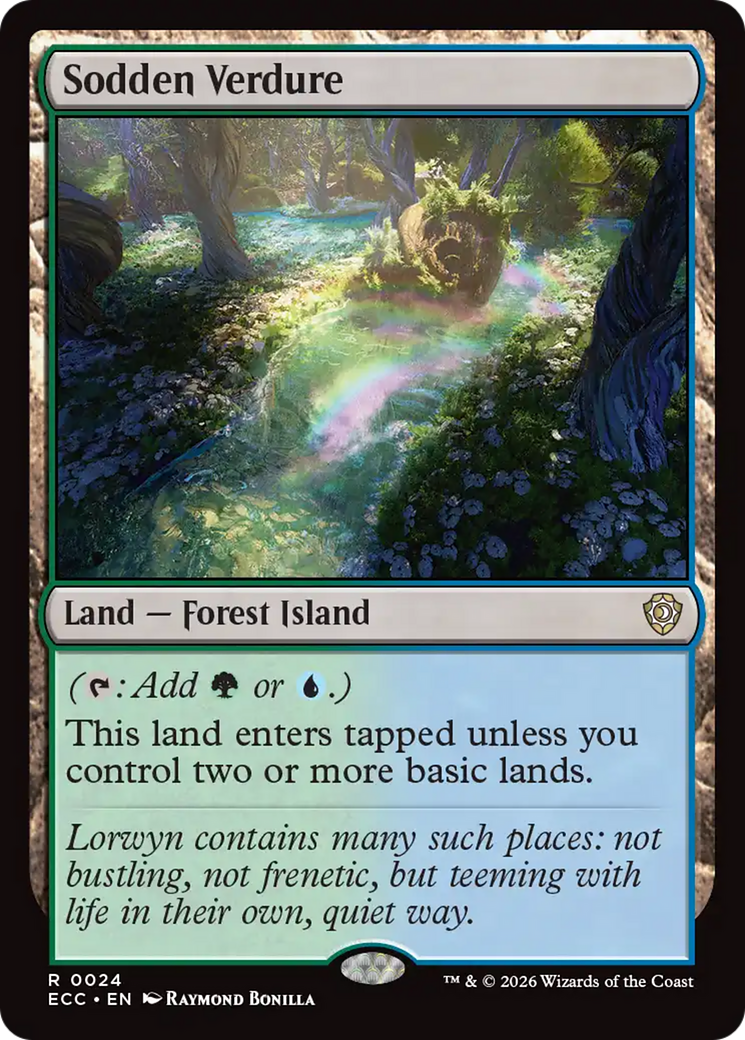
Sodden Verdure
Sodden Verdure
Land — Forest Island
( : Add or .)
This land enters tapped unless you control two or more basic lands.
- This land has two basic land types. It's not basic, so cards such as Tend the Sprigs can't find it, but it does have the appropriate land types for effects such as that of Kishla Village (from the Tarkir: Dragonstorm release).
-
2
Swamp
Swamp
Basic Land — Swamp
( : Add .)
-
1
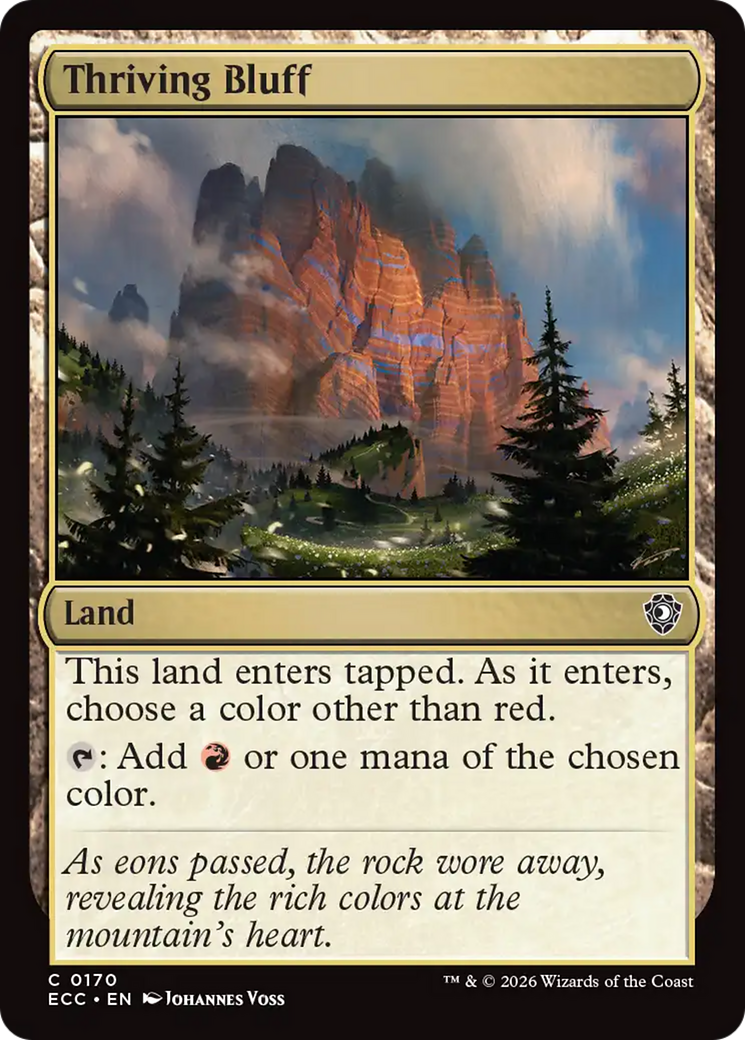
Thriving Bluff
Thriving Bluff
Land
This land enters tapped. As it enters, choose a color other than red.
: Add or one mana of the chosen color.
-
1
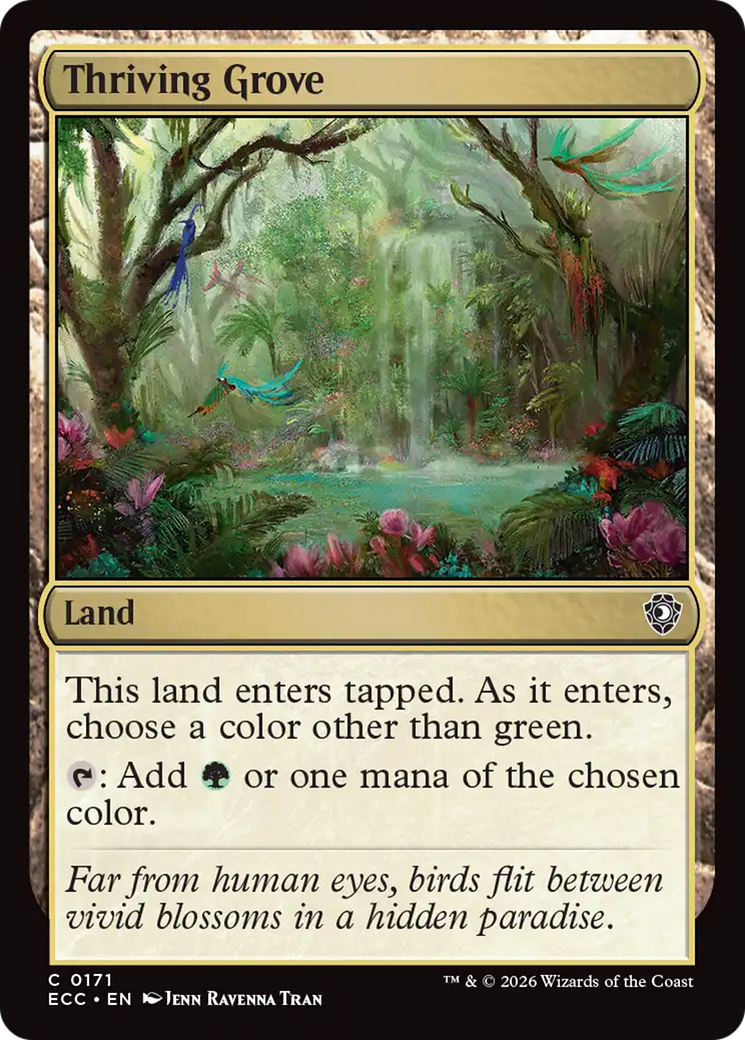
Thriving Grove
Thriving Grove
Land
This land enters tapped. As it enters, choose a color other than green.
: Add or one mana of the chosen color.
-
1
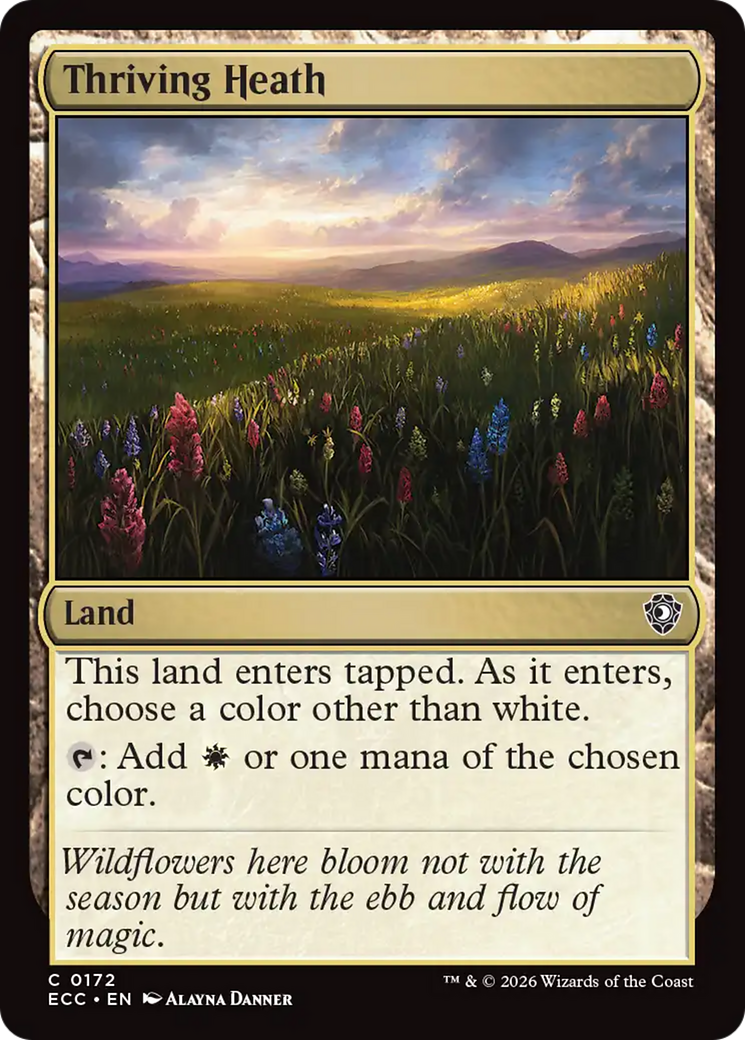
Thriving Heath
Thriving Heath
Land
This land enters tapped. As it enters, choose a color other than white.
: Add or one mana of the chosen color.
-
1
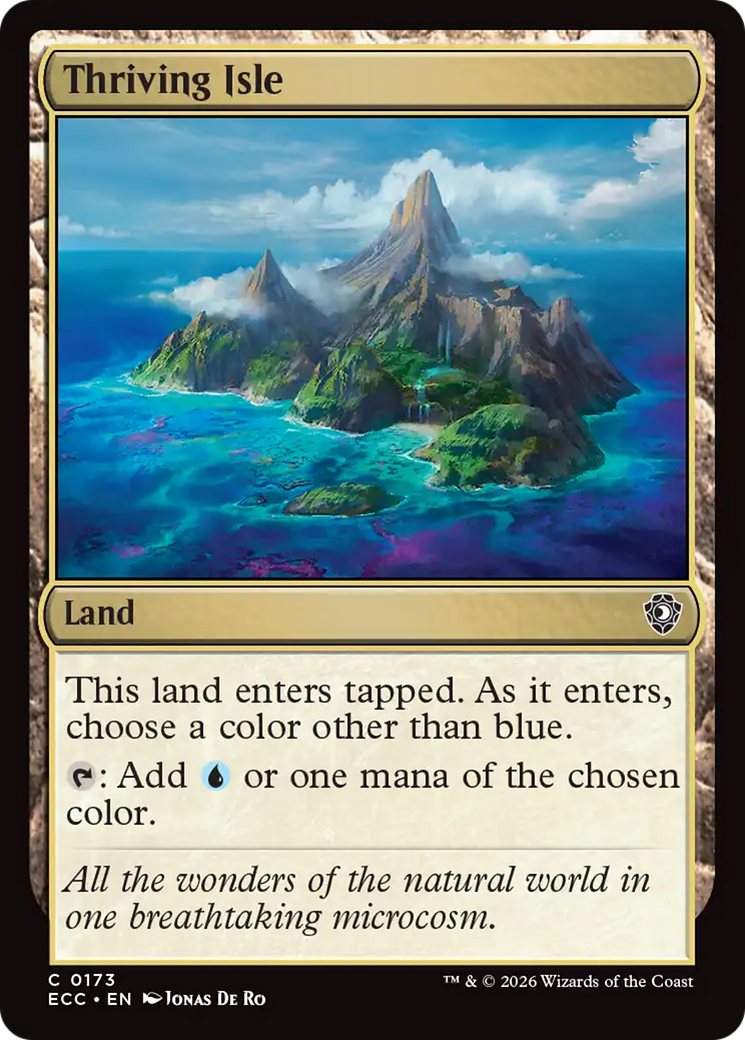
Thriving Isle
Thriving Isle
Land
This land enters tapped. As it enters, choose a color other than blue.
: Add or one mana of the chosen color.
-
1
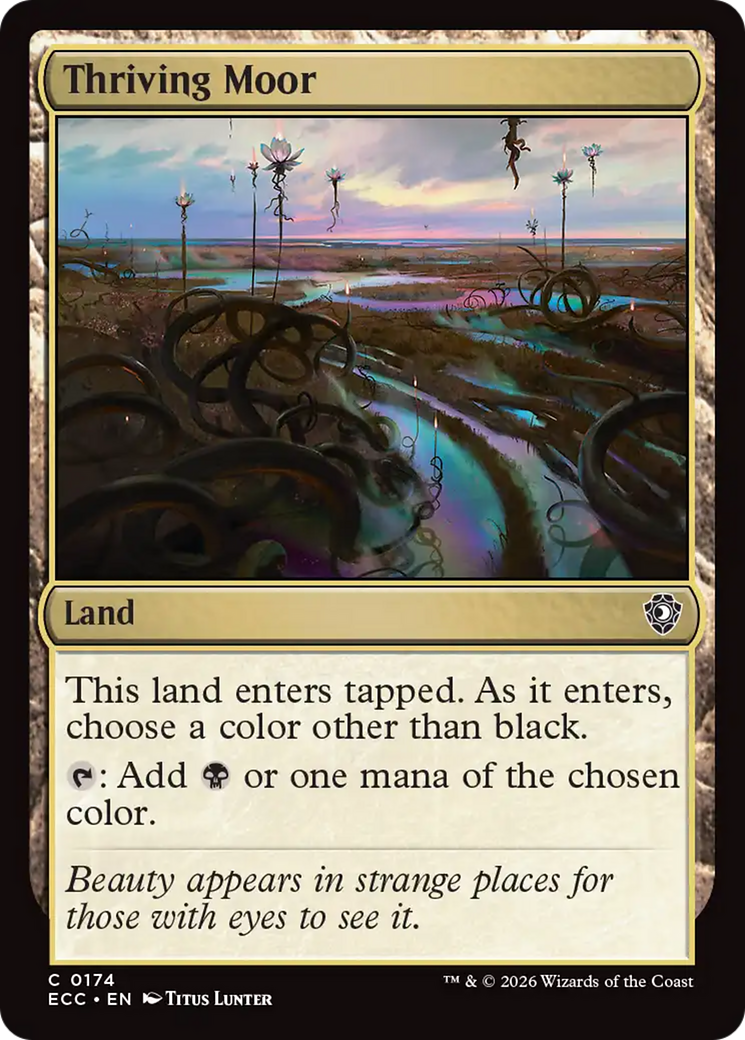
Thriving Moor
Thriving Moor
Land
This land enters tapped. As it enters, choose a color other than black.
: Add or one mana of the chosen color.
-
1
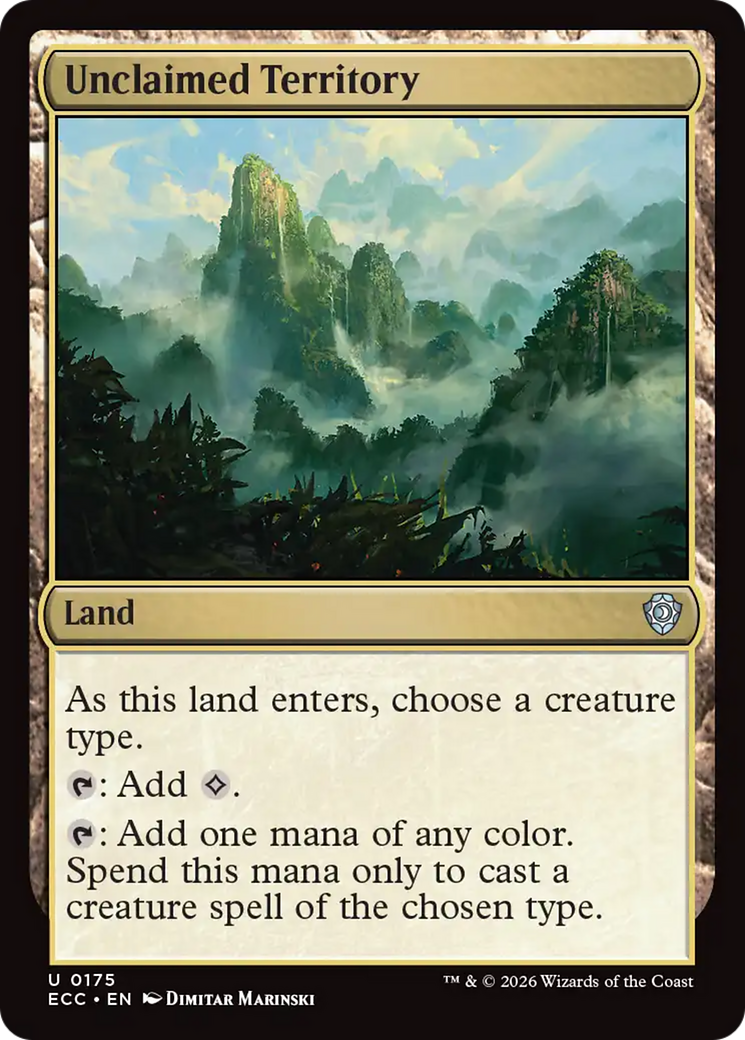
Unclaimed Territory
Unclaimed Territory
Land
As this land enters, choose a creature type.
: Add .
: Add one mana of any color. Spend this mana only to cast a creature spell of the chosen type.
- To choose a creature type, you must choose an existing creature type, such as Vampire or Knight. You can't choose multiple creature types, such as "Vampire Knight." Card types such as artifact can't be chosen, nor can subtypes that aren't creature types, such as Jace, Vehicle, or Treasure.
White 5
-
1
Belonging
Belonging
Creature — Elemental Incarnation
6/6
When this creature enters, create three 1/1 colorless Shapeshifter creature tokens with changeling. (They're every creature type.)
Encore ( , Exile this card from your graveyard: For each opponent, create a token copy that attacks that opponent this turn if able. They gain haste. Sacrifice them at the beginning of the next end step. Activate only as a sorcery.)
- The tokens copy only what's on the original card. Effects that modified that creature when it was previously on the battlefield won't be copied.
- Opponents who have left the game aren't counted when determining how many tokens to create.
- Exiling the card with encore is a cost to activate the encore ability. Once you announce that you're activating it, no player may take actions until you've finished. They can't try to remove the card from your graveyard to stop you from paying the cost.
- Each token must attack the appropriate player if able.
- If one of the tokens somehow is under another player's control as the delayed triggered ability resolves, you can't sacrifice that token. It remains on the battlefield indefinitely, even if you regain control of it later.
- Encore is an activated ability that functions from the graveyard. "Encore [cost]" means "[Cost], Exile this card from your graveyard: For each opponent, create a token that's a copy of this card that attacks that opponent this turn if able. The tokens gain haste. Sacrifice them at the beginning of the next end step. Activate only as a sorcery."
- If one of the tokens can't attack for any reason (such as being tapped), then it doesn't attack. If there's a cost associated with having it attack, you aren't forced to pay that cost, so it doesn't have to attack in that case either.
- If an effect stops a token from attacking a specific player, that token can attack any player, planeswalker, or battle, or not attack at all. If the effect stops the token from attacking a specific player unless a cost is paid, you don't have to pay that cost unless you want to attack that player.
-
1
Crib Swap
Crib Swap
Kindred Instant — Shapeshifter
Changeling (This card is every creature type.)
Exile target creature. Its controller creates a 1/1 colorless Shapeshifter creature token with changeling.
-
1
Hoofprints of the Stag
Hoofprints of the Stag
Kindred Enchantment — Elemental
Whenever you draw a card, you may put a hoofprint counter on this enchantment.
, Remove four hoofprint counters from this enchantment: Create a 4/4 white Elemental creature token with flying. Activate only during your turn.
- If a spell or ability has you draw multiple cards, Hoofprints of the Stag's ability triggers that many times.
-
1
Path to Exile
Path to Exile
Instant
Exile target creature. Its controller may search their library for a basic land card, put that card onto the battlefield tapped, then shuffle.
- The controller of the exiled creature isn't required to search their library for a basic land. If that player doesn't, the player won't shuffle their library.
- If the target creature is an illegal target by the time Path to Exile tries to resolve, it won't resolve and none of its effects will happen. The creature's controller won't search for a basic land card.
-
1
Shatter the Sky
Shatter the Sky
Sorcery
Each player who controls a creature with power 4 or greater draws a card. Then destroy all creatures.
- Shatter the Sky destroys all creatures, even if no player draws a card.
- No player may take any actions between the time each qualifying player draws a card and the time all creatures are destroyed.
Blue 5
-
1
Distant Melody
Distant Melody
Sorcery
Choose a creature type. Draw a card for each permanent you control of that type.
- Note that this spell counts the number of permanents you control of the chosen type, not just the number of creatures you control. It will also take your kindred permanents of the chosen type into account.
-
1
Mulldrifter
Mulldrifter
Creature — Elemental
2/2
Flying
When this creature enters, draw two cards.
Evoke (You may cast this spell for its evoke cost. If you do, it's sacrificed when it enters.)
- To determine the total cost of a spell, start with the mana cost or alternative cost you're paying (such as an evoke cost), add any cost increases, then apply any cost reductions. The mana value of the spell is determined by only its mana cost, no matter what the total cost to cast that spell was.
- If you pay the evoke cost, you can have Mulldrifter's own triggered ability resolve before the evoke triggered ability. You can cast spells after that ability resolves but before you have to sacrifice Mulldrifter.
-
1
Reality Shift
Reality Shift
Instant
Exile target creature. Its controller manifests the top card of their library. (That player puts the top card of their library onto the battlefield face down as a 2/2 creature. If it's a creature card, it can be turned face up any time for its mana cost.)
- Any time you have priority, you may turn a manifested creature face up by revealing that it's a creature card (ignoring any copy effects or type-changing effects that might be applying to it) and paying its mana cost. This is a special action. It doesn't use the stack and can't be responded to.
- Because the permanent is on the battlefield both before and after it's turned face up, turning a permanent face up doesn't cause any enters-the-battlefield abilities to trigger.
- A permanent that turns face up or face down changes characteristics but is otherwise the same permanent. Spells and abilities that were targeting that permanent, as well as Auras and Equipment that were attached to the permanent, aren't affected.
- At any time, you can look at a face-down permanent you control. You can't look at face-down permanents you don't control unless an effect allows you to or instructs you to.
- The face-down permanent is a 2/2 creature with no name, mana cost, creature types, or abilities. It's colorless and has a mana value of 0. Other effects that apply to the permanent can still grant or change any of these characteristics.
- If a face-down permanent you control leaves the battlefield, you must reveal it. You must also reveal all face-down spells and permanents you control if you leave the game or if the game ends.
- If a manifested creature would have morph if it were face up, you may also turn it face up by paying its morph cost.
- Turning a permanent face up or face down doesn't change whether that permanent is tapped or untapped.
- Because face-down creatures don't have names, they can't have the same name as any other creature, even another face-down creature.
- If a double-faced card is manifested, it will be put onto the battlefield face down. While face down, it can't transform. If the front face of the card is a creature card, you can turn it face up by paying its mana cost. If you do, its front face will be up.
- There are no cards in the Fate Reforged set that would turn a face-down instant or sorcery card on the battlefield face up, but some older cards can try to do this. If something tries to turn a face-down instant or sorcery card on the battlefield face up, reveal that card to show all players it's an instant or sorcery card. The permanent remains on the battlefield face down. Abilities that trigger when a permanent turns face up won't trigger, because even though you revealed the card, it never turned face up.
- Unlike a face-down creature that was cast using the morph ability, a manifested creature may still be turned face up after it loses its abilities if it's a creature card.
- You must ensure that your face-down spells and permanents can easily be differentiated from each other. You're not allowed to mix up the cards that represent them on the battlefield in order to confuse other players. The order they entered the battlefield should remain clear. Common methods for indicating this include using markers or dice, or simply placing them in order on the battlefield. You must also track how each became face down (manifested, cast face down using the morph ability, and so on).
-
1
Slithermuse
Slithermuse
Creature — Elemental
3/3
When this creature leaves the battlefield, choose an opponent. If that player has more cards in hand than you, draw cards equal to the difference.
Evoke (You may cast this spell for its evoke cost. If you do, it's sacrificed when it enters.)
- You choose an opponent when the ability resolves. Once you determine how many more cards than you that player has, that number is locked in as the amount you'll draw.
-
1
Subterfuge
Subterfuge
Creature — Elemental Incarnation
3/5
When this creature enters, target creature gains flying and "Whenever this creature deals combat damage to a player, draw that many cards" until end of turn.
Encore ( , Exile this card from your graveyard: For each opponent, create a token copy that attacks that opponent this turn if able. They gain haste. Sacrifice them at the beginning of the next end step. Activate only as a sorcery.)
- Each token must attack the appropriate player if able.
- If one of the tokens somehow is under another player's control as the delayed triggered ability resolves, you can't sacrifice that token. It remains on the battlefield indefinitely, even if you regain control of it later.
- Opponents who have left the game aren't counted when determining how many tokens to create.
- If an effect stops a token from attacking a specific player, that token can attack any player, planeswalker, or battle, or not attack at all. If the effect stops the token from attacking a specific player unless a cost is paid, you don't have to pay that cost unless you want to attack that player.
- Encore is an activated ability that functions from the graveyard. "Encore [cost]" means "[Cost], Exile this card from your graveyard: For each opponent, create a token that's a copy of this card that attacks that opponent this turn if able. The tokens gain haste. Sacrifice them at the beginning of the next end step. Activate only as a sorcery."
- If one of the tokens can't attack for any reason (such as being tapped), then it doesn't attack. If there's a cost associated with having it attack, you aren't forced to pay that cost, so it doesn't have to attack in that case either.
- Exiling the card with encore is a cost to activate the encore ability. Once you announce that you're activating it, no player may take actions until you've finished. They can't try to remove the card from your graveyard to stop you from paying the cost.
- The tokens copy only what's on the original card. Effects that modified that creature when it was previously on the battlefield won't be copied.
Black 4
-
1
Haunting Voyage
Haunting Voyage
Sorcery
Choose a creature type. Return up to two creature cards of that type from your graveyard to the battlefield. If this spell was foretold, return all creature cards of that type from your graveyard to the battlefield instead.
Foretell (During your turn, you may pay and exile this card from your hand face down. Cast it on a later turn for its foretell cost.)
- Haunting Voyage doesn't target any creature cards. You choose the creature type as Haunting Voyage resolves, then you choose up to two creature cards of that type to return (or all of them if Haunting Voyage was foretold).
- You must choose an existing creature type, such as Ox or Coward. You can't choose card types (e.g., artifact), supertypes (e.g., snow), or noncreature subtypes (e.g., Aura).
-
1
Lamentation
Lamentation
Creature — Elemental Incarnation
5/4
When this creature enters, destroy target creature an opponent controls. You gain 3 life.
Encore ( , Exile this card from your graveyard: For each opponent, create a token copy that attacks that opponent this turn if able. They gain haste. Sacrifice them at the beginning of the next end step. Activate only as a sorcery.)
- If one of the tokens can't attack for any reason (such as being tapped), then it doesn't attack. If there's a cost associated with having it attack, you aren't forced to pay that cost, so it doesn't have to attack in that case either.
- The tokens copy only what's on the original card. Effects that modified that creature when it was previously on the battlefield won't be copied.
- If one of the tokens somehow is under another player's control as the delayed triggered ability resolves, you can't sacrifice that token. It remains on the battlefield indefinitely, even if you regain control of it later.
- Opponents who have left the game aren't counted when determining how many tokens to create.
- Encore is an activated ability that functions from the graveyard. "Encore [cost]" means "[Cost], Exile this card from your graveyard: For each opponent, create a token that's a copy of this card that attacks that opponent this turn if able. The tokens gain haste. Sacrifice them at the beginning of the next end step. Activate only as a sorcery."
- Each token must attack the appropriate player if able.
- If the target creature is an illegal target as Lamentation's first ability tries to resolve, it won't resolve and none of its effects will happen. You won't gain life.
- If an effect stops a token from attacking a specific player, that token can attack any player, planeswalker, or battle, or not attack at all. If the effect stops the token from attacking a specific player unless a cost is paid, you don't have to pay that cost unless you want to attack that player.
- Exiling the card with encore is a cost to activate the encore ability. Once you announce that you're activating it, no player may take actions until you've finished. They can't try to remove the card from your graveyard to stop you from paying the cost.
-
1
Shimmercreep
Shimmercreep
Creature — Elemental
3/5
Menace (This creature can't be blocked except by two or more creatures.)
Vivid — When this creature enters, each opponent loses X life and you gain X life, where X is the number of colors among permanents you control.
- The value of X is calculated only once, as Shimmercreep's last ability resolves.
-
1
Shriekmaw
Shriekmaw
Creature — Elemental
3/2
Fear (This creature can't be blocked except by artifact creatures and/or black creatures.)
When this creature enters, destroy target nonartifact, nonblack creature.
Evoke (You may cast this spell for its evoke cost. If you do, it's sacrificed when it enters.)
- To determine the total cost of a spell, start with the mana cost or alternative cost you're paying (such as an evoke cost), add any cost increases, then apply any cost reductions. The mana value of the spell is determined by only its mana cost, no matter what the total cost to cast that spell was.
- If you pay the evoke cost, you can have Shriekmaw's own triggered ability resolve before the evoke triggered ability. You can cast spells after that ability resolves but before you have to sacrifice Shriekmaw.
Red 9
-
1
Ashling, the Limitless
Ashling, the Limitless
Legendary Creature — Elemental Sorcerer
2/3
Elemental permanent spells you cast from your hand gain evoke as you cast them. (If you cast a spell for its evoke cost, it's sacrificed when it enters.)
Whenever you sacrifice a nontoken Elemental, create a token that's a copy of it. The token gains haste until end of turn. At the beginning of your next end step, sacrifice it unless you pay .
- If the copied permanent had in its mana cost, X is 0.
- The token created by Ashling's last ability copies exactly what was printed on the original permanent and nothing else (unless that creature was copying something else; see below). It doesn't copy whether that permanent was tapped or untapped, whether it had any counters on it or Auras and Equipment attached to it, or any non-copy effects that changed its power, toughness, types, color, and so on.
- If the copied permanent was copying something else, then the token enters as whatever that permanent copied.
- Any enters abilities of the copied permanent will trigger when the token enters. Any "as [this permanent] enters" or "[this permanent] enters with" abilities of the copied permanent will also work.
- If Ashling leaves the battlefield after you've cast an Elemental permanent spell and paid its evoke cost but before that spell resolves, the permanent that spell becomes will still have evoke when it enters. As such, the triggered ability represented by evoke will still trigger, and when that abiltiy resolves, you'll still have to sacrifice that permanent.
- To determine the total cost of a spell, start with the mana cost or alternative cost you're paying (such as an evoke cost), add any cost increases, then apply any cost reductions. The mana value of the spell is determined by only its mana cost, no matter what the total cost to cast that spell was.
- If you pay the evoke cost, you can have the creature's own triggered ability or abilities resolve before the evoke triggered ability. You can cast spells after that ability resolves but before you have to sacrifice the creature.
-
1
Blasphemous Act
Blasphemous Act
Sorcery
This spell costs less to cast for each creature on the battlefield.
Blasphemous Act deals 13 damage to each creature.
- Although players may respond to Blasphemous Act once it's been cast, once it's announced, they can't respond before the cost is calculated and paid.
- Blasphemous Act's ability can't reduce the total cost to cast the spell below .
- The total cost to cast Blasphemous Act is locked in before you pay that cost. For example, if there are three creatures on the battlefield, including one you can sacrifice to add , the total cost of Blasphemous Act is . Then you can sacrifice the creature when you activate mana abilities just before paying the cost.
- To determine the total cost of a spell, start with the mana cost or alternative cost you're paying, add any cost increases, then apply any cost reductions (such as that of Blasphemous Act). The mana value of the spell is determined only by its mana cost, no matter what the total cost to cast the spell was.
-
1
Descendants' Fury
Descendants' Fury
Enchantment
Whenever one or more creatures you control deal combat damage to a player, you may sacrifice one of them. If you do, reveal cards from the top of your library until you reveal a creature card that shares a creature type with the sacrificed creature. Put that card onto the battlefield and the rest on the bottom of your library in a random order.
- If you don't reveal a creature card that shares a creature type with the creature you sacrificed, you'll just reveal and randomize your library.
- If the sacrificed creature has no creature type, no card can share a creature type with it.
- You'll reveal cards until you find one that shares at least one creature type with the creature you sacrificed. For example, if you sacrificed a Cat Wizard, you'll stop if you reveal a Human Wizard or Cat Soldier.
- Compare the revealed cards to the creature as it last existed before it was sacrificed, not to the creature card as it exists in its owner's graveyard, to determine which card from your library you put onto the battlefield.
-
1
Flamebraider
Flamebraider
Creature — Elemental Bard
2/2
: Add two mana in any combination of colors. Spend this mana only to cast Elemental spells or activate abilities of Elemental sources.
- "Elemental sources" include any objects with the creature type Elemental. For example, you could spend the mana to activate the ability of an Elemental permanent you control or an Elemental card in your hand or graveyard.
-
1
Fury
Fury
Creature — Elemental Incarnation
3/3
Double strike
When this creature enters, it deals 4 damage divided as you choose among any number of target creatures and/or planeswalkers.
Evoke—Exile a red card from your hand.
- If some of the targets are illegal as the triggered ability tries to resolve, the original division of damage still applies, but the damage that would have been dealt to the illegal targets isn't dealt at all.
- If you pay the evoke cost, you can have the creature's own triggered ability resolve before the evoke triggered ability. You can cast spells after that ability resolves but before you have to sacrifice the creature.
- You divide the damage as you put the triggered ability on the stack, not as it resolves. Each target must be assigned at least 1 damage. You can't choose more than four targets and deal 0 damage to some of them.
- To determine the total cost of a spell, start with the mana cost or alternative cost you're paying (such as an evoke cost), add any cost increases, then apply any cost reductions. The mana value of the spell is determined by only its mana cost, no matter what the total cost to cast that spell was.
-
1
Impulsivity
Impulsivity
Creature — Elemental Incarnation
7/5
When this creature enters, you may cast target instant or sorcery card from a graveyard without paying its mana cost. If that spell would be put into a graveyard, exile it instead.
Encore ( , Exile this card from your graveyard: For each opponent, create a token copy that attacks that opponent this turn if able. They gain haste. Sacrifice them at the beginning of the next end step. Activate only as a sorcery.)
- Exiling the card with encore is a cost to activate the encore ability. Once you announce that you're activating it, no player may take actions until you've finished. They can't try to remove the card from your graveyard to stop you from paying the cost.
- Since you are using an alternative cost to cast the spell, you can't pay any other alternative costs. You can, however, pay additional costs, such as kicker costs. If the card has any mandatory additional costs, you must pay those.
- If an effect stops a token from attacking a specific player, that token can attack any player, planeswalker, or battle, or not attack at all. If the effect stops the token from attacking a specific player unless a cost is paid, you don't have to pay that cost unless you want to attack that player.
- The tokens copy only what's on the original card. Effects that modified that creature when it was previously on the battlefield won't be copied.
- If one of the tokens somehow is under another player's control as the delayed triggered ability resolves, you can't sacrifice that token. It remains on the battlefield indefinitely, even if you regain control of it later.
- If one of the tokens can't attack for any reason (such as being tapped), then it doesn't attack. If there's a cost associated with having it attack, you aren't forced to pay that cost, so it doesn't have to attack in that case either.
- Encore is an activated ability that functions from the graveyard. "Encore [cost]" means "[Cost], Exile this card from your graveyard: For each opponent, create a token that's a copy of this card that attacks that opponent this turn if able. The tokens gain haste. Sacrifice them at the beginning of the next end step. Activate only as a sorcery."
- If the spell you cast has in its mana cost, you must choose 0 as the value of X when casting it without paying its mana cost.
- If you choose to cast the instant or sorcery card, you do so while Impulsivity's first ability is resolving and still on the stack. You can't wait to cast it later in the turn. Timing restrictions based on the card's type are ignored.
- Each token must attack the appropriate player if able.
- Opponents who have left the game aren't counted when determining how many tokens to create.
-
1
Incandescent Soulstoke
Incandescent Soulstoke
Creature — Elemental Shaman
2/2
Other Elemental creatures you control get +1/+1.
, : You may put an Elemental creature card from your hand onto the battlefield. That creature gains haste until end of turn. Sacrifice it at the beginning of the next end step.
-
1
Ingot Chewer
Ingot Chewer
Creature — Elemental
3/3
When this creature enters, destroy target artifact.
Evoke (You may cast this spell for its evoke cost. If you do, it's sacrificed when it enters.)
- If you cast this card for its evoke cost, you may put the sacrifice trigger and the regular enters-the-battlefield trigger on the stack in either order. The one put on the stack last will resolve first.
-
1
Smokebraider
Smokebraider
Creature — Elemental Shaman
1/1
: Add two mana in any combination of colors. Spend this mana only to cast Elemental spells or activate abilities of Elementals.
- The mana can't be spent to activate activated abilities of Elemental sources that aren't on the battlefield.
- The mana can be two mana of the same color, or one mana of each of two different colors. The mana can't be colorless.
- You can use this mana to pay an alternative cost (such as evoke) or additional cost incurred while casting an Elemental spell. It's not limited to just that spell's mana cost.
Green 20
-
1
Abundant Growth
Abundant Growth
Enchantment — Aura
Enchant land
When this Aura enters, draw a card.
Enchanted land has " : Add one mana of any color."
- The enchanted land retains any other abilities it has. Activating one of the land's activated abilities won't cause the other(s) to be activated.
-
1
Avenger of Zendikar
Avenger of Zendikar
Creature — Elemental
5/5
When this creature enters, create a 0/1 green Plant creature token for each land you control.
Landfall — Whenever a land you control enters, you may put a +1/+1 counter on each Plant creature you control.
- A landfall ability triggers whenever a land you control enters for any reason. It triggers whenever you play a land, as well as whenever a spell or ability puts a land onto the battlefield under your control.
- A landfall ability doesn't trigger if a permanent already on the battlefield becomes a land.
- Whenever a land you control enters, each landfall ability of the permanents you control will trigger. You can put them on the stack in any order. The last ability you put on the stack will be the first one to resolve (As a result, you can have those abilities resolve in the order of your choosing.).
-
1
Bane of Progress
Bane of Progress
Creature — Elemental
2/2
When this creature enters, destroy all artifacts and enchantments. Put a +1/+1 counter on this creature for each permanent destroyed this way.
- If an artifact or enchantment isn't destroyed (perhaps because it has indestructible or it regenerated), it won't count toward the number of +1/+1 counters put on Bane of Progress. However, if an artifact or enchantment is destroyed but doesn't go to its owner's graveyard due to a replacement effect (like the one Rest in Peace creates), it will count.
- Bane of Progress's ability destroys all artifacts and enchantments, including those you control.
-
1
Cavalier of Thorns
Cavalier of Thorns
Creature — Elemental Knight
5/6
Reach
When this creature enters, reveal the top five cards of your library. Put a land card from among them onto the battlefield and the rest into your graveyard.
When this creature dies, you may exile it. If you do, put another target card from your graveyard on top of your library.
-
1
Cream of the Crop
Cream of the Crop
Enchantment
Whenever a creature you control enters, you may look at the top X cards of your library, where X is that creature's power. If you do, put one of those cards on top of your library and the rest on the bottom of your library in any order.
- If the creature has 0 power, this ability has no effect.
- The creature's power is checked as this ability resolves. If the creature has left the battlefield, use its last known information.
- If the creature has 1 power, this ability lets you look at the top card of your library, then you'll have to leave it there.
-
1
Cultivate
Cultivate
Sorcery
Search your library for up to two basic land cards, reveal those cards, put one onto the battlefield tapped and the other into your hand, then shuffle.
- If you choose to find only one basic land card, you put it onto the battlefield tapped.
-
1
Elemental Spectacle
Elemental Spectacle
Sorcery
Vivid — Create a number of 5/5 red and green Elemental creature tokens equal to the number of colors among permanents you control. Then you gain life equal to the number of creatures you control.
-
1
Endurance
Endurance
Creature — Elemental Incarnation
3/4
Flash
Reach
When this creature enters, up to one target player puts all the cards from their graveyard on the bottom of their library in a random order.
Evoke—Exile a green card from your hand.
- To determine the total cost of a spell, start with the mana cost or alternative cost you're paying (such as an evoke cost), add any cost increases, then apply any cost reductions. The mana value of the spell is determined by only its mana cost, no matter what the total cost to cast that spell was.
- If you pay the evoke cost, you can have the creature's own triggered ability resolve before the evoke triggered ability. You can cast spells after that ability resolves but before you have to sacrifice the creature.
-
1
Fertile Ground
Fertile Ground
Enchantment — Aura
Enchant land
Whenever enchanted land is tapped for mana, its controller adds an additional one mana of any color.
-
1
Foundation Breaker
Foundation Breaker
Creature — Elemental
2/2
When this creature enters, you may destroy target artifact or enchantment.
Evoke (You may cast this spell for its evoke cost. If you do, it's sacrificed when it enters.)
- To determine the total cost of a spell, start with the mana cost or alternative cost you're paying (such as an evoke cost), add any cost increases, then apply any cost reductions. The mana value of the spell is determined by only its mana cost, no matter what the total cost to cast that spell was.
- If you pay the evoke cost, you can have the creature's own triggered ability resolve before the evoke triggered ability. You can cast spells after that ability resolves but before you have to sacrifice the creature.
-
1
Garruk's Uprising
Garruk's Uprising
Enchantment
When this enchantment enters, if you control a creature with power 4 or greater, draw a card.
Creatures you control have trample. (Each of those creatures can deal excess combat damage to the player or planeswalker it's attacking.)
Whenever a creature you control with power 4 or greater enters, draw a card.
- The first ability of Garruk's Uprising has you draw just one card, no matter how many creatures you control with power 4 or greater.
- If one or more static abilities that apply to a creature entering change its power, those abilities are considered when determining whether Garruk's Uprising's last ability triggers. The same is true for replacement effects that apply to it, such as entering with one or more +1/+1 counters or entering as a copy of another creature.
- If you don't control a creature with power 4 or greater immediately after Garruk's Uprising enters, its first ability won't trigger. If you don't control one as the ability resolves, you don't draw a card. They don't have to be the same creature both times, however.
- Once the last ability of Garruk's Uprising has triggered, lowering the power of the creature or removing it from the battlefield won't stop you from drawing a card.
-
1
Greenwarden of Murasa
Greenwarden of Murasa
Creature — Elemental
5/4
When this creature enters, you may return target card from your graveyard to your hand.
When this creature dies, you may exile it. If you do, return target card from your graveyard to your hand.
- You decide whether to exile Greenwarden of Murasa as the last ability resolves. Players can respond to this ability triggering, but once it starts resolving and you decide to exile Greenwarden of Murasa, it's too late for anyone to respond.
- If the target card becomes illegal before the last ability resolves, it won't resolve. You can't exile Greenwarden of Murasa in that case, even if you want to.
-
1
Jubilation
Jubilation
Creature — Elemental Incarnation
5/5
When this creature enters, creatures you control get +2/+2 and gain trample until end of turn.
Encore ( , Exile this card from your graveyard: For each opponent, create a token copy that attacks that opponent this turn if able. They gain haste. Sacrifice them at the beginning of the next end step. Activate only as a sorcery.)
- Exiling the card with encore is a cost to activate the encore ability. Once you announce that you're activating it, no player may take actions until you've finished. They can't try to remove the card from your graveyard to stop you from paying the cost.
- If an effect stops a token from attacking a specific player, that token can attack any player, planeswalker, or battle, or not attack at all. If the effect stops the token from attacking a specific player unless a cost is paid, you don't have to pay that cost unless you want to attack that player.
- If one of the tokens can't attack for any reason (such as being tapped), then it doesn't attack. If there's a cost associated with having it attack, you aren't forced to pay that cost, so it doesn't have to attack in that case either.
- The tokens copy only what's on the original card. Effects that modified that creature when it was previously on the battlefield won't be copied.
- If one of the tokens somehow is under another player's control as the delayed triggered ability resolves, you can't sacrifice that token. It remains on the battlefield indefinitely, even if you regain control of it later.
- Opponents who have left the game aren't counted when determining how many tokens to create.
- Encore is an activated ability that functions from the graveyard. "Encore [cost]" means "[Cost], Exile this card from your graveyard: For each opponent, create a token that's a copy of this card that attacks that opponent this turn if able. The tokens gain haste. Sacrifice them at the beginning of the next end step. Activate only as a sorcery."
- Each token must attack the appropriate player if able.
-
1
Kindred Summons
Kindred Summons
Instant
Choose a creature type. Reveal cards from the top of your library until you reveal X creature cards of the chosen type, where X is the number of creatures you control of that type. Put those cards onto the battlefield, then shuffle the rest of the revealed cards into your library.
- If you reveal your entire library and reveal fewer than X creature cards of the chosen type, you'll put the cards of the chosen type that you did reveal onto the battlefield and shuffle your library.
-
1
Kodama's Reach
Kodama's Reach
Sorcery — Arcane
Search your library for up to two basic land cards, reveal those cards, put one onto the battlefield tapped and the other into your hand, then shuffle.
- You can get just one basic land card if you wish (or even none at all). If you get only one land card, you put it onto the battlefield tapped.
-
1
Realmwalker
Realmwalker
Creature — Shapeshifter
2/3
Changeling (This card is every creature type.)
As this creature enters, choose a creature type.
You may look at the top card of your library any time.
You may cast creature spells of the chosen type from the top of your library.
- The top card of your library isn't in your hand, so you can't foretell it, discard it, or activate any of its activated abilities.
- Realmwalker doesn't change when you can cast creature spells. Normally, this means during your main phase when the stack is empty, although flash may change this.
- If Realmwalker is somehow on the battlefield with no choice having been made for it, you may still look at the top card of your library any time. You won't be able to cast any creature spells from the top of your library, even if they have no creature types.
- You can look at the top card of your library whenever you want (with one restriction; see below), even if you don't have priority. This action doesn't use the stack. Knowing what that card is becomes part of the information you have access to, just like you can look at the cards in your hand.
- You must choose an existing creature type, such as Elk or Advisor. You can't choose card types (e.g., artifact) or supertypes (e.g., snow).
- You'll still pay all costs for the spell, including additional costs. You may also pay alternative costs if any are available.
- If the top card of your library changes while you're casting a spell, playing a land, or activating an ability, you can't look at the new top card until you finish doing so. This means that if you cast a spell from the top of your library, you can't look at the next one until you're done paying for that spell.
-
1
Return of the Wildspeaker
Return of the Wildspeaker
Instant
Choose one —
- Draw cards equal to the greatest power among non-Human creatures you control.
- Non-Human creatures you control get +3/+3 until end of turn.
-
1
Selvala, Heart of the Wilds
Selvala, Heart of the Wilds
Legendary Creature — Elf Scout
2/3
Whenever another creature enters, its controller may draw a card if its power is greater than each other creature's power.
, : Add X mana in any combination of colors, where X is the greatest power among creatures you control.
- Selvala's last ability is a mana ability. It doesn't use the stack and can't be responded to. If the greatest power among creatures you control is 0 or less at that time, no mana is added.
- The new creature's power is compared to the power of each other creature on the battlefield as the first ability resolves. If another creature has the same or higher power than the new creature's power, no one may draw a card.
- If the new creature isn't on the battlefield as the first ability resolves, use its power when it left the battlefield to determine whether its controller may draw a card. Note that effects that reduced its power before it left the battlefield will apply.
-
1
Springleaf Parade
Springleaf Parade
Enchantment
When this enchantment enters, create X 1/1 colorless Shapeshifter creature tokens with changeling. (They're every creature type.)
Creature tokens you control have " : Add one mana of any color."
-
1
Titan of Industry
Titan of Industry
Creature — Elemental
7/7
Reach, trample
When this creature enters, choose two —
- Destroy target artifact or enchantment.
- Target player gains 5 life.
- Create a 4/4 green Rhino Warrior creature token.
- Put a shield counter on a creature you control.
- Only the first and second modes of Titan of Industry's triggered ability have a target. If one of those modes is chosen with either the third or fourth mode and the only target is an illegal target when the ability would resolve, the ability does not resolve and the other chosen mode has no effect.
Multicolor 10
-
1
Faeburrow Elder
Faeburrow Elder
Creature — Treefolk Druid
0/0
Vigilance
This creature gets +1/+1 for each color among permanents you control.
: For each color among permanents you control, add one mana of that color.
- Faeburrow Elder's middle ability can give it at most +5/+5, that is, +1/+1 each for white, blue, black, red, and green. "Gold," "multicolor," and "colorless" aren't colors. Similarly, Faeburrow Elder's last ability can produce at most five mana.
- Since Faeburrow Elder is a green and white permanent, its middle ability usually gives it at least +2/+2 and its last ability usually produces at least .
-
1
Horde of Notions
Horde of Notions
Legendary Creature — Elemental
5/5
Vigilance, trample, haste
: You may play target Elemental card from your graveyard without paying its mana cost.
- This ability does not allow you to pay the evoke cost of the targeted Elemental card.
-
1
Maelstrom Wanderer
Maelstrom Wanderer
Legendary Creature — Elemental
7/5
Creatures you control have haste.
Cascade, cascade (When you cast this spell, exile cards from the top of your library until you exile a nonland card that costs less. You may cast it without paying its mana cost. Put the exiled cards on the bottom in a random order. Then do it again.)
- Maelstrom Wanderer gives itself haste.
- No matter what spell you cast with the first cascade trigger (or with any cascade triggers that result from casting that spell), the second cascade trigger will look for a spell with mana value less than Maelstrom Wanderer's mana value of 8.
- Each instance of cascade triggers and resolves separately. The spell you cast due to the first cascade ability will go on the stack on top of the second cascade ability. That spell will resolve before you exile cards for the second cascade ability.
-
1
Mass of Mysteries
Mass of Mysteries
Legendary Creature — Elemental
5/5
First strike, vigilance, trample
At the beginning of combat on your turn, another target Elemental you control gains myriad until end of turn. (Whenever it attacks, for each opponent other than defending player, you may create a token copy that's tapped and attacking that player or a planeswalker they control. Exile the tokens at end of combat.)
- If the defending player is your only opponent, no tokens are put onto the battlefield.
- The term "defending player" in the myriad rules (or any other ability of an attacking creature) refers to the player the creature with myriad was attacking, the controller of the planeswalker it was attacking, or the protector of the battle it was attacking at the time the ability resolves. If that creature is no longer attacking, it refers to the appropriate player based on who or what the creature was last attacking.
- You choose whether each token is attacking the player or a planeswalker they control as the token is created. If it's attacking a planeswalker, you choose which one. You can't have any of the tokens attack a battle.
- Although the tokens enter attacking, they were never declared as attackers. Abilities that trigger whenever a creature attacks won't trigger, including the myriad ability of the tokens. If there are any costs to have a creature attack, those costs won't apply to the tokens.
- The tokens created by a single instance of myriad all enter at the same time.
- Each token copies exactly what was printed on the original creature and nothing else. It doesn't copy whether that creature is tapped or untapped, whether it has any counters on it or Auras and Equipment attached to it, or any non-copy effects that have changed its power, toughness, types, color, and so on.
- Any "enters" abilities of the copied creature will trigger when the tokens enter. Any "as [this creature] enters" or "[this creature] enters with" abilities of the copied creature will also work.
- If an instance of myriad creates more than one token for any given player (due to an effect such as the one Doubling Season creates), you may choose separately for each token whether it's attacking the player or a planeswalker they control.
-
1
Muldrotha, the Gravetide
Muldrotha, the Gravetide
Legendary Creature — Elemental Avatar
6/6
During each of your turns, you may play a land and cast a permanent spell of each permanent type from your graveyard. (If a card has multiple permanent types, choose one as you play it.)
- For example, you may cast an artifact creature spell as your artifact spell and cast another artifact creature spell as your creature spell.
- If you play a card from your graveyard and then have a new Muldrotha come under your control in the same turn, you may play another land or spell of that type from your graveyard that turn.
- Use the type of the card as it's played or cast to determine which permanent type to count it as. For example, if you cast a creature spell from your graveyard, you can cast a card with bestow as an enchantment spell.
- If multiple effects allow you to play a card from your graveyard, you must announce which permission you're using as you begin to play the card.
- You must pay the costs to cast a spell this way. If it has an alternative cost, you may cast it for that cost instead.
- Once you begin to cast a spell, losing control of Muldrotha won't affect the spell.
- You must follow the normal timing permissions and restrictions of the cards you play from your graveyard. For example, you can't use Muldrotha to play a land if you don't have an available land play or to cast a planeswalker spell during your end step.
- If a permanent card is put into your graveyard during your main phase and the stack is empty, you have a chance to cast it before any player may attempt to remove that card from your graveyard.
-
1
Omnath, Locus of Rage
Omnath, Locus of Rage
Legendary Creature — Elemental
5/5
Landfall — Whenever a land you control enters, create a 5/5 red and green Elemental creature token.
Whenever Omnath or another Elemental you control dies, Omnath deals 3 damage to any target.
- Omanth doesn't have the land type Locus.
- If Omnath dies at the same time as any other Elementals you control, Omnath's last ability will trigger for each of them (and once for itself).
-
1
Omnath, Locus of the Roil
Omnath, Locus of the Roil
Legendary Creature — Elemental
3/3
When Omnath enters, it deals damage to any target equal to the number of Elementals you control.
Landfall — Whenever a land you control enters, put a +1/+1 counter on target Elemental you control. If you control eight or more lands, draw a card.
- You may choose Omnath as the target of its own second ability.
- The number of Elementals you control is counted as Omnath's first ability resolves. If Omnath is still on the battlefield, it will count itself.
- If the target Elemental is an illegal target by the time Omnath's second ability tries to resolve, the ability doesn't resolve. You don't draw a card if you control eight or more lands. If the target is legal but can't have a +1/+1 counter put on it (most likely because an opponent controls Blightbeetle), you do draw a card if you control eight or more lands.
-
1
Risen Reef
Risen Reef
Creature — Elemental
1/1
Whenever this creature or another Elemental you control enters, look at the top card of your library. If it's a land card, you may put it onto the battlefield tapped. If you don't put the card onto the battlefield, put it into your hand.
- If you put the card into your hand, you don't have to reveal it. You also don't have to tell your opponent whether it's a nonland card or a land card you decided not to put onto the battlefield tapped.
-
1
Vernal Sovereign
Vernal Sovereign
Creature — Elemental Elk
4/4
Whenever this creature enters or attacks, create a green and white Elemental creature token with "This token's power and toughness are each equal to the number of creatures you control."
-
1
Yarok, the Desecrated
Yarok, the Desecrated
Legendary Creature — Elemental Horror
3/5
Deathtouch, lifelink
If a permanent entering causes a triggered ability of a permanent you control to trigger, that ability triggers an additional time.
- Yarok affects a permanent's own enters-the-battlefield triggered abilities as well as other triggered abilities that trigger when that permanent enters the battlefield. Such triggered abilities start with "when" or "whenever."
- Yarok's effect doesn't copy the triggered ability; it just causes the ability to trigger twice. Any choices made as you put the ability onto the stack, such as modes and targets, are made separately for each instance of the ability. Any choices made on resolution, such as whether to put counters on a permanent, are also made individually.
- If a permanent entering the battlefield at the same time as Yarok (including Yarok itself) causes a triggered ability of a permanent you control to trigger, that ability triggers an additional time.
- Abilities that apply "as [this creature] enters the battlefield," such as choosing a color with Diamond Knight, are also unaffected.
- If a triggered ability is linked to a second ability, additional instances of that triggered ability are also linked to that second ability. If the second ability refers to "the exiled card," it refers to all cards exiled by instances of the triggered ability.
- If you somehow control two Yaroks, a permanent entering the battlefield causes abilities to trigger three times, not four. A third Yarok causes abilities to trigger four times, a fourth causes abilities to trigger five times, and so on.
- Replacement effects are unaffected by Yarok's ability. For example, a creature that enters the battlefield with one +1/+1 counter on it won't receive an additional +1/+1 counter.
- You don't need to control the permanent entering the battlefield, only the permanent that has the triggered ability.
- In some cases involving linked abilities, an ability requires information about "the exiled card." When this happens, the ability gets multiple answers. If these answers are being used to determine the value of a variable, the sum is used. For example, if Elite Arcanist's enters-the-battlefield ability triggers twice, two cards are exiled. The value of X in the activation cost of Elite Arcanist's other ability is the sum of the two cards' mana values. As the ability resolves, you create copies of both cards and can cast none, one, or both of the copies in any order.
Colorless 7
-
1
Arcane Signet
Arcane Signet
Artifact
: Add one mana of any color in your commander's color identity.
- If your commander is a card that has no colors in its color identity, Arcane Signet's ability produces no mana. It doesn't produce .
- If you have two commanders, the ability adds one mana of any color in their combined color identities.
- If you don't have a commander, Arcane Signet's ability produces no mana.
-
1
Chromatic Lantern
Chromatic Lantern
Artifact
Lands you control have " : Add one mana of any color."
: Add one mana of any color.
- Lands you control won't lose any other abilities they had. They also won't gain or lose any land types.
-
1
Eclipsed Flamekin
Eclipsed Flamekin
Creature — Elemental Scout
1/4
When this creature enters, look at the top four cards of your library. You may reveal an Elemental, Island, or Mountain card from among them and put it into your hand. Put the rest on the bottom of your library in a random order.
-
1
Fellwar Stone
Fellwar Stone
Artifact
: Add one mana of any color that a land an opponent controls could produce.
- When determining what colors of mana your opponents' lands could produce, take into account any applicable replacement effects that would apply to those lands' mana abilities (such as Contamination's effect, for example). If there is more than one, consider them in any possible order.
- Fellwar Stone doesn't care about any restrictions or riders your opponents' lands (such as Ancient Ziggurat or Hall of the Bandit Lord) put on the mana they produce. It just cares about colors of mana.
- The colors of mana are white, blue, black, red, and green. Fellwar Stone can't be tapped for colorless mana, even if a land an opponent controls could produce colorless mana.
- Fellwar Stone checks the effects of all mana-producing abilities of lands your opponents control, but it doesn't check their costs. For example, Vivid Crag has the ability " , Remove a charge counter from Vivid Crag: Add one mana of any color." If an opponent controls Vivid Crag and you control Fellwar Stone, you can tap Fellwar Stone for any color of mana. It doesn't matter whether Vivid Crag has a charge counter on it, and it doesn't matter whether it's untapped.
- This works even if the opponent's lands are tapped. It only checks what kinds of mana can be produced, not if the abilities that produce them are usable right now.
- It only produces one mana even if the land can produce more than one.
- The ability can be activated if the opponent has no lands that produce mana, but the effect will not be able to generate any mana.
-
1
Jegantha, the Wellspring
Jegantha, the Wellspring
Legendary Creature — Elemental Elk
5/5
Companion — No card in your starting deck has more than one of the same mana symbol in its mana cost. (If this card is your chosen companion, you may put it into your hand from outside the game for as a sorcery.)
: Add . This mana can't be spent to pay generic mana costs.
- Once you put your companion into your hand, it behaves like any other card you’ve brought into the game. For example, if it’s countered or destroyed, it’s put into your graveyard, remaining in the game.
- Wizards of the Coast has issued functional errata for the Companion mechanic. Instead of casting companions from outside the game: Once per game, any time you could cast a sorcery (during your main phase when the stack is empty), you can pay to put your companion from your sideboard into your hand. This is a special action, not an activated ability. It happens immediately and can’t be responded to. It can’t be countered or stopped by cards like Phyrexian Revoker. For more information please see https://magic.wizards.com/en/articles/archive/news/june-1-2020-banned-and-restricted-announcement
- You can spend mana from Jegantha's mana ability to pay for a hybrid symbol such as , but only if you choose to pay the colored mana component, not the generic mana component.
- A generic mana cost is usually represented by numeric mana symbols ( , , and so on) and also . It is any cost requiring mana where that cost isn't , , , , , or .
- Jegantha's companion ability compares the exact symbols in the mana costs of cards in your deck. If any one card has the same symbol twice, such as or {(r/g)}{(r/g)}, the companion condition isn't satisfied.
-
1
Sol Ring
Sol Ring
Artifact
: Add .
-
1
Timeless Lotus
Timeless Lotus
Legendary Artifact
Timeless Lotus enters tapped.
: Add .
Lands 40
-
1
Abundant Countryside
Abundant Countryside
Land
: Add .
: Add one mana of any color. Spend this mana only to cast a creature spell.
, : Create a 1/1 colorless Shapeshifter creature token with changeling. (It's every creature type.)
- If an effect causes a creature with changeling to become a new creature type, it will be only that new creature type (unless the effect says "in addition" or similar). It will still have changeling; the effect making it all creature types will simply be overwritten.
- Changeling is a characteristic-defining ability. It functions in all zones, not only while a card that has it is on the battlefield.
- If an effect causes a creature with changeling to lose all abilities, it will remain all creature types, even though it will no longer have changeling. This is because changeling applies before the effect that removes it.
- The subtype Shapeshifter that appears on the type line is mostly there to reinforce the flavor. A creature card with changeling is just as much a Kithkin, a Goblin, a Merfolk, and a Brushwagg as it is a Shapeshifter.
-
1
Ancient Ziggurat
Ancient Ziggurat
Land
: Add one mana of any color. Spend this mana only to cast a creature spell.
- Mana produced by Ancient Ziggurat can't be spent on activated abilities that put a creature card directly onto the battlefield, such as unearth or ninjutsu.
- Mana produced by Ancient Ziggurat can be spent on any part of a creature spell's total cost. This includes additional costs (such as kicker) and alternative costs (such as evoke or Worldheart Phoenix's alternative cost).
-
1
Command Tower
Command Tower
Land
: Add one mana of any color in your commander's color identity.
- If you don't have a commander, Command Tower's ability produces no mana.
- If your commander is a card that has no colors in its color identity, Command Tower's ability produces no mana. It doesn't produce .
- If you have two commanders, the ability adds one mana of any color in their combined color identities.
-
1
Exotic Orchard
Exotic Orchard
Land
: Add one mana of any color that a land an opponent controls could produce.
- Lands that produce mana based only on what other lands "could produce" won't help each other unless some other land allows one of them to actually produce some type of mana. For example, if you control an Exotic Orchard and your opponent controls an Exotic Orchard and a Reflecting Pool, none of those lands would produce mana if their mana abilities were activated. On the other hand, if you control a Forest and an Exotic Orchard, and your opponent controls an Exotic Orchard and a Reflecting Pool, then each of those lands can be tapped to produce . Your opponent's Exotic Orchard can produce because you control a Forest. Your Exotic Orchard and your opponent's Reflecting Pool can each produce because your opponent's Exotic Orchard can produce .
- When determining what colors of mana your opponents' lands could produce, Exotic Orchard takes into account any applicable replacement effects that would apply to those lands' mana abilities (such as Contamination's effect, for example). If there are more than one, consider them in any possible order.
- The colors of mana are white, blue, black, red, and green. Exotic Orchard can't be tapped for colorless mana, even if a land an opponent controls could produce colorless mana.
- Exotic Orchard doesn't care about any restrictions or riders your opponents' lands (such as Ancient Ziggurat or Hall of the Bandit Lord) put on the mana they produce. It just cares about colors of mana.
- Exotic Orchard checks the effects of all mana-producing abilities of lands your opponents control, but it doesn't check their costs. For example, Vivid Crag has the ability " , Remove a charge counter from Vivid Crag: Add one mana of any color." If an opponent controls Vivid Crag and you control Exotic Orchard, you can tap Exotic Orchard for any color of mana. It doesn't matter whether Vivid Crag has a charge counter on it, and it doesn't matter whether it's untapped.
-
1
Flamekin Village
Flamekin Village
Land
As this land enters, you may reveal an Elemental card from your hand. If you don't, this land enters tapped.
: Add .
, : Target creature gains haste until end of turn.
-
8
Forest
Forest
Basic Land — Forest
( : Add .)
-
1
Frontier Bivouac
Frontier Bivouac
Land
This land enters tapped.
: Add , , or .
-
2
Island
Island
Basic Land — Island
( : Add .)
-
1
Jungle Shrine
Jungle Shrine
Land
This land enters tapped.
: Add , , or .
-
2
Mountain
Mountain
Basic Land — Mountain
( : Add .)
-
1
Opal Palace
Opal Palace
Land
: Add .
, : Add one mana of any color in your commander's color identity. If you spend this mana to cast your commander, it enters with a number of additional +1/+1 counters on it equal to the number of times it's been cast from the command zone this game.
- The "number of times it's been cast from the command zone" includes the most recent time. For example, the first time you cast your commander from the command zone in a game, if you spent mana from Opal Palace's last ability to do so, it will enter the battlefield with a +1/+1 counter.
- If you have two commanders, the last ability adds one mana of any color in their combined color identities.
- If Opal Palace's last ability produces two mana (most likely due to Mana Reflection) and you spend them to cast a commander, that commander enters with two counters for each time it's been cast from the command zone this game.
- If you don't have a commander, Opal Palace's last ability produces no mana.
- If your commander is a card that has no colors in its color identity, Opal Palace's last ability produces no mana. It doesn't produce .
-
1
Opulent Palace
Opulent Palace
Land
This land enters tapped.
: Add , , or .
-
1
Path of Ancestry
Path of Ancestry
Land
This land enters tapped.
: Add one mana of any color in your commander's color identity. When that mana is spent to cast a creature spell that shares a creature type with your commander, scry 1. (Look at the top card of your library. You may put that card on the bottom.)
- Your commander's creature types are checked immediately after you cast a creature spell spending mana from Path of Ancestry's last ability. They aren't set before the game begins, and they may not be the same types your commander had when you activated that ability.
- If you have two commanders, the last ability adds one mana of any color in their combined color identities. When you spend that mana on a creature spell that shares a creature type with either of your commanders, you'll scry 1.
- If Path of Ancestry's last ability produces two mana (most likely due to Mana Reflection), spending those two mana to cast creature spells that share a creature type with your commander will cause two abilities to trigger. Each of those abilities will cause you to scry 1. You won't scry 2. This is true whether you spend the mana on one creature spell or two.
- If your commander has no creature types, it can't share a creature type with any spell that you cast.
- If you cast your commander with mana from Path of Ancestry, and your commander hasn't somehow lost all of its creature types while on the stack, you'll scry 1.
- If you don't have a commander, Path of Ancestry's ability produces no mana.
- If your commander is a card that has no colors in its color identity, Path of Ancestry's ability produces no mana. It doesn't produce .
-
2
Plains
Plains
Basic Land — Plains
( : Add .)
-
1
Primal Beyond
Primal Beyond
Land
As this land enters, you may reveal an Elemental card from your hand. If you don't, this land enters tapped.
: Add .
: Add one mana of any color. Spend this mana only to cast an Elemental spell or activate an ability of an Elemental.
- The mana can't be spent to activate activated abilities of Elemental sources that aren't on the battlefield (such as the reinforce ability of an Elemental card in your hand).
- You can use the mana produced by Primal Beyond's last ability to pay an alternative cost (such as evoke) or additional cost incurred while casting an Elemental spell. It's not limited to just that spell's mana cost.
-
1
Raging Ravine
Raging Ravine
Land
This land enters tapped.
: Add or .
: Until end of turn, this land becomes a 3/3 red and green Elemental creature with "Whenever this creature attacks, put a +1/+1 counter on it." It's still a land.
- If this land becomes a creature but you haven’t controlled it continuously since your most recent turn began, you won’t be able to activate its mana ability or attack with it that turn.
- Any +1/+1 counters put on Raging Ravine remain on it even after it stops being a creature. They’ll have no effect until it becomes a creature again. (In other words, the land continues to rage, but to no effect.)
- If Raging Ravine’s last ability is activated multiple times in a turn, it will get that many instances of the granted triggered ability. For example, if you activate Raging Ravine’s last ability twice and then attack with it, you’ll put a +1/+1 counter on it twice.
-
1
Rain-Slicked Copse
Rain-Slicked Copse
Land — Forest Island
( : Add or .)
This land enters tapped.
Cycling ( , Discard this card: Draw a card.)
- This land has two basic land types. It's not basic, so cards such as Tend the Sprigs can't find it, but it does have the appropriate land types for effects such as that of Kishla Village (from the Tarkir: Dragonstorm release).
-
1
Sandsteppe Citadel
Sandsteppe Citadel
Land
This land enters tapped.
: Add , , or .
-
1
Savage Lands
Savage Lands
Land
This land enters tapped.
: Add , , or .
-
1
Seaside Citadel
Seaside Citadel
Land
This land enters tapped.
: Add , , or .
-
1
Secluded Courtyard
Secluded Courtyard
Land
As this land enters, choose a creature type.
: Add .
: Add one mana of any color. Spend this mana only to cast a creature spell of the chosen type or activate an ability of a creature source of the chosen type.
- If Secluded Courtyard is somehow on the battlefield without a chosen type, mana from its second mana ability can't be spent on anything.
-
1
Sodden Verdure
Sodden Verdure
Land — Forest Island
( : Add or .)
This land enters tapped unless you control two or more basic lands.
- This land has two basic land types. It's not basic, so cards such as Tend the Sprigs can't find it, but it does have the appropriate land types for effects such as that of Kishla Village (from the Tarkir: Dragonstorm release).
-
2
Swamp
Swamp
Basic Land — Swamp
( : Add .)
-
1
Thriving Bluff
Thriving Bluff
Land
This land enters tapped. As it enters, choose a color other than red.
: Add or one mana of the chosen color.
-
1
Thriving Grove
Thriving Grove
Land
This land enters tapped. As it enters, choose a color other than green.
: Add or one mana of the chosen color.
-
1
Thriving Heath
Thriving Heath
Land
This land enters tapped. As it enters, choose a color other than white.
: Add or one mana of the chosen color.
-
1
Thriving Isle
Thriving Isle
Land
This land enters tapped. As it enters, choose a color other than blue.
: Add or one mana of the chosen color.
-
1
Thriving Moor
Thriving Moor
Land
This land enters tapped. As it enters, choose a color other than black.
: Add or one mana of the chosen color.
-
1
Unclaimed Territory
Unclaimed Territory
Land
As this land enters, choose a creature type.
: Add .
: Add one mana of any color. Spend this mana only to cast a creature spell of the chosen type.
- To choose a creature type, you must choose an existing creature type, such as Vampire or Knight. You can't choose multiple creature types, such as "Vampire Knight." Card types such as artifact can't be chosen, nor can subtypes that aren't creature types, such as Jace, Vehicle, or Treasure.
1 3
-
1
Abundant Growth
Abundant Growth
Enchantment — Aura
Enchant land
When this Aura enters, draw a card.
Enchanted land has " : Add one mana of any color."
- The enchanted land retains any other abilities it has. Activating one of the land's activated abilities won't cause the other(s) to be activated.
-
1
Path to Exile
Path to Exile
Instant
Exile target creature. Its controller may search their library for a basic land card, put that card onto the battlefield tapped, then shuffle.
- The controller of the exiled creature isn't required to search their library for a basic land. If that player doesn't, the player won't shuffle their library.
- If the target creature is an illegal target by the time Path to Exile tries to resolve, it won't resolve and none of its effects will happen. The creature's controller won't search for a basic land card.
-
1
Sol Ring
Sol Ring
Artifact
: Add .
2 9
-
1
Arcane Signet
Arcane Signet
Artifact
: Add one mana of any color in your commander's color identity.
- If your commander is a card that has no colors in its color identity, Arcane Signet's ability produces no mana. It doesn't produce .
- If you have two commanders, the ability adds one mana of any color in their combined color identities.
- If you don't have a commander, Arcane Signet's ability produces no mana.
-
1
Cream of the Crop
Cream of the Crop
Enchantment
Whenever a creature you control enters, you may look at the top X cards of your library, where X is that creature's power. If you do, put one of those cards on top of your library and the rest on the bottom of your library in any order.
- If the creature has 0 power, this ability has no effect.
- The creature's power is checked as this ability resolves. If the creature has left the battlefield, use its last known information.
- If the creature has 1 power, this ability lets you look at the top card of your library, then you'll have to leave it there.
-
1
Fellwar Stone
Fellwar Stone
Artifact
: Add one mana of any color that a land an opponent controls could produce.
- When determining what colors of mana your opponents' lands could produce, take into account any applicable replacement effects that would apply to those lands' mana abilities (such as Contamination's effect, for example). If there is more than one, consider them in any possible order.
- Fellwar Stone doesn't care about any restrictions or riders your opponents' lands (such as Ancient Ziggurat or Hall of the Bandit Lord) put on the mana they produce. It just cares about colors of mana.
- The colors of mana are white, blue, black, red, and green. Fellwar Stone can't be tapped for colorless mana, even if a land an opponent controls could produce colorless mana.
- Fellwar Stone checks the effects of all mana-producing abilities of lands your opponents control, but it doesn't check their costs. For example, Vivid Crag has the ability " , Remove a charge counter from Vivid Crag: Add one mana of any color." If an opponent controls Vivid Crag and you control Fellwar Stone, you can tap Fellwar Stone for any color of mana. It doesn't matter whether Vivid Crag has a charge counter on it, and it doesn't matter whether it's untapped.
- This works even if the opponent's lands are tapped. It only checks what kinds of mana can be produced, not if the abilities that produce them are usable right now.
- It only produces one mana even if the land can produce more than one.
- The ability can be activated if the opponent has no lands that produce mana, but the effect will not be able to generate any mana.
-
1
Fertile Ground
Fertile Ground
Enchantment — Aura
Enchant land
Whenever enchanted land is tapped for mana, its controller adds an additional one mana of any color.
-
1
Flamebraider
Flamebraider
Creature — Elemental Bard
2/2
: Add two mana in any combination of colors. Spend this mana only to cast Elemental spells or activate abilities of Elemental sources.
- "Elemental sources" include any objects with the creature type Elemental. For example, you could spend the mana to activate the ability of an Elemental permanent you control or an Elemental card in your hand or graveyard.
-
1
Hoofprints of the Stag
Hoofprints of the Stag
Kindred Enchantment — Elemental
Whenever you draw a card, you may put a hoofprint counter on this enchantment.
, Remove four hoofprint counters from this enchantment: Create a 4/4 white Elemental creature token with flying. Activate only during your turn.
- If a spell or ability has you draw multiple cards, Hoofprints of the Stag's ability triggers that many times.
-
1
Reality Shift
Reality Shift
Instant
Exile target creature. Its controller manifests the top card of their library. (That player puts the top card of their library onto the battlefield face down as a 2/2 creature. If it's a creature card, it can be turned face up any time for its mana cost.)
- Any time you have priority, you may turn a manifested creature face up by revealing that it's a creature card (ignoring any copy effects or type-changing effects that might be applying to it) and paying its mana cost. This is a special action. It doesn't use the stack and can't be responded to.
- Because the permanent is on the battlefield both before and after it's turned face up, turning a permanent face up doesn't cause any enters-the-battlefield abilities to trigger.
- A permanent that turns face up or face down changes characteristics but is otherwise the same permanent. Spells and abilities that were targeting that permanent, as well as Auras and Equipment that were attached to the permanent, aren't affected.
- At any time, you can look at a face-down permanent you control. You can't look at face-down permanents you don't control unless an effect allows you to or instructs you to.
- The face-down permanent is a 2/2 creature with no name, mana cost, creature types, or abilities. It's colorless and has a mana value of 0. Other effects that apply to the permanent can still grant or change any of these characteristics.
- If a face-down permanent you control leaves the battlefield, you must reveal it. You must also reveal all face-down spells and permanents you control if you leave the game or if the game ends.
- If a manifested creature would have morph if it were face up, you may also turn it face up by paying its morph cost.
- Turning a permanent face up or face down doesn't change whether that permanent is tapped or untapped.
- Because face-down creatures don't have names, they can't have the same name as any other creature, even another face-down creature.
- If a double-faced card is manifested, it will be put onto the battlefield face down. While face down, it can't transform. If the front face of the card is a creature card, you can turn it face up by paying its mana cost. If you do, its front face will be up.
- There are no cards in the Fate Reforged set that would turn a face-down instant or sorcery card on the battlefield face up, but some older cards can try to do this. If something tries to turn a face-down instant or sorcery card on the battlefield face up, reveal that card to show all players it's an instant or sorcery card. The permanent remains on the battlefield face down. Abilities that trigger when a permanent turns face up won't trigger, because even though you revealed the card, it never turned face up.
- Unlike a face-down creature that was cast using the morph ability, a manifested creature may still be turned face up after it loses its abilities if it's a creature card.
- You must ensure that your face-down spells and permanents can easily be differentiated from each other. You're not allowed to mix up the cards that represent them on the battlefield in order to confuse other players. The order they entered the battlefield should remain clear. Common methods for indicating this include using markers or dice, or simply placing them in order on the battlefield. You must also track how each became face down (manifested, cast face down using the morph ability, and so on).
-
1
Smokebraider
Smokebraider
Creature — Elemental Shaman
1/1
: Add two mana in any combination of colors. Spend this mana only to cast Elemental spells or activate abilities of Elementals.
- The mana can't be spent to activate activated abilities of Elemental sources that aren't on the battlefield.
- The mana can be two mana of the same color, or one mana of each of two different colors. The mana can't be colorless.
- You can use this mana to pay an alternative cost (such as evoke) or additional cost incurred while casting an Elemental spell. It's not limited to just that spell's mana cost.
-
1
Springleaf Parade
Springleaf Parade
Enchantment
When this enchantment enters, create X 1/1 colorless Shapeshifter creature tokens with changeling. (They're every creature type.)
Creature tokens you control have " : Add one mana of any color."
3 13
-
1
Ashling, the Limitless
Ashling, the Limitless
Legendary Creature — Elemental Sorcerer
2/3
Elemental permanent spells you cast from your hand gain evoke as you cast them. (If you cast a spell for its evoke cost, it's sacrificed when it enters.)
Whenever you sacrifice a nontoken Elemental, create a token that's a copy of it. The token gains haste until end of turn. At the beginning of your next end step, sacrifice it unless you pay .
- If the copied permanent had in its mana cost, X is 0.
- The token created by Ashling's last ability copies exactly what was printed on the original permanent and nothing else (unless that creature was copying something else; see below). It doesn't copy whether that permanent was tapped or untapped, whether it had any counters on it or Auras and Equipment attached to it, or any non-copy effects that changed its power, toughness, types, color, and so on.
- If the copied permanent was copying something else, then the token enters as whatever that permanent copied.
- Any enters abilities of the copied permanent will trigger when the token enters. Any "as [this permanent] enters" or "[this permanent] enters with" abilities of the copied permanent will also work.
- If Ashling leaves the battlefield after you've cast an Elemental permanent spell and paid its evoke cost but before that spell resolves, the permanent that spell becomes will still have evoke when it enters. As such, the triggered ability represented by evoke will still trigger, and when that abiltiy resolves, you'll still have to sacrifice that permanent.
- To determine the total cost of a spell, start with the mana cost or alternative cost you're paying (such as an evoke cost), add any cost increases, then apply any cost reductions. The mana value of the spell is determined by only its mana cost, no matter what the total cost to cast that spell was.
- If you pay the evoke cost, you can have the creature's own triggered ability or abilities resolve before the evoke triggered ability. You can cast spells after that ability resolves but before you have to sacrifice the creature.
-
1
Chromatic Lantern
Chromatic Lantern
Artifact
Lands you control have " : Add one mana of any color."
: Add one mana of any color.
- Lands you control won't lose any other abilities they had. They also won't gain or lose any land types.
-
1
Crib Swap
Crib Swap
Kindred Instant — Shapeshifter
Changeling (This card is every creature type.)
Exile target creature. Its controller creates a 1/1 colorless Shapeshifter creature token with changeling.
-
1
Cultivate
Cultivate
Sorcery
Search your library for up to two basic land cards, reveal those cards, put one onto the battlefield tapped and the other into your hand, then shuffle.
- If you choose to find only one basic land card, you put it onto the battlefield tapped.
-
1
Eclipsed Flamekin
Eclipsed Flamekin
Creature — Elemental Scout
1/4
When this creature enters, look at the top four cards of your library. You may reveal an Elemental, Island, or Mountain card from among them and put it into your hand. Put the rest on the bottom of your library in a random order.
-
1
Endurance
Endurance
Creature — Elemental Incarnation
3/4
Flash
Reach
When this creature enters, up to one target player puts all the cards from their graveyard on the bottom of their library in a random order.
Evoke—Exile a green card from your hand.
- To determine the total cost of a spell, start with the mana cost or alternative cost you're paying (such as an evoke cost), add any cost increases, then apply any cost reductions. The mana value of the spell is determined by only its mana cost, no matter what the total cost to cast that spell was.
- If you pay the evoke cost, you can have the creature's own triggered ability resolve before the evoke triggered ability. You can cast spells after that ability resolves but before you have to sacrifice the creature.
-
1
Faeburrow Elder
Faeburrow Elder
Creature — Treefolk Druid
0/0
Vigilance
This creature gets +1/+1 for each color among permanents you control.
: For each color among permanents you control, add one mana of that color.
- Faeburrow Elder's middle ability can give it at most +5/+5, that is, +1/+1 each for white, blue, black, red, and green. "Gold," "multicolor," and "colorless" aren't colors. Similarly, Faeburrow Elder's last ability can produce at most five mana.
- Since Faeburrow Elder is a green and white permanent, its middle ability usually gives it at least +2/+2 and its last ability usually produces at least .
-
1
Garruk's Uprising
Garruk's Uprising
Enchantment
When this enchantment enters, if you control a creature with power 4 or greater, draw a card.
Creatures you control have trample. (Each of those creatures can deal excess combat damage to the player or planeswalker it's attacking.)
Whenever a creature you control with power 4 or greater enters, draw a card.
- The first ability of Garruk's Uprising has you draw just one card, no matter how many creatures you control with power 4 or greater.
- If one or more static abilities that apply to a creature entering change its power, those abilities are considered when determining whether Garruk's Uprising's last ability triggers. The same is true for replacement effects that apply to it, such as entering with one or more +1/+1 counters or entering as a copy of another creature.
- If you don't control a creature with power 4 or greater immediately after Garruk's Uprising enters, its first ability won't trigger. If you don't control one as the ability resolves, you don't draw a card. They don't have to be the same creature both times, however.
- Once the last ability of Garruk's Uprising has triggered, lowering the power of the creature or removing it from the battlefield won't stop you from drawing a card.
-
1
Incandescent Soulstoke
Incandescent Soulstoke
Creature — Elemental Shaman
2/2
Other Elemental creatures you control get +1/+1.
, : You may put an Elemental creature card from your hand onto the battlefield. That creature gains haste until end of turn. Sacrifice it at the beginning of the next end step.
-
1
Kodama's Reach
Kodama's Reach
Sorcery — Arcane
Search your library for up to two basic land cards, reveal those cards, put one onto the battlefield tapped and the other into your hand, then shuffle.
- You can get just one basic land card if you wish (or even none at all). If you get only one land card, you put it onto the battlefield tapped.
-
1
Realmwalker
Realmwalker
Creature — Shapeshifter
2/3
Changeling (This card is every creature type.)
As this creature enters, choose a creature type.
You may look at the top card of your library any time.
You may cast creature spells of the chosen type from the top of your library.
- The top card of your library isn't in your hand, so you can't foretell it, discard it, or activate any of its activated abilities.
- Realmwalker doesn't change when you can cast creature spells. Normally, this means during your main phase when the stack is empty, although flash may change this.
- If Realmwalker is somehow on the battlefield with no choice having been made for it, you may still look at the top card of your library any time. You won't be able to cast any creature spells from the top of your library, even if they have no creature types.
- You can look at the top card of your library whenever you want (with one restriction; see below), even if you don't have priority. This action doesn't use the stack. Knowing what that card is becomes part of the information you have access to, just like you can look at the cards in your hand.
- You must choose an existing creature type, such as Elk or Advisor. You can't choose card types (e.g., artifact) or supertypes (e.g., snow).
- You'll still pay all costs for the spell, including additional costs. You may also pay alternative costs if any are available.
- If the top card of your library changes while you're casting a spell, playing a land, or activating an ability, you can't look at the new top card until you finish doing so. This means that if you cast a spell from the top of your library, you can't look at the next one until you're done paying for that spell.
-
1
Risen Reef
Risen Reef
Creature — Elemental
1/1
Whenever this creature or another Elemental you control enters, look at the top card of your library. If it's a land card, you may put it onto the battlefield tapped. If you don't put the card onto the battlefield, put it into your hand.
- If you put the card into your hand, you don't have to reveal it. You also don't have to tell your opponent whether it's a nonland card or a land card you decided not to put onto the battlefield tapped.
-
1
Selvala, Heart of the Wilds
Selvala, Heart of the Wilds
Legendary Creature — Elf Scout
2/3
Whenever another creature enters, its controller may draw a card if its power is greater than each other creature's power.
, : Add X mana in any combination of colors, where X is the greatest power among creatures you control.
- Selvala's last ability is a mana ability. It doesn't use the stack and can't be responded to. If the greatest power among creatures you control is 0 or less at that time, no mana is added.
- The new creature's power is compared to the power of each other creature on the battlefield as the first ability resolves. If another creature has the same or higher power than the new creature's power, no one may draw a card.
- If the new creature isn't on the battlefield as the first ability resolves, use its power when it left the battlefield to determine whether its controller may draw a card. Note that effects that reduced its power before it left the battlefield will apply.
4 6
-
1
Descendants' Fury
Descendants' Fury
Enchantment
Whenever one or more creatures you control deal combat damage to a player, you may sacrifice one of them. If you do, reveal cards from the top of your library until you reveal a creature card that shares a creature type with the sacrificed creature. Put that card onto the battlefield and the rest on the bottom of your library in a random order.
- If you don't reveal a creature card that shares a creature type with the creature you sacrificed, you'll just reveal and randomize your library.
- If the sacrificed creature has no creature type, no card can share a creature type with it.
- You'll reveal cards until you find one that shares at least one creature type with the creature you sacrificed. For example, if you sacrificed a Cat Wizard, you'll stop if you reveal a Human Wizard or Cat Soldier.
- Compare the revealed cards to the creature as it last existed before it was sacrificed, not to the creature card as it exists in its owner's graveyard, to determine which card from your library you put onto the battlefield.
-
1
Distant Melody
Distant Melody
Sorcery
Choose a creature type. Draw a card for each permanent you control of that type.
- Note that this spell counts the number of permanents you control of the chosen type, not just the number of creatures you control. It will also take your kindred permanents of the chosen type into account.
-
1
Foundation Breaker
Foundation Breaker
Creature — Elemental
2/2
When this creature enters, you may destroy target artifact or enchantment.
Evoke (You may cast this spell for its evoke cost. If you do, it's sacrificed when it enters.)
- To determine the total cost of a spell, start with the mana cost or alternative cost you're paying (such as an evoke cost), add any cost increases, then apply any cost reductions. The mana value of the spell is determined by only its mana cost, no matter what the total cost to cast that spell was.
- If you pay the evoke cost, you can have the creature's own triggered ability resolve before the evoke triggered ability. You can cast spells after that ability resolves but before you have to sacrifice the creature.
-
1
Omnath, Locus of the Roil
Omnath, Locus of the Roil
Legendary Creature — Elemental
3/3
When Omnath enters, it deals damage to any target equal to the number of Elementals you control.
Landfall — Whenever a land you control enters, put a +1/+1 counter on target Elemental you control. If you control eight or more lands, draw a card.
- You may choose Omnath as the target of its own second ability.
- The number of Elementals you control is counted as Omnath's first ability resolves. If Omnath is still on the battlefield, it will count itself.
- If the target Elemental is an illegal target by the time Omnath's second ability tries to resolve, the ability doesn't resolve. You don't draw a card if you control eight or more lands. If the target is legal but can't have a +1/+1 counter put on it (most likely because an opponent controls Blightbeetle), you do draw a card if you control eight or more lands.
-
1
Shatter the Sky
Shatter the Sky
Sorcery
Each player who controls a creature with power 4 or greater draws a card. Then destroy all creatures.
- Shatter the Sky destroys all creatures, even if no player draws a card.
- No player may take any actions between the time each qualifying player draws a card and the time all creatures are destroyed.
-
1
Slithermuse
Slithermuse
Creature — Elemental
3/3
When this creature leaves the battlefield, choose an opponent. If that player has more cards in hand than you, draw cards equal to the difference.
Evoke (You may cast this spell for its evoke cost. If you do, it's sacrificed when it enters.)
- You choose an opponent when the ability resolves. Once you determine how many more cards than you that player has, that number is locked in as the amount you'll draw.
5 13
-
1
Cavalier of Thorns
Cavalier of Thorns
Creature — Elemental Knight
5/6
Reach
When this creature enters, reveal the top five cards of your library. Put a land card from among them onto the battlefield and the rest into your graveyard.
When this creature dies, you may exile it. If you do, put another target card from your graveyard on top of your library.
-
1
Fury
Fury
Creature — Elemental Incarnation
3/3
Double strike
When this creature enters, it deals 4 damage divided as you choose among any number of target creatures and/or planeswalkers.
Evoke—Exile a red card from your hand.
- If some of the targets are illegal as the triggered ability tries to resolve, the original division of damage still applies, but the damage that would have been dealt to the illegal targets isn't dealt at all.
- If you pay the evoke cost, you can have the creature's own triggered ability resolve before the evoke triggered ability. You can cast spells after that ability resolves but before you have to sacrifice the creature.
- You divide the damage as you put the triggered ability on the stack, not as it resolves. Each target must be assigned at least 1 damage. You can't choose more than four targets and deal 0 damage to some of them.
- To determine the total cost of a spell, start with the mana cost or alternative cost you're paying (such as an evoke cost), add any cost increases, then apply any cost reductions. The mana value of the spell is determined by only its mana cost, no matter what the total cost to cast that spell was.
-
1
Horde of Notions
Horde of Notions
Legendary Creature — Elemental
5/5
Vigilance, trample, haste
: You may play target Elemental card from your graveyard without paying its mana cost.
- This ability does not allow you to pay the evoke cost of the targeted Elemental card.
-
1
Ingot Chewer
Ingot Chewer
Creature — Elemental
3/3
When this creature enters, destroy target artifact.
Evoke (You may cast this spell for its evoke cost. If you do, it's sacrificed when it enters.)
- If you cast this card for its evoke cost, you may put the sacrifice trigger and the regular enters-the-battlefield trigger on the stack in either order. The one put on the stack last will resolve first.
-
1
Jegantha, the Wellspring
Jegantha, the Wellspring
Legendary Creature — Elemental Elk
5/5
Companion — No card in your starting deck has more than one of the same mana symbol in its mana cost. (If this card is your chosen companion, you may put it into your hand from outside the game for as a sorcery.)
: Add . This mana can't be spent to pay generic mana costs.
- Once you put your companion into your hand, it behaves like any other card you’ve brought into the game. For example, if it’s countered or destroyed, it’s put into your graveyard, remaining in the game.
- Wizards of the Coast has issued functional errata for the Companion mechanic. Instead of casting companions from outside the game: Once per game, any time you could cast a sorcery (during your main phase when the stack is empty), you can pay to put your companion from your sideboard into your hand. This is a special action, not an activated ability. It happens immediately and can’t be responded to. It can’t be countered or stopped by cards like Phyrexian Revoker. For more information please see https://magic.wizards.com/en/articles/archive/news/june-1-2020-banned-and-restricted-announcement
- You can spend mana from Jegantha's mana ability to pay for a hybrid symbol such as , but only if you choose to pay the colored mana component, not the generic mana component.
- A generic mana cost is usually represented by numeric mana symbols ( , , and so on) and also . It is any cost requiring mana where that cost isn't , , , , , or .
- Jegantha's companion ability compares the exact symbols in the mana costs of cards in your deck. If any one card has the same symbol twice, such as or {(r/g)}{(r/g)}, the companion condition isn't satisfied.
-
1
Mass of Mysteries
Mass of Mysteries
Legendary Creature — Elemental
5/5
First strike, vigilance, trample
At the beginning of combat on your turn, another target Elemental you control gains myriad until end of turn. (Whenever it attacks, for each opponent other than defending player, you may create a token copy that's tapped and attacking that player or a planeswalker they control. Exile the tokens at end of combat.)
- If the defending player is your only opponent, no tokens are put onto the battlefield.
- The term "defending player" in the myriad rules (or any other ability of an attacking creature) refers to the player the creature with myriad was attacking, the controller of the planeswalker it was attacking, or the protector of the battle it was attacking at the time the ability resolves. If that creature is no longer attacking, it refers to the appropriate player based on who or what the creature was last attacking.
- You choose whether each token is attacking the player or a planeswalker they control as the token is created. If it's attacking a planeswalker, you choose which one. You can't have any of the tokens attack a battle.
- Although the tokens enter attacking, they were never declared as attackers. Abilities that trigger whenever a creature attacks won't trigger, including the myriad ability of the tokens. If there are any costs to have a creature attack, those costs won't apply to the tokens.
- The tokens created by a single instance of myriad all enter at the same time.
- Each token copies exactly what was printed on the original creature and nothing else. It doesn't copy whether that creature is tapped or untapped, whether it has any counters on it or Auras and Equipment attached to it, or any non-copy effects that have changed its power, toughness, types, color, and so on.
- Any "enters" abilities of the copied creature will trigger when the tokens enter. Any "as [this creature] enters" or "[this creature] enters with" abilities of the copied creature will also work.
- If an instance of myriad creates more than one token for any given player (due to an effect such as the one Doubling Season creates), you may choose separately for each token whether it's attacking the player or a planeswalker they control.
-
1
Mulldrifter
Mulldrifter
Creature — Elemental
2/2
Flying
When this creature enters, draw two cards.
Evoke (You may cast this spell for its evoke cost. If you do, it's sacrificed when it enters.)
- To determine the total cost of a spell, start with the mana cost or alternative cost you're paying (such as an evoke cost), add any cost increases, then apply any cost reductions. The mana value of the spell is determined by only its mana cost, no matter what the total cost to cast that spell was.
- If you pay the evoke cost, you can have Mulldrifter's own triggered ability resolve before the evoke triggered ability. You can cast spells after that ability resolves but before you have to sacrifice Mulldrifter.
-
1
Return of the Wildspeaker
Return of the Wildspeaker
Instant
Choose one —
- Draw cards equal to the greatest power among non-Human creatures you control.
- Non-Human creatures you control get +3/+3 until end of turn.
-
1
Shimmercreep
Shimmercreep
Creature — Elemental
3/5
Menace (This creature can't be blocked except by two or more creatures.)
Vivid — When this creature enters, each opponent loses X life and you gain X life, where X is the number of colors among permanents you control.
- The value of X is calculated only once, as Shimmercreep's last ability resolves.
-
1
Shriekmaw
Shriekmaw
Creature — Elemental
3/2
Fear (This creature can't be blocked except by artifact creatures and/or black creatures.)
When this creature enters, destroy target nonartifact, nonblack creature.
Evoke (You may cast this spell for its evoke cost. If you do, it's sacrificed when it enters.)
- To determine the total cost of a spell, start with the mana cost or alternative cost you're paying (such as an evoke cost), add any cost increases, then apply any cost reductions. The mana value of the spell is determined by only its mana cost, no matter what the total cost to cast that spell was.
- If you pay the evoke cost, you can have Shriekmaw's own triggered ability resolve before the evoke triggered ability. You can cast spells after that ability resolves but before you have to sacrifice Shriekmaw.
-
1
Subterfuge
Subterfuge
Creature — Elemental Incarnation
3/5
When this creature enters, target creature gains flying and "Whenever this creature deals combat damage to a player, draw that many cards" until end of turn.
Encore ( , Exile this card from your graveyard: For each opponent, create a token copy that attacks that opponent this turn if able. They gain haste. Sacrifice them at the beginning of the next end step. Activate only as a sorcery.)
- Each token must attack the appropriate player if able.
- If one of the tokens somehow is under another player's control as the delayed triggered ability resolves, you can't sacrifice that token. It remains on the battlefield indefinitely, even if you regain control of it later.
- Opponents who have left the game aren't counted when determining how many tokens to create.
- If an effect stops a token from attacking a specific player, that token can attack any player, planeswalker, or battle, or not attack at all. If the effect stops the token from attacking a specific player unless a cost is paid, you don't have to pay that cost unless you want to attack that player.
- Encore is an activated ability that functions from the graveyard. "Encore [cost]" means "[Cost], Exile this card from your graveyard: For each opponent, create a token that's a copy of this card that attacks that opponent this turn if able. The tokens gain haste. Sacrifice them at the beginning of the next end step. Activate only as a sorcery."
- If one of the tokens can't attack for any reason (such as being tapped), then it doesn't attack. If there's a cost associated with having it attack, you aren't forced to pay that cost, so it doesn't have to attack in that case either.
- Exiling the card with encore is a cost to activate the encore ability. Once you announce that you're activating it, no player may take actions until you've finished. They can't try to remove the card from your graveyard to stop you from paying the cost.
- The tokens copy only what's on the original card. Effects that modified that creature when it was previously on the battlefield won't be copied.
-
1
Timeless Lotus
Timeless Lotus
Legendary Artifact
Timeless Lotus enters tapped.
: Add .
-
1
Yarok, the Desecrated
Yarok, the Desecrated
Legendary Creature — Elemental Horror
3/5
Deathtouch, lifelink
If a permanent entering causes a triggered ability of a permanent you control to trigger, that ability triggers an additional time.
- Yarok affects a permanent's own enters-the-battlefield triggered abilities as well as other triggered abilities that trigger when that permanent enters the battlefield. Such triggered abilities start with "when" or "whenever."
- Yarok's effect doesn't copy the triggered ability; it just causes the ability to trigger twice. Any choices made as you put the ability onto the stack, such as modes and targets, are made separately for each instance of the ability. Any choices made on resolution, such as whether to put counters on a permanent, are also made individually.
- If a permanent entering the battlefield at the same time as Yarok (including Yarok itself) causes a triggered ability of a permanent you control to trigger, that ability triggers an additional time.
- Abilities that apply "as [this creature] enters the battlefield," such as choosing a color with Diamond Knight, are also unaffected.
- If a triggered ability is linked to a second ability, additional instances of that triggered ability are also linked to that second ability. If the second ability refers to "the exiled card," it refers to all cards exiled by instances of the triggered ability.
- If you somehow control two Yaroks, a permanent entering the battlefield causes abilities to trigger three times, not four. A third Yarok causes abilities to trigger four times, a fourth causes abilities to trigger five times, and so on.
- Replacement effects are unaffected by Yarok's ability. For example, a creature that enters the battlefield with one +1/+1 counter on it won't receive an additional +1/+1 counter.
- You don't need to control the permanent entering the battlefield, only the permanent that has the triggered ability.
- In some cases involving linked abilities, an ability requires information about "the exiled card." When this happens, the ability gets multiple answers. If these answers are being used to determine the value of a variable, the sum is used. For example, if Elite Arcanist's enters-the-battlefield ability triggers twice, two cards are exiled. The value of X in the activation cost of Elite Arcanist's other ability is the sum of the two cards' mana values. As the ability resolves, you create copies of both cards and can cast none, one, or both of the copies in any order.
6 9
-
1
Bane of Progress
Bane of Progress
Creature — Elemental
2/2
When this creature enters, destroy all artifacts and enchantments. Put a +1/+1 counter on this creature for each permanent destroyed this way.
- If an artifact or enchantment isn't destroyed (perhaps because it has indestructible or it regenerated), it won't count toward the number of +1/+1 counters put on Bane of Progress. However, if an artifact or enchantment is destroyed but doesn't go to its owner's graveyard due to a replacement effect (like the one Rest in Peace creates), it will count.
- Bane of Progress's ability destroys all artifacts and enchantments, including those you control.
-
1
Belonging
Belonging
Creature — Elemental Incarnation
6/6
When this creature enters, create three 1/1 colorless Shapeshifter creature tokens with changeling. (They're every creature type.)
Encore ( , Exile this card from your graveyard: For each opponent, create a token copy that attacks that opponent this turn if able. They gain haste. Sacrifice them at the beginning of the next end step. Activate only as a sorcery.)
- The tokens copy only what's on the original card. Effects that modified that creature when it was previously on the battlefield won't be copied.
- Opponents who have left the game aren't counted when determining how many tokens to create.
- Exiling the card with encore is a cost to activate the encore ability. Once you announce that you're activating it, no player may take actions until you've finished. They can't try to remove the card from your graveyard to stop you from paying the cost.
- Each token must attack the appropriate player if able.
- If one of the tokens somehow is under another player's control as the delayed triggered ability resolves, you can't sacrifice that token. It remains on the battlefield indefinitely, even if you regain control of it later.
- Encore is an activated ability that functions from the graveyard. "Encore [cost]" means "[Cost], Exile this card from your graveyard: For each opponent, create a token that's a copy of this card that attacks that opponent this turn if able. The tokens gain haste. Sacrifice them at the beginning of the next end step. Activate only as a sorcery."
- If one of the tokens can't attack for any reason (such as being tapped), then it doesn't attack. If there's a cost associated with having it attack, you aren't forced to pay that cost, so it doesn't have to attack in that case either.
- If an effect stops a token from attacking a specific player, that token can attack any player, planeswalker, or battle, or not attack at all. If the effect stops the token from attacking a specific player unless a cost is paid, you don't have to pay that cost unless you want to attack that player.
-
1
Elemental Spectacle
Elemental Spectacle
Sorcery
Vivid — Create a number of 5/5 red and green Elemental creature tokens equal to the number of colors among permanents you control. Then you gain life equal to the number of creatures you control.
-
1
Greenwarden of Murasa
Greenwarden of Murasa
Creature — Elemental
5/4
When this creature enters, you may return target card from your graveyard to your hand.
When this creature dies, you may exile it. If you do, return target card from your graveyard to your hand.
- You decide whether to exile Greenwarden of Murasa as the last ability resolves. Players can respond to this ability triggering, but once it starts resolving and you decide to exile Greenwarden of Murasa, it's too late for anyone to respond.
- If the target card becomes illegal before the last ability resolves, it won't resolve. You can't exile Greenwarden of Murasa in that case, even if you want to.
-
1
Haunting Voyage
Haunting Voyage
Sorcery
Choose a creature type. Return up to two creature cards of that type from your graveyard to the battlefield. If this spell was foretold, return all creature cards of that type from your graveyard to the battlefield instead.
Foretell (During your turn, you may pay and exile this card from your hand face down. Cast it on a later turn for its foretell cost.)
- Haunting Voyage doesn't target any creature cards. You choose the creature type as Haunting Voyage resolves, then you choose up to two creature cards of that type to return (or all of them if Haunting Voyage was foretold).
- You must choose an existing creature type, such as Ox or Coward. You can't choose card types (e.g., artifact), supertypes (e.g., snow), or noncreature subtypes (e.g., Aura).
-
1
Jubilation
Jubilation
Creature — Elemental Incarnation
5/5
When this creature enters, creatures you control get +2/+2 and gain trample until end of turn.
Encore ( , Exile this card from your graveyard: For each opponent, create a token copy that attacks that opponent this turn if able. They gain haste. Sacrifice them at the beginning of the next end step. Activate only as a sorcery.)
- Exiling the card with encore is a cost to activate the encore ability. Once you announce that you're activating it, no player may take actions until you've finished. They can't try to remove the card from your graveyard to stop you from paying the cost.
- If an effect stops a token from attacking a specific player, that token can attack any player, planeswalker, or battle, or not attack at all. If the effect stops the token from attacking a specific player unless a cost is paid, you don't have to pay that cost unless you want to attack that player.
- If one of the tokens can't attack for any reason (such as being tapped), then it doesn't attack. If there's a cost associated with having it attack, you aren't forced to pay that cost, so it doesn't have to attack in that case either.
- The tokens copy only what's on the original card. Effects that modified that creature when it was previously on the battlefield won't be copied.
- If one of the tokens somehow is under another player's control as the delayed triggered ability resolves, you can't sacrifice that token. It remains on the battlefield indefinitely, even if you regain control of it later.
- Opponents who have left the game aren't counted when determining how many tokens to create.
- Encore is an activated ability that functions from the graveyard. "Encore [cost]" means "[Cost], Exile this card from your graveyard: For each opponent, create a token that's a copy of this card that attacks that opponent this turn if able. The tokens gain haste. Sacrifice them at the beginning of the next end step. Activate only as a sorcery."
- Each token must attack the appropriate player if able.
-
1
Lamentation
Lamentation
Creature — Elemental Incarnation
5/4
When this creature enters, destroy target creature an opponent controls. You gain 3 life.
Encore ( , Exile this card from your graveyard: For each opponent, create a token copy that attacks that opponent this turn if able. They gain haste. Sacrifice them at the beginning of the next end step. Activate only as a sorcery.)
- If one of the tokens can't attack for any reason (such as being tapped), then it doesn't attack. If there's a cost associated with having it attack, you aren't forced to pay that cost, so it doesn't have to attack in that case either.
- The tokens copy only what's on the original card. Effects that modified that creature when it was previously on the battlefield won't be copied.
- If one of the tokens somehow is under another player's control as the delayed triggered ability resolves, you can't sacrifice that token. It remains on the battlefield indefinitely, even if you regain control of it later.
- Opponents who have left the game aren't counted when determining how many tokens to create.
- Encore is an activated ability that functions from the graveyard. "Encore [cost]" means "[Cost], Exile this card from your graveyard: For each opponent, create a token that's a copy of this card that attacks that opponent this turn if able. The tokens gain haste. Sacrifice them at the beginning of the next end step. Activate only as a sorcery."
- Each token must attack the appropriate player if able.
- If the target creature is an illegal target as Lamentation's first ability tries to resolve, it won't resolve and none of its effects will happen. You won't gain life.
- If an effect stops a token from attacking a specific player, that token can attack any player, planeswalker, or battle, or not attack at all. If the effect stops the token from attacking a specific player unless a cost is paid, you don't have to pay that cost unless you want to attack that player.
- Exiling the card with encore is a cost to activate the encore ability. Once you announce that you're activating it, no player may take actions until you've finished. They can't try to remove the card from your graveyard to stop you from paying the cost.
-
1
Muldrotha, the Gravetide
Muldrotha, the Gravetide
Legendary Creature — Elemental Avatar
6/6
During each of your turns, you may play a land and cast a permanent spell of each permanent type from your graveyard. (If a card has multiple permanent types, choose one as you play it.)
- For example, you may cast an artifact creature spell as your artifact spell and cast another artifact creature spell as your creature spell.
- If you play a card from your graveyard and then have a new Muldrotha come under your control in the same turn, you may play another land or spell of that type from your graveyard that turn.
- Use the type of the card as it's played or cast to determine which permanent type to count it as. For example, if you cast a creature spell from your graveyard, you can cast a card with bestow as an enchantment spell.
- If multiple effects allow you to play a card from your graveyard, you must announce which permission you're using as you begin to play the card.
- You must pay the costs to cast a spell this way. If it has an alternative cost, you may cast it for that cost instead.
- Once you begin to cast a spell, losing control of Muldrotha won't affect the spell.
- You must follow the normal timing permissions and restrictions of the cards you play from your graveyard. For example, you can't use Muldrotha to play a land if you don't have an available land play or to cast a planeswalker spell during your end step.
- If a permanent card is put into your graveyard during your main phase and the stack is empty, you have a chance to cast it before any player may attempt to remove that card from your graveyard.
-
1
Vernal Sovereign
Vernal Sovereign
Creature — Elemental Elk
4/4
Whenever this creature enters or attacks, create a green and white Elemental creature token with "This token's power and toughness are each equal to the number of creatures you control."
7+ 7
-
1
Avenger of Zendikar
Avenger of Zendikar
Creature — Elemental
5/5
When this creature enters, create a 0/1 green Plant creature token for each land you control.
Landfall — Whenever a land you control enters, you may put a +1/+1 counter on each Plant creature you control.
- A landfall ability triggers whenever a land you control enters for any reason. It triggers whenever you play a land, as well as whenever a spell or ability puts a land onto the battlefield under your control.
- A landfall ability doesn't trigger if a permanent already on the battlefield becomes a land.
- Whenever a land you control enters, each landfall ability of the permanents you control will trigger. You can put them on the stack in any order. The last ability you put on the stack will be the first one to resolve (As a result, you can have those abilities resolve in the order of your choosing.).
-
1
Blasphemous Act
Blasphemous Act
Sorcery
This spell costs less to cast for each creature on the battlefield.
Blasphemous Act deals 13 damage to each creature.
- Although players may respond to Blasphemous Act once it's been cast, once it's announced, they can't respond before the cost is calculated and paid.
- Blasphemous Act's ability can't reduce the total cost to cast the spell below .
- The total cost to cast Blasphemous Act is locked in before you pay that cost. For example, if there are three creatures on the battlefield, including one you can sacrifice to add , the total cost of Blasphemous Act is . Then you can sacrifice the creature when you activate mana abilities just before paying the cost.
- To determine the total cost of a spell, start with the mana cost or alternative cost you're paying, add any cost increases, then apply any cost reductions (such as that of Blasphemous Act). The mana value of the spell is determined only by its mana cost, no matter what the total cost to cast the spell was.
-
1
Impulsivity
Impulsivity
Creature — Elemental Incarnation
7/5
When this creature enters, you may cast target instant or sorcery card from a graveyard without paying its mana cost. If that spell would be put into a graveyard, exile it instead.
Encore ( , Exile this card from your graveyard: For each opponent, create a token copy that attacks that opponent this turn if able. They gain haste. Sacrifice them at the beginning of the next end step. Activate only as a sorcery.)
- Exiling the card with encore is a cost to activate the encore ability. Once you announce that you're activating it, no player may take actions until you've finished. They can't try to remove the card from your graveyard to stop you from paying the cost.
- Since you are using an alternative cost to cast the spell, you can't pay any other alternative costs. You can, however, pay additional costs, such as kicker costs. If the card has any mandatory additional costs, you must pay those.
- If an effect stops a token from attacking a specific player, that token can attack any player, planeswalker, or battle, or not attack at all. If the effect stops the token from attacking a specific player unless a cost is paid, you don't have to pay that cost unless you want to attack that player.
- The tokens copy only what's on the original card. Effects that modified that creature when it was previously on the battlefield won't be copied.
- If one of the tokens somehow is under another player's control as the delayed triggered ability resolves, you can't sacrifice that token. It remains on the battlefield indefinitely, even if you regain control of it later.
- If one of the tokens can't attack for any reason (such as being tapped), then it doesn't attack. If there's a cost associated with having it attack, you aren't forced to pay that cost, so it doesn't have to attack in that case either.
- Encore is an activated ability that functions from the graveyard. "Encore [cost]" means "[Cost], Exile this card from your graveyard: For each opponent, create a token that's a copy of this card that attacks that opponent this turn if able. The tokens gain haste. Sacrifice them at the beginning of the next end step. Activate only as a sorcery."
- If the spell you cast has in its mana cost, you must choose 0 as the value of X when casting it without paying its mana cost.
- If you choose to cast the instant or sorcery card, you do so while Impulsivity's first ability is resolving and still on the stack. You can't wait to cast it later in the turn. Timing restrictions based on the card's type are ignored.
- Each token must attack the appropriate player if able.
- Opponents who have left the game aren't counted when determining how many tokens to create.
-
1
Kindred Summons
Kindred Summons
Instant
Choose a creature type. Reveal cards from the top of your library until you reveal X creature cards of the chosen type, where X is the number of creatures you control of that type. Put those cards onto the battlefield, then shuffle the rest of the revealed cards into your library.
- If you reveal your entire library and reveal fewer than X creature cards of the chosen type, you'll put the cards of the chosen type that you did reveal onto the battlefield and shuffle your library.
-
1
Maelstrom Wanderer
Maelstrom Wanderer
Legendary Creature — Elemental
7/5
Creatures you control have haste.
Cascade, cascade (When you cast this spell, exile cards from the top of your library until you exile a nonland card that costs less. You may cast it without paying its mana cost. Put the exiled cards on the bottom in a random order. Then do it again.)
- Maelstrom Wanderer gives itself haste.
- No matter what spell you cast with the first cascade trigger (or with any cascade triggers that result from casting that spell), the second cascade trigger will look for a spell with mana value less than Maelstrom Wanderer's mana value of 8.
- Each instance of cascade triggers and resolves separately. The spell you cast due to the first cascade ability will go on the stack on top of the second cascade ability. That spell will resolve before you exile cards for the second cascade ability.
-
1
Omnath, Locus of Rage
Omnath, Locus of Rage
Legendary Creature — Elemental
5/5
Landfall — Whenever a land you control enters, create a 5/5 red and green Elemental creature token.
Whenever Omnath or another Elemental you control dies, Omnath deals 3 damage to any target.
- Omanth doesn't have the land type Locus.
- If Omnath dies at the same time as any other Elementals you control, Omnath's last ability will trigger for each of them (and once for itself).
-
1
Titan of Industry
Titan of Industry
Creature — Elemental
7/7
Reach, trample
When this creature enters, choose two —
- Destroy target artifact or enchantment.
- Target player gains 5 life.
- Create a 4/4 green Rhino Warrior creature token.
- Put a shield counter on a creature you control.
- Only the first and second modes of Titan of Industry's triggered ability have a target. If one of those modes is chosen with either the third or fourth mode and the only target is an illegal target when the ability would resolve, the ability does not resolve and the other chosen mode has no effect.
Lands 40
-
1
Abundant Countryside
Abundant Countryside
Land
: Add .
: Add one mana of any color. Spend this mana only to cast a creature spell.
, : Create a 1/1 colorless Shapeshifter creature token with changeling. (It's every creature type.)
- If an effect causes a creature with changeling to become a new creature type, it will be only that new creature type (unless the effect says "in addition" or similar). It will still have changeling; the effect making it all creature types will simply be overwritten.
- Changeling is a characteristic-defining ability. It functions in all zones, not only while a card that has it is on the battlefield.
- If an effect causes a creature with changeling to lose all abilities, it will remain all creature types, even though it will no longer have changeling. This is because changeling applies before the effect that removes it.
- The subtype Shapeshifter that appears on the type line is mostly there to reinforce the flavor. A creature card with changeling is just as much a Kithkin, a Goblin, a Merfolk, and a Brushwagg as it is a Shapeshifter.
-
1
Ancient Ziggurat
Ancient Ziggurat
Land
: Add one mana of any color. Spend this mana only to cast a creature spell.
- Mana produced by Ancient Ziggurat can't be spent on activated abilities that put a creature card directly onto the battlefield, such as unearth or ninjutsu.
- Mana produced by Ancient Ziggurat can be spent on any part of a creature spell's total cost. This includes additional costs (such as kicker) and alternative costs (such as evoke or Worldheart Phoenix's alternative cost).
-
1
Command Tower
Command Tower
Land
: Add one mana of any color in your commander's color identity.
- If you don't have a commander, Command Tower's ability produces no mana.
- If your commander is a card that has no colors in its color identity, Command Tower's ability produces no mana. It doesn't produce .
- If you have two commanders, the ability adds one mana of any color in their combined color identities.
-
1
Exotic Orchard
Exotic Orchard
Land
: Add one mana of any color that a land an opponent controls could produce.
- Lands that produce mana based only on what other lands "could produce" won't help each other unless some other land allows one of them to actually produce some type of mana. For example, if you control an Exotic Orchard and your opponent controls an Exotic Orchard and a Reflecting Pool, none of those lands would produce mana if their mana abilities were activated. On the other hand, if you control a Forest and an Exotic Orchard, and your opponent controls an Exotic Orchard and a Reflecting Pool, then each of those lands can be tapped to produce . Your opponent's Exotic Orchard can produce because you control a Forest. Your Exotic Orchard and your opponent's Reflecting Pool can each produce because your opponent's Exotic Orchard can produce .
- When determining what colors of mana your opponents' lands could produce, Exotic Orchard takes into account any applicable replacement effects that would apply to those lands' mana abilities (such as Contamination's effect, for example). If there are more than one, consider them in any possible order.
- The colors of mana are white, blue, black, red, and green. Exotic Orchard can't be tapped for colorless mana, even if a land an opponent controls could produce colorless mana.
- Exotic Orchard doesn't care about any restrictions or riders your opponents' lands (such as Ancient Ziggurat or Hall of the Bandit Lord) put on the mana they produce. It just cares about colors of mana.
- Exotic Orchard checks the effects of all mana-producing abilities of lands your opponents control, but it doesn't check their costs. For example, Vivid Crag has the ability " , Remove a charge counter from Vivid Crag: Add one mana of any color." If an opponent controls Vivid Crag and you control Exotic Orchard, you can tap Exotic Orchard for any color of mana. It doesn't matter whether Vivid Crag has a charge counter on it, and it doesn't matter whether it's untapped.
-
1
Flamekin Village
Flamekin Village
Land
As this land enters, you may reveal an Elemental card from your hand. If you don't, this land enters tapped.
: Add .
, : Target creature gains haste until end of turn.
-
8
Forest
Forest
Basic Land — Forest
( : Add .)
-
1
Frontier Bivouac
Frontier Bivouac
Land
This land enters tapped.
: Add , , or .
-
2
Island
Island
Basic Land — Island
( : Add .)
-
1
Jungle Shrine
Jungle Shrine
Land
This land enters tapped.
: Add , , or .
-
2
Mountain
Mountain
Basic Land — Mountain
( : Add .)
-
1
Opal Palace
Opal Palace
Land
: Add .
, : Add one mana of any color in your commander's color identity. If you spend this mana to cast your commander, it enters with a number of additional +1/+1 counters on it equal to the number of times it's been cast from the command zone this game.
- The "number of times it's been cast from the command zone" includes the most recent time. For example, the first time you cast your commander from the command zone in a game, if you spent mana from Opal Palace's last ability to do so, it will enter the battlefield with a +1/+1 counter.
- If you have two commanders, the last ability adds one mana of any color in their combined color identities.
- If Opal Palace's last ability produces two mana (most likely due to Mana Reflection) and you spend them to cast a commander, that commander enters with two counters for each time it's been cast from the command zone this game.
- If you don't have a commander, Opal Palace's last ability produces no mana.
- If your commander is a card that has no colors in its color identity, Opal Palace's last ability produces no mana. It doesn't produce .
-
1
Opulent Palace
Opulent Palace
Land
This land enters tapped.
: Add , , or .
-
1
Path of Ancestry
Path of Ancestry
Land
This land enters tapped.
: Add one mana of any color in your commander's color identity. When that mana is spent to cast a creature spell that shares a creature type with your commander, scry 1. (Look at the top card of your library. You may put that card on the bottom.)
- Your commander's creature types are checked immediately after you cast a creature spell spending mana from Path of Ancestry's last ability. They aren't set before the game begins, and they may not be the same types your commander had when you activated that ability.
- If you have two commanders, the last ability adds one mana of any color in their combined color identities. When you spend that mana on a creature spell that shares a creature type with either of your commanders, you'll scry 1.
- If Path of Ancestry's last ability produces two mana (most likely due to Mana Reflection), spending those two mana to cast creature spells that share a creature type with your commander will cause two abilities to trigger. Each of those abilities will cause you to scry 1. You won't scry 2. This is true whether you spend the mana on one creature spell or two.
- If your commander has no creature types, it can't share a creature type with any spell that you cast.
- If you cast your commander with mana from Path of Ancestry, and your commander hasn't somehow lost all of its creature types while on the stack, you'll scry 1.
- If you don't have a commander, Path of Ancestry's ability produces no mana.
- If your commander is a card that has no colors in its color identity, Path of Ancestry's ability produces no mana. It doesn't produce .
-
2
Plains
Plains
Basic Land — Plains
( : Add .)
-
1
Primal Beyond
Primal Beyond
Land
As this land enters, you may reveal an Elemental card from your hand. If you don't, this land enters tapped.
: Add .
: Add one mana of any color. Spend this mana only to cast an Elemental spell or activate an ability of an Elemental.
- The mana can't be spent to activate activated abilities of Elemental sources that aren't on the battlefield (such as the reinforce ability of an Elemental card in your hand).
- You can use the mana produced by Primal Beyond's last ability to pay an alternative cost (such as evoke) or additional cost incurred while casting an Elemental spell. It's not limited to just that spell's mana cost.
-
1
Raging Ravine
Raging Ravine
Land
This land enters tapped.
: Add or .
: Until end of turn, this land becomes a 3/3 red and green Elemental creature with "Whenever this creature attacks, put a +1/+1 counter on it." It's still a land.
- If this land becomes a creature but you haven’t controlled it continuously since your most recent turn began, you won’t be able to activate its mana ability or attack with it that turn.
- Any +1/+1 counters put on Raging Ravine remain on it even after it stops being a creature. They’ll have no effect until it becomes a creature again. (In other words, the land continues to rage, but to no effect.)
- If Raging Ravine’s last ability is activated multiple times in a turn, it will get that many instances of the granted triggered ability. For example, if you activate Raging Ravine’s last ability twice and then attack with it, you’ll put a +1/+1 counter on it twice.
-
1
Rain-Slicked Copse
Rain-Slicked Copse
Land — Forest Island
( : Add or .)
This land enters tapped.
Cycling ( , Discard this card: Draw a card.)
- This land has two basic land types. It's not basic, so cards such as Tend the Sprigs can't find it, but it does have the appropriate land types for effects such as that of Kishla Village (from the Tarkir: Dragonstorm release).
-
1
Sandsteppe Citadel
Sandsteppe Citadel
Land
This land enters tapped.
: Add , , or .
-
1
Savage Lands
Savage Lands
Land
This land enters tapped.
: Add , , or .
-
1
Seaside Citadel
Seaside Citadel
Land
This land enters tapped.
: Add , , or .
-
1
Secluded Courtyard
Secluded Courtyard
Land
As this land enters, choose a creature type.
: Add .
: Add one mana of any color. Spend this mana only to cast a creature spell of the chosen type or activate an ability of a creature source of the chosen type.
- If Secluded Courtyard is somehow on the battlefield without a chosen type, mana from its second mana ability can't be spent on anything.
-
1
Sodden Verdure
Sodden Verdure
Land — Forest Island
( : Add or .)
This land enters tapped unless you control two or more basic lands.
- This land has two basic land types. It's not basic, so cards such as Tend the Sprigs can't find it, but it does have the appropriate land types for effects such as that of Kishla Village (from the Tarkir: Dragonstorm release).
-
2
Swamp
Swamp
Basic Land — Swamp
( : Add .)
-
1
Thriving Bluff
Thriving Bluff
Land
This land enters tapped. As it enters, choose a color other than red.
: Add or one mana of the chosen color.
-
1
Thriving Grove
Thriving Grove
Land
This land enters tapped. As it enters, choose a color other than green.
: Add or one mana of the chosen color.
-
1
Thriving Heath
Thriving Heath
Land
This land enters tapped. As it enters, choose a color other than white.
: Add or one mana of the chosen color.
-
1
Thriving Isle
Thriving Isle
Land
This land enters tapped. As it enters, choose a color other than blue.
: Add or one mana of the chosen color.
-
1
Thriving Moor
Thriving Moor
Land
This land enters tapped. As it enters, choose a color other than black.
: Add or one mana of the chosen color.
-
1
Unclaimed Territory
Unclaimed Territory
Land
As this land enters, choose a creature type.
: Add .
: Add one mana of any color. Spend this mana only to cast a creature spell of the chosen type.
- To choose a creature type, you must choose an existing creature type, such as Vampire or Knight. You can't choose multiple creature types, such as "Vampire Knight." Card types such as artifact can't be chosen, nor can subtypes that aren't creature types, such as Jace, Vehicle, or Treasure.