Creatures 31
-
1
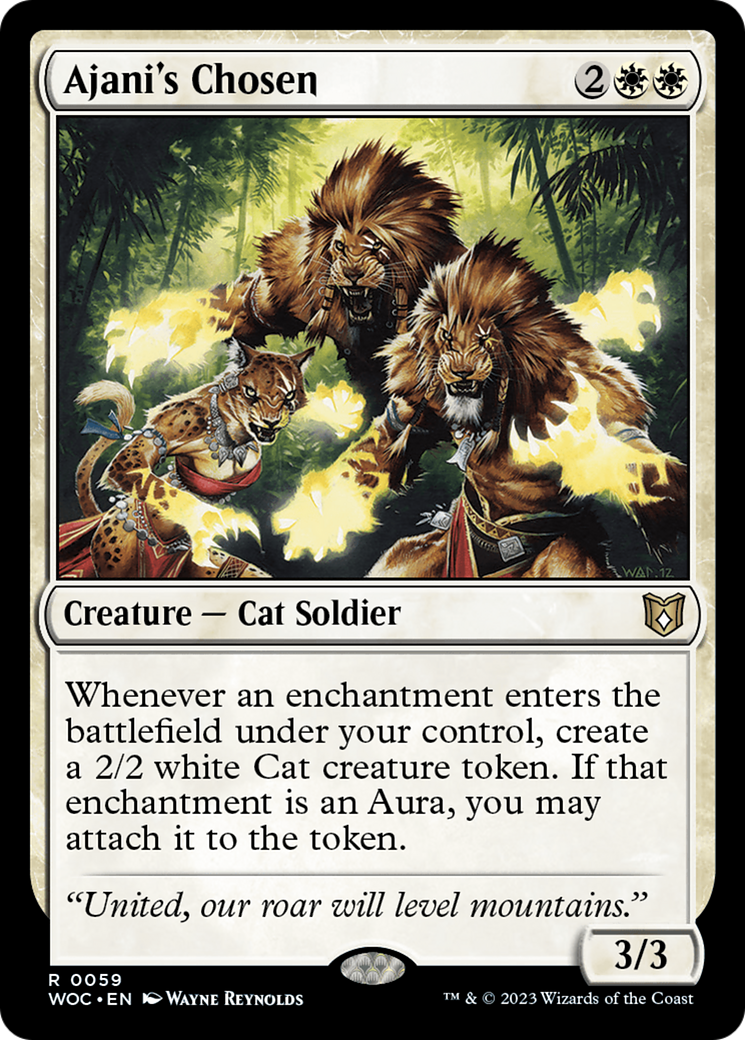
Ajani's Chosen
Ajani's Chosen
Creature — Cat Soldier
3/3
Whenever an enchantment you control enters, create a 2/2 white Cat creature token. If that enchantment is an Aura, you may attach it to the token.
- The ability doesn't trigger until the enchantment enters the battlefield. This means that, for example, you can't cast an Aura with enchant creature if there are no legal targets available, hoping to enchant the Cat token. Ajani's Chosen itself, however, may be a legal target for the Aura.
- If you cast an Aura targeting an opponent or a permanent controlled by an opponent, you control that Aura when it enters the battlefield. The ability of Ajani's Chosen will trigger.
- You may attach the Aura to the token only if it can legally enchant that token. For example, if the enchantment that entered the battlefield is an Aura with "enchant land," it won't move.
- You may attach the Aura to the Cat token only if the Aura and the token are both on the battlefield when the triggered ability resolves. If the Aura leaves the battlefield before the ability resolves, it won't become attached to the token. If the token leaves the battlefield before the ability resolves, the Aura won't move.
-
1
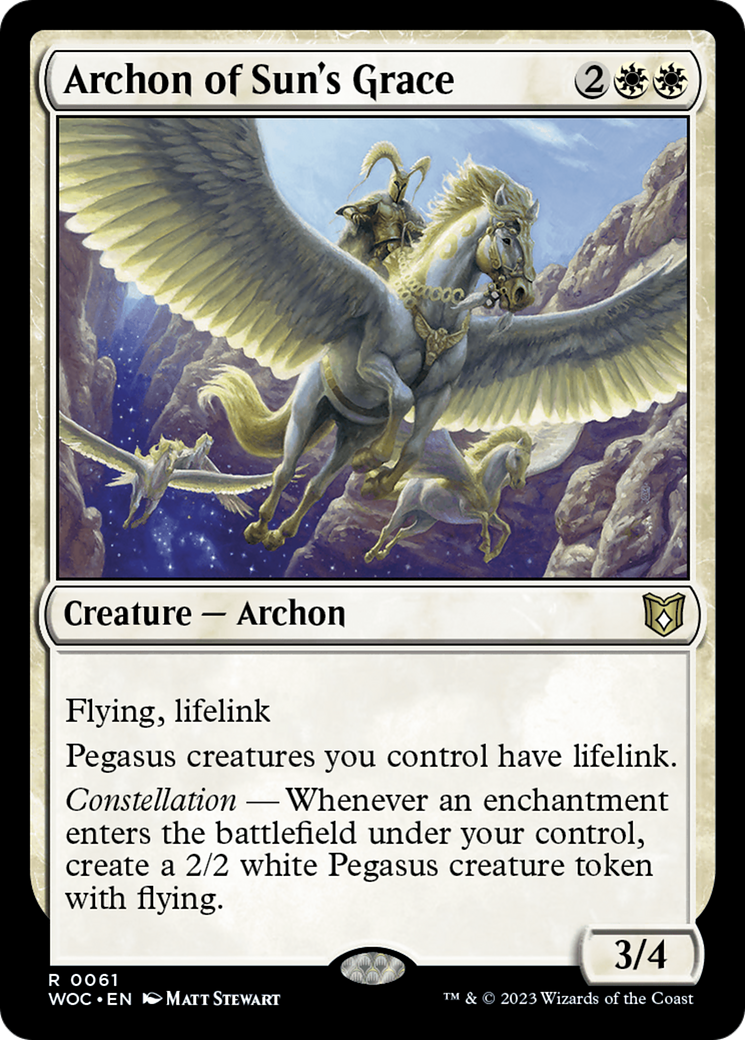
Archon of Sun's Grace
Archon of Sun's Grace
Creature — Archon
3/4
Flying
Lifelink (Damage dealt by this creature also causes you to gain that much life.)
Pegasus creatures you control have lifelink.
Constellation — Whenever an enchantment you control enters, create a 2/2 white Pegasus creature token with flying.
- Multiple instances of lifelink on the same creature are redundant.
- A constellation ability triggers whenever an enchantment enters the battlefield under your control for any reason. Enchantments with other card types, such as enchantment creatures, will also cause constellation abilities to trigger.
- An Aura spell that has an illegal target when it tries to resolve doesn't resolve and is instead put into its owner's graveyard. It doesn't enter the battlefield, so constellation abilities don't trigger.
-
1
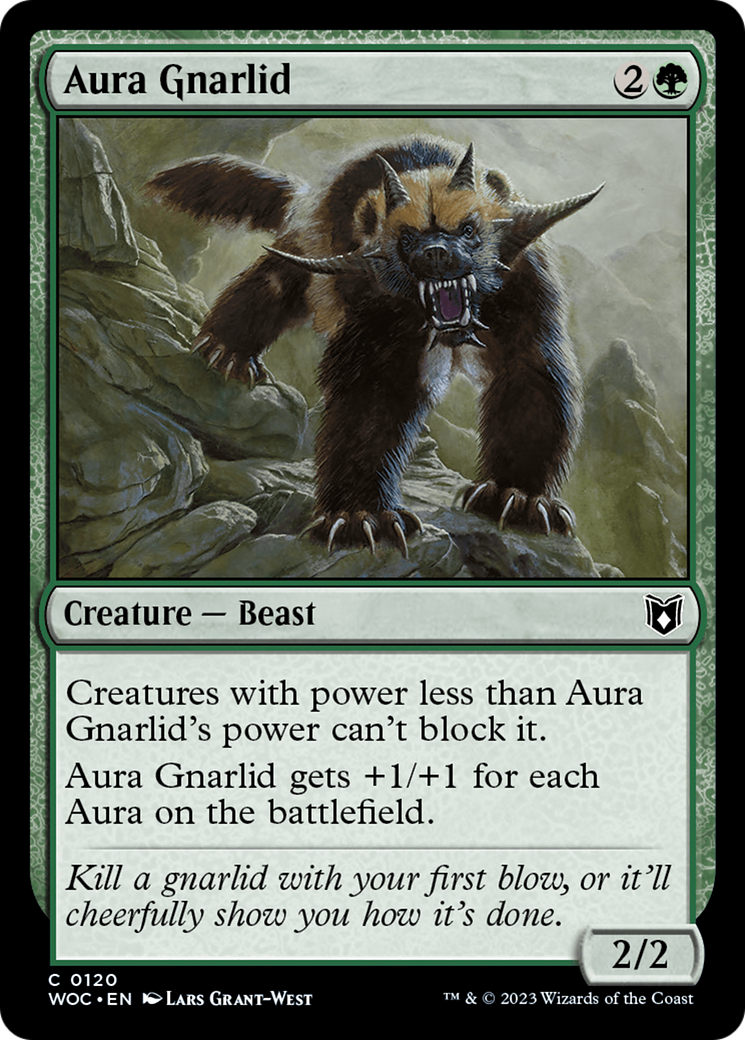
Aura Gnarlid
Aura Gnarlid
Creature — Beast
2/2
Creatures with power less than this creature's power can't block it.
This creature gets +1/+1 for each Aura on the battlefield.
- The power of each potential blocking creature is checked against Aura Gnarlid's power only as blockers are declared. Once a creature blocks Aura Gnarlid, increasing the Gnarlid's power or decreasing the blocking creature's power won't undo that block.
- Aura Gnarlid's second ability counts each Aura regardless of who controls it.
-
1
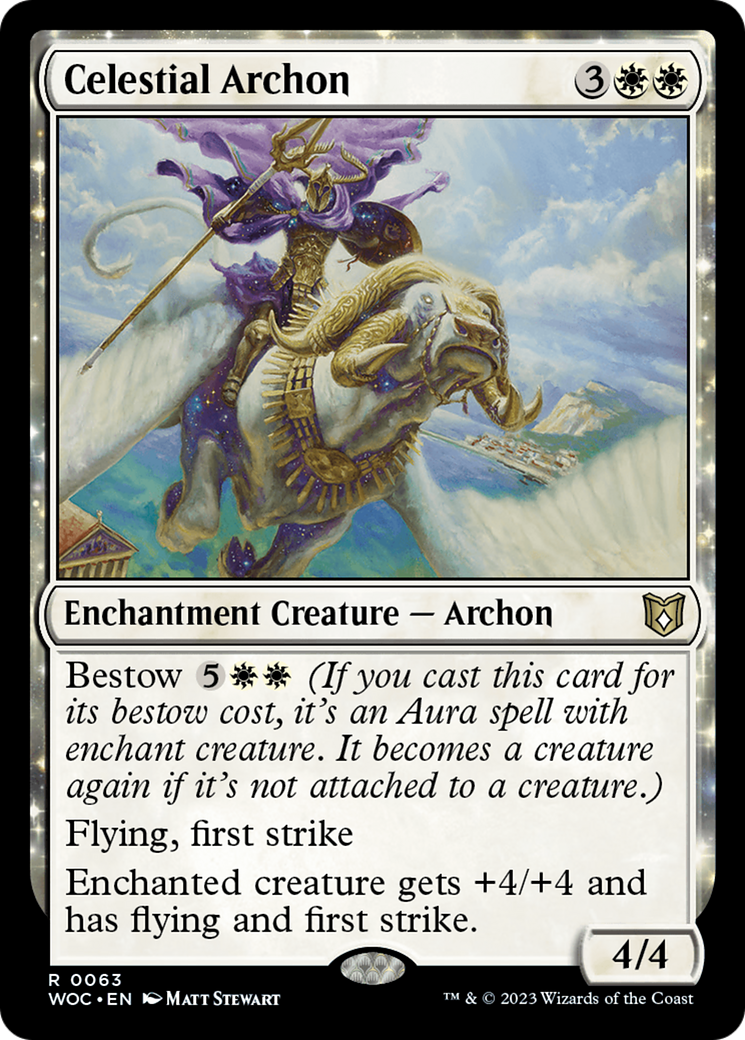
Celestial Archon
Celestial Archon
Enchantment Creature — Archon
4/4
Bestow (If you cast this card for its bestow cost, it's an Aura spell with enchant creature. It becomes a creature again if it's not attached to a creature.)
Flying, first strike
Enchanted creature gets +4/+4 and has flying and first strike.
- Bestow is an alternative cost to cast the spell with bestow. It can't be combined with other alternative costs, such as casting a spell "without paying its mana cost."
- To determine the total cost of a spell, start with the mana cost or alternative cost (such as a bestow cost) you're paying, add any cost increases, then apply any cost reductions. The mana value of the spell remains unchanged, no matter what the total cost to cast it was.
- A spell with bestow is either a creature spell or an Aura spell. It's never both. Similarly, a permanent with bestow is either a creature or an Aura, but not both.
- Unlike other Aura spells, an Aura spell with bestow still resolves if its target is illegal. Instead of entering the battlefield as an Aura, the effect making it an Aura spell ends, it loses enchant creature, and it resolves and enters the battlefield as an enchantment creature.
- Unlike other Auras, an Aura with bestow isn't put into its owner's graveyard if the enchanted creature leaves the battlefield or becomes an illegal creature for the Aura to enchant. Rather, the effect making it an Aura ends, it loses enchant creature, and it remains on the battlefield as an enchantment creature. It can attack (and its abilities can be activated, if it has any) on the turn it becomes unattached if it's been under your control continuously, even as an Aura, since your most recent turn began.
- If a permanent with bestow enters the battlefield by any method other than being cast, it will be an enchantment creature. You can't choose to pay the bestow cost and have it become an Aura.
- Auras attached to a creature don't become tapped when the creature becomes tapped. Except in some rare cases, an Aura with bestow remains untapped when it becomes unattached and becomes a creature.
-
1
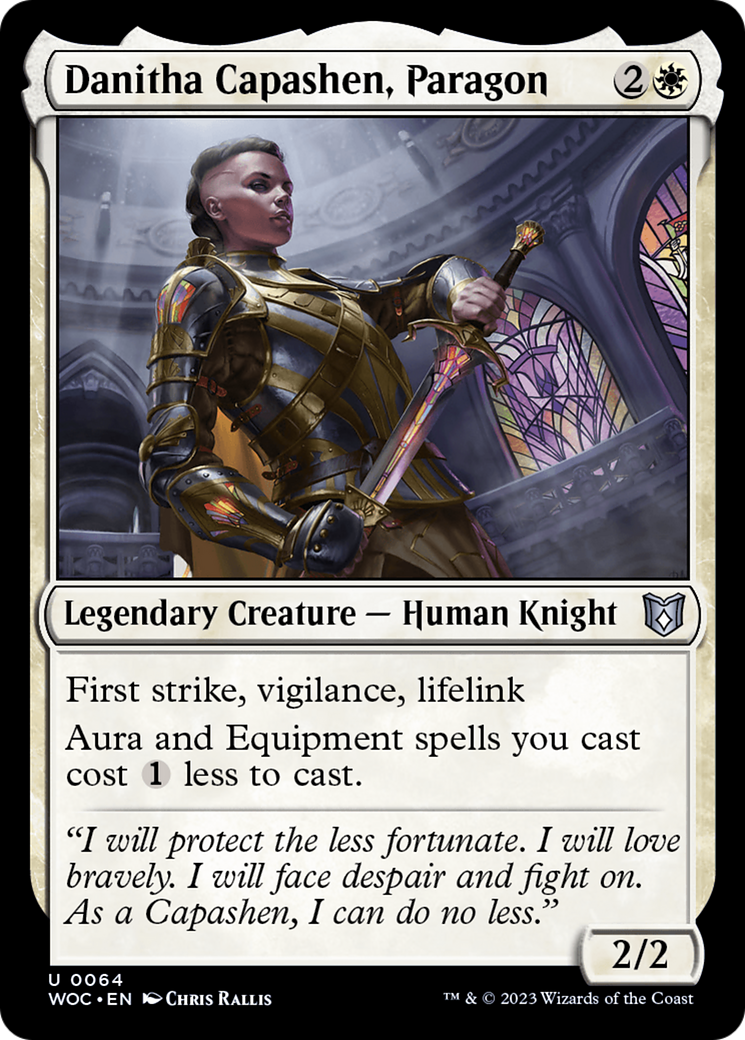
Danitha Capashen, Paragon
Danitha Capashen, Paragon
Legendary Creature — Human Knight
2/2
First strike, vigilance, lifelink
Aura and Equipment spells you cast cost less to cast.
-
1
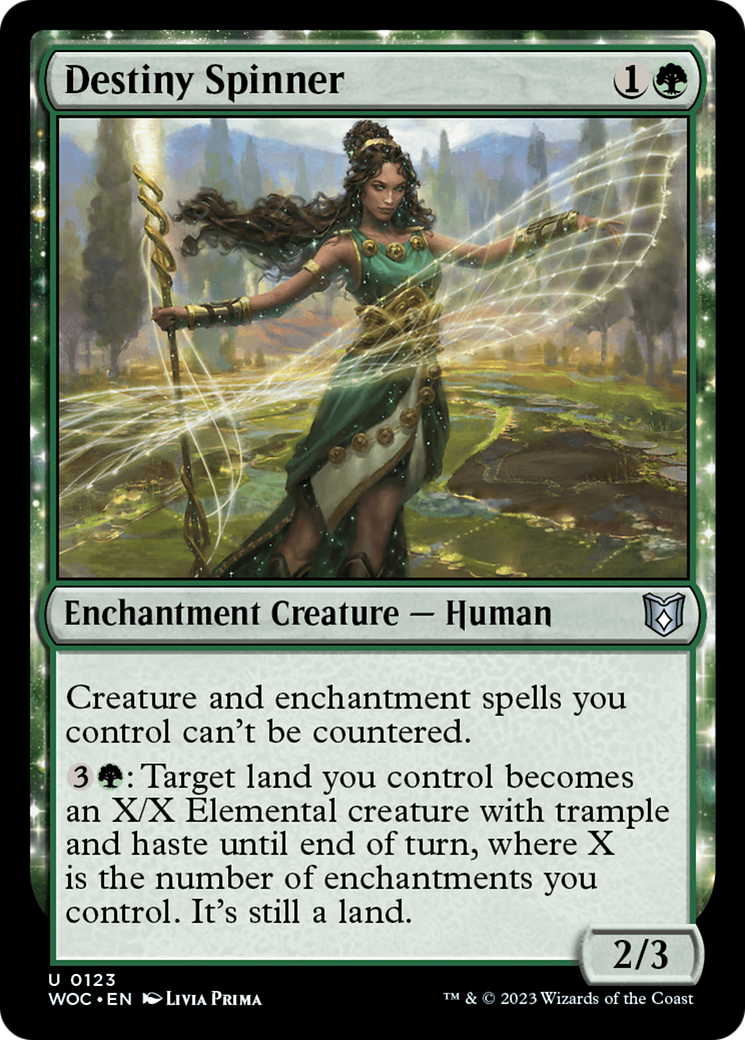
Destiny Spinner
Destiny Spinner
Enchantment Creature — Human
2/3
Creature and enchantment spells you control can't be countered.
: Target land you control becomes an X/X Elemental creature with trample and haste until end of turn, where X is the number of enchantments you control. It's still a land.
- Destiny Spinner's first ability applies only while it's on the battlefield. While it's a spell, it can be countered.
- A spell or ability that counters spells can still target spells that can't be countered. When that spell or ability resolves, the uncounterable spell won't be countered, but any additional effects of the countering spell or ability will still happen.
- The value of X is determined only as Destiny Spinner's activated ability resolves. Once that happens, the creature's base power and toughness won't change later in the turn even if the number of enchantments you control changes.
- If you activate Destiny Spinner's ability more than once in a turn, the value of X may be different each time. If you choose the same land as the target more than once, the most recent effect (and most recent value of X) applies.
- Destiny Spinner's activated ability doesn't untap the land that becomes a creature.
- If you control no enchantments at the time Destiny Spinner's activated ability resolves, the land becomes a 0/0 creature and is put into its owner's graveyard unless another effect is raising its toughness.
-
1
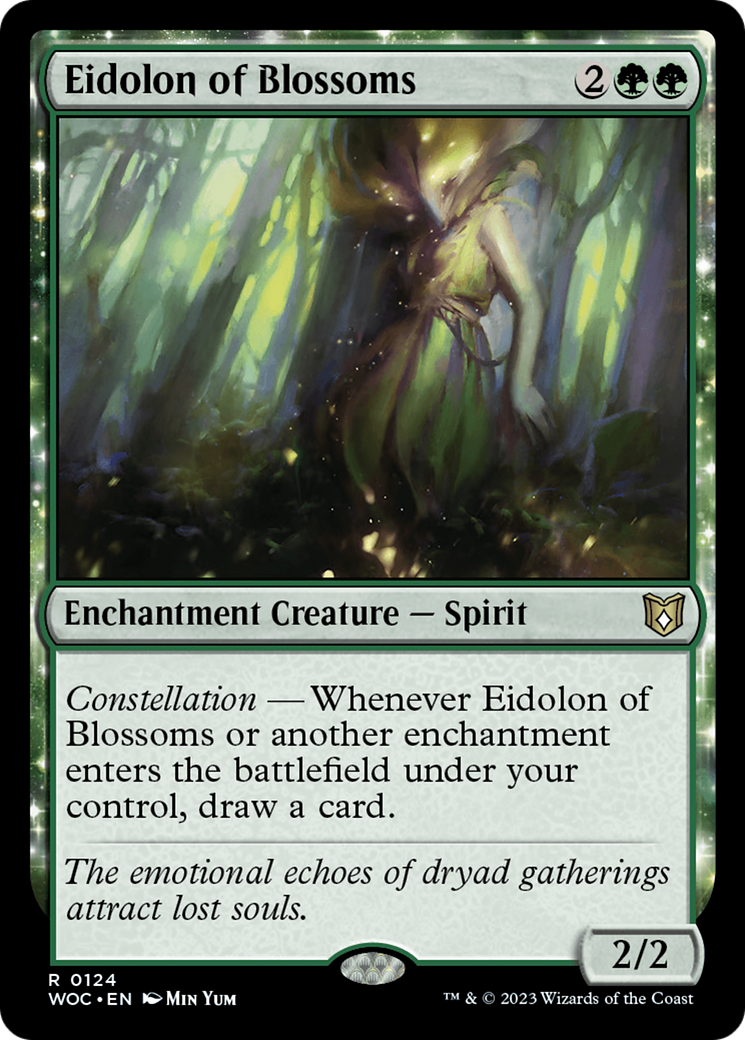
Eidolon of Blossoms
Eidolon of Blossoms
Enchantment Creature — Spirit
2/2
Constellation — Whenever this creature or another enchantment you control enters, draw a card.
- A constellation ability triggers whenever an enchantment enters the battlefield under your control for any reason. Enchantments with other card types, such as enchantment creatures, will also cause constellation abilities to trigger.
- An Aura spell without bestow that has an illegal target when it tries to resolve won't resolve and will be put into its owner's graveyard. It won't enter the battlefield and constellation abilities won't trigger. An Aura spell with bestow won't be countered this way. It will revert to being an enchantment creature and resolve, entering the battlefield and triggering constellation abilities.
- When an enchantment enters the battlefield under your control, each constellation ability of permanents you control will trigger. You can put these abilities on the stack in any order. The last ability you put on the stack will be the first one that resolves.
-
1
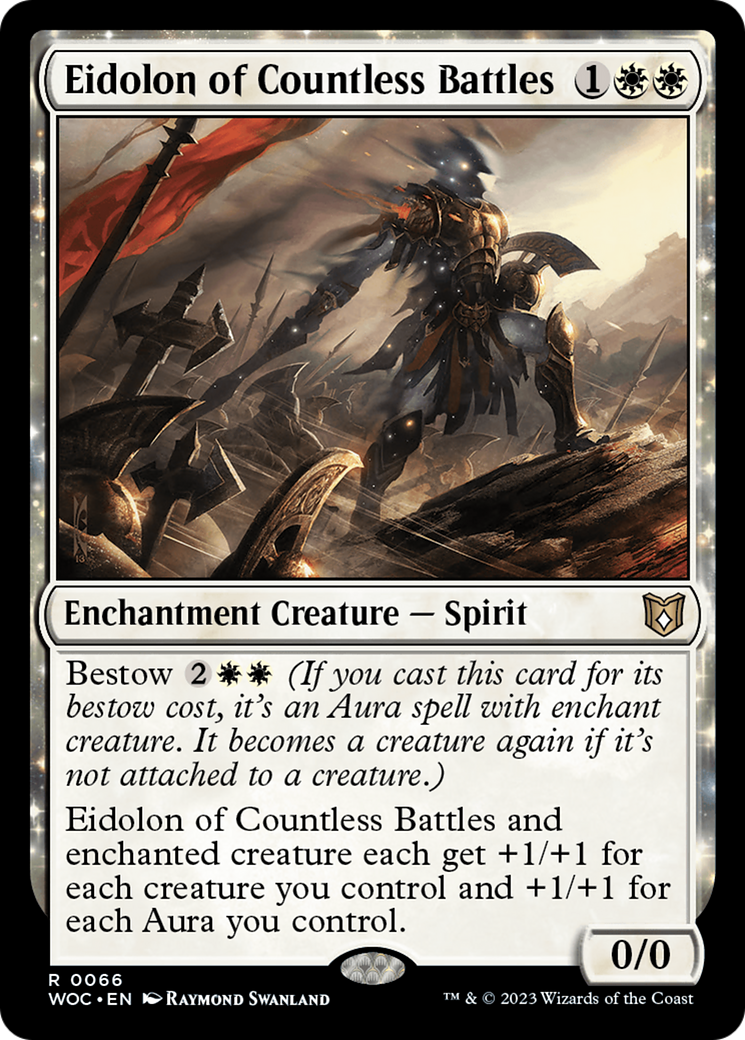
Eidolon of Countless Battles
Eidolon of Countless Battles
Enchantment Creature — Spirit
0/0
Bestow (If you cast this card for its bestow cost, it's an Aura spell with enchant creature. It becomes a creature again if it's not attached to a creature.)
This creature and enchanted creature each get +1/+1 for each creature you control and +1/+1 for each Aura you control.
- Eidolon of Countless Battles's last ability functions only on the battlefield. In other zones, it is a 0/0 enchantment creature card.
- A permanent with bestow is either a creature or an Aura, not both (although it's an enchantment either way). It will contribute just +1/+1 toward the bonus given by Eidolon of Countless Battles.
- Unlike other Auras, an Aura with bestow isn't put into its owner's graveyard if it becomes unattached. Rather, the effect making it an Aura ends, it loses enchant creature, and it remains on the battlefield as an enchantment creature. It can attack (and its abilities can be activated, if it has any) on the turn it becomes unattached if it's been under your control continuously, even as an Aura, since your most recent turn began.
- On the stack, a spell with bestow is either a creature spell or an Aura spell. It's never both, although it's an enchantment spell in either case.
- Auras attached to a creature don't become tapped when the creature becomes tapped. Except in some rare cases, an Aura with bestow remains untapped when it becomes unattached and becomes a creature.
- If a permanent with bestow enters the battlefield by any method other than being cast, it will be an enchantment creature. You can't choose to pay the bestow cost and have it become an Aura.
- Unlike other Aura spells, an Aura spell with bestow isn't countered if its target is illegal as it begins to resolve. Rather, the effect making it an Aura spell ends, it loses enchant creature, it returns to being an enchantment creature spell, and it resolves and enters the battlefield as an enchantment creature.
-
1
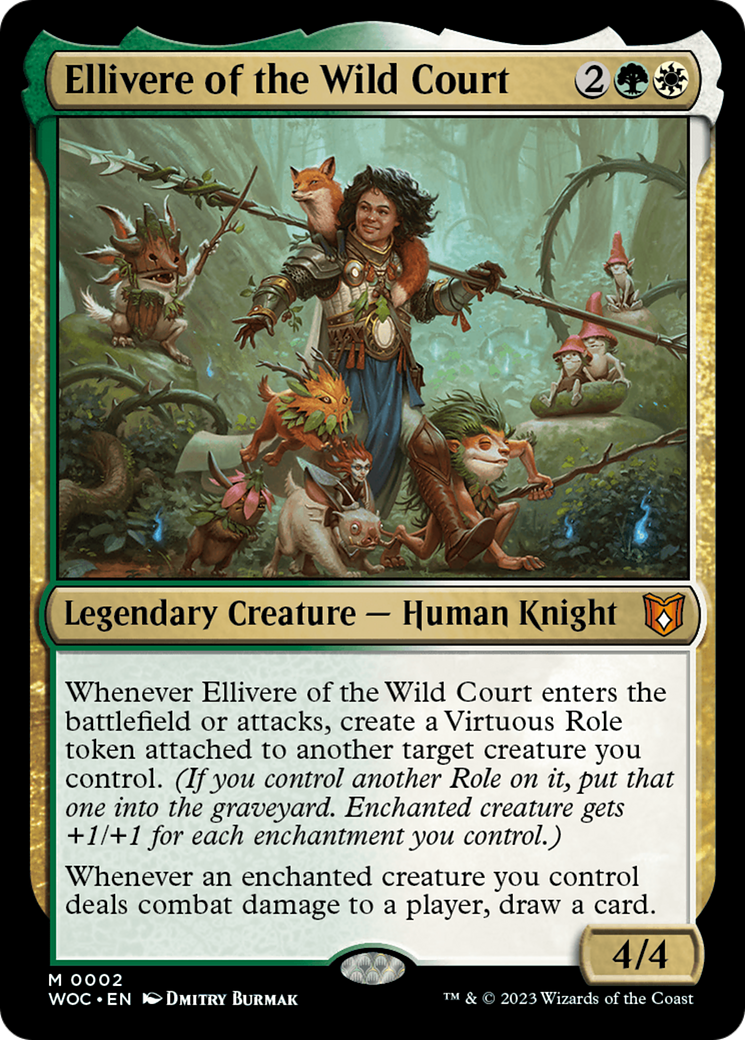
Ellivere of the Wild Court
Ellivere of the Wild Court
Legendary Creature — Human Knight
4/4
Whenever Ellivere enters or attacks, create a Virtuous Role token attached to another target creature you control. (If you control another Role on it, put that one into the graveyard. Enchanted creature gets +1/+1 for each enchantment you control.)
Whenever an enchanted creature you control deals combat damage to a player, draw a card.
- Roles are colorless enchantment tokens. Each one has the Aura and Role subtypes and the enchant creature ability.
- If a permanent has more than one Role attached to it controlled by the same player, each of those Roles except the one with the most recent timestamp is put into its owner's graveyard. This is a state-based action.
- If two or more Roles controlled by the same player become attached to a permanent at the same time (perhaps due to an effect such as that of Doubling Season), that player chooses which one to keep and which are put into their owners' graveyards.
- A permanent can have multiple Roles attached to it if each one is controlled by a different player.
- Some spells and abilities that create Role tokens require targets. If each target chosen is an illegal target as that spell or ability tries to resolve, it won't resolve. The Role token won't be created.
- In rare cases, a spell or ability might attempt to create a Role token enchanting a permanent that it can't legally enchant (because of an ability like protection from enchantments). In such cases, the Role token isn't created.
- Hexproof and shroud won't prevent a Role from becoming attached to a permanent if the ability creating that Role attached to that permanent doesn't target it.
- Cards in the Wilds of Eldraine main set create six different Role tokens: Cursed, Monster, Royal, Sorcerer, Wicked, and Young Hero. A seventh Role token, Virtuous, is created by Ellivere of the Wild Court, the commander of the "Virtue and Valor" Commander Deck.
-
1
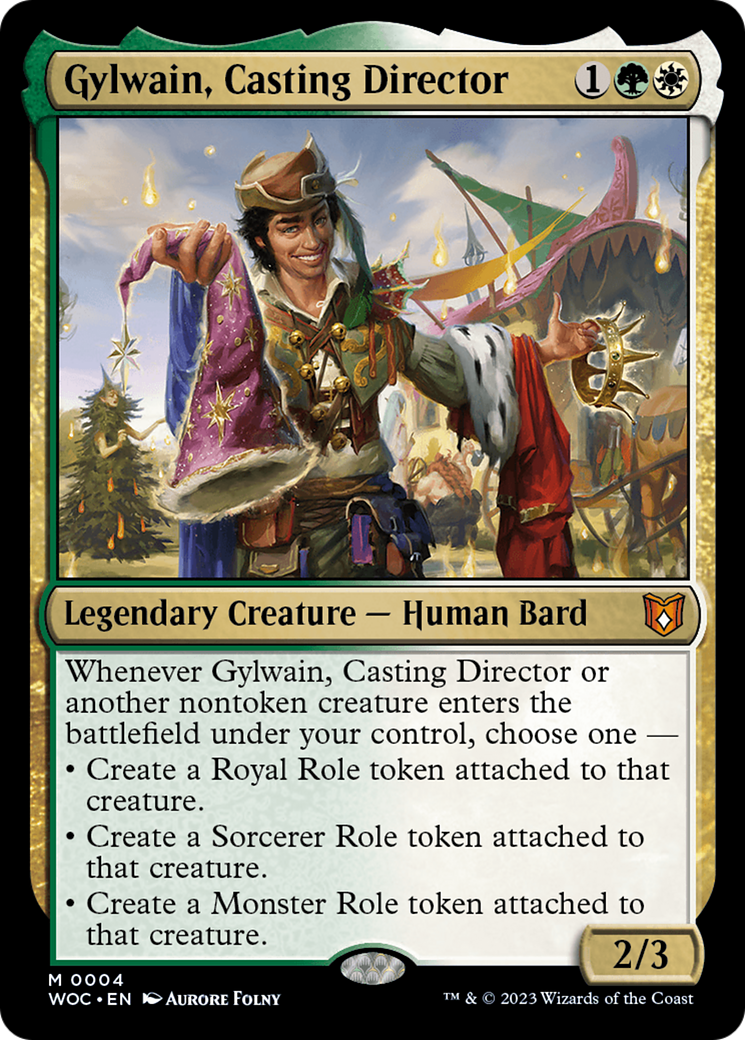
Gylwain, Casting Director
Gylwain, Casting Director
Legendary Creature — Human Bard
2/3
Whenever Gylwain or another nontoken creature you control enters, choose one —
- Create a Royal Role token attached to that creature.
- Create a Sorcerer Role token attached to that creature.
- Create a Monster Role token attached to that creature.
- Roles are colorless enchantment tokens. Each one has the Aura and Role subtypes and the enchant creature ability.
- If a permanent has more than one Role attached to it controlled by the same player, each of those Roles except the one with the most recent timestamp is put into its owner's graveyard. This is a state-based action.
- If two or more Roles controlled by the same player become attached to a permanent at the same time (perhaps due to an effect such as that of Doubling Season), that player chooses which one to keep and which are put into their owners' graveyards.
- A permanent can have multiple Roles attached to it if each one is controlled by a different player.
- Some spells and abilities that create Role tokens require targets. If each target chosen is an illegal target as that spell or ability tries to resolve, it won't resolve. The Role token won't be created.
- In rare cases, a spell or ability might attempt to create a Role token enchanting a permanent that it can't legally enchant (because of an ability like protection from enchantments). In such cases, the Role token isn't created.
- Hexproof and shroud won't prevent a Role from becoming attached to a permanent if the ability creating that Role attached to that permanent doesn't target it.
- Cards in the Wilds of Eldraine main set create six different Role tokens: Cursed, Monster, Royal, Sorcerer, Wicked, and Young Hero. A seventh Role token, Virtuous, is created by Ellivere of the Wild Court, the commander of the "Virtue and Valor" Commander Deck.
-
1
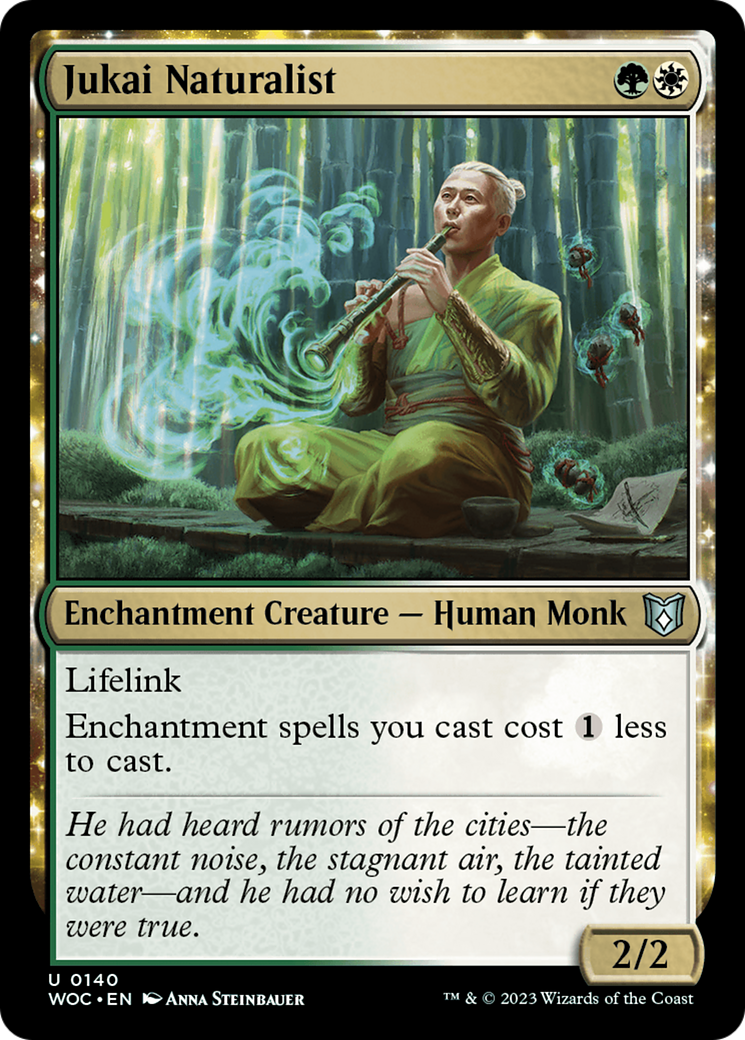
Jukai Naturalist
Jukai Naturalist
Enchantment Creature — Human Monk
2/2
Lifelink
Enchantment spells you cast cost less to cast.
-
1
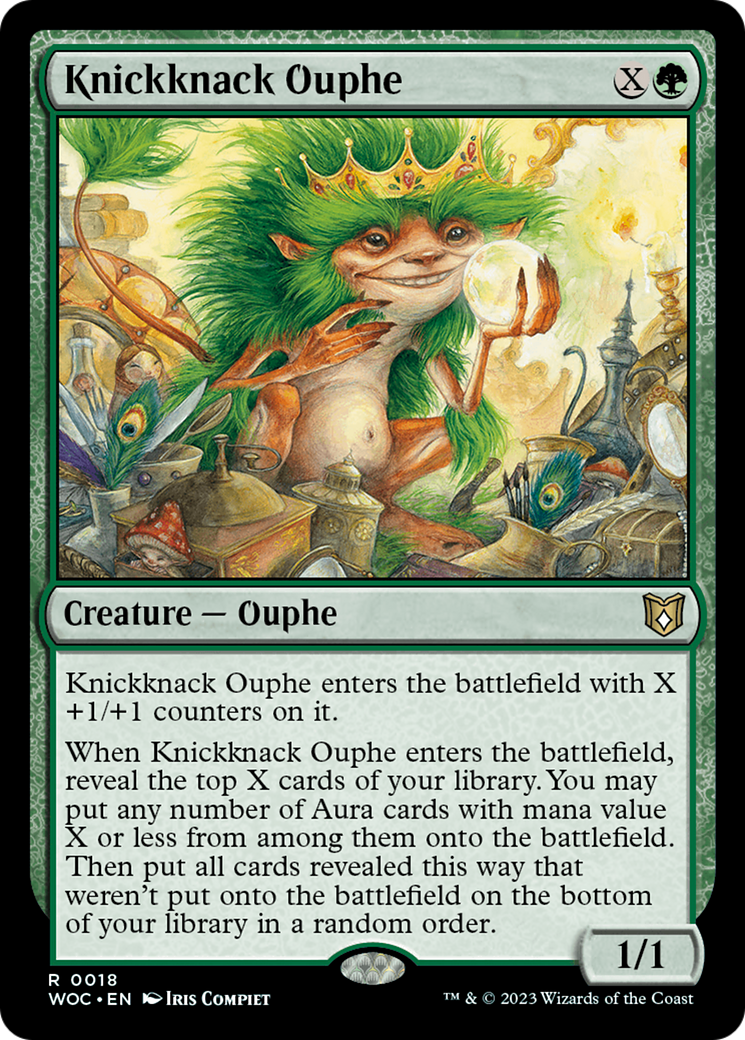
Knickknack Ouphe
Knickknack Ouphe
Creature — Ouphe
1/1
This creature enters with X +1/+1 counters on it.
When this creature enters, reveal the top X cards of your library. You may put any number of Aura cards with mana value X or less from among them onto the battlefield. Then put all cards revealed this way that weren't put onto the battlefield on the bottom of your library in a random order.
- An Aura put onto the battlefield this way doesn't target anything (so it could be attached to an opponent's permanent with hexproof, for example), but the Aura's enchant ability restricts what it can be attached to. If the Aura can't legally be attached to anything, you can't choose to put it onto the battlefield at all.
-
1
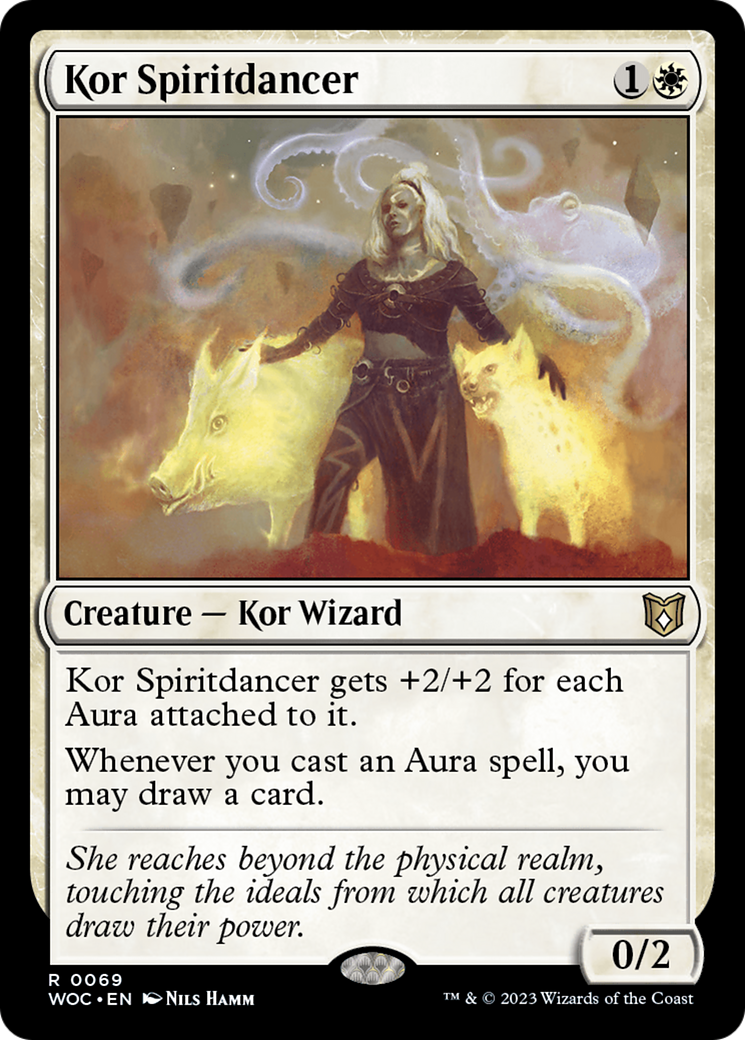
Kor Spiritdancer
Kor Spiritdancer
Creature — Kor Wizard
0/2
This creature gets +2/+2 for each Aura attached to it.
Whenever you cast an Aura spell, you may draw a card.
- If you cast an Aura spell, Kor Spiritdancer's second ability triggers and goes on the stack on top of it. The ability will resolve before the spell does.
- The second ability triggers when you cast any Aura spell, not just one that targets Kor Spiritdancer.
-
1
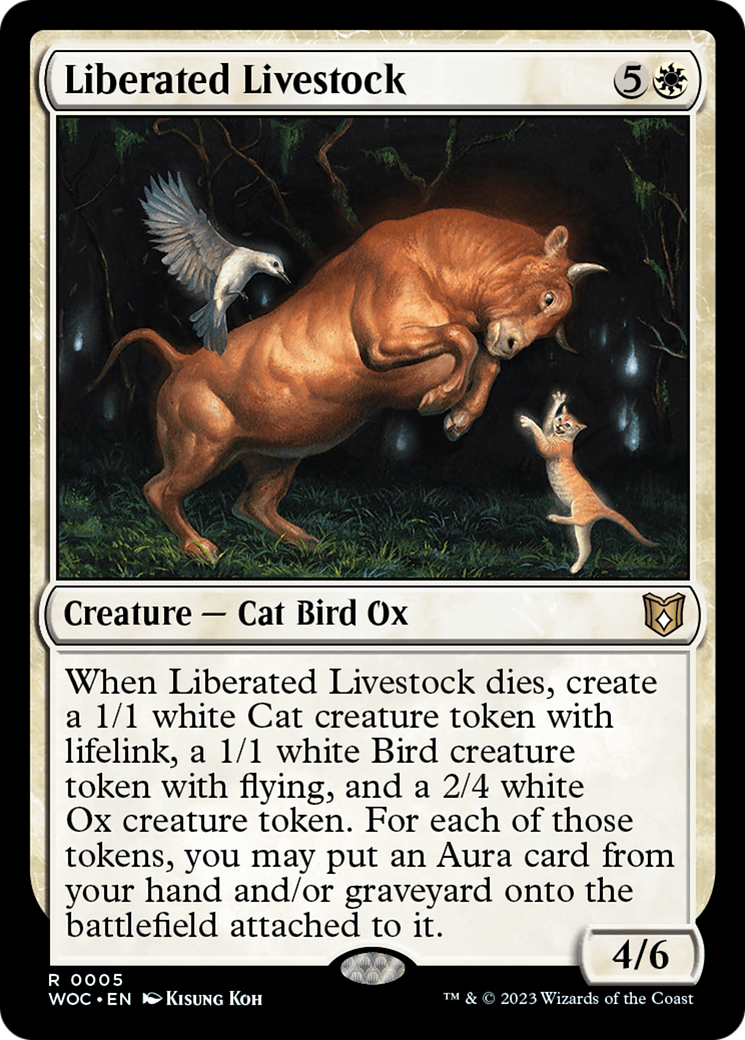
Liberated Livestock
Liberated Livestock
Creature — Cat Bird Ox
4/6
When this creature dies, create a 1/1 white Cat creature token with lifelink, a 1/1 white Bird creature token with flying, and a 2/4 white Ox creature token. For each of those tokens, you may put an Aura card from your hand and/or graveyard onto the battlefield attached to it.
- If you attempt to put an Aura onto the battlefield this way and that Aura can't legally be attached to the token, that Aura does not enter the battlefield at all. Instead, it will stay in its previous zone.
- If Liberated Livestock's ability causes more than the expected number of tokens to be created (due to an effect such as that of Doubling Season), you may put an Aura card from your hand and/or graveyard onto the battlefield attached to each of the additional tokens as well.
-
1
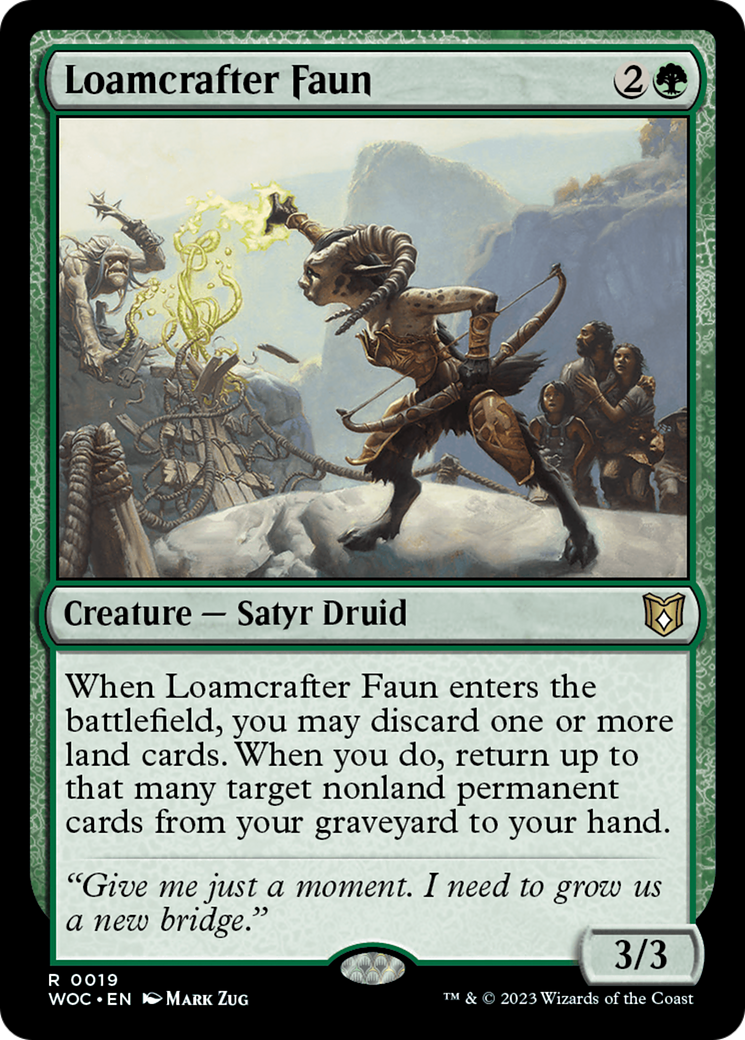
Loamcrafter Faun
Loamcrafter Faun
Creature — Satyr Druid
3/3
When this creature enters, you may discard one or more land cards. When you do, return up to that many target nonland permanent cards from your graveyard to your hand.
- You don't choose targets for Loamcrafter Faun's ability at the time it triggers. Rather, a second "reflexive" ability triggers when you discard one or more land cards this way. You choose targets for that ability as it goes on the stack. Each player may respond to this triggered ability as normal.
-
1
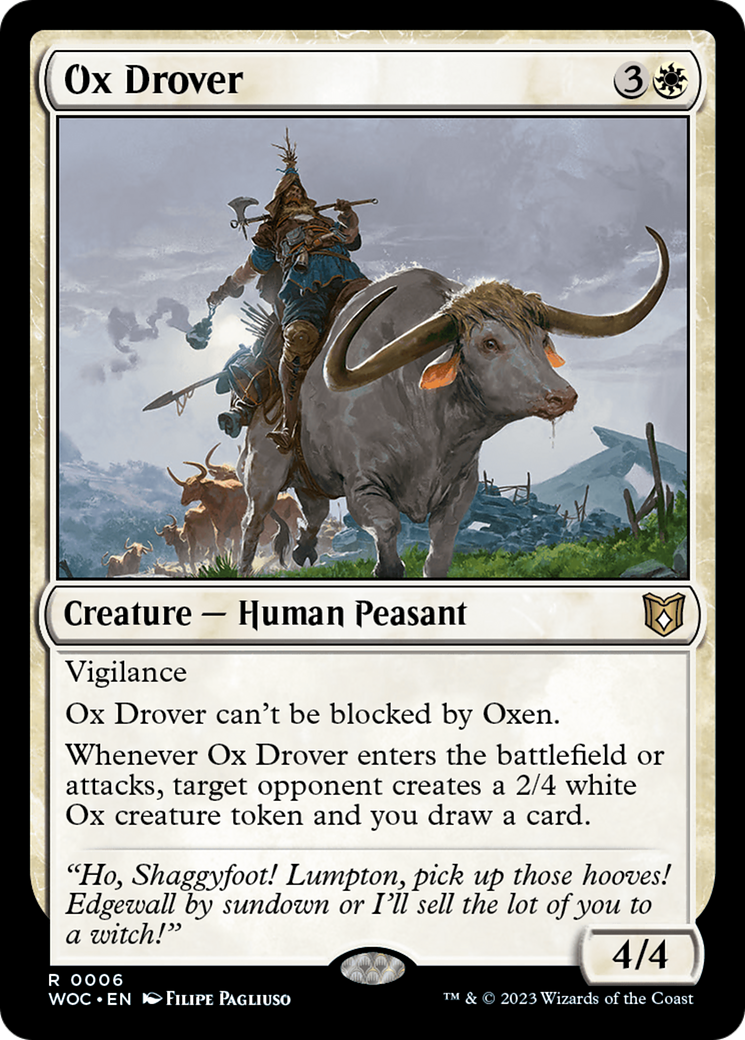
Ox Drover
Ox Drover
Creature — Human Peasant
4/4
Vigilance
This creature can't be blocked by Oxen.
Whenever this creature enters or attacks, target opponent creates a 2/4 white Ox creature token and you draw a card.
- If the target opponent is an illegal target by the time Ox Drover's last ability tries to resolve, it won't resolve. They won't create an Ox token, and you won't draw a card.
-
1
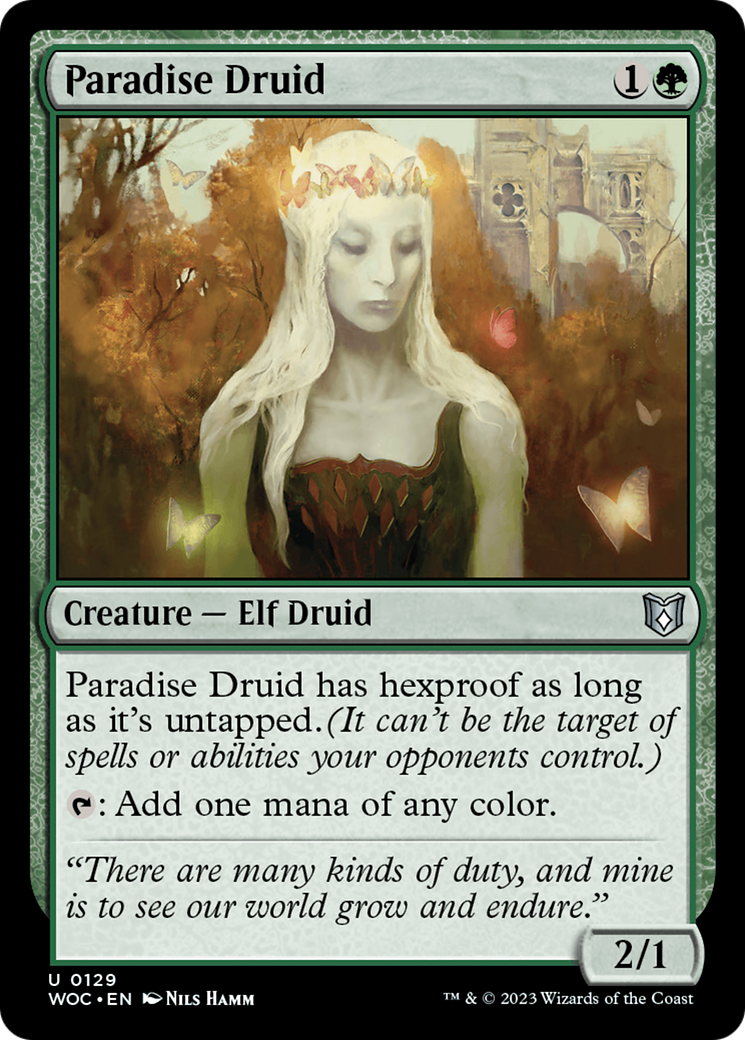
Paradise Druid
Paradise Druid
Creature — Elf Druid
2/1
This creature has hexproof as long as it's untapped. (It can't be the target of spells or abilities your opponents control.)
: Add one mana of any color.
-
1
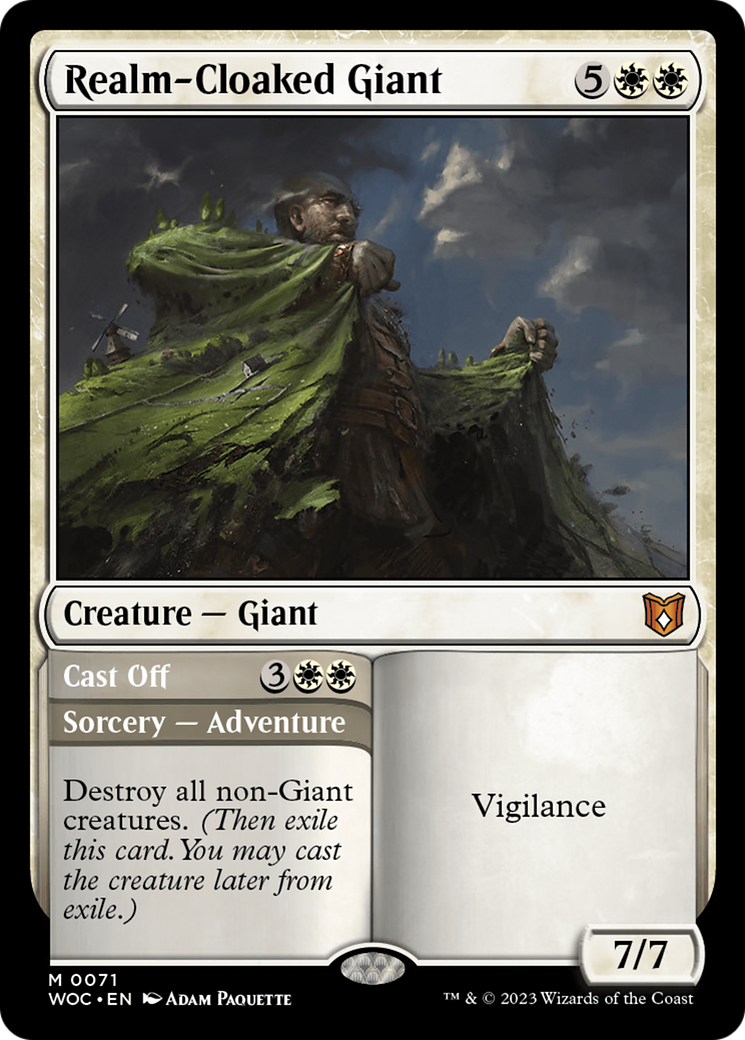
Realm-Cloaked Giant // Cast Off
//
Realm-Cloaked Giant
Creature — Giant
7/7
- An adventurer card is a permanent card in every zone except the stack, as well as while on the stack if not cast as an Adventure. Ignore its alternative characteristics in those cases. For example, while it's in your graveyard, Giant Killer is a white creature card whose mana value is 1. It can't be the target of the triggered ability of Mystic Sanctuary.
- When casting a spell as an Adventure, use the alternative characteristics and ignore all of the card's normal characteristics. The spell's color, mana cost, mana value, and so on are determined by only those alternative characteristics. If the spell leaves the stack, it immediately resumes using its normal characteristics.
- If you cast an adventurer card as an Adventure, use only its alternative characteristics to determine whether it's legal to cast that spell. For example, if Giant Killer is exiled with the last ability of Vivien, Champion of the Wilds, you can't cast it as Chop Down.
- If a spell is cast as an Adventure, its controller exiles it instead of putting it into its owner's graveyard as it resolves. For as long as it remains exiled, that player may cast it as a permanent spell. If an Adventure spell leaves the stack in any way other than resolving (most likely by being countered or by failing to resolve because its targets have all become illegal), that card won't be exiled and the spell's controller won't be able to cast it as a permanent later.
- If an adventurer card ends up in exile for any other reason than by exiling itself while resolving, it won't give you permission to cast it as a permanent spell.
- You must still follow any timing restrictions and permissions for the permanent spell you cast from exile. Normally, you'll be able to cast it only during your main phase while the stack is empty.
- If an effect copies an Adventure spell, that copy is exiled as it resolves. It ceases to exist as a state-based action; it's not possible to cast the copy as a permanent.
- If an object becomes a copy of an object that has an Adventure, the copy also has an Adventure. If it changes zones, it will either cease to exist (if it's a token) or cease to be a copy (if it's a nontoken permanent), and so you won't be able to cast it as an Adventure.
- If an effect instructs you to choose a card name, you may choose the alternative Adventure name. Consider only the alternative characteristics to determine whether that is an appropriate name to choose.
- Casting a card as an Adventure isn't casting it for an alternative cost. Effects that allow you to cast a spell for an alternative cost or without paying its mana cost may allow you to apply those to the Adventure.
-
1
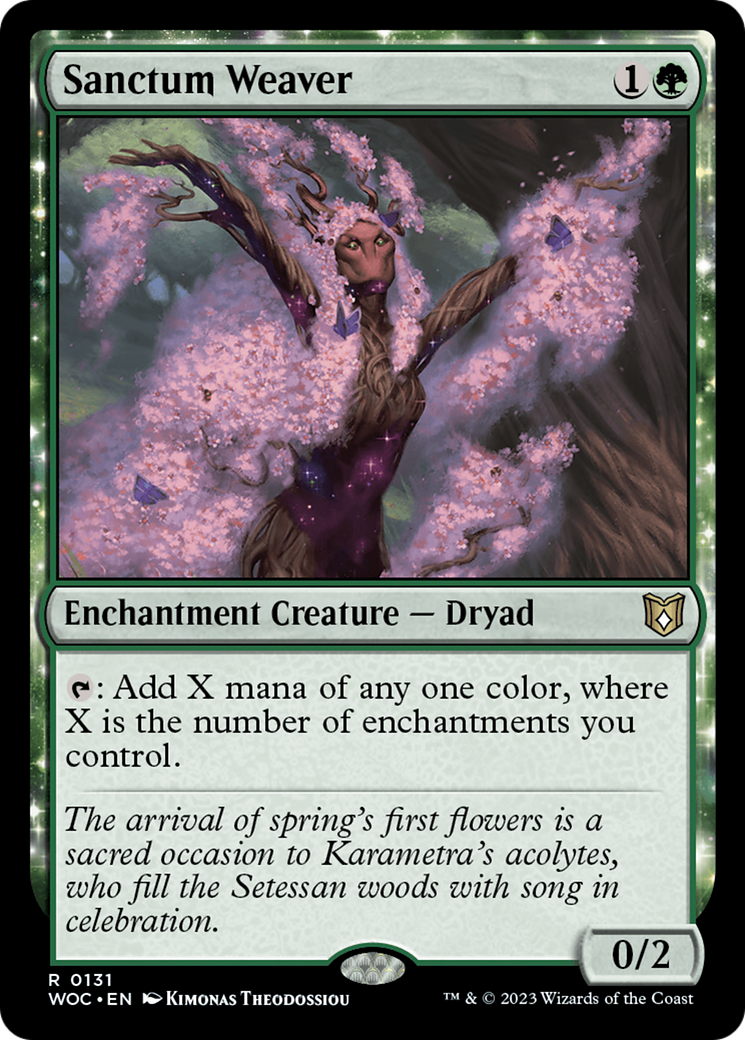
Sanctum Weaver
Sanctum Weaver
Enchantment Creature — Dryad
0/2
: Add X mana of any one color, where X is the number of enchantments you control.
- Sanctum Weaver's ability is a mana ability and does not use the stack. This means that no player can respond to the ability by taking an action that would reduce the number of enchantments you have.
-
1
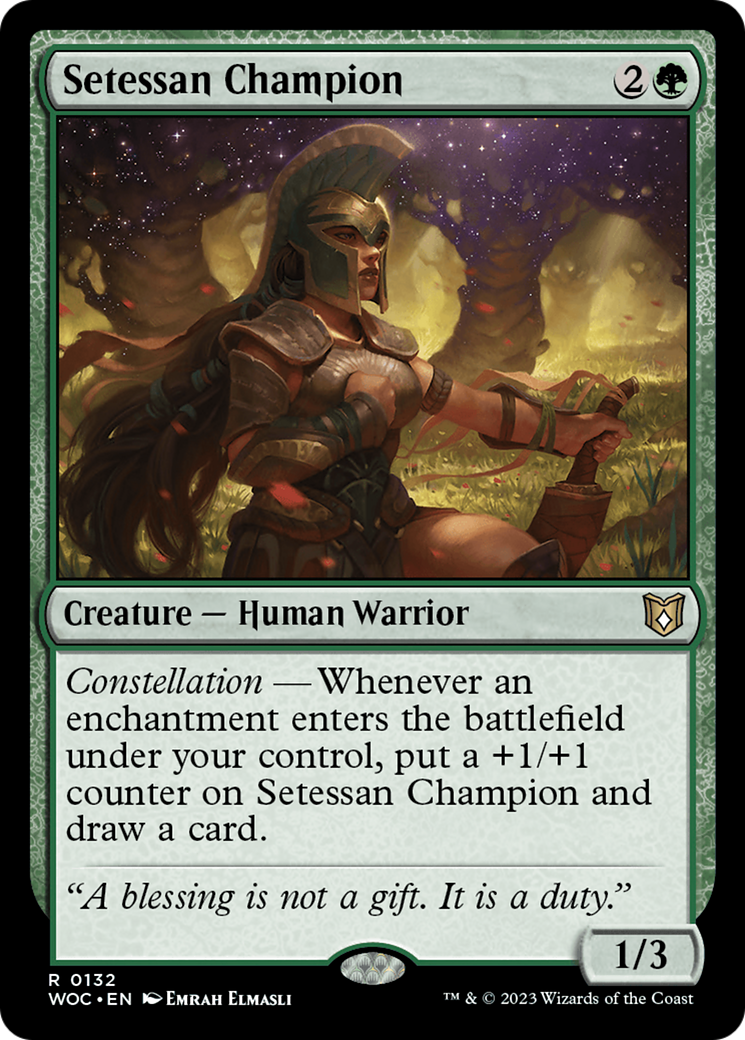
Setessan Champion
Setessan Champion
Creature — Human Warrior
1/3
Constellation — Whenever an enchantment you control enters, put a +1/+1 counter on this creature and draw a card.
- If Setessan Champion leaves the battlefield after its ability has triggered, you still draw a card even though you won't put a +1/+1 counter on Setessan Champion.
- A constellation ability triggers whenever an enchantment enters the battlefield under your control for any reason. Enchantments with other card types, such as enchantment creatures, will also cause constellation abilities to trigger.
- An Aura spell that has an illegal target when it tries to resolve doesn't resolve and is instead put into its owner's graveyard. It doesn't enter the battlefield, so constellation abilities don't trigger.
-
1
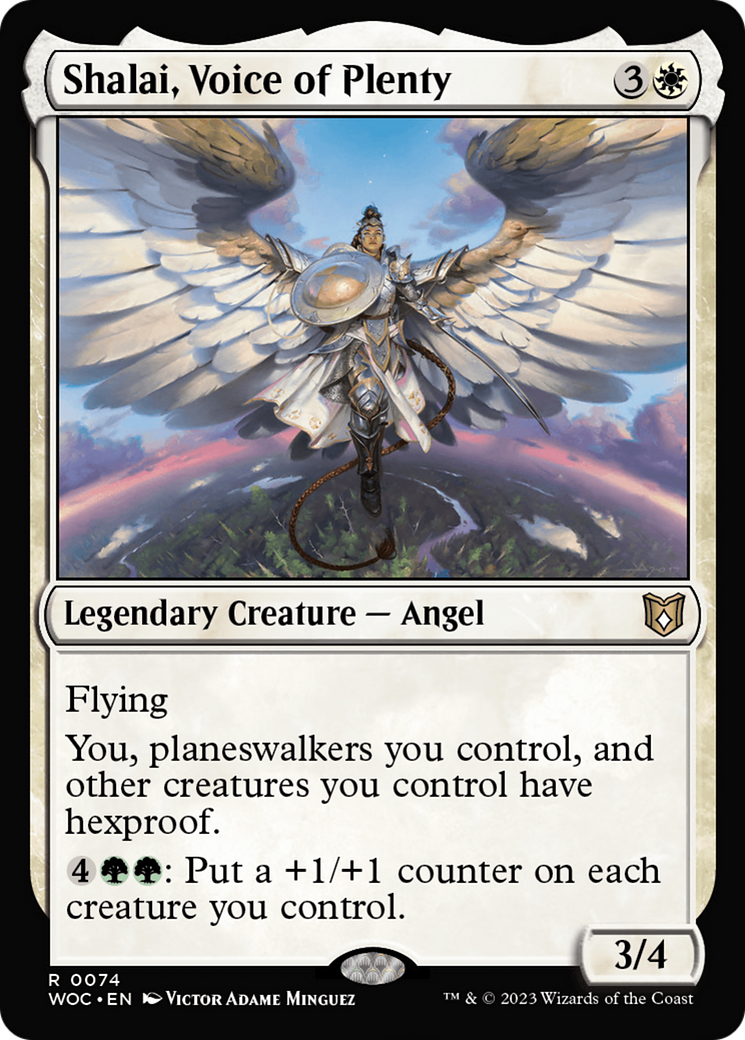
Shalai, Voice of Plenty
Shalai, Voice of Plenty
Legendary Creature — Angel
3/4
Flying
You, planeswalkers you control, and other creatures you control have hexproof.
: Put a +1/+1 counter on each creature you control.
-
1
Siona, Captain of the Pyleas
Siona, Captain of the Pyleas
Legendary Creature — Human Soldier
2/2
When Siona enters, look at the top seven cards of your library. You may reveal an Aura card from among them and put it into your hand. Put the rest on the bottom of your library in a random order.
Whenever an Aura you control becomes attached to a creature you control, create a 1/1 white Human Soldier creature token.
- Siona's last ability triggers both whenever an Aura enters the battlefield attached to a creature you control and whenever an Aura on the battlefield attached to a different object becomes attached to a creature you control. It doesn't trigger if an effect tries to attach an Aura to the creature it already enchants.
- If an Aura becomes attached to Siona that causes another player to gain control of it, that player will control the triggered ability that creates a Soldier.
- If an Aura becomes attached to Siona that causes it to lose all abilities, Siona's last ability won't trigger.
- If an Aura becomes attached to a noncreature permanent you control that causes it to become a creature, Siona's last ability triggers. If an Aura becomes attached to a creature you don't control that causes it to become a creature you do control, Siona's last ability triggers. If an Aura becomes attached to a creature you control that causes it to no longer be a creature or to no longer be under your control, Siona's last ability doesn't trigger.
-
1
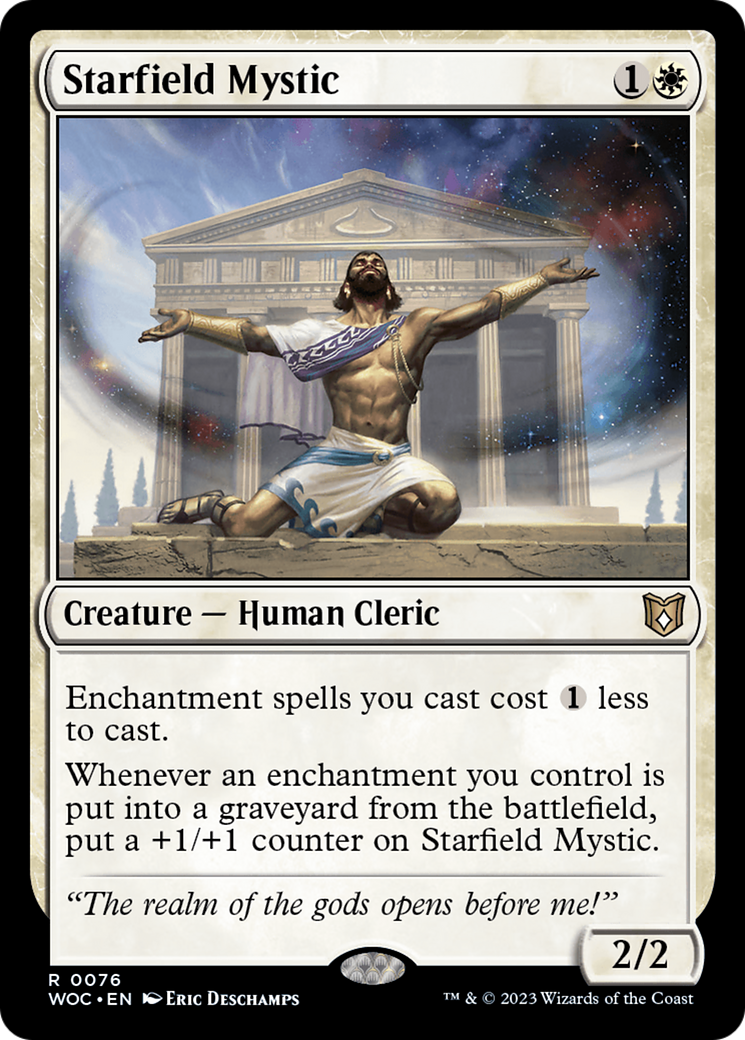
Starfield Mystic
Starfield Mystic
Creature — Human Cleric
2/2
Enchantment spells you cast cost less to cast.
Whenever an enchantment you control is put into a graveyard from the battlefield, put a +1/+1 counter on this creature.
- If you cast an Aura spell targeting an opponent's permanent, you still control the Aura after it resolves.
-
1
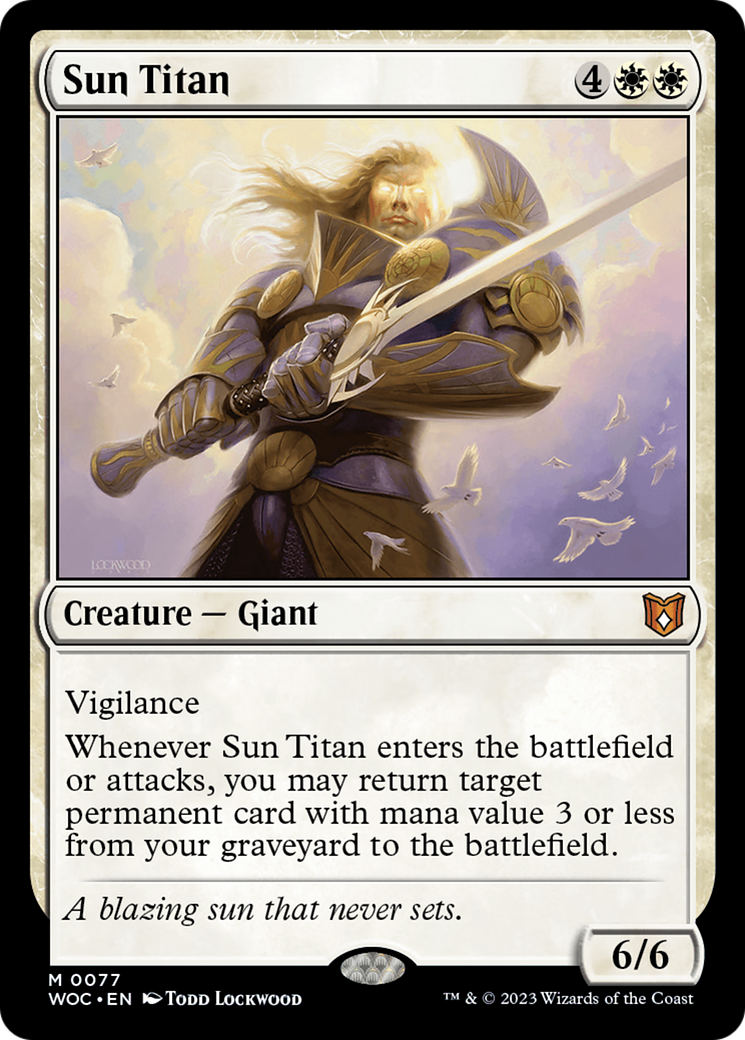
Sun Titan
Sun Titan
Creature — Giant
6/6
Vigilance
Whenever this creature enters or attacks, you may return target permanent card with mana value 3 or less from your graveyard to the battlefield.
- If a card in your graveyard has no mana symbols in its upper right corner (because it's a land card, for example), its mana value is 0.
- If the mana cost of a card in your graveyard includes , X is considered to be 0.
- A permanent card is an artifact, creature, enchantment, land, or planeswalker card.
- The mana value of a card in your graveyard is determined solely by the mana symbols printed in its upper right corner. The mana value is the total amount of mana in that cost, regardless of color. For example, a card with mana cost has mana value 5.
-
1
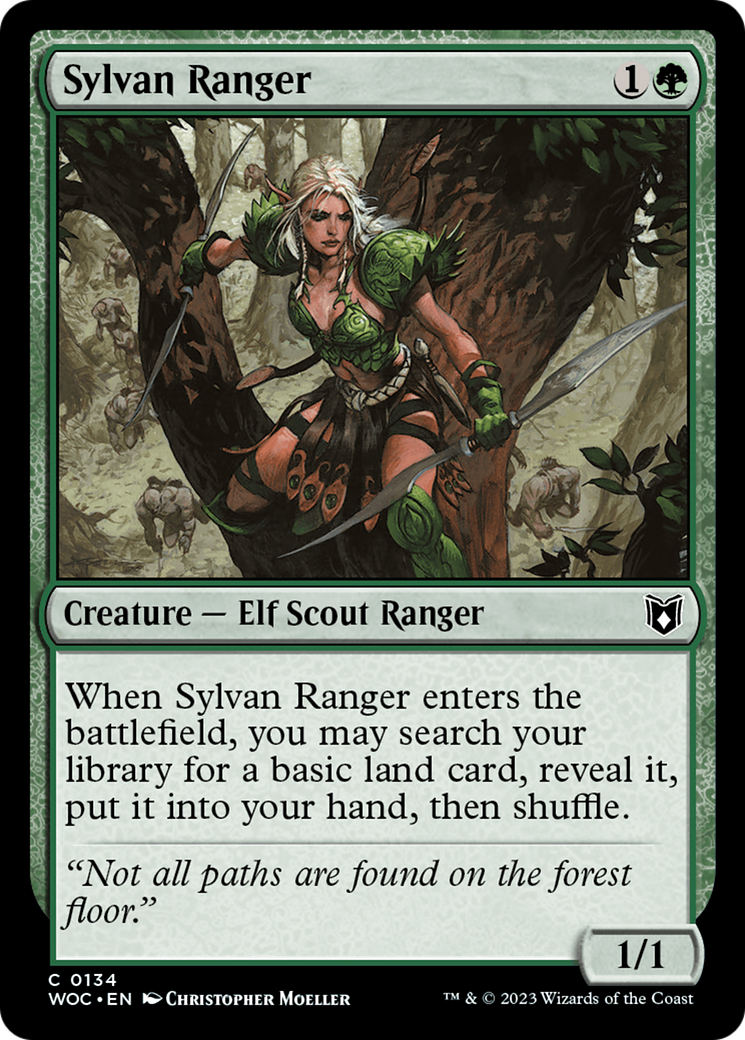
Sylvan Ranger
Sylvan Ranger
Creature — Elf Scout Ranger
1/1
When this creature enters, you may search your library for a basic land card, reveal it, put it into your hand, then shuffle.
-
1
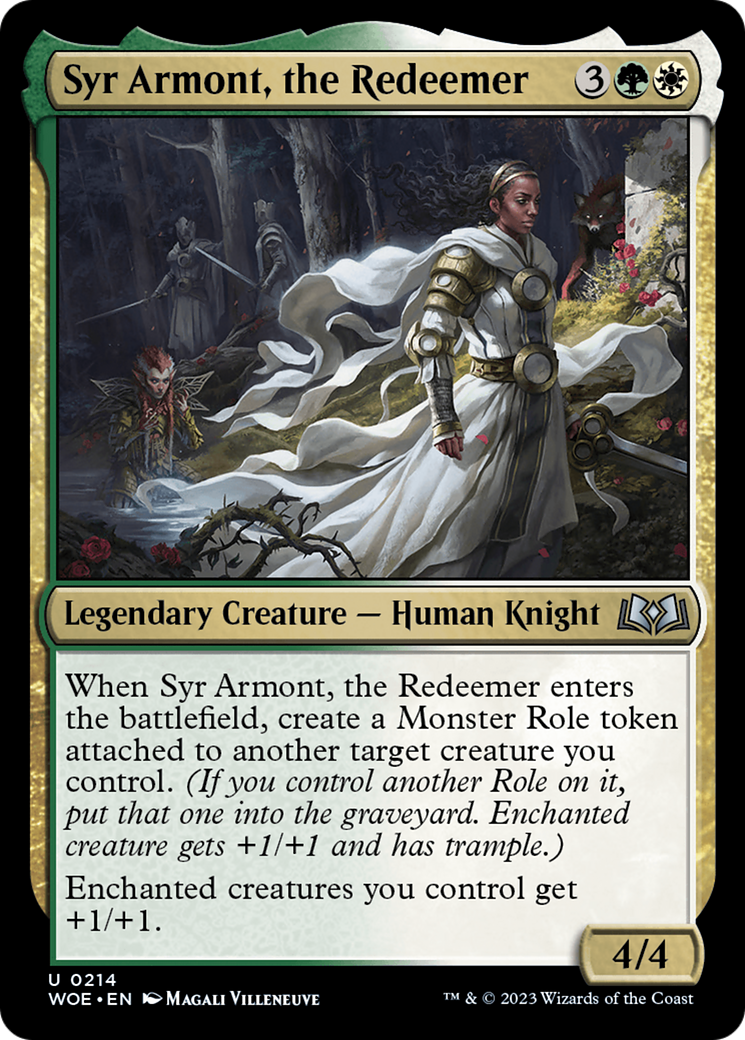
Syr Armont, the Redeemer
Syr Armont, the Redeemer
Legendary Creature — Human Knight
4/4
When Syr Armont enters, create a Monster Role token attached to another target creature you control. (If you control another Role on it, put that one into the graveyard. Enchanted creature gets +1/+1 and has trample.)
Enchanted creatures you control get +1/+1.
- Roles are colorless enchantment tokens. Each one has the Aura and Role subtypes and the enchant creature ability.
- If a permanent has more than one Role attached to it controlled by the same player, each of those Roles except the one with the most recent timestamp is put into its owner's graveyard. This is a state-based action.
- If two or more Roles controlled by the same player become attached to a permanent at the same time (perhaps due to an effect such as that of Doubling Season), that player chooses which one to keep and which are put into their owners' graveyards.
- A permanent can have multiple Roles attached to it if each one is controlled by a different player.
- Some spells and abilities that create Role tokens require targets. If each target chosen is an illegal target as that spell or ability tries to resolve, it won't resolve. The Role token won't be created.
- In rare cases, a spell or ability might attempt to create a Role token enchanting a permanent that it can't legally enchant (because of an ability like protection from enchantments). In such cases, the Role token isn't created.
- Hexproof and shroud won't prevent a Role from becoming attached to a permanent if the ability creating that Role attached to that permanent doesn't target it.
- Cards in the Wilds of Eldraine main set create six different Role tokens: Cursed, Monster, Royal, Sorcerer, Wicked, and Young Hero. A seventh Role token, Virtuous, is created by Ellivere of the Wild Court, the commander of the "Virtue and Valor" Commander Deck.
-
1
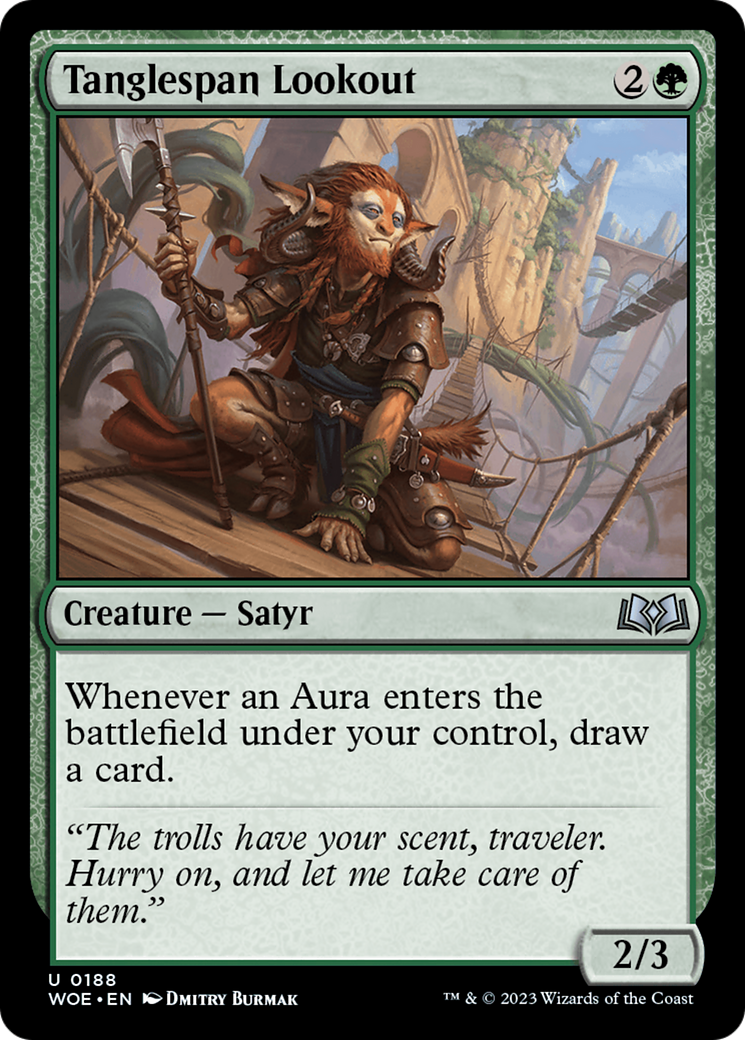
Tanglespan Lookout
Tanglespan Lookout
Creature — Satyr
2/3
Whenever an Aura you control enters, draw a card.
-
1
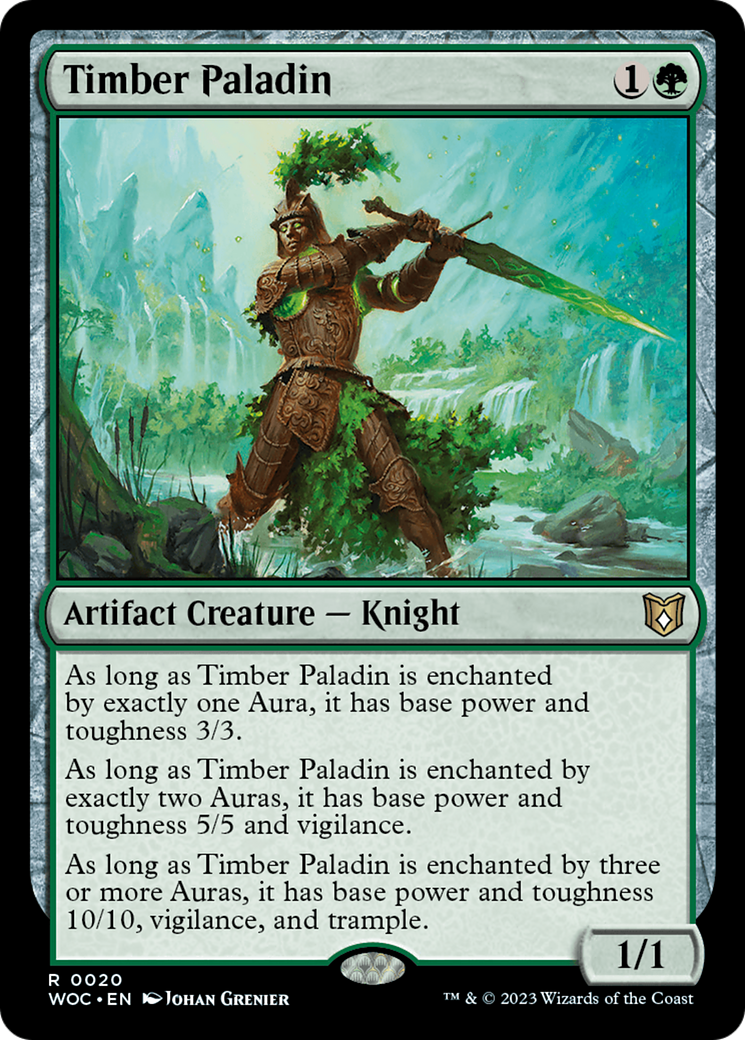
Timber Paladin
Timber Paladin
Artifact Creature — Knight
1/1
As long as this creature is enchanted by exactly one Aura, it has base power and toughness 3/3.
As long as this creature is enchanted by exactly two Auras, it has base power and toughness 5/5 and vigilance.
As long as this creature is enchanted by three or more Auras, it has base power and toughness 10/10, vigilance, and trample.
- Timber Paladin's abilities each overwrite any previous effects that set creatures' power and/or toughness to specific numbers. Any power- or toughness-setting effects that start to apply after Timber Paladin enters the battlefield will overwrite these effects, regardless of when Timber Paladin became enchanted by one, two, or three or more Auras.
-
1
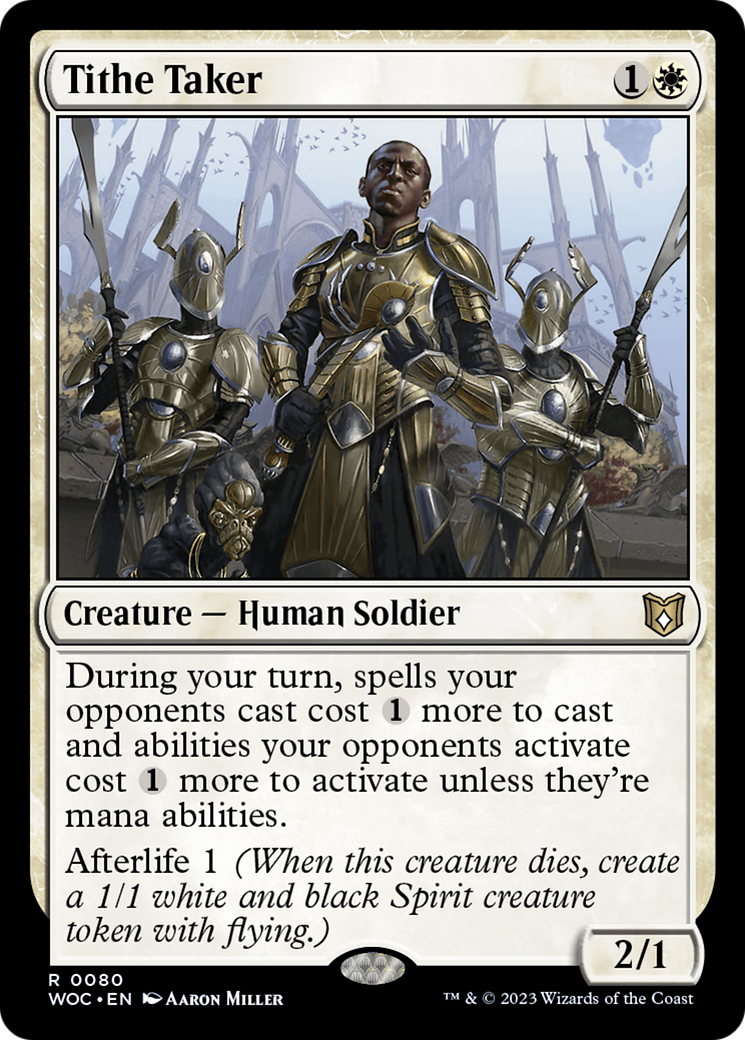
Tithe Taker
Tithe Taker
Creature — Human Soldier
2/1
During your turn, spells your opponents cast cost more to cast and abilities your opponents activate cost more to activate unless they're mana abilities.
Afterlife 1 (When this creature dies, create a 1/1 white and black Spirit creature token with flying.)
- To determine the total cost of a spell, start with the mana cost or alternative cost you're paying, add any cost increases (such as that of Tithe Taker's effect), then apply any cost reductions. The mana value of the spell remains unchanged, no matter what the total cost to cast it was.
- An opponent's activated ability that costs no mana to activate will cost plus its non-mana costs during your turn.
- Because blockers are chosen all at once, you can't block with a creature with afterlife, wait for it to die, then block with the resulting Spirit tokens.
- Activated abilities contain a colon. They're generally written "[Cost]: [Effect]." Some keyword abilities are activated abilities and will have colons in their reminder text. An activated mana ability is one that produces mana as it resolves, not one that costs mana to activate. Triggered abilities (starting with "when," "whenever," or "at") are unaffected by Tithe Taker.
-
1
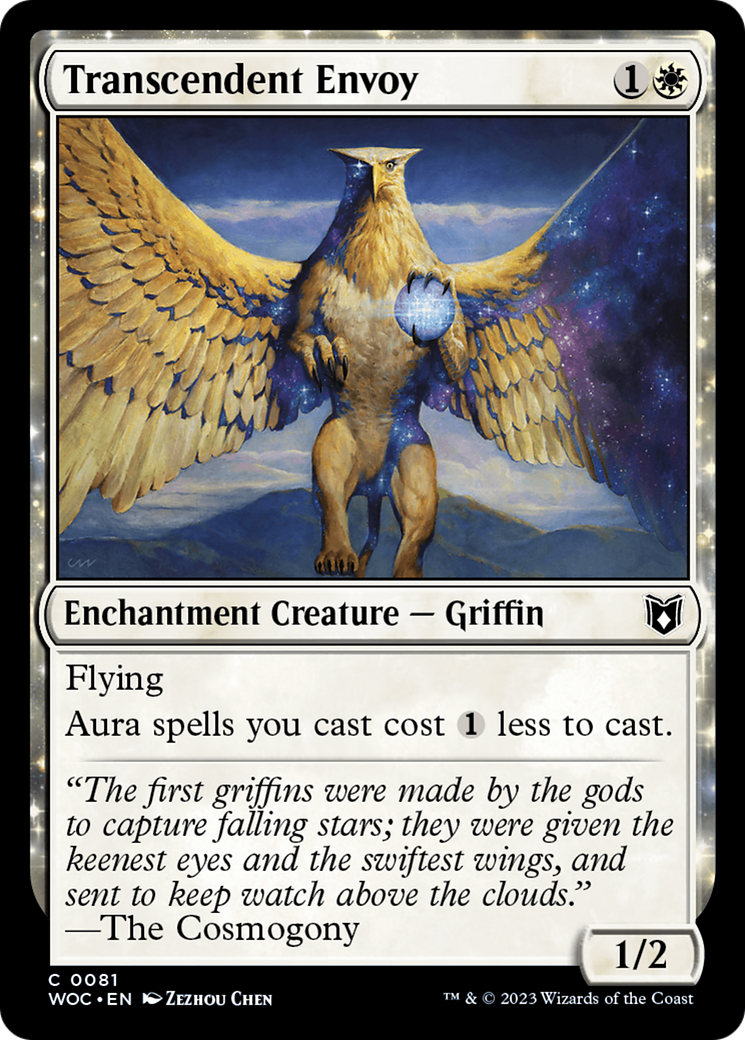
Transcendent Envoy
Transcendent Envoy
Enchantment Creature — Griffin
1/2
Flying
Aura spells you cast cost less to cast.
-
1
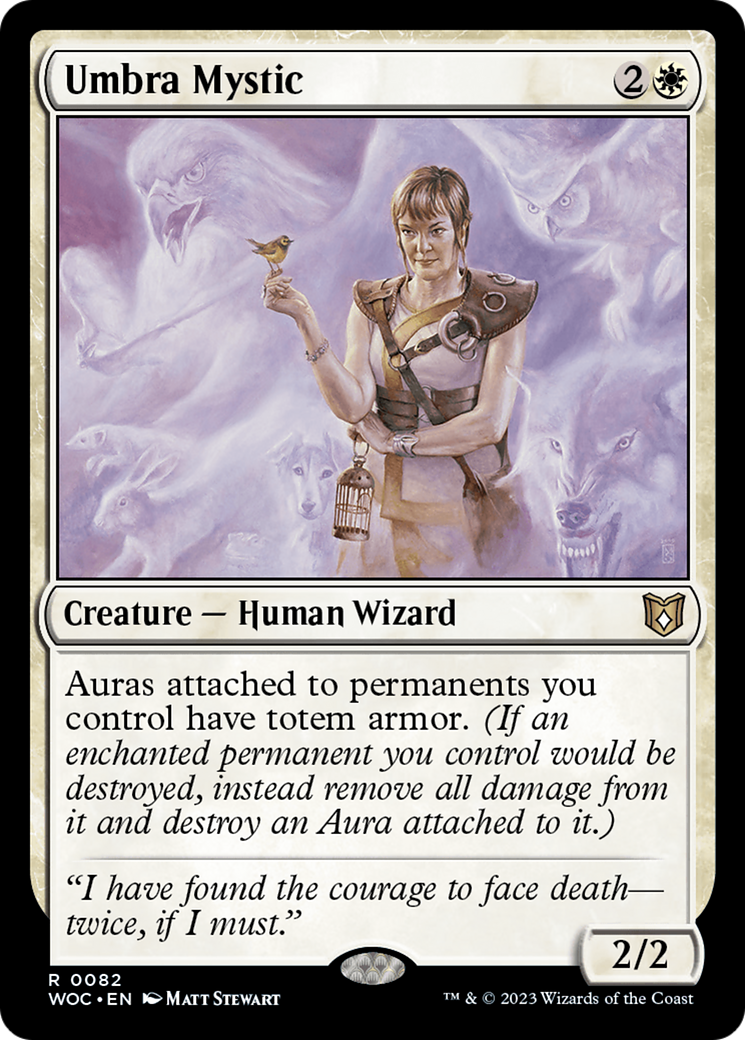
Umbra Mystic
Umbra Mystic
Creature — Human Wizard
2/2
Auras attached to permanents you control have umbra armor. (If an enchanted permanent you control would be destroyed, instead remove all damage from it and destroy an Aura attached to it.)
- Umbra armor's effect is mandatory. If the enchanted creature would be destroyed, you must remove all damage from it (if it has any) and destroy the Aura that has umbra armor instead.
- Umbra armor's effect is applied no matter why the enchanted creature would be destroyed: because it's been dealt lethal damage, or because it's being affected by an effect that says to "destroy" it (such as Breathe Your Last). In either case, all damage is removed from the creature and the Aura is destroyed instead.
- If a creature you control is enchanted with multiple Auras that have umbra armor, and the enchanted creature would be destroyed, one of those Auras is destroyed instead—but only one of them. You choose which one because you control the enchanted creature.
- Umbra armor's effect is not regeneration. Specifically, if umbra armor's effect is applied, the enchanted creature does not become tapped and is not removed from combat as a result. Effects that say the enchanted creature can't be regenerated won't prevent umbra armor's effect from being applied.
- If a spell or ability says that it would "destroy" a creature enchanted with an Aura that has umbra armor, that spell or ability is what causes the Aura to be destroyed instead. Umbra armor doesn't destroy the Aura; rather, it changes the effects of the spell or ability. On the other hand, if a spell or ability deals lethal damage to a creature enchanted with an Aura that has umbra armor, the game rules regarding lethal damage cause the Aura to be destroyed, not that spell or ability.
- Umbra armor has no effect if the enchanted creature is put into a graveyard for any other reason, such as if it's sacrificed, if the "legend rule" applies to it, or if its toughness is 0 or less.
- If a creature enchanted with an Aura that has umbra armor has indestructible, lethal damage and effects that try to destroy it simply have no effect. Umbra armor won't do anything because it won't have to.
- Some printings of this card refer to the ability "totem armor". This ability's name has been replaced with "umbra armor". This change does not affect the gameplay function of this card.
- If a creature enchanted with an Aura that has umbra armor would be destroyed by multiple state-based actions at the same time (most likely because a creature with deathtouch has dealt damage to that creature greater than or equal to its toughness), umbra armor's effect will replace all of them and save the creature.
- If a spell or ability would destroy both an Aura with umbra armor and the creature it's enchanting at the same time, umbra armor's effect will save the enchanted creature from being destroyed. Instead, the spell or ability will destroy the Aura in two different ways at the same time, but the result is the same as destroying it once.
- Say you control a permanent that's enchanted by an Aura you control, and that Aura is itself enchanted by an Aura. If the permanent would be destroyed, instead the first Aura is destroyed... but since that Aura would be destroyed, instead the second Aura is destroyed.
- All _Rise of the Eldrazi_ cards printed with umbra armor are Auras with "enchant creature." But Umbra Mystic grants umbra armor to Auras attached to any permanent you control, not just creatures. The ability works the same way even if the Aura is enchanting a land, an artifact, or any other permanent.
- Umbra Mystic grants umbra armor to Auras attached to permanents you control, regardless of who controls those Auras. Conversely, it doesn't grant umbra armor to Auras you control that are attached to permanents controlled by other players.
- If a permanent you control would be destroyed, and it's enchanted by an Aura with umbra armor, it doesn't matter who controls that Aura. The umbra armor effect is mandatory. If that permanent is enchanted by multiple Auras, you choose which one is destroyed, regardless of who controls them.
- Multiple instances of umbra armor on the same Aura are redundant.
Instants 2
-
1
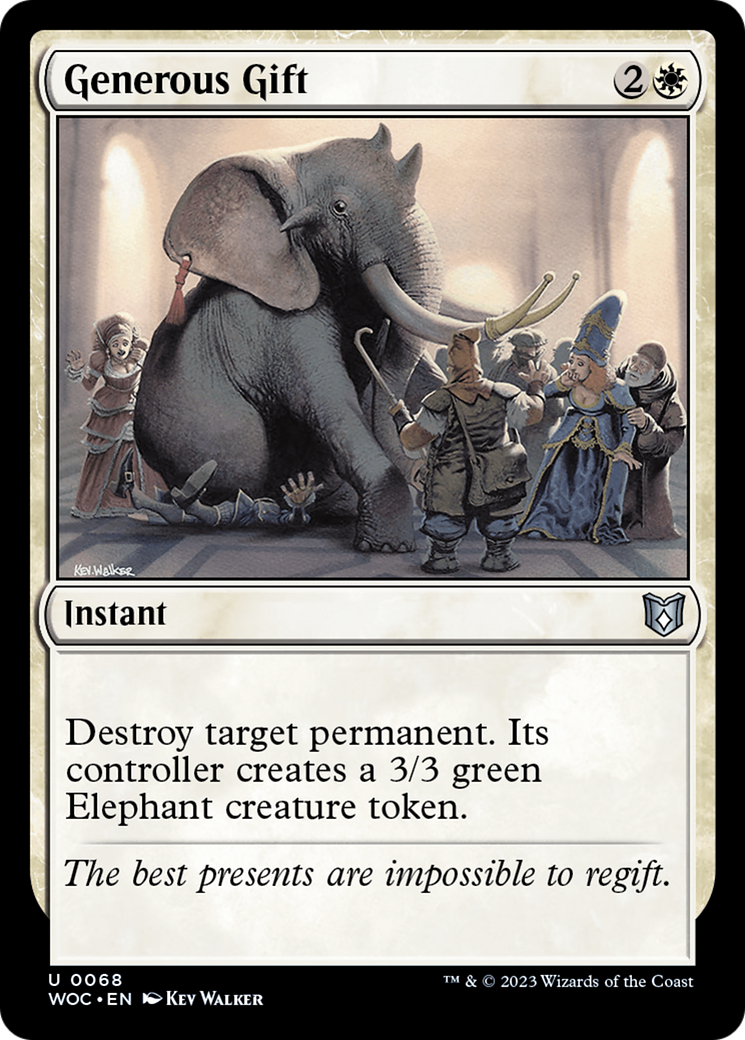
Generous Gift
Generous Gift
Instant
Destroy target permanent. Its controller creates a 3/3 green Elephant creature token.
- If the target permanent is an illegal target by the time Generous Gift tries to resolve, the spell doesn't resolve. No player creates an Elephant. If the target is legal but not destroyed (most likely because it has indestructible), its controller does create an Elephant.
-
1
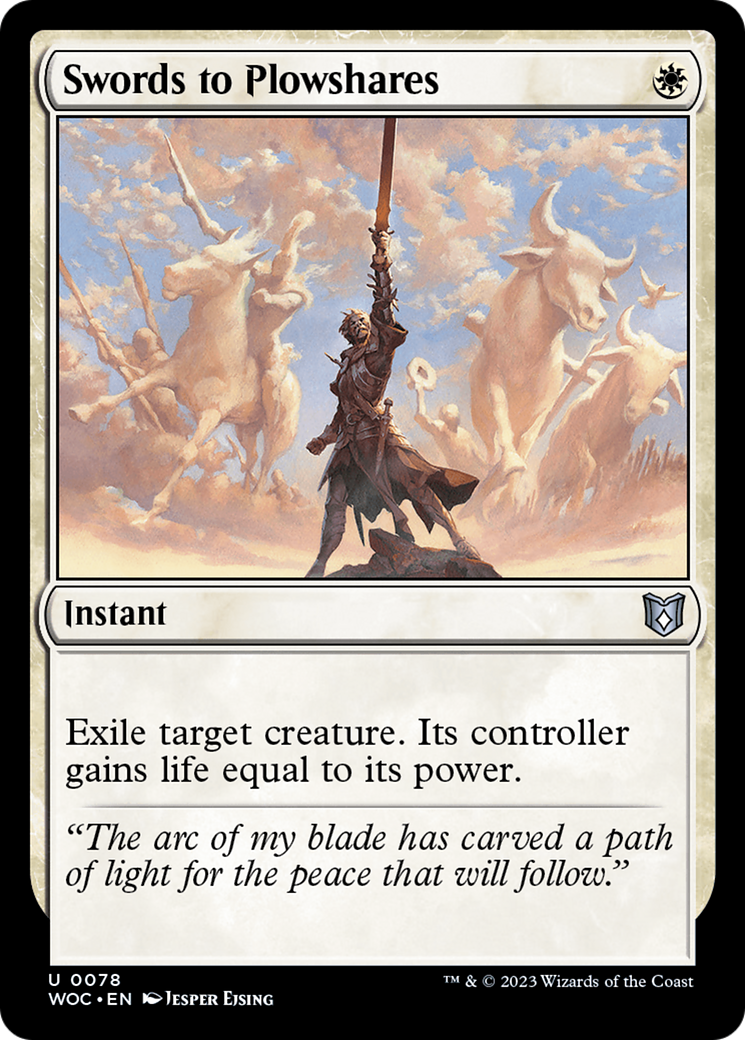
Swords to Plowshares
Swords to Plowshares
Instant
Exile target creature. Its controller gains life equal to its power.
- Use the power of the creature from when it was last on the battlefield to determine how much life is gained.
Sorceries 5
-
1
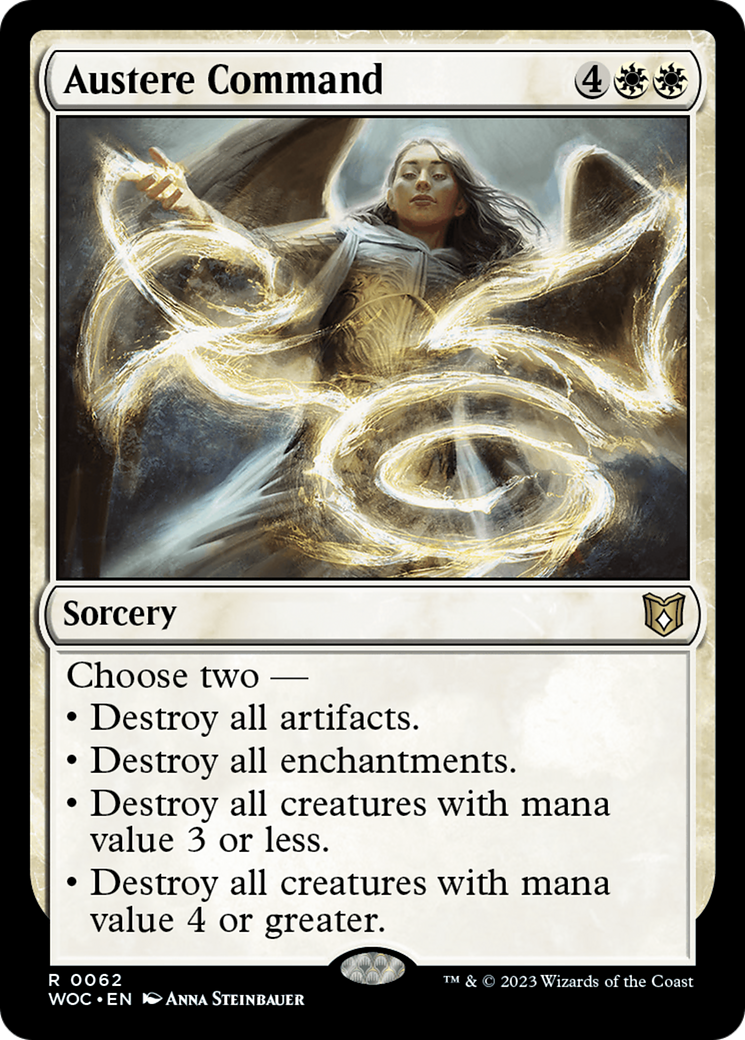
Austere Command
Austere Command
Sorcery
Choose two —
- Destroy all artifacts.
- Destroy all enchantments.
- Destroy all creatures with mana value 3 or less.
- Destroy all creatures with mana value 4 or greater.
- Each of the chosen modes happens sequentially. If a permanent has an ability that triggers whenever it or another permanent is destroyed, it will see permanents destroyed at the same time as it or before it, but not permanents destroyed by later modes.
- If the first and last modes are chosen, an artifact creature with mana value 4 or greater will have to be regenerated twice to survive. This is because the modes happen sequentially, and the regeneration "shield" is used up by the first one. The same is true with any other combination of modes that covers one permanent twice.
- If a card is exiled "until" another permanent leaves the battlefield, the exiled card returns to the battlefield immediately after that permanent leaves the battlefield during Austere Command's resolution, and it may be destroyed by a later mode.
-
1
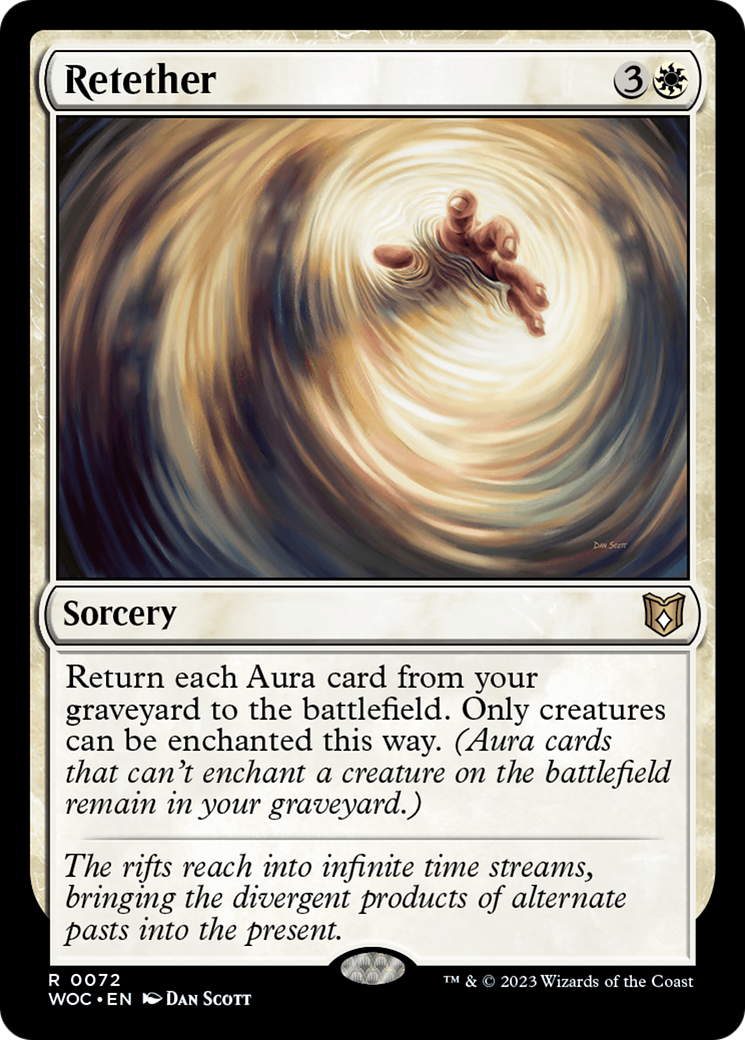
Retether
Retether
Sorcery
Return each Aura card from your graveyard to the battlefield. Only creatures can be enchanted this way. (Aura cards that can't enchant a creature on the battlefield remain in your graveyard.)
- All the Auras return to the battlefield simultaneously. Whether an Aura can be attached to a creature is checked before any of them are returned and doesn't take into account any simultaneously returning Auras. For example, if Tattoo Ward (which gives enchanted creature protection from enchantments) and Holy Strength are in your graveyard and there's only one creature on the battlefield, both Auras are returned to the battlefield attached to that creature, then Holy Strength is put into your graveyard the next time state-based actions are checked.
- Auras don't need to say "enchant creature" to return to the battlefield. For example, an Aura with "enchant land" will return to the battlefield if there's an animated land for it to enchant.
-
1
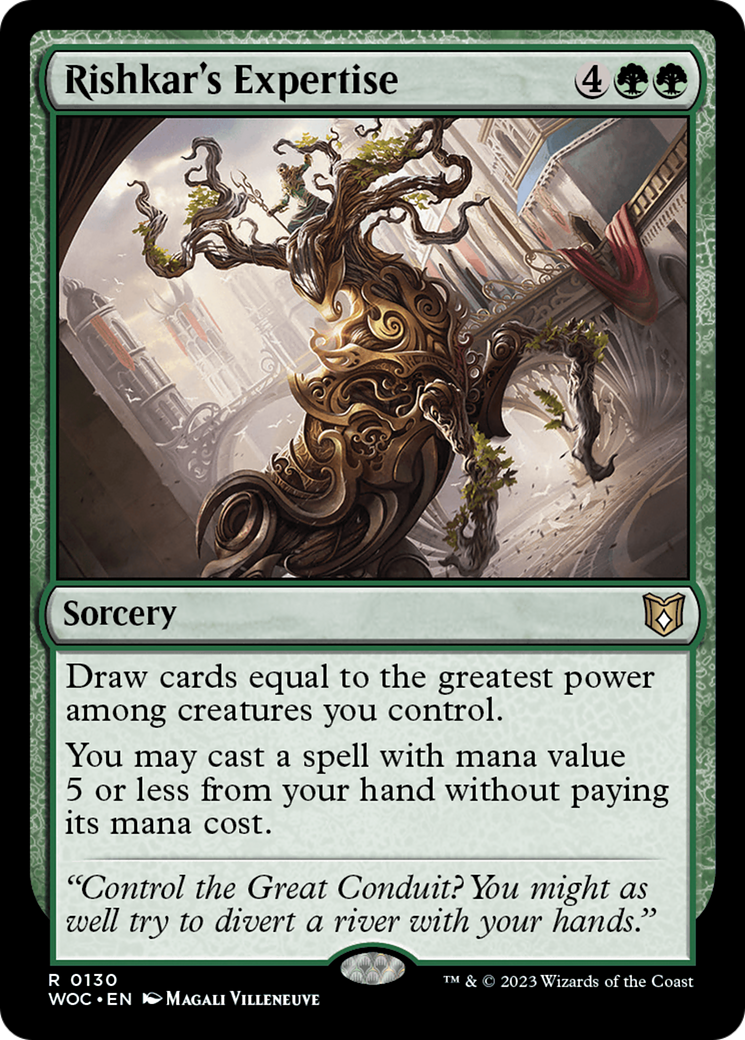
Rishkar's Expertise
Rishkar's Expertise
Sorcery
Draw cards equal to the greatest power among creatures you control.
You may cast a spell with mana value 5 or less from your hand without paying its mana cost.
- The mana value of a split card is determined by the combined mana cost of its two halves. If an expertise spell allows you to cast a split card, you may cast either half or, if that split card has fuse, both halves.
- If you control no creatures with power greater than 0 as Rishkar's Expertise resolves, you draw no cards, but you may cast a card with mana value 5 or less from your hand without paying its mana cost.
- You may cast one of the cards drawn by Rishkar's Expertise's first effect while performing its second effect.
- A card's mana value is determined solely by the mana symbols printed in its upper right corner. The mana value is the total amount of mana in that cost, regardless of color. For example, a card with mana cost has mana value 3. Ignore any alternative costs, additional costs, cost increases, or cost reductions that could apply to it. A card with no mana cost has a mana value of 0.
- If the card has in its mana cost, you must choose 0 as the value of X when casting it without paying its mana cost.
- The greatest power among creatures you control is determined as Rishkar's Expertise resolves.
- If you cast a card "without paying its mana cost," you can't choose to cast it for any alternative costs, such as emerge costs. You can, however, pay additional costs. If the card has any mandatory additional costs, such as that of Cathartic Reunion, you must pay those to cast the card.
- While you're casting your free spell, the Expertise spell is still on the stack. It will be put into its owner's graveyard after the free spell is cast. The free spell can't target the Expertise card in your graveyard. It can target the Expertise spell on the stack, but the Expertise spell will become an illegal target before the free spell resolves.
- Any triggered abilities that trigger while performing the Expertise spell's first effect won't be put onto the stack until after you're done casting your free spell. They're put onto the stack at the same time as any abilities that triggered while casting that spell regardless of the order in which those abilities triggered.
- Effects that allow you to "cast" a card don't allow you to play a land card.
-
1
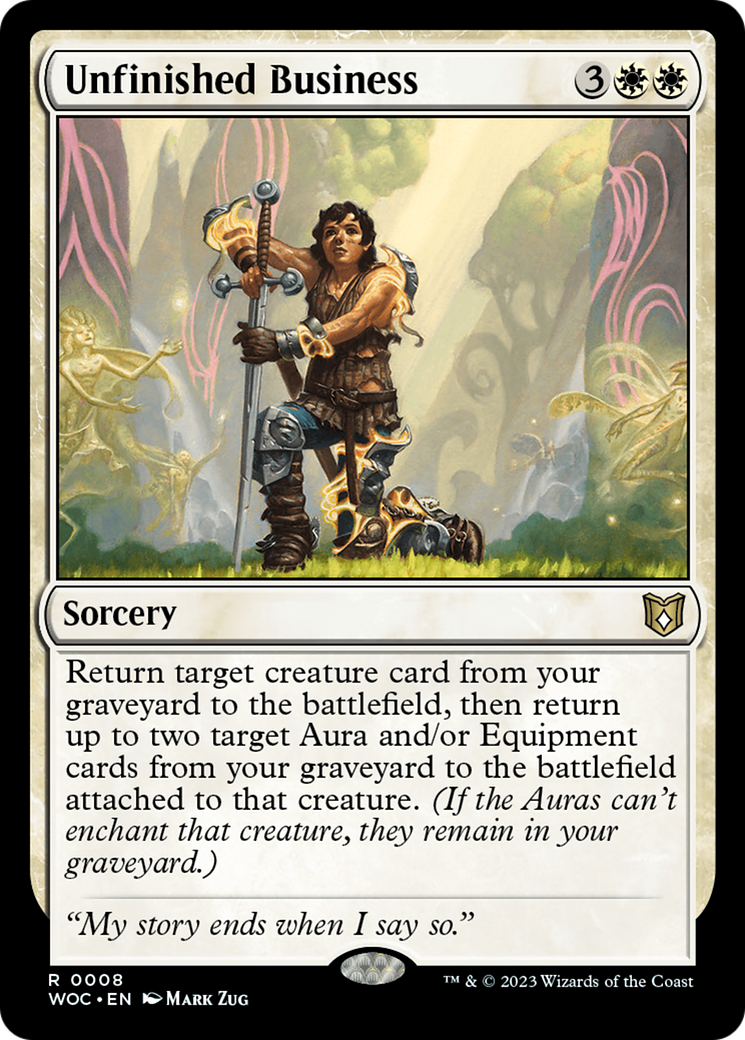
Unfinished Business
Unfinished Business
Sorcery
Return target creature card from your graveyard to the battlefield, then return up to two target Aura and/or Equipment cards from your graveyard to the battlefield attached to that creature. (If the Auras can't enchant that creature, they remain in your graveyard.)
- Any target Equipment cards that can't legally be attached to the creature will enter the battlefield unattached.
-
1
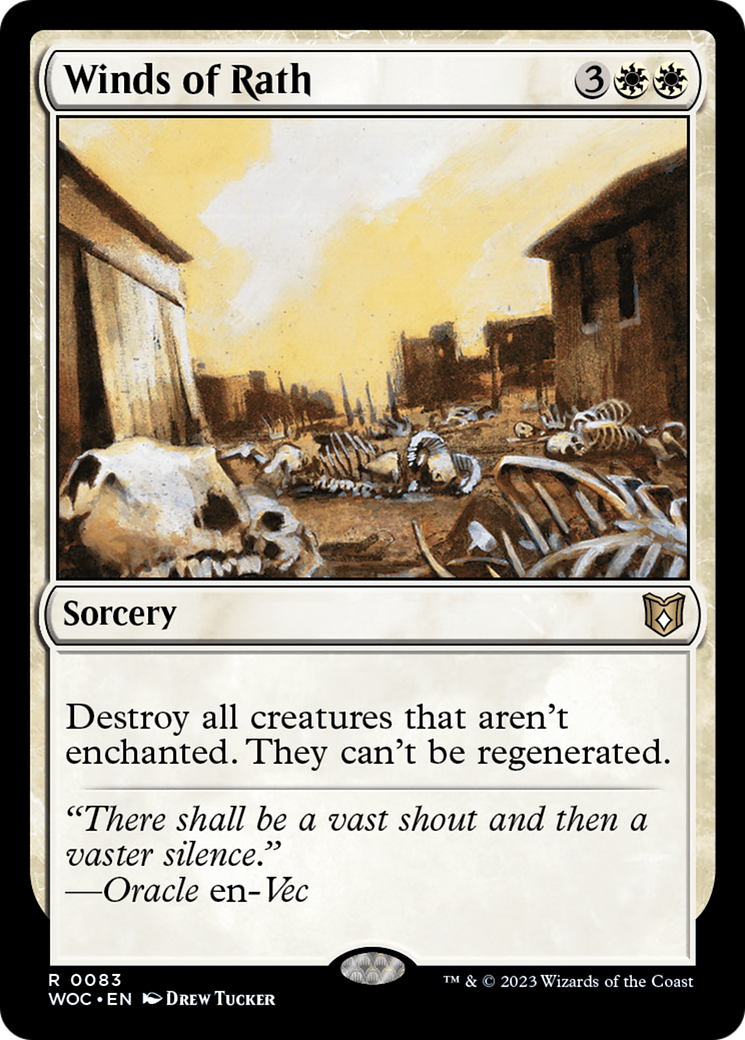
Winds of Rath
Winds of Rath
Sorcery
Destroy all creatures that aren't enchanted. They can't be regenerated.
- A creature is "enchanted" if it has any Auras attached to it.
Artifacts 2
-
1
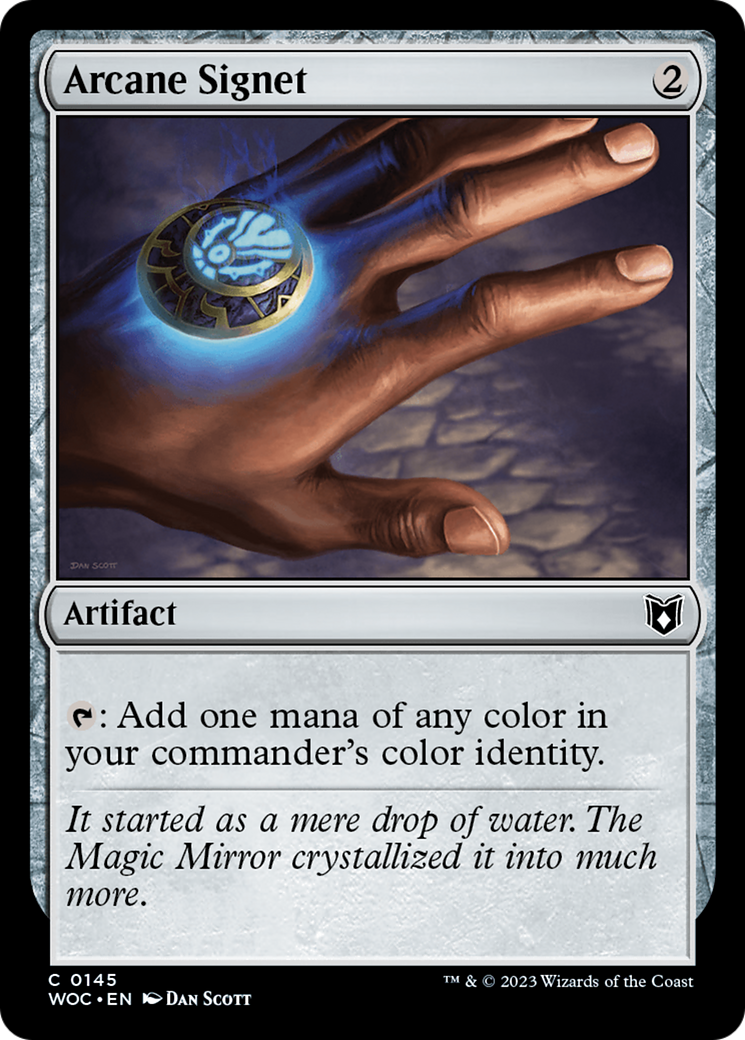
Arcane Signet
Arcane Signet
Artifact
: Add one mana of any color in your commander's color identity.
- If you have two commanders, the ability adds one mana of any color in their combined color identities.
- If your commander is a card that has no colors in its color identity, Arcane Signet's ability produces no mana. It doesn't produce .
- If you don't have a commander, Arcane Signet's ability produces no mana.
-
1
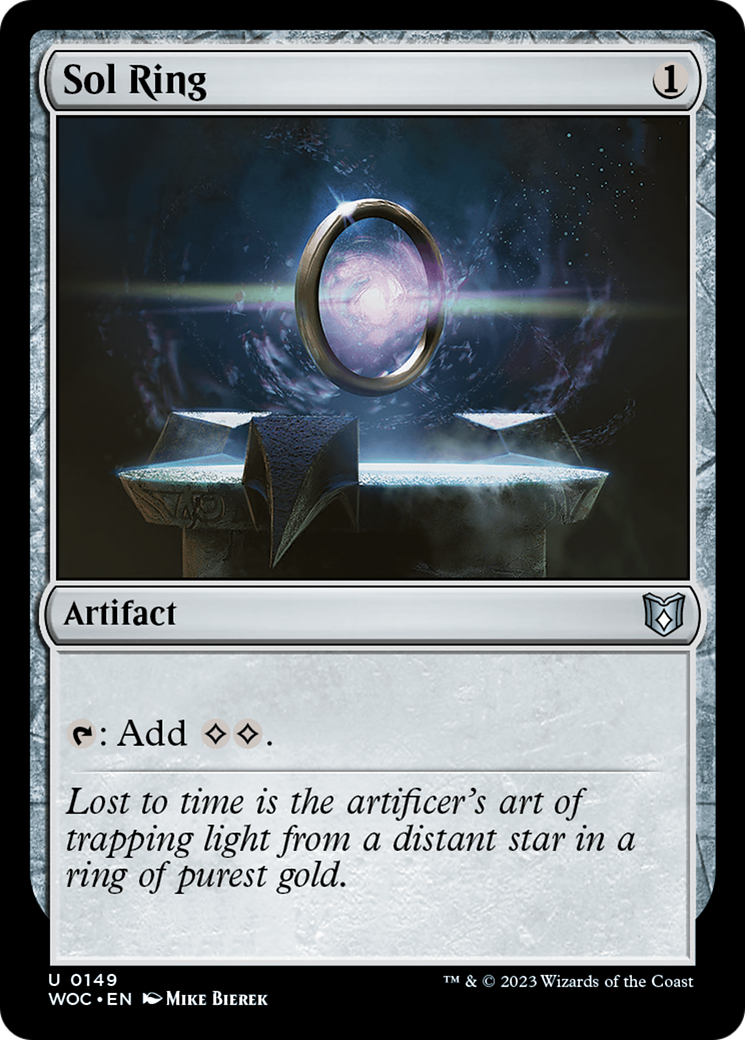
Sol Ring
Sol Ring
Artifact
: Add .
Enchantments 21
-
1
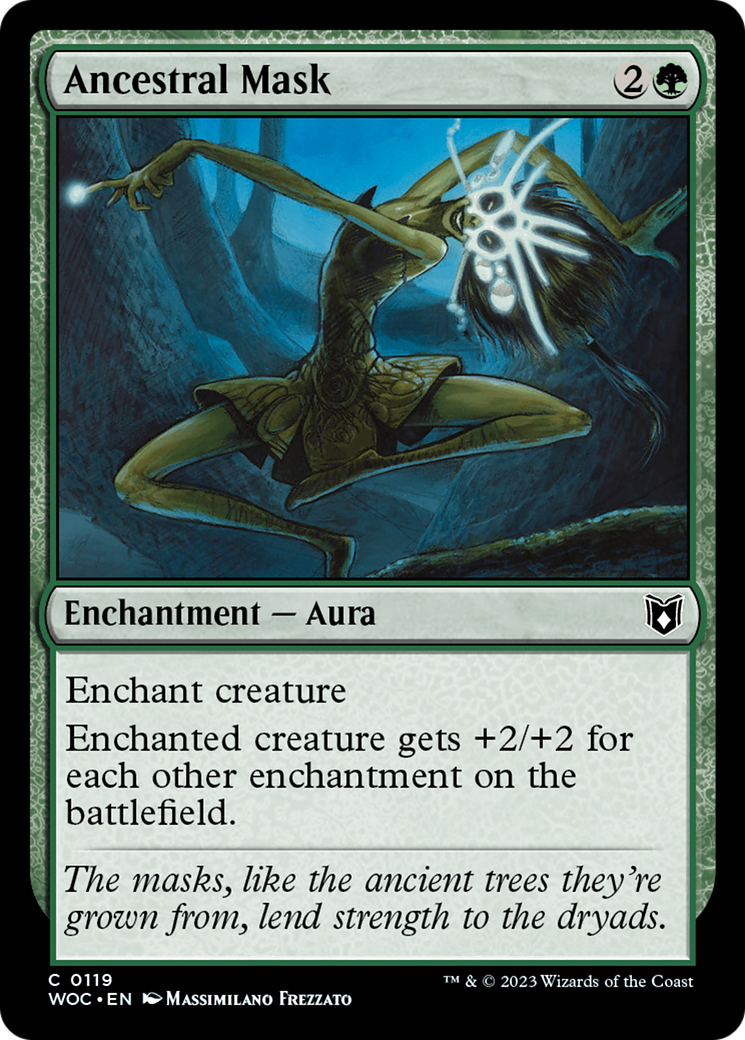
Ancestral Mask
Ancestral Mask
Enchantment — Aura
Enchant creature
Enchanted creature gets +2/+2 for each other enchantment on the battlefield.
-
1
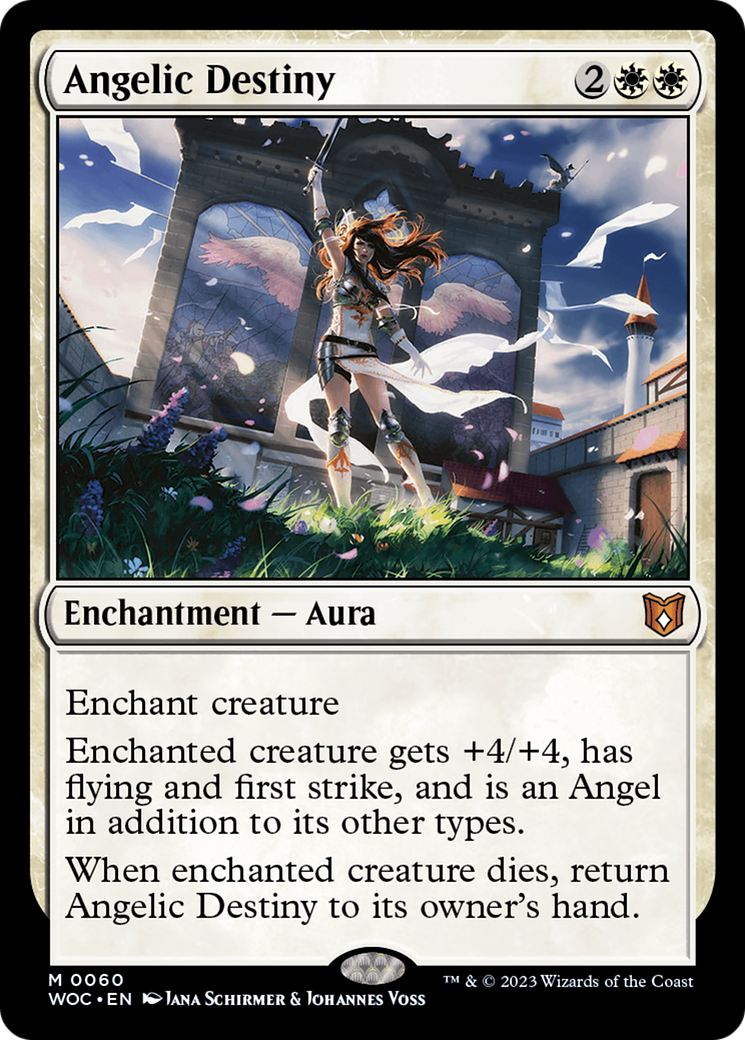
Angelic Destiny
Angelic Destiny
Enchantment — Aura
Enchant creature
Enchanted creature gets +4/+4, has flying and first strike, and is an Angel in addition to its other types.
When enchanted creature dies, return this card to its owner's hand.
- If the creature dies before the Angelic Destiny spell resolves, Angelic Destiny will go to its owner's graveyard. It won't return to its owner's hand.
- If Angelic Destiny is no longer in a graveyard when its triggered ability resolves, it won't be returned to its owner's hand.
-
1
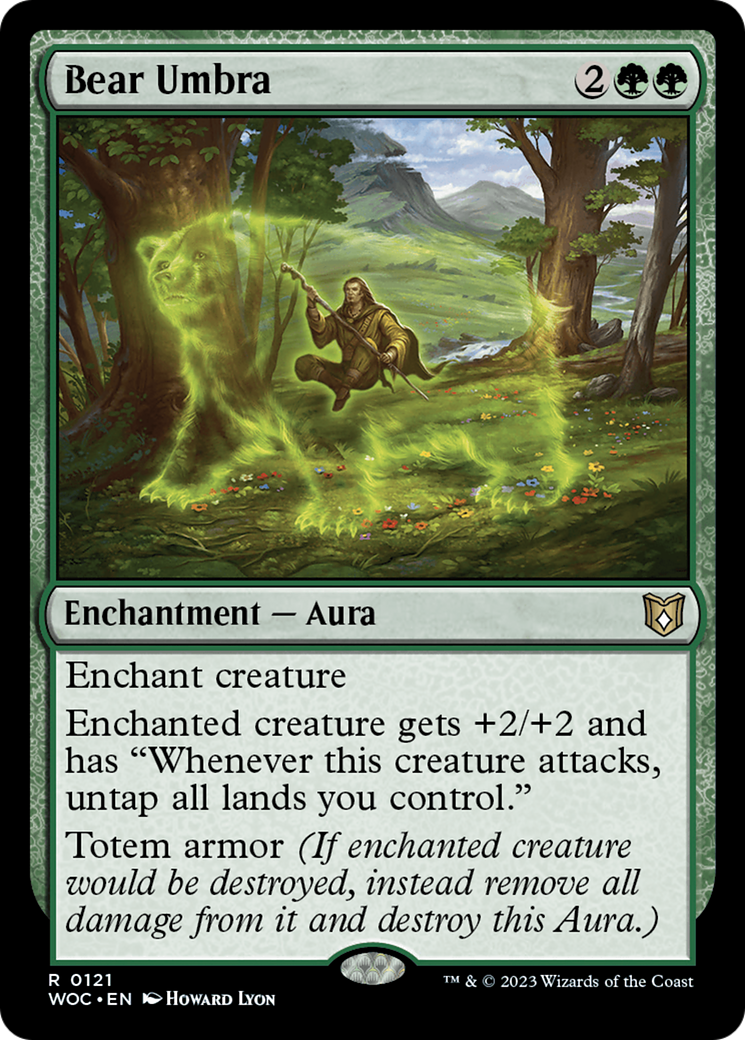
Bear Umbra
Bear Umbra
Enchantment — Aura
Enchant creature
Enchanted creature gets +2/+2 and has "Whenever this creature attacks, untap all lands you control."
Umbra armor (If enchanted creature would be destroyed, instead remove all damage from it and destroy this Aura.)
- Some printings of this card refer to the ability "totem armor". This ability's name has been replaced with "umbra armor". This change does not affect the gameplay function of this card.
- Umbra armor's effect is mandatory. If the enchanted creature would be destroyed, you must remove all damage from it (if it has any) and destroy the Aura that has umbra armor instead.
- Umbra armor's effect is applied no matter why the enchanted creature would be destroyed: because it's been dealt lethal damage, or because it's being affected by an effect that says to "destroy" it (such as Breathe Your Last). In either case, all damage is removed from the creature and the Aura is destroyed instead.
- If a creature you control is enchanted with multiple Auras that have umbra armor, and the enchanted creature would be destroyed, one of those Auras is destroyed instead—but only one of them. You choose which one because you control the enchanted creature.
- If a creature enchanted with an Aura that has umbra armor would be destroyed by multiple state-based actions at the same time (most likely because a creature with deathtouch has dealt damage to that creature greater than or equal to its toughness), umbra armor's effect will replace all of them and save the creature.
- If a spell or ability would destroy both an Aura with umbra armor and the creature it's enchanting at the same time, umbra armor's effect will save the enchanted creature from being destroyed. Instead, the spell or ability will destroy the Aura in two different ways at the same time, but the result is the same as destroying it once.
- Umbra armor's effect is not regeneration. Specifically, if umbra armor's effect is applied, the enchanted creature does not become tapped and is not removed from combat as a result. Effects that say the enchanted creature can't be regenerated won't prevent umbra armor's effect from being applied.
- If a spell or ability says that it would "destroy" a creature enchanted with an Aura that has umbra armor, that spell or ability is what causes the Aura to be destroyed instead. Umbra armor doesn't destroy the Aura; rather, it changes the effects of the spell or ability. On the other hand, if a spell or ability deals lethal damage to a creature enchanted with an Aura that has umbra armor, the game rules regarding lethal damage cause the Aura to be destroyed, not that spell or ability.
- Umbra armor has no effect if the enchanted creature is put into a graveyard for any other reason, such as if it's sacrificed, if the "legend rule" applies to it, or if its toughness is 0 or less.
- If a creature enchanted with an Aura that has umbra armor has indestructible, lethal damage and effects that try to destroy it simply have no effect. Umbra armor won't do anything because it won't have to.
- When the enchanted creature attacks, all lands controlled by that creature's controller (who is not necessarily the Aura's controller) untap.
-
1
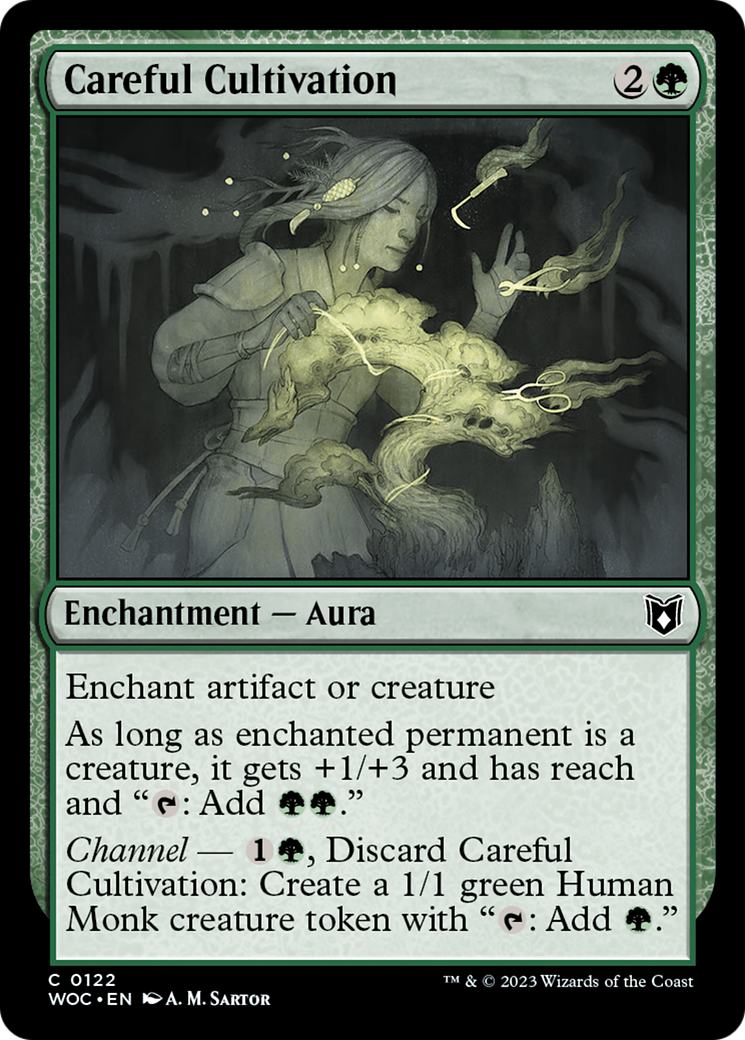
Careful Cultivation
Careful Cultivation
Enchantment — Aura
Enchant artifact or creature
As long as enchanted permanent is a creature, it gets +1/+3 and has reach and " : Add ."
Channel — , Discard this card: Create a 1/1 green Human Monk creature token with " : Add ."
- Discarding the card is part of the cost to activate a channel ability.
- If a channel ability requires a target, you may not activate it without a target just to discard the card.
-
1
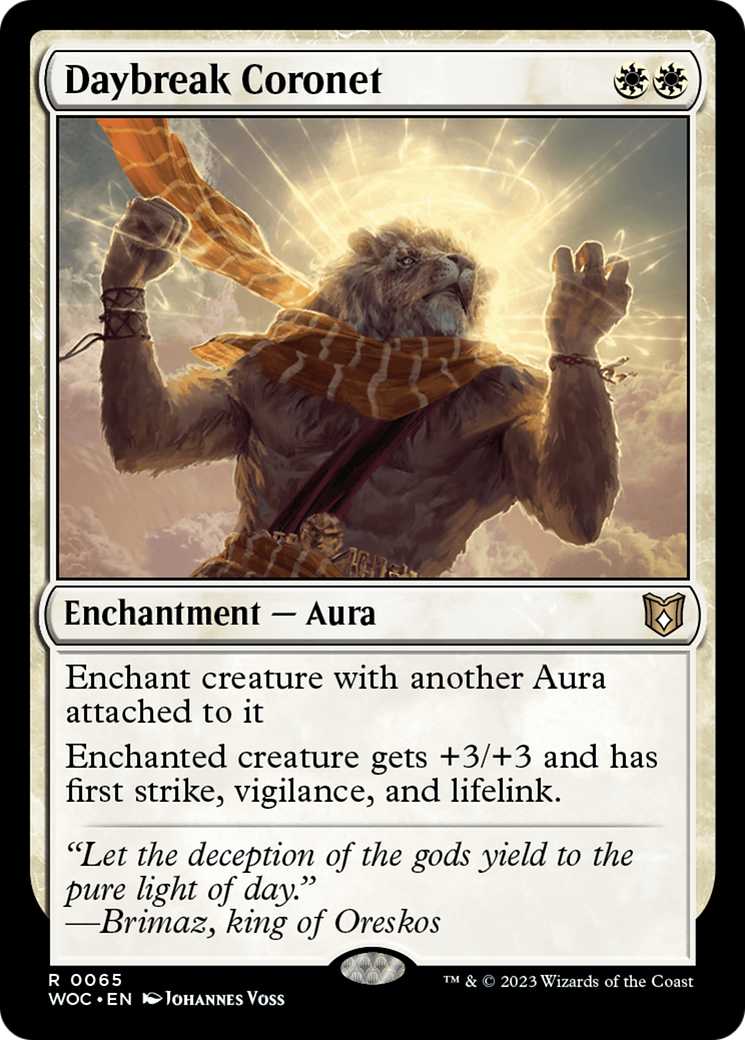
Daybreak Coronet
Daybreak Coronet
Enchantment — Aura
Enchant creature with another Aura attached to it
Enchanted creature gets +3/+3 and has first strike, vigilance, and lifelink. (Damage dealt by the creature also causes its controller to gain that much life.)
- If multiple Auras are entering the battlefield at the same time, you choose which player or permanent each enchants before any of them enter the battlefield. This means that Daybreak Coronet can't be put onto the battlefield enchanting a creature that's not enchanted before the Auras all enter the battlefield.
- If all other Auras attached to the enchanted creature stop enchanting it, Daybreak Coronet will be attached to an illegal permanent and will be put into its owner's graveyard.
-
1
Enchantress's Presence
Enchantress's Presence
Enchantment
Whenever you cast an enchantment spell, draw a card.
- The triggered ability will resolve before the spell that caused it to trigger.
- The ability is independent from the spell that caused it to trigger. Notably, if the enchantment spell is countered or doesn't resolve for any other reason, you'll still draw a card (unless something specifically counters the triggered ability).
-
1
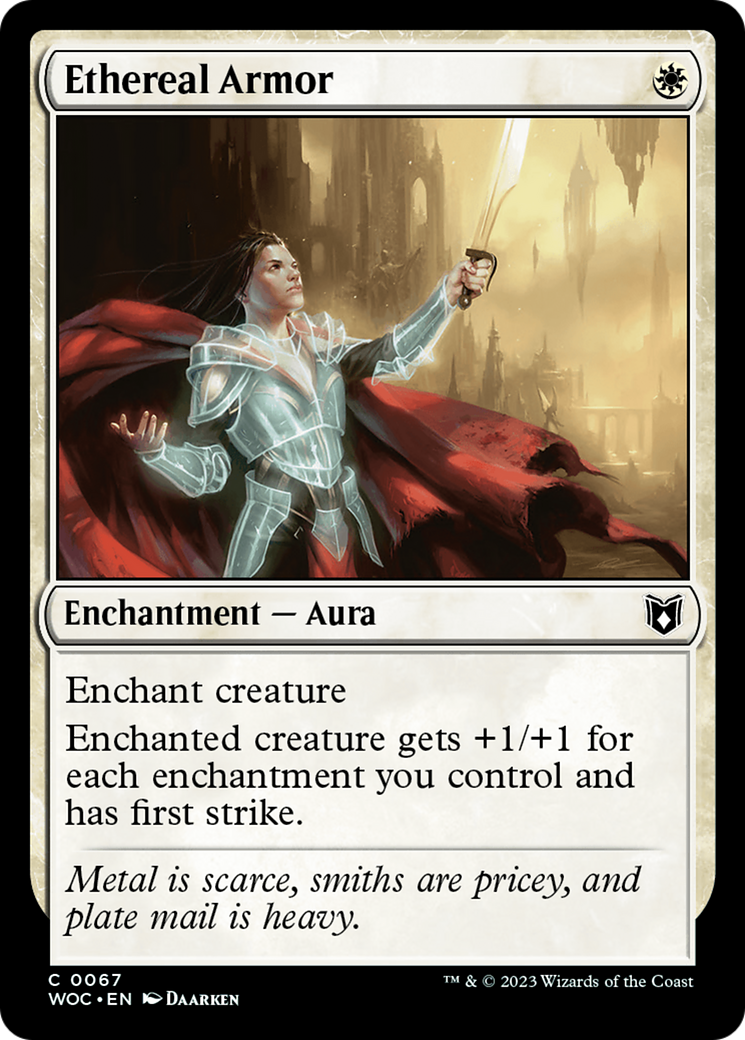
Ethereal Armor
Ethereal Armor
Enchantment — Aura
Enchant creature
Enchanted creature gets +1/+1 for each enchantment you control and has first strike.
- Ethereal Armor counts each enchantment you control, including itself and any Auras you control that are attached to an opponent or to permanents controlled by an opponent.
-
1
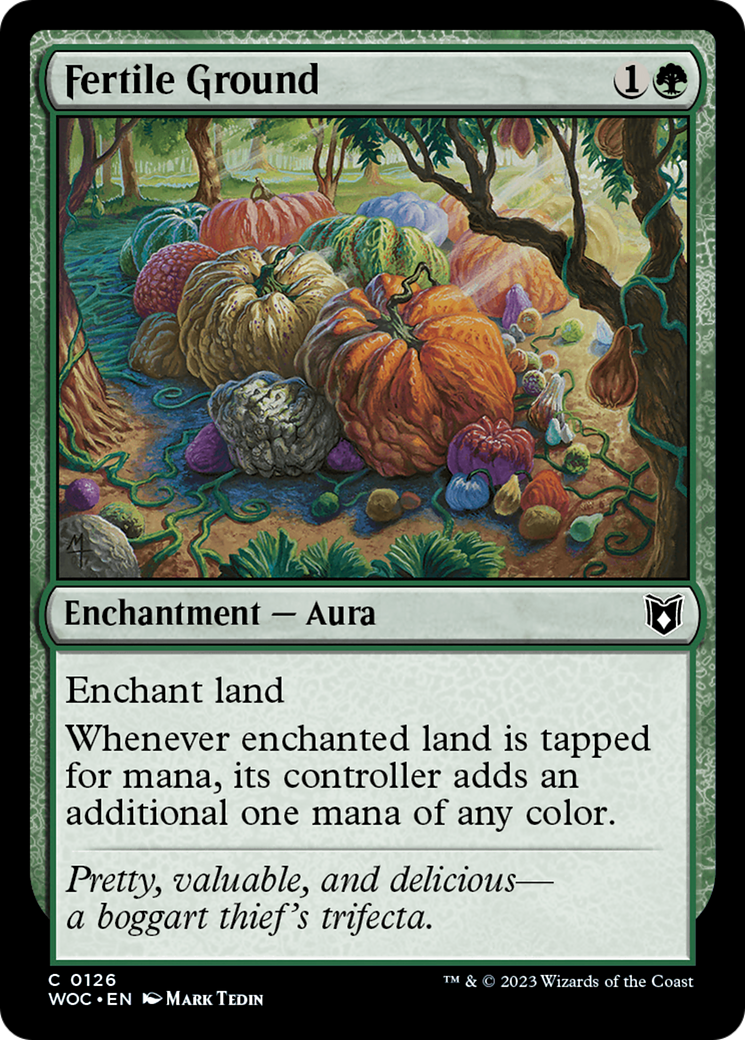
Fertile Ground
Fertile Ground
Enchantment — Aura
Enchant land
Whenever enchanted land is tapped for mana, its controller adds an additional one mana of any color.
-
1
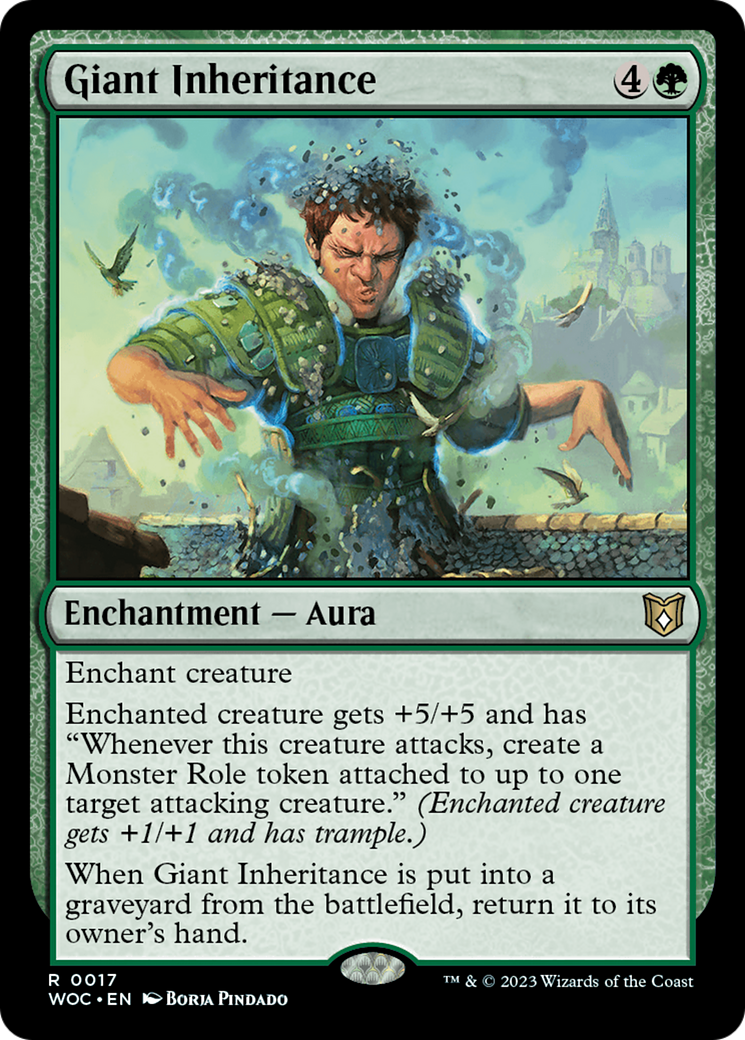
Giant Inheritance
Giant Inheritance
Enchantment — Aura
Enchant creature
Enchanted creature gets +5/+5 and has "Whenever this creature attacks, create a Monster Role token attached to up to one target attacking creature." (Enchanted creature gets +1/+1 and has trample.)
When this Aura is put into a graveyard from the battlefield, return it to its owner's hand.
- If you don't choose a target attacking creature with the ability granted by Giant Inheritance, the Monster Role token won't be created.
- If the creature Giant Inheritance would enchant is an illegal target by the time the Aura spell resolves, the entire spell doesn't resolve. It's put into the graveyard from the stack, not the battlefield, so its last ability won't trigger.
- Giant Inheritance will return to its owner's hand from the graveyard only if it's still in the graveyard when its ability resolves. If it leaves the graveyard before that point, it will stay in whatever zone it's in, even if it's returned to the graveyard before the ability resolves.
- Roles are colorless enchantment tokens. Each one has the Aura and Role subtypes and the enchant creature ability.
- If a permanent has more than one Role attached to it controlled by the same player, each of those Roles except the one with the most recent timestamp is put into its owner's graveyard. This is a state-based action.
- If two or more Roles controlled by the same player become attached to a permanent at the same time (perhaps due to an effect such as that of Doubling Season), that player chooses which one to keep and which are put into their owners' graveyards.
- A permanent can have multiple Roles attached to it if each one is controlled by a different player.
- Some spells and abilities that create Role tokens require targets. If each target chosen is an illegal target as that spell or ability tries to resolve, it won't resolve. The Role token won't be created.
- In rare cases, a spell or ability might attempt to create a Role token enchanting a permanent that it can't legally enchant (because of an ability like protection from enchantments). In such cases, the Role token isn't created.
- Hexproof and shroud won't prevent a Role from becoming attached to a permanent if the ability creating that Role attached to that permanent doesn't target it.
- Cards in the Wilds of Eldraine main set create six different Role tokens: Cursed, Monster, Royal, Sorcerer, Wicked, and Young Hero. A seventh Role token, Virtuous, is created by Ellivere of the Wild Court, the commander of the "Virtue and Valor" Commander Deck.
-
1
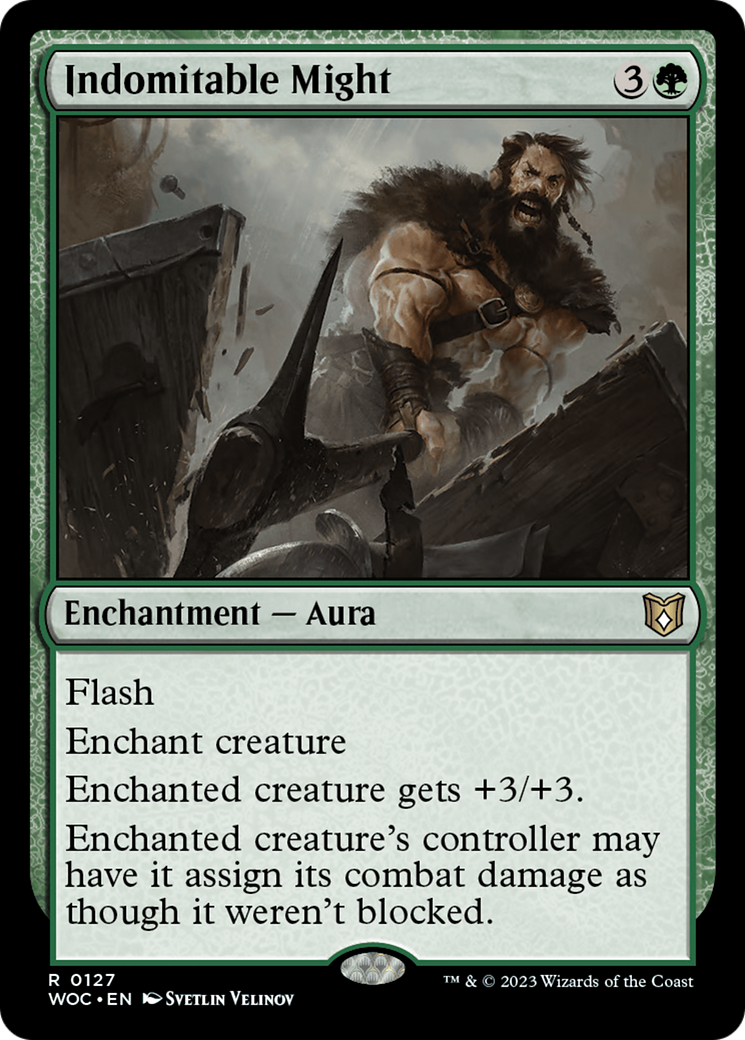
Indomitable Might
Indomitable Might
Enchantment — Aura
Flash
Enchant creature
Enchanted creature gets +3/+3.
Enchanted creature's controller may have it assign its combat damage as though it weren't blocked.
- Assigning the creature's damage as though it weren't blocked is all or nothing. You can't use this effect to assign some of the creature's damage to a blocking creature and the rest to the defending player or planeswalker.
- Even if it assigns damage as though it were not blocked, it will still receive damage from creatures that are blocking it.
-
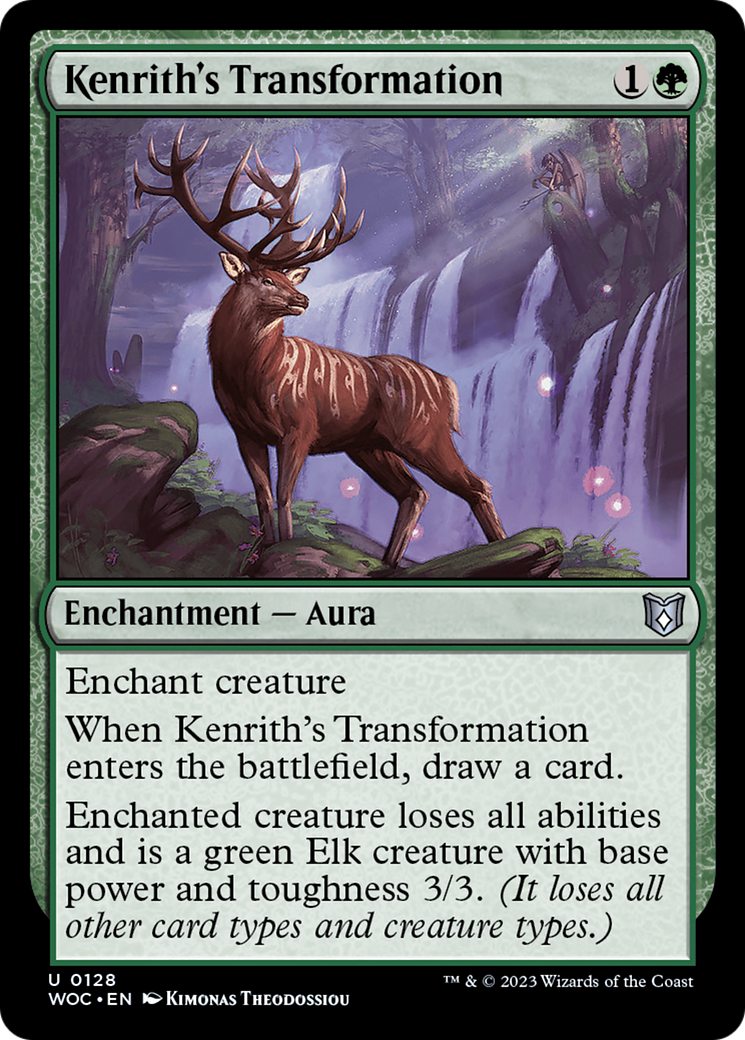
1
Kenrith's Transformation
Kenrith's Transformation
Enchantment — Aura
Enchant creature
When this Aura enters, draw a card.
Enchanted creature loses all abilities and is a green Elk creature with base power and toughness 3/3. (It loses all other card types and creature types.)
- If the creature Kenrith's Transformation would enchant is an illegal target by the time the Aura spell resolves, the entire spell doesn't resolve. It won't enter the battlefield, so its ability won't trigger.
- If the affected creature gains an ability after Kenrith's Transformation becomes attached to it, it will keep that ability.
- Kenrith's Transformation overwrites all previous effects that set the creature's base power and toughness to specific values. Any power- or toughness-setting effects that start to apply after Kenrith's Transformation becomes attached to a creature will overwrite this effect.
- Effects that modify a creature's power and/or toughness, such as the effect of Festive Funeral, will apply to the creature no matter when they started to take effect. The same is true for any counters that change its power and/or toughness.
- Kenrith's Transformation overwrites all colors and creature types the enchanted creature has. It's just a green Elk. The creature keeps any supertypes (such as legendary) it has, but loses any other card types it has (such as artifact).
- Kenrith's Transformation may enchant a permanent that is only temporarily a creature, such as Enchanted Carriage. If this happens, the Aura's effect causes the enchanted permanent to remain a green Elk creature even after the temporary effect expires.
- Because damage remains marked on a creature until the damage is removed as the turn ends, nonlethal damage dealt to a creature may become lethal if Kenrith's Transformation becomes attached to it during that turn.
-
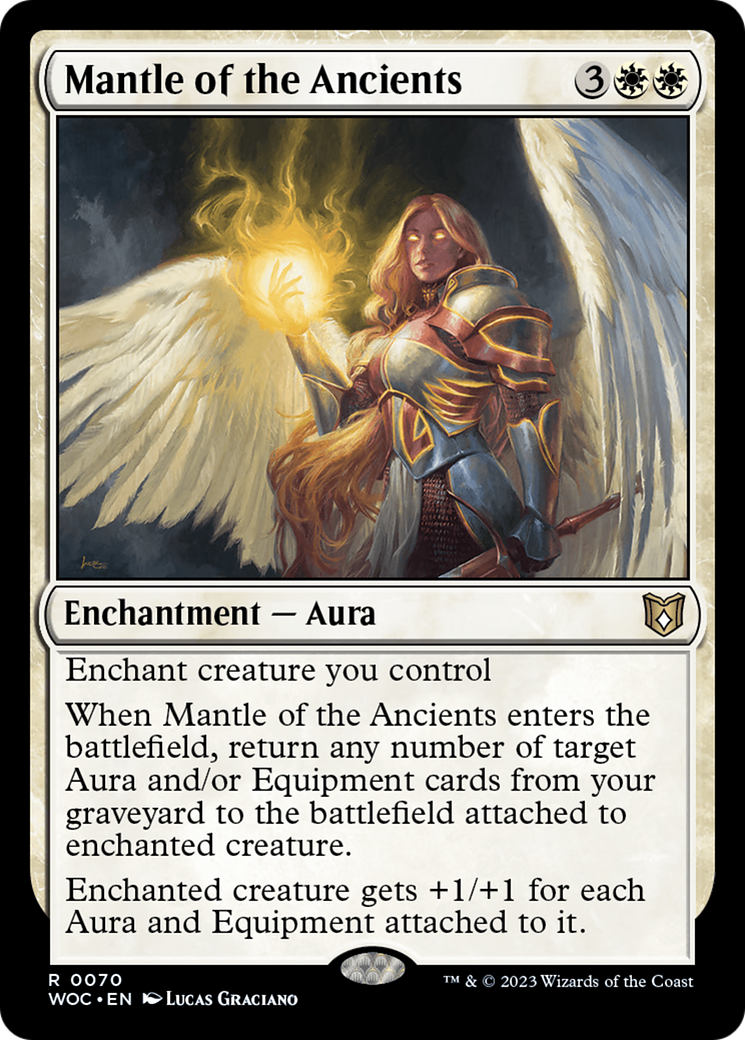
1
Mantle of the Ancients
Mantle of the Ancients
Enchantment — Aura
Enchant creature you control
When this Aura enters, return any number of target Aura and/or Equipment cards from your graveyard to the battlefield attached to enchanted creature.
Enchanted creature gets +1/+1 for each Aura and Equipment attached to it.
- As the enters-the-battlefield ability is resolving, any targets that couldn't be legally attached to the creature enchanted by Mantle of the Ancients stay in your graveyard.
- If Mantle of the Ancients becomes attached to a different creature in response to its enters-the-battlefield ability, the creature it's attached to as that ability is resolving is the "enchanted creature," even though you used the original enchanted creature to choose targets. This means some of those targets may become illegal.
- If Mantle of the Ancients leaves the battlefield before its enters-the-battlefield ability resolves, the last permanent it was attached to before leaving the battlefield is the "enchanted creature" (even if that permanent is no longer a creature).
-
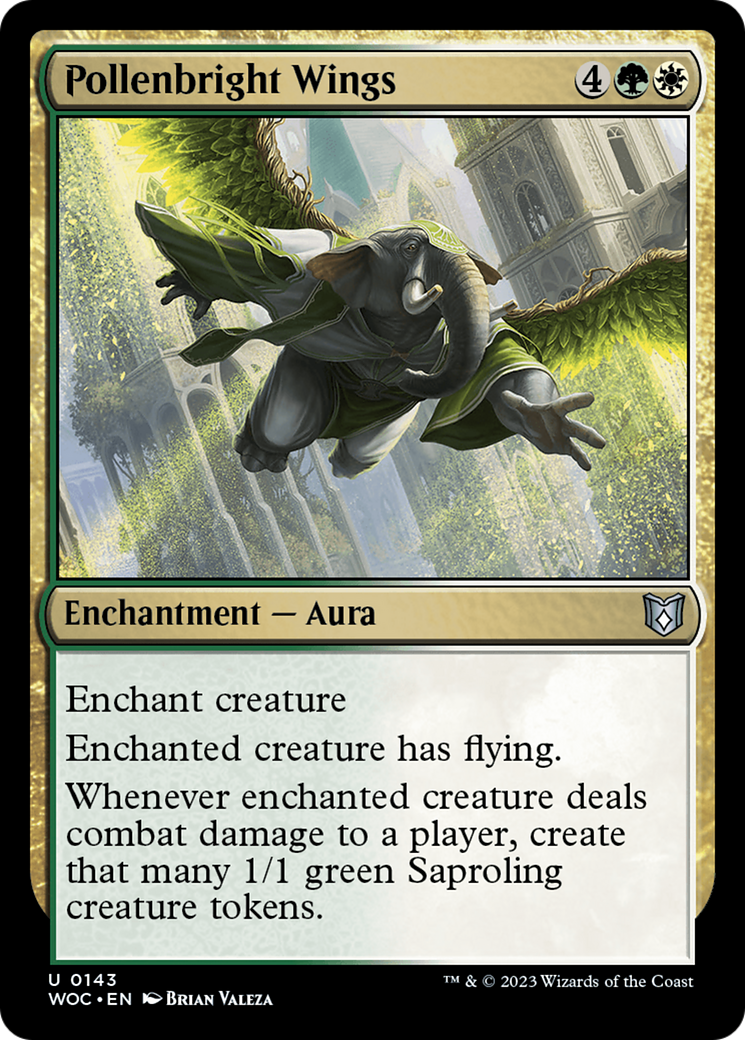
1
Pollenbright Wings
Pollenbright Wings
Enchantment — Aura
Enchant creature
Enchanted creature has flying.
Whenever enchanted creature deals combat damage to a player, create that many 1/1 green Saproling creature tokens.
-
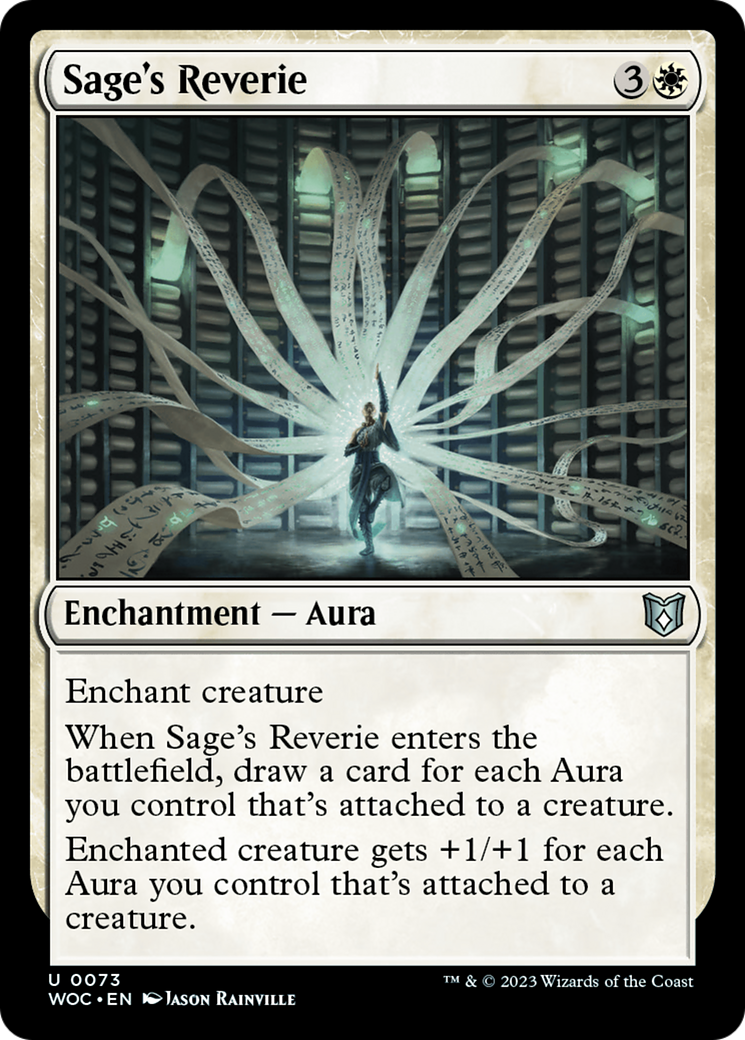
1
Sage's Reverie
Sage's Reverie
Enchantment — Aura
Enchant creature
When this Aura enters, draw a card for each Aura you control that's attached to a creature.
Enchanted creature gets +1/+1 for each Aura you control that's attached to a creature.
- An Aura doesn't necessarily need the enchant creature ability for the abilities of Sage's Reverie to count it. For example, an Aura with enchant permanent that's attached to a creature will count.
- Count the number of Auras you control attached to creatures as the enters-the-battlefield ability resolves to determine how many cards to draw. This will include Sage's Reverie as long as it's still on the battlefield at that time.
-
1
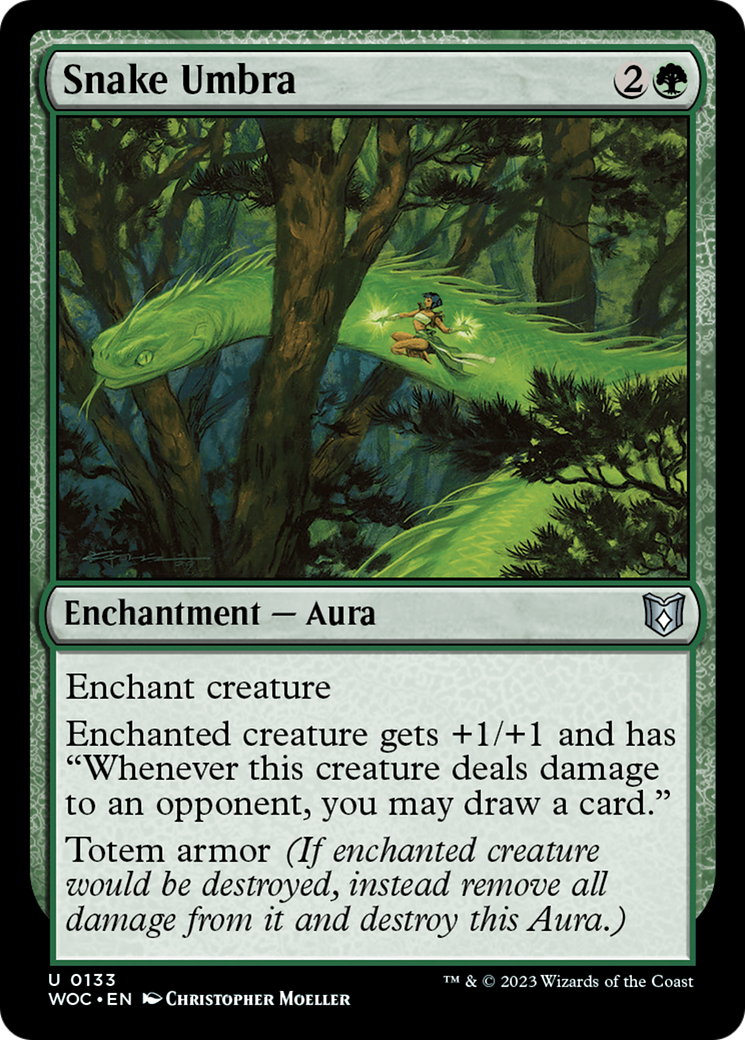
Snake Umbra
Snake Umbra
Enchantment — Aura
Enchant creature
Enchanted creature gets +1/+1 and has "Whenever this creature deals damage to an opponent, you may draw a card."
Umbra armor (If enchanted creature would be destroyed, instead remove all damage from it and destroy this Aura.)
- Some printings of this card refer to the ability "totem armor". This ability's name has been replaced with "umbra armor". This change does not affect the gameplay function of this card.
- Umbra armor has no effect if the enchanted creature is put into a graveyard for any other reason, such as if it's sacrificed, if the "legend rule" applies to it, or if its toughness is 0 or less.
- If a creature enchanted with an Aura that has umbra armor has indestructible, lethal damage and effects that try to destroy it simply have no effect. Umbra armor won't do anything because it won't have to.
- Umbra armor's effect is mandatory. If the enchanted creature would be destroyed, you must remove all damage from it (if it has any) and destroy the Aura that has umbra armor instead.
- Umbra armor's effect is applied no matter why the enchanted creature would be destroyed: because it's been dealt lethal damage, or because it's being affected by an effect that says to "destroy" it (such as Breathe Your Last). In either case, all damage is removed from the creature and the Aura is destroyed instead.
- If a creature you control is enchanted with multiple Auras that have umbra armor, and the enchanted creature would be destroyed, one of those Auras is destroyed instead—but only one of them. You choose which one because you control the enchanted creature.
- If a creature enchanted with an Aura that has umbra armor would be destroyed by multiple state-based actions at the same time (most likely because a creature with deathtouch has dealt damage to that creature greater than or equal to its toughness), umbra armor's effect will replace all of them and save the creature.
- If a spell or ability would destroy both an Aura with umbra armor and the creature it's enchanting at the same time, umbra armor's effect will save the enchanted creature from being destroyed. Instead, the spell or ability will destroy the Aura in two different ways at the same time, but the result is the same as destroying it once.
- Umbra armor's effect is not regeneration. Specifically, if umbra armor's effect is applied, the enchanted creature does not become tapped and is not removed from combat as a result. Effects that say the enchanted creature can't be regenerated won't prevent umbra armor's effect from being applied.
- If a spell or ability says that it would "destroy" a creature enchanted with an Aura that has umbra armor, that spell or ability is what causes the Aura to be destroyed instead. Umbra armor doesn't destroy the Aura; rather, it changes the effects of the spell or ability. On the other hand, if a spell or ability deals lethal damage to a creature enchanted with an Aura that has umbra armor, the game rules regarding lethal damage cause the Aura to be destroyed, not that spell or ability.
- The ability triggers when the enchanted creature deals any damage, not just combat damage.
- Snake Umbra grants the triggered ability to the creature. It triggers whenever the enchanted creature deals damage to an opponent of its controller (who is not necessarily an opponent of the Aura's controller). In other words, if your Snake Umbra winds up enchanting your opponent's creature, that opponent will draw a card whenever that creature damages you.
-
1
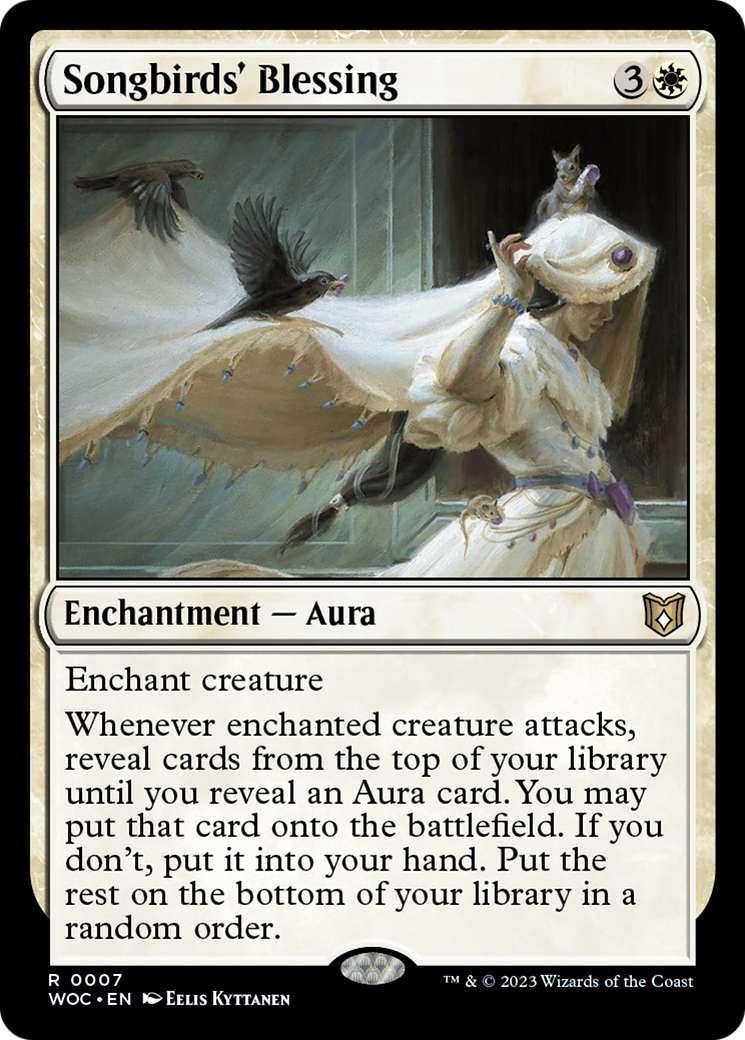
Songbirds' Blessing
Songbirds' Blessing
Enchantment — Aura
Enchant creature
Whenever enchanted creature attacks, reveal cards from the top of your library until you reveal an Aura card. You may put that card onto the battlefield. If you don't, put it into your hand. Put the rest on the bottom of your library in a random order.
- If you put an Aura card onto the battlefield with Songbirds' Blessing's triggered ability, you choose what it will enchant as it enters the battlefield. An Aura put onto the battlefield this way doesn't target anything (so it could be attached to an opponent's permanent with hexproof, for example), but the Aura's enchant ability restricts what it can be attached to. If the Aura can't legally be attached to anything, you won't be able to put it onto the battlefield, and it will be put into your hand by the next part of the effect.
-
1
Spectral Steel
Spectral Steel
Enchantment — Aura
Enchant creature
Enchanted creature gets +2/+2.
, Exile this card from your graveyard: Return another target Aura or Equipment card from your graveyard to your hand.
-
1
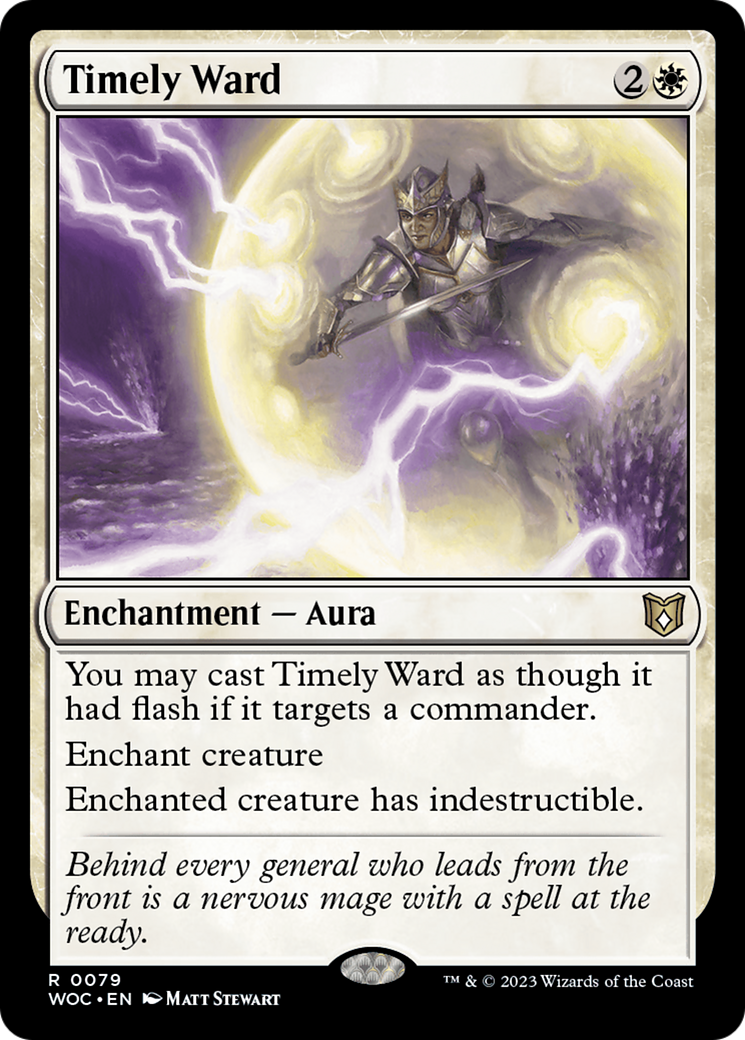
Timely Ward
Timely Ward
Enchantment — Aura
You may cast this spell as though it had flash if it targets a commander.
Enchant creature
Enchanted creature has indestructible.
-
1
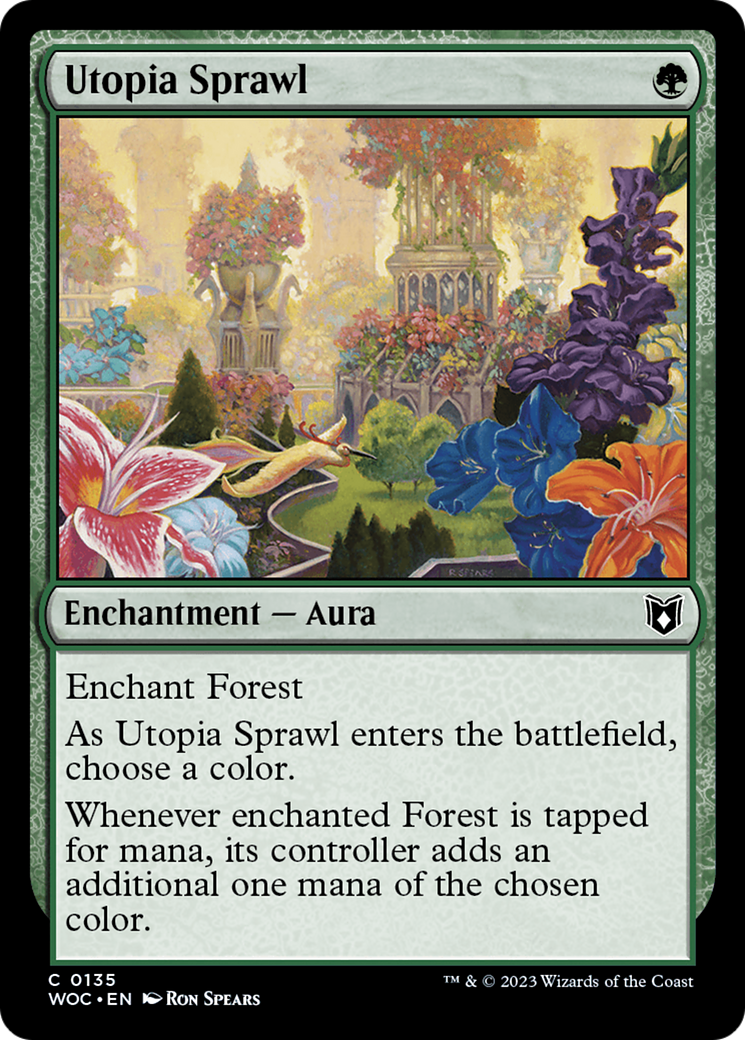
Utopia Sprawl
Utopia Sprawl
Enchantment — Aura
Enchant Forest
As this Aura enters, choose a color.
Whenever enchanted Forest is tapped for mana, its controller adds an additional one mana of the chosen color.
-
1
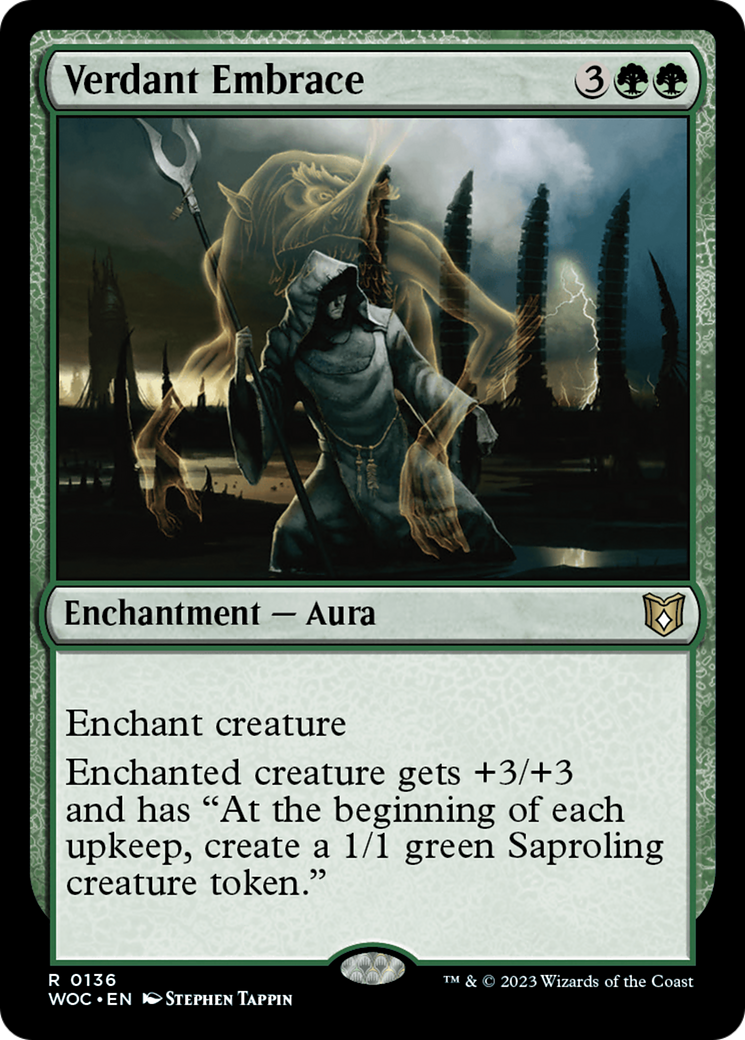
Verdant Embrace
Verdant Embrace
Enchantment — Aura
Enchant creature
Enchanted creature gets +3/+3 and has "At the beginning of each upkeep, create a 1/1 green Saproling creature token."
- The token is put onto the battlefield under the control of the player who controls the enchanted creature, not the player who controls Verdant Embrace.
-
1
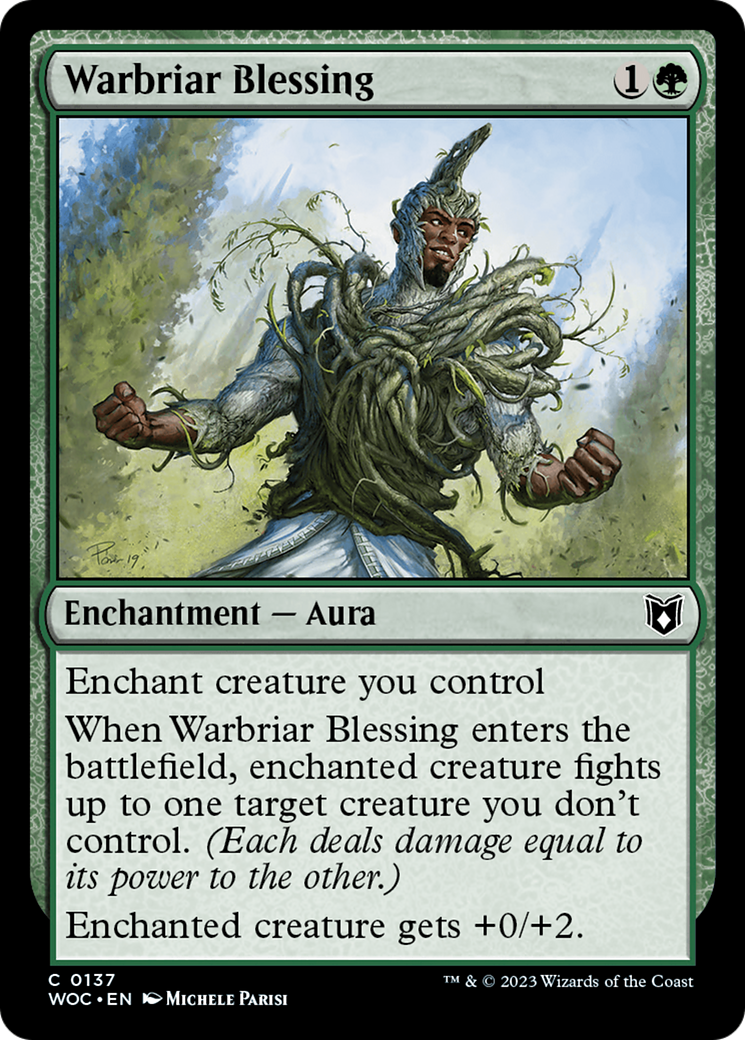
Warbriar Blessing
Warbriar Blessing
Enchantment — Aura
Enchant creature you control
When this Aura enters, enchanted creature fights up to one target creature you don't control. (Each deals damage equal to its power to the other.)
Enchanted creature gets +0/+2.
- If the target creature is an illegal target when Warbriar Blessing's triggered ability tries to resolve, the ability doesn't resolve. If the enchanted creature is no longer on the battlefield, the target creature won't deal or be dealt damage.
- If Warbriar Blessing leaves the battlefield before its enters-the-battlefield triggered ability resolves, the creature it last enchanted before it left will be the one to fight.
Lands 39
-
1
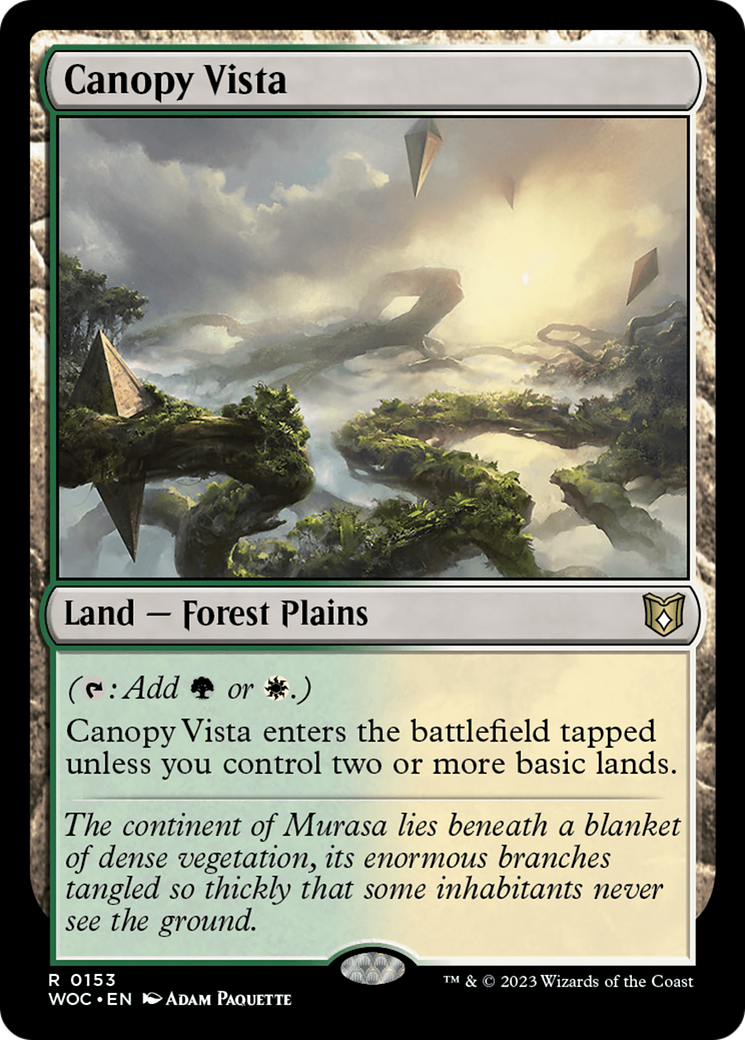
Canopy Vista
Canopy Vista
Land — Forest Plains
( : Add or .)
This land enters tapped unless you control two or more basic lands.
- Even though these lands have basic land types, they are not basic lands because "basic" doesn't appear on their type line. Notably, controlling two or more of them won't allow others to enter the battlefield untapped.
- However, because these cards have basic land types, effects that specify a basic land type without also specifying that the land be basic can affect them. For example, a spell or ability that reads "Destroy target Forest" can target Canopy Vista, while one that reads "Destroy target basic Forest" cannot.
- If one of these lands enters the battlefield at the same time as any number of basic lands, those other lands are not counted when determining if this land enters the battlefield tapped or untapped.
-
1
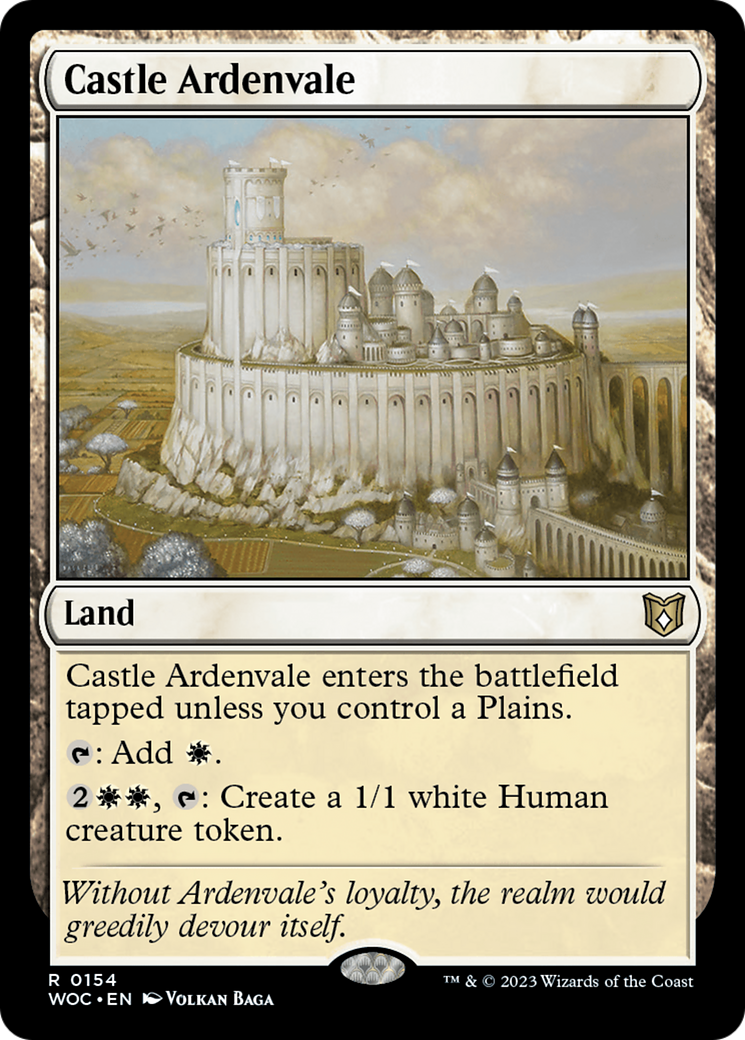
Castle Ardenvale
Castle Ardenvale
Land
This land enters tapped unless you control a Plains.
: Add .
, : Create a 1/1 white Human creature token.
- Once the common lands (such as Mystic Sanctuary) enter the battlefield tapped, there's no way to untap them with a spell or ability to make their last ability trigger.
- Although the common lands have basic land types, they aren't basic lands.
-
1
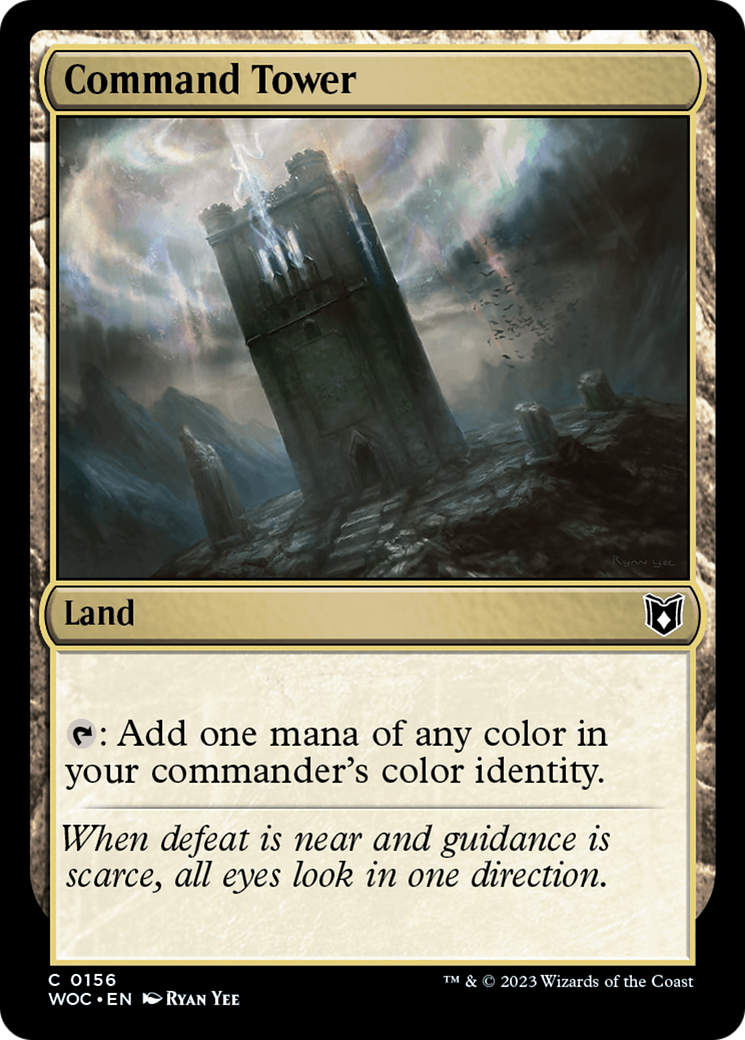
Command Tower
Command Tower
Land
: Add one mana of any color in your commander's color identity.
- If you have two commanders, the ability adds one mana of any color in their combined color identities.
- If your commander is a card that has no colors in its color identity, Command Tower's ability produces no mana. It doesn't produce .
- If you don't have a commander, Command Tower's ability produces no mana.
-
15
Forest
Forest
Basic Land — Forest
( : Add .)
-
1
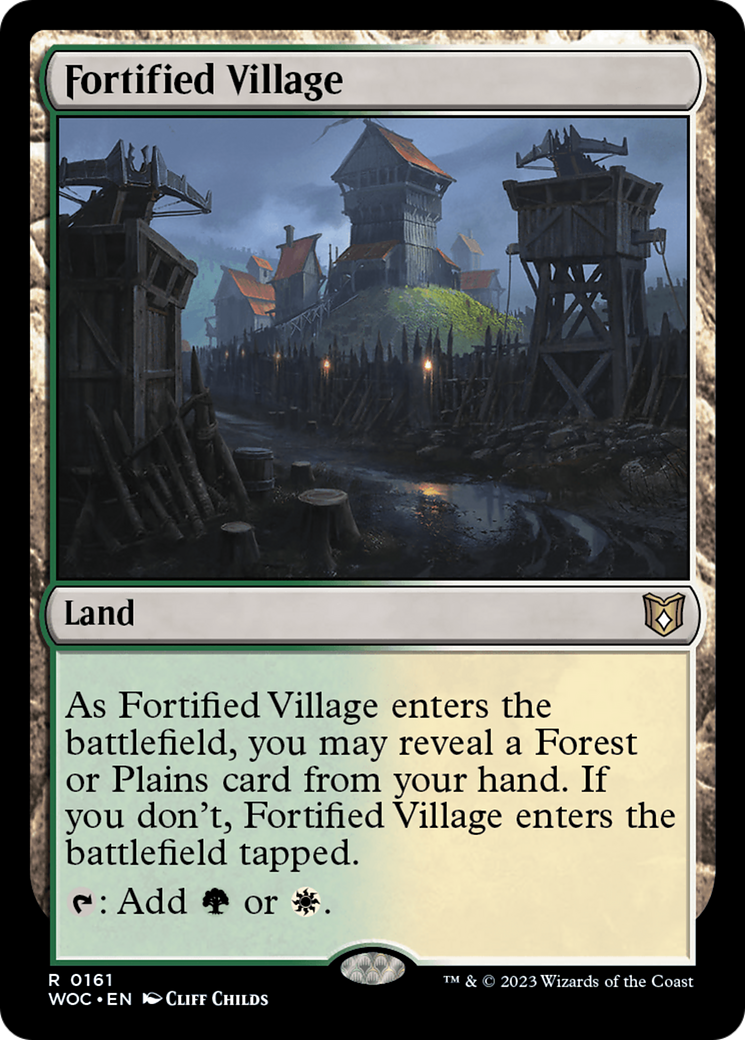
Fortified Village
Fortified Village
Land
As this land enters, you may reveal a Forest or Plains card from your hand. If you don't, this land enters tapped.
: Add or .
- You may reveal any land card with either or both of the appropriate subtypes. It doesn't have to be a basic land. For example, you could reveal Prairie Stream from the Battle for Zendikar set to satisfy the ability of Fortified Village.
- Lands don't have a subtype just because they can produce mana of the corresponding color. Fortified Village itself is neither a Forest nor a Plains, even though it produces green and white mana, so you can't reveal one to satisfy the ability of another.
- If a Forest or Plains is entering the battlefield from your hand at the same time as Fortified Village, you may reveal the other land to have Fortified Village enter untapped.
- If an effect instructs you to put Fortified Village onto the battlefield tapped, it will still enter the battlefield tapped even if you reveal a land card from your hand.
-
1
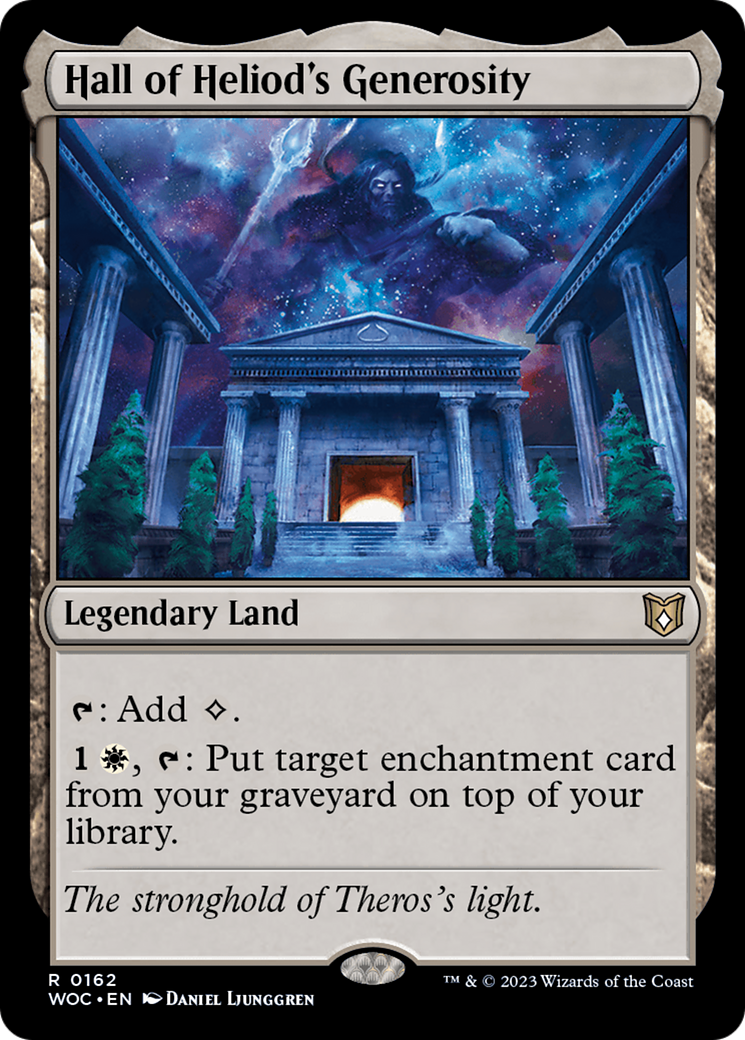
Hall of Heliod's Generosity
Hall of Heliod's Generosity
Legendary Land
: Add .
, : Put target enchantment card from your graveyard on top of your library.
-
1
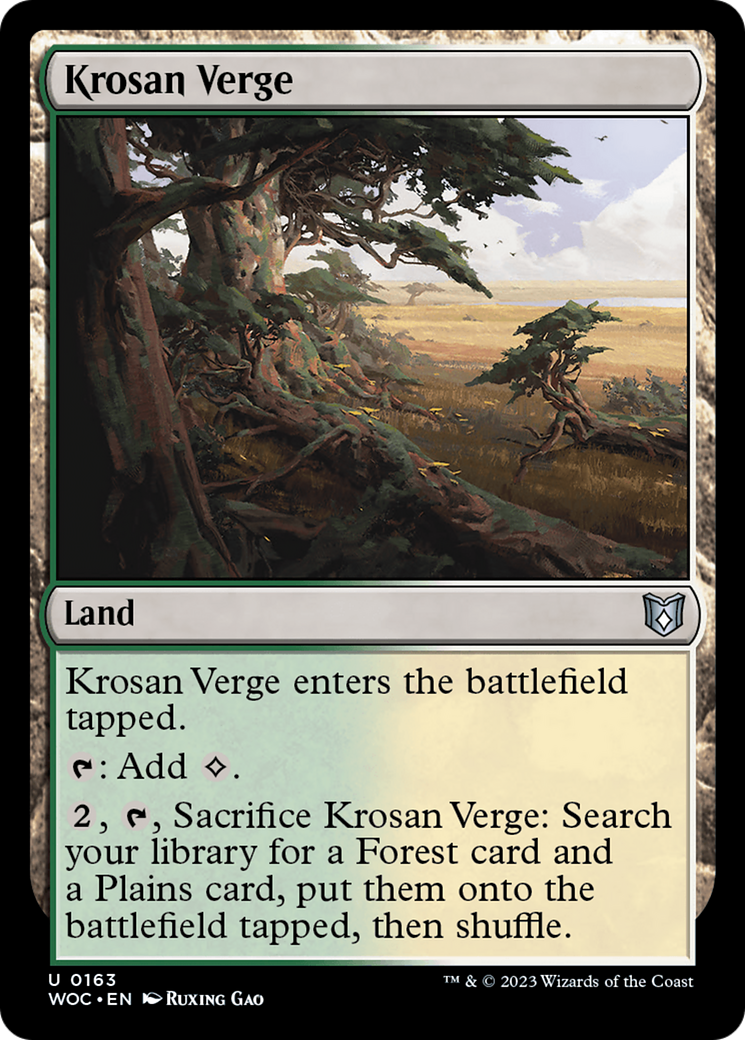
Krosan Verge
Krosan Verge
Land
This land enters tapped.
: Add .
, , Sacrifice this land: Search your library for a Forest card and a Plains card, put them onto the battlefield tapped, then shuffle.
-
1
Myriad Landscape
Myriad Landscape
Land
This land enters tapped.
: Add .
, , Sacrifice this land: Search your library for up to two basic land cards that share a land type, put them onto the battlefield tapped, then shuffle.
- You can choose to find one basic land card with Myriad Landscape's last ability.
-
14
Plains
Plains
Basic Land — Plains
( : Add .)
-
1
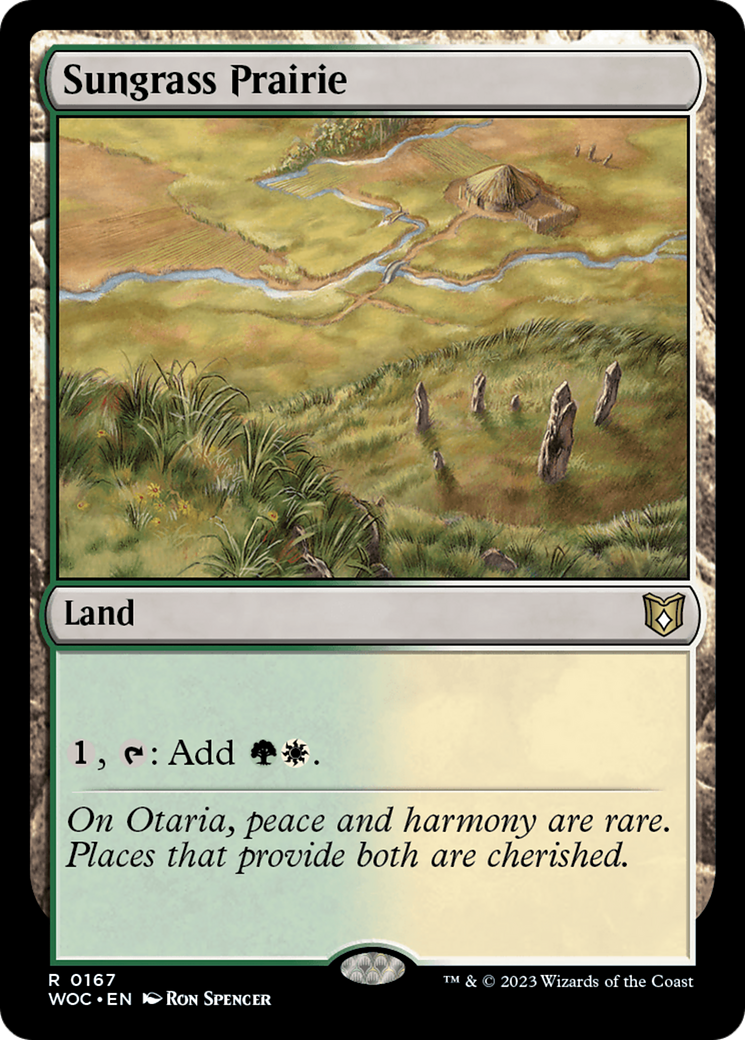
Sungrass Prairie
Sungrass Prairie
Land
, : Add .
-
1
Temple of Plenty
Temple of Plenty
Land
This land enters tapped.
When this land enters, scry 1. (Look at the top card of your library. You may put that card on the bottom.)
: Add or .
- You perform the actions stated on a card in sequence. For some spells and abilities, that means you'll scry last. For others, that means you'll scry and then perform other actions.
- You choose how to order cards returned to your library after scrying no matter where you put them.
- When you scry, you may put all the cards you look at back on top of your library, you may put all of those cards on the bottom of your library, or you may put some of those cards on top and the rest of them on the bottom.
- Scry appears on some spells and abilities with one or more targets. If all of the spell or ability's targets are illegal when it tries to resolve, it won't resolve and none of its effects will happen. You won't scry.
-
1
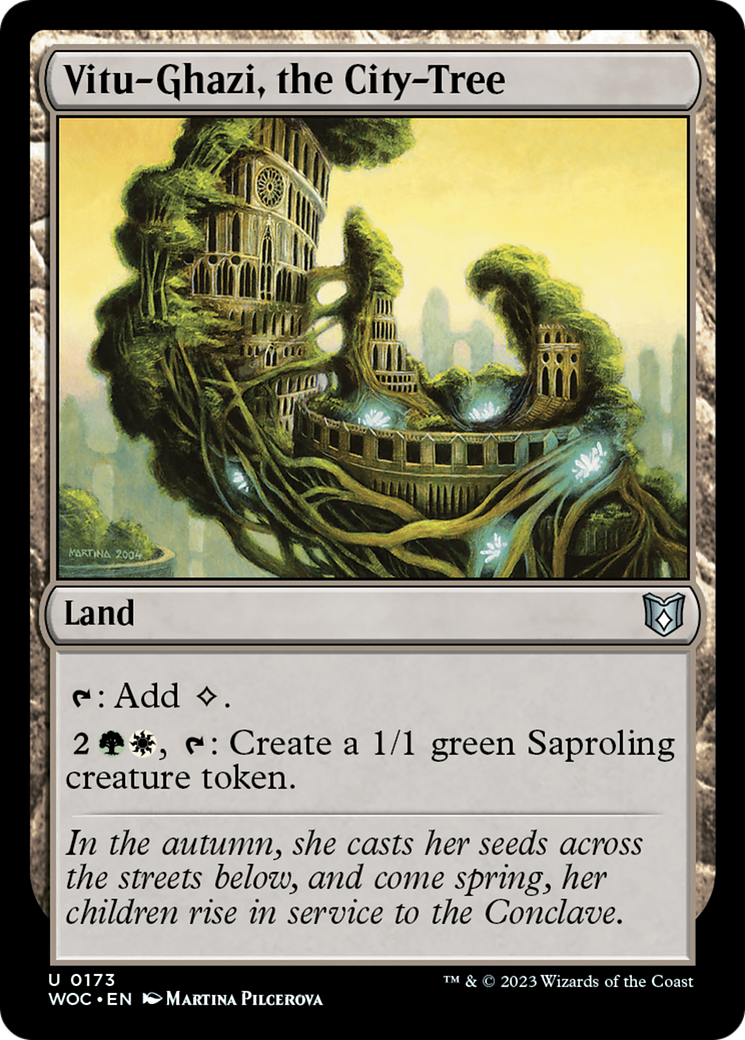
Vitu-Ghazi, the City-Tree
Vitu-Ghazi, the City-Tree
Land
: Add .
, : Create a 1/1 green Saproling creature token.
White 29
-
1
Ajani's Chosen
Ajani's Chosen
Creature — Cat Soldier
3/3
Whenever an enchantment you control enters, create a 2/2 white Cat creature token. If that enchantment is an Aura, you may attach it to the token.
- The ability doesn't trigger until the enchantment enters the battlefield. This means that, for example, you can't cast an Aura with enchant creature if there are no legal targets available, hoping to enchant the Cat token. Ajani's Chosen itself, however, may be a legal target for the Aura.
- If you cast an Aura targeting an opponent or a permanent controlled by an opponent, you control that Aura when it enters the battlefield. The ability of Ajani's Chosen will trigger.
- You may attach the Aura to the token only if it can legally enchant that token. For example, if the enchantment that entered the battlefield is an Aura with "enchant land," it won't move.
- You may attach the Aura to the Cat token only if the Aura and the token are both on the battlefield when the triggered ability resolves. If the Aura leaves the battlefield before the ability resolves, it won't become attached to the token. If the token leaves the battlefield before the ability resolves, the Aura won't move.
-
1
Angelic Destiny
Angelic Destiny
Enchantment — Aura
Enchant creature
Enchanted creature gets +4/+4, has flying and first strike, and is an Angel in addition to its other types.
When enchanted creature dies, return this card to its owner's hand.
- If the creature dies before the Angelic Destiny spell resolves, Angelic Destiny will go to its owner's graveyard. It won't return to its owner's hand.
- If Angelic Destiny is no longer in a graveyard when its triggered ability resolves, it won't be returned to its owner's hand.
-
1
Archon of Sun's Grace
Archon of Sun's Grace
Creature — Archon
3/4
Flying
Lifelink (Damage dealt by this creature also causes you to gain that much life.)
Pegasus creatures you control have lifelink.
Constellation — Whenever an enchantment you control enters, create a 2/2 white Pegasus creature token with flying.
- Multiple instances of lifelink on the same creature are redundant.
- A constellation ability triggers whenever an enchantment enters the battlefield under your control for any reason. Enchantments with other card types, such as enchantment creatures, will also cause constellation abilities to trigger.
- An Aura spell that has an illegal target when it tries to resolve doesn't resolve and is instead put into its owner's graveyard. It doesn't enter the battlefield, so constellation abilities don't trigger.
-
1
Austere Command
Austere Command
Sorcery
Choose two —
- Destroy all artifacts.
- Destroy all enchantments.
- Destroy all creatures with mana value 3 or less.
- Destroy all creatures with mana value 4 or greater.
- Each of the chosen modes happens sequentially. If a permanent has an ability that triggers whenever it or another permanent is destroyed, it will see permanents destroyed at the same time as it or before it, but not permanents destroyed by later modes.
- If the first and last modes are chosen, an artifact creature with mana value 4 or greater will have to be regenerated twice to survive. This is because the modes happen sequentially, and the regeneration "shield" is used up by the first one. The same is true with any other combination of modes that covers one permanent twice.
- If a card is exiled "until" another permanent leaves the battlefield, the exiled card returns to the battlefield immediately after that permanent leaves the battlefield during Austere Command's resolution, and it may be destroyed by a later mode.
-
1
Celestial Archon
Celestial Archon
Enchantment Creature — Archon
4/4
Bestow (If you cast this card for its bestow cost, it's an Aura spell with enchant creature. It becomes a creature again if it's not attached to a creature.)
Flying, first strike
Enchanted creature gets +4/+4 and has flying and first strike.
- Bestow is an alternative cost to cast the spell with bestow. It can't be combined with other alternative costs, such as casting a spell "without paying its mana cost."
- To determine the total cost of a spell, start with the mana cost or alternative cost (such as a bestow cost) you're paying, add any cost increases, then apply any cost reductions. The mana value of the spell remains unchanged, no matter what the total cost to cast it was.
- A spell with bestow is either a creature spell or an Aura spell. It's never both. Similarly, a permanent with bestow is either a creature or an Aura, but not both.
- Unlike other Aura spells, an Aura spell with bestow still resolves if its target is illegal. Instead of entering the battlefield as an Aura, the effect making it an Aura spell ends, it loses enchant creature, and it resolves and enters the battlefield as an enchantment creature.
- Unlike other Auras, an Aura with bestow isn't put into its owner's graveyard if the enchanted creature leaves the battlefield or becomes an illegal creature for the Aura to enchant. Rather, the effect making it an Aura ends, it loses enchant creature, and it remains on the battlefield as an enchantment creature. It can attack (and its abilities can be activated, if it has any) on the turn it becomes unattached if it's been under your control continuously, even as an Aura, since your most recent turn began.
- If a permanent with bestow enters the battlefield by any method other than being cast, it will be an enchantment creature. You can't choose to pay the bestow cost and have it become an Aura.
- Auras attached to a creature don't become tapped when the creature becomes tapped. Except in some rare cases, an Aura with bestow remains untapped when it becomes unattached and becomes a creature.
-
1
Danitha Capashen, Paragon
Danitha Capashen, Paragon
Legendary Creature — Human Knight
2/2
First strike, vigilance, lifelink
Aura and Equipment spells you cast cost less to cast.
-
1
Daybreak Coronet
Daybreak Coronet
Enchantment — Aura
Enchant creature with another Aura attached to it
Enchanted creature gets +3/+3 and has first strike, vigilance, and lifelink. (Damage dealt by the creature also causes its controller to gain that much life.)
- If multiple Auras are entering the battlefield at the same time, you choose which player or permanent each enchants before any of them enter the battlefield. This means that Daybreak Coronet can't be put onto the battlefield enchanting a creature that's not enchanted before the Auras all enter the battlefield.
- If all other Auras attached to the enchanted creature stop enchanting it, Daybreak Coronet will be attached to an illegal permanent and will be put into its owner's graveyard.
-
1
Eidolon of Countless Battles
Eidolon of Countless Battles
Enchantment Creature — Spirit
0/0
Bestow (If you cast this card for its bestow cost, it's an Aura spell with enchant creature. It becomes a creature again if it's not attached to a creature.)
This creature and enchanted creature each get +1/+1 for each creature you control and +1/+1 for each Aura you control.
- Eidolon of Countless Battles's last ability functions only on the battlefield. In other zones, it is a 0/0 enchantment creature card.
- A permanent with bestow is either a creature or an Aura, not both (although it's an enchantment either way). It will contribute just +1/+1 toward the bonus given by Eidolon of Countless Battles.
- Unlike other Auras, an Aura with bestow isn't put into its owner's graveyard if it becomes unattached. Rather, the effect making it an Aura ends, it loses enchant creature, and it remains on the battlefield as an enchantment creature. It can attack (and its abilities can be activated, if it has any) on the turn it becomes unattached if it's been under your control continuously, even as an Aura, since your most recent turn began.
- On the stack, a spell with bestow is either a creature spell or an Aura spell. It's never both, although it's an enchantment spell in either case.
- Auras attached to a creature don't become tapped when the creature becomes tapped. Except in some rare cases, an Aura with bestow remains untapped when it becomes unattached and becomes a creature.
- If a permanent with bestow enters the battlefield by any method other than being cast, it will be an enchantment creature. You can't choose to pay the bestow cost and have it become an Aura.
- Unlike other Aura spells, an Aura spell with bestow isn't countered if its target is illegal as it begins to resolve. Rather, the effect making it an Aura spell ends, it loses enchant creature, it returns to being an enchantment creature spell, and it resolves and enters the battlefield as an enchantment creature.
-
1
Ethereal Armor
Ethereal Armor
Enchantment — Aura
Enchant creature
Enchanted creature gets +1/+1 for each enchantment you control and has first strike.
- Ethereal Armor counts each enchantment you control, including itself and any Auras you control that are attached to an opponent or to permanents controlled by an opponent.
-
1
Generous Gift
Generous Gift
Instant
Destroy target permanent. Its controller creates a 3/3 green Elephant creature token.
- If the target permanent is an illegal target by the time Generous Gift tries to resolve, the spell doesn't resolve. No player creates an Elephant. If the target is legal but not destroyed (most likely because it has indestructible), its controller does create an Elephant.
-
1
Kor Spiritdancer
Kor Spiritdancer
Creature — Kor Wizard
0/2
This creature gets +2/+2 for each Aura attached to it.
Whenever you cast an Aura spell, you may draw a card.
- If you cast an Aura spell, Kor Spiritdancer's second ability triggers and goes on the stack on top of it. The ability will resolve before the spell does.
- The second ability triggers when you cast any Aura spell, not just one that targets Kor Spiritdancer.
-
1
Liberated Livestock
Liberated Livestock
Creature — Cat Bird Ox
4/6
When this creature dies, create a 1/1 white Cat creature token with lifelink, a 1/1 white Bird creature token with flying, and a 2/4 white Ox creature token. For each of those tokens, you may put an Aura card from your hand and/or graveyard onto the battlefield attached to it.
- If you attempt to put an Aura onto the battlefield this way and that Aura can't legally be attached to the token, that Aura does not enter the battlefield at all. Instead, it will stay in its previous zone.
- If Liberated Livestock's ability causes more than the expected number of tokens to be created (due to an effect such as that of Doubling Season), you may put an Aura card from your hand and/or graveyard onto the battlefield attached to each of the additional tokens as well.
-
1
Mantle of the Ancients
Mantle of the Ancients
Enchantment — Aura
Enchant creature you control
When this Aura enters, return any number of target Aura and/or Equipment cards from your graveyard to the battlefield attached to enchanted creature.
Enchanted creature gets +1/+1 for each Aura and Equipment attached to it.
- As the enters-the-battlefield ability is resolving, any targets that couldn't be legally attached to the creature enchanted by Mantle of the Ancients stay in your graveyard.
- If Mantle of the Ancients becomes attached to a different creature in response to its enters-the-battlefield ability, the creature it's attached to as that ability is resolving is the "enchanted creature," even though you used the original enchanted creature to choose targets. This means some of those targets may become illegal.
- If Mantle of the Ancients leaves the battlefield before its enters-the-battlefield ability resolves, the last permanent it was attached to before leaving the battlefield is the "enchanted creature" (even if that permanent is no longer a creature).
-
1
Ox Drover
Ox Drover
Creature — Human Peasant
4/4
Vigilance
This creature can't be blocked by Oxen.
Whenever this creature enters or attacks, target opponent creates a 2/4 white Ox creature token and you draw a card.
- If the target opponent is an illegal target by the time Ox Drover's last ability tries to resolve, it won't resolve. They won't create an Ox token, and you won't draw a card.
-
1
Realm-Cloaked Giant // Cast Off
//
Realm-Cloaked Giant
Creature — Giant
7/7
- An adventurer card is a permanent card in every zone except the stack, as well as while on the stack if not cast as an Adventure. Ignore its alternative characteristics in those cases. For example, while it's in your graveyard, Giant Killer is a white creature card whose mana value is 1. It can't be the target of the triggered ability of Mystic Sanctuary.
- When casting a spell as an Adventure, use the alternative characteristics and ignore all of the card's normal characteristics. The spell's color, mana cost, mana value, and so on are determined by only those alternative characteristics. If the spell leaves the stack, it immediately resumes using its normal characteristics.
- If you cast an adventurer card as an Adventure, use only its alternative characteristics to determine whether it's legal to cast that spell. For example, if Giant Killer is exiled with the last ability of Vivien, Champion of the Wilds, you can't cast it as Chop Down.
- If a spell is cast as an Adventure, its controller exiles it instead of putting it into its owner's graveyard as it resolves. For as long as it remains exiled, that player may cast it as a permanent spell. If an Adventure spell leaves the stack in any way other than resolving (most likely by being countered or by failing to resolve because its targets have all become illegal), that card won't be exiled and the spell's controller won't be able to cast it as a permanent later.
- If an adventurer card ends up in exile for any other reason than by exiling itself while resolving, it won't give you permission to cast it as a permanent spell.
- You must still follow any timing restrictions and permissions for the permanent spell you cast from exile. Normally, you'll be able to cast it only during your main phase while the stack is empty.
- If an effect copies an Adventure spell, that copy is exiled as it resolves. It ceases to exist as a state-based action; it's not possible to cast the copy as a permanent.
- If an object becomes a copy of an object that has an Adventure, the copy also has an Adventure. If it changes zones, it will either cease to exist (if it's a token) or cease to be a copy (if it's a nontoken permanent), and so you won't be able to cast it as an Adventure.
- If an effect instructs you to choose a card name, you may choose the alternative Adventure name. Consider only the alternative characteristics to determine whether that is an appropriate name to choose.
- Casting a card as an Adventure isn't casting it for an alternative cost. Effects that allow you to cast a spell for an alternative cost or without paying its mana cost may allow you to apply those to the Adventure.
-
1
Retether
Retether
Sorcery
Return each Aura card from your graveyard to the battlefield. Only creatures can be enchanted this way. (Aura cards that can't enchant a creature on the battlefield remain in your graveyard.)
- All the Auras return to the battlefield simultaneously. Whether an Aura can be attached to a creature is checked before any of them are returned and doesn't take into account any simultaneously returning Auras. For example, if Tattoo Ward (which gives enchanted creature protection from enchantments) and Holy Strength are in your graveyard and there's only one creature on the battlefield, both Auras are returned to the battlefield attached to that creature, then Holy Strength is put into your graveyard the next time state-based actions are checked.
- Auras don't need to say "enchant creature" to return to the battlefield. For example, an Aura with "enchant land" will return to the battlefield if there's an animated land for it to enchant.
-
1
Sage's Reverie
Sage's Reverie
Enchantment — Aura
Enchant creature
When this Aura enters, draw a card for each Aura you control that's attached to a creature.
Enchanted creature gets +1/+1 for each Aura you control that's attached to a creature.
- An Aura doesn't necessarily need the enchant creature ability for the abilities of Sage's Reverie to count it. For example, an Aura with enchant permanent that's attached to a creature will count.
- Count the number of Auras you control attached to creatures as the enters-the-battlefield ability resolves to determine how many cards to draw. This will include Sage's Reverie as long as it's still on the battlefield at that time.
-
1
Shalai, Voice of Plenty
Shalai, Voice of Plenty
Legendary Creature — Angel
3/4
Flying
You, planeswalkers you control, and other creatures you control have hexproof.
: Put a +1/+1 counter on each creature you control.
-
1
Songbirds' Blessing
Songbirds' Blessing
Enchantment — Aura
Enchant creature
Whenever enchanted creature attacks, reveal cards from the top of your library until you reveal an Aura card. You may put that card onto the battlefield. If you don't, put it into your hand. Put the rest on the bottom of your library in a random order.
- If you put an Aura card onto the battlefield with Songbirds' Blessing's triggered ability, you choose what it will enchant as it enters the battlefield. An Aura put onto the battlefield this way doesn't target anything (so it could be attached to an opponent's permanent with hexproof, for example), but the Aura's enchant ability restricts what it can be attached to. If the Aura can't legally be attached to anything, you won't be able to put it onto the battlefield, and it will be put into your hand by the next part of the effect.
-
1
Spectral Steel
Spectral Steel
Enchantment — Aura
Enchant creature
Enchanted creature gets +2/+2.
, Exile this card from your graveyard: Return another target Aura or Equipment card from your graveyard to your hand.
-
1
Starfield Mystic
Starfield Mystic
Creature — Human Cleric
2/2
Enchantment spells you cast cost less to cast.
Whenever an enchantment you control is put into a graveyard from the battlefield, put a +1/+1 counter on this creature.
- If you cast an Aura spell targeting an opponent's permanent, you still control the Aura after it resolves.
-
1
Sun Titan
Sun Titan
Creature — Giant
6/6
Vigilance
Whenever this creature enters or attacks, you may return target permanent card with mana value 3 or less from your graveyard to the battlefield.
- If a card in your graveyard has no mana symbols in its upper right corner (because it's a land card, for example), its mana value is 0.
- If the mana cost of a card in your graveyard includes , X is considered to be 0.
- A permanent card is an artifact, creature, enchantment, land, or planeswalker card.
- The mana value of a card in your graveyard is determined solely by the mana symbols printed in its upper right corner. The mana value is the total amount of mana in that cost, regardless of color. For example, a card with mana cost has mana value 5.
-
1
Swords to Plowshares
Swords to Plowshares
Instant
Exile target creature. Its controller gains life equal to its power.
- Use the power of the creature from when it was last on the battlefield to determine how much life is gained.
-
1
Timely Ward
Timely Ward
Enchantment — Aura
You may cast this spell as though it had flash if it targets a commander.
Enchant creature
Enchanted creature has indestructible.
-
1
Tithe Taker
Tithe Taker
Creature — Human Soldier
2/1
During your turn, spells your opponents cast cost more to cast and abilities your opponents activate cost more to activate unless they're mana abilities.
Afterlife 1 (When this creature dies, create a 1/1 white and black Spirit creature token with flying.)
- To determine the total cost of a spell, start with the mana cost or alternative cost you're paying, add any cost increases (such as that of Tithe Taker's effect), then apply any cost reductions. The mana value of the spell remains unchanged, no matter what the total cost to cast it was.
- An opponent's activated ability that costs no mana to activate will cost plus its non-mana costs during your turn.
- Because blockers are chosen all at once, you can't block with a creature with afterlife, wait for it to die, then block with the resulting Spirit tokens.
- Activated abilities contain a colon. They're generally written "[Cost]: [Effect]." Some keyword abilities are activated abilities and will have colons in their reminder text. An activated mana ability is one that produces mana as it resolves, not one that costs mana to activate. Triggered abilities (starting with "when," "whenever," or "at") are unaffected by Tithe Taker.
-
1
Transcendent Envoy
Transcendent Envoy
Enchantment Creature — Griffin
1/2
Flying
Aura spells you cast cost less to cast.
-
1
Umbra Mystic
Umbra Mystic
Creature — Human Wizard
2/2
Auras attached to permanents you control have umbra armor. (If an enchanted permanent you control would be destroyed, instead remove all damage from it and destroy an Aura attached to it.)
- Umbra armor's effect is mandatory. If the enchanted creature would be destroyed, you must remove all damage from it (if it has any) and destroy the Aura that has umbra armor instead.
- Umbra armor's effect is applied no matter why the enchanted creature would be destroyed: because it's been dealt lethal damage, or because it's being affected by an effect that says to "destroy" it (such as Breathe Your Last). In either case, all damage is removed from the creature and the Aura is destroyed instead.
- If a creature you control is enchanted with multiple Auras that have umbra armor, and the enchanted creature would be destroyed, one of those Auras is destroyed instead—but only one of them. You choose which one because you control the enchanted creature.
- Umbra armor's effect is not regeneration. Specifically, if umbra armor's effect is applied, the enchanted creature does not become tapped and is not removed from combat as a result. Effects that say the enchanted creature can't be regenerated won't prevent umbra armor's effect from being applied.
- If a spell or ability says that it would "destroy" a creature enchanted with an Aura that has umbra armor, that spell or ability is what causes the Aura to be destroyed instead. Umbra armor doesn't destroy the Aura; rather, it changes the effects of the spell or ability. On the other hand, if a spell or ability deals lethal damage to a creature enchanted with an Aura that has umbra armor, the game rules regarding lethal damage cause the Aura to be destroyed, not that spell or ability.
- Umbra armor has no effect if the enchanted creature is put into a graveyard for any other reason, such as if it's sacrificed, if the "legend rule" applies to it, or if its toughness is 0 or less.
- If a creature enchanted with an Aura that has umbra armor has indestructible, lethal damage and effects that try to destroy it simply have no effect. Umbra armor won't do anything because it won't have to.
- Some printings of this card refer to the ability "totem armor". This ability's name has been replaced with "umbra armor". This change does not affect the gameplay function of this card.
- If a creature enchanted with an Aura that has umbra armor would be destroyed by multiple state-based actions at the same time (most likely because a creature with deathtouch has dealt damage to that creature greater than or equal to its toughness), umbra armor's effect will replace all of them and save the creature.
- If a spell or ability would destroy both an Aura with umbra armor and the creature it's enchanting at the same time, umbra armor's effect will save the enchanted creature from being destroyed. Instead, the spell or ability will destroy the Aura in two different ways at the same time, but the result is the same as destroying it once.
- Say you control a permanent that's enchanted by an Aura you control, and that Aura is itself enchanted by an Aura. If the permanent would be destroyed, instead the first Aura is destroyed... but since that Aura would be destroyed, instead the second Aura is destroyed.
- All _Rise of the Eldrazi_ cards printed with umbra armor are Auras with "enchant creature." But Umbra Mystic grants umbra armor to Auras attached to any permanent you control, not just creatures. The ability works the same way even if the Aura is enchanting a land, an artifact, or any other permanent.
- Umbra Mystic grants umbra armor to Auras attached to permanents you control, regardless of who controls those Auras. Conversely, it doesn't grant umbra armor to Auras you control that are attached to permanents controlled by other players.
- If a permanent you control would be destroyed, and it's enchanted by an Aura with umbra armor, it doesn't matter who controls that Aura. The umbra armor effect is mandatory. If that permanent is enchanted by multiple Auras, you choose which one is destroyed, regardless of who controls them.
- Multiple instances of umbra armor on the same Aura are redundant.
-
1
Unfinished Business
Unfinished Business
Sorcery
Return target creature card from your graveyard to the battlefield, then return up to two target Aura and/or Equipment cards from your graveyard to the battlefield attached to that creature. (If the Auras can't enchant that creature, they remain in your graveyard.)
- Any target Equipment cards that can't legally be attached to the creature will enter the battlefield unattached.
-
1
Winds of Rath
Winds of Rath
Sorcery
Destroy all creatures that aren't enchanted. They can't be regenerated.
- A creature is "enchanted" if it has any Auras attached to it.
Green 24
-
1
Ancestral Mask
Ancestral Mask
Enchantment — Aura
Enchant creature
Enchanted creature gets +2/+2 for each other enchantment on the battlefield.
-
1
Aura Gnarlid
Aura Gnarlid
Creature — Beast
2/2
Creatures with power less than this creature's power can't block it.
This creature gets +1/+1 for each Aura on the battlefield.
- The power of each potential blocking creature is checked against Aura Gnarlid's power only as blockers are declared. Once a creature blocks Aura Gnarlid, increasing the Gnarlid's power or decreasing the blocking creature's power won't undo that block.
- Aura Gnarlid's second ability counts each Aura regardless of who controls it.
-
1
Bear Umbra
Bear Umbra
Enchantment — Aura
Enchant creature
Enchanted creature gets +2/+2 and has "Whenever this creature attacks, untap all lands you control."
Umbra armor (If enchanted creature would be destroyed, instead remove all damage from it and destroy this Aura.)
- Some printings of this card refer to the ability "totem armor". This ability's name has been replaced with "umbra armor". This change does not affect the gameplay function of this card.
- Umbra armor's effect is mandatory. If the enchanted creature would be destroyed, you must remove all damage from it (if it has any) and destroy the Aura that has umbra armor instead.
- Umbra armor's effect is applied no matter why the enchanted creature would be destroyed: because it's been dealt lethal damage, or because it's being affected by an effect that says to "destroy" it (such as Breathe Your Last). In either case, all damage is removed from the creature and the Aura is destroyed instead.
- If a creature you control is enchanted with multiple Auras that have umbra armor, and the enchanted creature would be destroyed, one of those Auras is destroyed instead—but only one of them. You choose which one because you control the enchanted creature.
- If a creature enchanted with an Aura that has umbra armor would be destroyed by multiple state-based actions at the same time (most likely because a creature with deathtouch has dealt damage to that creature greater than or equal to its toughness), umbra armor's effect will replace all of them and save the creature.
- If a spell or ability would destroy both an Aura with umbra armor and the creature it's enchanting at the same time, umbra armor's effect will save the enchanted creature from being destroyed. Instead, the spell or ability will destroy the Aura in two different ways at the same time, but the result is the same as destroying it once.
- Umbra armor's effect is not regeneration. Specifically, if umbra armor's effect is applied, the enchanted creature does not become tapped and is not removed from combat as a result. Effects that say the enchanted creature can't be regenerated won't prevent umbra armor's effect from being applied.
- If a spell or ability says that it would "destroy" a creature enchanted with an Aura that has umbra armor, that spell or ability is what causes the Aura to be destroyed instead. Umbra armor doesn't destroy the Aura; rather, it changes the effects of the spell or ability. On the other hand, if a spell or ability deals lethal damage to a creature enchanted with an Aura that has umbra armor, the game rules regarding lethal damage cause the Aura to be destroyed, not that spell or ability.
- Umbra armor has no effect if the enchanted creature is put into a graveyard for any other reason, such as if it's sacrificed, if the "legend rule" applies to it, or if its toughness is 0 or less.
- If a creature enchanted with an Aura that has umbra armor has indestructible, lethal damage and effects that try to destroy it simply have no effect. Umbra armor won't do anything because it won't have to.
- When the enchanted creature attacks, all lands controlled by that creature's controller (who is not necessarily the Aura's controller) untap.
-
1
Careful Cultivation
Careful Cultivation
Enchantment — Aura
Enchant artifact or creature
As long as enchanted permanent is a creature, it gets +1/+3 and has reach and " : Add ."
Channel — , Discard this card: Create a 1/1 green Human Monk creature token with " : Add ."
- Discarding the card is part of the cost to activate a channel ability.
- If a channel ability requires a target, you may not activate it without a target just to discard the card.
-
1
Destiny Spinner
Destiny Spinner
Enchantment Creature — Human
2/3
Creature and enchantment spells you control can't be countered.
: Target land you control becomes an X/X Elemental creature with trample and haste until end of turn, where X is the number of enchantments you control. It's still a land.
- Destiny Spinner's first ability applies only while it's on the battlefield. While it's a spell, it can be countered.
- A spell or ability that counters spells can still target spells that can't be countered. When that spell or ability resolves, the uncounterable spell won't be countered, but any additional effects of the countering spell or ability will still happen.
- The value of X is determined only as Destiny Spinner's activated ability resolves. Once that happens, the creature's base power and toughness won't change later in the turn even if the number of enchantments you control changes.
- If you activate Destiny Spinner's ability more than once in a turn, the value of X may be different each time. If you choose the same land as the target more than once, the most recent effect (and most recent value of X) applies.
- Destiny Spinner's activated ability doesn't untap the land that becomes a creature.
- If you control no enchantments at the time Destiny Spinner's activated ability resolves, the land becomes a 0/0 creature and is put into its owner's graveyard unless another effect is raising its toughness.
-
1
Eidolon of Blossoms
Eidolon of Blossoms
Enchantment Creature — Spirit
2/2
Constellation — Whenever this creature or another enchantment you control enters, draw a card.
- A constellation ability triggers whenever an enchantment enters the battlefield under your control for any reason. Enchantments with other card types, such as enchantment creatures, will also cause constellation abilities to trigger.
- An Aura spell without bestow that has an illegal target when it tries to resolve won't resolve and will be put into its owner's graveyard. It won't enter the battlefield and constellation abilities won't trigger. An Aura spell with bestow won't be countered this way. It will revert to being an enchantment creature and resolve, entering the battlefield and triggering constellation abilities.
- When an enchantment enters the battlefield under your control, each constellation ability of permanents you control will trigger. You can put these abilities on the stack in any order. The last ability you put on the stack will be the first one that resolves.
-
1
Enchantress's Presence
Enchantress's Presence
Enchantment
Whenever you cast an enchantment spell, draw a card.
- The triggered ability will resolve before the spell that caused it to trigger.
- The ability is independent from the spell that caused it to trigger. Notably, if the enchantment spell is countered or doesn't resolve for any other reason, you'll still draw a card (unless something specifically counters the triggered ability).
-
1
Fertile Ground
Fertile Ground
Enchantment — Aura
Enchant land
Whenever enchanted land is tapped for mana, its controller adds an additional one mana of any color.
-
1
Giant Inheritance
Giant Inheritance
Enchantment — Aura
Enchant creature
Enchanted creature gets +5/+5 and has "Whenever this creature attacks, create a Monster Role token attached to up to one target attacking creature." (Enchanted creature gets +1/+1 and has trample.)
When this Aura is put into a graveyard from the battlefield, return it to its owner's hand.
- If you don't choose a target attacking creature with the ability granted by Giant Inheritance, the Monster Role token won't be created.
- If the creature Giant Inheritance would enchant is an illegal target by the time the Aura spell resolves, the entire spell doesn't resolve. It's put into the graveyard from the stack, not the battlefield, so its last ability won't trigger.
- Giant Inheritance will return to its owner's hand from the graveyard only if it's still in the graveyard when its ability resolves. If it leaves the graveyard before that point, it will stay in whatever zone it's in, even if it's returned to the graveyard before the ability resolves.
- Roles are colorless enchantment tokens. Each one has the Aura and Role subtypes and the enchant creature ability.
- If a permanent has more than one Role attached to it controlled by the same player, each of those Roles except the one with the most recent timestamp is put into its owner's graveyard. This is a state-based action.
- If two or more Roles controlled by the same player become attached to a permanent at the same time (perhaps due to an effect such as that of Doubling Season), that player chooses which one to keep and which are put into their owners' graveyards.
- A permanent can have multiple Roles attached to it if each one is controlled by a different player.
- Some spells and abilities that create Role tokens require targets. If each target chosen is an illegal target as that spell or ability tries to resolve, it won't resolve. The Role token won't be created.
- In rare cases, a spell or ability might attempt to create a Role token enchanting a permanent that it can't legally enchant (because of an ability like protection from enchantments). In such cases, the Role token isn't created.
- Hexproof and shroud won't prevent a Role from becoming attached to a permanent if the ability creating that Role attached to that permanent doesn't target it.
- Cards in the Wilds of Eldraine main set create six different Role tokens: Cursed, Monster, Royal, Sorcerer, Wicked, and Young Hero. A seventh Role token, Virtuous, is created by Ellivere of the Wild Court, the commander of the "Virtue and Valor" Commander Deck.
-
1
Indomitable Might
Indomitable Might
Enchantment — Aura
Flash
Enchant creature
Enchanted creature gets +3/+3.
Enchanted creature's controller may have it assign its combat damage as though it weren't blocked.
- Assigning the creature's damage as though it weren't blocked is all or nothing. You can't use this effect to assign some of the creature's damage to a blocking creature and the rest to the defending player or planeswalker.
- Even if it assigns damage as though it were not blocked, it will still receive damage from creatures that are blocking it.
-
1
Kenrith's Transformation
Kenrith's Transformation
Enchantment — Aura
Enchant creature
When this Aura enters, draw a card.
Enchanted creature loses all abilities and is a green Elk creature with base power and toughness 3/3. (It loses all other card types and creature types.)
- If the creature Kenrith's Transformation would enchant is an illegal target by the time the Aura spell resolves, the entire spell doesn't resolve. It won't enter the battlefield, so its ability won't trigger.
- If the affected creature gains an ability after Kenrith's Transformation becomes attached to it, it will keep that ability.
- Kenrith's Transformation overwrites all previous effects that set the creature's base power and toughness to specific values. Any power- or toughness-setting effects that start to apply after Kenrith's Transformation becomes attached to a creature will overwrite this effect.
- Effects that modify a creature's power and/or toughness, such as the effect of Festive Funeral, will apply to the creature no matter when they started to take effect. The same is true for any counters that change its power and/or toughness.
- Kenrith's Transformation overwrites all colors and creature types the enchanted creature has. It's just a green Elk. The creature keeps any supertypes (such as legendary) it has, but loses any other card types it has (such as artifact).
- Kenrith's Transformation may enchant a permanent that is only temporarily a creature, such as Enchanted Carriage. If this happens, the Aura's effect causes the enchanted permanent to remain a green Elk creature even after the temporary effect expires.
- Because damage remains marked on a creature until the damage is removed as the turn ends, nonlethal damage dealt to a creature may become lethal if Kenrith's Transformation becomes attached to it during that turn.
-
1
Knickknack Ouphe
Knickknack Ouphe
Creature — Ouphe
1/1
This creature enters with X +1/+1 counters on it.
When this creature enters, reveal the top X cards of your library. You may put any number of Aura cards with mana value X or less from among them onto the battlefield. Then put all cards revealed this way that weren't put onto the battlefield on the bottom of your library in a random order.
- An Aura put onto the battlefield this way doesn't target anything (so it could be attached to an opponent's permanent with hexproof, for example), but the Aura's enchant ability restricts what it can be attached to. If the Aura can't legally be attached to anything, you can't choose to put it onto the battlefield at all.
-
1
Loamcrafter Faun
Loamcrafter Faun
Creature — Satyr Druid
3/3
When this creature enters, you may discard one or more land cards. When you do, return up to that many target nonland permanent cards from your graveyard to your hand.
- You don't choose targets for Loamcrafter Faun's ability at the time it triggers. Rather, a second "reflexive" ability triggers when you discard one or more land cards this way. You choose targets for that ability as it goes on the stack. Each player may respond to this triggered ability as normal.
-
1
Paradise Druid
Paradise Druid
Creature — Elf Druid
2/1
This creature has hexproof as long as it's untapped. (It can't be the target of spells or abilities your opponents control.)
: Add one mana of any color.
-
1
Rishkar's Expertise
Rishkar's Expertise
Sorcery
Draw cards equal to the greatest power among creatures you control.
You may cast a spell with mana value 5 or less from your hand without paying its mana cost.
- The mana value of a split card is determined by the combined mana cost of its two halves. If an expertise spell allows you to cast a split card, you may cast either half or, if that split card has fuse, both halves.
- If you control no creatures with power greater than 0 as Rishkar's Expertise resolves, you draw no cards, but you may cast a card with mana value 5 or less from your hand without paying its mana cost.
- You may cast one of the cards drawn by Rishkar's Expertise's first effect while performing its second effect.
- A card's mana value is determined solely by the mana symbols printed in its upper right corner. The mana value is the total amount of mana in that cost, regardless of color. For example, a card with mana cost has mana value 3. Ignore any alternative costs, additional costs, cost increases, or cost reductions that could apply to it. A card with no mana cost has a mana value of 0.
- If the card has in its mana cost, you must choose 0 as the value of X when casting it without paying its mana cost.
- The greatest power among creatures you control is determined as Rishkar's Expertise resolves.
- If you cast a card "without paying its mana cost," you can't choose to cast it for any alternative costs, such as emerge costs. You can, however, pay additional costs. If the card has any mandatory additional costs, such as that of Cathartic Reunion, you must pay those to cast the card.
- While you're casting your free spell, the Expertise spell is still on the stack. It will be put into its owner's graveyard after the free spell is cast. The free spell can't target the Expertise card in your graveyard. It can target the Expertise spell on the stack, but the Expertise spell will become an illegal target before the free spell resolves.
- Any triggered abilities that trigger while performing the Expertise spell's first effect won't be put onto the stack until after you're done casting your free spell. They're put onto the stack at the same time as any abilities that triggered while casting that spell regardless of the order in which those abilities triggered.
- Effects that allow you to "cast" a card don't allow you to play a land card.
-
1
Sanctum Weaver
Sanctum Weaver
Enchantment Creature — Dryad
0/2
: Add X mana of any one color, where X is the number of enchantments you control.
- Sanctum Weaver's ability is a mana ability and does not use the stack. This means that no player can respond to the ability by taking an action that would reduce the number of enchantments you have.
-
1
Setessan Champion
Setessan Champion
Creature — Human Warrior
1/3
Constellation — Whenever an enchantment you control enters, put a +1/+1 counter on this creature and draw a card.
- If Setessan Champion leaves the battlefield after its ability has triggered, you still draw a card even though you won't put a +1/+1 counter on Setessan Champion.
- A constellation ability triggers whenever an enchantment enters the battlefield under your control for any reason. Enchantments with other card types, such as enchantment creatures, will also cause constellation abilities to trigger.
- An Aura spell that has an illegal target when it tries to resolve doesn't resolve and is instead put into its owner's graveyard. It doesn't enter the battlefield, so constellation abilities don't trigger.
-
1
Snake Umbra
Snake Umbra
Enchantment — Aura
Enchant creature
Enchanted creature gets +1/+1 and has "Whenever this creature deals damage to an opponent, you may draw a card."
Umbra armor (If enchanted creature would be destroyed, instead remove all damage from it and destroy this Aura.)
- Some printings of this card refer to the ability "totem armor". This ability's name has been replaced with "umbra armor". This change does not affect the gameplay function of this card.
- Umbra armor has no effect if the enchanted creature is put into a graveyard for any other reason, such as if it's sacrificed, if the "legend rule" applies to it, or if its toughness is 0 or less.
- If a creature enchanted with an Aura that has umbra armor has indestructible, lethal damage and effects that try to destroy it simply have no effect. Umbra armor won't do anything because it won't have to.
- Umbra armor's effect is mandatory. If the enchanted creature would be destroyed, you must remove all damage from it (if it has any) and destroy the Aura that has umbra armor instead.
- Umbra armor's effect is applied no matter why the enchanted creature would be destroyed: because it's been dealt lethal damage, or because it's being affected by an effect that says to "destroy" it (such as Breathe Your Last). In either case, all damage is removed from the creature and the Aura is destroyed instead.
- If a creature you control is enchanted with multiple Auras that have umbra armor, and the enchanted creature would be destroyed, one of those Auras is destroyed instead—but only one of them. You choose which one because you control the enchanted creature.
- If a creature enchanted with an Aura that has umbra armor would be destroyed by multiple state-based actions at the same time (most likely because a creature with deathtouch has dealt damage to that creature greater than or equal to its toughness), umbra armor's effect will replace all of them and save the creature.
- If a spell or ability would destroy both an Aura with umbra armor and the creature it's enchanting at the same time, umbra armor's effect will save the enchanted creature from being destroyed. Instead, the spell or ability will destroy the Aura in two different ways at the same time, but the result is the same as destroying it once.
- Umbra armor's effect is not regeneration. Specifically, if umbra armor's effect is applied, the enchanted creature does not become tapped and is not removed from combat as a result. Effects that say the enchanted creature can't be regenerated won't prevent umbra armor's effect from being applied.
- If a spell or ability says that it would "destroy" a creature enchanted with an Aura that has umbra armor, that spell or ability is what causes the Aura to be destroyed instead. Umbra armor doesn't destroy the Aura; rather, it changes the effects of the spell or ability. On the other hand, if a spell or ability deals lethal damage to a creature enchanted with an Aura that has umbra armor, the game rules regarding lethal damage cause the Aura to be destroyed, not that spell or ability.
- The ability triggers when the enchanted creature deals any damage, not just combat damage.
- Snake Umbra grants the triggered ability to the creature. It triggers whenever the enchanted creature deals damage to an opponent of its controller (who is not necessarily an opponent of the Aura's controller). In other words, if your Snake Umbra winds up enchanting your opponent's creature, that opponent will draw a card whenever that creature damages you.
-
1
Sylvan Ranger
Sylvan Ranger
Creature — Elf Scout Ranger
1/1
When this creature enters, you may search your library for a basic land card, reveal it, put it into your hand, then shuffle.
-
1
Tanglespan Lookout
Tanglespan Lookout
Creature — Satyr
2/3
Whenever an Aura you control enters, draw a card.
-
1
Timber Paladin
Timber Paladin
Artifact Creature — Knight
1/1
As long as this creature is enchanted by exactly one Aura, it has base power and toughness 3/3.
As long as this creature is enchanted by exactly two Auras, it has base power and toughness 5/5 and vigilance.
As long as this creature is enchanted by three or more Auras, it has base power and toughness 10/10, vigilance, and trample.
- Timber Paladin's abilities each overwrite any previous effects that set creatures' power and/or toughness to specific numbers. Any power- or toughness-setting effects that start to apply after Timber Paladin enters the battlefield will overwrite these effects, regardless of when Timber Paladin became enchanted by one, two, or three or more Auras.
-
1
Utopia Sprawl
Utopia Sprawl
Enchantment — Aura
Enchant Forest
As this Aura enters, choose a color.
Whenever enchanted Forest is tapped for mana, its controller adds an additional one mana of the chosen color.
-
1
Verdant Embrace
Verdant Embrace
Enchantment — Aura
Enchant creature
Enchanted creature gets +3/+3 and has "At the beginning of each upkeep, create a 1/1 green Saproling creature token."
- The token is put onto the battlefield under the control of the player who controls the enchanted creature, not the player who controls Verdant Embrace.
-
1
Warbriar Blessing
Warbriar Blessing
Enchantment — Aura
Enchant creature you control
When this Aura enters, enchanted creature fights up to one target creature you don't control. (Each deals damage equal to its power to the other.)
Enchanted creature gets +0/+2.
- If the target creature is an illegal target when Warbriar Blessing's triggered ability tries to resolve, the ability doesn't resolve. If the enchanted creature is no longer on the battlefield, the target creature won't deal or be dealt damage.
- If Warbriar Blessing leaves the battlefield before its enters-the-battlefield triggered ability resolves, the creature it last enchanted before it left will be the one to fight.
Multicolor 6
-
1
Ellivere of the Wild Court
Ellivere of the Wild Court
Legendary Creature — Human Knight
4/4
Whenever Ellivere enters or attacks, create a Virtuous Role token attached to another target creature you control. (If you control another Role on it, put that one into the graveyard. Enchanted creature gets +1/+1 for each enchantment you control.)
Whenever an enchanted creature you control deals combat damage to a player, draw a card.
- Roles are colorless enchantment tokens. Each one has the Aura and Role subtypes and the enchant creature ability.
- If a permanent has more than one Role attached to it controlled by the same player, each of those Roles except the one with the most recent timestamp is put into its owner's graveyard. This is a state-based action.
- If two or more Roles controlled by the same player become attached to a permanent at the same time (perhaps due to an effect such as that of Doubling Season), that player chooses which one to keep and which are put into their owners' graveyards.
- A permanent can have multiple Roles attached to it if each one is controlled by a different player.
- Some spells and abilities that create Role tokens require targets. If each target chosen is an illegal target as that spell or ability tries to resolve, it won't resolve. The Role token won't be created.
- In rare cases, a spell or ability might attempt to create a Role token enchanting a permanent that it can't legally enchant (because of an ability like protection from enchantments). In such cases, the Role token isn't created.
- Hexproof and shroud won't prevent a Role from becoming attached to a permanent if the ability creating that Role attached to that permanent doesn't target it.
- Cards in the Wilds of Eldraine main set create six different Role tokens: Cursed, Monster, Royal, Sorcerer, Wicked, and Young Hero. A seventh Role token, Virtuous, is created by Ellivere of the Wild Court, the commander of the "Virtue and Valor" Commander Deck.
-
1
Gylwain, Casting Director
Gylwain, Casting Director
Legendary Creature — Human Bard
2/3
Whenever Gylwain or another nontoken creature you control enters, choose one —
- Create a Royal Role token attached to that creature.
- Create a Sorcerer Role token attached to that creature.
- Create a Monster Role token attached to that creature.
- Roles are colorless enchantment tokens. Each one has the Aura and Role subtypes and the enchant creature ability.
- If a permanent has more than one Role attached to it controlled by the same player, each of those Roles except the one with the most recent timestamp is put into its owner's graveyard. This is a state-based action.
- If two or more Roles controlled by the same player become attached to a permanent at the same time (perhaps due to an effect such as that of Doubling Season), that player chooses which one to keep and which are put into their owners' graveyards.
- A permanent can have multiple Roles attached to it if each one is controlled by a different player.
- Some spells and abilities that create Role tokens require targets. If each target chosen is an illegal target as that spell or ability tries to resolve, it won't resolve. The Role token won't be created.
- In rare cases, a spell or ability might attempt to create a Role token enchanting a permanent that it can't legally enchant (because of an ability like protection from enchantments). In such cases, the Role token isn't created.
- Hexproof and shroud won't prevent a Role from becoming attached to a permanent if the ability creating that Role attached to that permanent doesn't target it.
- Cards in the Wilds of Eldraine main set create six different Role tokens: Cursed, Monster, Royal, Sorcerer, Wicked, and Young Hero. A seventh Role token, Virtuous, is created by Ellivere of the Wild Court, the commander of the "Virtue and Valor" Commander Deck.
-
1
Jukai Naturalist
Jukai Naturalist
Enchantment Creature — Human Monk
2/2
Lifelink
Enchantment spells you cast cost less to cast.
-
1
Pollenbright Wings
Pollenbright Wings
Enchantment — Aura
Enchant creature
Enchanted creature has flying.
Whenever enchanted creature deals combat damage to a player, create that many 1/1 green Saproling creature tokens.
-
1
Siona, Captain of the Pyleas
Siona, Captain of the Pyleas
Legendary Creature — Human Soldier
2/2
When Siona enters, look at the top seven cards of your library. You may reveal an Aura card from among them and put it into your hand. Put the rest on the bottom of your library in a random order.
Whenever an Aura you control becomes attached to a creature you control, create a 1/1 white Human Soldier creature token.
- Siona's last ability triggers both whenever an Aura enters the battlefield attached to a creature you control and whenever an Aura on the battlefield attached to a different object becomes attached to a creature you control. It doesn't trigger if an effect tries to attach an Aura to the creature it already enchants.
- If an Aura becomes attached to Siona that causes another player to gain control of it, that player will control the triggered ability that creates a Soldier.
- If an Aura becomes attached to Siona that causes it to lose all abilities, Siona's last ability won't trigger.
- If an Aura becomes attached to a noncreature permanent you control that causes it to become a creature, Siona's last ability triggers. If an Aura becomes attached to a creature you don't control that causes it to become a creature you do control, Siona's last ability triggers. If an Aura becomes attached to a creature you control that causes it to no longer be a creature or to no longer be under your control, Siona's last ability doesn't trigger.
-
1
Syr Armont, the Redeemer
Syr Armont, the Redeemer
Legendary Creature — Human Knight
4/4
When Syr Armont enters, create a Monster Role token attached to another target creature you control. (If you control another Role on it, put that one into the graveyard. Enchanted creature gets +1/+1 and has trample.)
Enchanted creatures you control get +1/+1.
- Roles are colorless enchantment tokens. Each one has the Aura and Role subtypes and the enchant creature ability.
- If a permanent has more than one Role attached to it controlled by the same player, each of those Roles except the one with the most recent timestamp is put into its owner's graveyard. This is a state-based action.
- If two or more Roles controlled by the same player become attached to a permanent at the same time (perhaps due to an effect such as that of Doubling Season), that player chooses which one to keep and which are put into their owners' graveyards.
- A permanent can have multiple Roles attached to it if each one is controlled by a different player.
- Some spells and abilities that create Role tokens require targets. If each target chosen is an illegal target as that spell or ability tries to resolve, it won't resolve. The Role token won't be created.
- In rare cases, a spell or ability might attempt to create a Role token enchanting a permanent that it can't legally enchant (because of an ability like protection from enchantments). In such cases, the Role token isn't created.
- Hexproof and shroud won't prevent a Role from becoming attached to a permanent if the ability creating that Role attached to that permanent doesn't target it.
- Cards in the Wilds of Eldraine main set create six different Role tokens: Cursed, Monster, Royal, Sorcerer, Wicked, and Young Hero. A seventh Role token, Virtuous, is created by Ellivere of the Wild Court, the commander of the "Virtue and Valor" Commander Deck.
Colorless 2
-
1
Arcane Signet
Arcane Signet
Artifact
: Add one mana of any color in your commander's color identity.
- If you have two commanders, the ability adds one mana of any color in their combined color identities.
- If your commander is a card that has no colors in its color identity, Arcane Signet's ability produces no mana. It doesn't produce .
- If you don't have a commander, Arcane Signet's ability produces no mana.
-
1
Sol Ring
Sol Ring
Artifact
: Add .
Lands 39
-
1
Canopy Vista
Canopy Vista
Land — Forest Plains
( : Add or .)
This land enters tapped unless you control two or more basic lands.
- Even though these lands have basic land types, they are not basic lands because "basic" doesn't appear on their type line. Notably, controlling two or more of them won't allow others to enter the battlefield untapped.
- However, because these cards have basic land types, effects that specify a basic land type without also specifying that the land be basic can affect them. For example, a spell or ability that reads "Destroy target Forest" can target Canopy Vista, while one that reads "Destroy target basic Forest" cannot.
- If one of these lands enters the battlefield at the same time as any number of basic lands, those other lands are not counted when determining if this land enters the battlefield tapped or untapped.
-
1
Castle Ardenvale
Castle Ardenvale
Land
This land enters tapped unless you control a Plains.
: Add .
, : Create a 1/1 white Human creature token.
- Once the common lands (such as Mystic Sanctuary) enter the battlefield tapped, there's no way to untap them with a spell or ability to make their last ability trigger.
- Although the common lands have basic land types, they aren't basic lands.
-
1
Command Tower
Command Tower
Land
: Add one mana of any color in your commander's color identity.
- If you have two commanders, the ability adds one mana of any color in their combined color identities.
- If your commander is a card that has no colors in its color identity, Command Tower's ability produces no mana. It doesn't produce .
- If you don't have a commander, Command Tower's ability produces no mana.
-
15
Forest
Forest
Basic Land — Forest
( : Add .)
-
1
Fortified Village
Fortified Village
Land
As this land enters, you may reveal a Forest or Plains card from your hand. If you don't, this land enters tapped.
: Add or .
- You may reveal any land card with either or both of the appropriate subtypes. It doesn't have to be a basic land. For example, you could reveal Prairie Stream from the Battle for Zendikar set to satisfy the ability of Fortified Village.
- Lands don't have a subtype just because they can produce mana of the corresponding color. Fortified Village itself is neither a Forest nor a Plains, even though it produces green and white mana, so you can't reveal one to satisfy the ability of another.
- If a Forest or Plains is entering the battlefield from your hand at the same time as Fortified Village, you may reveal the other land to have Fortified Village enter untapped.
- If an effect instructs you to put Fortified Village onto the battlefield tapped, it will still enter the battlefield tapped even if you reveal a land card from your hand.
-
1
Hall of Heliod's Generosity
Hall of Heliod's Generosity
Legendary Land
: Add .
, : Put target enchantment card from your graveyard on top of your library.
-
1
Krosan Verge
Krosan Verge
Land
This land enters tapped.
: Add .
, , Sacrifice this land: Search your library for a Forest card and a Plains card, put them onto the battlefield tapped, then shuffle.
-
1
Myriad Landscape
Myriad Landscape
Land
This land enters tapped.
: Add .
, , Sacrifice this land: Search your library for up to two basic land cards that share a land type, put them onto the battlefield tapped, then shuffle.
- You can choose to find one basic land card with Myriad Landscape's last ability.
-
14
Plains
Plains
Basic Land — Plains
( : Add .)
-
1
Sungrass Prairie
Sungrass Prairie
Land
, : Add .
-
1
Temple of Plenty
Temple of Plenty
Land
This land enters tapped.
When this land enters, scry 1. (Look at the top card of your library. You may put that card on the bottom.)
: Add or .
- You perform the actions stated on a card in sequence. For some spells and abilities, that means you'll scry last. For others, that means you'll scry and then perform other actions.
- You choose how to order cards returned to your library after scrying no matter where you put them.
- When you scry, you may put all the cards you look at back on top of your library, you may put all of those cards on the bottom of your library, or you may put some of those cards on top and the rest of them on the bottom.
- Scry appears on some spells and abilities with one or more targets. If all of the spell or ability's targets are illegal when it tries to resolve, it won't resolve and none of its effects will happen. You won't scry.
-
1
Vitu-Ghazi, the City-Tree
Vitu-Ghazi, the City-Tree
Land
: Add .
, : Create a 1/1 green Saproling creature token.
1 5
-
1
Ethereal Armor
Ethereal Armor
Enchantment — Aura
Enchant creature
Enchanted creature gets +1/+1 for each enchantment you control and has first strike.
- Ethereal Armor counts each enchantment you control, including itself and any Auras you control that are attached to an opponent or to permanents controlled by an opponent.
-
1
Knickknack Ouphe
Knickknack Ouphe
Creature — Ouphe
1/1
This creature enters with X +1/+1 counters on it.
When this creature enters, reveal the top X cards of your library. You may put any number of Aura cards with mana value X or less from among them onto the battlefield. Then put all cards revealed this way that weren't put onto the battlefield on the bottom of your library in a random order.
- An Aura put onto the battlefield this way doesn't target anything (so it could be attached to an opponent's permanent with hexproof, for example), but the Aura's enchant ability restricts what it can be attached to. If the Aura can't legally be attached to anything, you can't choose to put it onto the battlefield at all.
-
1
Sol Ring
Sol Ring
Artifact
: Add .
-
1
Swords to Plowshares
Swords to Plowshares
Instant
Exile target creature. Its controller gains life equal to its power.
- Use the power of the creature from when it was last on the battlefield to determine how much life is gained.
-
1
Utopia Sprawl
Utopia Sprawl
Enchantment — Aura
Enchant Forest
As this Aura enters, choose a color.
Whenever enchanted Forest is tapped for mana, its controller adds an additional one mana of the chosen color.
2 16
-
1
Arcane Signet
Arcane Signet
Artifact
: Add one mana of any color in your commander's color identity.
- If you have two commanders, the ability adds one mana of any color in their combined color identities.
- If your commander is a card that has no colors in its color identity, Arcane Signet's ability produces no mana. It doesn't produce .
- If you don't have a commander, Arcane Signet's ability produces no mana.
-
1
Daybreak Coronet
Daybreak Coronet
Enchantment — Aura
Enchant creature with another Aura attached to it
Enchanted creature gets +3/+3 and has first strike, vigilance, and lifelink. (Damage dealt by the creature also causes its controller to gain that much life.)
- If multiple Auras are entering the battlefield at the same time, you choose which player or permanent each enchants before any of them enter the battlefield. This means that Daybreak Coronet can't be put onto the battlefield enchanting a creature that's not enchanted before the Auras all enter the battlefield.
- If all other Auras attached to the enchanted creature stop enchanting it, Daybreak Coronet will be attached to an illegal permanent and will be put into its owner's graveyard.
-
1
Destiny Spinner
Destiny Spinner
Enchantment Creature — Human
2/3
Creature and enchantment spells you control can't be countered.
: Target land you control becomes an X/X Elemental creature with trample and haste until end of turn, where X is the number of enchantments you control. It's still a land.
- Destiny Spinner's first ability applies only while it's on the battlefield. While it's a spell, it can be countered.
- A spell or ability that counters spells can still target spells that can't be countered. When that spell or ability resolves, the uncounterable spell won't be countered, but any additional effects of the countering spell or ability will still happen.
- The value of X is determined only as Destiny Spinner's activated ability resolves. Once that happens, the creature's base power and toughness won't change later in the turn even if the number of enchantments you control changes.
- If you activate Destiny Spinner's ability more than once in a turn, the value of X may be different each time. If you choose the same land as the target more than once, the most recent effect (and most recent value of X) applies.
- Destiny Spinner's activated ability doesn't untap the land that becomes a creature.
- If you control no enchantments at the time Destiny Spinner's activated ability resolves, the land becomes a 0/0 creature and is put into its owner's graveyard unless another effect is raising its toughness.
-
1
Fertile Ground
Fertile Ground
Enchantment — Aura
Enchant land
Whenever enchanted land is tapped for mana, its controller adds an additional one mana of any color.
-
1
Jukai Naturalist
Jukai Naturalist
Enchantment Creature — Human Monk
2/2
Lifelink
Enchantment spells you cast cost less to cast.
-
1
Kenrith's Transformation
Kenrith's Transformation
Enchantment — Aura
Enchant creature
When this Aura enters, draw a card.
Enchanted creature loses all abilities and is a green Elk creature with base power and toughness 3/3. (It loses all other card types and creature types.)
- If the creature Kenrith's Transformation would enchant is an illegal target by the time the Aura spell resolves, the entire spell doesn't resolve. It won't enter the battlefield, so its ability won't trigger.
- If the affected creature gains an ability after Kenrith's Transformation becomes attached to it, it will keep that ability.
- Kenrith's Transformation overwrites all previous effects that set the creature's base power and toughness to specific values. Any power- or toughness-setting effects that start to apply after Kenrith's Transformation becomes attached to a creature will overwrite this effect.
- Effects that modify a creature's power and/or toughness, such as the effect of Festive Funeral, will apply to the creature no matter when they started to take effect. The same is true for any counters that change its power and/or toughness.
- Kenrith's Transformation overwrites all colors and creature types the enchanted creature has. It's just a green Elk. The creature keeps any supertypes (such as legendary) it has, but loses any other card types it has (such as artifact).
- Kenrith's Transformation may enchant a permanent that is only temporarily a creature, such as Enchanted Carriage. If this happens, the Aura's effect causes the enchanted permanent to remain a green Elk creature even after the temporary effect expires.
- Because damage remains marked on a creature until the damage is removed as the turn ends, nonlethal damage dealt to a creature may become lethal if Kenrith's Transformation becomes attached to it during that turn.
-
1
Kor Spiritdancer
Kor Spiritdancer
Creature — Kor Wizard
0/2
This creature gets +2/+2 for each Aura attached to it.
Whenever you cast an Aura spell, you may draw a card.
- If you cast an Aura spell, Kor Spiritdancer's second ability triggers and goes on the stack on top of it. The ability will resolve before the spell does.
- The second ability triggers when you cast any Aura spell, not just one that targets Kor Spiritdancer.
-
1
Paradise Druid
Paradise Druid
Creature — Elf Druid
2/1
This creature has hexproof as long as it's untapped. (It can't be the target of spells or abilities your opponents control.)
: Add one mana of any color.
-
1
Sanctum Weaver
Sanctum Weaver
Enchantment Creature — Dryad
0/2
: Add X mana of any one color, where X is the number of enchantments you control.
- Sanctum Weaver's ability is a mana ability and does not use the stack. This means that no player can respond to the ability by taking an action that would reduce the number of enchantments you have.
-
1
Spectral Steel
Spectral Steel
Enchantment — Aura
Enchant creature
Enchanted creature gets +2/+2.
, Exile this card from your graveyard: Return another target Aura or Equipment card from your graveyard to your hand.
-
1
Starfield Mystic
Starfield Mystic
Creature — Human Cleric
2/2
Enchantment spells you cast cost less to cast.
Whenever an enchantment you control is put into a graveyard from the battlefield, put a +1/+1 counter on this creature.
- If you cast an Aura spell targeting an opponent's permanent, you still control the Aura after it resolves.
-
1
Sylvan Ranger
Sylvan Ranger
Creature — Elf Scout Ranger
1/1
When this creature enters, you may search your library for a basic land card, reveal it, put it into your hand, then shuffle.
-
1
Timber Paladin
Timber Paladin
Artifact Creature — Knight
1/1
As long as this creature is enchanted by exactly one Aura, it has base power and toughness 3/3.
As long as this creature is enchanted by exactly two Auras, it has base power and toughness 5/5 and vigilance.
As long as this creature is enchanted by three or more Auras, it has base power and toughness 10/10, vigilance, and trample.
- Timber Paladin's abilities each overwrite any previous effects that set creatures' power and/or toughness to specific numbers. Any power- or toughness-setting effects that start to apply after Timber Paladin enters the battlefield will overwrite these effects, regardless of when Timber Paladin became enchanted by one, two, or three or more Auras.
-
1
Tithe Taker
Tithe Taker
Creature — Human Soldier
2/1
During your turn, spells your opponents cast cost more to cast and abilities your opponents activate cost more to activate unless they're mana abilities.
Afterlife 1 (When this creature dies, create a 1/1 white and black Spirit creature token with flying.)
- To determine the total cost of a spell, start with the mana cost or alternative cost you're paying, add any cost increases (such as that of Tithe Taker's effect), then apply any cost reductions. The mana value of the spell remains unchanged, no matter what the total cost to cast it was.
- An opponent's activated ability that costs no mana to activate will cost plus its non-mana costs during your turn.
- Because blockers are chosen all at once, you can't block with a creature with afterlife, wait for it to die, then block with the resulting Spirit tokens.
- Activated abilities contain a colon. They're generally written "[Cost]: [Effect]." Some keyword abilities are activated abilities and will have colons in their reminder text. An activated mana ability is one that produces mana as it resolves, not one that costs mana to activate. Triggered abilities (starting with "when," "whenever," or "at") are unaffected by Tithe Taker.
-
1
Transcendent Envoy
Transcendent Envoy
Enchantment Creature — Griffin
1/2
Flying
Aura spells you cast cost less to cast.
-
1
Warbriar Blessing
Warbriar Blessing
Enchantment — Aura
Enchant creature you control
When this Aura enters, enchanted creature fights up to one target creature you don't control. (Each deals damage equal to its power to the other.)
Enchanted creature gets +0/+2.
- If the target creature is an illegal target when Warbriar Blessing's triggered ability tries to resolve, the ability doesn't resolve. If the enchanted creature is no longer on the battlefield, the target creature won't deal or be dealt damage.
- If Warbriar Blessing leaves the battlefield before its enters-the-battlefield triggered ability resolves, the creature it last enchanted before it left will be the one to fight.
3 15
-
1
Ancestral Mask
Ancestral Mask
Enchantment — Aura
Enchant creature
Enchanted creature gets +2/+2 for each other enchantment on the battlefield.
-
1
Aura Gnarlid
Aura Gnarlid
Creature — Beast
2/2
Creatures with power less than this creature's power can't block it.
This creature gets +1/+1 for each Aura on the battlefield.
- The power of each potential blocking creature is checked against Aura Gnarlid's power only as blockers are declared. Once a creature blocks Aura Gnarlid, increasing the Gnarlid's power or decreasing the blocking creature's power won't undo that block.
- Aura Gnarlid's second ability counts each Aura regardless of who controls it.
-
1
Careful Cultivation
Careful Cultivation
Enchantment — Aura
Enchant artifact or creature
As long as enchanted permanent is a creature, it gets +1/+3 and has reach and " : Add ."
Channel — , Discard this card: Create a 1/1 green Human Monk creature token with " : Add ."
- Discarding the card is part of the cost to activate a channel ability.
- If a channel ability requires a target, you may not activate it without a target just to discard the card.
-
1
Danitha Capashen, Paragon
Danitha Capashen, Paragon
Legendary Creature — Human Knight
2/2
First strike, vigilance, lifelink
Aura and Equipment spells you cast cost less to cast.
-
1
Eidolon of Countless Battles
Eidolon of Countless Battles
Enchantment Creature — Spirit
0/0
Bestow (If you cast this card for its bestow cost, it's an Aura spell with enchant creature. It becomes a creature again if it's not attached to a creature.)
This creature and enchanted creature each get +1/+1 for each creature you control and +1/+1 for each Aura you control.
- Eidolon of Countless Battles's last ability functions only on the battlefield. In other zones, it is a 0/0 enchantment creature card.
- A permanent with bestow is either a creature or an Aura, not both (although it's an enchantment either way). It will contribute just +1/+1 toward the bonus given by Eidolon of Countless Battles.
- Unlike other Auras, an Aura with bestow isn't put into its owner's graveyard if it becomes unattached. Rather, the effect making it an Aura ends, it loses enchant creature, and it remains on the battlefield as an enchantment creature. It can attack (and its abilities can be activated, if it has any) on the turn it becomes unattached if it's been under your control continuously, even as an Aura, since your most recent turn began.
- On the stack, a spell with bestow is either a creature spell or an Aura spell. It's never both, although it's an enchantment spell in either case.
- Auras attached to a creature don't become tapped when the creature becomes tapped. Except in some rare cases, an Aura with bestow remains untapped when it becomes unattached and becomes a creature.
- If a permanent with bestow enters the battlefield by any method other than being cast, it will be an enchantment creature. You can't choose to pay the bestow cost and have it become an Aura.
- Unlike other Aura spells, an Aura spell with bestow isn't countered if its target is illegal as it begins to resolve. Rather, the effect making it an Aura spell ends, it loses enchant creature, it returns to being an enchantment creature spell, and it resolves and enters the battlefield as an enchantment creature.
-
1
Enchantress's Presence
Enchantress's Presence
Enchantment
Whenever you cast an enchantment spell, draw a card.
- The triggered ability will resolve before the spell that caused it to trigger.
- The ability is independent from the spell that caused it to trigger. Notably, if the enchantment spell is countered or doesn't resolve for any other reason, you'll still draw a card (unless something specifically counters the triggered ability).
-
1
Generous Gift
Generous Gift
Instant
Destroy target permanent. Its controller creates a 3/3 green Elephant creature token.
- If the target permanent is an illegal target by the time Generous Gift tries to resolve, the spell doesn't resolve. No player creates an Elephant. If the target is legal but not destroyed (most likely because it has indestructible), its controller does create an Elephant.
-
1
Gylwain, Casting Director
Gylwain, Casting Director
Legendary Creature — Human Bard
2/3
Whenever Gylwain or another nontoken creature you control enters, choose one —
- Create a Royal Role token attached to that creature.
- Create a Sorcerer Role token attached to that creature.
- Create a Monster Role token attached to that creature.
- Roles are colorless enchantment tokens. Each one has the Aura and Role subtypes and the enchant creature ability.
- If a permanent has more than one Role attached to it controlled by the same player, each of those Roles except the one with the most recent timestamp is put into its owner's graveyard. This is a state-based action.
- If two or more Roles controlled by the same player become attached to a permanent at the same time (perhaps due to an effect such as that of Doubling Season), that player chooses which one to keep and which are put into their owners' graveyards.
- A permanent can have multiple Roles attached to it if each one is controlled by a different player.
- Some spells and abilities that create Role tokens require targets. If each target chosen is an illegal target as that spell or ability tries to resolve, it won't resolve. The Role token won't be created.
- In rare cases, a spell or ability might attempt to create a Role token enchanting a permanent that it can't legally enchant (because of an ability like protection from enchantments). In such cases, the Role token isn't created.
- Hexproof and shroud won't prevent a Role from becoming attached to a permanent if the ability creating that Role attached to that permanent doesn't target it.
- Cards in the Wilds of Eldraine main set create six different Role tokens: Cursed, Monster, Royal, Sorcerer, Wicked, and Young Hero. A seventh Role token, Virtuous, is created by Ellivere of the Wild Court, the commander of the "Virtue and Valor" Commander Deck.
-
1
Loamcrafter Faun
Loamcrafter Faun
Creature — Satyr Druid
3/3
When this creature enters, you may discard one or more land cards. When you do, return up to that many target nonland permanent cards from your graveyard to your hand.
- You don't choose targets for Loamcrafter Faun's ability at the time it triggers. Rather, a second "reflexive" ability triggers when you discard one or more land cards this way. You choose targets for that ability as it goes on the stack. Each player may respond to this triggered ability as normal.
-
1
Setessan Champion
Setessan Champion
Creature — Human Warrior
1/3
Constellation — Whenever an enchantment you control enters, put a +1/+1 counter on this creature and draw a card.
- If Setessan Champion leaves the battlefield after its ability has triggered, you still draw a card even though you won't put a +1/+1 counter on Setessan Champion.
- A constellation ability triggers whenever an enchantment enters the battlefield under your control for any reason. Enchantments with other card types, such as enchantment creatures, will also cause constellation abilities to trigger.
- An Aura spell that has an illegal target when it tries to resolve doesn't resolve and is instead put into its owner's graveyard. It doesn't enter the battlefield, so constellation abilities don't trigger.
-
1
Siona, Captain of the Pyleas
Siona, Captain of the Pyleas
Legendary Creature — Human Soldier
2/2
When Siona enters, look at the top seven cards of your library. You may reveal an Aura card from among them and put it into your hand. Put the rest on the bottom of your library in a random order.
Whenever an Aura you control becomes attached to a creature you control, create a 1/1 white Human Soldier creature token.
- Siona's last ability triggers both whenever an Aura enters the battlefield attached to a creature you control and whenever an Aura on the battlefield attached to a different object becomes attached to a creature you control. It doesn't trigger if an effect tries to attach an Aura to the creature it already enchants.
- If an Aura becomes attached to Siona that causes another player to gain control of it, that player will control the triggered ability that creates a Soldier.
- If an Aura becomes attached to Siona that causes it to lose all abilities, Siona's last ability won't trigger.
- If an Aura becomes attached to a noncreature permanent you control that causes it to become a creature, Siona's last ability triggers. If an Aura becomes attached to a creature you don't control that causes it to become a creature you do control, Siona's last ability triggers. If an Aura becomes attached to a creature you control that causes it to no longer be a creature or to no longer be under your control, Siona's last ability doesn't trigger.
-
1
Snake Umbra
Snake Umbra
Enchantment — Aura
Enchant creature
Enchanted creature gets +1/+1 and has "Whenever this creature deals damage to an opponent, you may draw a card."
Umbra armor (If enchanted creature would be destroyed, instead remove all damage from it and destroy this Aura.)
- Some printings of this card refer to the ability "totem armor". This ability's name has been replaced with "umbra armor". This change does not affect the gameplay function of this card.
- Umbra armor has no effect if the enchanted creature is put into a graveyard for any other reason, such as if it's sacrificed, if the "legend rule" applies to it, or if its toughness is 0 or less.
- If a creature enchanted with an Aura that has umbra armor has indestructible, lethal damage and effects that try to destroy it simply have no effect. Umbra armor won't do anything because it won't have to.
- Umbra armor's effect is mandatory. If the enchanted creature would be destroyed, you must remove all damage from it (if it has any) and destroy the Aura that has umbra armor instead.
- Umbra armor's effect is applied no matter why the enchanted creature would be destroyed: because it's been dealt lethal damage, or because it's being affected by an effect that says to "destroy" it (such as Breathe Your Last). In either case, all damage is removed from the creature and the Aura is destroyed instead.
- If a creature you control is enchanted with multiple Auras that have umbra armor, and the enchanted creature would be destroyed, one of those Auras is destroyed instead—but only one of them. You choose which one because you control the enchanted creature.
- If a creature enchanted with an Aura that has umbra armor would be destroyed by multiple state-based actions at the same time (most likely because a creature with deathtouch has dealt damage to that creature greater than or equal to its toughness), umbra armor's effect will replace all of them and save the creature.
- If a spell or ability would destroy both an Aura with umbra armor and the creature it's enchanting at the same time, umbra armor's effect will save the enchanted creature from being destroyed. Instead, the spell or ability will destroy the Aura in two different ways at the same time, but the result is the same as destroying it once.
- Umbra armor's effect is not regeneration. Specifically, if umbra armor's effect is applied, the enchanted creature does not become tapped and is not removed from combat as a result. Effects that say the enchanted creature can't be regenerated won't prevent umbra armor's effect from being applied.
- If a spell or ability says that it would "destroy" a creature enchanted with an Aura that has umbra armor, that spell or ability is what causes the Aura to be destroyed instead. Umbra armor doesn't destroy the Aura; rather, it changes the effects of the spell or ability. On the other hand, if a spell or ability deals lethal damage to a creature enchanted with an Aura that has umbra armor, the game rules regarding lethal damage cause the Aura to be destroyed, not that spell or ability.
- The ability triggers when the enchanted creature deals any damage, not just combat damage.
- Snake Umbra grants the triggered ability to the creature. It triggers whenever the enchanted creature deals damage to an opponent of its controller (who is not necessarily an opponent of the Aura's controller). In other words, if your Snake Umbra winds up enchanting your opponent's creature, that opponent will draw a card whenever that creature damages you.
-
1
Tanglespan Lookout
Tanglespan Lookout
Creature — Satyr
2/3
Whenever an Aura you control enters, draw a card.
-
1
Timely Ward
Timely Ward
Enchantment — Aura
You may cast this spell as though it had flash if it targets a commander.
Enchant creature
Enchanted creature has indestructible.
-
1
Umbra Mystic
Umbra Mystic
Creature — Human Wizard
2/2
Auras attached to permanents you control have umbra armor. (If an enchanted permanent you control would be destroyed, instead remove all damage from it and destroy an Aura attached to it.)
- Umbra armor's effect is mandatory. If the enchanted creature would be destroyed, you must remove all damage from it (if it has any) and destroy the Aura that has umbra armor instead.
- Umbra armor's effect is applied no matter why the enchanted creature would be destroyed: because it's been dealt lethal damage, or because it's being affected by an effect that says to "destroy" it (such as Breathe Your Last). In either case, all damage is removed from the creature and the Aura is destroyed instead.
- If a creature you control is enchanted with multiple Auras that have umbra armor, and the enchanted creature would be destroyed, one of those Auras is destroyed instead—but only one of them. You choose which one because you control the enchanted creature.
- Umbra armor's effect is not regeneration. Specifically, if umbra armor's effect is applied, the enchanted creature does not become tapped and is not removed from combat as a result. Effects that say the enchanted creature can't be regenerated won't prevent umbra armor's effect from being applied.
- If a spell or ability says that it would "destroy" a creature enchanted with an Aura that has umbra armor, that spell or ability is what causes the Aura to be destroyed instead. Umbra armor doesn't destroy the Aura; rather, it changes the effects of the spell or ability. On the other hand, if a spell or ability deals lethal damage to a creature enchanted with an Aura that has umbra armor, the game rules regarding lethal damage cause the Aura to be destroyed, not that spell or ability.
- Umbra armor has no effect if the enchanted creature is put into a graveyard for any other reason, such as if it's sacrificed, if the "legend rule" applies to it, or if its toughness is 0 or less.
- If a creature enchanted with an Aura that has umbra armor has indestructible, lethal damage and effects that try to destroy it simply have no effect. Umbra armor won't do anything because it won't have to.
- Some printings of this card refer to the ability "totem armor". This ability's name has been replaced with "umbra armor". This change does not affect the gameplay function of this card.
- If a creature enchanted with an Aura that has umbra armor would be destroyed by multiple state-based actions at the same time (most likely because a creature with deathtouch has dealt damage to that creature greater than or equal to its toughness), umbra armor's effect will replace all of them and save the creature.
- If a spell or ability would destroy both an Aura with umbra armor and the creature it's enchanting at the same time, umbra armor's effect will save the enchanted creature from being destroyed. Instead, the spell or ability will destroy the Aura in two different ways at the same time, but the result is the same as destroying it once.
- Say you control a permanent that's enchanted by an Aura you control, and that Aura is itself enchanted by an Aura. If the permanent would be destroyed, instead the first Aura is destroyed... but since that Aura would be destroyed, instead the second Aura is destroyed.
- All _Rise of the Eldrazi_ cards printed with umbra armor are Auras with "enchant creature." But Umbra Mystic grants umbra armor to Auras attached to any permanent you control, not just creatures. The ability works the same way even if the Aura is enchanting a land, an artifact, or any other permanent.
- Umbra Mystic grants umbra armor to Auras attached to permanents you control, regardless of who controls those Auras. Conversely, it doesn't grant umbra armor to Auras you control that are attached to permanents controlled by other players.
- If a permanent you control would be destroyed, and it's enchanted by an Aura with umbra armor, it doesn't matter who controls that Aura. The umbra armor effect is mandatory. If that permanent is enchanted by multiple Auras, you choose which one is destroyed, regardless of who controls them.
- Multiple instances of umbra armor on the same Aura are redundant.
4 12
-
1
Ajani's Chosen
Ajani's Chosen
Creature — Cat Soldier
3/3
Whenever an enchantment you control enters, create a 2/2 white Cat creature token. If that enchantment is an Aura, you may attach it to the token.
- The ability doesn't trigger until the enchantment enters the battlefield. This means that, for example, you can't cast an Aura with enchant creature if there are no legal targets available, hoping to enchant the Cat token. Ajani's Chosen itself, however, may be a legal target for the Aura.
- If you cast an Aura targeting an opponent or a permanent controlled by an opponent, you control that Aura when it enters the battlefield. The ability of Ajani's Chosen will trigger.
- You may attach the Aura to the token only if it can legally enchant that token. For example, if the enchantment that entered the battlefield is an Aura with "enchant land," it won't move.
- You may attach the Aura to the Cat token only if the Aura and the token are both on the battlefield when the triggered ability resolves. If the Aura leaves the battlefield before the ability resolves, it won't become attached to the token. If the token leaves the battlefield before the ability resolves, the Aura won't move.
-
1
Angelic Destiny
Angelic Destiny
Enchantment — Aura
Enchant creature
Enchanted creature gets +4/+4, has flying and first strike, and is an Angel in addition to its other types.
When enchanted creature dies, return this card to its owner's hand.
- If the creature dies before the Angelic Destiny spell resolves, Angelic Destiny will go to its owner's graveyard. It won't return to its owner's hand.
- If Angelic Destiny is no longer in a graveyard when its triggered ability resolves, it won't be returned to its owner's hand.
-
1
Archon of Sun's Grace
Archon of Sun's Grace
Creature — Archon
3/4
Flying
Lifelink (Damage dealt by this creature also causes you to gain that much life.)
Pegasus creatures you control have lifelink.
Constellation — Whenever an enchantment you control enters, create a 2/2 white Pegasus creature token with flying.
- Multiple instances of lifelink on the same creature are redundant.
- A constellation ability triggers whenever an enchantment enters the battlefield under your control for any reason. Enchantments with other card types, such as enchantment creatures, will also cause constellation abilities to trigger.
- An Aura spell that has an illegal target when it tries to resolve doesn't resolve and is instead put into its owner's graveyard. It doesn't enter the battlefield, so constellation abilities don't trigger.
-
1
Bear Umbra
Bear Umbra
Enchantment — Aura
Enchant creature
Enchanted creature gets +2/+2 and has "Whenever this creature attacks, untap all lands you control."
Umbra armor (If enchanted creature would be destroyed, instead remove all damage from it and destroy this Aura.)
- Some printings of this card refer to the ability "totem armor". This ability's name has been replaced with "umbra armor". This change does not affect the gameplay function of this card.
- Umbra armor's effect is mandatory. If the enchanted creature would be destroyed, you must remove all damage from it (if it has any) and destroy the Aura that has umbra armor instead.
- Umbra armor's effect is applied no matter why the enchanted creature would be destroyed: because it's been dealt lethal damage, or because it's being affected by an effect that says to "destroy" it (such as Breathe Your Last). In either case, all damage is removed from the creature and the Aura is destroyed instead.
- If a creature you control is enchanted with multiple Auras that have umbra armor, and the enchanted creature would be destroyed, one of those Auras is destroyed instead—but only one of them. You choose which one because you control the enchanted creature.
- If a creature enchanted with an Aura that has umbra armor would be destroyed by multiple state-based actions at the same time (most likely because a creature with deathtouch has dealt damage to that creature greater than or equal to its toughness), umbra armor's effect will replace all of them and save the creature.
- If a spell or ability would destroy both an Aura with umbra armor and the creature it's enchanting at the same time, umbra armor's effect will save the enchanted creature from being destroyed. Instead, the spell or ability will destroy the Aura in two different ways at the same time, but the result is the same as destroying it once.
- Umbra armor's effect is not regeneration. Specifically, if umbra armor's effect is applied, the enchanted creature does not become tapped and is not removed from combat as a result. Effects that say the enchanted creature can't be regenerated won't prevent umbra armor's effect from being applied.
- If a spell or ability says that it would "destroy" a creature enchanted with an Aura that has umbra armor, that spell or ability is what causes the Aura to be destroyed instead. Umbra armor doesn't destroy the Aura; rather, it changes the effects of the spell or ability. On the other hand, if a spell or ability deals lethal damage to a creature enchanted with an Aura that has umbra armor, the game rules regarding lethal damage cause the Aura to be destroyed, not that spell or ability.
- Umbra armor has no effect if the enchanted creature is put into a graveyard for any other reason, such as if it's sacrificed, if the "legend rule" applies to it, or if its toughness is 0 or less.
- If a creature enchanted with an Aura that has umbra armor has indestructible, lethal damage and effects that try to destroy it simply have no effect. Umbra armor won't do anything because it won't have to.
- When the enchanted creature attacks, all lands controlled by that creature's controller (who is not necessarily the Aura's controller) untap.
-
1
Eidolon of Blossoms
Eidolon of Blossoms
Enchantment Creature — Spirit
2/2
Constellation — Whenever this creature or another enchantment you control enters, draw a card.
- A constellation ability triggers whenever an enchantment enters the battlefield under your control for any reason. Enchantments with other card types, such as enchantment creatures, will also cause constellation abilities to trigger.
- An Aura spell without bestow that has an illegal target when it tries to resolve won't resolve and will be put into its owner's graveyard. It won't enter the battlefield and constellation abilities won't trigger. An Aura spell with bestow won't be countered this way. It will revert to being an enchantment creature and resolve, entering the battlefield and triggering constellation abilities.
- When an enchantment enters the battlefield under your control, each constellation ability of permanents you control will trigger. You can put these abilities on the stack in any order. The last ability you put on the stack will be the first one that resolves.
-
1
Ellivere of the Wild Court
Ellivere of the Wild Court
Legendary Creature — Human Knight
4/4
Whenever Ellivere enters or attacks, create a Virtuous Role token attached to another target creature you control. (If you control another Role on it, put that one into the graveyard. Enchanted creature gets +1/+1 for each enchantment you control.)
Whenever an enchanted creature you control deals combat damage to a player, draw a card.
- Roles are colorless enchantment tokens. Each one has the Aura and Role subtypes and the enchant creature ability.
- If a permanent has more than one Role attached to it controlled by the same player, each of those Roles except the one with the most recent timestamp is put into its owner's graveyard. This is a state-based action.
- If two or more Roles controlled by the same player become attached to a permanent at the same time (perhaps due to an effect such as that of Doubling Season), that player chooses which one to keep and which are put into their owners' graveyards.
- A permanent can have multiple Roles attached to it if each one is controlled by a different player.
- Some spells and abilities that create Role tokens require targets. If each target chosen is an illegal target as that spell or ability tries to resolve, it won't resolve. The Role token won't be created.
- In rare cases, a spell or ability might attempt to create a Role token enchanting a permanent that it can't legally enchant (because of an ability like protection from enchantments). In such cases, the Role token isn't created.
- Hexproof and shroud won't prevent a Role from becoming attached to a permanent if the ability creating that Role attached to that permanent doesn't target it.
- Cards in the Wilds of Eldraine main set create six different Role tokens: Cursed, Monster, Royal, Sorcerer, Wicked, and Young Hero. A seventh Role token, Virtuous, is created by Ellivere of the Wild Court, the commander of the "Virtue and Valor" Commander Deck.
-
1
Indomitable Might
Indomitable Might
Enchantment — Aura
Flash
Enchant creature
Enchanted creature gets +3/+3.
Enchanted creature's controller may have it assign its combat damage as though it weren't blocked.
- Assigning the creature's damage as though it weren't blocked is all or nothing. You can't use this effect to assign some of the creature's damage to a blocking creature and the rest to the defending player or planeswalker.
- Even if it assigns damage as though it were not blocked, it will still receive damage from creatures that are blocking it.
-
1
Ox Drover
Ox Drover
Creature — Human Peasant
4/4
Vigilance
This creature can't be blocked by Oxen.
Whenever this creature enters or attacks, target opponent creates a 2/4 white Ox creature token and you draw a card.
- If the target opponent is an illegal target by the time Ox Drover's last ability tries to resolve, it won't resolve. They won't create an Ox token, and you won't draw a card.
-
1
Retether
Retether
Sorcery
Return each Aura card from your graveyard to the battlefield. Only creatures can be enchanted this way. (Aura cards that can't enchant a creature on the battlefield remain in your graveyard.)
- All the Auras return to the battlefield simultaneously. Whether an Aura can be attached to a creature is checked before any of them are returned and doesn't take into account any simultaneously returning Auras. For example, if Tattoo Ward (which gives enchanted creature protection from enchantments) and Holy Strength are in your graveyard and there's only one creature on the battlefield, both Auras are returned to the battlefield attached to that creature, then Holy Strength is put into your graveyard the next time state-based actions are checked.
- Auras don't need to say "enchant creature" to return to the battlefield. For example, an Aura with "enchant land" will return to the battlefield if there's an animated land for it to enchant.
-
1
Sage's Reverie
Sage's Reverie
Enchantment — Aura
Enchant creature
When this Aura enters, draw a card for each Aura you control that's attached to a creature.
Enchanted creature gets +1/+1 for each Aura you control that's attached to a creature.
- An Aura doesn't necessarily need the enchant creature ability for the abilities of Sage's Reverie to count it. For example, an Aura with enchant permanent that's attached to a creature will count.
- Count the number of Auras you control attached to creatures as the enters-the-battlefield ability resolves to determine how many cards to draw. This will include Sage's Reverie as long as it's still on the battlefield at that time.
-
1
Shalai, Voice of Plenty
Shalai, Voice of Plenty
Legendary Creature — Angel
3/4
Flying
You, planeswalkers you control, and other creatures you control have hexproof.
: Put a +1/+1 counter on each creature you control.
-
1
Songbirds' Blessing
Songbirds' Blessing
Enchantment — Aura
Enchant creature
Whenever enchanted creature attacks, reveal cards from the top of your library until you reveal an Aura card. You may put that card onto the battlefield. If you don't, put it into your hand. Put the rest on the bottom of your library in a random order.
- If you put an Aura card onto the battlefield with Songbirds' Blessing's triggered ability, you choose what it will enchant as it enters the battlefield. An Aura put onto the battlefield this way doesn't target anything (so it could be attached to an opponent's permanent with hexproof, for example), but the Aura's enchant ability restricts what it can be attached to. If the Aura can't legally be attached to anything, you won't be able to put it onto the battlefield, and it will be put into your hand by the next part of the effect.
5 7
-
1
Celestial Archon
Celestial Archon
Enchantment Creature — Archon
4/4
Bestow (If you cast this card for its bestow cost, it's an Aura spell with enchant creature. It becomes a creature again if it's not attached to a creature.)
Flying, first strike
Enchanted creature gets +4/+4 and has flying and first strike.
- Bestow is an alternative cost to cast the spell with bestow. It can't be combined with other alternative costs, such as casting a spell "without paying its mana cost."
- To determine the total cost of a spell, start with the mana cost or alternative cost (such as a bestow cost) you're paying, add any cost increases, then apply any cost reductions. The mana value of the spell remains unchanged, no matter what the total cost to cast it was.
- A spell with bestow is either a creature spell or an Aura spell. It's never both. Similarly, a permanent with bestow is either a creature or an Aura, but not both.
- Unlike other Aura spells, an Aura spell with bestow still resolves if its target is illegal. Instead of entering the battlefield as an Aura, the effect making it an Aura spell ends, it loses enchant creature, and it resolves and enters the battlefield as an enchantment creature.
- Unlike other Auras, an Aura with bestow isn't put into its owner's graveyard if the enchanted creature leaves the battlefield or becomes an illegal creature for the Aura to enchant. Rather, the effect making it an Aura ends, it loses enchant creature, and it remains on the battlefield as an enchantment creature. It can attack (and its abilities can be activated, if it has any) on the turn it becomes unattached if it's been under your control continuously, even as an Aura, since your most recent turn began.
- If a permanent with bestow enters the battlefield by any method other than being cast, it will be an enchantment creature. You can't choose to pay the bestow cost and have it become an Aura.
- Auras attached to a creature don't become tapped when the creature becomes tapped. Except in some rare cases, an Aura with bestow remains untapped when it becomes unattached and becomes a creature.
-
1
Giant Inheritance
Giant Inheritance
Enchantment — Aura
Enchant creature
Enchanted creature gets +5/+5 and has "Whenever this creature attacks, create a Monster Role token attached to up to one target attacking creature." (Enchanted creature gets +1/+1 and has trample.)
When this Aura is put into a graveyard from the battlefield, return it to its owner's hand.
- If you don't choose a target attacking creature with the ability granted by Giant Inheritance, the Monster Role token won't be created.
- If the creature Giant Inheritance would enchant is an illegal target by the time the Aura spell resolves, the entire spell doesn't resolve. It's put into the graveyard from the stack, not the battlefield, so its last ability won't trigger.
- Giant Inheritance will return to its owner's hand from the graveyard only if it's still in the graveyard when its ability resolves. If it leaves the graveyard before that point, it will stay in whatever zone it's in, even if it's returned to the graveyard before the ability resolves.
- Roles are colorless enchantment tokens. Each one has the Aura and Role subtypes and the enchant creature ability.
- If a permanent has more than one Role attached to it controlled by the same player, each of those Roles except the one with the most recent timestamp is put into its owner's graveyard. This is a state-based action.
- If two or more Roles controlled by the same player become attached to a permanent at the same time (perhaps due to an effect such as that of Doubling Season), that player chooses which one to keep and which are put into their owners' graveyards.
- A permanent can have multiple Roles attached to it if each one is controlled by a different player.
- Some spells and abilities that create Role tokens require targets. If each target chosen is an illegal target as that spell or ability tries to resolve, it won't resolve. The Role token won't be created.
- In rare cases, a spell or ability might attempt to create a Role token enchanting a permanent that it can't legally enchant (because of an ability like protection from enchantments). In such cases, the Role token isn't created.
- Hexproof and shroud won't prevent a Role from becoming attached to a permanent if the ability creating that Role attached to that permanent doesn't target it.
- Cards in the Wilds of Eldraine main set create six different Role tokens: Cursed, Monster, Royal, Sorcerer, Wicked, and Young Hero. A seventh Role token, Virtuous, is created by Ellivere of the Wild Court, the commander of the "Virtue and Valor" Commander Deck.
-
1
Mantle of the Ancients
Mantle of the Ancients
Enchantment — Aura
Enchant creature you control
When this Aura enters, return any number of target Aura and/or Equipment cards from your graveyard to the battlefield attached to enchanted creature.
Enchanted creature gets +1/+1 for each Aura and Equipment attached to it.
- As the enters-the-battlefield ability is resolving, any targets that couldn't be legally attached to the creature enchanted by Mantle of the Ancients stay in your graveyard.
- If Mantle of the Ancients becomes attached to a different creature in response to its enters-the-battlefield ability, the creature it's attached to as that ability is resolving is the "enchanted creature," even though you used the original enchanted creature to choose targets. This means some of those targets may become illegal.
- If Mantle of the Ancients leaves the battlefield before its enters-the-battlefield ability resolves, the last permanent it was attached to before leaving the battlefield is the "enchanted creature" (even if that permanent is no longer a creature).
-
1
Syr Armont, the Redeemer
Syr Armont, the Redeemer
Legendary Creature — Human Knight
4/4
When Syr Armont enters, create a Monster Role token attached to another target creature you control. (If you control another Role on it, put that one into the graveyard. Enchanted creature gets +1/+1 and has trample.)
Enchanted creatures you control get +1/+1.
- Roles are colorless enchantment tokens. Each one has the Aura and Role subtypes and the enchant creature ability.
- If a permanent has more than one Role attached to it controlled by the same player, each of those Roles except the one with the most recent timestamp is put into its owner's graveyard. This is a state-based action.
- If two or more Roles controlled by the same player become attached to a permanent at the same time (perhaps due to an effect such as that of Doubling Season), that player chooses which one to keep and which are put into their owners' graveyards.
- A permanent can have multiple Roles attached to it if each one is controlled by a different player.
- Some spells and abilities that create Role tokens require targets. If each target chosen is an illegal target as that spell or ability tries to resolve, it won't resolve. The Role token won't be created.
- In rare cases, a spell or ability might attempt to create a Role token enchanting a permanent that it can't legally enchant (because of an ability like protection from enchantments). In such cases, the Role token isn't created.
- Hexproof and shroud won't prevent a Role from becoming attached to a permanent if the ability creating that Role attached to that permanent doesn't target it.
- Cards in the Wilds of Eldraine main set create six different Role tokens: Cursed, Monster, Royal, Sorcerer, Wicked, and Young Hero. A seventh Role token, Virtuous, is created by Ellivere of the Wild Court, the commander of the "Virtue and Valor" Commander Deck.
-
1
Unfinished Business
Unfinished Business
Sorcery
Return target creature card from your graveyard to the battlefield, then return up to two target Aura and/or Equipment cards from your graveyard to the battlefield attached to that creature. (If the Auras can't enchant that creature, they remain in your graveyard.)
- Any target Equipment cards that can't legally be attached to the creature will enter the battlefield unattached.
-
1
Verdant Embrace
Verdant Embrace
Enchantment — Aura
Enchant creature
Enchanted creature gets +3/+3 and has "At the beginning of each upkeep, create a 1/1 green Saproling creature token."
- The token is put onto the battlefield under the control of the player who controls the enchanted creature, not the player who controls Verdant Embrace.
-
1
Winds of Rath
Winds of Rath
Sorcery
Destroy all creatures that aren't enchanted. They can't be regenerated.
- A creature is "enchanted" if it has any Auras attached to it.
6 5
-
1
Austere Command
Austere Command
Sorcery
Choose two —
- Destroy all artifacts.
- Destroy all enchantments.
- Destroy all creatures with mana value 3 or less.
- Destroy all creatures with mana value 4 or greater.
- Each of the chosen modes happens sequentially. If a permanent has an ability that triggers whenever it or another permanent is destroyed, it will see permanents destroyed at the same time as it or before it, but not permanents destroyed by later modes.
- If the first and last modes are chosen, an artifact creature with mana value 4 or greater will have to be regenerated twice to survive. This is because the modes happen sequentially, and the regeneration "shield" is used up by the first one. The same is true with any other combination of modes that covers one permanent twice.
- If a card is exiled "until" another permanent leaves the battlefield, the exiled card returns to the battlefield immediately after that permanent leaves the battlefield during Austere Command's resolution, and it may be destroyed by a later mode.
-
1
Liberated Livestock
Liberated Livestock
Creature — Cat Bird Ox
4/6
When this creature dies, create a 1/1 white Cat creature token with lifelink, a 1/1 white Bird creature token with flying, and a 2/4 white Ox creature token. For each of those tokens, you may put an Aura card from your hand and/or graveyard onto the battlefield attached to it.
- If you attempt to put an Aura onto the battlefield this way and that Aura can't legally be attached to the token, that Aura does not enter the battlefield at all. Instead, it will stay in its previous zone.
- If Liberated Livestock's ability causes more than the expected number of tokens to be created (due to an effect such as that of Doubling Season), you may put an Aura card from your hand and/or graveyard onto the battlefield attached to each of the additional tokens as well.
-
1
Pollenbright Wings
Pollenbright Wings
Enchantment — Aura
Enchant creature
Enchanted creature has flying.
Whenever enchanted creature deals combat damage to a player, create that many 1/1 green Saproling creature tokens.
-
1
Rishkar's Expertise
Rishkar's Expertise
Sorcery
Draw cards equal to the greatest power among creatures you control.
You may cast a spell with mana value 5 or less from your hand without paying its mana cost.
- The mana value of a split card is determined by the combined mana cost of its two halves. If an expertise spell allows you to cast a split card, you may cast either half or, if that split card has fuse, both halves.
- If you control no creatures with power greater than 0 as Rishkar's Expertise resolves, you draw no cards, but you may cast a card with mana value 5 or less from your hand without paying its mana cost.
- You may cast one of the cards drawn by Rishkar's Expertise's first effect while performing its second effect.
- A card's mana value is determined solely by the mana symbols printed in its upper right corner. The mana value is the total amount of mana in that cost, regardless of color. For example, a card with mana cost has mana value 3. Ignore any alternative costs, additional costs, cost increases, or cost reductions that could apply to it. A card with no mana cost has a mana value of 0.
- If the card has in its mana cost, you must choose 0 as the value of X when casting it without paying its mana cost.
- The greatest power among creatures you control is determined as Rishkar's Expertise resolves.
- If you cast a card "without paying its mana cost," you can't choose to cast it for any alternative costs, such as emerge costs. You can, however, pay additional costs. If the card has any mandatory additional costs, such as that of Cathartic Reunion, you must pay those to cast the card.
- While you're casting your free spell, the Expertise spell is still on the stack. It will be put into its owner's graveyard after the free spell is cast. The free spell can't target the Expertise card in your graveyard. It can target the Expertise spell on the stack, but the Expertise spell will become an illegal target before the free spell resolves.
- Any triggered abilities that trigger while performing the Expertise spell's first effect won't be put onto the stack until after you're done casting your free spell. They're put onto the stack at the same time as any abilities that triggered while casting that spell regardless of the order in which those abilities triggered.
- Effects that allow you to "cast" a card don't allow you to play a land card.
-
1
Sun Titan
Sun Titan
Creature — Giant
6/6
Vigilance
Whenever this creature enters or attacks, you may return target permanent card with mana value 3 or less from your graveyard to the battlefield.
- If a card in your graveyard has no mana symbols in its upper right corner (because it's a land card, for example), its mana value is 0.
- If the mana cost of a card in your graveyard includes , X is considered to be 0.
- A permanent card is an artifact, creature, enchantment, land, or planeswalker card.
- The mana value of a card in your graveyard is determined solely by the mana symbols printed in its upper right corner. The mana value is the total amount of mana in that cost, regardless of color. For example, a card with mana cost has mana value 5.
Lands 39
-
1
Canopy Vista
Canopy Vista
Land — Forest Plains
( : Add or .)
This land enters tapped unless you control two or more basic lands.
- Even though these lands have basic land types, they are not basic lands because "basic" doesn't appear on their type line. Notably, controlling two or more of them won't allow others to enter the battlefield untapped.
- However, because these cards have basic land types, effects that specify a basic land type without also specifying that the land be basic can affect them. For example, a spell or ability that reads "Destroy target Forest" can target Canopy Vista, while one that reads "Destroy target basic Forest" cannot.
- If one of these lands enters the battlefield at the same time as any number of basic lands, those other lands are not counted when determining if this land enters the battlefield tapped or untapped.
-
1
Castle Ardenvale
Castle Ardenvale
Land
This land enters tapped unless you control a Plains.
: Add .
, : Create a 1/1 white Human creature token.
- Once the common lands (such as Mystic Sanctuary) enter the battlefield tapped, there's no way to untap them with a spell or ability to make their last ability trigger.
- Although the common lands have basic land types, they aren't basic lands.
-
1
Command Tower
Command Tower
Land
: Add one mana of any color in your commander's color identity.
- If you have two commanders, the ability adds one mana of any color in their combined color identities.
- If your commander is a card that has no colors in its color identity, Command Tower's ability produces no mana. It doesn't produce .
- If you don't have a commander, Command Tower's ability produces no mana.
-
15
Forest
Forest
Basic Land — Forest
( : Add .)
-
1
Fortified Village
Fortified Village
Land
As this land enters, you may reveal a Forest or Plains card from your hand. If you don't, this land enters tapped.
: Add or .
- You may reveal any land card with either or both of the appropriate subtypes. It doesn't have to be a basic land. For example, you could reveal Prairie Stream from the Battle for Zendikar set to satisfy the ability of Fortified Village.
- Lands don't have a subtype just because they can produce mana of the corresponding color. Fortified Village itself is neither a Forest nor a Plains, even though it produces green and white mana, so you can't reveal one to satisfy the ability of another.
- If a Forest or Plains is entering the battlefield from your hand at the same time as Fortified Village, you may reveal the other land to have Fortified Village enter untapped.
- If an effect instructs you to put Fortified Village onto the battlefield tapped, it will still enter the battlefield tapped even if you reveal a land card from your hand.
-
1
Hall of Heliod's Generosity
Hall of Heliod's Generosity
Legendary Land
: Add .
, : Put target enchantment card from your graveyard on top of your library.
-
1
Krosan Verge
Krosan Verge
Land
This land enters tapped.
: Add .
, , Sacrifice this land: Search your library for a Forest card and a Plains card, put them onto the battlefield tapped, then shuffle.
-
1
Myriad Landscape
Myriad Landscape
Land
This land enters tapped.
: Add .
, , Sacrifice this land: Search your library for up to two basic land cards that share a land type, put them onto the battlefield tapped, then shuffle.
- You can choose to find one basic land card with Myriad Landscape's last ability.
-
14
Plains
Plains
Basic Land — Plains
( : Add .)
-
1
Sungrass Prairie
Sungrass Prairie
Land
, : Add .
-
1
Temple of Plenty
Temple of Plenty
Land
This land enters tapped.
When this land enters, scry 1. (Look at the top card of your library. You may put that card on the bottom.)
: Add or .
- You perform the actions stated on a card in sequence. For some spells and abilities, that means you'll scry last. For others, that means you'll scry and then perform other actions.
- You choose how to order cards returned to your library after scrying no matter where you put them.
- When you scry, you may put all the cards you look at back on top of your library, you may put all of those cards on the bottom of your library, or you may put some of those cards on top and the rest of them on the bottom.
- Scry appears on some spells and abilities with one or more targets. If all of the spell or ability's targets are illegal when it tries to resolve, it won't resolve and none of its effects will happen. You won't scry.
-
1
Vitu-Ghazi, the City-Tree
Vitu-Ghazi, the City-Tree
Land
: Add .
, : Create a 1/1 green Saproling creature token.