Creatures 30
-
1
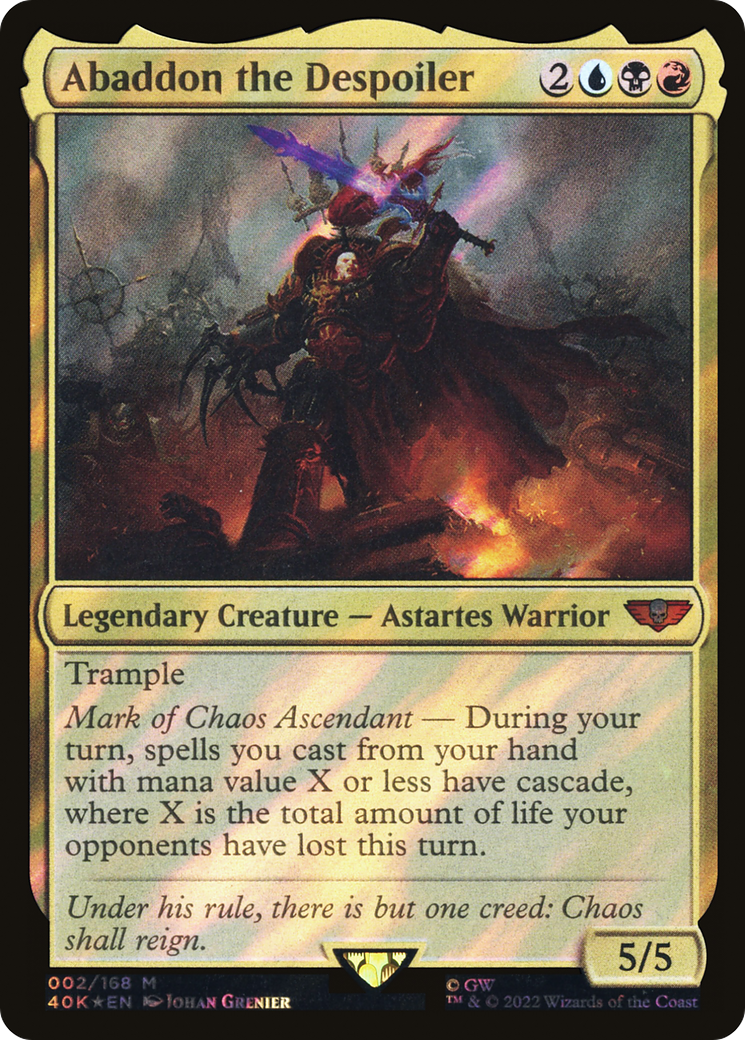
Abaddon the Despoiler
Abaddon the Despoiler
Legendary Creature — Astartes Warrior
5/5
Trample
Mark of Chaos Ascendant — During your turn, spells you cast from your hand with mana value X or less have cascade, where X is the total amount of life your opponents have lost this turn.
-
1
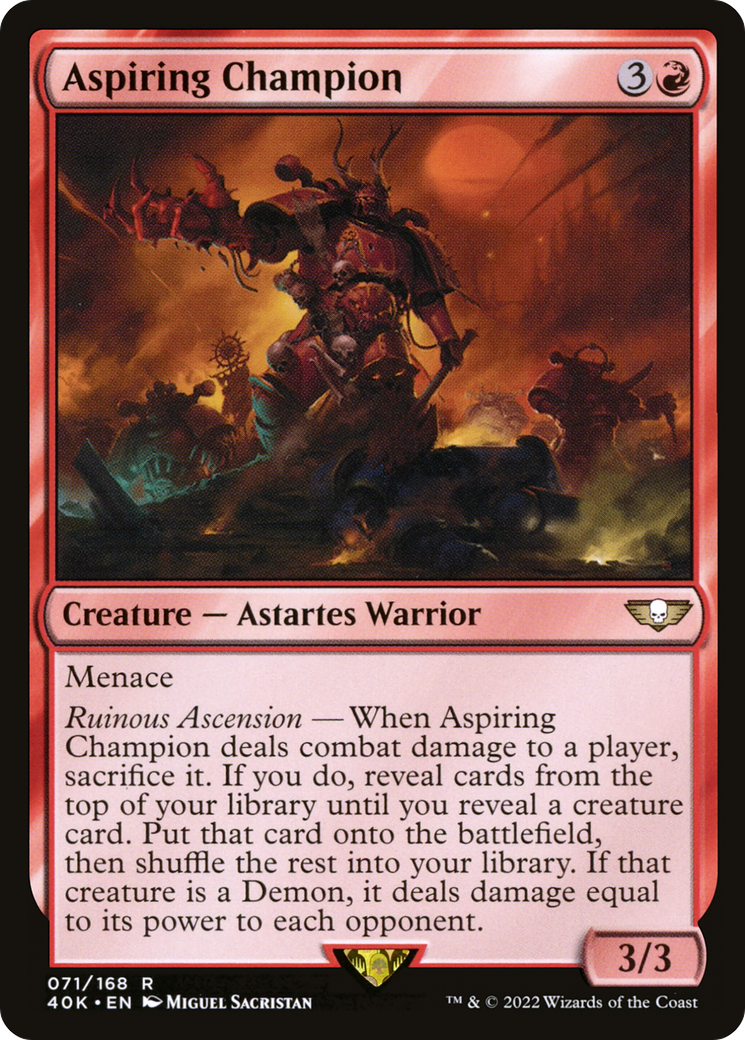
Aspiring Champion
Aspiring Champion
Creature — Astartes Warrior
3/3
Menace
Ruinous Ascension — When this creature deals combat damage to a player, sacrifice it. If you do, reveal cards from the top of your library until you reveal a creature card. Put that card onto the battlefield, then shuffle the rest into your library. If that creature is a Demon, it deals damage equal to its power to each opponent.
- If you still control Aspiring Champion as its triggered ability resolves, you must sacrifice it. You can't choose not to sacrifice it.
-
1
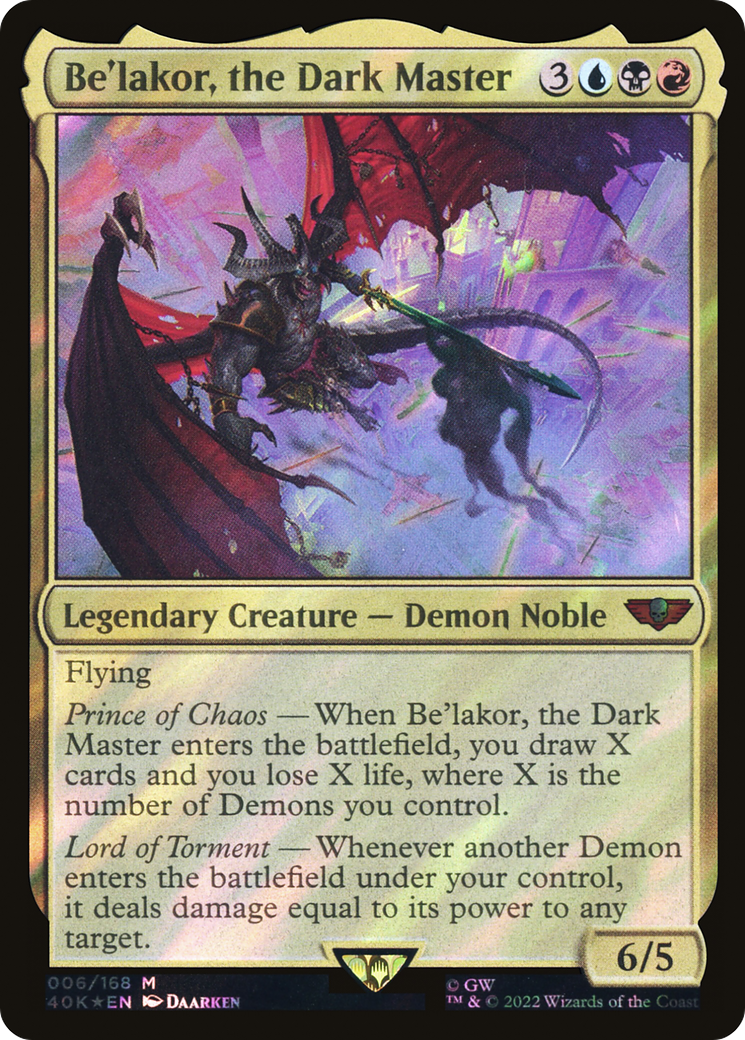
Be'lakor, the Dark Master
Be'lakor, the Dark Master
Legendary Creature — Demon Noble
6/5
Flying
Prince of Chaos — When Be'lakor, the Dark Master enters, you draw X cards and you lose X life, where X is the number of Demons you control.
Lord of Torment — Whenever another Demon you control enters, it deals damage equal to its power to any target.
- The number of Demons you control is counted only as Be'lakor, the Dark Master's ability resolves. If Be'lakor is still on the battlefield, it will count itself.
-
1
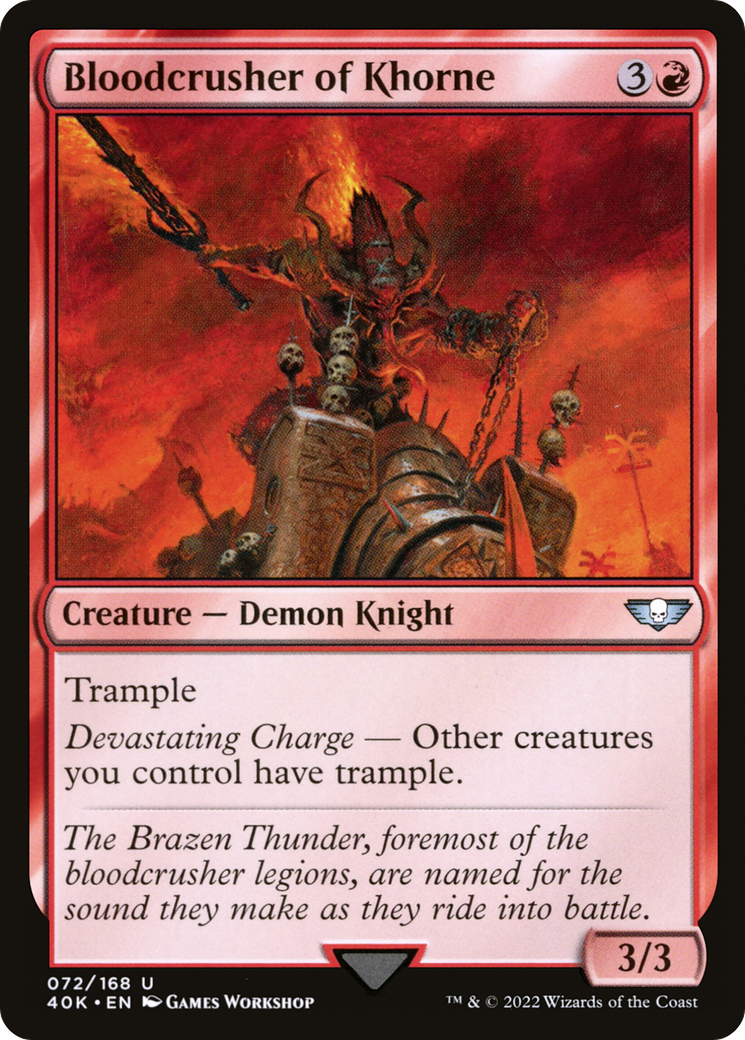
Bloodcrusher of Khorne
Bloodcrusher of Khorne
Creature — Demon Knight
3/3
Trample
Devastating Charge — Other creatures you control have trample.
-
1
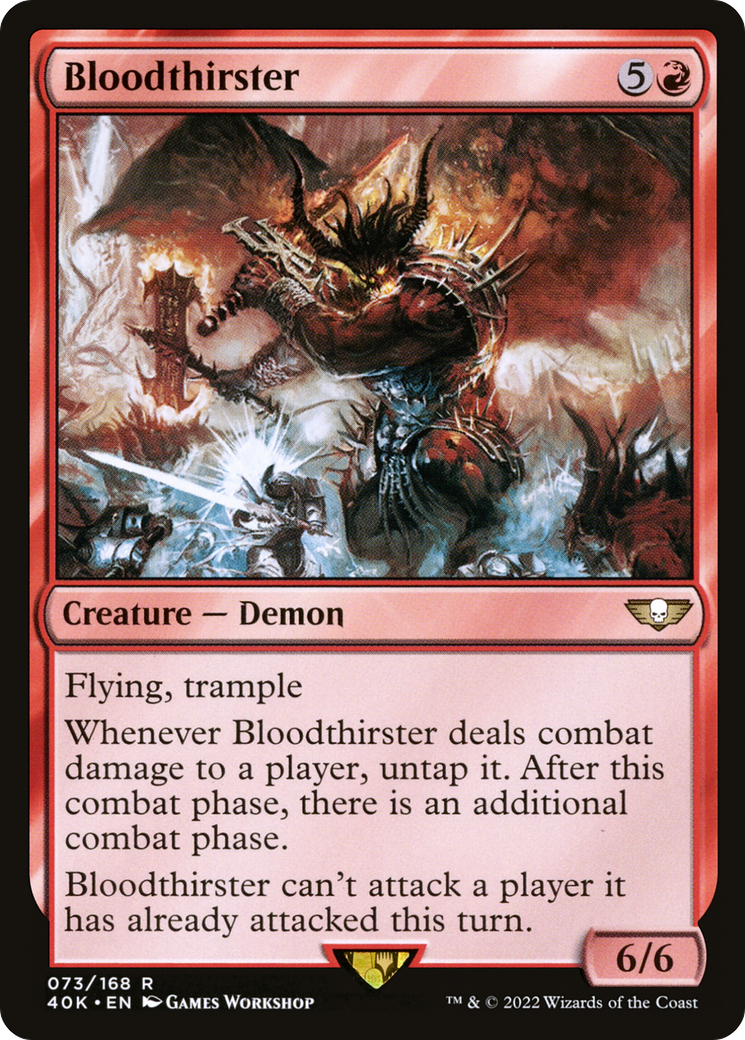
Bloodthirster
Bloodthirster
Creature — Demon
6/6
Flying, trample
Whenever this creature deals combat damage to a player, untap it. After this phase, there is an additional combat phase.
This creature can't attack a player it has already attacked this turn.
-
1
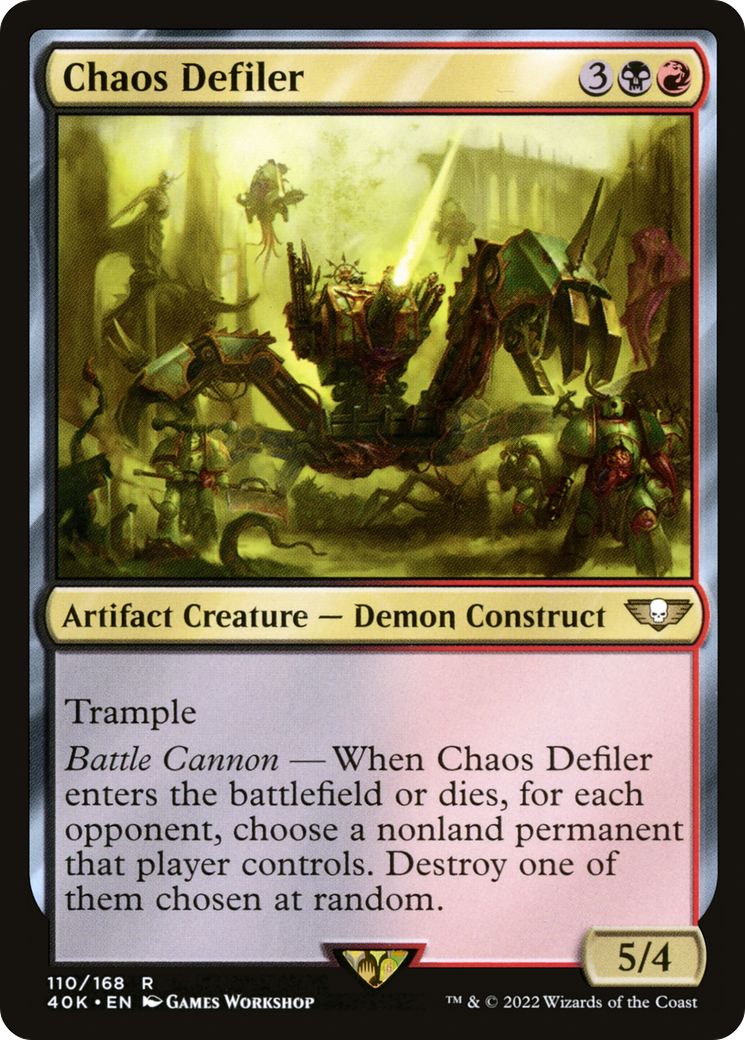
Chaos Defiler
Chaos Defiler
Artifact Creature — Demon Construct
5/4
Trample
Battle Cannon — When this creature enters or dies, for each opponent, choose a nonland permanent that player controls. Destroy one of them chosen at random.
- If you choose one or more permanents with indestructible, and there are any permanents chosen which do not have indestructible, one of the permanents without indestructible will be randomly chosen and destroyed.
-
1
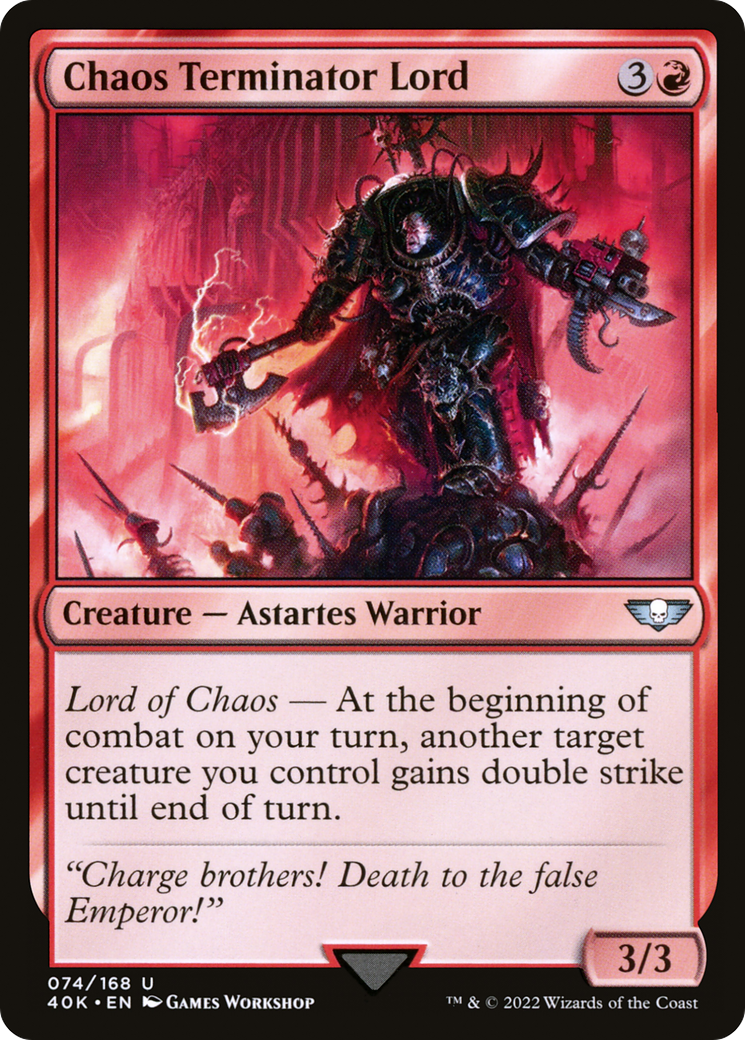
Chaos Terminator Lord
Chaos Terminator Lord
Creature — Astartes Warrior
3/3
Lord of Chaos — At the beginning of combat on your turn, another target creature you control gains double strike until end of turn.
-
1
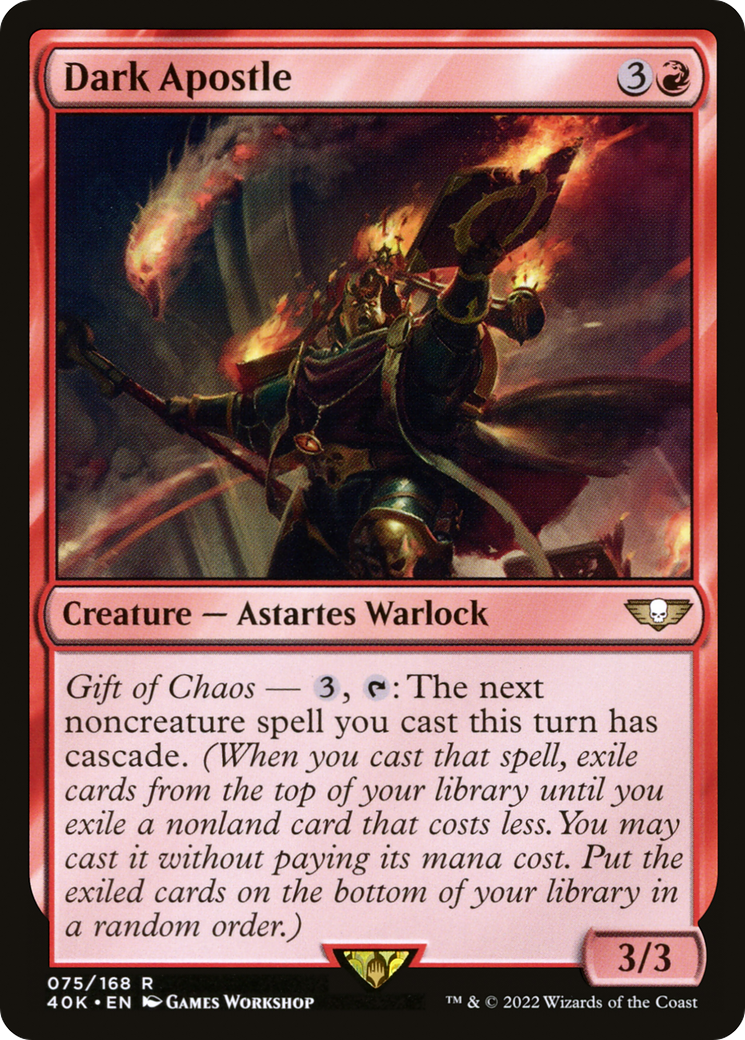
Dark Apostle
Dark Apostle
Creature — Astartes Warlock
3/3
Gift of Chaos — , : The next noncreature spell you cast this turn has cascade. (When you cast that spell, exile cards from the top of your library until you exile a nonland card that costs less. You may cast it without paying its mana cost. Put the exiled cards on the bottom in a random order.)
- As Dark Apostle's activated ability resolves, it creates a continuous effect that won't begin to apply until you start casting a noncreature spell this turn. It applies to that spell and the timestamp of that effect is the time that the spell was put on the stack.
- If you activate the ability of more than one Dark Apostle (or the same one more than once) in the same turn, the next noncreature spell you cast will have that many instances of cascade, each of which will trigger separately.
- See also "Returning Keyword Ability: Cascade" in the General Notes section.
- A spell's mana value is determined only by its mana cost. Ignore any alternative costs, additional costs, cost increases, or cost reductions.
- Cascade triggers when you cast the spell, meaning that it resolves before that spell. If you end up casting the exiled card, it will go on the stack above the spell with cascade.
- When the cascade ability resolves, you must exile cards. The only optional part of the ability is whether or not you cast the last card exiled.
- If a spell with cascade is countered, the cascade ability will still resolve normally.
- You exile the cards face up. All players will be able to see them.
- If you cast a card "without paying its mana cost," you can't choose to cast it for any alternative costs. You can, however, pay additional costs. If the card has any mandatory additional costs, you must pay those to cast the card.
- If the card has in its mana cost, you must choose 0 as the value of X when casting it without paying its mana cost.
- Due to a 2021 rules change to cascade, not only do you stop exiling cards if you exile a nonland card with lesser mana value than the spell with cascade, but the resulting spell you cast must also have lesser mana value. Previously, in cases where a card's mana value differed from the resulting spell, such as with some modal double-faced cards or cards with an Adventure, you could cast a spell with a higher mana value than the exiled card.
- Two new cards in this set give the next spell you cast cascade. This means that the next spell you cast gains cascade as you begin to cast it by putting it on the stack, and the cascade ability will trigger when you finish casting that spell.
-
1
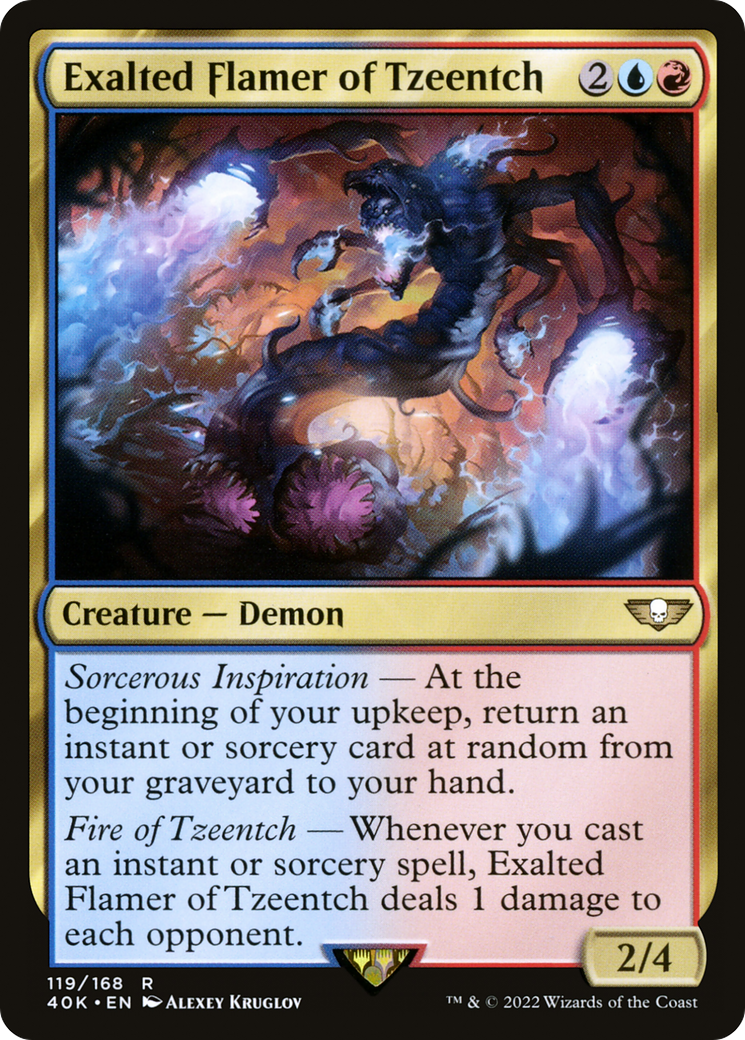
Exalted Flamer of Tzeentch
Exalted Flamer of Tzeentch
Creature — Demon
2/4
Sorcerous Inspiration — At the beginning of your upkeep, return an instant or sorcery card at random from your graveyard to your hand.
Fire of Tzeentch — Whenever you cast an instant or sorcery spell, this creature deals 1 damage to each opponent.
-
1
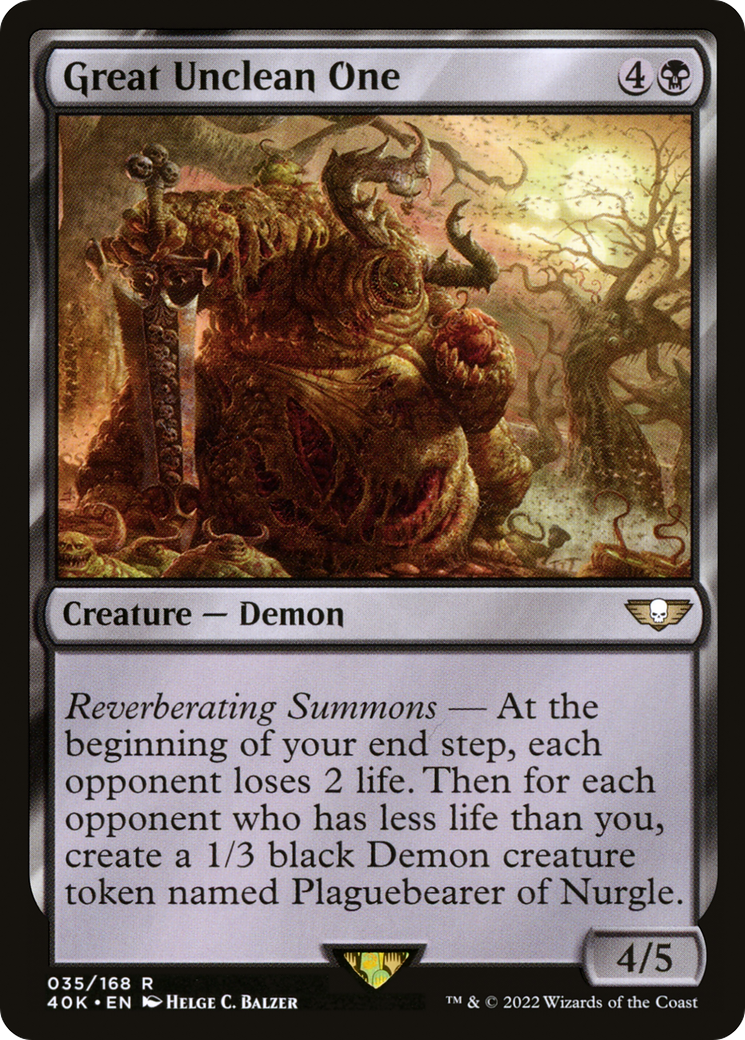
Great Unclean One
Great Unclean One
Creature — Demon
4/5
Reverberating Summons — At the beginning of your end step, each opponent loses 2 life. Then for each opponent who has less life than you, create a 1/3 black Demon creature token named Plaguebearer of Nurgle.
-
1
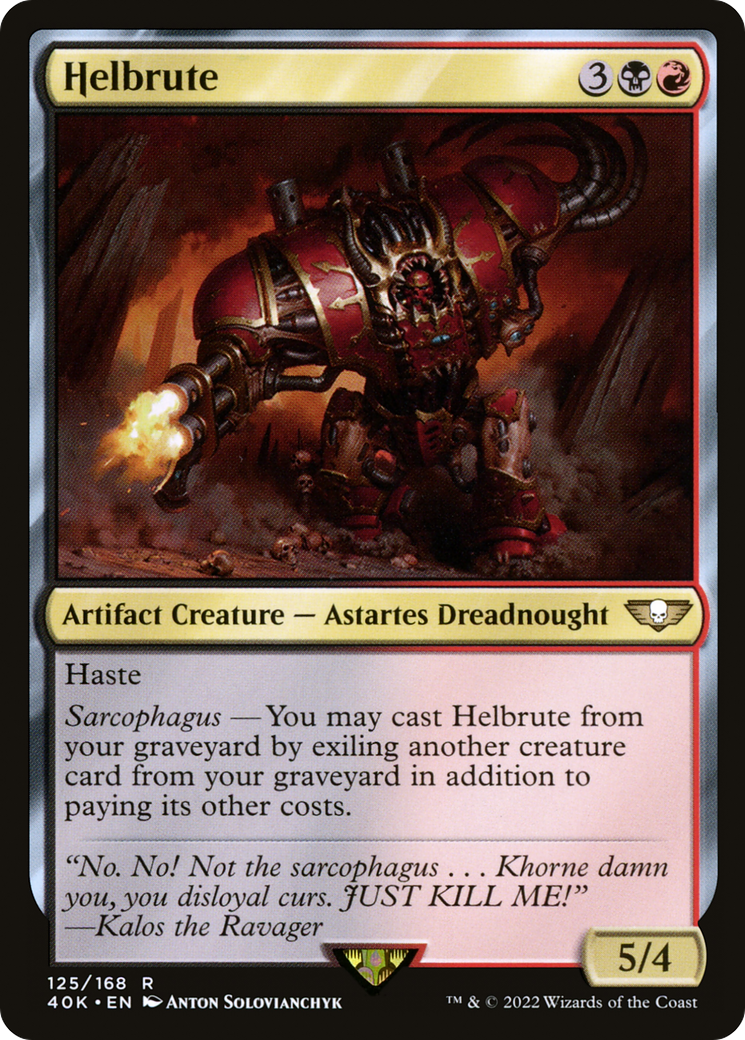
Helbrute
Helbrute
Artifact Creature — Astartes Dreadnought
5/4
Haste
Sarcophagus — You may cast this card from your graveyard by exiling another creature card from your graveyard in addition to paying its other costs.
- You still need to follow all normal timing restrictions when casting Helbrute from your graveyard using the permission granted by its last ability. Usually, this means you may only cast it during one of your own main phases while the stack is empty.
-
1
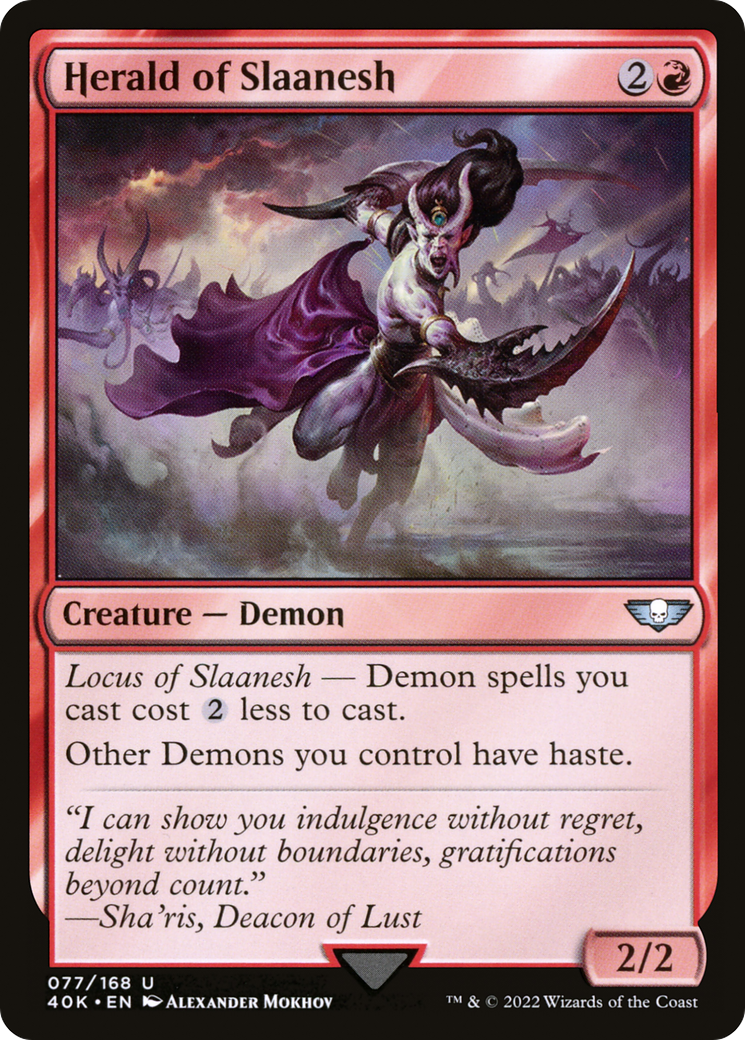
Herald of Slaanesh
Herald of Slaanesh
Creature — Demon
2/2
Locus of Slaanesh — Demon spells you cast cost less to cast.
Other Demons you control have haste.
- Herald of Slaanesh's first ability only reduces the generic mana component of costs. It cannot reduce the cost of colored mana components.
-
1
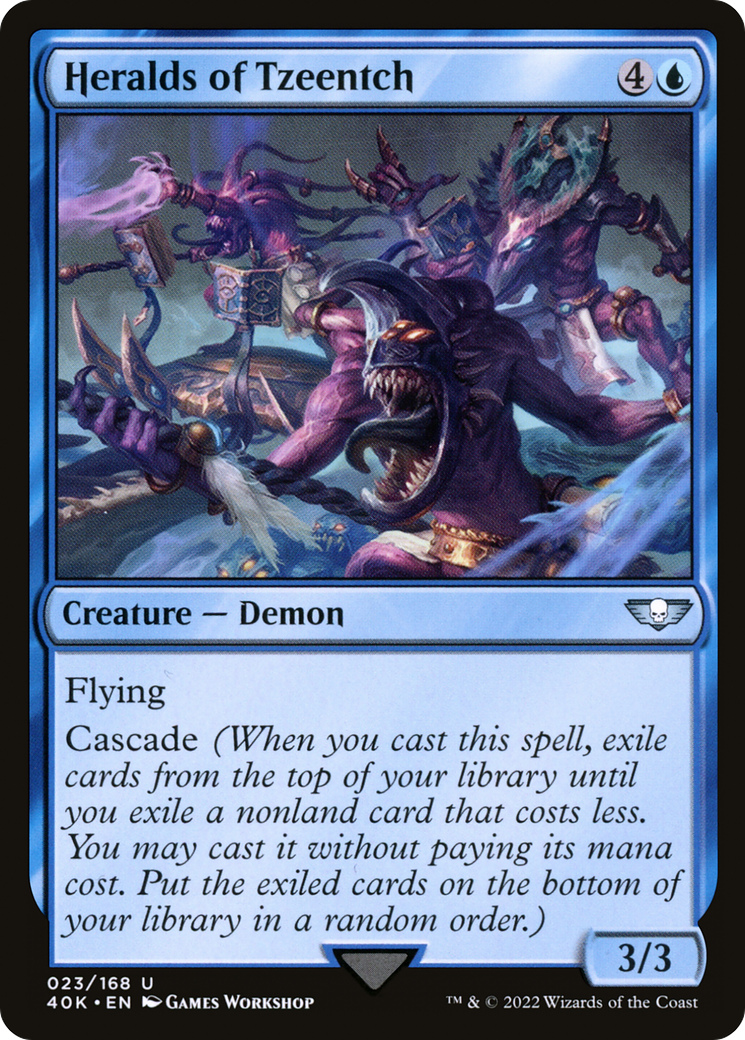
Heralds of Tzeentch
Heralds of Tzeentch
Creature — Demon
3/3
Flying
Cascade (When you cast this spell, exile cards from the top of your library until you exile a nonland card that costs less. You may cast it without paying its mana cost. Put the exiled cards on the bottom in a random order.)
- A spell's mana value is determined only by its mana cost. Ignore any alternative costs, additional costs, cost increases, or cost reductions.
- Cascade triggers when you cast the spell, meaning that it resolves before that spell. If you end up casting the exiled card, it will go on the stack above the spell with cascade.
- When the cascade ability resolves, you must exile cards. The only optional part of the ability is whether or not you cast the last card exiled.
- If a spell with cascade is countered, the cascade ability will still resolve normally.
- You exile the cards face up. All players will be able to see them.
- If you cast a card "without paying its mana cost," you can't choose to cast it for any alternative costs. You can, however, pay additional costs. If the card has any mandatory additional costs, you must pay those to cast the card.
- If the card has in its mana cost, you must choose 0 as the value of X when casting it without paying its mana cost.
- Due to a 2021 rules change to cascade, not only do you stop exiling cards if you exile a nonland card with lesser mana value than the spell with cascade, but the resulting spell you cast must also have lesser mana value. Previously, in cases where a card's mana value differed from the resulting spell, such as with some modal double-faced cards or cards with an Adventure, you could cast a spell with a higher mana value than the exiled card.
- Two new cards in this set give the next spell you cast cascade. This means that the next spell you cast gains cascade as you begin to cast it by putting it on the stack, and the cascade ability will trigger when you finish casting that spell.
-
1
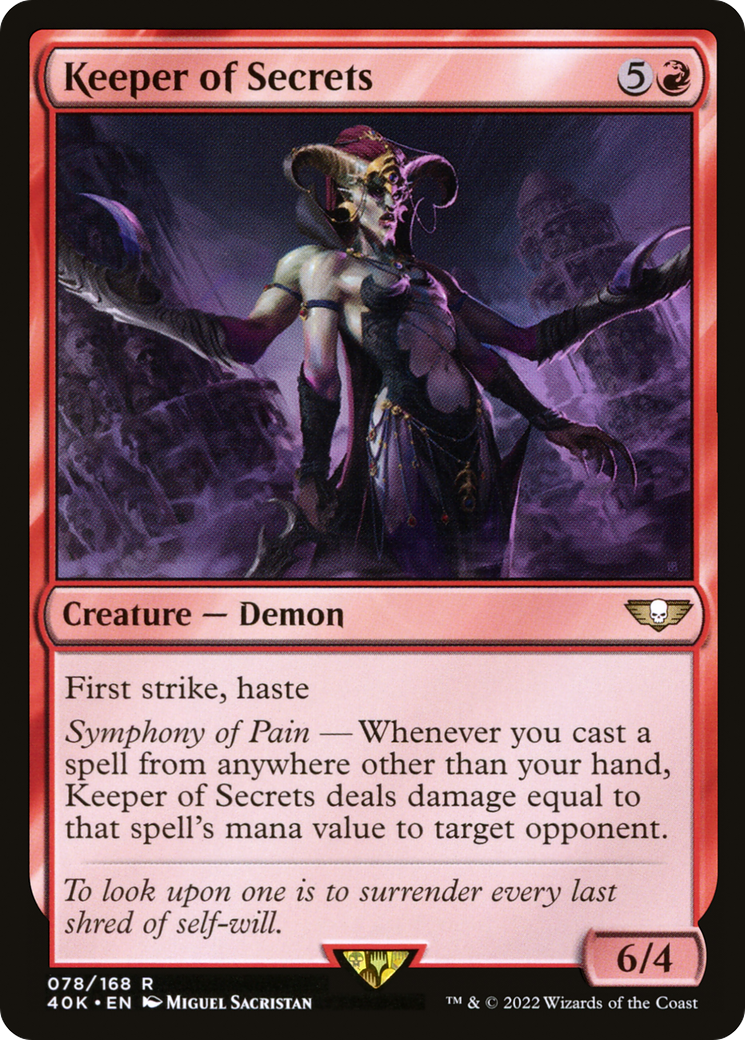
Keeper of Secrets
Keeper of Secrets
Creature — Demon
6/4
First strike, haste
Symphony of Pain — Whenever you cast a spell from anywhere other than your hand, this creature deals damage equal to that spell's mana value to target opponent.
-
1
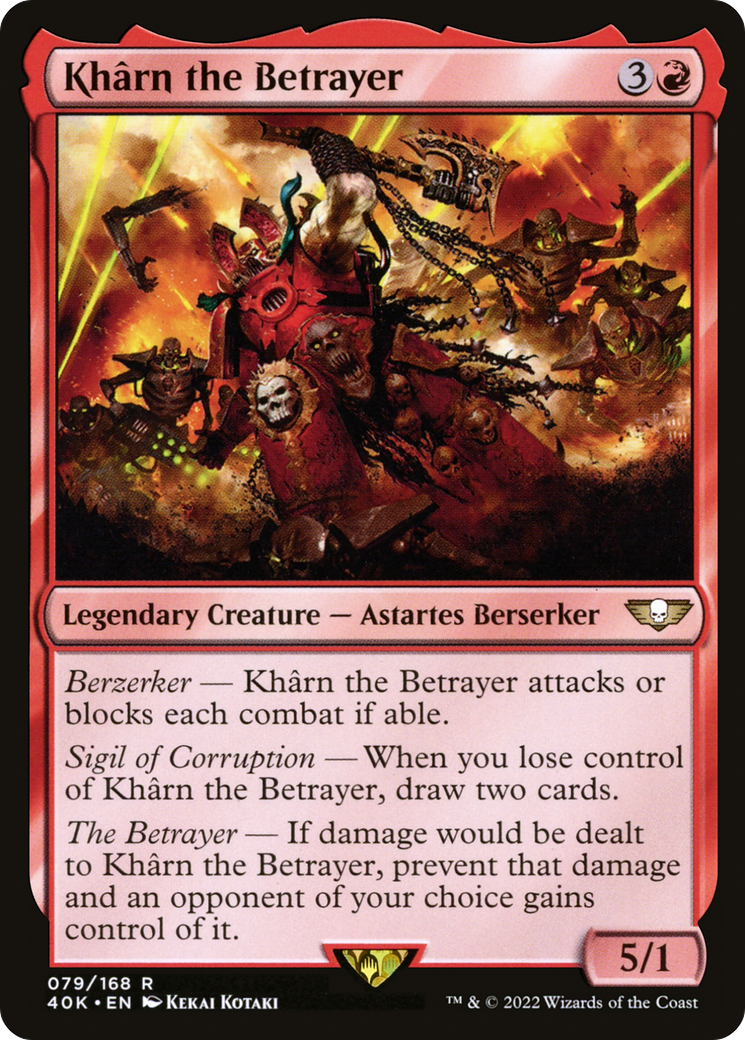
Khârn the Betrayer
Khârn the Betrayer
Legendary Creature — Astartes Berserker
5/1
Berzerker — Khârn the Betrayer attacks or blocks each combat if able.
Sigil of Corruption — When you lose control of Khârn the Betrayer, draw two cards.
The Betrayer — If damage would be dealt to Khârn the Betrayer, prevent that damage and an opponent of your choice gains control of it.
- You lose control of Khârn the Betrayer when it leaves the battlefield or another player gains control of it.
- An opponent gaining control of it is part of the replacement effect and happens immediately, even if you are in the middle of resolving the spell or ability and it has more instructions to perform after taking damage.
- In contrast, the Sigil of Corruption ability is a triggered ability, and it won't go onto the stack until after the spell or ability that tried to deal damage finishes resolving.
- In some cases, a single spell or ability will deal damage to this creature multiple times during its resolution. In that case, a new player gains control of it each time, its ability triggers once each time, and the appropriate players control those triggers. After that spell or ability is done resolving, all of those triggers are put onto the stack in turn order, starting with the active player (or the next player in turn order if the active player isn't involved). Usually, this means that the cards are drawn in a different order than the control-changing effects took place.
-
1
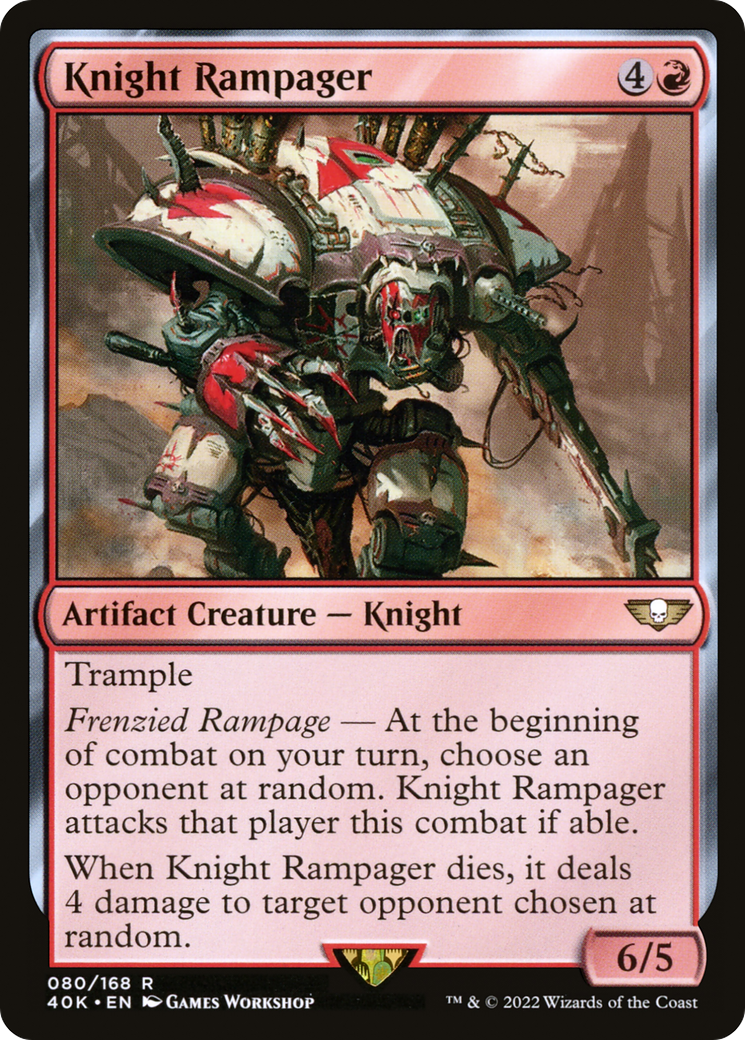
Knight Rampager
Knight Rampager
Artifact Creature — Knight
6/5
Trample
Frenzied Rampage — At the beginning of combat on your turn, choose an opponent at random. This creature attacks that player this combat if able.
When this creature dies, it deals 4 damage to target opponent chosen at random.
- If Knight Rampager has multiple attack requirements applied to it, usually because it was also goaded, you must obey as many of the requirements as possible without violating any restrictions (such as effects that say it "can't attack") that might apply. For example, if the player chosen randomly also goaded Knight Rampager, then Knight Rampager must attack, but would be allowed to attack any player.
- If the spell you cast with the cascade ability is a creature, it will have entered the battlefield this turn when Let the Galaxy Burn resolves and will not take damage from Let the Galaxy Burn's effect.
-
1
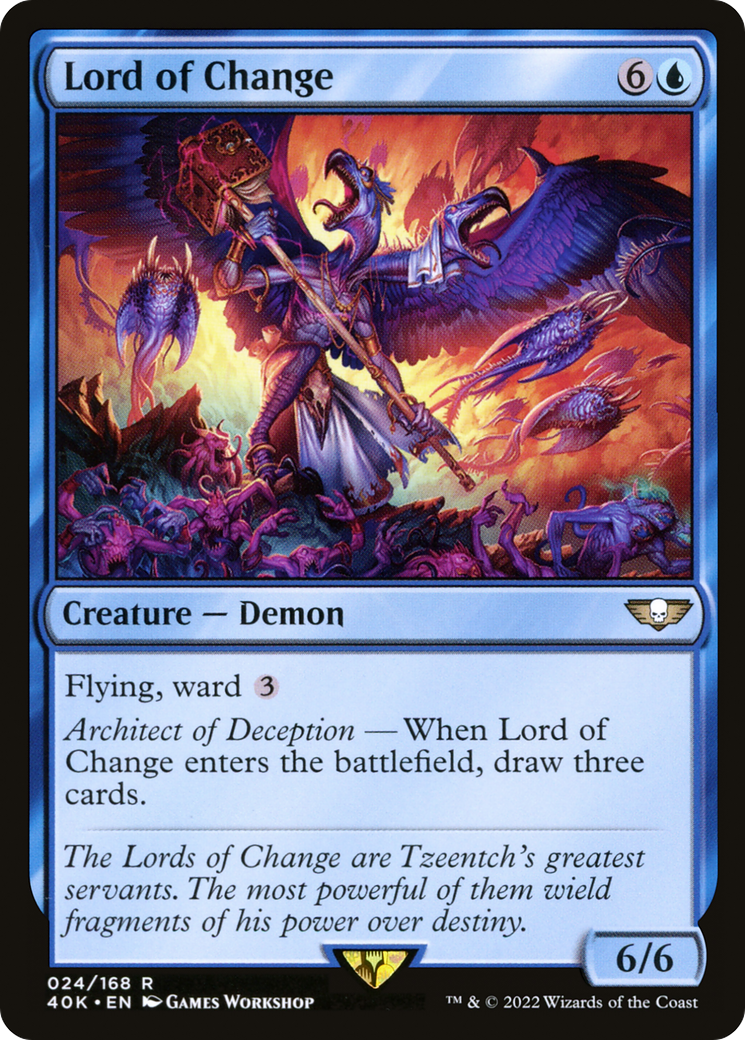
Lord of Change
Lord of Change
Creature — Demon
6/6
Flying, ward
Architect of Deception — When this creature enters, draw three cards.
-
1
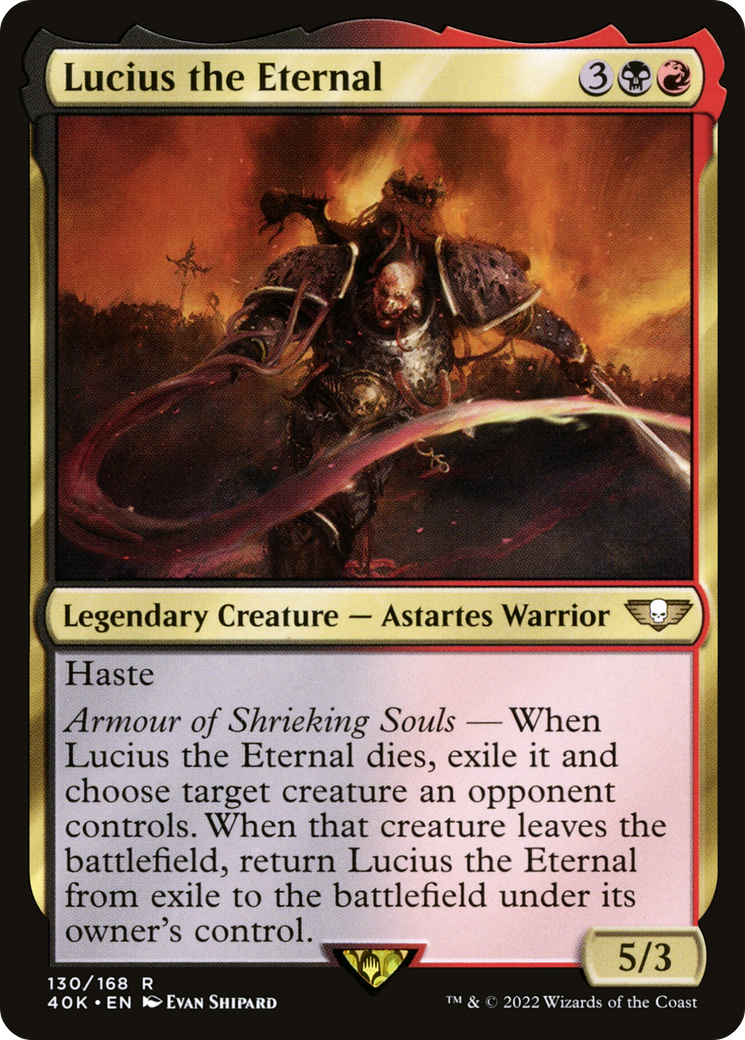
Lucius the Eternal
Lucius the Eternal
Legendary Creature — Astartes Warrior
5/3
Haste
Armour of Shrieking Souls — When Lucius the Eternal dies, exile it and choose target creature an opponent controls. When that creature leaves the battlefield, return this card from exile to the battlefield under its owner's control.
- If the target creature leaves the battlefield before Lucius the Eternal's ability resolves, Lucius will stay in your graveyard and will not be exiled or return to the battlefield.
-
1
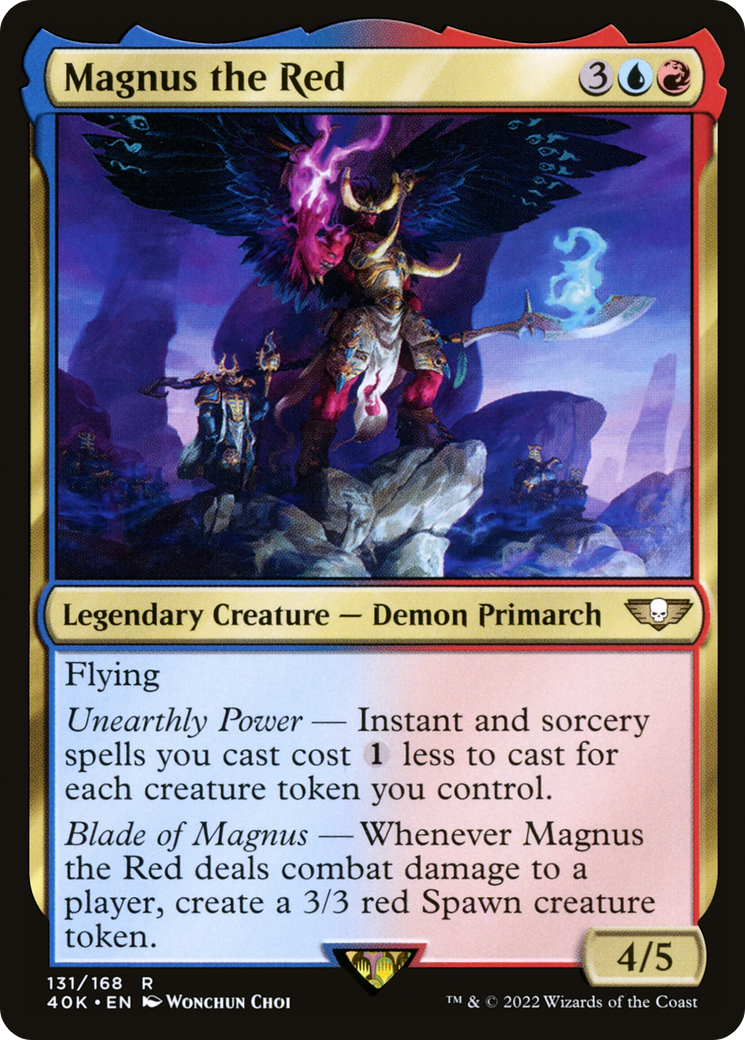
Magnus the Red
Magnus the Red
Legendary Creature — Demon Primarch
4/5
Flying
Unearthly Power — Instant and sorcery spells you cast cost less to cast for each creature token you control.
Blade of Magnus — Whenever Magnus the Red deals combat damage to a player, create a 3/3 red Spawn creature token.
- The total cost to cast a spell is locked in before you pay that cost. For example, if you control three creature tokens, including one you can sacrifice to add , the total cost to cast an instant with mana cost is . Then you can sacrifice the creature when you activate mana abilities just before paying the cost.
- If you activate a card's unearth ability but that card is removed from your graveyard before the ability resolves, that unearth ability will resolve and do nothing.
- Activating a permanent card's unearth ability isn't the same as casting it as a spell. The unearth ability is put on the stack, but the card is not. Spells and abilities that interact with activated abilities (such as Stifle) will interact with unearth, but spells and abilities that interact with spells (such as Cancel) will not.
- If a permanent returned to the battlefield by an unearth ability would leave it for any reason, it's exiled instead—unless the spell or ability that's causing it to leave the battlefield is actually trying to exile it. In that case, the spell or ability succeeds at exiling the permanent. If the spell or ability later returns the card to the battlefield, it will return as a new object with no relation to its previous existence. The unearth effect will no longer apply to it.
- At the beginning of the end step, a permanent returned to the battlefield with unearth is exiled. This is a delayed triggered ability, and it can be countered by effects that counter triggered abilities. If the ability is countered, the permanent will stay on the battlefield and the delayed trigger won't trigger again. However, the replacement effect will still exile it if it eventually leaves the battlefield.
- Unearth grants haste to the permanent that's returned to the battlefield. However, neither of the "exile" abilities is granted to that permanent. If that creature loses all its abilities, it will still be exiled at the beginning of the end step, and if it would leave the battlefield, it is still exiled instead.
-
1
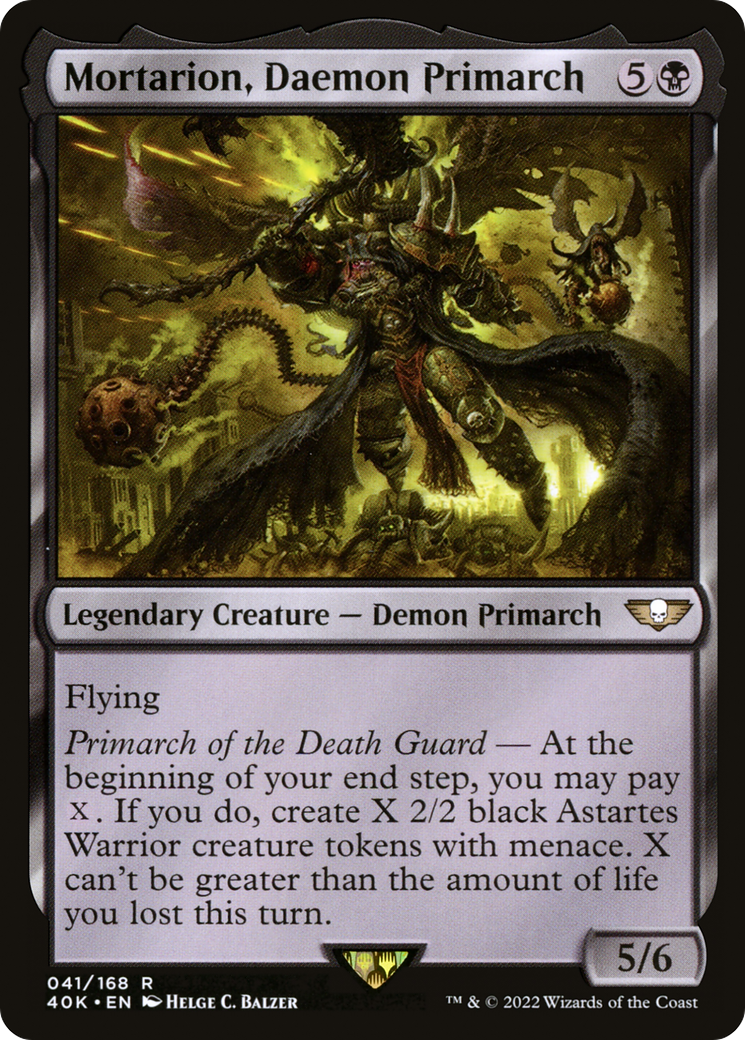
Mortarion, Daemon Primarch
Mortarion, Daemon Primarch
Legendary Creature — Demon Primarch
5/6
Flying
Primarch of the Death Guard — At the beginning of your end step, you may pay . If you do, create X 2/2 black Astartes Warrior creature tokens with menace. X can't be greater than the amount of life you lost this turn.
- Mortarion, Demon Primarch's ability looks only at the amount of life you've lost this turn, regardless of any life you may have gained. For example, if you lost 3 life due to combat damage, but gained 2 life later in the turn, X may be up to 3 for this ability.
- If a spell or ability sets a player's life total to a specified amount, that player gains or loses the appropriate amount of life. For example, if your life total is 20 and an effect sets your life total to 15, you lost 5 life.
-
1
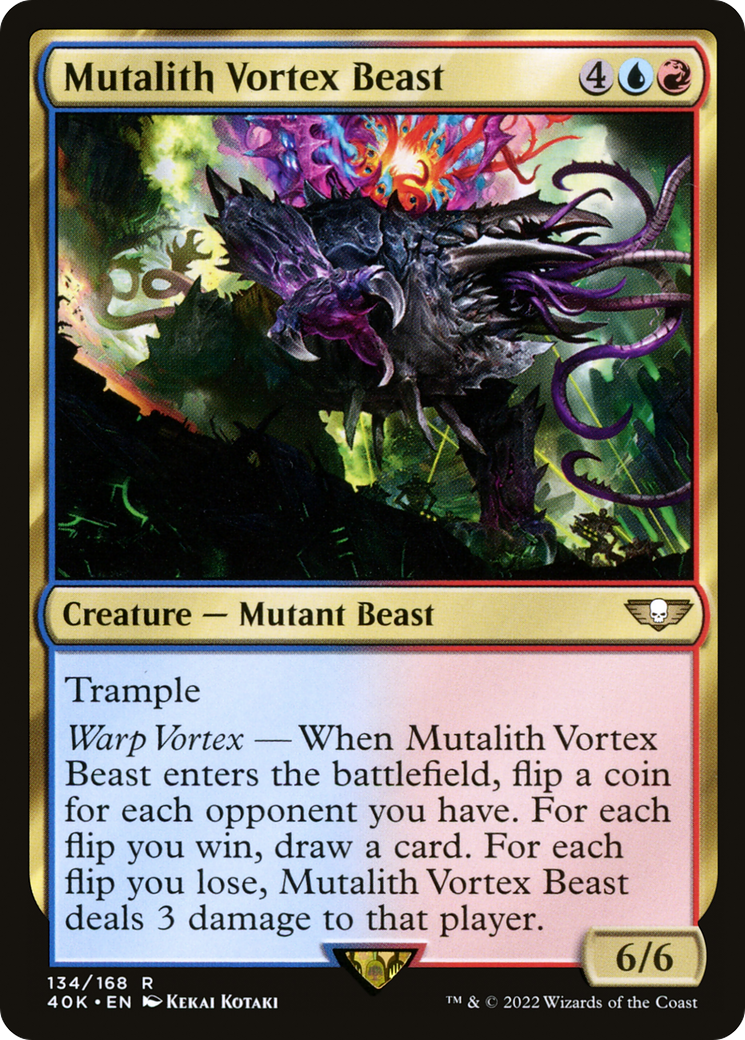
Mutalith Vortex Beast
Mutalith Vortex Beast
Creature — Mutant Beast
6/6
Trample
Warp Vortex — When this creature enters, flip a coin for each opponent you have. For each flip you win, draw a card. For each flip you lose, this creature deals 3 damage to that player.
- Mutalith's Vortex Beast deals 3 damage to the appropriate player for each lost flip, not 3 damage to each of those players for each lost flip.
-
1
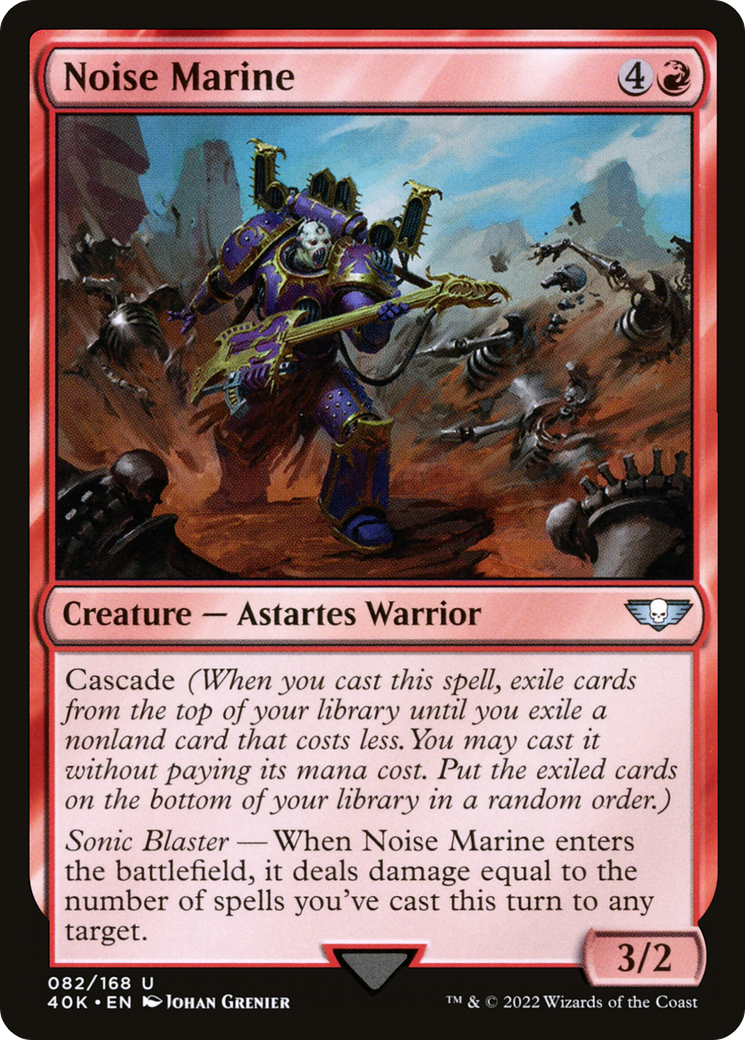
Noise Marine
Noise Marine
Creature — Astartes Warrior
3/2
Cascade (When you cast this spell, exile cards from the top of your library until you exile a nonland card that costs less. You may cast it without paying its mana cost. Put the exiled cards on the bottom in a random order.)
Sonic Blaster — When this creature enters, it deals damage equal to the number of spells you've cast this turn to any target.
- The spell you cast due to cascade resolves before Noise Marine, so when its enters-the-battlefield ability resolves it will count that spell as a spell you've cast this turn.
- A spell's mana value is determined only by its mana cost. Ignore any alternative costs, additional costs, cost increases, or cost reductions.
- Cascade triggers when you cast the spell, meaning that it resolves before that spell. If you end up casting the exiled card, it will go on the stack above the spell with cascade.
- When the cascade ability resolves, you must exile cards. The only optional part of the ability is whether or not you cast the last card exiled.
- If a spell with cascade is countered, the cascade ability will still resolve normally.
- You exile the cards face up. All players will be able to see them.
- If you cast a card "without paying its mana cost," you can't choose to cast it for any alternative costs. You can, however, pay additional costs. If the card has any mandatory additional costs, you must pay those to cast the card.
- If the card has in its mana cost, you must choose 0 as the value of X when casting it without paying its mana cost.
- Due to a 2021 rules change to cascade, not only do you stop exiling cards if you exile a nonland card with lesser mana value than the spell with cascade, but the resulting spell you cast must also have lesser mana value. Previously, in cases where a card's mana value differed from the resulting spell, such as with some modal double-faced cards or cards with an Adventure, you could cast a spell with a higher mana value than the exiled card.
- Two new cards in this set give the next spell you cast cascade. This means that the next spell you cast gains cascade as you begin to cast it by putting it on the stack, and the cascade ability will trigger when you finish casting that spell.
-
1
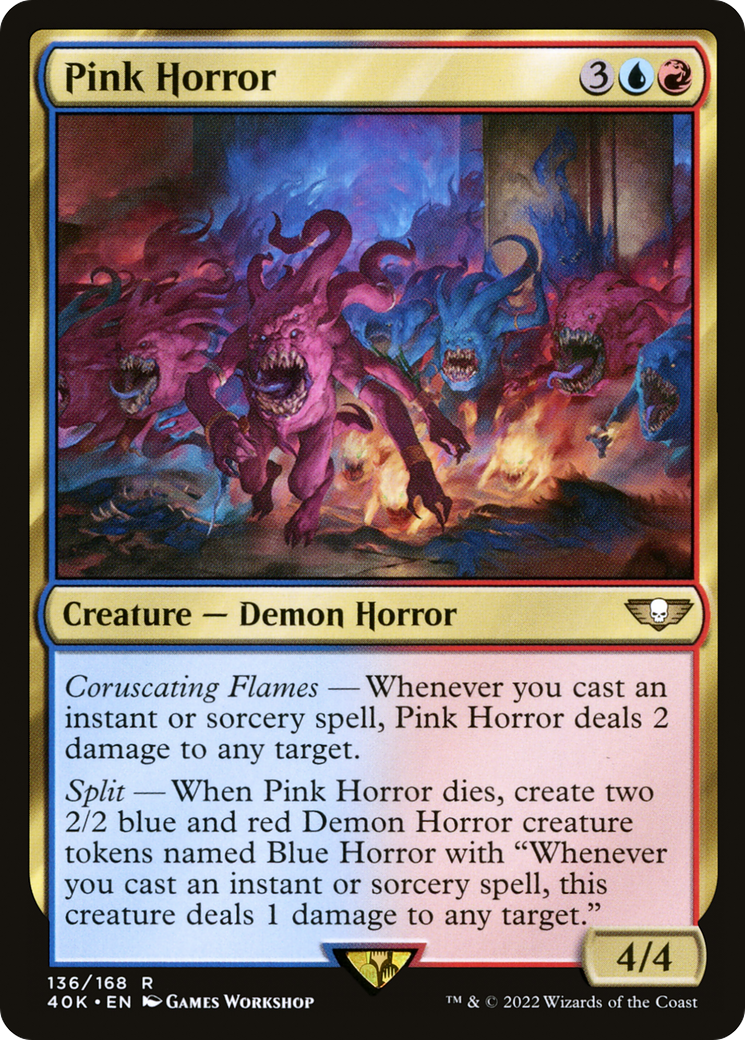
Pink Horror
Pink Horror
Creature — Demon Horror
4/4
Coruscating Flames — Whenever you cast an instant or sorcery spell, this creature deals 2 damage to any target.
Split — When this creature dies, create two 2/2 blue and red Demon Horror creature tokens named Blue Horror with "Whenever you cast an instant or sorcery spell, this token deals 1 damage to any target."
-
1
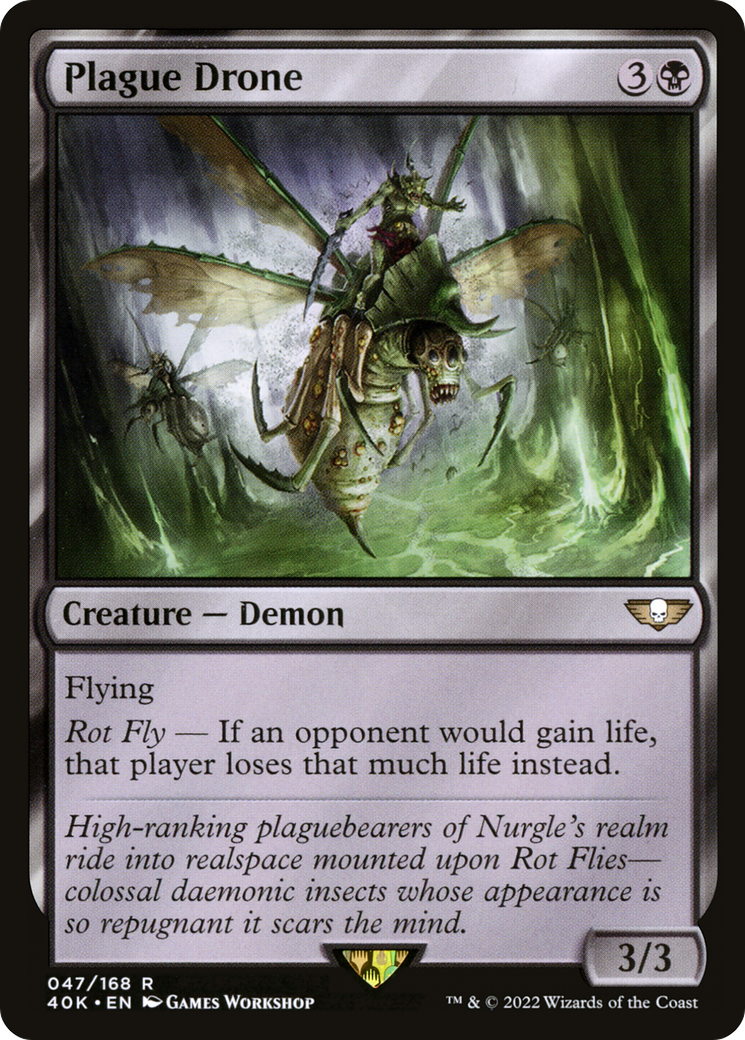
Plague Drone
Plague Drone
Creature — Demon
3/3
Flying
Rot Fly — If an opponent would gain life, that player loses that much life instead.
- If more than one replacement effect tries to apply to a life gain event, the player who would gain life chooses the order in which they apply. For example, if a player who controls Alhammarret's Archive would gain 3 life while Plague Drone is on the battlefield, that player may choose to have the 3 life become doubled to 6 life and then lose 6 life. The player may also choose to apply Plague Drone first, turning "gain 3 life" into "lose 3 life." Alhammarret's Archive would then not apply.
- Having more than one Plague Drone on the battlefield doesn't have any noticeable effect on life gain. Once the effect of one Plague Drone applies, there is no life gain for the others to apply to.
-
1
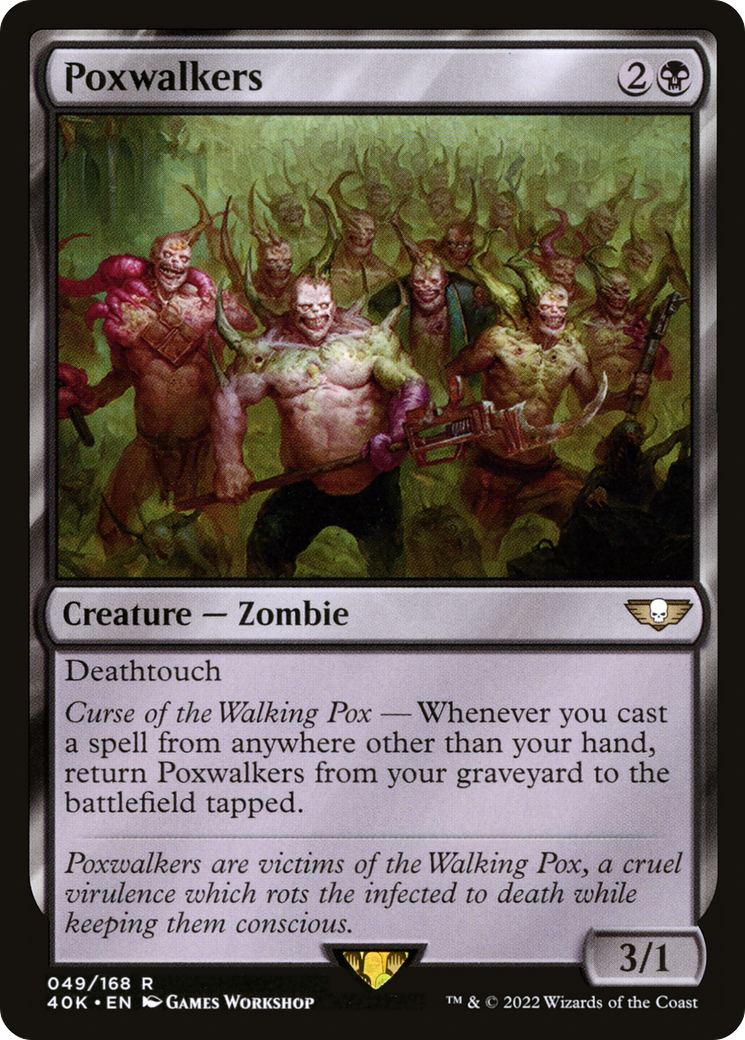
Poxwalkers
Poxwalkers
Creature — Zombie
3/1
Deathtouch
Curse of the Walking Pox — Whenever you cast a spell from anywhere other than your hand, return this card from your graveyard to the battlefield tapped.
-
1
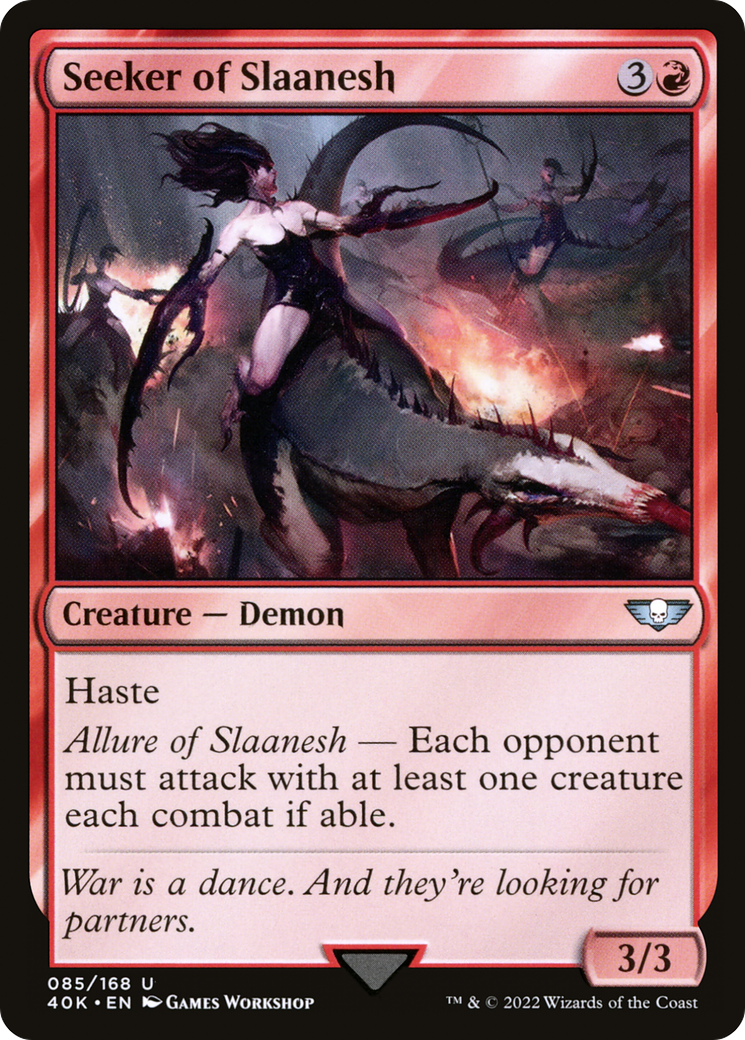
Seeker of Slaanesh
Seeker of Slaanesh
Creature — Demon
3/3
Haste
Allure of Slaanesh — Each opponent must attack with at least one creature each combat if able.
- If a creature isn't able to attack for any reason (such as being tapped as its controller's declare attackers step begins or being affected by "summoning sickness"), that creature doesn't have to attack. If no creatures a player controls are able to attack, Seeker of Slaanesh's requirement has no effect during that combat. If there's a cost associated with having a creature attack, its controller isn't forced to pay that cost, so it doesn't have to attack in that case either.
-
1
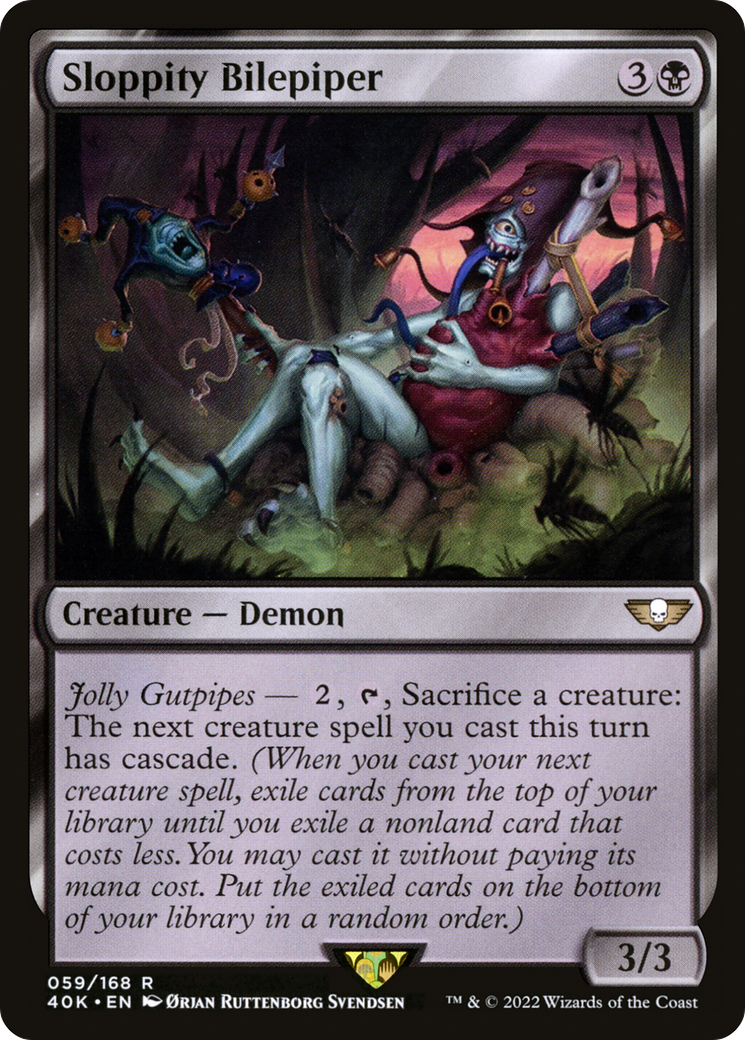
Sloppity Bilepiper
Sloppity Bilepiper
Creature — Demon
3/3
Jolly Gutpipes — , , Sacrifice a creature: The next creature spell you cast this turn has cascade. (When you next cast a creature spell, exile cards from the top of your library until you exile a nonland card that costs less. You may cast it without paying its mana cost. Put the exiled cards on the bottom in a random order.)
- A spell's mana value is determined only by its mana cost. Ignore any alternative costs, additional costs, cost increases, or cost reductions.
- As Sloppity Bilepiper's activated ability resolves, it creates a continuous effect that won't begin to apply until you start casting a creature spell this turn. It applies to that spell and the timestamp of that effect is the time that the object was put on the stack.
- If you activate the ability of more than one Sloppity Bilepiper (or the same one more than once) in the same turn, the next creature spell you cast will have that many instances of cascade, each of which will trigger separately.
- See also "Returning Keyword Ability: Cascade" in general notes.
- Cascade triggers when you cast the spell, meaning that it resolves before that spell. If you end up casting the exiled card, it will go on the stack above the spell with cascade.
- When the cascade ability resolves, you must exile cards. The only optional part of the ability is whether or not you cast the last card exiled.
- If a spell with cascade is countered, the cascade ability will still resolve normally.
- You exile the cards face up. All players will be able to see them.
- If you cast a card "without paying its mana cost," you can't choose to cast it for any alternative costs. You can, however, pay additional costs. If the card has any mandatory additional costs, you must pay those to cast the card.
- If the card has in its mana cost, you must choose 0 as the value of X when casting it without paying its mana cost.
- Due to a 2021 rules change to cascade, not only do you stop exiling cards if you exile a nonland card with lesser mana value than the spell with cascade, but the resulting spell you cast must also have lesser mana value. Previously, in cases where a card's mana value differed from the resulting spell, such as with some modal double-faced cards or cards with an Adventure, you could cast a spell with a higher mana value than the exiled card.
- Two new cards in this set give the next spell you cast cascade. This means that the next spell you cast gains cascade as you begin to cast it by putting it on the stack, and the cascade ability will trigger when you finish casting that spell.
-
1
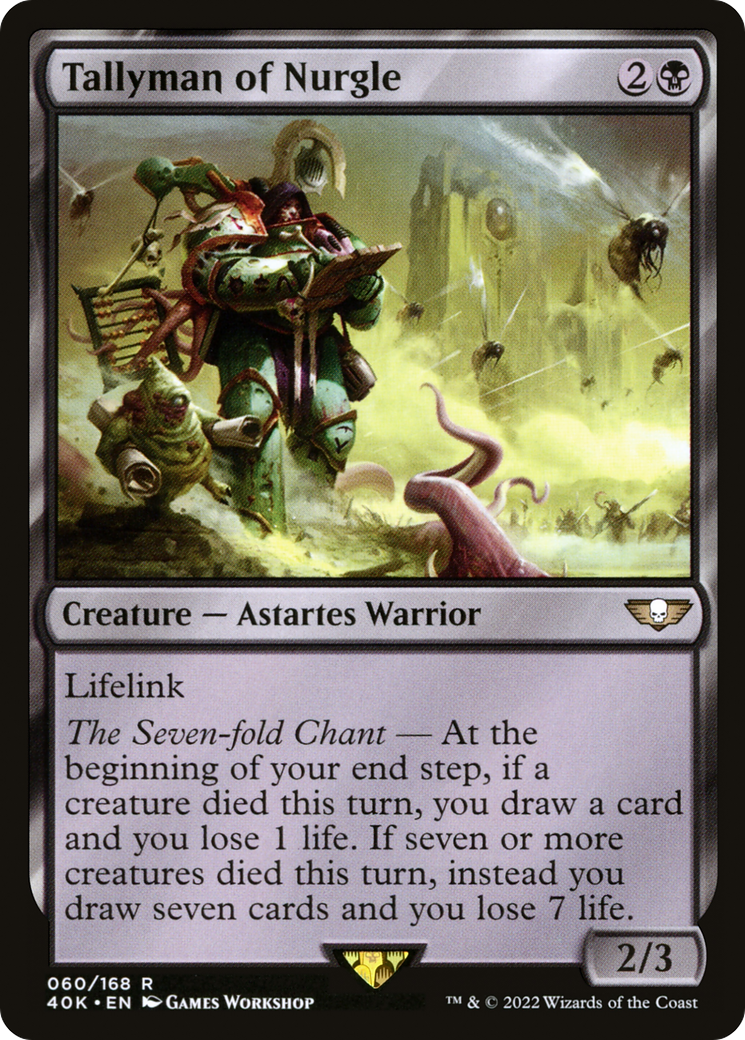
Tallyman of Nurgle
Tallyman of Nurgle
Creature — Astartes Warrior
2/3
Lifelink
The Seven-fold Chant — At the beginning of your end step, if a creature died this turn, you draw a card and you lose 1 life. If seven or more creatures died this turn, instead you draw seven cards and you lose 7 life.
-
1
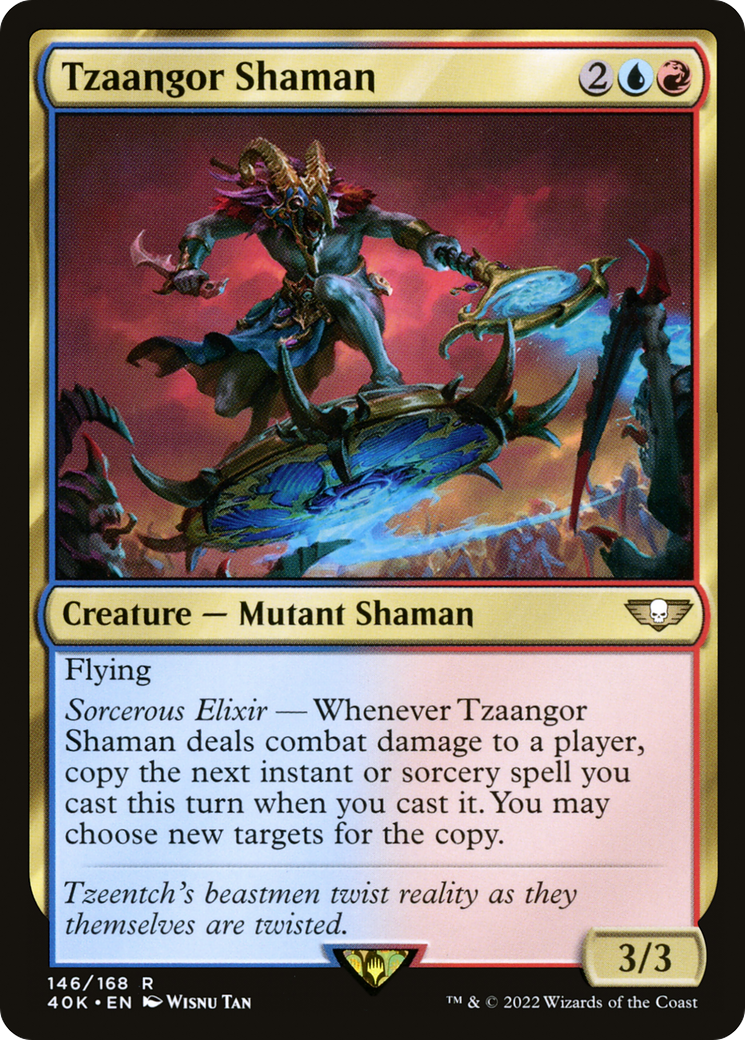
Tzaangor Shaman
Tzaangor Shaman
Creature — Mutant Shaman
3/3
Flying
Sorcerous Elixir — Whenever this creature deals combat damage to a player, copy the next instant or sorcery spell you cast this turn when you cast it. You may choose new targets for the copy.
- If Tzaangor Shaman deals combat damage to a player more than one time in a turn, perhaps because it has gained double strike, its delayed triggered ability will trigger that many times when you cast your next instant or sorcery spell this turn.
-
1
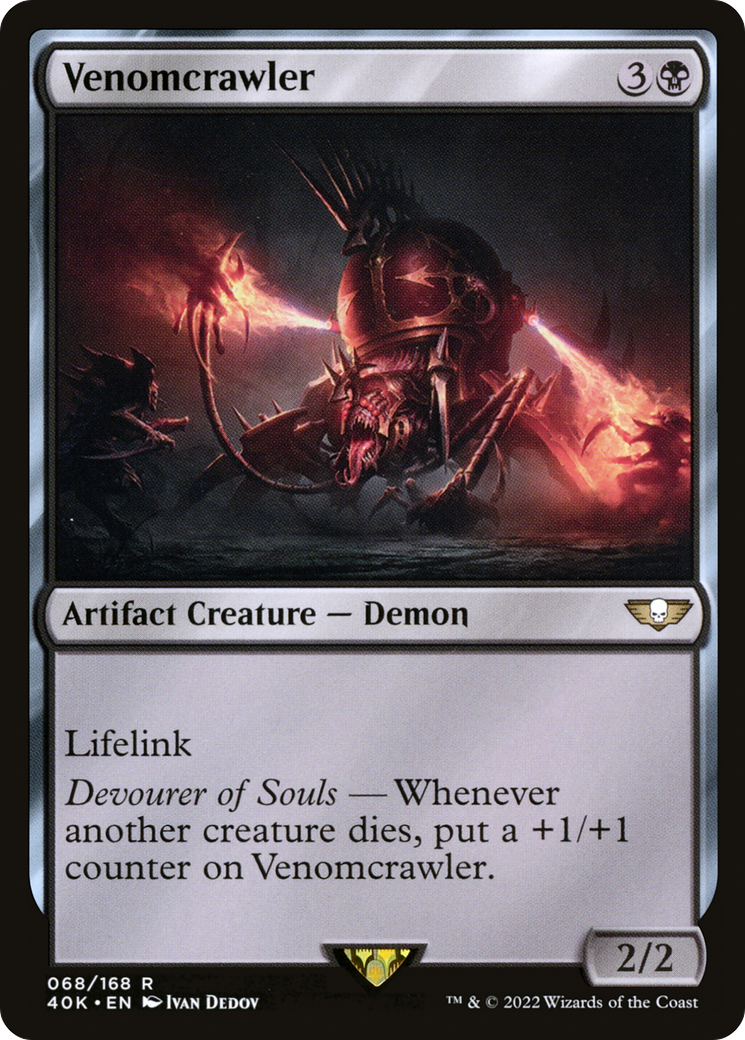
Venomcrawler
Venomcrawler
Artifact Creature — Demon
2/2
Lifelink
Devourer of Souls — Whenever another creature dies, put a +1/+1 counter on this creature.
Instants 10
-
1
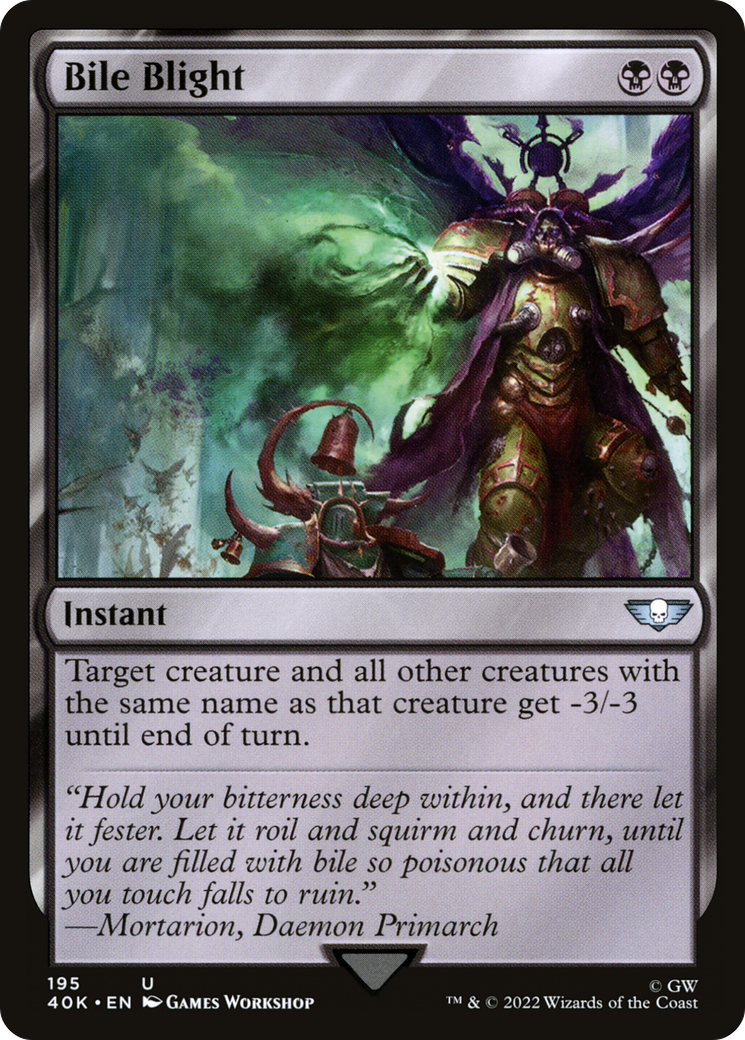
Bile Blight
Bile Blight
Instant
Target creature and all other creatures with the same name as that creature get -3/-3 until end of turn.
- Unless a token is a copy of another permanent or was explicitly given a name by the effect that created it, its name is the subtypes it was given when it was created plus the word "Token." For example, if an effect creates a 1/1 Soldier creature token, that token is named "Soldier Token."
- Bile Blight has only one target. Other creatures with that name are not targeted. For example, a creature with hexproof will still get -3/-3 if it has the same name as the target creature.
- If the target creature is an illegal target as Bile Blight tries to resolve, it won't resolve and none of its effects will happen. No creature will get -3/-3.
-
1
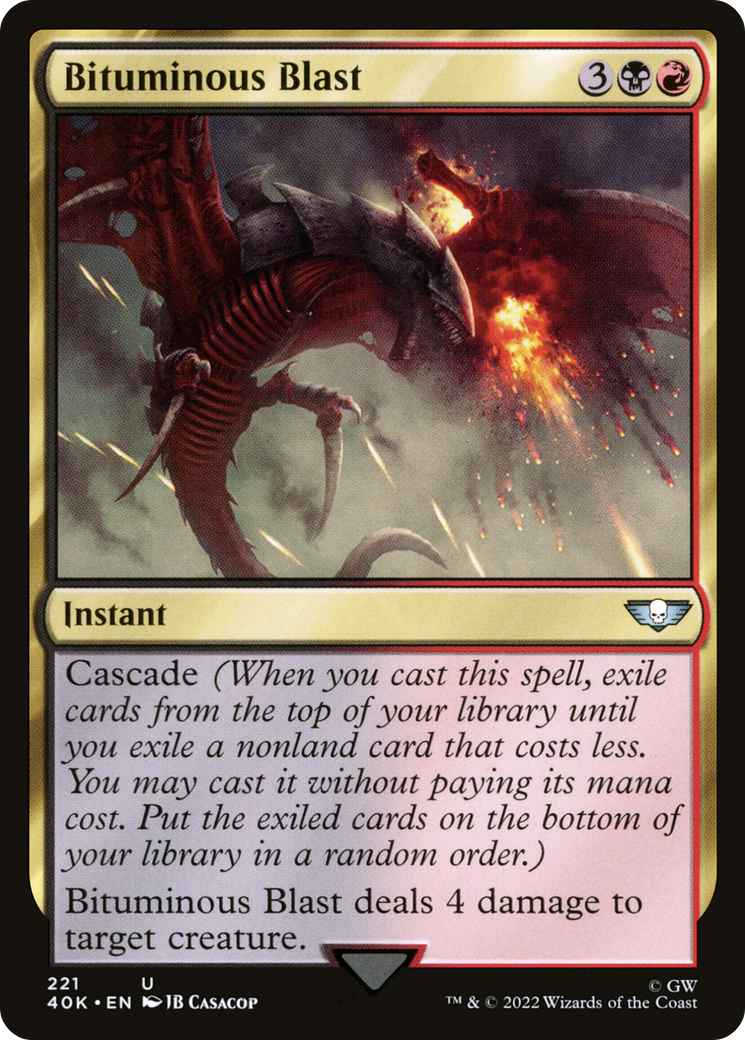
Bituminous Blast
Bituminous Blast
Instant
Cascade (When you cast this spell, exile cards from the top of your library until you exile a nonland card that costs less. You may cast it without paying its mana cost. Put the exiled cards on the bottom in a random order.)
Bituminous Blast deals 4 damage to target creature.
- A spell's mana value is determined only by its mana cost. Ignore any alternative costs, additional costs, cost increases, or cost reductions.
- Cascade triggers when you cast the spell, meaning that it resolves before that spell. If you end up casting the exiled card, it will go on the stack above the spell with cascade.
- When the cascade ability resolves, you must exile cards. The only optional part of the ability is whether or not you cast the last card exiled.
- If a spell with cascade is countered, the cascade ability will still resolve normally.
- You exile the cards face up. All players will be able to see them.
- If you cast a card "without paying its mana cost," you can't choose to cast it for any alternative costs. You can, however, pay additional costs. If the card has any mandatory additional costs, you must pay those to cast the card.
- If the card has in its mana cost, you must choose 0 as the value of X when casting it without paying its mana cost.
- Due to a 2021 rules change to cascade, not only do you stop exiling cards if you exile a nonland card with lesser mana value than the spell with cascade, but the resulting spell you cast must also have lesser mana value. Previously, in cases where a card's mana value differed from the resulting spell, such as with some modal double-faced cards or cards with an Adventure, you could cast a spell with a higher mana value than the exiled card.
- The mana value of a split card is determined by the combined mana cost of its two halves. If cascade allows you to cast a split card, you may cast either half but not both halves.
-
1
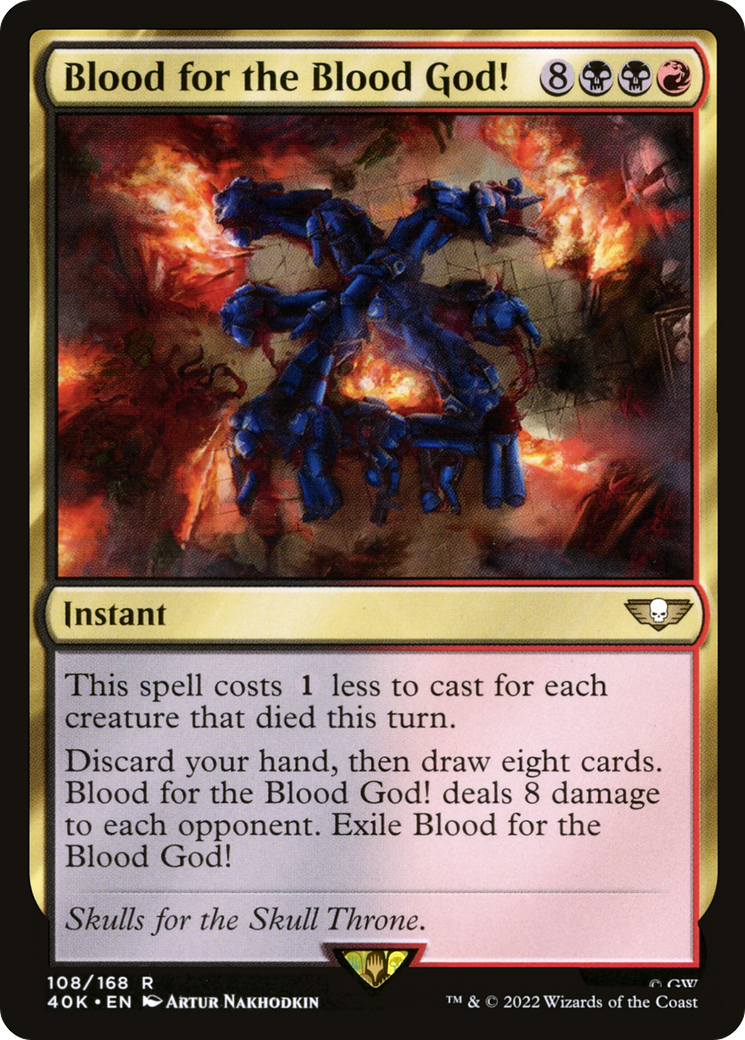
Blood for the Blood God!
Blood for the Blood God!
Instant
This spell costs less to cast for each creature that died this turn.
Discard your hand, then draw eight cards. Blood for the Blood God! deals 8 damage to each opponent. Exile Blood for the Blood God!
- The ability that reduces the mana cost only reduces its generic mana cost. It will cost at least , even if more than eight creatures have died this turn.
-
1
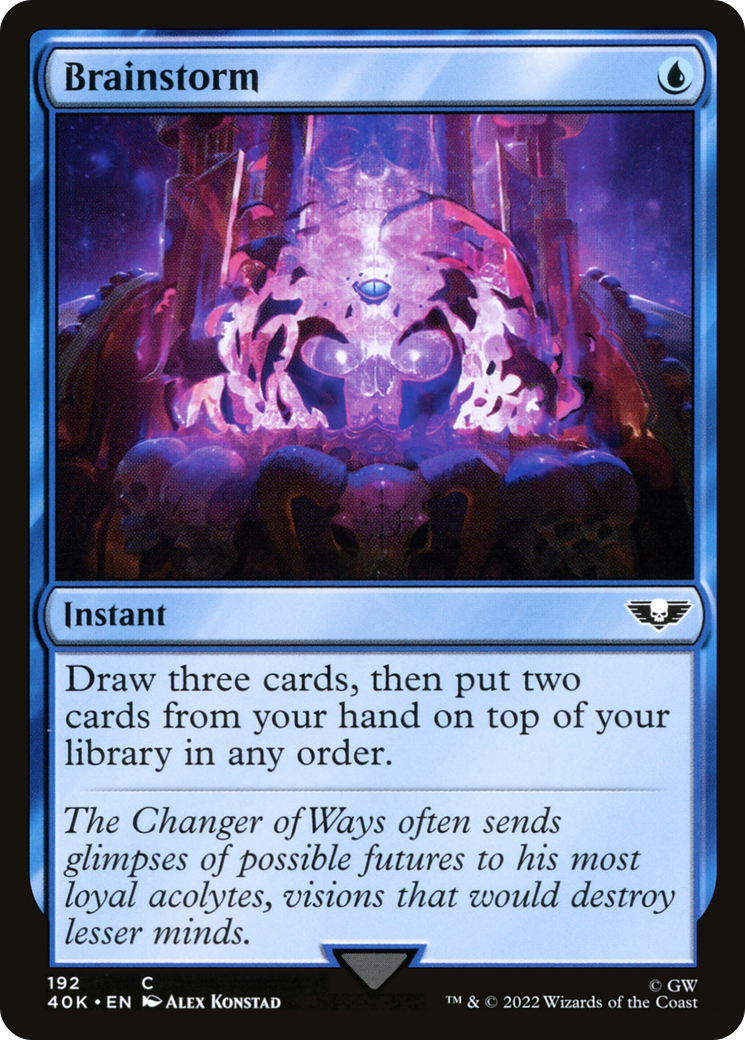
Brainstorm
Brainstorm
Instant
Draw three cards, then put two cards from your hand on top of your library in any order.
- You draw three cards and put two cards back all while Brainstorm is resolving. Nothing can happen between the two, and no player may choose to take actions.
-
1
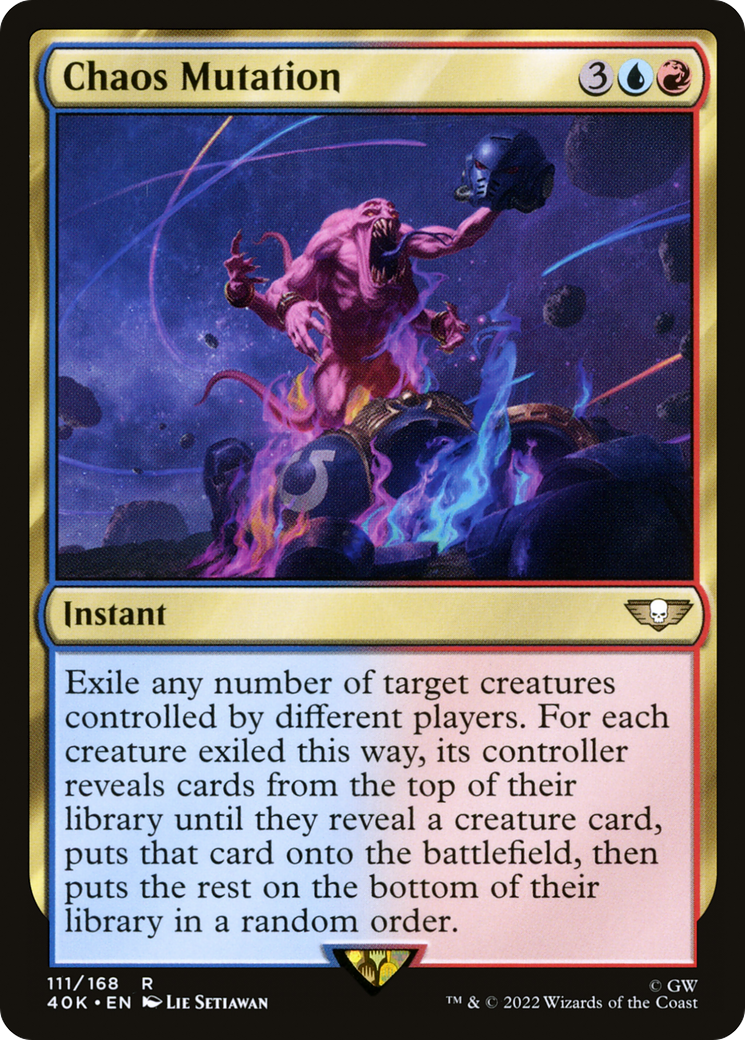
Chaos Mutation
Chaos Mutation
Instant
Exile any number of target creatures controlled by different players. For each creature exiled this way, its controller reveals cards from the top of their library until they reveal a creature card, puts that card onto the battlefield, then puts the rest on the bottom of their library in a random order.
- The phrase "target creatures controlled by different players" means that no two targets may be controlled by the same player.
-
1
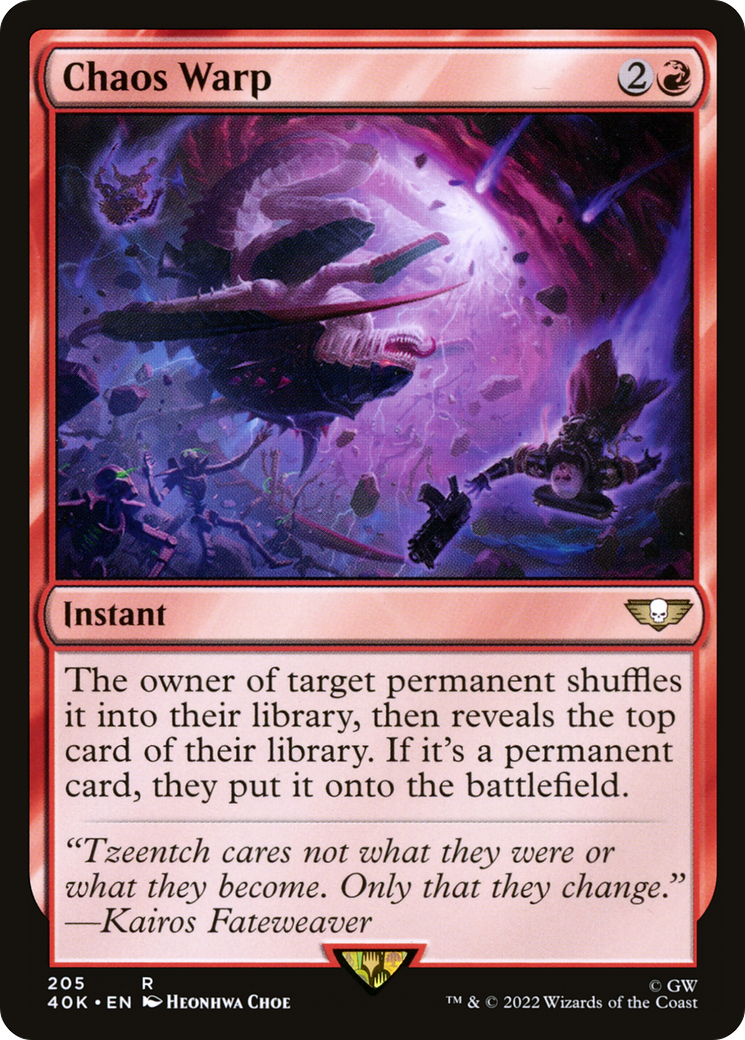
Chaos Warp
Chaos Warp
Instant
The owner of target permanent shuffles it into their library, then reveals the top card of their library. If it's a permanent card, they put it onto the battlefield.
- The owner of a token is the player under whose control the token was put onto the battlefield. If a token is shuffled into a player's library this way, that player shuffles before revealing the top card of that library.
- If the permanent is an illegal target by the time Chaos Warp tries to resolve, it won't resolve and none of its effects will occur. No library will be shuffled and no card will be revealed.
- A permanent card is a card with one or more of the following card types: artifact, creature, enchantment, land, or planeswalker.
- If the revealed card is a permanent card but can't enter (perhaps because it's an Aura with nothing to enchant), it remains on top of that library.
- If the revealed card is not a permanent card, it remains on top of that library.
-
1
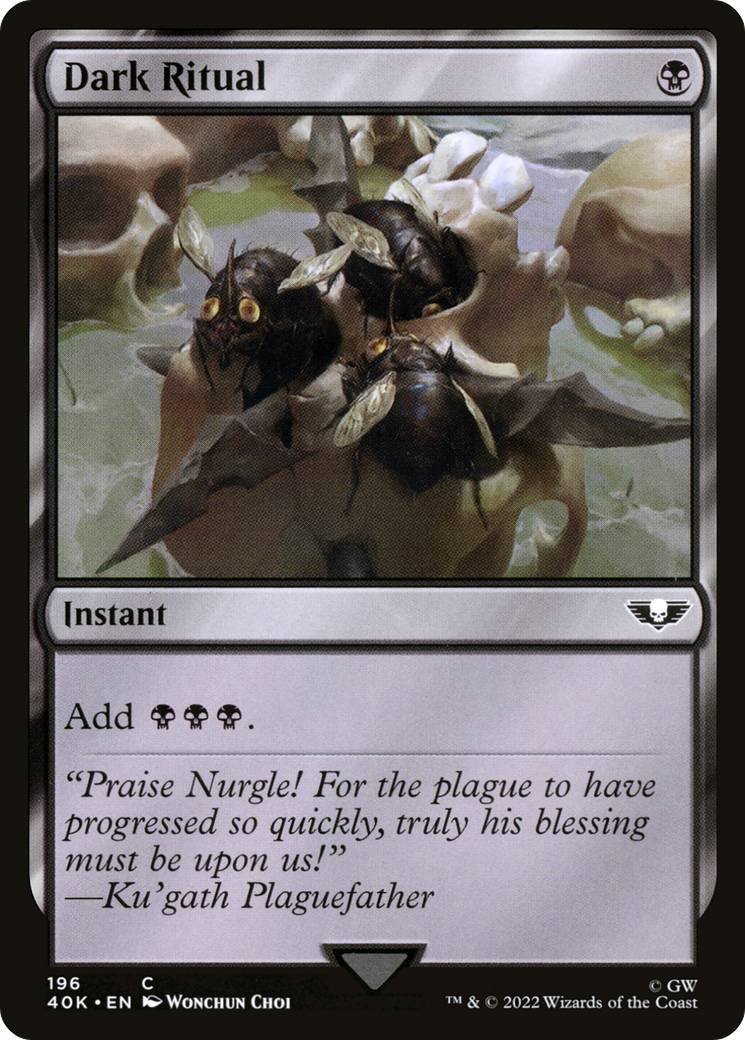
Dark Ritual
Dark Ritual
Instant
Add .
-
1
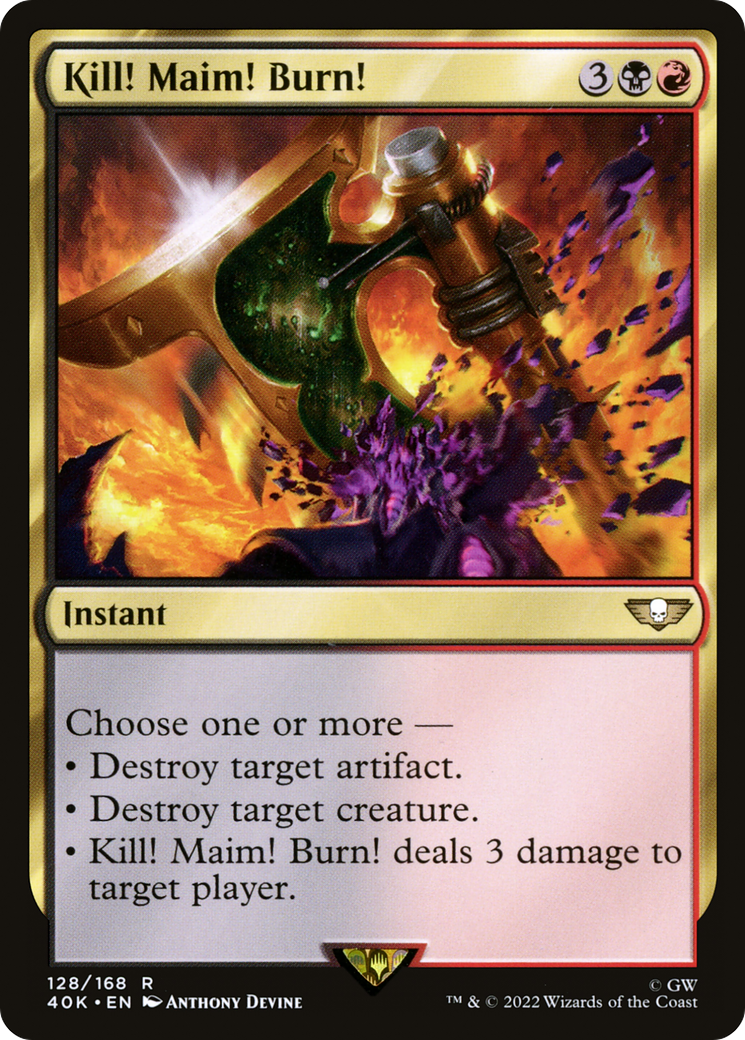
Kill! Maim! Burn!
Kill! Maim! Burn!
Instant
Choose one or more —
- Destroy target artifact.
- Destroy target creature.
- Kill! Maim! Burn! deals 3 damage to target player.
-
1
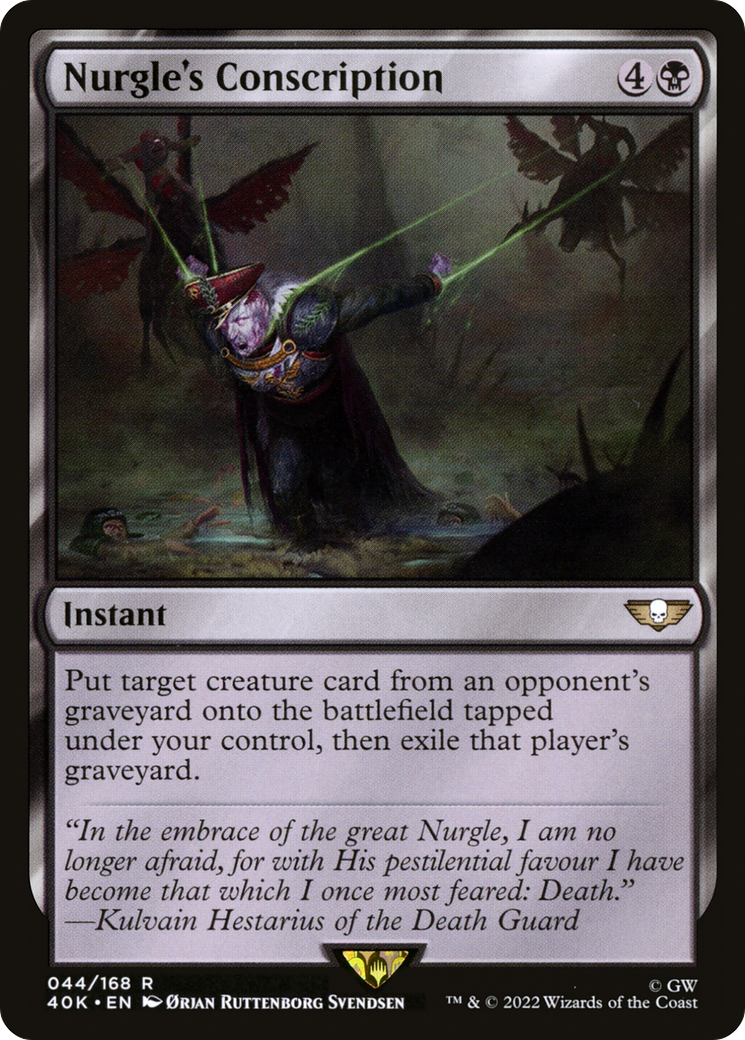
Nurgle's Conscription
Nurgle's Conscription
Instant
Put target creature card from an opponent's graveyard onto the battlefield tapped under your control, then exile that player's graveyard.
-
1
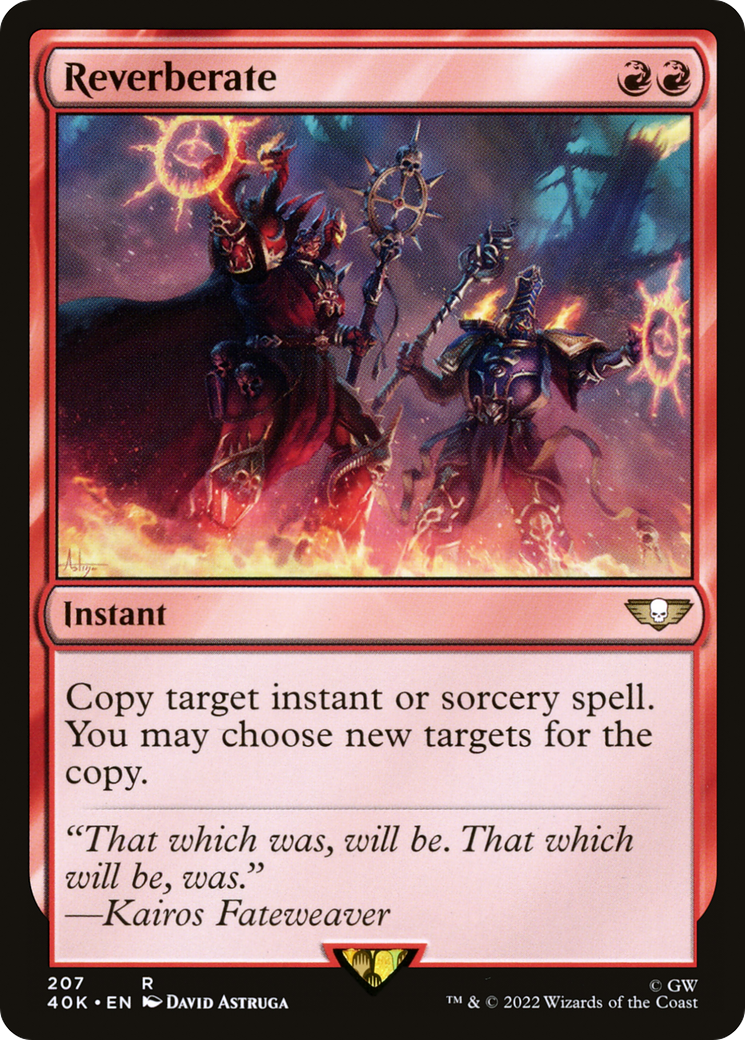
Reverberate
Reverberate
Instant
Copy target instant or sorcery spell. You may choose new targets for the copy.
- Reverberate can target (and copy) any instant or sorcery spell, not just one with targets. It doesn't matter who controls it.
- When Reverberate resolves, it creates a copy of a spell. You control the copy. That copy is created on the stack, so it's not "cast." Abilities that trigger when a player casts a spell won't trigger. The copy will then resolve like a normal spell, after players get a chance to cast spells and activate abilities.
- The copy will have the same targets as the spell it's copying unless you choose new ones. You may change any number of the targets, including all of them or none of them. If, for one of the targets, you can't choose a new legal target, then it remains unchanged (even if the current target is illegal).
- If the spell Reverberate copies is modal (that is, it says "Choose one —" or the like), the copy will have the same mode. You can't choose a different one.
- If the spell Reverberate copies has an X whose value was determined as it was cast (like Earthquake does), the copy has the same value of X.
- You can't choose to pay any additional costs for the copy. However, effects based on any additional costs that were paid for the original spell are copied as though those same costs were paid for the copy too. For example, if a player sacrifices a 3/3 creature to cast Fling, and you copy it with Reverberate, the copy of Fling will also deal 3 damage to its target.
- If the copy says that it affects "you," it affects the controller of the copy, not the controller of the original spell. Similarly, if the copy says that it affects an "opponent," it affects an opponent of the copy's controller, not an opponent of the original spell's controller.
Sorceries 7
-
1
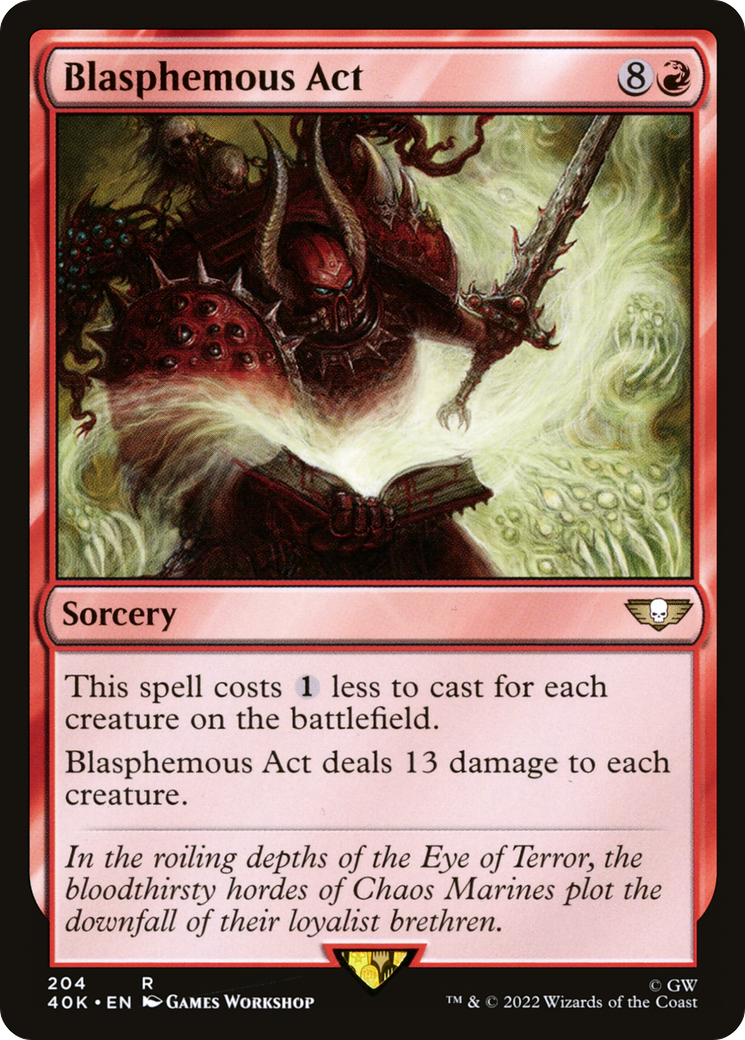
Blasphemous Act
Blasphemous Act
Sorcery
This spell costs less to cast for each creature on the battlefield.
Blasphemous Act deals 13 damage to each creature.
- To determine the total cost of a spell, start with the mana cost or alternative cost you're paying, add any cost increases, then apply any cost reductions (such as that of Blasphemous Act). The mana value of the spell is determined only by its mana cost, no matter what the total cost to cast the spell was.
- Blasphemous Act's ability can't reduce the total cost to cast the spell below .
- The total cost to cast Blasphemous Act is locked in before you pay that cost. For example, if there are three creatures on the battlefield, including one you can sacrifice to add , the total cost of Blasphemous Act is . Then you can sacrifice the creature when you activate mana abilities just before paying the cost.
- Although players may respond to Blasphemous Act once it's been cast, once it's announced, they can't respond before the cost is calculated and paid.
-
1
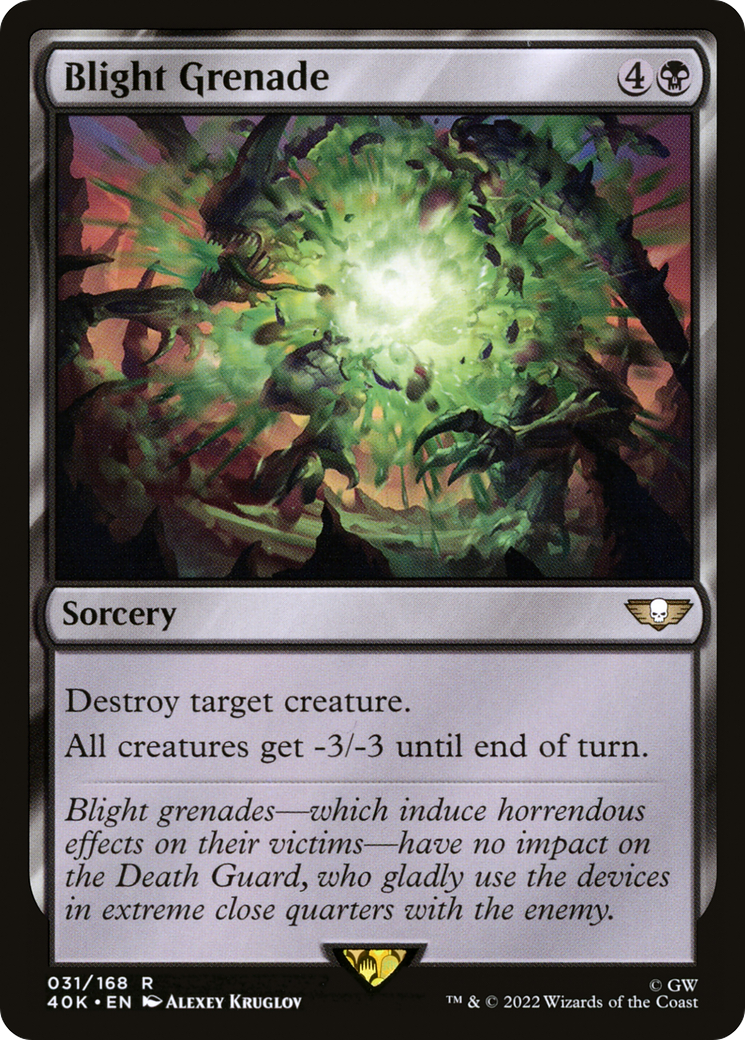
Blight Grenade
Blight Grenade
Sorcery
Destroy target creature.
All creatures get -3/-3 until end of turn.
- If Blight Grenade's target is no longer legal as it tries to resolve, it will be removed from the stack and no creatures will get -3/-3.
-
1
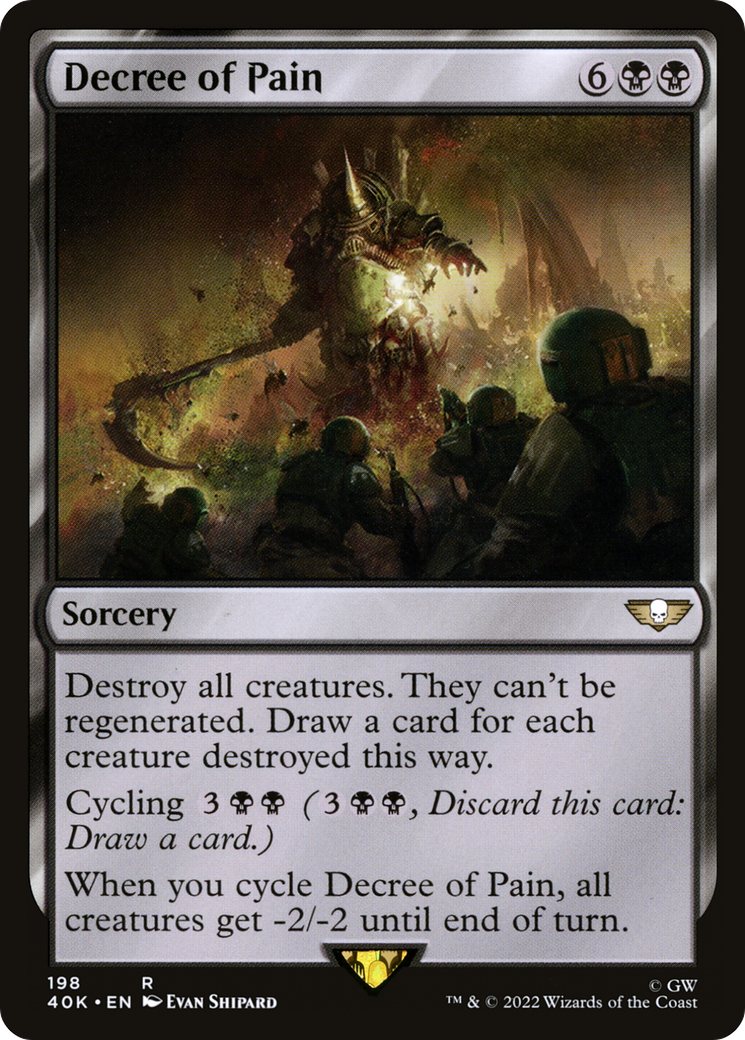
Decree of Pain
Decree of Pain
Sorcery
Destroy all creatures. They can't be regenerated. Draw a card for each creature destroyed this way.
Cycling ( , Discard this card: Draw a card.)
When you cycle this card, all creatures get -2/-2 until end of turn.
- When you cycle this card, first the cycling ability goes on the stack, then the triggered ability goes on the stack on top of it. The triggered ability will resolve before you draw a card from the cycling ability.
- The cycling ability and the triggered ability are separate. If the triggered ability doesn't resolve (because, for example, it has been countered, or all of its targets have become illegal), the cycling ability will still resolve, and you'll draw a card.
-
1
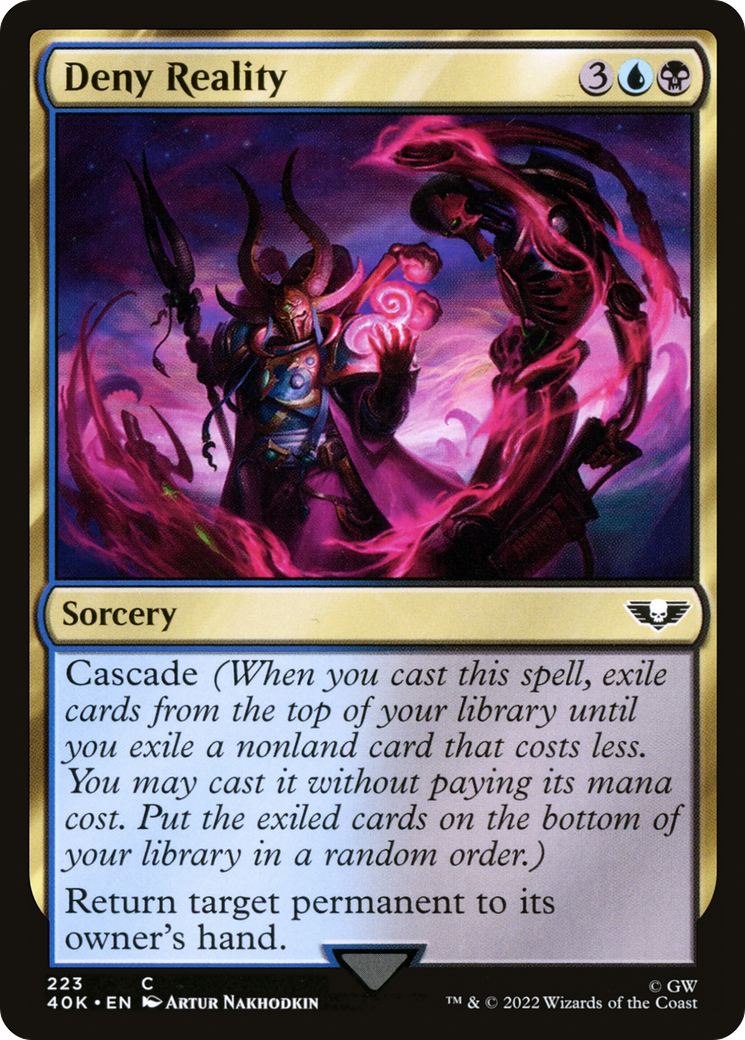
Deny Reality
Deny Reality
Sorcery
Cascade (When you cast this spell, exile cards from the top of your library until you exile a nonland card that costs less. You may cast it without paying its mana cost. Put the exiled cards on the bottom in a random order.)
Return target permanent to its owner's hand.
- A spell's mana value is determined only by its mana cost. Ignore any alternative costs, additional costs, cost increases, or cost reductions.
- Cascade triggers when you cast the spell, meaning that it resolves before that spell. If you end up casting the exiled card, it will go on the stack above the spell with cascade.
- When the cascade ability resolves, you must exile cards. The only optional part of the ability is whether or not you cast the last card exiled.
- If a spell with cascade is countered, the cascade ability will still resolve normally.
- You exile the cards face up. All players will be able to see them.
- If you cast a card "without paying its mana cost," you can't choose to cast it for any alternative costs. You can, however, pay additional costs. If the card has any mandatory additional costs, you must pay those to cast the card.
- If the card has in its mana cost, you must choose 0 as the value of X when casting it without paying its mana cost.
- Due to a 2021 rules change to cascade, not only do you stop exiling cards if you exile a nonland card with lesser mana value than the spell with cascade, but the resulting spell you cast must also have lesser mana value. Previously, in cases where a card's mana value differed from the resulting spell, such as with some modal double-faced cards or cards with an Adventure, you could cast a spell with a higher mana value than the exiled card.
- The mana value of a split card is determined by the combined mana cost of its two halves. If cascade allows you to cast a split card, you may cast either half but not both halves.
-
1
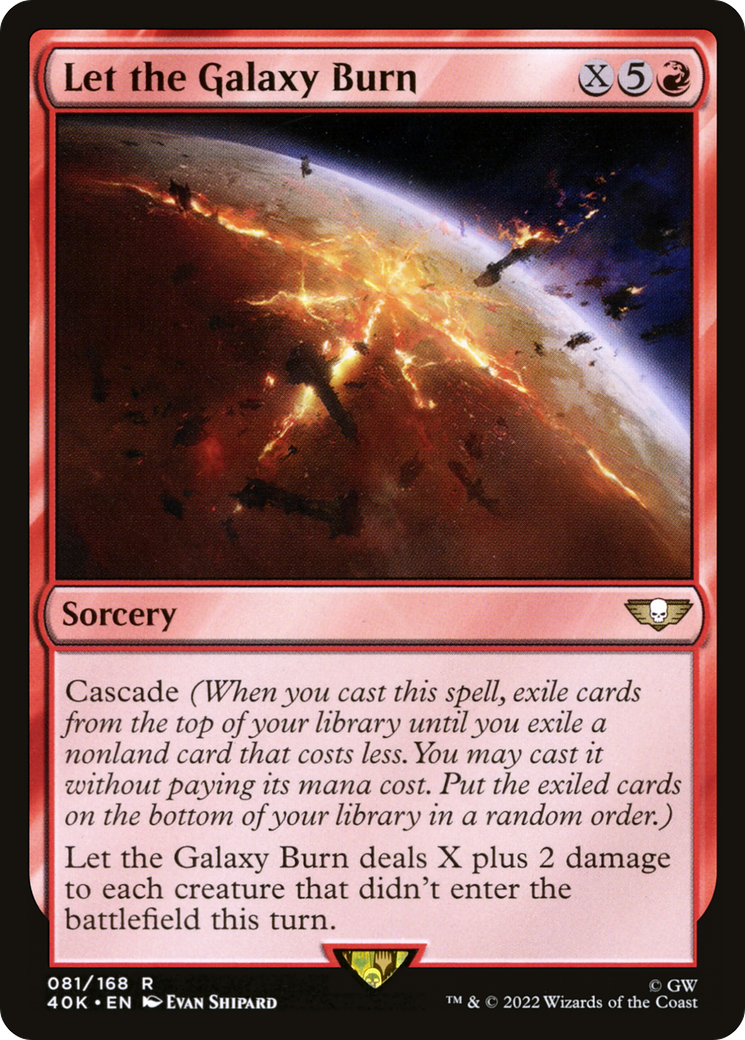
Let the Galaxy Burn
Let the Galaxy Burn
Sorcery
Cascade (When you cast this spell, exile cards from the top of your library until you exile a nonland card that costs less. You may cast it without paying its mana cost. Put the exiled cards on the bottom in a random order.)
Let the Galaxy Burn deals X plus 2 damage to each creature that didn't enter this turn.
- A spell's mana value is determined only by its mana cost. Ignore any alternative costs, additional costs, cost increases, or cost reductions.
- Cascade triggers when you cast the spell, meaning that it resolves before that spell. If you end up casting the exiled card, it will go on the stack above the spell with cascade.
- When the cascade ability resolves, you must exile cards. The only optional part of the ability is whether or not you cast the last card exiled.
- If a spell with cascade is countered, the cascade ability will still resolve normally.
- You exile the cards face up. All players will be able to see them.
- If you cast a card "without paying its mana cost," you can't choose to cast it for any alternative costs. You can, however, pay additional costs. If the card has any mandatory additional costs, you must pay those to cast the card.
- If the card has in its mana cost, you must choose 0 as the value of X when casting it without paying its mana cost.
- Due to a 2021 rules change to cascade, not only do you stop exiling cards if you exile a nonland card with lesser mana value than the spell with cascade, but the resulting spell you cast must also have lesser mana value. Previously, in cases where a card's mana value differed from the resulting spell, such as with some modal double-faced cards or cards with an Adventure, you could cast a spell with a higher mana value than the exiled card.
- Two new cards in this set give the next spell you cast cascade. This means that the next spell you cast gains cascade as you begin to cast it by putting it on the stack, and the cascade ability will trigger when you finish casting that spell.
-
1
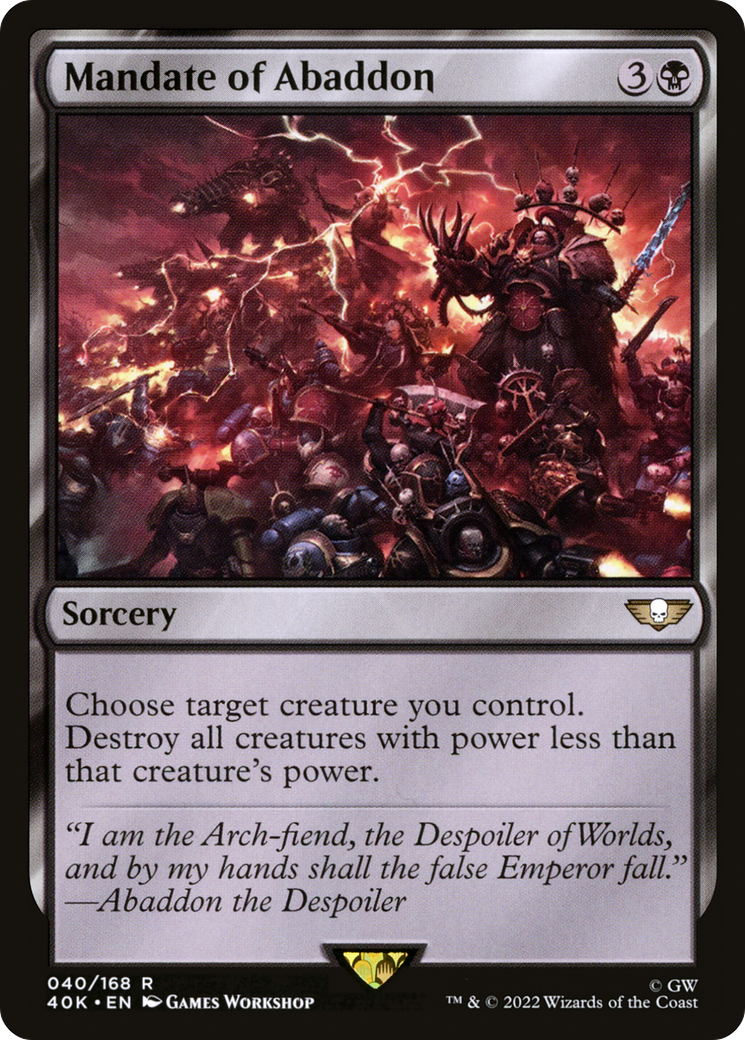
Mandate of Abaddon
Mandate of Abaddon
Sorcery
Choose target creature you control. Destroy all creatures with power less than that creature's power.
- If the chosen creature is an illegal target as Mandate of Abaddon tries to resolve, it will be removed from the stack and no creatures will be destroyed.
-
1
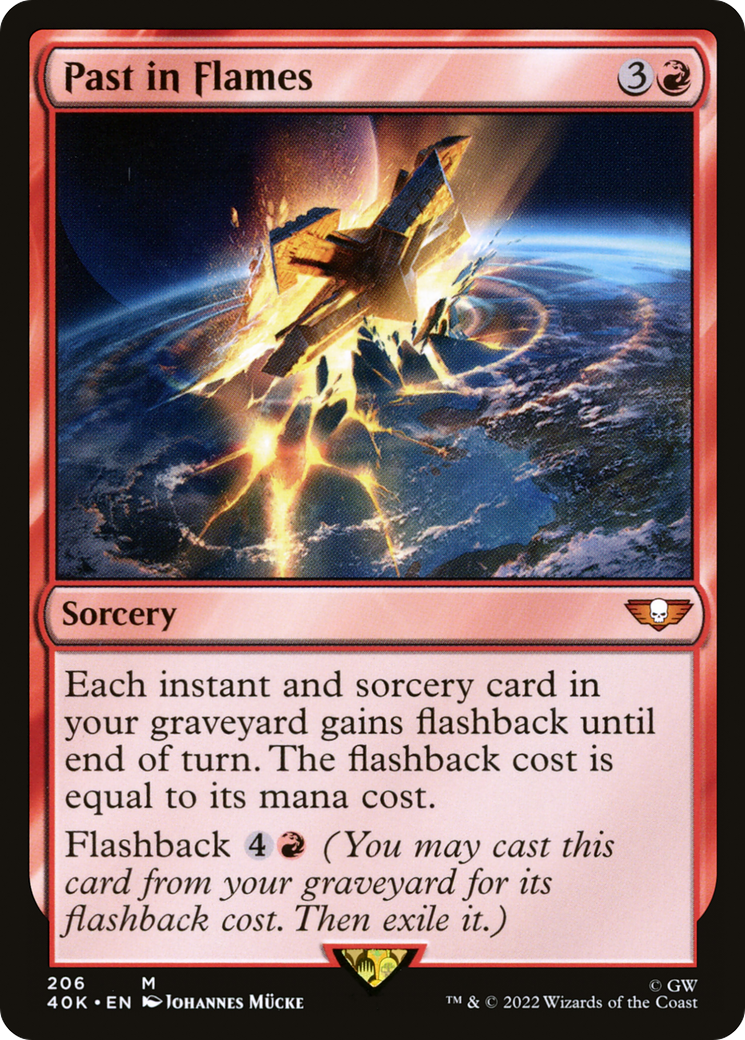
Past in Flames
Past in Flames
Sorcery
Each instant and sorcery card in your graveyard gains flashback until end of turn. The flashback cost is equal to its mana cost.
Flashback (You may cast this card from your graveyard for its flashback cost. Then exile it.)
- Past in Flames affects only cards in your graveyard at the time it resolves. Instant and sorcery cards put into your graveyard later in the turn won't gain flashback.
- "Flashback [cost]" means "You may cast this card from your graveyard by paying [cost] rather than paying its mana cost" and "If the flashback cost was paid, exile this card instead of putting it anywhere else any time it would leave the stack."
- You must still follow any timing restrictions and permissions, including those based on the card's type. For instance, you can cast a sorcery using flashback only when you could normally cast a sorcery.
- To determine the total cost of a spell, start with the mana cost or alternative cost (such as a flashback cost) you're paying, add any cost increases, then apply any cost reductions. The mana value of the spell is determined only by its mana cost, no matter what the total cost to cast the spell was.
- A spell cast using flashback will always be exiled afterward, whether it resolves, is countered, or leaves the stack in some other way.
- You can cast a spell using flashback even if it was somehow put into your graveyard without having been cast.
- If a card with flashback is put into your graveyard during your turn, you can cast it if it's legal to do so before any other player can take any actions.
- If you cast an instant or sorcery with in its mana cost this way, you still choose the value of X as part of casting the spell and pay that cost.
- If you cast a spell with flashback, you can't pay any alternative costs such as overload costs. You can pay additional costs such as kicker costs. If the spell has any mandatory additional costs, you must pay those to cast the spell with flashback.
- If a card has multiple instances of flashback, you may choose any of its flashback costs to pay.
- If a split card gains flashback, you pay only the cost of the half you're casting.
- If a card with no mana cost gains flashback, it has no flashback cost. It can't be cast this way.
Artifacts 10
-
1
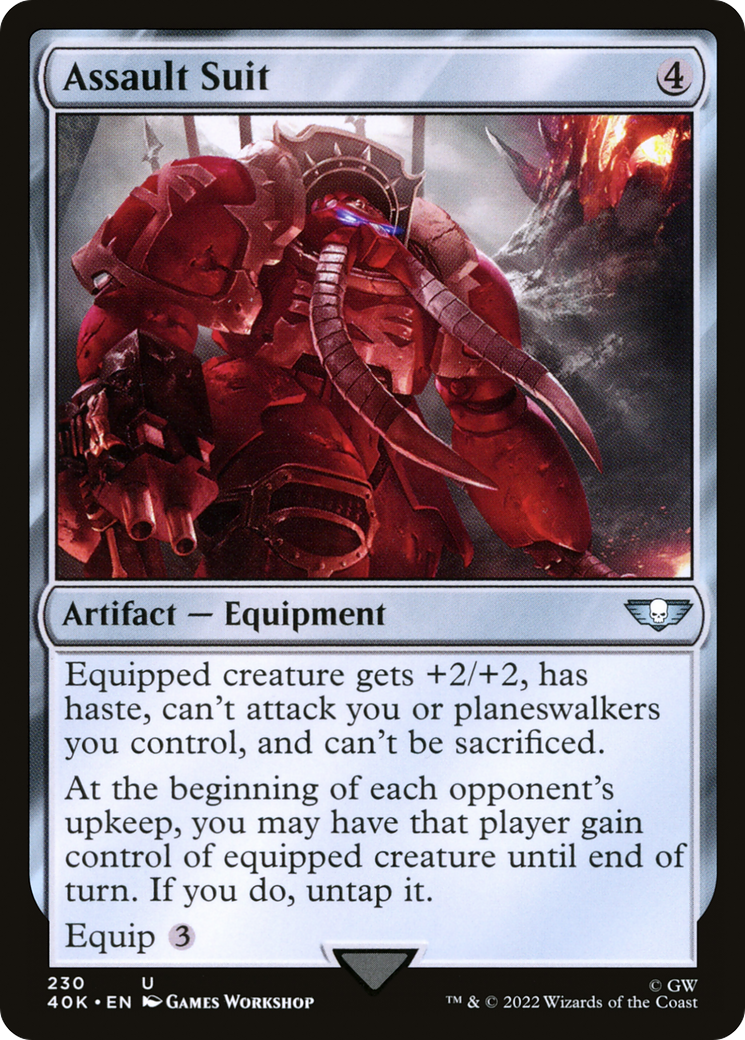
Assault Suit
Assault Suit
Artifact — Equipment
Equipped creature gets +2/+2, has haste, can't attack you or planeswalkers you control, and can't be sacrificed.
At the beginning of each opponent's upkeep, you may have that player gain control of equipped creature until end of turn. If you do, untap it.
Equip
- The equipped creature can't be sacrificed for any reason. If an effect instructs you to sacrifice it, you can't and it remains on the battlefield. You also can't sacrifice it to pay a cost that requires you to sacrifice a creature.
- If an effect instructs you to sacrifice a creature, and you control any creatures other than the creature equipped with Assault Suit, you must sacrifice one of them. You can't try to sacrifice the equipped creature, fail, and therefore ignore the effect.
-
1
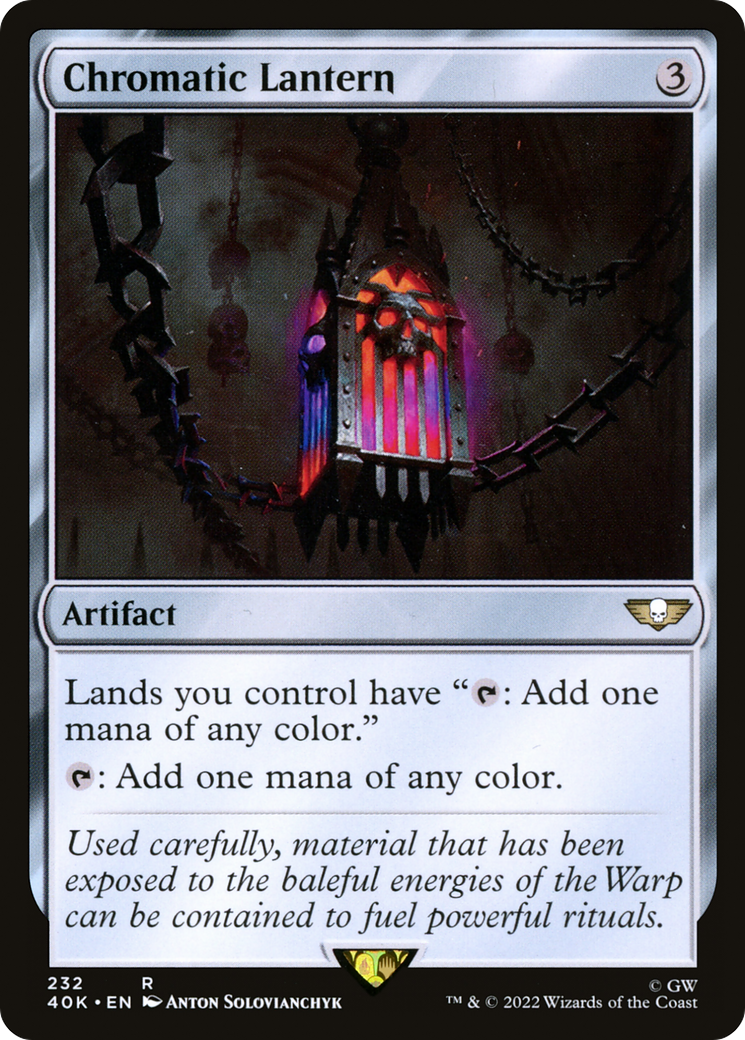
Chromatic Lantern
Chromatic Lantern
Artifact
Lands you control have " : Add one mana of any color."
: Add one mana of any color.
- Lands you control won't lose any other abilities they had. They also won't gain or lose any land types.
-
1
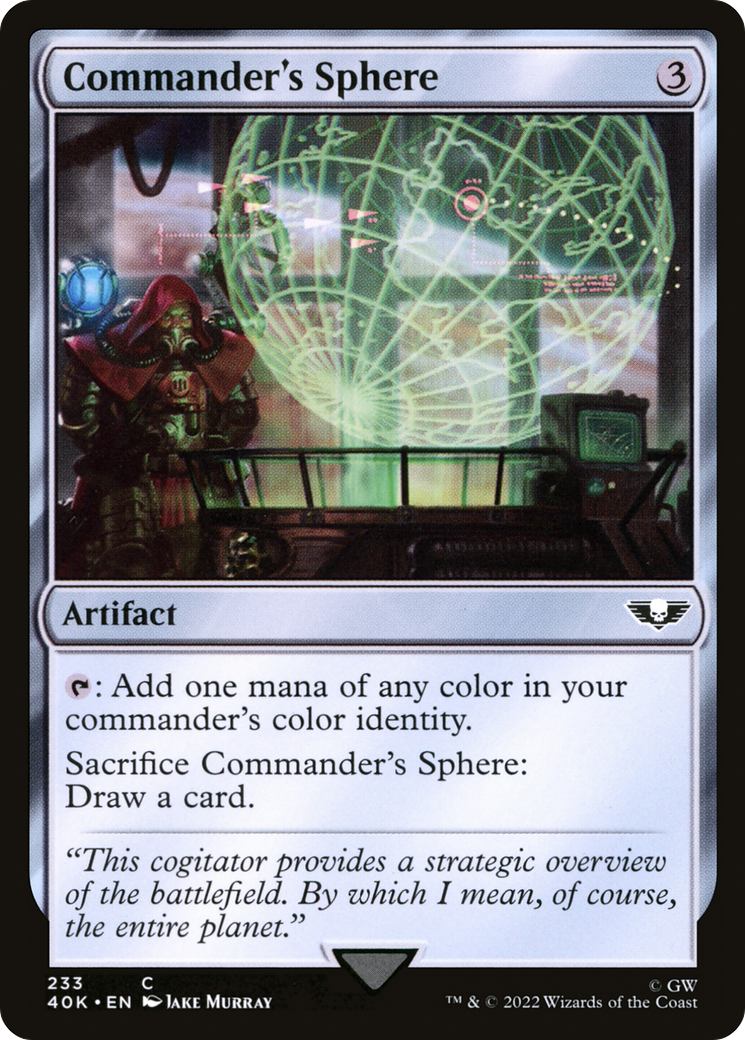
Commander's Sphere
Commander's Sphere
Artifact
: Add one mana of any color in your commander's color identity.
Sacrifice this artifact: Draw a card.
- If you have two commanders, the ability adds one mana of any color in their combined color identities.
- If your commander is a card that has no colors in its color identity, Commander's Sphere's first ability produces no mana. It doesn't produce .
- If you don't have a commander, Commander's Sphere's first ability produces no mana.
-
1
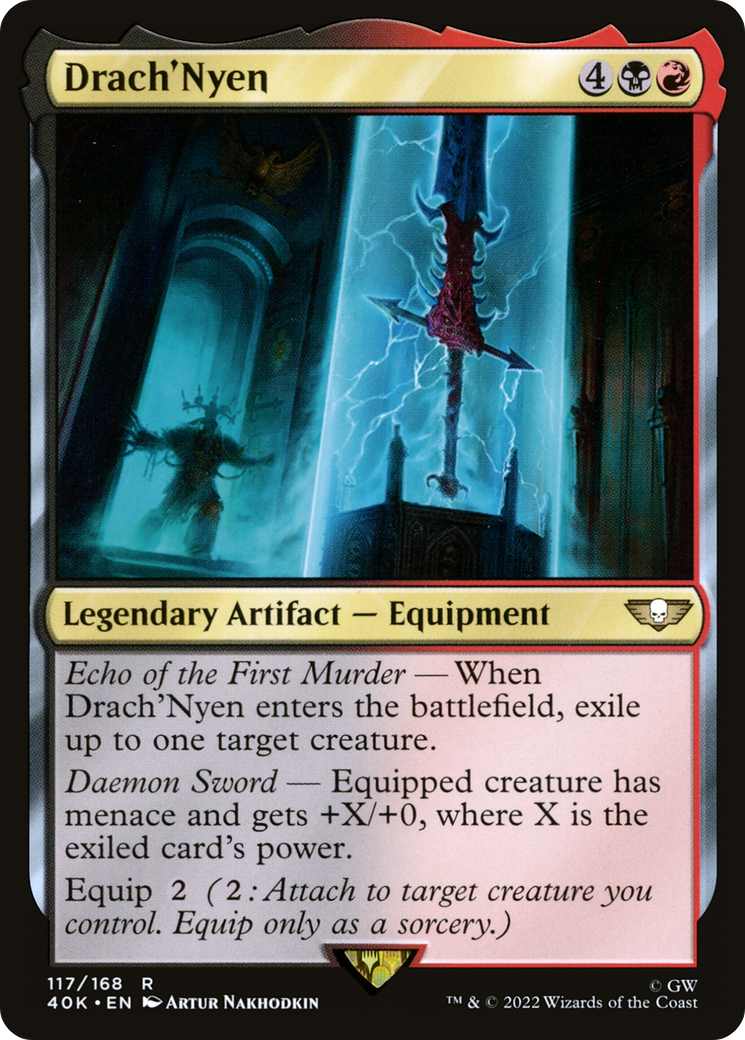
Drach'Nyen
Drach'Nyen
Legendary Artifact — Equipment
Echo of the First Murder — When Drach'Nyen enters, exile up to one target creature.
Daemon Sword — Equipped creature has menace and gets +X/+0, where X is the exiled card's power.
Equip ( : Attach to target creature you control. Equip only as a sorcery.)
- If the exiled card doesn't have a printed power, perhaps because it was a noncreature permanent that was only a creature on the battlefield due to another effect, X is 0.
- If the exiled card's power is determined by a characteristic-defining ability, usually denoted by a "*" in the power/toughness box, that ability applies in exile and should be used to determine the value of X.
- If more than one card is exiled by Drach'Nyen, usually because its triggered ability was copied one or more times, X is the total power of the exiled cards.
-
1
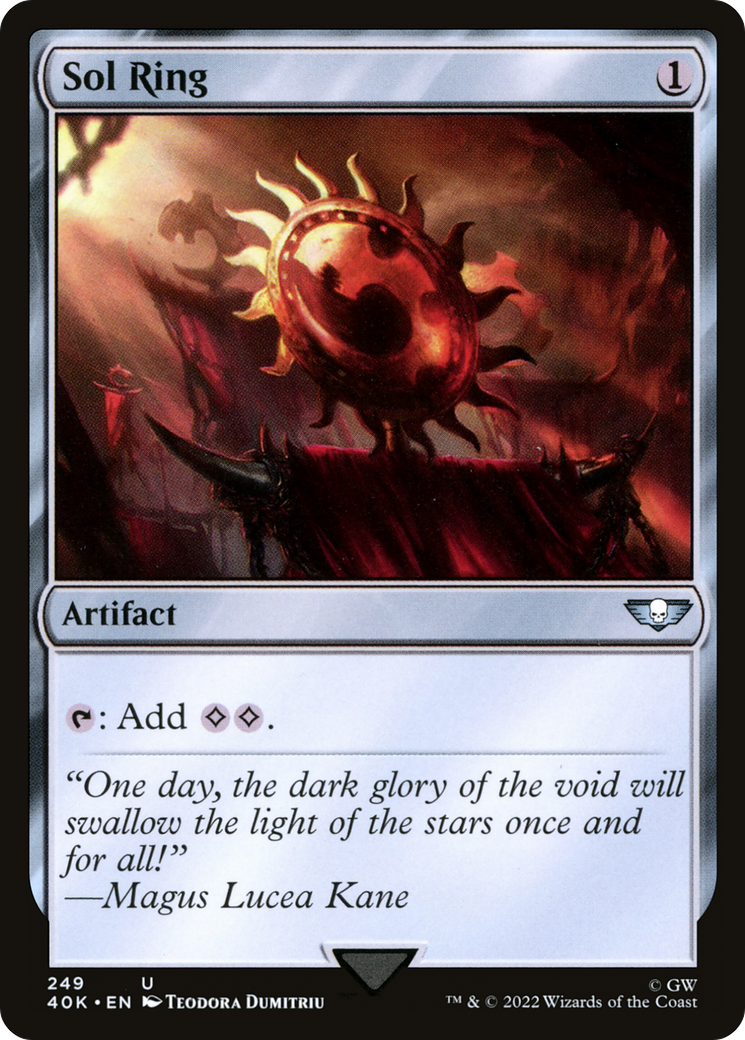
Sol Ring
Sol Ring
Artifact
: Add .
-
1
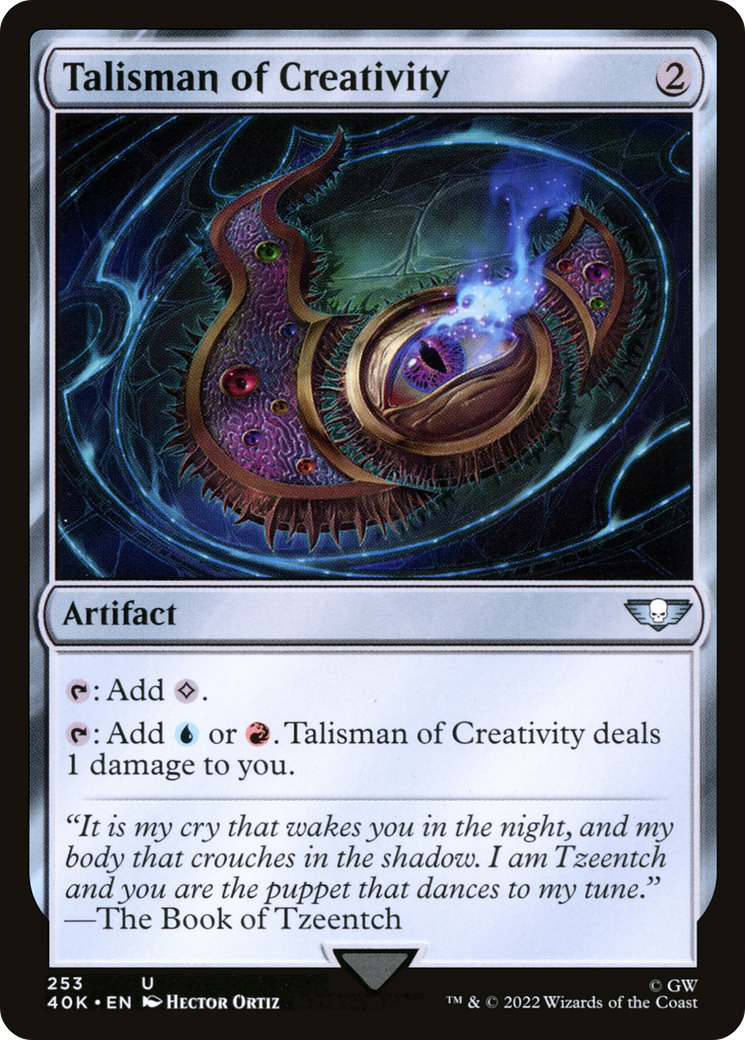
Talisman of Creativity
Talisman of Creativity
Artifact
: Add .
: Add or . This artifact deals 1 damage to you.
-
1
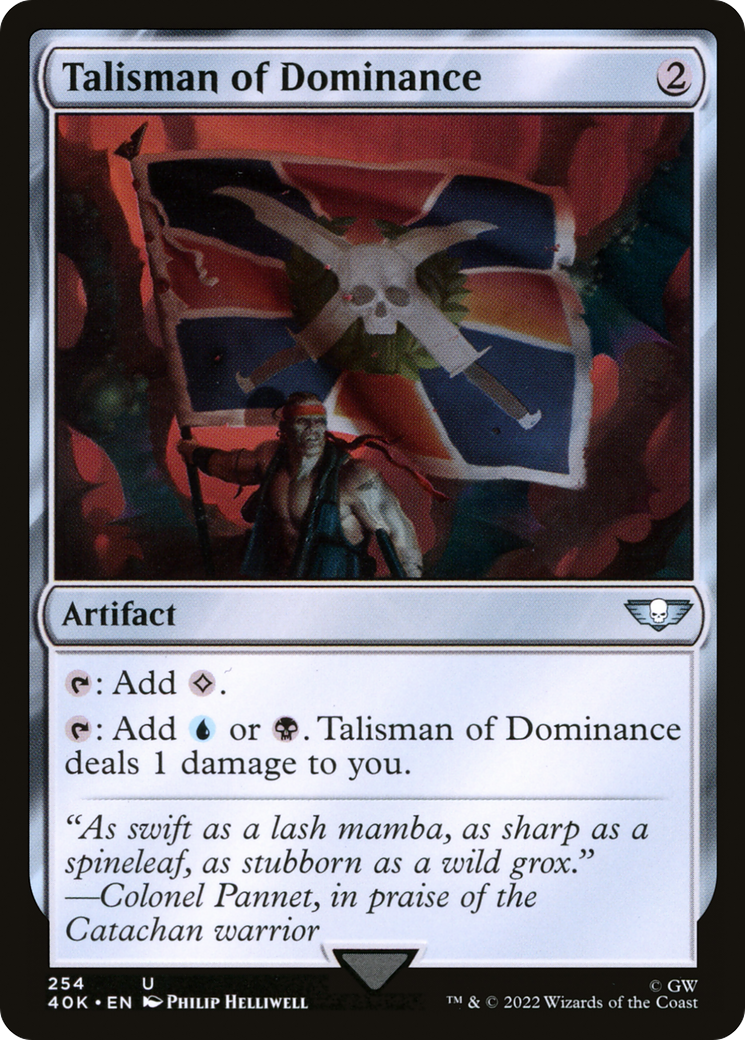
Talisman of Dominance
Talisman of Dominance
Artifact
: Add .
: Add or . This artifact deals 1 damage to you.
-
1
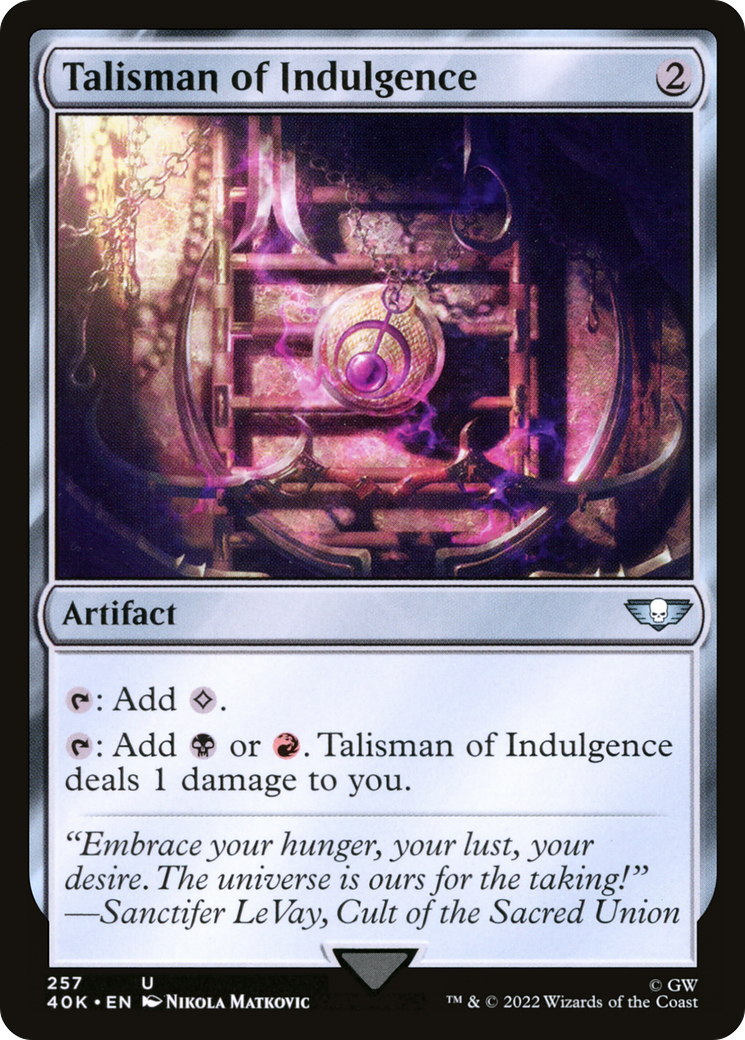
Talisman of Indulgence
Talisman of Indulgence
Artifact
: Add .
: Add or . This artifact deals 1 damage to you.
-
1
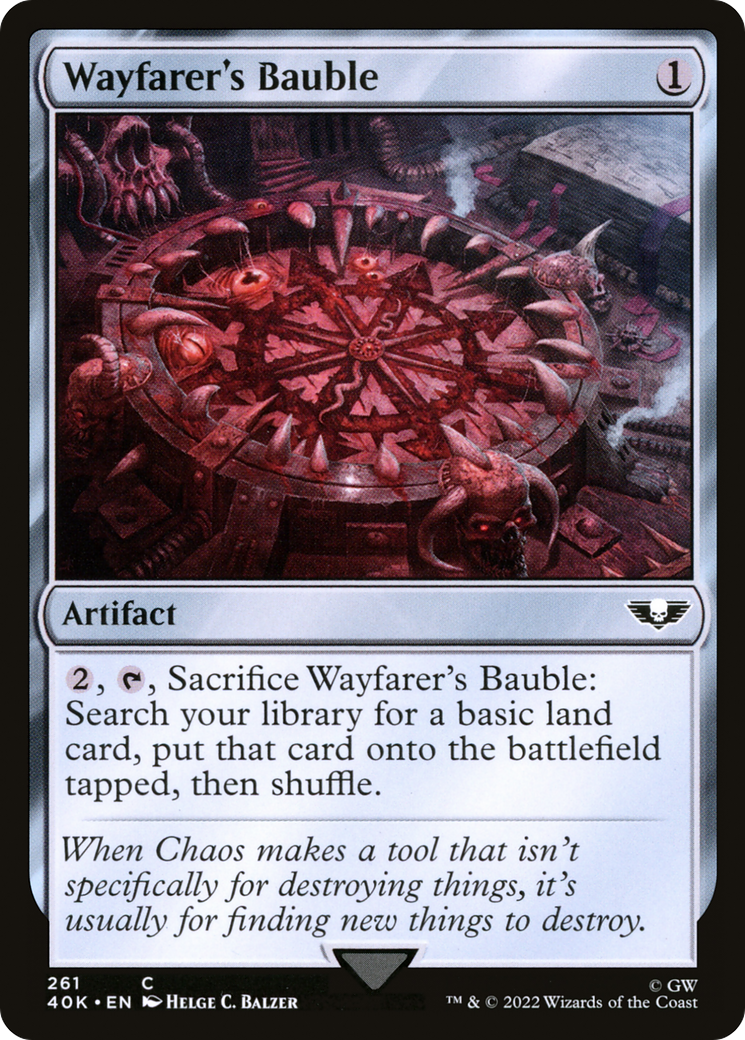
Wayfarer's Bauble
Wayfarer's Bauble
Artifact
, , Sacrifice this artifact: Search your library for a basic land card, put that card onto the battlefield tapped, then shuffle.
-
1
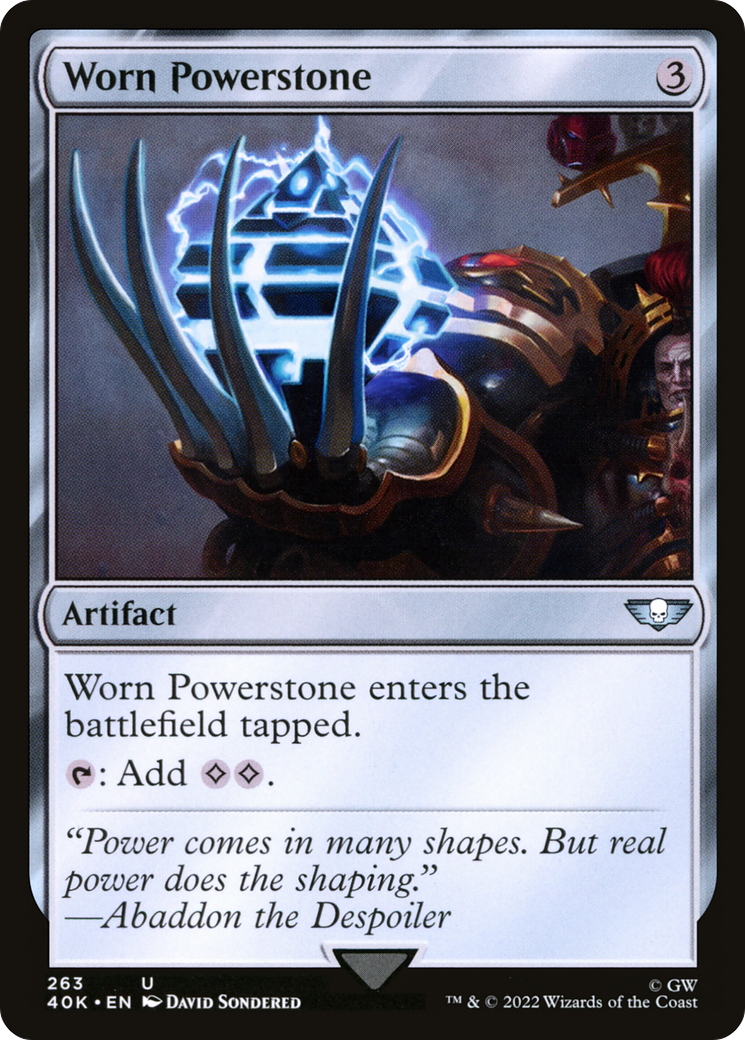
Worn Powerstone
Worn Powerstone
Artifact
This artifact enters tapped.
: Add .
Enchantments 5
-
1
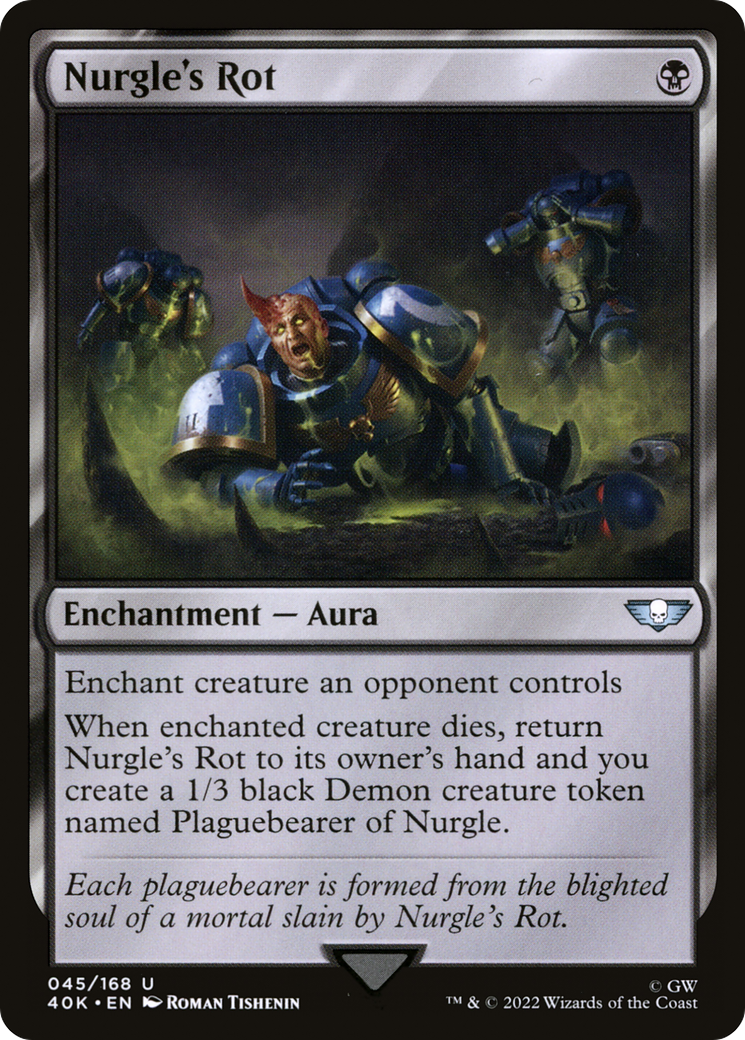
Nurgle's Rot
Nurgle's Rot
Enchantment — Aura
Enchant creature an opponent controls
When enchanted creature dies, return this card to its owner's hand and you create a 1/3 black Demon creature token named Plaguebearer of Nurgle.
-
1
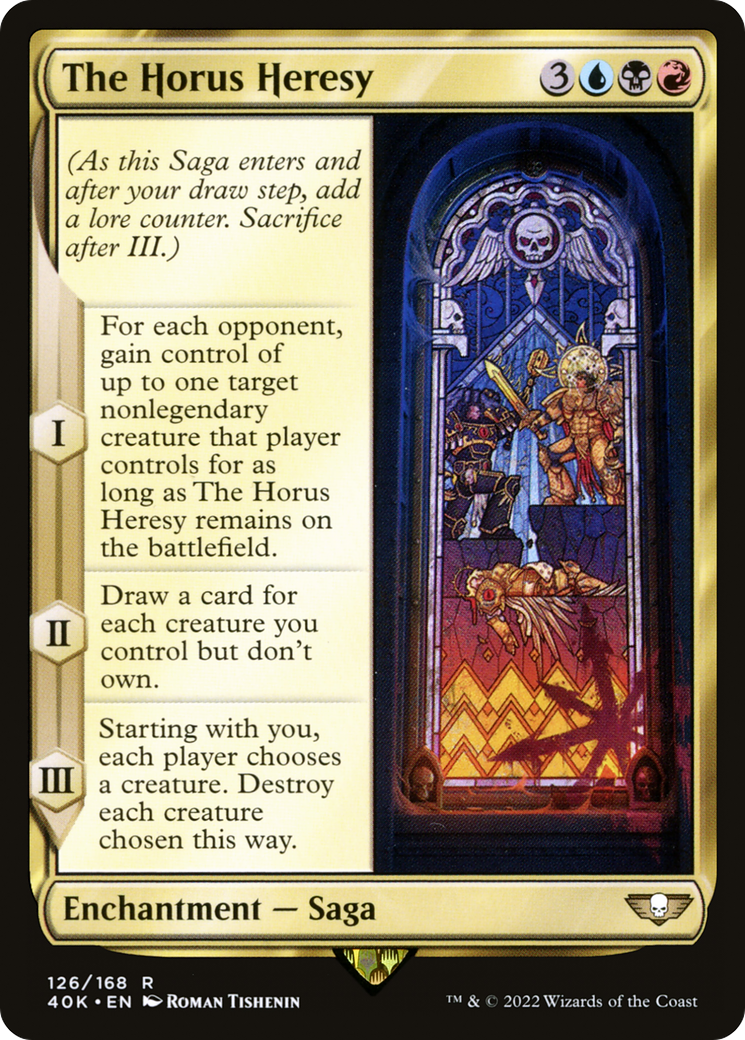
The Horus Heresy
The Horus Heresy
Enchantment — Saga
(As this Saga enters and after your draw step, add a lore counter. Sacrifice after III.)
I — For each opponent, gain control of up to one target nonlegendary creature that player controls for as long as this Saga remains on the battlefield.
II — Draw a card for each creature you control but don't own.
III — Starting with you, each player chooses a creature. Destroy each creature chosen this way.
-
1
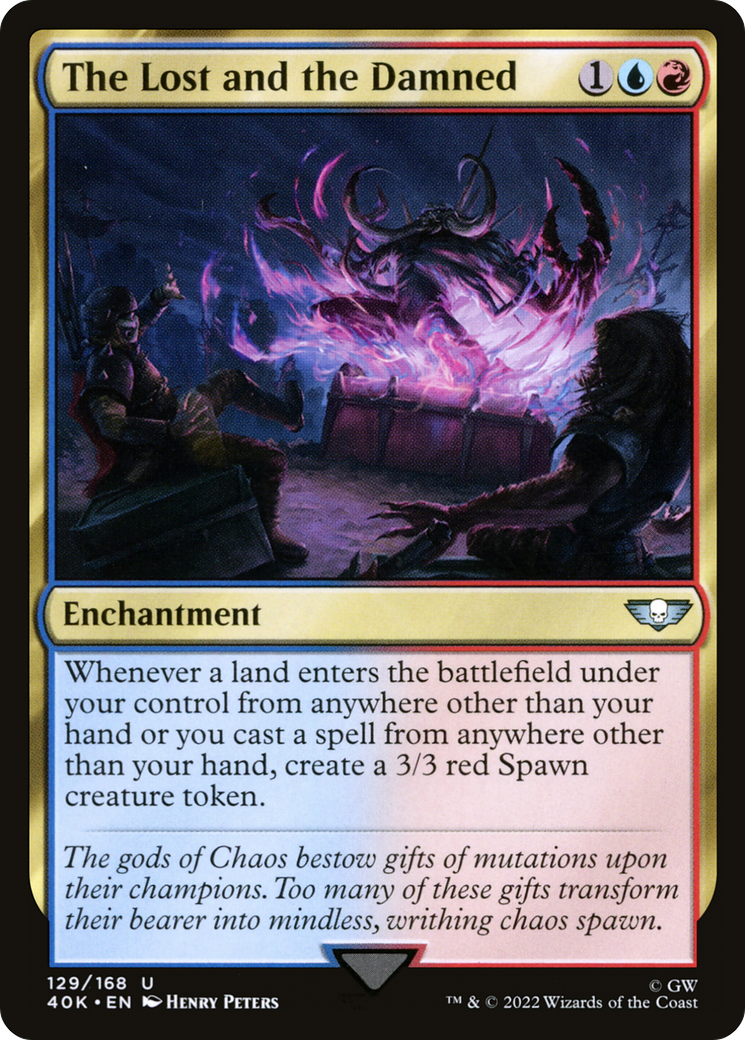
The Lost and the Damned
The Lost and the Damned
Enchantment
Whenever a land you control enters from anywhere other than your hand or you cast a spell from anywhere other than your hand, create a 3/3 red Spawn creature token.
-
1
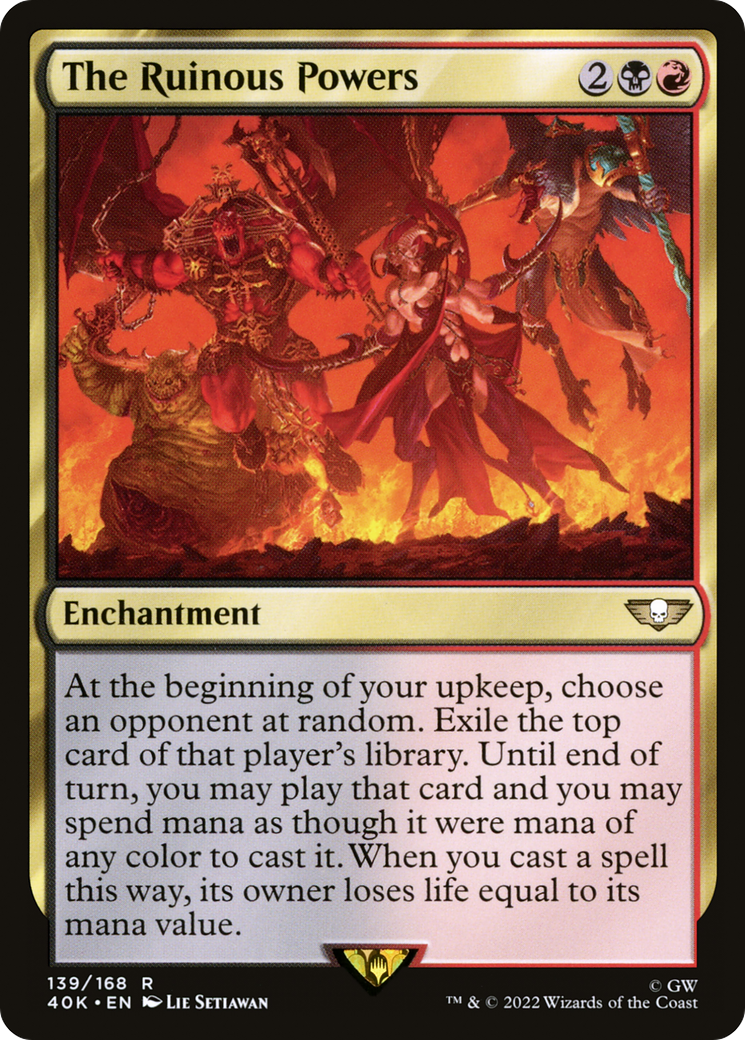
The Ruinous Powers
The Ruinous Powers
Enchantment
At the beginning of your upkeep, choose an opponent at random. Exile the top card of that player's library. Until end of turn, you may play that card and you may spend mana as though it were mana of any color to cast it. When you cast a spell this way, its owner loses life equal to its mana value.
- You must follow all normal timing rules when casting a spell or playing a land using the permission granted by Ruinous Powers.
- Use the mana value of the spell as it exists on the stack (or last existed on the stack, if it's been removed) to determine how much life is lost. If there is an in that spell's cost, include the value chosen for X to determine its mana value.
-
1
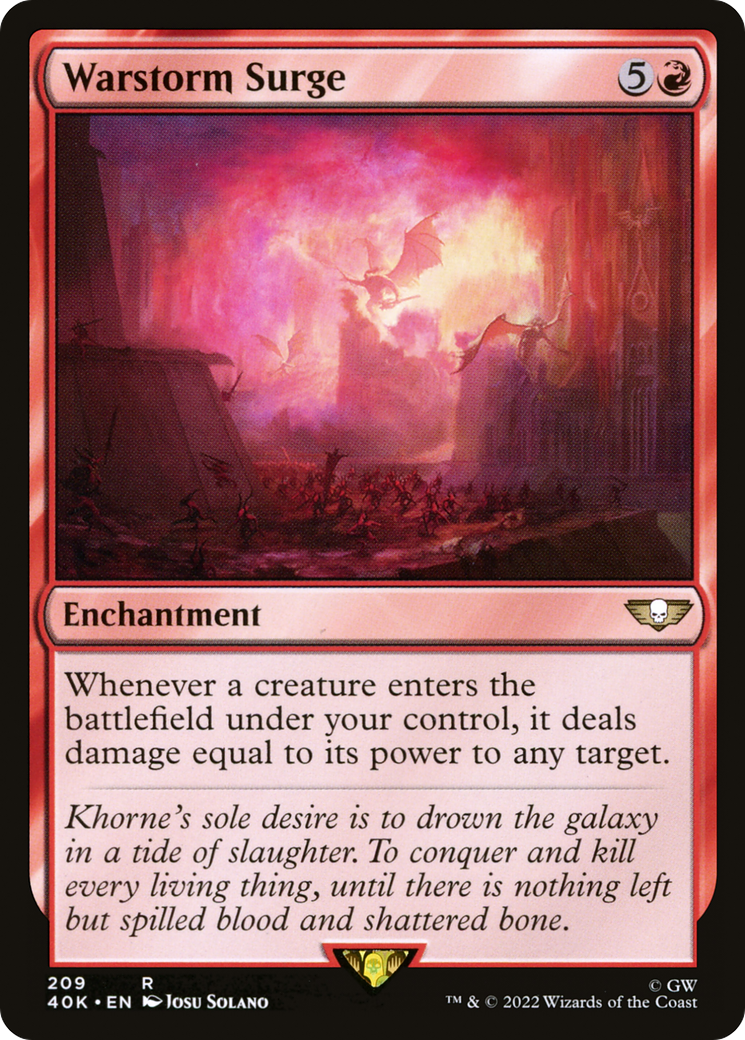
Warstorm Surge
Warstorm Surge
Enchantment
Whenever a creature you control enters, it deals damage equal to its power to any target.
- The creature that entered deals damage equal to its current power to the targeted permanent or player. If it's no longer on the battlefield, its last known existence on the battlefield is checked to determine its power.
- Warstorm Surge is the source of the ability, but the creature is the source of the damage. The ability couldn't target a creature with protection from red, for example. It could target a creature with protection from creatures, but all the damage would be prevented. Since damage is dealt by the creature, abilities like lifelink, deathtouch and infect are taken into account, even if the creature has left the battlefield by the time it deals damage.
Lands 38
-
1
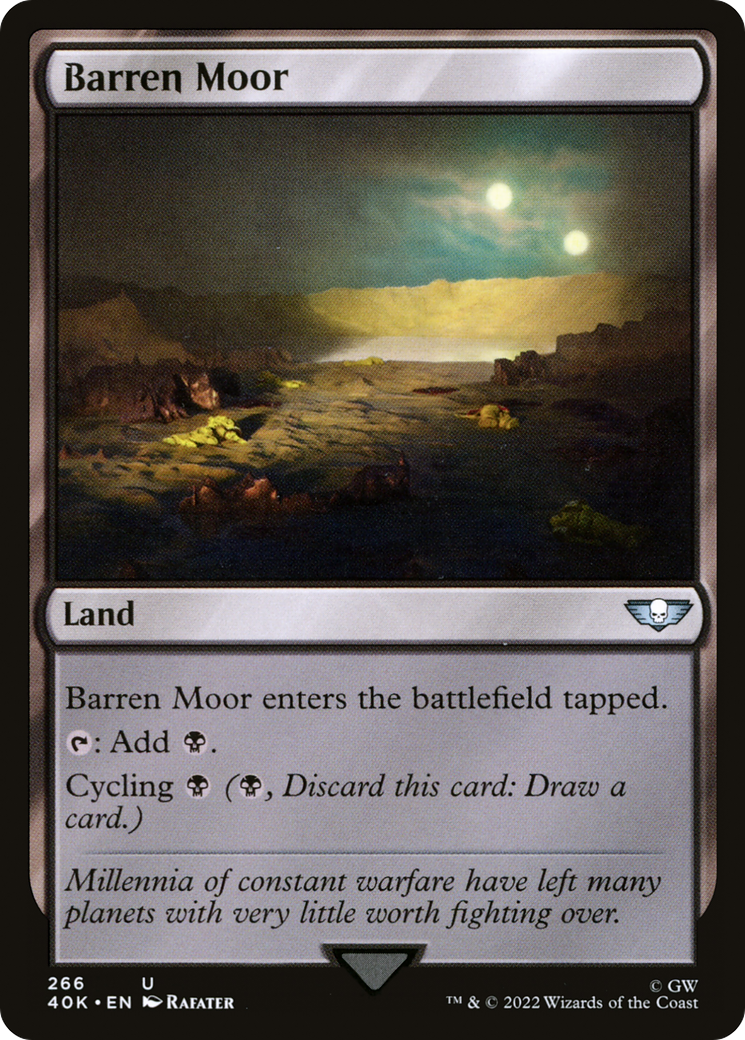
Barren Moor
Barren Moor
Land
This land enters tapped.
: Add .
Cycling ( , Discard this card: Draw a card.)
- Cycling is an activated ability. Effects that interact with activated abilities (such as Stifle or Rings of Brighthearth) will interact with cycling. Effects that interact with spells (such as Remove Soul or Faerie Tauntings) will not.
-
1
Command Tower
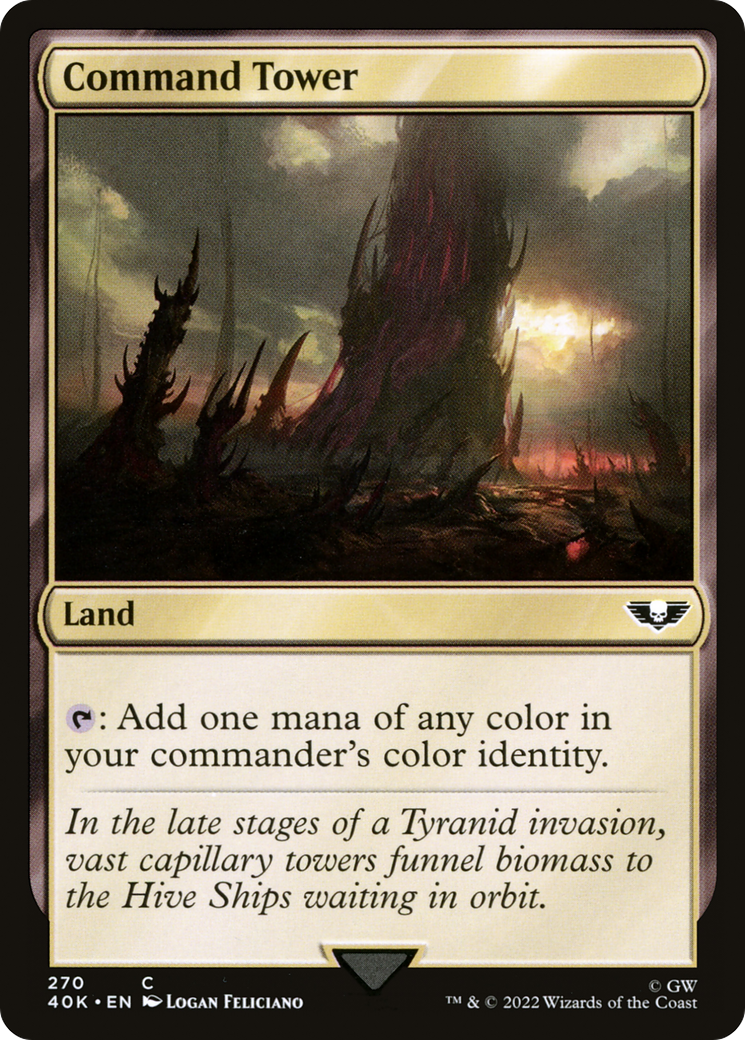
Command Tower
Land
: Add one mana of any color in your commander's color identity.
- If you have two commanders, the ability adds one mana of any color in their combined color identities.
- If your commander is a card that has no colors in its color identity, Command Tower's ability produces no mana. It doesn't produce .
- If you don't have a commander, Command Tower's ability produces no mana.
-
1
Crumbling Necropolis
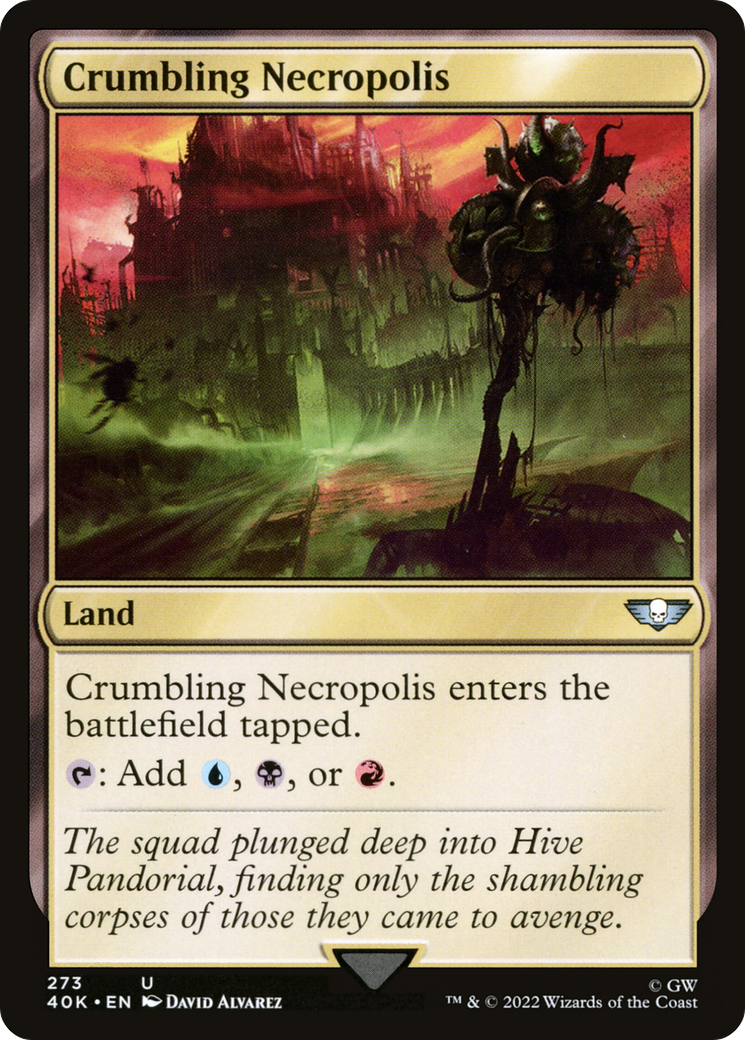
Crumbling Necropolis
Land
This land enters tapped.
: Add , , or .
-
1
Dismal Backwater
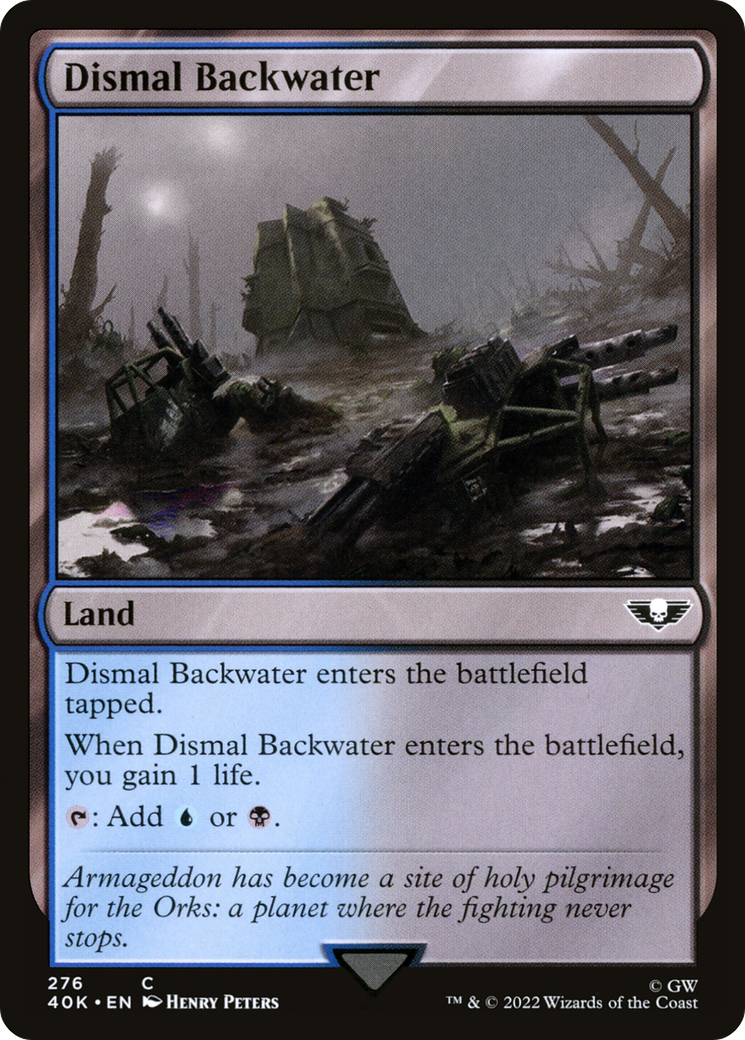
Dismal Backwater
Land
This land enters tapped.
When this land enters, you gain 1 life.
: Add or .
-
1
Evolving Wilds
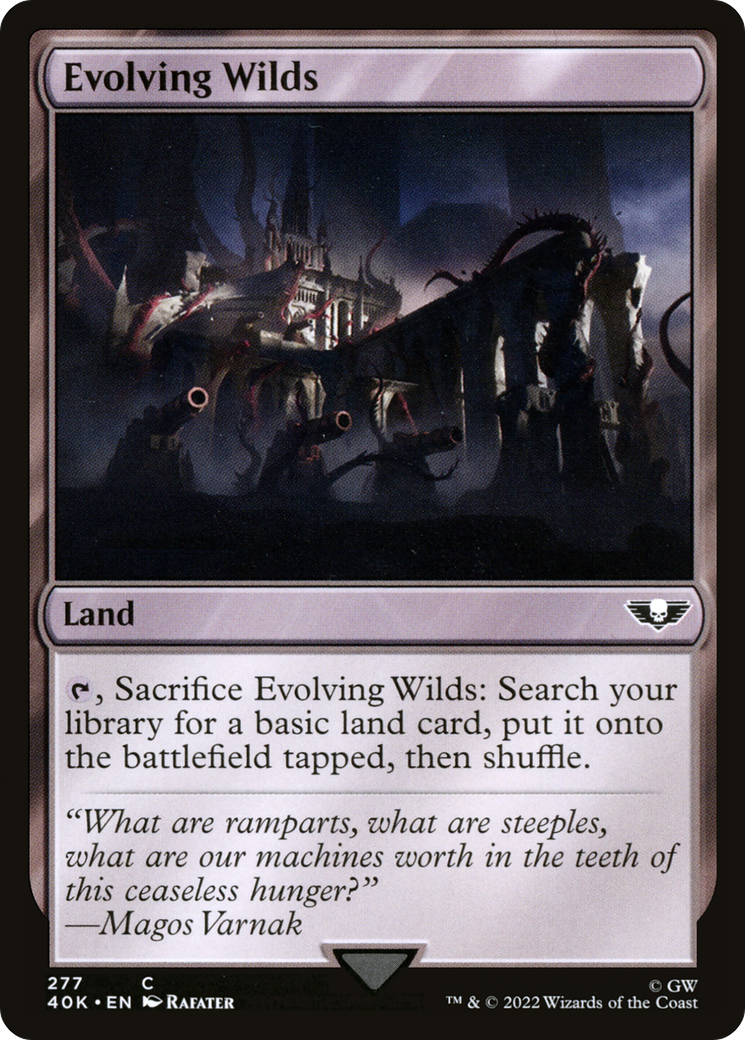
Evolving Wilds
Land
, Sacrifice this land: Search your library for a basic land card, put it onto the battlefield tapped, then shuffle.
-
1
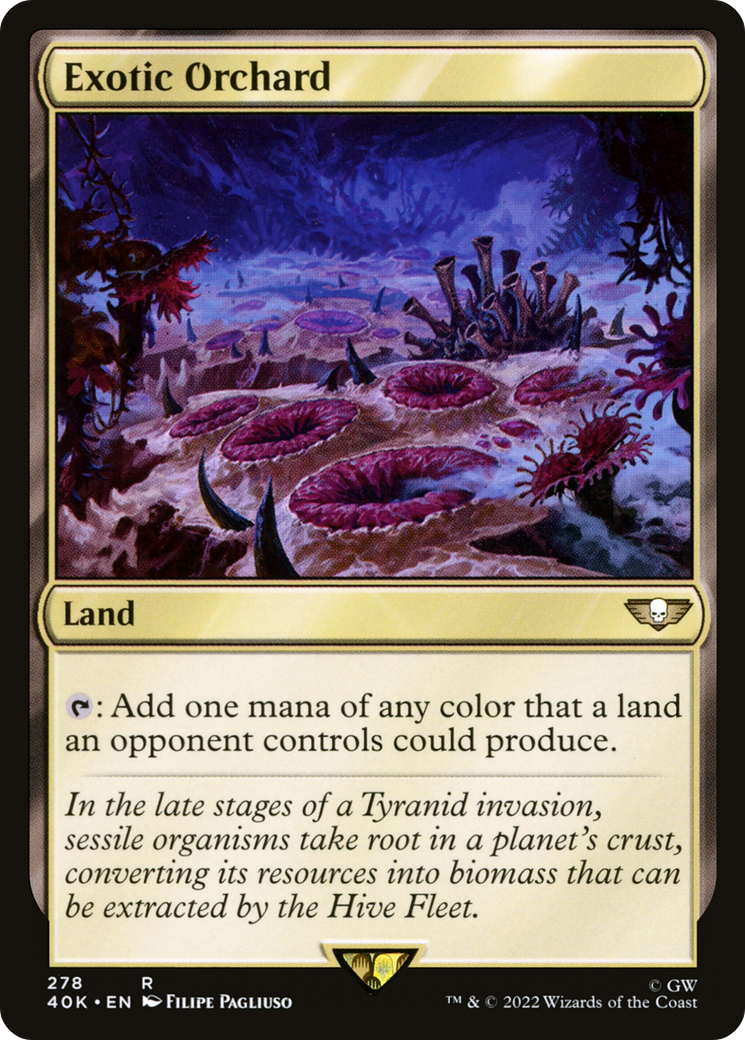
Exotic Orchard
Exotic Orchard
Land
: Add one mana of any color that a land an opponent controls could produce.
- The colors of mana are white, blue, black, red, and green. Exotic Orchard can't be tapped for colorless mana, even if a land an opponent controls could produce colorless mana.
- Exotic Orchard checks the effects of all mana-producing abilities of lands your opponents control, but it doesn't check their costs. For example, Vivid Crag has the ability " , Remove a charge counter from Vivid Crag: Add one mana of any color." If an opponent controls Vivid Crag and you control Exotic Orchard, you can tap Exotic Orchard for any color of mana. It doesn't matter whether Vivid Crag has a charge counter on it, and it doesn't matter whether it's untapped.
- When determining what colors of mana your opponents' lands could produce, Exotic Orchard takes into account any applicable replacement effects that would apply to those lands' mana abilities (such as Contamination's effect, for example). If there are more than one, consider them in any possible order.
- Exotic Orchard doesn't care about any restrictions or riders your opponents' lands (such as Ancient Ziggurat or Hall of the Bandit Lord) put on the mana they produce. It just cares about colors of mana.
- Lands that produce mana based only on what other lands "could produce" won't help each other unless some other land allows one of them to actually produce some type of mana. For example, if you control an Exotic Orchard and your opponent controls an Exotic Orchard and a Reflecting Pool, none of those lands would produce mana if their mana abilities were activated. On the other hand, if you control a Forest and an Exotic Orchard, and your opponent controls an Exotic Orchard and a Reflecting Pool, then each of those lands can be tapped to produce . Your opponent's Exotic Orchard can produce because you control a Forest. Your Exotic Orchard and your opponent's Reflecting Pool can each produce because your opponent's Exotic Orchard can produce .
-
1
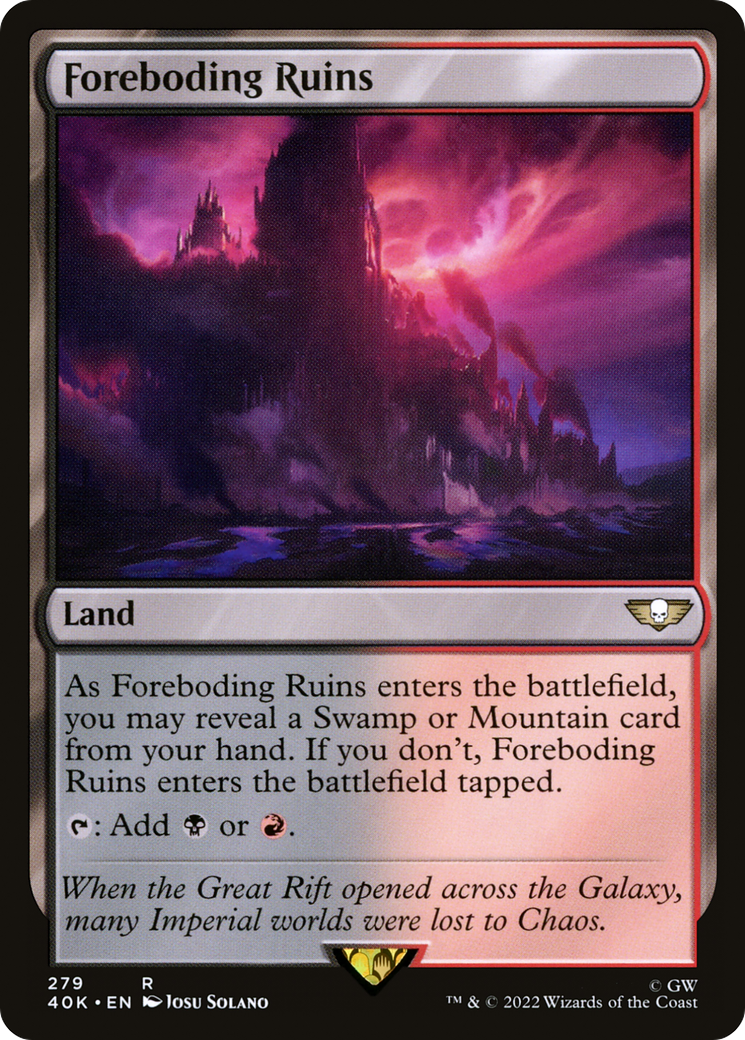
Foreboding Ruins
Foreboding Ruins
Land
As this land enters, you may reveal a Swamp or Mountain card from your hand. If you don't, this land enters tapped.
: Add or .
- You may reveal any land card with either or both of the appropriate subtypes. It doesn't have to be a basic land. For example, you could reveal Sunken Hollow from the Battle for Zendikar set to satisfy the ability of Foreboding Ruins.
- Lands don't have a subtype just because they can produce mana of the corresponding color. Foreboding Ruins itself is neither a Swamp nor a Mountain, even though it produces black and red mana, so you can't reveal one to satisfy the ability of another.
- If a Swamp or Mountain is entering the battlefield from your hand at the same time as Foreboding Ruins, you may reveal the other land to have Foreboding Ruins enter untapped.
- If an effect instructs you to put Foreboding Ruins onto the battlefield tapped, it will still enter the battlefield tapped even if you reveal a land card from your hand.
-
1
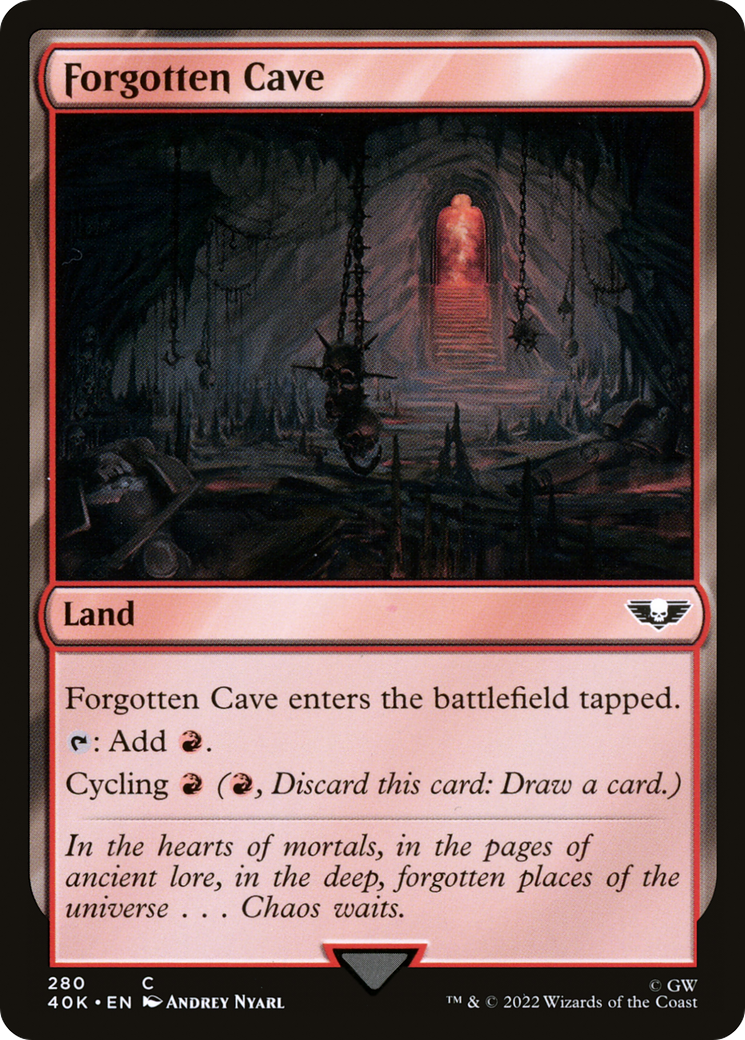
Forgotten Cave
Forgotten Cave
Land
This land enters tapped.
: Add .
Cycling ( , Discard this card: Draw a card.)
-
8
Island
Island
Basic Land — Island
( : Add .)
-
1
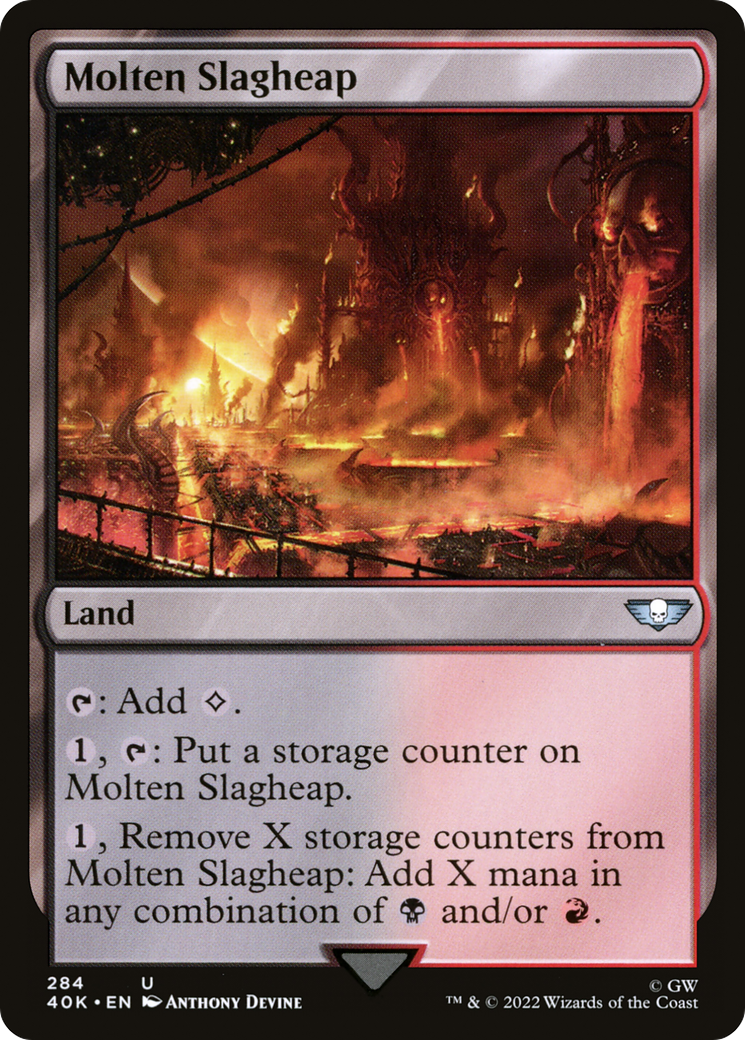
Molten Slagheap
Molten Slagheap
Land
: Add .
, : Put a storage counter on this land.
, Remove X storage counters from this land: Add X mana in any combination of and/or .
-
8
Mountain
Mountain
Basic Land — Mountain
( : Add .)
-
1
Path of Ancestry
Path of Ancestry
Land
This land enters tapped.
: Add one mana of any color in your commander's color identity. When that mana is spent to cast a creature spell that shares a creature type with your commander, scry 1. (Look at the top card of your library. You may put that card on the bottom.)
- If you have two commanders, the last ability adds one mana of any color in their combined color identities. When you spend that mana on a creature spell that shares a creature type with either of your commanders, you'll scry 1.
- Your commander's creature types are checked immediately after you cast a creature spell spending mana from Path of Ancestry's last ability. They aren't set before the game begins, and they may not be the same types your commander had when you activated that ability.
- If you cast your commander with mana from Path of Ancestry, and your commander hasn't somehow lost all of its creature types while on the stack, you'll scry 1.
- If your commander is a card that has no colors in its color identity, Path of Ancestry's ability produces no mana. It doesn't produce .
- If Path of Ancestry's last ability produces two mana (most likely due to Mana Reflection), spending those two mana to cast creature spells that share a creature type with your commander will cause two abilities to trigger. Each of those abilities will cause you to scry 1. You won't scry 2. This is true whether you spend the mana on one creature spell or two.
- If your commander has no creature types, it can't share a creature type with any spell that you cast.
- If you don't have a commander, Path of Ancestry's ability produces no mana.
-
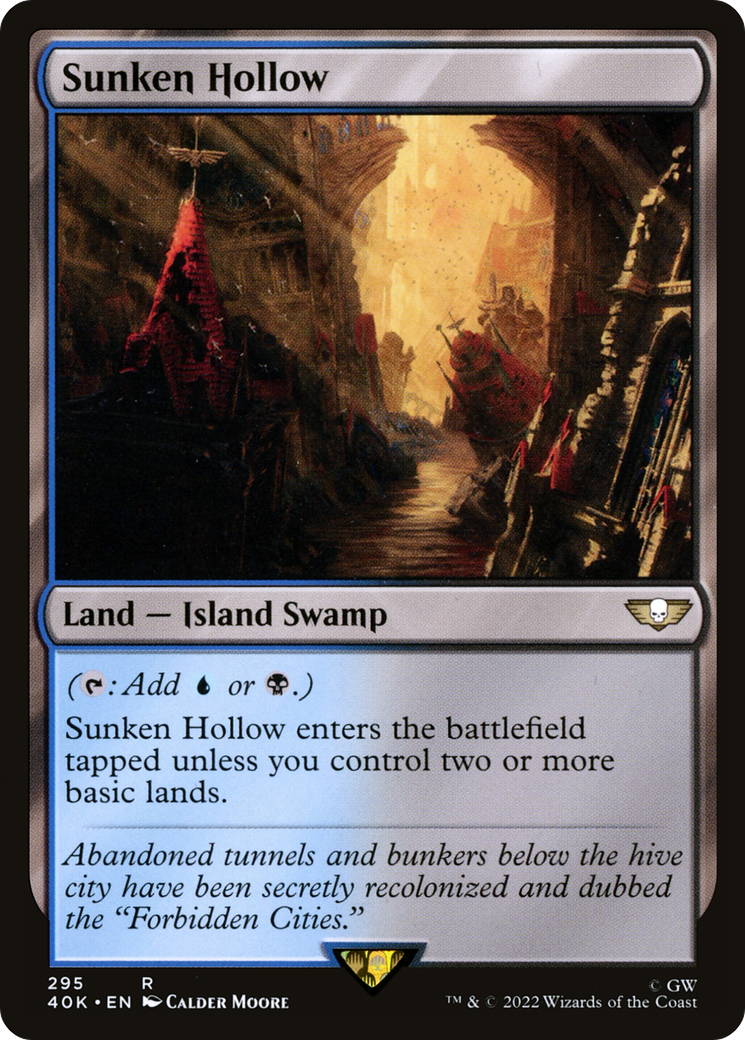
1
Sunken Hollow
Sunken Hollow
Land — Island Swamp
( : Add or .)
This land enters tapped unless you control two or more basic lands.
- Even though these lands have basic land types, they are not basic lands because "basic" doesn't appear on their type line. Notably, controlling two or more of them won't allow others to enter the battlefield untapped.
- However, because these cards have basic land types, effects that specify a basic land type without also specifying that the land be basic can affect them. For example, a spell or ability that reads "Destroy target Forest" can target Canopy Vista, while one that reads "Destroy target basic Forest" cannot.
- If one of these lands enters the battlefield at the same time as any number of basic lands, those other lands are not counted when determining if this land enters the battlefield tapped or untapped.
-
8
Swamp
Swamp
Basic Land — Swamp
( : Add .)
-
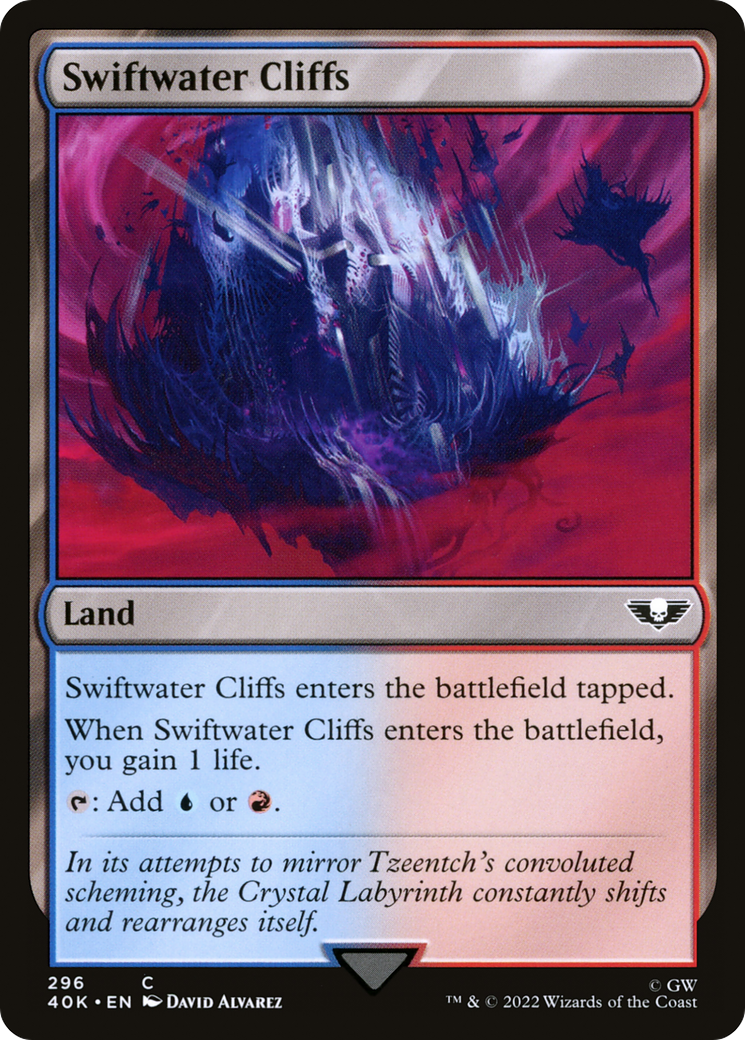
1
Swiftwater Cliffs
Swiftwater Cliffs
Land
This land enters tapped.
When this land enters, you gain 1 life.
: Add or .
-
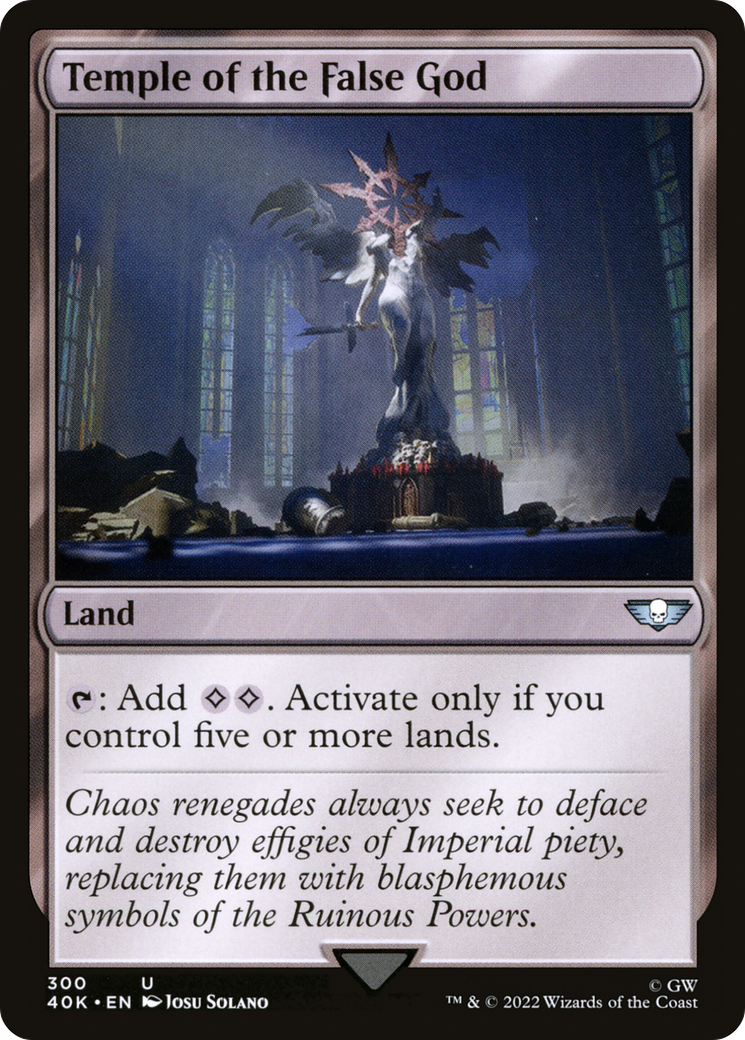
1
Temple of the False God
Temple of the False God
Land
: Add . Activate only if you control five or more lands.
-
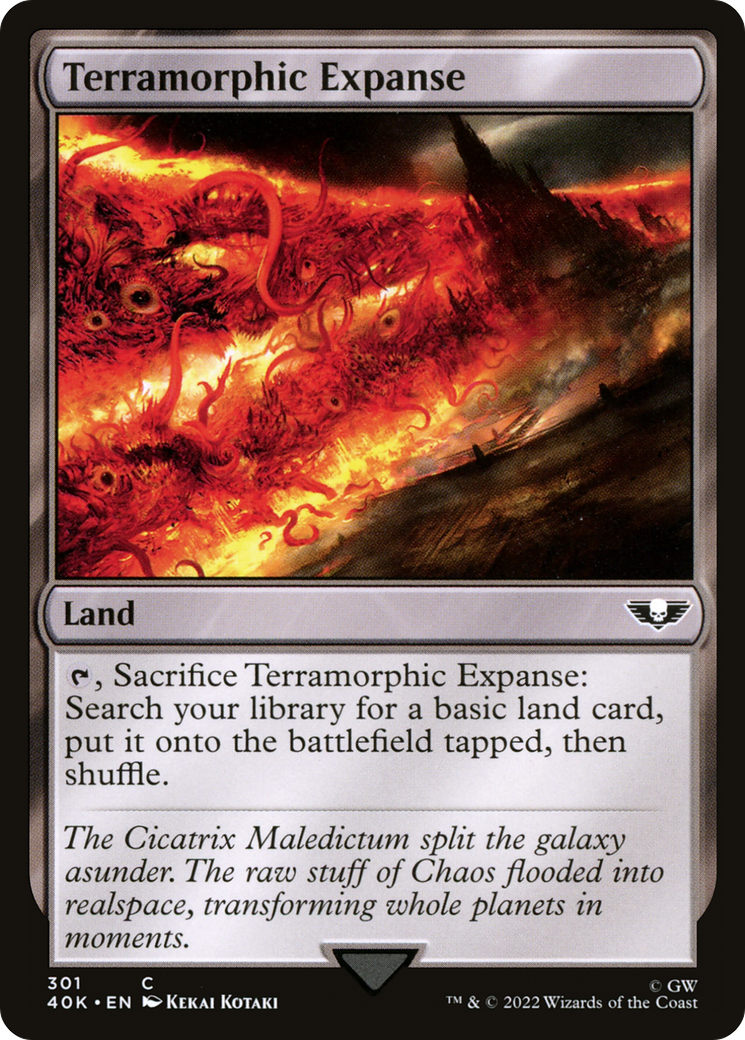
1
Terramorphic Expanse
Terramorphic Expanse
Land
, Sacrifice this land: Search your library for a basic land card, put it onto the battlefield tapped, then shuffle.
Blue 3
-
1
Brainstorm
Brainstorm
Instant
Draw three cards, then put two cards from your hand on top of your library in any order.
- You draw three cards and put two cards back all while Brainstorm is resolving. Nothing can happen between the two, and no player may choose to take actions.
-
1
Heralds of Tzeentch
Heralds of Tzeentch
Creature — Demon
3/3
Flying
Cascade (When you cast this spell, exile cards from the top of your library until you exile a nonland card that costs less. You may cast it without paying its mana cost. Put the exiled cards on the bottom in a random order.)
- A spell's mana value is determined only by its mana cost. Ignore any alternative costs, additional costs, cost increases, or cost reductions.
- Cascade triggers when you cast the spell, meaning that it resolves before that spell. If you end up casting the exiled card, it will go on the stack above the spell with cascade.
- When the cascade ability resolves, you must exile cards. The only optional part of the ability is whether or not you cast the last card exiled.
- If a spell with cascade is countered, the cascade ability will still resolve normally.
- You exile the cards face up. All players will be able to see them.
- If you cast a card "without paying its mana cost," you can't choose to cast it for any alternative costs. You can, however, pay additional costs. If the card has any mandatory additional costs, you must pay those to cast the card.
- If the card has in its mana cost, you must choose 0 as the value of X when casting it without paying its mana cost.
- Due to a 2021 rules change to cascade, not only do you stop exiling cards if you exile a nonland card with lesser mana value than the spell with cascade, but the resulting spell you cast must also have lesser mana value. Previously, in cases where a card's mana value differed from the resulting spell, such as with some modal double-faced cards or cards with an Adventure, you could cast a spell with a higher mana value than the exiled card.
- Two new cards in this set give the next spell you cast cascade. This means that the next spell you cast gains cascade as you begin to cast it by putting it on the stack, and the cascade ability will trigger when you finish casting that spell.
-
1
Lord of Change
Lord of Change
Creature — Demon
6/6
Flying, ward
Architect of Deception — When this creature enters, draw three cards.
Black 14
-
1
Bile Blight
Bile Blight
Instant
Target creature and all other creatures with the same name as that creature get -3/-3 until end of turn.
- Unless a token is a copy of another permanent or was explicitly given a name by the effect that created it, its name is the subtypes it was given when it was created plus the word "Token." For example, if an effect creates a 1/1 Soldier creature token, that token is named "Soldier Token."
- Bile Blight has only one target. Other creatures with that name are not targeted. For example, a creature with hexproof will still get -3/-3 if it has the same name as the target creature.
- If the target creature is an illegal target as Bile Blight tries to resolve, it won't resolve and none of its effects will happen. No creature will get -3/-3.
-
1
Blight Grenade
Blight Grenade
Sorcery
Destroy target creature.
All creatures get -3/-3 until end of turn.
- If Blight Grenade's target is no longer legal as it tries to resolve, it will be removed from the stack and no creatures will get -3/-3.
-
1
Dark Ritual
Dark Ritual
Instant
Add .
-
1
Decree of Pain
Decree of Pain
Sorcery
Destroy all creatures. They can't be regenerated. Draw a card for each creature destroyed this way.
Cycling ( , Discard this card: Draw a card.)
When you cycle this card, all creatures get -2/-2 until end of turn.
- When you cycle this card, first the cycling ability goes on the stack, then the triggered ability goes on the stack on top of it. The triggered ability will resolve before you draw a card from the cycling ability.
- The cycling ability and the triggered ability are separate. If the triggered ability doesn't resolve (because, for example, it has been countered, or all of its targets have become illegal), the cycling ability will still resolve, and you'll draw a card.
-
1
Great Unclean One
Great Unclean One
Creature — Demon
4/5
Reverberating Summons — At the beginning of your end step, each opponent loses 2 life. Then for each opponent who has less life than you, create a 1/3 black Demon creature token named Plaguebearer of Nurgle.
-
1
Mandate of Abaddon
Mandate of Abaddon
Sorcery
Choose target creature you control. Destroy all creatures with power less than that creature's power.
- If the chosen creature is an illegal target as Mandate of Abaddon tries to resolve, it will be removed from the stack and no creatures will be destroyed.
-
1
Mortarion, Daemon Primarch
Mortarion, Daemon Primarch
Legendary Creature — Demon Primarch
5/6
Flying
Primarch of the Death Guard — At the beginning of your end step, you may pay . If you do, create X 2/2 black Astartes Warrior creature tokens with menace. X can't be greater than the amount of life you lost this turn.
- Mortarion, Demon Primarch's ability looks only at the amount of life you've lost this turn, regardless of any life you may have gained. For example, if you lost 3 life due to combat damage, but gained 2 life later in the turn, X may be up to 3 for this ability.
- If a spell or ability sets a player's life total to a specified amount, that player gains or loses the appropriate amount of life. For example, if your life total is 20 and an effect sets your life total to 15, you lost 5 life.
-
1
Nurgle's Conscription
Nurgle's Conscription
Instant
Put target creature card from an opponent's graveyard onto the battlefield tapped under your control, then exile that player's graveyard.
-
1
Nurgle's Rot
Nurgle's Rot
Enchantment — Aura
Enchant creature an opponent controls
When enchanted creature dies, return this card to its owner's hand and you create a 1/3 black Demon creature token named Plaguebearer of Nurgle.
-
1
Plague Drone
Plague Drone
Creature — Demon
3/3
Flying
Rot Fly — If an opponent would gain life, that player loses that much life instead.
- If more than one replacement effect tries to apply to a life gain event, the player who would gain life chooses the order in which they apply. For example, if a player who controls Alhammarret's Archive would gain 3 life while Plague Drone is on the battlefield, that player may choose to have the 3 life become doubled to 6 life and then lose 6 life. The player may also choose to apply Plague Drone first, turning "gain 3 life" into "lose 3 life." Alhammarret's Archive would then not apply.
- Having more than one Plague Drone on the battlefield doesn't have any noticeable effect on life gain. Once the effect of one Plague Drone applies, there is no life gain for the others to apply to.
-
1
Poxwalkers
Poxwalkers
Creature — Zombie
3/1
Deathtouch
Curse of the Walking Pox — Whenever you cast a spell from anywhere other than your hand, return this card from your graveyard to the battlefield tapped.
-
1
Sloppity Bilepiper
Sloppity Bilepiper
Creature — Demon
3/3
Jolly Gutpipes — , , Sacrifice a creature: The next creature spell you cast this turn has cascade. (When you next cast a creature spell, exile cards from the top of your library until you exile a nonland card that costs less. You may cast it without paying its mana cost. Put the exiled cards on the bottom in a random order.)
- A spell's mana value is determined only by its mana cost. Ignore any alternative costs, additional costs, cost increases, or cost reductions.
- As Sloppity Bilepiper's activated ability resolves, it creates a continuous effect that won't begin to apply until you start casting a creature spell this turn. It applies to that spell and the timestamp of that effect is the time that the object was put on the stack.
- If you activate the ability of more than one Sloppity Bilepiper (or the same one more than once) in the same turn, the next creature spell you cast will have that many instances of cascade, each of which will trigger separately.
- See also "Returning Keyword Ability: Cascade" in general notes.
- Cascade triggers when you cast the spell, meaning that it resolves before that spell. If you end up casting the exiled card, it will go on the stack above the spell with cascade.
- When the cascade ability resolves, you must exile cards. The only optional part of the ability is whether or not you cast the last card exiled.
- If a spell with cascade is countered, the cascade ability will still resolve normally.
- You exile the cards face up. All players will be able to see them.
- If you cast a card "without paying its mana cost," you can't choose to cast it for any alternative costs. You can, however, pay additional costs. If the card has any mandatory additional costs, you must pay those to cast the card.
- If the card has in its mana cost, you must choose 0 as the value of X when casting it without paying its mana cost.
- Due to a 2021 rules change to cascade, not only do you stop exiling cards if you exile a nonland card with lesser mana value than the spell with cascade, but the resulting spell you cast must also have lesser mana value. Previously, in cases where a card's mana value differed from the resulting spell, such as with some modal double-faced cards or cards with an Adventure, you could cast a spell with a higher mana value than the exiled card.
- Two new cards in this set give the next spell you cast cascade. This means that the next spell you cast gains cascade as you begin to cast it by putting it on the stack, and the cascade ability will trigger when you finish casting that spell.
-
1
Tallyman of Nurgle
Tallyman of Nurgle
Creature — Astartes Warrior
2/3
Lifelink
The Seven-fold Chant — At the beginning of your end step, if a creature died this turn, you draw a card and you lose 1 life. If seven or more creatures died this turn, instead you draw seven cards and you lose 7 life.
-
1
Venomcrawler
Venomcrawler
Artifact Creature — Demon
2/2
Lifelink
Devourer of Souls — Whenever another creature dies, put a +1/+1 counter on this creature.
Red 17
-
1
Aspiring Champion
Aspiring Champion
Creature — Astartes Warrior
3/3
Menace
Ruinous Ascension — When this creature deals combat damage to a player, sacrifice it. If you do, reveal cards from the top of your library until you reveal a creature card. Put that card onto the battlefield, then shuffle the rest into your library. If that creature is a Demon, it deals damage equal to its power to each opponent.
- If you still control Aspiring Champion as its triggered ability resolves, you must sacrifice it. You can't choose not to sacrifice it.
-
1
Blasphemous Act
Blasphemous Act
Sorcery
This spell costs less to cast for each creature on the battlefield.
Blasphemous Act deals 13 damage to each creature.
- To determine the total cost of a spell, start with the mana cost or alternative cost you're paying, add any cost increases, then apply any cost reductions (such as that of Blasphemous Act). The mana value of the spell is determined only by its mana cost, no matter what the total cost to cast the spell was.
- Blasphemous Act's ability can't reduce the total cost to cast the spell below .
- The total cost to cast Blasphemous Act is locked in before you pay that cost. For example, if there are three creatures on the battlefield, including one you can sacrifice to add , the total cost of Blasphemous Act is . Then you can sacrifice the creature when you activate mana abilities just before paying the cost.
- Although players may respond to Blasphemous Act once it's been cast, once it's announced, they can't respond before the cost is calculated and paid.
-
1
Bloodcrusher of Khorne
Bloodcrusher of Khorne
Creature — Demon Knight
3/3
Trample
Devastating Charge — Other creatures you control have trample.
-
1
Bloodthirster
Bloodthirster
Creature — Demon
6/6
Flying, trample
Whenever this creature deals combat damage to a player, untap it. After this phase, there is an additional combat phase.
This creature can't attack a player it has already attacked this turn.
-
1
Chaos Terminator Lord
Chaos Terminator Lord
Creature — Astartes Warrior
3/3
Lord of Chaos — At the beginning of combat on your turn, another target creature you control gains double strike until end of turn.
-
1
Chaos Warp
Chaos Warp
Instant
The owner of target permanent shuffles it into their library, then reveals the top card of their library. If it's a permanent card, they put it onto the battlefield.
- The owner of a token is the player under whose control the token was put onto the battlefield. If a token is shuffled into a player's library this way, that player shuffles before revealing the top card of that library.
- If the permanent is an illegal target by the time Chaos Warp tries to resolve, it won't resolve and none of its effects will occur. No library will be shuffled and no card will be revealed.
- A permanent card is a card with one or more of the following card types: artifact, creature, enchantment, land, or planeswalker.
- If the revealed card is a permanent card but can't enter (perhaps because it's an Aura with nothing to enchant), it remains on top of that library.
- If the revealed card is not a permanent card, it remains on top of that library.
-
1
Dark Apostle
Dark Apostle
Creature — Astartes Warlock
3/3
Gift of Chaos — , : The next noncreature spell you cast this turn has cascade. (When you cast that spell, exile cards from the top of your library until you exile a nonland card that costs less. You may cast it without paying its mana cost. Put the exiled cards on the bottom in a random order.)
- As Dark Apostle's activated ability resolves, it creates a continuous effect that won't begin to apply until you start casting a noncreature spell this turn. It applies to that spell and the timestamp of that effect is the time that the spell was put on the stack.
- If you activate the ability of more than one Dark Apostle (or the same one more than once) in the same turn, the next noncreature spell you cast will have that many instances of cascade, each of which will trigger separately.
- See also "Returning Keyword Ability: Cascade" in the General Notes section.
- A spell's mana value is determined only by its mana cost. Ignore any alternative costs, additional costs, cost increases, or cost reductions.
- Cascade triggers when you cast the spell, meaning that it resolves before that spell. If you end up casting the exiled card, it will go on the stack above the spell with cascade.
- When the cascade ability resolves, you must exile cards. The only optional part of the ability is whether or not you cast the last card exiled.
- If a spell with cascade is countered, the cascade ability will still resolve normally.
- You exile the cards face up. All players will be able to see them.
- If you cast a card "without paying its mana cost," you can't choose to cast it for any alternative costs. You can, however, pay additional costs. If the card has any mandatory additional costs, you must pay those to cast the card.
- If the card has in its mana cost, you must choose 0 as the value of X when casting it without paying its mana cost.
- Due to a 2021 rules change to cascade, not only do you stop exiling cards if you exile a nonland card with lesser mana value than the spell with cascade, but the resulting spell you cast must also have lesser mana value. Previously, in cases where a card's mana value differed from the resulting spell, such as with some modal double-faced cards or cards with an Adventure, you could cast a spell with a higher mana value than the exiled card.
- Two new cards in this set give the next spell you cast cascade. This means that the next spell you cast gains cascade as you begin to cast it by putting it on the stack, and the cascade ability will trigger when you finish casting that spell.
-
1
Herald of Slaanesh
Herald of Slaanesh
Creature — Demon
2/2
Locus of Slaanesh — Demon spells you cast cost less to cast.
Other Demons you control have haste.
- Herald of Slaanesh's first ability only reduces the generic mana component of costs. It cannot reduce the cost of colored mana components.
-
1
Keeper of Secrets
Keeper of Secrets
Creature — Demon
6/4
First strike, haste
Symphony of Pain — Whenever you cast a spell from anywhere other than your hand, this creature deals damage equal to that spell's mana value to target opponent.
-
1
Khârn the Betrayer
Khârn the Betrayer
Legendary Creature — Astartes Berserker
5/1
Berzerker — Khârn the Betrayer attacks or blocks each combat if able.
Sigil of Corruption — When you lose control of Khârn the Betrayer, draw two cards.
The Betrayer — If damage would be dealt to Khârn the Betrayer, prevent that damage and an opponent of your choice gains control of it.
- You lose control of Khârn the Betrayer when it leaves the battlefield or another player gains control of it.
- An opponent gaining control of it is part of the replacement effect and happens immediately, even if you are in the middle of resolving the spell or ability and it has more instructions to perform after taking damage.
- In contrast, the Sigil of Corruption ability is a triggered ability, and it won't go onto the stack until after the spell or ability that tried to deal damage finishes resolving.
- In some cases, a single spell or ability will deal damage to this creature multiple times during its resolution. In that case, a new player gains control of it each time, its ability triggers once each time, and the appropriate players control those triggers. After that spell or ability is done resolving, all of those triggers are put onto the stack in turn order, starting with the active player (or the next player in turn order if the active player isn't involved). Usually, this means that the cards are drawn in a different order than the control-changing effects took place.
-
1
Knight Rampager
Knight Rampager
Artifact Creature — Knight
6/5
Trample
Frenzied Rampage — At the beginning of combat on your turn, choose an opponent at random. This creature attacks that player this combat if able.
When this creature dies, it deals 4 damage to target opponent chosen at random.
- If Knight Rampager has multiple attack requirements applied to it, usually because it was also goaded, you must obey as many of the requirements as possible without violating any restrictions (such as effects that say it "can't attack") that might apply. For example, if the player chosen randomly also goaded Knight Rampager, then Knight Rampager must attack, but would be allowed to attack any player.
- If the spell you cast with the cascade ability is a creature, it will have entered the battlefield this turn when Let the Galaxy Burn resolves and will not take damage from Let the Galaxy Burn's effect.
-
1
Let the Galaxy Burn
Let the Galaxy Burn
Sorcery
Cascade (When you cast this spell, exile cards from the top of your library until you exile a nonland card that costs less. You may cast it without paying its mana cost. Put the exiled cards on the bottom in a random order.)
Let the Galaxy Burn deals X plus 2 damage to each creature that didn't enter this turn.
- A spell's mana value is determined only by its mana cost. Ignore any alternative costs, additional costs, cost increases, or cost reductions.
- Cascade triggers when you cast the spell, meaning that it resolves before that spell. If you end up casting the exiled card, it will go on the stack above the spell with cascade.
- When the cascade ability resolves, you must exile cards. The only optional part of the ability is whether or not you cast the last card exiled.
- If a spell with cascade is countered, the cascade ability will still resolve normally.
- You exile the cards face up. All players will be able to see them.
- If you cast a card "without paying its mana cost," you can't choose to cast it for any alternative costs. You can, however, pay additional costs. If the card has any mandatory additional costs, you must pay those to cast the card.
- If the card has in its mana cost, you must choose 0 as the value of X when casting it without paying its mana cost.
- Due to a 2021 rules change to cascade, not only do you stop exiling cards if you exile a nonland card with lesser mana value than the spell with cascade, but the resulting spell you cast must also have lesser mana value. Previously, in cases where a card's mana value differed from the resulting spell, such as with some modal double-faced cards or cards with an Adventure, you could cast a spell with a higher mana value than the exiled card.
- Two new cards in this set give the next spell you cast cascade. This means that the next spell you cast gains cascade as you begin to cast it by putting it on the stack, and the cascade ability will trigger when you finish casting that spell.
-
1
Noise Marine
Noise Marine
Creature — Astartes Warrior
3/2
Cascade (When you cast this spell, exile cards from the top of your library until you exile a nonland card that costs less. You may cast it without paying its mana cost. Put the exiled cards on the bottom in a random order.)
Sonic Blaster — When this creature enters, it deals damage equal to the number of spells you've cast this turn to any target.
- The spell you cast due to cascade resolves before Noise Marine, so when its enters-the-battlefield ability resolves it will count that spell as a spell you've cast this turn.
- A spell's mana value is determined only by its mana cost. Ignore any alternative costs, additional costs, cost increases, or cost reductions.
- Cascade triggers when you cast the spell, meaning that it resolves before that spell. If you end up casting the exiled card, it will go on the stack above the spell with cascade.
- When the cascade ability resolves, you must exile cards. The only optional part of the ability is whether or not you cast the last card exiled.
- If a spell with cascade is countered, the cascade ability will still resolve normally.
- You exile the cards face up. All players will be able to see them.
- If you cast a card "without paying its mana cost," you can't choose to cast it for any alternative costs. You can, however, pay additional costs. If the card has any mandatory additional costs, you must pay those to cast the card.
- If the card has in its mana cost, you must choose 0 as the value of X when casting it without paying its mana cost.
- Due to a 2021 rules change to cascade, not only do you stop exiling cards if you exile a nonland card with lesser mana value than the spell with cascade, but the resulting spell you cast must also have lesser mana value. Previously, in cases where a card's mana value differed from the resulting spell, such as with some modal double-faced cards or cards with an Adventure, you could cast a spell with a higher mana value than the exiled card.
- Two new cards in this set give the next spell you cast cascade. This means that the next spell you cast gains cascade as you begin to cast it by putting it on the stack, and the cascade ability will trigger when you finish casting that spell.
-
1
Past in Flames
Past in Flames
Sorcery
Each instant and sorcery card in your graveyard gains flashback until end of turn. The flashback cost is equal to its mana cost.
Flashback (You may cast this card from your graveyard for its flashback cost. Then exile it.)
- Past in Flames affects only cards in your graveyard at the time it resolves. Instant and sorcery cards put into your graveyard later in the turn won't gain flashback.
- "Flashback [cost]" means "You may cast this card from your graveyard by paying [cost] rather than paying its mana cost" and "If the flashback cost was paid, exile this card instead of putting it anywhere else any time it would leave the stack."
- You must still follow any timing restrictions and permissions, including those based on the card's type. For instance, you can cast a sorcery using flashback only when you could normally cast a sorcery.
- To determine the total cost of a spell, start with the mana cost or alternative cost (such as a flashback cost) you're paying, add any cost increases, then apply any cost reductions. The mana value of the spell is determined only by its mana cost, no matter what the total cost to cast the spell was.
- A spell cast using flashback will always be exiled afterward, whether it resolves, is countered, or leaves the stack in some other way.
- You can cast a spell using flashback even if it was somehow put into your graveyard without having been cast.
- If a card with flashback is put into your graveyard during your turn, you can cast it if it's legal to do so before any other player can take any actions.
- If you cast an instant or sorcery with in its mana cost this way, you still choose the value of X as part of casting the spell and pay that cost.
- If you cast a spell with flashback, you can't pay any alternative costs such as overload costs. You can pay additional costs such as kicker costs. If the spell has any mandatory additional costs, you must pay those to cast the spell with flashback.
- If a card has multiple instances of flashback, you may choose any of its flashback costs to pay.
- If a split card gains flashback, you pay only the cost of the half you're casting.
- If a card with no mana cost gains flashback, it has no flashback cost. It can't be cast this way.
-
1
Reverberate
Reverberate
Instant
Copy target instant or sorcery spell. You may choose new targets for the copy.
- Reverberate can target (and copy) any instant or sorcery spell, not just one with targets. It doesn't matter who controls it.
- When Reverberate resolves, it creates a copy of a spell. You control the copy. That copy is created on the stack, so it's not "cast." Abilities that trigger when a player casts a spell won't trigger. The copy will then resolve like a normal spell, after players get a chance to cast spells and activate abilities.
- The copy will have the same targets as the spell it's copying unless you choose new ones. You may change any number of the targets, including all of them or none of them. If, for one of the targets, you can't choose a new legal target, then it remains unchanged (even if the current target is illegal).
- If the spell Reverberate copies is modal (that is, it says "Choose one —" or the like), the copy will have the same mode. You can't choose a different one.
- If the spell Reverberate copies has an X whose value was determined as it was cast (like Earthquake does), the copy has the same value of X.
- You can't choose to pay any additional costs for the copy. However, effects based on any additional costs that were paid for the original spell are copied as though those same costs were paid for the copy too. For example, if a player sacrifices a 3/3 creature to cast Fling, and you copy it with Reverberate, the copy of Fling will also deal 3 damage to its target.
- If the copy says that it affects "you," it affects the controller of the copy, not the controller of the original spell. Similarly, if the copy says that it affects an "opponent," it affects an opponent of the copy's controller, not an opponent of the original spell's controller.
-
1
Seeker of Slaanesh
Seeker of Slaanesh
Creature — Demon
3/3
Haste
Allure of Slaanesh — Each opponent must attack with at least one creature each combat if able.
- If a creature isn't able to attack for any reason (such as being tapped as its controller's declare attackers step begins or being affected by "summoning sickness"), that creature doesn't have to attack. If no creatures a player controls are able to attack, Seeker of Slaanesh's requirement has no effect during that combat. If there's a cost associated with having a creature attack, its controller isn't forced to pay that cost, so it doesn't have to attack in that case either.
-
1
Warstorm Surge
Warstorm Surge
Enchantment
Whenever a creature you control enters, it deals damage equal to its power to any target.
- The creature that entered deals damage equal to its current power to the targeted permanent or player. If it's no longer on the battlefield, its last known existence on the battlefield is checked to determine its power.
- Warstorm Surge is the source of the ability, but the creature is the source of the damage. The ability couldn't target a creature with protection from red, for example. It could target a creature with protection from creatures, but all the damage would be prevented. Since damage is dealt by the creature, abilities like lifelink, deathtouch and infect are taken into account, even if the creature has left the battlefield by the time it deals damage.
Multicolor 19
-
1
Abaddon the Despoiler
Abaddon the Despoiler
Legendary Creature — Astartes Warrior
5/5
Trample
Mark of Chaos Ascendant — During your turn, spells you cast from your hand with mana value X or less have cascade, where X is the total amount of life your opponents have lost this turn.
-
1
Be'lakor, the Dark Master
Be'lakor, the Dark Master
Legendary Creature — Demon Noble
6/5
Flying
Prince of Chaos — When Be'lakor, the Dark Master enters, you draw X cards and you lose X life, where X is the number of Demons you control.
Lord of Torment — Whenever another Demon you control enters, it deals damage equal to its power to any target.
- The number of Demons you control is counted only as Be'lakor, the Dark Master's ability resolves. If Be'lakor is still on the battlefield, it will count itself.
-
1
Bituminous Blast
Bituminous Blast
Instant
Cascade (When you cast this spell, exile cards from the top of your library until you exile a nonland card that costs less. You may cast it without paying its mana cost. Put the exiled cards on the bottom in a random order.)
Bituminous Blast deals 4 damage to target creature.
- A spell's mana value is determined only by its mana cost. Ignore any alternative costs, additional costs, cost increases, or cost reductions.
- Cascade triggers when you cast the spell, meaning that it resolves before that spell. If you end up casting the exiled card, it will go on the stack above the spell with cascade.
- When the cascade ability resolves, you must exile cards. The only optional part of the ability is whether or not you cast the last card exiled.
- If a spell with cascade is countered, the cascade ability will still resolve normally.
- You exile the cards face up. All players will be able to see them.
- If you cast a card "without paying its mana cost," you can't choose to cast it for any alternative costs. You can, however, pay additional costs. If the card has any mandatory additional costs, you must pay those to cast the card.
- If the card has in its mana cost, you must choose 0 as the value of X when casting it without paying its mana cost.
- Due to a 2021 rules change to cascade, not only do you stop exiling cards if you exile a nonland card with lesser mana value than the spell with cascade, but the resulting spell you cast must also have lesser mana value. Previously, in cases where a card's mana value differed from the resulting spell, such as with some modal double-faced cards or cards with an Adventure, you could cast a spell with a higher mana value than the exiled card.
- The mana value of a split card is determined by the combined mana cost of its two halves. If cascade allows you to cast a split card, you may cast either half but not both halves.
-
1
Blood for the Blood God!
Blood for the Blood God!
Instant
This spell costs less to cast for each creature that died this turn.
Discard your hand, then draw eight cards. Blood for the Blood God! deals 8 damage to each opponent. Exile Blood for the Blood God!
- The ability that reduces the mana cost only reduces its generic mana cost. It will cost at least , even if more than eight creatures have died this turn.
-
1
Chaos Defiler
Chaos Defiler
Artifact Creature — Demon Construct
5/4
Trample
Battle Cannon — When this creature enters or dies, for each opponent, choose a nonland permanent that player controls. Destroy one of them chosen at random.
- If you choose one or more permanents with indestructible, and there are any permanents chosen which do not have indestructible, one of the permanents without indestructible will be randomly chosen and destroyed.
-
1
Chaos Mutation
Chaos Mutation
Instant
Exile any number of target creatures controlled by different players. For each creature exiled this way, its controller reveals cards from the top of their library until they reveal a creature card, puts that card onto the battlefield, then puts the rest on the bottom of their library in a random order.
- The phrase "target creatures controlled by different players" means that no two targets may be controlled by the same player.
-
1
Deny Reality
Deny Reality
Sorcery
Cascade (When you cast this spell, exile cards from the top of your library until you exile a nonland card that costs less. You may cast it without paying its mana cost. Put the exiled cards on the bottom in a random order.)
Return target permanent to its owner's hand.
- A spell's mana value is determined only by its mana cost. Ignore any alternative costs, additional costs, cost increases, or cost reductions.
- Cascade triggers when you cast the spell, meaning that it resolves before that spell. If you end up casting the exiled card, it will go on the stack above the spell with cascade.
- When the cascade ability resolves, you must exile cards. The only optional part of the ability is whether or not you cast the last card exiled.
- If a spell with cascade is countered, the cascade ability will still resolve normally.
- You exile the cards face up. All players will be able to see them.
- If you cast a card "without paying its mana cost," you can't choose to cast it for any alternative costs. You can, however, pay additional costs. If the card has any mandatory additional costs, you must pay those to cast the card.
- If the card has in its mana cost, you must choose 0 as the value of X when casting it without paying its mana cost.
- Due to a 2021 rules change to cascade, not only do you stop exiling cards if you exile a nonland card with lesser mana value than the spell with cascade, but the resulting spell you cast must also have lesser mana value. Previously, in cases where a card's mana value differed from the resulting spell, such as with some modal double-faced cards or cards with an Adventure, you could cast a spell with a higher mana value than the exiled card.
- The mana value of a split card is determined by the combined mana cost of its two halves. If cascade allows you to cast a split card, you may cast either half but not both halves.
-
1
Drach'Nyen
Drach'Nyen
Legendary Artifact — Equipment
Echo of the First Murder — When Drach'Nyen enters, exile up to one target creature.
Daemon Sword — Equipped creature has menace and gets +X/+0, where X is the exiled card's power.
Equip ( : Attach to target creature you control. Equip only as a sorcery.)
- If the exiled card doesn't have a printed power, perhaps because it was a noncreature permanent that was only a creature on the battlefield due to another effect, X is 0.
- If the exiled card's power is determined by a characteristic-defining ability, usually denoted by a "*" in the power/toughness box, that ability applies in exile and should be used to determine the value of X.
- If more than one card is exiled by Drach'Nyen, usually because its triggered ability was copied one or more times, X is the total power of the exiled cards.
-
1
Exalted Flamer of Tzeentch
Exalted Flamer of Tzeentch
Creature — Demon
2/4
Sorcerous Inspiration — At the beginning of your upkeep, return an instant or sorcery card at random from your graveyard to your hand.
Fire of Tzeentch — Whenever you cast an instant or sorcery spell, this creature deals 1 damage to each opponent.
-
1
Helbrute
Helbrute
Artifact Creature — Astartes Dreadnought
5/4
Haste
Sarcophagus — You may cast this card from your graveyard by exiling another creature card from your graveyard in addition to paying its other costs.
- You still need to follow all normal timing restrictions when casting Helbrute from your graveyard using the permission granted by its last ability. Usually, this means you may only cast it during one of your own main phases while the stack is empty.
-
1
Kill! Maim! Burn!
Kill! Maim! Burn!
Instant
Choose one or more —
- Destroy target artifact.
- Destroy target creature.
- Kill! Maim! Burn! deals 3 damage to target player.
-
1
Lucius the Eternal
Lucius the Eternal
Legendary Creature — Astartes Warrior
5/3
Haste
Armour of Shrieking Souls — When Lucius the Eternal dies, exile it and choose target creature an opponent controls. When that creature leaves the battlefield, return this card from exile to the battlefield under its owner's control.
- If the target creature leaves the battlefield before Lucius the Eternal's ability resolves, Lucius will stay in your graveyard and will not be exiled or return to the battlefield.
-
1
Magnus the Red
Magnus the Red
Legendary Creature — Demon Primarch
4/5
Flying
Unearthly Power — Instant and sorcery spells you cast cost less to cast for each creature token you control.
Blade of Magnus — Whenever Magnus the Red deals combat damage to a player, create a 3/3 red Spawn creature token.
- The total cost to cast a spell is locked in before you pay that cost. For example, if you control three creature tokens, including one you can sacrifice to add , the total cost to cast an instant with mana cost is . Then you can sacrifice the creature when you activate mana abilities just before paying the cost.
- If you activate a card's unearth ability but that card is removed from your graveyard before the ability resolves, that unearth ability will resolve and do nothing.
- Activating a permanent card's unearth ability isn't the same as casting it as a spell. The unearth ability is put on the stack, but the card is not. Spells and abilities that interact with activated abilities (such as Stifle) will interact with unearth, but spells and abilities that interact with spells (such as Cancel) will not.
- If a permanent returned to the battlefield by an unearth ability would leave it for any reason, it's exiled instead—unless the spell or ability that's causing it to leave the battlefield is actually trying to exile it. In that case, the spell or ability succeeds at exiling the permanent. If the spell or ability later returns the card to the battlefield, it will return as a new object with no relation to its previous existence. The unearth effect will no longer apply to it.
- At the beginning of the end step, a permanent returned to the battlefield with unearth is exiled. This is a delayed triggered ability, and it can be countered by effects that counter triggered abilities. If the ability is countered, the permanent will stay on the battlefield and the delayed trigger won't trigger again. However, the replacement effect will still exile it if it eventually leaves the battlefield.
- Unearth grants haste to the permanent that's returned to the battlefield. However, neither of the "exile" abilities is granted to that permanent. If that creature loses all its abilities, it will still be exiled at the beginning of the end step, and if it would leave the battlefield, it is still exiled instead.
-
1
Mutalith Vortex Beast
Mutalith Vortex Beast
Creature — Mutant Beast
6/6
Trample
Warp Vortex — When this creature enters, flip a coin for each opponent you have. For each flip you win, draw a card. For each flip you lose, this creature deals 3 damage to that player.
- Mutalith's Vortex Beast deals 3 damage to the appropriate player for each lost flip, not 3 damage to each of those players for each lost flip.
-
1
Pink Horror
Pink Horror
Creature — Demon Horror
4/4
Coruscating Flames — Whenever you cast an instant or sorcery spell, this creature deals 2 damage to any target.
Split — When this creature dies, create two 2/2 blue and red Demon Horror creature tokens named Blue Horror with "Whenever you cast an instant or sorcery spell, this token deals 1 damage to any target."
-
1
The Horus Heresy
The Horus Heresy
Enchantment — Saga
(As this Saga enters and after your draw step, add a lore counter. Sacrifice after III.)
I — For each opponent, gain control of up to one target nonlegendary creature that player controls for as long as this Saga remains on the battlefield.
II — Draw a card for each creature you control but don't own.
III — Starting with you, each player chooses a creature. Destroy each creature chosen this way.
-
1
The Lost and the Damned
The Lost and the Damned
Enchantment
Whenever a land you control enters from anywhere other than your hand or you cast a spell from anywhere other than your hand, create a 3/3 red Spawn creature token.
-
1
The Ruinous Powers
The Ruinous Powers
Enchantment
At the beginning of your upkeep, choose an opponent at random. Exile the top card of that player's library. Until end of turn, you may play that card and you may spend mana as though it were mana of any color to cast it. When you cast a spell this way, its owner loses life equal to its mana value.
- You must follow all normal timing rules when casting a spell or playing a land using the permission granted by Ruinous Powers.
- Use the mana value of the spell as it exists on the stack (or last existed on the stack, if it's been removed) to determine how much life is lost. If there is an in that spell's cost, include the value chosen for X to determine its mana value.
-
1
Tzaangor Shaman
Tzaangor Shaman
Creature — Mutant Shaman
3/3
Flying
Sorcerous Elixir — Whenever this creature deals combat damage to a player, copy the next instant or sorcery spell you cast this turn when you cast it. You may choose new targets for the copy.
- If Tzaangor Shaman deals combat damage to a player more than one time in a turn, perhaps because it has gained double strike, its delayed triggered ability will trigger that many times when you cast your next instant or sorcery spell this turn.
Colorless 9
-
1
Assault Suit
Assault Suit
Artifact — Equipment
Equipped creature gets +2/+2, has haste, can't attack you or planeswalkers you control, and can't be sacrificed.
At the beginning of each opponent's upkeep, you may have that player gain control of equipped creature until end of turn. If you do, untap it.
Equip
- The equipped creature can't be sacrificed for any reason. If an effect instructs you to sacrifice it, you can't and it remains on the battlefield. You also can't sacrifice it to pay a cost that requires you to sacrifice a creature.
- If an effect instructs you to sacrifice a creature, and you control any creatures other than the creature equipped with Assault Suit, you must sacrifice one of them. You can't try to sacrifice the equipped creature, fail, and therefore ignore the effect.
-
1
Chromatic Lantern
Chromatic Lantern
Artifact
Lands you control have " : Add one mana of any color."
: Add one mana of any color.
- Lands you control won't lose any other abilities they had. They also won't gain or lose any land types.
-
1
Commander's Sphere
Commander's Sphere
Artifact
: Add one mana of any color in your commander's color identity.
Sacrifice this artifact: Draw a card.
- If you have two commanders, the ability adds one mana of any color in their combined color identities.
- If your commander is a card that has no colors in its color identity, Commander's Sphere's first ability produces no mana. It doesn't produce .
- If you don't have a commander, Commander's Sphere's first ability produces no mana.
-
1
Sol Ring
Sol Ring
Artifact
: Add .
-
1
Talisman of Creativity
Talisman of Creativity
Artifact
: Add .
: Add or . This artifact deals 1 damage to you.
-
1
Talisman of Dominance
Talisman of Dominance
Artifact
: Add .
: Add or . This artifact deals 1 damage to you.
-
1
Talisman of Indulgence
Talisman of Indulgence
Artifact
: Add .
: Add or . This artifact deals 1 damage to you.
-
1
Wayfarer's Bauble
Wayfarer's Bauble
Artifact
, , Sacrifice this artifact: Search your library for a basic land card, put that card onto the battlefield tapped, then shuffle.
-
1
Worn Powerstone
Worn Powerstone
Artifact
This artifact enters tapped.
: Add .
Lands 38
-
1
Barren Moor
Barren Moor
Land
This land enters tapped.
: Add .
Cycling ( , Discard this card: Draw a card.)
- Cycling is an activated ability. Effects that interact with activated abilities (such as Stifle or Rings of Brighthearth) will interact with cycling. Effects that interact with spells (such as Remove Soul or Faerie Tauntings) will not.
-
1
Command Tower
Command Tower
Land
: Add one mana of any color in your commander's color identity.
- If you have two commanders, the ability adds one mana of any color in their combined color identities.
- If your commander is a card that has no colors in its color identity, Command Tower's ability produces no mana. It doesn't produce .
- If you don't have a commander, Command Tower's ability produces no mana.
-
1
Crumbling Necropolis
Crumbling Necropolis
Land
This land enters tapped.
: Add , , or .
-
1
Dismal Backwater
Dismal Backwater
Land
This land enters tapped.
When this land enters, you gain 1 life.
: Add or .
-
1
Evolving Wilds
Evolving Wilds
Land
, Sacrifice this land: Search your library for a basic land card, put it onto the battlefield tapped, then shuffle.
-
1
Exotic Orchard
Exotic Orchard
Land
: Add one mana of any color that a land an opponent controls could produce.
- The colors of mana are white, blue, black, red, and green. Exotic Orchard can't be tapped for colorless mana, even if a land an opponent controls could produce colorless mana.
- Exotic Orchard checks the effects of all mana-producing abilities of lands your opponents control, but it doesn't check their costs. For example, Vivid Crag has the ability " , Remove a charge counter from Vivid Crag: Add one mana of any color." If an opponent controls Vivid Crag and you control Exotic Orchard, you can tap Exotic Orchard for any color of mana. It doesn't matter whether Vivid Crag has a charge counter on it, and it doesn't matter whether it's untapped.
- When determining what colors of mana your opponents' lands could produce, Exotic Orchard takes into account any applicable replacement effects that would apply to those lands' mana abilities (such as Contamination's effect, for example). If there are more than one, consider them in any possible order.
- Exotic Orchard doesn't care about any restrictions or riders your opponents' lands (such as Ancient Ziggurat or Hall of the Bandit Lord) put on the mana they produce. It just cares about colors of mana.
- Lands that produce mana based only on what other lands "could produce" won't help each other unless some other land allows one of them to actually produce some type of mana. For example, if you control an Exotic Orchard and your opponent controls an Exotic Orchard and a Reflecting Pool, none of those lands would produce mana if their mana abilities were activated. On the other hand, if you control a Forest and an Exotic Orchard, and your opponent controls an Exotic Orchard and a Reflecting Pool, then each of those lands can be tapped to produce . Your opponent's Exotic Orchard can produce because you control a Forest. Your Exotic Orchard and your opponent's Reflecting Pool can each produce because your opponent's Exotic Orchard can produce .
-
1
Foreboding Ruins
Foreboding Ruins
Land
As this land enters, you may reveal a Swamp or Mountain card from your hand. If you don't, this land enters tapped.
: Add or .
- You may reveal any land card with either or both of the appropriate subtypes. It doesn't have to be a basic land. For example, you could reveal Sunken Hollow from the Battle for Zendikar set to satisfy the ability of Foreboding Ruins.
- Lands don't have a subtype just because they can produce mana of the corresponding color. Foreboding Ruins itself is neither a Swamp nor a Mountain, even though it produces black and red mana, so you can't reveal one to satisfy the ability of another.
- If a Swamp or Mountain is entering the battlefield from your hand at the same time as Foreboding Ruins, you may reveal the other land to have Foreboding Ruins enter untapped.
- If an effect instructs you to put Foreboding Ruins onto the battlefield tapped, it will still enter the battlefield tapped even if you reveal a land card from your hand.
-
1
Forgotten Cave
Forgotten Cave
Land
This land enters tapped.
: Add .
Cycling ( , Discard this card: Draw a card.)
-
8
Island
Island
Basic Land — Island
( : Add .)
-
1
Molten Slagheap
Molten Slagheap
Land
: Add .
, : Put a storage counter on this land.
, Remove X storage counters from this land: Add X mana in any combination of and/or .
-
8
Mountain
Mountain
Basic Land — Mountain
( : Add .)
-
1
Path of Ancestry
Path of Ancestry
Land
This land enters tapped.
: Add one mana of any color in your commander's color identity. When that mana is spent to cast a creature spell that shares a creature type with your commander, scry 1. (Look at the top card of your library. You may put that card on the bottom.)
- If you have two commanders, the last ability adds one mana of any color in their combined color identities. When you spend that mana on a creature spell that shares a creature type with either of your commanders, you'll scry 1.
- Your commander's creature types are checked immediately after you cast a creature spell spending mana from Path of Ancestry's last ability. They aren't set before the game begins, and they may not be the same types your commander had when you activated that ability.
- If you cast your commander with mana from Path of Ancestry, and your commander hasn't somehow lost all of its creature types while on the stack, you'll scry 1.
- If your commander is a card that has no colors in its color identity, Path of Ancestry's ability produces no mana. It doesn't produce .
- If Path of Ancestry's last ability produces two mana (most likely due to Mana Reflection), spending those two mana to cast creature spells that share a creature type with your commander will cause two abilities to trigger. Each of those abilities will cause you to scry 1. You won't scry 2. This is true whether you spend the mana on one creature spell or two.
- If your commander has no creature types, it can't share a creature type with any spell that you cast.
- If you don't have a commander, Path of Ancestry's ability produces no mana.
-
1
Sunken Hollow
Sunken Hollow
Land — Island Swamp
( : Add or .)
This land enters tapped unless you control two or more basic lands.
- Even though these lands have basic land types, they are not basic lands because "basic" doesn't appear on their type line. Notably, controlling two or more of them won't allow others to enter the battlefield untapped.
- However, because these cards have basic land types, effects that specify a basic land type without also specifying that the land be basic can affect them. For example, a spell or ability that reads "Destroy target Forest" can target Canopy Vista, while one that reads "Destroy target basic Forest" cannot.
- If one of these lands enters the battlefield at the same time as any number of basic lands, those other lands are not counted when determining if this land enters the battlefield tapped or untapped.
-
8
Swamp
Swamp
Basic Land — Swamp
( : Add .)
-
1
Swiftwater Cliffs
Swiftwater Cliffs
Land
This land enters tapped.
When this land enters, you gain 1 life.
: Add or .
-
1
Temple of the False God
Temple of the False God
Land
: Add . Activate only if you control five or more lands.
-
1
Terramorphic Expanse
Terramorphic Expanse
Land
, Sacrifice this land: Search your library for a basic land card, put it onto the battlefield tapped, then shuffle.
1 5
-
1
Brainstorm
Brainstorm
Instant
Draw three cards, then put two cards from your hand on top of your library in any order.
- You draw three cards and put two cards back all while Brainstorm is resolving. Nothing can happen between the two, and no player may choose to take actions.
-
1
Dark Ritual
Dark Ritual
Instant
Add .
-
1
Nurgle's Rot
Nurgle's Rot
Enchantment — Aura
Enchant creature an opponent controls
When enchanted creature dies, return this card to its owner's hand and you create a 1/3 black Demon creature token named Plaguebearer of Nurgle.
-
1
Sol Ring
Sol Ring
Artifact
: Add .
-
1
Wayfarer's Bauble
Wayfarer's Bauble
Artifact
, , Sacrifice this artifact: Search your library for a basic land card, put that card onto the battlefield tapped, then shuffle.
2 5
-
1
Bile Blight
Bile Blight
Instant
Target creature and all other creatures with the same name as that creature get -3/-3 until end of turn.
- Unless a token is a copy of another permanent or was explicitly given a name by the effect that created it, its name is the subtypes it was given when it was created plus the word "Token." For example, if an effect creates a 1/1 Soldier creature token, that token is named "Soldier Token."
- Bile Blight has only one target. Other creatures with that name are not targeted. For example, a creature with hexproof will still get -3/-3 if it has the same name as the target creature.
- If the target creature is an illegal target as Bile Blight tries to resolve, it won't resolve and none of its effects will happen. No creature will get -3/-3.
-
1
Reverberate
Reverberate
Instant
Copy target instant or sorcery spell. You may choose new targets for the copy.
- Reverberate can target (and copy) any instant or sorcery spell, not just one with targets. It doesn't matter who controls it.
- When Reverberate resolves, it creates a copy of a spell. You control the copy. That copy is created on the stack, so it's not "cast." Abilities that trigger when a player casts a spell won't trigger. The copy will then resolve like a normal spell, after players get a chance to cast spells and activate abilities.
- The copy will have the same targets as the spell it's copying unless you choose new ones. You may change any number of the targets, including all of them or none of them. If, for one of the targets, you can't choose a new legal target, then it remains unchanged (even if the current target is illegal).
- If the spell Reverberate copies is modal (that is, it says "Choose one —" or the like), the copy will have the same mode. You can't choose a different one.
- If the spell Reverberate copies has an X whose value was determined as it was cast (like Earthquake does), the copy has the same value of X.
- You can't choose to pay any additional costs for the copy. However, effects based on any additional costs that were paid for the original spell are copied as though those same costs were paid for the copy too. For example, if a player sacrifices a 3/3 creature to cast Fling, and you copy it with Reverberate, the copy of Fling will also deal 3 damage to its target.
- If the copy says that it affects "you," it affects the controller of the copy, not the controller of the original spell. Similarly, if the copy says that it affects an "opponent," it affects an opponent of the copy's controller, not an opponent of the original spell's controller.
-
1
Talisman of Creativity
Talisman of Creativity
Artifact
: Add .
: Add or . This artifact deals 1 damage to you.
-
1
Talisman of Dominance
Talisman of Dominance
Artifact
: Add .
: Add or . This artifact deals 1 damage to you.
-
1
Talisman of Indulgence
Talisman of Indulgence
Artifact
: Add .
: Add or . This artifact deals 1 damage to you.
3 8
-
1
Chaos Warp
Chaos Warp
Instant
The owner of target permanent shuffles it into their library, then reveals the top card of their library. If it's a permanent card, they put it onto the battlefield.
- The owner of a token is the player under whose control the token was put onto the battlefield. If a token is shuffled into a player's library this way, that player shuffles before revealing the top card of that library.
- If the permanent is an illegal target by the time Chaos Warp tries to resolve, it won't resolve and none of its effects will occur. No library will be shuffled and no card will be revealed.
- A permanent card is a card with one or more of the following card types: artifact, creature, enchantment, land, or planeswalker.
- If the revealed card is a permanent card but can't enter (perhaps because it's an Aura with nothing to enchant), it remains on top of that library.
- If the revealed card is not a permanent card, it remains on top of that library.
-
1
Chromatic Lantern
Chromatic Lantern
Artifact
Lands you control have " : Add one mana of any color."
: Add one mana of any color.
- Lands you control won't lose any other abilities they had. They also won't gain or lose any land types.
-
1
Commander's Sphere
Commander's Sphere
Artifact
: Add one mana of any color in your commander's color identity.
Sacrifice this artifact: Draw a card.
- If you have two commanders, the ability adds one mana of any color in their combined color identities.
- If your commander is a card that has no colors in its color identity, Commander's Sphere's first ability produces no mana. It doesn't produce .
- If you don't have a commander, Commander's Sphere's first ability produces no mana.
-
1
Herald of Slaanesh
Herald of Slaanesh
Creature — Demon
2/2
Locus of Slaanesh — Demon spells you cast cost less to cast.
Other Demons you control have haste.
- Herald of Slaanesh's first ability only reduces the generic mana component of costs. It cannot reduce the cost of colored mana components.
-
1
Poxwalkers
Poxwalkers
Creature — Zombie
3/1
Deathtouch
Curse of the Walking Pox — Whenever you cast a spell from anywhere other than your hand, return this card from your graveyard to the battlefield tapped.
-
1
Tallyman of Nurgle
Tallyman of Nurgle
Creature — Astartes Warrior
2/3
Lifelink
The Seven-fold Chant — At the beginning of your end step, if a creature died this turn, you draw a card and you lose 1 life. If seven or more creatures died this turn, instead you draw seven cards and you lose 7 life.
-
1
The Lost and the Damned
The Lost and the Damned
Enchantment
Whenever a land you control enters from anywhere other than your hand or you cast a spell from anywhere other than your hand, create a 3/3 red Spawn creature token.
-
1
Worn Powerstone
Worn Powerstone
Artifact
This artifact enters tapped.
: Add .
4 15
-
1
Aspiring Champion
Aspiring Champion
Creature — Astartes Warrior
3/3
Menace
Ruinous Ascension — When this creature deals combat damage to a player, sacrifice it. If you do, reveal cards from the top of your library until you reveal a creature card. Put that card onto the battlefield, then shuffle the rest into your library. If that creature is a Demon, it deals damage equal to its power to each opponent.
- If you still control Aspiring Champion as its triggered ability resolves, you must sacrifice it. You can't choose not to sacrifice it.
-
1
Assault Suit
Assault Suit
Artifact — Equipment
Equipped creature gets +2/+2, has haste, can't attack you or planeswalkers you control, and can't be sacrificed.
At the beginning of each opponent's upkeep, you may have that player gain control of equipped creature until end of turn. If you do, untap it.
Equip
- The equipped creature can't be sacrificed for any reason. If an effect instructs you to sacrifice it, you can't and it remains on the battlefield. You also can't sacrifice it to pay a cost that requires you to sacrifice a creature.
- If an effect instructs you to sacrifice a creature, and you control any creatures other than the creature equipped with Assault Suit, you must sacrifice one of them. You can't try to sacrifice the equipped creature, fail, and therefore ignore the effect.
-
1
Bloodcrusher of Khorne
Bloodcrusher of Khorne
Creature — Demon Knight
3/3
Trample
Devastating Charge — Other creatures you control have trample.
-
1
Chaos Terminator Lord
Chaos Terminator Lord
Creature — Astartes Warrior
3/3
Lord of Chaos — At the beginning of combat on your turn, another target creature you control gains double strike until end of turn.
-
1
Dark Apostle
Dark Apostle
Creature — Astartes Warlock
3/3
Gift of Chaos — , : The next noncreature spell you cast this turn has cascade. (When you cast that spell, exile cards from the top of your library until you exile a nonland card that costs less. You may cast it without paying its mana cost. Put the exiled cards on the bottom in a random order.)
- As Dark Apostle's activated ability resolves, it creates a continuous effect that won't begin to apply until you start casting a noncreature spell this turn. It applies to that spell and the timestamp of that effect is the time that the spell was put on the stack.
- If you activate the ability of more than one Dark Apostle (or the same one more than once) in the same turn, the next noncreature spell you cast will have that many instances of cascade, each of which will trigger separately.
- See also "Returning Keyword Ability: Cascade" in the General Notes section.
- A spell's mana value is determined only by its mana cost. Ignore any alternative costs, additional costs, cost increases, or cost reductions.
- Cascade triggers when you cast the spell, meaning that it resolves before that spell. If you end up casting the exiled card, it will go on the stack above the spell with cascade.
- When the cascade ability resolves, you must exile cards. The only optional part of the ability is whether or not you cast the last card exiled.
- If a spell with cascade is countered, the cascade ability will still resolve normally.
- You exile the cards face up. All players will be able to see them.
- If you cast a card "without paying its mana cost," you can't choose to cast it for any alternative costs. You can, however, pay additional costs. If the card has any mandatory additional costs, you must pay those to cast the card.
- If the card has in its mana cost, you must choose 0 as the value of X when casting it without paying its mana cost.
- Due to a 2021 rules change to cascade, not only do you stop exiling cards if you exile a nonland card with lesser mana value than the spell with cascade, but the resulting spell you cast must also have lesser mana value. Previously, in cases where a card's mana value differed from the resulting spell, such as with some modal double-faced cards or cards with an Adventure, you could cast a spell with a higher mana value than the exiled card.
- Two new cards in this set give the next spell you cast cascade. This means that the next spell you cast gains cascade as you begin to cast it by putting it on the stack, and the cascade ability will trigger when you finish casting that spell.
-
1
Exalted Flamer of Tzeentch
Exalted Flamer of Tzeentch
Creature — Demon
2/4
Sorcerous Inspiration — At the beginning of your upkeep, return an instant or sorcery card at random from your graveyard to your hand.
Fire of Tzeentch — Whenever you cast an instant or sorcery spell, this creature deals 1 damage to each opponent.
-
1
Khârn the Betrayer
Khârn the Betrayer
Legendary Creature — Astartes Berserker
5/1
Berzerker — Khârn the Betrayer attacks or blocks each combat if able.
Sigil of Corruption — When you lose control of Khârn the Betrayer, draw two cards.
The Betrayer — If damage would be dealt to Khârn the Betrayer, prevent that damage and an opponent of your choice gains control of it.
- You lose control of Khârn the Betrayer when it leaves the battlefield or another player gains control of it.
- An opponent gaining control of it is part of the replacement effect and happens immediately, even if you are in the middle of resolving the spell or ability and it has more instructions to perform after taking damage.
- In contrast, the Sigil of Corruption ability is a triggered ability, and it won't go onto the stack until after the spell or ability that tried to deal damage finishes resolving.
- In some cases, a single spell or ability will deal damage to this creature multiple times during its resolution. In that case, a new player gains control of it each time, its ability triggers once each time, and the appropriate players control those triggers. After that spell or ability is done resolving, all of those triggers are put onto the stack in turn order, starting with the active player (or the next player in turn order if the active player isn't involved). Usually, this means that the cards are drawn in a different order than the control-changing effects took place.
-
1
Mandate of Abaddon
Mandate of Abaddon
Sorcery
Choose target creature you control. Destroy all creatures with power less than that creature's power.
- If the chosen creature is an illegal target as Mandate of Abaddon tries to resolve, it will be removed from the stack and no creatures will be destroyed.
-
1
Past in Flames
Past in Flames
Sorcery
Each instant and sorcery card in your graveyard gains flashback until end of turn. The flashback cost is equal to its mana cost.
Flashback (You may cast this card from your graveyard for its flashback cost. Then exile it.)
- Past in Flames affects only cards in your graveyard at the time it resolves. Instant and sorcery cards put into your graveyard later in the turn won't gain flashback.
- "Flashback [cost]" means "You may cast this card from your graveyard by paying [cost] rather than paying its mana cost" and "If the flashback cost was paid, exile this card instead of putting it anywhere else any time it would leave the stack."
- You must still follow any timing restrictions and permissions, including those based on the card's type. For instance, you can cast a sorcery using flashback only when you could normally cast a sorcery.
- To determine the total cost of a spell, start with the mana cost or alternative cost (such as a flashback cost) you're paying, add any cost increases, then apply any cost reductions. The mana value of the spell is determined only by its mana cost, no matter what the total cost to cast the spell was.
- A spell cast using flashback will always be exiled afterward, whether it resolves, is countered, or leaves the stack in some other way.
- You can cast a spell using flashback even if it was somehow put into your graveyard without having been cast.
- If a card with flashback is put into your graveyard during your turn, you can cast it if it's legal to do so before any other player can take any actions.
- If you cast an instant or sorcery with in its mana cost this way, you still choose the value of X as part of casting the spell and pay that cost.
- If you cast a spell with flashback, you can't pay any alternative costs such as overload costs. You can pay additional costs such as kicker costs. If the spell has any mandatory additional costs, you must pay those to cast the spell with flashback.
- If a card has multiple instances of flashback, you may choose any of its flashback costs to pay.
- If a split card gains flashback, you pay only the cost of the half you're casting.
- If a card with no mana cost gains flashback, it has no flashback cost. It can't be cast this way.
-
1
Plague Drone
Plague Drone
Creature — Demon
3/3
Flying
Rot Fly — If an opponent would gain life, that player loses that much life instead.
- If more than one replacement effect tries to apply to a life gain event, the player who would gain life chooses the order in which they apply. For example, if a player who controls Alhammarret's Archive would gain 3 life while Plague Drone is on the battlefield, that player may choose to have the 3 life become doubled to 6 life and then lose 6 life. The player may also choose to apply Plague Drone first, turning "gain 3 life" into "lose 3 life." Alhammarret's Archive would then not apply.
- Having more than one Plague Drone on the battlefield doesn't have any noticeable effect on life gain. Once the effect of one Plague Drone applies, there is no life gain for the others to apply to.
-
1
Seeker of Slaanesh
Seeker of Slaanesh
Creature — Demon
3/3
Haste
Allure of Slaanesh — Each opponent must attack with at least one creature each combat if able.
- If a creature isn't able to attack for any reason (such as being tapped as its controller's declare attackers step begins or being affected by "summoning sickness"), that creature doesn't have to attack. If no creatures a player controls are able to attack, Seeker of Slaanesh's requirement has no effect during that combat. If there's a cost associated with having a creature attack, its controller isn't forced to pay that cost, so it doesn't have to attack in that case either.
-
1
Sloppity Bilepiper
Sloppity Bilepiper
Creature — Demon
3/3
Jolly Gutpipes — , , Sacrifice a creature: The next creature spell you cast this turn has cascade. (When you next cast a creature spell, exile cards from the top of your library until you exile a nonland card that costs less. You may cast it without paying its mana cost. Put the exiled cards on the bottom in a random order.)
- A spell's mana value is determined only by its mana cost. Ignore any alternative costs, additional costs, cost increases, or cost reductions.
- As Sloppity Bilepiper's activated ability resolves, it creates a continuous effect that won't begin to apply until you start casting a creature spell this turn. It applies to that spell and the timestamp of that effect is the time that the object was put on the stack.
- If you activate the ability of more than one Sloppity Bilepiper (or the same one more than once) in the same turn, the next creature spell you cast will have that many instances of cascade, each of which will trigger separately.
- See also "Returning Keyword Ability: Cascade" in general notes.
- Cascade triggers when you cast the spell, meaning that it resolves before that spell. If you end up casting the exiled card, it will go on the stack above the spell with cascade.
- When the cascade ability resolves, you must exile cards. The only optional part of the ability is whether or not you cast the last card exiled.
- If a spell with cascade is countered, the cascade ability will still resolve normally.
- You exile the cards face up. All players will be able to see them.
- If you cast a card "without paying its mana cost," you can't choose to cast it for any alternative costs. You can, however, pay additional costs. If the card has any mandatory additional costs, you must pay those to cast the card.
- If the card has in its mana cost, you must choose 0 as the value of X when casting it without paying its mana cost.
- Due to a 2021 rules change to cascade, not only do you stop exiling cards if you exile a nonland card with lesser mana value than the spell with cascade, but the resulting spell you cast must also have lesser mana value. Previously, in cases where a card's mana value differed from the resulting spell, such as with some modal double-faced cards or cards with an Adventure, you could cast a spell with a higher mana value than the exiled card.
- Two new cards in this set give the next spell you cast cascade. This means that the next spell you cast gains cascade as you begin to cast it by putting it on the stack, and the cascade ability will trigger when you finish casting that spell.
-
1
The Ruinous Powers
The Ruinous Powers
Enchantment
At the beginning of your upkeep, choose an opponent at random. Exile the top card of that player's library. Until end of turn, you may play that card and you may spend mana as though it were mana of any color to cast it. When you cast a spell this way, its owner loses life equal to its mana value.
- You must follow all normal timing rules when casting a spell or playing a land using the permission granted by Ruinous Powers.
- Use the mana value of the spell as it exists on the stack (or last existed on the stack, if it's been removed) to determine how much life is lost. If there is an in that spell's cost, include the value chosen for X to determine its mana value.
-
1
Tzaangor Shaman
Tzaangor Shaman
Creature — Mutant Shaman
3/3
Flying
Sorcerous Elixir — Whenever this creature deals combat damage to a player, copy the next instant or sorcery spell you cast this turn when you cast it. You may choose new targets for the copy.
- If Tzaangor Shaman deals combat damage to a player more than one time in a turn, perhaps because it has gained double strike, its delayed triggered ability will trigger that many times when you cast your next instant or sorcery spell this turn.
-
1
Venomcrawler
Venomcrawler
Artifact Creature — Demon
2/2
Lifelink
Devourer of Souls — Whenever another creature dies, put a +1/+1 counter on this creature.
5 16
-
1
Abaddon the Despoiler
Abaddon the Despoiler
Legendary Creature — Astartes Warrior
5/5
Trample
Mark of Chaos Ascendant — During your turn, spells you cast from your hand with mana value X or less have cascade, where X is the total amount of life your opponents have lost this turn.
-
1
Bituminous Blast
Bituminous Blast
Instant
Cascade (When you cast this spell, exile cards from the top of your library until you exile a nonland card that costs less. You may cast it without paying its mana cost. Put the exiled cards on the bottom in a random order.)
Bituminous Blast deals 4 damage to target creature.
- A spell's mana value is determined only by its mana cost. Ignore any alternative costs, additional costs, cost increases, or cost reductions.
- Cascade triggers when you cast the spell, meaning that it resolves before that spell. If you end up casting the exiled card, it will go on the stack above the spell with cascade.
- When the cascade ability resolves, you must exile cards. The only optional part of the ability is whether or not you cast the last card exiled.
- If a spell with cascade is countered, the cascade ability will still resolve normally.
- You exile the cards face up. All players will be able to see them.
- If you cast a card "without paying its mana cost," you can't choose to cast it for any alternative costs. You can, however, pay additional costs. If the card has any mandatory additional costs, you must pay those to cast the card.
- If the card has in its mana cost, you must choose 0 as the value of X when casting it without paying its mana cost.
- Due to a 2021 rules change to cascade, not only do you stop exiling cards if you exile a nonland card with lesser mana value than the spell with cascade, but the resulting spell you cast must also have lesser mana value. Previously, in cases where a card's mana value differed from the resulting spell, such as with some modal double-faced cards or cards with an Adventure, you could cast a spell with a higher mana value than the exiled card.
- The mana value of a split card is determined by the combined mana cost of its two halves. If cascade allows you to cast a split card, you may cast either half but not both halves.
-
1
Blight Grenade
Blight Grenade
Sorcery
Destroy target creature.
All creatures get -3/-3 until end of turn.
- If Blight Grenade's target is no longer legal as it tries to resolve, it will be removed from the stack and no creatures will get -3/-3.
-
1
Chaos Defiler
Chaos Defiler
Artifact Creature — Demon Construct
5/4
Trample
Battle Cannon — When this creature enters or dies, for each opponent, choose a nonland permanent that player controls. Destroy one of them chosen at random.
- If you choose one or more permanents with indestructible, and there are any permanents chosen which do not have indestructible, one of the permanents without indestructible will be randomly chosen and destroyed.
-
1
Chaos Mutation
Chaos Mutation
Instant
Exile any number of target creatures controlled by different players. For each creature exiled this way, its controller reveals cards from the top of their library until they reveal a creature card, puts that card onto the battlefield, then puts the rest on the bottom of their library in a random order.
- The phrase "target creatures controlled by different players" means that no two targets may be controlled by the same player.
-
1
Deny Reality
Deny Reality
Sorcery
Cascade (When you cast this spell, exile cards from the top of your library until you exile a nonland card that costs less. You may cast it without paying its mana cost. Put the exiled cards on the bottom in a random order.)
Return target permanent to its owner's hand.
- A spell's mana value is determined only by its mana cost. Ignore any alternative costs, additional costs, cost increases, or cost reductions.
- Cascade triggers when you cast the spell, meaning that it resolves before that spell. If you end up casting the exiled card, it will go on the stack above the spell with cascade.
- When the cascade ability resolves, you must exile cards. The only optional part of the ability is whether or not you cast the last card exiled.
- If a spell with cascade is countered, the cascade ability will still resolve normally.
- You exile the cards face up. All players will be able to see them.
- If you cast a card "without paying its mana cost," you can't choose to cast it for any alternative costs. You can, however, pay additional costs. If the card has any mandatory additional costs, you must pay those to cast the card.
- If the card has in its mana cost, you must choose 0 as the value of X when casting it without paying its mana cost.
- Due to a 2021 rules change to cascade, not only do you stop exiling cards if you exile a nonland card with lesser mana value than the spell with cascade, but the resulting spell you cast must also have lesser mana value. Previously, in cases where a card's mana value differed from the resulting spell, such as with some modal double-faced cards or cards with an Adventure, you could cast a spell with a higher mana value than the exiled card.
- The mana value of a split card is determined by the combined mana cost of its two halves. If cascade allows you to cast a split card, you may cast either half but not both halves.
-
1
Great Unclean One
Great Unclean One
Creature — Demon
4/5
Reverberating Summons — At the beginning of your end step, each opponent loses 2 life. Then for each opponent who has less life than you, create a 1/3 black Demon creature token named Plaguebearer of Nurgle.
-
1
Helbrute
Helbrute
Artifact Creature — Astartes Dreadnought
5/4
Haste
Sarcophagus — You may cast this card from your graveyard by exiling another creature card from your graveyard in addition to paying its other costs.
- You still need to follow all normal timing restrictions when casting Helbrute from your graveyard using the permission granted by its last ability. Usually, this means you may only cast it during one of your own main phases while the stack is empty.
-
1
Heralds of Tzeentch
Heralds of Tzeentch
Creature — Demon
3/3
Flying
Cascade (When you cast this spell, exile cards from the top of your library until you exile a nonland card that costs less. You may cast it without paying its mana cost. Put the exiled cards on the bottom in a random order.)
- A spell's mana value is determined only by its mana cost. Ignore any alternative costs, additional costs, cost increases, or cost reductions.
- Cascade triggers when you cast the spell, meaning that it resolves before that spell. If you end up casting the exiled card, it will go on the stack above the spell with cascade.
- When the cascade ability resolves, you must exile cards. The only optional part of the ability is whether or not you cast the last card exiled.
- If a spell with cascade is countered, the cascade ability will still resolve normally.
- You exile the cards face up. All players will be able to see them.
- If you cast a card "without paying its mana cost," you can't choose to cast it for any alternative costs. You can, however, pay additional costs. If the card has any mandatory additional costs, you must pay those to cast the card.
- If the card has in its mana cost, you must choose 0 as the value of X when casting it without paying its mana cost.
- Due to a 2021 rules change to cascade, not only do you stop exiling cards if you exile a nonland card with lesser mana value than the spell with cascade, but the resulting spell you cast must also have lesser mana value. Previously, in cases where a card's mana value differed from the resulting spell, such as with some modal double-faced cards or cards with an Adventure, you could cast a spell with a higher mana value than the exiled card.
- Two new cards in this set give the next spell you cast cascade. This means that the next spell you cast gains cascade as you begin to cast it by putting it on the stack, and the cascade ability will trigger when you finish casting that spell.
-
1
Kill! Maim! Burn!
Kill! Maim! Burn!
Instant
Choose one or more —
- Destroy target artifact.
- Destroy target creature.
- Kill! Maim! Burn! deals 3 damage to target player.
-
1
Knight Rampager
Knight Rampager
Artifact Creature — Knight
6/5
Trample
Frenzied Rampage — At the beginning of combat on your turn, choose an opponent at random. This creature attacks that player this combat if able.
When this creature dies, it deals 4 damage to target opponent chosen at random.
- If Knight Rampager has multiple attack requirements applied to it, usually because it was also goaded, you must obey as many of the requirements as possible without violating any restrictions (such as effects that say it "can't attack") that might apply. For example, if the player chosen randomly also goaded Knight Rampager, then Knight Rampager must attack, but would be allowed to attack any player.
- If the spell you cast with the cascade ability is a creature, it will have entered the battlefield this turn when Let the Galaxy Burn resolves and will not take damage from Let the Galaxy Burn's effect.
-
1
Lucius the Eternal
Lucius the Eternal
Legendary Creature — Astartes Warrior
5/3
Haste
Armour of Shrieking Souls — When Lucius the Eternal dies, exile it and choose target creature an opponent controls. When that creature leaves the battlefield, return this card from exile to the battlefield under its owner's control.
- If the target creature leaves the battlefield before Lucius the Eternal's ability resolves, Lucius will stay in your graveyard and will not be exiled or return to the battlefield.
-
1
Magnus the Red
Magnus the Red
Legendary Creature — Demon Primarch
4/5
Flying
Unearthly Power — Instant and sorcery spells you cast cost less to cast for each creature token you control.
Blade of Magnus — Whenever Magnus the Red deals combat damage to a player, create a 3/3 red Spawn creature token.
- The total cost to cast a spell is locked in before you pay that cost. For example, if you control three creature tokens, including one you can sacrifice to add , the total cost to cast an instant with mana cost is . Then you can sacrifice the creature when you activate mana abilities just before paying the cost.
- If you activate a card's unearth ability but that card is removed from your graveyard before the ability resolves, that unearth ability will resolve and do nothing.
- Activating a permanent card's unearth ability isn't the same as casting it as a spell. The unearth ability is put on the stack, but the card is not. Spells and abilities that interact with activated abilities (such as Stifle) will interact with unearth, but spells and abilities that interact with spells (such as Cancel) will not.
- If a permanent returned to the battlefield by an unearth ability would leave it for any reason, it's exiled instead—unless the spell or ability that's causing it to leave the battlefield is actually trying to exile it. In that case, the spell or ability succeeds at exiling the permanent. If the spell or ability later returns the card to the battlefield, it will return as a new object with no relation to its previous existence. The unearth effect will no longer apply to it.
- At the beginning of the end step, a permanent returned to the battlefield with unearth is exiled. This is a delayed triggered ability, and it can be countered by effects that counter triggered abilities. If the ability is countered, the permanent will stay on the battlefield and the delayed trigger won't trigger again. However, the replacement effect will still exile it if it eventually leaves the battlefield.
- Unearth grants haste to the permanent that's returned to the battlefield. However, neither of the "exile" abilities is granted to that permanent. If that creature loses all its abilities, it will still be exiled at the beginning of the end step, and if it would leave the battlefield, it is still exiled instead.
-
1
Noise Marine
Noise Marine
Creature — Astartes Warrior
3/2
Cascade (When you cast this spell, exile cards from the top of your library until you exile a nonland card that costs less. You may cast it without paying its mana cost. Put the exiled cards on the bottom in a random order.)
Sonic Blaster — When this creature enters, it deals damage equal to the number of spells you've cast this turn to any target.
- The spell you cast due to cascade resolves before Noise Marine, so when its enters-the-battlefield ability resolves it will count that spell as a spell you've cast this turn.
- A spell's mana value is determined only by its mana cost. Ignore any alternative costs, additional costs, cost increases, or cost reductions.
- Cascade triggers when you cast the spell, meaning that it resolves before that spell. If you end up casting the exiled card, it will go on the stack above the spell with cascade.
- When the cascade ability resolves, you must exile cards. The only optional part of the ability is whether or not you cast the last card exiled.
- If a spell with cascade is countered, the cascade ability will still resolve normally.
- You exile the cards face up. All players will be able to see them.
- If you cast a card "without paying its mana cost," you can't choose to cast it for any alternative costs. You can, however, pay additional costs. If the card has any mandatory additional costs, you must pay those to cast the card.
- If the card has in its mana cost, you must choose 0 as the value of X when casting it without paying its mana cost.
- Due to a 2021 rules change to cascade, not only do you stop exiling cards if you exile a nonland card with lesser mana value than the spell with cascade, but the resulting spell you cast must also have lesser mana value. Previously, in cases where a card's mana value differed from the resulting spell, such as with some modal double-faced cards or cards with an Adventure, you could cast a spell with a higher mana value than the exiled card.
- Two new cards in this set give the next spell you cast cascade. This means that the next spell you cast gains cascade as you begin to cast it by putting it on the stack, and the cascade ability will trigger when you finish casting that spell.
-
1
Nurgle's Conscription
Nurgle's Conscription
Instant
Put target creature card from an opponent's graveyard onto the battlefield tapped under your control, then exile that player's graveyard.
-
1
Pink Horror
Pink Horror
Creature — Demon Horror
4/4
Coruscating Flames — Whenever you cast an instant or sorcery spell, this creature deals 2 damage to any target.
Split — When this creature dies, create two 2/2 blue and red Demon Horror creature tokens named Blue Horror with "Whenever you cast an instant or sorcery spell, this token deals 1 damage to any target."
6 9
-
1
Be'lakor, the Dark Master
Be'lakor, the Dark Master
Legendary Creature — Demon Noble
6/5
Flying
Prince of Chaos — When Be'lakor, the Dark Master enters, you draw X cards and you lose X life, where X is the number of Demons you control.
Lord of Torment — Whenever another Demon you control enters, it deals damage equal to its power to any target.
- The number of Demons you control is counted only as Be'lakor, the Dark Master's ability resolves. If Be'lakor is still on the battlefield, it will count itself.
-
1
Bloodthirster
Bloodthirster
Creature — Demon
6/6
Flying, trample
Whenever this creature deals combat damage to a player, untap it. After this phase, there is an additional combat phase.
This creature can't attack a player it has already attacked this turn.
-
1
Drach'Nyen
Drach'Nyen
Legendary Artifact — Equipment
Echo of the First Murder — When Drach'Nyen enters, exile up to one target creature.
Daemon Sword — Equipped creature has menace and gets +X/+0, where X is the exiled card's power.
Equip ( : Attach to target creature you control. Equip only as a sorcery.)
- If the exiled card doesn't have a printed power, perhaps because it was a noncreature permanent that was only a creature on the battlefield due to another effect, X is 0.
- If the exiled card's power is determined by a characteristic-defining ability, usually denoted by a "*" in the power/toughness box, that ability applies in exile and should be used to determine the value of X.
- If more than one card is exiled by Drach'Nyen, usually because its triggered ability was copied one or more times, X is the total power of the exiled cards.
-
1
Keeper of Secrets
Keeper of Secrets
Creature — Demon
6/4
First strike, haste
Symphony of Pain — Whenever you cast a spell from anywhere other than your hand, this creature deals damage equal to that spell's mana value to target opponent.
-
1
Let the Galaxy Burn
Let the Galaxy Burn
Sorcery
Cascade (When you cast this spell, exile cards from the top of your library until you exile a nonland card that costs less. You may cast it without paying its mana cost. Put the exiled cards on the bottom in a random order.)
Let the Galaxy Burn deals X plus 2 damage to each creature that didn't enter this turn.
- A spell's mana value is determined only by its mana cost. Ignore any alternative costs, additional costs, cost increases, or cost reductions.
- Cascade triggers when you cast the spell, meaning that it resolves before that spell. If you end up casting the exiled card, it will go on the stack above the spell with cascade.
- When the cascade ability resolves, you must exile cards. The only optional part of the ability is whether or not you cast the last card exiled.
- If a spell with cascade is countered, the cascade ability will still resolve normally.
- You exile the cards face up. All players will be able to see them.
- If you cast a card "without paying its mana cost," you can't choose to cast it for any alternative costs. You can, however, pay additional costs. If the card has any mandatory additional costs, you must pay those to cast the card.
- If the card has in its mana cost, you must choose 0 as the value of X when casting it without paying its mana cost.
- Due to a 2021 rules change to cascade, not only do you stop exiling cards if you exile a nonland card with lesser mana value than the spell with cascade, but the resulting spell you cast must also have lesser mana value. Previously, in cases where a card's mana value differed from the resulting spell, such as with some modal double-faced cards or cards with an Adventure, you could cast a spell with a higher mana value than the exiled card.
- Two new cards in this set give the next spell you cast cascade. This means that the next spell you cast gains cascade as you begin to cast it by putting it on the stack, and the cascade ability will trigger when you finish casting that spell.
-
1
Mortarion, Daemon Primarch
Mortarion, Daemon Primarch
Legendary Creature — Demon Primarch
5/6
Flying
Primarch of the Death Guard — At the beginning of your end step, you may pay . If you do, create X 2/2 black Astartes Warrior creature tokens with menace. X can't be greater than the amount of life you lost this turn.
- Mortarion, Demon Primarch's ability looks only at the amount of life you've lost this turn, regardless of any life you may have gained. For example, if you lost 3 life due to combat damage, but gained 2 life later in the turn, X may be up to 3 for this ability.
- If a spell or ability sets a player's life total to a specified amount, that player gains or loses the appropriate amount of life. For example, if your life total is 20 and an effect sets your life total to 15, you lost 5 life.
-
1
Mutalith Vortex Beast
Mutalith Vortex Beast
Creature — Mutant Beast
6/6
Trample
Warp Vortex — When this creature enters, flip a coin for each opponent you have. For each flip you win, draw a card. For each flip you lose, this creature deals 3 damage to that player.
- Mutalith's Vortex Beast deals 3 damage to the appropriate player for each lost flip, not 3 damage to each of those players for each lost flip.
-
1
The Horus Heresy
The Horus Heresy
Enchantment — Saga
(As this Saga enters and after your draw step, add a lore counter. Sacrifice after III.)
I — For each opponent, gain control of up to one target nonlegendary creature that player controls for as long as this Saga remains on the battlefield.
II — Draw a card for each creature you control but don't own.
III — Starting with you, each player chooses a creature. Destroy each creature chosen this way.
-
1
Warstorm Surge
Warstorm Surge
Enchantment
Whenever a creature you control enters, it deals damage equal to its power to any target.
- The creature that entered deals damage equal to its current power to the targeted permanent or player. If it's no longer on the battlefield, its last known existence on the battlefield is checked to determine its power.
- Warstorm Surge is the source of the ability, but the creature is the source of the damage. The ability couldn't target a creature with protection from red, for example. It could target a creature with protection from creatures, but all the damage would be prevented. Since damage is dealt by the creature, abilities like lifelink, deathtouch and infect are taken into account, even if the creature has left the battlefield by the time it deals damage.
7+ 4
-
1
Blasphemous Act
Blasphemous Act
Sorcery
This spell costs less to cast for each creature on the battlefield.
Blasphemous Act deals 13 damage to each creature.
- To determine the total cost of a spell, start with the mana cost or alternative cost you're paying, add any cost increases, then apply any cost reductions (such as that of Blasphemous Act). The mana value of the spell is determined only by its mana cost, no matter what the total cost to cast the spell was.
- Blasphemous Act's ability can't reduce the total cost to cast the spell below .
- The total cost to cast Blasphemous Act is locked in before you pay that cost. For example, if there are three creatures on the battlefield, including one you can sacrifice to add , the total cost of Blasphemous Act is . Then you can sacrifice the creature when you activate mana abilities just before paying the cost.
- Although players may respond to Blasphemous Act once it's been cast, once it's announced, they can't respond before the cost is calculated and paid.
-
1
Blood for the Blood God!
Blood for the Blood God!
Instant
This spell costs less to cast for each creature that died this turn.
Discard your hand, then draw eight cards. Blood for the Blood God! deals 8 damage to each opponent. Exile Blood for the Blood God!
- The ability that reduces the mana cost only reduces its generic mana cost. It will cost at least , even if more than eight creatures have died this turn.
-
1
Decree of Pain
Decree of Pain
Sorcery
Destroy all creatures. They can't be regenerated. Draw a card for each creature destroyed this way.
Cycling ( , Discard this card: Draw a card.)
When you cycle this card, all creatures get -2/-2 until end of turn.
- When you cycle this card, first the cycling ability goes on the stack, then the triggered ability goes on the stack on top of it. The triggered ability will resolve before you draw a card from the cycling ability.
- The cycling ability and the triggered ability are separate. If the triggered ability doesn't resolve (because, for example, it has been countered, or all of its targets have become illegal), the cycling ability will still resolve, and you'll draw a card.
-
1
Lord of Change
Lord of Change
Creature — Demon
6/6
Flying, ward
Architect of Deception — When this creature enters, draw three cards.
Lands 38
-
1
Barren Moor
Barren Moor
Land
This land enters tapped.
: Add .
Cycling ( , Discard this card: Draw a card.)
- Cycling is an activated ability. Effects that interact with activated abilities (such as Stifle or Rings of Brighthearth) will interact with cycling. Effects that interact with spells (such as Remove Soul or Faerie Tauntings) will not.
-
1
Command Tower
Command Tower
Land
: Add one mana of any color in your commander's color identity.
- If you have two commanders, the ability adds one mana of any color in their combined color identities.
- If your commander is a card that has no colors in its color identity, Command Tower's ability produces no mana. It doesn't produce .
- If you don't have a commander, Command Tower's ability produces no mana.
-
1
Crumbling Necropolis
Crumbling Necropolis
Land
This land enters tapped.
: Add , , or .
-
1
Dismal Backwater
Dismal Backwater
Land
This land enters tapped.
When this land enters, you gain 1 life.
: Add or .
-
1
Evolving Wilds
Evolving Wilds
Land
, Sacrifice this land: Search your library for a basic land card, put it onto the battlefield tapped, then shuffle.
-
1
Exotic Orchard
Exotic Orchard
Land
: Add one mana of any color that a land an opponent controls could produce.
- The colors of mana are white, blue, black, red, and green. Exotic Orchard can't be tapped for colorless mana, even if a land an opponent controls could produce colorless mana.
- Exotic Orchard checks the effects of all mana-producing abilities of lands your opponents control, but it doesn't check their costs. For example, Vivid Crag has the ability " , Remove a charge counter from Vivid Crag: Add one mana of any color." If an opponent controls Vivid Crag and you control Exotic Orchard, you can tap Exotic Orchard for any color of mana. It doesn't matter whether Vivid Crag has a charge counter on it, and it doesn't matter whether it's untapped.
- When determining what colors of mana your opponents' lands could produce, Exotic Orchard takes into account any applicable replacement effects that would apply to those lands' mana abilities (such as Contamination's effect, for example). If there are more than one, consider them in any possible order.
- Exotic Orchard doesn't care about any restrictions or riders your opponents' lands (such as Ancient Ziggurat or Hall of the Bandit Lord) put on the mana they produce. It just cares about colors of mana.
- Lands that produce mana based only on what other lands "could produce" won't help each other unless some other land allows one of them to actually produce some type of mana. For example, if you control an Exotic Orchard and your opponent controls an Exotic Orchard and a Reflecting Pool, none of those lands would produce mana if their mana abilities were activated. On the other hand, if you control a Forest and an Exotic Orchard, and your opponent controls an Exotic Orchard and a Reflecting Pool, then each of those lands can be tapped to produce . Your opponent's Exotic Orchard can produce because you control a Forest. Your Exotic Orchard and your opponent's Reflecting Pool can each produce because your opponent's Exotic Orchard can produce .
-
1
Foreboding Ruins
Foreboding Ruins
Land
As this land enters, you may reveal a Swamp or Mountain card from your hand. If you don't, this land enters tapped.
: Add or .
- You may reveal any land card with either or both of the appropriate subtypes. It doesn't have to be a basic land. For example, you could reveal Sunken Hollow from the Battle for Zendikar set to satisfy the ability of Foreboding Ruins.
- Lands don't have a subtype just because they can produce mana of the corresponding color. Foreboding Ruins itself is neither a Swamp nor a Mountain, even though it produces black and red mana, so you can't reveal one to satisfy the ability of another.
- If a Swamp or Mountain is entering the battlefield from your hand at the same time as Foreboding Ruins, you may reveal the other land to have Foreboding Ruins enter untapped.
- If an effect instructs you to put Foreboding Ruins onto the battlefield tapped, it will still enter the battlefield tapped even if you reveal a land card from your hand.
-
1
Forgotten Cave
Forgotten Cave
Land
This land enters tapped.
: Add .
Cycling ( , Discard this card: Draw a card.)
-
8
Island
Island
Basic Land — Island
( : Add .)
-
1
Molten Slagheap
Molten Slagheap
Land
: Add .
, : Put a storage counter on this land.
, Remove X storage counters from this land: Add X mana in any combination of and/or .
-
8
Mountain
Mountain
Basic Land — Mountain
( : Add .)
-
1
Path of Ancestry
Path of Ancestry
Land
This land enters tapped.
: Add one mana of any color in your commander's color identity. When that mana is spent to cast a creature spell that shares a creature type with your commander, scry 1. (Look at the top card of your library. You may put that card on the bottom.)
- If you have two commanders, the last ability adds one mana of any color in their combined color identities. When you spend that mana on a creature spell that shares a creature type with either of your commanders, you'll scry 1.
- Your commander's creature types are checked immediately after you cast a creature spell spending mana from Path of Ancestry's last ability. They aren't set before the game begins, and they may not be the same types your commander had when you activated that ability.
- If you cast your commander with mana from Path of Ancestry, and your commander hasn't somehow lost all of its creature types while on the stack, you'll scry 1.
- If your commander is a card that has no colors in its color identity, Path of Ancestry's ability produces no mana. It doesn't produce .
- If Path of Ancestry's last ability produces two mana (most likely due to Mana Reflection), spending those two mana to cast creature spells that share a creature type with your commander will cause two abilities to trigger. Each of those abilities will cause you to scry 1. You won't scry 2. This is true whether you spend the mana on one creature spell or two.
- If your commander has no creature types, it can't share a creature type with any spell that you cast.
- If you don't have a commander, Path of Ancestry's ability produces no mana.
-
1
Sunken Hollow
Sunken Hollow
Land — Island Swamp
( : Add or .)
This land enters tapped unless you control two or more basic lands.
- Even though these lands have basic land types, they are not basic lands because "basic" doesn't appear on their type line. Notably, controlling two or more of them won't allow others to enter the battlefield untapped.
- However, because these cards have basic land types, effects that specify a basic land type without also specifying that the land be basic can affect them. For example, a spell or ability that reads "Destroy target Forest" can target Canopy Vista, while one that reads "Destroy target basic Forest" cannot.
- If one of these lands enters the battlefield at the same time as any number of basic lands, those other lands are not counted when determining if this land enters the battlefield tapped or untapped.
-
8
Swamp
Swamp
Basic Land — Swamp
( : Add .)
-
1
Swiftwater Cliffs
Swiftwater Cliffs
Land
This land enters tapped.
When this land enters, you gain 1 life.
: Add or .
-
1
Temple of the False God
Temple of the False God
Land
: Add . Activate only if you control five or more lands.
-
1
Terramorphic Expanse
Terramorphic Expanse
Land
, Sacrifice this land: Search your library for a basic land card, put it onto the battlefield tapped, then shuffle.