Creatures 29
-
1
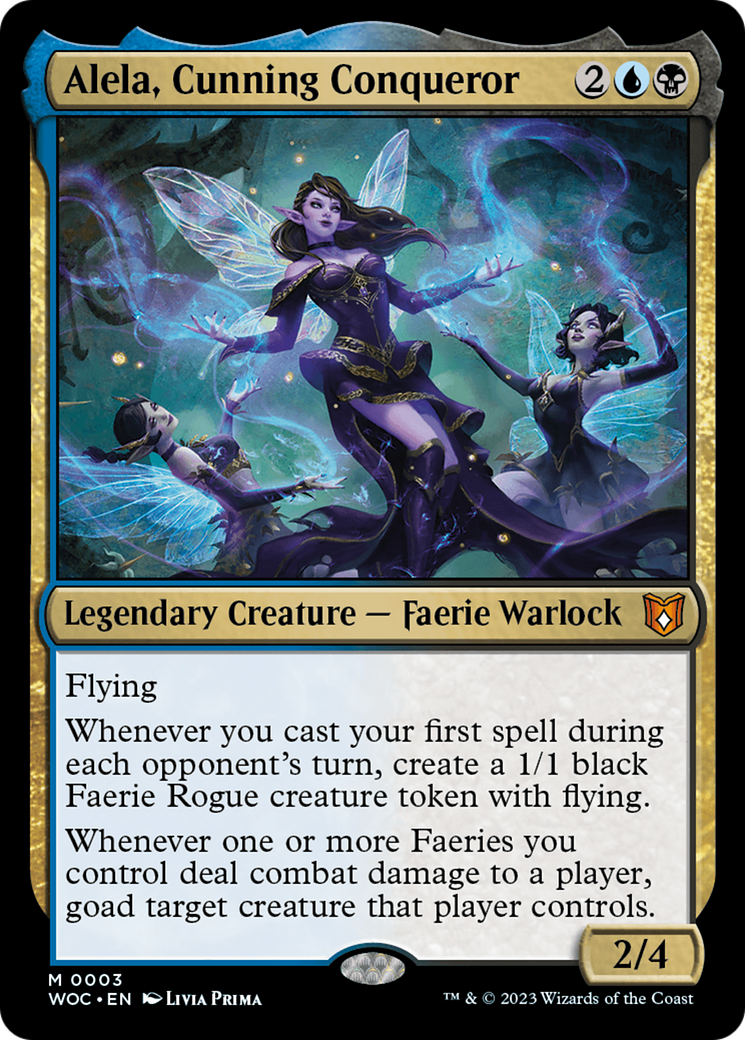
Alela, Cunning Conqueror
Alela, Cunning Conqueror
Legendary Creature — Faerie Warlock
2/4
Flying
Whenever you cast your first spell during each opponent's turn, create a 1/1 black Faerie Rogue creature token with flying.
Whenever one or more Faeries you control deal combat damage to a player, goad target creature that player controls.
- Normally, combat damage is dealt all at the same time. In that case, Alela, Cunning Conqueror's last ability triggers once for each player that Faeries you control dealt combat damage to, regardless of how many creatures were dealing that damage. If any of those Faeries have double strike or first strike, the ability will trigger once for each player dealt damage in each combat damage step.
-
1
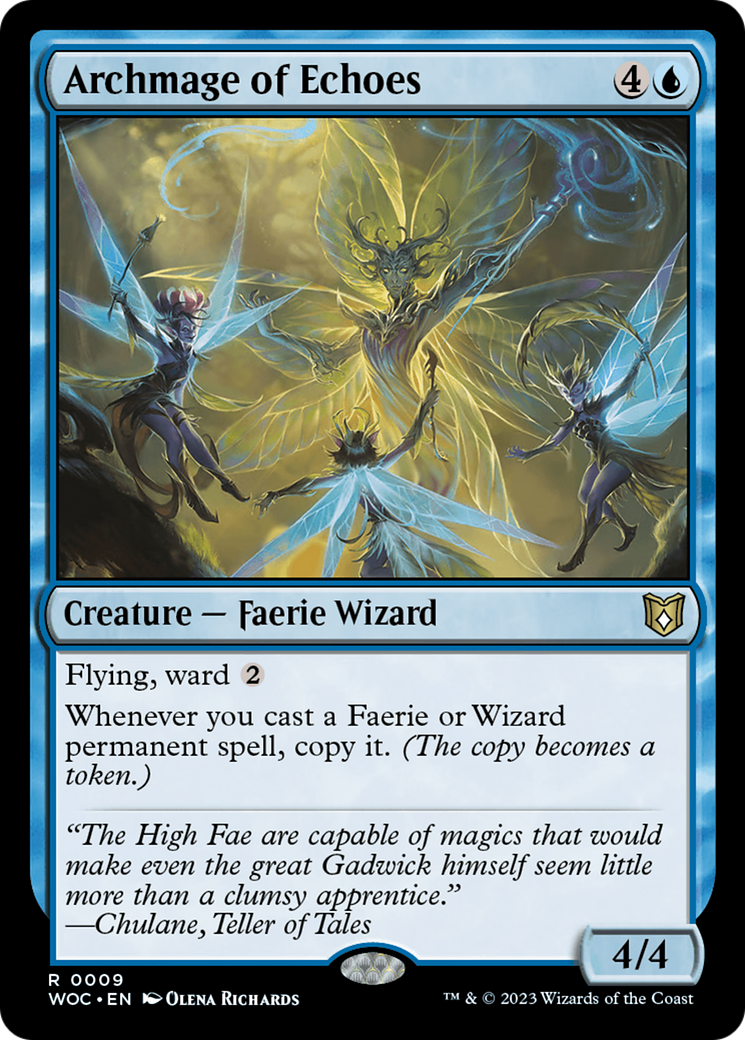
Archmage of Echoes
Archmage of Echoes
Creature — Faerie Wizard
4/4
Flying, ward
Whenever you cast a Faerie or Wizard permanent spell, copy it. (The copy becomes a token.)
- A resolving copy of a permanent spell becomes a token, so the token isn't "created." Effects that care about a token being created won't interact with a token that enters the battlefield from Archmage of Echoes's ability.
- The copy remembers any decisions that were made for the original spell as it was cast, including values chosen for X in its mana cost and whether any alternative or additional costs were chosen. For example, if the original creature spell had kicker and its kicker cost was paid, the copy will also be kicked.
-
1
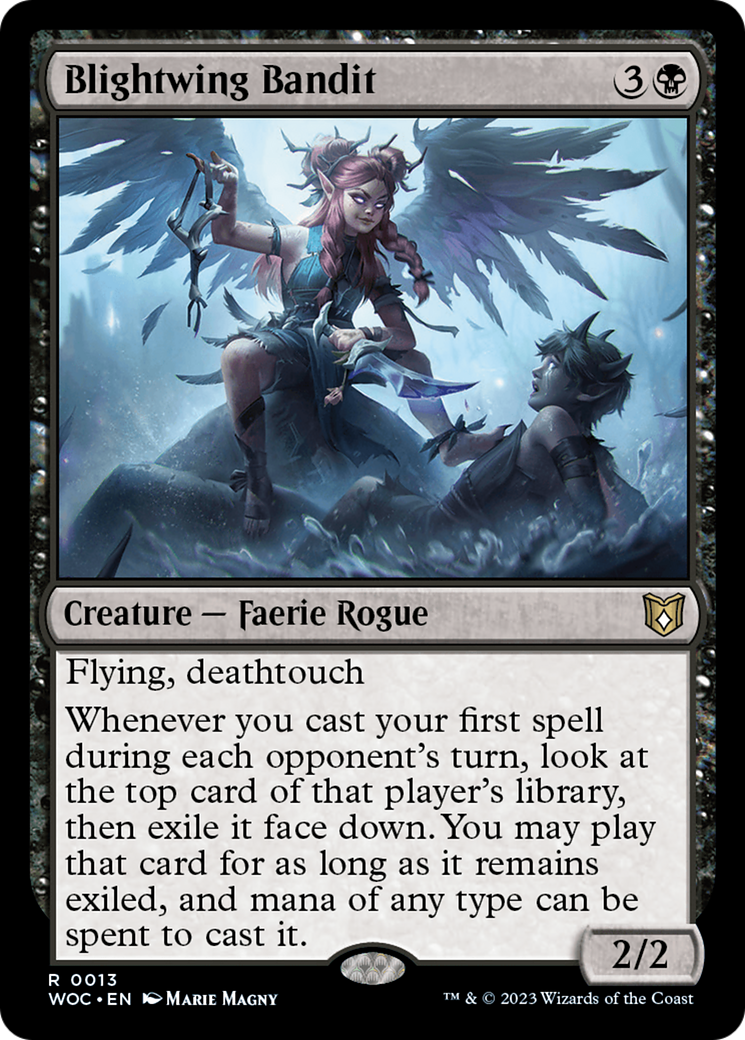
Blightwing Bandit
Blightwing Bandit
Creature — Faerie Rogue
2/2
Flying, deathtouch
Whenever you cast your first spell during each opponent's turn, look at the top card of that player's library, then exile it face down. You may play that card for as long as it remains exiled, and mana of any type can be spent to cast it.
- You may look at and cast the exiled cards (and spend mana of any type to do so) even if Blightwing Bandit leaves the battlefield. If another player gains control of Blightwing Bandit, that player can't look at or cast the cards, and you still can.
- You pay the costs for an exiled card if you cast it. You may pay any alternative costs the card has rather than the card's mana cost.
- The six types of mana are white, blue, black, red, green, and colorless. Snow mana is not a type of mana. Blightwing Bandit won't let you pay a snow cost using mana produced by a nonsnow source.
- Blightwing Bandit doesn't change when you can cast a spell. For example, if you exile a creature card without flash, you can cast it only during your main phase when the stack is empty.
- Casting an exiled card causes it to leave exile. You can't cast it multiple times.
- If you leave the game, the cards remain exiled face down indefinitely. No player may look at them.
-
1
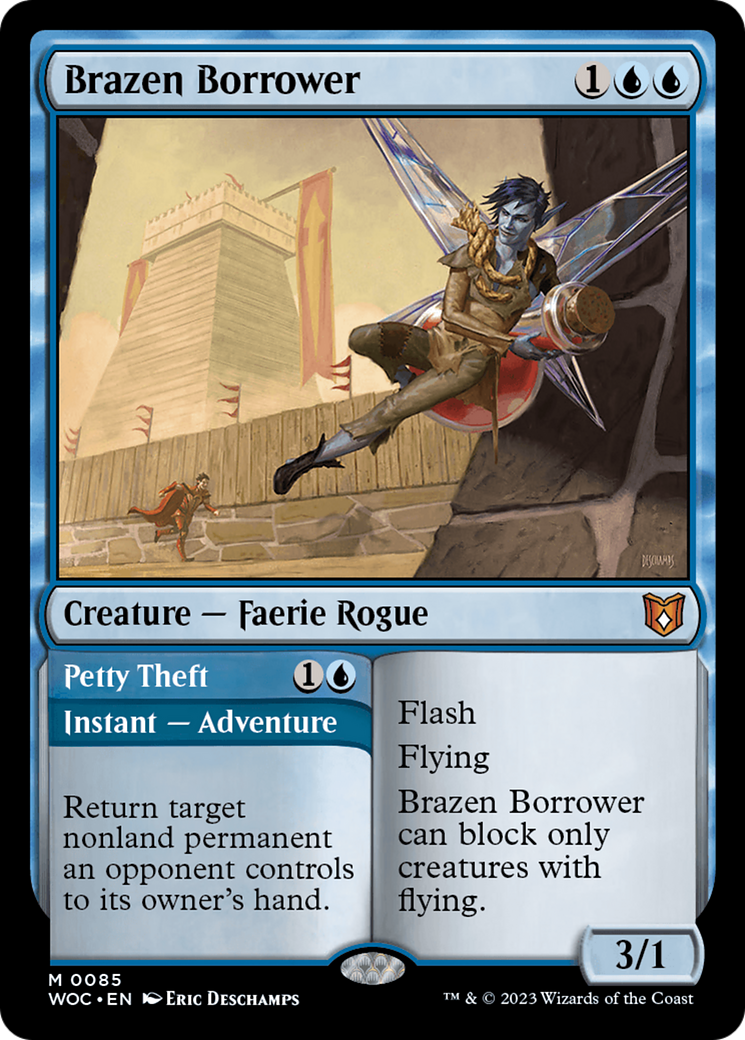
Brazen Borrower // Petty Theft
//
Brazen Borrower
Creature — Faerie Rogue
3/1
- An adventurer card is a permanent card in every zone except the stack, as well as while on the stack if not cast as an Adventure. Ignore its alternative characteristics in those cases. For example, while it's in your graveyard, Giant Killer is a white creature card whose mana value is 1. It can't be the target of the triggered ability of Mystic Sanctuary.
- When casting a spell as an Adventure, use the alternative characteristics and ignore all of the card's normal characteristics. The spell's color, mana cost, mana value, and so on are determined by only those alternative characteristics. If the spell leaves the stack, it immediately resumes using its normal characteristics.
- If you cast an adventurer card as an Adventure, use only its alternative characteristics to determine whether it's legal to cast that spell. For example, if Giant Killer is exiled with the last ability of Vivien, Champion of the Wilds, you can't cast it as Chop Down.
- If a spell is cast as an Adventure, its controller exiles it instead of putting it into its owner's graveyard as it resolves. For as long as it remains exiled, that player may cast it as a permanent spell. If an Adventure spell leaves the stack in any way other than resolving (most likely by being countered or by failing to resolve because its targets have all become illegal), that card won't be exiled and the spell's controller won't be able to cast it as a permanent later.
- If an adventurer card ends up in exile for any other reason than by exiling itself while resolving, it won't give you permission to cast it as a permanent spell.
- You must still follow any timing restrictions and permissions for the permanent spell you cast from exile. Normally, you'll be able to cast it only during your main phase while the stack is empty.
- If an effect copies an Adventure spell, that copy is exiled as it resolves. It ceases to exist as a state-based action; it's not possible to cast the copy as a permanent.
- If an object becomes a copy of an object that has an Adventure, the copy also has an Adventure. If it changes zones, it will either cease to exist (if it's a token) or cease to be a copy (if it's a nontoken permanent), and so you won't be able to cast it as an Adventure.
- If an effect instructs you to choose a card name, you may choose the alternative Adventure name. Consider only the alternative characteristics to determine whether that is an appropriate name to choose.
- Casting a card as an Adventure isn't casting it for an alternative cost. Effects that allow you to cast a spell for an alternative cost or without paying its mana cost may allow you to apply those to the Adventure.
-
1
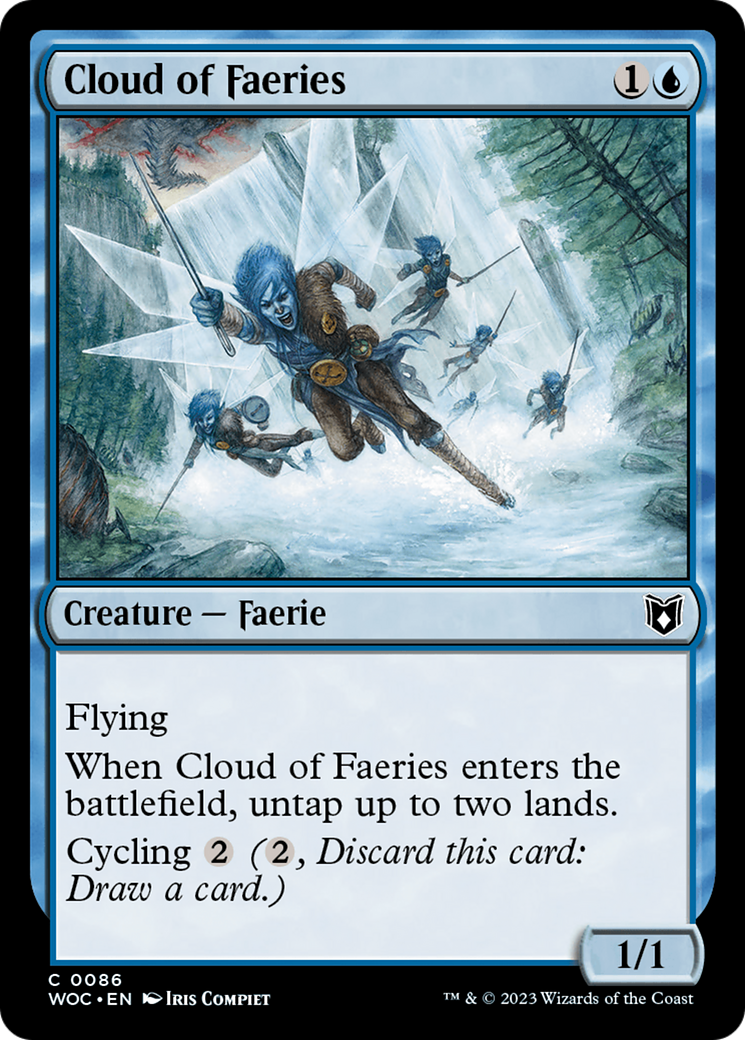
Cloud of Faeries
Cloud of Faeries
Creature — Faerie
1/1
Flying
When this creature enters, untap up to two lands.
Cycling ( , Discard this card: Draw a card.)
- You choose which lands to untap as the triggered ability resolves. They aren't targeted, and they don't have to be lands that you control.
-
1
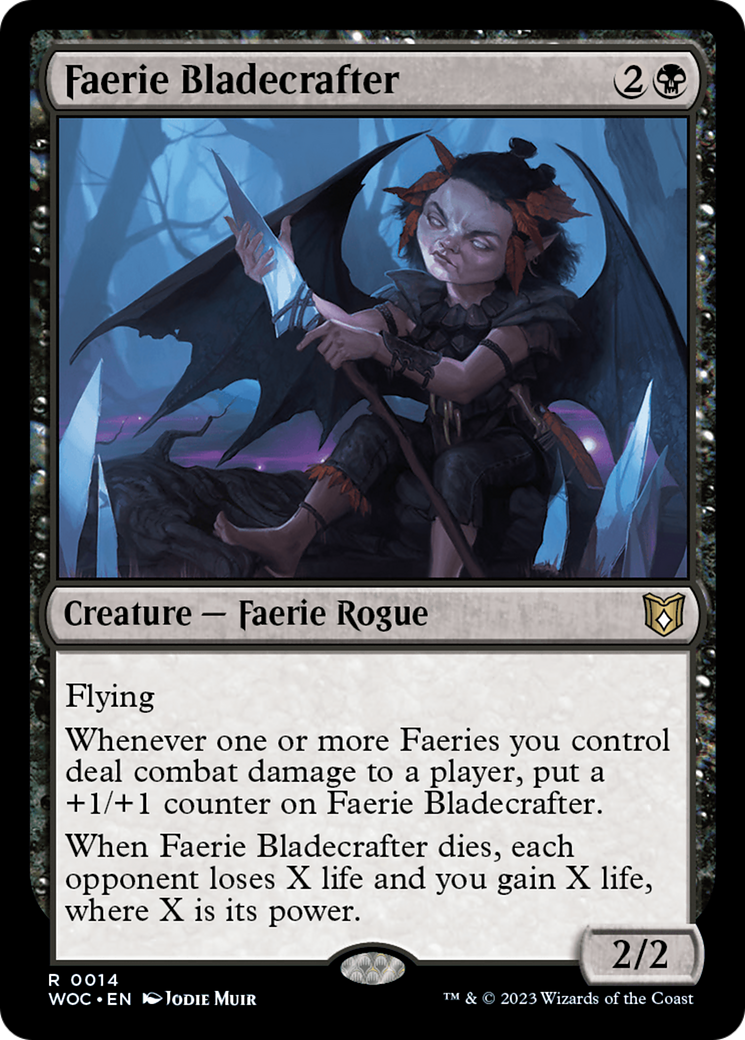
Faerie Bladecrafter
Faerie Bladecrafter
Creature — Faerie Rogue
2/2
Flying
Whenever one or more Faeries you control deal combat damage to a player, put a +1/+1 counter on this creature.
When this creature dies, each opponent loses X life and you gain X life, where X is its power.
- Normally, combat damage is dealt all at the same time. In that case, Faerie Bladecrafter's first triggered ability triggers once for each player that Faeries you control dealt combat damage to, regardless of how many creatures were dealing that damage. If any of those Faeries have double strike or first strike, the ability will trigger once for each player dealt damage in each combat damage step.
- Use Faerie Bladecrafter's power from when it was last on the battlefield to determine the value of X.
-
1
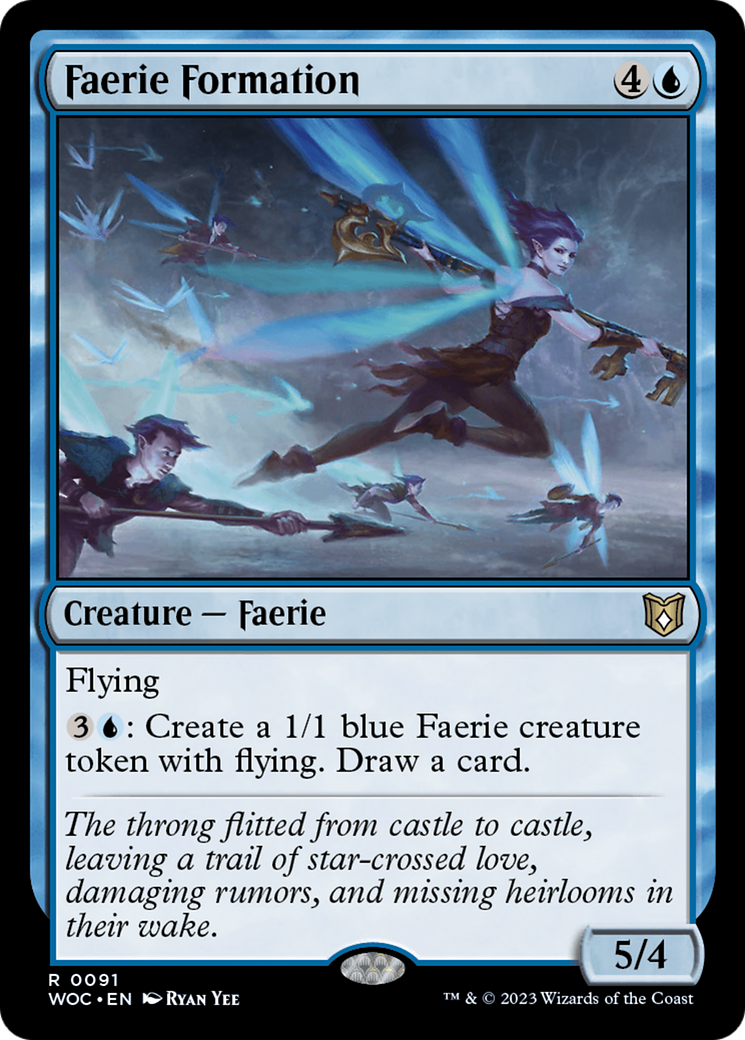
Faerie Formation
Faerie Formation
Creature — Faerie
5/4
Flying
: Create a 1/1 blue Faerie creature token with flying. Draw a card.
-
1
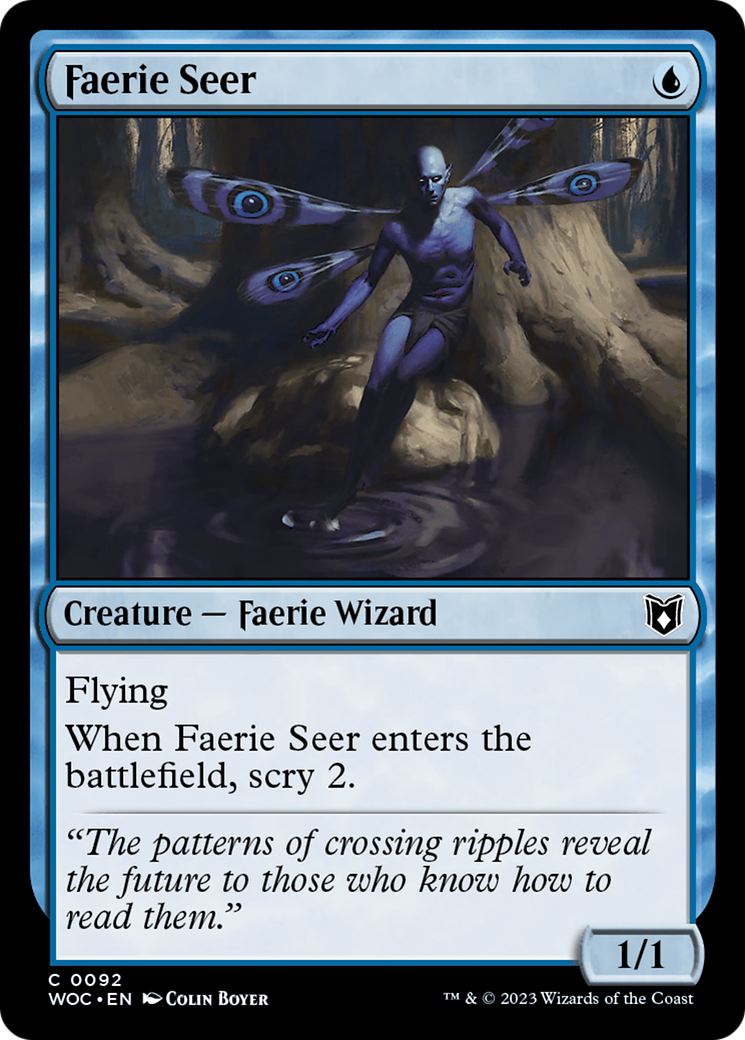
Faerie Seer
Faerie Seer
Creature — Faerie Wizard
1/1
Flying
When this creature enters, scry 2. (Look at the top two cards of your library, then put any number of them on the bottom and the rest on top in any order.)
-
1
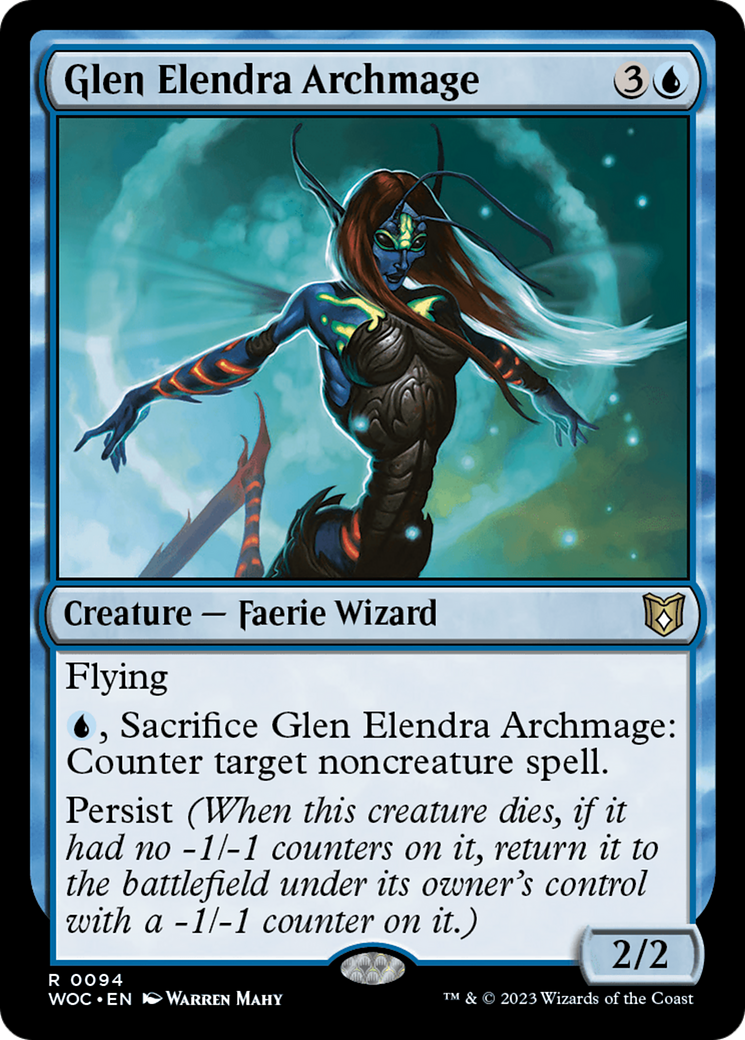
Glen Elendra Archmage
Glen Elendra Archmage
Creature — Faerie Wizard
2/2
Flying
, Sacrifice this creature: Counter target noncreature spell.
Persist (When this creature dies, if it had no -1/-1 counters on it, return it to the battlefield under its owner's control with a -1/-1 counter on it.)
- If a creature with persist stops being a creature, persist will still work.
- The persist ability triggers when the permanent is put into a graveyard. Its last known information (that is, how the creature last existed on the battlefield) is used to determine whether it had a -1/-1 counter on it.
- If a permanent has multiple instances of persist, they'll each trigger separately, but the redundant instances will have no effect. If one instance returns the card to the battlefield, the next to resolve will do nothing.
- If a token with no -1/-1 counters on it has persist, the ability will trigger when the token is put into the graveyard. However, the token will cease to exist and can't return to the battlefield.
- When a permanent with persist returns to the battlefield, it's a new object with no memory of or connection to its previous existence.
- If multiple creatures with persist are put into the graveyard at the same time (due to combat damage or a spell that destroys all creatures, for example), the active player (the player whose turn it is) puts all of their persist triggers on the stack in any order, then each other player in turn order does the same. The last trigger put on the stack is the first one that resolves. That means that in a two-player game, the nonactive player's persist creatures will return to the battlefield first, then the active player's persist creatures do the same. The creatures return to the battlefield one at a time.
- If a creature with persist that has +1/+1 counters on it receives enough -1/-1 counters to cause it to be destroyed by lethal damage or put into its owner's graveyard for having 0 or less toughness, persist won't trigger and the card won't return to the battlefield. That's because persist checks the creature's existence just before it leaves the battlefield, and it still has all those counters on it at that point.
-
1
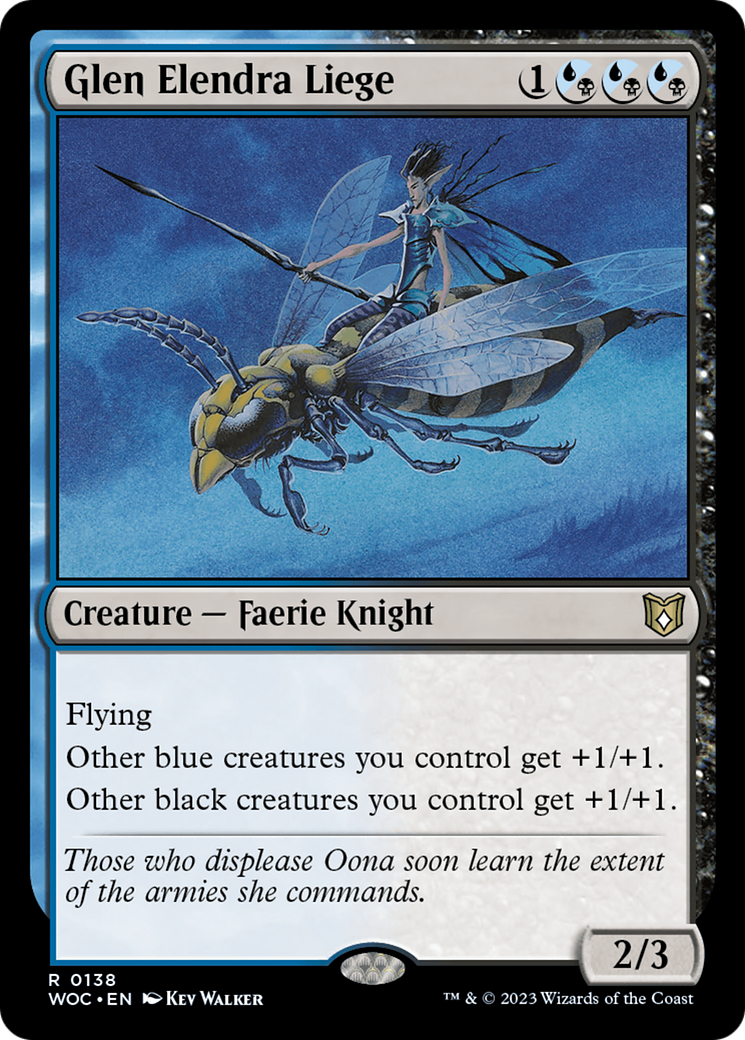
Glen Elendra Liege
Glen Elendra Liege
Creature — Faerie Knight
2/3
Flying
Other blue creatures you control get +1/+1.
Other black creatures you control get +1/+1.
- The abilities are separate and cumulative. If another creature you control is both of the listed colors, it will get a total of +2/+2.
-
1
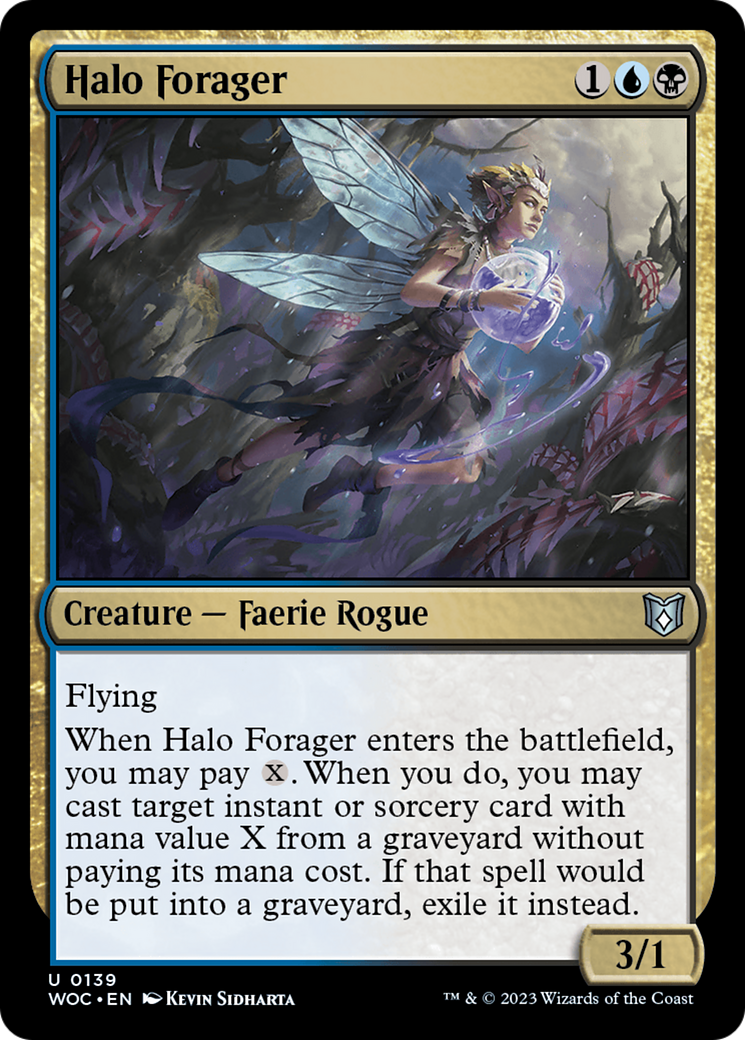
Halo Forager
Halo Forager
Creature — Faerie Rogue
3/1
Flying
When this creature enters, you may pay . When you do, you may cast target instant or sorcery card with mana value X from a graveyard without paying its mana cost. If that spell would be put into a graveyard, exile it instead.
- Halo Forager's enters-the-battlefield ability triggers and goes on the stack without a target. If you pay , the second "reflexive" triggered ability will trigger. You'll choose the target instant or sorcery card for that second ability at that time, based on the value you chose for X. X can be 0.
- You choose whether or not to cast the target instant or sorcery card as the reflexive triggered ability resolves. If you do, you do so as part of the resolution of the triggered ability. You can't wait to cast it later in the turn. Timing restrictions based on the card's type are ignored.
- If you cast a card "without paying its mana cost," you can't pay any alternative costs. You can, however, pay additional costs. If the card has any mandatory additional costs, those must be paid to cast the card.
- If the card has in its mana cost, you must choose 0 as the value of X when casting it without paying its mana cost.
-
1
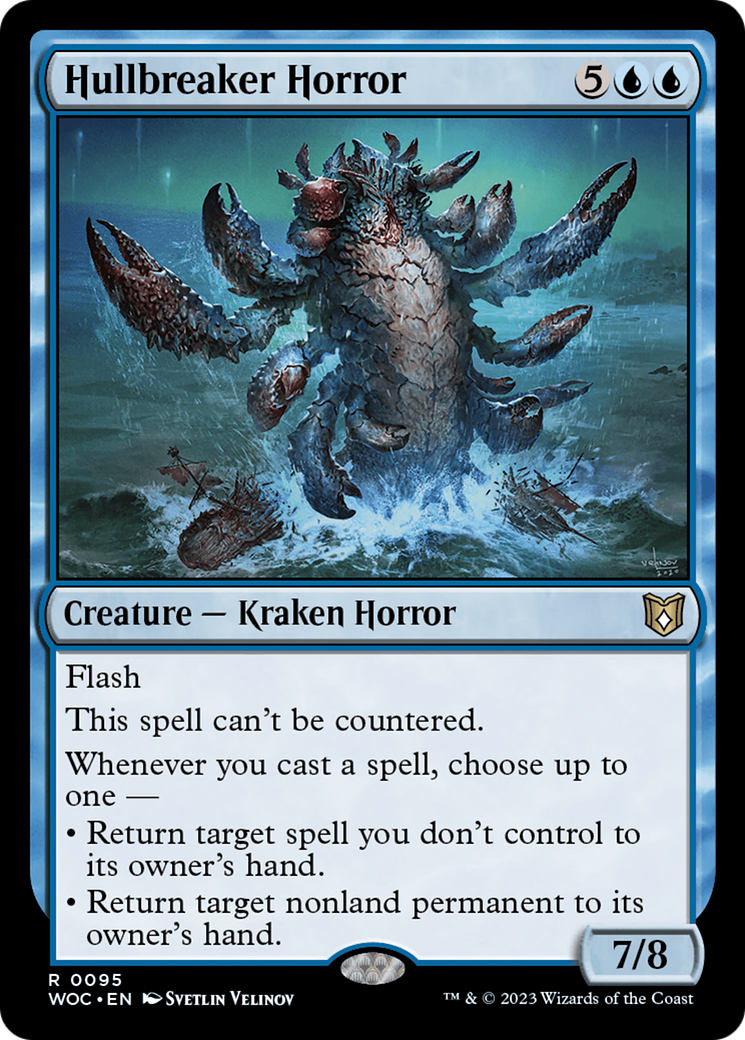
Hullbreaker Horror
Hullbreaker Horror
Creature — Kraken Horror
7/8
Flash
This spell can't be countered.
Whenever you cast a spell, choose up to one —
- Return target spell you don't control to its owner's hand.
- Return target nonland permanent to its owner's hand.
-
1
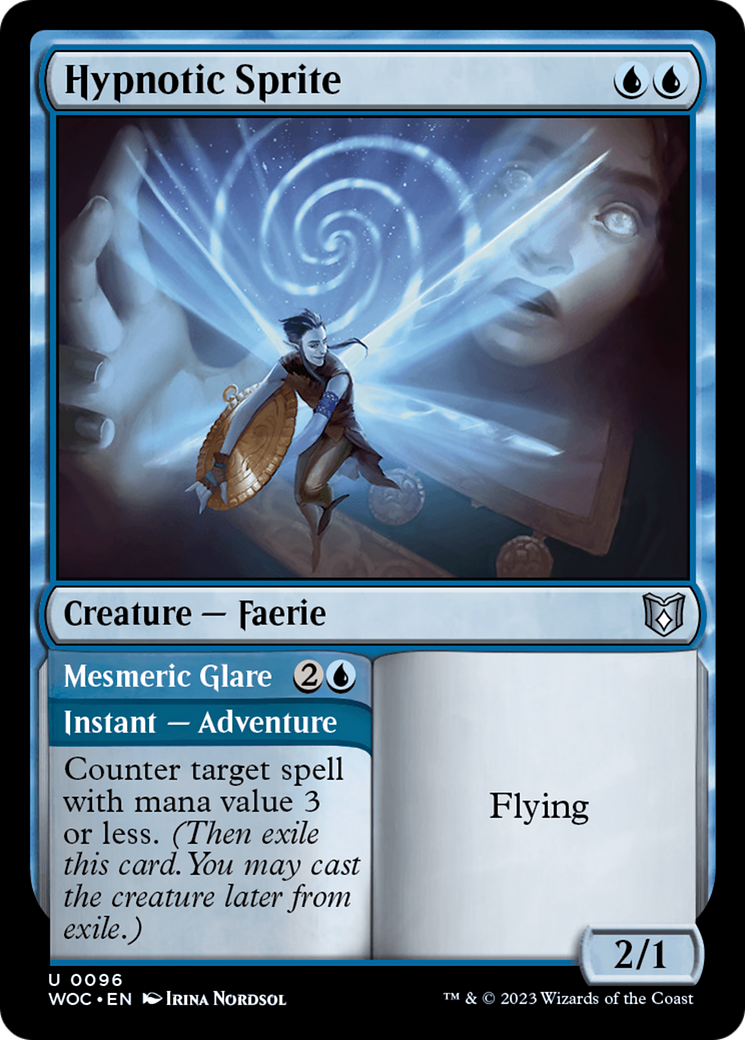
Hypnotic Sprite // Mesmeric Glare
//
Hypnotic Sprite
Creature — Faerie
2/1
- An adventurer card is a permanent card in every zone except the stack, as well as while on the stack if not cast as an Adventure. Ignore its alternative characteristics in those cases. For example, while it's in your graveyard, Giant Killer is a white creature card whose mana value is 1. It can't be the target of the triggered ability of Mystic Sanctuary.
- When casting a spell as an Adventure, use the alternative characteristics and ignore all of the card's normal characteristics. The spell's color, mana cost, mana value, and so on are determined by only those alternative characteristics. If the spell leaves the stack, it immediately resumes using its normal characteristics.
- If you cast an adventurer card as an Adventure, use only its alternative characteristics to determine whether it's legal to cast that spell. For example, if Giant Killer is exiled with the last ability of Vivien, Champion of the Wilds, you can't cast it as Chop Down.
- If a spell is cast as an Adventure, its controller exiles it instead of putting it into its owner's graveyard as it resolves. For as long as it remains exiled, that player may cast it as a permanent spell. If an Adventure spell leaves the stack in any way other than resolving (most likely by being countered or by failing to resolve because its targets have all become illegal), that card won't be exiled and the spell's controller won't be able to cast it as a permanent later.
- If an adventurer card ends up in exile for any other reason than by exiling itself while resolving, it won't give you permission to cast it as a permanent spell.
- You must still follow any timing restrictions and permissions for the permanent spell you cast from exile. Normally, you'll be able to cast it only during your main phase while the stack is empty.
- If an effect copies an Adventure spell, that copy is exiled as it resolves. It ceases to exist as a state-based action; it's not possible to cast the copy as a permanent.
- If an object becomes a copy of an object that has an Adventure, the copy also has an Adventure. If it changes zones, it will either cease to exist (if it's a token) or cease to be a copy (if it's a nontoken permanent), and so you won't be able to cast it as an Adventure.
- If an effect instructs you to choose a card name, you may choose the alternative Adventure name. Consider only the alternative characteristics to determine whether that is an appropriate name to choose.
- Casting a card as an Adventure isn't casting it for an alternative cost. Effects that allow you to cast a spell for an alternative cost or without paying its mana cost may allow you to apply those to the Adventure.
- For spells with in their mana costs, use the value chosen for X to determine the spell's mana value.
- A spell that can't be countered is a legal target for Mesmeric Glare. The spell won't be countered when Mesmeric Glare resolves, but you'll still exile Mesmeric Glare.
-
1
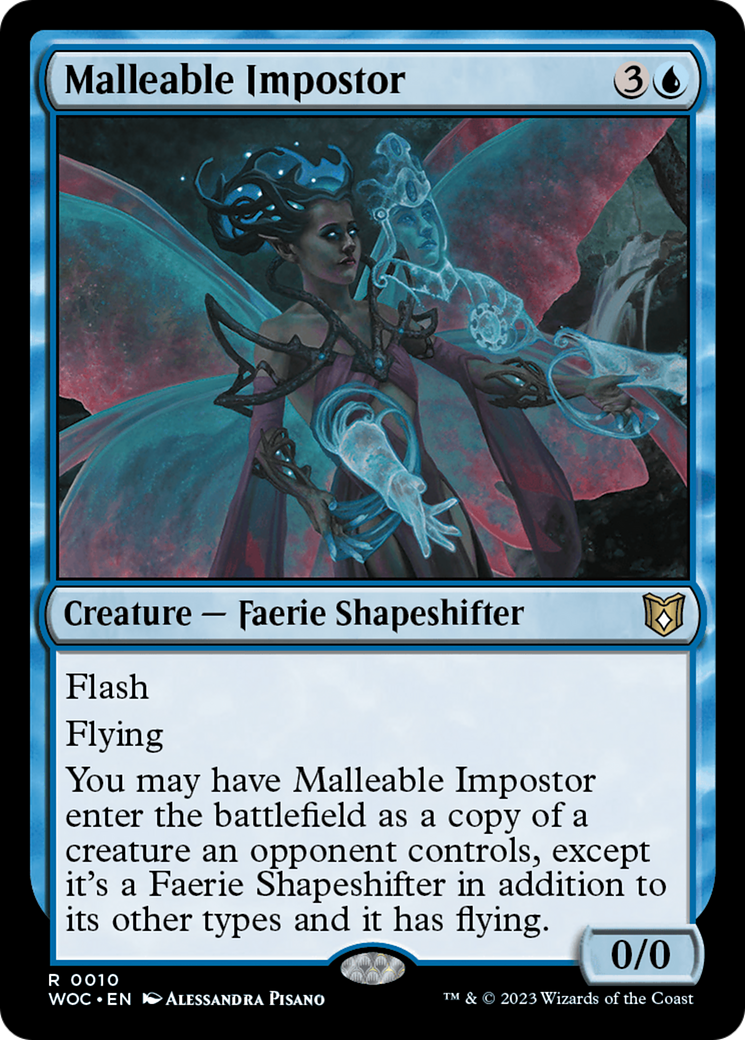
Malleable Impostor
Malleable Impostor
Creature — Faerie Shapeshifter
0/0
Flash
Flying
You may have this creature enter as a copy of a creature an opponent controls, except it's a Faerie Shapeshifter in addition to its other types and it has flying.
- Except for the listed exceptions, Malleable Impostor copies exactly what was printed on the original permanent and nothing more (unless that permanent is itself copying something or is a token; see below). It doesn't copy whether that permanent is tapped or untapped, whether it has any counters on it or Auras attached to it, or any noncopy effects that have changed its power, toughness, types, color, and so on.
- If the chosen permanent has in its mana cost, X is 0.
- If the chosen permanent is copying something else (for example, if the chosen permanent is a Clone), then your Malleable Impostor enters the battlefield as whatever the chosen permanent copied, with the stated exceptions.
- If the chosen permanent is a token, Malleable Impostor copies the original characteristics of that token as stated by the effect that put the token onto the battlefield, with the listed exceptions. Malleable Impostor does not become a token.
- Any enters-the-battlefield abilities of the copied permanent will trigger when Malleable Impostor enters the battlefield. Any "as [this permanent] enters the battlefield" or "[this permanent] enters the battlefield with" abilities of the chosen permanent will also work.
- If Malleable Impostor somehow enters the battlefield at the same time as another creature, Malleable Impostor can't become a copy of that creature. You may choose only a creature that's already on the battlefield.
- You can choose not to copy anything. In that case, Malleable Impostor simply enters the battlefield as a 0/0 creature and is probably put into your graveyard immediately, unless something else is increasing its toughness to keep it alive.
-
1
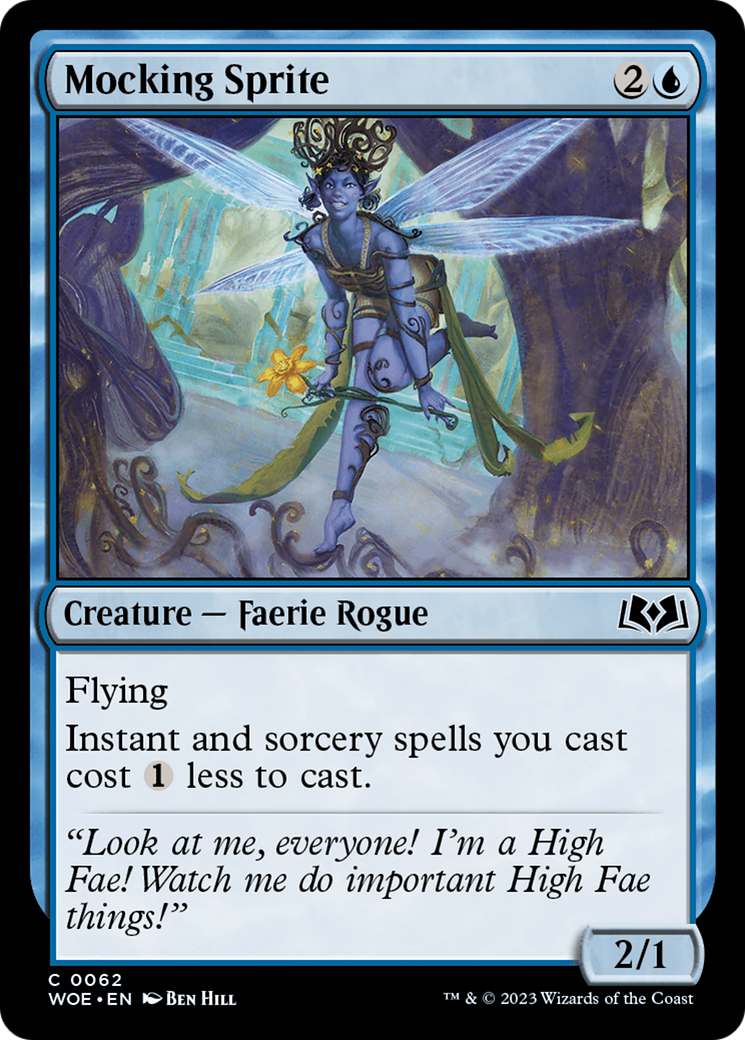
Mocking Sprite
Mocking Sprite
Creature — Faerie Rogue
2/1
Flying
Instant and sorcery spells you cast cost less to cast.
- Mocking Sprite's last ability doesn't change the mana cost or mana value of any spell. It changes only the total cost you pay.
- Mocking Sprite's last ability can't reduce the amount of colored mana you pay for a spell. It reduces only the generic mana component of that cost.
-
1
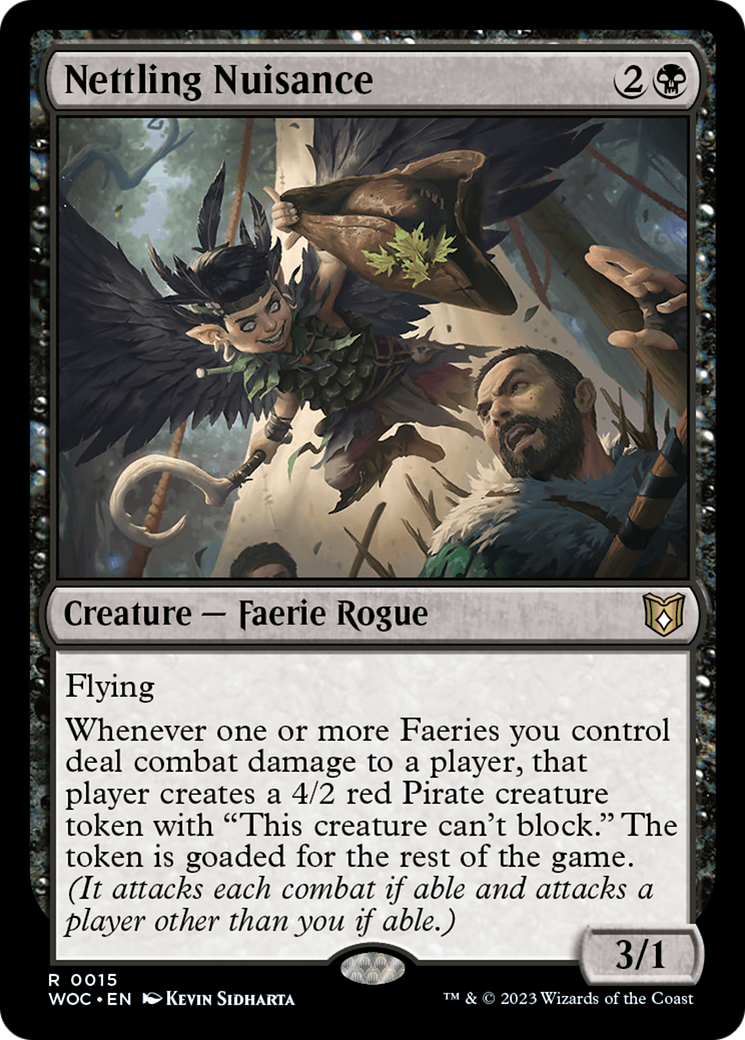
Nettling Nuisance
Nettling Nuisance
Creature — Faerie Rogue
3/1
Flying
Whenever one or more Faeries you control deal combat damage to a player, that player creates a 4/2 red Pirate creature token with "This token can't block." The token is goaded for the rest of the game. (It attacks each combat if able and attacks a player other than you if able.)
- Normally, combat damage is dealt all at the same time. In that case, Nettling Nuisance's ability triggers once for each player that Faeries you control dealt combat damage to, regardless of how many creatures were dealing that damage. If any of those Faeries have double strike or first strike, the ability will trigger once for each player dealt damage in each combat damage step.
- If, during a player's declare attackers step, a creature that player controls that's been goaded is tapped, is affected by a spell or ability that says it can't attack, or hasn't been under that player's control continuously since the turn began (and doesn't have haste), then it doesn't attack. If there's a cost associated with having a creature attack a player, its controller isn't forced to pay that cost, so it doesn't have to attack that player.
- If the creature doesn't meet any of the above exceptions and can attack, it must attack a player other than the controller of the spell or ability that goaded it if able. If the creature can't attack any of those players but could otherwise attack, it must attack a planeswalker an opponent controls, a battle an opponent protects, or the player that goaded it.
- Being goaded isn't an ability the creature has. Once it's been goaded, it must attack as detailed above even if it loses all abilities.
- Attacking with a goaded creature doesn't cause it to stop being goaded. If there is an additional combat phase that turn, or if another player gains control of it before it stops being goaded, it must attack again if able.
-
1
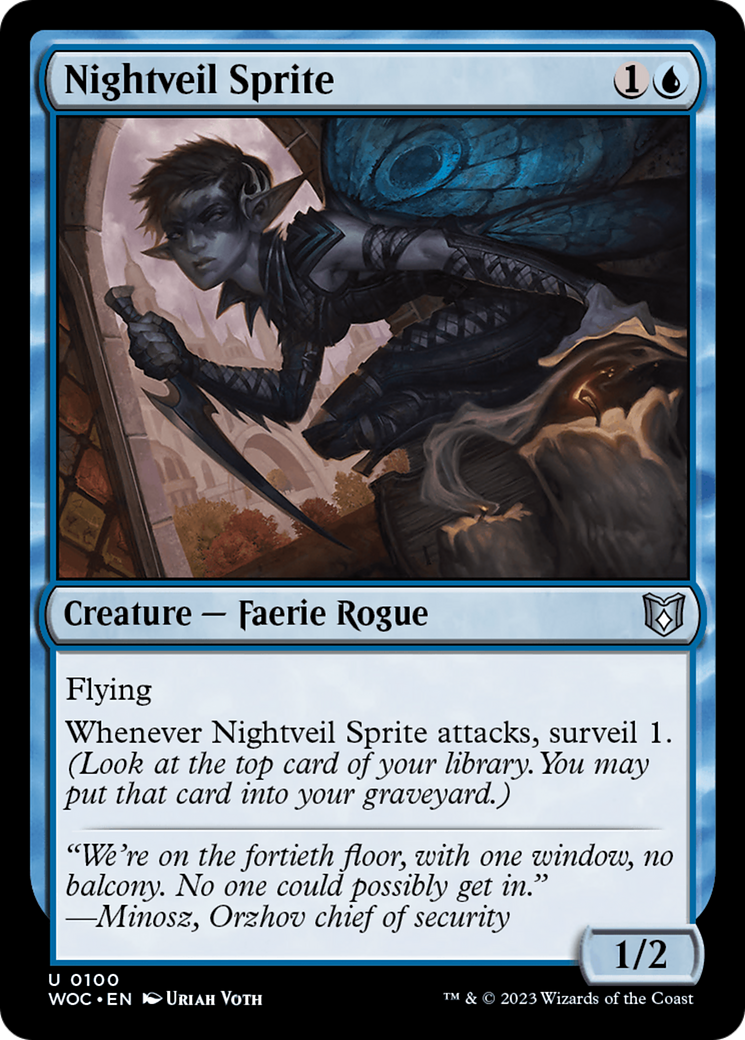
Nightveil Sprite
Nightveil Sprite
Creature — Faerie Rogue
1/2
Flying
Whenever this creature attacks, surveil 1. (Look at the top card of your library. You may put it into your graveyard.)
- You perform the actions stated on a card in sequence. For some spells and abilities, you'll surveil last. For others, you'll surveil and then perform other actions.
-
1
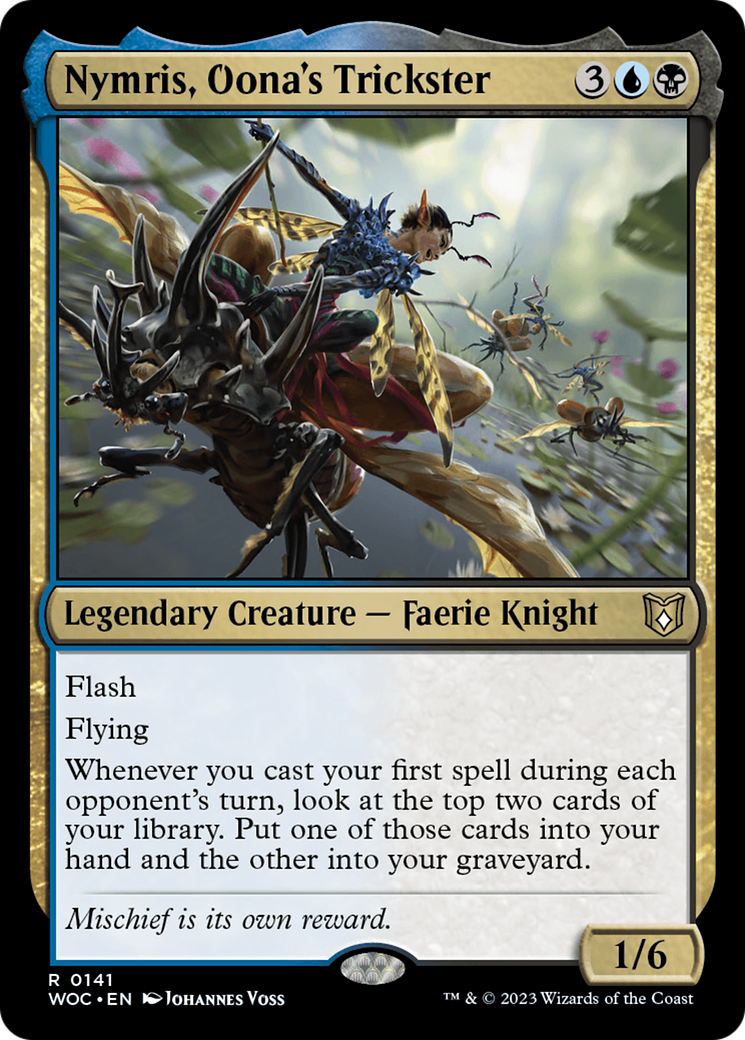
Nymris, Oona's Trickster
Nymris, Oona's Trickster
Legendary Creature — Faerie Knight
1/6
Flash
Flying
Whenever you cast your first spell during each opponent's turn, look at the top two cards of your library. Put one of those cards into your hand and the other into your graveyard.
-
1
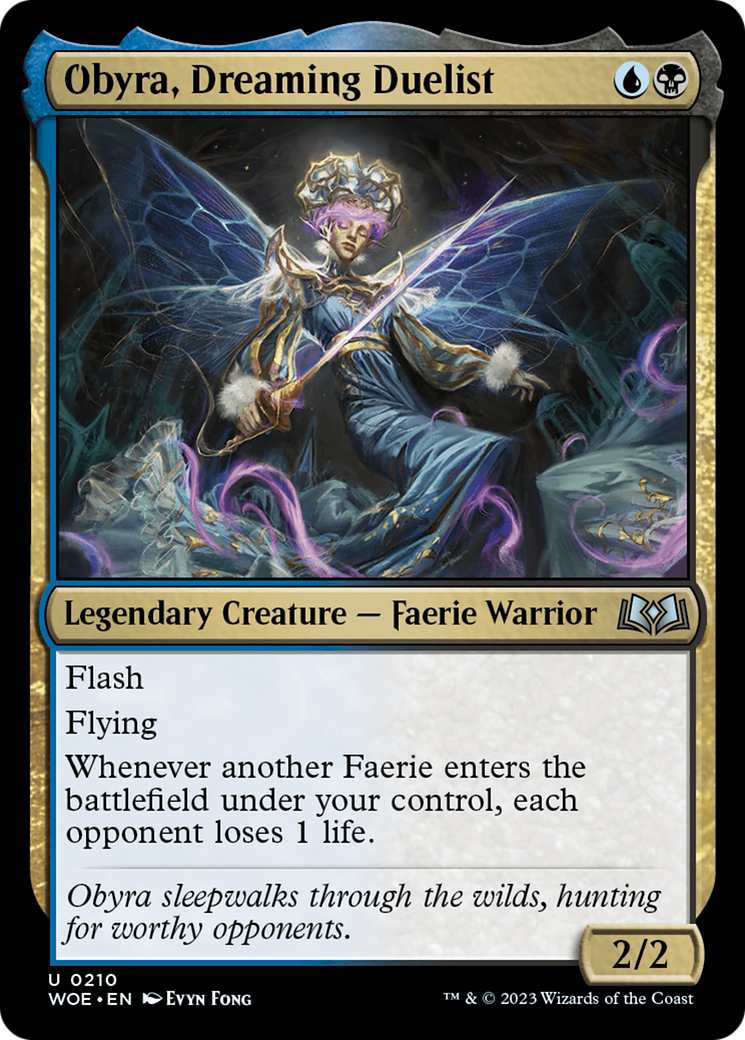
Obyra, Dreaming Duelist
Obyra, Dreaming Duelist
Legendary Creature — Faerie Warrior
2/2
Flash
Flying
Whenever another Faerie you control enters, each opponent loses 1 life.
-
1
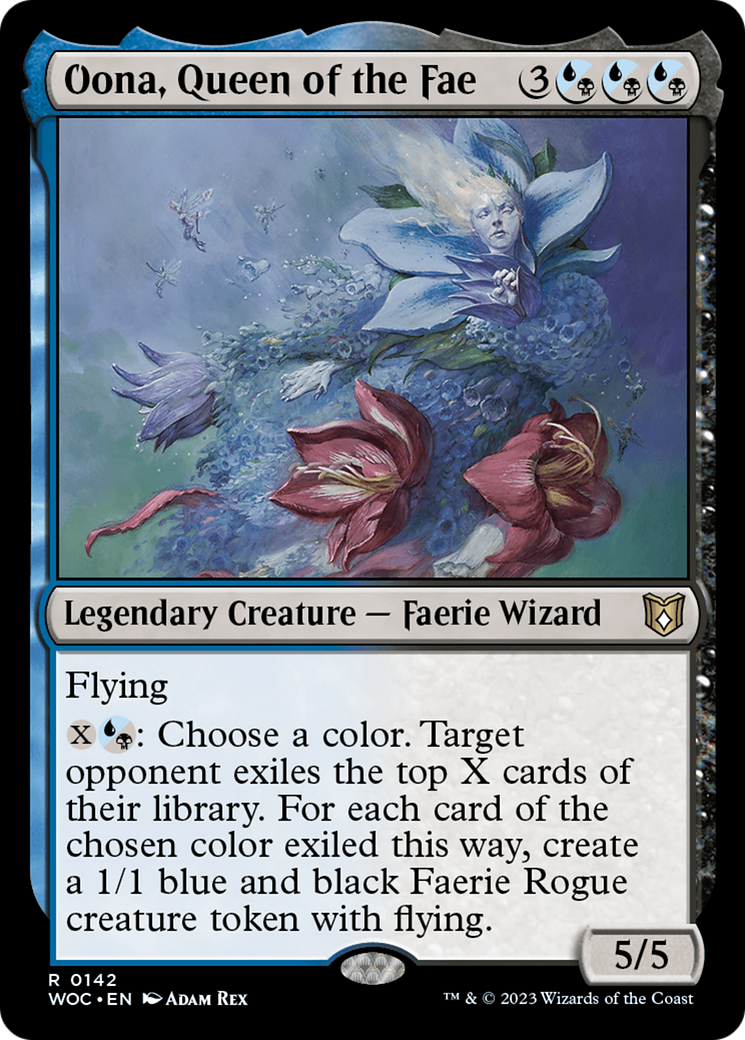
Oona, Queen of the Fae
Oona, Queen of the Fae
Legendary Creature — Faerie Wizard
5/5
Flying
: Choose a color. Target opponent exiles the top X cards of their library. For each card of the chosen color exiled this way, create a 1/1 blue and black Faerie Rogue creature token with flying.
- You target the opponent when you activate Oona's ability. You don't choose the color until the ability resolves.
- The tokens enter under your control.
-
1
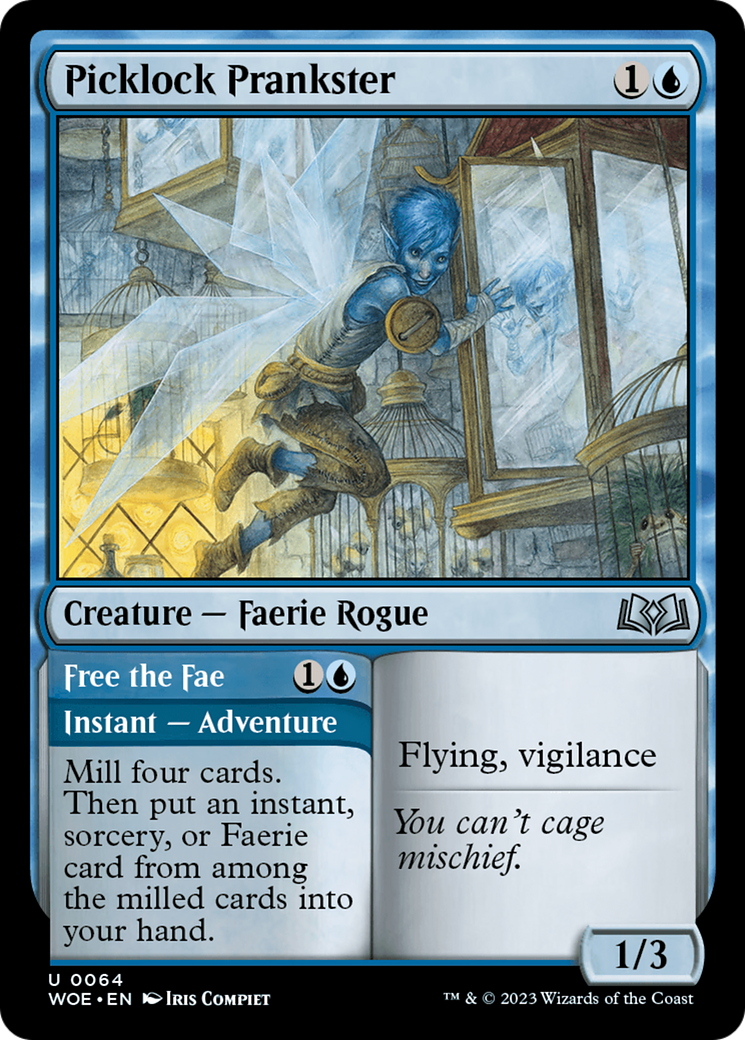
Picklock Prankster // Free the Fae
//
Picklock Prankster
Creature — Faerie Rogue
1/3
- Adventurer cards aren't instant or sorcery cards while they're in your graveyard. You can't use Free the Fae to put an adventurer card milled with it into your hand unless that card is a Faerie.
- An adventurer card is a permanent card in every zone except the stack, as well as while on the stack if not cast as an Adventure. Ignore its alternative characteristics in those cases. For example, while it’s in your graveyard, Questing Druid is a green creature card whose mana value is 2. It can’t be the target of Tenacious Tomeseeker’s triggered ability (“return target instant or sorcery card from your graveyard to your hand”).
- When casting a spell as an Adventure, use the alternative characteristics and ignore all of the card’s normal characteristics. The spell’s color, mana cost, mana value, and so on are determined by only those alternative characteristics. If the spell leaves the stack, it immediately resumes using its normal characteristics.
- If you cast an adventurer card as an Adventure, use only its alternative characteristics to determine whether it’s legal to cast that spell. For example, if you control Johann, Apprentice Sorcerer (“Once each turn, you may cast an instant or sorcery spell from the top of your library.”) and Questing Druid is on top of your library, you can cast Seek the Beast, but not Questing Druid.
- If a spell is cast as an Adventure, its controller exiles it instead of putting it into its owner’s graveyard as it resolves. For as long as it remains exiled, that player may cast it as a permanent spell. If an Adventure spell leaves the stack in any way other than resolving (most likely by being countered or by failing to resolve because its targets have all become illegal), that card won’t be exiled and the spell’s controller won’t be able to cast it as a permanent later.
- If an adventurer card ends up in exile for any other reason than by exiling itself while resolving, it won’t give you permission to cast it as a permanent spell.
- You must still follow any timing restrictions and permissions for the permanent spell you cast from exile. Normally, you’ll be able to cast it only during your main phase while the stack is empty.
- If an effect copies an Adventure spell, that copy is exiled as it resolves. It ceases to exist as a state-based action; it’s not possible to cast the copy as a permanent.
- An effect may refer to a card, spell, or permanent that “has an Adventure.” This refers to a card, spell, or permanent that has an adventurer card’s set of alternative characteristics, even if they’re not being used and even if that card was never cast as an Adventure.
- If an effect refers to a card, spell, or permanent that has an Adventure, it won’t find an instant or sorcery spell on the stack that’s been cast as an Adventure.
- If an object becomes a copy of an object that has an Adventure, the copy also has an Adventure. If it changes zones, it will either cease to exist (if it’s a token) or cease to be a copy (if it’s a nontoken permanent), and so you won’t be able to cast it as an Adventure.
- If an effect instructs you to choose a card name, you may choose the alternative Adventure name. Consider only the alternative characteristics to determine whether that is an appropriate name to choose.
- Casting a card as an Adventure isn’t casting it for an alternative cost. Effects that allow you to cast a spell for an alternative cost or without paying its mana cost may allow you to apply those to the Adventure.
-
1
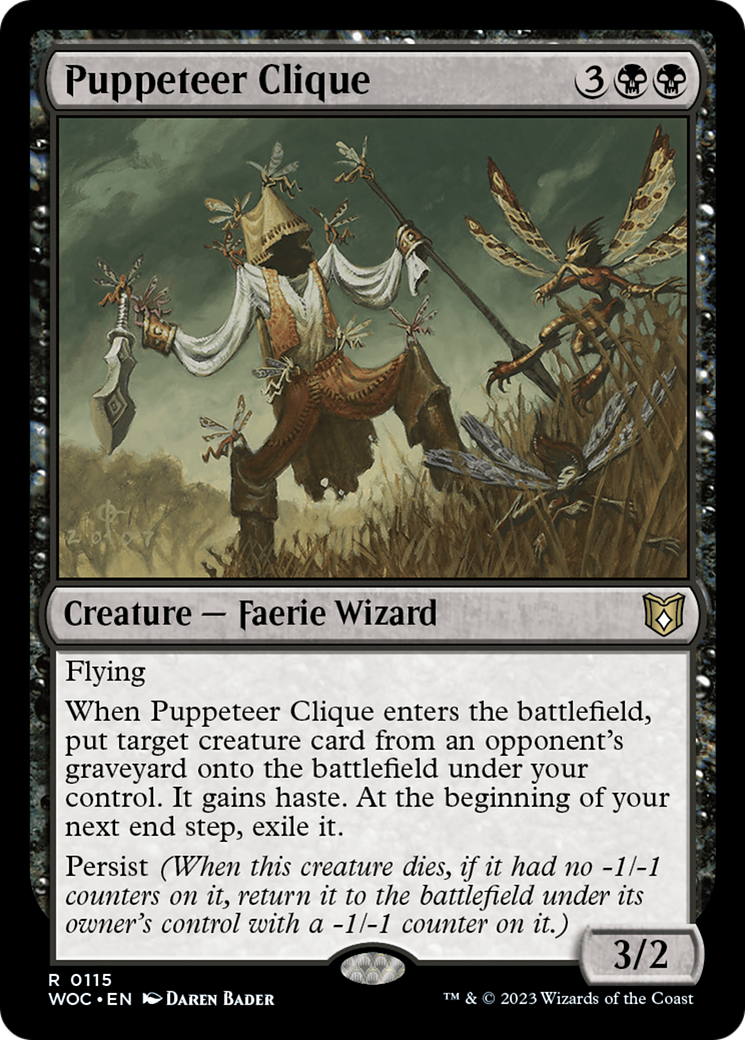
Puppeteer Clique
Puppeteer Clique
Creature — Faerie Wizard
3/2
Flying
When this creature enters, put target creature card from an opponent's graveyard onto the battlefield under your control. It gains haste. At the beginning of your next end step, exile it.
Persist (When this creature dies, if it had no -1/-1 counters on it, return it to the battlefield under its owner's control with a -1/-1 counter on it.)
- When a permanent with persist returns to the battlefield, it's a new object with no memory of or connection to its previous existence.
- If multiple creatures with persist are put into the graveyard at the same time (due to combat damage or a spell that destroys all creatures, for example), the active player (the player whose turn it is) puts all of their persist triggers on the stack in any order, then each other player in turn order does the same. The last trigger put on the stack is the first one that resolves. That means that in a two-player game, the nonactive player's persist creatures will return to the battlefield first, then the active player's persist creatures do the same. The creatures return to the battlefield one at a time.
- If a creature with persist that has +1/+1 counters on it receives enough -1/-1 counters to cause it to be destroyed by lethal damage or put into its owner's graveyard for having 0 or less toughness, persist won't trigger and the card won't return to the battlefield. That's because persist checks the creature's existence just before it leaves the battlefield, and it still has all those counters on it at that point.
- If a creature with persist stops being a creature, persist will still work.
- The persist ability triggers when the permanent is put into a graveyard. Its last known information (that is, how the creature last existed on the battlefield) is used to determine whether it had a -1/-1 counter on it.
- If a permanent has multiple instances of persist, they'll each trigger separately, but the redundant instances will have no effect. If one instance returns the card to the battlefield, the next to resolve will do nothing.
- If a token with no -1/-1 counters on it has persist, the ability will trigger when the token is put into the graveyard. However, the token will cease to exist and can't return to the battlefield.
-
1
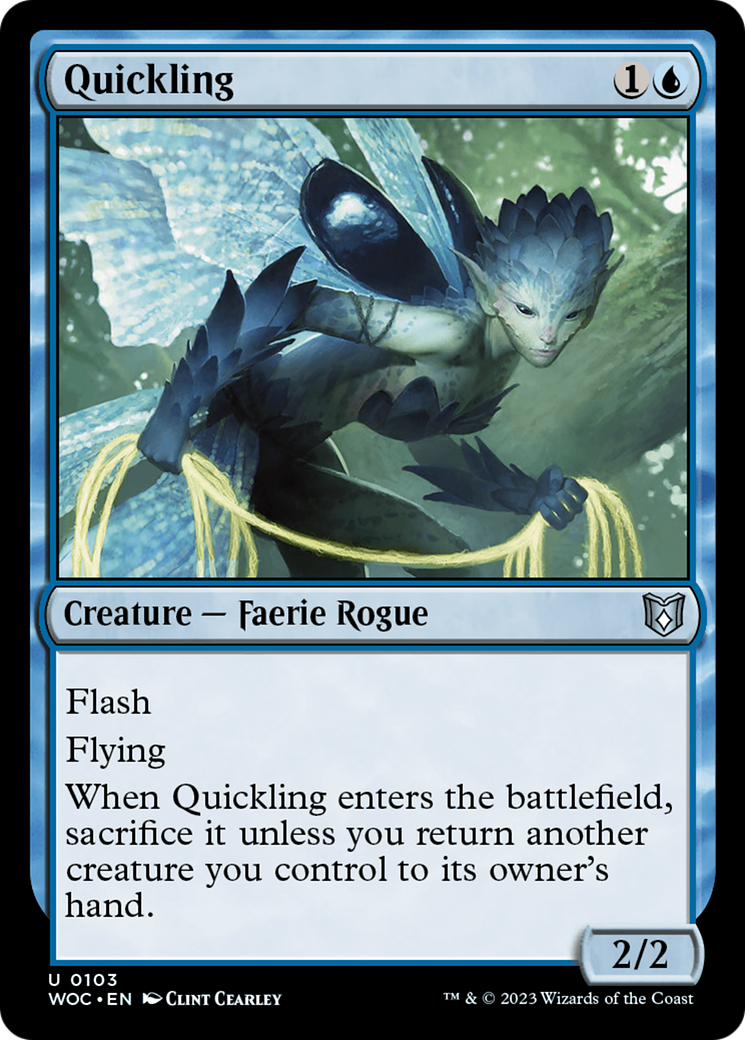
Quickling
Quickling
Creature — Faerie Rogue
2/2
Flash (You may cast this spell any time you could cast an instant.)
Flying
When this creature enters, sacrifice it unless you return another creature you control to its owner's hand.
- If you control no other creatures when the enters-the-battlefield ability resolves, you must sacrifice Quickling.
-
1
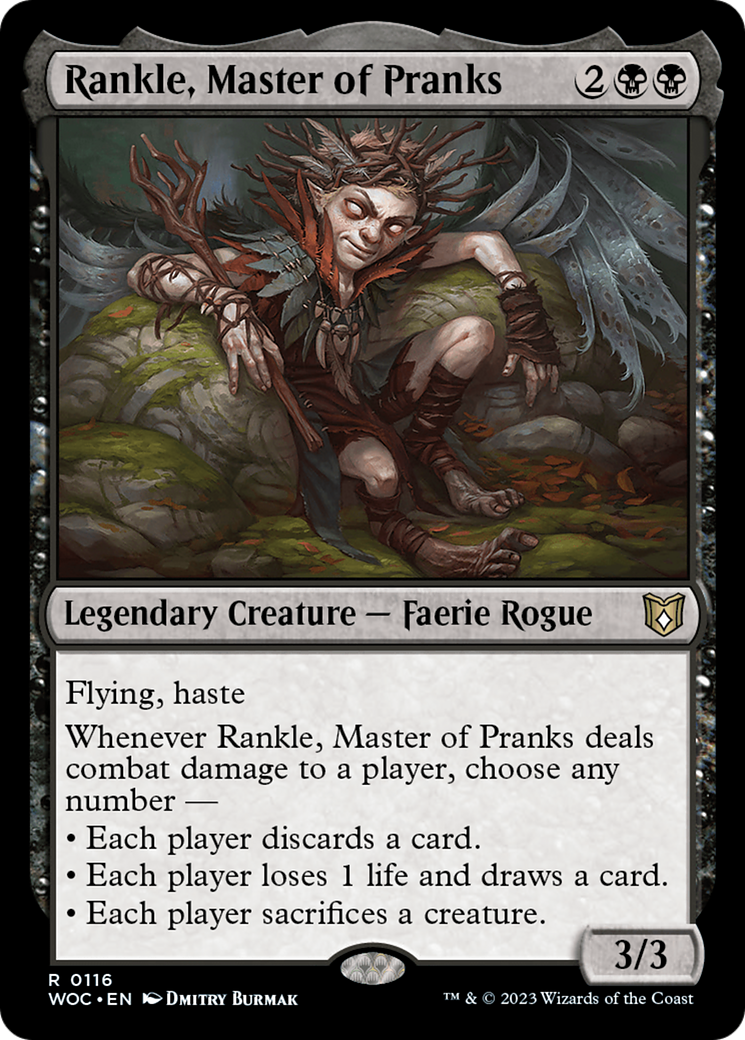
Rankle, Master of Pranks
Rankle, Master of Pranks
Legendary Creature — Faerie Rogue
3/3
Flying, haste
Whenever Rankle deals combat damage to a player, choose any number —
- Each player discards a card.
- Each player loses 1 life and draws a card.
- Each player sacrifices a creature of their choice.
- If you really want, you can choose zero modes for Rankle's triggered ability, but carefully consider the hidden costs in not entertaining someone titled Master of Pranks.
- You can't choose a mode more than once.
- You can choose a mode even if some or all players will be unaffected.
- For each chosen mode, perform that mode in its entirety before continuing on to the next chosen mode in the order printed.
- As the first mode is performed, first the player whose turn it is chooses a card in hand without revealing it, then each other player in turn order does the same. Then all the chosen cards are discarded at the same time.
- As the third mode is performed, first the player whose turn it chooses a creature they control, then each other player in turn order does the same, knowing the choices made before them. Then all the chosen creatures are sacrificed at the same time.
- In a Two-Headed Giant game, Rankle's second mode causes each team to lose 1 life twice.
-
1
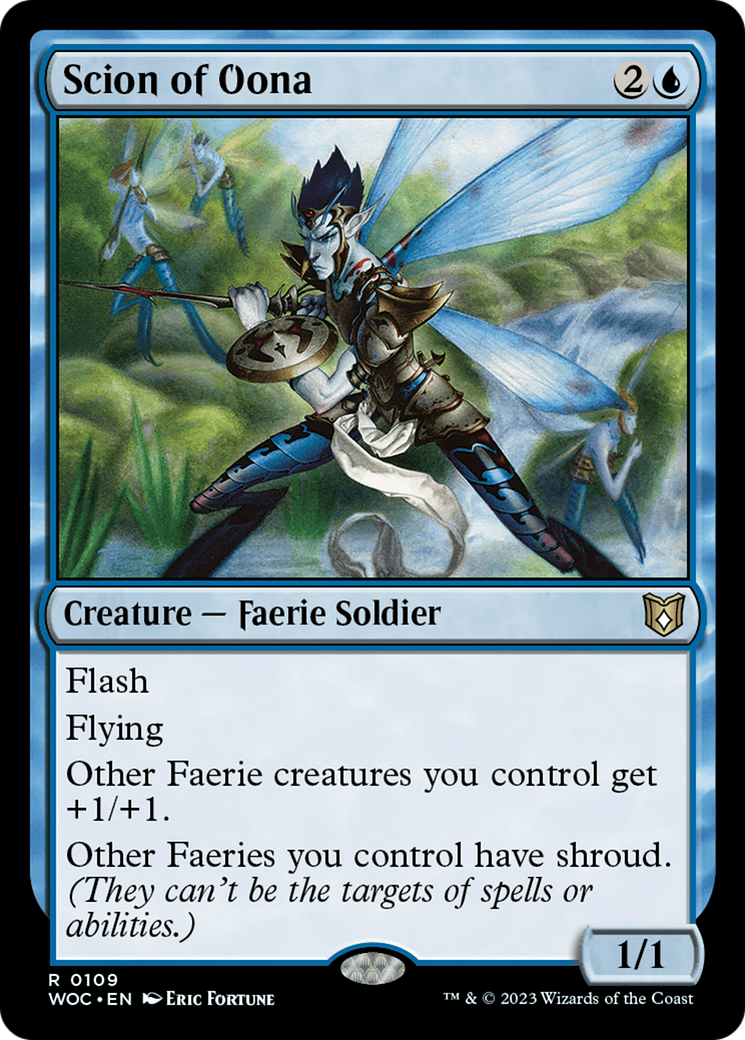
Scion of Oona
Scion of Oona
Creature — Faerie Soldier
1/1
Flash
Flying
Other Faerie creatures you control get +1/+1.
Other Faeries you control have shroud. (They can't be the targets of spells or abilities.)
-
1
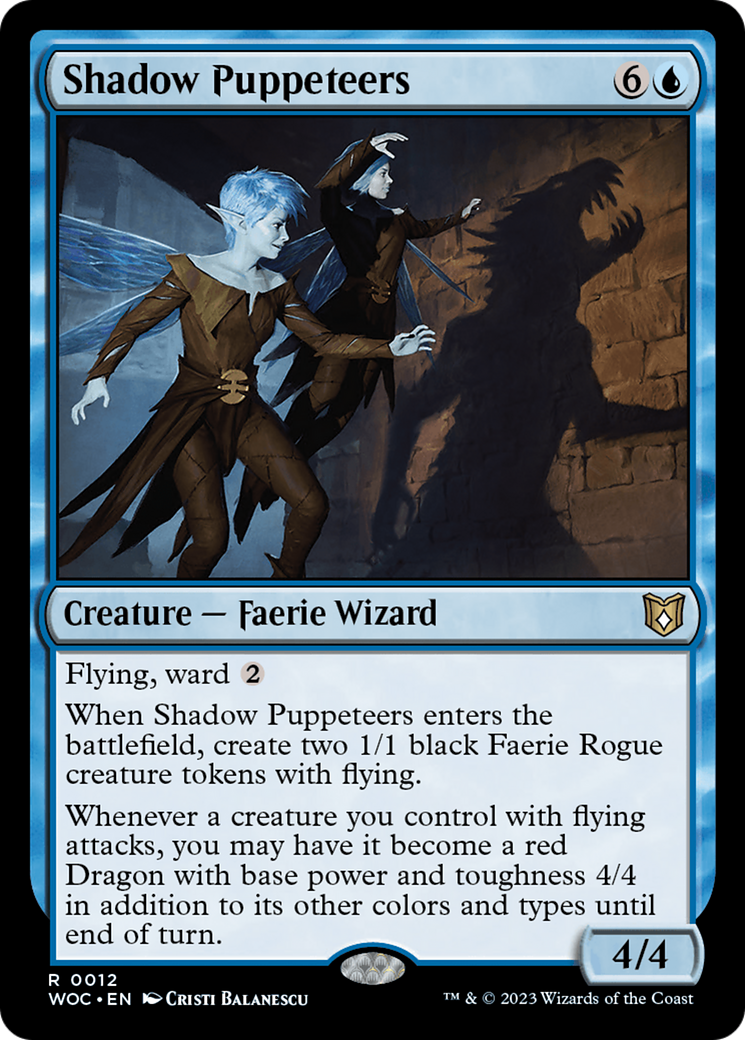
Shadow Puppeteers
Shadow Puppeteers
Creature — Faerie Wizard
4/4
Flying, ward
When this creature enters, create two 1/1 black Faerie Rogue creature tokens with flying.
Whenever a creature you control with flying attacks, you may have it become a red Dragon with base power and toughness 4/4 in addition to its other colors and types until end of turn.
- If the creature loses flying before Shadow Puppeteers's last ability resolves, the creature will still become a red Dragon with base power and toughness 4/4 in addition to its other colors and types until end of turn. It won't gain flying.
- If the creature stops being a creature before Shadow Puppeteers's last ability resolves, it will become red until end of turn in addition to its other colors. Since it's not a creature, it won't gain the Dragon subtype, and it won't have base power and toughness 4/4.
- Shadow Puppeteers's last ability overwrites any previous effects that set the creature's power and/or toughness to specific values. Any power- or toughness-setting effects that start to apply after Shadow Puppeteers's last ability resolves will overwrite this effect.
- Effects that modify a creature's power and/or toughness, such as the one created by Squeak By or a +1/+1 counter, will apply to the creature no matter when they started to take effect.
- Shadow Puppeteers's last ability doesn't remove any abilities the creature has.
-
1
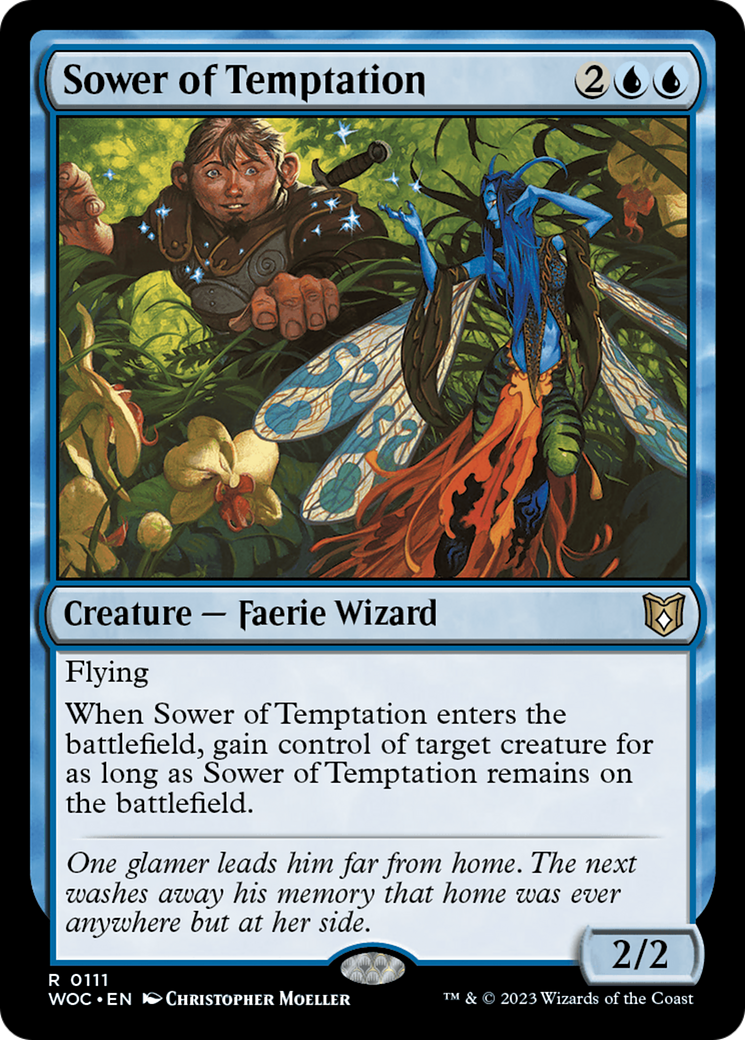
Sower of Temptation
Sower of Temptation
Creature — Faerie Wizard
2/2
Flying
When this creature enters, gain control of target creature for as long as this creature remains on the battlefield.
- You retain control of the targeted creature as long as Sower of Temptation remains on the battlefield, even if a different player gains control of Sower of Temptation itself.
- If Sower of Temptation leaves the battlefield before the ability resolves, the ability will have no effect.
-
1
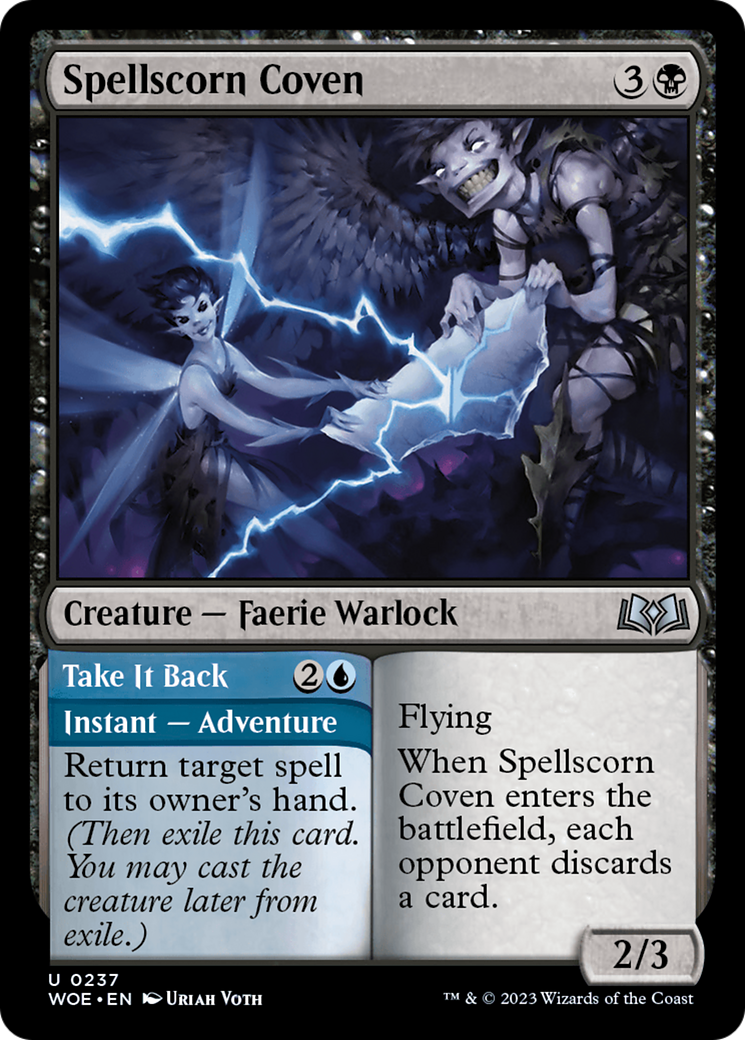
Spellscorn Coven // Take It Back
//
Spellscorn Coven
Creature — Faerie Warlock
2/3
- If a spell is returned to its owner's hand, it's removed from the stack and thus will not resolve. The spell isn't countered; it just no longer exists. This works even against a spell that can't be countered.
- If a copy of a spell is returned to its owner's hand, it's moved there, then it will cease to exist as a state-based action. It can't be recast.
- An adventurer card is a permanent card in every zone except the stack, as well as while on the stack if not cast as an Adventure. Ignore its alternative characteristics in those cases. For example, while it’s in your graveyard, Questing Druid is a green creature card whose mana value is 2. It can’t be the target of Tenacious Tomeseeker’s triggered ability (“return target instant or sorcery card from your graveyard to your hand”).
- When casting a spell as an Adventure, use the alternative characteristics and ignore all of the card’s normal characteristics. The spell’s color, mana cost, mana value, and so on are determined by only those alternative characteristics. If the spell leaves the stack, it immediately resumes using its normal characteristics.
- If you cast an adventurer card as an Adventure, use only its alternative characteristics to determine whether it’s legal to cast that spell. For example, if you control Johann, Apprentice Sorcerer (“Once each turn, you may cast an instant or sorcery spell from the top of your library.”) and Questing Druid is on top of your library, you can cast Seek the Beast, but not Questing Druid.
- If a spell is cast as an Adventure, its controller exiles it instead of putting it into its owner’s graveyard as it resolves. For as long as it remains exiled, that player may cast it as a permanent spell. If an Adventure spell leaves the stack in any way other than resolving (most likely by being countered or by failing to resolve because its targets have all become illegal), that card won’t be exiled and the spell’s controller won’t be able to cast it as a permanent later.
- If an adventurer card ends up in exile for any other reason than by exiling itself while resolving, it won’t give you permission to cast it as a permanent spell.
- You must still follow any timing restrictions and permissions for the permanent spell you cast from exile. Normally, you’ll be able to cast it only during your main phase while the stack is empty.
- If an effect copies an Adventure spell, that copy is exiled as it resolves. It ceases to exist as a state-based action; it’s not possible to cast the copy as a permanent.
- An effect may refer to a card, spell, or permanent that “has an Adventure.” This refers to a card, spell, or permanent that has an adventurer card’s set of alternative characteristics, even if they’re not being used and even if that card was never cast as an Adventure.
- If an effect refers to a card, spell, or permanent that has an Adventure, it won’t find an instant or sorcery spell on the stack that’s been cast as an Adventure.
- If an object becomes a copy of an object that has an Adventure, the copy also has an Adventure. If it changes zones, it will either cease to exist (if it’s a token) or cease to be a copy (if it’s a nontoken permanent), and so you won’t be able to cast it as an Adventure.
- If an effect instructs you to choose a card name, you may choose the alternative Adventure name. Consider only the alternative characteristics to determine whether that is an appropriate name to choose.
- Casting a card as an Adventure isn’t casting it for an alternative cost. Effects that allow you to cast a spell for an alternative cost or without paying its mana cost may allow you to apply those to the Adventure.
-
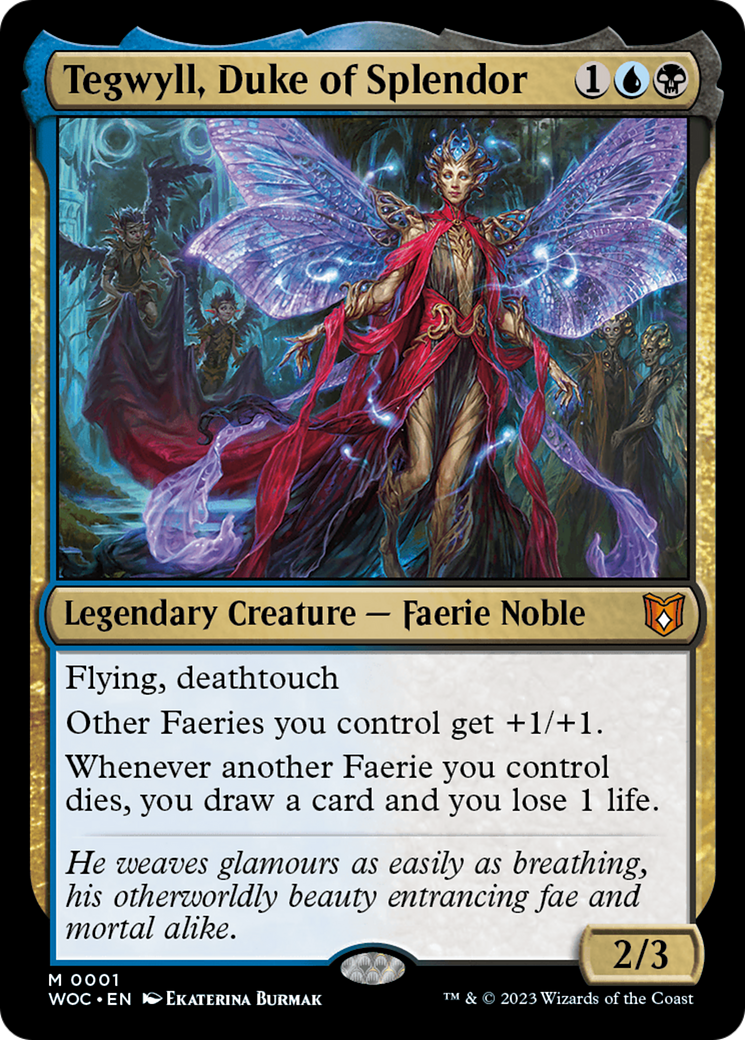
1
Tegwyll, Duke of Splendor
Tegwyll, Duke of Splendor
Legendary Creature — Faerie Noble
2/3
Flying, deathtouch
Other Faeries you control get +1/+1.
Whenever another Faerie you control dies, you draw a card and you lose 1 life.
- If Tegwyll, Duke of Splendor dies at the same time as one or more other Faeries you control, Tegwyll's ability triggers for each of those other Faeries.
Instants 17
-
1
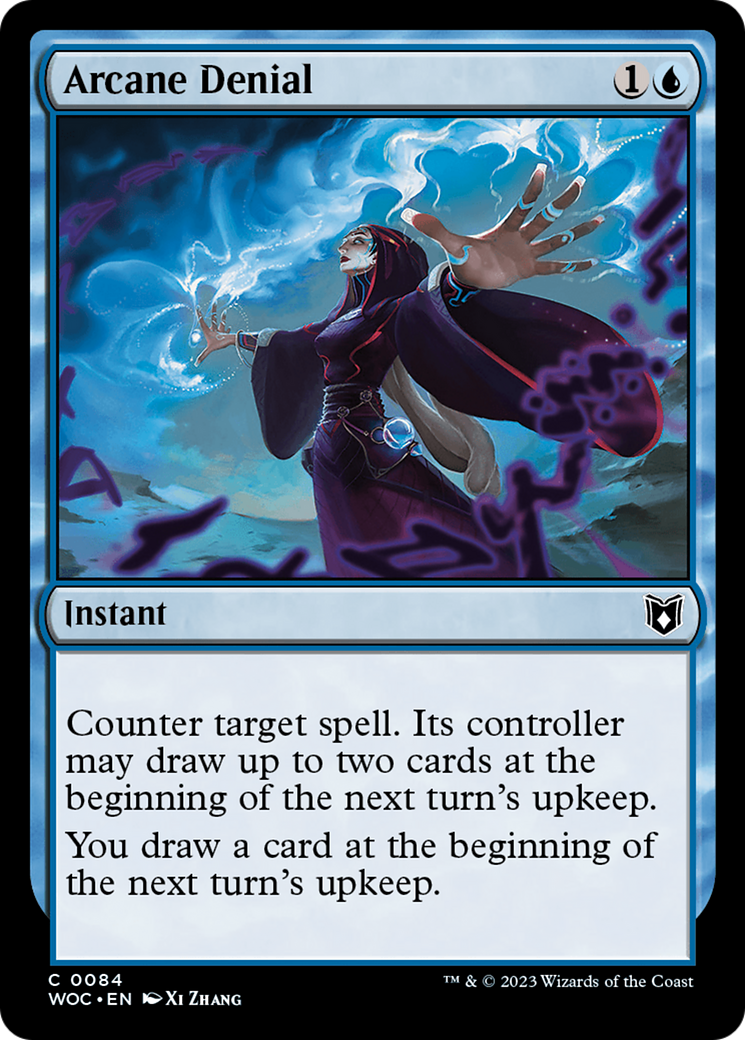
Arcane Denial
Arcane Denial
Instant
Counter target spell. Its controller may draw up to two cards at the beginning of the next turn's upkeep.
You draw a card at the beginning of the next turn's upkeep.
- The controller of the countered spell doesn't choose how many cards to draw until the relevant ability resolves. The player may draw 0, 1, or 2 cards. They choose the number before drawing any cards.
-
1
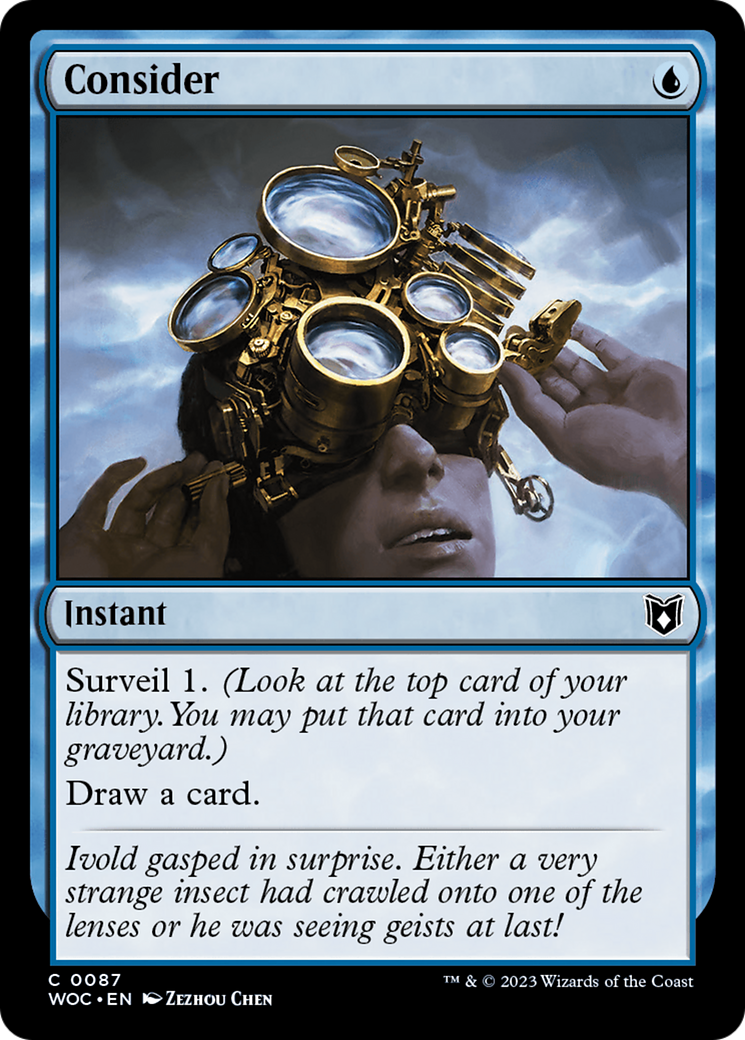
Consider
Consider
Instant
Surveil 1. (Look at the top card of your library. You may put it into your graveyard.)
Draw a card.
- You perform the actions stated on a card in sequence. For some spells and abilities, you'll surveil last. For others, you'll surveil and then perform other actions.
-
1
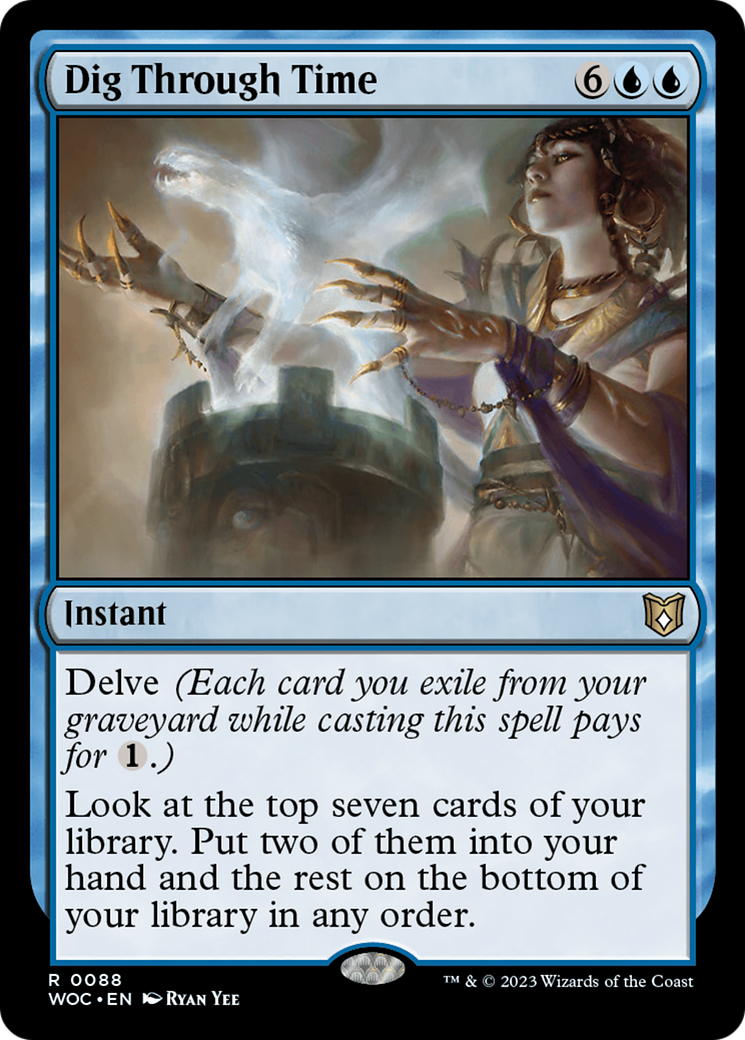
Dig Through Time
Dig Through Time
Instant
Delve (Each card you exile from your graveyard while casting this spell pays for .)
Look at the top seven cards of your library. Put two of them into your hand and the rest on the bottom of your library in any order.
- Delve doesn't change a spell's mana cost or mana value. For example, Treasure Cruise's mana value is 8 even if you exiled three cards to cast it.
- You can exile cards to pay only for generic mana, and you can't exile more cards than the generic mana requirement of a spell with delve. For example, you can't exile more than seven cards from your graveyard to cast Treasure Cruise unless an effect has increased its cost.
- Because delve isn't an alternative cost, it can be used in conjunction with alternative costs, such as flashback. It can also be used to pay for additional costs that include generic mana.
-
1
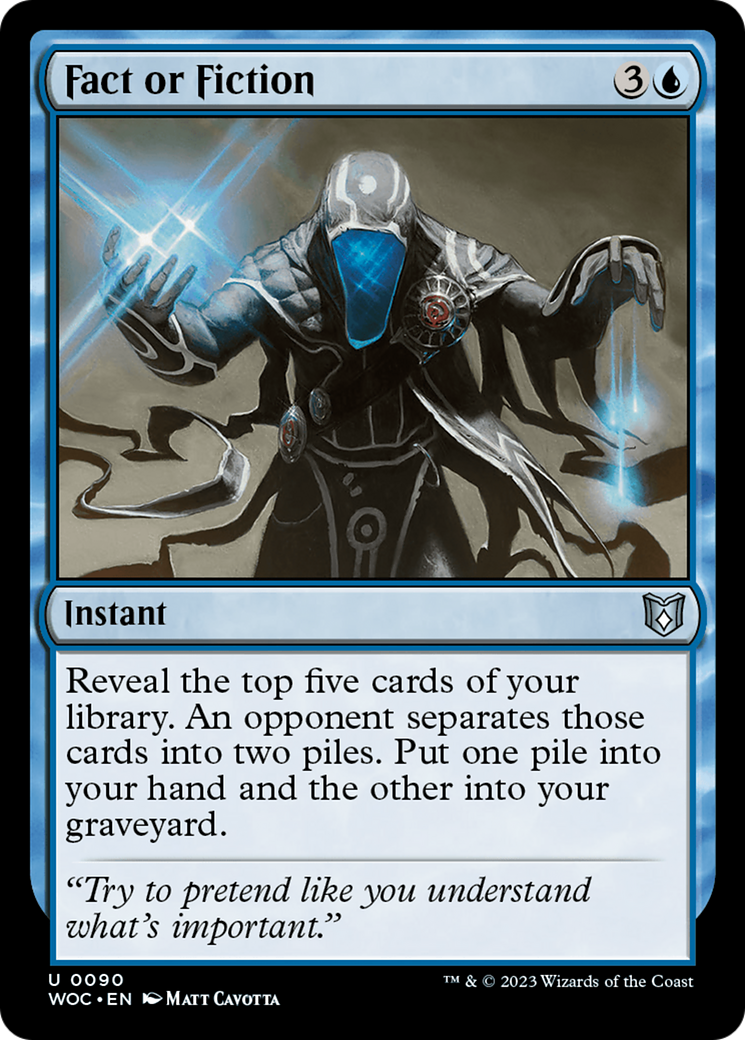
Fact or Fiction
Fact or Fiction
Instant
Reveal the top five cards of your library. An opponent separates those cards into two piles. Put one pile into your hand and the other into your graveyard.
- Piles may be empty.
-
1
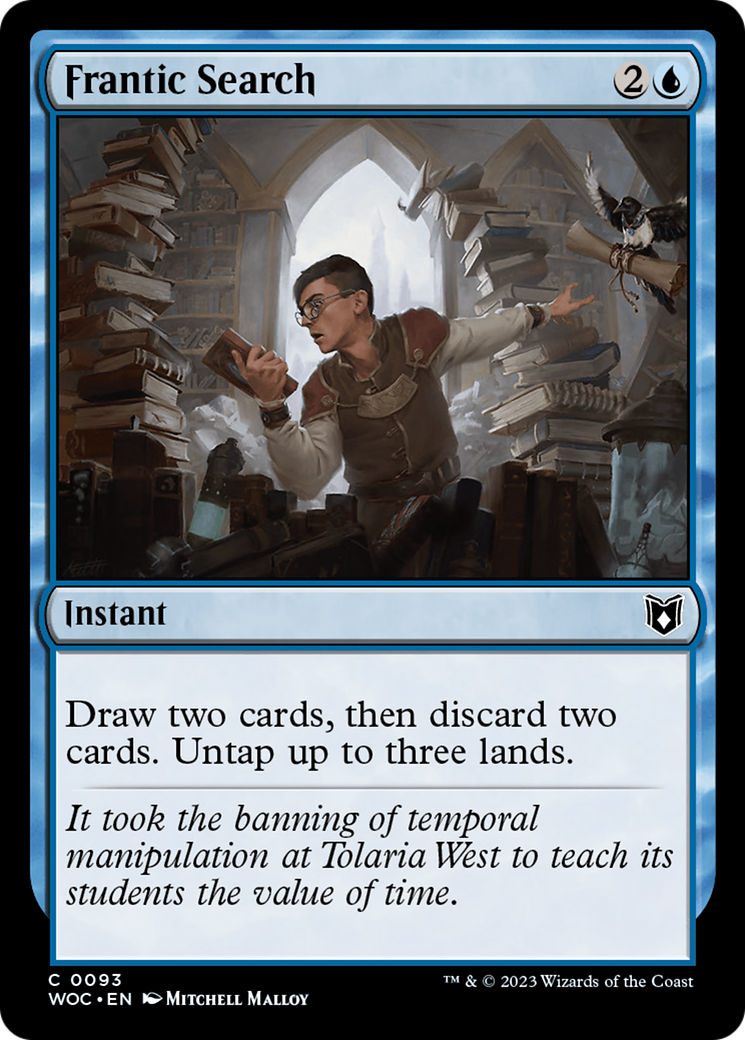
Frantic Search
Frantic Search
Instant
Draw two cards, then discard two cards. Untap up to three lands.
- You choose which lands to untap as the spell resolves. They aren't targeted, and they don't have to be lands that you control.
- You draw two cards and discard two cards all while Frantic Search is resolving. Nothing can happen between the two, and no player may choose to take actions.
-
1
Illusionist's Gambit
Illusionist's Gambit
Instant
Cast this spell only during the declare blockers step on an opponent's turn.
Remove all attacking creatures from combat and untap them. After this phase, there is an additional combat phase. Each of those creatures attacks that combat if able. They can't attack you or planeswalkers you control that combat.
- Creatures that didn't attack during the combat phase when Illusionist's Gambit resolved aren't required to attack in the additional combat phase, although they may. Those creatures can attack you or a planeswalker you control.
- If, during a player's declare attackers step, a creature is tapped, is affected by a spell or ability that says it can't attack, or hasn't been under that player's control continuously since the turn began (and doesn't have haste), then it doesn't attack.
- If there's a cost associated with having a creature attack, the player isn't forced to pay that cost, so it doesn't have to attack.
-
1
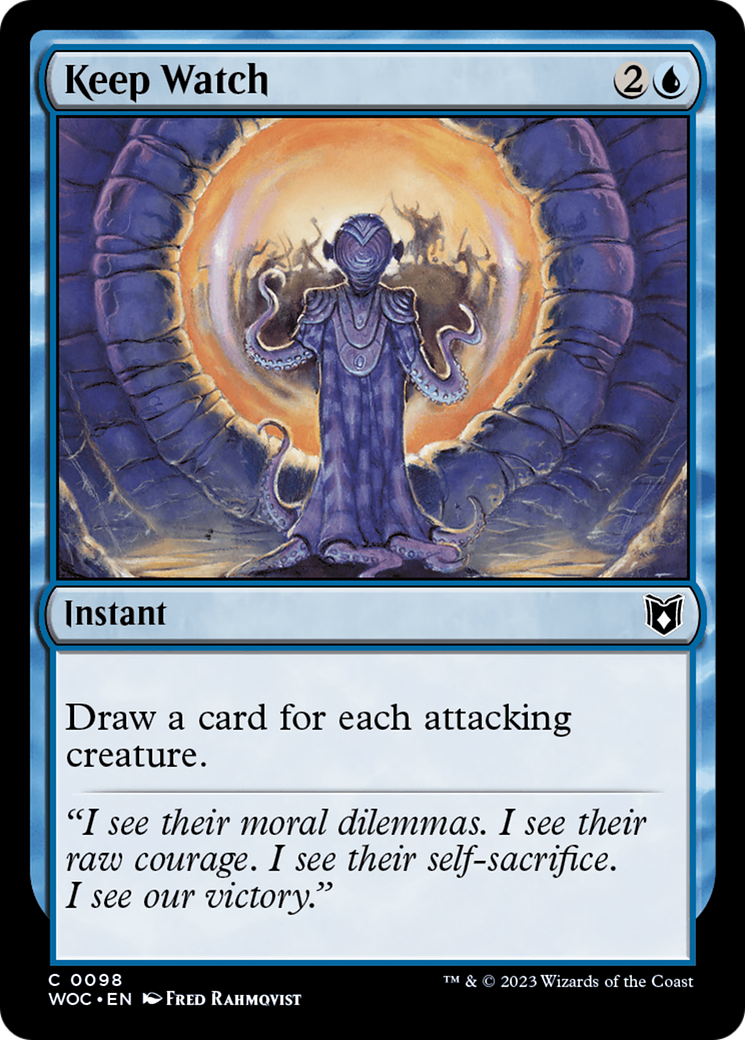
Keep Watch
Keep Watch
Instant
Draw a card for each attacking creature.
-
1
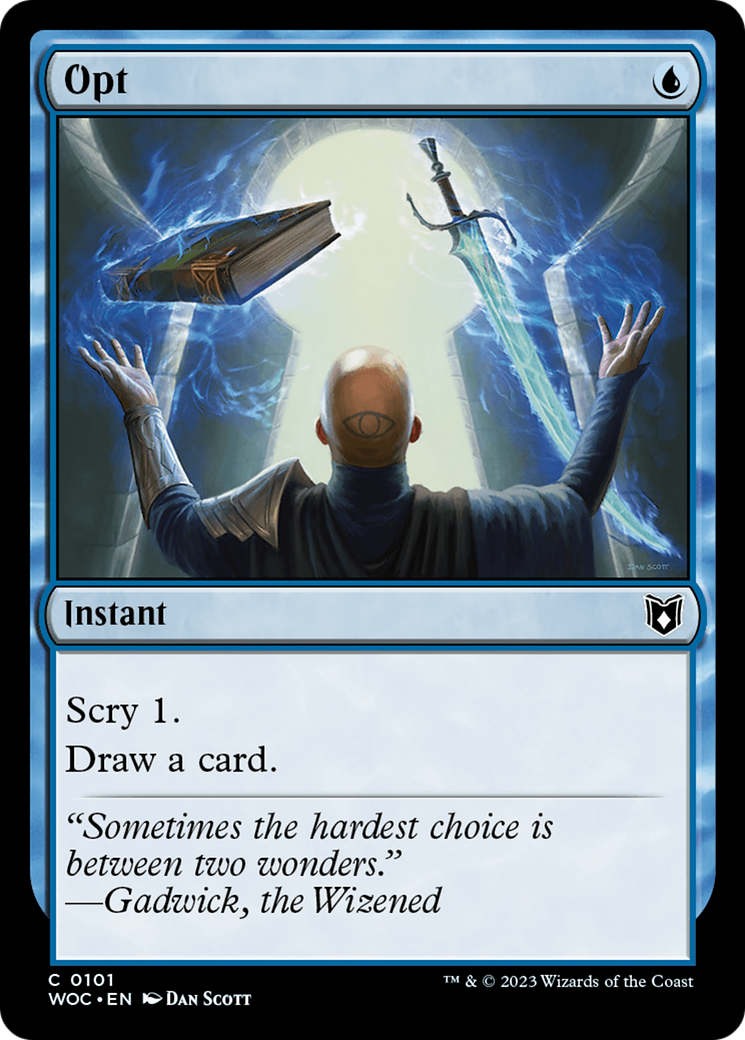
Opt
Opt
Instant
Scry 1. (Look at the top card of your library. You may put that card on the bottom.)
Draw a card.
-
1
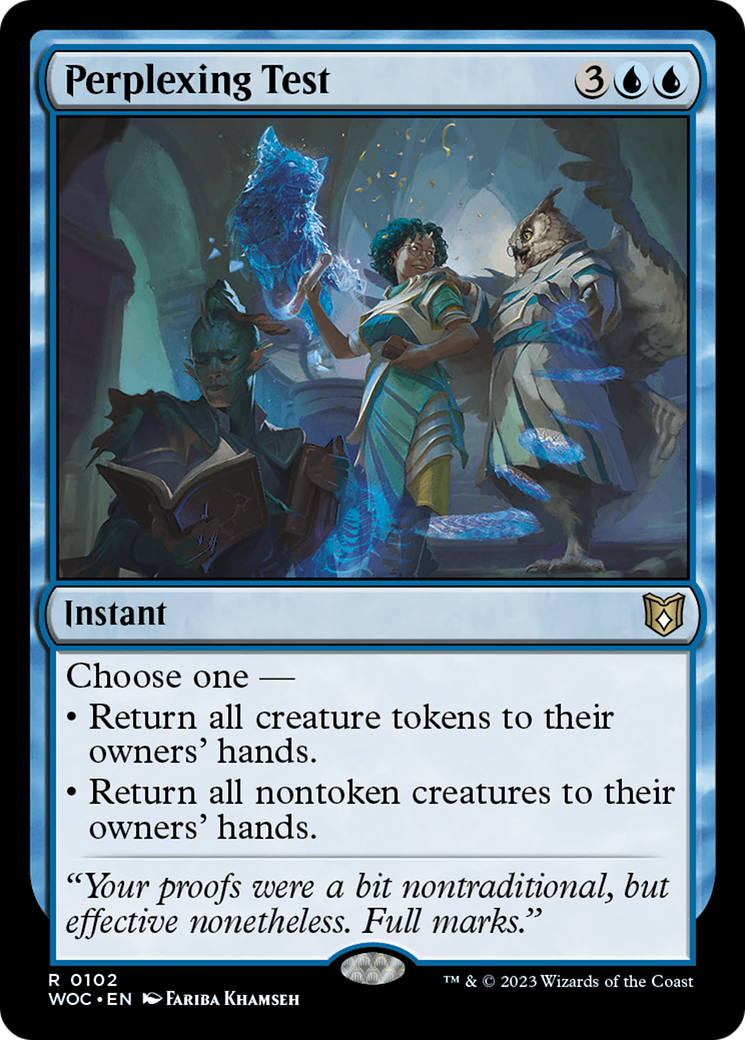
Perplexing Test
Perplexing Test
Instant
Choose one —
- Return all creature tokens to their owners' hands.
- Return all nontoken creatures to their owners' hands.
- A token that is returned to its owner's hand ceases to exist as a state-based action the next time a player would receive priority.
-
1
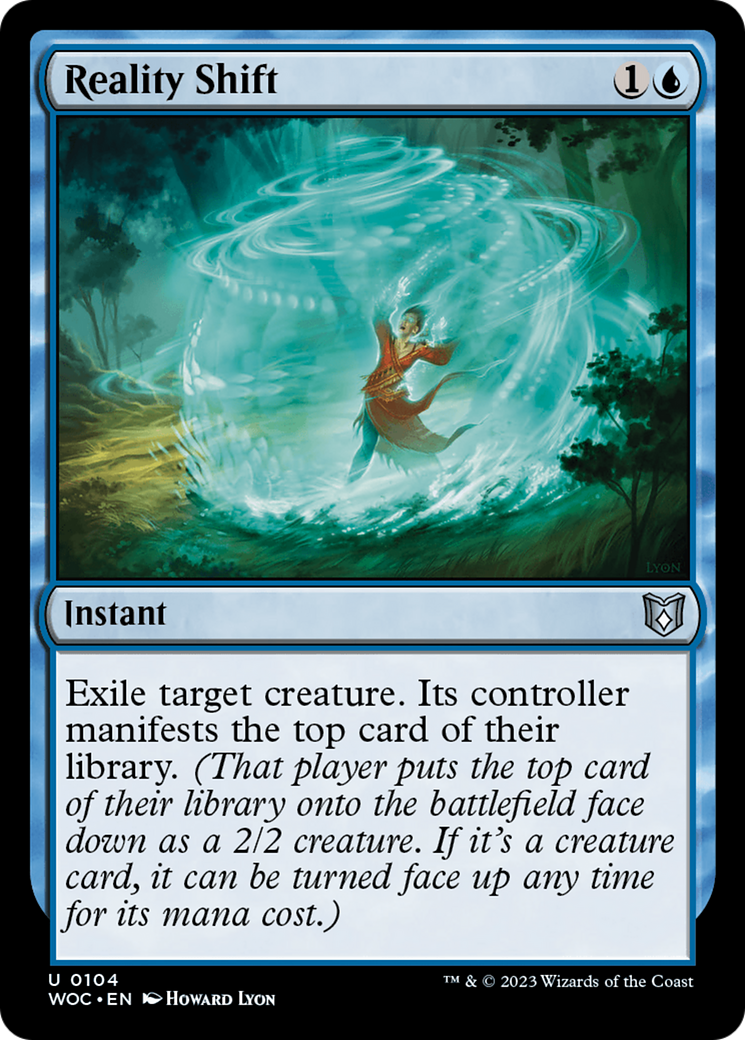
Reality Shift
Reality Shift
Instant
Exile target creature. Its controller manifests the top card of their library. (That player puts the top card of their library onto the battlefield face down as a 2/2 creature. If it's a creature card, it can be turned face up any time for its mana cost.)
- The face-down permanent is a 2/2 creature with no name, mana cost, creature types, or abilities. It's colorless and has a mana value of 0. Other effects that apply to the permanent can still grant or change any of these characteristics.
- Any time you have priority, you may turn a manifested creature face up by revealing that it's a creature card (ignoring any copy effects or type-changing effects that might be applying to it) and paying its mana cost. This is a special action. It doesn't use the stack and can't be responded to.
- If a manifested creature would have morph if it were face up, you may also turn it face up by paying its morph cost.
- Unlike a face-down creature that was cast using the morph ability, a manifested creature may still be turned face up after it loses its abilities if it's a creature card.
- Because the permanent is on the battlefield both before and after it's turned face up, turning a permanent face up doesn't cause any enters-the-battlefield abilities to trigger.
- Because face-down creatures don't have names, they can't have the same name as any other creature, even another face-down creature.
- A permanent that turns face up or face down changes characteristics but is otherwise the same permanent. Spells and abilities that were targeting that permanent, as well as Auras and Equipment that were attached to the permanent, aren't affected.
- Turning a permanent face up or face down doesn't change whether that permanent is tapped or untapped.
- At any time, you can look at a face-down permanent you control. You can't look at face-down permanents you don't control unless an effect allows you to or instructs you to.
- If a face-down permanent you control leaves the battlefield, you must reveal it. You must also reveal all face-down spells and permanents you control if you leave the game or if the game ends.
- You must ensure that your face-down spells and permanents can easily be differentiated from each other. You're not allowed to mix up the cards that represent them on the battlefield in order to confuse other players. The order they entered the battlefield should remain clear. Common methods for indicating this include using markers or dice, or simply placing them in order on the battlefield. You must also track how each became face down (manifested, cast face down using the morph ability, and so on).
- There are no cards in the Fate Reforged set that would turn a face-down instant or sorcery card on the battlefield face up, but some older cards can try to do this. If something tries to turn a face-down instant or sorcery card on the battlefield face up, reveal that card to show all players it's an instant or sorcery card. The permanent remains on the battlefield face down. Abilities that trigger when a permanent turns face up won't trigger, because even though you revealed the card, it never turned face up.
- If a double-faced card is manifested, it will be put onto the battlefield face down. While face down, it can't transform. If the front face of the card is a creature card, you can turn it face up by paying its mana cost. If you do, its front face will be up.
-
1
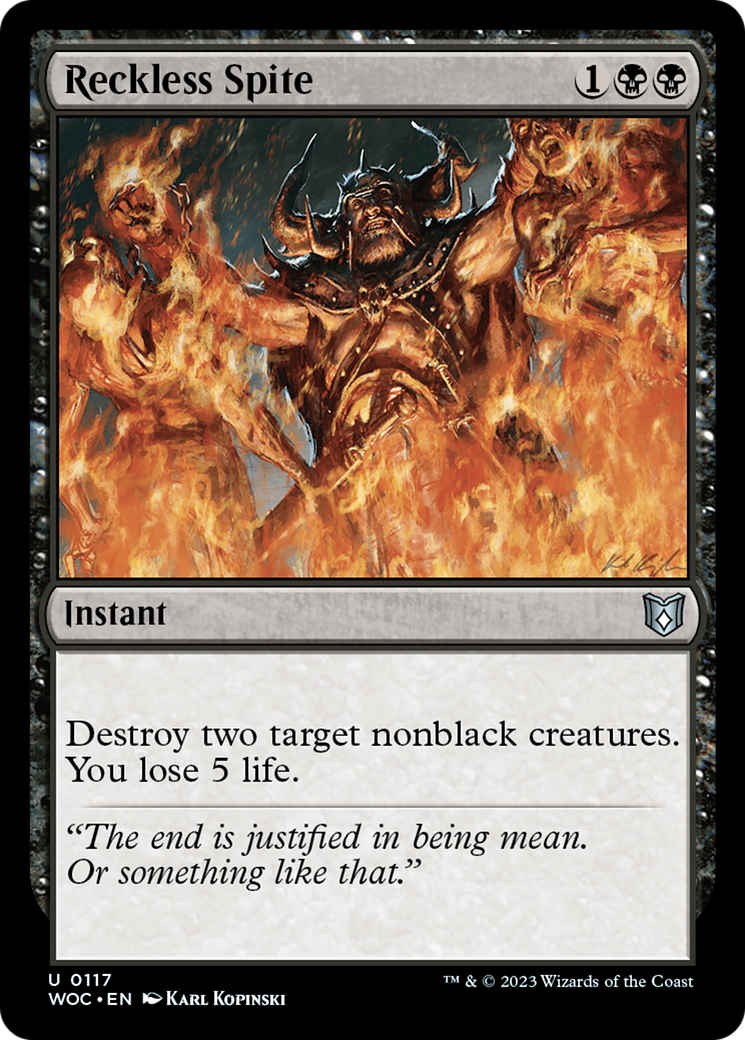
Reckless Spite
Reckless Spite
Instant
Destroy two target nonblack creatures. You lose 5 life.
-
1
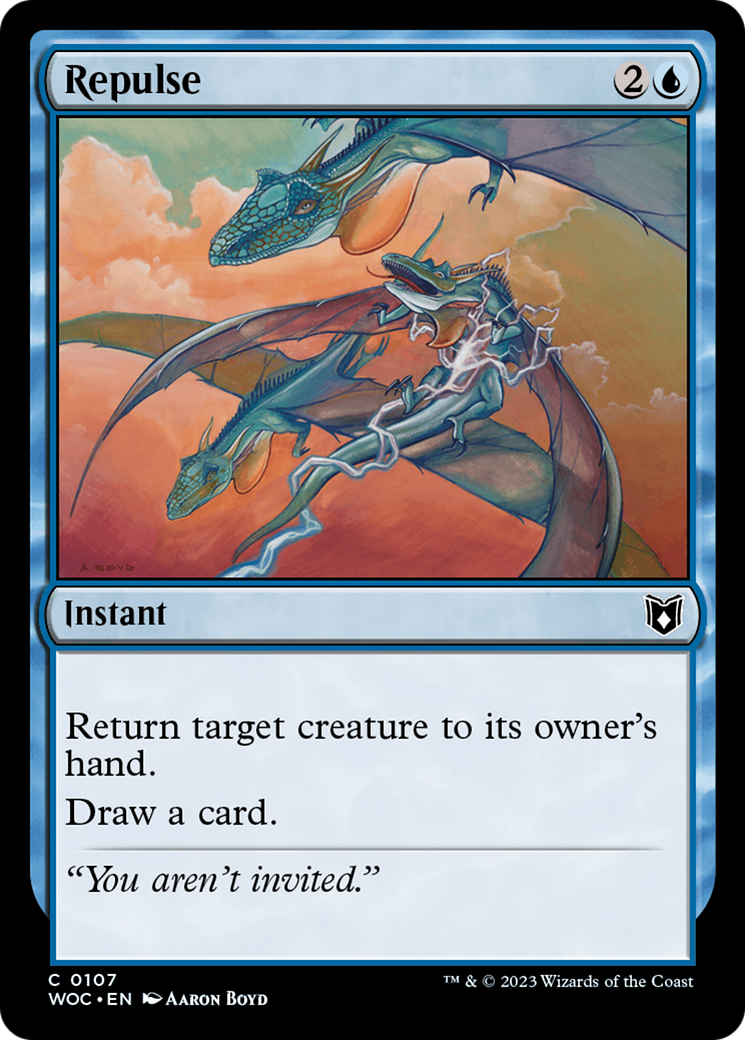
Repulse
Repulse
Instant
Return target creature to its owner's hand.
Draw a card.
- If the target creature is an illegal target as Repulse tries to resolve, it won't resolve and none of its effects will happen. You won't draw a card.
-
1
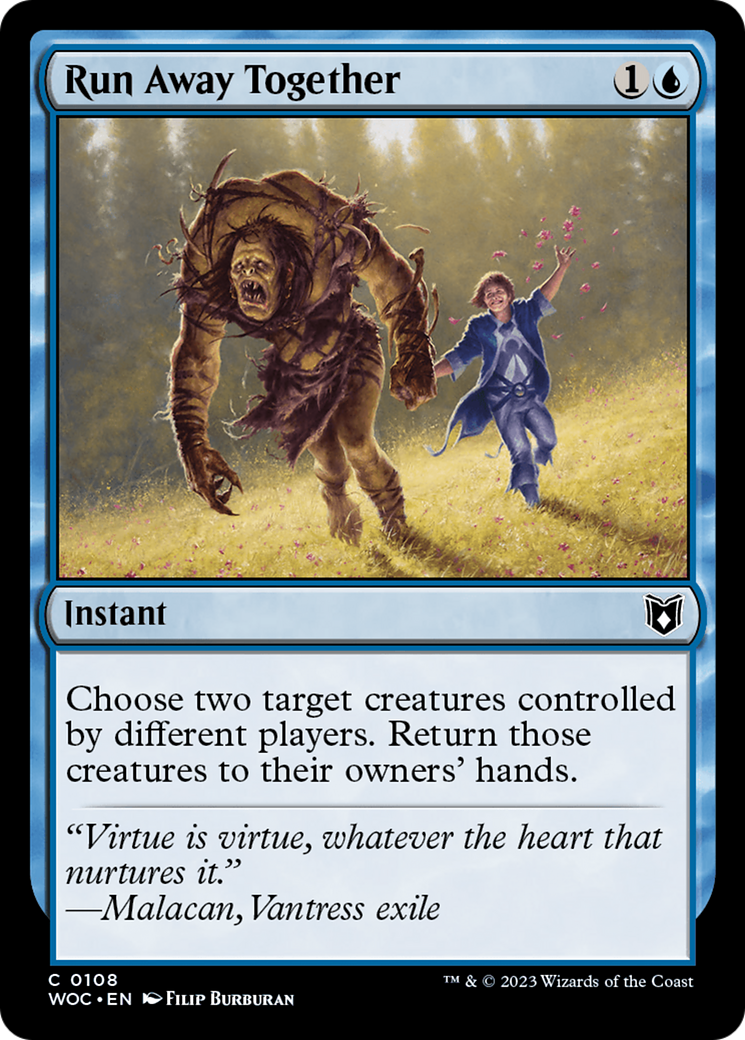
Run Away Together
Run Away Together
Instant
Choose two target creatures controlled by different players. Return those creatures to their owners' hands.
- If one of the two target creatures becomes an illegal target, Run Away Together can still determine its controller only to check whether the other creature is a legal target. If the illegal target has left the battlefield, use its last known information. If the other creature is still a legal target, it's returned to its owner's hand.
- If both creatures are controlled by the same player as Run Away Together tries to resolve, both targets are illegal. The spell doesn't resolve.
- If one of the two target creatures becomes an illegal target, Run Away Together can still determine its controller only to check whether the other creature is a legal target. If the illegal target has left the battlefield, use its last known information. If the other creature is still a legal target, it's returned to its owner's hand.
- If both creatures are controlled by the same player as Run Away Together tries to resolve, both targets are illegal. The spell doesn't resolve.
-
1
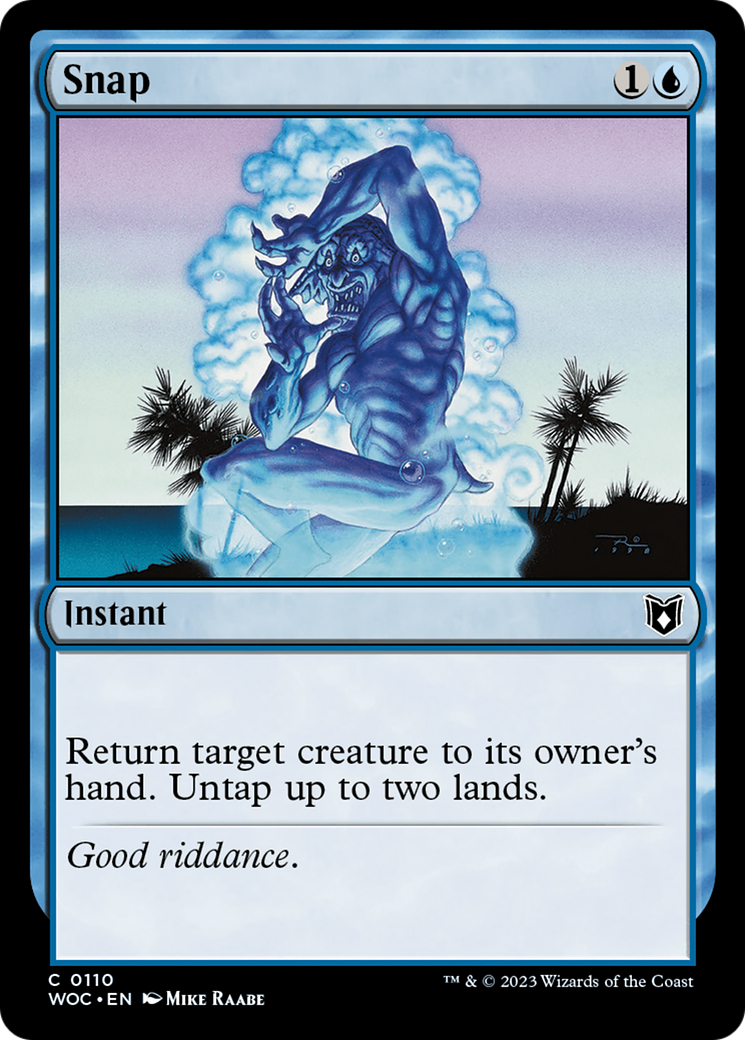
Snap
Snap
Instant
Return target creature to its owner's hand. Untap up to two lands.
- You choose which lands to untap as the spell resolves. They aren't targeted, and they don't have to be lands that you control.
-
1
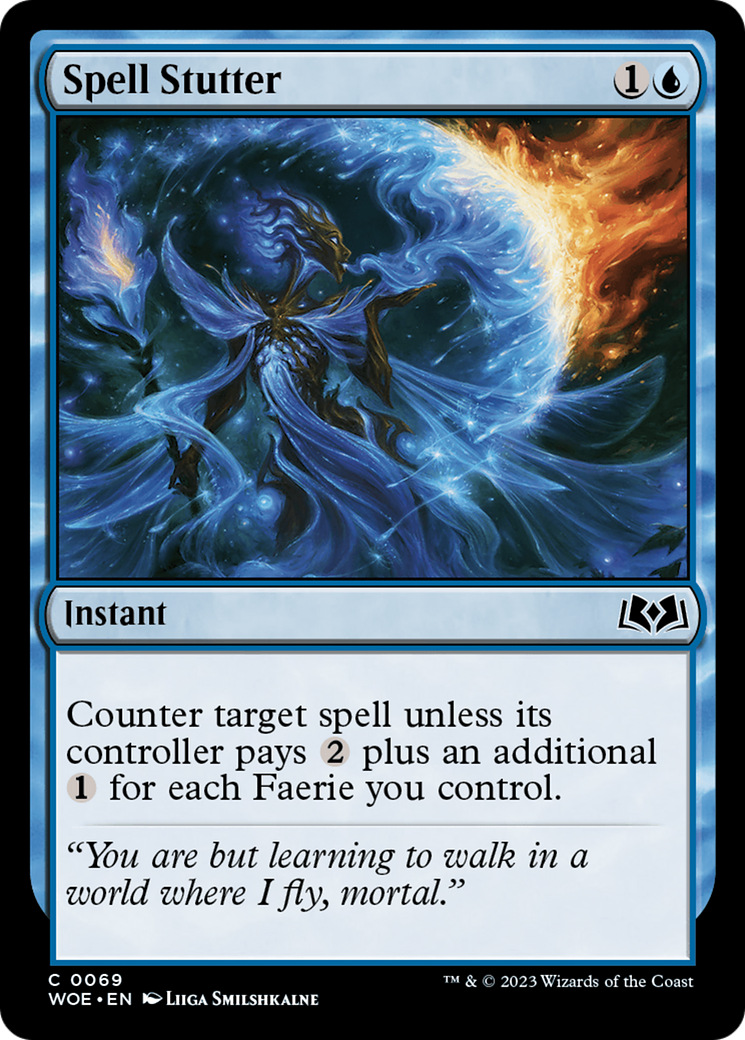
Spell Stutter
Spell Stutter
Instant
Counter target spell unless its controller pays plus an additional for each Faerie you control.
-
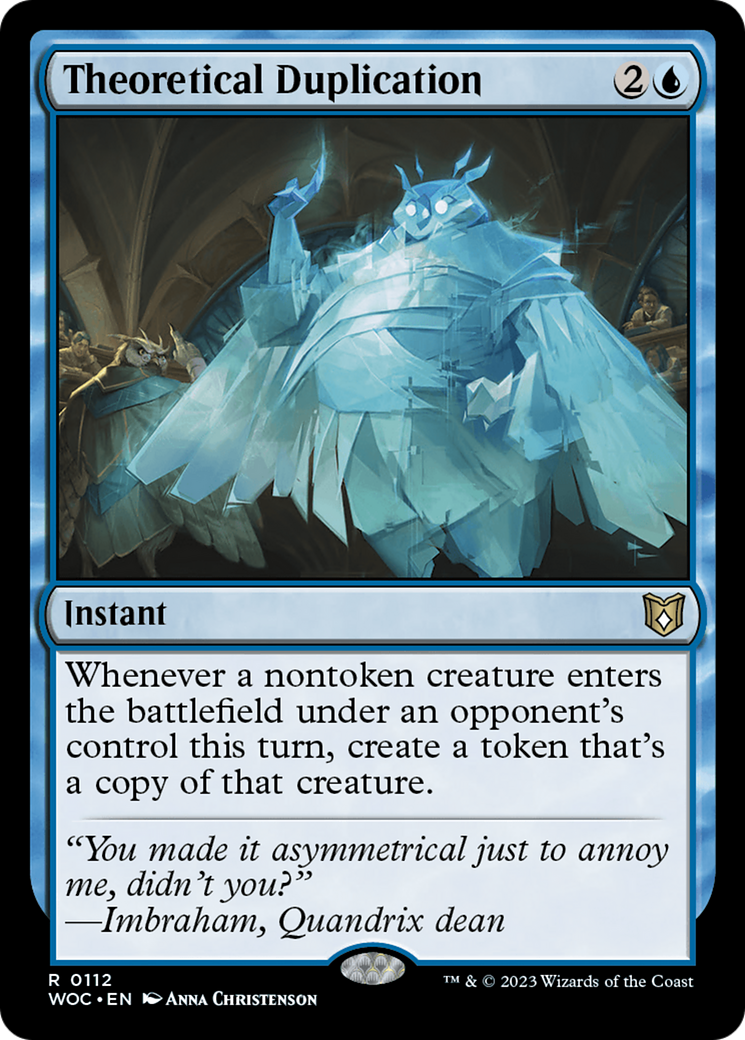
1
Theoretical Duplication
Theoretical Duplication
Instant
Whenever a nontoken creature an opponent controls enters this turn, create a token that's a copy of that creature.
-
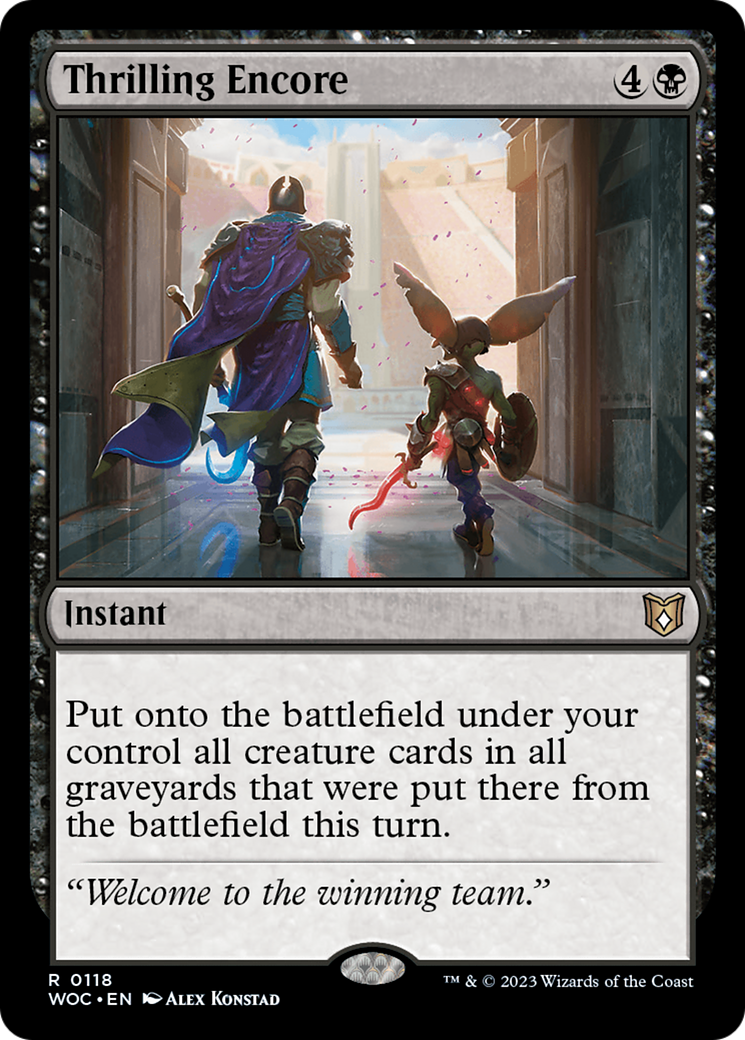
1
Thrilling Encore
Thrilling Encore
Instant
Put onto the battlefield under your control all creature cards in all graveyards that were put there from the battlefield this turn.
- Creature spells that were countered never entered the battlefield, so Thrilling Encore won't return them to the battlefield.
- Cards that aren't creature cards won't be returned to the battlefield, even if an effect made those cards creatures when they were last on the battlefield.
- In a multiplayer game, if a player leaves the game, all cards that player owns leave as well. If you leave the game, all creatures put onto the battlefield with Thrilling Encore that you controlled but didn't own are exiled.
Sorceries 4
-
1
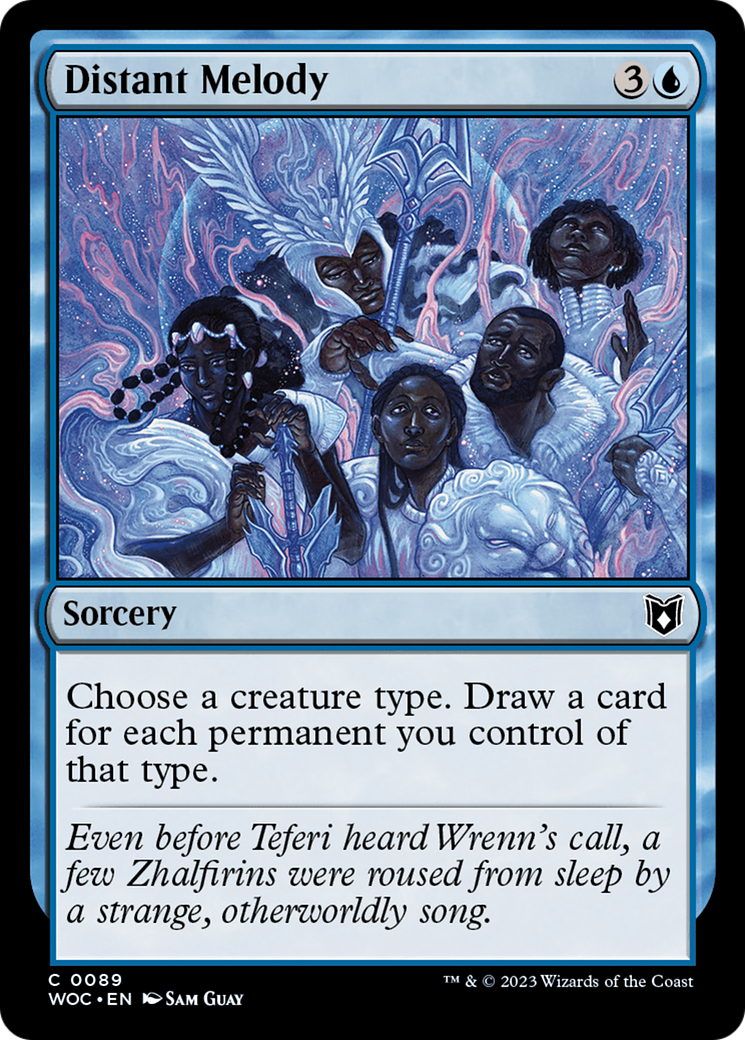
Distant Melody
Distant Melody
Sorcery
Choose a creature type. Draw a card for each permanent you control of that type.
- Note that this spell counts the number of permanents you control of the chosen type, not just the number of creatures you control. It will also take your kindred permanents of the chosen type into account.
-
1
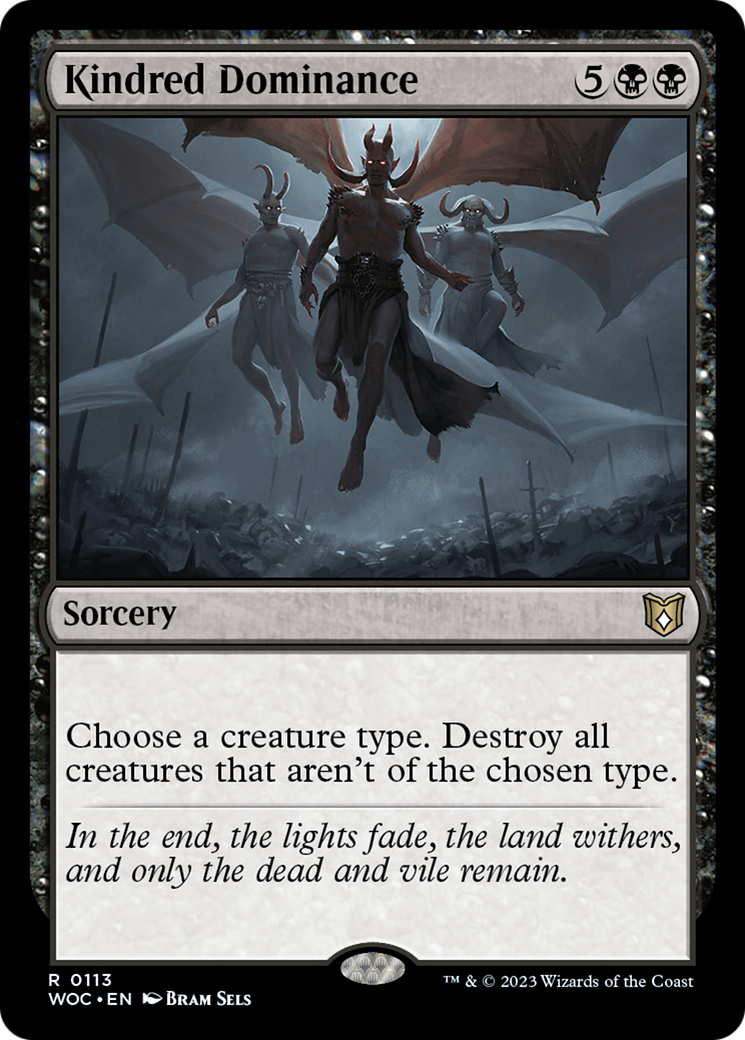
Kindred Dominance
Kindred Dominance
Sorcery
Choose a creature type. Destroy all creatures that aren't of the chosen type.
- Once Kindred Dominance begins to resolve, no players may take other actions until it's done. Notably, players can't try to save their creatures after you've chosen a creature type.
- You must choose an existing creature type, such as Vampire or Cat. Card types such as "artifact" can't be chosen.
- You can't choose multiple creature types, such as "Cat Warrior." A Cat Warrior is both a Cat and a Warrior. It's affected by anything that affects either type and unaffected by things that affect non-Cat or non-Warrior creatures.
-
1
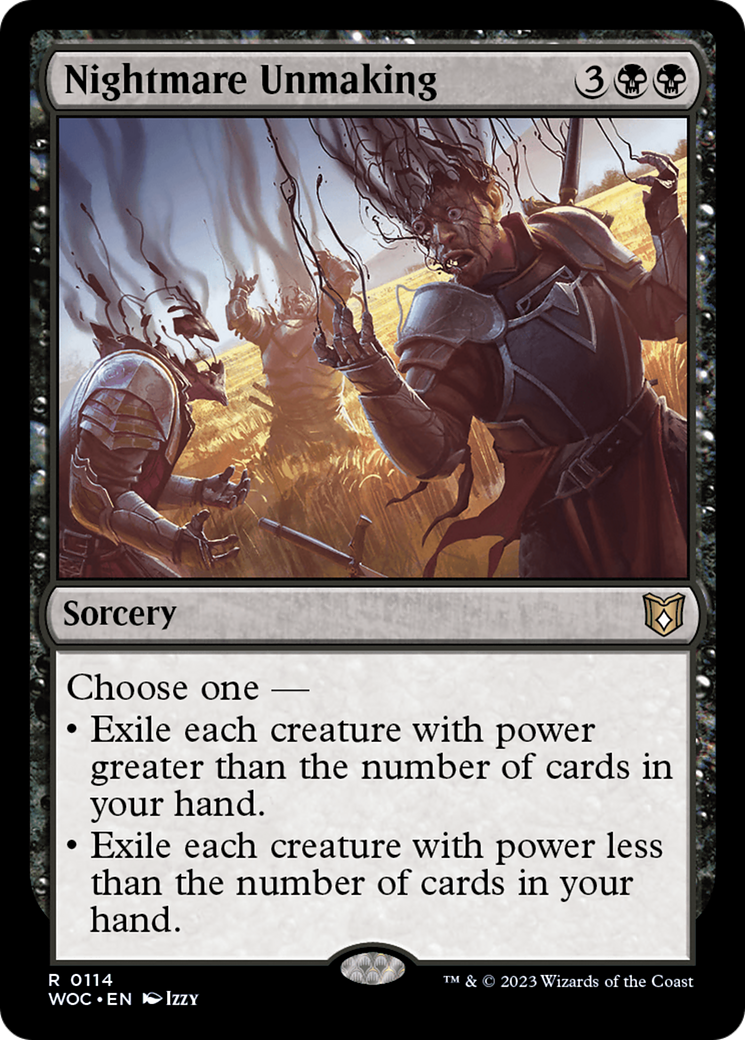
Nightmare Unmaking
Nightmare Unmaking
Sorcery
Choose one —
- Exile each creature with power greater than the number of cards in your hand.
- Exile each creature with power less than the number of cards in your hand.
- Because Nightmare Unmaking is on the stack while it's resolving, it won't be counted among the cards in your hand.
- The power of creatures and the number of cards in your hand are checked only as Nightmare Unmaking resolves. Players may respond to the spell knowing the chosen mode to try to save or doom a creature.
-
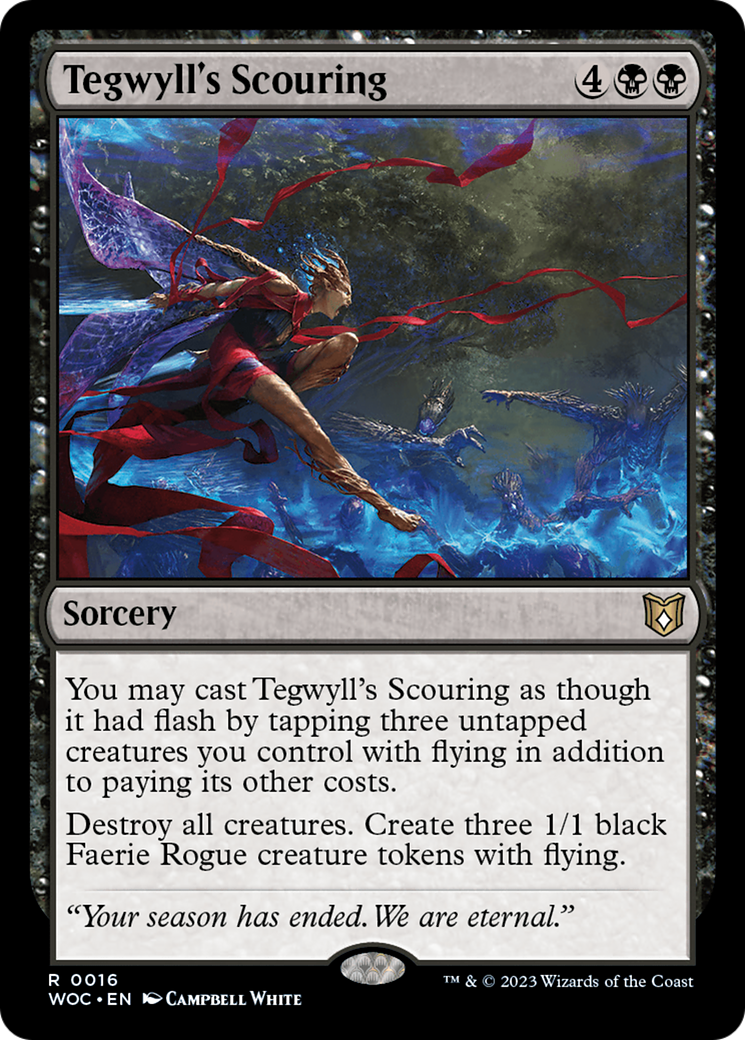
1
Tegwyll's Scouring
Tegwyll's Scouring
Sorcery
You may cast this spell as though it had flash by tapping three untapped creatures you control with flying in addition to paying its other costs.
Destroy all creatures. Create three 1/1 black Faerie Rogue creature tokens with flying.
Artifacts 9
-
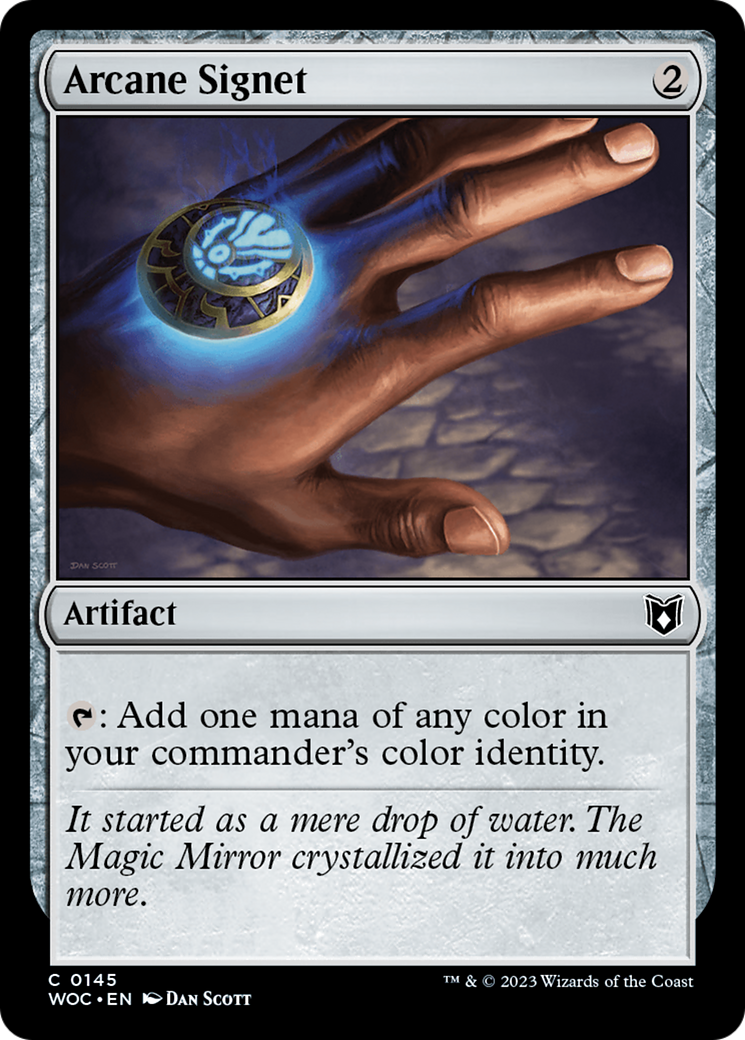
1
Arcane Signet
Arcane Signet
Artifact
: Add one mana of any color in your commander's color identity.
- If you have two commanders, the ability adds one mana of any color in their combined color identities.
- If your commander is a card that has no colors in its color identity, Arcane Signet's ability produces no mana. It doesn't produce .
- If you don't have a commander, Arcane Signet's ability produces no mana.
-
1
Dimir Signet
Dimir Signet
Artifact
, : Add .
-
1
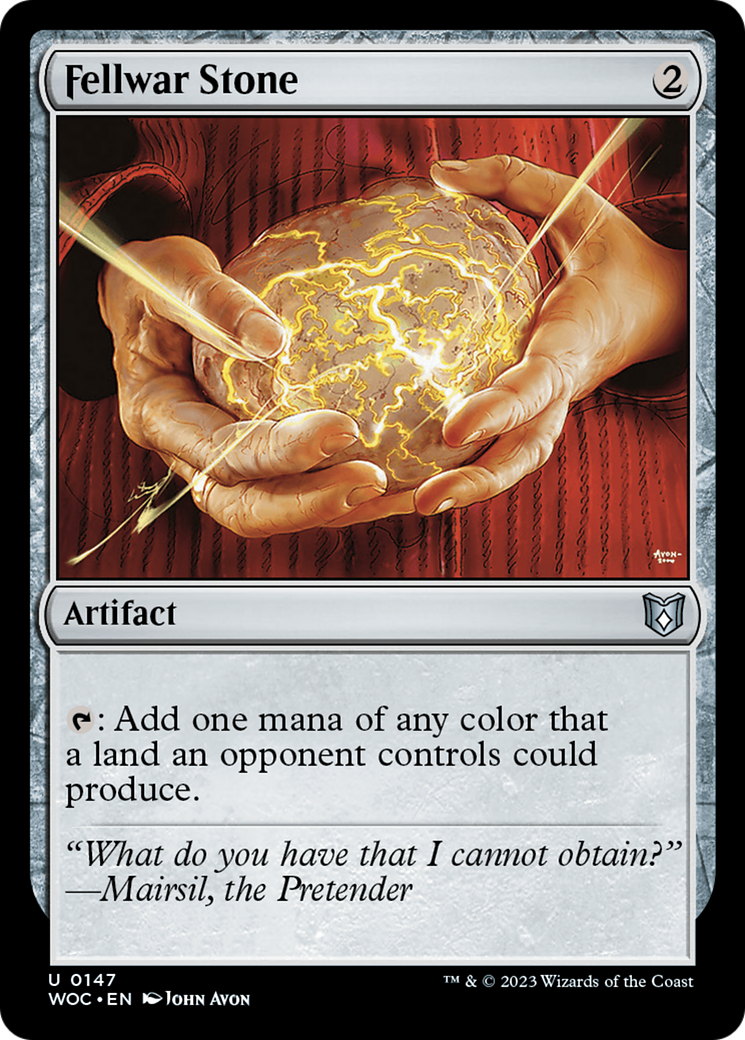
Fellwar Stone
Fellwar Stone
Artifact
: Add one mana of any color that a land an opponent controls could produce.
- The colors of mana are white, blue, black, red, and green. Fellwar Stone can't be tapped for colorless mana, even if a land an opponent controls could produce colorless mana.
- Fellwar Stone checks the effects of all mana-producing abilities of lands your opponents control, but it doesn't check their costs. For example, Vivid Crag has the ability " , Remove a charge counter from Vivid Crag: Add one mana of any color." If an opponent controls Vivid Crag and you control Fellwar Stone, you can tap Fellwar Stone for any color of mana. It doesn't matter whether Vivid Crag has a charge counter on it, and it doesn't matter whether it's untapped.
- When determining what colors of mana your opponents' lands could produce, take into account any applicable replacement effects that would apply to those lands' mana abilities (such as Contamination's effect, for example). If there is more than one, consider them in any possible order.
- Fellwar Stone doesn't care about any restrictions or riders your opponents' lands (such as Ancient Ziggurat or Hall of the Bandit Lord) put on the mana they produce. It just cares about colors of mana.
- This works even if the opponent's lands are tapped. It only checks what kinds of mana can be produced, not if the abilities that produce them are usable right now.
- The ability can be activated if the opponent has no lands that produce mana, but the effect will not be able to generate any mana.
- It only produces one mana even if the land can produce more than one.
-
1
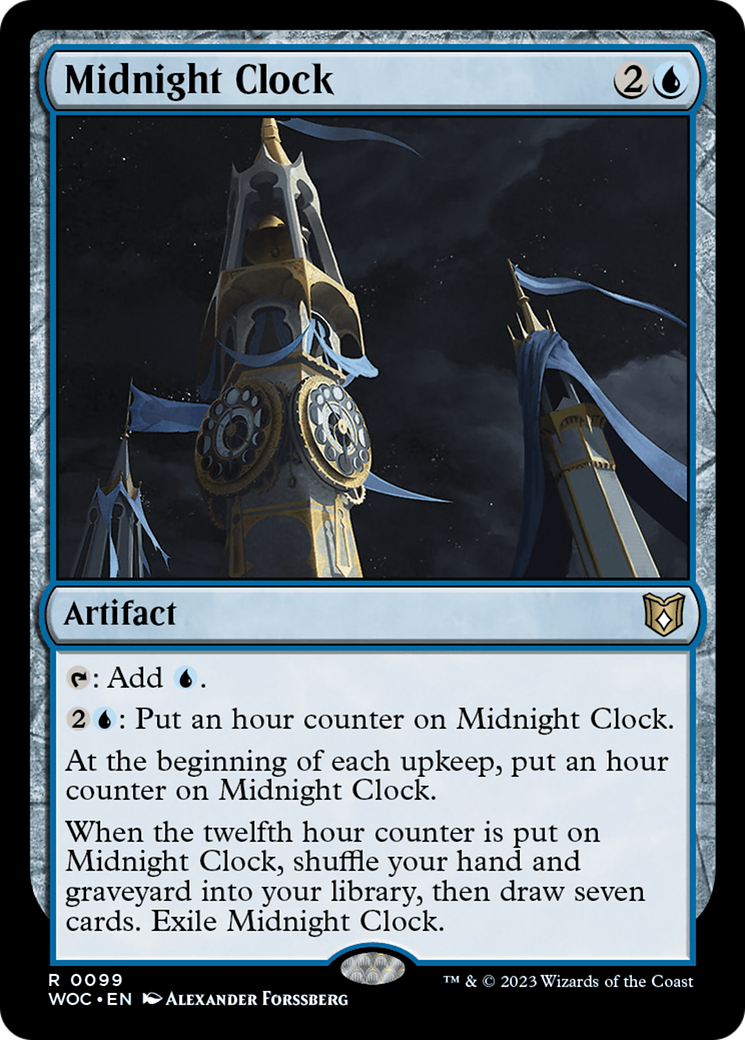
Midnight Clock
Midnight Clock
Artifact
: Add .
: Put an hour counter on this artifact.
At the beginning of each upkeep, put an hour counter on this artifact.
When the twelfth hour counter is put on this artifact, shuffle your hand and graveyard into your library, then draw seven cards. Exile this artifact.
- If Midnight Clock leaves the battlefield while its last ability is on the stack, it won't be exiled.
- You can activate Midnight Clock's mana ability to pay the cost of its second ability.
- Midnight Clock's last ability triggers after one or more counters are put onto it if it had fewer than twelve counters on it before those counters were put on it and it has twelve or more counters on it after.
- Midnight Clock's first triggered ability triggers at the beginning of each upkeep, not just your upkeep. In a Two-Headed Giant game, an ability that triggers at the beginning of each upkeep rather than each player's upkeep triggers only once during each team's upkeep.
-
1
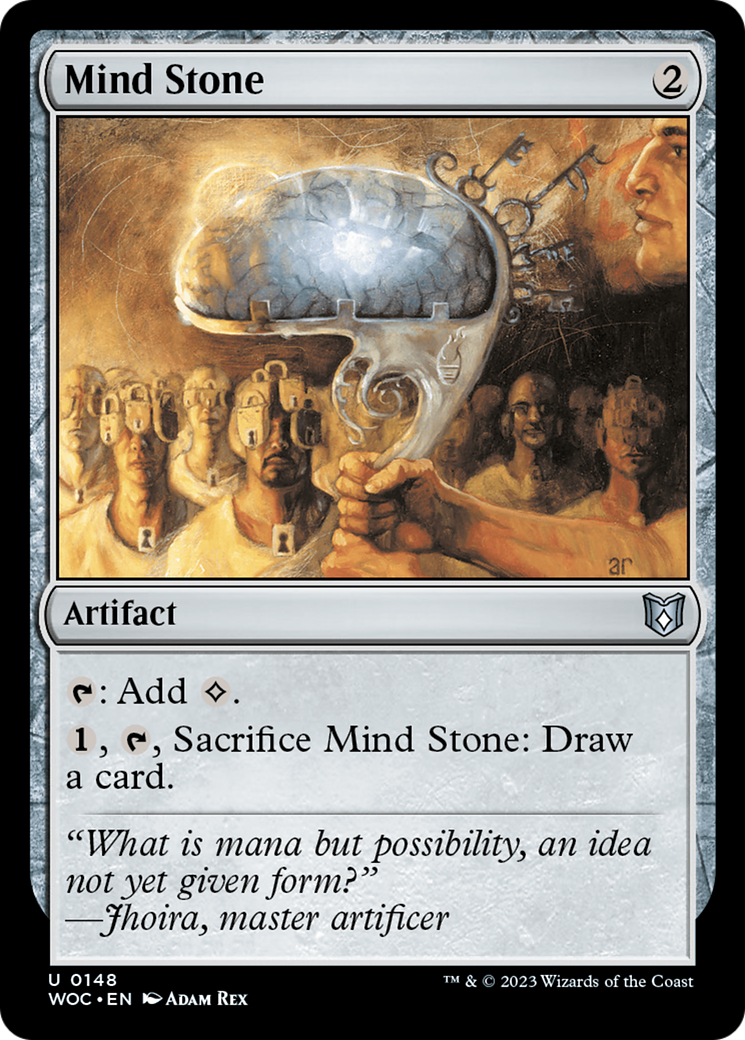
Mind Stone
Mind Stone
Artifact
: Add .
, , Sacrifice this artifact: Draw a card.
-
1
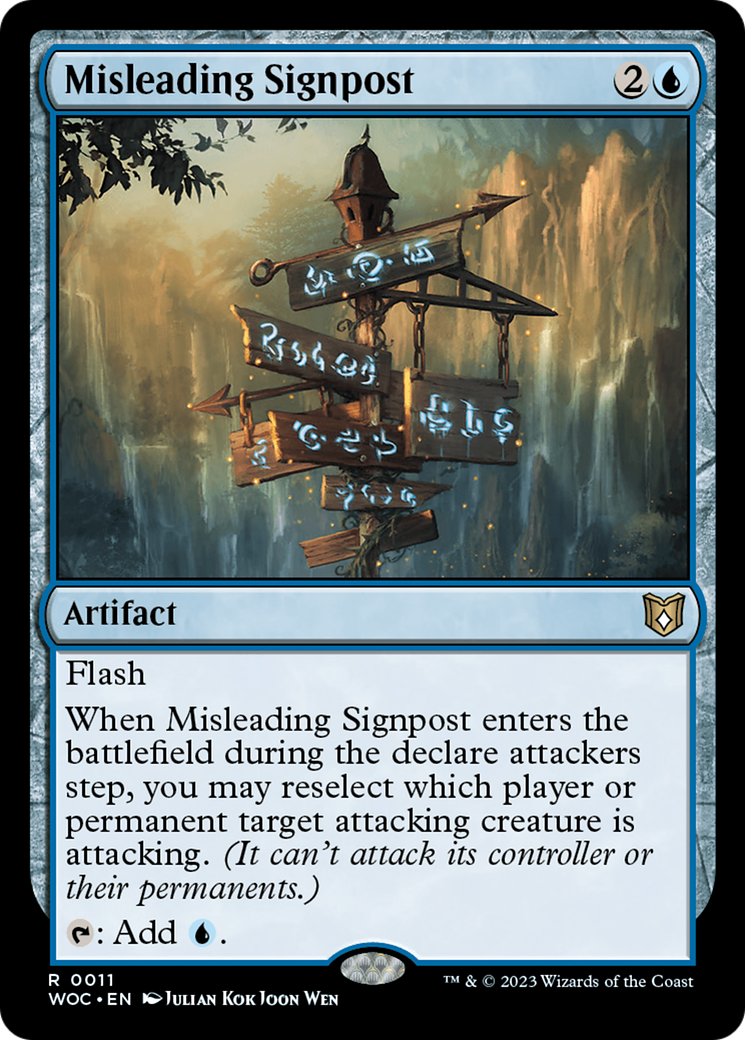
Misleading Signpost
Misleading Signpost
Artifact
Flash
When this artifact enters during the declare attackers step, you may reselect which player or permanent target attacking creature is attacking. (It can't attack its controller or their permanents.)
: Add .
- You may cast Misleading Signpost outside of a declare attackers step. If Misleading Signpost enters the battlefield outside of a declare attackers step, its ability simply doesn't trigger.
- Reselecting which player or permanent a creature is attacking ignores all requirements, restrictions, and costs associated with attacking.
- Reselecting which player or permanent a creature is attacking doesn't cause "whenever this creature attacks" abilities to trigger.
- If you reselect which player or permanent an attacking creature is attacking, that creature is still considered to have attacked the player or permanent as declared, but it is now attacking the new player or permanent.
- If an ability targets something controlled by the "defending player" of an attacking creature and the defending player for that creature changes before that ability resolves, the ability won't resolve because its target has become illegal.
-
1
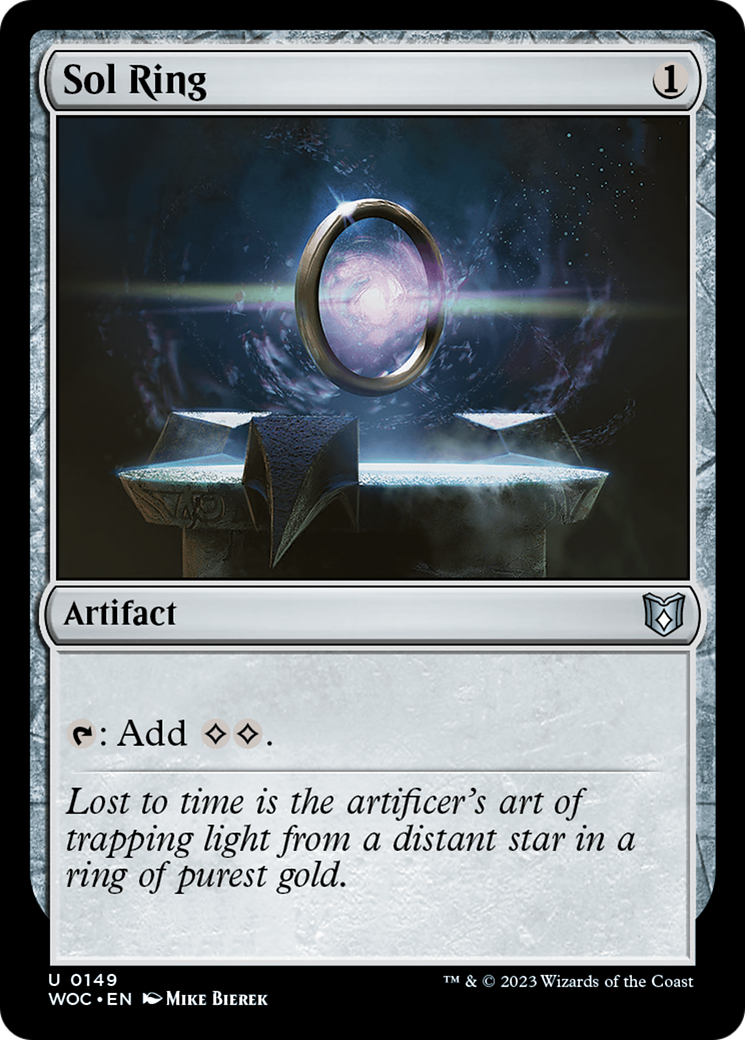
Sol Ring
Sol Ring
Artifact
: Add .
-
1
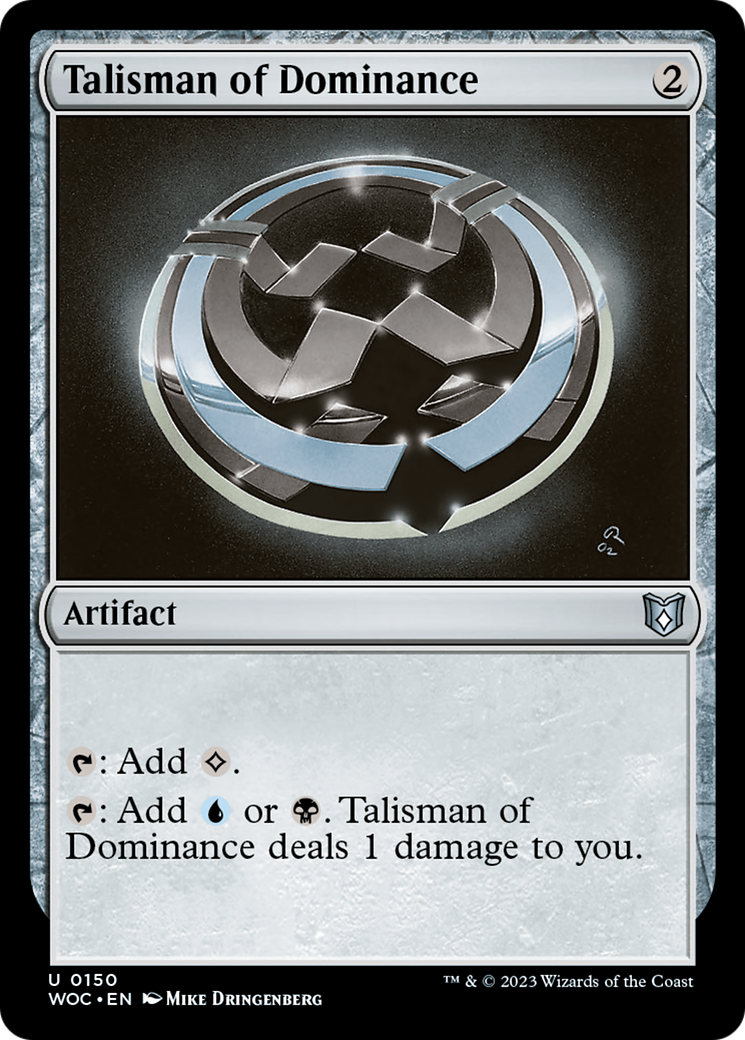
Talisman of Dominance
Talisman of Dominance
Artifact
: Add .
: Add or . This artifact deals 1 damage to you.
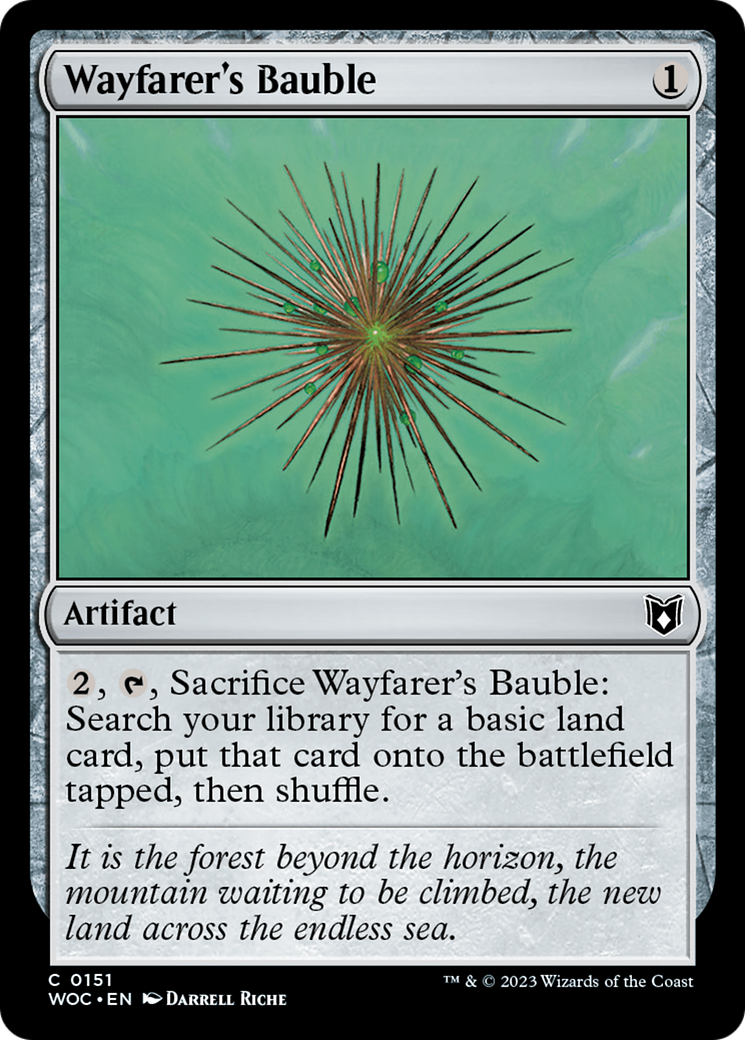
-
1
Wayfarer's Bauble
Wayfarer's Bauble
Artifact
, , Sacrifice this artifact: Search your library for a basic land card, put that card onto the battlefield tapped, then shuffle.
Enchantments 2
-
1
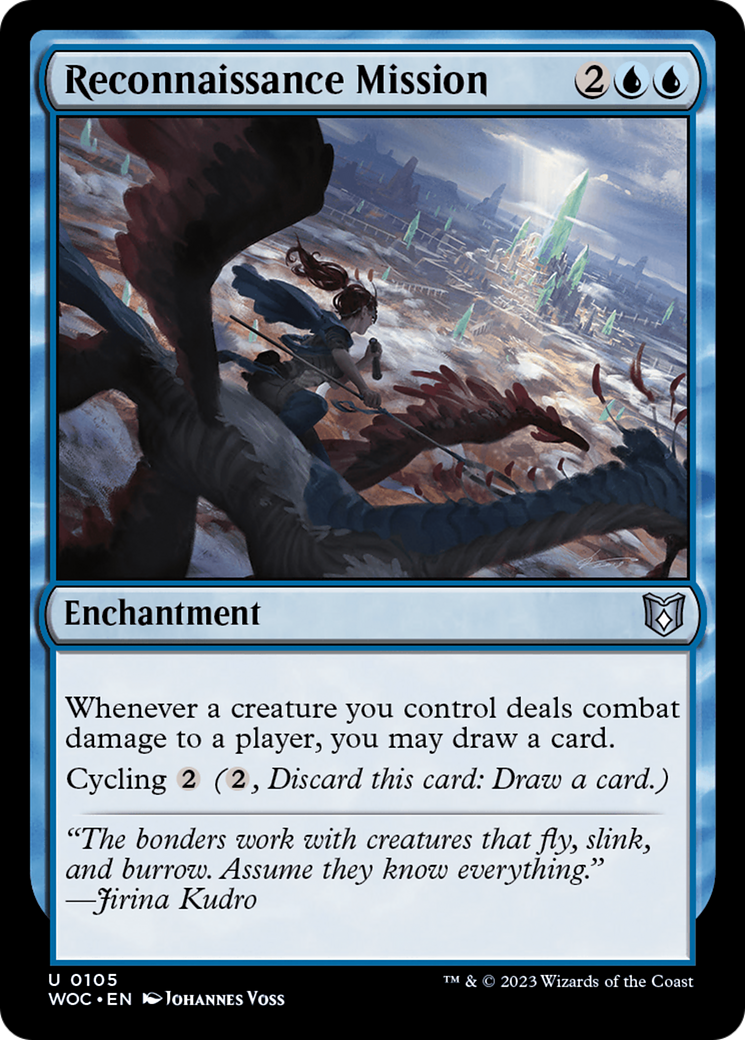
Reconnaissance Mission
Reconnaissance Mission
Enchantment
Whenever a creature you control deals combat damage to a player, you may draw a card.
Cycling ( , Discard this card: Draw a card.)
- Reconnaissance Mission's triggered ability triggers for each creature you control that deals combat damage to a player. You may draw one card each time the ability resolves, no matter how much damage was dealt.
-
1
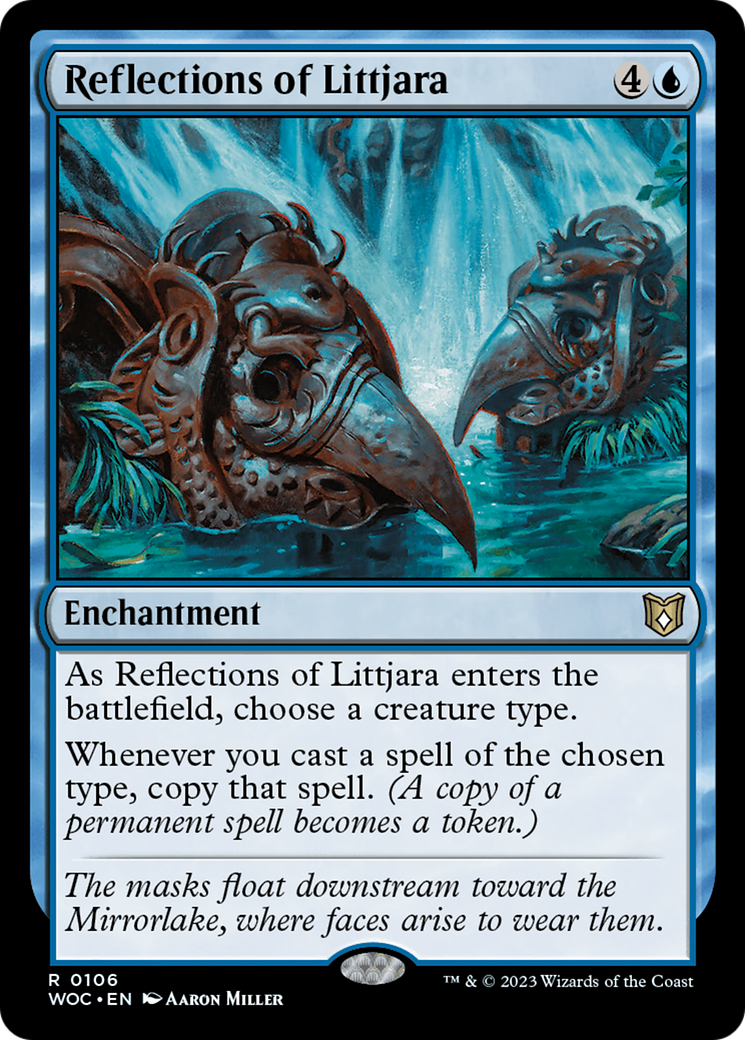
Reflections of Littjara
Reflections of Littjara
Enchantment
As this enchantment enters, choose a creature type.
Whenever you cast a spell of the chosen type, copy that spell. (A copy of a permanent spell becomes a token.)
- You must choose an existing creature type, such as Zombie or Angel. You can't choose card types (e.g., artifact) or supertypes (e.g., snow).
- The triggered ability and the copy it creates will resolve before the spell that caused the ability to trigger.
- As a copy of a permanent spell resolves, it's put onto the battlefield as a token rather than putting a copy of the spell onto the battlefield. The rules that apply to a permanent spell becoming a permanent apply to a copy of a spell becoming a token.
- The token that a resolving copy of a permanent spell becomes isn't "created." Abilities that refer to a copy being created won't interact with the copy resolving.
- If a spell has the kindred card type and the chosen creature type, Reflections of Littjara will copy it.
Lands 39
-
1
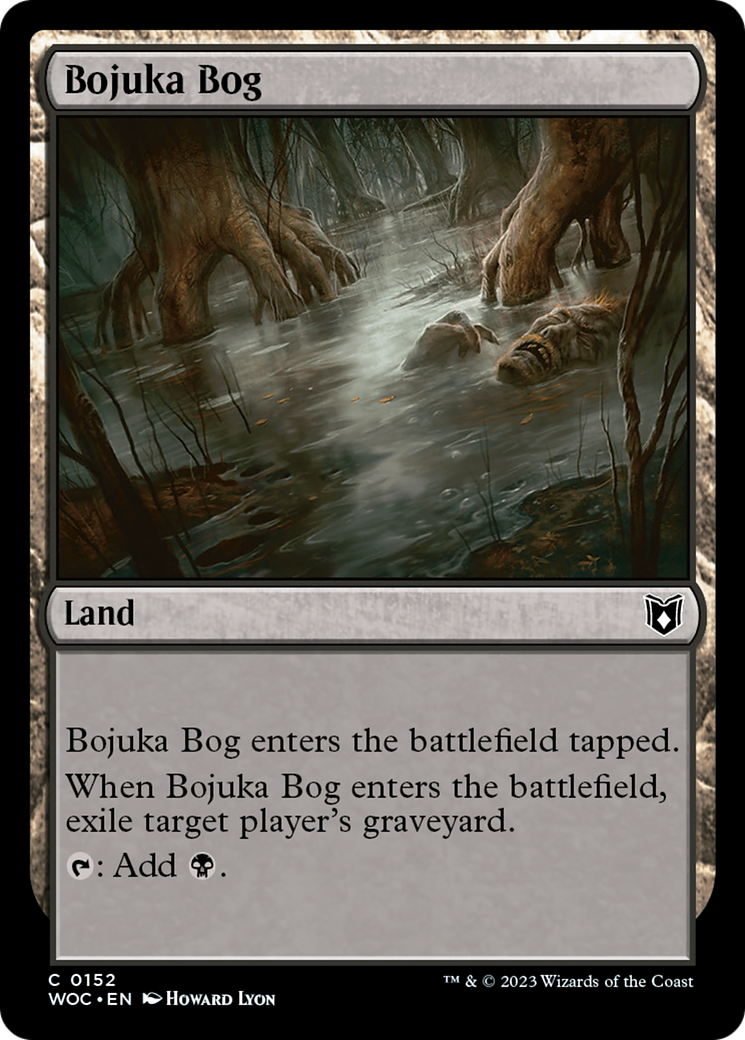
Bojuka Bog
Bojuka Bog
Land
This land enters tapped.
When this land enters, exile target player's graveyard.
: Add .
-
1
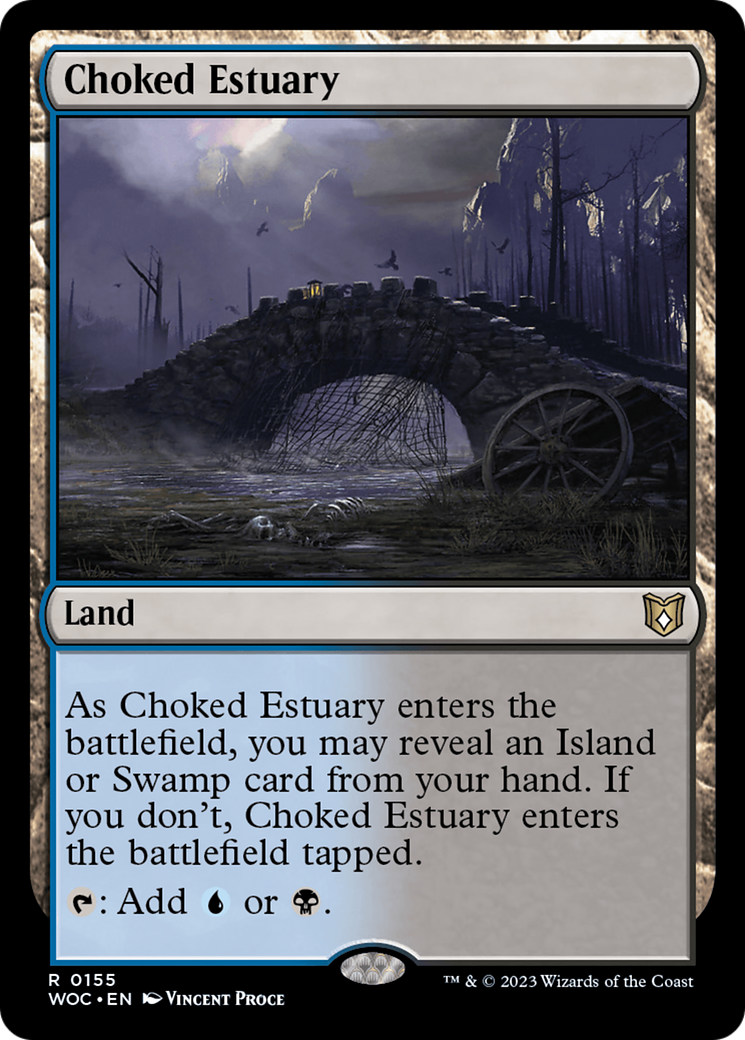
Choked Estuary
Choked Estuary
Land
As this land enters, you may reveal an Island or Swamp card from your hand. If you don't, this land enters tapped.
: Add or .
- You may reveal any land card with either or both of the appropriate subtypes. It doesn't have to be a basic land. For example, you could reveal Prairie Stream from the Battle for Zendikar set to satisfy the ability of Choked Estuary.
- Lands don't have a subtype just because they can produce mana of the corresponding color. Choked Estuary itself is neither an Island nor a Swamp, even though it produces blue and black mana, so you can't reveal one to satisfy the ability of another.
- If an Island or Swamp is entering the battlefield from your hand at the same time as Choked Estuary, you may reveal the other land to have Choked Estuary enter untapped.
- If an effect instructs you to put Choked Estuary onto the battlefield tapped, it will still enter the battlefield tapped even if you reveal a land card from your hand.
-
1
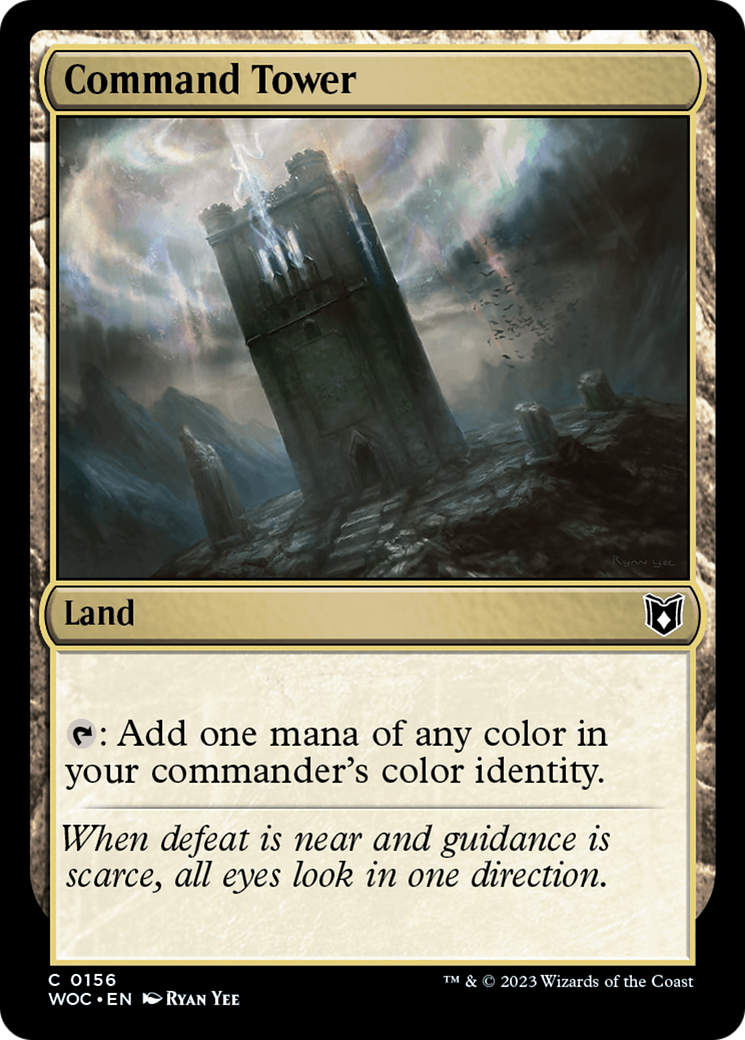
Command Tower
Command Tower
Land
: Add one mana of any color in your commander's color identity.
- If you have two commanders, the ability adds one mana of any color in their combined color identities.
- If your commander is a card that has no colors in its color identity, Command Tower's ability produces no mana. It doesn't produce .
- If you don't have a commander, Command Tower's ability produces no mana.
-
1
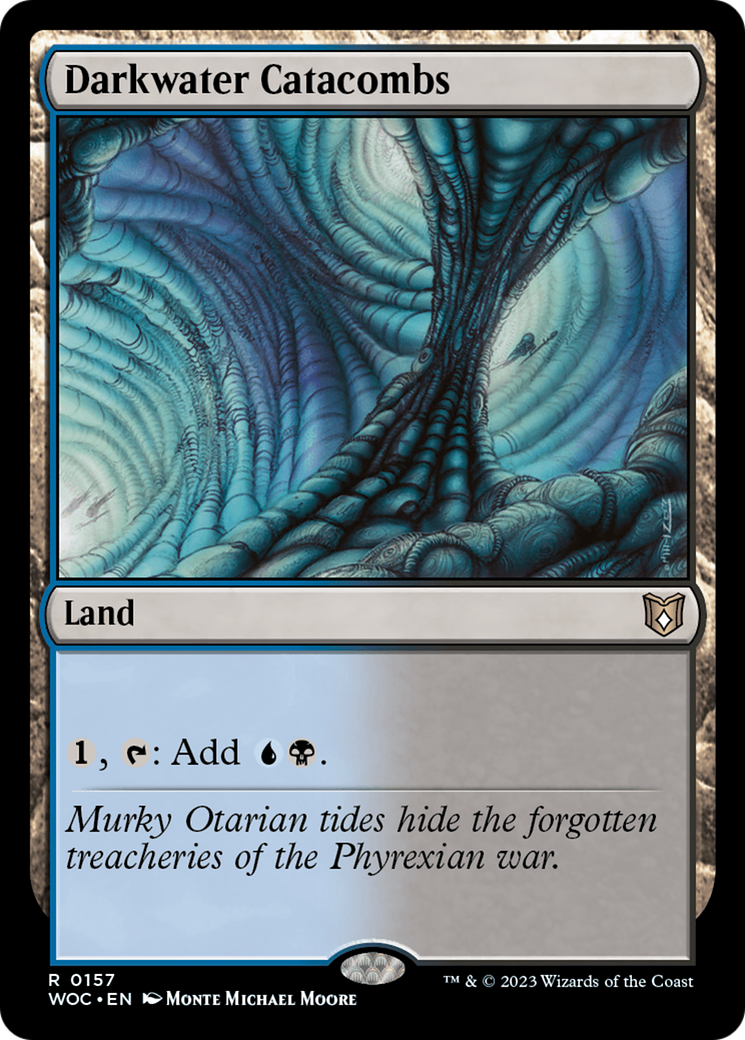
Darkwater Catacombs
Darkwater Catacombs
Land
, : Add .
-
1
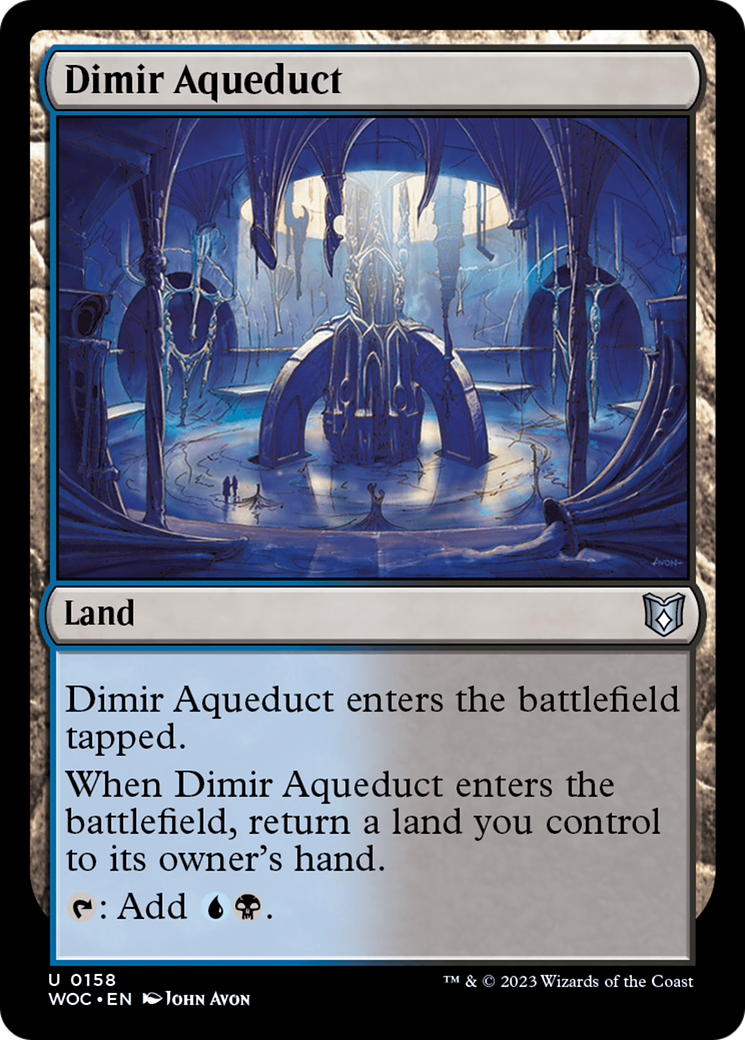
Dimir Aqueduct
Dimir Aqueduct
Land
This land enters tapped.
When this land enters, return a land you control to its owner's hand.
: Add .
- If this land enters the battlefield and you control no other lands, its ability will force you to return it to your hand.
-
1
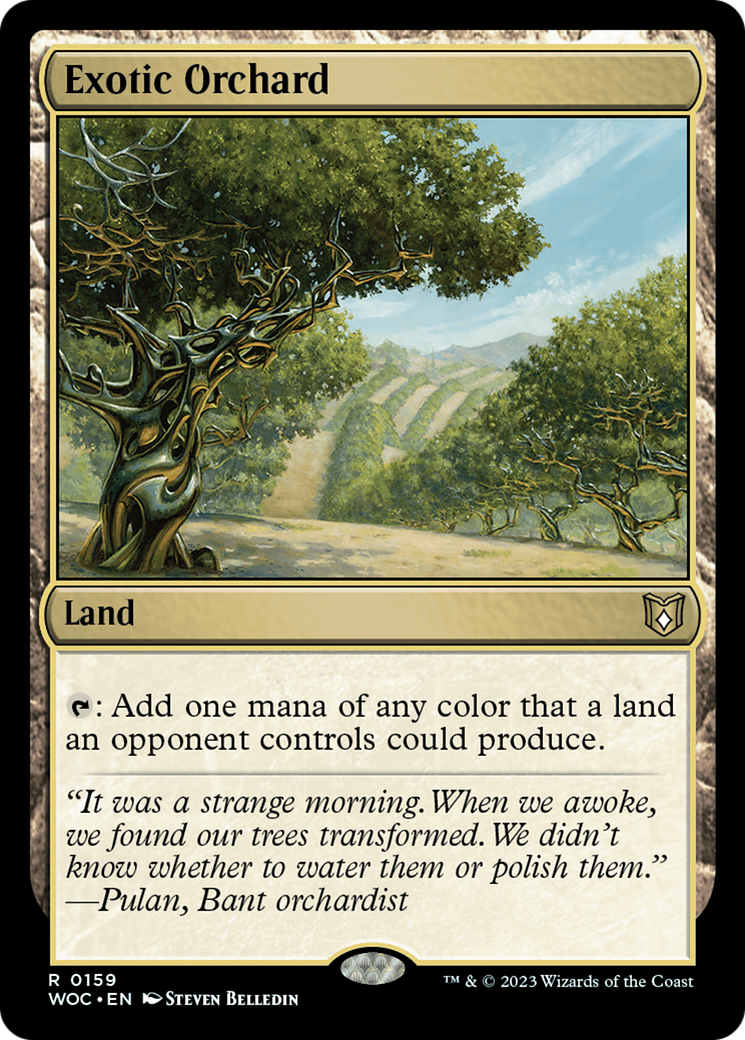
Exotic Orchard
Exotic Orchard
Land
: Add one mana of any color that a land an opponent controls could produce.
- The colors of mana are white, blue, black, red, and green. Exotic Orchard can't be tapped for colorless mana, even if a land an opponent controls could produce colorless mana.
- Exotic Orchard checks the effects of all mana-producing abilities of lands your opponents control, but it doesn't check their costs. For example, Vivid Crag has the ability " , Remove a charge counter from Vivid Crag: Add one mana of any color." If an opponent controls Vivid Crag and you control Exotic Orchard, you can tap Exotic Orchard for any color of mana. It doesn't matter whether Vivid Crag has a charge counter on it, and it doesn't matter whether it's untapped.
- When determining what colors of mana your opponents' lands could produce, Exotic Orchard takes into account any applicable replacement effects that would apply to those lands' mana abilities (such as Contamination's effect, for example). If there are more than one, consider them in any possible order.
- Exotic Orchard doesn't care about any restrictions or riders your opponents' lands (such as Ancient Ziggurat or Hall of the Bandit Lord) put on the mana they produce. It just cares about colors of mana.
- Lands that produce mana based only on what other lands "could produce" won't help each other unless some other land allows one of them to actually produce some type of mana. For example, if you control an Exotic Orchard and your opponent controls an Exotic Orchard and a Reflecting Pool, none of those lands would produce mana if their mana abilities were activated. On the other hand, if you control a Forest and an Exotic Orchard, and your opponent controls an Exotic Orchard and a Reflecting Pool, then each of those lands can be tapped to produce . Your opponent's Exotic Orchard can produce because you control a Forest. Your Exotic Orchard and your opponent's Reflecting Pool can each produce because your opponent's Exotic Orchard can produce .
-
1
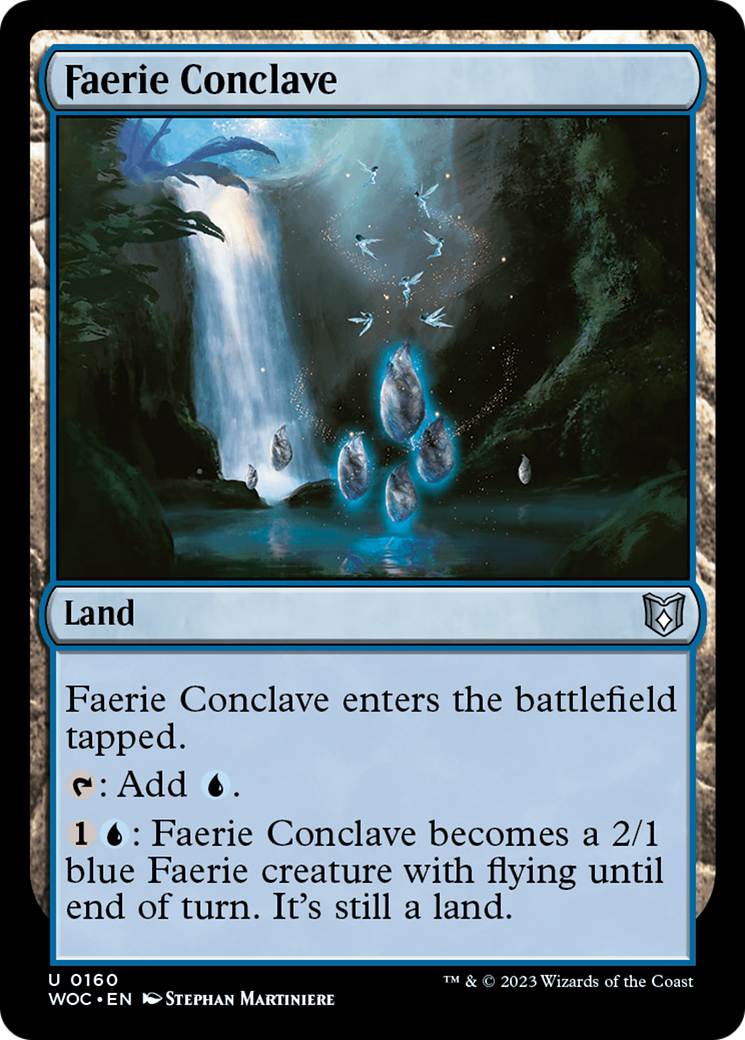
Faerie Conclave
Faerie Conclave
Land
This land enters tapped.
: Add .
: This land becomes a 2/1 blue Faerie creature with flying until end of turn. It's still a land.
- Activating the ability that turns it into a creature while it's already a creature will override any effects that set its power and/or toughness to a specific number. However, any effect that raises or lowers power and/or toughness (such as the effect created by Giant Growth, Glorious Anthem, or a +1/+1 counter) will continue to apply.
- A noncreature permanent that turns into a creature can attack, and its abilities can be activated, only if its controller has continuously controlled that permanent since the beginning of their most recent turn. It doesn't matter how long the permanent has been a creature.
-
13
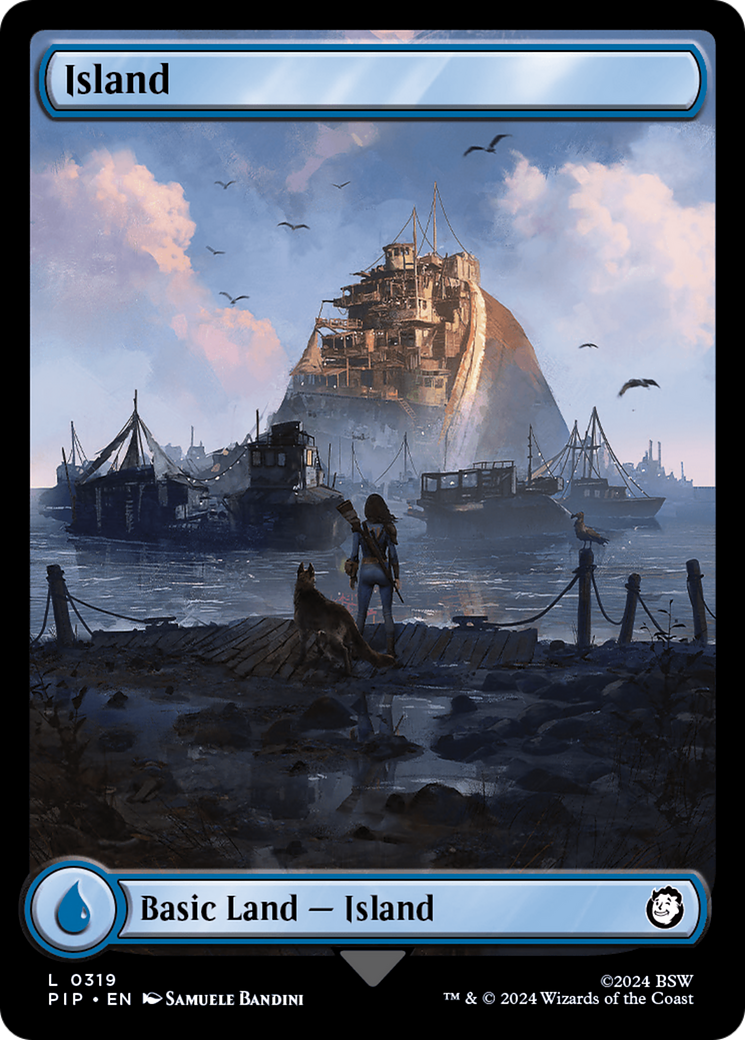
Island
Island
Basic Land — Island
( : Add .)
-
1
Myriad Landscape
Myriad Landscape
Land
This land enters tapped.
: Add .
, , Sacrifice this land: Search your library for up to two basic land cards that share a land type, put them onto the battlefield tapped, then shuffle.
- You can choose to find one basic land card with Myriad Landscape's last ability.
-
1
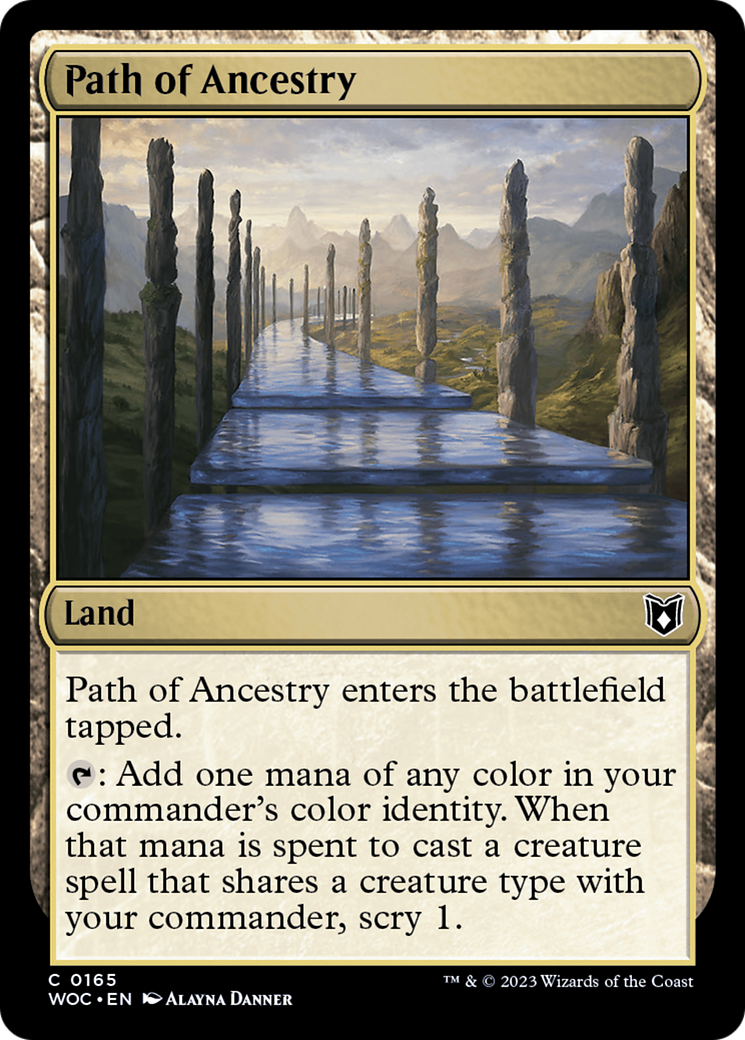
Path of Ancestry
Path of Ancestry
Land
This land enters tapped.
: Add one mana of any color in your commander's color identity. When that mana is spent to cast a creature spell that shares a creature type with your commander, scry 1. (Look at the top card of your library. You may put that card on the bottom.)
- If you have two commanders, the last ability adds one mana of any color in their combined color identities. When you spend that mana on a creature spell that shares a creature type with either of your commanders, you'll scry 1.
- Your commander's creature types are checked immediately after you cast a creature spell spending mana from Path of Ancestry's last ability. They aren't set before the game begins, and they may not be the same types your commander had when you activated that ability.
- If you cast your commander with mana from Path of Ancestry, and your commander hasn't somehow lost all of its creature types while on the stack, you'll scry 1.
- If your commander is a card that has no colors in its color identity, Path of Ancestry's ability produces no mana. It doesn't produce .
- If Path of Ancestry's last ability produces two mana (most likely due to Mana Reflection), spending those two mana to cast creature spells that share a creature type with your commander will cause two abilities to trigger. Each of those abilities will cause you to scry 1. You won't scry 2. This is true whether you spend the mana on one creature spell or two.
- If your commander has no creature types, it can't share a creature type with any spell that you cast.
- If you don't have a commander, Path of Ancestry's ability produces no mana.
-
1
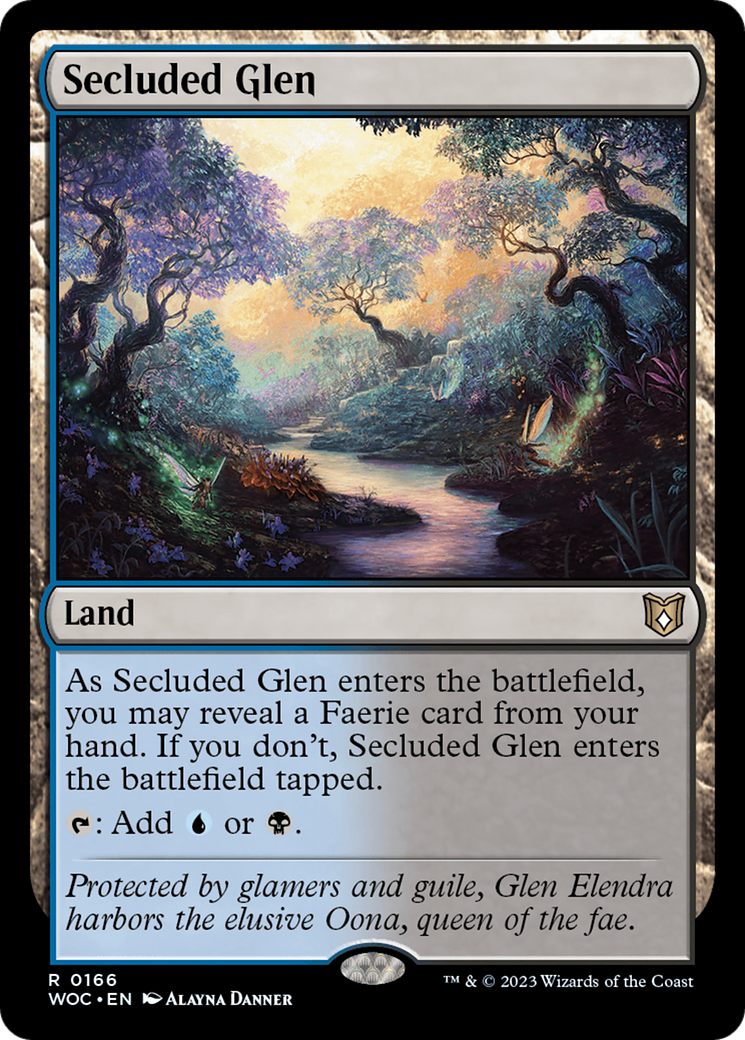
Secluded Glen
Secluded Glen
Land
As this land enters, you may reveal a Faerie card from your hand. If you don't, this land enters tapped.
: Add or .
-
1
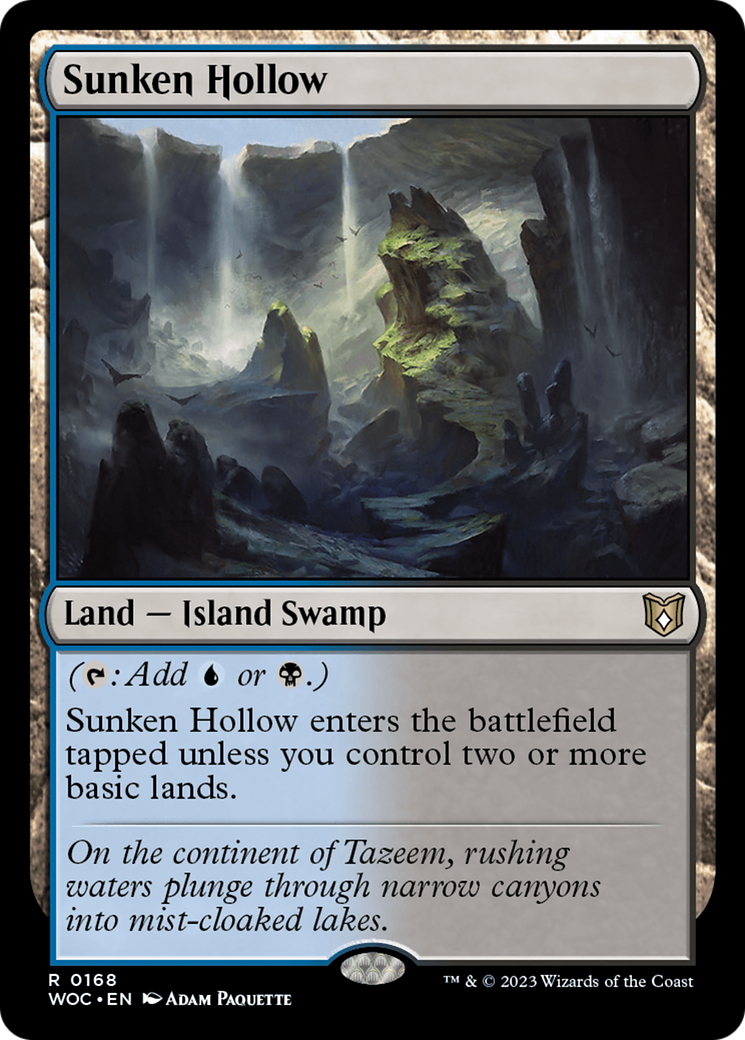
Sunken Hollow
Sunken Hollow
Land — Island Swamp
( : Add or .)
This land enters tapped unless you control two or more basic lands.
- Even though these lands have basic land types, they are not basic lands because "basic" doesn't appear on their type line. Notably, controlling two or more of them won't allow others to enter the battlefield untapped.
- However, because these cards have basic land types, effects that specify a basic land type without also specifying that the land be basic can affect them. For example, a spell or ability that reads "Destroy target Forest" can target Canopy Vista, while one that reads "Destroy target basic Forest" cannot.
- If one of these lands enters the battlefield at the same time as any number of basic lands, those other lands are not counted when determining if this land enters the battlefield tapped or untapped.
-
12
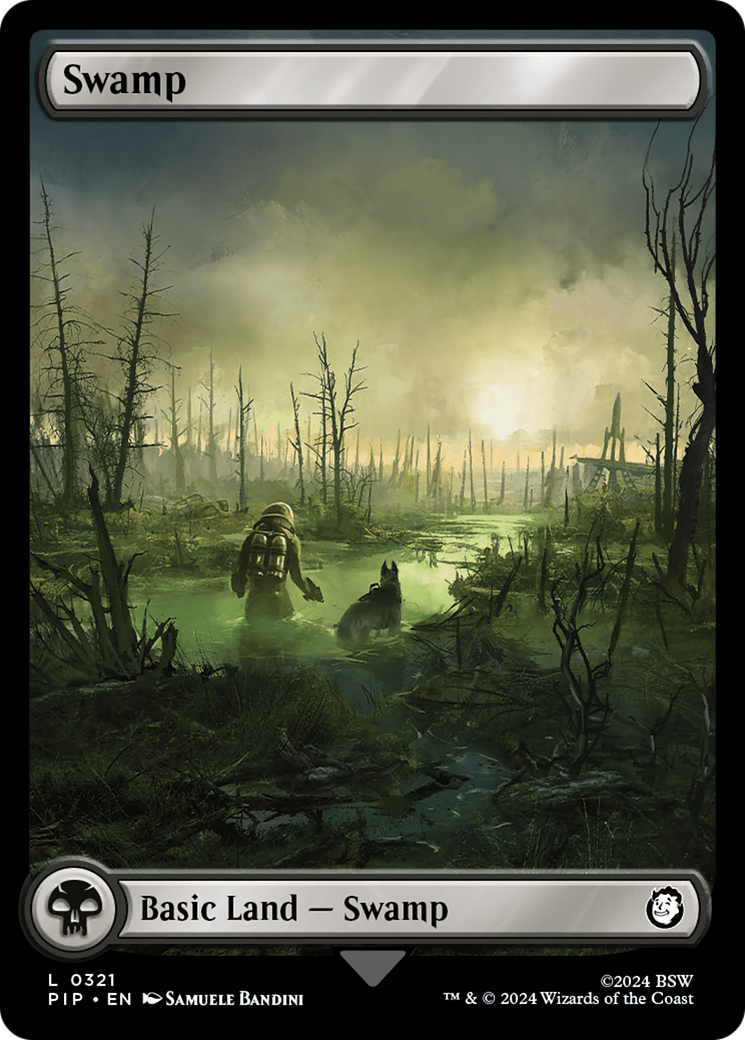
Swamp
Swamp
Basic Land — Swamp
( : Add .)
-
1
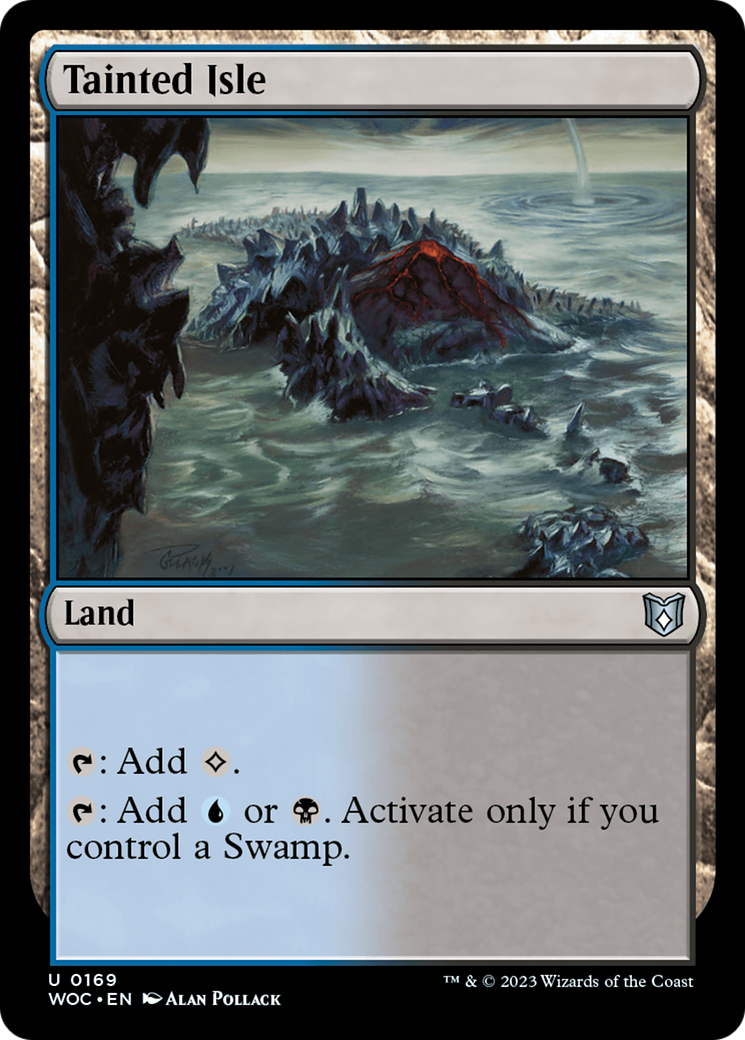
Tainted Isle
Tainted Isle
Land
: Add .
: Add or . Activate only if you control a Swamp.
-
1
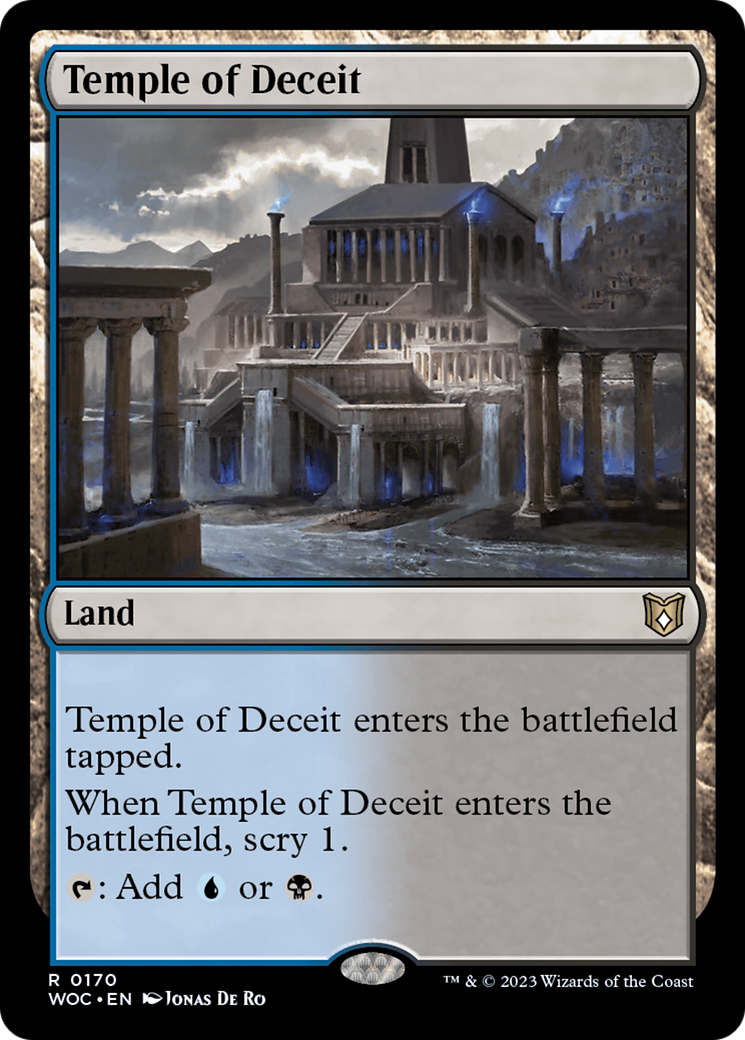
Temple of Deceit
Temple of Deceit
Land
This land enters tapped.
When this land enters, scry 1. (Look at the top card of your library. You may put that card on the bottom.)
: Add or .
- When you scry, you may put all the cards you look at back on top of your library, you may put all of those cards on the bottom of your library, or you may put some of those cards on top and the rest of them on the bottom.
- You choose how to order cards returned to your library after scrying no matter where you put them.
- You perform the actions stated on a card in sequence. For some spells and abilities, that means you'll scry last. For others, that means you'll scry and then perform other actions.
- Scry appears on some spells and abilities with one or more targets. If all of the spell or ability's targets are illegal when it tries to resolve, it won't resolve and none of its effects will happen. You won't scry.
-
1
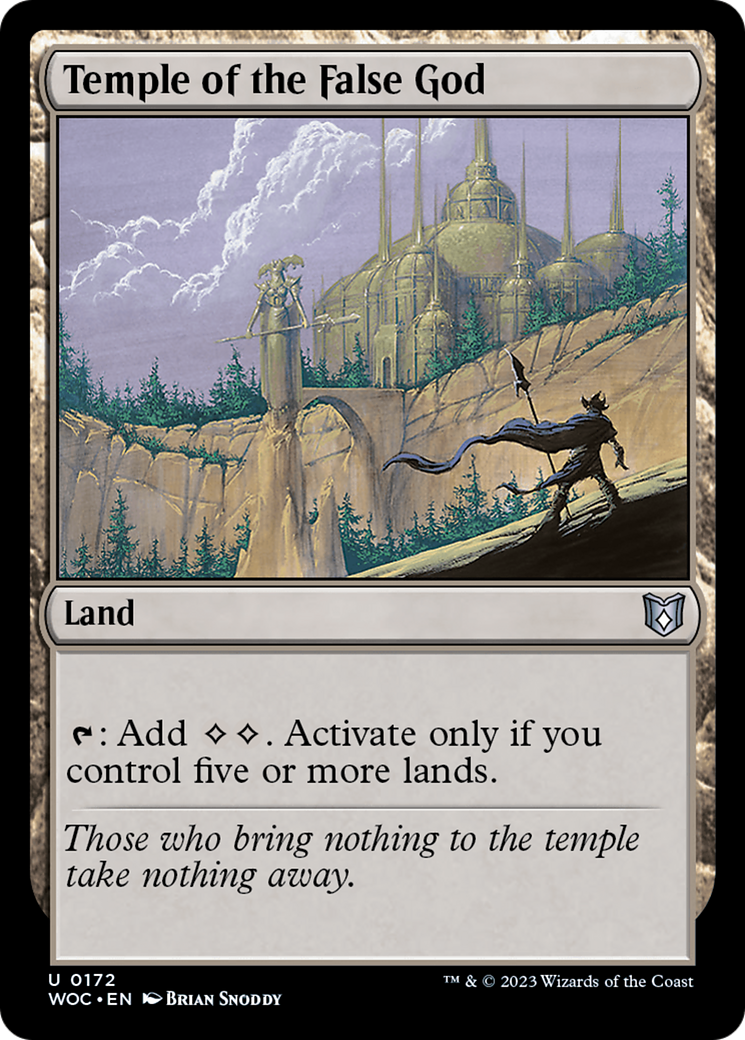
Temple of the False God
Temple of the False God
Land
: Add . Activate only if you control five or more lands.
Blue 37
-
1
Arcane Denial
Arcane Denial
Instant
Counter target spell. Its controller may draw up to two cards at the beginning of the next turn's upkeep.
You draw a card at the beginning of the next turn's upkeep.
- The controller of the countered spell doesn't choose how many cards to draw until the relevant ability resolves. The player may draw 0, 1, or 2 cards. They choose the number before drawing any cards.
-
1
Archmage of Echoes
Archmage of Echoes
Creature — Faerie Wizard
4/4
Flying, ward
Whenever you cast a Faerie or Wizard permanent spell, copy it. (The copy becomes a token.)
- A resolving copy of a permanent spell becomes a token, so the token isn't "created." Effects that care about a token being created won't interact with a token that enters the battlefield from Archmage of Echoes's ability.
- The copy remembers any decisions that were made for the original spell as it was cast, including values chosen for X in its mana cost and whether any alternative or additional costs were chosen. For example, if the original creature spell had kicker and its kicker cost was paid, the copy will also be kicked.
-
1
Brazen Borrower // Petty Theft
//
Brazen Borrower
Creature — Faerie Rogue
3/1
- An adventurer card is a permanent card in every zone except the stack, as well as while on the stack if not cast as an Adventure. Ignore its alternative characteristics in those cases. For example, while it's in your graveyard, Giant Killer is a white creature card whose mana value is 1. It can't be the target of the triggered ability of Mystic Sanctuary.
- When casting a spell as an Adventure, use the alternative characteristics and ignore all of the card's normal characteristics. The spell's color, mana cost, mana value, and so on are determined by only those alternative characteristics. If the spell leaves the stack, it immediately resumes using its normal characteristics.
- If you cast an adventurer card as an Adventure, use only its alternative characteristics to determine whether it's legal to cast that spell. For example, if Giant Killer is exiled with the last ability of Vivien, Champion of the Wilds, you can't cast it as Chop Down.
- If a spell is cast as an Adventure, its controller exiles it instead of putting it into its owner's graveyard as it resolves. For as long as it remains exiled, that player may cast it as a permanent spell. If an Adventure spell leaves the stack in any way other than resolving (most likely by being countered or by failing to resolve because its targets have all become illegal), that card won't be exiled and the spell's controller won't be able to cast it as a permanent later.
- If an adventurer card ends up in exile for any other reason than by exiling itself while resolving, it won't give you permission to cast it as a permanent spell.
- You must still follow any timing restrictions and permissions for the permanent spell you cast from exile. Normally, you'll be able to cast it only during your main phase while the stack is empty.
- If an effect copies an Adventure spell, that copy is exiled as it resolves. It ceases to exist as a state-based action; it's not possible to cast the copy as a permanent.
- If an object becomes a copy of an object that has an Adventure, the copy also has an Adventure. If it changes zones, it will either cease to exist (if it's a token) or cease to be a copy (if it's a nontoken permanent), and so you won't be able to cast it as an Adventure.
- If an effect instructs you to choose a card name, you may choose the alternative Adventure name. Consider only the alternative characteristics to determine whether that is an appropriate name to choose.
- Casting a card as an Adventure isn't casting it for an alternative cost. Effects that allow you to cast a spell for an alternative cost or without paying its mana cost may allow you to apply those to the Adventure.
-
1
Cloud of Faeries
Cloud of Faeries
Creature — Faerie
1/1
Flying
When this creature enters, untap up to two lands.
Cycling ( , Discard this card: Draw a card.)
- You choose which lands to untap as the triggered ability resolves. They aren't targeted, and they don't have to be lands that you control.
-
1
Consider
Consider
Instant
Surveil 1. (Look at the top card of your library. You may put it into your graveyard.)
Draw a card.
- You perform the actions stated on a card in sequence. For some spells and abilities, you'll surveil last. For others, you'll surveil and then perform other actions.
-
1
Dig Through Time
Dig Through Time
Instant
Delve (Each card you exile from your graveyard while casting this spell pays for .)
Look at the top seven cards of your library. Put two of them into your hand and the rest on the bottom of your library in any order.
- Delve doesn't change a spell's mana cost or mana value. For example, Treasure Cruise's mana value is 8 even if you exiled three cards to cast it.
- You can exile cards to pay only for generic mana, and you can't exile more cards than the generic mana requirement of a spell with delve. For example, you can't exile more than seven cards from your graveyard to cast Treasure Cruise unless an effect has increased its cost.
- Because delve isn't an alternative cost, it can be used in conjunction with alternative costs, such as flashback. It can also be used to pay for additional costs that include generic mana.
-
1
Distant Melody
Distant Melody
Sorcery
Choose a creature type. Draw a card for each permanent you control of that type.
- Note that this spell counts the number of permanents you control of the chosen type, not just the number of creatures you control. It will also take your kindred permanents of the chosen type into account.
-
1
Fact or Fiction
Fact or Fiction
Instant
Reveal the top five cards of your library. An opponent separates those cards into two piles. Put one pile into your hand and the other into your graveyard.
- Piles may be empty.
-
1
Faerie Formation
Faerie Formation
Creature — Faerie
5/4
Flying
: Create a 1/1 blue Faerie creature token with flying. Draw a card.
-
1
Faerie Seer
Faerie Seer
Creature — Faerie Wizard
1/1
Flying
When this creature enters, scry 2. (Look at the top two cards of your library, then put any number of them on the bottom and the rest on top in any order.)
-
1
Frantic Search
Frantic Search
Instant
Draw two cards, then discard two cards. Untap up to three lands.
- You choose which lands to untap as the spell resolves. They aren't targeted, and they don't have to be lands that you control.
- You draw two cards and discard two cards all while Frantic Search is resolving. Nothing can happen between the two, and no player may choose to take actions.
-
1
Glen Elendra Archmage
Glen Elendra Archmage
Creature — Faerie Wizard
2/2
Flying
, Sacrifice this creature: Counter target noncreature spell.
Persist (When this creature dies, if it had no -1/-1 counters on it, return it to the battlefield under its owner's control with a -1/-1 counter on it.)
- If a creature with persist stops being a creature, persist will still work.
- The persist ability triggers when the permanent is put into a graveyard. Its last known information (that is, how the creature last existed on the battlefield) is used to determine whether it had a -1/-1 counter on it.
- If a permanent has multiple instances of persist, they'll each trigger separately, but the redundant instances will have no effect. If one instance returns the card to the battlefield, the next to resolve will do nothing.
- If a token with no -1/-1 counters on it has persist, the ability will trigger when the token is put into the graveyard. However, the token will cease to exist and can't return to the battlefield.
- When a permanent with persist returns to the battlefield, it's a new object with no memory of or connection to its previous existence.
- If multiple creatures with persist are put into the graveyard at the same time (due to combat damage or a spell that destroys all creatures, for example), the active player (the player whose turn it is) puts all of their persist triggers on the stack in any order, then each other player in turn order does the same. The last trigger put on the stack is the first one that resolves. That means that in a two-player game, the nonactive player's persist creatures will return to the battlefield first, then the active player's persist creatures do the same. The creatures return to the battlefield one at a time.
- If a creature with persist that has +1/+1 counters on it receives enough -1/-1 counters to cause it to be destroyed by lethal damage or put into its owner's graveyard for having 0 or less toughness, persist won't trigger and the card won't return to the battlefield. That's because persist checks the creature's existence just before it leaves the battlefield, and it still has all those counters on it at that point.
-
1
Hullbreaker Horror
Hullbreaker Horror
Creature — Kraken Horror
7/8
Flash
This spell can't be countered.
Whenever you cast a spell, choose up to one —
- Return target spell you don't control to its owner's hand.
- Return target nonland permanent to its owner's hand.
-
1
Hypnotic Sprite // Mesmeric Glare
//
Hypnotic Sprite
Creature — Faerie
2/1
- An adventurer card is a permanent card in every zone except the stack, as well as while on the stack if not cast as an Adventure. Ignore its alternative characteristics in those cases. For example, while it's in your graveyard, Giant Killer is a white creature card whose mana value is 1. It can't be the target of the triggered ability of Mystic Sanctuary.
- When casting a spell as an Adventure, use the alternative characteristics and ignore all of the card's normal characteristics. The spell's color, mana cost, mana value, and so on are determined by only those alternative characteristics. If the spell leaves the stack, it immediately resumes using its normal characteristics.
- If you cast an adventurer card as an Adventure, use only its alternative characteristics to determine whether it's legal to cast that spell. For example, if Giant Killer is exiled with the last ability of Vivien, Champion of the Wilds, you can't cast it as Chop Down.
- If a spell is cast as an Adventure, its controller exiles it instead of putting it into its owner's graveyard as it resolves. For as long as it remains exiled, that player may cast it as a permanent spell. If an Adventure spell leaves the stack in any way other than resolving (most likely by being countered or by failing to resolve because its targets have all become illegal), that card won't be exiled and the spell's controller won't be able to cast it as a permanent later.
- If an adventurer card ends up in exile for any other reason than by exiling itself while resolving, it won't give you permission to cast it as a permanent spell.
- You must still follow any timing restrictions and permissions for the permanent spell you cast from exile. Normally, you'll be able to cast it only during your main phase while the stack is empty.
- If an effect copies an Adventure spell, that copy is exiled as it resolves. It ceases to exist as a state-based action; it's not possible to cast the copy as a permanent.
- If an object becomes a copy of an object that has an Adventure, the copy also has an Adventure. If it changes zones, it will either cease to exist (if it's a token) or cease to be a copy (if it's a nontoken permanent), and so you won't be able to cast it as an Adventure.
- If an effect instructs you to choose a card name, you may choose the alternative Adventure name. Consider only the alternative characteristics to determine whether that is an appropriate name to choose.
- Casting a card as an Adventure isn't casting it for an alternative cost. Effects that allow you to cast a spell for an alternative cost or without paying its mana cost may allow you to apply those to the Adventure.
- For spells with in their mana costs, use the value chosen for X to determine the spell's mana value.
- A spell that can't be countered is a legal target for Mesmeric Glare. The spell won't be countered when Mesmeric Glare resolves, but you'll still exile Mesmeric Glare.
-
1
Illusionist's Gambit
Illusionist's Gambit
Instant
Cast this spell only during the declare blockers step on an opponent's turn.
Remove all attacking creatures from combat and untap them. After this phase, there is an additional combat phase. Each of those creatures attacks that combat if able. They can't attack you or planeswalkers you control that combat.
- Creatures that didn't attack during the combat phase when Illusionist's Gambit resolved aren't required to attack in the additional combat phase, although they may. Those creatures can attack you or a planeswalker you control.
- If, during a player's declare attackers step, a creature is tapped, is affected by a spell or ability that says it can't attack, or hasn't been under that player's control continuously since the turn began (and doesn't have haste), then it doesn't attack.
- If there's a cost associated with having a creature attack, the player isn't forced to pay that cost, so it doesn't have to attack.
-
1
Keep Watch
Keep Watch
Instant
Draw a card for each attacking creature.
-
1
Malleable Impostor
Malleable Impostor
Creature — Faerie Shapeshifter
0/0
Flash
Flying
You may have this creature enter as a copy of a creature an opponent controls, except it's a Faerie Shapeshifter in addition to its other types and it has flying.
- Except for the listed exceptions, Malleable Impostor copies exactly what was printed on the original permanent and nothing more (unless that permanent is itself copying something or is a token; see below). It doesn't copy whether that permanent is tapped or untapped, whether it has any counters on it or Auras attached to it, or any noncopy effects that have changed its power, toughness, types, color, and so on.
- If the chosen permanent has in its mana cost, X is 0.
- If the chosen permanent is copying something else (for example, if the chosen permanent is a Clone), then your Malleable Impostor enters the battlefield as whatever the chosen permanent copied, with the stated exceptions.
- If the chosen permanent is a token, Malleable Impostor copies the original characteristics of that token as stated by the effect that put the token onto the battlefield, with the listed exceptions. Malleable Impostor does not become a token.
- Any enters-the-battlefield abilities of the copied permanent will trigger when Malleable Impostor enters the battlefield. Any "as [this permanent] enters the battlefield" or "[this permanent] enters the battlefield with" abilities of the chosen permanent will also work.
- If Malleable Impostor somehow enters the battlefield at the same time as another creature, Malleable Impostor can't become a copy of that creature. You may choose only a creature that's already on the battlefield.
- You can choose not to copy anything. In that case, Malleable Impostor simply enters the battlefield as a 0/0 creature and is probably put into your graveyard immediately, unless something else is increasing its toughness to keep it alive.
-
1
Midnight Clock
Midnight Clock
Artifact
: Add .
: Put an hour counter on this artifact.
At the beginning of each upkeep, put an hour counter on this artifact.
When the twelfth hour counter is put on this artifact, shuffle your hand and graveyard into your library, then draw seven cards. Exile this artifact.
- If Midnight Clock leaves the battlefield while its last ability is on the stack, it won't be exiled.
- You can activate Midnight Clock's mana ability to pay the cost of its second ability.
- Midnight Clock's last ability triggers after one or more counters are put onto it if it had fewer than twelve counters on it before those counters were put on it and it has twelve or more counters on it after.
- Midnight Clock's first triggered ability triggers at the beginning of each upkeep, not just your upkeep. In a Two-Headed Giant game, an ability that triggers at the beginning of each upkeep rather than each player's upkeep triggers only once during each team's upkeep.
-
1
Misleading Signpost
Misleading Signpost
Artifact
Flash
When this artifact enters during the declare attackers step, you may reselect which player or permanent target attacking creature is attacking. (It can't attack its controller or their permanents.)
: Add .
- You may cast Misleading Signpost outside of a declare attackers step. If Misleading Signpost enters the battlefield outside of a declare attackers step, its ability simply doesn't trigger.
- Reselecting which player or permanent a creature is attacking ignores all requirements, restrictions, and costs associated with attacking.
- Reselecting which player or permanent a creature is attacking doesn't cause "whenever this creature attacks" abilities to trigger.
- If you reselect which player or permanent an attacking creature is attacking, that creature is still considered to have attacked the player or permanent as declared, but it is now attacking the new player or permanent.
- If an ability targets something controlled by the "defending player" of an attacking creature and the defending player for that creature changes before that ability resolves, the ability won't resolve because its target has become illegal.
-
1
Mocking Sprite
Mocking Sprite
Creature — Faerie Rogue
2/1
Flying
Instant and sorcery spells you cast cost less to cast.
- Mocking Sprite's last ability doesn't change the mana cost or mana value of any spell. It changes only the total cost you pay.
- Mocking Sprite's last ability can't reduce the amount of colored mana you pay for a spell. It reduces only the generic mana component of that cost.
-
1
Nightveil Sprite
Nightveil Sprite
Creature — Faerie Rogue
1/2
Flying
Whenever this creature attacks, surveil 1. (Look at the top card of your library. You may put it into your graveyard.)
- You perform the actions stated on a card in sequence. For some spells and abilities, you'll surveil last. For others, you'll surveil and then perform other actions.
-
1
Opt
Opt
Instant
Scry 1. (Look at the top card of your library. You may put that card on the bottom.)
Draw a card.
-
1
Perplexing Test
Perplexing Test
Instant
Choose one —
- Return all creature tokens to their owners' hands.
- Return all nontoken creatures to their owners' hands.
- A token that is returned to its owner's hand ceases to exist as a state-based action the next time a player would receive priority.
-
1
Picklock Prankster // Free the Fae
//
Picklock Prankster
Creature — Faerie Rogue
1/3
- Adventurer cards aren't instant or sorcery cards while they're in your graveyard. You can't use Free the Fae to put an adventurer card milled with it into your hand unless that card is a Faerie.
- An adventurer card is a permanent card in every zone except the stack, as well as while on the stack if not cast as an Adventure. Ignore its alternative characteristics in those cases. For example, while it’s in your graveyard, Questing Druid is a green creature card whose mana value is 2. It can’t be the target of Tenacious Tomeseeker’s triggered ability (“return target instant or sorcery card from your graveyard to your hand”).
- When casting a spell as an Adventure, use the alternative characteristics and ignore all of the card’s normal characteristics. The spell’s color, mana cost, mana value, and so on are determined by only those alternative characteristics. If the spell leaves the stack, it immediately resumes using its normal characteristics.
- If you cast an adventurer card as an Adventure, use only its alternative characteristics to determine whether it’s legal to cast that spell. For example, if you control Johann, Apprentice Sorcerer (“Once each turn, you may cast an instant or sorcery spell from the top of your library.”) and Questing Druid is on top of your library, you can cast Seek the Beast, but not Questing Druid.
- If a spell is cast as an Adventure, its controller exiles it instead of putting it into its owner’s graveyard as it resolves. For as long as it remains exiled, that player may cast it as a permanent spell. If an Adventure spell leaves the stack in any way other than resolving (most likely by being countered or by failing to resolve because its targets have all become illegal), that card won’t be exiled and the spell’s controller won’t be able to cast it as a permanent later.
- If an adventurer card ends up in exile for any other reason than by exiling itself while resolving, it won’t give you permission to cast it as a permanent spell.
- You must still follow any timing restrictions and permissions for the permanent spell you cast from exile. Normally, you’ll be able to cast it only during your main phase while the stack is empty.
- If an effect copies an Adventure spell, that copy is exiled as it resolves. It ceases to exist as a state-based action; it’s not possible to cast the copy as a permanent.
- An effect may refer to a card, spell, or permanent that “has an Adventure.” This refers to a card, spell, or permanent that has an adventurer card’s set of alternative characteristics, even if they’re not being used and even if that card was never cast as an Adventure.
- If an effect refers to a card, spell, or permanent that has an Adventure, it won’t find an instant or sorcery spell on the stack that’s been cast as an Adventure.
- If an object becomes a copy of an object that has an Adventure, the copy also has an Adventure. If it changes zones, it will either cease to exist (if it’s a token) or cease to be a copy (if it’s a nontoken permanent), and so you won’t be able to cast it as an Adventure.
- If an effect instructs you to choose a card name, you may choose the alternative Adventure name. Consider only the alternative characteristics to determine whether that is an appropriate name to choose.
- Casting a card as an Adventure isn’t casting it for an alternative cost. Effects that allow you to cast a spell for an alternative cost or without paying its mana cost may allow you to apply those to the Adventure.
-
1
Quickling
Quickling
Creature — Faerie Rogue
2/2
Flash (You may cast this spell any time you could cast an instant.)
Flying
When this creature enters, sacrifice it unless you return another creature you control to its owner's hand.
- If you control no other creatures when the enters-the-battlefield ability resolves, you must sacrifice Quickling.
-
1
Reality Shift
Reality Shift
Instant
Exile target creature. Its controller manifests the top card of their library. (That player puts the top card of their library onto the battlefield face down as a 2/2 creature. If it's a creature card, it can be turned face up any time for its mana cost.)
- The face-down permanent is a 2/2 creature with no name, mana cost, creature types, or abilities. It's colorless and has a mana value of 0. Other effects that apply to the permanent can still grant or change any of these characteristics.
- Any time you have priority, you may turn a manifested creature face up by revealing that it's a creature card (ignoring any copy effects or type-changing effects that might be applying to it) and paying its mana cost. This is a special action. It doesn't use the stack and can't be responded to.
- If a manifested creature would have morph if it were face up, you may also turn it face up by paying its morph cost.
- Unlike a face-down creature that was cast using the morph ability, a manifested creature may still be turned face up after it loses its abilities if it's a creature card.
- Because the permanent is on the battlefield both before and after it's turned face up, turning a permanent face up doesn't cause any enters-the-battlefield abilities to trigger.
- Because face-down creatures don't have names, they can't have the same name as any other creature, even another face-down creature.
- A permanent that turns face up or face down changes characteristics but is otherwise the same permanent. Spells and abilities that were targeting that permanent, as well as Auras and Equipment that were attached to the permanent, aren't affected.
- Turning a permanent face up or face down doesn't change whether that permanent is tapped or untapped.
- At any time, you can look at a face-down permanent you control. You can't look at face-down permanents you don't control unless an effect allows you to or instructs you to.
- If a face-down permanent you control leaves the battlefield, you must reveal it. You must also reveal all face-down spells and permanents you control if you leave the game or if the game ends.
- You must ensure that your face-down spells and permanents can easily be differentiated from each other. You're not allowed to mix up the cards that represent them on the battlefield in order to confuse other players. The order they entered the battlefield should remain clear. Common methods for indicating this include using markers or dice, or simply placing them in order on the battlefield. You must also track how each became face down (manifested, cast face down using the morph ability, and so on).
- There are no cards in the Fate Reforged set that would turn a face-down instant or sorcery card on the battlefield face up, but some older cards can try to do this. If something tries to turn a face-down instant or sorcery card on the battlefield face up, reveal that card to show all players it's an instant or sorcery card. The permanent remains on the battlefield face down. Abilities that trigger when a permanent turns face up won't trigger, because even though you revealed the card, it never turned face up.
- If a double-faced card is manifested, it will be put onto the battlefield face down. While face down, it can't transform. If the front face of the card is a creature card, you can turn it face up by paying its mana cost. If you do, its front face will be up.
-
1
Reconnaissance Mission
Reconnaissance Mission
Enchantment
Whenever a creature you control deals combat damage to a player, you may draw a card.
Cycling ( , Discard this card: Draw a card.)
- Reconnaissance Mission's triggered ability triggers for each creature you control that deals combat damage to a player. You may draw one card each time the ability resolves, no matter how much damage was dealt.
-
1
Reflections of Littjara
Reflections of Littjara
Enchantment
As this enchantment enters, choose a creature type.
Whenever you cast a spell of the chosen type, copy that spell. (A copy of a permanent spell becomes a token.)
- You must choose an existing creature type, such as Zombie or Angel. You can't choose card types (e.g., artifact) or supertypes (e.g., snow).
- The triggered ability and the copy it creates will resolve before the spell that caused the ability to trigger.
- As a copy of a permanent spell resolves, it's put onto the battlefield as a token rather than putting a copy of the spell onto the battlefield. The rules that apply to a permanent spell becoming a permanent apply to a copy of a spell becoming a token.
- The token that a resolving copy of a permanent spell becomes isn't "created." Abilities that refer to a copy being created won't interact with the copy resolving.
- If a spell has the kindred card type and the chosen creature type, Reflections of Littjara will copy it.
-
1
Repulse
Repulse
Instant
Return target creature to its owner's hand.
Draw a card.
- If the target creature is an illegal target as Repulse tries to resolve, it won't resolve and none of its effects will happen. You won't draw a card.
-
1
Run Away Together
Run Away Together
Instant
Choose two target creatures controlled by different players. Return those creatures to their owners' hands.
- If one of the two target creatures becomes an illegal target, Run Away Together can still determine its controller only to check whether the other creature is a legal target. If the illegal target has left the battlefield, use its last known information. If the other creature is still a legal target, it's returned to its owner's hand.
- If both creatures are controlled by the same player as Run Away Together tries to resolve, both targets are illegal. The spell doesn't resolve.
- If one of the two target creatures becomes an illegal target, Run Away Together can still determine its controller only to check whether the other creature is a legal target. If the illegal target has left the battlefield, use its last known information. If the other creature is still a legal target, it's returned to its owner's hand.
- If both creatures are controlled by the same player as Run Away Together tries to resolve, both targets are illegal. The spell doesn't resolve.
-
1
Scion of Oona
Scion of Oona
Creature — Faerie Soldier
1/1
Flash
Flying
Other Faerie creatures you control get +1/+1.
Other Faeries you control have shroud. (They can't be the targets of spells or abilities.)
-
1
Shadow Puppeteers
Shadow Puppeteers
Creature — Faerie Wizard
4/4
Flying, ward
When this creature enters, create two 1/1 black Faerie Rogue creature tokens with flying.
Whenever a creature you control with flying attacks, you may have it become a red Dragon with base power and toughness 4/4 in addition to its other colors and types until end of turn.
- If the creature loses flying before Shadow Puppeteers's last ability resolves, the creature will still become a red Dragon with base power and toughness 4/4 in addition to its other colors and types until end of turn. It won't gain flying.
- If the creature stops being a creature before Shadow Puppeteers's last ability resolves, it will become red until end of turn in addition to its other colors. Since it's not a creature, it won't gain the Dragon subtype, and it won't have base power and toughness 4/4.
- Shadow Puppeteers's last ability overwrites any previous effects that set the creature's power and/or toughness to specific values. Any power- or toughness-setting effects that start to apply after Shadow Puppeteers's last ability resolves will overwrite this effect.
- Effects that modify a creature's power and/or toughness, such as the one created by Squeak By or a +1/+1 counter, will apply to the creature no matter when they started to take effect.
- Shadow Puppeteers's last ability doesn't remove any abilities the creature has.
-
1
Snap
Snap
Instant
Return target creature to its owner's hand. Untap up to two lands.
- You choose which lands to untap as the spell resolves. They aren't targeted, and they don't have to be lands that you control.
-
1
Sower of Temptation
Sower of Temptation
Creature — Faerie Wizard
2/2
Flying
When this creature enters, gain control of target creature for as long as this creature remains on the battlefield.
- You retain control of the targeted creature as long as Sower of Temptation remains on the battlefield, even if a different player gains control of Sower of Temptation itself.
- If Sower of Temptation leaves the battlefield before the ability resolves, the ability will have no effect.
-
1
Spell Stutter
Spell Stutter
Instant
Counter target spell unless its controller pays plus an additional for each Faerie you control.
-
1
Spellscorn Coven // Take It Back
//
Spellscorn Coven
Creature — Faerie Warlock
2/3
- If a spell is returned to its owner's hand, it's removed from the stack and thus will not resolve. The spell isn't countered; it just no longer exists. This works even against a spell that can't be countered.
- If a copy of a spell is returned to its owner's hand, it's moved there, then it will cease to exist as a state-based action. It can't be recast.
- An adventurer card is a permanent card in every zone except the stack, as well as while on the stack if not cast as an Adventure. Ignore its alternative characteristics in those cases. For example, while it’s in your graveyard, Questing Druid is a green creature card whose mana value is 2. It can’t be the target of Tenacious Tomeseeker’s triggered ability (“return target instant or sorcery card from your graveyard to your hand”).
- When casting a spell as an Adventure, use the alternative characteristics and ignore all of the card’s normal characteristics. The spell’s color, mana cost, mana value, and so on are determined by only those alternative characteristics. If the spell leaves the stack, it immediately resumes using its normal characteristics.
- If you cast an adventurer card as an Adventure, use only its alternative characteristics to determine whether it’s legal to cast that spell. For example, if you control Johann, Apprentice Sorcerer (“Once each turn, you may cast an instant or sorcery spell from the top of your library.”) and Questing Druid is on top of your library, you can cast Seek the Beast, but not Questing Druid.
- If a spell is cast as an Adventure, its controller exiles it instead of putting it into its owner’s graveyard as it resolves. For as long as it remains exiled, that player may cast it as a permanent spell. If an Adventure spell leaves the stack in any way other than resolving (most likely by being countered or by failing to resolve because its targets have all become illegal), that card won’t be exiled and the spell’s controller won’t be able to cast it as a permanent later.
- If an adventurer card ends up in exile for any other reason than by exiling itself while resolving, it won’t give you permission to cast it as a permanent spell.
- You must still follow any timing restrictions and permissions for the permanent spell you cast from exile. Normally, you’ll be able to cast it only during your main phase while the stack is empty.
- If an effect copies an Adventure spell, that copy is exiled as it resolves. It ceases to exist as a state-based action; it’s not possible to cast the copy as a permanent.
- An effect may refer to a card, spell, or permanent that “has an Adventure.” This refers to a card, spell, or permanent that has an adventurer card’s set of alternative characteristics, even if they’re not being used and even if that card was never cast as an Adventure.
- If an effect refers to a card, spell, or permanent that has an Adventure, it won’t find an instant or sorcery spell on the stack that’s been cast as an Adventure.
- If an object becomes a copy of an object that has an Adventure, the copy also has an Adventure. If it changes zones, it will either cease to exist (if it’s a token) or cease to be a copy (if it’s a nontoken permanent), and so you won’t be able to cast it as an Adventure.
- If an effect instructs you to choose a card name, you may choose the alternative Adventure name. Consider only the alternative characteristics to determine whether that is an appropriate name to choose.
- Casting a card as an Adventure isn’t casting it for an alternative cost. Effects that allow you to cast a spell for an alternative cost or without paying its mana cost may allow you to apply those to the Adventure.
-
1
Theoretical Duplication
Theoretical Duplication
Instant
Whenever a nontoken creature an opponent controls enters this turn, create a token that's a copy of that creature.
Black 10
-
1
Blightwing Bandit
Blightwing Bandit
Creature — Faerie Rogue
2/2
Flying, deathtouch
Whenever you cast your first spell during each opponent's turn, look at the top card of that player's library, then exile it face down. You may play that card for as long as it remains exiled, and mana of any type can be spent to cast it.
- You may look at and cast the exiled cards (and spend mana of any type to do so) even if Blightwing Bandit leaves the battlefield. If another player gains control of Blightwing Bandit, that player can't look at or cast the cards, and you still can.
- You pay the costs for an exiled card if you cast it. You may pay any alternative costs the card has rather than the card's mana cost.
- The six types of mana are white, blue, black, red, green, and colorless. Snow mana is not a type of mana. Blightwing Bandit won't let you pay a snow cost using mana produced by a nonsnow source.
- Blightwing Bandit doesn't change when you can cast a spell. For example, if you exile a creature card without flash, you can cast it only during your main phase when the stack is empty.
- Casting an exiled card causes it to leave exile. You can't cast it multiple times.
- If you leave the game, the cards remain exiled face down indefinitely. No player may look at them.
-
1
Faerie Bladecrafter
Faerie Bladecrafter
Creature — Faerie Rogue
2/2
Flying
Whenever one or more Faeries you control deal combat damage to a player, put a +1/+1 counter on this creature.
When this creature dies, each opponent loses X life and you gain X life, where X is its power.
- Normally, combat damage is dealt all at the same time. In that case, Faerie Bladecrafter's first triggered ability triggers once for each player that Faeries you control dealt combat damage to, regardless of how many creatures were dealing that damage. If any of those Faeries have double strike or first strike, the ability will trigger once for each player dealt damage in each combat damage step.
- Use Faerie Bladecrafter's power from when it was last on the battlefield to determine the value of X.
-
1
Kindred Dominance
Kindred Dominance
Sorcery
Choose a creature type. Destroy all creatures that aren't of the chosen type.
- Once Kindred Dominance begins to resolve, no players may take other actions until it's done. Notably, players can't try to save their creatures after you've chosen a creature type.
- You must choose an existing creature type, such as Vampire or Cat. Card types such as "artifact" can't be chosen.
- You can't choose multiple creature types, such as "Cat Warrior." A Cat Warrior is both a Cat and a Warrior. It's affected by anything that affects either type and unaffected by things that affect non-Cat or non-Warrior creatures.
-
1
Nettling Nuisance
Nettling Nuisance
Creature — Faerie Rogue
3/1
Flying
Whenever one or more Faeries you control deal combat damage to a player, that player creates a 4/2 red Pirate creature token with "This token can't block." The token is goaded for the rest of the game. (It attacks each combat if able and attacks a player other than you if able.)
- Normally, combat damage is dealt all at the same time. In that case, Nettling Nuisance's ability triggers once for each player that Faeries you control dealt combat damage to, regardless of how many creatures were dealing that damage. If any of those Faeries have double strike or first strike, the ability will trigger once for each player dealt damage in each combat damage step.
- If, during a player's declare attackers step, a creature that player controls that's been goaded is tapped, is affected by a spell or ability that says it can't attack, or hasn't been under that player's control continuously since the turn began (and doesn't have haste), then it doesn't attack. If there's a cost associated with having a creature attack a player, its controller isn't forced to pay that cost, so it doesn't have to attack that player.
- If the creature doesn't meet any of the above exceptions and can attack, it must attack a player other than the controller of the spell or ability that goaded it if able. If the creature can't attack any of those players but could otherwise attack, it must attack a planeswalker an opponent controls, a battle an opponent protects, or the player that goaded it.
- Being goaded isn't an ability the creature has. Once it's been goaded, it must attack as detailed above even if it loses all abilities.
- Attacking with a goaded creature doesn't cause it to stop being goaded. If there is an additional combat phase that turn, or if another player gains control of it before it stops being goaded, it must attack again if able.
-
1
Nightmare Unmaking
Nightmare Unmaking
Sorcery
Choose one —
- Exile each creature with power greater than the number of cards in your hand.
- Exile each creature with power less than the number of cards in your hand.
- Because Nightmare Unmaking is on the stack while it's resolving, it won't be counted among the cards in your hand.
- The power of creatures and the number of cards in your hand are checked only as Nightmare Unmaking resolves. Players may respond to the spell knowing the chosen mode to try to save or doom a creature.
-
1
Puppeteer Clique
Puppeteer Clique
Creature — Faerie Wizard
3/2
Flying
When this creature enters, put target creature card from an opponent's graveyard onto the battlefield under your control. It gains haste. At the beginning of your next end step, exile it.
Persist (When this creature dies, if it had no -1/-1 counters on it, return it to the battlefield under its owner's control with a -1/-1 counter on it.)
- When a permanent with persist returns to the battlefield, it's a new object with no memory of or connection to its previous existence.
- If multiple creatures with persist are put into the graveyard at the same time (due to combat damage or a spell that destroys all creatures, for example), the active player (the player whose turn it is) puts all of their persist triggers on the stack in any order, then each other player in turn order does the same. The last trigger put on the stack is the first one that resolves. That means that in a two-player game, the nonactive player's persist creatures will return to the battlefield first, then the active player's persist creatures do the same. The creatures return to the battlefield one at a time.
- If a creature with persist that has +1/+1 counters on it receives enough -1/-1 counters to cause it to be destroyed by lethal damage or put into its owner's graveyard for having 0 or less toughness, persist won't trigger and the card won't return to the battlefield. That's because persist checks the creature's existence just before it leaves the battlefield, and it still has all those counters on it at that point.
- If a creature with persist stops being a creature, persist will still work.
- The persist ability triggers when the permanent is put into a graveyard. Its last known information (that is, how the creature last existed on the battlefield) is used to determine whether it had a -1/-1 counter on it.
- If a permanent has multiple instances of persist, they'll each trigger separately, but the redundant instances will have no effect. If one instance returns the card to the battlefield, the next to resolve will do nothing.
- If a token with no -1/-1 counters on it has persist, the ability will trigger when the token is put into the graveyard. However, the token will cease to exist and can't return to the battlefield.
-
1
Rankle, Master of Pranks
Rankle, Master of Pranks
Legendary Creature — Faerie Rogue
3/3
Flying, haste
Whenever Rankle deals combat damage to a player, choose any number —
- Each player discards a card.
- Each player loses 1 life and draws a card.
- Each player sacrifices a creature of their choice.
- If you really want, you can choose zero modes for Rankle's triggered ability, but carefully consider the hidden costs in not entertaining someone titled Master of Pranks.
- You can't choose a mode more than once.
- You can choose a mode even if some or all players will be unaffected.
- For each chosen mode, perform that mode in its entirety before continuing on to the next chosen mode in the order printed.
- As the first mode is performed, first the player whose turn it is chooses a card in hand without revealing it, then each other player in turn order does the same. Then all the chosen cards are discarded at the same time.
- As the third mode is performed, first the player whose turn it chooses a creature they control, then each other player in turn order does the same, knowing the choices made before them. Then all the chosen creatures are sacrificed at the same time.
- In a Two-Headed Giant game, Rankle's second mode causes each team to lose 1 life twice.
-
1
Reckless Spite
Reckless Spite
Instant
Destroy two target nonblack creatures. You lose 5 life.
-
1
Tegwyll's Scouring
Tegwyll's Scouring
Sorcery
You may cast this spell as though it had flash by tapping three untapped creatures you control with flying in addition to paying its other costs.
Destroy all creatures. Create three 1/1 black Faerie Rogue creature tokens with flying.
-
1
Thrilling Encore
Thrilling Encore
Instant
Put onto the battlefield under your control all creature cards in all graveyards that were put there from the battlefield this turn.
- Creature spells that were countered never entered the battlefield, so Thrilling Encore won't return them to the battlefield.
- Cards that aren't creature cards won't be returned to the battlefield, even if an effect made those cards creatures when they were last on the battlefield.
- In a multiplayer game, if a player leaves the game, all cards that player owns leave as well. If you leave the game, all creatures put onto the battlefield with Thrilling Encore that you controlled but didn't own are exiled.
Multicolor 5
-
1
Alela, Cunning Conqueror
Alela, Cunning Conqueror
Legendary Creature — Faerie Warlock
2/4
Flying
Whenever you cast your first spell during each opponent's turn, create a 1/1 black Faerie Rogue creature token with flying.
Whenever one or more Faeries you control deal combat damage to a player, goad target creature that player controls.
- Normally, combat damage is dealt all at the same time. In that case, Alela, Cunning Conqueror's last ability triggers once for each player that Faeries you control dealt combat damage to, regardless of how many creatures were dealing that damage. If any of those Faeries have double strike or first strike, the ability will trigger once for each player dealt damage in each combat damage step.
-
1
Halo Forager
Halo Forager
Creature — Faerie Rogue
3/1
Flying
When this creature enters, you may pay . When you do, you may cast target instant or sorcery card with mana value X from a graveyard without paying its mana cost. If that spell would be put into a graveyard, exile it instead.
- Halo Forager's enters-the-battlefield ability triggers and goes on the stack without a target. If you pay , the second "reflexive" triggered ability will trigger. You'll choose the target instant or sorcery card for that second ability at that time, based on the value you chose for X. X can be 0.
- You choose whether or not to cast the target instant or sorcery card as the reflexive triggered ability resolves. If you do, you do so as part of the resolution of the triggered ability. You can't wait to cast it later in the turn. Timing restrictions based on the card's type are ignored.
- If you cast a card "without paying its mana cost," you can't pay any alternative costs. You can, however, pay additional costs. If the card has any mandatory additional costs, those must be paid to cast the card.
- If the card has in its mana cost, you must choose 0 as the value of X when casting it without paying its mana cost.
-
1
Nymris, Oona's Trickster
Nymris, Oona's Trickster
Legendary Creature — Faerie Knight
1/6
Flash
Flying
Whenever you cast your first spell during each opponent's turn, look at the top two cards of your library. Put one of those cards into your hand and the other into your graveyard.
-
1
Obyra, Dreaming Duelist
Obyra, Dreaming Duelist
Legendary Creature — Faerie Warrior
2/2
Flash
Flying
Whenever another Faerie you control enters, each opponent loses 1 life.
-
1
Tegwyll, Duke of Splendor
Tegwyll, Duke of Splendor
Legendary Creature — Faerie Noble
2/3
Flying, deathtouch
Other Faeries you control get +1/+1.
Whenever another Faerie you control dies, you draw a card and you lose 1 life.
- If Tegwyll, Duke of Splendor dies at the same time as one or more other Faeries you control, Tegwyll's ability triggers for each of those other Faeries.
Colorless 9
-
1
Arcane Signet
Arcane Signet
Artifact
: Add one mana of any color in your commander's color identity.
- If you have two commanders, the ability adds one mana of any color in their combined color identities.
- If your commander is a card that has no colors in its color identity, Arcane Signet's ability produces no mana. It doesn't produce .
- If you don't have a commander, Arcane Signet's ability produces no mana.
-
1
Dimir Signet
Dimir Signet
Artifact
, : Add .
-
1
Fellwar Stone
Fellwar Stone
Artifact
: Add one mana of any color that a land an opponent controls could produce.
- The colors of mana are white, blue, black, red, and green. Fellwar Stone can't be tapped for colorless mana, even if a land an opponent controls could produce colorless mana.
- Fellwar Stone checks the effects of all mana-producing abilities of lands your opponents control, but it doesn't check their costs. For example, Vivid Crag has the ability " , Remove a charge counter from Vivid Crag: Add one mana of any color." If an opponent controls Vivid Crag and you control Fellwar Stone, you can tap Fellwar Stone for any color of mana. It doesn't matter whether Vivid Crag has a charge counter on it, and it doesn't matter whether it's untapped.
- When determining what colors of mana your opponents' lands could produce, take into account any applicable replacement effects that would apply to those lands' mana abilities (such as Contamination's effect, for example). If there is more than one, consider them in any possible order.
- Fellwar Stone doesn't care about any restrictions or riders your opponents' lands (such as Ancient Ziggurat or Hall of the Bandit Lord) put on the mana they produce. It just cares about colors of mana.
- This works even if the opponent's lands are tapped. It only checks what kinds of mana can be produced, not if the abilities that produce them are usable right now.
- The ability can be activated if the opponent has no lands that produce mana, but the effect will not be able to generate any mana.
- It only produces one mana even if the land can produce more than one.
-
1
Glen Elendra Liege
Glen Elendra Liege
Creature — Faerie Knight
2/3
Flying
Other blue creatures you control get +1/+1.
Other black creatures you control get +1/+1.
- The abilities are separate and cumulative. If another creature you control is both of the listed colors, it will get a total of +2/+2.
-
1
Mind Stone
Mind Stone
Artifact
: Add .
, , Sacrifice this artifact: Draw a card.
-
1
Oona, Queen of the Fae
Oona, Queen of the Fae
Legendary Creature — Faerie Wizard
5/5
Flying
: Choose a color. Target opponent exiles the top X cards of their library. For each card of the chosen color exiled this way, create a 1/1 blue and black Faerie Rogue creature token with flying.
- You target the opponent when you activate Oona's ability. You don't choose the color until the ability resolves.
- The tokens enter under your control.
-
1
Sol Ring
Sol Ring
Artifact
: Add .
-
1
Talisman of Dominance
Talisman of Dominance
Artifact
: Add .
: Add or . This artifact deals 1 damage to you.
-
1
Wayfarer's Bauble
Wayfarer's Bauble
Artifact
, , Sacrifice this artifact: Search your library for a basic land card, put that card onto the battlefield tapped, then shuffle.
Lands 39
-
1
Bojuka Bog
Bojuka Bog
Land
This land enters tapped.
When this land enters, exile target player's graveyard.
: Add .
-
1
Choked Estuary
Choked Estuary
Land
As this land enters, you may reveal an Island or Swamp card from your hand. If you don't, this land enters tapped.
: Add or .
- You may reveal any land card with either or both of the appropriate subtypes. It doesn't have to be a basic land. For example, you could reveal Prairie Stream from the Battle for Zendikar set to satisfy the ability of Choked Estuary.
- Lands don't have a subtype just because they can produce mana of the corresponding color. Choked Estuary itself is neither an Island nor a Swamp, even though it produces blue and black mana, so you can't reveal one to satisfy the ability of another.
- If an Island or Swamp is entering the battlefield from your hand at the same time as Choked Estuary, you may reveal the other land to have Choked Estuary enter untapped.
- If an effect instructs you to put Choked Estuary onto the battlefield tapped, it will still enter the battlefield tapped even if you reveal a land card from your hand.
-
1
Command Tower
Command Tower
Land
: Add one mana of any color in your commander's color identity.
- If you have two commanders, the ability adds one mana of any color in their combined color identities.
- If your commander is a card that has no colors in its color identity, Command Tower's ability produces no mana. It doesn't produce .
- If you don't have a commander, Command Tower's ability produces no mana.
-
1
Darkwater Catacombs
Darkwater Catacombs
Land
, : Add .
-
1
Dimir Aqueduct
Dimir Aqueduct
Land
This land enters tapped.
When this land enters, return a land you control to its owner's hand.
: Add .
- If this land enters the battlefield and you control no other lands, its ability will force you to return it to your hand.
-
1
Exotic Orchard
Exotic Orchard
Land
: Add one mana of any color that a land an opponent controls could produce.
- The colors of mana are white, blue, black, red, and green. Exotic Orchard can't be tapped for colorless mana, even if a land an opponent controls could produce colorless mana.
- Exotic Orchard checks the effects of all mana-producing abilities of lands your opponents control, but it doesn't check their costs. For example, Vivid Crag has the ability " , Remove a charge counter from Vivid Crag: Add one mana of any color." If an opponent controls Vivid Crag and you control Exotic Orchard, you can tap Exotic Orchard for any color of mana. It doesn't matter whether Vivid Crag has a charge counter on it, and it doesn't matter whether it's untapped.
- When determining what colors of mana your opponents' lands could produce, Exotic Orchard takes into account any applicable replacement effects that would apply to those lands' mana abilities (such as Contamination's effect, for example). If there are more than one, consider them in any possible order.
- Exotic Orchard doesn't care about any restrictions or riders your opponents' lands (such as Ancient Ziggurat or Hall of the Bandit Lord) put on the mana they produce. It just cares about colors of mana.
- Lands that produce mana based only on what other lands "could produce" won't help each other unless some other land allows one of them to actually produce some type of mana. For example, if you control an Exotic Orchard and your opponent controls an Exotic Orchard and a Reflecting Pool, none of those lands would produce mana if their mana abilities were activated. On the other hand, if you control a Forest and an Exotic Orchard, and your opponent controls an Exotic Orchard and a Reflecting Pool, then each of those lands can be tapped to produce . Your opponent's Exotic Orchard can produce because you control a Forest. Your Exotic Orchard and your opponent's Reflecting Pool can each produce because your opponent's Exotic Orchard can produce .
-
1
Faerie Conclave
Faerie Conclave
Land
This land enters tapped.
: Add .
: This land becomes a 2/1 blue Faerie creature with flying until end of turn. It's still a land.
- Activating the ability that turns it into a creature while it's already a creature will override any effects that set its power and/or toughness to a specific number. However, any effect that raises or lowers power and/or toughness (such as the effect created by Giant Growth, Glorious Anthem, or a +1/+1 counter) will continue to apply.
- A noncreature permanent that turns into a creature can attack, and its abilities can be activated, only if its controller has continuously controlled that permanent since the beginning of their most recent turn. It doesn't matter how long the permanent has been a creature.
-
13
Island
Island
Basic Land — Island
( : Add .)
-
1
Myriad Landscape
Myriad Landscape
Land
This land enters tapped.
: Add .
, , Sacrifice this land: Search your library for up to two basic land cards that share a land type, put them onto the battlefield tapped, then shuffle.
- You can choose to find one basic land card with Myriad Landscape's last ability.
-
1
Path of Ancestry
Path of Ancestry
Land
This land enters tapped.
: Add one mana of any color in your commander's color identity. When that mana is spent to cast a creature spell that shares a creature type with your commander, scry 1. (Look at the top card of your library. You may put that card on the bottom.)
- If you have two commanders, the last ability adds one mana of any color in their combined color identities. When you spend that mana on a creature spell that shares a creature type with either of your commanders, you'll scry 1.
- Your commander's creature types are checked immediately after you cast a creature spell spending mana from Path of Ancestry's last ability. They aren't set before the game begins, and they may not be the same types your commander had when you activated that ability.
- If you cast your commander with mana from Path of Ancestry, and your commander hasn't somehow lost all of its creature types while on the stack, you'll scry 1.
- If your commander is a card that has no colors in its color identity, Path of Ancestry's ability produces no mana. It doesn't produce .
- If Path of Ancestry's last ability produces two mana (most likely due to Mana Reflection), spending those two mana to cast creature spells that share a creature type with your commander will cause two abilities to trigger. Each of those abilities will cause you to scry 1. You won't scry 2. This is true whether you spend the mana on one creature spell or two.
- If your commander has no creature types, it can't share a creature type with any spell that you cast.
- If you don't have a commander, Path of Ancestry's ability produces no mana.
-
1
Secluded Glen
Secluded Glen
Land
As this land enters, you may reveal a Faerie card from your hand. If you don't, this land enters tapped.
: Add or .
-
1
Sunken Hollow
Sunken Hollow
Land — Island Swamp
( : Add or .)
This land enters tapped unless you control two or more basic lands.
- Even though these lands have basic land types, they are not basic lands because "basic" doesn't appear on their type line. Notably, controlling two or more of them won't allow others to enter the battlefield untapped.
- However, because these cards have basic land types, effects that specify a basic land type without also specifying that the land be basic can affect them. For example, a spell or ability that reads "Destroy target Forest" can target Canopy Vista, while one that reads "Destroy target basic Forest" cannot.
- If one of these lands enters the battlefield at the same time as any number of basic lands, those other lands are not counted when determining if this land enters the battlefield tapped or untapped.
-
12
Swamp
Swamp
Basic Land — Swamp
( : Add .)
-
1
Tainted Isle
Tainted Isle
Land
: Add .
: Add or . Activate only if you control a Swamp.
-
1
Temple of Deceit
Temple of Deceit
Land
This land enters tapped.
When this land enters, scry 1. (Look at the top card of your library. You may put that card on the bottom.)
: Add or .
- When you scry, you may put all the cards you look at back on top of your library, you may put all of those cards on the bottom of your library, or you may put some of those cards on top and the rest of them on the bottom.
- You choose how to order cards returned to your library after scrying no matter where you put them.
- You perform the actions stated on a card in sequence. For some spells and abilities, that means you'll scry last. For others, that means you'll scry and then perform other actions.
- Scry appears on some spells and abilities with one or more targets. If all of the spell or ability's targets are illegal when it tries to resolve, it won't resolve and none of its effects will happen. You won't scry.
-
1
Temple of the False God
Temple of the False God
Land
: Add . Activate only if you control five or more lands.
1 5
-
1
Consider
Consider
Instant
Surveil 1. (Look at the top card of your library. You may put it into your graveyard.)
Draw a card.
- You perform the actions stated on a card in sequence. For some spells and abilities, you'll surveil last. For others, you'll surveil and then perform other actions.
-
1
Faerie Seer
Faerie Seer
Creature — Faerie Wizard
1/1
Flying
When this creature enters, scry 2. (Look at the top two cards of your library, then put any number of them on the bottom and the rest on top in any order.)
-
1
Opt
Opt
Instant
Scry 1. (Look at the top card of your library. You may put that card on the bottom.)
Draw a card.
-
1
Sol Ring
Sol Ring
Artifact
: Add .
-
1
Wayfarer's Bauble
Wayfarer's Bauble
Artifact
, , Sacrifice this artifact: Search your library for a basic land card, put that card onto the battlefield tapped, then shuffle.
2 16
-
1
Arcane Denial
Arcane Denial
Instant
Counter target spell. Its controller may draw up to two cards at the beginning of the next turn's upkeep.
You draw a card at the beginning of the next turn's upkeep.
- The controller of the countered spell doesn't choose how many cards to draw until the relevant ability resolves. The player may draw 0, 1, or 2 cards. They choose the number before drawing any cards.
-
1
Arcane Signet
Arcane Signet
Artifact
: Add one mana of any color in your commander's color identity.
- If you have two commanders, the ability adds one mana of any color in their combined color identities.
- If your commander is a card that has no colors in its color identity, Arcane Signet's ability produces no mana. It doesn't produce .
- If you don't have a commander, Arcane Signet's ability produces no mana.
-
1
Cloud of Faeries
Cloud of Faeries
Creature — Faerie
1/1
Flying
When this creature enters, untap up to two lands.
Cycling ( , Discard this card: Draw a card.)
- You choose which lands to untap as the triggered ability resolves. They aren't targeted, and they don't have to be lands that you control.
-
1
Dimir Signet
Dimir Signet
Artifact
, : Add .
-
1
Fellwar Stone
Fellwar Stone
Artifact
: Add one mana of any color that a land an opponent controls could produce.
- The colors of mana are white, blue, black, red, and green. Fellwar Stone can't be tapped for colorless mana, even if a land an opponent controls could produce colorless mana.
- Fellwar Stone checks the effects of all mana-producing abilities of lands your opponents control, but it doesn't check their costs. For example, Vivid Crag has the ability " , Remove a charge counter from Vivid Crag: Add one mana of any color." If an opponent controls Vivid Crag and you control Fellwar Stone, you can tap Fellwar Stone for any color of mana. It doesn't matter whether Vivid Crag has a charge counter on it, and it doesn't matter whether it's untapped.
- When determining what colors of mana your opponents' lands could produce, take into account any applicable replacement effects that would apply to those lands' mana abilities (such as Contamination's effect, for example). If there is more than one, consider them in any possible order.
- Fellwar Stone doesn't care about any restrictions or riders your opponents' lands (such as Ancient Ziggurat or Hall of the Bandit Lord) put on the mana they produce. It just cares about colors of mana.
- This works even if the opponent's lands are tapped. It only checks what kinds of mana can be produced, not if the abilities that produce them are usable right now.
- The ability can be activated if the opponent has no lands that produce mana, but the effect will not be able to generate any mana.
- It only produces one mana even if the land can produce more than one.
-
1
Hypnotic Sprite // Mesmeric Glare
//
Hypnotic Sprite
Creature — Faerie
2/1
- An adventurer card is a permanent card in every zone except the stack, as well as while on the stack if not cast as an Adventure. Ignore its alternative characteristics in those cases. For example, while it's in your graveyard, Giant Killer is a white creature card whose mana value is 1. It can't be the target of the triggered ability of Mystic Sanctuary.
- When casting a spell as an Adventure, use the alternative characteristics and ignore all of the card's normal characteristics. The spell's color, mana cost, mana value, and so on are determined by only those alternative characteristics. If the spell leaves the stack, it immediately resumes using its normal characteristics.
- If you cast an adventurer card as an Adventure, use only its alternative characteristics to determine whether it's legal to cast that spell. For example, if Giant Killer is exiled with the last ability of Vivien, Champion of the Wilds, you can't cast it as Chop Down.
- If a spell is cast as an Adventure, its controller exiles it instead of putting it into its owner's graveyard as it resolves. For as long as it remains exiled, that player may cast it as a permanent spell. If an Adventure spell leaves the stack in any way other than resolving (most likely by being countered or by failing to resolve because its targets have all become illegal), that card won't be exiled and the spell's controller won't be able to cast it as a permanent later.
- If an adventurer card ends up in exile for any other reason than by exiling itself while resolving, it won't give you permission to cast it as a permanent spell.
- You must still follow any timing restrictions and permissions for the permanent spell you cast from exile. Normally, you'll be able to cast it only during your main phase while the stack is empty.
- If an effect copies an Adventure spell, that copy is exiled as it resolves. It ceases to exist as a state-based action; it's not possible to cast the copy as a permanent.
- If an object becomes a copy of an object that has an Adventure, the copy also has an Adventure. If it changes zones, it will either cease to exist (if it's a token) or cease to be a copy (if it's a nontoken permanent), and so you won't be able to cast it as an Adventure.
- If an effect instructs you to choose a card name, you may choose the alternative Adventure name. Consider only the alternative characteristics to determine whether that is an appropriate name to choose.
- Casting a card as an Adventure isn't casting it for an alternative cost. Effects that allow you to cast a spell for an alternative cost or without paying its mana cost may allow you to apply those to the Adventure.
- For spells with in their mana costs, use the value chosen for X to determine the spell's mana value.
- A spell that can't be countered is a legal target for Mesmeric Glare. The spell won't be countered when Mesmeric Glare resolves, but you'll still exile Mesmeric Glare.
-
1
Mind Stone
Mind Stone
Artifact
: Add .
, , Sacrifice this artifact: Draw a card.
-
1
Nightveil Sprite
Nightveil Sprite
Creature — Faerie Rogue
1/2
Flying
Whenever this creature attacks, surveil 1. (Look at the top card of your library. You may put it into your graveyard.)
- You perform the actions stated on a card in sequence. For some spells and abilities, you'll surveil last. For others, you'll surveil and then perform other actions.
-
1
Obyra, Dreaming Duelist
Obyra, Dreaming Duelist
Legendary Creature — Faerie Warrior
2/2
Flash
Flying
Whenever another Faerie you control enters, each opponent loses 1 life.
-
1
Picklock Prankster // Free the Fae
//
Picklock Prankster
Creature — Faerie Rogue
1/3
- Adventurer cards aren't instant or sorcery cards while they're in your graveyard. You can't use Free the Fae to put an adventurer card milled with it into your hand unless that card is a Faerie.
- An adventurer card is a permanent card in every zone except the stack, as well as while on the stack if not cast as an Adventure. Ignore its alternative characteristics in those cases. For example, while it’s in your graveyard, Questing Druid is a green creature card whose mana value is 2. It can’t be the target of Tenacious Tomeseeker’s triggered ability (“return target instant or sorcery card from your graveyard to your hand”).
- When casting a spell as an Adventure, use the alternative characteristics and ignore all of the card’s normal characteristics. The spell’s color, mana cost, mana value, and so on are determined by only those alternative characteristics. If the spell leaves the stack, it immediately resumes using its normal characteristics.
- If you cast an adventurer card as an Adventure, use only its alternative characteristics to determine whether it’s legal to cast that spell. For example, if you control Johann, Apprentice Sorcerer (“Once each turn, you may cast an instant or sorcery spell from the top of your library.”) and Questing Druid is on top of your library, you can cast Seek the Beast, but not Questing Druid.
- If a spell is cast as an Adventure, its controller exiles it instead of putting it into its owner’s graveyard as it resolves. For as long as it remains exiled, that player may cast it as a permanent spell. If an Adventure spell leaves the stack in any way other than resolving (most likely by being countered or by failing to resolve because its targets have all become illegal), that card won’t be exiled and the spell’s controller won’t be able to cast it as a permanent later.
- If an adventurer card ends up in exile for any other reason than by exiling itself while resolving, it won’t give you permission to cast it as a permanent spell.
- You must still follow any timing restrictions and permissions for the permanent spell you cast from exile. Normally, you’ll be able to cast it only during your main phase while the stack is empty.
- If an effect copies an Adventure spell, that copy is exiled as it resolves. It ceases to exist as a state-based action; it’s not possible to cast the copy as a permanent.
- An effect may refer to a card, spell, or permanent that “has an Adventure.” This refers to a card, spell, or permanent that has an adventurer card’s set of alternative characteristics, even if they’re not being used and even if that card was never cast as an Adventure.
- If an effect refers to a card, spell, or permanent that has an Adventure, it won’t find an instant or sorcery spell on the stack that’s been cast as an Adventure.
- If an object becomes a copy of an object that has an Adventure, the copy also has an Adventure. If it changes zones, it will either cease to exist (if it’s a token) or cease to be a copy (if it’s a nontoken permanent), and so you won’t be able to cast it as an Adventure.
- If an effect instructs you to choose a card name, you may choose the alternative Adventure name. Consider only the alternative characteristics to determine whether that is an appropriate name to choose.
- Casting a card as an Adventure isn’t casting it for an alternative cost. Effects that allow you to cast a spell for an alternative cost or without paying its mana cost may allow you to apply those to the Adventure.
-
1
Quickling
Quickling
Creature — Faerie Rogue
2/2
Flash (You may cast this spell any time you could cast an instant.)
Flying
When this creature enters, sacrifice it unless you return another creature you control to its owner's hand.
- If you control no other creatures when the enters-the-battlefield ability resolves, you must sacrifice Quickling.
-
1
Reality Shift
Reality Shift
Instant
Exile target creature. Its controller manifests the top card of their library. (That player puts the top card of their library onto the battlefield face down as a 2/2 creature. If it's a creature card, it can be turned face up any time for its mana cost.)
- The face-down permanent is a 2/2 creature with no name, mana cost, creature types, or abilities. It's colorless and has a mana value of 0. Other effects that apply to the permanent can still grant or change any of these characteristics.
- Any time you have priority, you may turn a manifested creature face up by revealing that it's a creature card (ignoring any copy effects or type-changing effects that might be applying to it) and paying its mana cost. This is a special action. It doesn't use the stack and can't be responded to.
- If a manifested creature would have morph if it were face up, you may also turn it face up by paying its morph cost.
- Unlike a face-down creature that was cast using the morph ability, a manifested creature may still be turned face up after it loses its abilities if it's a creature card.
- Because the permanent is on the battlefield both before and after it's turned face up, turning a permanent face up doesn't cause any enters-the-battlefield abilities to trigger.
- Because face-down creatures don't have names, they can't have the same name as any other creature, even another face-down creature.
- A permanent that turns face up or face down changes characteristics but is otherwise the same permanent. Spells and abilities that were targeting that permanent, as well as Auras and Equipment that were attached to the permanent, aren't affected.
- Turning a permanent face up or face down doesn't change whether that permanent is tapped or untapped.
- At any time, you can look at a face-down permanent you control. You can't look at face-down permanents you don't control unless an effect allows you to or instructs you to.
- If a face-down permanent you control leaves the battlefield, you must reveal it. You must also reveal all face-down spells and permanents you control if you leave the game or if the game ends.
- You must ensure that your face-down spells and permanents can easily be differentiated from each other. You're not allowed to mix up the cards that represent them on the battlefield in order to confuse other players. The order they entered the battlefield should remain clear. Common methods for indicating this include using markers or dice, or simply placing them in order on the battlefield. You must also track how each became face down (manifested, cast face down using the morph ability, and so on).
- There are no cards in the Fate Reforged set that would turn a face-down instant or sorcery card on the battlefield face up, but some older cards can try to do this. If something tries to turn a face-down instant or sorcery card on the battlefield face up, reveal that card to show all players it's an instant or sorcery card. The permanent remains on the battlefield face down. Abilities that trigger when a permanent turns face up won't trigger, because even though you revealed the card, it never turned face up.
- If a double-faced card is manifested, it will be put onto the battlefield face down. While face down, it can't transform. If the front face of the card is a creature card, you can turn it face up by paying its mana cost. If you do, its front face will be up.
-
1
Run Away Together
Run Away Together
Instant
Choose two target creatures controlled by different players. Return those creatures to their owners' hands.
- If one of the two target creatures becomes an illegal target, Run Away Together can still determine its controller only to check whether the other creature is a legal target. If the illegal target has left the battlefield, use its last known information. If the other creature is still a legal target, it's returned to its owner's hand.
- If both creatures are controlled by the same player as Run Away Together tries to resolve, both targets are illegal. The spell doesn't resolve.
- If one of the two target creatures becomes an illegal target, Run Away Together can still determine its controller only to check whether the other creature is a legal target. If the illegal target has left the battlefield, use its last known information. If the other creature is still a legal target, it's returned to its owner's hand.
- If both creatures are controlled by the same player as Run Away Together tries to resolve, both targets are illegal. The spell doesn't resolve.
-
1
Snap
Snap
Instant
Return target creature to its owner's hand. Untap up to two lands.
- You choose which lands to untap as the spell resolves. They aren't targeted, and they don't have to be lands that you control.
-
1
Spell Stutter
Spell Stutter
Instant
Counter target spell unless its controller pays plus an additional for each Faerie you control.
-
1
Talisman of Dominance
Talisman of Dominance
Artifact
: Add .
: Add or . This artifact deals 1 damage to you.
3 14
-
1
Brazen Borrower // Petty Theft
//
Brazen Borrower
Creature — Faerie Rogue
3/1
- An adventurer card is a permanent card in every zone except the stack, as well as while on the stack if not cast as an Adventure. Ignore its alternative characteristics in those cases. For example, while it's in your graveyard, Giant Killer is a white creature card whose mana value is 1. It can't be the target of the triggered ability of Mystic Sanctuary.
- When casting a spell as an Adventure, use the alternative characteristics and ignore all of the card's normal characteristics. The spell's color, mana cost, mana value, and so on are determined by only those alternative characteristics. If the spell leaves the stack, it immediately resumes using its normal characteristics.
- If you cast an adventurer card as an Adventure, use only its alternative characteristics to determine whether it's legal to cast that spell. For example, if Giant Killer is exiled with the last ability of Vivien, Champion of the Wilds, you can't cast it as Chop Down.
- If a spell is cast as an Adventure, its controller exiles it instead of putting it into its owner's graveyard as it resolves. For as long as it remains exiled, that player may cast it as a permanent spell. If an Adventure spell leaves the stack in any way other than resolving (most likely by being countered or by failing to resolve because its targets have all become illegal), that card won't be exiled and the spell's controller won't be able to cast it as a permanent later.
- If an adventurer card ends up in exile for any other reason than by exiling itself while resolving, it won't give you permission to cast it as a permanent spell.
- You must still follow any timing restrictions and permissions for the permanent spell you cast from exile. Normally, you'll be able to cast it only during your main phase while the stack is empty.
- If an effect copies an Adventure spell, that copy is exiled as it resolves. It ceases to exist as a state-based action; it's not possible to cast the copy as a permanent.
- If an object becomes a copy of an object that has an Adventure, the copy also has an Adventure. If it changes zones, it will either cease to exist (if it's a token) or cease to be a copy (if it's a nontoken permanent), and so you won't be able to cast it as an Adventure.
- If an effect instructs you to choose a card name, you may choose the alternative Adventure name. Consider only the alternative characteristics to determine whether that is an appropriate name to choose.
- Casting a card as an Adventure isn't casting it for an alternative cost. Effects that allow you to cast a spell for an alternative cost or without paying its mana cost may allow you to apply those to the Adventure.
-
1
Faerie Bladecrafter
Faerie Bladecrafter
Creature — Faerie Rogue
2/2
Flying
Whenever one or more Faeries you control deal combat damage to a player, put a +1/+1 counter on this creature.
When this creature dies, each opponent loses X life and you gain X life, where X is its power.
- Normally, combat damage is dealt all at the same time. In that case, Faerie Bladecrafter's first triggered ability triggers once for each player that Faeries you control dealt combat damage to, regardless of how many creatures were dealing that damage. If any of those Faeries have double strike or first strike, the ability will trigger once for each player dealt damage in each combat damage step.
- Use Faerie Bladecrafter's power from when it was last on the battlefield to determine the value of X.
-
1
Frantic Search
Frantic Search
Instant
Draw two cards, then discard two cards. Untap up to three lands.
- You choose which lands to untap as the spell resolves. They aren't targeted, and they don't have to be lands that you control.
- You draw two cards and discard two cards all while Frantic Search is resolving. Nothing can happen between the two, and no player may choose to take actions.
-
1
Halo Forager
Halo Forager
Creature — Faerie Rogue
3/1
Flying
When this creature enters, you may pay . When you do, you may cast target instant or sorcery card with mana value X from a graveyard without paying its mana cost. If that spell would be put into a graveyard, exile it instead.
- Halo Forager's enters-the-battlefield ability triggers and goes on the stack without a target. If you pay , the second "reflexive" triggered ability will trigger. You'll choose the target instant or sorcery card for that second ability at that time, based on the value you chose for X. X can be 0.
- You choose whether or not to cast the target instant or sorcery card as the reflexive triggered ability resolves. If you do, you do so as part of the resolution of the triggered ability. You can't wait to cast it later in the turn. Timing restrictions based on the card's type are ignored.
- If you cast a card "without paying its mana cost," you can't pay any alternative costs. You can, however, pay additional costs. If the card has any mandatory additional costs, those must be paid to cast the card.
- If the card has in its mana cost, you must choose 0 as the value of X when casting it without paying its mana cost.
-
1
Keep Watch
Keep Watch
Instant
Draw a card for each attacking creature.
-
1
Midnight Clock
Midnight Clock
Artifact
: Add .
: Put an hour counter on this artifact.
At the beginning of each upkeep, put an hour counter on this artifact.
When the twelfth hour counter is put on this artifact, shuffle your hand and graveyard into your library, then draw seven cards. Exile this artifact.
- If Midnight Clock leaves the battlefield while its last ability is on the stack, it won't be exiled.
- You can activate Midnight Clock's mana ability to pay the cost of its second ability.
- Midnight Clock's last ability triggers after one or more counters are put onto it if it had fewer than twelve counters on it before those counters were put on it and it has twelve or more counters on it after.
- Midnight Clock's first triggered ability triggers at the beginning of each upkeep, not just your upkeep. In a Two-Headed Giant game, an ability that triggers at the beginning of each upkeep rather than each player's upkeep triggers only once during each team's upkeep.
-
1
Misleading Signpost
Misleading Signpost
Artifact
Flash
When this artifact enters during the declare attackers step, you may reselect which player or permanent target attacking creature is attacking. (It can't attack its controller or their permanents.)
: Add .
- You may cast Misleading Signpost outside of a declare attackers step. If Misleading Signpost enters the battlefield outside of a declare attackers step, its ability simply doesn't trigger.
- Reselecting which player or permanent a creature is attacking ignores all requirements, restrictions, and costs associated with attacking.
- Reselecting which player or permanent a creature is attacking doesn't cause "whenever this creature attacks" abilities to trigger.
- If you reselect which player or permanent an attacking creature is attacking, that creature is still considered to have attacked the player or permanent as declared, but it is now attacking the new player or permanent.
- If an ability targets something controlled by the "defending player" of an attacking creature and the defending player for that creature changes before that ability resolves, the ability won't resolve because its target has become illegal.
-
1
Mocking Sprite
Mocking Sprite
Creature — Faerie Rogue
2/1
Flying
Instant and sorcery spells you cast cost less to cast.
- Mocking Sprite's last ability doesn't change the mana cost or mana value of any spell. It changes only the total cost you pay.
- Mocking Sprite's last ability can't reduce the amount of colored mana you pay for a spell. It reduces only the generic mana component of that cost.
-
1
Nettling Nuisance
Nettling Nuisance
Creature — Faerie Rogue
3/1
Flying
Whenever one or more Faeries you control deal combat damage to a player, that player creates a 4/2 red Pirate creature token with "This token can't block." The token is goaded for the rest of the game. (It attacks each combat if able and attacks a player other than you if able.)
- Normally, combat damage is dealt all at the same time. In that case, Nettling Nuisance's ability triggers once for each player that Faeries you control dealt combat damage to, regardless of how many creatures were dealing that damage. If any of those Faeries have double strike or first strike, the ability will trigger once for each player dealt damage in each combat damage step.
- If, during a player's declare attackers step, a creature that player controls that's been goaded is tapped, is affected by a spell or ability that says it can't attack, or hasn't been under that player's control continuously since the turn began (and doesn't have haste), then it doesn't attack. If there's a cost associated with having a creature attack a player, its controller isn't forced to pay that cost, so it doesn't have to attack that player.
- If the creature doesn't meet any of the above exceptions and can attack, it must attack a player other than the controller of the spell or ability that goaded it if able. If the creature can't attack any of those players but could otherwise attack, it must attack a planeswalker an opponent controls, a battle an opponent protects, or the player that goaded it.
- Being goaded isn't an ability the creature has. Once it's been goaded, it must attack as detailed above even if it loses all abilities.
- Attacking with a goaded creature doesn't cause it to stop being goaded. If there is an additional combat phase that turn, or if another player gains control of it before it stops being goaded, it must attack again if able.
-
1
Reckless Spite
Reckless Spite
Instant
Destroy two target nonblack creatures. You lose 5 life.
-
1
Repulse
Repulse
Instant
Return target creature to its owner's hand.
Draw a card.
- If the target creature is an illegal target as Repulse tries to resolve, it won't resolve and none of its effects will happen. You won't draw a card.
-
1
Scion of Oona
Scion of Oona
Creature — Faerie Soldier
1/1
Flash
Flying
Other Faerie creatures you control get +1/+1.
Other Faeries you control have shroud. (They can't be the targets of spells or abilities.)
-
1
Tegwyll, Duke of Splendor
Tegwyll, Duke of Splendor
Legendary Creature — Faerie Noble
2/3
Flying, deathtouch
Other Faeries you control get +1/+1.
Whenever another Faerie you control dies, you draw a card and you lose 1 life.
- If Tegwyll, Duke of Splendor dies at the same time as one or more other Faeries you control, Tegwyll's ability triggers for each of those other Faeries.
-
1
Theoretical Duplication
Theoretical Duplication
Instant
Whenever a nontoken creature an opponent controls enters this turn, create a token that's a copy of that creature.
4 12
-
1
Alela, Cunning Conqueror
Alela, Cunning Conqueror
Legendary Creature — Faerie Warlock
2/4
Flying
Whenever you cast your first spell during each opponent's turn, create a 1/1 black Faerie Rogue creature token with flying.
Whenever one or more Faeries you control deal combat damage to a player, goad target creature that player controls.
- Normally, combat damage is dealt all at the same time. In that case, Alela, Cunning Conqueror's last ability triggers once for each player that Faeries you control dealt combat damage to, regardless of how many creatures were dealing that damage. If any of those Faeries have double strike or first strike, the ability will trigger once for each player dealt damage in each combat damage step.
-
1
Blightwing Bandit
Blightwing Bandit
Creature — Faerie Rogue
2/2
Flying, deathtouch
Whenever you cast your first spell during each opponent's turn, look at the top card of that player's library, then exile it face down. You may play that card for as long as it remains exiled, and mana of any type can be spent to cast it.
- You may look at and cast the exiled cards (and spend mana of any type to do so) even if Blightwing Bandit leaves the battlefield. If another player gains control of Blightwing Bandit, that player can't look at or cast the cards, and you still can.
- You pay the costs for an exiled card if you cast it. You may pay any alternative costs the card has rather than the card's mana cost.
- The six types of mana are white, blue, black, red, green, and colorless. Snow mana is not a type of mana. Blightwing Bandit won't let you pay a snow cost using mana produced by a nonsnow source.
- Blightwing Bandit doesn't change when you can cast a spell. For example, if you exile a creature card without flash, you can cast it only during your main phase when the stack is empty.
- Casting an exiled card causes it to leave exile. You can't cast it multiple times.
- If you leave the game, the cards remain exiled face down indefinitely. No player may look at them.
-
1
Distant Melody
Distant Melody
Sorcery
Choose a creature type. Draw a card for each permanent you control of that type.
- Note that this spell counts the number of permanents you control of the chosen type, not just the number of creatures you control. It will also take your kindred permanents of the chosen type into account.
-
1
Fact or Fiction
Fact or Fiction
Instant
Reveal the top five cards of your library. An opponent separates those cards into two piles. Put one pile into your hand and the other into your graveyard.
- Piles may be empty.
-
1
Glen Elendra Archmage
Glen Elendra Archmage
Creature — Faerie Wizard
2/2
Flying
, Sacrifice this creature: Counter target noncreature spell.
Persist (When this creature dies, if it had no -1/-1 counters on it, return it to the battlefield under its owner's control with a -1/-1 counter on it.)
- If a creature with persist stops being a creature, persist will still work.
- The persist ability triggers when the permanent is put into a graveyard. Its last known information (that is, how the creature last existed on the battlefield) is used to determine whether it had a -1/-1 counter on it.
- If a permanent has multiple instances of persist, they'll each trigger separately, but the redundant instances will have no effect. If one instance returns the card to the battlefield, the next to resolve will do nothing.
- If a token with no -1/-1 counters on it has persist, the ability will trigger when the token is put into the graveyard. However, the token will cease to exist and can't return to the battlefield.
- When a permanent with persist returns to the battlefield, it's a new object with no memory of or connection to its previous existence.
- If multiple creatures with persist are put into the graveyard at the same time (due to combat damage or a spell that destroys all creatures, for example), the active player (the player whose turn it is) puts all of their persist triggers on the stack in any order, then each other player in turn order does the same. The last trigger put on the stack is the first one that resolves. That means that in a two-player game, the nonactive player's persist creatures will return to the battlefield first, then the active player's persist creatures do the same. The creatures return to the battlefield one at a time.
- If a creature with persist that has +1/+1 counters on it receives enough -1/-1 counters to cause it to be destroyed by lethal damage or put into its owner's graveyard for having 0 or less toughness, persist won't trigger and the card won't return to the battlefield. That's because persist checks the creature's existence just before it leaves the battlefield, and it still has all those counters on it at that point.
-
1
Glen Elendra Liege
Glen Elendra Liege
Creature — Faerie Knight
2/3
Flying
Other blue creatures you control get +1/+1.
Other black creatures you control get +1/+1.
- The abilities are separate and cumulative. If another creature you control is both of the listed colors, it will get a total of +2/+2.
-
1
Illusionist's Gambit
Illusionist's Gambit
Instant
Cast this spell only during the declare blockers step on an opponent's turn.
Remove all attacking creatures from combat and untap them. After this phase, there is an additional combat phase. Each of those creatures attacks that combat if able. They can't attack you or planeswalkers you control that combat.
- Creatures that didn't attack during the combat phase when Illusionist's Gambit resolved aren't required to attack in the additional combat phase, although they may. Those creatures can attack you or a planeswalker you control.
- If, during a player's declare attackers step, a creature is tapped, is affected by a spell or ability that says it can't attack, or hasn't been under that player's control continuously since the turn began (and doesn't have haste), then it doesn't attack.
- If there's a cost associated with having a creature attack, the player isn't forced to pay that cost, so it doesn't have to attack.
-
1
Malleable Impostor
Malleable Impostor
Creature — Faerie Shapeshifter
0/0
Flash
Flying
You may have this creature enter as a copy of a creature an opponent controls, except it's a Faerie Shapeshifter in addition to its other types and it has flying.
- Except for the listed exceptions, Malleable Impostor copies exactly what was printed on the original permanent and nothing more (unless that permanent is itself copying something or is a token; see below). It doesn't copy whether that permanent is tapped or untapped, whether it has any counters on it or Auras attached to it, or any noncopy effects that have changed its power, toughness, types, color, and so on.
- If the chosen permanent has in its mana cost, X is 0.
- If the chosen permanent is copying something else (for example, if the chosen permanent is a Clone), then your Malleable Impostor enters the battlefield as whatever the chosen permanent copied, with the stated exceptions.
- If the chosen permanent is a token, Malleable Impostor copies the original characteristics of that token as stated by the effect that put the token onto the battlefield, with the listed exceptions. Malleable Impostor does not become a token.
- Any enters-the-battlefield abilities of the copied permanent will trigger when Malleable Impostor enters the battlefield. Any "as [this permanent] enters the battlefield" or "[this permanent] enters the battlefield with" abilities of the chosen permanent will also work.
- If Malleable Impostor somehow enters the battlefield at the same time as another creature, Malleable Impostor can't become a copy of that creature. You may choose only a creature that's already on the battlefield.
- You can choose not to copy anything. In that case, Malleable Impostor simply enters the battlefield as a 0/0 creature and is probably put into your graveyard immediately, unless something else is increasing its toughness to keep it alive.
-
1
Rankle, Master of Pranks
Rankle, Master of Pranks
Legendary Creature — Faerie Rogue
3/3
Flying, haste
Whenever Rankle deals combat damage to a player, choose any number —
- Each player discards a card.
- Each player loses 1 life and draws a card.
- Each player sacrifices a creature of their choice.
- If you really want, you can choose zero modes for Rankle's triggered ability, but carefully consider the hidden costs in not entertaining someone titled Master of Pranks.
- You can't choose a mode more than once.
- You can choose a mode even if some or all players will be unaffected.
- For each chosen mode, perform that mode in its entirety before continuing on to the next chosen mode in the order printed.
- As the first mode is performed, first the player whose turn it is chooses a card in hand without revealing it, then each other player in turn order does the same. Then all the chosen cards are discarded at the same time.
- As the third mode is performed, first the player whose turn it chooses a creature they control, then each other player in turn order does the same, knowing the choices made before them. Then all the chosen creatures are sacrificed at the same time.
- In a Two-Headed Giant game, Rankle's second mode causes each team to lose 1 life twice.
-
1
Reconnaissance Mission
Reconnaissance Mission
Enchantment
Whenever a creature you control deals combat damage to a player, you may draw a card.
Cycling ( , Discard this card: Draw a card.)
- Reconnaissance Mission's triggered ability triggers for each creature you control that deals combat damage to a player. You may draw one card each time the ability resolves, no matter how much damage was dealt.
-
1
Sower of Temptation
Sower of Temptation
Creature — Faerie Wizard
2/2
Flying
When this creature enters, gain control of target creature for as long as this creature remains on the battlefield.
- You retain control of the targeted creature as long as Sower of Temptation remains on the battlefield, even if a different player gains control of Sower of Temptation itself.
- If Sower of Temptation leaves the battlefield before the ability resolves, the ability will have no effect.
-
1
Spellscorn Coven // Take It Back
//
Spellscorn Coven
Creature — Faerie Warlock
2/3
- If a spell is returned to its owner's hand, it's removed from the stack and thus will not resolve. The spell isn't countered; it just no longer exists. This works even against a spell that can't be countered.
- If a copy of a spell is returned to its owner's hand, it's moved there, then it will cease to exist as a state-based action. It can't be recast.
- An adventurer card is a permanent card in every zone except the stack, as well as while on the stack if not cast as an Adventure. Ignore its alternative characteristics in those cases. For example, while it’s in your graveyard, Questing Druid is a green creature card whose mana value is 2. It can’t be the target of Tenacious Tomeseeker’s triggered ability (“return target instant or sorcery card from your graveyard to your hand”).
- When casting a spell as an Adventure, use the alternative characteristics and ignore all of the card’s normal characteristics. The spell’s color, mana cost, mana value, and so on are determined by only those alternative characteristics. If the spell leaves the stack, it immediately resumes using its normal characteristics.
- If you cast an adventurer card as an Adventure, use only its alternative characteristics to determine whether it’s legal to cast that spell. For example, if you control Johann, Apprentice Sorcerer (“Once each turn, you may cast an instant or sorcery spell from the top of your library.”) and Questing Druid is on top of your library, you can cast Seek the Beast, but not Questing Druid.
- If a spell is cast as an Adventure, its controller exiles it instead of putting it into its owner’s graveyard as it resolves. For as long as it remains exiled, that player may cast it as a permanent spell. If an Adventure spell leaves the stack in any way other than resolving (most likely by being countered or by failing to resolve because its targets have all become illegal), that card won’t be exiled and the spell’s controller won’t be able to cast it as a permanent later.
- If an adventurer card ends up in exile for any other reason than by exiling itself while resolving, it won’t give you permission to cast it as a permanent spell.
- You must still follow any timing restrictions and permissions for the permanent spell you cast from exile. Normally, you’ll be able to cast it only during your main phase while the stack is empty.
- If an effect copies an Adventure spell, that copy is exiled as it resolves. It ceases to exist as a state-based action; it’s not possible to cast the copy as a permanent.
- An effect may refer to a card, spell, or permanent that “has an Adventure.” This refers to a card, spell, or permanent that has an adventurer card’s set of alternative characteristics, even if they’re not being used and even if that card was never cast as an Adventure.
- If an effect refers to a card, spell, or permanent that has an Adventure, it won’t find an instant or sorcery spell on the stack that’s been cast as an Adventure.
- If an object becomes a copy of an object that has an Adventure, the copy also has an Adventure. If it changes zones, it will either cease to exist (if it’s a token) or cease to be a copy (if it’s a nontoken permanent), and so you won’t be able to cast it as an Adventure.
- If an effect instructs you to choose a card name, you may choose the alternative Adventure name. Consider only the alternative characteristics to determine whether that is an appropriate name to choose.
- Casting a card as an Adventure isn’t casting it for an alternative cost. Effects that allow you to cast a spell for an alternative cost or without paying its mana cost may allow you to apply those to the Adventure.
5 8
-
1
Archmage of Echoes
Archmage of Echoes
Creature — Faerie Wizard
4/4
Flying, ward
Whenever you cast a Faerie or Wizard permanent spell, copy it. (The copy becomes a token.)
- A resolving copy of a permanent spell becomes a token, so the token isn't "created." Effects that care about a token being created won't interact with a token that enters the battlefield from Archmage of Echoes's ability.
- The copy remembers any decisions that were made for the original spell as it was cast, including values chosen for X in its mana cost and whether any alternative or additional costs were chosen. For example, if the original creature spell had kicker and its kicker cost was paid, the copy will also be kicked.
-
1
Faerie Formation
Faerie Formation
Creature — Faerie
5/4
Flying
: Create a 1/1 blue Faerie creature token with flying. Draw a card.
-
1
Nightmare Unmaking
Nightmare Unmaking
Sorcery
Choose one —
- Exile each creature with power greater than the number of cards in your hand.
- Exile each creature with power less than the number of cards in your hand.
- Because Nightmare Unmaking is on the stack while it's resolving, it won't be counted among the cards in your hand.
- The power of creatures and the number of cards in your hand are checked only as Nightmare Unmaking resolves. Players may respond to the spell knowing the chosen mode to try to save or doom a creature.
-
1
Nymris, Oona's Trickster
Nymris, Oona's Trickster
Legendary Creature — Faerie Knight
1/6
Flash
Flying
Whenever you cast your first spell during each opponent's turn, look at the top two cards of your library. Put one of those cards into your hand and the other into your graveyard.
-
1
Perplexing Test
Perplexing Test
Instant
Choose one —
- Return all creature tokens to their owners' hands.
- Return all nontoken creatures to their owners' hands.
- A token that is returned to its owner's hand ceases to exist as a state-based action the next time a player would receive priority.
-
1
Puppeteer Clique
Puppeteer Clique
Creature — Faerie Wizard
3/2
Flying
When this creature enters, put target creature card from an opponent's graveyard onto the battlefield under your control. It gains haste. At the beginning of your next end step, exile it.
Persist (When this creature dies, if it had no -1/-1 counters on it, return it to the battlefield under its owner's control with a -1/-1 counter on it.)
- When a permanent with persist returns to the battlefield, it's a new object with no memory of or connection to its previous existence.
- If multiple creatures with persist are put into the graveyard at the same time (due to combat damage or a spell that destroys all creatures, for example), the active player (the player whose turn it is) puts all of their persist triggers on the stack in any order, then each other player in turn order does the same. The last trigger put on the stack is the first one that resolves. That means that in a two-player game, the nonactive player's persist creatures will return to the battlefield first, then the active player's persist creatures do the same. The creatures return to the battlefield one at a time.
- If a creature with persist that has +1/+1 counters on it receives enough -1/-1 counters to cause it to be destroyed by lethal damage or put into its owner's graveyard for having 0 or less toughness, persist won't trigger and the card won't return to the battlefield. That's because persist checks the creature's existence just before it leaves the battlefield, and it still has all those counters on it at that point.
- If a creature with persist stops being a creature, persist will still work.
- The persist ability triggers when the permanent is put into a graveyard. Its last known information (that is, how the creature last existed on the battlefield) is used to determine whether it had a -1/-1 counter on it.
- If a permanent has multiple instances of persist, they'll each trigger separately, but the redundant instances will have no effect. If one instance returns the card to the battlefield, the next to resolve will do nothing.
- If a token with no -1/-1 counters on it has persist, the ability will trigger when the token is put into the graveyard. However, the token will cease to exist and can't return to the battlefield.
-
1
Reflections of Littjara
Reflections of Littjara
Enchantment
As this enchantment enters, choose a creature type.
Whenever you cast a spell of the chosen type, copy that spell. (A copy of a permanent spell becomes a token.)
- You must choose an existing creature type, such as Zombie or Angel. You can't choose card types (e.g., artifact) or supertypes (e.g., snow).
- The triggered ability and the copy it creates will resolve before the spell that caused the ability to trigger.
- As a copy of a permanent spell resolves, it's put onto the battlefield as a token rather than putting a copy of the spell onto the battlefield. The rules that apply to a permanent spell becoming a permanent apply to a copy of a spell becoming a token.
- The token that a resolving copy of a permanent spell becomes isn't "created." Abilities that refer to a copy being created won't interact with the copy resolving.
- If a spell has the kindred card type and the chosen creature type, Reflections of Littjara will copy it.
-
1
Thrilling Encore
Thrilling Encore
Instant
Put onto the battlefield under your control all creature cards in all graveyards that were put there from the battlefield this turn.
- Creature spells that were countered never entered the battlefield, so Thrilling Encore won't return them to the battlefield.
- Cards that aren't creature cards won't be returned to the battlefield, even if an effect made those cards creatures when they were last on the battlefield.
- In a multiplayer game, if a player leaves the game, all cards that player owns leave as well. If you leave the game, all creatures put onto the battlefield with Thrilling Encore that you controlled but didn't own are exiled.
6 2
-
1
Oona, Queen of the Fae
Oona, Queen of the Fae
Legendary Creature — Faerie Wizard
5/5
Flying
: Choose a color. Target opponent exiles the top X cards of their library. For each card of the chosen color exiled this way, create a 1/1 blue and black Faerie Rogue creature token with flying.
- You target the opponent when you activate Oona's ability. You don't choose the color until the ability resolves.
- The tokens enter under your control.
-
1
Tegwyll's Scouring
Tegwyll's Scouring
Sorcery
You may cast this spell as though it had flash by tapping three untapped creatures you control with flying in addition to paying its other costs.
Destroy all creatures. Create three 1/1 black Faerie Rogue creature tokens with flying.
7+ 4
-
1
Dig Through Time
Dig Through Time
Instant
Delve (Each card you exile from your graveyard while casting this spell pays for .)
Look at the top seven cards of your library. Put two of them into your hand and the rest on the bottom of your library in any order.
- Delve doesn't change a spell's mana cost or mana value. For example, Treasure Cruise's mana value is 8 even if you exiled three cards to cast it.
- You can exile cards to pay only for generic mana, and you can't exile more cards than the generic mana requirement of a spell with delve. For example, you can't exile more than seven cards from your graveyard to cast Treasure Cruise unless an effect has increased its cost.
- Because delve isn't an alternative cost, it can be used in conjunction with alternative costs, such as flashback. It can also be used to pay for additional costs that include generic mana.
-
1
Hullbreaker Horror
Hullbreaker Horror
Creature — Kraken Horror
7/8
Flash
This spell can't be countered.
Whenever you cast a spell, choose up to one —
- Return target spell you don't control to its owner's hand.
- Return target nonland permanent to its owner's hand.
-
1
Kindred Dominance
Kindred Dominance
Sorcery
Choose a creature type. Destroy all creatures that aren't of the chosen type.
- Once Kindred Dominance begins to resolve, no players may take other actions until it's done. Notably, players can't try to save their creatures after you've chosen a creature type.
- You must choose an existing creature type, such as Vampire or Cat. Card types such as "artifact" can't be chosen.
- You can't choose multiple creature types, such as "Cat Warrior." A Cat Warrior is both a Cat and a Warrior. It's affected by anything that affects either type and unaffected by things that affect non-Cat or non-Warrior creatures.
-
1
Shadow Puppeteers
Shadow Puppeteers
Creature — Faerie Wizard
4/4
Flying, ward
When this creature enters, create two 1/1 black Faerie Rogue creature tokens with flying.
Whenever a creature you control with flying attacks, you may have it become a red Dragon with base power and toughness 4/4 in addition to its other colors and types until end of turn.
- If the creature loses flying before Shadow Puppeteers's last ability resolves, the creature will still become a red Dragon with base power and toughness 4/4 in addition to its other colors and types until end of turn. It won't gain flying.
- If the creature stops being a creature before Shadow Puppeteers's last ability resolves, it will become red until end of turn in addition to its other colors. Since it's not a creature, it won't gain the Dragon subtype, and it won't have base power and toughness 4/4.
- Shadow Puppeteers's last ability overwrites any previous effects that set the creature's power and/or toughness to specific values. Any power- or toughness-setting effects that start to apply after Shadow Puppeteers's last ability resolves will overwrite this effect.
- Effects that modify a creature's power and/or toughness, such as the one created by Squeak By or a +1/+1 counter, will apply to the creature no matter when they started to take effect.
- Shadow Puppeteers's last ability doesn't remove any abilities the creature has.
Lands 39
-
1
Bojuka Bog
Bojuka Bog
Land
This land enters tapped.
When this land enters, exile target player's graveyard.
: Add .
-
1
Choked Estuary
Choked Estuary
Land
As this land enters, you may reveal an Island or Swamp card from your hand. If you don't, this land enters tapped.
: Add or .
- You may reveal any land card with either or both of the appropriate subtypes. It doesn't have to be a basic land. For example, you could reveal Prairie Stream from the Battle for Zendikar set to satisfy the ability of Choked Estuary.
- Lands don't have a subtype just because they can produce mana of the corresponding color. Choked Estuary itself is neither an Island nor a Swamp, even though it produces blue and black mana, so you can't reveal one to satisfy the ability of another.
- If an Island or Swamp is entering the battlefield from your hand at the same time as Choked Estuary, you may reveal the other land to have Choked Estuary enter untapped.
- If an effect instructs you to put Choked Estuary onto the battlefield tapped, it will still enter the battlefield tapped even if you reveal a land card from your hand.
-
1
Command Tower
Command Tower
Land
: Add one mana of any color in your commander's color identity.
- If you have two commanders, the ability adds one mana of any color in their combined color identities.
- If your commander is a card that has no colors in its color identity, Command Tower's ability produces no mana. It doesn't produce .
- If you don't have a commander, Command Tower's ability produces no mana.
-
1
Darkwater Catacombs
Darkwater Catacombs
Land
, : Add .
-
1
Dimir Aqueduct
Dimir Aqueduct
Land
This land enters tapped.
When this land enters, return a land you control to its owner's hand.
: Add .
- If this land enters the battlefield and you control no other lands, its ability will force you to return it to your hand.
-
1
Exotic Orchard
Exotic Orchard
Land
: Add one mana of any color that a land an opponent controls could produce.
- The colors of mana are white, blue, black, red, and green. Exotic Orchard can't be tapped for colorless mana, even if a land an opponent controls could produce colorless mana.
- Exotic Orchard checks the effects of all mana-producing abilities of lands your opponents control, but it doesn't check their costs. For example, Vivid Crag has the ability " , Remove a charge counter from Vivid Crag: Add one mana of any color." If an opponent controls Vivid Crag and you control Exotic Orchard, you can tap Exotic Orchard for any color of mana. It doesn't matter whether Vivid Crag has a charge counter on it, and it doesn't matter whether it's untapped.
- When determining what colors of mana your opponents' lands could produce, Exotic Orchard takes into account any applicable replacement effects that would apply to those lands' mana abilities (such as Contamination's effect, for example). If there are more than one, consider them in any possible order.
- Exotic Orchard doesn't care about any restrictions or riders your opponents' lands (such as Ancient Ziggurat or Hall of the Bandit Lord) put on the mana they produce. It just cares about colors of mana.
- Lands that produce mana based only on what other lands "could produce" won't help each other unless some other land allows one of them to actually produce some type of mana. For example, if you control an Exotic Orchard and your opponent controls an Exotic Orchard and a Reflecting Pool, none of those lands would produce mana if their mana abilities were activated. On the other hand, if you control a Forest and an Exotic Orchard, and your opponent controls an Exotic Orchard and a Reflecting Pool, then each of those lands can be tapped to produce . Your opponent's Exotic Orchard can produce because you control a Forest. Your Exotic Orchard and your opponent's Reflecting Pool can each produce because your opponent's Exotic Orchard can produce .
-
1
Faerie Conclave
Faerie Conclave
Land
This land enters tapped.
: Add .
: This land becomes a 2/1 blue Faerie creature with flying until end of turn. It's still a land.
- Activating the ability that turns it into a creature while it's already a creature will override any effects that set its power and/or toughness to a specific number. However, any effect that raises or lowers power and/or toughness (such as the effect created by Giant Growth, Glorious Anthem, or a +1/+1 counter) will continue to apply.
- A noncreature permanent that turns into a creature can attack, and its abilities can be activated, only if its controller has continuously controlled that permanent since the beginning of their most recent turn. It doesn't matter how long the permanent has been a creature.
-
13
Island
Island
Basic Land — Island
( : Add .)
-
1
Myriad Landscape
Myriad Landscape
Land
This land enters tapped.
: Add .
, , Sacrifice this land: Search your library for up to two basic land cards that share a land type, put them onto the battlefield tapped, then shuffle.
- You can choose to find one basic land card with Myriad Landscape's last ability.
-
1
Path of Ancestry
Path of Ancestry
Land
This land enters tapped.
: Add one mana of any color in your commander's color identity. When that mana is spent to cast a creature spell that shares a creature type with your commander, scry 1. (Look at the top card of your library. You may put that card on the bottom.)
- If you have two commanders, the last ability adds one mana of any color in their combined color identities. When you spend that mana on a creature spell that shares a creature type with either of your commanders, you'll scry 1.
- Your commander's creature types are checked immediately after you cast a creature spell spending mana from Path of Ancestry's last ability. They aren't set before the game begins, and they may not be the same types your commander had when you activated that ability.
- If you cast your commander with mana from Path of Ancestry, and your commander hasn't somehow lost all of its creature types while on the stack, you'll scry 1.
- If your commander is a card that has no colors in its color identity, Path of Ancestry's ability produces no mana. It doesn't produce .
- If Path of Ancestry's last ability produces two mana (most likely due to Mana Reflection), spending those two mana to cast creature spells that share a creature type with your commander will cause two abilities to trigger. Each of those abilities will cause you to scry 1. You won't scry 2. This is true whether you spend the mana on one creature spell or two.
- If your commander has no creature types, it can't share a creature type with any spell that you cast.
- If you don't have a commander, Path of Ancestry's ability produces no mana.
-
1
Secluded Glen
Secluded Glen
Land
As this land enters, you may reveal a Faerie card from your hand. If you don't, this land enters tapped.
: Add or .
-
1
Sunken Hollow
Sunken Hollow
Land — Island Swamp
( : Add or .)
This land enters tapped unless you control two or more basic lands.
- Even though these lands have basic land types, they are not basic lands because "basic" doesn't appear on their type line. Notably, controlling two or more of them won't allow others to enter the battlefield untapped.
- However, because these cards have basic land types, effects that specify a basic land type without also specifying that the land be basic can affect them. For example, a spell or ability that reads "Destroy target Forest" can target Canopy Vista, while one that reads "Destroy target basic Forest" cannot.
- If one of these lands enters the battlefield at the same time as any number of basic lands, those other lands are not counted when determining if this land enters the battlefield tapped or untapped.
-
12
Swamp
Swamp
Basic Land — Swamp
( : Add .)
-
1
Tainted Isle
Tainted Isle
Land
: Add .
: Add or . Activate only if you control a Swamp.
-
1
Temple of Deceit
Temple of Deceit
Land
This land enters tapped.
When this land enters, scry 1. (Look at the top card of your library. You may put that card on the bottom.)
: Add or .
- When you scry, you may put all the cards you look at back on top of your library, you may put all of those cards on the bottom of your library, or you may put some of those cards on top and the rest of them on the bottom.
- You choose how to order cards returned to your library after scrying no matter where you put them.
- You perform the actions stated on a card in sequence. For some spells and abilities, that means you'll scry last. For others, that means you'll scry and then perform other actions.
- Scry appears on some spells and abilities with one or more targets. If all of the spell or ability's targets are illegal when it tries to resolve, it won't resolve and none of its effects will happen. You won't scry.
-
1
Temple of the False God
Temple of the False God
Land
: Add . Activate only if you control five or more lands.