Creatures 32
-
1
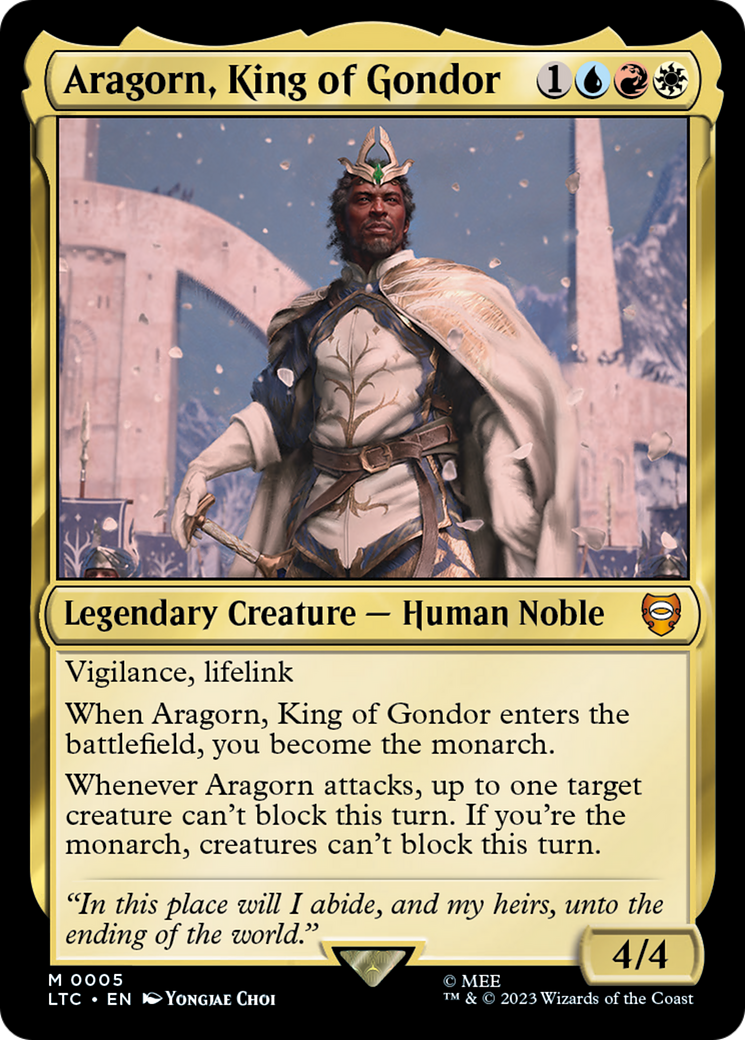
Aragorn, King of Gondor
Aragorn, King of Gondor
Legendary Creature — Human Noble
4/4
Vigilance, lifelink
When Aragorn enters, you become the monarch.
Whenever Aragorn attacks, up to one target creature can't block this turn. If you're the monarch, creatures can't block this turn.
- When Aragorn, King of Gondor's last ability triggers, you can choose not to target a creature, probably because you're the monarch and just want creatures to be unable to block this turn. However, if you do choose a target, and that target is illegal at the time the ability tries to resolve, the ability won't resolve and none of its effects will happen. Creatures will still be able to block this turn, even if you're the monarch.
- The game starts with no monarch. Once an effect makes one player the monarch, the game will have exactly one monarch from that point forward. As a player becomes the monarch, the current monarch (if any) ceases being the monarch.
- There are two inherent triggered abilities associated with being the monarch. These triggered abilities have no source and are controlled by the player who was the monarch at the time the abilities triggered. The full texts of these abilities are "At the beginning of the monarch's end step, that player draws a card" and "Whenever a creature deals combat damage to the monarch, its controller becomes the monarch."
- If the triggered ability that causes the monarch to draw a card goes on the stack and a different player becomes the monarch before that ability resolves, the first player will still draw the card.
- If the monarch leaves the game during another player's turn, that player becomes the monarch. If the monarch leaves the game during their turn, the next player in turn order becomes the monarch.
- If combat damage dealt to the monarch causes that player to lose the game, the triggered ability that causes the controller of the attacking creature to become the monarch doesn't resolve. In most cases, the controller of the attacking creature will still become the monarch as it is likely their turn.
-
1
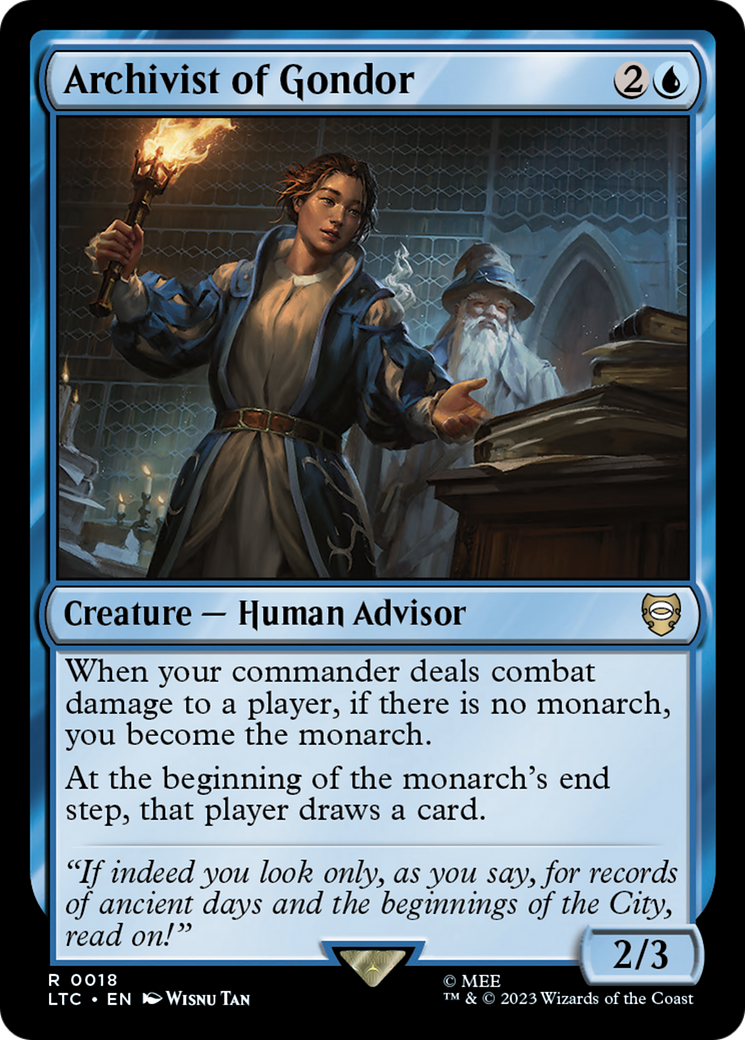
Archivist of Gondor
Archivist of Gondor
Creature — Human Advisor
2/3
When your commander deals combat damage to a player, if there is no monarch, you become the monarch.
At the beginning of the monarch's end step, that player draws a card.
- The game starts with no monarch. Once an effect makes one player the monarch, the game will have exactly one monarch from that point forward. As a player becomes the monarch, the current monarch (if any) ceases being the monarch.
- There are two inherent triggered abilities associated with being the monarch. These triggered abilities have no source and are controlled by the player who was the monarch at the time the abilities triggered. The full texts of these abilities are "At the beginning of the monarch's end step, that player draws a card" and "Whenever a creature deals combat damage to the monarch, its controller becomes the monarch."
- If the triggered ability that causes the monarch to draw a card goes on the stack and a different player becomes the monarch before that ability resolves, the first player will still draw the card.
- If the monarch leaves the game during another player's turn, that player becomes the monarch. If the monarch leaves the game during their turn, the next player in turn order becomes the monarch.
- If combat damage dealt to the monarch causes that player to lose the game, the triggered ability that causes the controller of the attacking creature to become the monarch doesn't resolve. In most cases, the controller of the attacking creature will still become the monarch as it is likely their turn.
-
1
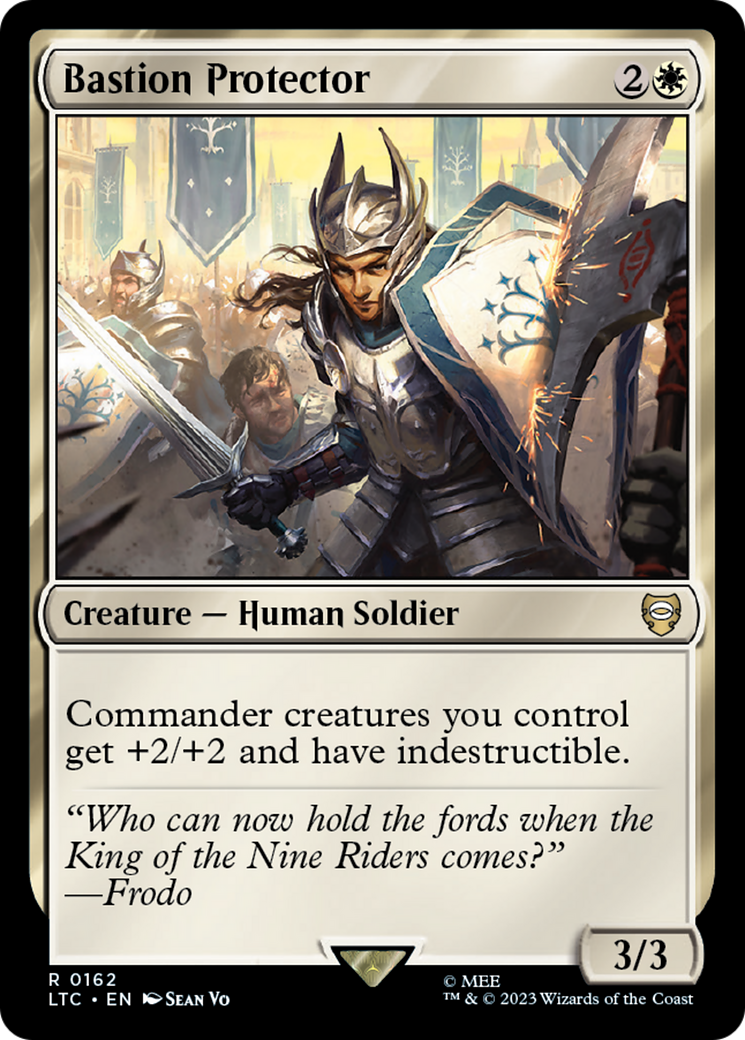
Bastion Protector
Bastion Protector
Creature — Human Soldier
3/3
Commander creatures you control get +2/+2 and have indestructible.
- A "commander creature" is a permanent that's both someone's commander and a creature.
- Bastion Protector's ability applies to any commander creature you control, whether you own it or not.
- Bastion Protector's ability doesn't apply to commanders that aren't currently creatures.
-
1
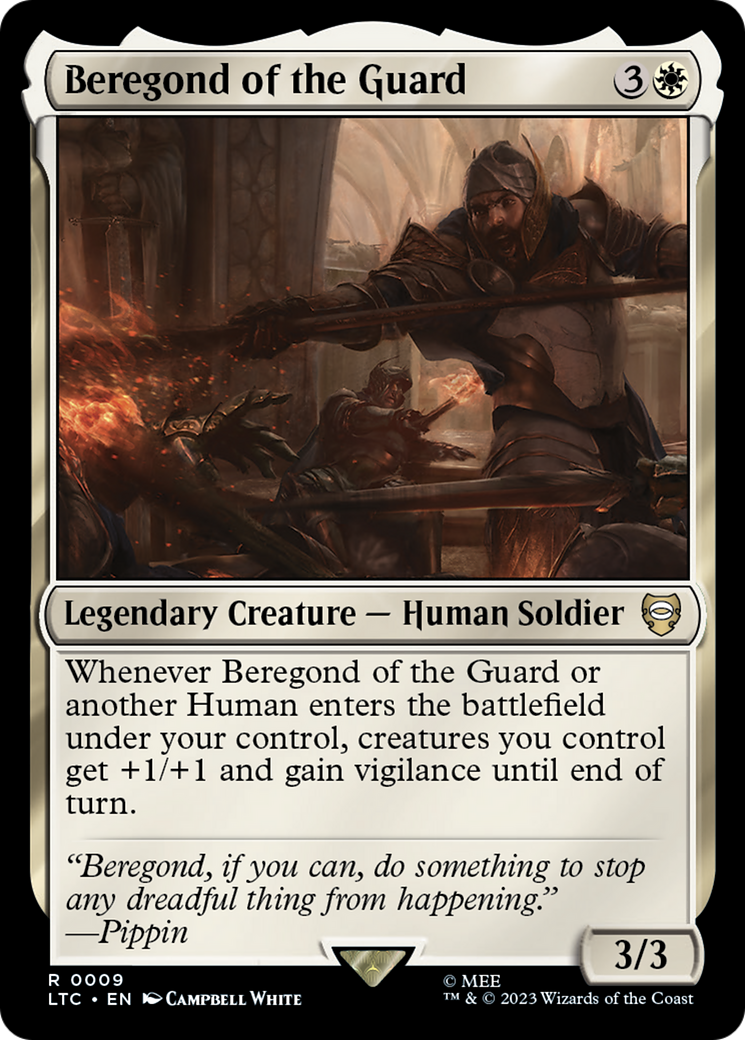
Beregond of the Guard
Beregond of the Guard
Legendary Creature — Human Soldier
3/3
Whenever Beregond or another Human you control enters, creatures you control get +1/+1 and gain vigilance until end of turn.
-
1
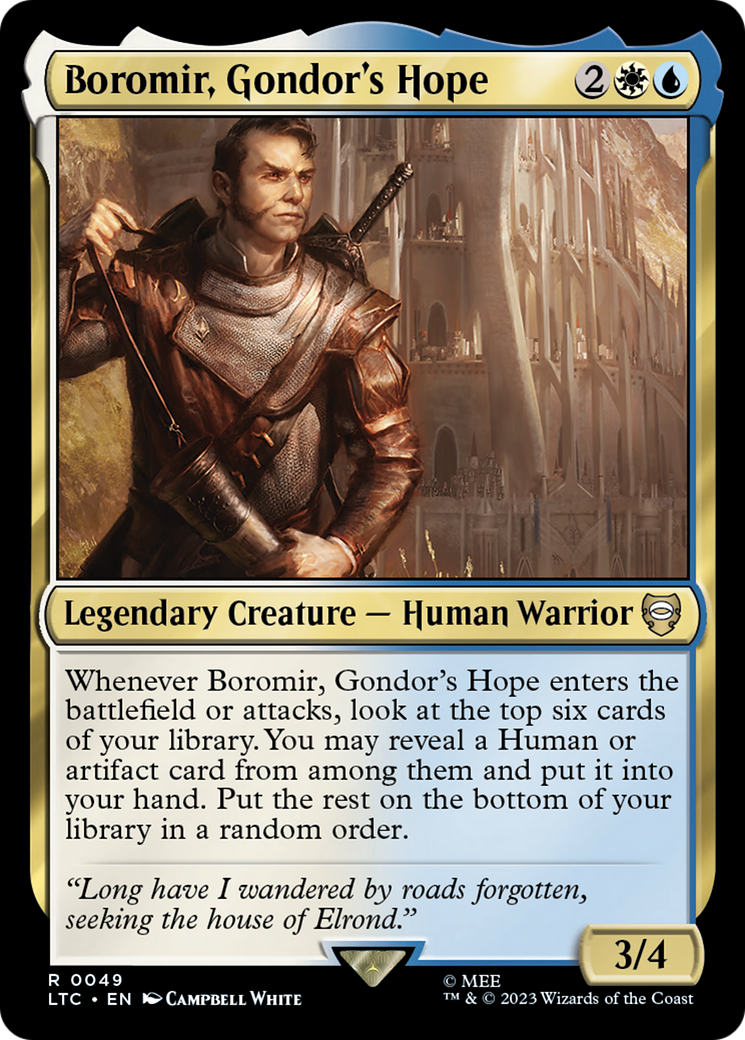
Boromir, Gondor's Hope
Boromir, Gondor's Hope
Legendary Creature — Human Warrior
3/4
Whenever Boromir enters or attacks, look at the top six cards of your library. You may reveal a Human or artifact card from among them and put it into your hand. Put the rest on the bottom of your library in a random order.
-
1
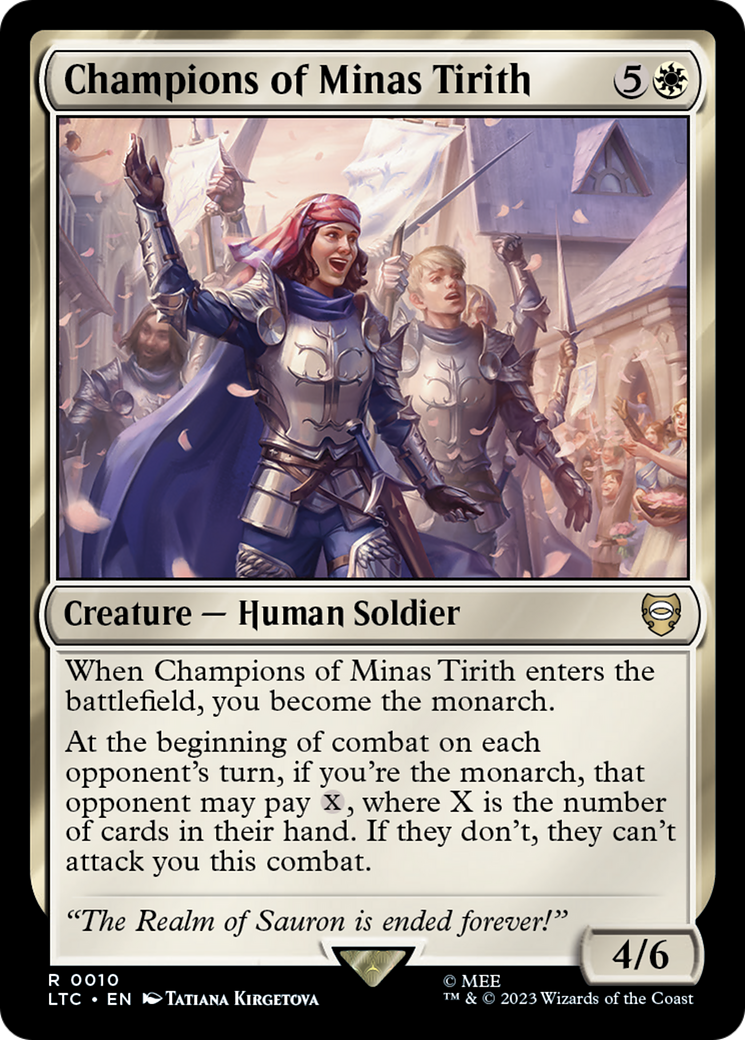
Champions of Minas Tirith
Champions of Minas Tirith
Creature — Human Soldier
4/6
When this creature enters, you become the monarch.
At the beginning of combat on each opponent's turn, if you're the monarch, that opponent may pay , where X is the number of cards in their hand. If they don't, they can't attack you this combat.
- An opponent who chooses not to pay for Champions of Minas Tirith's last ability can still attack planeswalkers you control or battles you're protecting.
- The game starts with no monarch. Once an effect makes one player the monarch, the game will have exactly one monarch from that point forward. As a player becomes the monarch, the current monarch (if any) ceases being the monarch.
- There are two inherent triggered abilities associated with being the monarch. These triggered abilities have no source and are controlled by the player who was the monarch at the time the abilities triggered. The full texts of these abilities are "At the beginning of the monarch's end step, that player draws a card" and "Whenever a creature deals combat damage to the monarch, its controller becomes the monarch."
- If the triggered ability that causes the monarch to draw a card goes on the stack and a different player becomes the monarch before that ability resolves, the first player will still draw the card.
- If the monarch leaves the game during another player's turn, that player becomes the monarch. If the monarch leaves the game during their turn, the next player in turn order becomes the monarch.
- If combat damage dealt to the monarch causes that player to lose the game, the triggered ability that causes the controller of the attacking creature to become the monarch doesn't resolve. In most cases, the controller of the attacking creature will still become the monarch as it is likely their turn.
-
1
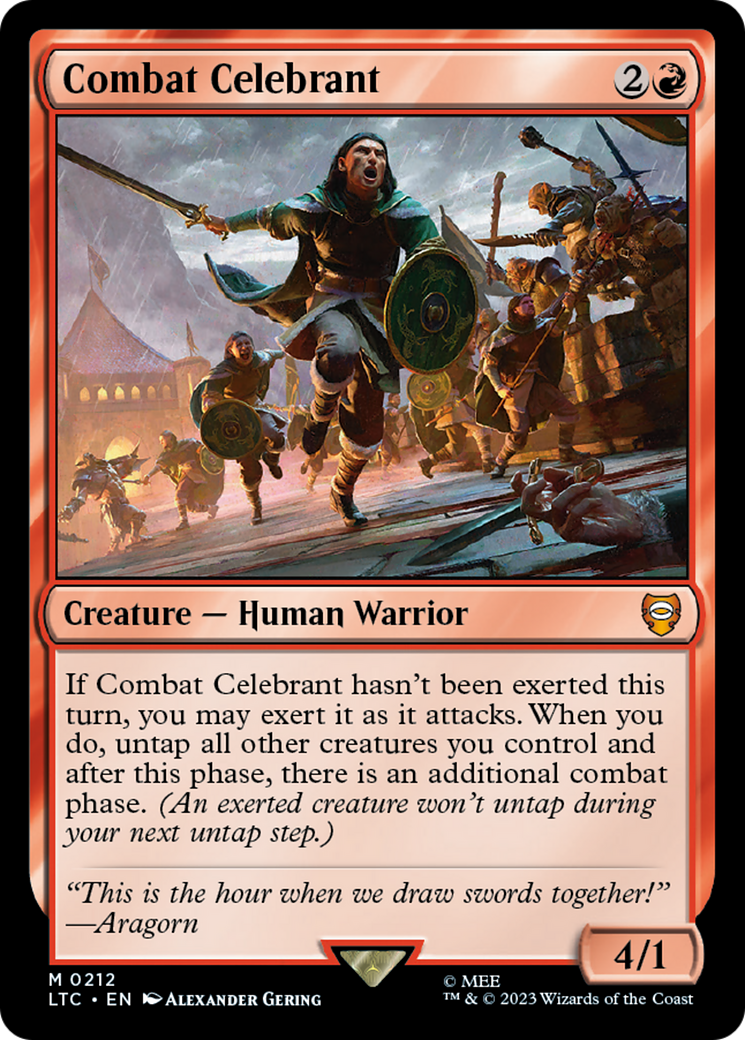
Combat Celebrant
Combat Celebrant
Creature — Human Warrior
4/1
If this creature hasn't been exerted this turn, you may exert it as it attacks. When you do, untap all other creatures you control and after this phase, there is an additional combat phase. (An exerted creature won't untap during your next untap step.)
- Combat Celebrant's ability untaps all of your creatures, not just the ones that are attacking.
- Untapping an attacking creature doesn't remove it from combat.
- There's no main phase between your combat phases, so you'll have no opportunity to cast spells or activate abilities that could only be cast any time you could cast a sorcery. For example, you won't be able to cast another creature or equip Equipment between combats.
- If you exert Combat Celebrant, you get an additional combat phase even if Combat Celebrant doesn't survive the first combat phase.
- If you exert multiple Combat Celebrants in one combat phase, you'll have that many additional combat phases, but all of your creatures are untapped only during the current combat phase. You'll need to exert the Combat Celebrants one at a time, in multiple combat phases, to untap your attacking creatures and attack with them in each combat step.
- You can't exert a creature unless an effect allows you to do so. Similar effects that "tap and freeze" a creature (such as that of Decision Paralysis) don't exert that creature.
- If an exerted creature is already untapped during your next untap step (most likely because it had vigilance or an effect untapped it), exert's effect preventing it from untapping expires without having done anything.
- If you gain control of another player's creature until end of turn and exert it, it will untap during that player's untap step.
- All cards in the Amonkhet set that let you exert a creature let you do so as you declare it as an attacking creature, as do some of the cards in the Hour of Devastation set. You can't do so later in combat, and creatures put onto the battlefield attacking can't be exerted. Any abilities that trigger on exerting an attacking creature will resolve before blockers are declared.
-
1
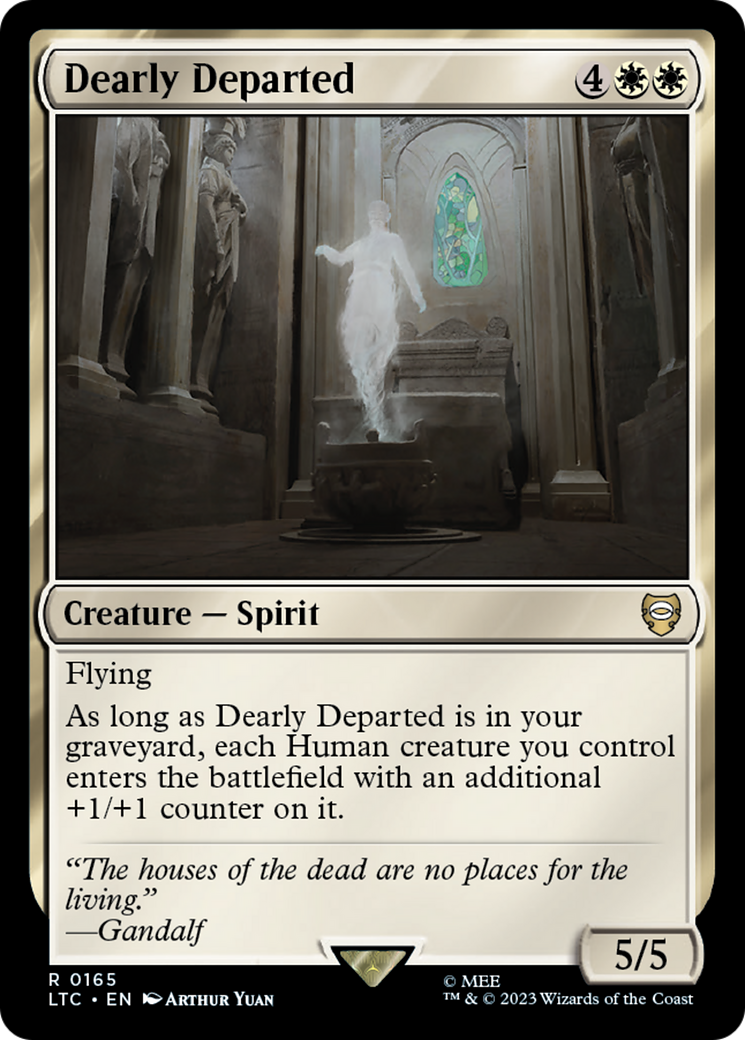
Dearly Departed
Dearly Departed
Creature — Spirit
5/5
Flying
As long as this creature is in your graveyard, each Human creature you control enters with an additional +1/+1 counter on it.
- The effect is cumulative. Human creatures you control will enter with a +1/+1 counter for each Dearly Departed in your graveyard.
- In most cases, when determining whether a creature entering under your control should get a +1/+1 counter, you'll simply look at what the creature will looklike on the battlefield. You'll consider any effects affecting a creature entering under your control.
-
1
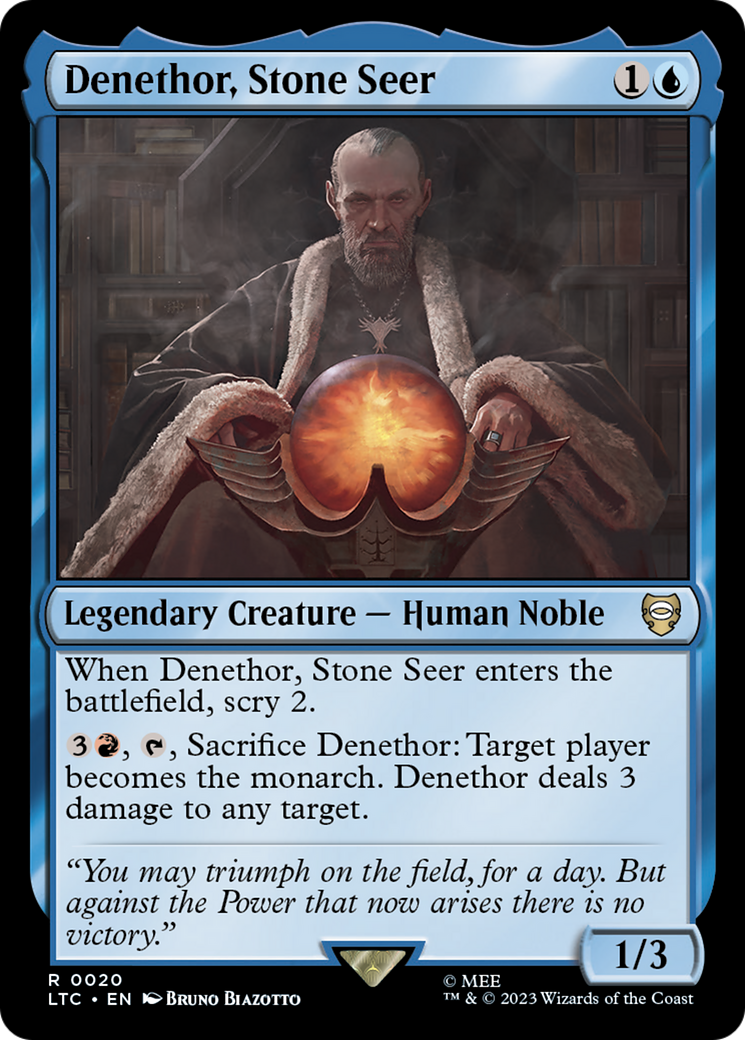
Denethor, Stone Seer
Denethor, Stone Seer
Legendary Creature — Human Noble
1/3
When Denethor enters, scry 2.
, , Sacrifice Denethor: Target player becomes the monarch. Denethor deals 3 damage to any target.
- The game starts with no monarch. Once an effect makes one player the monarch, the game will have exactly one monarch from that point forward. As a player becomes the monarch, the current monarch (if any) ceases being the monarch.
- There are two inherent triggered abilities associated with being the monarch. These triggered abilities have no source and are controlled by the player who was the monarch at the time the abilities triggered. The full texts of these abilities are "At the beginning of the monarch's end step, that player draws a card" and "Whenever a creature deals combat damage to the monarch, its controller becomes the monarch."
- If the triggered ability that causes the monarch to draw a card goes on the stack and a different player becomes the monarch before that ability resolves, the first player will still draw the card.
- If the monarch leaves the game during another player's turn, that player becomes the monarch. If the monarch leaves the game during their turn, the next player in turn order becomes the monarch.
- If combat damage dealt to the monarch causes that player to lose the game, the triggered ability that causes the controller of the attacking creature to become the monarch doesn't resolve. In most cases, the controller of the attacking creature will still become the monarch as it is likely their turn.
-
1
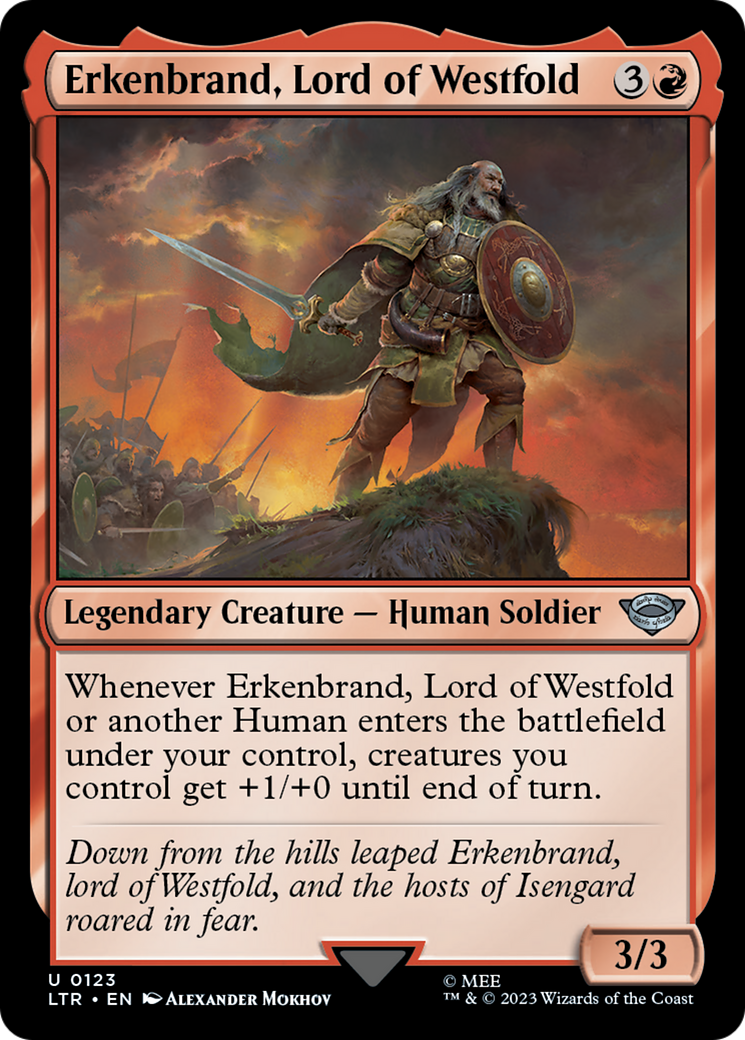
Erkenbrand, Lord of Westfold
Erkenbrand, Lord of Westfold
Legendary Creature — Human Soldier
3/3
Whenever Erkenbrand or another Human you control enters, creatures you control get +1/+0 until end of turn.
- Erkenbrand, Lord of Westfold's triggered ability affects only creatures you control at the time it resolves. Any creatures that come under your control later in the turn won't be affected.
-
1
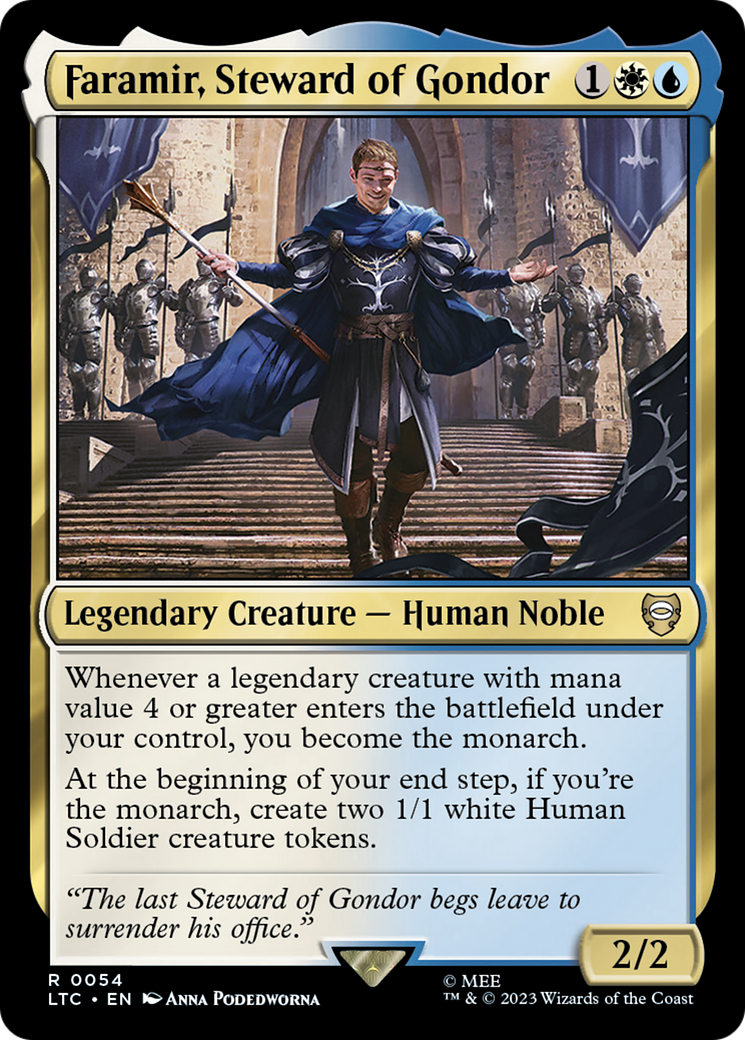
Faramir, Steward of Gondor
Faramir, Steward of Gondor
Legendary Creature — Human Noble
2/2
Whenever a legendary creature you control with mana value 4 or greater enters, you become the monarch.
At the beginning of your end step, if you're the monarch, create two 1/1 white Human Soldier creature tokens.
- The game starts with no monarch. Once an effect makes one player the monarch, the game will have exactly one monarch from that point forward. As a player becomes the monarch, the current monarch (if any) ceases being the monarch.
- There are two inherent triggered abilities associated with being the monarch. These triggered abilities have no source and are controlled by the player who was the monarch at the time the abilities triggered. The full texts of these abilities are "At the beginning of the monarch's end step, that player draws a card" and "Whenever a creature deals combat damage to the monarch, its controller becomes the monarch."
- If the triggered ability that causes the monarch to draw a card goes on the stack and a different player becomes the monarch before that ability resolves, the first player will still draw the card.
- If the monarch leaves the game during another player's turn, that player becomes the monarch. If the monarch leaves the game during their turn, the next player in turn order becomes the monarch.
- If combat damage dealt to the monarch causes that player to lose the game, the triggered ability that causes the controller of the attacking creature to become the monarch doesn't resolve. In most cases, the controller of the attacking creature will still become the monarch as it is likely their turn.
-
1
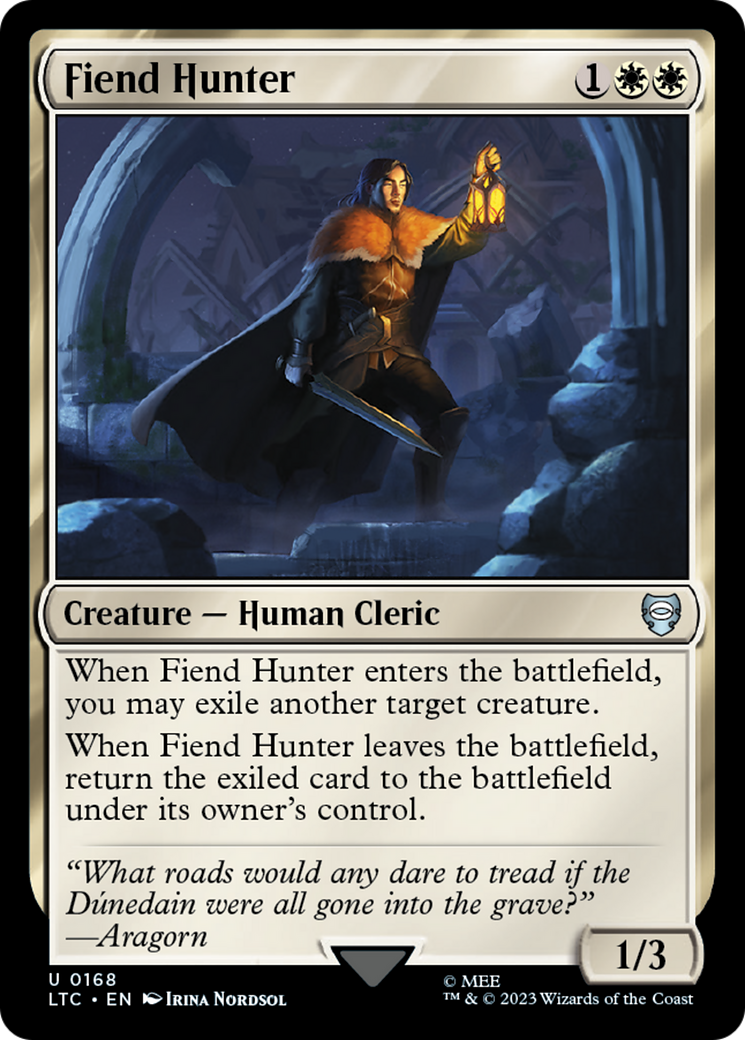
Fiend Hunter
Fiend Hunter
Creature — Human Cleric
1/3
When this creature enters, you may exile another target creature.
When this creature leaves the battlefield, return the exiled card to the battlefield under its owner's control.
- If Fiend Hunter leaves the battlefield before its first ability has resolved, its second ability will trigger and do nothing. Then its first ability will resolve and exile the target creature indefinitely. This is different from abilities on other cards that exile a permanent "until" something happens.
- Once the exiled creature returns, it's considered a new object with no relation to the object that it was. Auras attached to the exiled creature will be put into their owners' graveyards. Equipment attached to the exiled creature will become unattached and remain on the battlefield. Any counters on the exiled creature will cease to exist.
- If a token is exiled this way, it won't return to the battlefield.
- In a multiplayer game, if you lose the game, the creature exiled with Fiend Hunter remains exiled indefinitely. This is also different from abilities on other cards that exile a permanent "until" something happens.
-
1
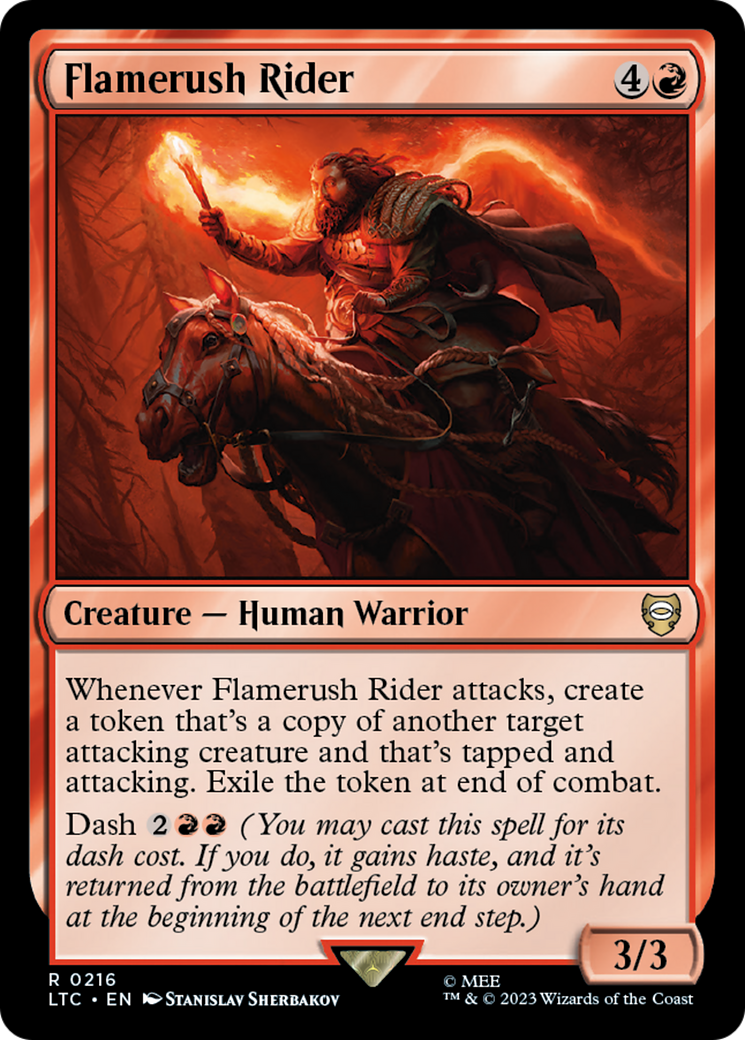
Flamerush Rider
Flamerush Rider
Creature — Human Warrior
3/3
Whenever this creature attacks, create a token that's a copy of another target attacking creature and that's tapped and attacking. Exile the token at end of combat.
Dash (You may cast this spell for its dash cost. If you do, it gains haste, and it's returned from the battlefield to its owner's hand at the beginning of the next end step.)
- You choose which opponent or opposing planeswalker the token is attacking as you put it onto the battlefield. It doesn't have to be the same player or planeswalker Flamerush Rider is attacking.
- Although the token is attacking, it was never declared as an attacking creature (for purposes of abilities that trigger whenever a creature attacks, for example).
- The token copies exactly what was printed on the original creature and nothing else (unless that permanent is copying something else or is a token; see below). It doesn't copy whether that creature has any counters on it or Auras and/or Equipment attached to it, or any non-copy effects that changed its power, toughness, types, color, and so on. Notably, it doesn't copy any effects that may have turned a noncreature permanent into a creature. If the token isn't a creature as it enters the battlefield, it won't be attacking.
- If the copied creature had in its mana cost, X is 0.
- If the copied creature was copying something else, the token enters the battlefield as whatever that creature was copying.
- If the copied creature is a token, the token created by Flamerush Rider copies the original characteristics of that token as stated by the effect that put it onto the battlefield.
- Any enters-the-battlefield abilities of the copied creature will trigger when the token enters the battlefield. Any "As [this creature] enters the battlefield" or "[This creature] enters the battlefield with" abilities of the copied creature will also work.
- If another creature becomes or enters the battlefield as a copy of the token, you won't exile that creature at end of combat. However, if Flamerush Rider creates multiple tokens due to a replacement effect (like the one Doubling Season creates), you'll exile each of those tokens.
- If you choose to pay the dash cost rather than the mana cost, you're still casting the spell. It goes on the stack and can be responded to and countered. You can cast a creature spell for its dash cost only when you otherwise could cast that creature spell. Most of the time, this means during your main phase when the stack is empty.
- If you pay the dash cost to cast a creature spell, that card will be returned to its owner's hand only if it's still on the battlefield when its triggered ability resolves. If it dies or goes to another zone before then, it will stay where it is.
- You don't have to attack with the creature with dash unless another ability says you do.
- If a creature enters the battlefield as a copy of or becomes a copy of a creature whose dash cost was paid, the copy won't have haste and won't be returned to its owner's hand.
-
1
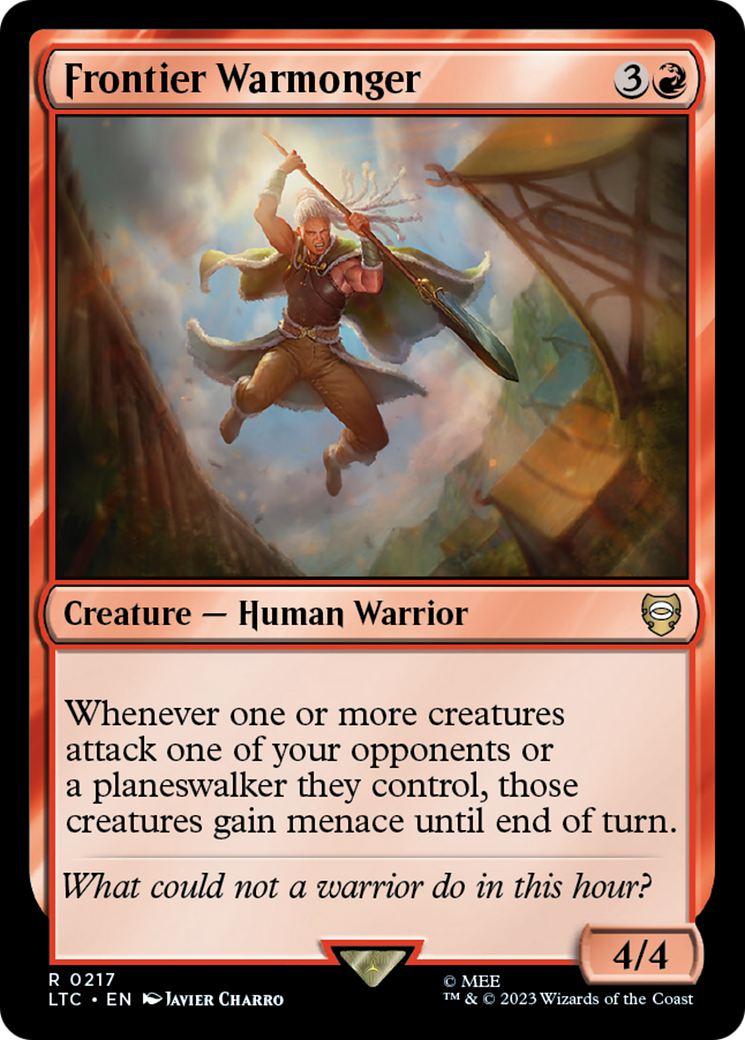
Frontier Warmonger
Frontier Warmonger
Creature — Human Warrior
4/4
Whenever one or more creatures attack one of your opponents or a planeswalker they control, those creatures gain menace until end of turn.
- Creatures your opponents control attacking one of your opponents will cause Frontier Warmonger's ability to trigger.
-
1
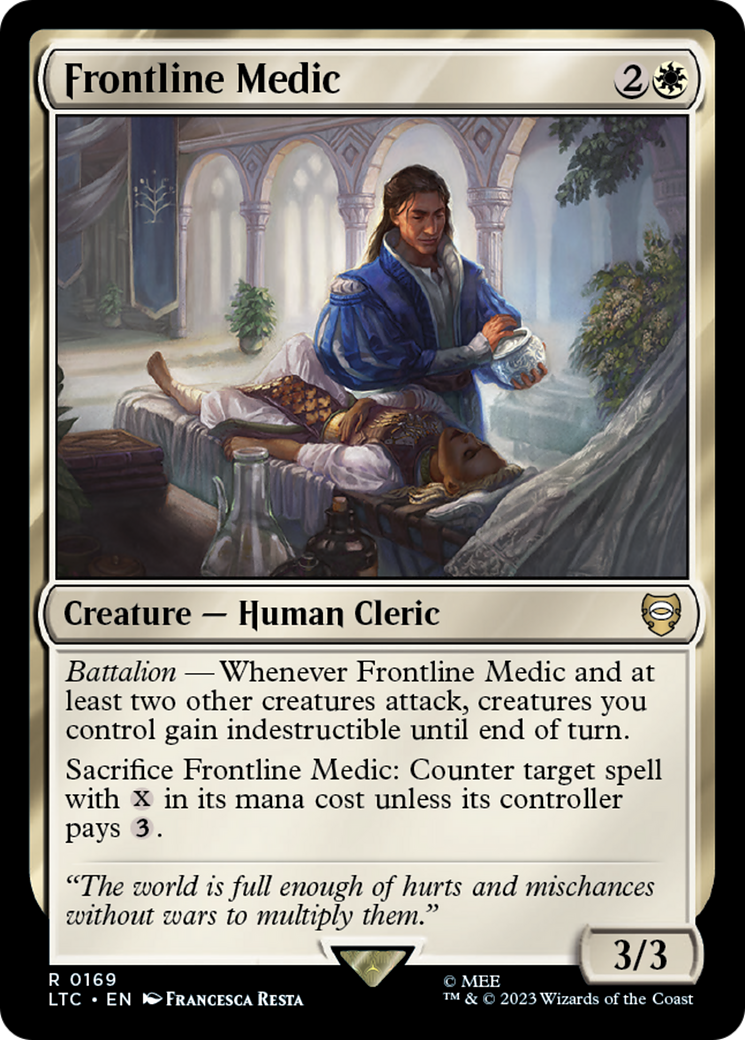
Frontline Medic
Frontline Medic
Creature — Human Cleric
3/3
Battalion — Whenever this creature and at least two other creatures attack, creatures you control gain indestructible until end of turn.
Sacrifice this creature: Counter target spell with in its mana cost unless its controller pays .
- The three attacking creatures don't have to be attacking the same player, planeswalker, or battle.
- Creatures that come under your control after Frontline Medic's battalion ability resolves will not be granted indestructible by this effect.
- Once a battalion ability has triggered, it doesn't matter how many creatures are still attacking when that ability resolves.
- The effects of battalion abilities vary from card to card. Read each card carefully.
-
1
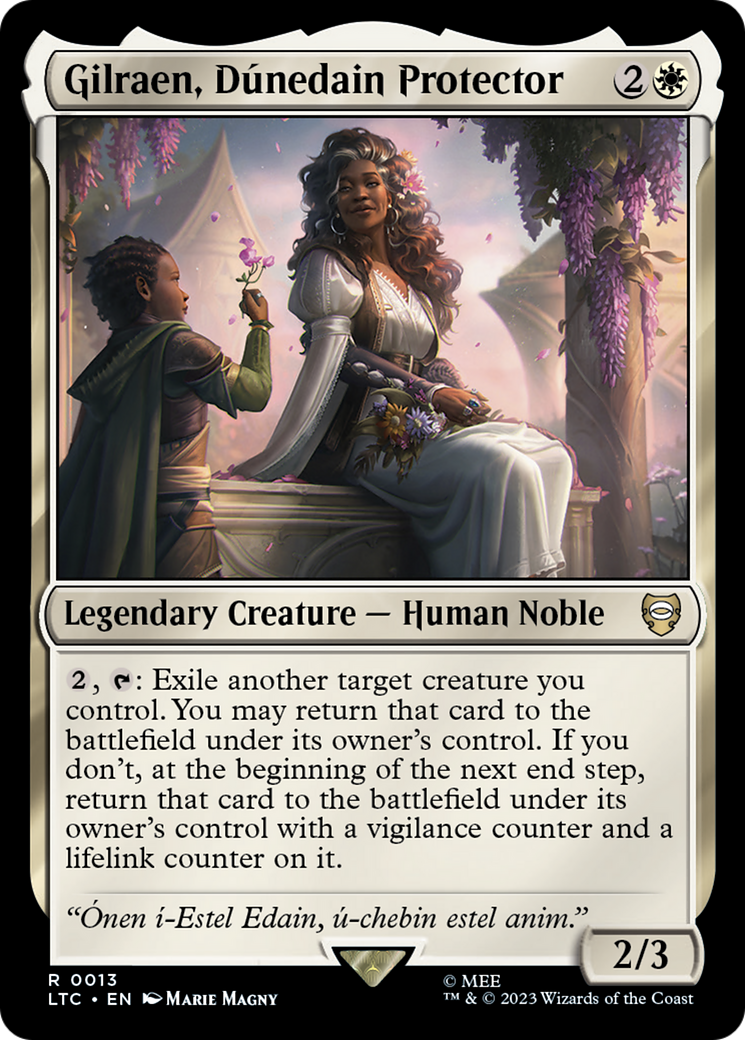
Gilraen, Dúnedain Protector
Gilraen, Dúnedain Protector
Legendary Creature — Human Noble
2/3
, : Exile another target creature you control. You may return that card to the battlefield under its owner's control. If you don't, at the beginning of the next end step, return that card to the battlefield under its owner's control with a vigilance counter and a lifelink counter on it.
- When the card returns to the battlefield, it will be a new object with no connection to the card that was exiled. Auras attached to the exiled creature will be put into their owners' graveyards. Any Equipment will become unattached and remain on the battlefield. Any counters on the exiled creature will cease to exist.
- If a token is exiled this way, it will cease to exist and won't return to the battlefield.
-
1
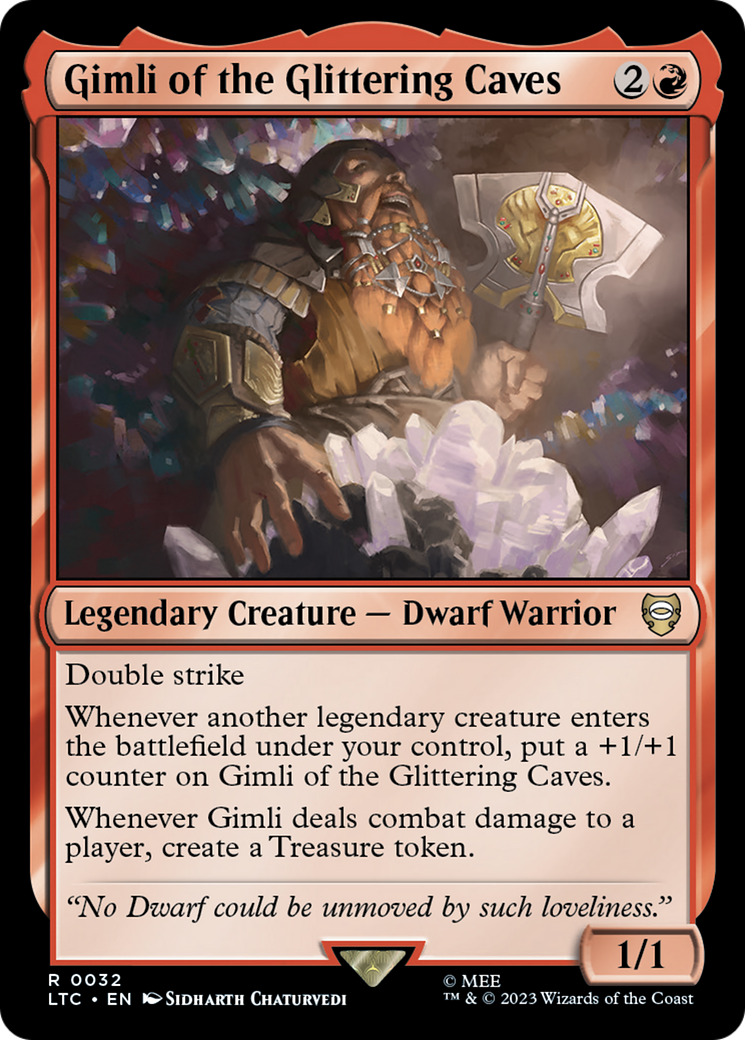
Gimli of the Glittering Caves
Gimli of the Glittering Caves
Legendary Creature — Dwarf Warrior
1/1
Double strike
Whenever another legendary creature you control enters, put a +1/+1 counter on Gimli.
Whenever Gimli deals combat damage to a player, create a Treasure token.
-
1
Grey Host Reinforcements
Grey Host Reinforcements
Creature — Spirit Soldier
1/1
Flying, ward
When this creature enters, exile target player's graveyard. Put a number of +1/+1 counters on this creature equal to the number of creature cards exiled this way.
-
1
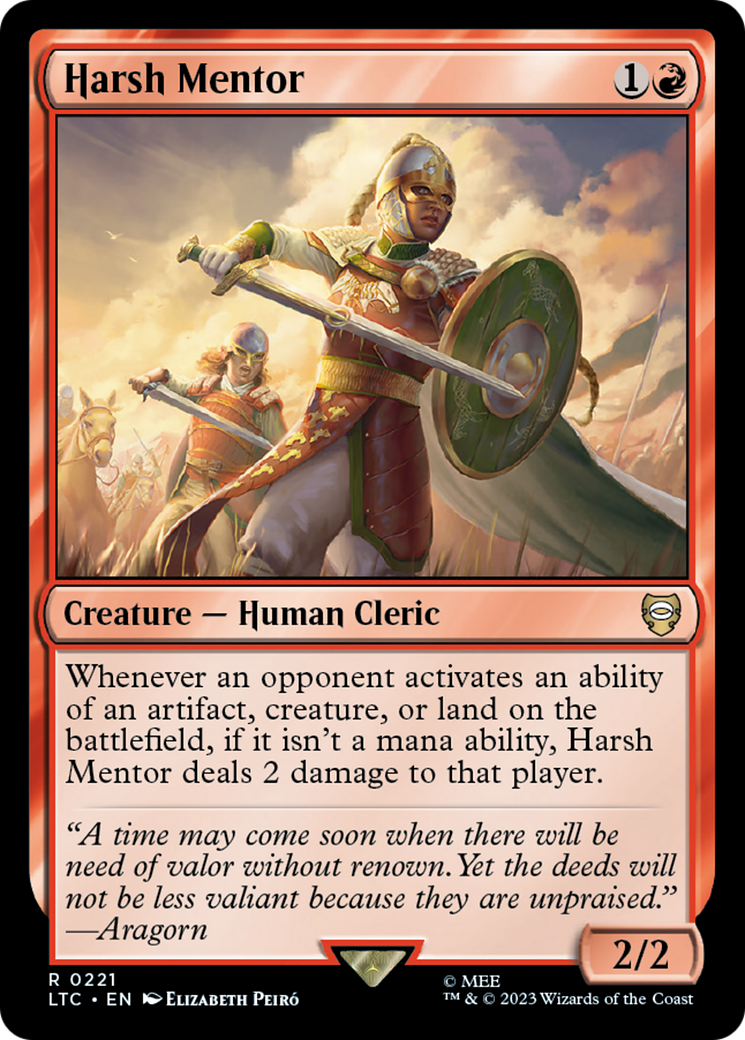
Harsh Mentor
Harsh Mentor
Creature — Human Cleric
2/2
Whenever an opponent activates an ability of an artifact, creature, or land on the battlefield, if it isn't a mana ability, this creature deals 2 damage to that player.
- Activated abilities contain a colon. They're generally written "[Cost]: [Effect]." Some keyword abilities (such as equip) are activated abilities and will have colons in their reminder text. An activated mana ability is one that produces mana as it resolves, not one that costs mana to activate. Notably, exerting a creature isn't an activated ability.
- Harsh Mentor's ability doesn't trigger when an opponent activates an ability of a card in hand (such as cycling) or a card in a graveyard (such as embalm), even if that causes a card to be put onto the battlefield.
- Harsh Mentor's ability resolves before the ability that caused it to trigger.
-
1
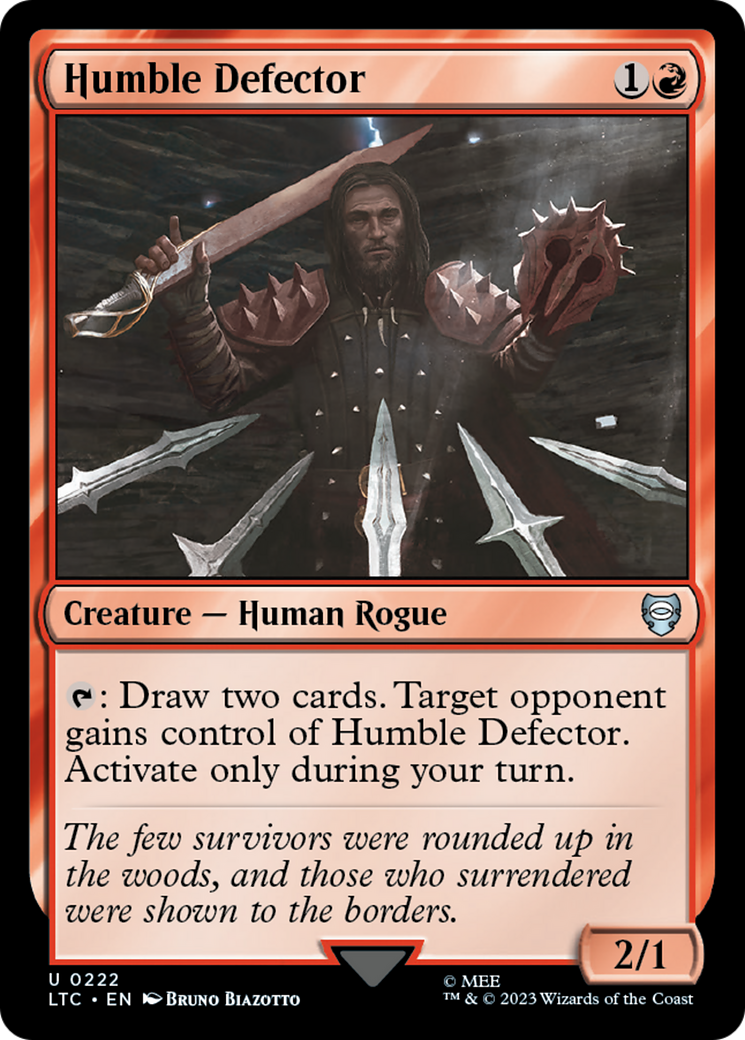
Humble Defector
Humble Defector
Creature — Human Rogue
2/1
: Draw two cards. Target opponent gains control of this creature. Activate only during your turn.
- Humble Defector's ability can be activated any time during your turn, including in response to a spell or ability.
- If Humble Defector isn't on the battlefield as its ability resolves, but the target player is still a legal target, the ability will resolve. You'll draw two cards, even though the player doesn't gain control of Humble Defector.
- If Humble Defector is controlled by a player other than its owner, and its controller leaves the game, the effect giving that player control of Humble Defector ends. Humble Defector will return to the control of the player still in the game who most recently controlled it.
- If Humble Defector's owner leaves the game, Humble Defector humbly leaves the game along with that player.
-
1
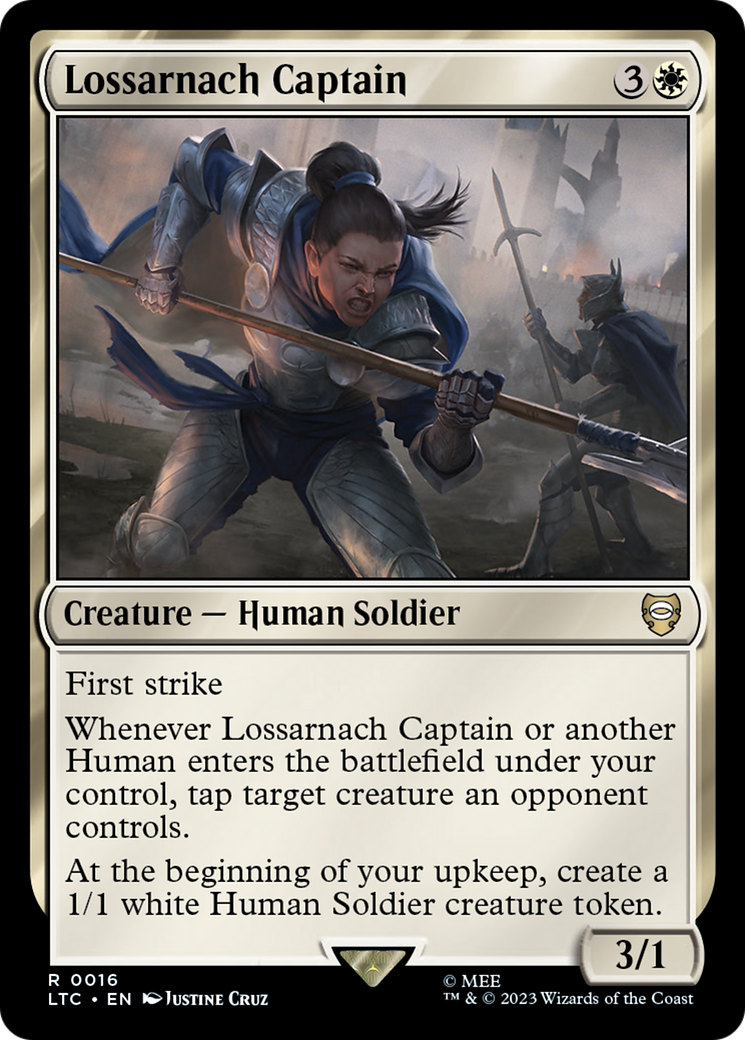
Lossarnach Captain
Lossarnach Captain
Creature — Human Soldier
3/1
First strike
Whenever this creature or another Human you control enters, tap target creature an opponent controls.
At the beginning of your upkeep, create a 1/1 white Human Soldier creature token.
-
1
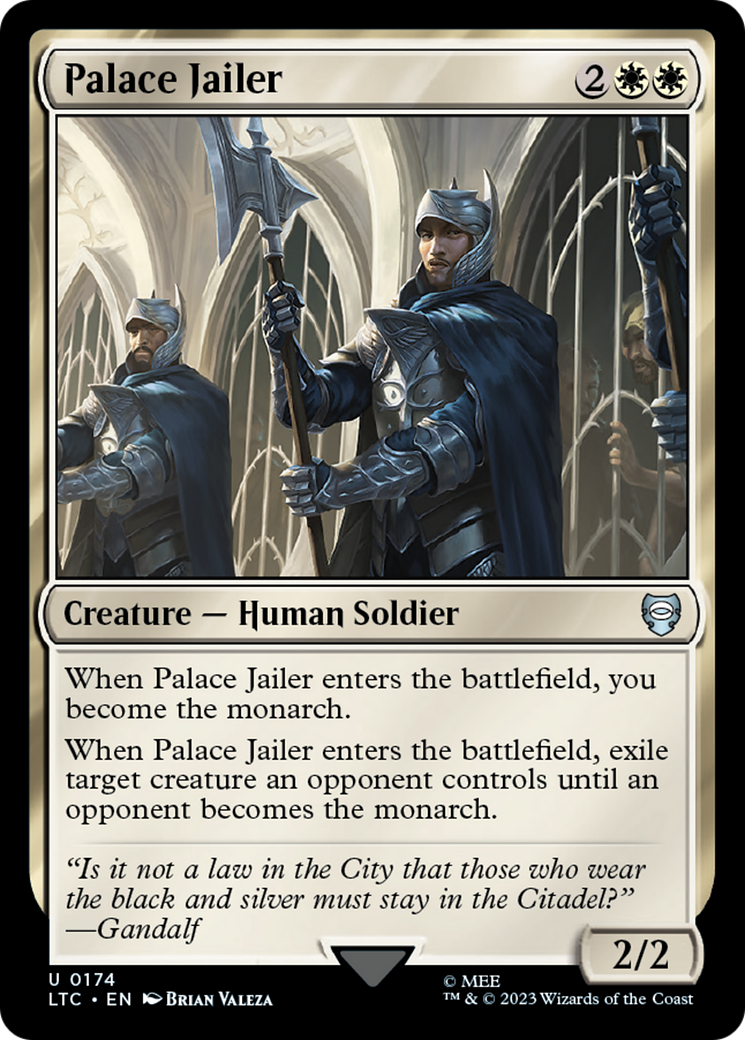
Palace Jailer
Palace Jailer
Creature — Human Soldier
2/2
When this creature enters, you become the monarch.
When this creature enters, exile target creature an opponent controls until an opponent becomes the monarch.
- The game starts with no monarch. Once an effect makes one player the monarch, the game will have exactly one monarch from that point forward.
- Being the monarch carries two inherent triggered abilities. "At the beginning of the monarch's end step, that player draws a card" and "Whenever a creature deals combat damage to the monarch, its controller becomes the monarch."
- If you're not the monarch as Palace Jailer's second ability resolves, the creature will be exiled until there's a new monarch and that player is one of your opponents. The creature won't immediately return just because an opponent is the monarch.
- Auras attached to the exiled creature will be put into their owners' graveyards. Equipment attached to the exiled creature will become unattached and remain on the battlefield. Counters on the exiled creature will cease to exist.
- If a creature token is exiled, it ceases to exist. It won't return to the battlefield.
- Palace Jailer leaving the battlefield won't cause the exiled creature to return. The game will continue to watch for the next time an opponent becomes the monarch.
- The opponent that controlled the exiled card doesn't have to be the same opponent that becomes the monarch in order to cause that card to return to the battlefield. Any opponent becoming the monarch will cause the card to return.
- In a multiplayer game, if the monarch leaves the game, the player whose turn it is immediately becomes the monarch. If the player whose turn it is has left the game, instead the next player in turn order becomes the monarch.
-
1
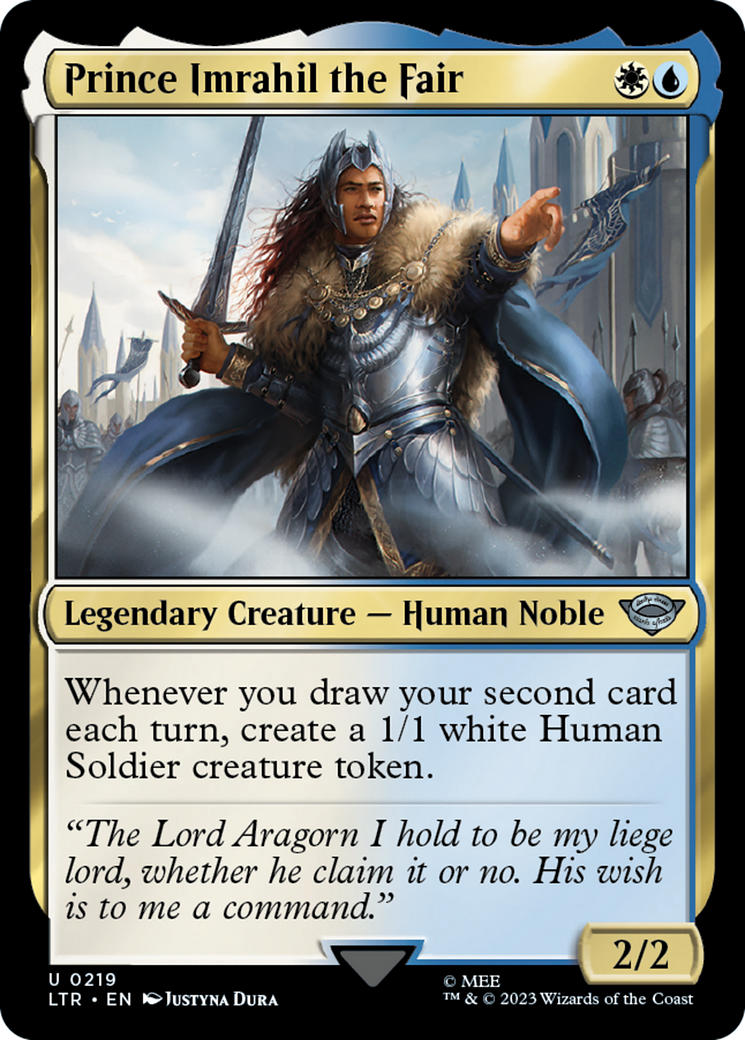
Prince Imrahil the Fair
Prince Imrahil the Fair
Legendary Creature — Human Noble
2/2
Whenever you draw your second card each turn, create a 1/1 white Human Soldier creature token.
-
1
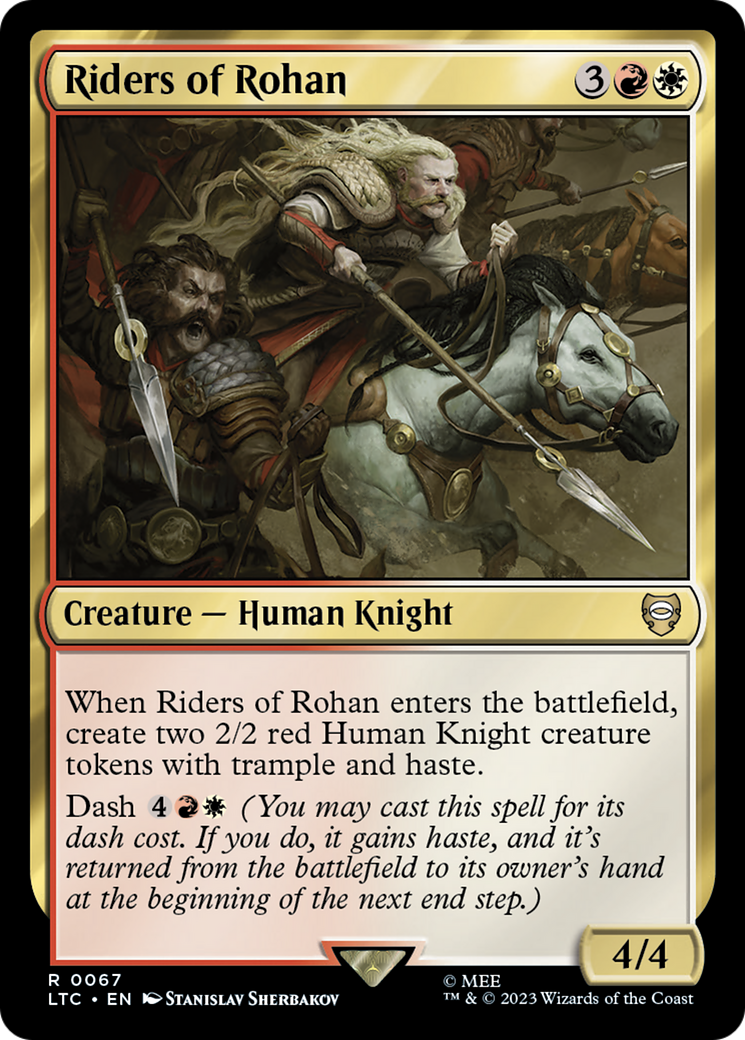
Riders of Rohan
Riders of Rohan
Creature — Human Knight
4/4
When this creature enters, create two 2/2 red Human Knight creature tokens with trample and haste.
Dash (You may cast this spell for its dash cost. If you do, it gains haste, and it's returned from the battlefield to its owner's hand at the beginning of the next end step.)
- If you pay the dash cost to cast a creature spell, that card will be returned to its owner's hand only if it's still on the battlefield when its triggered ability resolves. If it dies or goes to another zone before then, it will stay where it is.
- You don't have to attack with the creature with dash unless another ability says you do.
- If a creature enters the battlefield as a copy of or becomes a copy of a creature whose dash cost was paid, the copy won't have haste and won't be returned to its owner's hand.
-
1
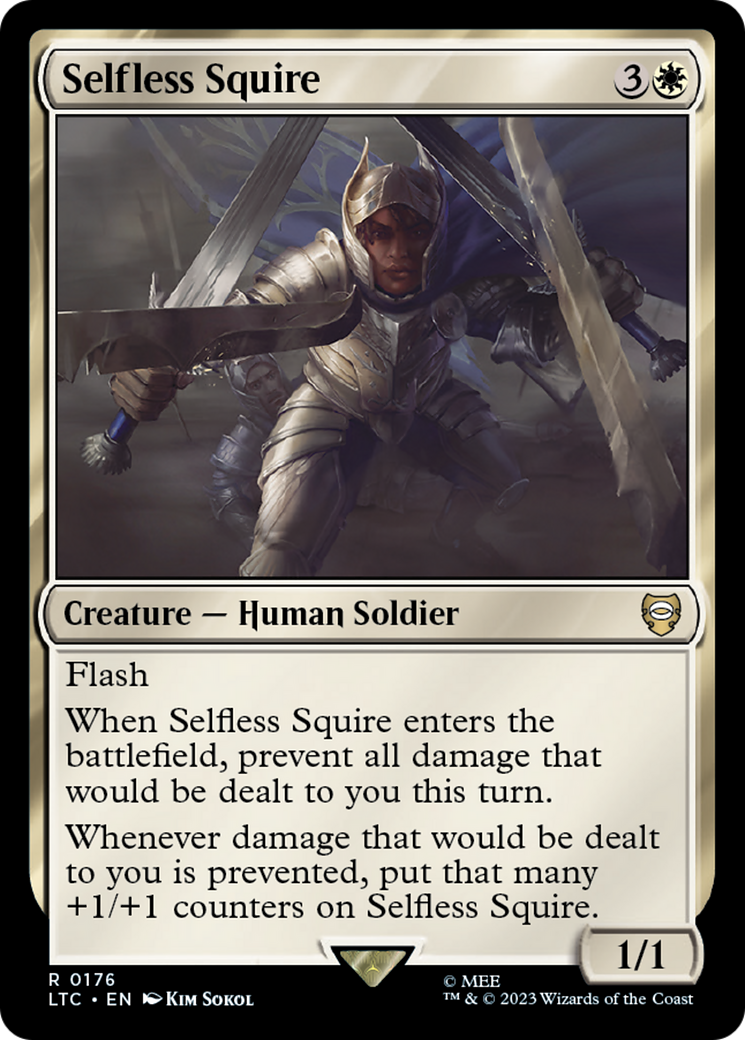
Selfless Squire
Selfless Squire
Creature — Human Soldier
1/1
Flash
When this creature enters, prevent all damage that would be dealt to you this turn.
Whenever damage that would be dealt to you is prevented, put that many +1/+1 counters on this creature.
- Selfless Squire's first triggered ability prevents all damage that would be dealt to you this turn after the triggered ability resolves, even if Selfless Squire leaves the battlefield.
- Selfless Squire's second triggered ability doesn't trigger only when damage is prevented by its first triggered ability's effect. Any effect that uses the word "prevent" will cause it to trigger.
-
1
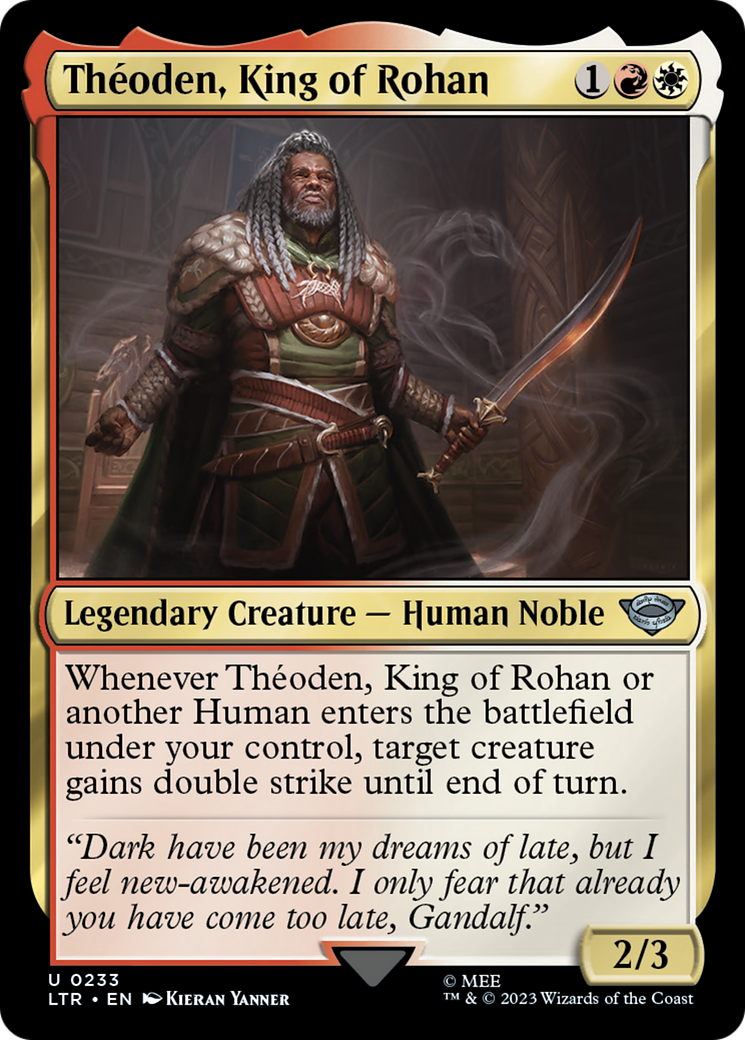
Théoden, King of Rohan
Théoden, King of Rohan
Legendary Creature — Human Noble
2/3
Whenever Théoden or another Human you control enters, target creature gains double strike until end of turn.
-
1
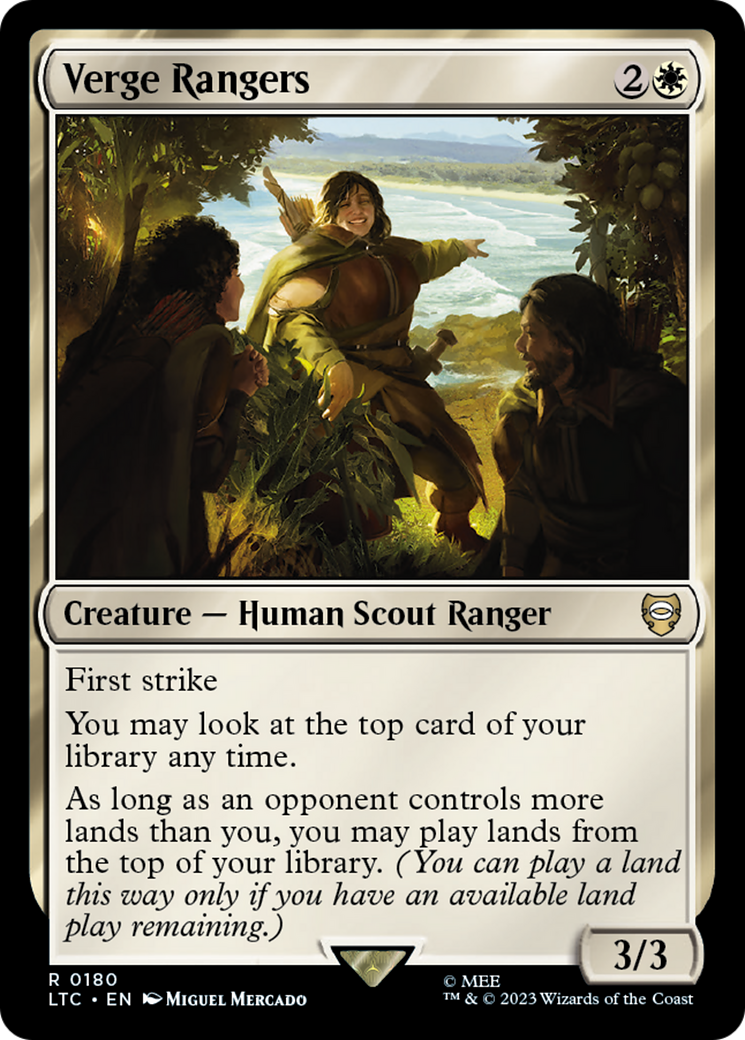
Verge Rangers
Verge Rangers
Creature — Human Scout Ranger
3/3
First strike
You may look at the top card of your library any time.
As long as an opponent controls more lands than you, you may play lands from the top of your library. (You can play a land this way only if you have an available land play remaining.)
- Verge Rangers doesn't allow you to play additional lands.
- Verge Rangers lets you look at the top card of your library whenever you want (with one restriction; see below), even if you don't have priority. This action doesn't use the stack. Knowing what that card is becomes part of the information you have access to, just like you can look at the cards in your hand.
- If the top card of your library changes while you're casting a spell, playing a land, or activating an ability, you can't look at the new top card until you finish doing so. This means that if you play a land from the top of your library and it has a replacement effect that requires you to make a decision (such as that of Temple Garden), you must make that decision without knowing the next card of your library.
-
1
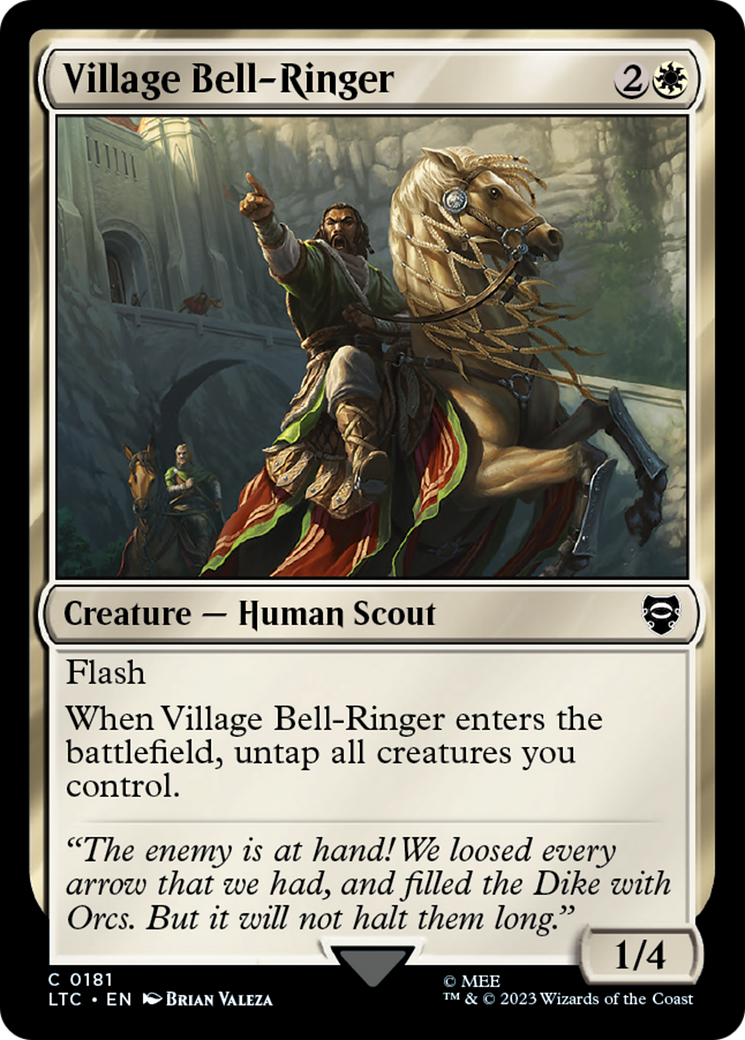
Village Bell-Ringer
Village Bell-Ringer
Creature — Human Scout
1/4
Flash (You may cast this spell any time you could cast an instant.)
When this creature enters, untap all creatures you control.
- Untapping an attacking creature doesn't remove it from combat.
-
1
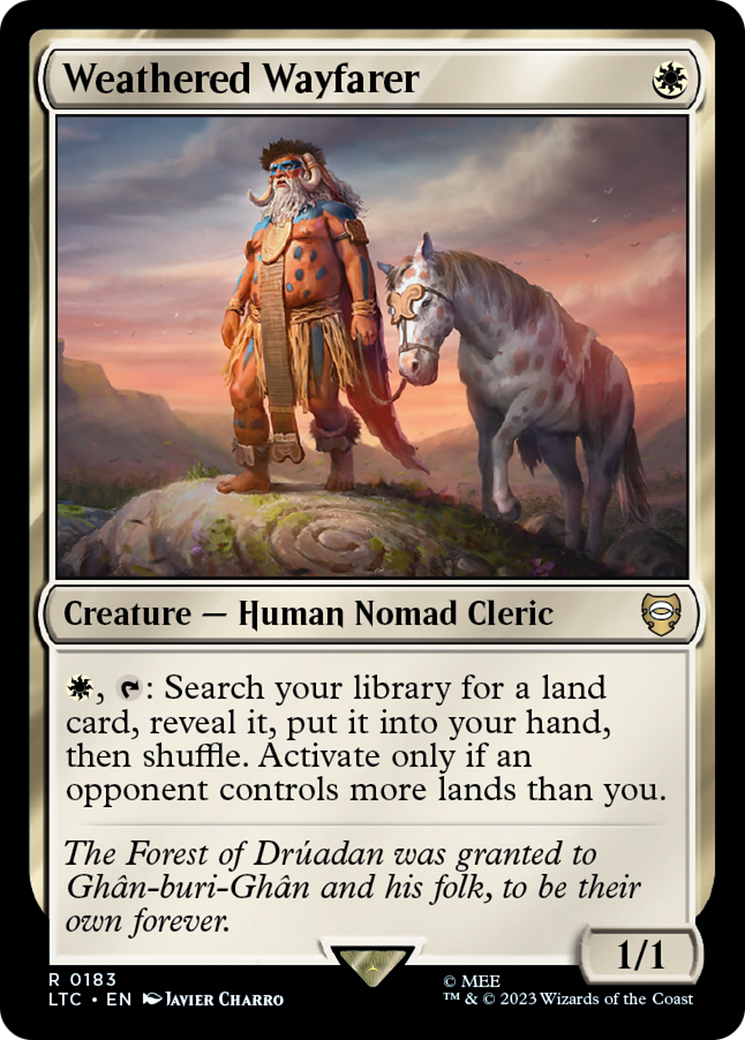
Weathered Wayfarer
Weathered Wayfarer
Creature — Human Nomad Cleric
1/1
, : Search your library for a land card, reveal it, put it into your hand, then shuffle. Activate only if an opponent controls more lands than you.
-
1
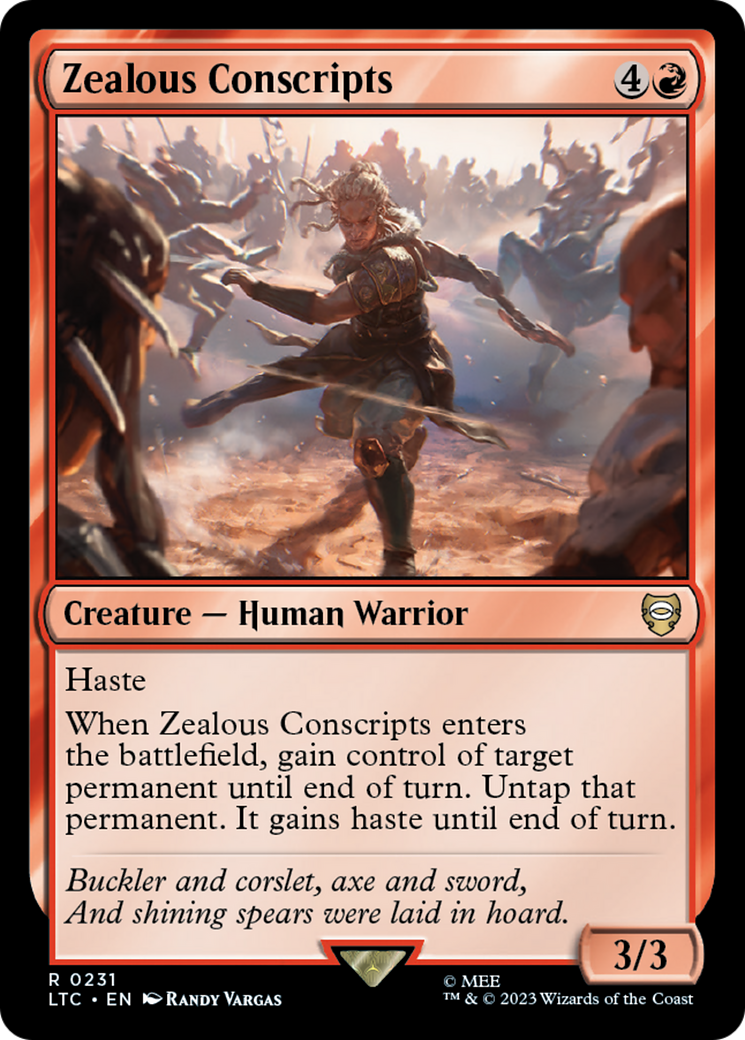
Zealous Conscripts
Zealous Conscripts
Creature — Human Warrior
3/3
Haste
When this creature enters, gain control of target permanent until end of turn. Untap that permanent. It gains haste until end of turn.
- The triggered ability can target any permanent, including one that's untapped or one that you already control.
-
1
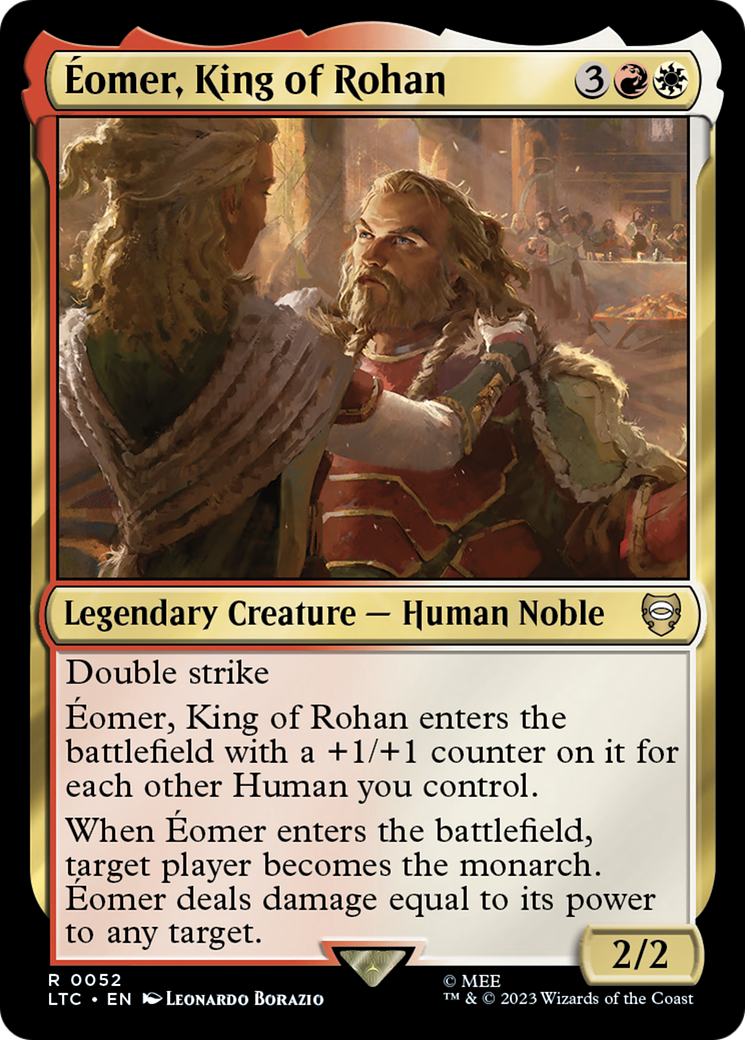
Éomer, King of Rohan
Éomer, King of Rohan
Legendary Creature — Human Noble
2/2
Double strike
Éomer enters with a +1/+1 counter on it for each other Human you control.
When Éomer enters, target player becomes the monarch. Éomer deals damage equal to its power to any target.
- The game starts with no monarch. Once an effect makes one player the monarch, the game will have exactly one monarch from that point forward. As a player becomes the monarch, the current monarch (if any) ceases being the monarch.
- There are two inherent triggered abilities associated with being the monarch. These triggered abilities have no source and are controlled by the player who was the monarch at the time the abilities triggered. The full texts of these abilities are "At the beginning of the monarch's end step, that player draws a card" and "Whenever a creature deals combat damage to the monarch, its controller becomes the monarch."
- If the triggered ability that causes the monarch to draw a card goes on the stack and a different player becomes the monarch before that ability resolves, the first player will still draw the card.
- If the monarch leaves the game during another player's turn, that player becomes the monarch. If the monarch leaves the game during their turn, the next player in turn order becomes the monarch.
- If combat damage dealt to the monarch causes that player to lose the game, the triggered ability that causes the controller of the attacking creature to become the monarch doesn't resolve. In most cases, the controller of the attacking creature will still become the monarch as it is likely their turn.
-
1
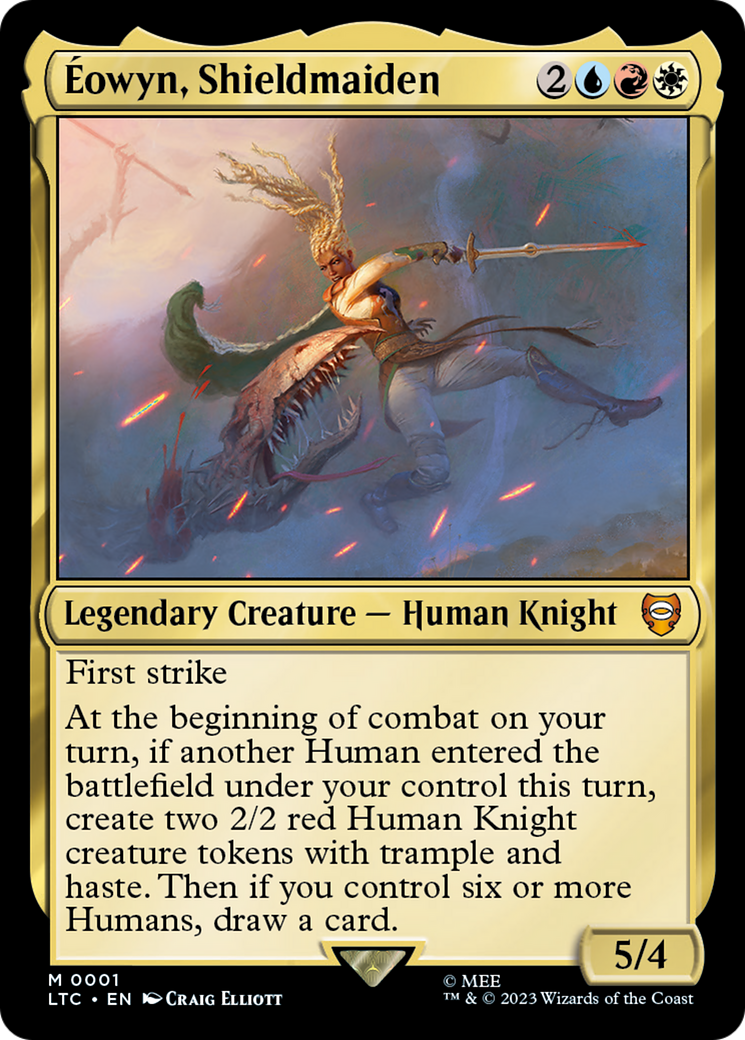
Éowyn, Shieldmaiden
Éowyn, Shieldmaiden
Legendary Creature — Human Knight
5/4
First strike
At the beginning of combat on your turn, if another Human entered the battlefield under your control this turn, create two 2/2 red Human Knight creature tokens with trample and haste. Then if you control six or more Humans, draw a card.
- If another Human didn't enter the battlefield before your beginning of combat step, Éowyn, Shieldmaiden's ability won't trigger. You won't draw a card even if you control six or more Humans.
Instants 4
-
1
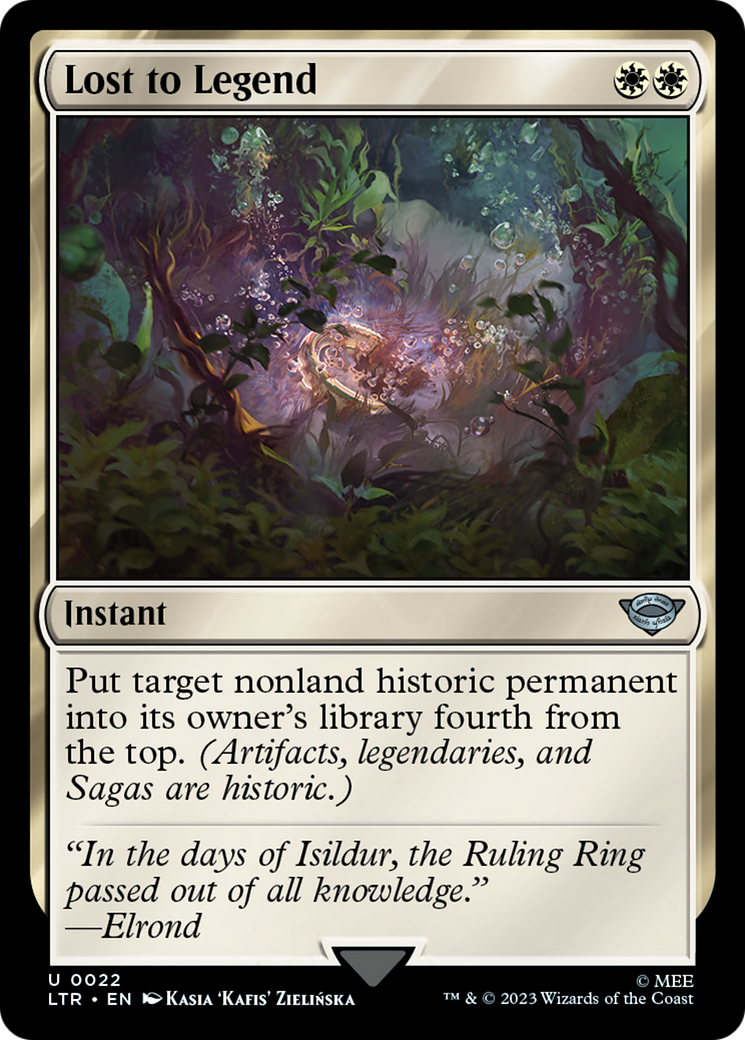
Lost to Legend
Lost to Legend
Instant
Put target nonland historic permanent into its owner's library fourth from the top. (Artifacts, legendaries, and Sagas are historic.)
- If the target permanent's controller has two or fewer cards left in their library when Lost to Legend resolves, that permanent becomes the bottom card of their library.
- A card, spell, or permanent is historic if it has the legendary supertype, the artifact card type, or the Saga subtype. Having two of those qualities doesn't make an object more historic than another or provide an additional bonus—an object either is historic or it isn't.
- Some abilities trigger "whenever you cast a historic spell." Such an ability resolves before the spell that caused it to trigger. It resolves even if that spell is countered.
- An ability that triggers "whenever you cast a historic spell" doesn't trigger if a historic card is put onto the battlefield without being cast.
- Lands are never cast, so abilities that trigger "whenever you cast a historic spell" won't trigger if you play a legendary land. They also won't trigger if a card on the battlefield transforms into a card with the legendary supertype, the artifact card type, or the Saga subtype.
-
1
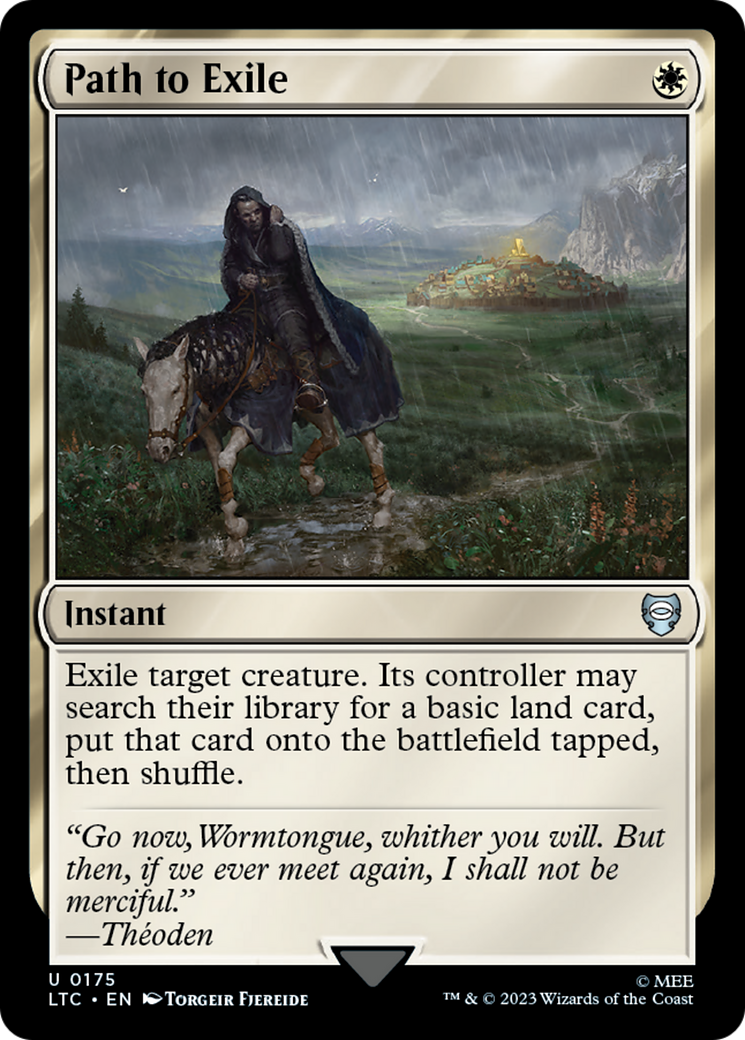
Path to Exile
Path to Exile
Instant
Exile target creature. Its controller may search their library for a basic land card, put that card onto the battlefield tapped, then shuffle.
- If the target creature is an illegal target by the time Path to Exile tries to resolve, the spell won't resolve. The creature's controller won't search for a basic land card.
- The controller of the exiled creature isn't required to search their library for a basic land. If that player doesn't, the player won't shuffle their library.
-
1
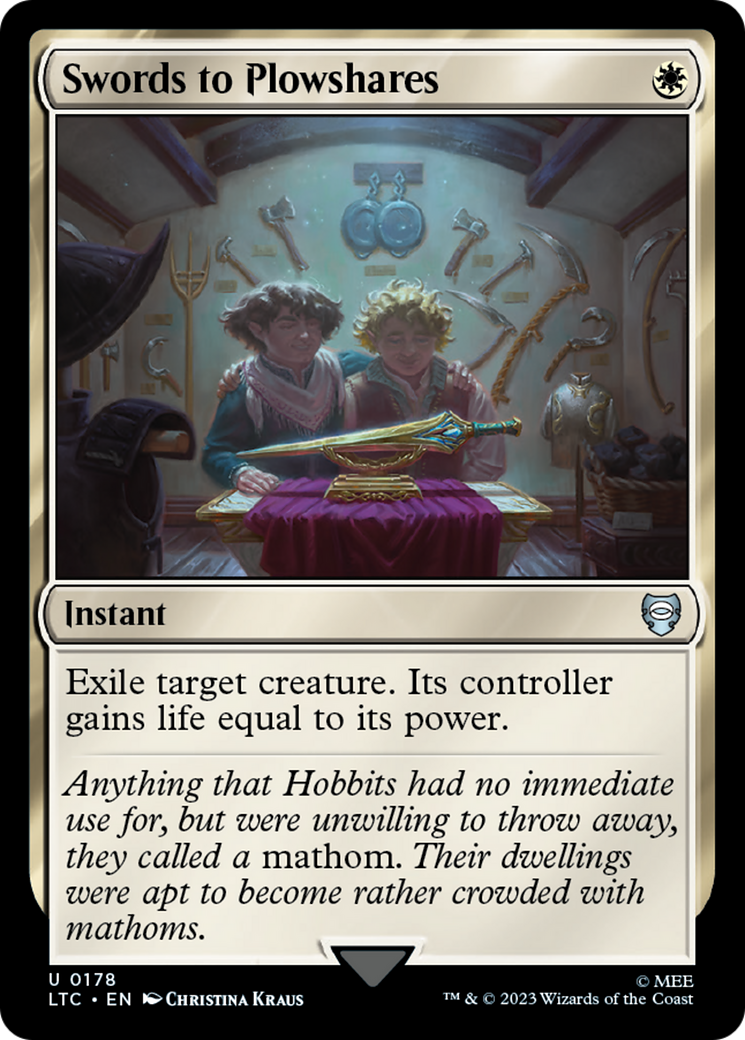
Swords to Plowshares
Swords to Plowshares
Instant
Exile target creature. Its controller gains life equal to its power.
- Use the power of the creature from when it was last on the battlefield to determine how much life is gained.
-
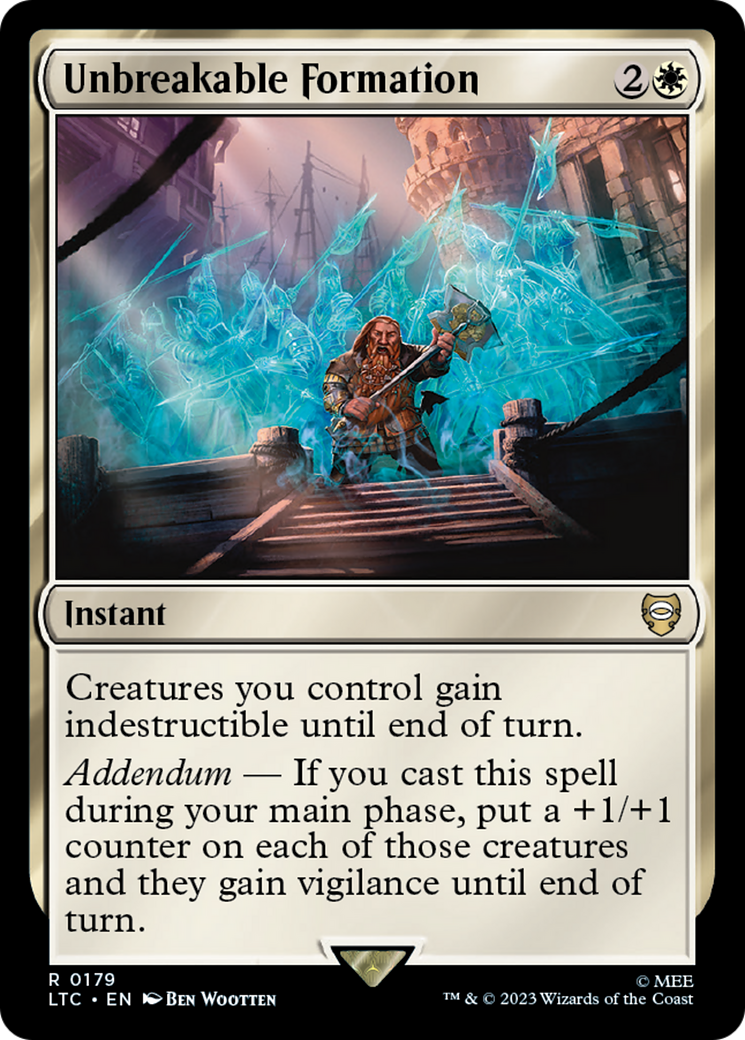
1
Unbreakable Formation
Unbreakable Formation
Instant
Creatures you control gain indestructible until end of turn.
Addendum — If you cast this spell during your main phase, put a +1/+1 counter on each of those creatures and they gain vigilance until end of turn.
- Addendum abilities of instant spells apply while the spell is resolving, not immediately after casting it. If the spell is countered, you don't get the addendum bonus.
- If an effect copies a spell with an addendum ability while it's on the stack, the copy wasn't cast at all, so you won't get the addendum bonus.
- Unbreakable Formation affects only creatures you control at the time it resolves. Creatures you begin to control later in the turn won't gain indestructible or vigilance and they won't get a +1/+1 counter.
Sorceries 8
-
1
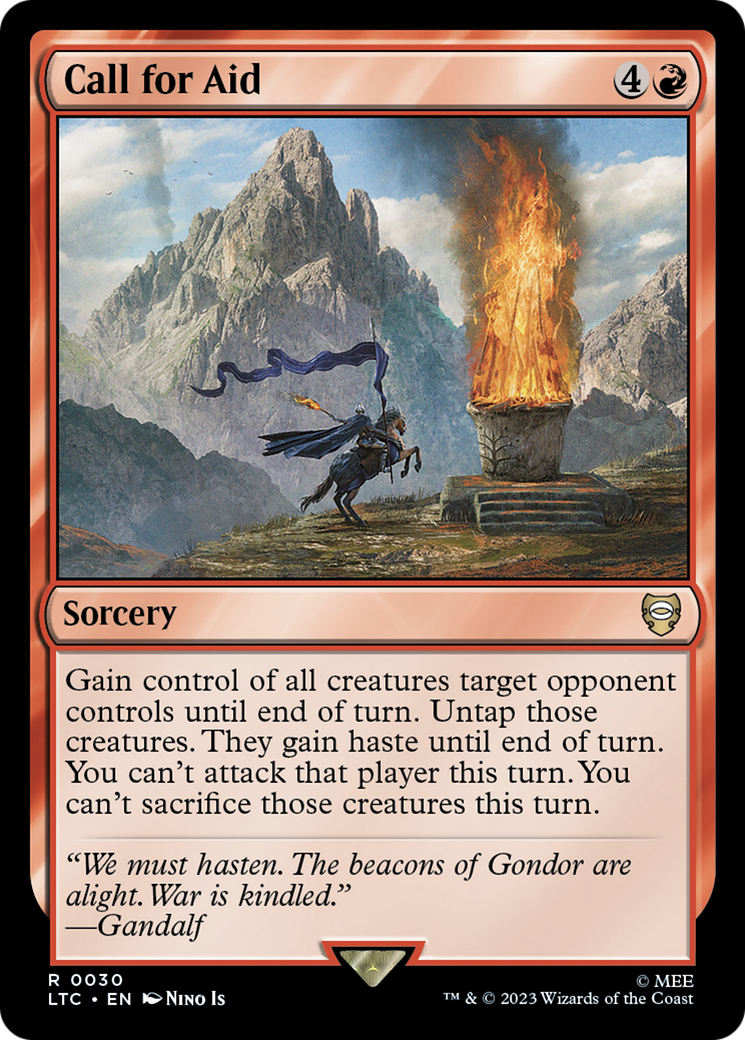
Call for Aid
Call for Aid
Sorcery
Gain control of all creatures target opponent controls until end of turn. Untap those creatures. They gain haste until end of turn. You can't attack that player this turn. You can't sacrifice those creatures this turn.
- You can't sacrifice the creatures you gained control of with Call for Aid this turn for any reason. If an effect instructs you to sacrifice one of them, you can't and it remains on the battlefield. You also can't sacrifice any of them to pay a cost that requires you to sacrifice a creature.
- If an effect instructs you to sacrifice a creature, and you control any creatures other than the ones you gained control of with Call for Aid this turn, you must sacrifice one of them. You can't try to sacrifice one of the creatures you gained control of, fail, and therefore ignore the effect.
-
1
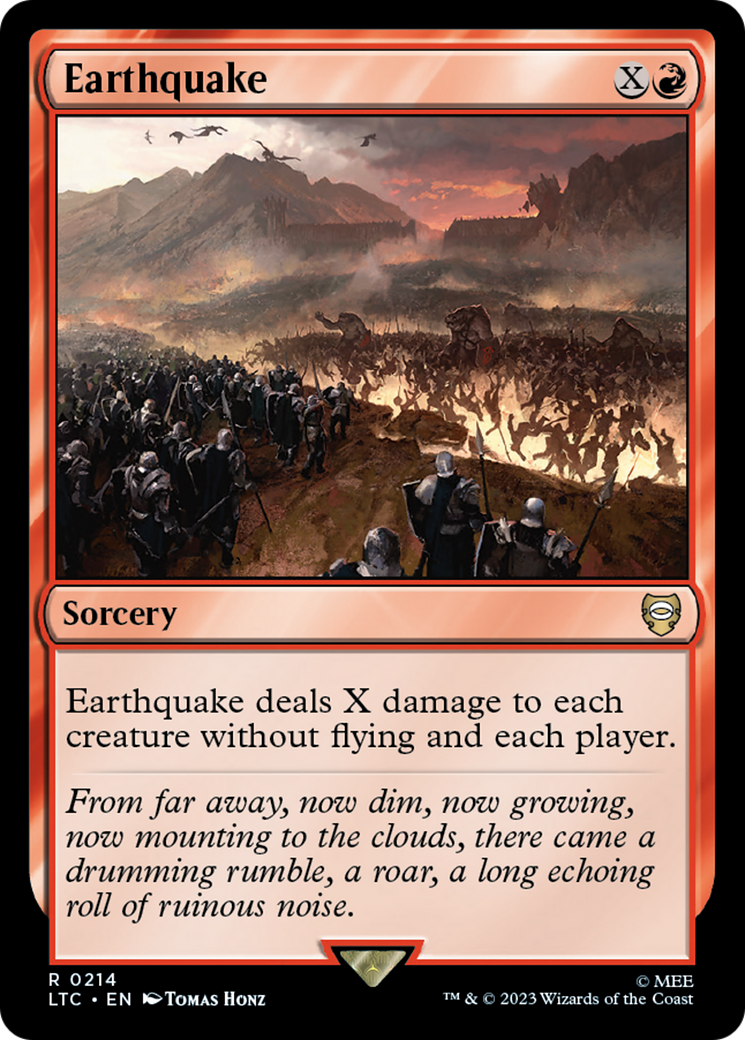
Earthquake
Earthquake
Sorcery
Earthquake deals X damage to each creature without flying and each player.
- Whether or not a creature is without flying is only checked on resolution.
-
1
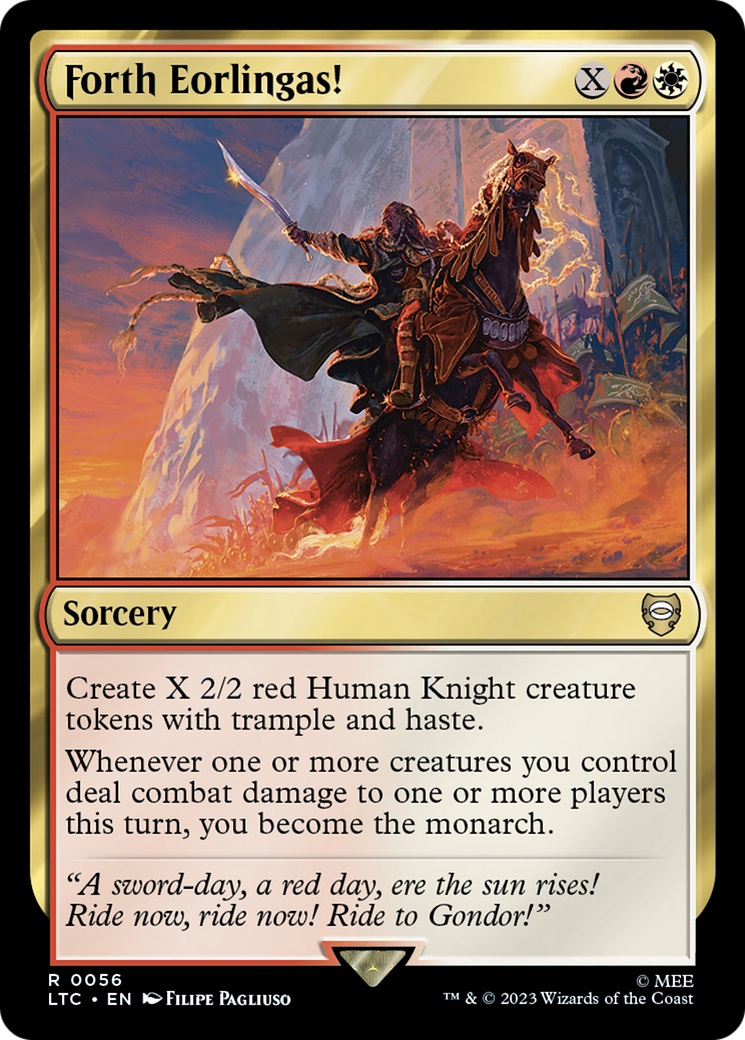
Forth Eorlingas!
Forth Eorlingas!
Sorcery
Create X 2/2 red Human Knight creature tokens with trample and haste.
Whenever one or more creatures you control deal combat damage to one or more players this turn, you become the monarch.
- The game starts with no monarch. Once an effect makes one player the monarch, the game will have exactly one monarch from that point forward. As a player becomes the monarch, the current monarch (if any) ceases being the monarch.
- There are two inherent triggered abilities associated with being the monarch. These triggered abilities have no source and are controlled by the player who was the monarch at the time the abilities triggered. The full texts of these abilities are "At the beginning of the monarch's end step, that player draws a card" and "Whenever a creature deals combat damage to the monarch, its controller becomes the monarch."
- If the triggered ability that causes the monarch to draw a card goes on the stack and a different player becomes the monarch before that ability resolves, the first player will still draw the card.
- If the monarch leaves the game during another player's turn, that player becomes the monarch. If the monarch leaves the game during their turn, the next player in turn order becomes the monarch.
- If combat damage dealt to the monarch causes that player to lose the game, the triggered ability that causes the controller of the attacking creature to become the monarch doesn't resolve. In most cases, the controller of the attacking creature will still become the monarch as it is likely their turn.
-
1
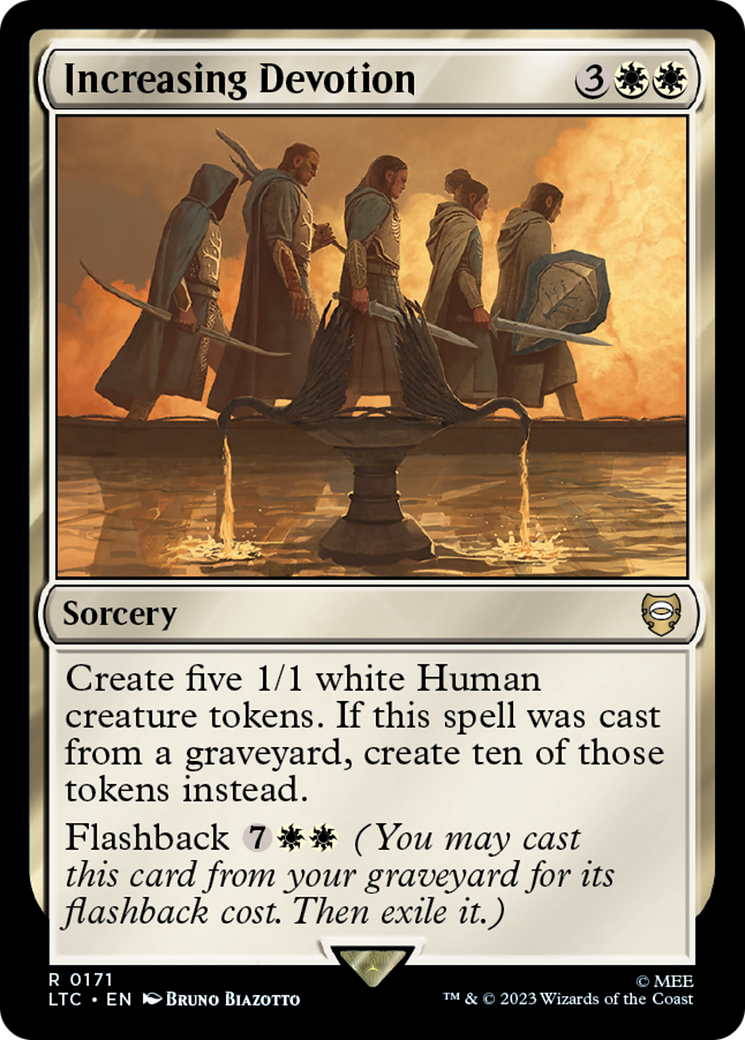
Increasing Devotion
Increasing Devotion
Sorcery
Create five 1/1 white Human creature tokens. If this spell was cast from a graveyard, create ten of those tokens instead.
Flashback (You may cast this card from your graveyard for its flashback cost. Then exile it.)
- "Flashback [cost]" means "You may cast this card from your graveyard by paying [cost] rather than paying its mana cost" and "If the flashback cost was paid, exile this card instead of putting it anywhere else any time it would leave the stack."
- You must still follow any timing restrictions and permissions, including those based on the card's type. For instance, you can cast a sorcery using flashback only when you could normally cast a sorcery.
- To determine the total cost of a spell, start with the mana cost or alternative cost (such as a flashback cost) you're paying, add any cost increases, then apply any cost reductions. The mana value of the spell is determined only by its mana cost, no matter what the total cost to cast the spell was.
- A spell cast using flashback will always be exiled afterward, whether it resolves, is countered, or leaves the stack in some other way.
- You can cast a spell using flashback even if it was somehow put into your graveyard without having been cast.
- If a card with flashback is put into your graveyard during your turn, you can cast it if it's legal to do so before any other player can take any actions.
-
1
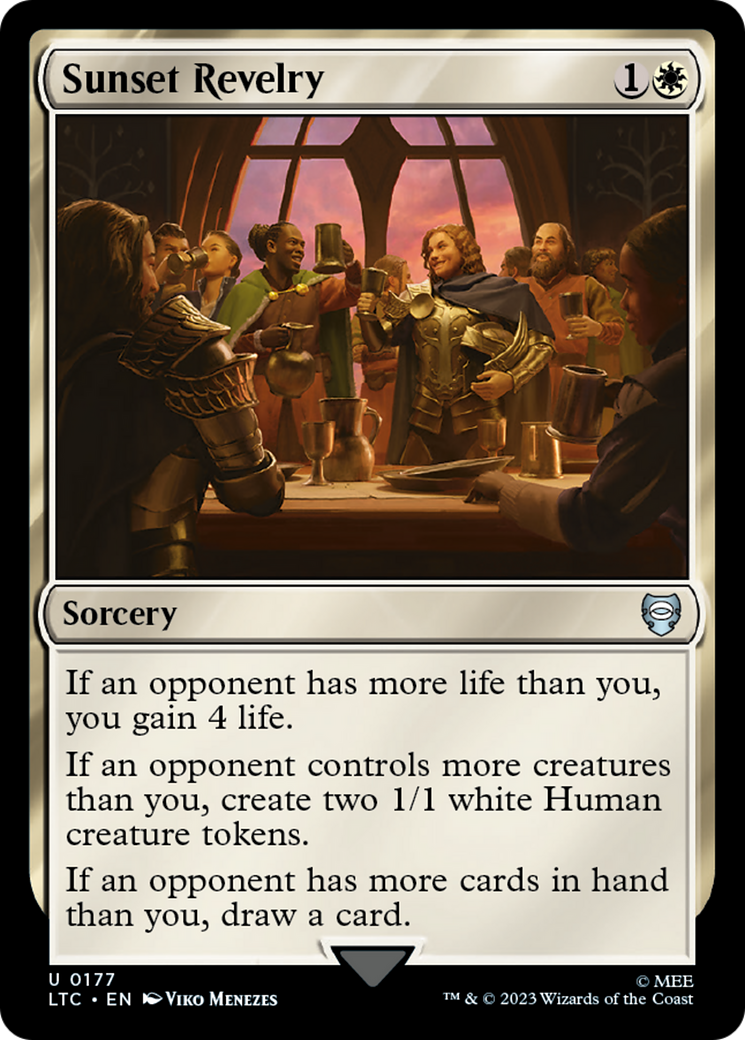
Sunset Revelry
Sunset Revelry
Sorcery
If an opponent has more life than you, you gain 4 life.
If an opponent controls more creatures than you, create two 1/1 white Human creature tokens.
If an opponent has more cards in hand than you, draw a card.
-
1
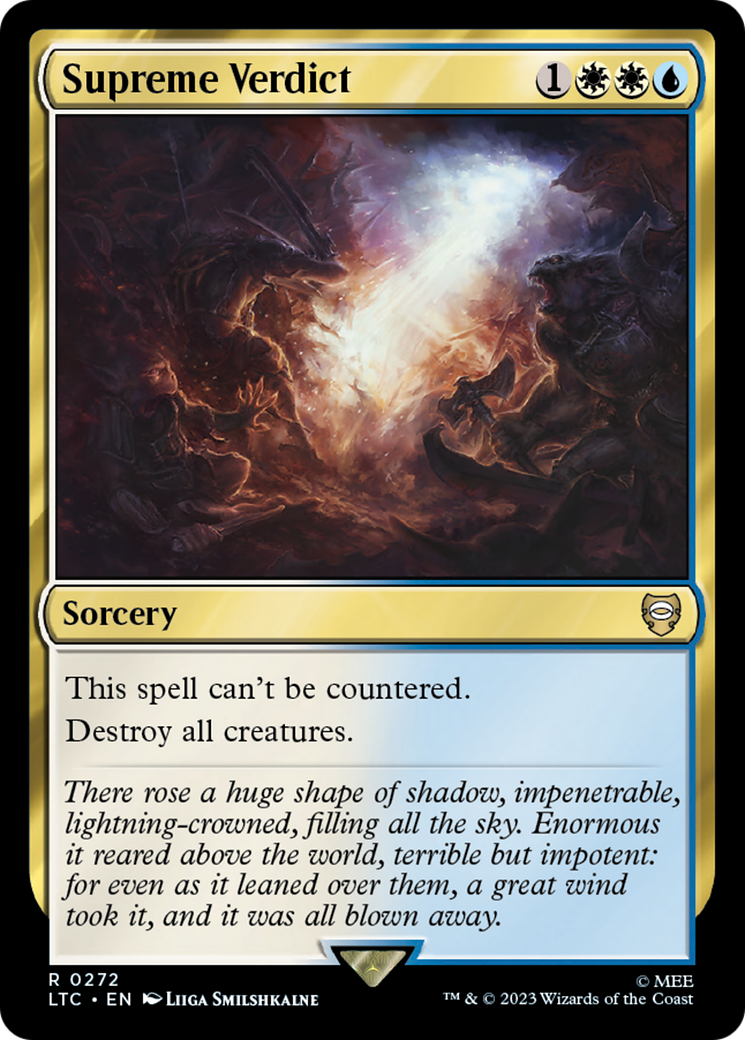
Supreme Verdict
Supreme Verdict
Sorcery
This spell can't be countered.
Destroy all creatures.
-
1
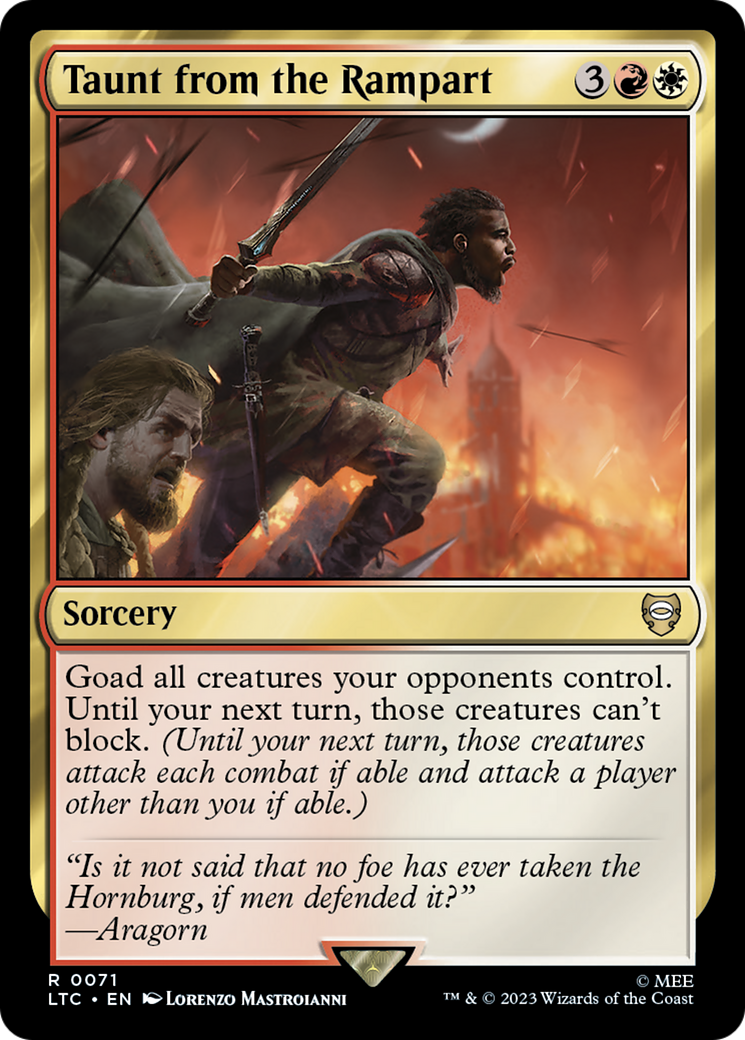
Taunt from the Rampart
Taunt from the Rampart
Sorcery
Goad all creatures your opponents control. Until your next turn, those creatures can't block. (Until your next turn, those creatures attack each combat if able and attack a player other than you if able.)
- If, during a player's declare attackers step, a creature that player controls that's been goaded is tapped, is affected by a spell or ability that says it can't attack, or hasn't been under that player's control continuously since the turn began (and doesn't have haste), then it doesn't attack. If there's a cost associated with having a creature attack a player, its controller isn't forced to pay that cost, so it doesn't have to attack that player.
- If the creature doesn't meet any of the above exceptions and can attack, it must attack a player other than the controller of the spell or ability that goaded it if able. If the creature can't attack any of those players but could otherwise attack, it must attack an opposing planeswalker (controlled by any opponent) or the player that goaded it.
- Being goaded isn't an ability the creature has. Once it's been goaded, it must attack as detailed above even if it loses all abilities.
- Attacking with a goaded creature doesn't cause it to stop being goaded. If there is an additional combat phase that turn, or if another player gains control of it before it stops being goaded, it must attack again if able.
- If a creature you control has been goaded by multiple opponents, it must attack one of your opponents that hasn't goaded it, as that fulfills the maximum number of goad requirements. If a creature you control has been goaded by each of your opponents, you choose which opponent it attacks.
-
1
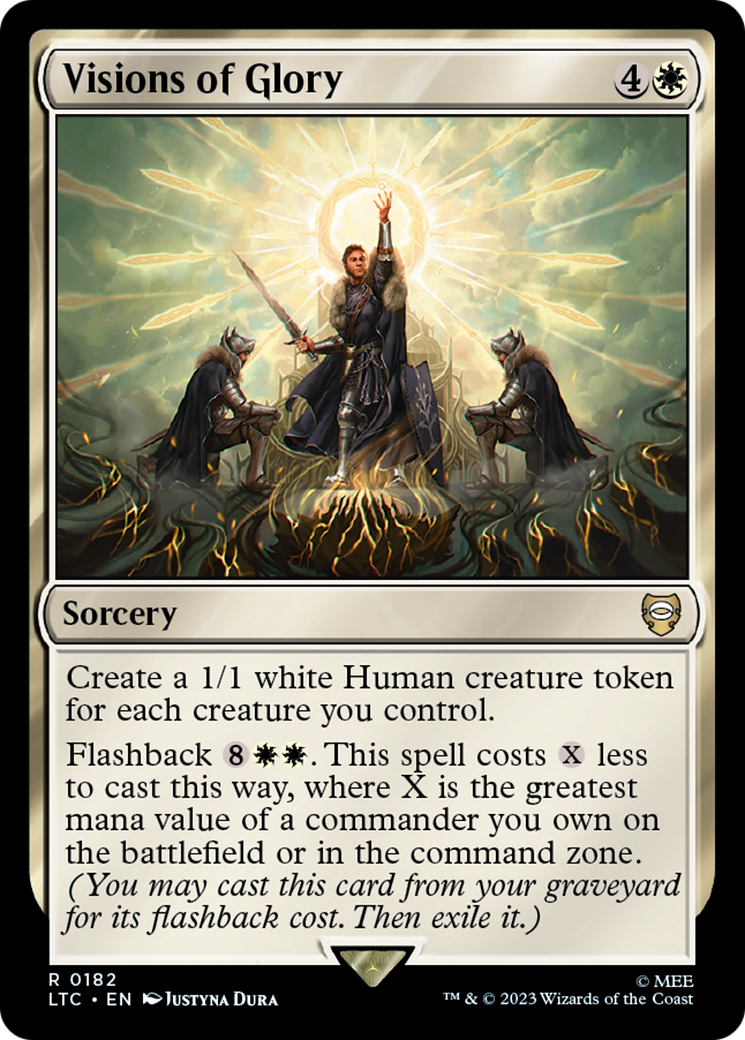
Visions of Glory
Visions of Glory
Sorcery
Create a 1/1 white Human creature token for each creature you control.
Flashback . This spell costs less to cast this way, where X is the greatest mana value of a commander you own on the battlefield or in the command zone. (You may cast this card from your graveyard for its flashback cost. Then exile it.)
- "Flashback [cost]" means "You may cast this card from your graveyard by paying [cost] rather than paying its mana cost" and "If the flashback cost was paid, exile this card instead of putting it anywhere else any time it would leave the stack."
- You must still follow any timing restrictions and permissions, including those based on the card's type. For instance, you can cast a sorcery using flashback only when you could normally cast a sorcery.
- To determine the total cost of a spell, start with the mana cost or alternative cost (such as a flashback cost) you're paying, add any cost increases, then apply any cost reductions. The mana value of the spell is determined only by its mana cost, no matter what the total cost to cast the spell was.
- A spell cast using flashback will always be exiled afterward, whether it resolves, is countered, or leaves the stack in some other way.
- You can cast a spell using flashback even if it was somehow put into your graveyard without having been cast.
- If a card with flashback is put into your graveyard during your turn, you can cast it if it's legal to do so before any other player can take any actions.
Artifacts 12
-
1
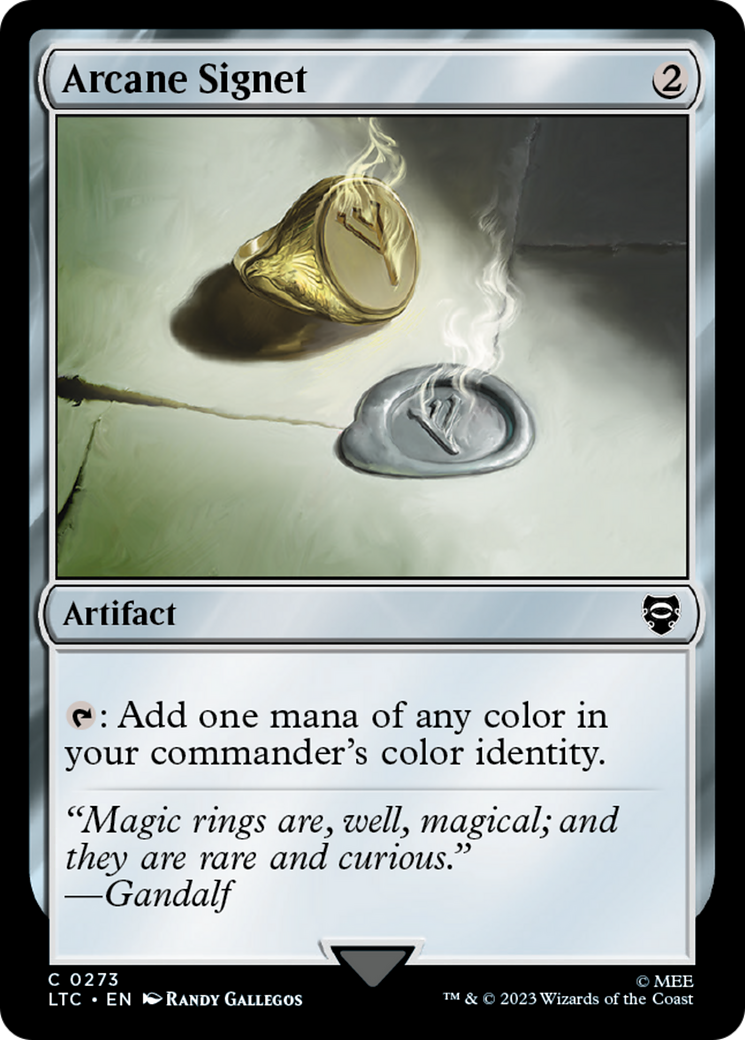
Arcane Signet
Arcane Signet
Artifact
: Add one mana of any color in your commander's color identity.
- If you have two commanders, the ability adds one mana of any color in their combined color identities.
- If your commander is a card that has no colors in its color identity, Arcane Signet's ability produces no mana. It doesn't produce .
- If you don't have a commander, Arcane Signet's ability produces no mana.
-
1
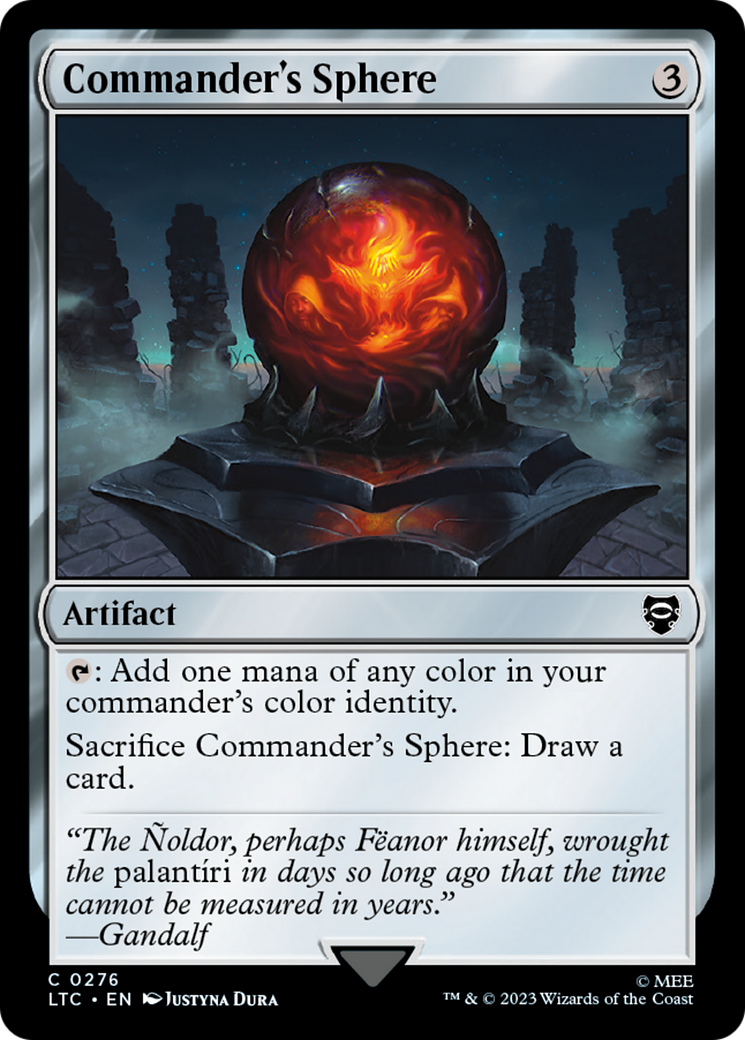
Commander's Sphere
Commander's Sphere
Artifact
: Add one mana of any color in your commander's color identity.
Sacrifice this artifact: Draw a card.
- If you have two commanders, the ability adds one mana of any color in their combined color identities.
- If your commander is a card that has no colors in its color identity, Commander's Sphere's first ability produces no mana. It doesn't produce .
- If you don't have a commander, Commander's Sphere's first ability produces no mana.
-
1
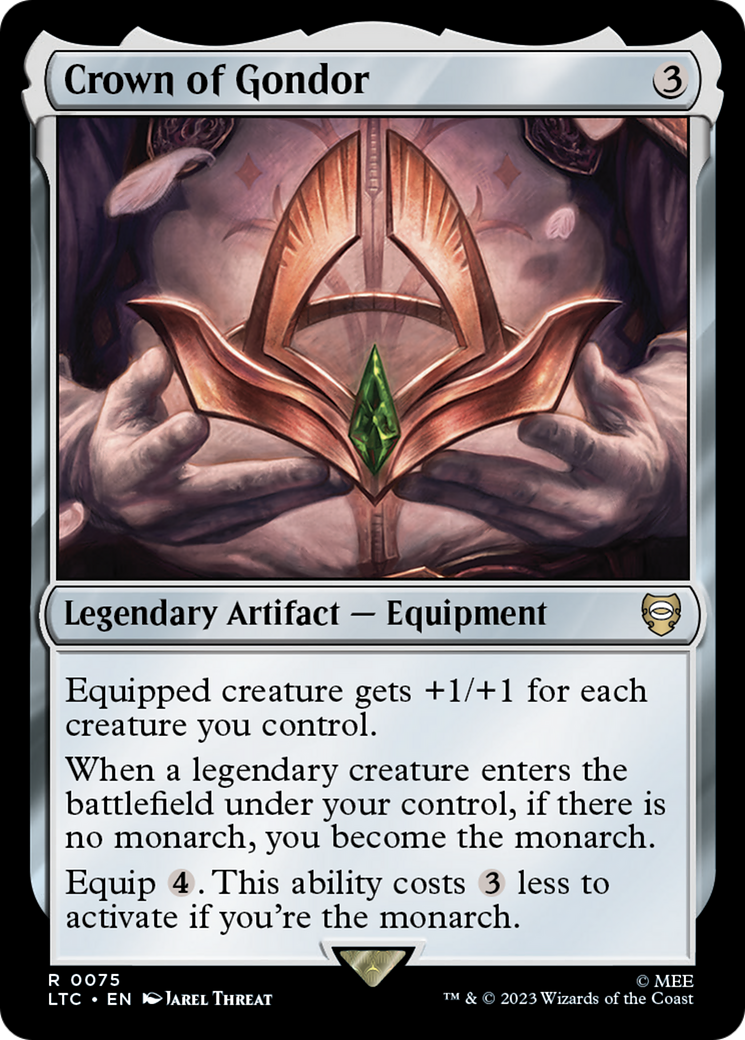
Crown of Gondor
Crown of Gondor
Legendary Artifact — Equipment
Equipped creature gets +1/+1 for each creature you control.
When a legendary creature you control enters, if there is no monarch, you become the monarch.
Equip . This ability costs less to activate if you're the monarch.
- The game starts with no monarch. Once an effect makes one player the monarch, the game will have exactly one monarch from that point forward. As a player becomes the monarch, the current monarch (if any) ceases being the monarch.
- There are two inherent triggered abilities associated with being the monarch. These triggered abilities have no source and are controlled by the player who was the monarch at the time the abilities triggered. The full texts of these abilities are "At the beginning of the monarch's end step, that player draws a card" and "Whenever a creature deals combat damage to the monarch, its controller becomes the monarch."
- If the triggered ability that causes the monarch to draw a card goes on the stack and a different player becomes the monarch before that ability resolves, the first player will still draw the card.
- If the monarch leaves the game during another player's turn, that player becomes the monarch. If the monarch leaves the game during their turn, the next player in turn order becomes the monarch.
- If combat damage dealt to the monarch causes that player to lose the game, the triggered ability that causes the controller of the attacking creature to become the monarch doesn't resolve. In most cases, the controller of the attacking creature will still become the monarch as it is likely their turn.
-
1
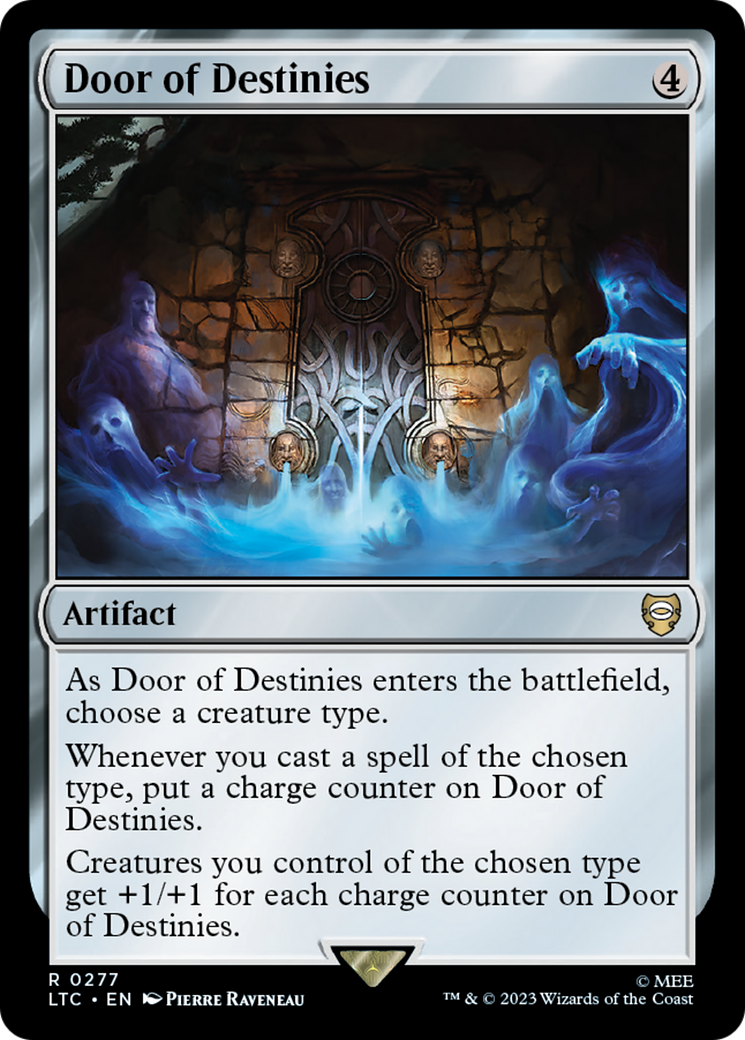
Door of Destinies
Door of Destinies
Artifact
As this artifact enters, choose a creature type.
Whenever you cast a spell of the chosen type, put a charge counter on this artifact.
Creatures you control of the chosen type get +1/+1 for each charge counter on this artifact.
- Creature types, such as Human or Sliver, appear after the dash on the type line of creatures. Notably, artifact is not a creature type. A creature may have more than one creature type, such as Goblin Warrior. Such a creature would benefit from Door of Destinies if the chosen creature type was Goblin or Warrior.
- If you cast a creature spell of the chosen type, Door of Destinies will get a charge counter before the creature enters. The creature will enter with the additional boost to its power and toughness.
-
1
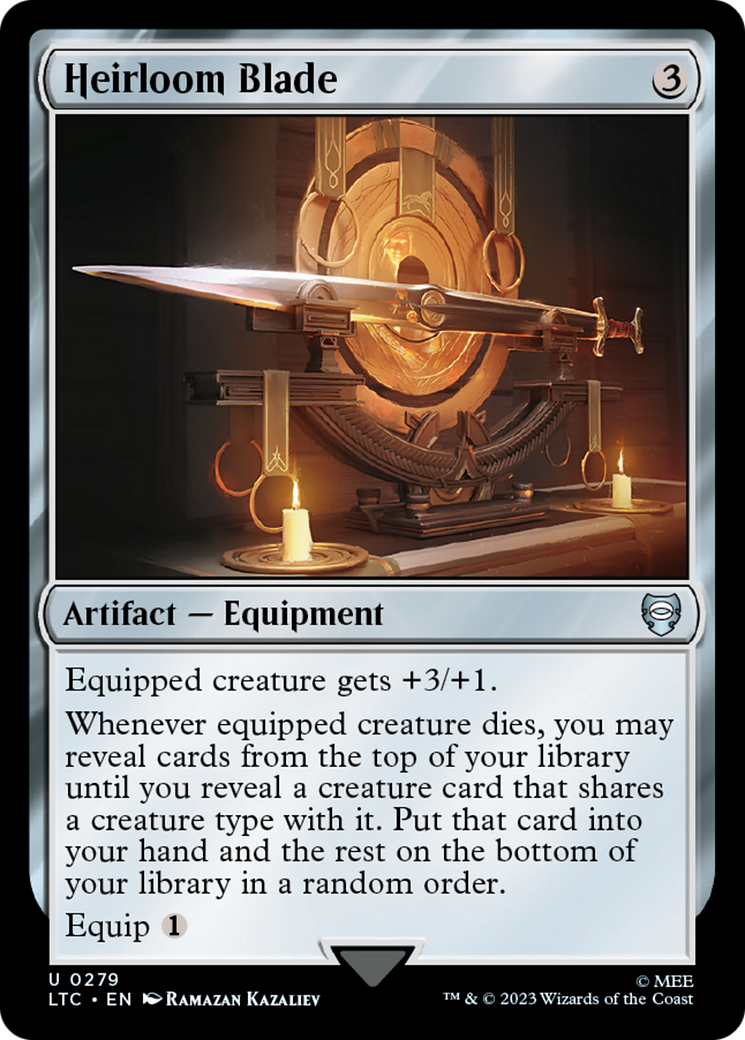
Heirloom Blade
Heirloom Blade
Artifact — Equipment
Equipped creature gets +3/+1.
Whenever equipped creature dies, you may reveal cards from the top of your library until you reveal a creature card that shares a creature type with it. Put that card into your hand and the rest on the bottom of your library in a random order.
Equip
- If you don't reveal a creature card that shares a type with the creature that died, you'll just reveal and randomize your library.
- If the equipped creature has no creature type, no card can share a creature type with it.
- You'll reveal cards until you find one that shares at least one creature type with the creature that died. For example, if a Cat Wizard dies, you'll stop if you reveal a Human Wizard or Cat Soldier.
- Compare the revealed cards to the creature as it last existed before it died, not to the creature card as it exists in its owner's graveyard, to determine which one you put into your hand.
- "Artifact" isn't a creature type.
- If Heirloom Blade leaves the battlefield at the same time that the equipped creature dies, its triggered ability triggers.
-
1
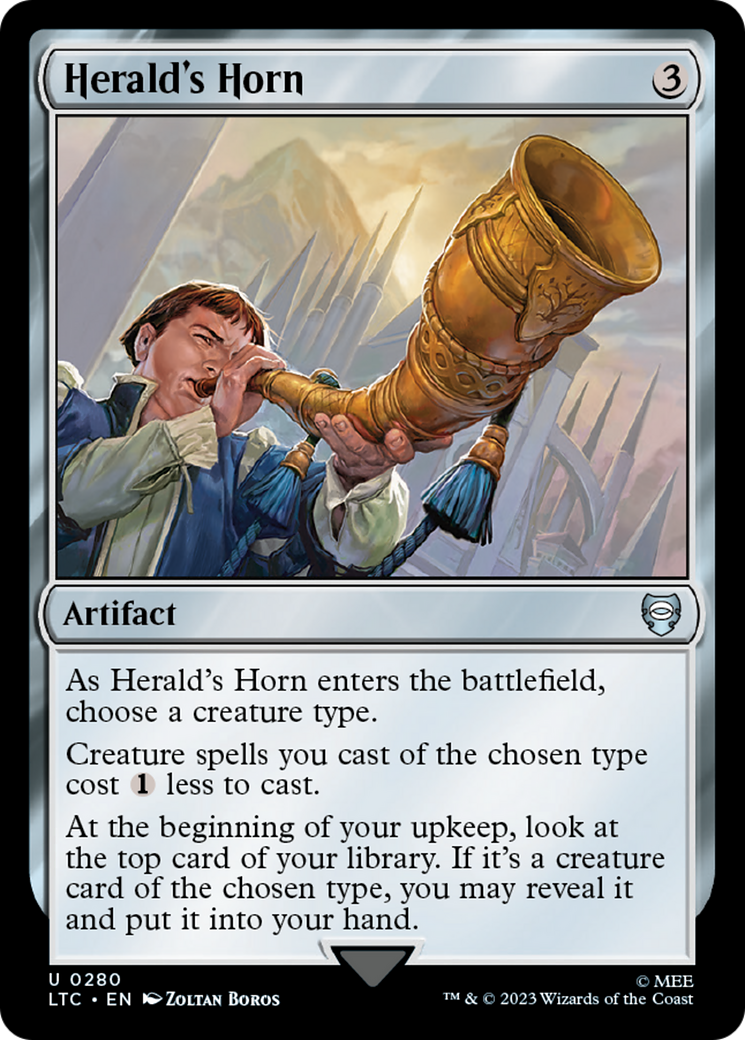
Herald's Horn
Herald's Horn
Artifact
As this artifact enters, choose a creature type.
Creature spells you cast of the chosen type cost less to cast.
At the beginning of your upkeep, look at the top card of your library. If it's a creature card of the chosen type, you may reveal it and put it into your hand.
- The effect of Herald's Horn reduces only generic mana in a spell's cost. If that cost has no generic mana, the cost isn't reduced.
- To determine the total cost of a spell, start with the mana cost or alternative cost you're paying, add any cost increases, then apply any cost reductions. The mana value of the spell remains unchanged, no matter what the total cost to cast it was.
- If you don't put the top card of your library into your hand, you put it back on top of your library without revealing it. You'll draw it in that turn's draw step.
- If you somehow control a Herald's Horn with no chosen creature type, no spells will cost less to cast, not even creature spells with no creature type. You'll be able to look at the top card of your library at the beginning of each of your upkeeps, but you can never put it into your hand this way, even if it's a creature card with no creature type.
- You must choose an existing creature type, such as Vampire or Cat. Card types such as "artifact" can't be chosen.
- You can't choose multiple creature types, such as "Cat Warrior." A Cat Warrior is both a Cat and a Warrior. It's affected by anything that affects either type and unaffected by things that affect non-Cat or non-Warrior creatures.
-
1
Sol Ring
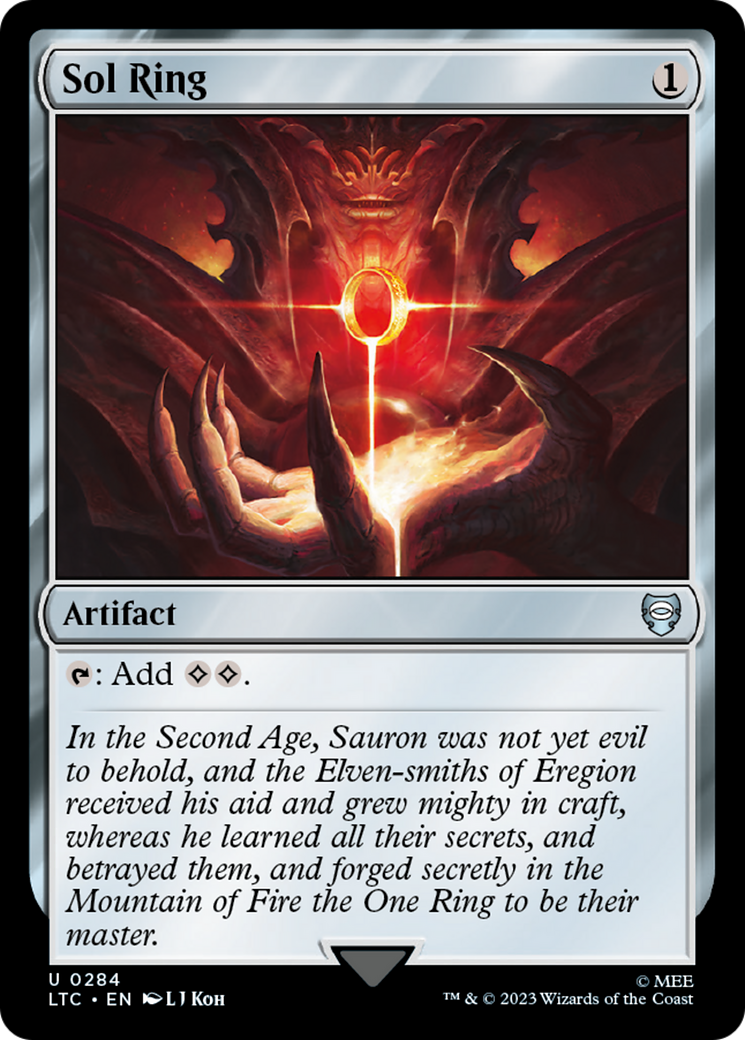
Sol Ring
Artifact
: Add .
-
1
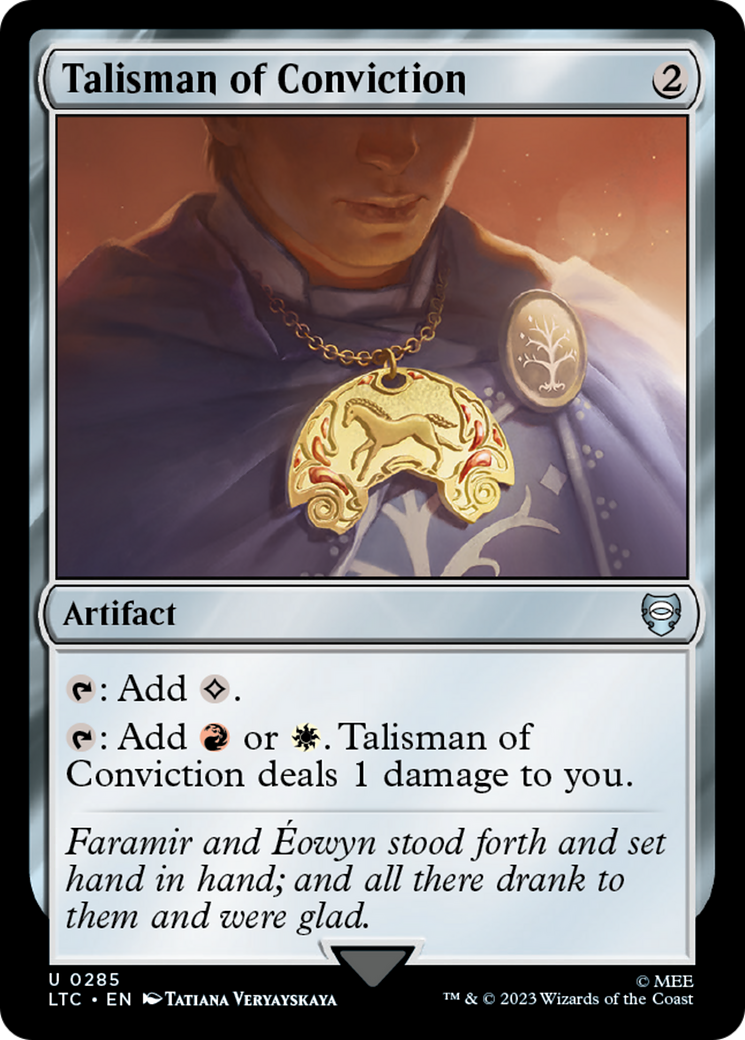
Talisman of Conviction
Talisman of Conviction
Artifact
: Add .
: Add or . This artifact deals 1 damage to you.
-
1
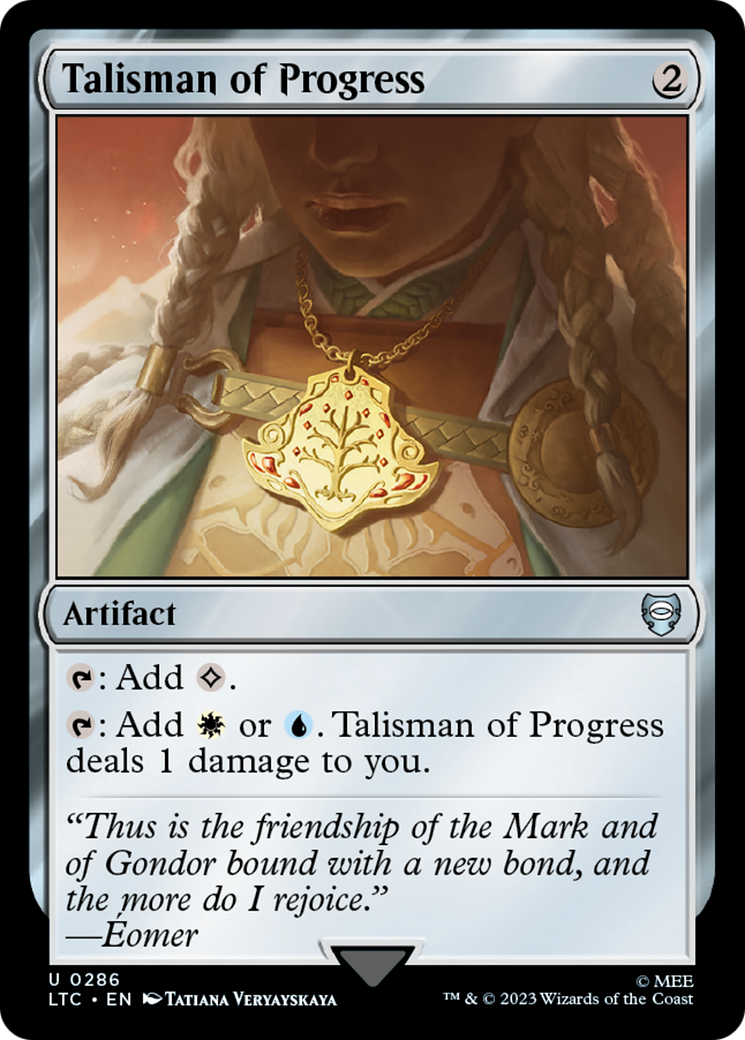
Talisman of Progress
Talisman of Progress
Artifact
: Add .
: Add or . This artifact deals 1 damage to you.
-
1
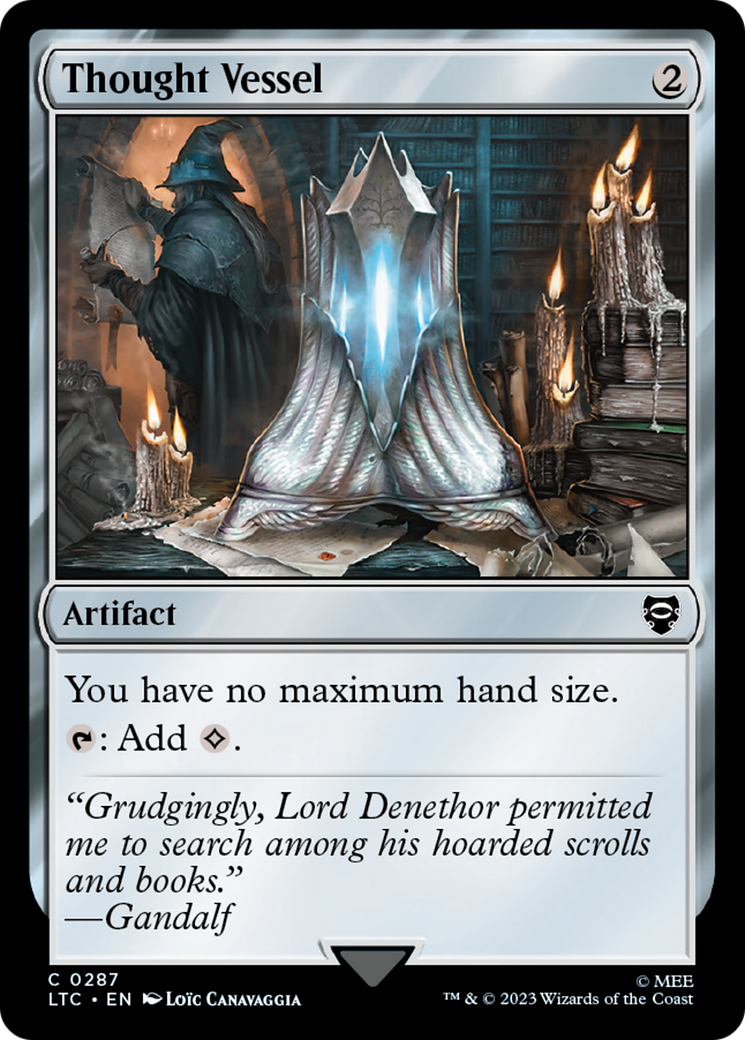
Thought Vessel
Thought Vessel
Artifact
You have no maximum hand size.
: Add .
-
1
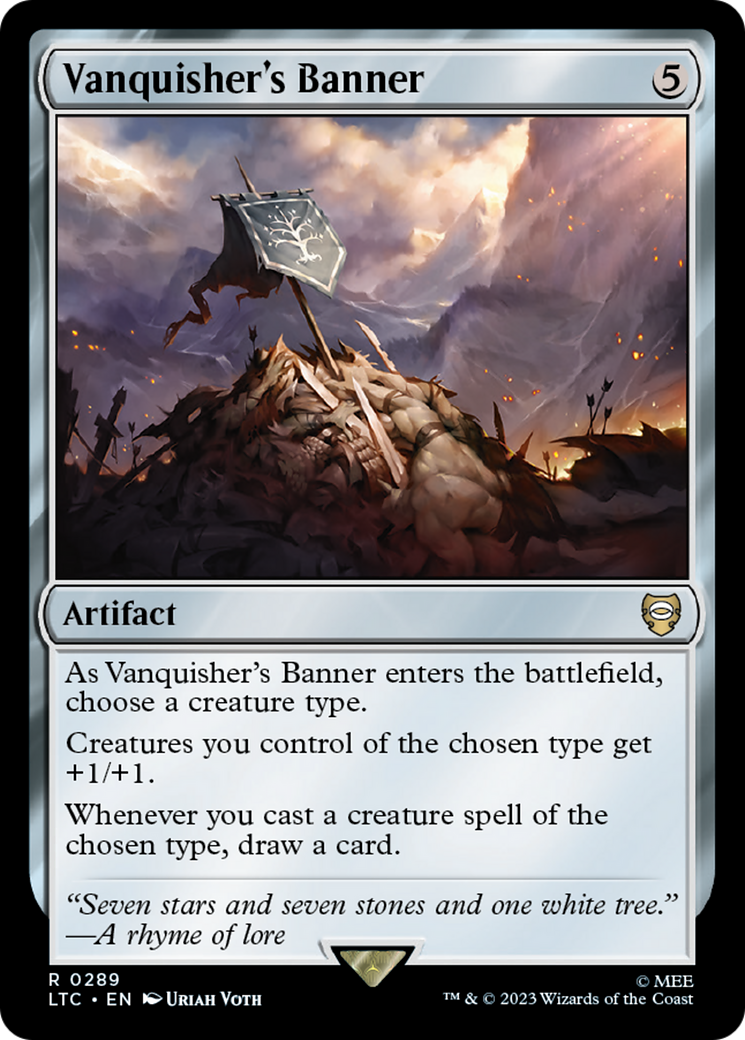
Vanquisher's Banner
Vanquisher's Banner
Artifact
As this artifact enters, choose a creature type.
Creatures you control of the chosen type get +1/+1.
Whenever you cast a creature spell of the chosen type, draw a card.
- The choice of creature type is made as Vanquisher's Banner enters the battlefield. Players can't respond to this choice. The bonus starts applying immediately.
- The last ability of Vanquisher's Banner resolves before the spell that caused it to trigger. The ability will resolve even if the creature spell is countered.
- To choose a creature type, you must choose an existing creature type, such as Fungus or Sliver. You can't choose multiple creature types, such as Fungus Sliver. Card types such as artifact can't be chosen, nor can subtypes that aren't creature types, such as Jace, Vehicle, or Treasure.
- Because damage remains marked on a creature until the damage is removed as the turn ends, nonlethal damage dealt to a creature you control of the chosen type may become lethal if Vanquisher's Banner leaves the battlefield during that turn.
- The choice of creature type is made as Vanquisher's Banner enters the battlefield. Players can't respond to this choice. The bonus starts applying immediately.
- The last ability of Vanquisher's Banner resolves before the spell that caused it to trigger. The ability will resolve even if the creature spell is countered.
-
1
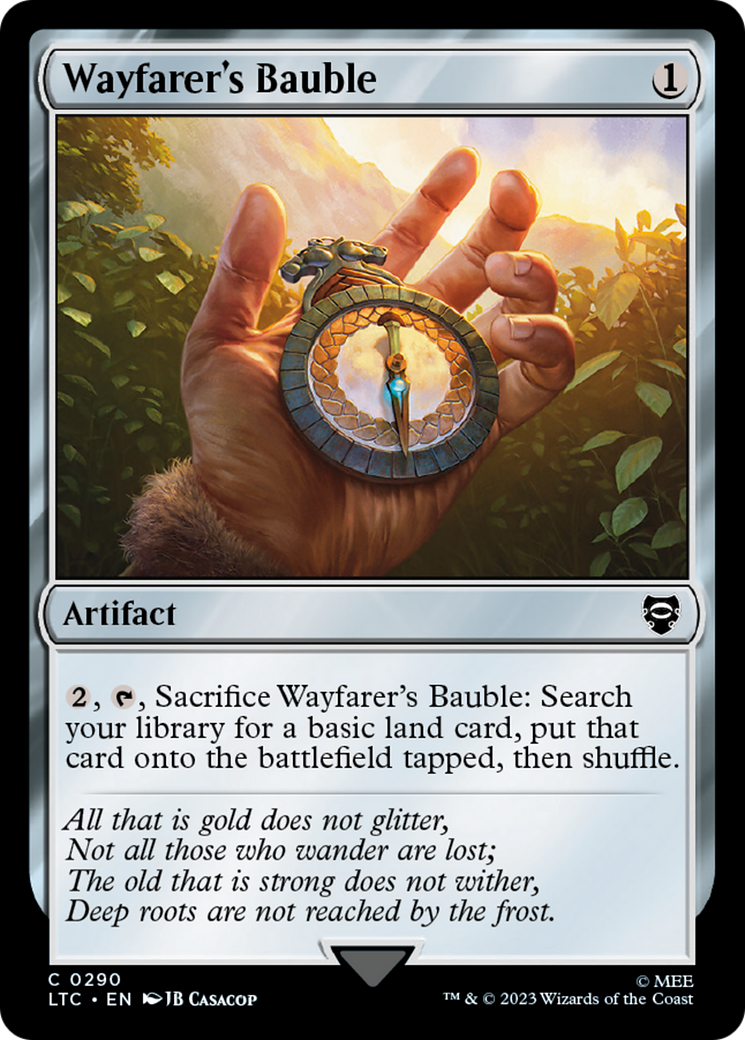
Wayfarer's Bauble
Wayfarer's Bauble
Artifact
, , Sacrifice this artifact: Search your library for a basic land card, put that card onto the battlefield tapped, then shuffle.
Enchantments 6
-
1
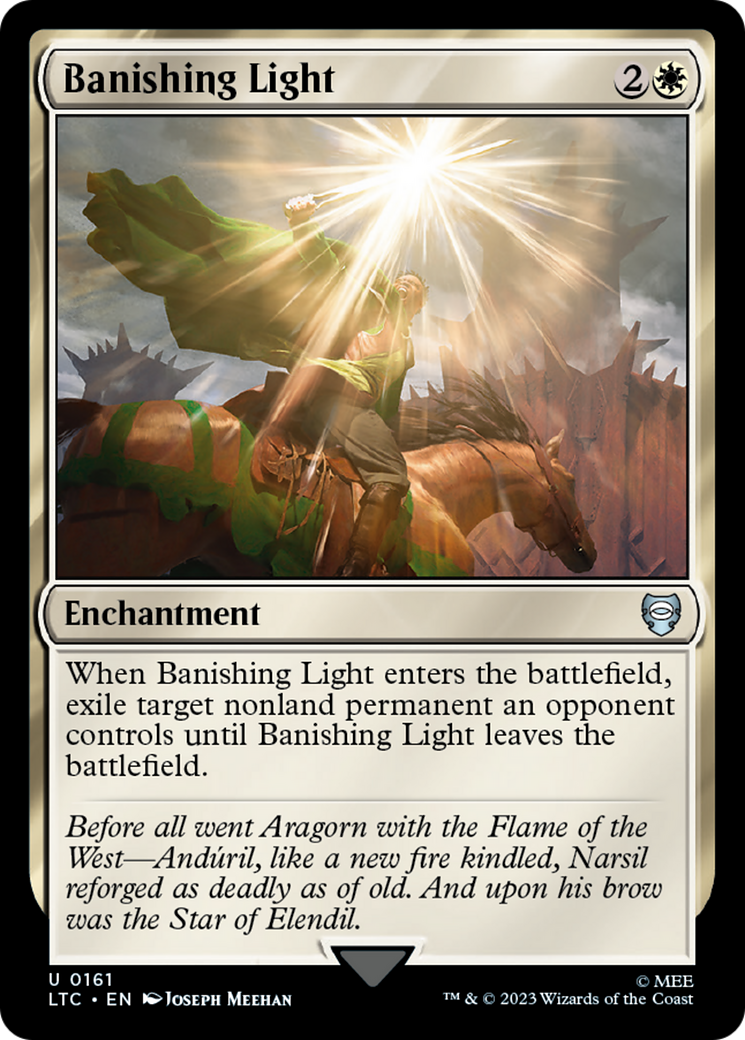
Banishing Light
Banishing Light
Enchantment
When this enchantment enters, exile target nonland permanent an opponent controls until this enchantment leaves the battlefield.
- If Banishing Light leaves the battlefield before its triggered ability resolves, the target permanent won't be exiled.
- Auras attached to the exiled permanent will be put into their owners' graveyards. Any Equipment will become unattached and remain on the battlefield. Any counters on the exiled permanent will cease to exist. When the card returns to the battlefield, it will be a new object with no connection to the card that was exiled.
- If a token is exiled this way, it will cease to exist and won't return to the battlefield.
- If an Aura is exiled this way, its owner chooses what it will enchant as it returns to the battlefield. An Aura put onto the battlefield this way doesn't target anything (so it could be attached to a permanent with shroud, for example), but the Aura's enchant ability restricts what it can be attached to. If the Aura can't legally be attached to anything, it remains in exile for the rest of the game.
-
1
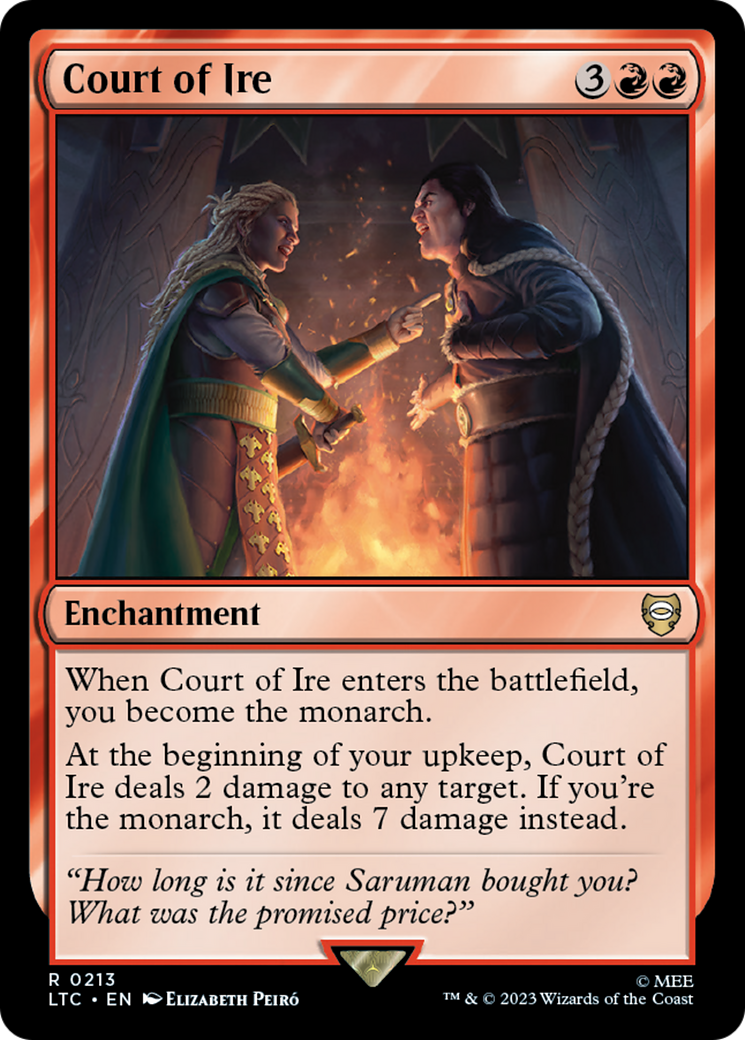
Court of Ire
Court of Ire
Enchantment
When this enchantment enters, you become the monarch.
At the beginning of your upkeep, this enchantment deals 2 damage to any target. If you're the monarch, it deals 7 damage instead.
- The game starts with no monarch. Once an effect makes one player the monarch, the game will have exactly one monarch from that point forward. As a player becomes the monarch, the current monarch (if any) ceases being the monarch.
- There are two inherent triggered abilities associated with being the monarch. These triggered abilities have no source and are controlled by the player who was the monarch at the time the abilities triggered. The full texts of these abilities are "At the beginning of the monarch's end step, that player draws a card" and "Whenever a creature deals combat damage to the monarch, its controller becomes the monarch."
- If the triggered ability that causes the monarch to draw a card goes on the stack and a different player becomes the monarch before that ability resolves, the first player will still draw the card.
- If the monarch leaves the game during another player's turn, that player becomes the monarch. If the monarch leaves the game during their turn, the next player in turn order becomes the monarch.
- If combat damage dealt to the monarch causes that player to lose the game, the triggered ability that causes the controller of the attacking creature to become the monarch doesn't resolve. In most cases, the controller of the attacking creature will still become the monarch as it is likely their turn.
-
1
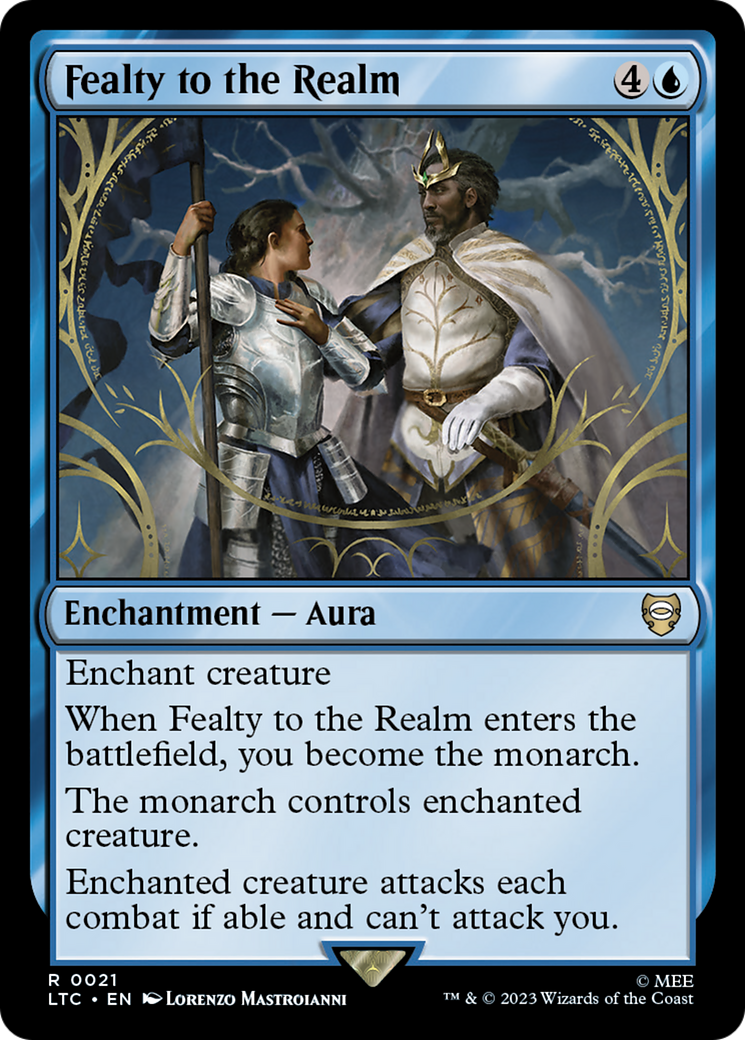
Fealty to the Realm
Fealty to the Realm
Enchantment — Aura
Enchant creature
When this Aura enters, you become the monarch.
The monarch controls enchanted creature.
Enchanted creature attacks each combat if able and can't attack you.
- The timestamp of Fealty to the Realm's control-changing effect is the time at which it entered the battlefield and won't change when another player becomes the monarch. This means that, if another player gains control of the creature enchanted with Fealty to the Realm, they won't lose control of it when another player becomes the monarch. When (or if) that control-changing effect ends, the enchanted creature will then be controlled by the current monarch, which might be a different player than it was when that control-changing effect began.
- In the case where Fealty to the Realm is enchanting a creature but there is no monarch, the second ability will create a control-changing effect with the timestamp mentioned above, but that effect won't do anything until a player becomes the monarch.
- If the monarch leaves the game, and that player is not the owner of Fealty to the Realm, the active player or the next player in turn order becomes the monarch and thus gains control of the enchanted creature.
- If the monarch leaves the game, and that player is the owner of Fealty to the Realm, the active player or the next player in turn order becomes the monarch. That player gains control of the enchanted creature for a very brief moment. At the same time, Fealty to the Realm leaves the game, and control of the enchanted creature reverts to its owner (unless another control-changing effect applies.)
- The game starts with no monarch. Once an effect makes one player the monarch, the game will have exactly one monarch from that point forward. As a player becomes the monarch, the current monarch (if any) ceases being the monarch.
- There are two inherent triggered abilities associated with being the monarch. These triggered abilities have no source and are controlled by the player who was the monarch at the time the abilities triggered. The full texts of these abilities are "At the beginning of the monarch's end step, that player draws a card" and "Whenever a creature deals combat damage to the monarch, its controller becomes the monarch."
- If the triggered ability that causes the monarch to draw a card goes on the stack and a different player becomes the monarch before that ability resolves, the first player will still draw the card.
- If the monarch leaves the game during another player's turn, that player becomes the monarch. If the monarch leaves the game during their turn, the next player in turn order becomes the monarch.
- If combat damage dealt to the monarch causes that player to lose the game, the triggered ability that causes the controller of the attacking creature to become the monarch doesn't resolve. In most cases, the controller of the attacking creature will still become the monarch as it is likely their turn.
-
1
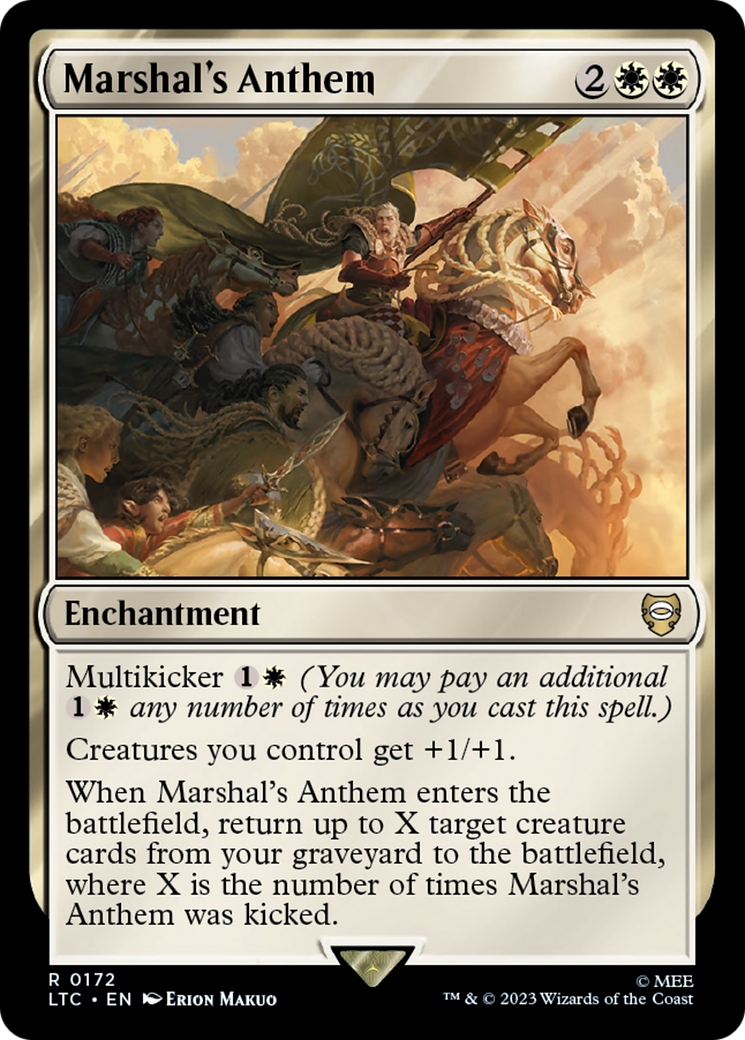
Marshal's Anthem
Marshal's Anthem
Enchantment
Multikicker (You may pay an additional any number of times as you cast this spell.)
Creatures you control get +1/+1.
When this enchantment enters, return up to X target creature cards from your graveyard to the battlefield, where X is the number of times this enchantment was kicked.
- If a spell's kicker cost was paid, the spell is "kicked."
- The kicker ability doesn't let you pay a kicker cost more than once.
- If you put a permanent with a kicker ability onto the battlefield without casting it, you can't kick it.
- If you copy a kicked spell on the stack, the copy is also kicked. If the copied spell is a permanent spell, the token the copy of that spell becomes when it enters is also kicked.
- If a card or token enters as a copy of a permanent, the new permanent isn't kicked, even if the original was.
- To determine a spell's total cost, start with the mana cost (or an alternative cost if another card's effect allows you to pay one instead), add any cost increases (such as kicker), then apply any cost reductions. The spell's mana value remains unchanged, no matter what the total cost to cast it was.
-
1
Oath of Eorl
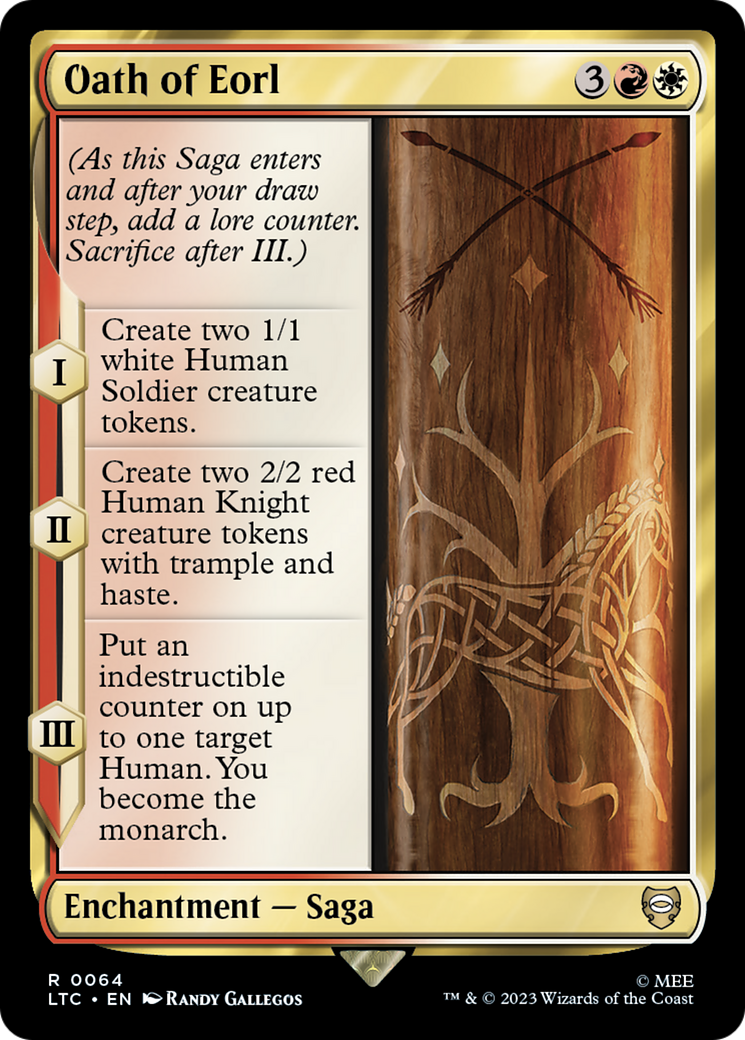
Oath of Eorl
Enchantment — Saga
(As this Saga enters and after your draw step, add a lore counter. Sacrifice after III.)
I — Create two 1/1 white Human Soldier creature tokens.
II — Create two 2/2 red Human Knight creature tokens with trample and haste.
III — Put an indestructible counter on up to one target Human. You become the monarch.
- When Oath of Eorl's final chapter ability triggers, you can choose not to target a Human just to become the monarch. However, if you do choose a target, and that target is illegal at the time the ability tries to resolve, the ability won't resolve and none of its effects will happen. You won't become the monarch.
- The game starts with no monarch. Once an effect makes one player the monarch, the game will have exactly one monarch from that point forward. As a player becomes the monarch, the current monarch (if any) ceases being the monarch.
- There are two inherent triggered abilities associated with being the monarch. These triggered abilities have no source and are controlled by the player who was the monarch at the time the abilities triggered. The full texts of these abilities are "At the beginning of the monarch's end step, that player draws a card" and "Whenever a creature deals combat damage to the monarch, its controller becomes the monarch."
- If the triggered ability that causes the monarch to draw a card goes on the stack and a different player becomes the monarch before that ability resolves, the first player will still draw the card.
- If the monarch leaves the game during another player's turn, that player becomes the monarch. If the monarch leaves the game during their turn, the next player in turn order becomes the monarch.
- If combat damage dealt to the monarch causes that player to lose the game, the triggered ability that causes the controller of the attacking creature to become the monarch doesn't resolve. In most cases, the controller of the attacking creature will still become the monarch as it is likely their turn.
-
1
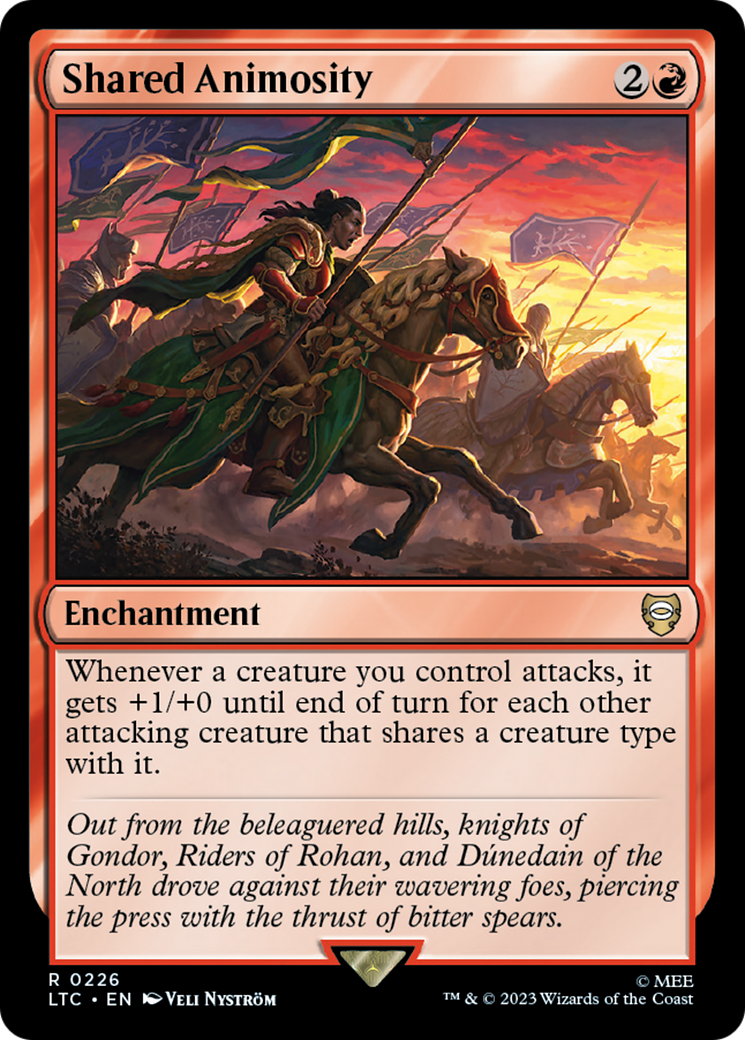
Shared Animosity
Shared Animosity
Enchantment
Whenever a creature you control attacks, it gets +1/+0 until end of turn for each other attacking creature that shares a creature type with it.
- This ability counts creatures, not creature types. For example, if you attack with five creatures — an Elf Shaman, an Elf Warrior, a Goblin Shaman, an Elemental, and a creature with all creature types — the ability will trigger five times. Those creatures will get +3/+0, +2/+0, +2/+0, +1/+0, and +4/+0, respectively.
- In a Two-Headed Giant game, only creatures you control trigger the ability and get the bonus, but your teammate's attacking creatures are included in the calculation of those bonuses.
Lands 38
-
1
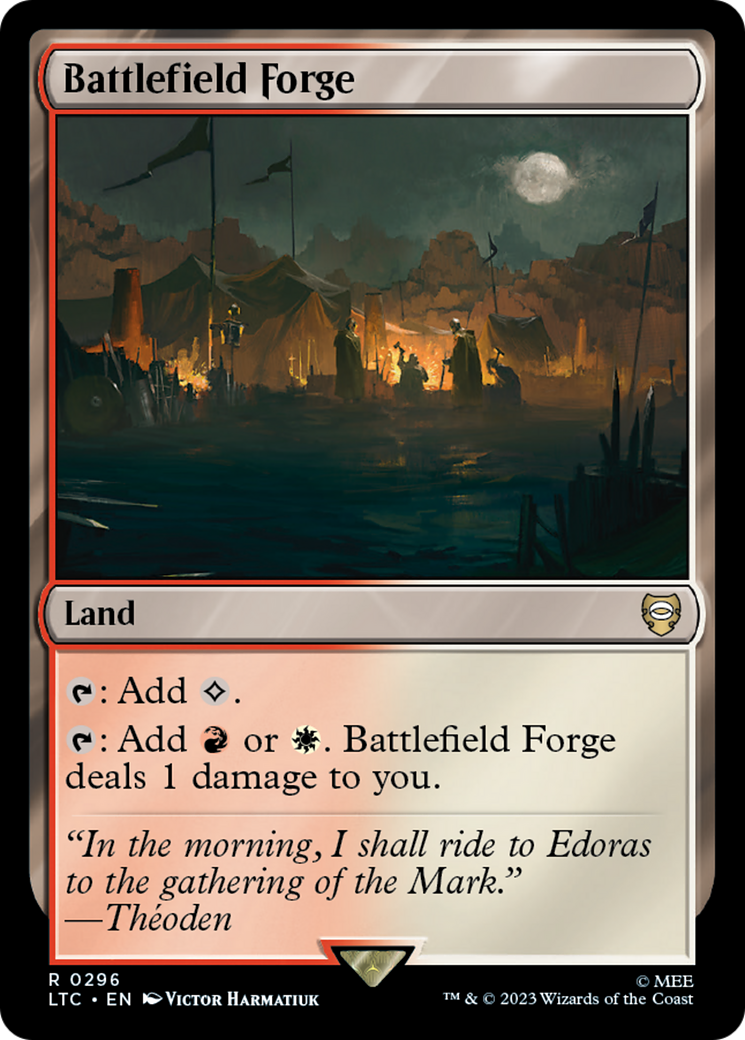
Battlefield Forge
Battlefield Forge
Land
: Add .
: Add or . This land deals 1 damage to you.
- The damage dealt to you is part of the second mana ability. It doesn't use the stack and can't be responded to.
- Like most lands, each land in this cycle is colorless. The damage dealt to you is dealt by a colorless source.
-
1
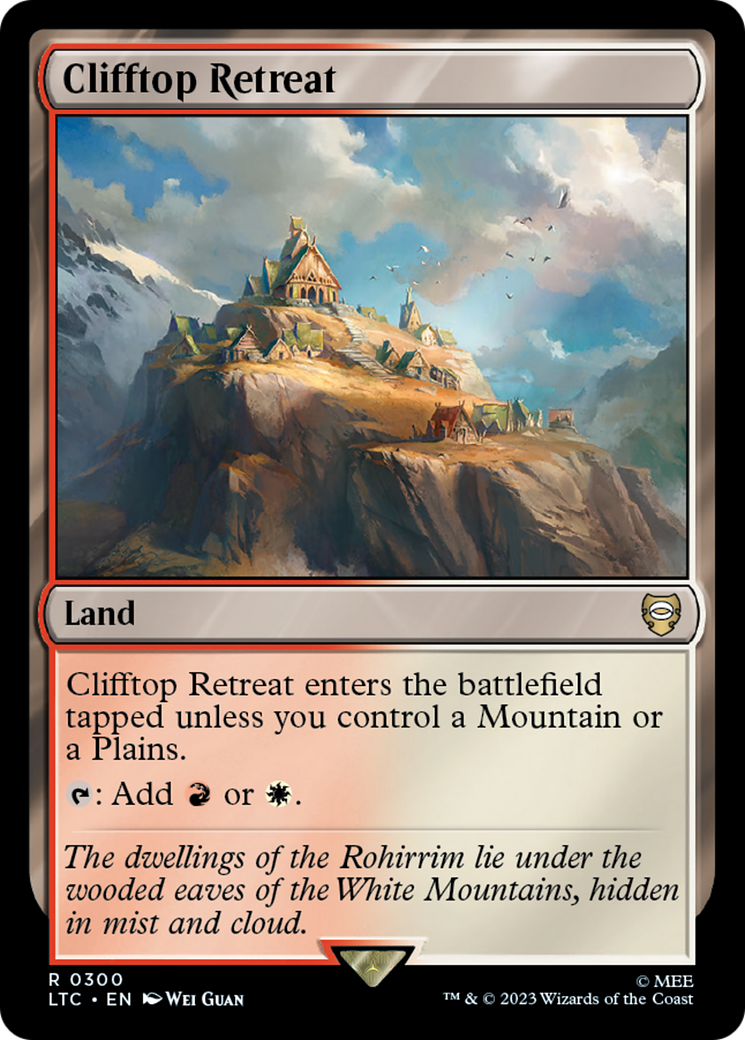
Clifftop Retreat
Clifftop Retreat
Land
This land enters tapped unless you control a Mountain or a Plains.
: Add or .
-
1
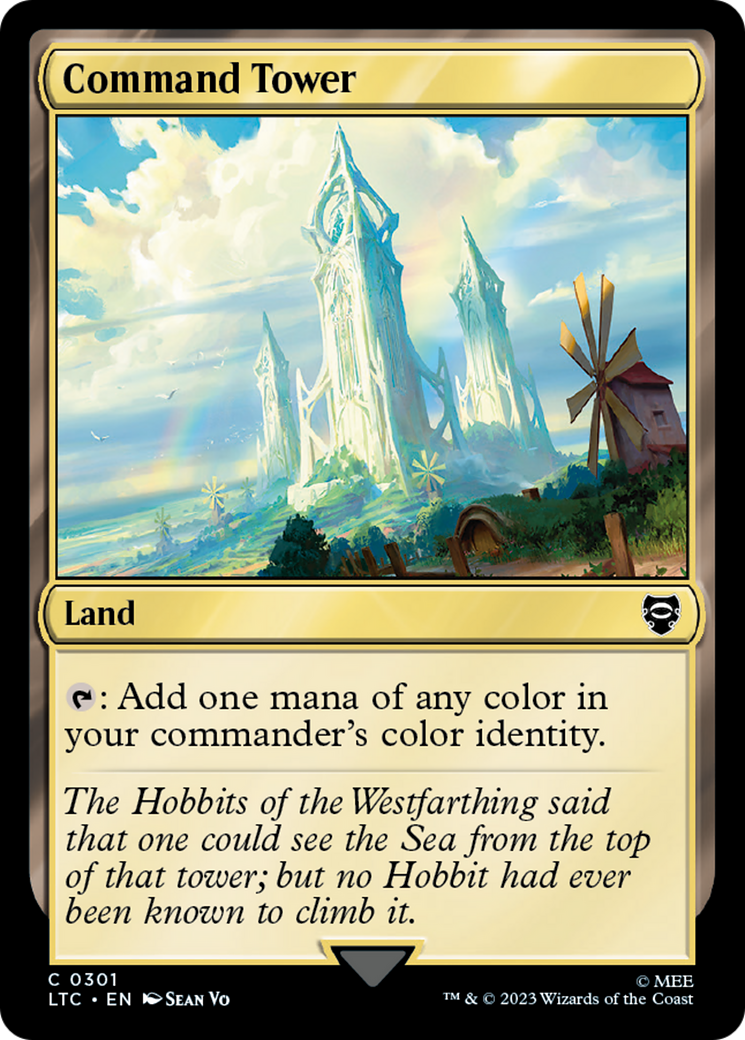
Command Tower
Command Tower
Land
: Add one mana of any color in your commander's color identity.
- If you have two commanders, the ability adds one mana of any color in their combined color identities.
- If your commander is a card that has no colors in its color identity, Command Tower's ability produces no mana. It doesn't produce .
- If you don't have a commander, Command Tower's ability produces no mana.
-
1
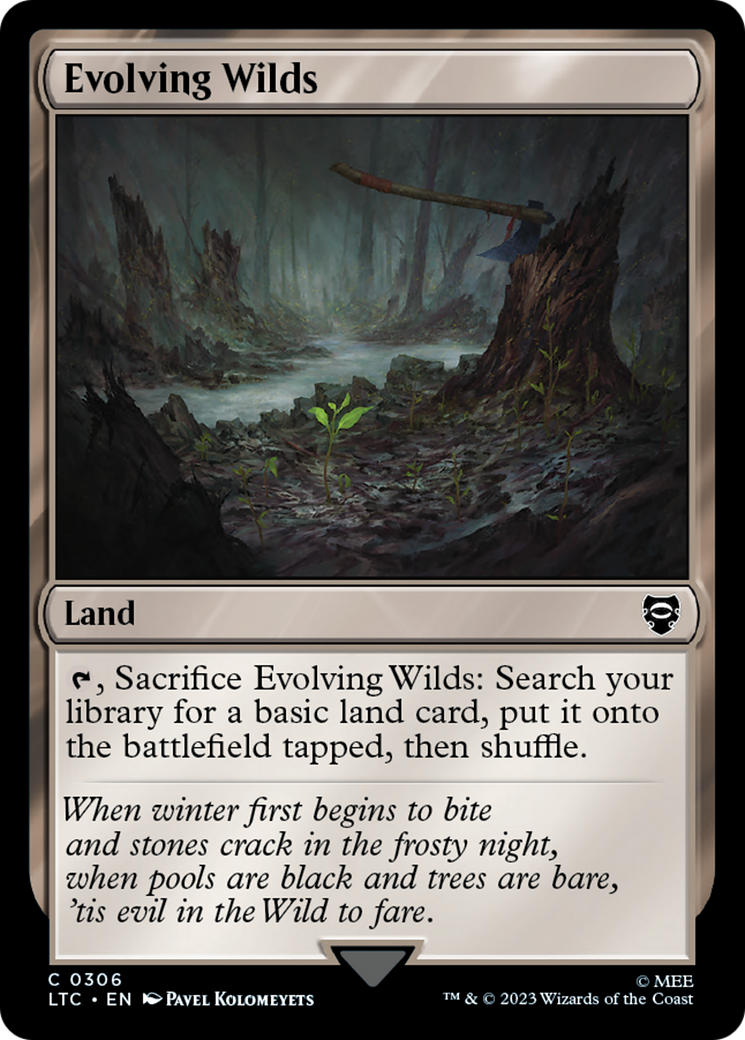
Evolving Wilds
Evolving Wilds
Land
, Sacrifice this land: Search your library for a basic land card, put it onto the battlefield tapped, then shuffle.
-
1
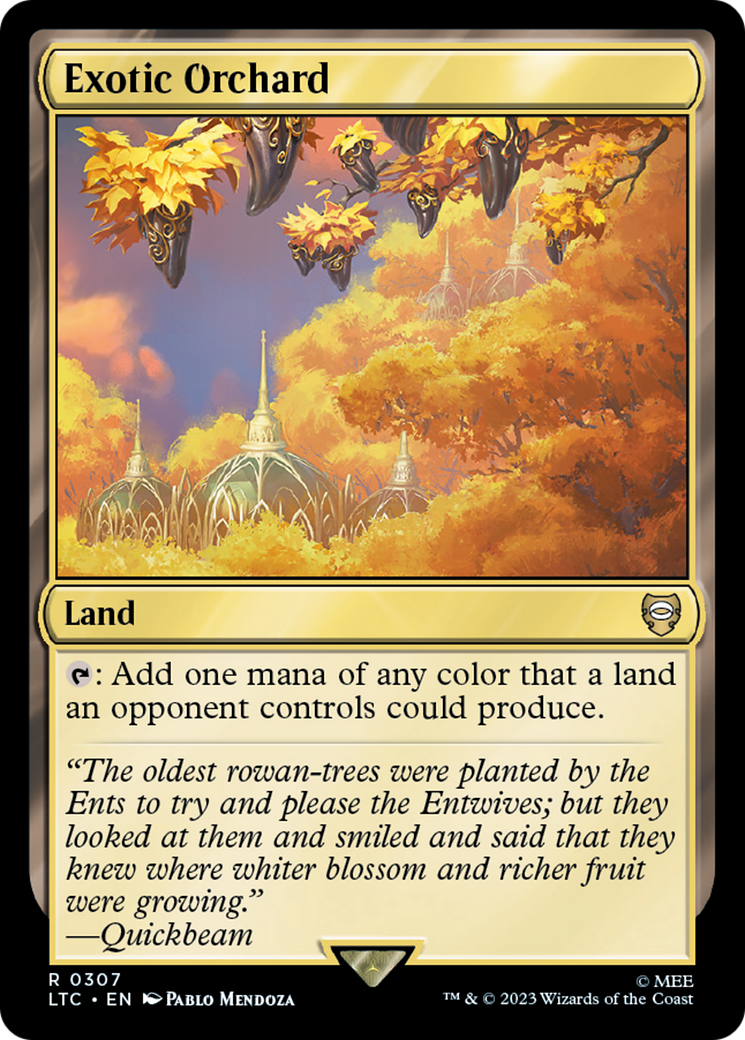
Exotic Orchard
Exotic Orchard
Land
: Add one mana of any color that a land an opponent controls could produce.
- The colors of mana are white, blue, black, red, and green. Exotic Orchard can't be tapped for colorless mana, even if a land an opponent controls could produce colorless mana.
- Exotic Orchard checks the effects of all mana-producing abilities of lands your opponents control, but it doesn't check their costs. For example, Vivid Crag has the ability " , Remove a charge counter from Vivid Crag: Add one mana of any color." If an opponent controls Vivid Crag and you control Exotic Orchard, you can tap Exotic Orchard for any color of mana. It doesn't matter whether Vivid Crag has a charge counter on it, and it doesn't matter whether it's untapped.
- When determining what colors of mana your opponents' lands could produce, Exotic Orchard takes into account any applicable replacement effects that would apply to those lands' mana abilities (such as Contamination's effect, for example). If there are more than one, consider them in any possible order.
- Exotic Orchard doesn't care about any restrictions or riders your opponents' lands (such as Ancient Ziggurat or Hall of the Bandit Lord) put on the mana they produce. It just cares about colors of mana.
- Lands that produce mana based only on what other lands "could produce" won't help each other unless some other land allows one of them to actually produce some type of mana. For example, if you control an Exotic Orchard and your opponent controls an Exotic Orchard and a Reflecting Pool, none of those lands would produce mana if their mana abilities were activated. On the other hand, if you control a Forest and an Exotic Orchard, and your opponent controls an Exotic Orchard and a Reflecting Pool, then each of those lands can be tapped to produce . Your opponent's Exotic Orchard can produce because you control a Forest. Your Exotic Orchard and your opponent's Reflecting Pool can each produce because your opponent's Exotic Orchard can produce .
-
1
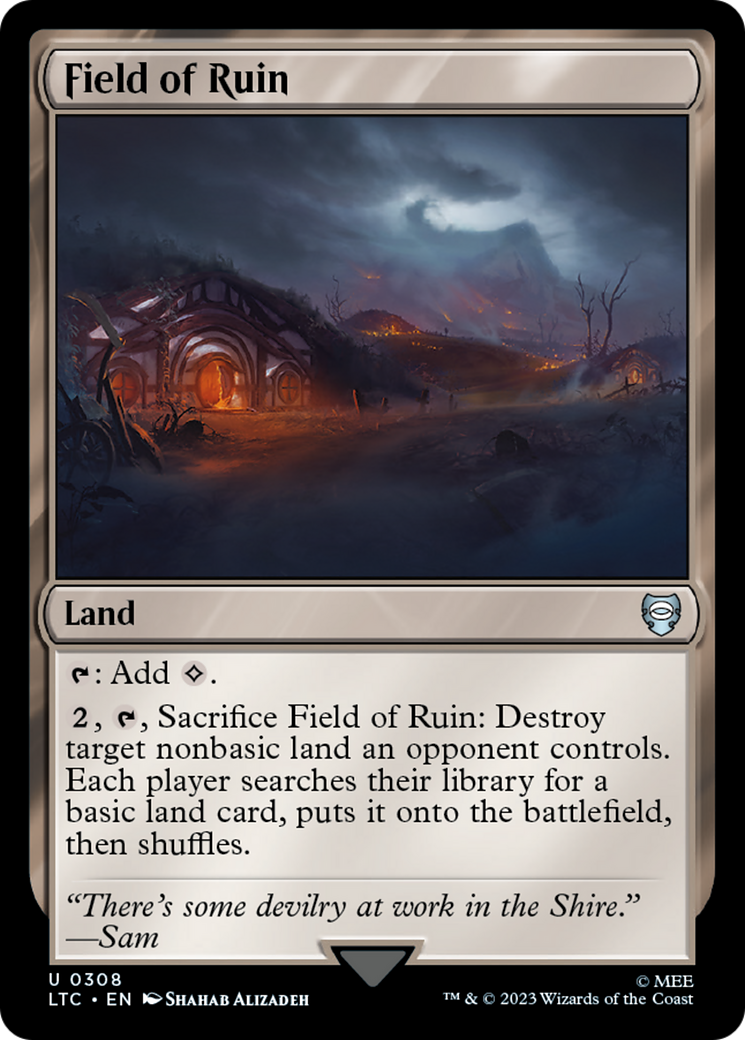
Field of Ruin
Field of Ruin
Land
: Add .
, , Sacrifice this land: Destroy target nonbasic land an opponent controls. Each player searches their library for a basic land card, puts it onto the battlefield, then shuffles.
- If the target land is an illegal target by the time Field of Ruin's ability tries to resolve, the ability doesn't resolve. No players search for a basic land card or shuffles. If the target is legal but not destroyed (most likely because it has indestructible), each player does search and shuffle.
-
1
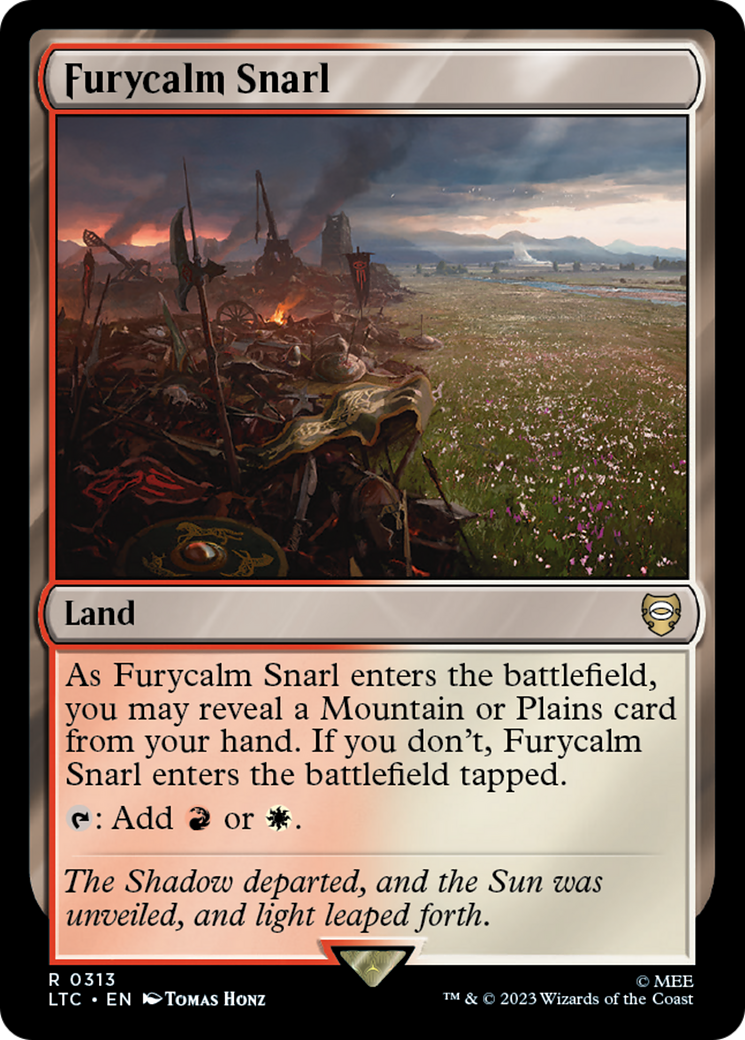
Furycalm Snarl
Furycalm Snarl
Land
As this land enters, you may reveal a Mountain or Plains card from your hand. If you don't, this land enters tapped.
: Add or .
- You may reveal any land card with either or both of the appropriate subtypes. It doesn't have to be a basic land card.
- The "Snarl" itself doesn't have any land subtypes. You can't reveal one to satisfy the ability of another.
- If a land card with an appropriate subtype is entering the battlefield from your hand at the same time as one of these lands, you may reveal the other land to have the "Snarl" enter untapped.
- If an effect instructs you to put one of these lands onto the battlefield tapped, it will still enter the battlefield tapped even if you reveal a land card from your hand.
-
1
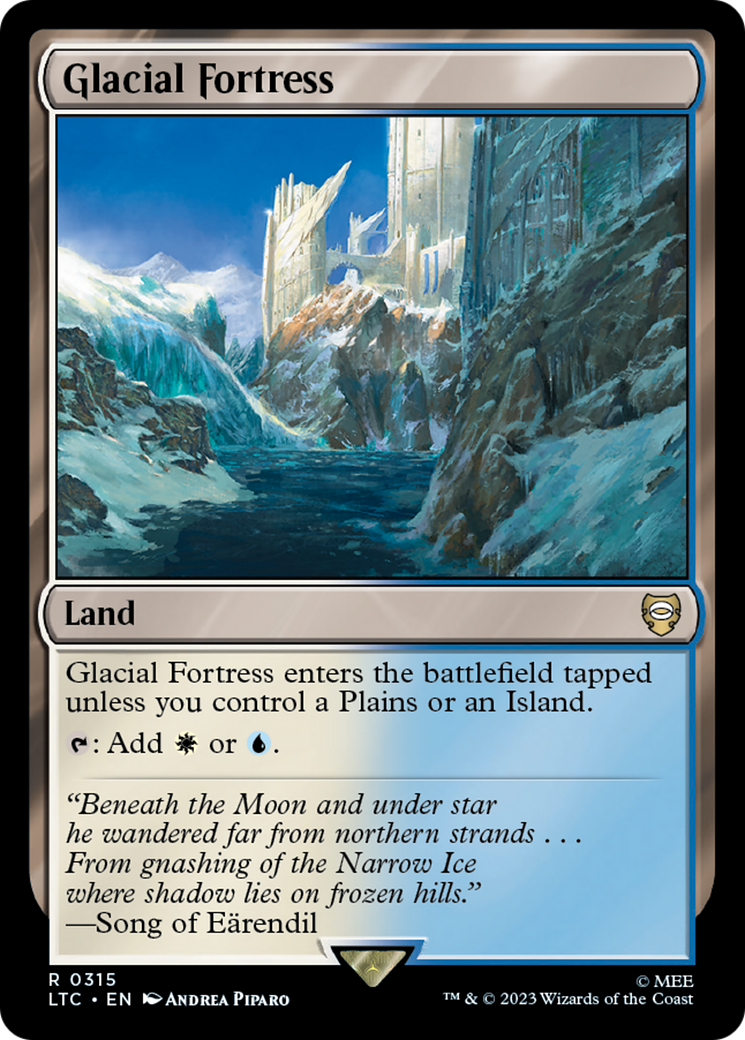
Glacial Fortress
Glacial Fortress
Land
This land enters tapped unless you control a Plains or an Island.
: Add or .
- This checks for lands you control with the land type Plains or Island, not for lands named Plains or Island. The lands it checks for don't have to be basic lands. For example, if you control Watery Grave (a nonbasic land with the land types Island and Swamp), Glacial Fortress will enter untapped.
- As this is entering, it checks for lands that are already on the battlefield. It won't see lands that are entering at the same time (due to Warp World, for example).
-
5
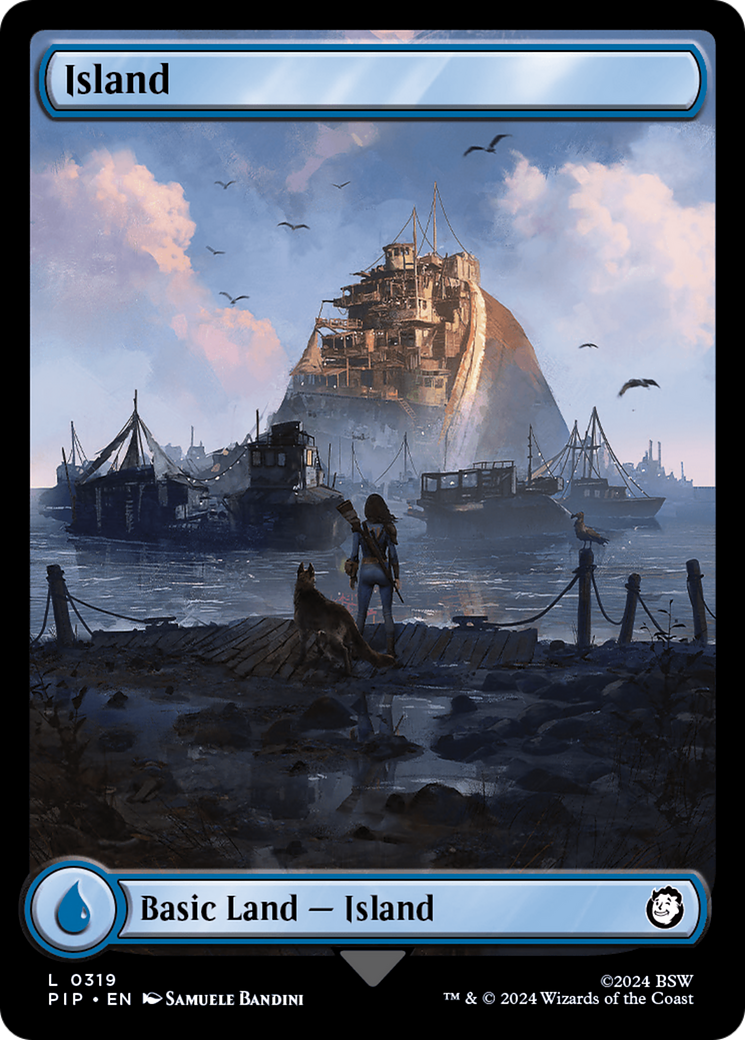
Island
Island
Basic Land — Island
( : Add .)
-
5
Mountain
Mountain
Basic Land — Mountain
( : Add .)
-
1
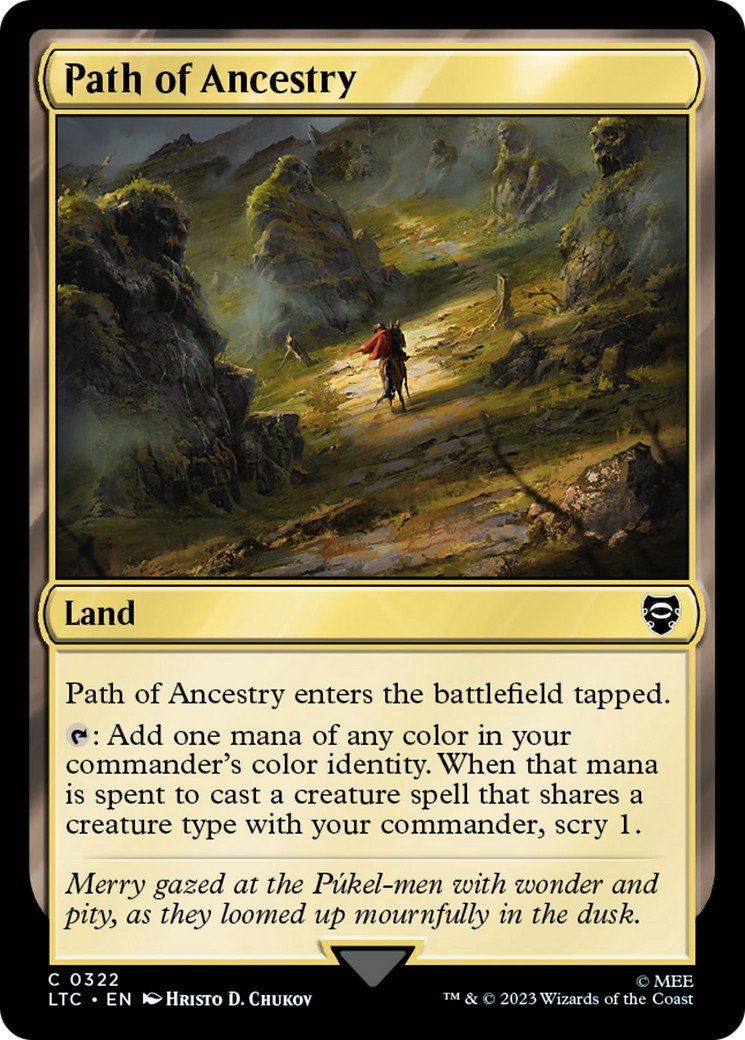
Path of Ancestry
Path of Ancestry
Land
This land enters tapped.
: Add one mana of any color in your commander's color identity. When that mana is spent to cast a creature spell that shares a creature type with your commander, scry 1. (Look at the top card of your library. You may put that card on the bottom.)
- If you have two commanders, the last ability adds one mana of any color in their combined color identities. When you spend that mana on a creature spell that shares a creature type with either of your commanders, you'll scry 1.
- Your commander's creature types are checked immediately after you cast a creature spell spending mana from Path of Ancestry's last ability. They aren't set before the game begins, and they may not be the same types your commander had when you activated that ability.
- If you cast your commander with mana from Path of Ancestry, and your commander hasn't somehow lost all of its creature types while on the stack, you'll scry 1.
- If your commander is a card that has no colors in its color identity, Path of Ancestry's ability produces no mana. It doesn't produce .
- If Path of Ancestry's last ability produces two mana (most likely due to Mana Reflection), spending those two mana to cast creature spells that share a creature type with your commander will cause two abilities to trigger. Each of those abilities will cause you to scry 1. You won't scry 2. This is true whether you spend the mana on one creature spell or two.
- If your commander has no creature types, it can't share a creature type with any spell that you cast.
- If you don't have a commander, Path of Ancestry's ability produces no mana.
-
9
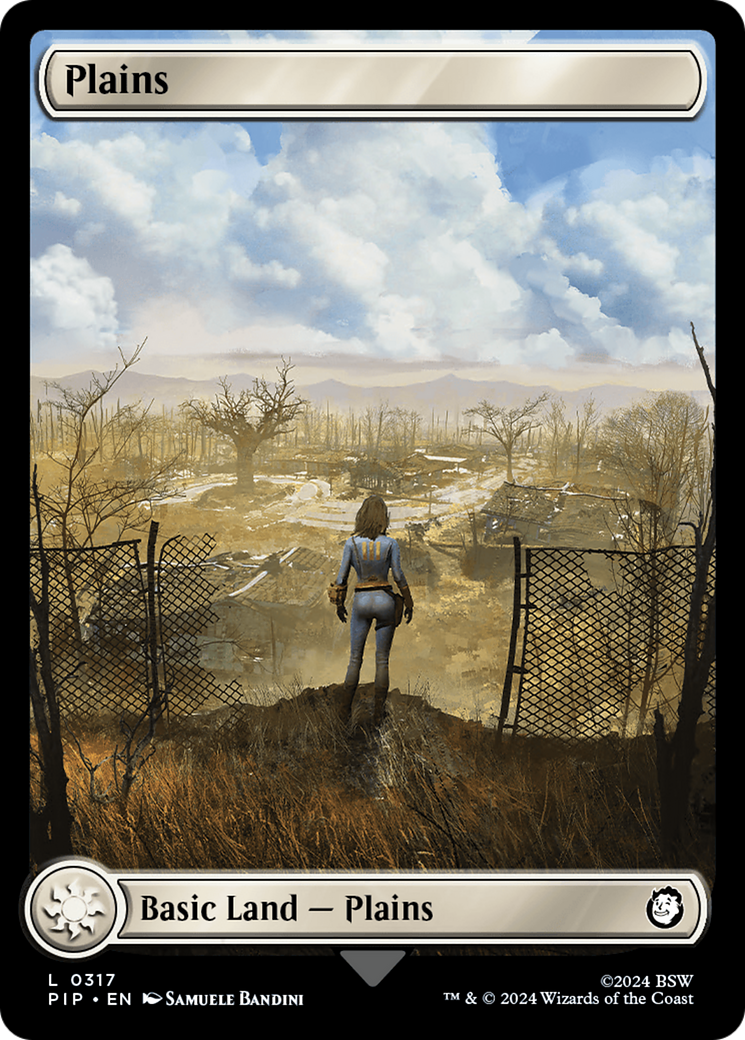
Plains
Plains
Basic Land — Plains
( : Add .)
-
1
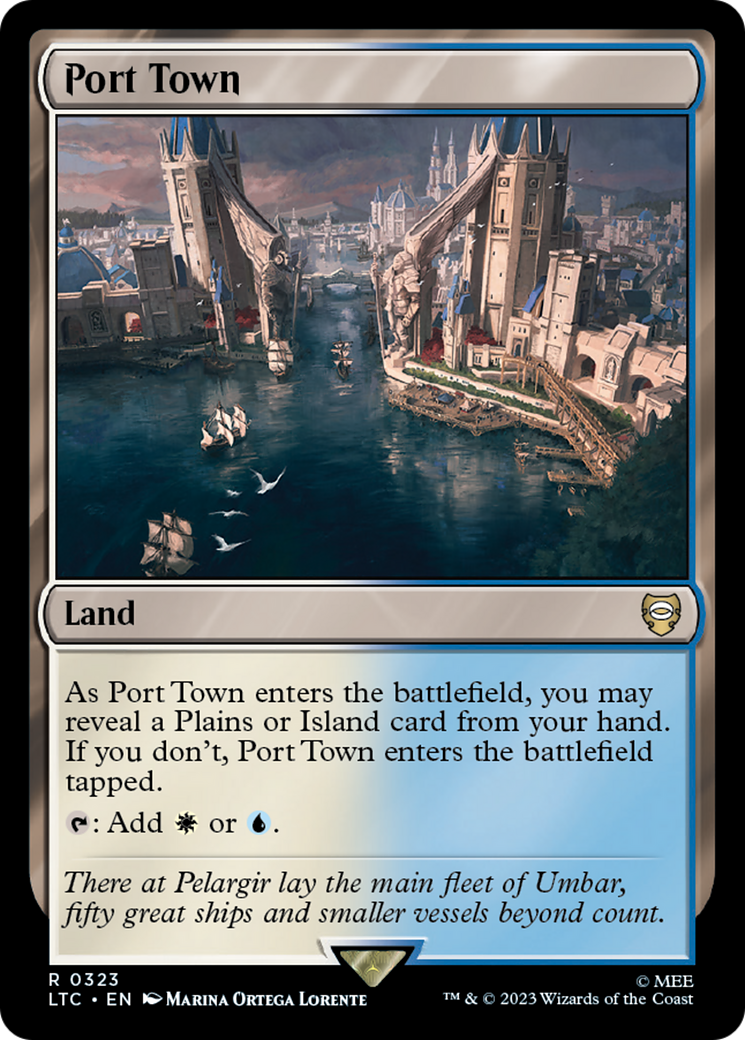
Port Town
Port Town
Land
As this land enters, you may reveal a Plains or Island card from your hand. If you don't, this land enters tapped.
: Add or .
- You may reveal any land card with either or both of the appropriate subtypes. It doesn't have to be a basic land. For example, you could reveal Canopy Vista from the Battle for Zendikar set to satisfy the ability of Port Town.
- Lands don't have a subtype just because they can produce mana of the corresponding color. Port Town itself is neither a Plains nor an Island, even though it produces white and blue mana, so you can't reveal one to satisfy the ability of another.
- If a Plains or Island is entering the battlefield from your hand at the same time as Port Town, you may reveal the other land to have Port Town enter untapped.
- If an effect instructs you to put Port Town onto the battlefield tapped, it will still enter the battlefield tapped even if you reveal a land card from your hand.
-
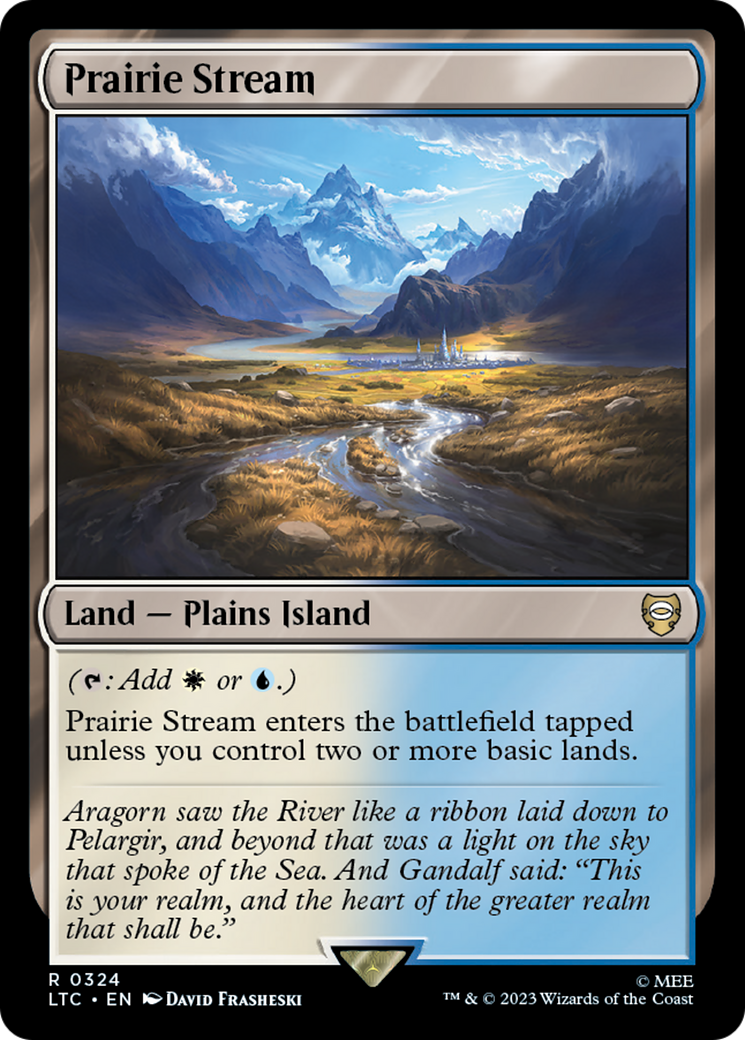
1
Prairie Stream
Prairie Stream
Land — Plains Island
( : Add or .)
This land enters tapped unless you control two or more basic lands.
- Even though these lands have basic land types, they are not basic lands because "basic" doesn't appear on their type line. Notably, controlling two or more of them won't allow others to enter the battlefield untapped.
- However, because these cards have basic land types, effects that specify a basic land type without also specifying that the land be basic can affect them. For example, a spell or ability that reads "Destroy target Forest" can target Canopy Vista, while one that reads "Destroy target basic Forest" cannot.
- If one of these lands enters the battlefield at the same time as any number of basic lands, those other lands are not counted when determining if this land enters the battlefield tapped or untapped.
-
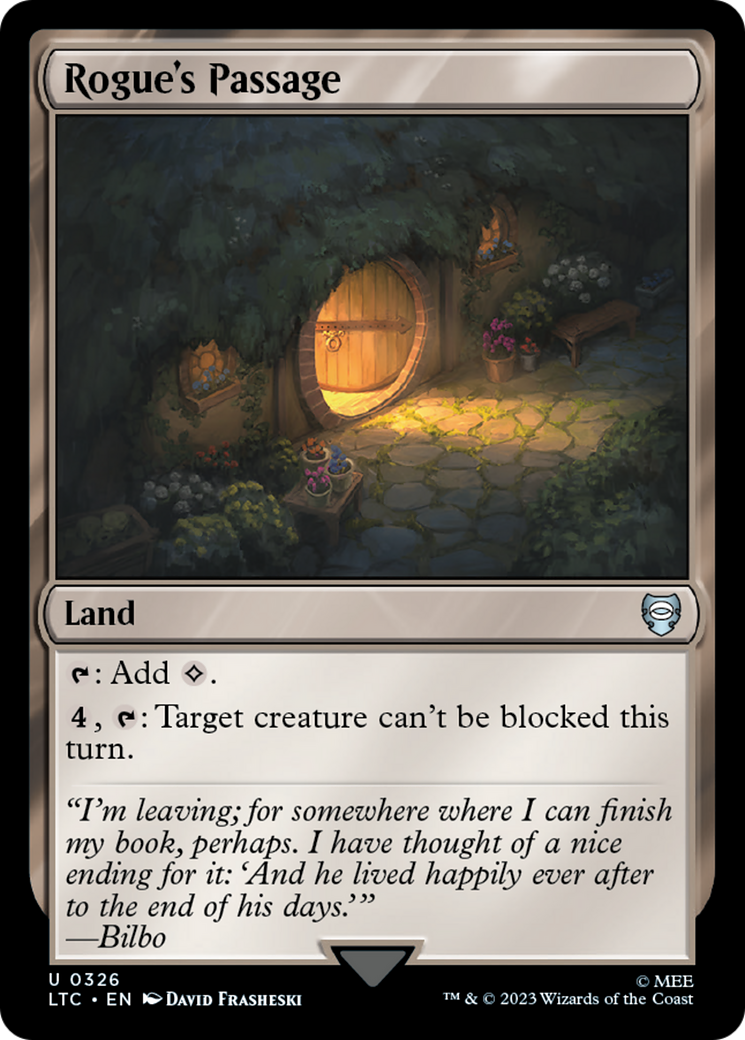
1
Rogue's Passage
Rogue's Passage
Land
: Add .
, : Target creature can't be blocked this turn.
- Activating the second ability of Rogue's Passage after a creature has become blocked won't cause that creature to become unblocked.
-
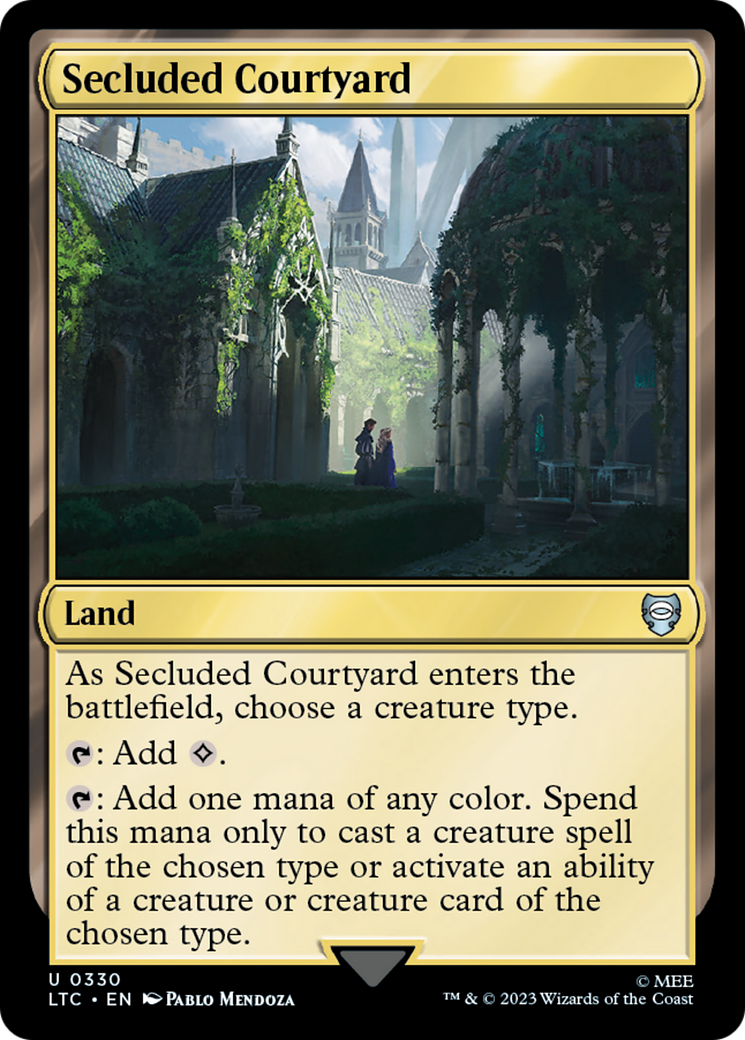
1
Secluded Courtyard
Secluded Courtyard
Land
As this land enters, choose a creature type.
: Add .
: Add one mana of any color. Spend this mana only to cast a creature spell of the chosen type or activate an ability of a creature source of the chosen type.
- If Secluded Courtyard is somehow on the battlefield without a chosen type, mana from its second mana ability can't be spent on anything.
-
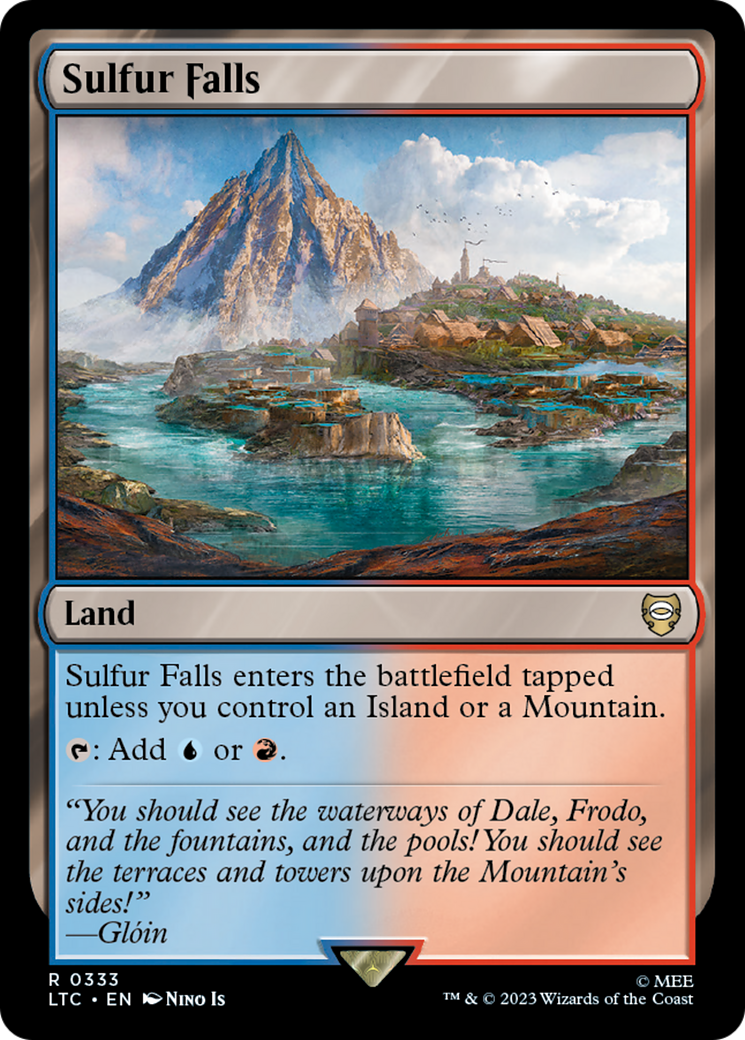
1
Sulfur Falls
Sulfur Falls
Land
This land enters tapped unless you control an Island or a Mountain.
: Add or .
-
1
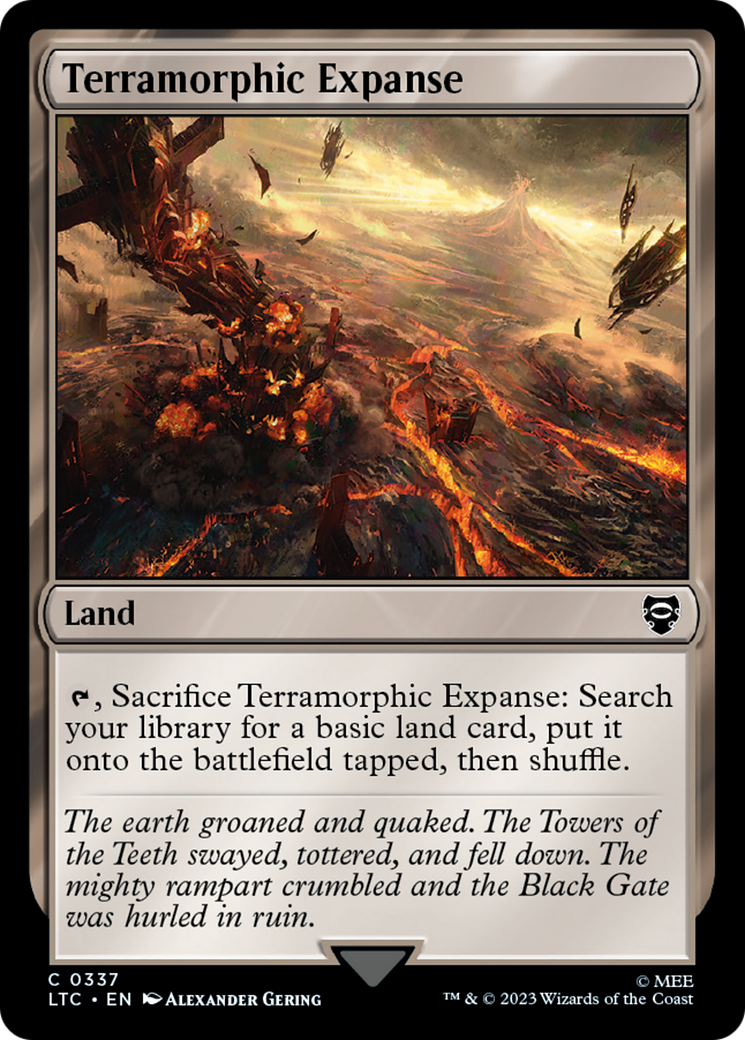
Terramorphic Expanse
Terramorphic Expanse
Land
, Sacrifice this land: Search your library for a basic land card, put it onto the battlefield tapped, then shuffle.
-
1
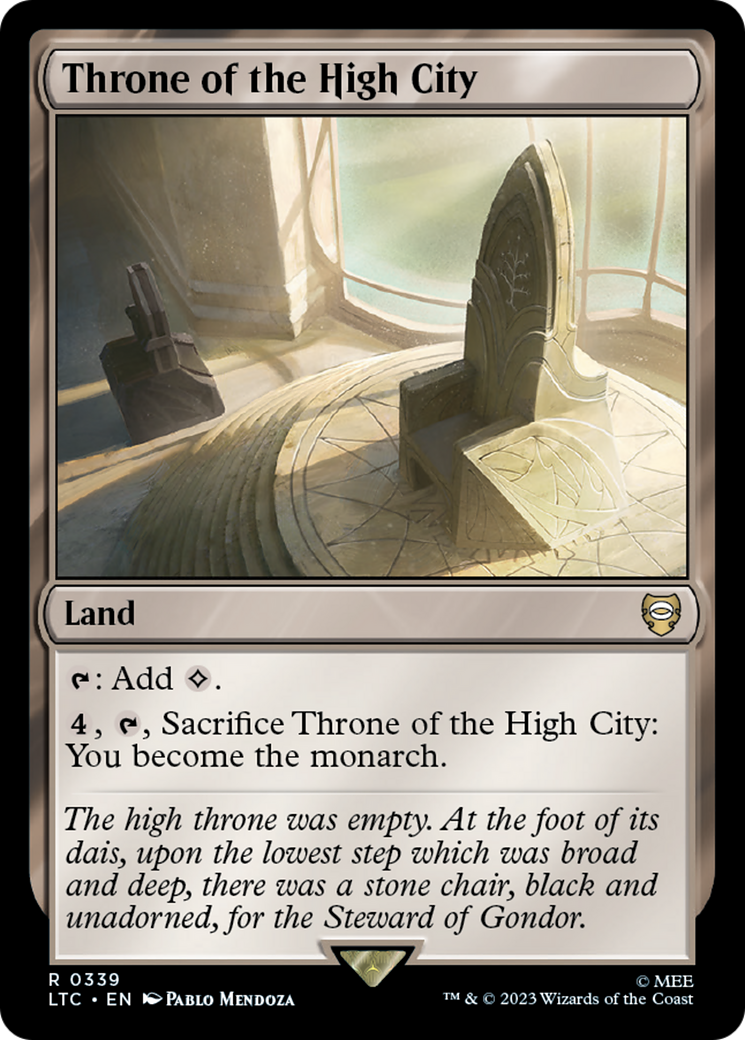
Throne of the High City
Throne of the High City
Land
: Add .
, , Sacrifice this land: You become the monarch.
- If the triggered ability that causes the monarch to draw a card goes on the stack, and a different player becomes the monarch before that ability resolves, the first player will still draw the card.
- Abilities that trigger whenever you "become the monarch" trigger only if you aren't already the monarch. For example, if you are already the monarch as Custodi Lich enters the battlefield, its last ability won't trigger.
- The game starts with no monarch. Once an effect makes one player the monarch, the game will have exactly one monarch from that point forward.
- Being the monarch carries two inherent triggered abilities. "At the beginning of the monarch's end step, that player draws a card" and "Whenever a creature deals combat damage to the monarch, its controller becomes the monarch."
-
1
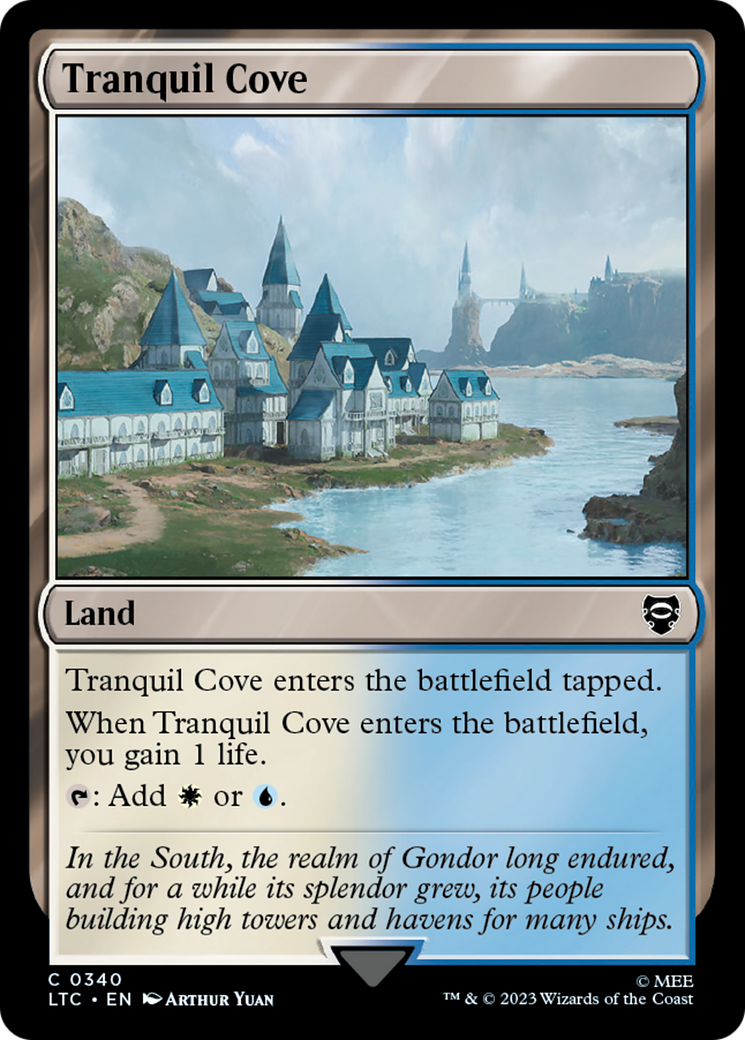
Tranquil Cove
Tranquil Cove
Land
This land enters tapped.
When this land enters, you gain 1 life.
: Add or .
-
1
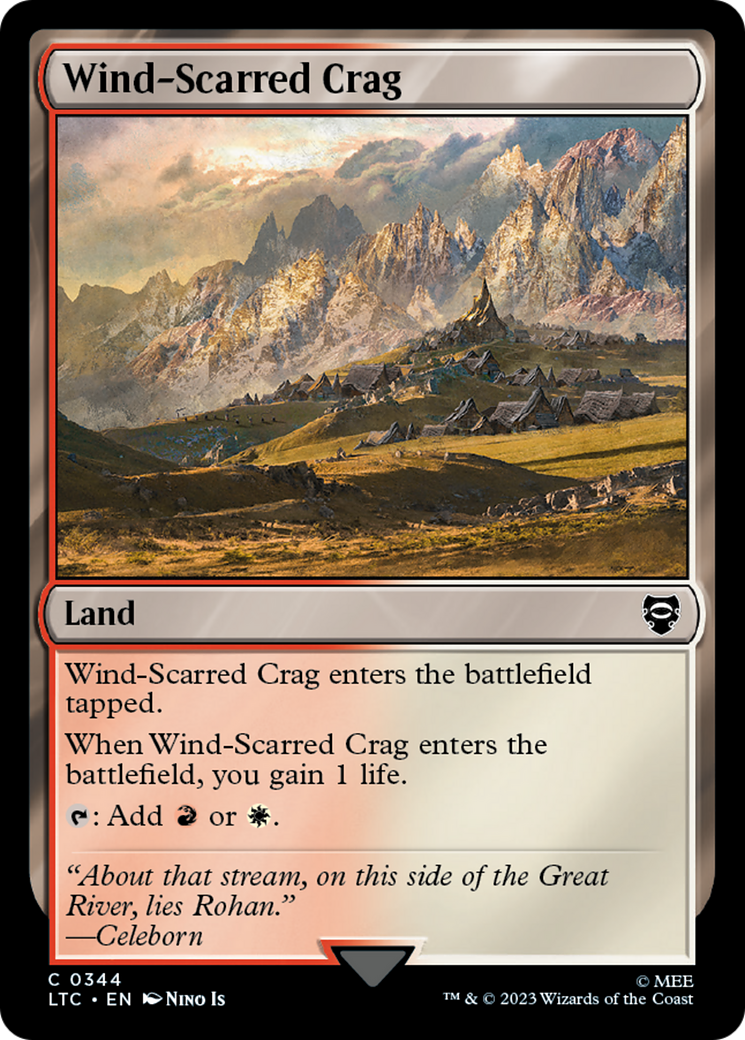
Wind-Scarred Crag
Wind-Scarred Crag
Land
This land enters tapped.
When this land enters, you gain 1 life.
: Add or .
-
1
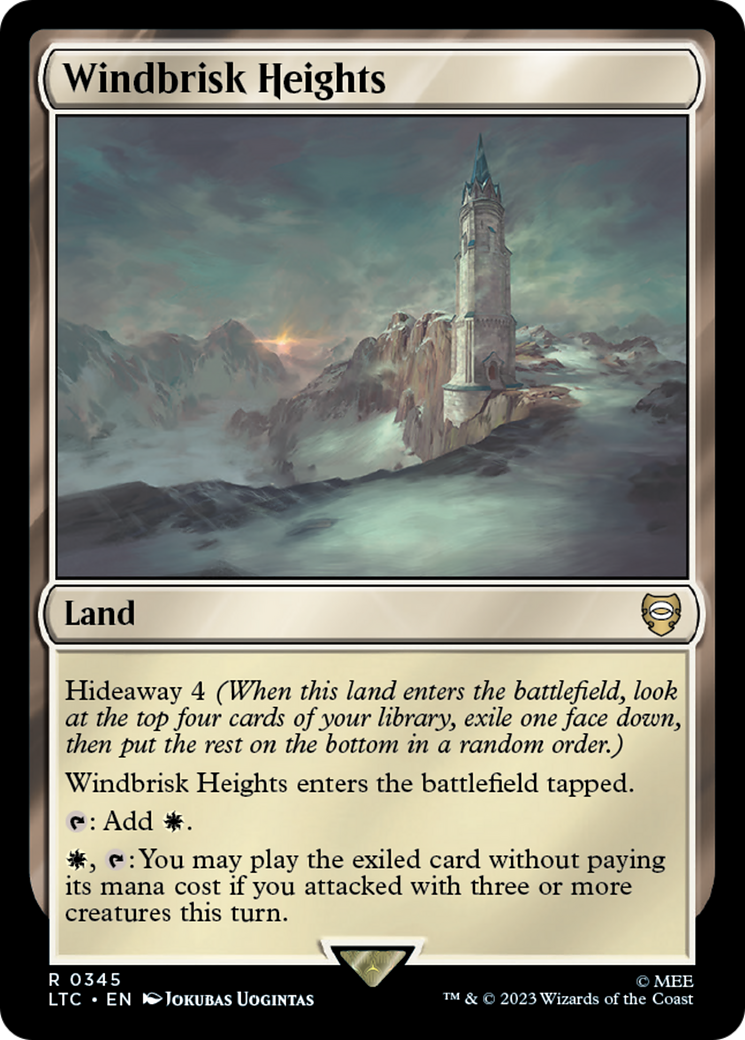
Windbrisk Heights
Windbrisk Heights
Land
Hideaway 4 (When this land enters, look at the top four cards of your library, exile one face down, then put the rest on the bottom in a random order.)
This land enters tapped.
: Add .
, : You may play the exiled card without paying its mana cost if you attacked with three or more creatures this turn.
- "Hideaway N" means "When this permanent enters the battlefield, look at the top N cards of your library. Exile one of them face down and put the rest on the bottom of your library in a random order. The exiled card gains 'The player who controls the permanent that exiled this card may look at this card in the exile zone.'"
- Any player who has controlled a permanent with a hideaway ability since a card was exiled with it may look at that card.
- Previously, permanents with hideaway entered the battlefield tapped. This ability has been removed from the definition of hideaway. Older cards have received errata to have an additional paragraph that reads "[This permanent] enters the battlefield tapped," and they now have hideaway 4.
- Hideaway now causes you to put the rest of the cards on the bottom of your library in a random order instead of any order.
- At the time the ability resolves, you'll get to play the card if you declared three different creatures as attackers at any point in the turn. A creature declared as an attacker in two different attack phases counts only once. A creature that entered attacking (such as a token created by Militia's Pride) doesn't count because you never attacked with it.
White 23
-
1
Banishing Light
Banishing Light
Enchantment
When this enchantment enters, exile target nonland permanent an opponent controls until this enchantment leaves the battlefield.
- If Banishing Light leaves the battlefield before its triggered ability resolves, the target permanent won't be exiled.
- Auras attached to the exiled permanent will be put into their owners' graveyards. Any Equipment will become unattached and remain on the battlefield. Any counters on the exiled permanent will cease to exist. When the card returns to the battlefield, it will be a new object with no connection to the card that was exiled.
- If a token is exiled this way, it will cease to exist and won't return to the battlefield.
- If an Aura is exiled this way, its owner chooses what it will enchant as it returns to the battlefield. An Aura put onto the battlefield this way doesn't target anything (so it could be attached to a permanent with shroud, for example), but the Aura's enchant ability restricts what it can be attached to. If the Aura can't legally be attached to anything, it remains in exile for the rest of the game.
-
1
Bastion Protector
Bastion Protector
Creature — Human Soldier
3/3
Commander creatures you control get +2/+2 and have indestructible.
- A "commander creature" is a permanent that's both someone's commander and a creature.
- Bastion Protector's ability applies to any commander creature you control, whether you own it or not.
- Bastion Protector's ability doesn't apply to commanders that aren't currently creatures.
-
1
Beregond of the Guard
Beregond of the Guard
Legendary Creature — Human Soldier
3/3
Whenever Beregond or another Human you control enters, creatures you control get +1/+1 and gain vigilance until end of turn.
-
1
Champions of Minas Tirith
Champions of Minas Tirith
Creature — Human Soldier
4/6
When this creature enters, you become the monarch.
At the beginning of combat on each opponent's turn, if you're the monarch, that opponent may pay , where X is the number of cards in their hand. If they don't, they can't attack you this combat.
- An opponent who chooses not to pay for Champions of Minas Tirith's last ability can still attack planeswalkers you control or battles you're protecting.
- The game starts with no monarch. Once an effect makes one player the monarch, the game will have exactly one monarch from that point forward. As a player becomes the monarch, the current monarch (if any) ceases being the monarch.
- There are two inherent triggered abilities associated with being the monarch. These triggered abilities have no source and are controlled by the player who was the monarch at the time the abilities triggered. The full texts of these abilities are "At the beginning of the monarch's end step, that player draws a card" and "Whenever a creature deals combat damage to the monarch, its controller becomes the monarch."
- If the triggered ability that causes the monarch to draw a card goes on the stack and a different player becomes the monarch before that ability resolves, the first player will still draw the card.
- If the monarch leaves the game during another player's turn, that player becomes the monarch. If the monarch leaves the game during their turn, the next player in turn order becomes the monarch.
- If combat damage dealt to the monarch causes that player to lose the game, the triggered ability that causes the controller of the attacking creature to become the monarch doesn't resolve. In most cases, the controller of the attacking creature will still become the monarch as it is likely their turn.
-
1
Dearly Departed
Dearly Departed
Creature — Spirit
5/5
Flying
As long as this creature is in your graveyard, each Human creature you control enters with an additional +1/+1 counter on it.
- The effect is cumulative. Human creatures you control will enter with a +1/+1 counter for each Dearly Departed in your graveyard.
- In most cases, when determining whether a creature entering under your control should get a +1/+1 counter, you'll simply look at what the creature will looklike on the battlefield. You'll consider any effects affecting a creature entering under your control.
-
1
Fiend Hunter
Fiend Hunter
Creature — Human Cleric
1/3
When this creature enters, you may exile another target creature.
When this creature leaves the battlefield, return the exiled card to the battlefield under its owner's control.
- If Fiend Hunter leaves the battlefield before its first ability has resolved, its second ability will trigger and do nothing. Then its first ability will resolve and exile the target creature indefinitely. This is different from abilities on other cards that exile a permanent "until" something happens.
- Once the exiled creature returns, it's considered a new object with no relation to the object that it was. Auras attached to the exiled creature will be put into their owners' graveyards. Equipment attached to the exiled creature will become unattached and remain on the battlefield. Any counters on the exiled creature will cease to exist.
- If a token is exiled this way, it won't return to the battlefield.
- In a multiplayer game, if you lose the game, the creature exiled with Fiend Hunter remains exiled indefinitely. This is also different from abilities on other cards that exile a permanent "until" something happens.
-
1
Frontline Medic
Frontline Medic
Creature — Human Cleric
3/3
Battalion — Whenever this creature and at least two other creatures attack, creatures you control gain indestructible until end of turn.
Sacrifice this creature: Counter target spell with in its mana cost unless its controller pays .
- The three attacking creatures don't have to be attacking the same player, planeswalker, or battle.
- Creatures that come under your control after Frontline Medic's battalion ability resolves will not be granted indestructible by this effect.
- Once a battalion ability has triggered, it doesn't matter how many creatures are still attacking when that ability resolves.
- The effects of battalion abilities vary from card to card. Read each card carefully.
-
1
Gilraen, Dúnedain Protector
Gilraen, Dúnedain Protector
Legendary Creature — Human Noble
2/3
, : Exile another target creature you control. You may return that card to the battlefield under its owner's control. If you don't, at the beginning of the next end step, return that card to the battlefield under its owner's control with a vigilance counter and a lifelink counter on it.
- When the card returns to the battlefield, it will be a new object with no connection to the card that was exiled. Auras attached to the exiled creature will be put into their owners' graveyards. Any Equipment will become unattached and remain on the battlefield. Any counters on the exiled creature will cease to exist.
- If a token is exiled this way, it will cease to exist and won't return to the battlefield.
-
1
Grey Host Reinforcements
Grey Host Reinforcements
Creature — Spirit Soldier
1/1
Flying, ward
When this creature enters, exile target player's graveyard. Put a number of +1/+1 counters on this creature equal to the number of creature cards exiled this way.
-
1
Increasing Devotion
Increasing Devotion
Sorcery
Create five 1/1 white Human creature tokens. If this spell was cast from a graveyard, create ten of those tokens instead.
Flashback (You may cast this card from your graveyard for its flashback cost. Then exile it.)
- "Flashback [cost]" means "You may cast this card from your graveyard by paying [cost] rather than paying its mana cost" and "If the flashback cost was paid, exile this card instead of putting it anywhere else any time it would leave the stack."
- You must still follow any timing restrictions and permissions, including those based on the card's type. For instance, you can cast a sorcery using flashback only when you could normally cast a sorcery.
- To determine the total cost of a spell, start with the mana cost or alternative cost (such as a flashback cost) you're paying, add any cost increases, then apply any cost reductions. The mana value of the spell is determined only by its mana cost, no matter what the total cost to cast the spell was.
- A spell cast using flashback will always be exiled afterward, whether it resolves, is countered, or leaves the stack in some other way.
- You can cast a spell using flashback even if it was somehow put into your graveyard without having been cast.
- If a card with flashback is put into your graveyard during your turn, you can cast it if it's legal to do so before any other player can take any actions.
-
1
Lossarnach Captain
Lossarnach Captain
Creature — Human Soldier
3/1
First strike
Whenever this creature or another Human you control enters, tap target creature an opponent controls.
At the beginning of your upkeep, create a 1/1 white Human Soldier creature token.
-
1
Lost to Legend
Lost to Legend
Instant
Put target nonland historic permanent into its owner's library fourth from the top. (Artifacts, legendaries, and Sagas are historic.)
- If the target permanent's controller has two or fewer cards left in their library when Lost to Legend resolves, that permanent becomes the bottom card of their library.
- A card, spell, or permanent is historic if it has the legendary supertype, the artifact card type, or the Saga subtype. Having two of those qualities doesn't make an object more historic than another or provide an additional bonus—an object either is historic or it isn't.
- Some abilities trigger "whenever you cast a historic spell." Such an ability resolves before the spell that caused it to trigger. It resolves even if that spell is countered.
- An ability that triggers "whenever you cast a historic spell" doesn't trigger if a historic card is put onto the battlefield without being cast.
- Lands are never cast, so abilities that trigger "whenever you cast a historic spell" won't trigger if you play a legendary land. They also won't trigger if a card on the battlefield transforms into a card with the legendary supertype, the artifact card type, or the Saga subtype.
-
1
Marshal's Anthem
Marshal's Anthem
Enchantment
Multikicker (You may pay an additional any number of times as you cast this spell.)
Creatures you control get +1/+1.
When this enchantment enters, return up to X target creature cards from your graveyard to the battlefield, where X is the number of times this enchantment was kicked.
- If a spell's kicker cost was paid, the spell is "kicked."
- The kicker ability doesn't let you pay a kicker cost more than once.
- If you put a permanent with a kicker ability onto the battlefield without casting it, you can't kick it.
- If you copy a kicked spell on the stack, the copy is also kicked. If the copied spell is a permanent spell, the token the copy of that spell becomes when it enters is also kicked.
- If a card or token enters as a copy of a permanent, the new permanent isn't kicked, even if the original was.
- To determine a spell's total cost, start with the mana cost (or an alternative cost if another card's effect allows you to pay one instead), add any cost increases (such as kicker), then apply any cost reductions. The spell's mana value remains unchanged, no matter what the total cost to cast it was.
-
1
Palace Jailer
Palace Jailer
Creature — Human Soldier
2/2
When this creature enters, you become the monarch.
When this creature enters, exile target creature an opponent controls until an opponent becomes the monarch.
- The game starts with no monarch. Once an effect makes one player the monarch, the game will have exactly one monarch from that point forward.
- Being the monarch carries two inherent triggered abilities. "At the beginning of the monarch's end step, that player draws a card" and "Whenever a creature deals combat damage to the monarch, its controller becomes the monarch."
- If you're not the monarch as Palace Jailer's second ability resolves, the creature will be exiled until there's a new monarch and that player is one of your opponents. The creature won't immediately return just because an opponent is the monarch.
- Auras attached to the exiled creature will be put into their owners' graveyards. Equipment attached to the exiled creature will become unattached and remain on the battlefield. Counters on the exiled creature will cease to exist.
- If a creature token is exiled, it ceases to exist. It won't return to the battlefield.
- Palace Jailer leaving the battlefield won't cause the exiled creature to return. The game will continue to watch for the next time an opponent becomes the monarch.
- The opponent that controlled the exiled card doesn't have to be the same opponent that becomes the monarch in order to cause that card to return to the battlefield. Any opponent becoming the monarch will cause the card to return.
- In a multiplayer game, if the monarch leaves the game, the player whose turn it is immediately becomes the monarch. If the player whose turn it is has left the game, instead the next player in turn order becomes the monarch.
-
1
Path to Exile
Path to Exile
Instant
Exile target creature. Its controller may search their library for a basic land card, put that card onto the battlefield tapped, then shuffle.
- If the target creature is an illegal target by the time Path to Exile tries to resolve, the spell won't resolve. The creature's controller won't search for a basic land card.
- The controller of the exiled creature isn't required to search their library for a basic land. If that player doesn't, the player won't shuffle their library.
-
1
Selfless Squire
Selfless Squire
Creature — Human Soldier
1/1
Flash
When this creature enters, prevent all damage that would be dealt to you this turn.
Whenever damage that would be dealt to you is prevented, put that many +1/+1 counters on this creature.
- Selfless Squire's first triggered ability prevents all damage that would be dealt to you this turn after the triggered ability resolves, even if Selfless Squire leaves the battlefield.
- Selfless Squire's second triggered ability doesn't trigger only when damage is prevented by its first triggered ability's effect. Any effect that uses the word "prevent" will cause it to trigger.
-
1
Sunset Revelry
Sunset Revelry
Sorcery
If an opponent has more life than you, you gain 4 life.
If an opponent controls more creatures than you, create two 1/1 white Human creature tokens.
If an opponent has more cards in hand than you, draw a card.
-
1
Swords to Plowshares
Swords to Plowshares
Instant
Exile target creature. Its controller gains life equal to its power.
- Use the power of the creature from when it was last on the battlefield to determine how much life is gained.
-
1
Unbreakable Formation
Unbreakable Formation
Instant
Creatures you control gain indestructible until end of turn.
Addendum — If you cast this spell during your main phase, put a +1/+1 counter on each of those creatures and they gain vigilance until end of turn.
- Addendum abilities of instant spells apply while the spell is resolving, not immediately after casting it. If the spell is countered, you don't get the addendum bonus.
- If an effect copies a spell with an addendum ability while it's on the stack, the copy wasn't cast at all, so you won't get the addendum bonus.
- Unbreakable Formation affects only creatures you control at the time it resolves. Creatures you begin to control later in the turn won't gain indestructible or vigilance and they won't get a +1/+1 counter.
-
1
Verge Rangers
Verge Rangers
Creature — Human Scout Ranger
3/3
First strike
You may look at the top card of your library any time.
As long as an opponent controls more lands than you, you may play lands from the top of your library. (You can play a land this way only if you have an available land play remaining.)
- Verge Rangers doesn't allow you to play additional lands.
- Verge Rangers lets you look at the top card of your library whenever you want (with one restriction; see below), even if you don't have priority. This action doesn't use the stack. Knowing what that card is becomes part of the information you have access to, just like you can look at the cards in your hand.
- If the top card of your library changes while you're casting a spell, playing a land, or activating an ability, you can't look at the new top card until you finish doing so. This means that if you play a land from the top of your library and it has a replacement effect that requires you to make a decision (such as that of Temple Garden), you must make that decision without knowing the next card of your library.
-
1
Village Bell-Ringer
Village Bell-Ringer
Creature — Human Scout
1/4
Flash (You may cast this spell any time you could cast an instant.)
When this creature enters, untap all creatures you control.
- Untapping an attacking creature doesn't remove it from combat.
-
1
Visions of Glory
Visions of Glory
Sorcery
Create a 1/1 white Human creature token for each creature you control.
Flashback . This spell costs less to cast this way, where X is the greatest mana value of a commander you own on the battlefield or in the command zone. (You may cast this card from your graveyard for its flashback cost. Then exile it.)
- "Flashback [cost]" means "You may cast this card from your graveyard by paying [cost] rather than paying its mana cost" and "If the flashback cost was paid, exile this card instead of putting it anywhere else any time it would leave the stack."
- You must still follow any timing restrictions and permissions, including those based on the card's type. For instance, you can cast a sorcery using flashback only when you could normally cast a sorcery.
- To determine the total cost of a spell, start with the mana cost or alternative cost (such as a flashback cost) you're paying, add any cost increases, then apply any cost reductions. The mana value of the spell is determined only by its mana cost, no matter what the total cost to cast the spell was.
- A spell cast using flashback will always be exiled afterward, whether it resolves, is countered, or leaves the stack in some other way.
- You can cast a spell using flashback even if it was somehow put into your graveyard without having been cast.
- If a card with flashback is put into your graveyard during your turn, you can cast it if it's legal to do so before any other player can take any actions.
-
1
Weathered Wayfarer
Weathered Wayfarer
Creature — Human Nomad Cleric
1/1
, : Search your library for a land card, reveal it, put it into your hand, then shuffle. Activate only if an opponent controls more lands than you.
Blue 3
-
1
Archivist of Gondor
Archivist of Gondor
Creature — Human Advisor
2/3
When your commander deals combat damage to a player, if there is no monarch, you become the monarch.
At the beginning of the monarch's end step, that player draws a card.
- The game starts with no monarch. Once an effect makes one player the monarch, the game will have exactly one monarch from that point forward. As a player becomes the monarch, the current monarch (if any) ceases being the monarch.
- There are two inherent triggered abilities associated with being the monarch. These triggered abilities have no source and are controlled by the player who was the monarch at the time the abilities triggered. The full texts of these abilities are "At the beginning of the monarch's end step, that player draws a card" and "Whenever a creature deals combat damage to the monarch, its controller becomes the monarch."
- If the triggered ability that causes the monarch to draw a card goes on the stack and a different player becomes the monarch before that ability resolves, the first player will still draw the card.
- If the monarch leaves the game during another player's turn, that player becomes the monarch. If the monarch leaves the game during their turn, the next player in turn order becomes the monarch.
- If combat damage dealt to the monarch causes that player to lose the game, the triggered ability that causes the controller of the attacking creature to become the monarch doesn't resolve. In most cases, the controller of the attacking creature will still become the monarch as it is likely their turn.
-
1
Denethor, Stone Seer
Denethor, Stone Seer
Legendary Creature — Human Noble
1/3
When Denethor enters, scry 2.
, , Sacrifice Denethor: Target player becomes the monarch. Denethor deals 3 damage to any target.
- The game starts with no monarch. Once an effect makes one player the monarch, the game will have exactly one monarch from that point forward. As a player becomes the monarch, the current monarch (if any) ceases being the monarch.
- There are two inherent triggered abilities associated with being the monarch. These triggered abilities have no source and are controlled by the player who was the monarch at the time the abilities triggered. The full texts of these abilities are "At the beginning of the monarch's end step, that player draws a card" and "Whenever a creature deals combat damage to the monarch, its controller becomes the monarch."
- If the triggered ability that causes the monarch to draw a card goes on the stack and a different player becomes the monarch before that ability resolves, the first player will still draw the card.
- If the monarch leaves the game during another player's turn, that player becomes the monarch. If the monarch leaves the game during their turn, the next player in turn order becomes the monarch.
- If combat damage dealt to the monarch causes that player to lose the game, the triggered ability that causes the controller of the attacking creature to become the monarch doesn't resolve. In most cases, the controller of the attacking creature will still become the monarch as it is likely their turn.
-
1
Fealty to the Realm
Fealty to the Realm
Enchantment — Aura
Enchant creature
When this Aura enters, you become the monarch.
The monarch controls enchanted creature.
Enchanted creature attacks each combat if able and can't attack you.
- The timestamp of Fealty to the Realm's control-changing effect is the time at which it entered the battlefield and won't change when another player becomes the monarch. This means that, if another player gains control of the creature enchanted with Fealty to the Realm, they won't lose control of it when another player becomes the monarch. When (or if) that control-changing effect ends, the enchanted creature will then be controlled by the current monarch, which might be a different player than it was when that control-changing effect began.
- In the case where Fealty to the Realm is enchanting a creature but there is no monarch, the second ability will create a control-changing effect with the timestamp mentioned above, but that effect won't do anything until a player becomes the monarch.
- If the monarch leaves the game, and that player is not the owner of Fealty to the Realm, the active player or the next player in turn order becomes the monarch and thus gains control of the enchanted creature.
- If the monarch leaves the game, and that player is the owner of Fealty to the Realm, the active player or the next player in turn order becomes the monarch. That player gains control of the enchanted creature for a very brief moment. At the same time, Fealty to the Realm leaves the game, and control of the enchanted creature reverts to its owner (unless another control-changing effect applies.)
- The game starts with no monarch. Once an effect makes one player the monarch, the game will have exactly one monarch from that point forward. As a player becomes the monarch, the current monarch (if any) ceases being the monarch.
- There are two inherent triggered abilities associated with being the monarch. These triggered abilities have no source and are controlled by the player who was the monarch at the time the abilities triggered. The full texts of these abilities are "At the beginning of the monarch's end step, that player draws a card" and "Whenever a creature deals combat damage to the monarch, its controller becomes the monarch."
- If the triggered ability that causes the monarch to draw a card goes on the stack and a different player becomes the monarch before that ability resolves, the first player will still draw the card.
- If the monarch leaves the game during another player's turn, that player becomes the monarch. If the monarch leaves the game during their turn, the next player in turn order becomes the monarch.
- If combat damage dealt to the monarch causes that player to lose the game, the triggered ability that causes the controller of the attacking creature to become the monarch doesn't resolve. In most cases, the controller of the attacking creature will still become the monarch as it is likely their turn.
Red 12
-
1
Call for Aid
Call for Aid
Sorcery
Gain control of all creatures target opponent controls until end of turn. Untap those creatures. They gain haste until end of turn. You can't attack that player this turn. You can't sacrifice those creatures this turn.
- You can't sacrifice the creatures you gained control of with Call for Aid this turn for any reason. If an effect instructs you to sacrifice one of them, you can't and it remains on the battlefield. You also can't sacrifice any of them to pay a cost that requires you to sacrifice a creature.
- If an effect instructs you to sacrifice a creature, and you control any creatures other than the ones you gained control of with Call for Aid this turn, you must sacrifice one of them. You can't try to sacrifice one of the creatures you gained control of, fail, and therefore ignore the effect.
-
1
Combat Celebrant
Combat Celebrant
Creature — Human Warrior
4/1
If this creature hasn't been exerted this turn, you may exert it as it attacks. When you do, untap all other creatures you control and after this phase, there is an additional combat phase. (An exerted creature won't untap during your next untap step.)
- Combat Celebrant's ability untaps all of your creatures, not just the ones that are attacking.
- Untapping an attacking creature doesn't remove it from combat.
- There's no main phase between your combat phases, so you'll have no opportunity to cast spells or activate abilities that could only be cast any time you could cast a sorcery. For example, you won't be able to cast another creature or equip Equipment between combats.
- If you exert Combat Celebrant, you get an additional combat phase even if Combat Celebrant doesn't survive the first combat phase.
- If you exert multiple Combat Celebrants in one combat phase, you'll have that many additional combat phases, but all of your creatures are untapped only during the current combat phase. You'll need to exert the Combat Celebrants one at a time, in multiple combat phases, to untap your attacking creatures and attack with them in each combat step.
- You can't exert a creature unless an effect allows you to do so. Similar effects that "tap and freeze" a creature (such as that of Decision Paralysis) don't exert that creature.
- If an exerted creature is already untapped during your next untap step (most likely because it had vigilance or an effect untapped it), exert's effect preventing it from untapping expires without having done anything.
- If you gain control of another player's creature until end of turn and exert it, it will untap during that player's untap step.
- All cards in the Amonkhet set that let you exert a creature let you do so as you declare it as an attacking creature, as do some of the cards in the Hour of Devastation set. You can't do so later in combat, and creatures put onto the battlefield attacking can't be exerted. Any abilities that trigger on exerting an attacking creature will resolve before blockers are declared.
-
1
Court of Ire
Court of Ire
Enchantment
When this enchantment enters, you become the monarch.
At the beginning of your upkeep, this enchantment deals 2 damage to any target. If you're the monarch, it deals 7 damage instead.
- The game starts with no monarch. Once an effect makes one player the monarch, the game will have exactly one monarch from that point forward. As a player becomes the monarch, the current monarch (if any) ceases being the monarch.
- There are two inherent triggered abilities associated with being the monarch. These triggered abilities have no source and are controlled by the player who was the monarch at the time the abilities triggered. The full texts of these abilities are "At the beginning of the monarch's end step, that player draws a card" and "Whenever a creature deals combat damage to the monarch, its controller becomes the monarch."
- If the triggered ability that causes the monarch to draw a card goes on the stack and a different player becomes the monarch before that ability resolves, the first player will still draw the card.
- If the monarch leaves the game during another player's turn, that player becomes the monarch. If the monarch leaves the game during their turn, the next player in turn order becomes the monarch.
- If combat damage dealt to the monarch causes that player to lose the game, the triggered ability that causes the controller of the attacking creature to become the monarch doesn't resolve. In most cases, the controller of the attacking creature will still become the monarch as it is likely their turn.
-
1
Earthquake
Earthquake
Sorcery
Earthquake deals X damage to each creature without flying and each player.
- Whether or not a creature is without flying is only checked on resolution.
-
1
Erkenbrand, Lord of Westfold
Erkenbrand, Lord of Westfold
Legendary Creature — Human Soldier
3/3
Whenever Erkenbrand or another Human you control enters, creatures you control get +1/+0 until end of turn.
- Erkenbrand, Lord of Westfold's triggered ability affects only creatures you control at the time it resolves. Any creatures that come under your control later in the turn won't be affected.
-
1
Flamerush Rider
Flamerush Rider
Creature — Human Warrior
3/3
Whenever this creature attacks, create a token that's a copy of another target attacking creature and that's tapped and attacking. Exile the token at end of combat.
Dash (You may cast this spell for its dash cost. If you do, it gains haste, and it's returned from the battlefield to its owner's hand at the beginning of the next end step.)
- You choose which opponent or opposing planeswalker the token is attacking as you put it onto the battlefield. It doesn't have to be the same player or planeswalker Flamerush Rider is attacking.
- Although the token is attacking, it was never declared as an attacking creature (for purposes of abilities that trigger whenever a creature attacks, for example).
- The token copies exactly what was printed on the original creature and nothing else (unless that permanent is copying something else or is a token; see below). It doesn't copy whether that creature has any counters on it or Auras and/or Equipment attached to it, or any non-copy effects that changed its power, toughness, types, color, and so on. Notably, it doesn't copy any effects that may have turned a noncreature permanent into a creature. If the token isn't a creature as it enters the battlefield, it won't be attacking.
- If the copied creature had in its mana cost, X is 0.
- If the copied creature was copying something else, the token enters the battlefield as whatever that creature was copying.
- If the copied creature is a token, the token created by Flamerush Rider copies the original characteristics of that token as stated by the effect that put it onto the battlefield.
- Any enters-the-battlefield abilities of the copied creature will trigger when the token enters the battlefield. Any "As [this creature] enters the battlefield" or "[This creature] enters the battlefield with" abilities of the copied creature will also work.
- If another creature becomes or enters the battlefield as a copy of the token, you won't exile that creature at end of combat. However, if Flamerush Rider creates multiple tokens due to a replacement effect (like the one Doubling Season creates), you'll exile each of those tokens.
- If you choose to pay the dash cost rather than the mana cost, you're still casting the spell. It goes on the stack and can be responded to and countered. You can cast a creature spell for its dash cost only when you otherwise could cast that creature spell. Most of the time, this means during your main phase when the stack is empty.
- If you pay the dash cost to cast a creature spell, that card will be returned to its owner's hand only if it's still on the battlefield when its triggered ability resolves. If it dies or goes to another zone before then, it will stay where it is.
- You don't have to attack with the creature with dash unless another ability says you do.
- If a creature enters the battlefield as a copy of or becomes a copy of a creature whose dash cost was paid, the copy won't have haste and won't be returned to its owner's hand.
-
1
Frontier Warmonger
Frontier Warmonger
Creature — Human Warrior
4/4
Whenever one or more creatures attack one of your opponents or a planeswalker they control, those creatures gain menace until end of turn.
- Creatures your opponents control attacking one of your opponents will cause Frontier Warmonger's ability to trigger.
-
1
Gimli of the Glittering Caves
Gimli of the Glittering Caves
Legendary Creature — Dwarf Warrior
1/1
Double strike
Whenever another legendary creature you control enters, put a +1/+1 counter on Gimli.
Whenever Gimli deals combat damage to a player, create a Treasure token.
-
1
Harsh Mentor
Harsh Mentor
Creature — Human Cleric
2/2
Whenever an opponent activates an ability of an artifact, creature, or land on the battlefield, if it isn't a mana ability, this creature deals 2 damage to that player.
- Activated abilities contain a colon. They're generally written "[Cost]: [Effect]." Some keyword abilities (such as equip) are activated abilities and will have colons in their reminder text. An activated mana ability is one that produces mana as it resolves, not one that costs mana to activate. Notably, exerting a creature isn't an activated ability.
- Harsh Mentor's ability doesn't trigger when an opponent activates an ability of a card in hand (such as cycling) or a card in a graveyard (such as embalm), even if that causes a card to be put onto the battlefield.
- Harsh Mentor's ability resolves before the ability that caused it to trigger.
-
1
Humble Defector
Humble Defector
Creature — Human Rogue
2/1
: Draw two cards. Target opponent gains control of this creature. Activate only during your turn.
- Humble Defector's ability can be activated any time during your turn, including in response to a spell or ability.
- If Humble Defector isn't on the battlefield as its ability resolves, but the target player is still a legal target, the ability will resolve. You'll draw two cards, even though the player doesn't gain control of Humble Defector.
- If Humble Defector is controlled by a player other than its owner, and its controller leaves the game, the effect giving that player control of Humble Defector ends. Humble Defector will return to the control of the player still in the game who most recently controlled it.
- If Humble Defector's owner leaves the game, Humble Defector humbly leaves the game along with that player.
-
1
Shared Animosity
Shared Animosity
Enchantment
Whenever a creature you control attacks, it gets +1/+0 until end of turn for each other attacking creature that shares a creature type with it.
- This ability counts creatures, not creature types. For example, if you attack with five creatures — an Elf Shaman, an Elf Warrior, a Goblin Shaman, an Elemental, and a creature with all creature types — the ability will trigger five times. Those creatures will get +3/+0, +2/+0, +2/+0, +1/+0, and +4/+0, respectively.
- In a Two-Headed Giant game, only creatures you control trigger the ability and get the bonus, but your teammate's attacking creatures are included in the calculation of those bonuses.
-
1
Zealous Conscripts
Zealous Conscripts
Creature — Human Warrior
3/3
Haste
When this creature enters, gain control of target permanent until end of turn. Untap that permanent. It gains haste until end of turn.
- The triggered ability can target any permanent, including one that's untapped or one that you already control.
Multicolor 12
-
1
Aragorn, King of Gondor
Aragorn, King of Gondor
Legendary Creature — Human Noble
4/4
Vigilance, lifelink
When Aragorn enters, you become the monarch.
Whenever Aragorn attacks, up to one target creature can't block this turn. If you're the monarch, creatures can't block this turn.
- When Aragorn, King of Gondor's last ability triggers, you can choose not to target a creature, probably because you're the monarch and just want creatures to be unable to block this turn. However, if you do choose a target, and that target is illegal at the time the ability tries to resolve, the ability won't resolve and none of its effects will happen. Creatures will still be able to block this turn, even if you're the monarch.
- The game starts with no monarch. Once an effect makes one player the monarch, the game will have exactly one monarch from that point forward. As a player becomes the monarch, the current monarch (if any) ceases being the monarch.
- There are two inherent triggered abilities associated with being the monarch. These triggered abilities have no source and are controlled by the player who was the monarch at the time the abilities triggered. The full texts of these abilities are "At the beginning of the monarch's end step, that player draws a card" and "Whenever a creature deals combat damage to the monarch, its controller becomes the monarch."
- If the triggered ability that causes the monarch to draw a card goes on the stack and a different player becomes the monarch before that ability resolves, the first player will still draw the card.
- If the monarch leaves the game during another player's turn, that player becomes the monarch. If the monarch leaves the game during their turn, the next player in turn order becomes the monarch.
- If combat damage dealt to the monarch causes that player to lose the game, the triggered ability that causes the controller of the attacking creature to become the monarch doesn't resolve. In most cases, the controller of the attacking creature will still become the monarch as it is likely their turn.
-
1
Boromir, Gondor's Hope
Boromir, Gondor's Hope
Legendary Creature — Human Warrior
3/4
Whenever Boromir enters or attacks, look at the top six cards of your library. You may reveal a Human or artifact card from among them and put it into your hand. Put the rest on the bottom of your library in a random order.
-
1
Faramir, Steward of Gondor
Faramir, Steward of Gondor
Legendary Creature — Human Noble
2/2
Whenever a legendary creature you control with mana value 4 or greater enters, you become the monarch.
At the beginning of your end step, if you're the monarch, create two 1/1 white Human Soldier creature tokens.
- The game starts with no monarch. Once an effect makes one player the monarch, the game will have exactly one monarch from that point forward. As a player becomes the monarch, the current monarch (if any) ceases being the monarch.
- There are two inherent triggered abilities associated with being the monarch. These triggered abilities have no source and are controlled by the player who was the monarch at the time the abilities triggered. The full texts of these abilities are "At the beginning of the monarch's end step, that player draws a card" and "Whenever a creature deals combat damage to the monarch, its controller becomes the monarch."
- If the triggered ability that causes the monarch to draw a card goes on the stack and a different player becomes the monarch before that ability resolves, the first player will still draw the card.
- If the monarch leaves the game during another player's turn, that player becomes the monarch. If the monarch leaves the game during their turn, the next player in turn order becomes the monarch.
- If combat damage dealt to the monarch causes that player to lose the game, the triggered ability that causes the controller of the attacking creature to become the monarch doesn't resolve. In most cases, the controller of the attacking creature will still become the monarch as it is likely their turn.
-
1
Forth Eorlingas!
Forth Eorlingas!
Sorcery
Create X 2/2 red Human Knight creature tokens with trample and haste.
Whenever one or more creatures you control deal combat damage to one or more players this turn, you become the monarch.
- The game starts with no monarch. Once an effect makes one player the monarch, the game will have exactly one monarch from that point forward. As a player becomes the monarch, the current monarch (if any) ceases being the monarch.
- There are two inherent triggered abilities associated with being the monarch. These triggered abilities have no source and are controlled by the player who was the monarch at the time the abilities triggered. The full texts of these abilities are "At the beginning of the monarch's end step, that player draws a card" and "Whenever a creature deals combat damage to the monarch, its controller becomes the monarch."
- If the triggered ability that causes the monarch to draw a card goes on the stack and a different player becomes the monarch before that ability resolves, the first player will still draw the card.
- If the monarch leaves the game during another player's turn, that player becomes the monarch. If the monarch leaves the game during their turn, the next player in turn order becomes the monarch.
- If combat damage dealt to the monarch causes that player to lose the game, the triggered ability that causes the controller of the attacking creature to become the monarch doesn't resolve. In most cases, the controller of the attacking creature will still become the monarch as it is likely their turn.
-
1
Oath of Eorl
Oath of Eorl
Enchantment — Saga
(As this Saga enters and after your draw step, add a lore counter. Sacrifice after III.)
I — Create two 1/1 white Human Soldier creature tokens.
II — Create two 2/2 red Human Knight creature tokens with trample and haste.
III — Put an indestructible counter on up to one target Human. You become the monarch.
- When Oath of Eorl's final chapter ability triggers, you can choose not to target a Human just to become the monarch. However, if you do choose a target, and that target is illegal at the time the ability tries to resolve, the ability won't resolve and none of its effects will happen. You won't become the monarch.
- The game starts with no monarch. Once an effect makes one player the monarch, the game will have exactly one monarch from that point forward. As a player becomes the monarch, the current monarch (if any) ceases being the monarch.
- There are two inherent triggered abilities associated with being the monarch. These triggered abilities have no source and are controlled by the player who was the monarch at the time the abilities triggered. The full texts of these abilities are "At the beginning of the monarch's end step, that player draws a card" and "Whenever a creature deals combat damage to the monarch, its controller becomes the monarch."
- If the triggered ability that causes the monarch to draw a card goes on the stack and a different player becomes the monarch before that ability resolves, the first player will still draw the card.
- If the monarch leaves the game during another player's turn, that player becomes the monarch. If the monarch leaves the game during their turn, the next player in turn order becomes the monarch.
- If combat damage dealt to the monarch causes that player to lose the game, the triggered ability that causes the controller of the attacking creature to become the monarch doesn't resolve. In most cases, the controller of the attacking creature will still become the monarch as it is likely their turn.
-
1
Prince Imrahil the Fair
Prince Imrahil the Fair
Legendary Creature — Human Noble
2/2
Whenever you draw your second card each turn, create a 1/1 white Human Soldier creature token.
-
1
Riders of Rohan
Riders of Rohan
Creature — Human Knight
4/4
When this creature enters, create two 2/2 red Human Knight creature tokens with trample and haste.
Dash (You may cast this spell for its dash cost. If you do, it gains haste, and it's returned from the battlefield to its owner's hand at the beginning of the next end step.)
- If you pay the dash cost to cast a creature spell, that card will be returned to its owner's hand only if it's still on the battlefield when its triggered ability resolves. If it dies or goes to another zone before then, it will stay where it is.
- You don't have to attack with the creature with dash unless another ability says you do.
- If a creature enters the battlefield as a copy of or becomes a copy of a creature whose dash cost was paid, the copy won't have haste and won't be returned to its owner's hand.
-
1
Supreme Verdict
Supreme Verdict
Sorcery
This spell can't be countered.
Destroy all creatures.
-
1
Taunt from the Rampart
Taunt from the Rampart
Sorcery
Goad all creatures your opponents control. Until your next turn, those creatures can't block. (Until your next turn, those creatures attack each combat if able and attack a player other than you if able.)
- If, during a player's declare attackers step, a creature that player controls that's been goaded is tapped, is affected by a spell or ability that says it can't attack, or hasn't been under that player's control continuously since the turn began (and doesn't have haste), then it doesn't attack. If there's a cost associated with having a creature attack a player, its controller isn't forced to pay that cost, so it doesn't have to attack that player.
- If the creature doesn't meet any of the above exceptions and can attack, it must attack a player other than the controller of the spell or ability that goaded it if able. If the creature can't attack any of those players but could otherwise attack, it must attack an opposing planeswalker (controlled by any opponent) or the player that goaded it.
- Being goaded isn't an ability the creature has. Once it's been goaded, it must attack as detailed above even if it loses all abilities.
- Attacking with a goaded creature doesn't cause it to stop being goaded. If there is an additional combat phase that turn, or if another player gains control of it before it stops being goaded, it must attack again if able.
- If a creature you control has been goaded by multiple opponents, it must attack one of your opponents that hasn't goaded it, as that fulfills the maximum number of goad requirements. If a creature you control has been goaded by each of your opponents, you choose which opponent it attacks.
-
1
Théoden, King of Rohan
Théoden, King of Rohan
Legendary Creature — Human Noble
2/3
Whenever Théoden or another Human you control enters, target creature gains double strike until end of turn.
-
1
Éomer, King of Rohan
Éomer, King of Rohan
Legendary Creature — Human Noble
2/2
Double strike
Éomer enters with a +1/+1 counter on it for each other Human you control.
When Éomer enters, target player becomes the monarch. Éomer deals damage equal to its power to any target.
- The game starts with no monarch. Once an effect makes one player the monarch, the game will have exactly one monarch from that point forward. As a player becomes the monarch, the current monarch (if any) ceases being the monarch.
- There are two inherent triggered abilities associated with being the monarch. These triggered abilities have no source and are controlled by the player who was the monarch at the time the abilities triggered. The full texts of these abilities are "At the beginning of the monarch's end step, that player draws a card" and "Whenever a creature deals combat damage to the monarch, its controller becomes the monarch."
- If the triggered ability that causes the monarch to draw a card goes on the stack and a different player becomes the monarch before that ability resolves, the first player will still draw the card.
- If the monarch leaves the game during another player's turn, that player becomes the monarch. If the monarch leaves the game during their turn, the next player in turn order becomes the monarch.
- If combat damage dealt to the monarch causes that player to lose the game, the triggered ability that causes the controller of the attacking creature to become the monarch doesn't resolve. In most cases, the controller of the attacking creature will still become the monarch as it is likely their turn.
-
1
Éowyn, Shieldmaiden
Éowyn, Shieldmaiden
Legendary Creature — Human Knight
5/4
First strike
At the beginning of combat on your turn, if another Human entered the battlefield under your control this turn, create two 2/2 red Human Knight creature tokens with trample and haste. Then if you control six or more Humans, draw a card.
- If another Human didn't enter the battlefield before your beginning of combat step, Éowyn, Shieldmaiden's ability won't trigger. You won't draw a card even if you control six or more Humans.
Colorless 12
-
1
Arcane Signet
Arcane Signet
Artifact
: Add one mana of any color in your commander's color identity.
- If you have two commanders, the ability adds one mana of any color in their combined color identities.
- If your commander is a card that has no colors in its color identity, Arcane Signet's ability produces no mana. It doesn't produce .
- If you don't have a commander, Arcane Signet's ability produces no mana.
-
1
Commander's Sphere
Commander's Sphere
Artifact
: Add one mana of any color in your commander's color identity.
Sacrifice this artifact: Draw a card.
- If you have two commanders, the ability adds one mana of any color in their combined color identities.
- If your commander is a card that has no colors in its color identity, Commander's Sphere's first ability produces no mana. It doesn't produce .
- If you don't have a commander, Commander's Sphere's first ability produces no mana.
-
1
Crown of Gondor
Crown of Gondor
Legendary Artifact — Equipment
Equipped creature gets +1/+1 for each creature you control.
When a legendary creature you control enters, if there is no monarch, you become the monarch.
Equip . This ability costs less to activate if you're the monarch.
- The game starts with no monarch. Once an effect makes one player the monarch, the game will have exactly one monarch from that point forward. As a player becomes the monarch, the current monarch (if any) ceases being the monarch.
- There are two inherent triggered abilities associated with being the monarch. These triggered abilities have no source and are controlled by the player who was the monarch at the time the abilities triggered. The full texts of these abilities are "At the beginning of the monarch's end step, that player draws a card" and "Whenever a creature deals combat damage to the monarch, its controller becomes the monarch."
- If the triggered ability that causes the monarch to draw a card goes on the stack and a different player becomes the monarch before that ability resolves, the first player will still draw the card.
- If the monarch leaves the game during another player's turn, that player becomes the monarch. If the monarch leaves the game during their turn, the next player in turn order becomes the monarch.
- If combat damage dealt to the monarch causes that player to lose the game, the triggered ability that causes the controller of the attacking creature to become the monarch doesn't resolve. In most cases, the controller of the attacking creature will still become the monarch as it is likely their turn.
-
1
Door of Destinies
Door of Destinies
Artifact
As this artifact enters, choose a creature type.
Whenever you cast a spell of the chosen type, put a charge counter on this artifact.
Creatures you control of the chosen type get +1/+1 for each charge counter on this artifact.
- Creature types, such as Human or Sliver, appear after the dash on the type line of creatures. Notably, artifact is not a creature type. A creature may have more than one creature type, such as Goblin Warrior. Such a creature would benefit from Door of Destinies if the chosen creature type was Goblin or Warrior.
- If you cast a creature spell of the chosen type, Door of Destinies will get a charge counter before the creature enters. The creature will enter with the additional boost to its power and toughness.
-
1
Heirloom Blade
Heirloom Blade
Artifact — Equipment
Equipped creature gets +3/+1.
Whenever equipped creature dies, you may reveal cards from the top of your library until you reveal a creature card that shares a creature type with it. Put that card into your hand and the rest on the bottom of your library in a random order.
Equip
- If you don't reveal a creature card that shares a type with the creature that died, you'll just reveal and randomize your library.
- If the equipped creature has no creature type, no card can share a creature type with it.
- You'll reveal cards until you find one that shares at least one creature type with the creature that died. For example, if a Cat Wizard dies, you'll stop if you reveal a Human Wizard or Cat Soldier.
- Compare the revealed cards to the creature as it last existed before it died, not to the creature card as it exists in its owner's graveyard, to determine which one you put into your hand.
- "Artifact" isn't a creature type.
- If Heirloom Blade leaves the battlefield at the same time that the equipped creature dies, its triggered ability triggers.
-
1
Herald's Horn
Herald's Horn
Artifact
As this artifact enters, choose a creature type.
Creature spells you cast of the chosen type cost less to cast.
At the beginning of your upkeep, look at the top card of your library. If it's a creature card of the chosen type, you may reveal it and put it into your hand.
- The effect of Herald's Horn reduces only generic mana in a spell's cost. If that cost has no generic mana, the cost isn't reduced.
- To determine the total cost of a spell, start with the mana cost or alternative cost you're paying, add any cost increases, then apply any cost reductions. The mana value of the spell remains unchanged, no matter what the total cost to cast it was.
- If you don't put the top card of your library into your hand, you put it back on top of your library without revealing it. You'll draw it in that turn's draw step.
- If you somehow control a Herald's Horn with no chosen creature type, no spells will cost less to cast, not even creature spells with no creature type. You'll be able to look at the top card of your library at the beginning of each of your upkeeps, but you can never put it into your hand this way, even if it's a creature card with no creature type.
- You must choose an existing creature type, such as Vampire or Cat. Card types such as "artifact" can't be chosen.
- You can't choose multiple creature types, such as "Cat Warrior." A Cat Warrior is both a Cat and a Warrior. It's affected by anything that affects either type and unaffected by things that affect non-Cat or non-Warrior creatures.
-
1
Sol Ring
Sol Ring
Artifact
: Add .
-
1
Talisman of Conviction
Talisman of Conviction
Artifact
: Add .
: Add or . This artifact deals 1 damage to you.
-
1
Talisman of Progress
Talisman of Progress
Artifact
: Add .
: Add or . This artifact deals 1 damage to you.
-
1
Thought Vessel
Thought Vessel
Artifact
You have no maximum hand size.
: Add .
-
1
Vanquisher's Banner
Vanquisher's Banner
Artifact
As this artifact enters, choose a creature type.
Creatures you control of the chosen type get +1/+1.
Whenever you cast a creature spell of the chosen type, draw a card.
- The choice of creature type is made as Vanquisher's Banner enters the battlefield. Players can't respond to this choice. The bonus starts applying immediately.
- The last ability of Vanquisher's Banner resolves before the spell that caused it to trigger. The ability will resolve even if the creature spell is countered.
- To choose a creature type, you must choose an existing creature type, such as Fungus or Sliver. You can't choose multiple creature types, such as Fungus Sliver. Card types such as artifact can't be chosen, nor can subtypes that aren't creature types, such as Jace, Vehicle, or Treasure.
- Because damage remains marked on a creature until the damage is removed as the turn ends, nonlethal damage dealt to a creature you control of the chosen type may become lethal if Vanquisher's Banner leaves the battlefield during that turn.
- The choice of creature type is made as Vanquisher's Banner enters the battlefield. Players can't respond to this choice. The bonus starts applying immediately.
- The last ability of Vanquisher's Banner resolves before the spell that caused it to trigger. The ability will resolve even if the creature spell is countered.
-
1
Wayfarer's Bauble
Wayfarer's Bauble
Artifact
, , Sacrifice this artifact: Search your library for a basic land card, put that card onto the battlefield tapped, then shuffle.
Lands 38
-
1
Battlefield Forge
Battlefield Forge
Land
: Add .
: Add or . This land deals 1 damage to you.
- The damage dealt to you is part of the second mana ability. It doesn't use the stack and can't be responded to.
- Like most lands, each land in this cycle is colorless. The damage dealt to you is dealt by a colorless source.
-
1
Clifftop Retreat
Clifftop Retreat
Land
This land enters tapped unless you control a Mountain or a Plains.
: Add or .
-
1
Command Tower
Command Tower
Land
: Add one mana of any color in your commander's color identity.
- If you have two commanders, the ability adds one mana of any color in their combined color identities.
- If your commander is a card that has no colors in its color identity, Command Tower's ability produces no mana. It doesn't produce .
- If you don't have a commander, Command Tower's ability produces no mana.
-
1
Evolving Wilds
Evolving Wilds
Land
, Sacrifice this land: Search your library for a basic land card, put it onto the battlefield tapped, then shuffle.
-
1
Exotic Orchard
Exotic Orchard
Land
: Add one mana of any color that a land an opponent controls could produce.
- The colors of mana are white, blue, black, red, and green. Exotic Orchard can't be tapped for colorless mana, even if a land an opponent controls could produce colorless mana.
- Exotic Orchard checks the effects of all mana-producing abilities of lands your opponents control, but it doesn't check their costs. For example, Vivid Crag has the ability " , Remove a charge counter from Vivid Crag: Add one mana of any color." If an opponent controls Vivid Crag and you control Exotic Orchard, you can tap Exotic Orchard for any color of mana. It doesn't matter whether Vivid Crag has a charge counter on it, and it doesn't matter whether it's untapped.
- When determining what colors of mana your opponents' lands could produce, Exotic Orchard takes into account any applicable replacement effects that would apply to those lands' mana abilities (such as Contamination's effect, for example). If there are more than one, consider them in any possible order.
- Exotic Orchard doesn't care about any restrictions or riders your opponents' lands (such as Ancient Ziggurat or Hall of the Bandit Lord) put on the mana they produce. It just cares about colors of mana.
- Lands that produce mana based only on what other lands "could produce" won't help each other unless some other land allows one of them to actually produce some type of mana. For example, if you control an Exotic Orchard and your opponent controls an Exotic Orchard and a Reflecting Pool, none of those lands would produce mana if their mana abilities were activated. On the other hand, if you control a Forest and an Exotic Orchard, and your opponent controls an Exotic Orchard and a Reflecting Pool, then each of those lands can be tapped to produce . Your opponent's Exotic Orchard can produce because you control a Forest. Your Exotic Orchard and your opponent's Reflecting Pool can each produce because your opponent's Exotic Orchard can produce .
-
1
Field of Ruin
Field of Ruin
Land
: Add .
, , Sacrifice this land: Destroy target nonbasic land an opponent controls. Each player searches their library for a basic land card, puts it onto the battlefield, then shuffles.
- If the target land is an illegal target by the time Field of Ruin's ability tries to resolve, the ability doesn't resolve. No players search for a basic land card or shuffles. If the target is legal but not destroyed (most likely because it has indestructible), each player does search and shuffle.
-
1
Furycalm Snarl
Furycalm Snarl
Land
As this land enters, you may reveal a Mountain or Plains card from your hand. If you don't, this land enters tapped.
: Add or .
- You may reveal any land card with either or both of the appropriate subtypes. It doesn't have to be a basic land card.
- The "Snarl" itself doesn't have any land subtypes. You can't reveal one to satisfy the ability of another.
- If a land card with an appropriate subtype is entering the battlefield from your hand at the same time as one of these lands, you may reveal the other land to have the "Snarl" enter untapped.
- If an effect instructs you to put one of these lands onto the battlefield tapped, it will still enter the battlefield tapped even if you reveal a land card from your hand.
-
1
Glacial Fortress
Glacial Fortress
Land
This land enters tapped unless you control a Plains or an Island.
: Add or .
- This checks for lands you control with the land type Plains or Island, not for lands named Plains or Island. The lands it checks for don't have to be basic lands. For example, if you control Watery Grave (a nonbasic land with the land types Island and Swamp), Glacial Fortress will enter untapped.
- As this is entering, it checks for lands that are already on the battlefield. It won't see lands that are entering at the same time (due to Warp World, for example).
-
5
Island
Island
Basic Land — Island
( : Add .)
-
5
Mountain
Mountain
Basic Land — Mountain
( : Add .)
-
1
Path of Ancestry
Path of Ancestry
Land
This land enters tapped.
: Add one mana of any color in your commander's color identity. When that mana is spent to cast a creature spell that shares a creature type with your commander, scry 1. (Look at the top card of your library. You may put that card on the bottom.)
- If you have two commanders, the last ability adds one mana of any color in their combined color identities. When you spend that mana on a creature spell that shares a creature type with either of your commanders, you'll scry 1.
- Your commander's creature types are checked immediately after you cast a creature spell spending mana from Path of Ancestry's last ability. They aren't set before the game begins, and they may not be the same types your commander had when you activated that ability.
- If you cast your commander with mana from Path of Ancestry, and your commander hasn't somehow lost all of its creature types while on the stack, you'll scry 1.
- If your commander is a card that has no colors in its color identity, Path of Ancestry's ability produces no mana. It doesn't produce .
- If Path of Ancestry's last ability produces two mana (most likely due to Mana Reflection), spending those two mana to cast creature spells that share a creature type with your commander will cause two abilities to trigger. Each of those abilities will cause you to scry 1. You won't scry 2. This is true whether you spend the mana on one creature spell or two.
- If your commander has no creature types, it can't share a creature type with any spell that you cast.
- If you don't have a commander, Path of Ancestry's ability produces no mana.
-
9
Plains
Plains
Basic Land — Plains
( : Add .)
-
1
Port Town
Port Town
Land
As this land enters, you may reveal a Plains or Island card from your hand. If you don't, this land enters tapped.
: Add or .
- You may reveal any land card with either or both of the appropriate subtypes. It doesn't have to be a basic land. For example, you could reveal Canopy Vista from the Battle for Zendikar set to satisfy the ability of Port Town.
- Lands don't have a subtype just because they can produce mana of the corresponding color. Port Town itself is neither a Plains nor an Island, even though it produces white and blue mana, so you can't reveal one to satisfy the ability of another.
- If a Plains or Island is entering the battlefield from your hand at the same time as Port Town, you may reveal the other land to have Port Town enter untapped.
- If an effect instructs you to put Port Town onto the battlefield tapped, it will still enter the battlefield tapped even if you reveal a land card from your hand.
-
1
Prairie Stream
Prairie Stream
Land — Plains Island
( : Add or .)
This land enters tapped unless you control two or more basic lands.
- Even though these lands have basic land types, they are not basic lands because "basic" doesn't appear on their type line. Notably, controlling two or more of them won't allow others to enter the battlefield untapped.
- However, because these cards have basic land types, effects that specify a basic land type without also specifying that the land be basic can affect them. For example, a spell or ability that reads "Destroy target Forest" can target Canopy Vista, while one that reads "Destroy target basic Forest" cannot.
- If one of these lands enters the battlefield at the same time as any number of basic lands, those other lands are not counted when determining if this land enters the battlefield tapped or untapped.
-
1
Rogue's Passage
Rogue's Passage
Land
: Add .
, : Target creature can't be blocked this turn.
- Activating the second ability of Rogue's Passage after a creature has become blocked won't cause that creature to become unblocked.
-
1
Secluded Courtyard
Secluded Courtyard
Land
As this land enters, choose a creature type.
: Add .
: Add one mana of any color. Spend this mana only to cast a creature spell of the chosen type or activate an ability of a creature source of the chosen type.
- If Secluded Courtyard is somehow on the battlefield without a chosen type, mana from its second mana ability can't be spent on anything.
-
1
Sulfur Falls
Sulfur Falls
Land
This land enters tapped unless you control an Island or a Mountain.
: Add or .
-
1
Terramorphic Expanse
Terramorphic Expanse
Land
, Sacrifice this land: Search your library for a basic land card, put it onto the battlefield tapped, then shuffle.
-
1
Throne of the High City
Throne of the High City
Land
: Add .
, , Sacrifice this land: You become the monarch.
- If the triggered ability that causes the monarch to draw a card goes on the stack, and a different player becomes the monarch before that ability resolves, the first player will still draw the card.
- Abilities that trigger whenever you "become the monarch" trigger only if you aren't already the monarch. For example, if you are already the monarch as Custodi Lich enters the battlefield, its last ability won't trigger.
- The game starts with no monarch. Once an effect makes one player the monarch, the game will have exactly one monarch from that point forward.
- Being the monarch carries two inherent triggered abilities. "At the beginning of the monarch's end step, that player draws a card" and "Whenever a creature deals combat damage to the monarch, its controller becomes the monarch."
-
1
Tranquil Cove
Tranquil Cove
Land
This land enters tapped.
When this land enters, you gain 1 life.
: Add or .
-
1
Wind-Scarred Crag
Wind-Scarred Crag
Land
This land enters tapped.
When this land enters, you gain 1 life.
: Add or .
-
1
Windbrisk Heights
Windbrisk Heights
Land
Hideaway 4 (When this land enters, look at the top four cards of your library, exile one face down, then put the rest on the bottom in a random order.)
This land enters tapped.
: Add .
, : You may play the exiled card without paying its mana cost if you attacked with three or more creatures this turn.
- "Hideaway N" means "When this permanent enters the battlefield, look at the top N cards of your library. Exile one of them face down and put the rest on the bottom of your library in a random order. The exiled card gains 'The player who controls the permanent that exiled this card may look at this card in the exile zone.'"
- Any player who has controlled a permanent with a hideaway ability since a card was exiled with it may look at that card.
- Previously, permanents with hideaway entered the battlefield tapped. This ability has been removed from the definition of hideaway. Older cards have received errata to have an additional paragraph that reads "[This permanent] enters the battlefield tapped," and they now have hideaway 4.
- Hideaway now causes you to put the rest of the cards on the bottom of your library in a random order instead of any order.
- At the time the ability resolves, you'll get to play the card if you declared three different creatures as attackers at any point in the turn. A creature declared as an attacker in two different attack phases counts only once. A creature that entered attacking (such as a token created by Militia's Pride) doesn't count because you never attacked with it.
1 6
-
1
Earthquake
Earthquake
Sorcery
Earthquake deals X damage to each creature without flying and each player.
- Whether or not a creature is without flying is only checked on resolution.
-
1
Path to Exile
Path to Exile
Instant
Exile target creature. Its controller may search their library for a basic land card, put that card onto the battlefield tapped, then shuffle.
- If the target creature is an illegal target by the time Path to Exile tries to resolve, the spell won't resolve. The creature's controller won't search for a basic land card.
- The controller of the exiled creature isn't required to search their library for a basic land. If that player doesn't, the player won't shuffle their library.
-
1
Sol Ring
Sol Ring
Artifact
: Add .
-
1
Swords to Plowshares
Swords to Plowshares
Instant
Exile target creature. Its controller gains life equal to its power.
- Use the power of the creature from when it was last on the battlefield to determine how much life is gained.
-
1
Wayfarer's Bauble
Wayfarer's Bauble
Artifact
, , Sacrifice this artifact: Search your library for a basic land card, put that card onto the battlefield tapped, then shuffle.
-
1
Weathered Wayfarer
Weathered Wayfarer
Creature — Human Nomad Cleric
1/1
, : Search your library for a land card, reveal it, put it into your hand, then shuffle. Activate only if an opponent controls more lands than you.
2 11
-
1
Arcane Signet
Arcane Signet
Artifact
: Add one mana of any color in your commander's color identity.
- If you have two commanders, the ability adds one mana of any color in their combined color identities.
- If your commander is a card that has no colors in its color identity, Arcane Signet's ability produces no mana. It doesn't produce .
- If you don't have a commander, Arcane Signet's ability produces no mana.
-
1
Denethor, Stone Seer
Denethor, Stone Seer
Legendary Creature — Human Noble
1/3
When Denethor enters, scry 2.
, , Sacrifice Denethor: Target player becomes the monarch. Denethor deals 3 damage to any target.
- The game starts with no monarch. Once an effect makes one player the monarch, the game will have exactly one monarch from that point forward. As a player becomes the monarch, the current monarch (if any) ceases being the monarch.
- There are two inherent triggered abilities associated with being the monarch. These triggered abilities have no source and are controlled by the player who was the monarch at the time the abilities triggered. The full texts of these abilities are "At the beginning of the monarch's end step, that player draws a card" and "Whenever a creature deals combat damage to the monarch, its controller becomes the monarch."
- If the triggered ability that causes the monarch to draw a card goes on the stack and a different player becomes the monarch before that ability resolves, the first player will still draw the card.
- If the monarch leaves the game during another player's turn, that player becomes the monarch. If the monarch leaves the game during their turn, the next player in turn order becomes the monarch.
- If combat damage dealt to the monarch causes that player to lose the game, the triggered ability that causes the controller of the attacking creature to become the monarch doesn't resolve. In most cases, the controller of the attacking creature will still become the monarch as it is likely their turn.
-
1
Forth Eorlingas!
Forth Eorlingas!
Sorcery
Create X 2/2 red Human Knight creature tokens with trample and haste.
Whenever one or more creatures you control deal combat damage to one or more players this turn, you become the monarch.
- The game starts with no monarch. Once an effect makes one player the monarch, the game will have exactly one monarch from that point forward. As a player becomes the monarch, the current monarch (if any) ceases being the monarch.
- There are two inherent triggered abilities associated with being the monarch. These triggered abilities have no source and are controlled by the player who was the monarch at the time the abilities triggered. The full texts of these abilities are "At the beginning of the monarch's end step, that player draws a card" and "Whenever a creature deals combat damage to the monarch, its controller becomes the monarch."
- If the triggered ability that causes the monarch to draw a card goes on the stack and a different player becomes the monarch before that ability resolves, the first player will still draw the card.
- If the monarch leaves the game during another player's turn, that player becomes the monarch. If the monarch leaves the game during their turn, the next player in turn order becomes the monarch.
- If combat damage dealt to the monarch causes that player to lose the game, the triggered ability that causes the controller of the attacking creature to become the monarch doesn't resolve. In most cases, the controller of the attacking creature will still become the monarch as it is likely their turn.
-
1
Harsh Mentor
Harsh Mentor
Creature — Human Cleric
2/2
Whenever an opponent activates an ability of an artifact, creature, or land on the battlefield, if it isn't a mana ability, this creature deals 2 damage to that player.
- Activated abilities contain a colon. They're generally written "[Cost]: [Effect]." Some keyword abilities (such as equip) are activated abilities and will have colons in their reminder text. An activated mana ability is one that produces mana as it resolves, not one that costs mana to activate. Notably, exerting a creature isn't an activated ability.
- Harsh Mentor's ability doesn't trigger when an opponent activates an ability of a card in hand (such as cycling) or a card in a graveyard (such as embalm), even if that causes a card to be put onto the battlefield.
- Harsh Mentor's ability resolves before the ability that caused it to trigger.
-
1
Humble Defector
Humble Defector
Creature — Human Rogue
2/1
: Draw two cards. Target opponent gains control of this creature. Activate only during your turn.
- Humble Defector's ability can be activated any time during your turn, including in response to a spell or ability.
- If Humble Defector isn't on the battlefield as its ability resolves, but the target player is still a legal target, the ability will resolve. You'll draw two cards, even though the player doesn't gain control of Humble Defector.
- If Humble Defector is controlled by a player other than its owner, and its controller leaves the game, the effect giving that player control of Humble Defector ends. Humble Defector will return to the control of the player still in the game who most recently controlled it.
- If Humble Defector's owner leaves the game, Humble Defector humbly leaves the game along with that player.
-
1
Lost to Legend
Lost to Legend
Instant
Put target nonland historic permanent into its owner's library fourth from the top. (Artifacts, legendaries, and Sagas are historic.)
- If the target permanent's controller has two or fewer cards left in their library when Lost to Legend resolves, that permanent becomes the bottom card of their library.
- A card, spell, or permanent is historic if it has the legendary supertype, the artifact card type, or the Saga subtype. Having two of those qualities doesn't make an object more historic than another or provide an additional bonus—an object either is historic or it isn't.
- Some abilities trigger "whenever you cast a historic spell." Such an ability resolves before the spell that caused it to trigger. It resolves even if that spell is countered.
- An ability that triggers "whenever you cast a historic spell" doesn't trigger if a historic card is put onto the battlefield without being cast.
- Lands are never cast, so abilities that trigger "whenever you cast a historic spell" won't trigger if you play a legendary land. They also won't trigger if a card on the battlefield transforms into a card with the legendary supertype, the artifact card type, or the Saga subtype.
-
1
Prince Imrahil the Fair
Prince Imrahil the Fair
Legendary Creature — Human Noble
2/2
Whenever you draw your second card each turn, create a 1/1 white Human Soldier creature token.
-
1
Sunset Revelry
Sunset Revelry
Sorcery
If an opponent has more life than you, you gain 4 life.
If an opponent controls more creatures than you, create two 1/1 white Human creature tokens.
If an opponent has more cards in hand than you, draw a card.
-
1
Talisman of Conviction
Talisman of Conviction
Artifact
: Add .
: Add or . This artifact deals 1 damage to you.
-
1
Talisman of Progress
Talisman of Progress
Artifact
: Add .
: Add or . This artifact deals 1 damage to you.
-
1
Thought Vessel
Thought Vessel
Artifact
You have no maximum hand size.
: Add .
3 18
-
1
Archivist of Gondor
Archivist of Gondor
Creature — Human Advisor
2/3
When your commander deals combat damage to a player, if there is no monarch, you become the monarch.
At the beginning of the monarch's end step, that player draws a card.
- The game starts with no monarch. Once an effect makes one player the monarch, the game will have exactly one monarch from that point forward. As a player becomes the monarch, the current monarch (if any) ceases being the monarch.
- There are two inherent triggered abilities associated with being the monarch. These triggered abilities have no source and are controlled by the player who was the monarch at the time the abilities triggered. The full texts of these abilities are "At the beginning of the monarch's end step, that player draws a card" and "Whenever a creature deals combat damage to the monarch, its controller becomes the monarch."
- If the triggered ability that causes the monarch to draw a card goes on the stack and a different player becomes the monarch before that ability resolves, the first player will still draw the card.
- If the monarch leaves the game during another player's turn, that player becomes the monarch. If the monarch leaves the game during their turn, the next player in turn order becomes the monarch.
- If combat damage dealt to the monarch causes that player to lose the game, the triggered ability that causes the controller of the attacking creature to become the monarch doesn't resolve. In most cases, the controller of the attacking creature will still become the monarch as it is likely their turn.
-
1
Banishing Light
Banishing Light
Enchantment
When this enchantment enters, exile target nonland permanent an opponent controls until this enchantment leaves the battlefield.
- If Banishing Light leaves the battlefield before its triggered ability resolves, the target permanent won't be exiled.
- Auras attached to the exiled permanent will be put into their owners' graveyards. Any Equipment will become unattached and remain on the battlefield. Any counters on the exiled permanent will cease to exist. When the card returns to the battlefield, it will be a new object with no connection to the card that was exiled.
- If a token is exiled this way, it will cease to exist and won't return to the battlefield.
- If an Aura is exiled this way, its owner chooses what it will enchant as it returns to the battlefield. An Aura put onto the battlefield this way doesn't target anything (so it could be attached to a permanent with shroud, for example), but the Aura's enchant ability restricts what it can be attached to. If the Aura can't legally be attached to anything, it remains in exile for the rest of the game.
-
1
Bastion Protector
Bastion Protector
Creature — Human Soldier
3/3
Commander creatures you control get +2/+2 and have indestructible.
- A "commander creature" is a permanent that's both someone's commander and a creature.
- Bastion Protector's ability applies to any commander creature you control, whether you own it or not.
- Bastion Protector's ability doesn't apply to commanders that aren't currently creatures.
-
1
Combat Celebrant
Combat Celebrant
Creature — Human Warrior
4/1
If this creature hasn't been exerted this turn, you may exert it as it attacks. When you do, untap all other creatures you control and after this phase, there is an additional combat phase. (An exerted creature won't untap during your next untap step.)
- Combat Celebrant's ability untaps all of your creatures, not just the ones that are attacking.
- Untapping an attacking creature doesn't remove it from combat.
- There's no main phase between your combat phases, so you'll have no opportunity to cast spells or activate abilities that could only be cast any time you could cast a sorcery. For example, you won't be able to cast another creature or equip Equipment between combats.
- If you exert Combat Celebrant, you get an additional combat phase even if Combat Celebrant doesn't survive the first combat phase.
- If you exert multiple Combat Celebrants in one combat phase, you'll have that many additional combat phases, but all of your creatures are untapped only during the current combat phase. You'll need to exert the Combat Celebrants one at a time, in multiple combat phases, to untap your attacking creatures and attack with them in each combat step.
- You can't exert a creature unless an effect allows you to do so. Similar effects that "tap and freeze" a creature (such as that of Decision Paralysis) don't exert that creature.
- If an exerted creature is already untapped during your next untap step (most likely because it had vigilance or an effect untapped it), exert's effect preventing it from untapping expires without having done anything.
- If you gain control of another player's creature until end of turn and exert it, it will untap during that player's untap step.
- All cards in the Amonkhet set that let you exert a creature let you do so as you declare it as an attacking creature, as do some of the cards in the Hour of Devastation set. You can't do so later in combat, and creatures put onto the battlefield attacking can't be exerted. Any abilities that trigger on exerting an attacking creature will resolve before blockers are declared.
-
1
Commander's Sphere
Commander's Sphere
Artifact
: Add one mana of any color in your commander's color identity.
Sacrifice this artifact: Draw a card.
- If you have two commanders, the ability adds one mana of any color in their combined color identities.
- If your commander is a card that has no colors in its color identity, Commander's Sphere's first ability produces no mana. It doesn't produce .
- If you don't have a commander, Commander's Sphere's first ability produces no mana.
-
1
Crown of Gondor
Crown of Gondor
Legendary Artifact — Equipment
Equipped creature gets +1/+1 for each creature you control.
When a legendary creature you control enters, if there is no monarch, you become the monarch.
Equip . This ability costs less to activate if you're the monarch.
- The game starts with no monarch. Once an effect makes one player the monarch, the game will have exactly one monarch from that point forward. As a player becomes the monarch, the current monarch (if any) ceases being the monarch.
- There are two inherent triggered abilities associated with being the monarch. These triggered abilities have no source and are controlled by the player who was the monarch at the time the abilities triggered. The full texts of these abilities are "At the beginning of the monarch's end step, that player draws a card" and "Whenever a creature deals combat damage to the monarch, its controller becomes the monarch."
- If the triggered ability that causes the monarch to draw a card goes on the stack and a different player becomes the monarch before that ability resolves, the first player will still draw the card.
- If the monarch leaves the game during another player's turn, that player becomes the monarch. If the monarch leaves the game during their turn, the next player in turn order becomes the monarch.
- If combat damage dealt to the monarch causes that player to lose the game, the triggered ability that causes the controller of the attacking creature to become the monarch doesn't resolve. In most cases, the controller of the attacking creature will still become the monarch as it is likely their turn.
-
1
Faramir, Steward of Gondor
Faramir, Steward of Gondor
Legendary Creature — Human Noble
2/2
Whenever a legendary creature you control with mana value 4 or greater enters, you become the monarch.
At the beginning of your end step, if you're the monarch, create two 1/1 white Human Soldier creature tokens.
- The game starts with no monarch. Once an effect makes one player the monarch, the game will have exactly one monarch from that point forward. As a player becomes the monarch, the current monarch (if any) ceases being the monarch.
- There are two inherent triggered abilities associated with being the monarch. These triggered abilities have no source and are controlled by the player who was the monarch at the time the abilities triggered. The full texts of these abilities are "At the beginning of the monarch's end step, that player draws a card" and "Whenever a creature deals combat damage to the monarch, its controller becomes the monarch."
- If the triggered ability that causes the monarch to draw a card goes on the stack and a different player becomes the monarch before that ability resolves, the first player will still draw the card.
- If the monarch leaves the game during another player's turn, that player becomes the monarch. If the monarch leaves the game during their turn, the next player in turn order becomes the monarch.
- If combat damage dealt to the monarch causes that player to lose the game, the triggered ability that causes the controller of the attacking creature to become the monarch doesn't resolve. In most cases, the controller of the attacking creature will still become the monarch as it is likely their turn.
-
1
Fiend Hunter
Fiend Hunter
Creature — Human Cleric
1/3
When this creature enters, you may exile another target creature.
When this creature leaves the battlefield, return the exiled card to the battlefield under its owner's control.
- If Fiend Hunter leaves the battlefield before its first ability has resolved, its second ability will trigger and do nothing. Then its first ability will resolve and exile the target creature indefinitely. This is different from abilities on other cards that exile a permanent "until" something happens.
- Once the exiled creature returns, it's considered a new object with no relation to the object that it was. Auras attached to the exiled creature will be put into their owners' graveyards. Equipment attached to the exiled creature will become unattached and remain on the battlefield. Any counters on the exiled creature will cease to exist.
- If a token is exiled this way, it won't return to the battlefield.
- In a multiplayer game, if you lose the game, the creature exiled with Fiend Hunter remains exiled indefinitely. This is also different from abilities on other cards that exile a permanent "until" something happens.
-
1
Frontline Medic
Frontline Medic
Creature — Human Cleric
3/3
Battalion — Whenever this creature and at least two other creatures attack, creatures you control gain indestructible until end of turn.
Sacrifice this creature: Counter target spell with in its mana cost unless its controller pays .
- The three attacking creatures don't have to be attacking the same player, planeswalker, or battle.
- Creatures that come under your control after Frontline Medic's battalion ability resolves will not be granted indestructible by this effect.
- Once a battalion ability has triggered, it doesn't matter how many creatures are still attacking when that ability resolves.
- The effects of battalion abilities vary from card to card. Read each card carefully.
-
1
Gilraen, Dúnedain Protector
Gilraen, Dúnedain Protector
Legendary Creature — Human Noble
2/3
, : Exile another target creature you control. You may return that card to the battlefield under its owner's control. If you don't, at the beginning of the next end step, return that card to the battlefield under its owner's control with a vigilance counter and a lifelink counter on it.
- When the card returns to the battlefield, it will be a new object with no connection to the card that was exiled. Auras attached to the exiled creature will be put into their owners' graveyards. Any Equipment will become unattached and remain on the battlefield. Any counters on the exiled creature will cease to exist.
- If a token is exiled this way, it will cease to exist and won't return to the battlefield.
-
1
Gimli of the Glittering Caves
Gimli of the Glittering Caves
Legendary Creature — Dwarf Warrior
1/1
Double strike
Whenever another legendary creature you control enters, put a +1/+1 counter on Gimli.
Whenever Gimli deals combat damage to a player, create a Treasure token.
-
1
Heirloom Blade
Heirloom Blade
Artifact — Equipment
Equipped creature gets +3/+1.
Whenever equipped creature dies, you may reveal cards from the top of your library until you reveal a creature card that shares a creature type with it. Put that card into your hand and the rest on the bottom of your library in a random order.
Equip
- If you don't reveal a creature card that shares a type with the creature that died, you'll just reveal and randomize your library.
- If the equipped creature has no creature type, no card can share a creature type with it.
- You'll reveal cards until you find one that shares at least one creature type with the creature that died. For example, if a Cat Wizard dies, you'll stop if you reveal a Human Wizard or Cat Soldier.
- Compare the revealed cards to the creature as it last existed before it died, not to the creature card as it exists in its owner's graveyard, to determine which one you put into your hand.
- "Artifact" isn't a creature type.
- If Heirloom Blade leaves the battlefield at the same time that the equipped creature dies, its triggered ability triggers.
-
1
Herald's Horn
Herald's Horn
Artifact
As this artifact enters, choose a creature type.
Creature spells you cast of the chosen type cost less to cast.
At the beginning of your upkeep, look at the top card of your library. If it's a creature card of the chosen type, you may reveal it and put it into your hand.
- The effect of Herald's Horn reduces only generic mana in a spell's cost. If that cost has no generic mana, the cost isn't reduced.
- To determine the total cost of a spell, start with the mana cost or alternative cost you're paying, add any cost increases, then apply any cost reductions. The mana value of the spell remains unchanged, no matter what the total cost to cast it was.
- If you don't put the top card of your library into your hand, you put it back on top of your library without revealing it. You'll draw it in that turn's draw step.
- If you somehow control a Herald's Horn with no chosen creature type, no spells will cost less to cast, not even creature spells with no creature type. You'll be able to look at the top card of your library at the beginning of each of your upkeeps, but you can never put it into your hand this way, even if it's a creature card with no creature type.
- You must choose an existing creature type, such as Vampire or Cat. Card types such as "artifact" can't be chosen.
- You can't choose multiple creature types, such as "Cat Warrior." A Cat Warrior is both a Cat and a Warrior. It's affected by anything that affects either type and unaffected by things that affect non-Cat or non-Warrior creatures.
-
1
Shared Animosity
Shared Animosity
Enchantment
Whenever a creature you control attacks, it gets +1/+0 until end of turn for each other attacking creature that shares a creature type with it.
- This ability counts creatures, not creature types. For example, if you attack with five creatures — an Elf Shaman, an Elf Warrior, a Goblin Shaman, an Elemental, and a creature with all creature types — the ability will trigger five times. Those creatures will get +3/+0, +2/+0, +2/+0, +1/+0, and +4/+0, respectively.
- In a Two-Headed Giant game, only creatures you control trigger the ability and get the bonus, but your teammate's attacking creatures are included in the calculation of those bonuses.
-
1
Théoden, King of Rohan
Théoden, King of Rohan
Legendary Creature — Human Noble
2/3
Whenever Théoden or another Human you control enters, target creature gains double strike until end of turn.
-
1
Unbreakable Formation
Unbreakable Formation
Instant
Creatures you control gain indestructible until end of turn.
Addendum — If you cast this spell during your main phase, put a +1/+1 counter on each of those creatures and they gain vigilance until end of turn.
- Addendum abilities of instant spells apply while the spell is resolving, not immediately after casting it. If the spell is countered, you don't get the addendum bonus.
- If an effect copies a spell with an addendum ability while it's on the stack, the copy wasn't cast at all, so you won't get the addendum bonus.
- Unbreakable Formation affects only creatures you control at the time it resolves. Creatures you begin to control later in the turn won't gain indestructible or vigilance and they won't get a +1/+1 counter.
-
1
Verge Rangers
Verge Rangers
Creature — Human Scout Ranger
3/3
First strike
You may look at the top card of your library any time.
As long as an opponent controls more lands than you, you may play lands from the top of your library. (You can play a land this way only if you have an available land play remaining.)
- Verge Rangers doesn't allow you to play additional lands.
- Verge Rangers lets you look at the top card of your library whenever you want (with one restriction; see below), even if you don't have priority. This action doesn't use the stack. Knowing what that card is becomes part of the information you have access to, just like you can look at the cards in your hand.
- If the top card of your library changes while you're casting a spell, playing a land, or activating an ability, you can't look at the new top card until you finish doing so. This means that if you play a land from the top of your library and it has a replacement effect that requires you to make a decision (such as that of Temple Garden), you must make that decision without knowing the next card of your library.
-
1
Village Bell-Ringer
Village Bell-Ringer
Creature — Human Scout
1/4
Flash (You may cast this spell any time you could cast an instant.)
When this creature enters, untap all creatures you control.
- Untapping an attacking creature doesn't remove it from combat.
4 12
-
1
Aragorn, King of Gondor
Aragorn, King of Gondor
Legendary Creature — Human Noble
4/4
Vigilance, lifelink
When Aragorn enters, you become the monarch.
Whenever Aragorn attacks, up to one target creature can't block this turn. If you're the monarch, creatures can't block this turn.
- When Aragorn, King of Gondor's last ability triggers, you can choose not to target a creature, probably because you're the monarch and just want creatures to be unable to block this turn. However, if you do choose a target, and that target is illegal at the time the ability tries to resolve, the ability won't resolve and none of its effects will happen. Creatures will still be able to block this turn, even if you're the monarch.
- The game starts with no monarch. Once an effect makes one player the monarch, the game will have exactly one monarch from that point forward. As a player becomes the monarch, the current monarch (if any) ceases being the monarch.
- There are two inherent triggered abilities associated with being the monarch. These triggered abilities have no source and are controlled by the player who was the monarch at the time the abilities triggered. The full texts of these abilities are "At the beginning of the monarch's end step, that player draws a card" and "Whenever a creature deals combat damage to the monarch, its controller becomes the monarch."
- If the triggered ability that causes the monarch to draw a card goes on the stack and a different player becomes the monarch before that ability resolves, the first player will still draw the card.
- If the monarch leaves the game during another player's turn, that player becomes the monarch. If the monarch leaves the game during their turn, the next player in turn order becomes the monarch.
- If combat damage dealt to the monarch causes that player to lose the game, the triggered ability that causes the controller of the attacking creature to become the monarch doesn't resolve. In most cases, the controller of the attacking creature will still become the monarch as it is likely their turn.
-
1
Beregond of the Guard
Beregond of the Guard
Legendary Creature — Human Soldier
3/3
Whenever Beregond or another Human you control enters, creatures you control get +1/+1 and gain vigilance until end of turn.
-
1
Boromir, Gondor's Hope
Boromir, Gondor's Hope
Legendary Creature — Human Warrior
3/4
Whenever Boromir enters or attacks, look at the top six cards of your library. You may reveal a Human or artifact card from among them and put it into your hand. Put the rest on the bottom of your library in a random order.
-
1
Door of Destinies
Door of Destinies
Artifact
As this artifact enters, choose a creature type.
Whenever you cast a spell of the chosen type, put a charge counter on this artifact.
Creatures you control of the chosen type get +1/+1 for each charge counter on this artifact.
- Creature types, such as Human or Sliver, appear after the dash on the type line of creatures. Notably, artifact is not a creature type. A creature may have more than one creature type, such as Goblin Warrior. Such a creature would benefit from Door of Destinies if the chosen creature type was Goblin or Warrior.
- If you cast a creature spell of the chosen type, Door of Destinies will get a charge counter before the creature enters. The creature will enter with the additional boost to its power and toughness.
-
1
Erkenbrand, Lord of Westfold
Erkenbrand, Lord of Westfold
Legendary Creature — Human Soldier
3/3
Whenever Erkenbrand or another Human you control enters, creatures you control get +1/+0 until end of turn.
- Erkenbrand, Lord of Westfold's triggered ability affects only creatures you control at the time it resolves. Any creatures that come under your control later in the turn won't be affected.
-
1
Frontier Warmonger
Frontier Warmonger
Creature — Human Warrior
4/4
Whenever one or more creatures attack one of your opponents or a planeswalker they control, those creatures gain menace until end of turn.
- Creatures your opponents control attacking one of your opponents will cause Frontier Warmonger's ability to trigger.
-
1
Grey Host Reinforcements
Grey Host Reinforcements
Creature — Spirit Soldier
1/1
Flying, ward
When this creature enters, exile target player's graveyard. Put a number of +1/+1 counters on this creature equal to the number of creature cards exiled this way.
-
1
Lossarnach Captain
Lossarnach Captain
Creature — Human Soldier
3/1
First strike
Whenever this creature or another Human you control enters, tap target creature an opponent controls.
At the beginning of your upkeep, create a 1/1 white Human Soldier creature token.
-
1
Marshal's Anthem
Marshal's Anthem
Enchantment
Multikicker (You may pay an additional any number of times as you cast this spell.)
Creatures you control get +1/+1.
When this enchantment enters, return up to X target creature cards from your graveyard to the battlefield, where X is the number of times this enchantment was kicked.
- If a spell's kicker cost was paid, the spell is "kicked."
- The kicker ability doesn't let you pay a kicker cost more than once.
- If you put a permanent with a kicker ability onto the battlefield without casting it, you can't kick it.
- If you copy a kicked spell on the stack, the copy is also kicked. If the copied spell is a permanent spell, the token the copy of that spell becomes when it enters is also kicked.
- If a card or token enters as a copy of a permanent, the new permanent isn't kicked, even if the original was.
- To determine a spell's total cost, start with the mana cost (or an alternative cost if another card's effect allows you to pay one instead), add any cost increases (such as kicker), then apply any cost reductions. The spell's mana value remains unchanged, no matter what the total cost to cast it was.
-
1
Palace Jailer
Palace Jailer
Creature — Human Soldier
2/2
When this creature enters, you become the monarch.
When this creature enters, exile target creature an opponent controls until an opponent becomes the monarch.
- The game starts with no monarch. Once an effect makes one player the monarch, the game will have exactly one monarch from that point forward.
- Being the monarch carries two inherent triggered abilities. "At the beginning of the monarch's end step, that player draws a card" and "Whenever a creature deals combat damage to the monarch, its controller becomes the monarch."
- If you're not the monarch as Palace Jailer's second ability resolves, the creature will be exiled until there's a new monarch and that player is one of your opponents. The creature won't immediately return just because an opponent is the monarch.
- Auras attached to the exiled creature will be put into their owners' graveyards. Equipment attached to the exiled creature will become unattached and remain on the battlefield. Counters on the exiled creature will cease to exist.
- If a creature token is exiled, it ceases to exist. It won't return to the battlefield.
- Palace Jailer leaving the battlefield won't cause the exiled creature to return. The game will continue to watch for the next time an opponent becomes the monarch.
- The opponent that controlled the exiled card doesn't have to be the same opponent that becomes the monarch in order to cause that card to return to the battlefield. Any opponent becoming the monarch will cause the card to return.
- In a multiplayer game, if the monarch leaves the game, the player whose turn it is immediately becomes the monarch. If the player whose turn it is has left the game, instead the next player in turn order becomes the monarch.
-
1
Selfless Squire
Selfless Squire
Creature — Human Soldier
1/1
Flash
When this creature enters, prevent all damage that would be dealt to you this turn.
Whenever damage that would be dealt to you is prevented, put that many +1/+1 counters on this creature.
- Selfless Squire's first triggered ability prevents all damage that would be dealt to you this turn after the triggered ability resolves, even if Selfless Squire leaves the battlefield.
- Selfless Squire's second triggered ability doesn't trigger only when damage is prevented by its first triggered ability's effect. Any effect that uses the word "prevent" will cause it to trigger.
-
1
Supreme Verdict
Supreme Verdict
Sorcery
This spell can't be countered.
Destroy all creatures.
5 13
-
1
Call for Aid
Call for Aid
Sorcery
Gain control of all creatures target opponent controls until end of turn. Untap those creatures. They gain haste until end of turn. You can't attack that player this turn. You can't sacrifice those creatures this turn.
- You can't sacrifice the creatures you gained control of with Call for Aid this turn for any reason. If an effect instructs you to sacrifice one of them, you can't and it remains on the battlefield. You also can't sacrifice any of them to pay a cost that requires you to sacrifice a creature.
- If an effect instructs you to sacrifice a creature, and you control any creatures other than the ones you gained control of with Call for Aid this turn, you must sacrifice one of them. You can't try to sacrifice one of the creatures you gained control of, fail, and therefore ignore the effect.
-
1
Court of Ire
Court of Ire
Enchantment
When this enchantment enters, you become the monarch.
At the beginning of your upkeep, this enchantment deals 2 damage to any target. If you're the monarch, it deals 7 damage instead.
- The game starts with no monarch. Once an effect makes one player the monarch, the game will have exactly one monarch from that point forward. As a player becomes the monarch, the current monarch (if any) ceases being the monarch.
- There are two inherent triggered abilities associated with being the monarch. These triggered abilities have no source and are controlled by the player who was the monarch at the time the abilities triggered. The full texts of these abilities are "At the beginning of the monarch's end step, that player draws a card" and "Whenever a creature deals combat damage to the monarch, its controller becomes the monarch."
- If the triggered ability that causes the monarch to draw a card goes on the stack and a different player becomes the monarch before that ability resolves, the first player will still draw the card.
- If the monarch leaves the game during another player's turn, that player becomes the monarch. If the monarch leaves the game during their turn, the next player in turn order becomes the monarch.
- If combat damage dealt to the monarch causes that player to lose the game, the triggered ability that causes the controller of the attacking creature to become the monarch doesn't resolve. In most cases, the controller of the attacking creature will still become the monarch as it is likely their turn.
-
1
Fealty to the Realm
Fealty to the Realm
Enchantment — Aura
Enchant creature
When this Aura enters, you become the monarch.
The monarch controls enchanted creature.
Enchanted creature attacks each combat if able and can't attack you.
- The timestamp of Fealty to the Realm's control-changing effect is the time at which it entered the battlefield and won't change when another player becomes the monarch. This means that, if another player gains control of the creature enchanted with Fealty to the Realm, they won't lose control of it when another player becomes the monarch. When (or if) that control-changing effect ends, the enchanted creature will then be controlled by the current monarch, which might be a different player than it was when that control-changing effect began.
- In the case where Fealty to the Realm is enchanting a creature but there is no monarch, the second ability will create a control-changing effect with the timestamp mentioned above, but that effect won't do anything until a player becomes the monarch.
- If the monarch leaves the game, and that player is not the owner of Fealty to the Realm, the active player or the next player in turn order becomes the monarch and thus gains control of the enchanted creature.
- If the monarch leaves the game, and that player is the owner of Fealty to the Realm, the active player or the next player in turn order becomes the monarch. That player gains control of the enchanted creature for a very brief moment. At the same time, Fealty to the Realm leaves the game, and control of the enchanted creature reverts to its owner (unless another control-changing effect applies.)
- The game starts with no monarch. Once an effect makes one player the monarch, the game will have exactly one monarch from that point forward. As a player becomes the monarch, the current monarch (if any) ceases being the monarch.
- There are two inherent triggered abilities associated with being the monarch. These triggered abilities have no source and are controlled by the player who was the monarch at the time the abilities triggered. The full texts of these abilities are "At the beginning of the monarch's end step, that player draws a card" and "Whenever a creature deals combat damage to the monarch, its controller becomes the monarch."
- If the triggered ability that causes the monarch to draw a card goes on the stack and a different player becomes the monarch before that ability resolves, the first player will still draw the card.
- If the monarch leaves the game during another player's turn, that player becomes the monarch. If the monarch leaves the game during their turn, the next player in turn order becomes the monarch.
- If combat damage dealt to the monarch causes that player to lose the game, the triggered ability that causes the controller of the attacking creature to become the monarch doesn't resolve. In most cases, the controller of the attacking creature will still become the monarch as it is likely their turn.
-
1
Flamerush Rider
Flamerush Rider
Creature — Human Warrior
3/3
Whenever this creature attacks, create a token that's a copy of another target attacking creature and that's tapped and attacking. Exile the token at end of combat.
Dash (You may cast this spell for its dash cost. If you do, it gains haste, and it's returned from the battlefield to its owner's hand at the beginning of the next end step.)
- You choose which opponent or opposing planeswalker the token is attacking as you put it onto the battlefield. It doesn't have to be the same player or planeswalker Flamerush Rider is attacking.
- Although the token is attacking, it was never declared as an attacking creature (for purposes of abilities that trigger whenever a creature attacks, for example).
- The token copies exactly what was printed on the original creature and nothing else (unless that permanent is copying something else or is a token; see below). It doesn't copy whether that creature has any counters on it or Auras and/or Equipment attached to it, or any non-copy effects that changed its power, toughness, types, color, and so on. Notably, it doesn't copy any effects that may have turned a noncreature permanent into a creature. If the token isn't a creature as it enters the battlefield, it won't be attacking.
- If the copied creature had in its mana cost, X is 0.
- If the copied creature was copying something else, the token enters the battlefield as whatever that creature was copying.
- If the copied creature is a token, the token created by Flamerush Rider copies the original characteristics of that token as stated by the effect that put it onto the battlefield.
- Any enters-the-battlefield abilities of the copied creature will trigger when the token enters the battlefield. Any "As [this creature] enters the battlefield" or "[This creature] enters the battlefield with" abilities of the copied creature will also work.
- If another creature becomes or enters the battlefield as a copy of the token, you won't exile that creature at end of combat. However, if Flamerush Rider creates multiple tokens due to a replacement effect (like the one Doubling Season creates), you'll exile each of those tokens.
- If you choose to pay the dash cost rather than the mana cost, you're still casting the spell. It goes on the stack and can be responded to and countered. You can cast a creature spell for its dash cost only when you otherwise could cast that creature spell. Most of the time, this means during your main phase when the stack is empty.
- If you pay the dash cost to cast a creature spell, that card will be returned to its owner's hand only if it's still on the battlefield when its triggered ability resolves. If it dies or goes to another zone before then, it will stay where it is.
- You don't have to attack with the creature with dash unless another ability says you do.
- If a creature enters the battlefield as a copy of or becomes a copy of a creature whose dash cost was paid, the copy won't have haste and won't be returned to its owner's hand.
-
1
Increasing Devotion
Increasing Devotion
Sorcery
Create five 1/1 white Human creature tokens. If this spell was cast from a graveyard, create ten of those tokens instead.
Flashback (You may cast this card from your graveyard for its flashback cost. Then exile it.)
- "Flashback [cost]" means "You may cast this card from your graveyard by paying [cost] rather than paying its mana cost" and "If the flashback cost was paid, exile this card instead of putting it anywhere else any time it would leave the stack."
- You must still follow any timing restrictions and permissions, including those based on the card's type. For instance, you can cast a sorcery using flashback only when you could normally cast a sorcery.
- To determine the total cost of a spell, start with the mana cost or alternative cost (such as a flashback cost) you're paying, add any cost increases, then apply any cost reductions. The mana value of the spell is determined only by its mana cost, no matter what the total cost to cast the spell was.
- A spell cast using flashback will always be exiled afterward, whether it resolves, is countered, or leaves the stack in some other way.
- You can cast a spell using flashback even if it was somehow put into your graveyard without having been cast.
- If a card with flashback is put into your graveyard during your turn, you can cast it if it's legal to do so before any other player can take any actions.
-
1
Oath of Eorl
Oath of Eorl
Enchantment — Saga
(As this Saga enters and after your draw step, add a lore counter. Sacrifice after III.)
I — Create two 1/1 white Human Soldier creature tokens.
II — Create two 2/2 red Human Knight creature tokens with trample and haste.
III — Put an indestructible counter on up to one target Human. You become the monarch.
- When Oath of Eorl's final chapter ability triggers, you can choose not to target a Human just to become the monarch. However, if you do choose a target, and that target is illegal at the time the ability tries to resolve, the ability won't resolve and none of its effects will happen. You won't become the monarch.
- The game starts with no monarch. Once an effect makes one player the monarch, the game will have exactly one monarch from that point forward. As a player becomes the monarch, the current monarch (if any) ceases being the monarch.
- There are two inherent triggered abilities associated with being the monarch. These triggered abilities have no source and are controlled by the player who was the monarch at the time the abilities triggered. The full texts of these abilities are "At the beginning of the monarch's end step, that player draws a card" and "Whenever a creature deals combat damage to the monarch, its controller becomes the monarch."
- If the triggered ability that causes the monarch to draw a card goes on the stack and a different player becomes the monarch before that ability resolves, the first player will still draw the card.
- If the monarch leaves the game during another player's turn, that player becomes the monarch. If the monarch leaves the game during their turn, the next player in turn order becomes the monarch.
- If combat damage dealt to the monarch causes that player to lose the game, the triggered ability that causes the controller of the attacking creature to become the monarch doesn't resolve. In most cases, the controller of the attacking creature will still become the monarch as it is likely their turn.
-
1
Riders of Rohan
Riders of Rohan
Creature — Human Knight
4/4
When this creature enters, create two 2/2 red Human Knight creature tokens with trample and haste.
Dash (You may cast this spell for its dash cost. If you do, it gains haste, and it's returned from the battlefield to its owner's hand at the beginning of the next end step.)
- If you pay the dash cost to cast a creature spell, that card will be returned to its owner's hand only if it's still on the battlefield when its triggered ability resolves. If it dies or goes to another zone before then, it will stay where it is.
- You don't have to attack with the creature with dash unless another ability says you do.
- If a creature enters the battlefield as a copy of or becomes a copy of a creature whose dash cost was paid, the copy won't have haste and won't be returned to its owner's hand.
-
1
Taunt from the Rampart
Taunt from the Rampart
Sorcery
Goad all creatures your opponents control. Until your next turn, those creatures can't block. (Until your next turn, those creatures attack each combat if able and attack a player other than you if able.)
- If, during a player's declare attackers step, a creature that player controls that's been goaded is tapped, is affected by a spell or ability that says it can't attack, or hasn't been under that player's control continuously since the turn began (and doesn't have haste), then it doesn't attack. If there's a cost associated with having a creature attack a player, its controller isn't forced to pay that cost, so it doesn't have to attack that player.
- If the creature doesn't meet any of the above exceptions and can attack, it must attack a player other than the controller of the spell or ability that goaded it if able. If the creature can't attack any of those players but could otherwise attack, it must attack an opposing planeswalker (controlled by any opponent) or the player that goaded it.
- Being goaded isn't an ability the creature has. Once it's been goaded, it must attack as detailed above even if it loses all abilities.
- Attacking with a goaded creature doesn't cause it to stop being goaded. If there is an additional combat phase that turn, or if another player gains control of it before it stops being goaded, it must attack again if able.
- If a creature you control has been goaded by multiple opponents, it must attack one of your opponents that hasn't goaded it, as that fulfills the maximum number of goad requirements. If a creature you control has been goaded by each of your opponents, you choose which opponent it attacks.
-
1
Vanquisher's Banner
Vanquisher's Banner
Artifact
As this artifact enters, choose a creature type.
Creatures you control of the chosen type get +1/+1.
Whenever you cast a creature spell of the chosen type, draw a card.
- The choice of creature type is made as Vanquisher's Banner enters the battlefield. Players can't respond to this choice. The bonus starts applying immediately.
- The last ability of Vanquisher's Banner resolves before the spell that caused it to trigger. The ability will resolve even if the creature spell is countered.
- To choose a creature type, you must choose an existing creature type, such as Fungus or Sliver. You can't choose multiple creature types, such as Fungus Sliver. Card types such as artifact can't be chosen, nor can subtypes that aren't creature types, such as Jace, Vehicle, or Treasure.
- Because damage remains marked on a creature until the damage is removed as the turn ends, nonlethal damage dealt to a creature you control of the chosen type may become lethal if Vanquisher's Banner leaves the battlefield during that turn.
- The choice of creature type is made as Vanquisher's Banner enters the battlefield. Players can't respond to this choice. The bonus starts applying immediately.
- The last ability of Vanquisher's Banner resolves before the spell that caused it to trigger. The ability will resolve even if the creature spell is countered.
-
1
Visions of Glory
Visions of Glory
Sorcery
Create a 1/1 white Human creature token for each creature you control.
Flashback . This spell costs less to cast this way, where X is the greatest mana value of a commander you own on the battlefield or in the command zone. (You may cast this card from your graveyard for its flashback cost. Then exile it.)
- "Flashback [cost]" means "You may cast this card from your graveyard by paying [cost] rather than paying its mana cost" and "If the flashback cost was paid, exile this card instead of putting it anywhere else any time it would leave the stack."
- You must still follow any timing restrictions and permissions, including those based on the card's type. For instance, you can cast a sorcery using flashback only when you could normally cast a sorcery.
- To determine the total cost of a spell, start with the mana cost or alternative cost (such as a flashback cost) you're paying, add any cost increases, then apply any cost reductions. The mana value of the spell is determined only by its mana cost, no matter what the total cost to cast the spell was.
- A spell cast using flashback will always be exiled afterward, whether it resolves, is countered, or leaves the stack in some other way.
- You can cast a spell using flashback even if it was somehow put into your graveyard without having been cast.
- If a card with flashback is put into your graveyard during your turn, you can cast it if it's legal to do so before any other player can take any actions.
-
1
Zealous Conscripts
Zealous Conscripts
Creature — Human Warrior
3/3
Haste
When this creature enters, gain control of target permanent until end of turn. Untap that permanent. It gains haste until end of turn.
- The triggered ability can target any permanent, including one that's untapped or one that you already control.
-
1
Éomer, King of Rohan
Éomer, King of Rohan
Legendary Creature — Human Noble
2/2
Double strike
Éomer enters with a +1/+1 counter on it for each other Human you control.
When Éomer enters, target player becomes the monarch. Éomer deals damage equal to its power to any target.
- The game starts with no monarch. Once an effect makes one player the monarch, the game will have exactly one monarch from that point forward. As a player becomes the monarch, the current monarch (if any) ceases being the monarch.
- There are two inherent triggered abilities associated with being the monarch. These triggered abilities have no source and are controlled by the player who was the monarch at the time the abilities triggered. The full texts of these abilities are "At the beginning of the monarch's end step, that player draws a card" and "Whenever a creature deals combat damage to the monarch, its controller becomes the monarch."
- If the triggered ability that causes the monarch to draw a card goes on the stack and a different player becomes the monarch before that ability resolves, the first player will still draw the card.
- If the monarch leaves the game during another player's turn, that player becomes the monarch. If the monarch leaves the game during their turn, the next player in turn order becomes the monarch.
- If combat damage dealt to the monarch causes that player to lose the game, the triggered ability that causes the controller of the attacking creature to become the monarch doesn't resolve. In most cases, the controller of the attacking creature will still become the monarch as it is likely their turn.
-
1
Éowyn, Shieldmaiden
Éowyn, Shieldmaiden
Legendary Creature — Human Knight
5/4
First strike
At the beginning of combat on your turn, if another Human entered the battlefield under your control this turn, create two 2/2 red Human Knight creature tokens with trample and haste. Then if you control six or more Humans, draw a card.
- If another Human didn't enter the battlefield before your beginning of combat step, Éowyn, Shieldmaiden's ability won't trigger. You won't draw a card even if you control six or more Humans.
6 2
-
1
Champions of Minas Tirith
Champions of Minas Tirith
Creature — Human Soldier
4/6
When this creature enters, you become the monarch.
At the beginning of combat on each opponent's turn, if you're the monarch, that opponent may pay , where X is the number of cards in their hand. If they don't, they can't attack you this combat.
- An opponent who chooses not to pay for Champions of Minas Tirith's last ability can still attack planeswalkers you control or battles you're protecting.
- The game starts with no monarch. Once an effect makes one player the monarch, the game will have exactly one monarch from that point forward. As a player becomes the monarch, the current monarch (if any) ceases being the monarch.
- There are two inherent triggered abilities associated with being the monarch. These triggered abilities have no source and are controlled by the player who was the monarch at the time the abilities triggered. The full texts of these abilities are "At the beginning of the monarch's end step, that player draws a card" and "Whenever a creature deals combat damage to the monarch, its controller becomes the monarch."
- If the triggered ability that causes the monarch to draw a card goes on the stack and a different player becomes the monarch before that ability resolves, the first player will still draw the card.
- If the monarch leaves the game during another player's turn, that player becomes the monarch. If the monarch leaves the game during their turn, the next player in turn order becomes the monarch.
- If combat damage dealt to the monarch causes that player to lose the game, the triggered ability that causes the controller of the attacking creature to become the monarch doesn't resolve. In most cases, the controller of the attacking creature will still become the monarch as it is likely their turn.
-
1
Dearly Departed
Dearly Departed
Creature — Spirit
5/5
Flying
As long as this creature is in your graveyard, each Human creature you control enters with an additional +1/+1 counter on it.
- The effect is cumulative. Human creatures you control will enter with a +1/+1 counter for each Dearly Departed in your graveyard.
- In most cases, when determining whether a creature entering under your control should get a +1/+1 counter, you'll simply look at what the creature will looklike on the battlefield. You'll consider any effects affecting a creature entering under your control.
Lands 38
-
1
Battlefield Forge
Battlefield Forge
Land
: Add .
: Add or . This land deals 1 damage to you.
- The damage dealt to you is part of the second mana ability. It doesn't use the stack and can't be responded to.
- Like most lands, each land in this cycle is colorless. The damage dealt to you is dealt by a colorless source.
-
1
Clifftop Retreat
Clifftop Retreat
Land
This land enters tapped unless you control a Mountain or a Plains.
: Add or .
-
1
Command Tower
Command Tower
Land
: Add one mana of any color in your commander's color identity.
- If you have two commanders, the ability adds one mana of any color in their combined color identities.
- If your commander is a card that has no colors in its color identity, Command Tower's ability produces no mana. It doesn't produce .
- If you don't have a commander, Command Tower's ability produces no mana.
-
1
Evolving Wilds
Evolving Wilds
Land
, Sacrifice this land: Search your library for a basic land card, put it onto the battlefield tapped, then shuffle.
-
1
Exotic Orchard
Exotic Orchard
Land
: Add one mana of any color that a land an opponent controls could produce.
- The colors of mana are white, blue, black, red, and green. Exotic Orchard can't be tapped for colorless mana, even if a land an opponent controls could produce colorless mana.
- Exotic Orchard checks the effects of all mana-producing abilities of lands your opponents control, but it doesn't check their costs. For example, Vivid Crag has the ability " , Remove a charge counter from Vivid Crag: Add one mana of any color." If an opponent controls Vivid Crag and you control Exotic Orchard, you can tap Exotic Orchard for any color of mana. It doesn't matter whether Vivid Crag has a charge counter on it, and it doesn't matter whether it's untapped.
- When determining what colors of mana your opponents' lands could produce, Exotic Orchard takes into account any applicable replacement effects that would apply to those lands' mana abilities (such as Contamination's effect, for example). If there are more than one, consider them in any possible order.
- Exotic Orchard doesn't care about any restrictions or riders your opponents' lands (such as Ancient Ziggurat or Hall of the Bandit Lord) put on the mana they produce. It just cares about colors of mana.
- Lands that produce mana based only on what other lands "could produce" won't help each other unless some other land allows one of them to actually produce some type of mana. For example, if you control an Exotic Orchard and your opponent controls an Exotic Orchard and a Reflecting Pool, none of those lands would produce mana if their mana abilities were activated. On the other hand, if you control a Forest and an Exotic Orchard, and your opponent controls an Exotic Orchard and a Reflecting Pool, then each of those lands can be tapped to produce . Your opponent's Exotic Orchard can produce because you control a Forest. Your Exotic Orchard and your opponent's Reflecting Pool can each produce because your opponent's Exotic Orchard can produce .
-
1
Field of Ruin
Field of Ruin
Land
: Add .
, , Sacrifice this land: Destroy target nonbasic land an opponent controls. Each player searches their library for a basic land card, puts it onto the battlefield, then shuffles.
- If the target land is an illegal target by the time Field of Ruin's ability tries to resolve, the ability doesn't resolve. No players search for a basic land card or shuffles. If the target is legal but not destroyed (most likely because it has indestructible), each player does search and shuffle.
-
1
Furycalm Snarl
Furycalm Snarl
Land
As this land enters, you may reveal a Mountain or Plains card from your hand. If you don't, this land enters tapped.
: Add or .
- You may reveal any land card with either or both of the appropriate subtypes. It doesn't have to be a basic land card.
- The "Snarl" itself doesn't have any land subtypes. You can't reveal one to satisfy the ability of another.
- If a land card with an appropriate subtype is entering the battlefield from your hand at the same time as one of these lands, you may reveal the other land to have the "Snarl" enter untapped.
- If an effect instructs you to put one of these lands onto the battlefield tapped, it will still enter the battlefield tapped even if you reveal a land card from your hand.
-
1
Glacial Fortress
Glacial Fortress
Land
This land enters tapped unless you control a Plains or an Island.
: Add or .
- This checks for lands you control with the land type Plains or Island, not for lands named Plains or Island. The lands it checks for don't have to be basic lands. For example, if you control Watery Grave (a nonbasic land with the land types Island and Swamp), Glacial Fortress will enter untapped.
- As this is entering, it checks for lands that are already on the battlefield. It won't see lands that are entering at the same time (due to Warp World, for example).
-
5
Island
Island
Basic Land — Island
( : Add .)
-
5
Mountain
Mountain
Basic Land — Mountain
( : Add .)
-
1
Path of Ancestry
Path of Ancestry
Land
This land enters tapped.
: Add one mana of any color in your commander's color identity. When that mana is spent to cast a creature spell that shares a creature type with your commander, scry 1. (Look at the top card of your library. You may put that card on the bottom.)
- If you have two commanders, the last ability adds one mana of any color in their combined color identities. When you spend that mana on a creature spell that shares a creature type with either of your commanders, you'll scry 1.
- Your commander's creature types are checked immediately after you cast a creature spell spending mana from Path of Ancestry's last ability. They aren't set before the game begins, and they may not be the same types your commander had when you activated that ability.
- If you cast your commander with mana from Path of Ancestry, and your commander hasn't somehow lost all of its creature types while on the stack, you'll scry 1.
- If your commander is a card that has no colors in its color identity, Path of Ancestry's ability produces no mana. It doesn't produce .
- If Path of Ancestry's last ability produces two mana (most likely due to Mana Reflection), spending those two mana to cast creature spells that share a creature type with your commander will cause two abilities to trigger. Each of those abilities will cause you to scry 1. You won't scry 2. This is true whether you spend the mana on one creature spell or two.
- If your commander has no creature types, it can't share a creature type with any spell that you cast.
- If you don't have a commander, Path of Ancestry's ability produces no mana.
-
9
Plains
Plains
Basic Land — Plains
( : Add .)
-
1
Port Town
Port Town
Land
As this land enters, you may reveal a Plains or Island card from your hand. If you don't, this land enters tapped.
: Add or .
- You may reveal any land card with either or both of the appropriate subtypes. It doesn't have to be a basic land. For example, you could reveal Canopy Vista from the Battle for Zendikar set to satisfy the ability of Port Town.
- Lands don't have a subtype just because they can produce mana of the corresponding color. Port Town itself is neither a Plains nor an Island, even though it produces white and blue mana, so you can't reveal one to satisfy the ability of another.
- If a Plains or Island is entering the battlefield from your hand at the same time as Port Town, you may reveal the other land to have Port Town enter untapped.
- If an effect instructs you to put Port Town onto the battlefield tapped, it will still enter the battlefield tapped even if you reveal a land card from your hand.
-
1
Prairie Stream
Prairie Stream
Land — Plains Island
( : Add or .)
This land enters tapped unless you control two or more basic lands.
- Even though these lands have basic land types, they are not basic lands because "basic" doesn't appear on their type line. Notably, controlling two or more of them won't allow others to enter the battlefield untapped.
- However, because these cards have basic land types, effects that specify a basic land type without also specifying that the land be basic can affect them. For example, a spell or ability that reads "Destroy target Forest" can target Canopy Vista, while one that reads "Destroy target basic Forest" cannot.
- If one of these lands enters the battlefield at the same time as any number of basic lands, those other lands are not counted when determining if this land enters the battlefield tapped or untapped.
-
1
Rogue's Passage
Rogue's Passage
Land
: Add .
, : Target creature can't be blocked this turn.
- Activating the second ability of Rogue's Passage after a creature has become blocked won't cause that creature to become unblocked.
-
1
Secluded Courtyard
Secluded Courtyard
Land
As this land enters, choose a creature type.
: Add .
: Add one mana of any color. Spend this mana only to cast a creature spell of the chosen type or activate an ability of a creature source of the chosen type.
- If Secluded Courtyard is somehow on the battlefield without a chosen type, mana from its second mana ability can't be spent on anything.
-
1
Sulfur Falls
Sulfur Falls
Land
This land enters tapped unless you control an Island or a Mountain.
: Add or .
-
1
Terramorphic Expanse
Terramorphic Expanse
Land
, Sacrifice this land: Search your library for a basic land card, put it onto the battlefield tapped, then shuffle.
-
1
Throne of the High City
Throne of the High City
Land
: Add .
, , Sacrifice this land: You become the monarch.
- If the triggered ability that causes the monarch to draw a card goes on the stack, and a different player becomes the monarch before that ability resolves, the first player will still draw the card.
- Abilities that trigger whenever you "become the monarch" trigger only if you aren't already the monarch. For example, if you are already the monarch as Custodi Lich enters the battlefield, its last ability won't trigger.
- The game starts with no monarch. Once an effect makes one player the monarch, the game will have exactly one monarch from that point forward.
- Being the monarch carries two inherent triggered abilities. "At the beginning of the monarch's end step, that player draws a card" and "Whenever a creature deals combat damage to the monarch, its controller becomes the monarch."
-
1
Tranquil Cove
Tranquil Cove
Land
This land enters tapped.
When this land enters, you gain 1 life.
: Add or .
-
1
Wind-Scarred Crag
Wind-Scarred Crag
Land
This land enters tapped.
When this land enters, you gain 1 life.
: Add or .
-
1
Windbrisk Heights
Windbrisk Heights
Land
Hideaway 4 (When this land enters, look at the top four cards of your library, exile one face down, then put the rest on the bottom in a random order.)
This land enters tapped.
: Add .
, : You may play the exiled card without paying its mana cost if you attacked with three or more creatures this turn.
- "Hideaway N" means "When this permanent enters the battlefield, look at the top N cards of your library. Exile one of them face down and put the rest on the bottom of your library in a random order. The exiled card gains 'The player who controls the permanent that exiled this card may look at this card in the exile zone.'"
- Any player who has controlled a permanent with a hideaway ability since a card was exiled with it may look at that card.
- Previously, permanents with hideaway entered the battlefield tapped. This ability has been removed from the definition of hideaway. Older cards have received errata to have an additional paragraph that reads "[This permanent] enters the battlefield tapped," and they now have hideaway 4.
- Hideaway now causes you to put the rest of the cards on the bottom of your library in a random order instead of any order.
- At the time the ability resolves, you'll get to play the card if you declared three different creatures as attackers at any point in the turn. A creature declared as an attacker in two different attack phases counts only once. A creature that entered attacking (such as a token created by Militia's Pride) doesn't count because you never attacked with it.