Creatures 32
-
1
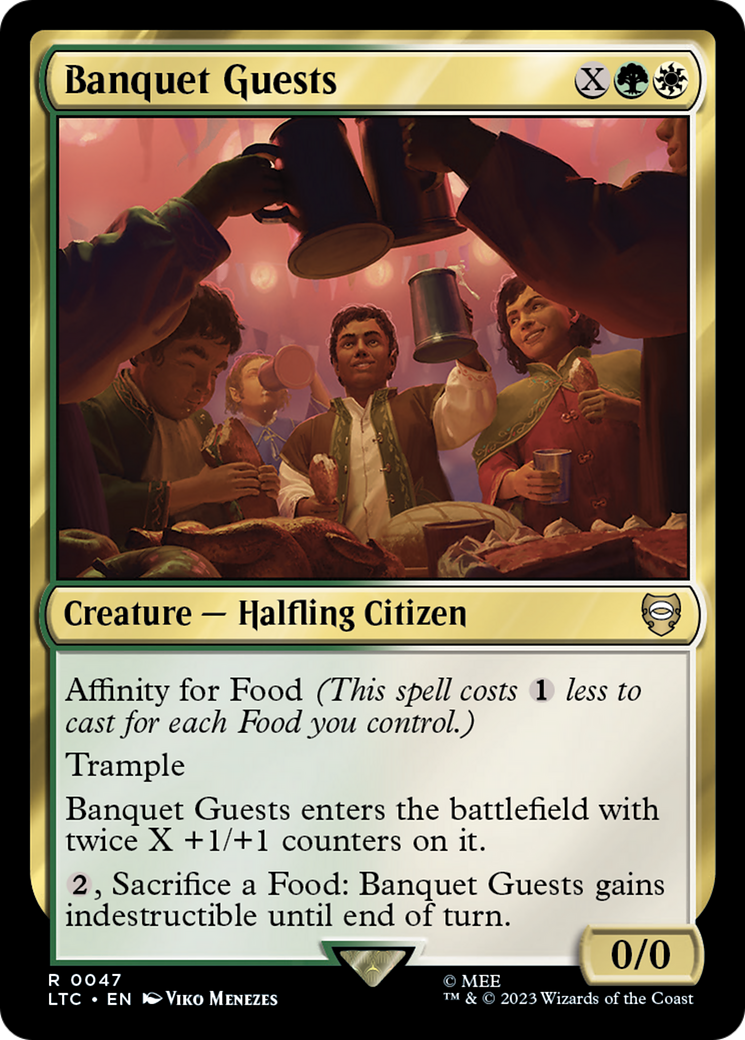
Banquet Guests
Banquet Guests
Creature — Halfling Citizen
0/0
Affinity for Foods (This spell costs less to cast for each Food you control.)
Trample
This creature enters with twice X +1/+1 counters on it.
, Sacrifice a Food: This creature gains indestructible until end of turn.
- If an effect refers to a Food, it means any Food artifact, not just a Food artifact token. For example, you can sacrifice Tough Cookie (an Artifact Creature — Food Golem) to activate Maraleaf Rider's ability (an ability with "Sacrifice a Food" in its cost).
- Food is an artifact type. Even though it appears on some creatures, it's never a creature type.
- You can't sacrifice a Food to pay multiple costs. For example, you can't sacrifice a Food token to activate its own ability and also to activate Maraleaf Rider's ability.
- Whatever you do, don't eat the delicious cards.
-
1
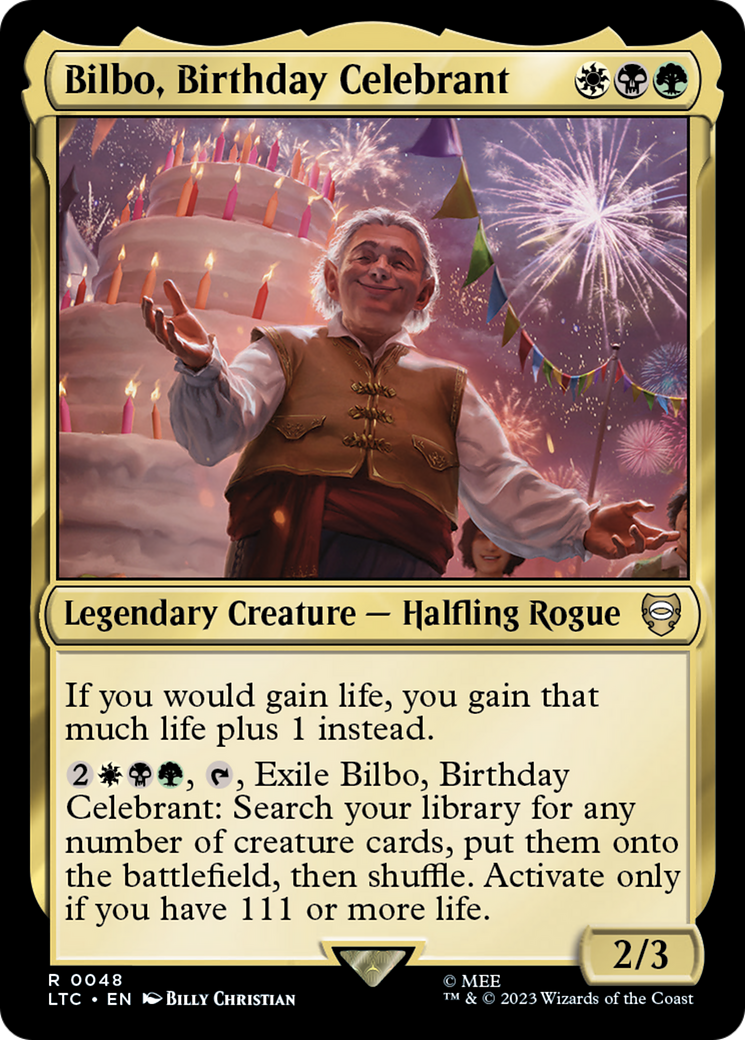
Bilbo, Birthday Celebrant
Bilbo, Birthday Celebrant
Legendary Creature — Halfling Rogue
2/3
If you would gain life, you gain that much life plus 1 instead.
, , Exile Bilbo: Search your library for any number of creature cards, put them onto the battlefield, then shuffle. Activate only if you have 111 or more life.
- If you somehow control two Bilbo, Birthday Celebrants and you would gain life, you gain that much life plus 2. A third Bilbo, Birthday Celebrant has you gain that much life plus 3, and so on.
- Bilbo, Birthday Celebrant's first ability applies just once to each life-gaining event, no matter how much life is gained. If you gain an amount of life "for each" of something or "equal to the number" of something, that life is gained as one event and the ability of Bilbo, Birthday Celebrant applies only once.
- Each creature with lifelink dealing combat damage causes a separate life-gaining event. For example, if two creatures you control with lifelink deal combat damage at the same time, Bilbo, Birthday Celebrant's first ability will apply to those two events separately. However, if a single creature you control with lifelink deals combat damage to multiple creatures, players, and/or planeswalkers at the same time (perhaps because it has trample or was blocked by more than one creature), the ability will apply only once.
- In a Two-Headed Giant game, life gained by your teammate won't cause Bilbo, Birthday Celebrant's first ability to apply, even though it will cause your team's life total to increase.
-
1
Birds of Paradise
Birds of Paradise
Creature — Bird
0/1
Flying
: Add one mana of any color.
-
1
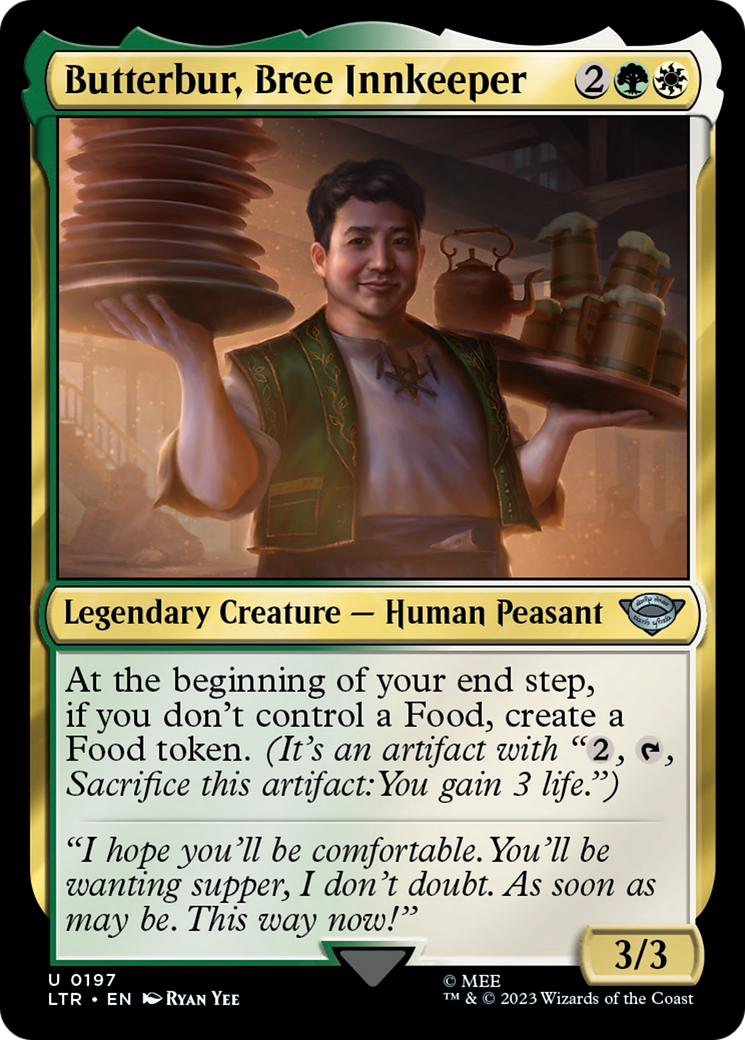
Butterbur, Bree Innkeeper
Butterbur, Bree Innkeeper
Legendary Creature — Human Peasant
3/3
At the beginning of your end step, if you don't control a Food, create a Food token. (It's an artifact with " , , Sacrifice this token: You gain 3 life.")
- Food is an artifact type. Even though it appears on some creatures, it's never a creature type.
- You can't sacrifice a Food to pay multiple costs. For example, you can't sacrifice a Food token to activate its own ability and also to activate Maraleaf Rider's ability.
- Whatever you do, don't eat the delicious cards.
- Butterbur, Bree Innkeeper's ability checks if you control a Food at the beginning of your end step. If you do, the ability won't trigger.
- If the ability does trigger, but you control a Food when it tries to resolve, the ability will do nothing. No Food will be created.
-
1
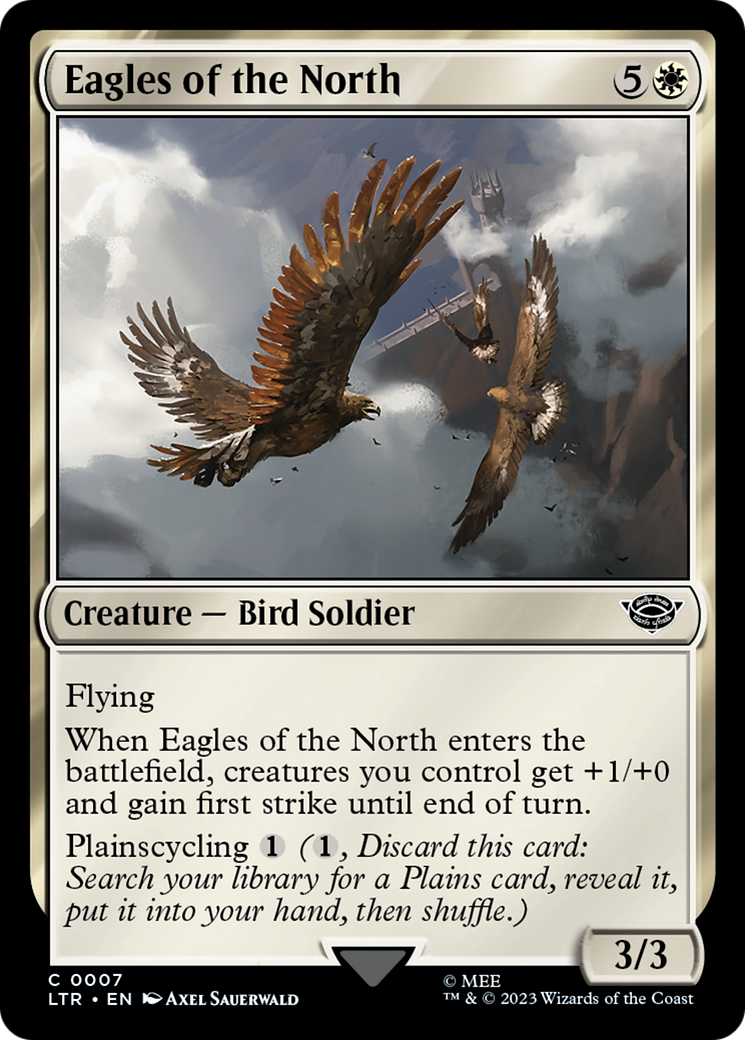
Eagles of the North
Eagles of the North
Creature — Bird Soldier
3/3
Flying
When this creature enters, creatures you control get +1/+0 and gain first strike until end of turn.
Plainscycling ( , Discard this card: Search your library for a Plains card, reveal it, put it into your hand, then shuffle.)
- Eagles of the North's triggered ability affects only creatures you control at the time it resolves. Any creatures that come under your control later in the turn won't be affected.
- Unlike the normal cycling ability, typecycling doesn't allow you to draw a card. Rather, it lets you search your library for a card with the type or types indicated by the ability name. For example, a card with basic landcycling lets you search for a basic land card, and a card with Wizardcycling lets you search for a Wizard card.
- Typecycling is a form of cycling. Any ability that triggers on a card being cycled also triggers on a card being typecycled. Any ability that stops a cycling ability from being activated also stops a typecycling ability from being activated.
-
1
Essence Warden
Essence Warden
Creature — Elf Shaman
1/1
Whenever another creature enters, you gain 1 life.
- If this creature enters at the same time as one or more other creatures, its ability will trigger for each of those other creatures.
-
1
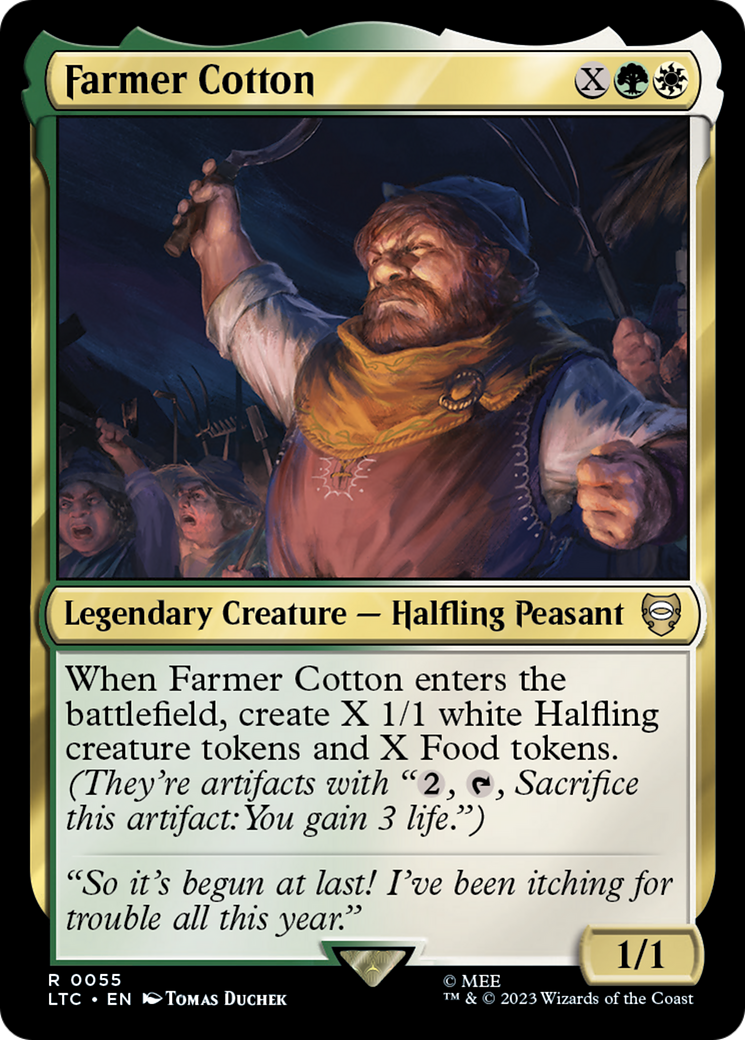
Farmer Cotton
Farmer Cotton
Legendary Creature — Halfling Peasant
1/1
When this creature enters, create X 1/1 white Halfling creature tokens and X Food tokens. (They're artifacts with " , , Sacrifice this token: You gain 3 life.")
- Food is an artifact type. Even though it appears on some creatures, it's never a creature type.
- You can't sacrifice a Food to pay multiple costs. For example, you can't sacrifice a Food token to activate its own ability and also to activate Maraleaf Rider's ability.
- Whatever you do, don't eat the delicious cards.
-
1
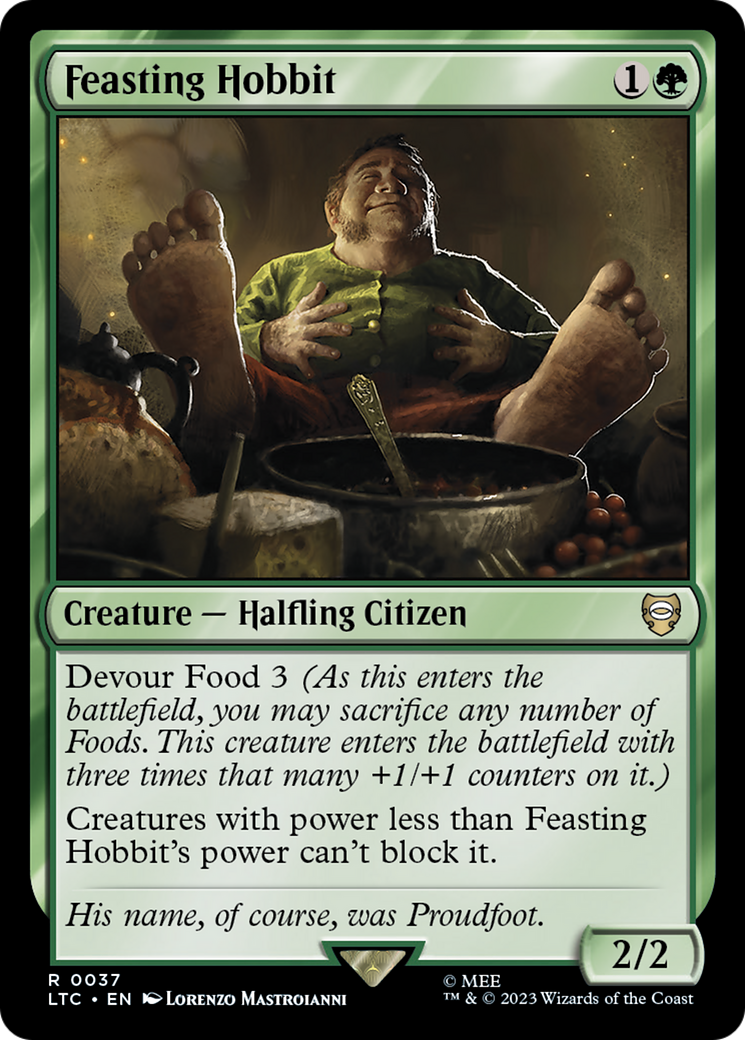
Feasting Hobbit
Feasting Hobbit
Creature — Halfling Citizen
2/2
Devour Food 3 (As this creature enters, you may sacrifice any number of Foods. It enters with three times that many +1/+1 counters on it.)
Creatures with power less than this creature's power can't block it.
- Whatever you do, don't eat the delicious cards.
- If an effect refers to a Food, it means any Food artifact, not just a Food artifact token. For example, you can sacrifice Tough Cookie (an Artifact Creature — Food Golem) to activate Maraleaf Rider's ability (an ability with "Sacrifice a Food" in its cost).
- Food is an artifact type. Even though it appears on some creatures, it's never a creature type.
- You can't sacrifice a Food to pay multiple costs. For example, you can't sacrifice a Food token to activate its own ability and also to activate Maraleaf Rider's ability.
- Devour Food is a variant of the devour ability. It allows you to sacrifice Foods rather than creatures, but otherwise functions identically to devour.
- You may choose not to sacrifice any Foods for the devour Food ability.
- If you cast this spell, you choose how many and which Foods to devour as part of the resolution of the spell. (It can't be countered at that point.)
- The comparison of power is done only when blockers are declared. Decreasing the power of a creature blocking Feasting Hobbit or increasing the power of Feasting Hobbit after this point won't cause Feasting Hobbit to become unblocked.
-
1
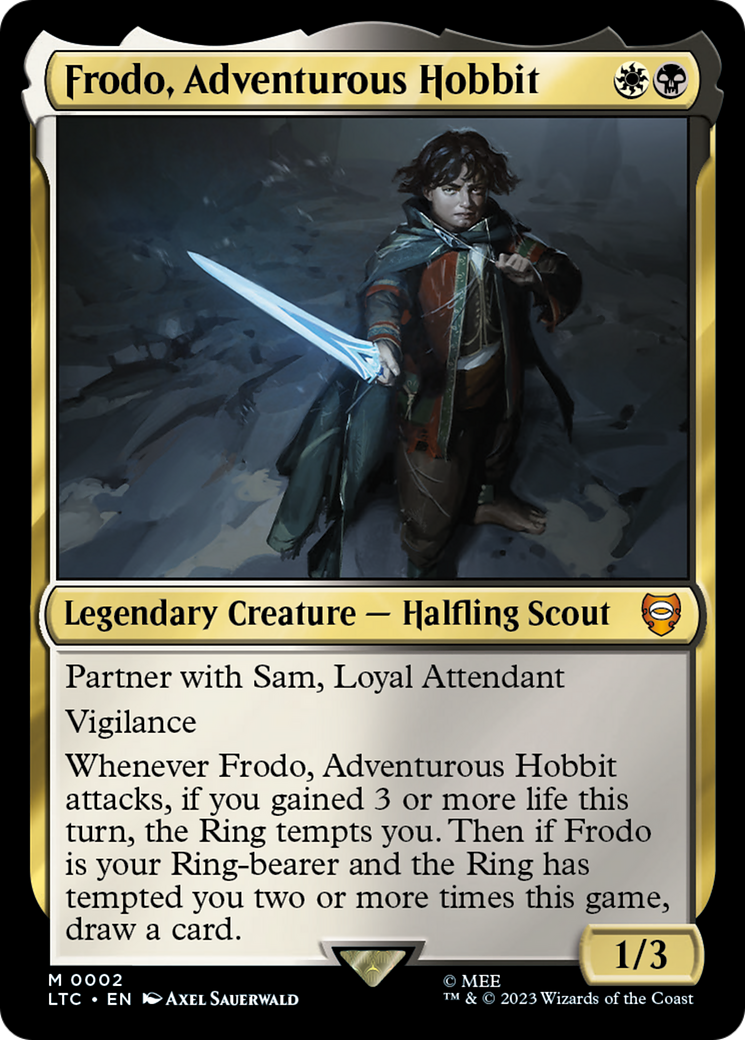
Frodo, Adventurous Hobbit
Frodo, Adventurous Hobbit
Legendary Creature — Halfling Scout
1/3
Partner with Sam, Loyal Attendant
Vigilance
Whenever Frodo attacks, if you gained 3 or more life this turn, the Ring tempts you. Then if Frodo is your Ring-bearer and the Ring has tempted you two or more times this game, draw a card.
- The Ring tempts you just once, no matter how much life you've gained past 3 life.
- Frodo, Adventurous Hobbit's ability looks at how much life you've gained in the turn, even if it wasn't on the battlefield when you gained life. It doesn't care if you also lost life, even if you lost more life than you gained.
- If you haven't gained 3 or more life by the time Frodo, Adventurous Hobbit attacks, the ability won't trigger at all.
- As the Ring tempts you, you get an emblem named The Ring if you don't have one. Then your emblem gains its next ability and you choose a creature you control to become (or remain) your Ring-bearer.
- The Ring can tempt you even if you don't control a creature. In this case, abilities that trigger "whenever the Ring tempts you" will still trigger.
- If the creature you choose as your Ring-bearer was already your Ring-bearer, that still counts as choosing that creature as your Ring-bearer for the purpose of abilities that trigger "whenever you choose a creature as your Ring-bearer" or abilities that care about which creature was chosen as your Ring-bearer.
- The Ring gains its abilities in order from top to bottom. Once it gains an ability, it has that ability for the rest of the game.
- Each time the Ring tempts you, you must choose a creature if you control one.
- Each player can have only one emblem named The Ring and only one Ring-bearer at a time.
- Some spells and abilities that cause the Ring to tempt you may require targets. If each target chosen is an illegal target as that spell or ability tries to resolve, it won't resolve. The Ring won't tempt you.
- "Partner with [name]" represents two abilities. The first is a triggered ability: "When this permanent enters the battlefield, target player may search their library for a card named [name], reveal it, put it into their hand, then shuffle their library."
- Note that the target player searches their library (which may be affected by effects such as that of Stranglehold) and that the card they find is revealed, even though these words aren't included in the ability's reminder text.
- The second ability represented by the "partner with [name]" keyword modifies the rules for deck construction in the Commander variant and has no function outside of that variant. If a legendary creature card with "partner with [name]" is designated as your commander, the named legendary creature card can also be designated as your commander. For more information on the Commander variant, please visit Wizards.com/Commander.
- If your Commander deck has two commanders, you can only include cards whose own color identities are also found in your commanders' combined color identities. If Frodo, Adventurous Hobbit and Sam, Loyal Attendant are your commanders, your deck may contain cards with white, black, and/or green in their color identity, but not blue or red.
- Both commanders start in the command zone, and the remaining 98 cards of your deck are shuffled to become your library.
- To have two commanders, both must have the partner ability or corresponding "partner with" abilities as the game begins. A creature with a "partner with" ability can't partner with any creature other than its designated partner. Losing a partner ability during the game doesn't cause either to cease to be your commander.
- Once the game begins, your two commanders are tracked separately. If you cast one, you won't have to pay an additional the first time you cast the other. A player loses the game after having been dealt 21 damage from one of them, not from both of them combined. Command Beacon's effect puts one into your hand from the command zone, not both.
- An effect that checks whether you control your commander is satisfied if you control one or both of your two commanders.
- The triggered ability of the "partner with" keyword still triggers in a Commander game. If your other commander has somehow ended up in your library, you can find it. You can also target another player, whether or not they have that card in their library.
-
1
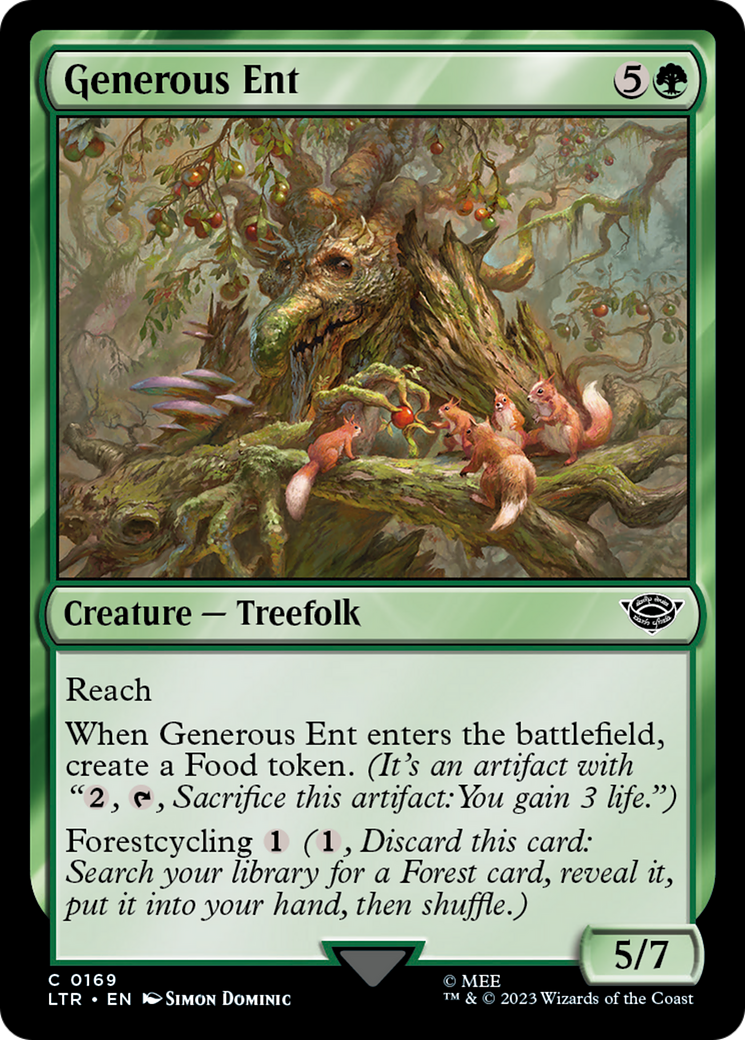
Generous Ent
Generous Ent
Creature — Treefolk
5/7
Reach
When this creature enters, create a Food token. (It's an artifact with " , , Sacrifice this token: You gain 3 life.")
Forestcycling ( , Discard this card: Search your library for a Forest card, reveal it, put it into your hand, then shuffle.)
- Food is an artifact type. Even though it appears on some creatures, it's never a creature type.
- You can't sacrifice a Food to pay multiple costs. For example, you can't sacrifice a Food token to activate its own ability and also to activate Maraleaf Rider's ability.
- Whatever you do, don't eat the delicious cards.
- Unlike the normal cycling ability, typecycling doesn't allow you to draw a card. Rather, it lets you search your library for a card with the type or types indicated by the ability name. For example, a card with basic landcycling lets you search for a basic land card, and a card with Wizardcycling lets you search for a Wizard card.
- Typecycling is a form of cycling. Any ability that triggers on a card being cycled also triggers on a card being typecycled. Any ability that stops a cycling ability from being activated also stops a typecycling ability from being activated.
-
1
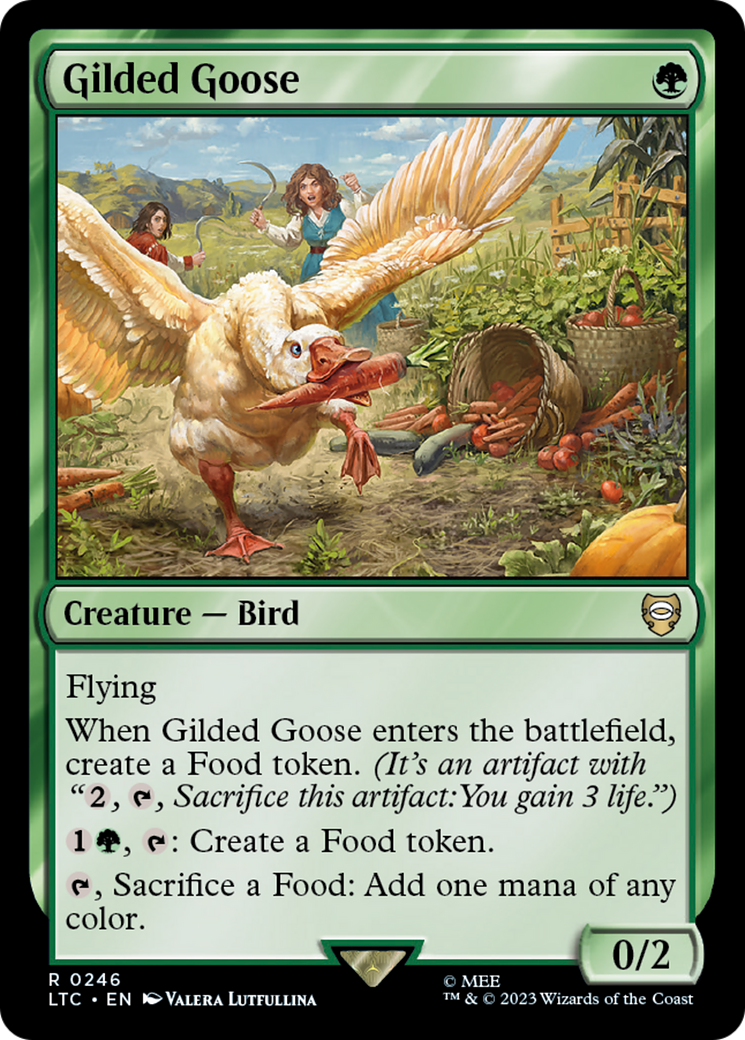
Gilded Goose
Gilded Goose
Creature — Bird
0/2
Flying
When this creature enters, create a Food token. (It's an artifact with " , , Sacrifice this token: You gain 3 life.")
, : Create a Food token.
, Sacrifice a Food: Add one mana of any color.
- If an effect refers to a Food, it means any Food artifact, not just a Food artifact token. For example, you can sacrifice Tough Cookie (an Artifact Creature — Food Golem) to activate Maraleaf Rider's ability (an ability with "Sacrifice a Food" in its cost).
- Food is an artifact type. Even though it appears on some creatures, it's never a creature type.
- You can't sacrifice a Food to pay multiple costs. For example, you can't sacrifice a Food token to activate its own ability and also to activate Maraleaf Rider's ability.
- Whatever you do, don't eat the delicious cards.
-
1
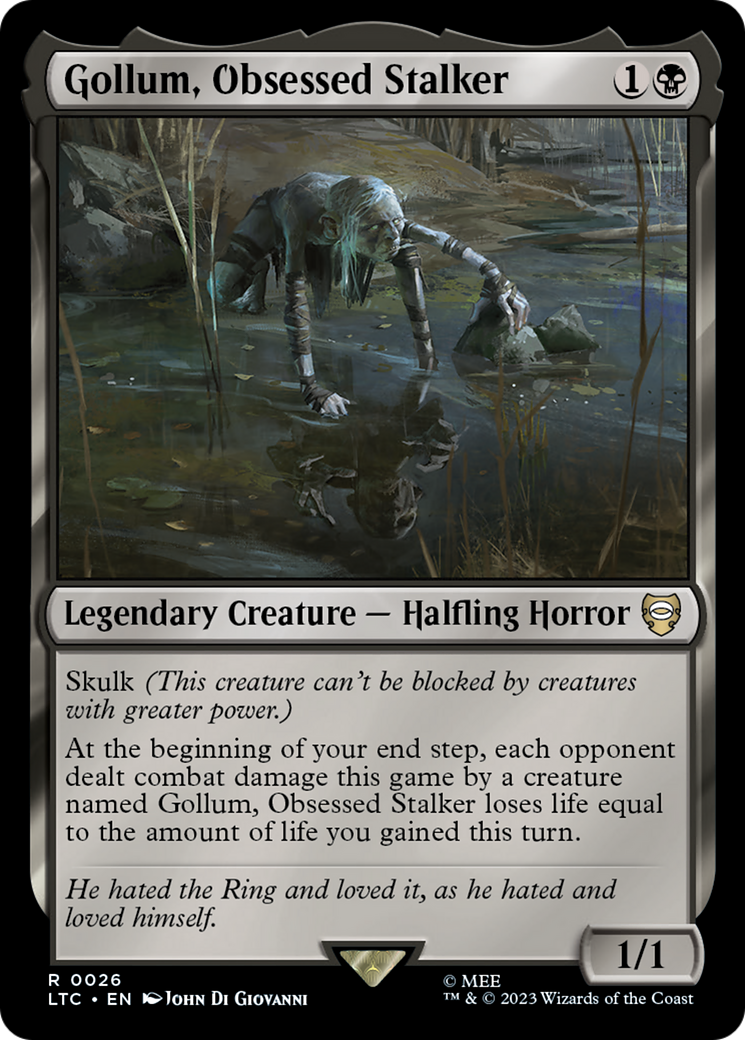
Gollum, Obsessed Stalker
Gollum, Obsessed Stalker
Legendary Creature — Halfling Horror
1/1
Skulk (This creature can't be blocked by creatures with greater power.)
At the beginning of your end step, each opponent dealt combat damage this game by a creature named Gollum, Obsessed Stalker loses life equal to the amount of life you gained this turn.
- Gollum, Obsessed Stalker's last ability counts players who were dealt combat damage by any creature named Gollum, Obsessed Stalker. It doesn't matter who controlled those creatures.
- Gollum, Obsessed Stalker's last ability counts the total amount of life you gained without taking into account any life you lost during that turn. For example, if you gained 3 life and lost 3 life earlier in the turn, each opponent dealt combat damage this game by a creature named Gollum, Obsessed Stalker loses 3 life.
-
1
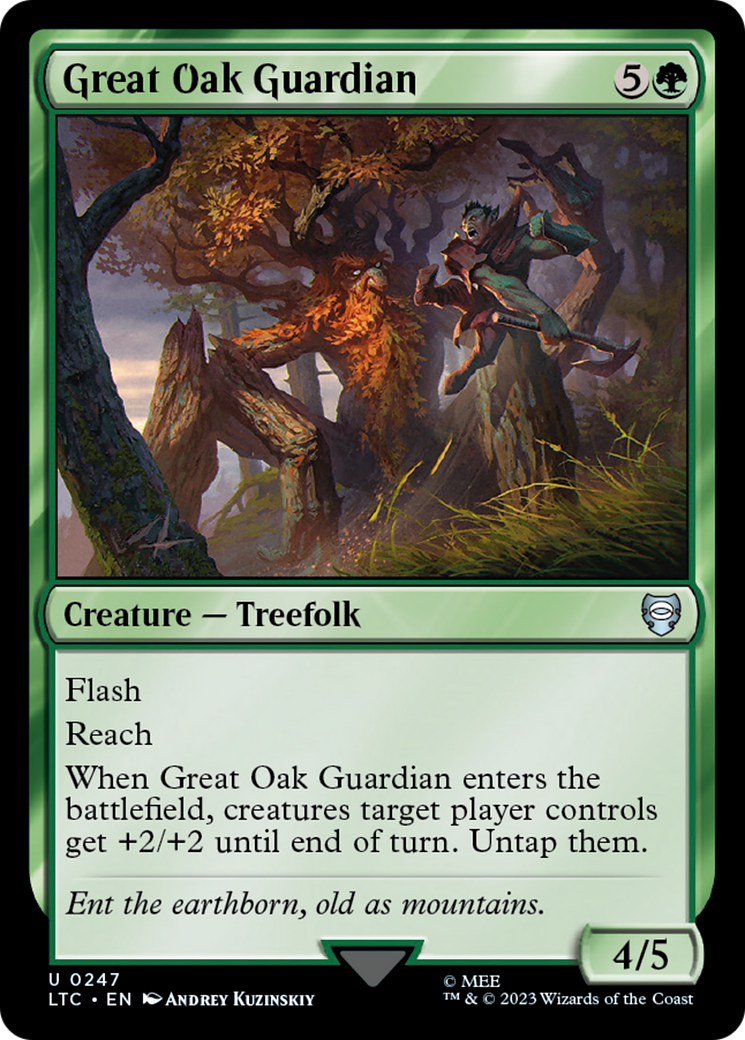
Great Oak Guardian
Great Oak Guardian
Creature — Treefolk
4/5
Flash (You may cast this spell any time you could cast an instant.)
Reach
When this creature enters, creatures target player controls get +2/+2 until end of turn. Untap them.
- Great Oak Guardian's last ability targets only the player, not any creatures. Creatures with shroud that player controls will be affected, for example.
- Any creatures controlled by the player that are already untapped will just get +2/+2 until end of turn.
-
1
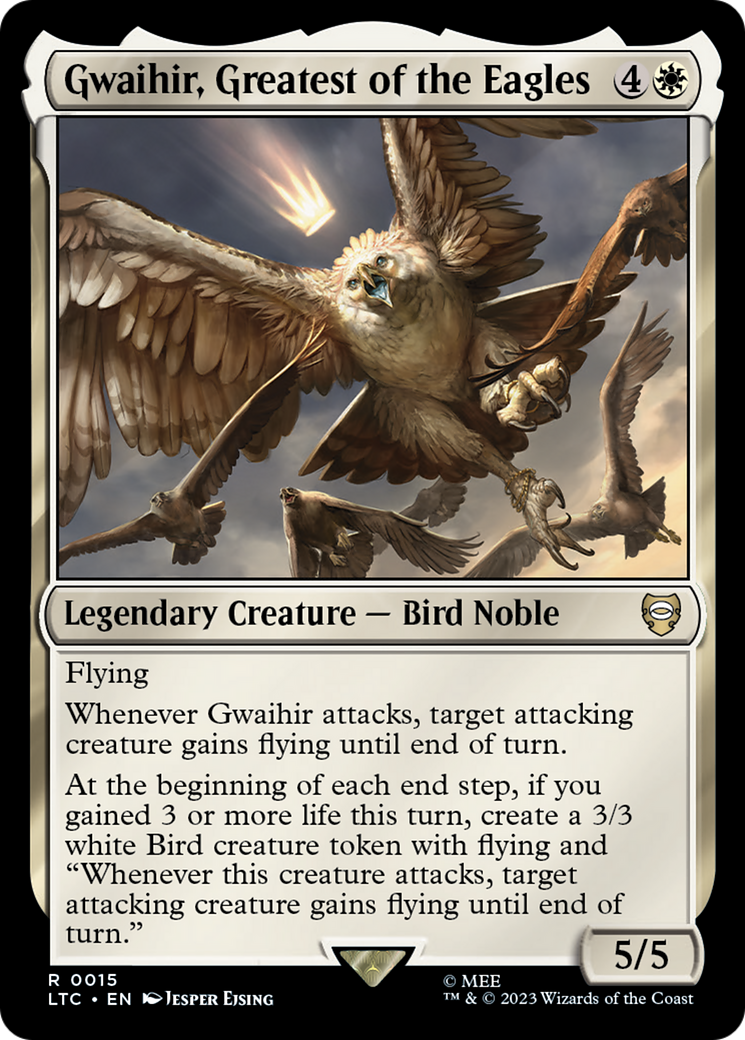
Gwaihir, Greatest of the Eagles
Gwaihir, Greatest of the Eagles
Legendary Creature — Bird Noble
5/5
Flying
Whenever Gwaihir attacks, target attacking creature gains flying until end of turn.
At the beginning of each end step, if you gained 3 or more life this turn, create a 3/3 white Bird creature token with flying and "Whenever this token attacks, target attacking creature gains flying until end of turn."
- You create just one Bird token, no matter how much life you've gained past 3 life.
- Gwaihir, Greatest of the Eagles's ability looks at how much life you've gained in the turn, even if it wasn't on the battlefield when you gained life. It doesn't care if you also lost life, even if you lost more life than you gained.
- If you haven't gained 3 or more life by the time an end step begins, Gwaihir, Greatest of the Eagles's ability won't trigger at all.
-
1
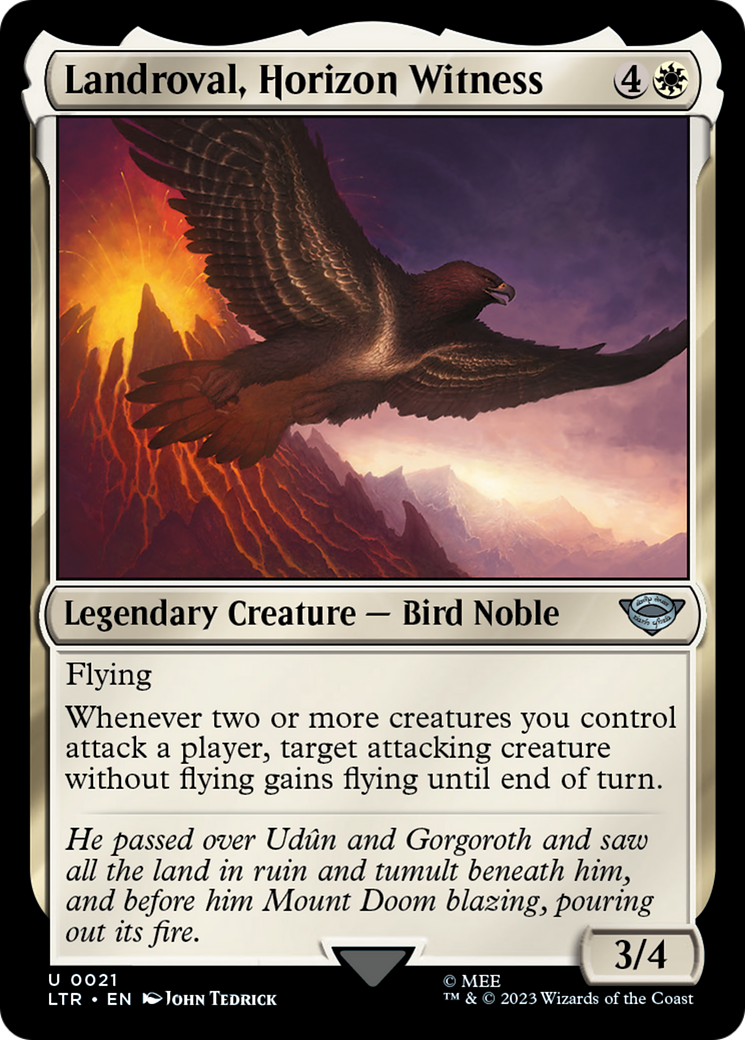
Landroval, Horizon Witness
Landroval, Horizon Witness
Legendary Creature — Bird Noble
3/4
Flying
Whenever two or more creatures you control attack a player, target attacking creature without flying gains flying until end of turn.
- Two or more creatures you control must attack the same player in order for Landroval, Horizon Witness's ability to trigger. Creatures you control that attack planeswalkers that player controls or battles that player is protecting won't count toward Landroval, Horizon Witness's trigger condition.
- In a multiplayer game, Landroval, Horizon Witness's triggered ability triggers once for each player you attack with at least two creatures.
-
1
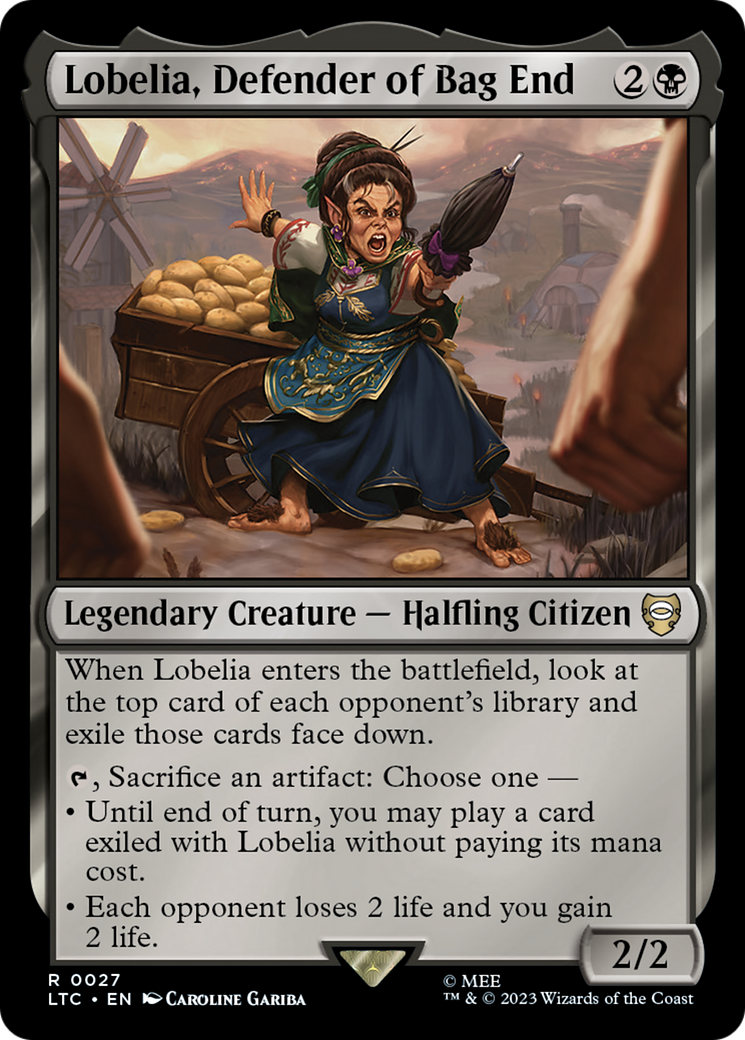
Lobelia, Defender of Bag End
Lobelia, Defender of Bag End
Legendary Creature — Halfling Citizen
2/2
When Lobelia enters, look at the top card of each opponent's library and exile those cards face down.
, Sacrifice an artifact: Choose one —
- Until end of turn, you may play a card exiled with Lobelia without paying its mana cost.
- Each opponent loses 2 life and you gain 2 life.
- You may look at these face-down exiled cards any time you wish. No other player may look at the face-down cards you exiled with Lobelia, Defender of Bag End, even if another player takes control of it.
- If Lobelia, Defender of Bag End leaves the battlefield, and later another Lobelia, Defender of Bag End enters the battlefield, it is a new object (even if the two were represented by the same card). You can't play cards exiled by the original Lobelia, Defender of Bag End with the second ability of the new Lobelia, Defender of Bag End.
- To play a card using the permission granted by the first mode of Lobelia, Defender of Bag End's activated ability, you must still follow any timing restrictions and permissions, including those based on the card's type. For instance, you can play a land from exile this way only during your main phase while the stack is empty, and only if you have an available land play remaining for the turn.
- If you cast a spell "without paying its mana cost", you can't choose to cast it for any alternative costs. You can, however, pay additional costs, such as kicker costs. If the card has any mandatory additional costs, those must be paid to cast the spell.
- If the spell has in its mana cost, you must choose 0 as the value of X when casting it without paying its mana cost.
-
1
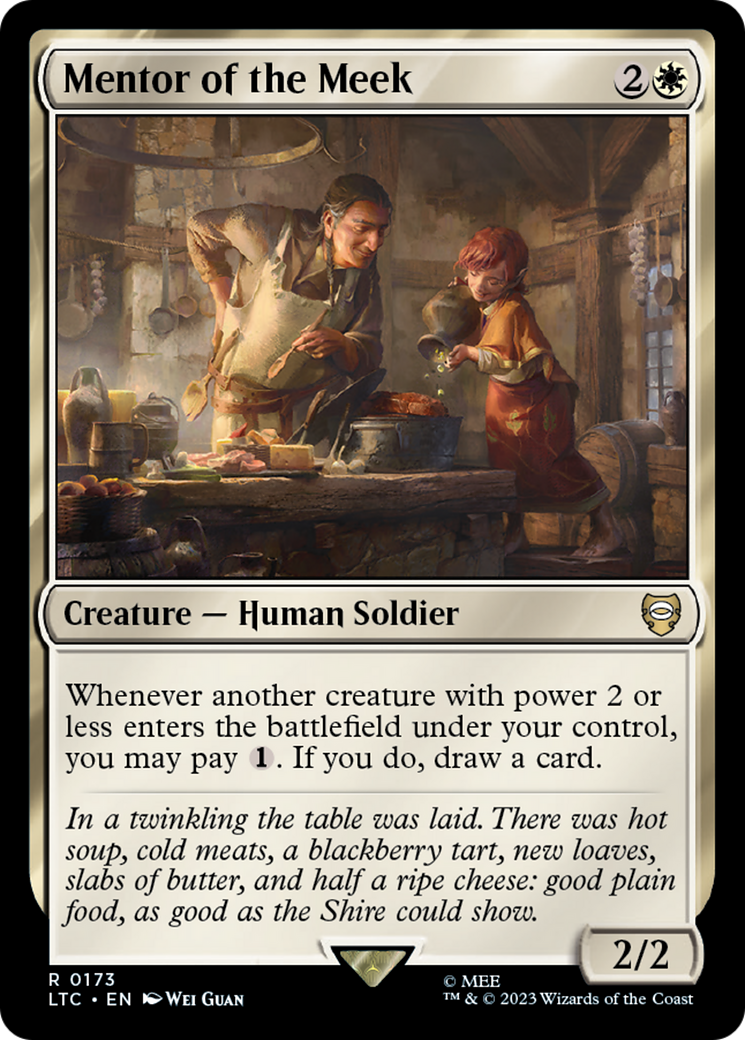
Mentor of the Meek
Mentor of the Meek
Creature — Human Soldier
2/2
Whenever another creature you control with power 2 or less enters, you may pay . If you do, draw a card.
- Mentor of the Meek’s ability checks the power of the other creature only as it enters. If that creature’s power is 2 or less, the ability will trigger. Once the ability triggers, raising that creature’s power above 2 won’t affect that ability. Similarly, reducing the creature’s power to 2 or less after it enters won’t cause the ability to trigger.
- If a creature enters with +1/+1 counters or a continuous effect such as that of Wedding Festivity will apply to the creature on the battlefield, those effects apply when checking to see if Mentor of the Meek’s ability will trigger.
- While resolving the triggered ability of Mentor of the Meek, you can’t pay multiple times to draw more than one card.
-
1
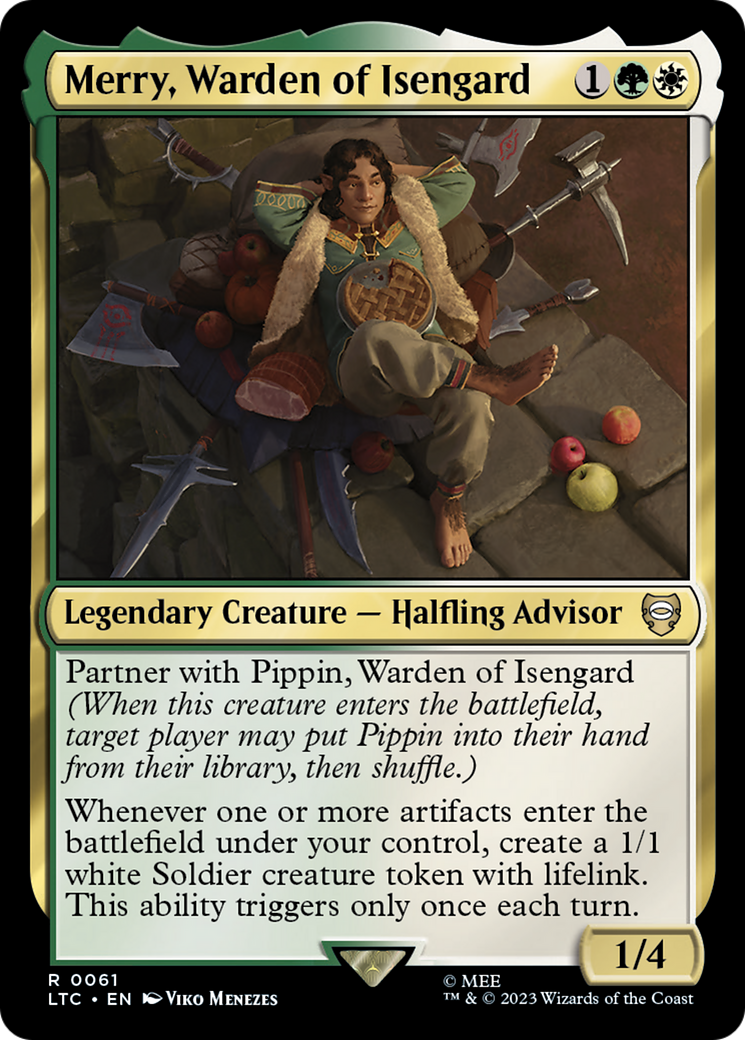
Merry, Warden of Isengard
Merry, Warden of Isengard
Legendary Creature — Halfling Advisor
1/4
Partner with Pippin, Warden of Isengard (When this creature enters, target player may put Pippin into their hand from their library, then shuffle.)
Whenever one or more artifacts you control enter, create a 1/1 white Soldier creature token with lifelink. This ability triggers only once each turn.
- "Partner with [name]" represents two abilities. The first is a triggered ability: "When this permanent enters the battlefield, target player may search their library for a card named [name], reveal it, put it into their hand, then shuffle their library."
- Note that the target player searches their library (which may be affected by effects such as that of Stranglehold) and that the card they find is revealed, even though these words aren't included in the ability's reminder text.
- The second ability represented by the "partner with [name]" keyword modifies the rules for deck construction in the Commander variant and has no function outside of that variant. If a legendary creature card with "partner with [name]" is designated as your commander, the named legendary creature card can also be designated as your commander. For more information on the Commander variant, please visit Wizards.com/Commander.
- If your Commander deck has two commanders, you can only include cards whose own color identities are also found in your commanders' combined color identities. If Frodo, Adventurous Hobbit and Sam, Loyal Attendant are your commanders, your deck may contain cards with white, black, and/or green in their color identity, but not blue or red.
- Both commanders start in the command zone, and the remaining 98 cards of your deck are shuffled to become your library.
- To have two commanders, both must have the partner ability or corresponding "partner with" abilities as the game begins. A creature with a "partner with" ability can't partner with any creature other than its designated partner. Losing a partner ability during the game doesn't cause either to cease to be your commander.
- Once the game begins, your two commanders are tracked separately. If you cast one, you won't have to pay an additional the first time you cast the other. A player loses the game after having been dealt 21 damage from one of them, not from both of them combined. Command Beacon's effect puts one into your hand from the command zone, not both.
- An effect that checks whether you control your commander is satisfied if you control one or both of your two commanders.
- The triggered ability of the "partner with" keyword still triggers in a Commander game. If your other commander has somehow ended up in your library, you can find it. You can also target another player, whether or not they have that card in their library.
-
1
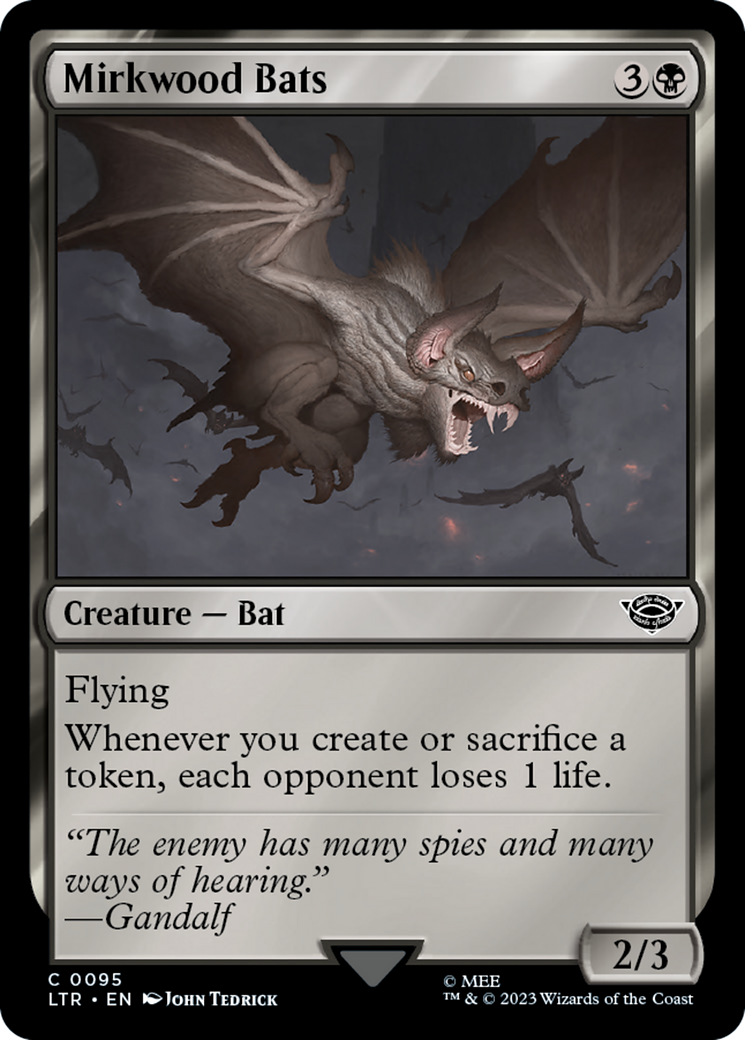
Mirkwood Bats
Mirkwood Bats
Creature — Bat
2/3
Flying
Whenever you create or sacrifice a token, each opponent loses 1 life.
-
1
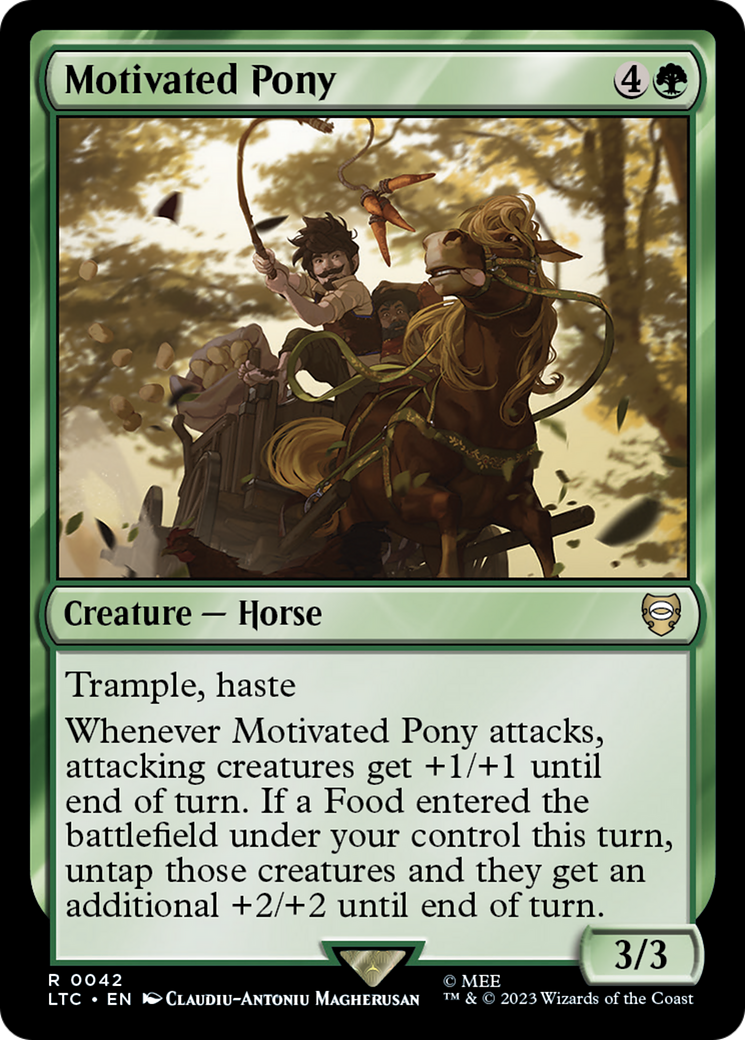
Motivated Pony
Motivated Pony
Creature — Horse
3/3
Trample, haste
Whenever this creature attacks, attacking creatures get +1/+1 until end of turn. If a Food entered under your control this turn, untap those creatures and they get an additional +2/+2 until end of turn.
- If an effect refers to a Food, it means any Food artifact, not just a Food artifact token. For example, you can sacrifice Tough Cookie (an Artifact Creature — Food Golem) to activate Maraleaf Rider's ability (an ability with "Sacrifice a Food" in its cost).
- Food is an artifact type. Even though it appears on some creatures, it's never a creature type.
- You can't sacrifice a Food to pay multiple costs. For example, you can't sacrifice a Food token to activate its own ability and also to activate Maraleaf Rider's ability.
- Whatever you do, don't eat the delicious cards.
-
1
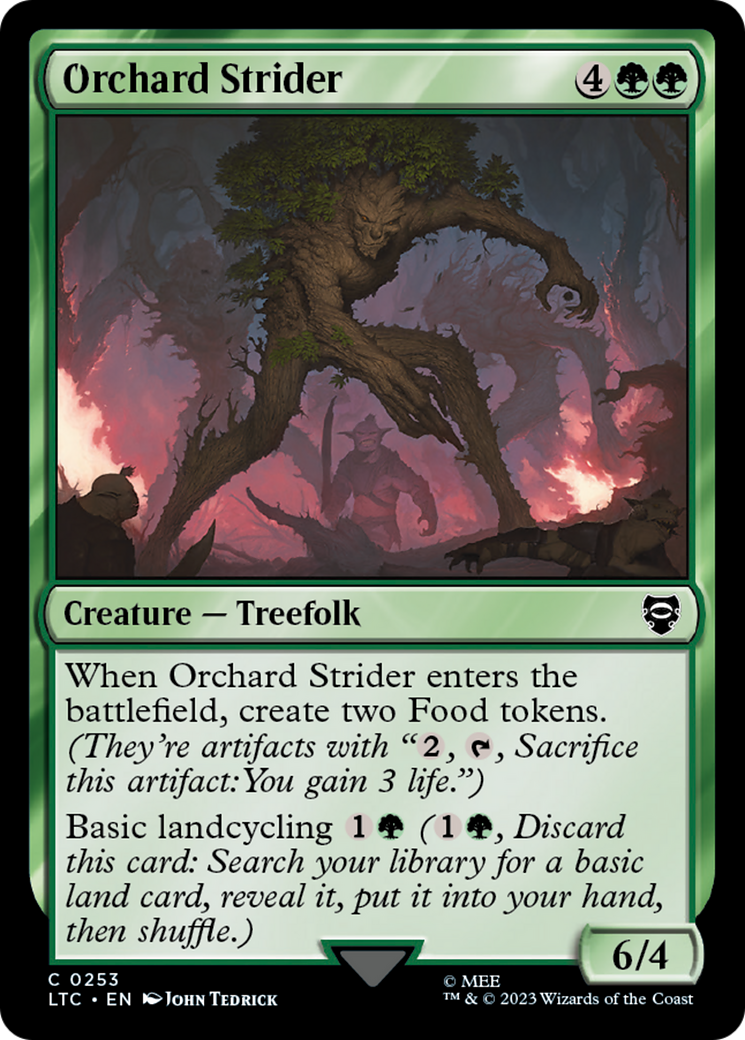
Orchard Strider
Orchard Strider
Creature — Treefolk
6/4
When this creature enters, create two Food tokens. (They're artifacts with " , , Sacrifice this token: You gain 3 life.")
Basic landcycling ( , Discard this card: Search your library for a basic land card, reveal it, put it into your hand, then shuffle.)
- Food is an artifact type. Even though it appears on some creatures, it's never a creature type.
- You can't sacrifice a Food to pay multiple costs. For example, you can't sacrifice a Food token to activate its own ability and also to activate Maraleaf Rider's ability.
- Whatever you do, don't eat the delicious cards.
- Unlike the normal cycling ability, typecycling doesn't allow you to draw a card. Rather, it lets you search your library for a card with the type or types indicated by the ability name. For example, a card with basic landcycling lets you search for a basic land card, and a card with Wizardcycling lets you search for a Wizard card.
- Typecycling is a form of cycling. Any ability that triggers on a card being cycled also triggers on a card being typecycled. Any ability that stops a cycling ability from being activated also stops a typecycling ability from being activated.
-
1
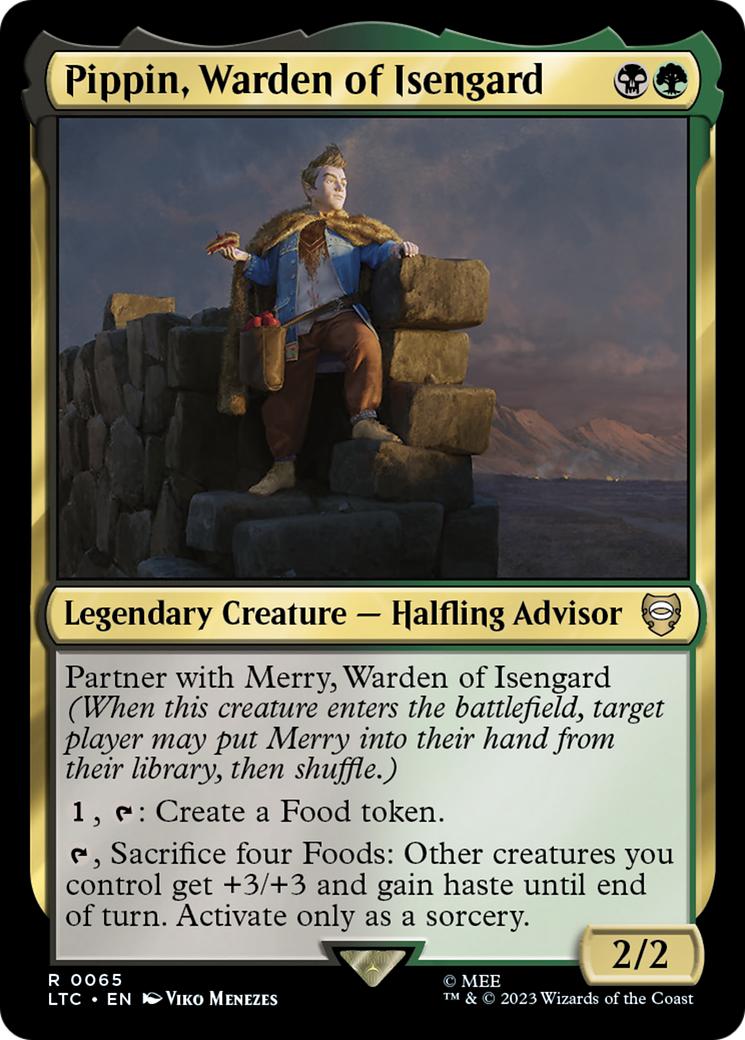
Pippin, Warden of Isengard
Pippin, Warden of Isengard
Legendary Creature — Halfling Advisor
2/2
Partner with Merry, Warden of Isengard (When this creature enters, target player may put Merry into their hand from their library, then shuffle.)
, : Create a Food token.
, Sacrifice four Foods: Other creatures you control get +3/+3 and gain haste until end of turn. Activate only as a sorcery.
- If an effect refers to a Food, it means any Food artifact, not just a Food artifact token. For example, you can sacrifice Tough Cookie (an Artifact Creature — Food Golem) to activate Maraleaf Rider's ability (an ability with "Sacrifice a Food" in its cost).
- Food is an artifact type. Even though it appears on some creatures, it's never a creature type.
- You can't sacrifice a Food to pay multiple costs. For example, you can't sacrifice a Food token to activate its own ability and also to activate Maraleaf Rider's ability.
- Whatever you do, don't eat the delicious cards.
- Both commanders start in the command zone, and the remaining 98 cards of your deck are shuffled to become your library.
- To have two commanders, both must have the partner ability or corresponding "partner with" abilities as the game begins. A creature with a "partner with" ability can't partner with any creature other than its designated partner. Losing a partner ability during the game doesn't cause either to cease to be your commander.
- "Partner with [name]" represents two abilities. The first is a triggered ability: "When this permanent enters the battlefield, target player may search their library for a card named [name], reveal it, put it into their hand, then shuffle their library."
- An effect that checks whether you control your commander is satisfied if you control one or both of your two commanders.
- The triggered ability of the "partner with" keyword still triggers in a Commander game. If your other commander has somehow ended up in your library, you can find it. You can also target another player, whether or not they have that card in their library.
- Once the game begins, your two commanders are tracked separately. If you cast one, you won't have to pay an additional the first time you cast the other. A player loses the game after having been dealt 21 damage from one of them, not from both of them combined. Command Beacon's effect puts one into your hand from the command zone, not both.
- Note that the target player searches their library (which may be affected by effects such as that of Stranglehold) and that the card they find is revealed, even though these words aren't included in the ability's reminder text.
- The second ability represented by the "partner with [name]" keyword modifies the rules for deck construction in the Commander variant and has no function outside of that variant. If a legendary creature card with "partner with [name]" is designated as your commander, the named legendary creature card can also be designated as your commander. For more information on the Commander variant, please visit Wizards.com/Commander.
- If your Commander deck has two commanders, you can only include cards whose own color identities are also found in your commanders' combined color identities. If Frodo, Adventurous Hobbit and Sam, Loyal Attendant are your commanders, your deck may contain cards with white, black, and/or green in their color identity, but not blue or red.
-
1
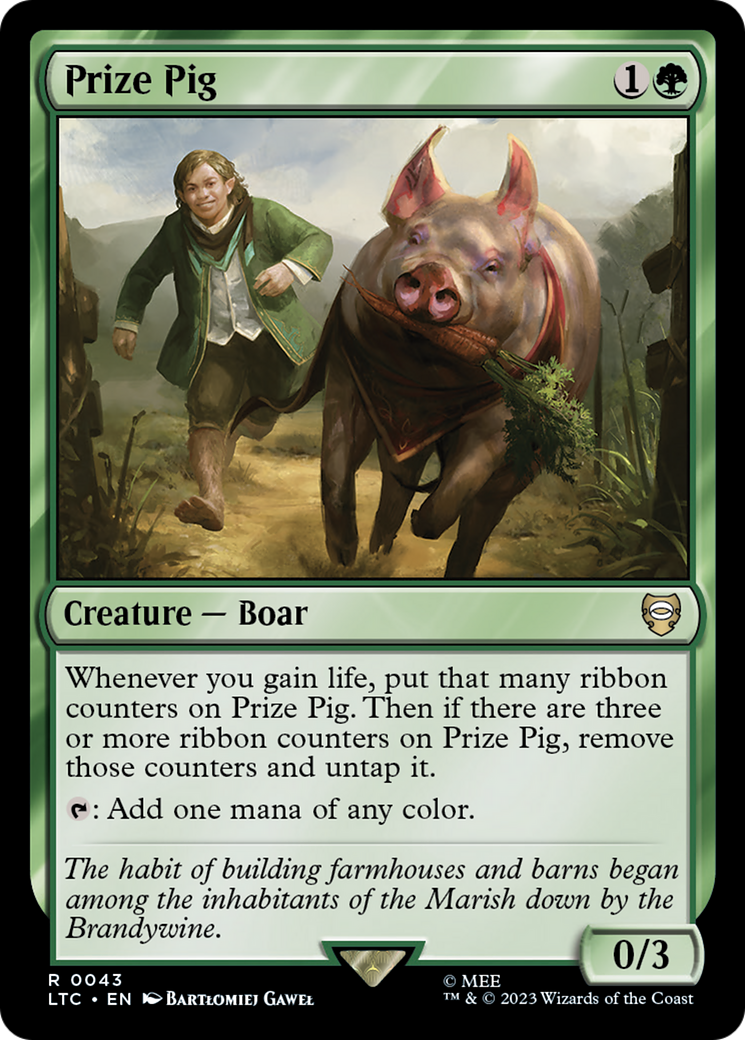
Prize Pig
Prize Pig
Creature — Boar
0/3
Whenever you gain life, put that many ribbon counters on this creature. Then if there are three or more ribbon counters on this creature, remove those counters and untap it.
: Add one mana of any color.
- If there are three or more ribbon counters on Prize Pig after you put ribbon counters on it, all of the counters will be removed. It does not matter whether or not Prize Pig is already untapped.
-
1
Prosperous Innkeeper
Prosperous Innkeeper
Creature — Halfling Citizen
1/1
When this creature enters, create a Treasure token. (It's an artifact with " , Sacrifice this token: Add one mana of any color.")
Whenever another creature you control enters, you gain 1 life.
-
1
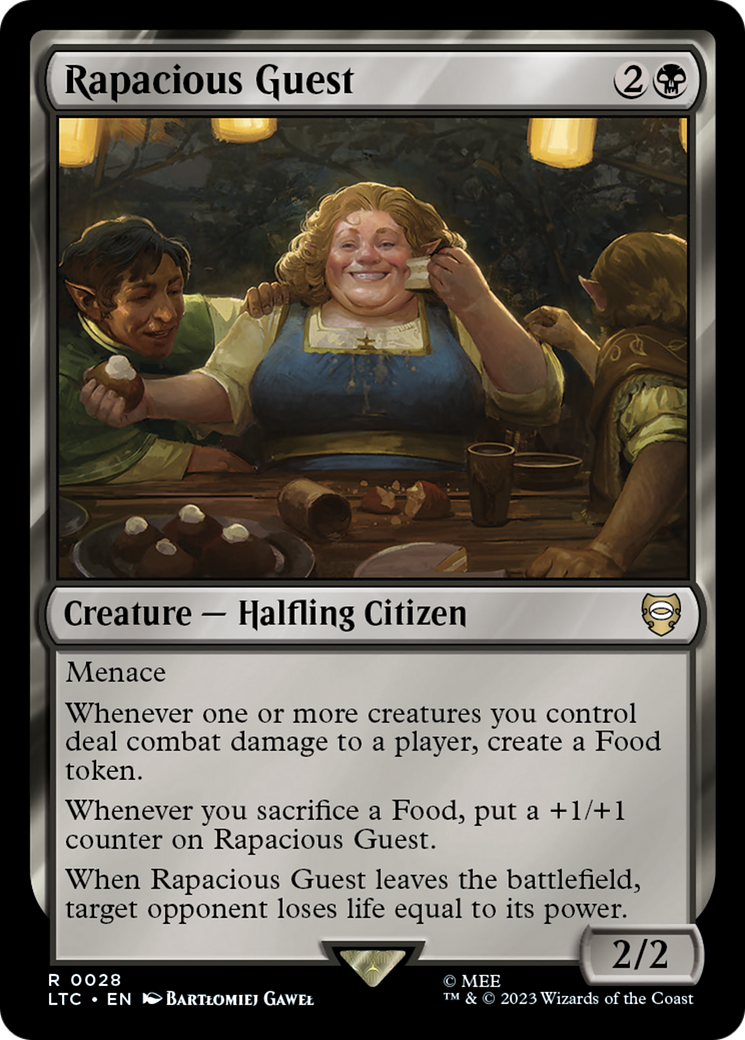
Rapacious Guest
Rapacious Guest
Creature — Halfling Citizen
2/2
Menace
Whenever one or more creatures you control deal combat damage to a player, create a Food token.
Whenever you sacrifice a Food, put a +1/+1 counter on this creature.
When this creature leaves the battlefield, target opponent loses life equal to its power.
- If an effect refers to a Food, it means any Food artifact, not just a Food artifact token. For example, you can sacrifice Tough Cookie (an Artifact Creature — Food Golem) to activate Maraleaf Rider's ability (an ability with "Sacrifice a Food" in its cost).
- Food is an artifact type. Even though it appears on some creatures, it's never a creature type.
- You can't sacrifice a Food to pay multiple costs. For example, you can't sacrifice a Food token to activate its own ability and also to activate Maraleaf Rider's ability.
- Whatever you do, don't eat the delicious cards.
- Rapacious Guest's third ability triggers whenever you sacrifice a Food for any reason, not just to activate a Food's activated ability.
- To determine the amount of life the target opponent loses from Rapacious Guest's last ability, use Rapacious Guest's power as it last existed on the battlefield, not its power in the graveyard.
-
1
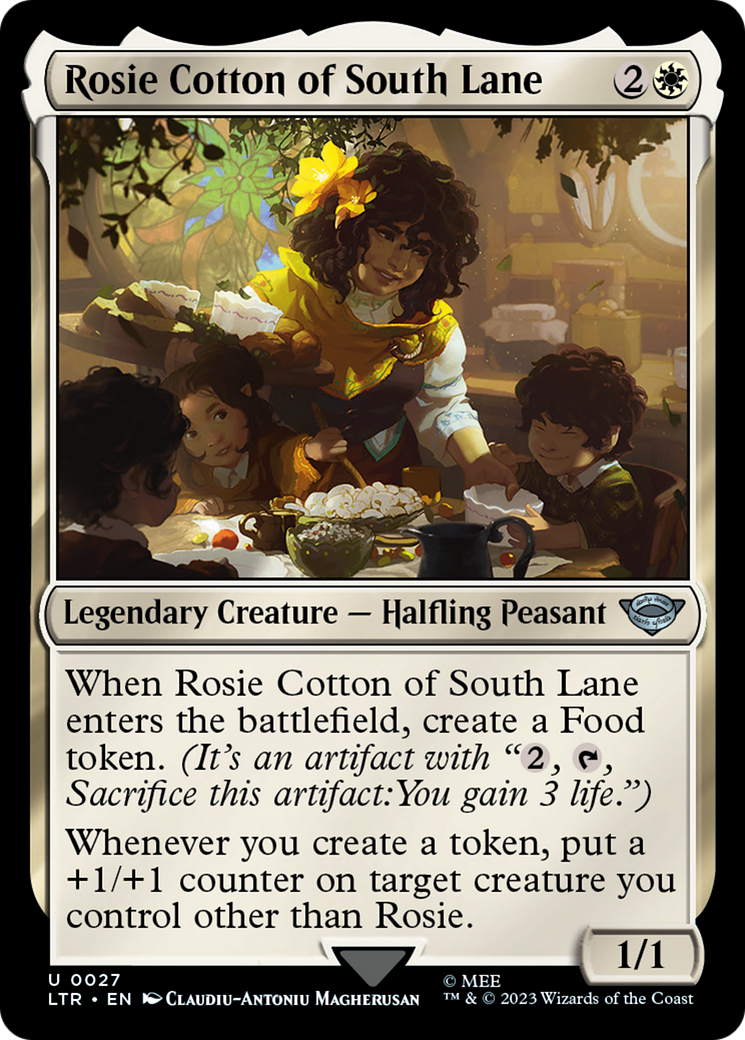
Rosie Cotton of South Lane
Rosie Cotton of South Lane
Legendary Creature — Halfling Peasant
1/1
When Rosie Cotton enters, create a Food token. (It's an artifact with " , , Sacrifice this token: You gain 3 life.")
Whenever you create a token, put a +1/+1 counter on target creature you control other than Rosie Cotton.
- Food is an artifact type. Even though it appears on some creatures, it's never a creature type.
- You can't sacrifice a Food to pay multiple costs. For example, you can't sacrifice a Food token to activate its own ability and also to activate Maraleaf Rider's ability.
- Whatever you do, don't eat the delicious cards.
- If you create multiple tokens at once, Rosie Cotton of South Lane's last ability will trigger once for each token you created.
- If you create a creature token, you can target it with Rosie Cotton of South Lane's last ability.
-
1
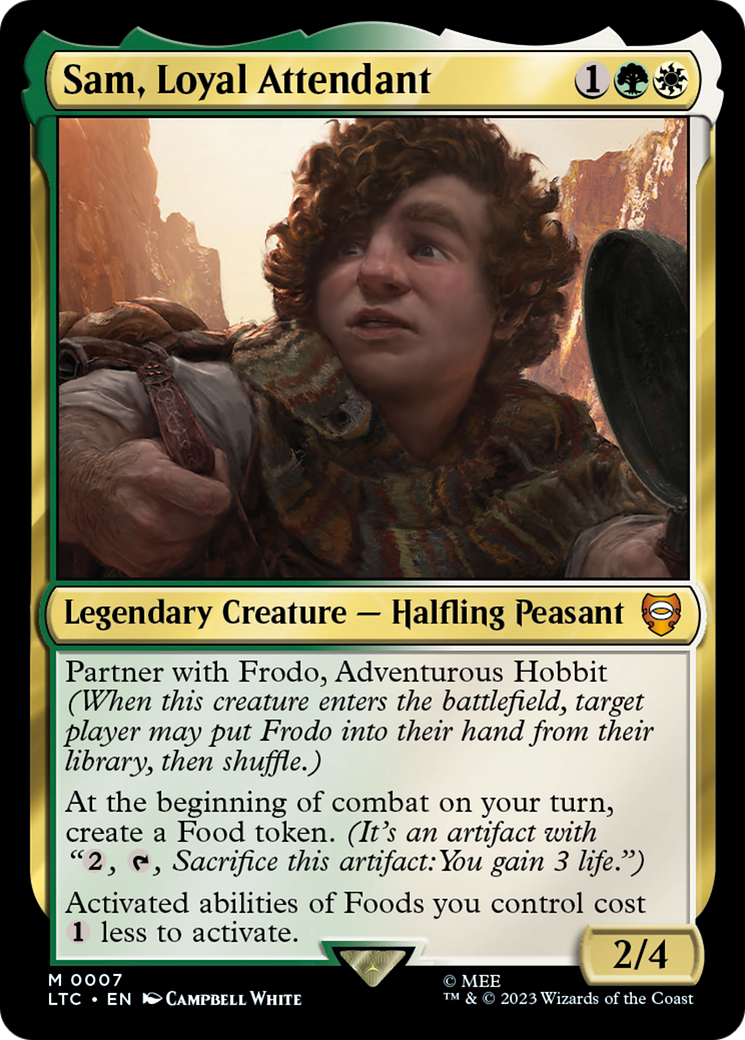
Sam, Loyal Attendant
Sam, Loyal Attendant
Legendary Creature — Halfling Peasant
2/4
Partner with Frodo, Adventurous Hobbit (When this creature enters, target player may put Frodo into their hand from their library, then shuffle.)
At the beginning of combat on your turn, create a Food token. (It's an artifact with " , , Sacrifice this token: You gain 3 life.")
Activated abilities of Foods you control cost less to activate.
- If an effect refers to a Food, it means any Food artifact, not just a Food artifact token. For example, you can sacrifice Tough Cookie (an Artifact Creature — Food Golem) to activate Maraleaf Rider's ability (an ability with "Sacrifice a Food" in its cost).
- Food is an artifact type. Even though it appears on some creatures, it's never a creature type.
- You can't sacrifice a Food to pay multiple costs. For example, you can't sacrifice a Food token to activate its own ability and also to activate Maraleaf Rider's ability.
- Whatever you do, don't eat the delicious cards.
- Both commanders start in the command zone, and the remaining 98 cards of your deck are shuffled to become your library.
- To have two commanders, both must have the partner ability or corresponding "partner with" abilities as the game begins. A creature with a "partner with" ability can't partner with any creature other than its designated partner. Losing a partner ability during the game doesn't cause either to cease to be your commander.
- "Partner with [name]" represents two abilities. The first is a triggered ability: "When this permanent enters the battlefield, target player may search their library for a card named [name], reveal it, put it into their hand, then shuffle their library."
- An effect that checks whether you control your commander is satisfied if you control one or both of your two commanders.
- The triggered ability of the "partner with" keyword still triggers in a Commander game. If your other commander has somehow ended up in your library, you can find it. You can also target another player, whether or not they have that card in their library.
- Once the game begins, your two commanders are tracked separately. If you cast one, you won't have to pay an additional the first time you cast the other. A player loses the game after having been dealt 21 damage from one of them, not from both of them combined. Command Beacon's effect puts one into your hand from the command zone, not both.
- Note that the target player searches their library (which may be affected by effects such as that of Stranglehold) and that the card they find is revealed, even though these words aren't included in the ability's reminder text.
- The second ability represented by the "partner with [name]" keyword modifies the rules for deck construction in the Commander variant and has no function outside of that variant. If a legendary creature card with "partner with [name]" is designated as your commander, the named legendary creature card can also be designated as your commander. For more information on the Commander variant, please visit Wizards.com/Commander.
- If your Commander deck has two commanders, you can only include cards whose own color identities are also found in your commanders' combined color identities. If Frodo, Adventurous Hobbit and Sam, Loyal Attendant are your commanders, your deck may contain cards with white, black, and/or green in their color identity, but not blue or red.
-
1
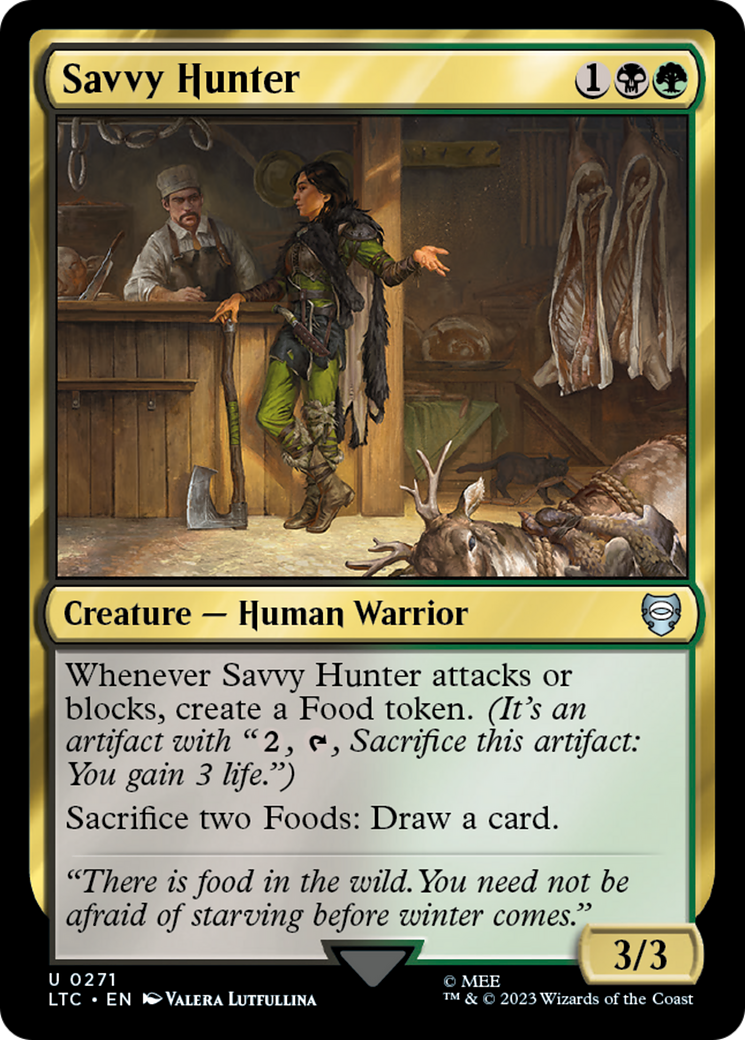
Savvy Hunter
Savvy Hunter
Creature — Human Warrior
3/3
Whenever this creature attacks or blocks, create a Food token. (It's an artifact with " , , Sacrifice this token: You gain 3 life.")
Sacrifice two Foods: Draw a card.
- If an effect refers to a Food, it means any Food artifact, not just a Food artifact token. For example, you can sacrifice Tough Cookie (an Artifact Creature — Food Golem) to activate Maraleaf Rider's ability (an ability with "Sacrifice a Food" in its cost).
- Food is an artifact type. Even though it appears on some creatures, it's never a creature type.
- You can't sacrifice a Food to pay multiple costs. For example, you can't sacrifice a Food token to activate its own ability and also to activate Maraleaf Rider's ability.
- Whatever you do, don't eat the delicious cards.
-
1
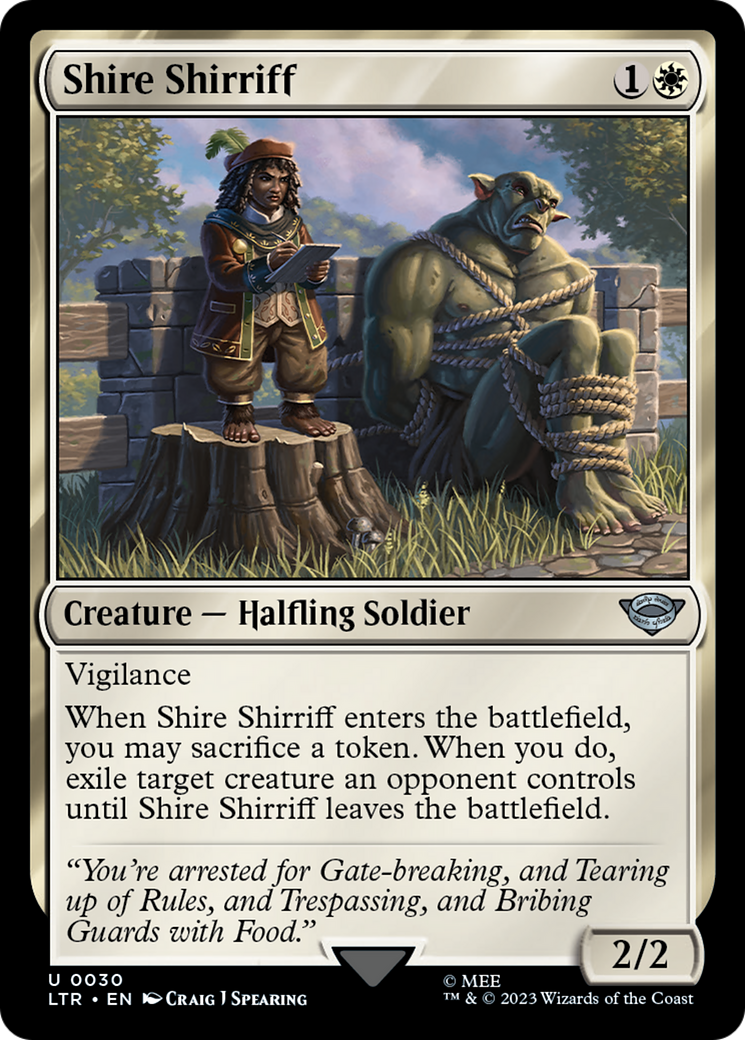
Shire Shirriff
Shire Shirriff
Creature — Halfling Soldier
2/2
Vigilance
When this creature enters, you may sacrifice a token. When you do, exile target creature an opponent controls until this creature leaves the battlefield.
- You don't choose a target for Shire Shirriff's last ability at the time it triggers. Rather, a second "reflexive" ability triggers when you sacrifice a token this way. You choose a target for that ability as it goes on the stack. Each player may respond to this triggered ability as normal.
- If Shire Shirriff leaves the battlefield before its last ability resolves, you can still sacrifice a token. However, when you do, the target creature won't be exiled when the "reflexive" triggered ability resolves. Similarly, if Shire Shirriff leaves the battlefield while the "reflexive" ability is still on the stack, the target creature won't be exiled.
-
1
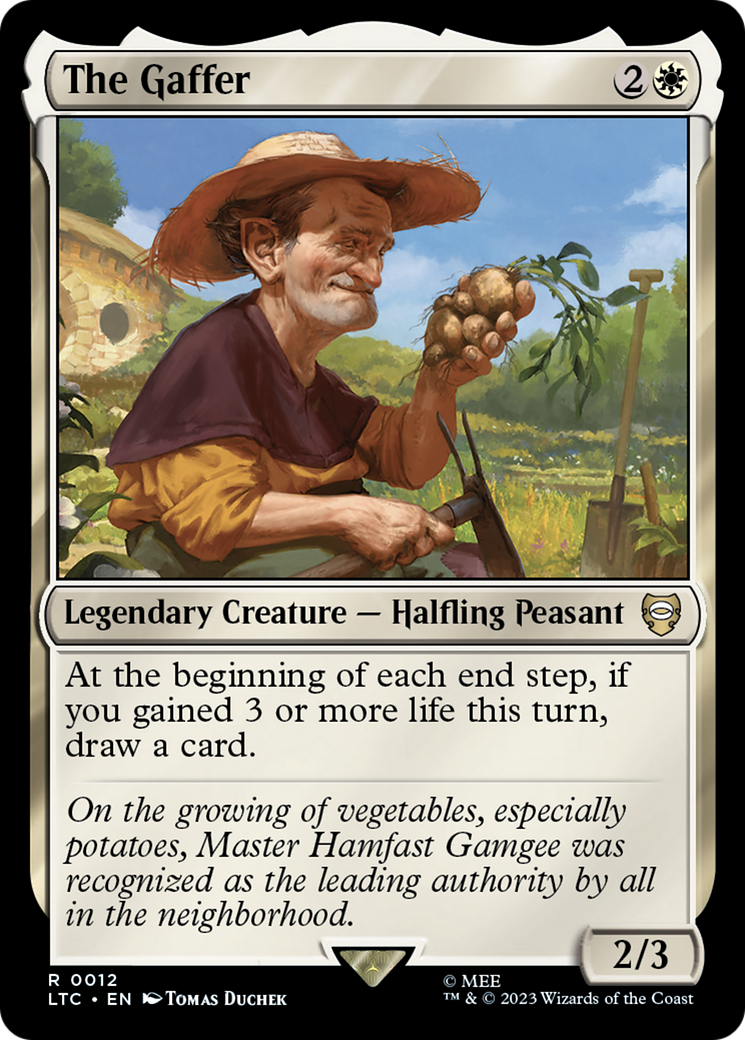
The Gaffer
The Gaffer
Legendary Creature — Halfling Peasant
2/3
At the beginning of each end step, if you gained 3 or more life this turn, draw a card.
- You draw just one card, no matter how much life you've gained past 3 life.
- The Gaffer's ability looks at how much life you've gained in the turn, even if it wasn't on the battlefield when you gained life. It doesn't care if you also lost life, even if you lost more life than you gained.
- If you haven't gained 3 or more life by the time an end step begins, The Gaffer's ability won't trigger at all.
-
1
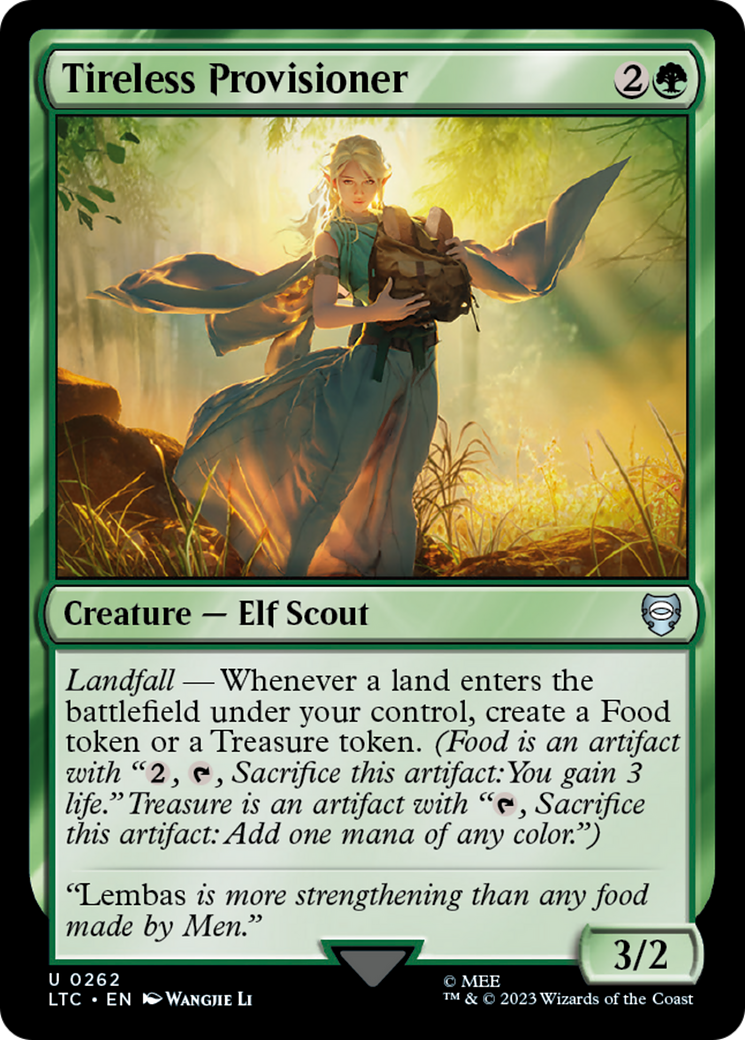
Tireless Provisioner
Tireless Provisioner
Creature — Elf Scout
3/2
Landfall — Whenever a land you control enters, create a Food token or a Treasure token. (Food is an artifact with " , , Sacrifice this token: You gain 3 life." Treasure is an artifact with " , Sacrifice this token: Add one mana of any color.")
- Food is an artifact type. Even though it appears on some creatures, it's never a creature type.
- You can't sacrifice a Food to pay multiple costs. For example, you can't sacrifice a Food token to activate its own ability and also to activate Maraleaf Rider's ability.
- Whatever you do, don't eat the delicious cards.
-
1
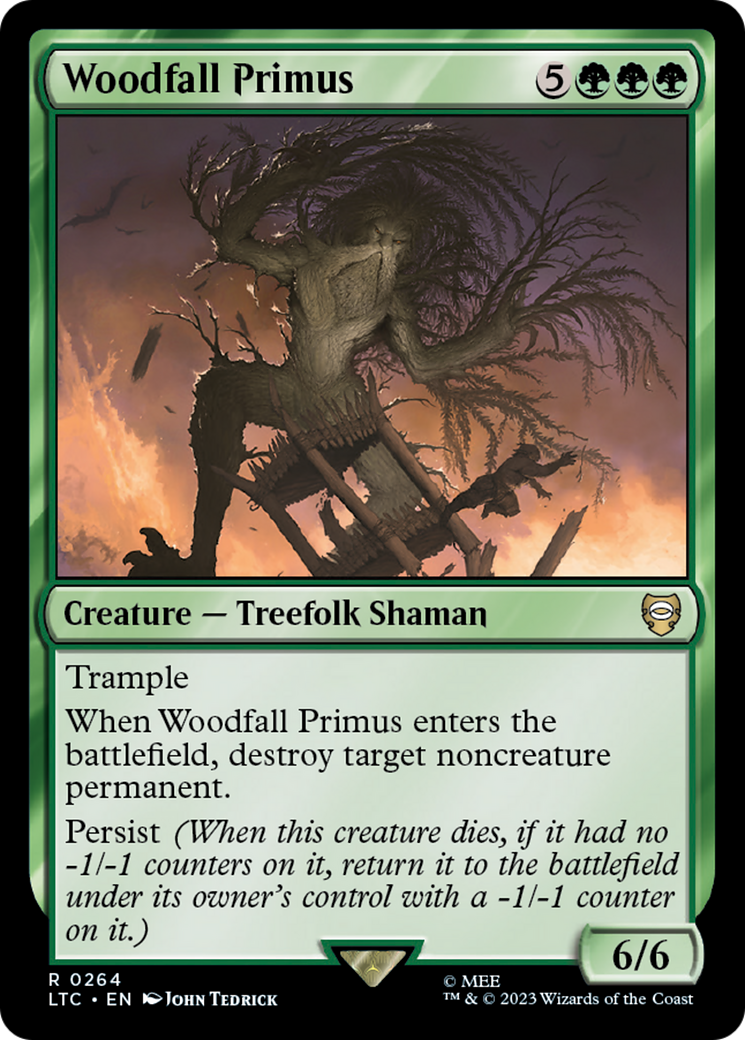
Woodfall Primus
Woodfall Primus
Creature — Treefolk Shaman
6/6
Trample
When this creature enters, destroy target noncreature permanent.
Persist (When this creature dies, if it had no -1/-1 counters on it, return it to the battlefield under its owner's control with a -1/-1 counter on it.)
- If a creature with persist stops being a creature, persist will still work.
- The persist ability triggers when the permanent is put into a graveyard. Its last known information (that is, how the creature last existed on the battlefield) is used to determine whether it had a -1/-1 counter on it.
- If a permanent has multiple instances of persist, they'll each trigger separately, but the redundant instances will have no effect. If one instance returns the card to the battlefield, the next to resolve will do nothing.
- If a token with no -1/-1 counters on it has persist, the ability will trigger when the token is put into the graveyard. However, the token will cease to exist and can't return to the battlefield.
- When a permanent with persist returns to the battlefield, it's a new object with no memory of or connection to its previous existence.
- If multiple creatures with persist are put into the graveyard at the same time (due to combat damage or a spell that destroys all creatures, for example), the active player (the player whose turn it is) puts all of their persist triggers on the stack in any order, then each other player in turn order does the same. The last trigger put on the stack is the first one that resolves. That means that in a two-player game, the nonactive player's persist creatures will return to the battlefield first, then the active player's persist creatures do the same. The creatures return to the battlefield one at a time.
- If a creature with persist that has +1/+1 counters on it receives enough -1/-1 counters to cause it to be destroyed by lethal damage or put into its owner's graveyard for having 0 or less toughness, persist won't trigger and the card won't return to the battlefield. That's because persist checks the creature's existence just before it leaves the battlefield, and it still has all those counters on it at that point.
Instants 6
-
1
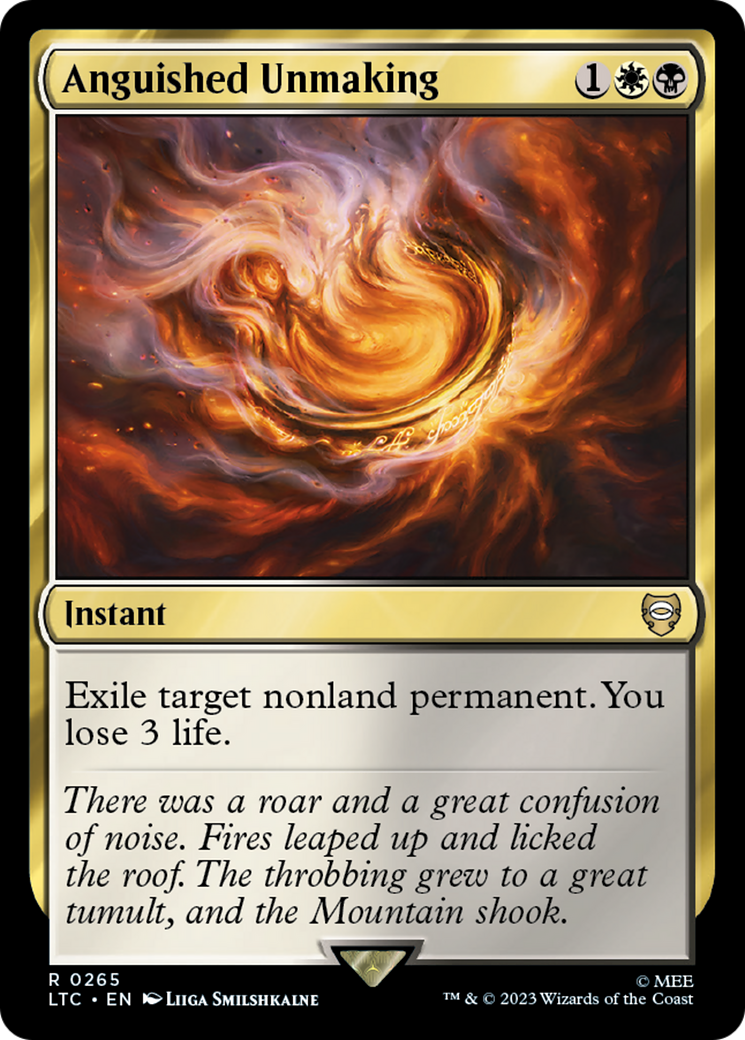
Anguished Unmaking
Anguished Unmaking
Instant
Exile target nonland permanent. You lose 3 life.
- If the target nonland permanent is an illegal target as Anguished Unmaking tries to resolve, it won't resolve and none of its effects will happen. You won't lose 3 life.
-
1
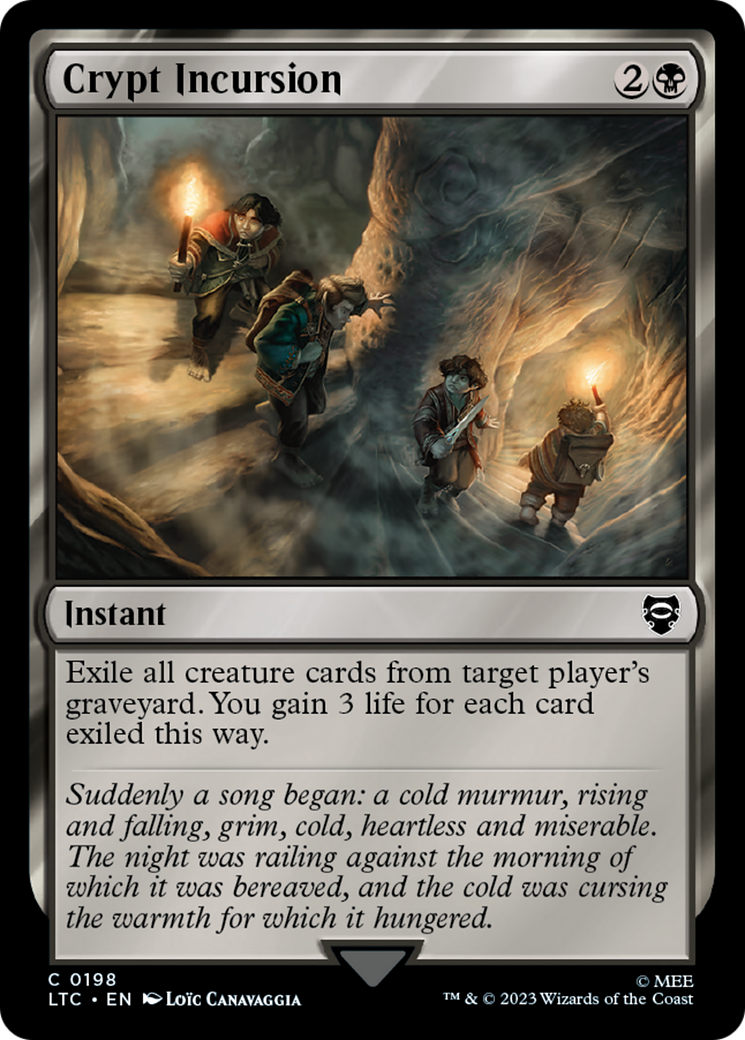
Crypt Incursion
Crypt Incursion
Instant
Exile all creature cards from target player's graveyard. You gain 3 life for each card exiled this way.
-
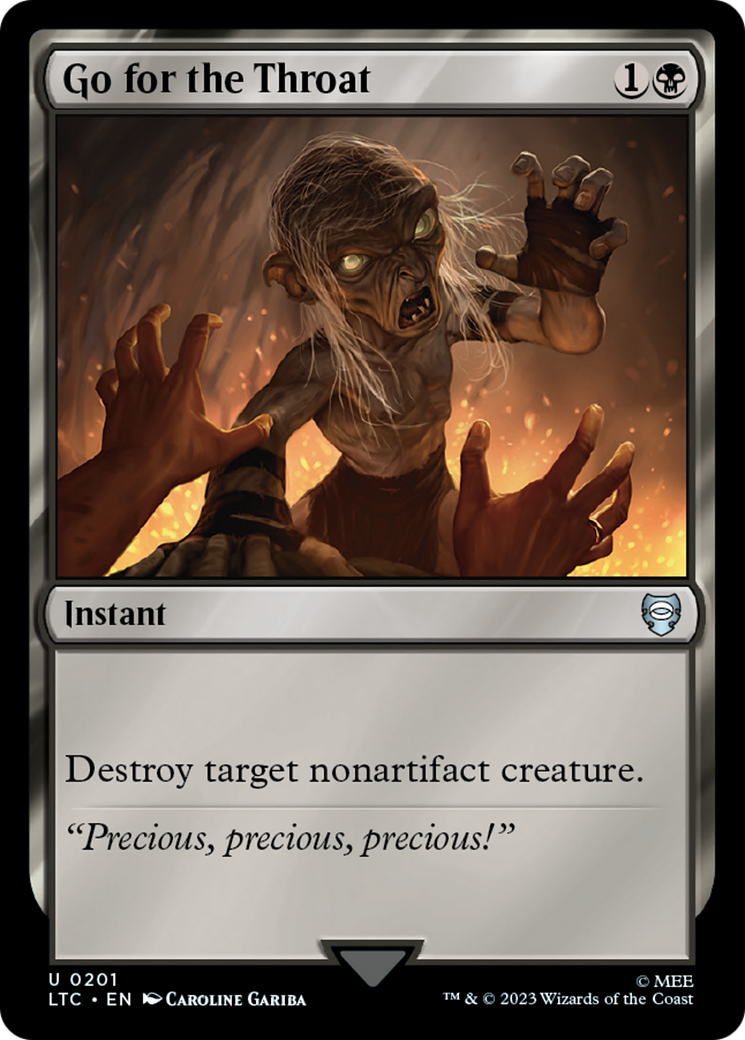
1
Go for the Throat
Go for the Throat
Instant
Destroy target nonartifact creature.
- If the targeted creature is also an artifact when Go for the Throat tries to resolve, it won't resolve.
- If the targeted creature is also an artifact when Go for the Throat tries to resolve, it won't resolve.
-
1
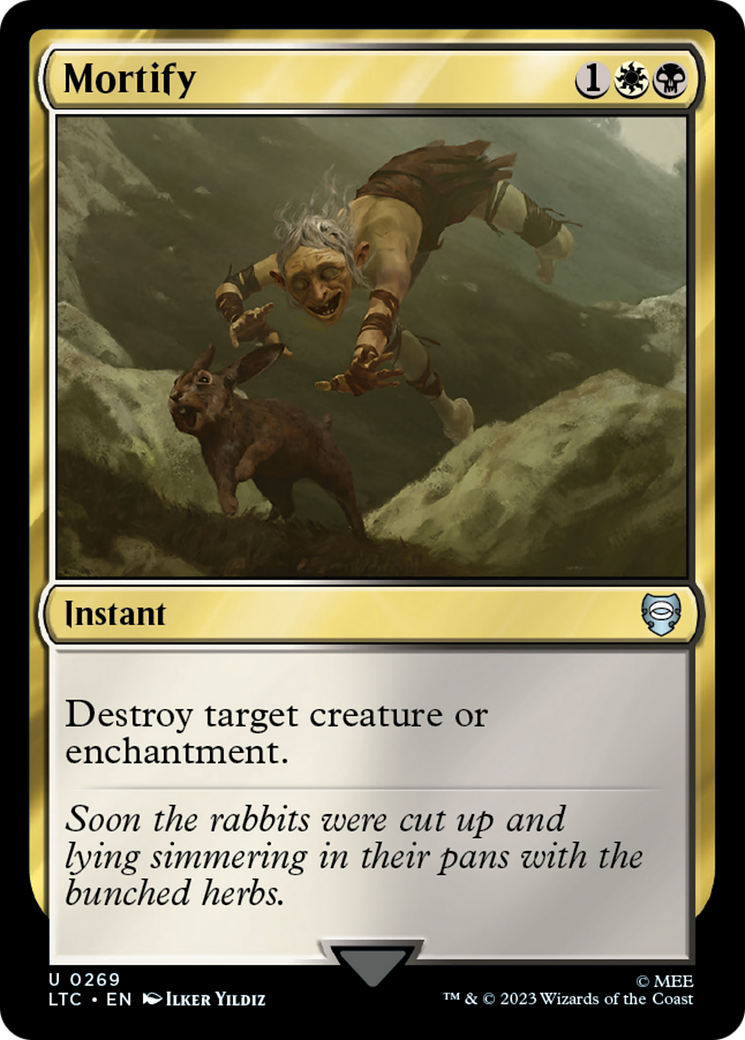
Mortify
Mortify
Instant
Destroy target creature or enchantment.
- This spell isn't modal. When it resolves, it will destroy the target if it's a creature or an enchantment, even if it changed from one to the other between targeting and resolution.
-
1
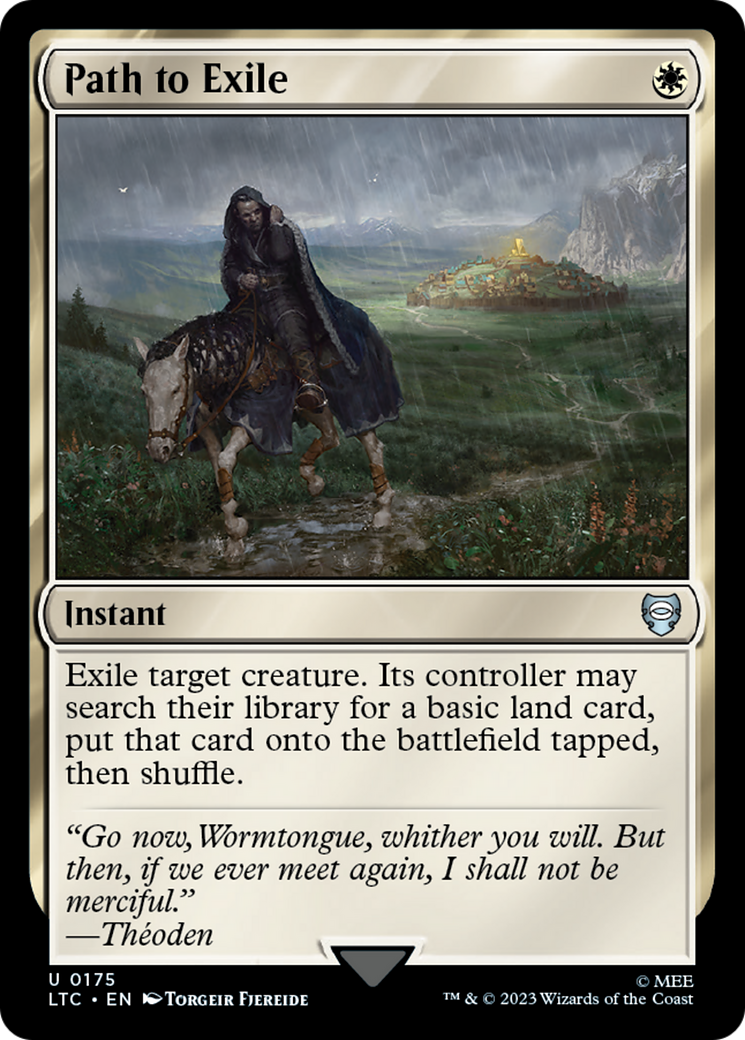
Path to Exile
Path to Exile
Instant
Exile target creature. Its controller may search their library for a basic land card, put that card onto the battlefield tapped, then shuffle.
- If the target creature is an illegal target by the time Path to Exile tries to resolve, the spell won't resolve. The creature's controller won't search for a basic land card.
- The controller of the exiled creature isn't required to search their library for a basic land. If that player doesn't, the player won't shuffle their library.
-
1
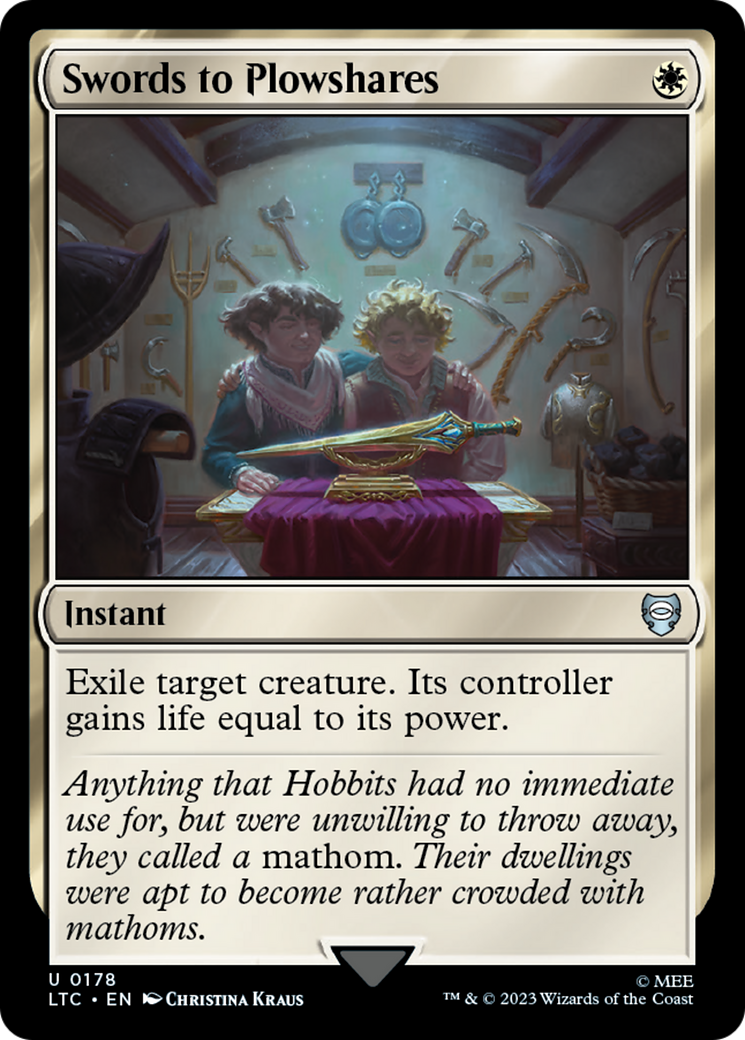
Swords to Plowshares
Swords to Plowshares
Instant
Exile target creature. Its controller gains life equal to its power.
- Use the power of the creature from when it was last on the battlefield to determine how much life is gained.
Sorceries 9
-
1
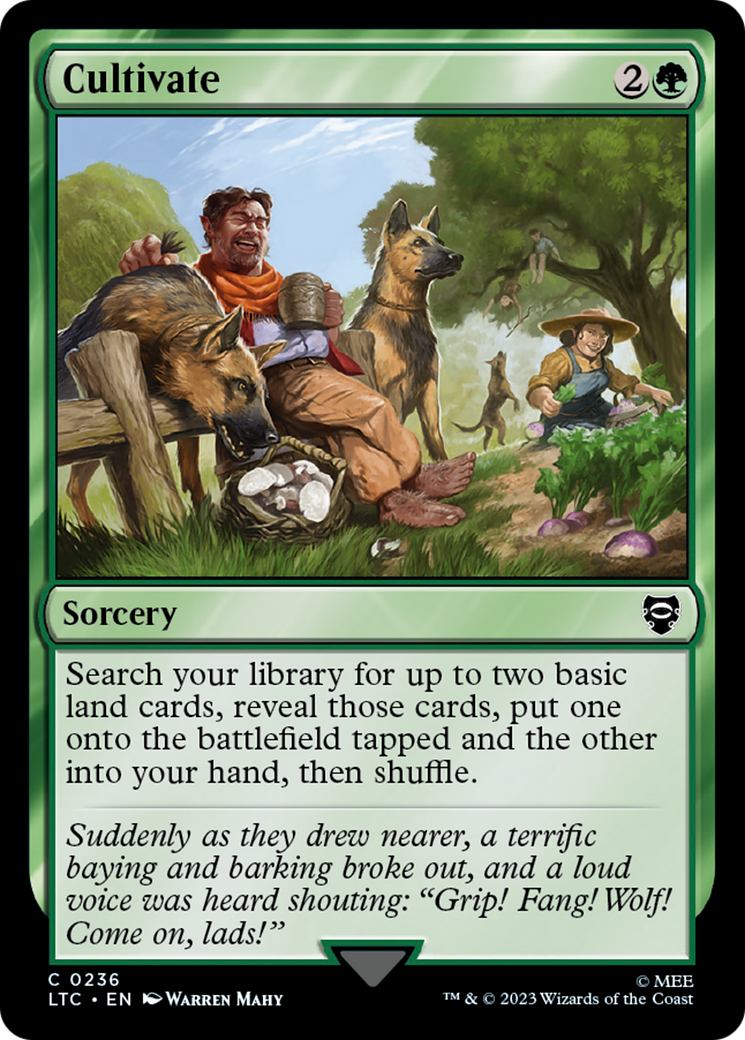
Cultivate
Cultivate
Sorcery
Search your library for up to two basic land cards, reveal those cards, put one onto the battlefield tapped and the other into your hand, then shuffle.
- If you choose to find only one basic land card, you put it onto the battlefield tapped.
-
1
Dusk // Dawn
//
Dusk
Sorcery
- Once you've started to cast a spell with aftermath from your graveyard, the card is immediately moved to the stack. Opponents can't try to stop the ability by exiling the card with an effect such as that of Crook of Condemnation.
- All split cards have two card faces on a single card, and you put a split card onto the stack with only the half you're casting. The characteristics of the half of the card you didn't cast are ignored while the spell is on the stack. For example, if an effect prevents you from casting green spells, you can cast Destined of Destined // Lead, but not Lead.
- Each split card is a single card. For example, if you discard one, you've discarded one card, not two. If an effect counts the number of instant and sorcery cards in your graveyard, Destined // Lead counts once, not twice.
- Each split card has two names. If an effect instructs you to choose a card name, you may choose one, but not both.
- While not on the stack, the characteristics of a split card are the combination of its two halves. For example, Destined // Lead is a green and black card, it is both an instant card and a sorcery card, and its mana value is 6. This means that if an effect allows you to cast a card with mana value 2 from your hand, you can't cast Destined. This is a change from the previous rules for split cards.
- Split cards with aftermath have a new frame treatment—the half you can cast from your hand is oriented the same as other cards you'd cast from your hand, while the half you can cast from your graveyard is a traditional split card half. This frame treatment is for your convenience and has no rules significance.
- If another effect allows you to cast a split card with aftermath from any zone other than a graveyard, you can't cast the half with aftermath.
- If another effect allows you to cast a split card with aftermath from a graveyard, you may cast either half. If you cast the half that has aftermath, you'll exile the card if it would leave the stack.
- A spell with aftermath cast from a graveyard will always be exiled afterward, whether it resolves, it's countered, or it leaves the stack in some other way.
- If you cast the first half of a split card with aftermath during your turn, you'll have priority immediately after it resolves. You can cast the half with aftermath from your graveyard before any player can take any other action if it's legal for you to do so.
-
1
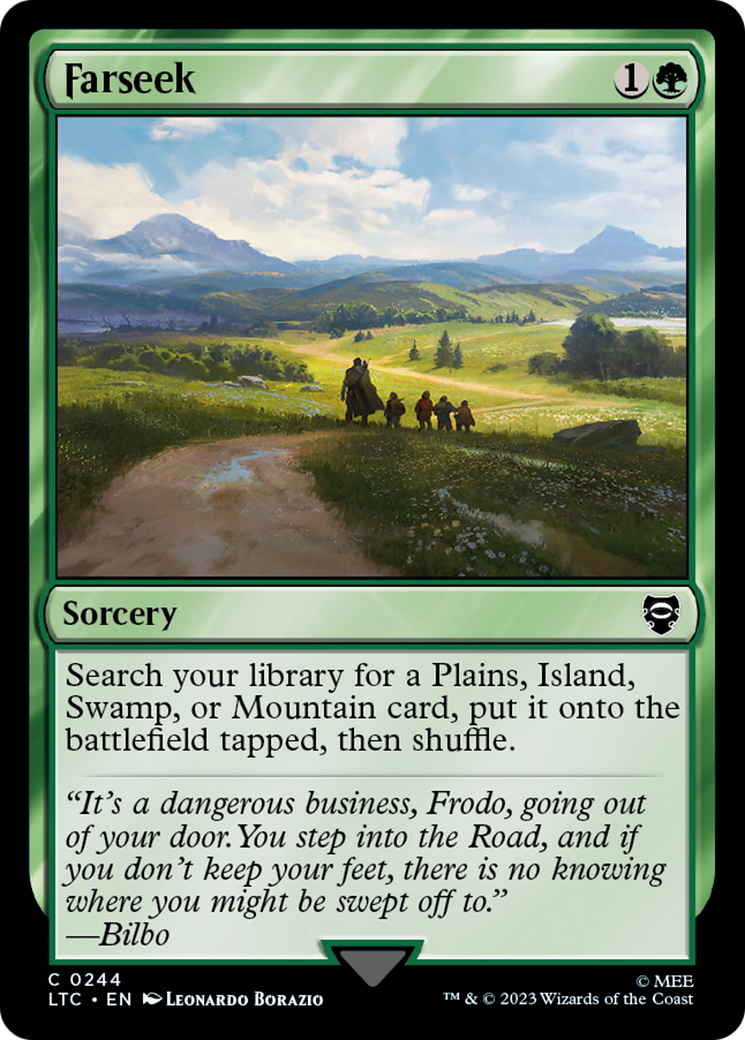
Farseek
Farseek
Sorcery
Search your library for a Plains, Island, Swamp, or Mountain card, put it onto the battlefield tapped, then shuffle.
- Farseek can find any land with any of the listed land types, including nonbasic ones, even if that land is a Forest in addition to one or more of those types.
-
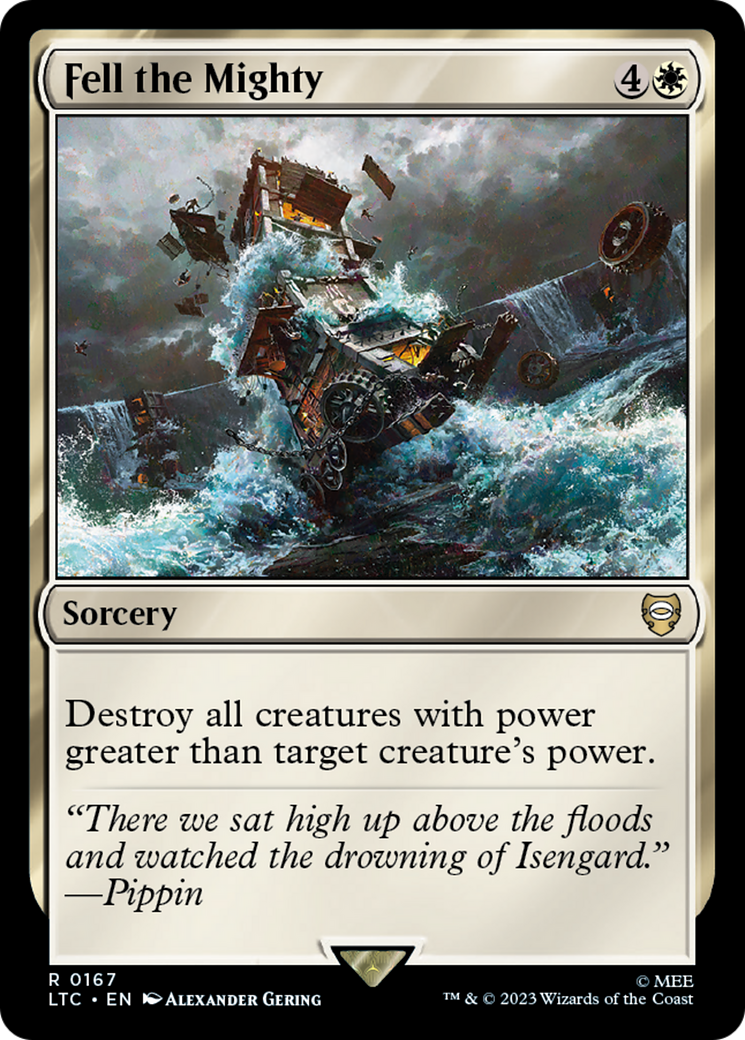
1
Fell the Mighty
Fell the Mighty
Sorcery
Destroy all creatures with power greater than target creature's power.
- Use the power of the target creature as Fell the Mighty resolves to determine which creatures are destroyed. Fell the Mighty doesn't target any of those creatures, so a creature with hexproof or protection from white will be destroyed if its power is high enough.
- Fell the Mighty won't destroy the target creature.
- If the target creature is an illegal target when Fell the Mighty tries to resolve, Fell the Mighty won't resolve and none of its effects will happen. No creatures will be destroyed.
-
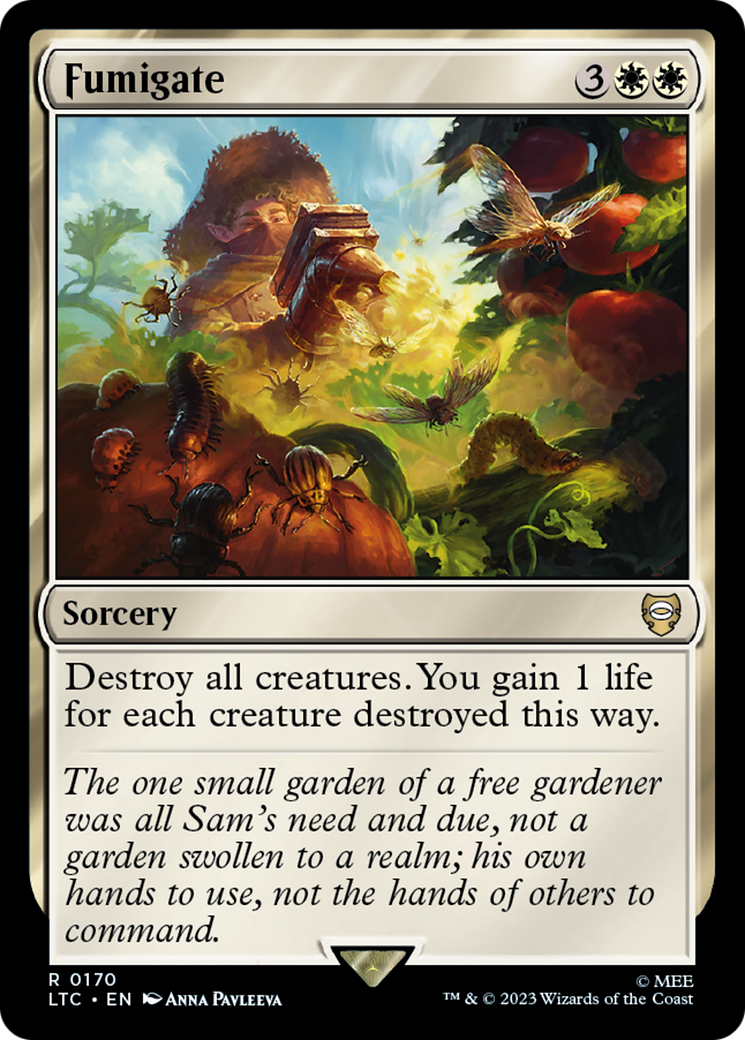
1
Fumigate
Fumigate
Sorcery
Destroy all creatures. You gain 1 life for each creature destroyed this way.
- Creatures destroyed this way count toward the life gained even if they're put into a zone other than a graveyard.
- You won't gain 1 life for a creature that isn't actually destroyed, such as a creature with indestructible.
-
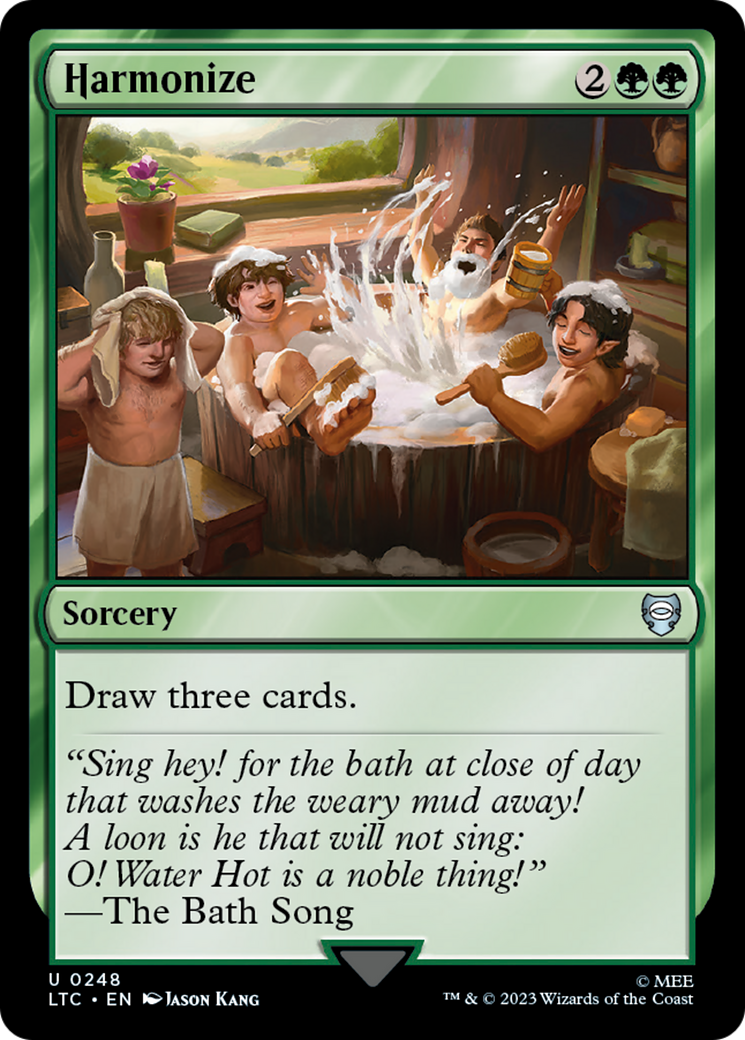
1
Harmonize
Harmonize
Sorcery
Draw three cards.
-
1
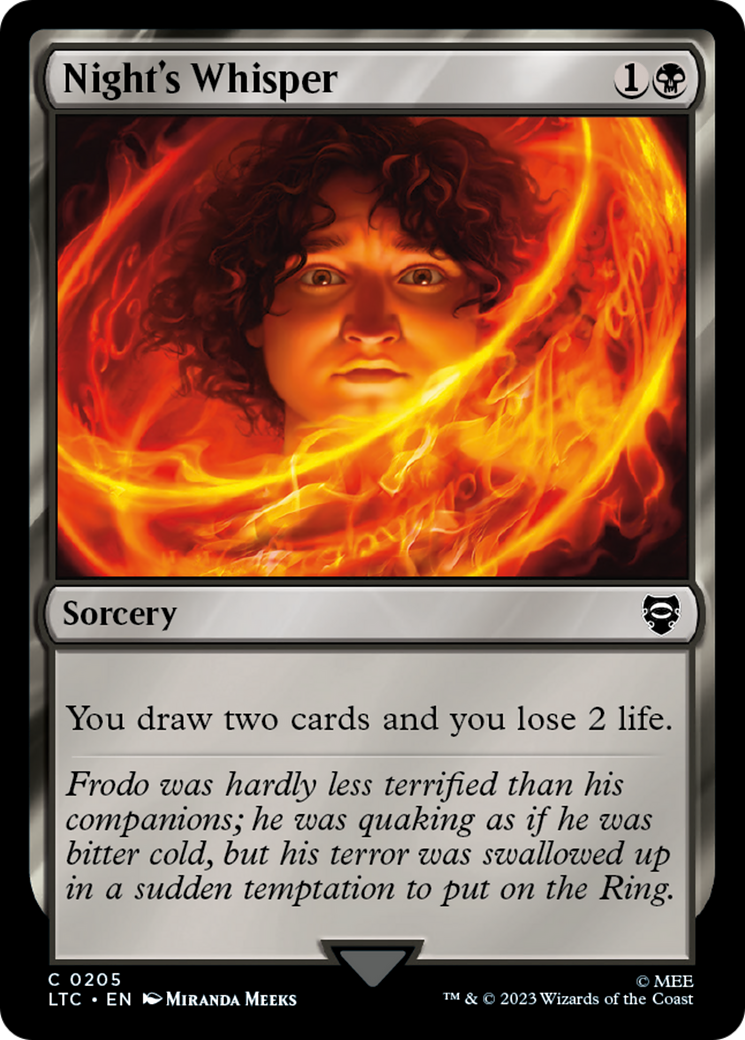
Night's Whisper
Night's Whisper
Sorcery
You draw two cards and you lose 2 life.
-
1
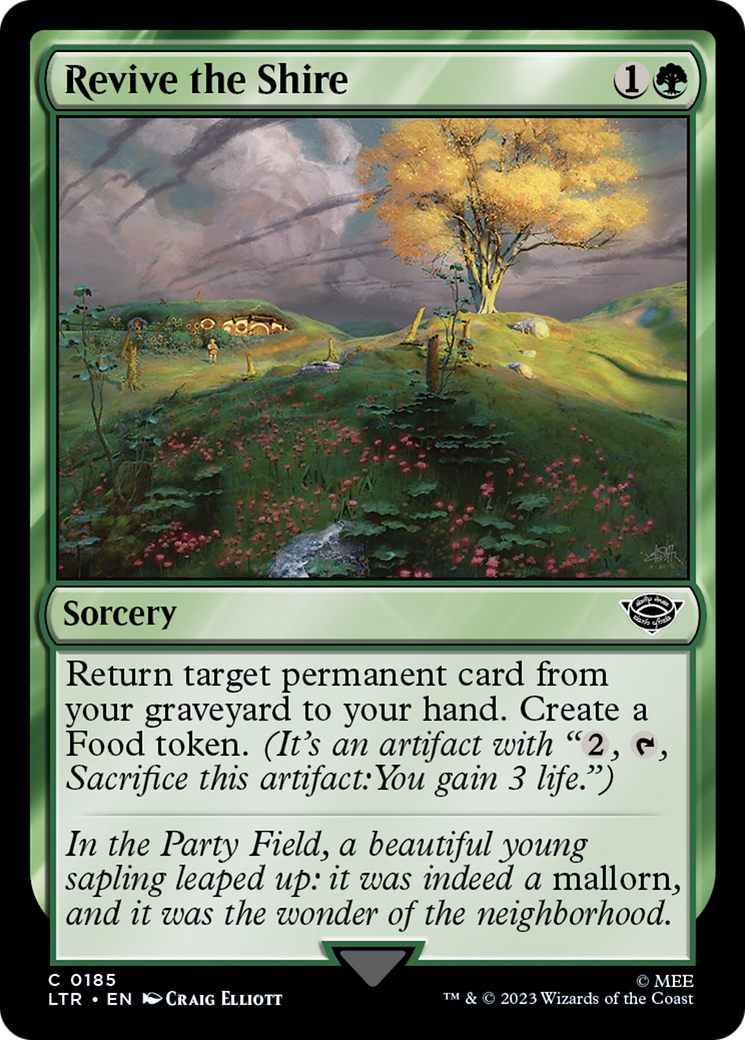
Revive the Shire
Revive the Shire
Sorcery
Return target permanent card from your graveyard to your hand. Create a Food token. (It's an artifact with " , , Sacrifice this token: You gain 3 life.")
- Some spells and abilities that create Food tokens may require targets. If each target chosen is an illegal target as that spell or ability tries to resolve, it won't resolve. You won't create any Food tokens.
- Food is an artifact type. Even though it appears on some creatures, it's never a creature type.
- You can't sacrifice a Food to pay multiple costs. For example, you can't sacrifice a Food token to activate its own ability and also to activate Maraleaf Rider's ability.
- Whatever you do, don't eat the delicious cards.
-
1
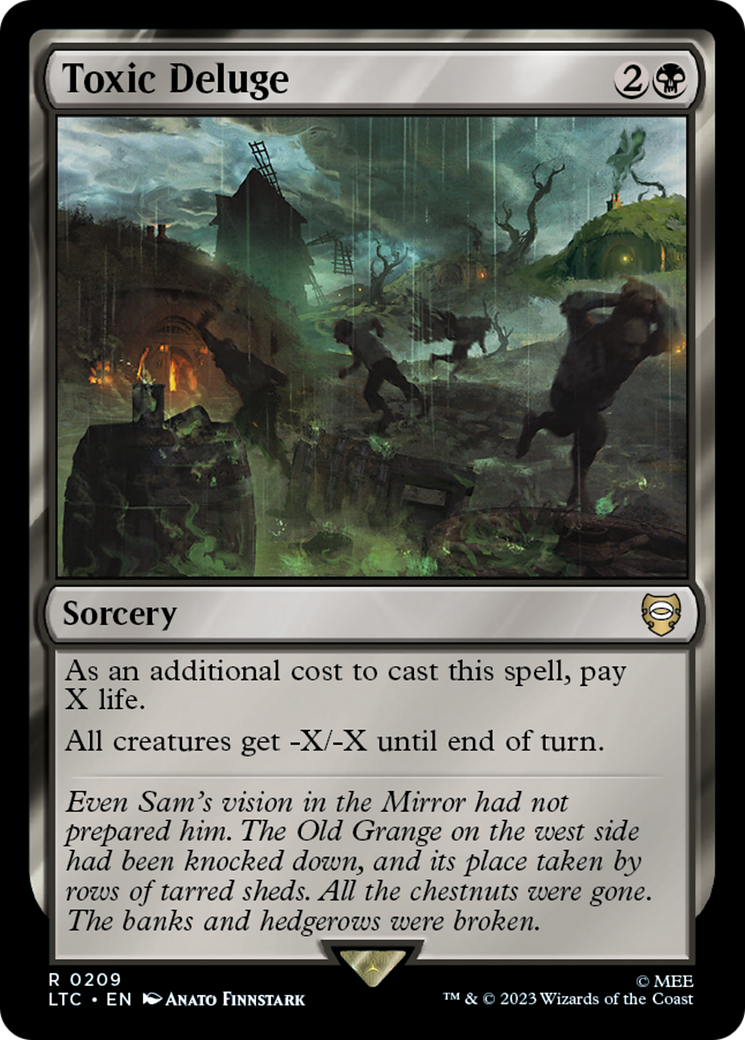
Toxic Deluge
Toxic Deluge
Sorcery
As an additional cost to cast this spell, pay X life.
All creatures get -X/-X until end of turn.
- If you cast Toxic Deluge without paying its mana cost, you'll still choose a value for X and pay X life. This is because it doesn't have in its mana cost.
- All creatures on the battlefield when Toxic Deluge resolves are affected. Ones that enter the battlefield or become creatures later in the turn are not.
Artifacts 9
-
1
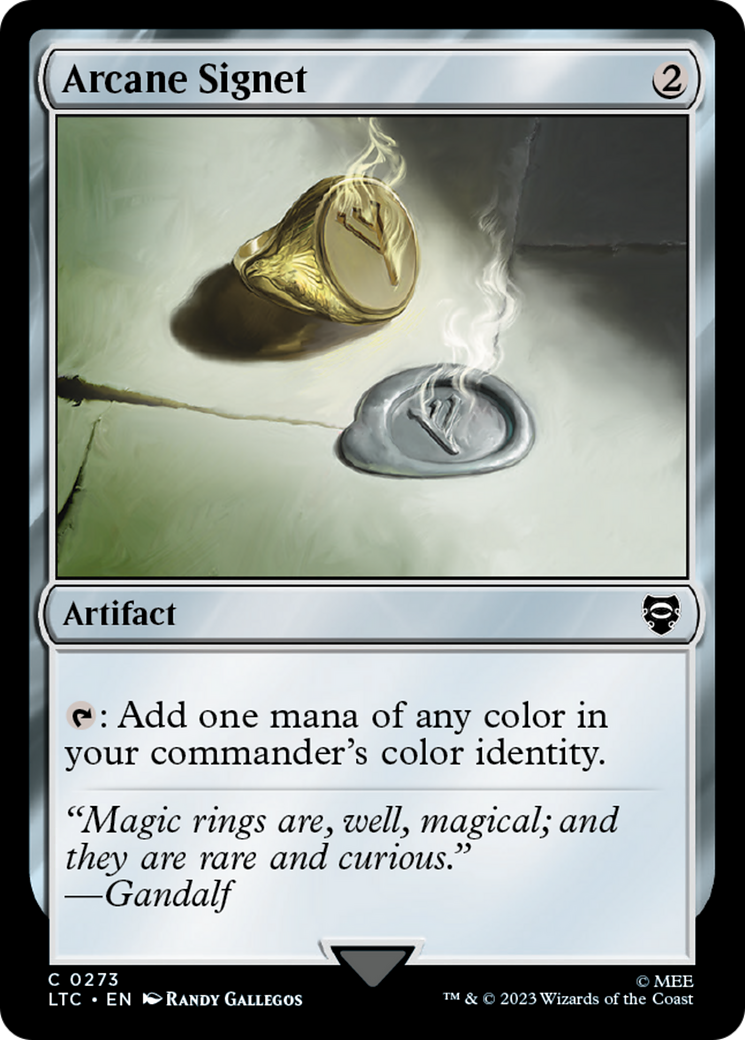
Arcane Signet
Arcane Signet
Artifact
: Add one mana of any color in your commander's color identity.
- If you have two commanders, the ability adds one mana of any color in their combined color identities.
- If your commander is a card that has no colors in its color identity, Arcane Signet's ability produces no mana. It doesn't produce .
- If you don't have a commander, Arcane Signet's ability produces no mana.
-
1
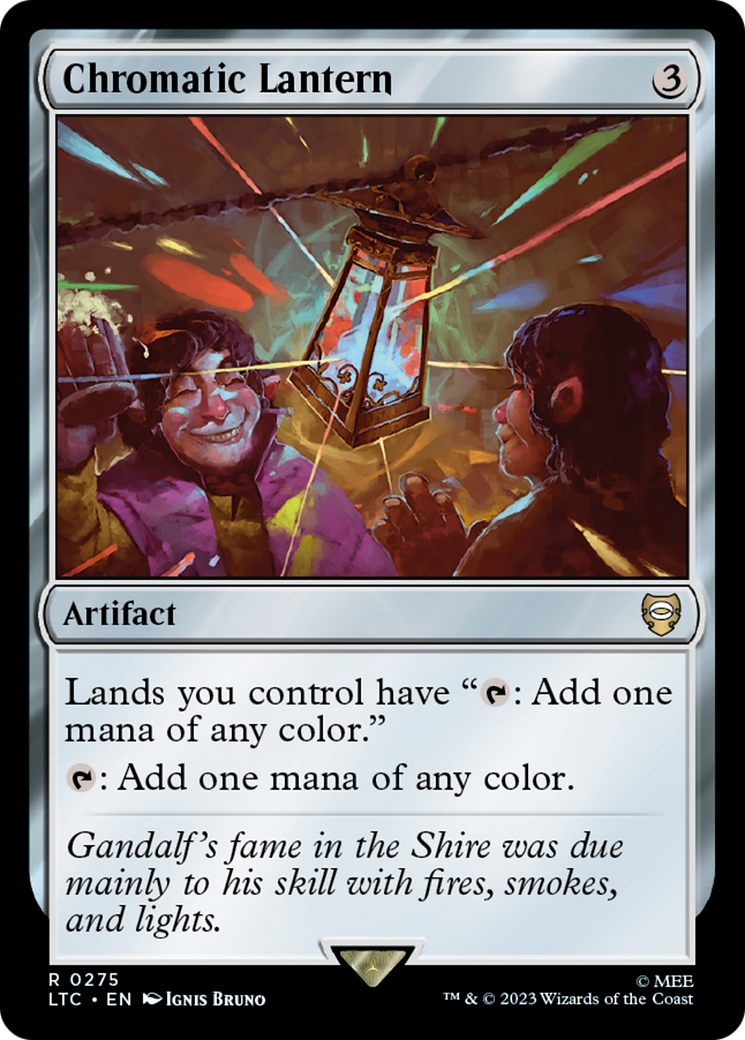
Chromatic Lantern
Chromatic Lantern
Artifact
Lands you control have " : Add one mana of any color."
: Add one mana of any color.
- Lands you control won't lose any other abilities they had. They also won't gain or lose any land types.
-
1
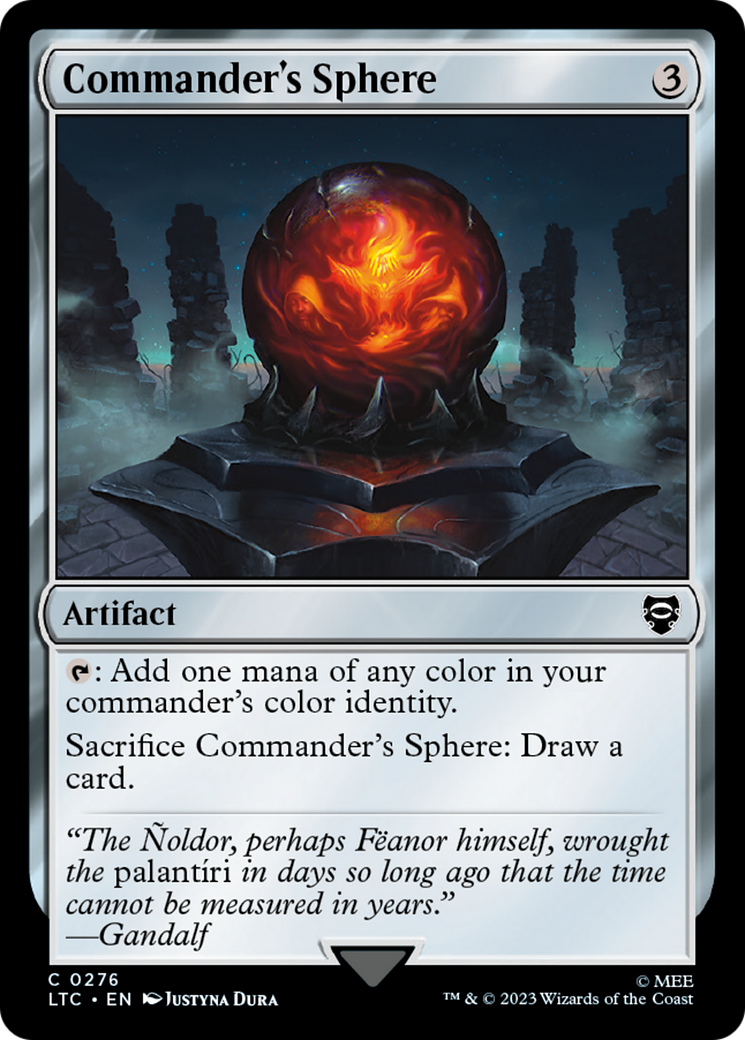
Commander's Sphere
Commander's Sphere
Artifact
: Add one mana of any color in your commander's color identity.
Sacrifice this artifact: Draw a card.
- If you have two commanders, the ability adds one mana of any color in their combined color identities.
- If your commander is a card that has no colors in its color identity, Commander's Sphere's first ability produces no mana. It doesn't produce .
- If you don't have a commander, Commander's Sphere's first ability produces no mana.
-
1
Field-Tested Frying Pan
Field-Tested Frying Pan
Artifact — Equipment
When this Equipment enters, create a Food token, then create a 1/1 white Halfling creature token and attach this Equipment to it.
Equipped creature has "Whenever you gain life, this creature gets +X/+X until end of turn, where X is the amount of life you gained."
Equip
- Food is an artifact type. Even though it appears on some creatures, it's never a creature type.
- You can't sacrifice a Food to pay multiple costs. For example, you can't sacrifice a Food token to activate its own ability and also to activate Maraleaf Rider's ability.
- Whatever you do, don't eat the delicious cards.
- No player may take any actions between the time you create the Halfling token and the time Field-Tested Frying Pan becomes attached to it.
- If the triggered ability causes more than one creature token to be created (due to an effect such as that of Doubling Season), Field-Tested Frying Pan becomes attached to one of them of your choice.
-
1
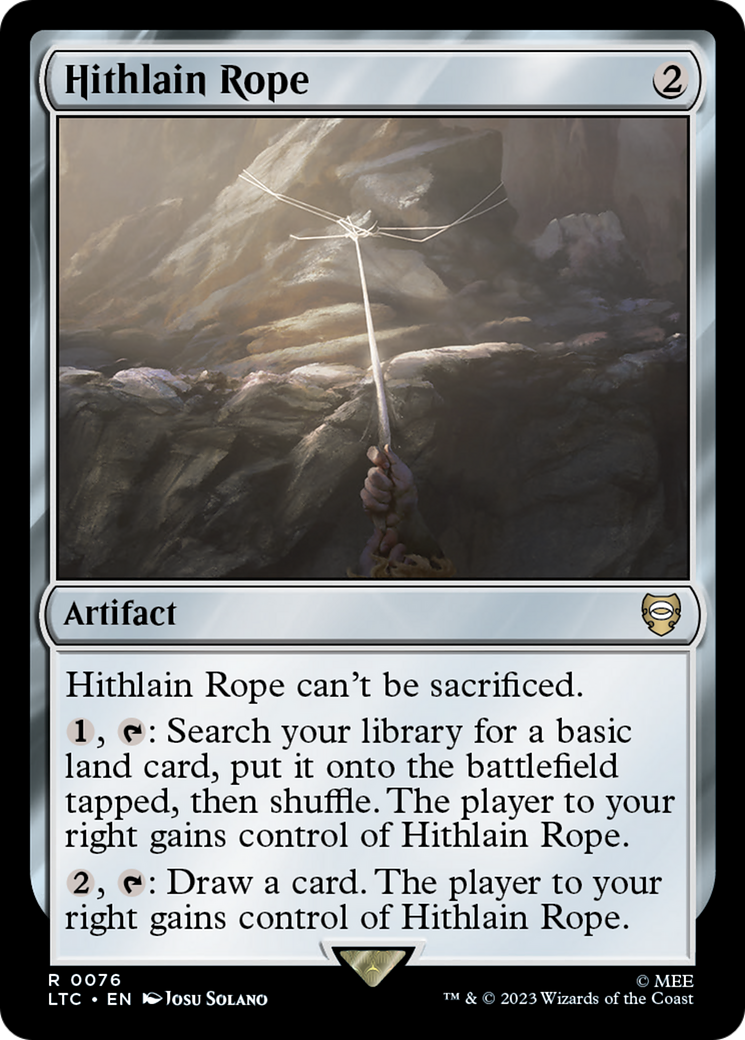
Hithlain Rope
Hithlain Rope
Artifact
This artifact can't be sacrificed.
, : Search your library for a basic land card, put it onto the battlefield tapped, then shuffle. The player to your right gains control of this artifact.
, : Draw a card. The player to your right gains control of this artifact.
- In a two-player game, the other player is the player to your right. (They're also the player to your left. Funny how that works.)
- In some formats, such as Two-Headed Giant, the player to your right might be a teammate. In that case, that teammate gains control of Hithlain Rope as either ability resolves.
-
1
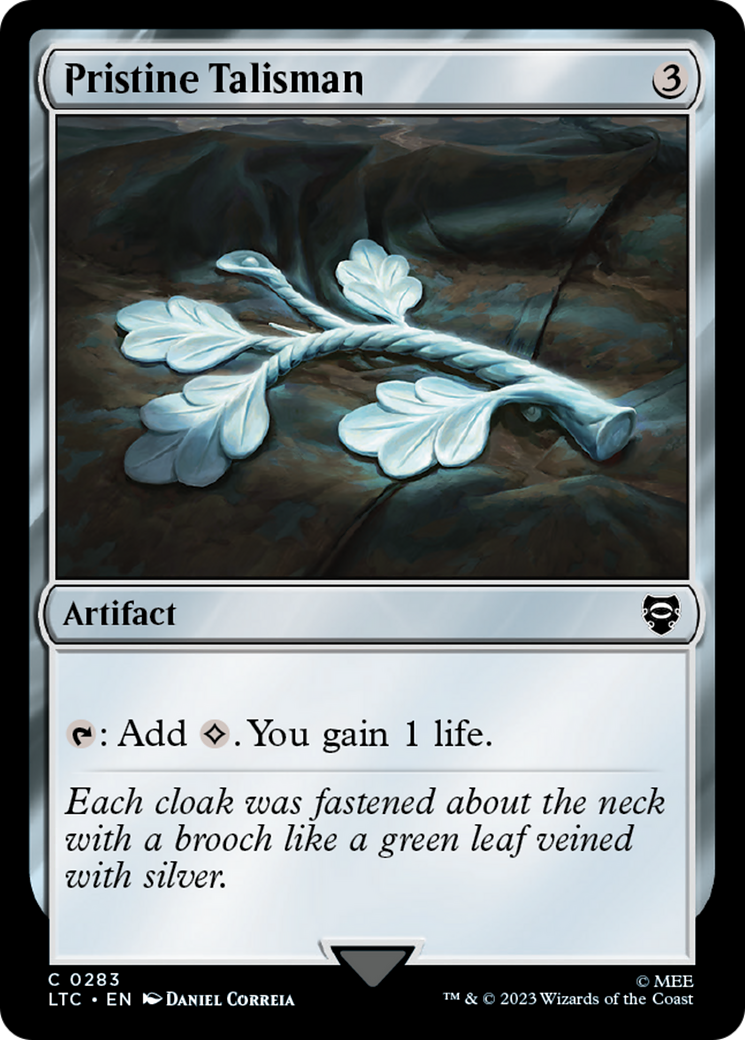
Pristine Talisman
Pristine Talisman
Artifact
: Add . You gain 1 life.
- Pristine Talisman has a mana ability. Its ability doesn't use the stack and can't be responded to.
-
1
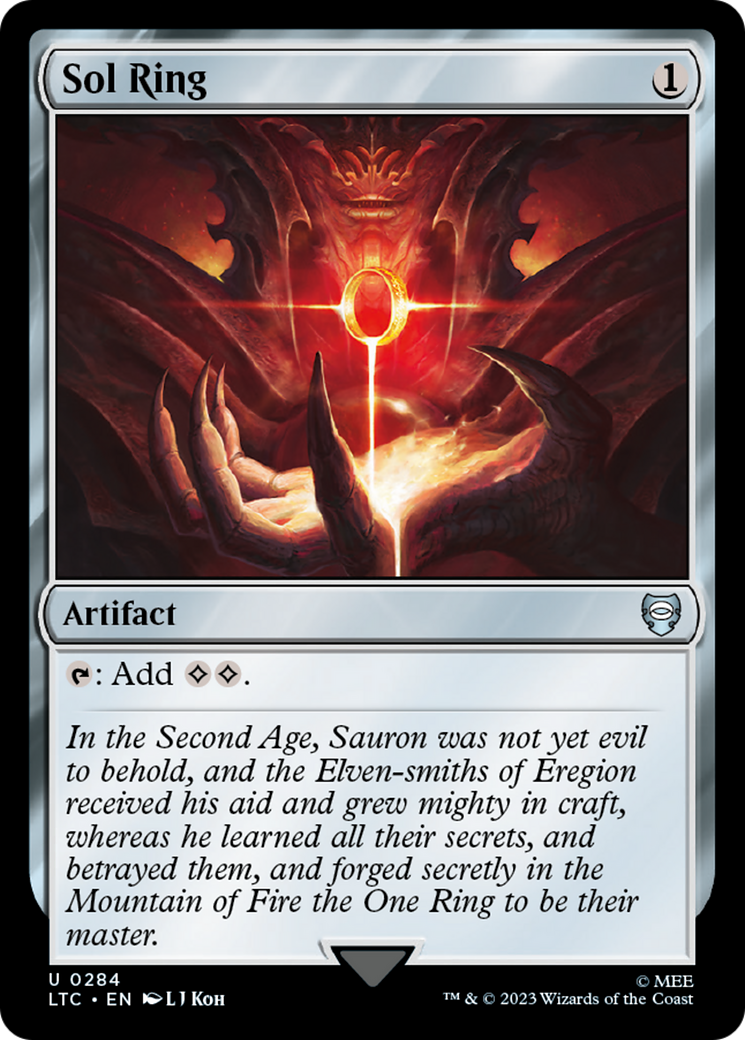
Sol Ring
Sol Ring
Artifact
: Add .
-
1
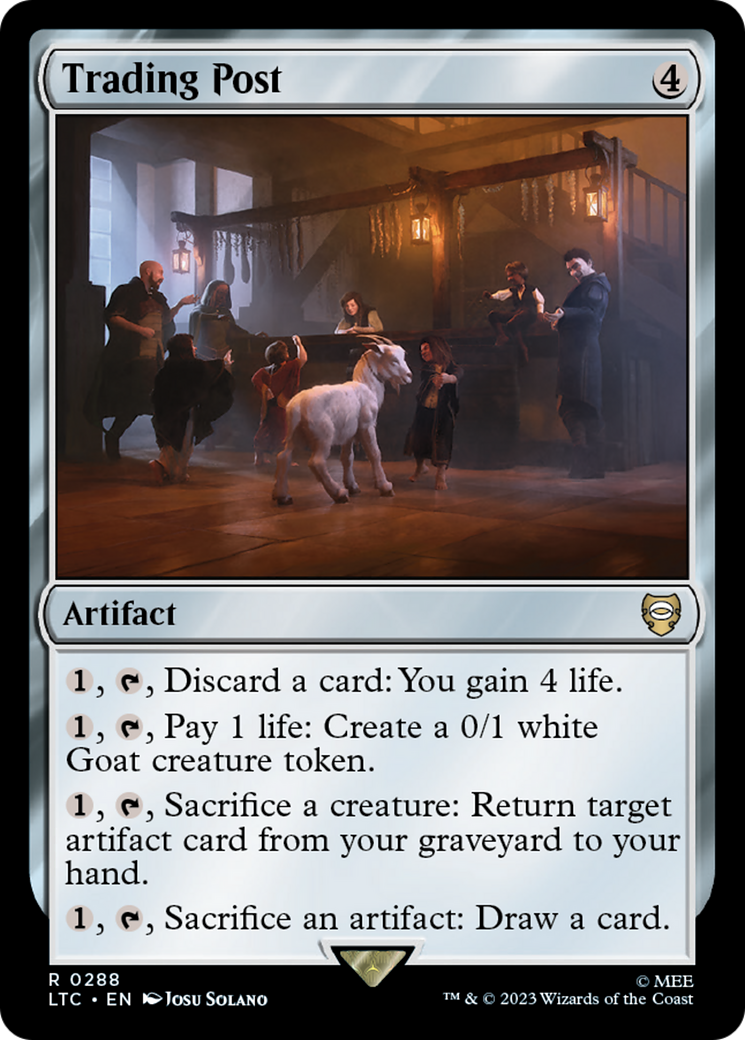
Trading Post
Trading Post
Artifact
, , Discard a card: You gain 4 life.
, , Pay 1 life: Create a 0/1 white Goat creature token.
, , Sacrifice a creature: Return target artifact card from your graveyard to your hand.
, , Sacrifice an artifact: Draw a card.
-
1
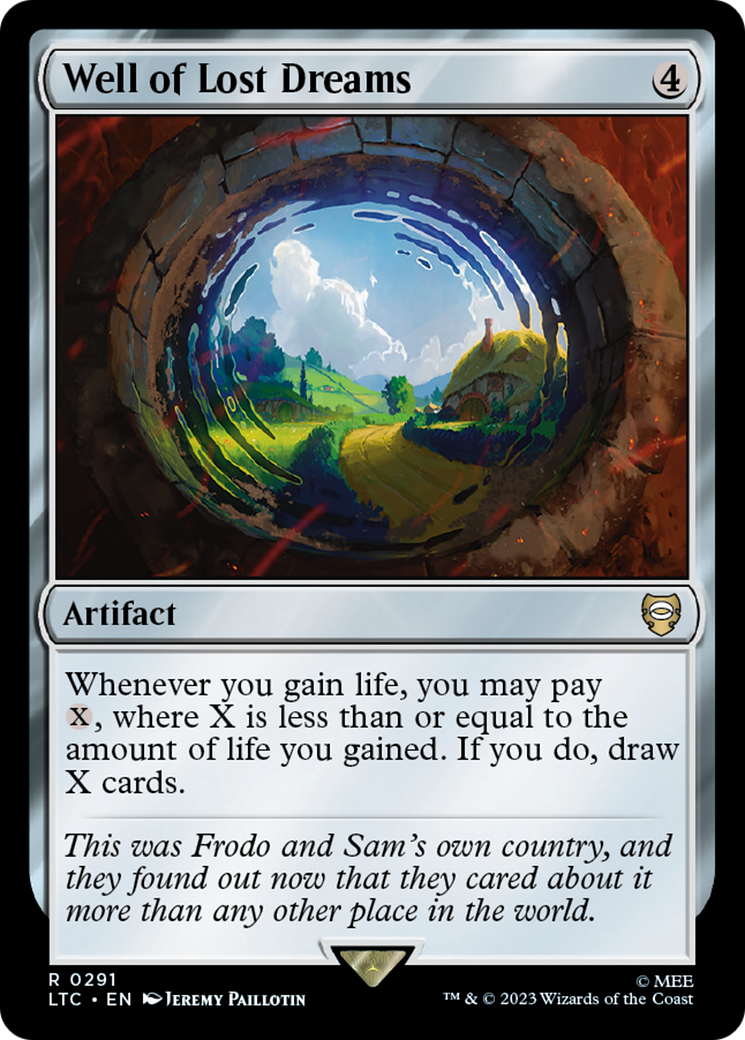
Well of Lost Dreams
Well of Lost Dreams
Artifact
Whenever you gain life, you may pay , where X is less than or equal to the amount of life you gained. If you do, draw X cards.
Enchantments 5
-
1
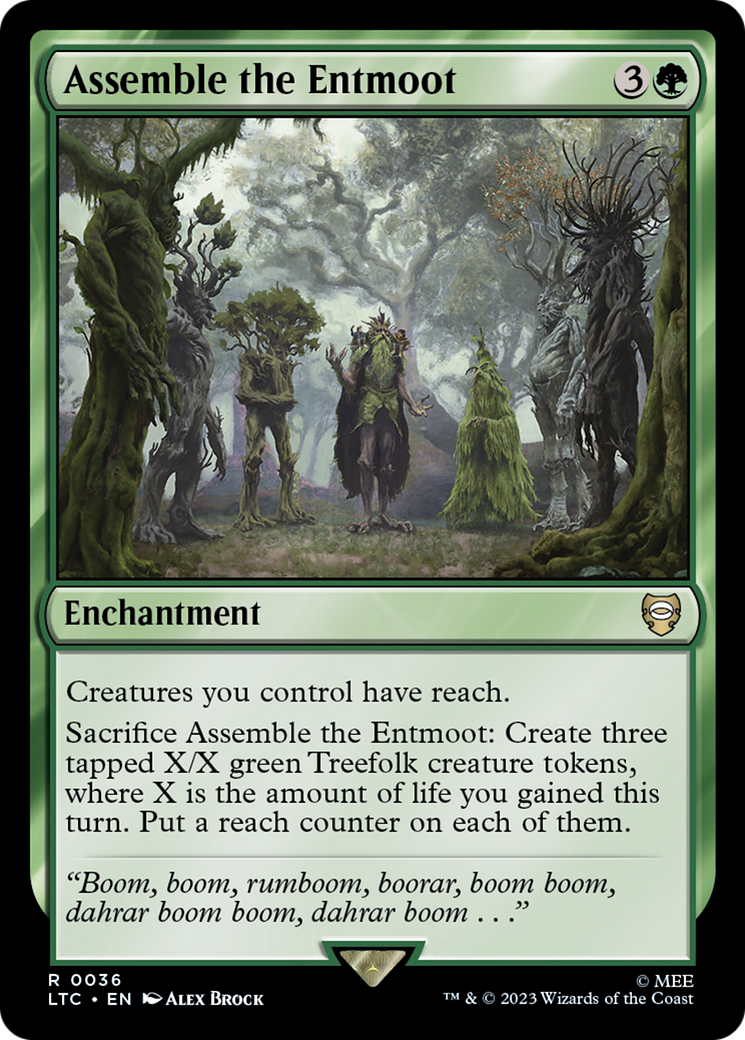
Assemble the Entmoot
Assemble the Entmoot
Enchantment
Creatures you control have reach.
Sacrifice this enchantment: Create three tapped X/X green Treefolk creature tokens, where X is the amount of life you gained this turn. Put a reach counter on each of them.
- Assemble the Entmoot's activated ability counts the total amount of life you gained without taking into account any life you lost during that turn. For example, if you gained 3 life and lost 3 life earlier in the turn, you'll create three tapped 3/3 green Treefolk creature tokens, then put a reach counter on each of them.
-
1
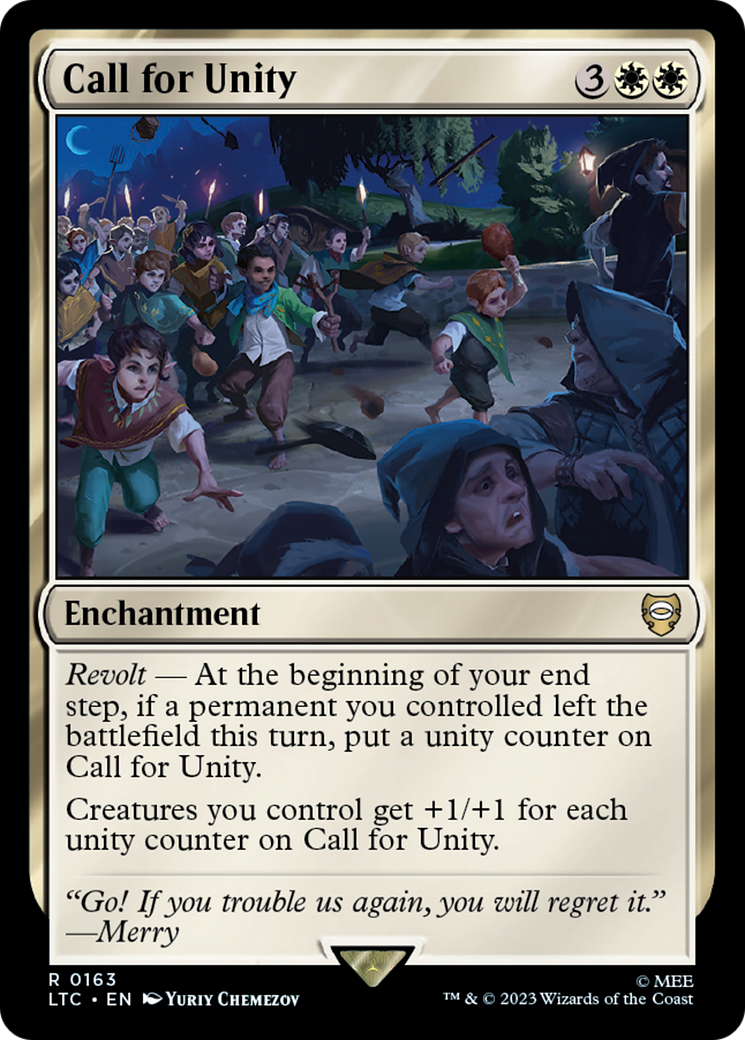
Call for Unity
Call for Unity
Enchantment
Revolt — At the beginning of your end step, if a permanent left the battlefield under your control this turn, put a unity counter on this enchantment.
Creatures you control get +1/+1 for each unity counter on this enchantment.
- Revolt abilities check only whether a permanent you controlled left the battlefield this turn or not. They don't apply multiple times if more than one permanent you controlled left the battlefield. They don't check whether the permanent that left the battlefield is still in the zone it moved to.
- Revolt abilities don't care why the permanent left the battlefield, who caused it to move, or where it moved to. They're equally satisfied by an artifact you sacrificed to pay a cost, a creature you controlled that was destroyed by Murder, or an enchantment you returned to your hand with Leave in the Dust.
- Tokens that leave the battlefield will satisfy a revolt ability.
- Energy counters aren't permanents. Paying won't satisfy a revolt ability.
- All cards in the Aether Revolt set with triggered revolt abilities use an intervening "if" clause. A permanent you controlled must have left the battlefield earlier in the turn in order for these abilities to trigger; otherwise they do nothing. In other words, there's no way to have the ability trigger if no permanent you controlled has left the battlefield that turn, even if you intend to have one do so in response to the triggered ability.
-
1
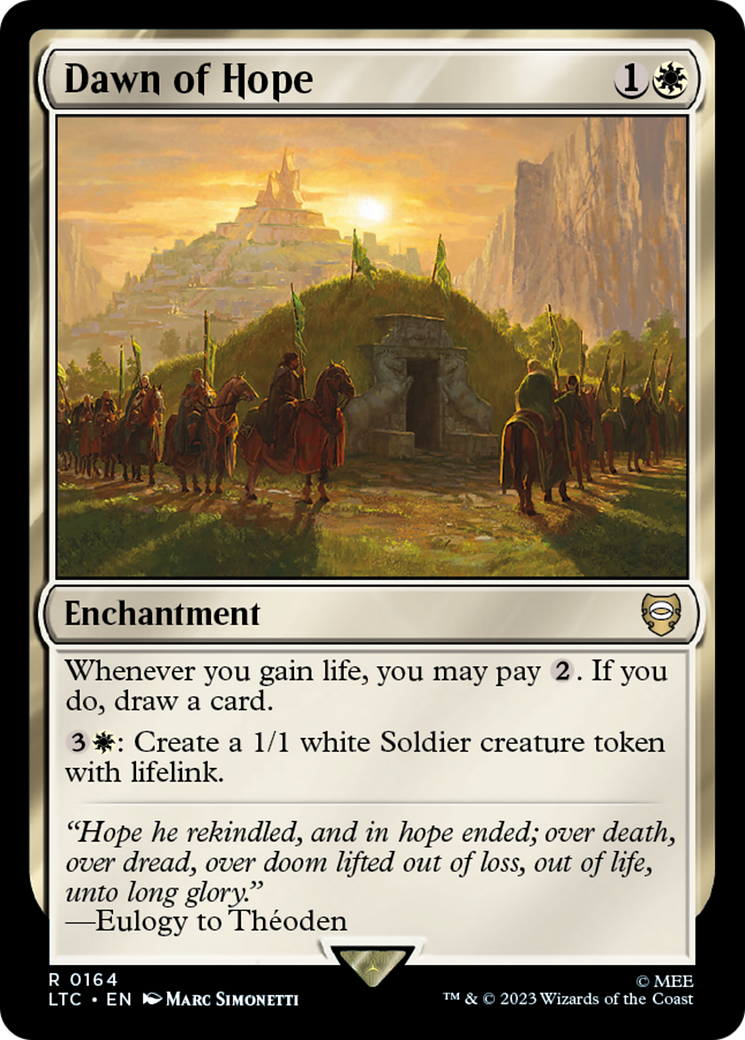
Dawn of Hope
Dawn of Hope
Enchantment
Whenever you gain life, you may pay . If you do, draw a card.
: Create a 1/1 white Soldier creature token with lifelink.
- Each creature with lifelink dealing combat damage causes a separate life-gaining event. For example, if two creatures you control with lifelink deal combat damage at the same time, Dawn of Hope's ability will trigger twice. However, if a single creature you control with lifelink deals combat damage to multiple creatures, players, planeswalkers, and/or battles at the same time (perhaps because it has trample or was blocked by more than one creature), the ability will trigger only once.
- Dawn of Hope's first ability triggers just once for each life-gaining event, whether it's 1 life from Vicious Rumors or 3 life from Creeping Chill.
- You can't pay multiple times to draw more than one card each time you resolve Dawn of Hope's triggered ability.
- If you gain an amount of life "for each" of something, that life is gained as one event and Dawn of Hope's first ability triggers only once.
- In a Two-Headed Giant game, life gained by your teammate won't cause the ability to trigger, even though it caused your team's life total to increase.
-
1
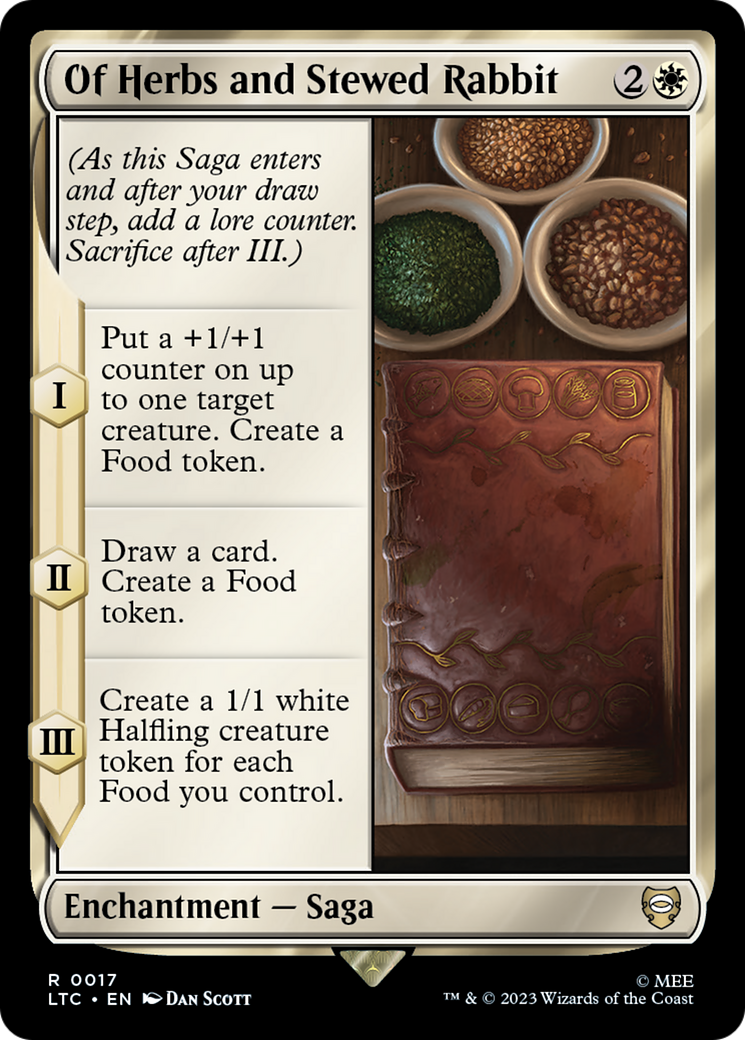
Of Herbs and Stewed Rabbit
Of Herbs and Stewed Rabbit
Enchantment — Saga
(As this Saga enters and after your draw step, add a lore counter. Sacrifice after III.)
I — Put a +1/+1 counter on up to one target creature. Create a Food token.
II — Draw a card. Create a Food token.
III — Create a 1/1 white Halfling creature token for each Food you control.
- If an effect refers to a Food, it means any Food artifact, not just a Food artifact token. For example, you can sacrifice Tough Cookie (an Artifact Creature — Food Golem) to activate Maraleaf Rider's ability (an ability with "Sacrifice a Food" in its cost).
- Food is an artifact type. Even though it appears on some creatures, it's never a creature type.
- You can't sacrifice a Food to pay multiple costs. For example, you can't sacrifice a Food token to activate its own ability and also to activate Maraleaf Rider's ability.
- Whatever you do, don't eat the delicious cards.
- When Of Herbs and Stewed Rabbit's first chapter ability triggers, you can choose not to target a creature just to create a Food token. However, if you do choose a target, and that target is illegal at the time the ability tries to resolve, the ability won't resolve and none of its effects will happen. You won't create a Food token.
-
1
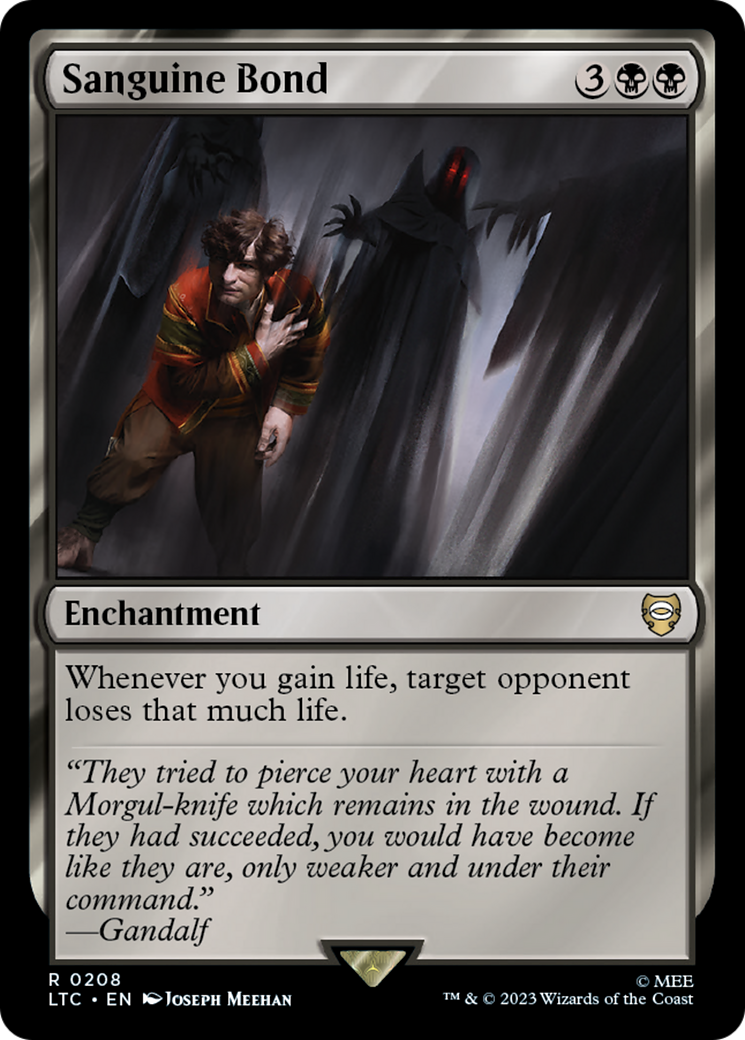
Sanguine Bond
Sanguine Bond
Enchantment
Whenever you gain life, target opponent loses that much life.
- In a Two-Headed Giant game, life gained by your teammate won't cause Sanguine Bond's ability to trigger, even though it caused your team's life total to increase.
- Each creature with lifelink dealing combat damage causes a separate life-gaining event. For example, if two creatures you control with lifelink deal combat damage at the same time, Sanguine Bond's ability will trigger twice and you may choose a different opponent for each trigger. However, if a single creature you control with lifelink deals combat damage to multiple creatures, players, planeswalkers, and/or battles at the same time (perhaps because it has trample or was blocked by more than one creature), the ability will trigger only once.
- If an ability triggers whenever an opponent loses life and causes you to gain life, such as the ability of Exquisite Blood, this will loop until either you win the game or a player takes an action to break the loop. If neither of these happen, the game ends in a draw.
- If you gain an amount of life "for each" of something, that life is gained as one event and Sanguine Bond's ability triggers only once.
- Sanguine Bond's ability triggers just once for each life-gaining event, whether it's 1 life from Soul Warden or 8 life from Tendrils of Corruption.
Lands 38
-
1
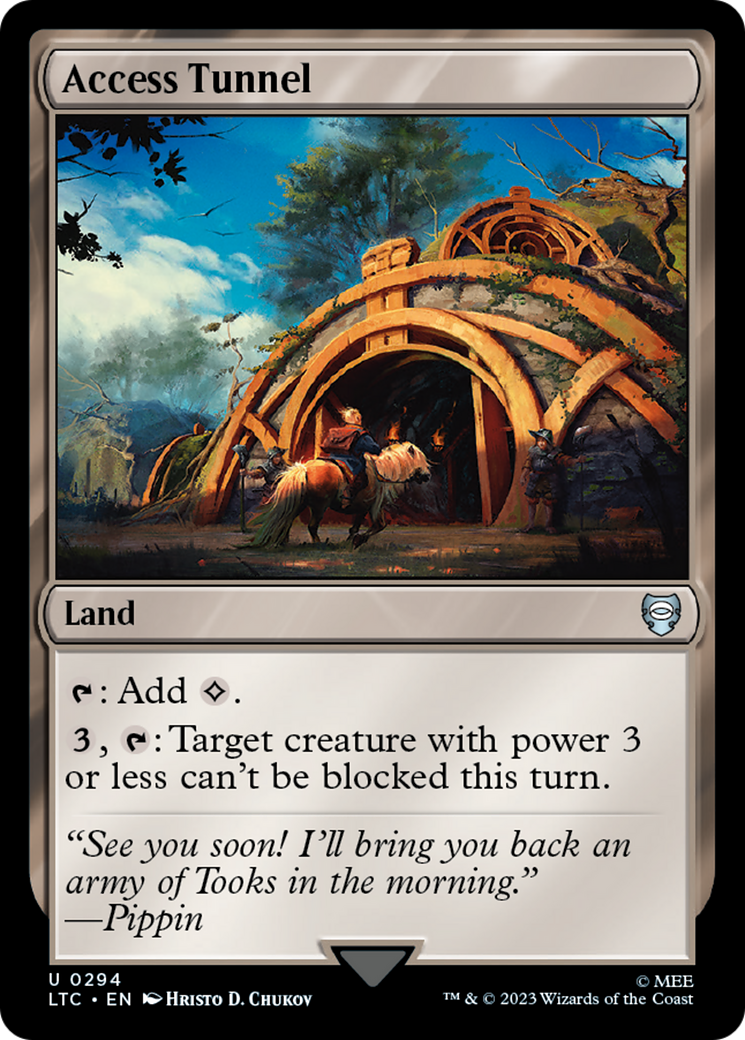
Access Tunnel
Access Tunnel
Land
: Add .
, : Target creature with power 3 or less can't be blocked this turn.
- Once a creature with power 3 or less has been blocked, Access Tunnel's second ability won't cause it to become unblocked.
- If the target creature's power is greater than 3 as Access Tunnel's second ability tries to resolve, the ability doesn't resolve. However, if instead the creature's power is raised above 3 after the ability resolves, it still can't be blocked that turn.
-
1
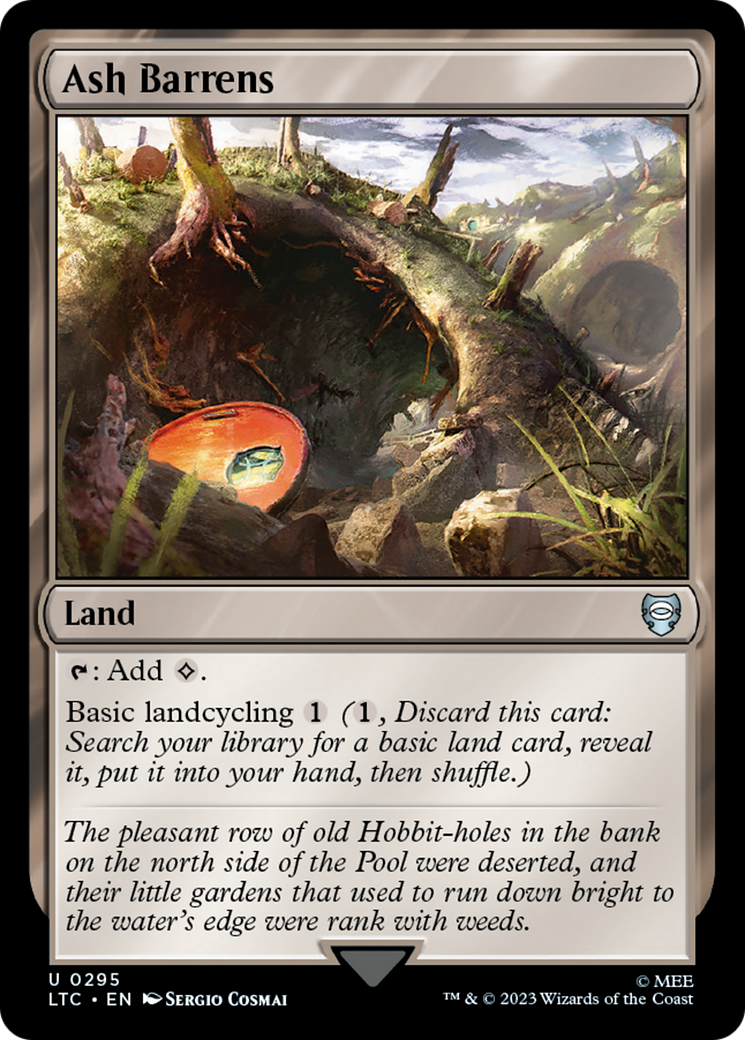
Ash Barrens
Ash Barrens
Land
: Add .
Basic landcycling ( , Discard this card: Search your library for a basic land card, reveal it, put it into your hand, then shuffle.)
-
1
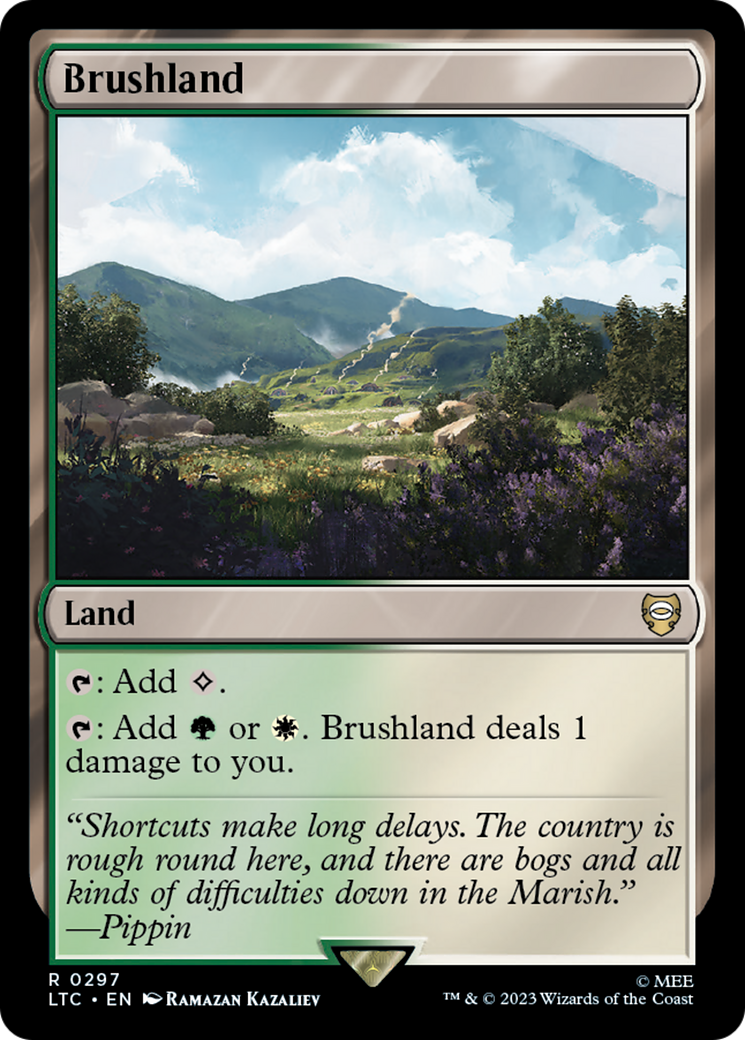
Brushland
Brushland
Land
: Add .
: Add or . This land deals 1 damage to you.
-
1
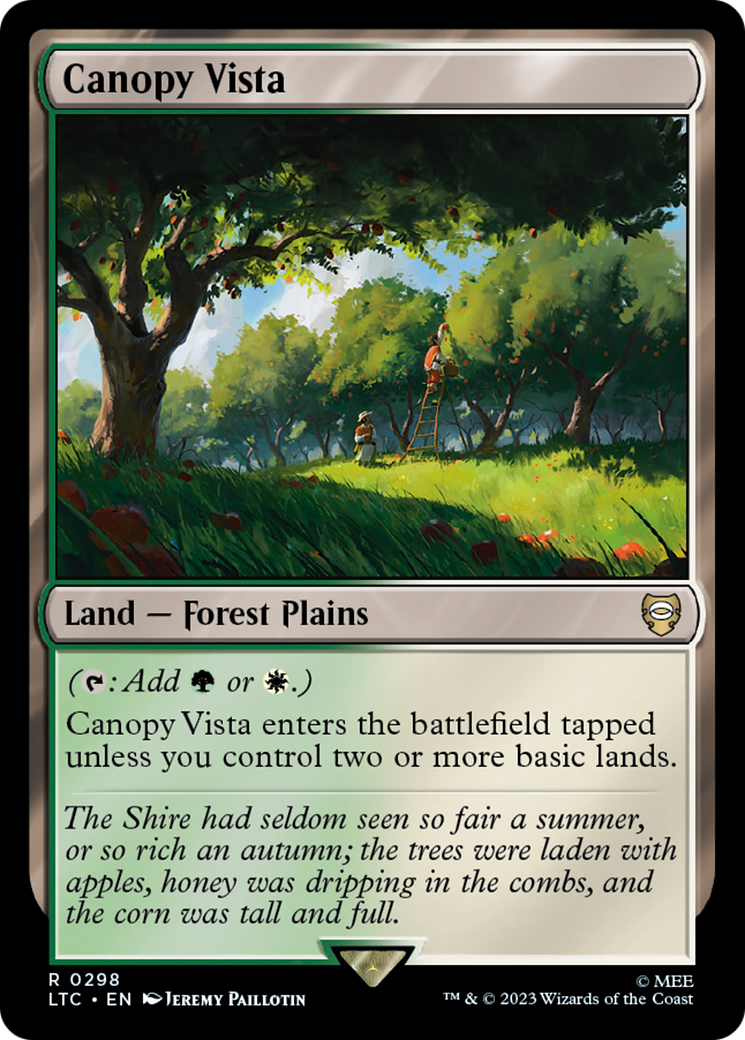
Canopy Vista
Canopy Vista
Land — Forest Plains
( : Add or .)
This land enters tapped unless you control two or more basic lands.
- Even though these lands have basic land types, they are not basic lands because "basic" doesn't appear on their type line. Notably, controlling two or more of them won't allow others to enter the battlefield untapped.
- However, because these cards have basic land types, effects that specify a basic land type without also specifying that the land be basic can affect them. For example, a spell or ability that reads "Destroy target Forest" can target Canopy Vista, while one that reads "Destroy target basic Forest" cannot.
- If one of these lands enters the battlefield at the same time as any number of basic lands, those other lands are not counted when determining if this land enters the battlefield tapped or untapped.
-
1
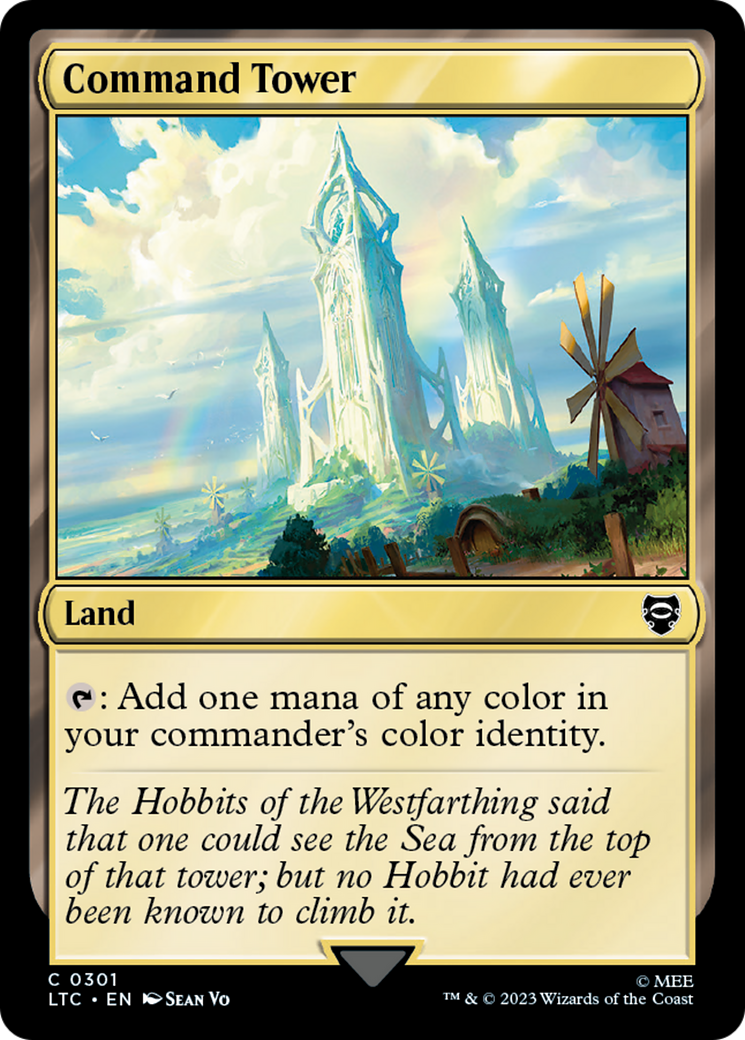
Command Tower
Command Tower
Land
: Add one mana of any color in your commander's color identity.
- If you have two commanders, the ability adds one mana of any color in their combined color identities.
- If your commander is a card that has no colors in its color identity, Command Tower's ability produces no mana. It doesn't produce .
- If you don't have a commander, Command Tower's ability produces no mana.
-
1
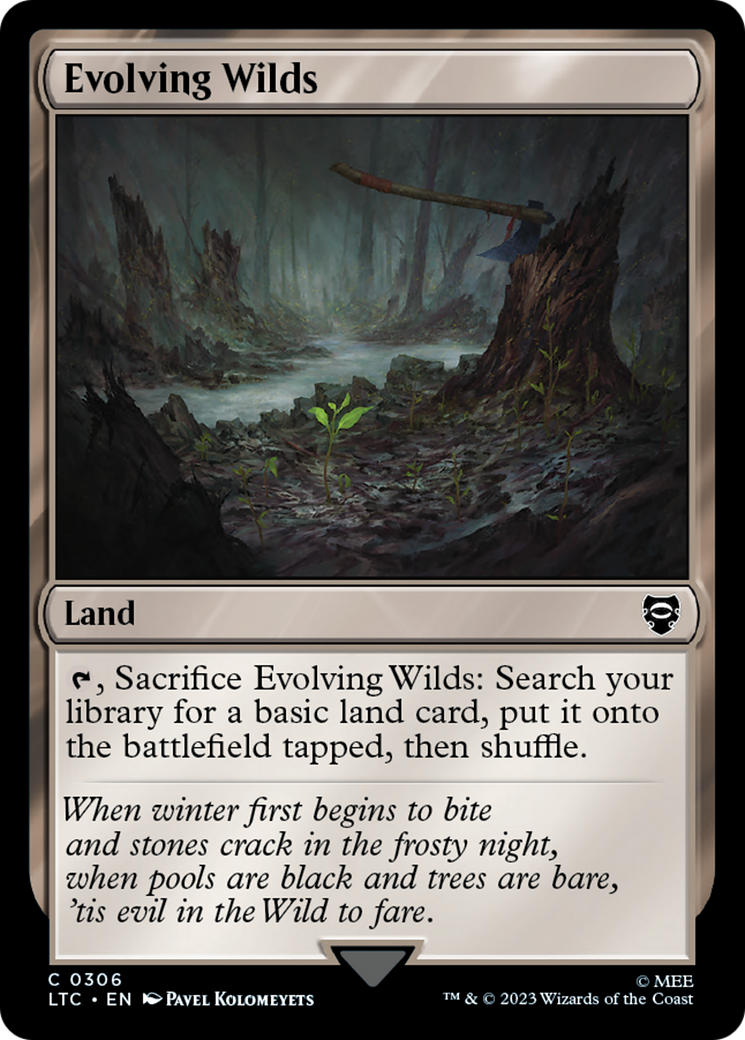
Evolving Wilds
Evolving Wilds
Land
, Sacrifice this land: Search your library for a basic land card, put it onto the battlefield tapped, then shuffle.
-
1
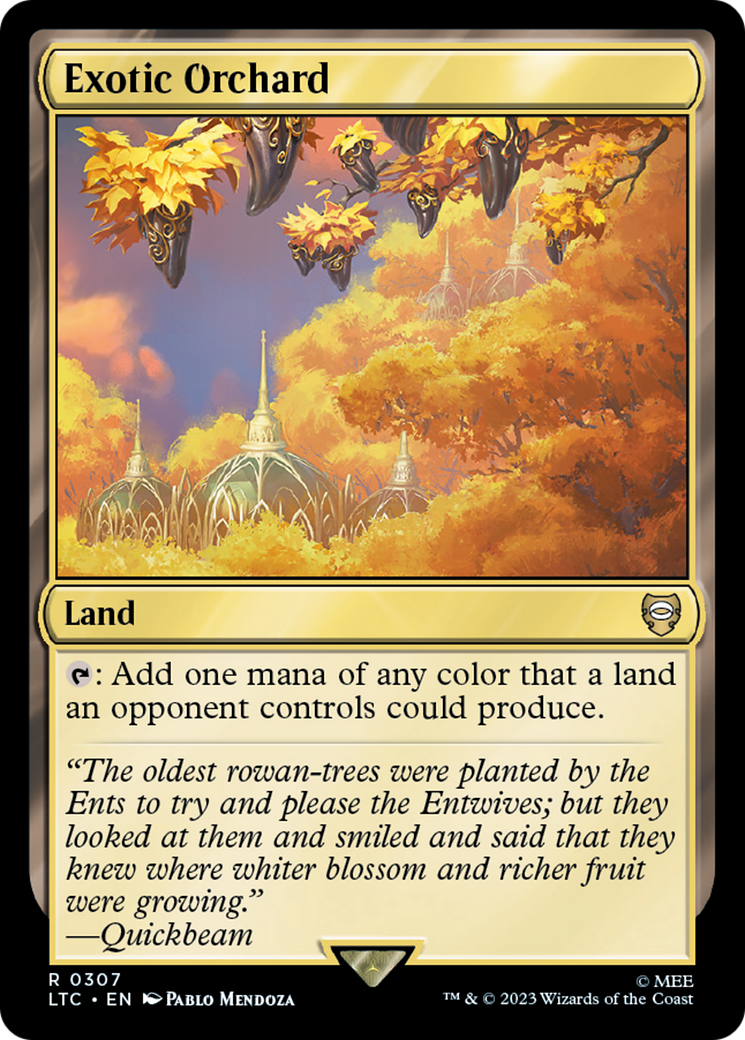
Exotic Orchard
Exotic Orchard
Land
: Add one mana of any color that a land an opponent controls could produce.
- The colors of mana are white, blue, black, red, and green. Exotic Orchard can't be tapped for colorless mana, even if a land an opponent controls could produce colorless mana.
- Exotic Orchard checks the effects of all mana-producing abilities of lands your opponents control, but it doesn't check their costs. For example, Vivid Crag has the ability " , Remove a charge counter from Vivid Crag: Add one mana of any color." If an opponent controls Vivid Crag and you control Exotic Orchard, you can tap Exotic Orchard for any color of mana. It doesn't matter whether Vivid Crag has a charge counter on it, and it doesn't matter whether it's untapped.
- When determining what colors of mana your opponents' lands could produce, Exotic Orchard takes into account any applicable replacement effects that would apply to those lands' mana abilities (such as Contamination's effect, for example). If there are more than one, consider them in any possible order.
- Exotic Orchard doesn't care about any restrictions or riders your opponents' lands (such as Ancient Ziggurat or Hall of the Bandit Lord) put on the mana they produce. It just cares about colors of mana.
- Lands that produce mana based only on what other lands "could produce" won't help each other unless some other land allows one of them to actually produce some type of mana. For example, if you control an Exotic Orchard and your opponent controls an Exotic Orchard and a Reflecting Pool, none of those lands would produce mana if their mana abilities were activated. On the other hand, if you control a Forest and an Exotic Orchard, and your opponent controls an Exotic Orchard and a Reflecting Pool, then each of those lands can be tapped to produce . Your opponent's Exotic Orchard can produce because you control a Forest. Your Exotic Orchard and your opponent's Reflecting Pool can each produce because your opponent's Exotic Orchard can produce .
-
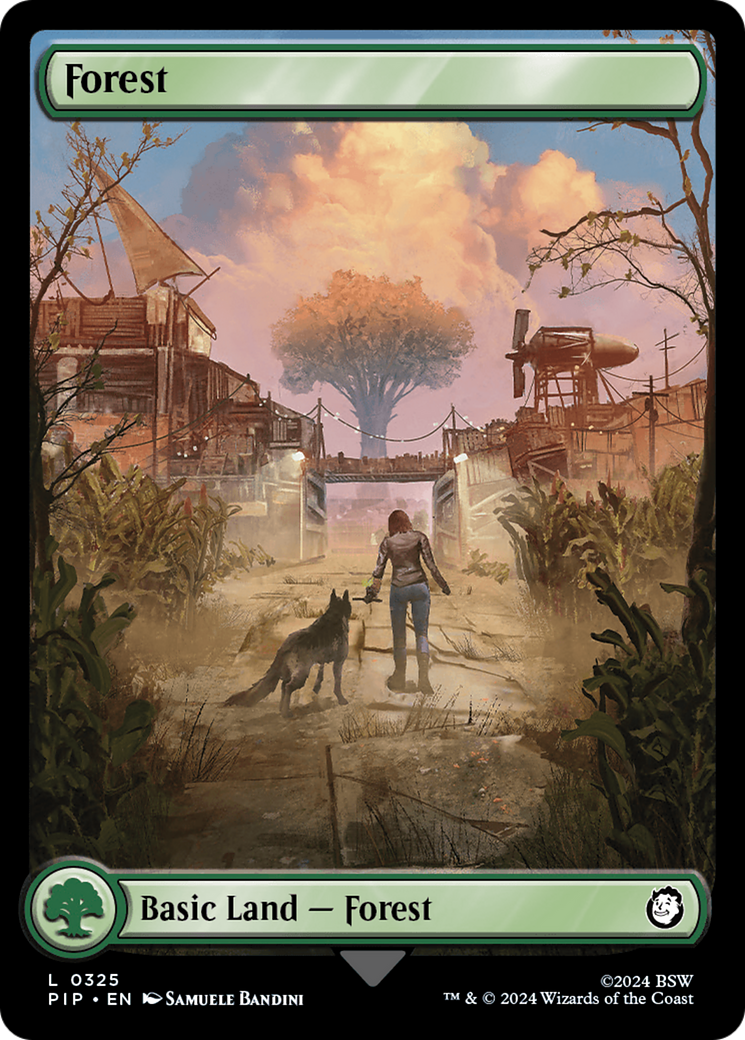
8
Forest
Forest
Basic Land — Forest
( : Add .)
-
1
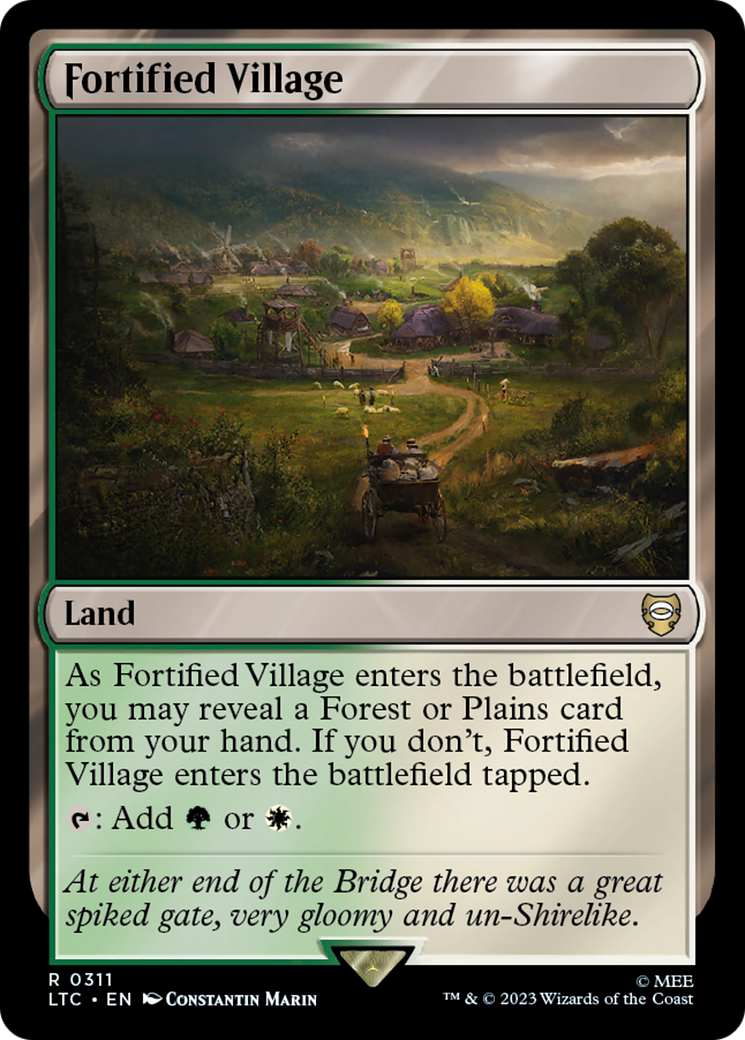
Fortified Village
Fortified Village
Land
As this land enters, you may reveal a Forest or Plains card from your hand. If you don't, this land enters tapped.
: Add or .
- You may reveal any land card with either or both of the appropriate subtypes. It doesn't have to be a basic land. For example, you could reveal Prairie Stream from the Battle for Zendikar set to satisfy the ability of Fortified Village.
- Lands don't have a subtype just because they can produce mana of the corresponding color. Fortified Village itself is neither a Forest nor a Plains, even though it produces green and white mana, so you can't reveal one to satisfy the ability of another.
- If a Forest or Plains is entering the battlefield from your hand at the same time as Fortified Village, you may reveal the other land to have Fortified Village enter untapped.
- If an effect instructs you to put Fortified Village onto the battlefield tapped, it will still enter the battlefield tapped even if you reveal a land card from your hand.
-
1
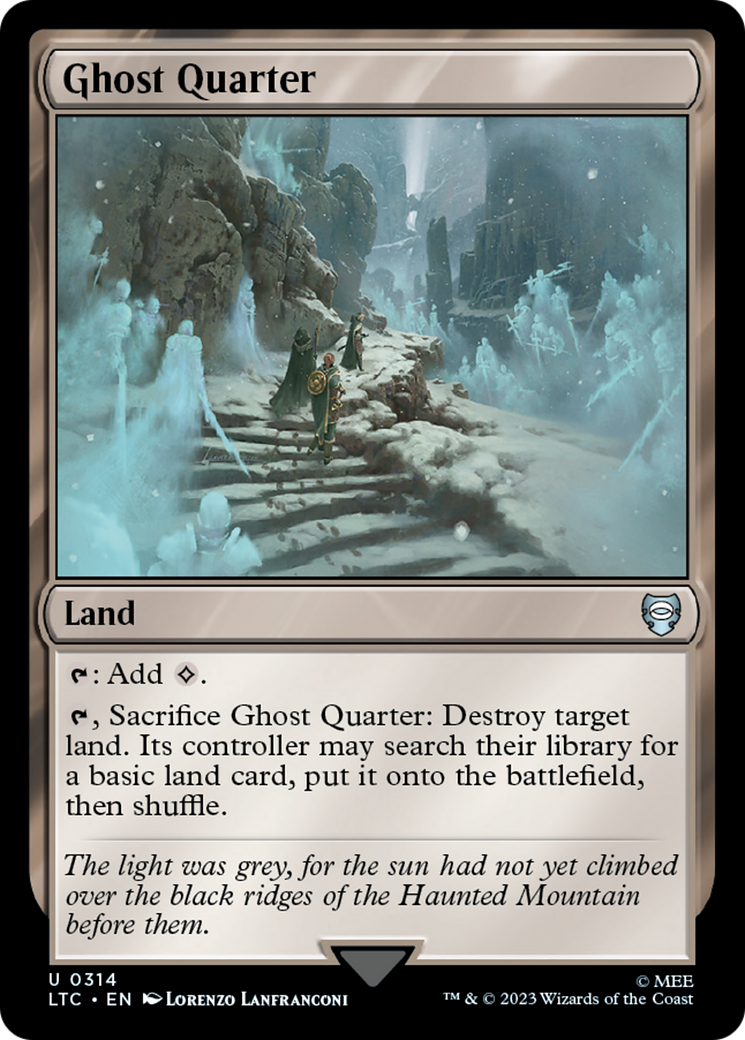
Ghost Quarter
Ghost Quarter
Land
: Add .
, Sacrifice this land: Destroy target land. Its controller may search their library for a basic land card, put it onto the battlefield, then shuffle.
- The target land's controller gets to search for a basic land card even if that land wasn't destroyed by Ghost Quarter's ability. This may happen because the land has indestructible or because it was regenerated.
- If the targeted land is an illegal target by the time Ghost Quarter's ability resolves, it won't resolve and none of its effects will happen. The land's controller won't get to search for a basic land card.
- If you target Ghost Quarter with its own ability, the ability won't resolve because its target is no longer on the battlefield. You won't get to search for a land card.
-
1
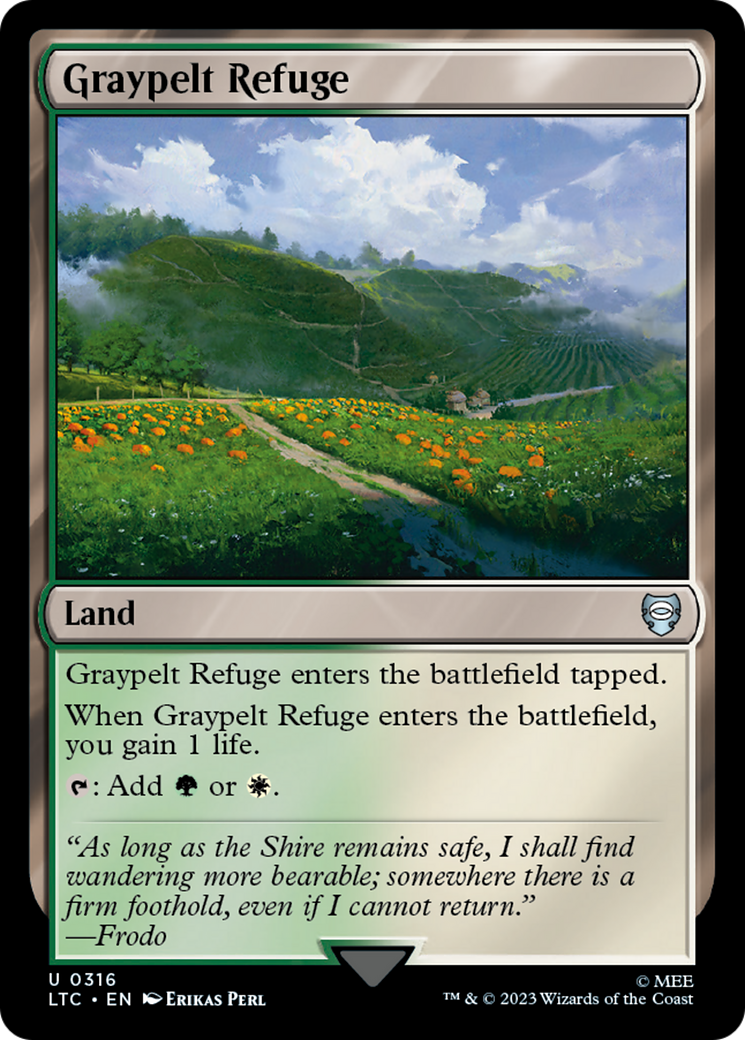
Graypelt Refuge
Graypelt Refuge
Land
This land enters tapped.
When this land enters, you gain 1 life.
: Add or .
-
1
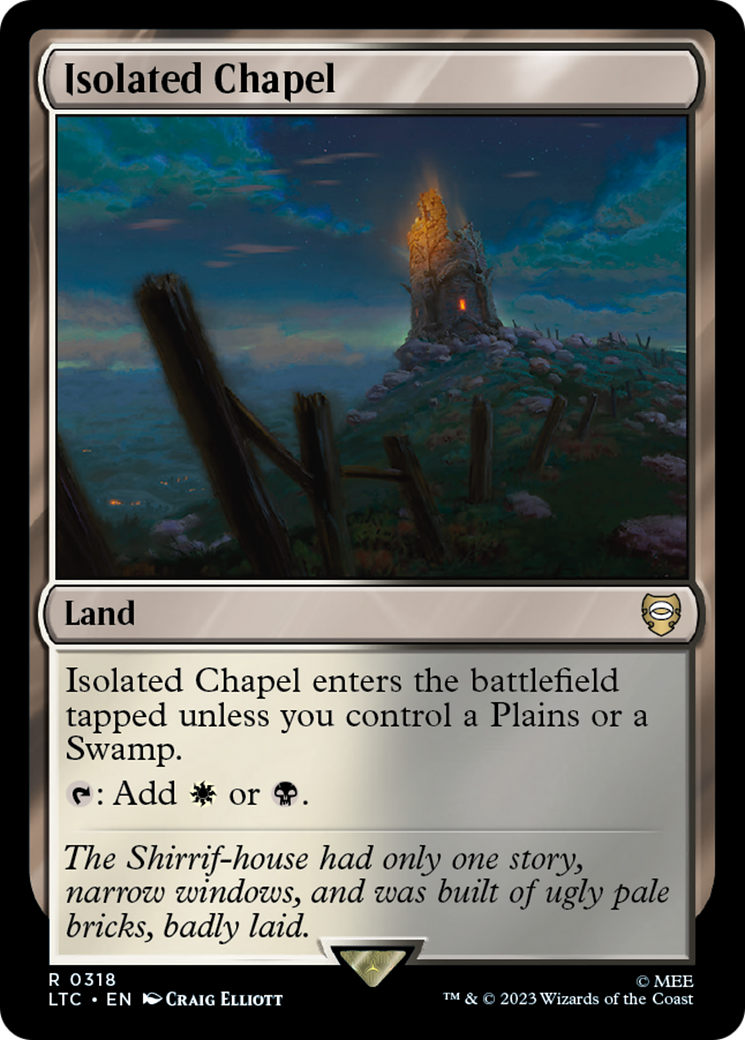
Isolated Chapel
Isolated Chapel
Land
This land enters tapped unless you control a Plains or a Swamp.
: Add or .
-
1
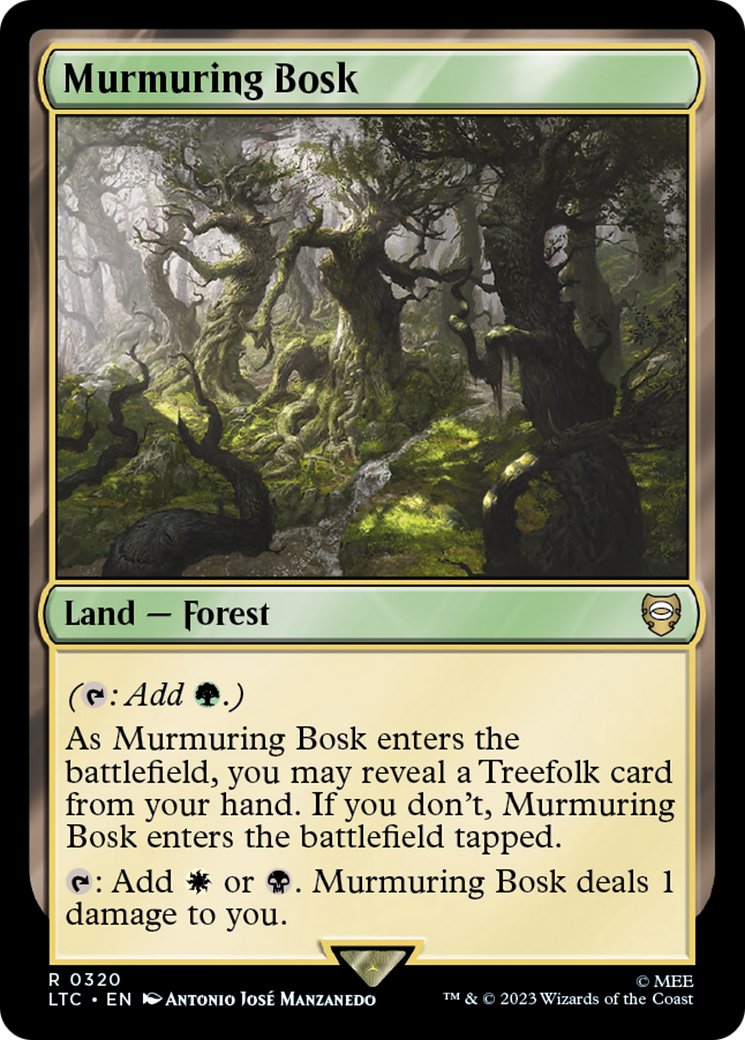
Murmuring Bosk
Murmuring Bosk
Land — Forest
( : Add .)
As this land enters, you may reveal a Treefolk card from your hand. If you don't, this land enters tapped.
: Add or . This land deals 1 damage to you.
- Murmuring Bosk is a Forest, but it isn't a basic land. Things that affect basic lands don't affect it. Things that affect basic land types do. For example, you can't find Murmuring Bosk with Fertilid's ability ("searches their library for a basic land card"), but you can find Murmuring Bosk with Everbark Shaman's ability ("search your library for two Forest cards").
-
1
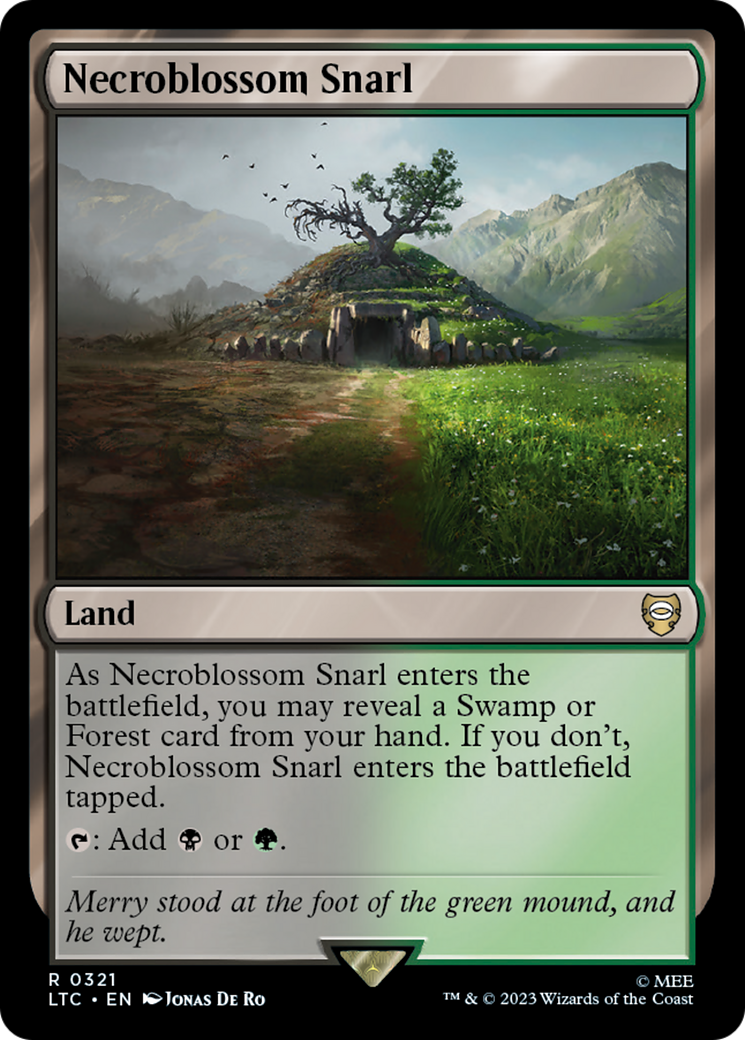
Necroblossom Snarl
Necroblossom Snarl
Land
As this land enters, you may reveal a Swamp or Forest card from your hand. If you don't, this land enters tapped.
: Add or .
- You may reveal any land card with either or both of the appropriate subtypes. It doesn't have to be a basic land card.
- The "Snarl" itself doesn't have any land subtypes. You can't reveal one to satisfy the ability of another.
- If a land card with an appropriate subtype is entering the battlefield from your hand at the same time as one of these lands, you may reveal the other land to have the "Snarl" enter untapped.
- If an effect instructs you to put one of these lands onto the battlefield tapped, it will still enter the battlefield tapped even if you reveal a land card from your hand.
-
1
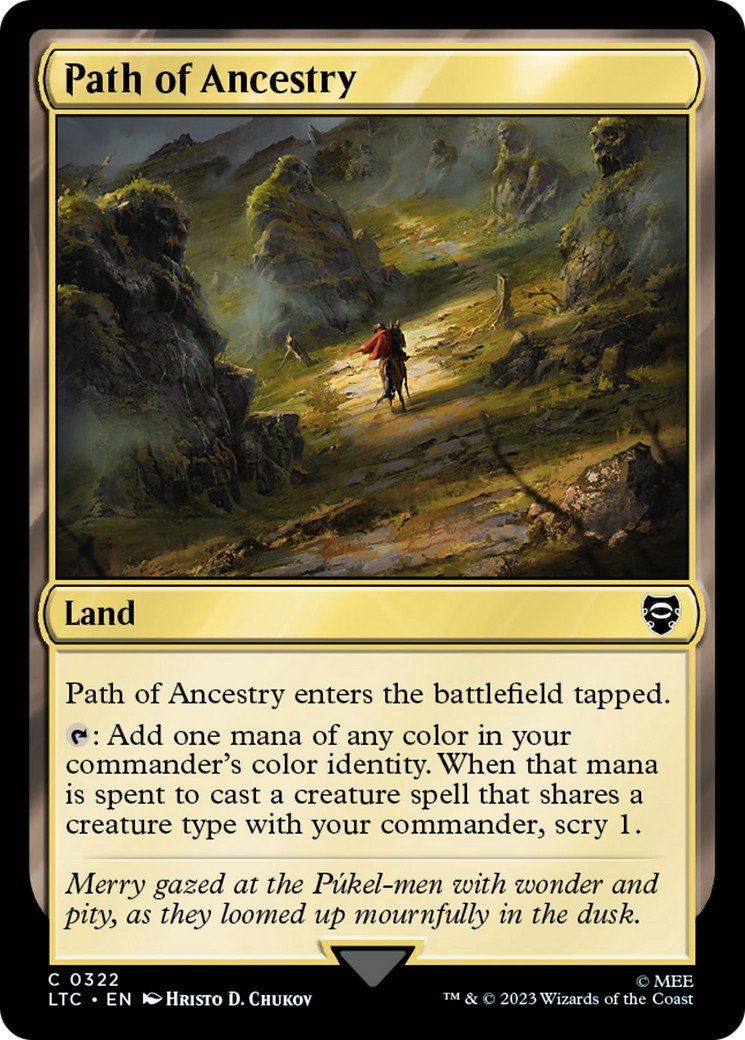
Path of Ancestry
Path of Ancestry
Land
This land enters tapped.
: Add one mana of any color in your commander's color identity. When that mana is spent to cast a creature spell that shares a creature type with your commander, scry 1. (Look at the top card of your library. You may put that card on the bottom.)
- If you have two commanders, the last ability adds one mana of any color in their combined color identities. When you spend that mana on a creature spell that shares a creature type with either of your commanders, you'll scry 1.
- Your commander's creature types are checked immediately after you cast a creature spell spending mana from Path of Ancestry's last ability. They aren't set before the game begins, and they may not be the same types your commander had when you activated that ability.
- If you cast your commander with mana from Path of Ancestry, and your commander hasn't somehow lost all of its creature types while on the stack, you'll scry 1.
- If your commander is a card that has no colors in its color identity, Path of Ancestry's ability produces no mana. It doesn't produce .
- If Path of Ancestry's last ability produces two mana (most likely due to Mana Reflection), spending those two mana to cast creature spells that share a creature type with your commander will cause two abilities to trigger. Each of those abilities will cause you to scry 1. You won't scry 2. This is true whether you spend the mana on one creature spell or two.
- If your commander has no creature types, it can't share a creature type with any spell that you cast.
- If you don't have a commander, Path of Ancestry's ability produces no mana.
-
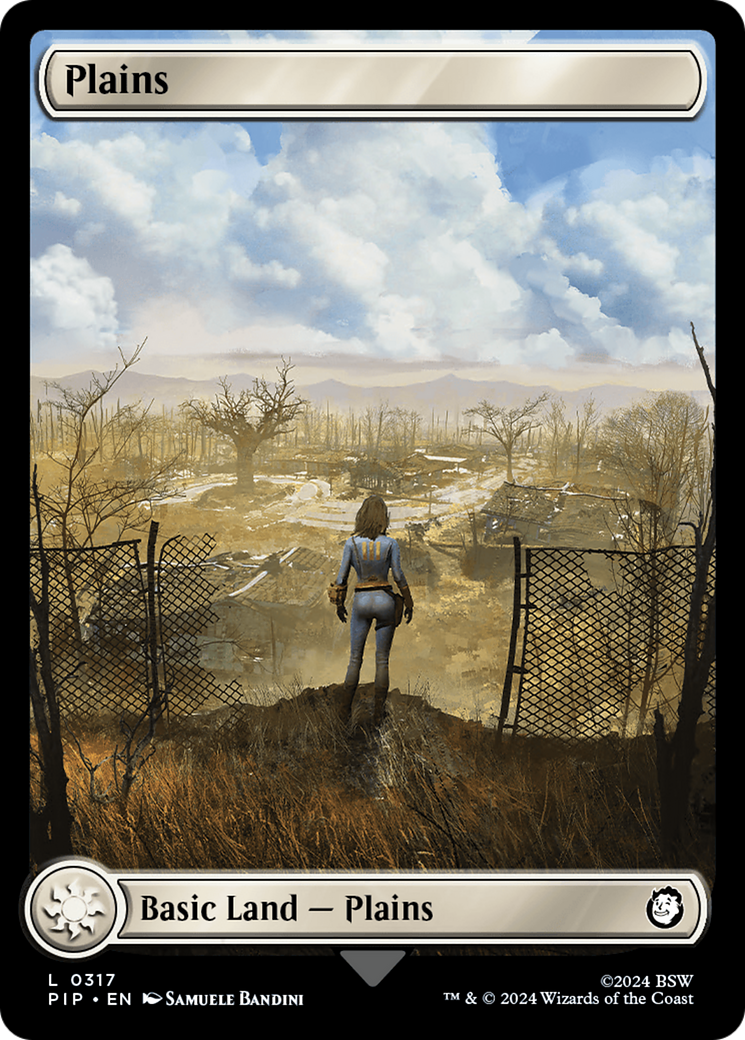
4
Plains
Plains
Basic Land — Plains
( : Add .)
-
1
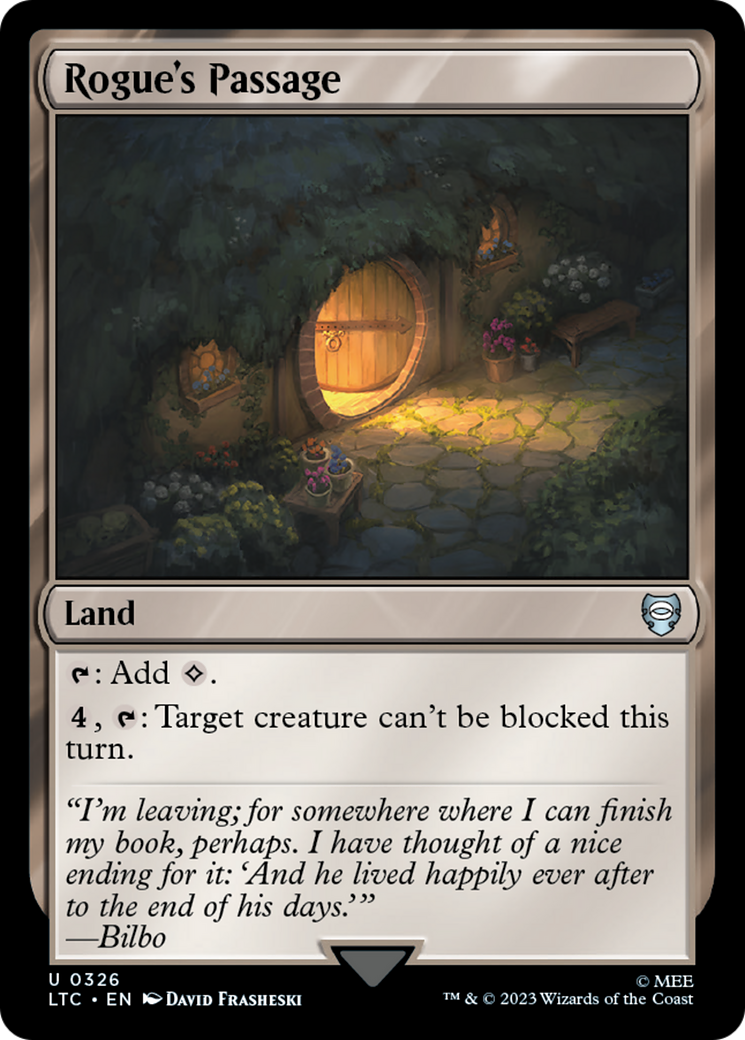
Rogue's Passage
Rogue's Passage
Land
: Add .
, : Target creature can't be blocked this turn.
- Activating the second ability of Rogue's Passage after a creature has become blocked won't cause that creature to become unblocked.
-
1
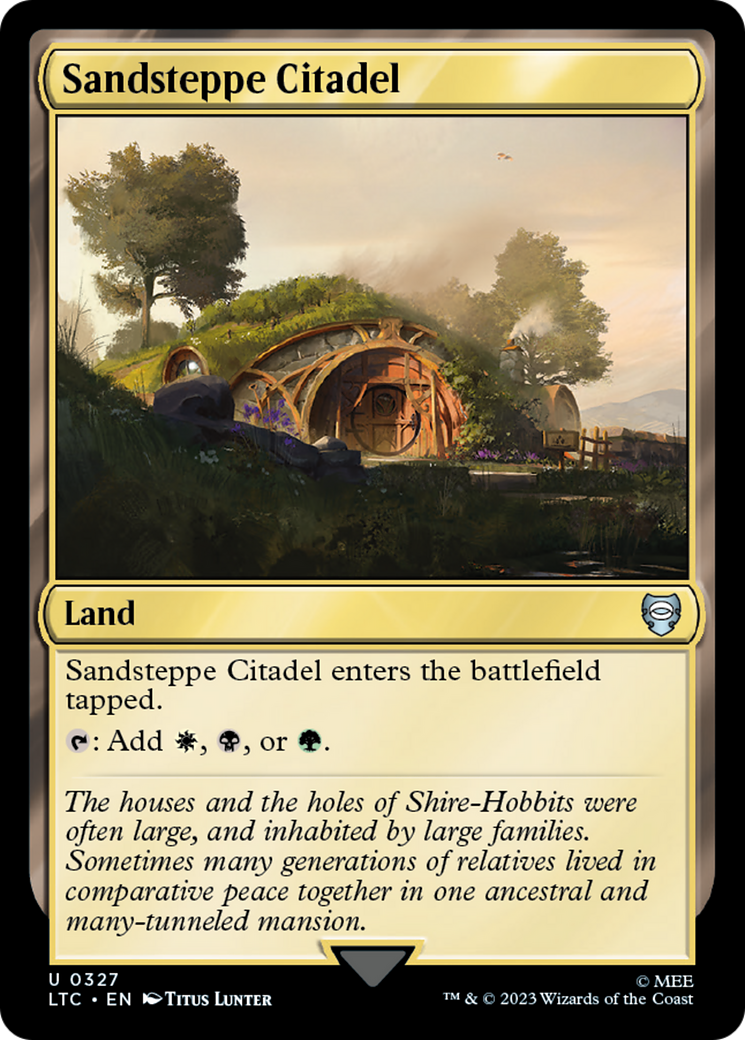
Sandsteppe Citadel
Sandsteppe Citadel
Land
This land enters tapped.
: Add , , or .
-
1
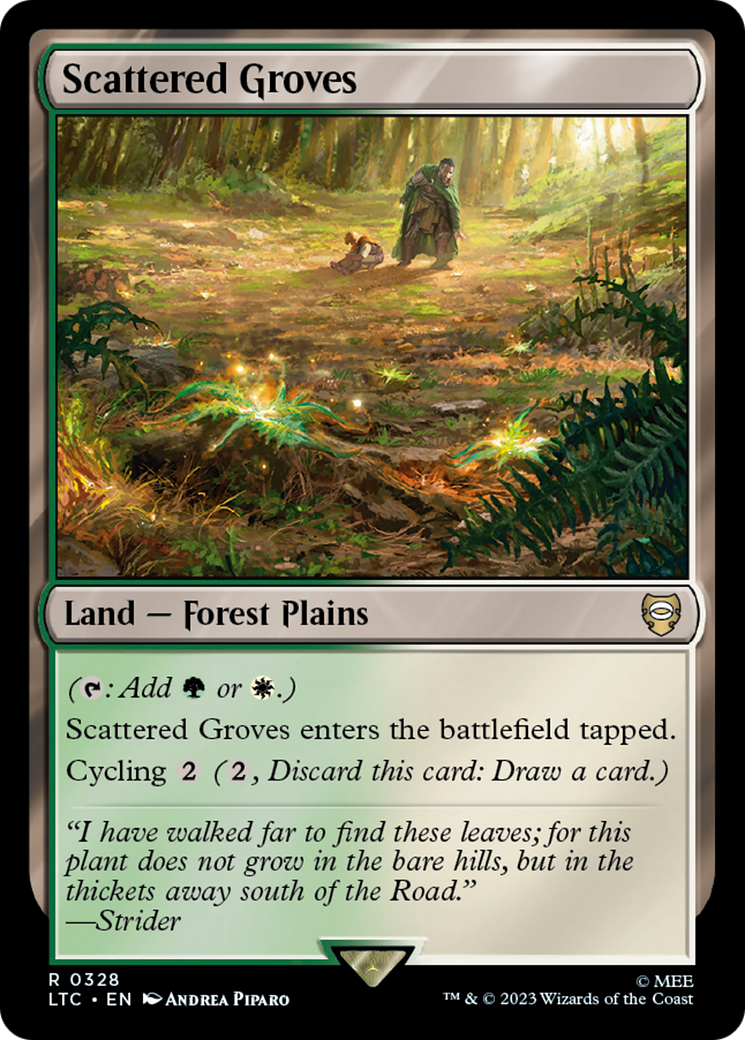
Scattered Groves
Scattered Groves
Land — Forest Plains
( : Add or .)
This land enters tapped.
Cycling ( , Discard this card: Draw a card.)
-
1
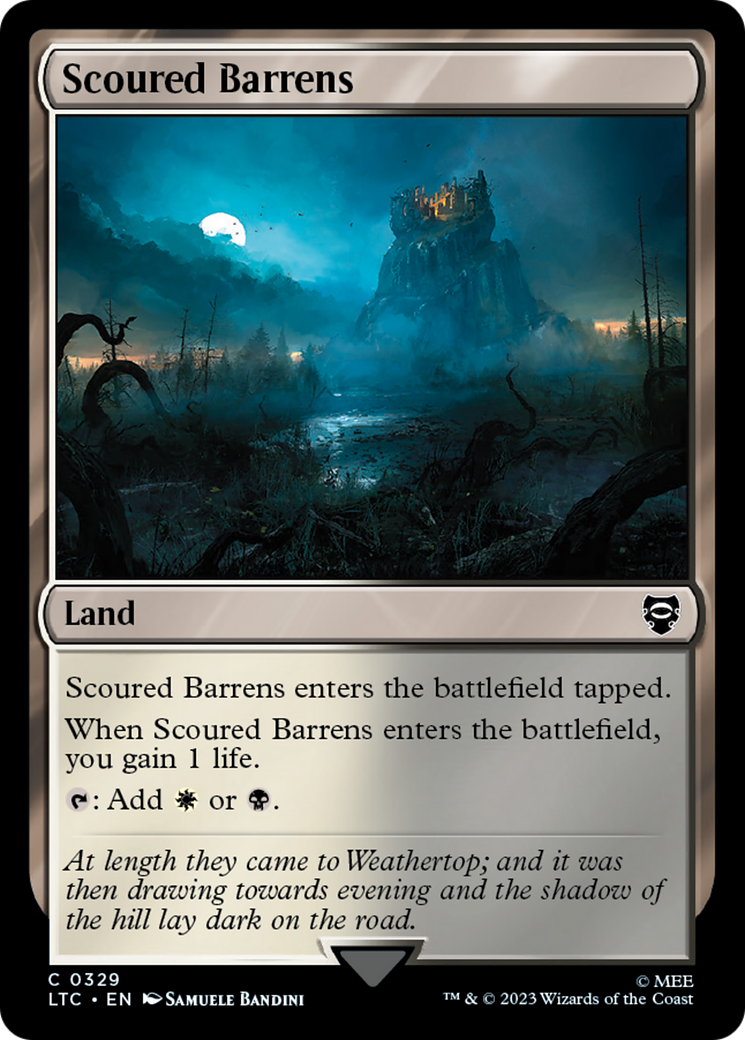
Scoured Barrens
Scoured Barrens
Land
This land enters tapped.
When this land enters, you gain 1 life.
: Add or .
-
1
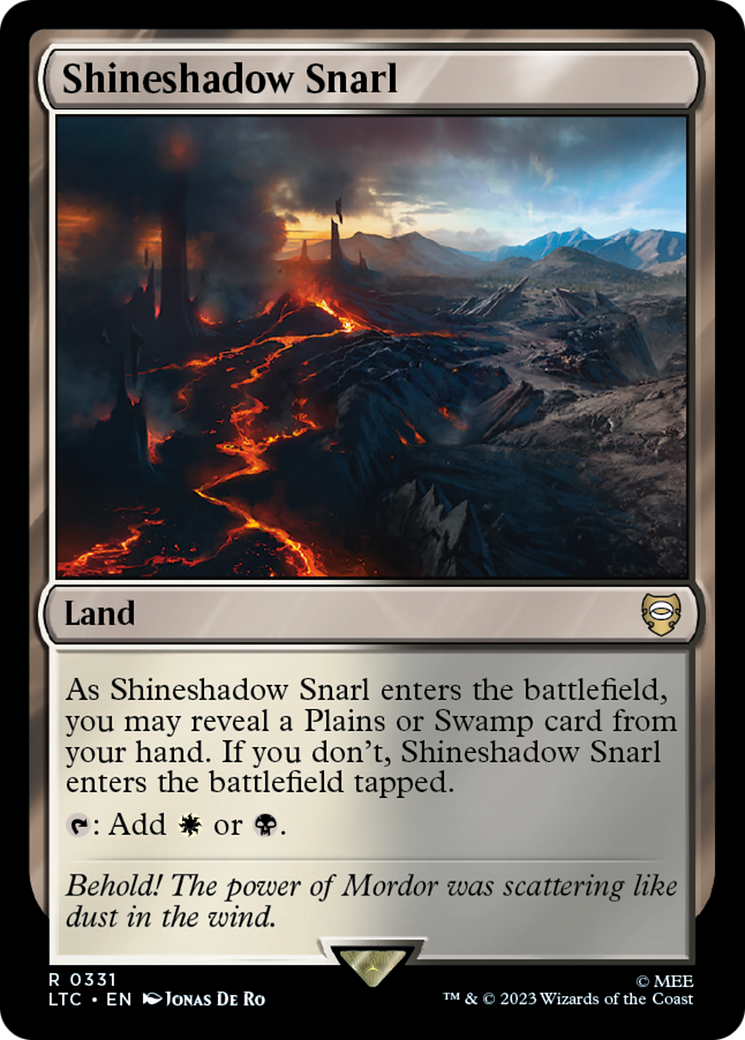
Shineshadow Snarl
Shineshadow Snarl
Land
As this land enters, you may reveal a Plains or Swamp card from your hand. If you don't, this land enters tapped.
: Add or .
- You may reveal any land card with either or both of the appropriate subtypes. It doesn't have to be a basic land card.
- The "Snarl" itself doesn't have any land subtypes. You can't reveal one to satisfy the ability of another.
- If a land card with an appropriate subtype is entering the battlefield from your hand at the same time as one of these lands, you may reveal the other land to have the "Snarl" enter untapped.
- If an effect instructs you to put one of these lands onto the battlefield tapped, it will still enter the battlefield tapped even if you reveal a land card from your hand.
-
1
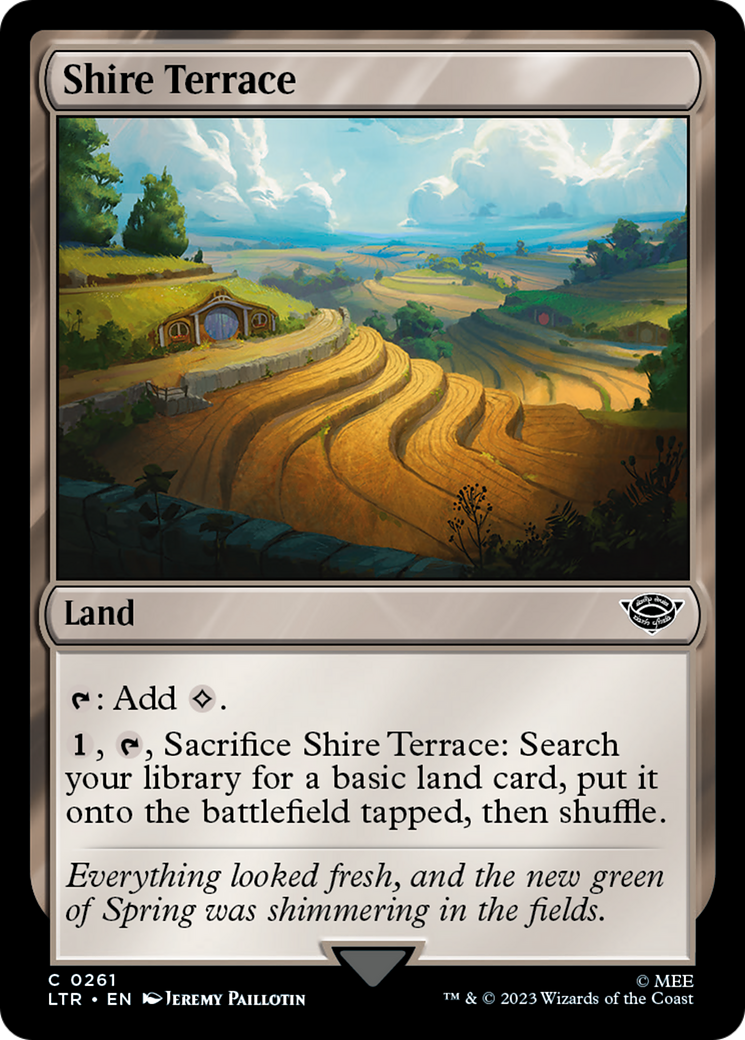
Shire Terrace
Shire Terrace
Land
: Add .
, , Sacrifice this land: Search your library for a basic land card, put it onto the battlefield tapped, then shuffle.
-
1
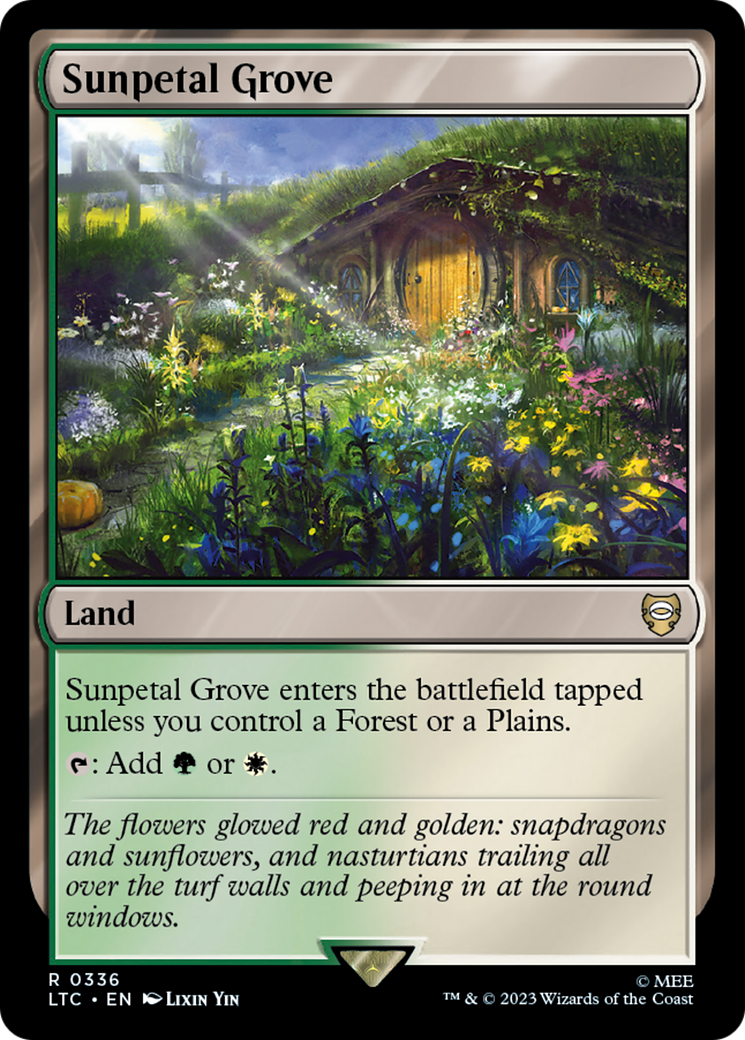
Sunpetal Grove
Sunpetal Grove
Land
This land enters tapped unless you control a Forest or a Plains.
: Add or .
- This checks for lands you control with the land type Forest or Plains, not for lands named Forest or Plains. The lands it checks for don't have to be basic lands. For example, if you control Hallowed Fountain (a nonbasic land with the land types Plains and Island), Sunpetal Grove will enter untapped.
- As this is entering, it checks for lands that are already on the battlefield. It won't see lands that are entering at the same time (due to Warp World, for example).
-
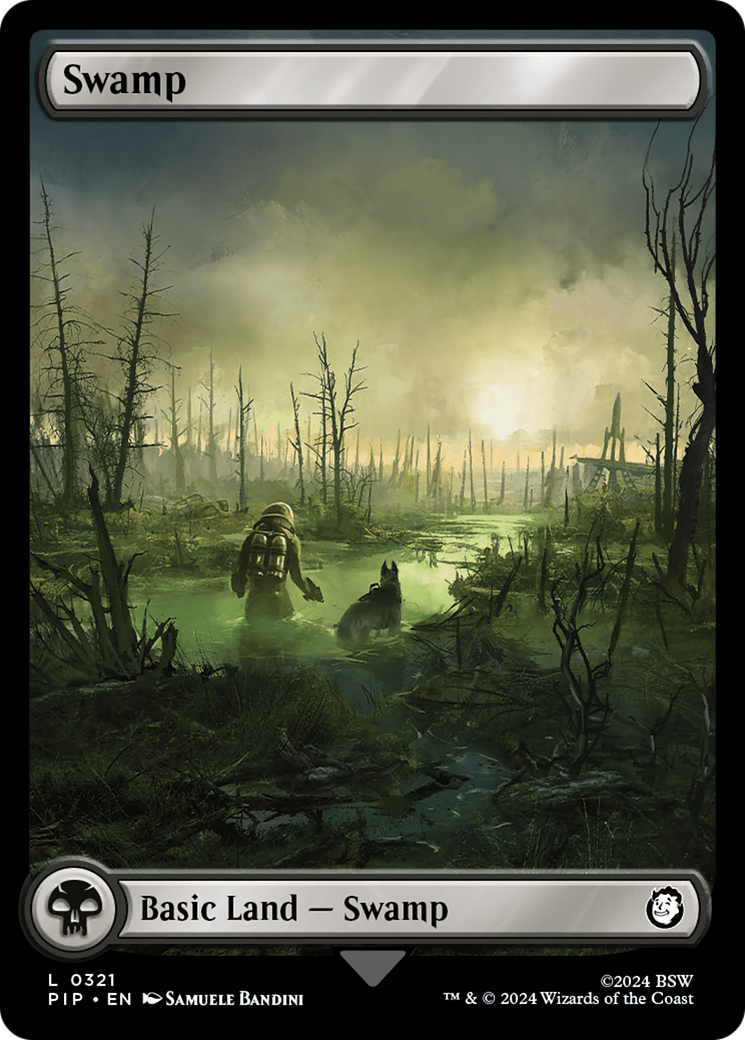
4
Swamp
Swamp
Basic Land — Swamp
( : Add .)
-
1
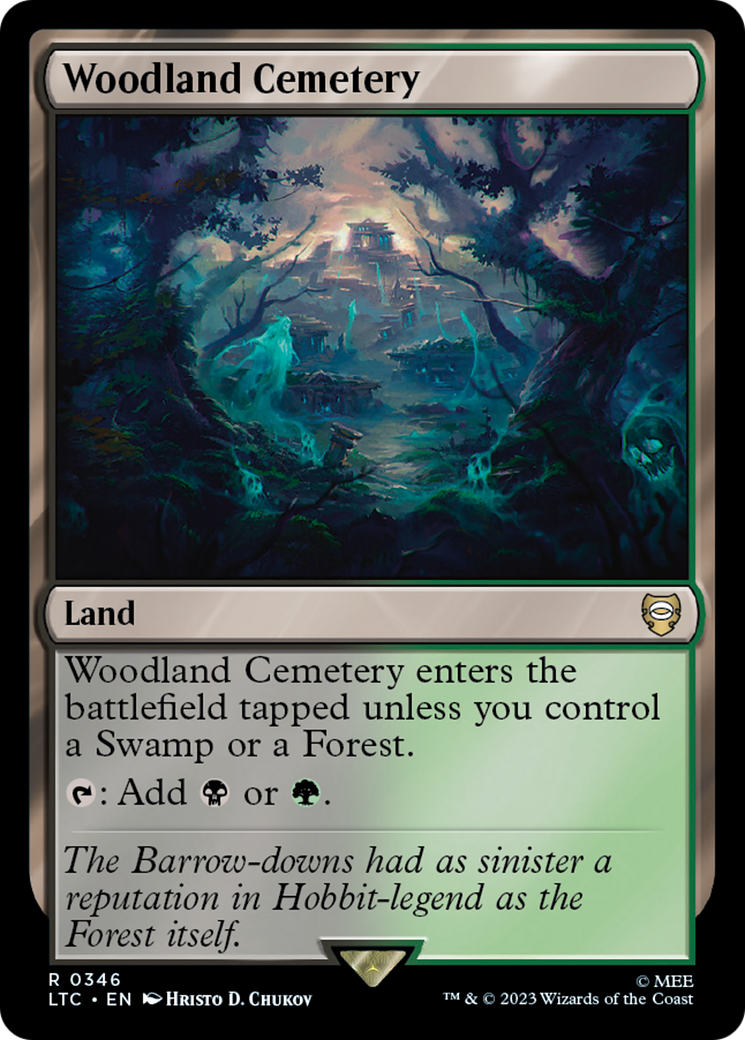
Woodland Cemetery
Woodland Cemetery
Land
This land enters tapped unless you control a Swamp or a Forest.
: Add or .
Other 1
- 1 Treebeard. Gracious Host
White 16
-
1
Call for Unity
Call for Unity
Enchantment
Revolt — At the beginning of your end step, if a permanent left the battlefield under your control this turn, put a unity counter on this enchantment.
Creatures you control get +1/+1 for each unity counter on this enchantment.
- Revolt abilities check only whether a permanent you controlled left the battlefield this turn or not. They don't apply multiple times if more than one permanent you controlled left the battlefield. They don't check whether the permanent that left the battlefield is still in the zone it moved to.
- Revolt abilities don't care why the permanent left the battlefield, who caused it to move, or where it moved to. They're equally satisfied by an artifact you sacrificed to pay a cost, a creature you controlled that was destroyed by Murder, or an enchantment you returned to your hand with Leave in the Dust.
- Tokens that leave the battlefield will satisfy a revolt ability.
- Energy counters aren't permanents. Paying won't satisfy a revolt ability.
- All cards in the Aether Revolt set with triggered revolt abilities use an intervening "if" clause. A permanent you controlled must have left the battlefield earlier in the turn in order for these abilities to trigger; otherwise they do nothing. In other words, there's no way to have the ability trigger if no permanent you controlled has left the battlefield that turn, even if you intend to have one do so in response to the triggered ability.
-
1
Dawn of Hope
Dawn of Hope
Enchantment
Whenever you gain life, you may pay . If you do, draw a card.
: Create a 1/1 white Soldier creature token with lifelink.
- Each creature with lifelink dealing combat damage causes a separate life-gaining event. For example, if two creatures you control with lifelink deal combat damage at the same time, Dawn of Hope's ability will trigger twice. However, if a single creature you control with lifelink deals combat damage to multiple creatures, players, planeswalkers, and/or battles at the same time (perhaps because it has trample or was blocked by more than one creature), the ability will trigger only once.
- Dawn of Hope's first ability triggers just once for each life-gaining event, whether it's 1 life from Vicious Rumors or 3 life from Creeping Chill.
- You can't pay multiple times to draw more than one card each time you resolve Dawn of Hope's triggered ability.
- If you gain an amount of life "for each" of something, that life is gained as one event and Dawn of Hope's first ability triggers only once.
- In a Two-Headed Giant game, life gained by your teammate won't cause the ability to trigger, even though it caused your team's life total to increase.
-
1
Dusk // Dawn
//
Dusk
Sorcery
- Once you've started to cast a spell with aftermath from your graveyard, the card is immediately moved to the stack. Opponents can't try to stop the ability by exiling the card with an effect such as that of Crook of Condemnation.
- All split cards have two card faces on a single card, and you put a split card onto the stack with only the half you're casting. The characteristics of the half of the card you didn't cast are ignored while the spell is on the stack. For example, if an effect prevents you from casting green spells, you can cast Destined of Destined // Lead, but not Lead.
- Each split card is a single card. For example, if you discard one, you've discarded one card, not two. If an effect counts the number of instant and sorcery cards in your graveyard, Destined // Lead counts once, not twice.
- Each split card has two names. If an effect instructs you to choose a card name, you may choose one, but not both.
- While not on the stack, the characteristics of a split card are the combination of its two halves. For example, Destined // Lead is a green and black card, it is both an instant card and a sorcery card, and its mana value is 6. This means that if an effect allows you to cast a card with mana value 2 from your hand, you can't cast Destined. This is a change from the previous rules for split cards.
- Split cards with aftermath have a new frame treatment—the half you can cast from your hand is oriented the same as other cards you'd cast from your hand, while the half you can cast from your graveyard is a traditional split card half. This frame treatment is for your convenience and has no rules significance.
- If another effect allows you to cast a split card with aftermath from any zone other than a graveyard, you can't cast the half with aftermath.
- If another effect allows you to cast a split card with aftermath from a graveyard, you may cast either half. If you cast the half that has aftermath, you'll exile the card if it would leave the stack.
- A spell with aftermath cast from a graveyard will always be exiled afterward, whether it resolves, it's countered, or it leaves the stack in some other way.
- If you cast the first half of a split card with aftermath during your turn, you'll have priority immediately after it resolves. You can cast the half with aftermath from your graveyard before any player can take any other action if it's legal for you to do so.
-
1
Eagles of the North
Eagles of the North
Creature — Bird Soldier
3/3
Flying
When this creature enters, creatures you control get +1/+0 and gain first strike until end of turn.
Plainscycling ( , Discard this card: Search your library for a Plains card, reveal it, put it into your hand, then shuffle.)
- Eagles of the North's triggered ability affects only creatures you control at the time it resolves. Any creatures that come under your control later in the turn won't be affected.
- Unlike the normal cycling ability, typecycling doesn't allow you to draw a card. Rather, it lets you search your library for a card with the type or types indicated by the ability name. For example, a card with basic landcycling lets you search for a basic land card, and a card with Wizardcycling lets you search for a Wizard card.
- Typecycling is a form of cycling. Any ability that triggers on a card being cycled also triggers on a card being typecycled. Any ability that stops a cycling ability from being activated also stops a typecycling ability from being activated.
-
1
Fell the Mighty
Fell the Mighty
Sorcery
Destroy all creatures with power greater than target creature's power.
- Use the power of the target creature as Fell the Mighty resolves to determine which creatures are destroyed. Fell the Mighty doesn't target any of those creatures, so a creature with hexproof or protection from white will be destroyed if its power is high enough.
- Fell the Mighty won't destroy the target creature.
- If the target creature is an illegal target when Fell the Mighty tries to resolve, Fell the Mighty won't resolve and none of its effects will happen. No creatures will be destroyed.
-
1
Field-Tested Frying Pan
Field-Tested Frying Pan
Artifact — Equipment
When this Equipment enters, create a Food token, then create a 1/1 white Halfling creature token and attach this Equipment to it.
Equipped creature has "Whenever you gain life, this creature gets +X/+X until end of turn, where X is the amount of life you gained."
Equip
- Food is an artifact type. Even though it appears on some creatures, it's never a creature type.
- You can't sacrifice a Food to pay multiple costs. For example, you can't sacrifice a Food token to activate its own ability and also to activate Maraleaf Rider's ability.
- Whatever you do, don't eat the delicious cards.
- No player may take any actions between the time you create the Halfling token and the time Field-Tested Frying Pan becomes attached to it.
- If the triggered ability causes more than one creature token to be created (due to an effect such as that of Doubling Season), Field-Tested Frying Pan becomes attached to one of them of your choice.
-
1
Fumigate
Fumigate
Sorcery
Destroy all creatures. You gain 1 life for each creature destroyed this way.
- Creatures destroyed this way count toward the life gained even if they're put into a zone other than a graveyard.
- You won't gain 1 life for a creature that isn't actually destroyed, such as a creature with indestructible.
-
1
Gwaihir, Greatest of the Eagles
Gwaihir, Greatest of the Eagles
Legendary Creature — Bird Noble
5/5
Flying
Whenever Gwaihir attacks, target attacking creature gains flying until end of turn.
At the beginning of each end step, if you gained 3 or more life this turn, create a 3/3 white Bird creature token with flying and "Whenever this token attacks, target attacking creature gains flying until end of turn."
- You create just one Bird token, no matter how much life you've gained past 3 life.
- Gwaihir, Greatest of the Eagles's ability looks at how much life you've gained in the turn, even if it wasn't on the battlefield when you gained life. It doesn't care if you also lost life, even if you lost more life than you gained.
- If you haven't gained 3 or more life by the time an end step begins, Gwaihir, Greatest of the Eagles's ability won't trigger at all.
-
1
Landroval, Horizon Witness
Landroval, Horizon Witness
Legendary Creature — Bird Noble
3/4
Flying
Whenever two or more creatures you control attack a player, target attacking creature without flying gains flying until end of turn.
- Two or more creatures you control must attack the same player in order for Landroval, Horizon Witness's ability to trigger. Creatures you control that attack planeswalkers that player controls or battles that player is protecting won't count toward Landroval, Horizon Witness's trigger condition.
- In a multiplayer game, Landroval, Horizon Witness's triggered ability triggers once for each player you attack with at least two creatures.
-
1
Mentor of the Meek
Mentor of the Meek
Creature — Human Soldier
2/2
Whenever another creature you control with power 2 or less enters, you may pay . If you do, draw a card.
- Mentor of the Meek’s ability checks the power of the other creature only as it enters. If that creature’s power is 2 or less, the ability will trigger. Once the ability triggers, raising that creature’s power above 2 won’t affect that ability. Similarly, reducing the creature’s power to 2 or less after it enters won’t cause the ability to trigger.
- If a creature enters with +1/+1 counters or a continuous effect such as that of Wedding Festivity will apply to the creature on the battlefield, those effects apply when checking to see if Mentor of the Meek’s ability will trigger.
- While resolving the triggered ability of Mentor of the Meek, you can’t pay multiple times to draw more than one card.
-
1
Of Herbs and Stewed Rabbit
Of Herbs and Stewed Rabbit
Enchantment — Saga
(As this Saga enters and after your draw step, add a lore counter. Sacrifice after III.)
I — Put a +1/+1 counter on up to one target creature. Create a Food token.
II — Draw a card. Create a Food token.
III — Create a 1/1 white Halfling creature token for each Food you control.
- If an effect refers to a Food, it means any Food artifact, not just a Food artifact token. For example, you can sacrifice Tough Cookie (an Artifact Creature — Food Golem) to activate Maraleaf Rider's ability (an ability with "Sacrifice a Food" in its cost).
- Food is an artifact type. Even though it appears on some creatures, it's never a creature type.
- You can't sacrifice a Food to pay multiple costs. For example, you can't sacrifice a Food token to activate its own ability and also to activate Maraleaf Rider's ability.
- Whatever you do, don't eat the delicious cards.
- When Of Herbs and Stewed Rabbit's first chapter ability triggers, you can choose not to target a creature just to create a Food token. However, if you do choose a target, and that target is illegal at the time the ability tries to resolve, the ability won't resolve and none of its effects will happen. You won't create a Food token.
-
1
Path to Exile
Path to Exile
Instant
Exile target creature. Its controller may search their library for a basic land card, put that card onto the battlefield tapped, then shuffle.
- If the target creature is an illegal target by the time Path to Exile tries to resolve, the spell won't resolve. The creature's controller won't search for a basic land card.
- The controller of the exiled creature isn't required to search their library for a basic land. If that player doesn't, the player won't shuffle their library.
-
1
Rosie Cotton of South Lane
Rosie Cotton of South Lane
Legendary Creature — Halfling Peasant
1/1
When Rosie Cotton enters, create a Food token. (It's an artifact with " , , Sacrifice this token: You gain 3 life.")
Whenever you create a token, put a +1/+1 counter on target creature you control other than Rosie Cotton.
- Food is an artifact type. Even though it appears on some creatures, it's never a creature type.
- You can't sacrifice a Food to pay multiple costs. For example, you can't sacrifice a Food token to activate its own ability and also to activate Maraleaf Rider's ability.
- Whatever you do, don't eat the delicious cards.
- If you create multiple tokens at once, Rosie Cotton of South Lane's last ability will trigger once for each token you created.
- If you create a creature token, you can target it with Rosie Cotton of South Lane's last ability.
-
1
Shire Shirriff
Shire Shirriff
Creature — Halfling Soldier
2/2
Vigilance
When this creature enters, you may sacrifice a token. When you do, exile target creature an opponent controls until this creature leaves the battlefield.
- You don't choose a target for Shire Shirriff's last ability at the time it triggers. Rather, a second "reflexive" ability triggers when you sacrifice a token this way. You choose a target for that ability as it goes on the stack. Each player may respond to this triggered ability as normal.
- If Shire Shirriff leaves the battlefield before its last ability resolves, you can still sacrifice a token. However, when you do, the target creature won't be exiled when the "reflexive" triggered ability resolves. Similarly, if Shire Shirriff leaves the battlefield while the "reflexive" ability is still on the stack, the target creature won't be exiled.
-
1
Swords to Plowshares
Swords to Plowshares
Instant
Exile target creature. Its controller gains life equal to its power.
- Use the power of the creature from when it was last on the battlefield to determine how much life is gained.
-
1
The Gaffer
The Gaffer
Legendary Creature — Halfling Peasant
2/3
At the beginning of each end step, if you gained 3 or more life this turn, draw a card.
- You draw just one card, no matter how much life you've gained past 3 life.
- The Gaffer's ability looks at how much life you've gained in the turn, even if it wasn't on the battlefield when you gained life. It doesn't care if you also lost life, even if you lost more life than you gained.
- If you haven't gained 3 or more life by the time an end step begins, The Gaffer's ability won't trigger at all.
Black 9
-
1
Crypt Incursion
Crypt Incursion
Instant
Exile all creature cards from target player's graveyard. You gain 3 life for each card exiled this way.
-
1
Go for the Throat
Go for the Throat
Instant
Destroy target nonartifact creature.
- If the targeted creature is also an artifact when Go for the Throat tries to resolve, it won't resolve.
- If the targeted creature is also an artifact when Go for the Throat tries to resolve, it won't resolve.
-
1
Gollum, Obsessed Stalker
Gollum, Obsessed Stalker
Legendary Creature — Halfling Horror
1/1
Skulk (This creature can't be blocked by creatures with greater power.)
At the beginning of your end step, each opponent dealt combat damage this game by a creature named Gollum, Obsessed Stalker loses life equal to the amount of life you gained this turn.
- Gollum, Obsessed Stalker's last ability counts players who were dealt combat damage by any creature named Gollum, Obsessed Stalker. It doesn't matter who controlled those creatures.
- Gollum, Obsessed Stalker's last ability counts the total amount of life you gained without taking into account any life you lost during that turn. For example, if you gained 3 life and lost 3 life earlier in the turn, each opponent dealt combat damage this game by a creature named Gollum, Obsessed Stalker loses 3 life.
-
1
Lobelia, Defender of Bag End
Lobelia, Defender of Bag End
Legendary Creature — Halfling Citizen
2/2
When Lobelia enters, look at the top card of each opponent's library and exile those cards face down.
, Sacrifice an artifact: Choose one —
- Until end of turn, you may play a card exiled with Lobelia without paying its mana cost.
- Each opponent loses 2 life and you gain 2 life.
- You may look at these face-down exiled cards any time you wish. No other player may look at the face-down cards you exiled with Lobelia, Defender of Bag End, even if another player takes control of it.
- If Lobelia, Defender of Bag End leaves the battlefield, and later another Lobelia, Defender of Bag End enters the battlefield, it is a new object (even if the two were represented by the same card). You can't play cards exiled by the original Lobelia, Defender of Bag End with the second ability of the new Lobelia, Defender of Bag End.
- To play a card using the permission granted by the first mode of Lobelia, Defender of Bag End's activated ability, you must still follow any timing restrictions and permissions, including those based on the card's type. For instance, you can play a land from exile this way only during your main phase while the stack is empty, and only if you have an available land play remaining for the turn.
- If you cast a spell "without paying its mana cost", you can't choose to cast it for any alternative costs. You can, however, pay additional costs, such as kicker costs. If the card has any mandatory additional costs, those must be paid to cast the spell.
- If the spell has in its mana cost, you must choose 0 as the value of X when casting it without paying its mana cost.
-
1
Mirkwood Bats
Mirkwood Bats
Creature — Bat
2/3
Flying
Whenever you create or sacrifice a token, each opponent loses 1 life.
-
1
Night's Whisper
Night's Whisper
Sorcery
You draw two cards and you lose 2 life.
-
1
Rapacious Guest
Rapacious Guest
Creature — Halfling Citizen
2/2
Menace
Whenever one or more creatures you control deal combat damage to a player, create a Food token.
Whenever you sacrifice a Food, put a +1/+1 counter on this creature.
When this creature leaves the battlefield, target opponent loses life equal to its power.
- If an effect refers to a Food, it means any Food artifact, not just a Food artifact token. For example, you can sacrifice Tough Cookie (an Artifact Creature — Food Golem) to activate Maraleaf Rider's ability (an ability with "Sacrifice a Food" in its cost).
- Food is an artifact type. Even though it appears on some creatures, it's never a creature type.
- You can't sacrifice a Food to pay multiple costs. For example, you can't sacrifice a Food token to activate its own ability and also to activate Maraleaf Rider's ability.
- Whatever you do, don't eat the delicious cards.
- Rapacious Guest's third ability triggers whenever you sacrifice a Food for any reason, not just to activate a Food's activated ability.
- To determine the amount of life the target opponent loses from Rapacious Guest's last ability, use Rapacious Guest's power as it last existed on the battlefield, not its power in the graveyard.
-
1
Sanguine Bond
Sanguine Bond
Enchantment
Whenever you gain life, target opponent loses that much life.
- In a Two-Headed Giant game, life gained by your teammate won't cause Sanguine Bond's ability to trigger, even though it caused your team's life total to increase.
- Each creature with lifelink dealing combat damage causes a separate life-gaining event. For example, if two creatures you control with lifelink deal combat damage at the same time, Sanguine Bond's ability will trigger twice and you may choose a different opponent for each trigger. However, if a single creature you control with lifelink deals combat damage to multiple creatures, players, planeswalkers, and/or battles at the same time (perhaps because it has trample or was blocked by more than one creature), the ability will trigger only once.
- If an ability triggers whenever an opponent loses life and causes you to gain life, such as the ability of Exquisite Blood, this will loop until either you win the game or a player takes an action to break the loop. If neither of these happen, the game ends in a draw.
- If you gain an amount of life "for each" of something, that life is gained as one event and Sanguine Bond's ability triggers only once.
- Sanguine Bond's ability triggers just once for each life-gaining event, whether it's 1 life from Soul Warden or 8 life from Tendrils of Corruption.
-
1
Toxic Deluge
Toxic Deluge
Sorcery
As an additional cost to cast this spell, pay X life.
All creatures get -X/-X until end of turn.
- If you cast Toxic Deluge without paying its mana cost, you'll still choose a value for X and pay X life. This is because it doesn't have in its mana cost.
- All creatures on the battlefield when Toxic Deluge resolves are affected. Ones that enter the battlefield or become creatures later in the turn are not.
Green 17
-
1
Assemble the Entmoot
Assemble the Entmoot
Enchantment
Creatures you control have reach.
Sacrifice this enchantment: Create three tapped X/X green Treefolk creature tokens, where X is the amount of life you gained this turn. Put a reach counter on each of them.
- Assemble the Entmoot's activated ability counts the total amount of life you gained without taking into account any life you lost during that turn. For example, if you gained 3 life and lost 3 life earlier in the turn, you'll create three tapped 3/3 green Treefolk creature tokens, then put a reach counter on each of them.
-
1
Birds of Paradise
Birds of Paradise
Creature — Bird
0/1
Flying
: Add one mana of any color.
-
1
Cultivate
Cultivate
Sorcery
Search your library for up to two basic land cards, reveal those cards, put one onto the battlefield tapped and the other into your hand, then shuffle.
- If you choose to find only one basic land card, you put it onto the battlefield tapped.
-
1
Essence Warden
Essence Warden
Creature — Elf Shaman
1/1
Whenever another creature enters, you gain 1 life.
- If this creature enters at the same time as one or more other creatures, its ability will trigger for each of those other creatures.
-
1
Farseek
Farseek
Sorcery
Search your library for a Plains, Island, Swamp, or Mountain card, put it onto the battlefield tapped, then shuffle.
- Farseek can find any land with any of the listed land types, including nonbasic ones, even if that land is a Forest in addition to one or more of those types.
-
1
Feasting Hobbit
Feasting Hobbit
Creature — Halfling Citizen
2/2
Devour Food 3 (As this creature enters, you may sacrifice any number of Foods. It enters with three times that many +1/+1 counters on it.)
Creatures with power less than this creature's power can't block it.
- Whatever you do, don't eat the delicious cards.
- If an effect refers to a Food, it means any Food artifact, not just a Food artifact token. For example, you can sacrifice Tough Cookie (an Artifact Creature — Food Golem) to activate Maraleaf Rider's ability (an ability with "Sacrifice a Food" in its cost).
- Food is an artifact type. Even though it appears on some creatures, it's never a creature type.
- You can't sacrifice a Food to pay multiple costs. For example, you can't sacrifice a Food token to activate its own ability and also to activate Maraleaf Rider's ability.
- Devour Food is a variant of the devour ability. It allows you to sacrifice Foods rather than creatures, but otherwise functions identically to devour.
- You may choose not to sacrifice any Foods for the devour Food ability.
- If you cast this spell, you choose how many and which Foods to devour as part of the resolution of the spell. (It can't be countered at that point.)
- The comparison of power is done only when blockers are declared. Decreasing the power of a creature blocking Feasting Hobbit or increasing the power of Feasting Hobbit after this point won't cause Feasting Hobbit to become unblocked.
-
1
Generous Ent
Generous Ent
Creature — Treefolk
5/7
Reach
When this creature enters, create a Food token. (It's an artifact with " , , Sacrifice this token: You gain 3 life.")
Forestcycling ( , Discard this card: Search your library for a Forest card, reveal it, put it into your hand, then shuffle.)
- Food is an artifact type. Even though it appears on some creatures, it's never a creature type.
- You can't sacrifice a Food to pay multiple costs. For example, you can't sacrifice a Food token to activate its own ability and also to activate Maraleaf Rider's ability.
- Whatever you do, don't eat the delicious cards.
- Unlike the normal cycling ability, typecycling doesn't allow you to draw a card. Rather, it lets you search your library for a card with the type or types indicated by the ability name. For example, a card with basic landcycling lets you search for a basic land card, and a card with Wizardcycling lets you search for a Wizard card.
- Typecycling is a form of cycling. Any ability that triggers on a card being cycled also triggers on a card being typecycled. Any ability that stops a cycling ability from being activated also stops a typecycling ability from being activated.
-
1
Gilded Goose
Gilded Goose
Creature — Bird
0/2
Flying
When this creature enters, create a Food token. (It's an artifact with " , , Sacrifice this token: You gain 3 life.")
, : Create a Food token.
, Sacrifice a Food: Add one mana of any color.
- If an effect refers to a Food, it means any Food artifact, not just a Food artifact token. For example, you can sacrifice Tough Cookie (an Artifact Creature — Food Golem) to activate Maraleaf Rider's ability (an ability with "Sacrifice a Food" in its cost).
- Food is an artifact type. Even though it appears on some creatures, it's never a creature type.
- You can't sacrifice a Food to pay multiple costs. For example, you can't sacrifice a Food token to activate its own ability and also to activate Maraleaf Rider's ability.
- Whatever you do, don't eat the delicious cards.
-
1
Great Oak Guardian
Great Oak Guardian
Creature — Treefolk
4/5
Flash (You may cast this spell any time you could cast an instant.)
Reach
When this creature enters, creatures target player controls get +2/+2 until end of turn. Untap them.
- Great Oak Guardian's last ability targets only the player, not any creatures. Creatures with shroud that player controls will be affected, for example.
- Any creatures controlled by the player that are already untapped will just get +2/+2 until end of turn.
-
1
Harmonize
Harmonize
Sorcery
Draw three cards.
-
1
Motivated Pony
Motivated Pony
Creature — Horse
3/3
Trample, haste
Whenever this creature attacks, attacking creatures get +1/+1 until end of turn. If a Food entered under your control this turn, untap those creatures and they get an additional +2/+2 until end of turn.
- If an effect refers to a Food, it means any Food artifact, not just a Food artifact token. For example, you can sacrifice Tough Cookie (an Artifact Creature — Food Golem) to activate Maraleaf Rider's ability (an ability with "Sacrifice a Food" in its cost).
- Food is an artifact type. Even though it appears on some creatures, it's never a creature type.
- You can't sacrifice a Food to pay multiple costs. For example, you can't sacrifice a Food token to activate its own ability and also to activate Maraleaf Rider's ability.
- Whatever you do, don't eat the delicious cards.
-
1
Orchard Strider
Orchard Strider
Creature — Treefolk
6/4
When this creature enters, create two Food tokens. (They're artifacts with " , , Sacrifice this token: You gain 3 life.")
Basic landcycling ( , Discard this card: Search your library for a basic land card, reveal it, put it into your hand, then shuffle.)
- Food is an artifact type. Even though it appears on some creatures, it's never a creature type.
- You can't sacrifice a Food to pay multiple costs. For example, you can't sacrifice a Food token to activate its own ability and also to activate Maraleaf Rider's ability.
- Whatever you do, don't eat the delicious cards.
- Unlike the normal cycling ability, typecycling doesn't allow you to draw a card. Rather, it lets you search your library for a card with the type or types indicated by the ability name. For example, a card with basic landcycling lets you search for a basic land card, and a card with Wizardcycling lets you search for a Wizard card.
- Typecycling is a form of cycling. Any ability that triggers on a card being cycled also triggers on a card being typecycled. Any ability that stops a cycling ability from being activated also stops a typecycling ability from being activated.
-
1
Prize Pig
Prize Pig
Creature — Boar
0/3
Whenever you gain life, put that many ribbon counters on this creature. Then if there are three or more ribbon counters on this creature, remove those counters and untap it.
: Add one mana of any color.
- If there are three or more ribbon counters on Prize Pig after you put ribbon counters on it, all of the counters will be removed. It does not matter whether or not Prize Pig is already untapped.
-
1
Prosperous Innkeeper
Prosperous Innkeeper
Creature — Halfling Citizen
1/1
When this creature enters, create a Treasure token. (It's an artifact with " , Sacrifice this token: Add one mana of any color.")
Whenever another creature you control enters, you gain 1 life.
-
1
Revive the Shire
Revive the Shire
Sorcery
Return target permanent card from your graveyard to your hand. Create a Food token. (It's an artifact with " , , Sacrifice this token: You gain 3 life.")
- Some spells and abilities that create Food tokens may require targets. If each target chosen is an illegal target as that spell or ability tries to resolve, it won't resolve. You won't create any Food tokens.
- Food is an artifact type. Even though it appears on some creatures, it's never a creature type.
- You can't sacrifice a Food to pay multiple costs. For example, you can't sacrifice a Food token to activate its own ability and also to activate Maraleaf Rider's ability.
- Whatever you do, don't eat the delicious cards.
-
1
Tireless Provisioner
Tireless Provisioner
Creature — Elf Scout
3/2
Landfall — Whenever a land you control enters, create a Food token or a Treasure token. (Food is an artifact with " , , Sacrifice this token: You gain 3 life." Treasure is an artifact with " , Sacrifice this token: Add one mana of any color.")
- Food is an artifact type. Even though it appears on some creatures, it's never a creature type.
- You can't sacrifice a Food to pay multiple costs. For example, you can't sacrifice a Food token to activate its own ability and also to activate Maraleaf Rider's ability.
- Whatever you do, don't eat the delicious cards.
-
1
Woodfall Primus
Woodfall Primus
Creature — Treefolk Shaman
6/6
Trample
When this creature enters, destroy target noncreature permanent.
Persist (When this creature dies, if it had no -1/-1 counters on it, return it to the battlefield under its owner's control with a -1/-1 counter on it.)
- If a creature with persist stops being a creature, persist will still work.
- The persist ability triggers when the permanent is put into a graveyard. Its last known information (that is, how the creature last existed on the battlefield) is used to determine whether it had a -1/-1 counter on it.
- If a permanent has multiple instances of persist, they'll each trigger separately, but the redundant instances will have no effect. If one instance returns the card to the battlefield, the next to resolve will do nothing.
- If a token with no -1/-1 counters on it has persist, the ability will trigger when the token is put into the graveyard. However, the token will cease to exist and can't return to the battlefield.
- When a permanent with persist returns to the battlefield, it's a new object with no memory of or connection to its previous existence.
- If multiple creatures with persist are put into the graveyard at the same time (due to combat damage or a spell that destroys all creatures, for example), the active player (the player whose turn it is) puts all of their persist triggers on the stack in any order, then each other player in turn order does the same. The last trigger put on the stack is the first one that resolves. That means that in a two-player game, the nonactive player's persist creatures will return to the battlefield first, then the active player's persist creatures do the same. The creatures return to the battlefield one at a time.
- If a creature with persist that has +1/+1 counters on it receives enough -1/-1 counters to cause it to be destroyed by lethal damage or put into its owner's graveyard for having 0 or less toughness, persist won't trigger and the card won't return to the battlefield. That's because persist checks the creature's existence just before it leaves the battlefield, and it still has all those counters on it at that point.
Multicolor 11
-
1
Anguished Unmaking
Anguished Unmaking
Instant
Exile target nonland permanent. You lose 3 life.
- If the target nonland permanent is an illegal target as Anguished Unmaking tries to resolve, it won't resolve and none of its effects will happen. You won't lose 3 life.
-
1
Banquet Guests
Banquet Guests
Creature — Halfling Citizen
0/0
Affinity for Foods (This spell costs less to cast for each Food you control.)
Trample
This creature enters with twice X +1/+1 counters on it.
, Sacrifice a Food: This creature gains indestructible until end of turn.
- If an effect refers to a Food, it means any Food artifact, not just a Food artifact token. For example, you can sacrifice Tough Cookie (an Artifact Creature — Food Golem) to activate Maraleaf Rider's ability (an ability with "Sacrifice a Food" in its cost).
- Food is an artifact type. Even though it appears on some creatures, it's never a creature type.
- You can't sacrifice a Food to pay multiple costs. For example, you can't sacrifice a Food token to activate its own ability and also to activate Maraleaf Rider's ability.
- Whatever you do, don't eat the delicious cards.
-
1
Bilbo, Birthday Celebrant
Bilbo, Birthday Celebrant
Legendary Creature — Halfling Rogue
2/3
If you would gain life, you gain that much life plus 1 instead.
, , Exile Bilbo: Search your library for any number of creature cards, put them onto the battlefield, then shuffle. Activate only if you have 111 or more life.
- If you somehow control two Bilbo, Birthday Celebrants and you would gain life, you gain that much life plus 2. A third Bilbo, Birthday Celebrant has you gain that much life plus 3, and so on.
- Bilbo, Birthday Celebrant's first ability applies just once to each life-gaining event, no matter how much life is gained. If you gain an amount of life "for each" of something or "equal to the number" of something, that life is gained as one event and the ability of Bilbo, Birthday Celebrant applies only once.
- Each creature with lifelink dealing combat damage causes a separate life-gaining event. For example, if two creatures you control with lifelink deal combat damage at the same time, Bilbo, Birthday Celebrant's first ability will apply to those two events separately. However, if a single creature you control with lifelink deals combat damage to multiple creatures, players, and/or planeswalkers at the same time (perhaps because it has trample or was blocked by more than one creature), the ability will apply only once.
- In a Two-Headed Giant game, life gained by your teammate won't cause Bilbo, Birthday Celebrant's first ability to apply, even though it will cause your team's life total to increase.
-
1
Butterbur, Bree Innkeeper
Butterbur, Bree Innkeeper
Legendary Creature — Human Peasant
3/3
At the beginning of your end step, if you don't control a Food, create a Food token. (It's an artifact with " , , Sacrifice this token: You gain 3 life.")
- Food is an artifact type. Even though it appears on some creatures, it's never a creature type.
- You can't sacrifice a Food to pay multiple costs. For example, you can't sacrifice a Food token to activate its own ability and also to activate Maraleaf Rider's ability.
- Whatever you do, don't eat the delicious cards.
- Butterbur, Bree Innkeeper's ability checks if you control a Food at the beginning of your end step. If you do, the ability won't trigger.
- If the ability does trigger, but you control a Food when it tries to resolve, the ability will do nothing. No Food will be created.
-
1
Farmer Cotton
Farmer Cotton
Legendary Creature — Halfling Peasant
1/1
When this creature enters, create X 1/1 white Halfling creature tokens and X Food tokens. (They're artifacts with " , , Sacrifice this token: You gain 3 life.")
- Food is an artifact type. Even though it appears on some creatures, it's never a creature type.
- You can't sacrifice a Food to pay multiple costs. For example, you can't sacrifice a Food token to activate its own ability and also to activate Maraleaf Rider's ability.
- Whatever you do, don't eat the delicious cards.
-
1
Frodo, Adventurous Hobbit
Frodo, Adventurous Hobbit
Legendary Creature — Halfling Scout
1/3
Partner with Sam, Loyal Attendant
Vigilance
Whenever Frodo attacks, if you gained 3 or more life this turn, the Ring tempts you. Then if Frodo is your Ring-bearer and the Ring has tempted you two or more times this game, draw a card.
- The Ring tempts you just once, no matter how much life you've gained past 3 life.
- Frodo, Adventurous Hobbit's ability looks at how much life you've gained in the turn, even if it wasn't on the battlefield when you gained life. It doesn't care if you also lost life, even if you lost more life than you gained.
- If you haven't gained 3 or more life by the time Frodo, Adventurous Hobbit attacks, the ability won't trigger at all.
- As the Ring tempts you, you get an emblem named The Ring if you don't have one. Then your emblem gains its next ability and you choose a creature you control to become (or remain) your Ring-bearer.
- The Ring can tempt you even if you don't control a creature. In this case, abilities that trigger "whenever the Ring tempts you" will still trigger.
- If the creature you choose as your Ring-bearer was already your Ring-bearer, that still counts as choosing that creature as your Ring-bearer for the purpose of abilities that trigger "whenever you choose a creature as your Ring-bearer" or abilities that care about which creature was chosen as your Ring-bearer.
- The Ring gains its abilities in order from top to bottom. Once it gains an ability, it has that ability for the rest of the game.
- Each time the Ring tempts you, you must choose a creature if you control one.
- Each player can have only one emblem named The Ring and only one Ring-bearer at a time.
- Some spells and abilities that cause the Ring to tempt you may require targets. If each target chosen is an illegal target as that spell or ability tries to resolve, it won't resolve. The Ring won't tempt you.
- "Partner with [name]" represents two abilities. The first is a triggered ability: "When this permanent enters the battlefield, target player may search their library for a card named [name], reveal it, put it into their hand, then shuffle their library."
- Note that the target player searches their library (which may be affected by effects such as that of Stranglehold) and that the card they find is revealed, even though these words aren't included in the ability's reminder text.
- The second ability represented by the "partner with [name]" keyword modifies the rules for deck construction in the Commander variant and has no function outside of that variant. If a legendary creature card with "partner with [name]" is designated as your commander, the named legendary creature card can also be designated as your commander. For more information on the Commander variant, please visit Wizards.com/Commander.
- If your Commander deck has two commanders, you can only include cards whose own color identities are also found in your commanders' combined color identities. If Frodo, Adventurous Hobbit and Sam, Loyal Attendant are your commanders, your deck may contain cards with white, black, and/or green in their color identity, but not blue or red.
- Both commanders start in the command zone, and the remaining 98 cards of your deck are shuffled to become your library.
- To have two commanders, both must have the partner ability or corresponding "partner with" abilities as the game begins. A creature with a "partner with" ability can't partner with any creature other than its designated partner. Losing a partner ability during the game doesn't cause either to cease to be your commander.
- Once the game begins, your two commanders are tracked separately. If you cast one, you won't have to pay an additional the first time you cast the other. A player loses the game after having been dealt 21 damage from one of them, not from both of them combined. Command Beacon's effect puts one into your hand from the command zone, not both.
- An effect that checks whether you control your commander is satisfied if you control one or both of your two commanders.
- The triggered ability of the "partner with" keyword still triggers in a Commander game. If your other commander has somehow ended up in your library, you can find it. You can also target another player, whether or not they have that card in their library.
-
1
Merry, Warden of Isengard
Merry, Warden of Isengard
Legendary Creature — Halfling Advisor
1/4
Partner with Pippin, Warden of Isengard (When this creature enters, target player may put Pippin into their hand from their library, then shuffle.)
Whenever one or more artifacts you control enter, create a 1/1 white Soldier creature token with lifelink. This ability triggers only once each turn.
- "Partner with [name]" represents two abilities. The first is a triggered ability: "When this permanent enters the battlefield, target player may search their library for a card named [name], reveal it, put it into their hand, then shuffle their library."
- Note that the target player searches their library (which may be affected by effects such as that of Stranglehold) and that the card they find is revealed, even though these words aren't included in the ability's reminder text.
- The second ability represented by the "partner with [name]" keyword modifies the rules for deck construction in the Commander variant and has no function outside of that variant. If a legendary creature card with "partner with [name]" is designated as your commander, the named legendary creature card can also be designated as your commander. For more information on the Commander variant, please visit Wizards.com/Commander.
- If your Commander deck has two commanders, you can only include cards whose own color identities are also found in your commanders' combined color identities. If Frodo, Adventurous Hobbit and Sam, Loyal Attendant are your commanders, your deck may contain cards with white, black, and/or green in their color identity, but not blue or red.
- Both commanders start in the command zone, and the remaining 98 cards of your deck are shuffled to become your library.
- To have two commanders, both must have the partner ability or corresponding "partner with" abilities as the game begins. A creature with a "partner with" ability can't partner with any creature other than its designated partner. Losing a partner ability during the game doesn't cause either to cease to be your commander.
- Once the game begins, your two commanders are tracked separately. If you cast one, you won't have to pay an additional the first time you cast the other. A player loses the game after having been dealt 21 damage from one of them, not from both of them combined. Command Beacon's effect puts one into your hand from the command zone, not both.
- An effect that checks whether you control your commander is satisfied if you control one or both of your two commanders.
- The triggered ability of the "partner with" keyword still triggers in a Commander game. If your other commander has somehow ended up in your library, you can find it. You can also target another player, whether or not they have that card in their library.
-
1
Mortify
Mortify
Instant
Destroy target creature or enchantment.
- This spell isn't modal. When it resolves, it will destroy the target if it's a creature or an enchantment, even if it changed from one to the other between targeting and resolution.
-
1
Pippin, Warden of Isengard
Pippin, Warden of Isengard
Legendary Creature — Halfling Advisor
2/2
Partner with Merry, Warden of Isengard (When this creature enters, target player may put Merry into their hand from their library, then shuffle.)
, : Create a Food token.
, Sacrifice four Foods: Other creatures you control get +3/+3 and gain haste until end of turn. Activate only as a sorcery.
- If an effect refers to a Food, it means any Food artifact, not just a Food artifact token. For example, you can sacrifice Tough Cookie (an Artifact Creature — Food Golem) to activate Maraleaf Rider's ability (an ability with "Sacrifice a Food" in its cost).
- Food is an artifact type. Even though it appears on some creatures, it's never a creature type.
- You can't sacrifice a Food to pay multiple costs. For example, you can't sacrifice a Food token to activate its own ability and also to activate Maraleaf Rider's ability.
- Whatever you do, don't eat the delicious cards.
- Both commanders start in the command zone, and the remaining 98 cards of your deck are shuffled to become your library.
- To have two commanders, both must have the partner ability or corresponding "partner with" abilities as the game begins. A creature with a "partner with" ability can't partner with any creature other than its designated partner. Losing a partner ability during the game doesn't cause either to cease to be your commander.
- "Partner with [name]" represents two abilities. The first is a triggered ability: "When this permanent enters the battlefield, target player may search their library for a card named [name], reveal it, put it into their hand, then shuffle their library."
- An effect that checks whether you control your commander is satisfied if you control one or both of your two commanders.
- The triggered ability of the "partner with" keyword still triggers in a Commander game. If your other commander has somehow ended up in your library, you can find it. You can also target another player, whether or not they have that card in their library.
- Once the game begins, your two commanders are tracked separately. If you cast one, you won't have to pay an additional the first time you cast the other. A player loses the game after having been dealt 21 damage from one of them, not from both of them combined. Command Beacon's effect puts one into your hand from the command zone, not both.
- Note that the target player searches their library (which may be affected by effects such as that of Stranglehold) and that the card they find is revealed, even though these words aren't included in the ability's reminder text.
- The second ability represented by the "partner with [name]" keyword modifies the rules for deck construction in the Commander variant and has no function outside of that variant. If a legendary creature card with "partner with [name]" is designated as your commander, the named legendary creature card can also be designated as your commander. For more information on the Commander variant, please visit Wizards.com/Commander.
- If your Commander deck has two commanders, you can only include cards whose own color identities are also found in your commanders' combined color identities. If Frodo, Adventurous Hobbit and Sam, Loyal Attendant are your commanders, your deck may contain cards with white, black, and/or green in their color identity, but not blue or red.
-
1
Sam, Loyal Attendant
Sam, Loyal Attendant
Legendary Creature — Halfling Peasant
2/4
Partner with Frodo, Adventurous Hobbit (When this creature enters, target player may put Frodo into their hand from their library, then shuffle.)
At the beginning of combat on your turn, create a Food token. (It's an artifact with " , , Sacrifice this token: You gain 3 life.")
Activated abilities of Foods you control cost less to activate.
- If an effect refers to a Food, it means any Food artifact, not just a Food artifact token. For example, you can sacrifice Tough Cookie (an Artifact Creature — Food Golem) to activate Maraleaf Rider's ability (an ability with "Sacrifice a Food" in its cost).
- Food is an artifact type. Even though it appears on some creatures, it's never a creature type.
- You can't sacrifice a Food to pay multiple costs. For example, you can't sacrifice a Food token to activate its own ability and also to activate Maraleaf Rider's ability.
- Whatever you do, don't eat the delicious cards.
- Both commanders start in the command zone, and the remaining 98 cards of your deck are shuffled to become your library.
- To have two commanders, both must have the partner ability or corresponding "partner with" abilities as the game begins. A creature with a "partner with" ability can't partner with any creature other than its designated partner. Losing a partner ability during the game doesn't cause either to cease to be your commander.
- "Partner with [name]" represents two abilities. The first is a triggered ability: "When this permanent enters the battlefield, target player may search their library for a card named [name], reveal it, put it into their hand, then shuffle their library."
- An effect that checks whether you control your commander is satisfied if you control one or both of your two commanders.
- The triggered ability of the "partner with" keyword still triggers in a Commander game. If your other commander has somehow ended up in your library, you can find it. You can also target another player, whether or not they have that card in their library.
- Once the game begins, your two commanders are tracked separately. If you cast one, you won't have to pay an additional the first time you cast the other. A player loses the game after having been dealt 21 damage from one of them, not from both of them combined. Command Beacon's effect puts one into your hand from the command zone, not both.
- Note that the target player searches their library (which may be affected by effects such as that of Stranglehold) and that the card they find is revealed, even though these words aren't included in the ability's reminder text.
- The second ability represented by the "partner with [name]" keyword modifies the rules for deck construction in the Commander variant and has no function outside of that variant. If a legendary creature card with "partner with [name]" is designated as your commander, the named legendary creature card can also be designated as your commander. For more information on the Commander variant, please visit Wizards.com/Commander.
- If your Commander deck has two commanders, you can only include cards whose own color identities are also found in your commanders' combined color identities. If Frodo, Adventurous Hobbit and Sam, Loyal Attendant are your commanders, your deck may contain cards with white, black, and/or green in their color identity, but not blue or red.
-
1
Savvy Hunter
Savvy Hunter
Creature — Human Warrior
3/3
Whenever this creature attacks or blocks, create a Food token. (It's an artifact with " , , Sacrifice this token: You gain 3 life.")
Sacrifice two Foods: Draw a card.
- If an effect refers to a Food, it means any Food artifact, not just a Food artifact token. For example, you can sacrifice Tough Cookie (an Artifact Creature — Food Golem) to activate Maraleaf Rider's ability (an ability with "Sacrifice a Food" in its cost).
- Food is an artifact type. Even though it appears on some creatures, it's never a creature type.
- You can't sacrifice a Food to pay multiple costs. For example, you can't sacrifice a Food token to activate its own ability and also to activate Maraleaf Rider's ability.
- Whatever you do, don't eat the delicious cards.
Colorless 8
-
1
Arcane Signet
Arcane Signet
Artifact
: Add one mana of any color in your commander's color identity.
- If you have two commanders, the ability adds one mana of any color in their combined color identities.
- If your commander is a card that has no colors in its color identity, Arcane Signet's ability produces no mana. It doesn't produce .
- If you don't have a commander, Arcane Signet's ability produces no mana.
-
1
Chromatic Lantern
Chromatic Lantern
Artifact
Lands you control have " : Add one mana of any color."
: Add one mana of any color.
- Lands you control won't lose any other abilities they had. They also won't gain or lose any land types.
-
1
Commander's Sphere
Commander's Sphere
Artifact
: Add one mana of any color in your commander's color identity.
Sacrifice this artifact: Draw a card.
- If you have two commanders, the ability adds one mana of any color in their combined color identities.
- If your commander is a card that has no colors in its color identity, Commander's Sphere's first ability produces no mana. It doesn't produce .
- If you don't have a commander, Commander's Sphere's first ability produces no mana.
-
1
Hithlain Rope
Hithlain Rope
Artifact
This artifact can't be sacrificed.
, : Search your library for a basic land card, put it onto the battlefield tapped, then shuffle. The player to your right gains control of this artifact.
, : Draw a card. The player to your right gains control of this artifact.
- In a two-player game, the other player is the player to your right. (They're also the player to your left. Funny how that works.)
- In some formats, such as Two-Headed Giant, the player to your right might be a teammate. In that case, that teammate gains control of Hithlain Rope as either ability resolves.
-
1
Pristine Talisman
Pristine Talisman
Artifact
: Add . You gain 1 life.
- Pristine Talisman has a mana ability. Its ability doesn't use the stack and can't be responded to.
-
1
Sol Ring
Sol Ring
Artifact
: Add .
-
1
Trading Post
Trading Post
Artifact
, , Discard a card: You gain 4 life.
, , Pay 1 life: Create a 0/1 white Goat creature token.
, , Sacrifice a creature: Return target artifact card from your graveyard to your hand.
, , Sacrifice an artifact: Draw a card.
-
1
Well of Lost Dreams
Well of Lost Dreams
Artifact
Whenever you gain life, you may pay , where X is less than or equal to the amount of life you gained. If you do, draw X cards.
Lands 38
-
1
Access Tunnel
Access Tunnel
Land
: Add .
, : Target creature with power 3 or less can't be blocked this turn.
- Once a creature with power 3 or less has been blocked, Access Tunnel's second ability won't cause it to become unblocked.
- If the target creature's power is greater than 3 as Access Tunnel's second ability tries to resolve, the ability doesn't resolve. However, if instead the creature's power is raised above 3 after the ability resolves, it still can't be blocked that turn.
-
1
Ash Barrens
Ash Barrens
Land
: Add .
Basic landcycling ( , Discard this card: Search your library for a basic land card, reveal it, put it into your hand, then shuffle.)
-
1
Brushland
Brushland
Land
: Add .
: Add or . This land deals 1 damage to you.
-
1
Canopy Vista
Canopy Vista
Land — Forest Plains
( : Add or .)
This land enters tapped unless you control two or more basic lands.
- Even though these lands have basic land types, they are not basic lands because "basic" doesn't appear on their type line. Notably, controlling two or more of them won't allow others to enter the battlefield untapped.
- However, because these cards have basic land types, effects that specify a basic land type without also specifying that the land be basic can affect them. For example, a spell or ability that reads "Destroy target Forest" can target Canopy Vista, while one that reads "Destroy target basic Forest" cannot.
- If one of these lands enters the battlefield at the same time as any number of basic lands, those other lands are not counted when determining if this land enters the battlefield tapped or untapped.
-
1
Command Tower
Command Tower
Land
: Add one mana of any color in your commander's color identity.
- If you have two commanders, the ability adds one mana of any color in their combined color identities.
- If your commander is a card that has no colors in its color identity, Command Tower's ability produces no mana. It doesn't produce .
- If you don't have a commander, Command Tower's ability produces no mana.
-
1
Evolving Wilds
Evolving Wilds
Land
, Sacrifice this land: Search your library for a basic land card, put it onto the battlefield tapped, then shuffle.
-
1
Exotic Orchard
Exotic Orchard
Land
: Add one mana of any color that a land an opponent controls could produce.
- The colors of mana are white, blue, black, red, and green. Exotic Orchard can't be tapped for colorless mana, even if a land an opponent controls could produce colorless mana.
- Exotic Orchard checks the effects of all mana-producing abilities of lands your opponents control, but it doesn't check their costs. For example, Vivid Crag has the ability " , Remove a charge counter from Vivid Crag: Add one mana of any color." If an opponent controls Vivid Crag and you control Exotic Orchard, you can tap Exotic Orchard for any color of mana. It doesn't matter whether Vivid Crag has a charge counter on it, and it doesn't matter whether it's untapped.
- When determining what colors of mana your opponents' lands could produce, Exotic Orchard takes into account any applicable replacement effects that would apply to those lands' mana abilities (such as Contamination's effect, for example). If there are more than one, consider them in any possible order.
- Exotic Orchard doesn't care about any restrictions or riders your opponents' lands (such as Ancient Ziggurat or Hall of the Bandit Lord) put on the mana they produce. It just cares about colors of mana.
- Lands that produce mana based only on what other lands "could produce" won't help each other unless some other land allows one of them to actually produce some type of mana. For example, if you control an Exotic Orchard and your opponent controls an Exotic Orchard and a Reflecting Pool, none of those lands would produce mana if their mana abilities were activated. On the other hand, if you control a Forest and an Exotic Orchard, and your opponent controls an Exotic Orchard and a Reflecting Pool, then each of those lands can be tapped to produce . Your opponent's Exotic Orchard can produce because you control a Forest. Your Exotic Orchard and your opponent's Reflecting Pool can each produce because your opponent's Exotic Orchard can produce .
-
8
Forest
Forest
Basic Land — Forest
( : Add .)
-
1
Fortified Village
Fortified Village
Land
As this land enters, you may reveal a Forest or Plains card from your hand. If you don't, this land enters tapped.
: Add or .
- You may reveal any land card with either or both of the appropriate subtypes. It doesn't have to be a basic land. For example, you could reveal Prairie Stream from the Battle for Zendikar set to satisfy the ability of Fortified Village.
- Lands don't have a subtype just because they can produce mana of the corresponding color. Fortified Village itself is neither a Forest nor a Plains, even though it produces green and white mana, so you can't reveal one to satisfy the ability of another.
- If a Forest or Plains is entering the battlefield from your hand at the same time as Fortified Village, you may reveal the other land to have Fortified Village enter untapped.
- If an effect instructs you to put Fortified Village onto the battlefield tapped, it will still enter the battlefield tapped even if you reveal a land card from your hand.
-
1
Ghost Quarter
Ghost Quarter
Land
: Add .
, Sacrifice this land: Destroy target land. Its controller may search their library for a basic land card, put it onto the battlefield, then shuffle.
- The target land's controller gets to search for a basic land card even if that land wasn't destroyed by Ghost Quarter's ability. This may happen because the land has indestructible or because it was regenerated.
- If the targeted land is an illegal target by the time Ghost Quarter's ability resolves, it won't resolve and none of its effects will happen. The land's controller won't get to search for a basic land card.
- If you target Ghost Quarter with its own ability, the ability won't resolve because its target is no longer on the battlefield. You won't get to search for a land card.
-
1
Graypelt Refuge
Graypelt Refuge
Land
This land enters tapped.
When this land enters, you gain 1 life.
: Add or .
-
1
Isolated Chapel
Isolated Chapel
Land
This land enters tapped unless you control a Plains or a Swamp.
: Add or .
-
1
Murmuring Bosk
Murmuring Bosk
Land — Forest
( : Add .)
As this land enters, you may reveal a Treefolk card from your hand. If you don't, this land enters tapped.
: Add or . This land deals 1 damage to you.
- Murmuring Bosk is a Forest, but it isn't a basic land. Things that affect basic lands don't affect it. Things that affect basic land types do. For example, you can't find Murmuring Bosk with Fertilid's ability ("searches their library for a basic land card"), but you can find Murmuring Bosk with Everbark Shaman's ability ("search your library for two Forest cards").
-
1
Necroblossom Snarl
Necroblossom Snarl
Land
As this land enters, you may reveal a Swamp or Forest card from your hand. If you don't, this land enters tapped.
: Add or .
- You may reveal any land card with either or both of the appropriate subtypes. It doesn't have to be a basic land card.
- The "Snarl" itself doesn't have any land subtypes. You can't reveal one to satisfy the ability of another.
- If a land card with an appropriate subtype is entering the battlefield from your hand at the same time as one of these lands, you may reveal the other land to have the "Snarl" enter untapped.
- If an effect instructs you to put one of these lands onto the battlefield tapped, it will still enter the battlefield tapped even if you reveal a land card from your hand.
-
1
Path of Ancestry
Path of Ancestry
Land
This land enters tapped.
: Add one mana of any color in your commander's color identity. When that mana is spent to cast a creature spell that shares a creature type with your commander, scry 1. (Look at the top card of your library. You may put that card on the bottom.)
- If you have two commanders, the last ability adds one mana of any color in their combined color identities. When you spend that mana on a creature spell that shares a creature type with either of your commanders, you'll scry 1.
- Your commander's creature types are checked immediately after you cast a creature spell spending mana from Path of Ancestry's last ability. They aren't set before the game begins, and they may not be the same types your commander had when you activated that ability.
- If you cast your commander with mana from Path of Ancestry, and your commander hasn't somehow lost all of its creature types while on the stack, you'll scry 1.
- If your commander is a card that has no colors in its color identity, Path of Ancestry's ability produces no mana. It doesn't produce .
- If Path of Ancestry's last ability produces two mana (most likely due to Mana Reflection), spending those two mana to cast creature spells that share a creature type with your commander will cause two abilities to trigger. Each of those abilities will cause you to scry 1. You won't scry 2. This is true whether you spend the mana on one creature spell or two.
- If your commander has no creature types, it can't share a creature type with any spell that you cast.
- If you don't have a commander, Path of Ancestry's ability produces no mana.
-
4
Plains
Plains
Basic Land — Plains
( : Add .)
-
1
Rogue's Passage
Rogue's Passage
Land
: Add .
, : Target creature can't be blocked this turn.
- Activating the second ability of Rogue's Passage after a creature has become blocked won't cause that creature to become unblocked.
-
1
Sandsteppe Citadel
Sandsteppe Citadel
Land
This land enters tapped.
: Add , , or .
-
1
Scattered Groves
Scattered Groves
Land — Forest Plains
( : Add or .)
This land enters tapped.
Cycling ( , Discard this card: Draw a card.)
-
1
Scoured Barrens
Scoured Barrens
Land
This land enters tapped.
When this land enters, you gain 1 life.
: Add or .
-
1
Shineshadow Snarl
Shineshadow Snarl
Land
As this land enters, you may reveal a Plains or Swamp card from your hand. If you don't, this land enters tapped.
: Add or .
- You may reveal any land card with either or both of the appropriate subtypes. It doesn't have to be a basic land card.
- The "Snarl" itself doesn't have any land subtypes. You can't reveal one to satisfy the ability of another.
- If a land card with an appropriate subtype is entering the battlefield from your hand at the same time as one of these lands, you may reveal the other land to have the "Snarl" enter untapped.
- If an effect instructs you to put one of these lands onto the battlefield tapped, it will still enter the battlefield tapped even if you reveal a land card from your hand.
-
1
Shire Terrace
Shire Terrace
Land
: Add .
, , Sacrifice this land: Search your library for a basic land card, put it onto the battlefield tapped, then shuffle.
-
1
Sunpetal Grove
Sunpetal Grove
Land
This land enters tapped unless you control a Forest or a Plains.
: Add or .
- This checks for lands you control with the land type Forest or Plains, not for lands named Forest or Plains. The lands it checks for don't have to be basic lands. For example, if you control Hallowed Fountain (a nonbasic land with the land types Plains and Island), Sunpetal Grove will enter untapped.
- As this is entering, it checks for lands that are already on the battlefield. It won't see lands that are entering at the same time (due to Warp World, for example).
-
4
Swamp
Swamp
Basic Land — Swamp
( : Add .)
-
1
Woodland Cemetery
Woodland Cemetery
Land
This land enters tapped unless you control a Swamp or a Forest.
: Add or .
Other 1
- 1 Treebeard. Gracious Host
1 6
-
1
Birds of Paradise
Birds of Paradise
Creature — Bird
0/1
Flying
: Add one mana of any color.
-
1
Essence Warden
Essence Warden
Creature — Elf Shaman
1/1
Whenever another creature enters, you gain 1 life.
- If this creature enters at the same time as one or more other creatures, its ability will trigger for each of those other creatures.
-
1
Gilded Goose
Gilded Goose
Creature — Bird
0/2
Flying
When this creature enters, create a Food token. (It's an artifact with " , , Sacrifice this token: You gain 3 life.")
, : Create a Food token.
, Sacrifice a Food: Add one mana of any color.
- If an effect refers to a Food, it means any Food artifact, not just a Food artifact token. For example, you can sacrifice Tough Cookie (an Artifact Creature — Food Golem) to activate Maraleaf Rider's ability (an ability with "Sacrifice a Food" in its cost).
- Food is an artifact type. Even though it appears on some creatures, it's never a creature type.
- You can't sacrifice a Food to pay multiple costs. For example, you can't sacrifice a Food token to activate its own ability and also to activate Maraleaf Rider's ability.
- Whatever you do, don't eat the delicious cards.
-
1
Path to Exile
Path to Exile
Instant
Exile target creature. Its controller may search their library for a basic land card, put that card onto the battlefield tapped, then shuffle.
- If the target creature is an illegal target by the time Path to Exile tries to resolve, the spell won't resolve. The creature's controller won't search for a basic land card.
- The controller of the exiled creature isn't required to search their library for a basic land. If that player doesn't, the player won't shuffle their library.
-
1
Sol Ring
Sol Ring
Artifact
: Add .
-
1
Swords to Plowshares
Swords to Plowshares
Instant
Exile target creature. Its controller gains life equal to its power.
- Use the power of the creature from when it was last on the battlefield to determine how much life is gained.
2 16
-
1
Arcane Signet
Arcane Signet
Artifact
: Add one mana of any color in your commander's color identity.
- If you have two commanders, the ability adds one mana of any color in their combined color identities.
- If your commander is a card that has no colors in its color identity, Arcane Signet's ability produces no mana. It doesn't produce .
- If you don't have a commander, Arcane Signet's ability produces no mana.
-
1
Banquet Guests
Banquet Guests
Creature — Halfling Citizen
0/0
Affinity for Foods (This spell costs less to cast for each Food you control.)
Trample
This creature enters with twice X +1/+1 counters on it.
, Sacrifice a Food: This creature gains indestructible until end of turn.
- If an effect refers to a Food, it means any Food artifact, not just a Food artifact token. For example, you can sacrifice Tough Cookie (an Artifact Creature — Food Golem) to activate Maraleaf Rider's ability (an ability with "Sacrifice a Food" in its cost).
- Food is an artifact type. Even though it appears on some creatures, it's never a creature type.
- You can't sacrifice a Food to pay multiple costs. For example, you can't sacrifice a Food token to activate its own ability and also to activate Maraleaf Rider's ability.
- Whatever you do, don't eat the delicious cards.
-
1
Dawn of Hope
Dawn of Hope
Enchantment
Whenever you gain life, you may pay . If you do, draw a card.
: Create a 1/1 white Soldier creature token with lifelink.
- Each creature with lifelink dealing combat damage causes a separate life-gaining event. For example, if two creatures you control with lifelink deal combat damage at the same time, Dawn of Hope's ability will trigger twice. However, if a single creature you control with lifelink deals combat damage to multiple creatures, players, planeswalkers, and/or battles at the same time (perhaps because it has trample or was blocked by more than one creature), the ability will trigger only once.
- Dawn of Hope's first ability triggers just once for each life-gaining event, whether it's 1 life from Vicious Rumors or 3 life from Creeping Chill.
- You can't pay multiple times to draw more than one card each time you resolve Dawn of Hope's triggered ability.
- If you gain an amount of life "for each" of something, that life is gained as one event and Dawn of Hope's first ability triggers only once.
- In a Two-Headed Giant game, life gained by your teammate won't cause the ability to trigger, even though it caused your team's life total to increase.
-
1
Farmer Cotton
Farmer Cotton
Legendary Creature — Halfling Peasant
1/1
When this creature enters, create X 1/1 white Halfling creature tokens and X Food tokens. (They're artifacts with " , , Sacrifice this token: You gain 3 life.")
- Food is an artifact type. Even though it appears on some creatures, it's never a creature type.
- You can't sacrifice a Food to pay multiple costs. For example, you can't sacrifice a Food token to activate its own ability and also to activate Maraleaf Rider's ability.
- Whatever you do, don't eat the delicious cards.
-
1
Farseek
Farseek
Sorcery
Search your library for a Plains, Island, Swamp, or Mountain card, put it onto the battlefield tapped, then shuffle.
- Farseek can find any land with any of the listed land types, including nonbasic ones, even if that land is a Forest in addition to one or more of those types.
-
1
Feasting Hobbit
Feasting Hobbit
Creature — Halfling Citizen
2/2
Devour Food 3 (As this creature enters, you may sacrifice any number of Foods. It enters with three times that many +1/+1 counters on it.)
Creatures with power less than this creature's power can't block it.
- Whatever you do, don't eat the delicious cards.
- If an effect refers to a Food, it means any Food artifact, not just a Food artifact token. For example, you can sacrifice Tough Cookie (an Artifact Creature — Food Golem) to activate Maraleaf Rider's ability (an ability with "Sacrifice a Food" in its cost).
- Food is an artifact type. Even though it appears on some creatures, it's never a creature type.
- You can't sacrifice a Food to pay multiple costs. For example, you can't sacrifice a Food token to activate its own ability and also to activate Maraleaf Rider's ability.
- Devour Food is a variant of the devour ability. It allows you to sacrifice Foods rather than creatures, but otherwise functions identically to devour.
- You may choose not to sacrifice any Foods for the devour Food ability.
- If you cast this spell, you choose how many and which Foods to devour as part of the resolution of the spell. (It can't be countered at that point.)
- The comparison of power is done only when blockers are declared. Decreasing the power of a creature blocking Feasting Hobbit or increasing the power of Feasting Hobbit after this point won't cause Feasting Hobbit to become unblocked.
-
1
Frodo, Adventurous Hobbit
Frodo, Adventurous Hobbit
Legendary Creature — Halfling Scout
1/3
Partner with Sam, Loyal Attendant
Vigilance
Whenever Frodo attacks, if you gained 3 or more life this turn, the Ring tempts you. Then if Frodo is your Ring-bearer and the Ring has tempted you two or more times this game, draw a card.
- The Ring tempts you just once, no matter how much life you've gained past 3 life.
- Frodo, Adventurous Hobbit's ability looks at how much life you've gained in the turn, even if it wasn't on the battlefield when you gained life. It doesn't care if you also lost life, even if you lost more life than you gained.
- If you haven't gained 3 or more life by the time Frodo, Adventurous Hobbit attacks, the ability won't trigger at all.
- As the Ring tempts you, you get an emblem named The Ring if you don't have one. Then your emblem gains its next ability and you choose a creature you control to become (or remain) your Ring-bearer.
- The Ring can tempt you even if you don't control a creature. In this case, abilities that trigger "whenever the Ring tempts you" will still trigger.
- If the creature you choose as your Ring-bearer was already your Ring-bearer, that still counts as choosing that creature as your Ring-bearer for the purpose of abilities that trigger "whenever you choose a creature as your Ring-bearer" or abilities that care about which creature was chosen as your Ring-bearer.
- The Ring gains its abilities in order from top to bottom. Once it gains an ability, it has that ability for the rest of the game.
- Each time the Ring tempts you, you must choose a creature if you control one.
- Each player can have only one emblem named The Ring and only one Ring-bearer at a time.
- Some spells and abilities that cause the Ring to tempt you may require targets. If each target chosen is an illegal target as that spell or ability tries to resolve, it won't resolve. The Ring won't tempt you.
- "Partner with [name]" represents two abilities. The first is a triggered ability: "When this permanent enters the battlefield, target player may search their library for a card named [name], reveal it, put it into their hand, then shuffle their library."
- Note that the target player searches their library (which may be affected by effects such as that of Stranglehold) and that the card they find is revealed, even though these words aren't included in the ability's reminder text.
- The second ability represented by the "partner with [name]" keyword modifies the rules for deck construction in the Commander variant and has no function outside of that variant. If a legendary creature card with "partner with [name]" is designated as your commander, the named legendary creature card can also be designated as your commander. For more information on the Commander variant, please visit Wizards.com/Commander.
- If your Commander deck has two commanders, you can only include cards whose own color identities are also found in your commanders' combined color identities. If Frodo, Adventurous Hobbit and Sam, Loyal Attendant are your commanders, your deck may contain cards with white, black, and/or green in their color identity, but not blue or red.
- Both commanders start in the command zone, and the remaining 98 cards of your deck are shuffled to become your library.
- To have two commanders, both must have the partner ability or corresponding "partner with" abilities as the game begins. A creature with a "partner with" ability can't partner with any creature other than its designated partner. Losing a partner ability during the game doesn't cause either to cease to be your commander.
- Once the game begins, your two commanders are tracked separately. If you cast one, you won't have to pay an additional the first time you cast the other. A player loses the game after having been dealt 21 damage from one of them, not from both of them combined. Command Beacon's effect puts one into your hand from the command zone, not both.
- An effect that checks whether you control your commander is satisfied if you control one or both of your two commanders.
- The triggered ability of the "partner with" keyword still triggers in a Commander game. If your other commander has somehow ended up in your library, you can find it. You can also target another player, whether or not they have that card in their library.
-
1
Go for the Throat
Go for the Throat
Instant
Destroy target nonartifact creature.
- If the targeted creature is also an artifact when Go for the Throat tries to resolve, it won't resolve.
- If the targeted creature is also an artifact when Go for the Throat tries to resolve, it won't resolve.
-
1
Gollum, Obsessed Stalker
Gollum, Obsessed Stalker
Legendary Creature — Halfling Horror
1/1
Skulk (This creature can't be blocked by creatures with greater power.)
At the beginning of your end step, each opponent dealt combat damage this game by a creature named Gollum, Obsessed Stalker loses life equal to the amount of life you gained this turn.
- Gollum, Obsessed Stalker's last ability counts players who were dealt combat damage by any creature named Gollum, Obsessed Stalker. It doesn't matter who controlled those creatures.
- Gollum, Obsessed Stalker's last ability counts the total amount of life you gained without taking into account any life you lost during that turn. For example, if you gained 3 life and lost 3 life earlier in the turn, each opponent dealt combat damage this game by a creature named Gollum, Obsessed Stalker loses 3 life.
-
1
Hithlain Rope
Hithlain Rope
Artifact
This artifact can't be sacrificed.
, : Search your library for a basic land card, put it onto the battlefield tapped, then shuffle. The player to your right gains control of this artifact.
, : Draw a card. The player to your right gains control of this artifact.
- In a two-player game, the other player is the player to your right. (They're also the player to your left. Funny how that works.)
- In some formats, such as Two-Headed Giant, the player to your right might be a teammate. In that case, that teammate gains control of Hithlain Rope as either ability resolves.
-
1
Night's Whisper
Night's Whisper
Sorcery
You draw two cards and you lose 2 life.
-
1
Pippin, Warden of Isengard
Pippin, Warden of Isengard
Legendary Creature — Halfling Advisor
2/2
Partner with Merry, Warden of Isengard (When this creature enters, target player may put Merry into their hand from their library, then shuffle.)
, : Create a Food token.
, Sacrifice four Foods: Other creatures you control get +3/+3 and gain haste until end of turn. Activate only as a sorcery.
- If an effect refers to a Food, it means any Food artifact, not just a Food artifact token. For example, you can sacrifice Tough Cookie (an Artifact Creature — Food Golem) to activate Maraleaf Rider's ability (an ability with "Sacrifice a Food" in its cost).
- Food is an artifact type. Even though it appears on some creatures, it's never a creature type.
- You can't sacrifice a Food to pay multiple costs. For example, you can't sacrifice a Food token to activate its own ability and also to activate Maraleaf Rider's ability.
- Whatever you do, don't eat the delicious cards.
- Both commanders start in the command zone, and the remaining 98 cards of your deck are shuffled to become your library.
- To have two commanders, both must have the partner ability or corresponding "partner with" abilities as the game begins. A creature with a "partner with" ability can't partner with any creature other than its designated partner. Losing a partner ability during the game doesn't cause either to cease to be your commander.
- "Partner with [name]" represents two abilities. The first is a triggered ability: "When this permanent enters the battlefield, target player may search their library for a card named [name], reveal it, put it into their hand, then shuffle their library."
- An effect that checks whether you control your commander is satisfied if you control one or both of your two commanders.
- The triggered ability of the "partner with" keyword still triggers in a Commander game. If your other commander has somehow ended up in your library, you can find it. You can also target another player, whether or not they have that card in their library.
- Once the game begins, your two commanders are tracked separately. If you cast one, you won't have to pay an additional the first time you cast the other. A player loses the game after having been dealt 21 damage from one of them, not from both of them combined. Command Beacon's effect puts one into your hand from the command zone, not both.
- Note that the target player searches their library (which may be affected by effects such as that of Stranglehold) and that the card they find is revealed, even though these words aren't included in the ability's reminder text.
- The second ability represented by the "partner with [name]" keyword modifies the rules for deck construction in the Commander variant and has no function outside of that variant. If a legendary creature card with "partner with [name]" is designated as your commander, the named legendary creature card can also be designated as your commander. For more information on the Commander variant, please visit Wizards.com/Commander.
- If your Commander deck has two commanders, you can only include cards whose own color identities are also found in your commanders' combined color identities. If Frodo, Adventurous Hobbit and Sam, Loyal Attendant are your commanders, your deck may contain cards with white, black, and/or green in their color identity, but not blue or red.
-
1
Prize Pig
Prize Pig
Creature — Boar
0/3
Whenever you gain life, put that many ribbon counters on this creature. Then if there are three or more ribbon counters on this creature, remove those counters and untap it.
: Add one mana of any color.
- If there are three or more ribbon counters on Prize Pig after you put ribbon counters on it, all of the counters will be removed. It does not matter whether or not Prize Pig is already untapped.
-
1
Prosperous Innkeeper
Prosperous Innkeeper
Creature — Halfling Citizen
1/1
When this creature enters, create a Treasure token. (It's an artifact with " , Sacrifice this token: Add one mana of any color.")
Whenever another creature you control enters, you gain 1 life.
-
1
Revive the Shire
Revive the Shire
Sorcery
Return target permanent card from your graveyard to your hand. Create a Food token. (It's an artifact with " , , Sacrifice this token: You gain 3 life.")
- Some spells and abilities that create Food tokens may require targets. If each target chosen is an illegal target as that spell or ability tries to resolve, it won't resolve. You won't create any Food tokens.
- Food is an artifact type. Even though it appears on some creatures, it's never a creature type.
- You can't sacrifice a Food to pay multiple costs. For example, you can't sacrifice a Food token to activate its own ability and also to activate Maraleaf Rider's ability.
- Whatever you do, don't eat the delicious cards.
-
1
Shire Shirriff
Shire Shirriff
Creature — Halfling Soldier
2/2
Vigilance
When this creature enters, you may sacrifice a token. When you do, exile target creature an opponent controls until this creature leaves the battlefield.
- You don't choose a target for Shire Shirriff's last ability at the time it triggers. Rather, a second "reflexive" ability triggers when you sacrifice a token this way. You choose a target for that ability as it goes on the stack. Each player may respond to this triggered ability as normal.
- If Shire Shirriff leaves the battlefield before its last ability resolves, you can still sacrifice a token. However, when you do, the target creature won't be exiled when the "reflexive" triggered ability resolves. Similarly, if Shire Shirriff leaves the battlefield while the "reflexive" ability is still on the stack, the target creature won't be exiled.
3 20
-
1
Anguished Unmaking
Anguished Unmaking
Instant
Exile target nonland permanent. You lose 3 life.
- If the target nonland permanent is an illegal target as Anguished Unmaking tries to resolve, it won't resolve and none of its effects will happen. You won't lose 3 life.
-
1
Bilbo, Birthday Celebrant
Bilbo, Birthday Celebrant
Legendary Creature — Halfling Rogue
2/3
If you would gain life, you gain that much life plus 1 instead.
, , Exile Bilbo: Search your library for any number of creature cards, put them onto the battlefield, then shuffle. Activate only if you have 111 or more life.
- If you somehow control two Bilbo, Birthday Celebrants and you would gain life, you gain that much life plus 2. A third Bilbo, Birthday Celebrant has you gain that much life plus 3, and so on.
- Bilbo, Birthday Celebrant's first ability applies just once to each life-gaining event, no matter how much life is gained. If you gain an amount of life "for each" of something or "equal to the number" of something, that life is gained as one event and the ability of Bilbo, Birthday Celebrant applies only once.
- Each creature with lifelink dealing combat damage causes a separate life-gaining event. For example, if two creatures you control with lifelink deal combat damage at the same time, Bilbo, Birthday Celebrant's first ability will apply to those two events separately. However, if a single creature you control with lifelink deals combat damage to multiple creatures, players, and/or planeswalkers at the same time (perhaps because it has trample or was blocked by more than one creature), the ability will apply only once.
- In a Two-Headed Giant game, life gained by your teammate won't cause Bilbo, Birthday Celebrant's first ability to apply, even though it will cause your team's life total to increase.
-
1
Chromatic Lantern
Chromatic Lantern
Artifact
Lands you control have " : Add one mana of any color."
: Add one mana of any color.
- Lands you control won't lose any other abilities they had. They also won't gain or lose any land types.
-
1
Commander's Sphere
Commander's Sphere
Artifact
: Add one mana of any color in your commander's color identity.
Sacrifice this artifact: Draw a card.
- If you have two commanders, the ability adds one mana of any color in their combined color identities.
- If your commander is a card that has no colors in its color identity, Commander's Sphere's first ability produces no mana. It doesn't produce .
- If you don't have a commander, Commander's Sphere's first ability produces no mana.
-
1
Crypt Incursion
Crypt Incursion
Instant
Exile all creature cards from target player's graveyard. You gain 3 life for each card exiled this way.
-
1
Cultivate
Cultivate
Sorcery
Search your library for up to two basic land cards, reveal those cards, put one onto the battlefield tapped and the other into your hand, then shuffle.
- If you choose to find only one basic land card, you put it onto the battlefield tapped.
-
1
Field-Tested Frying Pan
Field-Tested Frying Pan
Artifact — Equipment
When this Equipment enters, create a Food token, then create a 1/1 white Halfling creature token and attach this Equipment to it.
Equipped creature has "Whenever you gain life, this creature gets +X/+X until end of turn, where X is the amount of life you gained."
Equip
- Food is an artifact type. Even though it appears on some creatures, it's never a creature type.
- You can't sacrifice a Food to pay multiple costs. For example, you can't sacrifice a Food token to activate its own ability and also to activate Maraleaf Rider's ability.
- Whatever you do, don't eat the delicious cards.
- No player may take any actions between the time you create the Halfling token and the time Field-Tested Frying Pan becomes attached to it.
- If the triggered ability causes more than one creature token to be created (due to an effect such as that of Doubling Season), Field-Tested Frying Pan becomes attached to one of them of your choice.
-
1
Lobelia, Defender of Bag End
Lobelia, Defender of Bag End
Legendary Creature — Halfling Citizen
2/2
When Lobelia enters, look at the top card of each opponent's library and exile those cards face down.
, Sacrifice an artifact: Choose one —
- Until end of turn, you may play a card exiled with Lobelia without paying its mana cost.
- Each opponent loses 2 life and you gain 2 life.
- You may look at these face-down exiled cards any time you wish. No other player may look at the face-down cards you exiled with Lobelia, Defender of Bag End, even if another player takes control of it.
- If Lobelia, Defender of Bag End leaves the battlefield, and later another Lobelia, Defender of Bag End enters the battlefield, it is a new object (even if the two were represented by the same card). You can't play cards exiled by the original Lobelia, Defender of Bag End with the second ability of the new Lobelia, Defender of Bag End.
- To play a card using the permission granted by the first mode of Lobelia, Defender of Bag End's activated ability, you must still follow any timing restrictions and permissions, including those based on the card's type. For instance, you can play a land from exile this way only during your main phase while the stack is empty, and only if you have an available land play remaining for the turn.
- If you cast a spell "without paying its mana cost", you can't choose to cast it for any alternative costs. You can, however, pay additional costs, such as kicker costs. If the card has any mandatory additional costs, those must be paid to cast the spell.
- If the spell has in its mana cost, you must choose 0 as the value of X when casting it without paying its mana cost.
-
1
Mentor of the Meek
Mentor of the Meek
Creature — Human Soldier
2/2
Whenever another creature you control with power 2 or less enters, you may pay . If you do, draw a card.
- Mentor of the Meek’s ability checks the power of the other creature only as it enters. If that creature’s power is 2 or less, the ability will trigger. Once the ability triggers, raising that creature’s power above 2 won’t affect that ability. Similarly, reducing the creature’s power to 2 or less after it enters won’t cause the ability to trigger.
- If a creature enters with +1/+1 counters or a continuous effect such as that of Wedding Festivity will apply to the creature on the battlefield, those effects apply when checking to see if Mentor of the Meek’s ability will trigger.
- While resolving the triggered ability of Mentor of the Meek, you can’t pay multiple times to draw more than one card.
-
1
Merry, Warden of Isengard
Merry, Warden of Isengard
Legendary Creature — Halfling Advisor
1/4
Partner with Pippin, Warden of Isengard (When this creature enters, target player may put Pippin into their hand from their library, then shuffle.)
Whenever one or more artifacts you control enter, create a 1/1 white Soldier creature token with lifelink. This ability triggers only once each turn.
- "Partner with [name]" represents two abilities. The first is a triggered ability: "When this permanent enters the battlefield, target player may search their library for a card named [name], reveal it, put it into their hand, then shuffle their library."
- Note that the target player searches their library (which may be affected by effects such as that of Stranglehold) and that the card they find is revealed, even though these words aren't included in the ability's reminder text.
- The second ability represented by the "partner with [name]" keyword modifies the rules for deck construction in the Commander variant and has no function outside of that variant. If a legendary creature card with "partner with [name]" is designated as your commander, the named legendary creature card can also be designated as your commander. For more information on the Commander variant, please visit Wizards.com/Commander.
- If your Commander deck has two commanders, you can only include cards whose own color identities are also found in your commanders' combined color identities. If Frodo, Adventurous Hobbit and Sam, Loyal Attendant are your commanders, your deck may contain cards with white, black, and/or green in their color identity, but not blue or red.
- Both commanders start in the command zone, and the remaining 98 cards of your deck are shuffled to become your library.
- To have two commanders, both must have the partner ability or corresponding "partner with" abilities as the game begins. A creature with a "partner with" ability can't partner with any creature other than its designated partner. Losing a partner ability during the game doesn't cause either to cease to be your commander.
- Once the game begins, your two commanders are tracked separately. If you cast one, you won't have to pay an additional the first time you cast the other. A player loses the game after having been dealt 21 damage from one of them, not from both of them combined. Command Beacon's effect puts one into your hand from the command zone, not both.
- An effect that checks whether you control your commander is satisfied if you control one or both of your two commanders.
- The triggered ability of the "partner with" keyword still triggers in a Commander game. If your other commander has somehow ended up in your library, you can find it. You can also target another player, whether or not they have that card in their library.
-
1
Mortify
Mortify
Instant
Destroy target creature or enchantment.
- This spell isn't modal. When it resolves, it will destroy the target if it's a creature or an enchantment, even if it changed from one to the other between targeting and resolution.
-
1
Of Herbs and Stewed Rabbit
Of Herbs and Stewed Rabbit
Enchantment — Saga
(As this Saga enters and after your draw step, add a lore counter. Sacrifice after III.)
I — Put a +1/+1 counter on up to one target creature. Create a Food token.
II — Draw a card. Create a Food token.
III — Create a 1/1 white Halfling creature token for each Food you control.
- If an effect refers to a Food, it means any Food artifact, not just a Food artifact token. For example, you can sacrifice Tough Cookie (an Artifact Creature — Food Golem) to activate Maraleaf Rider's ability (an ability with "Sacrifice a Food" in its cost).
- Food is an artifact type. Even though it appears on some creatures, it's never a creature type.
- You can't sacrifice a Food to pay multiple costs. For example, you can't sacrifice a Food token to activate its own ability and also to activate Maraleaf Rider's ability.
- Whatever you do, don't eat the delicious cards.
- When Of Herbs and Stewed Rabbit's first chapter ability triggers, you can choose not to target a creature just to create a Food token. However, if you do choose a target, and that target is illegal at the time the ability tries to resolve, the ability won't resolve and none of its effects will happen. You won't create a Food token.
-
1
Pristine Talisman
Pristine Talisman
Artifact
: Add . You gain 1 life.
- Pristine Talisman has a mana ability. Its ability doesn't use the stack and can't be responded to.
-
1
Rapacious Guest
Rapacious Guest
Creature — Halfling Citizen
2/2
Menace
Whenever one or more creatures you control deal combat damage to a player, create a Food token.
Whenever you sacrifice a Food, put a +1/+1 counter on this creature.
When this creature leaves the battlefield, target opponent loses life equal to its power.
- If an effect refers to a Food, it means any Food artifact, not just a Food artifact token. For example, you can sacrifice Tough Cookie (an Artifact Creature — Food Golem) to activate Maraleaf Rider's ability (an ability with "Sacrifice a Food" in its cost).
- Food is an artifact type. Even though it appears on some creatures, it's never a creature type.
- You can't sacrifice a Food to pay multiple costs. For example, you can't sacrifice a Food token to activate its own ability and also to activate Maraleaf Rider's ability.
- Whatever you do, don't eat the delicious cards.
- Rapacious Guest's third ability triggers whenever you sacrifice a Food for any reason, not just to activate a Food's activated ability.
- To determine the amount of life the target opponent loses from Rapacious Guest's last ability, use Rapacious Guest's power as it last existed on the battlefield, not its power in the graveyard.
-
1
Rosie Cotton of South Lane
Rosie Cotton of South Lane
Legendary Creature — Halfling Peasant
1/1
When Rosie Cotton enters, create a Food token. (It's an artifact with " , , Sacrifice this token: You gain 3 life.")
Whenever you create a token, put a +1/+1 counter on target creature you control other than Rosie Cotton.
- Food is an artifact type. Even though it appears on some creatures, it's never a creature type.
- You can't sacrifice a Food to pay multiple costs. For example, you can't sacrifice a Food token to activate its own ability and also to activate Maraleaf Rider's ability.
- Whatever you do, don't eat the delicious cards.
- If you create multiple tokens at once, Rosie Cotton of South Lane's last ability will trigger once for each token you created.
- If you create a creature token, you can target it with Rosie Cotton of South Lane's last ability.
-
1
Sam, Loyal Attendant
Sam, Loyal Attendant
Legendary Creature — Halfling Peasant
2/4
Partner with Frodo, Adventurous Hobbit (When this creature enters, target player may put Frodo into their hand from their library, then shuffle.)
At the beginning of combat on your turn, create a Food token. (It's an artifact with " , , Sacrifice this token: You gain 3 life.")
Activated abilities of Foods you control cost less to activate.
- If an effect refers to a Food, it means any Food artifact, not just a Food artifact token. For example, you can sacrifice Tough Cookie (an Artifact Creature — Food Golem) to activate Maraleaf Rider's ability (an ability with "Sacrifice a Food" in its cost).
- Food is an artifact type. Even though it appears on some creatures, it's never a creature type.
- You can't sacrifice a Food to pay multiple costs. For example, you can't sacrifice a Food token to activate its own ability and also to activate Maraleaf Rider's ability.
- Whatever you do, don't eat the delicious cards.
- Both commanders start in the command zone, and the remaining 98 cards of your deck are shuffled to become your library.
- To have two commanders, both must have the partner ability or corresponding "partner with" abilities as the game begins. A creature with a "partner with" ability can't partner with any creature other than its designated partner. Losing a partner ability during the game doesn't cause either to cease to be your commander.
- "Partner with [name]" represents two abilities. The first is a triggered ability: "When this permanent enters the battlefield, target player may search their library for a card named [name], reveal it, put it into their hand, then shuffle their library."
- An effect that checks whether you control your commander is satisfied if you control one or both of your two commanders.
- The triggered ability of the "partner with" keyword still triggers in a Commander game. If your other commander has somehow ended up in your library, you can find it. You can also target another player, whether or not they have that card in their library.
- Once the game begins, your two commanders are tracked separately. If you cast one, you won't have to pay an additional the first time you cast the other. A player loses the game after having been dealt 21 damage from one of them, not from both of them combined. Command Beacon's effect puts one into your hand from the command zone, not both.
- Note that the target player searches their library (which may be affected by effects such as that of Stranglehold) and that the card they find is revealed, even though these words aren't included in the ability's reminder text.
- The second ability represented by the "partner with [name]" keyword modifies the rules for deck construction in the Commander variant and has no function outside of that variant. If a legendary creature card with "partner with [name]" is designated as your commander, the named legendary creature card can also be designated as your commander. For more information on the Commander variant, please visit Wizards.com/Commander.
- If your Commander deck has two commanders, you can only include cards whose own color identities are also found in your commanders' combined color identities. If Frodo, Adventurous Hobbit and Sam, Loyal Attendant are your commanders, your deck may contain cards with white, black, and/or green in their color identity, but not blue or red.
-
1
Savvy Hunter
Savvy Hunter
Creature — Human Warrior
3/3
Whenever this creature attacks or blocks, create a Food token. (It's an artifact with " , , Sacrifice this token: You gain 3 life.")
Sacrifice two Foods: Draw a card.
- If an effect refers to a Food, it means any Food artifact, not just a Food artifact token. For example, you can sacrifice Tough Cookie (an Artifact Creature — Food Golem) to activate Maraleaf Rider's ability (an ability with "Sacrifice a Food" in its cost).
- Food is an artifact type. Even though it appears on some creatures, it's never a creature type.
- You can't sacrifice a Food to pay multiple costs. For example, you can't sacrifice a Food token to activate its own ability and also to activate Maraleaf Rider's ability.
- Whatever you do, don't eat the delicious cards.
-
1
The Gaffer
The Gaffer
Legendary Creature — Halfling Peasant
2/3
At the beginning of each end step, if you gained 3 or more life this turn, draw a card.
- You draw just one card, no matter how much life you've gained past 3 life.
- The Gaffer's ability looks at how much life you've gained in the turn, even if it wasn't on the battlefield when you gained life. It doesn't care if you also lost life, even if you lost more life than you gained.
- If you haven't gained 3 or more life by the time an end step begins, The Gaffer's ability won't trigger at all.
-
1
Tireless Provisioner
Tireless Provisioner
Creature — Elf Scout
3/2
Landfall — Whenever a land you control enters, create a Food token or a Treasure token. (Food is an artifact with " , , Sacrifice this token: You gain 3 life." Treasure is an artifact with " , Sacrifice this token: Add one mana of any color.")
- Food is an artifact type. Even though it appears on some creatures, it's never a creature type.
- You can't sacrifice a Food to pay multiple costs. For example, you can't sacrifice a Food token to activate its own ability and also to activate Maraleaf Rider's ability.
- Whatever you do, don't eat the delicious cards.
-
1
Toxic Deluge
Toxic Deluge
Sorcery
As an additional cost to cast this spell, pay X life.
All creatures get -X/-X until end of turn.
- If you cast Toxic Deluge without paying its mana cost, you'll still choose a value for X and pay X life. This is because it doesn't have in its mana cost.
- All creatures on the battlefield when Toxic Deluge resolves are affected. Ones that enter the battlefield or become creatures later in the turn are not.
4 6
-
1
Assemble the Entmoot
Assemble the Entmoot
Enchantment
Creatures you control have reach.
Sacrifice this enchantment: Create three tapped X/X green Treefolk creature tokens, where X is the amount of life you gained this turn. Put a reach counter on each of them.
- Assemble the Entmoot's activated ability counts the total amount of life you gained without taking into account any life you lost during that turn. For example, if you gained 3 life and lost 3 life earlier in the turn, you'll create three tapped 3/3 green Treefolk creature tokens, then put a reach counter on each of them.
-
1
Butterbur, Bree Innkeeper
Butterbur, Bree Innkeeper
Legendary Creature — Human Peasant
3/3
At the beginning of your end step, if you don't control a Food, create a Food token. (It's an artifact with " , , Sacrifice this token: You gain 3 life.")
- Food is an artifact type. Even though it appears on some creatures, it's never a creature type.
- You can't sacrifice a Food to pay multiple costs. For example, you can't sacrifice a Food token to activate its own ability and also to activate Maraleaf Rider's ability.
- Whatever you do, don't eat the delicious cards.
- Butterbur, Bree Innkeeper's ability checks if you control a Food at the beginning of your end step. If you do, the ability won't trigger.
- If the ability does trigger, but you control a Food when it tries to resolve, the ability will do nothing. No Food will be created.
-
1
Harmonize
Harmonize
Sorcery
Draw three cards.
-
1
Mirkwood Bats
Mirkwood Bats
Creature — Bat
2/3
Flying
Whenever you create or sacrifice a token, each opponent loses 1 life.
-
1
Trading Post
Trading Post
Artifact
, , Discard a card: You gain 4 life.
, , Pay 1 life: Create a 0/1 white Goat creature token.
, , Sacrifice a creature: Return target artifact card from your graveyard to your hand.
, , Sacrifice an artifact: Draw a card.
-
1
Well of Lost Dreams
Well of Lost Dreams
Artifact
Whenever you gain life, you may pay , where X is less than or equal to the amount of life you gained. If you do, draw X cards.
5 7
-
1
Call for Unity
Call for Unity
Enchantment
Revolt — At the beginning of your end step, if a permanent left the battlefield under your control this turn, put a unity counter on this enchantment.
Creatures you control get +1/+1 for each unity counter on this enchantment.
- Revolt abilities check only whether a permanent you controlled left the battlefield this turn or not. They don't apply multiple times if more than one permanent you controlled left the battlefield. They don't check whether the permanent that left the battlefield is still in the zone it moved to.
- Revolt abilities don't care why the permanent left the battlefield, who caused it to move, or where it moved to. They're equally satisfied by an artifact you sacrificed to pay a cost, a creature you controlled that was destroyed by Murder, or an enchantment you returned to your hand with Leave in the Dust.
- Tokens that leave the battlefield will satisfy a revolt ability.
- Energy counters aren't permanents. Paying won't satisfy a revolt ability.
- All cards in the Aether Revolt set with triggered revolt abilities use an intervening "if" clause. A permanent you controlled must have left the battlefield earlier in the turn in order for these abilities to trigger; otherwise they do nothing. In other words, there's no way to have the ability trigger if no permanent you controlled has left the battlefield that turn, even if you intend to have one do so in response to the triggered ability.
-
1
Fell the Mighty
Fell the Mighty
Sorcery
Destroy all creatures with power greater than target creature's power.
- Use the power of the target creature as Fell the Mighty resolves to determine which creatures are destroyed. Fell the Mighty doesn't target any of those creatures, so a creature with hexproof or protection from white will be destroyed if its power is high enough.
- Fell the Mighty won't destroy the target creature.
- If the target creature is an illegal target when Fell the Mighty tries to resolve, Fell the Mighty won't resolve and none of its effects will happen. No creatures will be destroyed.
-
1
Fumigate
Fumigate
Sorcery
Destroy all creatures. You gain 1 life for each creature destroyed this way.
- Creatures destroyed this way count toward the life gained even if they're put into a zone other than a graveyard.
- You won't gain 1 life for a creature that isn't actually destroyed, such as a creature with indestructible.
-
1
Gwaihir, Greatest of the Eagles
Gwaihir, Greatest of the Eagles
Legendary Creature — Bird Noble
5/5
Flying
Whenever Gwaihir attacks, target attacking creature gains flying until end of turn.
At the beginning of each end step, if you gained 3 or more life this turn, create a 3/3 white Bird creature token with flying and "Whenever this token attacks, target attacking creature gains flying until end of turn."
- You create just one Bird token, no matter how much life you've gained past 3 life.
- Gwaihir, Greatest of the Eagles's ability looks at how much life you've gained in the turn, even if it wasn't on the battlefield when you gained life. It doesn't care if you also lost life, even if you lost more life than you gained.
- If you haven't gained 3 or more life by the time an end step begins, Gwaihir, Greatest of the Eagles's ability won't trigger at all.
-
1
Landroval, Horizon Witness
Landroval, Horizon Witness
Legendary Creature — Bird Noble
3/4
Flying
Whenever two or more creatures you control attack a player, target attacking creature without flying gains flying until end of turn.
- Two or more creatures you control must attack the same player in order for Landroval, Horizon Witness's ability to trigger. Creatures you control that attack planeswalkers that player controls or battles that player is protecting won't count toward Landroval, Horizon Witness's trigger condition.
- In a multiplayer game, Landroval, Horizon Witness's triggered ability triggers once for each player you attack with at least two creatures.
-
1
Motivated Pony
Motivated Pony
Creature — Horse
3/3
Trample, haste
Whenever this creature attacks, attacking creatures get +1/+1 until end of turn. If a Food entered under your control this turn, untap those creatures and they get an additional +2/+2 until end of turn.
- If an effect refers to a Food, it means any Food artifact, not just a Food artifact token. For example, you can sacrifice Tough Cookie (an Artifact Creature — Food Golem) to activate Maraleaf Rider's ability (an ability with "Sacrifice a Food" in its cost).
- Food is an artifact type. Even though it appears on some creatures, it's never a creature type.
- You can't sacrifice a Food to pay multiple costs. For example, you can't sacrifice a Food token to activate its own ability and also to activate Maraleaf Rider's ability.
- Whatever you do, don't eat the delicious cards.
-
1
Sanguine Bond
Sanguine Bond
Enchantment
Whenever you gain life, target opponent loses that much life.
- In a Two-Headed Giant game, life gained by your teammate won't cause Sanguine Bond's ability to trigger, even though it caused your team's life total to increase.
- Each creature with lifelink dealing combat damage causes a separate life-gaining event. For example, if two creatures you control with lifelink deal combat damage at the same time, Sanguine Bond's ability will trigger twice and you may choose a different opponent for each trigger. However, if a single creature you control with lifelink deals combat damage to multiple creatures, players, planeswalkers, and/or battles at the same time (perhaps because it has trample or was blocked by more than one creature), the ability will trigger only once.
- If an ability triggers whenever an opponent loses life and causes you to gain life, such as the ability of Exquisite Blood, this will loop until either you win the game or a player takes an action to break the loop. If neither of these happen, the game ends in a draw.
- If you gain an amount of life "for each" of something, that life is gained as one event and Sanguine Bond's ability triggers only once.
- Sanguine Bond's ability triggers just once for each life-gaining event, whether it's 1 life from Soul Warden or 8 life from Tendrils of Corruption.
6 4
-
1
Eagles of the North
Eagles of the North
Creature — Bird Soldier
3/3
Flying
When this creature enters, creatures you control get +1/+0 and gain first strike until end of turn.
Plainscycling ( , Discard this card: Search your library for a Plains card, reveal it, put it into your hand, then shuffle.)
- Eagles of the North's triggered ability affects only creatures you control at the time it resolves. Any creatures that come under your control later in the turn won't be affected.
- Unlike the normal cycling ability, typecycling doesn't allow you to draw a card. Rather, it lets you search your library for a card with the type or types indicated by the ability name. For example, a card with basic landcycling lets you search for a basic land card, and a card with Wizardcycling lets you search for a Wizard card.
- Typecycling is a form of cycling. Any ability that triggers on a card being cycled also triggers on a card being typecycled. Any ability that stops a cycling ability from being activated also stops a typecycling ability from being activated.
-
1
Generous Ent
Generous Ent
Creature — Treefolk
5/7
Reach
When this creature enters, create a Food token. (It's an artifact with " , , Sacrifice this token: You gain 3 life.")
Forestcycling ( , Discard this card: Search your library for a Forest card, reveal it, put it into your hand, then shuffle.)
- Food is an artifact type. Even though it appears on some creatures, it's never a creature type.
- You can't sacrifice a Food to pay multiple costs. For example, you can't sacrifice a Food token to activate its own ability and also to activate Maraleaf Rider's ability.
- Whatever you do, don't eat the delicious cards.
- Unlike the normal cycling ability, typecycling doesn't allow you to draw a card. Rather, it lets you search your library for a card with the type or types indicated by the ability name. For example, a card with basic landcycling lets you search for a basic land card, and a card with Wizardcycling lets you search for a Wizard card.
- Typecycling is a form of cycling. Any ability that triggers on a card being cycled also triggers on a card being typecycled. Any ability that stops a cycling ability from being activated also stops a typecycling ability from being activated.
-
1
Great Oak Guardian
Great Oak Guardian
Creature — Treefolk
4/5
Flash (You may cast this spell any time you could cast an instant.)
Reach
When this creature enters, creatures target player controls get +2/+2 until end of turn. Untap them.
- Great Oak Guardian's last ability targets only the player, not any creatures. Creatures with shroud that player controls will be affected, for example.
- Any creatures controlled by the player that are already untapped will just get +2/+2 until end of turn.
-
1
Orchard Strider
Orchard Strider
Creature — Treefolk
6/4
When this creature enters, create two Food tokens. (They're artifacts with " , , Sacrifice this token: You gain 3 life.")
Basic landcycling ( , Discard this card: Search your library for a basic land card, reveal it, put it into your hand, then shuffle.)
- Food is an artifact type. Even though it appears on some creatures, it's never a creature type.
- You can't sacrifice a Food to pay multiple costs. For example, you can't sacrifice a Food token to activate its own ability and also to activate Maraleaf Rider's ability.
- Whatever you do, don't eat the delicious cards.
- Unlike the normal cycling ability, typecycling doesn't allow you to draw a card. Rather, it lets you search your library for a card with the type or types indicated by the ability name. For example, a card with basic landcycling lets you search for a basic land card, and a card with Wizardcycling lets you search for a Wizard card.
- Typecycling is a form of cycling. Any ability that triggers on a card being cycled also triggers on a card being typecycled. Any ability that stops a cycling ability from being activated also stops a typecycling ability from being activated.
7+ 2
-
1
Dusk // Dawn
//
Dusk
Sorcery
- Once you've started to cast a spell with aftermath from your graveyard, the card is immediately moved to the stack. Opponents can't try to stop the ability by exiling the card with an effect such as that of Crook of Condemnation.
- All split cards have two card faces on a single card, and you put a split card onto the stack with only the half you're casting. The characteristics of the half of the card you didn't cast are ignored while the spell is on the stack. For example, if an effect prevents you from casting green spells, you can cast Destined of Destined // Lead, but not Lead.
- Each split card is a single card. For example, if you discard one, you've discarded one card, not two. If an effect counts the number of instant and sorcery cards in your graveyard, Destined // Lead counts once, not twice.
- Each split card has two names. If an effect instructs you to choose a card name, you may choose one, but not both.
- While not on the stack, the characteristics of a split card are the combination of its two halves. For example, Destined // Lead is a green and black card, it is both an instant card and a sorcery card, and its mana value is 6. This means that if an effect allows you to cast a card with mana value 2 from your hand, you can't cast Destined. This is a change from the previous rules for split cards.
- Split cards with aftermath have a new frame treatment—the half you can cast from your hand is oriented the same as other cards you'd cast from your hand, while the half you can cast from your graveyard is a traditional split card half. This frame treatment is for your convenience and has no rules significance.
- If another effect allows you to cast a split card with aftermath from any zone other than a graveyard, you can't cast the half with aftermath.
- If another effect allows you to cast a split card with aftermath from a graveyard, you may cast either half. If you cast the half that has aftermath, you'll exile the card if it would leave the stack.
- A spell with aftermath cast from a graveyard will always be exiled afterward, whether it resolves, it's countered, or it leaves the stack in some other way.
- If you cast the first half of a split card with aftermath during your turn, you'll have priority immediately after it resolves. You can cast the half with aftermath from your graveyard before any player can take any other action if it's legal for you to do so.
-
1
Woodfall Primus
Woodfall Primus
Creature — Treefolk Shaman
6/6
Trample
When this creature enters, destroy target noncreature permanent.
Persist (When this creature dies, if it had no -1/-1 counters on it, return it to the battlefield under its owner's control with a -1/-1 counter on it.)
- If a creature with persist stops being a creature, persist will still work.
- The persist ability triggers when the permanent is put into a graveyard. Its last known information (that is, how the creature last existed on the battlefield) is used to determine whether it had a -1/-1 counter on it.
- If a permanent has multiple instances of persist, they'll each trigger separately, but the redundant instances will have no effect. If one instance returns the card to the battlefield, the next to resolve will do nothing.
- If a token with no -1/-1 counters on it has persist, the ability will trigger when the token is put into the graveyard. However, the token will cease to exist and can't return to the battlefield.
- When a permanent with persist returns to the battlefield, it's a new object with no memory of or connection to its previous existence.
- If multiple creatures with persist are put into the graveyard at the same time (due to combat damage or a spell that destroys all creatures, for example), the active player (the player whose turn it is) puts all of their persist triggers on the stack in any order, then each other player in turn order does the same. The last trigger put on the stack is the first one that resolves. That means that in a two-player game, the nonactive player's persist creatures will return to the battlefield first, then the active player's persist creatures do the same. The creatures return to the battlefield one at a time.
- If a creature with persist that has +1/+1 counters on it receives enough -1/-1 counters to cause it to be destroyed by lethal damage or put into its owner's graveyard for having 0 or less toughness, persist won't trigger and the card won't return to the battlefield. That's because persist checks the creature's existence just before it leaves the battlefield, and it still has all those counters on it at that point.
Lands 38
-
1
Access Tunnel
Access Tunnel
Land
: Add .
, : Target creature with power 3 or less can't be blocked this turn.
- Once a creature with power 3 or less has been blocked, Access Tunnel's second ability won't cause it to become unblocked.
- If the target creature's power is greater than 3 as Access Tunnel's second ability tries to resolve, the ability doesn't resolve. However, if instead the creature's power is raised above 3 after the ability resolves, it still can't be blocked that turn.
-
1
Ash Barrens
Ash Barrens
Land
: Add .
Basic landcycling ( , Discard this card: Search your library for a basic land card, reveal it, put it into your hand, then shuffle.)
-
1
Brushland
Brushland
Land
: Add .
: Add or . This land deals 1 damage to you.
-
1
Canopy Vista
Canopy Vista
Land — Forest Plains
( : Add or .)
This land enters tapped unless you control two or more basic lands.
- Even though these lands have basic land types, they are not basic lands because "basic" doesn't appear on their type line. Notably, controlling two or more of them won't allow others to enter the battlefield untapped.
- However, because these cards have basic land types, effects that specify a basic land type without also specifying that the land be basic can affect them. For example, a spell or ability that reads "Destroy target Forest" can target Canopy Vista, while one that reads "Destroy target basic Forest" cannot.
- If one of these lands enters the battlefield at the same time as any number of basic lands, those other lands are not counted when determining if this land enters the battlefield tapped or untapped.
-
1
Command Tower
Command Tower
Land
: Add one mana of any color in your commander's color identity.
- If you have two commanders, the ability adds one mana of any color in their combined color identities.
- If your commander is a card that has no colors in its color identity, Command Tower's ability produces no mana. It doesn't produce .
- If you don't have a commander, Command Tower's ability produces no mana.
-
1
Evolving Wilds
Evolving Wilds
Land
, Sacrifice this land: Search your library for a basic land card, put it onto the battlefield tapped, then shuffle.
-
1
Exotic Orchard
Exotic Orchard
Land
: Add one mana of any color that a land an opponent controls could produce.
- The colors of mana are white, blue, black, red, and green. Exotic Orchard can't be tapped for colorless mana, even if a land an opponent controls could produce colorless mana.
- Exotic Orchard checks the effects of all mana-producing abilities of lands your opponents control, but it doesn't check their costs. For example, Vivid Crag has the ability " , Remove a charge counter from Vivid Crag: Add one mana of any color." If an opponent controls Vivid Crag and you control Exotic Orchard, you can tap Exotic Orchard for any color of mana. It doesn't matter whether Vivid Crag has a charge counter on it, and it doesn't matter whether it's untapped.
- When determining what colors of mana your opponents' lands could produce, Exotic Orchard takes into account any applicable replacement effects that would apply to those lands' mana abilities (such as Contamination's effect, for example). If there are more than one, consider them in any possible order.
- Exotic Orchard doesn't care about any restrictions or riders your opponents' lands (such as Ancient Ziggurat or Hall of the Bandit Lord) put on the mana they produce. It just cares about colors of mana.
- Lands that produce mana based only on what other lands "could produce" won't help each other unless some other land allows one of them to actually produce some type of mana. For example, if you control an Exotic Orchard and your opponent controls an Exotic Orchard and a Reflecting Pool, none of those lands would produce mana if their mana abilities were activated. On the other hand, if you control a Forest and an Exotic Orchard, and your opponent controls an Exotic Orchard and a Reflecting Pool, then each of those lands can be tapped to produce . Your opponent's Exotic Orchard can produce because you control a Forest. Your Exotic Orchard and your opponent's Reflecting Pool can each produce because your opponent's Exotic Orchard can produce .
-
8
Forest
Forest
Basic Land — Forest
( : Add .)
-
1
Fortified Village
Fortified Village
Land
As this land enters, you may reveal a Forest or Plains card from your hand. If you don't, this land enters tapped.
: Add or .
- You may reveal any land card with either or both of the appropriate subtypes. It doesn't have to be a basic land. For example, you could reveal Prairie Stream from the Battle for Zendikar set to satisfy the ability of Fortified Village.
- Lands don't have a subtype just because they can produce mana of the corresponding color. Fortified Village itself is neither a Forest nor a Plains, even though it produces green and white mana, so you can't reveal one to satisfy the ability of another.
- If a Forest or Plains is entering the battlefield from your hand at the same time as Fortified Village, you may reveal the other land to have Fortified Village enter untapped.
- If an effect instructs you to put Fortified Village onto the battlefield tapped, it will still enter the battlefield tapped even if you reveal a land card from your hand.
-
1
Ghost Quarter
Ghost Quarter
Land
: Add .
, Sacrifice this land: Destroy target land. Its controller may search their library for a basic land card, put it onto the battlefield, then shuffle.
- The target land's controller gets to search for a basic land card even if that land wasn't destroyed by Ghost Quarter's ability. This may happen because the land has indestructible or because it was regenerated.
- If the targeted land is an illegal target by the time Ghost Quarter's ability resolves, it won't resolve and none of its effects will happen. The land's controller won't get to search for a basic land card.
- If you target Ghost Quarter with its own ability, the ability won't resolve because its target is no longer on the battlefield. You won't get to search for a land card.
-
1
Graypelt Refuge
Graypelt Refuge
Land
This land enters tapped.
When this land enters, you gain 1 life.
: Add or .
-
1
Isolated Chapel
Isolated Chapel
Land
This land enters tapped unless you control a Plains or a Swamp.
: Add or .
-
1
Murmuring Bosk
Murmuring Bosk
Land — Forest
( : Add .)
As this land enters, you may reveal a Treefolk card from your hand. If you don't, this land enters tapped.
: Add or . This land deals 1 damage to you.
- Murmuring Bosk is a Forest, but it isn't a basic land. Things that affect basic lands don't affect it. Things that affect basic land types do. For example, you can't find Murmuring Bosk with Fertilid's ability ("searches their library for a basic land card"), but you can find Murmuring Bosk with Everbark Shaman's ability ("search your library for two Forest cards").
-
1
Necroblossom Snarl
Necroblossom Snarl
Land
As this land enters, you may reveal a Swamp or Forest card from your hand. If you don't, this land enters tapped.
: Add or .
- You may reveal any land card with either or both of the appropriate subtypes. It doesn't have to be a basic land card.
- The "Snarl" itself doesn't have any land subtypes. You can't reveal one to satisfy the ability of another.
- If a land card with an appropriate subtype is entering the battlefield from your hand at the same time as one of these lands, you may reveal the other land to have the "Snarl" enter untapped.
- If an effect instructs you to put one of these lands onto the battlefield tapped, it will still enter the battlefield tapped even if you reveal a land card from your hand.
-
1
Path of Ancestry
Path of Ancestry
Land
This land enters tapped.
: Add one mana of any color in your commander's color identity. When that mana is spent to cast a creature spell that shares a creature type with your commander, scry 1. (Look at the top card of your library. You may put that card on the bottom.)
- If you have two commanders, the last ability adds one mana of any color in their combined color identities. When you spend that mana on a creature spell that shares a creature type with either of your commanders, you'll scry 1.
- Your commander's creature types are checked immediately after you cast a creature spell spending mana from Path of Ancestry's last ability. They aren't set before the game begins, and they may not be the same types your commander had when you activated that ability.
- If you cast your commander with mana from Path of Ancestry, and your commander hasn't somehow lost all of its creature types while on the stack, you'll scry 1.
- If your commander is a card that has no colors in its color identity, Path of Ancestry's ability produces no mana. It doesn't produce .
- If Path of Ancestry's last ability produces two mana (most likely due to Mana Reflection), spending those two mana to cast creature spells that share a creature type with your commander will cause two abilities to trigger. Each of those abilities will cause you to scry 1. You won't scry 2. This is true whether you spend the mana on one creature spell or two.
- If your commander has no creature types, it can't share a creature type with any spell that you cast.
- If you don't have a commander, Path of Ancestry's ability produces no mana.
-
4
Plains
Plains
Basic Land — Plains
( : Add .)
-
1
Rogue's Passage
Rogue's Passage
Land
: Add .
, : Target creature can't be blocked this turn.
- Activating the second ability of Rogue's Passage after a creature has become blocked won't cause that creature to become unblocked.
-
1
Sandsteppe Citadel
Sandsteppe Citadel
Land
This land enters tapped.
: Add , , or .
-
1
Scattered Groves
Scattered Groves
Land — Forest Plains
( : Add or .)
This land enters tapped.
Cycling ( , Discard this card: Draw a card.)
-
1
Scoured Barrens
Scoured Barrens
Land
This land enters tapped.
When this land enters, you gain 1 life.
: Add or .
-
1
Shineshadow Snarl
Shineshadow Snarl
Land
As this land enters, you may reveal a Plains or Swamp card from your hand. If you don't, this land enters tapped.
: Add or .
- You may reveal any land card with either or both of the appropriate subtypes. It doesn't have to be a basic land card.
- The "Snarl" itself doesn't have any land subtypes. You can't reveal one to satisfy the ability of another.
- If a land card with an appropriate subtype is entering the battlefield from your hand at the same time as one of these lands, you may reveal the other land to have the "Snarl" enter untapped.
- If an effect instructs you to put one of these lands onto the battlefield tapped, it will still enter the battlefield tapped even if you reveal a land card from your hand.
-
1
Shire Terrace
Shire Terrace
Land
: Add .
, , Sacrifice this land: Search your library for a basic land card, put it onto the battlefield tapped, then shuffle.
-
1
Sunpetal Grove
Sunpetal Grove
Land
This land enters tapped unless you control a Forest or a Plains.
: Add or .
- This checks for lands you control with the land type Forest or Plains, not for lands named Forest or Plains. The lands it checks for don't have to be basic lands. For example, if you control Hallowed Fountain (a nonbasic land with the land types Plains and Island), Sunpetal Grove will enter untapped.
- As this is entering, it checks for lands that are already on the battlefield. It won't see lands that are entering at the same time (due to Warp World, for example).
-
4
Swamp
Swamp
Basic Land — Swamp
( : Add .)
-
1
Woodland Cemetery
Woodland Cemetery
Land
This land enters tapped unless you control a Swamp or a Forest.
: Add or .
Other 1
- 1 Treebeard. Gracious Host
Common 99
-
1
Access Tunnel
Access Tunnel
Land
: Add .
, : Target creature with power 3 or less can't be blocked this turn.
- Once a creature with power 3 or less has been blocked, Access Tunnel's second ability won't cause it to become unblocked.
- If the target creature's power is greater than 3 as Access Tunnel's second ability tries to resolve, the ability doesn't resolve. However, if instead the creature's power is raised above 3 after the ability resolves, it still can't be blocked that turn.
-
1
Anguished Unmaking
Anguished Unmaking
Instant
Exile target nonland permanent. You lose 3 life.
- If the target nonland permanent is an illegal target as Anguished Unmaking tries to resolve, it won't resolve and none of its effects will happen. You won't lose 3 life.
-
1
Arcane Signet
Arcane Signet
Artifact
: Add one mana of any color in your commander's color identity.
- If you have two commanders, the ability adds one mana of any color in their combined color identities.
- If your commander is a card that has no colors in its color identity, Arcane Signet's ability produces no mana. It doesn't produce .
- If you don't have a commander, Arcane Signet's ability produces no mana.
-
1
Ash Barrens
Ash Barrens
Land
: Add .
Basic landcycling ( , Discard this card: Search your library for a basic land card, reveal it, put it into your hand, then shuffle.)
-
1
Assemble the Entmoot
Assemble the Entmoot
Enchantment
Creatures you control have reach.
Sacrifice this enchantment: Create three tapped X/X green Treefolk creature tokens, where X is the amount of life you gained this turn. Put a reach counter on each of them.
- Assemble the Entmoot's activated ability counts the total amount of life you gained without taking into account any life you lost during that turn. For example, if you gained 3 life and lost 3 life earlier in the turn, you'll create three tapped 3/3 green Treefolk creature tokens, then put a reach counter on each of them.
-
1
Banquet Guests
Banquet Guests
Creature — Halfling Citizen
0/0
Affinity for Foods (This spell costs less to cast for each Food you control.)
Trample
This creature enters with twice X +1/+1 counters on it.
, Sacrifice a Food: This creature gains indestructible until end of turn.
- If an effect refers to a Food, it means any Food artifact, not just a Food artifact token. For example, you can sacrifice Tough Cookie (an Artifact Creature — Food Golem) to activate Maraleaf Rider's ability (an ability with "Sacrifice a Food" in its cost).
- Food is an artifact type. Even though it appears on some creatures, it's never a creature type.
- You can't sacrifice a Food to pay multiple costs. For example, you can't sacrifice a Food token to activate its own ability and also to activate Maraleaf Rider's ability.
- Whatever you do, don't eat the delicious cards.
-
1
Bilbo, Birthday Celebrant
Bilbo, Birthday Celebrant
Legendary Creature — Halfling Rogue
2/3
If you would gain life, you gain that much life plus 1 instead.
, , Exile Bilbo: Search your library for any number of creature cards, put them onto the battlefield, then shuffle. Activate only if you have 111 or more life.
- If you somehow control two Bilbo, Birthday Celebrants and you would gain life, you gain that much life plus 2. A third Bilbo, Birthday Celebrant has you gain that much life plus 3, and so on.
- Bilbo, Birthday Celebrant's first ability applies just once to each life-gaining event, no matter how much life is gained. If you gain an amount of life "for each" of something or "equal to the number" of something, that life is gained as one event and the ability of Bilbo, Birthday Celebrant applies only once.
- Each creature with lifelink dealing combat damage causes a separate life-gaining event. For example, if two creatures you control with lifelink deal combat damage at the same time, Bilbo, Birthday Celebrant's first ability will apply to those two events separately. However, if a single creature you control with lifelink deals combat damage to multiple creatures, players, and/or planeswalkers at the same time (perhaps because it has trample or was blocked by more than one creature), the ability will apply only once.
- In a Two-Headed Giant game, life gained by your teammate won't cause Bilbo, Birthday Celebrant's first ability to apply, even though it will cause your team's life total to increase.
-
1
Birds of Paradise
Birds of Paradise
Creature — Bird
0/1
Flying
: Add one mana of any color.
-
1
Brushland
Brushland
Land
: Add .
: Add or . This land deals 1 damage to you.
-
1
Butterbur, Bree Innkeeper
Butterbur, Bree Innkeeper
Legendary Creature — Human Peasant
3/3
At the beginning of your end step, if you don't control a Food, create a Food token. (It's an artifact with " , , Sacrifice this token: You gain 3 life.")
- Food is an artifact type. Even though it appears on some creatures, it's never a creature type.
- You can't sacrifice a Food to pay multiple costs. For example, you can't sacrifice a Food token to activate its own ability and also to activate Maraleaf Rider's ability.
- Whatever you do, don't eat the delicious cards.
- Butterbur, Bree Innkeeper's ability checks if you control a Food at the beginning of your end step. If you do, the ability won't trigger.
- If the ability does trigger, but you control a Food when it tries to resolve, the ability will do nothing. No Food will be created.
-
1
Call for Unity
Call for Unity
Enchantment
Revolt — At the beginning of your end step, if a permanent left the battlefield under your control this turn, put a unity counter on this enchantment.
Creatures you control get +1/+1 for each unity counter on this enchantment.
- Revolt abilities check only whether a permanent you controlled left the battlefield this turn or not. They don't apply multiple times if more than one permanent you controlled left the battlefield. They don't check whether the permanent that left the battlefield is still in the zone it moved to.
- Revolt abilities don't care why the permanent left the battlefield, who caused it to move, or where it moved to. They're equally satisfied by an artifact you sacrificed to pay a cost, a creature you controlled that was destroyed by Murder, or an enchantment you returned to your hand with Leave in the Dust.
- Tokens that leave the battlefield will satisfy a revolt ability.
- Energy counters aren't permanents. Paying won't satisfy a revolt ability.
- All cards in the Aether Revolt set with triggered revolt abilities use an intervening "if" clause. A permanent you controlled must have left the battlefield earlier in the turn in order for these abilities to trigger; otherwise they do nothing. In other words, there's no way to have the ability trigger if no permanent you controlled has left the battlefield that turn, even if you intend to have one do so in response to the triggered ability.
-
1
Canopy Vista
Canopy Vista
Land — Forest Plains
( : Add or .)
This land enters tapped unless you control two or more basic lands.
- Even though these lands have basic land types, they are not basic lands because "basic" doesn't appear on their type line. Notably, controlling two or more of them won't allow others to enter the battlefield untapped.
- However, because these cards have basic land types, effects that specify a basic land type without also specifying that the land be basic can affect them. For example, a spell or ability that reads "Destroy target Forest" can target Canopy Vista, while one that reads "Destroy target basic Forest" cannot.
- If one of these lands enters the battlefield at the same time as any number of basic lands, those other lands are not counted when determining if this land enters the battlefield tapped or untapped.
-
1
Chromatic Lantern
Chromatic Lantern
Artifact
Lands you control have " : Add one mana of any color."
: Add one mana of any color.
- Lands you control won't lose any other abilities they had. They also won't gain or lose any land types.
-
1
Command Tower
Command Tower
Land
: Add one mana of any color in your commander's color identity.
- If you have two commanders, the ability adds one mana of any color in their combined color identities.
- If your commander is a card that has no colors in its color identity, Command Tower's ability produces no mana. It doesn't produce .
- If you don't have a commander, Command Tower's ability produces no mana.
-
1
Commander's Sphere
Commander's Sphere
Artifact
: Add one mana of any color in your commander's color identity.
Sacrifice this artifact: Draw a card.
- If you have two commanders, the ability adds one mana of any color in their combined color identities.
- If your commander is a card that has no colors in its color identity, Commander's Sphere's first ability produces no mana. It doesn't produce .
- If you don't have a commander, Commander's Sphere's first ability produces no mana.
-
1
Crypt Incursion
Crypt Incursion
Instant
Exile all creature cards from target player's graveyard. You gain 3 life for each card exiled this way.
-
1
Cultivate
Cultivate
Sorcery
Search your library for up to two basic land cards, reveal those cards, put one onto the battlefield tapped and the other into your hand, then shuffle.
- If you choose to find only one basic land card, you put it onto the battlefield tapped.
-
1
Dawn of Hope
Dawn of Hope
Enchantment
Whenever you gain life, you may pay . If you do, draw a card.
: Create a 1/1 white Soldier creature token with lifelink.
- Each creature with lifelink dealing combat damage causes a separate life-gaining event. For example, if two creatures you control with lifelink deal combat damage at the same time, Dawn of Hope's ability will trigger twice. However, if a single creature you control with lifelink deals combat damage to multiple creatures, players, planeswalkers, and/or battles at the same time (perhaps because it has trample or was blocked by more than one creature), the ability will trigger only once.
- Dawn of Hope's first ability triggers just once for each life-gaining event, whether it's 1 life from Vicious Rumors or 3 life from Creeping Chill.
- You can't pay multiple times to draw more than one card each time you resolve Dawn of Hope's triggered ability.
- If you gain an amount of life "for each" of something, that life is gained as one event and Dawn of Hope's first ability triggers only once.
- In a Two-Headed Giant game, life gained by your teammate won't cause the ability to trigger, even though it caused your team's life total to increase.
-
1
Dusk // Dawn
//
Dusk
Sorcery
- Once you've started to cast a spell with aftermath from your graveyard, the card is immediately moved to the stack. Opponents can't try to stop the ability by exiling the card with an effect such as that of Crook of Condemnation.
- All split cards have two card faces on a single card, and you put a split card onto the stack with only the half you're casting. The characteristics of the half of the card you didn't cast are ignored while the spell is on the stack. For example, if an effect prevents you from casting green spells, you can cast Destined of Destined // Lead, but not Lead.
- Each split card is a single card. For example, if you discard one, you've discarded one card, not two. If an effect counts the number of instant and sorcery cards in your graveyard, Destined // Lead counts once, not twice.
- Each split card has two names. If an effect instructs you to choose a card name, you may choose one, but not both.
- While not on the stack, the characteristics of a split card are the combination of its two halves. For example, Destined // Lead is a green and black card, it is both an instant card and a sorcery card, and its mana value is 6. This means that if an effect allows you to cast a card with mana value 2 from your hand, you can't cast Destined. This is a change from the previous rules for split cards.
- Split cards with aftermath have a new frame treatment—the half you can cast from your hand is oriented the same as other cards you'd cast from your hand, while the half you can cast from your graveyard is a traditional split card half. This frame treatment is for your convenience and has no rules significance.
- If another effect allows you to cast a split card with aftermath from any zone other than a graveyard, you can't cast the half with aftermath.
- If another effect allows you to cast a split card with aftermath from a graveyard, you may cast either half. If you cast the half that has aftermath, you'll exile the card if it would leave the stack.
- A spell with aftermath cast from a graveyard will always be exiled afterward, whether it resolves, it's countered, or it leaves the stack in some other way.
- If you cast the first half of a split card with aftermath during your turn, you'll have priority immediately after it resolves. You can cast the half with aftermath from your graveyard before any player can take any other action if it's legal for you to do so.
-
1
Eagles of the North
Eagles of the North
Creature — Bird Soldier
3/3
Flying
When this creature enters, creatures you control get +1/+0 and gain first strike until end of turn.
Plainscycling ( , Discard this card: Search your library for a Plains card, reveal it, put it into your hand, then shuffle.)
- Eagles of the North's triggered ability affects only creatures you control at the time it resolves. Any creatures that come under your control later in the turn won't be affected.
- Unlike the normal cycling ability, typecycling doesn't allow you to draw a card. Rather, it lets you search your library for a card with the type or types indicated by the ability name. For example, a card with basic landcycling lets you search for a basic land card, and a card with Wizardcycling lets you search for a Wizard card.
- Typecycling is a form of cycling. Any ability that triggers on a card being cycled also triggers on a card being typecycled. Any ability that stops a cycling ability from being activated also stops a typecycling ability from being activated.
-
1
Essence Warden
Essence Warden
Creature — Elf Shaman
1/1
Whenever another creature enters, you gain 1 life.
- If this creature enters at the same time as one or more other creatures, its ability will trigger for each of those other creatures.
-
1
Evolving Wilds
Evolving Wilds
Land
, Sacrifice this land: Search your library for a basic land card, put it onto the battlefield tapped, then shuffle.
-
1
Exotic Orchard
Exotic Orchard
Land
: Add one mana of any color that a land an opponent controls could produce.
- The colors of mana are white, blue, black, red, and green. Exotic Orchard can't be tapped for colorless mana, even if a land an opponent controls could produce colorless mana.
- Exotic Orchard checks the effects of all mana-producing abilities of lands your opponents control, but it doesn't check their costs. For example, Vivid Crag has the ability " , Remove a charge counter from Vivid Crag: Add one mana of any color." If an opponent controls Vivid Crag and you control Exotic Orchard, you can tap Exotic Orchard for any color of mana. It doesn't matter whether Vivid Crag has a charge counter on it, and it doesn't matter whether it's untapped.
- When determining what colors of mana your opponents' lands could produce, Exotic Orchard takes into account any applicable replacement effects that would apply to those lands' mana abilities (such as Contamination's effect, for example). If there are more than one, consider them in any possible order.
- Exotic Orchard doesn't care about any restrictions or riders your opponents' lands (such as Ancient Ziggurat or Hall of the Bandit Lord) put on the mana they produce. It just cares about colors of mana.
- Lands that produce mana based only on what other lands "could produce" won't help each other unless some other land allows one of them to actually produce some type of mana. For example, if you control an Exotic Orchard and your opponent controls an Exotic Orchard and a Reflecting Pool, none of those lands would produce mana if their mana abilities were activated. On the other hand, if you control a Forest and an Exotic Orchard, and your opponent controls an Exotic Orchard and a Reflecting Pool, then each of those lands can be tapped to produce . Your opponent's Exotic Orchard can produce because you control a Forest. Your Exotic Orchard and your opponent's Reflecting Pool can each produce because your opponent's Exotic Orchard can produce .
-
1
Farmer Cotton
Farmer Cotton
Legendary Creature — Halfling Peasant
1/1
When this creature enters, create X 1/1 white Halfling creature tokens and X Food tokens. (They're artifacts with " , , Sacrifice this token: You gain 3 life.")
- Food is an artifact type. Even though it appears on some creatures, it's never a creature type.
- You can't sacrifice a Food to pay multiple costs. For example, you can't sacrifice a Food token to activate its own ability and also to activate Maraleaf Rider's ability.
- Whatever you do, don't eat the delicious cards.
-
1
Farseek
Farseek
Sorcery
Search your library for a Plains, Island, Swamp, or Mountain card, put it onto the battlefield tapped, then shuffle.
- Farseek can find any land with any of the listed land types, including nonbasic ones, even if that land is a Forest in addition to one or more of those types.
-
1
Feasting Hobbit
Feasting Hobbit
Creature — Halfling Citizen
2/2
Devour Food 3 (As this creature enters, you may sacrifice any number of Foods. It enters with three times that many +1/+1 counters on it.)
Creatures with power less than this creature's power can't block it.
- Whatever you do, don't eat the delicious cards.
- If an effect refers to a Food, it means any Food artifact, not just a Food artifact token. For example, you can sacrifice Tough Cookie (an Artifact Creature — Food Golem) to activate Maraleaf Rider's ability (an ability with "Sacrifice a Food" in its cost).
- Food is an artifact type. Even though it appears on some creatures, it's never a creature type.
- You can't sacrifice a Food to pay multiple costs. For example, you can't sacrifice a Food token to activate its own ability and also to activate Maraleaf Rider's ability.
- Devour Food is a variant of the devour ability. It allows you to sacrifice Foods rather than creatures, but otherwise functions identically to devour.
- You may choose not to sacrifice any Foods for the devour Food ability.
- If you cast this spell, you choose how many and which Foods to devour as part of the resolution of the spell. (It can't be countered at that point.)
- The comparison of power is done only when blockers are declared. Decreasing the power of a creature blocking Feasting Hobbit or increasing the power of Feasting Hobbit after this point won't cause Feasting Hobbit to become unblocked.
-
1
Fell the Mighty
Fell the Mighty
Sorcery
Destroy all creatures with power greater than target creature's power.
- Use the power of the target creature as Fell the Mighty resolves to determine which creatures are destroyed. Fell the Mighty doesn't target any of those creatures, so a creature with hexproof or protection from white will be destroyed if its power is high enough.
- Fell the Mighty won't destroy the target creature.
- If the target creature is an illegal target when Fell the Mighty tries to resolve, Fell the Mighty won't resolve and none of its effects will happen. No creatures will be destroyed.
-
1
Field-Tested Frying Pan
Field-Tested Frying Pan
Artifact — Equipment
When this Equipment enters, create a Food token, then create a 1/1 white Halfling creature token and attach this Equipment to it.
Equipped creature has "Whenever you gain life, this creature gets +X/+X until end of turn, where X is the amount of life you gained."
Equip
- Food is an artifact type. Even though it appears on some creatures, it's never a creature type.
- You can't sacrifice a Food to pay multiple costs. For example, you can't sacrifice a Food token to activate its own ability and also to activate Maraleaf Rider's ability.
- Whatever you do, don't eat the delicious cards.
- No player may take any actions between the time you create the Halfling token and the time Field-Tested Frying Pan becomes attached to it.
- If the triggered ability causes more than one creature token to be created (due to an effect such as that of Doubling Season), Field-Tested Frying Pan becomes attached to one of them of your choice.
-
8
Forest
Forest
Basic Land — Forest
( : Add .)
-
1
Fortified Village
Fortified Village
Land
As this land enters, you may reveal a Forest or Plains card from your hand. If you don't, this land enters tapped.
: Add or .
- You may reveal any land card with either or both of the appropriate subtypes. It doesn't have to be a basic land. For example, you could reveal Prairie Stream from the Battle for Zendikar set to satisfy the ability of Fortified Village.
- Lands don't have a subtype just because they can produce mana of the corresponding color. Fortified Village itself is neither a Forest nor a Plains, even though it produces green and white mana, so you can't reveal one to satisfy the ability of another.
- If a Forest or Plains is entering the battlefield from your hand at the same time as Fortified Village, you may reveal the other land to have Fortified Village enter untapped.
- If an effect instructs you to put Fortified Village onto the battlefield tapped, it will still enter the battlefield tapped even if you reveal a land card from your hand.
-
1
Frodo, Adventurous Hobbit
Frodo, Adventurous Hobbit
Legendary Creature — Halfling Scout
1/3
Partner with Sam, Loyal Attendant
Vigilance
Whenever Frodo attacks, if you gained 3 or more life this turn, the Ring tempts you. Then if Frodo is your Ring-bearer and the Ring has tempted you two or more times this game, draw a card.
- The Ring tempts you just once, no matter how much life you've gained past 3 life.
- Frodo, Adventurous Hobbit's ability looks at how much life you've gained in the turn, even if it wasn't on the battlefield when you gained life. It doesn't care if you also lost life, even if you lost more life than you gained.
- If you haven't gained 3 or more life by the time Frodo, Adventurous Hobbit attacks, the ability won't trigger at all.
- As the Ring tempts you, you get an emblem named The Ring if you don't have one. Then your emblem gains its next ability and you choose a creature you control to become (or remain) your Ring-bearer.
- The Ring can tempt you even if you don't control a creature. In this case, abilities that trigger "whenever the Ring tempts you" will still trigger.
- If the creature you choose as your Ring-bearer was already your Ring-bearer, that still counts as choosing that creature as your Ring-bearer for the purpose of abilities that trigger "whenever you choose a creature as your Ring-bearer" or abilities that care about which creature was chosen as your Ring-bearer.
- The Ring gains its abilities in order from top to bottom. Once it gains an ability, it has that ability for the rest of the game.
- Each time the Ring tempts you, you must choose a creature if you control one.
- Each player can have only one emblem named The Ring and only one Ring-bearer at a time.
- Some spells and abilities that cause the Ring to tempt you may require targets. If each target chosen is an illegal target as that spell or ability tries to resolve, it won't resolve. The Ring won't tempt you.
- "Partner with [name]" represents two abilities. The first is a triggered ability: "When this permanent enters the battlefield, target player may search their library for a card named [name], reveal it, put it into their hand, then shuffle their library."
- Note that the target player searches their library (which may be affected by effects such as that of Stranglehold) and that the card they find is revealed, even though these words aren't included in the ability's reminder text.
- The second ability represented by the "partner with [name]" keyword modifies the rules for deck construction in the Commander variant and has no function outside of that variant. If a legendary creature card with "partner with [name]" is designated as your commander, the named legendary creature card can also be designated as your commander. For more information on the Commander variant, please visit Wizards.com/Commander.
- If your Commander deck has two commanders, you can only include cards whose own color identities are also found in your commanders' combined color identities. If Frodo, Adventurous Hobbit and Sam, Loyal Attendant are your commanders, your deck may contain cards with white, black, and/or green in their color identity, but not blue or red.
- Both commanders start in the command zone, and the remaining 98 cards of your deck are shuffled to become your library.
- To have two commanders, both must have the partner ability or corresponding "partner with" abilities as the game begins. A creature with a "partner with" ability can't partner with any creature other than its designated partner. Losing a partner ability during the game doesn't cause either to cease to be your commander.
- Once the game begins, your two commanders are tracked separately. If you cast one, you won't have to pay an additional the first time you cast the other. A player loses the game after having been dealt 21 damage from one of them, not from both of them combined. Command Beacon's effect puts one into your hand from the command zone, not both.
- An effect that checks whether you control your commander is satisfied if you control one or both of your two commanders.
- The triggered ability of the "partner with" keyword still triggers in a Commander game. If your other commander has somehow ended up in your library, you can find it. You can also target another player, whether or not they have that card in their library.
-
1
Fumigate
Fumigate
Sorcery
Destroy all creatures. You gain 1 life for each creature destroyed this way.
- Creatures destroyed this way count toward the life gained even if they're put into a zone other than a graveyard.
- You won't gain 1 life for a creature that isn't actually destroyed, such as a creature with indestructible.
-
1
Generous Ent
Generous Ent
Creature — Treefolk
5/7
Reach
When this creature enters, create a Food token. (It's an artifact with " , , Sacrifice this token: You gain 3 life.")
Forestcycling ( , Discard this card: Search your library for a Forest card, reveal it, put it into your hand, then shuffle.)
- Food is an artifact type. Even though it appears on some creatures, it's never a creature type.
- You can't sacrifice a Food to pay multiple costs. For example, you can't sacrifice a Food token to activate its own ability and also to activate Maraleaf Rider's ability.
- Whatever you do, don't eat the delicious cards.
- Unlike the normal cycling ability, typecycling doesn't allow you to draw a card. Rather, it lets you search your library for a card with the type or types indicated by the ability name. For example, a card with basic landcycling lets you search for a basic land card, and a card with Wizardcycling lets you search for a Wizard card.
- Typecycling is a form of cycling. Any ability that triggers on a card being cycled also triggers on a card being typecycled. Any ability that stops a cycling ability from being activated also stops a typecycling ability from being activated.
-
1
Ghost Quarter
Ghost Quarter
Land
: Add .
, Sacrifice this land: Destroy target land. Its controller may search their library for a basic land card, put it onto the battlefield, then shuffle.
- The target land's controller gets to search for a basic land card even if that land wasn't destroyed by Ghost Quarter's ability. This may happen because the land has indestructible or because it was regenerated.
- If the targeted land is an illegal target by the time Ghost Quarter's ability resolves, it won't resolve and none of its effects will happen. The land's controller won't get to search for a basic land card.
- If you target Ghost Quarter with its own ability, the ability won't resolve because its target is no longer on the battlefield. You won't get to search for a land card.
-
1
Gilded Goose
Gilded Goose
Creature — Bird
0/2
Flying
When this creature enters, create a Food token. (It's an artifact with " , , Sacrifice this token: You gain 3 life.")
, : Create a Food token.
, Sacrifice a Food: Add one mana of any color.
- If an effect refers to a Food, it means any Food artifact, not just a Food artifact token. For example, you can sacrifice Tough Cookie (an Artifact Creature — Food Golem) to activate Maraleaf Rider's ability (an ability with "Sacrifice a Food" in its cost).
- Food is an artifact type. Even though it appears on some creatures, it's never a creature type.
- You can't sacrifice a Food to pay multiple costs. For example, you can't sacrifice a Food token to activate its own ability and also to activate Maraleaf Rider's ability.
- Whatever you do, don't eat the delicious cards.
-
1
Go for the Throat
Go for the Throat
Instant
Destroy target nonartifact creature.
- If the targeted creature is also an artifact when Go for the Throat tries to resolve, it won't resolve.
- If the targeted creature is also an artifact when Go for the Throat tries to resolve, it won't resolve.
-
1
Gollum, Obsessed Stalker
Gollum, Obsessed Stalker
Legendary Creature — Halfling Horror
1/1
Skulk (This creature can't be blocked by creatures with greater power.)
At the beginning of your end step, each opponent dealt combat damage this game by a creature named Gollum, Obsessed Stalker loses life equal to the amount of life you gained this turn.
- Gollum, Obsessed Stalker's last ability counts players who were dealt combat damage by any creature named Gollum, Obsessed Stalker. It doesn't matter who controlled those creatures.
- Gollum, Obsessed Stalker's last ability counts the total amount of life you gained without taking into account any life you lost during that turn. For example, if you gained 3 life and lost 3 life earlier in the turn, each opponent dealt combat damage this game by a creature named Gollum, Obsessed Stalker loses 3 life.
-
1
Graypelt Refuge
Graypelt Refuge
Land
This land enters tapped.
When this land enters, you gain 1 life.
: Add or .
-
1
Great Oak Guardian
Great Oak Guardian
Creature — Treefolk
4/5
Flash (You may cast this spell any time you could cast an instant.)
Reach
When this creature enters, creatures target player controls get +2/+2 until end of turn. Untap them.
- Great Oak Guardian's last ability targets only the player, not any creatures. Creatures with shroud that player controls will be affected, for example.
- Any creatures controlled by the player that are already untapped will just get +2/+2 until end of turn.
-
1
Gwaihir, Greatest of the Eagles
Gwaihir, Greatest of the Eagles
Legendary Creature — Bird Noble
5/5
Flying
Whenever Gwaihir attacks, target attacking creature gains flying until end of turn.
At the beginning of each end step, if you gained 3 or more life this turn, create a 3/3 white Bird creature token with flying and "Whenever this token attacks, target attacking creature gains flying until end of turn."
- You create just one Bird token, no matter how much life you've gained past 3 life.
- Gwaihir, Greatest of the Eagles's ability looks at how much life you've gained in the turn, even if it wasn't on the battlefield when you gained life. It doesn't care if you also lost life, even if you lost more life than you gained.
- If you haven't gained 3 or more life by the time an end step begins, Gwaihir, Greatest of the Eagles's ability won't trigger at all.
-
1
Harmonize
Harmonize
Sorcery
Draw three cards.
-
1
Hithlain Rope
Hithlain Rope
Artifact
This artifact can't be sacrificed.
, : Search your library for a basic land card, put it onto the battlefield tapped, then shuffle. The player to your right gains control of this artifact.
, : Draw a card. The player to your right gains control of this artifact.
- In a two-player game, the other player is the player to your right. (They're also the player to your left. Funny how that works.)
- In some formats, such as Two-Headed Giant, the player to your right might be a teammate. In that case, that teammate gains control of Hithlain Rope as either ability resolves.
-
1
Isolated Chapel
Isolated Chapel
Land
This land enters tapped unless you control a Plains or a Swamp.
: Add or .
-
1
Landroval, Horizon Witness
Landroval, Horizon Witness
Legendary Creature — Bird Noble
3/4
Flying
Whenever two or more creatures you control attack a player, target attacking creature without flying gains flying until end of turn.
- Two or more creatures you control must attack the same player in order for Landroval, Horizon Witness's ability to trigger. Creatures you control that attack planeswalkers that player controls or battles that player is protecting won't count toward Landroval, Horizon Witness's trigger condition.
- In a multiplayer game, Landroval, Horizon Witness's triggered ability triggers once for each player you attack with at least two creatures.
-
1
Lobelia, Defender of Bag End
Lobelia, Defender of Bag End
Legendary Creature — Halfling Citizen
2/2
When Lobelia enters, look at the top card of each opponent's library and exile those cards face down.
, Sacrifice an artifact: Choose one —
- Until end of turn, you may play a card exiled with Lobelia without paying its mana cost.
- Each opponent loses 2 life and you gain 2 life.
- You may look at these face-down exiled cards any time you wish. No other player may look at the face-down cards you exiled with Lobelia, Defender of Bag End, even if another player takes control of it.
- If Lobelia, Defender of Bag End leaves the battlefield, and later another Lobelia, Defender of Bag End enters the battlefield, it is a new object (even if the two were represented by the same card). You can't play cards exiled by the original Lobelia, Defender of Bag End with the second ability of the new Lobelia, Defender of Bag End.
- To play a card using the permission granted by the first mode of Lobelia, Defender of Bag End's activated ability, you must still follow any timing restrictions and permissions, including those based on the card's type. For instance, you can play a land from exile this way only during your main phase while the stack is empty, and only if you have an available land play remaining for the turn.
- If you cast a spell "without paying its mana cost", you can't choose to cast it for any alternative costs. You can, however, pay additional costs, such as kicker costs. If the card has any mandatory additional costs, those must be paid to cast the spell.
- If the spell has in its mana cost, you must choose 0 as the value of X when casting it without paying its mana cost.
-
1
Mentor of the Meek
Mentor of the Meek
Creature — Human Soldier
2/2
Whenever another creature you control with power 2 or less enters, you may pay . If you do, draw a card.
- Mentor of the Meek’s ability checks the power of the other creature only as it enters. If that creature’s power is 2 or less, the ability will trigger. Once the ability triggers, raising that creature’s power above 2 won’t affect that ability. Similarly, reducing the creature’s power to 2 or less after it enters won’t cause the ability to trigger.
- If a creature enters with +1/+1 counters or a continuous effect such as that of Wedding Festivity will apply to the creature on the battlefield, those effects apply when checking to see if Mentor of the Meek’s ability will trigger.
- While resolving the triggered ability of Mentor of the Meek, you can’t pay multiple times to draw more than one card.
-
1
Merry, Warden of Isengard
Merry, Warden of Isengard
Legendary Creature — Halfling Advisor
1/4
Partner with Pippin, Warden of Isengard (When this creature enters, target player may put Pippin into their hand from their library, then shuffle.)
Whenever one or more artifacts you control enter, create a 1/1 white Soldier creature token with lifelink. This ability triggers only once each turn.
- "Partner with [name]" represents two abilities. The first is a triggered ability: "When this permanent enters the battlefield, target player may search their library for a card named [name], reveal it, put it into their hand, then shuffle their library."
- Note that the target player searches their library (which may be affected by effects such as that of Stranglehold) and that the card they find is revealed, even though these words aren't included in the ability's reminder text.
- The second ability represented by the "partner with [name]" keyword modifies the rules for deck construction in the Commander variant and has no function outside of that variant. If a legendary creature card with "partner with [name]" is designated as your commander, the named legendary creature card can also be designated as your commander. For more information on the Commander variant, please visit Wizards.com/Commander.
- If your Commander deck has two commanders, you can only include cards whose own color identities are also found in your commanders' combined color identities. If Frodo, Adventurous Hobbit and Sam, Loyal Attendant are your commanders, your deck may contain cards with white, black, and/or green in their color identity, but not blue or red.
- Both commanders start in the command zone, and the remaining 98 cards of your deck are shuffled to become your library.
- To have two commanders, both must have the partner ability or corresponding "partner with" abilities as the game begins. A creature with a "partner with" ability can't partner with any creature other than its designated partner. Losing a partner ability during the game doesn't cause either to cease to be your commander.
- Once the game begins, your two commanders are tracked separately. If you cast one, you won't have to pay an additional the first time you cast the other. A player loses the game after having been dealt 21 damage from one of them, not from both of them combined. Command Beacon's effect puts one into your hand from the command zone, not both.
- An effect that checks whether you control your commander is satisfied if you control one or both of your two commanders.
- The triggered ability of the "partner with" keyword still triggers in a Commander game. If your other commander has somehow ended up in your library, you can find it. You can also target another player, whether or not they have that card in their library.
-
1
Mirkwood Bats
Mirkwood Bats
Creature — Bat
2/3
Flying
Whenever you create or sacrifice a token, each opponent loses 1 life.
-
1
Mortify
Mortify
Instant
Destroy target creature or enchantment.
- This spell isn't modal. When it resolves, it will destroy the target if it's a creature or an enchantment, even if it changed from one to the other between targeting and resolution.
-
1
Motivated Pony
Motivated Pony
Creature — Horse
3/3
Trample, haste
Whenever this creature attacks, attacking creatures get +1/+1 until end of turn. If a Food entered under your control this turn, untap those creatures and they get an additional +2/+2 until end of turn.
- If an effect refers to a Food, it means any Food artifact, not just a Food artifact token. For example, you can sacrifice Tough Cookie (an Artifact Creature — Food Golem) to activate Maraleaf Rider's ability (an ability with "Sacrifice a Food" in its cost).
- Food is an artifact type. Even though it appears on some creatures, it's never a creature type.
- You can't sacrifice a Food to pay multiple costs. For example, you can't sacrifice a Food token to activate its own ability and also to activate Maraleaf Rider's ability.
- Whatever you do, don't eat the delicious cards.
-
1
Murmuring Bosk
Murmuring Bosk
Land — Forest
( : Add .)
As this land enters, you may reveal a Treefolk card from your hand. If you don't, this land enters tapped.
: Add or . This land deals 1 damage to you.
- Murmuring Bosk is a Forest, but it isn't a basic land. Things that affect basic lands don't affect it. Things that affect basic land types do. For example, you can't find Murmuring Bosk with Fertilid's ability ("searches their library for a basic land card"), but you can find Murmuring Bosk with Everbark Shaman's ability ("search your library for two Forest cards").
-
1
Necroblossom Snarl
Necroblossom Snarl
Land
As this land enters, you may reveal a Swamp or Forest card from your hand. If you don't, this land enters tapped.
: Add or .
- You may reveal any land card with either or both of the appropriate subtypes. It doesn't have to be a basic land card.
- The "Snarl" itself doesn't have any land subtypes. You can't reveal one to satisfy the ability of another.
- If a land card with an appropriate subtype is entering the battlefield from your hand at the same time as one of these lands, you may reveal the other land to have the "Snarl" enter untapped.
- If an effect instructs you to put one of these lands onto the battlefield tapped, it will still enter the battlefield tapped even if you reveal a land card from your hand.
-
1
Night's Whisper
Night's Whisper
Sorcery
You draw two cards and you lose 2 life.
-
1
Of Herbs and Stewed Rabbit
Of Herbs and Stewed Rabbit
Enchantment — Saga
(As this Saga enters and after your draw step, add a lore counter. Sacrifice after III.)
I — Put a +1/+1 counter on up to one target creature. Create a Food token.
II — Draw a card. Create a Food token.
III — Create a 1/1 white Halfling creature token for each Food you control.
- If an effect refers to a Food, it means any Food artifact, not just a Food artifact token. For example, you can sacrifice Tough Cookie (an Artifact Creature — Food Golem) to activate Maraleaf Rider's ability (an ability with "Sacrifice a Food" in its cost).
- Food is an artifact type. Even though it appears on some creatures, it's never a creature type.
- You can't sacrifice a Food to pay multiple costs. For example, you can't sacrifice a Food token to activate its own ability and also to activate Maraleaf Rider's ability.
- Whatever you do, don't eat the delicious cards.
- When Of Herbs and Stewed Rabbit's first chapter ability triggers, you can choose not to target a creature just to create a Food token. However, if you do choose a target, and that target is illegal at the time the ability tries to resolve, the ability won't resolve and none of its effects will happen. You won't create a Food token.
-
1
Orchard Strider
Orchard Strider
Creature — Treefolk
6/4
When this creature enters, create two Food tokens. (They're artifacts with " , , Sacrifice this token: You gain 3 life.")
Basic landcycling ( , Discard this card: Search your library for a basic land card, reveal it, put it into your hand, then shuffle.)
- Food is an artifact type. Even though it appears on some creatures, it's never a creature type.
- You can't sacrifice a Food to pay multiple costs. For example, you can't sacrifice a Food token to activate its own ability and also to activate Maraleaf Rider's ability.
- Whatever you do, don't eat the delicious cards.
- Unlike the normal cycling ability, typecycling doesn't allow you to draw a card. Rather, it lets you search your library for a card with the type or types indicated by the ability name. For example, a card with basic landcycling lets you search for a basic land card, and a card with Wizardcycling lets you search for a Wizard card.
- Typecycling is a form of cycling. Any ability that triggers on a card being cycled also triggers on a card being typecycled. Any ability that stops a cycling ability from being activated also stops a typecycling ability from being activated.
-
1
Path of Ancestry
Path of Ancestry
Land
This land enters tapped.
: Add one mana of any color in your commander's color identity. When that mana is spent to cast a creature spell that shares a creature type with your commander, scry 1. (Look at the top card of your library. You may put that card on the bottom.)
- If you have two commanders, the last ability adds one mana of any color in their combined color identities. When you spend that mana on a creature spell that shares a creature type with either of your commanders, you'll scry 1.
- Your commander's creature types are checked immediately after you cast a creature spell spending mana from Path of Ancestry's last ability. They aren't set before the game begins, and they may not be the same types your commander had when you activated that ability.
- If you cast your commander with mana from Path of Ancestry, and your commander hasn't somehow lost all of its creature types while on the stack, you'll scry 1.
- If your commander is a card that has no colors in its color identity, Path of Ancestry's ability produces no mana. It doesn't produce .
- If Path of Ancestry's last ability produces two mana (most likely due to Mana Reflection), spending those two mana to cast creature spells that share a creature type with your commander will cause two abilities to trigger. Each of those abilities will cause you to scry 1. You won't scry 2. This is true whether you spend the mana on one creature spell or two.
- If your commander has no creature types, it can't share a creature type with any spell that you cast.
- If you don't have a commander, Path of Ancestry's ability produces no mana.
-
1
Path to Exile
Path to Exile
Instant
Exile target creature. Its controller may search their library for a basic land card, put that card onto the battlefield tapped, then shuffle.
- If the target creature is an illegal target by the time Path to Exile tries to resolve, the spell won't resolve. The creature's controller won't search for a basic land card.
- The controller of the exiled creature isn't required to search their library for a basic land. If that player doesn't, the player won't shuffle their library.
-
1
Pippin, Warden of Isengard
Pippin, Warden of Isengard
Legendary Creature — Halfling Advisor
2/2
Partner with Merry, Warden of Isengard (When this creature enters, target player may put Merry into their hand from their library, then shuffle.)
, : Create a Food token.
, Sacrifice four Foods: Other creatures you control get +3/+3 and gain haste until end of turn. Activate only as a sorcery.
- If an effect refers to a Food, it means any Food artifact, not just a Food artifact token. For example, you can sacrifice Tough Cookie (an Artifact Creature — Food Golem) to activate Maraleaf Rider's ability (an ability with "Sacrifice a Food" in its cost).
- Food is an artifact type. Even though it appears on some creatures, it's never a creature type.
- You can't sacrifice a Food to pay multiple costs. For example, you can't sacrifice a Food token to activate its own ability and also to activate Maraleaf Rider's ability.
- Whatever you do, don't eat the delicious cards.
- Both commanders start in the command zone, and the remaining 98 cards of your deck are shuffled to become your library.
- To have two commanders, both must have the partner ability or corresponding "partner with" abilities as the game begins. A creature with a "partner with" ability can't partner with any creature other than its designated partner. Losing a partner ability during the game doesn't cause either to cease to be your commander.
- "Partner with [name]" represents two abilities. The first is a triggered ability: "When this permanent enters the battlefield, target player may search their library for a card named [name], reveal it, put it into their hand, then shuffle their library."
- An effect that checks whether you control your commander is satisfied if you control one or both of your two commanders.
- The triggered ability of the "partner with" keyword still triggers in a Commander game. If your other commander has somehow ended up in your library, you can find it. You can also target another player, whether or not they have that card in their library.
- Once the game begins, your two commanders are tracked separately. If you cast one, you won't have to pay an additional the first time you cast the other. A player loses the game after having been dealt 21 damage from one of them, not from both of them combined. Command Beacon's effect puts one into your hand from the command zone, not both.
- Note that the target player searches their library (which may be affected by effects such as that of Stranglehold) and that the card they find is revealed, even though these words aren't included in the ability's reminder text.
- The second ability represented by the "partner with [name]" keyword modifies the rules for deck construction in the Commander variant and has no function outside of that variant. If a legendary creature card with "partner with [name]" is designated as your commander, the named legendary creature card can also be designated as your commander. For more information on the Commander variant, please visit Wizards.com/Commander.
- If your Commander deck has two commanders, you can only include cards whose own color identities are also found in your commanders' combined color identities. If Frodo, Adventurous Hobbit and Sam, Loyal Attendant are your commanders, your deck may contain cards with white, black, and/or green in their color identity, but not blue or red.
-
4
Plains
Plains
Basic Land — Plains
( : Add .)
-
1
Pristine Talisman
Pristine Talisman
Artifact
: Add . You gain 1 life.
- Pristine Talisman has a mana ability. Its ability doesn't use the stack and can't be responded to.
-
1
Prize Pig
Prize Pig
Creature — Boar
0/3
Whenever you gain life, put that many ribbon counters on this creature. Then if there are three or more ribbon counters on this creature, remove those counters and untap it.
: Add one mana of any color.
- If there are three or more ribbon counters on Prize Pig after you put ribbon counters on it, all of the counters will be removed. It does not matter whether or not Prize Pig is already untapped.
-
1
Prosperous Innkeeper
Prosperous Innkeeper
Creature — Halfling Citizen
1/1
When this creature enters, create a Treasure token. (It's an artifact with " , Sacrifice this token: Add one mana of any color.")
Whenever another creature you control enters, you gain 1 life.
-
1
Rapacious Guest
Rapacious Guest
Creature — Halfling Citizen
2/2
Menace
Whenever one or more creatures you control deal combat damage to a player, create a Food token.
Whenever you sacrifice a Food, put a +1/+1 counter on this creature.
When this creature leaves the battlefield, target opponent loses life equal to its power.
- If an effect refers to a Food, it means any Food artifact, not just a Food artifact token. For example, you can sacrifice Tough Cookie (an Artifact Creature — Food Golem) to activate Maraleaf Rider's ability (an ability with "Sacrifice a Food" in its cost).
- Food is an artifact type. Even though it appears on some creatures, it's never a creature type.
- You can't sacrifice a Food to pay multiple costs. For example, you can't sacrifice a Food token to activate its own ability and also to activate Maraleaf Rider's ability.
- Whatever you do, don't eat the delicious cards.
- Rapacious Guest's third ability triggers whenever you sacrifice a Food for any reason, not just to activate a Food's activated ability.
- To determine the amount of life the target opponent loses from Rapacious Guest's last ability, use Rapacious Guest's power as it last existed on the battlefield, not its power in the graveyard.
-
1
Revive the Shire
Revive the Shire
Sorcery
Return target permanent card from your graveyard to your hand. Create a Food token. (It's an artifact with " , , Sacrifice this token: You gain 3 life.")
- Some spells and abilities that create Food tokens may require targets. If each target chosen is an illegal target as that spell or ability tries to resolve, it won't resolve. You won't create any Food tokens.
- Food is an artifact type. Even though it appears on some creatures, it's never a creature type.
- You can't sacrifice a Food to pay multiple costs. For example, you can't sacrifice a Food token to activate its own ability and also to activate Maraleaf Rider's ability.
- Whatever you do, don't eat the delicious cards.
-
1
Rogue's Passage
Rogue's Passage
Land
: Add .
, : Target creature can't be blocked this turn.
- Activating the second ability of Rogue's Passage after a creature has become blocked won't cause that creature to become unblocked.
-
1
Rosie Cotton of South Lane
Rosie Cotton of South Lane
Legendary Creature — Halfling Peasant
1/1
When Rosie Cotton enters, create a Food token. (It's an artifact with " , , Sacrifice this token: You gain 3 life.")
Whenever you create a token, put a +1/+1 counter on target creature you control other than Rosie Cotton.
- Food is an artifact type. Even though it appears on some creatures, it's never a creature type.
- You can't sacrifice a Food to pay multiple costs. For example, you can't sacrifice a Food token to activate its own ability and also to activate Maraleaf Rider's ability.
- Whatever you do, don't eat the delicious cards.
- If you create multiple tokens at once, Rosie Cotton of South Lane's last ability will trigger once for each token you created.
- If you create a creature token, you can target it with Rosie Cotton of South Lane's last ability.
-
1
Sam, Loyal Attendant
Sam, Loyal Attendant
Legendary Creature — Halfling Peasant
2/4
Partner with Frodo, Adventurous Hobbit (When this creature enters, target player may put Frodo into their hand from their library, then shuffle.)
At the beginning of combat on your turn, create a Food token. (It's an artifact with " , , Sacrifice this token: You gain 3 life.")
Activated abilities of Foods you control cost less to activate.
- If an effect refers to a Food, it means any Food artifact, not just a Food artifact token. For example, you can sacrifice Tough Cookie (an Artifact Creature — Food Golem) to activate Maraleaf Rider's ability (an ability with "Sacrifice a Food" in its cost).
- Food is an artifact type. Even though it appears on some creatures, it's never a creature type.
- You can't sacrifice a Food to pay multiple costs. For example, you can't sacrifice a Food token to activate its own ability and also to activate Maraleaf Rider's ability.
- Whatever you do, don't eat the delicious cards.
- Both commanders start in the command zone, and the remaining 98 cards of your deck are shuffled to become your library.
- To have two commanders, both must have the partner ability or corresponding "partner with" abilities as the game begins. A creature with a "partner with" ability can't partner with any creature other than its designated partner. Losing a partner ability during the game doesn't cause either to cease to be your commander.
- "Partner with [name]" represents two abilities. The first is a triggered ability: "When this permanent enters the battlefield, target player may search their library for a card named [name], reveal it, put it into their hand, then shuffle their library."
- An effect that checks whether you control your commander is satisfied if you control one or both of your two commanders.
- The triggered ability of the "partner with" keyword still triggers in a Commander game. If your other commander has somehow ended up in your library, you can find it. You can also target another player, whether or not they have that card in their library.
- Once the game begins, your two commanders are tracked separately. If you cast one, you won't have to pay an additional the first time you cast the other. A player loses the game after having been dealt 21 damage from one of them, not from both of them combined. Command Beacon's effect puts one into your hand from the command zone, not both.
- Note that the target player searches their library (which may be affected by effects such as that of Stranglehold) and that the card they find is revealed, even though these words aren't included in the ability's reminder text.
- The second ability represented by the "partner with [name]" keyword modifies the rules for deck construction in the Commander variant and has no function outside of that variant. If a legendary creature card with "partner with [name]" is designated as your commander, the named legendary creature card can also be designated as your commander. For more information on the Commander variant, please visit Wizards.com/Commander.
- If your Commander deck has two commanders, you can only include cards whose own color identities are also found in your commanders' combined color identities. If Frodo, Adventurous Hobbit and Sam, Loyal Attendant are your commanders, your deck may contain cards with white, black, and/or green in their color identity, but not blue or red.
-
1
Sandsteppe Citadel
Sandsteppe Citadel
Land
This land enters tapped.
: Add , , or .
-
1
Sanguine Bond
Sanguine Bond
Enchantment
Whenever you gain life, target opponent loses that much life.
- In a Two-Headed Giant game, life gained by your teammate won't cause Sanguine Bond's ability to trigger, even though it caused your team's life total to increase.
- Each creature with lifelink dealing combat damage causes a separate life-gaining event. For example, if two creatures you control with lifelink deal combat damage at the same time, Sanguine Bond's ability will trigger twice and you may choose a different opponent for each trigger. However, if a single creature you control with lifelink deals combat damage to multiple creatures, players, planeswalkers, and/or battles at the same time (perhaps because it has trample or was blocked by more than one creature), the ability will trigger only once.
- If an ability triggers whenever an opponent loses life and causes you to gain life, such as the ability of Exquisite Blood, this will loop until either you win the game or a player takes an action to break the loop. If neither of these happen, the game ends in a draw.
- If you gain an amount of life "for each" of something, that life is gained as one event and Sanguine Bond's ability triggers only once.
- Sanguine Bond's ability triggers just once for each life-gaining event, whether it's 1 life from Soul Warden or 8 life from Tendrils of Corruption.
-
1
Savvy Hunter
Savvy Hunter
Creature — Human Warrior
3/3
Whenever this creature attacks or blocks, create a Food token. (It's an artifact with " , , Sacrifice this token: You gain 3 life.")
Sacrifice two Foods: Draw a card.
- If an effect refers to a Food, it means any Food artifact, not just a Food artifact token. For example, you can sacrifice Tough Cookie (an Artifact Creature — Food Golem) to activate Maraleaf Rider's ability (an ability with "Sacrifice a Food" in its cost).
- Food is an artifact type. Even though it appears on some creatures, it's never a creature type.
- You can't sacrifice a Food to pay multiple costs. For example, you can't sacrifice a Food token to activate its own ability and also to activate Maraleaf Rider's ability.
- Whatever you do, don't eat the delicious cards.
-
1
Scattered Groves
Scattered Groves
Land — Forest Plains
( : Add or .)
This land enters tapped.
Cycling ( , Discard this card: Draw a card.)
-
1
Scoured Barrens
Scoured Barrens
Land
This land enters tapped.
When this land enters, you gain 1 life.
: Add or .
-
1
Shineshadow Snarl
Shineshadow Snarl
Land
As this land enters, you may reveal a Plains or Swamp card from your hand. If you don't, this land enters tapped.
: Add or .
- You may reveal any land card with either or both of the appropriate subtypes. It doesn't have to be a basic land card.
- The "Snarl" itself doesn't have any land subtypes. You can't reveal one to satisfy the ability of another.
- If a land card with an appropriate subtype is entering the battlefield from your hand at the same time as one of these lands, you may reveal the other land to have the "Snarl" enter untapped.
- If an effect instructs you to put one of these lands onto the battlefield tapped, it will still enter the battlefield tapped even if you reveal a land card from your hand.
-
1
Shire Shirriff
Shire Shirriff
Creature — Halfling Soldier
2/2
Vigilance
When this creature enters, you may sacrifice a token. When you do, exile target creature an opponent controls until this creature leaves the battlefield.
- You don't choose a target for Shire Shirriff's last ability at the time it triggers. Rather, a second "reflexive" ability triggers when you sacrifice a token this way. You choose a target for that ability as it goes on the stack. Each player may respond to this triggered ability as normal.
- If Shire Shirriff leaves the battlefield before its last ability resolves, you can still sacrifice a token. However, when you do, the target creature won't be exiled when the "reflexive" triggered ability resolves. Similarly, if Shire Shirriff leaves the battlefield while the "reflexive" ability is still on the stack, the target creature won't be exiled.
-
1
Shire Terrace
Shire Terrace
Land
: Add .
, , Sacrifice this land: Search your library for a basic land card, put it onto the battlefield tapped, then shuffle.
-
1
Sol Ring
Sol Ring
Artifact
: Add .
-
1
Sunpetal Grove
Sunpetal Grove
Land
This land enters tapped unless you control a Forest or a Plains.
: Add or .
- This checks for lands you control with the land type Forest or Plains, not for lands named Forest or Plains. The lands it checks for don't have to be basic lands. For example, if you control Hallowed Fountain (a nonbasic land with the land types Plains and Island), Sunpetal Grove will enter untapped.
- As this is entering, it checks for lands that are already on the battlefield. It won't see lands that are entering at the same time (due to Warp World, for example).
-
4
Swamp
Swamp
Basic Land — Swamp
( : Add .)
-
1
Swords to Plowshares
Swords to Plowshares
Instant
Exile target creature. Its controller gains life equal to its power.
- Use the power of the creature from when it was last on the battlefield to determine how much life is gained.
-
1
The Gaffer
The Gaffer
Legendary Creature — Halfling Peasant
2/3
At the beginning of each end step, if you gained 3 or more life this turn, draw a card.
- You draw just one card, no matter how much life you've gained past 3 life.
- The Gaffer's ability looks at how much life you've gained in the turn, even if it wasn't on the battlefield when you gained life. It doesn't care if you also lost life, even if you lost more life than you gained.
- If you haven't gained 3 or more life by the time an end step begins, The Gaffer's ability won't trigger at all.
-
1
Tireless Provisioner
Tireless Provisioner
Creature — Elf Scout
3/2
Landfall — Whenever a land you control enters, create a Food token or a Treasure token. (Food is an artifact with " , , Sacrifice this token: You gain 3 life." Treasure is an artifact with " , Sacrifice this token: Add one mana of any color.")
- Food is an artifact type. Even though it appears on some creatures, it's never a creature type.
- You can't sacrifice a Food to pay multiple costs. For example, you can't sacrifice a Food token to activate its own ability and also to activate Maraleaf Rider's ability.
- Whatever you do, don't eat the delicious cards.
-
1
Toxic Deluge
Toxic Deluge
Sorcery
As an additional cost to cast this spell, pay X life.
All creatures get -X/-X until end of turn.
- If you cast Toxic Deluge without paying its mana cost, you'll still choose a value for X and pay X life. This is because it doesn't have in its mana cost.
- All creatures on the battlefield when Toxic Deluge resolves are affected. Ones that enter the battlefield or become creatures later in the turn are not.
-
1
Trading Post
Trading Post
Artifact
, , Discard a card: You gain 4 life.
, , Pay 1 life: Create a 0/1 white Goat creature token.
, , Sacrifice a creature: Return target artifact card from your graveyard to your hand.
, , Sacrifice an artifact: Draw a card.
-
1
Well of Lost Dreams
Well of Lost Dreams
Artifact
Whenever you gain life, you may pay , where X is less than or equal to the amount of life you gained. If you do, draw X cards.
-
1
Woodfall Primus
Woodfall Primus
Creature — Treefolk Shaman
6/6
Trample
When this creature enters, destroy target noncreature permanent.
Persist (When this creature dies, if it had no -1/-1 counters on it, return it to the battlefield under its owner's control with a -1/-1 counter on it.)
- If a creature with persist stops being a creature, persist will still work.
- The persist ability triggers when the permanent is put into a graveyard. Its last known information (that is, how the creature last existed on the battlefield) is used to determine whether it had a -1/-1 counter on it.
- If a permanent has multiple instances of persist, they'll each trigger separately, but the redundant instances will have no effect. If one instance returns the card to the battlefield, the next to resolve will do nothing.
- If a token with no -1/-1 counters on it has persist, the ability will trigger when the token is put into the graveyard. However, the token will cease to exist and can't return to the battlefield.
- When a permanent with persist returns to the battlefield, it's a new object with no memory of or connection to its previous existence.
- If multiple creatures with persist are put into the graveyard at the same time (due to combat damage or a spell that destroys all creatures, for example), the active player (the player whose turn it is) puts all of their persist triggers on the stack in any order, then each other player in turn order does the same. The last trigger put on the stack is the first one that resolves. That means that in a two-player game, the nonactive player's persist creatures will return to the battlefield first, then the active player's persist creatures do the same. The creatures return to the battlefield one at a time.
- If a creature with persist that has +1/+1 counters on it receives enough -1/-1 counters to cause it to be destroyed by lethal damage or put into its owner's graveyard for having 0 or less toughness, persist won't trigger and the card won't return to the battlefield. That's because persist checks the creature's existence just before it leaves the battlefield, and it still has all those counters on it at that point.
-
1
Woodland Cemetery
Woodland Cemetery
Land
This land enters tapped unless you control a Swamp or a Forest.
: Add or .
Other 1
- 1 Treebeard. Gracious Host